Volume 76, Issue 9, 1998
NEBRASKAland
Nebraska Game & Parks Commission November 1998 • $2.50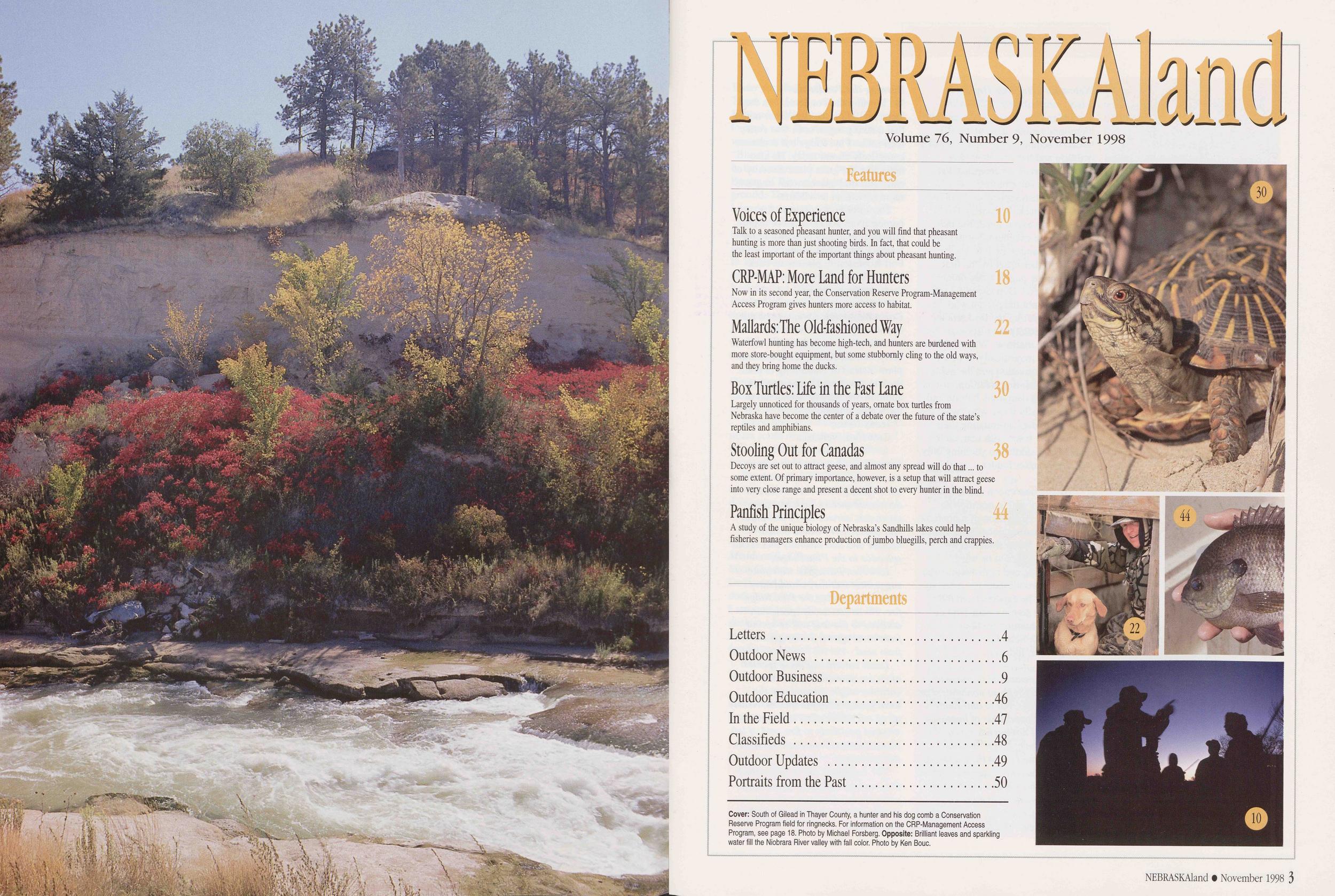
NEBRASKAland
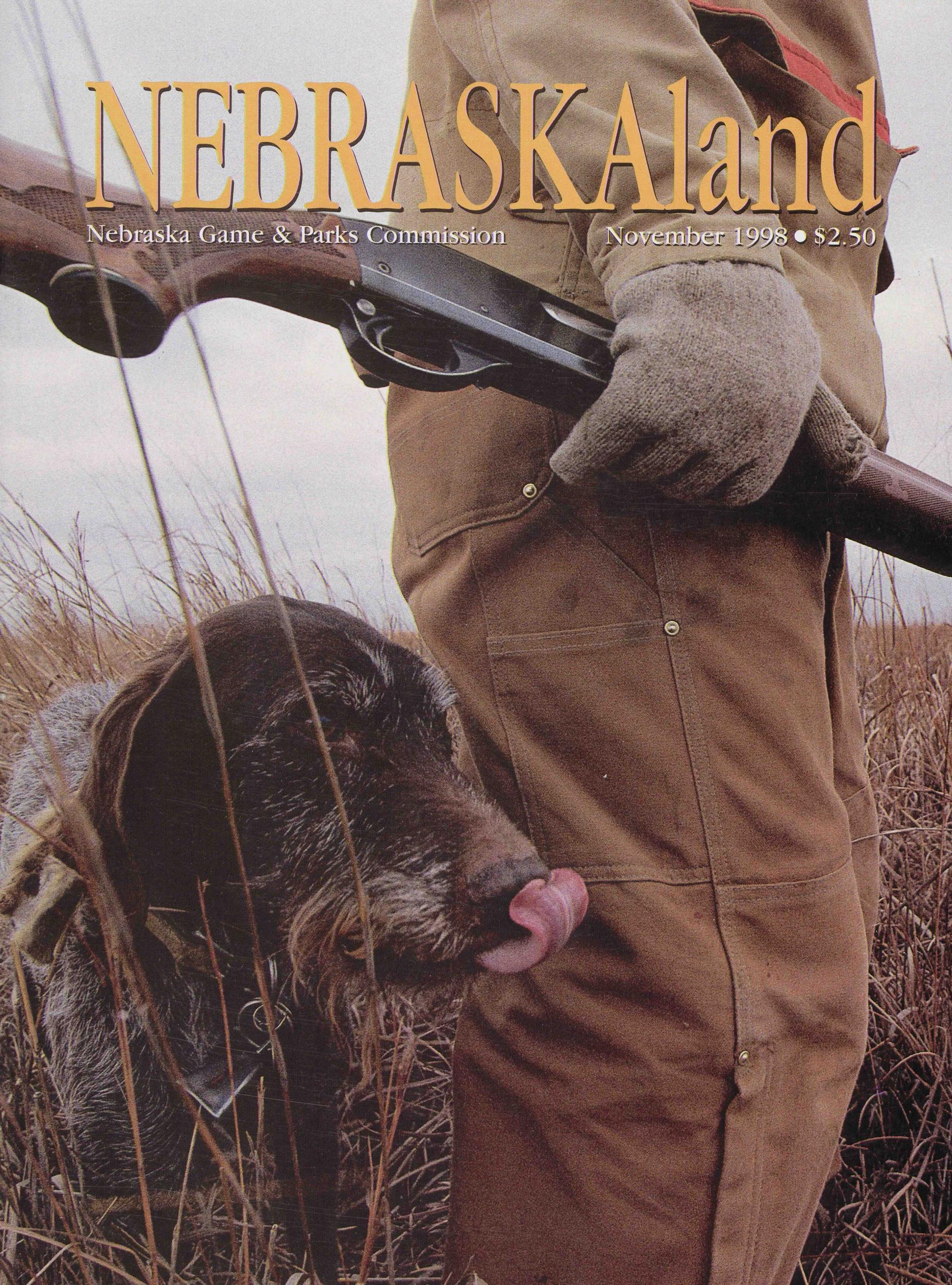
Volume 76, Number 9, November 1998 Features Voices of Experience 10 Talk to a seasoned pheasant hunter, and you will find that pheasant hunting is more than just shooting birds. In fact, that could be the least important of the important things about pheasant hunting. CRP-MAP: More Land for Hunters 18 Now in its second year, the Conservation Reserve Program-Management Access Program gives hunters more access to habitat. Mallards: The Old-fashioned Way 22 Waterfowl hunting has become high-tech, and hunters are burdened with more store-bought equipment, but some stubbornly cling to the old ways, and they bring home the ducks. Box Turtles: Life in the Fast Lane 30 Largely unnoticed for thousands of years, ornate box turtles from Nebraska have become the center of a debate over the future of the state's reptiles and amphibians. Stooling Out for Canadas 38 Decoys are set out to attract geese, and almost any spread will do that... to some extent. Of primary importance, however, is a setup that will attract geese into very close range and present a decent shot to every hunter in the blind. Panfish Principles 44 A study of the unique biology of Nebraska's Sandhills lakes could help fisheries managers enhance production of jumbo bluegills, perch and crappies. Departments Letters 4 Outdoor News 6 Outdoor Business 9 Outdoor Education 46 In the Field 47 Classifieds 48 Outdoor Updates 49 Portraits from the Past 50 Cover: South of Gilead in Thayer County, a hunter and his dog comb a Conservation Reserve Program field for ringnecks. For information on the CRP-Management Access Program, see page 18. Photo by Michael Forsberg. Opposite: Brilliant leaves and sparkling water fill the Niobrara River valley with fall color. Photo by Ken Bouc.30
22
44
10
Letters
Nebraska's Hunting HeritageI have subscribed to NEBRASKAland Magazine for several years and thoroughly enjoy its content. It's great; it acquaints me with Nebraska wildlife and has excellent photographs that alone are worth the price of the subscription.
The August-September 1998 issue, "Nebraska's Hunting Heritage," is no exception ... the photographs are excellent, but the two on pages 8 and 9 are jewels.
I was rather upset by the first paragraph on page 11 beginning "could it be ..." Don Cunningham, perhaps, is not the person who should be writing the lead article, which essentially is an apologia for the hunting tradition. Why not? For as ably and majestically as he elevates the motivation and the nobleness of the hunting tradition, just as ably does he denigrate, belittle and make cowardly those who "want the heritage to die," insinuating their psyches are filled with fear, their bellies accustomed to yearning only for supermarket fodder ... really a putdown.
To paint one vision and tradition so glowingly and to question so cheaply the motivation of a nonhunting tradition does nobody any value at all. It's a cheap shot, and Mr. Cunningham should be more understanding and realistic than the paragraph would indicate. After all, that is what he expects from the people who do not understand or cherish the hunting tradition.
Orville D. Schmidt Wakarusa, Indiana Those "who want the heritage to die " does not refer to nonhunters or their traditions, but to anti-hunters — declared opponents of hunting. The essay is not intended as a "shot" at them, either. Instead, it celebrates the best in the traditions of hunting and poses questions about possible subconscious motivations of those described on page 10 as believing that hunting "is a tradition best forgotten." (Editor) Burning the PonderosaIn "Burning the Ponderosa" in the October 1998 issue Bob Grier notes that quaking aspen once was common in the Pine Ridge but is almost completely absent today. He also notes that the great plant diversity of early and mid-successional stages is more beneficial to wildlife.
The 1989 Fort Robinson fire burned about 50,000 acres of mature, climax-community ponderosa pine forest. Every April, volunteers go to Fort Robinson to plant trees back into the burned areas, nearly all of them ponderosa pines.
Why doesn't the Game and Parks Commission take advantage of this opportunity to plant some key wildlife plants such as aspen, service berry, sumac, chokecherry, ash and plum instead of continuing to plant back to the climax vegetation? In addition, the variety would add to the scenic splendor.
Jenny Nixon Crawford, Nebraska Commission botanist Gerry Steinauer replies: "Your letter makes many good points. An increase in deciduous species such as aspen, green ash, service berry and plum and chokecherry would benefit wildlife and add diversity and scenic splendor to the Pine Ridge. However, I disagree with your suggestion that they should have been planted after the Pine Ridge fire. These deciduous species are adapted to fire and will re-sprout from roots after afire or get started from seed. Local varieties of these species often are unavailable, and nonlocal varieties might contaminate the local gene pool of the species. Nearly all of our native plant communities respond positively to fire, and, if left alone, Mother Nature will replenish the landscape. The continued use of prescribed fires and control of ponderosa pine will only benefit these valuable deciduous trees and shrubs in the Pine Ridge. 4 NEBRASKAland • November 1998 Letters Water for WetlandsThank you for the article, "Water for Wetlands," [October 1998]. The photograph with the story really fits. It was taken by Jon Farrar for the story "Blind Talk" [October 1992]. I am in the foreground, my brother, Keith Brown of Waverly, is in the background. The location is Smith Lagoon just north of Edgar.
My brother and I spent many hours and dollars in our campaign to save the wetlands in the mid-1970s. In 1979 we were awarded the conservationist of the year award by the Kearney and Hastings chapters of Ducks Unlimited. We also received the conservationist of the year award from the Four Rivers Sportsman Club in Hastings. It is good to know that the water is still being pumped.
I am always glad to see reports on Operation Game Thief. I was part of the inception of the program and served on the board for seven years.
I now live near Waconda Lake, 90 miles south of Hastings in Kansas. I do a lot of fishing and am looking forward to the coming duck season.
Please keep NEBRASKAland coming. No other state magazine does as good a job as you do.
Ray E. Brown Cawker City, Kansas Misidentified DuckYour October 1998 article, "Early Ducks are for Kids," identified a duck as a blue-winged teal. However, I am sure you will agree that the duck is a hen wood duck, the telltale identification mark being the white feathering around the eye.
Bernard J. Ach Friend, Nebraska Mr. Ach and several other sharp-eyed readers are correct. (Editor) Write to: Letters, NEBRASKAland Magazine, P.O. Box 30370, Lincoln, NE 68503. Fax: (402) 471-5528. E-mail: nebland@ngpsun.ngpc. state, ne. us. Please include your postal address and telephone number. Letters may be condensed and edited for clarity. Photographs are welcome.Nebraska Game and Parks Commission Offices
Headquarters 2200 N. 33rd Street Lincoln, NE 68503 Phone (402) 471-0641 District Office I East Hwy. 2, Box 725 Alliance, NE 69301 Phone (308) 763-2940 District Office II 524 Panzer St., Box 508 Bassett, NE 68714 Phone (402) 684-2921 District Office III 2201 N. 13th St. Norfolk, NE 68701 Phone (402) 370-3374 District Office IV 301 E. State Farm Rd. North Platte, NE 69101 Phone (308) 535-8025 District Off ice V 2200 N. 33rd Street Lincoln, NE 68503 Phone (402) 471-5558 District Office VI 1617 First Ave. Kearney, NE 68847 Phone (308) 865-5310 Omaha Office 1212 Deer Park Blvd. Omaha, NE 68108 Phone (402) 595-2144 Ak-Sar-Ben Aquarium 21502 W. Highway 31 Gretna, NE 68028 Phone (402) 332-3901 World Wide Web site: http://www.ngpc.state.ne.us E-mail: ngpc@ ngpsun.ngpc.state.ne.us Headquarters Daniel Roberts Fremont 721-7852 Dick Turpin (Adm.) Lincoln 471-5531 Randy Pomplun Fullerton (308) 536-2987 Ted Blume (Asst. Adm.) Lincoln 471-5532 Jon Reeves Kennard 427-7378 Murray Johnson Lincoln 471-5003 Eric Wiebe Ponca 755-2566 Steve Oberg Columbus 564-5937 Panhandle Officer City Phone (308) Sandhills Raymond Still Bridgeport 262-1075 Officer City Phone (402) Walt Meyer Chadron 432-4398 Bruce Wiebe (Sup.) Bassett 684-3867 John Murphy Crawford 665-2021 Ray Dierking Brkn. Bow (308) 872-3078 Jim Zimmerman Gering 436-7561 Richard Seward Ord (308) 728-3115 Marvin Kampbell Hay Springs 638-7527 Justin Mays Bassett 273-4188 Dennis Thompson Ogallala 284-6450 Frank Miller Valentine 376-5909 Dan Zuehlke Ogallala 284-4815 Dana Murphy Atkinson 925-2427 Dan Evasco Oshkosh 772-3091 Scott Brandt Scottsbluff 635-1277 South-central Officer City Phone (402) Southwest Jerry Pecha (Sup.) Kearney (308) 865-5327 Officer City Phone (308) Terry Brentzel Grand Is. (308) 384-8296 Roger Thompson (Sup.) N. Platte 532-9175 Tim Williams Hastings 463-2535 Dwight Allbery N. Platte 532-2753 Dale Johnson Kearney (308) 237-1079 Dudley Sorensen N. Platte 532-0747 Mark Reeves Loup City (308) 745-1126 George Sund Cambridge 697-4629 Robert Finke Milford 761-3537 Matt Andrews Elwood 785-3025 Jack Henderson Gothenburg 537-7483 Southeast Dirk Greene Imperial 882-5328 Officer City Phone (402) Virgil Gosch McCook 345-2185 Craig Stover (Sup.) Lincoln 471-5590 Rich Routh Rep. City 799-2085 Douglas Kramer Lincoln 466-9001 Dina Hopper Lincoln 483-2358 Northeast William Krause Auburn 274-3789 Officer City Phone (402) Larry Elston Bellevue 292-4910 Tom Zimmer (Sup.) Norfolk 371-6625 Mike Luben Colon 443-4278 Marion Shafer Norfolk 371-2031 Duane Arp Gretna 332-4954 Robert Kelly Albion 395-2538 Levi Krause Louisville 234-2212 Ross Oestmann Bloomfield 373-4412 Russell Mort Nebr. City 873-5684 Gary Ralston Creighton 847-3284 Greg Verkuilen Beatrice 223-4095 NEBRASKAland • November 1998 5
Outdoor News
Bayard Hunter Shoots Trophy Elk near ChadronIf initial measurements stand up, a 7x7 bull elk shot in the Hat Creek Unit in northwestern Nebraska will be the first from Nebraska to be officially recognized by the Boone and Crockett Club's Records of North American Big Game.
John A. Walker of Bayard shot the huge wapiti on private land near Chadron on September 27. He estimates the elk weighed 900 to 1,000 pounds.
Walker, 35, shot the elk from about 80 yards with a .300 Winchester magnum.
Aquatic Habitat Program Named Best in the NationNebraska's Aquatic Habitat Improvement Program has been named the best sport fish restoration project for fisheries management in the nation.
The program, which restores lakes, reservoirs and streams so they can support desired fish populations and provide better fishing, was chosen by the American Fisheries Society over seven others nominated nationwide.
Phillip Durocher, president of the AFS's Administrators Section, presented the award to the Fisheries Division of the Nebraska Game and Parks Commission at its Oct. 23 meeting in Lincoln. Durocher is director of inland fisheries for the Texas Parks and Wildlife Department.
Don Gabelhouse, administrator of the Commission's Fisheries Division, credited the Aquatic Habitat Stamp, the Environmental Trust Fund, the Legislature, sportsmen's groups, Game and Parks commissioners and the news media for contributions to Nebraska's program.
"A lot of people had roles to play, but none more than the interested, dedicated anglers of Nebraska who helped us all the way in developing and charting the plan," he said.
"New Life for Aging Waters" was the Nebraska program's theme.
Legislation Would Support Nongame Wildlife ProgramsSupporters of the Teaming with Wildlife coalition are hailing the introduction in Congress of legislation that would provide additional funding to benefit a variety of nongame wildlife species.
Nebraska could receive about $4 million annually from the program, said Ross Lock, Wildlife Diversity Program manager for the Nebraska Game and Parks Commission.
The funds would help Nebraska "meet the growing needs of nongame species, including about 220 that might be rare, declining or at risk," Lock said. The efforts are now funded primarily with contributions made through the state income tax checkoff.
Taking care of nongame species now could save money later by eliminating the need for action under the Endangered Species Act and avoid costly programs to prevent extinction, Lock said.
The legislation would dedicate a percentage of oil and gas revenues, up to $5 billion annually, for state fish and wildlife conservation programs primarily for species that are not hunted, trapped or fished. The money also could be used for wildlife-dependent recreation and conservation education.
The Teaming with Wildlife coalition is an initiative to fund nongame habitat development, conservation education and outdoor recreation nationwide. More than 3,000 conservation organizations and related.
6 NEBRASKAland • November 1998 Outdoor Newsbusinesses, including 49 in Nebraska, support the grassroots effort, Lock said.
"This legislation is the best our generation will have to fund wildlife conservation programs in this country," said David Waller, chairman of the International Association of Fish and Wildlife Agencies' Teaming with Wildlife Committee.
Many sportfish and game populations have been restored and have benefitted from funds provided by hunters and anglers through license and user fees under the Federal Aid in Wildlife and Sport Fish Restoration Program.
Although habitat developed under such programs has benefitted all species, many people believe that more is needed to be done in developing programs to address the needs of nongame wildlife.
Hunters Feeding the Hungry Sets Goal of 15,000 PoundsHunters Feeding the Hungry, a grassroots program sponsored by Ted Nugent's United Sportsmen of America, is asking deer hunters to donate venison to the needy.
Paul Milone of Omaha, president of the Nebraska chapter of United Sportsmen of America, said Nebraskans donated 8,000 pounds of venison to pantries and homeless shelters last year. The organization has set a goal of 15,000 pounds of meat for 1998.
Hunters are asked to have the meat processed, and they can donate all or a portion of it. Hunters interested in donating venison can call a food pantry or shelter. In addition, several meat lockers throughout the state have agreed to store the venison until it can be picked up.
For more information and a list of participating meat lockers throughout the state, visit the organization's web site at http://www.top.net/sharp/ netnusa/hfh.htm or call Paul Milone at (402) 894-2684 or Kevin Markt at (402) 492-9203.
Outdoor News
Officer's Notebook
New Seasons, New Violations Fall marks the opening of hunting seasons and a change in the fish and game violations seen by conservation officers. In summer, fishing without a permit is one of the most common violations I encounter in the Panhandle. This year, I had to write seven fishing permit citations during a three-hour period one Sunday morning. The violations occurred at sandpits in Gering and Morrill and on Sheep Creek north of Henry. As the fall hunting seasons get under way, the most common violations officers find across Nebraska include loaded shotguns in vehicles, trespassing, hunting with artificial light, illegal possession of game and alcohol violations. Last year, the statewide arrest total was down slightly from 1996, with 3,281 individuals found guilty of 3,784 offenses, a conviction rate of 95% for all arrests and citations issued. Game law changes for this year include new revocation procedures. Now a hunter or an angler convicted of a violation could, at the discretion of the judge, lose their hunting and fishing licenses. Planning and a little foresight would help prevent fishing and hunting without a permit and similar game violations. Most of the seven anglers who received citations for not having a fishing permit said they were taking advantage of improved weather but hadn't found time to stop at a permit vendor to buy a license. It was the last-minute fishing trip that got them into trouble. Anglers and hunters should purchase permits early. Buying hunting and fishing permits for Christmas gifts is a great habit to get into. — Conservation Officer Jim Zimmerman, Gering. Nontoxic shot requirements for 1998-1999 It is unlawful to use or possess shotgun shells loaded with or containing shot other than nontoxic shot when hunting, taking or attempting to take waterfowl. Nontoxic shot is required for all shotgun hunting — upland as well as waterfowl — on federal waterfowl production areas, national wildlife refuges and some state wildlife management areas. Signs are posted on the areas, and the "Nebraska Hunt Guide and Guide to Public Hunting Lands" also lists areas where the nontoxic shot is required. The guide is available from Game and Parks Commission offices and most permit vendors. Five kinds of nontoxic shot have been approved by the U. S. Fish and Wildlife Service for 1998-1999: steel, coated steel, bismuth-tin, tungsten-iron and tungsten-polymer. Tungsten-iron and tungsten-polymer shot received temporary approval this year. Tungsten-iron is 40 parts tungsten and 60 parts iron; the tungsten-polymer shot is 95.5 parts tungsten and 4.5 parts nylon. Steel, coated steel and bismuth-tin, (97 percent bismuth, 3 percent tin) have received permanent approval. Steel, bismuth-tin and tungsten-iron were available last year; dealers expect tungsten-polymer shot to be available this fall.Hunters and anglers can purchase 1998 and 1999 hunting and fishing permits and required stamps on the Game and Parks Commission's home page.
Anyone with internet access, a web browser capable of displaying and processing forms and a printer capable of printing graphics can purchase a permit without leaving home.
After the user completes a form, selects a permit type and provides a valid credit card number, the computer displays a completed license and stamp that can be printed on the user's home printer.
The Game and Parks Commission operates a secure web site, so all information submitted is encrypted.
Permits also are available from Commission offices and vendors.
The online permit address is: http://hawk.ngpc.state.ne.us/license/ permits.html
Lifetime permits are not available online.
Commission, Historical Society Receive AwardThe Nebraska Game and Parks Commission and the Nebraska State Historical Society received the 1998 American Association for State and Local History award at the group's annual meeting on Sept. 11 in Sacramento, California.
A certificate of commendation was awarded for the Fort Robinson History Conference, a joint project of the two state agencies.
The AASLH Awards Program is the nation's most prestigious competition of achievement in local, state and regional history.
Drawing on Fort Robinson's museum collections and period structures, the conference attracts authors, scholars, military history enthusiasts and local historians.
A third conference is planned for spring 2000.
8 NEBRASKAland • November 1998Outdoor Business
Shoot or Don't Shoot?
Snow geese and trumpeter swans are sometimes misidentified By Bob GrierTrumpeter swans and the nearly identical tundra swans average 60 inches from the tip of the bill to the tail. They can weigh up to 30 pounds. They have long necks, and their wing beats are slow and rhythmic.
Adult snow geese are about 30 inches long, weigh six to seven pounds and have short necks. Their wing beats are rapid.
Swans usually are encountered in small family flocks or as individuals or pairs; snow goose flocks often number in the hundreds. Swans usually are silent, but snow geese are noisy and commonly are heard before they are seen.
The obvious differences between the species make it difficult to understand how swans could be killed by hunters mistaking them for snow geese, but every year the reports come in.
Responsible hunters know that identifying the quarry under all light and weather conditions must be uncompromising — if there is any doubt about identification, don't shoot! The small number of irresponsible hunters and the vandals with guns have no place in the field, and responsible hunters should report violators to a conservation officer or other law enforcement agency as soon as possible.
The chances of encountering trumpeter swans or migrating tundra swans when they are passing through Nebraska in fall are increasing. In addition, resident trumpeters are scattered across the Sandhills, and migrant birds from LaCreek National Wildlife Refuge in South Dakota and from other states are seen every fall in the North Platte Valley, especially after Sandhills lakes and marshes freeze.
Wintering trumpeters have been reported in at least eight Sandhills counties in recent years, and there have been occasional sightings on the central and eastern Platte. Migrating tundra swans, formerly known as whistlers, usually pass through eastern Nebraska.
Identification of swans and snow geese, begins with subtle differences in color and dramatic differences in size, but even experienced waterfowl hunters know that light, weather and distance can make size and color comparisons difficult.
Swans and snow geese both have bright white plumage, although
Usually seen in large, noisy flocks, snow geese have black wing tips and fly with rapid wing beats.
Their black feet clearly visible, swans usually fly in pairs or small flocks. Their wing beats are slow and rhythmic.
immature swans and snow geese can be off-white or light gray, especially on the neck and head. Dark, or blue-phase, snow geese are commonly seen in snow goose flocks, but they have slate-gray bodies and are unlikely to be confused with any white bird.
Unlike trumpeters, snow geese have black-tipped wings. The swan's large black feet and black bill can be seen when the birds are in flight, and the swan's distinctive black bill extending back to the eyes is usually visible at closer distances. Adult snow geese have pink or rose bills and feet.
The differences in body shape and wing speed are almost always apparent when the birds are in flight. The swan's extraordinarily long neck and slow, graceful wing movements are a dramatic contrast to the snow goose's short neck and fast-paced wing movements.
Swans usually are seen in small family groups or pairs or as individual birds, and nearly always are silent. The trumpeter swan's beautiful horn-like call is unmistakable, as is the tundra swan's high-pitched barking call.
Snow geese are seldom encountered in small groups, but usually travel in flocks numbering in the hundreds and even thousands. Snow goose flocks are rarely silent, and their abbreviated high-pitched calls punctuate the movements of the gregarious birds.
Hunters, like other wildlife enthusiasts, celebrate the return of the trumpeter swan and the increased opportunity to view them, but waterfowl hunters must remember that species identification is a basic tenet of responsible hunting, and swans might be encountered almost anywhere in Nebraska.
NEBRASKAland • November 1998 9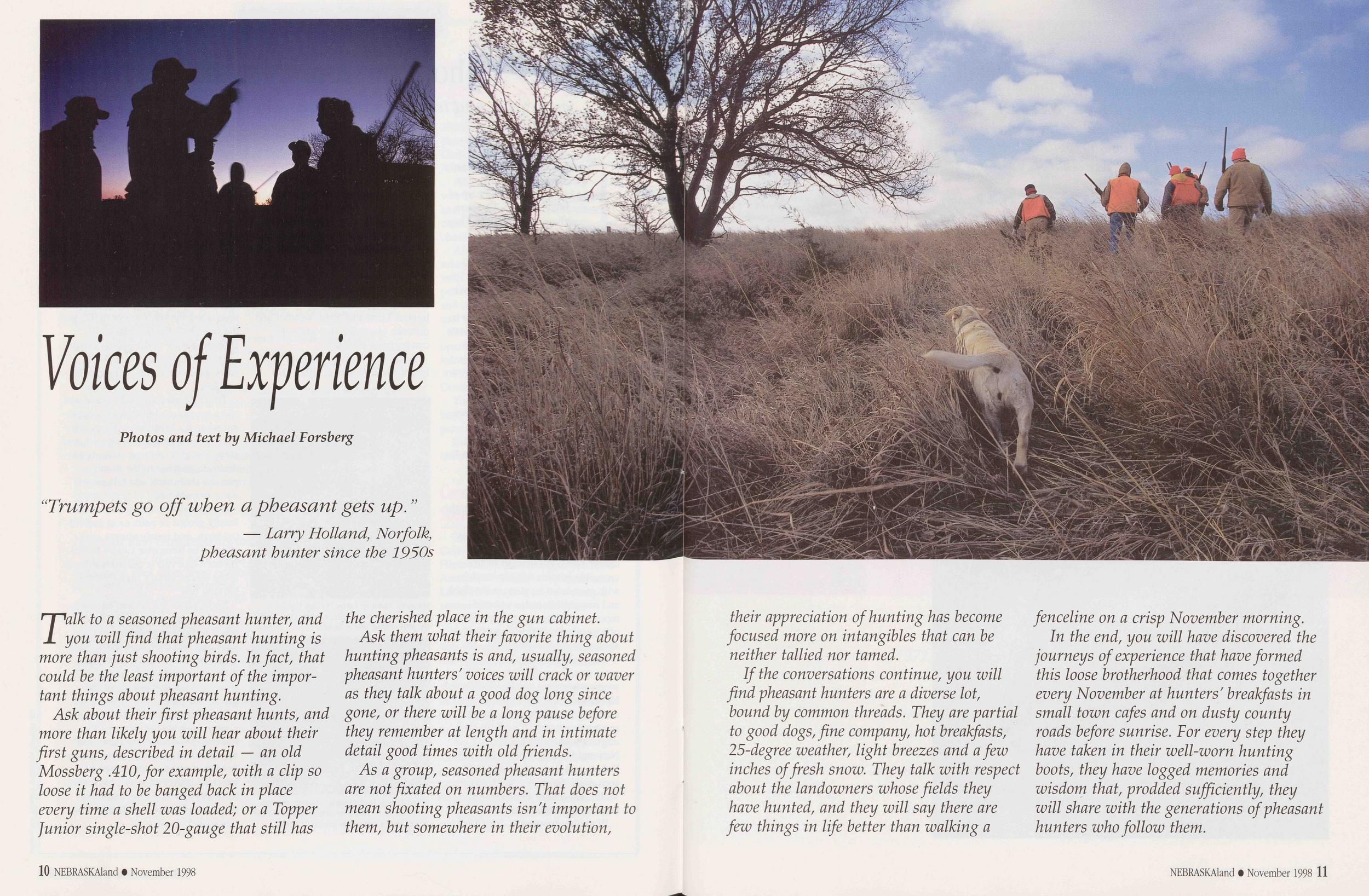
Voices of Experience
Photos and text by Michael Forsberg "Trumpets go off when a pheasant gets up." — Larry Holland, Norfolk, pheasant hunter since the 1950sTalk to a seasoned pheasant hunter, and you will find that pheasant hunting is more than just shooting birds. In fact, that could be the least important of the important things about pheasant hunting.
Ask about their first pheasant hunts, and more than likely you will hear about their first guns, described in detail — an old Mossberg .410, for example, with a clip so loose it had to be banged back in place every time a shell was loaded; or a Topper junior single-shot 20-gauge that still has the cherished place in the gun cabinet.
Ask them what their favorite thing about hunting pheasants is and, usually, seasoned pheasant hunters' voices will crack or waver as they talk about a good dog long since gone, or there will be a long pause before they remember at length and in intimate detail good times with old friends.
As a group, seasoned pheasant hunters are not fixated on numbers. That does not mean shooting pheasants isn't important to them, but somewhere in their evolution,
10 NEBRASKAland • November 1998their appreciation of hunting has become focused more on intangibles that can be neither tallied nor tamed.
If the conversations continue, you will find pheasant hunters are a diverse lot, bound by common threads. They are partial to good dogs, fine company, hot breakfasts, 25-degree weather, light breezes and a few inches of fresh snow. They talk with respect about the landowners whose fields they have hunted, and they will say there are few things in life better than walking a fenceline on a crisp November morning.
In the end, you will have discovered the journeys of experience that have formed this loose brotherhood that comes together every November at hunters' breakfasts in small town cafes and on dusty county roads before sunrise. For every step they have taken in their well-worn hunting boots, they have logged memories and wisdom that, prodded sufficiently, they will share with the generations of pheasant hunters who follow them.
NEBRASKAland • November 1998 11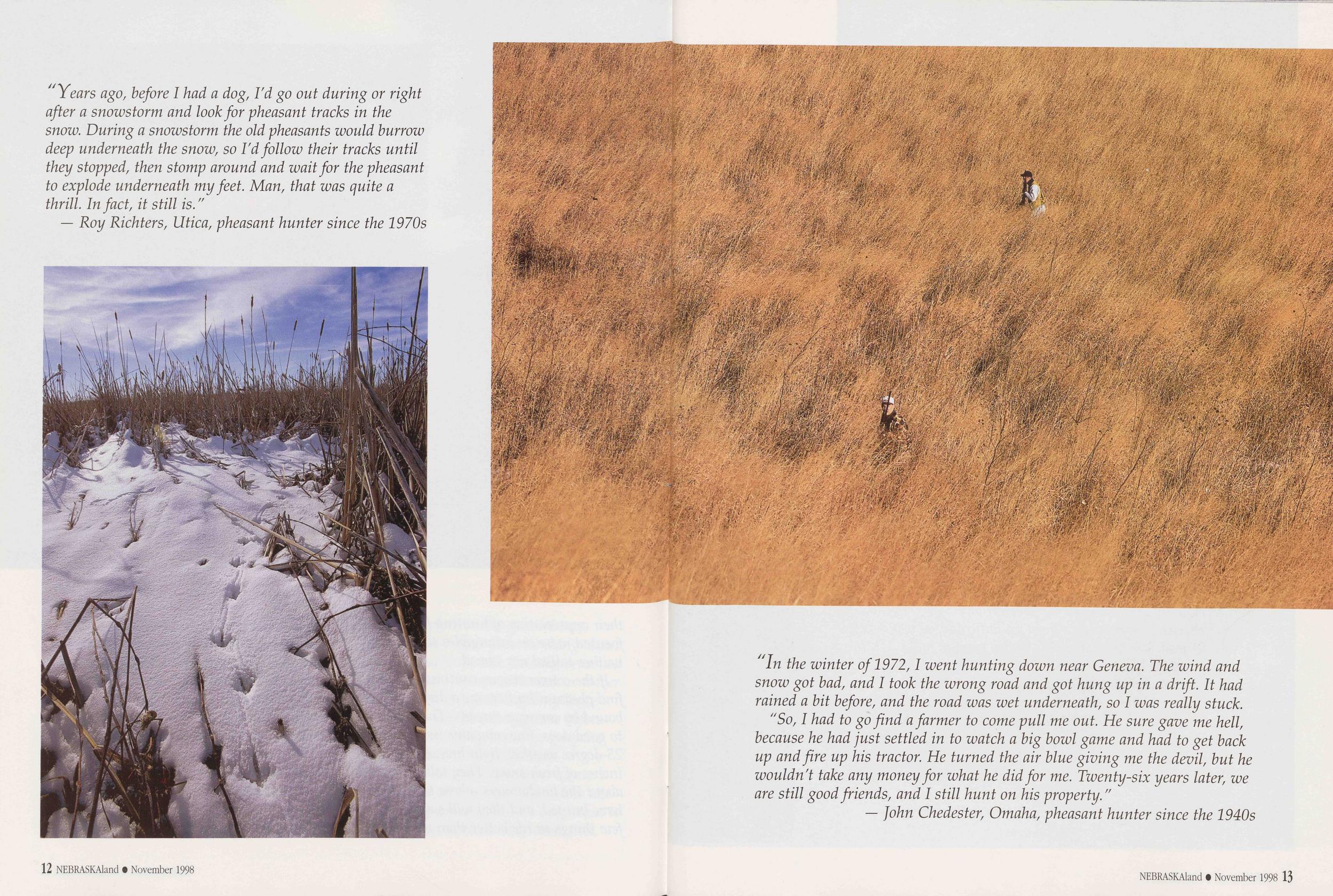
"Years ago, before I had a dog, I'd go out during or right after a snowstorm and look for pheasant tracks in the snow. During a snowstorm the old pheasants would burrow deep underneath the snow, so I'd follow their tracks until they stopped, then stomp around and wait for the pheasant to explode underneath my feet. Man, that was quite a thrill. In fact, it still is."
— Roy Richters, Utica, pheasant hunter since the 1970sIn the winter of 1972,1 went hunting down near Geneva. The wind and snow got bad, and I took the wrong road and got hung up in a drift. It had rained a bit before, and the road was wet underneath, so I was really stuck.
"So, I had to go find a farmer to come pull me out. He sure gave me hell, because he had just settled in to watch a big bowl game and had to get back up and fire up his tractor. He turned the air blue giving me the devil, but he wouldn't take any money for what he did for me. Twenty-six years later, we are still good friends, and I still hunt on his property."
— John Chedester, Omaha, pheasant hunter since the 1940s NEBRASKAland • November 1998 13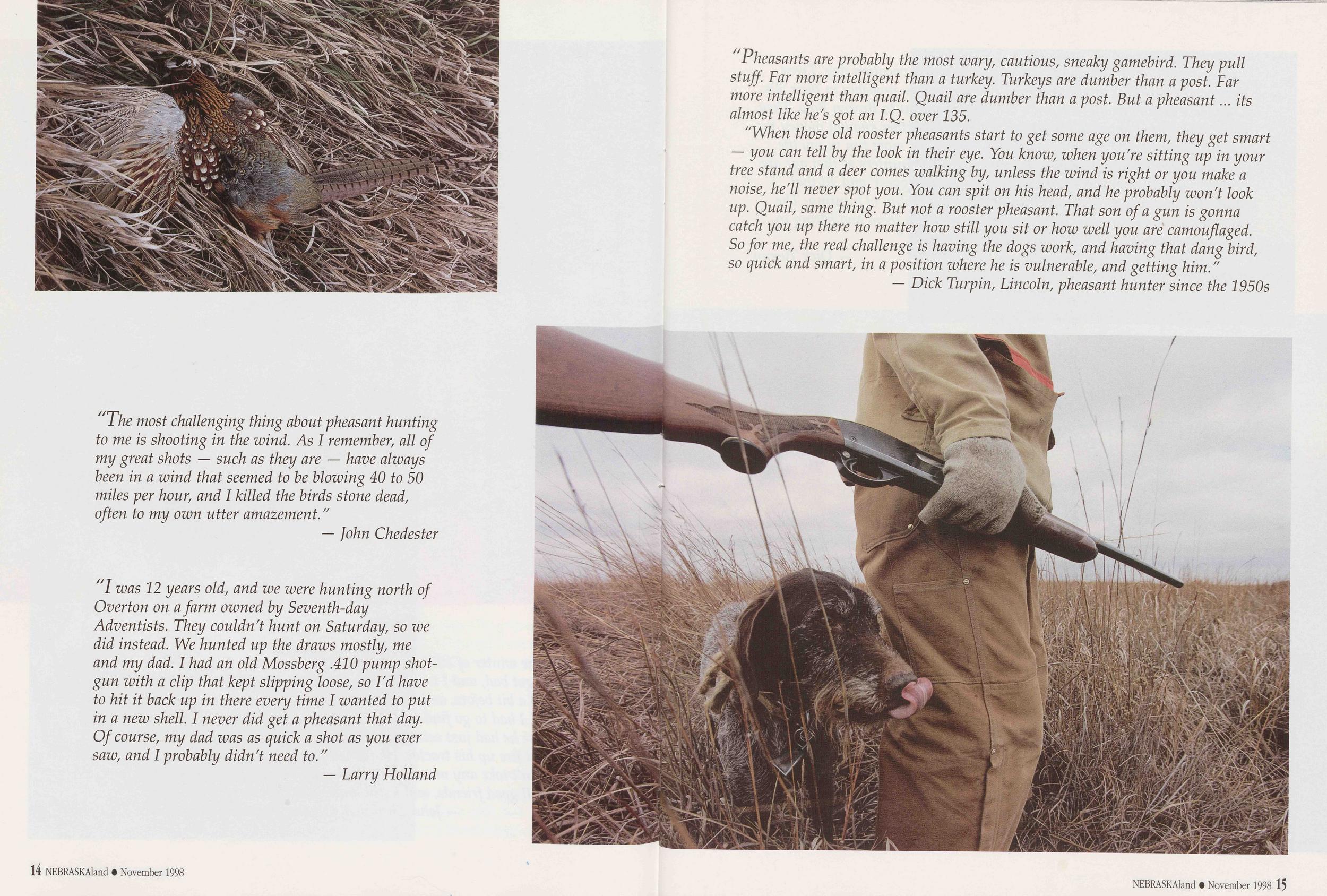
"The most challenging thing about pheasant hunting to me is shooting in the wind. As I remember, all of my great shots — such as they are — have always been in a wind that seemed to be blowing 40 to 50 miles per hour, and I killed the birds stone dead, often to my own utter amazement."
— John Chedester"I was 12 years old, and we were hunting north of Overton on a farm owned by Seventh-day Adventists. They couldn't hunt on Saturday, so we did instead. We hunted up the draws mostly, me and my dad. I had an old Mossberg .410 pump shotgun with a clip that kept slipping loose, so I'd have to hit it back up in there every time I wanted to put in a new shell. I never did get a pheasant that day. Of course, my dad was as quick a shot as you ever saw, and I probably didn't need to."
— Larry Holland 14 NEBRASKAland • November 1998Pheasants are probably the most wary, cautious, sneaky gamebird. They pull stuff. Far more intelligent than a turkey. Turkeys are dumber than a post. Far more intelligent than quail. Quail are dumber than a post. But a pheasant... its almost like he's got an I.Q. over 135.
"When those old rooster pheasants start to get some age on them, they get smart — you can tell by the look in their eye. You know, when you're sitting up in your tree stand and a deer comes walking by, unless the wind is right or you make a noise, he'll never spot you. You can spit on his head, and he probably won't look up. Quail, same thing. But not a rooster pheasant. That son of a gun is gonna catch you up there no matter how still you sit or how well you are camouflaged. So for me, the real challenge is having the dogs work, and having that dang bird, so quick and smart, in a position where he is vulnerable, and getting him."
— Dick Turpin, Lincoln, pheasant hunter since the 1950s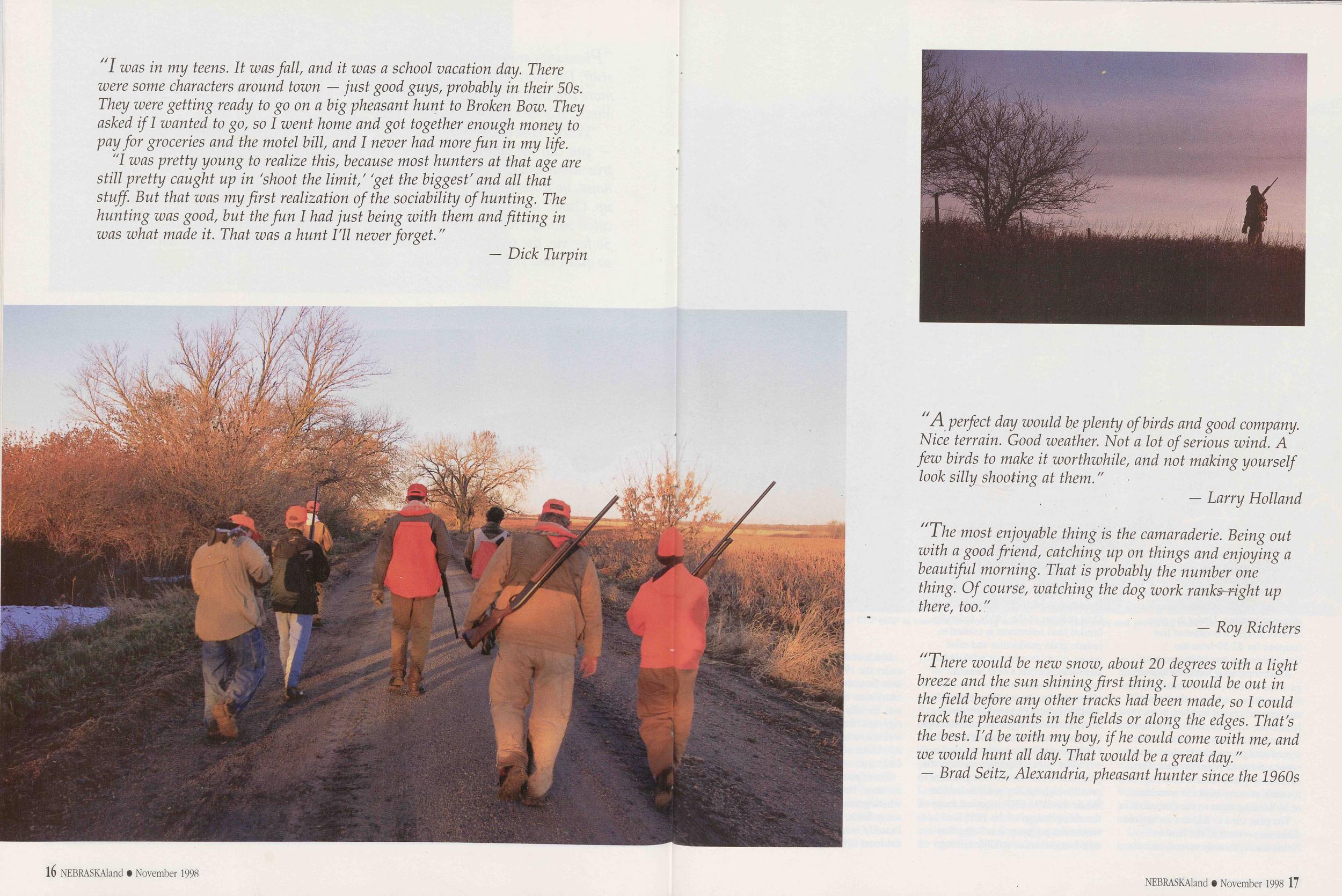
"I was in my teens. It was fall, and it was a school vacation day. There were some characters around town — just good guys, probably in their 50s. They were getting ready to go on a big pheasant hunt to Broken Bow. They asked if I wanted to go, so I went home and got together enough money to pay for groceries and the motel bill, and I never had more fun in my life. "I was pretty young to realize this, because most hunters at that age are still pretty caught up in 'shoot the limit,' 'get the biggest' and all that stuff. But that was my first realization of the sociability of hunting. The hunting was good, but the fun I had just being with them and fitting in was what made it. That was a hunt I'll never forget."
— Dick Turpin"A perfect day would be plenty of birds and good company. Nice terrain. Good weather. Not a lot of serious wind. A few birds to make it worthwhile, and not making yourself look silly shooting at them."
— Larry Holland"The most enjoyable thing is the camaraderie. Being out with a good friend, catching up on things and enjoying a beautiful morning. That is probably the number one thing. Of course, watching the dog work ranks-right up there, too."
— Roy Richters"There would be new snow, about 20 degrees with a light breeze and the sun shining first thing. I would be out in the field before any other tracks had been made, so I could track the pheasants in the fields or along the edges. That's the best. I'd be with my boy, if he could come with me, and we would hunt all day. That would be a great day."
— Brad Seitz, Alexandria, pheasant hunter since the 1960s NEBRASKAland • November 1998 17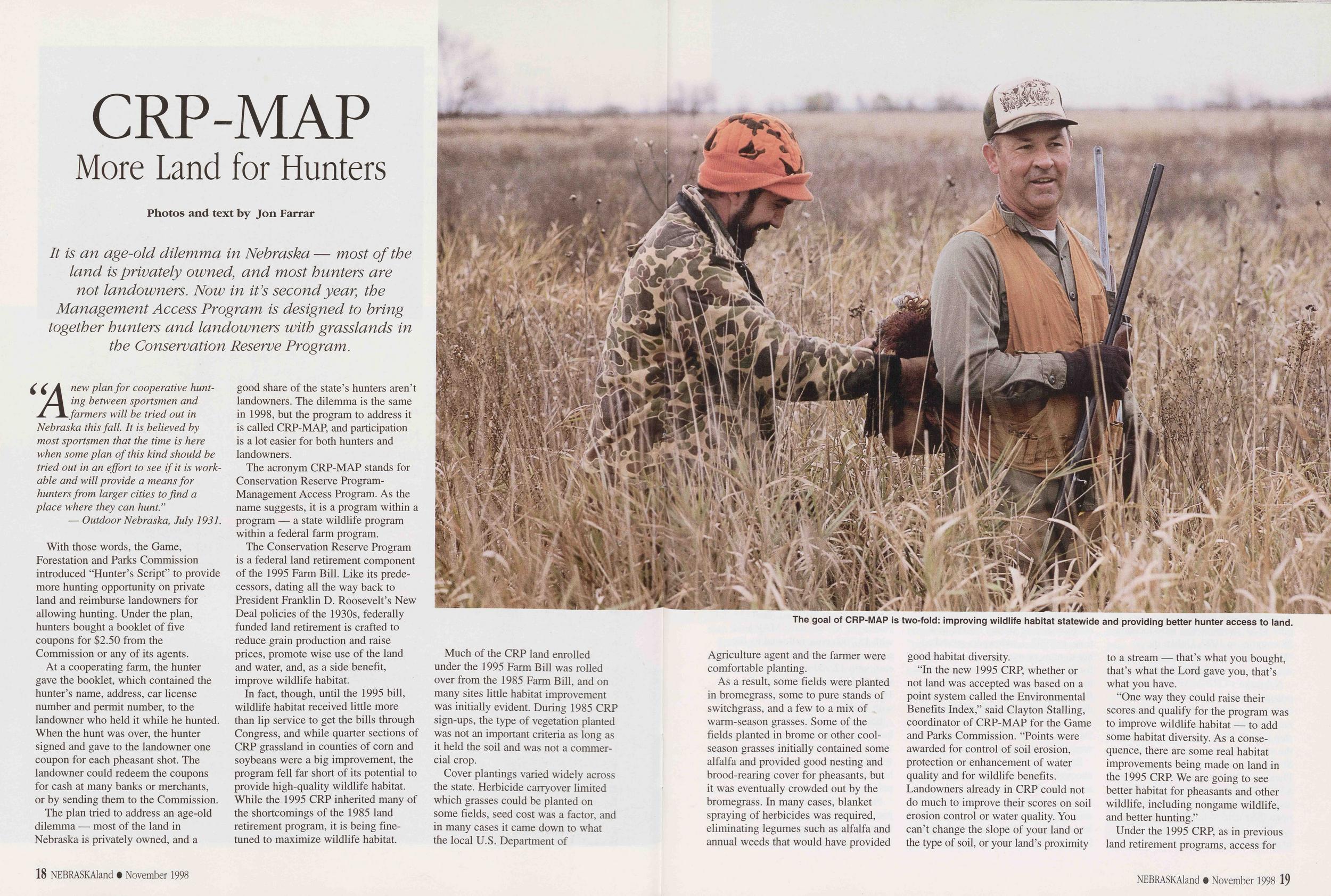
CRP-MAP More Land for Hunters
Photos and text by Jon Farrar It is an age-old dilemma in Nebraska — most of the land is privately owned, and most hunters are not landowners. Now in it's second year, the Management Access Program is designed to bring together hunters and landowners with grasslands in the Conservation Reserve Program. "A new plan for cooperative hunting between sportsmen and .farmers will be tried out in Nebraska this fall. It is believed by most sportsmen that the time is here when some plan of this kind should be tried out in an effort to see if it is workable and will provide a means for hunters from larger cities to find a place where they can hunt." — Outdoor Nebraska, July 1931.With those words, the Game, Forestation and Parks Commission introduced "Hunter's Script" to provide more hunting opportunity on private land and reimburse landowners for allowing hunting. Under the plan, hunters bought a booklet of five coupons for $2.50 from the Commission or any of its agents.
At a cooperating farm, the hunter gave the booklet, which contained the hunter's name, address, car license number and permit number, to the landowner who held it while he hunted. When the hunt was over, the hunter signed and gave to the landowner one coupon for each pheasant shot. The landowner could redeem the coupons for cash at many banks or merchants, or by sending them to the Commission.
The plan tried to address an age-old dilemma — most of the land in Nebraska is privately owned, and a good share of the state's hunters aren't landowners. The dilemma is the same in 1998, but the program to address it is called CRP-MAP, and participation is a lot easier for both hunters and landowners.
The acronym CRP-MAP stands for Conservation Reserve Program-Management Access Program. As the name suggests, it is a program within a program — a state wildlife program within a federal farm program.
The Conservation Reserve Program is a federal land retirement component of the 1995 Farm Bill. Like its predecessors, dating all the way back to President Franklin D. Roosevelt's New Deal policies of the 1930s, federally funded land retirement is crafted to reduce grain production and raise prices, promote wise use of the land and water, and, as a side benefit, improve wildlife habitat.
In fact, though, until the 1995 bill, wildlife habitat received little more than lip service to get the bills through Congress, and while quarter sections of CRP grassland in counties of corn and soybeans were a big improvement, the program fell far short of its potential to provide high-quality wildlife habitat. While the 1995 CRP inherited many of the shortcomings of the 1985 land retirement program, it is being fine-tuned to maximize wildlife habitat.
Much of the CRP land enrolled under the 1995 Farm Bill was rolled over from the 1985 Farm Bill, and on many sites little habitat improvement was initially evident. During 1985 CRP sign-ups, the type of vegetation planted was not an important criteria as long as it held the soil and was not a commercial crop.
Cover plantings varied widely across the state. Herbicide carryover limited which grasses could be planted on some fields, seed cost was a factor, and in many cases it came down to what the local U.S. Department of
18 NEBRASKAland • November 1998The goal of CRP-MAP is two-fold: improving wildlife habitat statewide and providing better hunter access to land.
Agriculture agent and the farmer were comfortable planting.
As a result, some fields were planted in bromegrass, some to pure stands of switchgrass, and a few to a mix of warm-season grasses. Some of the fields planted in brome or other cool-season grasses initially contained some alfalfa and provided good nesting and brood-rearing cover for pheasants, but it was eventually crowded out by the bromegrass. In many cases, blanket spraying of herbicides was required, eliminating legumes such as alfalfa and annual weeds that would have provided good habitat diversity.
"In the new 1995 CRP, whether or not land was accepted was based on a point system called the Environmental Benefits Index," said Clayton Stalling, coordinator of CRP-MAP for the Game and Parks Commission. "Points were awarded for control of soil erosion, protection or enhancement of water quality and for wildlife benefits. Landowners already in CRP could not do much to improve their scores on soil erosion control or water quality. You can't change the slope of your land or the type of soil, or your land's proximity to a stream — that's what you bought, that's what the Lord gave you, that's what vou have.
"One way they could raise their scores and qualify for the program was to improve wildlife habitat — to add some habitat diversity. As a consequence, there are some real habitat improvements being made on land in the 1995 CRP. We are going to see better habitat for pheasants and other wildlife, including nongame wildlife, and better hunting."
Under the 1995 CRP, as in previous land retirement programs, access for
NEBRASKAland • November 1998 19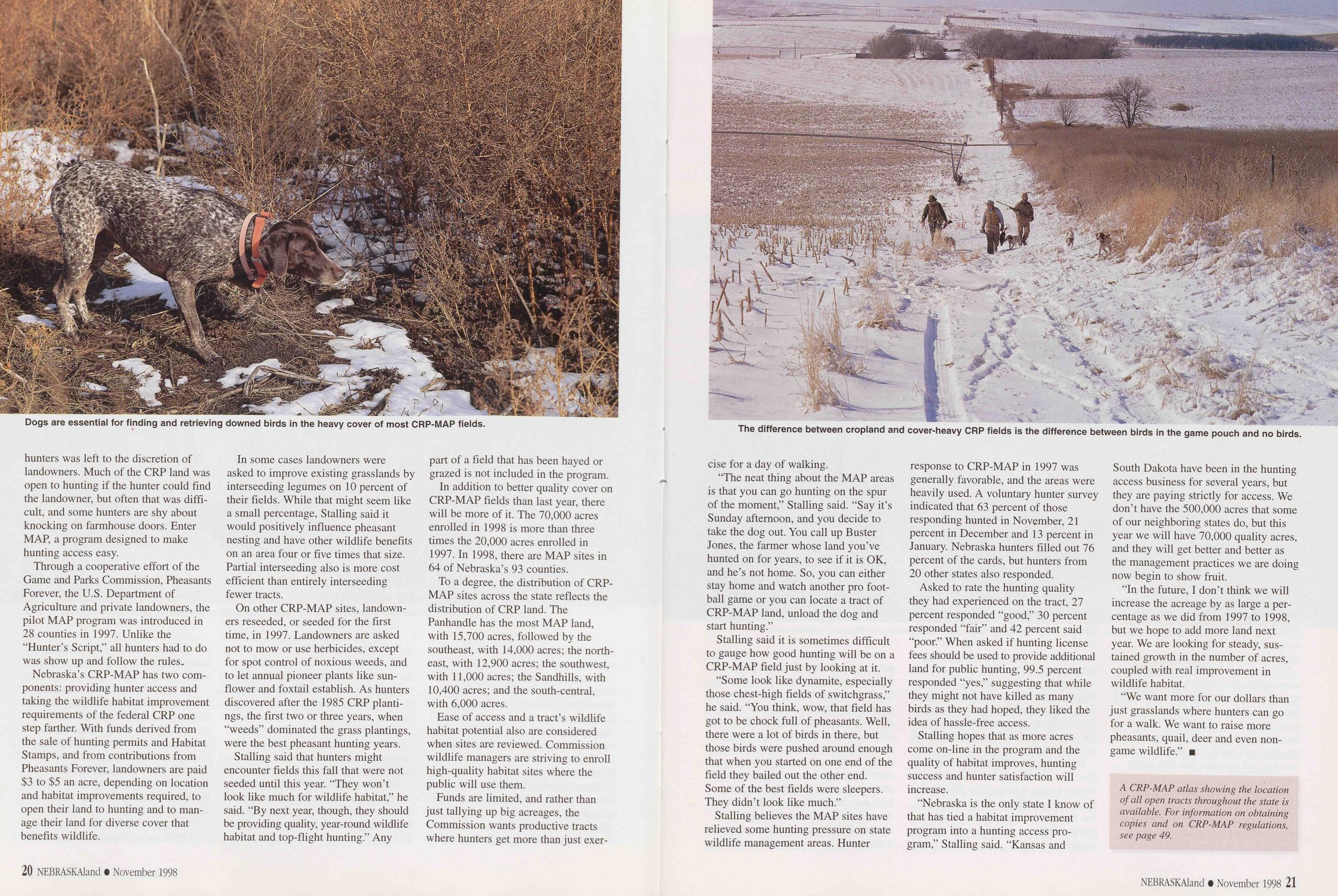
Dogs are essential for finding and retrieving downed birds in the heavy cover of most CRP-MAP fields.
hunters was left to the discretion of landowners. Much of the CRP land was open to hunting if the hunter could find the landowner, but often that was difficult, and some hunters are shy about knocking on farmhouse doors. Enter MAP, a program designed to make hunting access easy.
Through a cooperative effort of the Game and Parks Commission, Pheasants Forever, the U.S. Department of Agriculture and private landowners, the pilot MAP program was introduced in 28 counties in 1997. Unlike the "Hunter's Script," all hunters had to do was show up and follow the rules.
Nebraska's CRP-MAP has two components: providing hunter access and taking the wildlife habitat improvement requirements of the federal CRP one step farther. With funds derived from the sale of hunting permits and Habitat Stamps, and from contributions from Pheasants Forever, landowners are paid $3 to $5 an acre, depending on location and habitat improvements required, to open their land to hunting and to manage their land for diverse cover that benefits wildlife.
In some cases landowners were asked to improve existing grasslands by interseeding legumes on 10 percent of their fields. While that might seem like a small percentage, Stalling said it would positively influence pheasant nesting and have other wildlife benefits on an area four or five times that size. Partial interseeding also is more cost efficient than entirely interseeding fewer tracts.
On other CRP-MAP sites, landowners reseeded, or seeded for the first time, in 1997. Landowners are asked not to mow or use herbicides, except for spot control of noxious weeds, and to let annual pioneer plants like sunflower and foxtail establish. As hunters discovered after the 1985 CRP plantings, the first two or three years, when "weeds" dominated the grass plantings, were the best pheasant hunting years.
Stalling said that hunters might encounter fields this fall that were not seeded until this year. "They won't look like much for wildlife habitat," he said. "By next year, though, they should be providing quality, year-round wildlife habitat and top-flight hunting." Any part of a field that has been hayed or grazed is not included in the program.
In addition to better quality cover on CRP-MAP fields than last year, there will be more of it. The 70,000 acres enrolled in 1998 is more than three times the 20,000 acres enrolled in 1997. In 1998, there are MAP sites in 64 of Nebraska's 93 counties.
To a degree, the distribution of CRP-MAP sites across the state reflects the distribution of CRP land. The Panhandle has the most MAP land, with 15,700 acres, followed by the southeast, with 14,000 acres; the northeast, with 12,900 acres; the southwest, with 11,000 acres; the Sandhills, with 10,400 acres; and the south-central, with 6,000 acres.
Ease of access and a tract's wildlife habitat potential also are considered when sites are reviewed. Commission wildlife managers are striving to enroll high-quality habitat sites where the public will use them.
Funds are limited, and rather than just tallying up big acreages, the Commission wants productive tracts where hunters get more than just exercise
20 NEBRASKAland • November 1998The difference between cropland and cover-heavy CRP fields is the difference between birds in the game pouch and no birds.
for a day of walking.
"The neat thing about the MAP areas is that you can go hunting on the spur of the moment," Stalling said. "Say it's Sunday afternoon, and you decide to take the dog out. You call up Buster Jones, the farmer whose land you've hunted on for years, to see if it is OK, and he's not home. So, you can either stay home and watch another pro football game or you can locate a tract of CRP-MAP land, unload the dog and start hunting."
Stalling said it is sometimes difficult to gauge how good hunting will be on a CRP-MAP field just by looking at it.
"Some look like dynamite, especially those chest-high fields of switchgrass," he said. "You think, wow, that field has got to be chock full of pheasants. Well, there were a lot of birds in there, but those birds were pushed around enough that when you started on one end of the field they bailed out the other end. Some of the best fields were sleepers. They didn't look like much."
Stalling believes the MAP sites have relieved some hunting pressure on state wildlife management areas. Hunter response to CRP-MAP in 1997 was generally favorable, and the areas were heavily used. A voluntary hunter survey indicated that 63 percent of those responding hunted in November, 21 percent in December and 13 percent in January. Nebraska hunters filled out 76 percent of the cards, but hunters from 20 other states also responded.
Asked to rate the hunting quality they had experienced on the tract, 27 percent responded "good," 30 percent responded "fair" and 42 percent said "poor." When asked if hunting license fees should be used to provide additional land for public hunting, 99.5 percent responded "yes," suggesting that while they might not have killed as many birds as they had hoped, they liked the idea of hassle-free access.
Stalling hopes that as more acres come on-line in the program and the quality of habitat improves, hunting success and hunter satisfaction will increase.
"Nebraska is the only state I know of that has tied a habitat improvement program into a hunting access program," Stalling said. "Kansas and South Dakota have been in the hunting access business for several years, but they are paying strictly for access. We don't have the 500,000 acres that some of our neighboring states do, but this year we will have 70,000 quality acres, and they will get better and better as the management practices we are doing now begin to show fruit.
"In the future, I don't think we will increase the acreage by as large a percentage as we did from 1997 to 1998, but we hope to add more land next year. We are looking for steady, sustained growth in the number of acres, coupled with real improvement in wildlife habitat.
"We want more for our dollars than just grasslands where hunters can go for a walk. We want to raise more pheasants, quail, deer and even non-game wildlife."
A CRP-MAP atlas showing the location of all open tracts throughout the state is available. For information on obtaining copies and on CRP-MAP regulations, see page 49. NEBRASKAland • November 1998 21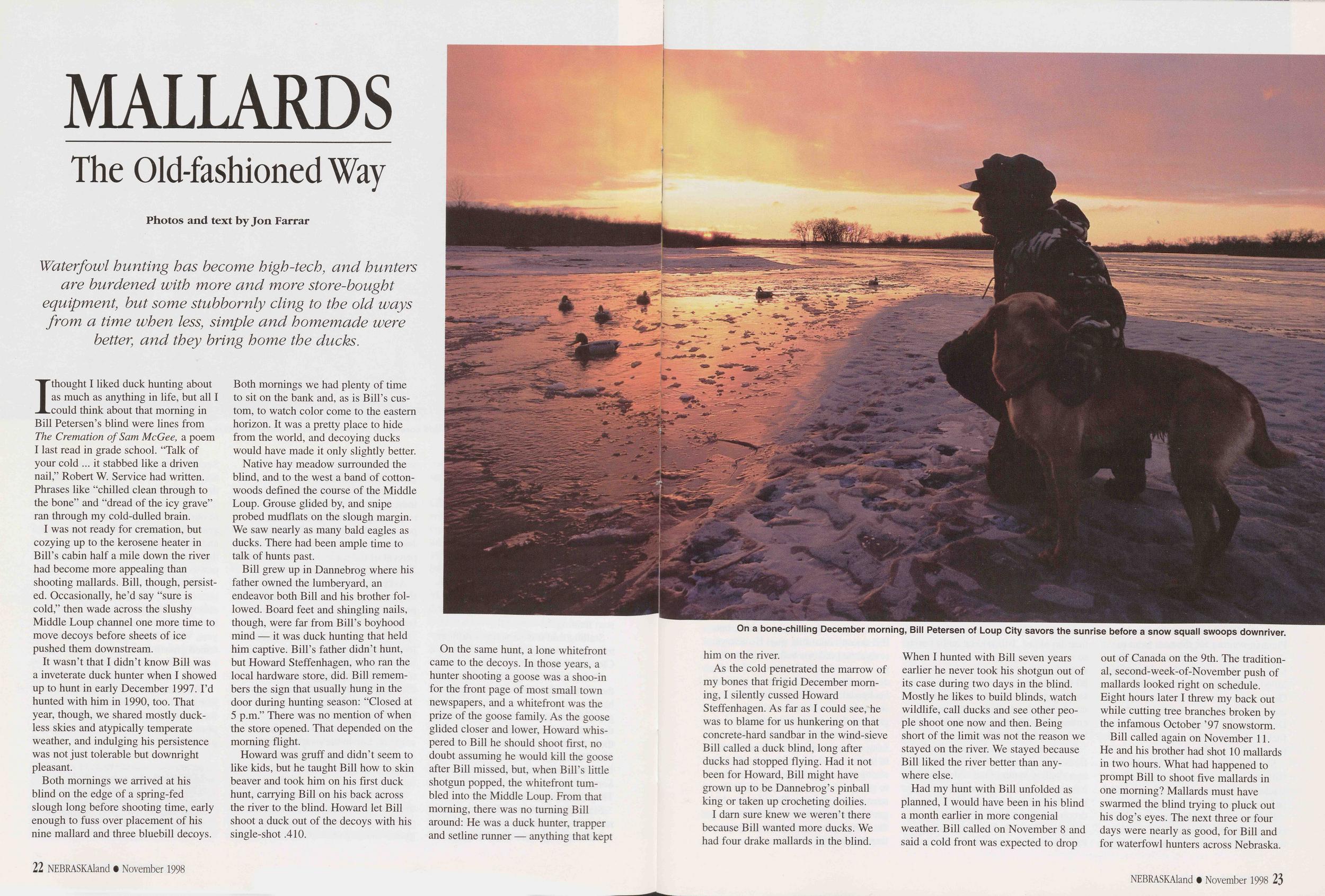
MALLARDS
The Old-fashioned Way Photos and text by Jon Farrar Waterfowl hunting has become high-tech, and hunters are burdened with more and more store-bought equipment, hut some stubbornly cling to the old ways from a time when less, simple and homemade were better, and they bring home the ducks.I thought I liked duck hunting about as much as anything in life, but all I could think about that morning in Bill Petersen's blind were lines from The Cremation of Sam McGee, a poem I last read in grade school. "Talk of your cold ... it stabbed like a driven nail," Robert W. Service had written. Phrases like "chilled clean through to the bone" and "dread of the icy grave" ran through my cold-dulled brain.
I was not ready for cremation, but cozying up to the kerosene heater in Bill's cabin half a mile down the river had become more appealing than shooting mallards. Bill, though, persisted. Occasionally, he'd say "sure is cold," then wade across the slushy Middle Loup channel one more time to move decoys before sheets of ice pushed them downstream.
It wasn't that I didn't know Bill was a inveterate duck hunter when I showed up to hunt in early December 1997. I'd hunted with him in 1990, too. That year, though, we shared mostly duckless skies and atypically temperate weather, and indulging his persistence was not just tolerable but downright pleasant.
Both mornings we arrived at his blind on the edge of a spring-fed slough long before shooting time, early enough to fuss over placement of his nine mallard and three bluebill decoys. Both mornings we had plenty of time to sit on the bank and, as is Bill's custom, to watch color come to the eastern horizon. It was a pretty place to hide from the world, and decoying ducks would have made it only slightly better.
Native hay meadow surrounded the blind, and to the west a band of cottonwoods defined the course of the Middle Loup. Grouse glided by, and snipe probed mudflats on the slough margin. We saw nearly as many bald eagles as ducks. There had been ample time to talk of hunts past.
Bill grew up in Dannebrog where his father owned the lumberyard, an endeavor both Bill and his brother followed. Board feet and shingling nails, though, were far from Bill's boyhood mind — it was duck hunting that held him captive. Bill's father didn't hunt, but Howard Steffenhagen, who ran the local hardware store, did. Bill remembers the sign that usually hung in the door during hunting season: "Closed at 5 p.m." There was no mention of when the store opened. That depended on the morning flight.
Howard was gruff and didn't seem to like kids, but he taught Bill how to skin beaver and took him on his first duck hunt, carrying Bill on his back across the river to the blind. Howard let Bill shoot a duck out of the decoys with his single-shot .410.
On the same hunt, a lone whitefront came to the decoys. In those years, a hunter shooting a goose was a shoo-in for the front page of most small town newspapers, and a whitefront was the prize of the goose family. As the goose glided closer and lower, Howard whispered to Bill he should shoot first, no doubt assuming he would kill the goose after Bill missed, but, when Bill's little shotgun popped, the whitefront tumbled into the Middle Loup. From that morning, there was no turning Bill around: He was a duck hunter, trapper and setline runner — anything that kept
22 NEBRASKAland • November 1998On a bone-chilling December morning, Bill Petersen of Loup City savors the sunrise before a snow squall swoops downriver.
him on the river.
As the cold penetrated the marrow of my bones that frigid December morning, I silently cussed Howard Steffenhagen. As far as I could see, he was to blame for us hunkering on that concrete-hard sandbar in the wind-sieve Bill called a duck blind, long after ducks had stopped flying. Had it not been for Howard, Bill might have grown up to be Dannebrog's pinball king or taken up crocheting doilies.
I darn sure knew we weren't there because Bill wanted more ducks. We had four drake mallards in the blind. When I hunted with Bill seven years earlier he never took his shotgun out of its case during two days in the blind. Mostly he likes to build blinds, watch wildlife, call ducks and see other people shoot one now and then. Being short of the limit was not the reason we stayed on the river. We stayed because Bill liked the river better than anywhere else.
Had my hunt with Bill unfolded as planned, I would have been in his blind a month earlier in more congenial weather. Bill called on November 8 and said a cold front was expected to drop out of Canada on the 9th. The traditional, second-week-of-November push of mallards looked right on schedule. Eight hours later I threw my back out while cutting tree branches broken by the infamous October '97 snowstorm.
Bill called again on November 11. He and his brother had shot 10 mallards in two hours. What had happened to prompt Bill to shoot five mallards in one morning? Mallards must have swarmed the blind trying to pluck out his dog's eyes. The next three or four days were nearly as good, for Bill and for waterfowl hunters across Nebraska.
NEBRASKAland • November 1998 23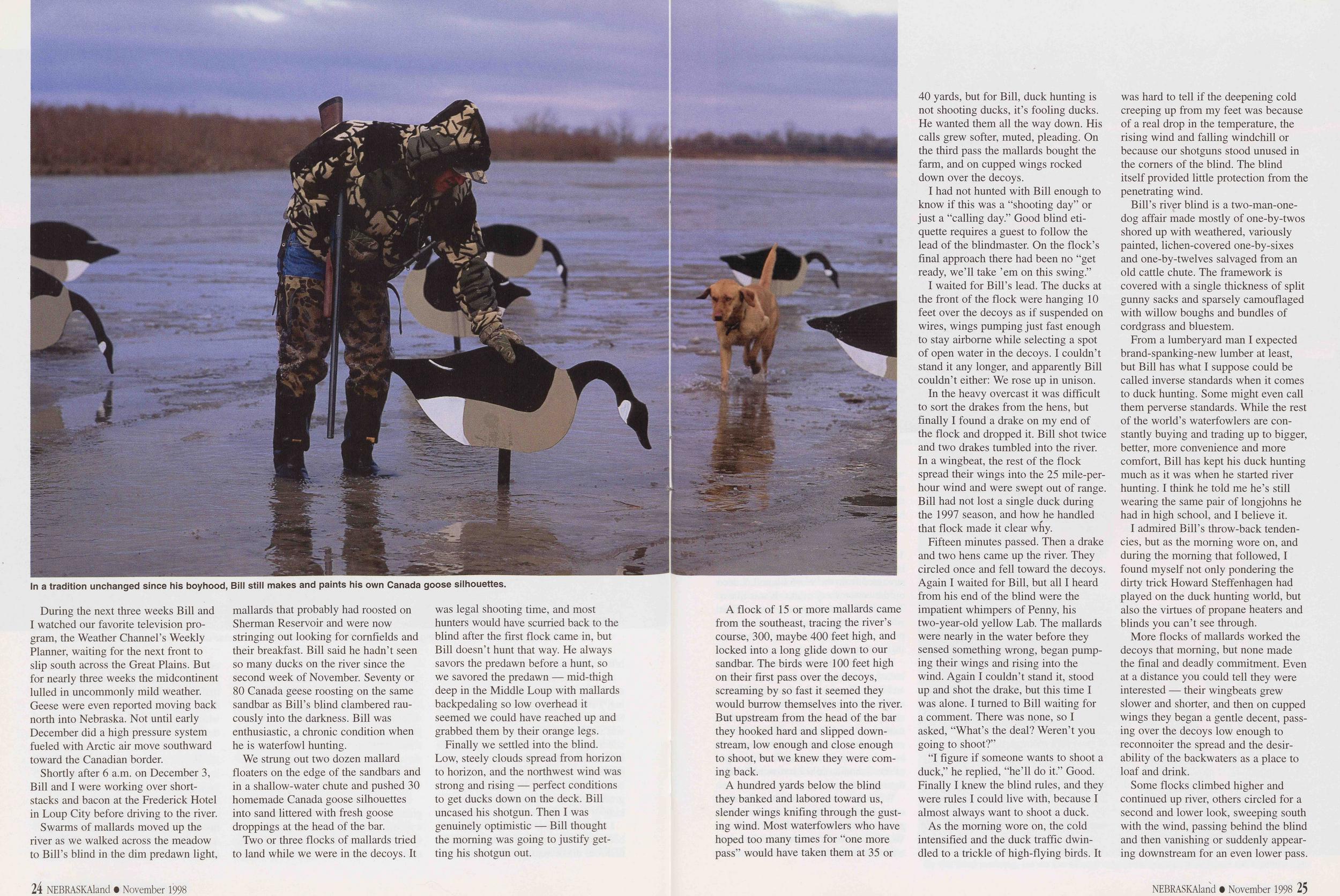
In a tradition unchanged since his boyhood, Bill still makes and paints his own Canada goose silhouettes.
During the next three weeks Bill and I watched our favorite television program, the Weather Channel's Weekly Planner, waiting for the next front to slip south across the Great Plains. But for nearly three weeks the midcontinent lulled in uncommonly mild weather. Geese were even reported moving back north into Nebraska. Not until early December did a high pressure system fueled with Arctic air move southward toward the Canadian border.
Shortly after 6 a.m. on December 3, Bill and I were working over short-stacks and bacon at the Frederick Hotel in Loup City before driving to the river.
Swarms of mallards moved up the river as we walked across the meadow to Bill's blind in the dim predawn light, mallards that probably had roosted on Sherman Reservoir and were now stringing out looking for cornfields and their breakfast. Bill said he hadn't seen so many ducks on the river since the second week of November. Seventy or 80 Canada geese roosting on the same sandbar as Bill's blind clambered raucously into the darkness. Bill was enthusiastic, a chronic condition when he is waterfowl hunting.
We strung out two dozen mallard floaters on the edge of the sandbars and in a shallow-water chute and pushed 30 homemade Canada goose silhouettes into sand littered with fresh goose droppings at the head of the bar.
Two or three flocks of mallards tried to land while we were in the decoys. It was legal shooting time, and most hunters would have scurried back to the blind after the first flock came in, but Bill doesn't hunt that way. He always savors the predawn before a hunt, so we savored the predawn — mid-thigh deep in the Middle Loup with mallards backpedaling so low overhead it seemed we could have reached up and grabbed them by their orange legs.
Finally we settled into the blind. Low, steely clouds spread from horizon to horizon, and the northwest wind was strong and rising — perfect conditions to get ducks down on the deck. Bill uncased his shotgun. Then I was genuinely optimistic — Bill thought the morning was going to justify getting his shotgun out.
24 NEBRASKAland • November 1998A flock of 15 or more mallards came from the southeast, tracing the river's course, 300, maybe 400 feet high, and locked into a long glide down to our sandbar. The birds were 100 feet high on their first pass over the decoys, screaming by so fast it seemed they would burrow themselves into the river. But upstream from the head of the bar they hooked hard and slipped downstream, low enough and close enough to shoot, but we knew they were coming back.
A hundred yards below the blind they banked and labored toward us, slender wings knifing through the gusting wind. Most waterfowlers who have hoped too many times for "one more pass" would have taken them at 35 or 40 yards, but for Bill, duck hunting is not shooting ducks, it's fooling ducks. He wanted them all the way down. His calls grew softer, muted, pleading. On the third pass the mallards bought the farm, and on cupped wings rocked down over the decoys.
I had not hunted with Bill enough to know if this was a "shooting day" or just a "calling day." Good blind etiquette requires a guest to follow the lead of the blindmaster. On the flock's final approach there had been no "get ready, we'll take 'em on this swing."
I waited for Bill's lead. The ducks at the front of the flock were hanging 10 feet over the decoys as if suspended on wires, wings pumping just fast enough to stay airborne while selecting a spot of open water in the decoys. I couldn't stand it any longer, and apparently Bill couldn't either: We rose up in unison.
In the heavy overcast it was difficult to sort the drakes from the hens, but finally I found a drake on my end of the flock and dropped it. Bill shot twice and two drakes tumbled into the river. In a wingbeat, the rest of the flock spread their wings into the 25 mile-per-hour wind and were swept out of range. Bill had not lost a single duck during the 1997 season, and how he handled that flock made it clear why.
Fifteen minutes passed. Then a drake and two hens came up the river. They circled once and fell toward the decoys. Again I waited for Bill, but all I heard from his end of the blind were the impatient whimpers of Penny, his two-year-old yellow Lab. The mallards were nearly in the water before they sensed something wrong, began pumping their wings and rising into the wind. Again I couldn't stand it, stood up and shot the drake, but this time I was alone. I turned to Bill waiting for a comment. There was none, so I asked, "What's the deal? Weren't you going to shoot?"
"I figure if someone wants to shoot a duck," he replied, "he'll do it." Good. Finally I knew the blind rules, and they were rules I could live with, because I almost always want to shoot a duck.
As the morning wore on, the cold intensified and the duck traffic dwindled to a trickle of high-flying birds. It was hard to tell if the deepening cold creeping up from my feet was because of a real drop in the temperature, the rising wind and falling windchill or because our shotguns stood unused in the corners of the blind. The blind itself provided little protection from the penetrating wind.
Bill's river blind is a two-man-one-dog affair made mostly of one-by-twos shored up with weathered, variously painted, lichen-covered one-by-sixes and one-by-twelves salvaged from an old cattle chute. The framework is covered with a single thickness of split gunny sacks and sparsely camouflaged with willow boughs and bundles of cordgrass and bluestem.
From a lumberyard man I expected brand-spanking-new lumber at least, but Bill has what I suppose could be called inverse standards when it comes to duck hunting. Some might even call them perverse standards. While the rest of the world's waterfowlers are constantly buying and trading up to bigger, better, more convenience and more comfort, Bill has kept his duck hunting much as it was when he started river hunting. I think he told me he's still wearing the same pair of longjohns he had in high school, and I believe it.
I admired Bill's throw-back tendencies, but as the morning wore on, and during the morning that followed, I found myself not only pondering the dirty trick Howard Steffenhagen had played on the duck hunting world, but also the virtues of propane heaters and blinds you can't see through.
More flocks of mallards worked the decoys that morning, but none made the final and deadly commitment. Even at a distance you could tell they were interested — their wingbeats grew slower and shorter, and then on cupped wings they began a gentle decent, passing over the decoys low enough to reconnoiter the spread and the desirability of the backwaters as a place to loaf and drink.
Some flocks climbed higher and continued up river, others circled for a second and lower look, sweeping south with the wind, passing behind the blind and then vanishing or suddenly appearing downstream for an even lower pass.
NEBRASKAland • November 1998 25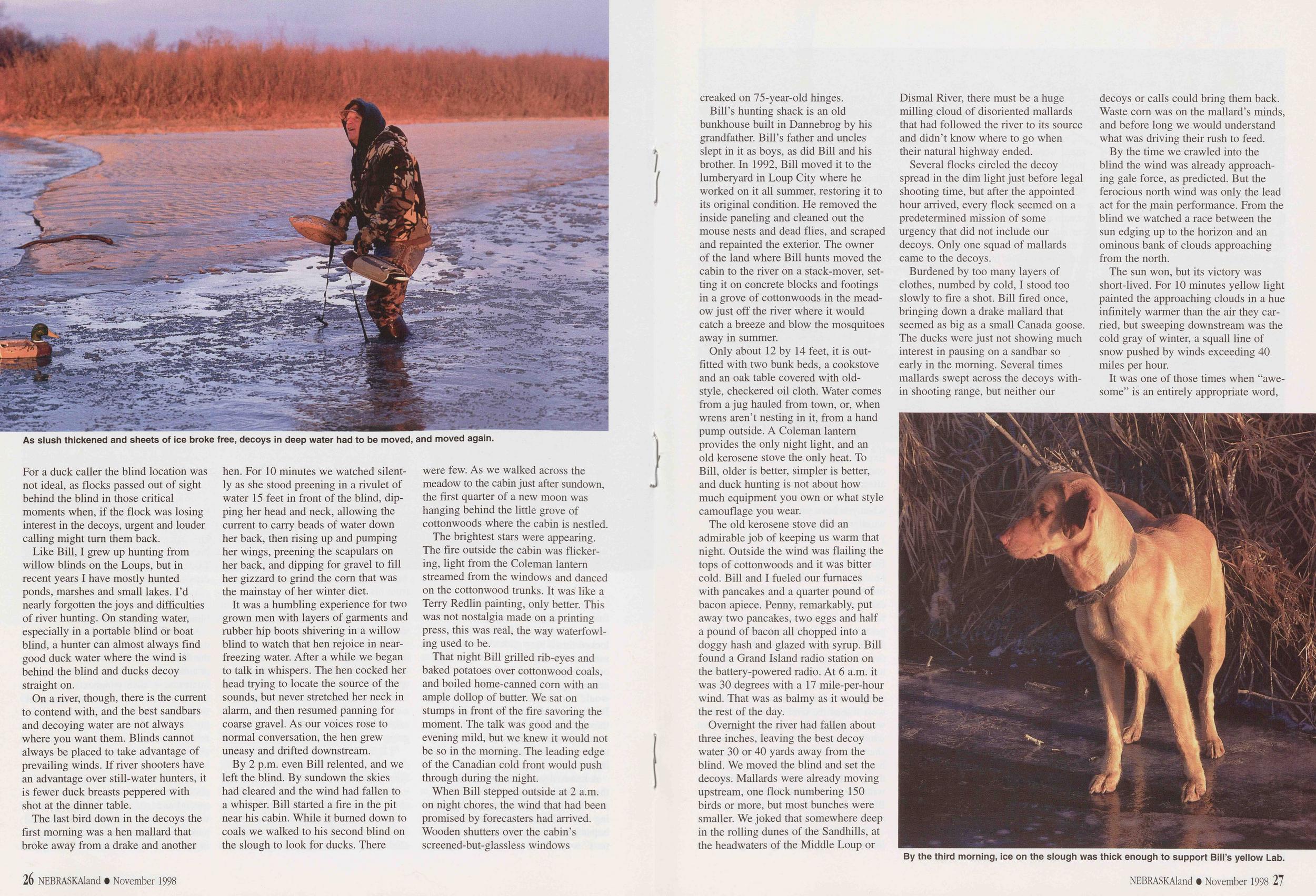
As slush thickened and sheets of ice broke free, decoys in deep water had to be moved, and moved again.
For a duck caller the blind location was not ideal, as flocks passed out of sight behind the blind in those critical moments when, if the flock was losing interest in the decoys, urgent and louder calling might turn them back.
Like Bill, I grew up hunting from willow blinds on the Loups, but in recent years I have mostly hunted ponds, marshes and small lakes. I'd nearly forgotten the joys and difficulties of river hunting. On standing water, especially in a portable blind or boat blind, a hunter can almost always find good duck water where the wind is behind the blind and ducks decoy straight on.
On a river, though, there is the current to contend with, and the best sandbars and decoying water are not always where you want them. Blinds cannot always be placed to take advantage of prevailing winds. If river shooters have an advantage over still-water hunters, it is fewer duck breasts peppered with shot at the dinner table.
The last bird down in the decoys the first morning was a hen mallard that broke away from a drake and another hen. For 10 minutes we watched silently as she stood preening in a rivulet of water 15 feet in front of the blind, dipping her head and neck, allowing the current to carry beads of water down her back, then rising up and pumping her wings, preening the scapulars on her back, and dipping for gravel to fill her gizzard to grind the corn that was the mainstay of her winter diet.
It was a humbling experience for two grown men with layers of garments and rubber hip boots shivering in a willow blind to watch that hen rejoice in near-freezing water. After a while we began to talk in whispers. The hen cocked her head trying to locate the source of the sounds, but never stretched her neck in alarm, and then resumed panning for coarse gravel. As our voices rose to normal conversation, the hen grew uneasy and drifted downstream.
By 2 p.m. even Bill relented, and we left the blind. By sundown the skies had cleared and the wind had fallen to a whisper. Bill started a fire in the pit near his cabin. While it burned down to coals we walked to his second blind on the slough to look for ducks. There were few. As we walked across the meadow to the cabin just after sundown, the first quarter of a new moon was hanging behind the little grove of cottonwoods where the cabin is nestled.
The brightest stars were appearing. The fire outside the cabin was flickering, light from the Coleman lantern streamed from the windows and danced on the cottonwood trunks. It was like a Terry Redlin painting, only better. This was not nostalgia made on a printing press, this was real, the way waterfowling used to be.
That night Bill grilled rib-eyes and baked potatoes over cottonwood coals, and boiled home-canned corn with an ample dollop of butter. We sat on stumps in front of the fire savoring the moment. The talk was good and the evening mild, but we knew it would not be so in the morning. The leading edge of the Canadian cold front would push through during the night.
When Bill stepped outside at 2 a.m. on night chores, the wind that had been promised by forecasters had arrived. Wooden shutters over the cabin's screened-but-glassless windows
26 NEBRASKAland • November 1998creaked on 75-year-old hinges.
Bill's hunting shack is an old bunkhouse built in Dannebrog by his grandfather. Bill's father and uncles slept in it as boys, as did Bill and his brother. In 1992, Bill moved it to the lumberyard in Loup City where he worked on it all summer, restoring it to its original condition. He removed the inside paneling and cleaned out the mouse nests and dead flies, and scraped and repainted the exterior. The owner of the land where Bill hunts moved the cabin to the river on a stack-mover, setting it on concrete blocks and footings in a grove of cottonwoods in the meadow just off the river where it would catch a breeze and blow the mosquitoes away in summer.
Only about 12 by 14 feet, it is outfitted with two bunk beds, a cookstove and an oak table covered with old-style, checkered oil cloth. Water comes from a jug hauled from town, or, when wrens aren't nesting in it, from a hand pump outside. A Coleman lantern provides the only night light, and an old kerosene stove the only heat. To Bill, older is better, simpler is better, and duck hunting is not about how much equipment you own or what style camouflage you wear.
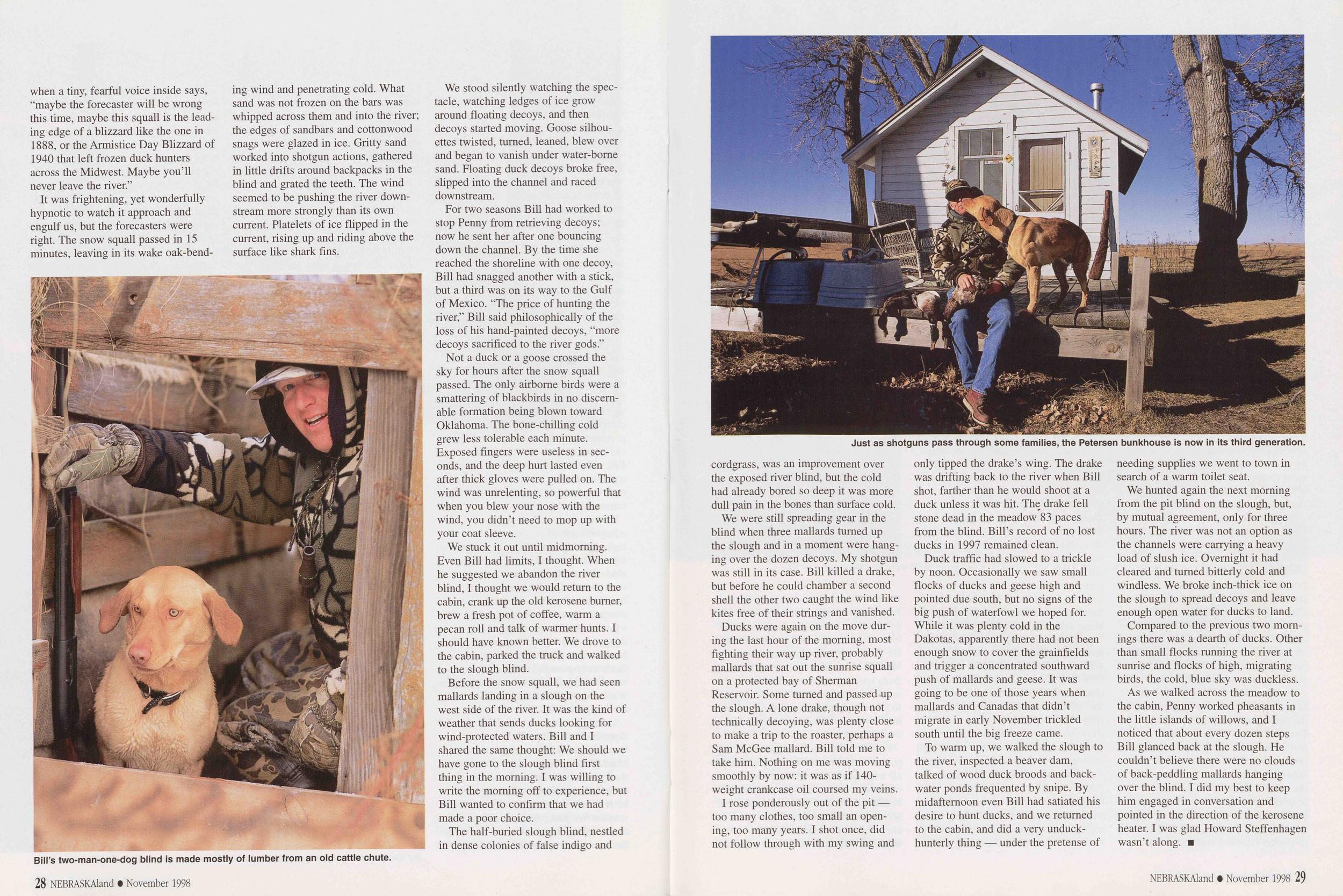
The old kerosene stove did an admirable job of keeping us warm that night. Outside the wind was flailing the tops of cottonwoods and it was bitter cold. Bill and I fueled our furnaces with pancakes and a quarter pound of bacon apiece. Penny, remarkably, put away two pancakes, two eggs and half a pound of bacon all chopped into a doggy hash and glazed with syrup. Bill found a Grand Island radio station on the battery-powered radio. At 6 a.m. it was 30 degrees with a 17 mile-per-hour wind. That was as balmy as it would be the rest of the day.
Overnight the river had fallen about three inches, leaving the best decoy water 30 or 40 yards away from the blind. We moved the blind and set the decoys. Mallards were already moving upstream, one flock numbering 150 birds or more, but most bunches were smaller. We joked that somewhere deep in the rolling dunes of the Sandhills, at the headwaters of the Middle Loup or Dismal River, there must be a huge milling cloud of disoriented mallards that had followed the river to its source and didn't know where to go when their natural highway ended.
Several flocks circled the decoy spread in the dim light just before legal shooting time, but after the appointed hour arrived, every flock seemed on a predetermined mission of some urgency that did not include our decoys. Only one squad of mallards came to the decoys.
Burdened by too many layers of clothes, numbed by cold, I stood too slowly to fire a shot. Bill fired once, bringing down a drake mallard that seemed as big as a small Canada goose. The ducks were just not showing much interest in pausing on a sandbar so early in the morning. Several times mallards swept across the decoys within shooting range, but neither our decoys or calls could bring them back. Waste corn was on the mallard's minds, and before long we would understand what was driving their rush to feed.
By the time we crawled into the blind the wind was already approaching gale force, as predicted. But the ferocious north wind was only the lead act for the main performance. From the blind we watched a race between the sun edging up to the horizon and an ominous bank of clouds approaching from the north.
The sun won, but its victory was short-lived. For 10 minutes yellow light painted the approaching clouds in a hue infinitely warmer than the air they carried, but sweeping downstream was the cold gray of winter, a squall line of snow pushed by winds exceeding 40 miles per hour.
It was one of those times when "awesome" is an entirely appropriate word,
By the third morning, ice on the slough was thick enough to support Bill's yellow Lab.
when a tiny, fearful voice inside says, "maybe the forecaster will be wrong this time, maybe this squall is the leading edge of a blizzard like the one in 1888, or the Armistice Day Blizzard of 1940 that left frozen duck hunters across the Midwest. Maybe you'll never leave the river."
It was frightening, yet wonderfully hypnotic to watch it approach and engulf us, but the forecasters were right. The snow squall passed in 15 minutes, leaving in its wake oak-bending wind and penetrating cold. What sand was not frozen on the bars was whipped across them and into the river; the edges of sandbars and cottonwood snags were glazed in ice. Gritty sand worked into shotgun actions, gathered in little drifts around backpacks in the blind and grated the teeth. The wind seemed to be pushing the river downstream more strongly than its own current. Platelets of ice flipped in the current, rising up and riding above the surface like shark fins.
Bill's two-man-one-dog blind is made mostly of lumber from an old cattle chute.
We stood silently watching the spectacle, watching ledges of ice grow around floating decoys, and then decoys started moving. Goose silhouettes twisted, turned, leaned, blew over and began to vanish under water-borne sand. Floating duck decoys broke free, slipped into the channel and raced downstream.
For two seasons Bill had worked to stop Penny from retrieving decoys; now he sent her after one bouncing down the channel. By the time she reached the shoreline with one decoy, Bill had snagged another with a stick, but a third was on its way to the Gulf of Mexico. "The price of hunting the river," Bill said philosophically of the loss of his hand-painted decoys, "more decoys sacrificed to the river gods."
Not a duck or a goose crossed the sky for hours after the snow squall passed. The only airborne birds were a smattering of blackbirds in no discernable formation being blown toward Oklahoma. The bone-chilling cold grew less tolerable each minute. Exposed fingers were useless in seconds, and the deep hurt lasted even after thick gloves were pulled on. The wind was unrelenting, so powerful that when you blew your nose with the wind, you didn't need to mop up with your coat sleeve.
We stuck it out until midmorning. Even Bill had limits, I thought. When he suggested we abandon the river blind, I thought we would return to the cabin, crank up the old kerosene burner, brew a fresh pot of coffee, warm a pecan roll and talk of warmer hunts. I should have known better. We drove to the cabin, parked the truck and walked to the slough blind.
Before the snow squall, we had seen mallards landing in a slough on the west side of the river. It was the kind of weather that sends ducks looking for wind-protected waters. Bill and I shared the same thought: We should we have gone to the slough blind first thing in the morning. I was willing to write the morning off to experience, but Bill wanted to confirm that we had made a poor choice.
The half-buried slough blind, nestled in dense colonies of false indigo and
28 NEBRASKAland • November 1998Just as shotguns pass through some families, the Petersen bunkhouse is now in its third generation.
cordgrass, was an improvement over the exposed river blind, but the cold had already bored so deep it was more dull pain in the bones than surface cold.
We were still spreading gear in the blind when three mallards turned up the slough and in a moment were hanging over the dozen decoys. My shotgun was still in its case. Bill killed a drake, but before he could chamber a second shell the other two caught the wind like kites free of their strings and vanished.
Ducks were again on the move during the last hour of the morning, most fighting their way up river, probably mallards that sat out the sunrise squall on a protected bay of Sherman Reservoir. Some turned and passed up the slough. A lone drake, though not technically decoying, was plenty close to make a trip to the roaster, perhaps a Sam McGee mallard. Bill told me to take him. Nothing on me was moving smoothly by now: it was as if 140- weight crankcase oil coursed my veins.
I rose ponderously out of the pit — too many clothes, too small an opening, too many years. I shot once, did not follow through with my swing and only tipped the drake's wing. The drake was drifting back to the river when Bill shot, farther than he would shoot at a duck unless it was hit. The drake fell stone dead in the meadow 83 paces from the blind. Bill's record of no lost ducks in 1997 remained clean.
Duck traffic had slowed to a trickle by noon. Occasionally we saw small flocks of ducks and geese high and pointed due south, but no signs of the big push of waterfowl we hoped for. While it was plenty cold in the Dakotas, apparently there had not been enough snow to cover the grainfields and trigger a concentrated southward push of mallards and geese. It was going to be one of those years when mallards and Canadas that didn't migrate in early November trickled south until the big freeze came.
To warm up, we walked the slough to the river, inspected a beaver dam, talked of wood duck broods and backwater ponds frequented by snipe. By midafternoon even Bill had satiated his desire to hunt ducks, and we returned to the cabin, and did a very unduck-hunterly thing — under the pretense of needing supplies we went to town in search of a warm toilet seat.
We hunted again the next morning from the pit blind on the slough, but, by mutual agreement, only for three hours. The river was not an option as the channels were carrying a heavy load of slush ice. Overnight it had cleared and turned bitterly cold and windless. We broke inch-thick ice on the slough to spread decoys and leave enough open water for ducks to land.
Compared to the previous two mornings there was a dearth of ducks. Other than small flocks running the river at sunrise and flocks of high, migrating birds, the cold, blue sky was duckless.
As we walked across the meadow to the cabin, Penny worked pheasants in the little islands of willows, and I noticed that about every dozen steps Bill glanced back at the slough. He couldn't believe there were no clouds of back-peddling mallards hanging over the blind. I did my best to keep him engaged in conversation and pointed in the direction of the kerosene heater. I was glad Howard Steffenhagen wasn't along.
NEBRASKAland • November 1998 29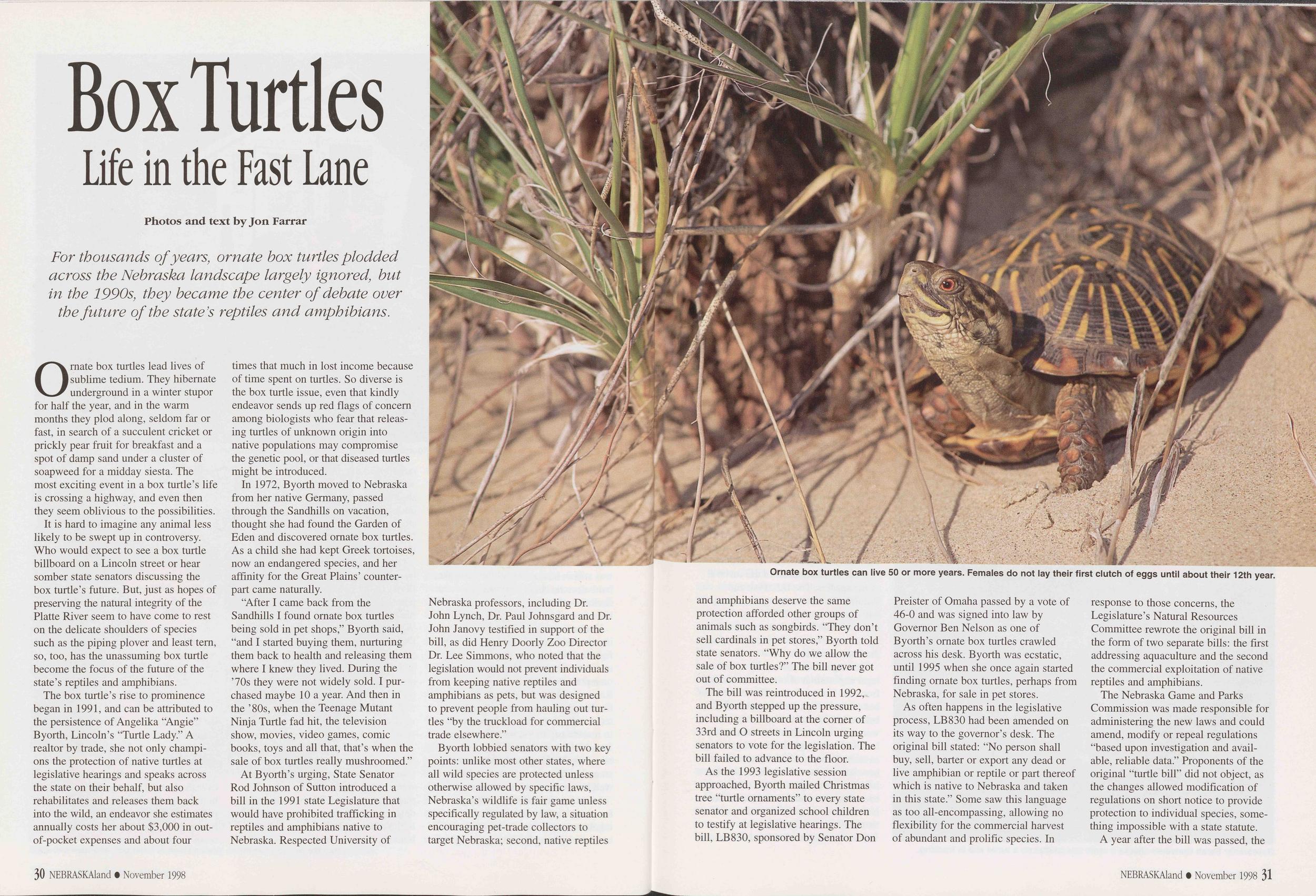
Box Turtles
Life in the Fast Lane Photos and text by Jon Farrar For thousands of years, ornate box turtles plodded across the Nebraska landscape largely ignored, but in the 1990s, they became the center of debate over the future of the state's reptiles and amphibians.Ornate box turtles lead lives of sublime tedium. They hibernate underground in a winter stupor for half the year, and in the warm months they plod along, seldom far or fast, in search of a succulent cricket or prickly pear fruit for breakfast and a spot of damp sand under a cluster of soapweed for a midday siesta. The most exciting event in a box turtle's life is crossing a highway, and even then they seem oblivious to the possibilities.
It is hard to imagine any animal less likely to be swept up in controversy. Who would expect to see a box turtle billboard on a Lincoln street or hear somber state senators discussing the box turtle's future. But, just as hopes of preserving the natural integrity of the Platte River seem to have come to rest on the delicate shoulders of species such as the piping plover and least tern, so, too, has the unassuming box turtle become the focus of the future of the state's reptiles and amphibians.
The box turtle's rise to prominence began in 1991, and can be attributed to the persistence of Angelika "Angie" Byorth, Lincoln's "Turtle Lady." A realtor by trade, she not only champions the protection of native turtles at legislative hearings and speaks across the state on their behalf, but also rehabilitates and releases them back into the wild, an endeavor she estimates annually costs her about $3,000 in out-of-pocket expenses and about four times that much in lost income because of time spent on turtles. So diverse is the box turtle issue, even that kindly endeavor sends up red flags of concern among biologists who fear that releasing turtles of unknown origin into native populations may compromise the genetic pool, or that diseased turtles might be introduced.
In 1972, Byorth moved to Nebraska from her native Germany, passed through the Sandhills on vacation, thought she had found the Garden of Eden and discovered ornate box turtles. As a child she had kept Greek tortoises, now an endangered species, and her affinity for the Great Plains' counterpart came naturally.
"After I came back from the Sandhills I found ornate box turtles being sold in pet shops," Byorth said, "and I started buying them, nurturing them back to health and releasing them where I knew they lived. During the '70s they were not widely sold. I purchased maybe 10 a year. And then in the '80s, when the Teenage Mutant Ninja Turtle fad hit, the television show, movies, video games, comic books, toys and all that, that's when the sale of box turtles really mushroomed."
At Byorth's urging, State Senator Rod Johnson of Sutton introduced a bill in the 1991 state Legislature that would have prohibited trafficking in reptiles and amphibians native to Nebraska. Respected University of Nebraska professors, including Dr. John Lynch, Dr. Paul Johnsgard and Dr. John Janovy testified in support of the bill, as did Henry Doorly Zoo Director Dr. Lee Simmons, who noted that the legislation would not prevent individuals from keeping native reptiles and amphibians as pets, but was designed to prevent people from hauling out turtles "by the truckload for commercial trade elsewhere."
Byorth lobbied senators with two key points: unlike most other states, where all wild species are protected unless otherwise allowed by specific laws, Nebraska's wildlife is fair game unless specifically regulated by law, a situation encouraging pet-trade collectors to target Nebraska; second, native reptiles
30 NEBRASKAland • November 1998Ornate box turtles can live 50 or more years. Females do not lay their first clutch of eggs until about their 12th year.
and amphibians deserve the same protection afforded other groups of animals such as songbirds. "They don't sell cardinals in pet stores," Byorth told state senators. "Why do we allow the sale of box turtles?" The bill never got out of committee.
The bill was reintroduced in 1992, and Byorth stepped up the pressure, including a billboard at the corner of 33rd and O streets in Lincoln urging senators to vote for the legislation. The bill failed to advance to the floor.
As the 1993 legislative session approached, Byorth mailed Christmas tree "turtle ornaments" to every state senator and organized school children to testify at legislative hearings. The bill, LB830, sponsored by Senator Don Preister of Omaha passed by a vote of 46-0 and was signed into law by Governor Ben Nelson as one of Byorth's ornate box turtles crawled across his desk. Byorth was ecstatic, until 1995 when she once again started finding ornate box turtles, perhaps from Nebraska, for sale in pet stores.
As often happens in the legislative process, LB830 had been amended on its way to the governor's desk. The original bill stated: "No person shall buy, sell, barter or export any dead or live amphibian or reptile or part thereof which is native to Nebraska and taken in this state." Some saw this language as too all-encompassing, allowing no flexibility for the commercial harvest of abundant and prolific species. In response to those concerns, the Legislature's Natural Resources Committee rewrote the original bill in the form of two separate bills: the first addressing aquaculture and the second the commercial exploitation of native reptiles and amphibians.
The Nebraska Game and Parks Commission was made responsible for administering the new laws and could amend, modify or repeal regulations "based upon investigation and available, reliable data." Proponents of the original "turtle bill" did not object, as the changes allowed modification of regulations on short notice to provide protection to individual species, something impossible with a state statute.
A year after the bill was passed, the
NEBRASKAland • November 1998 31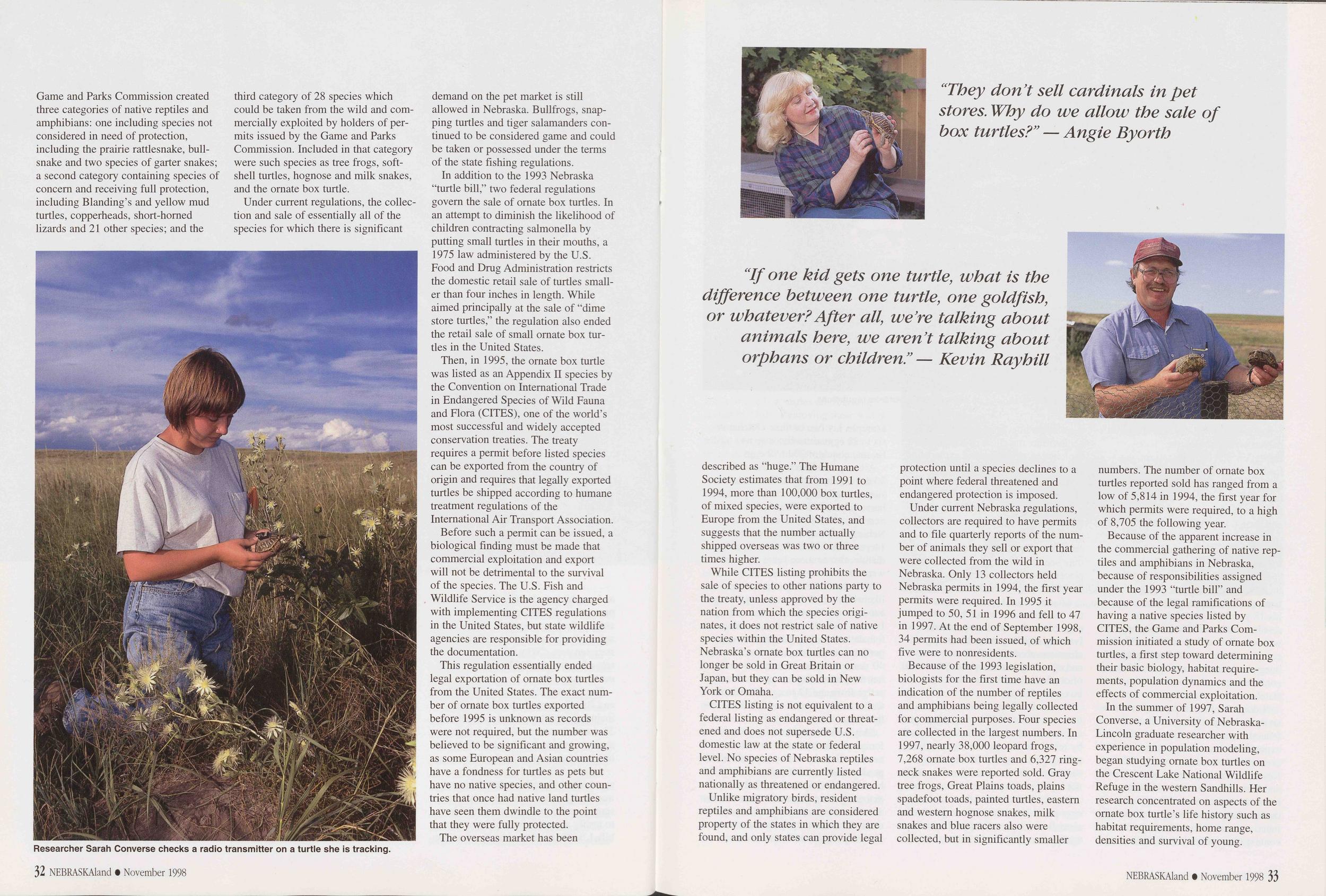
Game and Parks Commission created three categories of native reptiles and amphibians: one including species not considered in need of protection, including the prairie rattlesnake, bull-snake and two species of garter snakes; a second category containing species of concern and receiving full protection, including Blanding's and yellow mud turtles, copperheads, short-horned lizards and 21 other species; and the third category of 28 species which could be taken from the wild and commercially exploited by holders of permits issued by the Game and Parks Commission. Included in that category were such species as tree frogs, soft-shell turtles, hognose and milk snakes, and the ornate box turtle.
Under current regulations, the collection and sale of essentially all of the species for which there is significant demand on the pet market is still allowed in Nebraska. Bullfrogs, snapping turtles and tiger salamanders continued to be considered game and could be taken or possessed under the terms of the state fishing regulations.
In addition to the 1993 Nebraska "turtle bill," two federal regulations govern the sale of ornate box turtles. In an attempt to diminish the likelihood of children contracting salmonella by putting small turtles in their mouths, a 1975 law administered by the U.S. Food and Drug Administration restricts the domestic retail sale of turtles smaller than four inches in length. While aimed principally at the sale of "dime store turtles," the regulation also ended the retail sale of small ornate box turtles in the United States.
Then, in 1995, the ornate box turtle was listed as an Appendix II species by the Convention on International Trade in Endangered Species of Wild Fauna and Flora (CITES), one of the world's most successful and widely accepted conservation treaties. The treaty requires a permit before listed species can be exported from the country of origin and requires that legally exported turtles be shipped according to humane treatment regulations of the International Air Transport Association.
Before such a permit can be issued, a biological finding must be made that commercial exploitation and export will not be detrimental to the survival of the species. The U.S. Fish and Wildlife Service is the agency charged with implementing CITES regulations in the United States, but state wildlife agencies are responsible for providing the documentation.
This regulation essentially ended legal exportation of ornate box turtles from the United States. The exact number of ornate box turtles exported before 1995 is unknown as records were not required, but the number was believed to be significant and growing, as some European and Asian countries have a fondness for turtles as pets but have no native species, and other countries that once had native land turtles have seen them dwindle to the point that they were fully protected.
The overseas market has been
Researcher Sarah Converse checks a radio transmitter on a turtle she is tracking.
described as "huge." The Humane Society estimates that from 1991 to 1994, more than 100,000 box turtles, of mixed species, were exported to Europe from the United States, and suggests that the number actually shipped overseas was two or three times higher.
While CITES listing prohibits the sale of species to other nations party to the treaty, unless approved by the nation from which the species originates, it does not restrict sale of native species within the United States. Nebraska's ornate box turtles can no longer be sold in Great Britain or Japan, but they can be sold in New York or Omaha.
CITES listing is not equivalent to a federal listing as endangered or threatened and does not supersede U.S. domestic law at the state or federal level. No species of Nebraska reptiles and amphibians are currently listed nationally as threatened or endangered.
Unlike migratory birds, resident reptiles and amphibians are considered property of the states in which they are found, and only states can provide legal protection until a species declines to a point where federal threatened and endangered protection is imposed.
Under current Nebraska regulations, collectors are required to have permits and to file quarterly reports of the number of animals they sell or export that were collected from the wild in Nebraska. Only 13 collectors held Nebraska permits in 1994, the first year permits were required. In 1995 it jumped to 50, 51 in 1996 and fell to 47 in 1997. At the end of September 1998, 34 permits had been issued, of which five were to nonresidents.
Because of the 1993 legislation, biologists for the first time have an indication of the number of reptiles and amphibians being legally collected for commercial purposes. Four species are collected in the largest numbers. In 1997, nearly 38,000 leopard frogs, 7,268 ornate box turtles and 6,327 ringneck snakes were reported sold. Gray tree frogs, Great Plains toads, plains spadefoot toads, painted turtles, eastern and western hognose snakes, milk snakes and blue racers also were collected, but in significantly smaller numbers. The number of ornate box turtles reported sold has ranged from a low of 5,814 in 1994, the first year for which permits were required, to a high of 8,705 the following year.
Because of the apparent increase in the commercial gathering of native reptiles and amphibians in Nebraska, because of responsibilities assigned under the 1993 "turtle bill" and because of the legal ramifications of having a native species listed by CITES, the Game and Parks Commission initiated a study of ornate box turtles, a first step toward determining their basic biology, habitat requirements, population dynamics and the effects of commercial exploitation.
In the summer of 1997, Sarah Converse, a University of Nebraska- Lincoln graduate researcher with experience in population modeling, began studying ornate box turtles on the Crescent Lake National Wildlife Refuge in the western Sandhills. Her research concentrated on aspects of the ornate box turtle's life history such as habitat requirements, home range, densities and survival of young.
NEBRASKAland • November 1998 33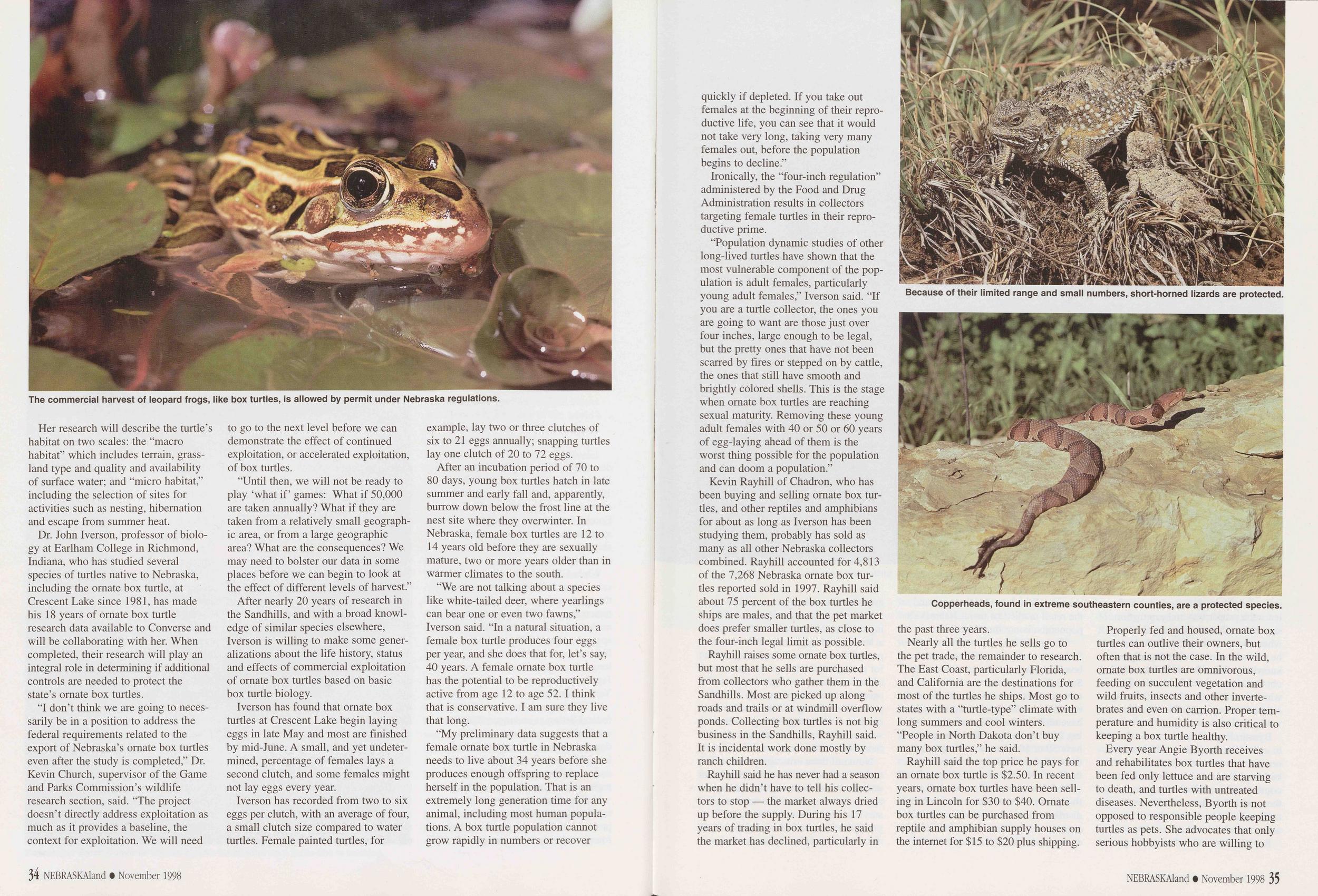
The commercial harvest of leopard frogs, like box turtles, is allowed by permit under Nebraska regulations.
Her research will describe the turtle's habitat on two scales: the "macro habitat" which includes terrain, grassland type and quality and availability of surface water; and "micro habitat," including the selection of sites for activities such as nesting, hibernation and escape from summer heat.
Dr. John Iverson, professor of biology at Earlham College in Richmond, Indiana, who has studied several species of turtles native to Nebraska, including the ornate box turtle, at Crescent Lake since 1981, has made his 18 years of ornate box turtle research data available to Converse and will be collaborating with her. When completed, their research will play an integral role in determining if additional controls are needed to protect the state's ornate box turtles.
"I don't think we are going to necessarily be in a position to address the federal requirements related to the export of Nebraska's ornate box turtles even after the study is completed," Dr. Kevin Church, supervisor of the Game and Parks Commission's wildlife research section, said. "The project doesn't directly address exploitation as much as it provides a baseline, the context for exploitation. We will need to go to the next level before we can demonstrate the effect of continued exploitation, or accelerated exploitation, of box turtles.
"Until then, we will not be ready to play 'what if games: What if 50,000 are taken annually? What if they are taken from a relatively small geographic area, or from a large geographic area? What are the consequences? We may need to bolster our data in some places before we can begin to look at the effect of different levels of harvest."
After nearly 20 years of research in the Sandhills, and with a broad knowledge of similar species elsewhere, Iverson is willing to make some generalizations about the life history, status and effects of commercial exploitation of ornate box turtles based on basic box turtle biology.
Iverson has found that ornate box turtles at Crescent Lake begin laying eggs in late May and most are finished by mid-June. A small, and yet undetermined, percentage of females lays a second clutch, and some females might not lay eggs every year.
Iverson has recorded from two to six eggs per clutch, with an average of four, a small clutch size compared to water turtles. Female painted turtles, for example, lay two or three clutches of six to 21 eggs annually; snapping turtles lay one clutch of 20 to 72 eggs.
After an incubation period of 70 to 80 days, young box turtles hatch in late summer and early fall and, apparently, burrow down below the frost line at the nest site where they overwinter. In Nebraska, female box turtles are 12 to 14 years old before they are sexually mature, two or more years older than in warmer climates to the south.
"We are not talking about a species like white-tailed deer, where yearlings can bear one or even two fawns," Iverson said. "In a natural situation, a female box turtle produces four eggs per year, and she does that for, let's say, 40 years. A female ornate box turtle has the potential to be reproductively active from age 12 to age 52. I think that is conservative. I am sure they live that long.
"My preliminary data suggests that a female ornate box turtle in Nebraska needs to live about 34 years before she produces enough offspring to replace herself in the population. That is an extremely long generation time for any animal, including most human populations. A box turtle population cannot grow rapidly in numbers or recover
34 NEBRASKAland • November 1998quickly if depleted. If you take out females at the beginning of their reproductive life, you can see that it would not take very long, taking very many females out, before the population begins to decline."
Ironically, the "four-inch regulation" administered by the Food and Drug Administration results in collectors targeting female turtles in their reproductive prime.
"Population dynamic studies of other long-lived turtles have shown that the most vulnerable component of the population is adult females, particularly young adult females," Iverson said. "If you are a turtle collector, the ones you are going to want are those just over four inches, large enough to be legal, but the pretty ones that have not been scarred by fires or stepped on by cattle, the ones that still have smooth and brightly colored shells. This is the stage when ornate box turtles are reaching sexual maturity. Removing these young adult females with 40 or 50 or 60 years of egg-laying ahead of them is the worst thing possible for the population and can doom a population."
Kevin Rayhill of Chadron, who has been buying and selling ornate box turtles, and other reptiles and amphibians for about as long as Iverson has been studying them, probably has sold as many as all other Nebraska collectors combined. Rayhill accounted for 4,813 of the 7,268 Nebraska ornate box turtles reported sold in 1997. Rayhill said about 75 percent of the box turtles he ships are males, and that the pet market does prefer smaller turtles, as close to the four-inch legal limit as possible.
Rayhill raises some ornate box turtles, but most that he sells are purchased from collectors who gather them in the Sandhills. Most are picked up along roads and trails or at windmill overflow ponds. Collecting box turtles is not big business in the Sandhills, Rayhill said. It is incidental work done mostly by ranch children.
Rayhill said he has never had a season when he didn't have to tell his collectors to stop — the market always dried up before the supply. During his 17 years of trading in box turtles, he said the market has declined, particularly in
Because of their limited range and small numbers, short-horned lizards are protected.
Copperheads, found in extreme southeastern counties, are a protected species.
the past three years.
Nearly all the turtles he sells go to the pet trade, the remainder to research. The East Coast, particularly Florida, and California are the destinations for most of the turtles he ships. Most go to states with a "turtle-type" climate with long summers and cool winters. "People in North Dakota don't buy many box turtles," he said.
Rayhill said the top price he pays for an ornate box turtle is $2.50. In recent years, ornate box turtles have been selling in Lincoln for $30 to $40. Ornate box turtles can be purchased from reptile and amphibian supply houses on the internet for $15 to $20 plus shipping.
Properly fed and housed, ornate box turtles can outlive their owners, but often that is not the case. In the wild, ornate box turtles are omnivorous, feeding on succulent vegetation and wild fruits, insects and other invertebrates and even on carrion. Proper temperature and humidity is also critical to keeping a box turtle healthy.
Every year Angie Byorth receives and rehabilitates box turtles that have been fed only lettuce and are starving to death, and turtles with untreated diseases. Nevertheless, Byorth is not opposed to responsible people keeping turtles as pets. She advocates that only serious hobbyists who are willing to
NEBRASKAland • November 1998 35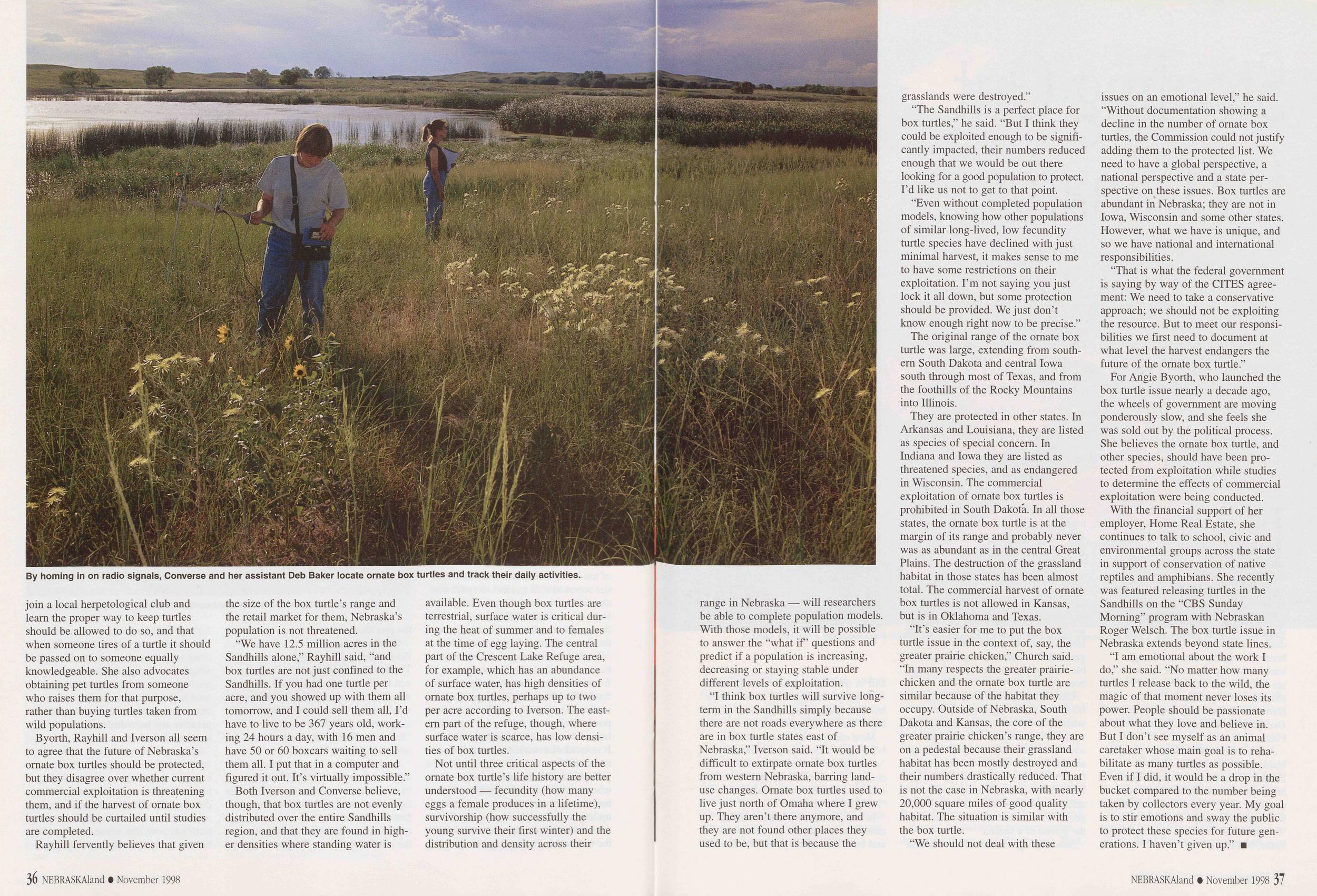
By homing in on radio signals, Converse and her assistant Deb Baker locate ornate box turtles and track their daily activities.
join a local herpetological club and learn the proper way to keep turtles should be allowed to do so, and that when someone tires of a turtle it should be passed on to someone equally knowledgeable. She also advocates obtaining pet turtles from someone who raises them for that purpose, rather than buying turtles taken from wild populations.
Byorth, Rayhill and Iverson all seem to agree that the future of Nebraska's ornate box turtles should be protected, but they disagree over whether current commercial exploitation is threatening them, and if the harvest of ornate box turtles should be curtailed until studies are completed.
Rayhill fervently believes that given the size of the box turtle's range and the retail market for them, Nebraska's population is not threatened.
"We have 12.5 million acres in the Sandhills alone," Rayhill said, "and box turtles are not just confined to the Sandhills. If you had one turtle per acre, and you showed up with them all tomorrow, and I could sell them all, I'd have to live to be 367 years old, working 24 hours a day, with 16 men and have 50 or 60 boxcars waiting to sell them all. I put that in a computer and figured it out. It's virtually impossible."
Both Iverson and Converse believe, though, that box turtles are not evenly distributed over the entire Sandhills region, and that they are found in higher densities where standing water is available. Even though box turtles are terrestrial, surface water is critical during the heat of summer and to females at the time of egg laying. The central part of the Crescent Lake Refuge area, for example, which has an abundance of surface water, has high densities of ornate box turtles, perhaps up to two per acre according to Iverson. The eastern part of the refuge, though, where surface water is scarce, has low densities of box turtles.
Not until three critical aspects of the ornate box turtle's life history are better understood — fecundity (how many eggs a female produces in a lifetime), survivorship (how successfully the young survive their first winter) and the distribution and density across their
36 NEBRASKAland • November 1998range in Nebraska — will researchers be able to complete population models. With those models, it will be possible to answer the "what if questions and predict if a population is increasing, decreasing or staying stable under different levels of exploitation.
"I think box turtles will survive longterm in the Sandhills simply because there are not roads everywhere as there are in box turtle states east of Nebraska," Iverson said. "It would be difficult to extirpate ornate box turtles from western Nebraska, barring land-use changes. Ornate box turtles used to live just north of Omaha where I grew up. They aren't there anymore, and they are not found other places they used to be, but that is because the grasslands were destroyed."
"The Sandhills is a perfect place for box turtles," he said. "But I think they could be exploited enough to be significantly impacted, their numbers reduced enough that we would be out there looking for a good population to protect. I'd like us not to get to that point.
"Even without completed population models, knowing how other populations of similar long-lived, low fecundity turtle species have declined with just minimal harvest, it makes sense to me to have some restrictions on their exploitation. I'm not saying you just lock it all down, but some protection should be provided. We just don't know enough right now to be precise."
The original range of the ornate box turtle was large, extending from southern South Dakota and central Iowa south through most of Texas, and from the foothills of the Rocky Mountains into Illinois.
They are protected in other states. In Arkansas and Louisiana, they are listed as species of special concern. In Indiana and Iowa they are listed as threatened species, and as endangered in Wisconsin. The commercial exploitation of ornate box turtles is prohibited in South Dakota. In all those states, the ornate box turtle is at the margin of its range and probably never was as abundant as in the central Great Plains. The destruction of the grassland habitat in those states has been almost total. The commercial harvest of ornate box turtles is not allowed in Kansas, but is in Oklahoma and Texas.
"It's easier for me to put the box turtle issue in the context of, say, the greater prairie chicken," Church said. "In many respects the greater prairie-chicken and the ornate box turtle are similar because of the habitat they occupy. Outside of Nebraska, South Dakota and Kansas, the core of the greater prairie chicken's range, they are on a pedestal because their grassland habitat has been mostly destroyed and their numbers drastically reduced. That is not the case in Nebraska, with nearly 20,000 square miles of good quality habitat. The situation is similar with the box turtle.
"We should not deal with these issues on an emotional level," he said. "Without documentation showing a decline in the number of ornate box turtles, the Commission could not justify adding them to the protected list. We need to have a global perspective, a national perspective and a state perspective on these issues. Box turtles are abundant in Nebraska; they are not in Iowa, Wisconsin and some other states. However, what we have is unique, and so we have national and international responsibilities.
"That is what the federal government is saying by way of the CITES agreement: We need to take a conservative approach; we should not be exploiting the resource. But to meet our responsibilities we first need to document at what level the harvest endangers the future of the ornate box turtle."
For Angie Byorth, who launched the box turtle issue nearly a decade ago, the wheels of government are moving ponderously slow, and she feels she was sold out by the political process. She believes the ornate box turtle, and other species, should have been protected from exploitation while studies to determine the effects of commercial exploitation were being conducted.
With the financial support of her employer, Home Real Estate, she continues to talk to school, civic and environmental groups across the state in support of conservation of native reptiles and amphibians. She recently was featured releasing turtles in the Sandhills on the "CBS Sunday Morning" program with Nebraskan Roger Welsch. The box turtle issue in Nebraska extends beyond state lines.
"I am emotional about the work I do," she said. "No matter how many turtles I release back to the wild, the magic of that moment never loses its power. People should be passionate about what they love and believe in. But I don't see myself as an animal caretaker whose main goal is to rehabilitate as many turtles as possible. Even if I did, it would be a drop in the bucket compared to the number being taken by collectors every year. My goal is to stir emotions and sway the public to protect these species for future generations. I haven't given up."
NEBRASKAland • November 1998 37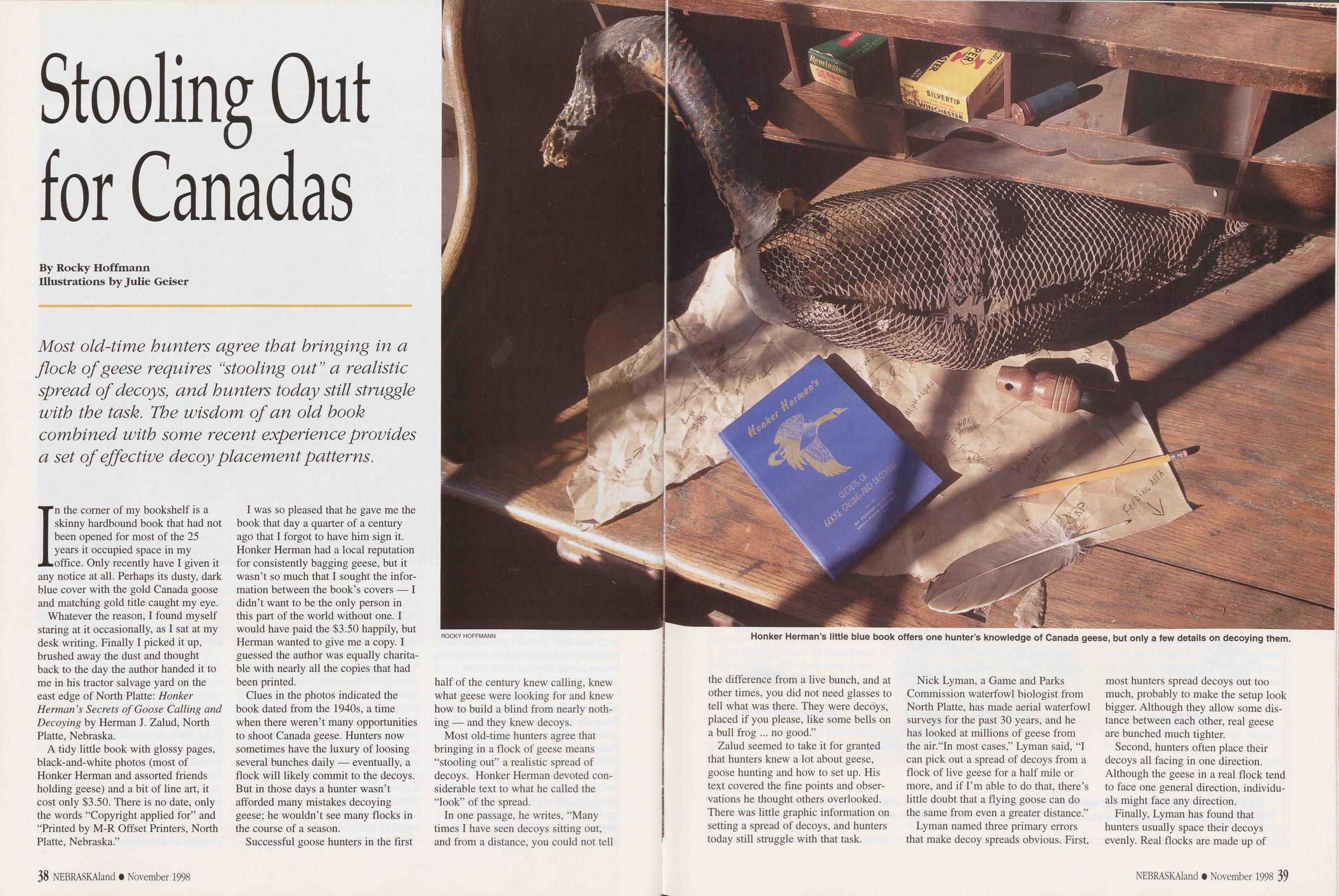
Stooling Out for Canadas
By Rocky Hoffmann Illustrations by Julie Most old-time hunters agree that bringing in a flock of geese requires "stooling out" a realistic spread of decoys, and hunters today still struggle with the task. The wisdom of an old book combined with some recent experience provides a set of effective decoy placement patterns.In the corner of my bookshelf is a skinny hardbound book that had not been opened for most of the 25 years it occupied space in my office. Only recently have I given it any notice at all. Perhaps its dusty, dark blue cover with the gold Canada goose and matching gold title caught my eye.
Whatever the reason, I found myself staring at it occasionally, as I sat at my desk writing. Finally I picked it up, brushed away the dust and thought back to the day the author handed it to me in his tractor salvage yard on the east edge of North Platte: Honker Herman's Secrets of Goose Calling and Decoying by Herman J. Zalud, North Platte, Nebraska.
A tidy little book with glossy pages, black-and-white photos (most of Honker Herman and assorted friends holding geese) and a bit of line art, it cost only $3.50. There is no date, only the words "Copyright applied for" and "Printed by M-R Offset Printers, North Platte, Nebraska."
I was so pleased that he gave me the book that day a quarter of a century ago that I forgot to have him sign it. Honker Herman had a local reputation for consistently bagging geese, but it wasn't so much that I sought the information between the book's covers — I didn't want to be the only person in this part of the world without one. I would have paid the $3.50 happily, but Herman wanted to give me a copy. I guessed the author was equally charitable with nearly all the copies that had been printed.
Clues in the photos indicated the book dated from the 1940s, a time when there weren't many opportunities to shoot Canada geese. Hunters now sometimes have the luxury of loosing several bunches daily — eventually, a flock will likely commit to the decoys. But in those days a hunter wasn't afforded many mistakes decoying geese; he wouldn't see many flocks in the course of a season.
Successful goose hunters in the first half of the century knew calling, knew what geese were looking for and knew how to build a blind from nearly nothing — and they knew decoys.
Most old-time hunters agree that bringing in a flock of geese means "stooling out" a realistic spread of decoys. Honker Herman devoted considerable text to what he called the "look" of the spread.
In one passage, he writes, "Many times I have seen decoys sitting out, and from a distance, you could not tell
38 NEBRASKAland • November 1998Honker Herman's little blue book offers one hunter's knowledge of Canada geese, but only a few details on decoying them.
the difference from a live bunch, and at other times, you did not need glasses to tell what was there. They were decoys, placed if you please, like some bells on a bull frog ... no good."
Zalud seemed to take it for granted that hunters knew a lot about geese, goose hunting and how to set up. His text covered the fine points and observations he thought others overlooked. There was little graphic information on setting a spread of decoys, and hunters today still struggle with that task.
Nick Lyman, a Game and Parks Commission waterfowl biologist from North Platte, has made aerial waterfowl surveys for the past 30 years, and he has looked at millions of geese from the air."In most cases," Lyman said, "I can pick out a spread of decoys from a flock of live geese for a half mile or more, and if I'm able to do that, there's little doubt that a flying goose can do the same from even a greater distance."
Lyman named three primary errors that make decoy spreads obvious. First, most hunters spread decoys out too much, probably to make the setup look bigger. Although they allow some distance between each other, real geese are bunched much tighter.
Second, hunters often place their decoys all facing in one direction. Although the geese in a real flock tend to face one general direction, individuals might face any direction.
Finally, Lyman has found that hunters usually space their decoys evenly. Real flocks are made up of
NEBRASKAland • November 1998 39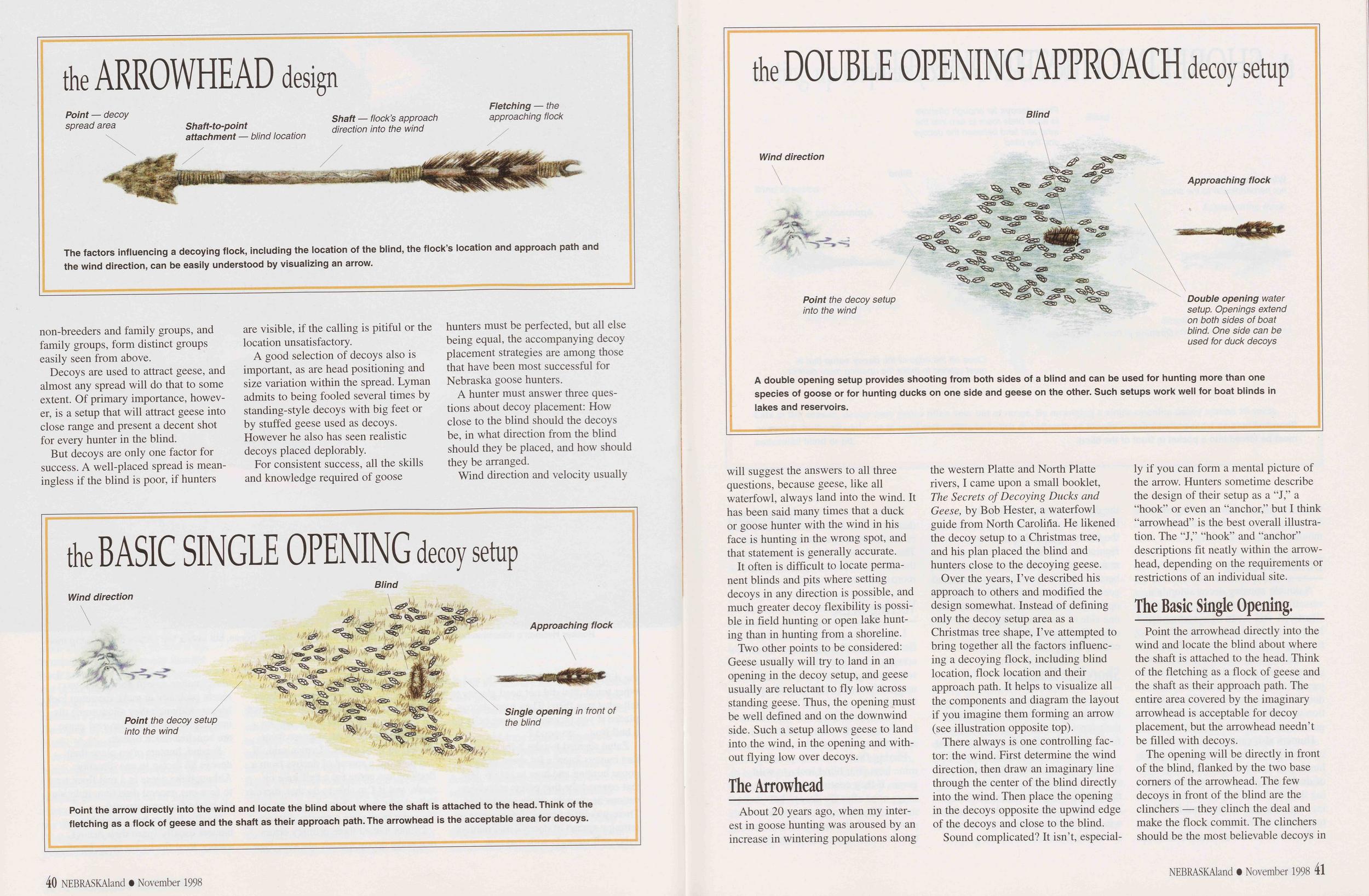
non-breeders and family groups, and family groups, form distinct groups easily seen from above.
Decoys are used to attract geese, and almost any spread will do that to some extent. Of primary importance, however, is a setup that will attract geese into close range and present a decent shot for every hunter in the blind.
But decoys are only one factor for success. A well-placed spread is meaningless if the blind is poor, if hunters are visible, if the calling is pitiful or the location unsatisfactory.
A good selection of decoys also is important, as are head positioning and size variation within the spread. Lyman admits to being fooled several times by standing-style decoys with big feet or by stuffed geese used as decoys. However he also has seen realistic decoys placed deplorably.
For consistent success, all the skills and knowledge required of goose hunters must be perfected, but all else being equal, the accompanying decoy placement strategies are among those that have been most successful for Nebraska goose hunters.
A hunter must answer three questions about decoy placement: How close to the blind should the decoys be, in what direction from the blind should they be placed, and how should they be arranged.
Wind direction and velocity usually
will suggest the answers to all three questions, because geese, like all waterfowl, always land into the wind. It has been said many times that a duck or goose hunter with the wind in his face is hunting in the wrong spot, and that statement is generally accurate.
It often is difficult to locate permanent blinds and pits where setting decoys in any direction is possible, and much greater decoy flexibility is possible in field hunting or open lake hunting than in hunting from a shoreline.
Two other points to be considered: Geese usually will try to land in an opening in the decoy setup, and geese usually are reluctant to fly low across standing geese. Thus, the opening must be well defined and on the downwind side. Such a setup allows geese to land into the wind, in the opening and without flying low over decoys.
The ArrowheadAbout 20 years ago, when my interest in goose hunting was aroused by an increase in wintering populations along the western Platte and North Platte rivers, I came upon a small booklet, The Secrets of Decoying Ducks and Geese, by Bob Hester, a waterfowl guide from North Carolina. He likened the decoy setup to a Christmas tree, and his plan placed the blind and hunters close to the decoying geese.
Over the years, I've described his approach to others and modified the design somewhat. Instead of defining only the decoy setup area as a Christmas tree shape, I've attempted to bring together all the factors influencing a decoying flock, including blind location, flock location and their approach path. It helps to visualize all the components and diagram the layout if you imagine them forming an arrow (see illustration opposite top).
There always is one controlling factor: the wind. First determine the wind direction, then draw an imaginary line through the center of the blind directly into the wind. Then place the opening in the decoys opposite the upwind edge of the decoys and close to the blind.
Sound complicated? It isn't, especially if you can form a mental picture of the arrow. Hunters sometime describe the design of their setup as a "J," a hook" or even an "anchor," but I think arrowhead" is the best overall illustration. The "J," "hook" and "anchor" descriptions fit neatly within the arrowhead, depending on the requirements or restrictions of an individual site.
The Basic Single Opening.Point the arrowhead directly into the wind and locate the blind about where the shaft is attached to the head. Think of the fletching as a flock of geese and the shaft as their approach path. The entire area covered by the imaginary arrowhead is acceptable for decoy placement, but the arrowhead needn't be filled with decoys.
The opening will be directly in front of the blind, flanked by the two base corners of the arrowhead. The few decoys in front of the blind are the clinchers — they clinch the deal and make the flock commit. The clinchers should be the most believable decoys in
NEBRASKAland • November 1998 41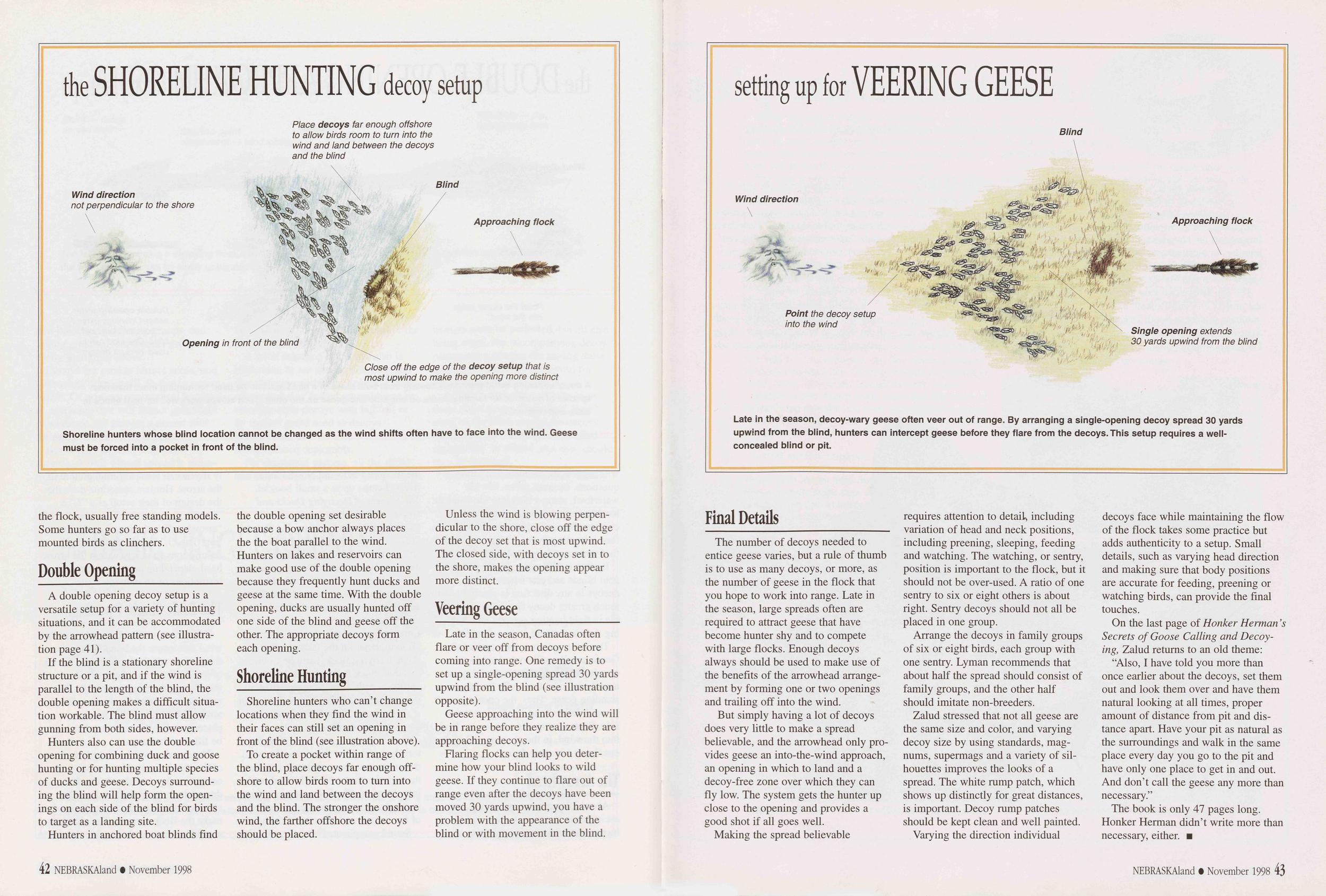
the flock, usually free standing models. Some hunters go so far as to use mounted birds as clinchers.
Double OpeningA double opening decoy setup is a versatile setup for a variety of hunting situations, and it can be accommodated by the arrowhead pattern (see illustration page 41).
If the blind is a stationary shoreline structure or a pit, and if the wind is parallel to the length of the blind, the double opening makes a difficult situation workable. The blind must allow gunning from both sides, however.
Hunters also can use the double opening for combining duck and goose hunting or for hunting multiple species of ducks and geese. Decoys surrounding the blind will help form the openings on each side of the blind for birds to target as a landing site.
Hunters in anchored boat blinds find the double opening set desirable because a bow anchor always places the the boat parallel to the wind. Hunters on lakes and reservoirs can make good use of the double opening because they frequently hunt ducks and geese at the same time. With the double opening, ducks are usually hunted off one side of the blind and geese off the other. The appropriate decoys form each opening.
Shoreline HuntingShoreline hunters who can't change locations when they find the wind in their faces can still set an opening in front of the blind (see illustration above).
To create a pocket within range of the blind, place decoys far enough off-shore to allow birds room to turn into the wind and land between the decoys and the blind. The stronger the onshore wind, the farther offshore the decoys should be placed.
Unless the wind is blowing perpendicular to the shore, close off the edge of the decoy set that is most upwind. The closed side, with decoys set in to the shore, makes the opening appear more distinct.
Veering GeeseLate in the season, Canadas often flare or veer off from decoys before coming into range. One remedy is to set up a single-opening spread 30 yards upwind from the blind (see illustration opposite).
Geese approaching into the wind will be in range before they realize they are approaching decoys.
Flaring flocks can help you determine how your blind looks to wild geese. If they continue to flare out of range even after the decoys have been moved 30 yards upwind, you have a problem with the appearance of the blind or with movement in the blind.
42 NEBRASKAland • November 1998The number of decoys needed to entice geese varies, but a rule of thumb is to use as many decoys, or more, as the number of geese in the flock that you hope to work into range. Late in the season, large spreads often are required to attract geese that have become hunter shy and to compete with large flocks. Enough decoys always should be used to make use of the benefits of the arrowhead arrangement by forming one or two openings and trailing off into the wind.
But simply having a lot of decoys does very little to make a spread believable, and the arrowhead only provides geese an into-the-wind approach, an opening in which to land and a decoy-free zone over which they can fly low. The system gets the hunter up close to the opening and provides a good shot if all goes well.
Making the spread believable requires attention to detail, including variation of head and neck positions, including preening, sleeping, feeding and watching. The watching, or sentry, position is important to the flock, but it should not be over-used. A ratio of one sentry to six or eight others is about right. Sentry decoys should not all be placed in one group.
Arrange the decoys in family groups of six or eight birds, each group with one sentry. Lyman recommends that about half the spread should consist of family groups, and the other half should imitate non-breeders.
Zalud stressed that not all geese are the same size and color, and varying decoy size by using standards, magnums, supermags and a variety of silhouettes improves the looks of a spread. The white rump patch, which shows up distinctly for great distances, is important. Decoy rump patches should be kept clean and well painted.
Varying the direction individual decoys face while maintaining the flow of the flock takes some practice but adds authenticity to a setup. Small details, such as varying head direction and making sure that body positions are accurate for feeding, preening or watching birds, can provide the final touches.
On the last page of Honker Herman's Secrets of Goose Calling and Decoying, Zalud returns to an old theme: "Also, I have told you more than once earlier about the decoys, set them out and look them over and have them natural looking at all times, proper amount of distance from pit and distance apart. Have your pit as natural as the surroundings and walk in the same place every day you go to the pit and have only one place to get in and out. And don't call the geese any more than necessary."
The book is only 47 pages long. Honker Herman didn't write more than necessary, either.
NEBRASKAland • November 1998 43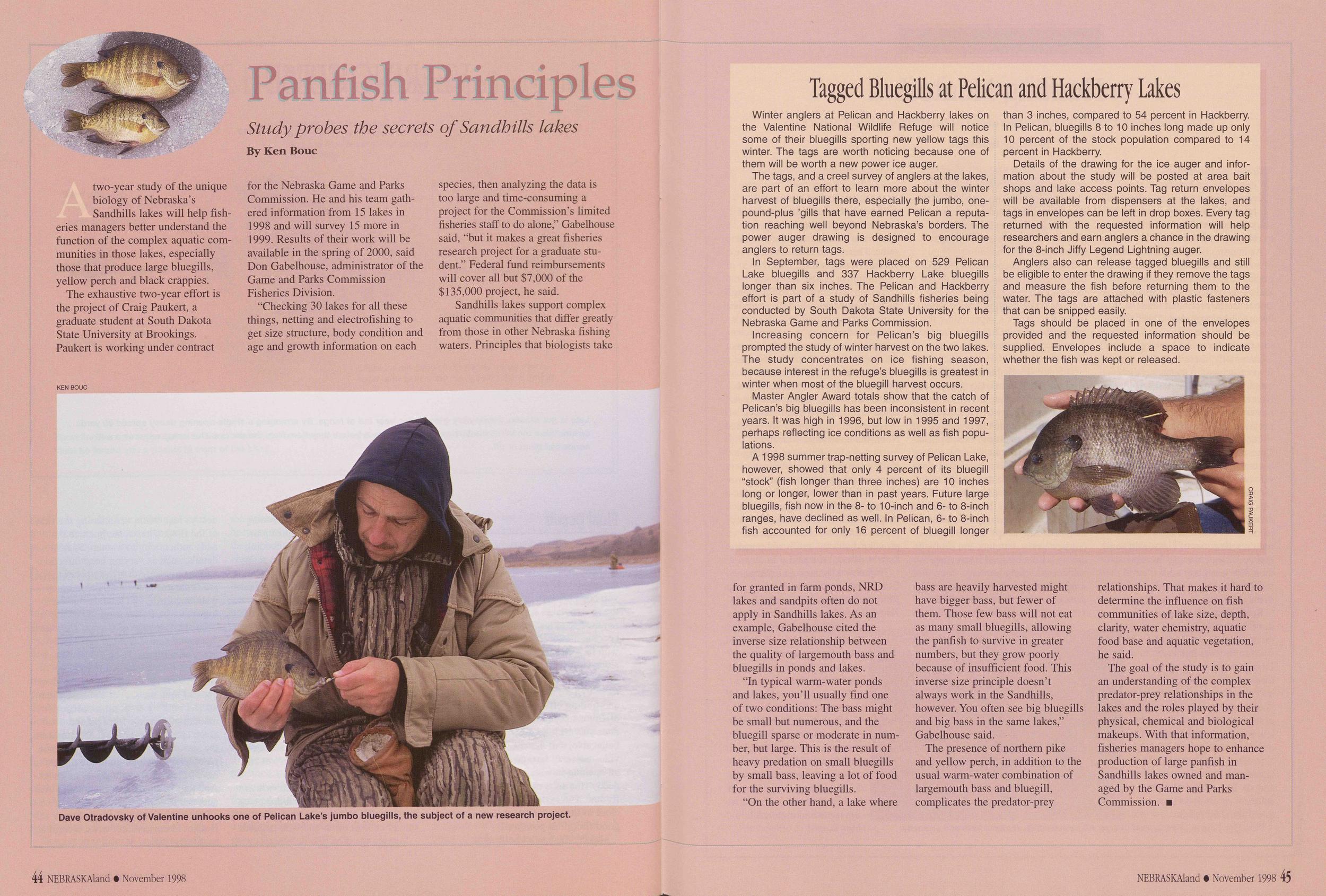
Panfish Principles
Study probes the secrets of Sandhills lakes By Ken BoucA two-year study of the unique biology of Nebraska's Sandhills lakes will help fisheries managers better understand the function of the complex aquatic communities in those lakes, especially those that produce large bluegills, yellow perch and black crappies.
The exhaustive two-year effort is the project of Craig Paukert, a graduate student at South Dakota State University at Brookings. Paukert is working under contract for the Nebraska Game and Parks Commission. He and his team gathered information from 15 lakes in 1998 and will survey 15 more in 1999. Results of their work will be available in the spring of 2000, said Don Gabelhouse, administrator of the Game and Parks Commission Fisheries Division.
"Checking 30 lakes for all these things, netting and electrofishing to get size structure, body condition and age and growth information on each species, then analyzing the data is too large and time-consuming a project for the Commission's limited fisheries staff to do alone," Gabelhouse said, "but it makes a great fisheries research project for a graduate student." Federal fund reimbursements will cover all but $7,000 of the $135,000 project, he said.
Sandhills lakes support complex aquatic communities that differ greatly from those in other Nebraska fishing waters. Principles that biologists take
Dave Otradovsky of Valentine unhooks one of Pelican Lake's Jumbo bluegills, the subject of a new research project.
KEN BOUCTagged Bluegills at Pelican and Hackberry Lakes
Winter anglers at Pelican and Hackberry lakes on the Valentine National Wildlife Refuge will notice some of their bluegills sporting new yellow tags this winter. The tags are worth noticing because one of them will be worth a new power ice auger. The tags, and a creel survey of anglers at the lakes, are part of an effort to learn more about the winter harvest of bluegills there, especially the jumbo, one-pound-plus 'gills that have earned Pelican a reputation reaching well beyond Nebraska's borders. The power auger drawing is designed to encourage anglers to return tags. In September, tags were placed on 529 Pelican Lake bluegills and 337 Hackberry Lake bluegills longer than six inches. The Pelican and Hackberry effort is part of a study of Sandhills fisheries being conducted by South Dakota State University for the Nebraska Game and Parks Commission. Increasing concern for Pelican's big bluegills prompted the study of winter harvest on the two lakes. The study concentrates on ice fishing season, because interest in the refuge's bluegills is greatest in winter when most of the bluegill harvest occurs. Master Angler Award totals show that the catch of Pelican's big bluegills has been inconsistent in recent years. It was high in 1996, but low in 1995 and 1997, perhaps reflecting ice conditions as well as fish populations. A 1998 summer trap-netting survey of Pelican Lake, however, showed that only 4 percent of its bluegill "stock" (fish longer than three inches) are 10 inches long or longer, lower than in past years. Future large bluegills, fish now in the 8- to 10-inch and 6- to 8-inch ranges, have declined as well. In Pelican, 6- to 8-inch fish accounted for only 16 percent of bluegill longer than 3 inches, compared to 54 percent in Hackberry. In Pelican, bluegills 8 to 10 inches long made up only 10 percent of the stock population compared to 14 percent in Hackberry. Details of the drawing for the ice auger and information about the study will be posted at area bait shops and lake access points. Tag return envelopes will be available from dispensers at the lakes, and tags in envelopes can be left in drop boxes. Every tag returned with the requested information will help researchers and earn anglers a chance in the drawing for the 8-inch Jiffy Legend Lightning auger. Anglers also can release tagged bluegills and still be eligible to enter the drawing if they remove the tags and measure the fish before returning them to the water. The tags are attached with plastic fasteners that can be snipped easily. Tags should be placed in one of the envelopes provided and the requested information should be supplied. Envelopes include a space to indicate whether the fish was kept or released.for granted in farm ponds, NRD lakes and sandpits often do not apply in Sandhills lakes. As an example, Gabelhouse cited the inverse size relationship between the quality of largemouth bass and bluegills in ponds and lakes.
"In typical warm-water ponds and lakes, you'll usually find one of two conditions: The bass might be small but numerous, and the bluegill sparse or moderate in number, but large. This is the result of heavy predation on small bluegills by small bass, leaving a lot of food for the surviving bluegills.
"On the other hand, a lake where bass are heavily harvested might have bigger bass, but fewer of them. Those few bass will not eat as many small bluegills, allowing the panfish to survive in greater numbers, but they grow poorly because of insufficient food. This inverse size principle doesn't always work in the Sandhills, however. You often see big bluegills and big bass in the same lakes," Gabelhouse said.
The presence of northern pike and yellow perch, in addition to the usual warm-water combination of largemouth bass and bluegill, complicates the predator-prey relationships. That makes it hard to determine the influence on fish communities of lake size, depth, clarity, water chemistry, aquatic food base and aquatic vegetation, he said.
The goal of the study is to gain an understanding of the complex predator-prey relationships in the lakes and the roles played by their physical, chemical and biological makeups. With that information, fisheries managers hope to enhance production of large panfish in Sandhills lakes owned and managed by the Game and Parks Commission.
NEBRASKAland • November 1998 45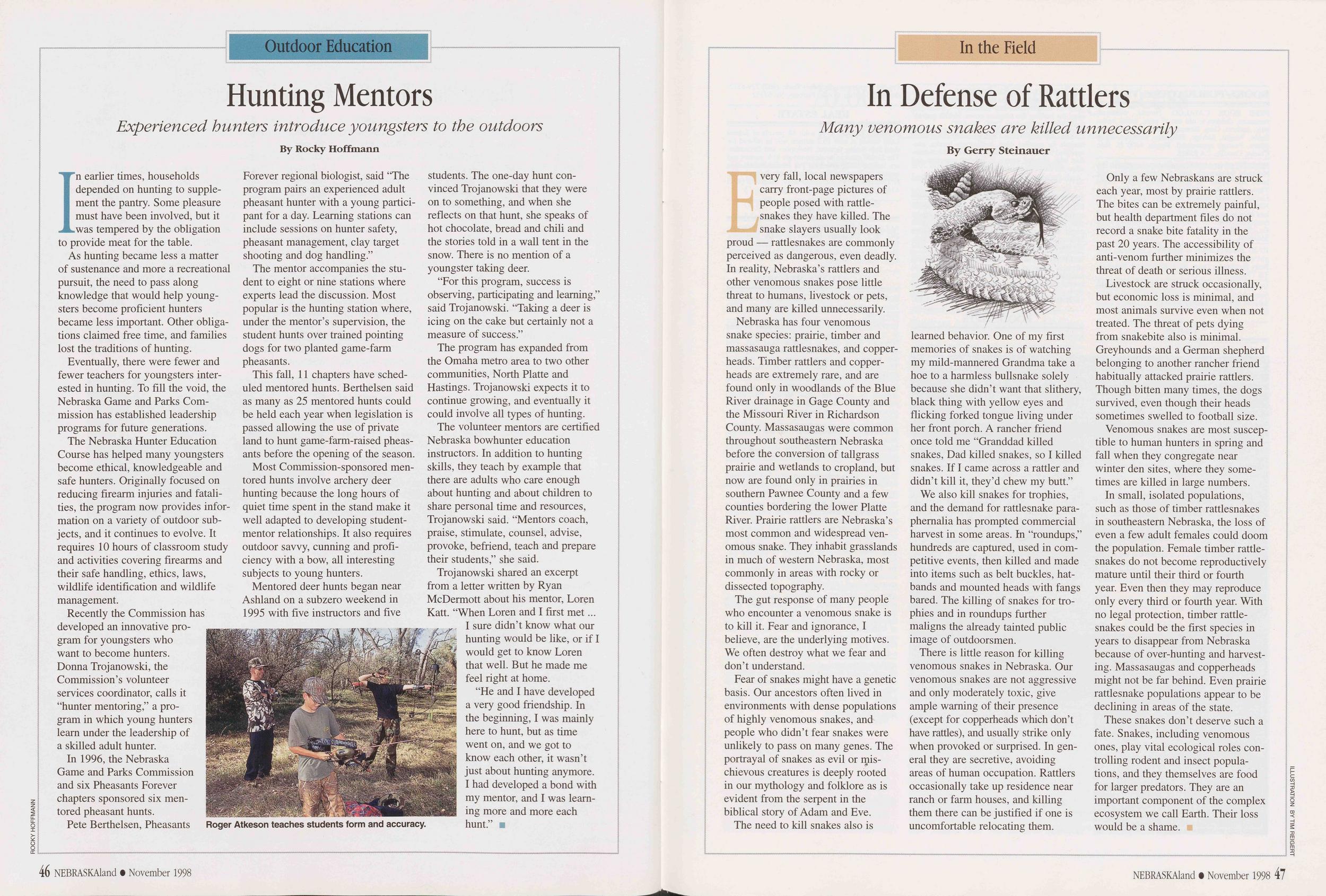
Outdoor Education
Hunting Mentors
Experienced hunters introduce youngsters to the outdoors By Rocky HoffmannIn earlier times, households depended on hunting to supplement the pantry. Some pleasure must have been involved, but it was tempered by the obligation to provide meat for the table.
As hunting became less a matter of sustenance and more a recreational pursuit, the need to pass along knowledge that would help youngsters become proficient hunters became less important. Other obligations claimed free time, and families lost the traditions of hunting.
Eventually, there were fewer and fewer teachers for youngsters interested in hunting. To fill the void, the Nebraska Game and Parks Commission has established leadership programs for future generations.
The Nebraska Hunter Education Course has helped many youngsters become ethical, knowledgeable and safe hunters. Originally focused on reducing firearm injuries and fatalities, the program now provides information on a variety of outdoor subjects, and it continues to evolve. It requires 10 hours of classroom study and activities covering firearms and their safe handling, ethics, laws, wildlife identification and wildlife management.
Recently the Commission has developed an innovative program for youngsters who want to become hunters. Donna Trojanowski, the Commission's volunteer services coordinator, calls it "hunter mentoring," a program in which young hunters learn under the leadership of a skilled adult hunter.
In 1996, the Nebraska Game and Parks Commission and six Pheasants Forever chapters sponsored six mentored pheasant hunts.
Pete Berthelsen, Pheasants Forever regional biologist, said "The program pairs an experienced adult pheasant hunter with a young participant for a day. Learning stations can include sessions on hunter safety, pheasant management, clay target shooting and dog handling."
The mentor accompanies the student to eight or nine stations where experts lead the discussion. Most popular is the hunting station where, under the mentor's supervision, the student hunts over trained pointing dogs for two planted game-farm pheasants.
This fall, 11 chapters have scheduled mentored hunts. Berthelsen said as many as 25 mentored hunts could be held each year when legislation is passed allowing the use of private land to hunt game-farm-raised pheasants before the opening of the season.
Most Commission-sponsored mentored hunts involve archery deer hunting because the long hours of quiet time spent in the stand make it well adapted to developing student-mentor relationships. It also requires outdoor savvy, cunning and proficiency with a bow, all interesting subjects to young hunters.
Mentored deer hunts began near Ashland on a subzero weekend in 1995 with five instructors and five
Roger Atkeson teaches students form and accuracy.
students. The one-day hunt convinced Trojanowski that they were on to something, and when she reflects on that hunt, she speaks of hot chocolate, bread and chili and the stories told in a wall tent in the snow. There is no mention of a youngster taking deer.
"For this program, success is observing, participating and learning," said Trojanowski. "Taking a deer is icing on the cake but certainly not a measure of success."
The program has expanded from the Omaha metro area to two other communities, North Platte and Hastings. Trojanowski expects it to continue growing, and eventually it could involve all types of hunting.
The volunteer mentors are certified Nebraska bowhunter education instructors. In addition to hunting skills, they teach by example that there are adults who care enough about hunting and about children to share personal time and resources, Trojanowski said. "Mentors coach, praise, stimulate, counsel, advise, provoke, befriend, teach and prepare their students," she said.
Trojanowski said. "Mentors coach, praise, stimulate, counsel, advise, provoke, befriend, teach and prepare their students," she said. Trojanowski shared an excerpt from a letter written by Ryan McDermott about his mentor, Loren Katt. "When Loren and I first met... I sure didn't know what our hunting would be like, or if I would get to know Loren that well. But he made me feel right at home.
"He and I have developed a very good friendship. In the beginning, I was mainly here to hunt, but as time went on, and we got to know each other, it wasn't just about hunting anymore. I had developed a bond with my mentor, and I was learning more and more each hunt."
In the Field
In Defense of Rattlers
Many venomous snakes are killed unnecessarily By Gerry SteinauerEvery fall, local newspapers carry front-page pictures of people posed with rattlesnakes they have killed. The snake slayers usually look proud — rattlesnakes are commonly perceived as dangerous, even deadly. In reality, Nebraska's rattlers and other venomous snakes pose little threat to humans, livestock or pets, and many are killed unnecessarily.
Nebraska has four venomous snake species: prairie, timber and massasauga rattlesnakes, and copperheads. Timber rattlers and copperheads are extremely rare, and are found only in woodlands of the Blue River drainage in Gage County and the Missouri River in Richardson County. Massasaugas were common throughout southeastern Nebraska before the conversion of tallgrass prairie and wetlands to cropland, but now are found only in prairies in southern Pawnee County and a few counties bordering the lower Platte River. Prairie rattlers are Nebraska's most common and widespread venomous snake. They inhabit grasslands in much of western Nebraska, most commonly in areas with rocky or dissected topography.
The gut response of many people who encounter a venomous snake is to kill it. Fear and ignorance, I believe, are the underlying motives. We often destroy what we fear and don't understand.
Fear of snakes might have a genetic basis. Our ancestors often lived in environments with dense populations of highly venomous snakes, and people who didn't fear snakes were unlikely to pass on many genes. The portrayal of snakes as evil or mischievous creatures is deeply rooted in our mythology and folklore as is evident from the serpent in the biblical story of Adam and Eve.
The need to kill snakes also is learned behavior. One of my first memories of snakes is of watching my mild-mannered Grandma take a hoe to a harmless bullsnake solely because she didn't want that slithery, black thing with yellow eyes and flicking forked tongue living under her front porch. A rancher friend once told me "Granddad killed snakes, Dad killed snakes, so I killed snakes. If I came across a rattler and didn't kill it, they'd chew my butt."
We also kill snakes for trophies, and the demand for rattlesnake paraphernalia has prompted commercial harvest in some areas, m "roundups," hundreds are captured, used in competitive events, then killed and made into items such as belt buckles, hat-bands and mounted heads with fangs bared. The killing of snakes for trophies and in roundups further maligns the already tainted public image of outdoorsmen.
There is little reason for killing venomous snakes in Nebraska. Our venomous snakes are not aggressive and only moderately toxic, give ample warning of their presence (except for copperheads which don't have rattles), and usually strike only when provoked or surprised. In general they are secretive, avoiding areas of human occupation. Rattlers occasionally take up residence near ranch or farm houses, and killing them there can be justified if one is uncomfortable relocating them.
Only a few Nebraskans are struck each year, most by prairie rattlers. The bites can be extremely painful, but health department files do not record a snake bite fatality in the past 20 years. The accessibility of anti-venom further minimizes the threat of death or serious illness.
Livestock are struck occasionally, but economic loss is minimal, and most animals survive even when not treated. The threat of pets dying from snakebite also is minimal. Greyhounds and a German shepherd belonging to another rancher friend habitually attacked prairie rattlers. Though bitten many times, the dogs survived, even though their heads sometimes swelled to football size.
Venomous snakes are most susceptible to human hunters in spring and fall when they congregate near winter den sites, where they sometimes are killed in large numbers.
In small, isolated populations, such as those of timber rattlesnakes in southeastern Nebraska, the loss of even a few adult females could doom the population. Female timber rattlesnakes do not become reproductively mature until their third or fourth year. Even then they may reproduce only every third or fourth year. With no legal protection, timber rattlesnakes could be the first species in years to disappear from Nebraska because of over-hunting and harvesting. Massasaugas and copperheads might not be far behind. Even prairie rattlesnake populations appear to be declining in areas of the state.
These snakes don't deserve such a fate. Snakes, including venomous ones, play vital ecological roles controlling rodent and insect populations, and they themselves are food for larger predators. They are an important component of the complex ecosystem we call Earth. Their loss would be a shame.
NEBRASKAland • November 1998 47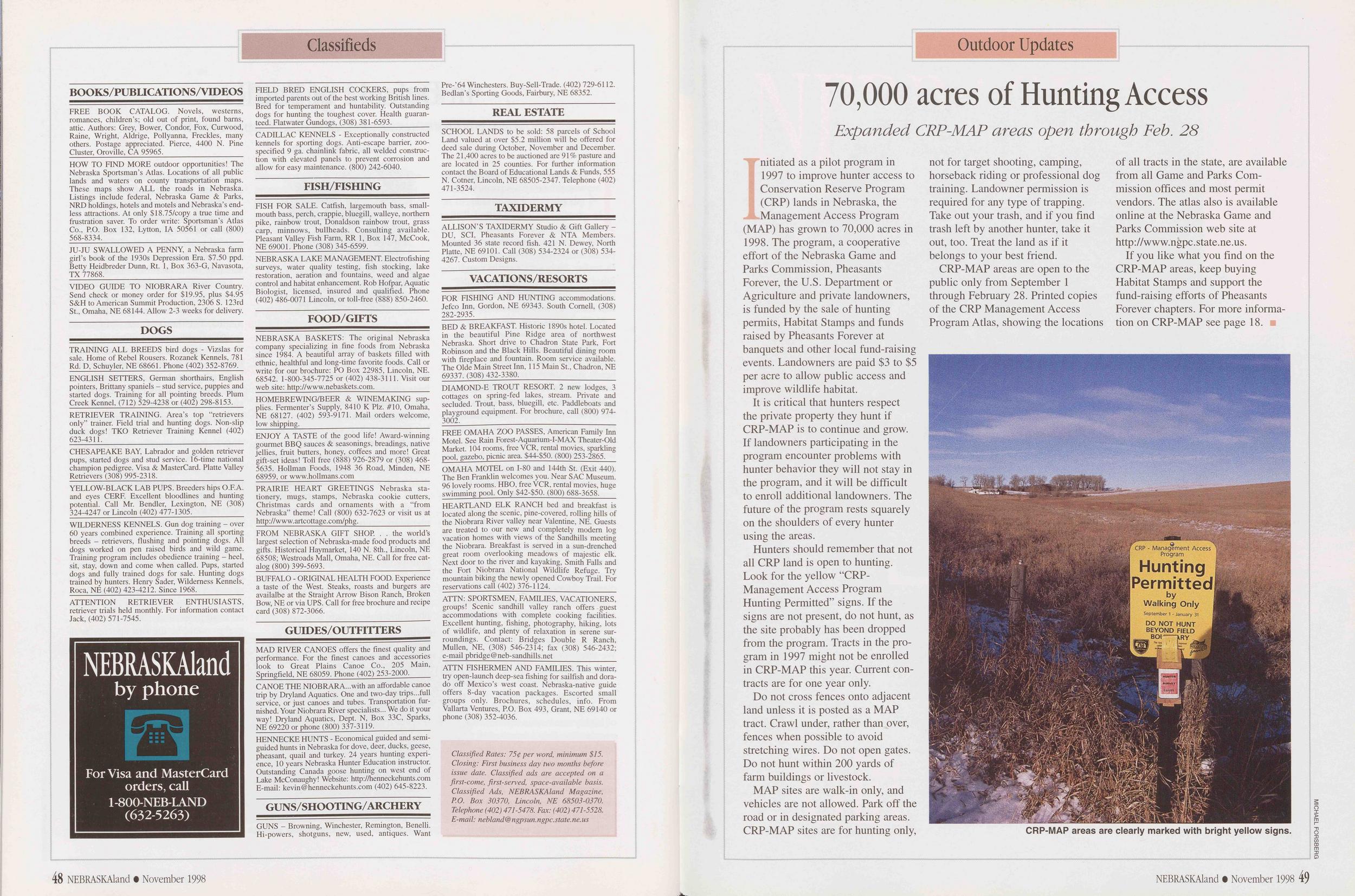
Classifieds
BOOKS/PUBLICATIONS/VIDEOS FREE BOOK CATALOG. Novels, westerns, romances, children's; old out of print, found barns, attic. Authors: Grey, Bower, Condor, Fox, Curwood, Raine, Wright, Aldrige, Pollyanna, Freckles, many others. Postage appreciated. Pierce, 4400 N. Pine Cluster, Oroville, CA 95965. HOW TO FIND MORE outdoor opportunities! The Nebraska Sportsman's Atlas. Locations of all public lands and waters on county transportation maps. These maps show ALL the roads in Nebraska. Listings include federal, Nebraska Game & Parks, NRD holdings, hotels and motels and Nebraska's endless attractions. At only $18.75/copy a true time and frustration saver. To order write: Sportsman's Atlas Co., P.O. Box 132, Lytton, IA 50561 or call (800) 568-8334. JU-JU SWALLOWED A PENNY, a Nebraska farm girl's book of the 1930s Depression Era. $7.50 ppd. Betty Heidbreder Dunn, Rt. 1, Box 363-G, Navasota, TX 77868. VIDEO GUIDE TO NIOBRARA River Country. Send check or money order for $19.95, plus $4.95 S&H to American Summit Production, 2306 S. 123rd St., Omaha, NE 68144. Allow 2-3 weeks for delivery. DOGS TRAINING ALL BREEDS bird dogs - Vizslas for sale. Home of Rebel Rousers. Rozanek Kennels, 781 Rd. D, Schuyler, NE 68661. Phone (402) 352-8769. ENGLISH SETTERS, German shorthairs, English pointers, Brittany spaniels - stud service, puppies and started dogs. Training for all pointing breeds. Plum Creek Kennel, (712) 529-4238 or (402) 298-8153. RETRIEVER TRAINING. Area's top "retrievers only" trainer. Field trial and hunting dogs. Non-slip duck dogs! TKO Retriever Training Kennel (402) 623-4311. CHESAPEAKE BAY, Labrador and golden retriever pups, started dogs and stud service. 16-time national champion pedigree. Visa & MasterCard. Platte Valley Retrievers (308) 995-2318. YELLOW-BLACK LAB PUPS. Breeders hips O.F.A. and eyes CERE. Excellent bloodlines and hunting potential. Call Mr. Bendler, Lexington, NE (308) 324-4247 or Lincoln (402) 477-1305. WILDERNESS KENNELS. Gun dog training - over 60 years combined experience. Training all sporting breeds - retrievers, flushing and pointing dogs. All dogs worked on pen raised birds and wild game. Training program includes obedience training - heel, sit, stay, down and come when called. Pups, started dogs and fully trained dogs for sale. Hunting dogs trained by hunters. Henry Sader, Wilderness Kennels, Roca, NE (402) 423-4212. Since 1968. ATTENTION RETRIEVER ENTHUSIASTS, retriever trials held monthly. For information contact Jack, (402)571-7545. NEBRASKAland by phone For Visa and MasterCard orders, call 1-800-NEB-LAND (632-5263) FIELD BRED ENGLISH COCKERS, pups from imported parents out of the best working British lines. Bred for temperament and huntability. Outstanding dogs for hunting the toughest cover. Health guaranteed. Flatwater Gundogs, (308) 381-6593. CADILLAC KENNELS - Exceptionally constructed kennels for sporting dogs. Anti-escape barrier, zoo-specified 9 ga. chainlink fabric, all welded construction with elevated panels to prevent corrosion and allow for easy maintenance. (800) 242-6040. FISH/FISHING FISH FOR SALE. Catfish, largemouth bass, smallmouth bass, perch, crappie, bluegill, walleye, northern pike, rainbow trout, Donaldson rainbow trout, grass carp, minnows, bullheads. Consulting available. Pleasant Valley Fish Farm, RR 1, Box 147, McCook, NE 69001. Phone (308) 345-6599. NEBRASKA LAKE MANAGEMENT. Electrofishing surveys, water quality testing, fish stocking, lake restoration, aeration and fountains, weed and algae control and habitat enhancement. Rob Hofpar, Aquatic Biologist, licensed, insured and qualified. Phone (402) 486-0071 Lincoln, or toll-free (888) 850-2460. FOOD/GIFTS NEBRASKA BASKETS: The original Nebraska company specializing in fine foods from Nebraska since 1984. A beautiful array of baskets filled with ethnic, healthful and long-time favorite foods. Call or write for our brochure: PO Box 22985, Lincoln, NE. 68542. 1-800-345-7725 or (402) 438-3111. Visit our web site: http://www.nebaskets.com. HOMEBREWING/BEER & WINEMAKING supplies. Fermenter's Supply, 8410 K Plz. #10, Omaha, NE 68127. (402) 593-9171. Mail orders welcome, low shipping. ENJOY A TASTE of the good life! Award-winning gourmet BBQ sauces & seasonings, breadings, native jellies, fruit butters, honey, coffees and more! Great gift-set ideas! Toll free (888) 926-2879 or (308) 468- 5635. Hollman Foods, 1948 36 Road, Minden, NE 68959, or www.hollmans.com PRAIRIE HEART GREETINGS Nebraska stationery, mugs, stamps, Nebraska cookie cutters, Christmas cards and ornaments with a "from Nebraska" theme! Call (800) 632-7623 or visit us at http://www.artcottage.com/phg. FROM NEBRASKA GIFT SHOP. . . the world's largest selection of Nebraska-made food products and gifts. Historical Haymarket, 140 N. 8th., Lincoln, NE 68508; Westroads Mall, Omaha, NE. Call for free catalog (800) 399-5693. BUFFALO - ORIGINAL HEALTH FOOD. Experience a taste of the West. Steaks, roasts and burgers are availalbe at the Straight Arrow Bison Ranch, Broken Bow, NE or via UPS. Call for free brochure and recipe card (308) 872-3066. GUIDES/OUTFITTERS MAD RIVER CANOES offers the finest quality and performance. For the finest canoes and accessories look to Great Plains Canoe Co., 205 Main, Springfield, NE 68059. Phone (402) 253-2000. CANOE THE NIOBRARA...with an affordable canoe trip by Dryland Aquatics. One and two-day trips...full service, or just canoes and tubes. Transportation furnished. Your Niobrara River specialists... We do it your way! Dryland Aquatics, Dept. N, Box 33C, Sparks, NE 69220 or phone (800) 337-3119. HENNECKE HUNTS - Economical guided and semi-guided hunts in Nebraska for dove, deer, ducks, geese, pheasant, quail and turkey. 24 years hunting experience, 10 years Nebraska Hunter Education instructor. Outstanding Canada goose hunting on west end of Lake McConaughy! Website: http://henneckehunts.com E-mail: kevin@henneckehunts.com (402) 645-8223. GUNS/SHOOTING/ARCHERY GUNS - Browning, Winchester, Remington, Benelli. Hi-powers, shotguns, new, used, antiques. Want Pre-'64 Winchesters. Buy-Sell-Trade. (402) 729-6112. Bedlan's Sporting Goods, Fairbury, NE 68352. REAL ESTATE SCHOOL LANDS to be sold: 58 parcels of School Land valued at over $5.2 million will be offered for deed sale during October, November and December. The 21,400 acres to be auctioned are 91% pasture and are located in 25 counties. For further information contact the Board of Educational Lands & Funds, 555 N. Cotner, Lincoln, NE 68505-2347. Telephone (402) 471-3524. TAXIDERMY ALLISON'S TAXIDERMY Studio & Gift Gallery - DU, SCI, Pheasants Forever & NTA Members. Mounted 36 state record fish. 421 N. Dewey, North Platte, NE 69101. Call (308) 534-2324 or (308) 534- 4267. Custom Designs. VACATIONS/RESORTS FOR FISHING AND HUNTING accommodations. Jefco Inn, Gordon, NE 69343. South Cornell, (308) 282-2935. BED & BREAKFAST. Historic 1890s hotel. Located in the beautiful Pine Ridge area of northwest Nebraska. Short drive to Chadron State Park, Fort Robinson and the Black Hills. Beautiful dining room with fireplace and fountain. Room service available. The Olde Main Street Inn, 115 Main St., Chadron, NE 69337. (308) 432-3380. DIAMOND-E TROUT RESORT. 2 new lodges, 3 cottages on spring-fed lakes, stream. Private and secluded. Trout, bass, bluegill, etc. Paddleboats and playground equipment. For brochure, call (800) 974- 3002. FREE OMAHA ZOO PASSES, American Family Inn Motel. See Rain Forest-Aquarium-I-MAX Theater-Old Market. 104 rooms, free VCR, rental movies, sparkling pool, gazebo, picnic area. $44-$50. (800) 253-2865. OMAHA MOTEL on 1-80 and 144th St. (Exit 440). The Ben Franklin welcomes you. Near SAC Museum. 96 lovely rooms. HBO, free VCR, rental movies, huge swimming pool. Only $42-$50. (800) 688-3658. HEARTLAND ELK RANCH bed and breakfast is located along the scenic, pine-covered, rolling hills of the Niobrara River valley near Valentine, NE. Guests are treated to our new and completely modern log vacation homes with views of the Sandhills meeting the Niobrara. Breakfast is served in a sun-drenched great room overlooking meadows of majestic elk. Next door to the river and kayaking, Smith Falls and the Fort Niobrara National Wildlife Refuge. Try mountain biking the newly opened Cowboy Trail. For reservations call (402) 376-1124. ATTN: SPORTSMEN, FAMILIES, VACATIONERS, groups! Scenic sandhill valley ranch offers guest accommodations with complete cooking facilities. Excellent hunting, fishing, photography, hiking, lots of wildlife, and plenty of relaxation in serene surroundings. Contact: Bridges Double R Ranch, Mullen, NE, (308) 546-2314; fax (308) 546-2432; e-mail pbridge@neb-sandhills.net ATTN FISHERMEN AND FAMILIES. This winter, try open-launch deep-sea fishing for sailfish and dorado off Mexico's west coast. Nebraska-native guide offers 8-day vacation packages. Escorted small groups only. Brochures, schedules, info. From Vallarta Ventures, P.O. Box 493, Grant, NE 69140 or phone (308) 352-4036. Classified Rates; 750 per word, minimum $15. Closing: First business day two months before issue date. Classified ads are accepted on a first-come, first-served, space-available basis. Classified Ads, NEBRASKAland Magazine, RO. Box 30370, Lincoln, NE 68503-0370. Telephone (402) 471-5478. Fax: (402) 471-5528. E-mail: nebland@ngpsun.ngpc.state.ne. us 48 NEBRASKAland • November 1998Outdoor Updates
70,000 acres of Hunting Access Expanded CRP-MAP areas open through Feb. 28Initiated as a pilot program in 1997 to improve hunter access to Conservation Reserve Program (CRP) lands in Nebraska, the Management Access Program (MAP) has grown to 70,000 acres in 1998. The program, a cooperative effort of the Nebraska Game and Parks Commission, Pheasants Forever, the U.S. Department or Agriculture and private landowners, is funded by the sale of hunting permits, Habitat Stamps and funds raised by Pheasants Forever at banquets and other local fund-raising events. Landowners are paid $3 to $5 per acre to allow public access and improve wildlife habitat.
It is critical that hunters respect the private property they hunt if CRP-MAP is to continue and grow. If landowners participating in the program encounter problems with hunter behavior they will not stay in the program, and it will be difficult to enroll additional landowners. The future of the program rests squarely on the shoulders of every hunter using the areas.
Hunters should remember that not all CRP land is open to hunting. Look for the yellow "CRP- Management Access Program Hunting Permitted" signs. If the signs are not present, do not hunt, as the site probably has been dropped from the program. Tracts in the program in 1997 might not be enrolled in CRP-MAP this year. Current contracts are for one year only.
Do not cross fences onto adjacent land unless it is posted as a MAP tract. Crawl under, rather than over, fences when possible to avoid stretching wires. Do not open gates. Do not hunt within 200 yards of farm buildings or livestock.
MAP sites are walk-in only, and vehicles are not allowed. Park off the road or in designated parking areas. CRP-MAP sites are for hunting only, not for target shooting, camping, horseback riding or professional dog training. Landowner permission is required for any type of trapping. Take out your trash, and if you find trash left by another hunter, take it out, too. Treat the land as if it belongs to your best friend.
CRP-MAP areas are open to the public only from September 1 through February 28. Printed copies of the CRP Management Access Program Atlas, showing the locations of all tracts in the state, are available from all Game and Parks Commission offices and most permit vendors. The atlas also is available online at the Nebraska Game and Parks Commission web site at http://www.ngpc.state.ne.us.
If you like what you find on the CRP-MAP areas, keep buying Habitat Stamps and support the fund-raising efforts of Pheasants Forever chapters. For more information on CRP-MAP see page 18.
CRP-MAP areas are clearly marked with bright yellow signs.
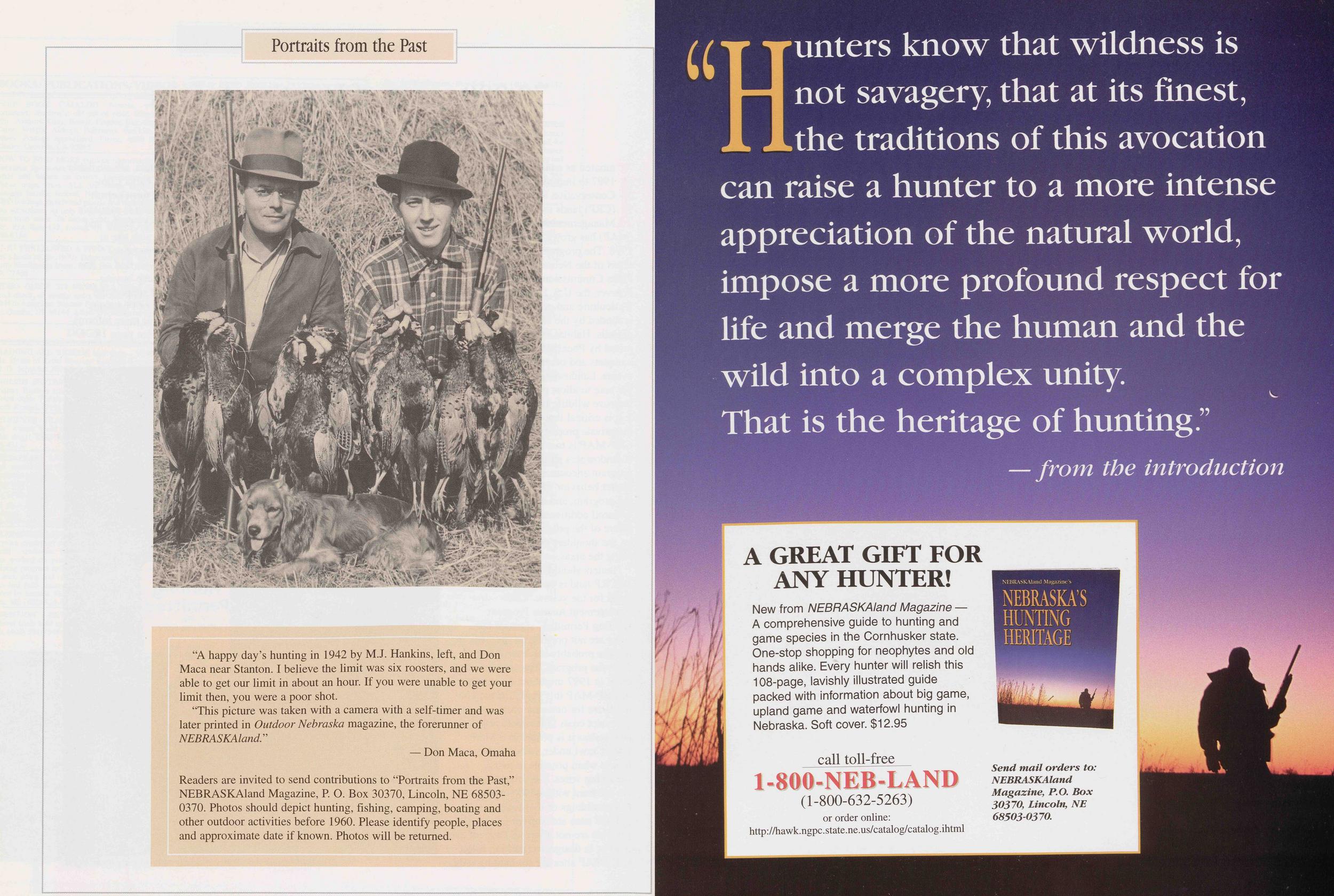
Portraits from the Past
"A happy day's hunting in 1942 by M.J. Hankins, left, and Don Maca near Stanton. I believe the limit was six roosters, and we were able to get our limit in about an hour. If you were unable to get your limit then, you were a poor shot.
"This picture was taken with a camera with a self-timer and was later printed in Outdoor Nebraska magazine, the forerunner of NEBRASKAland."
— Don Maca, Omaha Readers are invited to send contributions to "Portraits from the Past," NEBRASKAland Magazine, P. O. Box 30370, Lincoln, NE 68503- 0370. Photos should depict hunting, fishing, camping, boating and other outdoor activities before 1960. Please identify people, places and approximate date if known. Photos will be returned.Hunters know that wildness is not savagery, that at its finest, the traditions of this avocation can raise a hunter to a more intense impose a more profound respect for life and merge the human and the wild into a complex unity. That is the heritage of hunting."
— from the introduction A GREAT GIFT FOR ANY HUNTER! New from NEBRASKAland Magazine — A comprehensive guide to hunting and game species in the Cornhusker state. One-stop shopping for neophytes and old hands alike. Every hunter will relish this 108-page, lavishly illustrated guide packed with information about big game, upland game and waterfowl hunting in Nebraska. Soft cover. $12.95 call toll-free (1-800-632-5263) or order online: http://hawk.ngpc.state.ne.us/catalog/catalog.ihtml Send mail orders to: NEBRASKAland Magazine, P.O. Box 30370, Lincoln, NE 68503-0370.
Position: 664 (17 views)