Volume 76, Issue 8, 1998
NEBRASKAland
Nebraska Game & Parks Commission October 1998 $2.50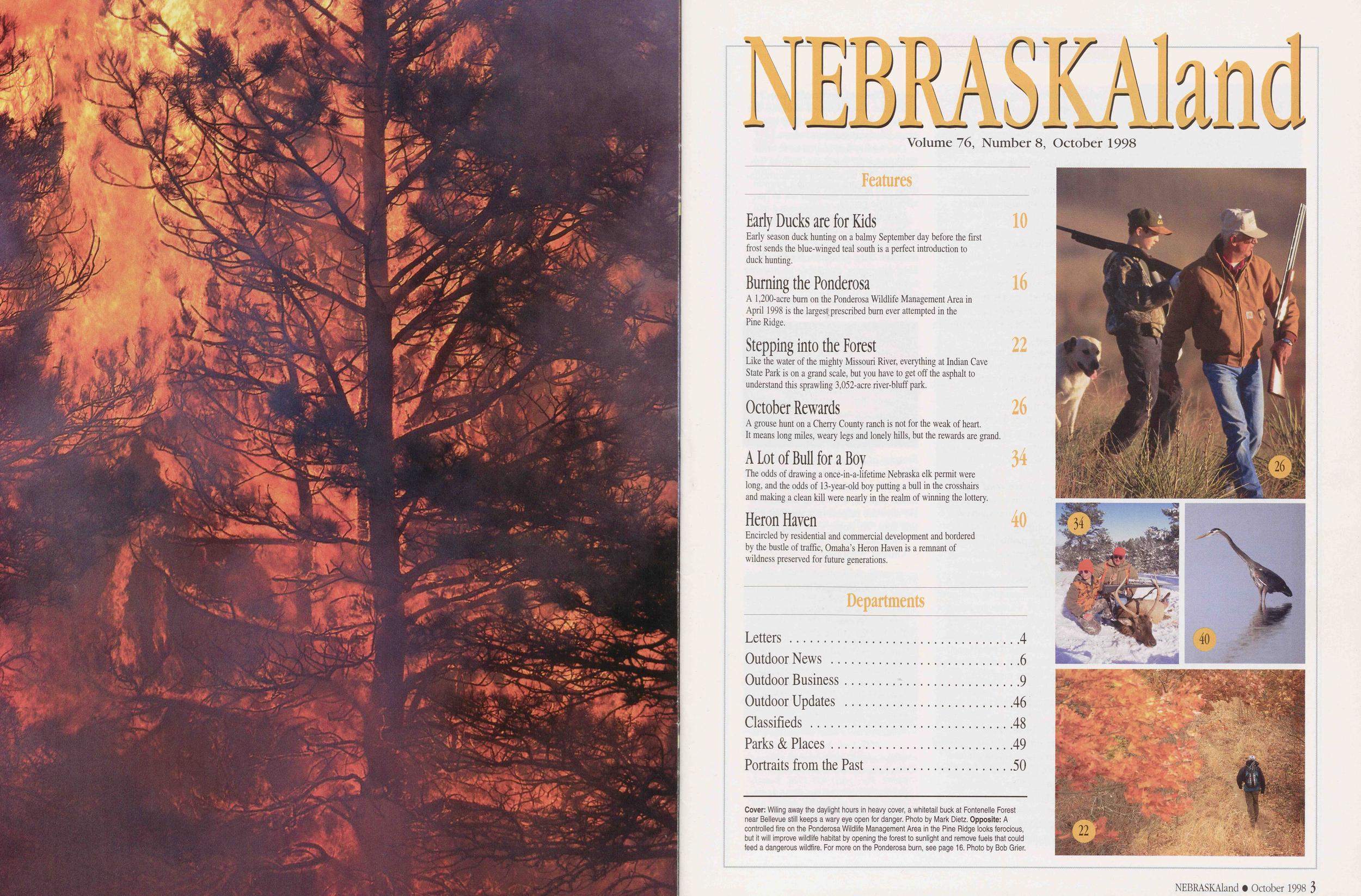
NEBRASKAland
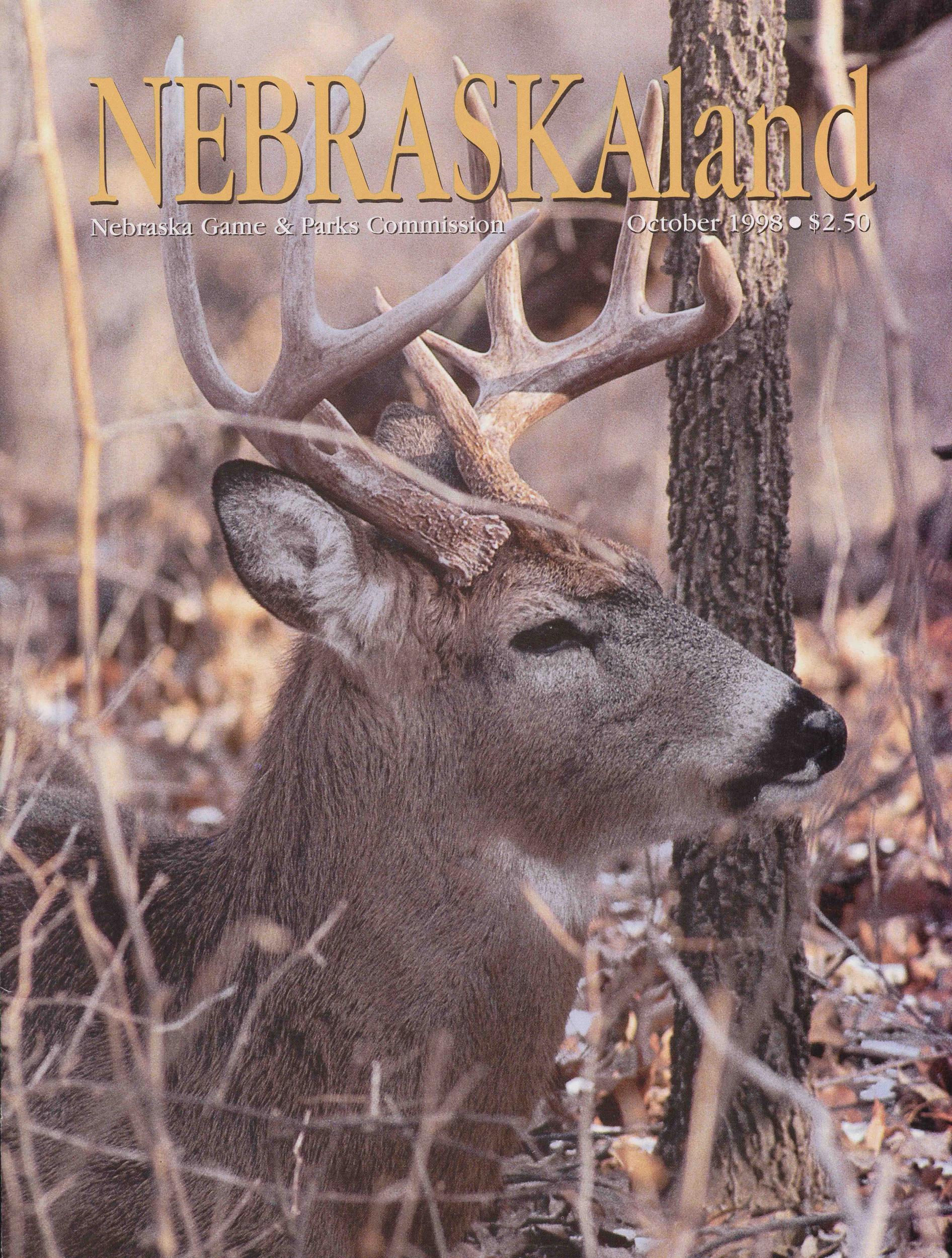
Volume 76, Number 8, October 1998 Features Early Ducks are for Kids 10 Early season duck hunting on a balmy September day before the first frost sends the blue-winged teal south is a perfect introduction to duck hunting. Burning the Ponderosa 16 A 1,200-acre burn on the Ponderosa Wildlife Management Area in April 1998 is the largest prescribed burn ever attempted in the Pine Ridge. Stepping into the Forest 22 Like the water of the mighty Missouri River, everything at Indian Cave State Park is on a grand scale, but you have to get off the asphalt to understand this sprawling 3,052-acre river-bluff park. October Rewards 26 A grouse hunt on a Cherry County ranch is not for the weak of heart. It means long miles, weary legs and lonely hills, but the rewards are grand. A Lot of Bull for a Boy 34 The odds of drawing a once-in-a-lifetime Nebraska elk permit were long, and the odds of 13-year-old boy putting a bull in the crosshairs and making a clean kill were nearly in the realm of winning the lottery. Heron Haven 40 Encircled by residential and commercial development and bordered by the bustle of traffic, Omaha's Heron Haven is a remnant of wildness preserved for future generations. Departments Letters 4 Outdoor News 6 Outdoor Business 9 Outdoor Updates 46 Classifieds 48 Parks & Places 49 Portraits from the Past 50 Cover: Wiling away the daylight hours in heavy cover, a whitetail buck at Fontenelle Forest near Bellevue still keeps a wary eye open for danger. Photo by Mark Dietz. Opposite: A controlled fire on the Ponderosa Wildlife Management Area in the Pine Ridge looks ferocious, but it will improve wildlife habitat by opening the forest to sunlight and remove fueis that could feed a dangerous wildfire. For more on the Ponderosa burn, see page 16. Photo by Bob Grier.26
34
40
28
NEBRASKAland Magazine
Published by the Nebraska Game and Parks Commission Director: Rex Amack Assistant Directors: Noelyn Isom Roger Kuhn Kirk Nelson Information & Education Administrator: Paul Horton Information & Education Art Director: Steve O'Hare Commissioners Chairman: Tom J. Plummer Jr., Ogallala Vice Chairman: William Berryman, Kearney 2nd Vice Chairman: Daniel Wallen, McCook Thomas O'Neill Jr., Lincoln George W. Egermayer Jr., Omaha Rob Coupland, Valentine John P. Miller, Blair Magazine Staff Editor: Don Cunningham Associate Editor: Troy Kroeger Art Director: Tim Reigert Senior Editors: Ken Bouc, Jon Farrar Regional Editors: Michael Forsberg, Bob Grier, Rocky Hoffmann Circulation: Pat Frahm NEBRASKAland VOL. 76 / NO. 8 ISSN: 0028-1964 OCTOBER 1998 Published monthly, except for Jan./Feb. and Aug./Sept. issues, by the Nebraska Game and Parks Commission, 2200 N. 33rd St., Lincoln, NE. Copyright 1998, all rights reserved. Please address comments or questions to this address. Periodicals postage paid at Lincoln, Nebraska. POSTMASTER: Send all address changes to NEBRASKAland, P.O. Box 30370, Lincoln, NE 68503-0370. Rates: $16 for one year; $30 for two years. Address submissions to: The Editor, NEBRASKAland Magazine, P.O. Box 30370, Lincoln, NE 68503. Include a stamped, self-addressed return envelope. The publisher assumes no responsibility for unsolicited material. NEBRASKAland is available on audio cassette from the Nebraska Library Commission Talking Book and Braille Service, Suite 120, 1200 N St., Lincoln, NE 68508.Letters
Nebraska's Hunting HeritageWhat a spectacular issue the NEBRASKAland Magazine staff has published with "Nebraska's Hunting Heritage" [August-September 1998]. You should be proud that the Nebraska quality of life and the quality of our resource magazines comes shining through in this publication.
Jim Beardsley Sidney, Nebraska Still Hunting DeerI truly enjoy reading the well-written and documented articles in NEBRASKAland. I very much enjoyed "The Zaruba Connection" in the March issue.
My father enjoyed hunting and fishing and was a crack shot. I hunted and fished with him until he passed away in 1965.
I don't fish much anymore, but I still try to get a deer every year in the Sandhills, close to home.
Gene Loudon Thedford, Nebraska Great Reference MaterialThank you for permission to use Rocky Hoffmann's tree sparrow photo for a painting. I was so pleased with the painting I had Christmas cards printed.
I am 93 years old and started painting in the '60s. I developed a liking for wildlife painting and now enjoy it the most. However, I do not have much reference material so I ask permission to use photographs. NEBRASKAland has the best wildlife photography, and I always look forward to the next issue.
Lola Bowman North Platte, Nebraska Sharing NEBRASKAlandWe just received our NEBRASKAland Magazine and are enjoying it.
My husband has hunted for deer, pheasants and turkeys for many years; he is 80 years old and still looks forward to hunting season.
My thoughts turn to this idea: Pass your magazine on to a rest home. The men, especially, can reminisce. Their time of walking the fields might be past, but they have memories and stories to share.
Our family has stayed at several state parks for reunions, and we are proud of the wonderful accommodations and attractions available at affordable prices.
Dorothy and Frank Folchert North Platte, Nebraska Another way to make NEBRASKAland Magazine available to nursing home readers and others is through gift subscriptions. (Editor)This picture of sunrise over Standing Bear Lake was taken by my son, Mark Schultz, a devoted fisherman. He says the largest fish are found in this lake. We enjoy your magazine.
Dick Schultz Omaha, Nebraska Blizzard Photos Wanted In the January-February 1999 issue, NEBRASKAland Magazine will commemorate the 50th anniversary of the Blizzard of 1949 with a collection of photos and short reminiscences from readers. Submissions must arrive by Nov. 1, 1998. Identify people and places, and briefly describe memorable blizzard experiences. Send contributions to: Blizzard, NEBRASKAland Magazine, P.O. Box 30370, Lincoln, NE 68503. Photos will be returned in February 1999. Write to: Letters, NEBRASKAland Magazine, P.O. Box 30370, Lincoln, NE 68503. Fax: (402) 471-5528. E-mail: nebland@ngpsun.ngpc. state, ne. us. Please include your postal address and telephone number. Letters may be condensed and edited for clarity. Photographs are welcome. 4 NEBRASKAland • October 1998 Letters From the Outdoor Forum Q. Why is Zone 2 closed to late season snow goose hunting again this year? I see that the feds have figured out that there is a problem with overpopulation and have even allowed a larger bag limit. But why is part of the state still closed? I would like a true-hearted response from a Game and Parks Commission official about this troubling news. Do not even try to tell me that the sandhill crane people have something to do with this. A. The U.S. Fish and Wildlife Service didn't allow us to open the I western Rainwater Basin again this year. They have concerns about hunters having a negative effect on species other than snow geese and on birdwatchers, especially at Funk Waterfowl Production Area. The east basins were open last year under experimental conditions, and we collected much data to help us understand the effects of hunting. Since this was our first attempt, we learned more about what it will take to get answers than the answers themselves. We also worked with researchers collecting data on the body condition of several waterfowl species. That work is being repeated this year. We are discussing what other research to do. To learn about the effects of hunting, we have to change hunting regulations over time. This might involve opening and closing areas. The area along the Platte River is closed to minimize disturbance to sandhill cranes. The habitat there is even more limited than in the Rainwater Basin. It is important for the cranes to have a secure place to roost, especially immediately before breeding. We are continuing to work on allowing Nebraska hunters the greatest opportunity to help reduce the snow goose population. Given the international importance of the Rainwater Basin to migrating birds in late winter and spring, we must work carefully and in concert with the USFWS. — P. Joe Gabig, Game and Parks Commission waterfowl specialist Excerpted from the Game and Parks Commission's "Outdoor Forum," an online discussion of outdoor topics: http://www.ngpc.state.ne.us/recboard/Nebraska Game and Parks Commission Offices
Headquarters 2200 N. 33rd Street Lincoln, NE 68503 Phone (402) 471-0641 District Office I East Hwy. 2, Box 725 Alliance, NE 69301 Phone (308) 763-2940 District Office II 524 Panzer St., Box 508 Bassett, NE 68714 Phone (402) 684-2921 District Office III 2201 N. 13th St. Norfolk, NE 68701 Phone (402) 370-3374 District Office IV 301 E. State Farm Rd. North Platte, NE 69101 Phone (308) 535-8025 District Off ice V 2200 N. 33rd Street Lincoln, NE 68503 Phone (402) 471-5558 District Office VI 1617 First Ave. Kearney, NE 68847 Phone (308) 865-5310 Omaha Office 1212 Deer Park Blvd. Omaha, NE 68108 Phone (402) 595-2144 Ak-Sar-Ben Aquarium 21502 W. Highway 31 Gretna, NE 68028 Phone (402) 332-3901 World Wide Web site: http://www.ngpc.state.ne.us E-mail: ngpc@ngpsun.ngpc.state.ne.us Headquarters Daniel Roberts Fremont 721-7852 Dick Turpin (Adm.) Lincoln 471-5531 Randy Pomplun Fullerton (308) 536-2987 Ted Blume (Asst. Adm.) Lincoln 471-5532 Jon Reeves Kennard 427-7378 Murray Johnson Lincoln 471-5003 Eric Wiebe Ponca 755-2566 Steve Oberg Columbus 564-5937 Panhandle Officer City Phone (308) Sandhills Raymond Still Bridgeport 262-1075 Officer City Phone (402) Walt Meyer Chadron 432-4398 Bruce Wiebe (Sup.) Bassett 684-3867 John Murphy Crawford 665-2021 Ray Dierking Brkn. Bow (308) 872-3078 Jim Zimmerman Gering 436-7561 Richard Seward Ord (308) 728-3115 Marvin Kampbell Hay Springs 638-7527 Justin Mays Bassett 273-4188 Dennis Thompson Ogallala 284-6450 Frank Miller Valentine (308) 376-5909 Dan Zuehlke Ogallala 284-4815 Dan Evasco Oshkosh 772-3091 South-central Scott Brandt Scottsbluff 635-1277 Officer City Phone (402) Jerry Pecha (Sup.) Kearney (308) 865-5327 Southwest Terry Brentzel Grand Is. (308) 384-8296 Officer City Phone (308) Tim Williams Hastings 463-2535 Roger Thompson (Sup.) N. Platte 532-9175 Dale Johnson Kearney (308) 237-1079 Dwight Allbery N. Platte 532-2753 Mark Reeves Loup City (308) 745-1126 Dudley Sorensen N. Platte 532-0747 Robert Finke Milford 761-3537 George Sund Cambridge 697-4629 Dana Murphy Geneva 759-3170 Matt Andrews Elwood 785-3025 Jack Henderson Gothenburg 537-7483 Southeast Dirk Greene Imperial 882-5328 Officer City Phone (402) Virgil Gosch McCook 345-2185 Craig Stover (Sup.) Lincoln 471-5590 Rich Routh Rep. City 799-2085 Douglas Kramer Lincoln 466-9001 Dina Hopper Lincoln 483-2358 Northeast William Krause Auburn 274-3789 Officer City Phone (402) Larry Elston Bellevue 292-4910 Tom Zimmer (Sup.) Norfolk 371-6625 Mike Luben Colon 443-4278 Marion Shafer Norfolk 371-2031 Duane Arp Gretna 332-4954 Robert Kelly Albion 395-2538 Levi Krause Louisville 234-2212 Ross Oestmann Bloomfield 373-4412 Russell Mort Nebr. City 873-5684 Gary Ralston Creighton 847-3284 Greg Verkuilen Beatrice 223-4095 Operation Game Thief 1-800-742-7627 NEBRASKAland • October 1998 5
Outdoor News
Ed Morgan of Blair Receives Permit for Bighorn SheepA 38-year-old Blair man has been selected to participate in Nebraska's first bighorn sheep hunt.
Ed Morgan's name was drawn from among more than 3,400 lottery applicants who each paid $20 to enter the lottery. Game and Parks Commission Chairman Tom Plummer drew the winning entry from a barrel at the Nebraska State Fair on Sept. 5.
With the permit, Morgan won a package that includes guide service, the use of horses and up to four days of lodging and meals at Fort Robinson State Park near Crawford. Nebraska's bighorn sheep herd of about 70 animals, including several large rams, lives in the butte country of Nebraska's Pine Ridge.
"Actually, I just thought of it as a $20 donation to help keep the program going," Morgan said. "I knew the odds against winning."
The permit is one of two authorized for Nebraska's first bighorn sheep hunt Nov. 22 through Dec. 21. The other permit was auctioned at the Safari Club International's Annual Convention in Reno, Nevada, in February for $87,500.
Proceeds from the lottery and
1998-99 Waterfowl Hunting Seasons
Dates Daily Poss. Open Area Canada Geese and Brant* Oct. 24 - Jan. 24 3 6 North Unit Oct. 3-4 & Oct. 10 - Jan. 8 3 6 East Unit Oct. 3 - Jan. 3 3 6 North-central Unit Oct. 24 - Jan. 24 3 6 South-central Unit Nov. 7 - Jan. 24 3 6 Panhandle Unit Light Geese** Oct. 3 - Dec. 19 20 None Statewide Feb. 11-March 10 20 None Zone 1 Feb. 11 -March 10 20 None Zone 3 White-fronted Geese* Oct. 3 - Dec. 13 2 4 Statewide Duck Oct. 3 - Dec. 13 & Dec. 19-20 Conventional System* Low Plains Early Oct. 10 - Dec. 20 & Dec. 26-27 Conventional System* Low Plains Late Oct. 3 - Dec. 14 & Dec. 18-Jan. 10 Conventional System* High Plains Coot* Same as Duck 15 30 Same as Duck Youth Waterfowl (Ducks and Geese) Sept. 19 Same as regular season Statewide HIP registration required for doves, ducks, geese, snipe, rail coot and woodcock. Harvest Information Program, (800) 938-5263. Special restrictions apply in Zone 1. See 1998 Hunt Guide. No Late Season in Zone 2. Daily bag limit: Six ducks, conventional system. Possession limit: Twice daily bag. See 1998 Nebraska Waterfowl and Crow Hunting Seasons brochure, available at Commission offices and from permit vendors, for explanation of conventional system with maps and additional information. 6 NEBRASKAland • October 1998Outdoor News
auction will be used for bighorn sheep programs.
Red Cloud Man Seeks Turkey Feathers for Boy ScoutsFor 30 years a Red Cloud man has been collecting feathers, cleaning them and donating them to Boy Scout groups for Indian lore activities and craft projects.
Norman Peirce solicits feathers, primarily the wings of turkeys, geese and peacocks, for distribution to Boy Scouts throughout the country. Peirce also teaches Scout groups how to use the feathers to make Indian-style dance bustles and bonnets. Dance sticks are made from turkey feet.
Nebraska's fall turkey shotgun seasons begin October 24. Archery seasons began October 1. Hunters who wish to donate wings can send them to Peirce at: 531 N. Cedar St., Red Cloud, NE 68970, or can call him at (402) 746-3758 for more information.
Biologists Seeking Evidence of Chronic Wasting DiseaseChronic Wasting Disease (CWD), a disease fatal to deer and elk, has been found in Colorado and Wyoming, and biologists are investigating the possibility of its occurrence in Nebraska. Deer harvested between the North and South Platte rivers in western Nebraska and within 50 miles of Cody in north-central Nebraska will be examined.
CWD is similar to "mad cow" disease, but affects only deer and elk, not humans or domestic livestock. Affected animals show poor body condition, excessive salivation, increased drinking and urination, depression and eventual death. Its cause is unknown, and no treatment is available.
For accurate sampling, the brains of 300 deer will be examined, said Dave Oates, laboratory program
Outdoor News
Officer's Notebook Refuge Regulations Based in Oshkosh along the North Platte River, I occasionally receive calls from waterfowl hunters with questions about locating a blind or placing a decoy spread near the Garden County Refuge, and we've taken one case to trial in recent years involving decoys placed on the refuge. The Garden County Refuge extends from the western end of Lake McConaughy along the North Platte River to near Lisco, and includes the entire length of the river in Garden County. Some of Nebraska's best waterfowl hunting is found adjacent to the Garden County Refuge. In addition to the Garden County refuge, there are refuges on the North Platte River in Lincoln County and on the Platte and Niobrara rivers in Dodge, Saunders, Boyd and Holt counties. By law, refuge boundaries extend 20 rods from the stream bank. A rod, no longer as common a unit of measure as it once was, equals 51/2 yards or 161/2 feet, so 20 rods equals 110 yards. Decoy spreads, too, must be at least 110 yards from the river bank. If hunters need assistance, conservation officers usually can help measure the blind location in question and can answer questions about a blind or decoy spread's location relative to refuge boundaries. The officers and their telephone numbers are available in several Game and Parks Commission publications, including NEBRASKAland Magazine (see page 3) and hunting and fishing guides are available at permit vendors and Commission offices. Game laws restrict activities on state game refuges. It is illegal to hunt or chase game birds and animals or other birds and animals of any kind, to carry firearms of any kind or to operate a motorboat within the boundaries of the state game refuge from October 15 through January 15. Deer harvest on the state refuges can be authorized by the Game and Parks Commission to prevent damage to habitat on the refuge or adjacent private land. Hunters can enter a refuge to retrieve a lawfully taken game bird. They can be accompanied by a dog for that purpose, but cannot carry a firearm on the refuge. — Conservation Officer Dan Evasco, Oshkosh State Game Refuges • Garden County: North Platte River • Dodge County: portions of the Platte River • Saunders County: portions of the Platte River • Boyd County: portions of the Niobrara River • Holt County: portions of the Niobrara River • Lincoln County: portions of the North Platte River For a complete description of state refuge locations, consult the Nebraska Game Laws, Chapter 37-706. It is Illegal to... • Place blinds or decoys less than 20 rods (110 yards) from the banks of the river on a refuge. • Carry a firearm of any kind when retrieving a lawfully taken game bird from a refuge. • Operate a motorboat within the boundaries of the state game refuge from October 15 through January 15. • To hunt or chase with dogs any game birds, game animals, or other birds or animals of any kind on a refuge.manager for the Game and Parks Commission. Participation in the study is voluntary, and Oates hopes to enlist the help of hunters who harvest deer two years old or older in the two areas.
Samples will be collected at check stations in Scottsbluff, Kimball, Sidney, Bridgeport and Ogallala.
Deer Hunters Asked to Help with E. coli ResearchResearchers are asking fall firearm deer hunters to assist with research into a potentially serious disease in humans caused by eating food contaminated by the bacteria, E. coli 0157:H7.
The study will be conducted by Kansas State University's Food Animal Health and Management Center, the University of Nebraska- Lincoln and the Nebraska Game and Parks Commission.
The sources of E. coli in nature are not fully known. Researchers at the Food Animal Health and Management Center have learned that the bacteria are shed in the feces of a small percentage of healthy cattle and have been detected in the feces of deer and other wildlife. It also has been detected in cattle feeds and water sources.
Cattle and wild deer often share pastures, water and food sources. Researchers want to know more about the number of deer that shed the bacteria to determine the relationship between cattle, deer and the environment.
Firearm hunters in the Blue and Wahoo units will receive letters explaining the study. Participants who collect fecal samples from harvested deer and turn them in at check stations will be entered in drawings for $500 worth of Cabela's gift certificates.
Although the bacteria can be destroyed by cooking food thoroughly, the study's goal is to help reduce the risk of E. coli entering the human food chain.
8 NEBRASKAland • October 1998Outdoor Business
Water for Wetlands
Wetland pumping provides critical habitat and hunting opportunity By Ted LaGrange, Wetland Program ManagerFor the past 20 years, the Nebraska Game and Parks Commission and the U.S. Fish and Wildlife Service have pumped water into several Rainwater Basin wetlands in south-central Nebraska. Pumping the basins in fall provides habitat for migrating waterfowl when many of the basins otherwise would be dry, and it helps provide waterfowl hunters places to hunt. Fall pumping also can provide carry-over water into the spring, making pumping in the spring more efficient and beneficial to spring-migrating waterfowl and other waterbirds.
If the Rainwater Basin landscape were intact today, pumping probably would not be necessary, but the landscape has been highly modified. Nearly 90 percent of the wetlands have been destroyed or highly degraded, and the hydrology of the remaining wetlands has been greatly altered. These changes in the natural system make pumping some areas necessary if the needs of the millions of migrating waterbirds that use this critical stopover region in the Central Flyway are to be met.
Pumping usually begins in mid-September when temperatures are cooler and evapotranspiration rates are lower, saving money and water. Earlier, hot weather, high evaporation rates and high transpiration rates by actively growing plants usually makes pumping inefficient, especially considering the low capacity of some of the pumps on public areas. In addition, there are concerns in the farming community about pumping groundwater into wetlands early in fall.
Most areas can be pumped to desirable levels within two weeks. The money saved by delaying pumping until mid-September can be applied to pumping into October, providing waterfowl habitat and hunting opportunities for the entire season. Pumping ends in late fall when desired water levels are reached and can be maintained, or when funding is no longer available.
Selecting basins for pumping usually begins in early September when Fish and Wildlife Service and Commission personnel assess water and habitat conditions and determine what areas require pumping. Based on that information and the amount of money available, a list of areas to be pumped is compiled. In addition to federal- and state-owned wells, several areas are pumped using adjacent private wells. In some years, no pumping is required.
Wetlands usually are wet, but an important part of their ecology is for them to go dry periodically, and not all are pumped every year. The Rainwater Basin Joint Venture's objective of providing reliable water to one-third of the protected basins each year has not yet been met.
Many public areas cannot be pumped because the basin is not entirely publically owned, and pumping could flood neighboring land. Drilling and operating wells is expensive, but as funds become available, wells will be added.
The average costs for pumping a federal waterfowl production area is $52 per day per pump, or about $17.75 per acre-foot of water. Fall pumping on Commission lands is paid for with budgeted money. Fall pumping of Fish and Wildlife Service lands is paid for through a distribution-in-aid payment.
In 1997, $20,000 of Habitat Stamp funds were allocated for pumping. The Fish and Wildlife Service operates and maintains the pumps on the waterfowl production areas and pays for spring pumping when necessary.
For more information, contact the U.S. Fish and Wildlife Service office in Kearney at (308) 236-5015 or the Nebraska Game and Parks Commission office in Kearney at (308)865-5329.
Pumping Rainwater Basin wetlands improves migration habitat and hunting.
Early Ducks are for Kids
Photos and text by Rocky Hoffmann Early season duck hunting on a balmy September day before the first frost nips the fall vegetation and sends the blue-winged teal south is a perfect introduction for a young hunter who is not ready for the rigors of river ice, frozen sandbars and arctic winds.When December's river ice began chiseling into the frozen sandbar that anchored our spread of homemade blocks, and arctic winds rattled our scanty willow blind like Venetian blinds, the cold became vicious and cruel. Too cruel, perhaps, for a kid my age, especially in the 1950s, before Thinsulate, Gortex and portable propane heaters, and before there was enough money for me to buy decent gloves and boots. The cold made fingers useless against stiff zippers and stubborn buckles, and when warmth finally returned, the pain summoned tears.
Ironically, my most miserable days as a kid involved the only sport I truly loved: duck hunting. It is remarkable that I still love it and that I even continued to hunt after those raw experiences on the Missouri River. In fact, I almost retired from hunting at a young age, remembering days when it was too cold to take the dog who slept every night in the snow, but not too cold to take me. I searched for reason in that reasoning as sand and ice bit into my uncovered cheeks and forehead.
I also searched for the reasons I would decide to continue subjecting myself to such horrid conditions, and I believe the basis for that decision was my first duck hunting experience, one that came on a balmy, shirt-sleeve September day before first frost. It was a family affair. We sat on a bank high above a backwater chute and shot blue-winged teal as they coursed in huge flocks across our decoys. I remember the leaves of the grapevines still green, fruit plump and unwrinkled by cold that lingered in the offing. I held to my nose the empty paper hulls of every Peters 20-gauge shell I fired that day and smelled the freshly burned powder. I virtually imprinted on the sights, sounds and smells of duck hunting. River mud between bare toes, the roaring wings of 50 teal on a diving swoop, a wet dog, singed feathers ... what a combination of stimulants for a kid.
What would the results have been if my first contact with the sport had come under different conditions: Blowing sand, snow and teary eyes obscuring sight; wind too strong to carry scents, and nostrils too cold to detect them anyway. The relentless sound of wind, and with it, hoards of ducks.
Although ducks fell from the flocks, fingers were too cold to feel the trigger let alone snap the safety. None of the drakes, orange legs skyward in the current, were mine. Had those later experiences been my introduction to duck hunting, I probably would have chalked this self-abusive sport off as a bad investment of time.
I once heard a hunter in fancy hunting pants and shiny boots explain to a kid, "Son there are really only two breeds of ducks! There are mallards and there are trash ducks."
I knew right then he wasn't much of a duck hunter, and I felt as sorry for the kid as I did for the ducks. Likely the polished fellow with the pants had never taken the responsibility to learn anything about waterfowl except to take and waste, and waste he likely did, discarding to the trash any duck that didn't sport a green head.
I don't mind so much the fact that there are a lot of self-proclaimed duck hunters who only know one kind of duck. I do mind, however, that there will be fewer kids enjoying good, early-season, multi-species hunts. Early ducks are for kids, and I'm one kid who is not going to miss any warm weather opportunities around a marsh.
Jerry Vieyra of North Platte knows kids. He heads the local chapter of MAD DADS, and his 14-year-old son, Jerome II, is at an age when he can be easily influenced; Jerry wants to administer the influence instead of leaving it to some member of a street gang. Jerry has taken a lot of kids goose hunting on his man-made wetland
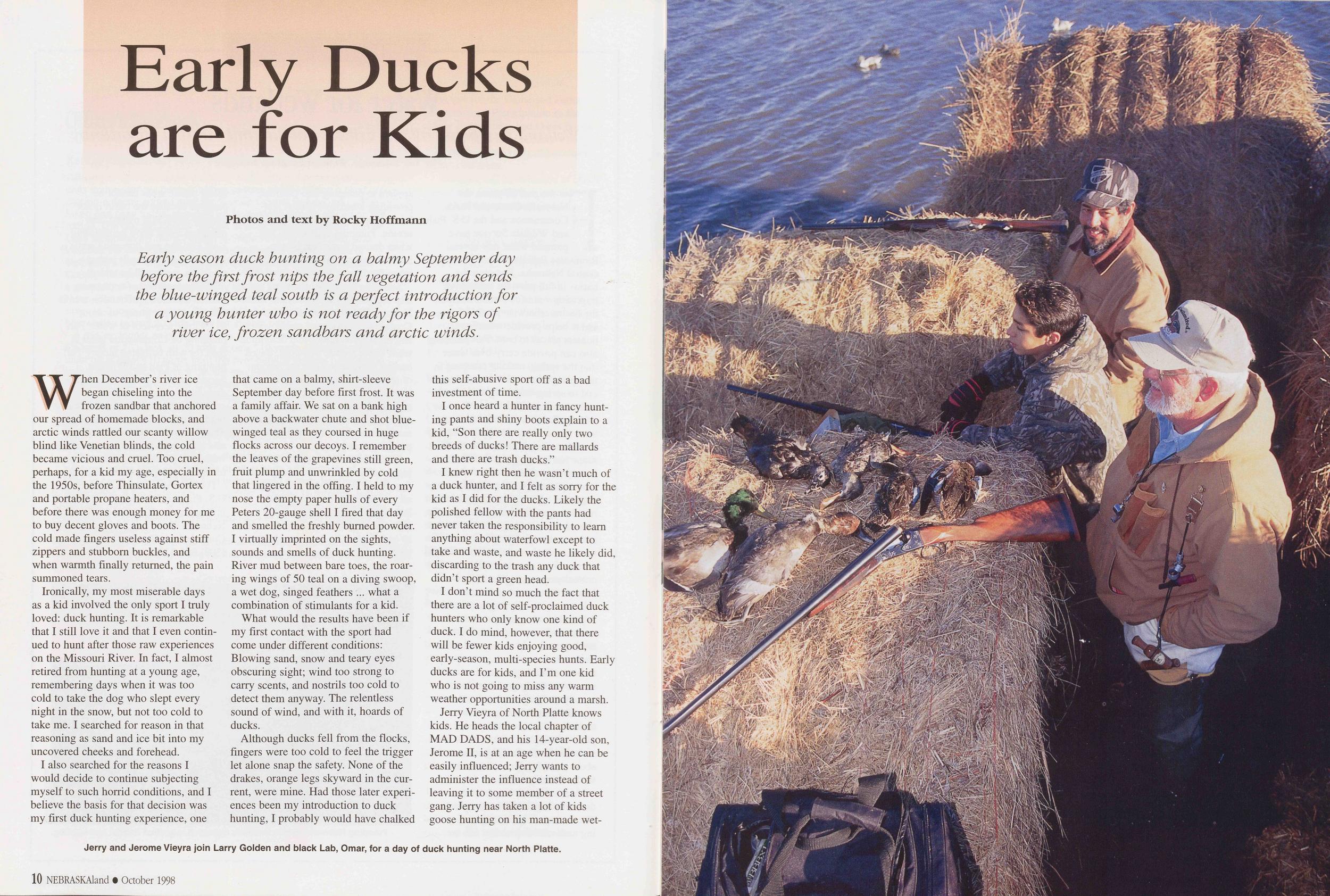
10 NEBRASKAland • October 1998Jerry and Jerome Vieyra join Larry Golden and black Lab, Omar, for a day of duck hunting near North Platte.
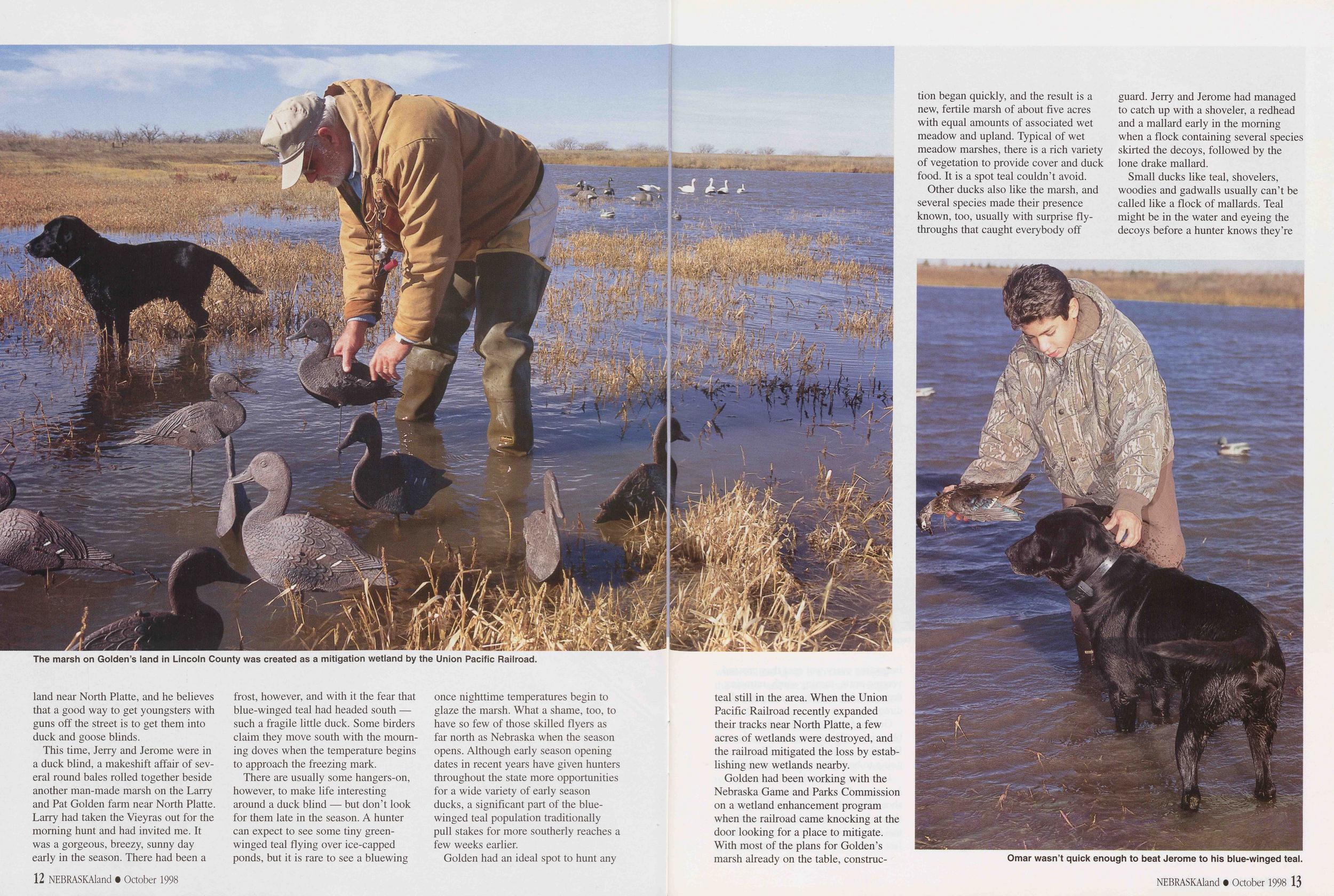
The marsh on Golden's land in Lincoln County was created as a mitigation wetland by the Union Pacific Railroad.
near North Platte, and he believes that a good way to get youngsters with guns off the street is to get them into duck and goose blinds.
This time, Jerry and Jerome were in a duck blind, a makeshift affair of several round bales rolled together beside another man-made marsh on the Larry and Pat Golden farm near North Platte. Larry had taken the Vieyras out for the morning hunt and had invited me. It was a gorgeous, breezy, sunny day early in the season. There had been a frost, however, and with it the fear that blue-winged teal had headed south — such a fragile little duck. Some birders claim they move south with the mourning doves when the temperature begins to approach the freezing mark.
There are usually some hangers-on, however, to make life interesting around a duck blind — but don't look for them late in the season. A hunter can expect to see some tiny green-winged teal flying over ice-capped ponds, but it is rare to see a bluewing once nighttime temperatures begin to glaze the marsh. What a shame, too, to have so few of those skilled flyers as far north as Nebraska when the season opens. Although early season opening dates in recent years have given hunters throughout the state more opportunities for a wide variety of early season ducks, a significant part of the blue-winged teal population traditionally pull stakes for more southerly reaches a few weeks earlier.
Golden had an ideal spot to hunt any
12 NEBRASKAland • October 1998teal still in the area. When the Union Pacific Railroad recently expanded their tracks near North Platte, a few acres of wetlands were destroyed, and the railroad mitigated the loss by establishing new wetlands nearby.
Golden had been working with the Nebraska Game and Parks Commission on a wetland enhancement program when the railroad came knocking at the door looking for a place to mitigate. With most of the plans for Golden's marsh already on the table, construction began quickly, and the result is a new, fertile marsh of about five acres with equal amounts of associated wet meadow and upland. Typical of wet meadow marshes, there is a rich variety of vegetation to provide cover and duck food. It is a spot teal couldn't avoid.
Other ducks also like the marsh, and several species made their presence known, too, usually with surprise fly-throughs that caught everybody off guard. Jerry and Jerome had managed to catch up with a shoveler, a redhead and a mallard early in the morning when a flock containing several species skirted the decoys, followed by the lone drake mallard.
Small ducks like teal, shovelers, woodies and gad walls usually can't be called like a flock of mallards. Teal might be in the water and eyeing the decoys before a hunter knows they're
Omar wasn't quick enough to beat Jerome to his blue-winged teal.
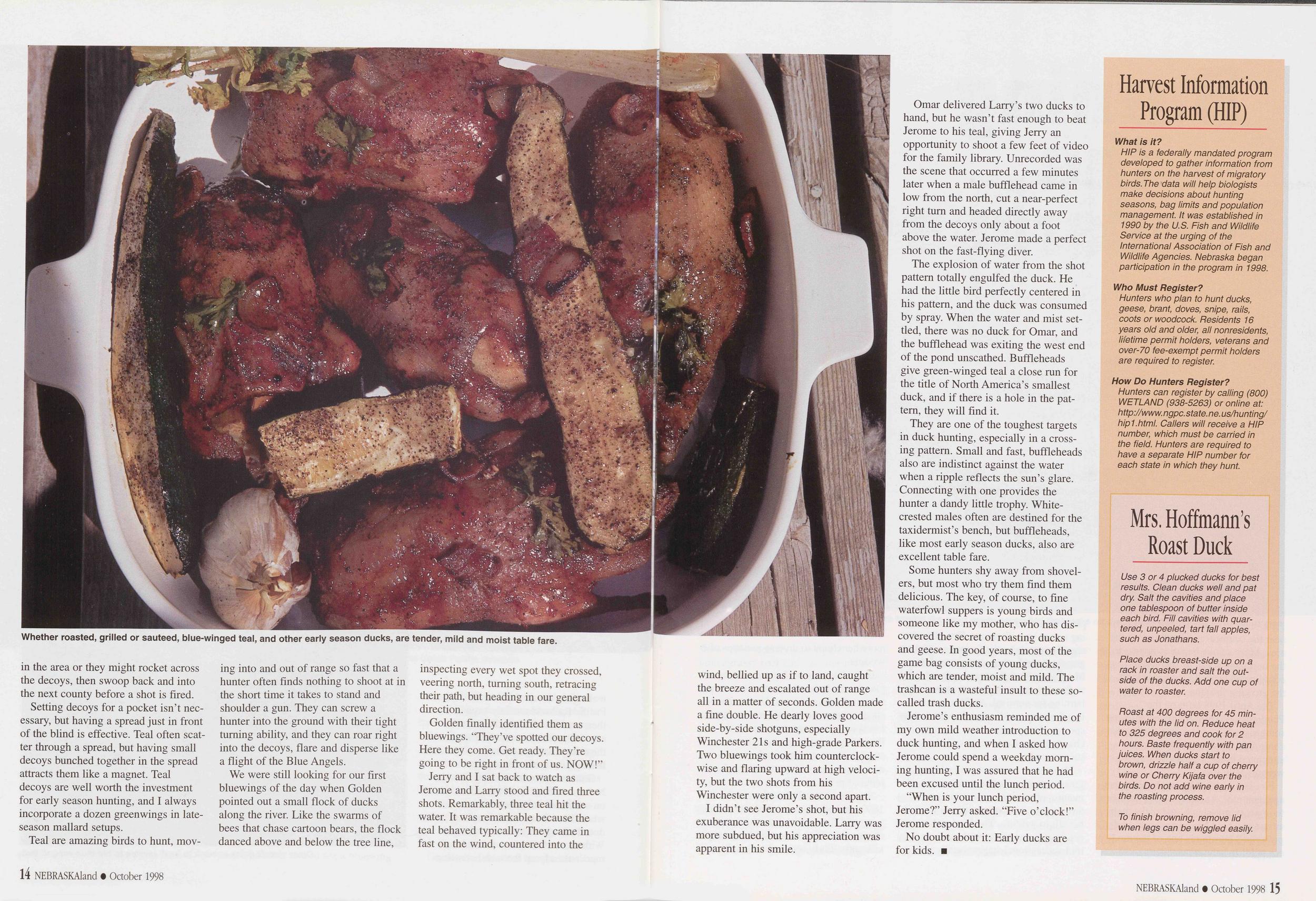
Whether roasted, grilled or sauteed, blue-winged teal, and other early season ducks, are tender, mild and moist table fare.
in the area or they might rocket across the decoys, then swoop back and into the next county before a shot is fired.
Setting decoys for a pocket isn't necessary, but having a spread just in front of the blind is effective. Teal often scatter through a spread, but having small decoys bunched together in the spread attracts them like a magnet. Teal decoys are well worth the investment for early season hunting, and I always incorporate a dozen greenwings in late-season mallard setups.
Teal are amazing birds to hunt, moving into and out of range so fast that a hunter often finds nothing to shoot at in the short time it takes to stand and shoulder a gun. They can screw a hunter into the ground with their tight turning ability, and they can roar right into the decoys, flare and disperse like a flight of the Blue Angels.
We were still looking for our first bluewings of the day when Golden pointed out a small flock of ducks along the river. Like the swarms of bees that chase cartoon bears, the flock danced above and below the tree line, inspecting every wet spot they crossed, veering north, turning south, retracing their path, but heading in our general direction.
Golden finally identified them as bluewings. "They've spotted our decoys. Here they come. Get ready. They're going to be right in front of us. NOW!"
Jerry and I sat back to watch as Jerome and Larry stood and fired three shots. Remarkably, three teal hit the water. It was remarkable because the teal behaved typically: They came in fast on the wind, countered into the
14 NEBRASKAland • October 1998wind, bellied up as if to land, caught the breeze and escalated out of range all in a matter of seconds. Golden made a fine double. He dearly loves good side-by-side shotguns, especially Winchester 21s and high-grade Parkers. Two bluewings took him counterclockwise and flaring upward at high velocity, but the two shots from his Winchester were only a second apart.
I didn't see Jerome's shot, but his exuberance was unavoidable. Larry was more subdued, but his appreciation was apparent in his smile.
Omar delivered Larry's two ducks to hand, but he wasn't fast enough to beat Jerome to his teal, giving Jerry an opportunity to shoot a few feet of video for the family library. Unrecorded was the scene that occurred a few minutes later when a male bufflehead came in low from the north, cut a near-perfect right turn and headed directly away from the decoys only about a foot above the water. Jerome made a perfect shot on the fast-flying diver.
The explosion of water from the shot pattern totally engulfed the duck. He had the little bird perfectly centered in his pattern, and the duck was consumed by spray. When the water and mist settled, there was no duck for Omar, and the bufflehead was exiting the west end of the pond unscathed. Buffleheads give green-winged teal a close run for the title of North America's smallest duck, and if there is a hole in the pattern, they will find it.
They are one of the toughest targets in duck hunting, especially in a crossing pattern. Small and fast, buffleheads also are indistinct against the water when a ripple reflects the sun's glare. Connecting with one provides the hunter a dandy little trophy. White-crested males often are destined for the taxidermist's bench, but buffleheads, like most early season ducks, also are excellent table fare.
Some hunters shy away from shovelers, but most who try them find them delicious. The key, of course, to fine waterfowl suppers is young birds and someone like my mother, who has discovered the secret of roasting ducks and geese. In good years, most of the game bag consists of young ducks, which are tender, moist and mild. The trashcan is a wasteful insult to these so-called trash ducks.
Jerome's enthusiasm reminded me of my own mild weather introduction to duck hunting, and when I asked how Jerome could spend a weekday morning hunting, I was assured that he had been excused until the lunch period.
"When is your lunch period, Jerome?" Jerry asked. "Five o'clock!" Jerome responded.
No doubt about it: Early ducks are for kids.
Harvest Information Program (HIP)
What is it? HIP is a federally mandated program developed to gather information from hunters on the harvest of migratory birds. The data will help biologists make decisions about hunting seasons, bag limits and population management it was established in 1990 by the U.S. Fish and Wildlife Service at the urging of the International Association of Fish and Wildlife Agencies. Nebraska began participation in the program in 1998. Who Must Register? Hunters who plan to hunt ducks, geese, brant, doves, snipe, rails, coots or woodcock. Residents 16 years old and older, all nonresidents, lifetime permit holders, veterans and over-70 fee-exempt permit holders are required to register. How Do Hunters Register? Hunters can register by calling (800) WETLAND (938-5263) or online at: http://www. ngpc. sta te. ne. us/hunting/ hip1.html. Callers will receive a HIP number, which must be carried in the field. Hunters are required to have a separate HIP number for each state in which they hunt.Mrs. Hoffmann's Roast Duck
Use 3 or 4 plucked ducks for best results. Clean ducks well and pat dry. Salt the cavities and place one tablespoon of butter inside each bird. Fill cavities with quartered, unpeeled, tart fall apples, such as Jonathans. Place ducks breast-side up on a rack in roaster and salt the outside of the ducks. Add one cup of water to roaster. Roast at 400 degrees for 45 minutes with the lid on. Reduce heat to 325 degrees and cook for 2 hours. Baste frequently with pan juices. When ducks start to brown, drizzle half a cup of cherry wine or Cherry Kijafa over the birds. Do not add wine early in the roasting process. To finish browning, remove lid when legs can be wiggled easily. NEBRASKAland • October 1998 15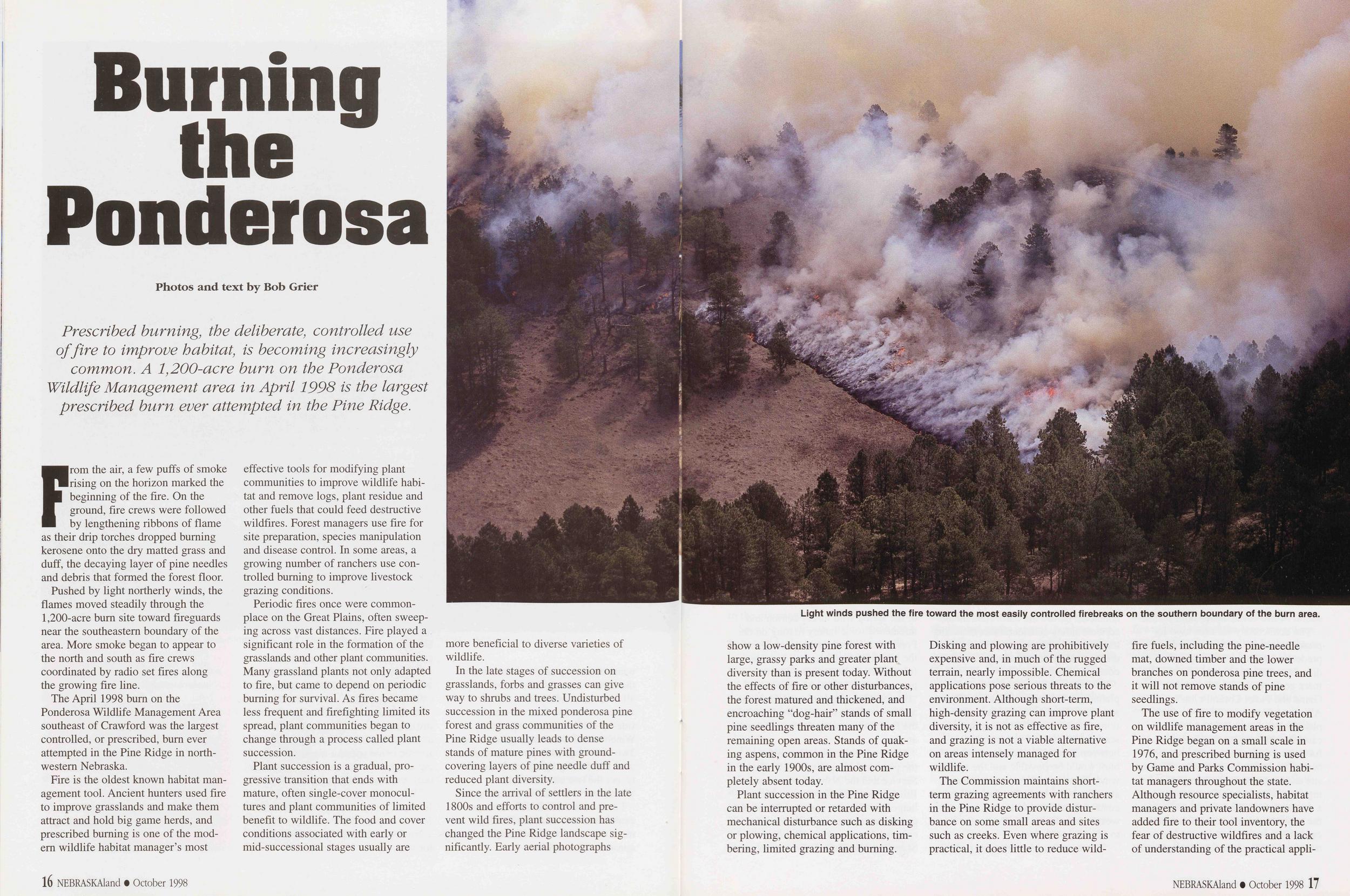
Burning ThePonderosa
Photos and text by Bob Grier Prescribed burning, the deliberate, controlled use of fire to improve habitat, is becoming increasingly common. A 1,200-acre burn on the Ponderosa Wildlife Management area in April 1998 is the largest prescribed burn ever attempted in the Pine Ridge.From the air, a few puffs of smoke rising on the horizon marked the beginning of the fire. On the ground, fire crews were followed by lengthening ribbons of flame as their drip torches dropped burning kerosene onto the dry matted grass and duff, the decaying layer of pine needles and debris that formed the forest floor.
Pushed by light northerly winds, the flames moved steadily through the 1,200-acre burn site toward fireguards near the southeastern boundary of the area. More smoke began to appear to the north and south as fire crews coordinated by radio set fires along the growing fire line.
The April 1998 burn on the Ponderosa Wildlife Management Area southeast of Crawford was the largest controlled, or prescribed, burn ever attempted in the Pine Ridge in northwestern Nebraska.
Fire is the oldest known habitat management tool. Ancient hunters used fire to improve grasslands and make them attract and hold big game herds, and prescribed burning is one of the modern wildlife habitat manager's most effective tools for modifying plant communities to improve wildlife habitat and remove logs, plant residue and other fuels that could feed destructive wildfires. Forest managers use fire for site preparation, species manipulation and disease control. In some areas, a growing number of ranchers use controlled burning to improve livestock grazing conditions.
Periodic fires once were common-place on the Great Plains, often sweeping across vast distances. Fire played a significant role in the formation of the grasslands and other plant communities. Many grassland plants not only adapted to fire, but came to depend on periodic burning for survival. As fires became less frequent and firefighting limited its spread, plant communities began to change through a process called plant succession.
Plant succession is a gradual, progressive transition that ends with mature, often single-cover monocultures and plant communities of limited benefit to wildlife. The food and cover conditions associated with early or mid-successional stages usually are
Light winds pushed the fire toward the most easily controlled firebreaks on the southern boundary of the burn area.
more beneficial to diverse varieties of wildlife.
In the late stages of succession on grasslands, forbs and grasses can give way to shrubs and trees. Undisturbed succession in the mixed ponderosa pine forest and grass communities of the Pine Ridge usually leads to dense stands of mature pines with ground-covering layers of pine needle duff and reduced plant diversity.
Since the arrival of settlers in the late 1800s and efforts to control and prevent wild fires, plant succession has changed the Pine Ridge landscape significantly. Early aerial photographs
16 NEBRASKAland • October 1998show a low-density pine forest with large, grassy parks and greater plant diversity than is present today. Without the effects of fire or other disturbances, the forest matured and thickened, and encroaching "dog-hair" stands of small pine seedlings threaten many of the remaining open areas. Stands of quaking aspens, common in the Pine Ridge in the early 1900s, are almost completely absent today.
Plant succession in the Pine Ridge can be interrupted or retarded with mechanical disturbance such as disking or plowing, chemical applications, timbering, limited grazing and burning. Disking and plowing are prohibitively expensive and, in much of the rugged terrain, nearly impossible. Chemical applications pose serious threats to the environment. Although short-term, high-density grazing can improve plant diversity, it is not as effective as fire, and grazing is not a viable alternative on areas intensely managed for wildlife.
The Commission maintains short-term grazing agreements with ranchers in the Pine Ridge to provide disturbance on some small areas and sites such as creeks. Even where grazing is practical, it does little to reduce wildfire fuels, including the pine-needle mat, downed timber and the lower branches on ponderosa pine trees, and it will not remove stands of pine seedlings.
The use of fire to modify vegetation on wildlife management areas in the Pine Ridge began on a small scale in 1976, and prescribed burning is used by Game and Parks Commission habitat managers throughout the state. Although resource specialists, habitat managers and private landowners have added fire to their tool inventory, the fear of destructive wildfires and a lack of understanding of the practical application
NEBRASKAland • October 1998 17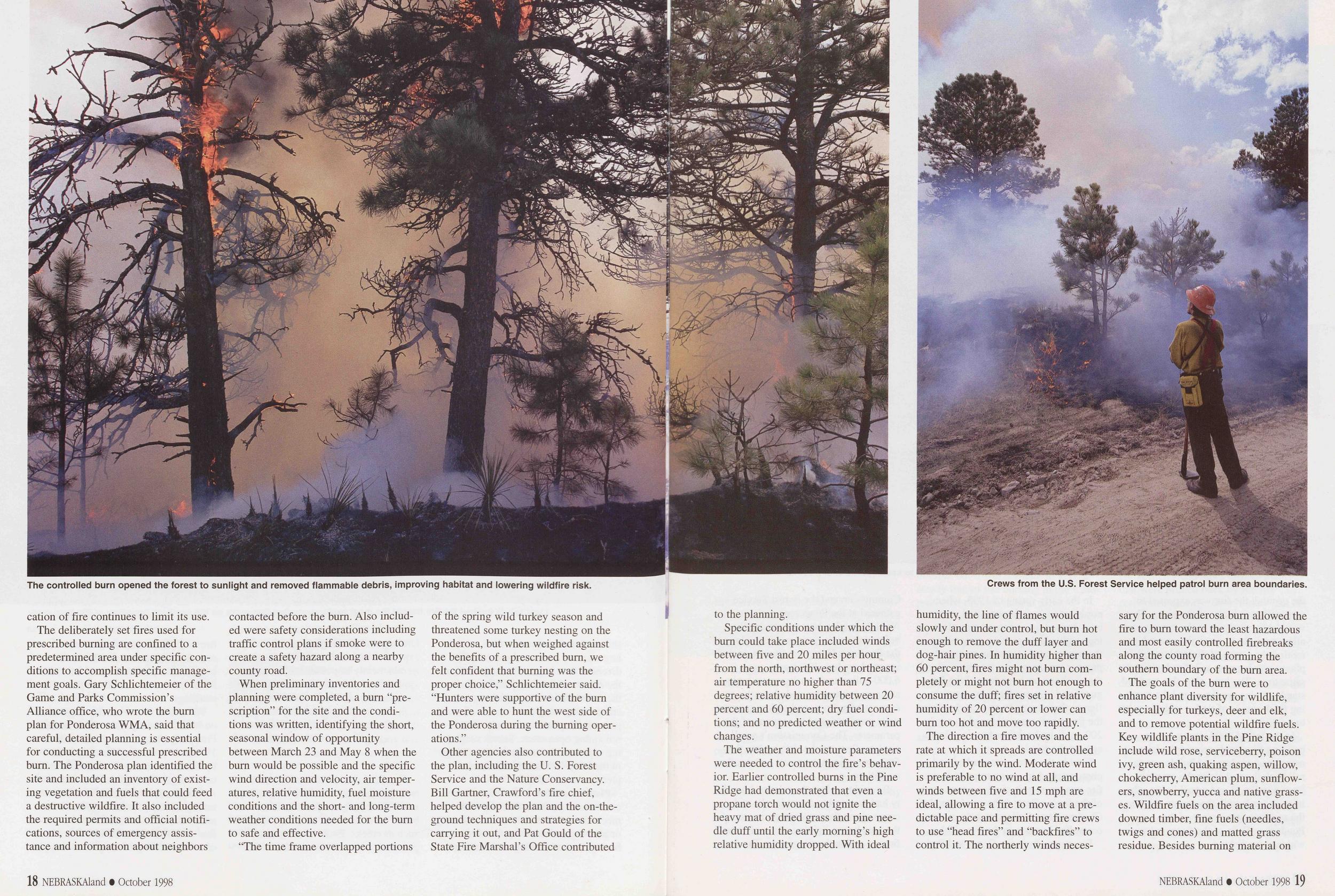
The controlled burn opened the forest to sunlight and removed flammable debris, improving habitat and lowering wildfire risk.
of fire continues to limit its use.
The deliberately set fires used for prescribed burning are confined to a predetermined area under specific conditions to accomplish specific management goals. Gary Schlichtemeier of the Game and Parks Commission's Alliance office, who wrote the bum plan for Ponderosa WMA, said that careful, detailed planning is essential for conducting a successful prescribed bum. The Ponderosa plan identified the site and included an inventory of existing vegetation and fuels that could feed a destructive wildfire. It also included the required permits and official notifications, sources of emergency assistance and information about neighbors contacted before the bum. Also included were safety considerations including traffic control plans if smoke were to create a safety hazard along a nearby county road.
When preliminary inventories and planning were completed, a bum "prescription" for the site and the conditions was written, identifying the short, seasonal window of opportunity between March 23 and May 8 when the bum would be possible and the specific wind direction and velocity, air temperatures, relative humidity, fuel moisture conditions and the short- and long-term weather conditions needed for the burn to safe and effective.
"The time frame overlapped portions of the spring wild turkey season and threatened some turkey nesting on the Ponderosa, but when weighed against the benefits of a prescribed bum, we felt confident that burning was the proper choice," Schlichtemeier said. "Hunters were supportive of the bum and were able to hunt the west side of the Ponderosa during the burning operations."
Other agencies also contributed to the plan, including the U. S. Forest Service and the Nature Conservancy. Bill Gartner, Crawford's fire chief, helped develop the plan and the on-the- ground techniques and strategies for carrying it out, and Pat Gould of the State Fire Marshal's Office contributed
18 NEBRASKAland • October 1998Crews from the U.S. Forest Service helped patrol burn area boundaries.
to the planning.
Specific conditions under which the bum could take place included winds between five and 20 miles per hour from the north, northwest or northeast; air temperature no higher than 75 degrees; relative humidity between 20 percent and 60 percent; dry fuel conditions; and no predicted weather or wind changes.
The weather and moisture parameters were needed to control the fire's behavior. Earlier controlled bums in the Pine Ridge had demonstrated that even a propane torch would not ignite the heavy mat of dried grass and pine needle duff until the early morning's high relative humidity dropped. With ideal humidity, the line of flames would slowly and under control, but bum hot enough to remove the duff layer and dog-hair pines. In humidity higher than 60 percent, fires might not burn completely or might not bum hot enough to consume the duff; fires set in relative humidity of 20 percent or lower can bum too hot and move too rapidly.
The direction a fire moves and the rate at which it spreads are controlled primarily by the wind. Moderate wind is preferable to no wind at all, and winds between five and 15 mph are ideal, allowing a fire to move at a predictable pace and permitting fire crews to use "head fires" and "backfires" to control it. The northerly winds necessary for the Ponderosa bum allowed the fire to bum toward the least hazardous and most easily controlled firebreaks along the county road forming the southern boundary of the bum area.
The goals of the bum were to enhance plant diversity for wildlife, especially for turkeys, deer and elk, and to remove potential wildfire fuels. Key wildlife plants in the Pine Ridge include wild rose, serviceberry, poison ivy, green ash, quaking aspen, willow, chokecherry, American plum, sunflowers, snowberry, yucca and native grasses. Wildfire fuels on the area included downed timber, fine fuels (needles, twigs and cones) and matted grass residue. Besides burning material on
NEBRASKAland • October 1998 19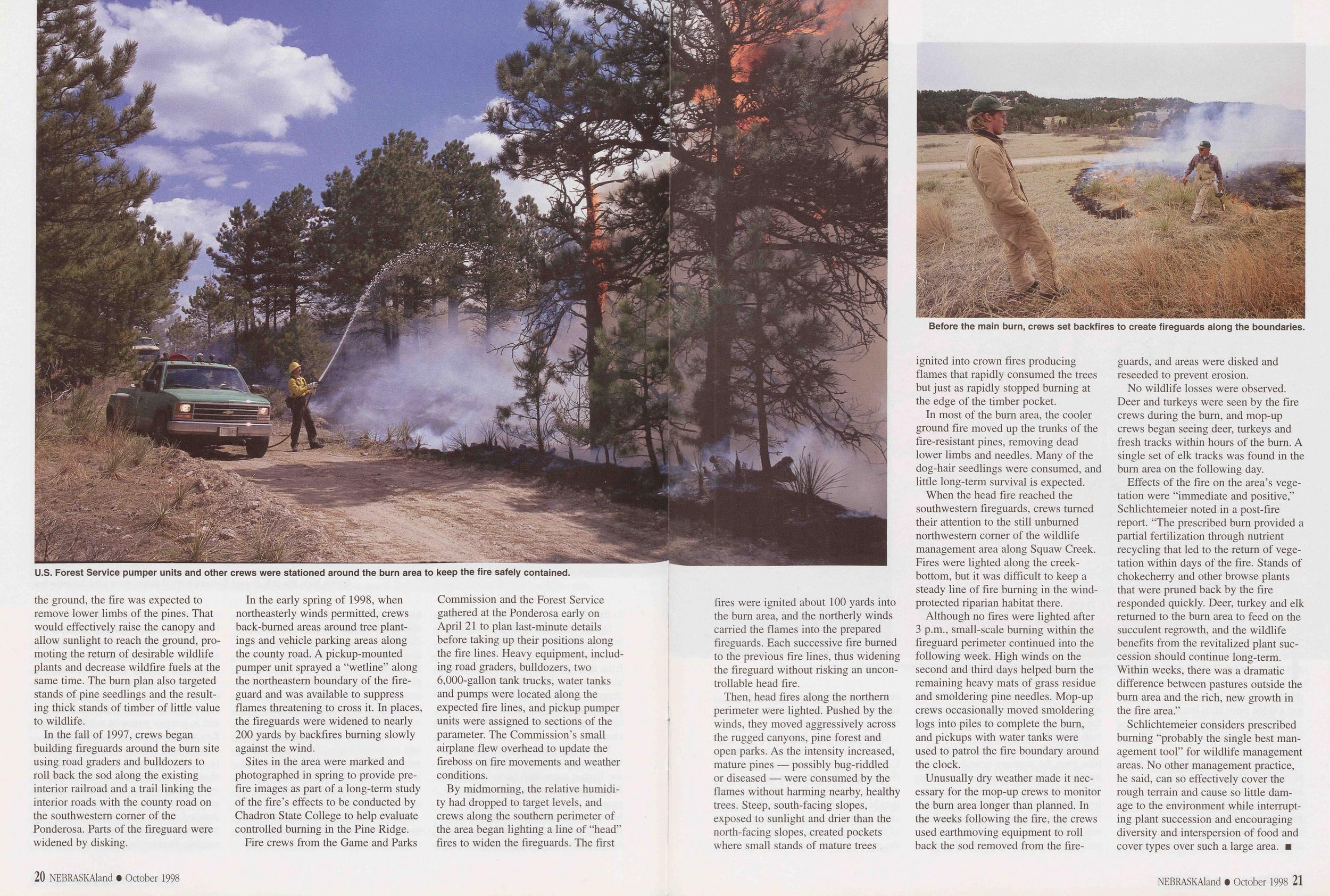
U.S. Forest Service pumper units and other crews were stationed around the burn area to keep the fire safely contained.
the ground, the fire was expected to remove lower limbs of the pines. That would effectively raise the canopy and allow sunlight to reach the ground, promoting the return of desirable wildlife plants and decrease wildfire fuels at the same time. The burn plan also targeted stands of pine seedlings and the resulting thick stands of timber of little value to wildlife.
In the fall of 1997, crews began building fireguards around the burn site using road graders and bulldozers to roll back the sod along the existing interior railroad and a trail linking the interior roads with the county road on the southwestern corner of the Ponderosa. Parts of the fireguard were widened by disking.
In the early spring of 1998, when northeasterly winds permitted, crews back-burned areas around tree plantings and vehicle parking areas along the county road. A pickup-mounted pumper unit sprayed a "wetline" along the northeastern boundary of the fireguard and was available to suppress flames threatening to cross it. In places, the fireguards were widened to nearly 200 yards by backfires burning slowly against the wind.
Sites in the area were marked and photographed in spring to provide pre-fire images as part of a long-term study of the fire's effects to be conducted by Chadron State College to help evaluate controlled burning in the Pine Ridge.
Fire crews from the Game and Parks Commission and the Forest Service gathered at the Ponderosa early on April 21 to plan last-minute details before taking up their positions along the fire lines. Heavy equipment, including road graders, bulldozers, two 6,000-gallon tank trucks, water tanks and pumps were located along the expected fire lines, and pickup pumper units were assigned to sections of the parameter. The Commission's small airplane flew overhead to update the fireboss on fire movements and weather conditions.
By midmorning, the relative humidity had dropped to target levels, and crews along the southern perimeter of the area began lighting a line of "head" fires to widen the fireguards. The first
20 NEBRASKAland • October 1998Before the main burn, crews set backfires to create fireguards along the boundaries.
fires were ignited about 100 yards into the burn area, and the northerly winds carried the flames into the prepared fireguards. Each successive fire burned to the previous fire lines, thus widening the fireguard without risking an uncontrollable head fire.
Then, head fires along the northern perimeter were lighted. Pushed by the winds, they moved aggressively across the rugged canyons, pine forest and open parks. As the intensity increased, mature pines — possibly bug-riddled or diseased — were consumed by the flames without harming nearby, healthy trees. Steep, south-facing slopes, exposed to sunlight and drier than the north-facing slopes, created pockets where small stands of mature trees ignited into crown fires producing flames that rapidly consumed the trees but just as rapidly stopped burning at the edge of the timber pocket.
In most of the burn area, the cooler ground fire moved up the trunks of the fire-resistant pines, removing dead lower limbs and needles. Many of the dog-hair seedlings were consumed, and little long-term survival is expected.
When the head fire reached the southwestern fireguards, crews turned their attention to the still unburned northwestern corner of the wildlife management area along Squaw Creek. Fires were lighted along the creek-bottom, but it was difficult to keep a steady line of fire burning in the wind-protected riparian habitat there.
Although no fires were lighted after 3 p.m., small-scale burning within the fireguard perimeter continued into the following week. High winds on the second and third days helped burn the remaining heavy mats of grass residue and smoldering pine needles. Mop-up crews occasionally moved smoldering logs into piles to complete the burn, and pickups with water tanks were used to patrol the fire boundary around the clock.
Unusually dry weather made it necessary for the mop-up crews to monitor the burn area longer than planned. In the weeks following the fire, the crews used earthmoving equipment to roll back the sod removed from the fireguards, and areas were disked and reseeded to prevent erosion.
No wildlife losses were observed. Deer and turkeys were seen by the fire crews during the burn, and mop-up crews began seeing deer, turkeys and fresh tracks within hours of the burn. A single set of elk tracks was found in the burn area on the following day.
Effects of the fire on the area's vegetation were "immediate and positive," Schlichtemeier noted in a post-fire report. "The prescribed burn provided a partial fertilization through nutrient recycling that led to the return of vegetation within days of the fire. Stands of chokecherry and other browse plants that were pruned back by the fire responded quickly. Deer, turkey and elk returned to the burn area to feed on the succulent regrowth, and the wildlife benefits from the revitalized plant succession should continue long-term. Within weeks, there was a dramatic difference between pastures outside the burn area and the rich, new growth in the fire area."
Schlichtemeier considers prescribed burning "probably the single best management tool" for wildlife management areas. No other management practice, he said, can so effectively cover the rough terrain and cause so little damage to the environment while interrupting plant succession and encouraging diversity and interspersion of food and cover types over such a large area.
NEBRASKAland • October 1998 21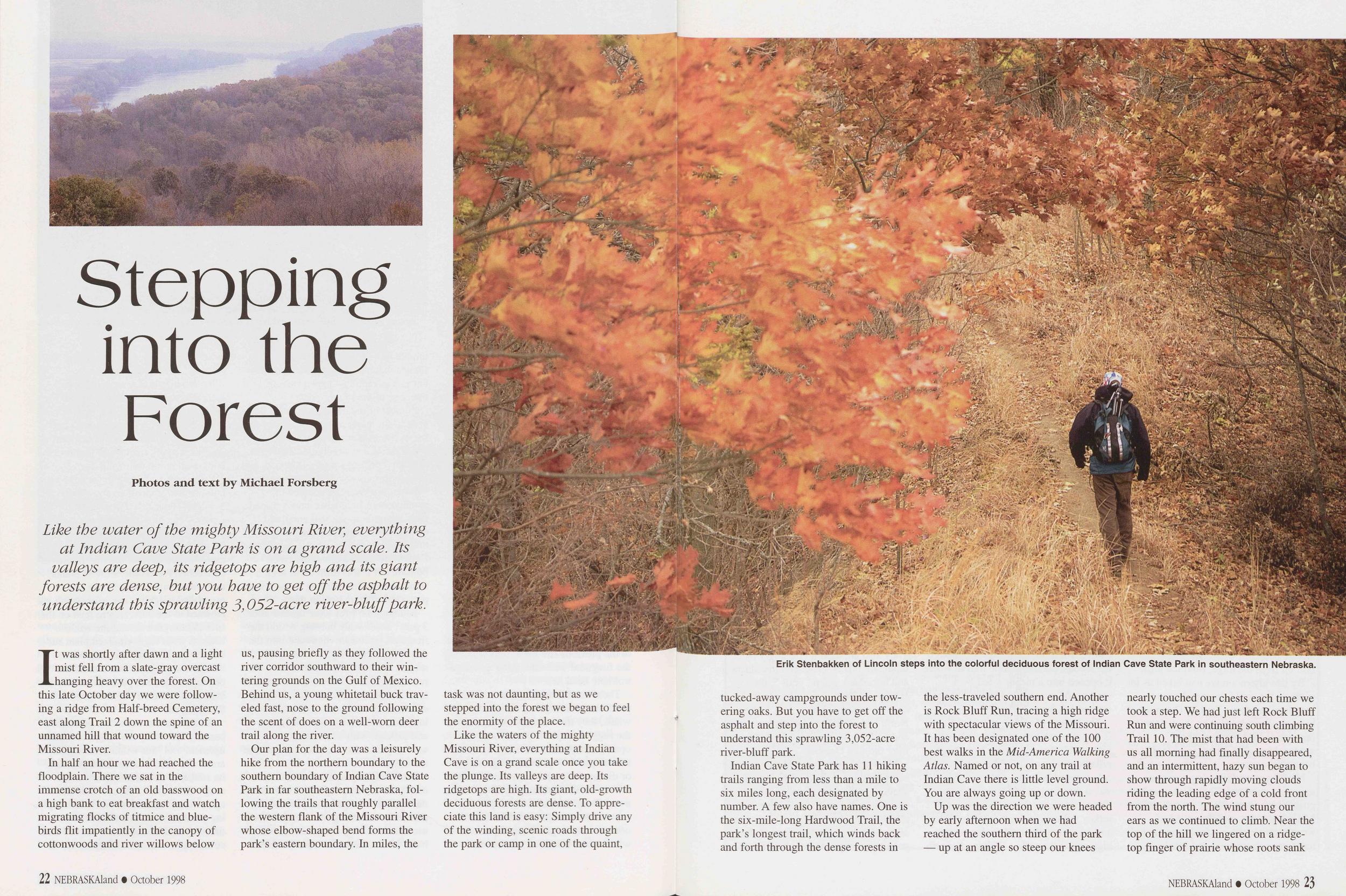
Stepping into the Forest
Photos and text by Michael Forsberg Like the water of the mighty Missouri River, everything at Indian Cave State Park is on a grand scale. Its valleys are deep, its ridgetops are high and its giant forests are dense, but you have to get off the asphalt to understand this sprawling 3,052-acre river-bluff park.It was shortly after dawn and a light mist fell from a slate-gray overcast hanging heavy over the forest. On this late October day we were following a ridge from Half-breed Cemetery, east along Trail 2 down the spine of an unnamed hill that wound toward the Missouri River.
In half an hour we had reached the floodplain. There we sat in the immense crotch of an old basswood on a high bank to eat breakfast and watch migrating flocks of titmice and bluebirds flit impatiently in the canopy of cottonwoods and river willows below us, pausing briefly as they followed the river corridor southward to their wintering grounds on the Gulf of Mexico. Behind us, a young whitetail buck traveled fast, nose to the ground following the scent of does on a well-worn deer trail along the river.
Our plan for the day was a leisurely hike from the northern boundary to the southern boundary of Indian Cave State Park in far southeastern Nebraska, following the trails that roughly parallel the western flank of the Missouri River whose elbow-shaped bend forms the park's eastern boundary. In miles, the
Erik Stenbakken of Lincoln steps into the colorful deciduous forest of Indian Cave State Park in southeastern Nebraska.
task was not daunting, but as we stepped into the forest we began to feel the enormity of the place.
Like the waters of the mighty Missouri River, everything at Indian Cave is on a grand scale once you take the plunge. Its valleys are deep. Its ridgetops are high. Its giant, old-growth deciduous forests are dense. To appreciate this land is easy: Simply drive any of the winding, scenic roads through the park or camp in one of the quaint,
22 NEBRASKAland • October 1998tucked-away campgrounds under towering oaks. But you have to get off the asphalt and step into the forest to understand this sprawling 3,052-acre river-bluff park.
Indian Cave State Park has 11 hiking trails ranging from less than a mile to six miles long, each designated by number. A few also have names. One is the six-mile-long Hardwood Trail, the park's longest trail, which winds back and forth through the dense forests in the less-traveled southern end. Another is Rock Bluff Run, tracing a high ridge with spectacular views of the Missouri. It has been designated one of the 100 best walks in the Mid-America Walking Atlas. Named or not, on any trail at Indian Cave there is little level ground. You are always going up or down.
Up was the direction we were headed by early afternoon when we had reached the southern third of the park — up at an angle so steep our knees nearly touched our chests each time we took a step. We had just left Rock Bluff Run and were continuing south climbing Trail 10. The mist that had been with us all morning had finally disappeared, and an intermittent, hazy sun began to show through rapidly moving clouds riding the leading edge of a cold front from the north. The wind stung our ears as we continued to climb. Near the top of the hill we lingered on a ridgetop finger of prairie whose roots sank
NEBRASKAland • October 1998 23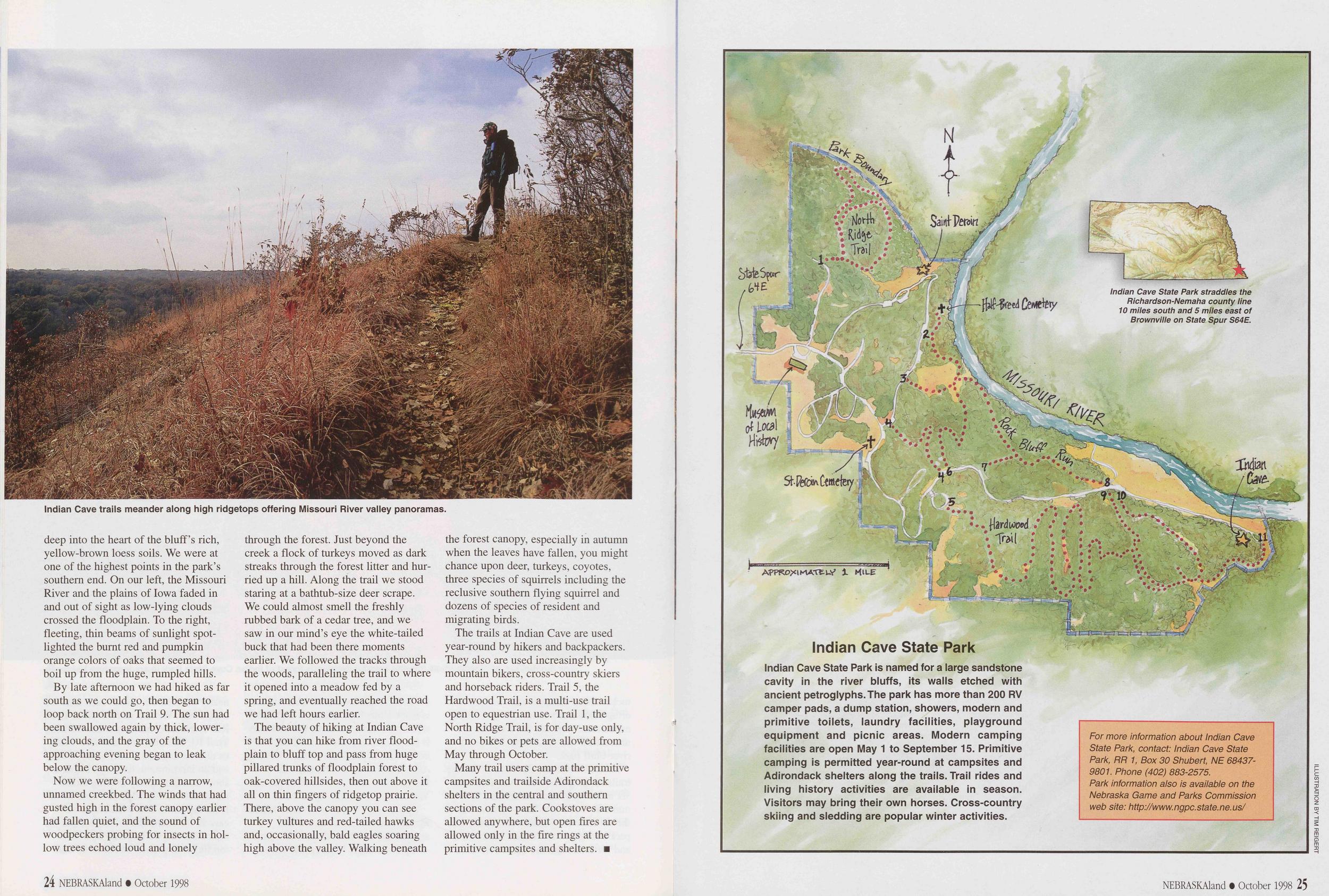
Indian Cave trails meander along high ridgetops offering Missouri River valley panoramas.
deep into the heart of the bluff's rich, yellow-brown loess soils. We were at one of the highest points in the park's southern end. On our left, the Missouri River and the plains of Iowa faded in and out of sight as low-lying clouds crossed the floodplain. To the right, fleeting, thin beams of sunlight spot-lighted the burnt red and pumpkin orange colors of oaks that seemed to boil up from the huge, rumpled hills.
By late afternoon we had hiked as far south as we could go, then began to loop back north on Trail 9. The sun had been swallowed again by thick, lowering clouds, and the gray of the approaching evening began to leak below the canopy.
Now we were following a narrow, unnamed creekbed. The winds that had gusted high in the forest canopy earlier had fallen quiet, and the sound of woodpeckers probing for insects in hollow trees echoed loud and lonely through the forest. Just beyond the creek a flock of turkeys moved as dark streaks through the forest litter and hurried up a hill. Along the trail we stood staring at a bathtub-size deer scrape. We could almost smell the freshly rubbed bark of a cedar tree, and we saw in our mind's eye the white-tailed buck that had been there moments earlier. We followed the tracks through the woods, paralleling the trail to where it opened into a meadow fed by a spring, and eventually reached the road we had left hours earlier.
The beauty of hiking at Indian Cave is that you can hike from river flood-plain to bluff top and pass from huge pillared trunks of floodplain forest to oak-covered hillsides, then out above it all on thin fingers of ridgetop prairie. There, above the canopy you can see turkey vultures and red-tailed hawks and, occasionally, bald eagles soaring high above the valley. Walking beneath the forest canopy, especially in autumn when the leaves have fallen, you might chance upon deer, turkeys, coyotes, three species of squirrels including the reclusive southern flying squirrel and dozens of species of resident and migrating birds.
The trails at Indian Cave are used year-round by hikers and backpackers. They also are used increasingly by mountain bikers, cross-country skiers and horseback riders. Trail 5, the Hardwood Trail, is a multi-use trail open to equestrian use. Trail 1, the North Ridge Trail, is for day-use only, and no bikes or pets are allowed from May through October.
Many trail users camp at the primitive campsites and trailside Adirondack shelters in the central and southern sections of the park. Cookstoves are allowed anywhere, but open fires are allowed only in the fire rings at the primitive campsites and shelters.
24 NEBRASKAland • October 1998Indian Cave State Park straddles the Richardson-Nemaha county line 10 miles south and 5 miles east of Brownville on State Spur S64E.
Indian Cave State Park Indian Cave State Park is named for a large sandstone cavity in the river bluffs, its walls etched with ancient petroglyphs.The park has more than 200 RV camper pads, a dump station, showers, modern and primitive toilets, laundry facilities, playground equipment and picnic areas. Modern camping facilities are open May 1 to September 15. Primitive camping is permitted year-round at campsites and Adirondack shelters along the trails. Trail rides and living history activities are available in season. Visitors may bring their own horses. Cross-country skiing and sledding are popular winter activities.
October Rewards
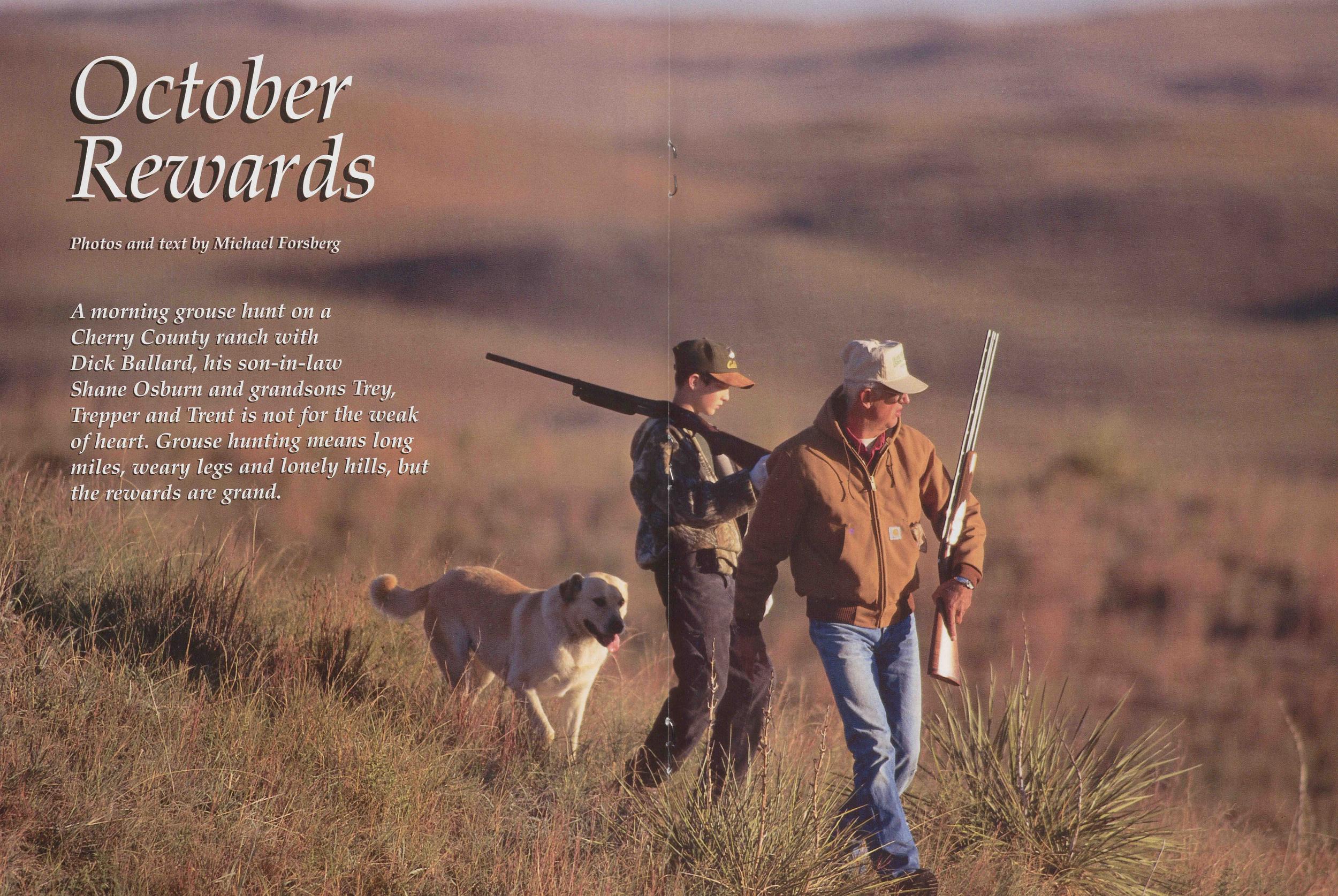
Photos and text by Michael Forsberg A morning grouse hunt on a Cherry County ranch with Dick Ballard, his son-in-law Shane Osborne and grandsons Trey, Trepper and Trent is not for the weak Of heart. Grouse hunting means long miles, weary legs and lonely hills, but The rewards are grand.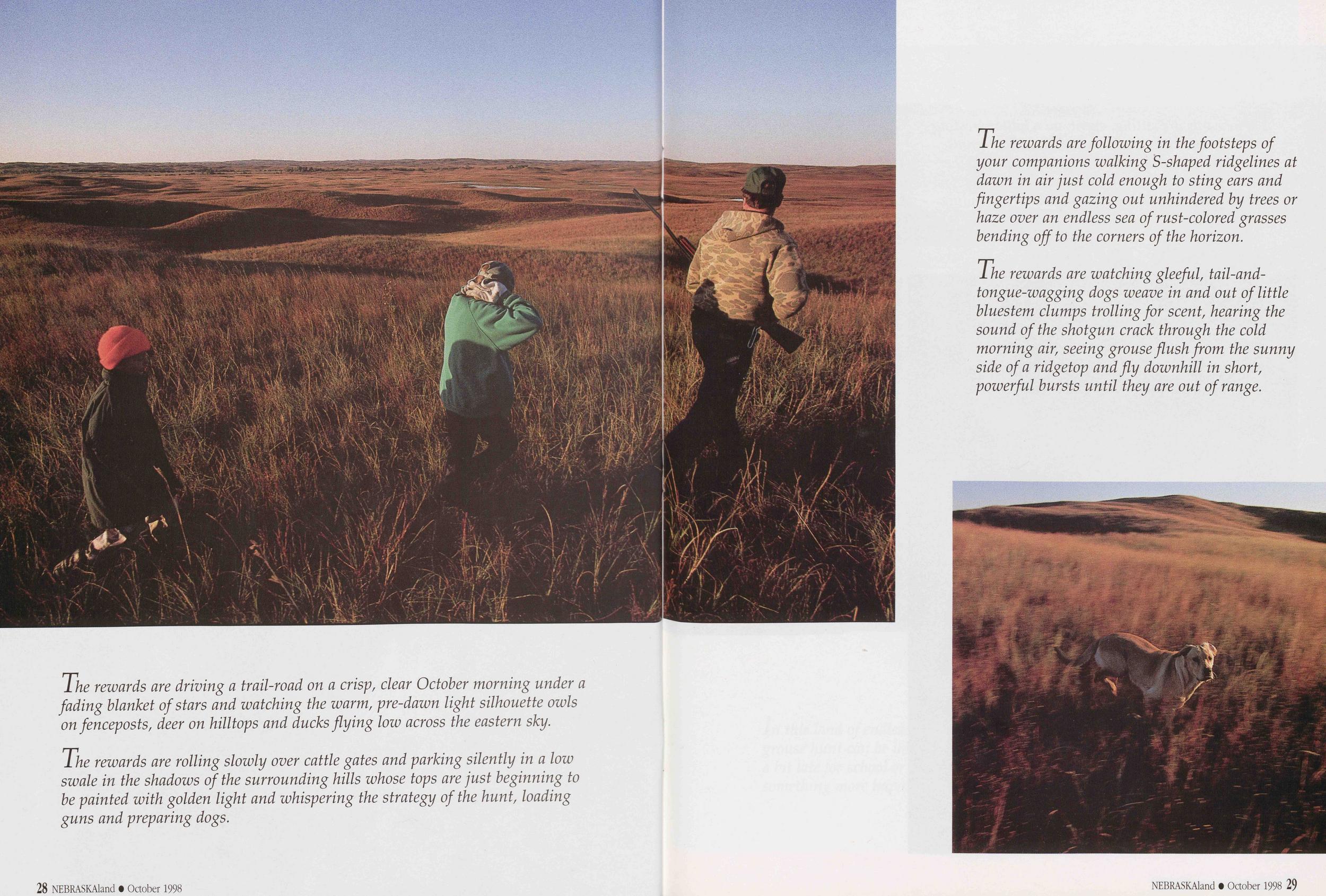
The rewards are driving a trail-road on a crisp, clear October morning under a fading blanket of stars and watching the warm, pre-dawn light silhouette owls on fenceposts, deer on hilltops and ducks flying low across the eastern sky.
The rewards are rolling slowly over cattle gates and parking silently in a low swale in the shadows of the surrounding hills whose tops are just beginning to be painted with golden light and whispering the strategy of the hunt, loading guns and preparing dogs.
28 NEBRASKAland • October 1998The rewards are following in the footsteps of your companions walking S-shaped ridgelines at dawn in air just cold enough to sting ears and fingertips and gazing out unhindered by trees or haze over an endless sea of rust-colored grasses bending off to the corners of the horizon.
The rewards are watching gleeful, tail-and-tongue-wagging dogs weave in and out of little bluestem clumps trolling for scent, hearing the sound of the shotgun crack through the cold morning air, seeing grouse flush from the sunny side of a ridgetop and fly downhill in short, powerful bursts until they are out of range.
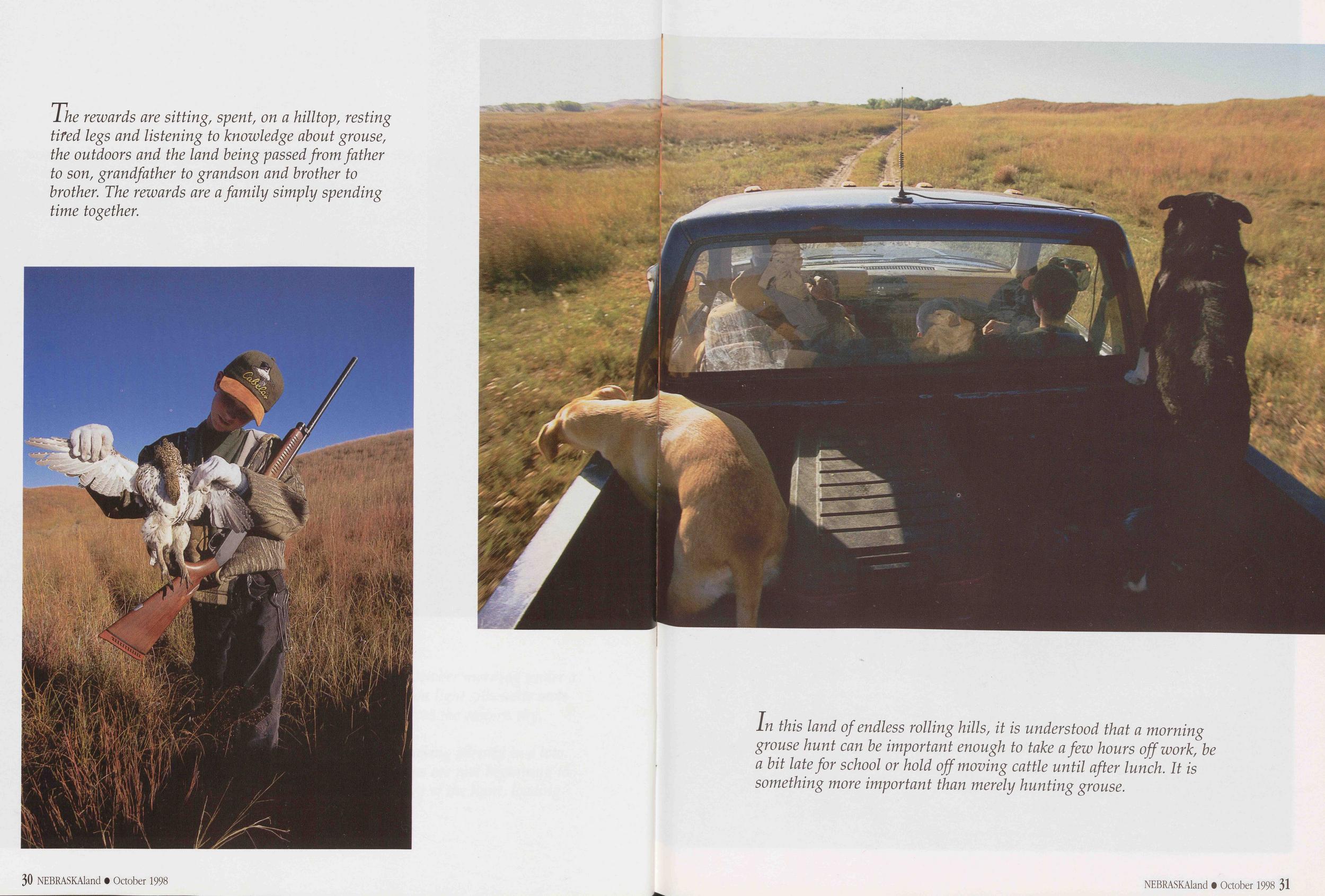
The rewards are sitting, spent, on a hilltop, resting tired legs and listening to knowledge about grouse, the outdoors and the land being passed from father to son, grandfather to grandson and brother to brother. The rewards are a family simply spending time together.
In this land of endless rolling hills, it is understood that a morning grouse hunt can be important enough to take a few hours off work, be a bit late for school or hold off moving cattle until after lunch. It is something more important than merely hunting grouse.
NEBRASKAland • October 1998 31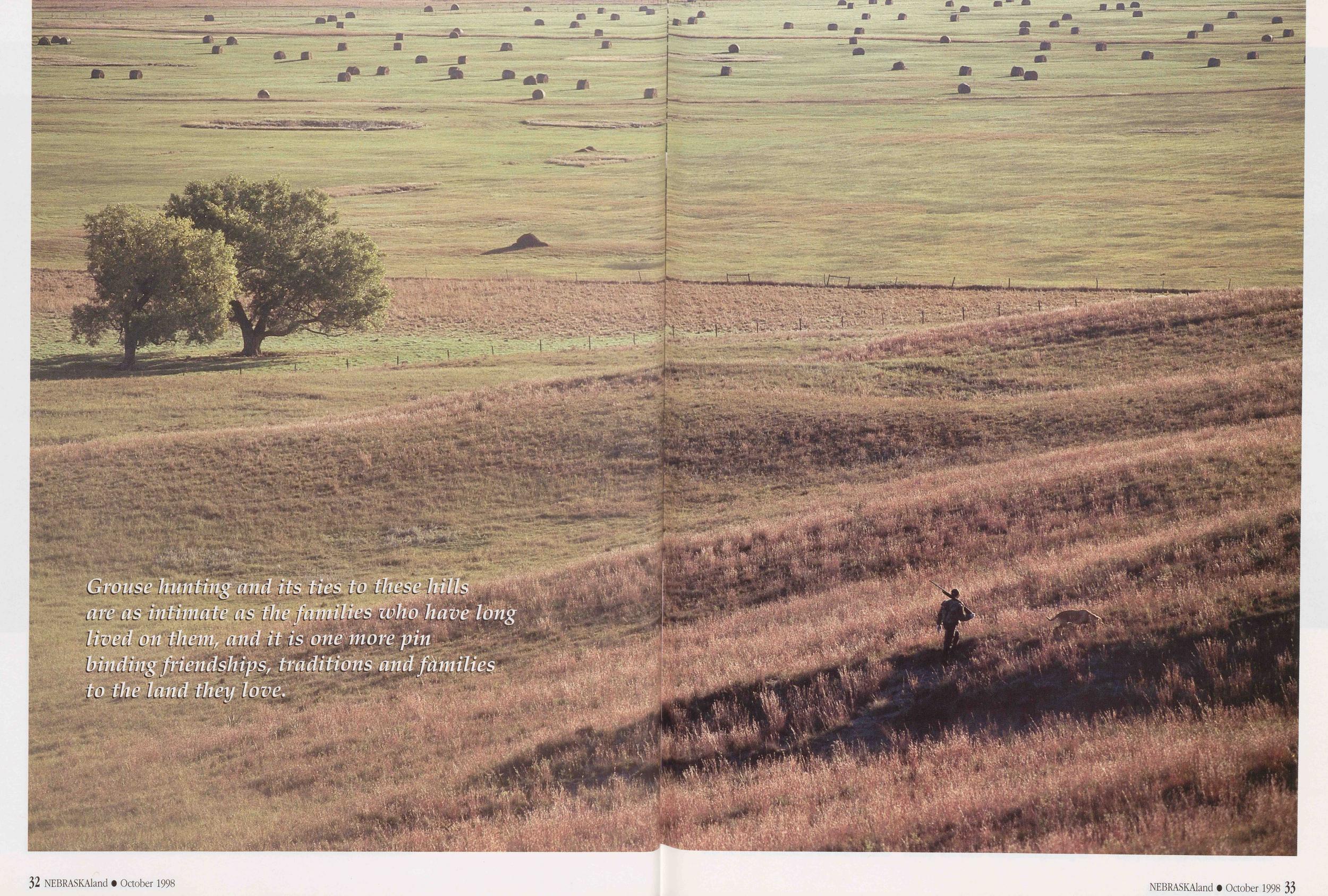
Grouse hunting and its ties to these hills are as intimate as the families who have long lived on them, and it is one more pin binding friendships, traditions, and families to the land they love.
32 NEBRASKAland • October 1998 NEBRASKAland • October 1998 33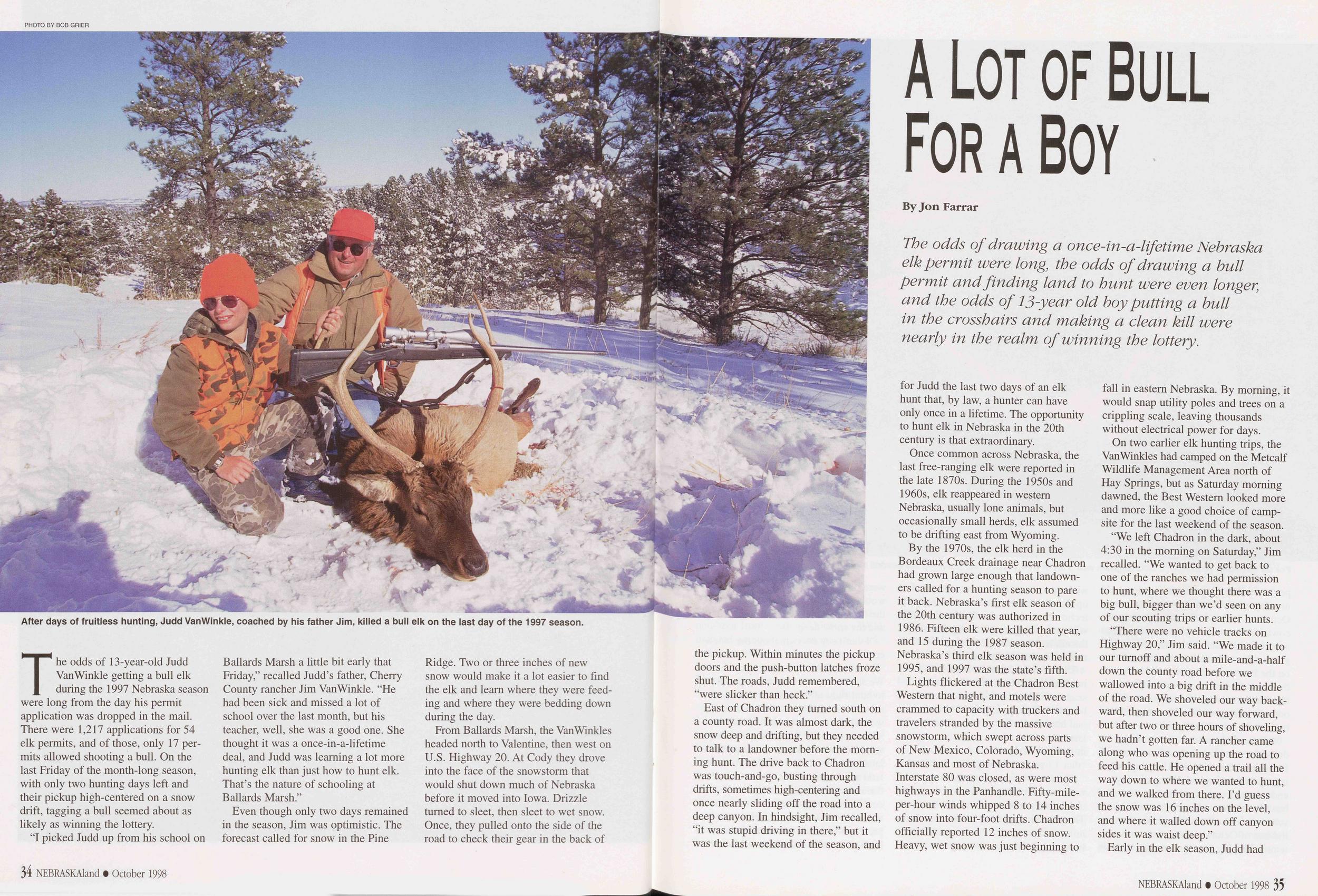
A Lot of Bull For a Boy
By Jon Farrar The odds of drawing a once-in-a-lifetime Nebraska elk permit were long, the odds of drawing a bull permit and finding land to hunt were even longer, and the odds of 13-year old boy putting a bull in the crosshairs and making a clean kill were nearly in the realm of winning the lottery. PHOTO BY BOB GRIERAfter days of fruitless hunting, Judd VanWinkle, coached by his father Jim, killed a bull elk on the last day of the 1997 season.
The odds of 13-year-old Judd VanWinkle getting a bull elk during the 1997 Nebraska season were long from the day his permit application was dropped in the mail. There were 1,217 applications for 54 elk permits, and of those, only 17 permits allowed shooting a bull. On the last Friday of the month-long season, with only two hunting days left and their pickup high-centered on a snow drift, tagging a bull seemed about as likely as winning the lottery.
"I picked Judd up from his school on Ballards Marsh a little bit early that Friday," recalled Judd's father, Cherry County rancher Jim VanWinkle. "He had been sick and missed a lot of school over the last month, but his teacher, well, she was a good one. She thought it was a once-in-a-lifetime deal, and Judd was learning a lot more hunting elk than just how to hunt elk. That's the nature of schooling at Ballards Marsh."
Even though only two days remained in the season, Jim was optimistic. The forecast called for snow in the Pine Ridge. Two or three inches of new snow would make it a lot easier to find the elk and learn where they were feeding and where they were bedding down during the day.
From Ballards Marsh, the VanWinkles headed north to Valentine, then west on U.S. Highway 20. At Cody they drove into the face of the snowstorm that would shut down much of Nebraska before it moved into Iowa. Drizzle turned to sleet, then sleet to wet snow. Once, they pulled onto the side of the road to check their gear in the back of
34 NEBRASKAland • October 1998the pickup. Within minutes the pickup doors and the push-button latches froze shut. The roads, Judd remembered, "were slicker than heck."
East of Chadron they turned south on a county road. It was almost dark, the snow deep and drifting, but they needed to talk to a landowner before the morning hunt. The drive back to Chadron was touch-and-go, busting through drifts, sometimes high-centering and once nearly sliding off the road into a deep canyon. In hindsight, Jim recalled, "it was stupid driving in there," but it was the last weekend of the season, and for Judd the last two days of an elk hunt that, by law, a hunter can have only once in a lifetime. The opportunity to hunt elk in Nebraska in the 20th century is that extraordinary.
Once common across Nebraska, the last free-ranging elk were reported in the late 1870s. During the 1950s and 1960s, elk reappeared in western Nebraska, usually lone animals, but occasionally small herds, elk assumed to be drifting east from Wyoming.
By the 1970s, the elk herd in the Bordeaux Creek drainage near Chadron had grown large enough that landowners called for a hunting season to pare it back. Nebraska's first elk season of the 20th century was authorized in 1986. Fifteen elk were killed that year, and 15 during the 1987 season. Nebraska's third elk season was held in 1995, and 1997 was the state's fifth.
Lights flickered at the Chadron Best Western that night, and motels were crammed to capacity with truckers and travelers stranded by the massive snowstorm, which swept across parts of New Mexico, Colorado, Wyoming, Kansas and most of Nebraska. Interstate 80 was closed, as were most highways in the Panhandle. Fifty-mile-per-hour winds whipped 8 to 14 inches of snow into four-foot drifts. Chadron officially reported 12 inches of snow. Heavy, wet snow was just beginning to fall in eastern Nebraska. By morning, it would snap utility poles and trees on a crippling scale, leaving thousands without electrical power for days.
On two earlier elk hunting trips, the VanWinkles had camped on the Metcalf Wildlife Management Area north of Hay Springs, but as Saturday morning dawned, the Best Western looked more and more like a good choice of campsite for the last weekend of the season.
"We left Chadron in the dark, about 4:30 in the morning on Saturday," Jim recalled. "We wanted to get back to one of the ranches we had permission to hunt, where we thought there was a big bull, bigger than we'd seen on any of our scouting trips or earlier hunts.
"There were no vehicle tracks on Highway 20," Jim said. "We made it to our turnoff and about a mile-and-a-half down the county road before we wallowed into a big drift in the middle of the road. We shoveled our way backward, then shoveled our way forward, but after two or three hours of shoveling, we hadn't gotten far. A rancher came along who was opening up the road to feed his cattle. He opened a trail all the way down to where we wanted to hunt, and we walked from there. I'd guess the snow was 16 inches on the level, and where it walled down off canyon sides it was waist deep."
Early in the elk season, Judd had
NEBRASKAland • October 1998 35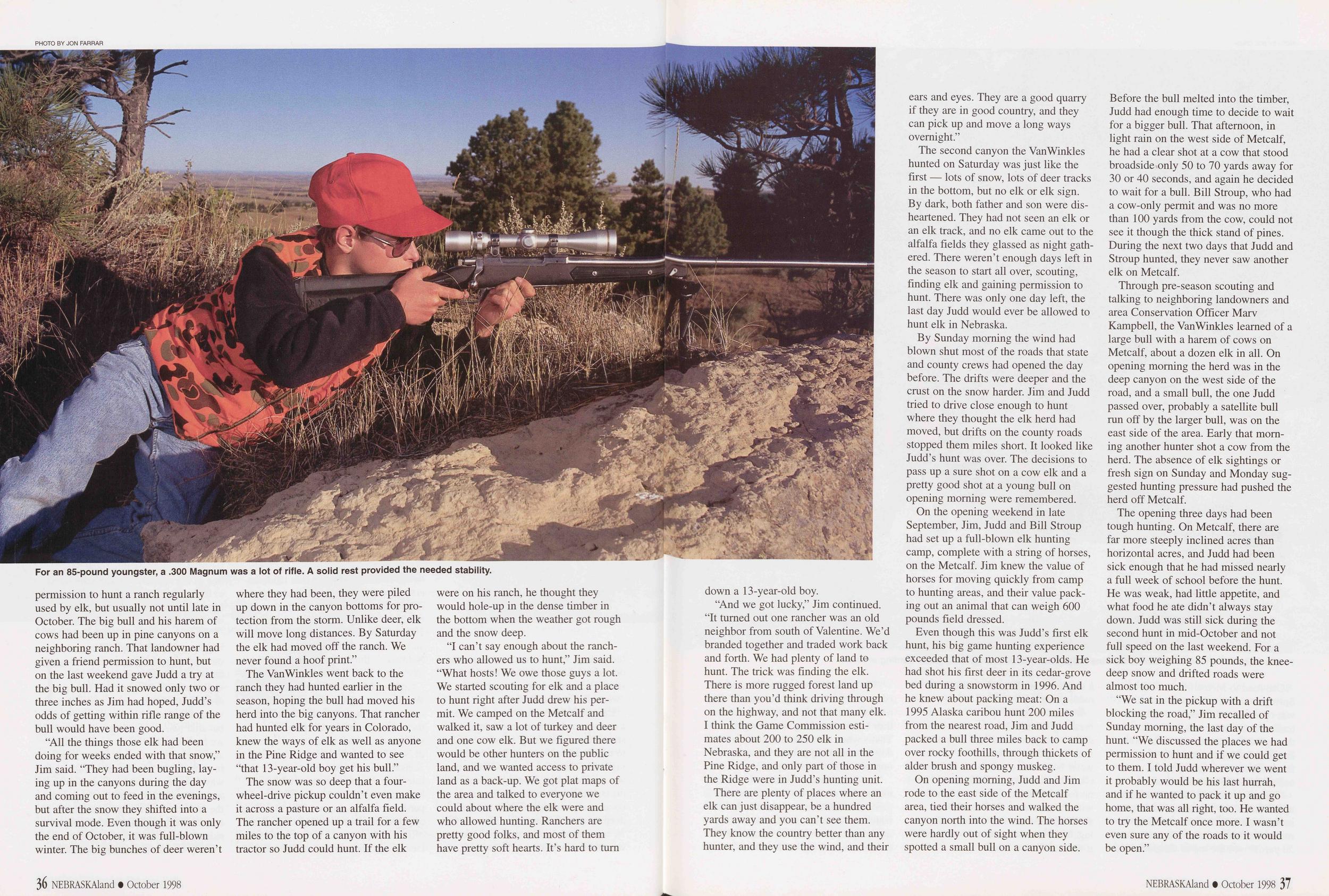
For an 85-pound youngster, a .300 Magnum was a lot of rifle. A solid rest provided the needed stability.
permission to hunt a ranch regularly used by elk, but usually not until late in October. The big bull and his harem of cows had been up in pine canyons on a neighboring ranch. That landowner had given a friend permission to hunt, but on the last weekend gave Judd a try at the big bull. Had it snowed only two or three inches as Jim had hoped, Judd's odds of getting within rifle range of the bull would have been good.
"All the things those elk had been doing for weeks ended with that snow," Jim said. "They had been bugling, laying up in the canyons during the day and coming out to feed in the evenings, but after the snow they shifted into a survival mode. Even though it was only the end of October, it was full-blown winter. The big bunches of deer weren't where they had been, they were piled up down in the canyon bottoms for protection from the storm. Unlike deer, elk will move long distances. By Saturday the elk had moved off the ranch. We never found a hoof print."
The VanWinkles went back to the ranch they had hunted earlier in the season, hoping the bull had moved his herd into the big canyons. That rancher had hunted elk for years in Colorado, knew the ways of elk as well as anyone in the Pine Ridge and wanted to see "that 13-year-old boy get his bull."
The snow was so deep that a four-wheel-drive pickup couldn't even make it across a pasture or an alfalfa field. The rancher opened up a trail for a few miles to the top of a canyon with his tractor so Judd could hunt. If the elk were on his ranch, he thought they would hole-up in the dense timber in the bottom when the weather got rough and the snow deep.
"I can't say enough about the ranchers who allowed us to hunt," Jim said. "What hosts! We owe those guys a lot. We started scouting for elk and a place to hunt right after Judd drew his permit. We camped on the Metcalf and walked it, saw a lot of turkey and deer and one cow elk. But we figured there would be other hunters on the public land, and we wanted access to private land as a back-up. We got plat maps of the area and talked to everyone we could about where the elk were and who allowed hunting. Ranchers are pretty good folks, and most of them have pretty soft hearts. It's hard to turn
36 NEBRASKAland • October 1998down a 13-year-old boy.
"And we got lucky," Jim continued. "It turned out one rancher was an old neighbor from south of Valentine. We'd branded together and traded work back and forth. We had plenty of land to hunt. The trick was finding the elk. There is more rugged forest land up there than you'd think driving through on the highway, and not that many elk. I think the Game Commission estimates about 200 to 250 elk in Nebraska, and they are not all in the Pine Ridge, and only part of those in the Ridge were in Judd's hunting unit.
There are plenty of places where an elk can just disappear, be a hundred yards away and you can't see them. They know the country better than any hunter, and they use the wind, and their ears and eyes. They are a good quarry if they are in good country, and they can pick up and move a long ways overnight."
The second canyon the Van Winkles hunted on Saturday was just like the first — lots of snow, lots of deer tracks in the bottom, but no elk or elk sign. By dark, both father and son were disheartened. They had not seen an elk or an elk track, and no elk came out to the alfalfa fields they glassed as night gathered. There weren't enough days left in the season to start all over, scouting, finding elk and gaining permission to hunt. There was only one day left, the last day Judd would ever be allowed to hunt elk in Nebraska.
By Sunday morning the wind had blown shut most of the roads that state and county crews had opened the day before. The drifts were deeper and the crust on the snow harder. Jim and Judd tried to drive close enough to hunt where they thought the elk herd had moved, but drifts on the county roads stopped them miles short. It looked like Judd's hunt was over. The decisions to pass up a sure shot on a cow elk and a pretty good shot at a young bull on opening morning were remembered.
On the opening weekend in late September, Jim, Judd and Bill Stroup had set up a full-blown elk hunting camp, complete with a string of horses, on the Metcalf. Jim knew the value of horses for moving quickly from camp to hunting areas, and their value packing out an animal that can weigh 600 pounds field dressed.
Even though this was Judd's first elk hunt, his big game hunting experience exceeded that of most 13-year-olds. He had shot his first deer in its cedar-grove bed during a snowstorm in 1996. And he knew about packing meat: On a 1995 Alaska caribou hunt 200 miles from the nearest road, Jim and Judd packed a bull three miles back to camp over rocky foothills, through thickets of alder brush and spongy muskeg.
On opening morning, Judd and Jim rode to the east side of the Metcalf area, tied their horses and walked the canyon north into the wind. The horses were hardly out of sight when they spotted a small bull on a canyon side. Before the bull melted into the timber, Judd had enough time to decide to wait for a bigger bull. That afternoon, in light rain on the west side of Metcalf, he had a clear shot at a cow that stood broadside only 50 to 70 yards away for 30 or 40 seconds, and again he decided to wait for a bull. Bill Stroup, who had a cow-only permit and was no more than 100 yards from the cow, could not see it though the thick stand of pines. During the next two days that Judd and Stroup hunted, they never saw another elk on Metcalf.
Through pre-season scouting and talking to neighboring landowners and area Conservation Officer Marv Kampbell, the Van Winkles learned of a large bull with a harem of cows on Metcalf, about a dozen elk in all. On opening morning the herd was in the deep canyon on the west side of the road, and a small bull, the one Judd passed over, probably a satellite bull run off by the larger bull, was on the east side of the area. Early that morning another hunter shot a cow from the herd. The absence of elk sightings or fresh sign on Sunday and Monday suggested hunting pressure had pushed the herd off Metcalf.
The opening three days had been tough hunting. On Metcalf, there are far more steeply inclined acres than horizontal acres, and Judd had been sick enough that he had missed nearly a full week of school before the hunt. He was weak, had little appetite, and what food he ate didn't always stay down. Judd was still sick during the second hunt in mid-October and not full speed on the last weekend. For a sick boy weighing 85 pounds, the knee-deep snow and drifted roads were almost too much.
"We sat in the pickup with a drift blocking the road," Jim recalled of Sunday morning, the last day of the hunt. "We discussed the places we had permission to hunt and if we could get to them. I told Judd wherever we went it probably would be his last hurrah, and if he wanted to pack it up and go home, that was all right, too. He wanted to try the Metcalf once more. I wasn't even sure any of the roads to it would be open."
NEBRASKAland • October 1998 37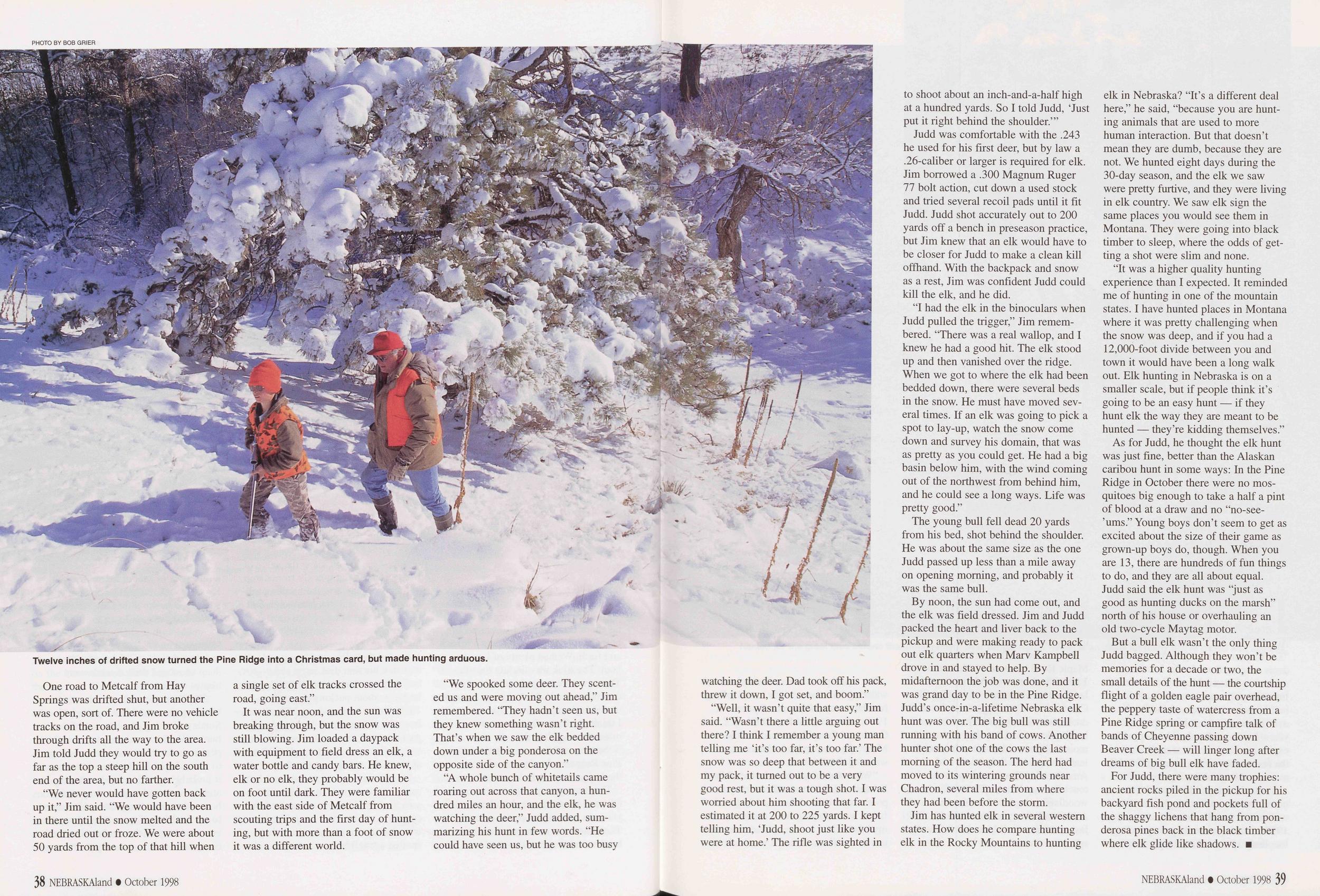
Twelve inches of drifted snow turned the Pine Ridge into a Christmas card, but made hunting arduous.
One road to Metcalf from Hay Springs was drifted shut, but another was open, sort of. There were no vehicle tracks on the road, and Jim broke through drifts all the way to the area. Jim told Judd they would try to go as far as the top a steep hill on the south end of the area, but no farther.
"We never would have gotten back up it," Jim said. "We would have been in there until the snow melted and the road dried out or froze. We were about 50 yards from the top of that hill when a single set of elk tracks crossed the road, going east."
It was near noon, and the sun was breaking through, but the snow was still blowing. Jim loaded a daypack with equipment to field dress an elk, a water bottle and candy bars. He knew, elk or no elk, they probably would be on foot until dark. They were familiar with the east side of Metcalf from scouting trips and the first day of hunting, but with more than a foot of snow it was a different world.
"We spooked some deer. They scented us and were moving out ahead," Jim remembered. "They hadn't seen us, but they knew something wasn't right. That's when we saw the elk bedded down under a big ponderosa on the opposite side of the canyon."
"A whole bunch of whitetails came roaring out across that canyon, a hundred miles an hour, and the elk, he was watching the deer," Judd added, summarizing his hunt in few words. "He could have seen us, but he was too busy
38 NEBRASKAland • October 1998watching the deer. Dad took off his pack, threw it down, I got set, and boom."
"Well, it wasn't quite that easy," Jim said. "Wasn't there a little arguing out there? I think I remember a young man telling me 'it's too far, it's too far.' The snow was so deep that between it and my pack, it turned out to be a very good rest, but it was a tough shot. I was worried about him shooting that far. I estimated it at 200 to 225 yards. I kept telling him, 'Judd, shoot just like you were at home.' The rifle was sighted in to shoot about an inch-and-a-half high at a hundred yards. So I told Judd, 'Just put it right behind the shoulder.'"
Judd was comfortable with the .243 he used for his first deer, but by law a .26-caliber or larger is required for elk. Jim borrowed a .300 Magnum Ruger 77 bolt action, cut down a used stock and tried several recoil pads until it fit Judd. Judd shot accurately out to 200 yards off a bench in preseason practice, but Jim knew that an elk would have to be closer for Judd to make a clean kill offhand. With the backpack and snow as a rest, Jim was confident Judd could kill the elk, and he did.
"I had the elk in the binoculars when Judd pulled the trigger," Jim remembered. "There was a real wallop, and I knew he had a good hit. The elk stood up and then vanished over the ridge. When we got to where the elk had been bedded down, there were several beds in the snow. He must have moved several times. If an elk was going to pick a spot to lay-up, watch the snow come down and survey his domain, that was as pretty as you could get. He had a big basin below him, with the wind coming out of the northwest from behind him, and he could see a long ways. Life was pretty good."
The young bull fell dead 20 yards from his bed, shot behind the shoulder. He was about the same size as the one Judd passed up less than a mile away on opening morning, and probably it was the same bull.
By noon, the sun had come out, and the elk was field dressed. Jim and Judd packed the heart and liver back to the pickup and were making ready to pack out elk quarters when Marv Kampbell drove in and stayed to help. By midaftemoon the job was done, and it was grand day to be in the Pine Ridge. Judd's once-in-a-lifetime Nebraska elk hunt was over. The big bull was still running with his band of cows. Another hunter shot one of the cows the last morning of the season. The herd had moved to its wintering grounds near Chadron, several miles from where they had been before the storm.
Jim has hunted elk in several western states. How does he compare hunting elk in the Rocky Mountains to hunting elk in Nebraska? "It's a different deal here," he said, "because you are hunting animals that are used to more human interaction. But that doesn't mean they are dumb, because they are not. We hunted eight days during the 30-day season, and the elk we saw were pretty furtive, and they were living in elk country. We saw elk sign the same places you would see them in Montana. They were going into black timber to sleep, where the odds of getting a shot were slim and none.
"It was a higher quality hunting experience than I expected. It reminded me of hunting in one of the mountain states. I have hunted places in Montana where it was pretty challenging when the snow was deep, and if you had a 12,000-foot divide between you and town it would have been a long walk out. Elk hunting in Nebraska is on a smaller scale, but if people think it's going to be an easy hunt — if they hunt elk the way they are meant to be hunted — they're kidding themselves."
As for Judd, he thought the elk hunt was just fine, better than the Alaskan caribou hunt in some ways: In the Pine Ridge in October there were no mosquitoes big enough to take a half a pint of blood at a draw and no "no-see- 'ums." Young boys don't seem to get as excited about the size of their game as grown-up boys do, though. When you are 13, there are hundreds of fun things to do, and they are all about equal. Judd said the elk hunt was "just as good as hunting ducks on the marsh" north of his house or overhauling an old two-cycle Maytag motor.
But a bull elk wasn't the only thing Judd bagged. Although they won't be memories for a decade or two, the small details of the hunt — the courtship flight of a golden eagle pair overhead, the peppery taste of watercress from a Pine Ridge spring or campfire talk of bands of Cheyenne passing down Beaver Creek — will linger long after dreams of big bull elk have faded.
For Judd, there were many trophies: ancient rocks piled in the pickup for his backyard fish pond and pockets full of the shaggy lichens that hang from ponderosa pines back in the black timber where elk glide like shadows.
NEBRASKAland • October 1998 39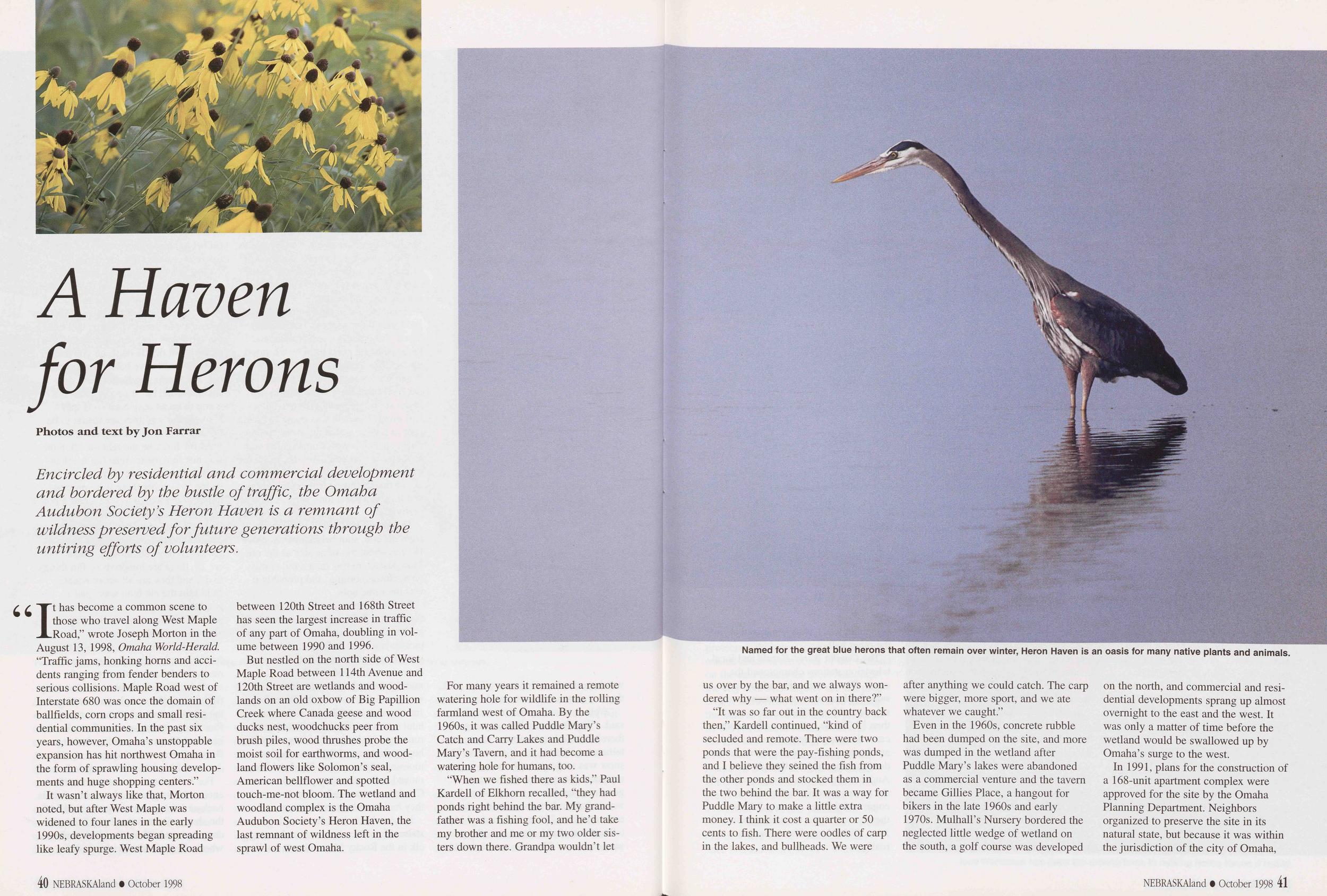
A Haven for Herons
Photos and text by Jon FarrarEncircled by residential and commercial development and bordered by the bustle of traffic, the Omaha Audubon Society's Heron Haven is a remnant of wildness preserved for future generations through the untiring efforts of volunteers.
"It has become a common scene to those who travel along West Maple Road," wrote Joseph Morton in the August 13, 1998, Omaha World-Herald. "Traffic jams, honking horns and accidents ranging from fender benders to serious collisions. Maple Road west of Interstate 680 was once the domain of ballfields, corn crops and small residential communities. In the past six years, however, Omaha's unstoppable expansion has hit northwest Omaha in the form of sprawling housing developments and huge shopping centers."
It wasn't always like that, Morton noted, but after West Maple was widened to four lanes in the early 1990s, developments began spreading like leafy spurge. West Maple Road between 120th Street and 168th Street has seen the largest increase in traffic of any part of Omaha, doubling in volume between 1990 and 1996.
But nestled on the north side of West Maple Road between 114th Avenue and 120th Street are wetlands and woodlands on an old oxbow of Big Papillion Creek where Canada geese and wood ducks nest, woodchucks peer from brush piles, wood thrushes probe the moist soil for earthworms, and woodland flowers like Solomon's seal, American bellflower and spotted touch-me-not bloom. The wetland and woodland complex is the Omaha Audubon Society's Heron Haven, the last remnant of wildness left in the sprawl of west Omaha.
For many years it remained a remote watering hole for wildlife in the rolling farmland west of Omaha. By the 1960s, it was called Puddle Mary's Catch and Carry Lakes and Puddle Mary's Tavern, and it had become a watering hole for humans, too.
"When we fished there as kids," Paul Kardell of Elkhorn recalled, "they had ponds right behind the bar. My grandfather was a fishing fool, and he'd take my brother and me or my two older sisters down there. Grandpa wouldn't let
40 NEBRASKAland • October 1998Named for the great blue herons that often remain over winter, Heron Haven is an oasis for many native plants and animals
us over by the bar, and we always wondered why — what went on in there?"
"It was so far out in the country back then," Kardell continued, "kind of secluded and remote. There were two ponds that were the pay-fishing ponds, and I believe they seined the fish from the other ponds and stocked them in the two behind the bar. It was a way for Puddle Mary to make a little extra money. I think it cost a quarter or 50 cents to fish. There were oodles of carp in the lakes, and bullheads. We were after anything we could catch. The carp were bigger, more sport, and we ate whatever we caught."
Even in the 1960s, concrete rubble had been dumped on the site, and more was dumped in the wetland after Puddle Mary's lakes were abandoned as a commercial venture and the tavern became Gillies Place, a hangout for bikers in the late 1960s and early 1970s. Mulhall's Nursery bordered the neglected little wedge of wetland on the south, a golf course was developed on the north, and commercial and residential developments sprang up almost overnight to the east and the west. It was only a matter of time before the wetland would be swallowed up by Omaha's surge to the west.
In 1991, plans for the construction of a 168-unit apartment complex were approved for the site by the Omaha Planning Department. Neighbors organized to preserve the site in its natural state, but because it was within the jurisdiction of the city of Omaha,
NEBRASKAland • October 1998 41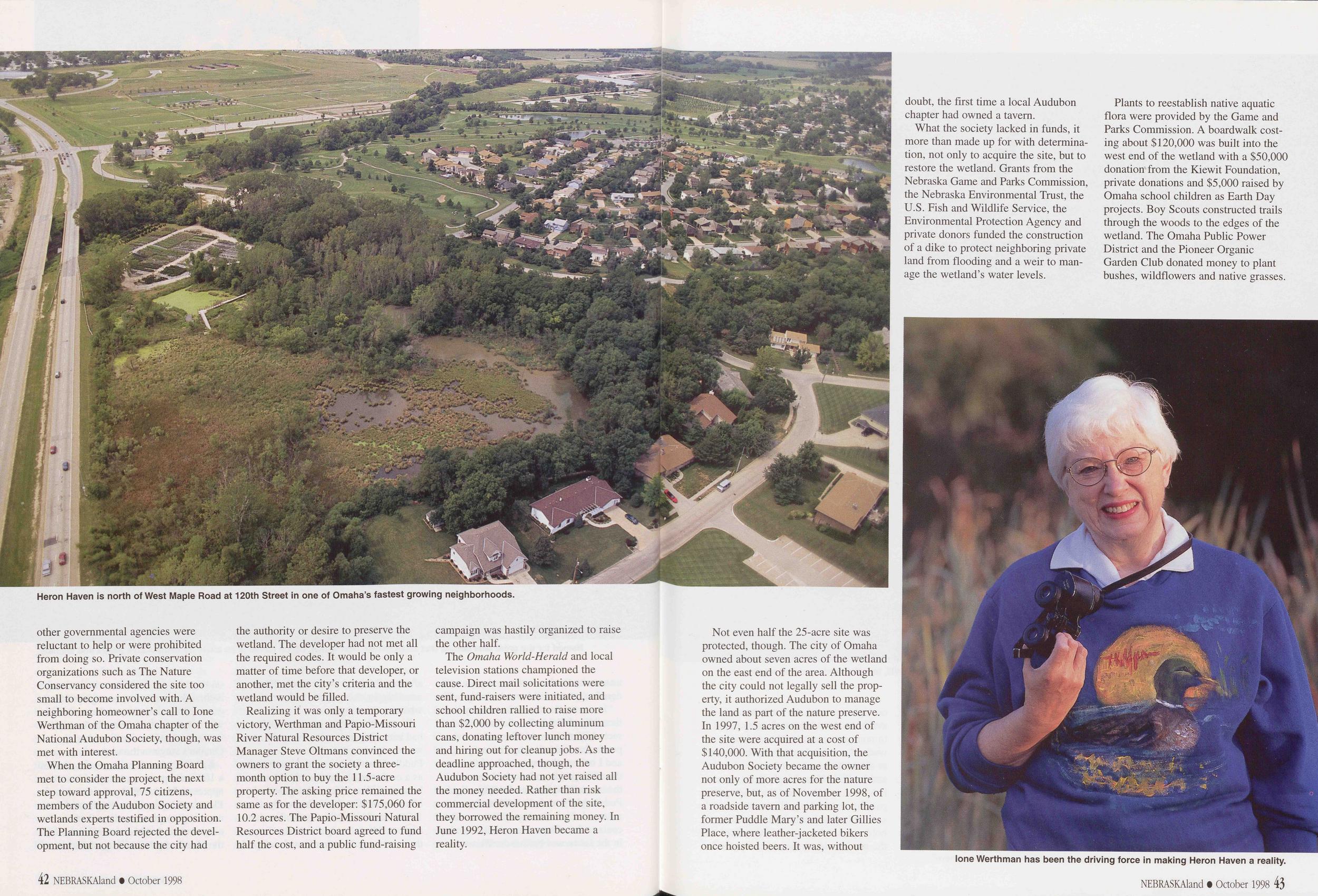
Heron Haven is north of West Maple Road at 120th Street in one of Omaha's fastest growing neighborhoods.
other governmental agencies were reluctant to help or were prohibited from doing so. Private conservation organizations such as The Nature Conservancy considered the site too small to become involved with. A neighboring homeowner's call to lone Werthman of the Omaha chapter of the National Audubon Society, though, was met with interest.
When the Omaha Planning Board met to consider the project, the next step toward approval, 75 citizens, members of the Audubon Society and wetlands experts testified in opposition. The Planning Board rejected the development, but not because the city had the authority or desire to preserve the wetland. The developer had not met all the required codes. It would be only a matter of time before that developer, or another, met the city's criteria and the wetland would be filled.
Realizing it was only a temporary victory, Werthman and Papio-Missouri River Natural Resources District Manager Steve Oltmans convinced the owners to grant the society a three-month option to buy the 11.5-acre property. The asking price remained the same as for the developer: $175,060 for 10.2 acres. The Papio-Missouri Natural Resources District board agreed to fund half the cost, and a public fund-raising campaign was hastily organized to raise the other half.
The Omaha World-Herald and local television stations championed the cause. Direct mail solicitations were sent, fund-raisers were initiated, and school children rallied to raise more than $2,000 by collecting aluminum cans, donating leftover lunch money and hiring out for cleanup jobs. As the deadline approached, though, the Audubon Society had not yet raised all the money needed. Rather than risk commercial development of the site, they borrowed the remaining money. In June 1992, Heron Haven became a reality.
42 NEBRASKAland • October 1998Not even half the 25-acre site was protected, though. The city of Omaha owned about seven acres of the wetland on the east end of the area. Although the city could not legally sell the property, it authorized Audubon to manage the land as part of the nature preserve. In 1997, 1.5 acres on the west end of the site were acquired at a cost of $140,000. With that acquisition, the Audubon Society became the owner not only of more acres for the nature preserve, but, as of November 1998, of a roadside tavern and parking lot, the former Puddle Mary's and later Gillies Place, where leather-jacketed bikers once hoisted beers. It was, without doubt, the first time a local Audubon chapter had owned a tavern.
What the society lacked in funds, it more than made up for with determination, not only to acquire the site, but to restore the wetland. Grants from the Nebraska Game and Parks Commission, the Nebraska Environmental Trust, the U.S. Fish and Wildlife Service, the Environmental Protection Agency and private donors funded the construction of a dike to protect neighboring private land from flooding and a weir to manage the wetland's water levels.
Plants to reestablish native aquatic flora were provided by the Game and Parks Commission. A boardwalk costing about $120,000 was built into the west end of the wetland with a $50,000 donation from the Kiewit Foundation, private donations and $5,000 raised by Omaha school children as Earth Day projects. Boy Scouts constructed trails through the woods to the edges of the wetland. The Omaha Public Power District and the Pioneer Organic Garden Club donated money to plant bushes, wildflowers and native grasses.
Ione Werthman has been the driving force in making Heron Haven a reality.
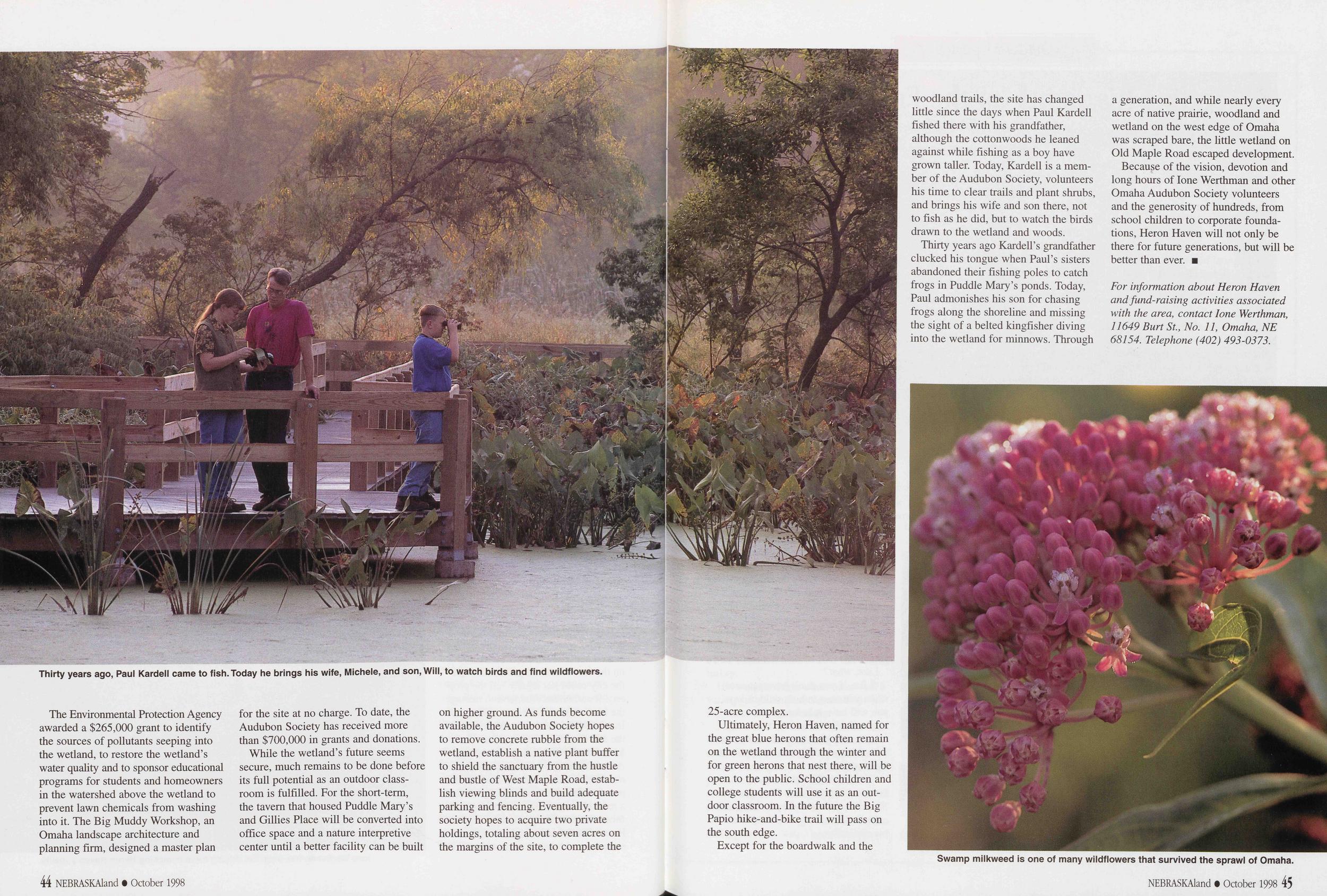
Thirty years ago, Paul Kardell came to fish. Today he brings his wife, Michele, and son, Will, to watch birds and find wiidflowers.
The Environmental Protection Agency awarded a $265,000 grant to identify the sources of pollutants seeping into the wetland, to restore the wetland's water quality and to sponsor educational programs for students and homeowners in the watershed above the wetland to prevent lawn chemicals from washing into it. The Big Muddy Workshop, an Omaha landscape architecture and planning firm, designed a master plan for the site at no charge. To date, the Audubon Society has received more than $700,000 in grants and donations.
While the wetland's future seems secure, much remains to be done before its full potential as an outdoor classroom is fulfilled. For the short-term, the tavern that housed Puddle Mary's and Gillies Place will be converted into office space and a nature interpretive center until a better facility can be built on higher ground. As funds become available, the Audubon Society hopes to remove concrete rubble from the wetland, establish a native plant buffer to shield the sanctuary from the hustle and bustle of West Maple Road, establish viewing blinds and build adequate parking and fencing. Eventually, the society hopes to acquire two private holdings, totaling about seven acres on the margins of the site, to complete the
44 NEBRASKAland • October 199825-acre complex.
Ultimately, Heron Haven, named for the great blue herons that often remain on the wetland through the winter and for green herons that nest there, will be open to the public. School children and college students will use it as an outdoor classroom. In the future the Big Papio hike-and-bike trail will pass on the south edge.
Except for the boardwalk and the woodland trails, the site has changed little since the days when Paul Kardell fished there with his grandfather, although the cottonwoods he leaned against while fishing as a boy have grown taller. Today, Kardell is a member of the Audubon Society, volunteers his time to clear trails and plant shrubs, and brings his wife and son there, not to fish as he did, but to watch the birds drawn to the wetland and woods.
Thirty years ago Kardell's grandfather clucked his tongue when Paul's sisters abandoned their fishing poles to catch frogs in Puddle Mary's ponds. Today, Paul admonishes his son for chasing frogs along the shoreline and missing the sight of a belted kingfisher diving into the wetland for minnows. Through a generation, and while nearly every acre of native prairie, woodland and wetland on the west edge of Omaha was scraped bare, the little wetland on Old Maple Road escaped development.
Because of the vision, devotion and long hours of lone Werthman and other Omaha Audubon Society volunteers and the generosity of hundreds, from school children to corporate foundations, Heron Haven will not only be there for future generations, but will be better than ever.
For information about Heron Haven and fund-raising activities associated with the area, contact lone Werthman, 11649 Burt St., No. 11, Omaha, NE 68154. Telephone (402) 493-0373.Swamp milkweed is one of many wildflowers that survived the sprawl of Omaha.
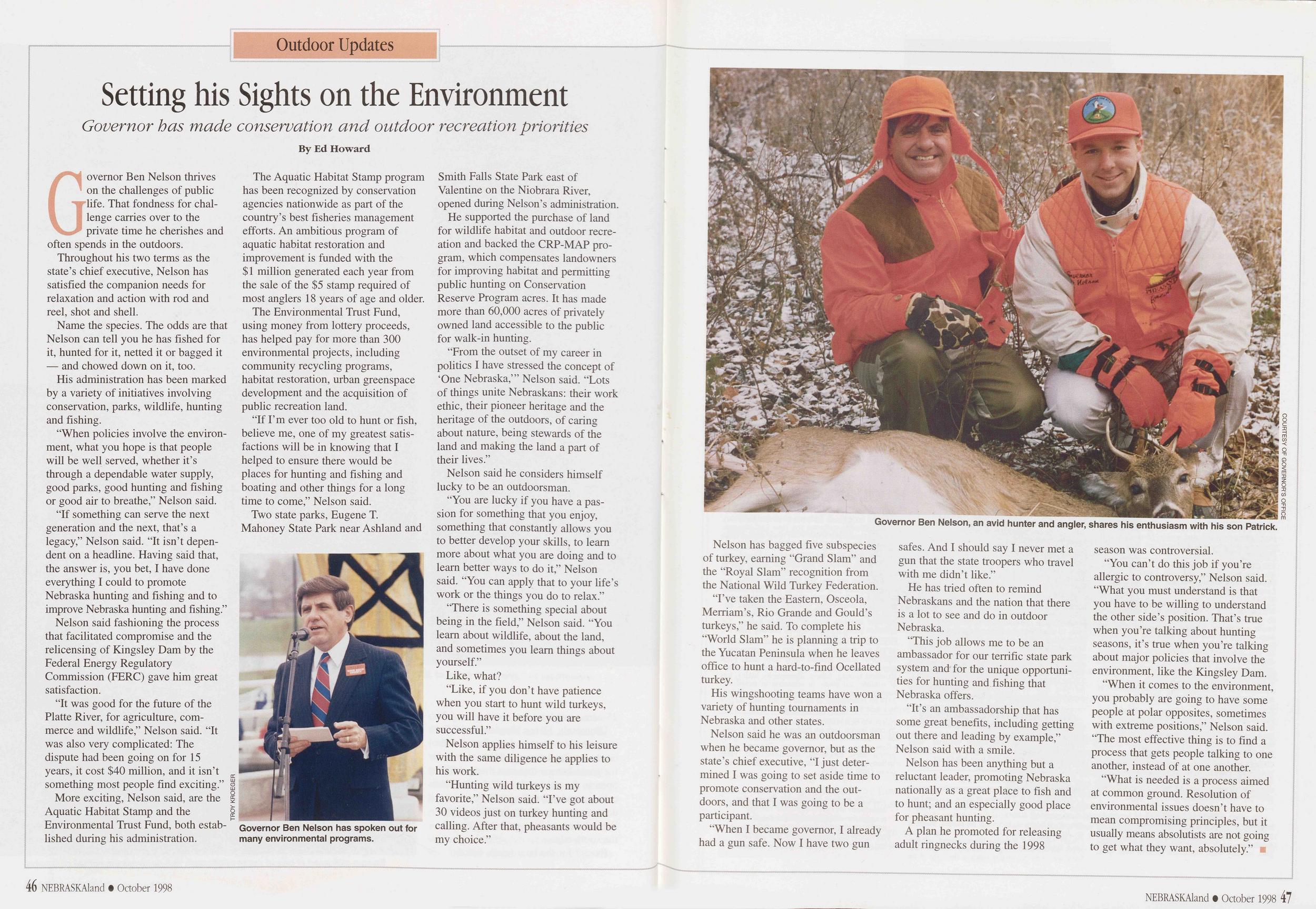
Outdoor Updates
Setting his Sights on the Environment
Governor has made conservation and outdoor recreation priorities By Ed HowardGovernor Ben Nelson thrives on the challenges of public life. That fondness for challenge carries over to the private time he cherishes and often spends in the outdoors.
Throughout his two terms as the state's chief executive, Nelson has satisfied the companion needs for relaxation and action with rod and reel, shot and shell.
Name the species. The odds are that Nelson can tell you he has fished for it, hunted for it, netted it or bagged it — and chowed down on it, too.
His administration has been marked by a variety of initiatives involving conservation, parks, wildlife, hunting and fishing.
"When policies involve the environment, what you hope is that people will be well served, whether it's through a dependable water supply, good parks, good hunting and fishing or good air to breathe," Nelson said.
"If something can serve the next generation and the next, that's a legacy," Nelson said. "It isn't dependent on a headline. Having said that, the answer is, you bet, I have done everything I could to promote Nebraska hunting and fishing and to improve Nebraska hunting and fishing."
Nelson said fashioning the process that facilitated compromise and the relicensing of Kingsley Dam by the Federal Energy Regulatory Commission (FERC) gave him great satisfaction.
"It was good for the future of the Platte River, for agriculture, commerce and wildlife," Nelson said. "It was also very complicated: The dispute had been going on for 15 years, it cost $40 million, and it isn't something most people find exciting."
The Aquatic Habitat Stamp program has been recognized by conservation agencies nationwide as part of the country's best fisheries management efforts. An ambitious program of aquatic habitat restoration and improvement is funded with the $1 million generated each year from the sale of the $5 stamp required of most anglers 18 years of age and older.
The Environmental Trust Fund, using money from lottery proceeds, has helped pay for more than 300 environmental projects, including community recycling programs, habitat restoration, urban greenspace development and the acquisition of public recreation land.
"If I'm ever too old to hunt or fish, believe me, one of my greatest satisfactions will be in knowing that I helped to ensure there would be places for hunting and fishing and boating and other things for a long time to come," Nelson said.
Two state parks, Eugene T. Mahoney State Park near Ashland and
Governor Ben Nelson has spoken out for many environmental programs.
Smith Falls State Park east of Valentine on the Niobrara River, opened during Nelson's administration.
He supported the purchase of land for wildlife habitat and outdoor recreation and backed the CRP-MAP program, which compensates landowners for improving habitat and permitting public hunting on Conservation Reserve Program acres. It has made more than 60,000 acres of privately owned land accessible to the public for walk-in hunting.
"From the outset of my career in politics I have stressed the concept of 'One Nebraska,'" Nelson said. "Lots of things unite Nebraskans: their work ethic, their pioneer heritage and the heritage of the outdoors, of caring about nature, being stewards of the land and making the land a part of their lives."
Nelson said he considers himself lucky to be an outdoorsman.
"You are lucky if you have a passion for something that you enjoy, something that constantly allows you to better develop your skills, to learn more about what you are doing and to learn better ways to do it," Nelson said. "You can apply that to your life's work or the things you do to relax."
"There is something special about being in the field," Nelson said. "You learn about wildlife, about the land, and sometimes you learn things about yourself."
Like, what?
"Like, if you don't have patience when you start to hunt wild turkeys, you will have it before you are successful."
Nelson applies himself to his leisure with the same diligence he applies to his work.
"Hunting wild turkeys is my favorite," Nelson said. "I've got about 30 videos just on turkey hunting and calling. After that, pheasants would be my choice."
46 NEBRASKAland • October 1998Governor Ben Nelson, an avid hunter and angler, shares his enthusiasm with his son Patrick.
Nelson has bagged five subspecies of turkey, earning "Grand Slam" and the "Royal Slam" recognition from the National Wild Turkey Federation.
"I've taken the Eastern, Osceola, Merriam's, Rio Grande and Gould's turkeys," he said. To complete his "World Slam" he is planning a trip to the Yucatan Peninsula when he leaves office to hunt a hard-to-find Ocellated turkey.
His wingshooting teams have won a variety of hunting tournaments in Nebraska and other states.
Nelson said he was an outdoorsman when he became governor, but as the state's chief executive, "I just determined I was going to set aside time to promote conservation and the outdoors, and that I was going to be a participant.
"When I became governor, I already had a gun safe. Now I have two gun safes. And I should say I never met a gun that the state troopers who travel with me didn't like."
He has tried often to remind Nebraskans and the nation that there is a lot to see and do in outdoor Nebraska.
"This job allows me to be an ambassador for our terrific state park system and for the unique opportunities for hunting and fishing that Nebraska offers.
"It's an ambassadorship that has some great benefits, including getting out there and leading by example," Nelson said with a smile.
Nelson has been anything but a reluctant leader, promoting Nebraska nationally as a great place to fish and to hunt; and an especially good place for pheasant hunting.
A plan he promoted for releasing adult ringnecks during the 1998 season was controversial.
"You can't do this job if you're allergic to controversy," Nelson said. "What you must understand is that you have to be willing to understand the other side's position. That's true when you're talking about hunting seasons, it's true when you're talking about major policies that involve the environment, like the Kingsley Dam.
"When it comes to the environment, you probably are going to have some people at polar opposites, sometimes with extreme positions," Nelson said. "The most effective thing is to find a process that gets people talking to one another, instead of at one another.
"What is needed is a process aimed at common ground. Resolution of environmental issues doesn't have to mean compromising principles, but it usually means absolutists are not going to get what they want, absolutely."
NEBRASKAland • October 1998 47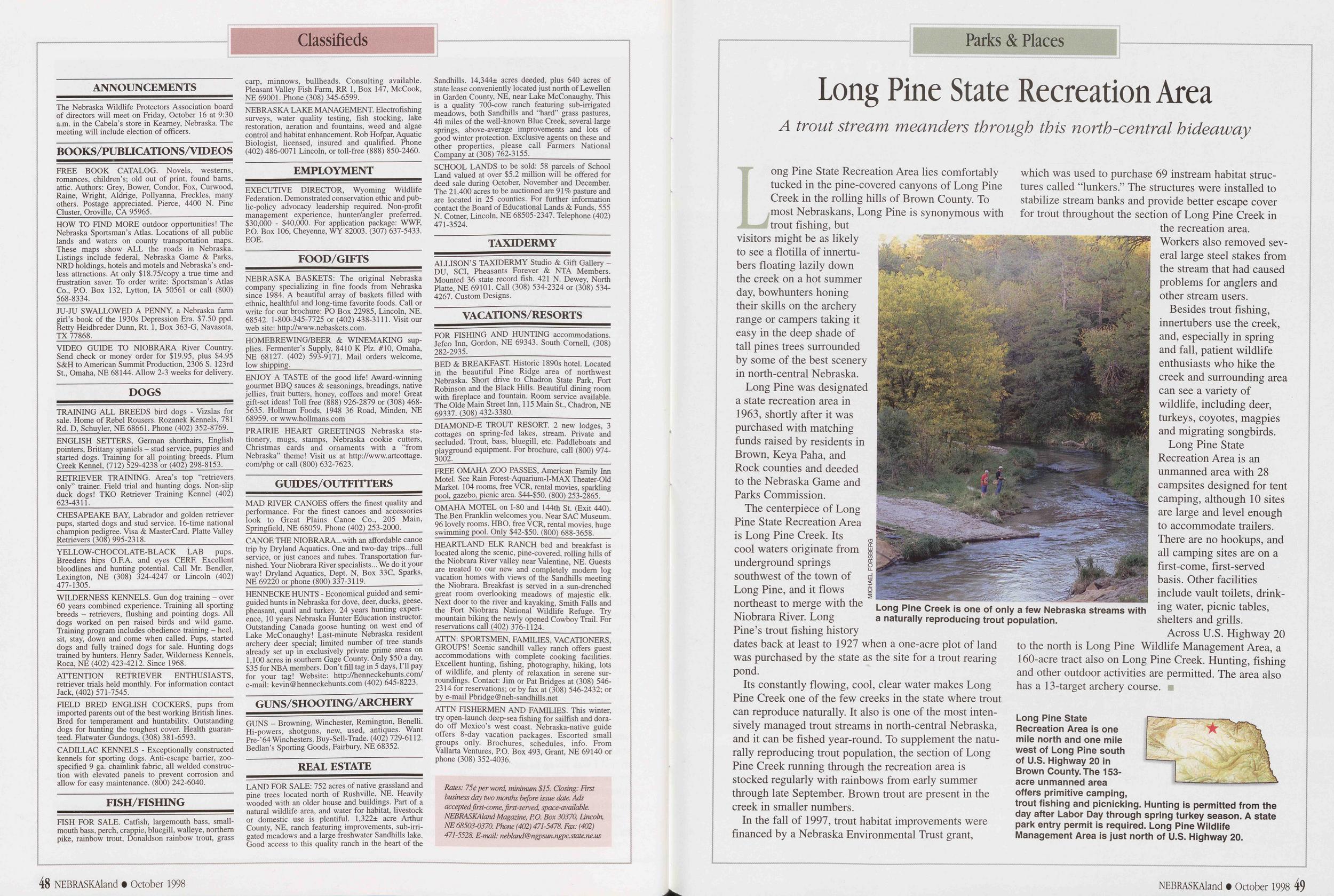
Classifieds
ANNOUNCEMENTS The Nebraska Wildlife Protectors Association board of directors will meet on Friday, October 16 at 9:30 a.m. in the Cabela's store in Kearney, Nebraska. The meeting will include election of officers. BOOKS/PUBUCATIONS/VIDEOS FREE BOOK CATALOG. Novels, westerns, romances, children's; old out of print, found barns, attic. Authors: Grey, Bower, Condor, Fox, Curwood, Raine, Wright, Aldrige, Pollyanna, Freckles, many others. Postage appreciated. Pierce, 4400 N. Pine Cluster, Oroville, CA 95965. HOW TO FIND MORE outdoor opportunities! The Nebraska Sportsman's Atlas. Locations of all public lands and waters on county transportation maps. These maps show ALL the roads in Nebraska. Listings include federal, Nebraska Game & Parks, NRD holdings, hotels and motels and Nebraska's endless attractions. At only $18.75/copy a true time and frustration saver. To order write: Sportsman's Atlas Co., P.O. Box 132, Lytton, IA 50561 or call (800) 568-8334. JU-JU SWALLOWED A PENNY, a Nebraska farm girl's book of the 1930s Depression Era. $7.50 ppd. Betty Heidbreder Dunn, Rt. 1, Box 363-G, Navasota, TX 77868. VIDEO GUIDE TO NIOBRARA River Country. Send check or money order for $19.95, plus $4.95 S&H to American Summit Production, 2306 S. 123rd St., Omaha, NE 68144. Allow 2-3 weeks for delivery. DOGS TRAINING ALL BREEDS bird dogs - Vizslas for sale. Home of Rebel Rousers. Rozanek Kennels, 781 Rd. D, Schuyler, NE 68661. Phone (402) 352-8769. ENGLISH SETTERS, German shorthairs, English pointers, Brittany spaniels - stud service, puppies and started dogs. Training for all pointing breeds. Plum Creek Kennel, (712) 529-4238 or (402) 298-8153. RETRIEVER TRAINING. Area's top "retrievers only" trainer. Field trial and hunting dogs. Non-slip duck dogs! TKO Retriever Training Kennel (402) 623-4311. CHESAPEAKE BAY, Labrador and golden retriever pups, started dogs and stud service. 16-time national champion pedigree. Visa & MasterCard. Platte Valley Retrievers (308) 995-2318. YELLOW-CHOCOLATE-BLACK LAB pups. Breeders hips O.F.A. and eyes CERF. Excellent bloodlines and hunting potential. Call Mr. Bendler, Lexington, NE 1308) 324-4247 or Lincoln (402) 477-1305. WILDERNESS KENNELS. Gun dog training - over 60 years combined experience. Training all sporting breeds - retrievers, flushing and pointing dogs. All dogs worked on pen raised birds and wild game. Training program includes obedience training - heel, sit, stay, down and come when called. Pups, started dogs and fully trained dogs for sale. Hunting dogs trained by hunters. Henry Sader, Wilderness Kennels, Roca, NE (402) 423-4212. Since 1968. ATTENTION RETRIEVER ENTHUSIASTS, retriever trials held monthly. For information contact Jack, (402) 571-7545. FIELD BRED ENGLISH COCKERS, pups from imported parents out of the best working British lines. Bred for temperament and huntability. Outstanding dogs for hunting the toughest cover. Health guaranteed. Flatwater Gundogs, (308) 381-6593. CADILLAC KENNELS - Exceptionally constructed kennels for sporting dogs. Anti-escape barrier, zoo-specified 9 ga. chainlink fabric, all welded construction with elevated panels to prevent corrosion and allow for easy maintenance. (800) 242-6040. FISH/FISHING FISH FOR SALE. Catfish, largemouth bass, smallmouth bass, perch, crappie, bluegill, walleye, northern pike, rainbow trout, Donaldson rainbow trout, grass carp, minnows, bullheads. Consulting available. Pleasant Valley Fish Farm, RR 1, Box 147, McCook, NE 69001. Phone (308) 345-6599. NEBRASKA LAKE MANAGEMENT. Electrofishing surveys, water quality testing, fish stocking, lake restoration, aeration and fountains, weed and algae control and habitat enhancement. Rob Hofpar, Aquatic Biologist, licensed, insured and qualified. Phone (402) 486-0071 Lincoln, or toll-free (888) 850-2460. EMPLOYMENT EXECUTIVE DIRECTOR, Wyoming Wildlife Federation. Demonstrated conservation ethic and public-policy advocacy leadership required. Non-profit management experience, hunter/angler preferred. $30,000 - $40,000. For application package: WWF, P.O. Box 106, Cheyenne, WY 82003. (307) 637-5433. EOE. FOOD/GIFTS NEBRASKA BASKETS: The original Nebraska company specializing in fine foods from Nebraska since 1984. A beautiful array of baskets filled with ethnic, healthful and long-time favorite foods. Call or write for our brochure: PO Box 22985, Lincoln, NE. 68542. 1-800-345-7725 or (402) 438-3111. Visit our web site: http://www.nebaskets.com. HOMEBREWLNG/BEER & WINEMAKING supplies. Fermenter's Supply, 8410 K Plz. #10, Omaha, NE 68127. (402) 593-9171. Mail orders welcome, low shipping. ENJOY A TASTE of the good life! Award-winning gourmet BBQ sauces & seasonings, breadings, native jellies, fruit butters, honey, coffees and more! Great gift-set ideas! Toll free (888) 926-2879 or (308) 468- 5635. Hollman Foods, 1948 36 Road, Minden, NE 68959, or www.hollmans.com PRAIRIE HEART GREETINGS Nebraska stationery, mugs, stamps, Nebraska cookie cutters, Christmas cards and ornaments with a "from Nebraska" theme! Visit us at http://www.artcottage. com/phg or call (800) 632-7623. GUIDES/OUTFITTERS MAD RIVER CANOES offers the finest quality and performance. For the finest canoes and accessories look to Great Plains Canoe Co.. 205 Main, Springfield, NE 68059. Phone (402) 253-2000. CANOE THE NIOBRARA...with an affordable canoe trip by Dryland Aquatics. One and two-day trips...full service, or just canoes and tubes. Transportation furnished. Your Niobrara River specialists... We do it your way! Dryland Aquatics, Dept. N, Box 33C, Sparks, NE 69220 or phone (800) 337-3119. HENNECKE HUNTS - Economical guided and semi-guided hunts in Nebraska for dove, deer, ducks, geese, pheasant, quail and turkey. 24 years hunting experience, 10 years Nebraska Hunter Education instructor. Outstanding Canada goose hunting on west end of Lake McConaughy! Last-minute Nebraska resident archery deer special; limited number of tree stands already set up in exclusively private prime areas on 1,100 acres in southern Gage County. Only $50 a day, $35 for NBA members. Don't fill tag in 5 days, I'll pay for your tag! Website: http://henneckehunts.com/ e-mail: kevin@henneckehunts.com (402) 645-8223. GUNS/SHOOTING/ARCHERY GUNS - Browning, Winchester, Remington, Benelli. Hi-powers, shotguns, new, used, antiques. Want Pre-'64 Winchesters. Buy-Sell-Trade. (402) 729-6112. Bedlan's Sporting Goods, Fairbury, NE 68352. REAL ESTATE LAND FOR SALE: 752 acres of native grassland and pine trees located north of Rushville, NE. Heavily wooded with an older house and buildings. Part of a natural wildlife area, and water for habitat, livestock or domestic use is plentiful. 1,322± acre Arthur County, NE, ranch featuring improvements, sub-irrigated meadows and a large freshwater Sandhills lake. Good access to this quality ranch in the heart of the Sandhills. 14,344± acres deeded, plus 640 acres of state lease conveniently located just north of Lewellen in Garden County, NE, near Lake McConaughy. This is a quality 700-cow ranch featuring sub-irrigated meadows, both Sandhills and "hard" grass pastures, 4fi miles of the well-known Blue Creek, several large springs, above-average improvements and lots of good winter protection. Exclusive agents on these and other properties, please call Farmers National Company at (308) 762-3155. SCHOOL LANDS to be sold: 58 parcels of School Land valued at over $5.2 million will be offered for deed sale during October, November and December. The 21,400 acres to be auctioned are 91% pasture and are located in 25 counties. For further information contact the Board of Educational Lands & Funds, 555 N. Cotner, Lincoln, NE 68505-2347. Telephone (402) 471-3524. TAXIDERMY ALLISON'S TAXIDERMY Studio & Gift Gallery - DU, SCI, Pheasants Forever & NTA Members. Mounted 36 state record fish. 421 N. Dewey, North Platte, NE 69101. Call (308) 534-2324 or (308) 534- 4267. Custom Designs. VACATIONS/RESORTS FOR FISHING AND HUNTING accommodations. Jefco Inn, Gordon, NE 69343. South Cornell, (308) 282-2935. BED & BREAKFAST. Historic 1890s hotel. Located in the beautiful Pine Ridge area of northwest Nebraska. Short drive to Chadron State Park, Fort Robinson and the Black Hills. Beautiful dining room with fireplace and fountain. Room service available. The Olde Main Street Inn, 115 Main St., Chadron, NE 69337. (308) 432-3380. DIAMOND-E TROUT RESORT. 2 new lodges, 3 cottages on spring-fed lakes, stream. Private and secluded. Trout, bass, bluegill, etc. Paddleboats and playground equipment. For brochure, call (800) 974- 3002. FREE OMAHA ZOO PASSES, American Family Inn Motel. See Rain Forest-Aquarium-I-MAX Theater-Old Market. 104 rooms, free VCR, rental movies, sparkling pool, gazebo, picnic area. $44-$50. (800) 253-2865. OMAHA MOTEL on 1-80 and 144th St. (Exit 440). The Ben Franklin welcomes you. Near SAC Museum. 96 lovely rooms. HBO, free VCR, rental movies, huge swimming pool. Only $42-$50. (800) 688-3658. HEARTLAND ELK RANCH bed and breakfast is located along the scenic, pine-covered, rolling hills of the Niobrara River valley near Valentine, NE. Guests are treated to our new and completely modern log vacation homes with views of the Sandhills meeting the Niobrara. Breakfast is served in a sun-drenched great room overlooking meadows of majestic elk. Next door to the river and kayaking, Smith Falls and the Fort Niobrara National Wildlife Refuge. Try mountain biking the newly opened Cowboy Trail. For reservations call (402) 376-1124. ATTN: SPORTSMEN, FAMILIES, VACATIONERS, GROUPS! Scenic sandhill valley ranch offers guest accommodations with complete cooking facilities. Excellent hunting, fishing, photography, hiking, lots of wildlife, and plenty of relaxation in serene surroundings. Contact: Jim or Pat Bridges at (308) 546- 2314 for reservations; or by fax at (308) 546-2432; or by e-mail Pbridge@neb-sandhills.net ATTN FISHERMEN AND FAMILIES. This winter, try open-launch deep-sea fishing for sailfish and dorado off Mexico's west coast. Nebraska-native guide offers 8-day vacation packages. Escorted small groups only. Brochures, schedules, info. From Vallarta Ventures, P.O. Box 493, Grant, NE 69140 or phone (308) 352-4036. Rates: 750 per word, minimum $15. Closing: First business day two months before issue date. Ads accepted first-come, first-served, space-available. NEBRASKAland Magazine, P.O. Box 30370, Lincoln, NE 68503-0370. Phone (402) 471-5478. Fax: (402) 471-5528. E-mail: nebland@ngpsun.ngpc.state.ne.us 48 NEBRASKAland • October 1998Parks & Places
Long Pine State Recreation Area
A trout stream meanders through this north-central hideawayLong Pine State Recreation Area lies comfortably tucked in the pine-covered canyons of Long Pine Creek in the rolling hills of Brown County. To most Nebraskans, Long Pine is synonymous with trout fishing, but visitors might be as likely to see a flotilla of innertubers floating lazily down the creek on a hot summer day, bowhunters honing their skills on the archery range or campers taking it easy in the deep shade of tall pines trees surrounded by some of the best scenery in north-central Nebraska.
Long Pine was designated a state recreation area in 1963, shortly after it was purchased with matching funds raised by residents in Brown, Keya Paha, and Rock counties and deeded to the Nebraska Game and Parks Commission.
The centerpiece of Long Pine State Recreation Area is Long Pine Creek. Its cool waters originate from underground springs southwest of the town of Long Pine, and it flows northeast to merge with the Niobrara River. Long Pine's trout fishing history dates back at least to 1927 when a one-acre plot of land was purchased by the state as the site for a trout rearing pond.
Its constantly flowing, cool, clear water makes Long Pine Creek one of the few creeks in the state where trout can reproduce naturally. It also is one of the most intensively managed trout streams in north-central Nebraska, and it can be fished year-round. To supplement the naturally reproducing trout population, the section of Long Pine Creek running through the recreation area is stocked regularly with rainbows from early summer through late September. Brown trout are present in the creek in smaller numbers.
In the fall of 1997, trout habitat improvements were financed by a Nebraska Environmental Trust grant,
Long Pine Creek is one of only a few Nebraska streams with a naturally reproducing trout population.
which was used to purchase 69 instream habitat structures called "lunkers." The structures were installed to stabilize stream banks and provide better escape cover for trout throughout the section of Long Pine Creek in the recreation area. Workers also removed several large steel stakes from the stream that had caused problems for anglers and other stream users.
Besides trout fishing, innertubers use the creek, and, especially in spring and fall, patient wildlife enthusiasts who hike the creek and surrounding area can see a variety of wildlife, including deer, turkeys, coyotes, magpies and migrating songbirds.
Long Pine State Recreation Area is an unmanned area with 28 campsites designed for tent camping, although 10 sites are large and level enough to accommodate trailers. There are no hookups, and all camping sites are on a first-come, first-served basis. Other facilities include vault toilets, drinking water, picnic tables, shelters and grills.
Across U.S. Highway 20 to the north is Long Pine Wildlife Management Area, a 160-acre tract also on Long Pine Creek. Hunting, fishing and other outdoor activities are permitted. The area also has a 13-target archery course.
Long Pine State Recreation Area is one mile north and one mile west of Long Pine south of U.S. Highway 20 in Brown County. The 153-acre unmanned area offers primitive camping, trout fishing and picnicking. Hunting is permitted from the day after Labor Day through spring turkey season. A state park entry permit is required. Long Pine Wildlife Management Area is just north of U.S. Highway 20.
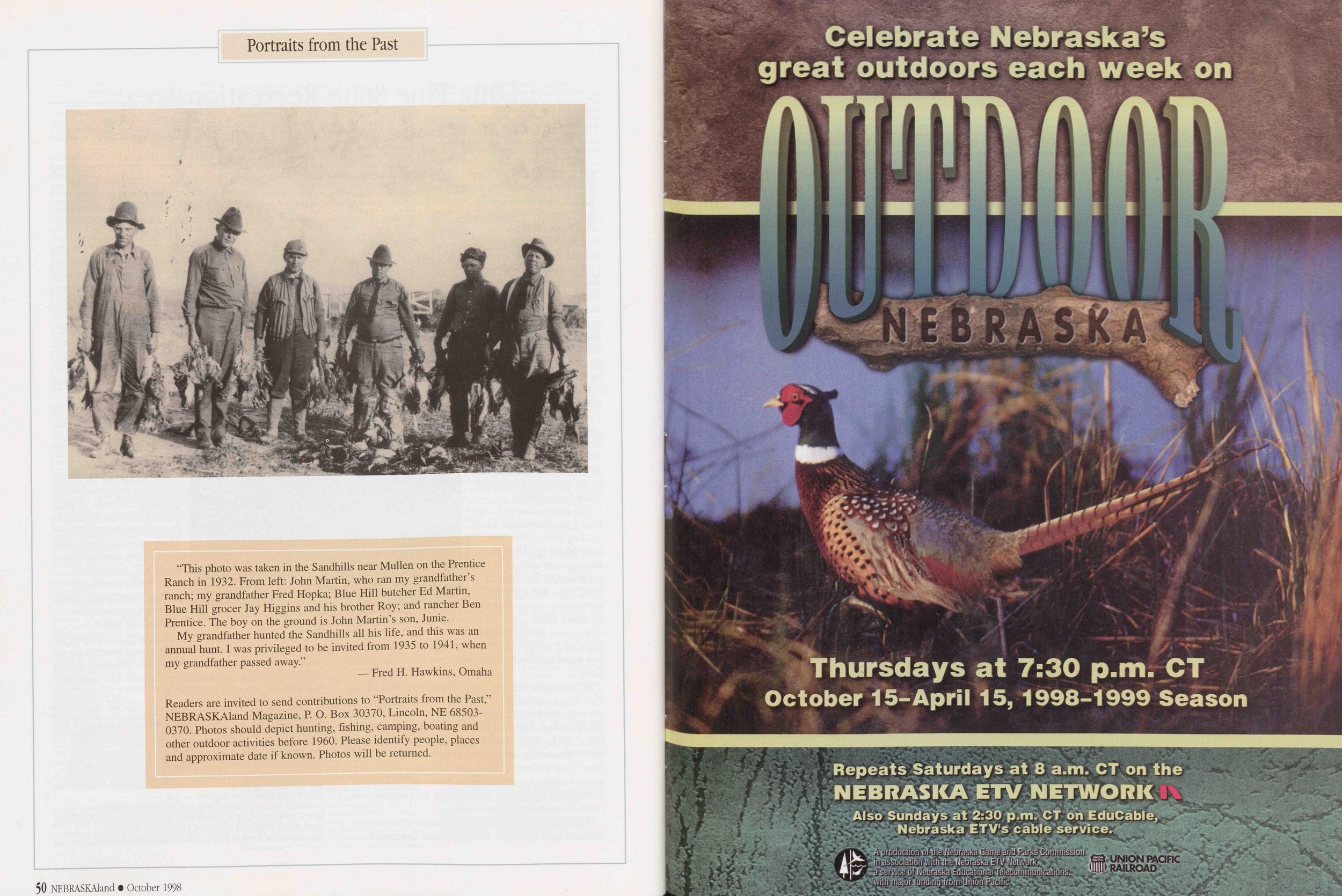
Portraits from the Past
"This photo was taken in the Sandhills near Mullen on the Prentice Ranch in 1932. From left: John Martin, who ran my grandfather's ranch; my grandfather Fred Hopka; Blue Hill butcher Ed Martin, Blue Hill grocer Jay Higgins and his brother Roy; and rancher Ben Prentice. The boy on the ground is John Martin's son, Junie.
My grandfather hunted the Sandhills all his life, and this was an annual hunt. I was privileged to be invited from 1935 to 1941, when my grandfather passed away."
— Fred H. Hawkins, Omaha Readers are invited to send contributions to "Portraits from the Past," NEBRASKAland Magazine, P. O. Box 30370, Lincoln, NE 68503- 0370. Photos should depict hunting, fishing, camping, boating and other outdoor activities before 1960. Please identify people, places and approximate date if known. Photos will be returned. 50 NEBRASKAland • October 1998Celebrate Nebraska's great outdoors each week on OUTDOOR NEBRASKA
Thursdays at 7:30 p.m CT October 15-April 15, 1998-1999 Season Repeats Saturdays at 8 a.m. CT on the NEBRASKA ETV NETWORK Also Sundays at 2:30 p.m. CT on EduCable Nebraska ETVs cable service. UNION PACIFIC RAILROAD A production of the Nebraska Game and Parks Commission in association with the Nebraska ETV Network, a service of Nebraska Educational Telecommunications, with major funding form Union Pacific.
Position: 704 (16 views)