Volume 76, Issue 7, 1998
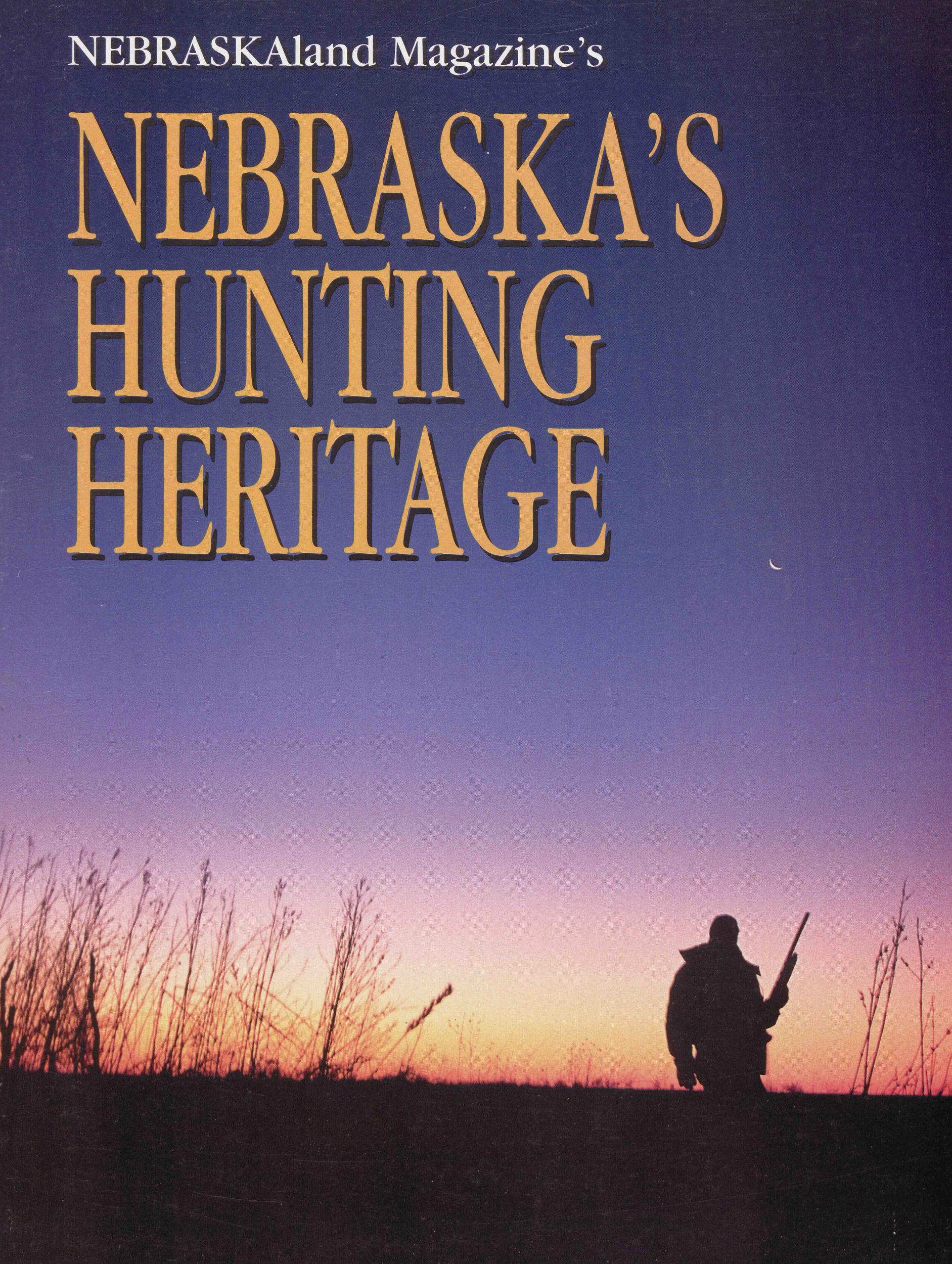
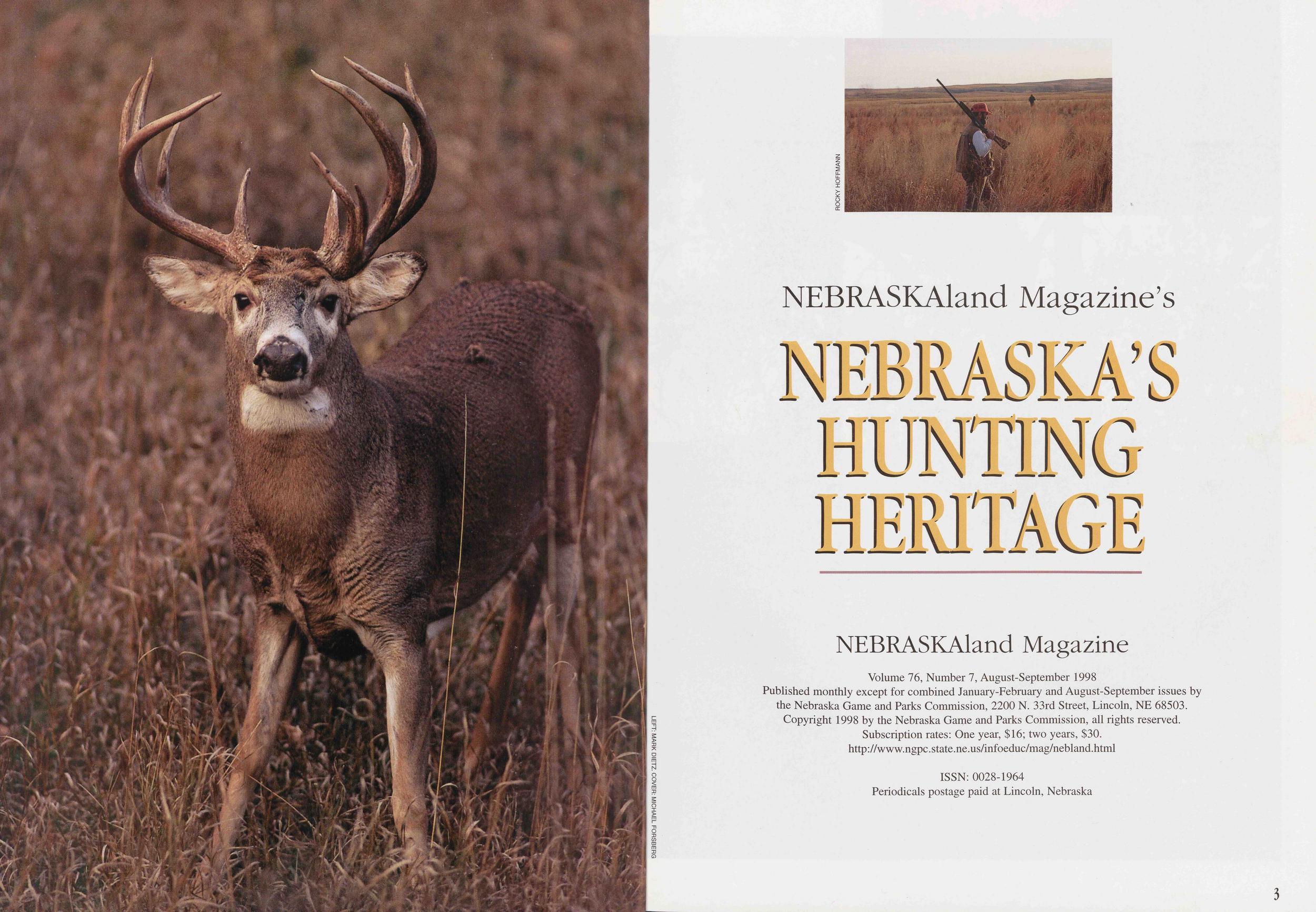
NEBRASKAland Magazine's NEBRASKA'S HUNTING HERITAGE
 Contents
Introduction
Nebraska's Hunting Heritage 6
Wildlife and the Land 12
Upland Game
Ring-necked Pheasant 26
Bobwhite Quail 34
Greater Prairie Chicken and Sharp-tailed Grouse 38
Mourning Dove 42
Cottontail Rabbit 46
Squirrel 50
Big Game
White-tailed Deer and Mule Deer 56
Pronghorn 64
Elk and Bighorn Sheep 68
Wild Turkey 72
Waterfowl
Ducks 80
Geese 88
Snipe, Woodcock and Rails 96
Issues and Trends 100
Resources for Hunters 102
4
Contents
Introduction
Nebraska's Hunting Heritage 6
Wildlife and the Land 12
Upland Game
Ring-necked Pheasant 26
Bobwhite Quail 34
Greater Prairie Chicken and Sharp-tailed Grouse 38
Mourning Dove 42
Cottontail Rabbit 46
Squirrel 50
Big Game
White-tailed Deer and Mule Deer 56
Pronghorn 64
Elk and Bighorn Sheep 68
Wild Turkey 72
Waterfowl
Ducks 80
Geese 88
Snipe, Woodcock and Rails 96
Issues and Trends 100
Resources for Hunters 102
4
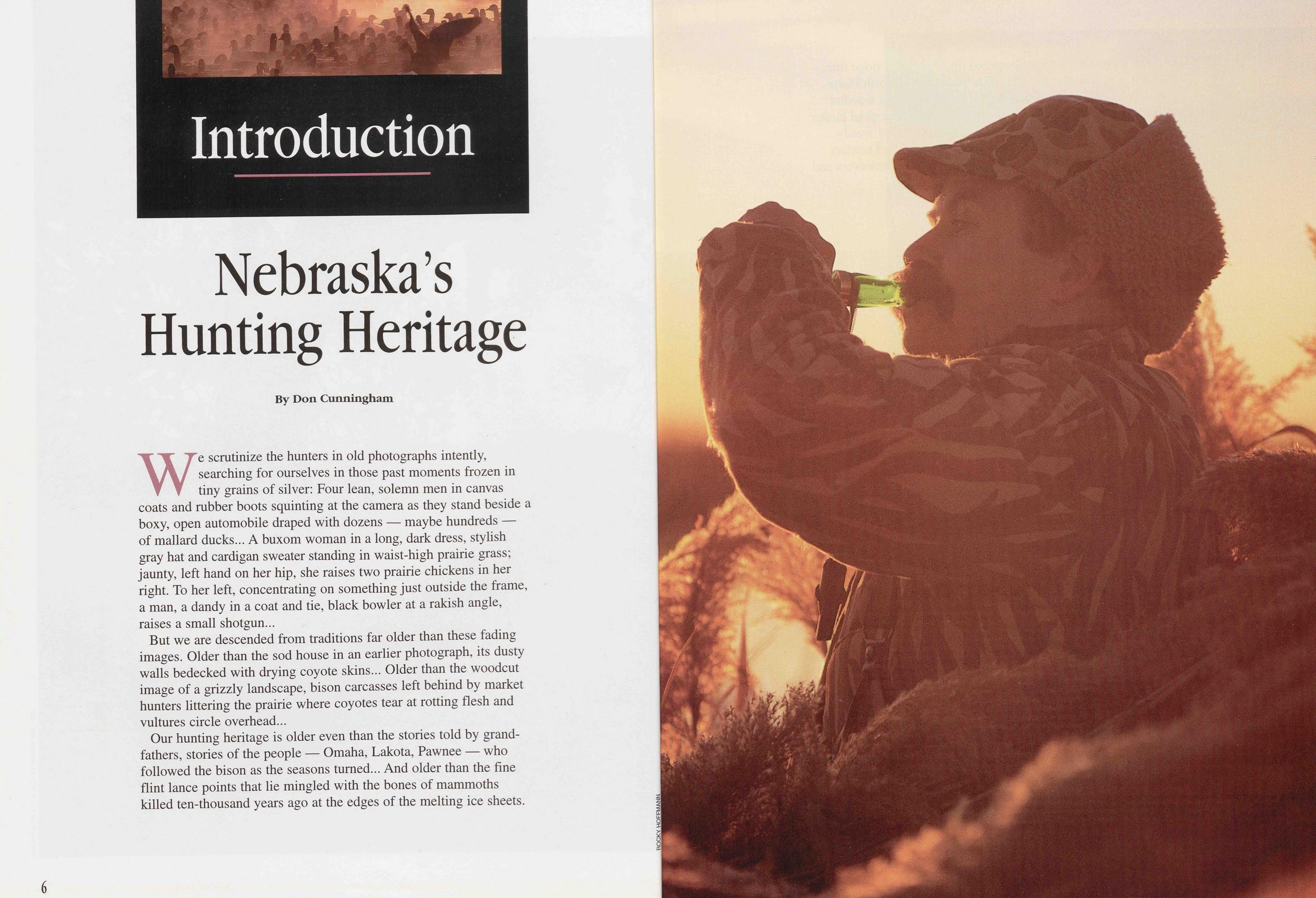
Introduction
Nebraska's Hunting Heritage By Don CunninghamWe scrutinize the hunters in old photographs intently, searching for ourselves in those past moments frozen in tiny grains of silver: Four lean, solemn men in canvas coats and rubber boots squinting at the camera as they stand beside a boxy, open automobile draped with dozens — maybe hundreds — of mallard ducks... A buxom woman in a long, dark dress, stylish gray hat and cardigan sweater standing in waist-high prairie grass; jaunty, left hand on her hip, she raises two prairie chickens in her right. To her left, concentrating on something just outside the frame, a man, a dandy in a coat and tie, black bowler at a rakish angle, raises a small shotgun...
But we are descended from traditions far older than these fading images. Older than the sod house in an earlier photograph, its dusty walls bedecked with drying coyote skins... Older than the woodcut image of a grizzly landscape, bison carcasses left behind by market hunters littering the prairie where coyotes tear at rotting flesh and vultures circle overhead...
Our hunting heritage is older even than the stories told by grandfathers, stories of the people — Omaha, Lakota, Pawnee — who followed the bison as the seasons turned... And older than the fine flint lance points that lie mingled with the bones of mammoths killed ten-thousand years ago at the edges of the melting ice sheets.
6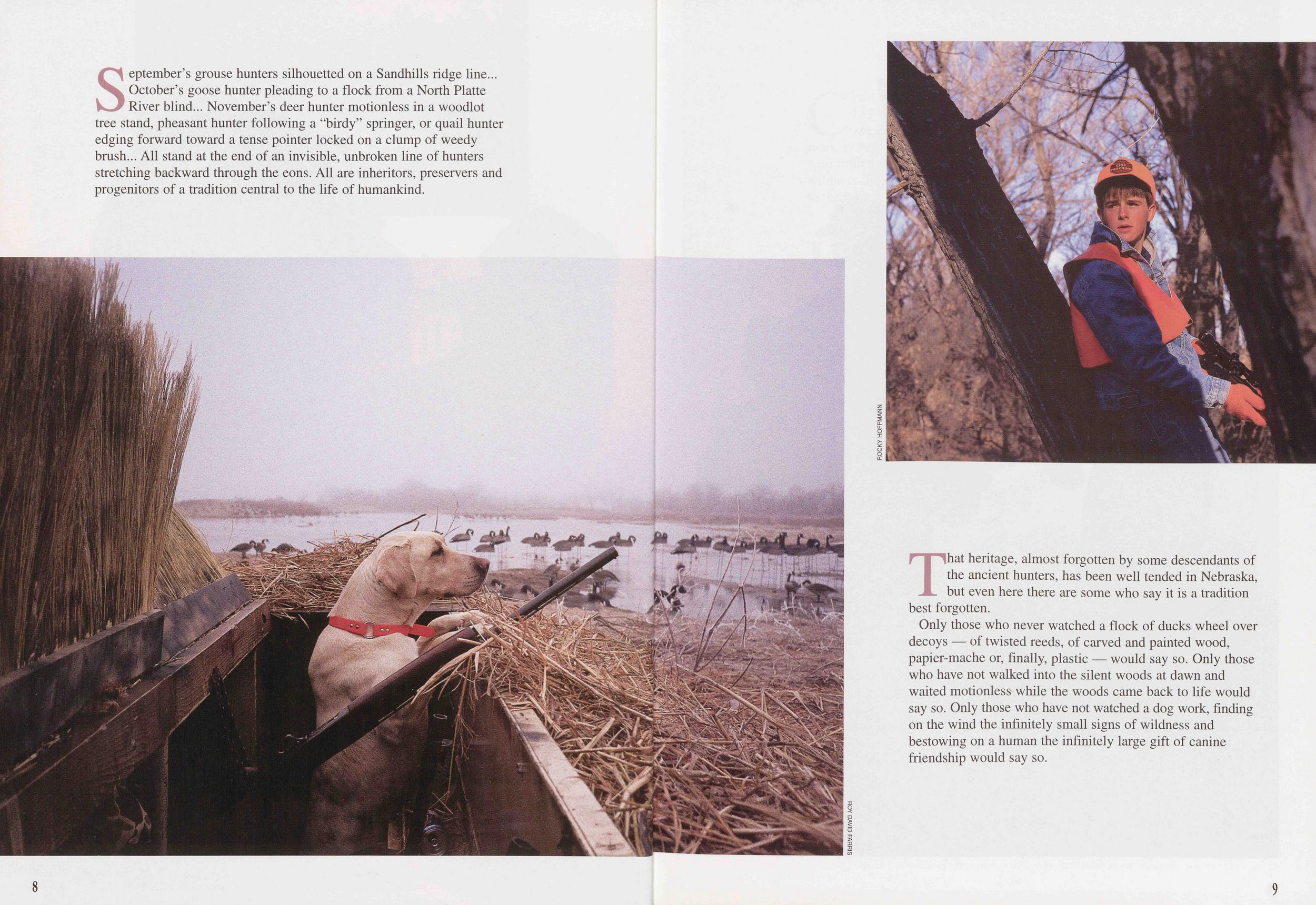
September's grouse hunters silhouetted on a Sandhills ridge line... October's goose hunter pleading to a flock from a North Platte River blind... November's deer hunter motionless in a woodlot tree stand, pheasant hunter following a "birdy" springer, or quail hunter edging forward toward a tense pointer locked on a clump of weedy brush... All stand at the end of an invisible, unbroken line of hunters stretching backward through the eons. All are inheritors, preservers and progenitors of a tradition central to the life of humankind.
That heritage, almost forgotten by some descendants of the ancient hunters, has been well tended in Nebraska, but even here there are some who say it is a tradition best forgotten.
Only those who never watched a flock of ducks wheel over decoys — of twisted reeds, of carved and painted wood, papier-mache or, finally, plastic — would say so. Only those who have not walked into the silent woods at dawn and waited motionless while the woods came back to life would say so. Only those who have not watched a dog work, finding on the wind the infinitely small signs of wildness and bestowing on a human the infinitely large gift of canine friendship would say so.
9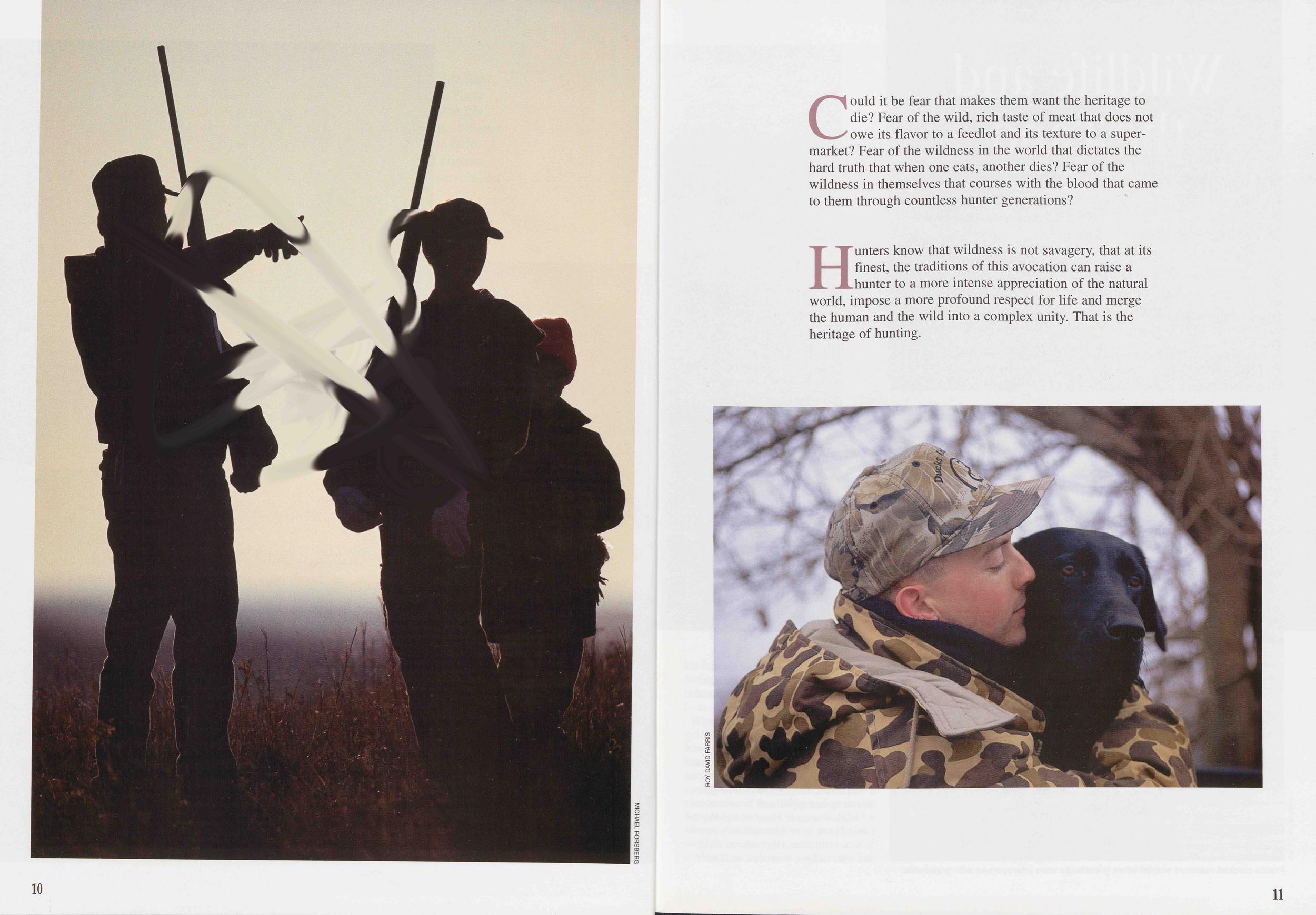
Could it be fear that makes them want the heritage to die? Fear of the wild, rich taste of meat that does not owe its flavor to a feedlot and its texture to a supermarket? Fear of the wildness in the world that dictates the hard truth that when one eats, another dies? Fear of the wildness in themselves that courses with the blood that came to them through countless hunter generations?
Hunters know that wildness is not savagery, that at its finest, the traditions of this avocation can raise a hunter to a more intense appreciation of the natural world, impose a more profound respect for life and merge the human and the wild into a complex unity. That is the heritage of hunting.
Wildlife and the Land
By Jon Farrar Unregulated hunting in the late 1800s rapidly diminished the abundance of Nebraska's seemingly limitless flocks and herds of wild animals and led to the extirpation of some species. Since 1900, though, our use of the land has determined which species prosper, which struggle to survive and which vanish.Before the coming of Europeans, the Great Plains was a grassland of immense scale adapted to a semi-arid, midcontinental climate. Within the seeming sameness of this grassland was infinite diversity, an amalgamation of diverse plant and animal communities, each created' by subtle variations in response to all the earth forces — sun, soil, moisture, wind and even the effect of the plants and the animals themselves on their environment.
All that changed as crops were planted and livestock introduced. Within decades, the mix of plant and animal life was no longer determined by elemental forces of nature, but by the decisions of those living on the land and even those living far from the land. The smallest changes, multiplied by thousands, transformed the Nebraska landscape as corn replaced bluestem, ring-necked pheasants replaced prairie
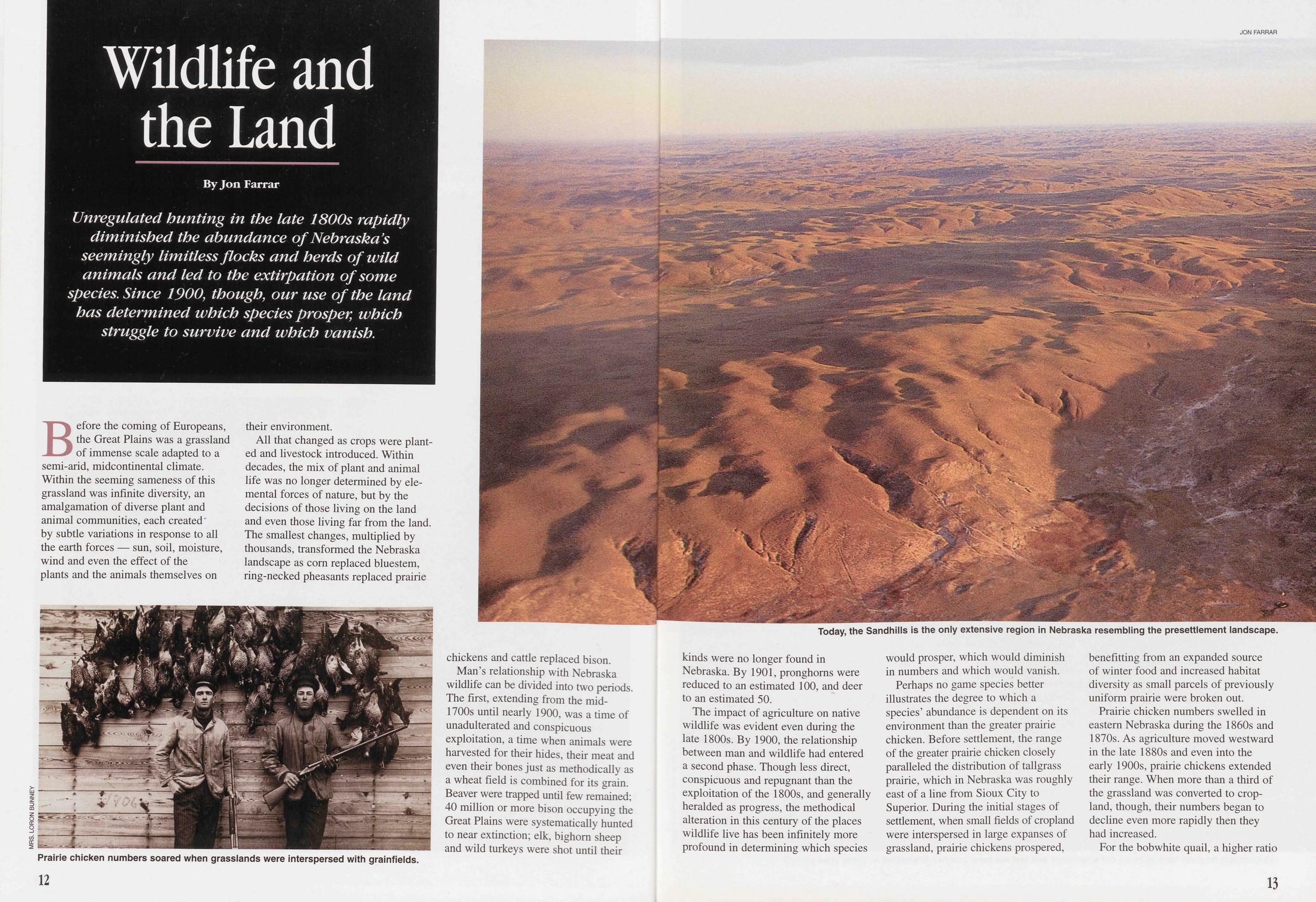
Prairie chicken numbers soared when grasslands were interspersed with grainfields.
MRS. LORON BUNNEYchickens and cattle replaced bison.
Man's relationship with Nebraska wildlife can be divided into two periods. The first, extending from the mid-1700s until nearly 1900, was a time of unadulterated and conspicuous exploitation, a time when animals were harvested for their hides, their meat and even their bones just as methodically as a wheat field is combined for its grain. Beaver were trapped until few remained; 40 million or more bison occupying the Great Plains were systematically hunted to near extinction; elk, bighorn sheep and wild turkeys were shot until their
12Today, the Sandhills is the only extensive region in Nebraska resembling the presettlement landscape.
kinds were no longer found in Nebraska. By 1901, pronghorns were reduced to an estimated 100, and deer to an estimated 50.
The impact of agriculture on native wildlife was evident even during the late 1800s. By 1900, the relationship between man and wildlife had entered a second phase. Though less direct, conspicuous and repugnant than the exploitation of the 1800s, and generally heralded as progress, the methodical alteration in this century of the places wildlife live has been infinitely more profound in determining which species would prosper, which would diminish in numbers and which would vanish.
Perhaps no game species better illustrates the degree to which a species' abundance is dependent on its environment than the greater prairie chicken. Before settlement, the range of the greater prairie chicken closely paralleled the distribution of tallgrass prairie, which in Nebraska was roughly east of a line from Sioux City to Superior. During the initial stages of settlement, when small fields of cropland were interspersed in large expanses of grassland, prairie chickens prospered, benefitting from an expanded source of winter food and increased habitat diversity as small parcels of previously uniform prairie were broken out.
Prairie chicken numbers swelled in eastern Nebraska during the 1860s and 1870s. As agriculture moved westward in the late 1880s and even into the early 1900s, prairie chickens extended their range. When more than a third of the grassland was converted to cropland, though, their numbers began to decline even more rapidly then they had increased.
For the bobwhite quail, a higher ratio
13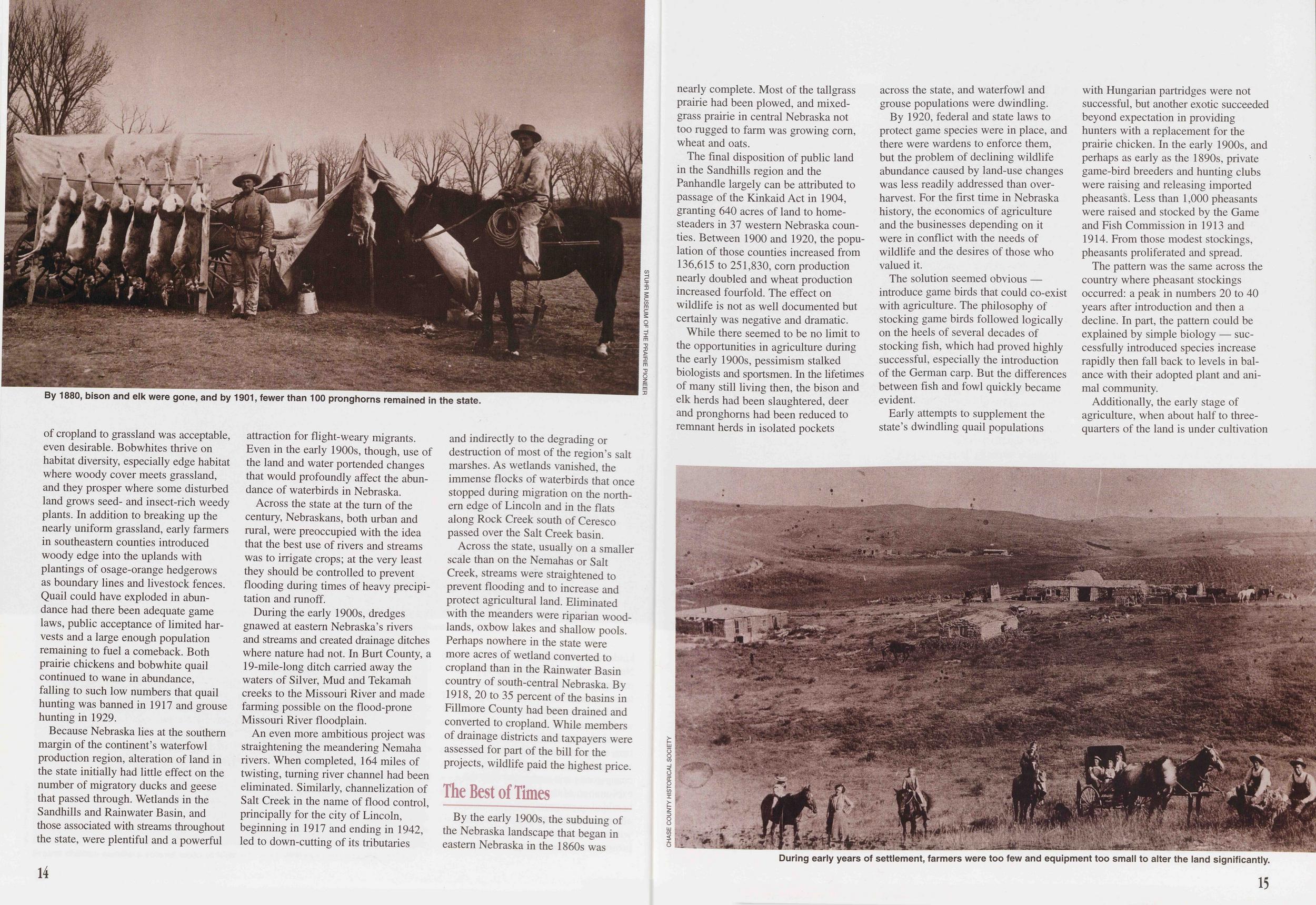
By 1880, bison and elk were gone, and by 1901, fewer than 100 pronghorns remained in the state.
STUR MUSEUM OF THE PRAIRIE PIONEERof cropland to grassland was acceptable, even desirable. Bob whites thrive on habitat diversity, especially edge habitat where woody cover meets grassland, and they prosper where some disturbed land grows seed- and insect-rich weedy plants. In addition to breaking up the nearly uniform grassland, early farmers in southeastern counties introduced woody edge into the uplands with plantings of osage-orange hedgerows as boundary lines and livestock fences. Quail could have exploded in abundance had there been adequate game laws, public acceptance of limited harvests and a large enough population remaining to fuel a comeback. Both prairie chickens and bobwhite quail continued to wane in abundance, falling to such low numbers that quail hunting was banned in 1917 and grouse hunting in 1929.
Because Nebraska lies at the southern margin of the continent's waterfowl production region, alteration of land in the state initially had little effect on the number of migratory ducks and geese that passed through. Wetlands in the Sandhills and Rainwater Basin, and those associated with streams throughout the state, were plentiful and a powerful attraction for flight-weary migrants. Even in the early 1900s, though, use of the land and water portended changes that would profoundly affect the abundance of waterbirds in Nebraska.
Across the state at the turn of the century, Nebraskans, both urban and rural, were preoccupied with the idea that the best use of rivers and streams was to irrigate crops; at the very least they should be controlled to prevent flooding during times of heavy precipitation and runoff.
During the early 1900s, dredges gnawed at eastern Nebraska's rivers and streams and created drainage ditches where nature had not. In Burt County, a 19-mile-long ditch carried away the waters of Silver, Mud and Tekamah creeks to the Missouri River and made farming possible on the flood-prone Missouri River floodplain.
An even more ambitious project was straightening the meandering Nemaha rivers. When completed, 164 miles of twisting, turning river channel had been eliminated. Similarly, channelization of Salt Creek in the name of flood control, principally for the city of Lincoln, beginning in 1917 and ending in 1942, led to down-cutting of its tributaries and indirectly to the degrading or destruction of most of the region's salt marshes. As wetlands vanished, the immense flocks of waterbirds that once stopped during migration on the northern edge of Lincoln and in the flats along Rock Creek south of Ceresco passed over the Salt Creek basin.
Across the state, usually on a smaller scale than on the Nemahas or Salt Creek, streams were straightened to prevent flooding and to increase and protect agricultural land. Eliminated with the meanders were riparian woodlands, oxbow lakes and shallow pools. Perhaps nowhere in the state were more acres of wetland converted to cropland than in the Rainwater Basin country of south-central Nebraska. By 1918, 20 to 35 percent of the basins in Fillmore County had been drained and converted to cropland. While members of drainage districts and taxpayers were assessed for part of the bill for the projects, wildlife paid the highest price.
The Best of TimesBy the early 1900s, the subduing of the Nebraska landscape that began in eastern Nebraska in the 1860s was
14nearly complete. Most of the tallgrass prairie had been plowed, and mixed-grass prairie in central Nebraska not too rugged to farm was growing corn, wheat and oats.
The final disposition of public land in the Sandhills region and the Panhandle largely can be attributed to passage of the Kinkaid Act in 1904, granting 640 acres of land to homesteaders in 37 western Nebraska counties. Between 1900 and 1920, the population of those counties increased from 136,615 to 251,830, corn production nearly doubled and wheat production increased fourfold. The effect on wildlife is not as well documented but certainly was negative and dramatic.
While there seemed to be no limit to the opportunities in agriculture during the early 1900s, pessimism stalked biologists and sportsmen. In the lifetimes of many still living then, the bison and elk herds had been slaughtered, deer and pronghorns had been reduced to remnant herds in isolated pockets across the state, and waterfowl and grouse populations were dwindling.
By 1920, federal and state laws to protect game species were in place, and there were wardens to enforce them, but the problem of declining wildlife abundance caused by land-use changes was less readily addressed than over-harvest. For the first time in Nebraska history, the economics of agriculture and the businesses depending on it were in conflict with the needs of wildlife and the desires of those who valued it.
The solution seemed obvious — introduce game birds that could co-exist with agriculture. The philosophy of stocking game birds followed logically on the heels of several decades of stocking fish, which had proved highly successful, especially the introduction of the German carp. But the differences between fish and fowl quickly became evident.
Early attempts to supplement the state's dwindling quail populations with Hungarian partridges were not successful, but another exotic succeeded beyond expectation in providing hunters with a replacement for the prairie chicken. In the early 1900s, and perhaps as early as the 1890s, private game-bird breeders and hunting clubs were raising and releasing imported pheasants. Less than 1,000 pheasants were raised and stocked by the Game and Fish Commission in 1913 and 1914. From those modest stockings, pheasants proliferated and spread.
The pattern was the same across the country where pheasant stockings occurred: a peak in numbers 20 to 40 years after introduction and then a decline. In part, the pattern could be explained by simple biology — successfully introduced species increase rapidly then fall back to levels in balance with their adopted plant and animal community.
Additionally, the early stage of agriculture, when about half to three- quarters of the land is under cultivation
During early years of settlement, farmers were too few and equipment too small to alter the land significantly.
CHASE COUNTY HISTORICAL SOCIETY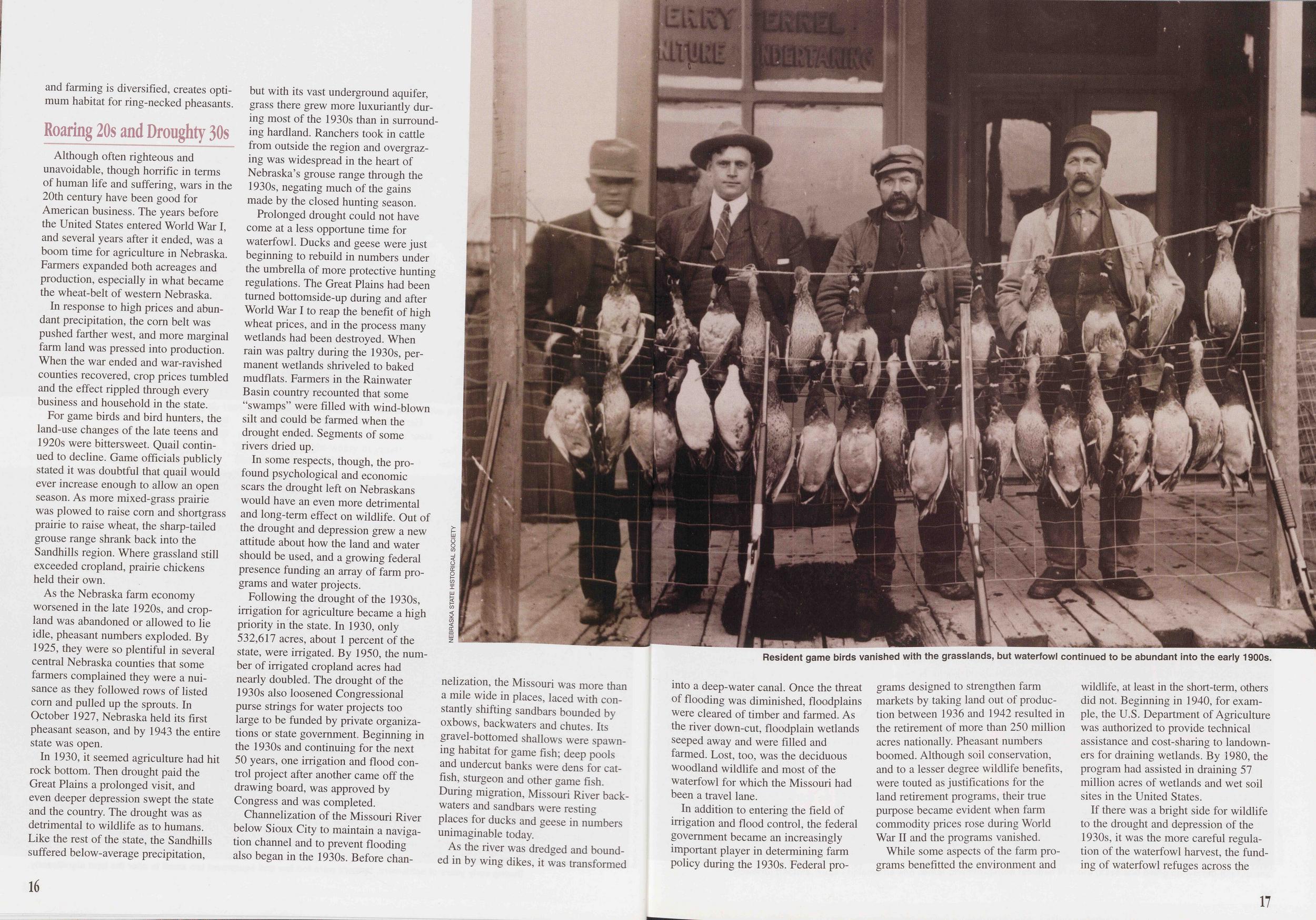
and farming is diversified, creates optimum habitat for ring-necked pheasants.
Roaring 20s and Droughty 30sAlthough often righteous and unavoidable, though horrific in terms of human life and suffering, wars in the 20th century have been good for American business. The years before the United States entered World War I, and several years after it ended, was a boom time for agriculture in Nebraska. Farmers expanded both acreages and production, especially in what became the wheat-belt of western Nebraska.
In response to high prices and abundant precipitation, the corn belt was pushed farther west, and more marginal farm land was pressed into production. When the war ended and war-ravished counties recovered, crop prices tumbled and the effect rippled through every business and household in the state.
For game birds and bird hunters, the land-use changes of the late teens and 1920s were bittersweet. Quail continued to decline. Game officials publicly stated it was doubtful that quail would ever increase enough to allow an open season. As more mixed-grass prairie was plowed to raise corn and shortgrass prairie to raise wheat, the sharp-tailed grouse range shrank back into the Sandhills region. Where grassland still exceeded cropland, prairie chickens held their own.
As the Nebraska farm economy worsened in the late 1920s, and cropland was abandoned or allowed to lie idle, pheasant numbers exploded. By 1925, they were so plentiful in several central Nebraska counties that some farmers complained they were a nuisance as they followed rows of listed corn and pulled up the sprouts. In October 1927, Nebraska held its first pheasant season, and by 1943 the entire state was open.
In 1930, it seemed agriculture had hit rock bottom. Then drought paid the Great Plains a prolonged visit, and even deeper depression swept the state and the country. The drought was as detrimental to wildlife as to humans. Like the rest of the state, the Sandhills suffered below-average precipitation, but with its vast underground aquifer, grass there grew more luxuriantly during most of the 1930s than in surrounding hardland. Ranchers took in cattle from outside the region and overgrazing was widespread in the heart of Nebraska's grouse range through the 1930s, negating much of the gains made by the closed hunting season.
Prolonged drought could not have come at a less opportune time for waterfowl. Ducks and geese were just beginning to rebuild in numbers under the umbrella of more protective hunting regulations. The Great Plains had been turned bottomside-up during and after World War I to reap the benefit of high wheat prices, and in the process many wetlands had been destroyed. When rain was paltry during the 1930s, permanent wetlands shriveled to baked mudflats. Farmers in the Rainwater Basin country recounted that some "swamps" were filled with wind-blown silt and could be farmed when the drought ended. Segments of some rivers dried up.
In some respects, though, the profound psychological and economic scars the drought left on Nebraskans would have an even more detrimental and long-term effect on wildlife. Out of the drought and depression grew a new attitude about how the land and water should be used, and a growing federal presence funding an array of farm programs and water projects.
Following the drought of the 1930s, irrigation for agriculture became a high priority in the state. In 1930, only 532,617 acres, about 1 percent of the state, were irrigated. By 1950, the number of irrigated cropland acres had nearly doubled. The drought of the 1930s also loosened Congressional purse strings for water projects too large to be funded by private organizations or state government. Beginning in the 1930s and continuing for the next 50 years, one irrigation and flood control project after another came off the drawing board, was approved by Congress and was completed.
Channelization of the Missouri River below Sioux City to maintain a navigation channel and to prevent flooding also began in the 1930s. Before channelization,
Resident game birds vanished with the grasslands, but waterfowl continued to be abundant into the early 1900s.
the Missouri was more than a mile wide in places, laced with constantly shifting sandbars bounded by oxbows, backwaters and chutes. Its gravel-bottomed shallows were spawning habitat for game fish; deep pools and undercut banks were dens for catfish, sturgeon and other game fish. During migration, Missouri River backwaters and sandbars were resting places for ducks and geese in numbers unimaginable today.
As the river was dredged and bounded in by wing dikes, it was transformed
16into a deep-water canal. Once the threat of flooding was diminished, floodplains were cleared of timber and farmed. As the river down-cut, floodplain wetlands seeped away and were filled and farmed. Lost, too, was the deciduous woodland wildlife and most of the waterfowl for which the Missouri had been a travel lane.
In addition to entering the field of irrigation and flood control, the federal government became an increasingly important player in determining farm policy during the 1930s. Federal programs designed to strengthen farm markets by taking land out of production between 1936 and 1942 resulted in the retirement of more than 250 million acres nationally. Pheasant numbers boomed. Although soil conservation, and to a lesser degree wildlife benefits, were touted as justifications for the land retirement programs, their true purpose became evident when farm commodity prices rose during World War II and the programs vanished.
While some aspects of the farm programs benefitted the environment and wildlife, at least in the short-term, others did not. Beginning in 1940, for example, the U.S. Department of Agriculture was authorized to provide technical assistance and cost-sharing to landowners for draining wetlands. By 1980, the program had assisted in draining 57 million acres of wetlands and wet soil sites in the United States.
If there was a bright side for wildlife to the drought and depression of the 1930s, it was the more careful regulation of the waterfowl harvest, the funding of waterfowl refuges across the
17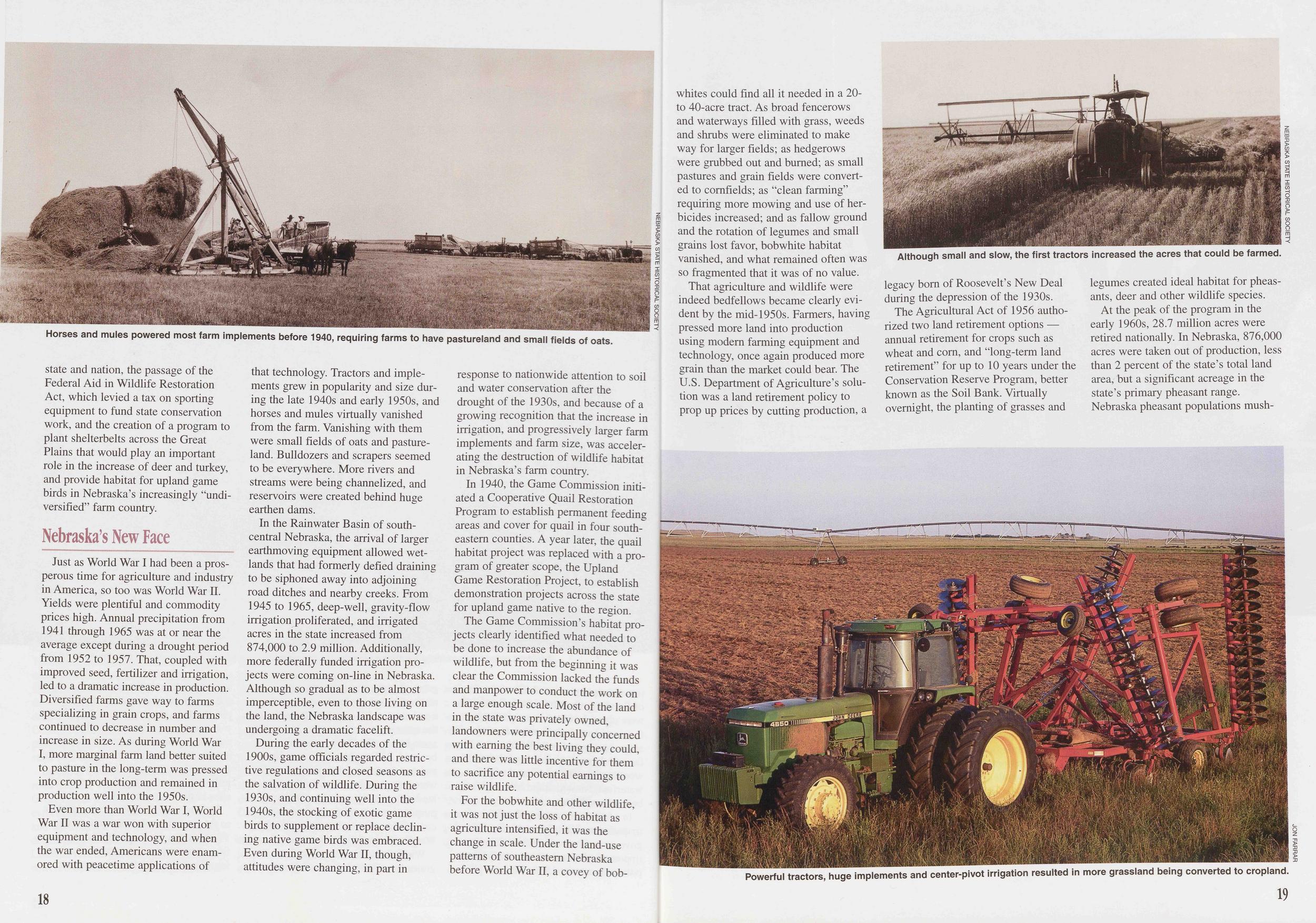
Horses and mules powered most farm implements before 1940, requiring farms to have pastureland and small fields of oats.
state and nation, the passage of the Federal Aid in Wildlife Restoration Act, which levied a tax on sporting equipment to fund state conservation work, and the creation of a program to plant shelterbelts across the Great Plains that would play an important role in the increase of deer and turkey, and provide habitat for upland game birds in Nebraska's increasingly "undiversified" farm country.
Nebraska's New FaceJust as World War I had been a prosperous time for agriculture and industry in America, so too was World War II. Yields were plentiful and commodity prices high. Annual precipitation from 1941 through 1965 was at or near the average except during a drought period from 1952 to 1957. That, coupled with improved seed, fertilizer and irrigation, led to a dramatic increase in production. Diversified farms gave way to farms specializing in grain crops, and farms continued to decrease in number and increase in size. As during World War I, more marginal farm land better suited to pasture in the long-term was pressed into crop production and remained in production well into the 1950s.
Even more than World War I, World War II was a war won with superior equipment and technology, and when the war ended, Americans were enamored with peacetime applications of that technology. Tractors and implements grew in popularity and size during the late 1940s and early 1950s, and horses and mules virtually vanished from the farm. Vanishing with them were small fields of oats and pastureland. Bulldozers and scrapers seemed to be everywhere. More rivers and streams were being channelized, and reservoirs were created behind huge earthen dams.
In the Rainwater Basin of south-central Nebraska, the arrival of larger earthmoving equipment allowed wetlands that had formerly defied draining to be siphoned away into adjoining road ditches and nearby creeks. From 1945 to 1965, deep-well, gravity-flow irrigation proliferated, and irrigated acres in the state increased from 874,000 to 2.9 million. Additionally, more federally funded irrigation projects were coming on-line in Nebraska. Although so gradual as to be almost imperceptible, even to those living on the land, the Nebraska landscape was undergoing a dramatic facelift.
During the early decades of the 1900s, game officials regarded restrictive regulations and closed seasons as the salvation of wildlife. During the 1930s, and continuing well into the 1940s, the stocking of exotic game birds to supplement or replace declining native game birds was embraced. Even during World War II, though, attitudes were changing, in part in response to nationwide attention to soil and water conservation after the drought of the 1930s, and because of a growing recognition that the increase in irrigation, and progressively larger farm implements and farm size, was accelerating the destruction of wildlife habitat in Nebraska's farm country.
In 1940, the Game Commission initiated a Cooperative Quail Restoration Program to establish permanent feeding areas and cover for quail in four southeastern counties. A year later, the quail habitat project was replaced with a program of greater scope, the Upland Game Restoration Project, to establish demonstration projects across the state for upland game native to the region.
The Game Commission's habitat projects clearly identified what needed to be done to increase the abundance of wildlife, but from the beginning it was clear the Commission lacked the funds and manpower to conduct the work on a large enough scale. Most of the land in the state was privately owned, landowners were principally concerned with earning the best living they could, and there was little incentive for them to sacrifice any potential earnings to raise wildlife.
For the bobwhite and other wildlife, it was not just the loss of habitat as agriculture intensified, it was the change in scale. Under the land-use patterns of southeastern Nebraska before World War II, a covey of bobwhites
18could find all it needed in a 20- to 40-acre tract. As broad fencerows and waterways filled with grass, weeds and shrubs were eliminated to make way for larger fields; as hedgerows were grubbed out and burned; as small pastures and grain fields were converted to cornfields; as "clean farming" requiring more mowing and use of herbicides increased; and as fallow ground and the rotation of legumes and small grains lost favor, bobwhite habitat vanished, and what remained often was so fragmented that it was of no value.
That agriculture and wildlife were indeed bedfellows became clearly evident by the mid-1950s. Farmers, having pressed more land into production using modern farming equipment and technology, once again produced more grain than the market could bear. The U.S. Department of Agriculture's solution was a land retirement policy to prop up prices by cutting production, a
Although small and slow, the first tractors increased the acres that could be farmed.
legacy born of Roosevelt's New Deal during the depression of the 1930s.
The Agricultural Act of 1956 authorized two land retirement options — annual retirement for crops such as wheat and corn, and "long-term land retirement" for up to 10 years under the Conservation Reserve Program, better known as the Soil Bank. Virtually overnight, the planting of grasses and legumes created ideal habitat for pheasants, deer and other wildlife species.
At the peak of the program in the early 1960s, 28.7 million acres were retired nationally. In Nebraska, 876,000 acres were taken out of production, less than 2 percent of the state's total land area, but a significant acreage in the state's primary pheasant range. Nebraska pheasant populations mushroomed
Powerful tractors, huge implements and center-pivot irrigation resulted in more grassland being converted to cropland.
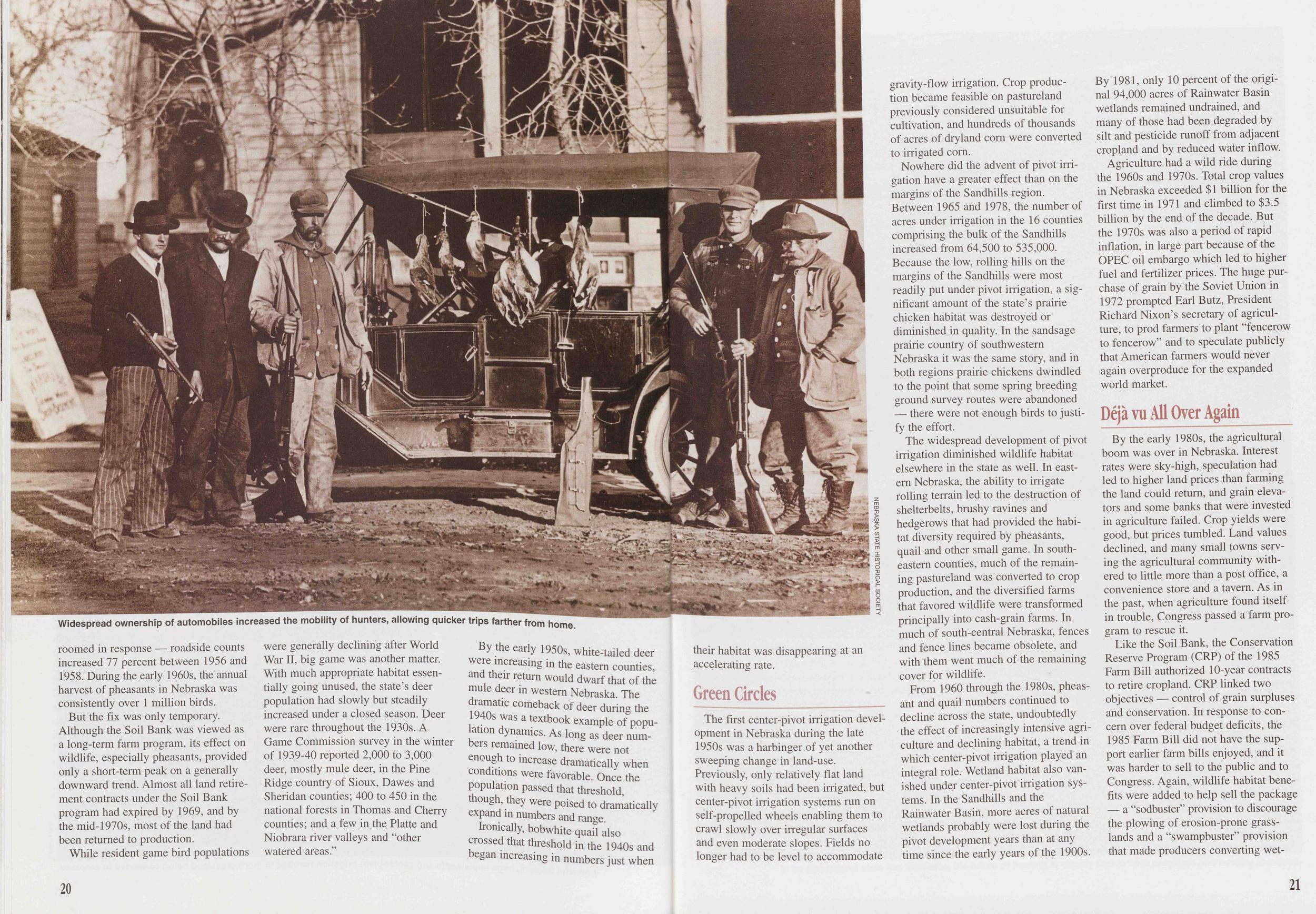
Widespread ownership of automobiles increased the mobility of hunters, allowing quicker trips farther from home
in response — roadside counts increased 77 percent between 1956 and 1958. During the early 1960s, the annual harvest of pheasants in Nebraska was consistently over 1 million birds.
But the fix was only temporary. Although the Soil Bank was viewed as a long-term farm program, its effect on wildlife, especially pheasants, provided only a short-term peak on a generally downward trend. Almost all land retirement contracts under the Soil Bank program had expired by 1969, and by the mid-1970s, most of the land had been returned to production.
While resident game bird populations were generally declining after World War II, big game was another matter. With much appropriate habitat essentially going unused, the state's deer population had slowly but steadily increased under a closed season. Deer were rare throughout the 1930s. A Game Commission survey in the winter of 1939-40 reported 2,000 to 3,000 deer, mostly mule deer, in the Pine Ridge country of Sioux, Dawes and Sheridan counties; 400 to 450 in the national forests in Thomas and Cherry counties; and a few in the Platte and Niobrara river valleys and "other watered areas."
By the early 1950s, white-tailed deer were increasing in the eastern counties, and their return would dwarf that of the mule deer in western Nebraska. The dramatic comeback of deer during the 1940s was a textbook example of population dynamics. As long as deer numbers remained low, there were not enough to increase dramatically when conditions were favorable. Once the population passed that threshold though, they were poised to dramatically expand in numbers and range.
Ironically, bobwhite quail also crossed that threshold in the 1940s and began increasing in numbers just when
20their habitat was disappearing at an accelerating rate.
Green CirclesThe first center-pivot irrigation development in Nebraska during the late 1950s was a harbinger of yet another sweeping change in land-use. Previously, only relatively flat land with heavy soils had been irrigated, but center-pivot irrigation systems run on self-propelled wheels enabling them to crawl slowly over irregular surfaces and even moderate slopes. Fields no longer had to be level to accommodate gravity-flow irrigation. Crop production became feasible on pastureland previously considered unsuitable for cultivation, and hundreds of thousands of acres of dryland corn were converted to irrigated corn.
Nowhere did the advent of pivot irrigation have a greater effect than on the margins of the Sandhills region. Between 1965 and 1978, the number of acres under irrigation in the 16 counties comprising the bulk of the Sandhills increased from 64,500 to 535,000. Because the low, rolling hills on the margins of the Sandhills were most readily put under pivot irrigation, a significant amount of the state's prairie chicken habitat was destroyed or diminished in quality. In the sandsage prairie country of southwestern Nebraska it was the same story, and in both regions prairie chickens dwindled to the point that some spring breeding ground survey routes were abandoned — there were not enough birds to justify the effort.
The widespread development of pivot irrigation diminished wildlife habitat elsewhere in the state as well. In eastern Nebraska, the ability to irrigate rolling terrain led to the destruction of shelterbelts, brushy ravines and hedgerows that had provided the habitat diversity required by pheasants, quail and other small game. In southeastern counties, much of the remaining pastureland was converted to crop production, and the diversified farms that favored wildlife were transformed principally into cash-grain farms. In much of south-central Nebraska, fences and fence lines became obsolete, and with them went much of the remaining cover for wildlife.
From 1960 through the 1980s, pheasant and quail numbers continued to decline across the state, undoubtedly the effect of increasingly intensive agriculture and declining habitat, a trend in which center-pivot irrigation played an integral role. Wetland habitat also vanished under center-pivot irrigation systems. In the Sandhills and the Rainwater Basin, more acres of natural wetlands probably were lost during the pivot development years than at any time since the early years of the 1900s. By 1981, only 10 percent of the original 94,000 acres of Rainwater Basin wetlands remained undrained, and many of those had been degraded by silt and pesticide runoff from adjacent cropland and by reduced water inflow.
Agriculture had a wild ride during the 1960s and 1970s. Total crop values in Nebraska exceeded $1 billion for the first time in 1971 and climbed to $3.5 billion by the end of the decade. But the 1970s was also a period of rapid inflation, in large part because of the OPEC oil embargo which led to higher fuel and fertilizer prices. The huge purchase of grain by the Soviet Union in 1972 prompted Earl Butz, President Richard Nixon's secretary of agriculture, to prod farmers to plant "fencerow to fencerow" and to speculate publicly that American farmers would never again overproduce for the expanded world market.
Deja vu All Over AgainBy the early 1980s, the agricultural boom was over in Nebraska. Interest rates were sky-high, speculation had led to higher land prices than farming the land could return, and grain elevators and some banks that were invested in agriculture failed. Crop yields were good, but prices tumbled. Land values declined, and many small towns serving the agricultural community withered to little more than a post office, a convenience store and a tavern. As in the past, when agriculture found itself in trouble, Congress passed a farm program to rescue it.
Like the Soil Bank, the Conservation Reserve Program (CRP) of the 1985 Farm Bill authorized 10-year contracts to retire cropland. CRP linked two objectives — control of grain surpluses and conservation. In response to concern over federal budget deficits, the 1985 Farm Bill did not have the support earlier farm bills enjoyed, and it was harder to sell to the public and to Congress. Again, wildlife habitat benefits were added to help sell the package — a "sodbuster" provision to discourage the plowing of erosion-prone grasslands and a "swampbuster" provision that made producers converting wetlands
21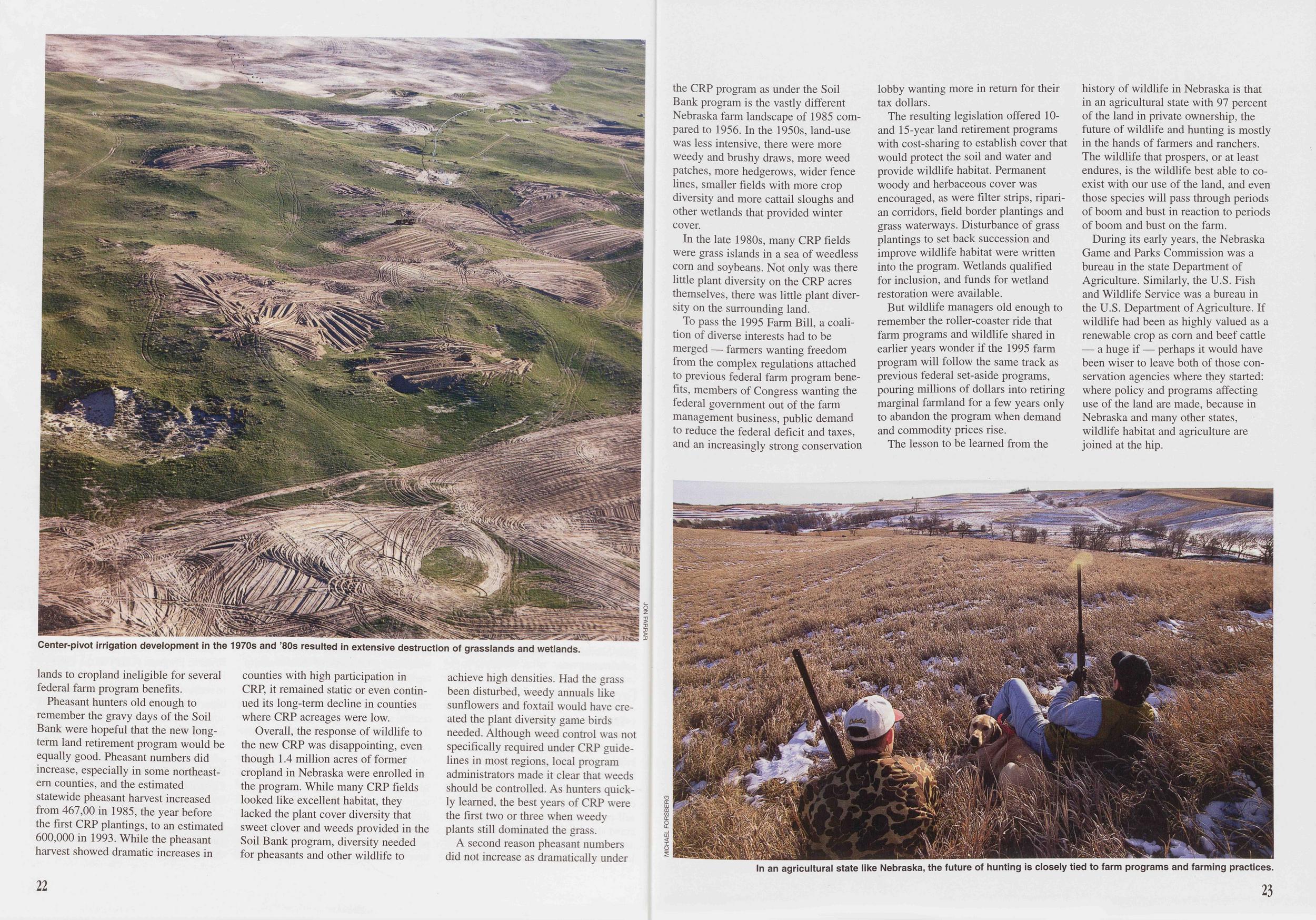
Center-pivot irrigation development in the 1970s and '80s resulted in extensive destruction of grasslands and wetlands.
to cropland ineligible for several federal farm program benefits.
Pheasant hunters old enough to remember the gravy days of the Soil Bank were hopeful that the new longterm land retirement program would be equally good. Pheasant numbers did increase, especially in some northeastern counties, and the estimated statewide pheasant harvest increased from 467,00 in 1985, the year before the first CRP plantings, to an estimated 600,000 in 1993. While the pheasant harvest showed dramatic increases in counties with high participation in CRP, it remained static or even continued its long-term decline in counties where CRP acreages were low.
Overall, the response of wildlife to the new CRP was disappointing, even though 1.4 million acres of former cropland in Nebraska were enrolled in the program. While many CRP fields looked like excellent habitat, they lacked the plant cover diversity that sweet clover and weeds provided in the Soil Bank program, diversity needed for pheasants and other wildlife to achieve high densities. Had the grass been disturbed, weedy annuals like sunflowers and foxtail would have created the plant diversity game birds needed. Although weed control was not specifically required under CRP guidelines in most regions, local program administrators made it clear that weeds should be controlled. As hunters quickly learned, the best years of CRP were the first two or three when weedy plants still dominated the grass.
A second reason pheasant numbers did not increase as dramatically under
22the CRP program as under the Soil Bank program is the vastly different Nebraska farm landscape of 1985 compared to 1956. In the 1950s, land-use was less intensive, there were more weedy and brushy draws, more weed patches, more hedgerows, wider fence lines, smaller fields with more crop diversity and more cattail sloughs and other wetlands that provided winter cover.
In the late 1980s, many CRP fields were grass islands in a sea of weedless corn and soybeans. Not only was there little plant diversity on the CRP acres themselves, there was little plant diversity on the surrounding land.
To pass the 1995 Farm Bill, a coalition of diverse interests had to be merged — farmers wanting freedom from the complex regulations attached to previous federal farm program benefits, members of Congress wanting the federal government out of the farm management business, public demand to reduce the federal deficit and taxes, and an increasingly strong conservation lobby wanting more in return for their tax dollars.
The resulting legislation offered 10- and 15-year land retirement programs with cost-sharing to establish cover that would protect the soil and water and provide wildlife habitat. Permanent woody and herbaceous cover was encouraged, as were filter strips, riparian corridors, field border plantings and grass waterways. Disturbance of grass plantings to set back succession and improve wildlife habitat were written into the program. Wetlands qualified for inclusion, and funds for wetland restoration were available.
But wildlife managers old enough to remember the roller-coaster ride that farm programs and wildlife shared in earlier years wonder if the 1995 farm program will follow the same track as previous federal set-aside programs, pouring millions of dollars into retiring marginal farmland for a few years only to abandon the program when demand and commodity prices rise.
The lesson to be learned from the history of wildlife in Nebraska is that in an agricultural state with 97 percent of the land in private ownership, the future of wildlife and hunting is mostly in the hands of farmers and ranchers. The wildlife that prospers, or at least endures, is the wildlife best able to co-exist with our use of the land, and even those species will pass through periods of boom and bust in reaction to periods of boom and bust on the farm.
During its early years, the Nebraska Game and Parks Commission was a bureau in the state Department of Agriculture. Similarly, the U.S. Fish and Wildlife Service was a bureau in the U.S. Department of Agriculture. If wildlife had been as highly valued as a renewable crop as corn and beef cattle — a huge if — perhaps it would have been wiser to leave both of those conservation agencies where they started: where policy and programs affecting use of the land are made, because in Nebraska and many other states, wildlife habitat and agriculture are joined at the hip.
In an agricultural state like Nebraska, the future of hunting is closely tied to farm programs and farming practices.
Upland Game
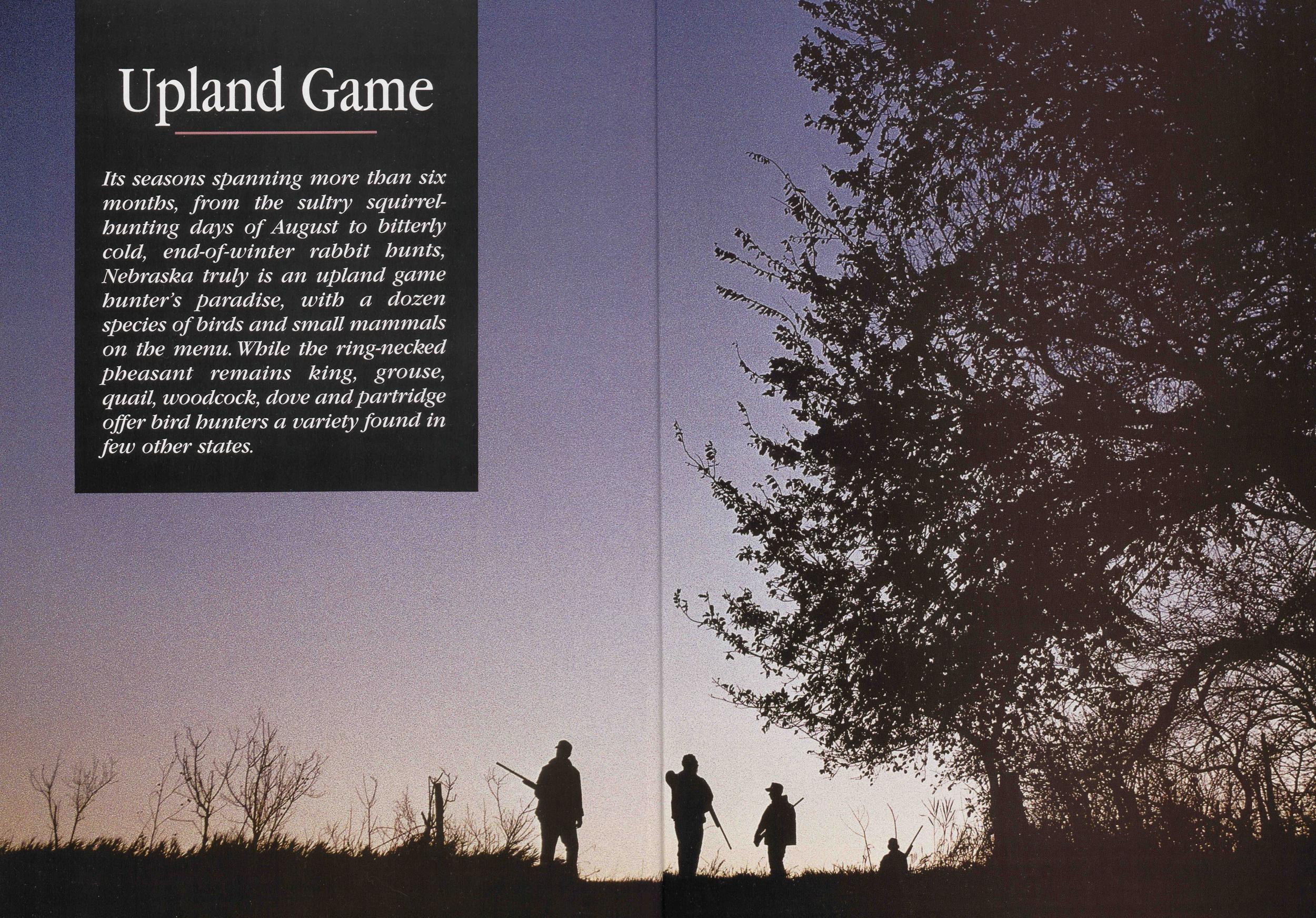
Its seasons spanning more than six months, from the sultry squirrel-hunting days of August to bitterly cold, end-of-winter rabbit hunts, Nebraska truly is an upland game hunter's paradise, with a dozen species of birds and small mammals on the menu. While the ring-necked pheasant remains king, grouse, quail, woodcock, dove and partridge offer bird hunters a variety found in few other states.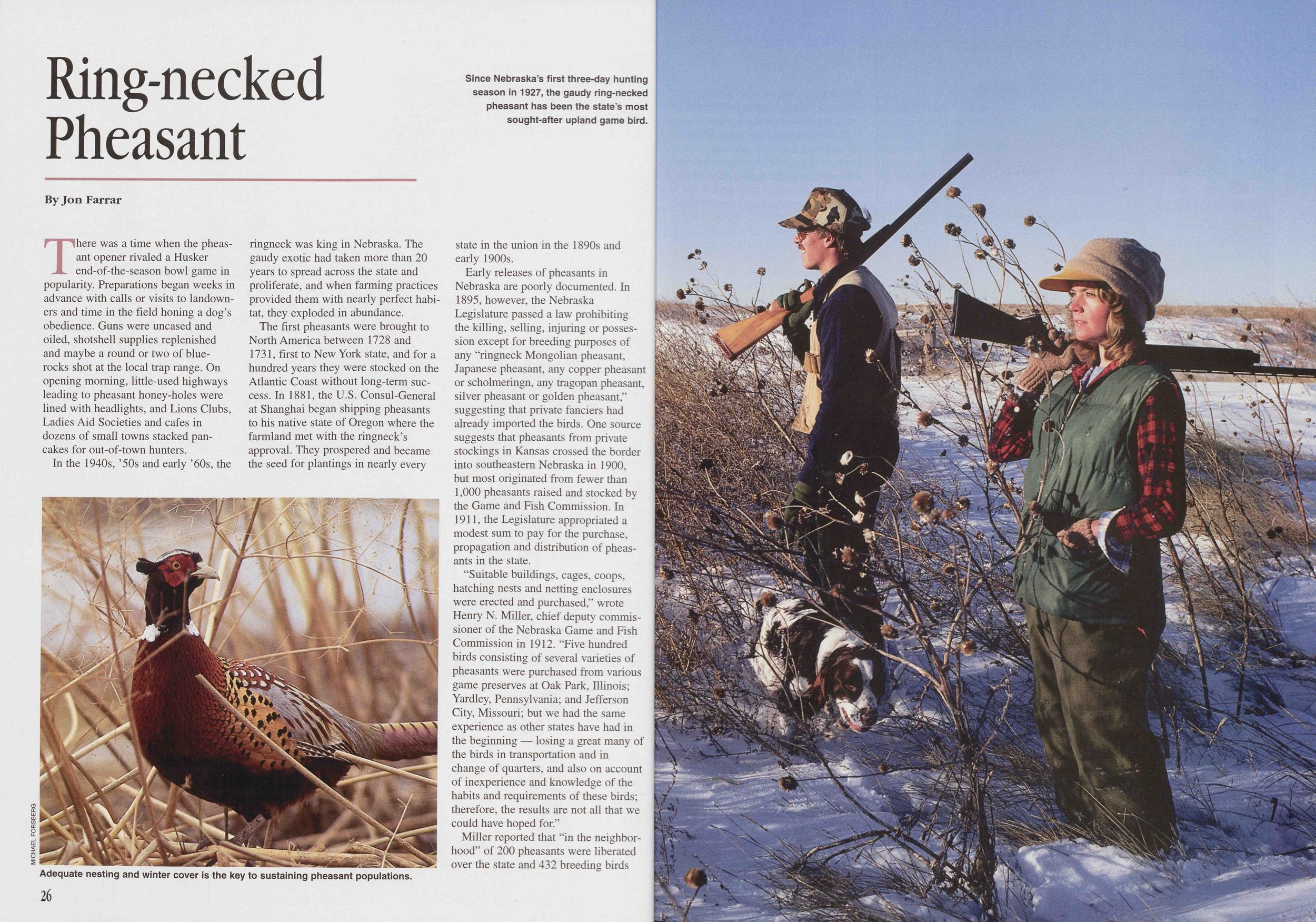
Ring-necked Pheasant
By Jon FarrarThere was a time when the pheasant opener rivaled a Husker end-of-the-season bowl game in popularity. Preparations began weeks in advance with calls or visits to landowners and time in the field honing a dog's obedience. Guns were uncased and oiled, shotshell supplies replenished and maybe a round or two of blue-rocks shot at the local trap range. On opening morning, little-used highways leading to pheasant honey-holes were lined with headlights, and Lions Clubs, Ladies Aid Societies and cafes in dozens of small towns stacked pancakes for out-of-town hunters.
In the 1940s, '50s and early '60s, the ringneck was king in Nebraska. The gaudy exotic had taken more than 20 years to spread across the state and proliferate, and when farming practices provided them with nearly perfect habitat, they exploded in abundance.
The first pheasants were brought to North America between 1728 and 1731, first to New York state, and for a hundred years they were stocked on the Atlantic Coast without long-term success. In 1881, the U.S. Consul-General at Shanghai began shipping pheasants to his native state of Oregon where the farmland met with the ringneck's approval. They prospered and became the seed for plantings in nearly every
Adequate nesting and winter cover is the key to sustaining pheasant populations.
state in the union in the 1890s and early 1900s.
Early releases of pheasants in Nebraska are poorly documented. In 1895, however, the Nebraska Legislature passed a law prohibiting the killing, selling, injuring or possession except for breeding purposes of any "ringneck Mongolian pheasant, Japanese pheasant, any copper pheasant or scholmeringn, any tragopan pheasant, silver pheasant or golden pheasant," suggesting that private fanciers had already imported the birds. One source suggests that pheasants from private stockings in Kansas crossed the border into southeastern Nebraska in 1900, but most originated from fewer than 1,000 pheasants raised and stocked by the Game and Fish Commission. In 1911, the Legislature appropriated a modest sum to pay for the purchase, propagation and distribution of pheasants in the state.
"Suitable buildings, cages, coops, hatching nests and netting enclosures were erected and purchased," wrote Henry N. Miller, chief deputy commissioner of the Nebraska Game and Fish Commission in 1912. "Five hundred birds consisting of several varieties of pheasants were purchased from various game preserves at Oak Park, Illinois; Yardley, Pennsylvania; and Jefferson City, Missouri; but we had the same experience as other states have had in the beginning — losing a great many of the birds in transportation and in change of quarters, and also on account of inexperience and knowledge of the habits and requirements of these birds; therefore, the results are not all that we could have hoped for."
Miller reported that "in the neighborhood" of 200 pheasants were liberated over the state and 432 breeding birds
26Since Nebraska's first three-day hunting season in 1927, the gaudy ring-necked pheasant has been the state's most sought-after upland game bird.
High Medium Low
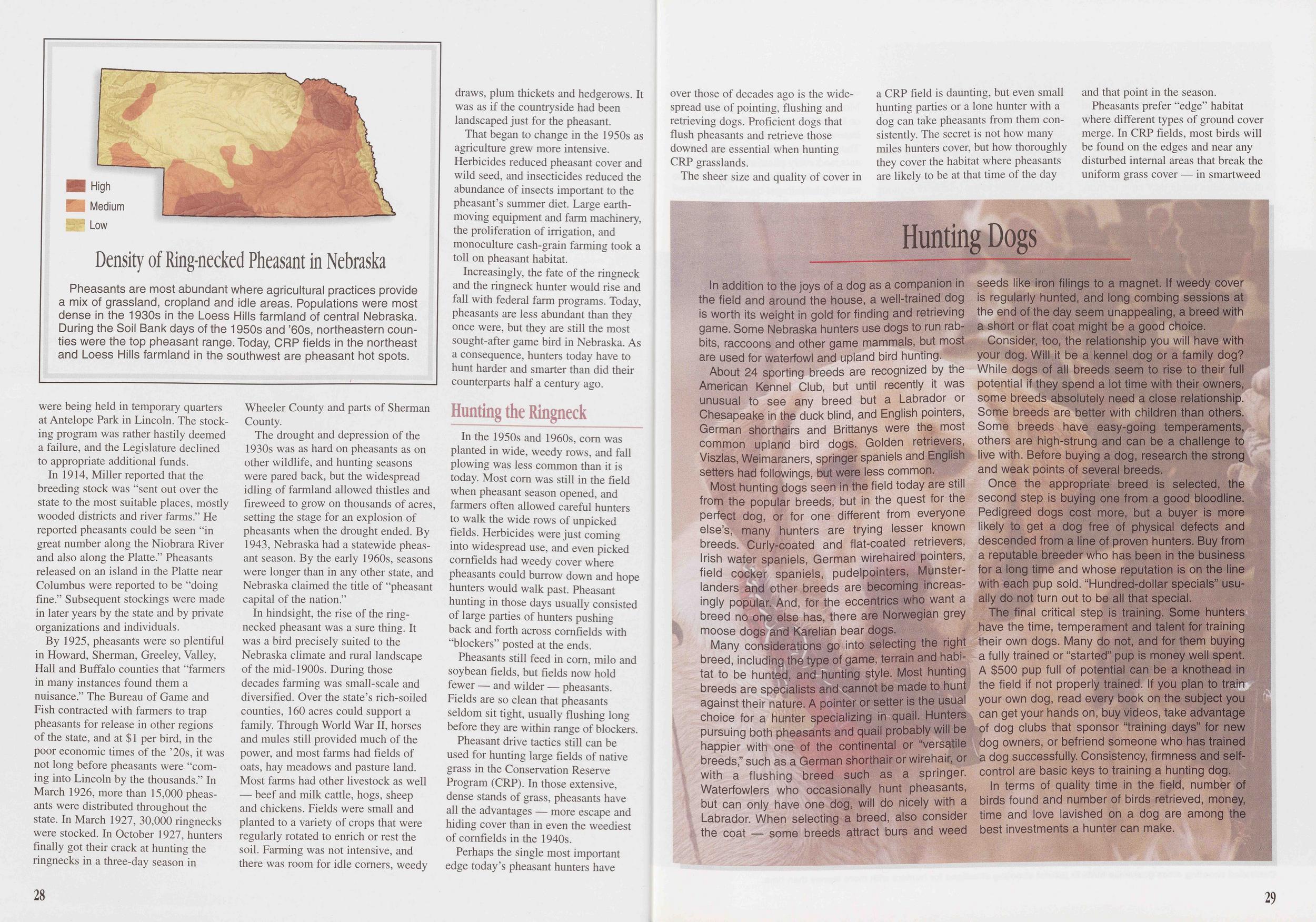
Density of Ring-necked Pheasant in Nebraska
Pheasants are most abundant where agricultural practices provide a mix of grassland, cropland and idle areas. Populations were most dense in the 1930s in the Loess Hills farmland of central Nebraska. During the Soil Bank days of the 1950s and '60s, northeastern counties were the top pheasant range. Today, CRP fields in the northeast and Loess Hills farmland in the southwest are pheasant hot spots.
were being held in temporary quarters at Antelope Park in Lincoln. The stocking program was rather hastily deemed a failure, and the Legislature declined to appropriate additional funds.
In 1914, Miller reported that the breeding stock was "sent out over the state to the most suitable places, mostly wooded districts and river farms." He reported pheasants could be seen "in great number along the Niobrara River and also along the Platte." Pheasants released on an island in the Platte near Columbus were reported to be "doing fine." Subsequent stockings were made in later years by the state and by private organizations and individuals.
By 1925, pheasants were so plentiful in Howard, Sherman, Greeley, Valley, Hall and Buffalo counties that "farmers in many instances found them a nuisance." The Bureau of Game and Fish contracted with farmers to trap pheasants for release in other regions of the state, and at $1 per bird, in the poor economic times of the '20s, it was not long before pheasants were "coming into Lincoln by the thousands." In March 1926, more than 15,000 pheasants were distributed throughout the state. In March 1927, 30,000 ringnecks were stocked. In October 1927, hunters finally got their crack at hunting the ringnecks in a three-day season in Wheeler County and parts of Sherman County.
The drought and depression of the 1930s was as hard on pheasants as on other wildlife, and hunting seasons were pared back, but the widespread idling of farmland allowed thistles and fireweed to grow on thousands of acres, setting the stage for an explosion of pheasants when the drought ended. By 1943, Nebraska had a statewide pheasant season. By the early 1960s, seasons were longer than in any other state, and Nebraska claimed the title of "pheasant capital of the nation."
In hindsight, the rise of the ring-necked pheasant was a sure thing. It was a bird precisely suited to the Nebraska climate and rural landscape of the mid-1900s. During those decades farming was small-scale and diversified. Over the state's rich-soiled counties, 160 acres could support a family. Through World War II, horses and mules still provided much of the power, and most farms had fields of oats, hay meadows and pasture land. Most farms had other livestock as well — beef and milk cattle, hogs, sheep and chickens. Fields were small and planted to a variety of crops that were regularly rotated to enrich or rest the soil. Farming was not intensive, and there was room for idle corners, weedy draws, plum thickets and hedgerows. It was as if the countryside had been landscaped just for the pheasant.
That began to change in the 1950s as agriculture grew more intensive. Herbicides reduced pheasant cover and wild seed, and insecticides reduced the abundance of insects important to the pheasant's summer diet. Large earth-moving equipment and farm machinery, the proliferation of irrigation, and monoculture cash-grain fanning took a toll on pheasant habitat.
Increasingly, the fate of the ringneck and the ringneck hunter would rise and fall with federal farm programs. Today, pheasants are less abundant than they once were, but they are still the most sought-after game bird in Nebraska. As a consequence, hunters today have to hunt harder and smarter than did their counterparts half a century ago.
Hunting the RingneckIn the 1950s and 1960s, corn was planted in wide, weedy rows, and fall plowing was less common than it is today. Most corn was still in the field when pheasant season opened, and farmers often allowed careful hunters to walk the wide rows of unpicked fields. Herbicides were just coming into widespread use, and even picked cornfields had weedy cover where pheasants could burrow down and hope hunters would walk past. Pheasant hunting in those days usually consisted of large parties of hunters pushing back and forth across cornfields with "blockers" posted at the ends.
Pheasants still feed in corn, milo and soybean fields, but fields now hold fewer — and wilder — pheasants. Fields are so clean that pheasants seldom sit tight, usually flushing long before they are within range of blockers.
Pheasant drive tactics still can be used for hunting large fields of native grass in the Conservation Reserve Program (CRP). In those extensive, dense stands of grass, pheasants have all the advantages — more escape and hiding cover than in even the weediest of cornfields in the 1940s.
Perhaps the single most important edge today's pheasant hunters have
28over those of decades ago is the widespread use of pointing, flushing and retrieving dogs. Proficient dogs that flush pheasants and retrieve those downed are essential when hunting CRP grasslands.
The sheer size and quality of cover in a CRP field is daunting, but even small hunting parties or a lone hunter with a dog can take pheasants from them consistently. The secret is not how many miles hunters cover, but how thoroughly they cover the habitat where pheasants are likely to be at that time of the day and that point in the season.
Pheasants prefer "edge" habitat where different types of ground cover merge. In CRP fields, most birds will be found on the edges and near any disturbed internal areas that break the uniform grass cover — in smartweed
In addition to the joys of a dog as a companion in the field and around the house, a well-trained dog is worth its weight in gold for finding and retrieving game. Some Nebraska hunters use dogs to run rabbits, raccoons and other game mammals, but most are used for waterfowl and upland bird hunting.
About 24 sporting breeds are recognized by the American Kennel Club, but until recently it was unusual to see any breed but a Labrador or Chesapeake in the duck blind, and English pointers, German shorthairs and Brittanys were the most common upland bird dogs. Golden retrievers, Viszlas, Weimaraners, springer spaniels and English setters had followings, but were less common.
Most hunting dogs seen in the field today are still from the popular breeds, but in the quest for the perfect dog, or for one different from everyone else's, many hunters are trying lesser known breeds. Curly-coated and flat-coated retrievers, Irish water spaniels, German wirehaired pointers, field cocker spaniels, pudelpointers, Munster-landers and other breeds are becoming increasingly popular. And, for the eccentrics who want a breed no one else has, there are Norwegian grey moose dogs and Karelian bear dogs.
Many considerations go into selecting the right breed, including the type of game, terrain and habitat to be hunted, and hunting style. Most hunting breeds are specialists and cannot be made to hunt against their nature. A pointer or setter is the usual choice for a hunter specializing in quail. Hunters pursuing both pheasants and quail probably will be happier with one of the continental or "versatile breeds," such as a German shorthair or wirehair, or with a flushing breed such as a springer.
Waterfowlers who occasionally hunt pheasants, but can only have one dog, will do nicely with a Labrador. When selecting a breed, also consider the coat — some breeds attract burs and weed seeds like iron filings to a magnet. If weedy cover is regularly hunted, and long combing sessions at the end of the day seem unappealing, a breed with a short or flat coat might be a good choice.
Consider, too, the relationship you will have with your dog. Will it be a kennel dog or a family dog? While dogs of all breeds seem to rise to their full potential if they spend a lot time with their owners, some breeds absolutely need a close relationship. Sonne breeds are better with children than others. Some breeds have easy-going temperaments, others are high-strung and can be a challenge to live with. Before buying a dog, research the strong and weak points of several breeds.
Once the appropriate breed is selected, the second step is buying one from a good bloodline. Pedigreed dogs cost more, but a buyer is more likely to get a dog free of physical defects and descended from a line of proven hunters. Buy from a reputable breeder who has been in the business for a long time and whose reputation is on the line with each pup sold. "Hundred-dollar specials" usually do not turn out to be all that special.
The final critical step is training. Some hunters have the time, temperament and talent for training their own dogs. Many do not, and for them buying a fully trained or "started" pup is money well spent. A $500 pup full of potential can be a knothead in the field if not properly trained. If you plan to train your own dog, read every book on the subject you can get your hands on, buy videos, take advantage of dog clubs that sponsor "training days" for new dog owners* or befriend someone who has trained a dog successfully. Consistency, firmness and self-control are basic keys to training a hunting dog.
In terms of quality time in the field, number of birds found and number of birds retrieved, money, time and love lavished on a dog are among the best investments a hunter can make.
wetlands, near trees, plum thickets and chokecherry thickets, weed patches and areas where the grass has been pressed to the soil.
In CRP fields, and elsewhere, successful hunters find pheasants by thinking like pheasants, and to approach within shotgun range they have to think smarter than pheasants. Given adequate cover, pheasants will hold surprisingly tight, allowing hunters to pass within a few feet without flushing. Hunt slowly. Stop often. Allow your dog all the time it wants to work a piece of cover.
Any hunter with a season or two of experience quickly learns to recognize good pheasant cover, and most hunters who have gone to the trouble of locating the landowner and gaining permission to hunt want a large enough area to sustain an hour or more of hunting. Most hunters look for long shelterbelts or large CRP fields, or they go to large state and federal public hunting areas. Those are good places to hunt pheasants, and every pheasant hunter within miles knows it. That leaves many smaller, hard-to-get-to, out-of-sight pheasant spots untouched. There may not be as many roosters in those small
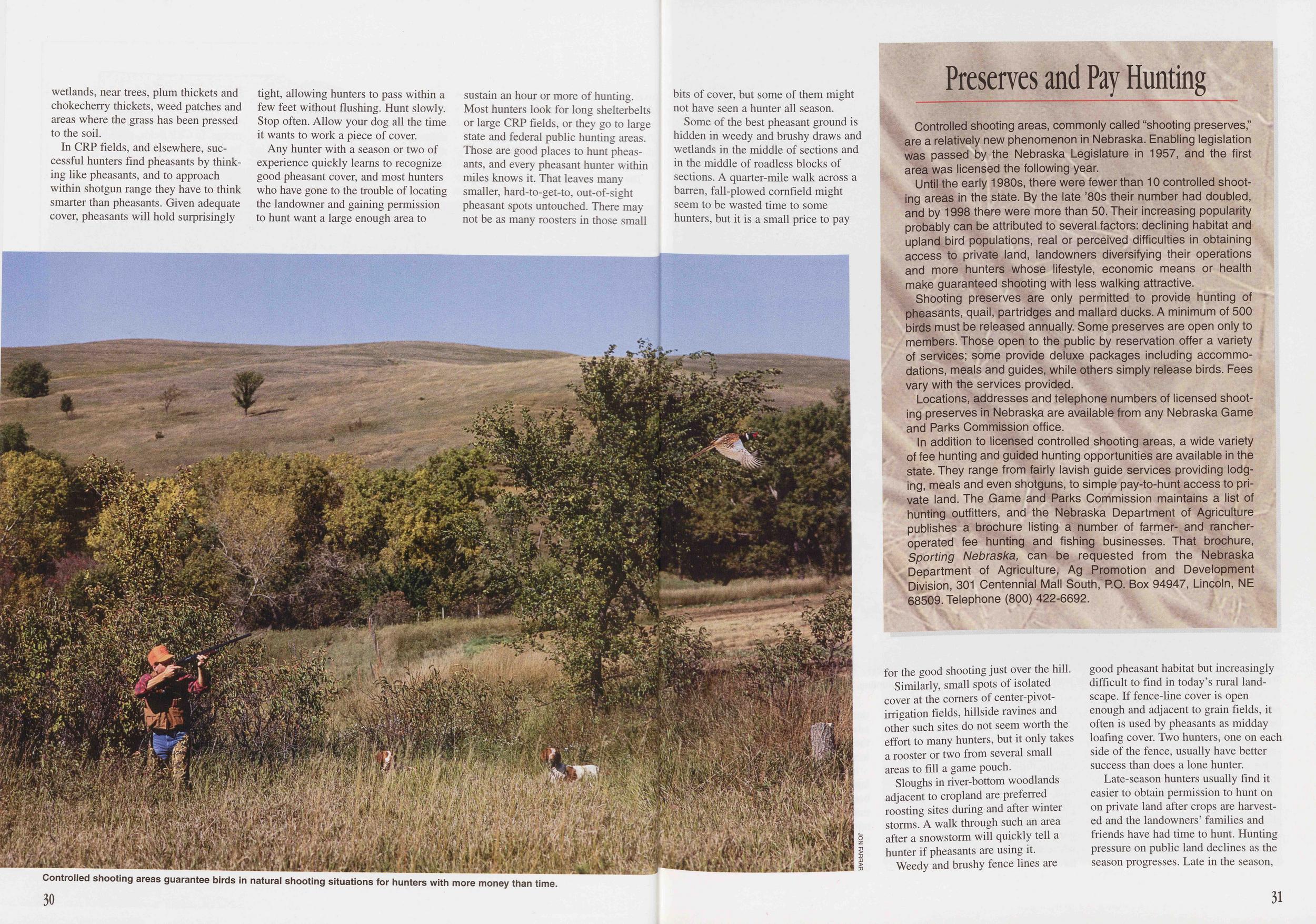
Controlled shooting areas guarantee birds in natural shooting situations for hunters with more money than time.
bits of cover, but some of them might not have seen a hunter all season.
Some of the best pheasant ground is hidden in weedy and brushy draws and wetlands in the middle of sections and in the middle of roadless blocks of sections. A quarter-mile walk across a barren, fall-plowed cornfield might seem to be wasted time to some hunters, but it is a small price to pay
Preserves and Pay Hunting
Controlled shooting areas, commonly called "shooting preserves," are a relatively new phenomenon in Nebraska/Enabling legislation was passed by the Nebraska Legislature in 1957, and the first area was licensed the following year.
Until the early 1980s, there were fewer than 10 controlled shooting areas in the state. By the late '80s their number had doubled, and by 1998 there were more than 50. Their increasing popularity probably can be attributed to several factors: declining habitat and upland bird populations, real or perceived difficulties in obtaining access to private land, landowners diversifying their operations and more hunters whose lifestyle, economic means or health make guaranteed shooting with less walking attractive.
Shooting preserves are only permitted to provide hunting of pheasants, quail, partridges and mallard ducks. A minimum of 500 birds must be released annually. Some preserves are open only to members. Those open to the public by reservation offer a variety of services; some provide deluxe packages including accommodations, meals and guides, while others simply release birds. Fees vary with the services provided.
Locations, addresses and telephone numbers of licensed shooting preserves in Nebraska are available from any Nebraska Game and Parks Commission office.
In addition to.licensed controlled shooting areas, a wide variety of fee hunting and guided hunting opportunities are available in the state. They range from fairly lavish guide services providing lodging, meals and even shotguns, to simple pay-to-hunt access to private land. The Game and Parks Commission maintains a list of hunting outfitters, and the Nebraska Department of Agriculture publishes a brochure listing a number of farmer- and rancher-operated fee hunting and fishing businesses. That brochure, Sporting Nebraska, can be requested from the Nebraska Department of Agriculture, Ag Promotion and Development Division, 301 Centennial Mall South, P.O. Box 94947, Lincoln, NE 68509. Telephone (800) 422-6692.
for the good shooting just over the hill.
Similarly, small spots of isolated cover at the corners of center-pivot-irrigation fields, hillside ravines and other such sites do not seem worth the effort to many hunters, but it only takes a rooster or two from several small areas to fill a game pouch.
Sloughs in river-bottom woodlands adjacent to cropland are preferred roosting sites during and after winter storms. A walk through such an area after a snowstorm will quickly tell a hunter if pheasants are using it.
Weedy and brushy fence lines are good pheasant habitat but increasingly difficult to find in today's rural landscape. If fence-line cover is open enough and adjacent to grain fields, it often is used by pheasants as midday loafing cover. Two hunters, one on each side of the fence, usually have better success than does a lone hunter.
Late-season hunters usually find it easier to obtain permission to hunt on on private land after crops are harvested and the landowners' families and friends have had time to hunt. Hunting pressure on public land declines as the season progresses. Late in the season.
31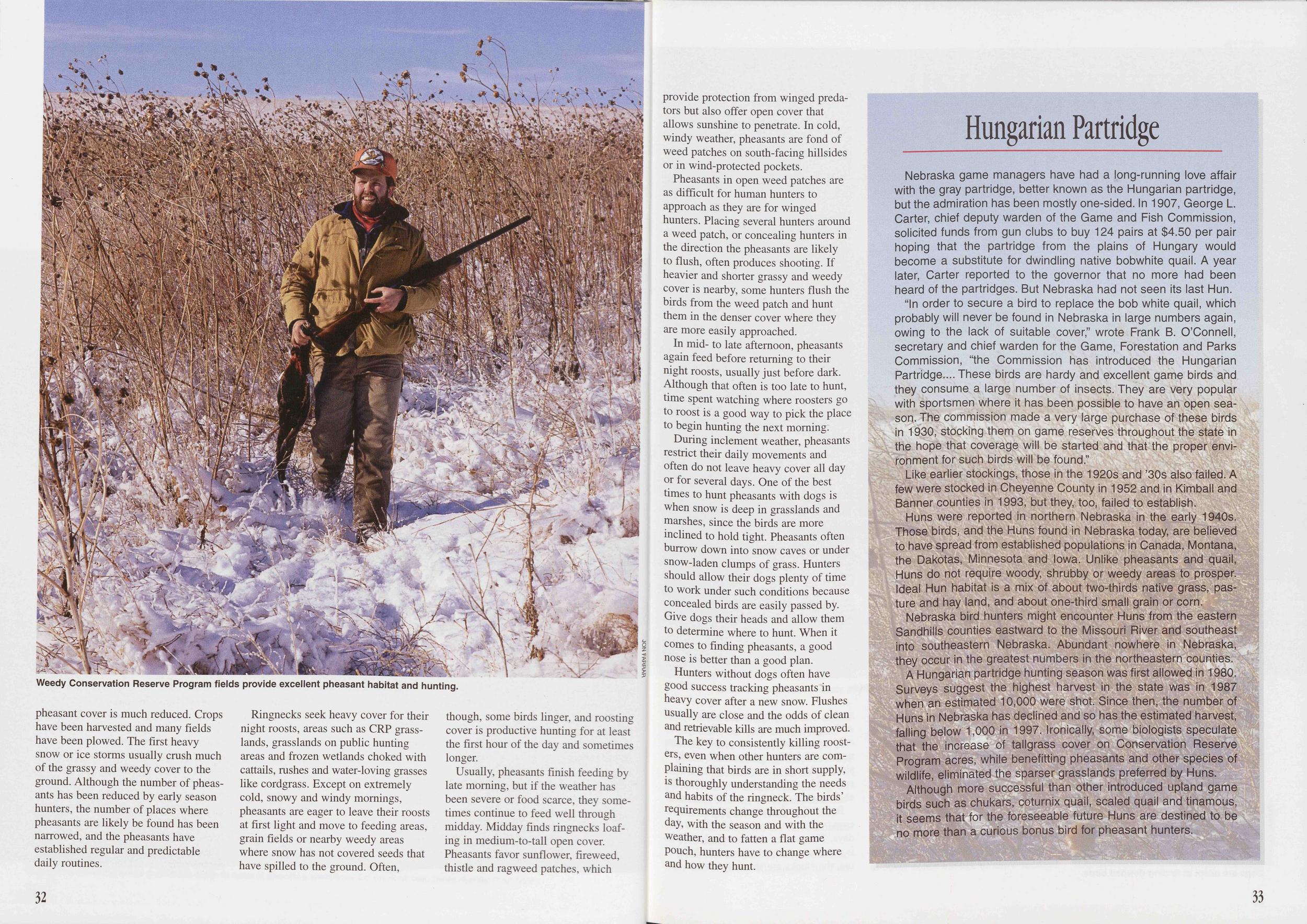
Weedy Conservation Reserve Program fields provide excellent pheasant habitat and hunting.
JON FARRARpheasant cover is much reduced. Crops have been harvested and many fields have been plowed. The first heavy snow or ice storms usually crush much of the grassy and weedy cover to the ground. Although the number of pheasants has been reduced by early season hunters, the number of places where pheasants are likely be found has been narrowed, and the pheasants have established regular and predictable daily routines.
Ringnecks seek heavy cover for their night roosts, areas such as CRP grasslands, grasslands on public hunting areas and frozen wetlands choked with cattails, rushes and water-loving grasses like cordgrass. Except on extremely cold, snowy and windy mornings, pheasants are eager to leave their roosts at first light and move to feeding areas, grain fields or nearby weedy areas where snow has not covered seeds that have spilled to the ground. Often, though, some birds linger, and roosting cover is productive hunting for at least the first hour of the day and sometimes longer.
Usually, pheasants finish feeding by late morning, but if the weather has been severe or food scarce, they sometimes continue to feed well through midday. Midday finds ringnecks loafing in medium-to-tall open cover. Pheasants favor sunflower, fireweed, thistle and ragweed patches, which
32provide protection from winged predators but also offer open cover that allows sunshine to penetrate. In cold, windy weather, pheasants are fond of weed patches on south-facing hillsides or in wind-protected pockets.
Pheasants in open weed patches are as difficult for human hunters to approach as they are for winged hunters. Placing several hunters around a weed patch, or concealing hunters in the direction the pheasants are likely to flush, often produces shooting. If heavier and shorter grassy and weedy cover is nearby, some hunters flush the birds from the weed patch and hunt them in the denser cover where they are more easily approached.
In mid- to late afternoon, pheasants again feed before returning to their night roosts, usually just before dark. Although that often is too late to hunt, time spent watching where roosters go to roost is a good way to pick the place to begin hunting the next morning.
During inclement weather, pheasants restrict their daily movements and often do not leave heavy cover all day or for several days. One of the best times to hunt pheasants with dogs is when snow is deep in grasslands and marshes, since the birds are more inclined to hold tight. Pheasants often burrow down into snow caves or under snow-laden clumps of grass. Hunters should allow their dogs plenty of time to work under such conditions because concealed birds are easily passed by. Give dogs their heads and allow them to determine where to hunt. When it comes to finding pheasants, a good nose is better than a good plan.
Hunters without dogs often have good success tracking pheasants in heavy cover after a new snow. Flushes usually are close and the odds of clean and retrievable kills are much improved.
The key to consistently killing roosters, even when other hunters are complaining that birds are in short supply, is thoroughly understanding the needs and habits of the ringneck. The birds' requirements change throughout the day, with the season and with the weather, and to fatten a flat game pouch, hunters have to change where and how they hunt.
Nebraska game managers have had a long-running love affair with the gray partridge, better known as the Hungarian partridge, but the admiration has been mostly one-sided. In 1907, George L. Carter, chief deputy warden of the Game and Fish Commission, solicited funds from gun clubs to buy 124 pairs at $4.50 per pair hoping that the partridge from the plains of Hungary would become a substitute for dwindling native bobwhite quail. A year later, Carter reported to the governor that no more had been heard of the partridges. But Nebraska had not seen its last Hun.
"In order to secure a bird to replace the bob white quail, which probably will never be found in Nebraska in large numbers again, owing to the lack of suitable cover," wrote Frank B. O'Connell, secretary and chief warden for the Game, Forestation and Parks Commission, "the Commission has introduced the Hungarian Partridge.... These birds are hardy and excellent game birds and they consume a large number of insects. They are very popular with sportsmen where it has been possible to have an open season. The commission made a very large purchase of these birds in 1930, stocking them on game reserves throughout the state in the hope that coverage will be started and that the proper environment for such birds will be found."
Like earlier stockings, those in the 1920s and '30s also failed. A few were stocked in Cheyenne County in 1952 and in Kimball and Banner counties in 1993, but they, too, failed to establish.
Huns were reported in northern Nebraska in the early 1940s. Those birds, and the Huns found in Nebraska today, are believed to have spread from established populations in Canada, Montana, the Dakotas, Minnesota and Iowa. Unlike pheasants and quail, Huns do not require woody, shrubby or weedy areas to prosper. Ideal Hun habitat is a mix of about two-thirds native grass, pasture and hay land, and about one-third small grain or corn.
Nebraska bird hunters might encounter Huns from the eastern Sandhills counties eastward to the Missouri River and southeast into southeastern Nebraska. Abundant nowhere in Nebraska, they occur in the greatest numbers in the northeastern counties. A Hungarian partridge hunting season was first allowed in 1980. Surveys suggest the highest harvest in the state was in 1987 when an estimated 10,000 were shot. Since then, the number of Huns in Nebraska has declined and so has the estimated harvest, falling below 1,000 in 1997. Ironically, some biologists speculate that the increase of tallgrass cover on Conservation Reserve Program acres, while benefitting pheasants and other species of wildlife, eliminated the sparser grasslands preferred by Huns.
Although more successful than other introduced upland game birds such as chukars, coturnix quail, scaled quail and tinamous, it seems that for the foreseeable future Huns are destined to be no more than a curious bonus bird for pheasant hunters.
33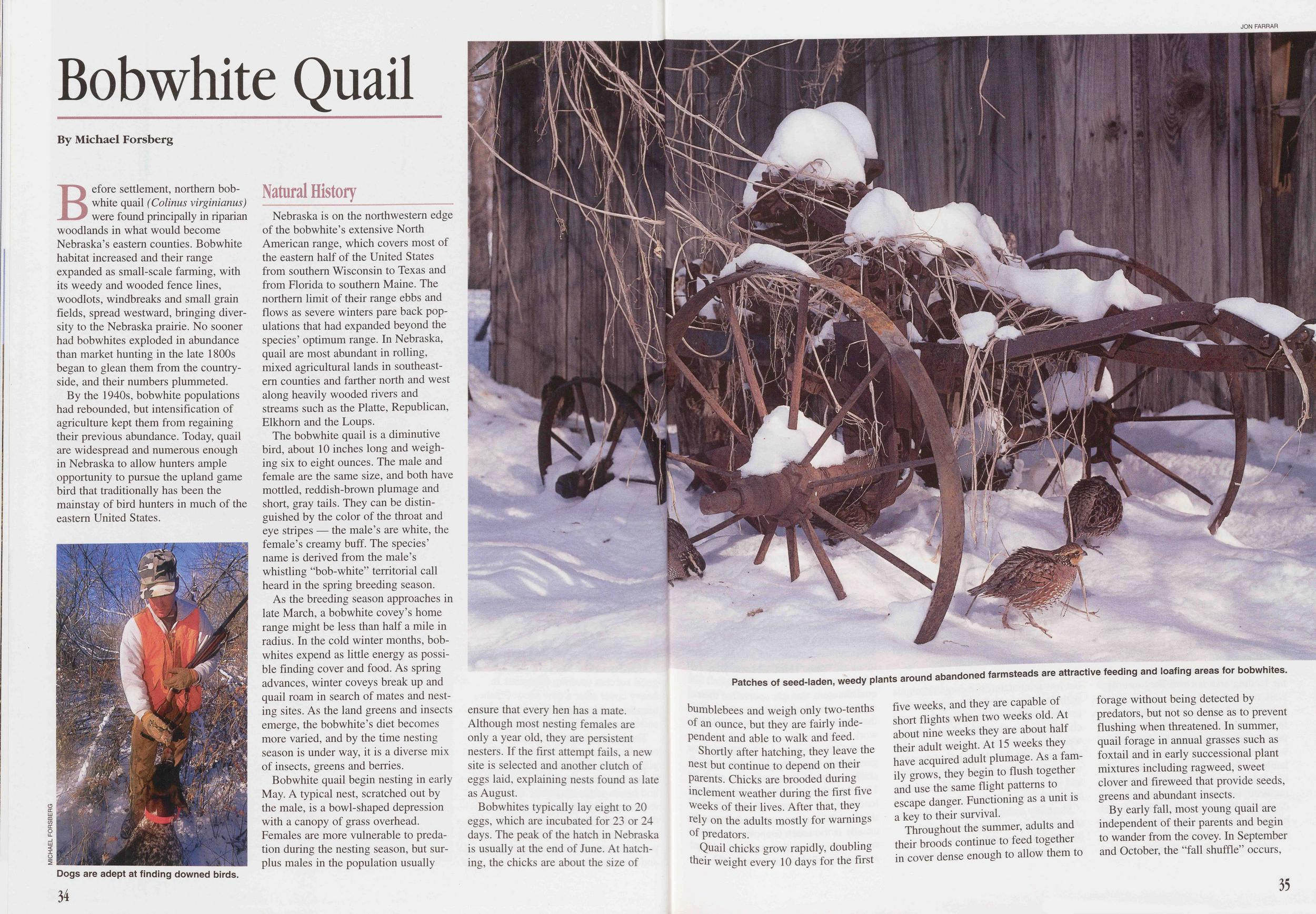
Bobwhite Quail
By Michael ForsbergBefore settlement, northern bobwhite quail (Colinus virginianus) were found principally in riparian woodlands in what would become Nebraska's eastern counties. Bobwhite habitat increased and their range expanded as small-scale farming, with its weedy and wooded fence lines, woodlots, windbreaks and small grain fields, spread westward, bringing diversity to the Nebraska prairie. No sooner had bobwhites exploded in abundance than market hunting in the late 1800s began to glean them from the countryside, and their numbers plummeted.
By the 1940s, bobwhite populations had rebounded, but intensification of agriculture kept them from regaining their previous abundance. Today, quail are widespread and numerous enough in Nebraska to allow hunters ample opportunity to pursue the upland game bird that traditionally has been the mainstay of bird hunters in much of the eastern United States.
Dogs are adept at finding downed birds.
Nebraska is on the northwestern edge of the bobwhite's extensive North American range, which covers most of the eastern half of the United States from southern Wisconsin to Texas and from Florida to southern Maine. The northern limit of their range ebbs and flows as severe winters pare back populations that had expanded beyond the species' optimum range. In Nebraska, quail are most abundant in rolling, mixed agricultural lands in southeastern counties and farther north and west along heavily wooded rivers and streams such as the Platte, Republican, Elkhorn and the Loups.
The bobwhite quail is a diminutive bird, about 10 inches long and weighing six to eight ounces. The male and female are the same size, and both have mottled, reddish-brown plumage and short, gray tails. They can be distinguished by the color of the throat and eye stripes — the male's are white, the female's creamy buff. The species' name is derived from the male's whistling "bob-white" territorial call heard in the spring breeding season.
As the breeding season approaches in late March, a bobwhite covey's home range might be less than half a mile in radius. In the cold winter months, bobwhites expend as little energy as possible finding cover and food. As spring advances, winter coveys break up and quail roam in search of mates and nesting sites. As the land greens and insects emerge, the bobwhite's diet becomes more varied, and by the time nesting season is under way, it is a diverse mix of insects, greens and berries.
Bobwhite quail begin nesting in early May. A typical nest, scratched out by the male, is a bowl-shaped depression with a canopy of grass overhead. Females are more vulnerable to predation during the nesting season, but surplus males in the population usually
Patches of seed-laden, weedy plants around abandoned farmsteads are attractive feeding and loafing areas for bobwhites.
JON FARRARensure that every hen has a mate. Although most nesting females are only a year old, they are persistent nesters. If the first attempt fails, a new site is selected and another clutch of eggs laid, explaining nests found as late as August.
Bobwhites typically lay eight to 20 eggs, which are incubated for 23 or 24 days. The peak of the hatch in Nebraska is usually at the end of June. At hatching, the chicks are about the size of
34bumblebees and weigh only two-tenths of an ounce, but they are fairly independent and able to walk and feed.
Shortly after hatching, they leave the nest but continue to depend on their Parents. Chicks are brooded during inclement weather during the first five weeks of their lives. After that, they rely on the adults mostly for warnings of predators.
Quail chicks grow rapidly, doubling their weight every 10 days for the first five weeks, and they are capable of short flights when two weeks old. At about nine weeks they are about half their adult weight. At 15 weeks they have acquired adult plumage. As a family grows, they begin to flush together and use the same flight patterns to escape danger. Functioning as a unit is a key to their survival.
Throughout the summer, adults and their broods continue to feed together in cover dense enough to allow them to forage without being detected by predators, but not so dense as to prevent flushing when threatened. In summer, quail forage in annual grasses such as foxtail and in early successional plant mixtures including ragweed, sweet clover and fireweed that provide seeds, greens and abundant insects.
By early fall, most young quail are independent of their parents and begin to wander from the covey. In September and October, the "fall shuffle" occurs,
35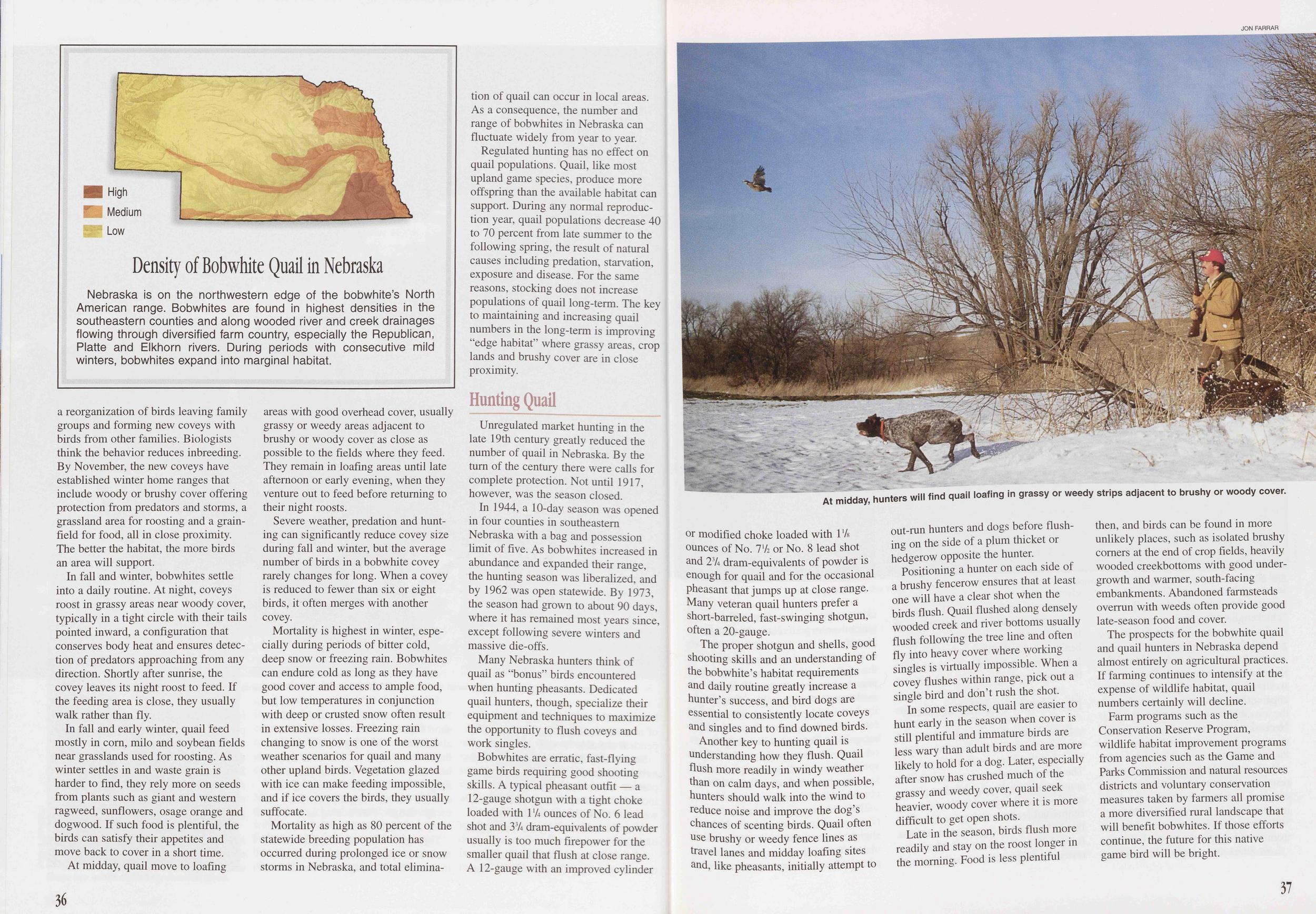
High Medium Low
Density of Bobwhite Quail in Nebraska
Nebraska is on the northwestern edge of the bobwhite's North American range. Bobwhites are found in highest densities in the southeastern counties and along wooded river and creek drainages flowing through diversified farm country, especially the Republican, Platte and Elkhorn rivers. During periods with consecutive mild winters, bobwhites expand into marginal habitat.
a reorganization of birds leaving family groups and forming new coveys with birds from other families. Biologists think the behavior reduces inbreeding. By November, the new coveys have established winter home ranges that include woody or brushy cover offering protection from predators and storms, a grassland area for roosting and a grainfield for food, all in close proximity. The better the habitat, the more birds an area will support.
In fall and winter, bobwhites settle into a daily routine. At night, coveys roost in grassy areas near woody cover, typically in a tight circle with their tails pointed inward, a configuration that conserves body heat and ensures detection of predators approaching from any direction. Shortly after sunrise, the covey leaves its night roost to feed. If the feeding area is close, they usually walk rather than fly.
In fall and early winter, quail feed mostly in corn, milo and soybean fields near grasslands used for roosting. As winter settles in and waste grain is harder to find, they rely more on seeds from plants such as giant and western ragweed, sunflowers, osage orange and dogwood. If such food is plentiful, the birds can satisfy their appetites and move back to cover in a short time.
At midday, quail move to loafing areas with good overhead cover, usually grassy or weedy areas adjacent to brushy or woody cover as close as possible to the fields where they feed. They remain in loafing areas until late afternoon or early evening, when they venture out to feed before returning to their night roosts.
Severe weather, predation and hunting can significantly reduce covey size during fall and winter, but the average number of birds in a bobwhite covey rarely changes for long. When a covey is reduced to fewer than six or eight birds, it often merges with another covey.
Mortality is highest in winter, especially during periods of bitter cold, deep snow or freezing rain. Bobwhites can endure cold as long as they have good cover and access to ample food, but low temperatures in conjunction with deep or crusted snow often result in extensive losses. Freezing rain changing to snow is one of the worst weather scenarios for quail and many other upland birds. Vegetation glazed with ice can make feeding impossible, and if ice covers the birds, they usually suffocate.
Mortality as high as 80 percent of the statewide breeding population has occurred during prolonged ice or snow storms in Nebraska, and total elimination of quail can occur in local areas. As a consequence, the number and range of bobwhites in Nebraska can fluctuate widely from year to year..
Regulated hunting has no effect on quail populations. Quail, like most upland game species, produce more offspring than the available habitat can support. During any normal reproduction year, quail populations decrease 40 to 70 percent from late summer to the following spring, the result of natural causes including predation, starvation, exposure and disease. For the same reasons, stocking does not increase populations of quail long-term. The key to maintaining and increasing quail numbers in the long-term is improving "edge habitat" where grassy areas, crop lands and brushy cover are in close proximity.
Hunting QuailUnregulated market hunting in the late 19th century greatly reduced the number of quail in Nebraska. By the turn of the century there were calls for complete protection. Not until 1917, however, was the season closed.
In 1944, a 10-day season was opened in four counties in southeastern Nebraska with a bag and possession limit of five. As bobwhites increased in abundance and expanded their range, the hunting season was liberalized, and by 1962 was open statewide. By 1973, the season had grown to about 90 days, where it has remained most years since, except following severe winters and massive die-offs.
Many Nebraska hunters think of quail as "bonus" birds encountered when hunting pheasants. Dedicated quail hunters, though, specialize their equipment and techniques to maximize the opportunity to flush coveys and work singles.
Bobwhites are erratic, fast-flying game birds requiring good shooting skills. A typical pheasant outfit — a 12-gauge shotgun with a tight choke loaded with FA ounces of No. 6 lead shot and 33A dram-equivalents of powder usually is too much firepower for the smaller quail that flush at close range. A 12-gauge with an improved cylinder
36At midday, hunters will find quail loafing in grassy or weedy strips adjacent to brushy or woody cover.
or modified choke loaded with 1 Vs ounces of No. Th or No. 8 lead shot and 23A dram-equivalents of powder is enough for quail and for the occasional pheasant that jumps up at close range. Many veteran quail hunters prefer a short-barreled, fast-swinging shotgun, often a 20-gauge.
The proper shotgun and shells, good shooting skills and an understanding of the bobwhite's habitat requirements and daily routine greatly increase a hunter's success, and bird dogs are essential to consistently locate coveys and singles and to find downed birds.
Another key to hunting quail is understanding how they flush. Quail flush more readily in windy weather than on calm days, and when possible, hunters should walk into the wind to reduce noise and improve the dog's chances of scenting birds. Quail often use brushy or weedy fence lines as travel lanes and midday loafing sites and, like pheasants, initially attempt to out-run hunters and dogs before flushing on the side of a plum thicket or hedgerow opposite the hunter.
Positioning a hunter on each side of a brushy fencerow ensures that at least one will have a clear shot when the birds flush. Quail flushed along densely wooded creek and river bottoms usually flush following the tree line and often fly into heavy cover where working singles is virtually impossible. When a covey flushes within range, pick out a single bird and don't rush the shot.
In some respects, quail are easier to hunt early in the season when cover is still plentiful and immature birds are less wary than adult birds and are more likely to hold for a dog. Later, especially after snow has crushed much of the grassy and weedy cover, quail seek heavier, woody cover where it is more difficult to get open shots.
Late in the season, birds flush more readily and stay on the roost longer in the morning. Food is less plentiful then, and birds can be found in more unlikely places, such as isolated brushy corners at the end of crop fields, heavily wooded creekbottoms with good undergrowth and warmer, south-facing embankments. Abandoned farmsteads overrun with weeds often provide good late-season food and cover.
The prospects for the bobwhite quail and quail hunters in Nebraska depend almost entirely on agricultural practices. If farming continues to intensify at the expense of wildlife habitat, quail numbers certainly will decline.
Farm programs such as the Conservation Reserve Program, wildlife habitat improvement programs from agencies such as the Game and Parks Commission and natural resources districts and voluntary conservation measures taken by farmers all promise a more diversified rural landscape that will benefit bobwhites. If those efforts continue, the future for this native game bird will be bright.
37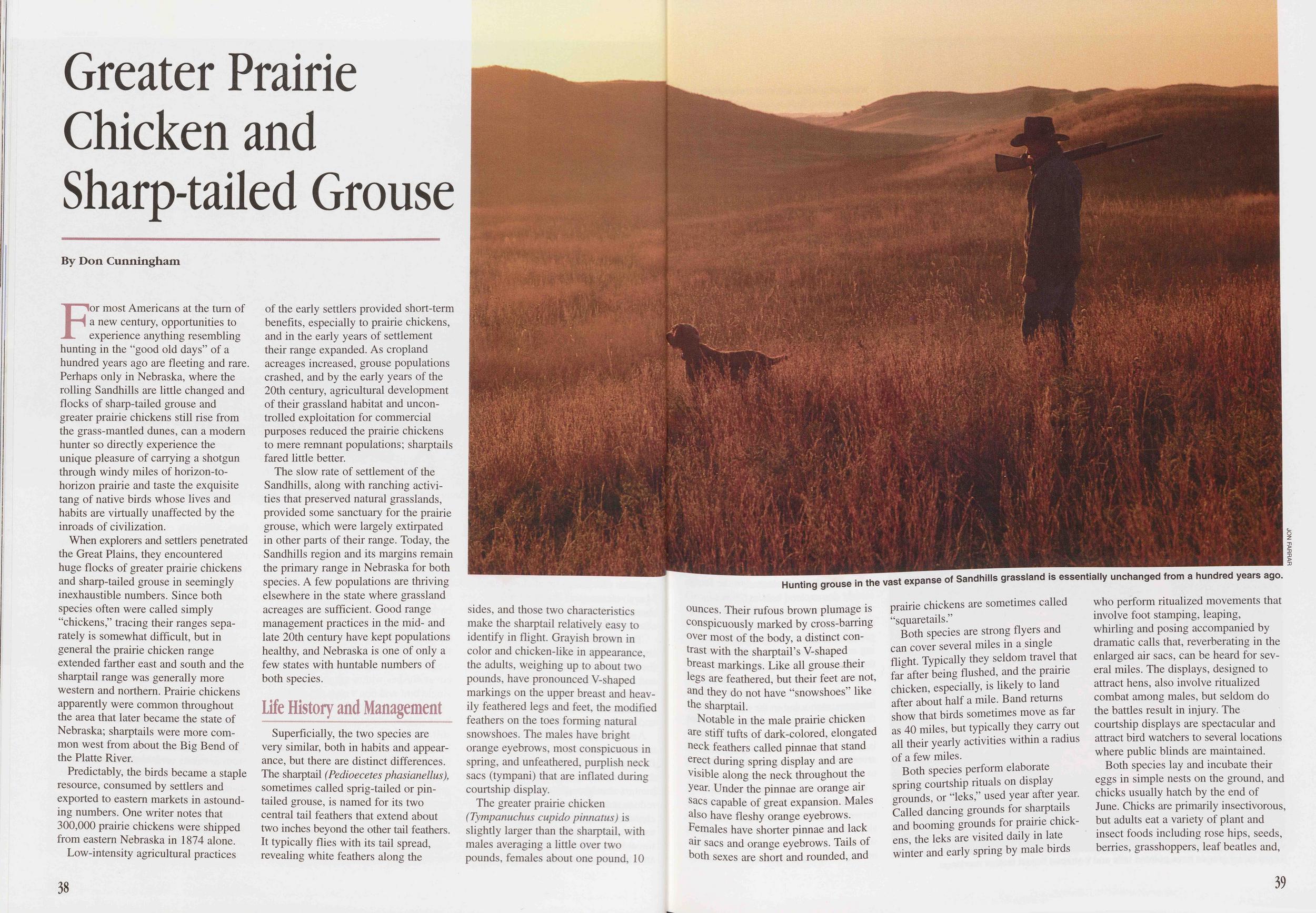
Greater Prairie Chicken and Sharp-tailed Grouse
By Don CunninghamFor most Americans at the turn of a new century, opportunities to experience anything resembling hunting in the "good old days" of a hundred years ago are fleeting and rare. Perhaps only in Nebraska, where the rolling Sandhills are little changed and flocks of sharp-tailed grouse and greater prairie chickens still rise from the grass-mantled dunes, can a modern hunter so directly experience the unique pleasure of carrying a shotgun through windy miles of horizon-to- horizon prairie and taste the exquisite tang of native birds whose lives and habits are virtually unaffected by the inroads of civilization.
When explorers and settlers penetrated the Great Plains, they encountered huge flocks of greater prairie chickens and sharp-tailed grouse in seemingly inexhaustible numbers. Since both species often were called simply "chickens," tracing their ranges separately is somewhat difficult, but in general the prairie chicken range extended farther east and south and the sharptail range was generally more western and northern. Prairie chickens apparently were common throughout the area that later became the state of Nebraska; sharptails were more common west from about the Big Bend of the Platte River.
Predictably, the birds became a staple resource, consumed by settlers and exported to eastern markets in astounding numbers. One writer notes that 300,000 prairie chickens were shipped from eastern Nebraska in 1874 alone.
Low-intensity agricultural practices of the early settlers provided short-term benefits, especially to prairie chickens, and in the early years of settlement their range expanded. As cropland acreages increased, grouse populations crashed, and by the early years of the 20th century, agricultural development of their grassland habitat and uncontrolled exploitation for commercial purposes reduced the prairie chickens to mere remnant populations; sharptails fared little better.
The slow rate of settlement of the Sandhills, along with ranching activities that preserved natural grasslands, provided some sanctuary for the prairie grouse, which were largely extirpated in other parts of their range. Today, the Sandhills region and its margins remain the primary range in Nebraska for both species. A few populations are thriving elsewhere in the state where grassland acreages are sufficient. Good range management practices in the mid- and late 20th century have kept populations healthy, and Nebraska is one of only a few states with huntable numbers of both species.
Life History and ManagementSuperficially, the two species are very similar, both in habits and appearance, but there are distinct differences. The sharptail (Pedioecetes phasianellus), sometimes called sprig-tailed or pintailed grouse, is named for its two central tail feathers that extend about two inches beyond the other tail feathers. It typically flies with its tail spread, revealing white feathers along the sides, and those two characteristics make the sharptail relatively easy to identify in flight. Grayish brown in color and chicken-like in appearance, the adults, weighing up to about two pounds, have pronounced V-shaped markings on the upper breast and heavily feathered legs and feet, the modified feathers on the toes forming natural snowshoes. The males have bright orange eyebrows, most conspicuous in spring, and unfeathered, purplish neck sacs (tympani) that are inflated during courtship display.
The greater prairie chicken (Tympanuchus cupido pinnatus) is slightly larger than the sharptail, with males averaging a little over two pounds, females about one pound, 10
38Hunting grouse in the vast expanse of Sandhills grassland is essentially unchanged from a hundred years ago.
ounces. Their rufous brown plumage is conspicuously marked by cross-barring over most of the body, a distinct contrast with the sharptail's V-shaped breast markings. Like all grouse their !cgs are feathered, but their feet are not, and they do not have "snowshoes" like the sharptail.
Notable in the male prairie chicken are stiff tufts of dark-colored, elongated neck feathers called pinnae that stand erect during spring display and are visible along the neck throughout the year. Under the pinnae are orange air sacs capable of great expansion. Males also have fleshy orange eyebrows. Females have shorter pinnae and lack air sacs and orange eyebrows. Tails of both sexes are short and rounded, and prairie chickens are sometimes called "squaretails."
Both species are strong flyers and can cover several miles in a single flight. Typically they seldom travel that far after being flushed, and the prairie chicken, especially, is likely to land after about half a mile. Band returns show that birds sometimes move as far as 40 miles, but typically they carry out all their yearly activities within a radius of a few miles.
Both species perform elaborate spring courtship rituals on display grounds, or "leks," used year after year. Called dancing grounds for sharptails and booming grounds for prairie chickens, the leks are visited daily in late winter and early spring by male birds who perform ritualized movements that involve foot stamping, leaping, whirling and posing accompanied by dramatic calls that, reverberating in the enlarged air sacs, can be heard for several miles. The displays, designed to attract hens, also involve ritualized combat among males, but seldom do the battles result in injury. The courtship displays are spectacular and attract bird watchers to several locations where public blinds are maintained.
Both species lay and incubate their eggs in simple nests on the ground, and chicks usually hatch by the end of June. Chicks are primarily insectivorous, but adults eat a variety of plant and insect foods including rose hips, seeds, berries, grasshoppers, leaf beatles and,
39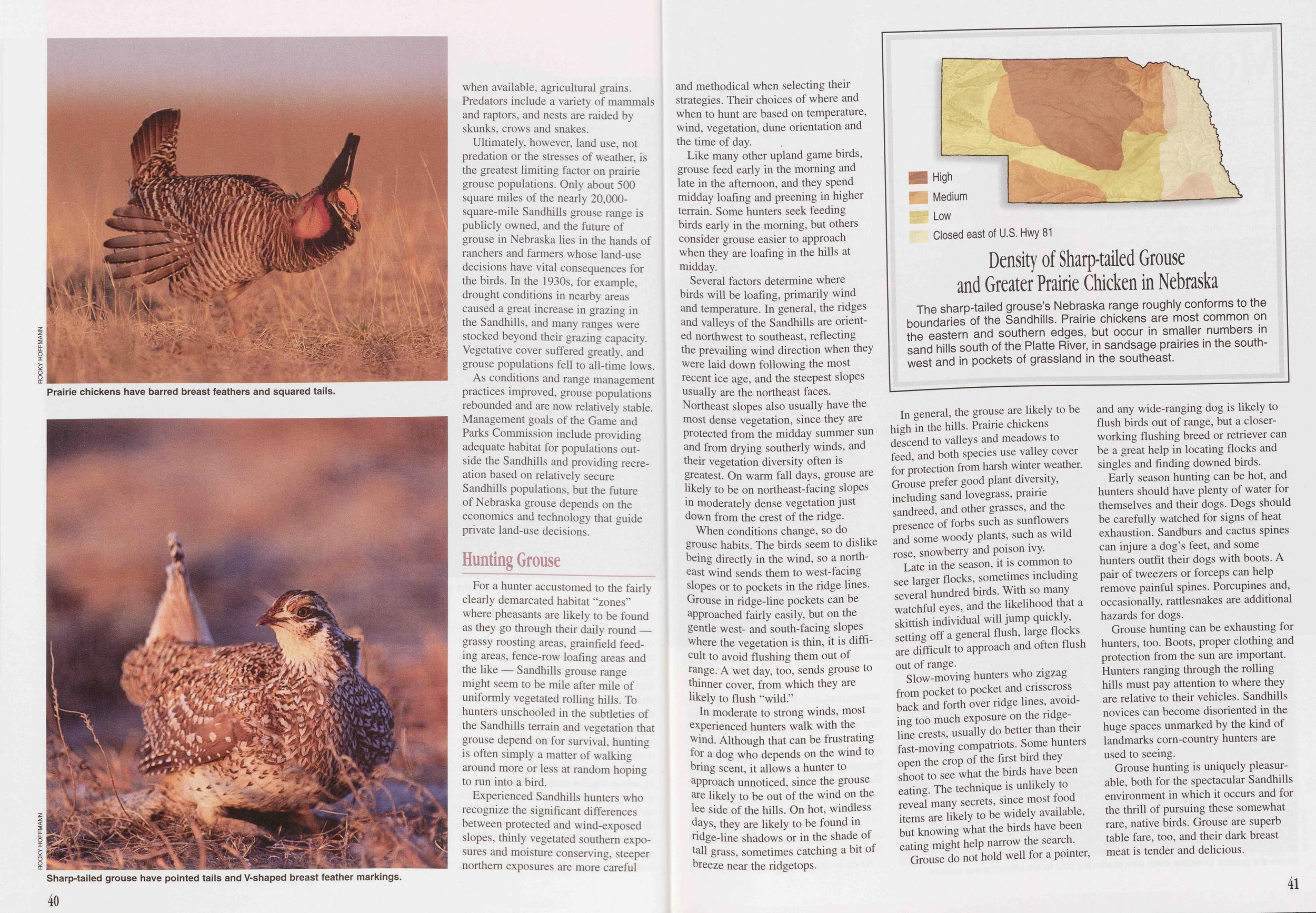
Prairie chickens have barred breast feathers and squared tails.
Sharp-tailed grouse have pointed tails and V-shaped breast feather markings.
when available, agricultural grains. Predators include a variety of mammals and raptors, and nests are raided by skunks, crows and snakes.
Ultimately, however, land use, not predation or the stresses of weather, is the greatest limiting factor on prairie grouse populations. Only about 500 square miles of the nearly 20,000- square-mile Sandhills grouse range is publicly owned, and the future of grouse in Nebraska lies in the hands of ranchers and farmers whose land-use decisions have vital consequences for the birds. In the 1930s, for example, drought conditions in nearby areas caused a great increase in grazing in the Sandhills, and many ranges were stocked beyond their grazing capacity. Vegetative cover suffered greatly, and grouse populations fell to all-time lows.
As conditions and range management practices improved, grouse populations rebounded and are now relatively stable. Management goals of the Game and Parks Commission include providing adequate habitat for populations outside the Sandhills and providing recreation based on relatively secure Sandhills populations, but the future of Nebraska grouse depends on the economics and technology that guide private land-use decisions.
Hunting GrouseFor a hunter accustomed to the fairly clearly demarcated habitat "zones" where pheasants are likely to be found as they go through their daily round — grassy roosting areas, grainfield feeding areas, fence-row loafing areas and the like — Sandhills grouse range might seem to be mile after mile of uniformly vegetated rolling hills. To hunters unschooled in the subtleties of the Sandhills terrain and vegetation that grouse depend on for survival, hunting is often simply a matter of walking around more or less at random hoping to run into a bird.
Experienced Sandhills hunters who recognize the significant differences between protected and wind-exposed slopes, thinly vegetated southern exposures and moisture conserving, steeper northern exposures are more careful
40and methodical when selecting their strategies. Their choices of where and when to hunt are based on temperature, wind, vegetation, dune orientation and the time of day.
Like many other upland game birds, grouse feed early in the morning and late in the afternoon, and they spend midday loafing and preening in higher terrain. Some hunters seek feeding birds early in the morning, but others consider grouse easier to approach when they are loafing in the hills at midday.
Several factors determine where birds will be loafing, primarily wind and temperature. In general, the ridges and valleys of the Sandhills are oriented northwest to southeast, reflecting the prevailing wind direction when they were laid down following the most recent ice age, and the steepest slopes usually are the northeast faces. Northeast slopes also usually have the most dense vegetation, since they are protected from the midday summer sun and from drying southerly winds, and their vegetation diversity often is greatest. On warm fall days, grouse are likely to be on northeast-facing slopes in moderately dense vegetation just down from the crest of the ridge.
When conditions change, so do grouse habits. The birds seem to dislike being directly in the wind, so a northeast wind sends them to west-facing slopes or to pockets in the ridge lines. Grouse in ridge-line pockets can be approached fairly easily, but on the gentle west- and south-facing slopes where the vegetation is thin, it is difficult to avoid flushing them out of range. A wet day, too, sends grouse to thinner cover, from which they are likely to flush "wild."
In moderate to strong winds, most experienced hunters walk with the wind. Although that can be frustrating for a dog who depends on the wind to bring scent, it allows a hunter to approach unnoticed, since the grouse are likely to be out of the wind on the lee side of the hills. On hot, windless days, they are likely to be found in ridge-line shadows or in the shade of tall grass, sometimes catching a bit of breeze near the ridgetops.
High Medium Low Closed east of U.S. Hwy 81
Density of Sharp-tailed Grouse and Greater Prairie Chicken in Nebraska
The sharp-tailed grouse's Nebraska range roughly conforms to the boundaries of the Sandhills. Prairie chickens are most common on the eastern and southern edges, but occur in smaller numbers in sand hills south of the Platte River, in sandsage prairies in the southwest and in pockets of grassland in the southeast.
In general, the grouse are likely to be high in the hills. Prairie chickens descend to valleys and meadows to feed and both species use valley cover for protection from harsh winter weather. Grouse prefer good plant diversity, including sand lovegrass, prairie sandreed, and other grasses, and the presence of forbs such as sunflowers and some woody plants, such as wild rose, snowberry and poison ivy.
Late in the season, it is common to see larger flocks, sometimes including several hundred birds. With so many watchful eyes, and the likelihood that a skittish individual will jump quickly, setting off a general flush, large flocks are difficult to approach and often flush out of range.
Slow-moving hunters who zigzag from pocket to pocket and crisscross back and forth over ridge lines, avoiding too much exposure on the ridge-line crests, usually do better than their fast-moving compatriots. Some hunters open the crop of the first bird they shoot to see what the birds have been eating The technique is unlikely to reveal many secrets, since most food items are likely to be widely available, but knowing what the birds have been eating might help narrow the search.
Grouse do not hold well for a pointer, and any wide-ranging dog is likely to flush birds out of range, but a closer- working flushing breed or retriever can be a great help in locating flocks and singles and finding downed birds.
Early season hunting can be hot, and hunters should have plenty of water for themselves and their dogs. Dogs should be carefully watched for signs of heat exhaustion. Sandburs and cactus spines can injure a dog's feet, and some hunters outfit their dogs with boots. A pair of tweezers or forceps can help remove painful spines. Porcupines and, occasionally, rattlesnakes are additional hazards for dogs.
Grouse hunting can be exhausting for hunters, too. Boots, proper clothing and protection from the sun are important. Hunters ranging through the rolling hills must pay attention to where they are relative to their vehicles. Sandhills novices can become disoriented in the huge spaces unmarked by the kind of landmarks corn-country hunters are used to seeing.
Grouse hunting is uniquely pleasurable, both for the spectacular Sandhills environment in which it occurs and for the thrill of pursuing these somewhat rare, native birds. Grouse are superb table fare, too, and their dark breast meat is tender and delicious.
41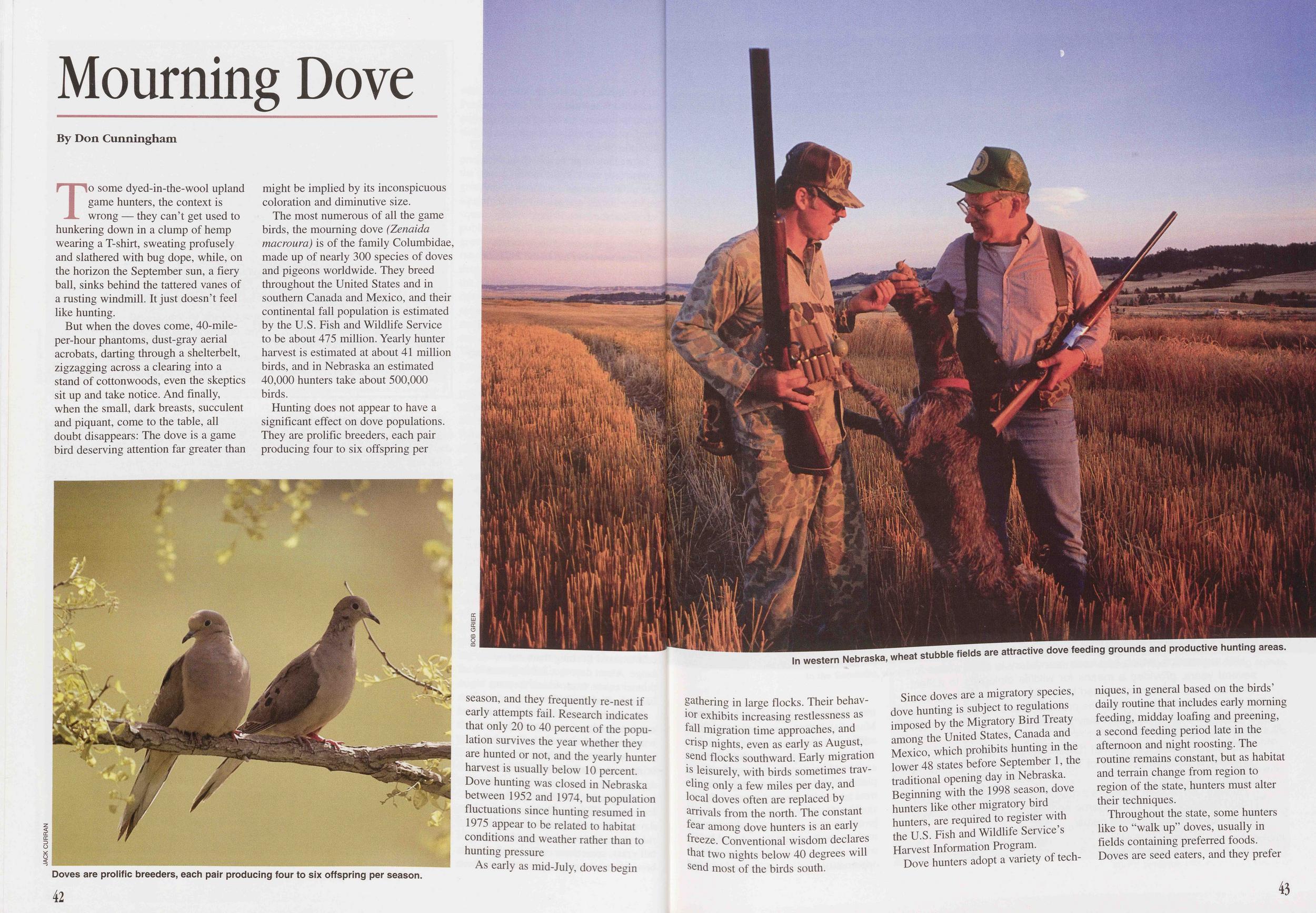
Mourning Dove
By Don CunninghamTo some dyed-in-the-wool upland game hunters, the context is wrong — they can't get used to hunkering down in a clump of hemp wearing a T-shirt, sweating profusely and slathered with bug dope, while, on the horizon the September sun, a fiery ball, sinks behind the tattered vanes of a rusting windmill. It just doesn't feel like hunting.
But when the doves come, 40-mile- per-hour phantoms, dust-gray aerial acrobats, darting through a shelterbelt, zigzagging across a clearing into a stand of cottonwoods, even the skeptics sit up and take notice. And finally, when the small, dark breasts, succulent and piquant, come to the table, all doubt disappears: The dove is a game bird deserving attention far greater than might be implied by its inconspicuous coloration and diminutive size.
The most numerous of all the game birds, the mourning dove (Zenaida macroura) is of the family Columbidae, made up of nearly 300 species of doves and pigeons worldwide. They breed throughout the United States and in southern Canada and Mexico, and their continental fall population is estimated by the U.S. Fish and Wildlife Service to be about 475 million. Yearly hunter harvest is estimated at about 41 million birds, and in Nebraska an estimated 40,000 hunters take about 500,000 birds.
Hunting does not appear to have a significant effect on dove populations. They are prolific breeders, each pair producing four to six offspring per
Doves are prolific breeders, each pair producing four to six offspring per season.
season, and they frequently re-nest if early attempts fail. Research indicates that only 20 to 40 percent of the population survives the year whether they are hunted or not, and the yearly hunter harvest is usually below 10 percent. Dove hunting was closed in Nebraska between 1952 and 1974, but population fluctuations since hunting resumed in 1975 appear to be related to habitat conditions and weather rather than to hunting pressure
As early as mid-July, doves begin
42In western Nebraska, wheat stubble fields are attractive dove feeding grounds and productive hunting areas.
gathering in large flocks. Their behavior exhibits increasing restlessness as fall migration time approaches, and crisp nights, even as early as August, send flocks southward. Early migration is leisurely, with birds sometimes traveling only a few miles per day, and local doves often are replaced by arrivals from the north. The constant fear among dove hunters is an early freeze. Conventional wisdom declares that two nights below 40 degrees will send most of the birds south.
Since doves are a migratory species, dove hunting is subject to regulations imposed by the Migratory Bird Treaty among the United States, Canada and Mexico, which prohibits hunting in the lower 48 states before September 1, the traditional opening day in Nebraska. Beginning with the 1998 season, dove hunters like other migratory bird hunters, are required to register with the U.S. Fish and Wildlife Service's Harvest Information Program.
Dove hunters adopt a variety of techniques, in general based on the birds' daily routine that includes early morning feeding, midday loafing and preening, a second feeding period late in the afternoon and night roosting. The routine remains constant, but as habitat and terrain change from region to region of the state, hunters must alter their techniques.
Throughout the state, some hunters like to "walk up" doves, usually in fields containing preferred foods. Doves are seed eaters, and they prefer
43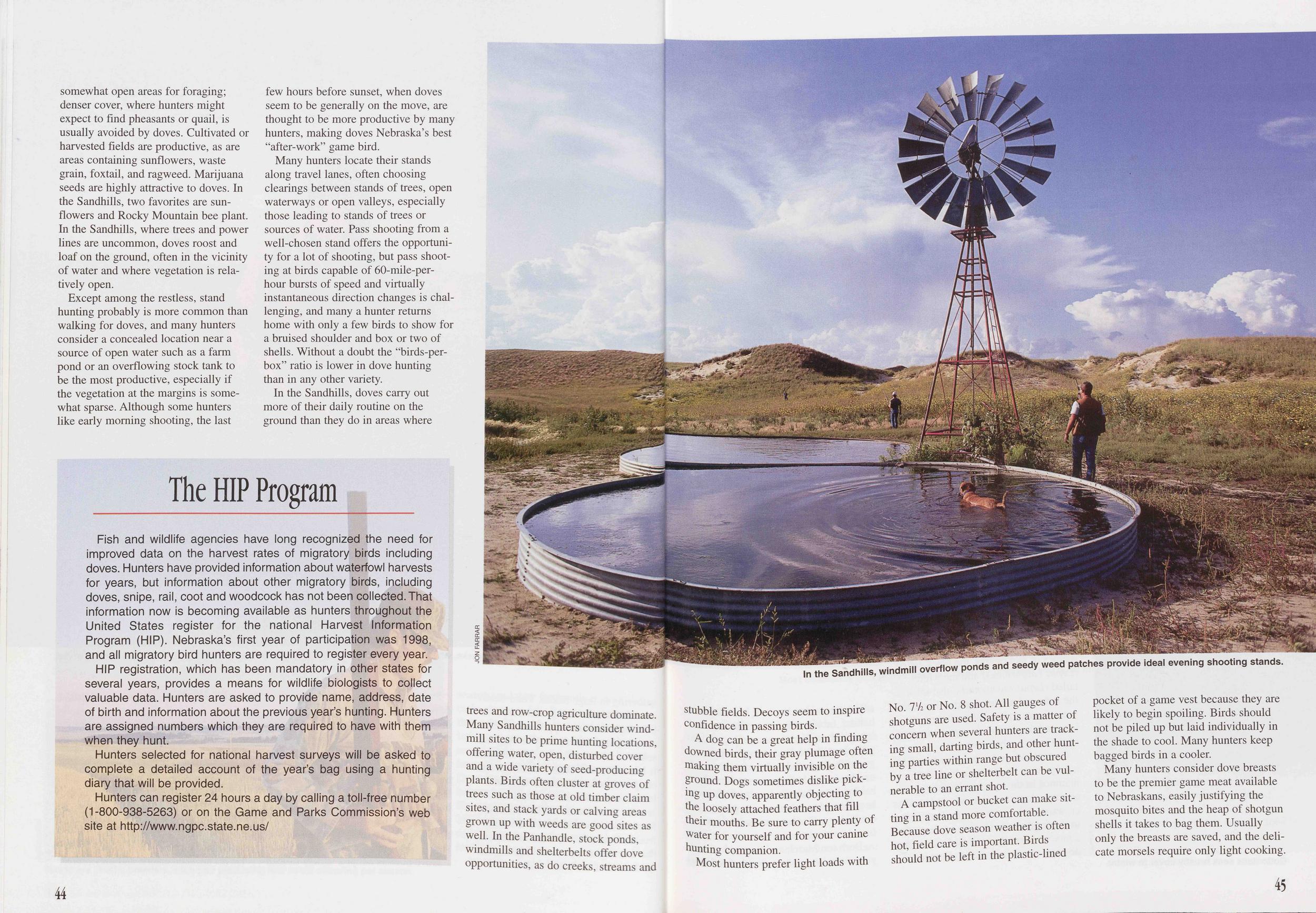
somewhat open areas for foraging; denser cover, where hunters might expect to find pheasants or quail, is usually avoided by doves. Cultivated or harvested fields are productive, as are areas containing sunflowers, waste grain, foxtail, and ragweed. Marijuana seeds are highly attractive to doves. In the Sandhills, two favorites are sunflowers and Rocky Mountain bee plant. In the Sandhills, where trees and power lines are uncommon, doves roost and loaf on the ground, often in the vicinity of water and where vegetation is relatively open.
Except among the restless, stand hunting probably is more common than walking for doves, and many hunters consider a concealed location near a source of open water such as a farm pond or an overflowing stock tank to be the most productive, especially if the vegetation at the margins is somewhat sparse. Although some hunters like early morning shooting, the last few hours before sunset, when doves seem to be generally on the move, are thought to be more productive by many hunters, making doves Nebraska's best "after-work" game bird.
Many hunters locate their stands along travel lanes, often choosing clearings between stands of trees, open waterways or open valleys, especially those leading to stands of trees or sources of water. Pass shooting from a well-chosen stand offers the opportunity for a lot of shooting, but pass shooting at birds capable of 60-mile-per-hour bursts of speed and virtually instantaneous direction changes is challenging, and many a hunter returns home with only a few birds to show for a bruised shoulder and box or two of shells. Without a doubt the "birds-per-box" ratio is lower in dove hunting than in any other variety.
In the Sandhills, doves carry out more of their daily routine on the ground than they do in areas where
The HIP Program
Fish and wildlife agencies have long recognized the need for improved data on the harvest rates of migratory birds including doves. Hunters have provided information about waterfowl harvests for years, but information about other migratory birds, including doves, snipe, rail, coot and woodcock has not been collected. That information now is becoming available as hunters throughout the United States register for the national Harvest Information Program (HIP). Nebraska's first year of participation was 1998, and all migratory bird hunters are required to register every year.
HIP registration, which has been mandatory in other states for several years, provides a means for wildlife biologists to collect valuable data. Hunters are asked to provide name, address, date of birth and information about the previous year's hunting. Hunters are assigned numbers which they are required to have with them when they hunt.
Hunters selected for national harvest surveys will be asked to complete a detailed account of the year's bag using a hunting diary that will be provided.
Hunters can register 24 hours a day by calling a toll-free number (1-800-938-5263) or on the Game and Parks Commission's web site at http://www.ngpc.state.ne.us/
trees and row-crop agriculture dominate. Many Sandhills hunters consider windmill sites to be prime hunting locations, offering water, open, disturbed cover and a wide variety of seed-producing plants. Birds often cluster at groves of trees such as those at old timber claim sites, and stack yards or calving areas grown up with weeds are good sites as well. In the Panhandle, stock ponds, windmills and shelterbelts offer dove opportunities, as do creeks, streams and
44In the Sandhills, windmill overflow ponds and seedy weed patches provide ideal evening shooting stands.
Jon Farrarstubble fields. Decoys seem to inspire confidence in passing birds.
A dog can be a great help in finding downed birds, their gray plumage often making them virtually invisible on the ground. Dogs sometimes dislike picking up doves, apparently objecting to the loosely attached feathers that fill their mouths. Be sure to carry plenty of water for yourself and for your canine hunting companion.
Most hunters prefer light loads with No. 772 or No. 8 shot. All gauges of shotguns are used. Safety is a matter of concern when several hunters are tracking small, darting birds, and other hunting parties within range but obscured by a tree line or shelterbelt can be vulnerable to an errant shot.
A campstool or bucket can make sitting in a stand more comfortable. Because dove season weather is often hot, field care is important. Birds should not be left in the plastic-lined pocket of a game vest because they are likely to begin spoiling. Birds should not be piled up but laid individually in the shade to cool. Many hunters keep bagged birds in a cooler.
Many hunters consider dove breasts to be the premier game meat available to Nebraskans, easily justifying the mosquito bites and the heap of shotgun shells it takes to bag them. Usually only the breasts are saved, and the delicate morsels require only light cooking.
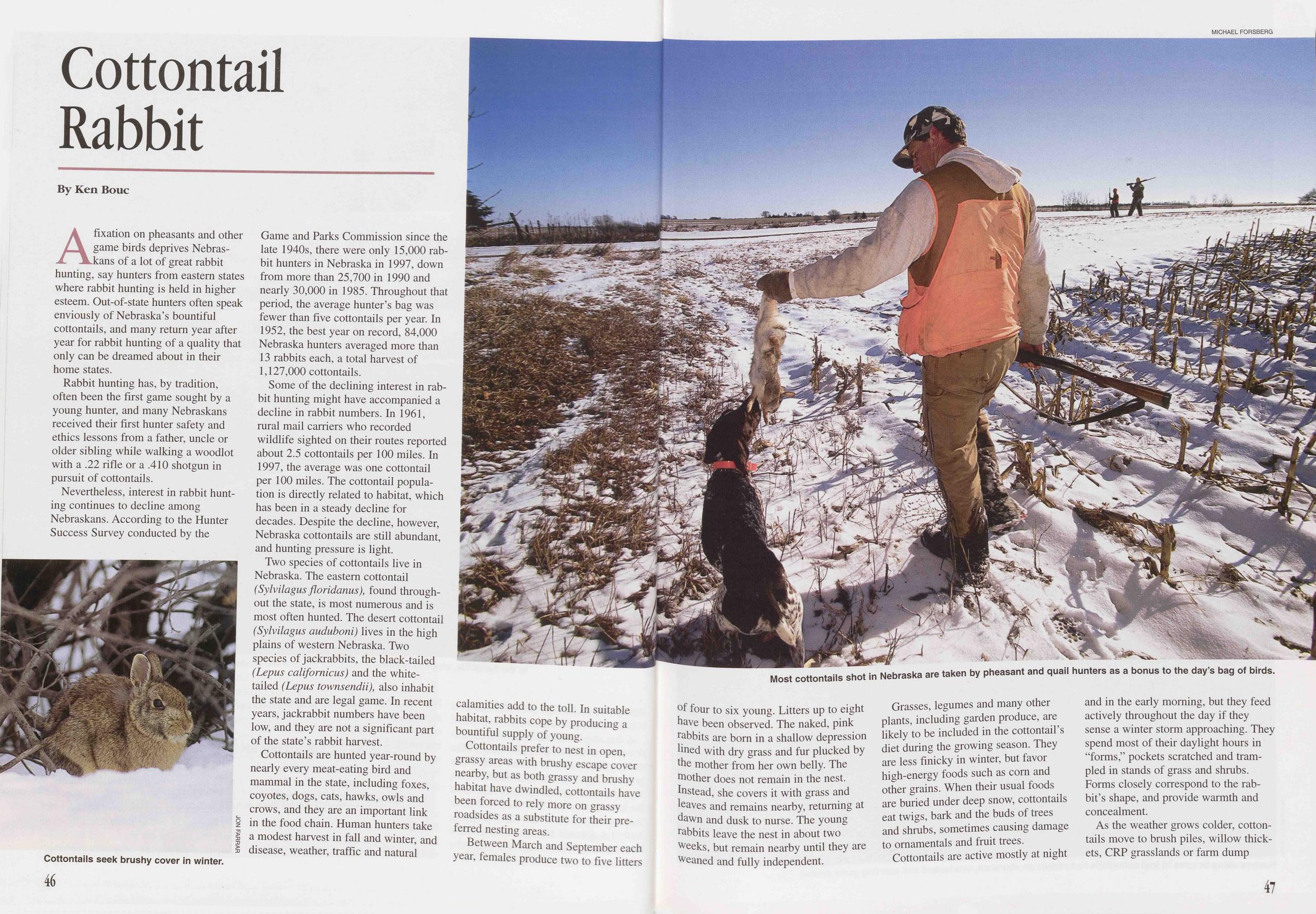
Cottontail Rabbit
By Ken BoucA fixation on pheasants and other game birds deprives Nebraskans of a lot of great rabbit hunting, say hunters from eastern states where rabbit hunting is held in higher esteem. Out-of-state hunters often speak enviously of Nebraska's bountiful cottontails, and many return year after year for rabbit hunting of a quality that only can be dreamed about in their home states.
Rabbit hunting has, by tradition, often been the first game sought by a young hunter, and many Nebraskans received their first hunter safety and ethics lessons from a father, uncle or older sibling while walking a woodlot with a .22 rifle or a .410 shotgun in pursuit of cottontails.
Nevertheless, interest in rabbit hunting continues to decline among Nebraskans. According to the Hunter Success Survey conducted by the
Cottontails seek brushy cover in winter.
Jon FarrarGame and Parks Commission since the late 1940s, there were only 15,000 rabbit hunters in Nebraska in 1997, down from more than 25,700 in 1990 and nearly 30,000 in 1985. Throughout that period, the average hunter's bag was fewer than five cottontails per year. In 1952, the best year on record, 84,000 Nebraska hunters averaged more than 13 rabbits each, a total harvest of 1,127,000 cottontails.
Some of the declining interest in rabbit hunting might have accompanied a decline in rabbit numbers. In 1961, rural mail carriers who recorded wildlife sighted on their routes reported about 2.5 cottontails per 100 miles. In 1997, the average was one cottontail per 100 miles. The cottontail population is directly related to habitat, which has been in a steady decline for decades. Despite the decline, however, Nebraska cottontails are still abundant, and hunting pressure is light.
Two species of cottontails live in Nebraska. The eastern cottontail (Sylvilagus floridanus), found throughout the state, is most numerous and is most often hunted. The desert cottontail (Sylvilagus auduboni) lives in the high plains of western Nebraska. Two species of jackrabbits, the black-tailed (Lepus californicus) and the white-tailed (Lepus townsendii), also inhabit the state and are legal game. In recent years, jackrabbit numbers have been low, and they are not a significant part of the state's rabbit harvest.
Cottontails are hunted year-round by nearly every meat-eating bird and mammal in the state, including foxes, coyotes, dogs, cats, hawks, owls and crows, and they are an important link in the food chain. Human hunters take a modest harvest in fall and winter, and disease, weather, traffic and natural
Most cottontails shot in Nebraska are taken by pheasant and quail hunters as a bonus to the day's bag of birds.
MICHAEL FORSBERGcalamities add to the toll. In suitable habitat, rabbits cope by producing a bountiful supply of young.
Cottontails prefer to nest in open grassy areas with brushy escape cover nearby, but as both grassy and brushy habitat have dwindled, cottontails have been forced to rely more on grassy roadsides as a substitute for their preferred nesting areas.
Between March and September each year, females produce two to five litters
46of four to six young. Litters up to eight have been observed. The naked, pink rabbits are born in a shallow depression lined with dry grass and fur plucked by the mother from her own belly. The mother does not remain in the nest. Instead, she covers it with grass and leaves and remains nearby, returning at dawn and dusk to nurse. The young rabbits leave the nest in about two Weeks, but remain nearby until they are leaned and fully independent.
Grasses, legumes and many other plants, including garden produce, are likely to be included in the cottontail's diet during the growing season. They are less finicky in winter, but favor high-energy foods such as corn and other grains. When their usual foods are buried under deep snow, cottontails eat twigs, bark and the buds of trees and shrubs, sometimes causing damage to ornamentals and fruit trees.
Cottontails are active mostly at night and in the early morning, but they feed actively throughout the day if they sense a winter storm approaching. They spend most of their daylight hours in "forms," pockets scratched and trampled in stands of grass and shrubs. Forms closely correspond to the rabbit's shape, and provide warmth and concealment.
As the weather grows colder, cottontails move to brush piles, willow thickets, CRP grasslands or farm dump
47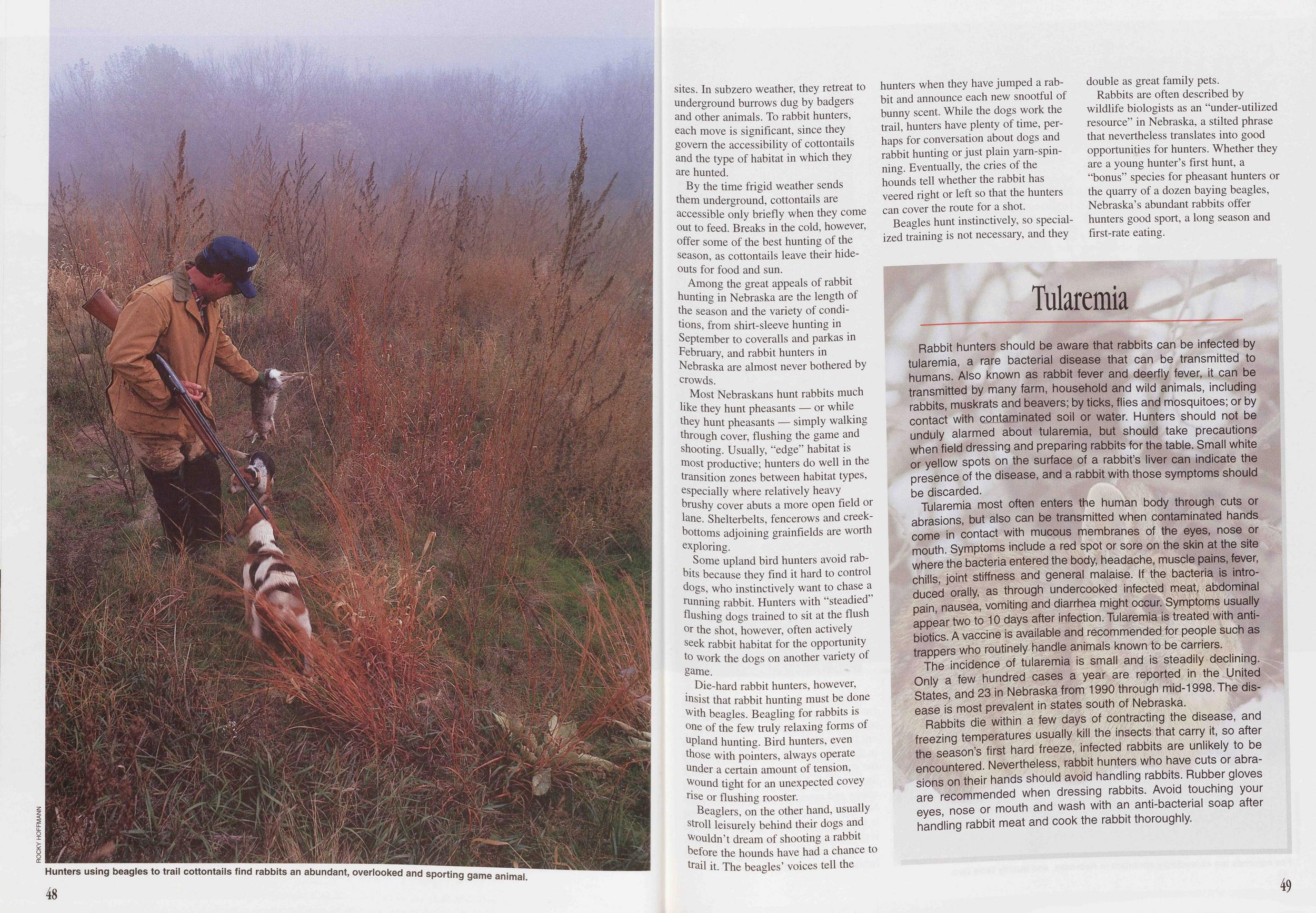
Hunters using beagles to trail cottontails find rabbits an abundant, overlooked and sporting game animal
Rocky Hoffmannsites. In subzero weather, they retreat to underground burrows dug by badgers and other animals. To rabbit hunters, each move is significant, since they govern the accessibility of cottontails and the type of habitat in which they are hunted.
By the time frigid weather sends them underground, cottontails are accessible only briefly when they come out to feed. Breaks in the cold, however, offer some of the best hunting of the season, as cottontails leave their hideouts for food and sun.
Among the great appeals of rabbit hunting in Nebraska are the length of the season and the variety of conditions, from shirt-sleeve hunting in September to coveralls and parkas in February, and rabbit hunters in Nebraska are almost never bothered by crowds.
Most Nebraskans hunt rabbits much like they hunt pheasants — or while they hunt pheasants — simply walking through cover, flushing the game and shooting. Usually, "edge" habitat is most productive; hunters do well in the transition zones between habitat types, especially where relatively heavy brushy cover abuts a more open field or lane. Shelterbelts, fencerows and creek-bottoms adjoining grainfields are worth exploring.
Some upland bird hunters avoid rabbits because they find it hard to control hogs, who instinctively want to chase a running rabbit. Hunters with "steadied" flushing dogs trained to sit at the flush °r the shot, however, often actively seek rabbit habitat for the opportunity to work the dogs on another variety of game.
Die-hard rabbit hunters, however, insist that rabbit hunting must be done with beagles. Beagling for rabbits is one of the few truly relaxing forms of npland hunting. Bird hunters, even those with pointers, always operate under a certain amount of tension, wound tight for an unexpected covey rise or flushing rooster.
Beaglers, on the other hand, usually stroll leisurely behind their dogs and wouldn't dream of shooting a rabbit before the hounds have had a chance to trail it. The beagles' voices tell the hunters when they have jumped a rabbit and announce each new snootful of bunny scent. While the dogs work the trail, hunters have plenty of time, perhaps for conversation about dogs and rabbit hunting or just plain yarn-spinning. Eventually, the cries of the hounds tell whether the rabbit has veered right or left so that the hunters can cover the route for a shot.
Beagles hunt instinctively, so specialized training is not necessary, and they double as great family pets.
Rabbits are often described by wildlife biologists as an "under-utilized resource" in Nebraska, a stilted phrase that nevertheless translates into good opportunities for hunters. Whether they are a young hunter's first hunt, a "bonus" species for pheasant hunters or the quarry of a dozen baying beagles, Nebraska's abundant rabbits offer hunters good sport, a long season and first-rate eating.
Tularemia
Rabbit hunters; should be aware that rabbits can be infected by tularemia, a rare bacterial disease that can be transmitted to humans. Also known as rabbit fever and deerfly fever, it can be transmitted by many farm, household and wild animals, including rabbits, muskrats and beavers; by ticks, flies and mosquitoes; or by contact with contaminated soil or water. Hunters should not be unduly alarmed about tularemia, but should take precautions when field dressing and preparing rabbits for the table. Small white or yellow spots on the surface of a rabbit's liver can indicate the presence of the disease, and a rabbit with those symptoms should be discarded.
Tularemia most often enters the human body through cuts or abrasions, but also can be transmitted when contaminated hands come in contact with mucous membranes of the eyes, nose or mouth. Symptoms include a red spot or sore on the skin at the site where the bacteria entered the body; headache, muscle pains, fever, chills, joint stiffness and general malaise. If the bacteria is introduced orally, as through undercooked infected meat, abdominal pain nausea, vomiting and diarrhea might occur. Symptoms usually appear two to 10 days after infection. Tularemia is treated with antibiotics. A vaccine is available and recommended for people such as trappers who routinely handle animals known to be carriers.
The incidence of tularemia is small and is steadily declining. Only a few hundred cases a year are reported in the United States and 23 in Nebraska from 1990 through mid-1998. The disease is most prevalent in states south of Nebraska.
Rabbits die within a few days of contracting the disease, and freezinq temperatures usually kill the insects that carry it, so after the season's first hard freeze, infected rabbits are unlikely to be encountered Nevertheless, rabbit hunters who have cuts or abrasions on their hands should avoid handling rabbits. Rubber gloves are recommended when dressing rabbits. Avoid touching your eves nose or mouth and wash with an anti-bacterial soap after handling rabbit meat and cook the rabbit thoroughly.
49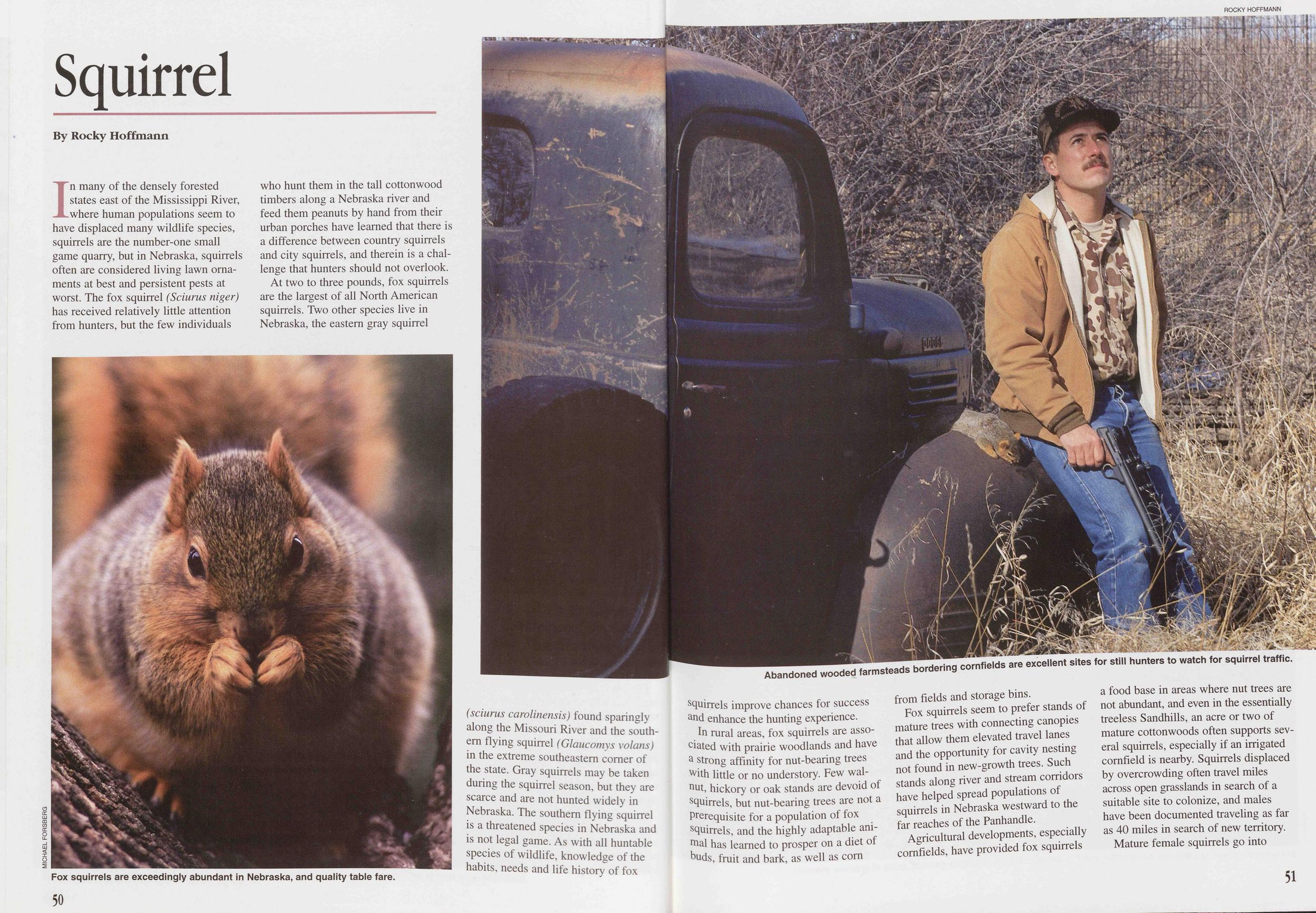
Squirrel
By Rocky HoffmannIn many of the densely forested states east of the Mississippi River, where human populations seem to have displaced many wildlife species, squirrels are the number-one small game quarry, but in Nebraska, squirrels often are considered living lawn ornaments at best and persistent pests at worst. The fox squirrel (Sciurus niger) has received relatively little attention from hunters, but the few individuals who hunt them in the tall cottonwood timbers along a Nebraska river and feed them peanuts by hand from their urban porches have learned that there is a difference between country squirrels and city squirrels, and therein is a challenge that hunters should not overlook.
At two to three pounds, fox squirrels are the largest of all North American squirrels. Two other species live in Nebraska, the eastern gray squirrel
Abandoned wooded farmsteads bordering cornfields are excellent sites
ROCKY HOFFMANFox squirrels are exceedingly abundant in Nebraska, and quality table fare.
Michael Forsberg(sciurus carolinensis) found sparingly along the Missouri River and the southern flying squirrel (Glaucomys volans) in the extreme southeastern corner of the state. Gray squirrels may be taken during the squirrel season, but they are scarce and are not hunted widely in Nebraska. The southern flying squirrel is a threatened species in Nebraska and is not legal game. As with all huntable species of wildlife, knowledge of the habits, needs and life history of fox
50squirrels improve chances for success and enhance the hunting experience.
In rural areas, fox squirrels are associated with prairie woodlands and have a strong affinity for nut-bearing trees with little or no understory. Few walnut, hickory or oak stands are devoid of squirrels, but nut-bearing trees are not a Prerequisite for a population of fox squirrels, and the highly adaptable animal has learned to prosper on a diet of buds, fruit and bark, as well as corn from fields and storage bins.
Fox squirrels seem to prefer stands of mature trees with connecting canopies that allow them elevated travel lanes and the opportunity for cavity nesting not found in new-growth trees. Such stands along river and stream corridors have helped spread populations of squirrels in Nebraska westward to the far reaches of the Panhandle.
Agricultural developments, especially cornfields, have provided fox squirrels for still hunters to watch for squirrel traffic. a food base in areas where nut trees are not abundant, and even in the essentially treeless Sandhills, an acre or two of mature cottonwoods often supports several squirrels, especially if an irrigated cornfield is nearby. Squirrels displaced by overcrowding often travel miles across open grasslands in search of a suitable site to colonize, and males have been documented traveling as far as 40 miles in search of new territory.
Mature female squirrels go into
51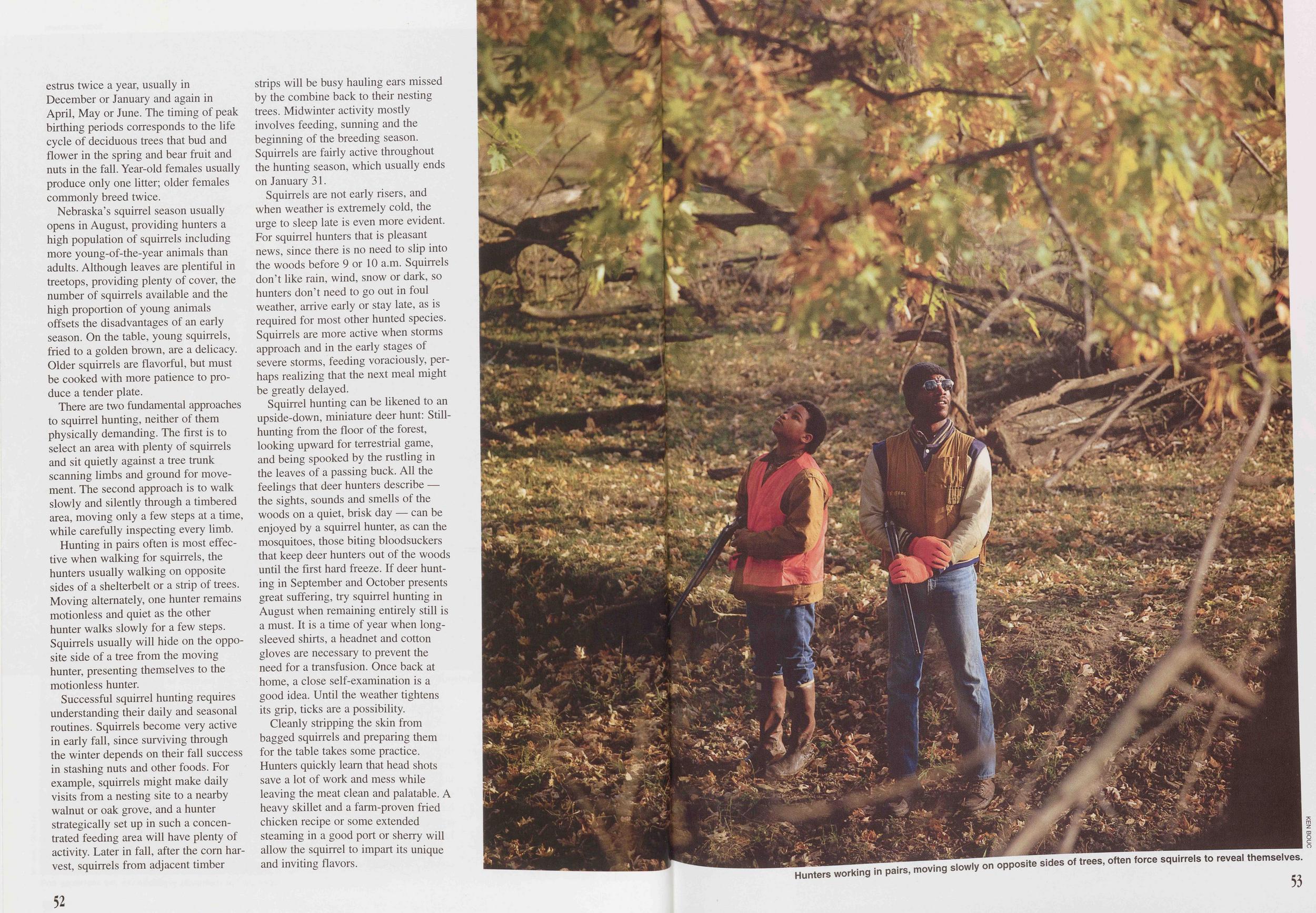
estrus twice a year, usually in December or January and again in April, May or June. The timing of peak birthing periods corresponds to the life cycle of deciduous trees that bud and flower in the spring and bear fruit and nuts in the fall. Year-old females usually produce only one litter; older females commonly breed twice.
Nebraska's squirrel season usually opens in August, providing hunters a high population of squirrels including more young-of-the-year animals than adults. Although leaves are plentiful in treetops, providing plenty of cover, the number of squirrels available and the high proportion of young animals offsets the disadvantages of an early season. On the table, young squirrels, fried to a golden brown, are a delicacy. Older squirrels are flavorful, but must be cooked with more patience to produce a tender plate.
There are two fundamental approaches to squirrel hunting, neither of them physically demanding. The first is to select an area with plenty of squirrels and sit quietly against a tree trunk scanning limbs and ground for movement. The second approach is to walk slowly and silently through a timbered area, moving only a few steps at a time, while carefully inspecting every limb.
Hunting in pairs often is most effective when walking for squirrels, the hunters usually walking on opposite sides of a shelterbelt or a strip of trees. Moving alternately, one hunter remains motionless and quiet as the other hunter walks slowly for a few steps. Squirrels usually will hide on the opposite side of a tree from the moving hunter, presenting themselves to the motionless hunter.
Successful squirrel hunting requires understanding their daily and seasonal routines. Squirrels become very active in early fall, since surviving through the winter depends on their fall success in stashing nuts and other foods. For example, squirrels might make daily visits from a nesting site to a nearby walnut or oak grove, and a hunter strategically set up in such a concentrated feeding area will have plenty of activity. Later in fall, after the corn harvest, squirrels from adjacent timber strips will be busy hauling ears missed by the combine back to their nesting trees. Midwinter activity mostly involves feeding, sunning and the beginning of the breeding season. Squirrels are fairly active throughout the hunting season, which usually ends on January 31.
Squirrels are not early risers, and when weather is extremely cold, the urge to sleep late is even more evident. For squirrel hunters that is pleasant news, since there is no need to slip into the woods before 9 or 10 a.m. Squirrels don't like rain, wind, snow or dark, so hunters don't need to go out in foul weather, arrive early or stay late, as is required for most other hunted species. Squirrels are more active when storms approach and in the early stages of severe storms, feeding voraciously, perhaps realizing that the next meal might be greatly delayed.
Squirrel hunting can be likened to an upside-down, miniature deer hunt: Still-hunting from the floor of the forest, looking upward for terrestrial game, and being spooked by the rustling in the leaves of a passing buck. All the feelings that deer hunters describe — the sights, sounds and smells of the woods on a quiet, brisk day — can be enjoyed by a squirrel hunter, as can the mosquitoes, those biting bloodsuckers that keep deer hunters out of the woods until the first hard freeze. If deer hunting in September and October presents great suffering, try squirrel hunting in August when remaining entirely still is a must. It is a time of year when long-sleeved shirts, a headnet and cotton gloves are necessary to prevent the need for a transfusion. Once back at home, a close self-examination is a good idea. Until the weather tightens its grip, ticks are a possibility.
Cleanly stripping the skin from bagged squirrels and preparing them for the table takes some practice. Hunters quickly learn that head shots save a lot of work and mess while leaving the meat clean and palatable. A heavy skillet and a farm-proven fried chicken recipe or some extended steaming in a good port or sherry will allow the squirrel to impart its unique and inviting flavors.
52Hunters working in pairs, moving slowly on opposite sides of trees, often force squirrels to reveal themselves.
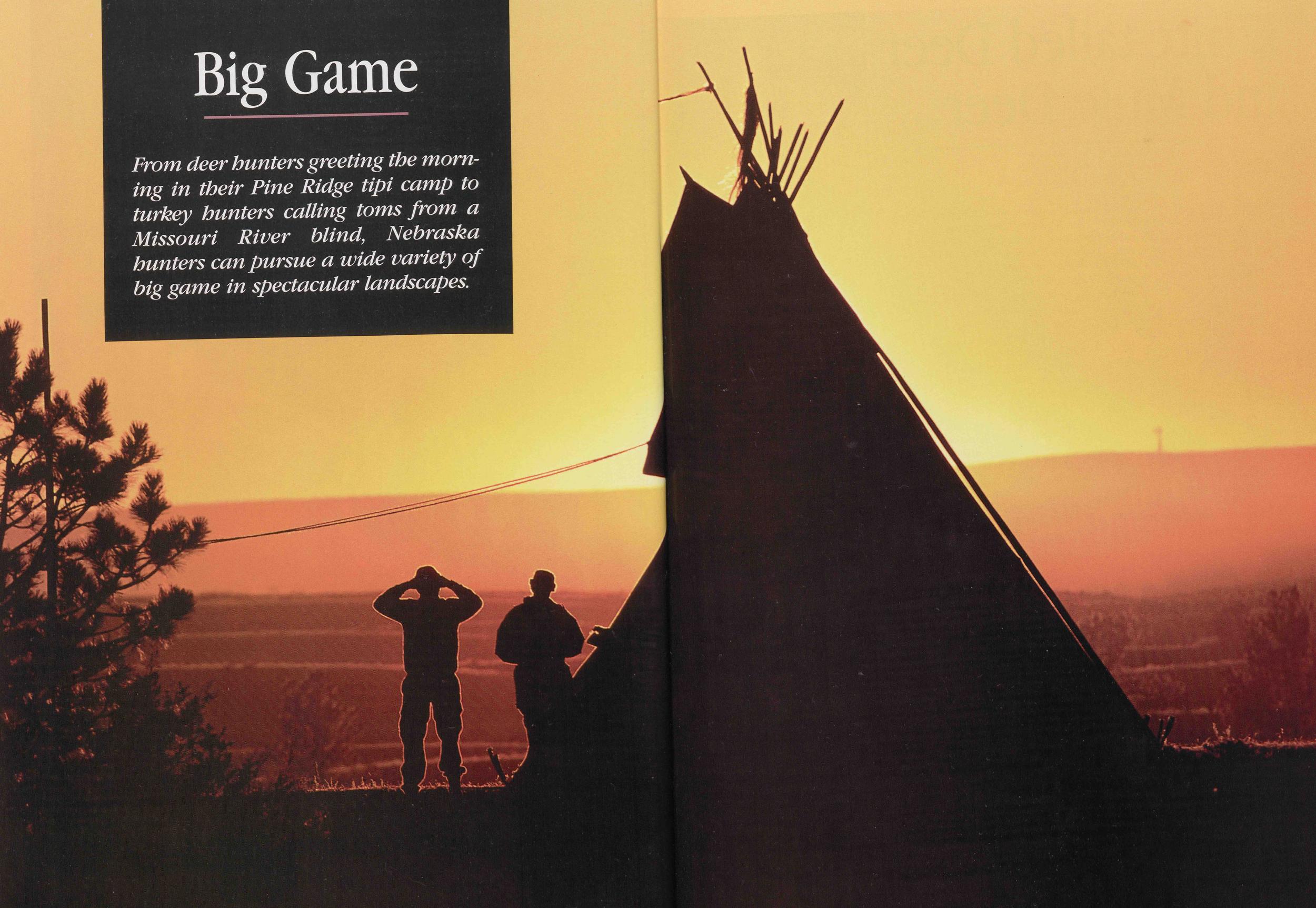
Big Game
From deer hunters greeting the morning in their Pine Ridge tipi camp to turkey hunters calling toms from a Missouri River blind, Nebraska hunters can pursue a wide variety of big game in spectacular landscapes.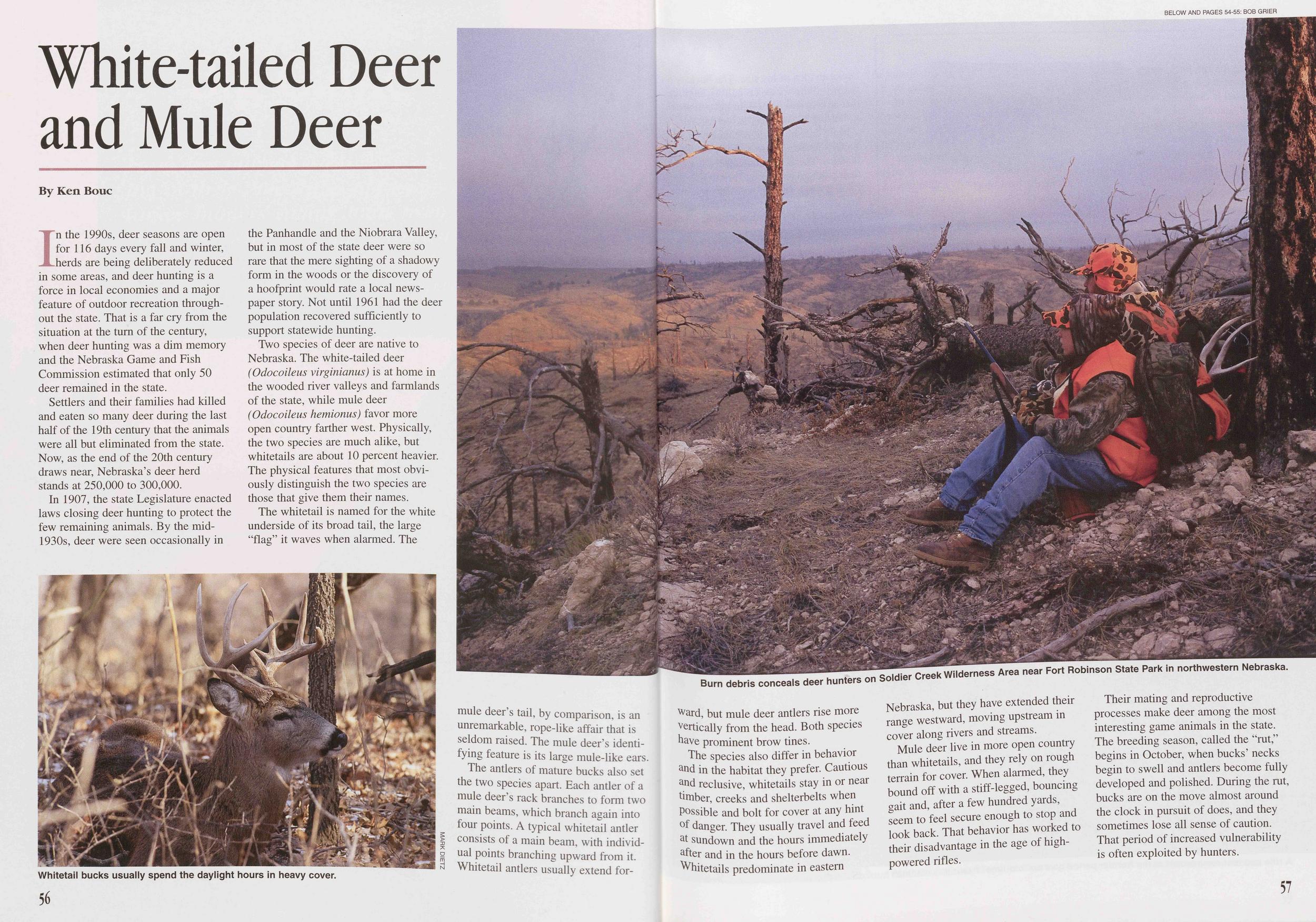
White-tailed Deer and Mule Deer
By Ken BoucIn the 1990s, deer seasons are open for 116 days every fall and winter, herds are being deliberately reduced in some areas, and deer hunting is a force in local economies and a major feature of outdoor recreation throughout the state. That is a far cry from the situation at the turn of the century, when deer hunting was a dim memory and the Nebraska Game and Fish Commission estimated that only 50 deer remained in the state.
Settlers and their families had killed and eaten so many deer during the last half of the 19th century that the animals were all but eliminated from the state. Now, as the end of the 20th century draws near, Nebraska's deer herd stands at 250,000 to 300,000.
In 1907, the state Legislature enacted laws closing deer hunting to protect the few remaining animals. By the mid-1930s, deer were seen occasionally in the Panhandle and the Niobrara Valley, but in most of the state deer were so rare that the mere sighting of a shadowy form in the woods or the discovery of a hoofprint would rate a local newspaper story. Not until 1961 had the deer population recovered sufficiently to support statewide hunting.
Two species of deer are native to Nebraska. The white-tailed deer (Odocoileus virginianus) is at home in the wooded river valleys and farmlands of the state, while mule deer (Odocoileus hemionus) favor more open country farther west. Physically, the two species are much alike, but whitetails are about 10 percent heavier. The physical features that most obviously distinguish the two species are those that give them their names.
The whitetail is named for the white underside of its broad tail, the large "flag" it waves when alarmed. The
Whitetail bucks usually spend the daylight hours in heavy cover.
Mark Dietzmule deer's tail, by comparison, is an unremarkable, rope-like affair that is seldom raised. The mule deer's identifying feature is its large mule-like ears.
The antlers of mature bucks also set the two species apart. Each antler of a mule deer's rack branches to form two main beams, which branch again into four points. A typical whitetail antler consists of a main beam, with individual points branching upward from it. Whitetail antlers usually extend forward,
56Burn debris conceals deer hunters on Soldier Creek Wilderness Area near Fort Robinson State Park in northwestern Nebraska.
below and pages 54-55: Bob Grierbut mule deer antlers rise more vertically from the head. Both species have prominent brow tines.
The species also differ in behavior and in the habitat they prefer. Cautious and reclusive, whitetails stay in or near umber, creeks and shelterbelts when Possible and bolt for cover at any hint of danger. They usually travel and feed at sundown and the hours immediately after and in the hours before dawn. Whitetails predominate in eastern Nebraska, but they have extended their range westward, moving upstream in cover along rivers and streams.
Mule deer live in more open country than whitetails, and they rely on rough terrain for cover. When alarmed, they bound off with a stiff-legged, bouncing gait and, after a few hundred yards, seem to feel secure enough to stop and look back. That behavior has worked to their disadvantage in the age of high-powered rifles.
Their mating and reproductive processes make deer among the most interesting game animals in the state. The breeding season, called the "rut," begins in October, when bucks' necks begin to swell and antlers become fully developed and polished. During the rut, bucks are on the move almost around the clock in pursuit of does, and they sometimes lose all sense of caution. That period of increased vulnerability is often exploited by hunters.
57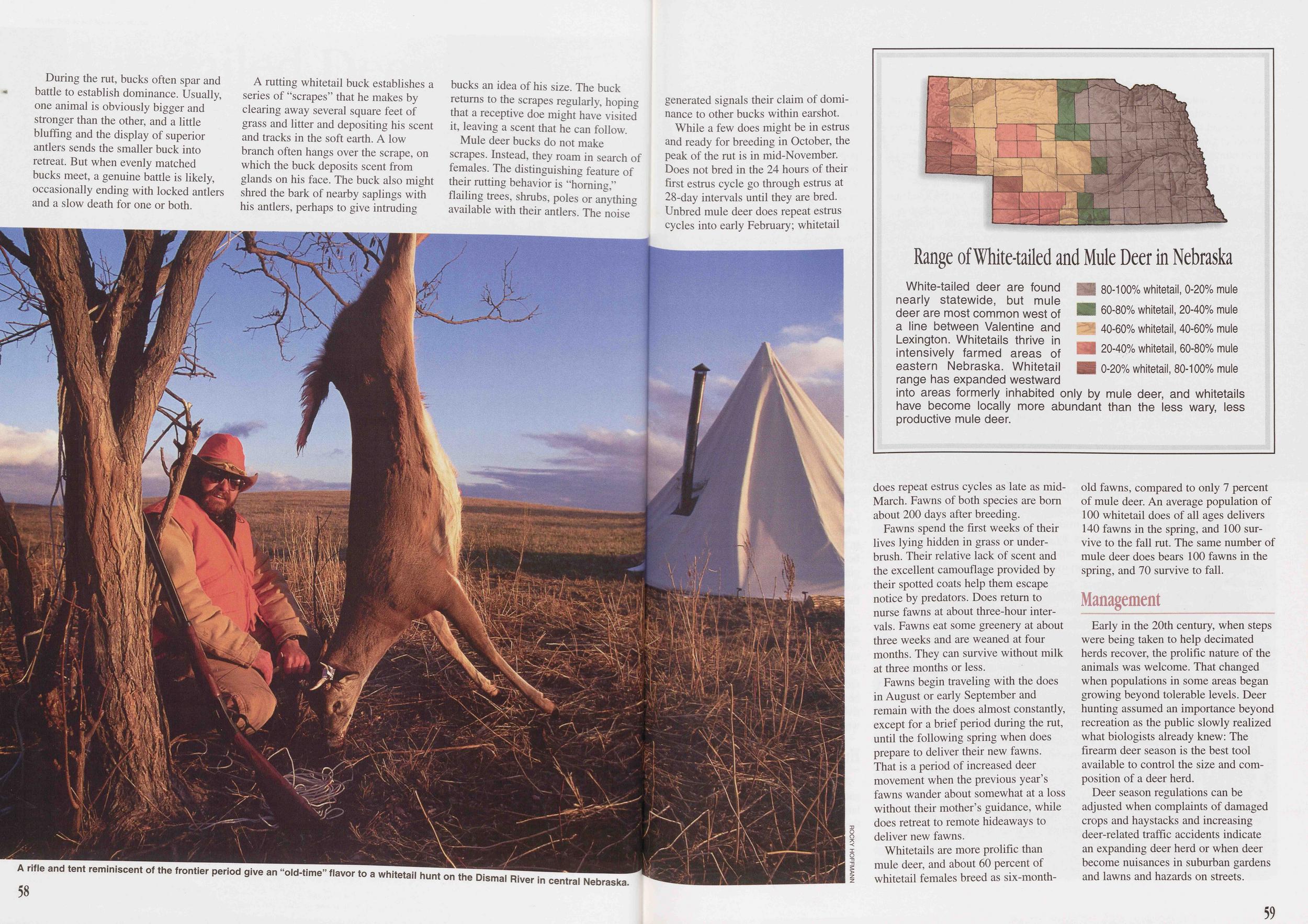
During the rut, bucks often spar and battle to establish dominance. Usually, one animal is obviously bigger and stronger than the other, and a little bluffing and the display of superior antlers sends the smaller buck into retreat. But when evenly matched bucks meet, a genuine battle is likely, occasionally ending with locked antlers and a slow death for one or both.
A rutting whitetail buck establishes a series of "scrapes" that he makes by clearing away several square feet of grass and litter and depositing his scent and tracks in the soft earth. A low branch often hangs over the scrape, on which the buck deposits scent from glands on his face. The buck also might shred the bark of nearby saplings with his antlers, perhaps to give intruding bucks an idea of his size. The buck returns to the scrapes regularly, hoping that a receptive doe might have visited it, leaving a scent that he can follow.
Mule deer bucks do not make scrapes. Instead, they roam in search of females. The distinguishing feature of their rutting behavior is "homing," flailing trees, shrubs, poles or anything available with their antlers. The noise
A rifle and tent reminiscent of the frontier period give an "old-time" flavor to a whitetail hunt on the Dismal River in central Nebraska.
Rocky Hoffmanngenerated signals their claim of dominance to other bucks within earshot.
While a few does might be in estruss and ready for breeding in October, the peak of the rut is in mid-November. Does not bred in the 24 hours of their first estrus cycle go through estrus at 28-day intervals until they are bred. Unbred mule deer does repeat estrus cycles into early February; whitetail
Range of White-tailed and Mule Deer in Nebraska
White-tailed deer are found nearly statewide, but mule deer are most common west of a line between Valentine and Lexington. Whitetails thrive in intensively farmed areas of eastern Nebraska. Whitetail range has expanded westward into areas formerly inhabited only by mule deer, and whitetails have become locally more abundant than the less wary, less productive mule deer.
80-100% whitetail, 0-20% mule 60-80% whitetail, 20-40% mule 40-60% whitetail, 40-60% mule 20-40% whitetail, 60-80% mule 0-20% whitetail, 80-100% mule
does repeat estrus cycles as late as mid-March. Fawns of both species are born about 200 days after breeding.
Fawns spend the first weeks of their lives lying hidden in grass or underbrush. Their relative lack of scent and the excellent camouflage provided by their spotted coats help them escape notice by predators. Does return to nurse fawns at about three-hour intervals. Fawns eat some greenery at about three weeks and are weaned at four months. They can survive without milk at three months or less.
Fawns begin traveling with the does in August or early September and remain with the does almost constantly, except for a brief period during the rut, until the following spring when does prepare to deliver their new fawns. That is a period of increased deer movement when the previous year's fawns wander about somewhat at a loss without their mother's guidance, while does retreat to remote hideaways to deliver new fawns.
Whitetails are more prolific than mule deer, and about 60 percent of whitetail females breed as six-month-old fawns, compared to only 7 percent of mule deer. An average population of 100 whitetail does of all ages delivers 140 fawns in the spring, and 100 survive to the fall mt. The same number of mule deer does bears 100 fawns in the spring, and 70 survive to fall.
ManagementEarly in the 20th century, when steps were being taken to help decimated herds recover, the prolific nature of the animals was welcome. That changed when populations in some areas began growing beyond tolerable levels. Deer hunting assumed an importance beyond recreation as the public slowly realized what biologists already knew: The firearm deer season is the best tool available to control the size and composition of a deer herd.
Deer season regulations can be adjusted when complaints of damaged crops and haystacks and increasing deer-related traffic accidents indicate an expanding deer herd or when deer become nuisances in suburban gardens and lawns and hazards on streets.
59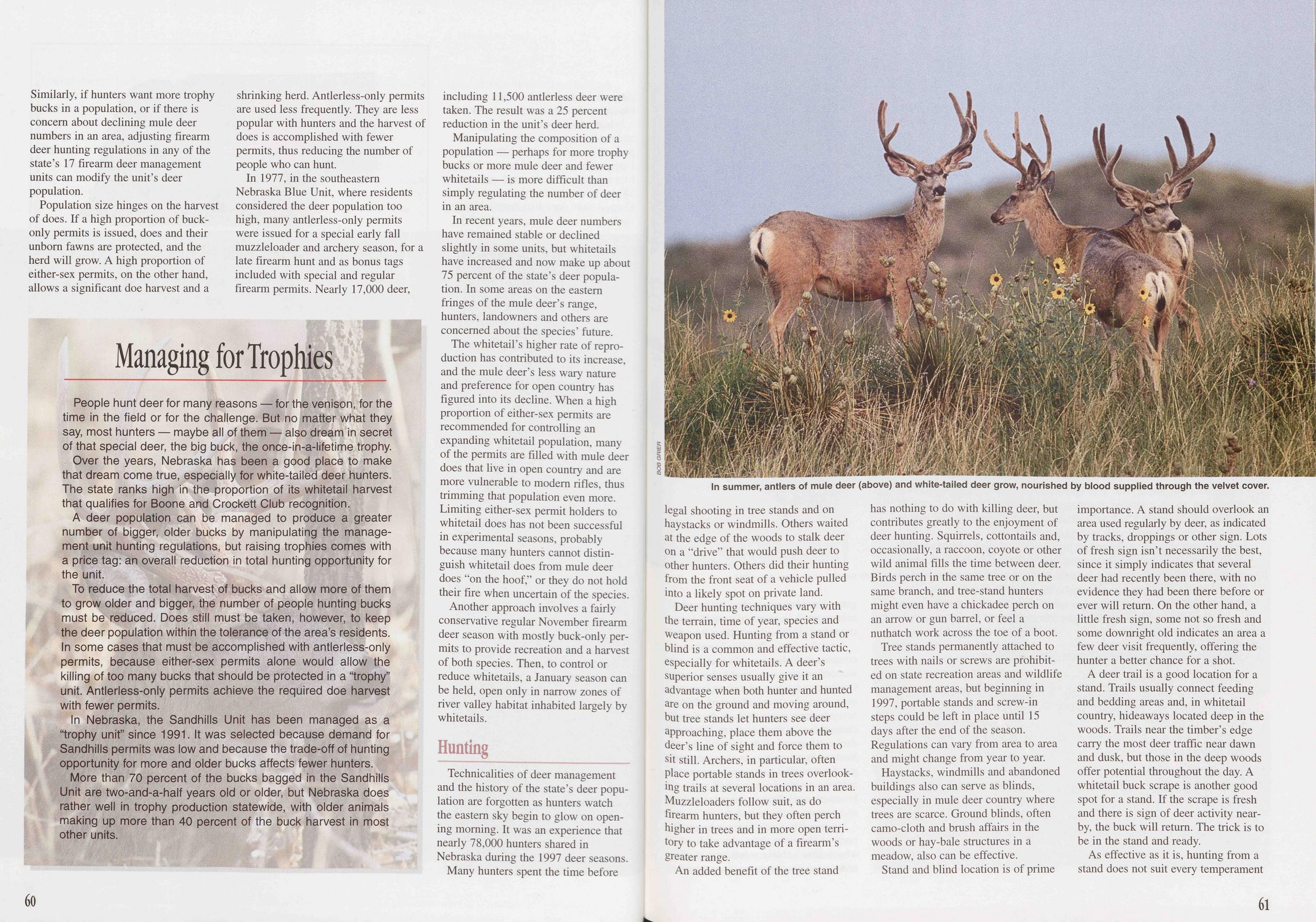
Similarly, if hunters want more trophy bucks in a population, or if there is concern about declining mule deer numbers in an area, adjusting firearm deer hunting regulations in any of the state's 17 firearm deer management units can modify the unit's deer population.
Population size hinges on the harvest of does. If a high proportion of buck-only permits is issued, does and their unborn fawns are protected, and the herd will grow. A high proportion of either-sex permits, on the other hand, allows a significant doe harvest and a shrinking herd. Antlerless-only permits are used less frequently. They are less popular with hunters and the harvest of does is accomplished with fewer permits, thus reducing the number of people who can hunt.
In 1977, in the southeastern Nebraska Blue Unit, where residents considered the deer population too high, many antlerless-only permits were issued for a special early fall muzzleloader and archery season, for a late firearm hunt and as bonus tags included with special and regular firearm permits. Nearly 17,000 deer,
Managing for Trophies
People hunt deer for many reasons — for the venison; for the time in the field or for the challenge. But no matter what they say, most hunters — maybe all of them — also dream in secret of that special deer, the big buck, the once-in-a-lifetime trophy. Over the years, Nebraska has been a good place to make that dream come true, especially for white-tailed deer hunters. The state ranks high In the proportion of its whitetail harvest that qualifies for Boone and Crockett Club recognition.
A deer population can be managed to produce a greater number of bigger, older bucks by manipulating the management unit hunting regulations, but raising trophies comes with a price tag: an overall reduction in total hunting opportunity for the unit.
To reduce the total harvest of bucks and allow more of them to grow older and bigger, the number of people hunting bucks must be reduced. Does still must be taken, however, to keep the deer population within the tolerance of the area's residents. In some cases that must be accomplished with antlerless-only permits, because either-sex permits alone would allow the killing of too many bucks that should be protected in a "trophy" unit. Antlerless-only permits achieve the required doe harvest with fewer permits.
In Nebraska, the Sandhills Unit has been managed as a "trophy unit" since 1991. It was selected because demand for Sandhills permits was low and because the trade-off of hunting opportunity for more and older bucks affects fewer hunters. More than 70 percent of the bucks bagged in the Sandhills Unit are two-and-a-half years old or older, but Nebraska does rather well in trophy production statewide, with older animals making up more than 40 percent of the buck harvest in most other units.
including 11,500 antlerless deer were taken. The result was a 25 percent reduction in the unit's deer herd.
Manipulating the composition of a population — perhaps for more trophy bucks or more mule deer and fewer whitetails — is more difficult than simply regulating the number of deer in an area.
In recent years, mule deer numbers have remained stable or declined slightly in some units, but whitetails have increased and now make up about 75 percent of the state's deer population. In some areas on the eastern fringes of the mule deer's range, hunters, landowners and others are concerned about the species' future.
The whitetail's higher rate of reproduction has contributed to its increase, and the mule deer's less wary nature and preference for open country has figured into its decline. When a high proportion of either-sex permits are recommended for controlling an expanding whitetail population, many of the permits are filled with mule deer does that live in open country and are more vulnerable to modern rifles, thus trimming that population even more. Limiting either-sex permit holders to whitetail does has not been successful in experimental seasons, probably because many hunters cannot distinguish whitetail does from mule deer does "on the hoof," or they do not hold their fire when uncertain of the species.
Another approach involves a fairly conservative regular November firearm deer season with mostly buck-only permits to provide recreation and a harvest of both species. Then, to control or reduce whitetails, a January season can be held, open only in narrow zones of river valley habitat inhabited largely by whitetails.
HuntingTechnicalities of deer management and the history of the state's deer population are forgotten as hunters watch the eastern sky begin to glow on opening morning. It was an experience that nearly 78,000 hunters shared in Nebraska during the 1997 deer seasons.
Many hunters spent the time before
60In summer, antlers of mule deer (above) and white-tailed deer grow, nourished by blood supplied through the velvet cover.
Bob Grierlegal shooting in tree stands and on haystacks or windmills. Others waited at the edge of the woods to stalk deer on a "drive" that would push deer to other hunters. Others did their hunting from the front seat of a vehicle pulled into a likely spot on private land.
Deer hunting techniques vary with the terrain, time of year, species and weapon used. Hunting from a stand or blind is a common and effective tactic, especially for whitetails. A deer's superior senses usually give it an advantage when both hunter and hunted are on the ground and moving around, but tree stands let hunters see deer approaching, place them above the deer's line of sight and force them to sit still. Archers, in particular, often place portable stands in trees overlooking trails at several locations in an area. Muzzleloaders follow suit, as do firearm hunters, but they often perch higher in trees and in more open territory to take advantage of a firearm's greater range.
An added benefit of the tree stand has nothing to do with killing deer, but contributes greatly to the enjoyment of deer hunting. Squirrels, cottontails and, occasionally, a raccoon, coyote or other wild animal fills the time between deer. Birds perch in the same tree or on the same branch, and tree-stand hunters might even have a chickadee perch on an arrow or gun barrel, or feel a nuthatch work across the toe of a boot.
Tree stands permanently attached to trees with nails or screws are prohibited on state recreation areas and wildlife management areas, but beginning in 1997, portable stands and screw-in steps could be left in place until 15 days after the end of the season. Regulations can vary from area to area and might change from year to year.
Haystacks, windmills and abandoned buildings also can serve as blinds, especially in mule deer country where trees are scarce. Ground blinds, often camo-cloth and brush affairs in the woods or hay-bale structures in a meadow, also can be effective.
Stand and blind location is of prime importance. A stand should overlook an area used regularly by deer, as indicated by tracks, droppings or other sign. Lots of fresh sign isn't necessarily the best, since it simply indicates that several deer had recently been there, with no evidence they had been there before or ever will return. On the other hand, a little fresh sign, some not so fresh and some downright old indicates an area a few deer visit frequently, offering the hunter a better chance for a shot.
A deer trail is a good location for a stand. Trails usually connect feeding and bedding areas and, in whitetail country, hideaways located deep in the woods. Trails near the timber's edge carry the most deer traffic near dawn and dusk, but those in the deep woods offer potential throughout the day. A whitetail buck scrape is another good spot for a stand. If the scrape is fresh and there is sign of deer activity nearby, the buck will return. The trick is to be in the stand and ready.
As effective as it is, hunting from a stand does not suit every temperament
61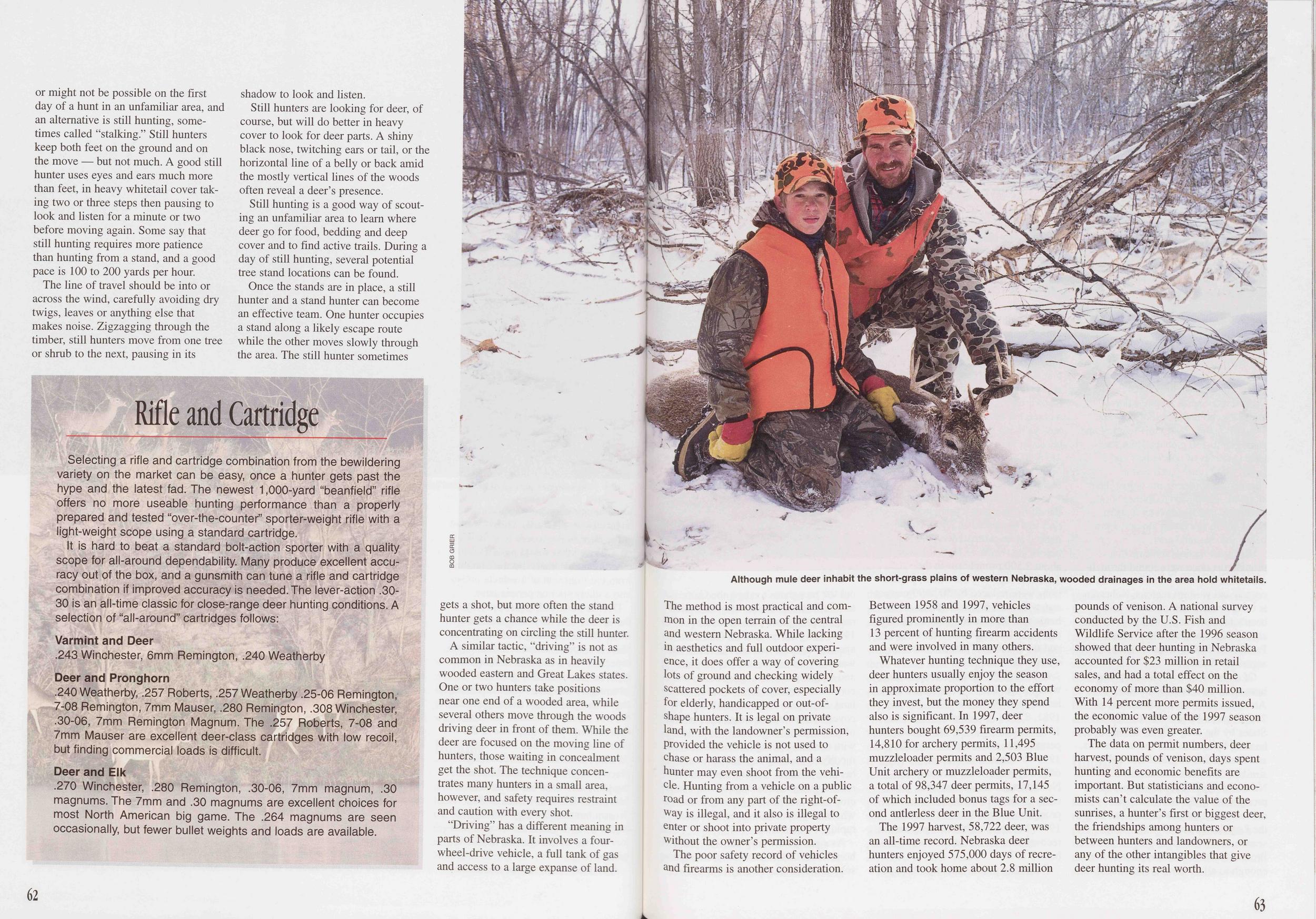
or might not be possible on the first day of a hunt in an unfamiliar area, and an alternative is still hunting, sometimes called "stalking." Still hunters keep both feet on the ground and on the move — but not much. A good still hunter uses eyes and ears much more than feet, in heavy whitetail cover taking two or three steps then pausing to look and listen for a minute or two before moving again. Some say that still hunting requires more patience than hunting from a stand, and a good pace is 100 to 200 yards per hour.
The line of travel should be into or across the wind, carefully avoiding dry twigs, leaves or anything else that makes noise. Zigzagging through the timber, still hunters move from one tree or shrub to the next, pausing in its shadow to look and listen.
Still hunters are looking for deer, of course, but will do better in heavy cover to look for deer parts. A shiny black nose, twitching ears or tail, or the horizontal line of a belly or back amid the mostly vertical lines of the woods often reveal a deer's presence.
Still hunting is a good way of scouting an unfamiliar area to learn where deer go for food, bedding and deep cover and to find active trails. During a day of still hunting, several potential tree stand locations can be found.
Once the stands are in place, a still hunter and a stand hunter can become an effective team. One hunter occupies a stand along a likely escape route while the other moves slowly through the area. The still hunter sometimes
Rifle and Cartridge
Selecting a rifle and cartridge combination from the bewildering variety on the market can be easy, once a hunter gets past the hype and the latest fad. The newest 1,000-yard "beanfield" rifle offers no more useable hunting performance than a properly prepared and tested "over-the-counter" sporter-weight rifle with a light-weight scope using a standard cartridge.
It is hard to beat a standard bolt-action sporter with a quality scope for all-around dependability. Many produce excellent accuracy out of the box, and a gunsmith can tune a rifle and cartridge combination if improved accuracy is needed. The lever-action .SO-SO is an all-time classic for close-range deer hunting conditions, A selection of "all-around" cartridges follows:
Varmint and Deer
.243 Winchester, 6mm Remington, .240 Weatherby
Deer and Pronghorn
,240 Weatherby, .257 Roberts, .257 Weatherby .25-06 Remington, 7-08 Remington, 7mm Mauser, .280 Remington, .308 Winchester, .30-06, 7mm Remington Magnum. The .257 Roberts, 7-08 and 7mm Mauser are excellent deer-class cartridges with low recoil, but finding commercial loads is difficult.
Deer and Elk
.270 Winchester, .280 Remington, .30-06, 7mm magnum, .30 magnums. The 7mm and .30 magnums are excellent choices for most North American big game. The .264 magnums are seen occasionally, but fewer bullet weights and loads are available.
gets a shot, but more often the stand hunter gets a chance while the deer is concentrating on circling the still hunter.
A similar tactic, "driving" is not as common in Nebraska as in heavily wooded eastern and Great Lakes states. One or two hunters take positions near one end of a wooded area, while several others move through the woods driving deer in front of them. While the deer are focused on the moving line of hunters, those waiting in concealment get the shot. The technique concentrates many hunters in a small area, however, and safety requires restraint and caution with every shot.
"Driving" has a different meaning in parts of Nebraska. It involves a four-wheel-drive vehicle, a full tank of gas and access to a large expanse of land.
62Although mule deer inhabit the short-grass plains of western Nebraska, wooded drainages in the area hold whitetails.
Bob GrierThe method is most practical and common in the open terrain of the central and western Nebraska. While lacking in aesthetics and full outdoor experience, it does offer a way of covering lots of ground and checking widely scattered pockets of cover, especially for elderly, handicapped or out-of-shape hunters. It is legal on private land, with the landowner's permission, provided the vehicle is not used to chase or harass the animal, and a hunter may even shoot from the vehicle. Hunting from a vehicle on a public road or from any part of the right-of-way is illegal, and it also is illegal to enter or shoot into private property without the owner's permission.
The poor safety record of vehicles and firearms is another consideration. Between 1958 and 1997, vehicles figured prominently in more than 13 percent of hunting firearm accidents and were involved in many others.
Whatever hunting technique they use, deer hunters usually enjoy the season in approximate proportion to the effort they invest, but the money they spend also is significant. In 1997, deer hunters bought 69,539 firearm permits, 14,810 for archery permits, 11,495 muzzleloader permits and 2,503 Blue Unit archery or muzzleloader permits, a total of 98,347 deer permits, 17,145 of which included bonus tags for a second antlerless deer in the Blue Unit.
The 1997 harvest, 58,722 deer, was an all-time record. Nebraska deer hunters enjoyed 575,000 days of recreation and took home about 2.8 million pounds of venison. A national survey conducted by the U.S. Fish and Wildlife Service after the 1996 season showed that deer hunting in Nebraska accounted for $23 million in retail sales, and had a total effect on the economy of more than $40 million. With 14 percent more permits issued, the economic value of the 1997 season probably was even greater.
The data on permit numbers, deer harvest, pounds of venison, days spent hunting and economic benefits are important. But statisticians and economists can't calculate the value of the sunrises, a hunter's first or biggest deer, the friendships among hunters or between hunters and landowners, or any of the other intangibles that give deer hunting its real worth.
63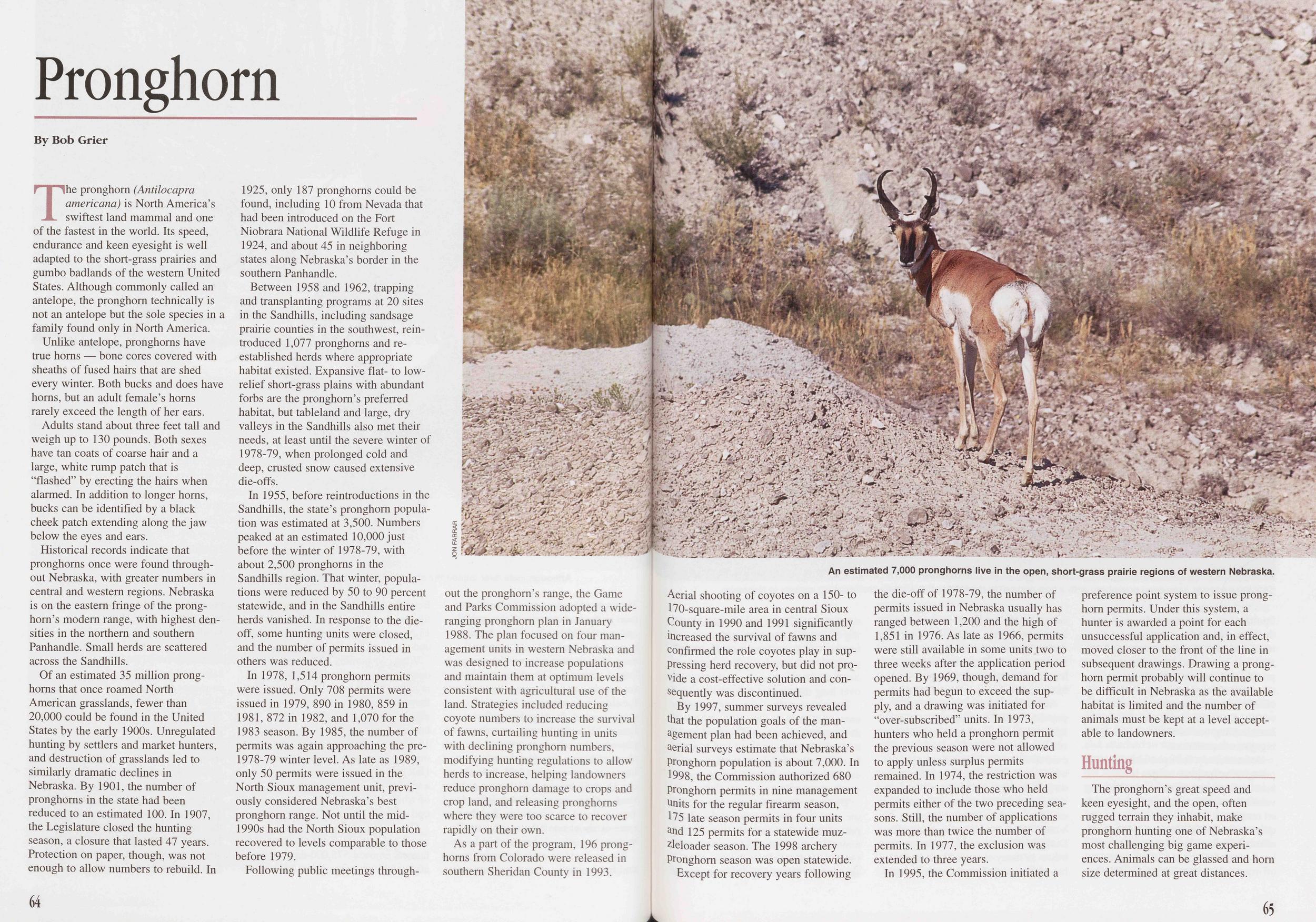
Pronghorn
By Bob GrierThe pronghorn (Antilocapra americana) is North America's swiftest land mammal and one of the fastest in the world. Its speed, endurance and keen eyesight is well adapted to the short-grass prairies and gumbo badlands of the western United States. Although commonly called an antelope, the pronghorn technically is not an antelope but the sole species in a family found only in North America.
Unlike antelope, pronghorns have true horns — bone cores covered with sheaths of fused hairs that are shed every winter. Both bucks and does have horns, but an adult female's horns rarely exceed the length of her ears.
Adults stand about three feet tall and weigh up to 130 pounds. Both sexes have tan coats of coarse hair and a large, white rump patch that is "flashed" by erecting the hairs when alarmed. In addition to longer horns, bucks can be identified by a black cheek patch extending along the jaw below the eyes and ears.
Historical records indicate that pronghorns once were found throughout Nebraska, with greater numbers in central and western regions. Nebraska is on the eastern fringe of the pronghorn's modern range, with highest densities in the northern and southern Panhandle. Small herds are scattered across the Sandhills.
Of an estimated 35 million pronghorns that once roamed North American grasslands, fewer than 20,000 could be found in the United States by the early 1900s. Unregulated hunting by settlers and market hunters, and destruction of grasslands led to similarly dramatic declines in Nebraska. By 1901, the number of pronghorns in the state had been reduced to an estimated 100. In 1907, the Legislature closed the hunting season, a closure that lasted 47 years. Protection on paper, though, was not enough to allow numbers to rebuild. In 1925, only 187 pronghorns could be found, including 10 from Nevada that had been introduced on the Fort Niobrara National Wildlife Refuge in 1924, and about 45 in neighboring states along Nebraska's border in the southern Panhandle.
Between 1958 and 1962, trapping and transplanting programs at 20 sites in the Sandhills, including sandsage prairie counties in the southwest, reintroduced 1,077 pronghorns and reestablished herds where appropriate habitat existed. Expansive flat- to low-relief short-grass plains with abundant forbs are the pronghorn's preferred habitat, but tableland and large, dry valleys in the Sandhills also met their needs, at least until the severe winter of 1978-79, when prolonged cold and deep, crusted snow caused extensive die-offs.
In 1955, before reintroductions in the Sandhills, the state's pronghorn population was estimated at 3,500. Numbers peaked at an estimated 10,000 just before the winter of 1978-79, with about 2,500 pronghorns in the Sandhills region. That winter, populations were reduced by 50 to 90 percent statewide, and in the Sandhills entire herds vanished. In response to the die-off, some hunting units were closed, and the number of permits issued in others was reduced.
In 1978, 1,514 pronghorn permits were issued. Only 708 permits were issued in 1979, 890 in 1980, 859 in 1981, 872 in 1982, and 1,070 for the 1983 season. By 1985, the number of permits was again approaching the pre-1978-79 winter level. As late as 1989, only 50 permits were issued in the North Sioux management unit, previously considered Nebraska's best pronghorn range. Not until the mid-1990s had the North Sioux population recovered to levels comparable to those before 1979.
Following public meetings throughout the pronghorn's range, the Game and Parks Commission adopted a wide-ranging pronghorn plan in January 1988. The plan focused on four management units in western Nebraska and was designed to increase populations and maintain them at optimum levels consistent with agricultural use of the land. Strategies included reducing coyote numbers to increase the survival of fawns, curtailing hunting in units with declining pronghorn numbers, modifying hunting regulations to allow herds to increase, helping landowners reduce pronghorn damage to crops and crop land, and releasing pronghorns where they were too scarce to recover rapidly on their own.
As a part of the program, 196 pronghorns from Colorado were released in southern Sheridan County in 1993.
64An estimated 7,000 pronghorns live in the open, short-grass prairie regions of western Nebraska.
Jon FarrarAerial shooting of coyotes on a 150- to 170-square-mile area in central Sioux County in 1990 and 1991 significantly increased the survival of fawns and confirmed the role coyotes play in suppressing herd recovery, but did not provide a cost-effective solution and consequently was discontinued.
By 1997, summer surveys revealed that the population goals of the management plan had been achieved, and aerial surveys estimate that Nebraska's Pronghorn population is about 7,000. In 1998, the Commission authorized 680 Pronghorn permits in nine management Units for the regular firearm season, 175 late season permits in four units and 125 permits for a statewide muzzleloader season. The 1998 archery Pronghorn season was open statewide.
Except for recovery years following the die-off of 1978-79, the number of permits issued in Nebraska usually has ranged between 1,200 and the high of 1,851 in 1976. As late as 1966, permits were still available in some units two to three weeks after the application period opened. By 1969, though, demand for permits had begun to exceed the supply, and a drawing was initiated for "over-subscribed" units. In 1973, hunters who held a pronghorn permit the previous season were not allowed to apply unless surplus permits remained. In 1974, the restriction was expanded to include those who held permits either of the two preceding seasons. Still, the number of applications was more than twice the number of permits. In 1977, the exclusion was extended to three years.
In 1995, the Commission initiated a preference point system to issue pronghorn permits. Under this system, a hunter is awarded a point for each unsuccessful application and, in effect, moved closer to the front of the line in subsequent drawings. Drawing a pronghorn p ermit probably will continue to be difficult in Nebraska as the available habitat is limited and the number of animals must be kept at a level acceptable to landowners.
HuntingThe pronghorn's great speed and keen eyesight, and the open, often rugged terrain they inhabit, make pronghorn hunting one of Nebraska's most challenging big game experiences. Animals can be glassed and horn size determined at great distances.
65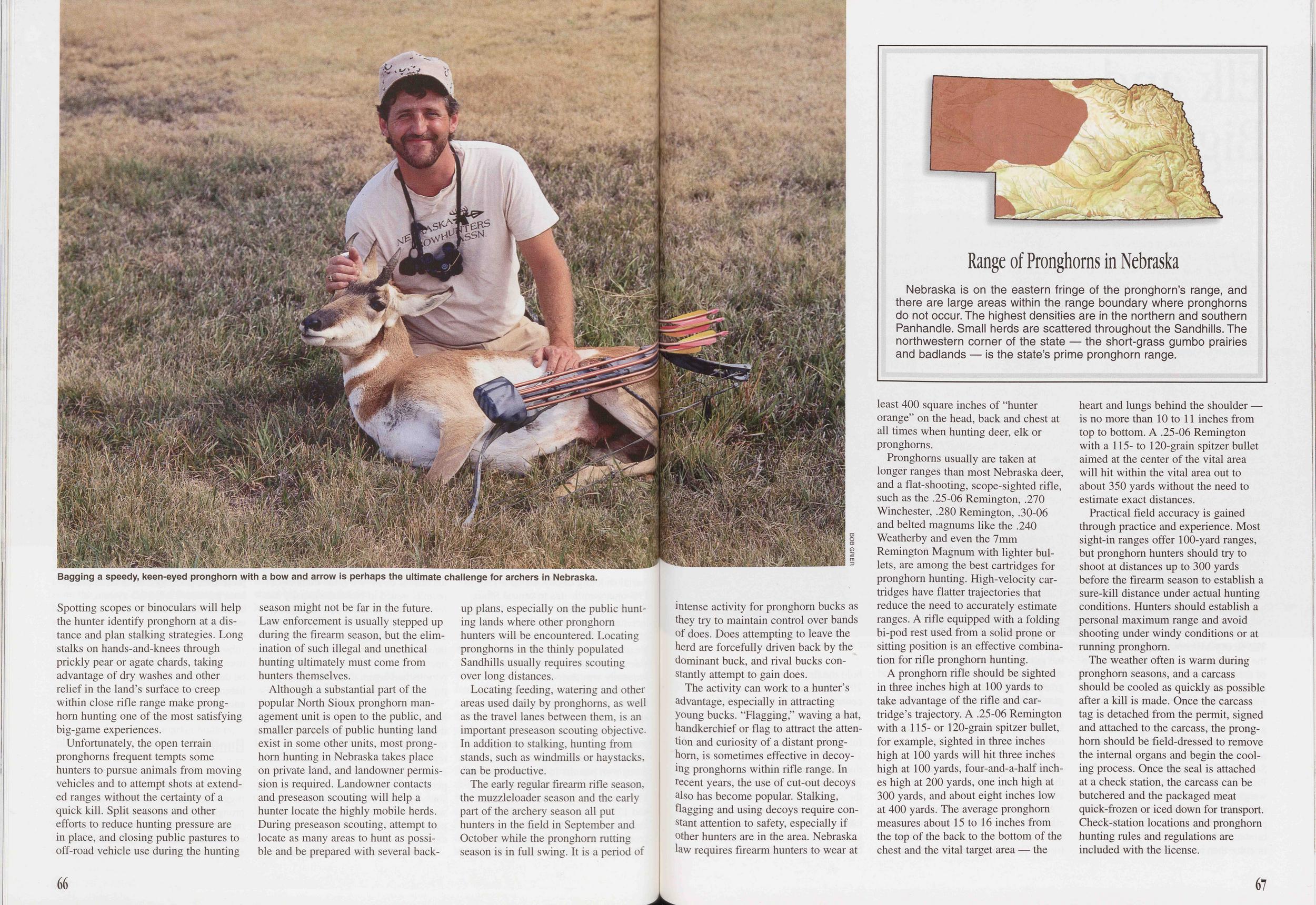
Bagging a speedy, keen-eyed pronghorn with a bow and arrow is perhaps the ultimate challenge for archers in Nebraska.
Spotting scopes or binoculars will help the hunter identify pronghorn at a distance and plan stalking strategies. Long stalks on hands-and-knees through prickly pear or agate chards, taking advantage of dry washes and other relief in the land's surface to creep within close rifle range make pronghorn hunting one of the most satisfying big-game experiences.
Unfortunately, the open terrain pronghorns frequent tempts some hunters to pursue animals from moving vehicles and to attempt shots at extended ranges without the certainty of a quick kill. Split seasons and other efforts to reduce hunting pressure are in place, and closing public pastures to off-road vehicle use during the hunting season might not be far in the future. Law enforcement is usually stepped up during the firearm season, but the elimination of such illegal and unethical hunting ultimately must come from hunters themselves.
Although a substantial part of the popular North Sioux pronghorn management unit is open to the public, and smaller parcels of public hunting land exist in some other units, most pronghorn hunting in Nebraska takes place on private land, and landowner permission is required. Landowner contacts and preseason scouting will help a hunter locate the highly mobile herds. During preseason scouting, attempt to locate as many areas to hunt as possible and be prepared with several backup plans, especially on the public hunting lands where other pronghorn hunters will be encountered. Locating pronghorns in the thinly populated Sandhills usually requires scouting over long distances.
Locating feeding, watering and other areas used daily by pronghorns, as well as the travel lanes between them, is an important preseason scouting objective. In addition to stalking, hunting from stands, such as windmills or haystacks, can be productive.
The early regular firearm rifle season, the muzzleloader season and the early part of the archery season all put hunters in the field in September and October while the pronghorn rutting season is in full swing. It is a period of
66intense activity for pronghorn bucks as they try to maintain control over bands of does. Does attempting to leave the herd are forcefully driven back by the dominant buck, and rival bucks constantly attempt to gain does.
The activity can work to a hunter's advantage, especially in attracting young bucks. "Flagging," waving a hat, handkerchief or flag to attract the attention and curiosity of a distant pronghorn, is sometimes effective in decoying pronghorns within rifle range. In recent years, the use of cut-out decoys also has become popular. Stalking, flagging and using decoys require constant attention to safety, especially if other hunters are in the area. Nebraska law requires firearm hunters to wear at
Range of Pronghorns in Nebraska
Nebraska is on the eastern fringe of the pronghorn's range, and there are large areas within the range boundary where pronghorns do not occur. The highest densities are in the northern and southern Panhandle. Small herds are scattered throughout the Sandhills. The northwestern corner of the state — the short-grass gumbo prairies and badlands — is the state's prime pronghorn range.
least 400 square inches of "hunter orange" on the head, back and chest at all times when hunting deer, elk or pronghorns.
Pronghorns usually are taken at longer ranges than most Nebraska deer, and a flat-shooting, scope-sighted rifle, such as the .25-06 Remington, .270 Winchester, .280 Remington, .30-06 and belted magnums like the .240 Weatherby and even the 7mm Remington Magnum with lighter bullets, are among the best cartridges for pronghorn hunting. High-velocity cartridges have flatter trajectories that reduce the need to accurately estimate ranges. A rifle equipped with a folding bi-pod rest used from a solid prone or sitting position is an effective combination for rifle pronghorn hunting.
A pronghorn rifle should be sighted in three inches high at 100 yards to take advantage of the rifle and cartridge's trajectory. A .25-06 Remington with a 115- or 120-grain spitzer bullet, for example, sighted in three inches high at 100 yards will hit three inches high at 100 yards, four-and-a-half inches high at 200 yards, one inch high at 300 yards, and about eight inches low at 400 yards. The average pronghorn measures about 15 to 16 inches from the top of the back to the bottom of the chest and the vital target area — the heart and lungs behind the shoulder — is no more than 10 to 11 inches from top to bottom. A .25-06 Remington with a 115- to 120-grain spitzer bullet aimed at the center of the vital area will hit within the vital area out to about 350 yards without the need to estimate exact distances.
Practical field accuracy is gained through practice and experience. Most sight-in ranges offer 100-yard ranges, but pronghorn hunters should try to shoot at distances up to 300 yards before the firearm season to establish a sure-kill distance under actual hunting conditions. Hunters should establish a personal maximum range and avoid shooting under windy conditions or at running pronghorn.
The weather often is warm during pronghorn seasons, and a carcass should be cooled as quickly as possible after a kill is made. Once the carcass tag is detached from the permit, signed and attached to the carcass, the pronghorn should be field-dressed to remove the internal organs and begin the cooling process. Once the seal is attached at a check station, the carcass can be butchered and the packaged meat quick-frozen or iced down for transport. Check-station locations and pronghorn hunting rules and regulations are included with the license.
67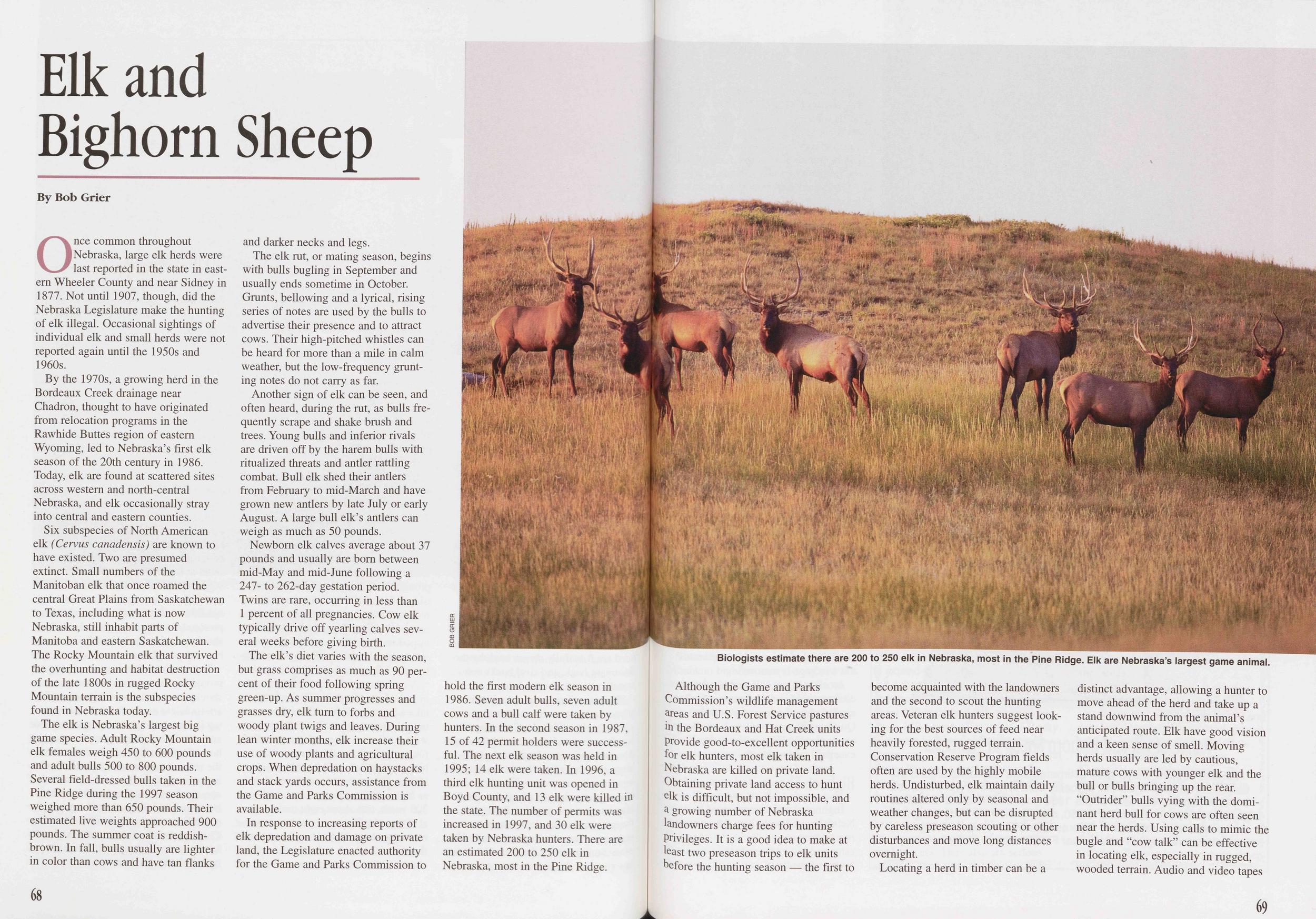
Elk and Bighorn Sheep
By Bob GrierOnce common throughout Nebraska, large elk herds were last reported in the state in eastern Wheeler County and near Sidney in 1877. Not until 1907, though, did the Nebraska Legislature make the hunting of elk illegal. Occasional sightings of individual elk and small herds were not reported again until the 1950s and 1960s.
By the 1970s, a growing herd in the Bordeaux Creek drainage near Chadron, thought to have originated from relocation programs in the Rawhide Buttes region of eastern Wyoming, led to Nebraska's first elk season of the 20th century in 1986. Today, elk are found at scattered sites across western and north-central Nebraska, and elk occasionally stray into central and eastern counties.
Six subspecies of North American elk (Cervus canadensis) are known to have existed. Two are presumed extinct. Small numbers of the Manitoban elk that once roamed the central Great Plains from Saskatchewan to Texas, including what is now Nebraska, still inhabit parts of Manitoba and eastern Saskatchewan. The Rocky Mountain elk that survived the overhunting and habitat destruction of the late 1800s in rugged Rocky Mountain terrain is the subspecies found in Nebraska today.
The elk is Nebraska's largest big game species. Adult Rocky Mountain elk females weigh 450 to 600 pounds and adult bulls 500 to 800 pounds. Several field-dressed bulls taken in the Pine Ridge during the 1997 season weighed more than 650 pounds. Their estimated live weights approached 900 pounds. The summer coat is reddish-brown. In fall, bulls usually are lighter in color than cows and have tan flanks and darker necks and legs.
The elk rut, or mating season, begins with bulls bugling in September and usually ends sometime in October. Grunts, bellowing and a lyrical, rising series of notes are used by the bulls to advertise their presence and to attract cows. Their high-pitched whistles can be heard for more than a mile in calm weather, but the low-frequency grunting notes do not carry as far.
Another sign of elk can be seen, and often heard, during the rut, as bulls frequently scrape and shake brush and trees. Young bulls and inferior rivals are driven off by the harem bulls with ritualized threats and antler rattling combat. Bull elk shed their antlers from February to mid-March and have grown new antlers by late July or early August. A large bull elk's antlers can weigh as much as 50 pounds.
Newborn elk calves average about 37 pounds and usually are born between mid-May and mid-June following a 247- to 262-day gestation period. Twins are rare, occurring in less than 1 percent of all pregnancies. Cow elk typically drive off yearling calves several weeks before giving birth.
The elk's diet varies with the season, but grass comprises as much as 90 percent of their food following spring green-up. As summer progresses and grasses dry, elk turn to forbs and woody plant twigs and leaves. During lean winter months, elk increase their use of woody plants and agricultural crops. When depredation on haystacks and stack yards occurs, assistance from the Game and Parks Commission is available
In response to increasing reports of elk depredation and damage on private land, the Legislature enacted authority for the Game and Parks Commission to hold the first modern elk season in 1986. Seven adult bulls, seven adult cows and a bull calf were taken by hunters. In the second season in 1987, 15 of 42 permit holders were successful. The next elk season was held in 1995; 14 elk were taken. In 1996, a third elk hunting unit was opened in Boyd County, and 13 elk were killed in the state. The number of permits was increased in 1997, and 30 elk were taken by Nebraska hunters. There are an estimated 200 to 250 elk in Nebraska, most in the Pine Ridge.
68Biologists estimate there are 200 to 250 elk in Nebraska, most in the Pine Ridge. Elk are Nebraska's largest game animal.
Bob GrierAlthough the Game and Parks Commission's wildlife management areas and U.S. Forest Service pastures in the Bordeaux and Hat Creek units Provide good-to-excellent opportunities for elk hunters, most elk taken in Nebraska are killed on private land. Obtaining private land access to hunt elk is difficult, but not impossible, and a growing number of Nebraska landowners charge fees for hunting Privileges. It is a good idea to make at least two preseason trips to elk units before the hunting season — the first to become acquainted with the landowners and the second to scout the hunting areas. Veteran elk hunters suggest looking for the best sources of feed near heavily forested, rugged terrain. Conservation Reserve Program fields often are used by the highly mobile herds. Undisturbed, elk maintain daily routines altered only by seasonal and weather changes, but can be disrupted by careless preseason scouting or other disturbances and move long distances overnight.
Locating a herd in timber can be a distinct advantage, allowing a hunter to move ahead of the herd and take up a stand downwind from the animal's anticipated route. Elk have good vision and a keen sense of smell. Moving herds usually are led by cautious, mature cows with younger elk and the bull or bulls bringing up the rear. "Outrider" bulls vying with the dominant herd bull for cows are often seen near the herds. Using calls to mimic the bugle and "cow talk" can be effective in locating elk, especially in rugged, wooded terrain. Audio and video tapes
69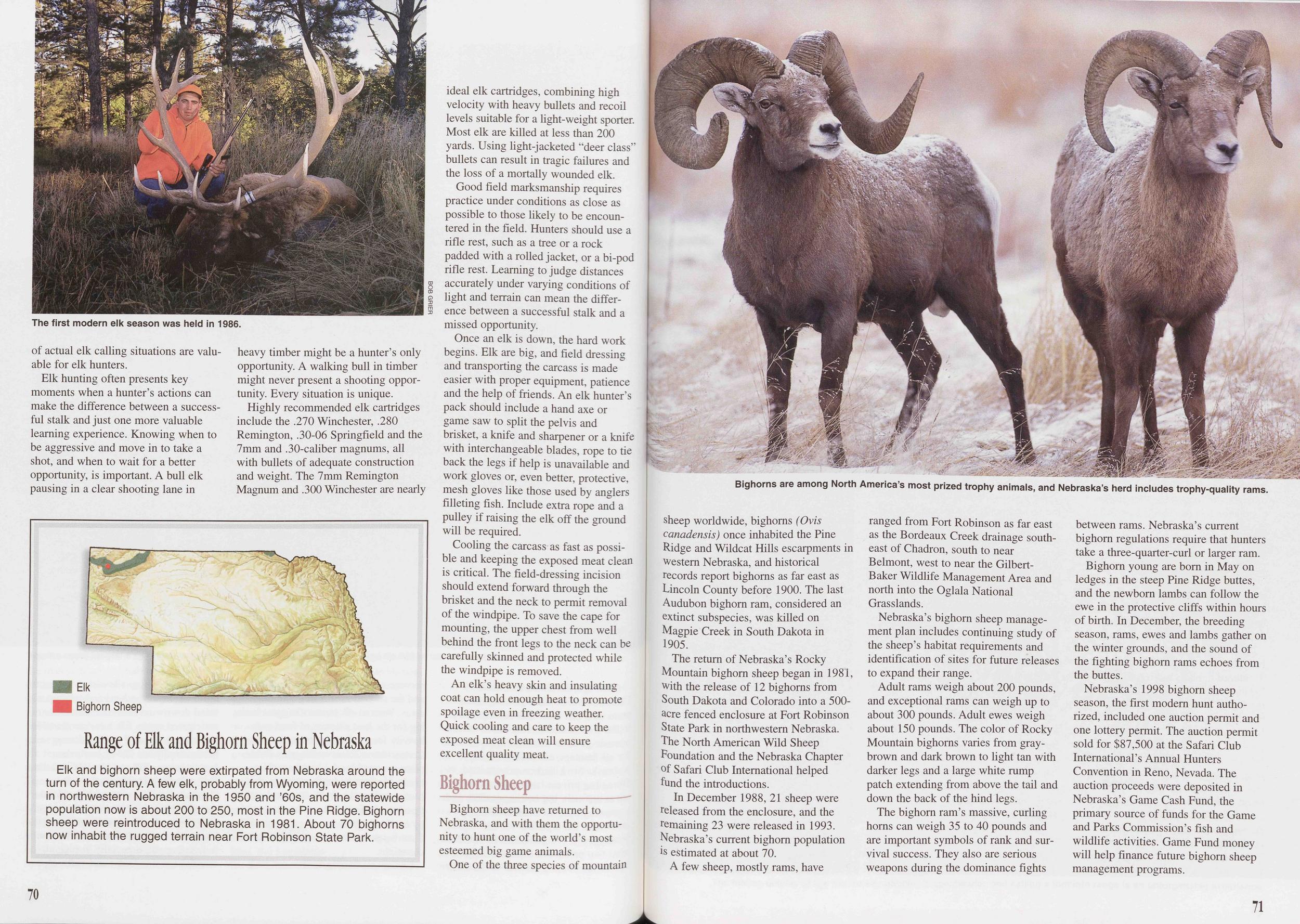
The first modern elk season was held in 1986.
of actual elk calling situations are valuable for elk hunters.
Elk hunting often presents key moments when a hunter's actions can make the difference between a successful stalk and just one more valuable learning experience. Knowing when to be aggressive and move in to take a shot, and when to wait for a better opportunity, is important. A bull elk pausing in a clear shooting lane in heavy timber might be a hunter's only opportunity. A walking bull in timber might never present a shooting opportunity. Every situation is unique.
Highly recommended elk cartridges include the .270 Winchester, .280 Remington, .30-06 Springfield and the 7mm and .30-caliber magnums, all with bullets of adequate construction and weight. The 7mm Remington Magnum and .300 Winchester are nearly
Elk Bighorn Sheep
Range of Elk and Bighorn Sheep in Nebraska
Elk and bighorn sheep were extirpated from Nebraska around the turn of the century. A few elk, probably from Wyoming, were reported in northwestern Nebraska in the 1950 and '60s, and the statewide population now is about 200 to 250, most in the Pine Ridge. Bighorn sheep were reintroduced to Nebraska in 1981. About 70 bighorns now inhabit the rugged terrain near Fort Robinson State Park.
ideal elk cartridges, combining high velocity with heavy bullets and recoil levels suitable for a light-weight sporter. Most elk are killed at less than 200 yards. Using light-jacketed "deer class" bullets can result in tragic failures and the loss of a mortally wounded elk.
Good field marksmanship requires practice under conditions as close as possible to those likely to be encountered in the field. Hunters should use a rifle rest, such as a tree or a rock padded with a rolled jacket, or a bi-pod rifle rest. Learning to judge distances accurately under varying conditions of light and terrain can mean the difference between a successful stalk and a missed opportunity.
Once an elk is down, the hard work begins. Elk are big, and field dressing and transporting the carcass is made easier with proper equipment, patience and the help of friends. An elk hunter's pack should include a hand axe or game saw to split the pelvis and brisket, a knife and sharpener or a knife with interchangeable blades, rope to tie back the legs if help is unavailable and work gloves or, even better, protective, mesh gloves like those used by anglers filleting fish. Include extra rope and a pulley if raising the elk off the ground will be required.
Cooling the carcass as fast as possible and keeping the exposed meat clean is critical. The field-dressing incision should extend forward through the brisket and the neck to permit removal of the windpipe. To save the cape for mounting, the upper chest from well behind the front legs to the neck can be carefully skinned and protected while the windpipe is removed.
An elk's heavy skin and insulating coat can hold enough heat to promote spoilage even in freezing weather. Quick cooling and care to keep the exposed meat clean will ensure excellent quality meat.
Bighorn SheepBighorn sheep have returned to Nebraska, and with them the opportunity to hunt one of the world's most esteemed big game animals.
One of the three species of mountain
70Bighorns are among North America's most prized trophy animals, and Nebraska's herd includes trophy-quality rams.
sheep worldwide, bighorns (Ovis canadensis) once inhabited the Pine Ridge and Wildcat Hills escarpments in Western Nebraska, and historical records report bighorns as far east as Lincoln County before 1900. The last Audubon bighorn ram, considered an extinct subspecies, was killed on Magpie Creek in South Dakota in 1905.
The return of Nebraska's Rocky Mountain bighorn sheep began in 1981, With the release of 12 bighorns from South Dakota and Colorado into a 500- acre fenced enclosure at Fort Robinson State Park in northwestern Nebraska. The North American Wild Sheep Foundation and the Nebraska Chapter of Safari Club International helped Fund the introductions.
In December 1988, 21 sheep were released from the enclosure, and the remaining 23 were released in 1993. Nebraska's current bighorn population is estimated at about 70.
A few sheep, mostly rams, have ranged from Fort Robinson as far east as the Bordeaux Creek drainage southeast of Chadron, south to near Belmont, west to near the Gilbert- Baker Wildlife Management Area and north into the Oglala National Grasslands.
Nebraska's bighorn sheep management plan includes continuing study of the sheep's habitat requirements and identification of sites for future releases to expand their range.
Adult rams weigh about 200 pounds, and exceptional rams can weigh up to about 300 pounds. Adult ewes weigh about 150 pounds. The color of Rocky Mountain bighorns varies from gray-brown and dark brown to light tan with darker legs and a large white rump patch extending from above the tail and down the back of the hind legs.
The bighorn ram's massive, curling horns can weigh 35 to 40 pounds and are important symbols of rank and survival success. They also are serious weapons during the dominance fights between rams. Nebraska's current bighorn regulations require that hunters take a three-quarter-curl or larger ram.
Bighorn young are born in May on ledges in the steep Pine Ridge buttes, and the newborn lambs can follow the ewe in the protective cliffs within hours of birth. In December, the breeding season, rams, ewes and lambs gather on the winter grounds, and the sound of the fighting bighorn rams echoes from the buttes.
Nebraska's 1998 bighorn sheep season, the first modern hunt authorized, included one auction permit and one lottery permit. The auction permit sold for $87,500 at the Safari Club International's Annual Hunters Convention in Reno, Nevada. The auction proceeds were deposited in Nebraska's Game Cash Fund, the primary source of funds for the Game and Parks Commission's fish and wildlife activities. Game Fund money will help finance future bighorn sheep management programs.
71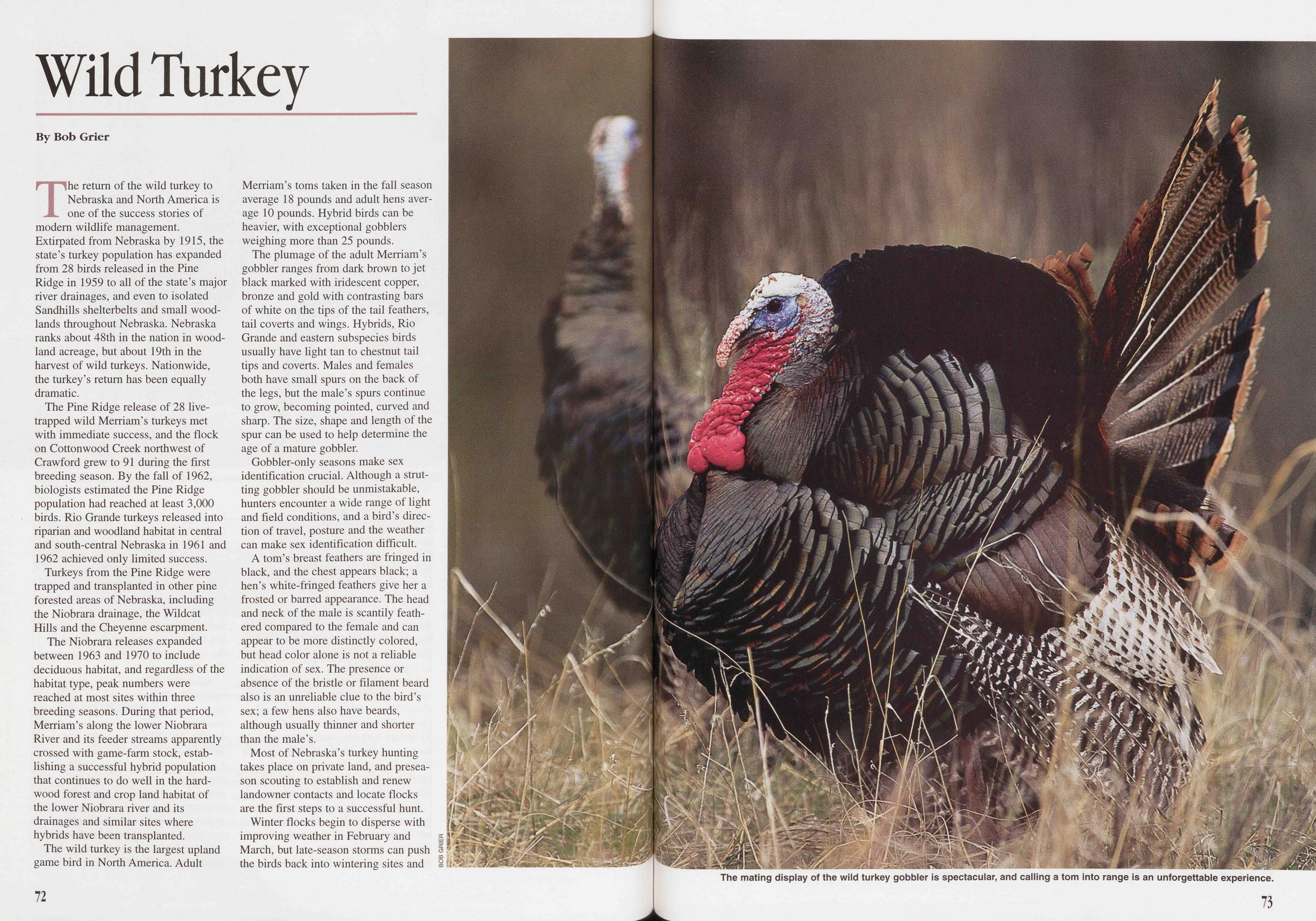
Wild Turkey
By Bob GrierThe return of the wild turkey to Nebraska and North America is one of the success stories of modern wildlife management. Extirpated from Nebraska by 1915, the state's turkey population has expanded from 28 birds released in the Pine Ridge in 1959 to all of the state's major river drainages, and even to isolated Sandhills shelterbelts and small woodlands throughout Nebraska. Nebraska ranks about 48th in the nation in woodland acreage, but about 19th in the harvest of wild turkeys. Nationwide, the turkey's return has been equally dramatic.
The Pine Ridge release of 28 live-trapped wild Merriam's turkeys met with immediate success, and the flock on Cottonwood Creek northwest of Crawford grew to 91 during the first breeding season. By the fall of 1962, biologists estimated the Pine Ridge population had reached at least 3,000 birds. Rio Grande turkeys released into riparian and woodland habitat in central and south-central Nebraska in 1961 and 1962 achieved only limited success.
Turkeys from the Pine Ridge were trapped and transplanted in other pine forested areas of Nebraska, including the Niobrara drainage, the Wildcat Hills and the Cheyenne escarpment.
The Niobrara releases expanded between 1963 and 1970 to include deciduous habitat, and regardless of the habitat type, peak numbers were reached at most sites within three breeding seasons. During that period, Merriam's along the lower Niobrara River and its feeder streams apparently crossed with game-farm stock, establishing a successful hybrid population that continues to do well in the hardwood forest and crop land habitat of the lower Niobrara river and its drainages and similar sites where hybrids have been transplanted.
The wild turkey is the largest upland game bird in North America. Adult Merriam's toms taken in the fall season average 18 pounds and adult hens average 10 pounds. Hybrid birds can be heavier, with exceptional gobblers weighing more than 25 pounds.
The plumage of the adult Merriam's gobbler ranges from dark brown to jet black marked with iridescent copper, bronze and gold with contrasting bars of white on the tips of the tail feathers, tail coverts and wings. Hybrids, Rio Grande and eastern subspecies birds usually have light tan to chestnut tail tips and coverts. Males and females both have small spurs on the back of the legs, but the male's spurs continue to grow, becoming pointed, curved and sharp. The size, shape and length of the spur can be used to help determine the age of a mature gobbler.
Gobbler-only seasons make sex identification crucial. Although a strutting gobbler should be unmistakable, hunters encounter a wide range of light and field conditions, and a bird's direction of travel, posture and the weather can make sex identification difficult.
A tom's breast feathers are fringed in black, and the chest appears black; a hen's white-fringed feathers give her a frosted or barred appearance. The head and neck of the male is scantily feathered compared to the female and can appear to be more distinctly colored, but head color alone is not a reliable indication of sex. The presence or absence of the bristle or filament beard also is an unreliable clue to the bird's sex; a few hens also have beards, although usually thinner and shorter than the male's.
Most of Nebraska's turkey hunting takes place on private land, and preseason scouting to establish and renew landowner contacts and locate flocks are the first steps to a successful hunt.
Winter flocks begin to disperse with improving weather in February and March, but late-season storms can push the birds back into wintering sites and
72The mating display of the wild turkey gobbler is spectacular, and calling a tom into range is an unforgettable experience.
Bob Grier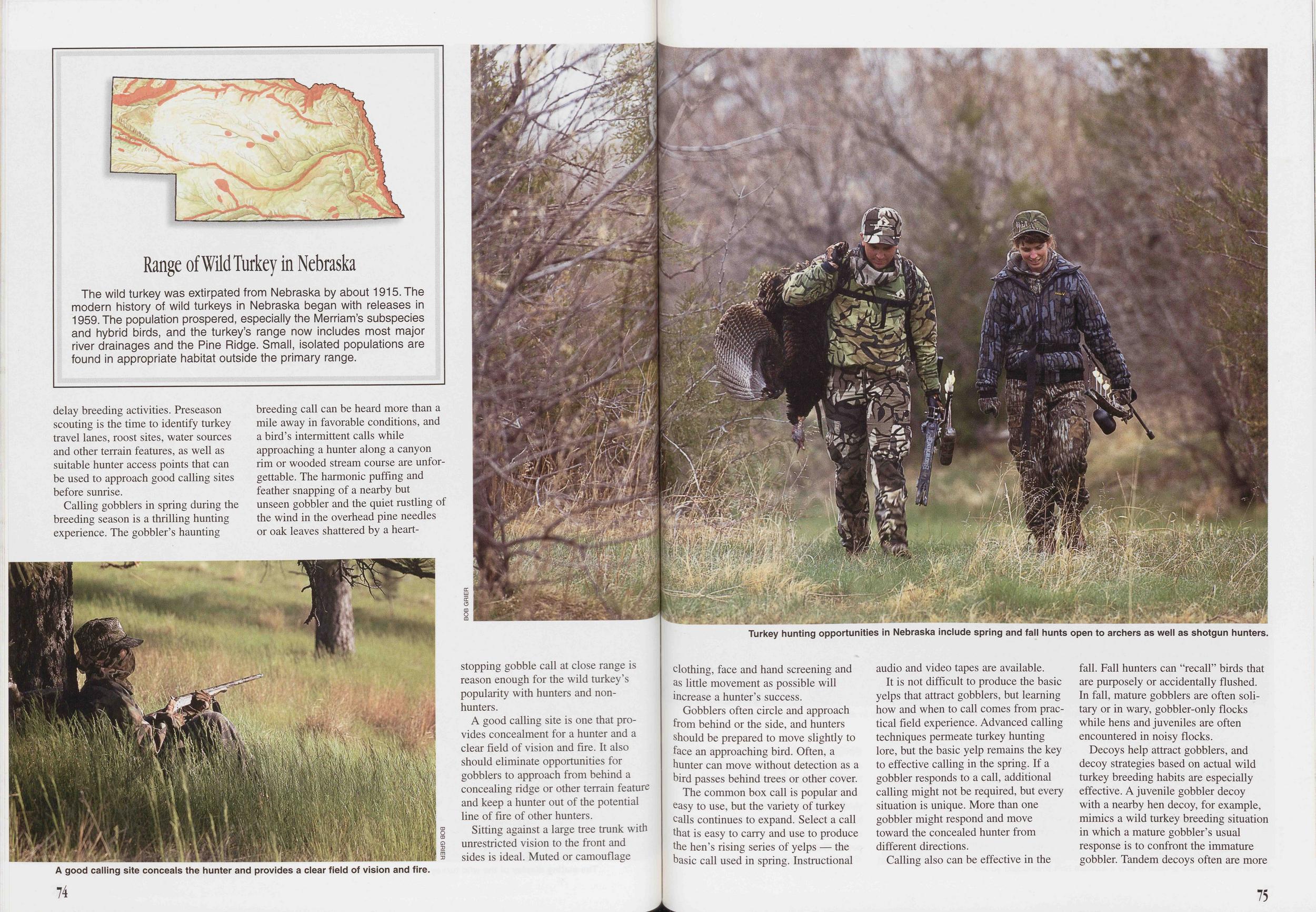
Range of Wild Turkey in Nebraska
The wild turkey was extirpated from Nebraska by about 1915. The modern history of wild turkeys in Nebraska began with releases in 1959. The population prospered, especially the Merriam's subspecies and hybrid birds, and the turkey's range now includes most major river drainages and the Pine Ridge. Small, isolated populations are found in appropriate habitat outside the primary range.
delay breeding activities. Preseason scouting is the time to identify turkey travel lanes, roost sites, water sources and other terrain features, as well as suitable hunter access points that can be used to approach good calling sites before sunrise.
Calling gobblers in spring during the breeding season is a thrilling hunting experience. The gobbler's haunting breeding call can be heard more than a mile away in favorable conditions, and a bird's intermittent calls while approaching a hunter along a canyon rim or wooded stream course are unforgettable. The harmonic puffing and feather snapping of a nearby but unseen gobbler and the quiet rustling of the wind in the overhead pine needles or oak leaves shattered by a heart-stopping gobble call at close range is reason enough for the wild turkey's popularity with hunters and non-hunters.
A good calling site is one that provides concealment for a hunter and a clear field of vision and fire. It also should eliminate opportunities for gobblers to approach from behind a concealing ridge or other terrain feature and keep a hunter out of the potential line of fire of other hunters.
Sitting against a large tree trunk with unrestricted vision to the front and sides is ideal. Muted or camouflage
A good calling site conceals the hunter and provides a clear field of vision and fire.
Bob GrierTurkey hunting opportunities in Nebraska include spring and fall hunts open to archers as well as shotgun hunters.
Bob Grierclothing, face and hand screening and as little movement as possible will increase a hunter's success.
Gobblers often circle and approach from behind or the side, and hunters should be prepared to move slightly to face an approaching bird. Often, a hunter can move without detection as a bird passes behind trees or other cover.
The common box call is popular and easy to use, but the variety of turkey calls continues to expand. Select a call that is easy to carry and use to produce the hen's rising series of yelps — the basic call used in spring. Instructional audio and video tapes are available.
It is not difficult to produce the basic yelps that attract gobblers, but learning how and when to call comes from practical field experience. Advanced calling techniques permeate turkey hunting lore, but the basic yelp remains the key to effective calling in the spring. If a gobbler responds to a call, additional calling might not be required, but every situation is unique. More than one gobbler might respond and move toward the concealed hunter from different directions.
Calling also can be effective in the fall. Fall hunters can "recall" birds that are purposely or accidentally flushed. In fall, mature gobblers are often solitary or in wary, gobbler-only flocks while hens and juveniles are often encountered in noisy flocks.
Decoys help attract gobblers, and decoy strategies based on actual wild turkey breeding habits are especially effective. A juvenile gobbler decoy with a nearby hen decoy, for example, mimics a wild turkey breeding situation in which a mature gobbler's usual response is to confront the immature gobbler. Tandem decoys often are more
75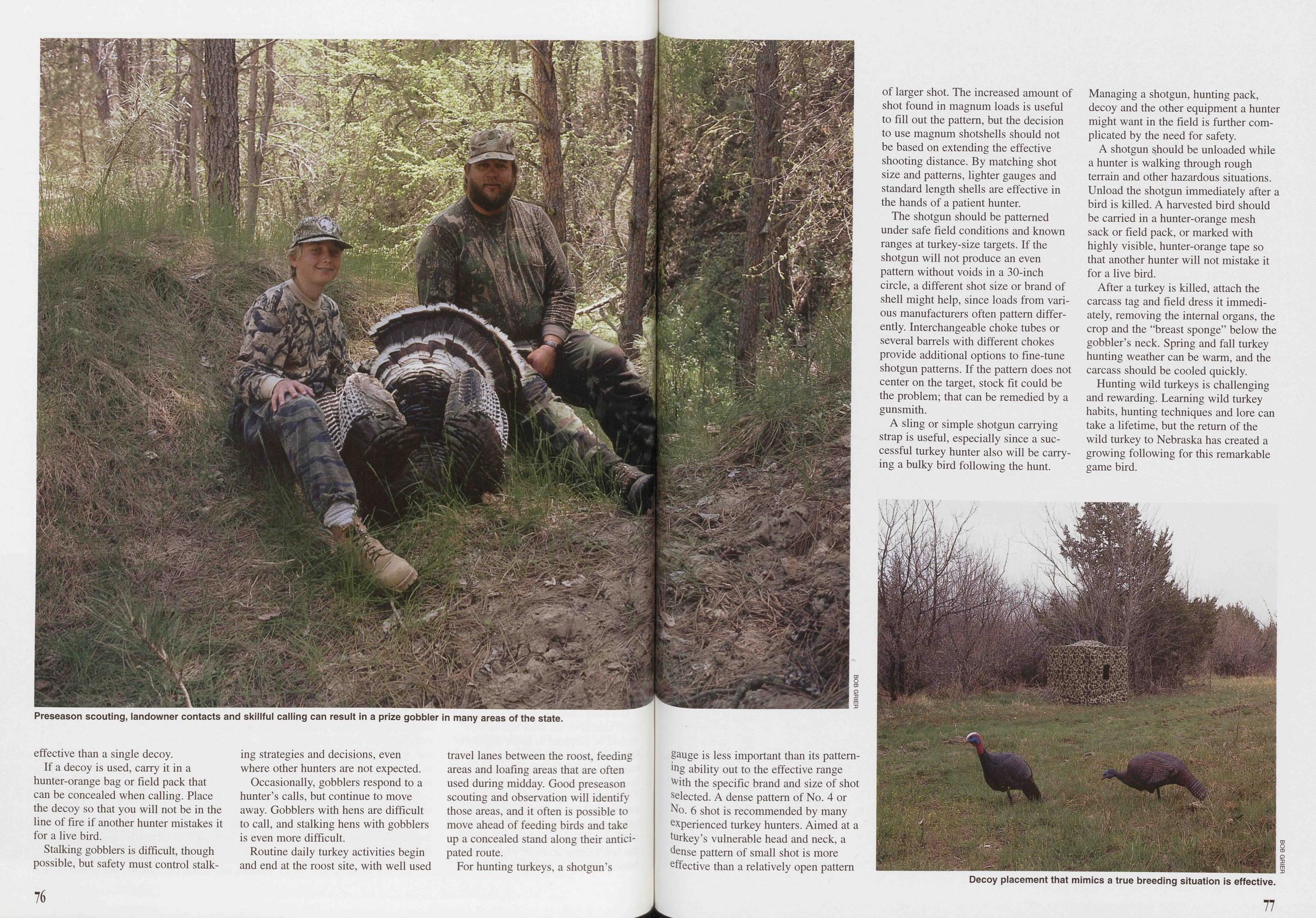
Preseason scouting, landowner contacts and skillful calling can result in a prize gobbler in many areas of the state.
Bob Griereffective than a single decoy.
If a decoy is used, carry it in a hunter-orange bag or field pack that can be concealed when calling. Place the decoy so that you will not be in the line of fire if another hunter mistakes it for a live bird.
Stalking gobblers is difficult, though possible, but safety must control stalking strategies and decisions, even where other hunters are not expected.
Occasionally, gobblers respond to a hunter's calls, but continue to move away. Gobblers with hens are difficult to call, and stalking hens with gobblers is even more difficult.
Routine daily turkey activities begin and end at the roost site, with well used travel lanes between the roost, feeding areas and loafing areas that are often used during midday. Good preseason scouting and observation will identify those areas, and it often is possible to move ahead of feeding birds and take up a concealed stand along their anticipated route.
For hunting turkeys, a shotgun's
76gauge is less important than its patterning ability out to the effective range with the specific brand and size of shot selected. A dense pattern of No. 4 or No. 6 shot is recommended by many e*perienced turkey hunters. Aimed at a hirkey's vulnerable head and neck, a dense pattern of small shot is more effective than a relatively open pattern of larger shot. The increased amount of shot found in magnum loads is useful to fill out the pattern, but the decision to use magnum shotshells should not be based on extending the effective shooting distance. By matching shot size and patterns, lighter gauges and standard length shells are effective in the hands of a patient hunter.
The shotgun should be patterned under safe field conditions and known ranges at turkey-size targets. If the shotgun will not produce an even pattern without voids in a 30-inch circle, a different shot size or brand of shell might help, since loads from various manufacturers often pattern differently. Interchangeable choke tubes or several barrels with different chokes provide additional options to fine-tune shotgun patterns. If the pattern does not center on the target, stock fit could be the problem; that can be remedied by a gunsmith.
A sling or simple shotgun carrying strap is useful, especially since a successful turkey hunter also will be carrying a bulky bird following the hunt. Managing a shotgun, hunting pack, decoy and the other equipment a hunter might want in the field is further complicated by the need for safety.
A shotgun should be unloaded while a hunter is walking through rough terrain and other hazardous situations. Unload the shotgun immediately after a bird is killed. A harvested bird should be carried in a hunter-orange mesh sack or field pack, or marked with highly visible, hunter-orange tape so that another hunter will not mistake it for a live bird.
After a turkey is killed, attach the carcass tag and field dress it immediately, removing the internal organs, the crop and the "breast sponge" below the gobbler's neck. Spring and fall turkey hunting weather can be warm, and the carcass should be cooled quickly.
Hunting wild turkeys is challenging and rewarding. Learning wild turkey habits, hunting techniques and lore can take a lifetime, but the return of the wild turkey to Nebraska has created a growing following for this remarkable game bird.
Decoy placement that mimics a true breeding situation is effective.
Bob Grier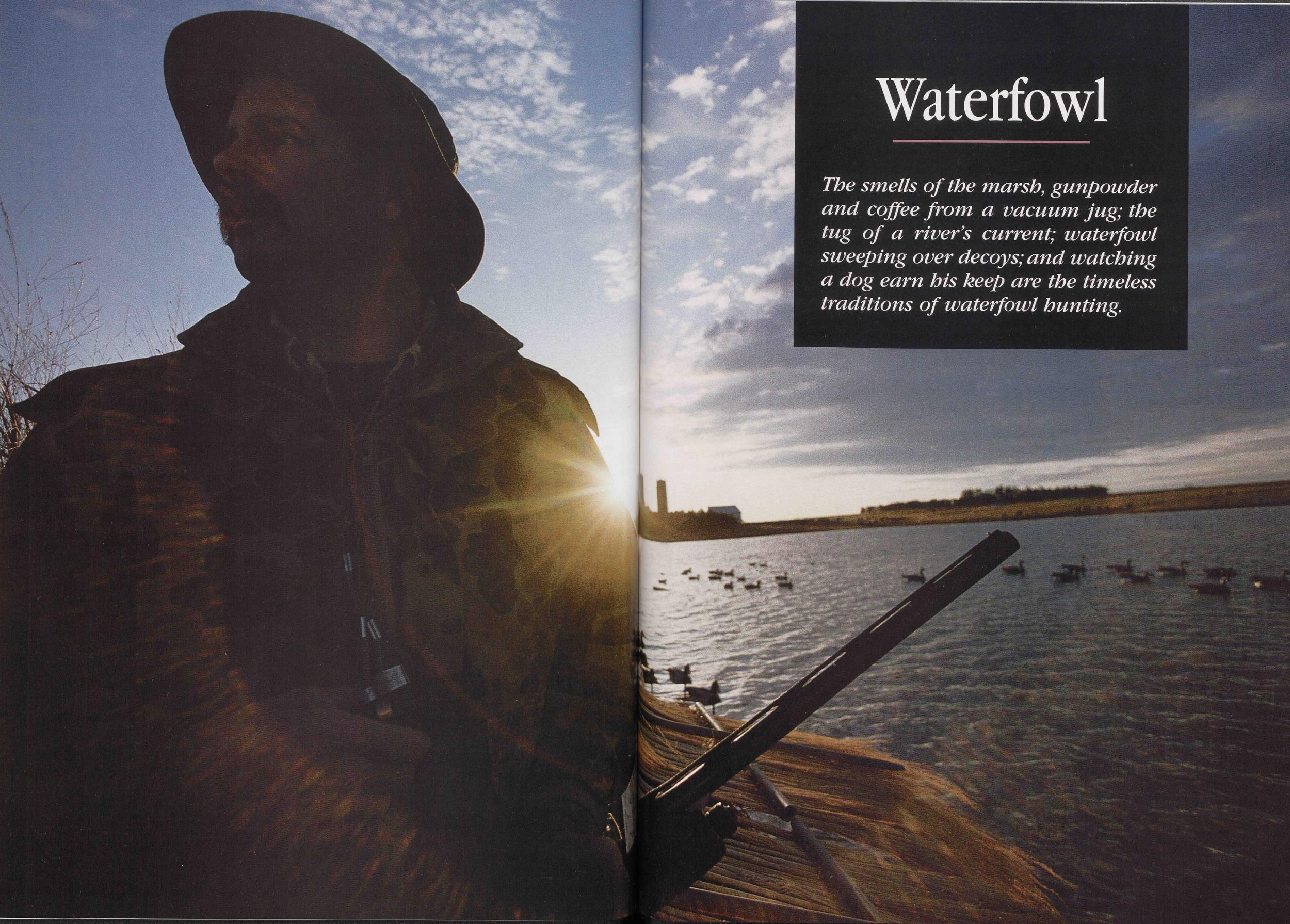
Waterfowl
The smells of the marsh, gunpowder and coffee from a vacuum jug; the tug of a river's current; waterfowl sweeping over decoys; and watching a dog earn his keep are the timeless traditions of waterfowl hunting.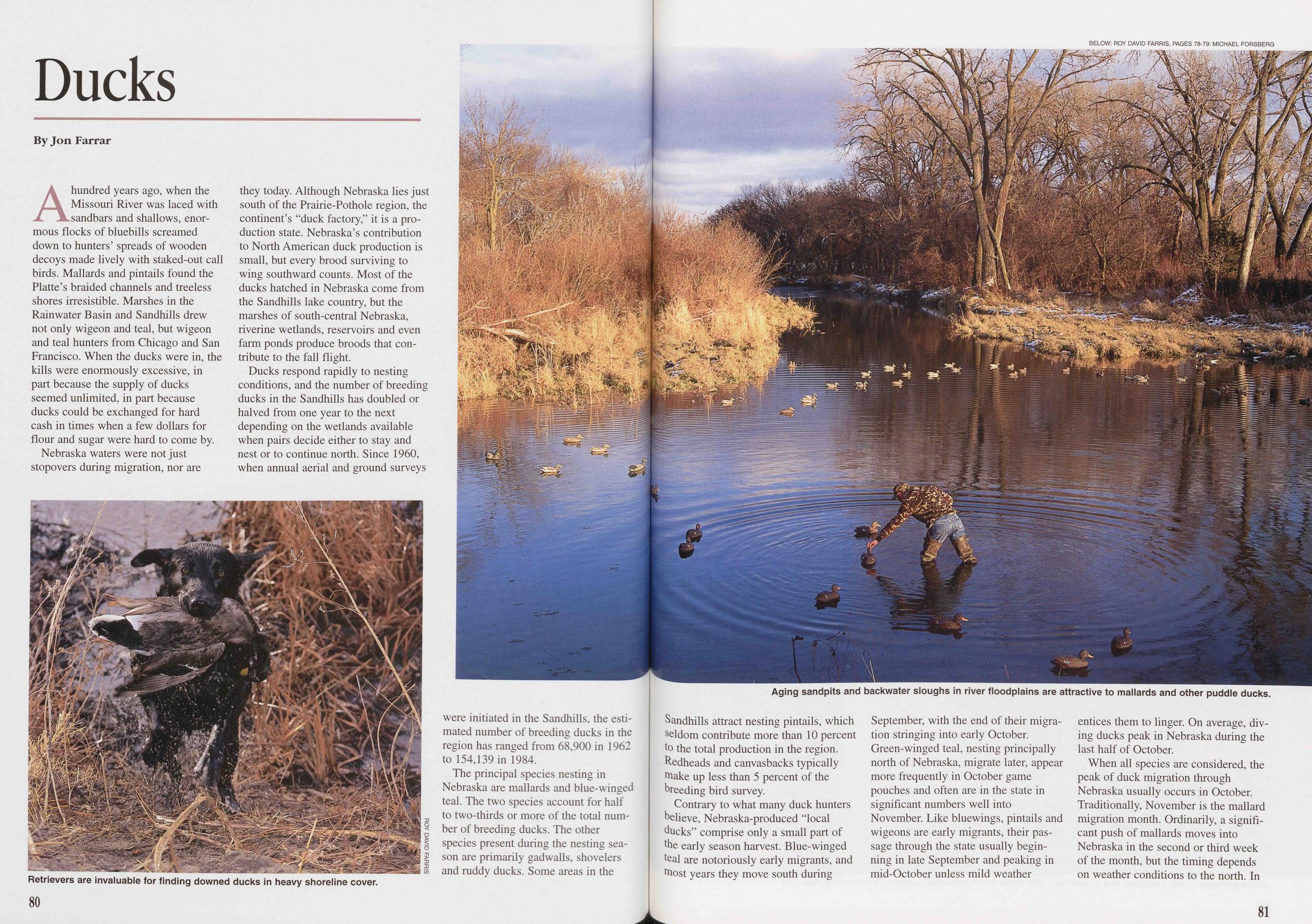
Ducks
By Jon FarrarA hundred years ago, when the Missouri River was laced with sandbars and shallows, enormous flocks of bluebills screamed down to hunters' spreads of wooden decoys made lively with staked-out call birds. Mallards and pintails found the Platte's braided channels and treeless shores irresistible. Marshes in the Rainwater Basin and Sandhills drew not only wigeon and teal, but wigeon and teal hunters from Chicago and San Francisco. When the ducks were in, the kills were enormously excessive, in part because the supply of ducks seemed unlimited, in part because ducks could be exchanged for hard cash in times when a few dollars for flour and sugar were hard to come by.
Nebraska waters were not just stopovers during migration, nor are they today. Although Nebraska lies just south of the Prairie-Pothole region, the continent's "duck factory," it is a production state. Nebraska's contribution to North American duck production is small, but every brood surviving to wing southward counts. Most of the ducks hatched in Nebraska come from the Sandhills lake country, but the marshes of south-central Nebraska, riverine wetlands, reservoirs and even farm ponds produce broods that contribute to the fall flight.
Ducks respond rapidly to nesting conditions, and the number of breeding ducks in the Sandhills has doubled or halved from one year to the next depending on the wetlands available when pairs decide either to stay and nest or to continue north. Since 1960, when annual aerial and ground surveys
Retrievers are invaluable for finding downed ducks in heavy shoreline cover.
were initiated in the Sandhills, the estimated number of breeding ducks in the region has ranged from 68,900 in 1962 to 154,139 in 1984.
The principal species nesting in Nebraska are mallards and blue-winged teal. The two species account for half to two-thirds or more of the total number of breeding ducks. The other species present during the nesting season are primarily gadwalls, shovelers and ruddy ducks. Some areas in the
80Aging sandpits and backwater sloughs in river floodplains are attractive to mallards and other puddle ducks.
Sandhills attract nesting pintails, which seldom contribute more than 10 percent to the total production in the region. Redheads and canvasbacks typically make up less than 5 percent of the breeding bird survey.
Contrary to what many duck hunters believe, Nebraska-produced "local ducks" comprise only a small part of the early season harvest. Blue-winged teal are notoriously early migrants, and most years they move south during September, with the end of their migration stringing into early October. Green-winged teal, nesting principally north of Nebraska, migrate later, appear more frequently in October game pouches and often are in the state in significant numbers well into November. Like bluewings, pintails and wigeons are early migrants, their passage through the state usually beginning in late September and peaking in mid-October unless mild weather entices them to linger. On average, diving ducks peak in Nebraska during the last half of October.
When all species are considered, the peak of duck migration through Nebraska usually occurs in October. Traditionally, November is the mallard migration month. Ordinarily, a significant push of mallards moves into Nebraska in the second or third week of the month, but the timing depends on weather conditions to the north. In
81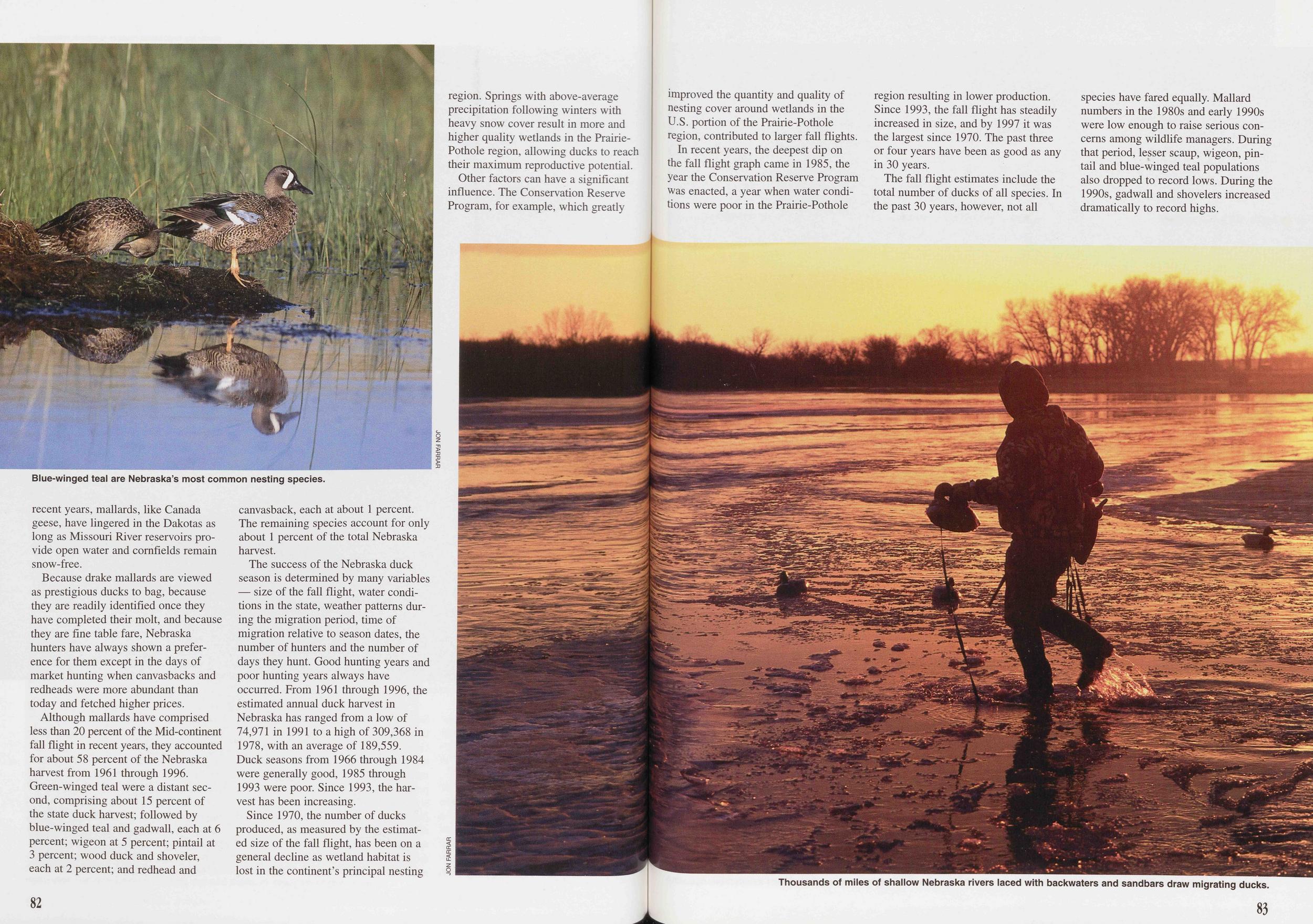
Blue-winged teal are Nebraska's most common nesting species.
recent years, mallards, like Canada geese, have lingered in the Dakotas as long as Missouri River reservoirs provide open water and cornfields remain snow-free.
Because drake mallards are viewed as prestigious ducks to bag, because they are readily identified once they have completed their molt, and because they are fine table fare, Nebraska hunters have always shown a preference for them except in the days of market hunting when canvasbacks and redheads were more abundant than today and fetched higher prices.
Although mallards have comprised less than 20 percent of the Mid-continent fall flight in recent years, they accounted for about 58 percent of the Nebraska harvest from 1961 through 1996. Green-winged teal were a distant second, comprising about 15 percent of the state duck harvest; followed by blue-winged teal and gadwall, each at 6 percent; wigeon at 5 percent; pintail at 3 percent; wood duck and shoveler, each at 2 percent; and redhead and canvasback, each at about 1 percent. The remaining species account for only about 1 percent of the total Nebraska harvest.
The success of the Nebraska duck season is determined by many variables — size of the fall flight, water conditions in the state, weather patterns during the migration period, time of migration relative to season dates, the number of hunters and the number of days they hunt. Good hunting years and poor hunting years always have occurred. From 1961 through 1996, the estimated annual duck harvest in Nebraska has ranged from a low of 74,971 in 1991 to a high of 309,368 in 1978, with an average of 189,559. Duck seasons from 1966 through 1984 were generally good, 1985 through 1993 were poor. Since 1993, the harvest has been increasing.
Since 1970, the number of ducks produced, as measured by the estimated size of the fall flight, has been on a general decline as wetland habitat is lost in the continent's principal nesting region. Springs with above-average precipitation following winters with heavy snow cover result in more and higher quality wetlands in the Prairie- Pothole region, allowing ducks to reach their maximum reproductive potential.
Other factors can have a significant influence. The Conservation Reserve Program, for example, which greatly
82improved the quantity and quality of nesting cover around wetlands in the U.S. portion of the Prairie-Pothole region, contributed to larger fall flights.
In recent years, the deepest dip on the fall flight graph came in 1985, the year the Conservation Reserve Program was enacted, a year when water conditions were poor in the Prairie-Pothole region resulting in lower production. Since 1993, the fall flight has steadily increased in size, and by 1997 it was the largest since 1970. The past three or four years have been as good as any in 30 years.
The fall flight estimates include the total number of ducks of all species. In the past 30 years, however, not all species have fared equally. Mallard numbers in the 1980s and early 1990s were low enough to raise serious concerns among wildlife managers. During that period, lesser scaup, wigeon, pintail and blue-winged teal populations also dropped to record lows. During the 1990s, gadwall and shovelers increased dramatically to record highs.
Thousands of miles of shallow Nebraska rivers laced with backwaters and sandbars draw migrating ducks.
Jon Farrar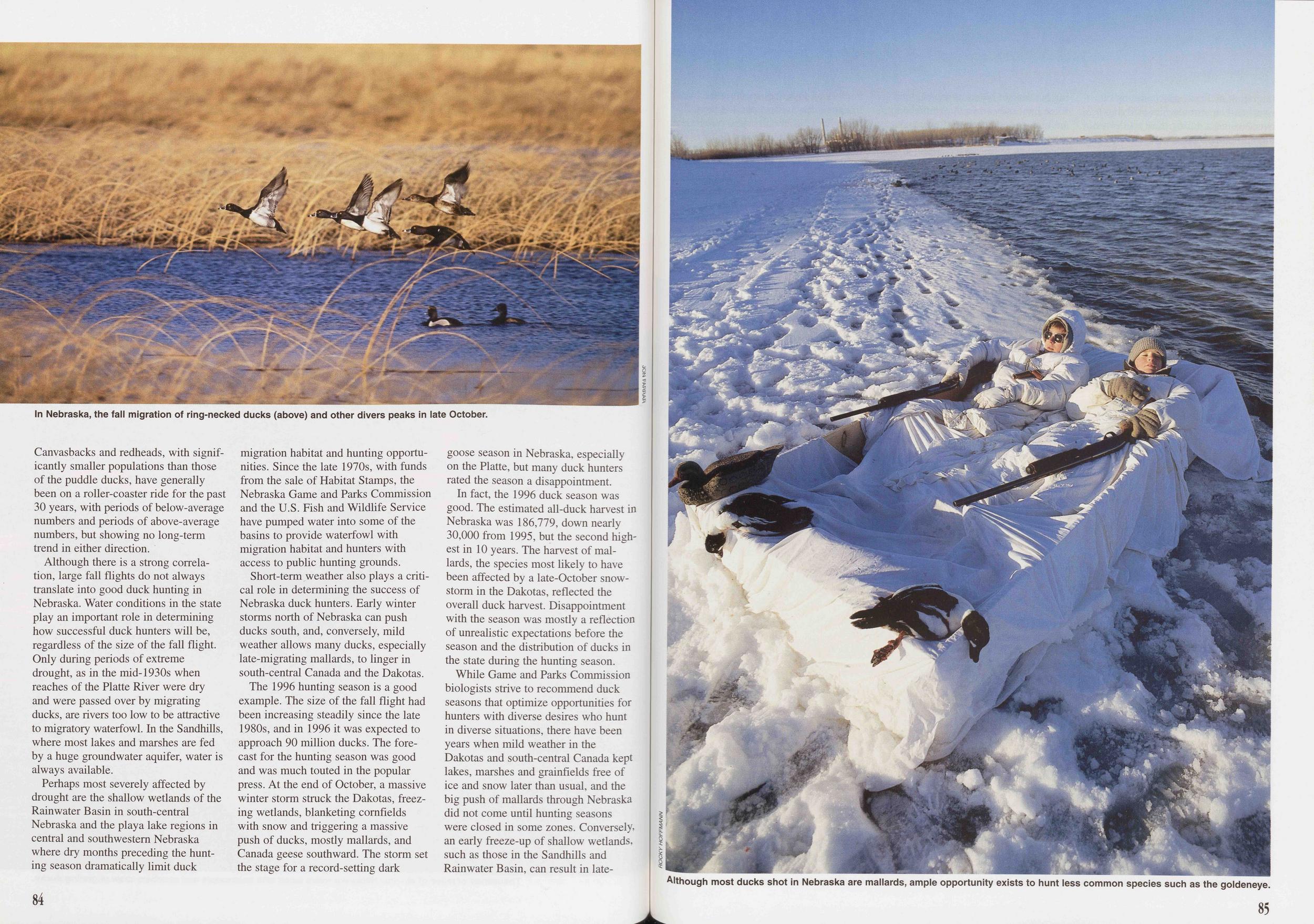
In Nebraska, the fall migration of ring-necked ducks (above) and other divers peaks in late October.
Canvasbacks and redheads, with significantly smaller populations than those of the puddle ducks, have generally been on a roller-coaster ride for the past 30 years, with periods of below-average numbers and periods of above-average numbers, but showing no long-term trend in either direction.
Although there is a strong correlation, large fall flights do not always translate into good duck hunting in Nebraska. Water conditions in the state play an important role in determining how successful duck hunters will be, regardless of the size of the fall flight. Only during periods of extreme drought, as in the mid-1930s when reaches of the Platte River were dry and were passed over by migrating ducks, are rivers too low to be attractive to migratory waterfowl. In the Sandhills, where most lakes and marshes are fed by a huge groundwater aquifer, water is always available.
Perhaps most severely affected by drought are the shallow wetlands of the Rainwater Basin in south-central Nebraska and the playa lake regions in central and southwestern Nebraska where dry months preceding the hunting season dramatically limit duck migration habitat and hunting opportunities. Since the late 1970s, with funds from the sale of Habitat Stamps, the Nebraska Game and Parks Commission and the U.S. Fish and Wildlife Service have pumped water into some of the basins to provide waterfowl with migration habitat and hunters with access to public hunting grounds.
Short-term weather also plays a critical role in determining the success of Nebraska duck hunters. Early winter storms north of Nebraska can push ducks south, and, conversely, mild weather allows many ducks, especially late-migrating mallards, to linger in south-central Canada and the Dakotas.
The 1996 hunting season is a good example. The size of the fall flight had been increasing steadily since the late 1980s, and in 1996 it was expected to approach 90 million ducks. The forecast for the hunting season was good and was much touted in the popular press. At the end of October, a massive winter storm struck the Dakotas, freezing wetlands, blanketing cornfields with snow and triggering a massive push of ducks, mostly mallards, and Canada geese southward. The storm set the stage for a record-setting dark goose season in Nebraska, especially on the Platte, but many duck hunters rated the season a disappointment.
In fact, the 1996 duck season was good. The estimated all-duck harvest in Nebraska was 186,779, down nearly 30,000 from 1995, but the second highest in 10 years. The harvest of mallards, the species most likely to have been affected by a late-October snowstorm in the Dakotas, reflected the overall duck harvest. Disappointment with the season was mostly a reflection of unrealistic expectations before the season and the distribution of ducks in the state during the hunting season.
While Game and Parks Commission biologists strive to recommend duck seasons that optimize opportunities for hunters with diverse desires who hunt in diverse situations, there have been years when mild weather in the Dakotas and south-central Canada kept lakes, marshes and grainfields free of ice and snow later than usual, and the big push of mallards through Nebraska did not come until hunting seasons were closed in some zones. Conversely, an early freeze-up of shallow wetlands, such as those in the Sandhills and Rainwater Basin, can result in late-
84Although most ducks shot in Nebraska are mallards, ample opportunity exists to hunt less common species such as the goldeneye.
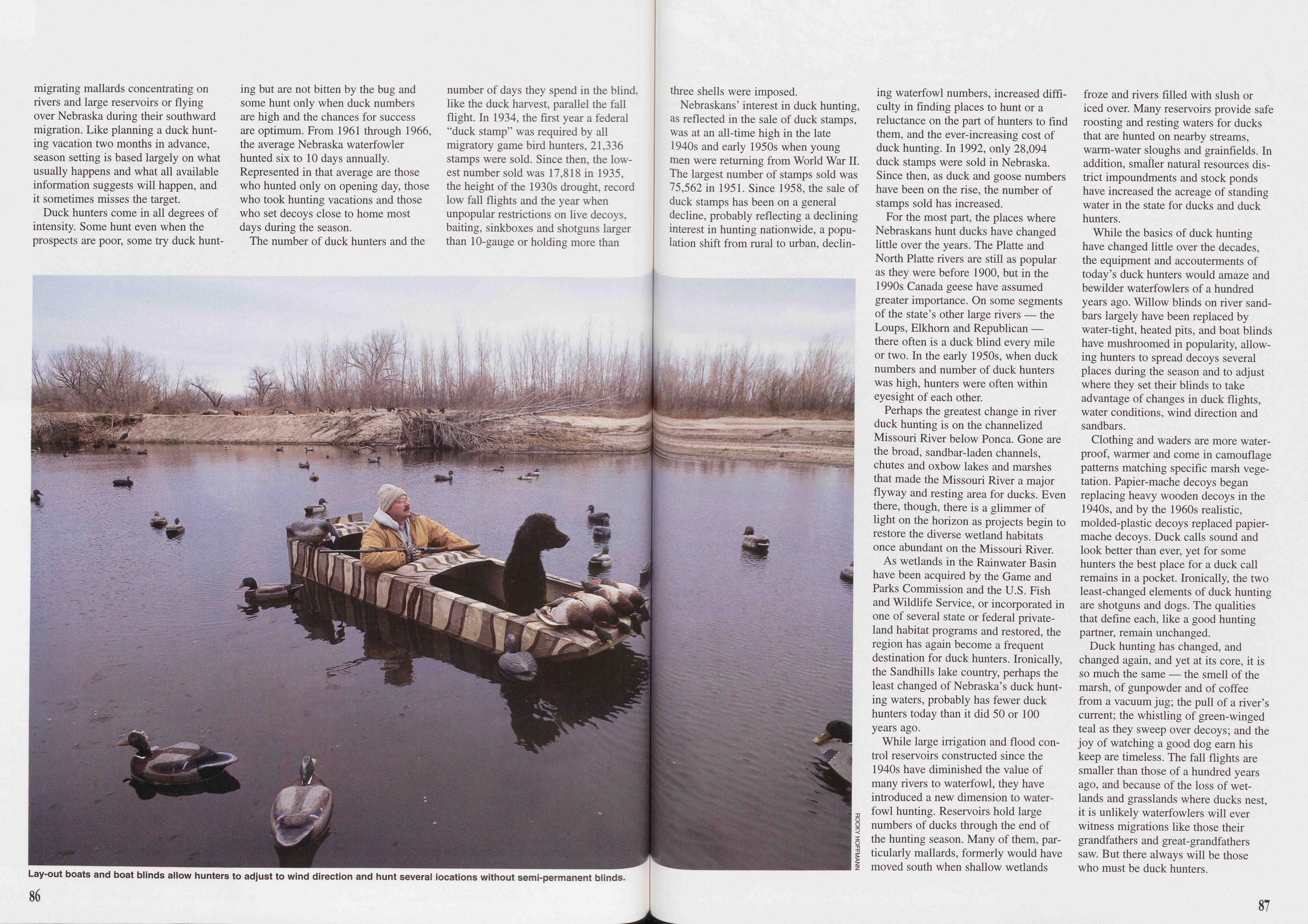
migrating mallards concentrating on rivers and large reservoirs or flying over Nebraska during their southward migration. Like planning a duck hunting vacation two months in advance, season setting is based largely on what usually happens and what all available information suggests will happen, and it sometimes misses the target.
Duck hunters come in all degrees of intensity. Some hunt even when the prospects are poor, some try duck hunting but are not bitten by the bug and some hunt only when duck numbers are high and the chances for success are optimum. From 1961 through 1966, the average Nebraska waterfowler hunted six to 10 days annually. Represented in that average are those who hunted only on opening day, those who took hunting vacations and those who set decoys close to home most days during the season.
The number of duck hunters and the number of days they spend in the blind, like the duck harvest, parallel the fall flight. In 1934, the first year a federal "duck stamp" was required by all migratory game bird hunters, 21,336 stamps were sold. Since then, the lowest number sold was 17,818 in 1935, the height of the 1930s drought, record low fall flights and the year when unpopular restrictions on live decoys, baiting, sinkboxes and shotguns larger than 10-gauge or holding more than
Lay-out boats and boat blinds allow hunters to adjust to wind direction and hunt several locations without semi-permanent blinds.
Rocky Hoffmannthree shells were imposed.
Nebraskans' interest in duck hunting, as reflected in the sale of duck stamps, was at an all-time high in the late 1940s and early 1950s when young men were returning from World War II. The largest number of stamps sold was 75,562 in 1951. Since 1958, the sale of duck stamps has been on a general decline, probably reflecting a declining interest in hunting nationwide, a population shift from rural to urban, declining waterfowl numbers, increased difficulty in finding places to hunt or a reluctance on the part of hunters to find them, and the ever-increasing cost of duck hunting. In 1992, only 28,094 duck stamps were sold in Nebraska. Since then, as duck and goose numbers have been on the rise, the number of stamps sold has increased.
For the most part, the places where Nebraskans hunt ducks have changed little over the years. The Platte and North Platte rivers are still as popular as they were before 1900, but in the 1990s Canada geese have assumed greater importance. On some segments of the state's other large rivers — the Loups, Elkhorn and Republican — there often is a duck blind every mile or two. In the early 1950s, when duck numbers and number of duck hunters was high, hunters were often within eyesight of each other.
Perhaps the greatest change in river duck hunting is on the channelized Missouri River below Ponca. Gone are the broad, sandbar-laden channels, chutes and oxbow lakes and marshes that made the Missouri River a major fly way and resting area for ducks. Even there, though, there is a glimmer of light on the horizon as projects begin to restore the diverse wetland habitats once abundant on the Missouri River.
As wetlands in the Rainwater Basin have been acquired by the Game and Parks Commission and the U.S. Fish and Wildlife Service, or incorporated in one of several state or federal private-land habitat programs and restored, the region has again become a frequent destination for duck hunters. Ironically, the Sandhills lake country, perhaps the least changed of Nebraska's duck hunting waters, probably has fewer duck hunters today than it did 50 or 100 years ago.
While large irrigation and flood control reservoirs constructed since the 1940s have diminished the value of many rivers to waterfowl, they have introduced a new dimension to waterfowl hunting. Reservoirs hold large numbers of ducks through the end of the hunting season. Many of them, particularly mallards, formerly would have moved south when shallow wetlands froze and rivers filled with slush or iced over. Many reservoirs provide safe roosting and resting waters for ducks that are hunted on nearby streams, warm-water sloughs and grainfields. In addition, smaller natural resources district impoundments and stock ponds have increased the acreage of standing water in the state for ducks and duck hunters.
While the basics of duck hunting have changed little over the decades, the equipment and accouterments of today's duck hunters would amaze and bewilder waterfowlers of a hundred years ago. Willow blinds on river sandbars largely have been replaced by water-tight, heated pits, and boat blinds have mushroomed in popularity, allowing hunters to spread decoys several places during the season and to adjust where they set their blinds to take advantage of changes in duck flights, water conditions, wind direction and sandbars.
Clothing and waders are more waterproof, warmer and come in camouflage patterns matching specific marsh vegetation. Papier-mache decoys began replacing heavy wooden decoys in the 1940s, and by the 1960s realistic, molded-plastic decoys replaced papier-mache decoys. Duck calls sound and look better than ever, yet for some hunters the best place for a duck call remains in a pocket. Ironically, the two least-changed elements of duck hunting are shotguns and dogs. The qualities that define each, like a good hunting partner, remain unchanged.
Duck hunting has changed, and changed again, and yet at its core, it is so much the same — the smell of the marsh, of gunpowder and of coffee from a vacuum jug; the pull of a river's current; the whistling of green-winged teal as they sweep over decoys; and the joy of watching a good dog earn his keep are timeless. The fall flights are smaller than those of a hundred years ago, and because of the loss of wetlands and grasslands where ducks nest, it is unlikely waterfowlers will ever witness migrations like those their grandfathers and great-grandfathers saw. But there always will be those who must be duck hunters.
87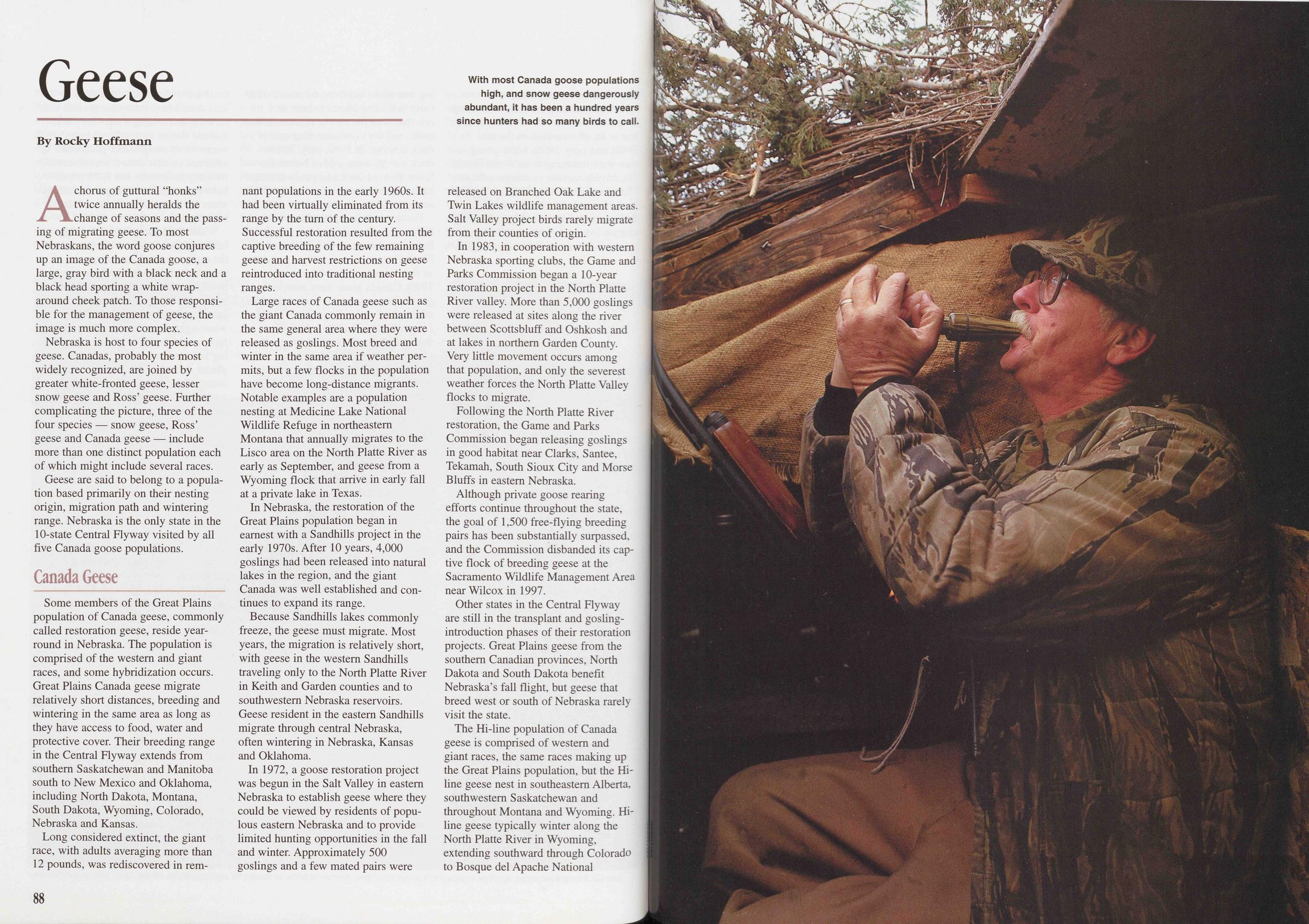
Geese
By Rocky HoffmannA chorus of guttural "honks" twice annually heralds the change of seasons and the passing of migrating geese. To most Nebraskans, the word goose conjures up an image of the Canada goose, a large, gray bird with a black neck and a black head sporting a white wrap-around cheek patch. To those responsible for the management of geese, the image is much more complex.
Nebraska is host to four species of geese. Canadas, probably the most widely recognized, are joined by greater white-fronted geese, lesser snow geese and Ross' geese. Further complicating the picture, three of the four species — snow geese, Ross' geese and Canada geese — include more than one distinct population each of which might include several races.
Geese are said to belong to a population based primarily on their nesting origin, migration path and wintering range. Nebraska is the only state in the 10-state Central Fly way visited by all five Canada goose populations.
Canada GeeseSome members of the Great Plains population of Canada geese, commonly called restoration geese, reside year-round in Nebraska. The population is comprised of the western and giant races, and some hybridization occurs. Great Plains Canada geese migrate relatively short distances, breeding and wintering in the same area as long as they have access to food, water and protective cover. Their breeding range in the Central Flyway extends from southern Saskatchewan and Manitoba south to New Mexico and Oklahoma, including North Dakota, Montana, South Dakota, Wyoming, Colorado, Nebraska and Kansas.
Long considered extinct, the giant race, with adults averaging more than 12 pounds, was rediscovered in remnant populations in the early 1960s. It had been virtually eliminated from its range by the turn of the century. Successful restoration resulted from the captive breeding of the few remaining geese and harvest restrictions on geese reintroduced into traditional nesting ranges.
Large races of Canada geese such as the giant Canada commonly remain in the same general area where they were released as goslings. Most breed and winter in the same area if weather permits, but a few flocks in the population have become long-distance migrants. Notable examples are a population nesting at Medicine Lake National Wildlife Refuge in northeastern Montana that annually migrates to the Lisco area on the North Platte River as early as September, and geese from a Wyoming flock that arrive in early fall at a private lake in Texas.
In Nebraska, the restoration of the Great Plains population began in earnest with a Sandhills project in the early 1970s. After 10 years, 4,000 goslings had been released into natural lakes in the region, and the giant Canada was well established and continues to expand its range.
Because Sandhills lakes commonly freeze, the geese must migrate. Most years, the migration is relatively short, with geese in the western Sandhills traveling only to the North Platte River in Keith and Garden counties and to southwestern Nebraska reservoirs. Geese resident in the eastern Sandhills migrate through central Nebraska, often wintering in Nebraska, Kansas and Oklahoma.
In 1972, a goose restoration project was begun in the Salt Valley in eastern Nebraska to establish geese where they could be viewed by residents of populous eastern Nebraska and to provide limited hunting opportunities in the fall and winter. Approximately 500 goslings and a few mated pairs were With most Canada goose populations high, and snow geese dangerously abundant, it has been a hundred years since hunters had so many birds to call. released on Branched Oak Lake and Twin Lakes wildlife management areas Salt Valley project birds rarely migrate from their counties of origin.
In 1983, in cooperation with western Nebraska sporting clubs, the Game and Parks Commission began a 10-year restoration project in the North Platte River valley. More than 5,000 goslings were released at sites along the river between Scottsbluff and Oshkosh and at lakes in northern Garden County. Very little movement occurs among that population, and only the severest weather forces the North Platte Valley flocks to migrate.
Following the North Platte River restoration, the Game and Parks Commission began releasing goslings in good habitat near Clarks, Santee, Tekamah, South Sioux City and Morse Bluffs in eastern Nebraska.
Although private goose rearing efforts continue throughout the state, the goal of 1,500 free-flying breeding pairs has been substantially surpassed, and the Commission disbanded its captive flock of breeding geese at the Sacramento Wildlife Management Area near Wilcox in 1997.
Other states in the Central Flyway are still in the transplant and gosling- introduction phases of their restoration projects. Great Plains geese from the southern Canadian provinces, North Dakota and South Dakota benefit Nebraska's fall flight, but geese that breed west or south of Nebraska rarely visit the state.
The Hi-line population of Canada geese is comprised of western and giant races, the same races making up the Great Plains population, but the Hi-line geese nest in southeastern Alberta, southwestern Saskatchewan and throughout Montana and Wyoming. Hi-line geese typically winter along the North Platte River in Wyoming, extending southward through Colorado to Bosque del Apache National
88With most Canada goose populations high, and snow geese dangerously abundant, it hs been a hundred years since hunters had so many birds to call.
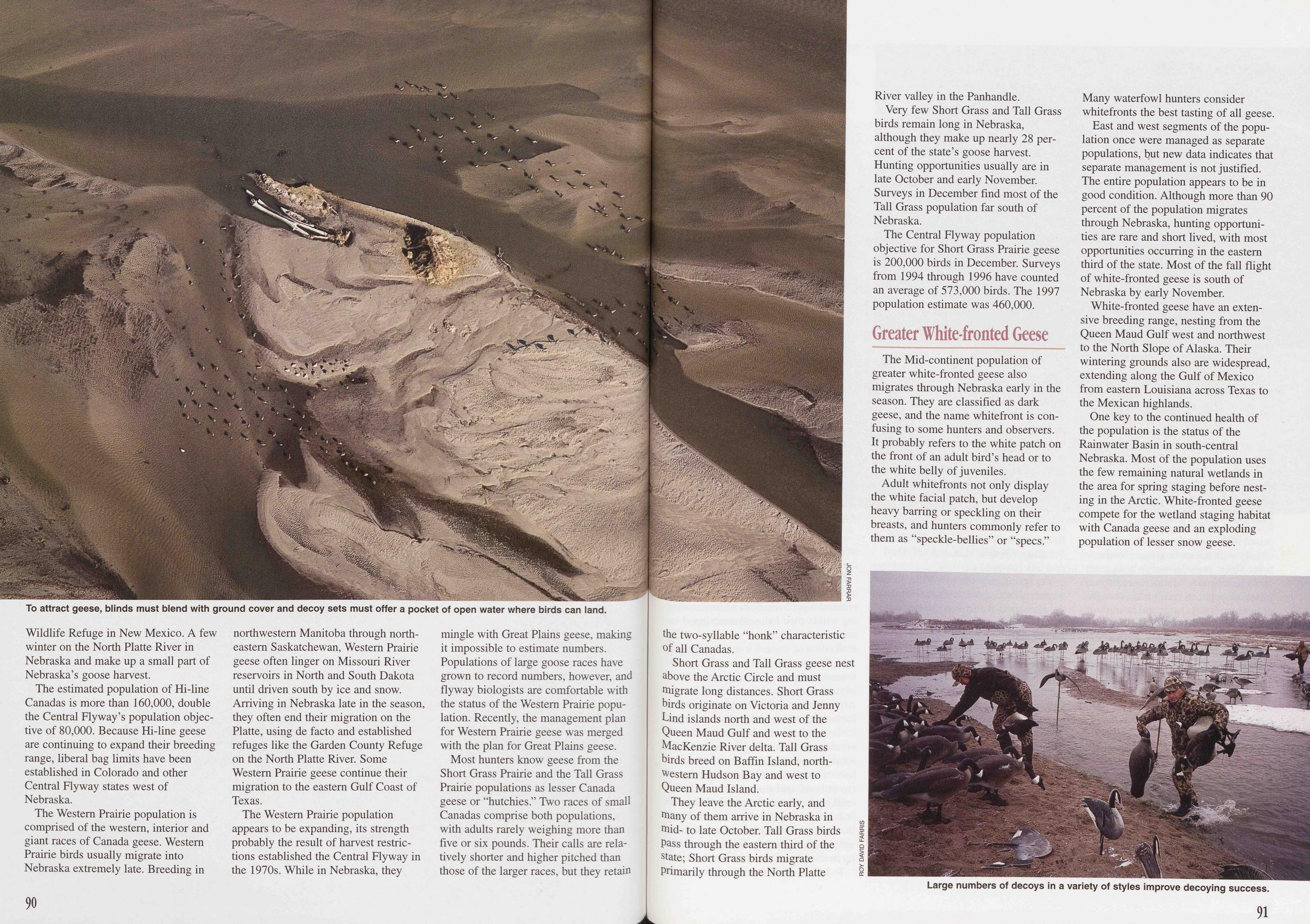
To attract geese, blinds must blend with ground cover and decoy sets must offer a pocket of open water where birds can land.
Jon FarrarWildlife Refuge in New Mexico. A few winter on the North Platte River in Nebraska and make up a small part of Nebraska's goose harvest.
The estimated population of Hi-line Canadas is more than 160,000, double the Central Flyway's population objective of 80,000. Because Hi-line geese are continuing to expand their breeding range, liberal bag limits have been established in Colorado and other Central Flyway states west of Nebraska.
The Western Prairie population is comprised of the western, interior and giant races of Canada geese. Western Prairie birds usually migrate into Nebraska extremely late. Breeding in northwestern Manitoba through northeastern Saskatchewan, Western Prairie geese often linger on Missouri River reservoirs in North and South Dakota until driven south by ice and snow. Arriving in Nebraska late in the season, they often end their migration on the Platte, using de facto and established refuges like the Garden County Refuge on the North Platte River. Some Western Prairie geese continue their migration to the eastern Gulf Coast of Texas.
The Western Prairie population appears to be expanding, its strength probably the result of harvest restrictions established the Central Flyway in the 1970s. While in Nebraska, they mingle with Great Plains geese, making it impossible to estimate numbers. Populations of large goose races have grown to record numbers, however, and flyway biologists are comfortable with the status of the Western Prairie population. Recently, the management plan for Western Prairie geese was merged with the plan for Great Plains geese.
Most hunters know geese from the Short Grass Prairie and the Tall Grass Prairie populations as lesser Canada geese or "hutchies." Two races of small Canadas comprise both populations, with adults rarely weighing more than five or six pounds. Their calls are relatively shorter and higher pitched than those of the larger races, but they retain
90the two-syllable "honk" characteristic of all Canadas.
Short Grass and Tall Grass geese nest above the Arctic Circle and must migrate long distances. Short Grass birds originate on Victoria and Jenny Lind islands north and west of the Queen Maud Gulf and west to the MacKenzie River delta. Tall Grass birds breed on Baffin Island, north-Western Hudson Bay and west to Queen Maud Island.
They leave the Arctic early, and many of them arrive in Nebraska in mid- to late October. Tall Grass birds Pass through the eastern third of the state; Short Grass birds migrate Primarily through the North Platte River valley in the Panhandle.
Very few Short Grass and Tall Grass birds remain long in Nebraska, although they make up nearly 28 percent of the state's goose harvest. Hunting opportunities usually are in late October and early November. Surveys in December find most of the Tall Grass population far south of Nebraska.
The Central Flyway population objective for Short Grass Prairie geese is 200,000 birds in December. Surveys from 1994 through 1996 have counted an average of 573,000 birds. The 1997 population estimate was 460,000.
Greater White-fronted GeeseThe Mid-continent population of greater white-fronted geese also migrates through Nebraska early in the season. They are classified as dark geese, and the name whitefront is confusing to some hunters and observers. It probably refers to the white patch on the front of an adult bird's head or to the white belly of juveniles.
Adult whitefronts not only display the white facial patch, but develop heavy barring or speckling on their breasts, and hunters commonly refer to them as "speckle-bellies" or "specs." Many waterfowl hunters consider whitefronts the best tasting of all geese.
East and west segments of the population once were managed as separate populations, but new data indicates that separate management is not justified. The entire population appears to be in good condition. Although more than 90 percent of the population migrates through Nebraska, hunting opportunities are rare and short lived, with most opportunities occurring in the eastern third of the state. Most of the fall flight of white-fronted geese is south of Nebraska by early November.
White-fronted geese have an extensive breeding range, nesting from the Queen Maud Gulf west and northwest to the North Slope of Alaska. Their wintering grounds also are widespread, extending along the Gulf of Mexico from eastern Louisiana across Texas to the Mexican highlands.
One key to the continued health of the population is the status of the Rainwater Basin in south-central Nebraska. Most of the population uses the few remaining natural wetlands in the area for spring staging before nesting in the Arctic. White-fronted geese compete for the wetland staging habitat with Canada geese and an exploding population of lesser snow geese.
Large numbers of decoys in a variety of styles improve decoying success.
Roy David Farris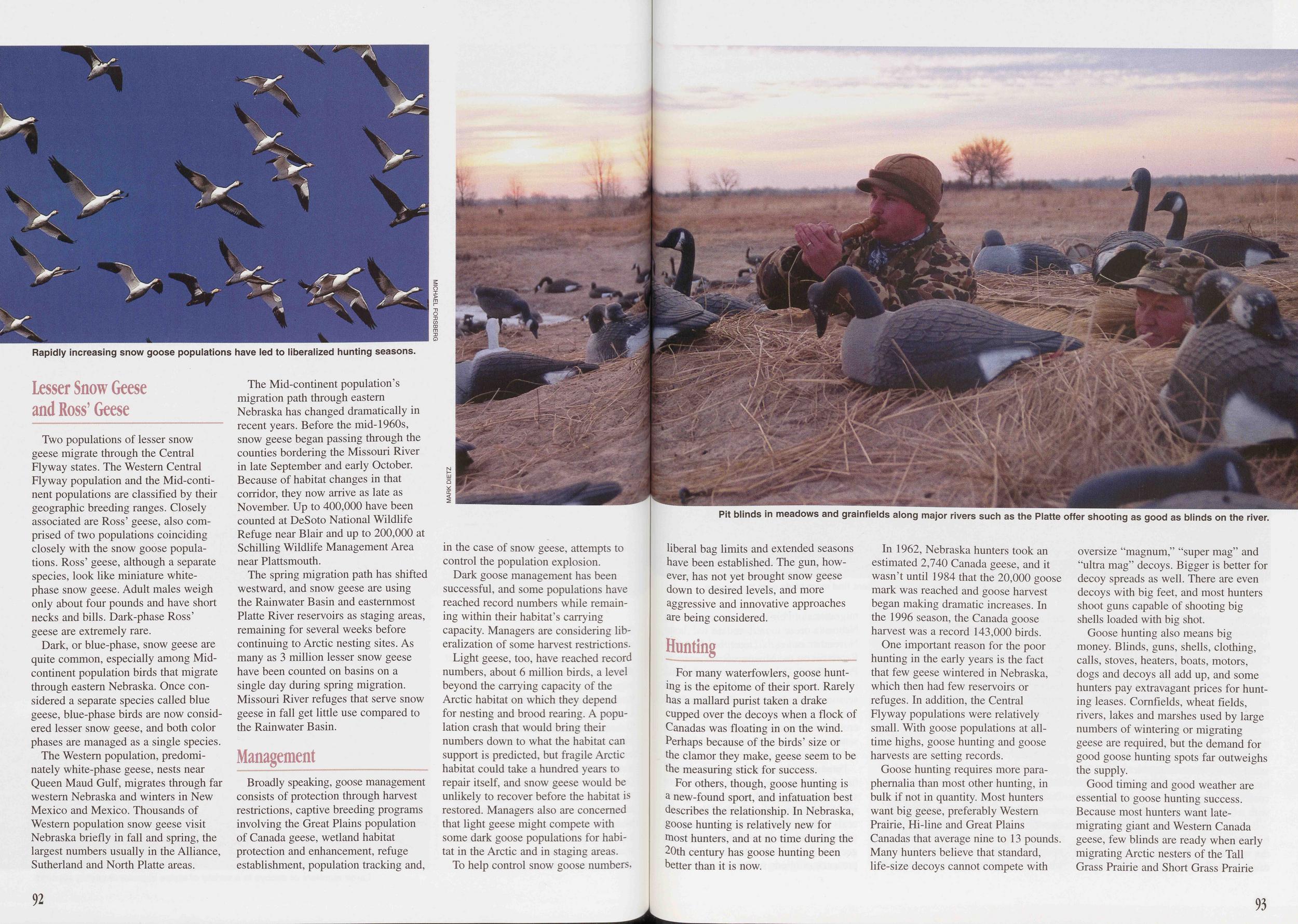
Rapidly increasing snow goose populations have led to liberalized hunting seasons.
Michael ForsbergTwo populations of lesser snow geese migrate through the Central Fly way states. The Western Central Flyway population and the Mid-continent populations are classified by their geographic breeding ranges. Closely associated are Ross' geese, also comprised of two populations coinciding closely with the snow goose populations. Ross' geese, although a separate species, look like miniature white-phase snow geese. Adult males weigh only about four pounds and have short necks and bills. Dark-phase Ross' geese are extremely rare.
Dark, or blue-phase, snow geese are quite common, especially among Mid-continent population birds that migrate through eastern Nebraska. Once considered a separate species called blue geese, blue-phase birds are now considered lesser snow geese, and both color phases are managed as a single species.
The Western population, predominately white-phase geese, nests near Queen Maud Gulf, migrates through far western Nebraska and winters in New Mexico and Mexico. Thousands of Western population snow geese visit Nebraska briefly in fall and spring, the largest numbers usually in the Alliance, Sutherland and North Platte areas.
The Mid-continent population's migration path through eastern Nebraska has changed dramatically in recent years. Before the mid-1960s, snow geese began passing through the counties bordering the Missouri River in late September and early October. Because of habitat changes in that corridor, they now arrive as late as November. Up to 400,000 have been counted at DeSoto National Wildlife Refuge near Blair and up to 200,000 at Schilling Wildlife Management Area near Plattsmouth.
The spring migration path has shifted westward, and snow geese are using the Rainwater Basin and easternmost Platte River reservoirs as staging areas, remaining for several weeks before continuing to Arctic nesting sites. As many as 3 million lesser snow geese have been counted on basins on a single day during spring migration. Missouri River refuges that serve snow geese in fall get little use compared to the Rainwater Basin.
ManagementBroadly speaking, goose management consists of protection through harvest restrictions, captive breeding programs involving the Great Plains population of Canada geese, wetland habitat protection and enhancement, refuge establishment, population tracking and, in the case of snow geese, attempts to control the population explosion.
Dark goose management has been successful, and some populations have reached record numbers while remaining within their habitat's carrying capacity. Managers are considering liberalization of some harvest restrictions.
Light geese, too, have reached record numbers, about 6 million birds, a level beyond the carrying capacity of the Arctic habitat on which they depend for nesting and brood rearing. A population crash that would bring their numbers down to what the habitat can support is predicted, but fragile Arctic habitat could take a hundred years to repair itself, and snow geese would be unlikely to recover before the habitat is restored. Managers also are concerned that light geese might compete with some dark goose populations for habitat in the Arctic and in staging areas.
To help control snow goose numbers,
92Pit blinds in meadows and grainfieids along major rivers such as the Platte offer shooting as good as blinds on the river.
Mark Dietzliberal bag limits and extended seasons have been established. The gun, however, has not yet brought snow geese down to desired levels, and more aggressive and innovative approaches are being considered.
HuntingFor many waterfowlers, goose hunting is the epitome of their sport. Rarely has a mallard purist taken a drake cupped over the decoys when a flock of Canadas was floating in on the wind. Perhaps because of the birds' size or the clamor they make, geese seem to be the measuring stick for success.
For others, though, goose hunting is a new-found sport, and infatuation best describes the relationship. In Nebraska, goose hunting is relatively new for most hunters, and at no time during the 20th century has goose hunting been better than it is now.
In 1962, Nebraska hunters took an estimated 2,740 Canada geese, and it wasn't until 1984 that the 20,000 goose mark was reached and goose harvest began making dramatic increases. In the 1996 season, the Canada goose harvest was a record 143,000 birds.
One important reason for the poor hunting in the early years is the fact that few geese wintered in Nebraska, which then had few reservoirs or refuges. In addition, the Central Flyway populations were relatively small. With goose populations at all-time highs, goose hunting and goose harvests are setting records.
Goose hunting requires more paraphernalia than most other hunting, in bulk if not in quantity. Most hunters want big geese, preferably Western Prairie, Hi-line and Great Plains Canadas that average nine to 13 pounds. Many hunters believe that standard, life-size decoys cannot compete with oversize "magnum," "super mag" and "ultra mag" decoys. Bigger is better for decoy spreads as well. There are even decoys with big feet, and most hunters shoot guns capable of shooting big shells loaded with big shot.
Goose hunting also means big money. Blinds, guns, shells, clothing, calls, stoves, heaters, boats, motors, dogs and decoys all add up, and some hunters pay extravagant prices for hunting leases. Cornfields, wheat fields, rivers, lakes and marshes used by large numbers of wintering or migrating geese are required, but the demand for good goose hunting spots far outweighs the supply.
Good timing and good weather are essential to goose hunting success. Because most hunters want late-migrating giant and Western Canada geese, few blinds are ready when early migrating Arctic nesters of the Tall Grass Prairie and Short Grass Prairie
93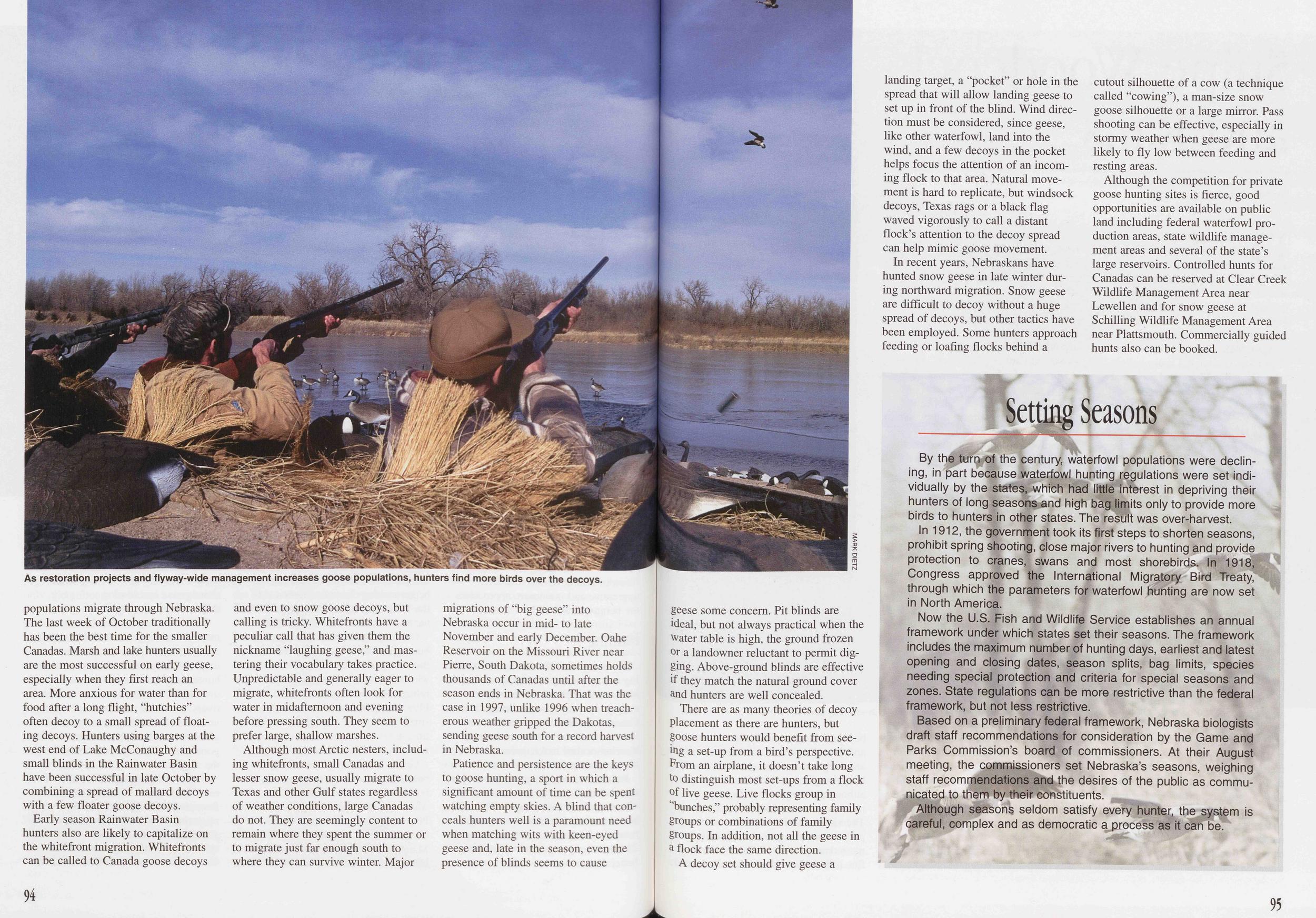
As restoration projects and flyway-wide management increases goose populations, hunters find more birds over the decoys.
Mark Dietzpopulations migrate through Nebraska. The last week of October traditionally has been the best time for the smaller Canadas. Marsh and lake hunters usually are the most successful on early geese, especially when they first reach an area. More anxious for water than for food after a long flight, "hutchies" often decoy to a small spread of floating decoys. Hunters using barges at the west end of Lake McConaughy and small blinds in the Rainwater Basin have been successful in late October by combining a spread of mallard decoys with a few floater goose decoys.
Early season Rainwater Basin hunters also are likely to capitalize on the whitefront migration. Whitefronts can be called to Canada goose decoys and even to snow goose decoys, but calling is tricky. Whitefronts have a peculiar call that has given them the nickname "laughing geese," and mastering their vocabulary takes practice. Unpredictable and generally eager to migrate, whitefronts often look for water in midafternoon and evening before pressing south. They seem to prefer large, shallow marshes.
Although most Arctic nesters, including whitefronts, small Canadas and lesser snow geese, usually migrate to Texas and other Gulf states regardless of weather conditions, large Canadas do not. They are seemingly content to remain where they spent the summer or to migrate just far enough south to where they can survive winter. Major migrations of "big geese" into Nebraska occur in mid- to late November and early December. Oahe Reservoir on the Missouri River near Pierre, South Dakota, sometimes holds thousands of Canadas until after the season ends in Nebraska. That was the case in 1997, unlike 1996 when treacherous weather gripped the Dakotas, sending geese south for a record harvest in Nebraska.
Patience and persistence are the keys to goose hunting, a sport in which a significant amount of time can be spent watching empty skies. A blind that conceals hunters well is a paramount need when matching wits with keen-eyed geese and, late in the season, even the presence of blinds seems to cause
94geese some concern. Pit blinds are ideal, but not always practical when the Water table is high, the ground frozen or a landowner reluctant to permit digging. Above-ground blinds are effective if they match the natural ground cover and hunters are well concealed.
There are as many theories of decoy placement as there are hunters, but goose hunters would benefit from seeing a set-up from a bird's perspective. From an airplane, it doesn't take long to distinguish most set-ups from a flock of live geese. Live flocks group in 'bunches," probably representing family groups or combinations of family groups. In addition, not all the geese in a flock face the same direction.
A decoy set should give geese a landing target, a "pocket" or hole in the spread that will allow landing geese to set up in front of the blind. Wind direction must be considered, since geese, like other waterfowl, land into the wind, and a few decoys in the pocket helps focus the attention of an incoming flock to that area. Natural movement is hard to replicate, but windsock decoys, Texas rags or a black flag waved vigorously to call a distant flock's attention to the decoy spread can help mimic goose movement.
In recent years, Nebraskans have hunted snow geese in late winter during northward migration. Snow geese are difficult to decoy without a huge spread of decoys, but other tactics have been employed. Some hunters approach feeding or loafing flocks behind a cutout silhouette of a cow (a technique called "cowing"), a man-size snow goose silhouette or a large mirror. Pass shooting can be effective, especially in stormy weather when geese are more likely to fly low between feeding and resting areas.
Although the competition for private goose hunting sites is fierce, good opportunities are available on public land including federal waterfowl production areas, state wildlife management areas and several of the state's large reservoirs. Controlled hunts for Canadas can be reserved at Clear Creek Wildlife Management Area near Lewellen and for snow geese at Schilling Wildlife Management Area near Plattsmouth. Commercially guided hunts also can be booked.
Setting Seasons
By the turn of the century, waterfowl populations were declining, in part because waterfowl hunting regulations were set individually by the states, which had little interest in depriving their hunters of long seasons and high bag limits only to provide more birds to hunters in other states. The result was over-harvest.
In 1912, the government took its first steps to shorten seasons, prohibit spring shooting, close major rivers to hunting and provide protection to cranes, swans and most shorebirds. In 1918, Congress approved the International Migratory Bird "Treaty, through which the parameters for waterfowl hunting are now set in North America.
Now the U.S. Fish and Wildlife Service establishes an annual framework under which states set their seasons. The framework includes the maximum number of hunting days, earliest and latest opening and closing dates, season splits, bag limits, species needing special protection and criteria for special seasons and zones. State regulations can be more restrictive than the federal framework, but not less restrictive.
Based on a preliminary federal framework, Nebraska biologists draft staff recommendations for consideration by the Game and Parks Commission's board of commissioners. At their August meeting, the commissioners set Nebraska's seasons, weighing staff recommendations and the desires of the public as communicated to them by their constituents.
Although seasons seldom satisfy every hunter, the system is careful, complex and as democratic a process as it can be.
95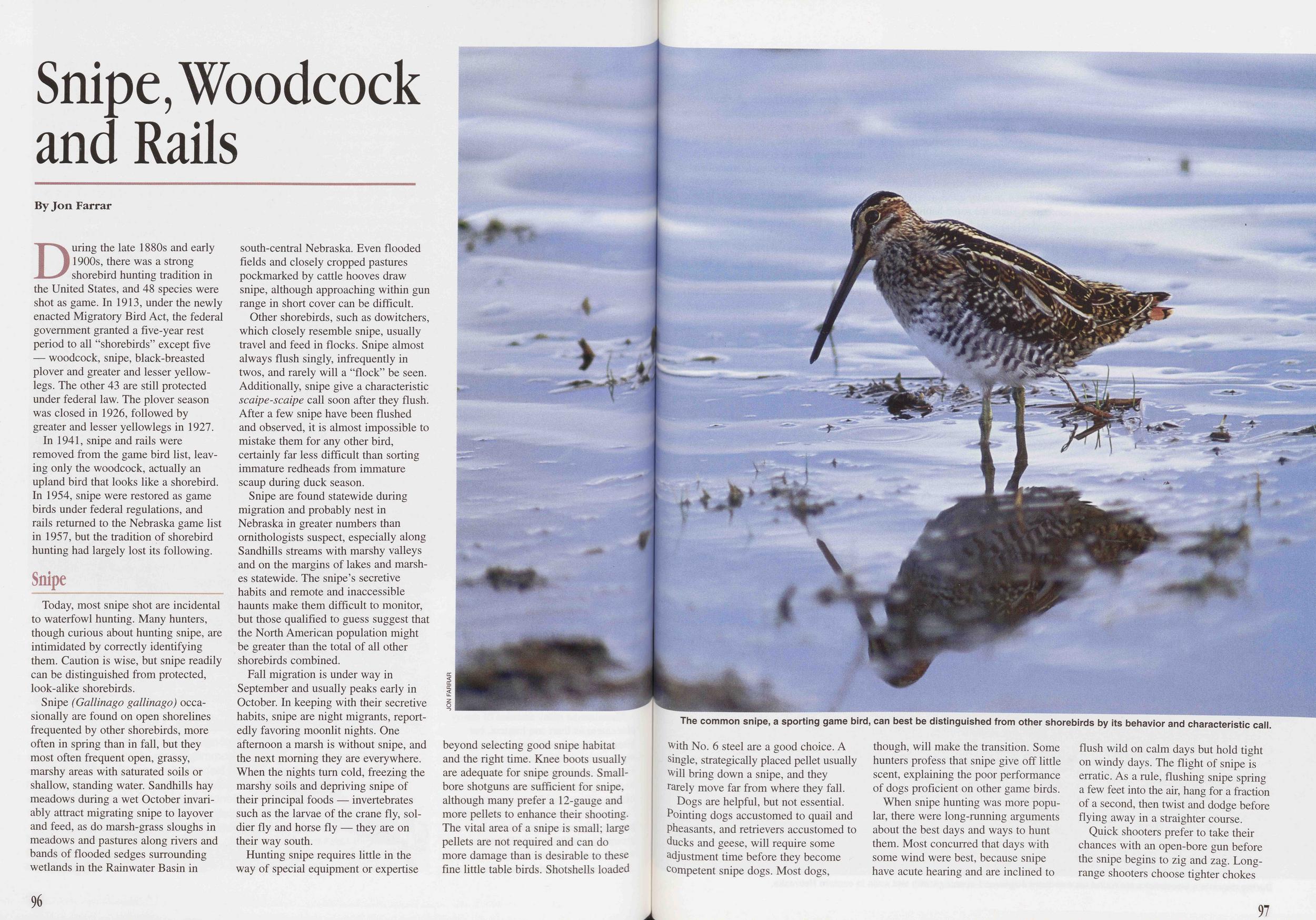
Snipe, Woodcock and Rails
By Jon FarrarDuring the late 1880s and early 1900s, there was a strong shorebird hunting tradition in the United States, and 48 species were shot as game. In 1913, under the newly enacted Migratory Bird Act, the federal government granted a five-year rest period to all "shorebirds" except five — woodcock, snipe, black-breasted plover and greater and lesser yellowlegs. The other 43 are still protected under federal law. The plover season was closed in 1926, followed by greater and lesser yellowlegs in 1927.
In 1941, snipe and rails were removed from the game bird list, leaving only the woodcock, actually an upland bird that looks like a shorebird. In 1954, snipe were restored as game birds under federal regulations, and rails returned to the Nebraska game list in 1957, but the tradition of shorebird hunting had largely lost its following.
SnipeToday, most snipe shot are incidental to waterfowl hunting. Many hunters, though curious about hunting snipe, are intimidated by correctly identifying them. Caution is wise, but snipe readily can be distinguished from protected, look-alike shorebirds.
Snipe (Gallinago gallinago) occasionally are found on open shorelines frequented by other shorebirds, more often in spring than in fall, but they most often frequent open, grassy, marshy areas with saturated soils or shallow, standing water. Sandhills hay meadows during a wet October invariably attract migrating snipe to layover and feed, as do marsh-grass sloughs in meadows and pastures along rivers and bands of flooded sedges surrounding wetlands in the Rainwater Basin in south-central Nebraska. Even flooded fields and closely cropped pastures pockmarked by cattle hooves draw snipe, although approaching within gun range in short cover can be difficult.
Other shorebirds, such as dowitchers, which closely resemble snipe, usually travel and feed in flocks. Snipe almost always flush singly, infrequently in twos, and rarely will a "flock" be seen. Additionally, snipe give a characteristic scaipe-scaipe call soon after they flush. After a few snipe have been flushed and observed, it is almost impossible to mistake them for any other bird, certainly far less difficult than sorting immature redheads from immature scaup during duck season.
Snipe are found statewide during migration and probably nest in Nebraska in greater numbers than ornithologists suspect, especially along Sandhills streams with marshy valleys and on the margins of lakes and marshes statewide. The snipe's secretive habits and remote and inaccessible haunts make them difficult to monitor, but those qualified to guess suggest that the North American population might be greater than the total of all other shorebirds combined.
Fall migration is under way in September and usually peaks early in October. In keeping with their secretive habits, snipe are night migrants, reportedly favoring moonlit nights. One afternoon a marsh is without snipe, and the next morning they are everywhere. When the nights turn cold, freezing the marshy soils and depriving snipe of their principal foods — invertebrates such as the larvae of the crane fly, soldier fly and horse fly — they are on their way south.
Hunting snipe requires little in the way of special equipment or expertise beyond selecting good snipe habitat and the right time. Knee boots usually are adequate for snipe grounds. Small-bore shotguns are sufficient for snipe, although many prefer a 12-gauge and more pellets to enhance their shooting. The vital area of a snipe is small; large pellets are not required and can do more damage than is desirable to these fine little table birds. Shotshells loaded
96The common snipe, a sporting game bird, can best be distinguished from other shorebirds by its behavior and characteristic call.
with No. 6 steel are a good choice. A single, strategically placed pellet usually Will bring down a snipe, and they rarely move far from where they fall.
Dogs are helpful, but not essential. Pointing dogs accustomed to quail and pheasants, and retrievers accustomed to ducks and geese, will require some adjustment time before they become competent snipe dogs. Most dogs, though, will make the transition. Some hunters profess that snipe give off little scent, explaining the poor performance of dogs proficient on other game birds.
When snipe hunting was more popular, there were long-running arguments about the best days and ways to hunt them. Most concurred that days with some wind were best, because snipe have acute hearing and are inclined to flush wild on calm days but hold tight on windy days. The flight of snipe is erratic. As a rule, flushing snipe spring a few feet into the air, hang for a fraction of a second, then twist and dodge before flying away in a straighter course.
Quick shooters prefer to take their chances with an open-bore gun before the snipe begins to zig and zag. Long-range shooters choose tighter chokes
97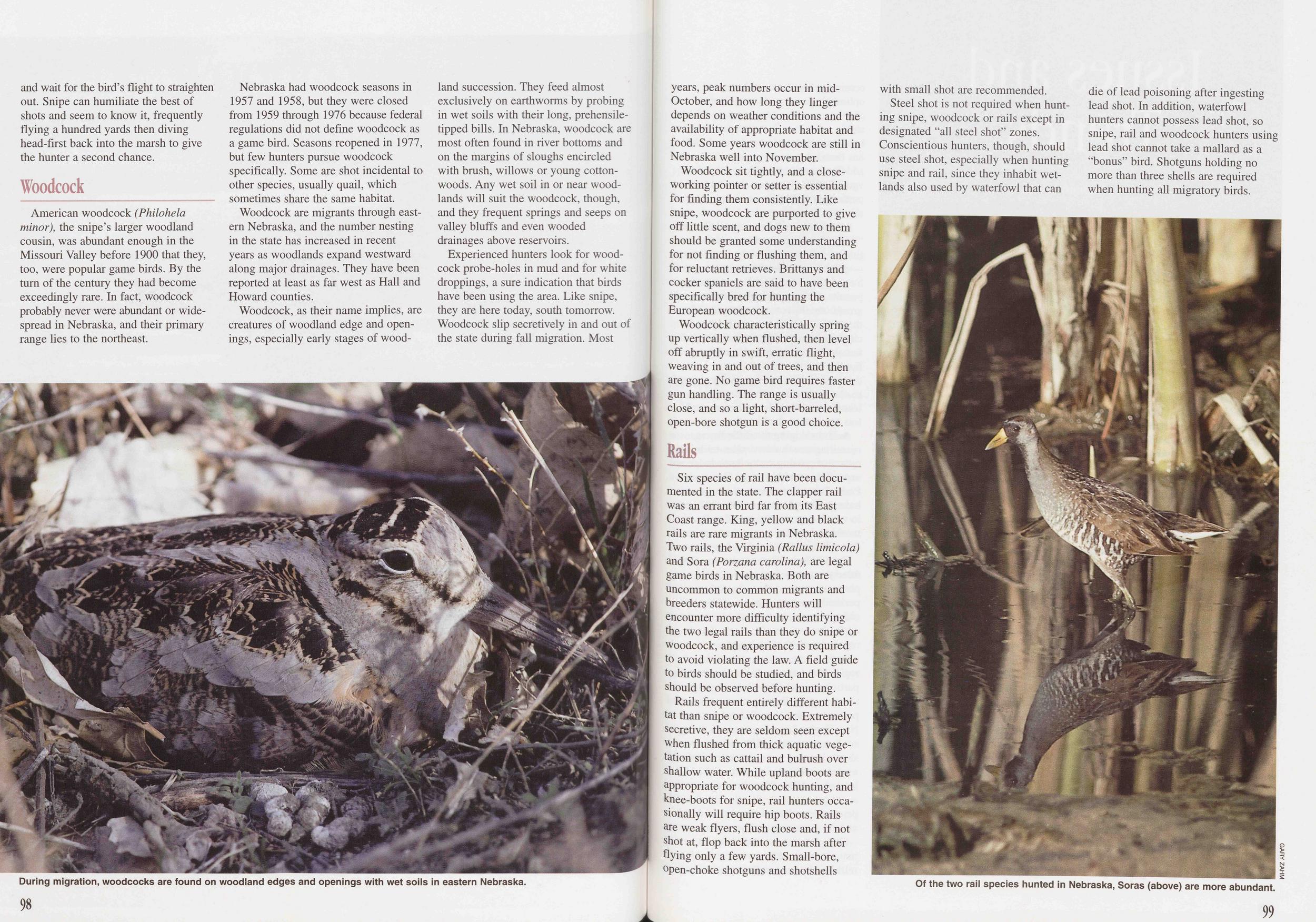
and wait for the bird's flight to straighten out. Snipe can humiliate the best of shots and seem to know it, frequently flying a hundred yards then diving head-first back into the marsh to give the hunter a second chance.
WoodcockAmerican woodcock (Philohela minor), the snipe's larger woodland cousin, was abundant enough in the Missouri Valley before 1900 that they, too, were popular game birds. By the turn of the century they had become exceedingly rare. In fact, woodcock probably never were abundant or widespread in Nebraska, and their primary range lies to the northeast.
Nebraska had woodcock seasons in 1957 and 1958, but they were closed from 1959 through 1976 because federal regulations did not define woodcock as a game bird. Seasons reopened in 1977, but few hunters pursue woodcock specifically. Some are shot incidental to other species, usually quail, which sometimes share the same habitat.
Woodcock are migrants through eastern Nebraska, and the number nesting in the state has increased in recent years as woodlands expand westward along major drainages. They have been reported at least as far west as Hall and Howard counties.
Woodcock, as their name implies, are creatures of woodland edge and openings, especially early stages of woodland succession. They feed almost exclusively on earthworms by probing in wet soils with their long, prehensile-tipped bills. In Nebraska, woodcock are most often found in river bottoms and on the margins of sloughs encircled with brush, willows or young cottonwoods. Any wet soil in or near woodlands will suit the woodcock, though, and they frequent springs and seeps on valley bluffs and even wooded drainages above reservoirs.
Experienced hunters look for woodcock probe-holes in mud and for white droppings, a sure indication that birds have been using the area. Like snipe, they are here today, south tomorrow. Woodcock slip secretively in and out of the state during fall migration. Most
During migration, woodcocks are found on woodland edges and openings with wet soils in eastern Nebraska.
years, peak numbers occur in mid-October, and how long they linger depends on weather conditions and the availability of appropriate habitat and food. Some years woodcock are still in Nebraska well into November.
Woodcock sit tightly, and a close-working pointer or setter is essential for finding them consistently. Like snipe, woodcock are purported to give off little scent, and dogs new to them should be granted some understanding for not finding or flushing them, and for reluctant retrieves. Brittanys and cocker spaniels are said to have been specifically bred for hunting the European woodcock.
Woodcock characteristically spring up vertically when flushed, then level off abruptly in swift, erratic flight, weaving in and out of trees, and then are gone. No game bird requires faster gun handling. The range is usually close, and so a light, short-barreled, open-bore shotgun is a good choice.
RailsSix species of rail have been documented in the state. The clapper rail was an errant bird far from its East Coast range. King, yellow and black rails are rare migrants in Nebraska. Two rails, the Virginia (Rallus limicola) and Sora (Porzana Carolina), are legal game birds in Nebraska. Both are uncommon to common migrants and breeders statewide. Hunters will encounter more difficulty identifying the two legal rails than they do snipe or woodcock, and experience is required to avoid violating the law. A field guide to birds should be studied, and birds should be observed before hunting.
Rails frequent entirely different habitat than snipe or woodcock. Extremely secretive, they are seldom seen except When flushed from thick aquatic vegetation such as cattail and bulrush over shallow water. While upland boots are appropriate for woodcock hunting, and knee-boots for snipe, rail hunters occasionally will require hip boots. Rails are weak flyers, flush close and, if not shot at, flop back into the marsh after flying only a few yards. Small-bore, °pen-choke shotguns and shotshells with small shot are recommended.
Steel shot is not required when hunting snipe, woodcock or rails except in designated "all steel shot" zones. Conscientious hunters, though, should use steel shot, especially when hunting snipe and rail, since they inhabit wetlands also used by waterfowl that can die of lead poisoning after ingesting lead shot. In addition, waterfowl hunters cannot possess lead shot, so snipe, rail and woodcock hunters using lead shot cannot take a mallard as a "bonus" bird. Shotguns holding no more than three shells are required when hunting all migratory birds.
Of the two rail species hunted in Nebraska, Soras (above) are more abundant.
Issues and Trends
By Don Cunningham and Bob Grier Hunting is a fundamental part of our national history and character The preservation of its traditions for future generations depends on communicating to a non-hunting public its role as a shared cultural value. That is the challenge of the 21st century.As Nebraska and the nation enter a new century, hunters and others who care about hunting have reasons to be proud of their past and optimistic about the future.
Recognizing that commercial exploitation and uncontrolled development were squandering the abundant legacy of wildlife on the North American continent, hunters, conservationists and outdoor enthusiasts joined forces with government agencies to create a long-range restoration plan, the Federal Aid in Wildlife Restoration Act (often called the Pittman-Robertson Act), financed by taxes hunters imposed upon themselves.
Now, many wildlife populations once on the brink of extinction are healthy, some at all-time highs; millions of acres of habitat are now managed for wildlife; and wildlife management has become a professional endeavor based on solid scientific principles.
But hunters also have reasons for concern. Every year, in spite of programs such as Pittman-Robertson, more acres of habitat are lost than are acquired or restored, gaining access to land on which to hunt becomes more difficult or expensive, fewer young people are introduced to the traditions of hunting, and organized opposition to hunting has become more intense.
DemographicsThe most recent National Survey of Fishing, Hunting, and Wildlife-Associated Recreation conducted by the U.S. Fish and Wildlife Service and the U.S. Bureau of the Census in 1996 contains more than 170 pages of statistics describing the state of hunting in America. The survey, conducted every five years, paints a picture that a waterfowl hunter watching for geese or a quail hunter approaching a pointer frozen over a covey might not easily see. For the most part, the picture is one of declining numbers.
Of the 201 million Americans 16 years old and older, about 7 percent hunt. That number, about 14 million, is only slightly reduced from the 14.1 million hunters of the 1991 survey, but is well below the estimated 17 million hunters of 15 years earlier. Perhaps more significant than the relatively small decline in the past five years is the continuing downward trend of the past 20 years. Between 1955 and 1980, the hunting population hovered around 10 percent; a declining trend has been clear since about 1975.
Declining participation among young males, up to 30 percent according to one study, suggests a low "recruitment" that will become more evident in coming years. A somewhat more optimistic forecast suggesting that absolute numbers could remain fairly stable, even though the percentage of hunters in the total population declines, has been advanced by researchers who added race and ethnicity to other variables. They suggest that increased participation by minority hunters could slow the decline.
An aging population, especially the "Baby Boom" generation, and the continuing urbanization of the population — inhibiting the traditional passage of hunting knowledge from participating parents, siblings and other relatives — are among the reasons often cited for the decline. Other reasons frequently cited include an increasing number of female-headed households with no hunting tradition and a general decrease in leisure time, causing people to choose leisure activities requiring less training time, less planning and less travel time than hunting.
Acknowledging the difficulty in recruiting new hunters when traditional means of passing on the knowledge are unavailable, the Nebraska Game and Parks Commission and other agencies have instituted mentored hunt programs in which experienced, non-family mentors shepherd novice hunters through their first hunting experiences.
For 1998, the Commission has instituted the state's first special youth pheasant season, a two-day "preseason" period open only to hunters 15 years old or younger (certain other restrictions apply; hunters should check current regulations before hunting).
In the seven-state north-central region that includes Nebraska, hunting participation is 14 percent, the highest in any region. Participation rates are 4 percent on the West Coast, 5 percent in New England and 6 percent in the southeastern states. The survey also shows hunting to be almost exclusively a white male activity. Of the 14 million hunters in 1996, 91 percent were male and 9 percent were female. By race, 95 percent are white, 2 percent are black and 3 percent are of other races.
Big game hunters made up the majority nationally, comprising 11.3 million of the 14 million total. Small
100game hunters decreased by 9 percent since the 1991 study, totaling 6.9 million. Migratory bird hunters remained stable at 3.1 million.
The study also details the economic effects of hunting. Hunting-related spending topped $20.6 billion, a 43 percent increase since 1991. Spending for equipment increased by 90 percent, exceeding $11 billion. Expenditures for four-wheel-drive vehicles, campers, vans, cabins and boats increased 215 percent, perhaps suggesting that hunting is moving away from its traditionally simple roots and is increasingly the purview of wealthy participants who can afford expensive equipment. The average hunter spent 18 days in the field, and the average annual expenditure per hunter was $1,475.
Access to LandMany Americans do not understand the unique nature of access to large acreages of public hunting land. Few nations have kept such extensive areas free from development, and practically nowhere else in the world do ordinary citizens have access to as much land, about 700 million acres, open for public hunting. But the traditions of American hunting are still steeped in the myths of America's earliest history: Unrestricted access to a vast, empty and unclaimed wilderness teeming with unlimited, inexhaustible resources.
However inaccurate and simplistic that view of history, and however privileged ordinary American hunters are in their access to public land, the current National Survey indicates that hunters sense a serious decline in the availability of hunting land. Reduced access to hunting land was more important than low game populations, short season lengths, low bag limits and several other factors in dissuading hunters from participation.
Regardless of the statistical increase in the acreage of public land per hunter as the hunting public decreases, the demand for private land access has grown, and private land hunting has increased 11 percent since 1991. Public land hunting increased 19 percent, perhaps suggesting that more hunters are turning to public lands. In 1996, more than 362 million privately owned acres were leased for hunting or used primarily for hunting, a 21 percent increase since the 1991 survey.
In Nebraska, public lands on which hunting is permitted total about 800,000 acres; in the abstract, a vast tract, but in reality it is divided among about 300 areas, and nearly half the total is in a few large federal holdings, including national forests, national wildlife refuges and national grasslands. Public land comprises less than 2 percent of the state's total acreage.
When the population was primarily rural — and in places like Nebraska where the rural population remained high long after the national urban-rural balance shifted — hunting was largely a local activity and most hunters were known by the local landowners. Private land access was easy to obtain, and in many cases, formal permission was not even expected. But as the urban-rural balance shifts and more hunters come from outside the communities in which they seek access, the relationship becomes less communal and more commercial.
In Nebraska, upland and big game hunters are coming face to face with an economic fact of life that waterfowl hunters have known for years: Increasingly, private land access for hunting is a pay-as-you-go proposition.
In the Pine Ridge, for example, a Game and Parks Commission wildlife manager recently reported that the spring turkey season was marked by the closing of public hunting access on six or more farms and ranches that previously had allowed free public hunting access. Among hunters, lease arrangements, brokered and guided hunts and fee hunting are becoming as familiar as discussions of rifle and shotgun terminology and the merits of pointers and retrievers. In some states, trophy whitetail hunting has become almost exclusively fee hunting, and commercially guided trophy hunts cost from about $2,000 up to $10,000.
As fees rise, some hunters tend to regard them as investments and to expect a guaranteed return. The result often is highly "artificial" hunting of ranch-bred trophy stock, often fairly tolerant of human presence, confined in large, fenced areas.
The lowering of hunting to "super-market" values is troubling to many traditional hunters, but "canned" hunts, usually for trophy deer or elk, are available in Nebraska, and many of the state's captive elk breeding operations offer hunting. Entrepreneurs scouting land in the Pine Ridge for an elk hunting operation told a startled landowner that they intended to fence 1,000 acres, dam a canyon and put down wells for a trout fishing operation, and build a lodge and cabins. Their expectation was to book a hunt every three days, for $7,000 to $10,000.
Fee hunting does not necessarily imply exorbitant costs, luxury conditions or ethically questionable hunting, however, and even relatively modest benefits to landowners can be inducements to preserve and protect wildlife habitat. The fear that fee hunting will produce an elitist "hunting class" who can afford to pay for the privilege, while pricing large numbers of ordinary individuals out of the market, does not seem to have come to pass in the south-central United States where fee hunting has been common for years.
Perhaps a greater fear, though, is that incentive-based management focused on animals with "economic" value will not be in the best interest of diverse plant and animal communities.
The challenge for wildlife agencies, landowners and hunters will be to find common ground that protects wildlife and natural resources, prevents hunting from becoming an expensive, elitist sport and preserves hunting's sporting traditions. Government-sponsored private-land-access programs, such as Nebraska's CRP-MAP program that pays landowners to permit public hunting access on Conservation Reserve Program acres, are positive signs that professional habitat management, private incentives and public access interests can coexist.
TechnologyNot surprisingly, the boom in the hunting equipment market noted by the
101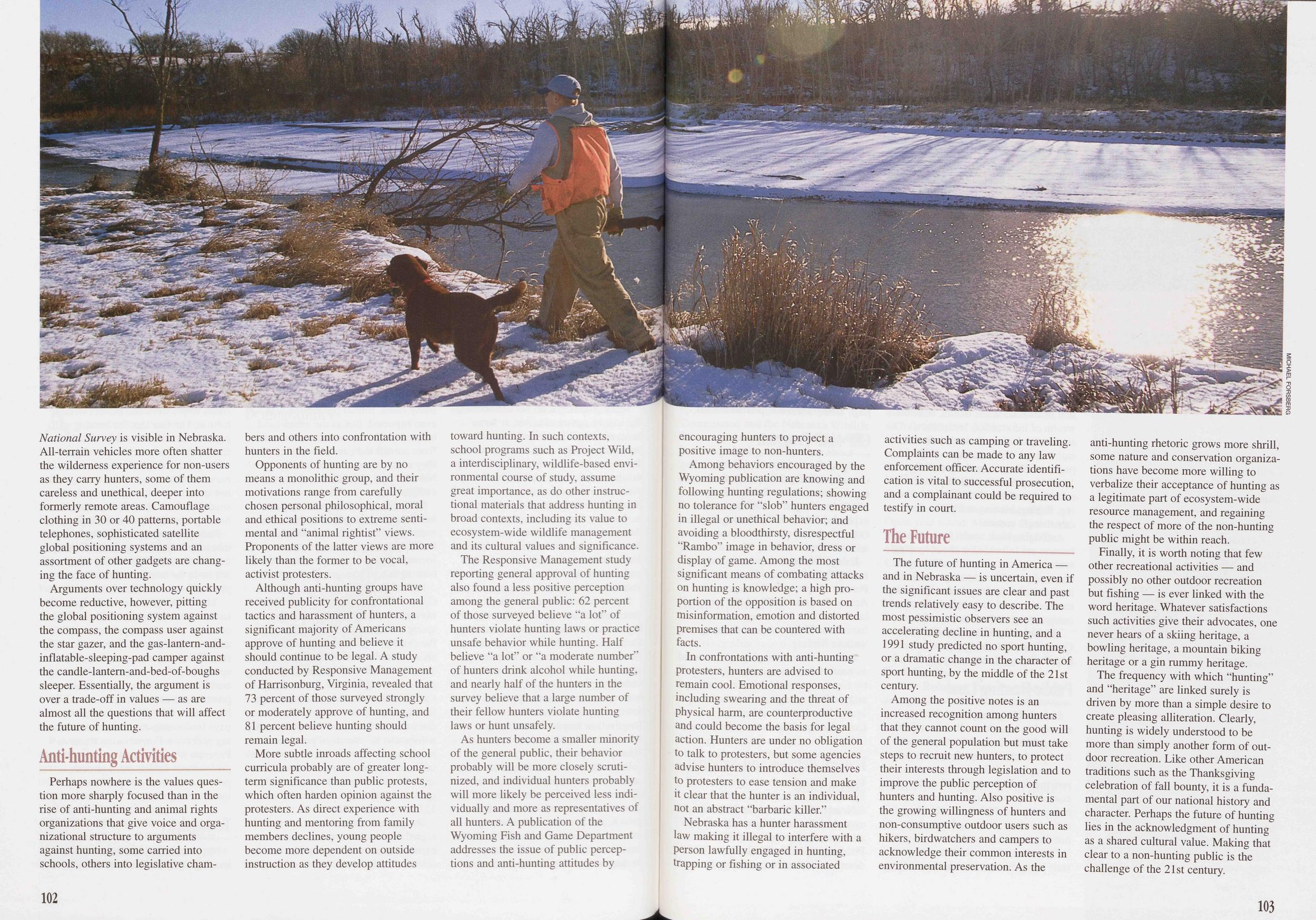
National Survey is visible in Nebraska. All-terrain vehicles more often shatter the wilderness experience for non-users as they carry hunters, some of them careless and unethical, deeper into formerly remote areas. Camouflage clothing in 30 or 40 patterns, portable telephones, sophisticated satellite global positioning systems and an assortment of other gadgets are changing the face of hunting.
Arguments over technology quickly become reductive, however, pitting the global positioning system against the compass, the compass user against the star gazer, and the gas-lantern-and- inflatable-sleeping-pad camper against the candle-lantern-and-bed-of-boughs sleeper. Essentially, the argument is over a trade-off in values — as are almost all the questions that will affect the future of hunting.
Anti-hunting ActivitiesPerhaps nowhere is the values question more sharply focused than in the rise of anti-hunting and animal rights organizations that give voice and organizational structure to arguments against hunting, some carried into schools, others into legislative chambers and others into confrontation with hunters in the field.
Opponents of hunting are by no means a monolithic group, and their motivations range from carefully chosen personal philosophical, moral and ethical positions to extreme sentimental and "animal rightist" views. Proponents of the latter views are more likely than the former to be vocal, activist protesters.
Although anti-hunting groups have received publicity for confrontational tactics and harassment of hunters, a significant majority of Americans approve of hunting and believe it should continue to be legal. A study conducted by Responsive Management of Harrisonburg, Virginia, revealed that 73 percent of those surveyed strongly or moderately approve of hunting, and 81 percent believe hunting should remain legal.
More subtle inroads affecting school curricula probably are of greater longterm significance than public protests, which often harden opinion against the protesters. As direct experience with hunting and mentoring from family members declines, young people become more dependent on outside instruction as they develop attitudes toward hunting. In such contexts, school programs such as Project Wild, a interdisciplinary, wildlife-based environmental course of study, assume great importance, as do other instructional materials that address hunting in broad contexts, including its value to ecosystem-wide wildlife management and its cultural values and significance.
The Responsive Management study reporting general approval of hunting also found a less positive perception among the general public: 62 percent of those surveyed believe "a lot" of hunters violate hunting laws or practice unsafe behavior while hunting. Half believe "a lot" or "a moderate number" of hunters drink alcohol while hunting, and nearly half of the hunters in the survey believe that a large number of their fellow hunters violate hunting laws or hunt unsafely.
As hunters become a smaller minority of the general public, their behavior probably will be more closely scrutinized, and individual hunters probably will more likely be perceived less individually and more as representatives of all hunters. A publication of the Wyoming Fish and Game Department addresses the issue of public perceptions and anti-hunting attitudes by
102encouraging hunters to project a positive image to non-hunters.
Among behaviors encouraged by the Wyoming publication are knowing and following hunting regulations; showing no tolerance for "slob" hunters engaged in illegal or unethical behavior; and avoiding a bloodthirsty, disrespectful "Rambo" image in behavior, dress or display of game. Among the most significant means of combating attacks on hunting is knowledge; a high proportion of the opposition is based on misinformation, emotion and distorted premises that can be countered with facts.
In confrontations with anti-hunting protesters, hunters are advised to remain cool. Emotional responses, including swearing and the threat of physical harm, are counterproductive and could become the basis for legal action. Hunters are under no obligation to talk to protesters, but some agencies advise hunters to introduce themselves to protesters to ease tension and make it clear that the hunter is an individual, not an abstract "barbaric killer."
Nebraska has a hunter harassment law making it illegal to interfere with a person lawfully engaged in hunting, trapping or fishing or in associated activities such as camping or traveling. Complaints can be made to any law enforcement officer. Accurate identification is vital to successful prosecution, and a complainant could be required to testify in court.
The FutureThe future of hunting in America — and in Nebraska — is uncertain, even if the significant issues are clear and past trends relatively easy to describe. The most pessimistic observers see an accelerating decline in hunting, and a 1991 study predicted no sport hunting, or a dramatic change in the character of sport hunting, by the middle of the 21st century.
Among the positive notes is an increased recognition among hunters that they cannot count on the good will of the general population but must take steps to recruit new hunters, to protect their interests through legislation and to improve the public perception of hunters and hunting. Also positive is the growing willingness of hunters and non-consumptive outdoor users such as hikers, birdwatchers and campers to acknowledge their common interests in environmental preservation. As the anti-hunting rhetoric grows more shrill, some nature and conservation organizations have become more willing to verbalize their acceptance of hunting as a legitimate part of ecosystem-wide resource management, and regaining the respect of more of the non-hunting public might be within reach.
Finally, it is worth noting that few other recreational activities — and possibly no other outdoor recreation but fishing — is ever linked with the word heritage. Whatever satisfactions such activities give their advocates, one never hears of a skiing heritage, a bowling heritage, a mountain biking heritage or a gin rummy heritage.
The frequency with which "hunting" and "heritage" are linked surely is driven by more than a simple desire to create pleasing alliteration. Clearly, hunting is widely understood to be more than simply another form of outdoor recreation. Like other American traditions such as the Thanksgiving celebration of fall bounty, it is a fundamental part of our national history and character. Perhaps the future of hunting lies in the acknowledgment of hunting as a shared cultural value. Making that clear to a non-hunting public is the challenge of the 21st century.
103
Resources for Hunters
Nebraska Game and Parks Commission Offices Headquarters 2200 North 33rd Street Lincoln, NE 68503 (402) 471-0641 District Office I East Highway 2, Box 725 Alliance, NE 69301 (308) 763-2940 District Office II 524 Panzer Street, Box 508 Bassett, NE 68714 (402) 684-2921 District Office III 2201 North 13th Street Norfolk, NE 68701 (402) 370-3374 District Office IV 301 East State Farm Road North Platte, NE 69101 (308) 535-8025 District Office V 2200 North 33rd Street Lincoln, NE 68503 (402)471-5558 District Office VI 1617 1st Avenue Kearney, NE 68847 (308) 865-5310 Omaha Office 1212 Deer Park Boulevard Omaha, NE 68108 (402) 595-2144 Ak-Sar-Ben Aquarium 21502 West Highway 31 Gretna, NE 68028 (402) 332-3901 Nebraska Hunting Information on the World Wide WebThe Nebraska Game and Parks Commission's Internet web site, the first of its kind in the nation, contains a wealth of information for hunters, anglers, park users and other outdoor enthusiasts. With more than 2,000 pages of information and more than 1,000 images, the web site provides more information about Nebraska hunting, fishing, boating and parks than any other single source.
Among its most useful resources for hunters are information about hunting seasons, opportunities for online purchase of permits and stamps and issuance of duplicate Hunter Education cards. Also included are links to other outdoor-related sites.
The Nebraska Game and Parks Commission's web site is: http://www.ngpc.state.ne.us/
Public Hunting LandUnless otherwise posted, hunting is allowed in season on all state wildlife management areas and federal waterfowl production areas. Special regulations apply on federal refuges and on national forest lands. Unless otherwise posted, state recreation areas are open to hunting the day after Labor Day until the close of the spring turkey hunting season.
Closed areas include state parks, state wayside areas, hatcheries and reserves, unless otherwise posted or designated. Hunting from any roadway or highway, including the right-of-way is illegal.
Permission is required to hunt, trail game or retrieve game on private lands whether posted or not.
Nebraska hunter identification cards are available free from Game and Parks Commission offices. The cards can be filled in with a hunter's name, address and telephone number and left with a landowner. The card includes a pledge of responsible behavior, assuring landowners that visiting hunters will hunt safely, responsibly and ethically.
Location maps and descriptions of public hunting lands are published yearly in the "Nebraska Hunt Guide and Guide to Public Hunting Lands," available at Game and Parks Commission offices, from permit vendors and on the Commission's home page at http://www.ngpc.state.ne.us/
CRP-MAP ProgramA program to improve wildlife habitat and provide public access for hunting on Conservation Reserve Program (CRP) land began in 1997 and was expanded for the 1998 hunting seasons. Officials anticipate that the program will continue.
Using Habitat Stamp funds and money from Nebraska Pheasants Forever chapters, the Management Access Program (CRP-MAP) pays landowners for improving wildlife habitat on CRP fields and allowing walk-in hunting.
Access and boundary signs are erected as needed. Atlases containing county- by-county maps of CRP access sites and wildlife management areas are available at Game and Parks Commission offices and on the Internet
Federal Refuges and National Forest LandNearly 590,000 acres in Nebraska are owned by the federal government and administered by several agencies. Federal properties also are listed and described in the "Nebraska Hunt
104Guide." For more information contact the appropriate agency:
U.S. Fish and Wildlife Service P.O. Box 25486 Denver Federal Center Denver, CO 80225 (303) 236-8155 http://www.fws.gov/ U.S. Army Corps of Engineers 215 N. 17th St. Omaha, NE 68102 (402) 221-4606 http://www.usace.army.mil/ U.S. Forest Service 270 Pine St. Chadron, NE 69337 (308) 432-0300 http://www.fs.fed.us/ Operation Game ThiefOperation Game Thief, a cooperative wildlife law enforcement program sponsored by the Game and Parks Commission and the Nebraska Wildlife Protectors Association maintains a hotline for gathering information about game law violations from callers who can remain anonymous. Callers sometimes are eligible to receive rewards for their information.
The hotline fields several hundred calls per year, and calls have led to 506 arrests and a 97 percent conviction rate. To report game violations call the toll-free hotline at 800-742-SNAP (7627).
Hunter EducationAnyone 12 years of age or older, born on or after January 1, 1977, must successfully complete a state-certified Hunter Education course before hunting. Firearm Hunter Education is required when hunting any game with a firearm. Bowhunter Education is required when hunting pronghorn, deer, elk, bighorn sheep or wild turkey with a bow and arrow. The requirements apply to residents and nonresidents.
For more information contact any Game and Parks Commission office or Alan Hieronymus, Nebraska Game and Parks Commission Outdoor Education Center, 21501 W. Highway 31, Gretna, NE 68028, (402) 332-5487. E-mail: ahiero@ngpsun.ngpc.state.ne.us
Parks Lodging for HuntersNebraska's state park system offers hunters convenient, inexpensive lodging, food service and camping facilities.
Lodging Facilities •Victoria Springs State Recreation Area: Two housekeeping cabins open through deer season. Victoria Springs SRA, HC 69, Box 117, Anselmo, NE 68813. (308) 749-2235. • Platte River State Park: Owen cabins open year-round. Platte River State Park, 14421 346th St., Louisville, NE 68037. (402) 234-2217. • Chadron State Park: Cabins open during spring firearm turkey season through deer firearm season. Chadron State Park, 15951 Highway 385, Chadron, NE 69337. (308) 432-2036. • Niobrara State Park: Cabins open during spring firearm turkey season through firearm deer season. Niobrara State Park, P.O. Box 226, Niobrara, NE 68760. (402) 857-3373. • Fort Robinson State Park: Cabins and lodging available from April 7 through firearm deer season. Fort Robinson State Park, P.O. Box 392, Crawford, NE 69339. (308) 665-2900. • Eugene T. Mahoney State Park: Open year-round. Mahoney State Park, 28500 W. Park Hwy., Ashland, NE 68003. (402) 944-2523. Camping Facilities Modern facilities at all park areas are open May 1 through Sept. 15 (full fee). Many park camping facilities open earlier and later. Call the state park superintendent for additional information. Primitive camping and day-use areas are available year-round. Food Services • Fort Robinson State Park: May 27 through Oct. 1. Minimum food service operation provided during fall firearm hunting season. •Mahoney State Park: Peter Kiewit Lodge open year-round. Nebraska Tourism Information Nebraska Tourism Office P.O. Box 94666 Lincoln, NE 68509-4666 (800) 228-4307 http://www.visitnebraska.org/Nebraska Conservation Officers
Headquarters •Dick Turpin (administator) Lincoln (402)471-5531 • Ted Blume (assistant administrator) Lincoln (402) 471-5532 •Murray Johnson Lincoln (402) 471-5003 Southeast • Craig Stover (supervisor) Lincoln (402) 471-5590 •Douglas Kramer Lincoln (402) 466-9001 •Dina Hopper Lincoln (402) 483-2358 • William Krause Auburn (402) 274-3789 •Larry Elston Bellevue (402)292-4910 •Mike Luben Colon (402) 443-4278 •Duane Arp Gretna (402)332-4954 •Levi Krause Louisville (402) 234-2212 •Russell Mori Nebraska City (402) 873-5684 • Greg Verkuilen Beatrice (402) 223-4095 Southwest •Roger Thompson (supervisor) North Platte (308)532-9175 •Dwight Allbery North Platte (308) 532-2753 •Dudley Sorensen North Platte (308) 532-0747 •George Sund Cambridge (308) 697-4629 •Matt Andrews Elwood (308) 785-3025 •Jack Henderson Gothenburg (308) 537-7483 •Dirk Greene Imperial (308) 882-5328 • Virgil Gosch McCook (308) 345-2185 •Rich Routh Republican City (308) 799-2085 South-central •Jerry Pecha (supervisor) Kearney (308) 865-5327 • Terry Brentzel Grand Island (308) 384-8296 •Tim Williams Hastings (402) 463-2535 •Dale Johnson Kearney (308) 237-1079 •Mark Reeves Loup City (308)745-1126 •Robert Finke Milford (402) 761-3537 •Dana Murphy Geneva (402)759-3170 Panhandle •Raymond Still Bridgeport (308) 262-1075 • Walt Meyer Chadron (308) 432-4398 •John Murphy Crawford (308)665-2021 •Jim Zimmerman Gering (308) 436-7561 •Marvin Kampbell Hay Springs (308) 638-7527 •Dennis Thompson Ogallala (308) 284-6450 •Dan Zuehlke Ogallala (308)284-4815 •Dan Evasco Oshkosh (308) 772-3091 •Scott Brandt Scottsbluff (308) 635-1277 Northeast • Tom Zimmer (supervisor) Norfolk (402) 371-6625 •Marion Shafer Norfolk (402) 371-2031 •Robert Kelly Albion (402) 395-2538 •Ross Oesimann Bloomfield (402) 373-4412 • Gary Ralston Creighton (402) 847-3284 •Daniel Roberts Fremont (402) 721-7852 •Randy Pomplun Fullerton (308) 536-2987 •Jon Reeves Kennard (402) 427-7378 •Eric Wiebe Ponca (402) 755-2566 •Steve Oberg Columbus (402) 564-5937 Sandhills •Bruce Wiebe (supervisor) Bassett (402) 684-3867 •Ray Dierking Broken Bow (308) 872-3078 •Richard Seward Ord (308) 728-3115 •Justin Mays Bassett (402) 273-4188 •Frank Miller Valentine (308) 376-5909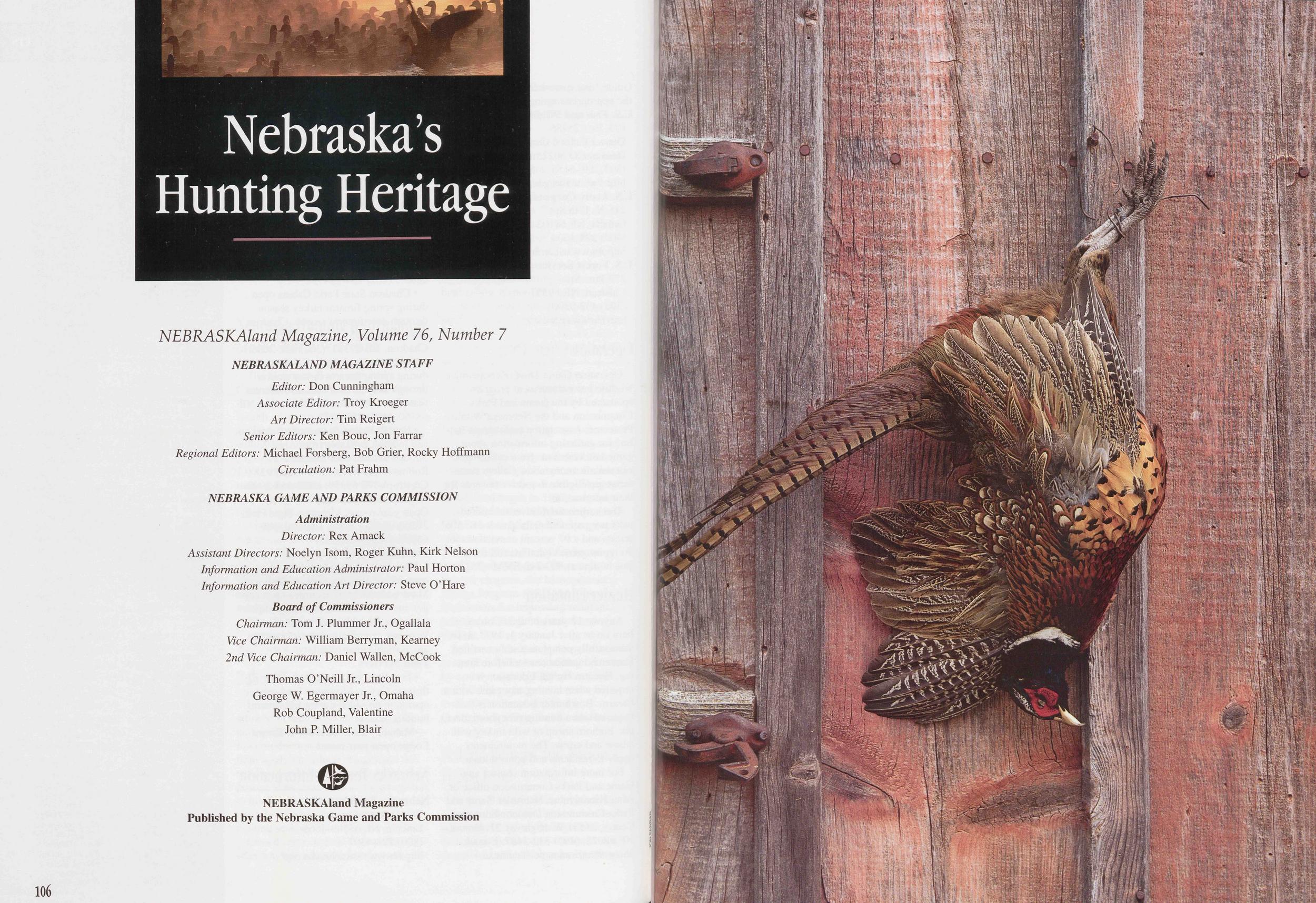
Nebraska's Hunting Heritage
NEBRASKAland Magazine, Volume 76, Number 7 NEBRASKALAND MAGAZINE STAFF Editor: Don Cunningham Associate Editor: Troy Kroeger Art Director: Tim Reigert Senior Editors: Ken Bouc, Jon Farrar Regional Editors: Michael Forsberg, Bob Grier, Rocky Hoffmann Circulation: Pat Frahm NEBRASKA GAME AND PARKS COMMISSION Administration Director: Rex Amack Assistant Directors: Noelyn Isom, Roger Kuhn, Kirk Nelson Information and Education Administrator: Paul Horton Information and Education Art Director: Steve O'Hare Board of Commissioners Chairman: Tom J. Plummer Jr., Ogallala Vice Chairman: William Berryman, Kearney 2nd Vice Chairman: Daniel Wallen, McCook Thomas O'Neill Jr., Lincoln George W. Egermayer Jr., Omaha Rob Coupland, Valentine John P. Miller, Blair NEBRASKAland Magazine Published by the Nebraska Game and Parks Commission 106
Position: 378 (25 views)