Volume 76, Issue 6, 1998
NEBRASKAland
Nebraska Game & Parks Commission July 1993 $2.50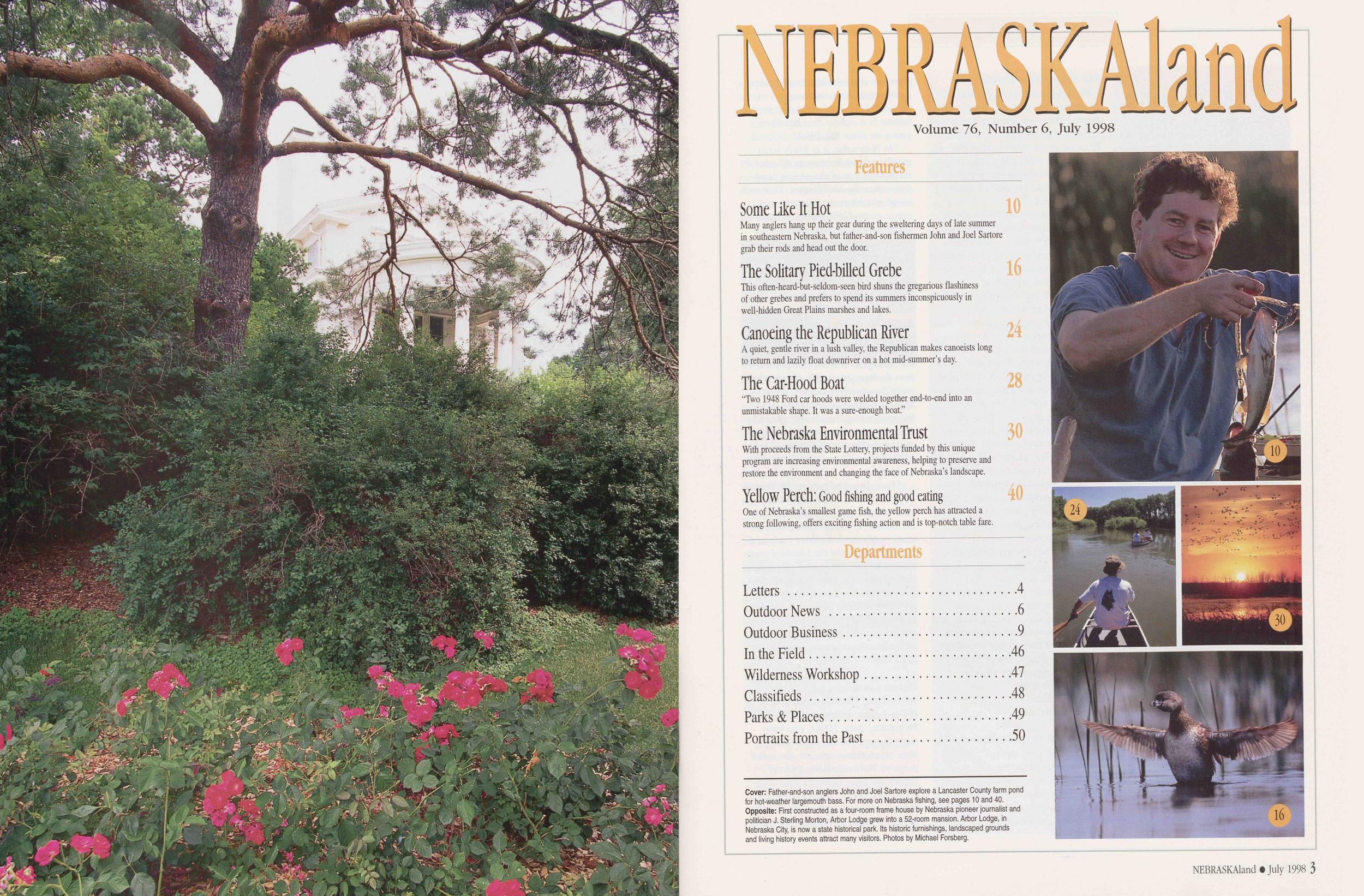
NEBRASKAland
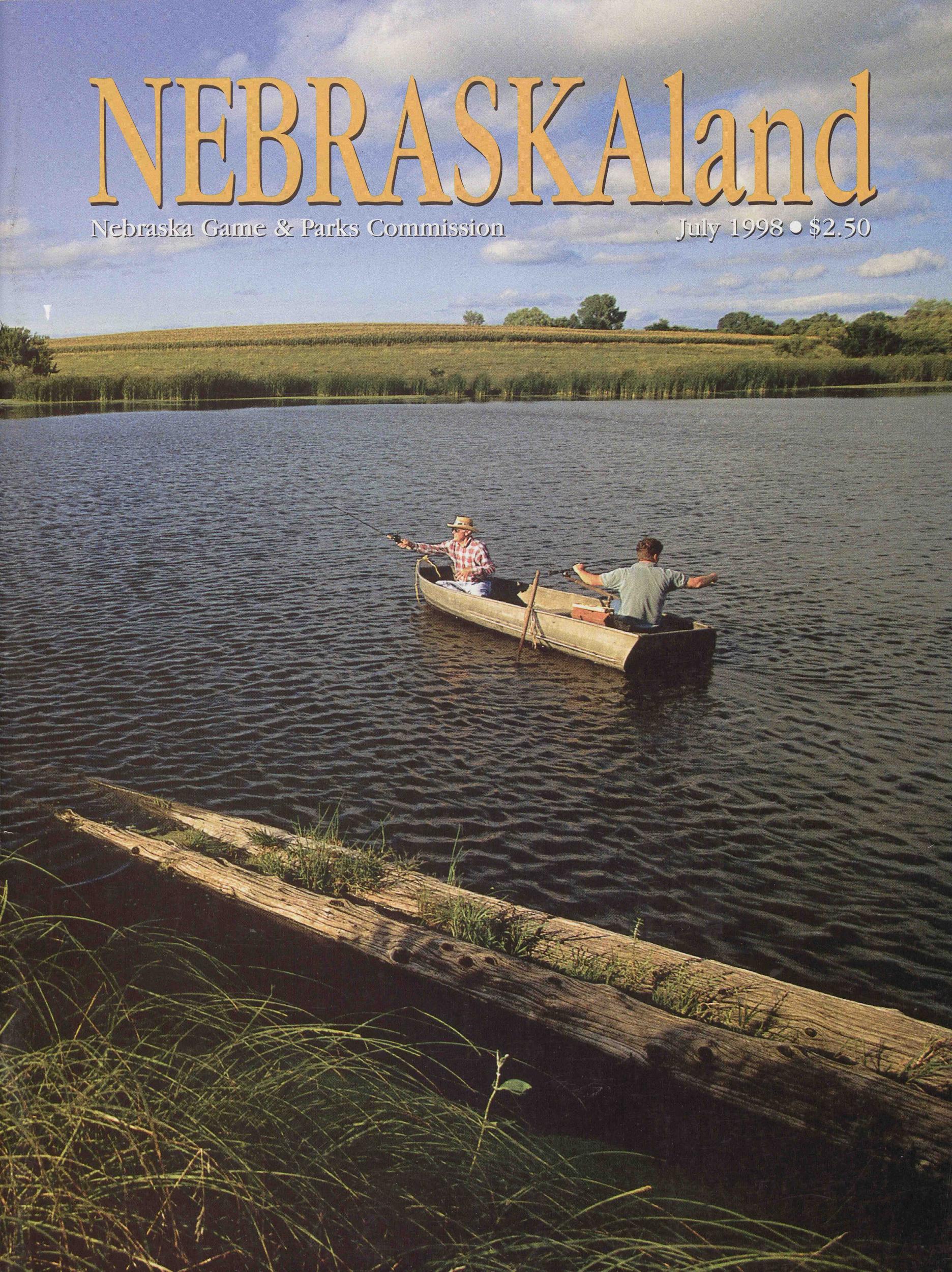
Volume 76, Number 6, July 1998 Features Some Like It Hot 10 Many anglers hang up their gear during the sweltering days of late summer in southeastern Nebraska, but father-and-son fishermen John and Joel Sartore grab their rods and head out the door. The Solitary Pied-billed Grebe 16 This often-heard-but-seldom-seen bird shuns the gregarious flashiness of other grebes and prefers to spend its summers inconspicuously in well-hidden Great Plains marshes and lakes. Canoeing the Republican River 24 A quiet, gentle river in a lush valley, the Republican makes canoeists long to return and lazily float downriver on a hot mid-summer's day. The Car-Hood Boat 28 "Two 1948 Ford car hoods were welded together end-to-end into an unmistakable shape. It was a sure-enough boat." The Nebraska Environmental Trust 30 With proceeds from the State Lottery, projects funded by this unique program are increasing environmental awareness, helping to preserve and restore the environment and changing the face of Nebraska's landscape. Yellow Perch: Good fishing and good eating 40 One of Nebraska's smallest game fish, the yellow perch has attracted a strong following, offers exciting fishing action and is top-notch table fare. Departments Letters 4 Outdoor News 6 Outdoor Business 9 In the Field 46 Wilderness Workshop 47 Classifieds 48 Parks & Places 49 Portraits from the Past 50 Cover: Father-and-son anglers John and Joel Sartore explore a Lancaster County farm pond for hot-weather largemouth bass. For more on Nebraska fishing, see pages 10 and 40. Opposite: First constructed as a four-room frame house by Nebraska pioneer journalist and politician J. Sterling Morton, Arbor Lodge grew into a 52:room mansion. Arbor Lodge, in Nebraska City, is now a state historical park. Its historic furnishings, landscaped grounds and living history events attract many visitors. Photos by Michael Forsberg. NEBRASKAland • July 1998 3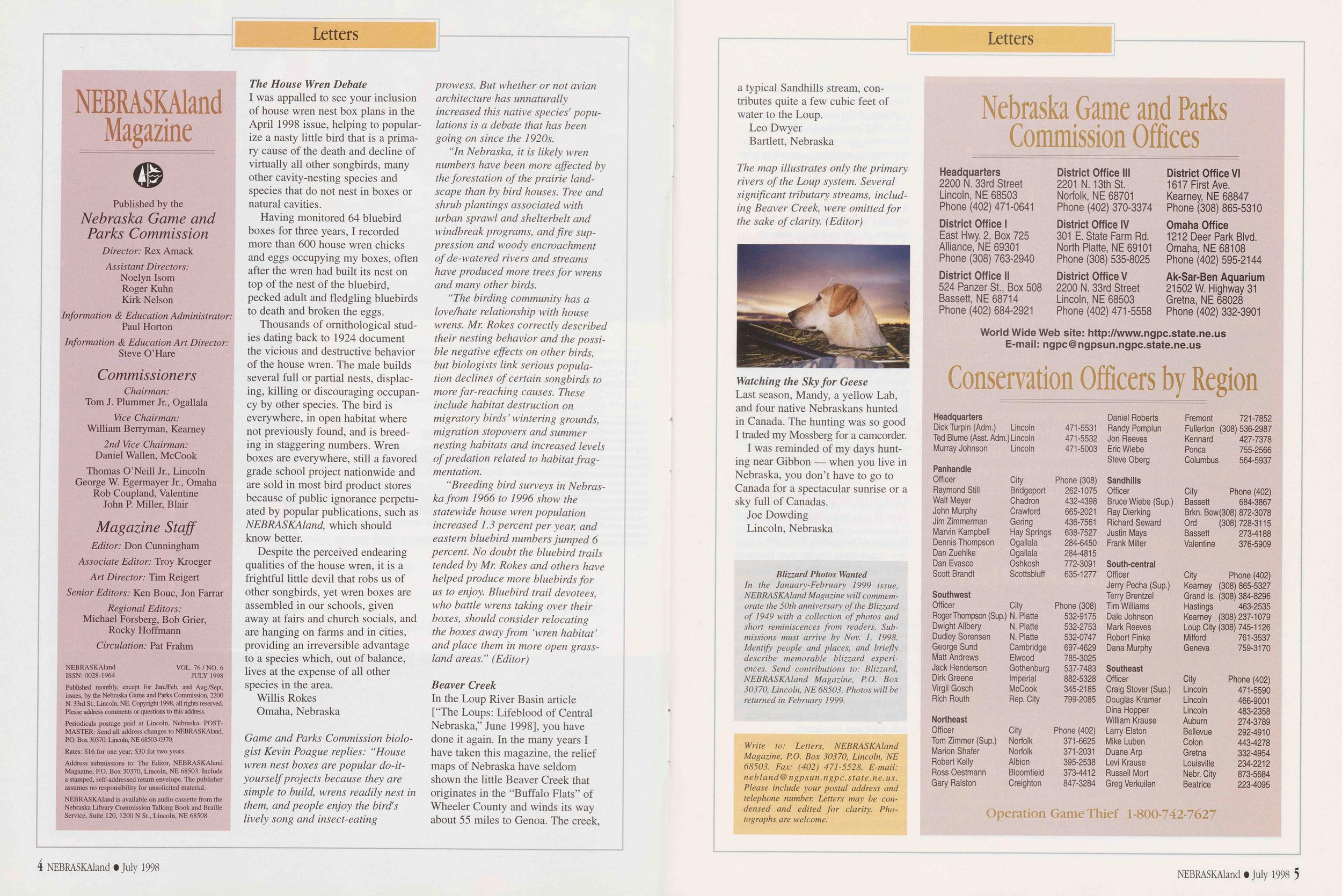
Letters
The House Wren DebateI was appalled to see your inclusion of house wren nest box plans in the April 1998 issue, helping to popularize a nasty little bird that is a primary cause of the death and decline of virtually all other songbirds, many other cavity-nesting species and species that do not nest in boxes or natural cavities.
Having monitored 64 bluebird boxes for three years, I recorded more than 600 house wren chicks and eggs occupying my boxes, often after the wren had built its nest on top of the nest of the bluebird, pecked adult and fledgling bluebirds to death and broken the eggs.
Thousands of ornithological studies dating back to 1924 document the vicious and destructive behavior of the house wren. The male builds several full or partial nests, displacing, killing or discouraging occupancy by other species. The bird is everywhere, in open habitat where not previously found, and is breeding in staggering numbers. Wren boxes are everywhere, still a favored grade school project nationwide and are sold in most bird product stores because of public ignorance perpetuated by popular publications, such as NEBRASKAland, which should know better.
Despite the perceived endearing qualities of the house wren, it is a frightful little devil that robs us of other songbirds, yet wren boxes are assembled in our schools, given away at fairs and church socials, and are hanging on farms and in cities, providing an irreversible advantage to a species which, out of balance, lives at the expense of all other species in the area.
Willis Rokes Omaha, Nebraska Game and Parks Commission biologist Kevin Poague replies: "House wren nest boxes are popular do-it- yourself projects because they are simple to build, wrens readily nest in them, and people enjoy the bird's lively song and insect-eating prowess. But whether or not avian architecture has unnaturally increased this native species' populations is a debate that has been going on since the 1920s. "In Nebraska, it is likely wren numbers have been more affected by the fore station of the prairie landscape than by bird houses. Tree and shrub plantings associated with urban sprawl and shelterbelt and windbreak programs, and fire suppression and woody encroachment of de-watered rivers and streams have produced more trees for wrens and many other birds. "The birding community has a love/hate relationship with house wrens. Mr. Rokes correctly described their nesting behavior and the possible negative effects on other birds, but biologists link serious population declines of certain songbirds to more far-reaching causes. These include habitat destruction on migratory birds' wintering grounds, migration stopovers and summer nesting habitats and increased levels of predation related to habitat fragmentation. "Breeding bird surveys in Nebraska from 1966 to 1996 show the statewide house wren population increased 1.3 percent per year, and eastern bluebird numbers jumped 6 percent. No doubt the bluebird trails tended by Mr. Rokes and others have helped produce more bluebirds for us to enjoy. Bluebird trail devotees, who battle wrens taking over their boxes, should consider relocating the boxes away from 'wren habitat' and place them in more open grassland areas." (Editor) Beaver CreekIn the Loup River Basin article ["The Loups: Lifeblood of Central Nebraska," June 1998], you have done it again. In the many years I have taken this magazine, the relief maps of Nebraska have seldom shown the little Beaver Creek that originates in the "Buffalo Flats" of Wheeler County and winds its way about 55 miles to Genoa. The creek,
4 NEBRASKAland • July 1998 Lettersa typical Sandhills stream, contributes quite a few cubic feet of water to the Loup.
Leo Dwyer Bartlett, Nebraska The map illustrates only the primary rivers of the Loup system. Several significant tributary streams, including Beaver Creek, were omitted for the sake of clarity. (Editor)Last season, Mandy, a yellow Lab, and four native Nebraskans hunted in Canada. The hunting was so good I traded my Mossberg for a camcorder.
I was reminded of my days hunting near Gibbon — when you live in Nebraska, you don't have to go to Canada for a spectacular sunrise or a sky full of Canadas.
Joe Dowding Lincoln, Nebraska Blizzard Photos Wanted In the January-February 1999 issue, NEBRASKAland Magazine will commemorate the 50th anniversary of the Blizzard of 1949 with a collection of photos and short reminiscences from readers. Submissions must arrive by Nov. 1, 1998. Identify people and places, and briefly describe memorable blizzard experiences. Send contributions to: Blizzard, NEBRASKAland Magazine, P.O. Box 30370, Lincoln, NE 68503. Photos will be returned in February 1999. Write to: Letters, NEBRASKAland Magazine, P.O. Box 30370, Lincoln, NE 68503. Fax: (402) 471-5528. E-mail: nebland@ngp sun. ngpc. state, ne. us. Please include your postal address and telephone number. Letters may be condensed and edited for clarity. Photographs are welcome.
Outdoor News
Hunters Have Second Chance for Firearm PermitsHunters may contact the Game and Parks Commission beginning July 14 to learn how many firearm permits will be available for hunting deer, antelope and elk during the second application period.
The Commission will accept second period applications for deer and antelope permits beginning July 20.
The second period is open on a first-come, first-served basis to residents who have not previously applied or were unsuccessful in the earlier drawing. It is also open to nonresidents.
Those who made unsuccessful bids for permits in the first period will be notified by July 13.
A third application period opens Sept. 8. Application can be made for a second permit in any unfilled firearm units and/or for a second permit in the Blue Late or Fontenelle units.
Hunters are limited to two permits, total, for the firearm, archery and muzzleloader seasons, and two permits for Blue Late or Fontenelle.
Complete information on big game hunts is available at any commission office or retail outlet that sells fishing and hunting licenses.
Gov. Ben Nelson caught several walleyes on Merritt Reservoir while on a fishing trip designed to "hook" Nebraskans and anglers from neighboring states on fishing in the Cornhusker state.
Many of the state's lakes, such as Lake McConaughy and Merritt Reservoir, give anglers the unusual opportunity to pursue several species of fish in a single outing.
Nelson's party, including Game and Parks Commission Director Rex Amack and Omaha World-Herald reporter Larry Porter, bagged five species of fish including several "keeper" walleyes.
"If you're a Nebraskan, no matter where you live, you're near some good fishing," Nelson said. "If you're one of our neighbors, you're less than a day away from some of the best and most interesting fishing to be found."
Nelson also noted that sport fishing gives a boost to the state's economy. A recent study funded by the U.S. Fish and Wildlife Service showed that anglers spent more than $235.8 million for goods and services in 1996. Those expenditures translated into more than $117.6 million in earnings for Nebraskans.
Free Hip Registration Begins For Migratory Bird HuntersHunters of migratory birds can begin free registration for the new Harvest Information Program on July 1.
Better known as HIP, the new federally-mandated survey program will help state and federal wildlife managers better estimate the numbers of migratory birds harvested throughout the nation each year.
All hunters of migratory birds must register and get a HIP number before hunting in the 1998 season. The program will help chart populations of doves, ducks, geese, snipe, rail, coot and woodcock.
On July 1, the Commission's Wildlife Division will activate a toll-free number to handle telephone registration. The number, available 24 hours, is: 1-800-WETLAND (938-5263). Hunters soon will be able to register online. For more information
6 NEBRASKAland • July 1998 Outdoor Newson the Harvest Information Program, visit the Commission's web site: http://www.ngpc.state.ne.us. From the home page, click on "Hunting Information," then "Harvest Information Program." Registration forms also will be available at all Commission offices.
Funding for Nebraska Trails Project Gets a Big BoostAn additional $250,000 in federal matching funds for trail development will be available to Nebraska this year.
The National Recreational Trail (NRT) fund will make the money available through an 80/20 matching formula. The state previously had expected $91,000 to be available through a 50/50 match plan.
The increase will make funds available to assist with trail development by local, regional and state governments.
NRT funds are administered by the Nebraska Game and Parks Commission.
The Board of Commissioners plans to review projects approved by the NRT advisory committee at its August meeting. Projects endorsed by the Commission will be forwarded to the Federal Highway Administration for final authorization.
Information and applications can be obtained by writing to: NRT, Nebraska Game and Parks Commission, 2200 N. 33rd St., Lincoln, NE 68503-0370. Information also can be obtained by calling (402) 471-5425 or 471-5424. Applications for projects in the 1998 fiscal year must be postmarked or delivered in person by 5 p.m. July 7.
Commission Considers Goose Unit Boundary ChangesThe Game and Parks Commission is considering boundary changes that could mean better opportunities for Central Unit Canada goose hunters.
Outdoor News
Officer's Notebook
Ethics on the WaterHave you ever considered your actions and what effect they will have on others? As a conservation officer, I work with a diverse public. This is especially true in spring and summer when I am working around large lakes and reservoirs. As one who desires to see things operate in an orderly and safe manner, it is troubling when conflicts between recreational water users arise.
To help illustrate this, take for example the boater pulling a water skier near the shore, where a bank angler is seated with fishing lines out. As the boat and skier go by, lines are struck or cut and heavy waves tip over the minnow bucket.
Another scenario could occur when a swimmer or an angler anchored or drifting out on the lake is surrounded by personal watercraft racing around and presenting an unwanted exhibition.
Of course not all boat operators, waterskiers and personal watercraft operators are irresponsible, and they, too, should have as much opportunity to enjoy their forms of recreation as do swimmers and anglers. But we need to remember that some people can't afford boats or personal watercraft, or choose not to own them, and are limited to shoreline activities. Those with boats or personal watercraft have less restricted access to the water and could help avoid conflicts by keeping some distance from shoreline users.
What is important to remember is one's behavior toward others. How close are you to them? Will your speed and the waves your activity produces cause problems? How much noise is your vessel producing? Will you be creating an unsafe condition for yourself or others?
Some people go to the lake for relaxation, peace and quiet, and others go for what they consider to be a "good time" — but depending on their actions, that good time might not be so good for others.
When you go to the lake this year, we hope you will have a safe and enjoyable visit.
— Conservation Officer Dirk Greene, Imperial Legal Reminders• It is illegal to consume alcoholic beverages on Game and Parks Commission areas (lake surfaces included) unless otherwise authorized by law. It is illegal to operate a motorboat with more than 0.10 percent blood-alcohol concentration. The penalty for boating under the influence of alcohol or drugs can range up to a $1,000 fine and up to six months in prison.
• Children younger than 14 may not operate motorboats.
• Speeds exceeding 5 miles per hour are illegal within 30 yards of any vessel, harbor, marina, landing pier, anchorage or bathing beach. Speed must be reduced so that wash or wake will not cause discomfort, hazard or damage to other people or vessels.
• No person shall operate vessels or water ski in a reckless or negligent manner so as to cause discomfort, hazard or damage to the person or property of others.
• All vessels are responsible for any discomfort or injury to other persons or damage to vessels caused by their wake.
• Swimmers have the right of way at all times over all vessels, whether powered or not. Nonpowered or anchored vessels have the right of way over powered vessels.
If public response to the proposal is positive, the Commission could seek approval from the Central Fly way Council and the U.S. Fish and Wildlife Service.
The Commission also will consider dividing the Central Unit, consisting of all or part of 38 counties, into north and south districts, which could have different hunting seasons designed to provide the best opportunities for harvesting dark geese.
The boundary adjustment would give hunters a chance to take birds from a relatively new wintering population of Canada geese in the Central Unit.
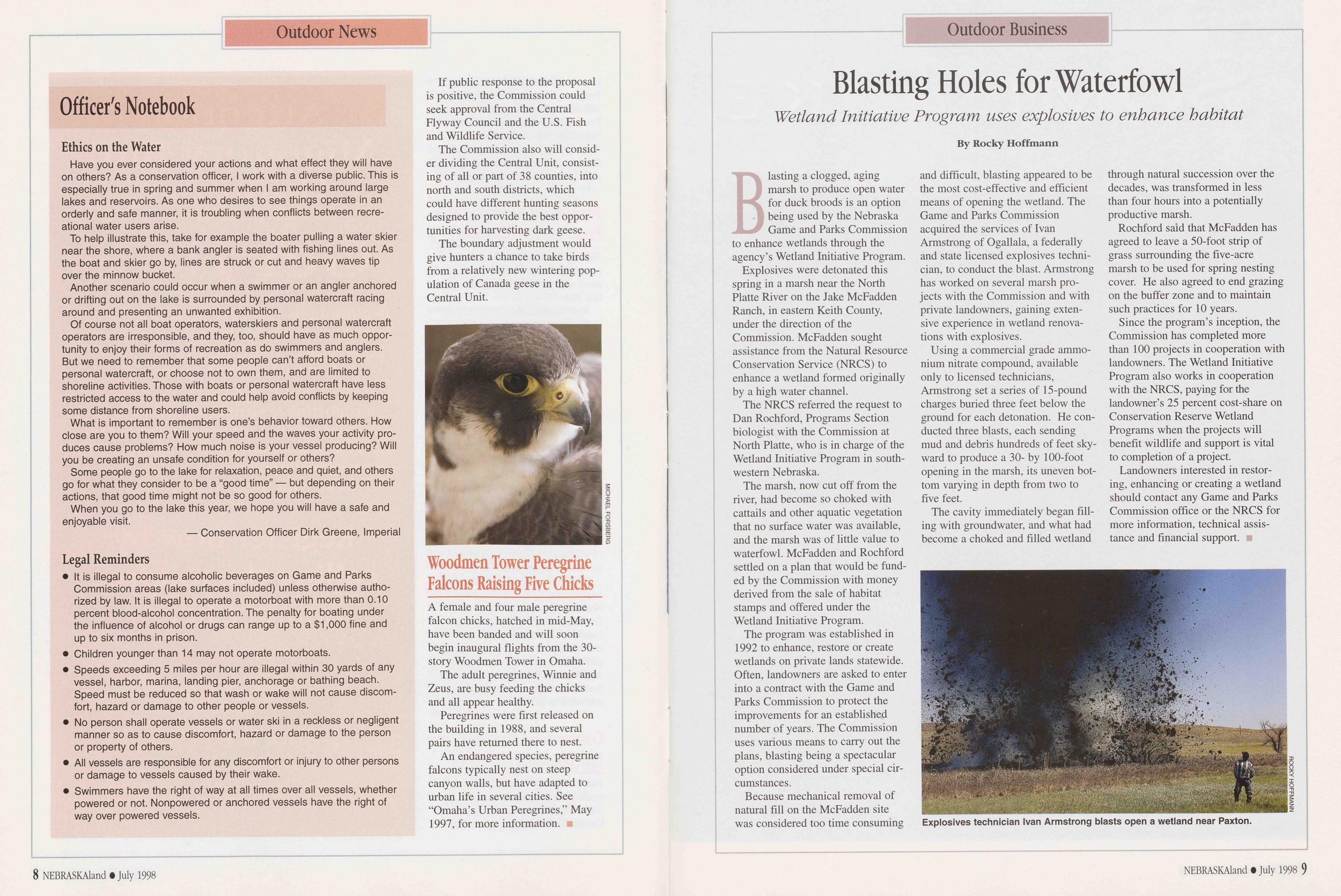
A female and four male peregrine falcon chicks, hatched in mid-May, have been banded and will soon begin inaugural flights from the 30-story Woodmen Tower in Omaha.
The adult peregrines, Winnie and Zeus, are busy feeding the chicks and all appear healthy.
Peregrines were first released on the building in 1988, and several pairs have returned there to nest.
An endangered species, peregrine falcons typically nest on steep canyon walls, but have adapted to urban life in several cities. See "Omaha's Urban Peregrines," May 1997, for more information.
8 NEBRASKAland • July 1998Outdoor Business
Blasting Holes for Waterfowl
Wetland Initiative Program uses explosives to enhance habitat By Rocky HoffmannBlasting a clogged, aging marsh to produce open water for duck broods is an option being used by the Nebraska Game and Parks Corrrmission to enhance wetlands through the agency's Wetland Initiative Program.
Explosives were detonated this spring in a marsh near the North Platte River on the Jake McFadden Ranch, in eastern Keith County, under the direction of the Commission. McFadden sought assistance from the Natural Resource Conservation Service (NRCS) to enhance a wetland formed originally by a high water channel.
The NRCS referred the request to Dan Rochford, Programs Section biologist with the Commission at North Platte, who is in charge of the Wetland Initiative Program in southwestern Nebraska.
The marsh, now cut off from the river, had become so choked with cattails and other aquatic vegetation that no surface water was available, and the marsh was of little value to waterfowl. McFadden and Rochford settled on a plan that would be funded by the Commission with money derived from the sale of habitat stamps and offered under the Wetland Initiative Program.
The program was established in 1992 to enhance, restore or create wetlands on private lands statewide. Often, landowners are asked to enter into a contract with the Game and Parks Commission to protect the improvements for an established number of years. The Commission uses various means to carry out the plans, blasting being a spectacular option considered under special circumstances.
Because mechanical removal of natural fill on the McFadden site was considered too time consuming and difficult, blasting appeared to be the most cost-effective and efficient means of opening the wetland. The Game and Parks Commission acquired the services of Ivan Armstrong of Ogallala, a federally and state licensed explosives technician, to conduct the blast. Armstrong has worked on several marsh projects with the Commission and with private landowners, gaining extensive experience in wetland renovations with explosives.
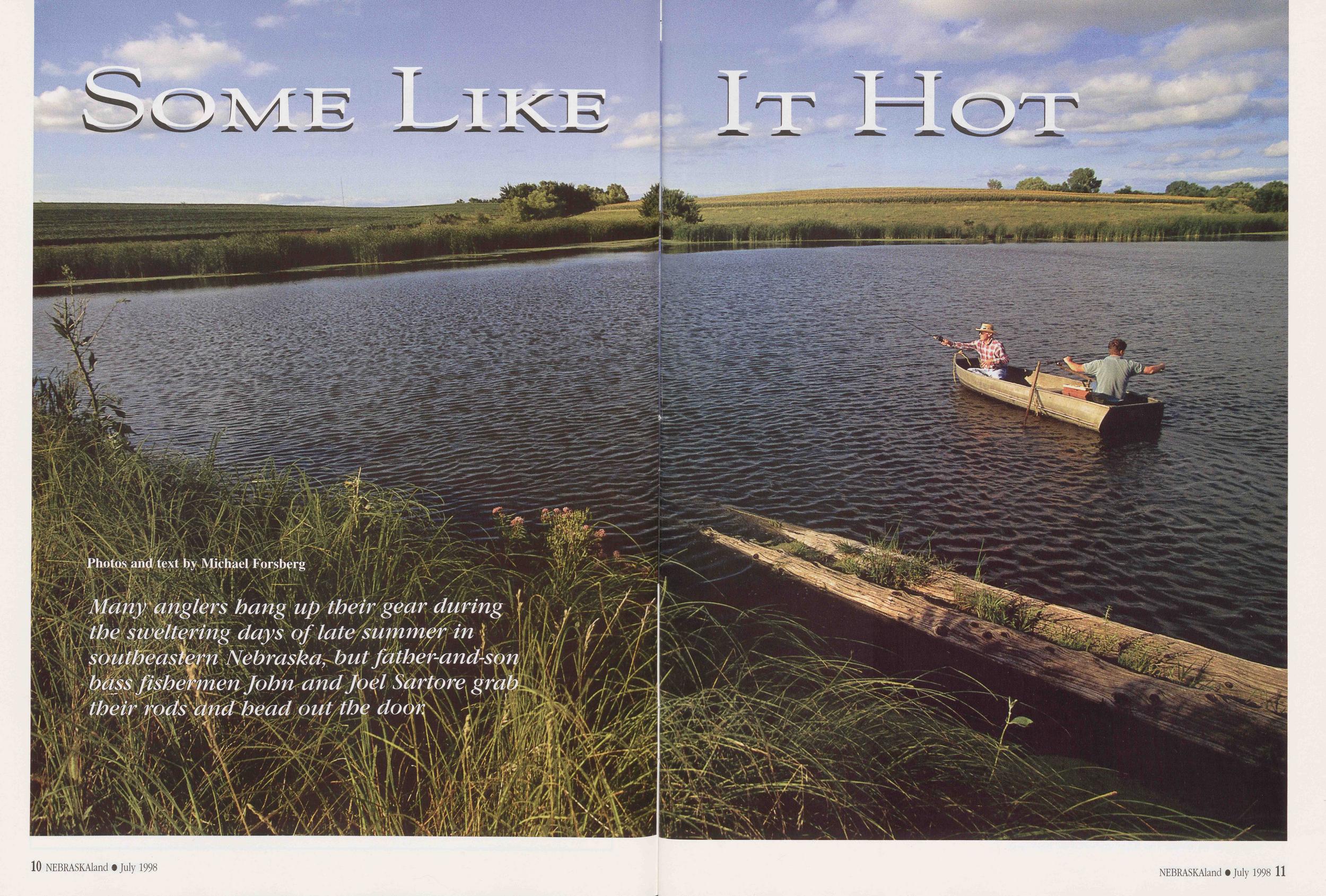
Using a commercial grade ammonium nitrate compound, available only to licensed technicians, Armstrong set a series of 15-pound charges buried three feet below the ground for each detonation. He conducted three blasts, each sending mud and debris hundreds of feet skyward to produce a 30- by 100-foot opening in the marsh, its uneven bottom varying in depth from two to five feet.
The cavity immediately began filling with groundwater, and what had become a choked and filled wetland through natural succession over the decades, was transformed in less than four hours into a potentially productive marsh.
Rochford said that McFadden has agreed to leave a 50-foot strip of grass surrounding the five-acre marsh to be used for spring nesting cover. He also agreed to end grazing on the buffer zone and to maintain such practices for 10 years.
Since the program's inception, the Commission has completed more than 100 projects in cooperation with landowners. The Wetland Initiative Program also works in cooperation with the NRCS, paying for the landowner's 25 percent cost-share on Conservation Reserve Wetland Programs when the projects will benefit wildlife and support is vital to completion of a project.
Landowners interested in restoring, enhancing or creating a wetland should contact any Game and Parks Commission office or the NRCS for more information, technical assistance and financial support.
Explosives technician Ivan Armstrong blasts open a wetland near Paxton.
SOME LIKE IT HOT
Photos and text by Michael Forsberg Many anglers hang up their gear during the sweltering days of late sumnerr in southeastern Nebraska, but father-and-son Bass fishermen John and Joel Sartore grab their rods and bead out the door. 10 NEBRASKAland • July 1998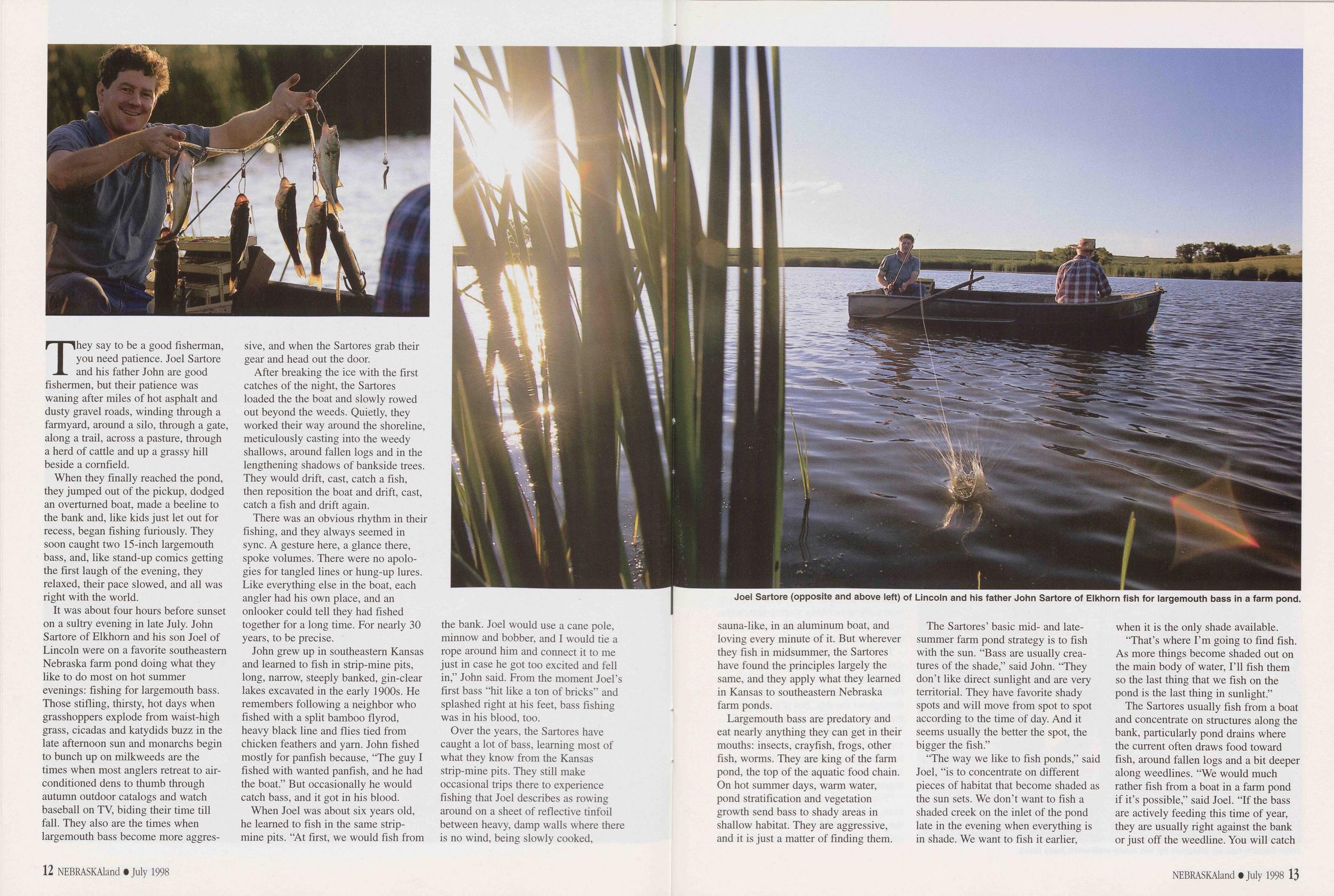
They say to be a good fisherman, you need patience. Joel Sartore and his father John are good fishermen, but their patience was waning after miles of hot asphalt and dusty gravel roads, winding through a farmyard, around a silo, through a gate, along a trail, across a pasture, grassy hill beside a cornfield.
When they finally reached the pond, they jumped out of the pickup, dodged an overturned boat, made a beeline to the bank and, like kids just let out for recess, began fishing furiously. They soon caught two 15-inch largemouth bass, and, like stand-up comics getting the first laugh of the evening, they relaxed, their pace slowed, and all was right with the world.
It was about four hours before sunset on a sultry evening in late July. John Sartore of Elkhorn and his son Joel of Lincoln were on a favorite southeastern Nebraska farm pond doing what they like to do most on hot summer evenings: fishing for largemouth bass. Those stifling, thirsty, hot days when grasshoppers explode from waist-high grass, cicadas and katydids buzz in the late afternoon sun and monarchs begin to bunch up on milkweeds are the times when most anglers retreat to air-conditioned dens to thumb through autumn outdoor catalogs and watch baseball on TV, biding their time till fall. They also are the times when largemouth bass become more aggressive, and when the Sartores grab their gear and head out the door.
After breaking the ice with the first catches of the night, the Sartores loaded the the boat and slowly rowed out beyond the weeds. Quietly, they worked their way around the shoreline, meticulously casting into the weedy shallows, around fallen logs and in the lengthening shadows of bankside trees. They would drift, cast, catch a fish, then reposition the boat and drift, cast, catch a fish and drift again.
There was an obvious rhythm in their fishing, and they always seemed in sync. A gesture here, a glance there, spoke volumes. There were no apologies for tangled lines or hung-up lures. Like everything else in the boat, each angler had his own place, and an onlooker could tell they had fished together for a long time. For nearly 30 years, to be precise.
John grew up in southeastern Kansas and learned to fish in strip-mine pits, long, narrow, steeply banked, gin-clear lakes excavated in the early 1900s. He remembers following a neighbor who fished with a split bamboo flyrod, heavy black line and flies tied from chicken feathers and yarn. John fished mostly for panfish because, "The guy I fished with wanted panfish, and he had the boat." But occasionally he would catch bass, and it got in his blood.
When Joel was about six years old, he learned to fish in the same strip-mine pits. "At first, we would fish from
Joel Sartore (opposite and above left) of Lincoln and his father John Sartore of Elkhorn fish for largemouth bass in a farm pond.
the bank. Joel would use a cane pole, minnow and bobber, and I would tie a rope around him and connect it to me just in case he got too excited and fell in," John said. From the moment Joel's first bass "hit like a ton of bricks" and splashed right at his feet, bass fishing was in his blood, too.
Over the years, the Sartores have caught a lot of bass, learning most of what they know from the Kansas strip-mine pits. They still make occasional trips there to experience fishing that Joel describes as rowing around on a sheet of reflective tinfoil between heavy, damp walls where there is no wind, being slowly cooked,
12 NEBRASKAland • July 1998sauna-like, in an aluminum boat, and loving every minute of it. But wherever they fish in midsummer, the Sartores have found the principles largely the same, and they apply what they learned in Kansas to southeastern Nebraska farm ponds.
Largemouth bass are predatory and eat nearly anything they can get in their mouths: insects, crayfish, frogs, other fish, worms. They are king of the farm pond, the top of the aquatic food chain. On hot summer days, warm water, pond stratification and vegetation growth send bass to shady areas in shallow habitat. They are aggressive, and it is just a matter of finding them.
The Sartores' basic mid- and late-summer farm pond strategy is to fish with the sun. "Bass are usually creatures of the shade," said John. "They don't like direct sunlight and are very territorial. They have favorite shady spots and will move from spot to spot according to the time of day. And it seems usually the better the spot, the bigger the fish."
"The way we like to fish ponds," said Joel, "is to concentrate on different pieces of habitat that become shaded as the sun sets. We don't want to fish a shaded creek on the inlet of the pond late in the evening when everything is in shade. We want to fish it earlier, when it is the only shade available.
"That's where I'm going to find fish. As more things become shaded out on the main body of water, I'll fish them so the last thing that we fish on the pond is the last thing in sunlight."
The Sartores usually fish from a boat and concentrate on structures along the bank, particularly pond drains where the current often draws food toward fish, around fallen logs and a bit deeper along weedlines. "We would much rather fish from a boat in a farm pond if it's possible," said Joel. "If the bass are actively feeding this time of year, they are usually right against the bank or just off the weedline. You will catch
NEBRASKAland • July 1998 13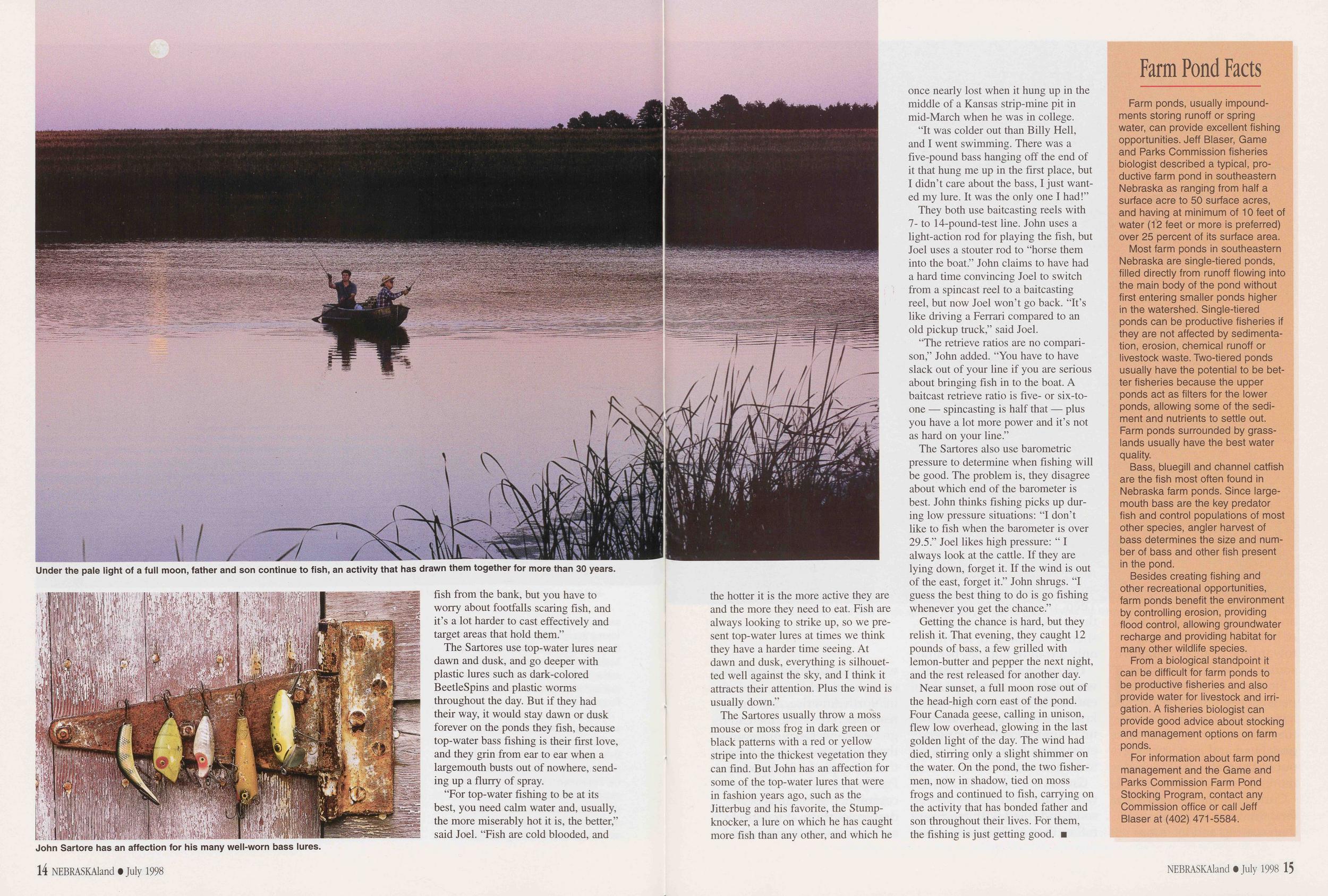
Under the pale light of a full moon, father and son continue to fish, an activity that has drawn them together for more than 30 years.
John Sartore has an affection for his many well-worn bass lures.
fish from the bank, but you have to worry about footfalls scaring fish, and it's a lot harder to cast effectively and target areas that hold them."
The Sartores use top-water lures near dawn and dusk, and go deeper with plastic lures such as dark-colored BeetleSpins and plastic worms throughout the day. But if they had their way, it would stay dawn or dusk forever on the ponds they fish, because top-water bass fishing is their first love, and they grin from ear to ear when a largemouth busts out of nowhere, sending up a flurry of spray.
"For top-water fishing to be at its best, you need calm water and, usually, the more miserably hot it is, the better," said Joel. "Fish are cold blooded, and
14 NEBRASKAland • July 1998the hotter it is the more active they are and the more they need to eat. Fish are always looking to strike up, so we present top-water lures at times we think they have a harder time seeing. At dawn and dusk, everything is silhouetted well against the sky, and I think it attracts their attention. Plus the wind is usually down."
The Sartores usually throw a moss mouse or moss frog in dark green or black patterns with a red or yellow stripe into the thickest vegetation they can find. But John has an affection for some of the top-water lures that were in fashion years ago, such as the Jitterbug and his favorite, the Stump-knocker, a lure on which he has caught more fish than any other, and which he once nearly lost when it hung up in the middle of a Kansas strip-mine pit in mid-March when he was in college.
"It was colder out than Billy Hell, and I went swimming. There was a five-pound bass hanging off the end of it that hung me up in the first place, but I didn't care about the bass, I just wanted my lure. It was the only one I had!"
They both use baitcasting reels with 7- to 14-pound-test line. John uses a light-action rod for playing the fish, but Joel uses a stouter rod to "horse them into the boat." John claims to have had a hard time convincing Joel to switch from a spincast reel to a baitcasting reel, but now Joel won't go back. "It's like driving a Ferrari compared to an old pickup truck," said Joel.
"The retrieve ratios are no comparison," John added. "You have to have slack out of your line if you are serious about bringing fish in to the boat. A baitcast retrieve ratio is five- or six-to-one — spincasting is half that — plus you have a lot more power and it's not as hard on your line."
The Sartores also use barometric pressure to determine when fishing will be good. The problem is, they disagree about which end of the barometer is best. John thinks fishing picks up during low pressure situations: "I don't like to fish when the barometer is over 29.5." Joel likes high pressure: " I always look at the cattle. If they are lying down, forget it. If the wind is out of the east, forget it." John shrugs. "I guess the best thing to do is go fishing whenever you get the chance."
Getting the chance is hard, but they relish it. That evening, they caught 12 pounds of bass, a few grilled with lemon-butter and pepper the next night, and the rest released for another day.
Near sunset, a full moon rose out of the head-high corn east of the pond. Four Canada geese, calling in unison, flew low overhead, glowing in the last golden light of the day. The wind had died, stirring only a slight shimmer on the water. On the pond, the two fishermen, now in shadow, tied on moss frogs and continued to fish, carrying on the activity that has bonded father and son throughout their lives. For them, the fishing is just getting good.
Farm Pond Facts
Farm ponds, usually Impoundments storing runoff or spring water, can provide excellent fishing opportunities. Jeff Blaser, Game and Parks Commission fisheries biologist described a typical, productive farm pond in southeastern Nebraska as ranging from half a surface acre to 50 surface acres, and having at minimum of 10 feet of water (12 feet or more is preferred) over 25 percent of its surface area.
Most farm ponds in southeastern Nebraska are single-tiered ponds, filled directly from runoff flowing into the main body of the pond without first entering smaller ponds higher in the watershed. Single-tiered ponds can be productive fisheries if they are not affected by sedimentation, erosion, chemical runoff or livestock waste. Two-tiered ponds usually have the potential to be better fisheries because the upper ponds act as filters for the lower ponds, allowing some of the sediment and nutrients to settle out. Farm ponds surrounded by grasslands usually have the best water quality.
Bass, bluegill and channel catfish are the fish most often found in Nebraska farm ponds. Since largemouth bass are the key predator fish and control populations of most other species, angler harvest of bass determines the size and number of bass and other fish present in the pond.
Besides creating fishing and other recreational opportunities, farm ponds benefit the environment by controlling erosion, providing flood control, allowing groundwater recharge and providing habitat for many other wildlife species.
From a biological standpoint it can be difficult for farm ponds to be productive fisheries and also provide water for livestock and irrigation. A fisheries biologist can provide good advice about stocking and management options on farm ponds.
For information about farm pond management and the Game and Parks Commission Farm Pond Stocking Program, contact any Commission office or call Jeff Blaser at (402) 471-5584.
NEBRASKAland • July 1998 15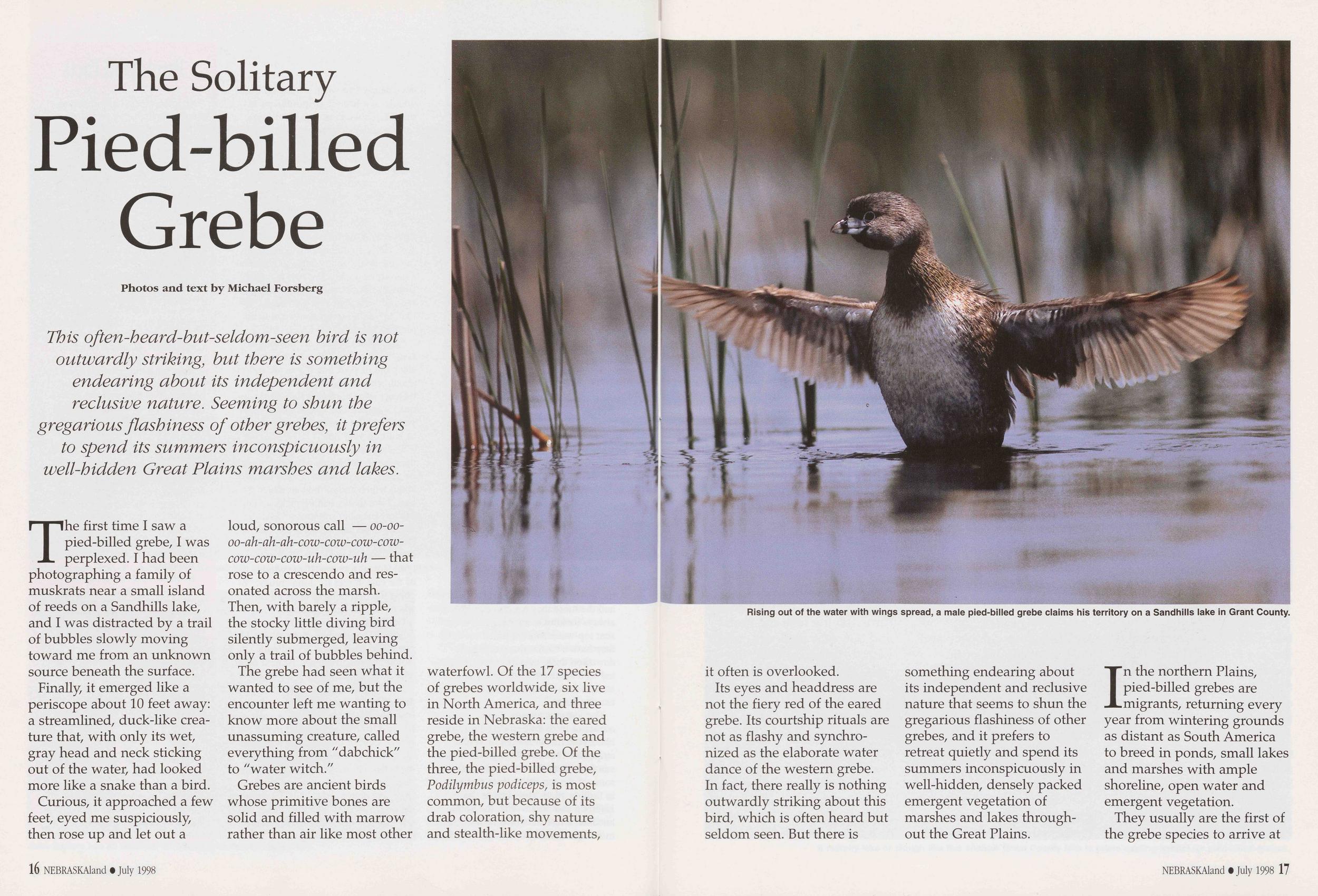
The Solitary Pied-billed Grebe
Photos and text by Michael Forsberg This often-heard-but-seldom-seen bird is not outwardly striking, but there is something endearing about its independent and reclusive nature. Seeming to shun the gregarious flashiness of other grebes, it prefers to spend its summers inconspicuously in well-hidden Great Plains marshes and lakes.The first time I saw a pied-billed grebe, I was perplexed. I had been photographing a family of muskrats near a small island of reeds on a Sandhills lake, and I was distracted by a trail of bubbles slowly moving toward me from an unknown source beneath the surface.
Finally, it emerged like a periscope about 10 feet away: a streamlined, duck-like creature that, with only its wet, gray head and neck sticking out of the water, had looked more like a snake than a bird.
Curious, it approached a few feet, eyed me suspiciously, then rose up and let out a loud, sonorous call — oo-oo- oo-ah-ah-ah-cow-cow-cow-cow- cow-cow-cow-uh-cow-uh — that rose to a crescendo and resonated across the marsh. Then, with barely a ripple, the stocky little diving bird silently submerged, leaving only a trail of bubbles behind.
The grebe had seen what it wanted to see of me, but the encounter left me wanting to know more about the small unassuming creature, called everything from "dabchick" to "water witch."
Grebes are ancient birds whose primitive bones are solid and filled with marrow rather than air like most other waterfowl. Of the 17 species of grebes worldwide, six live in North America, and three reside in Nebraska: the eared grebe, the western grebe and the pied-billed grebe. Of the three, the pied-billed grebe, Podilymbus podiceps, is most common, but because of its drab coloration, shy nature and stealth-like movements,
16 NEBRASKAland • July 1998Rising out of the water with wings spread, a male pied-billed grebe claims his territory on a Sandhills lake in Grant County.
it often is overlooked.
Its eyes and headdress are not the fiery red of the eared grebe. Its courtship rituals are not as flashy and synchronized as the elaborate water dance of the western grebe. In fact, there really is nothing outwardly striking about this bird, which is often heard but seldom seen. But there is something endearing about its independent and reclusive nature that seems to shun the gregarious flashiness of other grebes, and it prefers to retreat quietly and spend its summers inconspicuously in well-hidden, densely packed emergent vegetation of marshes and lakes throughout the Great Plains. In the northern Plains, pied-billed grebes are migrants, returning every year from wintering grounds as distant as South America to breed in ponds, small lakes and marshes with ample shoreline, open water and emergent vegetation.
They usually are the first of the grebe species to arrive at
NEBRASKAland • July 1998 17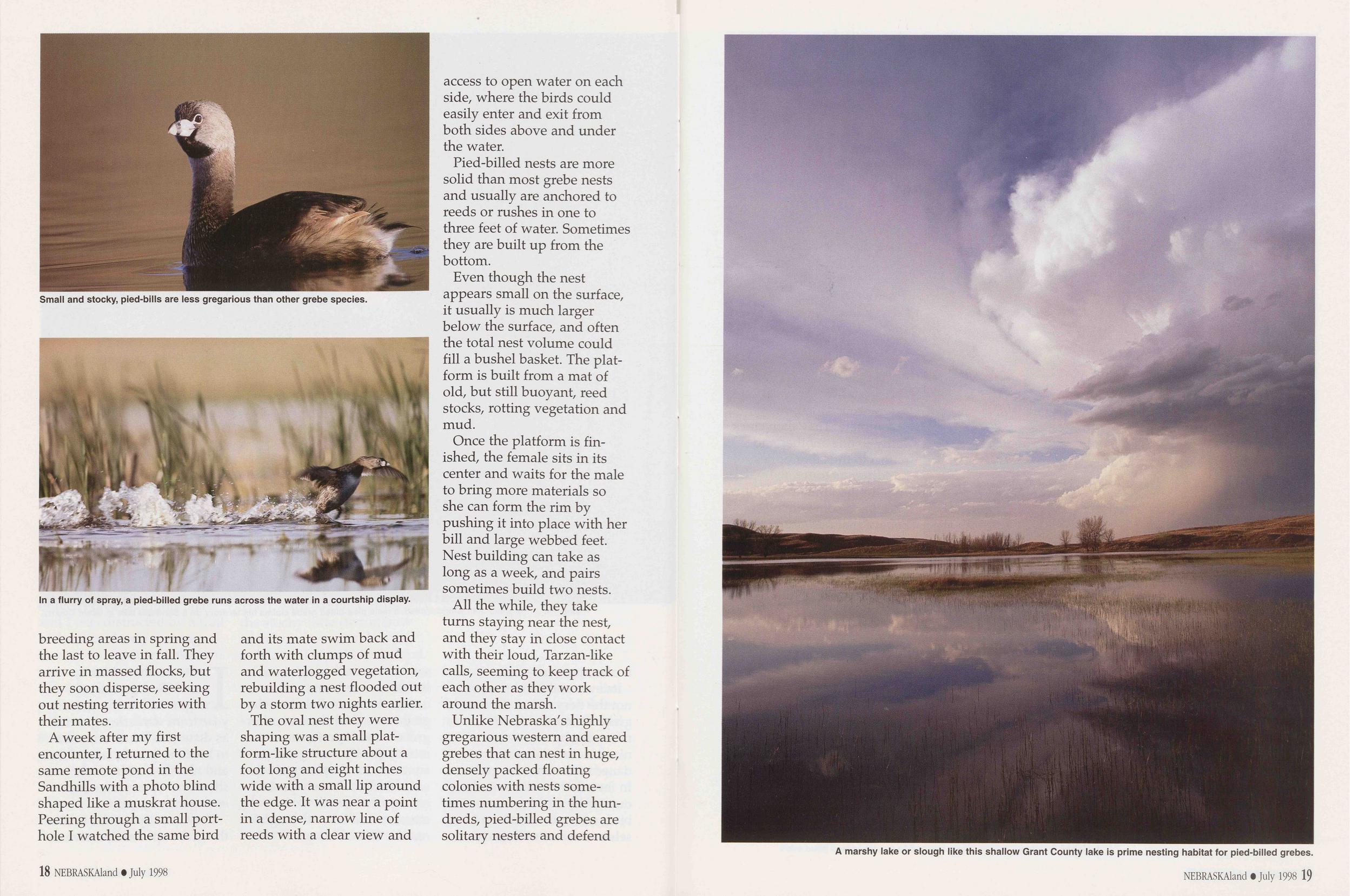
Small and stocky, pied-bills are less gregarious than other grebe species.
In a flurry of spray, a pied-billed grebe runs across the water in a courtship display.
breeding areas in spring and the last to leave in fall. They arrive in massed flocks, but they soon disperse, seeking out nesting territories with their mates.
A week after my first encounter, I returned to the same remote pond in the Sandhills with a photo blind shaped like a muskrat house. Peering through a small porthole I watched the same bird and its mate swim back and forth with clumps of mud and waterlogged vegetation, rebuilding a nest flooded out by a storm two nights earlier.
The oval nest they were shaping was a small plat-form-like structure about a foot long and eight inches wide with a small lip around the edge. It was near a point in a dense, narrow line of reeds with a clear view and access to open water on each side, where the birds could easily enter and exit from both sides above and under the water.
Pied-billed nests are more solid than most grebe nests and usually are anchored to reeds or rushes in one to three feet of water. Sometimes they are built up from the bottom.
Even though the nest appears small on the surface, it usually is much larger below the surface, and often the total nest volume could fill a bushel basket. The platform is built from a mat of old, but still buoyant, reed stocks, rotting vegetation and mud.
Once the platform is finished, the female sits in its center and waits for the male to bring more materials so she can form the rim by pushing it into place with her bill and large webbed feet. Nest building can take as long as a week, and pairs sometimes build two nests.
All the while, they take turns staying near the nest, and they stay in close contact with their loud, Tarzan-like calls, seeming to keep track of each other as they work around the marsh.
Unlike Nebraska's highly gregarious western and eared grebes that can nest in huge, densely packed floating colonies with nests sometimes numbering in the hundreds, pied-billed grebes are solitary nesters and defend
18 NEBRASKAland • July 1998A marshy lake or slough like this shallow Grant County lake is prime nesting habitat for pied-billed grebes.
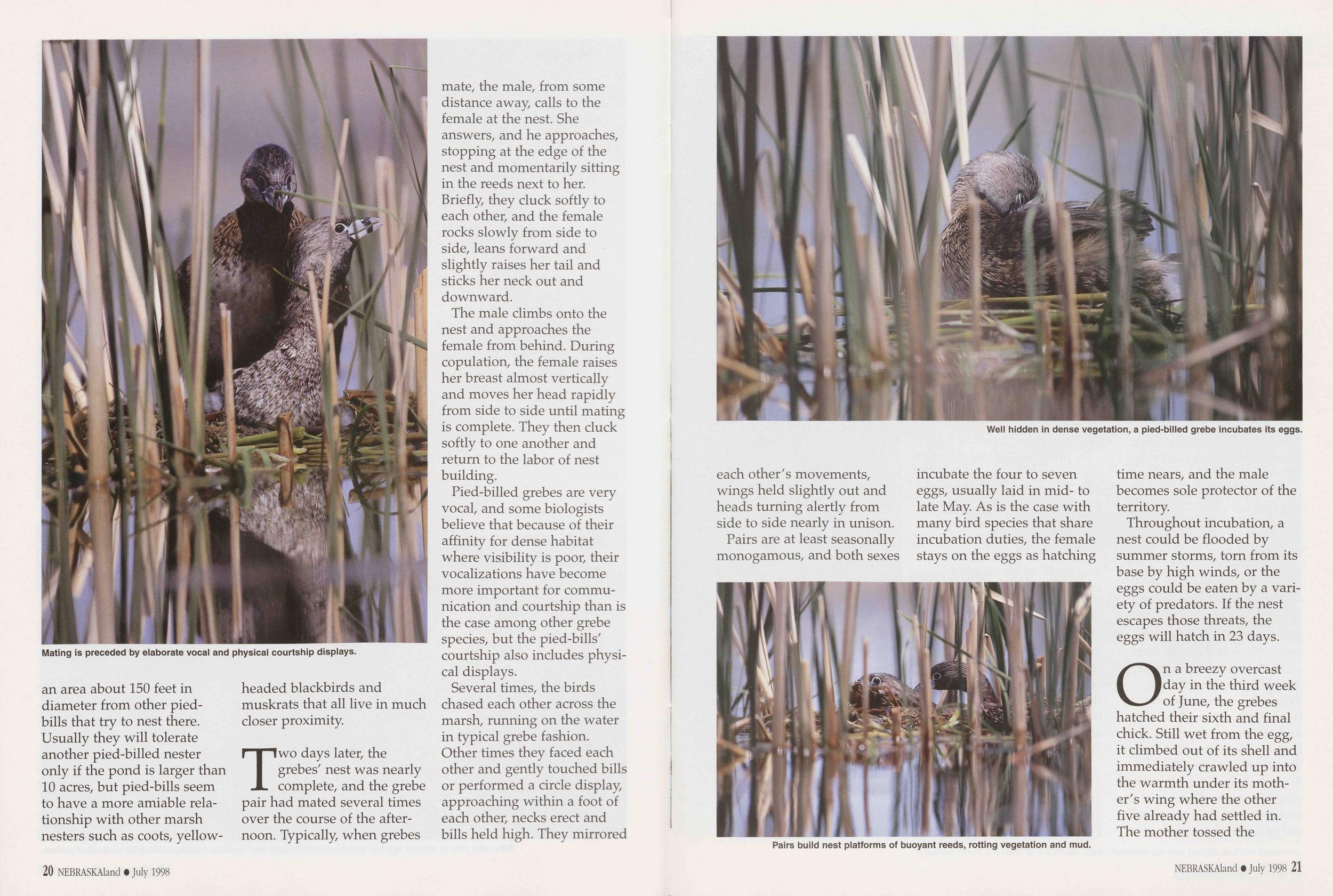
Mating is preceded by elaborate vocal and physical courtship displays.
an area about 150 feet in diameter from other pied-bills that try to nest there. Usually they will tolerate another pied-billed nester only if the pond is larger than 10 acres, but pied-bills seem to have a more amiable relationship with other marsh nesters such as coots, yellow-headed blackbirds and muskrats that all live in much closer proximity.
Two days later, the grebes' nest was nearly complete, and the grebe pair had mated several times over the course of the afternoon. Typically, when grebes mate, the male, from some distance away, calls to the female at the nest. She answers, and he approaches, stopping at the edge of the nest and momentarily sitting in the reeds next to her. Briefly, they cluck softly to each other, and the female rocks slowly from side to side, leans forward and slightly raises her tail and sticks her neck out and downward.
The male climbs onto the nest and approaches the female from behind. During copulation, the female raises her breast almost vertically and moves her head rapidly from side to side until mating is complete. They then cluck softly to one another and return to the labor of nest building.
Pied-billed grebes are very vocal, and some biologists believe that because of their affinity for dense habitat where visibility is poor, their vocalizations have become more important for communication and courtship than is the case among other grebe species, but the pied-bills' courtship also includes physical displays.
Several times, the birds chased each other across the marsh, running on the water in typical grebe fashion. Other times they faced each other and gently touched bills or performed a circle display, approaching within a foot of each other, necks erect and bills held high. They mirrored
20 NEBRASKAland • July 1998Well hidden in dense vegetation, a pied-billed grebe incubates its eggs.
each other's movements, wings held slightly out and heads turning alertly from side to side nearly in unison.
Pairs are at least seasonally monogamous, and both sexes incubate the four to seven eggs, usually laid in mid- to late May. As is the case with many bird species that share incubation duties, the female stays on the eggs as hatching
Pairs build nest platforms of buoyant reeds, rotting vegetation and mud.
time nears, and the male becomes sole protector of the territory.
Throughout incubation, a nest could be flooded by summer storms, torn from its base by high winds, or the eggs could be eaten by a variety of predators. If the nest escapes those threats, the eggs will hatch in 23 days.
On a breezy overcast day in the third week of June, the grebes hatched their sixth and final chick. Still wet from the egg, it climbed out of its shell and immediately crawled up into the warmth under its mother's wing where the other five already had settled in. The mother tossed the
NEBRASKAland • July 1998 21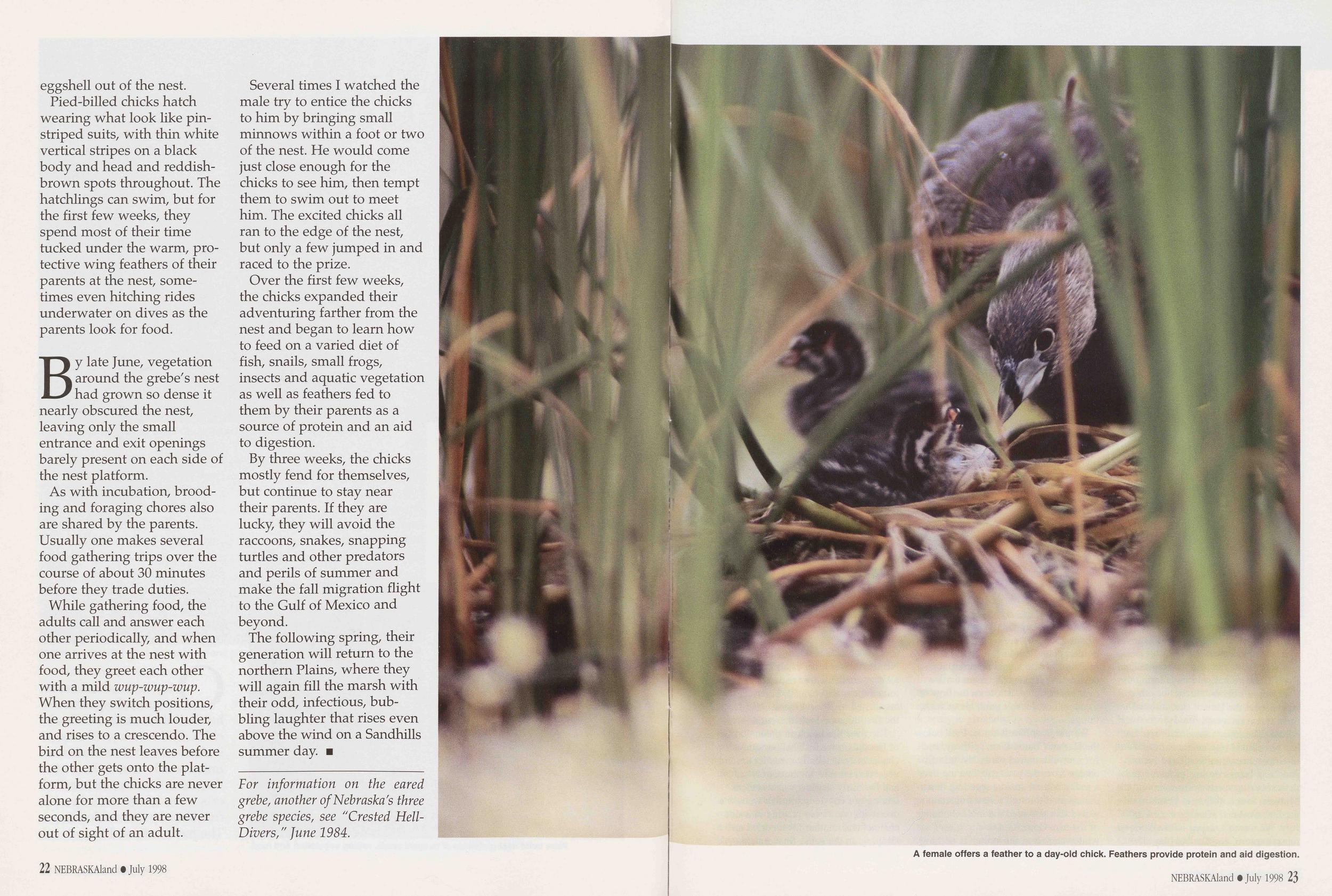
eggshell out of the nest.
Pied-billed chicks hatch wearing what look like pinstriped suits, with thin white vertical stripes on a black body and head and reddish-brown spots throughout. The hatchlings can swim, but for the first few weeks, they spend most of their time tucked under the warm, protective wing feathers of their parents at the nest, sometimes even hitching rides underwater on dives as the parents look for food.
By late June, vegetation around the grebe's nest had grown so dense it nearly obscured the nest, leaving only the small entrance and exit openings barely present on each side of the nest platform.
As with incubation, brooding and foraging chores also are shared by the parents. Usually one makes several food gathering trips over the course of about 30 minutes before they trade duties.
While gathering food, the adults call and answer each other periodically, and when one arrives at the nest with food, they greet each other with a mild wup-wup-wup. When they switch positions, the greeting is much louder, and rises to a crescendo. The bird on the nest leaves before the other gets onto the platform, but the chicks are never alone for more than a few seconds, and they are never out of sight of an adult.
Several times I watched the male try to entice the chicks to him by bringing small minnows within a foot or two of the nest. He would come just close enough for the chicks to see him, then tempt them to swim out to meet him. The excited chicks all ran to the edge of the nest, but only a few jumped in and raced to the prize.
Over the first few weeks, the chicks expanded their adventuring farther from the nest and began to learn how to feed on a varied diet of fish, snails, small frogs, insects and aquatic vegetation as well as feathers fed to them by their parents as a source of protein and an aid to digestion.
By three weeks, the chicks mostly fend for themselves, but continue to stay near their parents. If they are lucky, they will avoid the raccoons, snakes, snapping turtles and other predators and perils of summer and make the fall migration flight to the Gulf of Mexico and beyond.
The following spring, their generation will return to the northern Plains, where they will again fill the marsh with their odd, infectious, bubbling laughter that rises even above the wind on a Sandhills summer day.
For information on the eared grebe, another of Nebraska's three grebe species, see "Crested Hell- Divers," June 1984. 22 NEBRASKAland • July 1998A female offers a feather to a day-old chick. Feathers provide protein and aid digestion.
Canoeing the Republican River
Photo and text by Michael Forsberg This quiet, gentle river running through a lush valley is endearing and often overlooked. The Republican valley is rich with wildlife, offers some of the best quail hunting and fishing in the state, and carries some of the magic that makes canoeists long to return and lazily float downriver on a hot mid-summer's day.There are few activities more relaxing than floating down a lazy river with friends on a hot summer's day, and that was our plan when we pushed off into the current and into the open arms of the Republican River last July. The day was cloudless, hot, but not too humid, and a northwest breeze blew downriver. The water was clear and cool.
It was the day before the Republican River Canoe Race, and on entering the river, we left behind dozens of other canoeists at the launch site, most of them intent on a trial run over the race course. The race, a local tradition that has blossomed into an annual event full of color, cheer, suntan oil and furious paddling, brings dozens of teams and their cheering sections from around the Midwest to the river near Franklin on the first weekend after the Fourth of July. We weren't racing — we came to relax, explore, dawdle and play. The Republican is a good river for that.
The Republican lies in the heart of Willa Cather country and drains a basin of more than 6,000 square miles. The river is about 360 miles long, beginning in the high grasslands of northeastern Colorado and ending at its confluence with the Smokey Hill River in Kansas. About 250 miles are within Nebraska's borders. The Republican gained fame in Cather's works, and notoriety for devastating floods and recent battles over water rights. But from the bow of a canoe, one doesn't think about such things.
We put in at North Outlet Park below the Harlan County Dam spillway, and for several hundred yards, the fast discharge from the reservoir flowing over a rocky bottom sent us speeding down the channel through a series of standing waves that provided the most challenge of the trip. Compared to any true Whitewater river, the stretch is nothing to write home about, but for a Nebraska river it isn't half bad. Then, all at once, the waves ended, and we joined the main channel. The river broadened to 30 or 40 yards, and for the first time we looked around.
The river lies in a lush green corridor of floodplain forest. Shallow side channels occasionally meander around vegetated islands, the bottom is sandy and the fairly shallow water is clear. During our day-long journey we saw a deer with two fawns playing in a side channel and another fawn curled up sleeping on the bank. Beaver dens
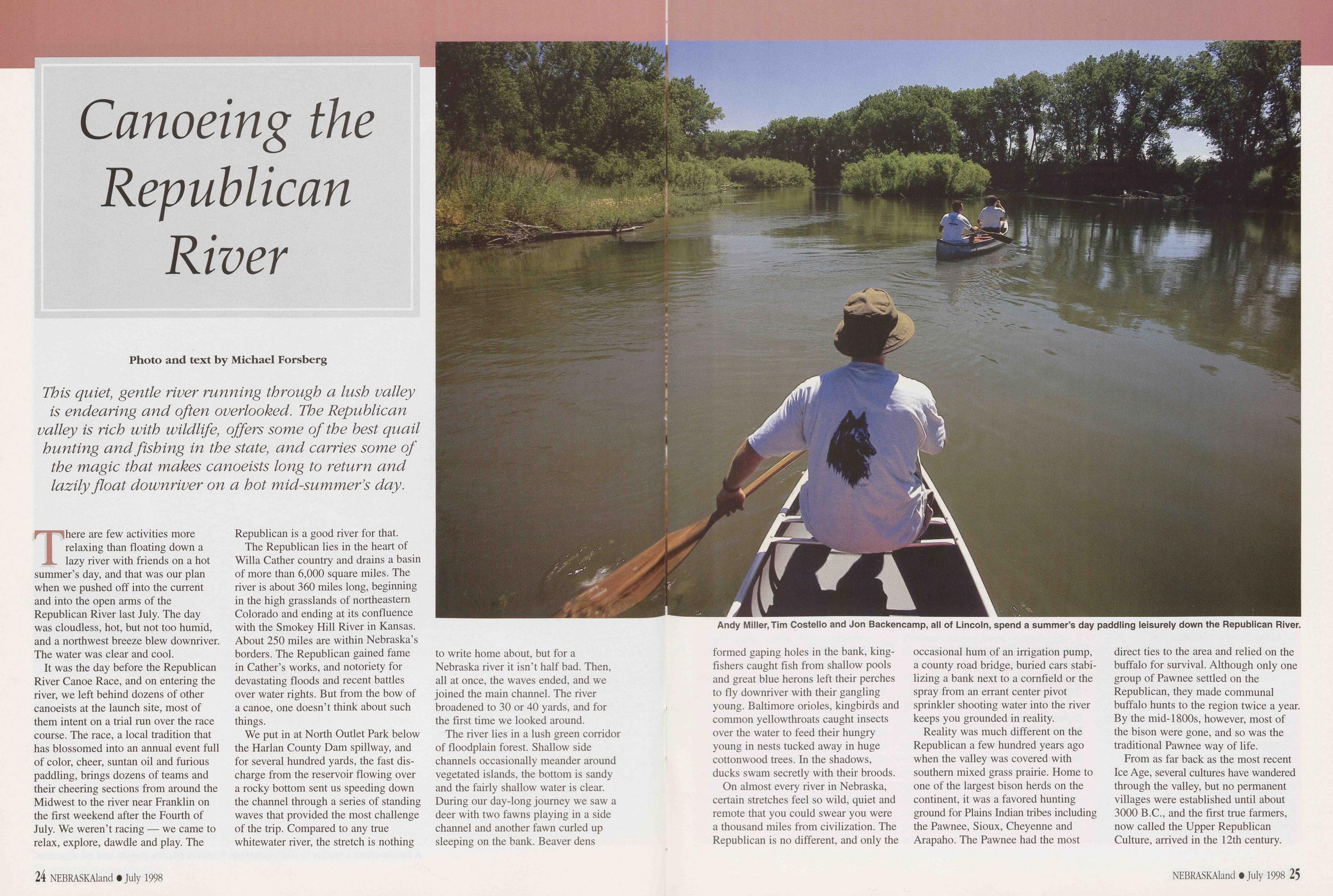
24 NEBRASKAland • July 1998Andy Miller, Tim Costeilo and Jon Backencamp, all of Lincoln, spend a summer's day paddling leisurely down the Republican River.
formed gaping holes in the bank, kingfishers caught fish from shallow pools and great blue herons left their perches to fly downriver with their gangling young. Baltimore orioles, kingbirds and common yellowthroats caught insects over the water to feed their hungry young in nests tucked away in huge cottonwood trees. In the shadows, ducks swam secretly with their broods.
On almost every river in Nebraska, certain stretches feel so wild, quiet and remote that you could swear you were a thousand miles from civilization. The Republican is no different, and only the occasional hum of an irrigation pump, a county road bridge, buried cars stabilizing a bank next to a cornfield or the spray from an errant center pivot sprinkler shooting water into the river keeps you grounded in reality.
Reality was much different on the Republican a few hundred years ago when the valley was covered with southern mixed grass prairie. Home to one of the largest bison herds on the continent, it was a favored hunting ground for Plains Indian tribes including the Pawnee, Sioux, Cheyenne and Arapaho. The Pawnee had the most direct ties to the area and relied on the buffalo for survival. Although only one group of Pawnee settled on the Republican, they made communal buffalo hunts to the region twice a year. By the mid-1800s, however, most of the bison were gone, and so was the traditional Pawnee way of life.
From as far back as the most recent Ice Age, several cultures have wandered through the valley, but no permanent villages were established until about 3000 B.C., and the first true farmers, now called the Upper Republican Culture, arrived in the 12th century.
Hazards
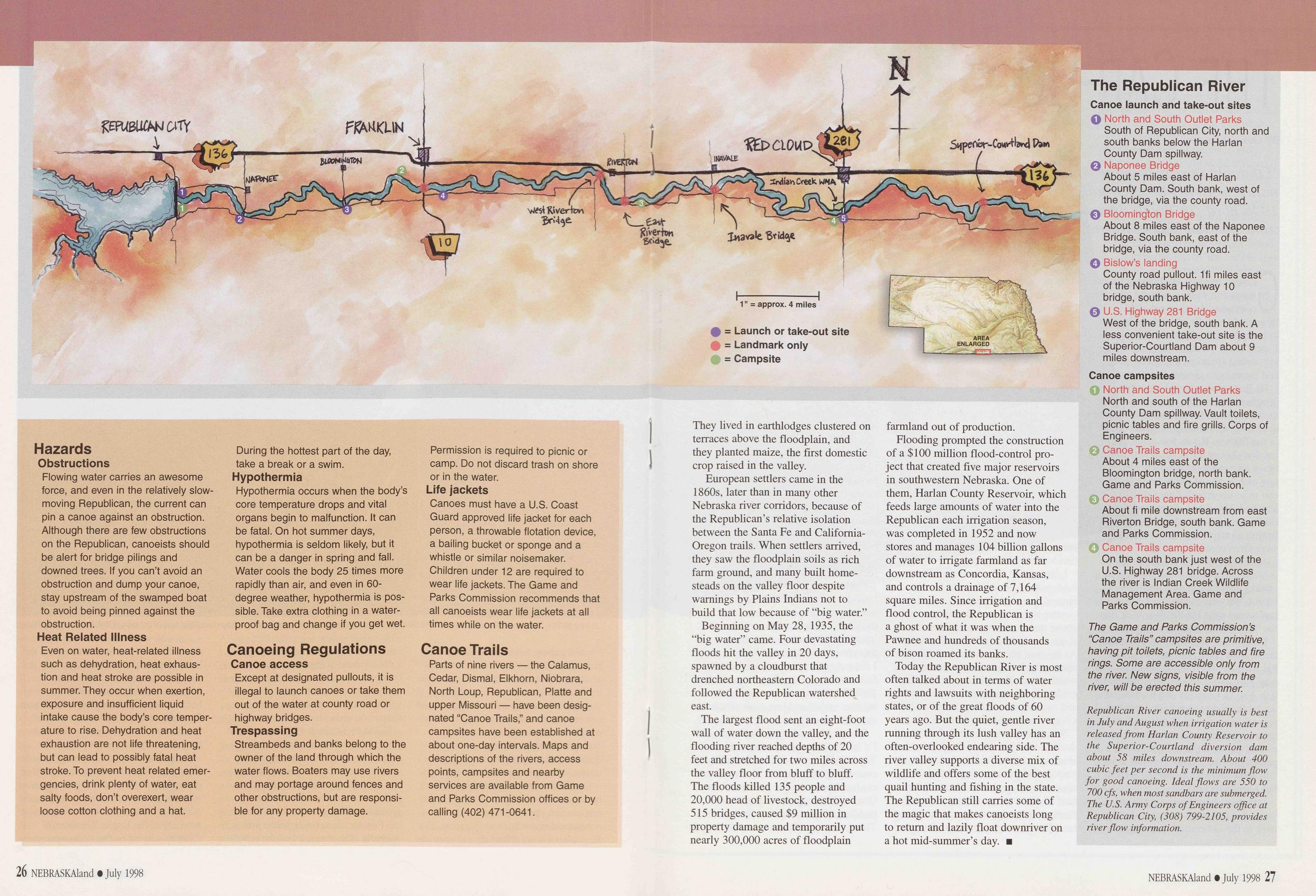
Obstructions Flowing water carries an awesome force, and even in the relatively slow-moving Republican, the current can pin a canoe against an obstruction. Although there are few obstructions on the Republican, canoeists should be alert for bridge pilings and downed trees. If you can't avoid an obstruction and dump your canoe, stay upstream of the swamped boat to avoid being pinned against the obstruction. Heat Related Illness Even on water, heat-related illness such as dehydration, heat exhaustion and heat stroke are possible in summer. They occur when exertion, exposure and insufficient liquid intake cause the body's core temperature to rise. Dehydration and heat exhaustion are not life threatening, but can lead to possibly fatal heat stroke. To prevent heat related emergencies, drink plenty of water, eat salty foods, don't overexert, wear loose cotton clothing and a hat. During the hottest part of the day, take a break or a swim. Hypothermia Hypothermia occurs when the body's core temperature drops and vital organs begin to malfunction. It can be fatal. On hot summer days, hypothermia is seldom likely, but it can be a danger in spring and fall. Water cools the body 25 times more rapidly than air, and even in 60-degree weather, hypothermia is possible. Take extra clothing in a waterproof bag and change if you get wet. Canoeing Regulations Canoe access Except at designated pullouts, it is illegal to launch canoes or take them out of the water at county road or highway bridges. Trespassing Streambeds and banks belong to the owner of the land through which the water flows. Boaters may use rivers and may portage around fences and other obstructions, but are responsible for any property damage. Permission is required to picnic or camp. Do not discard trash on shore or in the water. Life jackets Canoes must have a U.S. Coast Guard approved life jacket for each person, a throwable flotation device, a bailing bucket or sponge and a whistle or similar noisemaker. Children under 12 are required to wear life jackets. The Game and Parks Commission recommends that all canoeists wear life jackets at all times while on the water. Canoe Trails Parts of nine rivers — the Calamus, Cedar, Dismal, Elkhorn, Niobrara, North Loup, Republican, Platte and upper Missouri — have been designated "Canoe Trails," and canoe campsites have been established at about one-day intervals. Maps and descriptions of the rivers, access points, campsites and nearby services are available from Game and Parks Commission offices or by calling (402) 471-0641.1" = approx. 4 miles = Launch or take-out site = Landmark only = Campsite
They lived in earthlodges clustered on terraces above the floodplain, and they planted maize, the first domestic crop raised in the valley.
European settlers came in the 1860s, later than in many other Nebraska river corridors, because of the Republican's relative isolation between the Santa Fe and California- Oregon trails. When settlers arrived, they saw the floodplain soils as rich farm ground, and many built homesteads on the valley floor despite warnings by Plains Indians not to build that low because of "big water."
Beginning on May 28, 1935, the "big water" came. Four devastating floods hit the valley in 20 days, spawned by a cloudburst that drenched northeastern Colorado and followed the Republican watershed east.
The largest flood sent an eight-foot wall of water down the valley, and the flooding river reached depths of 20 feet and stretched for two miles across the valley floor from bluff to bluff. The floods killed 135 people and 20,000 head of livestock, destroyed 515 bridges, caused $9 million in property damage and temporarily put nearly 300,000 acres of floodplain farmland out of production.
Flooding prompted the construction of a $100 million flood-control project that created five major reservoirs in southwestern Nebraska. One of them, Harlan County Reservoir, which feeds large amounts of water into the Republican each irrigation season, was completed in 1952 and now stores and manages 104 billion gallons of water to irrigate farmland as far downstream as Concordia, Kansas, and controls a drainage of 7,164 square miles. Since irrigation and flood control, the Republican is a ghost of what it was when the Pawnee and hundreds of thousands of bison roamed its banks.
Today the Republican River is most often talked about in terms of water rights and lawsuits with neighboring states, or of the great floods of 60 years ago. But the quiet, gentle river running through its lush valley has an often-overlooked endearing side. The river valley supports a diverse mix of wildlife and offers some of the best quail hunting and fishing in the state. The Republican still carries some of the magic that makes canoeists long to return and lazily float downriver on a hot mid-summer's day.
The Republican River
Canoe launch and take-out sites 1. North and South Outlet Parks South of Republican City, north and south banks below the Harlan County Dam spillway. 2. Naponee Bridge About 5 miles east of Harlan County Dam. South bank, west of the bridge, via the county road. 3. Bloomingion Bridge About 8 miles east of the Naponee Bridge. South bank, east of the bridge, via the county road. 4. Bislow's landing County road pullout. 1fi miles east of the Nebraska Highway 10 bridge, south bank. 5. U.S. Highway 281 Bridge West of the bridge, south bank. A less convenient take-out site is the Superior-Courtland Dam about 9 miles downstream. Canoe campsites 1. North and South Outlet Parks North and south of the Harlan County Dam spillway. Vault toilets, picnic tables and fire grills. Corps of Engineers. 2. Canoe Trails campsite About 4 miles east of the Bloomington bridge, north bank. Game and Parks Commission. 3. Canoe Trails campsite About fi mile downstream from east Riverton Bridge, south bank. Game and Parks Commission. 4. Canoe Trails campsite On the south bank just west of the U.S. Highway 281 bridge. Across the river is Indian Creek Wildlife Management Area. Game and Parks Commission. The Game and Parks Commission's "Canoe Trails" campsites are primitive, having pit toilets, picnic tables and fire rings. Some are accessible only from the river. New signs, visible from the river, will be erected this summer. Republican River canoeing usually is best in July and August when irrigation water is released from Harlan County Reservoir to the Superior-Courtland diversion dam about 58 miles downstream. About 400 cubic feet per second is the minimum flow for good canoeing. Ideal flows are 550 to 700 cfs, when most sandbars are submerged. The U.S. Army Corps of Engineers office at Republican City, (308) 799-2105, provides river flow information. NEBRASKAland • July 1998 27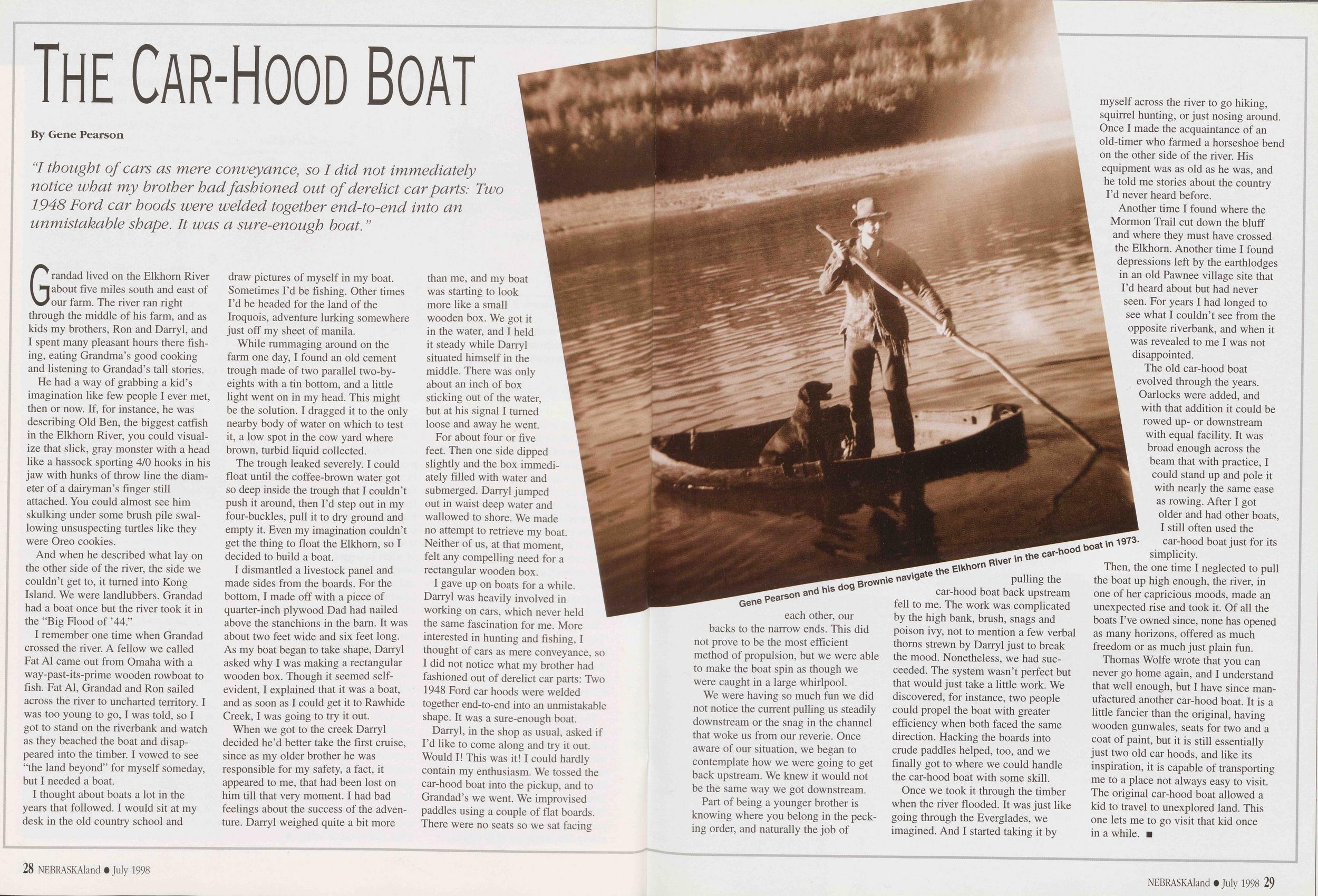
The Car-Hood Boat
By Gene Pearson "I thought of cars as mere conveyance, so I did not immediately notice what my brother had fashioned out of derelict car parts: Two 1948 Ford car hoods were welded together end-to-end into an unmistakable shape. It was a sure-enough boat."Grandad lived on the Elkhorn River about five miles south and east of our farm. The river ran right through the middle of his farm, and as kids my brothers, Ron and Darryl, and I spent many pleasant hours there fishing, eating Grandma's good cooking and listening to Grandad's tall stories.
He had a way of grabbing a kid's imagination like few people I ever met, then or now. If, for instance, he was describing Old Ben, the biggest catfish in the Elkhorn River, you could visualize that slick, gray monster with a head like a hassock sporting 4/0 hooks in his jaw with hunks of throw line the diameter of a dairyman's finger still attached. You could almost see him skulking under some brush pile swallowing unsuspecting turtles like they were Oreo cookies.
And when he described what lay on the other side of the river, the side we couldn't get to, it turned into Kong Island. We were landlubbers. Grandad had a boat once but the river took it in the "Big Flood of '44."
I remember one time when Grandad crossed the river. A fellow we called Fat Al came out from Omaha with a way-past-its-prime wooden rowboat to fish. Fat Al, Grandad and Ron sailed across the river to uncharted territory. I was too young to go, I was told, so I got to stand on the riverbank and watch as they beached the boat and disappeared into the timber. I vowed to see "the land beyond" for myself someday, but I needed a boat.
I thought about boats a lot in the years that followed. I would sit at my desk in the old country school and draw pictures of myself in my boat. Sometimes I'd be fishing. Other times I'd be headed for the land of the Iroquois, adventure lurking somewhere just off my sheet of manila.
While rummaging around on the farm one day, I found an old cement trough made of two parallel two-by-eights with a tin bottom, and a little light went on in my head. This might be the solution. I dragged it to the only nearby body of water on which to test it, a low spot in the cow yard where brown, turbid liquid collected.
The trough leaked severely. I could float until the coffee-brown water got so deep inside the trough that I couldn't push it around, then I'd step out in my four-buckles, pull it to dry ground and empty it. Even my imagination couldn't get the thing to float the Elkhorn, so I decided to build a boat.
I dismantled a livestock panel and made sides from the boards. For the bottom, I made off with a piece of quarter-inch plywood Dad had nailed above the stanchions in the barn. It was about two feet wide and six feet long. As my boat began to take shape, Darryl asked why I was making a rectangular wooden box. Though it seemed self-evident, I explained that it was a boat, and as soon as I could get it to Rawhide Creek, I was going to try it out.
When we got to the creek Darryl decided he'd better take the first cruise, since as my older brother he was responsible for my safety, a fact, it appeared to me, that had been lost on him till that very moment. I had bad feelings about the success of the adventure. Darryl weighed quite a bit more than me, and my boat was starting to look more like a small wooden box. We got it in the water, and I held it steady while Darryl situated himself in the middle. There was only about an inch of box sticking out of the water, but at his signal I turned loose and away he went.
For about four or five feet. Then one side dipped slightly and the box immediately filled with water and submerged. Darryl jumped out in waist deep water and wallowed to shore. We made no attempt to retrieve my boat. Neither of us, at that moment, felt any compelling need for a rectangular wooden box.
I gave up on boats for a while. Darryl was heavily involved in working on cars, which never held the same fascination for me. More interested in hunting and fishing, I thought of cars as mere conveyance, so I did not notice what my brother had fashioned out of derelict car parts: Two 1948 Ford car hoods were welded together end-to-end into an unmistakable shape. It was a sure-enough boat.
Darryl, in the shop as usual, asked if I'd like to come along and try it out. Would I! This was it! I could hardly contain my enthusiasm. We tossed the car-hood boat into the pickup, and to Grandad's we went. We improvised paddles using a couple of flat boards. There were no seats so we sat facing
28 NEBRASKAland • July 1998Gene Pearson and his dog Brownie navigate the Elkhorn River in the car-hood boat in 1972.
each other, our backs to the narrow ends. This did not prove to be the most efficient method of propulsion, but we were able to make the boat spin as though we were caught in a large whirlpool.
We were having so much fun we did not notice the current pulling us steadily downstream or the snag in the channel that woke us from our reverie. Once aware of our situation, we began to contemplate how we were going to get back upstream. We knew it would not be the same way we got downstream.
Part of being a younger brother is knowing where you belong in the pecking order, and naturally the job of car-hood boat back upstream fell to me. The work was complicated by the high bank, brush, snags and poison ivy, not to mention a few verbal thorns strewn by Darryl just to break the mood. Nonetheless, we had succeeded. The system wasn't perfect but that would just take a little work. We discovered, for instance, two people could propel the boat with greater efficiency when both faced the same direction. Hacking the boards into crude paddles helped, too, and we finally got to where we could handle the car-hood boat with some skill.
Once we took it through the timber when the river flooded. It was just like going through the Everglades, we imagined. And I started taking it by myself across the river to go hiking, squirrel hunting, or just nosing around. Once I made the acquaintance of an old-timer who farmed a horseshoe bend on the other side of the river. His equipment was as old as he was, and he told me stories about the country I'd never heard before.
Another time I found where the Mormon Trail cut down the bluff and where they must have crossed the Elkhorn. Another time I found depressions left by the earthlodges in an old Pawnee village site that I'd heard about but had never seen. For years I had longed to see what I couldn't see from the opposite riverbank, and when it was revealed to me I was not disappointed.
The old car-hood boat evolved through the years. Oarlocks were added, and with that addition it could be rowed up- or downstream with equal facility. It was broad enough across the beam that with practice, I could stand up and pole it with nearly the same ease as rowing. After I got older and had other boats, I still often used the car-hood boat just for its simplicity.
Then, the one time I neglected to pull the boat up high enough, the river, in one of her capricious moods, made an unexpected rise and took it. Of all the boats I've owned since, none has opened as many horizons, offered as much freedom or as much just plain fun.
Thomas Wolfe wrote that you can never go home again, and I understand that well enough, but I have since manufactured another car-hood boat. It is a little fancier than the original, having wooden gunwales, seats for two and a coat of paint, but it is still essentially just two old car hoods, and like its inspiration, it is capable of transporting me to a place not always easy to visit. The original car-hood boat allowed a kid to travel to unexplored land. This one lets me to go visit that kid once in a while.
NEBRASKAland • July 1998 29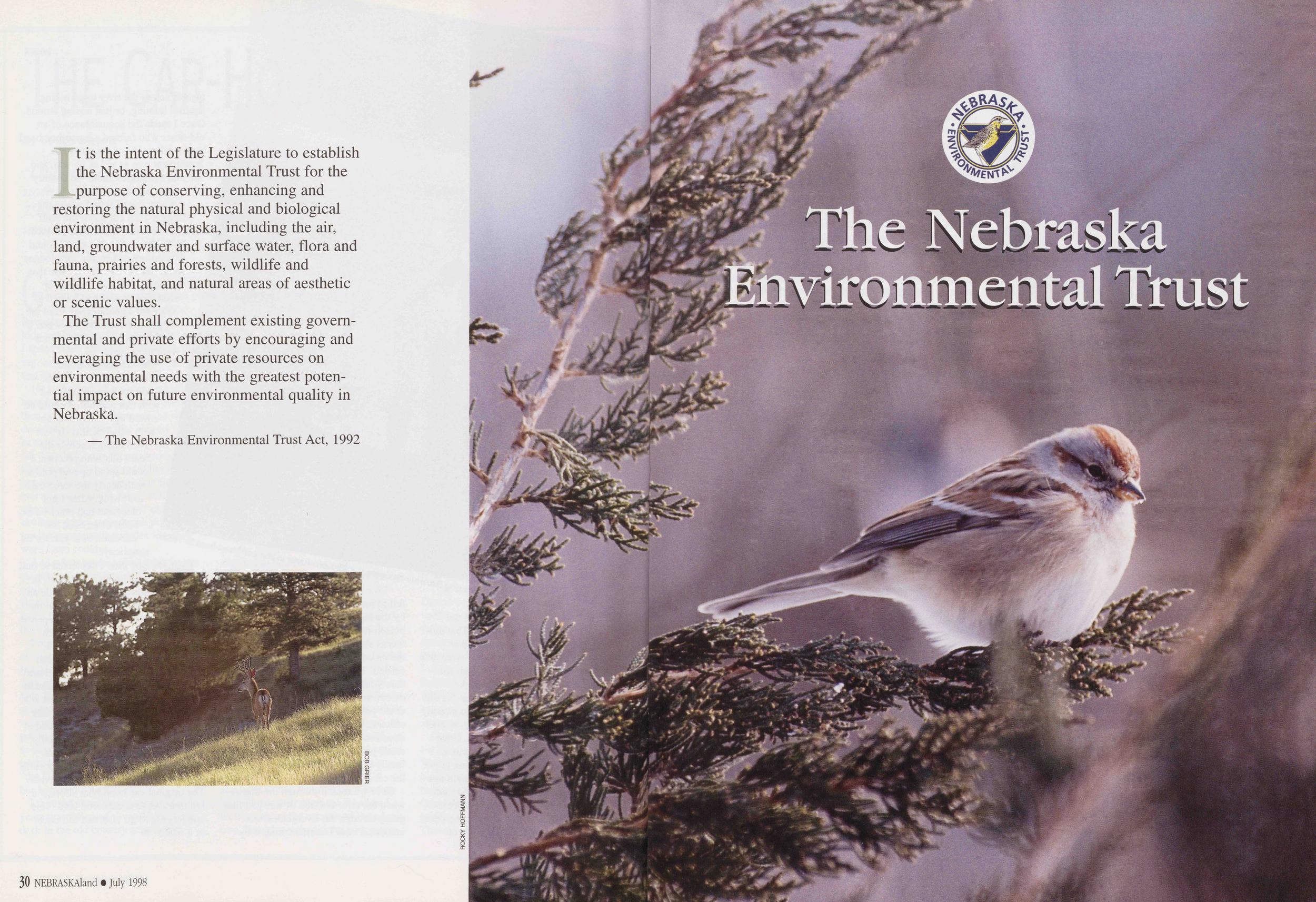
The Nebraska Environmental Trust
It is the intent of the Legislature to establish the Nebraska Environmental Trust for the purpose of conserving, enhancing and restoring the natural physical and biological environment in Nebraska, including the air, land, groundwater and surface water, flora and fauna, prairies and forests, wildlife and wildlife habitat, and natural areas of aesthetic or scenic values. The Trust shall complement existing governmental and private efforts by encouraging and leveraging the use of private resources on environmental needs with the greatest potential impact on future environmental quality in Nebraska. — The Nebraska Environmental Trust Act, 1992 30 NEBRASKAland • July 1998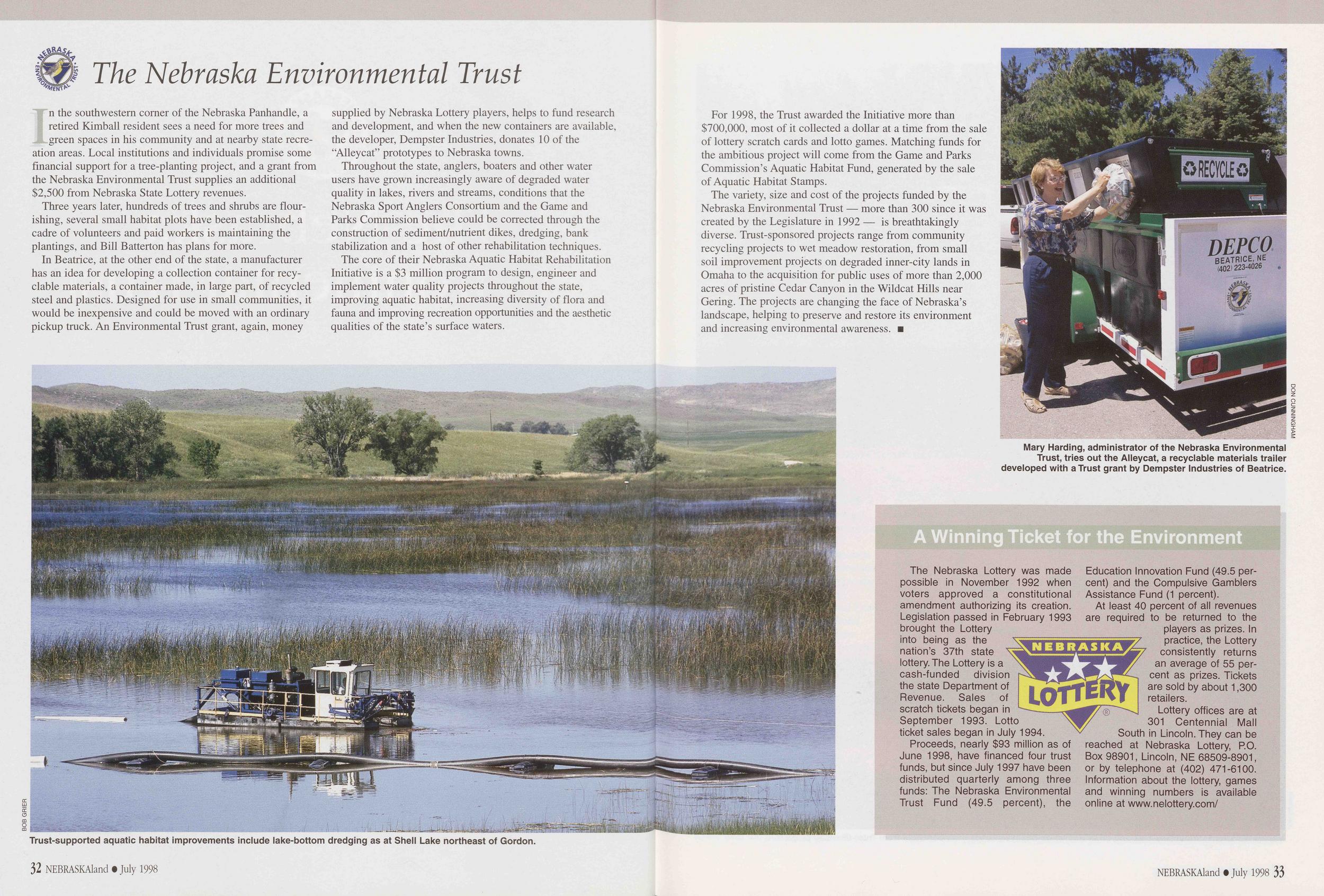
The Nebraska Environmental Trust
In the southwestern corner of the Nebraska Panhandle, a retired Kimball resident sees a need for more trees and green spaces in his community and at nearby state recreation areas. Local institutions and individuals promise some financial support for a tree-planting project, and a grant from the Nebraska Environmental Trust supplies an additional $2,500 from Nebraska State Lottery revenues.
Three years later, hundreds of trees and shrubs are flourishing, several small habitat plots have been established, a cadre of volunteers and paid workers is maintaining the plantings, and Bill Batterton has plans for more.
In Beatrice, at the other end of the state, a manufacturer has an idea for developing a collection container for recyclable materials, a container made, in large part, of recycled steel and plastics. Designed for use in small communities, it would be inexpensive and could be moved with an ordinary pickup truck. An Environmental Trust grant, again, money supplied by Nebraska Lottery players, helps to fund research and development, and when the new containers are available, the developer, Dempster Industries, donates 10 of the "Alleycat" prototypes to Nebraska towns.
Throughout the state, anglers, boaters and other water users have grown increasingly aware of degraded water quality in lakes, rivers and streams, conditions that the Nebraska Sport Anglers Consortium and the Game and Parks Commission believe could be corrected through the construction of sediment/nutrient dikes, dredging, bank stabilization and a host of other rehabilitation techniques.
The core of their Nebraska Aquatic Habitat Rehabilitation Initiative is a $3 million program to design, engineer and implement water quality projects throughout the state, improving aquatic habitat, increasing diversity of flora and fauna and improving recreation opportunities and the aesthetic qualities of the state's surface waters.
Trust-supported aquatic habitat improvements include lake-bottom dredging as at Shell Lake northeast of Gordon.
For 1998, the Trust awarded the Initiative more than $700,000, most of it collected a dollar at a time from the sale of lottery scratch cards and lotto games. Matching funds for the ambitious project will come from the Game and Parks Commission's Aquatic Habitat Fund, generated by the sale of Aquatic Habitat Stamps.
The variety, size and cost of the projects funded by the Nebraska Environmental Trust — more than 300 since it was created by the Legislature in 1992 — is breathtakingly diverse. Trust-sponsored projects range from community recycling projects to wet meadow restoration, from small soil improvement projects on degraded inner-city lands in Omaha to the acquisition for public uses of more than 2,000 acres of pristine Cedar Canyon in the Wildcat Hills near Gering. The projects are changing the face of Nebraska's landscape, helping to preserve and restore its environment and increasing environmental awareness.
Mary Harding, administrator of the Nebraska Environmental Trust, tries out the Alleycat, a recyclable materials trailer developed with a Trust grant by Dempster Industries of Beatrice.
A Winning Ticket for the Environment
The Nebraska Lottery was made possible in November 1992 when voters approved a constitutional amendment authorizing its creation. Legislation passed in February 1993 brought the Lottery into being as the nation's 37th state lottery. The Lottery is a cash-funded division the state Department of Revenue. Sales of scratch tickets began in September 1993. Lotto ticket sales began in July 1994. Proceeds, nearly $93 million as of June 1998, have financed four trust funds, but since July 1997 have been distributed quarterly among three funds: The Nebraska Environmental Trust Fund (49.5 percent), the Education Innovation Fund (49.5 percent) and the Compulsive Gamblers Assistance Fund (1 percent). At least 40 percent of all revenues are required to be returned to the players as prizes. In practice, the Lottery consistently returns an average of 55 percent as prizes. Tickets are sold by about 1,300 retailers. Lottery offices are at 301 Centennial Mall South in Lincoln. They can be reached at Nebraska Lottery, P.O. Box 98901, Lincoln, NE 68509-8901, or by telephone at (402) 471-6100. Information about the lottery, games and winning numbers is available online at www.nelottery.com/ NEBRASKAland • July 1998 33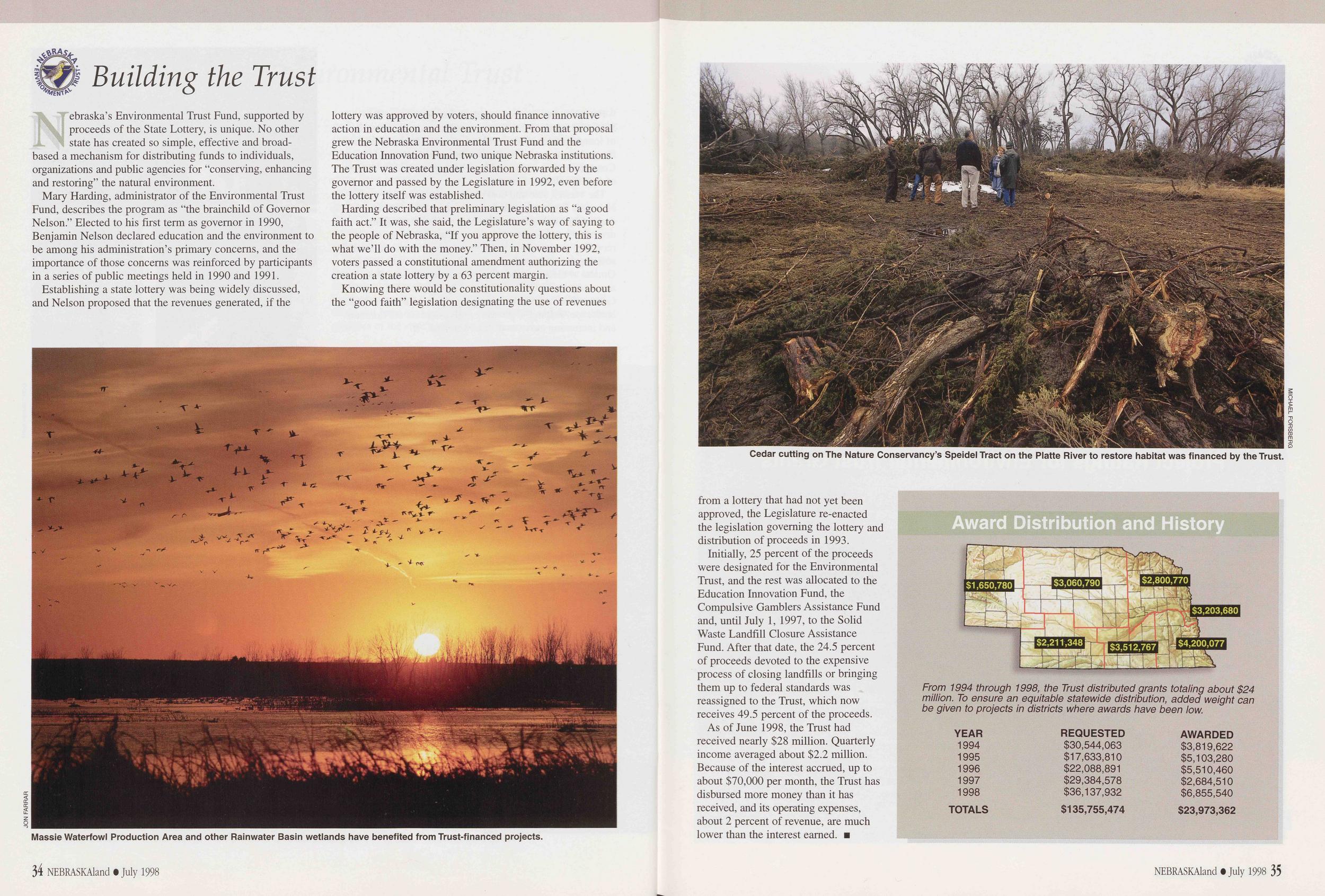
Building the Trust
Nebraska's Environmental Trust Fund, supported by proceeds of the State Lottery, is unique. No other state has created so simple, effective and broad-based a mechanism for distributing funds to individuals, organizations and public agencies for "conserving, enhancing and restoring" the natural environment.
Mary Harding, administrator of the Environmental Trust Fund, describes the program as "the brainchild of Governor Nelson." Elected to his first term as governor in 1990, Benjamin Nelson declared education and the environment to be among his administration's primary concerns, and the importance of those concerns was reinforced by participants in a series of public meetings held in 1990 and 1991.
Establishing a state lottery was being widely discussed, and Nelson proposed that the revenues generated, if the lottery was approved by voters, should finance innovative action in education and the environment. From that proposal grew the Nebraska Environmental Trust Fund and the Education Innovation Fund, two unique Nebraska institutions. The Trust was created under legislation forwarded by the governor and passed by the Legislature in 1992, even before the lottery itself was established.
Harding described that preliminary legislation as "a good faith act." It was, she said, the Legislature's way of saying to the people of Nebraska, "If you approve the lottery, this is what we'll do with the money." Then, in November 1992, voters passed a constitutional amendment authorizing the creation a state lottery by a 63 percent margin.
Knowing there would be constitutionality questions about the "good faith" legislation designating the use of revenues
Massie Waterfowl Production Area and other Rainwater Basin wetlands have benefited from Trust-financed projects.
Cedar cutting on The Nature Conservancy's Speidel Tract on the Platte River to restore habitat was financed by the Trust.
from a lottery that had not yet been approved, the Legislature re-enacted the legislation governing the lottery and distribution of proceeds in 1993.
Initially, 25 percent of the proceeds were designated for the Environmental Trust, and the rest was allocated to the Education Innovation Fund, the Compulsive Gamblers Assistance Fund and, until July 1, 1997, to the Solid Waste Landfill Closure Assistance Fund. After that date, the 24.5 percent of proceeds devoted to the expensive process of closing landfills or bringing them up to federal standards was reassigned to the Trust, which now receives 49.5 percent of the proceeds.
As of June 1998, the Trust had received nearly $28 million. Quarterly income averaged about $2.2 million. Because of the interest accrued, up to about $70,000 per month, the Trust has disbursed more money than it has received, and its operating expenses, about 2 percent of revenue, are much lower than the interest earned.
From 1994 through 1998, the Trust distributed grants totaling about $24 million. To ensure an equitable statewide distribution, added weight can be given to projects in districts where awards have been low.
The Trust in Action
The Trust is governed by a 15-member board appointed by the governor. It is composed of three private citizens from each of the state's three congressional districts and the heads of six state agencies. Citizen members, two of whom must be finance professionals, serve six-year terms. Agency heads represent the departments of Agriculture; Environmental Quality; Health, Licensure and Regulation; Water Resources; the Natural Resources Commission; and the Game and Parks Commission.
Through the year 2000, the Trust has committed its funding to four priority areas: critical habitat, surface water quality, groundwater quality, and solid waste reduction and the development of recycling markets. To qualify, projects must fall within priority areas and meet 11 additional standards, including environmental acceptability and benefits, benefit to the public, and technical and financial feasibility.
The Trust will not provide direct assistance to a regulatory program and, with the exception of soil or groundwater remediation, will not provide funds for the implementation of actions mandated by regulation. Proposals designed primarily for private benefit are not eligible, and the Trust will not assist in the acquisition of property through eminent domain. Individuals, organizations and public entities all are eligible to apply for grants, and no maximum limit for grant amounts has been established. Pheasants Forever, for example, has received grants totaling more than $1 million for habitat and conservation projects.
Awards are granted once each year, and applications are due in September. The review process lasts until February.
Applications are subject to two screenings. First, a technical and feasibility review is conducted by the Trust's Technical Advisory Committee, a group of volunteer experts in a variety of scientific and technical fields. Then applications are reviewed by the Eligibility and Ratings Subcommittee of six Trust board members.
After determining that applications are eligible, the subcommittee rates them, assigning numerical point values in each of four categories (advancing Trust priorities, environmental benefits, social and economic benefits, project design) and adds optional points for projects that will help ensure an equitable statewide distribution of funds. Extra points can be added for projects with matching fund commitments, but
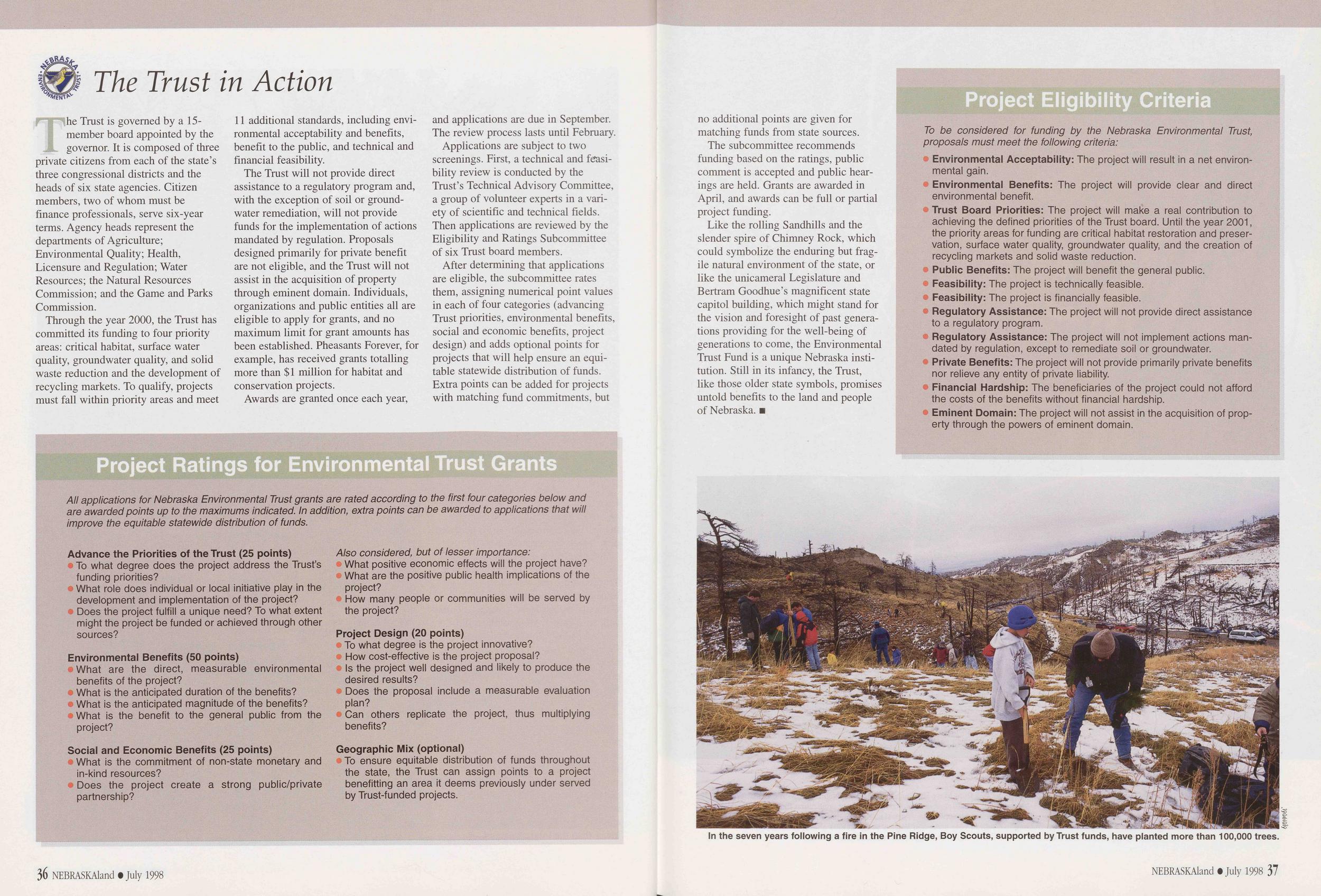
Project Ratings for Environmental Trust Grants
All applications for Nebraska Environmental Trust grants are rated according to the first four categories below and are awarded points up to the maximums indicated. In addition, extra points can be awarded to applications that will improve the equitable statewide distribution of funds.
Advance the Priorities of the Trust (25 points) To what degree does the project address the Trust's funding priorities? What role does individual or local initiative play in the development and implementation of the project? Does the project fulfill a unique need? To what extent might the project be funded or achieved through other sources? Environmental Benefits (50 points) What are the direct, measurable environmental benefits of the project? What is the anticipated duration of the benefits? What is the anticipated magnitude of the benefits? What is the benefit to the general public from the project? Social and Economic Benefits (25 points) What is the commitment of non-state monetary and in-kind resources? Does the project create a strong public/private partnership? Also considered, but of lesser importance: What positive economic effects will the project have? What are the positive public health implications of the project? How many people or communities will be served by the project? Project Design (20 points) To what degree is the project innovative? How cost-effective is the project proposal? Is the project well designed and likely to produce the desired results? Does the proposal include a measurable evaluation plan? Can others replicate the project, thus multiplying benefits? Geographic Mix (optional) To ensure equitable distribution of funds throughout the state, the Trust can assign points to a project benefitting an area it deems previously under served by Trust-funded projects.no additional points are given for matching funds from state sources.
The subcornmittee recommends funding based on the ratings, public comment is accepted and public hearings are held. Grants are awarded in April, and awards can be full or partial project funding.
Like the rolling Sandhills and the slender spire of Chimney Rock, which could symbolize the enduring but fragile natural environment of the state, or like the unicameral Legislature and Bertram Goodhue's magnificent state capitol building, which might stand for the vision and foresight of past generations providing for the well-being of generations to come, the Environmental Trust Fund is a unique Nebraska institution. Still in its infancy, the Trust, like those older state symbols, promises untold benefits to the land and people of Nebraska.
Project Eligibility Criteria
To be considered for funding by the Nebraska Environmental Trust, proposals must meet the following criteria: Environmental Acceptability: The project will result in a net environmental gain. Environmental Benefits: The project will provide clear and direct environmental benefit. Trust Board Priorities: The project will make a real contribution to achieving the defined priorities of the Trust board. Until the year 2001, the priority areas for funding are critical habitat restoration and preservation, surface water quality, groundwater quality, and the creation of recycling markets and solid waste reduction. Public Benefits: The project will benefit the general public. Feasibility: The project is technically feasible. Feasibility: The project is financially feasible. Regulatory Assistance: The project will not provide direct assistance to a regulatory program. Regulatory Assistance: The project will not implement actions mandated by regulation, except to remediate soil or groundwater. Private Benefits: The project will not provide primarily private benefits nor relieve any entity of private liability. Financial Hardship: The beneficiaries of the project could not afford the costs of the benefits without financial hardship. Eminent Domain: The project will not assist in the acquisition of property through the powers of eminent domain.In the seven years following a fire in the Pine Ridge, Boy Scouts, supported by Trust funds, have planted more than 100,000 trees.
The Environmental Trust and the Game and Parks Commission
The Nebraska Environmental Trust Fund is a unique institution, distributing Nebraska State Lottery proceeds to agencies and individuals for projects that will conserve, enhance and restore the state's natural environment. Among the many projects supported by Trust grants, none more directly benefit the entire population of the state than those undertaken by the Nebraska Game and Parks Commission.
Since 1995, the Commission has been the sole recipient of 10 grants and has been a joint recipient or an involved partner in nine others. Through the 19 grants listed below, more than $3 million has been devoted to habitat restoration, acquisition of sensitive lands and public education.
YEAR 1994 1995 1996 1997 1998 PROJECT AWARD Alexandria Lakes renovation $150,000 Threatened fish species habitat restoration $60,000 Grove Lake sediment control structure $31,000 Carrig-Jewell wetland restoration $245,000 Threatened fish species habitat restoration $65,000 Branched Oak fisheries restoration $315,000 Soldiers Creek reclamation $56,000 Branched Oak shoreline erosion control $70,350 Long Pine Creek habitat improvement $70,000 Lewis and Clark Lake shoreline stabilization $225,000 Verdon Lake rehabilitation $350,000 CRP-MAP $15,000 Lewis and Clark Lake shoreline stabilization $115,000 Eastern Nebraska saline wetlands restoration $42,000 Aquatic habitat rehabilitation initiative $100,000 Summit Lake renovation $100,000 Aquatic habitat rehabilitation initiative $741,750 Cedar Canyon headland acquisition $325,000 Lake McConaughy visitor center/water museum $25,000 NEBRASKAland • July 1998 39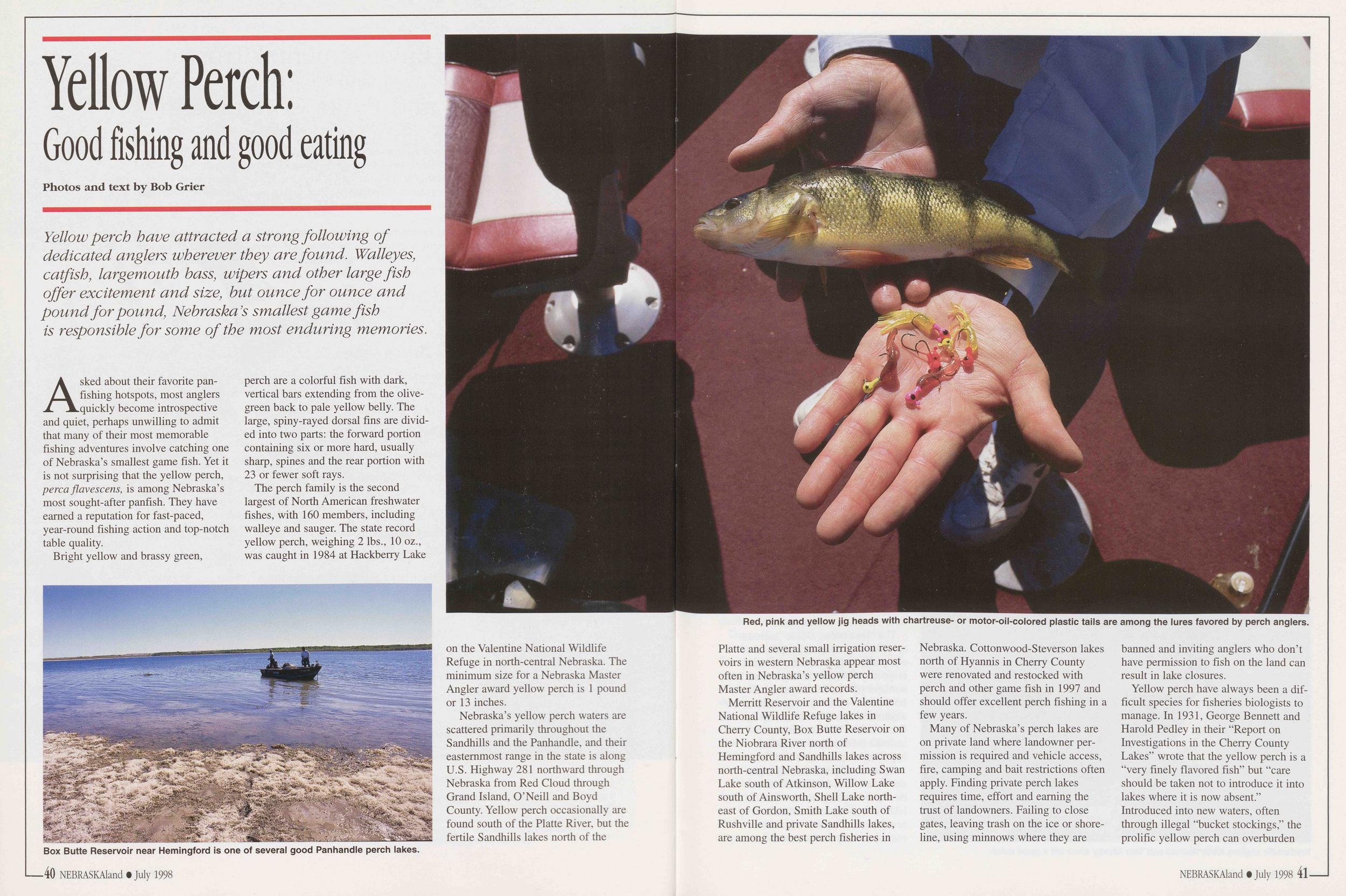
Yellow Perch: Good fishing and good eating
Photos and text by Bob Grier Yellow perch have attracted a strong following of dedicated anglers wherever they are found. Walleyes, catfish, largemouth bass, wipers and other large fish offer excitement and size, but ounce for ounce and pound for pound, Nebraska's smallest game fish is responsible for some of the most enduring memories.Asked about their favorite panfishing hotspots, most anglers quickly become introspective and quiet, perhaps unwilling to admit that many of their most memorable fishing adventures involve catching one of Nebraska's smallest game fish. Yet it is not surprising that the yellow perch, percaflavescens, is among Nebraska's most sought-after panfish. They have earned a reputation for fast-paced, year-round fishing action and top-notch table quality.
Bright yellow and brassy green, perch are a colorful fish with dark, vertical bars extending from the olive-green back to pale yellow belly. The large, spiny-rayed dorsal fins are divided into two parts: the forward portion containing six or more hard, usually sharp, spines and the rear portion with 23 or fewer soft rays.
The perch family is the second largest of North American freshwater fishes, with 160 members, including walleye and sauger. The state record yellow perch, weighing 2 lbs., 10 oz., was caught in 1984 at Hackberry Lake
Box Butte Reservoir near Hemingford is one of several good Panhandle perch lakes.
on the Valentine National Wildlife Refuge in north-central Nebraska. The minimum size for a Nebraska Master Angler award yellow perch is 1 pound or 13 inches.
Nebraska's yellow perch waters are scattered primarily throughout the Sandhills and the Panhandle, and their easternmost range in the state is along U.S. Highway 281 northward through Nebraska from Red Cloud through Grand Island, O'Neill and Boyd County. Yellow perch occasionally are found south of the Platte River, but the fertile Sandhills lakes north of the
40 NEBRASKAland • July 1998Red, pink and yellow jig heads with chartreuse- or motor-oil-colored plastic tails are among the lures favored by perch anglers.
Platte and several small irrigation reservoirs in western Nebraska appear most often in Nebraska's yellow perch Master Angler award records.
Merritt Reservoir and the Valentine National Wildlife Refuge lakes in Cherry County, Box Butte Reservoir on the Niobrara River north of Hemingford and Sandhills lakes across north-central Nebraska, including Swan Lake south of Atkinson, Willow Lake south of Ainsworth, Shell Lake northeast of Gordon, Smith Lake south of Rushville and private Sandhills lakes, are among the best perch fisheries in Nebraska. Cottonwood-Steverson lakes north of Hyannis in Cherry County were renovated and restocked with perch and other game fish in 1997 and should offer excellent perch fishing in a few years.
Many of Nebraska's perch lakes are on private land where landowner permission is required and vehicle access, fire, camping and bait restrictions often apply. Finding private perch lakes requires time, effort and earning the trust of landowners. Failing to close gates, leaving trash on the ice or shoreline, using minnows where they are banned and inviting anglers who don't have permission to fish on the land can result in lake closures.
Yellow perch have always been a difficult species for fisheries biologists to manage. In 1931, George Bennett and Harold Pedley in their "Report on Investigations in the Cherry County Lakes" wrote that the yellow perch is a "very finely flavored fish" but "care should be taken not to introduce it into lakes where it is now absent." Introduced into new waters, often through illegal "bucket stockings," the prolific yellow perch can overburden
NEBRASKAland • July 1998 41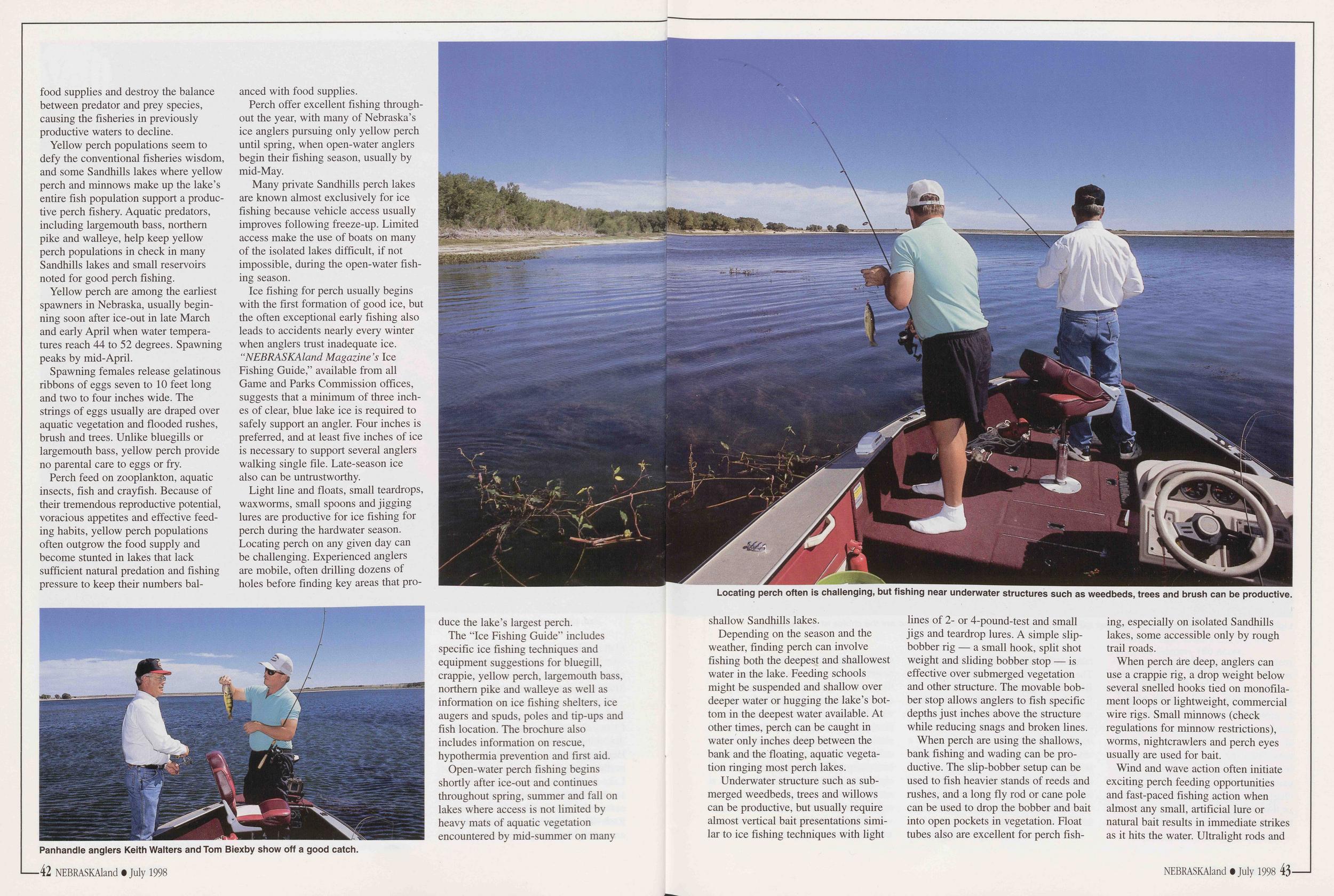
food supplies and destroy the balance between predator and prey species, causing the fisheries in previously productive waters to decline.
Yellow perch populations seem to defy the conventional fisheries wisdom, and some Sandhills lakes where yellow perch and minnows make up the lake's entire fish population support a productive perch fishery. Aquatic predators, including largemouth bass, northern pike and walleye, help keep yellow perch populations in check in many Sandhills lakes and small reservoirs noted for good perch fishing.
Yellow perch are among the earliest spawners in Nebraska, usually beginning soon after ice-out in late March and early April when water temperatures reach 44 to 52 degrees. Spawning peaks by mid-April.
Spawning females release gelatinous ribbons of eggs seven to 10 feet long and two to four inches wide. The strings of eggs usually are draped over aquatic vegetation and flooded rushes, brush and trees. Unlike bluegills or largemouth bass, yellow perch provide no parental care to eggs or fry.
Perch feed on zooplankton, aquatic insects, fish and crayfish. Because of their tremendous reproductive potential, voracious appetites and effective feeding habits, yellow perch populations often outgrow the food supply and become stunted in lakes that lack sufficient natural predation and fishing pressure to keep their numbers balanced with food supplies.
Perch offer excellent fishing throughout the year, with many of Nebraska's ice anglers pursuing only yellow perch until spring, when open-water anglers begin their fishing season, usually by mid-May.
Many private Sandhills perch lakes are known almost exclusively for ice fishing because vehicle access usually improves following freeze-up. Limited access make the use of boats on many of the isolated lakes difficult, if not impossible, during the open-water fishing season.
Ice fishing for perch usually begins with the first formation of good ice, but the often exceptional early fishing also leads to accidents nearly every winter when anglers trust inadequate ice. "NEBRASKAland Magazine 's Ice Fishing Guide," available from all Game and Parks Commission offices, suggests that a minimum of three inches of clear, blue lake ice is required to safely support an angler. Four inches is preferred, and at least five inches of ice is necessary to support several anglers walking single file. Late-season ice also can be untrustworthy.
Light line and floats, small teardrops, wax worms, small spoons and jigging lures are productive for ice fishing for perch during the hardwater season. Locating perch on any given day can be challenging. Experienced anglers are mobile, often drilling dozens of holes before finding key areas that produce
Panhandle anglers Keith Walters and Tom Biexby show off a good catch.
the lake's largest perch.
The "Ice Fishing Guide" includes specific ice fishing techniques and equipment suggestions for bluegill, crappie, yellow perch, largemouth bass, northern pike and walleye as well as information on ice fishing shelters, ice augers and spuds, poles and tip-ups and fish location. The brochure also includes information on rescue, hypothermia prevention and first aid.
Open-water perch fishing begins shortly after ice-out and continues throughout spring, summer and fall on lakes where access is not limited by heavy mats of aquatic vegetation encountered by mid-summer on many
42 NEBRASKAland • July 1998Locating perch often is challenging, but fishing near underwater structures such as weedbeds, trees and brush can be productive.
shallow Sandhills lakes.
Depending on the season and the weather, finding perch can involve fishing both the deepest and shallowest water in the lake. Feeding schools might be suspended and shallow over deeper water or hugging the lake's bottom in the deepest water available. At other times, perch can be caught in water only inches deep between the bank and the floating, aquatic vegetation ringing most perch lakes.
Underwater structure such as submerged weedbeds, trees and willows can be productive, but usually require almost vertical bait presentations similar to ice fishing techniques with light lines of 2- or 4-pound-test and small jigs and teardrop lures. A simple slip-bobber rig — a small hook, split shot weight and sliding bobber stop — is effective over submerged vegetation and other structure. The movable bobber stop allows anglers to fish specific depths just inches above the structure while reducing snags and broken lines.
When perch are using the shallows, bank fishing and wading can be productive. The slip-bobber setup can be used to fish heavier stands of reeds and rushes, and a long fly rod or cane pole can be used to drop the bobber and bait into open pockets in vegetation. Float tubes also are excellent for perch fishing, especially on isolated Sandhills lakes, some accessible only by rough trail roads.
When perch are deep, anglers can use a crappie rig, a drop weight below several snelled hooks tied on monofilament loops or lightweight, commercial wire rigs. Small minnows (check regulations for minnow restrictions), worms, nightcrawlers and perch eyes usually are used for bait.
Wind and wave action often initiate exciting perch feeding opportunities and fast-paced fishing action when almost any small, artificial lure or natural bait results in immediate strikes as it hits the water. Ultralight rods and
NEBRASKAland • July 1998 43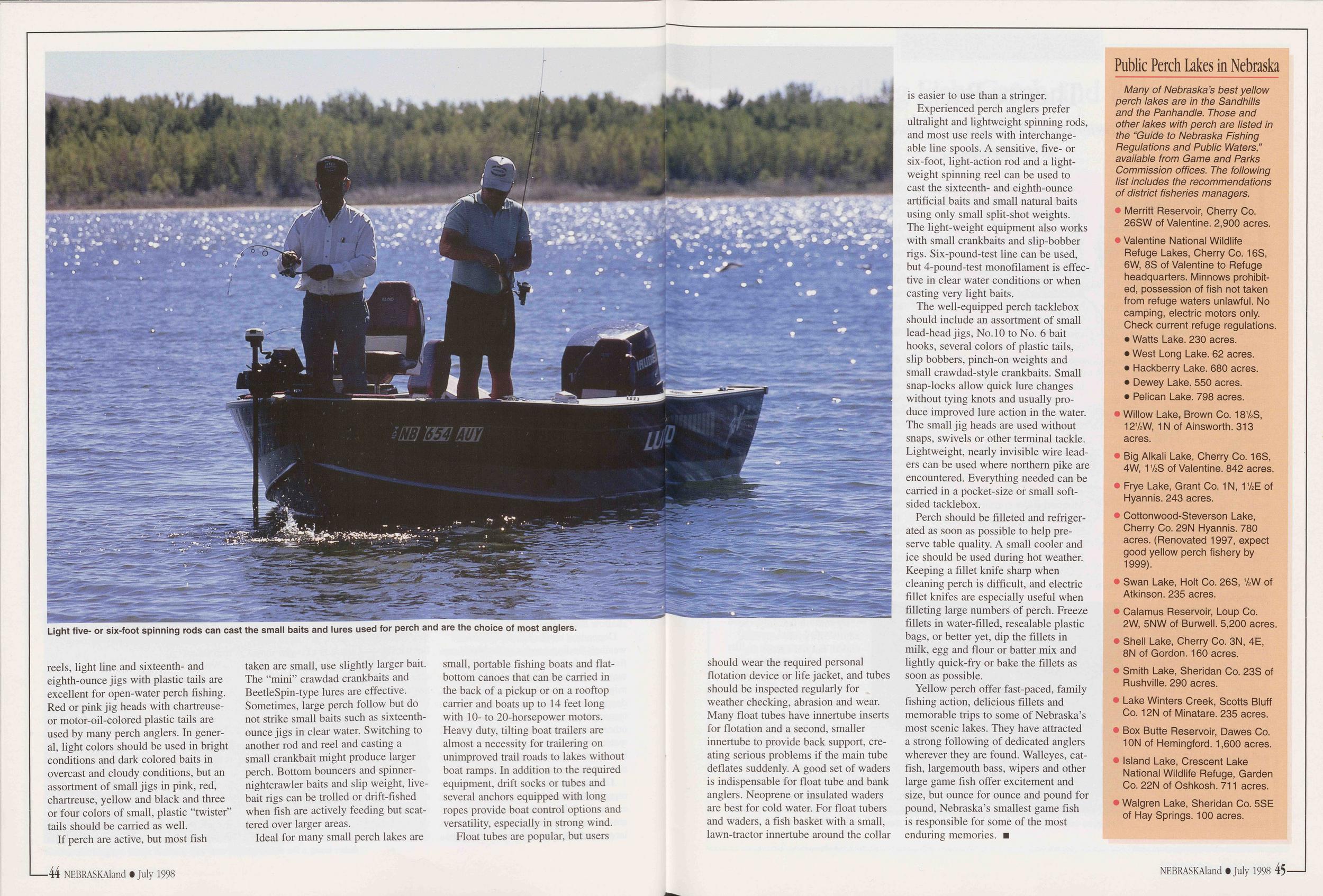
Light five- or six-foot spinning rods can cast the small baits and lures used for perch and are the choice of most anglers.
reels, light line and sixteenth- and eighth-ounce jigs with plastic tails are excellent for open-water perch fishing. Red or pink jig heads with chartreuse-or motor-oil-colored plastic tails are used by many perch anglers. In general, light colors should be used in bright conditions and dark colored baits in overcast and cloudy conditions, but an assortment of small jigs in pink, red, chartreuse, yellow and black and three or four colors of small, plastic "twister" tails should be carried as well.
If perch are active, but most fish taken are small, use slightly larger bait. The "mini" crawdad crankbaits and BeetleSpin-type lures are effective. Sometimes, large perch follow but do not strike small baits such as sixteenth-ounce jigs in clear water. Switching to another rod and reel and casting a small crankbait might produce larger perch. Bottom bouncers and spinner-nightcrawler baits and slip weight, live-bait rigs can be trolled or drift-fished when fish are actively feeding but scattered over larger areas.
Ideal for many small perch lakes are small, portable fishing boats and flat-bottom canoes that can be carried in the back of a pickup or on a rooftop carrier and boats up to 14 feet long with 10- to 20-horsepower motors. Heavy duty, tilting boat trailers are almost a necessity for trailering on unimproved trail roads to lakes without boat ramps. In addition to the required equipment, drift socks or tubes and several anchors equipped with long ropes provide boat control options and versatility, especially in strong wind.
Float tubes are popular, but users
44 NEBRASKAland • July 1998should wear the required personal flotation device or life jacket, and tubes should be inspected regularly for weather checking, abrasion and wear. Many float tubes have innertube inserts for flotation and a second, smaller innertube to provide back support, creating serious problems if the main tube deflates suddenly. A good set of waders is indispensable for float tube and bank anglers. Neoprene or insulated waders are best for cold water. For float tubers and waders, a fish basket with a small, lawn-tractor innertube around the collar is easier to use than a stringer.
Experienced perch anglers prefer ultralight and lightweight spinning rods, and most use reels with interchangeable line spools. A sensitive, five- or six-foot, light-action rod and a lightweight spinning reel can be used to cast the sixteenth- and eighth-ounce artificial baits and small natural baits using only small split-shot weights. The light-weight equipment also works with small crankbaits and slip-bobber rigs. Six-pound-test line can be used, but 4-pound-test monofilament is effective in clear water conditions or when casting very light baits.
The well-equipped perch tacklebox should include an assortment of small lead-head jigs, No. 10 to No. 6 bait hooks, several colors of plastic tails, slip bobbers, pinch-on weights and small crawdad-style crankbaits. Small snap-locks allow quick lure changes without tying knots and usually produce improved lure action in the water. The small jig heads are used without snaps, swivels or other terminal tackle. Lightweight, nearly invisible wire leaders can be used where northern pike are encountered. Everything needed can be carried in a pocket-size or small soft-sided tacklebox.
Perch should be filleted and refrigerated as soon as possible to help preserve table quality. A small cooler and ice should be used during hot weather. Keeping a fillet knife sharp when cleaning perch is difficult, and electric fillet knifes are especially useful when filleting large numbers of perch. Freeze fillets in water-filled, resealable plastic bags, or better yet, dip the fillets in milk, Qgg and flour or batter mix and lightly quick-fry or bake the fillets as soon as possible.
Yellow perch offer fast-paced, family fishing action, delicious fillets and memorable trips to some of Nebraska's most scenic lakes. They have attracted a strong following of dedicated anglers wherever they are found. Walleyes, catfish, largemouth bass, wipers and other large game fish offer excitement and size, but ounce for ounce and pound for pound, Nebraska's smallest game fish is responsible for some of the most enduring memories.
Many of Nebraska's best yellow perch lakes are in the Sandhills and the Panhandle. Those and other lakes with perch are listed in the "Guide to Nebraska Fishing Regulations and Public Waters" available from Game and Parks Commission offices. The following list includes the recommendations of district fisheries managers.
• Merritt Reservoir, Cherry Co. 26SW of Valentine. 2,900 acres.
• Valentine National Wildlife Refuge Lakes, Cherry Co. 16S, 6W, 8S of Valentine to Refuge headquarters. Minnows prohibited, possession of fish not taken from refuge waters unlawful. No camping, electric motors only. Check current refuge regulations.
• Watts Lake. 230 acres.
• West Long Lake. 62 acres.
• Hackberry Lake. 680 acres.
• Dewey Lake. 550 acres.
• Pelican Lake. 798 acres.
• Willow Lake, Brown Co. 18V2S, 121/2W, 1N of Ainsworth. 313 acres.
• Big Alkali Lake, Cherry Co. 16S, 4W, 1V2S of Valentine. 842 acres.
• Frye Lake, Grant Co. 1N, IV2E of Hyannis. 243 acres.
• Cottonwood-Steverson Lake, Cherry Co. 29N Hyannis. 780 acres. (Renovated 1997, expect good yellow perch fishery by 1999).
• Swan Lake, Holt Co. 26S, V2W of Atkinson. 235 acres.
• Calamus Reservoir, Loup Co. 2W, 5NW of Burwell. 5,200 acres.
• Shell Lake, Cherry Co. 3N, 4E, 8N of Gordon. 160 acres.
• Smith Lake, Sheridan Co. 23S of Rushville. 290 acres.
• Lake Winters Creek, Scotts Bluff Co. 12N of Minatare. 235 acres.
• Box Butte Reservoir, Dawes Co. 10N of Hemingford. 1,600 acres.
• Island Lake, Crescent Lake National Wildlife Refuge, Garden Co. 22N of Oshkosh. 711 acres.
• Walgren Lake, Sheridan Co. 5SE of Hay Springs. 100 acres.
NEBRASKAland • July 1998 45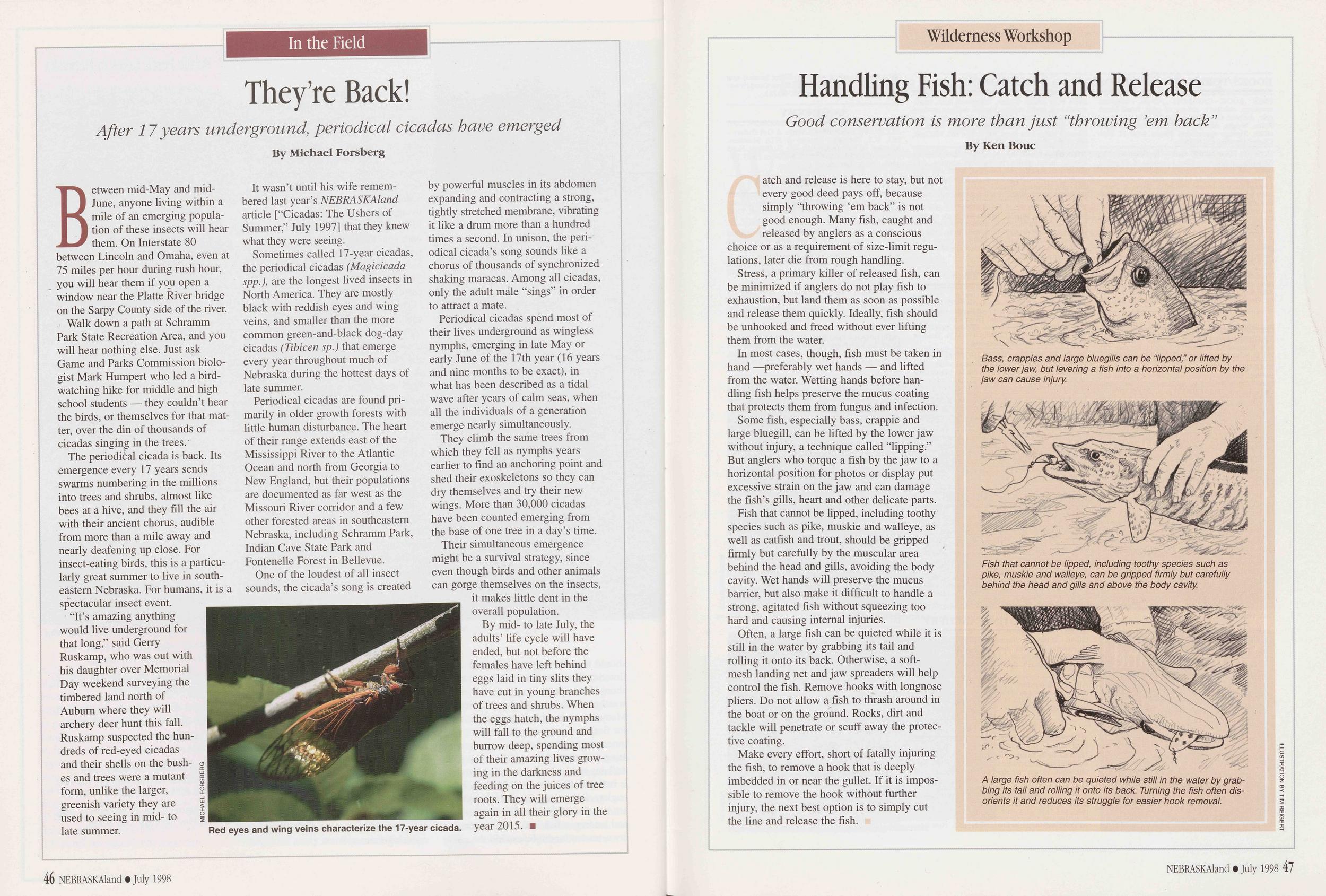
In the Field
They're Back!
After 17 years underground, periodical cicadas have emerged By Michael ForsbergBetween mid-May and mid-June, anyone living within a mile of an emerging population of these insects will hear them. On Interstate 80 between Lincoln and Omaha, even at 75 miles per hour during rush hour, you will hear them if you open a window near the Platte River bridge on the Sarpy County side of the river.
Walk down a path at Schramm Park State Recreation Area, and you will hear nothing else. Just ask Game and Parks Commission biologist Mark Humpert who led a bird-watching hike for middle and high school students — they couldn't hear the birds, or themselves for that matter, over the din of thousands of cicadas singing in the trees.
The periodical cicada is back. Its emergence every 17 years sends swarms numbering in the millions into trees and shrubs, almost like bees at a hive, and they fill the air with their ancient chorus, audible from more than a mile away and nearly deafening up close. For insect-eating birds, this is a particularly great summer to live in southeastern Nebraska. For humans, it is a spectacular insect event.
"It's amazing anything would live underground for that long," said Gerry Ruskamp, who was out with his daughter over Memorial Day weekend surveying the timbered land north of Auburn where they will archery deer hunt this fall. Ruskamp suspected the hundreds of red-eyed cicadas and their shells on the bushes and trees were a mutant form, unlike the larger, greenish variety they are used to seeing in mid- to late summer.
It wasn't until his wife remembered last year's NEBRASKAland article ["Cicadas: The Ushers of Summer," July 1997] that they knew what they were seeing.
Sometimes called 17-year cicadas, the periodical cicadas (Magicicada spp.), are the longest lived insects in North America. They are mostly black with reddish eyes and wing veins, and smaller than the more common green-and-black dog-day cicadas (Tibicen sp.) that emerge every year throughout much of Nebraska during the hottest days of late summer.
Periodical cicadas are found primarily in older growth forests with little human disturbance. The heart of their range extends east of the Mississippi River to the Atlantic Ocean and north from Georgia to New England, but their populations are documented as far west as the Missouri River corridor and a few other forested areas in southeastern Nebraska, including Schramm Park, Indian Cave State Park and Fontenelle Forest in Bellevue.
One of the loudest of all insect sounds, the cicada's song is created
Red eyes and wing veins characterize the 17-year cicada.
by powerful muscles in its abdomen expanding and contracting a strong, tightly stretched membrane, vibrating it like a drum more than a hundred times a second. In unison, the periodical cicada's song sounds like a chorus of thousands of synchronized shaking maracas. Among all cicadas, only the adult male "sings" in order to attract a mate.
Periodical cicadas spend most of their lives underground as wingless nymphs, emerging in late May or early June of the 17th year (16 years and nine months to be exact), in what has been described as a tidal wave after years of calm seas, when all the individuals of a generation emerge nearly simultaneously.
They climb the same trees from which they fell as nymphs years earlier to find an anchoring point and shed their exoskeletons so they can dry themselves and try their new wings. More than 30,000 cicadas have been counted emerging from the base of one tree in a day's time.
Their simultaneous emergence might be a survival strategy, since even though birds and other animals can gorge themselves on the insects, it makes little dent in the overall population.
By mid- to late July, the adults' life cycle will have ended, but not before the females have left behind eggs laid in tiny slits they have cut in young branches of trees and shrubs. When the eggs hatch, the nymphs will fall to the ground and burrow deep, spending most of their amazing lives growing in the darkness and feeding on the juices of tree roots. They will emerge again in all their glory in the cicada, year 2015.
46 NEBRASKAland • July 1998Wilderness Workshop
Handling Fish: Catch and Release
Good conservation is more than just "throwing 'em back" By Ken BoucCatch and release is here to stay, but not every good deed pays off, because simply "throwing 'em back" is not good enough. Many fish, caught and released by anglers as a conscious choice or as a requirement of size-limit regulations, later die from rough handling.
Stress, a primary killer of released fish, can be minimized if anglers do not play fish to exhaustion, but land them as soon as possible and release them quickly. Ideally, fish should be unhooked and freed without ever lifting them from the water.
In most cases, though, fish must be taken in hand —preferably wet hands — and lifted from the water. Wetting hands before handling fish helps preserve the mucus coating that protects them from fungus and infection.
Some fish, especially bass, crappie and large bluegill, can be lifted by the lower jaw without injury, a technique called "lipping." But anglers who torque a fish by the jaw to a horizontal position for photos or display put excessive strain on the jaw and can damage the fish's gills, heart and other delicate parts.
Fish that cannot be lipped, including toothy species such as pike, muskie and walleye, as well as catfish and trout, should be gripped firmly but carefully by the muscular area behind the head and gills, avoiding the body cavity. Wet hands will preserve the mucus barrier, but also make it difficult to handle a strong, agitated fish without squeezing too hard and causing internal injuries.
Often, a large fish can be quieted while it is still in the water by grabbing its tail and rolling it onto its back. Otherwise, a soft-mesh landing net and jaw spreaders will help control the fish. Remove hooks with longnose pliers. Do not allow a fish to thrash around in the boat or on the ground. Rocks, dirt and tackle will penetrate or scuff away the protective coating.
Make every effort, short of fatally injuring the fish, to remove a hook that is deeply imbedded in or near the gullet. If it is impossible to remove the hook without further injury, the next best option is to simply cut the line and release the fish.
Bass, crappies and large bluegills can be "lipped," or lifted by the lower jaw, but levering a fish into a horizontal position by the jaw can cause injury.
Fish that cannot be lipped, including toothy species such as pike, muskie and walleye, can be gripped firmly but carefully behind the head and gills and above the body cavity.
A large fish often can be quieted while still in the water by grabbing its tail and rolling it onto its back. Turning the fish often disorients it and reduces its struggle for easier hook removal.
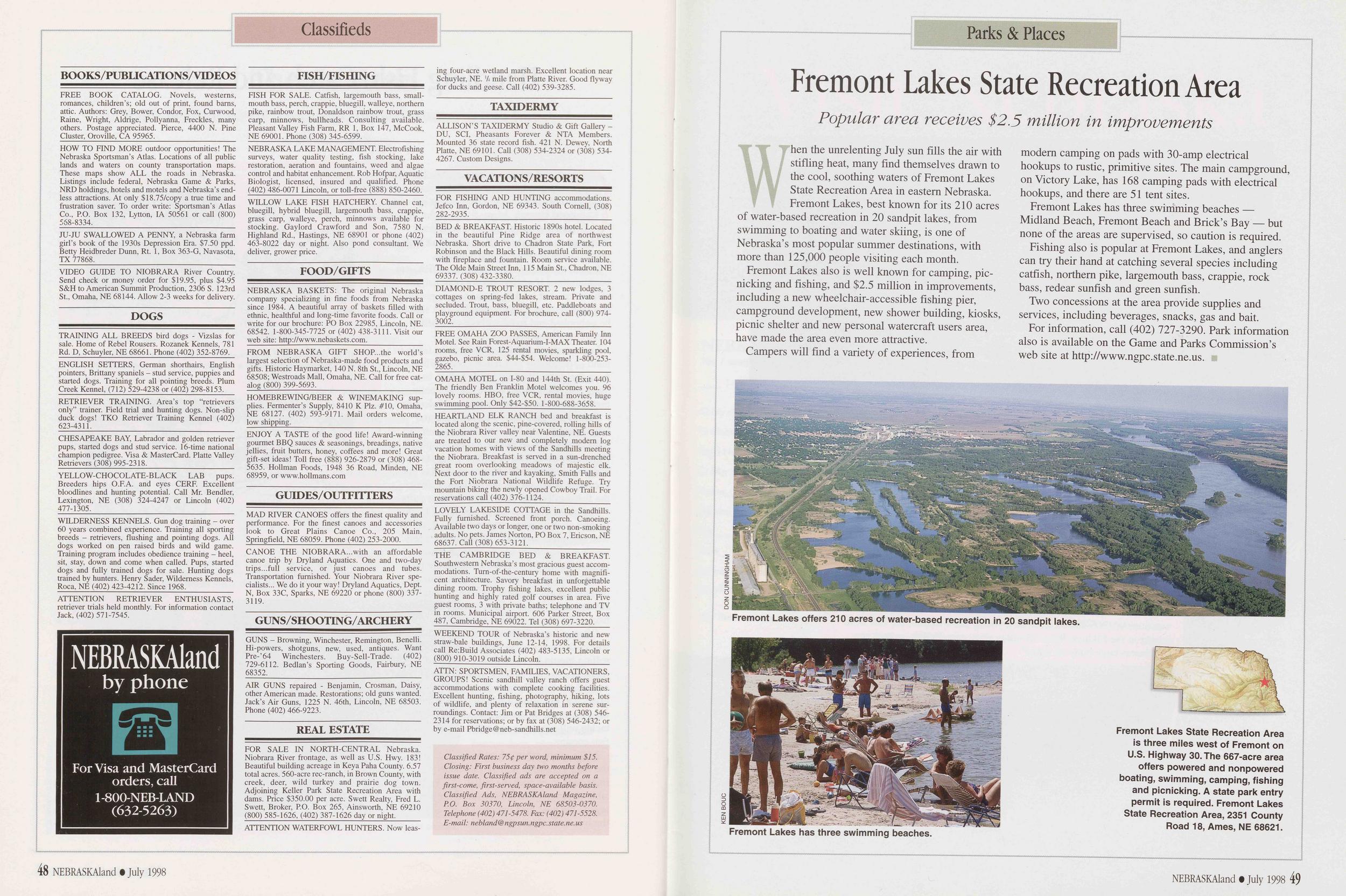
Classifieds
BOOKS/PUBUCATIONS/VIDEOS FREE BOOK CATALOG. Novels, westerns, romances, children's; old out of print, found barns, attic. Authors: Grey, Bower, Condor, Fox, Curwood, Raine, Wright, Aldrige, Pollyanna, Freckles, many others. Postage appreciated. Pierce, 4400 N. Pine Cluster, Provide, CA 95965. HOW TO FIND MORE outdoor opportunities! The Nebraska Sportsman's Atlas. Locations of all public lands and waters on county transportation maps. These maps show ALL the roads in Nebraska. Listings include federal, Nebraska Game & Parks, NRD holdings, hotels and motels and Nebraska's endless attractions. At only $18.75/copy a true time and frustration saver. To order write: Sportsman's Atlas Co., P.O. Box 132, Lytton, IA 50561 or call (800) 568-8334. JU-JU SWALLOWED A PENNY, a Nebraska farm girl's book of the 1930s Depression Era. $7.50 ppd. Betty Heidbreder Dunn, Rt. 1, Box 363-G, Navasota, TX 77868. VIDEO GUIDE TO NIOBRARA River Country. Send check or money order for $19.95, plus $4.95 S&H to American Summit Production, 2306 S. 123rd St., Omaha, NE 68144. Allow 2-3 weeks for delivery. DOGS TRAINING ALL BREEDS bird dogs - Vizslas for sale. Home of Rebel Rousers. Rozanek Kennels, 781 Rd. D, Schuyler, NE 68661. Phone (402) 352-8769. ENGLISH SETTERS, German shorthairs, English pointers, Brittany spaniels - stud service, puppies and started dogs. Training for all pointing breeds. Plum Creek Kennel, (712) 529-4238 or (402) 298-8153. RETRIEVER TRAINING. Area's top "retrievers only" trainer. Field trial and hunting dogs. Non-slip duck dogs! TKO Retriever Training Kennel (402) 623-4311. CHESAPEAKE BAY, Labrador and golden retriever pups, started dogs and stud service. 16-time national champion pedigree. Visa & MasterCard. Platte Valley Retrievers (308) 995-2318. YELLOW-CHOCOLATE-BLACK LAB pups. Breeders hips O.F.A. and eyes CERE Excellent bloodlines and hunting potential. Call Mr. Bendler, Lexington, NE (308) 324-4247 or Lincoln (402) 477-1305. WILDERNESS KENNELS. Gun dog training - over 60 years combined experience. Training all sporting breeds - retrievers, flushing and pointing dogs. All dogs worked on pen raised birds and wild game. Training program includes obedience training - heel, sit, stay, down and come when called. Pups, started dogs and fully trained dogs for sale. Hunting dogs trained by hunters. Henry Sader, Wilderness Kennels, Roca, NE (402) 423-4212. Since 1968. ATTENTION RETRIEVER ENTHUSIASTS, retriever trials held monthly. For information contact Jack, (402) 571-7545. NEBRASKAland by phone For Visa and MasterCard orders, call 1-800-NEB-LAND (632-5263) FISH/FISHING FISH FOR SALE. Catfish, largemouth bass, smallmouth bass, perch, crappie, bluegill, walleye, northern pike, rainbow trout, Donaldson rainbow trout, grass carp, minnows, bullheads. Consulting available. Pleasant Valley Fish Farm, RR 1, Box 147, McCook, NE 69001. Phone (308) 345-6599. NEBRASKA LAKE MANAGEMENT. Electrofishing surveys, water quality testing, fish stocking, lake restoration, aeration and fountains, weed and algae control and habitat enhancement. Rob Hofpar, Aquatic Biologist, licensed, insured and qualified. Phone (402) 486-0071 Lincoln, or toll-free (888) 850-2460. WILLOW LAKE FISH HATCHERY. Channel cat, bluegill, hybrid bluegill, largemouth bass, crappie, grass carp, walleye, perch, minnows available for stocking. Gaylord Crawford and Son, 7580 N. Highland Rd., Hastings, NE 68901 or phone (402) 463-8022 day or night. Also pond consultant. We deliver, grower price. FOOD/GIFTS NEBRASKA BASKETS: The original Nebraska company specializing in fine foods from Nebraska since 1984. A beautiful array of baskets filled with ethnic, healthful and long-time favorite foods. Call or write for our brochure: PO Box 22985, Lincoln, NE. 68542. 1-800-345-7725 or (402) 438-3111. Visit our web site: http://www.nebaskets.com. FROM NEBRASKA GIFT SHOP..the world's largest selection of Nebraska-made food products and gifts. Historic Haymarket, 140 N. 8th St., Lincoln, NE 68508; Westroads Mall, Omaha, NE. Call for free catalog (800) 399-5693. HOMEBREWING/BEER & WINEMAKING supplies. Fermenter's Supply, 8410 K Plz. #10, Omaha, NE 68127. (402) 593-9171. Mail orders welcome, low shipping. ENJOY A TASTE of the good life! Award-winning gourmet BBQ sauces & seasonings, breadings, native jellies, fruit butters, honey, coffees and more! Great gift-set ideas! Toll free (888) 926-2879 or (308) 468- 5635. Hollman Foods, 1948 36 Road, Minden, NE 68959, or www.hollmans.com GUIDES/OUTFITTERS MAD RIVER CANOES offers the finest quality and performance. For the finest canoes and accessories look to Great Plains Canoe Co., 205 Main, Springfield, NE 68059. Phone (402) 253-2000. CANOE THE NIOBRARA...with an affordable canoe trip by Dryland Aquatics. One and two-day trips...full service, or just canoes and tubes. Transportation furnished. Your Niobrara River specialists... We do it your way! Dryland Aquatics, Dept. N, Box 33C, Sparks, NE 69220 or phone (800) 337- 3119. GUNS/SHOOTING/ARCHERY GUNS - Browning, Winchester, Remington, Benelli. Hi-powers, shotguns, new, used, antiques. Want Pre-'64 Winchesters. Buy-Sell-Trade. (402) 729-6112. Bedlan's Sporting Goods, Fairbury, NE 68352. AIR GUNS repaired - Benjamin, Crosman, Daisy, other American made. Restorations; old guns wanted. Jack's Air Guns, 1225 N. 46th, Lincoln, NE 68503. Phone (402) 466-9223. REAL ESTATE FOR SALE IN NORTH-CENTRAL Nebraska. Niobrara River frontage, as well as U.S. Hwy. 183! Beautiful building acreage in Key a Paha County. 6.57 total acres. 560-acre rec-ranch, in Brown County, with creek, deer, wild turkey and prairie dog town. Adjoining Keller Park State Recreation Area with dams. Price $350.00 per acre. Swett Realty, Fred L. Swett, Broker, P.O. Box 265, Ainsworth, NE 69210 (800) 585-1626, (402) 387-1626 day or night. ATTENTION WATERFOWL HUNTERS. Now leasing four-acre wetland marsh. Excellent location near Schuyler, NE. 'A mile from Platte River. Good flyway for ducks and geese. Call (402) 539-3285. TAXIDERMY ALLISON'S TAXIDERMY Studio & Gift Gallery - DU, SCI, Pheasants Forever & NTA Members. Mounted 36 state record fish. 421 N. Dewey, North Platte, NE 69101. Call (308) 534-2324 or (308) 534-4267. Custom Designs. VACATIONS/RESORTS FOR FISHING AND HUNTING accommodations. Jefco Inn, Gordon, NE 69343. South Cornell, (308) 282-2935. BED & BREAKFAST. Historic 1890s hotel. Located in the beautiful Pine Ridge area of northwest Nebraska. Short drive to Chadron State Park, Fort Robinson and the Black Hills. Beautiful dining room with fireplace and fountain. Room service available. The Olde Main Street Inn, 115 Main St., Chadron, NE 69337. (308) 432-3380. DIAMOND-E TROUT RESORT. 2 new lodges, 3 cottages on spring-fed lakes, stream. Private and secluded. Trout, bass, bluegill, etc. Paddleboats and playground equipment. For brochure, call (800) 974-3002. FREE OMAHA ZOO PASSES, American Family Inn Motel. See Rain Forest-Aquarium-I-MAX Theater. 104 rooms, free VCR, 125 rental movies, sparkling pool, gazebo, picnic area. $44-$54. Welcome! 1-800-253-2865. OMAHA MOTEL on 1-80 and 144th St. (Exit 440). The friendly Ben Franklin Motel welcomes you. 96 lovely rooms. HBO, free VCR, rental movies, huge swimming pool. Only $42-$50. 1-800-688-3658. HEARTLAND ELK RANCH bed and breakfast is located along the scenic, pine-covered, rolling hills of the Niobrara River valley near Valentine, NE. Guests are treated to our new and completely modern log vacation homes with views of the Sandhills meeting the Niobrara. Breakfast is served in a sun-drenched great room overlooking meadows of majestic elk. Next door to the river and kayaking, Smith Falls and the Fort Niobrara National Wildlife Refuge. Try mountain biking the newly opened Cowboy Trail. For reservations call (402) 376-1124. LOVELY LAKESIDE COTTAGE in the Sandhills. Fully furnished. Screened front porch. Canoeing. Available two days or longer, one or two non-smoking adults. No pets. James Norton, PO Box 7, Ericson, NE 68637. Call (308) 653-3121. THE CAMBRIDGE BED & BREAKFAST. Southwestern Nebraska's most gracious guest accommodations. Turn-of-the-century home with magnificent architecture. Savory breakfast in unforgettable dining room. Trophy fishing lakes, excellent public hunting and highly rated golf courses in area. Five guest rooms, 3 with private baths; telephone and TV in rooms. Municipal airport. 606 Parker Street, Box 487, Cambridge, NE 69022. Tel (308) 697-3220. WEEKEND TOUR of Nebraska's historic and new straw-bale buildings, June 12-14, 1998. For details call Re:Build Associates (402) 483-5135, Lincoln or (800) 910-3019 outside Lincoln. ATTN: SPORTSMEN, FAMILIES, VACATIONERS. GROUPS! Scenic sandhill valley ranch offers guest accommodations with complete cooking facilities. Excellent hunting, fishing, photography, hiking, lots of wildlife, and plenty of relaxation in serene surroundings. Contact: Jim or Pat Bridges at (308) 546-2314 for reservations; or by fax at (308) 546-2432; or by e-mail Pbridge@neb-sandhills.net Classified Rates: 750 per word, minimum $15. Closing: First business day two months before issue date. Classified ads are accepted on a first-come, first-served, space-available basis. Classified Ads, NEBRASKAland Magazine, RO. Box 30370, Lincoln, NE 68503-0370. Telephone (402) 471-5478. Fax: (402) 471-5528. E-mail: nebland@ngpsun.ngpc.state.ne.us 48 NEBRASKAland • July 1998Parks & Places
Fremont Lakes State Recreation Area
Popular area receives $2.5 million in improvementsWhen the unrelenting July sun fills the air with stifling heat, many find themselves drawn to the cool, soothing waters of Fremont Lakes State Recreation Area in eastern Nebraska. Fremont Lakes, best known for its 210 acres of water-based recreation in 20 sandpit lakes, from swiniming to boating and water skiing, is one of Nebraska's most popular summer destinations, with more than 125,000 people visiting each month.
Fremont Lakes also is well known for camping, picnicking and fishing, and $2.5 million in improvements, including a new wheelchair-accessible fishing pier, campground development, new shower building, kiosks, picnic shelter and new personal watercraft users area, have made the area even more attractive.
Campers will find a variety of experiences, from modern camping on pads with 30-amp electrical hookups to rustic, primitive sites. The main campground, on Victory Lake, has 168 camping pads with electrical hookups, and there are 51 tent sites.
Fremont Lakes has three swimming beaches — Midland Beach, Fremont Beach and Brick's Bay — but none of the areas are supervised, so caution is required.
Fishing also is popular at Fremont Lakes, and anglers can try their hand at catching several species including catfish, northern pike, largemouth bass, crappie, rock bass, redear sunfish and green sunfish.
Two concessions at the area provide supplies and services, including beverages, snacks, gas and bait.
For information, call (402) 727-3290. Park information also is available on the Game and Parks Commission's web site at http://www.ngpc.state.ne.us.
Fremont Lakes offers 210 acres of water-based recreation in 20 sandpit lakes.
DON CUNNINGHAMFremont Lakes has three swimming beaches
Fremont Lakes State Recreation Area is three miles west of Fremont on U.S. Highway 30. The 667-acre area offers powered and nonpowered boating, swimming, camping, fishing and picnicking. A state park entry permit is required. Fremont Lakes State Recreation Area, 2351 County Road 18, Ames, NE 68621.
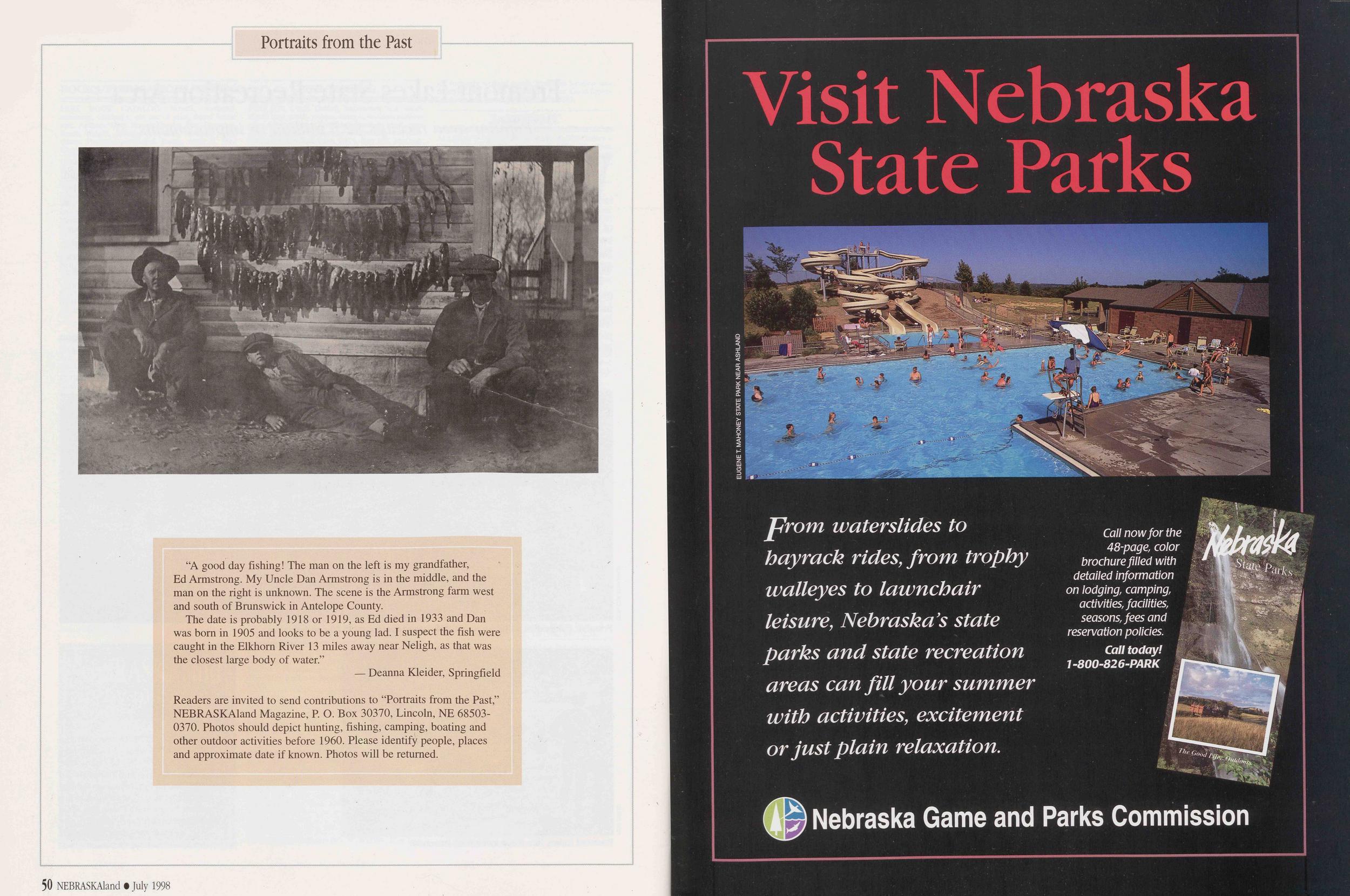
Portraits from the Past
Position: 769 (14 views)