Volume 76, Issue 4, 1998

NEBRASKAland
Nebraska Games & Parks Commission May 1998 $2.00
NEBRASKAland
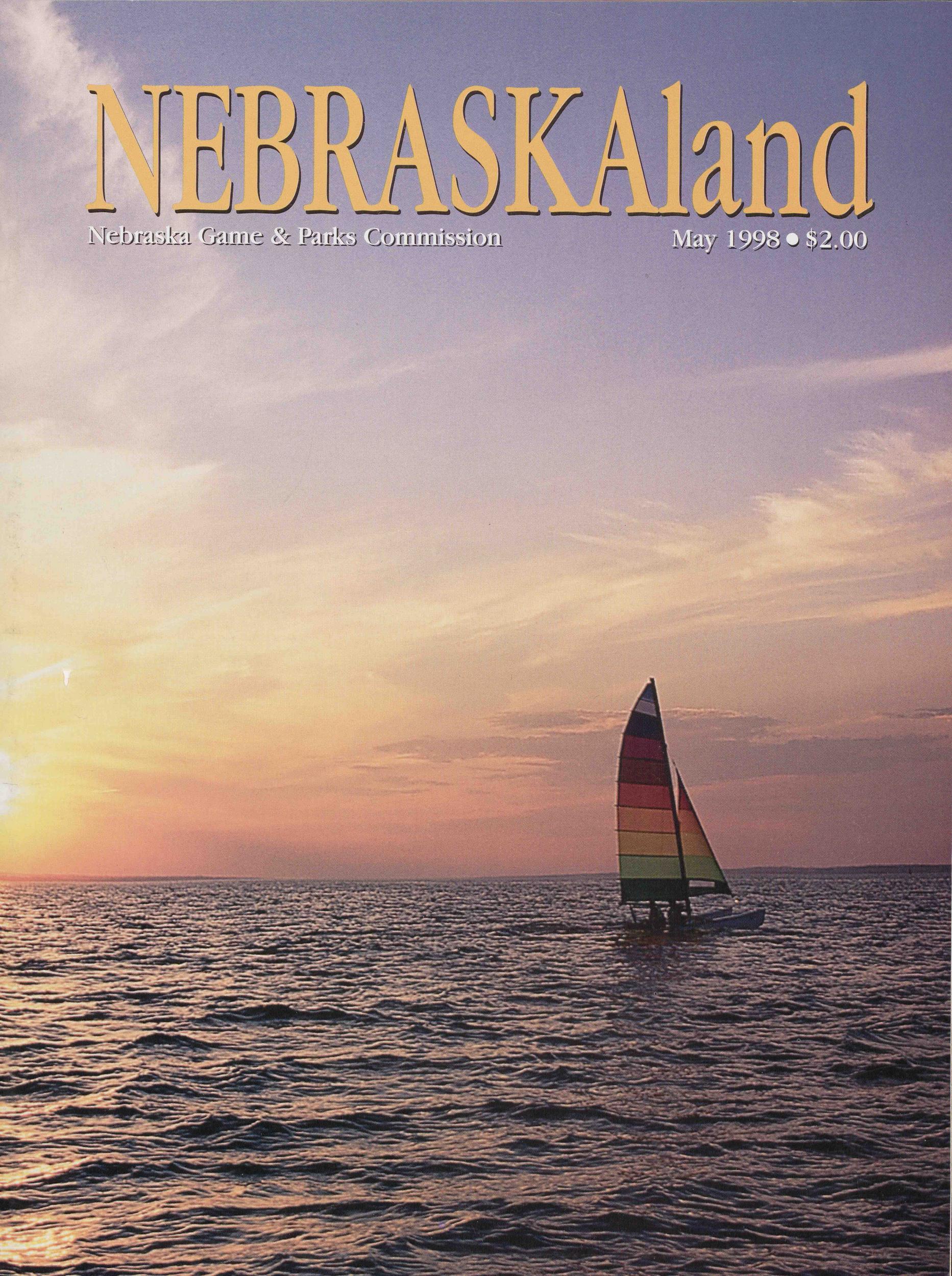
Volume 76, Number 4, May 1998 Features FOCUS ON LAKE McCONAUGHY: A Special 18-page Section on Nebraska's Largest Reservoir Big Mac's Biggest Year 10 After several years in the doldrums, Lake McConaughy's walleye fishing proved to be among the best in the nation in 1997. Solving Lake Ogallala's Problems 18 Renovation and restocking of the "little lake" below Kingsley Dam is the first step toward making Lake Ogallala a prime cold-water fishery. Destination Big Mac 24 Improved roads, upgraded campgrounds and a new visitor center are the first stages of development that will continue in to the next century and keep Lake McConaughy one of Nebraska's premiere recreation destinations. Bowfishing the Missouri 28 Marlyn Wiebelhaus of Wynot pursues bighead carp and other species of fish in the upper Missouri River with a bow and arrow. The CowboyTrail: A Work in Progress 34 The 321-mile Cowboy Recreation and Nature Trail, the longest rails-to-trails conversion in the nation, is beginning to take shape, and people are beginning to take notice. Hudson-Meng Bison Bonebed 40 Discovered nearly 60 years ago, this collection of ancient buffalo bones has produced some remarkable finds. A new enclosure over the bonebed gives visitors a unique perspective of archaeologists at work. Departments Letters 4 Outdoor News 6 Outdoor Business 8 Work in Progress 46 In the Field 47 Classifieds 48 Parks & Places 49 Portraits from the Past 50 Cover: A sailboat at Lake McConaughy near Ogallala makes a trim silhouette against a summer sunset. Opposite: Clutching the rough bark of a tree, a juvenile great-horned owl warily eyes the landscape at Clear Creek Wildlife Management Area at the west end of Lake McConaughy. Photos by Bob Grier.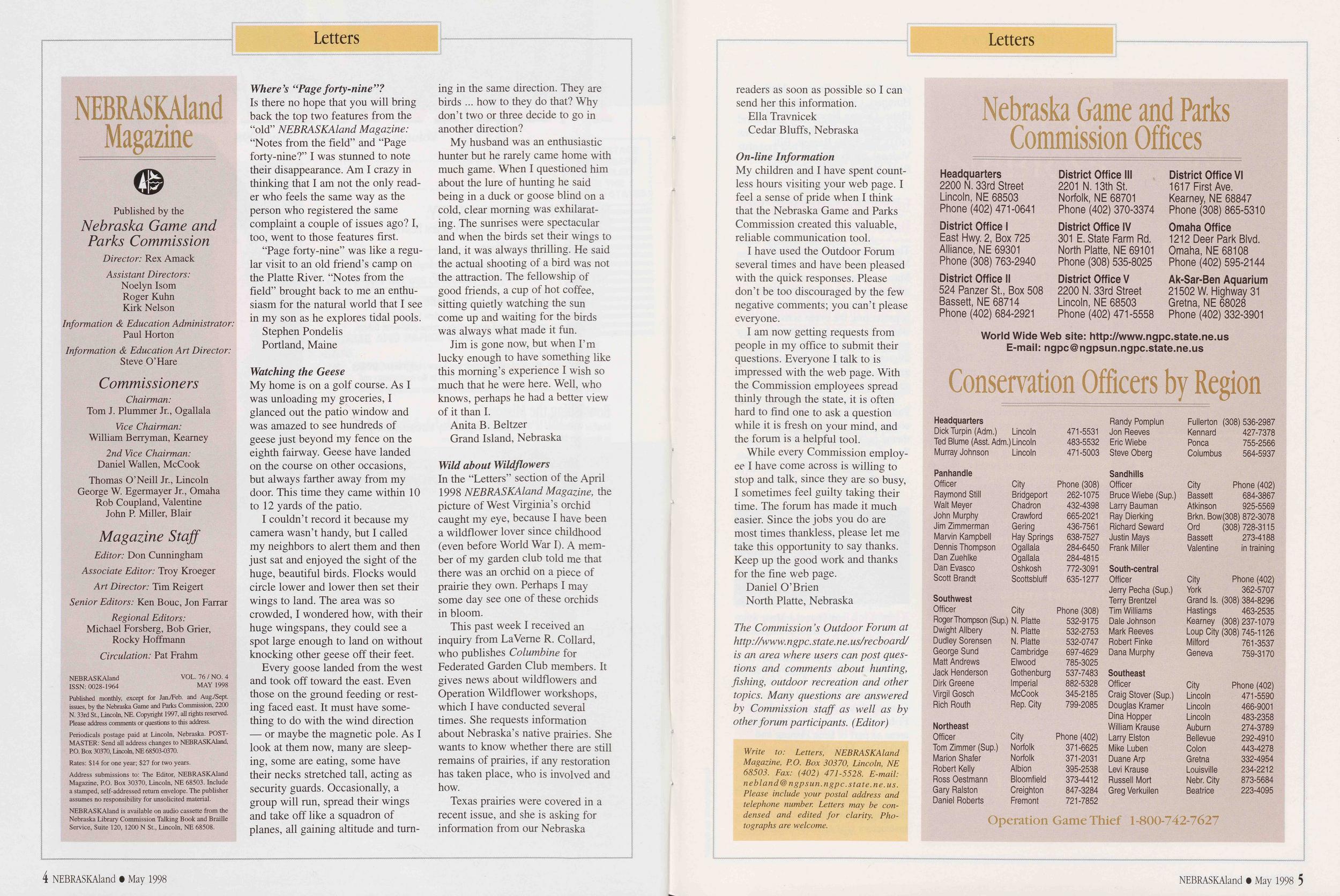
Letters
Where's "Page forty-nine"?Is there no hope that you will bring back the top two features from the "old" NEBRASKAland Magazine: "Notes from the field" and "Page forty-nine?" I was stunned to note their disappearance. Am I crazy in thinking that I am not the only reader who feels the same way as the person who registered the same complaint a couple of issues ago? I, too, went to those features first.
"Page forty-nine" was like a regular visit to an old friend's camp on the Platte River. "Notes from the field" brought back to me an enthusiasm for the natural world that I see in my son as he explores tidal pools.
Stephen Pondelis Portland, Maine Watching the GeeseMy home is on a golf course. As I was unloading my groceries, I glanced out the patio window and was amazed to see hundreds of geese just beyond my fence on the eighth fairway. Geese have landed on the course on other occasions, but always farther away from my door. This time they came within 10 to 12 yards of the patio.
I couldn't record it because my camera wasn't handy, but I called my neighbors to alert them and then just sat and enjoyed the sight of the huge, beautiful birds. Flocks would circle lower and lower then set their wings to land. The area was so crowded, I wondered how, with their huge wingspans, they could see a spot large enough to land on without knocking other geese off their feet.
Every goose landed from the west and took off toward the east. Even those on the ground feeding or resting faced east. It must have something to do with the wind direction — or maybe the magnetic pole. As I look at them now, many are sleeping, some are eating, some have their necks stretched tall, acting as security guards. Occasionally, a group will run, spread their wings and take off like a squadron of planes, all gaining altitude and turning in the same direction. They are birds ... how to they do that? Why don't two or three decide to go in another direction?
My husband was an enthusiastic hunter but he rarely came home with much game. When I questioned him about the lure of hunting he said being in a duck or goose blind on a cold, clear morning was exhilarating. The sunrises were spectacular and when the birds set their wings to land, it was always thrilling. He said the actual shooting of a bird was not the attraction. The fellowship of good friends, a cup of hot coffee, sitting quietly watching the sun come up and waiting for the birds was always what made it fun.
Jim is gone now, but when I'm lucky enough to have something like this morning's experience I wish so much that he were here. Well, who knows, perhaps he had a better view of it than I.
Anita B. Beltzer Grand Island, Nebraska Wild about WildflowersIn the "Letters" section of the April 1998 NEBRASKAland Magazine, the picture of West Virginia's orchid caught my eye, because I have been a wildflower lover since childhood (even before World War I). A member of my garden club told me that there was an orchid on a piece of prairie they own. Perhaps I may some day see one of these orchids in bloom.
This past week I received an inquiry from LaVerne R. Collard, who publishes Columbine for Federated Garden Club members. It gives news about wildflowers and Operation Wildflower workshops, which I have conducted several times. She requests information about Nebraska's native prairies. She wants to know whether there are still remains of prairies, if any restoration has taken place, who is involved and how.
Texas prairies were covered in a recent issue, and she is asking for information from our Nebraska
4 NEBRASKAland • May 1998 Lettersreaders as soon as possible so I can send her this information.
Ella Travnicek Cedar Bluffs, Nebraska On-line InformationMy children and I have spent countless hours visiting your web page. I feel a sense of pride when I think that the Nebraska Game and Parks Commission created this valuable, reliable communication tool.
I have used the Outdoor Forum several times and have been pleased with the quick responses. Please don't be too discouraged by the few negative comments; you can't please everyone.
I am now getting requests from people in my office to submit their questions. Everyone I talk to is impressed with the web page. With the Commission employees spread thinly through the state, it is often hard to find one to ask a question while it is fresh on your mind, and the forum is a helpful tool.
While every Commission employee I have come across is willing to stop and talk, since they are so busy, I sometimes feel guilty taking their time. The forum has made it much easier. Since the jobs you do are most times thankless, please let me take this opportunity to say thanks. Keep up the good work and thanks for the fine web page.
Daniel O'Brien North Platte, Nebraska The Commission's Outdoor Forum at http://www. ngpc. state, ne. us/recboaraV is an area where users can post questions and comments about hunting, fishing, outdoor recreation and other topics. Many questions are answered by Commission staff as well as by other forum participants. (Editor) Write to: Letters, NEBRASKAland Magazine, P.O. Box 30370, Lincoln, NE 68503. Fax: (402) 471-5528. E-mail: nebland@ngp sun.ngpc. state.ne. us. Please include your postal address and telephone number. Letters may be condensed and edited for clarity. Photographs are welcome.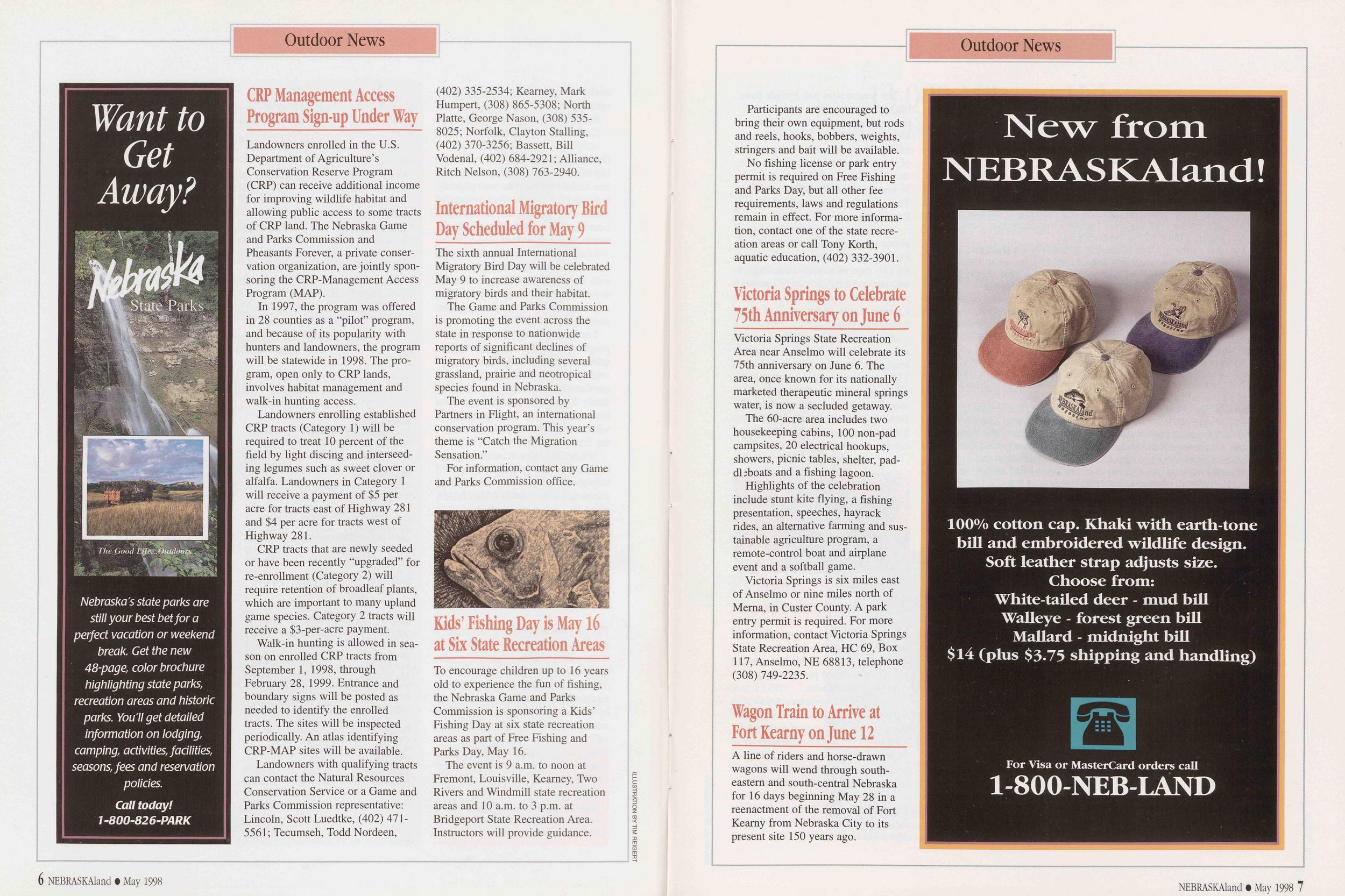
Outdoor News
CRP Management Access Program Sign-up Under WayLandowners enrolled in the U.S. Department of Agriculture's Conservation Reserve Program (CRP) can receive additional income for improving wildlife habitat and allowing public access to some tracts of CRP land. The Nebraska Game and Parks Commission and Pheasants Forever, a private conservation organization, are jointly sponsoring the CRP-Management Access Program (MAP).
In 1997, the program was offered in 28 counties as a "pilot" program, and because of its popularity with hunters and landowners, the program will be statewide in 1998. The program, open only to CRP lands, involves habitat management and walk-in hunting access.
Landowners enrolling established CRP tracts (Category 1) will be required to treat 10 percent of the field by light discing and inter-seeding legumes such as sweet clover or alfalfa. Landowners in Category 1 will receive a payment of $5 per acre for tracts east of Highway 281 and $4 per acre for tracts west of Highway 281.
CRP tracts that are newly seeded or have been recently "upgraded" for re-enrollment (Category 2) will require retention of broadleaf plants, which are important to many upland game species. Category 2 tracts will receive a $3-per-acre payment.
Walk-in hunting is allowed in season on enrolled CRP tracts from September 1, 1998, through February 28, 1999. Entrance and boundary signs will be posted as needed to identify the enrolled tracts. The sites will be inspected periodically. An atlas identifying CRP-MAP sites will be available.
Landowners with qualifying tracts can contact the Natural Resources Conservation Service or a Game and Parks Commission representative: Lincoln, Scott Luedtke, (402) 471-5561; Tecumseh, Todd Nordeen, (402) 335-2534; Kearney, Mark Humpert, (308) 865-5308; North Platte, George Nason, (308) 535-8025; Norfolk, Clayton Stalling, (402) 370-3256; Bassett, Bill Vodenal, (402) 684-2921; Alliance, Ritch Nelson, (308) 763-2940.
International Migratory Bird Day Scheduled for May 9The sixth annual International Migratory Bird Day will be celebrated May 9 to increase awareness of migratory birds and their habitat.
The Game and Parks Commission is promoting the event across the state in response to nationwide reports of significant declines of migratory birds, including several grassland, prairie and neotropical species found in Nebraska.
The event is sponsored by Partners in Flight, an international conservation program. This year's theme is "Catch the Migration Sensation."
For information, contact any Game and Parks Commission office.
To encourage children up to 16 years old to experience the fun of fishing, the Nebraska Game and Parks Commission is sponsoring a Kids' Fishing Day at six state recreation areas as part of Free Fishing and Parks Day, May 16.
The event is 9 a.m. to noon at Fremont, Louisville, Kearney, Two Rivers and Windmill state recreation areas and 10 a.m. to 3 p.m. at Bridgeport State Recreation Area. Instructors will provide guidance.
6 NEBRASKAland • May 1998 Outdoor NewsParticipants are encouraged to bring their own equipment, but rods and reels, hooks, bobbers, weights, stringers and bait will be available.
No fishing license or park entry permit is required on Free Fishing and Parks Day, but all other fee requirements, laws and regulations remain in effect. For more information, contact one of the state recreation areas or call Tony Korth, aquatic education, (402) 332-3901.
Victoria Springs to Celebrate 75th Anniversary on June 6Victoria Springs State Recreation Area near Anselmo will celebrate its 75th anniversary on June 6. The area, once known for its nationally marketed therapeutic mineral springs water, is now a secluded getaway.
The 60-acre area includes two housekeeping cabins, 100 non-pad campsites, 20 electrical hookups, showers, picnic tables, shelter, paddleboats and a fishing lagoon.
Highlights of the celebration include stunt kite flying, a fishing presentation, speeches, hayrack rides, an alternative farming and sustainable agriculture program, a remote-control boat and airplane event and a softball game.
Victoria Springs is six miles east of Anselmo or nine miles north of Merna, in Custer County. A park entry permit is required. For more information, contact Victoria Springs State Recreation Area, HC 69, Box 117, Anselmo, NE 68813, telephone (308) 749-2235.
Wagon Train to Arrive at Fort Kearny on June 12A line of riders and horse-drawn wagons will wend through south-eastern and south-central Nebraska for 16 days beginning May 28 in a reenactment of the removal of Fort Kearny from Nebraska City to its present site 150 years ago.
Outdoor News
Officer's Notebook The Strange Case of the Paper-eared Deer On November 7, 1997, one day before the beginning of the firearm deer season, I discovered a white-tailed buck deer, field-dressed and hanging by its antlers, in a shed near North Loup. I speculated that whoever shot the deer would be back the next morning to tag it and check it in, and before I left the area, I wrote a message on a piece of paper and placed it deep inside the buck's ear. At 4 the next morning, I was in position to observe the shed and, I hoped, to apprehend the poacher. I stayed until 11 p.m., when I was called away, but the poacher still had not come for the deer. By the time I finished with the other call it was 1 a.m., and I was exhausted. When I returned at 7 a.m., I found, to my frustration, that the poacher had been there and, of course, had taken the deer. By that time, I had developed a suspect, but I could not prove the case, and I immediately drove to the check station and asked the operator to call me if the suspect came in to check a deer. The week of deer season came and went, and I received no call. I was beginning to believe the case was lost and the poacher had gotten away. The frustration of spending so much time watching the area was wearing on me, and I was starting to feel a little down. On the last day of the season, about an hour after closing time, I received a phone call from the check station operator who said my suspect was at the check station with a deer. As I pulled up at the station, I could see a buck deer in the suspect's pickup and I recognized it as the deer that had been hanging in the shed. The poacher's deer tag was on the deer, and I advised him that the deer had been killed before the season. He denied it, of course, but I told him I could prove it. I informed him that I had located the deer in the shed and had placed a piece of paper in its ear. With several witnesses present, I reached into the deer's ear and retrieved the paper I had placed there more than a week before. Before I unfolded it, I advised the poacher and everyone else present what the message was. Of course, when I unfolded it, the message was as I had stated. A summons was issued, and the deer was confiscated. After several months of legal wrangling, the poacher pleaded guilty and, because of some other violations besides the game violation, he was sentenced to 90 days in jail and ordered to pay the $600 liquidated damages to replace the animal that had been illegally removed from the wild. — Conservation Officer Rick Seward, Ord Anglers: It is Illegal to... • litter or leave fish or fish parts on the banks of any body of water. • fish on private land without permission from the landowner. • seine game fish of any size. • leave minnows in a trap for more than 24 hours. • use drifting float lines, except on rivers, streams and Lewis and Clark Lake. Float lines must be personally attended, and name and address must be attached. • release in public waters any fish that did not originate there. • keep a foul-hooked fish (hooked externally behind the eye or gill). For a detailed outline of Nebraska fishing regulations, consult the "Guide to Nebraska Fishing Regulations and Public Waters," available from any Game and Parks Commission office or permit vendor. Additional information also is available on the Commission's Internet home page at http://www.ngpc.state.ne.us/ or by calling (402) 471-0641.The wagon train will include three original Army wagons, a cannon, reenactors portraying frontier soldiers and "living history" civilian pioneers telling stories and performing music of the period. As closely as possible, the wagon train will follow the Nebraska City to Fort Kearny Cutoff Trail, said wagonmaster Joe Vogel of Red Cloud.
The wagon train is scheduled to arrive at Fort Kearny State Historical Park on June 12 and remain in camp for two days of a celebration that will include a living history soldiers camp, square dancing, wagon rides, a pioneer camp and more story-telling and music.
The wagon train and encampment are a prelude to a July Fourth celebration at Fort Kearny marking the 150th anniversary of the fort's establishment at that site. The event will include a parade in Kearney, a picnic at the fort, cannon firing, speeches, U.S. military history exhibits, wagon rides and reenactments.
Nebraska Pheasants Forever chapters are working with landowners to establish wildlife habitat by paying them to plant food plots, nesting cover and shelterbelts.
Since 1987, Nebraska's 7,800 members in 49 chapters throughout the state have planted more than 1.5 million trees, created more than 81,000 acres of new habitat and spent more than $2.2 million on habitat and conservation education.
For more information, contact Pheasants Forever, Route 1, Box 76, Belgrade, NE 68623 or call (308) 357-1335 or (402) 687-2004.
8 NEBRASKAland • May 1998Outdoor Business
13,000 Miles of Habitat
NRCS sets lofty goal for Nebraska riparian buffer strip enrollment By Ken BoucConservation buffers along streams protect domestic water supplies, keep streams and ponds clean, provide wildlife habitat and prevent erosion. Under the U.S. Department of Agriculture's Conservation Reserve Program (CRP), they also are financially appealing to landowners.
The buffers are eligible for continuous CRP sign-up, which means that the landowner can enroll them at any time without being required to submit a competitive offer. In most cases, if the tract meets requirements, it is accepted in the program. Payment to the landowner is based on fair market value plus a 20 percent bonus for an enrollment period of 10 to 15 years.
Buffer strips, plots of permanent vegetation along stream banks, have always been eligible for CRP, but have not attracted much attention in the past. Recently, however, the Natural Resources Conservation Service (NRCS) has set a goal of enrolling 2 million miles of buffer strips in CRP nationwide by the year 2002.
Nebraska has the potential for enrolling more than 13,000 miles of streamside buffer strips, according to the Buffer Initiative Committee, an alliance of agriculture and conservation groups. As of last fall, Nebraska had only 185 miles of those practices under continuous CRP enrollment, so there is plenty of opportunity for landowners, said Pat McGrane, public affairs specialist for the NRCS.
The program defines 11 eligible buffer practices, including six that directly affect water quality. Two practices provide the most potential benefits for Nebraska, McGrane said. Both practices, riparian buffers and filter strips, involve a barrier of plants placed between agricultural fields and a stream. The barrier of trees, shrubs and native grasses protects water quality and also has considerable value as wildlife habitat.
Riparian buffers are streamside strips of trees, shrubs and native grasses ranging from 33 to 150 feet wide on both sides of the stream.
Filter strips, bands of native grasses without trees and shrubs, also protect streams. Widths range from 20 feet to about 100 feet. A 50 percent
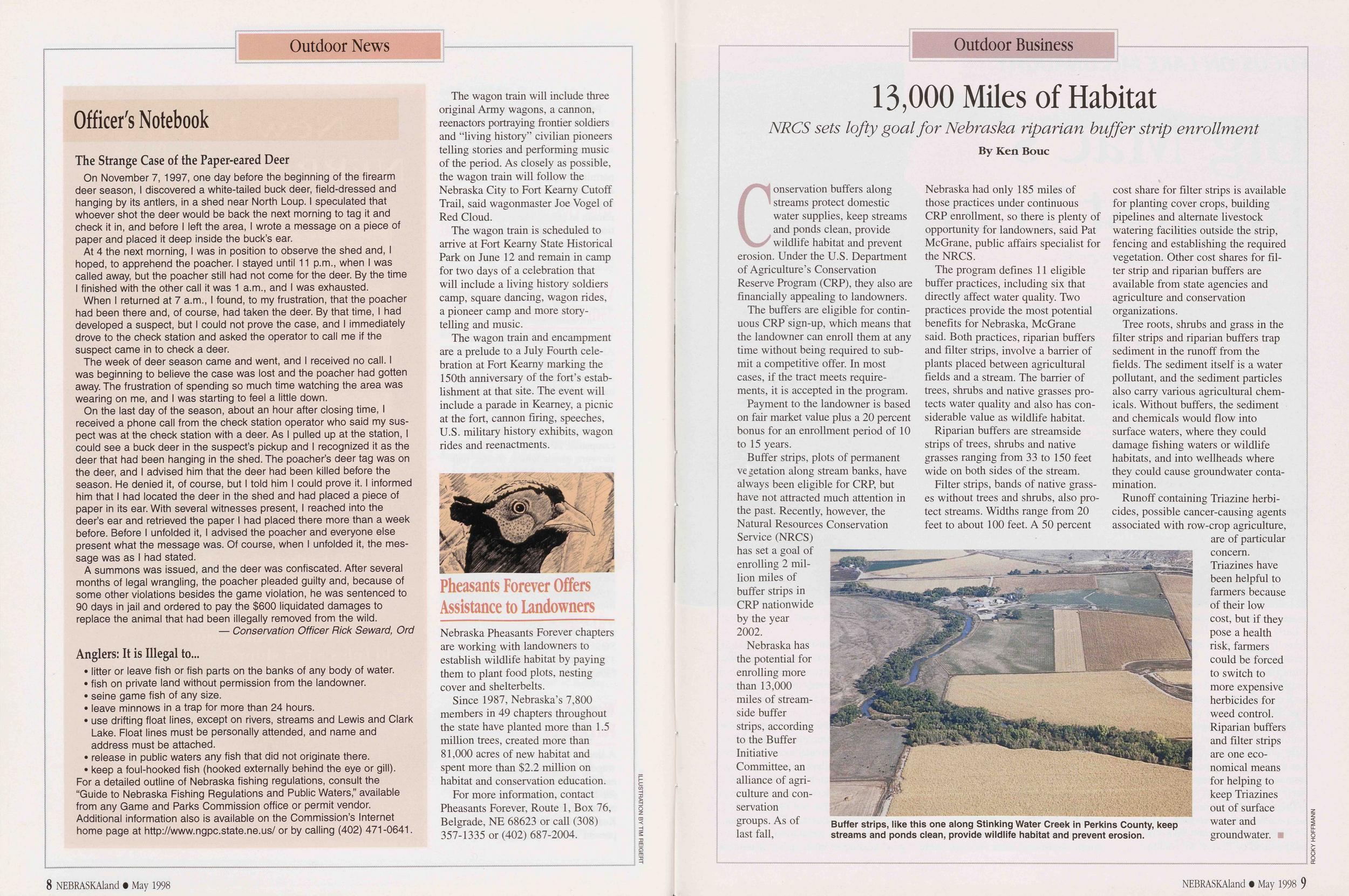
Buffer strips, like this one along Stinking Water Creek in Perkins County, keep streams and ponds clean, provide wildlife habitat and prevent erosion.
ROCKY HOFFMANNcost share for filter strips is available for planting cover crops, building pipelines and alternate livestock watering facilities outside the strip, fencing and establishing the required vegetation. Other cost shares for filter strip and riparian buffers are available from state agencies and agriculture and conservation organizations.
Tree roots, shrubs and grass in the filter strips and riparian buffers trap sediment in the runoff from the fields. The sediment itself is a water pollutant, and the sediment particles also carry various agricultural chemicals. Without buffers, the sediment and chemicals would flow into surface waters, where they could damage fishing waters or wildlife habitats, and into wellheads where they could cause groundwater contamination.
Runoff containing Triazine herbicides, possible cancer-causing agents associated with row-crop agriculture, are of particular concern. Triazines have been helpful to farmers because of their low cost, but if they pose a health risk, farmers could be forced to switch to more expensive herbicides for weed control. Riparian buffers and filter strips are one economical means for helping to keep Triazines out of surface water and groundwater.
NEBRASKAland • May 1998 9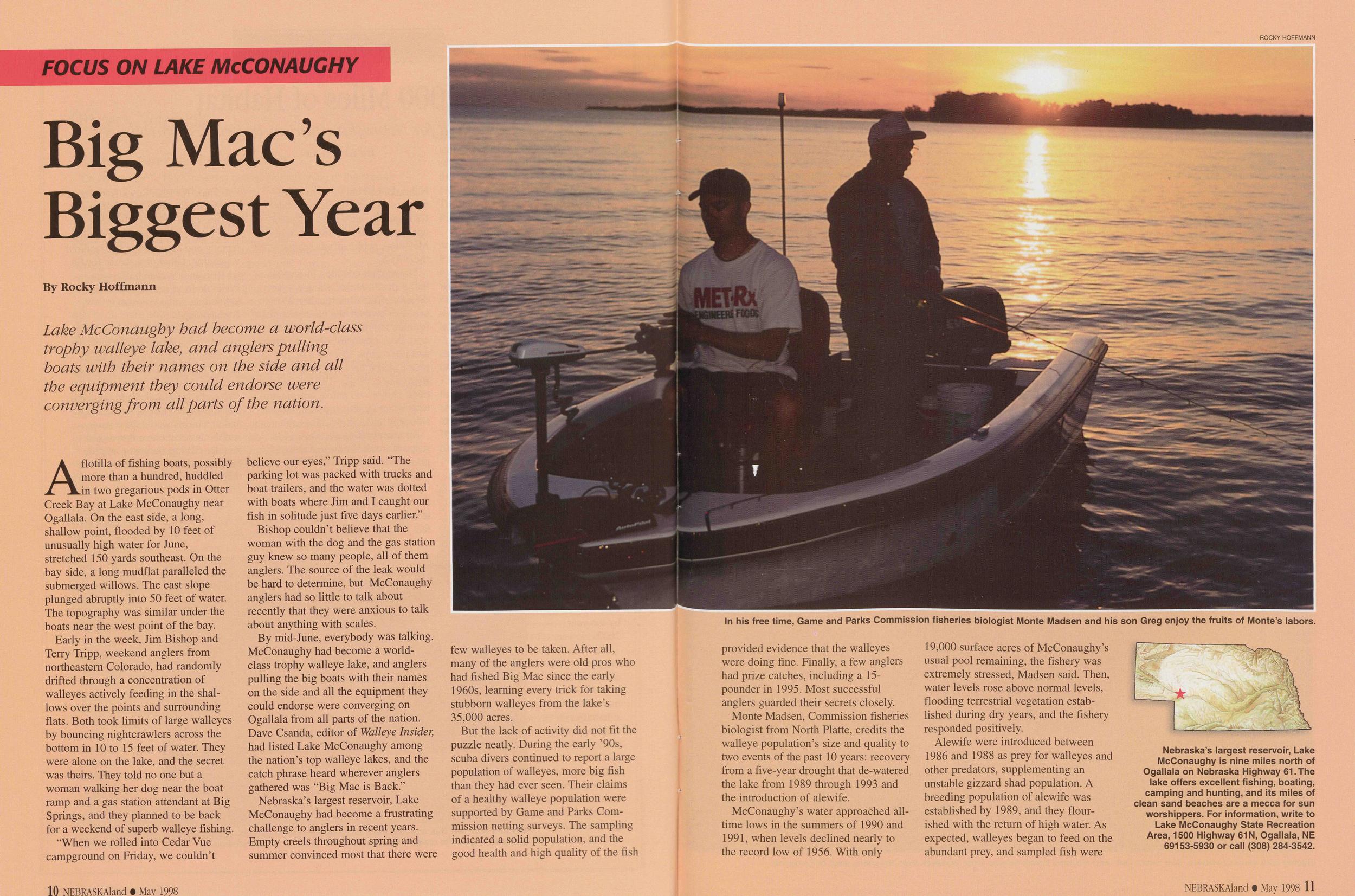
FOCUS ON LAKE McCONAUCHY
Big Mac's Biggest Year
By Rocky Hoffmann Lake McConaughy had become a world-class trophy walleye lake, and anglers pulling boats with their names on the side and all the equipment they could endorse were converging from all parts of the nation.A flotilla of fishing boats, possibly more than a hundred, huddled in two gregarious pods in Otter Creek Bay at Lake McConaughy near Ogallala. On the east side, a long, shallow point, flooded by 10 feet of unusually high water for June, stretched 150 yards southeast. On the bay side, a long mudflat paralleled the submerged willows. The east slope plunged abruptly into 50 feet of water. The topography was similar under the boats near the west point of the bay.
Early in the week, Jim Bishop and Terry Tripp, weekend anglers from northeastern Colorado, had randomly drifted through a concentration of walleyes actively feeding in the shallows over the points and surrounding flats. Both took limits of large walleyes by bouncing nightcrawlers across the bottom in 10 to 15 feet of water. They were alone on the lake, and the secret was theirs. They told no one but a woman walking her dog near the boat ramp and a gas station attendant at Big Springs, and they planned to be back for a weekend of superb walleye fishing.
"When we rolled into Cedar Vue campground on Friday, we couldn't believe our eyes," Tripp said. "The parking lot was packed with trucks and boat trailers, and the water was dotted with boats where Jim and I caught our fish in solitude just five days earlier."
Bishop couldn't believe that the woman with the dog and the gas station guy knew so many people, all of them anglers. The source of the leak would be hard to determine, but McConaughy anglers had so little to talk about recently that they were anxious to talk about anything with scales.
By mid-June, everybody was talking. McConaughy had become a world- class trophy walleye lake, and anglers pulling the big boats with their names on the side and all the equipment they could endorse were converging on Ogallala from all parts of the nation. Dave Csanda, editor of Walleye Insider, had listed Lake McConaughy among the nation's top walleye lakes, and the catch phrase heard wherever anglers gathered was "Big Mac is Back."
Nebraska's largest reservoir, Lake McConaughy had become a frustrating challenge to anglers in recent years. Empty creels throughout spring and summer convinced most that there were
In his free time, Game and Parks Commission fisheries biologist Monte Madsen and his son Greg enjoy the fruits of Monte's labors.
ROCKY HOFFMANNfew walleyes to be taken. After all, many of the anglers were old pros who had fished Big Mac since the early 1960s, learning every trick for taking stubborn walleyes from the lake's 35,000 acres.
But the lack of activity did not fit the puzzle neatly. During the early '90s, scuba divers continued to report a large population of walleyes, more big fish than they had ever seen. Their claims of a healthy walleye population were supported by Game and Parks Commission netting surveys. The sampling indicated a solid population, and the good health and high quality of the fish
10 NEBRASKAland • May 1998provided evidence that the walleyes were doing fine. Finally, a few anglers had prize catches, including a 15-pounder in 1995. Most successful anglers guarded their secrets closely.
Monte Madsen, Commission fisheries biologist from North Platte, credits the walleye population's size and quality to two events of the past 10 years: recovery from a five-year drought that de-watered the lake from 1989 through 1993 and the introduction of alewife.
McConaughy's water approached all-time lows in the summers of 1990 and 1991, when levels declined nearly to the record low of 1956. With only 19,000 surface acres of McConaughy's usual pool remaining, the fishery was extremely stressed, Madsen said. Then, water levels rose above normal levels, flooding terrestrial vegetation established during dry years, and the fishery responded positively.
Alewife were introduced between 1986 and 1988 as prey for walleyes and other predators, supplementing an unstable gizzard shad population. A breeding population of alewife was established by 1989, and they flourished with the return of high water. As expected, walleyes began to feed on the abundant prey, and sampled fish were
Nebraska's largest reservoir, Lake McConaughy is nine miles north of Ogallala on Nebraska Highway 61. The lake offers excellent fishing, boating, camping and hunting, and its miles of clean sand beaches are a mecca for sun worshippers. For information, write to Lake McConaughy State Recreation Area, 1500 Highway 61N, Ogallala, NE 69153-5930 or call (308) 284-3542.
significantly larger. Alewife populations escalated to all-time highs in 1990 and 1991, and the result was poor fishing: So much natural food was available that anglers could not tempt the walleyes.
Last year, a late May and early June fishing frenzy off Otter Creek point indicated change was at hand. A month earlier, anglers had been successful during the walleye spawn along the face of Kingsley Dam. Darrol Eichner, a Commission fisheries biologist, said spawning-run anglers harvested about 2,400 walleyes, most of them males, between April 15 and May 15. Creel surveys suggested that about 900 legal-size walleyes were caught and released during the spawning run, the period when many anglers believe that most of the yearly walleye harvest occurs, but the 1997 summer catch made the early season harvest seem insignificant.
One June morning, Maynard Smidt and Steve Cooper drove from North Platte to fish for smallmouth bass along a rocky shoreline. Smallmouths had benefited from the alewife, and two- and three-pound fish were becoming more common. Boats concentrated off Otter Creek point indicated that anglers had located walleyes, but Smidt and Cooper decided to stay away from the crowd.
Their fishing style is not the worm-drag method popular with many anglers. Sensitive rods, small doll flies
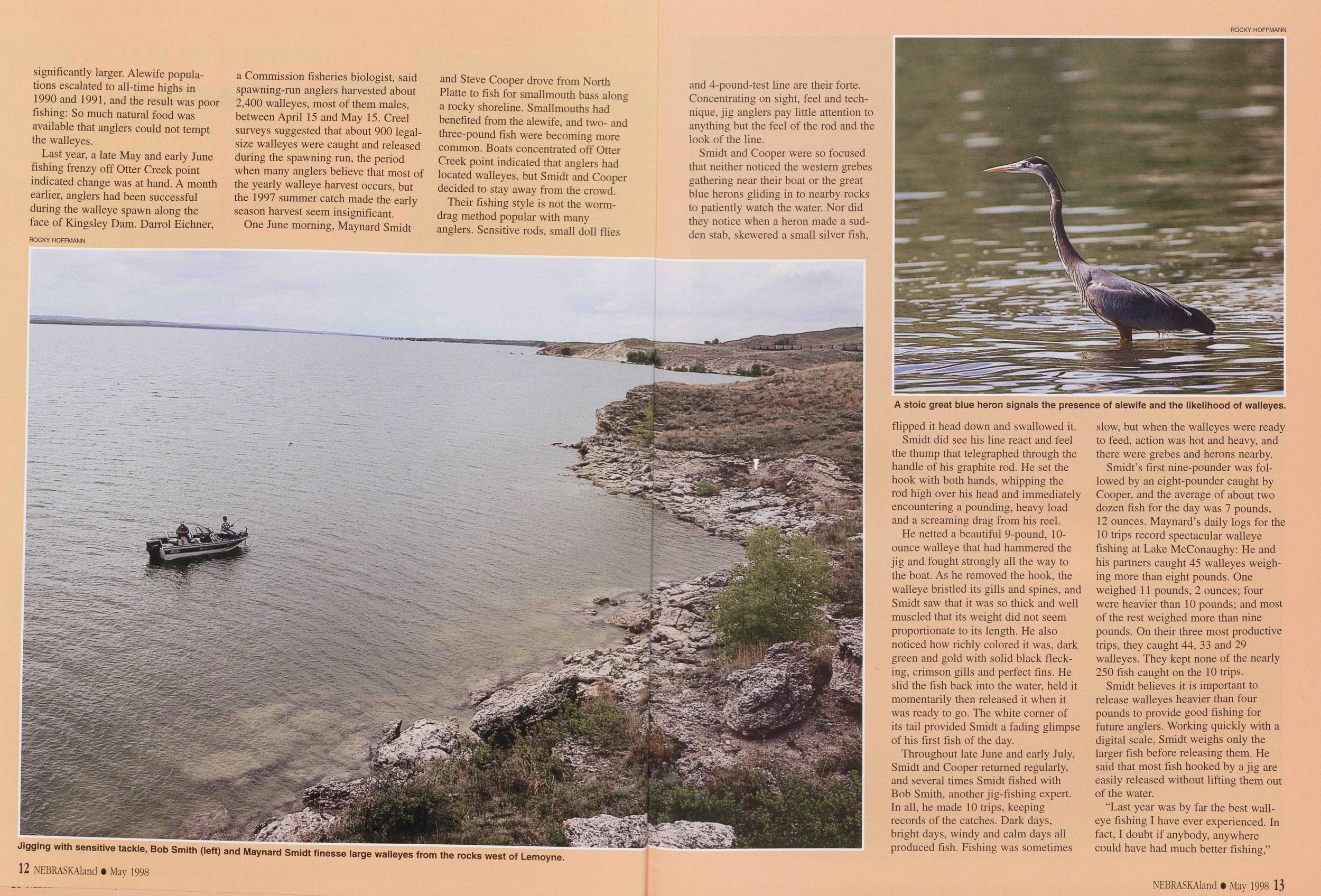
Jigging with sensitive tackle, Bob Smith (left) and Maynard Smidt finesse large walleyes from the rocks west of Lemoyne.
ROCKY HOFFMANNand 4-pound-test line are their forte. Concentrating on sight, feel and technique, jig anglers pay little attention to anything but the feel of the rod and the look of the line.
Smidt and Cooper were so focused that neither noticed the western grebes gathering near their boat or the great blue herons gliding in to nearby rocks to patiently watch the water. Nor did they notice when a heron made a sudden stab, skewered a small silver fish,
A stoic great blue heron signals the presence of alewife and the likelihood of walleyes.
ROCKY HOFFMANNflipped it head down and swallowed it.
Smidt did see his line react and feel the thump that telegraphed through the handle of his graphite rod. He set the hook with both hands, whipping the rod high over his head and immediately encountering a pounding, heavy load and a screaming drag from his reel.
He netted a beautiful 9-pound, 10-ounce walleye that had hammered the jig and fought strongly all the way to the boat. As he removed the hook, the walleye bristled its gills and spines, and Smidt saw that it was so thick and well muscled that its weight did not seem proportionate to its length. He also noticed how richly colored it was, dark green and gold with solid black flecking, crimson gills and perfect fins. He slid the fish back into the water, held it momentarily then released it when it was ready to go. The white corner of its tail provided Smidt a fading glimpse of his first fish of the day.
Throughout late June and early July, Smidt and Cooper returned regularly, and several times Smidt fished with Bob Smith, another jig-fishing expert. In all, he made 10 trips, keeping records of the catches. Dark days, bright days, windy and calm days all produced fish. Fishing was sometimes slow, but when the walleyes were ready to feed, action was hot and heavy/and there were grebes and herons nearby.
Smidt's first nine-pounder was followed by an eight-pounder caught by Cooper, and the average of about two dozen fish for the day was 7 pounds, 12 ounces. Maynard's daily logs for the 10 trips record spectacular walleye fishing at Lake McConaughy: He and his partners caught 45 walleyes weighing more than eight pounds. One weighed 11 pounds, 2 ounces; four were heavier than 10 pounds; and most of the rest weighed more than nine pounds. On their three most productive trips, they caught 44, 33 and 29 walleyes. They kept none of the nearly 250 fish caught on the 10 trips.
Smidt believes it is important to release walleyes heavier than four pounds to provide good fishing for future anglers. Working quickly with a digital scale, Smidt weighs only the larger fish before releasing them. He said that most fish hooked by a jig are easily released without lifting them out of the water.
"Last year was by far the best walleye fishing I have ever experienced. In fact, I doubt if anybody, anywhere could have had much better fishing,"
NEBRASKAland • May 1998 13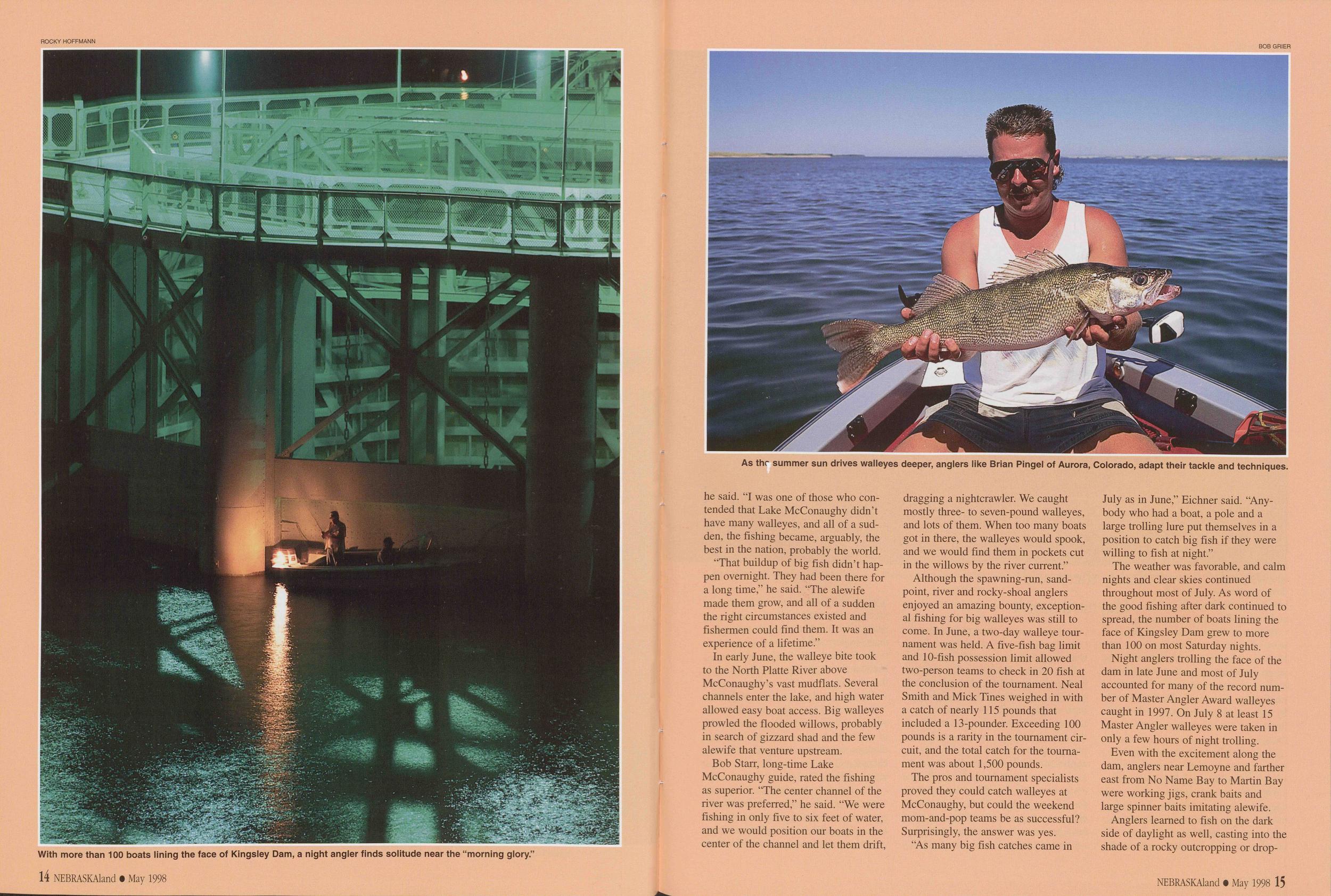
With more than 100 boats lining the face of Kingsley Dam, a night angler finds solitude near the "morning glory."
ROCKY HOFFMANNAs the summer sun drives walleyes deeper, anglers like Brian Pingel of Aurora, Colorado, adapt their tackle and techniques.
BOB GRIERhe said. "I was one of those who contended that Lake McConaughy didn't have many walleyes, and all of a sudden, the fishing became, arguably, the best in the nation, probably the world.
"That buildup of big fish didn't happen overnight. They had been there for a long time," he said. "The alewife made them grow, and all of a sudden the right circumstances existed and fishermen could find them. It was an experience of a lifetime."
In early June, the walleye bite took to the North Platte River above McConaughy's vast mudflats. Several channels enter the lake, and high water allowed easy boat access. Big walleyes prowled the flooded willows, probably in search of gizzard shad and the few alewife that venture upstream.
Bob Starr, long-time Lake McConaughy guide, rated the fishing as superior. "The center channel of the river was preferred," he said. "We were fishing in only five to six feet of water, and we would position our boats in the center of the channel and let them drift, dragging a nightcrawler. We caught mostly three- to seven-pound walleyes, and lots of them. When too many boats got in there, the walleyes would spook, and we would find them in pockets cut in the willows by the river current."
Although the spawning-run, sand-point, river and rocky-shoal anglers enjoyed an amazing bounty, exceptional fishing for big walleyes was still to come. In June, a two-day walleye tournament was held. A five-fish bag limit and 10-fish possession limit allowed two-person teams to check in 20 fish at the conclusion of the tournament. Neal Smith and Mick Tines weighed in with a catch of nearly 115 pounds that included a 13-pounder. Exceeding 100 pounds is a rarity in the tournament circuit, and the total catch for the tournament was about 1,500 pounds.
The pros and tournament specialists proved they could catch walleyes at McConaughy, but could the weekend mom-and-pop teams be as successful? Surprisingly, the answer was yes.
"As many big fish catches came in July as in June," Eichner said. "Anybody who had a boat, a pole and a large trolling lure put themselves in a position to catch big fish if they were willing to fish at night."
The weather was favorable, and calm nights and clear skies continued throughout most of July. As word of the good fishing after dark continued to spread, the number of boats lining the face of Kingsley Dam grew to more than 100 on most Saturday nights.
Night anglers trolling the face of the dam in late June and most of July accounted for many of the record number of Master Angler Award walleyes caught in 1997. On July 8 at least 15 Master Angler walleyes were taken in only a few hours of night trolling.
Even with the excitement along the dam, anglers near Lemoyne and farther east from No Name Bay to Martin Bay were working jigs, crank baits and large spinner baits imitating alewife.
Anglers learned to fish on the dark side of daylight as well, casting into the shade of a rocky outcropping or dropping
NEBRASKAland • May 1998 15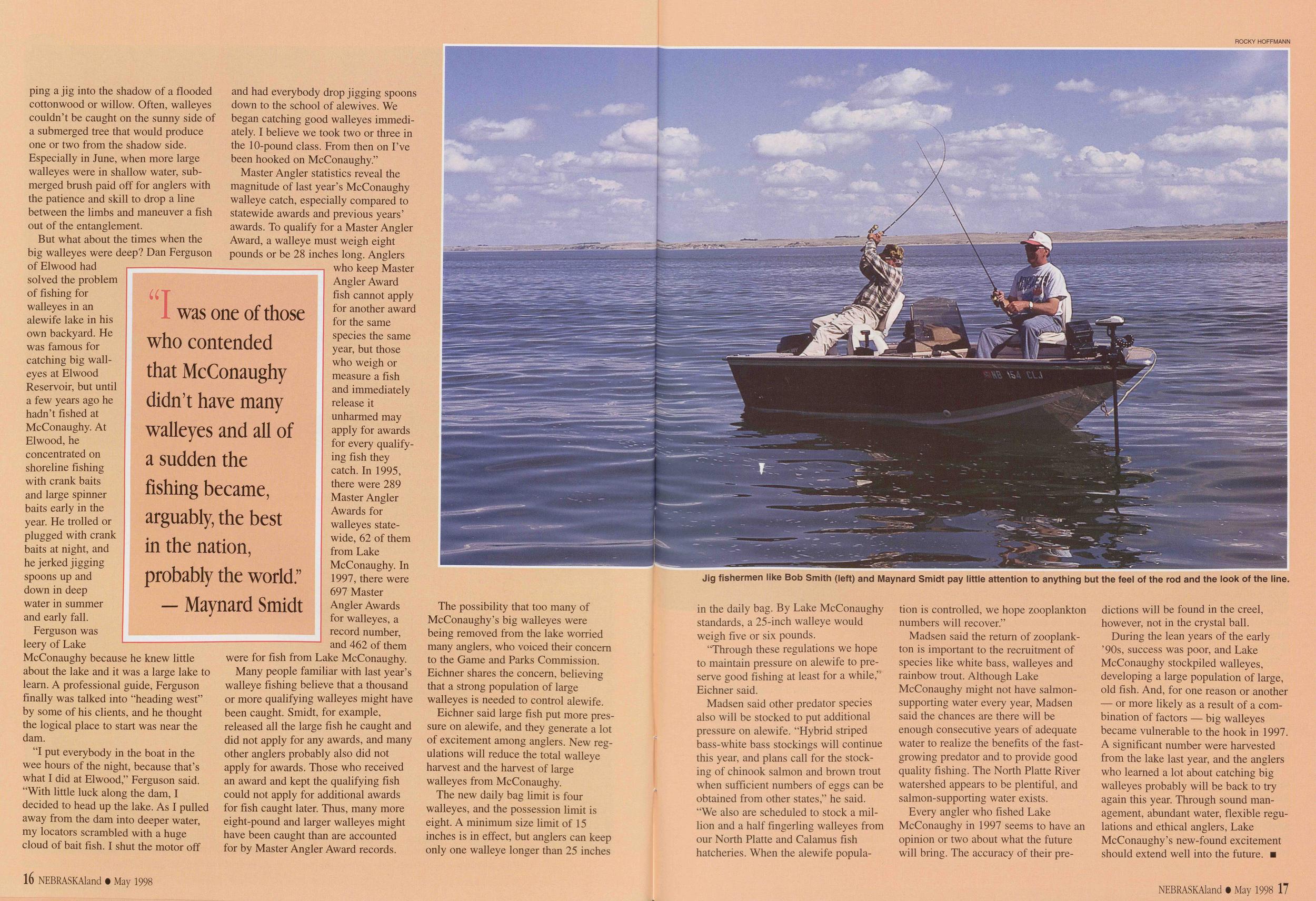
a jig into the shadow of a flooded cottonwood or willow. Often, walleyes couldn't be caught on the sunny side of a submerged tree that would produce one or two from the shadow side. Especially in June, when more large walleyes were in shallow water, submerged brush paid off for anglers with the patience and skill to drop a line between the limbs and maneuver a fish out of the entanglement.
But what about the times when the big walleyes were deep? Dan Ferguson of Elwood had solved the problem of fishing for walleyes in an alewife lake in his own backyard. He was famous for catching big walleyes at Elwood Reservoir, but until a few years ago he hadn't fished at McConaughy. At Elwood, he concentrated on shoreline fishing with crank baits and large spinner baits early in the year. He trolled or plugged with crank baits at night, and he jerked jigging spoons up and down in deep water in summer and early fall.
Ferguson was leery of Lake McConaughy because he knew little about the lake and it was a large lake to learn. A professional guide, Ferguson finally was talked into "heading west" by some of his clients, and he thought the logical place to start was near the dam.
"I put everybody in the boat in the wee hours of the night, because that's what I did at Elwood," Ferguson said. "With little luck along the dam, I decided to head up the lake. As I pulled away from the dam into deeper water, my locators scrambled with a huge cloud of bait fish. I shut the motor off and had everybody drop jigging spoons down to the school of alewives. We began catching good walleyes immediately. I believe we took two or three in the 10-pound class. From then on I've been hooked on McConaughy."
Master Angler statistics reveal the magnitude of last year's McConaughy walleye catch, especially compared to statewide awards and previous years' awards. To qualify for a Master Angler Award, a walleye must weigh eight pounds or be 28 inches long. Anglers who keep Master Angler Award fish cannot apply for another award for the same species the same year, but those who weigh or measure a fish and immediately release it unharmed may apply for awards for every qualifying fish they catch. In 1995, there were 289 Master Angler Awards for walleyes state-wide, 62 of them from Lake McConaughy. In 1997, there were 697 Master Angler Awards for walleyes, a record number, and 462 of them were for fish from Lake McConaughy.
Many people familiar with last year's walleye fishing believe that a thousand or more qualifying walleyes might have been caught. Smidt, for example, released all the large fish he caught and did not apply for any awards, and many other anglers probably also did not apply for awards. Those who received an award and kept the qualifying fish could not apply for additional awards for fish caught later. Thus, many more eight-pound and larger walleyes might have been caught than are accounted for by Master Angler Award records.
"I was one of those who contended that McConaughy didn't have many walleyes and all of a sudden the fishing became, arguably, the best in the nation, probably the world." — Maynard SmidtThe possibility that too many of McConaughy's big walleyes were being removed from the lake worried many anglers, who voiced their concern to the Game and Parks Cornmission. Eichner shares the concern, believing that a strong population of large walleyes is needed to control alewife.
Eichner said large fish put more pressure on alewife, and they generate a lot of excitement among anglers. New regulations will reduce the total walleye harvest and the harvest of large walleyes from McConaughy.
The new daily bag limit is four walleyes, and the possession limit is eight. A minimum size limit of 15 inches is in effect, but anglers can keep only one walleye longer than 25 inches
16 NEBRASKAland • May 1998Jig fishermen like Bob Smith (left) and Maynard Smidt pay little attention to anything but the feel of the rod and the look of the line.
ROCKY HOFFMANNin the daily bag. By Lake McConaughy standards, a 25-inch walleye would weigh five or six pounds.
"Through these regulations we hope to maintain pressure on alewife to preserve good fishing at least for a while,' Eichner said.
Madsen said other predator species also will be stocked to put additional pressure on alewife. "Hybrid striped bass-white bass stockings will continue this year, and plans call for the stocking of chinook salmon and brown trout when sufficient numbers of eggs can be obtained from other states," he said. "We also are scheduled to stock a million and a half fingerling walleyes from our North Platte and Calamus fish hatcheries. When the alewife population is controlled, we hope zooplankton numbers will recover."
Madsen said the return of zooplankton is important to the recruitment of species like white bass, walleyes and rainbow trout. Although Lake McConaughy might not have salmon-supporting water every year, Madsen said the chances are there will be enough consecutive years of adequate water to realize the benefits of the fast-growing predator and to provide good quality fishing. The North Platte River watershed appears to be plentiful, and salmon-supporting water exists.
Every angler who fished Lake McConaughy in 1997 seems to have an opinion or two about what the future will bring. The accuracy of their predictions will be found in the creel, however, not in the crystal ball.
During the lean years of the early '90s, success was poor, and Lake McConaughy stockpiled walleyes, developing a large population of large, old fish. And, for one reason or another — or more likely as a result of a combination of factors — big walleyes became vulnerable to the hook in 1997. A significant number were harvested from the lake last year, and the anglers who learned a lot about catching big walleyes probably will be back to try again this year. Through sound management, abundant water, flexible regulations and ethical anglers, Lake McConaughy's new-found excitement should extend well into the future.
NEBRASKAland • May 1998 17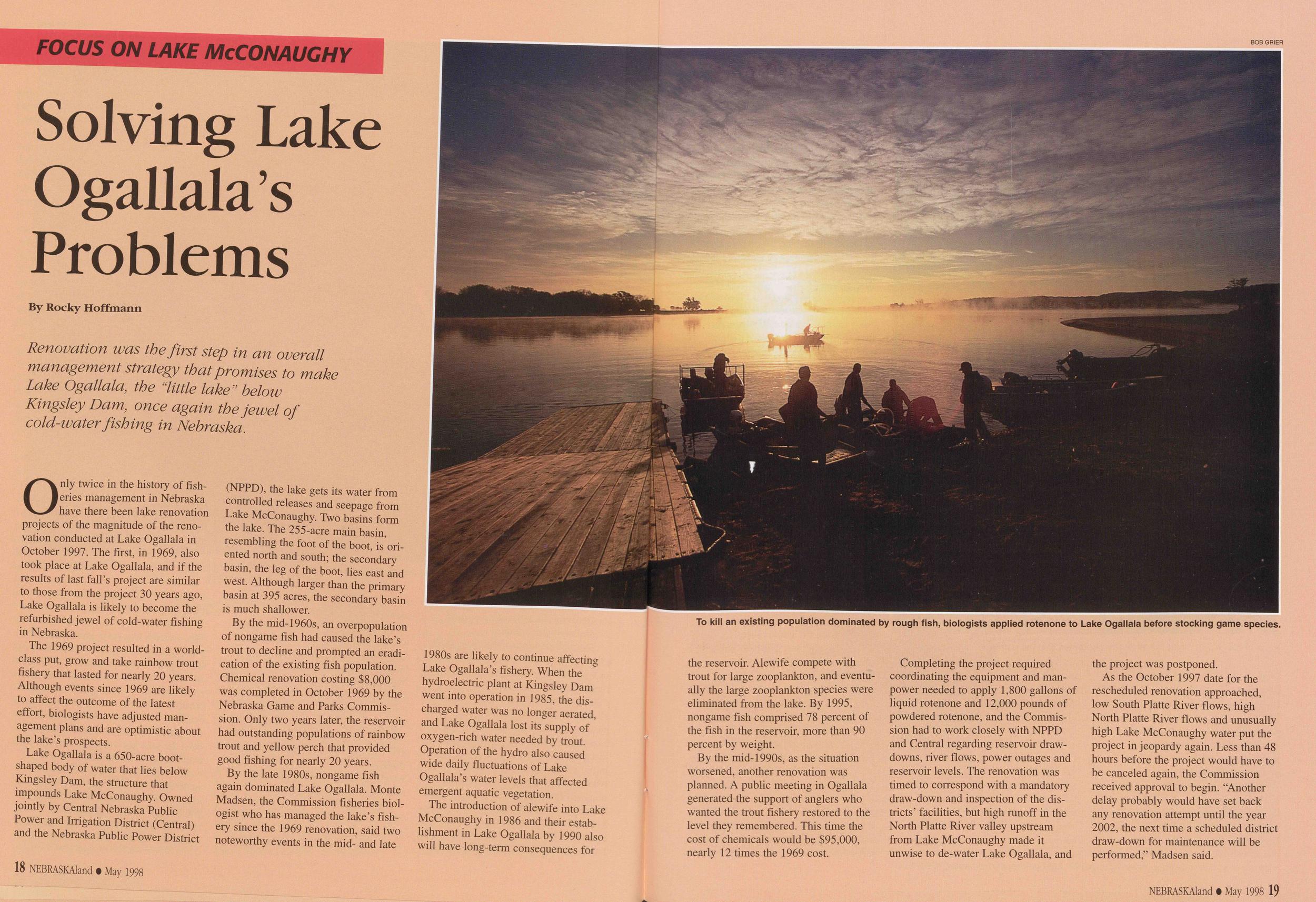
FOCUS ON LAKE McCONAUCHY
Solving Lake Ogallala's Problems
By Rocky Hoffmann Renovation was the first step in an overall management strategy that promises to make Lake Ogallala, the "little lake" below Kingsley Dam, once again the jewel of cold-water fishing in Nebraska.Only twice in the history of fisheries management in Nebraska have there been lake renovation projects of the magnitude of the renovation conducted at Lake Ogallala in October 1997. The first, in 1969, also took place at Lake Ogallala, and if the results of last fall's project are similar to those from the project 30 years ago, Lake Ogallala is likely to become the refurbished jewel of cold-water fishing in Nebraska.
The 1969 project resulted in a world-class put, grow and take rainbow trout fishery that lasted for nearly 20 years. Although events since 1969 are likely to affect the outcome of the latest effort, biologists have adjusted management plans and are optimistic about the lake's prospects.
Lake Ogallala is a 650-acre boot-shaped body of water that lies below Kingsley Dam, the structure that impounds Lake McConaughy. Owned jointly by Central Nebraska Public Power and Irrigation District (Central) and the Nebraska Public Power District 18 NEBRASKAland • May 1998 (NPPD), the lake gets its water from controlled releases and seepage from Lake McConaughy. Two basins form the lake. The 255-acre main basin, resembling the foot of the boot, is oriented north and south; the secondary basin, the leg of the boot, lies east and west. Although larger than the primary basin at 395 acres, the secondary basin is much shallower.
By the mid-1960s, an overpopulation of nongame fish had caused the lake's trout to decline and prompted an eradication of the existing fish population. Chemical renovation costing $8,000 was completed in October 1969 by the Nebraska Game and Parks Commission. Only two years later, the reservoir had outstanding populations of rainbow trout and yellow perch that provided good fishing for nearly 20 years.
By the late 1980s, nongame fish again dominated Lake Ogallala. Monte Madsen, the Commission fisheries biologist who has managed the lake's fishery since the 1969 renovation, said two noteworthy events in the mid- and late
To kill an existing population dominated by rough fish, biologists applied rotenone to Lake Ogallala before stocking game species.
BOB GRIER1980s are likely to continue affecting Lake Ogallala's fishery. When the hydroelectric plant at Kingsley Dam went into operation in 1985, the discharged water was no longer aerated, and Lake Ogallala lost its supply of oxygen-rich water needed by trout. Operation of the hydro also caused wide daily fluctuations of Lake Ogallala's water levels that affected emergent aquatic vegetation.
The introduction of alewife into Lake McConaughy in 1986 and their establishment in Lake Ogallala by 1990 also will have long-term consequences for
18 NEBRASKAland • May 1998the reservoir. Alewife compete with trout for large zooplankton, and eventually the large zooplankton species were eliminated from the lake. By 1995, nongame fish comprised 78 percent of the fish in the reservoir, more than 90 percent by weight.
By the mid-1990s, as the situation worsened, another renovation was planned. A public meeting in Ogallala generated the support of anglers who wanted the trout fishery restored to the level they remembered. This time the cost of chemicals would be $95,000, nearly 12 times the 1969 cost.
Completing the project required coordinating the equipment and manpower needed to apply 1,800 gallons of liquid rotenone and 12,000 pounds of powdered rotenone, and the Commission had to work closely with NPPD and Central regarding reservoir draw-downs, river flows, power outages and reservoir levels. The renovation was timed to correspond with a mandatory draw-down and inspection of the districts' facilities, but high runoff in the North Platte River valley upstream from Lake McConaughy made it unwise to de-water Lake Ogallala, and the project was postponed.
As the October 1997 date for the rescheduled renovation approached, low South Platte River flows, high North Platte River flows and unusually high Lake McConaughy water put the project in jeopardy again. Less than 48 hours before the project would have to be canceled again, the Commission received approval to begin. "Another delay probably would have set back any renovation attempt until the year 2002, the next time a scheduled district draw-down for maintenance will be performed," Madsen said.
NEBRASKAland • May 1998 19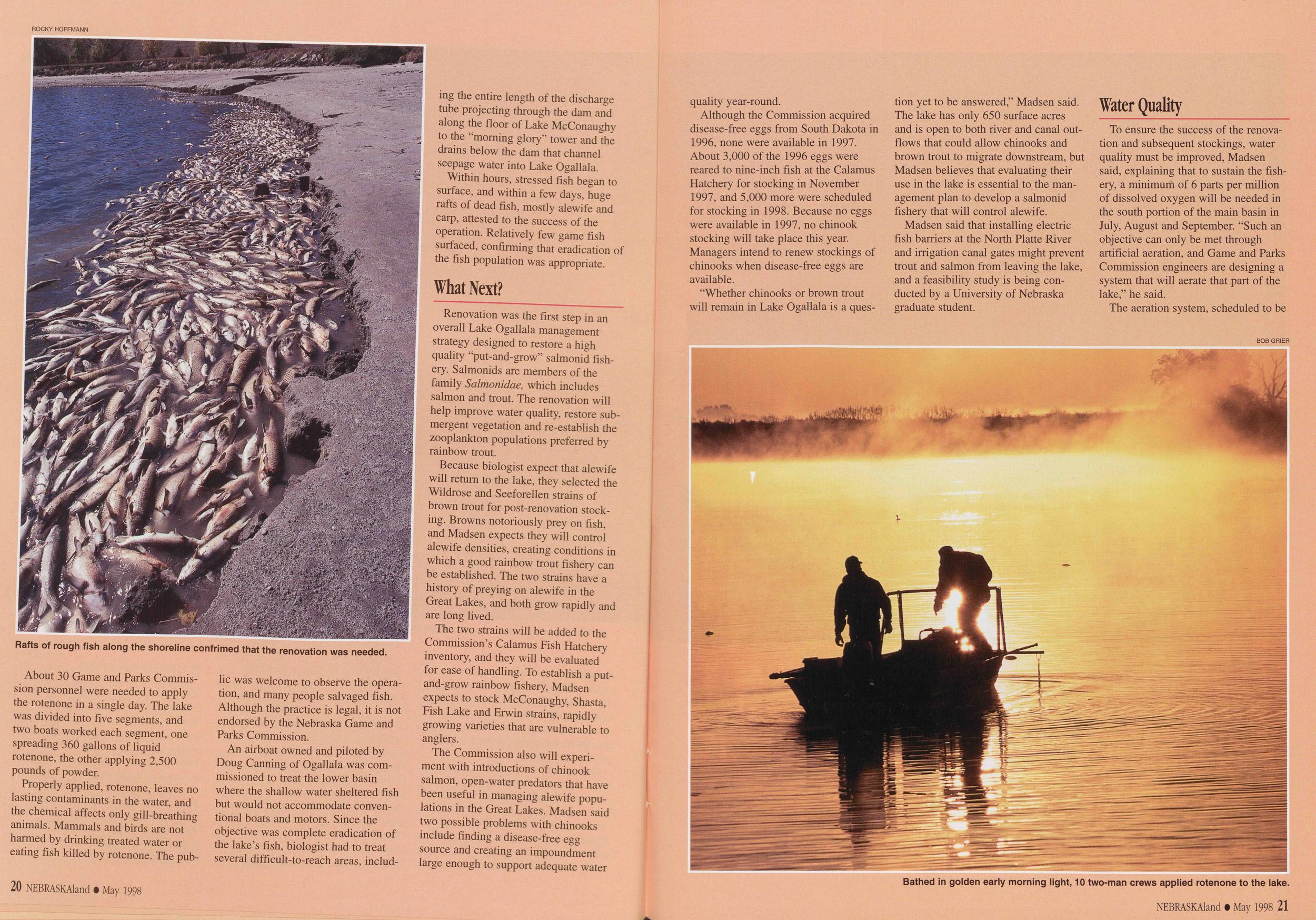
Rafts of rough fish along the shoreline confirmed that the renovation was needed.
ROCKY HOFFMANNAbout 30 Game and Parks Commission personnel were needed to apply the rotenone in a single day. The lake was divided into five segments, and two boats worked each segment, one spreading 360 gallons of liquid rotenone, the other applying 2,500 pounds of powder.
Properly applied, rotenone, leaves no lasting contaminants in the water, and the chemical affects only gill-breathing animals. Mammals and birds are not harmed by drinking treated water or eating fish killed by rotenone. The public was welcome to observe the operation, and many people salvaged fish. Although the practice is legal, it is not endorsed by the Nebraska Game and Parks Commission.
An airboat owned and piloted by Doug Canning of Ogallala was commissioned to treat the lower basin where the shallow water sheltered fish but would not accommodate conventional boats and motors. Since the objective was complete eradication of the lake's fish, biologist had to treat several difficult-to-reach areas, including the entire length of the discharge tube projecting through the dam and along the floor of Lake McConaughy to the "morning glory" tower and the drains below the dam that channel seepage water into Lake Ogallala.
Within hours, stressed fish began to surface, and within a few days, huge rafts of dead fish, mostly alewife and carp, attested to the success of the operation. Relatively few game fish surfaced, confirming that eradication of the fish population was appropriate.
What Next?Renovation was the first step in an overall Lake Ogallala management strategy designed to restore a high quality "put-and-grow" salmonid fishery. Salmonids are members of the family Salrnonidae, which includes salmon and trout. The renovation will help improve water quality, restore submerged vegetation and re-establish the zooplankton populations preferred by rainbow trout.
Because biologist expect that alewife will return to the lake, they selected the Wildrose and Seeforellen strains of brown trout for post-renovation stocking. Browns notoriously prey on fish, and Madsen expects they will control alewife densities, creating conditions in which a good rainbow trout fishery can be established. The two strains have a history of preying on alewife in the Great Lakes, and both grow rapidly and are long lived.
The two strains will be added to the Commission's Calamus Fish Hatchery inventory, and they will be evaluated for ease of handling. To establish a put-and-grow rainbow fishery, Madsen expects to stock McConaughy, Shasta, Fish Lake and Erwin strains, rapidly growing varieties that are vulnerable to anglers.
The Commission also will experiment with introductions of chinook salmon, open-water predators that have been useful in managing alewife populations in the Great Lakes. Madsen said two possible problems with chinooks include finding a disease-free egg source and creating an impoundment large enough to support adequate water
20 NEBRASKAland • May 1998quality year-round.
Although the Commission acquired disease-free eggs from South Dakota in 1996, none were available in 1997. About 3,000 of the 1996 eggs were reared to nine-inch fish at the Calamus Hatchery for stocking in November 1997, and 5,000 more were scheduled for stocking in 1998. Because no eggs were available in 1997, no chinook stocking will take place this year. Managers intend to renew stockings of chinooks when disease-free eggs are available.
"Whether chinooks or brown trout will remain in Lake Ogallala is a question yet to be answered," Madsen said. The lake has only 650 surface acres and is open to both river and canal outflows that could allow chinooks and brown trout to migrate downstream, but Madsen believes that evaluating their use in the lake is essential to the management plan to develop a salmonid fishery that will control alewife.
Madsen said that installing electric fish barriers at the North Platte River and irrigation canal gates might prevent trout and salmon from leaving the lake, and a feasibility study is being conducted by a University of Nebraska graduate student.
Water QualityTo ensure the success of the renovation and subsequent stockings, water quality must be improved, Madsen said, explaining that to sustain the fishery, a minimum of 6 parts per million of dissolved oxygen will be needed in the south portion of the main basin in July, August and September. "Such an objective can only be met through artificial aeration, and Game and Parks Corrrmission engineers are designing a system that will aerate that part of the lake," he said.
The aeration system, scheduled to be
Bathed In golden early morning light, 10 two-man crews applied rotenone to the lake.
BOB GRIER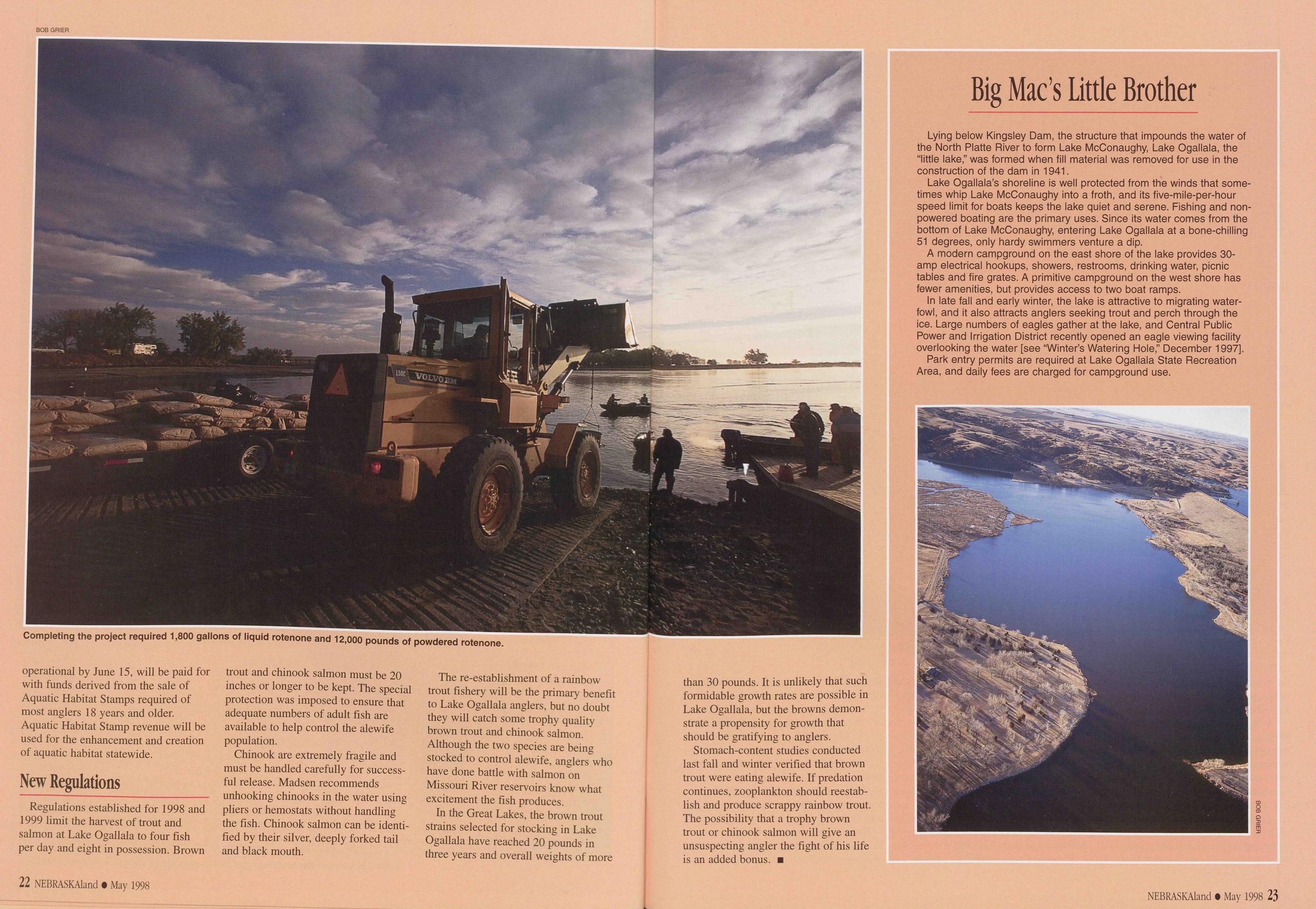
Completing the project required 1,800 gallons of liquid rotenone and 12,000 pounds of powdered rotenone.
BOB GRIERoperational by June 15, will be paid for with funds derived from the sale of Aquatic Habitat Stamps required of most anglers 18 years and older. Aquatic Habitat Stamp revenue will be used for the enhancement and creation of aquatic habitat statewide.
New RegulationsRegulations established for 1998 and 1999 limit the harvest of trout and salmon at Lake Ogallala to four fish per day and eight in possession. Brown trout and chinook salmon must be 20 inches or longer to be kept. The special protection was imposed to ensure that adequate numbers of adult fish are available to help control the alewife population.
Chinook are extremely fragile and must be handled carefully for successful release. Madsen recommends unhooking chinooks in the water using pliers or hemostats without handling the fish. Chinook salmon can be identified by their silver, deeply forked tail and black mouth.
The re-establishment of a rainbow trout fishery will be the primary benefit to Lake Ogallala anglers, but no doubt they will catch some trophy quality brown trout and chinook salmon. Although the two species are being stocked to control alewife, anglers who have done battle with salmon on Missouri River reservoirs know what excitement the fish produces.
In the Great Lakes, the brown trout strains selected for stocking in Lake Ogallala have reached 20 pounds in three years and overall weights of more
22 NEBRASKAland • May 1998than 30 pounds. It is unlikely that such formidable growth rates are possible in Lake Ogallala, but the browns demonstrate a propensity for growth that should be gratifying to anglers.
Stomach-content studies conducted last fall and winter verified that brown trout were eating alewife. If predation continues, zooplankton should reestablish and produce scrappy rainbow trout. The possibility that a trophy brown trout or chinook salmon will give an unsuspecting angler the fight of his life is an added bonus.
Big Mac's Little Brother
Lying below Kingsley Dam, the structure that impounds the water of the North Platte River to form Lake McConaughy, Lake Ogallala, the "little lake," was formed when fill material was removed for use in the construction of the dam in 1941.
Lake Ogallala's shoreline is well protected from the winds that sometimes whip Lake McConaughy into a froth, and its five-mile-per-hour speed limit for boats keeps the lake quiet and serene. Fishing and non-powered boating are the primary uses. Since its water comes from the bottom of Lake McConaughy, entering Lake Ogallala at a bone-chilling 51 degrees, only hardy swimmers venture a dip.
A modern campground on the east shore of the lake provides 30-amp electrical hookups, showers, restrooms, drinking water, picnic tables and fire grates. A primitive campground on the west shore has fewer amenities, but provides access to two boat ramps.
In late fall and early winter, the lake is attractive to migrating waterfowl, and it also attracts anglers seeking trout and perch through the ice. Large numbers of eagles gather at the lake, and Central Public Power and Irrigation District recently opened an eagle viewing facility overlooking the water [see "Winter's Watering Hole," December 1997].
Park entry permits are required at Lake Ogallala State Recreation Area, and daily fees are charged for campground use.
FOCUS ON LAKE McCONAUCHY
Destination Big Mac
By Bob Grier Improved roads, upgraded campgrounds and a new visitor center are the first stages of development that will continue into the next century at Lake McConaughy, one of Nebraska's premier recreation destinations.Lake McConaughy is back, and back in a big way. Visitors to Nebraska's largest reservoir and the popular recreational complex on the lake's more than 100 miles of shoreline will find dramatic changes under way that promise to make Big Mac a premier destination for water-based sports and recreation.
Last year's walleye fishing at McConaughy was world-class (see page 10), but not only anglers are celebrating Big Mac's return. Construction already under way and in the advanced planning stages will modernize and expand the lake's facilities for boaters, water sports enthusiasts, campers, picnickers, day-use visitors and other park users.
On the near horizon are additional paved access roads, new full-service campgrounds, an 8,000-square-foot visitor center and museum building and new and upgraded boat ramps and other facilities. More than $6 million has been committed for McConaughy and Lake Ogallala development and construction, and long-range proposals will continue the aggressive pace of development well into the next century.
McConaughy visitors are reporting a more subtle, but no less dramatic change. Following alcohol consumption restrictions enacted throughout the state park system in 1995, the "spring-break" party-atmosphere sometimes encountered at McConaughy on holiday weekends is gone. The comments of lake visitors have been overwhelmingly positive, and Lake McConaughy's beaches, roads and recreation facilities have become "family-friendly" once again.
Construction scheduled for 1998 and 1999 includes hard-surfacing of about nine miles of interior roads on the northeast side of McConaughy from Martin Bay to Arthur Bay and Sandy Beach and additional paving from Gate 5 on Nebraska Highway 92 farther west. The $4 million project includes paving of full-service campgrounds at Sandy Beach and between No Name Bay and Little Thunder Bay near several of Lake Mac's most popular beach areas. The new campgrounds will include 160 camping pads and innovative, coin-operated shower buildings scheduled to open this year.
The new shower buildings include
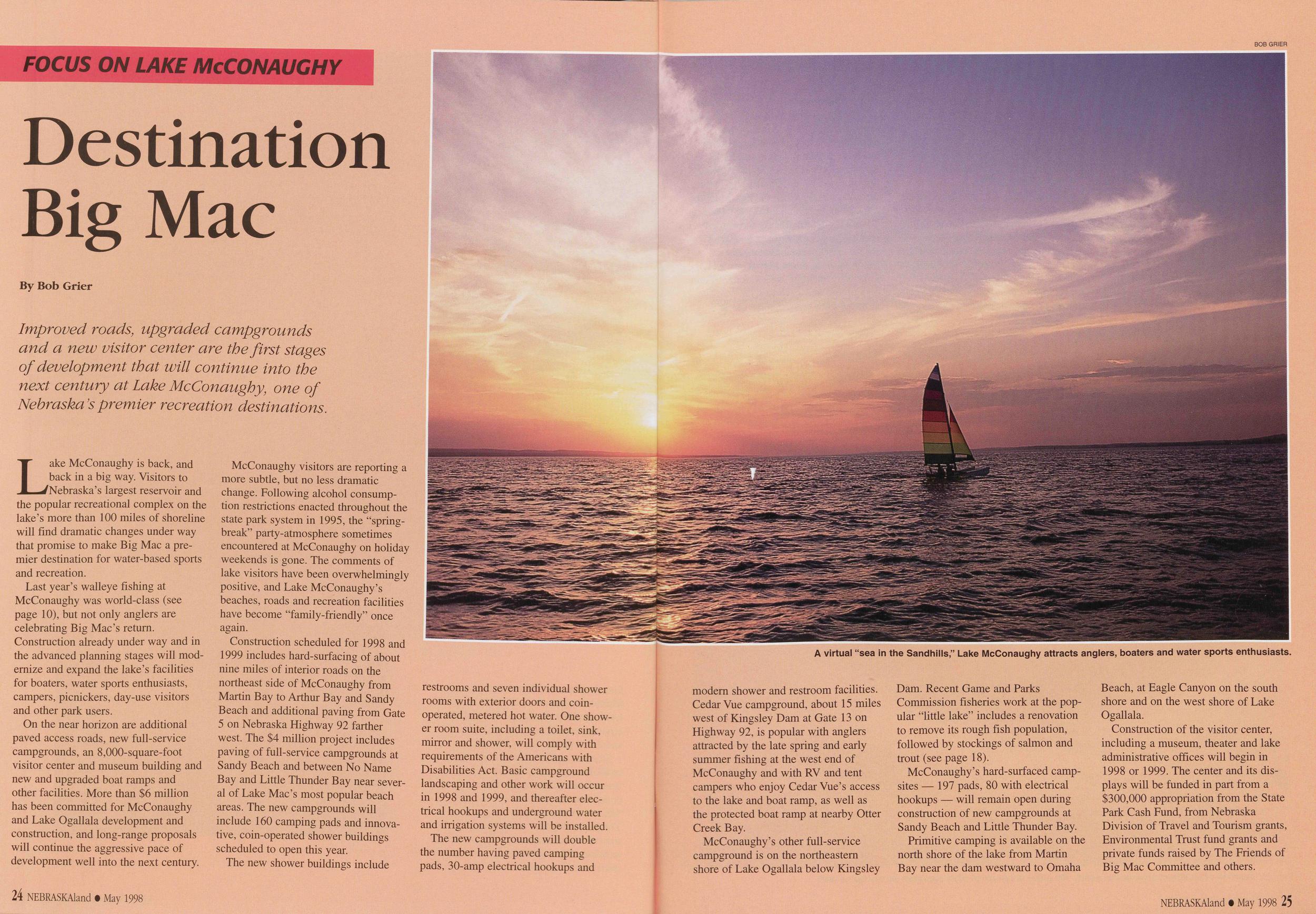
A virtual "sea in the Sandhills," Lake McConaughy attracts anglers, boaters and water sports enthusiasts.
BOB GRIERrestrooms and seven individual shower rooms with exterior doors and coin-operated, metered hot water. One show er room suite, including a toilet, sink, mirror and shower, will comply with requirements of the Americans with Disabilities Act. Basic campground landscaping and other work will occur in 1998 and 1999, and thereafter electrical hookups and underground water and irrigation systems will be installed.
The new campgrounds will double the number having paved camping pads, 30-amp electrical hookups and
24 NEBRASKAland • May 1998modern shower and restroom facilities. Cedar Vue campground, about 15 miles west of Kingsley Dam at Gate 13 on Highway 92, is popular with anglers attracted by the late spring and early summer fishing at the west end of McConaughy and with RV and tent campers who enjoy Cedar Vue's access to the lake and boat ramp, as well as the protected boat ramp at nearby Otter Creek Bay.
McConaughy's other full-service campground is on the northeastern shore of Lake Ogallala below Kingsley Dam. Recent Game and Parks Commission fisheries work at the popular "little lake" includes a renovation to remove its rough fish population, followed by stockings of salmon and trout (see page 18).
McConaughy's hard-surfaced campsites — 197 pads, 80 with electrical hookups — will remain open during construction of new campgrounds at Sandy Beach and Little Thunder Bay.
Primitive camping is available on the north shore of the lake from Martin Bay near the dam westward to Omaha Beach, at Eagle Canyon on the south shore and on the west shore of Lake Ogallala.
Construction of the visitor center, including a museum, theater and lake administrative offices will begin in 1998 or 1999. The center and its displays will be funded in part from a $300,000 appropriation from the State Park Cash Fund, from Nebraska Division of Travel and Tourism grants, Environmental Trust fund grants and private funds raised by The Friends of Big Mac Committee and others.
NEBRASKAland • May 1998 25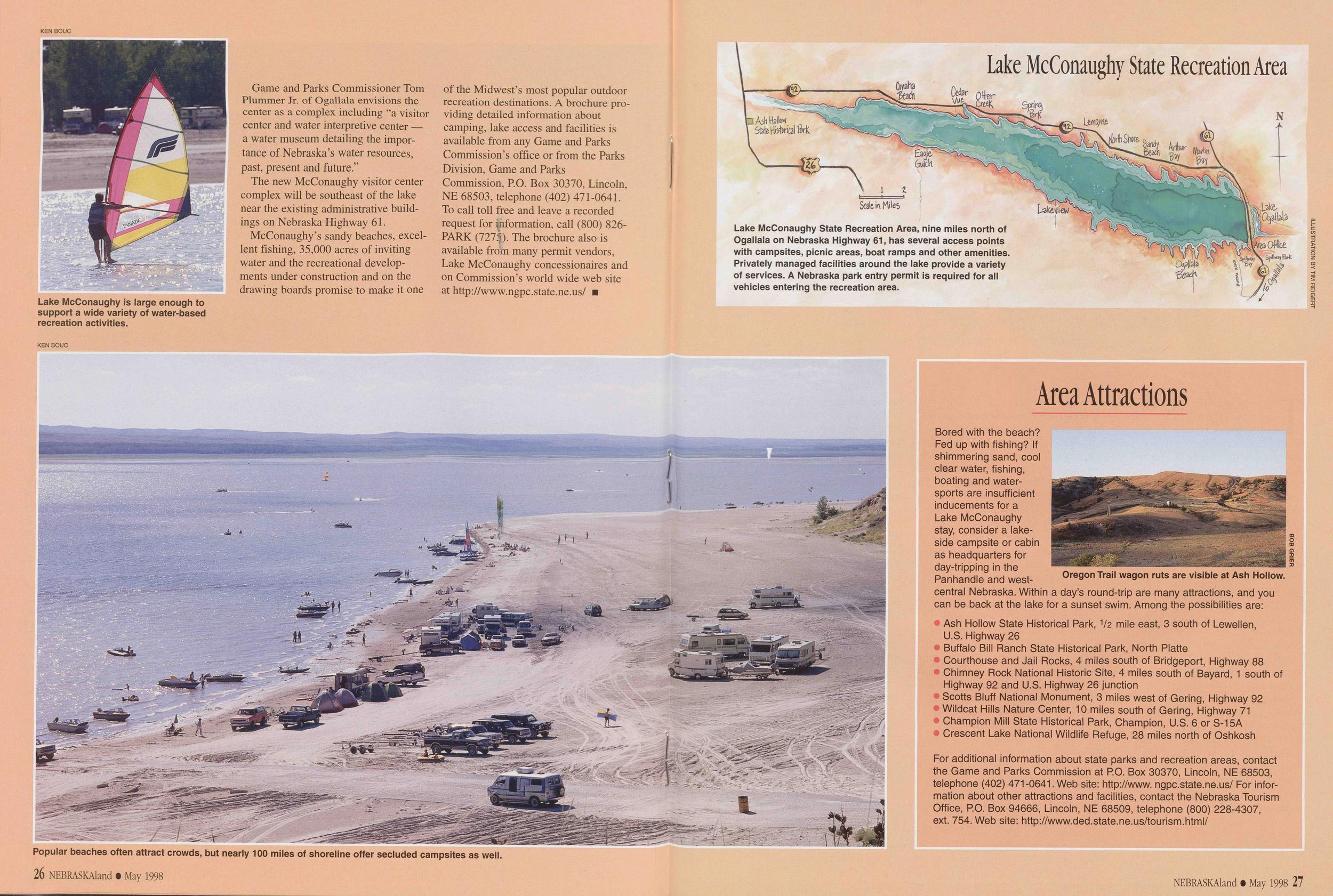
Lake McConaughy is large enough to support a wide variety of water-based recreation activities.
KEN BOUCGame and Parks Commissioner Tom Plumrner Jr. of Ogallala envisions the center as a complex including "a visitor center and water interpretive center — a water museum detailing the importance of Nebraska's water resources, past, present and future."
The new McConaughy visitor center complex will be southeast of the lake near the existing administrative buildings on Nebraska Highway 61.
McConaughy's sandy beaches, excellent fishing, 35,000 acres of inviting water and the recreational developments under construction and on the drawing boards promise to make it one of the Midwest's most popular outdoor recreation destinations. A brochure providing detailed information about camping, lake access and facilities is available from any Game and Parks Commission's office or from the Parks Division, Game and Parks Commission, P.O. Box 30370, Lincoln, NE 68503, telephone (402) 471-0641. To call toll free and leave a recorded request for information, call (800) 826-PARK (7275). The brochure also is available from many permit vendors, Lake McConaughy concessionaires and on Commission's world wide web site at http://www.ngpc.state.ne.us/
Popular beaches often attract crowds, but nearly 100 miles of shoreline offer secluded campsites as well.
KEN BOUCLake McConaughy State Recreation Area, nine miles north of Ogallala on Nebraska Highway 61, has several access points with campsites, picnic areas, boat ramps and other amenities. Privately managed facilities around the lake provide a variety of services. A Nebraska park entry permit is required for all vehicles entering the recreation area.
Oregon Trail wagon ruts are visible at Ash Hollow.
BOB GRIER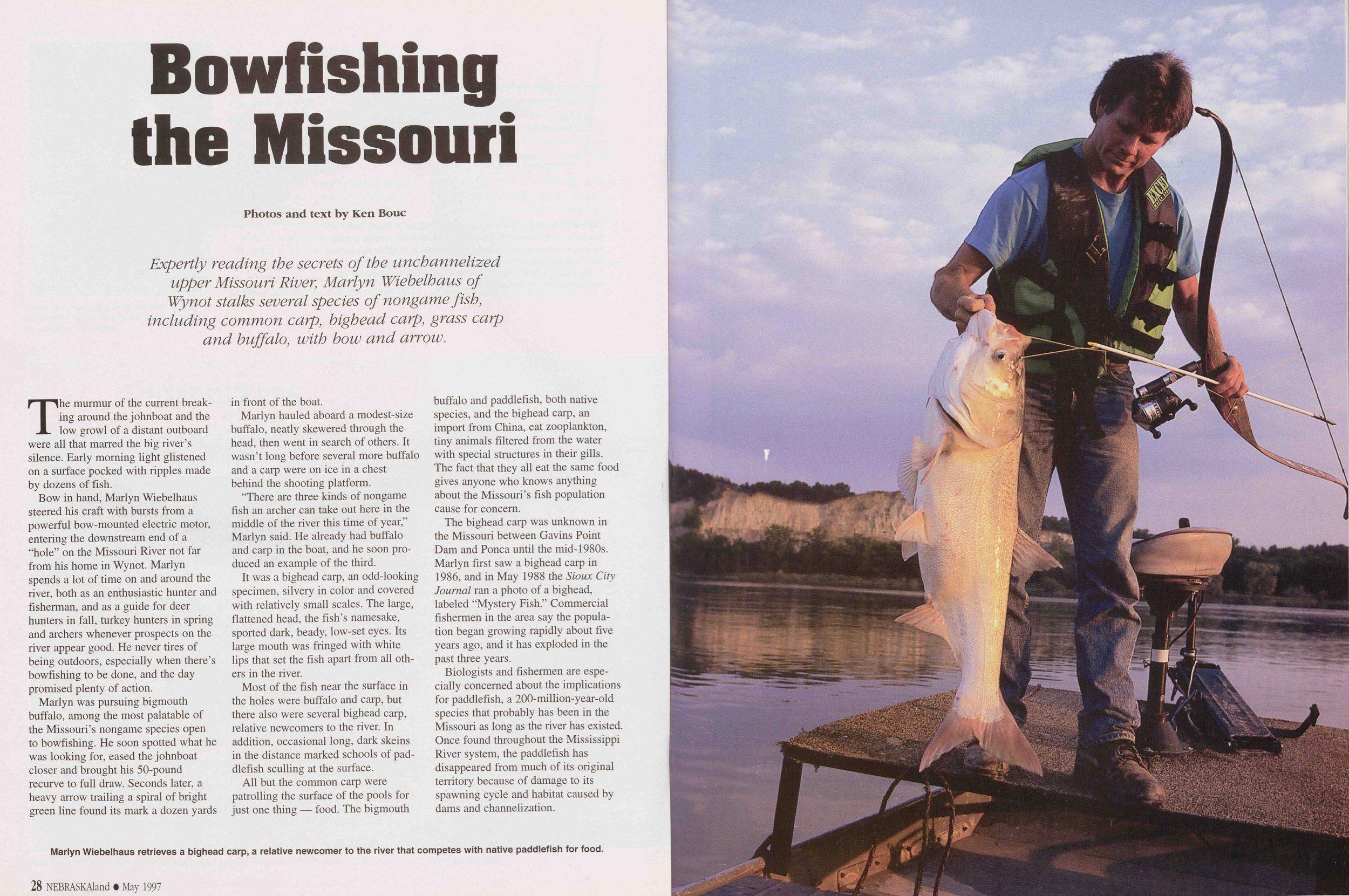
Bowfishing the Missouri
Photos and text by Ken Bouc Expertly reading the secrets of the unchannelized upper Missouri River, Marlyn Wiebelhaus of Wynot stalks several species of nongame fish, including common carp, bighead carp, grass carp and buffalo, with bow and arrow.The murmur of the current breaking around the johnboat and the low growl of a distant outboard were all that marred the big river's silence. Early morning light glistened on a surface pocked with ripples made by dozens of fish.
Bow in hand, Marlyn Wiebelhaus steered his craft with bursts from a powerful bow-mounted electric motor, entering the downstream end of a "hole" on the Missouri River not far from his home in Wynot. Marlyn spends a lot of time on and around the river, both as an enthusiastic hunter and fisherman, and as a guide for deer hunters in fall, turkey hunters in spring and archers whenever prospects on the river appear good. He never tires of being outdoors, especially when there's bowfishing to be done, and the day promised plenty of action.
Marlyn was pursuing bigmouth buffalo, among the most palatable of the Missouri's nongame species open to bowfishing. He soon spotted what he was looking for, eased the johnboat closer and brought his 50-pound recurve to full draw. Seconds later, a heavy arrow trailing a spiral of bright green line found its mark a dozen yards in front of the boat.
Marlyn hauled aboard a modest-size buffalo, neatly skewered through the head, then went in search of others. It wasn't long before several more buffalo and a carp were on ice in a chest behind the shooting platform.
"There are three kinds of nongame fish an archer can take out here in the middle of the river this time of year," Marlyn said. He already had buffalo and carp in the boat, and he soon produced an example of the third.
It was a bighead carp, an odd-looking specimen, silvery in color and covered with relatively small scales. The large, flattened head, the fish's namesake, sported dark, beady, low-set eyes. Its large mouth was fringed with white lips that set the fish apart from all others in the river.
Most of the fish near the surface in the holes were buffalo and carp, but there also were several bighead carp, relative newcomers to the river. In addition, occasional long, dark skeins in the distance marked schools of paddlefish sculling at the surface.
All but the common carp were patrolling the surface of the pools for just one thing — food. The bigmouth buffalo and paddlefish, both native species, and the bighead carp, an import from China, eat zooplankton, tiny animals filtered from the water with special structures in their gills. The fact that they all eat the same food gives anyone who knows anything about the Missouri's fish population cause for concern.
The bighead carp was unknown in the Missouri between Gavins Point Dam and Ponca until the mid-1980s. Marlyn first saw a bighead carp in 1986, and in May 1988 the Sioux City Journal ran a photo of a bighead, labeled "Mystery Fish." Commercial fishermen in the area say the population began growing rapidly about five years ago, and it has exploded in the past three years.
Biologists and fishermen are especially concerned about the implications for paddlefish, a 200-million-year-old species that probably has been in the Missouri as long as the river has existed. Once found throughout the Mississippi River system, the paddlefish has disappeared from much of its original territory because of damage to its spawning cycle and habitat caused by dams and channelization.
Marlyn Wiebelhaus retrieves a bighead carp, a relative newcomer to the river that competes with native paddlefish for food.
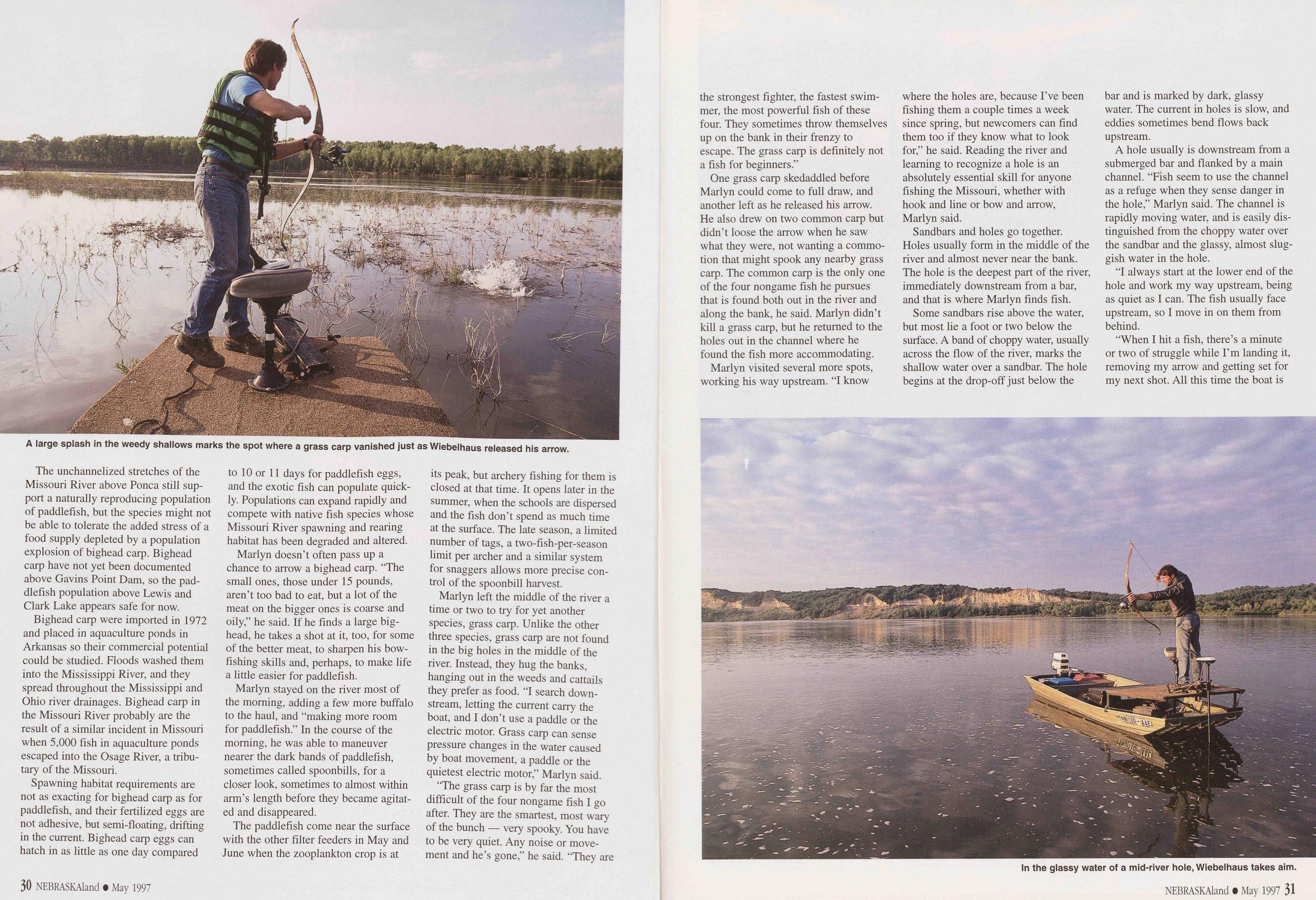
A large splash in the weedy shallows marks the spot where a grass carp vanished just as Wiebelhaus released his arrow.
The unchannelized stretches of the Missouri River above Ponca still support a naturally reproducing population of paddlefish, but the species might not be able to tolerate the added stress of a food supply depleted by a population explosion of bighead carp. Bighead carp have not yet been documented above Gavins Point Dam, so the paddlefish population above Lewis and Clark Lake appears safe for now.
Bighead carp were imported in 1972 and placed in aquaculture ponds in Arkansas so their commercial potential could be studied. Floods washed them into the Mississippi River, and they spread throughout the Mississippi and Ohio river drainages. Bighead carp in the Missouri River probably are the result of a similar incident in Missouri when 5,000 fish in aquaculture ponds escaped into the Osage River, a tributary of the Missouri.
Spawning habitat requirements are not as exacting for bighead carp as for paddlefish, and their fertilized eggs are not adhesive, but semi-floating, drifting in the current. Bighead carp eggs can hatch in as little as one day compared to 10 or 11 days for paddlefish eggs, and the exotic fish can populate quickly. Populations can expand rapidly and compete with native fish species whose Missouri River spawning and rearing habitat has been degraded and altered.
Marlyn doesn't often pass up a chance to arrow a bighead carp. "The small ones, those under 15 pounds, aren't too bad to eat, but a lot of the meat on the bigger ones is coarse and oily," he said. If he finds a large bighead, he takes a shot at it, too, for some of the better meat, to sharpen his bow-fishing skills and, perhaps, to make life a little easier for paddlefish.
Marlyn stayed on the river most of the morning, adding a few more buffalo to the haul, and "making more room for paddlefish." In the course of the morning, he was able to maneuver nearer the dark bands of paddlefish, sometimes called spoonbills, for a closer look, sometimes to almost within arm's length before they became agitated and disappeared.
The paddlefish come near the surface with the other filter feeders in May and June when the zooplankton crop is at its peak, but archery fishing for them is closed at that time. It opens later in the summer, when the schools are dispersed and the fish don't spend as much time at the surface. The late season, a limited number of tags, a two-fish-per-season limit per archer and a similar system for snaggers allows more precise control of the spoonbill harvest.
Marlyn left the middle of the river a time or two to try for yet another species, grass carp. Unlike the other three species, grass carp are not found in the big holes in the middle of the river. Instead, they hug the banks, hanging out in the weeds and cattails they prefer as food. "I search down-stream, letting the current carry the boat, and I don't use a paddle or the electric motor. Grass carp can sense pressure changes in the water caused by boat movement, a paddle or the quietest electric motor," Marlyn said.
"The grass carp is by far the most difficult of the four nongame fish I go after. They are the smartest, most wary of the bunch — very spooky. You have to be very quiet. Any noise or movement and he's gone," he said. "They are
30 NEBRASKAland • May 1997the strongest fighter, the fastest swimmer, the most powerful fish of these four. They sometimes throw themselves up on the bank in their frenzy to escape. The grass carp is definitely not a fish for beginners."
One grass carp skedaddled before Marlyn could come to full draw, and another left as he released his arrow. He also drew on two common carp but didn't loose the arrow when he saw what they were, not wanting a commotion that might spook any nearby grass carp. The common carp is the only one of the four nongame fish he pursues that is found both out in the river and along the bank, he said. Marlyn didn't kill a grass carp, but he returned to the holes out in the channel where he found the fish more accommodating.
Marlyn visited several more spots, working his way upstream. "I know where the holes are, because I've been fishing them a couple times a week since spring, but newcomers can find them too if they know what to look for," he said. Reading the river and learning to recognize a hole is an absolutely essential skill for anyone fishing the Missouri, whether with hook and line or bow and arrow, Marlyn said.
Sandbars and holes go together. Holes usually form in the middle of the river and almost never near the bank. The hole is the deepest part of the river, immediately downstream from a bar, and that is where Marlyn finds fish.
Some sandbars rise above the water, but most lie a foot or two below the surface. A band of choppy water, usually across the flow of the river, marks the shallow water over a sandbar. The hole begins at the drop-off just below the bar and is marked by dark, glassy water. The current in holes is slow, and eddies sometimes bend flows back upstream.
A hole usually is downstream from a submerged bar and flanked by a main channel. "Fish seem to use the channel as a refuge when they sense danger in the hole," Marlyn said. The channel is rapidly moving water, and is easily distinguished from the choppy water over the sandbar and the glassy, almost sluggish water in the hole.
"I always start at the lower end of the hole and work my way upstream, being as quiet as I can. The fish usually face upstream, so I move in on them from behind.
"When I hit a fish, there's a minute or two of struggle while I'm landing it, removing my arrow and getting set for my next shot. All this time the boat is
In the glassy water of a mid-river hole, Wiebelhaus takes aim.
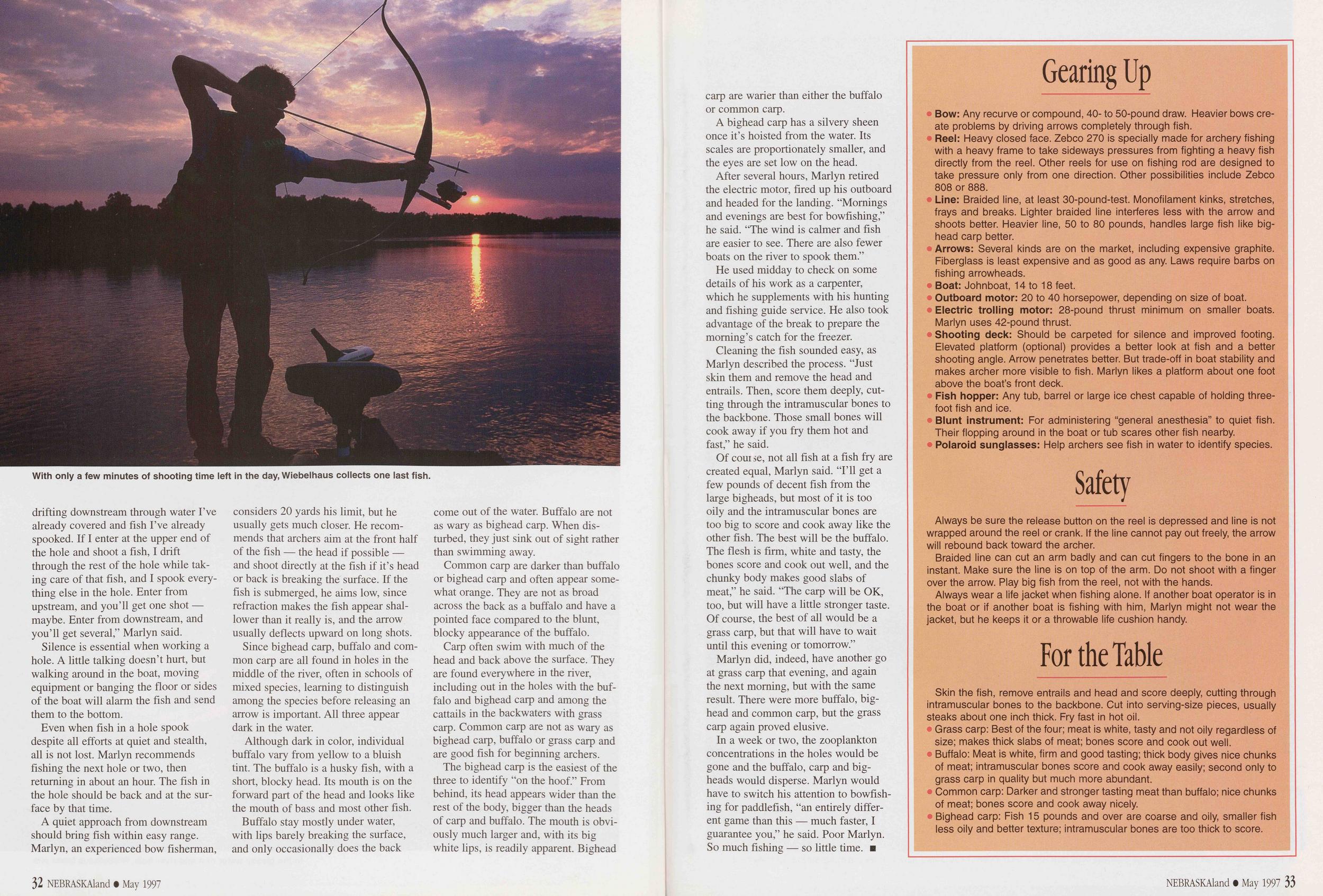
With only a few minutes of shooting time left in the day, Wiebelhaus collects one last fish.
drifting downstream through water I've already covered and fish I've already spooked. If I enter at the upper end of the hole and shoot a fish, I drift through the rest of the hole while taking care of that fish, and I spook everything else in the hole. Enter from upstream, and you'll get one shot — maybe. Enter from downstream, and you'll get several," Marlyn said.
Silence is essential when working a hole. A little talking doesn't hurt, but walking around in the boat, moving equipment or banging the floor or sides of the boat will alarm the fish and send them to the bottom.
Even when fish in a hole spook despite all efforts at quiet and stealth, all is not lost. Marlyn recommends fishing the next hole or two, then returning in about an hour. The fish in the hole should be back and at the surface by that time.
A quiet approach from downstream should bring fish within easy range. Marlyn, an experienced bow fisherman, considers 20 yards his limit, but he usually gets much closer. He recommends that archers aim at the front half of the fish — the head if possible — and shoot directly at the fish if it's head or back is breaking the surface. If the fish is submerged, he aims low, since refraction makes the fish appear shallower than it really is, and the arrow usually deflects upward on long shots.
Since bighead carp, buffalo and common carp are all found in holes in the middle of the river, often in schools of mixed species, learning to distinguish among the species before releasing an arrow is important. All three appear dark in the water.
Although dark in color, individual buffalo vary from yellow to a bluish tint. The buffalo is a husky fish, with a short, blocky head. Its mouth is on the forward part of the head and looks like the mouth of bass and most other fish.
Buffalo stay mostly under water, with lips barely breaking the surface, and only occasionally does the back come out of the water. Buffalo are not as wary as bighead carp. When disturbed, they just sink out of sight rather than swimming away.
Common carp are darker than buffalo or bighead carp and often appear somewhat orange. They are not as broad across the back as a buffalo and have a pointed face compared to the blunt, blocky appearance of the buffalo.
Carp often swim with much of the head and back above the surface. They are found everywhere in the river, including out in the holes with the buffalo and bighead carp and among the cattails in the backwaters with grass carp. Common carp are not as wary as bighead carp, buffalo or grass carp and are good fish for beginning archers.
The bighead carp is the easiest of the three to identify "on the hoof." From behind, its head appears wider than the rest of the body, bigger than the heads of carp and buffalo. The mouth is obviously much larger and, with its big white lips, is readily apparent. Bighead
32 NEBRASKAland • May 1997carp are warier than either the buffalo or common carp.
A bighead carp has a silvery sheen once it's hoisted from the water. Its scales are proportionately smaller, and the eyes are set low on the head.
After several hours, Marlyn retired the electric motor, fired up his outboard and headed for the landing. "Mornings and evenings are best for bowfishing," he said. "The wind is calmer and fish are easier to see. There are also fewer boats on the river to spook them."
He used midday to check on some details of his work as a carpenter, which he supplements with his hunting and fishing guide service. He also took advantage of the break to prepare the morning's catch for the freezer.
Cleaning the fish sounded easy, as Marlyn described the process. "Just skin them and remove the head and entrails. Then, score them deeply, cutting through the intramuscular bones to the backbone. Those small bones will cook away if you fry them hot and fast," he said.
Of course, not all fish at a fish fry are created equal, Marlyn said. "I'll get a few pounds of decent fish from the large bigheads, but most of it is too oily and the intramuscular bones are too big to score and cook away like the other fish. The best will be the buffalo. The flesh is firm, white and tasty, the bones score and cook out well, and the chunky body makes good slabs of meat," he said. "The carp will be OK, too, but will have a little stronger taste. Of course, the best of all would be a grass carp, but that will have to wait until this evening or tomorrow."
Marlyn did, indeed, have another go at grass carp that evening, and again the next morning, but with the same result. There were more buffalo, bighead and common carp, but the grass carp again proved elusive.
In a week or two, the zooplankton concentrations in the holes would be gone and the buffalo, carp and bigheads would disperse. Marlyn would have to switch his attention to bow-fishing for paddlefish, "an entirely different game than this — much faster, I guarantee you," he said. Poor Marlyn. So much fishing — so little time.
Gearing Up
Bow: Any recurve or compound, 40- to 50-pound draw. Heavier bows create problems by driving arrows completely through fish. Reel: Heavy closed face. Zebco 270 is specially made for archery fishing with a heavy frame to take sideways pressures from fighting a heavy fish directly from the reel. Other reels for use on fishing rod are designed to take pressure only from one direction. Other possibilities include Zebco 808 or 888. Line: Braided line, at least 30-pound-test. Monofilament kinks, stretches, frays and breaks. Lighter braided line interferes less with the arrow and shoots better. Heavier line, 50 to 80 pounds, handles large fish like bighead carp better. Arrows: Several kinds are on the market, including expensive graphite. Fiberglass is least expensive and as good as any. Laws require barbs on fishing arrowheads. Boat: Johnboat, 14 to 18 feet. Outboard motor: 20 to 40 horsepower, depending on size of boat. Electric trolling motor: 28-pound thrust minimum on smaller boats. Marlyn uses 42-pound thrust. Shooting deck: Should be carpeted for silence and improved footing. Elevated platform (optional) provides a better look at fish and a better shooting angle. Arrow penetrates better. But trade-off in boat stability and makes archer more visible to fish. Marlyn likes a platform about one foot above the boat's front deck. Fish hopper: Any tub, barrel or large ice chest capable of holding three-foot fish and ice. Blunt instrument: For administering "general anesthesia" to quiet fish. Their flopping around in the boat or tub scares other fish nearby. Polaroid sunglasses: Help archers see fish in water to identify species.Safety
Always be sure the release button on the reel is depressed and line is not wrapped around the reel or crank. If the line cannot pay out freely, the arrow will rebound back toward the archer. Braided line can cut an arm badly and can cut fingers to the bone in an instant. Make sure the line is on top of the arm. Do not shoot with a finger over the arrow. Play big fish from the reel, not with the hands. Always wear a life jacket when fishing alone. If another boat operator is in the boat or if another boat is fishing with him, Marlyn might not wear the jacket, but he keeps it or a throwable life cushion handy.For the Table
Skin the fish, remove entrails and head and score deeply, cutting through intramuscular bones to the backbone. Cut into serving-size pieces, usually steaks about one inch thick. Fry fast in hot oil. Grass carp: Best of the four; meat is white, tasty and not oily regardless of size; makes thick slabs of meat; bones score and cook out well. Buffalo: Meat is white, firm and good tasting; thick body gives nice chunks of meat; intramuscular bones score and cook away easily; second only to grass carp in quality but much more abundant. Common carp: Darker and stronger tasting meat than buffalo; nice chunks of meat; bones score and cook away nicely. Bighead carp: Fish 15 pounds and over are coarse and oily, smaller fish less oily and better texture; intramuscular bones are too thick to score. NEBRASKAland • May 1997 33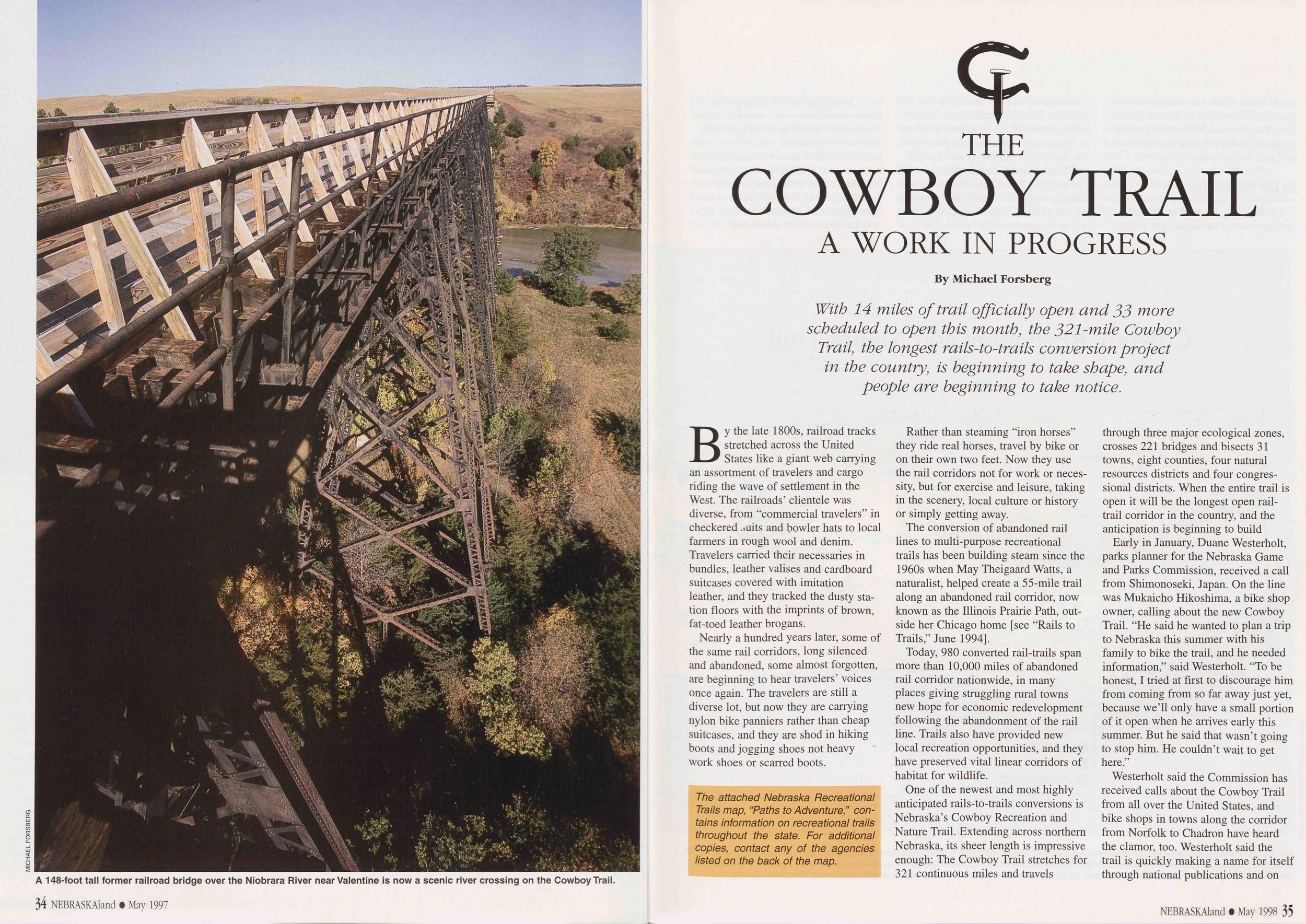
A 148-foot tall former railroad bridge over the Niobrara River near Valentine is now a scenic river crossing on the Cowboy Trail.
MICHAEL FORSBERGThe COWBOY TRAIL
A WORK IN PROGRESS By Michael Forsberg With 14 miles of trail officially open and 33 more scheduled to open this month, the 321-mile Cowboy Trail, the longest rails-to-trails conversion project in the country, is beginning to take shape, and people are beginning to take notice.By the late 1800s, railroad tracks stretched across the United States like a giant web carrying an assortment of travelers and cargo riding the wave of settlement in the West. The railroads' clientele was diverse, from "commercial travelers" in checkered mits and bowler hats to local farmers in rough wool and denim. Travelers carried their necessaries in bundles, leather valises and cardboard suitcases covered with imitation leather, and they tracked the dusty station floors with the imprints of brown, fat-toed leather brogans.
Nearly a hundred years later, some of the same rail corridors, long silenced and abandoned, some almost forgotten, are beginning to hear travelers' voices once again. The travelers are still a diverse lot, but now they are carrying nylon bike panniers rather than cheap suitcases, and they are shod in hiking boots and jogging shoes not heavy work shoes or scarred boots.
The attached Nebraska Recreational Trails map, "Paths to Adventure," contains information on recreational trails throughout the state. For additional copies, contact any of the agencies listed on the back of the map.Rather than steaming "iron horses" they ride real horses, travel by bike or on their own two feet. Now they use the rail corridors not for work or necessity, but for exercise and leisure, taking in the scenery, local culture or history or simply getting away.
The conversion of abandoned rail lines to multi-purpose recreational trails has been building steam since the 1960s when May Theigaard Watts, a naturalist, helped create a 55-mile trail along an abandoned rail corridor, now known as the Illinois Prairie Path, outside her Chicago home [see "Rails to Trails," June 1994].
Today, 980 converted rail-trails span more than 10,000 miles of abandoned rail corridor nationwide, in many places giving struggling rural towns new hope for economic redevelopment following the abandonment of the rail line. Trails also have provided new local recreation opportunities, and they have preserved vital linear corridors of habitat for wildlife.
One of the newest and most highly anticipated rails-to-trails conversions is Nebraska's Cowboy Recreation and Nature Trail. Extending across northern Nebraska, its sheer length is impressive enough: The Cowboy Trail stretches for 321 continuous miles and travels through three major ecological zones, crosses 221 bridges and bisects 31 towns, eight counties, four natural resources districts and four congressional districts. When the entire trail is open it will be the longest open rail-trail corridor in the country, and the anticipation is beginning to build.
Early in January, Duane Westerholt, parks planner for the Nebraska Game and Parks Commission, received a call from Shimonoseki, Japan. On the line was Mukaicho Hikoshima, a bike shop owner, calling about the new Cowboy Trail. "He said he wanted to plan a trip to Nebraska this summer with his family to bike the trail, and he needed information," said Westerholt. "To be honest, I tried at first to discourage him from coming from so far away just yet, because we'll only have a small portion of it open when he arrives early this summer. But he said that wasn't going to stop him. He couldn't wait to get here."
Westerholt said the Commission has received calls about the Cowboy Trail from all over the United States, and bike shops in towns along the corridor from Norfolk to Chadron have heard the clamor, too. Westerholt said the trail is quickly making a name for itself through national publications and on
NEBRASKAland • May 1998 35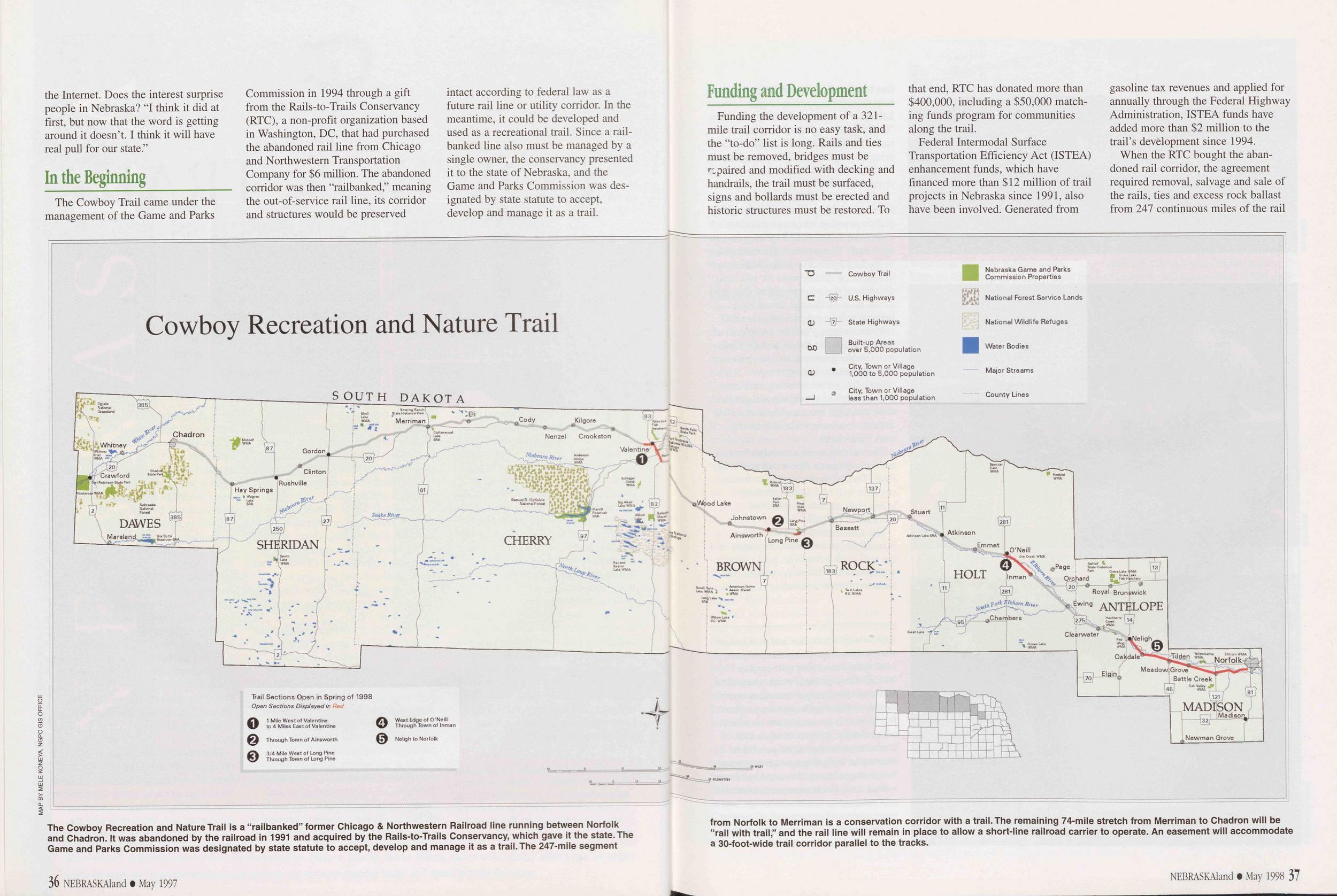
the Internet. Does the interest surprise people in Nebraska? "I think it did at first, but now that the word is getting around it doesn't. I think it will have real pull for our state."
In the BeginningThe Cowboy Trail came under the management of the Game and Parks Commission in 1994 through a gift from the Rails-to-Trails Conservancy (RTC), a non-profit organization based in Washington, DC, that had purchased the abandoned rail line from Chicago and Northwestern Transportation Company for $6 million. The abandoned corridor was then "railbanked," meaning the out-of-service rail line, its corridor and structures would be preserved intact according to federal law as a future rail line or utility corridor. In the meantime, it could be developed and used as a recreational trail. Since a rail-banked line also must be managed by a single owner, the conservancy presented it to the state of Nebraska, and the Game and Parks Commission was designated by state statute to accept, develop and manage it as a trail.
36 NEBRASKAland • May 1997 Funding and DevelopmentFunding the development of a 321-mile trail corridor is no easy task, and the "to-do" list is long. Rails and ties must be removed, bridges must be repaired and modified with decking and handrails, the trail must be surfaced, signs and bollards must be erected and historic structures must be restored. To that end, RTC has donated more than $400,000, including a $50,000 matching funds program for communities along the trail.
Federal Intermodal Surface Transportation Efficiency Act (ISTEA) enhancement funds, which have financed more than $12 million of trail projects in Nebraska since 1991, also have been involved. Generated from gasoline tax revenues and applied for annually through the Federal Highway Administration, ISTEA funds have added more than $2 million to the trail's development since 1994.
When the RTC bought the abandoned rail corridor, the agreement required removal, salvage and sale of the rails, ties and excess rock ballast from 247 continuous miles of the rail
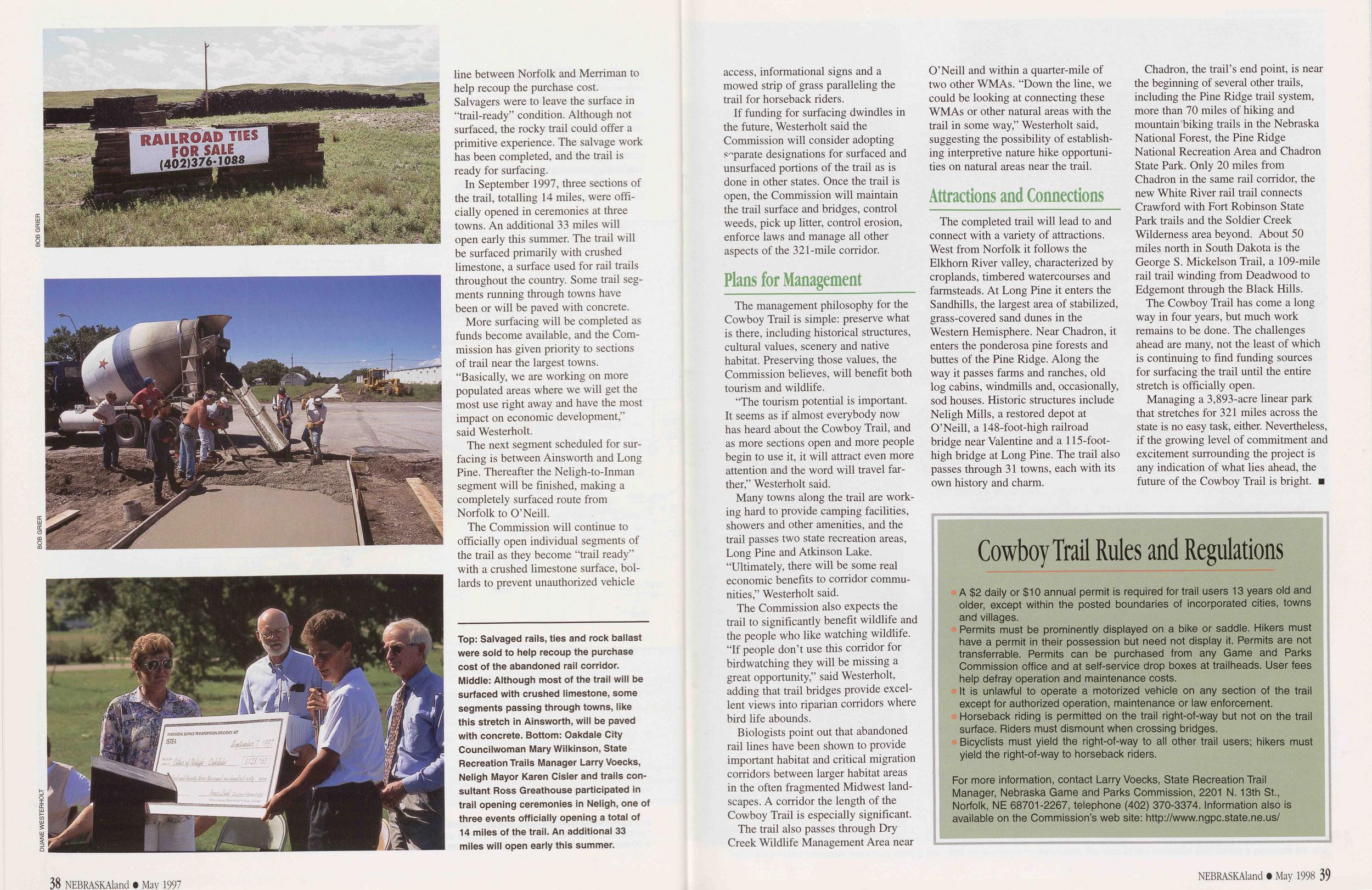
line between Norfolk and Merriman to help recoup the purchase cost. Salvagers were to leave the surface in "trail-ready" condition. Although not surfaced, the rocky trail could offer a primitive experience. The salvage work has been completed, and the trail is ready for surfacing.
In September 1997, three sections of the trail, totalling 14 miles, were officially opened in ceremonies at three towns. An additional 33 miles will open early this summer. The trail will be surfaced primarily with crushed limestone, a surface used for rail trails throughout the country. Some trail segments running through towns have been or will be paved with concrete.
More surfacing will be completed as funds become available, and the Commission has given priority to sections of trail near the largest towns. "Basically, we are working on more populated areas where we will get the most use right away and have the most impact on economic development," said Westerholt.
The next segment scheduled for surfacing is between Ainsworth and Long Pine. Thereafter the Neligh-to-Inman segment will be finished, making a completely surfaced route from Norfolk to O'Neill.
The Commission will continue to officially open individual segments of the trail as they become "trail ready" with a crushed limestone surface, bollards to prevent unauthorized vehicle
Top: Salvaged rails, ties and rock ballast were sold to help recoup the purchase cost of the abandoned rail corridor. Middle: Although most of the trail will be surfaced with crushed limestone, some segments passing through towns, like this stretch in Ainsworth, will be paved with concrete. Bottom: Oakdale City Councilwoman Mary Wilkinson, State Recreation Trails Manager Larry Voecks, Neligh Mayor Karen Cisler and trails consultant Ross Greathouse participated in trail opening ceremonies in Neligh, one of three events officially opening a total of 14 miles of the trail. An additional 33 miles will open early this summer.
access, informational signs and a mowed strip of grass paralleling the trail for horseback riders.
If funding for surfacing dwindles in the future, Westerholt said the Commission will consider adopting separate designations for surfaced and unsurfaced portions of the trail as is done in other states. Once the trail is open, the Commission will maintain the trail surface and bridges, control weeds, pick up litter, control erosion, enforce laws and manage all other aspects of the 321-mile corridor.
Plans for ManagementThe management philosophy for the Cowboy Trail is simple: preserve what is there, including historical structures, cultural values, scenery and native habitat. Preserving those values, the Commission believes, will benefit both tourism and wildlife.
"The tourism potential is important. It seems as if almost everybody now has heard about the Cowboy Trail, and as more sections open and more people begin to use it, it will attract even more attention and the word will travel farther," Westerholt said.
Many towns along the trail are working hard to provide camping facilities, showers and other amenities, and the trail passes two state recreation areas, Long Pine and Atkinson Lake. "Ultimately, there will be some real economic benefits to corridor communities," Westerholt said.
The Commission also expects the trail to significantly benefit wildlife and the people who like watching wildlife. "If people don't use this corridor for birdwatching they will be missing a great opportunity," said Westerholt, adding that trail bridges provide excellent views into riparian corridors where bird life abounds.
Biologists point out that abandoned rail lines have been shown to provide important habitat and critical migration corridors between larger habitat areas in the often fragmented Midwest landscapes. A corridor the length of the Cowboy Trail is especially significant.
The trail also passes through Dry Creek Wildlife Management Area near O'Neill and within a quarter-mile of two other WMAs. "Down the line, we could be looking at connecting these WMAs or other natural areas with the trail in some way," Westerholt said, suggesting the possibility of establishing interpretive nature hike opportunities on natural areas near the trail.
Attractions and ConnectionsThe completed trail will lead to and connect with a variety of attractions. West from Norfolk it follows the Elkhorn River valley, characterized by croplands, timbered watercourses and farmsteads. At Long Pine it enters the Sandhills, the largest area of stabilized, grass-covered sand dunes in the Western Hemisphere. Near Chadron, it enters the ponderosa pine forests and buttes of the Pine Ridge. Along the way it passes farms and ranches, old log cabins, windmills and, occasionally, sod houses. Historic structures include Neligh Mills, a restored depot at O'Neill, a 148-foot-high railroad bridge near Valentine and a 115-foot- high bridge at Long Pine. The trail also passes through 31 towns, each with its own history and charm.
Chadron, the trail's end point, is near the beginning of several other trails, including the Pine Ridge trail system, more than 70 miles of hiking and mountain biking trails in the Nebraska National Forest, the Pine Ridge National Recreation Area and Chadron State Park. Only 20 miles from Chadron in the same rail corridor, the new White River rail trail connects Crawford with Fort Robinson State Park trails and the Soldier Creek Wilderness area beyond. About 50 miles north in South Dakota is the George S. Mickelson Trail, a 109-mile rail trail winding from Deadwood to Edgemont through the Black Hills.
The Cowboy Trail has come a long way in four years, but much work remains to be done. The challenges ahead are many, not the least of which is continuing to find funding sources for surfacing the trail until the entire stretch is officially open.
Managing a 3,893-acre linear park that stretches for 321 miles across the state is no easy task, either. Nevertheless, if the growing level of commitment and excitement surrounding the project is any indication of what lies ahead, the future of the Cowboy Trail is bright.
Cowboy Trail Rules and Regulations
A $2 daily or $10 annual permit is required for trail users 13 years old and older, except within the posted boundaries of incorporated cities, towns and villages. Permits must be prominently displayed on a bike or saddle. Hikers must have a permit in their possession but need not display it. Permits are not transferable. Permits can be purchased from any Game and Parks Commission office and at self-service drop boxes at trailheads. User fees help defray operation and maintenance costs. It is unlawful to operate a motorized vehicle on any section of the trail except for authorized operation, maintenance or law enforcement. Horseback riding is permitted on the trail right-of-way but not on the trail surface. Riders must dismount when crossing bridges. Bicyclists must yield the right-of-way to all other trail users; hikers must yield the right-of-way to horseback riders. For more information, contact Larry Voecks, State Recreation Trail Manager, Nebraska Game and Parks Commission, 2201 N. 13th St., Norfolk, NE 68701-2267, telephone (402) 370-3374. Information also is available on the Commission's web site: http://www.ngpc.state.ne.us/ NEBRASKAland • May 1998 39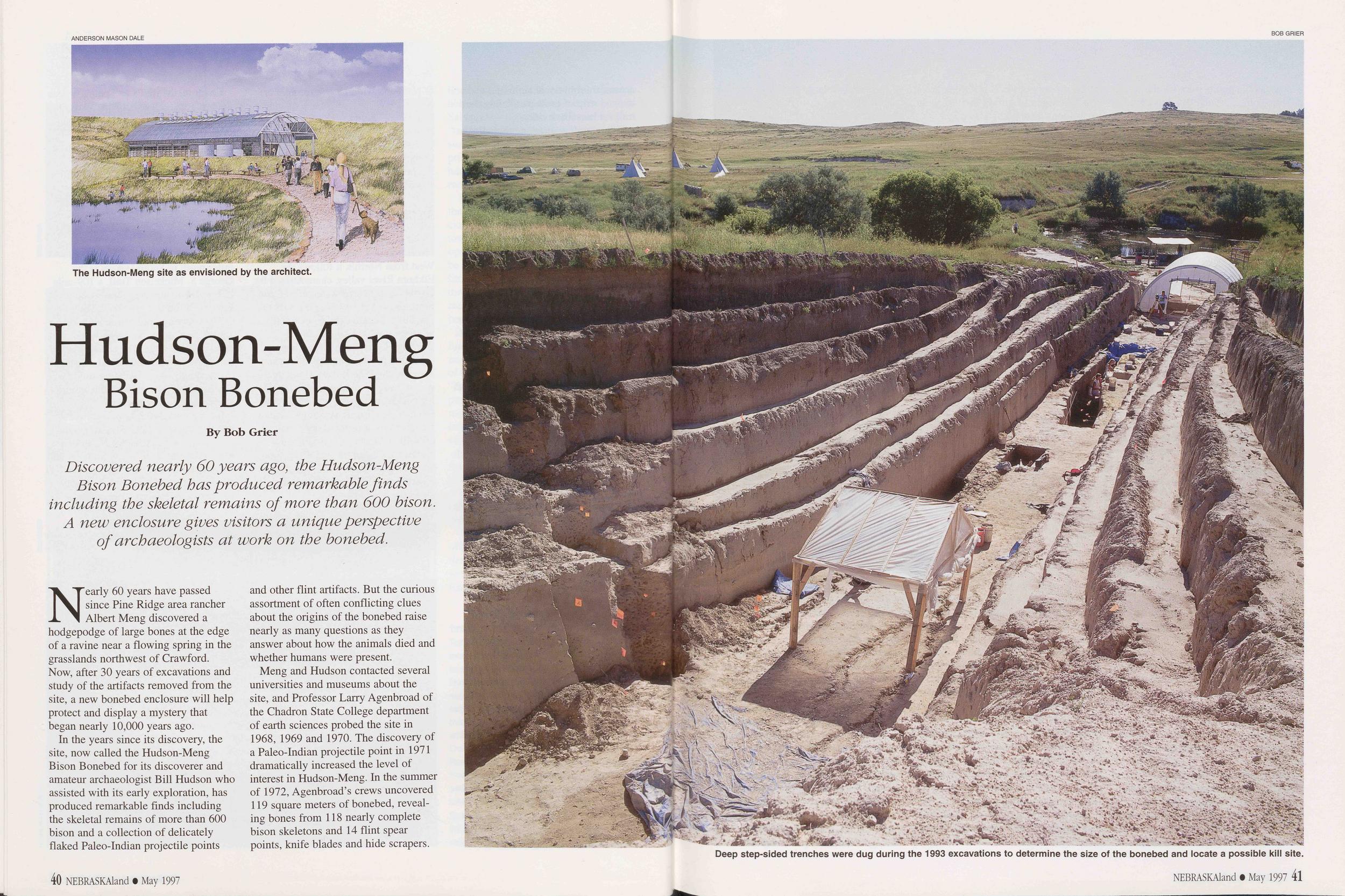
Hudson-Meng Bison Bonebed
By Bob Grier Discovered nearly 60 years ago, the Hudson-Meng Bison Bonebed has produced remarkable finds including the skeletal remains of more than 600 bison. A new enclosure gives visitors a unique perspective of archaeologists at work on the bonebed.The Hudson-Meng site as envisioned by the architect.
ANDERSON MASON DALENearly 60 years have passed since Pine Ridge area rancher Albert Meng discovered a hodgepodge of large bones at the edge of a ravine near a flowing spring in the grasslands northwest of Crawford. Now, after 30 years of excavations and study of the artifacts removed from the site, a new bonebed enclosure will help protect and display a mystery that began nearly 10,000 years ago.
In the years since its discovery, the site, now called the Hudson-Meng Bison Bonebed for its discoverer and amateur archaeologist Bill Hudson who assisted with its early exploration, has produced remarkable finds including the skeletal remains of more than 600 bison and a collection of delicately flaked Paleo-Indian projectile points and other flint artifacts. But the curious assortment of often conflicting clues about the origins of the bonebed raise nearly as many questions as they answer about how the animals died and whether humans were present.
Meng and Hudson contacted several universities and museums about the site, and Professor Larry Agenbroad of the Chadron State College department of earth sciences probed the site in 1968, 1969 and 1970. The discovery of a Paleo-Indian projectile point in 1971 dramatically increased the level of interest in Hudson-Meng. In the summer of 1972, Agenbroad's crews uncovered 119 square meters of bonebed, revealing bones from 118 nearly complete bison skeletons and 14 flint spear points, knife blades and hide scrapers.
40 NEBRASKAland • May 1997Deep step-sided trenches were dug during the 1993 excavations to determine the size of the bonebed and locate a possible kill site.
BOB GRIER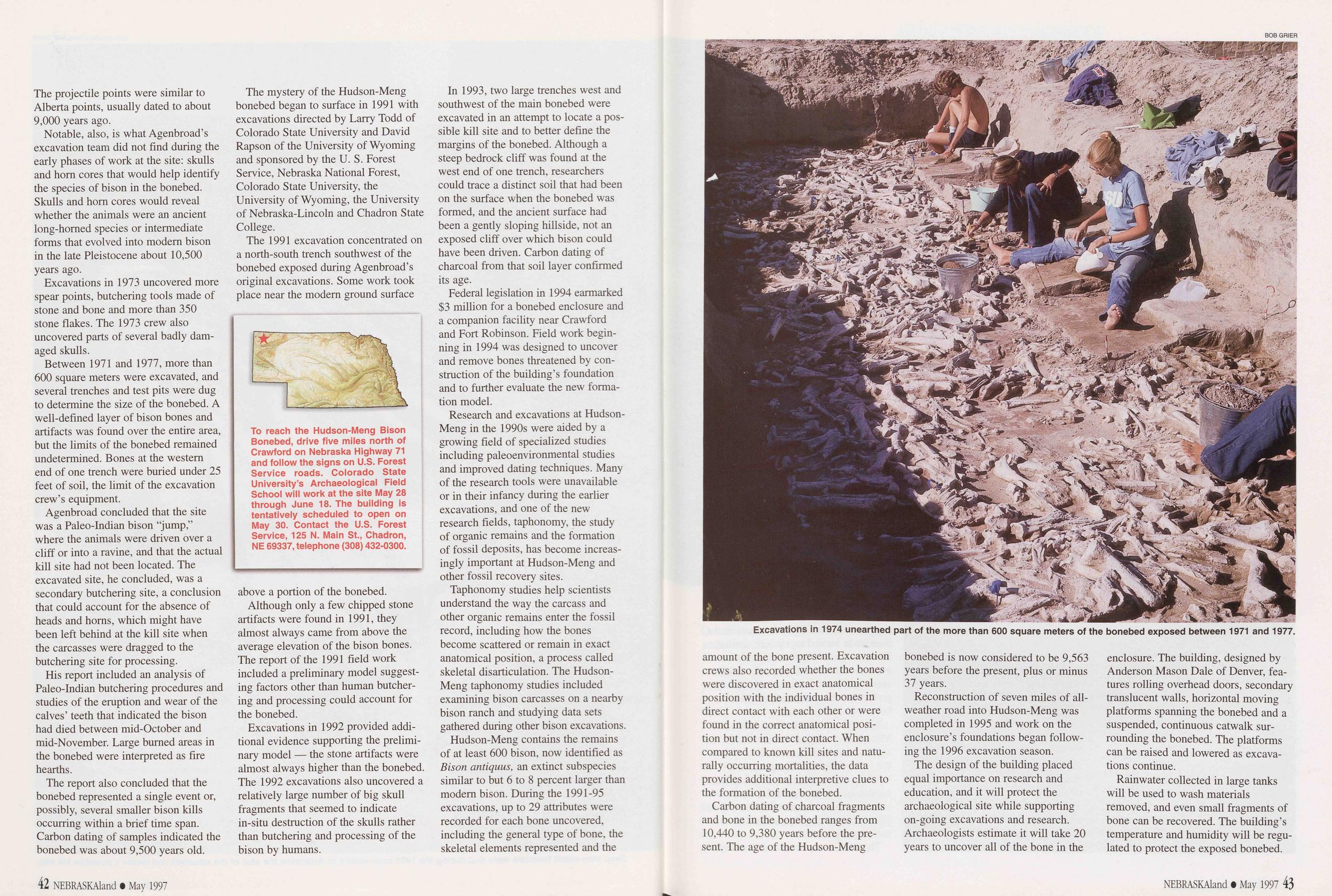
The projectile points were similar to Alberta points, usually dated to about 9,000 years ago.
Notable, also, is what Agenbroad's excavation team did not find during the early phases of work at the site: skulls and horn cores that would help identify the species of bison in the bonebed. Skulls and horn cores would reveal whether the animals were an ancient long-horned species or intermediate forms that evolved into modern bison in the late Pleistocene about 10,500 years ago.
Excavations in 1973 uncovered more spear points, butchering tools made of stone and bone and more than 350 stone flakes. The 1973 crew also uncovered parts of several badly damaged skulls.
Between 1971 and 1977, more than 600 square meters were excavated, and several trenches and test pits were dug to determine the size of the bonebed. A well-defined layer of bison bones and artifacts was found over the entire area, but the limits of the bonebed remained undetermined. Bones at the western end of one trench were buried under 25 feet of soil, the limit of the excavation crew's equipment.
Agenbroad concluded that the site was a Paleo-Indian bison "jump," where the animals were driven over a cliff or into a ravine, and that the actual kill site had not been located. The excavated site, he concluded, was a secondary butchering site, a conclusion that could account for the absence of heads and horns, which might have been left behind at the kill site when the carcasses were dragged to the butchering site for processing.
His report included an analysis of Paleo-Indian butchering procedures and studies of the eruption and wear of the calves' teeth that indicated the bison had died between mid-October and mid-November. Large burned areas in the bonebed were interpreted as fire hearths.
The report also concluded that the bonebed represented a single event or, possibly, several smaller bison kills occurring within a brief time span. Carbon dating of samples indicated the bonebed was about 9,500 years old.
The mystery of the Hudson-Meng bonebed began to surface in 1991 with excavations directed by Larry Todd of Colorado State University and David Rapson of the University of Wyoming and sponsored by the U. S. Forest Service, Nebraska National Forest, Colorado State University, the University of Wyoming, the University of Nebraska-Lincoln and Chadron State College.
The 1991 excavation concentrated on a north-south trench southwest of the bonebed exposed during Agenbroad's original excavations. Some work took place near the modern ground surface
To reach the Hudson-Meng Bison Bonebed, drive five miles north of Crawford on Nebraska Highway 71 and follow the signs on U.S. Forest Service roads. Colorado State University's Archaeological Field School will work at the site May 28 through June 18. The building is tentatively scheduled to open on May 30. Contact the U.S. Forest Service, 125 N. Main St., Chadron, NE 69337, telephone (308) 432-0300.
above a portion of the bonebed.
Although only a few chipped stone artifacts were found in 1991, they almost always came from above the average elevation of the bison bones. The report of the 1991 field work included a preliminary model suggesting factors other than human butchering and processing could account for the bonebed.
Excavations in 1992 provided additional evidence supporting the preliminary model — the stone artifacts were almost always higher than the bonebed. The 1992 excavations also uncovered a relatively large number of big skull fragments that seemed to indicate in-situ destruction of the skulls rather than butchering and processing of the bison by humans.
In 1993, two large trenches west and southwest of the main bonebed were excavated in an attempt to locate a possible kill site and to better define the margins of the bonebed. Although a steep bedrock cliff was found at the west end of one trench, researchers could trace a distinct soil that had been on the surface when the bonebed was formed, and the ancient surface had been a gently sloping hillside, not an exposed cliff over which bison could have been driven. Carbon dating of charcoal from that soil layer confirmed its age.
Federal legislation in 1994 earmarked $3 million for a bonebed enclosure and a companion facility near Crawford and Fort Robinson. Field work beginning in 1994 was designed to uncover and remove bones threatened by construction of the building's foundation and to further evaluate the new formation model.
Research and excavations at Hudson-Meng in the 1990s were aided by a growing field of specialized studies including paleoenvironmental studies and improved dating techniques. Many of the research tools were unavailable or in their infancy during the earlier excavations, and one of the new research fields, taphonomy, the study of organic remains and the formation of fossil deposits, has become increasingly important at Hudson-Meng and other fossil recovery sites.
Taphonomy studies help scientists understand the way the carcass and other organic remains enter the fossil record, including how the bones become scattered or remain in exact anatomical position, a process called skeletal disarticulation. The Hudson- Meng taphonomy studies included examining bison carcasses on a nearby bison ranch and studying data sets gathered during other bison excavations.
Hudson-Meng contains the remains of at least 600 bison, now identified as Bison antiquus, an extinct subspecies similar to but 6 to 8 percent larger than modern bison. During the 1991-95 excavations, up to 29 attributes were recorded for each bone uncovered, including the general type of bone, the skeletal elements represented and the
42 NEBRASKAland • May 1997Excavations in 1974 unearthed part of the more than 600 square meters of the bonebed exposed between 1971 and 1977.
BOB GRIERamount of the bone present. Excavation crews also recorded whether the bones were discovered in exact anatomical position with the individual bones in direct contact with each other or were found in the correct anatomical position but not in direct contact. When compared to known kill sites and naturally occurring mortalities, the data provides additional interpretive clues to the formation of the bonebed.
Carbon dating of charcoal fragments and bone in the bonebed ranges from 10,440 to 9,380 years before the present. The age of the Hudson-Meng bonebed is now considered to be 9,563 years before the present, plus or minus 37 years.
Reconstruction of seven miles of all- weather road into Hudson-Meng was completed in 1995 and work on the enclosure's foundations began following the 1996 excavation season.
The design of the building placed equal importance on research and education, and it will protect the archaeological site while supporting on-going excavations and research. Archaeologists estimate it will take 20 years to uncover all of the bone in the enclosure. The building, designed by Anderson Mason Dale of Denver, features rolling overhead doors, secondary translucent walls, horizontal moving platforms spanning the bonebed and a suspended, continuous catwalk surrounding the bonebed. The platforms can be raised and lowered as excavations continue.
Rainwater collected in large tanks will be used to wash materials removed, and even small fragments of bone can be recovered. The building's temperature and humidity will be regulated to protect the exposed bonebed.
NEBRASKAland • May 1997 43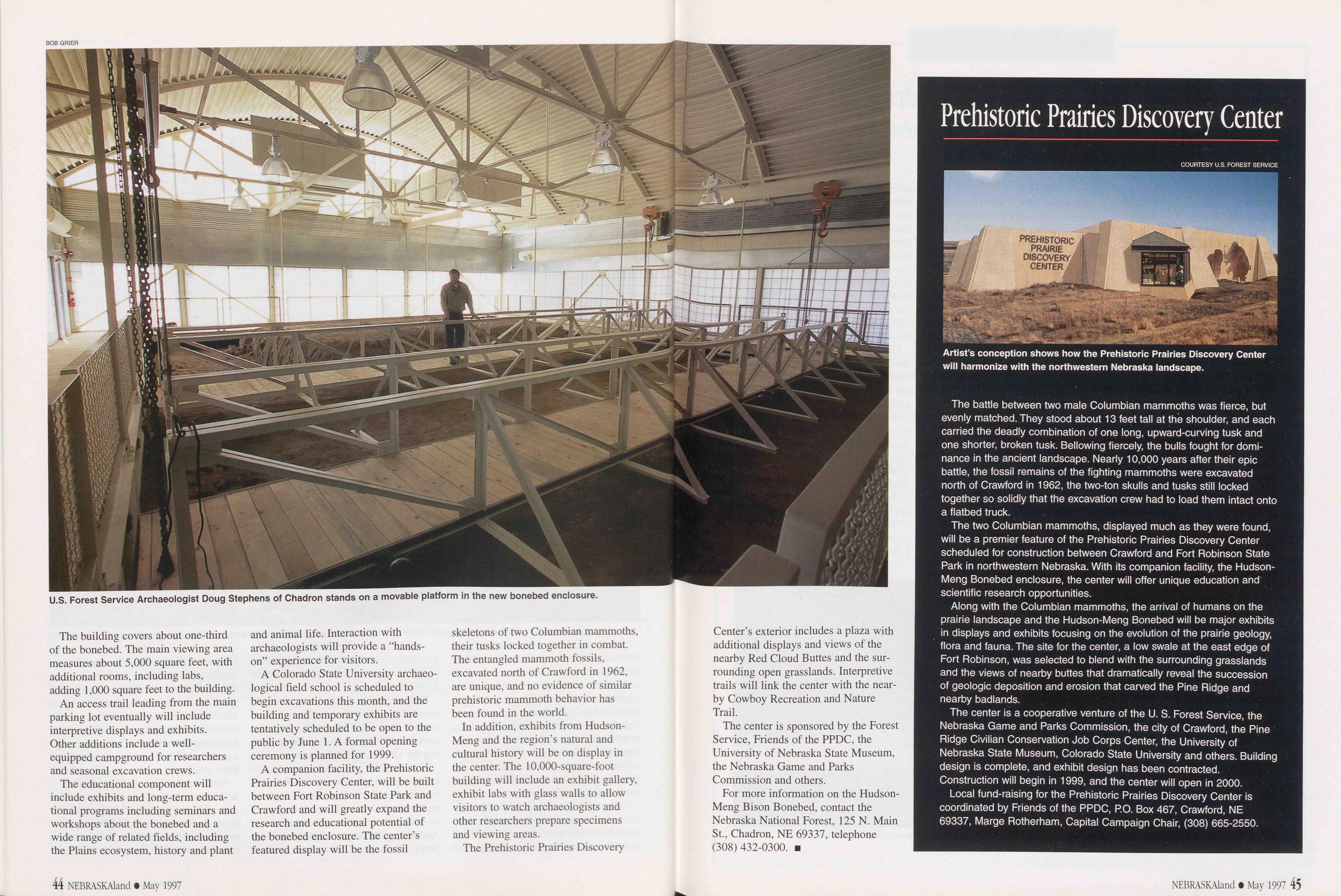
U.S. Forest Service Archaeologist Doug Stephens of Chadron stands on a movable platform in the new bonebed enclosure.
BOB GRIERThe building covers about one-third of the bonebed. The main viewing area measures about 5,000 square feet, with additional rooms, including labs, adding 1,000 square feet to the building.
An access trail leading from the main parking lot eventually will include interpretive displays and exhibits. Other additions include a well-equipped campground for researchers and seasonal excavation crews.
The educational component will include exhibits and long-term educational programs including seminars and workshops about the bonebed and a wide range of related fields, including the Plains ecosystem, history and plant and animal life. Interaction with archaeologists will provide a "hands-on" experience for visitors.
A Colorado State University archaeological field school is scheduled to begin excavations this month, and the building and temporary exhibits are tentatively scheduled to be open to the public by June 1. A formal opening ceremony is planned for 1999.
A companion facility, the Prehistoric Prairies Discovery Center, will be built between Fort Robinson State Park and Crawford and will greatly expand the research and educational potential of the bonebed enclosure. The center's featured display will be the fossil skeletons of two Columbian mammoths, their tusks locked together in combat. The entangled mammoth fossils, excavated north of Crawford in 1962, are unique, and no evidence of similar prehistoric mammoth behavior has been found in the world.
In addition, exhibits from Hudson- Meng and the region's natural and cultural history will be on display in the center. The 10,000-square-foot building will include an exhibit gallery, exhibit labs with glass walls to allow visitors to watch archaeologists and other researchers prepare specimens and viewing areas.
The Prehistoric Prairies Discovery
44 NEBRASKAland • May 1997Center's exterior includes a plaza with additional displays and views of the nearby Red Cloud Buttes and the surrounding open grasslands. Interpretive trails will link the center with the nearby Cowboy Recreation and Nature Trail.
The center is sponsored by the Forest Service, Friends of the PPDC, the University of Nebraska State Museum, the Nebraska Game and Parks Commission and others.
For more information on the Hudson-Meng Bison Bonebed, contact the Nebraska National Forest, 125 N. Main St., Chadron, NE 69337, telephone (308)432-0300.
Prehistoric Prairies Discovery Center
Artist's conception shows how the Prehistoric Prairies Discovery Center will harmonize with the northwestern Nebraska landscape.
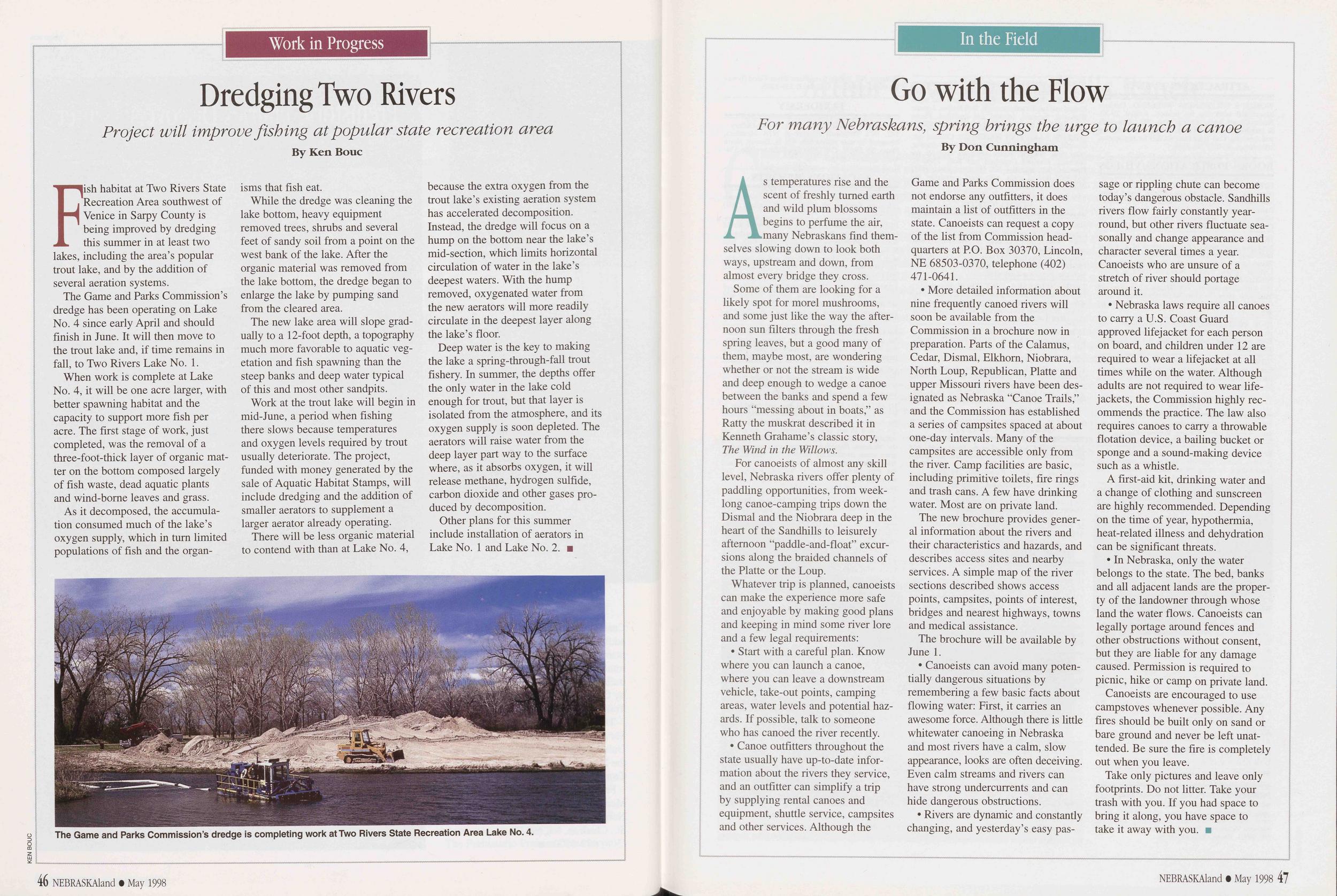
Work in Progress
Dredging Two Rivers
Project will improve fishing at popular state recreation area By Ken BoucFish habitat at Two Rivers State Recreation Area southwest of Venice in Sarpy County is being improved by dredging this summer in at least two lakes, including the area's popular trout lake, and by the addition of several aeration systems.
The Game and Parks Commission's dredge has been operating on Lake No. 4 since early April and should finish in June. It will then move to the trout lake and, if time remains in fall, to Two Rivers Lake No. 1.
When work is complete at Lake No. 4, it will be one acre larger, with better spawning habitat and the capacity to support more fish per acre. The first stage of work, just completed, was the removal of a three-foot-thick layer of organic matter on the bottom composed largely of fish waste, dead aquatic plants and wind-borne leaves and grass.
As it decomposed, the accumulation consumed much of the lake's oxygen supply, which in turn limited populations of fish and the organisms that fish eat.
While the dredge was cleaning the lake bottom, heavy equipment removed trees, shrubs and several feet of sandy soil from a point on the west bank of the lake. After the organic material was removed from the lake bottom, the dredge began to enlarge the lake by pumping sand from the cleared area.
The new lake area will slope gradually to a 12-foot depth, a topography much more favorable to aquatic vegetation and fish spawning than the steep banks and deep water typical of this and most other sandpits.
Work at the trout lake will begin in mid-June, a period when fishing there slows because temperatures and oxygen levels required by trout usually deteriorate. The project, funded with money generated by the sale of Aquatic Habitat Stamps, will include dredging and the addition of smaller aerators to supplement a larger aerator already operating.
There will be less organic material to contend with than at Lake No. 4, because the extra oxygen from the trout lake's existing aeration system has accelerated decomposition. Instead, the dredge will focus on a hump on the bottom near the lake's mid-section, which limits horizontal circulation of water in the lake's deepest waters. With the hump removed, oxygenated water from the new aerators will more readily circulate in the deepest layer along the lake's floor.
Deep water is the key to making the lake a spring-through-fall trout fishery. In summer, the depths offer the only water in the lake cold enough for trout, but that layer is isolated from the atmosphere, and its oxygen supply is soon depleted. The aerators will raise water from the deep layer part way to the surface where, as it absorbs oxygen, it will release methane, hydrogen sulfide, carbon dioxide and other gases produced by decomposition.
Other plans for this summer include installation of aerators in Lake No. 1 and Lake No. 2.
The Game and Parks Commission's dredge is completing work at Two Rivers State Recreation Area Lake No. 4.
In the Field
Go with the Flow
For many Nebraskans, spring brings the urge to launch a canoe By Don CunninghamAs temperatures rise and the scent of freshly turned earth and wild plum blossoms begins to perfume the air, many Nebraskans find themselves slowing down to look both ways, upstream and down, from almost every bridge they cross.
Some of them are looking for a likely spot for morel mushrooms, and some just like the way the afternoon sun filters through the fresh spring leaves, but a good many of them, maybe most, are wondering whether or not the stream is wide and deep enough to wedge a canoe between the banks and spend a few hours "messing about in boats," as Ratty the muskrat described it in Kenneth Grahame's classic story, The Wind in the Willows.
For canoeists of almost any skill level, Nebraska rivers offer plenty of paddling opportunities, from week-long canoe-camping trips down the Dismal and the Niobrara deep in the heart of the Sandhills to leisurely afternoon "paddle-and-float" excursions along the braided channels of the Platte or the Loup.
Whatever trip is planned, canoeists can make the experience more safe and enjoyable by making good plans and keeping in mind some river lore and a few legal requirements:
• Start with a careful plan. Know where you can launch a canoe, where you can leave a downstream vehicle, take-out points, camping areas, water levels and potential hazards. If possible, talk to someone who has canoed the river recently. • Canoe outfitters throughout the state usually have up-to-date information about the rivers they service, and an outfitter can simplify a trip by supplying rental canoes and equipment, shuttle service, campsites and other services. Although the Game and Parks Commission does not endorse any outfitters, it does maintain a list of outfitters in the state. Canoeists can request a copy of the list from Commission head- quarters at P.O. Box 30370, Lincoln, NE 68503-0370, telephone (402) 471-0641. • More detailed information about nine frequently canoed rivers will soon be available from the Commission in a brochure now in preparation. Parts of the Calamus, Cedar, Dismal, Elkhorn, Niobrara, North Loup, Republican, Platte and upper Missouri rivers have been designated as Nebraska "Canoe Trails," and the Commission has established a series of campsites spaced at about one-day intervals. Many of the campsites are accessible only from the river. Camp facilities are basic, including primitive toilets, fire rings and trash cans. A few have drinking water. Most are on private land. The new brochure provides general information about the rivers and their characteristics and hazards, and describes access sites and nearby services. A simple map of the river sections described shows access points, campsites, points of interest, bridges and nearest highways, towns and medical assistance. The brochure will be available by June 1. • Canoeists can avoid many potentially dangerous situations by remembering a few basic facts about flowing water: First, it carries an awesome force. Although there is little Whitewater canoeing in Nebraska and most rivers have a calm, slow appearance, looks are often deceiving. Even calm streams and rivers can have strong undercurrents and can hide dangerous obstructions. • Rivers are dynamic and constantly changing, and yesterday's easy passage or rippling chute can become today's dangerous obstacle. Sandhills rivers flow fairly constantly year- round, but other rivers fluctuate seasonally and change appearance and character several times a year. Canoeists who are unsure of a stretch of river should portage around it. • Nebraska laws require all canoes to carry a U.S. Coast Guard approved lifejacket for each person on board, and children under 12 are required to wear a lifejacket at all times while on the water. Although adults are not required to wear lifejackets, the Commission highly recommends the practice. The law also requires canoes to carry a throwable flotation device, a bailing bucket or sponge and a sound-making device such as a whistle. A first-aid kit, drinking water and a change of clothing and sunscreen are highly recommended. Depending on the time of year, hypothermia, heat-related illness and dehydration can be significant threats. • In Nebraska, only the water belongs to the state. The bed, banks and all adjacent lands are the property of the landowner through whose land the water flows. Canoeists can legally portage around fences and other obstructions without consent, but they are liable for any damage caused. Permission is required to picnic, hike or camp on private land. Canoeists are encouraged to use campstoves whenever possible. Any fires should be built only on sand or bare ground and never be left unattended. Be sure the fire is completely out when you leave. Take only pictures and leave only footprints. Do not litter. Take your trash with you. If you had space to bring it along, you have space to take it away with you. NEBRASKAland • May 1998 47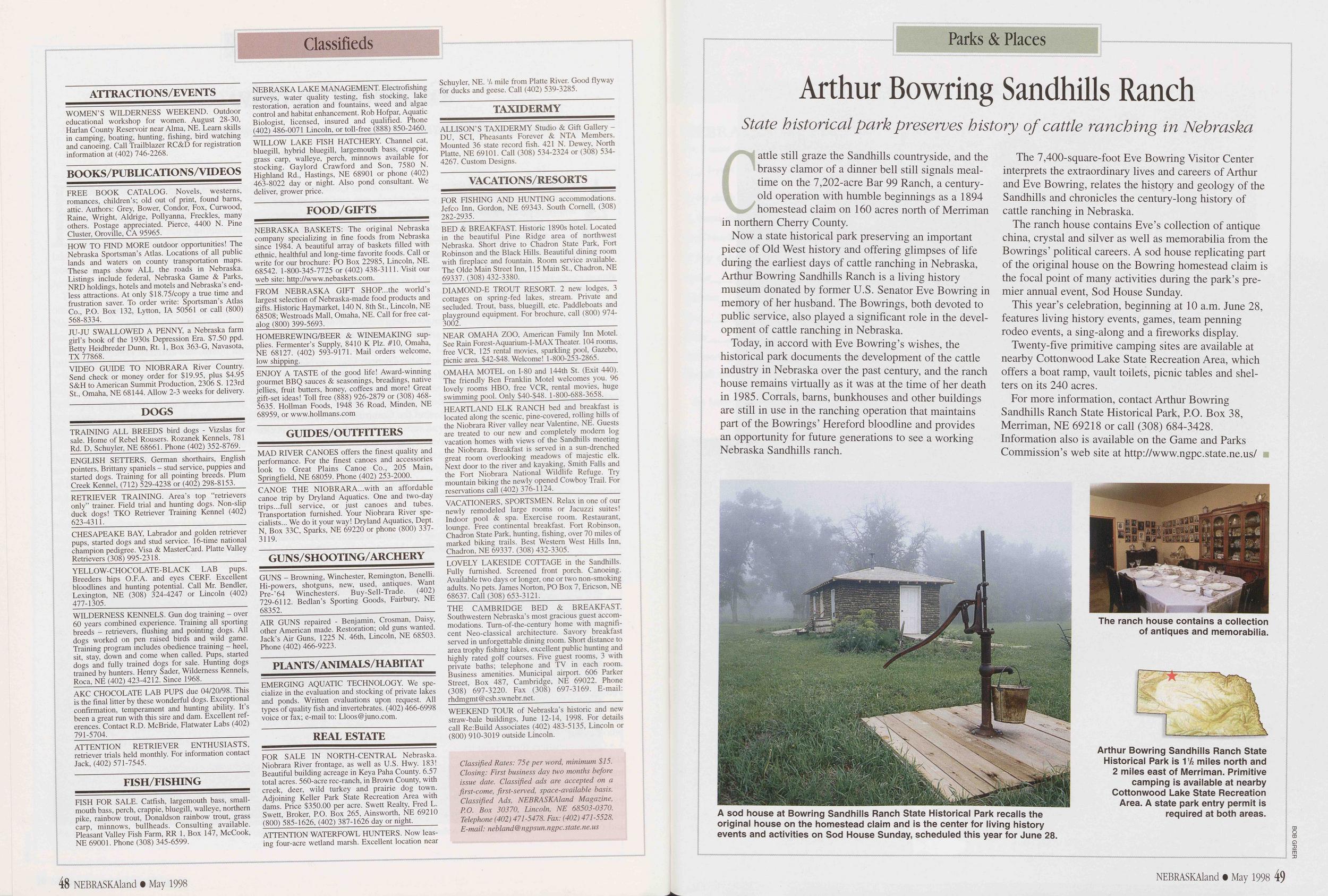
Classifieds
ATTRACTIONS/EVENTS WOMEN'S WILDERNESS WEEKEND. Outdoor educational workshop for women. August 28-30, Harlan County Reservoir near Alma, NE. Learn skills in camping, boating, hunting, fishing, bird watching and canoeing. Call Trailblazer RC&D for registration information at (402) 746-2268. BOOKS/PUBLICATIONS/VIDEOS FREE BOOK CATALOG. Novels, westerns, romances, children's; old out of print, found barns, attic. Authors: Grey, Bower, Condor, Fox, Curwood, Raine, Wright, Aldrige, Pollyanna, Freckles, many others. Postage appreciated. Pierce, 4400 N. Pine Cluster, Oroville, CA 95965. HOW TO FIND MORE outdoor opportunities! The Nebraska Sportsman's Atlas. Locations of all public lands and waters on county transportation maps. These maps show ALL the roads in Nebraska. Listings include federal, Nebraska Game & Parks, NRD holdings, hotels and motels and Nebraska's endless attractions. At only $18.75/copy a true time and frustration saver. To order write: Sportsman's Atlas Co., P.O. Box 132, Lytton, IA 50561 or call (800) 568-8334. JU-JU SWALLOWED A PENNY, a Nebraska farm girl's book of the 1930s Depression Era. $7.50 ppd. Betty Heidbreder Dunn, Rt. 1, Box 363-G, Navasota, TX 77868. VIDEO GUIDE TO NIOBRARA River Country. Send check or money order for $19.95, plus $4.95 S&H to American Summit Production, 2306 S. 123rd St., Omaha, NE 68144. Allow 2-3 weeks for delivery. DOGS TRAINING ALL BREEDS bird dogs - Vizslas for sale. Home of Rebel Rousers. Rozanek Kennels, 781 Rd. D, Schuyler, NE 68661. Phone (402) 352-8769. ENGLISH SETTERS, German shorthairs, English pointers, Brittany spaniels - stud service, puppies and started dogs. Training for all pointing breeds. Plum Creek Kennel, (712) 529-4238 or (402) 298-8153. RETRIEVER TRAINING. Area's top "retrievers only" trainer. Field trial and hunting dogs. Non-slip duck dogs! TKO Retriever Training Kennel (402) 623-4311. CHESAPEAKE BAY, Labrador and golden retriever pups, started dogs and stud service. 16-time national champion pedigree. Visa & MasterCard. Platte Valley Retrievers (308) 995-2318. YELLOW-CHOCOLATE-BLACK LAB pups. Breeders hips O.F.A. and eyes CERE Excellent bloodlines and hunting potential. Call Mr. Bendler, Lexington, NE (308) 324-4247 or Lincoln (402) 477-1305. WILDERNESS KENNELS. Gun dog training - over 60 years combined experience. Training all sporting breeds - retrievers, flushing and pointing dogs. All dogs worked on pen raised birds and wild game. Training program includes obedience training - heel, sit, stay, down and come when called. Pups, started dogs and fully trained dogs for sale. Hunting dogs trained by hunters. Henry Sader, Wilderness Kennels, Roca, NE (402) 423-4212. Since 1968. AKC CHOCOLATE LAB PUPS due 04/20/98. This is the final litter by these wonderful dogs. Exceptional confirmation, temperament and hunting ability. It's been a great run with this sire and dam. Excellent references. Contact R.D. McBride, Flatwater Labs (402) 791-5704. ATTENTION RETRIEVER ENTHUSIASTS, retriever trials held monthly. For information contact Jack, (402) 571-7545. FISH/FISHING FISH FOR SALE. Catfish, largemouth bass, smallmouth bass, perch, crappie, bluegill, walleye, northern pike, rainbow trout, Donaldson rainbow trout, grass carp, minnows, bullheads. Consulting available. Pleasant Valley Fish Farm, RR 1, Box 147, McCook, NE 69001. Phone (308) 345-6599. NEBRASKA LAKE MANAGEMENT. Electrofishing surveys, water quality testing, fish stocking, lake restoration, aeration and fountains, weed and algae control and habitat enhancement. Rob Hofpar, Aquatic Biologist, licensed, insured and qualified. Phone (402) 486-0071 Lincoln, or toll-free (888) 850-2460. WILLOW LAKE FISH HATCHERY. Channel cat, bluegill, hybrid bluegill, largemouth bass, crappie, grass carp, walleye, perch, minnows available for stocking. Gaylord Crawford and Son, 7580 N. Highland Rd., Hastings, NE 68901 or phone (402) 463-8022 day or night. Also pond consultant. We deliver, grower price. Schuyler, NE. 74 mile from Platte River. Good Byway for ducks and geese. Call (402) 539-3285. FOOD/GIFTS NEBRASKA BASKETS: The original Nebraska company specializing in fine foods from Nebraska since 1984. A beautiful array of baskets filled with ethnic, healthful and long-time favorite foods. Call or write for our brochure: PO Box 22985, Lincoln, NE. 68542. 1-800-345-7725 or (402) 438-3111. Visit our web site: http://www.nebaskets.com. FROM NEBRASKA GIFT SHOP...the world's largest selection of Nebraska-made food products and gifts. Historic Haymarket, 140 N. 8th St., Lincoln, NE 68508; Westroads Mall, Omaha, NE. Call for free catalog (800) 399-5693. HOMEBREWING/BEER & WINEMAKING sup- plies. Fermenter's Supply, 8410 K Plz. #10, Omaha, NE 68127. (402) 593-9171. Mail orders welcome, low shipping. ENJOY A TASTE of the good life! Award-winning gourmet BBQ sauces & seasonings, breadings, native jellies, fruit butters, honey, coffees and more! Great gift-set ideas! Toll free (888) 926-2879 or (308) 468-5635. Hollman Foods, 1948 36 Road, Minden, NE 68959, or www.hollmans.com GUIDES/OUTFITTERS MAD RIVER CANOES offers the finest quality and performance. For the finest canoes and accessories look to Great Plains Canoe Co., 205 Main, Springfield, NE 68059. Phone (402) 253-2000. CANOE THE NIOBRARA...with an affordable canoe trip by Dryland Aquatics. One and two-day trips...full service, or just canoes and tubes. Transportation furnished. Your Niobrara River specialists... We do it your way! Dryland Aquatics, Dept. N, Box 33C, Sparks, NE 69220 or phone (800) 337-3119. GUNS/SHOOTING/ARCHERY GUNS - Browning, Winchester, Remington, Benelli. Hi-powers, shotguns, new, used, antiques. Want Pre-'64 Winchesters. Buy-Sell-Trade. (402) 729-6112. Bedlan's Sporting Goods, Fairbury, NE 68352. AIR GUNS repaired - Benjamin, Crosman, Daisy, other American made. Restoration; old guns wanted. Jack's Air Guns, 1225 N. 46th, Lincoln, NE 68503. Phone (402) 466-9223. PLANTS/ANIMALS/HABITAT EMERGING AQUATIC TECHNOLOGY. We specialize in the evaluation and stocking of private lakes and ponds. Written evaluations upon request. All types of quality fish and invertebrates. (402) 466-6998 voice or fax; e-mail to: Lloos@juno.com. REAL ESTATE FOR SALE IN NORTH-CENTRAL Nebraska. Niobrara River frontage, as well as U.S. Hwy. 183! Beautiful building acreage in Keya Paha County. 6.57 total acres. 560-acre rec-ranch, in Brown County, with creek, deer, wild turkey and prairie dog town. Adjoining Keller Park State Recreation Area with dams. Price $350.00 per acre. Swett Realty, Fred L. Swett, Broker, P.O. Box 265, Ainsworth, NE 69210 (800) 585-1626, (402) 387-1626 day or night. ATTENTION WATERFOWL HUNTERS. Now leasing four-acre wetland marsh. Excellent location near TAXIDERMY ALLISON'S TAXIDERMY Studio & Gift Gallery - DU, SCI, Pheasants Forever & NTA Members. Mounted 36 state record fish. 421 N. Dewey, North Platte, NE 69101. Call (308) 534-2324 or (308) 534-4267. Custom Designs. VACATIONS/RESORTS FOR FISHING AND HUNTING accommodations. Jefco Inn, Gordon, NE 69343. South Cornell. (308) 282-2935. BED & BREAKFAST. Historic 1890s hotel. Located in the beautiful Pine Ridge area of northwest Nebraska. Short drive to Chadron State Park, Fort Robinson and the Black Hills. Beautiful dining room with fireplace and fountain. Room service available. The Olde Main Street Inn, 115 Main St., Chadron. NE 69337. (308) 432-3380. DIAMOND-E TROUT RESORT. 2 new lodges, 3 cottages on spring-fed lakes, stream. Private and secluded. Trout, bass, bluegill, etc. Paddleboats and playground equipment. For brochure, call (800) 974-3002. NEAR OMAHA ZOO, American Family Inn Motel. See Rain Forest-Aquarium-I-MAX Theater. 104 rooms, free VCR. 125 rental movies, sparkling pool. Gazebo, picnic area. $42-$48. Welcome! 1-800-253-2865. OMAHA MOTEL on 1-80 and 144th St. (Exit 440). The friendly Ben Franklin Motel welcomes you. 96 lovely rooms HBO, free VCR, rental movies, huge swimming pool. Only $40-$48. 1-800-688-3658. HEARTLAND ELK RANCH bed and breakfast is located along the scenic, pine-covered, rolling hills of the Niobrara River valley near Valentine, NE. Guests are treated to our new and completely modern log vacation homes with views of the Sandhills meeting the Niobrara. Breakfast is served in a sun-drenched great room overlooking meadows of majestic elk. Next door to the river and kayaking, Smith Falls and the Fort Niobrara National Wildlife Refuge. Try mountain biking the newly opened Cowboy Trail. For reservations call (402) 376-1124. VACATIONERS, SPORTSMEN. Relax in one of our newly remodeled large rooms or Jacuzzi suites! Indoor pool & spa. Exercise room. Restaurant, lounge. Free continental breakfast. Fort Robinson, Chadron State Park, hunting, fishing, over 70 miles of marked biking trails. Best Western West Hills Inn, Chadron, NE 69337. (308) 432-3305. LOVELY LAKESIDE COTTAGE in the Sandhills. Fully furnished. Screened front porch. Canoeing. Available two days or longer, one or two non-smoking adults. No pets. James Norton, PO Box 7, Ericson, NE 68637. Call (308) 653-3121. THE CAMBRIDGE BED & BREAKFAST. Southwestern Nebraska's most gracious guest accommodations. Turn-of-the-century home with magnificent Neo-classical architecture. Savory breakfast served in unforgettable dining room. Short distance to area trophy fishing lakes, excellent public hunting and highly rated golf courses. Five guest rooms, 3 with private baths; telephone and TV in each room. Business amenities. Municipal airport. 606 Parker Street, Box 487, Cambridge, NE 69022. Phone (308) 697-3220. Fax (308) 697-3169. E-mail: rhdmgmt@csb.swnebr.net. WEEKEND TOUR of Nebraska's historic and new straw-bale buildings, June 12-14, 1998. For details call Re:Build Associates (402) 483-5135, Lincoln or (800) 910-3019 outside Lincoln. Classified Rates: 75$ per word, minimum $15. Closing: First business day two months before issue date. Classified ads are accepted on a first-come, first-served, space-available basis. Classified Ads, NEBRASKAland Magazine, P.O. Box 30370, Lincoln, NE 68503-0370. Telephone (402) 471-5478. Fax: (402) 471-5528. E-mail: nebland@ngpsun. ngpc.state, ne. us 48 NEBRASKAland • May 1998Parks & Places
Arthur Bowring Sandhills Ranch
State historical park preserves history of cattle ranching in NebraskaCattle still graze the Sandhills countryside, and the brassy clamor of a dinner bell still signals mealtime on the 7,202-acre Bar 99 Ranch, a century-old operation with humble beginnings as a 1894 homestead claim on 160 acres north of Merriman in northern Cherry County.
Now a state historical park preserving an important piece of Old West history and offering glimpses of life during the earliest days of cattle ranching in Nebraska, Arthur Bowring Sandhills Ranch is a living history museum donated by former U.S. Senator Eve Bowring in memory of her husband. The Bowrings, both devoted to public service, also played a significant role in the development of cattle ranching in Nebraska.
Today, in accord with Eve Bowring's wishes, the historical park documents the development of the cattle industry in Nebraska over the past century, and the ranch house remains virtually as it was at the time of her death in 1985. Corrals, barns, bunkhouses and other buildings are still in use in the ranching operation that maintains part of the Bowrings' Hereford bloodline and provides an opportunity for future generations to see a working Nebraska Sandhills ranch.
The 7,400-square-foot Eve Bowring Visitor Center interprets the extraordinary lives and careers of Arthur and Eve Bowring, relates the history and geology of the Sandhills and chronicles the century-long history of cattle ranching in Nebraska.
The ranch house contains Eve's collection of antique china, crystal and silver as well as memorabilia from the Bowrings' political careers. A sod house replicating part of the original house on the Bowring homestead claim is the focal point of many activities during the park's premier annual event, Sod House Sunday.
This year's celebration, beginning at 10 a.m. June 28, features living history events, games, team penning rodeo events, a sing-along and a fireworks display.
Twenty-five primitive camping sites are available at nearby Cottonwood Lake State Recreation Area, which offers a boat ramp, vault toilets, picnic tables and shelters on its 240 acres.
For more information, contact Arthur Bowring Sandhills Ranch State Historical Park, P.O. Box 38, Merriman, NE 69218 or call (308) 684-3428. Information also is available on the Game and Parks Commission's web site at http://www.ngpc.state.ne.us/
The ranch house contains a collection of antiques and memorabilia.
A sod house at Bowring Sandhills Ranch State Historical Park recalls the original house on the homestead claim and is the center for living history events and activities on Sod House Sunday, scheduled this year for June 28.
Arthur Bowring Sandhills Ranch State Historical Park is 1 1/2 miles north and 2 miles east of Merriman. Primitive camping is available at nearby Cottonwood Lake State Recreation Area. A state park entry permit is required at both areas.
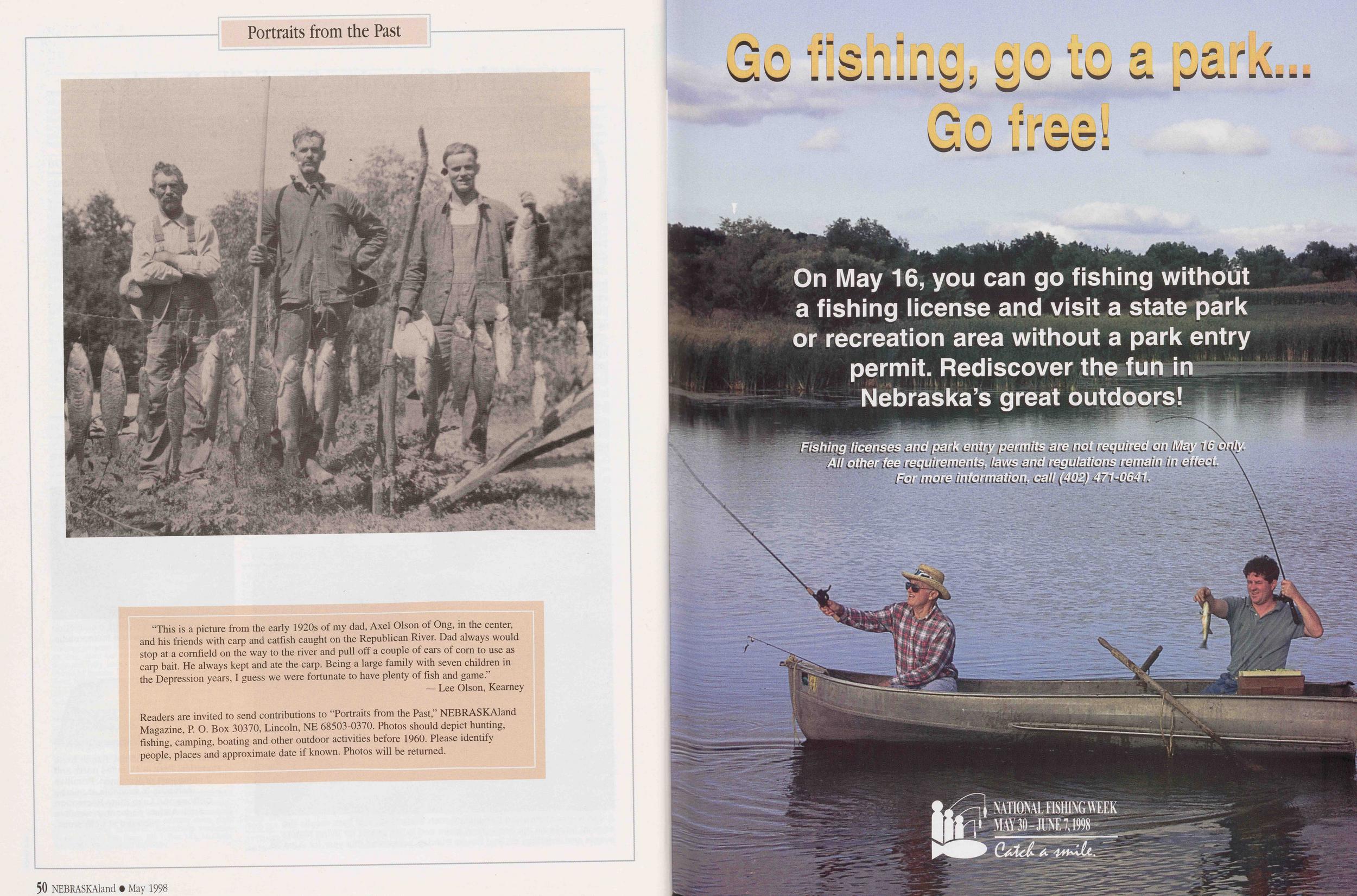
Portraits from the Past
"This is a picture from the early 1920s of my dad, Axel Olson of Ong, in the center, and his friends with carp and catfish caught on the Republican River. Dad always would stop at a cornfield on the way to the river and pull off a couple of ears of corn to use as carp bait. He always kept and ate the carp. Being a large family with seven children in the Depression years, I guess we were fortunate to have plenty of fish and game."
Readers are invited to send contributions to "Portraits from the Past," NEBRASKAland Magazine, P. O. Box 30370, Lincoln, NE 68503-0370. Photos should depict hunting, fishing, camping, boating and other outdoor activities before 1960. Please identify people, places and approximate date if known. Photos will be returned.
Position: 843 (11 views)