Volume 76, Issue 3, 1998
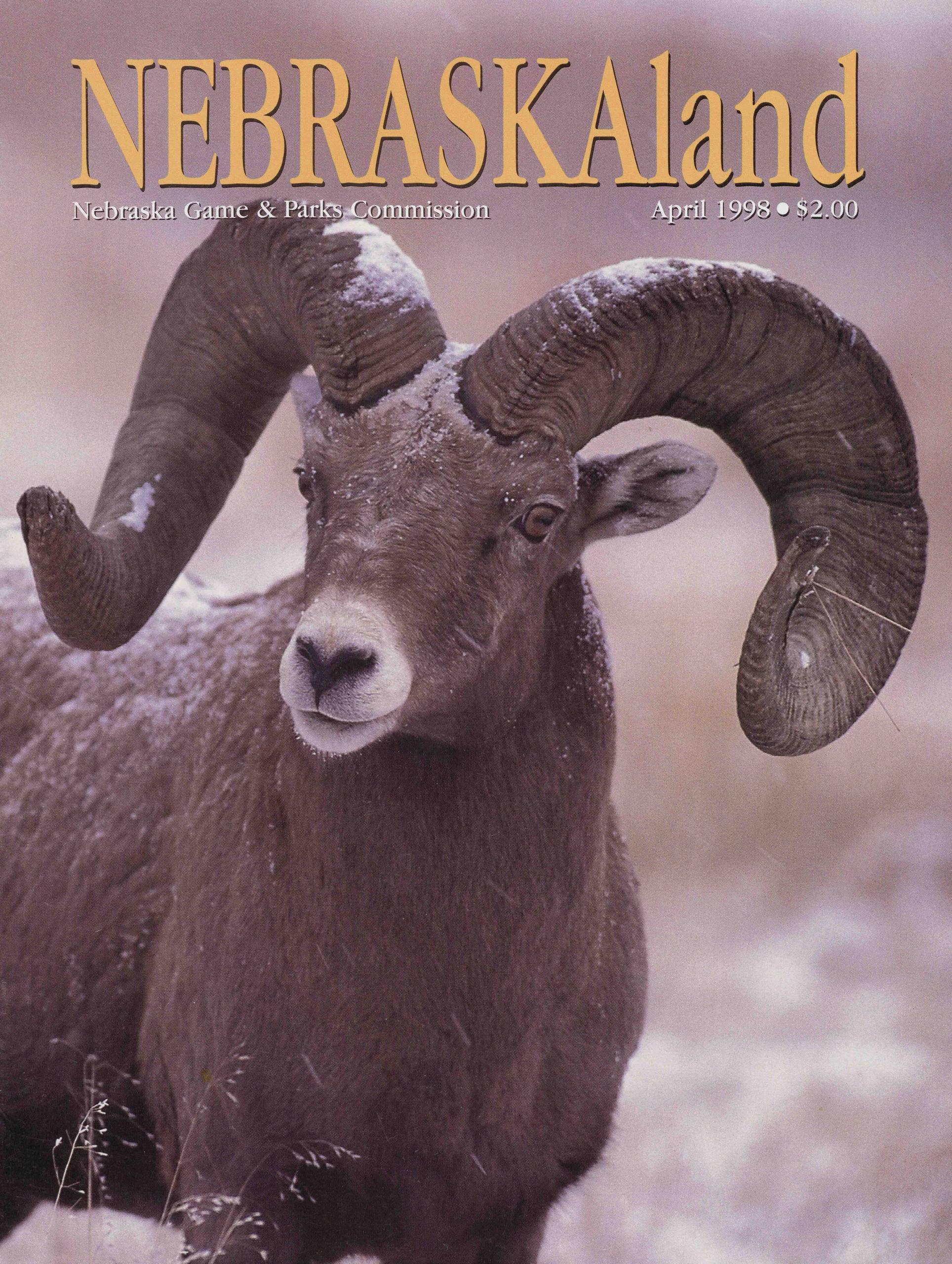
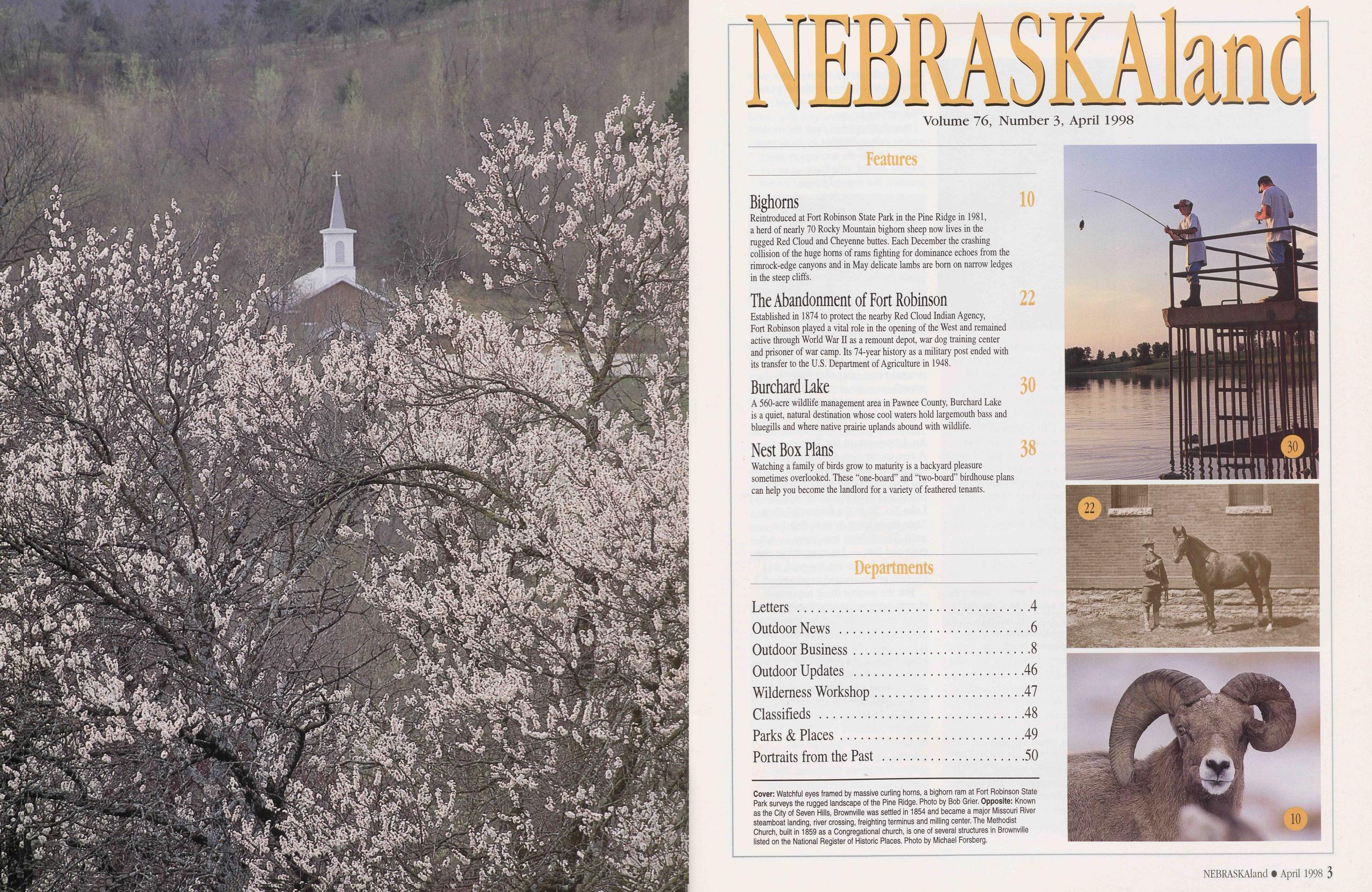
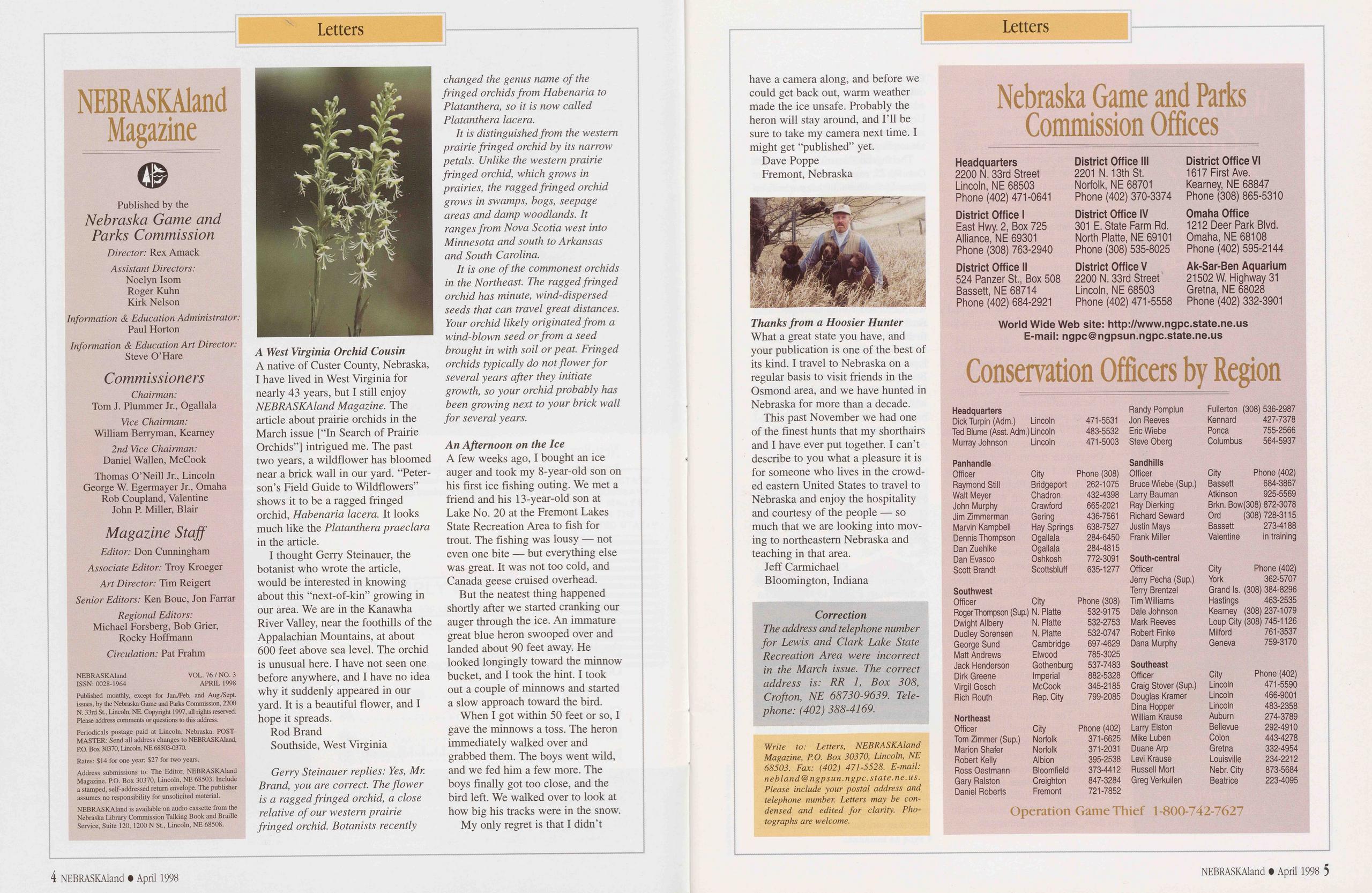
NEBRASKAland
A native of Custer County, Nebraska, I have lived in West Virginia for nearly 43 years, but I still enjoy NEBRASKAland Magazine. The article about prairie orchids in the March issue [“In Search of Prairie Orchids”] intrigued me. The past two years, a wildflower has bloomed near a brick wall in our yard. “Peter- son’s Field Guide to Wildflowers” shows it to be a ragged fringed orchid, Habenaria lacera. It looks much like the Platanthera praeclara in the article.
I thought Gerry Steinauer, the botanist who wrote the article, would be interested in knowing about this “next-of-kin” growing in our area. We are in the Kanawha River Valley, near the foothills of the Appalachian Mountains, at about 600 feet above sea level. The orchid is unusual here. I have not seen one before anywhere, and I have no idea why it suddenly appeared in our yard. It is a beautiful flower, and I hope it spreads.
Rod Brand Southside, West Virginia Gerry Steinauer replies: Yes, Mr. Brand, you are correct. The flower is a ragged fringed orchid, a close relative of our western prairie fringed orchid. Botanists recently changed the genus name of the fringed orchids from Habenaria to Platanthera, so it is now called Platanthera lacera.It is distinguished from the western prairie fringed orchid by its narrow petals. Unlike the western prairie fringed orchid, which grows in prairies, the ragged fringed orchid grows in swamps, bogs, seepage areas and damp woodlands. It ranges from Nova Scotia west into Minnesota and south to Arkansas and South Carolina.
It is one of the commonest orchids in the Northeast. The ragged fringed orchid has minute, wind-dispersed seeds that can travel great distances. Your orchid likely originated from a wind-blown seed or from a seed brought in with soil or peat. Fringed orchids typically do not flower for several years after they initiate growth, so your orchid probably has been growing next to your brick wall for several years.
An Afternoon on the IceA few weeks ago, I bought an ice auger and took my 8-year-old son on his first ice fishing outing. We met a friend and his 13-year-old son at Lake No. 20 at the Fremont Lakes State Recreation Area to fish for trout. The fishing was lousy — not even one bite — but everything else was great. It was not too cold, and Canada geese cruised overhead.
But the neatest thing happened shortly after we started cranking our auger through the ice. An immature great blue heron swooped over and landed about 90 feet away. He looked longingly toward the minnow bucket, and I took the hint. I took out a couple of minnows and started a slow approach toward the bird.
When I got within 50 feet or so, I gave the minnows a toss. The heron immediately walked over and grabbed them. The boys went wild, and we fed him a few more. The boys finally got too close, and the bird left. We walked over to look at how big his tracks were in the snow.
My only regret is that I didn’t have a camera along, and before we could get back out, warm weather made the ice unsafe. Probably the heron will stay around, and I’ll be sure to take my camera next time. I might get “published” yet.
Dave Poppe Fremont, Nebraska Thanks from a Hoosier HunterWhat a great state you have, and your publication is one of the best of its kind. I travel to Nebraska on a regular basis to visit friends in the Osmond area, and we have hunted in Nebraska for more than a decade.
This past November we had one of the finest hunts that my shorthairs and I have ever put together. I can’t describe to you what a pleasure it is for someone who lives in the crowd- ed eastern United States to travel to Nebraska and enjoy the hospitality and courtesy of the people — so much that we are looking into mov- ing to northeastern Nebraska and teaching in that area.
Jeff Carmichael Bloomington, Indiana Correction The address and telephone number for Lewis and Clark Lake State Recreation Area were incorrect in the March issue. The correct address is: RR 1, Box 308, Crofton, NE 68730-9639. Tele- phone: (402) 388-4169. Write to: Letters, NEBRASKAland Magazine, P.O. Box 30370, Lincoln, NE 68503. Fax: (402) 471-5528. E-mail: nebland@ngpsun.ngpc.state.ne.us. Please include your postal address and telephone number. Letters may be con- densed and edited for clarity. Pho- tographs are welcome.
Deer, antelope and elk season dates for 1998 were set March 20 by the seven-member governing board of the Nebraska Game and Parks Commission.
Outdoor News DeerThe Commissioners increased permit numbers in four of the 17 management units; increased propor- tions of either-sex permits in eight units; set a regular firearm season, five late seasons and a muzzleloader season; approved issuance of 2,000 statewide firearm buck permits; and set a late muzzleloader season at the DeSoto Refuge.
The archery deer season will be Sept. 15 through Nov. 13 and Nov. 23 through Dec. 31 (closed for the regular firearm deer season). There will be an unlimited number of either-sex permits available. Last year, 14,759 archers took 4,148 deer, a hunter success rate of 28 percent.
The regular firearm deer season will be Nov. 14-22, and late seasons in the Blue, Lower Platte, Mid Platte, Republican and West Republican units will be Jan. 2-10, 1999. During the 1997 regular firearm deer season, 60,754 permit holders took 43,259 deer, a 65 per- cent hunter success rate.
The muzzleloader season will be Dec. 5-20, with an unlimited number of either-sex permits available. During the 1997 muzzleloader sea- son, 11,292 permit holders took 4,104 deer, a hunter success rate of 36 percent.
The Gifford Area archery season will be Sept. 15 through Dec. 31, with a limit of 300 access permits at one time. The Gifford Muzzleloader season will be identical to the statewide muzzleloader season, Dec. 5-20, and there will be a limit of 100 access permits at one time.
AntelopeCommissioners increased the antelope season length from nine to 16 days, authorized either-sex firearm seasons in five units, buck- only permits in two units and divid- ed the season in the North Sioux Unit into two parts with a five-day intermission and added three late season hunting units.
The regular firearm season will be Oct. 10-25, except in the North Sioux Unit where the season will be Oct. 10-18 and Oct. 24 through Nov. 1. Late seasons in the Box Butte East, Box Butte West and Garden units will be Dec. 5, 1998 through Jan. 31, 1999.
The 1998 archery antelope season will be Aug. 20 through Nov. 13 and Nov. 23 through Dec. 31. The season will be closed during antelope firearm season in all areas open to firearm hunting. Archery permits allow bowhunters to take one ante- lope of either sex, except on the Bessey Division of the Nebraska National Forest where only antelope with horns longer than its ears may be taken.
The 1998 muzzleloader antelope season will be Sept. 19-27. It will be open statewide, but hunting is pro- hibited on the Bessey Division of the Nebraska National Forest in Blaine and Thomas counties. A total of 125 permits will be issued, and permit holders will be allowed to take one antelope with horns longer than its ears.
ElkCommissioners set hunting seasons in three units for the 1998 Nebraska elk season.
Forty-eight permits were autho- rized in the Bordeaux Unit season, Sept. 26 through Oct. 25 and Dec. 1- 31. Permits include eight either-sex, 24 antlerless-only and 16 landowner permits (four either-sex and 12 antlerless-only). The hunting zone has been increased from about 93 square miles to about 104 square miles.
Nine permits were approved for the Boyd Unit season, Sept. 26 through Oct. 25, one either-sex, five antlerless-only and three landowner permits (one either-sex and two antlerless-only). A reciprocal agree- ment with South Dakota allows Nebraska hunters with permits for the Boyd Unit to hunt a designated portion of Gregory County.
Thirty permits will be issued for the Hat Creek Unit season, Sept. 26 through Oct. 25 and Dec. 1-31, including five either-sex, 15 antler- less-only and 10 landowner permits (three either-sex and seven antler- less-only).
The application period for elk permits will be April 1 through May 8. Unsuccessful applicants will be notified by July 13. Hunters, except landowners, are allowed to obtain only one elk permit during their life- time. Regular permits cost $112; landowner permits cost $22.40. Both permit types require a non-refund- able application fee of $5.50.
For more information on Nebraska’s hunting seasons, write to the Nebraska Game and Parks Commission, P.O. Box 30370, Lincoln, NE 68503, call (402) 471- 0641 or visit the Commission’s web page at http://www.ngpc.state.ne.us/ 1998 Deer and Antelope Firearm Hunting Seasons Regular Deer Season, Nov. 14-22 Unit Permits Either Sex 1997 Success Blue.........................6,000 100% 75%3 Blue East.....................1,000 Antlerless1 Buffalo.......................................3,500 80% 69% Calamus East.................1,700 80%4 59% Calamus West................2,000 50% 58% Elkhorn......................3,800 80% 63% Frenchman...................3,000 100% 79% Frenchman Whitetail...........800 100% 61% Keya Paha...................2,700 100% 59% Loup East ...................2,700 80%4 63% Loup West...................2,100 70% 64% Missouri .....................3,200 70%4 56% Pine Ridge...................3,200 40% 56% Plains..........................1,500 50% 68% Platte........................2,700 60% 65% Republican ..................3,200 100% 73% Sandhills.....................2,400 100% 68% Sandhills Antlerless............700 Antlerless1 61% Upper Platte .................1,400 50% 69% Wahoo.......................4,000 100% 65% Statewide.....................2,000 0% 55% Late Deer Season, Jan. 2-10,1999 Blue....................... 4,0002 Antlerless1 51%3 Lower Platte .................1,200 Antlerless1 46% Mid Platte......................500 100% 51 % Republican ..................1,000 100% 51% West Republican ...............250 100% 6 NEBRASKAland • April 1998High school and junior high shooters have about a month remaining to prepare for the 29th annual National Cornhusker Trapshoot scheduled for May 1 and 2 at the Central Nebraska Gun Club in Doniphan. A record turnout is expected at the competition, sponsored by the Nebraska Game and Parks Commission and the Nebraska Trapshooting Association. More than 500 shooters competed last year in
continued on page 9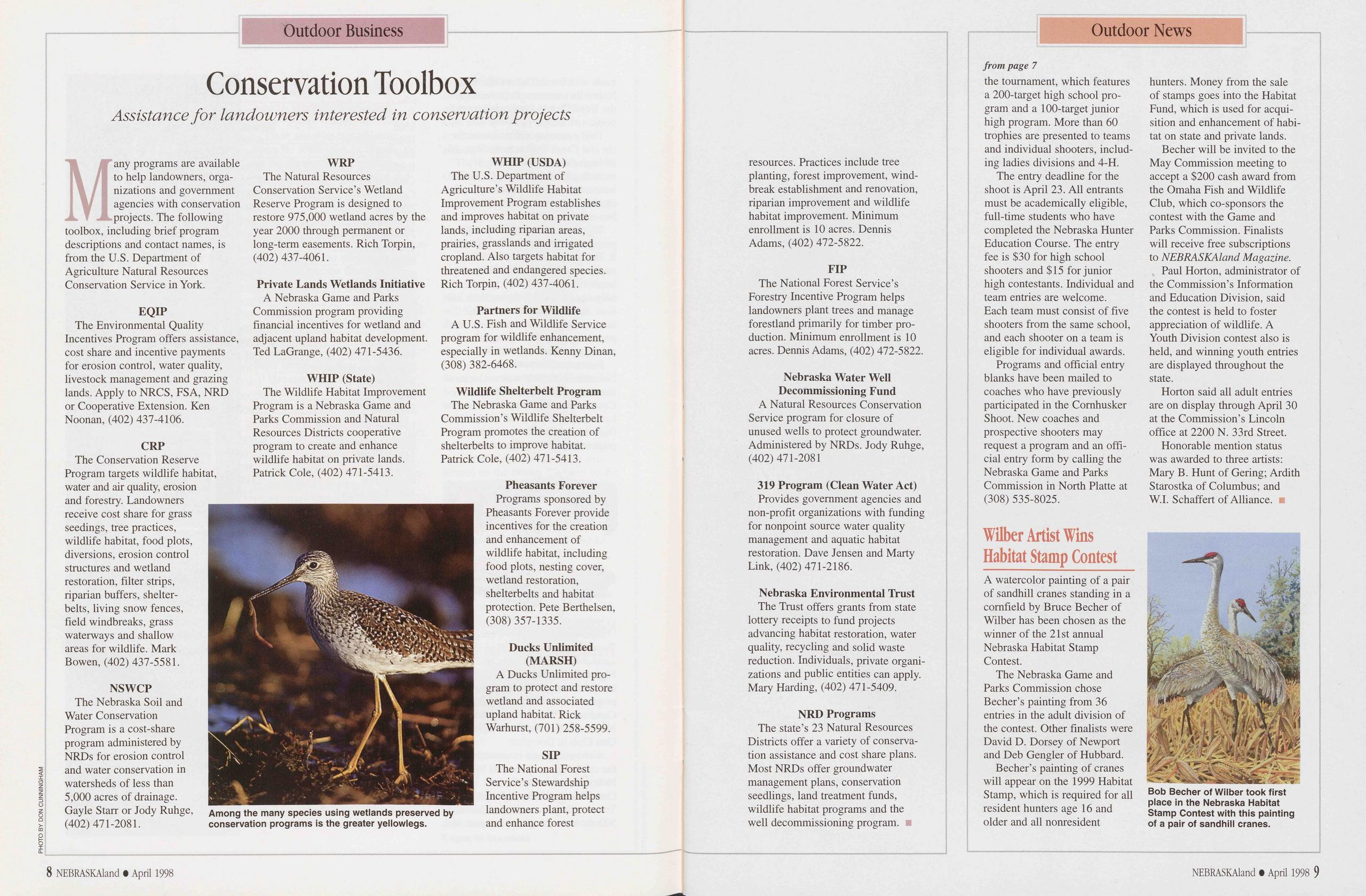 Outdoor Business
Outdoor News
Conservation Toolbox
Assistance for landowners interested in conservation projects
Outdoor Business
Outdoor News
Conservation Toolbox
Assistance for landowners interested in conservation projects
Many programs are available to help landowners, orga- nizations and government agencies with conservation projects. The following toolbox, including brief program descriptions and contact names, is from the U.S. Department of Agriculture Natural Resources Conservation Service in York.
EQIPThe Environmental Quality Incentives Program offers assistance, cost share and incentive payments for erosion control, water quality, livestock management and grazing lands. Apply to NRCS, FSA, NRD or Cooperative Extension. Ken Noonan, (402) 437-4106.
CRPThe Conservation Reserve Program targets wildlife habitat, PHOTO BY DON CUNNINGHAM water and air quality, erosion and forestry. Landowners receive cost share for grass seedings, tree practices, wildlife habitat, food plots, diversions, erosion control structures and wetland restoration, filter strips, riparian buffers, shelter- belts, living snow fences, field windbreaks, grass waterways and shallow areas for wildlife. Mark Bowen, (402) 437-5581.
NSWCPThe Nebraska Soil and Water Conservation Program is a cost-share program administered by NRDs for erosion control and water conservation in watersheds of less than 5,000 acres of drainage. Gayle Starr or Jody Ruhge, (402) 471-2081.
WRPThe Natural Resources Conservation Service’s Wetland Reserve Program is designed to restore 975,000 wetland acres by the year 2000 through permanent or long-term easements. Rich Torpin, (402) 437-4061.
Private Lands Wetlands Initiative A Nebraska Game and Parks Commission program providing financial incentives for wetland and adjacent upland habitat development. Ted LaGrange, (402) 471-5436.
WHIP (State)The Wildlife Habitat Improvement Program is a Nebraska Game and Parks Commission and Natural Resources Districts cooperative program to create and enhance wildlife habitat on private lands. Patrick Cole, (402) 471-5413. Among the many species using wetlands preserved by conservation programs is the greater yellowlegs.
WHIP (USDA)The U.S. Department of Agriculture’s Wildlife Habitat Improvement Program establishes and improves habitat on private lands, including riparian areas, prairies, grasslands and irrigated cropland. Also targets habitat for threatened and endangered species. Rich Torpin, (402) 437-4061.
Partners for WildlifeA U.S. Fish and Wildlife Service program for wildlife enhancement, especially in wetlands. Kenny Dinan. (308) 382-6468.
Wildlife Shelterbelt ProgramThe Nebraska Game and Parks Commission’s Wildlife Shelterbelt Program promotes the creation of shelterbelts to improve habitat. Patrick Cole, (402) 471-5413.
Pheasants ForeverPrograms sponsored by Pheasants Forever provide incentives for the creation and enhancement of wildlife habitat, including food plots, nesting cover, wetland restoration, shelterbelts and habitat protection. Pete Berthelsen, (308) 357-1335.
Ducks Unlimited (MARSH)A Ducks Unlimited pro- gram to protect and restore wetland and associated upland habitat. Rick Warhurst, (701) 258-5599.
SIPThe National Forest Service’s Stewardship Incentive Program helps landowners plant, protect and enhance forest resources. Practices include tree planting, forest improvement, wind- break establishment and renovation, riparian improvement and wildlife habitat improvement. Minimum enrollment is 10 acres. Dennis Adams, (402) 472-5822.
FIPThe National Forest Service’s Forestry Incentive Program helps landowners plant trees and manage forestland primarily for timber pro- duction. Minimum enrollment is 10 acres. Dennis Adams, (402) 472-5822.
Nebraska Water Well Decommissioning FundA Natural Resources Conservation Service program for closure of unused wells to protect groundwater. Administered by NRDs. Jody Ruhge, (402) 471-2081
319 Program (Clean Water Act)Provides government agencies and non-profit organizations with funding for nonpoint source water quality management and aquatic habitat restoration. Dave Jensen and Marty Link, (402) 471-2186.
Nebraska Environmental TrustThe Trust offers grants from state lottery receipts to fund projects advancing habitat restoration, water quality, recycling and solid waste reduction. Individuals, private organi- zations and public entities can apply. Mary Harding, (402) 471-5409.
NRD ProgramsThe state’s 23 Natural Resources Districts offer a variety of conserva- tion assistance and cost share plans. Most NRDs offer groundwater management plans, conservation seedlings, land treatment funds, wildlife habitat programs and the well decommissioning program.
from page 7the tournament, which features a 200-target high school pro- gram and a 100-target junior high program. More than 60 trophies are presented to teams and individual shooters, includ- ing ladies divisions and 4-H.
The entry deadline for the shoot is April 23. All entrants must be academically eligible, full-time students who have completed the Nebraska Hunter Education Course. The entry fee is $30 for high school shooters and $15 for junior high contestants. Individual and team entries are welcome. Each team must consist of five shooters from the same school, and each shooter on a team is eligible for individual awards.
Programs and official entry blanks have been mailed to coaches who have previously participated in the Cornhusker Shoot. New coaches and prospective shooters may request a program and an offi- cial entry form by calling the Nebraska Game and Parks Commission in North Platte at (308) 535-8025.
Wilber Artist Wins Habitat Stamp ContestA watercolor painting of a pair of sandhill cranes standing in a cornfield by Bruce Becher of Wilber has been chosen as the winner of the 21st annual Nebraska Habitat Stamp Contest.
The Nebraska Game and Parks Commission chose Becher’s painting from 36 entries in the adult division of the contest. Other finalists were David D. Dorsey of Newport and Deb Gengler of Hubbard. Becher’s painting of cranes will appear on the 1999 Habitat Stamp, which is required for all resident hunters age 16 and older and all nonresident hunters. Money from the sale of stamps goes into the Habitat Fund, which is used for acqui- sition and enhancement of habi- tat on state and private lands.
Becher will be invited to the May Commission meeting to accept a $200 cash award from the Omaha Fish and Wildlife Club, which co-sponsors the contest with the Game and Parks Commission. Finalists will receive free subscriptions to NEBRASKAland Magazine.
Paul Horton, administrator of the Commission’s Information and Education Division, said the contest is held to foster appreciation of wildlife. A Youth Division contest also is held, and winning youth entries are displayed throughout the state.
Horton said all adult entries are on display through April 30 at the Commission’s Lincoln office at 2200 N. 33rd Street.
Honorable mention status was awarded to three artists: Mary B. Hunt of Gering; Ardith Starostka of Columbus; and W.I. Schaffert of Alliance. ■ Bob Becher of Wilber took first place in the Nebraska Habitat Stamp Contest with this painting of a pair of sandhill cranes.
8 NEBRASKAland • April 1998 NEBRASKAland • April 1998 9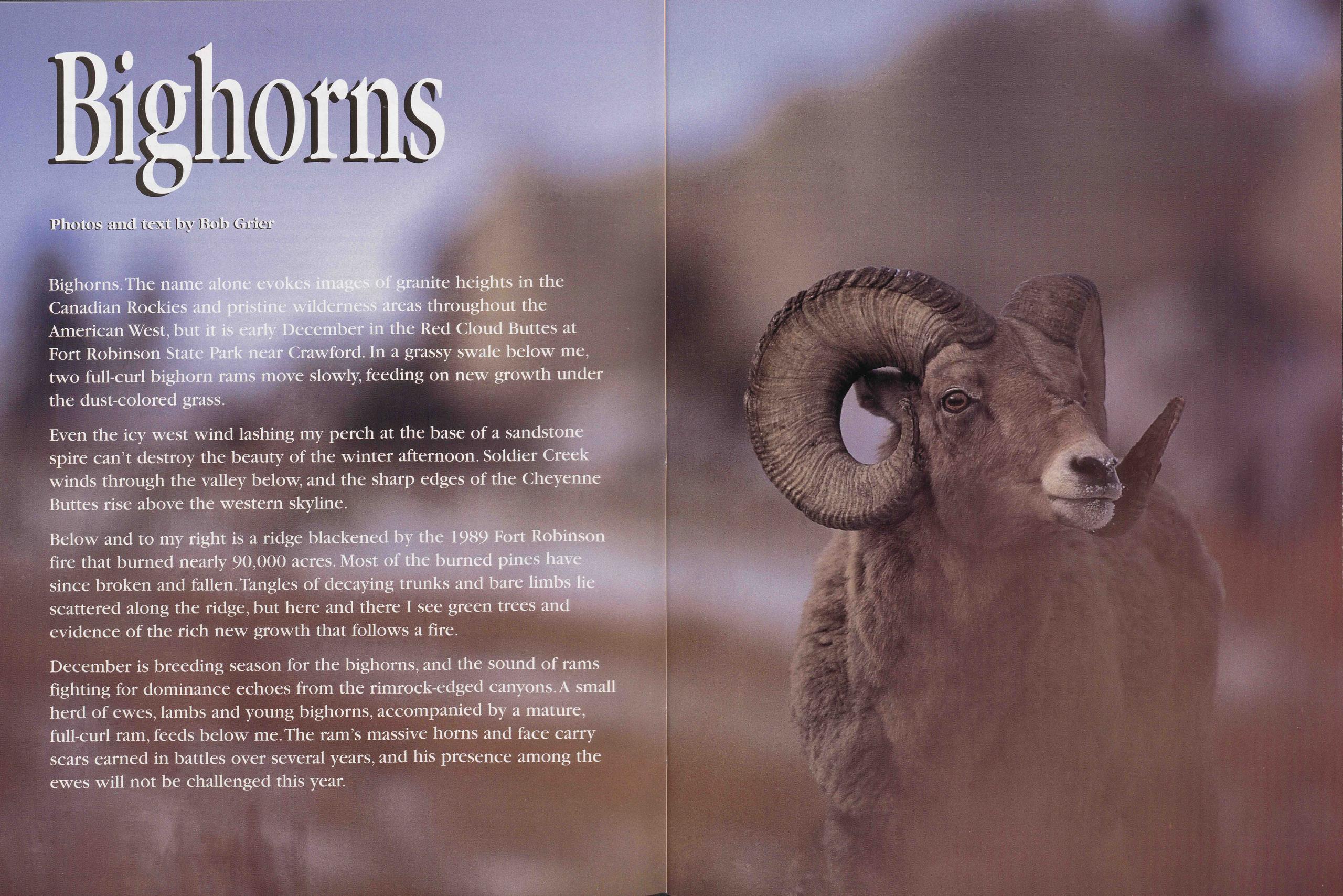
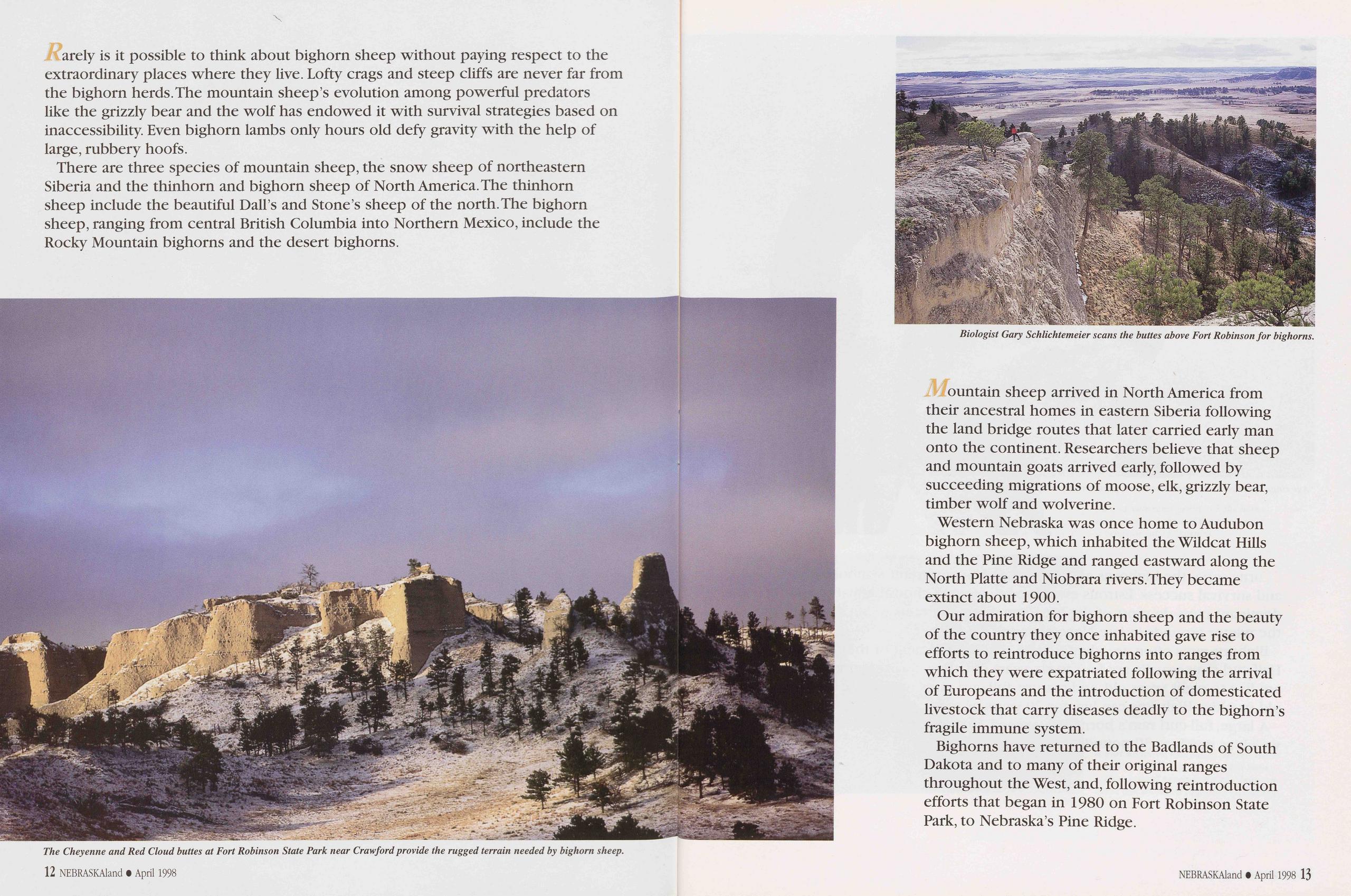
Bighorns. The name alone evokes images of granite heights in the the Canadian Rockies and pristine wilderness areas throughout the American West, but December in the Red Cloud Buttes at Fort Robinson State Park near Crawford. In a grassy swale below me, two full-curl bighorn rams move slowly, feeding on new growth under the dust-colored grass.
Even the icy west wind lashing my perch at the base of a sandstone spire can’t destroy the beauty of the winter afternoon. Soldier Creek winds through the valley below, and the sharp edges of the Cheyenne Buttes rise above the western skyline.
Below and to my right is a ridge blackened by the 1989 Fort Robinson fire that burned nearly 90,000 acres. Most of the burned pines have since broken and fallen. Tangles of decaying trunks and bare limbs lie scattered along the ridge, but here and there I see green trees and evidence of the rich new growth that follows a fire.
December is breeding season for the bighorns, and the sound of rams fighting for dominance echoes from the rimrock-edged canyons. A small herd of ewes, lambs and young bighorns, accompanied by a mature, full-curl ram, feeds below me.The ram’s massive horns and face carry scars earned in battles over several years, and his presence among the ewes will not be challenged this year.
Rarely is it possible to think about bighorn sheep without paying respect to the extraordinary places where they live. Lofty crags and steep cliffs are never far from the bighorn herds.The mountain sheep’s evolution among powerful predators like the grizzly bear and the wolf has endowed it with survival strategies based on inaccessibility. Even bighorn lambs only hours old defy gravity with the help of large, rubbery hoofs.
There are three species of mountain sheep, the snow sheep of northeastern Siberia and the thinhorn and bighorn sheep of North America.The thinhorn sheep include the beautiful Dall’s and Stone’s sheep of the north.The bighorn sheep, ranging from central British Columbia into Northern Mexico, include the Rocky Mountain bighorns and the desert bighorns.
Biologist Gary Schlichtemeier scans the buttes above Fort Robinson for bighorns. The Cheyenne and Red Cloud buttes at Fort Robinson State Park near Crawford provide the rugged terrain needed by bighorn sheep. 12 NEBRASKAland • April 1998Mountain sheep arrived in North America from their ancestral homes in eastern Siberia following the land bridge routes that later carried early man onto the continent. Researchers believe that sheep and mountain goats arrived early, followed by succeeding migrations of moose, elk, grizzly bear, timber wolf and wolverine.
Western Nebraska was once home to Audubon bighorn sheep, which inhabited the Wildcat Hills and the Pine Ridge and ranged eastward along the North Platte and Niobrara rivers.They became extinct about 1900.
Our admiration for bighorn sheep and the beauty of the country they once inhabited gave rise to efforts to reintroduce bighorns into ranges from which they were expatriated following the arrival of Europeans and the introduction of domesticated livestock that carry diseases deadly to the bighorn’s fragile immune system.
Bighorns have returned to the Badlands of South Dakota and to many of their original ranges throughout the West, and, following reintroduction efforts that began in 1980 on Fort Robinson State Park, to Nebraska’s Pine Ridge.
NEBRASKAland • April 1998 13 “Age rings ”produced each year when horn growth stops, reveal a bighorn ram’s age. A full-curl ram and a younger half-curl ram survey the wintering grounds. Subordinate rams gently rub the horns, face, neck and chest of the dominant ram, a behavior called “horning.”Horns serve the bighorns as weapons and as important symbols of rank and survival success. Estrous ewes are selective in choosing mates, and the dominant rams do most of the breeding when the rams rejoin the ewes on the winter grounds in late November and December.
Bighorn rams often are identified by the development of their horns. Half-curl rams usually are four to six years old; three-quarter-curl rams usually are five to eight years old, and mature, full-curl rams usually are eight years old or older. Bighorns can live for 20 years or more.
A large, full-curl ram’s horns can exceed 13 percent of his body mass and weigh as much as 30 pounds.
A Fort Robinson ram called Broken Horn is easily identified by a broken left horn curling inward nearly to his eye. Ingrown horns can shorten a ram’s life expectancy. 14 NEBRASKAland • April 1998 NEBRASKAland • April 1998 15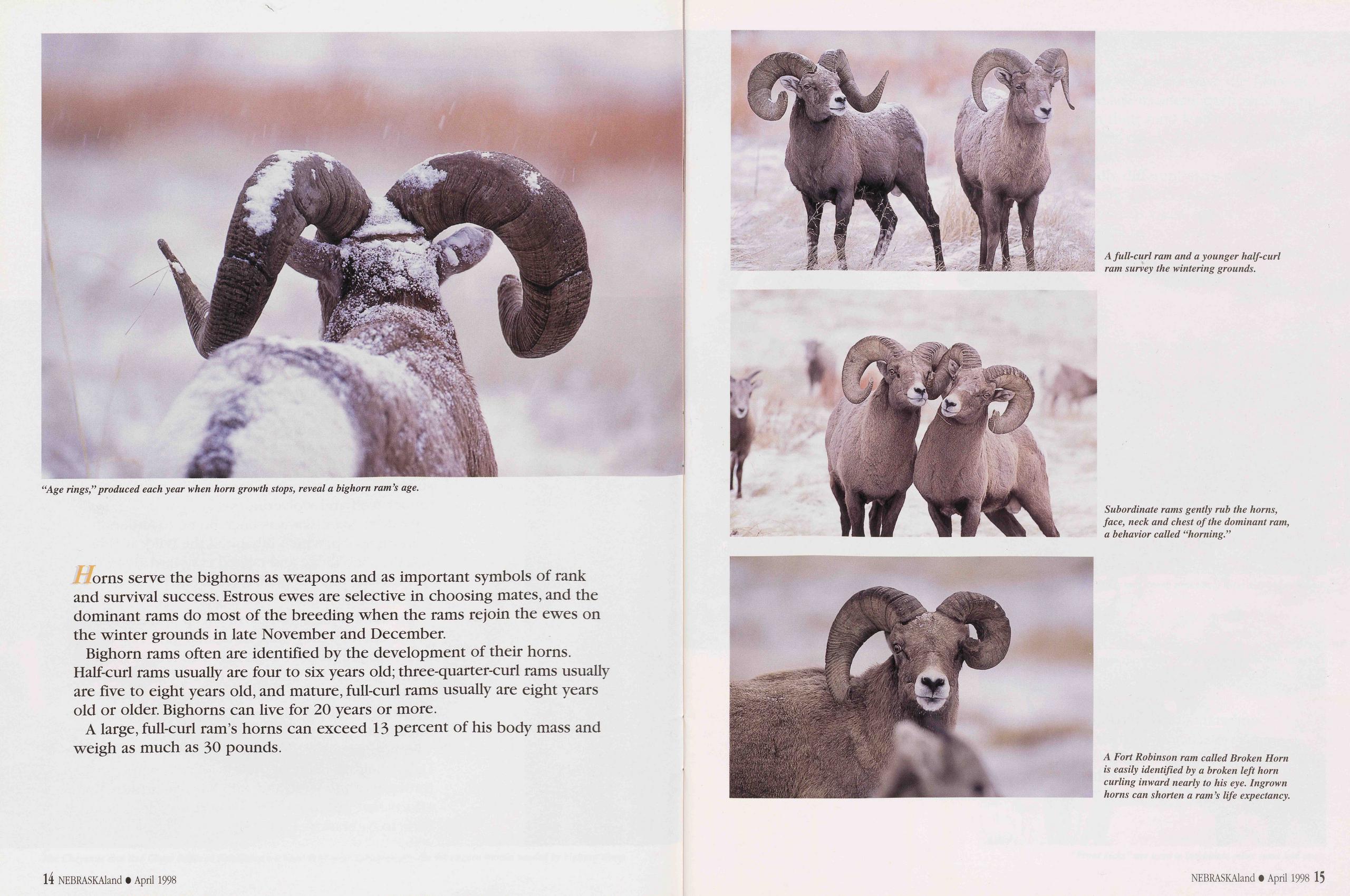 The most violent clashes occur between evenly matched rams. The sound of the collision
echoes through the canyons.
The most violent clashes occur between evenly matched rams. The sound of the collision
echoes through the canyons.
One of the rams might choose to attack downhill, using gravity to increase the force of the impact. At the last moment, both rams stand nearly upright on their hind legs, tilting their heads to deliver and catch the tremendous impact of the horns.
Rams of markedly different sizes rarely fight, but match two similar, three-quarter-curl rams and watch out! Valerius Geist, noted bighorn authority and animal behaviorist, observed a fight between two three-quarter-curl rams that continued for 25 hours and 20 minutes.
Combatants often feed quietly, outwardly unconcerned about another ram’s presence until their seemingly random movements bring them squarely face to face.The sudden charge can be preceded by signaled intent, or by feigned stealth and surprise.The collision of massive horns is awesome.
Massive horns, thick skulls and strong necks help rams survive collisions. “Front kicks” are used to intimidate other rams and ewes.
16 NEBRASKAland • April 1998 NEBRASKAland • April 1998 17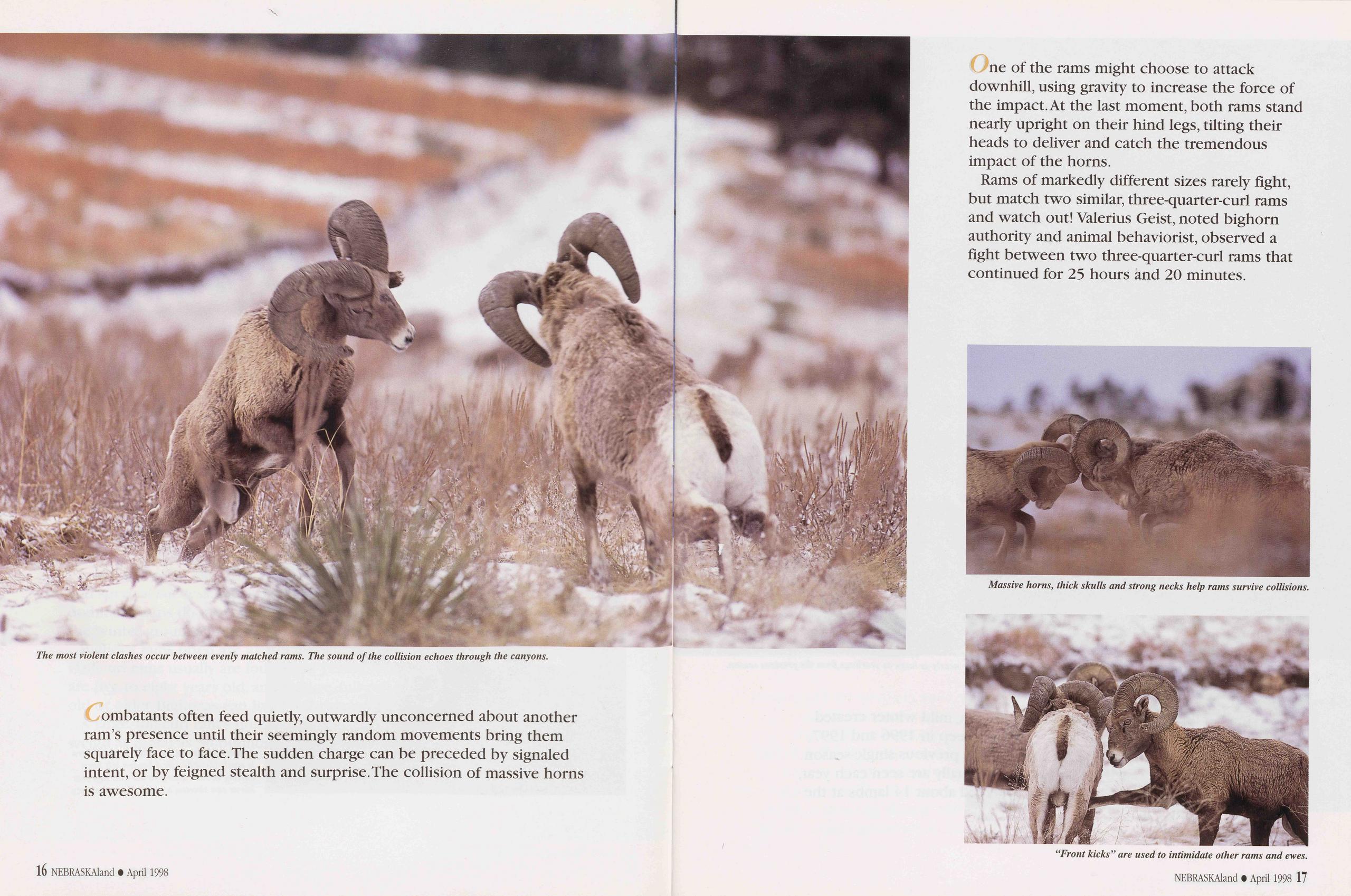 Most of a lamb’s first year is spent at its mother’s side. By December lambs are nearly
as large as yearlings from the previous season.
Most of a lamb’s first year is spent at its mother’s side. By December lambs are nearly
as large as yearlings from the previous season.
Bighorn gestation lasts about 175 days, and as delivery approaches, gravid ewes seek the protection of steep cliffs. Born in May on small ledges, lambs weigh about eight pounds. Within hours, newborn lambs can follow the ewe in the steep cliffs.
A bighorn ewe observed in the Cheyenne Buttes stood between her newborn and the edge of the ledge as the lamb took its first, unsteady steps. The protection of steep places will be constant throughout the bighorn’s life.
By December, lambs have grown to nearly the size of yearlings, but still are quick to mob together and jump, twist and kick. December is breeding season, and the gathering of rams, ewes and lambs on winter grounds signals the beginning of another year in the life of Nebraska’s bighorns.
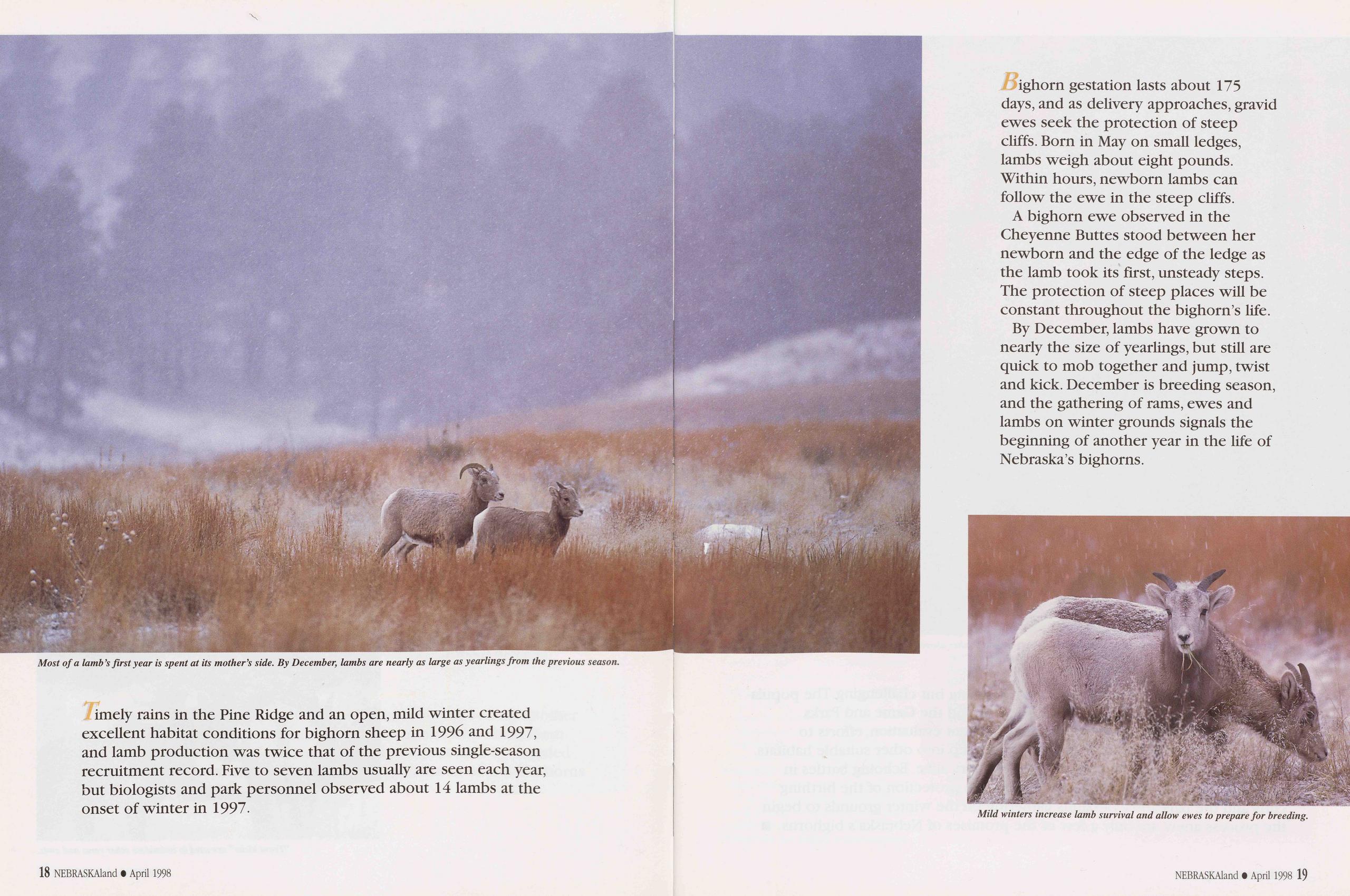
Timely rains in the Pine Ridge and an open, mild winter created excellent habitat conditions for bighorn sheep in 1996 and 1997, and lamb production was twice that of the previous single-season recruitment record. Five to seven lambs usually are seen each year, but biologists and park personnel observed about 14 lambs at the onset of winter in 1997.
18 NEBRASKAland • April 1998 NEBRASKAland • April 1998 19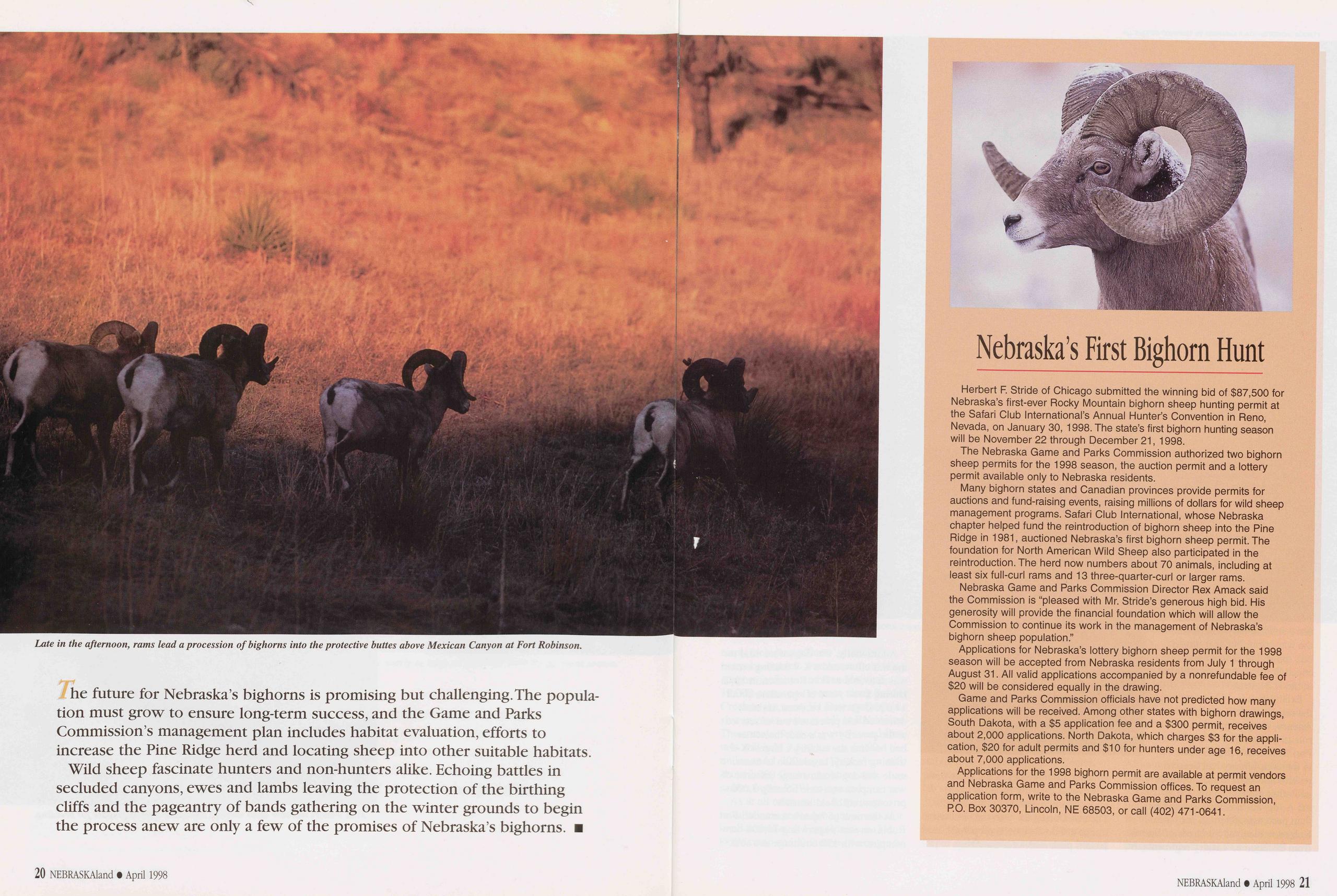 Late in the afternoon, rams lead a procession of bighorns into the protective buttes
above Mexican Canyon at Fort Robinson.
Late in the afternoon, rams lead a procession of bighorns into the protective buttes
above Mexican Canyon at Fort Robinson.
The future for Nebraska’s bighorns is promising but challenging.The popula- tion must grow to ensure long-term success, and the Game and Parks Commission’s management plan includes habitat evaluation, efforts to increase the Pine Ridge herd and locating sheep into other suitable habitats. Wild sheep fascinate hunters and non-hunters alike. Echoing battles in secluded canyons, ewes and lambs leaving the protection of the birthing cliffs and the pageantry of bands gathering on the winter grounds to begin the process anew are only a few of the promises of Nebraska’s bighorns. ■
Nebraska’s First Bighorn HuntHerbert F. Stride of Chicago submitted the winning bid of $87,500 for Nebraska’s first-ever Rocky Mountain bighorn sheep hunting permit at the Safari Club International’s Annual Hunter’s Convention in Reno, Nevada, on January 30, 1998. The state’s first bighorn hunting season will be November 22 through December 21, 1998.
The Nebraska Game and Parks Commission authorized two bighorn sheep permits for the 1998 season, the auction permit and a lottery permit available only to Nebraska residents.
Many bighorn states and Canadian provinces provide permits for auctions and fund-raising events, raising millions of dollars for wild sheep management programs. Safari Club International, whose Nebraska chapter helped fund the reintroduction of bighorn sheep into the Pine Ridge in 1981, auctioned Nebraska’s first bighorn sheep permit. The foundation for North American Wild Sheep also participated in the reintroduction. The herd now numbers about 70 animals, including at least six full-curl rams and 13 three-quarter-curl or larger rams.
Nebraska Game and Parks Commission Director Rex Amack said the Commission is “pleased with Mr. Stride’s generous high bid. His generosity will provide the financial foundation which will allow the Commission to continue its work in the management of Nebraska’s bighorn sheep population.”
Applications for Nebraska’s lottery bighorn sheep permit for the 1998 season will be accepted from Nebraska residents from July 1 through August 31. All valid applications accompanied by a nonrefundable fee of $20 will be considered equally in the drawing.
Game and Parks Commission officials have not predicted how many applications will be received. Among other states with bighorn drawings, South Dakota, with a $5 application fee and a $300 permit, receives about 2,000 applications. North Dakota, which charges $3 for the appli- cation, $20 for adult permits and $10 for hunters under age 16, receives about 7,000 applications.
Applications for the 1998 bighorn permit are available at permit vendors and Nebraska Game and Parks Commission offices. To request an application form, write to the Nebraska Game and Parks Commission, RO. Box 30370, Lincoln, NE 68503, or call (402) 471-0641.
20 NEBRASKAland • April 1998 NEBRASKAland • April 1998 21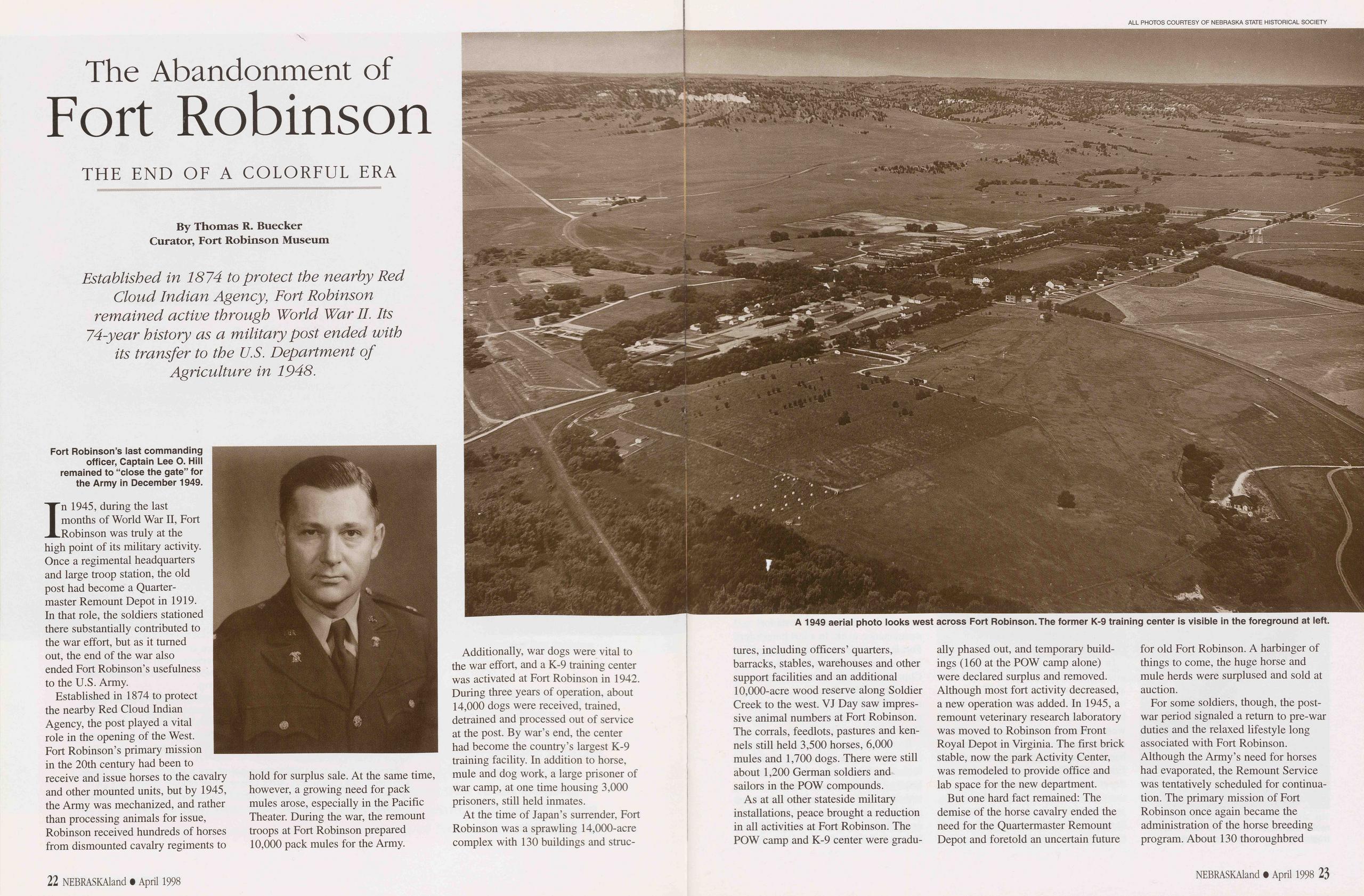
Established in 1874 to protect the nearby Red Cloud Indian Agency, Fort Robinson remained active through World War II. its 74-year history as a military post ended with its transfer to the U.S. Department of Agriculture in 1949.
Fort Robinson’s last commanding officer, Captain Lee 0. Hill remained to “close the gate” for the Army in December 1949.In 1945, during the last months of World War II, Fort Robinson was truly at the high point of its military activity. Once a regimental headquarters and large troop station, the old post had become a Quarter- master Remount Depot in 1919. In that role, the soldiers stationed there substantially contributed to the war effort, but as it turned out, the end of the war also ended Fort Robinson’s usefulness to the U.S. Army.
Established in 1874 to protect the nearby Red Cloud Indian Agency, the post played a vital role in the opening of the West. Fort Robinson’s primary mission in the 20th century had been to receive and issue horses to the cavalry and other mounted units, but by 1945, the Army was mechanized, and rather than processing animals for issue, Robinson received hundreds of horses from dismounted cavalry regiments to hold for surplus sale. At the same time, however, a growing need for pack mules arose, especially in the Pacific Theater. During the war, the remount troops at Fort Robinson prepared 10,000 pack mules for the Army.
ALL PHOTOS COURTESY OF NEBRASKA STATE HISTORICAL SOCIETY A 1949 aerial photo looks west across Fort Robinson. The former K-9 training center is visible in the foreground at left.Additionally, war dogs were vital to the war effort, and a K-9 training center was activated at Fort Robinson in 1942. During three years of operation, about 14,000 dogs were received, trained, detrained and processed out of service at the post. By war’s end, the center had become the country’s largest K-9 training facility. In addition to horse, mule and dog work, a large prisoner of war camp, at one time housing 3,000 prisoners, still held inmates.
At the time of Japan’s surrender, Fort Robinson was a sprawling 14,000-acre complex with 130 buildings and struc- tures, including officers’ quarters, barracks, stables, warehouses and other support facilities and an additional 10,000-acre wood reserve along Soldier Creek to the west. VJ Day saw impres- sive animal numbers at Fort Robinson. The corrals, feedlots, pastures and ken- nels still held 3,500 horses, 6,000 mules and 1,700 dogs. There were still about 1,200 German soldiers and sailors in the POW compounds.
As at all other stateside military installations, peace brought a reduction in all activities at Fort Robinson. The POW camp and K-9 center were gradu- ally phased out, and temporary build- ings (160 at the POW camp alone) were declared surplus and removed. Although most fort activity decreased, a new operation was added. In 1945, a remount veterinary research laboratory was moved to Robinson from Front Royal Depot in Virginia. The first brick stable, now the park Activity Center, was remodeled to provide office and lab space for the new department.
But one hard fact remained: The demise of the horse cavalry ended the need for the Quartermaster Remount Depot and foretold an uncertain future for old Fort Robinson. A harbinger of things to come, the huge horse and mule herds were surplused and sold at auction.
For some soldiers, though, the post- war period signaled a return to pre-war duties and the relaxed lifestyle long associated with Fort Robinson. Although the Army’s need for horses had evaporated, the Remount Service was tentatively scheduled for continua- tion. The primary mission of Fort Robinson once again became the administration of the horse breeding program. About 130 thoroughbred
22 NEBRASKAland • April 1998 NEBRASKAland • April 1998 23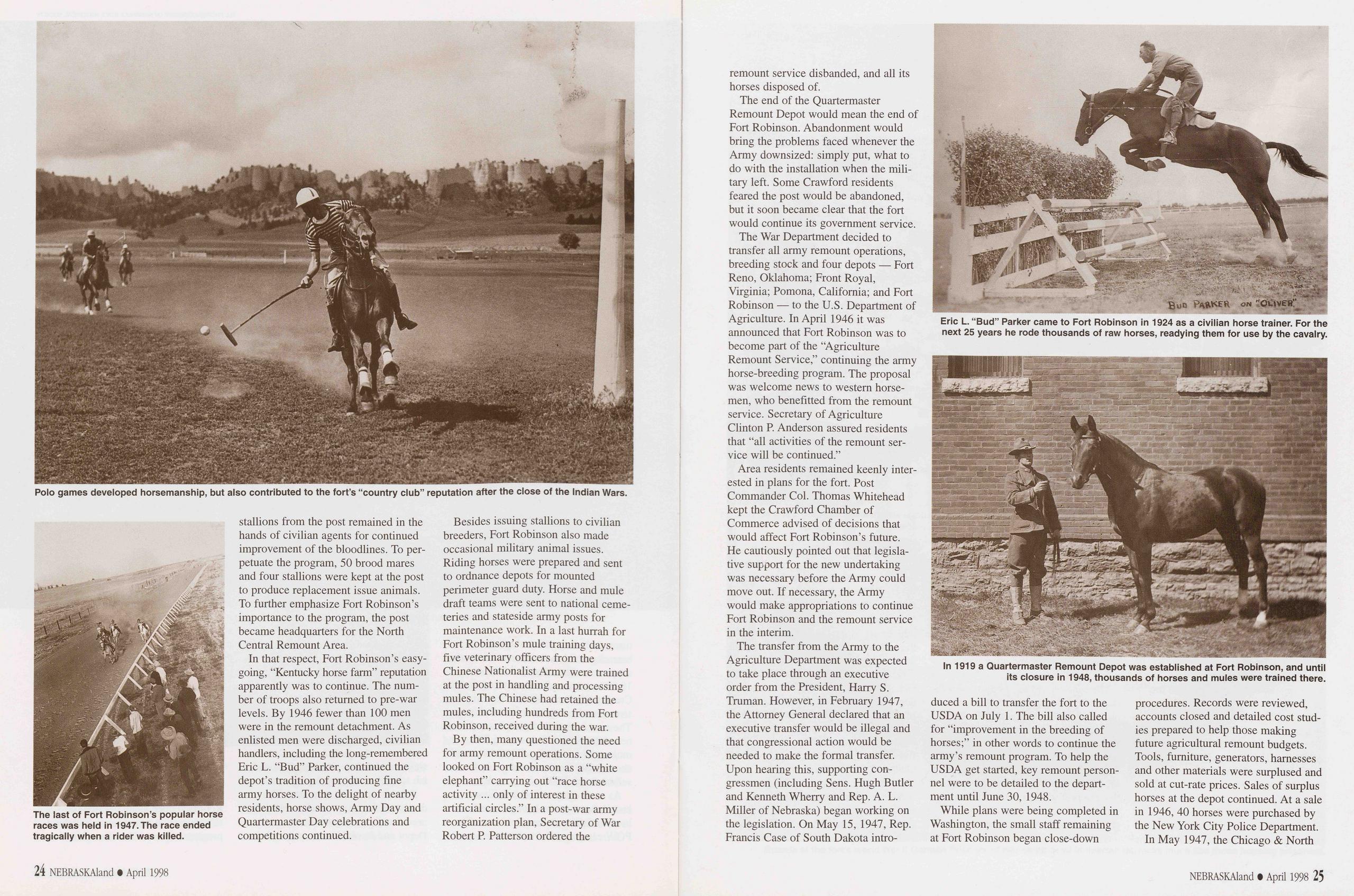 Polo games developed horsemanship, but also contributed to the fort’s “country club”
reputation after the close of the Indian Wars.
Polo games developed horsemanship, but also contributed to the fort’s “country club”
reputation after the close of the Indian Wars.
The last of Fort Robinson’s popular horse races was held in 1947. The race ended tragically when a rider was killed. stallions from the post remained in the hands of civilian agents for continued improvement of the bloodlines. To per- petuate the program, 50 brood mares and four stallions were kept at the post to produce replacement issue animals. To further emphasize Fort Robinson’s importance to the program, the post became headquarters for the North Central Remount Area.
In that respect, Fort Robinson’s easy- going, “Kentucky horse farm” reputation apparently was to continue. The num- ber of troops also returned to pre-war levels. By 1946 fewer than 100 men were in the remount detachment. As enlisted men were discharged, civilian handlers, including the long-remembered Eric L. “Bud” Parker, continued the depot’s tradition of producing fine army horses. To the delight of nearby residents, horse shows, Army Day and Quartermaster Day celebrations and competitions continued.
Besides issuing stallions to civilian breeders, Fort Robinson also made occasional military animal issues. Riding horses were prepared and sent to ordnance depots for mounted perimeter guard duty. Horse and mule draft teams were sent to national ceme- teries and stateside army posts for maintenance work. In a last hurrah for Fort Robinson’s mule training days, five veterinary officers from the Chinese Nationalist Army were trained at the post in handling and processing mules. The Chinese had retained the mules, including hundreds from Fort Robinson, received during the war.
By then, many questioned the need for army remount operations. Some looked on Fort Robinson as a “white elephant” carrying out “race horse activity ... only of interest in these artificial circles.” In a post-war army reorganization plan, Secretary of War Robert P. Patterson ordered the remount service disbanded, and all its horses disposed of.
The end of the Quartermaster Remount Depot would mean the end of Fort Robinson. Abandonment would bring the problems faced whenever the Army downsized: simply put, what to do with the installation when the mili- tary left. Some Crawford residents feared the post would be abandoned, but it soon became clear that the fort would continue its government service.
The War Department decided to transfer all army remount operations, breeding stock and four depots — Fort Reno, Oklahoma; Front Royal, Virginia; Pomona, California; and Fort Robinson — to the U.S. Department of Agriculture. In April 1946 it was announced that Fort Robinson was to become part of the “Agriculture Remount Service,” continuing the army horse-breeding program. The proposal was welcome news to western horse- men, who benefited from the remount service. Secretary of Agriculture Clinton P. Anderson assured residents that “all activities of the remount ser- vice will be continued.”
Area residents remained keenly inter- ested in plans for the fort. Post Commander Col. Thomas Whitehead kept the Crawford Chamber of Commerce advised of decisions that would affect Fort Robinson’s future. He cautiously pointed out that legisla- tive support for the new undertaking was necessary before the Army could move out. If necessary, the Army would make appropriations to continue Fort Robinson and the remount service in the interim.
The transfer from the Army to the Agriculture Department was expected to take place through an executive order from the President, Harry S. Truman. However, in February 1947, the Attorney General declared that an executive transfer would be illegal and that congressional action would be needed to make the formal transfer. Upon hearing this, supporting con- gressmen (including Sens. Hugh Butler and Kenneth Wherry and Rep. A. L. Miller of Nebraska) began working on the legislation. On May 15, 1947, Rep. Francis Case of South Dakota intro-
Eric L. “Bud” Parker came to Fort Robinson in 1924 as a civilian horse trainer. For the next 25 years he rode thousands of raw horses, readying them for use by the cavalry. In 1919 a Quartermaster Remount Depot was established at Fort Robinson, and until its closure in 1948, thousands of horses and mules were trained there.duced a bill to transfer the fort to the USDA on July 1. The bill also called for “improvement in the breeding of horses;” in other words to continue the army’s remount program. To help the USDA get started, key remount person- nel were to be detailed to the depart- ment until June 30, 1948.
While plans were being completed in Washington, the small staff remaining at Fort Robinson began close-down procedures. Records were reviewed, accounts closed and detailed cost stud- ies prepared to help those making future agricultural remount budgets. Tools, furniture, generators, harnesses and other materials were surplused and sold at cut-rate prices. Sales of surplus horses at the depot continued. At a sale in 1946, 40 horses were purchased by the New York City Police Department. In May 1947, the Chicago & North
24 NEBRASKAland • April 1998 NEBRASKAland • April 1998 25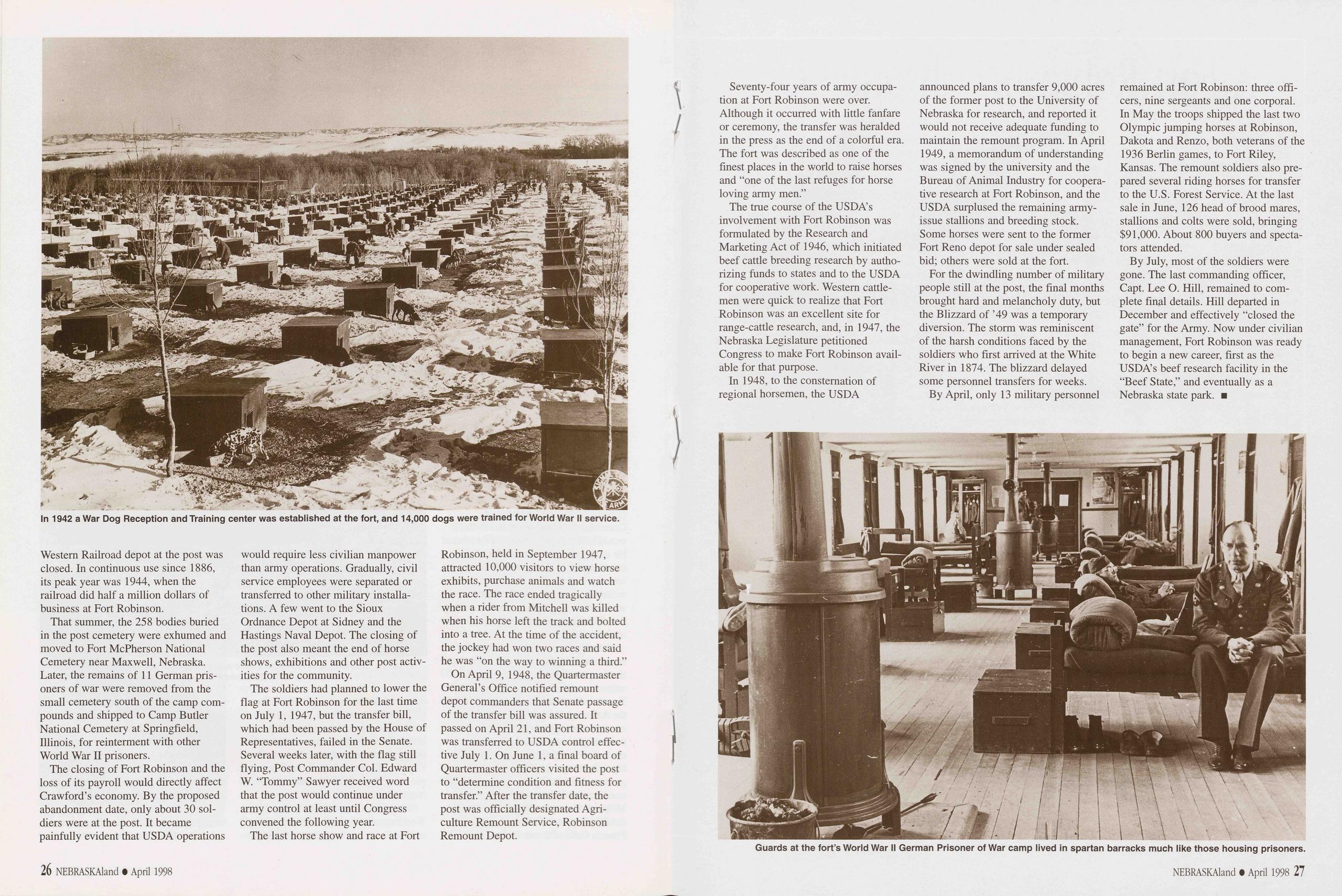 In 1942 a War Dog Reception and Training center was established at the fort, and 14,000
dogs were trained for World War II service.
In 1942 a War Dog Reception and Training center was established at the fort, and 14,000
dogs were trained for World War II service.
Western Railroad depot at the post was closed. In continuous use since 1886, its peak year was 1944, when the railroad did half a million dollars of business at Fort Robinson.
That summer, the 258 bodies buried in the post cemetery were exhumed and moved to Fort McPherson National Cemetery near Maxwell, Nebraska. Later, the remains of 11 German pris- oners of war were removed from the small cemetery south of the camp com- pounds and shipped to Camp Butler National Cemetery at Springfield, Illinois, for reinterment with other World War II prisoners.
The closing of Fort Robinson and the loss of its payroll would directly affect Crawford’s economy. By the proposed abandonment date, only about 30 sol- diers were at the post. It became painfully evident that USDA operations would require less civilian manpower than army operations. Gradually, civil service employees were separated or transferred to other military installa- tions. A few went to the Sioux Ordnance Depot at Sidney and the Hastings Naval Depot. The closing of the post also meant the end of horse shows, exhibitions and other post activ- ities for the community.
The soldiers had planned to lower the flag at Fort Robinson for the last time on July 1, 1947, but the transfer bill, which had been passed by the House of Representatives, failed in the Senate. Several weeks later, with the flag still flying, Post Commander Col. Edward W. “Tommy” Sawyer received word that the post would continue under army control at least until Congress convened the following year.
The last horse show and race at Fort Robinson, held in September 1947, attracted 10,000 visitors to view horse exhibits, purchase animals and watch the race. The race ended tragically when a rider from Mitchell was killed when his horse left the track and bolted into a tree. At the time of the accident, the jockey had won two races and said he was "on the way to winning a third.”
On April 9, 1948, the Quartermaster General’s Office notified remount depot commanders that Senate passage of the transfer bill was assured. It passed on April 21, and Fort Robinson was transferred to USDA control effec- tive July 1. On June 1, a final board of Quartermaster officers visited the post to “determine condition and fitness for transfer.” After the transfer date, the post was officially designated Agri- culture Remount Service, Robinson Remount Depot.
Seventy-four years of army occupa- tion at Fort Robinson were over. Although it occurred with little fanfare or ceremony, the transfer was heralded in the press as the end of a colorful era. The fort was described as one of the finest places in the world to raise horses and “one of the last refuges for horse loving army men.”
The true course of the USDA’s involvement with Fort Robinson was formulated by the Research and Marketing Act of 1946, which initiated beef cattle breeding research by autho- rizing funds to states and to the USDA for cooperative work. Western cattle- men were quick to realize that Fort Robinson was an excellent site for range-cattle research, and, in 1947, the Nebraska Legislature petitioned Congress to make Fort Robinson avail- able for that purpose.
In 1948, to the consternation of regional horsemen, the USDA
Guards at the fort s World War II German Prisoner of War camp lived in spartan barracks much like those housing prisoners. NEBRASKAland • April 1998 27announced plans to transfer 9,000 acres of the former post to the University of Nebraska for research, and reported it would not receive adequate funding to maintain the remount program. In April 1949, a memorandum of understanding was signed by the university and the Bureau of Animal Industry for coopera- tive research at Fort Robinson, and the USDA surplused the remaining army- issue stallions and breeding stock. Some horses were sent to the former Fort Reno depot for sale under sealed bid; others were sold at the fort. For the dwindling number of military people still at the post, the final months brought hard and melancholy duty, but the Blizzard of ’49 was a temporary diversion. The storm was reminiscent of the harsh conditions faced by the soldiers who first arrived at the White River in 1874. The blizzard delayed some personnel transfers for weeks. By April, only 13 military personnel remained at Fort Robinson: three offi- cers, nine sergeants and one corporal. In May the troops shipped the last two Olympic jumping horses at Robinson, Dakota and Renzo, both veterans of the 1936 Berlin games, to Fort Riley, Kansas. The remount soldiers also pre- pared several riding horses for transfer to the U.S. Forest Service. At the last sale in June, 126 head of brood mares, stallions and colts were sold, bringing $91,000. About 800 buyers and specta- tors attended.
By July, most of the soldiers were gone. The last commanding officer, Capt. Lee O. Hill, remained to com- plete final details. Hill departed in December and effectively “closed the gate” for the Army. Now under civilian management, Fort Robinson was ready to begin a new career, first as the USDA’s beef research facility in the “Beef State,” and eventually as a Nebraska state park.
26 NEBRASKAland • April 1998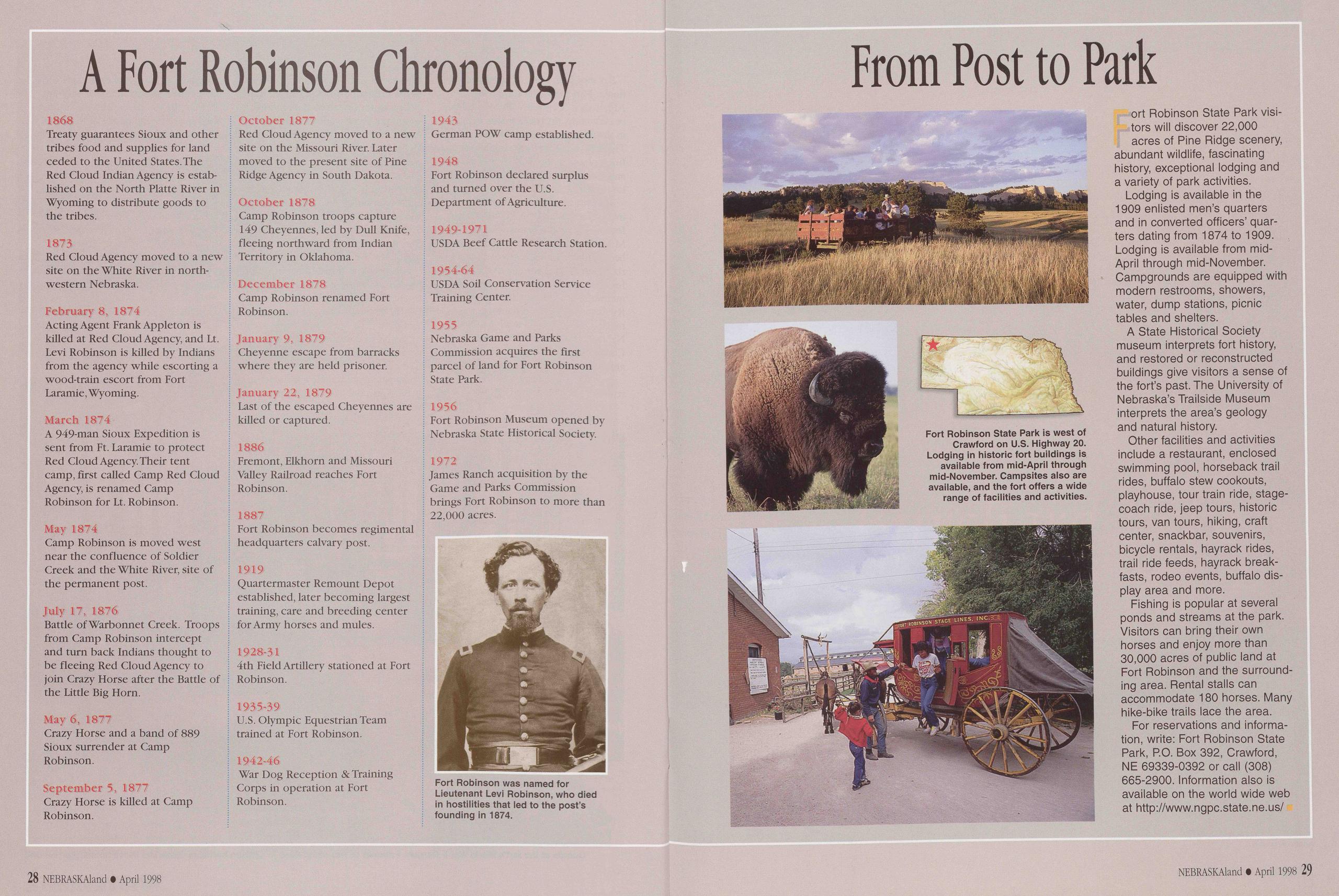 A Fort Robinson Chronology
From Post to Park
1868
A Fort Robinson Chronology
From Post to Park
1868
Treaty guarantees Sioux and other tribes food and supplies for land ceded to the United States.The Red Cloud Indian Agency is estab- lished on the North Platte River in Wyoming to distribute goods to the tribes.
1873Red Cloud Agency moved to a new site on the White River in north- western Nebraska.
February 8, 1874Acting Agent Frank Appleton is killed at Red Cloud Agency and Lt. Levi Robinson is killed by Indians from the agency while escorting a wood-train escort from Fort Laramie, Wyoming.
March 1874A 949-man Sioux Expedition is sent from Ft. Laramie to protect Red Cloud Agency. Their tent camp, first called Camp Red Cloud Agency, is renamed Camp Robinson for Lt. Robinson.
May 1874Camp Robinson is moved west near the confluence of Soldier Creek and the White River, site of the permanent post.
July 17, 1876Battle of Warbonnet Creek. Troops from Camp Robinson intercept and turn back Indians thought to be fleeing Red Cloud Agency to join Crazy Horse after the Battle of the Little Big Horn.
May 6, 1877razy Horse and a band of 889 Sioux surrender at Camp Robinson.
September 5, 1877Crazy Horse is killed at Camp Robinson.
October 1877Red Cloud Agency moved to a new site on the Missouri River. Later moved to the present site of Pine Ridge Agency in South Dakota.
October 1878Camp Robinson troops capture 149 Cheyennes, led by Dull Knife, fleeing northward from Indian Territory in Oklahoma.
December 1878Camp Robinson renamed Fort Robinson.
January 9, 1879Cheyenne escape from barracks where they are held prisoner.
January 22, 1879Last of the escaped Cheyennes are killed or captured.
1886 Fremont, Elkhorn and Missouri Valley Railroad reaches Fort Robinson. 1887Fort Robinson becomes regimental headquarters calvary post.
1919Quartermaster Remount Depot established, later becoming largest training, care and breeding center for Army horses and mules.
1928-314th Field Artillery stationed at Fort Robinson.
1935-39U.S. Olympic Equestrian Team trained at Fort Robinson. 1942-46 War Dog Reception & Training Corps in operation at Fort Robinson.
1943German POW camp established.
1948Fort Robinson declared surplus and turned over the U.S. Department of Agriculture.
1949-1971USDA Beef Cattle Research Station.
1954-64USDA Soil Conservation Service Training Center.
1955Nebraska Game and Parks Commission acquires the first parcel of land for Fort Robinson State Park.
1956Fort Robinson Museum opened by Nebraska State Historical Society.
1972James Ranch acquisition by the Game and Parks Commission brings Fort Robinson to more than 22,000 acres.
Fort Robinson was named for Lieutenant Levi Robinson, who died in hostilities that led to the post’s founding in 1874. Fort Robinson State Park is west of Crawford on U.S. Highway 20. Lodging in historic fort buildings is available from mid-April through mid-November. Campsites also are available, and the fort offers a wide range of facilities and activities. ort Robinson State Park visi- tors will discover 22,000 acres of Pine Ridge scenery, abundant wildlife, fascinating history, exceptional lodging and a variety of park activities. Lodging is available in the 1909 enlisted men’s quarters and in converted officers’ quar- ters dating from 1874 to 1909. Lodging is available from mid- April through mid-November. Campgrounds are equipped with modern restrooms, showers, water, dump stations, picnic tables and shelters.
A State Historical Society museum interprets fort history, and restored or reconstructed buildings give visitors a sense of the fort’s past. The University of Nebraska’s Trailside Museum interprets the area’s geology and natural history.
Other facilities and activities include a restaurant, enclosed swimming pool, horseback trail rides, buffalo stew cookouts, playhouse, tour train ride, stage- coach ride, jeep tours, historic tours, van tours, hiking, craft center, snackbar, souvenirs, bicycle rentals, hayrack rides, trail ride feeds, hayrack break- fasts, rodeo events, buffalo dis- play area and more.
Fishing is popular at several ponds and streams at the park. Visitors can bring their own horses and enjoy more than 30,000 acres of public land at Fort Robinson and the surround- ing area. Rental stalls can accommodate 180 horses. Many hike-bike trails lace the area.
For reservations and informa- tion, write: Fort Robinson State Park, P.O. Box 392, Crawford, NE 69339-0392 or call (308) 665-2900. Information also is available on the world wide web at http://www.ngpc.state.ne.us/
NEBRASKAland • April 1998 29 28 NEBRASKAland • April 1998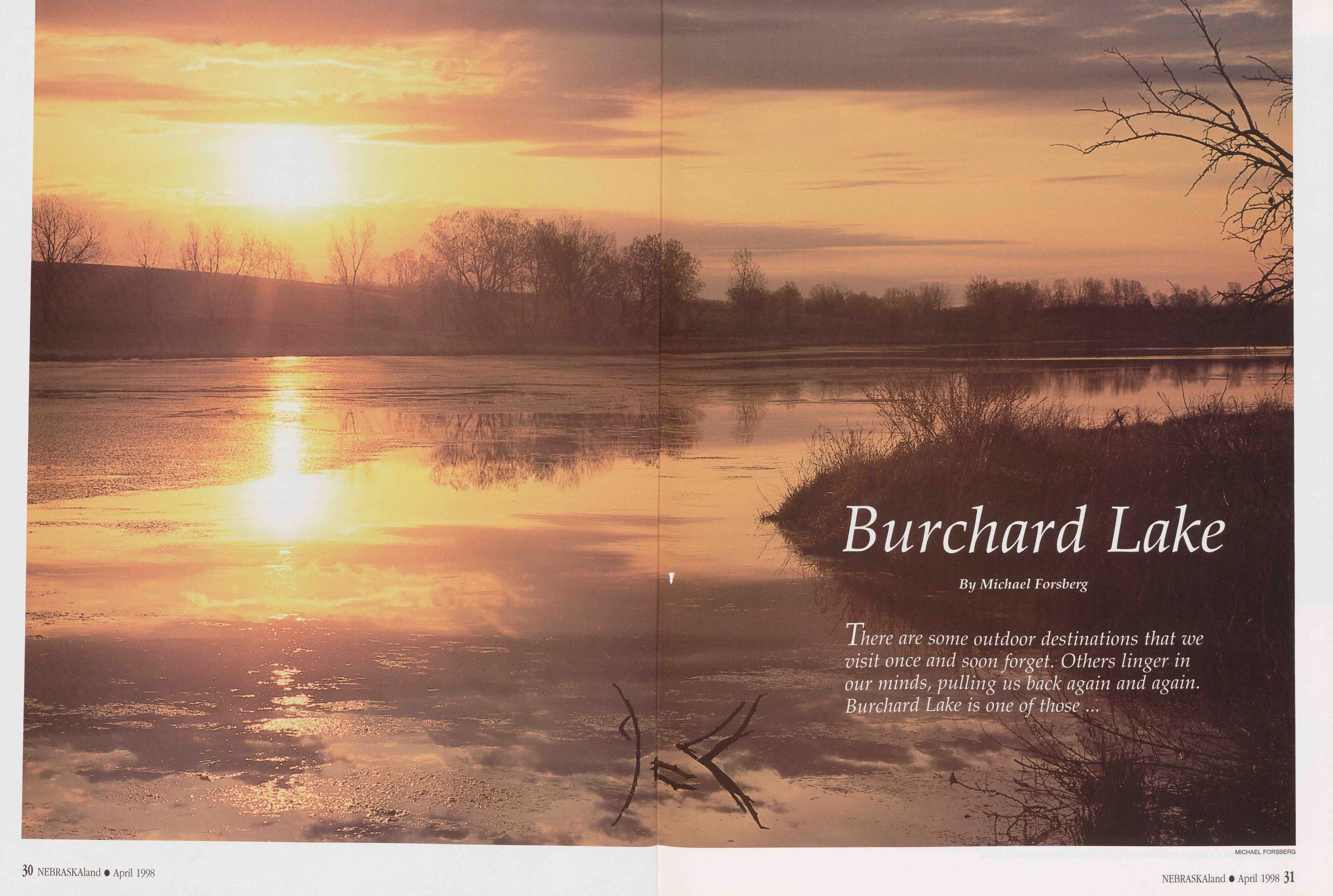
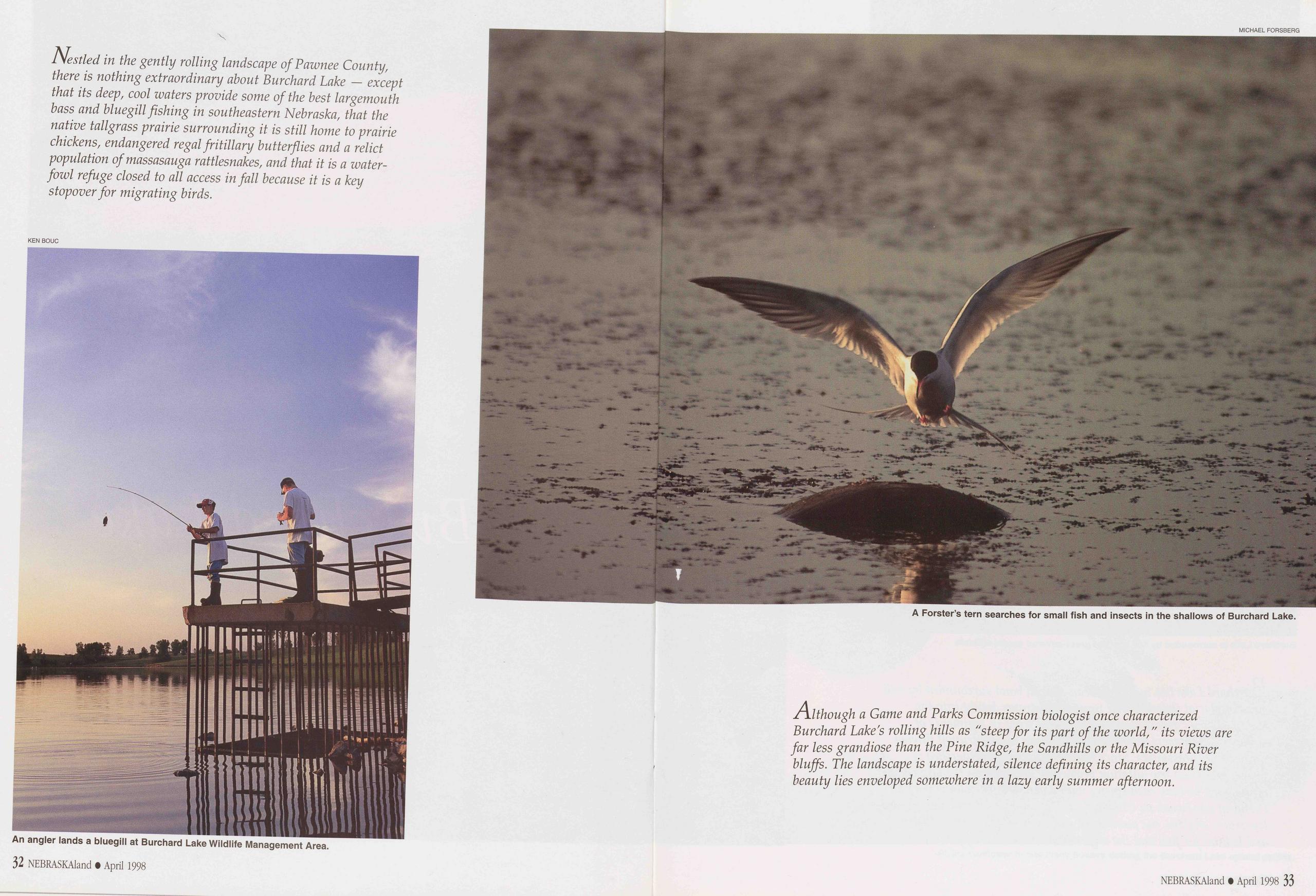 An angler lands a bluegill at Burchard Lake Wildlife Management Area.
32 NEBRASKAland • April 1998
Nestled in the gently rolling landscape of Pawnee County,
there is nothing extraordinary about Burchard Lake — except
that its deep, cool waters provide some of the best largemouth
bass and bluegill fishing in southeastern Nebraska, that the
native tallgrass prairie surrounding it is still home to prairie
chickens, endangered regal fritillary butterflies and a relict
population ofmassasauga rattlesnakes, and that it is a water-
fowl refuge closed to all access in fall because it is a key
stopover for migrating birds.
MICHAEL FORSBERG
A Forster’s tern searches for small fish and insects in the shallows of Burchard Lake.
KEN BOUC
although a Game and Parks Commission biologist once characterized
Burchard Lake's rolling hills as "steep for its part of the world," its views are
far less grandiose than the Pine Ridge, the Sandhills or the Missouri River
bluffs. The landscape is understated, silence defining its character, and its
beauty lies enveloped somewhere in a lazy early summer afternoon.
NEBRASKAland • April 1998 33
An angler lands a bluegill at Burchard Lake Wildlife Management Area.
32 NEBRASKAland • April 1998
Nestled in the gently rolling landscape of Pawnee County,
there is nothing extraordinary about Burchard Lake — except
that its deep, cool waters provide some of the best largemouth
bass and bluegill fishing in southeastern Nebraska, that the
native tallgrass prairie surrounding it is still home to prairie
chickens, endangered regal fritillary butterflies and a relict
population ofmassasauga rattlesnakes, and that it is a water-
fowl refuge closed to all access in fall because it is a key
stopover for migrating birds.
MICHAEL FORSBERG
A Forster’s tern searches for small fish and insects in the shallows of Burchard Lake.
KEN BOUC
although a Game and Parks Commission biologist once characterized
Burchard Lake's rolling hills as "steep for its part of the world," its views are
far less grandiose than the Pine Ridge, the Sandhills or the Missouri River
bluffs. The landscape is understated, silence defining its character, and its
beauty lies enveloped somewhere in a lazy early summer afternoon.
NEBRASKAland • April 1998 33
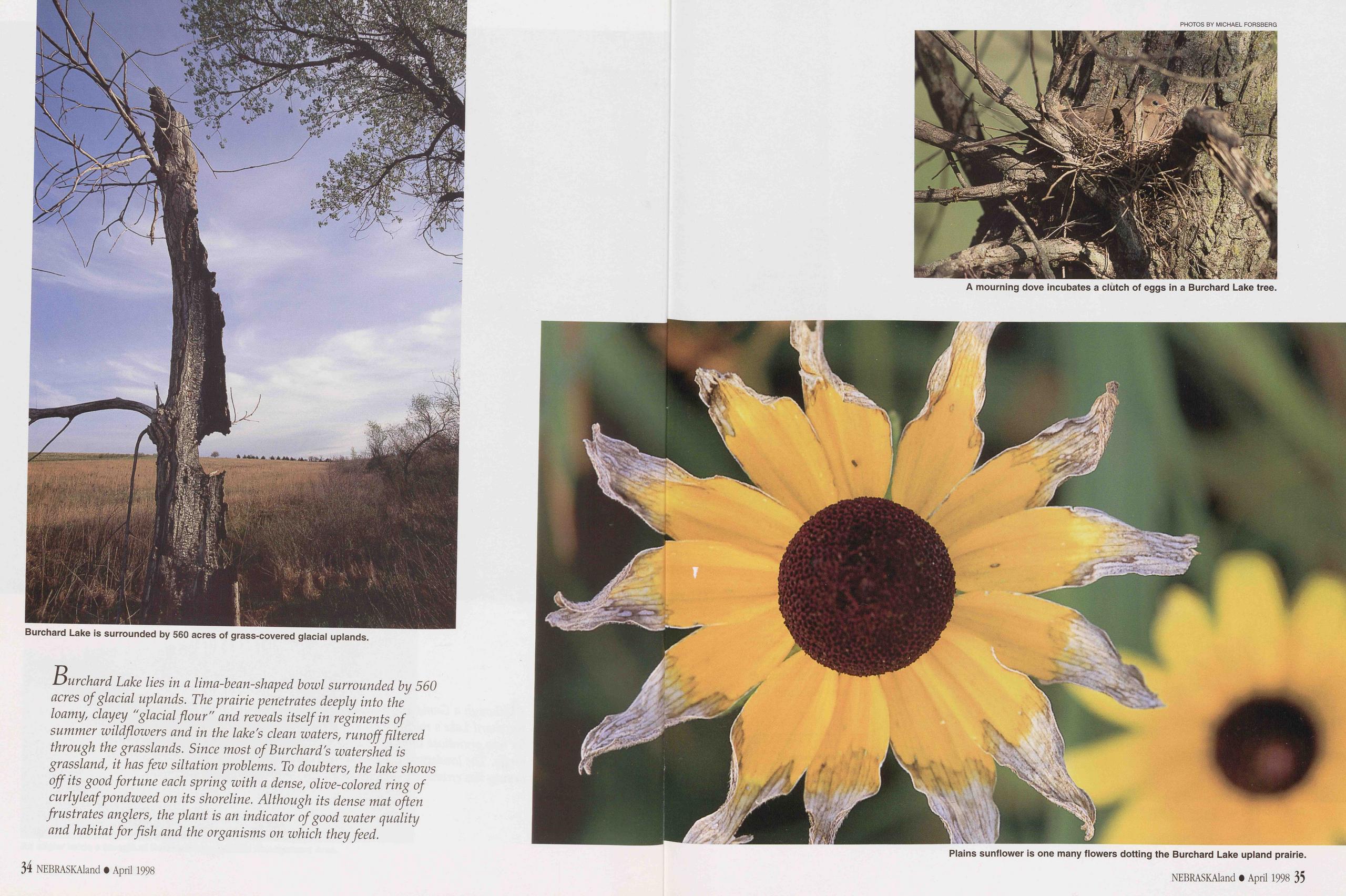 Burchard Lake is surrounded by 560 acres of grass-covered glacial uplands.
PHOTOS BY MICHAEL FORSBERG
A mourning dove incubates a clutch of eggs in a Burchard Lake tree.
Burchard Lake lies in a lima-bean-shaped bowl surrounded by 560
acres of glacial uplands. The prairie penetrates deeply into the
loamy, clayey "glacial flour" and reveals itself in regiments of
summer wildflowers and in the lake's clean waters, runoff filtered
through the grasslands. Since most of Burchard's watershed is
grassland, it has few siltation problems. To doubters, the lake shows
off its good fortune each spring with a dense, olive-colored ring of
curlyleaf pondweed on its shoreline. Although its dense mat often
frustrates anglers, the plant is an indicator of good water quality
and habitat for fish and the organisms on which they feed.
Plains sunflower is one many flowers dotting the Burchard Lake upland prairie.
34 NEBRASKAland • April 1998
NEBRASKAland • April 1998 35
Burchard Lake is surrounded by 560 acres of grass-covered glacial uplands.
PHOTOS BY MICHAEL FORSBERG
A mourning dove incubates a clutch of eggs in a Burchard Lake tree.
Burchard Lake lies in a lima-bean-shaped bowl surrounded by 560
acres of glacial uplands. The prairie penetrates deeply into the
loamy, clayey "glacial flour" and reveals itself in regiments of
summer wildflowers and in the lake's clean waters, runoff filtered
through the grasslands. Since most of Burchard's watershed is
grassland, it has few siltation problems. To doubters, the lake shows
off its good fortune each spring with a dense, olive-colored ring of
curlyleaf pondweed on its shoreline. Although its dense mat often
frustrates anglers, the plant is an indicator of good water quality
and habitat for fish and the organisms on which they feed.
Plains sunflower is one many flowers dotting the Burchard Lake upland prairie.
34 NEBRASKAland • April 1998
NEBRASKAland • April 1998 35
 A lake in this part of southeastern Nebraska was first
suggested by a Soil Conservation Service survey report in the
early 1950s. It noted the potential on this gentle landscape for
a lake with good water quality in a part of the state where
lakes were few and far between. The idea quickly took root
with the local groups that formed the Southeast Nebraska
Sportsman's Club, and in three years they raised nearly
$10,000 toward the purchase of the land. With the help of
those local contributions and federal assistance, the Game and
Parks Commission purchased the land in 1958 as a game
refuge and wildlife management area, and by 1960 the lake
that had been envisioned was created.
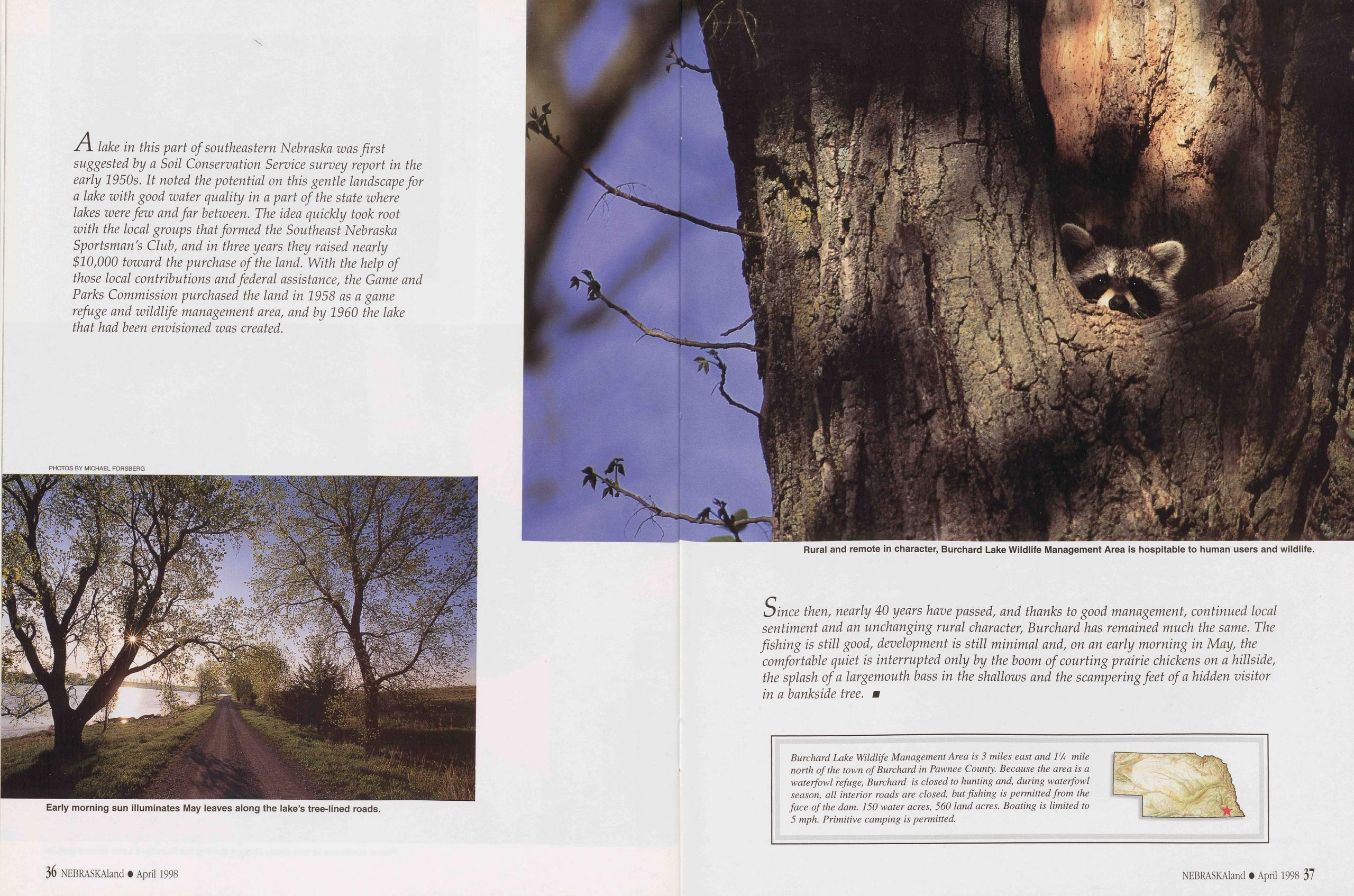
Rural and remote in character, Burchard Lake Wildlife Management Area is hospitable
to human users and wildlife.
PHOTOS BY MICHAEL FORSBERG
Early morning sun illuminates May leaves along the lake’s tree-lined roads.
Since then, nearly 40 years have passed, and thanks to good management, continued
local
sentiment and an unchanging rural character, Burchard has remained much the same.
The
fishing is still good, development is still minimal and, on an early morning in May,
the
comfortable quiet is interrupted only by the boom of courting prairie chickens on
a hillside,
the splash of a largemouth bass in the shallows and the scampering feet of a hidden
visitor
in a bankside tree. ■
Burchard Lake Wildlife Management Area is 3 miles east and I1 A mile
north of the town of Burchard in Pawnee County. Because the area is a
waterfowl refuge, Burchard is closed to hunting and, during waterfowl
season, all interior roads are closed, but fishing is permitted from the
face of the dam. 150 water acres, 560 land acres. Boating is limited to
5 mph. Primitive camping is permitted.
36 NEBRASKAland • April 1998
NEBRASKAland • April 1998 37
A lake in this part of southeastern Nebraska was first
suggested by a Soil Conservation Service survey report in the
early 1950s. It noted the potential on this gentle landscape for
a lake with good water quality in a part of the state where
lakes were few and far between. The idea quickly took root
with the local groups that formed the Southeast Nebraska
Sportsman's Club, and in three years they raised nearly
$10,000 toward the purchase of the land. With the help of
those local contributions and federal assistance, the Game and
Parks Commission purchased the land in 1958 as a game
refuge and wildlife management area, and by 1960 the lake
that had been envisioned was created.
Rural and remote in character, Burchard Lake Wildlife Management Area is hospitable
to human users and wildlife.
PHOTOS BY MICHAEL FORSBERG
Early morning sun illuminates May leaves along the lake’s tree-lined roads.
Since then, nearly 40 years have passed, and thanks to good management, continued
local
sentiment and an unchanging rural character, Burchard has remained much the same.
The
fishing is still good, development is still minimal and, on an early morning in May,
the
comfortable quiet is interrupted only by the boom of courting prairie chickens on
a hillside,
the splash of a largemouth bass in the shallows and the scampering feet of a hidden
visitor
in a bankside tree. ■
Burchard Lake Wildlife Management Area is 3 miles east and I1 A mile
north of the town of Burchard in Pawnee County. Because the area is a
waterfowl refuge, Burchard is closed to hunting and, during waterfowl
season, all interior roads are closed, but fishing is permitted from the
face of the dam. 150 water acres, 560 land acres. Boating is limited to
5 mph. Primitive camping is permitted.
36 NEBRASKAland • April 1998
NEBRASKAland • April 1998 37
The barn swallows showed up when the first exterior wall of our new home was hoisted into place, and they began building mud outcroppings above the window frames on which to balance their eggs before the roof was on. We guessed they would plague us forever, spackling mud on the exterior paint and sending streaks of white droppings down the siding.
"Just part of country life," we concluded, but as we applied the final coat of paint under a sweltering sun, the thought of the swallows, the mud and the droppings began to haunt me. I stuck my brush back into the bucket, descended the lad- der and began rummaging through the garage. Among the clutter from the recent move I uncovered a block of railcar refrigeration cork that I had promised myself would someday provide the material for a nice set of mallard decoys.
The color and the texture had a remarkable resemblance to a swal- low's mud nest. I cut out a half cir- cle on the bandsaw, hollowed out a neat depression and mounted it on a pine board screwed to the siding just above a garage window.
Said the other painter, "What's that supposed to be?"
Said I, "An artificial swallow's nest." We continued to paint.
The following spring was wet, and the abundance of puddles in the drive attracted an even greater abundance of swallows, who set to work hauling muddy mortar to outbuildings and chicken coups. One pair, however, was attracted to the cork look-alike nest. They could have moved right in — it was a turn-key operation — but to claim ownership rights, they needed to pound a nail or two of their own, and they placed a token amount of mud around the rim of the nest depression. A few feathers molded into the bottom, a romantic after- noon, and eggs were laid. And no mud touched the newly painted siding.
Remarkably, after the chicks hatched, there were no white streaks, either, because the mount- ing board held the nest away from the house. The other painter apolo- gized for her skepticism, and we enjoyed watching the swallows feed and finally leave with their young.
The next year we expected the swallows to renest and produce another brood, but, within a week, a delicate little Say's phoebe with an apricot complexion arrived and set to work dispatching the previ- ous tenants' nest lining of feathers
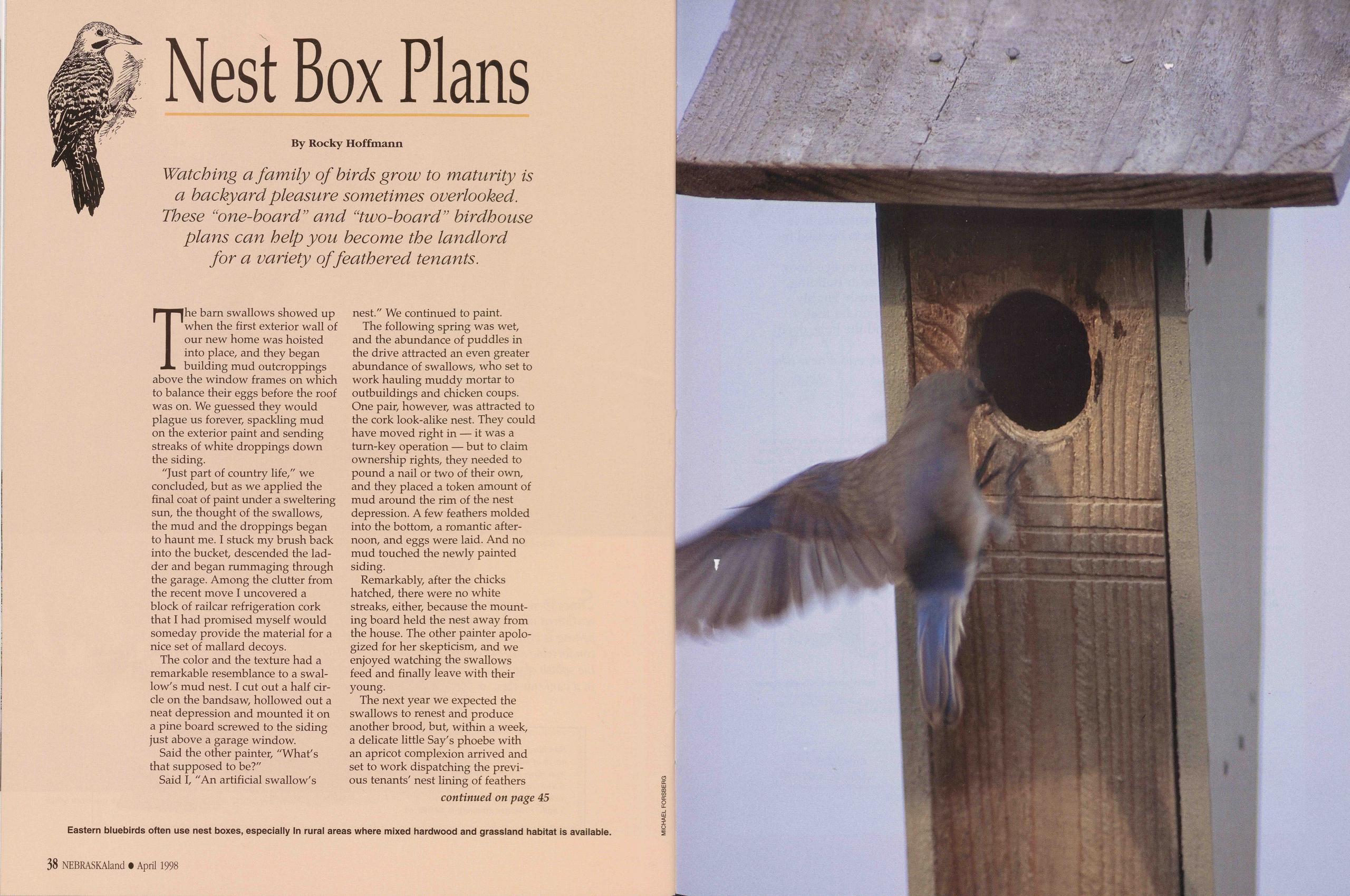
continued on page 45 Eastern bluebirds often use nest boxes, especially In rural areas where mixed hardwood and grassland habitat is available. MICHAEL FORSBERG 38 NEBRASKAland • April 1998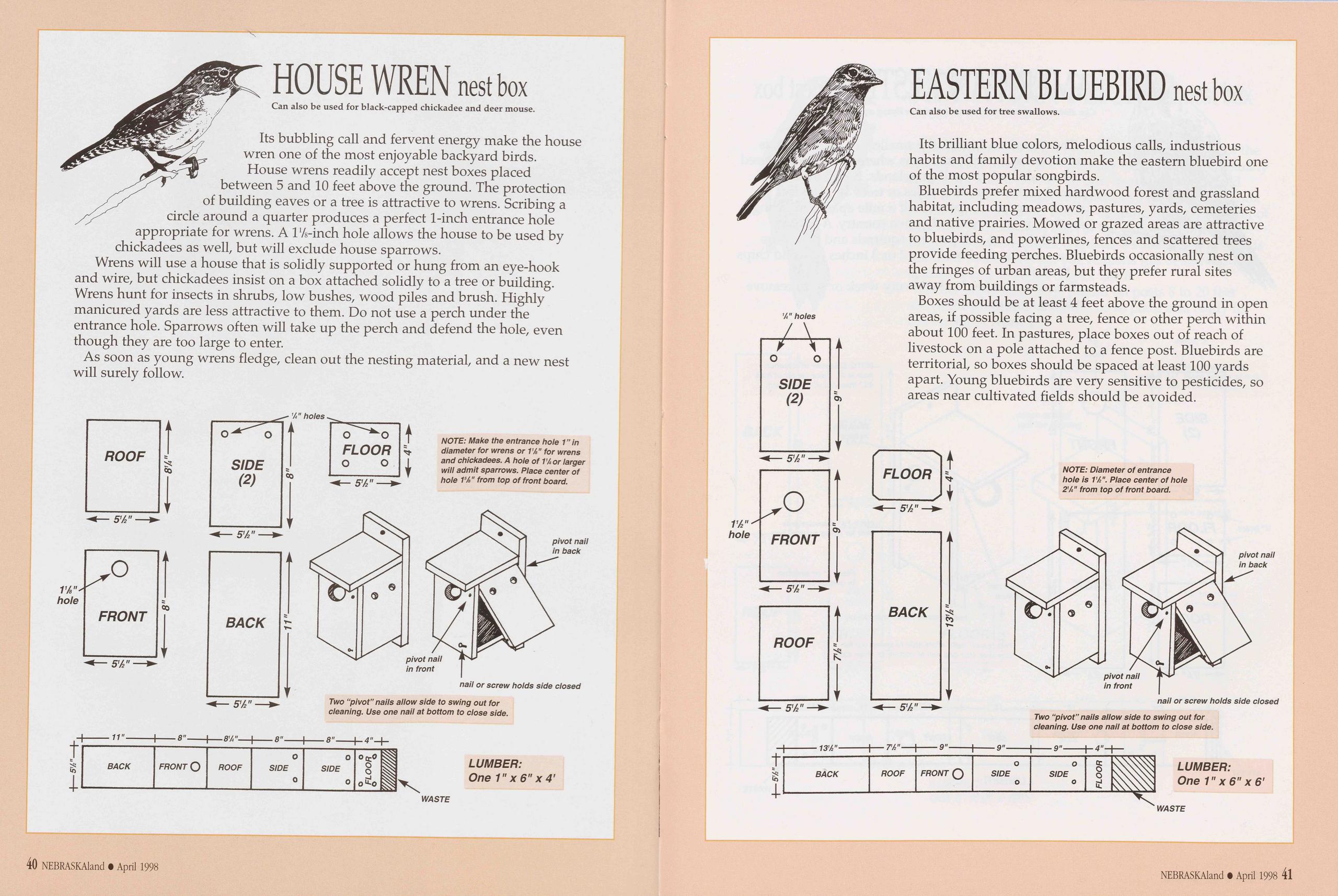 HOUSE WREN rest box
Can also be used for black-capped chickadee and deer mouse.
HOUSE WREN rest box
Can also be used for black-capped chickadee and deer mouse.
Its bubbling call and fervent energy make the house wren one of the most enjoyable backyard birds. House wrens readily accept nest boxes placed between 5 and 10 feet above the ground. The protection of building eaves or a tree is attractive to wrens. Scribing a circle around a quarter produces a perfect 1-inch entrance hole appropriate for wrens. A l'/s-inch hole allows the house to be used by chickadees as well, but will exclude house sparrows.
Wrens will use a house that is solidly supported or hung from an eye-hook and wire, but chickadees insist on a box attached solidly to a tree or building. Wrens hunt for insects in shrubs, low bushes, wood piles and brush. Highly manicured yards are less attractive to them. Do not use a perch under the entrance hole. Sparrows often will take up the perch and defend the hole, even though they are too large to enter.
As soon as young wrens fledge, clean out the nesting material, and a new nest will surely follow.
EASTERN BLUEBIRD nest box Can also be used for tree swallows.Its brilliant blue colors, melodious calls, industrious habits and family devotion make the eastern bluebird one of the most popular songbirds.
Bluebirds prefer mixed hardwood forest and grassland habitat, including meadows, pastures, yards, cemeteries and native prairies. Mowed or grazed areas are attractive to bluebirds, and powerlines, fences and scattered trees provide feeding perches. Bluebirds occasionally nest on the fringes of urban areas, but they prefer rural sites
ROOF co 1/" holes NOTE: Make the entrance hole 1” in diameter for wrens or T/8" for wrens and chickadees. A hole of T or larger will admit sparrows. Place center of hole 17b" from top of front board. BACK nail or screw holds side closed pivot nail in back Two “pivot” nails allow side to swing out for cleaning. Use one nail at bottom to close side. pivot nail in front FLOOR o SIDE (2) A ROOF V A | 11" | 8" | S'/" S' I 8" — 4"—|— 1—h7lS—| BACK FRONT O ROOF O SIDE 0 O SIDE 0 o o FLOOR o o LUMBER: One 1" x 6" x 4' WASTE away from buildings or farmsteads. Boxes should be at least 4 feet above the ground in open areas, if possible facing a tree, fence or other perch within about 100 feet. In pastures, place boxes out of reach of livestock on a pole attached to a fence post. Bluebirds are territorial, so boxes should be spaced at least 100 yards apart. Young bluebirds are very sensitive to pesticides, so areas near cultivated fields should be avoided. I I 51/2" —► /------> FLOOR \ ,✓ A BACK 9* co 1 NOTE: Diameter of entrance hole is T/2". Place center of hole 274" from top of front board. Two “pivot” nails allow side to swing out for cleaning. Use one nail at bottom to close side. t Si in LUMBER: One 1" x 6" x 6' WASTE 40 NEBRASKAland • April 1998 NEBRASKAland • April 1998 41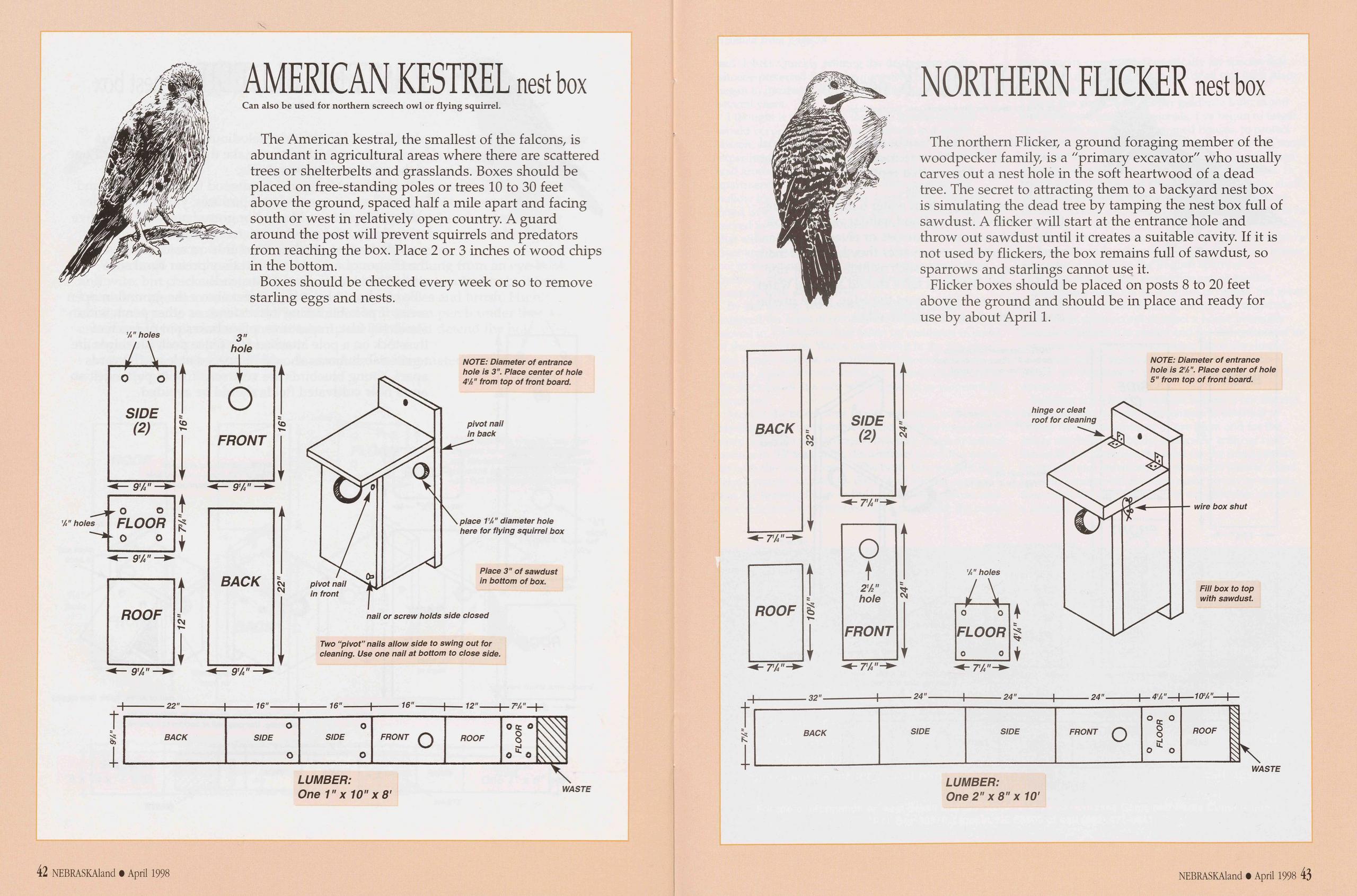 AMERICAN KESTREL nest box
Can also be used for northern screech owl or flying squirrel.
AMERICAN KESTREL nest box
Can also be used for northern screech owl or flying squirrel.
The American kestral, the smallest of the falcons, is abundant in agricultural areas where there are scattered trees or shelterbelts and grasslands. Boxes should be placed on free-standing poles or trees 10 to 30 feet above the ground, spaced half a mile apart and facing south or west in relatively open country. A guard around the post will prevent squirrels and predators from reaching the box. Place 2 or 3 inches of wood chips in the bottom.
Boxes should be checked every week or so to remove starling eggs and nests.
NORTHERN FLICKER nest boxThe northern Flicker, a ground foraging member of the woodpecker family, is a "primary excavator" who usually carves out a nest hole in the soft heartwood of a dead tree. The secret to attracting them to a backyard nest box is simulating the dead tree by tamping the nest box full of sawdust. A flicker will start at the entrance hole and throw out sawdust until it creates a suitable cavity. If it is not used by flickers, the box remains full of sawdust, so sparrows and starlings cannot use it.
Flicker boxes should be placed on posts 8 to 20 feet above the ground and should be in place and ready for use by about April 1.
1A" holes ROOF CM NOTE: Diameter of entrance Two “pivot” nails allow side to swing out for cleaning. Use one nail at bottom to close side. 24" 24" SIDE SIDE BACK LUMBER: One 2" x S" X 10' FRONT O ROOF WASTE 42 NEBRASKAland • April 1998 NEBRASKAland • April 1998 43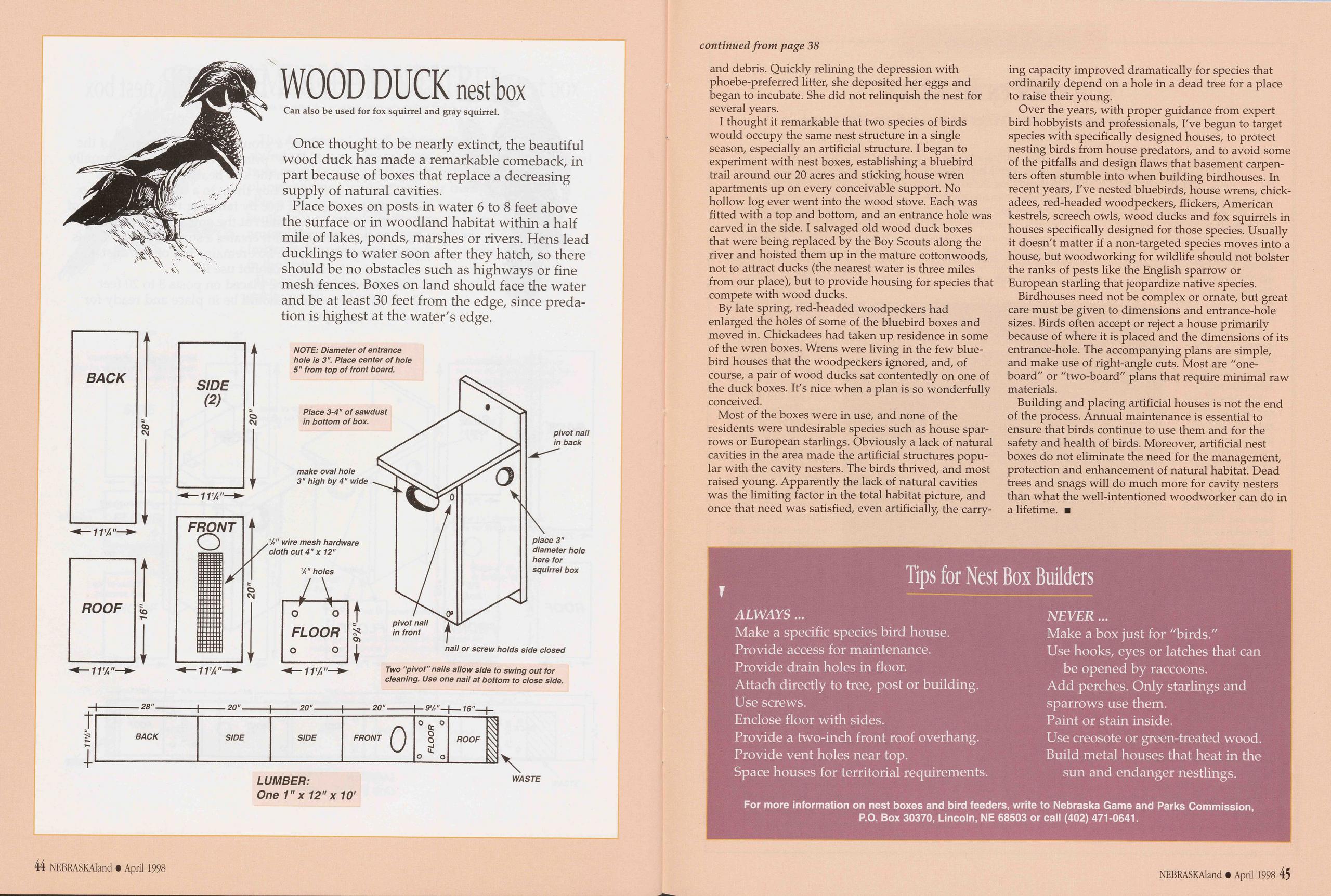 WOOD DUCK nest box
Can also be used for fox squirrel and gray squirrel.
WOOD DUCK nest box
Can also be used for fox squirrel and gray squirrel.
Once thought to be nearly extinct, the beautiful wood duck has made a remarkable comeback, in part because of boxes that replace a decreasing supply of natural cavities.
Place boxes on posts in water 6 to 8 feet above the surface or in woodland habitat within a half mile of lakes, ponds, marshes or rivers. Hens lead ducklings to water soon after they hatch, so there should be no obstacles such as highways or fine mesh fences. Boxes on land should face the water and be at least 30 feet from the edge, since preda- tion is highest at the water's edge.
1A" holes O make oval hole 3" high by 4" wide NOTE: Diameter of entrance hole is 3". Place center of hole 5" from top of front board. Place 3-4" of sawdust in bottom of box. Vi" wire mesh hardware cloth cut 4" x 12" FLOOR nail or screw holds side closed O pivot nail in front pivot nail in back Two “pivot” nails allow side to swing out for cleaning. Use one nail at bottom to close side. SIDE (2) FRONT place 3" diameter hole here for squirrel box One 1" x 12" x 10' continued from page 38and debris. Quickly relining the depression with phoebe-preferred litter, she deposited her eggs and began to incubate. She did not relinquish the nest for several years.
I thought it remarkable that two species of birds would occupy the same nest structure in a single season, especially an artificial structure. I began to experiment with nest boxes, establishing a bluebird trail around our 20 acres and sticking house wren apartments up on every conceivable support. No hollow log ever went into the wood stove. Each was fitted with a top and bottom, and an entrance hole was carved in the side. I salvaged old wood duck boxes that were being replaced by the Boy Scouts along the river and hoisted them up in the mature cottonwoods, not to attract ducks (the nearest water is three miles from our place), but to provide housing for species that compete with wood ducks.
By late spring, red-headed woodpeckers had enlarged the holes of some of the bluebird boxes and moved in. Chickadees had taken up residence in some of the wren boxes. Wrens were living in the few blue- bird houses that the woodpeckers ignored, and, of course, a pair of wood ducks sat contentedly on one of the duck boxes. It's nice when a plan is so wonderfully conceived.
Most of the boxes were in use, and none of the residents were undesirable species such as house spar- rows or European starlings. Obviously a lack of natural cavities in the area made the artificial structures popu- lar with the cavity nesters. The birds thrived, and most raised young. Apparently the lack of natural cavities was the limiting factor in the total habitat picture, and once that need was satisfied, even artificially, the carry-
Tips for Nest Box Builders ALWAYS... Make a specific species bird house. Provide access for maintenance. Provide drain holes in floor. Attach directly to tree, post or building. Use screws. Enclose floor with sides. Provide a two-inch front roof overhang. Provide vent holes near top. Space houses for territorial requirements.ing capacity improved dramatically for species that ordinarily depend on a hole in a dead tree for a place to raise their young.
Over the years, with proper guidance from expert bird hobbyists and professionals, I've begun to target species with specifically designed houses, to protect nesting birds from house predators, and to avoid some of the pitfalls and design flaws that basement carpen- ters often stumble into when building birdhouses. In recent years, I've nested bluebirds, house wrens, chick- adees, red-headed woodpeckers, flickers, American kestrels, screech owls, wood ducks and fox squirrels in houses specifically designed for those species. Usually it doesn't matter if a non-targeted species moves into a house, but woodworking for wildlife should not bolster the ranks of pests like the English sparrow or European starling that jeopardize native species.
Birdhouses need not be complex or ornate, but great care must be given to dimensions and entrance-hole sizes. Birds often accept or reject a house primarily because of where it is placed and the dimensions of its entrance-hole. The accompanying plans are simple, and make use of right-angle cuts. Most are "one- board" or "two-board" plans that require minimal raw materials.
Building and placing artificial houses is not the end of the process. Annual maintenance is essential to ensure that birds continue to use them and for the safety and health of birds. Moreover, artificial nest boxes do not eliminate the need for the management, protection and enhancement of natural habitat. Dead trees and snags will do much more for cavity nesters than what the well-intentioned woodworker can do in a lifetime. ■
NEVER... Make a box just for "birds." Use hooks, eyes or latches that can be opened by raccoons. Add perches. Only starlings and sparrows use them. Paint or stain inside. Use creosote or green-treated wood. Build metal houses that heat in the sun and endanger nestlings. For more information on nest boxes and bird feeders, write to Nebraska Game and Parks Commission, P.O. Box 30370, Lincoln, NE 68503 or call (402) 471-0641. 44 NEBRASKAland • April 1998 NEBRASKAland • April 1998 45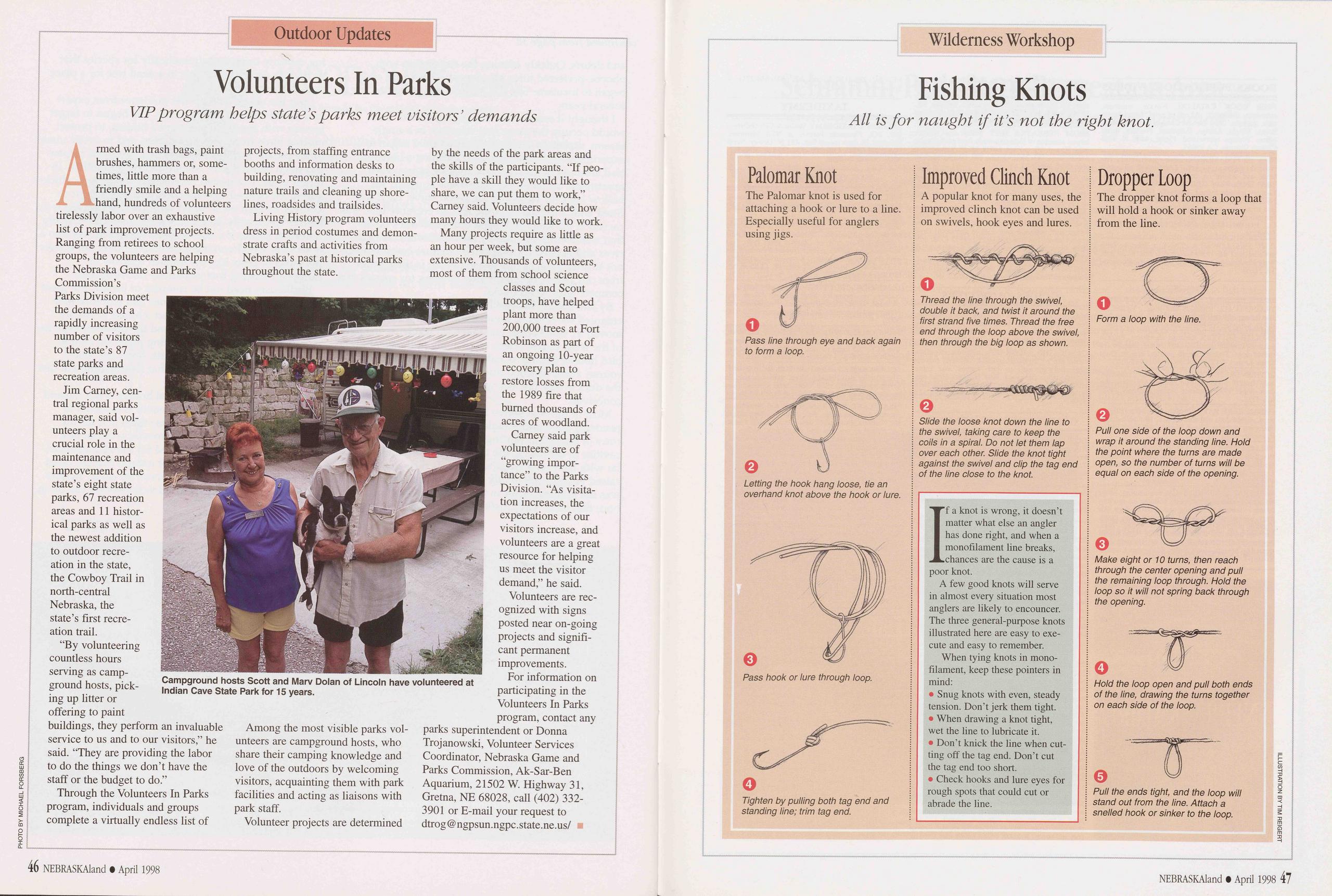
VIP program helps state’s parks meet visitors’ demands
Fishing Knots All is for naught if it’s not the right knot. PHOTO BY MICHAEL FORSBERGArmed with trash bags, paint brushes, hammers or, some- times, little more than a friendly smile and a helping hand, hundreds of volunteers tirelessly labor over an exhaustive list of park improvement projects. Ranging from retirees to school groups, the volunteers are helping the Nebraska Game and Parks Commission’s Parks Division meet the demands of a rapidly increasing number of visitors to the state’s 87 state parks and recreation areas.
Jim Carney, cen- tral regional parks manager, said vol- unteers play a crucial role in the maintenance and improvement of the state’s eight state parks, 67 recreation areas and 11 histor- ical parks as well as the newest addition to outdoor recre- ation in the state, the Cowboy Trail in north-central Nebraska, the state’s first recre- ation trail.
“By volunteering countless hours serving as camp- ground hosts, pick- ing up litter or offering to paint buildings, they perform an invaluable service to us and to our visitors,” he said. “They are providing the labor to do the things we don’t have the staff or the budget to do.”
Through the Volunteers In Parks program, individuals and groups complete a virtually endless list of projects, from staffing entrance booths and information desks to building, renovating and maintaining nature trails and cleaning up shore- lines, roadsides and trailsides. Living History program volunteers dress in period costumes and demon- strate crafts and activities from Nebraska’s past at historical parks throughout the state. Campground hosts Scott and Marv Dolan of Lincoln have volunteered at Indian Cave State Park for 15 years. Among the most visible parks vol- unteers are campground hosts, who share their camping knowledge and love of the outdoors by welcoming visitors, acquainting them with park facilities and acting as liaisons with park staff.
Volunteer projects are determined by the needs of the park areas and the skills of the participants. “If peo- ple have a skill they would like to share, we can put them to work,” Carney said. Volunteers decide how many hours they would like to work. Many projects require as little as an hour per week, but some are extensive. Thousands of volunteers, most of them from school science classes and Scout troops, have helped plant more than 200,000 trees at Fort Robinson as part of an ongoing 10-year recovery plan to restore losses from the 1989 fire that burned thousands of acres of woodland.
Carney said park volunteers are of “growing impor- tance” to the Parks Division. “As visita- tion increases, the expectations of our visitors increase, and volunteers are a great resource for helping us meet the visitor demand,” he said.
Volunteers are rec- ognized with signs posted near on-going projects and signifi- cant permanent improvements.
For information on participating in the Volunteers In Parks program, contact any parks superintendent or Donna Trojanowski, Volunteer Services Coordinator, Nebraska Game and Parks Commission, Ak-Sar-Ben Aquarium, 21502 W. Highway 31, Gretna, NE 68028, call (402) 332- 3901 or E-mail your request to dtrog@ngpsun.ngpc.state.ne.us/ ■
If a knot is wrong, it doesn’t matter what else an angler has done right, and when a monofilament line breaks, chances are the cause is a poor knot.
A few good knots will serve in almost every situation most anglers are likely to encouncer. The three general-purpose knots illustrated here are easy to exe- cute and easy to remember. When tying knots in mono- filament, keep these pointers in mind: • Snug knots with even, steady tension. Don’t jerk them tight. • When drawing a knot tight, wet the line to lubricate it. • Don’t knick the line when cut- ting off the tag end. Don’t cut the tag end too short. • Check hooks and lure eyes for rough spots that could cut or abrade the line.
Dropper Loop The dropper knot forms a loop that will hold a hook or sinker away from the line. Form a loop with the line. Pull one side of the loop down and wrap it around the standing line. Hold the point where the turns are made open, so the number of turns will be equal on each side of the opening. Make eight or 10 turns, then reach through the center opening and pull the remaining loop through. Hold the loop so it will not spring back through the opening. Hold the loop open and pull both ends of the line, drawing the turns together on each side of the loop. Pull the ends tight, and the loop will stand out from the line. Attach a snelled hook or sinker to the loop. ILLUSTRATION BY TIM REIGERT 46 NEBRASKAland • April 1998 NEBRASKAland • April 1998 47
FREE BOOK CATALOG. Novels, westerns, romances, children’s; old out of print, found bams, attic. Authors: Grey, Bower, Condor, Fox, Curwood, Raine, Wright, Aldrige, Pollyanna, Freckles, many others. Postage appreciated. Pierce, 4400 N. Pine Cluster, Oroville, CA 95965.
HOW TO FIND MORE outdoor opportunities! The Nebraska Sportsman’s Atlas. Locations of all public lands and waters on county transportation maps. These maps show ALL the roads in Nebraska. Listings include federal, Nebraska Game & Parks, NRD holdings, hotels and motels and Nebraska’s end- less attractions. At only $18.75/copy a true time and frustration saver. To order write: Sportsman’s Atlas Co., P.O. Box 132, Lytton, IA 50561 or call (800) 568-8334.
JU-JU SWALLOWED A PENNY, a Nebraska farm girl’s book of the 1930s Depression Era. $7.50 ppd. Betty Heidbreder Dunn, Rt. 1, Box 363-G, Navasota, TX 77868.
DOGSTRAINING ALL BREEDS bird dogs - Vizslas for sale. Home of Rebel Rousers. Rozanek Kennels, 781 Rd. D, Schuyler, NE 68661. Phone (402) 352-8769.
ENGLISH SETTERS, German shorthairs, English pointers, Brittany spaniels - stud service, puppies and started dogs. Training for all pointing breeds. Plum Creek Kennel, (712) 529-4238 or (402) 298-8153.
RETRIEVER TRAINING. Area’s top “retrievers only” trainer. Field trial and hunting dogs. Non-slip duck dogs! TKO Retriever Training Kennel (402) 623-4311.
CHESAPEAKE BAY, Labrador and golden retriever pups, started dogs and stud service. 16-time national champion pedigree. Visa & MasterCard. Platte Valley Retrievers (308) 995-2318.
YELLOW-CHOCOLATE-BLACK LAB pups. Breeders hips O F.A. and eyes CERF. Excellent bloodlines and hunting potential. Call Mr. Bendler, Lexington, NE (308) 324-4247 or Lincoln (402) 477-1305.
WILDERNESS KENNELS. Gun dog training - over 60 years combined experience. Training all sporting breeds - retrievers, flushing and pointing dogs. All dogs worked on pen raised birds and wild game. Training program includes obedience training - heel, sit, stay, down and come when called. Pups, started dogs and fully trained dogs for sale. Hunting dogs trained by hunters. Henry Sader, Wilderness Kennels, Roca, NE (402) 423-4212. Since 1968.
FISH/FISHINGFISH FOR SALE. Catfish, largemouth bass, small- mouth bass, perch, crappie, bluegill, walleye, northern pike, rainbow trout, Donaldson rainbow trout, grass carp, minnows, bullheads. Consulting available. Pleasant Valley Fish Farm, RR 1, Box 147, McCook, NE 69001. Phone (308) 345-6599.
FOOD/GIFTS NEBRASKA BASKETS: The original Nebraska NEBRASKAland by phone For Visa and MasterCard orders, call 1-800-NEB-LAND (632-5263) Classifiedscompany specializing in fine foods from Nebraska since 1984. A beautiful array of baskets filled with ethnic, healthful and long-time favorite foods. Call or write for our brochure: PO Box 22985, Lincoln, NE. 68542. 1-800-345-7725 or (402) 438-3111. Visit our web site: http://www.nebaskets.com.
FROM NEBRASKA GIFT SHOP...the world’s largest selection of Nebraska-made food products and gifts. Historic Haymarket, 140 N. 8th St., Lincoln, NE 68508; Westroads Mall, Omaha, NE. Call for free cat- alog (800) 399-5693.
HOMEBREWING/BEER & WINEMAKING sup- plies. Fermenter’s Supply, 8410 K Plz. #10, Omaha, NE 68127. (402) 593-9171. Open every day, mail orders welcome, low shipping.
ENJOY A TASTE of the good life! Award-winning gourmet BBQ sauces & seasonings, breadings, native jellies, fruit butters, honey, coffees and more! Great gift-set ideas! Toll free (888) 926-2879 or (308) 468- 5635. Hollman Foods, 1948 36 Road, Minden, NE 68959, or www.hollmans.com
COUNTRY COOKBOOK from NEBRASKAland Magazine. To order, call 1-800-632-5263. NE, (402) 336-4110, Bassett, NE, (402) 684-2711, or Springview, NE, (402) 497-4300.
TAXIDERMYALLISON’S TAXIDERMY Studio & Gift Gallery - DU, SCI, Pheasants Forever & NTA Members. Mounted 36 state record fish. 421 N. Dewey, North Platte, NE 69101. Call (308) 534-2324 or (308) 534- 4267. Custom Designs.
VACATIONS/RESORTS GUIDES/OUTFITTERSMAD RIVER CANOES offers the finest quality and performance. For the finest canoes and accessories look to Great Plains Canoe Co., 205 Main, Springfield, NE 68059. Phone (402) 253-2001.
CANOE THE NIOBRARA...with an affordable canoe trip by Dryland Aquatics. One and two-day trips...full service, or just canoes and tubes. Transportation furnished. Your Niobrara River spe- cialists... We do it your way! Dryland Aquatics, Dept. N, Box 33C, Sparks, NE 69220 or phone (800) 337- 3119.
GUNS/SHOOTING/ARCHERYGUNS - Browning, Winchester, Remington, others. Hi-powers, shotguns, new, used, antiques. Want Pre-’64 Winchesters. Buy-Sell-Trade. (402) 729-6112. Bedlan’s Sporting Goods, Fairbury, NE 68352.
AIR GUNS repaired - Benjamin, Crosman, Daisy, other American made. Restoration; old guns wanted. Jack’s Air Guns, 1225 N. 46th, Lincoln, NE 68503. Phone (402) 466-9223.
PIANTS/ANIMALS/HABITATEMERGING AQUATIC TECHNOLOGY. We spe- cialize in the evaluation and stocking of private lakes and ponds. Written evaluations upon request. All types of quality fish and invertebrates. (402) 466-6998 voice or fax; e-mail to: Lloos@juno.com.
NEBRASKA LAKE MANAGEMENT. Electrofish- ing surveys, water quality testing, fish stocking, lake restoration, aeration and fountains, weed and algae control and habitat enhancement. Rob Hofpar, Aquatic Biologist, licensed, insured and qualified. Phone (402) 486-0071 Lincoln, or toll-free (888) 850-2460.
REAL ESTATEFOR SALE IN NORTH-CENTRAL Nebraska. Niobrara River frontage, as well as U.S. Hwy. 183! Beautiful building acreage in Keya Paha County. 6.57 total acres. 560-acre rec-ranch, in Brown County, with creek, deer, wild turkey and prairie dog town. Adjoining Keller Park State Recreation Area with dams. Price $350.00 per acre. Swett Realty, Fred L. Swett, Broker, P.O. Box 265, Ainsworth, NE 69210 (800) 585-1626, (402) 387-1626 day or night.
ATTENTION WATERFOWL HUNTERS. Now leas- ing four-acre wetland marsh. Excellent location near Schuyler, NE. ’A mile from Platte River. Good flyway for ducks and geese. Call (402) 539-3285.
NORTH-CENTRAL NEBRASKA FARMS and ranches. 1,200-acre recreational ranch - 1‘A miles of Missouri River. Ducks, geese, deer and turkey. 174- acre recreational tract - very scenic, spring-fed fish pond, 4-bedroom cabin with outbuildings. 112-acre recreational tract - stream through the middle. Lots of deer and turkey. $65,000. Waldo Realty Inc., O’Neill,
FOR FISHING AND HUNTING accommodations. Jefco Inn, Gordon, NE 69343. South Cornell, (308) 282-2935.
BED & BREAKFAST. Historic 1890s hotel. Located in the beautiful Pine Ridge area of northwest Nebraska. Short drive to Chadron State Park, Fort Robinson and the Black Hills. Beautiful dining room with fireplace and fountain. Room service available. The Olde Main Street Inn, 115 Main St., Chadron, NE 69337. (308) 432-3380.
DIAMOND-E TROUT RESORT. 2 new lodges, 3 cottages on spring-fed lakes, stream. Private and secluded. Trout, bass, bluegill, etc. Paddleboats and playground equipment. For brochure, call (800) 974- 3002.
NEAR OMAHA ZOO, American Family Inn Motel. See Rain Forest-Aquarium-I-MAX Theater. 104 rooms, free VCR, 125 rental movies, sparkling pool, Gazebo, picnic area. $42-$48. Welcome! 1-800-253-2865.
OMAHA MOTEL on 1-80 and 144th St. (Exit 440). The friendly Ben Franklin Motel welcomes you. 96 lovely rooms HBO, free VCR, rental movies, huge swimming pool. Only $40-$48. 1-800-688-3658.
HEARTLAND ELK RANCH bed and breakfast is located along the scenic, pine-covered, rolling hills of the Niobrara River valley near Valentine, NE. Guests are treated to our new and completely modem log vacation homes with views of the Sandhills meeting the Niobrara. Breakfast is served in a sun-drenched great room overlooking meadows of majestic elk. Next door to the river and kayaking, Smith Falls and the Fort Niobrara National Wildlife Refuge. Try mountain biking the newly opened Cowboy Trail. For reservations call (402) 376-1124.
VACATIONERS, SPORTSMEN. Relax in one of our newly remodeled large rooms or Jacuzzi suites! Indoor pool & spa. Exercise room. Restaurant, lounge. Free continental breakfast. Fort Robinson, Chadron State Park, hunting, fishing, over 70 miles of marked biking trails. Best Western West Hills Inn, Chadron, NE 69337. (308) 432-3305.
NEBRASKA STATE PARK vacations. From the Missouri River foliage at Indian Cave to the clear blue skies over the Pine Ridge, Nebraska state parks are the perfect place for an spring or summer getaway. For a free color brochure listing all park facilities, call (800) 826-7275.
WESTERN NEBRASKA; hike up your trousers and tuck in your shirt. We’ve got over 14,000 square miles of fun, adventure, scenery and wildlife for you to explore. Spend an unforgettable few days in western Nebraska where rolling plains, high buttes, forested slopes, hiking trails, wildlife, fishing and camping await your visit. Backpack through the beautiful Pine Ridge country, the Nebraska National Forest, the Wildcat Hills, Fort Robinson and Chadron state parks. Watch wildlife as you picnic at Box Butte Reservoir, Cresent Lake NWR, Lake Minatare SRA, the Oglala National Grasslands and Oliver Reservoir SRA. We’re waiting for you to see what we see every day. For more information: (308) 762-1520 or http://www. westnebraska. com/
Classified Rates: 75$ per word, minimum $15. Closing: First business day two months before issue date. Classified ads are accepted on a first-come, first-served, space-available basis. Classified Ads, NEBRASKAland Magazine, P.O. Box 30370, Lincoln, NE 68503-0370. Telephone (402) 471-5478. Fax: (402) 471-5528. E-mail: nebland @ ngpsun. ngpc. state, ne. usStaring back at them through the thick glass of an aquarium display tank, visitors to Ak-Sar-Ben Aquarium at Schramm Park State Recreation Area near Gretna can see a national champion that, in its own way, has made as many waves as the more well-known Comhusker football team. This monster, a 100-pound blue catfish is the largest freshwater fish on display in the United States. Fifty-four inches long with a 35-inch girth, the huge female is thought to be 25 to 30 years old, in human terms the equivalent of 80 to 90.
Caught in May 1997 in a Missouri River tributary in Missouri, the fish was donated to Ak-Sar-Ben Aquarium. It spent a few days in a holding tank for observation and medication, then was moved to a large indoor display tank, where it has been a big hit with visitors. Ak-Sar- Ben Aquarium houses 12 large viewing tanks displaying native and introduced fish species.
Playing an important role in outdoor education, Ak- Sar-Ben Aquarium and Schramm Park State Recreation Area are visited by 350 to 400 school groups, about 16,000 students, each year. In a typical year, about 60,000 people tour the aquarium, although visitation has increased sharply since the arrival of the big catfish. Other attractions include films and slide programs. On the bluffs overlooking Ak-Sar-Ben Aquarium, Schramm Park State Recreation Area offers hiking and picnicking. A three-mile nature-hiking trail, winding through wooded hills, provides spectacular views of the Platte River valley.
Schramm is the site of the state’s first state fish hatch- ery, established in 1882. The old hatch house is now a fish management museum. A geologic display is nearby. A park entry permit is not needed at the aquarium, but is required on the rest of the state recreation area. A nominal admission is charged at the aquarium.
For more information, contact Schramm Park SRA and Ak-Sar-Ben Aquarium, 21502 W. Highway 31, Gretna, NE 68028, (402) 332-3901. » Schramm Park State Recreation Area is six miles south of Interstate 80 exit 432 and about six miles west of the junction of Nebraska highways 31 and 50. The 1882 hatch house at Schramm is a fish management museum. Right top: 100-pound catfish is the largest on display in the United States. Right bottom: An outdoor touch tank gives children direct contact with nature.
PHOTOS: FAR LEFT AND TOP, KEN BOUC; LEFT, DON CUNNINGHAM 48 NEBRASKAland • April 1998 NEBRASKAland • April 1998 49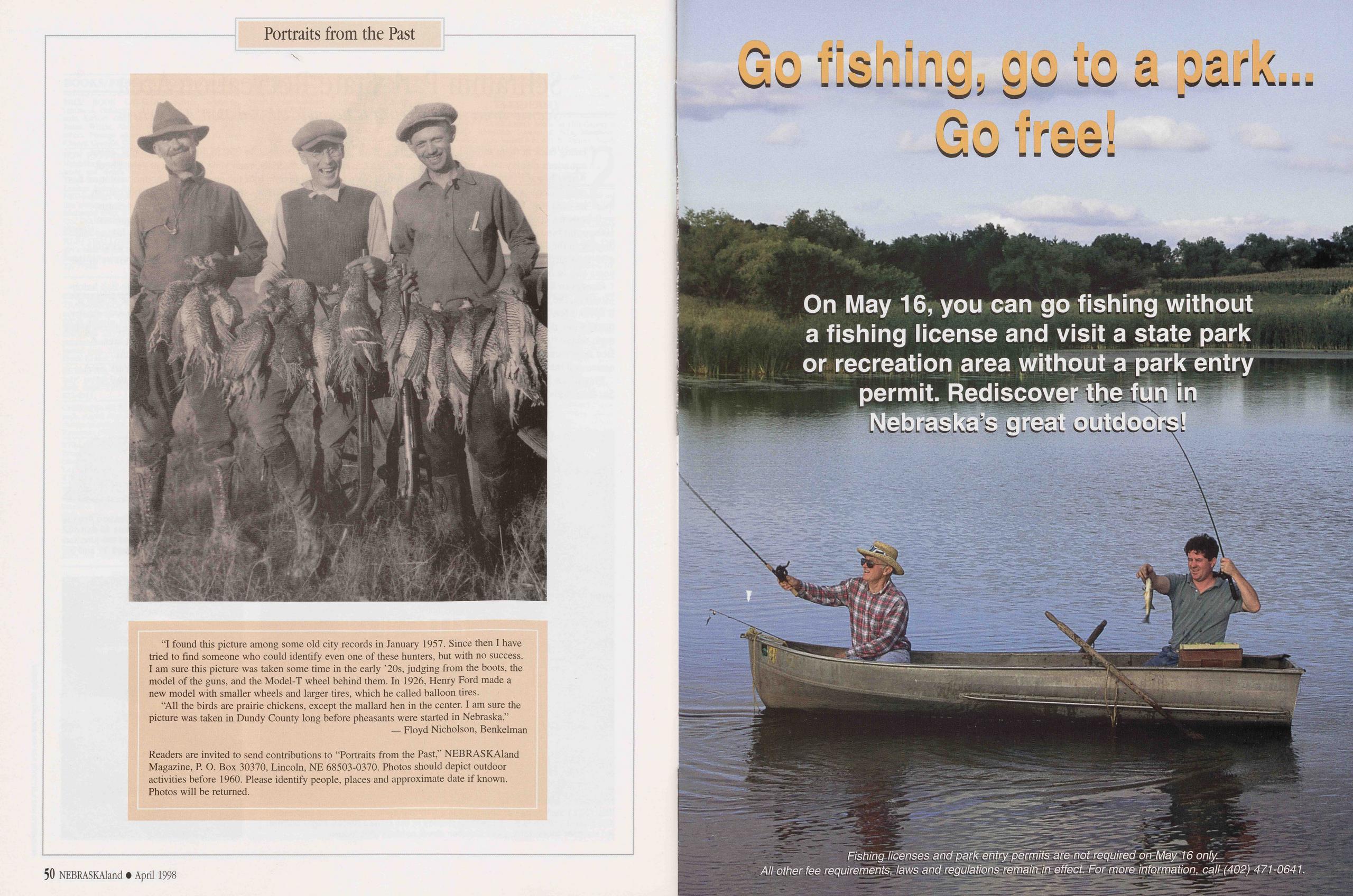
"I found this picture among some old city records in January 1957. Since then I have tried to find someone who could identify even one of these hunters, but with no success. I am sure this picture was taken some time in the early ’20s, judging from the boots, the model of the guns, and the Model-T wheel behind them. In 1926, Henry Ford made a new model with smaller wheels and larger tires, which he called balloon tires. “All the birds are prairie chickens, except the mallard hen in the center. I am sure the picture was taken in Dundy County long before pheasants were started in Nebraska.”
— Floyd Nicholson, Benkelman Readers are invited to send contributions to “Portraits from the Past,” NEBRASKAland Magazine, P. 0. Box 30370, Lincoln, NE 68503-0370. Photos should depict outdoor activities before I960. Please identify people, places and approximate date if known. Photos will be returned. NEBRASKAland Magazine
Vol. 76, No. 3/April 1998
Published by the
Nebraska Game and Parks Commission
NEBRASKAland Magazine
Vol. 76, No. 3/April 1998
Published by the
Nebraska Game and Parks Commission
Position: 854 (10 views)