Volume 76, Issue 2, 1998
NEBRASKAland
March 1998 $2.00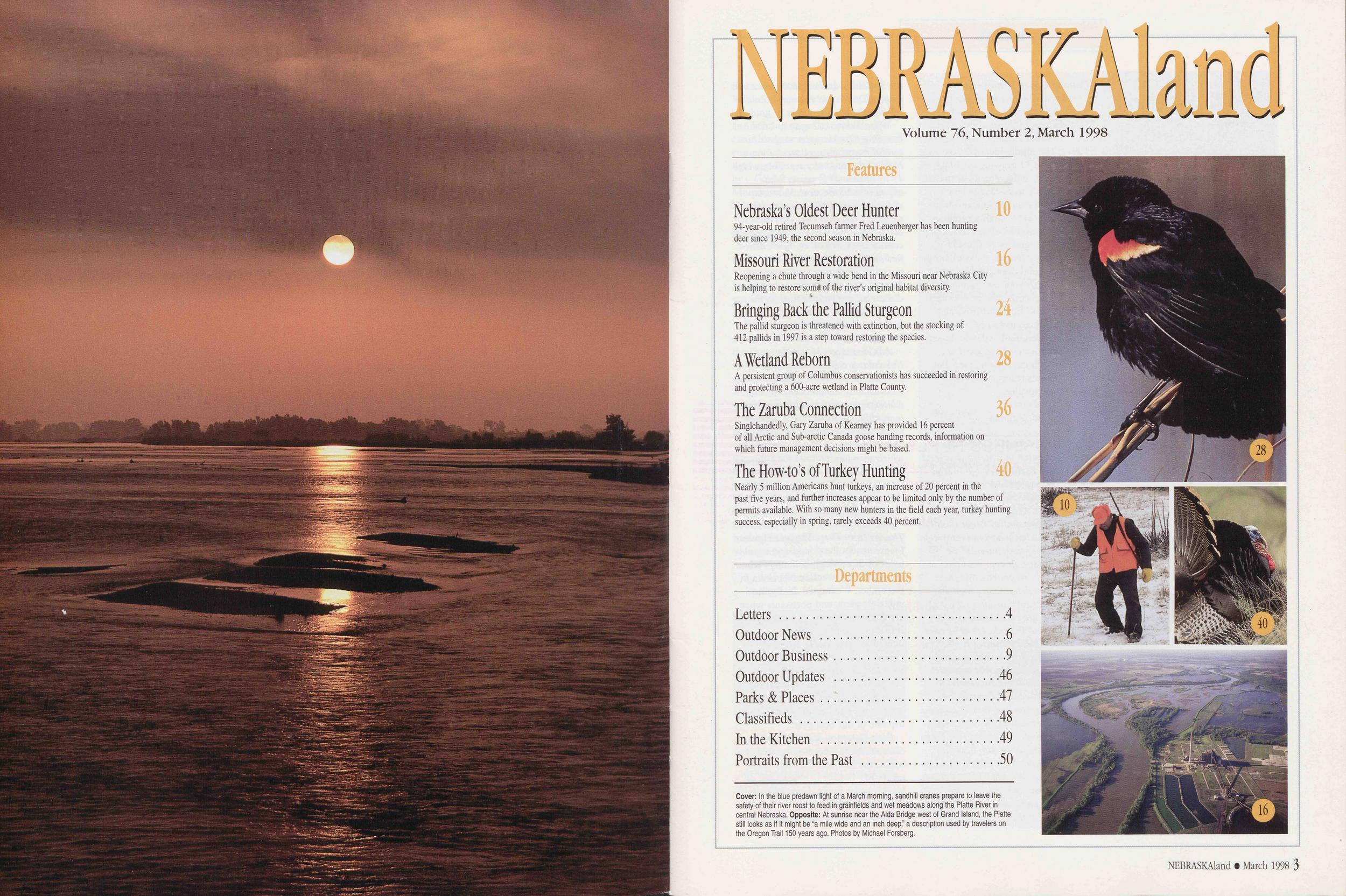
NEBRASKAland
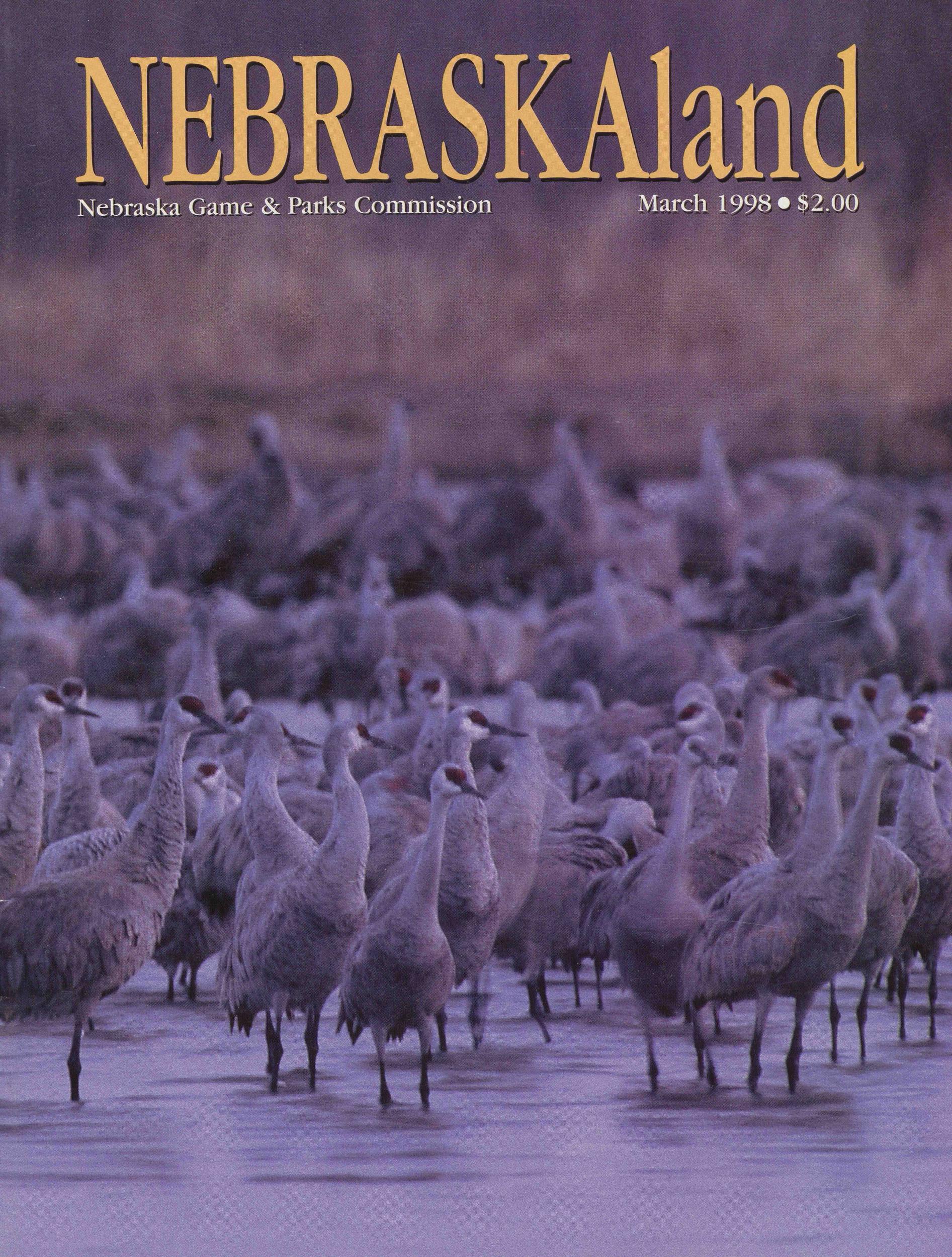
VOL. 76/NO. 2 March 1998 Features Nebraska's Oldest Deer Hunter 10 94-year-old retired Tecumseh farmer Fred Leuenberger has been hunting deer since 1949, the second season in Nebraska. Missouri River Restoration Reopening a chute through a wide bend in the Missouri near Nebraska City. 16 is helping to restore some of the river's original habitat diversity. Bringing Back the Pallid Sturgeon 24 The pallid sturgeon is threatened with extinction, but the stocking of 412 pallids in 1997 is a step toward restoring the species. A Wetland Reborn 28 A persistent group of Columbus conservationists has succeeded in restoring and protecting a 600-acre wetland in Platte County. The Zaruba Connection 36 Singlehandedly, Gary Zaruba of Kearney has provided 16 percent of all Arctic and Sub-arctic Canada goose banding records, information on which future management decisions might be based. The How-to's of Turkey Hunting 40 Nearly 5 million Americans hunt turkeys, an increase of 20 percent in the past five years, and further increases appear to be limited only by the number of permits available. With so many new hunters in the field each year, turkey hunting success, especially in spring, rarely exceeds 40 percent. Departments Letters 4 Outdoor News 6 Outdoor Business 9 Outdoor Updates 46 Parks & Places 47 Classifieds 48 In the Kitchen 49 Portraits from the Past 50 Cover: In the blue predawn light of a March morning, sandhill cranes prepare to leave the safety of their river roost to feed in grainfields and wet meadows along the Platte River in central Nebraska. Opposite: At sunrise near the Alda Bridge west of Grand Island, the Platte still looks as if it might be "a mile wide and an inch deep," a description used by travelers on the Oregon Trail 150 years ago. Photos by Michael Forsberg. NEBRASKAland • March 1998 3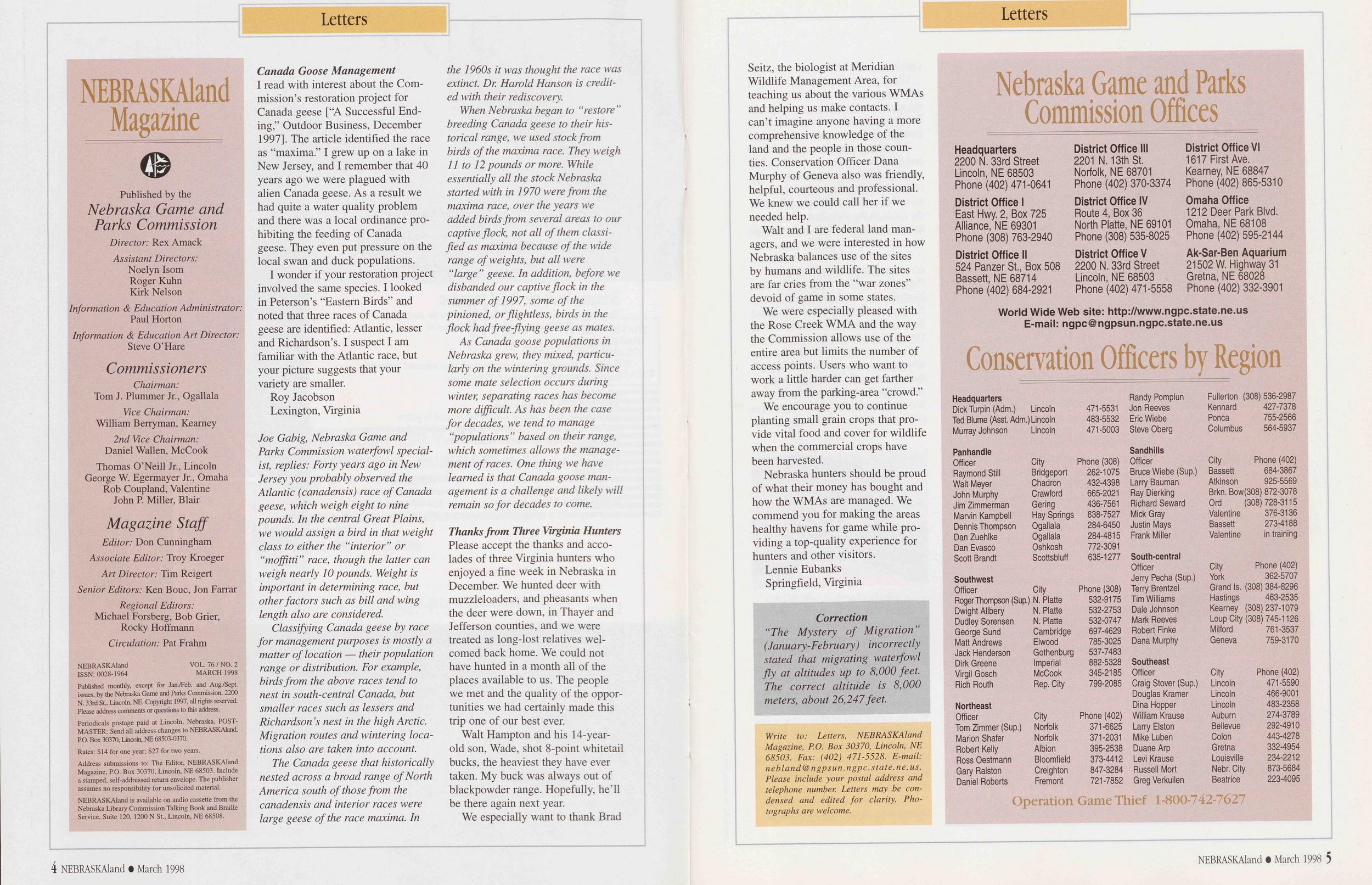
Letters
Canada Goose ManagementI read with interest about the Commission's restoration project for Canada geese ["A Successful Ending," Outdoor Business, December 1997]. The article identified the race as "maxima." I grew up on a lake in New Jersey, and I remember that 40 years ago we were plagued with alien Canada geese. As a result we had quite a water quality problem and there was a local ordinance prohibiting the feeding of Canada geese. They even put pressure on the local swan and duck populations.
I wonder if your restoration project involved the same species. I looked in Peterson's "Eastern Birds" and noted that three races of Canada geese are identified: Atlantic, lesser and Richardson's. I suspect I am familiar with the Atlantic race, but your picture suggests that your variety are smaller.
Roy Jacobson Lexington, VirginiaJoe Gabig, Nebraska Game and Parks Commission waterfowl specialist, replies: Forty years ago in New Jersey you probably observed the Atlantic (canadensis) race of Canada geese, which weigh eight to nine pounds. In the central Great Plains, we would assign a bird in that weight class to either the "interior" or "moffitti" race, though the latter can weigh nearly 10 pounds. Weight is important in determining race, but other factors such as bill and wing length also are considered.
Classifying Canada geese by race for management purposes is mostly a matter of location — their population range or distribution. For example, birds from the above races tend to nest in south-central Canada, but smaller races such as lessers and Richardson's nest in the high Arctic. Migration routes and wintering locations also are taken into account.
The Canada geese that historically nested across a broad range of North America south of those from the canadensis and interior races were large geese of the race maxima. In the 1960s it was thought the race was extinct. Dr. Harold Hanson is credited with their rediscovery.
When Nebraska began to "restore" breeding Canada geese to their historical range, we used stock from birds of the maxima race. They weigh 11 to 12 pounds or more. While essentially all the stock Nebraska started with in 1970 were from the maxima race, over the years we added birds from several areas to our captive flock, not all of them classified as maxima because of the wide range of weights, but all were "large " geese. In addition, before we disbanded our captive flock in the summer of 1997, some of the pinioned, or flightless, birds in the flock had free-flying geese as mates.
As Canada goose populations in Nebraska grew, they mixed, particularly on the wintering grounds. Since some mate selection occurs during winter, separating races has become more difficult. As has been the case for decades, we tend to manage "populations" based on their range, which sometimes allows the management of races. One thing we have learned is that Canada goose management is a challenge and likely will remain so for decades to come.
Thanks from Three Virginia HuntersPlease accept the thanks and accolades of three Virginia hunters who enjoyed a fine week in Nebraska in December. We hunted deer with muzzleloaders, and pheasants when the deer were down, in Thayer and Jefferson counties, and we were treated as long-lost relatives welcomed back home. We could not have hunted in a month all of the places available to us. The people we met and the quality of the opportunities we had certainly made this trip one of our best ever.
Walt Hampton and his 14-year-old son, Wade, shot 8-point whitetail bucks, the heaviest they have ever taken. My buck was always out of blackpowder range. Hopefully, he'll be there again next year.
We especially want to thank Brad
4 NEBRASKAland • March 1998Seitz, the biologist at Meridian Wildlife Management Area, for teaching us about the various WMAs and helping us make contacts. I can't imagine anyone having a more comprehensive knowledge of the land and the people in those counties. Conservation Officer Dana Murphy of Geneva also was friendly, helpful, courteous and professional. We knew we could call her if we needed help.
Walt and I are federal land managers, and we were interested in how Nebraska balances use of the sites by humans and wildlife. The sites are far cries from the "war zones" devoid of game in some states.
We were especially pleased with the Rose Creek WMA and the way the Commission allows use of the entire area but limits the number of access points. Users who want to work a little harder can get farther away from the parking-area "crowd."
We encourage you to continue planting small grain crops that provide vital food and cover for wildlife when the commercial crops have been harvested.
Nebraska hunters should be proud of what their money has bought and how the WMAs are managed. We commend you for making the areas healthy havens for game while providing a top-quality experience for hunters and other visitors.
Lennie Eubanks Springfield, Virginia Correction "The Mystery of Migration (January-February) incorrectly stated that migrating waterfowl fly at altitudes up to 8,000 feet. The correct altitude is 8,000 meters, about 26,247 feet. Write to: Letters, NEBRASKAland Magazine, P.O. Box 30370, Lincoln, NE 68503. Fax: (402) 471-5528. E-mail: nebland@ngp sun.ngpc. state.ne.us. Please include your postal address and telephone number. Letters may be condensed and edited for clarity. Photographs are welcome.
Outdoor News
Residents Asked to Report Whooping Crane SightingsWhooping cranes are arriving in central and western Nebraska, and anyone who sees one of the endangered birds should report the sighting, said John Dinan, nongame bird program manager with the Nebraska Game and Parks Cornmission.
Dinan said that biologists rely on reports from the public to learn where whooping cranes stop in the state. "The birds typically travel as individuals or in small groups of one to six birds, making stops whenever they run short of daylight or when they grow tired," he said. "The only way we know they're on the ground is if sightings are reported."
Every year between about April 1 and May 10, whooping cranes travel north from wintering grounds at Aransas National Wildlife Refuge in Texas. Some cranes usually stop on or near the Platte River between Grand Island and Lexington or on other wetlands or rivers in central and west-central Nebraska, Dinan said. The eastern edge of the migration path extends from near Grand Island to O'Neill.
The U.S. Department of Interior estimates that 182 adults and subadults and 30 young cranes will migrate through Nebraska this spring. One whooper sighting already has been confirmed in Nebraska this year.
Biologists reported a record 51 whooping crane nests on the Canadian breeding grounds in 1997. Fifty-six cranes were hatched. Sixteen pairs of cranes produced two young, and one set of "twins" made it to the Aransas wintering grounds. It was the first time since 1964 that a pair with two young arrived at the wintering grounds.
Whooping cranes are snowy white and nearly five feet tall. In flight, their long, dark legs extend beyond the tail. Whooping cranes have a seven-and-a-half-foot wingspan, and the red crowns of the adults are visible in good light.
Dinan said sandhill cranes, white pelicans and snow geese sometimes are mistaken for whooping cranes. People are asked to observe birds carefully before reporting sightings.
When a whooping crane is sighted and the Commission is notified of its location, biologists or conservation officers monitor the birds, Dinan said. Being able to observe and verify the birds in the state depends on immediate and accurate information from the public, he said.
To report a sighting, contact a conservation officer, a Game and Parks Commission district office in Norfolk, B as sett, Lincoln, Alliance, Kearney or North Platte or the U.S. Fish and Wildlife Service office in Grand Island.
To receive a brochure about whooping cranes and how to identify them, contact the Nebraska Game and Parks Commission, P.O. Box 30370, Lincoln, NE 68503, or call (402)471-0641.
The annual trout fishing season at Two Rivers State Recreation Area southwest of Venice begins April 1.
"About 15,000 trout should be in the lake on opening day," said Randy Winter, Game and Parks Commission Fisheries Division district supervisor for southeastern Nebraska. "Anglers should find good action if weather conditions are favorable."
The trout lake is open to fishing from 7 a.m. to sunset every day. To
ILLUSTRATION BY TIM REIGERT 6 NEBRASKAland • March 1998 Outdoor Newsfish the trout lake, anglers must purchase a special tag from the Two Rivers office. The $4 tag allows the taking of four trout per day. Anglers may purchase a maximum of two tags per day. Anglers possessing trout on any other lake at Two Rivers SRA also must have a trout tag. Anglers are asked to return the tag to the office at the end of their fishing day, as the information collected from each tag is critical in helping fisheries biologists determine catch rates and stocking rates for the trout lake.
Two Rivers trout anglers also must have a valid Nebraska fishing license and a current Aquatic Habitat Stamp. Veterans 65 years and older and residents 70 and older who have a fee-exempt permit, and individuals who have lifetime permits, are exempt from the Aquatic Habitat Stamp requirement, as are 16- and 17-year-old anglers. All vehicles entering the area are required to have a valid Park Entry Permit.
State's Prairie Grouse Begin Spring Courtship RitualsThe booming calls and excited dancing of prairie grouse courtship rituals are beginning on Nebraska's prairie grasslands, and the public can see the annual ritual at several sites in the Sandhills and the southeastern part of the state.
Carl Wolfe, Nebraska Game and Parks Commission outdoor education specialist, said the two species of prairie grouse in Nebraska often are confused with one another. The greater prairie chicken is slightly larger than the sharp-tailed grouse. The markings on the sharptail are V-shaped, while the prairie chicken has a uniformly barred breast.
The sharptail commonly is found in the Sandhills region of the state, Wolfe said. The prairie chicken also is found in the Sandhills, but a few flocks also can be found in the southeastern corner of the state.
In early spring, flocks of both
Officer's Notebook
He answers on the first ring: "Law Enforcement." A pause. "Do you have a map in front of you?" Another pause. "Well, Fillmore County is in Zone One, and in Zone One the late season is open four days per week, Saturday, Sunday, Tuesday and Thursday." Another pause. "No, it doesn't matter whether you're on public or private land, but not all the public land in the county is open for the late season ..." A second phone rings, and Murray Johnson, a Nebraska Game and Parks Commission conservation officer, puts the first caller on hold while he takes information on the hotline for Operation Game Thief, a cooperative wildlife law enforcement program sponsored by the Game and Parks Commission and the Nebraska Wildlife Protectors Association. The hotline, established to gather information about game law violations from callers who can remain anonymous and sometimes receive rewards for their information, fields several hundred calls per year, nearly half of them leading to investigations. Between calls, Johnson deals with a frustrated boater's hull-number problem and packs instructional materials for a weekend workshop he'll be conducting in Grand Island for instructors in the Project Wild, Hunter Education, Bowhunter Education, Boater Education and Aquatic Education programs. The only atypical aspects of Johnson's activities are that he is assigned to the Lincoln headquarters office of the Game and Parks Commission and that he spends less time than most of his colleagues cruising the backroads of the state behind the wheel of a government-issue pickup truck. Otherwise, with minor variations, his job is much like that of the other 51 conservation officers who are the first line of defense for Nebraska's wildlife. His office is a good place to begin a tour of the law enforcement arm of the Game and Parks Commission. "Law enforcement is pro-active and reactive," Johnson said. "The reactive part is what most people think about — vehicle checks, answering complaints, responding to disturbance calls, investigating accidents." But the pro-active part of a C.O.'s job has lower visibility, he said. Some of it involves presenting programs and workshops for civic and sports enthusiasts' groups, but at the heart of the job is law enforcement and the training required to anticipate situations and act appropriately. All C.O.s are fully certified law enforcement officers with extensive training at the state Law Enforcement Training Center in Grand Island and a long period of monitored on-the-job training. The officers also complete a series of yearly in-service sessions in subjects such as firearm training and defensive tactics. In addition, they receive specialized training in areas that other law enforcement officers are less likely to encounter, such as boat accident investigation. "When cars collide, they pretty much stay where they are," Johnson said, "but boat accident reconstruction is a lot harder — boats sink, drift away or get towed to shore, and they don't leave any skidmarks." But a C.O. might encounter virtually any of the same situations that a city, county or state officer might encounter, including domestic violence, said Johnson. "The same fight that might occur in a house in town can take place out at the lake." Moreover, Johnson said, conservation officers often are the Game and Parks Commission's first point of contact with the public, becoming a one-person complaint department and a reference library dispensing outdoor information. "They answer all kinds of general law questions — season dates, limits, legal game, legal methods of taking game — and they're expected to know where the fish are biting and where all the pheasants are, too."Outdoor News
species break into smaller groups of separate sexes, marking the beginning of spring courtship. The males arrive on display grounds before sunrise and vie for territory and the favor of females by intimidating other males with vocal and visual displays.
Locations where the courtship rituals can be viewed include the Bessey Division of the Nebraska National Forest near Halsey, the Valentine National Wildlife Refuge near Valentine and Burchard Lake Wildlife Management Area near Burchard in the southeastern part of the state.
For more information about blind locations and reservations, contact the U.S. Forest Service at the Nebraska National Forest, (308) 533-2257; the Valentine National Wildlife Refuge, (402) 376-3789; or the Game and Parks Commission's Lincoln office, (402) 471-0641.
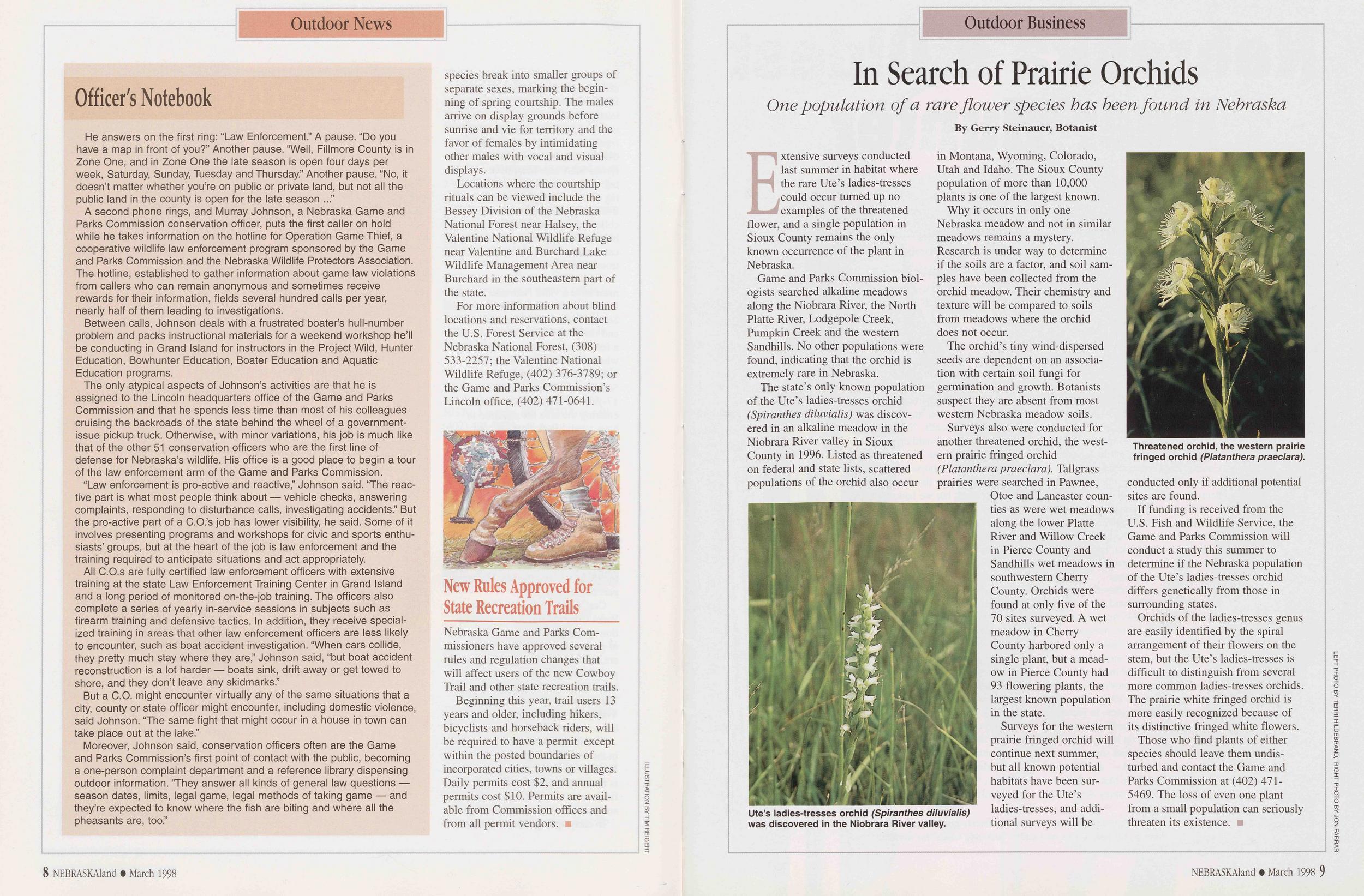
Nebraska Game and Parks Commissioners have approved several rules and regulation changes that will affect users of the new Cowboy Trail and other state recreation trails.
Beginning this year, trail users 13 years and older, including hikers, bicyclists and horseback riders, will be required to have a permit except within the posted boundaries of incorporated cities, towns or villages. Daily permits cost $2, and annual permits cost $10. Permits are available from Commission offices and from all permit vendors.
8 NEBRASKAland • March 1998Outdoor Business
In Search of Prairie Orchids
One population of a rare flower species has been found in Nebraska By Gerry Steinauer, BotanistExtensive surveys conducted last summer in habitat where the rare Ute's ladies-tresses could occur turned up no examples of the threatened flower, and a single population in Sioux County remains the only known occurrence of the plant in Nebraska.
Game and Parks Commission biologists searched alkaline meadows along the Niobrara River, the North Platte River, Lodgepole Creek, Pumpkin Creek and the western Sandhills. No other populations were found, indicating that the orchid is extremely rare in Nebraska.
The state's only known population of the Ute's ladies-tresses orchid (Spiranthes diluvialis) was discovered in an alkaline meadow in the Niobrara River valley in Sioux County in 1996. Listed as threatened on federal and state lists, scattered populations of the orchid also occur
Ute's ladies-tresses orchid (Spiranthes diluvialis) was discovered in the Niobrara River valley.
in Montana, Wyoming, Colorado, Utah and Idaho. The Sioux County population of more than 10,000 plants is one of the largest known.
Why it occurs in only one Nebraska meadow and not in similar meadows remains a mystery. Research is under way to determine if the soils are a factor, and soil samples have been collected from the orchid meadow. Their chemistry and texture will be compared to soils from meadows where the orchid does not occur.
The orchid's tiny wind-dispersed seeds are dependent on an association with certain soil fungi for germination and growth. Botanists suspect they are absent from most western Nebraska meadow soils.
Surveys also were conducted for another threatened orchid, the western prairie fringed orchid (Platanthera praeclara). Tallgrass prairies were searched in Pawnee, Otoe and Lancaster counties as were wet meadows along the lower Platte River and Willow Creek in Pierce County and Sandhills wet meadows in southwestern Cherry County. Orchids were found at only five of the 70 sites surveyed. A wet meadow in Cherry County harbored only a single plant, but a meadow in Pierce County had 93 flowering plants, the largest known population in the state.
Surveys for the western prairie fringed orchid will continue next summer, but all known potential habitats have been surveyed for the Ute's ladies-tresses, and additional surveys will be
Threatened orchid, the western prairie fringed orchid (Platanthera praeclara).
conducted only if additional potential sites are found.
If funding is received from the U.S. Fish and Wildlife Service, the Game and Parks Commission will conduct a study this summer to determine if the Nebraska population of the Ute's ladies-tresses orchid differs genetically from those in surrounding states.
Orchids of the ladies-tresses genus are easily identified by the spiral arrangement of their flowers on the stem, but the Ute's ladies-tresses is difficult to distinguish from several more common ladies-tresses orchids. The prairie white fringed orchid is more easily recognized because of its distinctive fringed white flowers.
Those who find plants of either species should leave them undisturbed and contact the Game and Parks Commission at (402) 471-5469. The loss of even one plant from a small population can seriously threaten its existence.
LEFT PHOTO BY TERRI HILDEBRAND, RIGHT PHOTO BY JON FARRAR NEBRASKAland • March 1998 9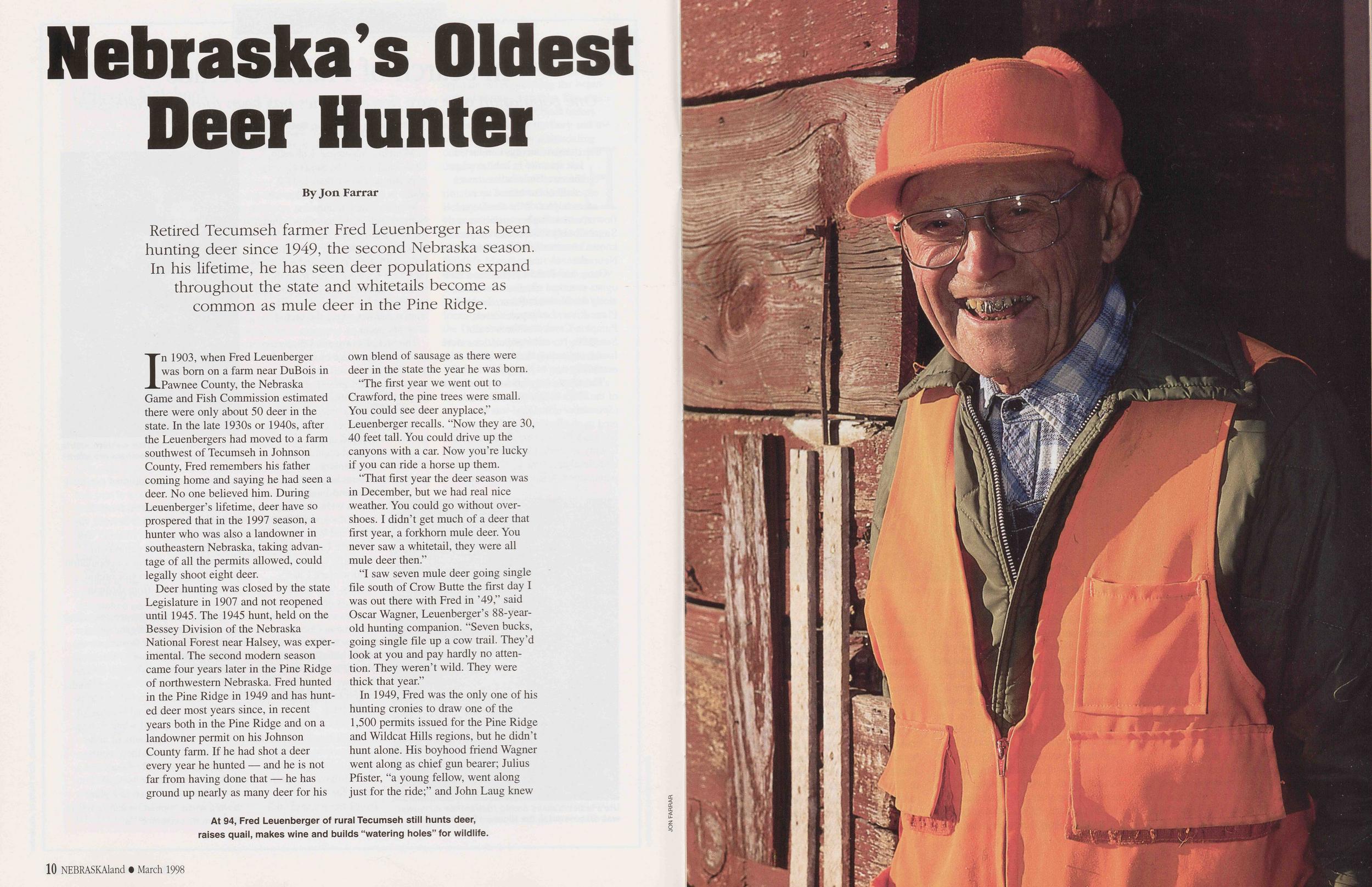
Nebraska's Oldest Deer Hunter
By Jon Farrar Retired Tecumseh farmer Fred Leuenberger has been hunting deer since 1949, the second Nebraska season. In his lifetime, he has seen deer populations expand throughout the state and whitetails become as common as mule deer in the Pine Ridge.In 1903, when Fred Leuenberger was born on a farm near DuBois in Pawnee County, the Nebraska Game and Fish Commission estimated there were only about 50 deer in the state. In the late 1930s or 1940s, after the Leuenbergers had moved to a farm southwest of Tecumseh in Johnson County, Fred remembers his father coming home and saying he had seen a deer. No one believed him. During Leuenberger's lifetime, deer have so prospered that in the 1997 season, a hunter who was also a landowner in southeastern Nebraska, taking advantage of all the permits allowed, could legally shoot eight deer.
Deer hunting was closed by the state Legislature in 1907 and not reopened until 1945. The 1945 hunt, held on the Bessey Division of the Nebraska National Forest near Halsey, was experimental. The second modern season came four years later in the Pine Ridge of northwestern Nebraska. Fred hunted in the Pine Ridge in 1949 and has hunted deer most years since, in recent years both in the Pine Ridge and on a landowner permit on his Johnson County farm. If he had shot a deer every year he hunted — and he is not far from having done that — he has ground up nearly as many deer for his own blend of sausage as there were deer in the state the year he was born.
"The first year we went out to Crawford, the pine trees were small. You could see deer anyplace," Leuenberger recalls. "Now they are 30, 40 feet tall. You could drive up the canyons with a car. Now you're lucky if you can ride a horse up them.
"That first year the deer season was in December, but we had real nice weather. You could go without over-shoes. I didn't get much of a deer that first year, a forkhorn mule deer. You never saw a whitetail, they were all mule deer then."
"I saw seven mule deer going single file south of Crow Butte the first day I was out there with Fred in '49," said Oscar Wagner, Leuenberger's 88-year-old hunting companion. "Seven bucks, going single file up a cow trail. They'd look at you and pay hardly no attention. They weren't wild. They were thick that year."
In 1949, Fred was the only one of his hunting cronies to draw one of the 1,500 permits issued for the Pine Ridge and Wildcat Hills regions, but he didn't hunt alone. His boyhood friend Wagner went along as chief gun bearer; Julius Pfister, "a young fellow, went along just for the ride;" and John Laug knew
At 94, Fred Leuenberger of rural Tecumseh still hunts deer, raises quail, makes wine and builds "watering holes" for wildlife. 10 NEBRASKAland • March 1998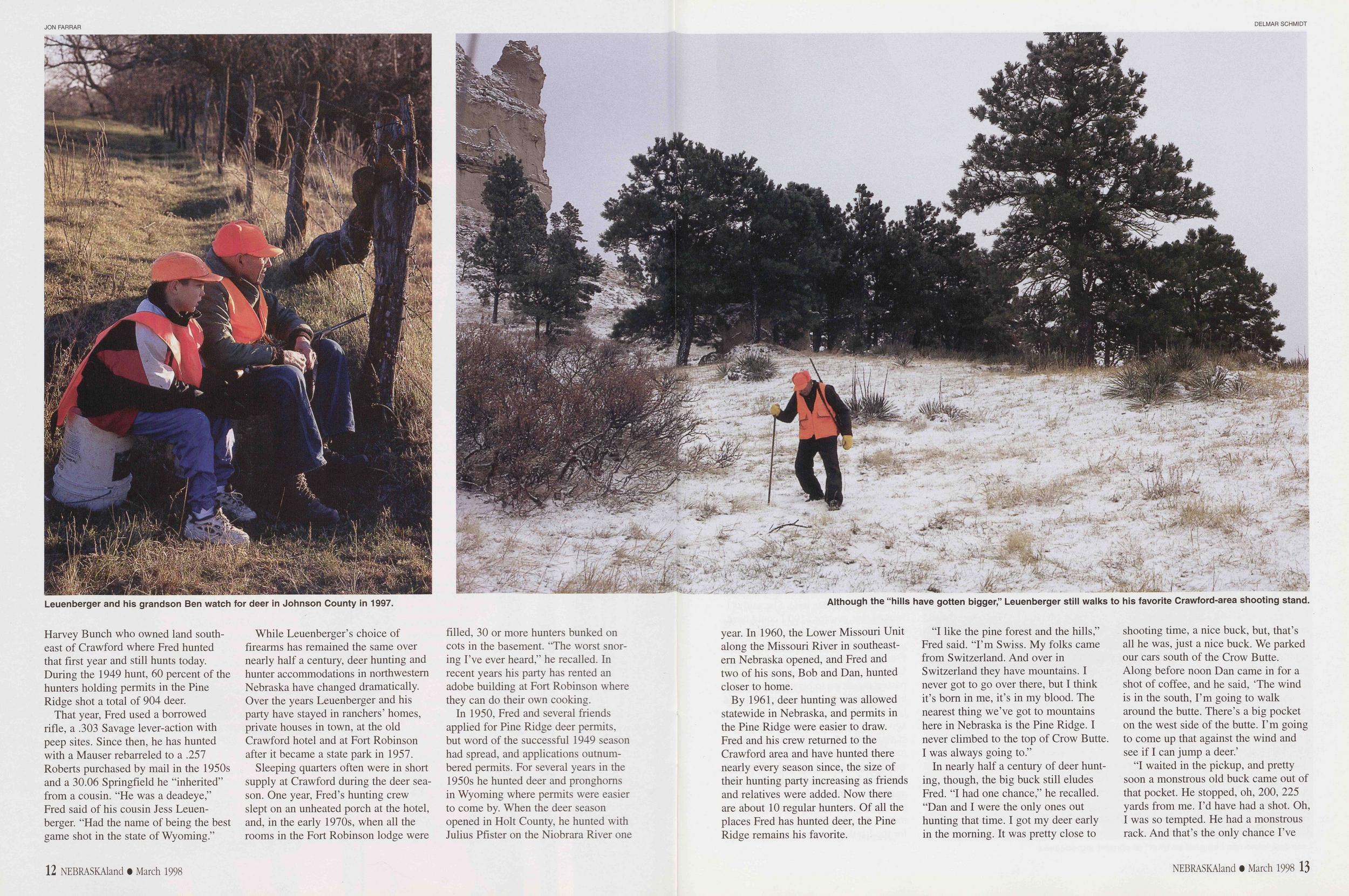
Leuenberger and his grandson Ben watch for deer in Johnson County in 1997.
JON FARRARAlthough the "hills have gotten bigger," Leuenberger still walks to his favorite Crawford-area shooting stand.
DELMAR SCHMIDTHarvey Bunch who owned land southeast of Crawford where Fred hunted that first year and still hunts today. During the 1949 hunt, 60 percent of the hunters holding permits in the Pine Ridge shot a total of 904 deer.
That year, Fred used a borrowed rifle, a .303 Savage lever-action with peep sites. Since then, he has hunted with a Mauser rebarreled to a .257 Roberts purchased by mail in the 1950s and a 30.06 Springfield he "inherited" from a cousin. "He was a deadeye," Fred said of his cousin Jess Leuenberger. "Had the name of being the best game shot in the state of Wyoming."
While Leuenberger's choice of firearms has remained the same over nearly half a century, deer hunting and hunter accommodations in northwestern Nebraska have changed dramatically. Over the years Leuenberger and his party have stayed in ranchers' homes, private houses in town, at the old Crawford hotel and at Fort Robinson after it became a state park in 1957.
Sleeping quarters often were in short supply at Crawford during the deer season. One year, Fred's hunting crew slept on an unheated porch at the hotel, and, in the early 1970s, when all the rooms in the Fort Robinson lodge were filled, 30 or more hunters bunked on cots in the basement. "The worst snoring I've ever heard," he recalled. In recent years his party has rented an adobe building at Fort Robinson where they can do their own cooking.
In 1950, Fred and several friends applied for Pine Ridge deer permits, but word of the successful 1949 season had spread, and applications outnumbered permits. For several years in the 1950s he hunted deer and pronghorns in Wyoming where permits were easier to come by. When the deer season opened in Holt County, he hunted with Julius Pfister on the Niobrara River one
12 NEBRASKAland • March 1998year. In 1960, the Lower Missouri Unit along the Missouri River in southeastern Nebraska opened, and Fred and two of his sons, Bob and Dan, hunted closer to home.
By 1961, deer hunting was allowed statewide in Nebraska, and permits in the Pine Ridge were easier to draw. Fred and his crew returned to the Crawford area and have hunted there nearly every season since, the size of their hunting party increasing as friends and relatives were added. Now there are about 10 regular hunters. Of all the places Fred has hunted deer, the Pine Ridge remains his favorite.
"I like the pine forest and the hills," Fred said. "I'm Swiss. My folks came from Switzerland. And over in Switzerland they have mountains. I never got to go over there, but I think it's born in me, it's in my blood. The nearest thing we've got to mountains here in Nebraska is the Pine Ridge. I never climbed to the top of Crow Butte. I was always going to."
In nearly half a century of deer hunting, though, the big buck still eludes Fred. "I had one chance," he recalled. "Dan and I were the only ones out hunting that time. I got my deer early in the morning. It was pretty close to shooting time, a nice buck, but, that's all he was, just a nice buck. We parked our cars south of the Crow Butte.
Along before noon Dan came in for a shot of coffee, and he said, The wind is in the south, I'm going to walk around the butte. There's a big pocket on the west side of the butte. I'm going to come up that against the wind and see if I can jump a deer.'
"I waited in the pickup, and pretty soon a monstrous old buck came out of that pocket. He stopped, oh, 200, 225 yards from me. I'd have had a shot. Oh, I was so tempted. He had a monstrous rack. And that's the only chance I've
NEBRASKAland • March 1998 13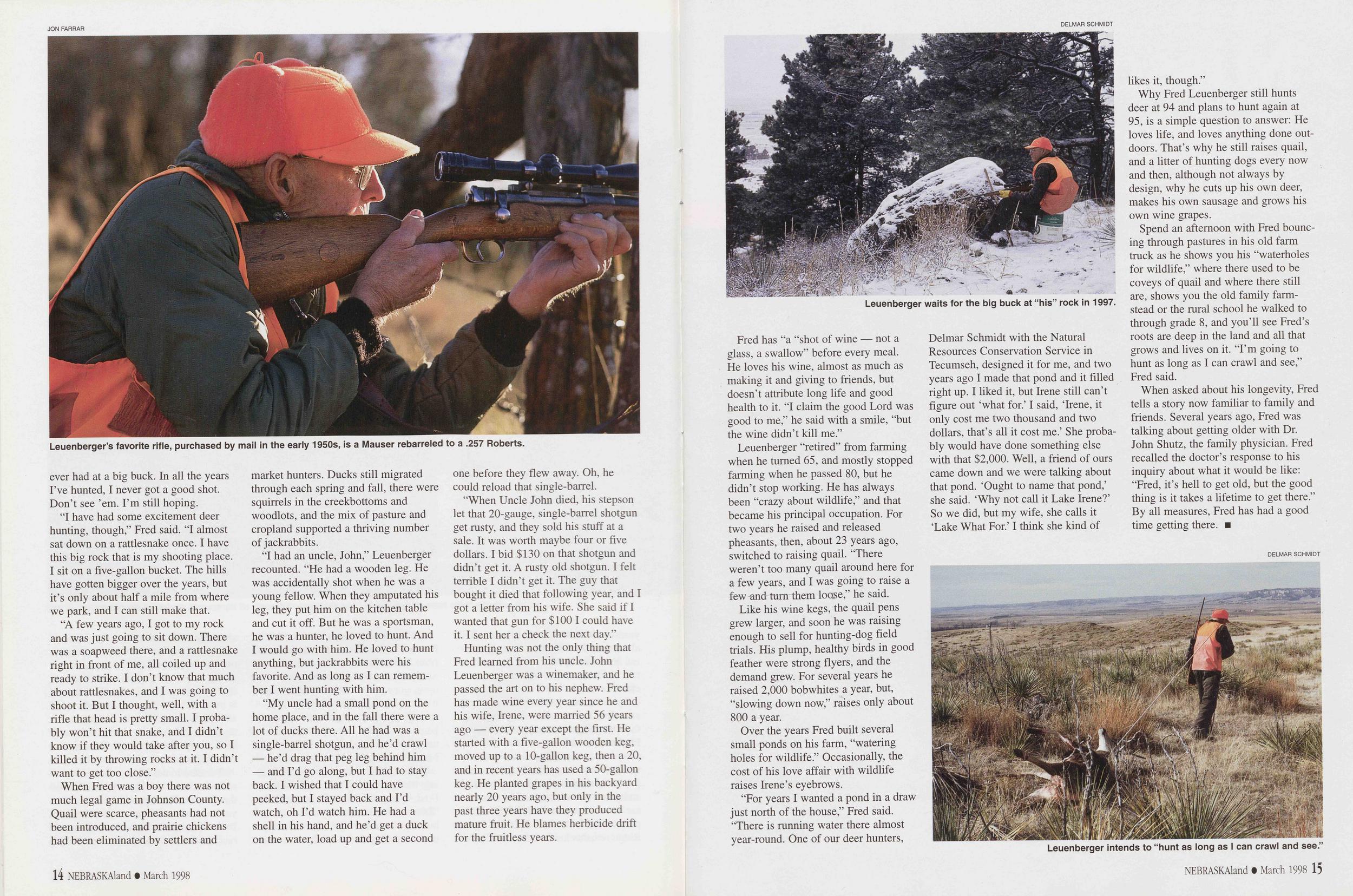
Leuenberger's favorite rifle, purchased by mail in the early 1950s, is a Mauser rebarreled to a .257 Roberts.
JON FARRARever had at a big buck. In all the years I've hunted, I never got a good shot. Don't see 'em. I'm still hoping.
"I have had some excitement deer hunting, though," Fred said. "I almost sat down on a rattlesnake once. I have this big rock that is my shooting place. I sit on a five-gallon bucket. The hills have gotten bigger over the years, but it's only about half a mile from where we park, and I can still make that.
"A few years ago, I got to my rock and was just going to sit down. There was a soap weed there, and a rattlesnake right in front of me, all coiled up and ready to strike. I don't know that much about rattlesnakes, and I was going to shoot it. But I thought, well, with a rifle that head is pretty small. I probably won't hit that snake, and I didn't know if they would take after you, so I killed it by throwing rocks at it. I didn't want to get too close."
When Fred was a boy there was not much legal game in Johnson County. Quail were scarce, pheasants had not been introduced, and prairie chickens had been eliminated by settlers and market hunters. Ducks still migrated through each spring and fall, there were squirrels in the creekbottoms and woodlots, and the mix of pasture and cropland supported a thriving number of jackrabbits.
"I had an uncle, John," Leuenberger recounted. "He had a wooden leg. He was accidentally shot when he was a young fellow. When they amputated his leg, they put him on the kitchen table and cut it off. But he was a sportsman, he was a hunter, he loved to hunt. And I would go with him. He loved to hunt anything, but jackrabbits were his favorite. And as long as I can remember I went hunting with him.
"My uncle had a small pond on the home place, and in the fall there were a lot of ducks there. All he had was a single-barrel shotgun, and he'd crawl he'd drag that peg leg behind him and I'd go along, but I had to stay back. I wished that I could have peeked, but I stayed back and I'd watch, oh I'd watch him. He had a shell in his hand, and he'd get a duck on the water, load up and get a second one before they flew away. Oh, he could reload that single-barrel.
"When Uncle John died, his stepson let that 20-gauge, single-barrel shotgun get rusty, and they sold his stuff at a sale. It was worth maybe four or five dollars. I bid $130 on that shotgun and didn't get it. A rusty old shotgun. I felt terrible I didn't get it. The guy that bought it died that following year, and I got a letter from his wife. She said if I wanted that gun for $100 I could have it. I sent her a check the next day."
Hunting was not the only thing that Fred learned from his uncle. John Leuenberger was a winemaker, and he passed the art on to his nephew. Fred has made wine every year since he and his wife, Irene, were married 56 years ago — every year except the first. He started with a five-gallon wooden keg, moved up to a 10-gallon keg, then a 20, and in recent years has used a 50-gallon keg. He planted grapes in his backyard nearly 20 years ago, but only in the past three years have they produced mature fruit. He blames herbicide drift for the fruitless years.
14 NEBRASKAland • March 1998Leuenberger waits for the big buck at "his" rock in 1997.
DELMAR SCHMIDTFred has "a "shot of wine — not a glass, a swallow" before every meal. He loves his wine, almost as much as making it and giving to friends, but doesn't attribute long life and good health to it. "I claim the good Lord was good to me," he said with a smile, "but the wine didn't kill me."
Leuenberger "retired" from farming when he turned 65, and mostly stopped farming when he passed 80, but he didn't stop working. He has always been "crazy about wildlife," and that became his principal occupation. For two years he raised and released pheasants, then, about 23 years ago, switched to raising quail. "There weren't too many quail around here for a few years, and I was going to raise a few und turn them loose," he said.
Like his wine kegs, the quail pens grew larger, and soon he was raising enough to sell for hunting-dog field trials. His plump, healthy birds in good feather were strong flyers, and the demand grew. For several years he raised 2,000 bobwhites a year, but, "slowing down now," raises only about 800 a year.
Over the years Fred built several small ponds on his farm, "watering holes for wildlife." Occasionally, the cost of his love affair with wildlife raises Irene's eyebrows.
"For years I wanted a pond in a draw just north of the house," Fred said. "There is running water there almost year-round. One of our deer hunters, Delmar Schmidt with the Natural Resources Conservation Service in Tecumseh, designed it for me, and two years ago I made that pond and it filled right up. I liked it, but Irene still can't figure out 'what for.' I said, 'Irene, it only cost me two thousand and two dollars, that's all it cost me.' She probably would have done something else with that $2,000. Well, a friend of ours came down and we were talking about that pond. 'Ought to name that pond,' she said. 'Why not call it Lake Irene?' So we did, but my wife, she calls it 'Lake What For.' I think she kind of likes it, though."
Why Fred Leuenberger still hunts deer at 94 and plans to hunt again at 95, is a simple question to answer: He loves life, and loves anything done outdoors. That's why he still raises quail, and a litter of hunting dogs every now and then, although not always by design, why he cuts up his own deer, makes his own sausage and grows his own wine grapes.
Spend an afternoon with Fred bouncing through pastures in his old farm truck as he shows you his "waterholes for wildlife," where there used to be coveys of quail and where there still are, shows you the old family farmstead or the rural school he walked to through grade 8, and you'll see Fred's roots are deep in the land and all that grows and lives on it. "I'm going to hunt as long as I can crawl and see," Fred said.
When asked about his longevity, Fred tells a story now familiar to family and friends. Several years ago, Fred was talking about getting older with Dr. John Shutz, the family physician. Fred recalled the doctor's response to his inquiry about what it would be like: "Fred, it's hell to get old, but the good thing is it takes a lifetime to get there." By all measures, Fred has had a good time getting there.
Leuenberger intends to "hunt as long as I can crawl and see."
DELMAR SCHMIDT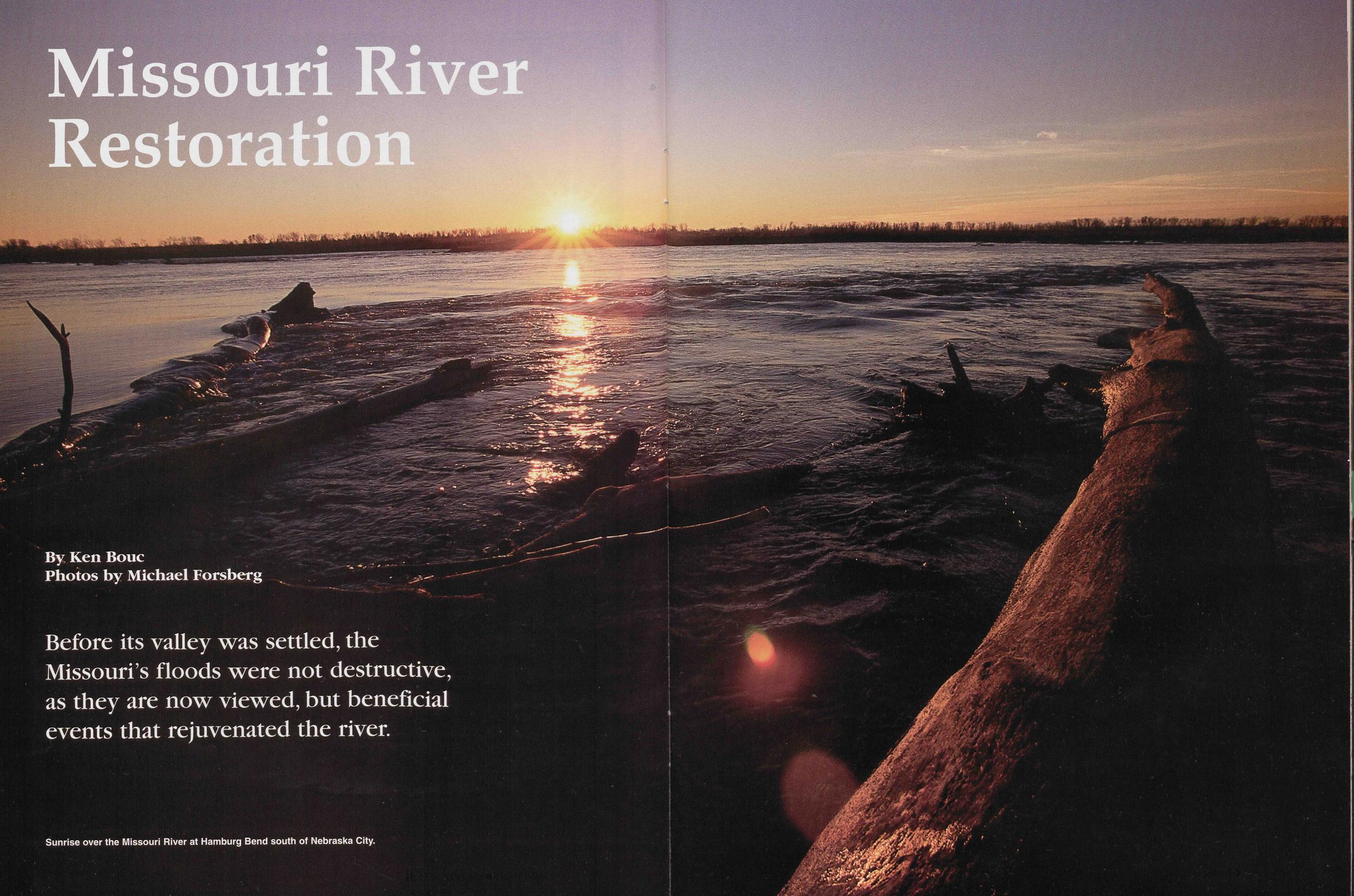
Missouri River Restoration
By Ken Bouc Photos by Michael Forsberg Before its valley was settled, the Missouri's floods were not destructive, as they are now viewed, but beneficial events that rejuvenated the river.Sunrise over the Missouri River at Hamburg Bend south of Nebraska City.
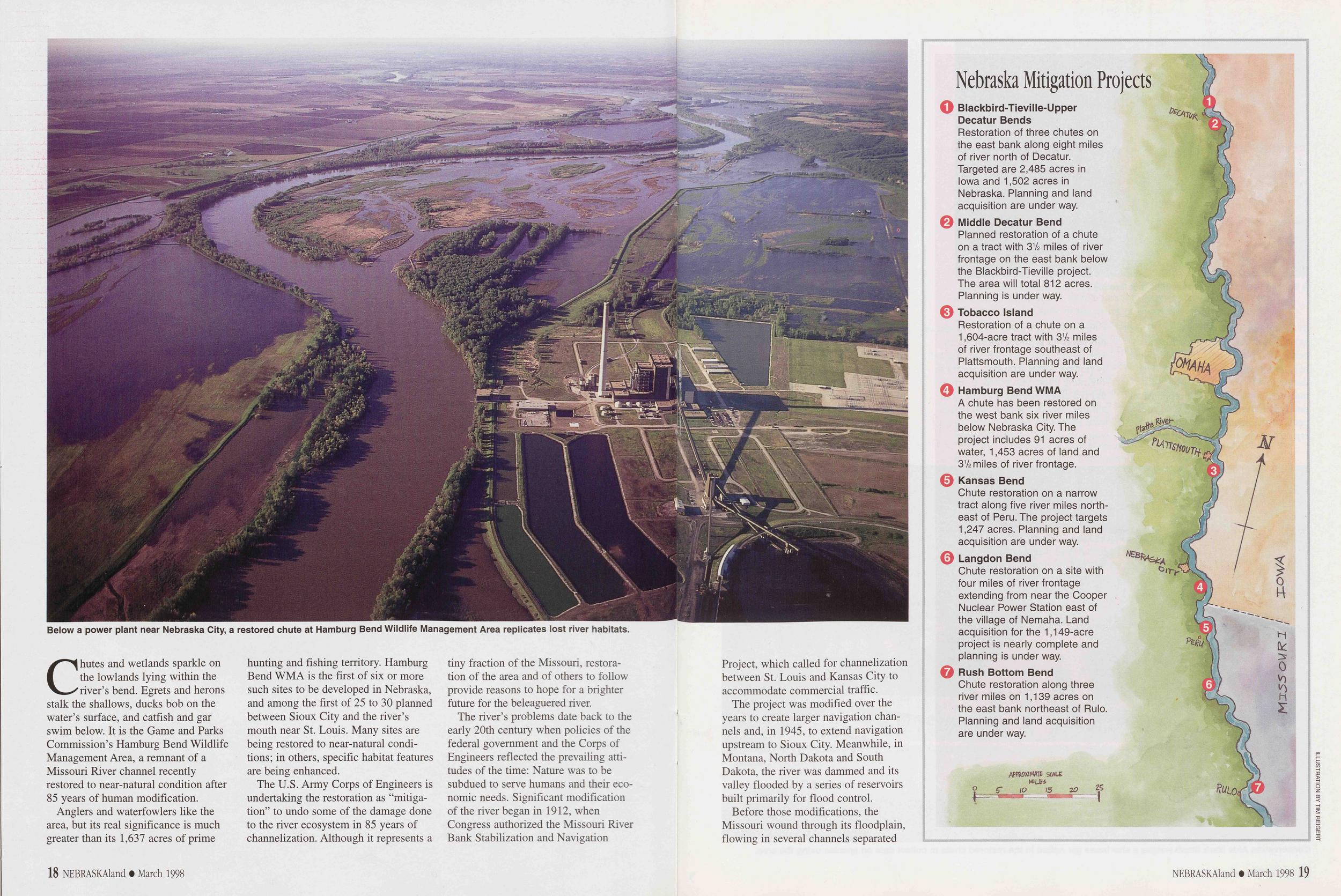
Below a power plant near Nebraska City, a restored chute at Hamburg Bend Wildlife Management Area replicates lost river habitats.
Chutes and wetlands sparkle on the lowlands lying within the river's bend. Egrets and herons stalk the shallows, ducks bob on the water's surface, and catfish and gar swim below. It is the Game and Parks Commission's Hamburg Bend Wildlife Management Area, a remnant of a Missouri River channel recently restored to near-natural condition after 85 years of human modification.
Anglers and waterfowlers like the area, but its real significance is much greater than its 1,637 acres of prime hunting and fishing territory. Hamburg Bend WMA is the first of six or more such sites to be developed in Nebraska, and among the first of 25 to 30 planned between Sioux City and the river's mouth near St. Louis. Many sites are being restored to near-natural conditions; in others, specific habitat features are being enhanced.
The U.S. Army Corps of Engineers is undertaking the restoration as "mitigation" to undo some of the damage done to the river ecosystem in 85 years of channelization. Although it represents a tiny fraction of the Missouri, restoration of the area and of others to follow provide reasons to hope for a brighter future for the beleaguered river.
The river's problems date back to the early 20th century when policies of the federal government and the Corps of Engineers reflected the prevailing attitudes of the time: Nature was to be subdued to serve humans and their economic needs. Significant modification of the river began in 1912, when Congress authorized the Missouri River Bank Stabilization and Navigation
18 NEBRASKAland • March 1998Project, which called for channelization between St. Louis and Kansas City to accommodate commercial traffic.
The project was modified over the years to create larger navigation channels and, in 1945, to extend navigation upstream to Sioux City. Meanwhile, in Montana, North Dakota and South Dakota, the river was dammed and its valley flooded by a series of reservoirs built primarily for flood control.
Before those modifications, the Missouri wound through its floodplain, flowing in several channels separated
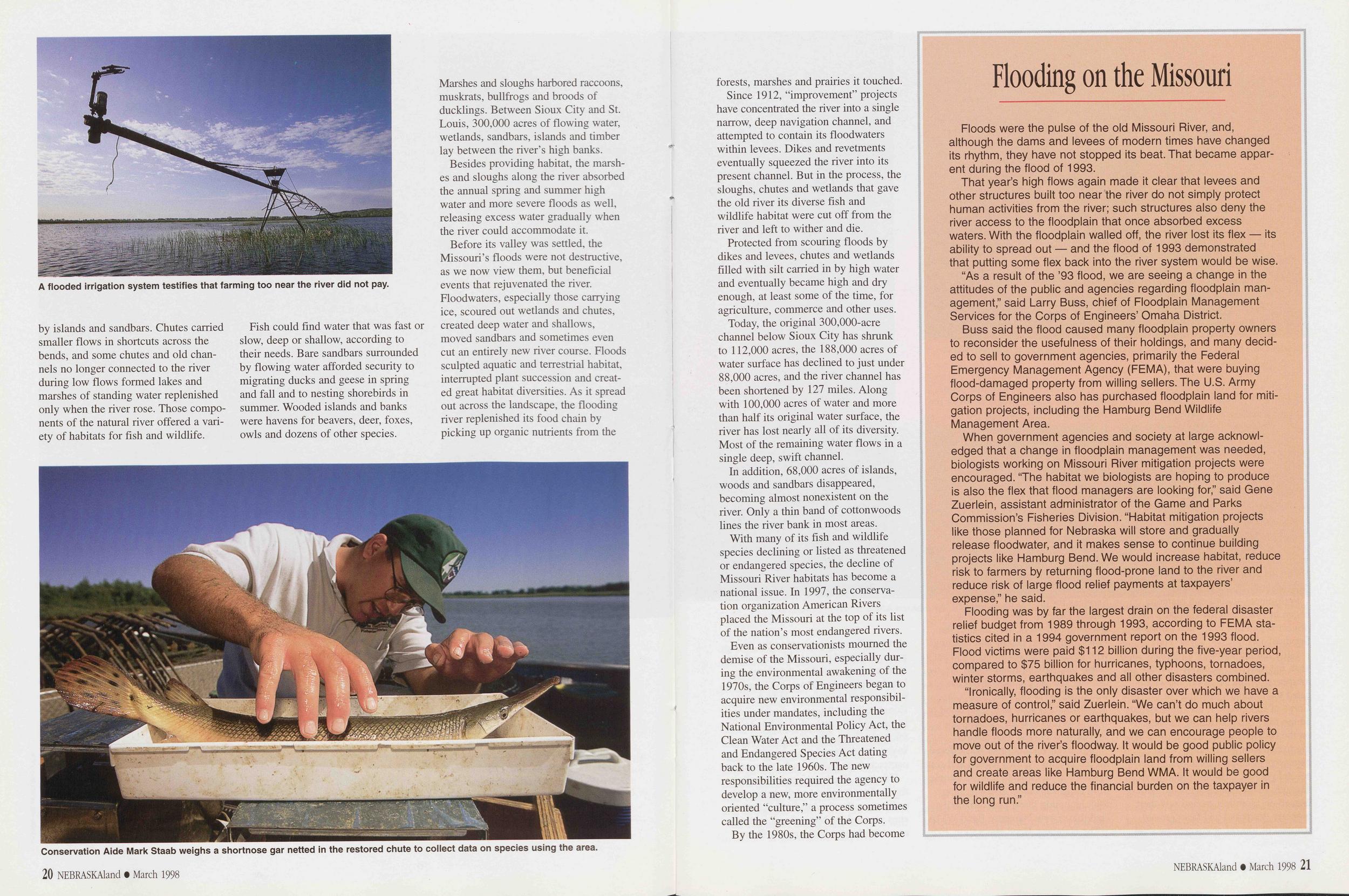
A flooded irrigation system testifies that farming too near the river did not pay.
by islands and sandbars. Chutes carried smaller flows in shortcuts across the bends, and some chutes and old channels no longer connected to the river during low flows formed lakes and marshes of standing water replenished only when the river rose. Those components of the natural river offered a variety of habitats for fish and wildlife.
Fish could find water that was fast or slow, deep or shallow, according to their needs. Bare sandbars surrounded by flowing water afforded security to migrating ducks and geese in spring and fall and to nesting shorebirds in summer. Wooded islands and banks were havens for beavers, deer, foxes, owls and dozens of other species. Marshes and sloughs harbored raccoons, muskrats, bullfrogs and broods of ducklings. Between Sioux City and St. Louis, 300,000 acres of flowing water, wetlands, sandbars, islands and timber lay between the river's high banks.
Besides providing habitat, the marshes and sloughs along the river absorbed the annual spring and summer high water and more severe floods as well, releasing excess water gradually when the river could accommodate it.
Before its valley was settled, the Missouri's floods were not destructive, as we now view them, but beneficial events that rejuvenated the river. Floodwaters, especially those carrying ice, scoured out wetlands and chutes, created deep water and shallows, moved sandbars and sometimes even cut an entirely new river course. Floods sculpted aquatic and terrestrial habitat, interrupted plant succession and created great habitat diversities. As it spread out across the landscape, the flooding river replenished its food chain by picking up organic nutrients from the
Conservation Aide Mark Staab weighs a shortnose gar netted in the restored chute to collect data on species using the area.
forests, marshes and prairies it touched.
Since 1912, 'improvement" projects have concentrated the river into a single narrow, deep navigation channel, and attempted to contain its floodwaters within levees. Dikes and revetments eventually squeezed the river into its present channel. But in the process, the sloughs, chutes and wetlands that gave the old river its diverse fish and wildlife habitat were cut off from the river and left to wither and die.
Protected from scouring floods by dikes and levees, chutes and wetlands filled with silt carried in by high water and eventually became high and dry enough, at least some of the time, for agriculture, commerce and other uses.
Today, the original 300,000-acre channel below Sioux City has shrunk to 112,000 acres, the 188,000 acres of water surface has declined to just under 88,000 acres, and the river channel has been shortened by 127 miles. Along with 100,000 acres of water and more than half its original water surface, the river has lost nearly all of its diversity. Most of the remaining water flows in a single deep, swift channel.
In addition, 68,000 acres of islands, woods and sandbars disappeared, becoming almost nonexistent on the river. Only a thin band of cottonwoods lines the river bank in most areas.
With many of its fish and wildlife species declining or listed as threatened or endangered species, the decline of Missouri River habitats has become a national issue. In 1997, the conservation organization American Rivers placed the Missouri at the top of its list of the nation's most endangered rivers.
Even as conservationists mourned the demise of the Missouri, especially during the environmental awakening of the 1970s, the Corps of Engineers began to acquire new environmental responsibilities under mandates, including the National Environmental Policy Act, the Clean Water Act and the Threatened and Endangered Species Act dating back to the late 1960s. The new responsibilities required the agency to develop a new, more environmentally oriented "culture," a process sometimes called the "greening" of the Corps.
By the 1980s, the Corps had become
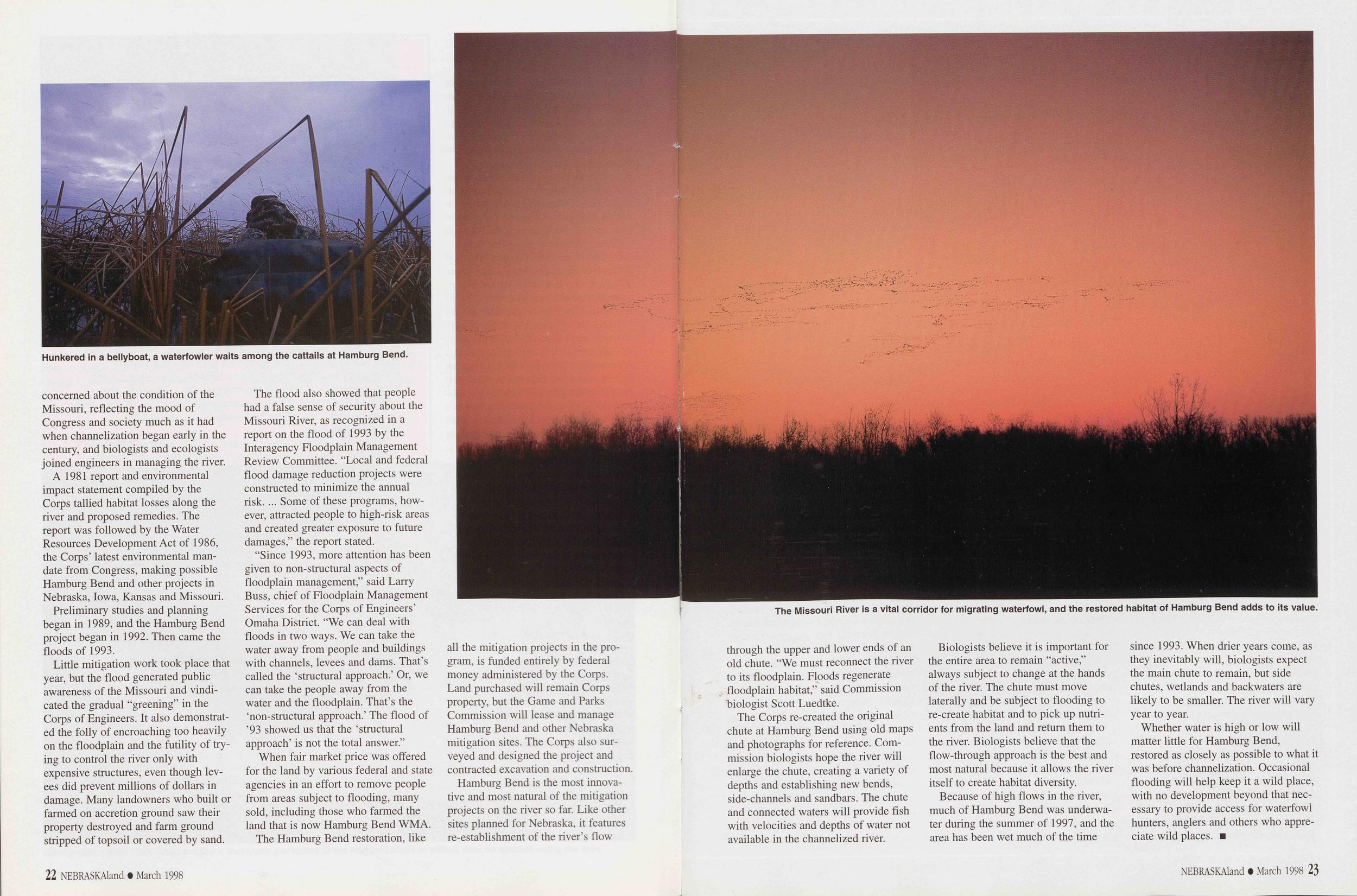
Hunkered in a bellyboat, a waterfowler waits among the cattails at Hamburg Bend.
concerned about the condition of the Missouri, reflecting the mood of Congress and society much as it had when channelization began early in the century, and biologists and ecologists joined engineers in managing the river.
A 1981 report and environmental impact statement compiled by the Corps tallied habitat losses along the river and proposed remedies. The report was followed by the Water Resources Development Act of 1986, the Corps' latest environmental mandate from Congress, making possible Hamburg Bend and other projects in Nebraska, Iowa, Kansas and Missouri.
Preliminary studies and planning began in 1989, and the Hamburg Bend project began in 1992. Then came the floods of 1993.
Little mitigation work took place that year, but the flood generated public awareness of the Missouri and vindicated the gradual "greening" in the Corps of Engineers. It also demonstrated the folly of encroaching too heavily on the floodplain and the futility of trying to control the river only with expensive structures, even though levees did prevent millions of dollars in damage. Many landowners who built or farmed on accretion ground saw their property destroyed and farm ground stripped of topsoil or covered by sand.
The flood also showed that people had a false sense of security about the Missouri River, as recognized in a report on the flood of 1993 by the Interagency Floodplain Management Review Committee. "Local and federal flood damage reduction projects were constructed to minimize the annual risk. ... Some of these programs, however, attracted people to high-risk areas and created greater exposure to future damages," the report stated.
"Since 1993, more attention has been given to non-structural aspects of floodplain management," said Larry Buss, chief of Floodplain Management Services for the Corps of Engineers' Omaha District. "We can deal with floods in two ways. We can take the water away from people and buildings with channels, levees and dams. That's called the 'structural approach.' Or, we can take the people away from the water and the floodplain. That's the 'non-structural approach.' The flood of '93 showed us that the 'structural approach' is not the total answer."
When fair market price was offered for the land by various federal and state agencies in an effort to remove people from areas subject to flooding, many sold, including those who farmed the land that is now Hamburg Bend WMA.
The Hamburg Bend restoration, like
The Missouri River is a vital corridor for migrating waterfowl, and the restored habitat of Hamburg Bend adds to its value.
all the mitigation projects in the program, is funded entirely by federal money administered by the Corps. Land purchased will remain Corps property, but the Game and Parks Commission will lease and manage Hamburg Bend and other Nebraska mitigation sites. The Corps also surveyed and designed the project and contracted excavation and construction.
Hamburg Bend is the most innovative and most natural of the mitigation projects on the river so far. Like other sites planned for Nebraska, it features re-establishment of the river's flow
22 NEBRASKAland • March 1998through the upper and lower ends of an old chute. "We must reconnect the river to its floodplain. Floods regenerate floodplain habitat," said Commission biologist Scott Luedtke.
The Corps re-created the original chute at Hamburg Bend using old maps and photographs for reference. Commission biologists hope the river will enlarge the chute, creating a variety of depths and establishing new bends, side-channels and sandbars. The chute and connected waters will provide fish with velocities and depths of water not available in the channelized river.
Biologists believe it is important for the entire area to remain "active," always subject to change at the hands of the river. The chute must move laterally and be subject to flooding to re-create habitat and to pick up nutrients from the land and return them to the river. Biologists believe that the flow-through approach is the best and most natural because it allows the river itself to create habitat diversity.
Because of high flows in the river, much of Hamburg Bend was underwater during the summer of 1997, and the area has been wet much of the time since 1993. When drier years come, as they inevitably will, biologists expect the main chute to remain, but side chutes, wetlands and backwaters are likely to be smaller. The river will vary year to year.
Whether water is high or low will matter little for Hamburg Bend, restored as closely as possible to what it was before channelization. Occasional flooding will help keep it a wild place, with no development beyond that necessary to provide access for waterfowl hunters, anglers and others who appreciate wild places.
NEBRASKAland • March 1998 23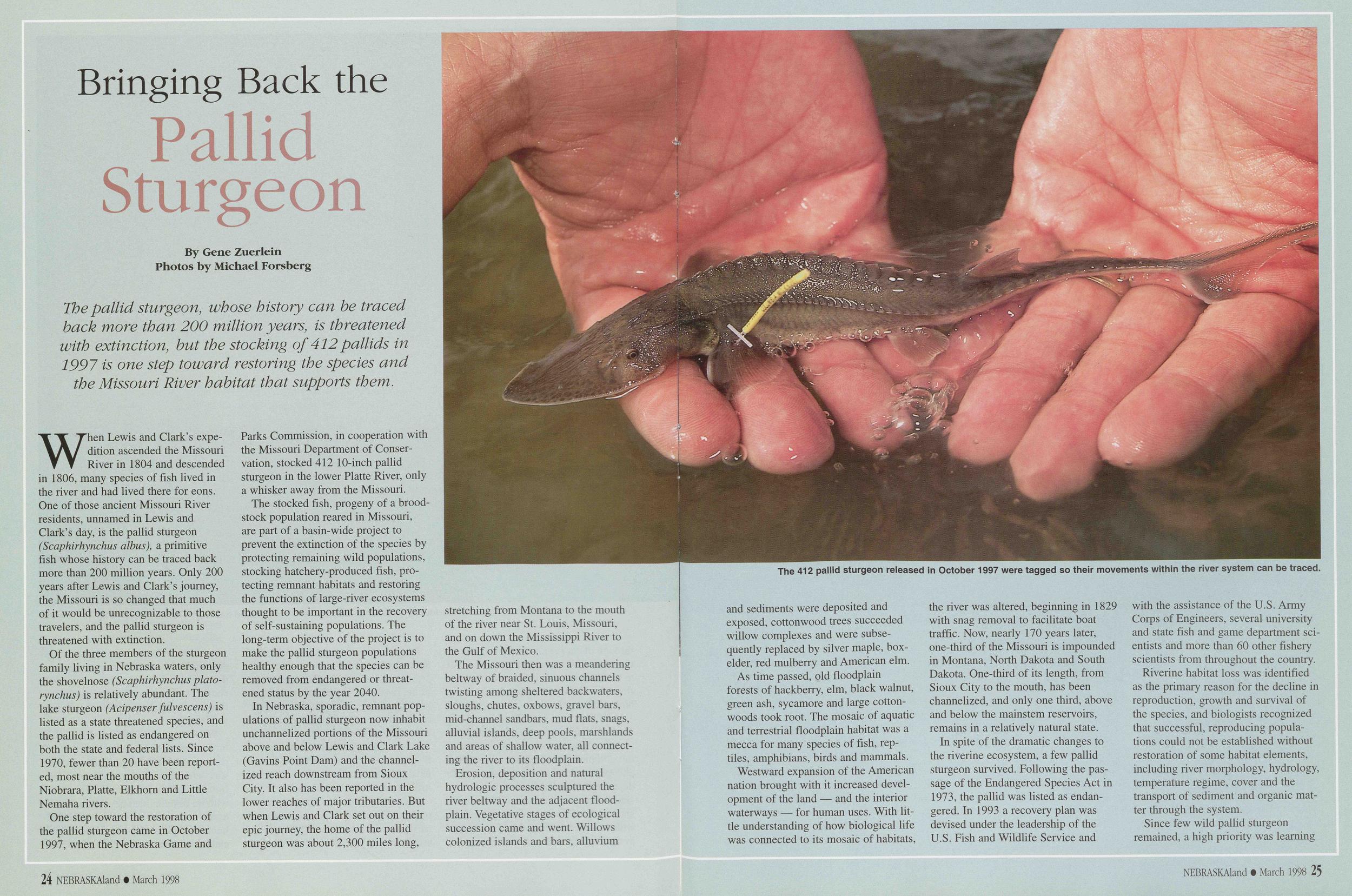
Bringing Back the Pallid Sturgeon
By Gene Zuerlein Photos by Michael Forsberg The pallid sturgeon, whose history can be traced back more than 200 million years, is threatened with extinction, but the stocking of 412 pallids in 1997 is one step toward restoring the species and the Missouri River habitat that supports them.When Lewis and Clark's expedition ascended the Missouri River in 1804 and descended in 1806, many species of fish lived in the river and had lived there for eons. One of those ancient Missouri River residents, unnamed in Lewis and Clark's day, is the pallid sturgeon (Scaphirhynchus albus), a primitive fish whose history can be traced back more than 200 million years. Only 200 years after Lewis and Clark's journey, the Missouri is so changed that much of it would be unrecognizable to those travelers, and the pallid sturgeon is threatened with extinction.
Of the three members of the sturgeon family living in Nebraska waters, only the shovelnose (Scaphirhynchus platorynchus) is relatively abundant. The lake sturgeon (Acipenser fulvescens) is listed as a state threatened species, and the pallid is listed as endangered on both the state and federal lists. Since 1970, fewer than 20 have been reported, most near the mouths of the Niobrara, Platte, Elkhorn and Little Nemaha rivers.
One step toward the restoration of the pallid sturgeon came in October 1997, when the Nebraska Game and Parks Commission, in cooperation with the Missouri Department of Conservation, stocked 412 10-inch pallid sturgeon in the lower Platte River, only a whisker away from the Missouri.
The stocked fish, progeny of a brood-stock population reared in Missouri, are part of a basin-wide project to prevent the extinction of the species by protecting remaining wild populations, stocking hatchery-produced fish, protecting remnant habitats and restoring the functions of large-river ecosystems thought to be important in the recovery of self-sustaining populations. The long-term objective of the project is to make the pallid sturgeon populations healthy enough that the species can be removed from endangered or threatened status by the year 2040.
In Nebraska, sporadic, remnant populations of pallid sturgeon now inhabit unchannelized portions of the Missouri above and below Lewis and Clark Lake (Gavins Point Dam) and the channelized reach downstream from Sioux City. It also has been reported in the lower reaches of major tributaries. But when Lewis and Clark set out on their epic journey, the home of the pallid sturgeon was about 2,300 miles long,
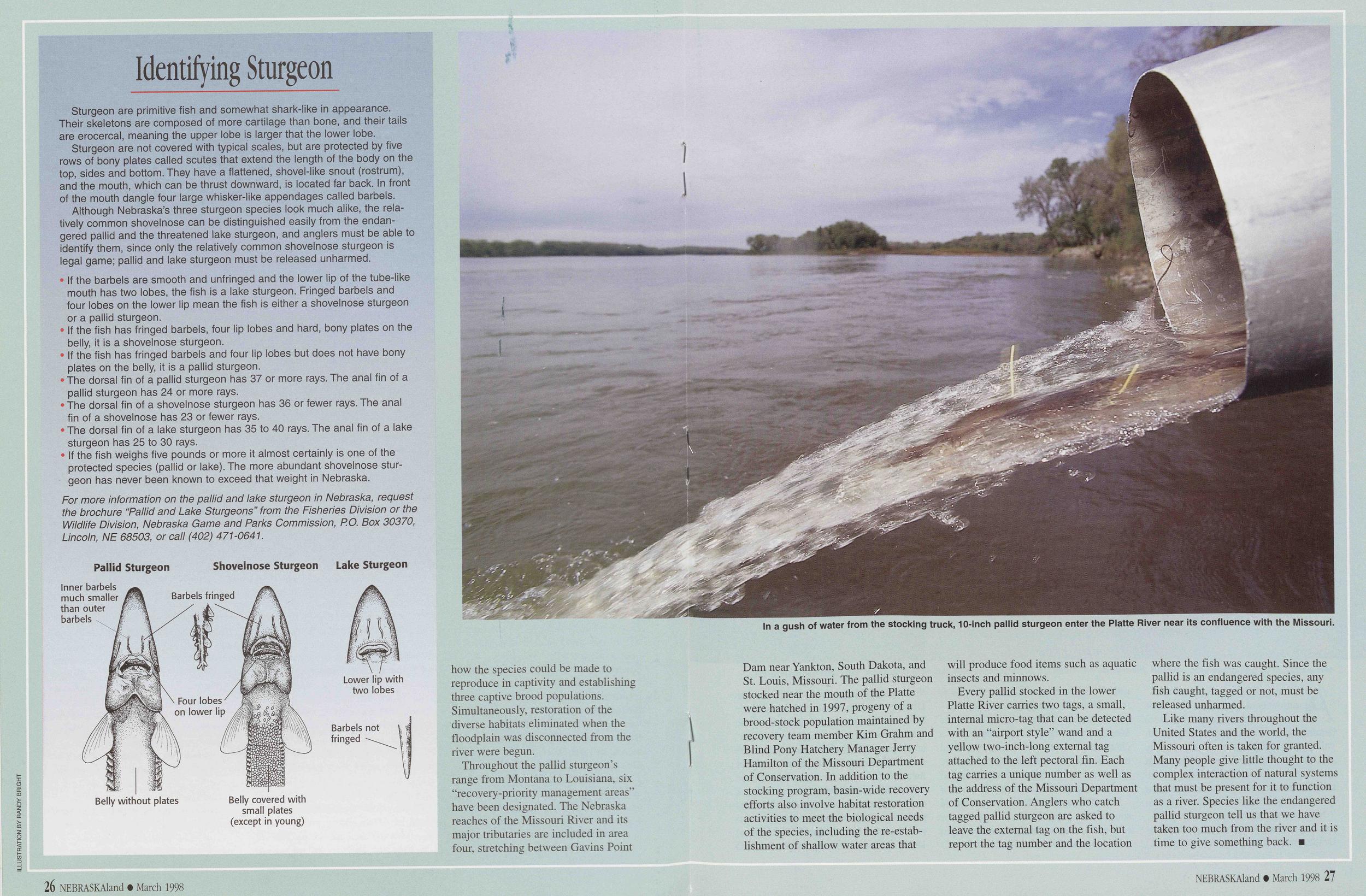
The 412 pallid sturgeon released in October 1997 were tagged so their movements within the river system can be traced.
stretching from Montana to the mouth of the river near St. Louis, Missouri, and on down the Mississippi River to the Gulf of Mexico.
The Missouri then was a meandering beltway of braided, sinuous channels twisting among sheltered backwaters, sloughs, chutes, oxbows, gravel bars, mid-channel sandbars, mud flats, snags, alluvial islands, deep pools, marshlands and areas of shallow water, all connecting the river to its floodplain.
Erosion, deposition and natrual hydrologic processes sculptured the river beltway and the adjacent flood-plain. Vegetative stages of ecological succession came and went. Willows colonized islands and bars, alluvium
24 NEBRASKAland • March 1998and sediments were deposited and exposed, cottonwood trees succeeded willow complexes and were subsequently replaced by silver maple, box-elder, red mulberry and American elm.
As time passed, old floodplain forests of hackberry, elm, black walnut, green ash, sycamore and large cotton-woods took root. The mosaic of aquatic and terrestrial floodplain habitat was a mecca for many species of fish, reptiles, amphibians, birds and mammals.
Westward expansion of the American nation brought with it increased development of the land — and the interior waterways — for human uses. With little understanding of how biological life was connected to its mosaic of habitats, the river was altered, beginning in 1829 with snag removal to facilitate boat traffic. Now, nearly 170 years later, one-third of the Missouri is impounded in Montana, North Dakota and South Dakota. One-third of its length, from Sioux City to the mouth, has been channelized, and only one third, above and below the mainstem reservoirs, remains in a relatively natural state.
In spite of the dramatic changes to the riverine ecosystem, a few pallid sturgeon survived. Following the passage of the Endangered Species Act in 1973, the pallid was listed as endangered. In 1993 a recovery plan was devised under the leadership of the U.S. Fish and Wildlife Service and with the assistance of the U.S. Army Corps of Engineers, several university and state fish and game department scientists and more than 60 other fishery scientists from throughout the country.
Riverine habitat loss was identified as the primary reason for the decline in reproduction, growth and survival of the species, and biologists recognized that successful, reproducing populations could not be established without restoration of some habitat elements, including river morphology, hydrology, temperature regime, cover and the transport of sediment and organic matter through the system.
Since few wild pallid sturgeon remained, a high priority was learning
In a gush of water from the stocking truck, 10-inch pallid sturgeon enter the Platte River near its confluence with the Missouri.
how the species could be made to reproduce in captivity and establishing three captive brood populations. Simultaneously, restoration of the diverse habitats eliminated when the floodplain was disconnected from the river were begun.
Throughout the pallid sturgeon's range from Montana to Louisiana, six "recovery-priority management areas" have been designated. The Nebraska reaches of the Missouri River and its major tributaries are included in area four, stretching between Gavins Point
26 NEBRASKAland • March 1998Dam near Yankton, South Dakota, and St. Louis, Missouri. The pallid sturgeon stocked near the mouth of the Platte were hatched in 1997, progeny of a brood-stock population maintained by recovery team member Kim Grahm and Blind Pony Hatchery Manager Jerry Hamilton of the Missouri Department of Conservation. In addition to the stocking program, basin-wide recovery efforts also involve habitat restoration activities to meet the biological needs of the species, including the re-establishment of shallow water areas that will produce food items such as aquatic insects and minnows.
Every pallid stocked in the lower Platte River carries two tags, a small, internal micro-tag that can be detected with an "airport style" wand and a yellow two-inch-long external tag attached to the left pectoral fin. Each tag carries a unique number as well as the address of the Missouri Department of Conservation. Anglers who catch tagged pallid sturgeon are asked to leave the external tag on the fish, but report the tag number and the location where the fish was caught. Since the pallid is an endangered species, any fish caught, tagged or not, must be released unharmed.
Like many rivers throughout the United States and the world, the Missouri often is taken for granted. Many people give little thought to the complex interaction of natural systems that must be present for it to function as a river. Species like the endangered pallid sturgeon tell us that we have taken too much from the river and it is time to give something back.
NEBRASKAland • March 1998 27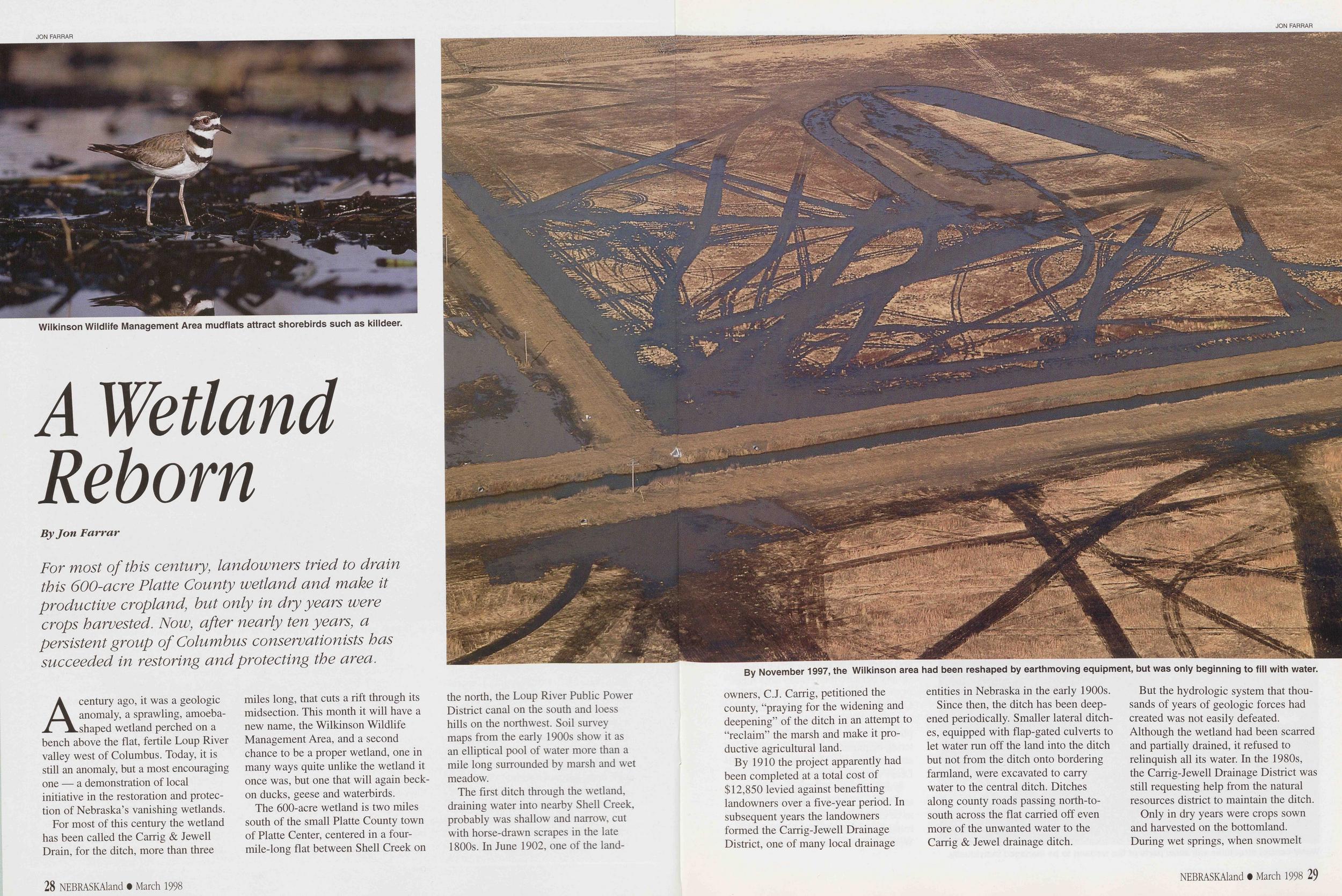
Wetland Reborn
By Jon Farrar JON FARRARWilkinson Wildlife Management Area mudflats attract shorebirds such as killdeer.
By November 1997, the Wilkinson area had been reshaped by earthmoving equipment, but was only beginning to fill with water.
JON FARRARA century ago, it was a geologic anomaly, a sprawling, amoeba-shaped wetland perched on a bench above the flat, fertile Loup River valley west of Columbus. Today, it is still an anomaly, but a most encouraging one — a demonstration of local initiative in the restoration and protection of Nebraska's vanishing wetlands.
For most of this century the wetland has been called the Carrig & Jewell Drain, for the ditch, more than three miles long, that cuts a rift through its midsection. This month it will have a new name, the Wilkinson Wildlife Management Area, and a second chance to be a proper wetland, one in many ways quite unlike the wetland it once was, but one that will again beckon ducks, geese and waterbirds.
The 600-acre wetland is two miles south of the small Platte County town of Platte Center, centered in a four- mile-long flat between Shell Creek on the north, the Loup River Public Power District canal on the south and loess hills on the northwest. Soil survey maps from the early 1900s show it as an elliptical pool of water more than a mile long surrounded by marsh and wet meadow.
The first ditch through the wetland, draining water into nearby Shell Creek, probably was shallow and narrow, cut with horse-drawn scrapes in the late 1800s. In June 1902, one of the land-
28 NEBRASKAland • March 1998owners, C.J. Carrig, petitioned the county, "praying for the widening and deepening" of the ditch in an attempt to "reclaim" the marsh and make it productive agricultural land.
By 1910 the project apparently had been completed at a total cost of $12,850 levied against benefitting landowners over a five-year period. In subsequent years the landowners formed the Carrig-Jewell Drainage District, one of many local drainage entities in Nebraska in the early 1900s.
Since then, the ditch has been deepened periodically. Smaller lateral ditches, equipped with flap-gated culverts to let water run off the land into the ditch but not from the ditch onto bordering farmland, were excavated to carry water to the central ditch. Ditches along county roads passing north-to- south across the flat carried off even more of the unwanted water to the Carrig & Jewel drainage ditch.
But the hydrologic system that thousands of years of geologic forces had created was not easily defeated. Although the wetland had been scarred and partially drained, it refused to relinquish all its water. In the 1980s, the Carrig-Jewell Drainage District was still requesting help from the natural resources district to maintain the ditch.
Only in dry years were crops sown and harvested on the bottomland. During wet springs, when snowmelt
NEBRASKAland • March 1998 29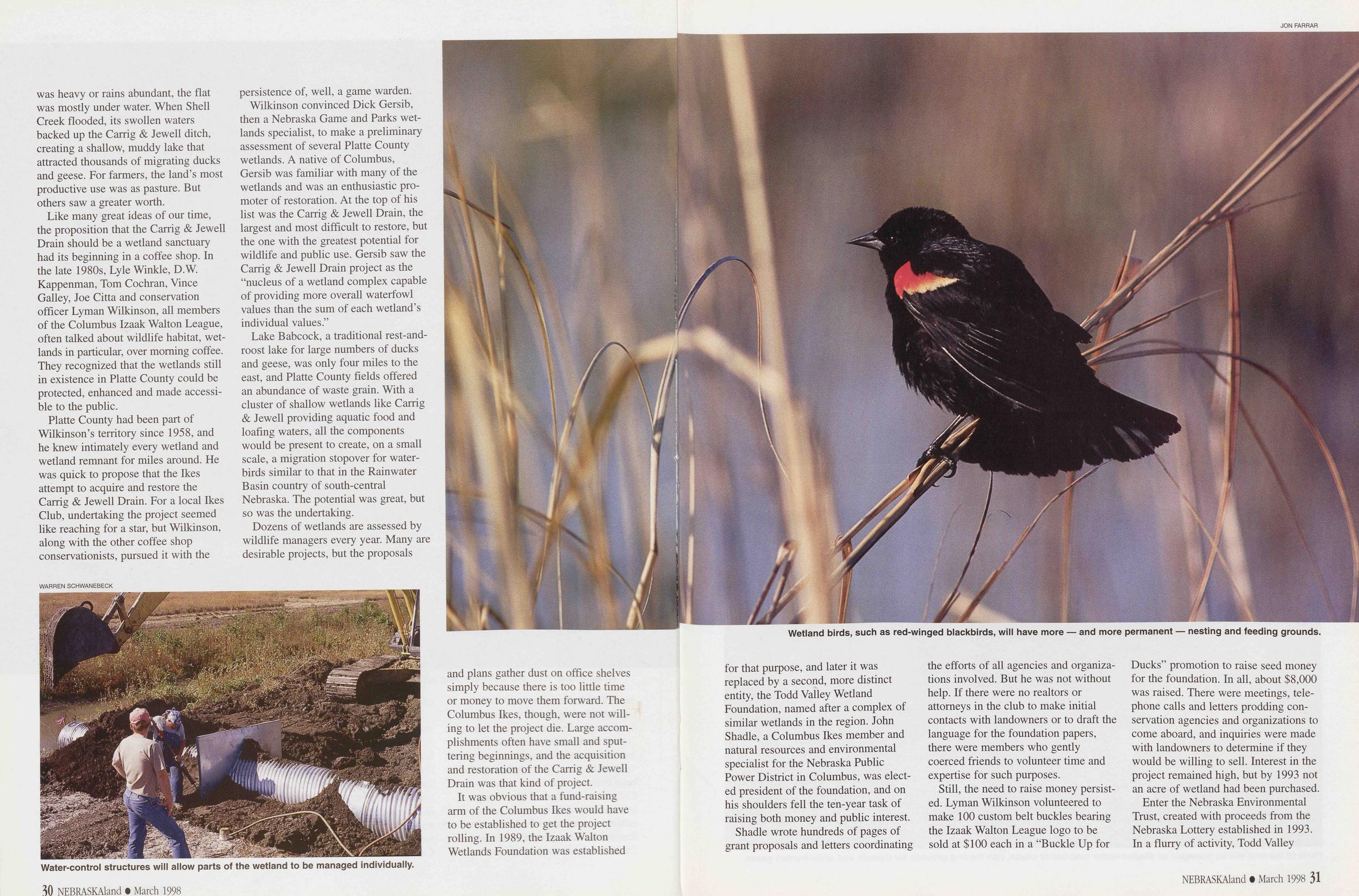
was heavy or rains abundant, the flat was mostly under water. When Shell Creek flooded, its swollen waters backed up the Carrig & Jewell ditch, creating a shallow, muddy lake that attracted thousands of migrating ducks and geese. For farmers, the land's most productive use was as pasture. But others saw a greater worth.
Like many great ideas of our time, the proposition that the Carrig & Jewell Drain should be a wetland sanctuary had its beginning in a coffee shop. In the late 1980s, Lyle Winkle, D.W. Kappenman, Tom Cochran, Vince Galley, Joe Citta and conservation officer Lyman Wilkinson, all members of the Columbus Izaak Walton League, often talked about wildlife habitat, wetlands in particular, over morning coffee. They recognized that the wetlands still in existence in Platte County could be protected, enhanced and made accessible to the public.
Platte County had been part of Wilkinson's territory since 1958, and he knew intimately every wetland and wetland remnant for miles around. He was quick to propose that the Ikes attempt to acquire and restore the Carrig & Jewell Drain. For a local Ikes Club, undertaking the project seemed like reaching for a star, but Wilkinson, along with the other coffee shop conservationists, pursued it with the persistence of, well, a game warden.
Wilkinson convinced Dick Gersib, then a Nebraska Game and Parks wetlands specialist, to make a preliminary assessment of several Platte County wetlands. A native of Columbus, Gersib was familiar with many of the wetlands and was an enthusiastic promoter of restoration. At the top of his list was the Carrig & Jewell Drain, the largest and most difficult to restore, but the one with the greatest potential for wildlife and public use. Gersib saw the Carrig & Jewell Drain project as the "nucleus of a wetland complex capable of providing more overall waterfowl values than the sum of each wetland's individual values."
Lake Babcock, a traditional rest-and- roost lake for large numbers of ducks and geese, was only four miles to the east, and Platte County fields offered an abundance of waste grain. With a cluster of shallow wetlands like Carrig & Jewell providing aquatic food and loafing waters, all the components would be present to create, on a small scale, a migration stopover for waterbirds s imilar to that in the Rainwater Basin country of south-central Nebraska. The potential was great, but so was the undertaking.
Dozens of wetlands are assessed by wildlife managers every year. Many are desirable projects, but the proposals
Water-control structures will allow parts of the wetland to be managed individually.
WARREN SCHWANEBECKand plans gather dust on office shelves simply because there is too little time or money to move them forward. The Columbus Ikes, though, were not willing to let the project die. Large accomplishments often have small and sputtering beginnings, and the acquisition and restoration of the Carrig & Jewell Drain was that kind of project.
It was obvious that a fund-raising arm of the Columbus Ikes would have to be established to get the project rolling. In 1989, the Izaak Walton Wetlands Foundation was established
30 NEBRASKAland • March 1998Wetland birds, such as red-winged blackbirds, will have more — and more permanent — nesting and feeding grounds.
JON FARRARfor that purpose, and later it was replaced by a second, more distinct entity, the Todd Valley Wetland Foundation, named after a complex of similar wetlands in the region. John Shadle, a Columbus Ikes member and natural resources and environmental specialist for the Nebraska Public Power District in Columbus, was elected president of the foundation, and on his shoulders fell the ten-year task of raising both money and public interest.
Shadle wrote hundreds of pages of grant proposals and letters coordinating the efforts of all agencies and organizations involved. But he was not without help. If there were no realtors or attorneys in the club to make initial contacts with landowners or to draft the language for the foundation papers, there were members who gently coerced friends to volunteer time and expertise for such purposes.
Still, the need to raise money persisted. Lyman Wilkinson volunteered to make 100 custom belt buckles bearing the Izaak Walton League logo to be sold at $100 each in a "Buckle Up for Ducks" promotion to raise seed money for the foundation. In all, about $8,000 was raised. There were meetings, telephone calls and letters prodding conservation agencies and organizations to come aboard, and inquiries were made with landowners to determine if they would be willing to sell. Interest in the project remained high, but by 1993 not an acre of wetland had been purchased.
Enter the Nebraska Environmental Trust, created with proceeds from the Nebraska Lottery established in 1993. In a flurry of activity, Todd Valley
NEBRASKAland • March 1998 31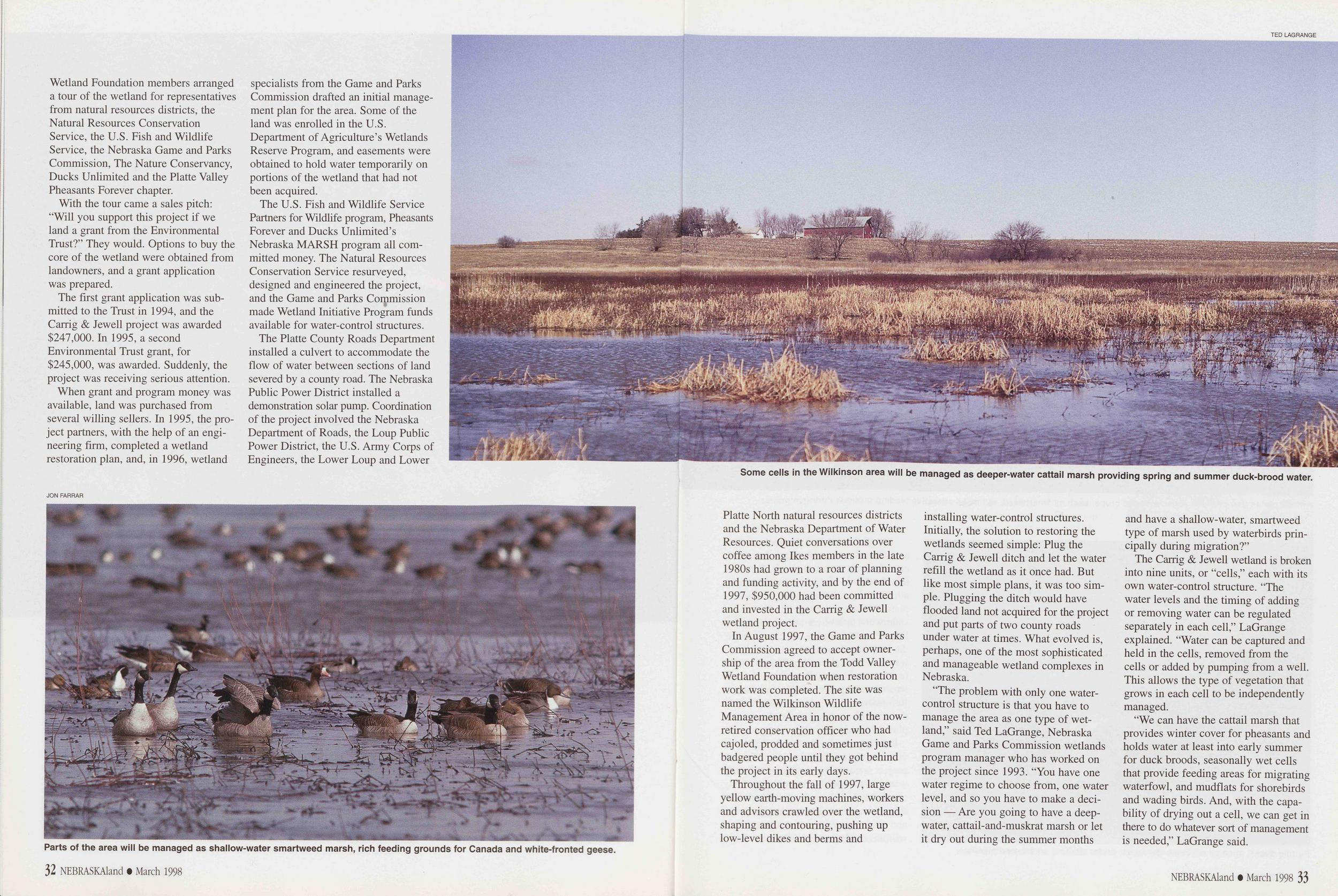
Wetland Foundation members arranged a tour of the wetland for representatives from natural resources districts, the Natural Resources Conservation Service, the U.S. Fish and Wildlife Service, the Nebraska Game and Parks Commission, The Nature Conservancy, Ducks Unlimited and the Platte Valley Pheasants Forever chapter.
With the tour came a sales pitch: "Will you support this project if we land a grant from the Environmental Trust?" They would. Options to buy the core of the wetland were obtained from landowners, and a grant application was prepared.
The first grant application was submitted to the Trust in 1994, and the Carrig & Jewell project was awarded $247,000. In 1995, a second Environmental Trust grant, for $245,000, was awarded. Suddenly, the project was receiving serious attention.
When grant and program money was available, land was purchased from several willing sellers. In 1995, the project partners, with the help of an engineering firm, completed a wetland restoration plan, and, in 1996, wetland specialists from the Game and Parks Commission drafted an initial management plan for the area. Some of the land was enrolled in the U.S. Department of Agriculture's Wetlands Reserve Program, and easements were obtained to hold water temporarily on portions of the wetland that had not been acquired.
The U.S. Fish and Wildlife Service Partners for Wildlife program, Pheasants Forever and Ducks Unlimited's Nebraska MARSH program all committed money. The Natural Resources Conservation Service resurveyed, designed and engineered the project, and the Game and Parks Commission made Wetland Initiative Program funds available for water-control structures.
The Platte County Roads Department installed a culvert to accommodate the flow of water between sections of land severed by a county road. The Nebraska Public Power District installed a demonstration solar pump. Coordination of the project involved the Nebraska Department of Roads, the Loup Public Power District, the U.S. Army Corps of Engineers, the Lower Loup and Lower
Parts of the area will be managed as shallow-water smartweed marsh, rich feeding grounds for Canada and white-fronted geese.
JON FARRARSome cells in the Wilkinson area will be managed as deeper-water cattail marsh providing spring and summer duck-brood water.
TED LAGRANGEPlatte North natural resources districts and the Nebraska Department of Water Resources. Quiet conversations over coffee among Ikes members in the late 1980s had grown to a roar of planning and funding activity, and by the end of 1997, $950,000 had been committed and invested in the Carrig & Jewell wetland project.
In August 1997, the Game and Parks Commission agreed to accept ownership of the area from the Todd Valley Wetland Foundation when restoration work was completed. The site was named the Wilkinson Wildlife Management Area in honor of the now- retired conservation officer who had cajoled, prodded and sometimes just badgered people until they got behind the project in its early days.
Throughout the fall of 1997, large yellow earth-moving machines, workers and advisors crawled over the wetland, shaping and contouring, pushing up low-level dikes and berms and installing water-control structures. Initially, the solution to restoring the wetlands seemed simple: Plug the Carrig & Jewell ditch and let the water refill the wetland as it once had. But like most simple plans, it was too simple. Plugging the ditch would have flooded land not acquired for the project and put parts of two county roads under water at times. What evolved is, perhaps, one of the most sophisticated and manageable wetland complexes in Nebraska.
"The problem with only one water-control structure is that you have to manage the area as one type of wetland," said Ted LaGrange, Nebraska Game and Parks Commission wetlands program manager who has worked on the project since 1993. "You have one water regime to choose from, one water level, and so you have to make a decision — Are you going to have a deep-water, cattail-and-muskrat marsh or let it dry out during the summer months and have a shallow-water, smartweed type of marsh used by waterbirds principally during migration?
The Carrig & Jewell wetland is broken into nine units, or "cells," each with its own water-control structure. "The water levels and the timing of adding or removing water can be regulated separately in each cell," LaGrange explained. "Water can be captured and held in the cells, removed from the cells or added by pumping from a well. This allows the type of vegetation that grows in each cell to be independently managed.
"We can have the cattail marsh that provides winter cover for pheasants and holds water at least into early summer for duck broods, seasonally wet cells that provide feeding areas for migrating waterfowl, and mudflats for shorebirds and wading birds. And, with the capability of drying out a cell, we can get in there to do whatever sort of management is needed," LaGrange said.
NEBRASKAland • March 1998 33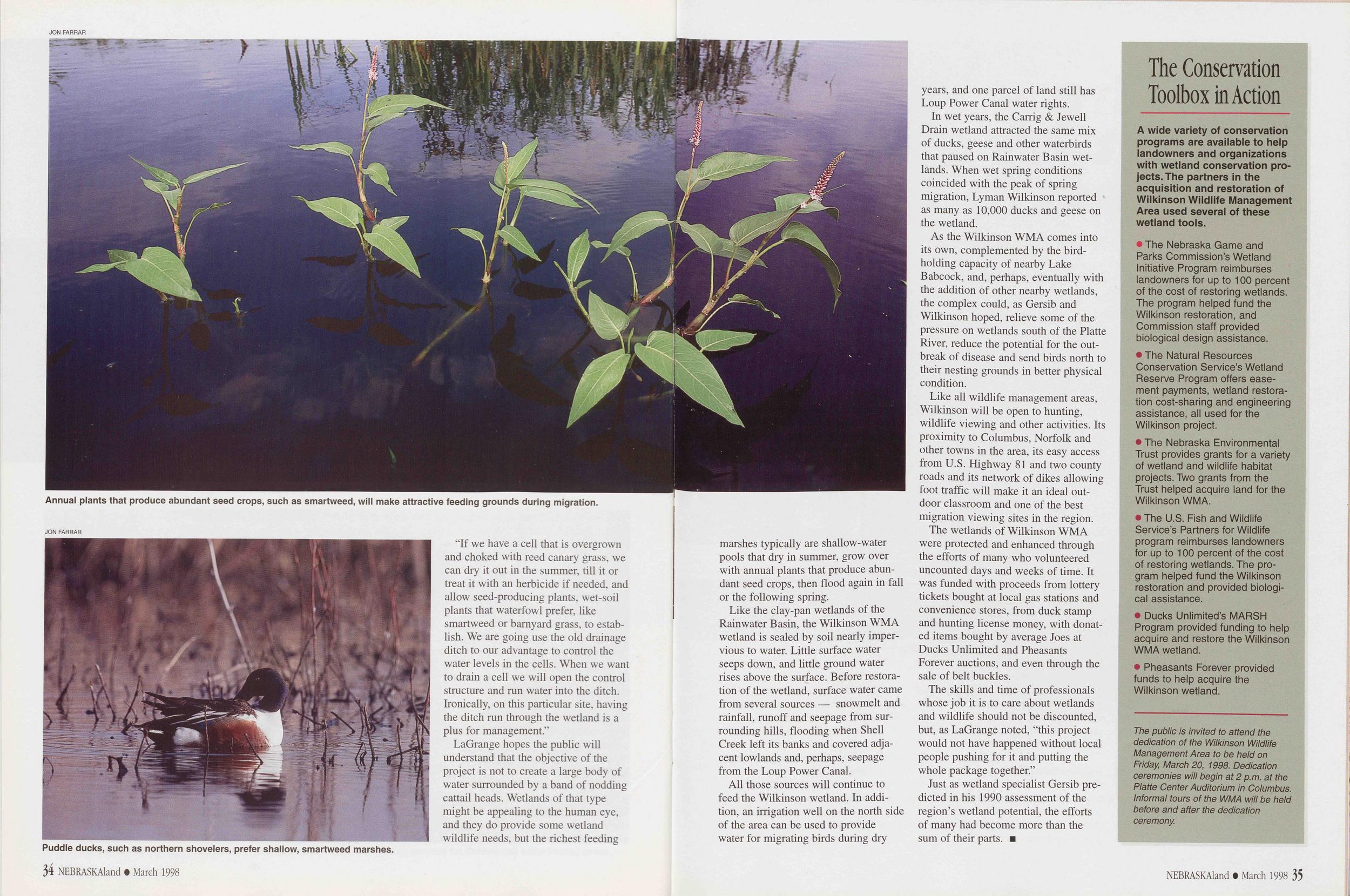
Annual plants that produce abundant seed crops, such as smartweed, will make attractive feeding grounds during migration.
JON FARRARPuddle ducks, such as northern shovelers, prefer shallow, smartweed marshes.
JON FARRAR"If we have a cell that is overgrown and choked with reed canary grass, we can dry it out in the summer, till it or treat it with an herbicide if needed, and allow seed-producing plants, wet-soil plants that waterfowl prefer, like smartweed or barnyard grass, to establish. We are going use the old drainage ditch to our advantage to control the water levels in the cells. When we want to drain a cell we will open the control structure and run water into the ditch. Ironically, on this particular site, having the ditch run through the wetland is a plus for management."
LaGrange hopes the public will understand that the objective of the project is not to create a large body of water surrounded by a band of nodding cattail heads. Wetlands of that type might be appealing to the human eye, and they do provide some wetland wildlife needs, but the richest feeding
34 NEBRASKAland • March 1998marshes typically are shallow-water pools that dry in summer, grow over with annual plants that produce abundant seed crops, then flood again in fall or the following spring.
Like the clay-pan wetlands of the Rainwater Basin, the Wilkinson WMA wetland is sealed by soil nearly impervious to water. Little surface water seeps down, and little ground water rises above the surface. Before restoration of the wetland, surface water came from several sources — snowmelt and rainfall, runoff and seepage from surrounding hills, flooding when Shell Creek left its banks and covered adjacent lowlands and, perhaps, seepage from the Loup Power Canal.
All those sources will continue to feed the Wilkinson wetland. In addition, an irrigation well on the north side of the area can be used to provide water for migrating birds during dry years, and one parcel of land still has Loup Power Canal water rights.
In wet years, the Carrig & Jewell Drain wetland attracted the same mix of ducks, geese and other waterbirds that paused on Rainwater Basin wetlands. When wet spring conditions coincided with the peak of spring migration, Lyman Wilkinson reported as many as 10,000 ducks and geese on the wetland.
As the Wilkinson WMA comes into its own, complemented by the bird-holding capacity of nearby Lake Babcock, and, perhaps, eventually with the addition of other nearby wetlands, the complex could, as Gersib and Wilkinson hoped, relieve some of the pressure on wetlands south of the Platte River, reduce the potential for the outbreak of disease and send birds north to their nesting grounds in better physical condition.
Like all wildlife management areas, Wilkinson will be open to hunting, wildlife viewing and other activities. Its proximity to Columbus, Norfolk and other towns in the area, its easy access from U.S. Highway 81 and two county roads and its network of dikes allowing foot traffic will make it an ideal outdoor classroom and one of the best migration viewing sites in the region.
The wetlands of Wilkinson WMA were protected and enhanced through the efforts of many who volunteered uncounted days and weeks of time. It was funded with proceeds from lottery tickets bought at local gas stations and convenience stores, from duck stamp and hunting license money, with donated items bought by average Joes at Ducks Unlimited and Pheasants Forever auctions, and even through the sale of belt buckles.
The skills and time of professionals whose job it is to care about wetlands and wildlife should not be discounted, but, as LaGrange noted, "this project would not have happened without local people pushing for it and putting the whole package together."
Just as wetland specialist Gersib predicted in his 1990 assessment of the region's wetland potential, the efforts of many had become more than the sum of their parts.
The Zaruba Connection
Photos and text by Rocky Hoffmann Gary Zaruba of Kearney records neck-collar data from migrating geese pausing on a sandpit lake near his home. Singlehandedly, he has provided 16 percent of all Arctic and Sub-arctic Canada goose handing records, information on which future management decisions might be based.On December 12, 1989, the Nebraska Game and Parks Commission received a call from Gary Zaruba of Kearney, who reported that he had spotted a Canada goose wearing an orange neck collar carrying the letters FAA. There was no unique significance to that collar or goose. It had been banded on July 31, 1988, on the west coast of Hudson Bay just north of the Geillini River through a relatively new banding program established by the Arctic Goose Joint Venture and incorporated under the goals of the North American Waterfowl Management Plan (NAWMP).
That comprehensive management plan had been developed in the mid-1980s by waterfowl managers concerned about the status of certain species of ducks and geese and their habitats.
Populations of some species that had been relatively strong in the 1970s had plummeted to levels that prompted grave apprehension, and recognizing the importance of waterfowl and wetlands on the continent, managers pushed for international cooperation to promote the recovery of a shared and valued resource.
In 1986, Canada and the United States agreed to the NAWMP and Mexico followed in 1994, making the venture continental in scope yet regional in implementation. A primary goal was restoring waterfowl populations to 1970s levels, emphasizing habitat protection, restoration and enhancement.
Under the plan, 16 joint ventures were established, 11 in the United States and five in Canada. Joint ventures are partnerships, not only among nations, but also among federal, state and local governments, businesses, conservation organizations and individuals like Gary Zaruba.
One of the Canadian projects, the Arctic Goose Joint Venture, involved research and monitoring of Arctic and Sub-arctic nesting geese to enhance management of the populations from a breeding-ground perspective. The goals include developing a better understanding of population sizes and distribution, production, harvest, habitat interactions and survival rates.
Managers agreed that changes in Arctic nesting geese had occurred, including distribution, mixing of traditionally segregated populations and, in some cases, overpopulation, but the changes would have to be defined and populations quantified. Monitoring
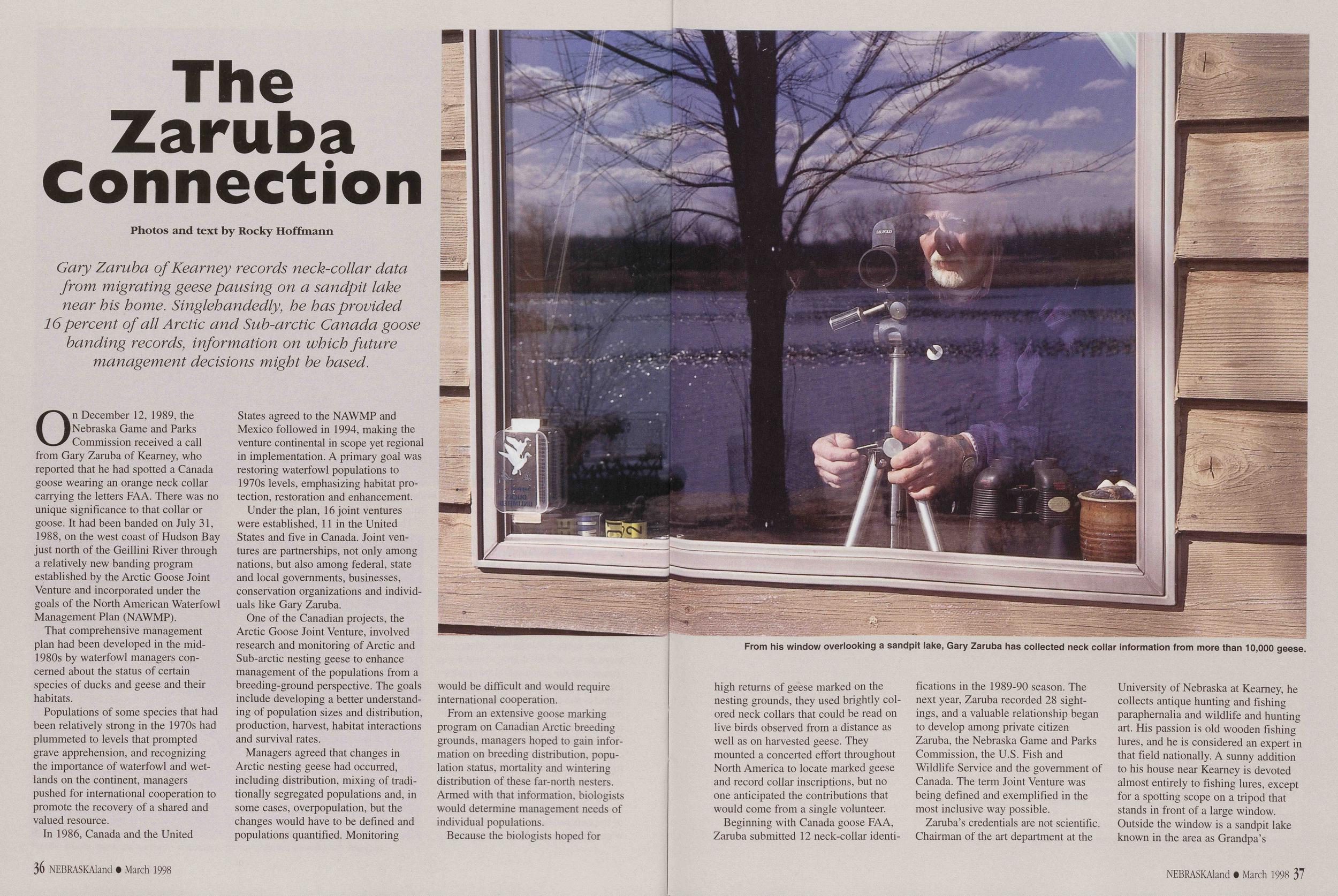
From his window overlooking a sandpit lake, Gary Zaruba has collected neck collar information from more than 10,000 geese.
would be difficult and would require international cooperation.
From an extensive goose marking program on Canadian Arctic breeding grounds, managers hoped to gain information on breeding distribution, population status, mortality and wintering distribution of these far-north nesters. Armed with that information, biologists would determine management needs of individual populations.
Because the biologists hoped for
36 NEBRASKAland • March 1998high returns of geese marked on the nesting grounds, they used brightly colored neck collars that could be read on live birds observed from a distance as well as on harvested geese. They mounted a concerted effort throughout North America to locate marked geese and record collar inscriptions, but no one anticipated the contributions that would come from a single volunteer.
Beginning with Canada goose FAA, Zaruba submitted 12 neck-collar identifications in the 1989-90 season. The next year, Zaruba recorded 28 sightings, and a valuable relationship began to develop among private citizen Zaruba, the Nebraska Game and Parks Commission, the U.S. Fish and Wildlife Service and the government of Canada. The term Joint Venture was being defined and exemplified in the most inclusive way possible.
Zaruba's credentials are not scientific. Chairman of the art department at the University of Nebraska at Kearney, he collects antique hunting and fishing paraphernalia and wildlife and hunting art. His passion is old wooden fishing lures, and he is considered an expert in that field nationally. A sunny addition to his house near Kearney is devoted almost entirely to fishing lures, except for a spotting scope on a tripod that stands in front of a large window. Outside the window is a sandpit lake known in the area as Grandpa's
NEBRASKAland • March 1998 37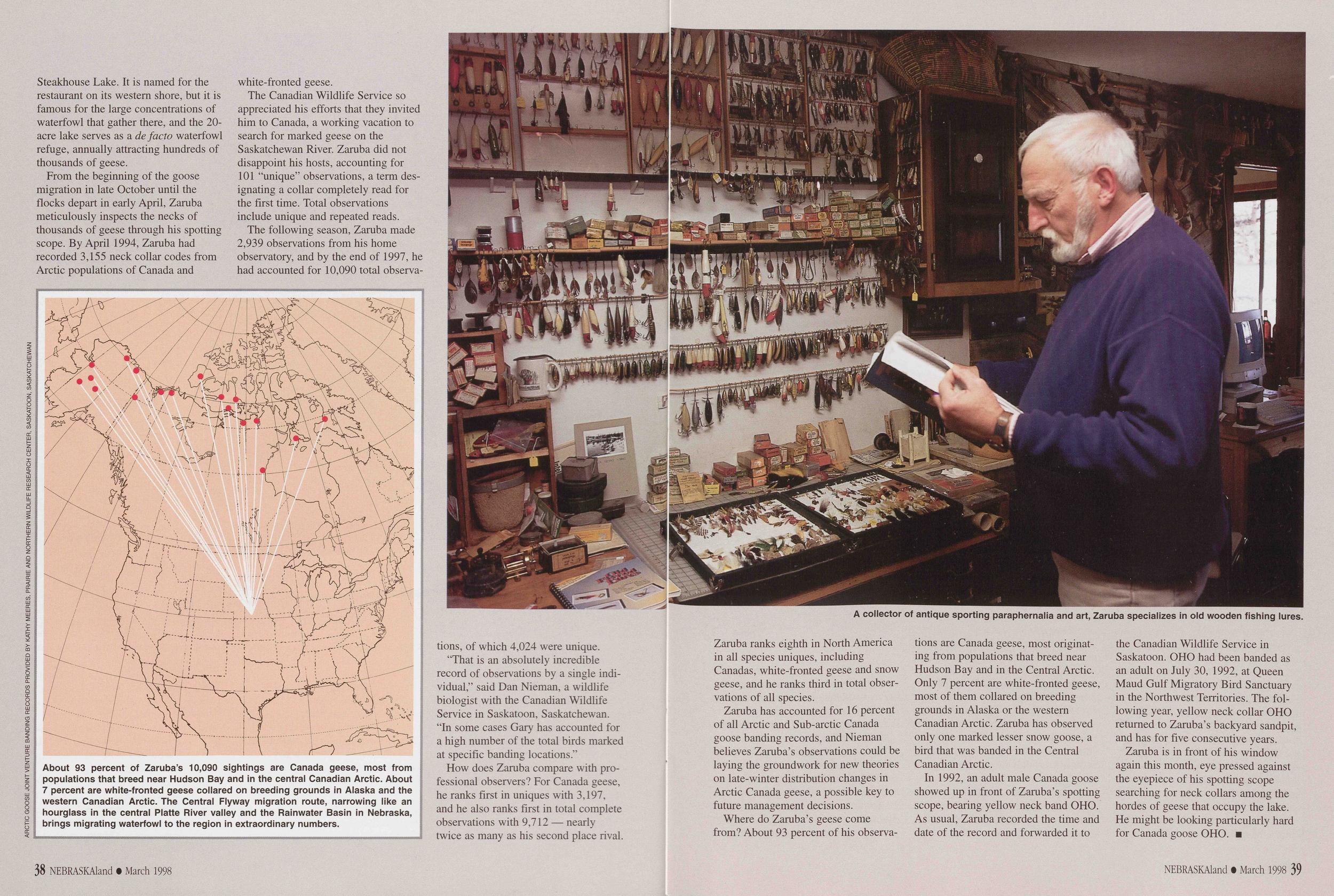
Steakhouse Lake. It is named for the restaurant on its western shore, but it is famous for the large concentrations of waterfowl that gather there, and the 20-acre lake serves as a de facto waterfowl refuge, annually attracting hundreds of thousands of geese.
From the beginning of the goose migration in late October until the flocks depart in early April, Zaruba meticulously inspects the necks of thousands of geese through his spotting scope. By April 1994, Zaruba had recorded 3,155 neck collar codes from Arctic populations of Canada and white-fronted geese.
The Canadian Wildlife Service so appreciated his efforts that they invited him to Canada, a working vacation to search for marked geese on the Saskatchewan River. Zaruba did not disappoint his hosts, accounting for 101 "unique" observations, a term designating a collar completely read for the first time. Total observations include unique and repeated reads.
The following season, Zaruba made 2,939 observations from his home observatory, and by the end of 1997, he had accounted for 10,090 total observa-
About 93 percent of Zaruba's 10,090 sightings are Canada geese, most from populations that breed near Hudson Bay and in the central Canadian Arctic. About 7 percent are white-fronted geese collared on breeding grounds in Alaska and the western Canadian Arctic. The Central Flyway migration route, narrowing like an hourglass in the central Platte River valley and the Rainwater Basin in Nebraska, brings migrating waterfowl to the region in extraordinary numbers.
A collector of antique sporting paraphernalia and art, Zaruba specializes in old wooden fishing lures.
tions, of which 4,024 were unique.
"That is an absolutely incredible record of observations by a single individual," said Dan Nieman, a wildlife biologist with the Canadian Wildlife Service in Saskatoon, Saskatchewan. "In some cases Gary has accounted for a high number of the total birds marked at specific banding locations."
How does Zaruba compare with professional observers? For Canada geese, he ranks first in uniques with 3,197, and he also ranks first in total complete observations with 9,712 — nearly twice as many as his second place rival.
38 NEBRASKAland • March 1998Zaruba ranks eighth in North America in all species uniques, including Canadas, white-fronted geese and snow geese, and he ranks third in total observations of all species.
Zaruba has accounted for 16 percent of all Arctic and Sub-arctic Canada goose banding records, and Nieman believes Zaruba's observations could be laying the groundwork for new theories on late-winter distribution changes in Arctic Canada geese, a possible key to future management decisions.
Where do Zaruba's geese come from? About 93 percent of his observations are Canada geese, most originating from populations that breed near Hudson Bay and in the Central Arctic. Only 7 percent are white-fronted geese, most of. them collared on breeding grounds in Alaska or the western Canadian Arctic. Zaruba has observed only one marked lesser snow goose, a bird that was banded in the Central Canadian Arctic.
In 1992, an adult male Canada goose showed up in front of Zaruba's spotting scope, bearing yellow neck band OHO. As usual, Zaruba recorded the time and date of the record and forwarded it to the Canadian Wildlife Service in Saskatoon. OHO had been banded as an adult on July 30, 1992, at Queen Maud Gulf Migratory Bird Sanctuary in the Northwest Territories. The following year, yellow neck collar OHO returned to Zaruba's backyard sandpit, and has for five consecutive years.
Zaruba is in front of his window again this month, eye pressed against the eyepiece of his spotting scope searching for neck collars among the hordes of geese that occupy the lake. He might be looking particularly hard for Canada goose OHO.
NEBRASKAland • March 1998 39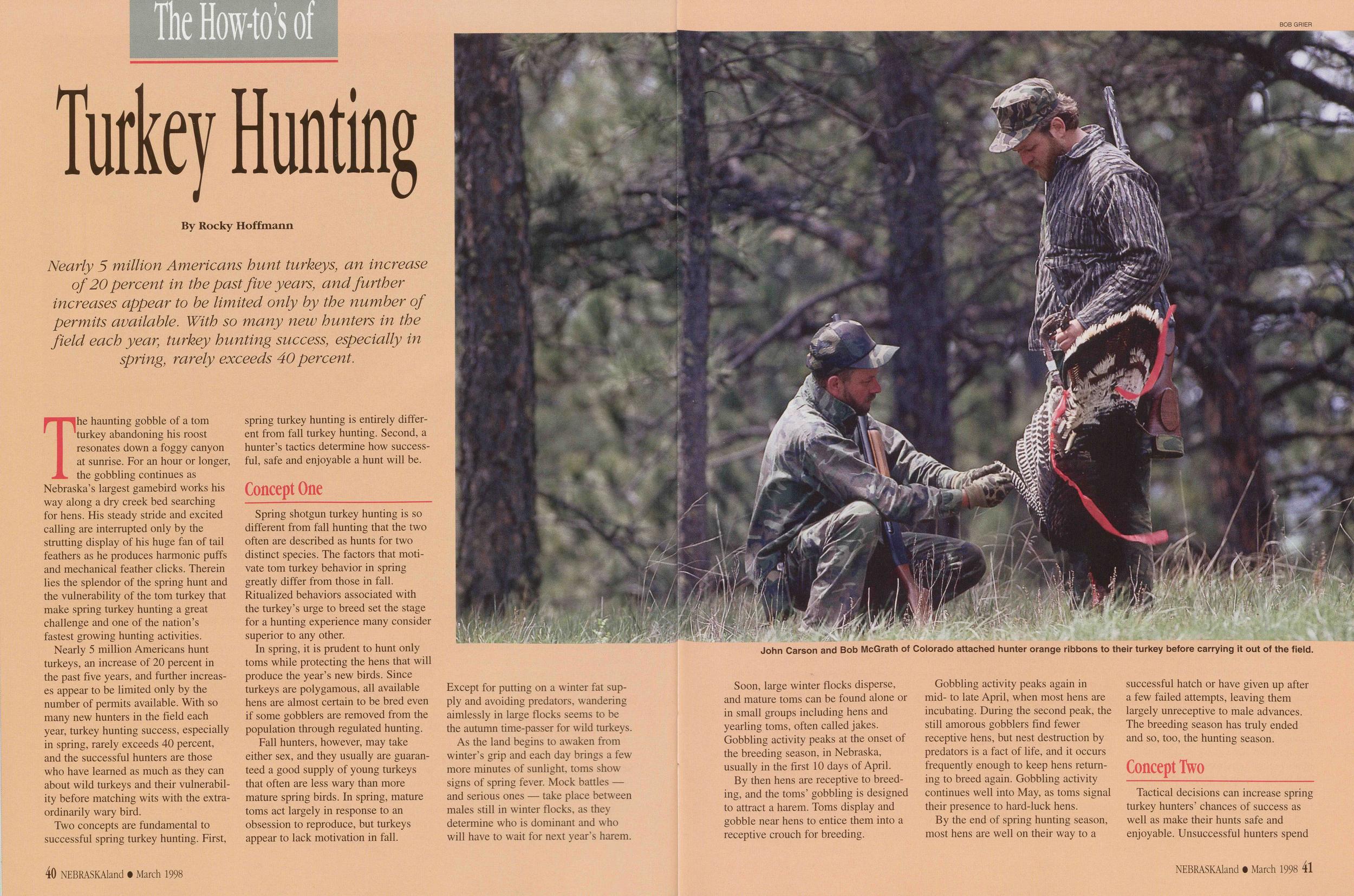
The How-to's of Turkey Hunting
By Rocky Hoffmann Nearly 5 million Americans hunt turkeys, an increase of 20 percent in the past five years, and further increases appear to he limited only by the number of permits available. With so many new hunters in the field each year, turkey hunting success, especially in spring, rarely exceeds 40 percent.The haunting gobble of a torn turkey abandoning his roost resonates down a foggy canyon at sunrise. For an hour or longer, the gobbling continues as Nebraska's largest gamebird works his way along a dry creek bed searching for hens. His steady stride and excited calling are interrupted only by the strutting display of his huge fan of tail feathers as he produces harmonic puffs and mechanical feather clicks. Therein lies the splendor of the spring hunt and the vulnerability of the torn turkey that make spring turkey hunting a great challenge and one of the nation's fastest growing hunting activities.
Nearly 5 million Americans hunt turkeys, an increase of 20 percent in the past five years, and further increases appear to be limited only by the number of permits available. With so many new hunters in the field each year, turkey hunting success, especially in spring, rarely exceeds 40 percent, and the successful hunters are those who have learned as much as they can about wild turkeys and their vulnerability before matching wits with the extraordinarily wary bird.
Two concepts are fundamental to successful spring turkey hunting. First, spring turkey hunting is entirely different from fall turkey hunting. Second, a hunter's tactics determine how successful, safe and enjoyable a hunt will be.
Concept OneSpring shotgun turkey hunting is so different from fall hunting that the two often are described as hunts for two distinct species. The factors that motivate torn turkey behavior in spring greatly differ from those in fall. Ritualized behaviors associated with the turkey's urge to breed set the stage for a hunting experience many consider superior to any other.
In spring, it is prudent to hunt only toms while protecting the hens that will produce the year's new birds. Since turkeys are polygamous, all available hens are almost certain to be bred even if some gobblers are removed from the population through regulated hunting.
Fall hunters, however, may take either sex, and they usually are guaranteed a good supply of young turkeys that often are less wary than more mature spring birds. In spring, mature toms act largely in response to an obsession to reproduce, but turkeys appear to lack motivation in fall.
John Carson and Bob McGrath of Colorado attached hunter orange ribbons to their turkey before carrying it out of the field.
BOB GRIERExcept for putting on a winter fat supply and avoiding predators, wandering aimlessly in large flocks seems to be the autumn time-passer for wild turkeys.
As the land begins to awaken from winter's grip and each day brings a few more minutes of sunlight, toms show signs of spring fever. Mock battles — and serious ones — take place between males still in winter flocks, as they determine who is dominant and who will have to wait for next year's harem.
40 NEBRASKAland • March 1998Soon, large winter flocks disperse, and mature toms can be found alone or in small groups including hens and yearling toms, often called jakes. Gobbling activity peaks at the onset of the breeding season, in Nebraska, usually in the first 10 days of April.
By then hens are receptive to breeding, and the toms' gobbling is designed to attract a harem. Toms display and gobble near hens to entice them into a receptive crouch for breeding.
Gobbling activity peaks again in mid- to late April, when most hens are incubating. During the second peak, the still amorous gobblers find fewer receptive hens, but nest destruction by predators is a fact of life, and it occurs frequently enough to keep hens returning to breed again. Gobbling activity continues well into May, as toms signal their presence to hard-luck hens.
By the end of spring hunting season, most hens are well on their way to a successful hatch or have given up after a few failed attempts, leaving them largely unreceptive to male advances. The breeding season has truly ended and so, too, the hunting season.
Concept TwoTactical decisions can increase spring turkey hunters' chances of success as well as make their hunts safe and enjoyable. Unsuccessful hunters spend
NEBRASKAland • March 1998 41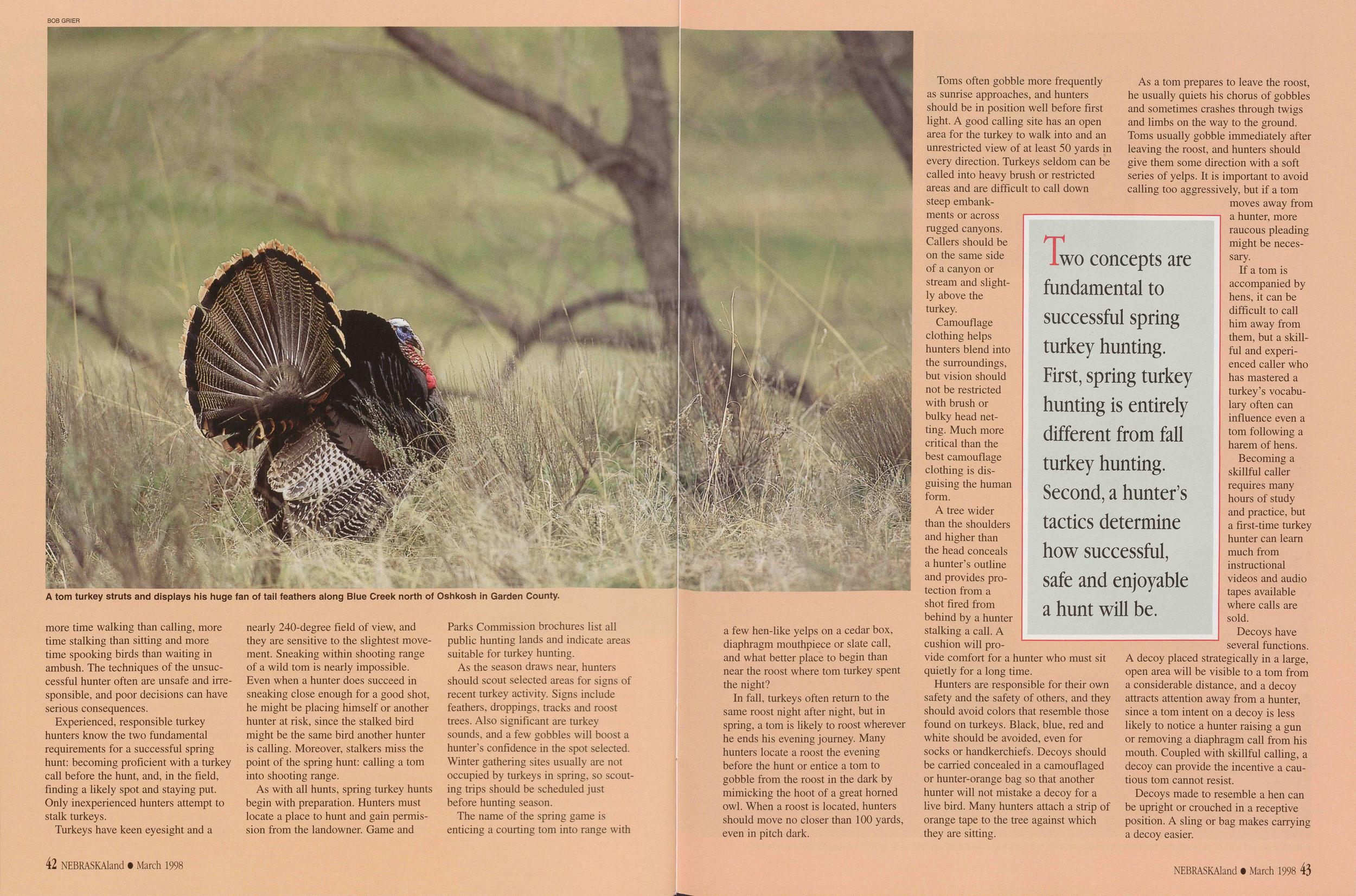
A torn turkey struts and displays his huge fan of tail feathers along Blue Creek north of Oshkosh in Garden County.
more time walking than calling, more time stalking than sitting and more time spooking birds than waiting in ambush. The techniques of the unsuccessful hunter often are unsafe and irresponsible, and poor decisions can have serious consequences.
Experienced, responsible turkey hunters know the two fundamental requirements for a successful spring hunt: becoming proficient with a turkey call before the hunt, and, in the field, finding a likely spot and staying put Only inexperienced hunters attempt to stalk turkeys.
Turkeys have keen eyesight and a nearly 240-degree field of view, and they are sensitive to the slightest movement. Sneaking within shooting range of a wild torn is nearly impossible. Even when a hunter does succeed in sneaking close enough for a good shot, he might be placing himself or another hunter at risk, since the stalked bird might be the same bird another hunter is calling. Moreover, stalkers miss the point of the spring hunt: calling a torn into shooting range.
As with all hunts, spring turkey hunts begin with preparation. Hunters must locate a place to hunt and gain permission from the landowner. Game and Parks Commission brochures list all public hunting lands and indicate areas suitable for turkey hunting.
As the season draws near, hunters should scout selected areas for signs of recent turkey activity. Signs include feathers, droppings, tracks and roost trees. Also significant are turkey sounds, and a few gobbles will boost a hunter's confidence in the spot selected. Winter gathering sites usually are not occupied by turkeys in spring, so scouting trips should be scheduled just before hunting season.
The name of the spring game is enticing a courting torn into range with
42 NEBRASKAland • March 1998a few hen-like yelps on a cedar box, diaphragm mouthpiece or slate call, and what better place to begin than near the roost where torn turkey spent the night?
In fall, turkeys often return to the same roost night after night, but in spring, a torn is likely to roost wherever he ends his evening journey. Many hunters locate a roost the evening before the hunt or entice a torn to gobble from the roost in the dark by mimicking the hoot of a great horned owl. When a roost is located, hunters should move no closer than 100 yards, even in pitch dark.
Toms often gobble more frequently as sunrise approaches, and hunters should be in position well before first light. A good calling site has an open area for the turkey to walk into and an unrestricted view of at least 50 yards in every direction. Turkeys seldom can be called into heavy brush or restricted areas and are difficult to call down steep embankments or across rugged canyons. Callers should be on the same side of a canyon or stream and slightly above the turkey.
Camouflage clothing helps hunters blend into the surroundings, but vision should not be restricted with brush or bulky head netting. Much more critical than the best camouflage clothing is disguising the human form.
A tree wider than the shoulders and higher than the head conceals a hunter's outline and provides protection from a shot fired from behind by a hunter stalking a call. A cushion will provide comfort for a hunter who must sit quietly for a long time.
Hunters are responsible for their own safety and the safety of others, and they should avoid colors that resemble those found on turkeys. Black, blue, red and white should be avoided, even for socks or handkerchiefs. Decoys should be carried concealed in a camouflaged or hunter-orange bag so that another hunter will not mistake a decoy for a live bird. Many hunters attach a strip of orange tape to the tree against which they are sitting.
Two concepts are fundamental to successful spring turkey hunting. First, spring turkey hunting is entirely different from fall turkey hunting. Second, a hunter's tactics determine how successful, safe and enjoyable a hunt will be.As a torn prepares to leave the roost, he usually quiets his chorus of gobbles and sometimes crashes through twigs and limbs on the way to the ground. Toms usually gobble immediately after leaving the roost, and hunters should give them some direction with a soft series of yelps. It is important to avoid calling too aggressively, but if a torn moves away from a hunter, more raucous pleading might be necessary.
If a torn is accompanied by hens, it can be difficult to call him away from them, but a skillful and experienced caller who has mastered a turkey's vocabulary often can influence even a torn following a harem of hens.
Becoming a skillful caller requires many hours of study and practice, but a first-time turkey hunter can learn much from instructional videos and audio tapes available where calls are sold.
Decoys have several functions. A decoy placed strategically in a large, open area will be visible to a torn from a considerable distance, and a decoy attracts attention away from a hunter, since a torn intent on a decoy is less likely to notice a hunter raising a gun or removing a diaphragm call from his mouth. Coupled with skillful calling, a decoy can provide the incentive a cautious torn cannot resist.
Decoys made to resemble a hen can be upright or crouched in a receptive position. A sling or bag makes carrying a decoy easier.
NEBRASKAland • March 1998 43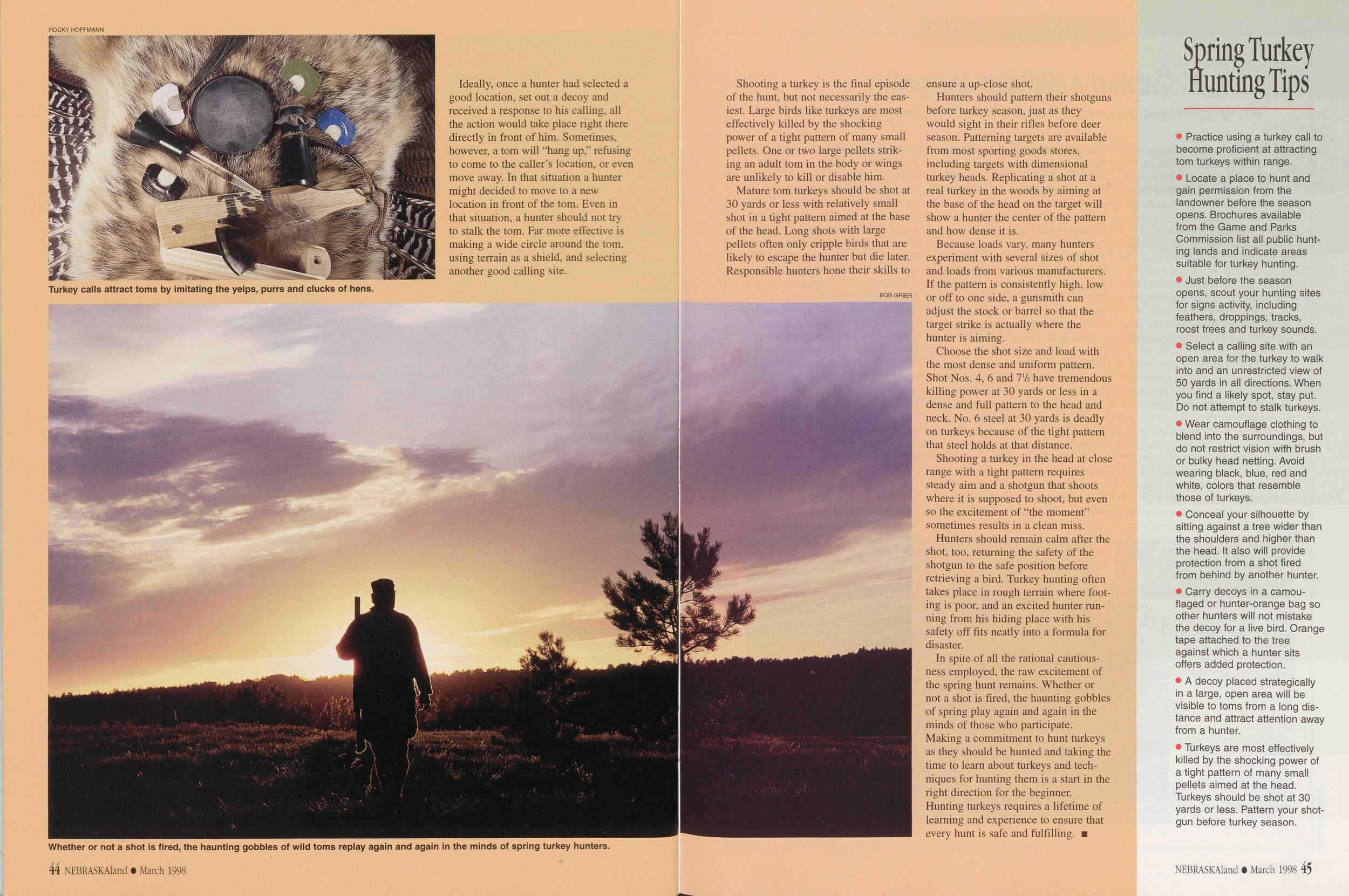
Turkey calls attract toms by imitating the yelps, purrs and clucks of hens.
Ideally, once a hunter had selected a good location, set out a decoy and received a response to his calling, all the action would take place right there directly in front of him. Sometimes, however, a torn will "hang up," refusing to come to the caller's location, or even move away. In that situation a hunter might decided to move to a new location in front of the torn. Even in that situation, a hunter should not try to stalk the torn. Far more effective is making a wide circle around the torn, using terrain as a shield, and selecting another good calling site.
Whether or not a shot is fired, the haunting gobbles of wild toms replay again and again in the minds of spring turkey hunters.
BOB GRIERShooting a turkey is the final episode of the hunt, but not necessarily the easiest. Large birds like turkeys are most effectively killed by the shocking power of a tight pattern of many small pellets. One or two large pellets striking an adult torn in the body or wings are unlikely to kill or disable him.
Mature torn turkeys should be shot at 30 yards or less with relatively small shot in a tight pattern aimed at the base of the head. Long shots with large pellets often only cripple birds that are likely to escape the hunter but die later. Responsible hunters hone their skills to ensure a up-close shot.
Hunters should pattern their shotguns before turkey season, just as they would sight in their rifles before deer season. Patterning targets are available from most sporting goods stores, including targets with dimensional turkey heads. Replicating a shot at a real turkey in the woods by aiming at the base of the head on the target will show a hunter the center of the pattern and how dense it is.
Because loads vary, many hunters experiment with several sizes of shot and loads from various manufacturers. If the pattern is consistently high, low or off to one side, a gunsmith can adjust the stock or barrel so that the target strike is actually where the hunter is aiming.
Choose the shot size and load with the most dense and uniform pattern. Shot Nos. 4, 6 and Th have tremendous killing power at 30 yards or less in a dense and full pattern to the head and neck. No. 6 steel at 30 yards is deadly on turkeys because of the tight pattern that steel holds at that distance.
Shooting a turkey in the head at close range with a tight pattern requires steady aim and a shotgun that shoots where it is supposed to shoot, but even so the excitement of "the moment" sometimes results in a clean miss.
Hunters should remain calm after the shot, too, returning the safety of the shotgun to the safe position before retrieving a bird. Turkey hunting often takes place in rough terrain where footing is poor, and an excited hunter running from his hiding place with his safety off fits neatly into a formula for disaster.
In spite of all the rational cautiousness employed, the raw excitement of the spring hunt remains. Whether or not a shot is fired, the haunting gobbles of spring play again and again in the minds of those who participate. Making a commitment to hunt turkeys as they should be hunted and taking the time to learn about turkeys and techniques for hunting them is a start in the right direction for the beginner. Hunting turkeys requires a lifetime of learning and experience to ensure that every hunt is safe and fulfilling.
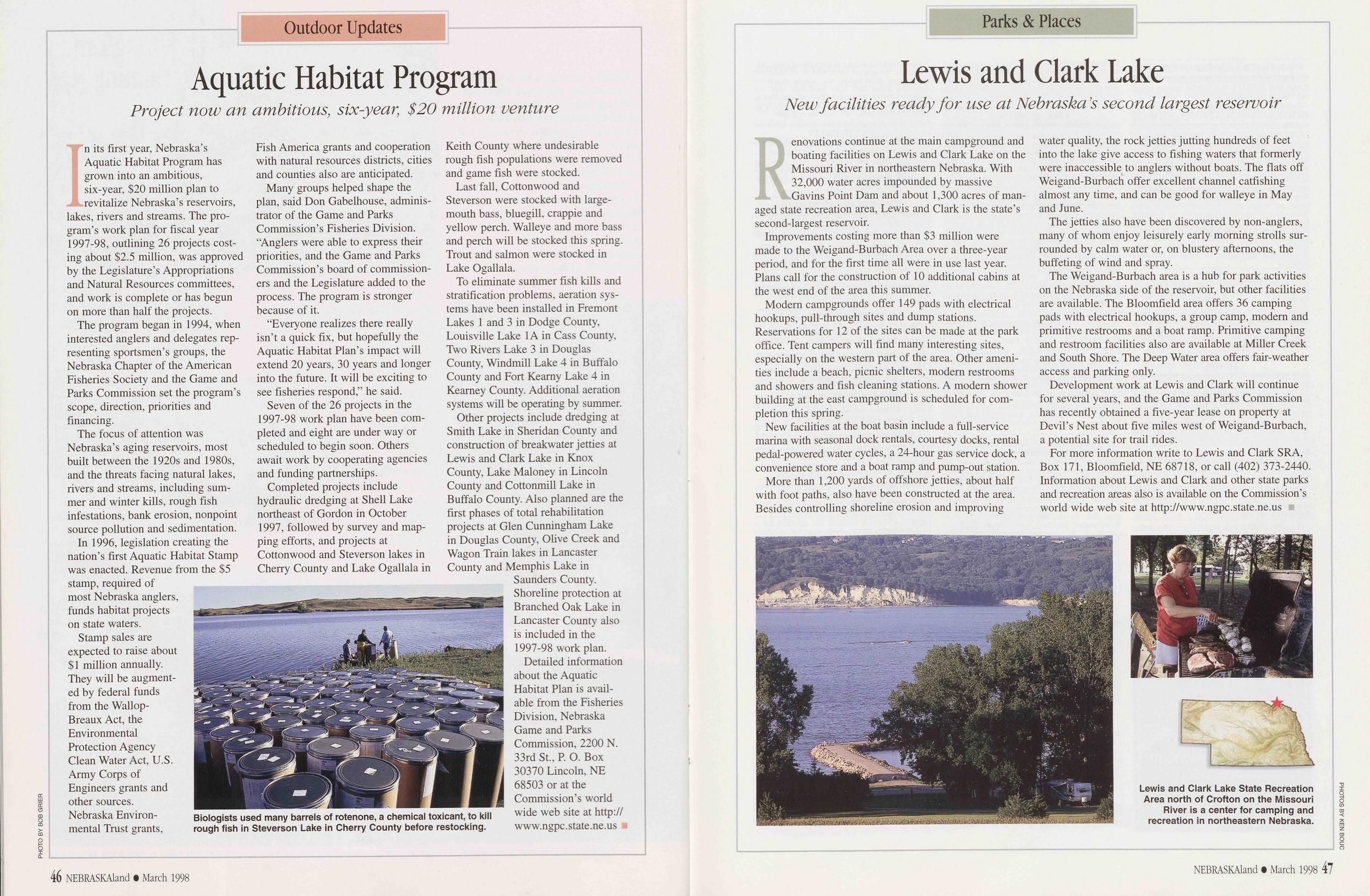
Outdoor Updates
Aquatic Habitat Program
Project now an ambitious, six-year, $20 million ventureIn its first year, Nebraska's Aquatic Habitat Program has grown into an ambitious, six-year, $20 million plan to revitalize Nebraska's reservoirs, lakes, rivers and streams. The program's work plan for fiscal year 1997-98, outlining 26 projects costing about $2.5 million, was approved by the Legislature's Appropriations and Natural Resources committees, and work is complete or has begun on more than half the projects.
The program began in 1994, when interested anglers and delegates representing sportsmen's groups, the Nebraska Chapter of the American Fisheries Society and the Game and Parks Commission set the program's scope, direction, priorities and financing.
The focus of attention was Nebraska's aging reservoirs, most built between the 1920s and 1980s, and the threats facing natural lakes, rivers and streams, including summer and winter kills, rough fish infestations, bank erosion, nonpoint source pollution and sedimentation.
In 1996, legislation creating the nation's first Aquatic Habitat Stamp was enacted. Revenue from the $5 stamp, required of most Nebraska anglers, funds habitat projects on state waters.
Stamp sales are expected to raise about $1 million annually. They will be augmented by federal funds from the Wallop- Breaux Act, the Environmental Protection Agency Clean Water Act, U.S. Army Corps of Engineers grants and other sources. Nebraska Environmental Trust grants, Fish America grants and cooperation with natural resources districts, cities and counties also are anticipated.
Many groups helped shape the plan, said Don Gabelhouse, administrator of the Game and Parks Commission's Fisheries Division. 'Anglers were able to express their priorities, and the Game and Parks Commission's board of commissioners and the Legislature added to the process. The program is stronger because of it.
"Everyone realizes there really isn't a quick fix, but hopefully the Aquatic Habitat Plan's impact will extend 20 years, 30 years and longer into the future. It will be exciting to see fisheries respond," he said.
Seven of the 26 projects in the 1997-98 work plan have been completed and eight are under way or scheduled to begin soon. Others await work by cooperating agencies and funding partnerships.
Completed projects include hydraulic dredging at Shell Lake northeast of Gordon in October 1997, followed by survey and mapping efforts, and projects at Cottonwood and Steverson lakes in Cherry County and Lake Ogallala in
Biologists used many barrels of rotenone, a chemical toxicant, to kill rough fish in Steverson Lake in Cherry County before restocking.
Keith County where undesirable rough fish populations were removed and game fish were stocked.
Last fall, Cottonwood and Steverson were stocked with large-mouth bass, bluegill, crappie and yellow perch. Walleye and more bass and perch will be stocked this spring. Trout and salmon were stocked in Lake Ogallala.
To eliminate summer fish kills and stratification problems, aeration systems have been installed in Fremont Lakes 1 and 3 in Dodge County, Louisville Lake 1A in Cass County, Two Rivers Lake 3 in Douglas County, Windmill Lake 4 in Buffalo County and Fort Kearny Lake 4 in Kearney County. Additional aeration systems will be operating by summer.
Other projects include dredging at Smith Lake in Sheridan County and construction of breakwater jetties at Lewis and Clark Lake in Knox County, Lake Maloney in Lincoln County and Cottonmill Lake in Buffalo County. Also planned are the first phases of total rehabilitation projects at Glen Cunningham Lake in Douglas County, Olive Creek and Wagon Train lakes in Lancaster County and Memphis Lake in Saunders County. Shoreline protection at Branched Oak Lake in Lancaster County also is included in the 1997-98 work plan.
Detailed information about the Aquatic Habitat Plan is available from the Fisheries Division, Nebraska Game and Parks Commission, 2200 N. 33rd St., P. O. Box 30370 Lincoln, NE 68503 or at the Commission's world wide web site at http:// www.ngpc.state.ne.us
46 NEBRASKAland • March 1998Parks & Places
Lewis and Clark Lake
New facilities ready for use at Nebraska's second largest reservoirRenovations continue at the main campground and boating facilities on Lewis and Clark Lake on the Missouri River in northeastern Nebraska. With 32,000 water acres impounded by massive Gavins Point Dam and about 1,300 acres of managed state recreation area, Lewis and Clark is the state's second-largest reservoir.
Improvements costing more than $3 million were made to the Weigand-Burbach Area over a three-year period, and for the first time all were in use last year. Plans call for the construction of 10 additional cabins at the west end of the area this summer.
Modern campgrounds offer 149 pads with electrical hookups, pull-through sites and dump stations. Reservations for 12 of the sites can be made at the park office. Tent campers will find many interesting sites, especially on the western part of the area. Other amenities include a beach, picnic shelters, modern restrooms and showers and fish cleaning stations. A modern shower building at the east campground is scheduled for completion this spring.
New facilities at the boat basin include a full-service marina with seasonal dock rentals, courtesy docks, rental pedal-powered water cycles, a 24-hour gas service dock, a convenience store and a boat ramp and pump-out station.
More than 1,200 yards of offshore jetties, about half with foot paths, also have been constructed at the area. Besides controlling shoreline erosion and improving water quality, the rock jetties jutting hundreds of feet into the lake give access to fishing waters that formerly were inaccessible to anglers without boats. The flats off Weigand-Burbach offer excellent channel catfishing almost any time, and can be good for walleye in May and June.
The jetties also have been discovered by non-anglers, many of whom enjoy leisurely early morning strolls surrounded by calm water or, on blustery afternoons, the buffeting of wind and spray.
The Weigand-Burbach area is a hub for park activities on the Nebraska side of the reservoir, but other facilities are available. The Bloomfield area offers 36 camping pads with electrical hookups, a group camp, modern and primitive restrooms and a boat ramp. Primitive camping and restroom facilities also are available at Miller Creek and South Shore. The Deep Water area offers fair-weather access and parking only.
Development work at Lewis and Clark will continue for several years, and the Game and Parks Commission has recently obtained a five-year lease on property at Devil's Nest about five miles west of Weigand-Burbach, a potential site for trail rides.
For more information write to Lewis and Clark SRA, Box 171, Bloomfield, NE 68718, or call (402) 373-2440. Information about Lewis and Clark and other state parks and recreation areas also is available on the Commission's world wide web site at http://www.ngpc.state.ne.us
Lewis and Clark Lake State Recreation Area north of Crofton on the Missouri River is a center for camping and recreation in northeastern Nebraska.
PHOTOS BY KEN BOUC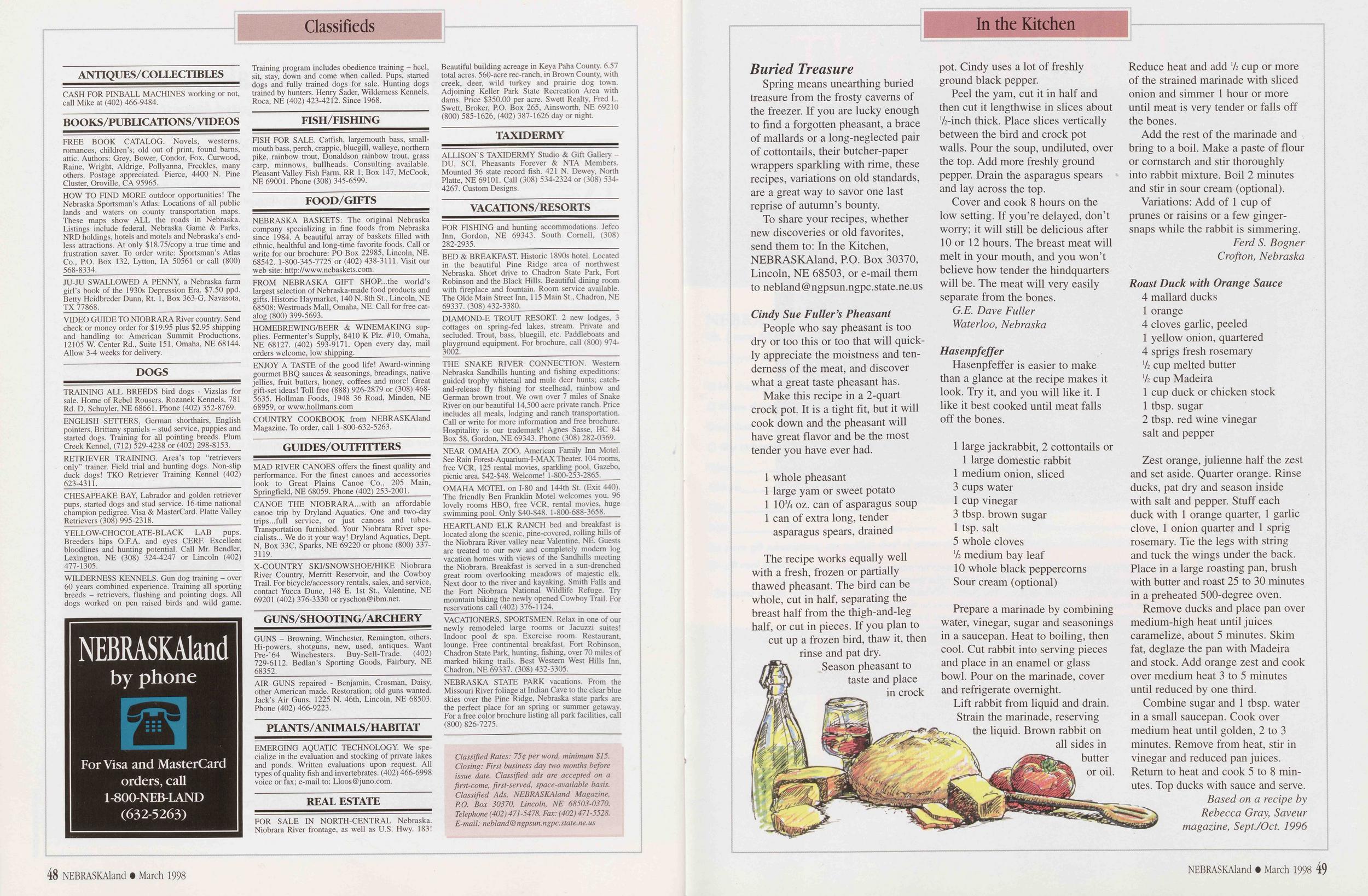
In the Kitchen
Buried Treasure Spring means unearthing buried treasure from the frosty caverns of the freezer. If you are lucky enough to find a forgotten pheasant, a brace of mallards or a long-neglected pair of cottontails, their butcher-paper wrappers sparkling with rime, these recipes, variations on old standards, are a great way to savor one last reprise of autumn's bounty. To share your recipes, whether new discoveries or old favorites, send them to: In the Kitchen, NEBRASKAland, P.O. Box 30370, Lincoln, NE 68503, or e-mail them to nebland@ngpsun.ngpc.state.ne.us Cindy Sue Fuller's Pheasant People who say pheasant is too dry or too this or too that will quickly appreciate the moistness and tenderness of the meat, and discover what a great taste pheasant has. Make this recipe in a 2-quart crock pot. It is a tight fit, but it will cook down and the pheasant will have great flavor and be the most tender you have ever had. 1 whole pheasant 1 large yam or sweet potato 1 103/4 oz. can of asparagus soup 1 can of extra long, tender asparagus spears, drained The recipe works equally well with a fresh, frozen or partially thawed pheasant. The bird can be whole, cut in half, separating the breast half from the thigh-and-leg half, or cut in pieces. If you plan to cut up a frozen bird, thaw it, then rinse and pat dry. Season pheasant to taste and place in crock pot. Cindy uses a lot of freshly ground black pepper. Peel the yam, cut it in half and then cut it lengthwise in slices about Yz-inch thick. Place slices vertically between the bird and crock pot walls. Pour the soup, undiluted, over the top. Add more freshly ground pepper. Drain the asparagus spears and lay across the top. Cover and cook 8 hours on the low setting. If you're delayed, don't worry; it will still be delicious after 10 or 12 hours. The breast meat will melt in your mouth, and you won't believe how tender the hindquarters will be. The meat will very easily separate from the bones. G.E. Dave Fuller Waterloo, Nebraska Hasenpfeffer Hasenpfeffer is easier to make than a glance at the recipe makes it look. Try it, and you will like it. I like it best cooked until meat falls off the bones. 1 large jackrabbit, 2 cottontails or 1 large domestic rabbit 1 medium onion, sliced 3 cups water 1 cup vinegar 3 tbsp. brown sugar 1 tsp. salt 5 whole cloves lh medium bay leaf 10 whole black peppercorns Sour cream (optional) Prepare a marinade by combining water, vinegar, sugar and seasonings in a saucepan. Heat to boiling, then cool. Cut rabbit into serving pieces and place in an enamel or glass bowl. Pour on the marinade, cover and refrigerate overnight. Lift rabbit from liquid and drain. Strain the marinade, reserving the liquid. Brown rabbit on all sides in butter or oil. Reduce heat and add % cup or more of the strained marinade with sliced onion and simmer 1 hour or more until meat is very tender or falls off the bones. Add the rest of the marinade and bring to a boil. Make a paste of flour or cornstarch and stir thoroughly into rabbit mixture. Boil 2 minutes and stir in sour cream (optional). Variations: Add of 1 cup of prunes or raisins or a few ginger- snaps while the rabbit is simmering. Ferd S. Bogner Crofton, Nebraska Roast Duck with Orange Sauce 4 mallard ducks 1 orange 4 cloves garlic, peeled 1 yellow onion, quartered 4 sprigs fresh rosemary 1/2 cup melted butter 1/2 cup Madeira 1 cup duck or chicken stock 1 tbsp. sugar 2 tbsp. red wine vinegar salt and pepper Zest orange, julienne half the zest and set aside. Quarter orange. Rinse ducks, pat dry and season inside with salt and pepper. Stuff each duck with 1 orange quarter, 1 garlic clove, 1 onion quarter and 1 sprig rosemary. Tie the legs with string and tuck the wings under the back. Place in a large roasting pan, brush with butter and roast 25 to 30 minutes in a preheated 500-degree oven. Remove ducks and place pan over medium-high heat until juices caramelize, about 5 minutes. Skim fat, deglaze the pan with Madeira and stock. Add orange zest and cook over medium heat 3 to 5 minutes until reduced by one third. Combine sugar and 1 tbsp. water in a small saucepan. Cook over medium heat until golden, 2 to 3 minutes. Remove from heat, stir in vinegar and reduced pan juices. Return to heat and cook 5 to 8 minutes. Top ducks with sauce and serve. Based on a recipe by Rebecca Gray, Saveur magazine, Sept./Oct. 1996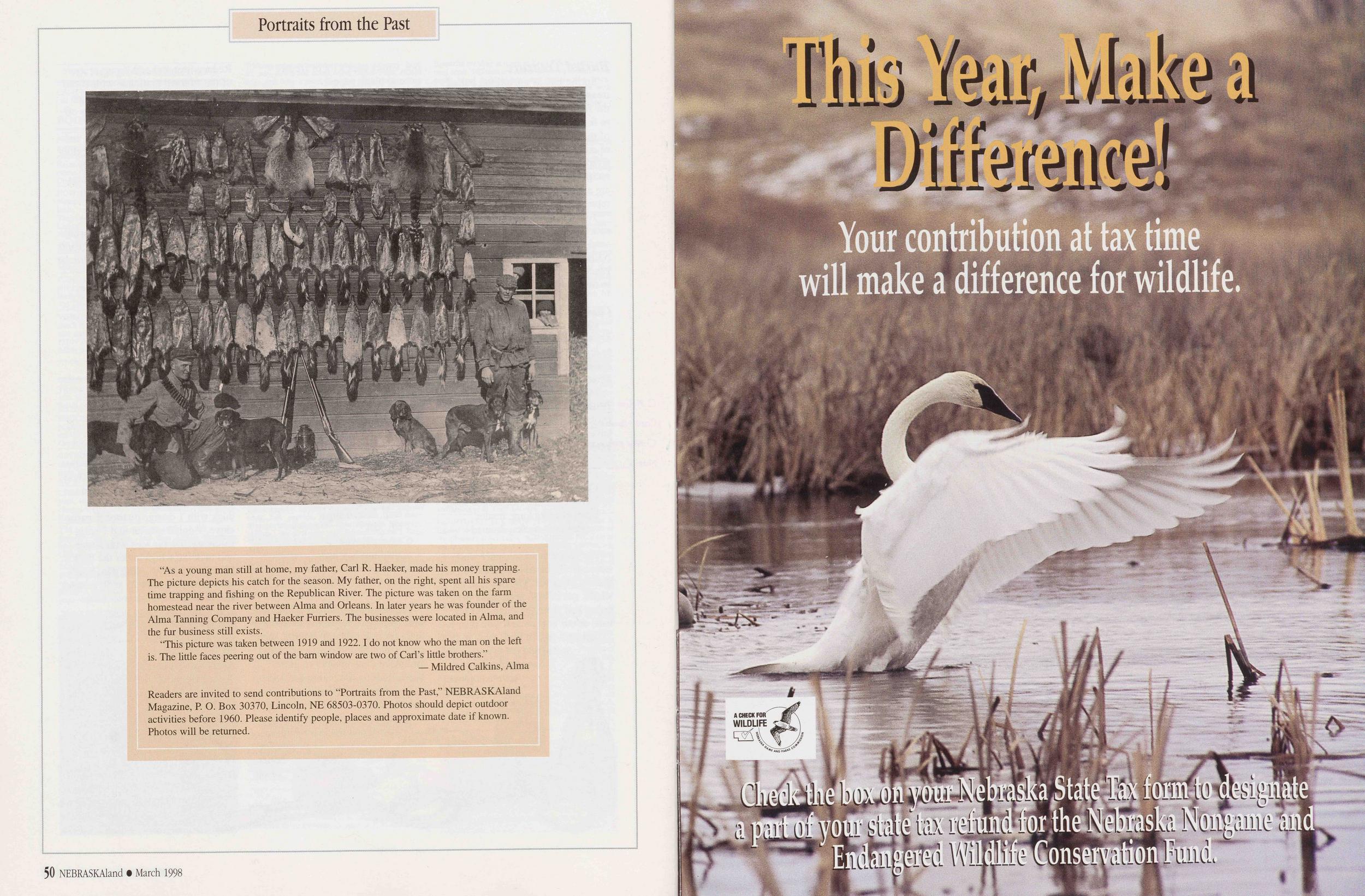
Portraits from the Past
"As a young man still at home, my father, Carl R. Haeker, made his money trapping. The picture depicts his catch for the season. My father, on the right, spent all his spare time trapping and fishing on the Republican River. The picture was taken on the farm homestead near the river between Alma and Orleans. In later years he was founder of the Alma Tanning Company and Haeker Furriers. The businesses were located in Alma, and the fur business still exists. "This picture was taken between 1919 and 1922.1 do not know who the man on the left is. The little faces peering out of the bam window are two of Carl's little brothers." — Mildred Calkins, Alma Readers are invited to send contributions to "Portraits from the Past," NEBRASKAland Magazine, P. O. Box 30370, Lincoln, NE 68503-0370. Photos should depict outdoor activities before 1960. Please identify people, places and approximate date if known. Photos will be returned.
Position: 511 (21 views)