Volume 76, Issue 1, 1998
NEBRASKAland
Nebraska Game & Parks Commission January-February 1998 $2.00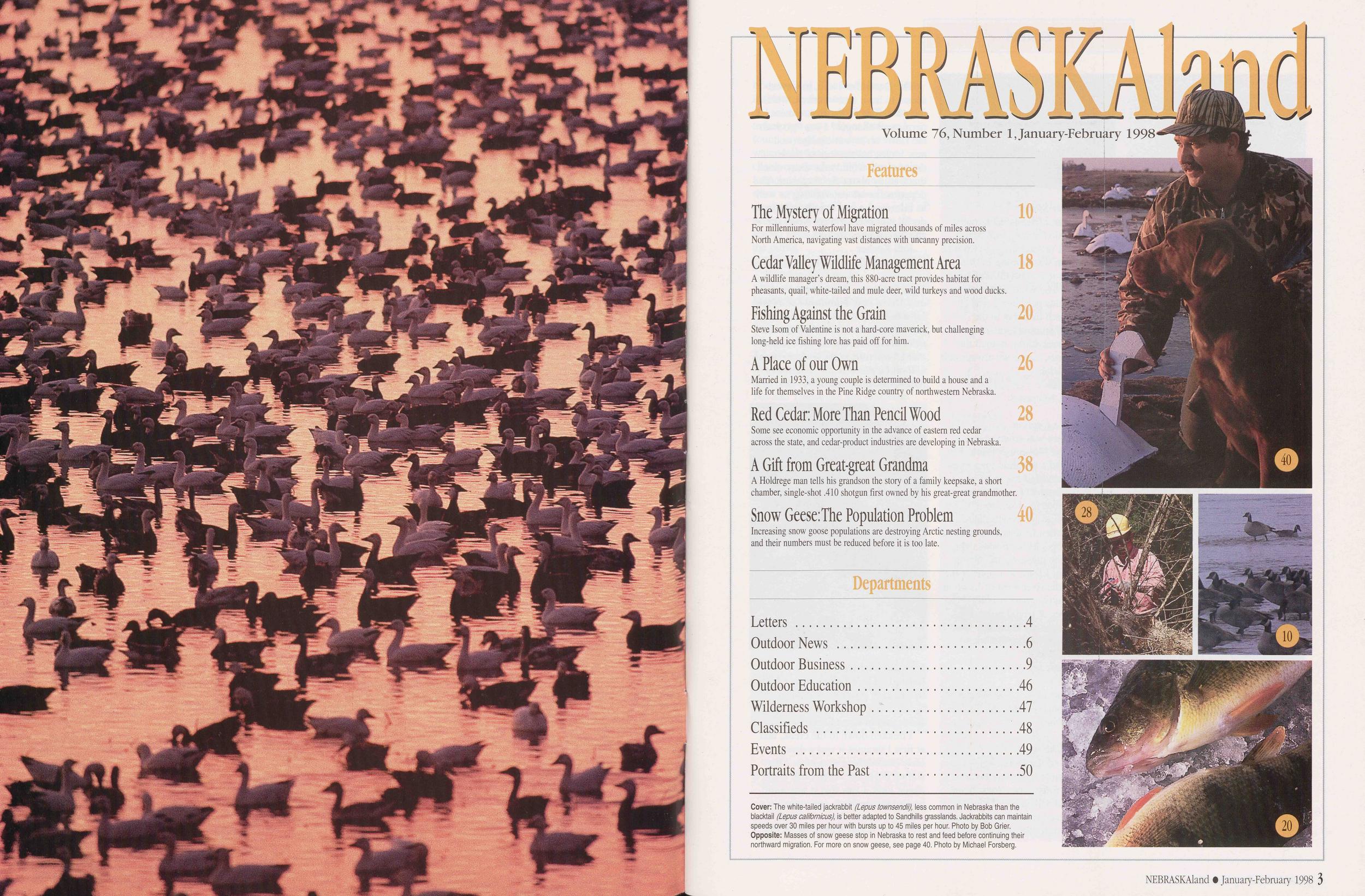
NEBRASKAland
Volume 76, Number 1, January-February 1998 The Mystery of Migration 10For millenniums, waterfowl have migrated thousands of miles across North America, navigating vast distances with uncanny precision.
Cedar Valley Wildlife Management Area 18A wildlife manager's dream, this 880-acre tract provides habitat for pheasants, quail, white-tailed and mule deer, wild turkeys and wood ducks.
Fishing Against the Grain 20Steve Isom of Valentine is not a hard-core maverick, but challenging long-held ice fishing lore has paid off for him.
A Place of our Own 26Married in 1933, a young couple is determined to build a house and a life for themselves in the Pine Ridge country of northwestern Nebraska.
Red Cedar: More Than Pencil Wood 28Some see economic opportunity in the advance of eastern red cedar across the state, and cedar-product industries are developing in Nebraska.
A Gift from Great-great Grandma 38A Holdrege man tells his grandson the story of a family keepsake, a short chamber, single-shot .410 shotgun first owned by his great-great grandmother.
Snow Geese: The Population Problem 40Increasing snow goose populations are destroying Arctic nesting grounds, and their numbers must be reduced before it is too late.
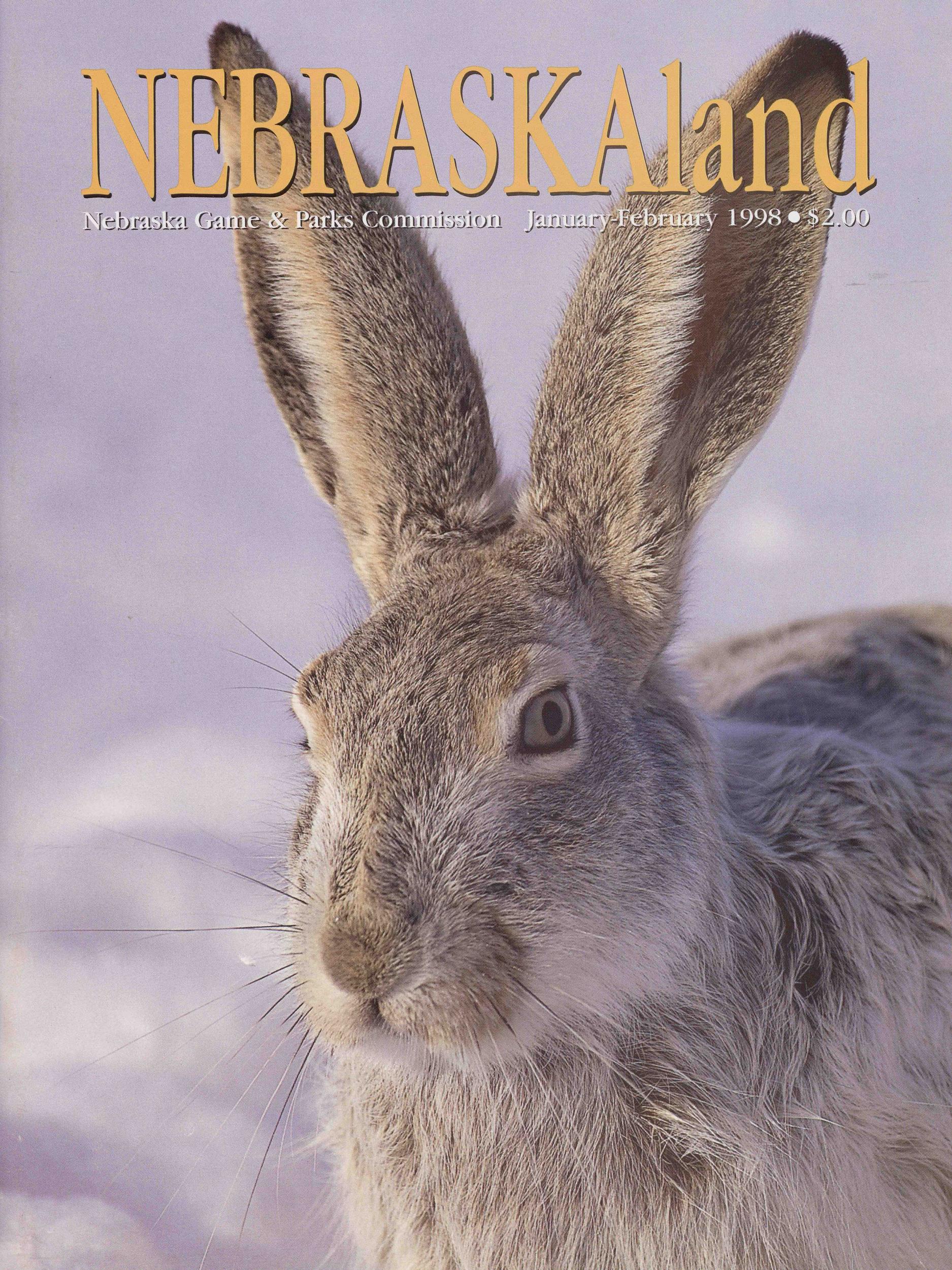
Letters 4 Outdoor News 6 Outdoor Business 9 Outdoor Education 46 Wilderness Workshop 47 Classifieds 48 Events 49 Portraits from the Past 50Cover: The white-tailed jackrabbit (Lepus townsendii), less common in Nebraska than the blacktail (Lepus californicus), is better adapted to Sandhills grasslands. Jackrabbits can maintain speeds over 30 miles per hour with bursts up to 45 miles per hour. Photo by Bob Grier.
Opposite: Masses of snow geese stop in Nebraska to rest and feed before continuing their northward migration. For more on snow geese, see page 40. Photo by Michael Forsberg.
40
28
10
20
Letters
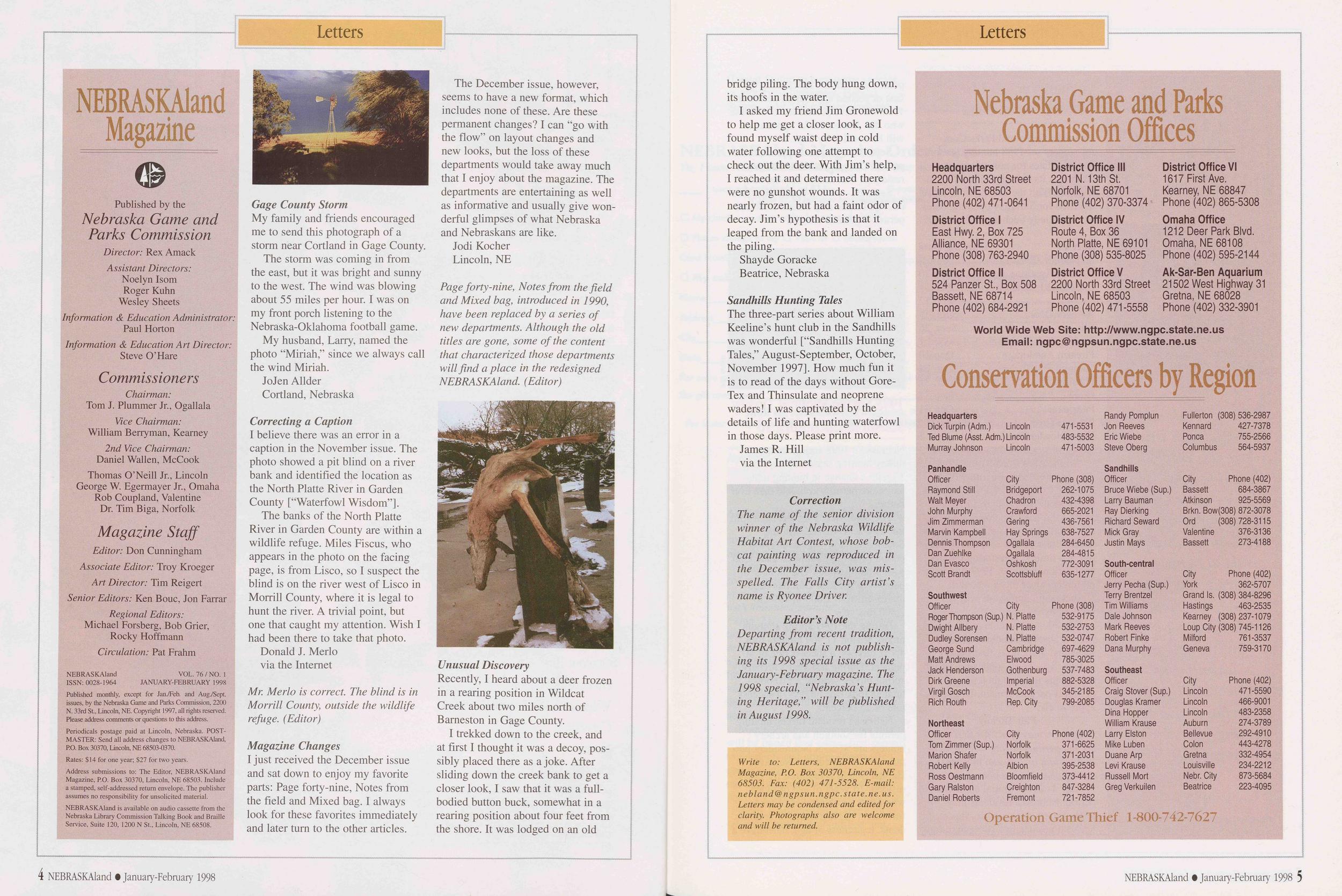
My family and friends encouraged me to send this photograph of a storm near Cortland in Gage County.
The storm was coming in from the east, but it was bright and sunny to the west. The wind was blowing about 55 miles per hour. I was on my front porch listening to the Nebraska-Oklahoma football game.
My husband, Larry, named the photo "Miriah," since we always call the wind Miriah.
JoJen Allder Cortland, Nebraska Correcting a CaptionI believe there was an error in a caption in the November issue. The photo showed a pit blind on a river bank and identified the location as the North Platte River in Garden County ["Waterfowl Wisdom"].
The banks of the North Platte River in Garden County are within a wildlife refuge. Miles Fiscus, who appears in the photo on the facing page, is from Lisco, so I suspect the blind is on the river west of Lisco in Morrill County, where it is legal to hunt the river. A trivial point, but one that caught my attention. Wish I had been there to take that photo.
Donald J. Merlo via the Internet Mr. Merlo is correct. The blind is in Morrill County, outside the wildlife refuge. (Editor)I just received the December issue and sat down to enjoy my favorite parts: Page forty-nine, Notes from the field and Mixed bag. I always look for these favorites immediately and later turn to the other articles.
The December issue, however, seems to have a new format, which includes none of these. Are these permanent changes? I can "go with the flow" on layout changes and new looks, but the loss of these departments would take away much that I enjoy about the magazine. The departments are entertaining as well as informative and usually give wonderful glimpses of what Nebraska and Nebraskans are like.
Jodi Kocher Lincoln, NE Page forty-nine, Notes from the field and Mixed bag, introduced in 1990, have been replaced by a series of new departments. Although the old titles are gone, some of the content that characterized those departments will find a place in the redesigned NEBRASKAland. (Editor) Unusual DiscoveryRecently, I heard about a deer frozen in a rearing position in Wildcat Creek about two miles north of Barneston in Gage County.
I trekked down to the creek, and at first I thought it was a decoy, possibly placed there as a joke. After sliding down the creek bank to get a closer look, I saw that it was a full-bodied button buck, somewhat in a rearing position about four feet from the shore. It was lodged on an old
NEBRASKAland • January-February 1998 4 Lettersbridge piling. The body hung down, its hoofs in the water.
I asked my friend Jim Gronewold to help me get a closer look, as I found myself waist deep in cold water following one attempt to check out the deer. With Jim's help, I reached it and determined there were no gunshot wounds. It was nearly frozen, but had a faint odor of decay. Jim's hypothesis is that it leaped from the bank and landed on the piling.
Shayde Goracke Beatrice, Nebraska Sandhills Hunting TalesThe three-part series about William Keeline's hunt club in the Sandhills was wonderful ["Sandhills Hunting Tales," August-September, October, November 1997]. How much fun it is to read of the days without GoreTex and Thinsulate and neoprene waders! I was captivated by the details of life and hunting waterfowl in those days. Please print more.
James R. Hill via the Internet Correction The name of the senior division winner of the Nebraska Wildlife Habitat Art Contest, whose bobcat painting was reproduced in the December issue, was misspelled. The Falls City artist's name is Ryonee Driver. Editor's Note Departing from recent tradition, NEBRASKAland is not publishing its 1998 special issue as the January-February magazine. The 1998 special, "Nebraska's Hunting Heritage," will be published in August 1998. Write to: Letters, NEBRASKAland Magazine, P.O. Box 30370, Lincoln, NE 68503. Fax: (402) 471-5528. E-mail: nebland@ngpsun.ngpc. state, ne.us. Letters may be condensed and edited for clarity. Photographs also are welcome and will be returned.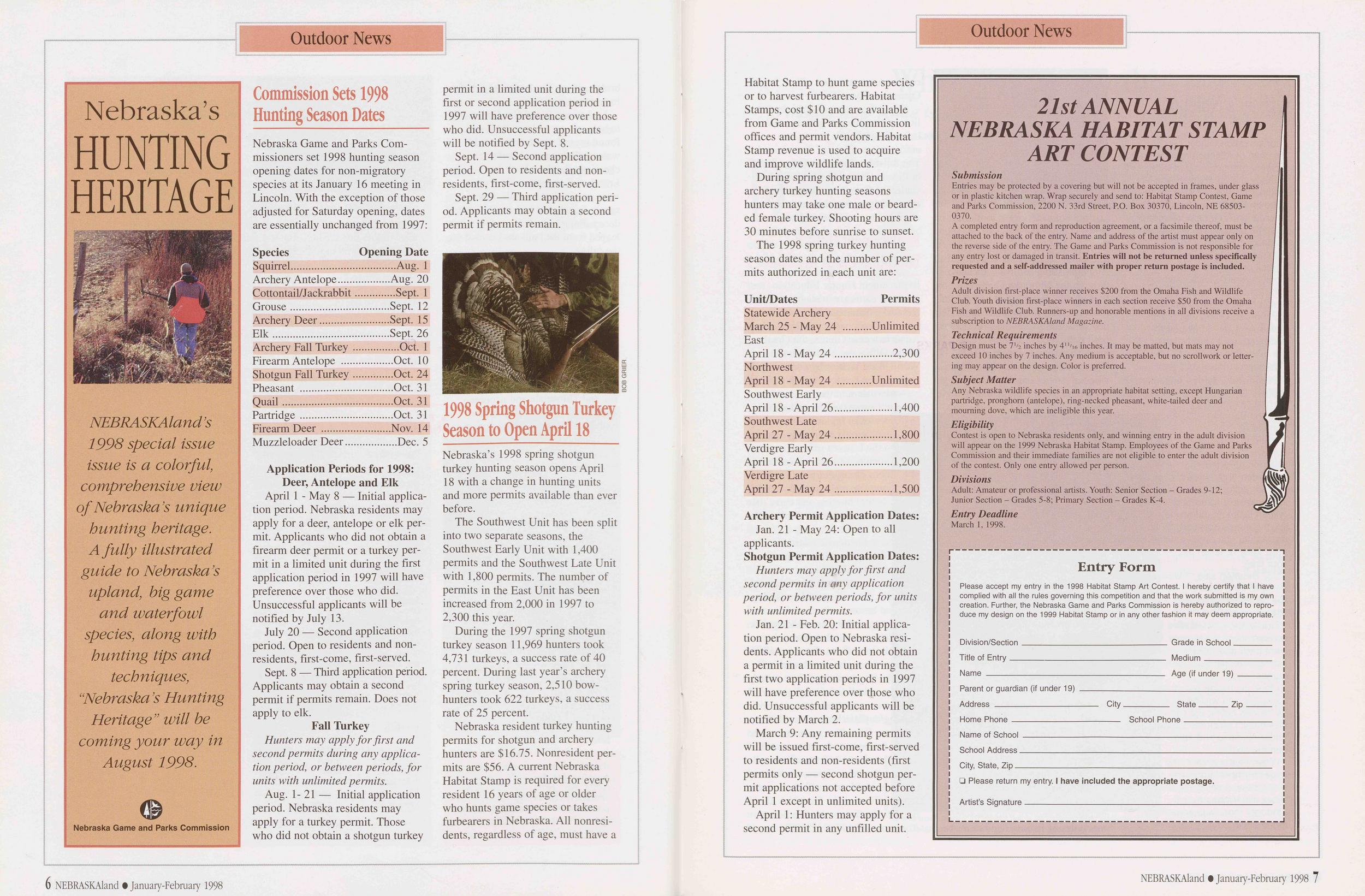
Outdoor News
Commission Sets 1998 Hunting Season DatesNebraska Game and Parks Commissioners set 1998 hunting season opening dates for non-migratory species at its January 16 meeting in Lincoln. With the exception of those adjusted for Saturday opening, dates are essentially unchanged from 1997:
Species Opening Date Squirrel Aug. 1 Archery Antelope Aug. 20 Cottontail/Jackrabbit Sept. 1 Grouse Sept. 12 Archery Deer Sept. 15 Elk Sept. 26 Archery Fall Turkey Oct. 1 Firearm Antelope Oct. 10 Shotgun Fall Turkey Oct. 24 Pheasant Oct. 31 Quail Oct. 31 Partridge Oct. 31 Firearm Deer Nov. 14 Muzzleloader Deer Dec. 5 Application Periods for 1998: Deer, Antelope and ElkApril 1 - May 8 — Initial application period. Nebraska residents may apply for a deer, antelope or elk permit. Applicants who did not obtain a firearm deer permit or a turkey permit in a limited unit during the first application period in 1997 will have preference over those who did. Unsuccessful applicants will be notified by July 13.
July 20 — Second application period. Open to residents and non-residents, first-come, first-served.
Sept. 8 — Second application period. Open to residents and non-residents, first-come, first served.
Fall TurkeyHunters may apply for first and second permits during any application period, or between periods, for units with unlimited permits.
Aug. 1-21 — Initial application period. Nebraska residents may apply for a turkey permit. Those who did not obtain a shotgun turkey permit in a limited unit during the first or second application period in 1997 will have preference over those who did. Unsuccessful applicants will be notified by Sept. 8.
Sept. 14 — Second application period. Open to residents and non-residents, first-come, first-served.
Sept. 29 — Third application period. Applicants may obtain a second permit if permits remain.
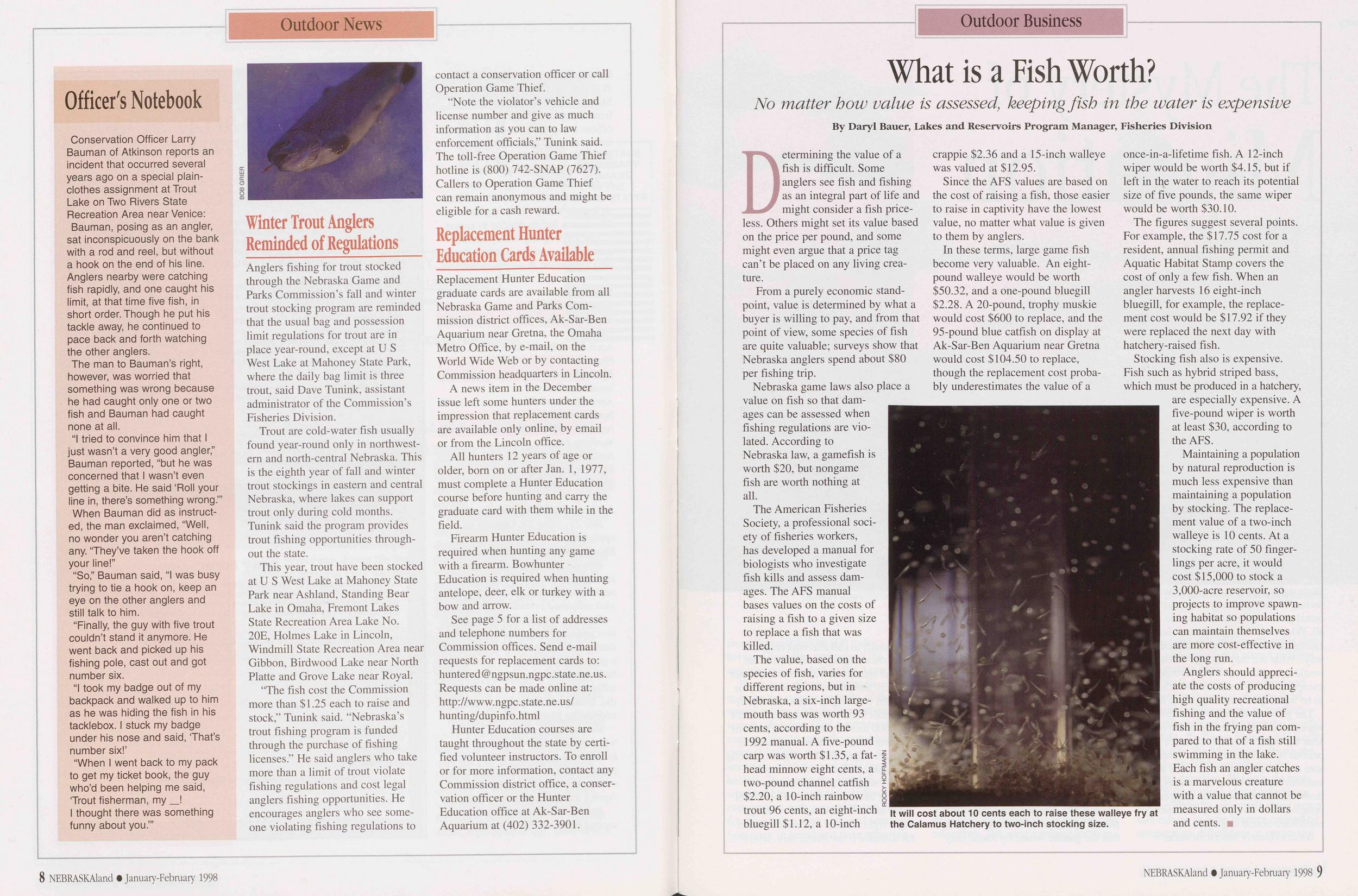
Nebraska's 1998 spring shotgun turkey hunting season opens April 18 with a change in hunting units and more permits available than ever before.
The Southwest Unit has been split into two separate seasons, the Southwest Early Unit with 1,400 permits and the Southwest Late Unit with 1,800 permits. The number of permits in the East Unit has been increased from 2,000 in 1997 to 2,300 this year.
During the 1997 spring shotgun turkey season 11,969 hunters took 4,731 turkeys, a success rate of 40 percent. During last year's archery spring turkey season, 2,510 bowhunters took 622 turkeys, a success rate of 25 percent.
Nebraska resident turkey hunting permits for shotgun and archery hunters are $16.75. Nonresident permits are $56. A current Nebraska Habitat Stamp is required for every resident 16 years of age or older who hunts game species or takes furbearers in Nebraska. All nonresidents, regardless of age, must have a
6 NEBRASKAland • January-February 1998 Outdoor NewsHabitat Stamp to hunt game species or to harvest furbearers. Habitat Stamps, cost $10 and are available from Game and Parks Commission offices and permit vendors. Habitat Stamp revenue is used to acquire and improve wildlife lands.
During spring shotgun and archery turkey hunting seasons hunters may take one male or bearded female turkey. Shooting hours are 30 minutes before sunrise to sunset.
The 1998 spring turkey hunting season dates and the number of permits authorized in each unit are:
Species Unit/Dates Permits Statewide Archery March 25 - May 24 Unlimited East April 18-May 24 2,300 Northwest April 18-May 24 Unlimited Southwest Early April 18-April 26 1,400 Southwest Late April 27 - May 24 1,800 Verdigre Early April 18-April 26 1,200 Verdigre Late April 27 - May 24 1,500 Archery Permit Application Dates: Jan. 21 - May 24: Open to all applicants. Shotgun Permit Application Dates:Hunters may apply for first and second permits in any application period, or between periods, for units with unlimited permits.
Jan. 21 - Feb. 20: Initial application period. Open to Nebraska residents. Applicants who did not obtain a permit in a limited unit during the first two application periods in 1997 will have preference over those who did. Unsuccessful applicants will be notified by March 2.
March 9: Any remaining permits will be issued first-come, first-served to residents and non-residents (first permits only — second shotgun permit applications not accepted before April 1 except in unlimited units).
April 1: Hunters may apply for a second permit in any unfilled unit.
Outdoor News
Officer's Notebook
Conservation Officer Larry Bauman of Atkinson reports an incident that occurred several years ago on a special plain-clothes assignment at Trout Lake on Two Rivers State Recreation Area near Venice:
Bauman, posing as an angler, sat inconspicuously on the bank with a rod and reel, but without a hook on the end of his line. Anglers nearby were catching fish rapidly, and one caught his limit, at that time five fish, in short order. Though he put his tackle away, he continued to pace back and forth watching the other anglers.
The man to Bauman's right, however, was worried that something was wrong because he had caught only one or two fish and Bauman had caught none at all.
"I tried to convince him that I just wasn't a very good angler," Bauman reported, "but he was concerned that I wasn't even getting a bite. He said 'Roll your line in, there's something wrong.'"
When Bauman did as instructed, the man exclaimed, "Well, no wonder you aren't catching any. "They've taken the hook off your line!"
"So," Bauman said, "I was busy trying to tie a hook on, keep an eye on the other anglers and still talk to him.
"Finally, the guy with five trout couldn't stand it anymore. He went back and picked up his fishing pole, cast out and got number six.
"I took my badge out of my backpack and walked up to him as he was hiding the fish in his tacklebox. I stuck my badge under his nose and said, That's number six!'
"When I went back to my pack to get my ticket book, the guy who'd been helping me said, Trout fisherman, my __! I thought there was something funny about you.'"
Anglers fishing for trout stocked through the Nebraska Game and Parks Commission's fall and winter trout stocking program are reminded that the usual bag and possession limit regulations for trout are in place year-round, except at U S West Lake at Mahoney State Park, where the daily bag limit is three trout, said Dave Tunink, assistant administrator of the Commission's Fisheries Division.
Trout are cold-water fish usually found year-round only in northwestern and north-central Nebraska. This is the eighth year of fall and winter trout stockings in eastern and central Nebraska, where lakes can support trout only during cold months. Tunink said the program provides trout fishing opportunities throughout the state.
This year, trout have been stocked at U S West Lake at Mahoney State Park near Ashland, Standing Bear Lake in Omaha, Fremont Lakes State Recreation Area Lake No. 20E, Holmes Lake in Lincoln, Windmill State Recreation Area near Gibbon, Birdwood Lake near North Platte and Grove Lake near Royal.
"The fish cost the Commission more than $1.25 each to raise and stock," Tunink said. "Nebraska's trout fishing program is funded through the purchase of fishing licenses." He said anglers who take more than a limit of trout violate fishing regulations and cost legal anglers fishing opportunities. He encourages anglers who see someone violating fishing regulations to contact a conservation officer or call Operation Game Thief.
"Note the violator's vehicle and license number and give as much information as you can to law enforcement officials," Tunink said. The toll-free Operation Game Thief hotline is (800) 742-SNAP (7627). Callers to Operation Game Thief can remain anonymous and might be eligible for a cash reward.
Replacement Hunter Education Cards AvailableReplacement Hunter Education graduate cards are available from all Nebraska Game and Parks Commission district offices, Ak-Sar-Ben Aquarium near Gretna, the Omaha Metro Office, by e-mail, on the World Wide Web or by contacting Commission headquarters in Lincoln.
A news item in the December issue left some hunters under the impression that replacement cards are available only online, by email or from the Lincoln office.
All hunters 12 years of age or older, born on or after Jan. 1, 1977, must complete a Hunter Education course before hunting and carry the graduate card with them while in the field.
Firearm Hunter Education is required when hunting any game with a firearm. Bowhunter Education is required when hunting antelope, deer, elk or turkey with a bow and arrow.
See page 5 for a list of addresses and telephone numbers for Commission offices. Send e-mail requests for replacement cards to: huntered@ngpsun.ngpc.state.ne.us. Requests can be made online at: http://www.ngpc.state.ne.us/ hunting/dupinfo.html
Hunter Education courses are taught throughout the state by certified volunteer instructors. To enroll or for more information, contact any Commission district office, a conservation officer or the Hunter Education office at Ak-Sar-Ben Aquarium at (402) 332-3901.
Outdoor Business
What is a Fish Worth?
No matter how value is assessed, keeping fish in the water is expensive By Daryl Bauer, Lakes and Reservoirs Program Manager, Fisheries DivisionDetermining the value of a fish is difficult. Some anglers see fish and fishing as an integral part of life and might consider a fish priceless. Others might set its value based on the price per pound, and some might even argue that a price tag can't be placed on any living creature.
From a purely economic standpoint, value is determined by what a buyer is willing to pay, and from that point of view, some species of fish are quite valuable; surveys show that Nebraska anglers spend about $80 per fishing trip.
Nebraska game laws also place a value on fish so that damages can be assessed when fishing regulations are violated. According to Nebraska law, a gamefish is worth $20, but non-game fish are worth nothing at all.
The American Fisheries Society, a professional society of fisheries workers, has developed a manual for biologists who investigate fish kills and assess damages. The AFS manual bases values on the costs of raising a fish to a given size to replace a fish that was killed.
The value, based on the species of fish, varies for different regions, but in Nebraska, a six-inch largemouth bass was worth 93 cents, according to the 1992 manual. A five-pound carp was worth $1.35, a fathead minnow eight cents, a two-pound channel catfish $2.20, a 10-inch rainbow trout 96 cents, an eight-inch bluegill $1.12, a 10-inch crappie $2.36 and a 15-inch walleye was valued at $12.95.
Since the AFS values are based on the cost of raising a fish, those easier to raise in captivity have the lowest value, no matter what value is given to them by anglers.
In these terms, large game fish become very valuable. An eight-pound walleye would be worth $50.32, and a one-pound bluegill $2.28. A 20-pound, trophy muskie would cost $600 to replace, and the 95-pound blue catfish on display at Ak-Sar-Ben Aquarium near Gretna would cost $104.50 to replace, though the replacement cost probably underestimates the value of a
It will cost about 10 cents each to raise these walleye fry at the Calamus Hatchery to two-inch stocking size.
once-in-a-lifetime fish. A 12-inch wiper would be worth $4.15, but if left in the water to reach its potential size of five pounds, the same wiper would be worth $30.10.
The figures suggest several points. For example, the $17.75 cost for a resident, annual fishing permit and Aquatic Habitat Stamp covers the cost of only a few fish. When an angler harvests 16 eight-inch bluegill, for example, the replacement cost would be $17.92 if they were replaced the next day with hatchery-raised fish.
Stocking fish also is expensive. Fish such as hybrid striped bass, which must be produced in a hatchery, are especially expensive. A five-pound wiper is worth at least $30, according to the AFS.
Maintaining a population by natural reproduction is much less expensive than maintaining a population by stocking. The replacement value of a two-inch walleye is 10 cents. At a stocking rate of 50 fingerlings per acre, it would cost $15,000 to stock a 3,000-acre reservoir, so projects to improve spawning habitat so populations can maintain themselves are more cost-effective in the long run.
Anglers should appreciate the costs of producing high quality recreational fishing and the value of fish in the frying pan compared to that of a fish still swimming in the lake. Each fish an angler catches is a marvelous creature with a value that cannot be measured only in dollars and cents.
The Mystery of Migration
By Jo Anne Rogers Luebbert, Wildlife Rescue Team Inc. Photos by Michael Forsberg For millenniums, waterfowl have migrated thousands of miles across North America, navigating vast distances with uncanny precision. In the heart of the Central Fly way, Nebraska's extensive wetlands and grain fields attract thousands of migrating birds.For the past few years I seem to have measured my own passage through life in just two seasons rather than by the turn of a calendar page: the season when the birds are here and the season when they are gone.
It is when I hear that unmistakable sound of the geese flying north and home again that I, earth-bound and feeling an exceptionally strong gravitational pull, wonder at the miracle of it all. Where are they going that I never can go, and how do they find their way? What are they saying? What would it be like to leave everything except the living creatures you choose to be with, open your wings and fly?
The geese do not miss the almost imperceptible lengthening of daylight after the winter solstice. Changes in periods of daylight and night synchronize the annual rhythms of birds and motivate waterfowl — in families, in flocks and in numbers that stagger the imagination — to initiate their spring, northward-bound migration.
Birds evidently inherit an understanding of the time to migrate, the direction in which to fly, and, equally remarkable, the appropriate time to end their migrations. In a classic experiment by Frank Bellrose, immature blue-winged teal were held captive until free-flying teal migrated from the area. The young teal, without the benefit of adults or prior knowledge of the migration route, successfully migrated in the traditional direction for the species. That migration is both genetically and environmentally influenced has been supported in many creative and geographically dispersed empirical studies with many species of birds.
W. H. Hudson, a renowned British naturalist, reported watching a pair of Magellan geese on the plains of Argentina several days after the flocks had migrated. Heading south, the gander flew short distances, then returned to walk with his wing-crippled mate. The desire to migrate was so strong she attempted to walk to her breeding grounds. No less affecting, the bond shared by the pair was so immutable, that the gander would fly ahead only
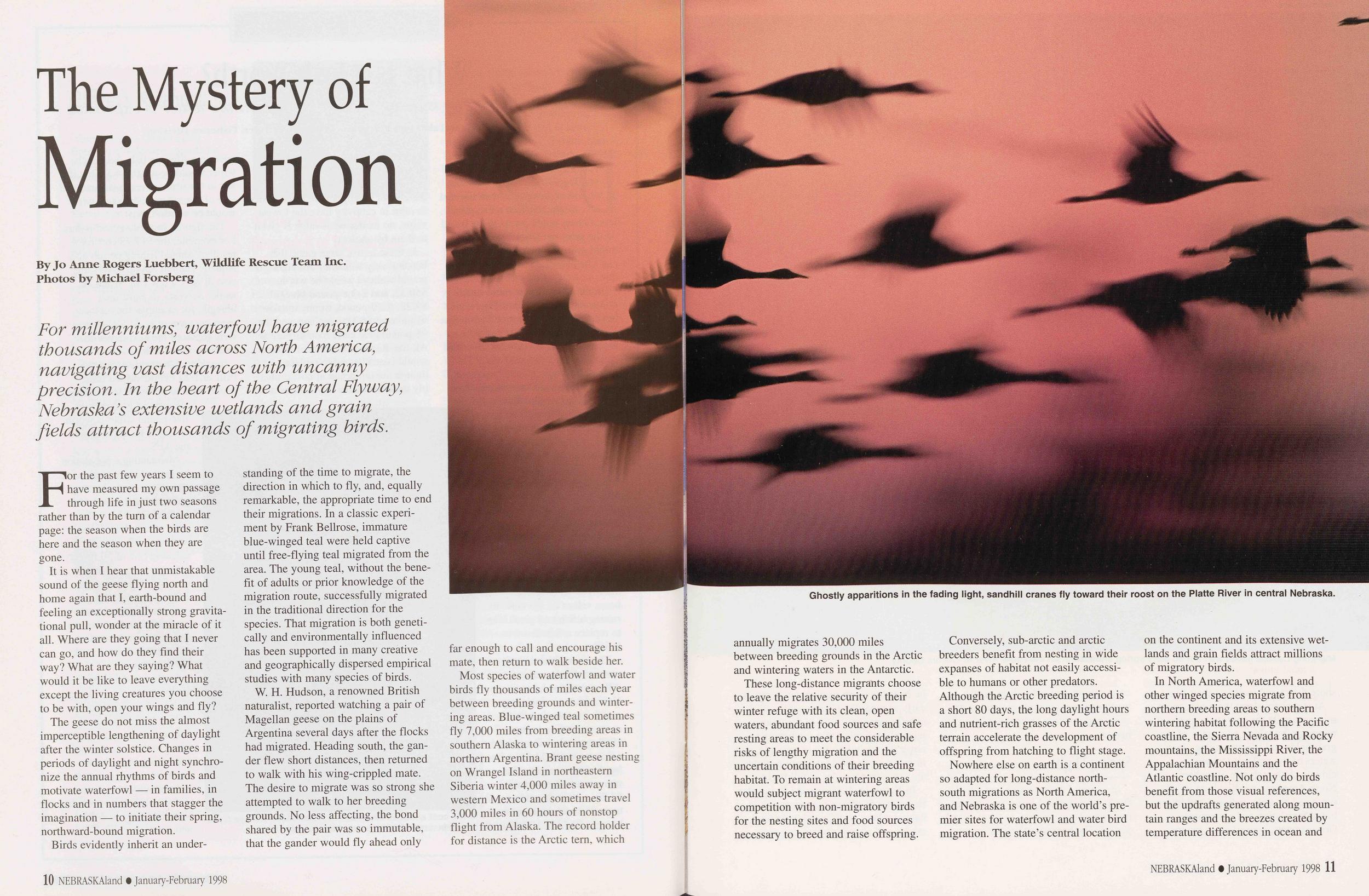
Ghostly apparitions in the fading light, sandhill cranes fly toward their roost on the Platte River in central Nebraska.
far enough to call and encourage his mate, then return to walk beside her.
Most species of waterfowl and water birds fly thousands of miles each year between breeding grounds and wintering areas. Blue-winged teal sometimes fly 7,000 miles from breeding areas in southern Alaska to wintering areas in northern Argentina. Brant geese nesting on Wrangel Island in northeastern Siberia winter 4,000 miles away in western Mexico and sometimes travel 3,000 miles in 60 hours of nonstop flight from Alaska. The record holder for distance is the Arctic tern, which
10 NEBRASKAland • January-February 1998annually migrates 30,000 miles between breeding grounds in the Arctic and wintering waters in the Antarctic.
These long-distance migrants choose to leave the relative security of their winter refuge with its clean, open waters, abundant food sources and safe resting areas to meet the considerable risks of lengthy migration and the uncertain conditions of their breeding habitat. To remain at wintering areas would subject migrant waterfowl to competition with non-migratory birds for the nesting sites and food sources necessary to breed and raise offspring.
Conversely, sub-arctic and arctic breeders benefit from nesting in wide expanses of habitat not easily accessible to humans or other predators. Although the Arctic breeding period is a short 80 days, the long daylight hours and nutrient-rich grasses of the Arctic terrain accelerate the development of offspring from hatching to flight stage.
Nowhere else on earth is a continent so adapted for long-distance north-south migrations as North America, and Nebraska is one of the world's premier sites for waterfowl and water bird migration. The state's central location on the continent and its extensive wetlands and grain fields attract millions of migratory birds.
In North America, waterfowl and other winged species migrate from northern breeding areas to southern wintering habitat following the Pacific coastline, the Sierra Nevada and Rocky mountains, the Mississippi River, the Appalachian Mountains and the Atlantic coastline. Not only do birds benefit from those visual references, but the updrafts generated along mountain ranges and the breezes created by temperature differences in ocean and
NEBRASKAland • January-February 1998 11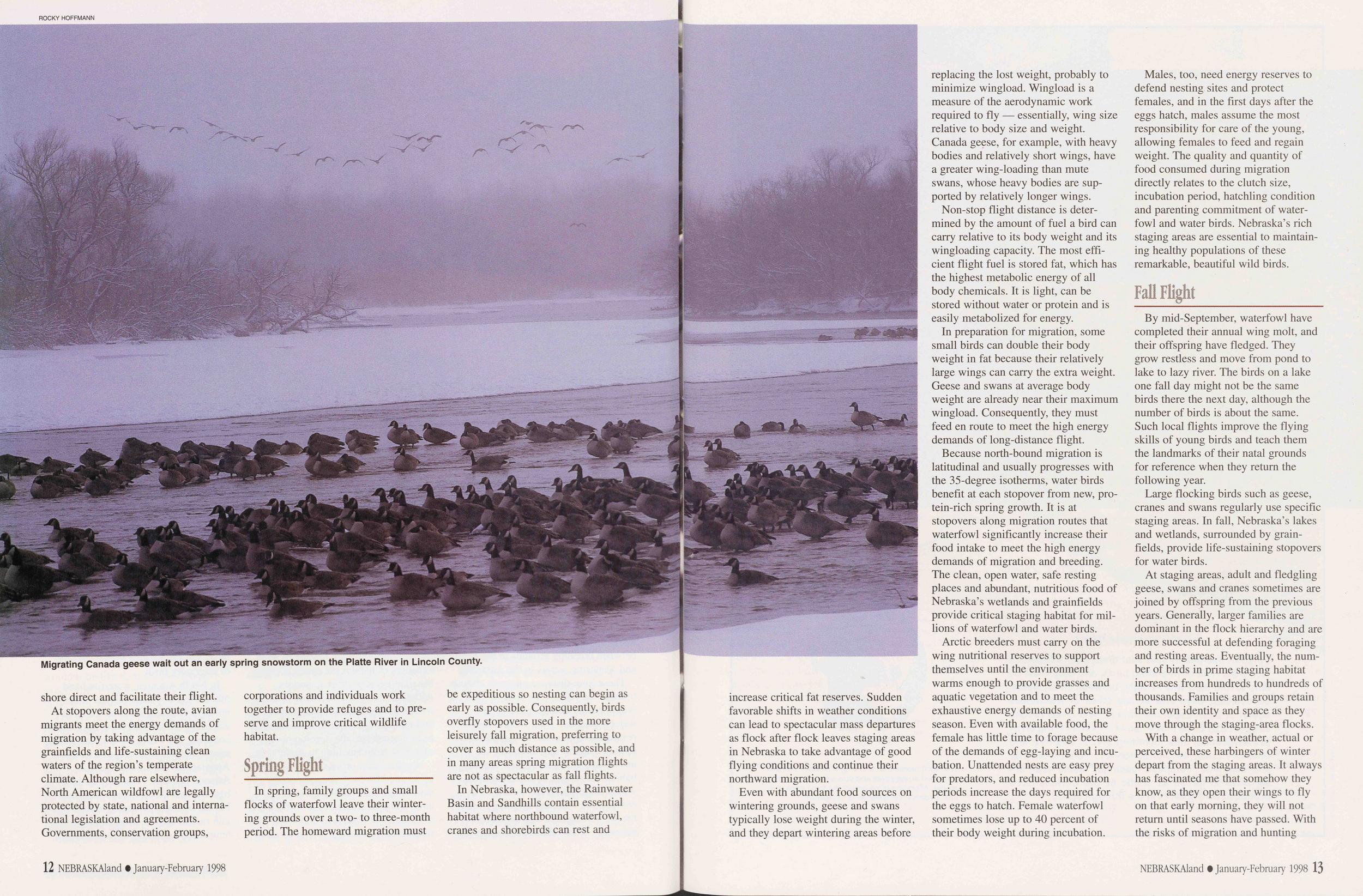
Migrating Canada geese wait out an early spring snowstorm on the Platte River in Lincoln County.
shore direct and facilitate their flight.
At stopovers along the route, avian migrants meet the energy demands of migration by taking advantage of the grainfields and life-sustaining clean waters of the region's temperate climate. Although rare elsewhere, North American wildfowl are legally protected by state, national and international legislation and agreements. Governments, conservation groups, corporations and individuals work together to provide refuges and to preserve and improve critical wildlife habitat.
Spring FlightIn spring, family groups and small flocks of waterfowl leave their wintering grounds over a two- to three-month period. The homeward migration must be expeditious so nesting can begin as early as possible. Consequently, birds overfly stopovers used in the more leisurely fall migration, preferring to cover as much distance as possible, and in many areas spring migration flights are not as spectacular as fall flights.
In Nebraska, however, the Rainwater Basin and Sandhills contain essential habitat where northbound waterfowl, cranes and shorebirds can rest and
12 NEBRASKAland • January-February 1998increase critical fat reserves. Sudden favorable shifts in weather conditions can lead to spectacular mass departures as flock after flock leaves staging areas in Nebraska to take advantage of good flying conditions and continue their northward migration.
Even with abundant food sources on wintering grounds, geese and swans typically lose weight during the winter, and they depart wintering areas before replacing the lost weight, probably to minimize wingload. Wingload is a measure of the aerodynamic work required to fly — essentially, wing size relative to body size and weight. Canada geese, for example, with heavy bodies and relatively short wings, have a greater wing-loading than mute swans, whose heavy bodies are supported by relatively longer wings.
Non-stop flight distance is determined by the amount of fuel a bird can carry relative to its body weight and its wingloading capacity. The most efficient flight fuel is stored fat, which has the highest metabolic energy of all body chemicals. It is light, can be stored without water or protein and is easily metabolized for energy.
In preparation for migration, some small birds can double their body weight in fat because their relatively large wings can carry the extra weight. Geese and swans at average body weight are already near their maximum wingload. Consequently, they must feed en route to meet the high energy demands of long-distance flight.
Because north-bound migration is latitudinal and usually progresses with the 35-degree isotherms, water birds benefit at each stopover from new, protein-rich spring growth. It is at stopovers along migration routes that waterfowl significantly increase their food intake to meet the high energy demands of migration and breeding. The clean, open water, safe resting places and abundant, nutritious food of Nebraska's wetlands and grainfields provide critical staging habitat for millions of waterfowl and water birds.
Arctic breeders must carry on the wing nutritional reserves to support themselves until the environment warms enough to provide grasses and aquatic vegetation and to meet the exhaustive energy demands of nesting season. Even with available food, the female has little time to forage because of the demands of egg-laying and incubation. Unattended nests are easy prey for predators, and reduced incubation periods increase the days required for the eggs to hatch. Female waterfowl sometimes lose up to 40 percent of their body weight during incubation.
Males, too, need energy reserves to defend nesting sites and protect females, and in the first days after the eggs hatch, males assume the most responsibility for care of the young, allowing females to feed and regain weight. The quality and quantity of food consumed during migration directly relates to the clutch size, incubation period, hatchling condition and parenting commitment of waterfowl and water birds. Nebraska's rich staging areas are essential to maintaining healthy populations of these remarkable, beautiful wild birds.
Fall FlightBy mid-September, waterfowl have completed their annual wing molt, and their offspring have fledged. They grow restless and move from pond to lake to lazy river. The birds on a lake one fall day might not be the same birds there the next day, although the number of birds is about the same. Such local flights improve the flying skills of young birds and teach them the landmarks of their natal grounds for reference when they return the following year.
Large flocking birds such as geese, cranes and swans regularly use specific staging areas. In fall, Nebraska's lakes and wetlands, surrounded by grainfields, provide life-sustaining stopovers for water birds.
At staging areas, adult and fledgling geese, swans and cranes sometimes are joined by offspring from the previous years. Generally, larger families are dominant in the flock hierarchy and are more successful at defending foraging and resting areas. Eventually, the number of birds in prime staging habitat increases from hundreds to hundreds of thousands. Families and groups retain their own identity and space as they move through the staging-area flocks.
With a change in weather, actual or perceived, these harbingers of winter depart from the staging areas. It always has fascinated me that somehow they know, as they open their wings to fly on that early morning, they will not return until seasons have passed. With the risks of migration and hunting
NEBRASKAland • January-February 1998 13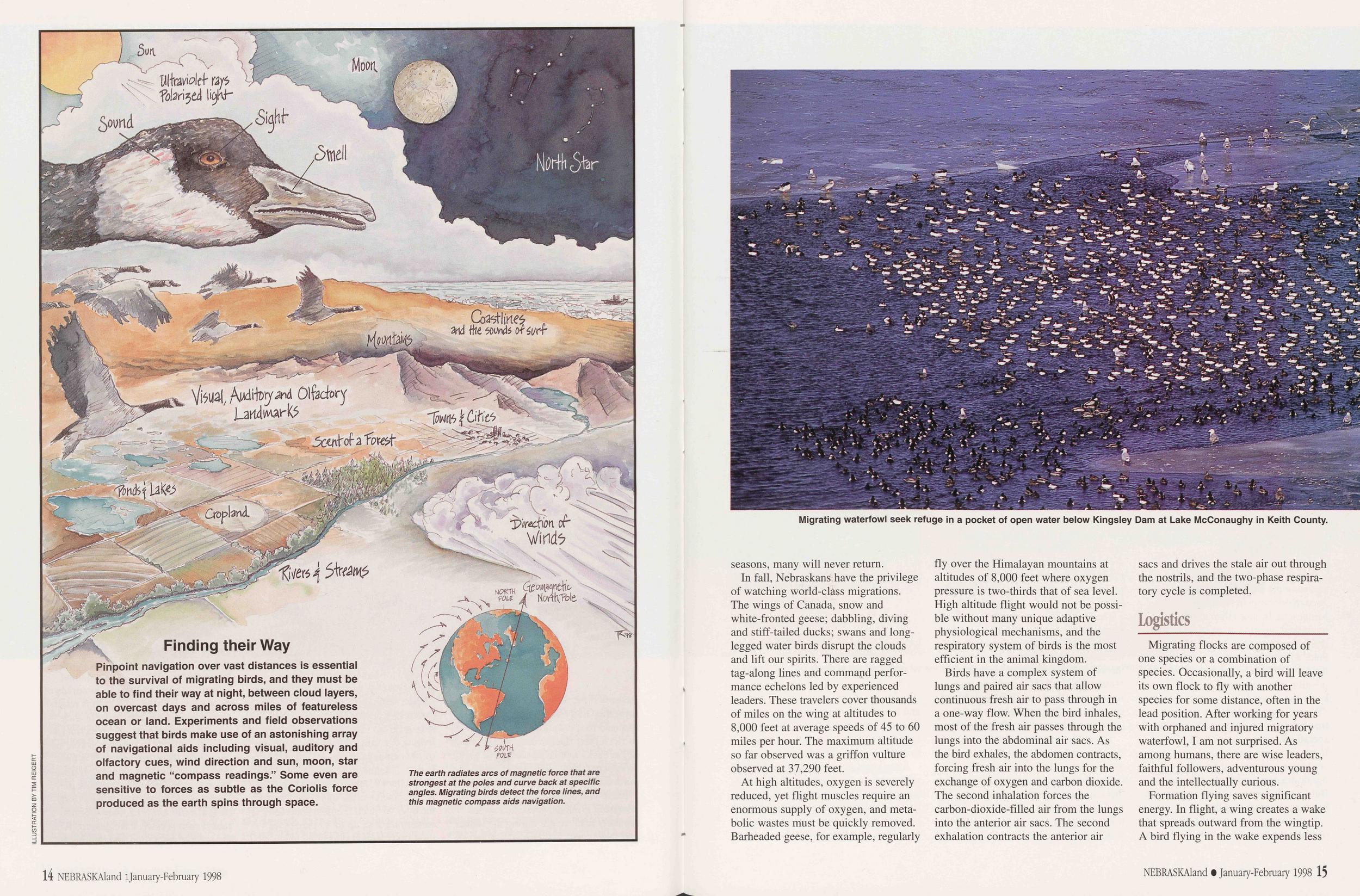
Finding their Way
Pinpoint navigation over vast distances is essential to the survival of migrating birds, and they must be able to find their way at night, between cloud layers, on overcast days and across miles of featureless ocean or land. Experiments and field observations suggest that birds make use of an astonishing array of navigational aids including visual, auditory and olfactory cues, wind directions and sun, moon, star and magnetic "compass readings." some even are sensitive to forces as subtle as the Coriolis force produced as the earth spins through space.
The earth radiates arcs of magnetic force that are strongest at the poles and curve back at specific angles. Migrating birds detect the force lines, and this magnetic compass aids navigation.
Migrating waterfowl seek refuge in a pocket of open water below Kingsley Dam at Lake McConaughy in Keith County.
seasons, many will never return.
In fall, Nebraskans have the privilege of watching world-class migrations. The wings of Canada, snow and white-fronted geese; dabbling, diving and stiff-tailed ducks; swans and long-legged water birds disrupt the clouds and lift our spirits. There are ragged tag-along lines and command performance echelons led by experienced leaders. These travelers cover thousands of miles on the wing at altitudes to 8,000 feet at average speeds of 45 to 60 miles per hour. The maximum altitude so far observed was a griffon vulture observed at 37,290 feet.
At high altitudes, oxygen is severely reduced, yet flight muscles require an enormous supply of oxygen, and metabolic wastes must be quickly removed. Barheaded geese, for example, regularly fly over the Himalayan mountains at altitudes of 8,000 feet where oxygen pressure is two-thirds that of sea level. High altitude flight would not be possible without many unique adaptive physiological mechanisms, and the respiratory system of birds is the most efficient in the animal kingdom.
Birds have a complex system of lungs and paired air sacs that allow continuous fresh air to pass through in a one-way flow. When the bird inhales, most of the fresh air passes through the lungs into the abdominal air sacs. As the bird exhales, the abdomen contracts, forcing fresh air into the lungs for the exchange of oxygen and carbon dioxide. The second inhalation forces the carbon-dioxide-filled air from the lungs into the anterior air sacs. The second exhalation contracts the anterior air sacs and drives the stale air out through the nostrils, and the two-phase respiratory cycle is completed.
LogisticsMigrating flocks are composed of one species or a combination of species. Occasionally, a bird will leave its own flock to fly with another species for some distance, often in the lead position. After working for years with orphaned and injured migratory waterfowl, I am not surprised. As among humans, there are wise leaders, faithful followers, adventurous young and the intellectually curious.
Formation flying saves significant energy. In flight, a wing creates a wake that spreads outward from the wingtip. A bird flying in the wake expends less
NEBRASKAland • January-February 1998 15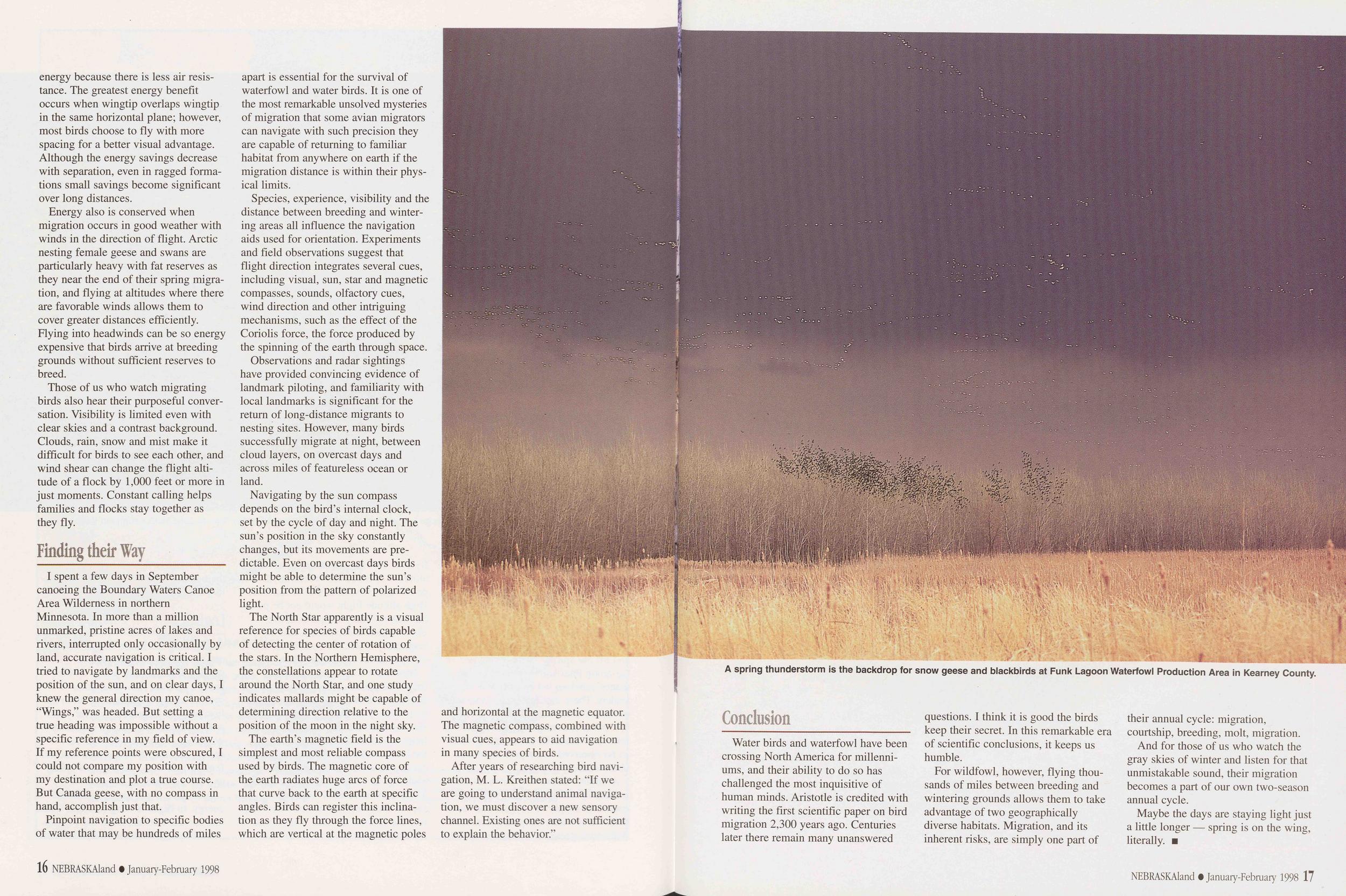
energy because there is less air resistance. The greatest energy benefit occurs when wingtip overlaps wingtip in the same horizontal plane; however, most birds choose to fly with more spacing for a better visual advantage. Although the energy savings decrease with separation, even in ragged formations small savings become significant over long distances.
Energy also is conserved when migration occurs in good weather with winds in the direction of flight. Arctic nesting female geese and swans are particularly heavy with fat reserves as they near the end of their spring migration, and flying at altitudes where there are favorable winds allows them to cover greater distances efficiently. Flying into headwinds can be so energy expensive that birds arrive at breeding grounds without sufficient reserves to breed.
Those of us who watch migrating birds also hear their purposeful conversation. Visibility is limited even with clear skies and a contrast background. Clouds, rain, snow and mist make it difficult for birds to see each other, and wind shear can change the flight altitude of a flock by 1,000 feet or more in just moments. Constant calling helps families and flocks stay together as they fly.
Finding their WayI spent a few days in September canoeing the Boundary Waters Canoe Area Wilderness in northern Minnesota. In more than a million unmarked, pristine acres of lakes and rivers, interrupted only occasionally by land, accurate navigation is critical. I tried to navigate by landmarks and the position of the sun, and on clear days, I knew the general direction my canoe, "Wings," was headed. But setting a true heading was impossible without a specific reference in my field of view. If my reference points were obscured, I could not compare my position with my destination and plot a true course. But Canada geese, with no compass in hand, accomplish just that.
Pinpoint navigation to specific bodies of water that may be hundreds of miles apart is essential for the survival of waterfowl and water birds. It is one of the most remarkable unsolved mysteries of migration that some avian migrators can navigate with such precision they are capable of returning to familiar habitat from anywhere on earth if the migration distance is within their physical limits.
Species, experience, visibility and the distance between breeding and wintering areas all influence the navigation aids used for orientation. Experiments and field observations suggest that flight direction integrates several cues, including visual, sun, star and magnetic compasses, sounds, olfactory cues, wind direction and other intriguing mechanisms, such as the effect of the Coriolis force, the force produced by the spinning of the earth through space.
Observations and radar sightings have provided convincing evidence of landmark piloting, and familiarity with local landmarks is significant for the return of long-distance migrants to nesting sites. However, many birds successfully migrate at night, between cloud layers, on overcast days and across miles of featureless ocean or land.
Navigating by the sun compass depends on the bird's internal clock, set by the cycle of day and night. The sun's position in the sky constantly changes, but its movements are predictable. Even on overcast days birds might be able to determine the sun's position from the pattern of polarized light.
The North Star apparently is a visual reference for species of birds capable of detecting the center of rotation of the stars. In the Northern Hemisphere, the constellations appear to rotate around the North Star, and one study indicates mallards might be capable of determining direction relative to the position of the moon in the night sky.
The earth's magnetic field is the simplest and most reliable compass used by birds. The magnetic core of the earth radiates huge arcs of force that curve back to the earth at specific angles. Birds can register this inclination as they fly through the force lines, which are vertical at the magnetic poles
A spring thunderstorm is the backdrop for snow geese and blackbirds at Funk Lagoon Waterfowl Production Area in Kearney County.
and horizontal at the magnetic equator. The magnetic compass, combined with visual cues, appears to aid navigation in many species of birds.
After years of researching bird navigation, M. L. Kreithen stated: "If we are going to understand animal navigation, we must discover a new sensory channel. Existing ones are not sufficient to explain the behavior."
16 NEBRASKAland • January-February 1998 ConclusionWater birds and waterfowl have been crossing North America for millenniums, and their ability to do so has challenged the most inquisitive of human minds. Aristotle is credited with writing the first scientific paper on bird migration 2,300 years ago. Centuries later there remain many unanswered questions. I think it is good the birds keep their secret. In this remarkable era of scientific conclusions, it keeps us humble.
For wildfowl, however, flying thousands of miles between breeding and wintering grounds allows them to take advantage of two geographically diverse habitats. Migration, and its inherent risks, are simply one part of their annual cycle: migration, courtship, breeding, molt, migration.
And for those of us who watch the gray skies of winter and listen for that unmistakable sound, their migration becomes a part of our own two-season annual cycle.
Maybe the days are staying light just a little longer — spring is on the wing, literally.
Cedar Valley
Wildlife Management Area Photo and text by Rocky HoffmannTwice a week, a Burlington Northern train whistles just west of the trestle crossing Medicine Creek where it meanders through Cedar Valley Wildlife Management Area near Wellfleet. Often, a small flock of turkeys responds with a chorus of throaty gobbles from somewhere deep in a cedar-lined canyon. The Tuesday and Thursday runs, restricted to 10 miles per hour through most of that stretch, are almost the last vestige of "civilization" remaining in one of the Game and Parks Commission's newest wildlife land acquisitions, opened for hunting, hiking, fishing and other outdoor activities in 1995.
The 880-acre tract about 25 miles south of North Platte is a wildlife manager's dream, providing habitat for pheasants, quail, white-tailed deer, mule deer, wild turkeys and wood ducks. The creek and its surrounding canyons and tablelands offer a variety of furbearers, including coyotes, bobcats, beavers, muskrats, mink and raccoons.
Medicine Creek's backwaters and rushes also support muskrats and beavers and provide protection to upland birds on stormy days. It was on a stormy day nearly 20 years ago that my 10-year-old daughter shot her first pheasant along the edge of the rushes there. We didn't know the area as Cedar Valley then; it was simply the old Hueftle place. My son also bagged his first two roosters along the creek there, while running his trapline for muskrats.
We worked quail out of the pockets with an aging pointer who also managed to tree a bobcat, get too close to a porcupine and dodge a rattlesnake strike all on the same outing. Most years, we found our winter supply of venison there, taking whitetails in the bottoms and mule deer along the canyon ridges. Usually, mallards off the ponds and sometimes a wood duck or two surprised us while we were hunting quail.
The creek supplied a bucket of chubs for fish bait when we needed them and, occasionally, we caught channel catfish from under a shady bank. In the early 1980s, wild turkeys were released in the area, and flocks quickly grew to huntable populations throughout the area.
The way we saw it, Marv Hueftle had everything anyone could possibly want or need, and we were surprised when he sold out to take over a ranch in Montana. The new owner eventually offered the property to the Game and Parks Commission, and the land was purchased with funds from habitat stamps. The area is certain to become a jewel among wildlife management areas in southwestern Nebraska.
Cedar Valley is managed for game and non-game species. Grazed canyons are being treated for downy brome encroachment in the hope that annual weeds like kochia, ragweed, marijuana and sunflower will provide
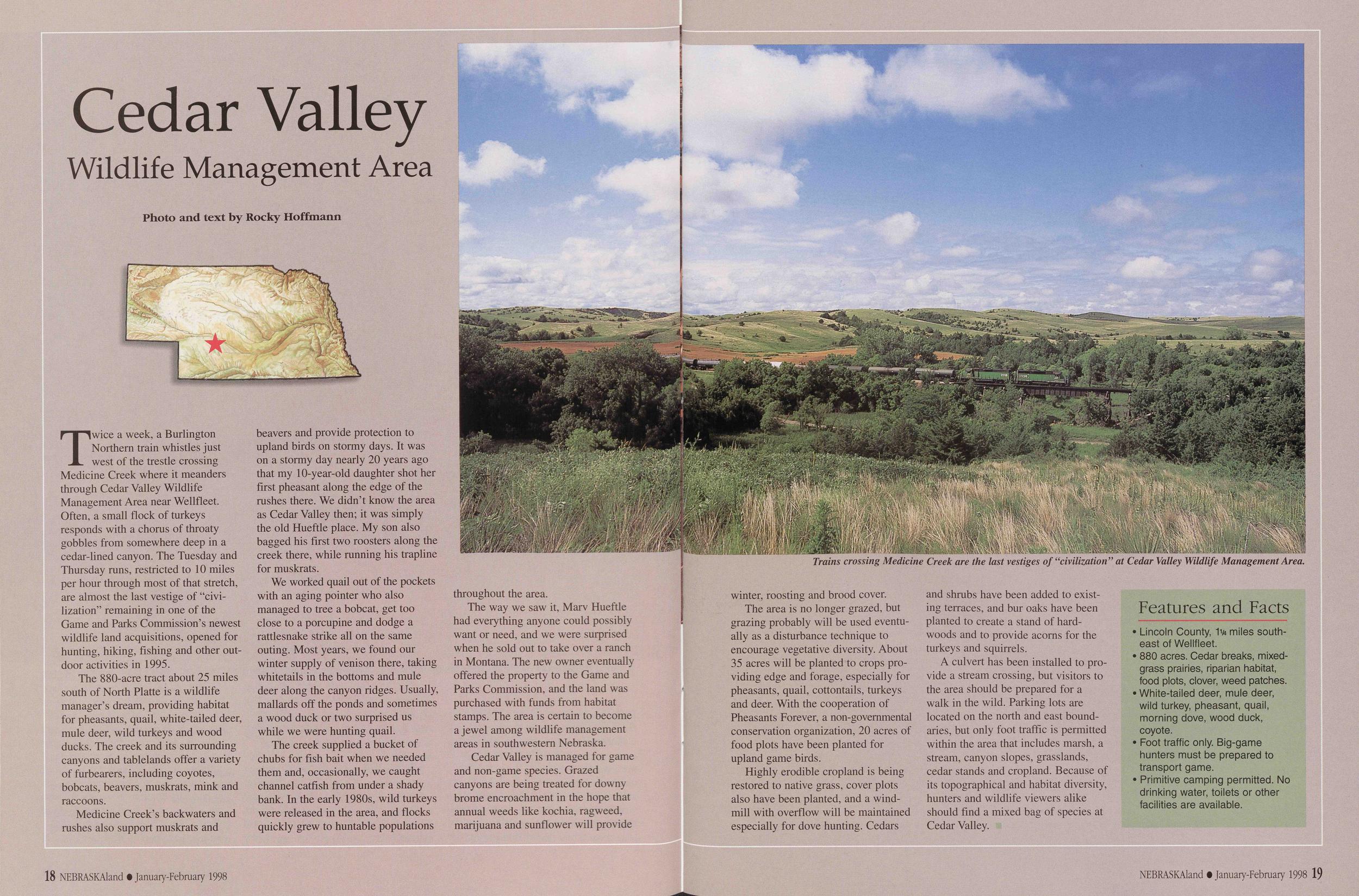
18 NEBRASKAland • January-February 1998Trains crossing Medicine Creek are the last vestiges of "civilization" at Cedar Valley Wildlife Management Area.
winter, roosting and brood cover.
The area is no longer grazed, but grazing probably will be used eventually as a disturbance technique to encourage vegetative diversity. About 35 acres will be planted to crops providing edge and forage, especially for pheasants, quail, cottontails, turkeys and deer. With the cooperation of Pheasants Forever, a non-governmental conservation organization, 20 acres of food plots have been planted for upland game birds.
Highly erodible cropland is being restored to native grass, cover plots also have been planted, and a windmill with overflow will be maintained especially for dove hunting. Cedars and shrubs have been added to existing terraces, and bur oaks have been planted to create a stand of hardwoods and to provide acorns for the turkeys and squirrels.
A culvert has been installed to provide a stream crossing, but visitors to the area should be prepared for a walk in the wild. Parking lots are located on the north and east boundaries, but only foot traffic is permitted within the area that includes marsh, a stream, canyon slopes, grasslands, cedar stands and cropland. Because of its topographical and habitat diversity, hunters and wildlife viewers alike should find a mixed bag of species at Cedar Valley.
880 acres. Cedar breaks, mixed-grass prairies, riparian habitat, food plots, clover, weed patches.
White-tailed deer, mule deer, wild turkey, pheasant, quail, morning dove, wood duck, coyote.
Foot traffic only. Big-game hunters must be prepared to transport game.
Primitive camping permitted. No drinking water, toilets or other facilities are available.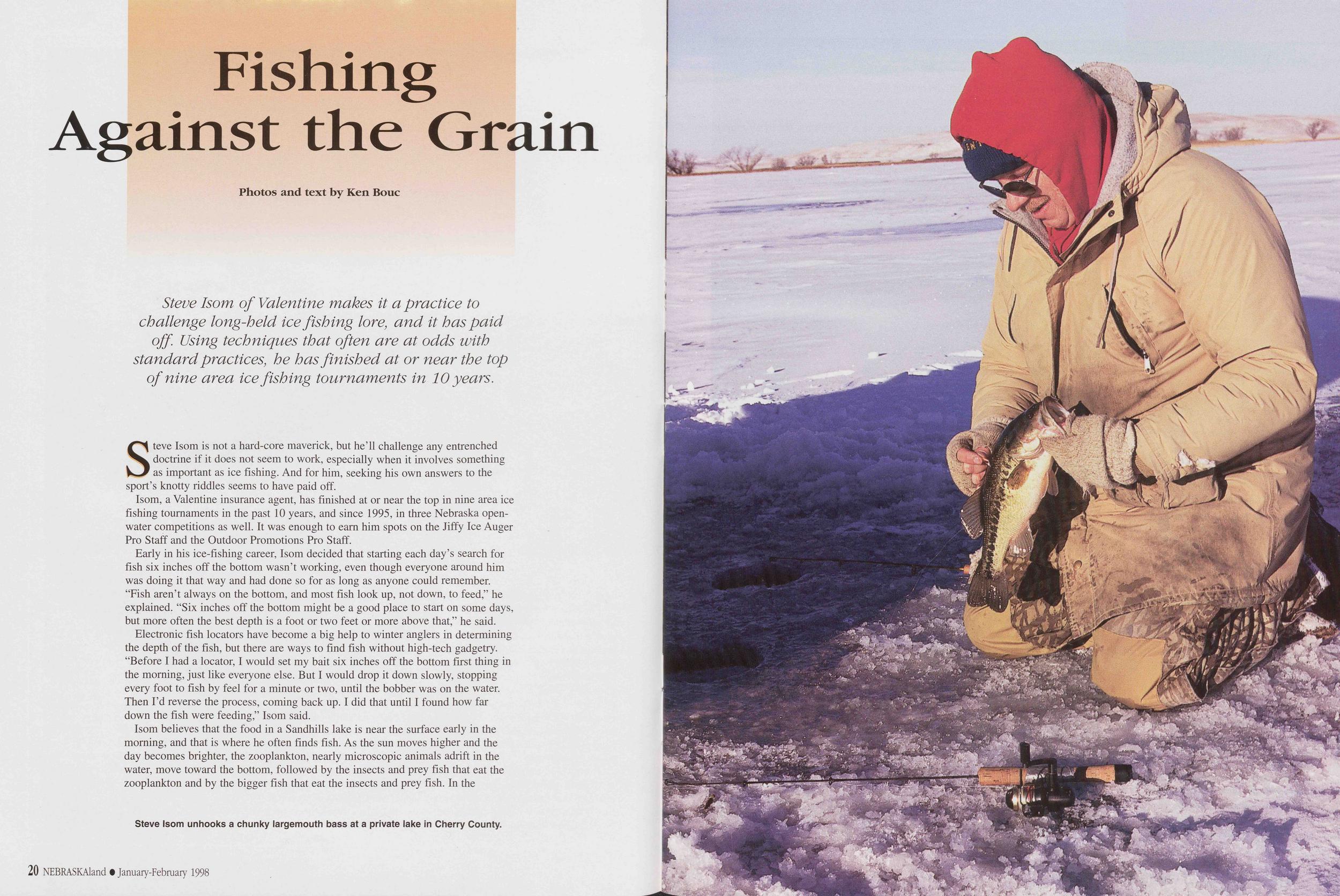
Fishing Against the Grain
Photos and text by Ken Bouc Steve Isom of Valentine makes it a practice to challenge long-held ice fishing lore, and it has paid off. Using techniques that often are at odds with standard practices, he has finished at or near the top of nine area ice fishing tournaments in 10 years.Steve Isom is not a hard-core maverick, but he'll challenge any entrenched doctrine if it does not seem to work, especially when it involves something as important as ice fishing. And for him, seeking his own answers to the sport's knotty riddles seems to have paid off.
Isom, a Valentine insurance agent, has finished at or near the top in nine area ice fishing tournaments in the past 10 years, and since 1995, in three Nebraska open-water competitions as well. It was enough to earn him spots on the Jiffy Ice Auger Pro Staff and the Outdoor Promotions Pro Staff.
Early in his ice-fishing career, Isom decided that starting each day's search for fish six inches off the bottom wasn't working, even though everyone around him was doing it that way and had done so for as long as anyone could remember. "Fish aren't always on the bottom, and most fish look up, not down, to feed," he explained. "Six inches off the bottom might be a good place to start on some days, but more often the best depth is a foot or two feet or more above that," he said.
Electronic fish locators have become a big help to winter anglers in determining the depth of the fish, but there are ways to find fish without high-tech gadgetry. "Before I had a locator, I would set my bait six inches off the bottom first thing in the morning, just like everyone else. But I would drop it down slowly, stopping every foot to fish by feel for a minute or two, until the bobber was on the water. Then I'd reverse the process, coming back up. I did that until I found how far down the fish were feeding," Isom said.
Isom believes that the food in a Sandhills lake is near the surface early in the morning, and that is where he often finds fish. As the sun moves higher and the day becomes brighter, the zooplankton, nearly microscopic animals adrift in the water, move toward the bottom, followed by the insects and prey fish that eat the zooplankton and by the bigger fish that eat the insects and prey fish. In the
Steve Isom unhooks a chunky largemouth bass at a private lake in Cherry County.
Safety on the Ice
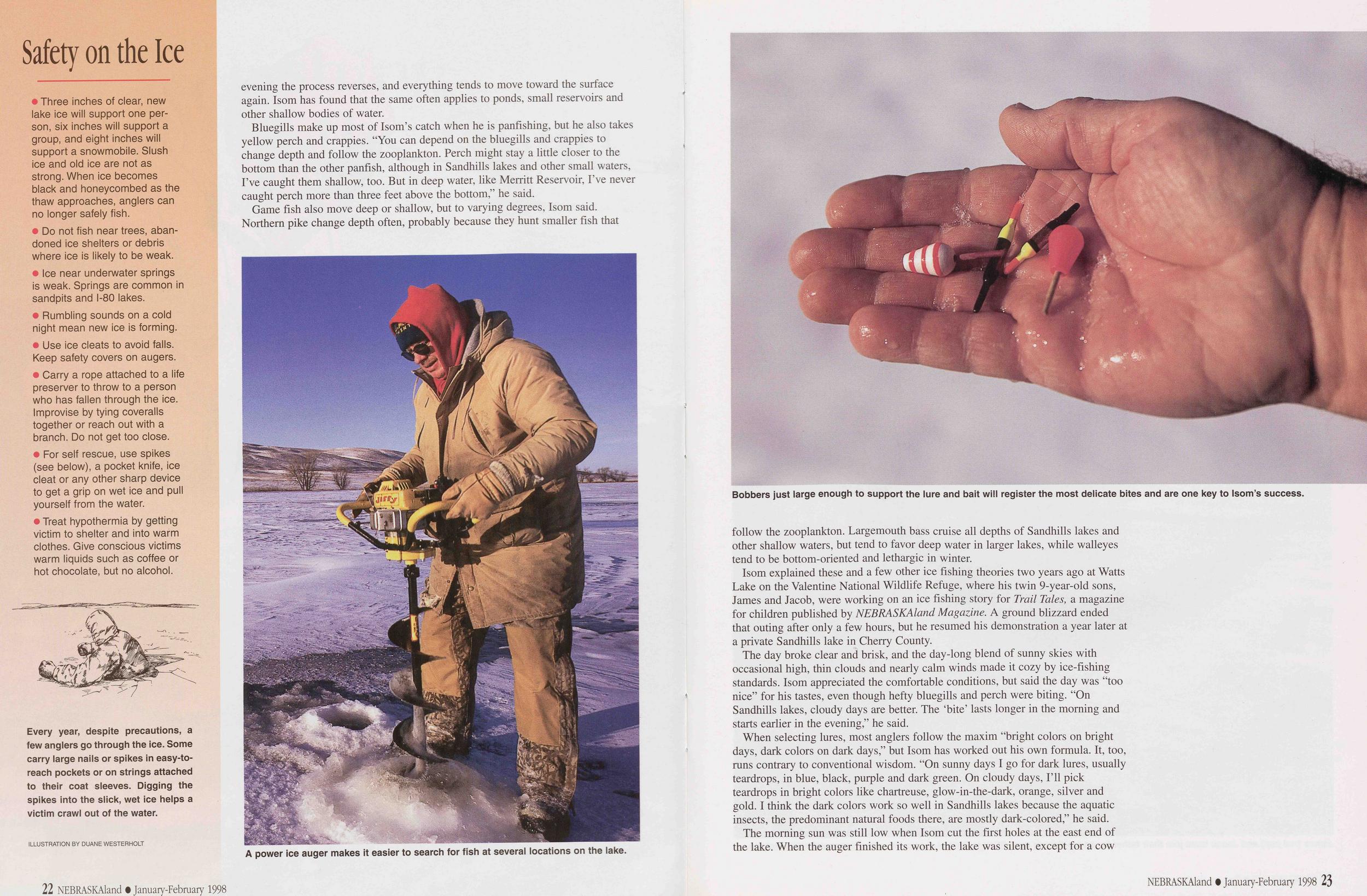
• Three inches of clear, new lake ice will support one person, six inches will support a group, and eight inches will support a snowmobile. Slush ice and old ice are not as strong. When ice becomes black and honeycombed as the thaw approaches, anglers can no longer safely fish. • Do not fish near trees, abandoned ice shelters or debris where ice is likely to be weak. • Ice near underwater springs is weak. Springs are common in sandpits and 1-80 lakes. • Rumbling sounds on a cold night mean new ice is forming. • Use ice cleats to avoid falls. Keep safety covers on augers. • Carry a rope attached to a life preserver to throw to a person who has fallen through the ice. Improvise by tying coveralls together or reach out with a branch. Do not get too close. • For self rescue, use spikes (see below), a pocket knife, ice cleat or any other sharp device to get a grip on wet ice and pull yourself from the water. • Treat hypothermia by getting victim to shelter and into warm clothes. Give conscious victims warm liquids such as coffee or hot chocolate, but no alcohol. Every year, despite precautions, a few anglers go through the ice. Some carry large nails or spikes in easy-to-reach pockets or on strings attached to their coat sleeves. Digging the spikes into the slick, wet ice helps a victim crawl out of the water.evening the process reverses, and everything tends to move toward the surface again. Isom has found that the same often applies to ponds, small reservoirs and other shallow bodies of water.
Bluegills make up most of Isom's catch when he is panfishing, but he also takes yellow perch and crappies. "You can depend on the bluegills and crappies to change depth and follow the zooplankton. Perch might stay a little closer to the bottom than the other panfish, although in Sandhills lakes and other small waters, I've caught them shallow, too. But in deep water, like Merritt Reservoir, I've never caught perch more than three feet above the bottom," he said.
Game fish also move deep or shallow, but to varying degrees, Isom said. Northern pike change depth often, probably because they hunt smaller fish that
A power ice auger makes it easier to search for fish at several locations on the lake.
Bobbers just large enough to support the lure and bait will register the most delicate bites and are one key to Isom's success.
follow the zooplankton. Largemouth bass cruise all depths of Sandhills lakes and other shallow waters, but tend to favor deep water in larger lakes, while walleyes tend to be bottom-oriented and lethargic in winter.
Isom explained these and a few other ice fishing theories two years ago at Watts Lake on the Valentine National Wildlife Refuge, where his twin 9-year-old sons, James and Jacob, were working on an ice fishing story for Trail Tales, a magazine for children published by NEBRASKAland Magazine. A ground blizzard ended that outing after only a few hours, but he resumed his demonstration a year later at a private Sandhills lake in Cherry County.
The day broke clear and brisk, and the day-long blend of sunny skies with occasional high, thin clouds and nearly calm winds made it cozy by ice-fishing standards. Isom appreciated the comfortable conditions, but said the day was "too nice" for his tastes, even though hefty bluegills and perch were biting. "On Sandhills lakes, cloudy days are better. The 'bite' lasts longer in the morning and starts earlier in the evening," he said.
When selecting lures, most anglers follow the maxim "bright colors on bright days, dark colors on dark days," but Isom has worked out his own formula. It, too, runs contrary to conventional wisdom. "On sunny days I go for dark lures, usually teardrops, in blue, black, purple and dark green. On cloudy days, I'll pick teardrops in bright colors like chartreuse, glow-in-the-dark, orange, silver and gold. I think the dark colors work so well in Sandhills lakes because the aquatic insects, the predominant natural foods there, are mostly dark-colored," he said.
The morning sun was still low when Isom cut the first holes at the east end of the lake. When the auger finished its work, the lake was silent, except for a cow
NEBRASKAland • January-February 1998 23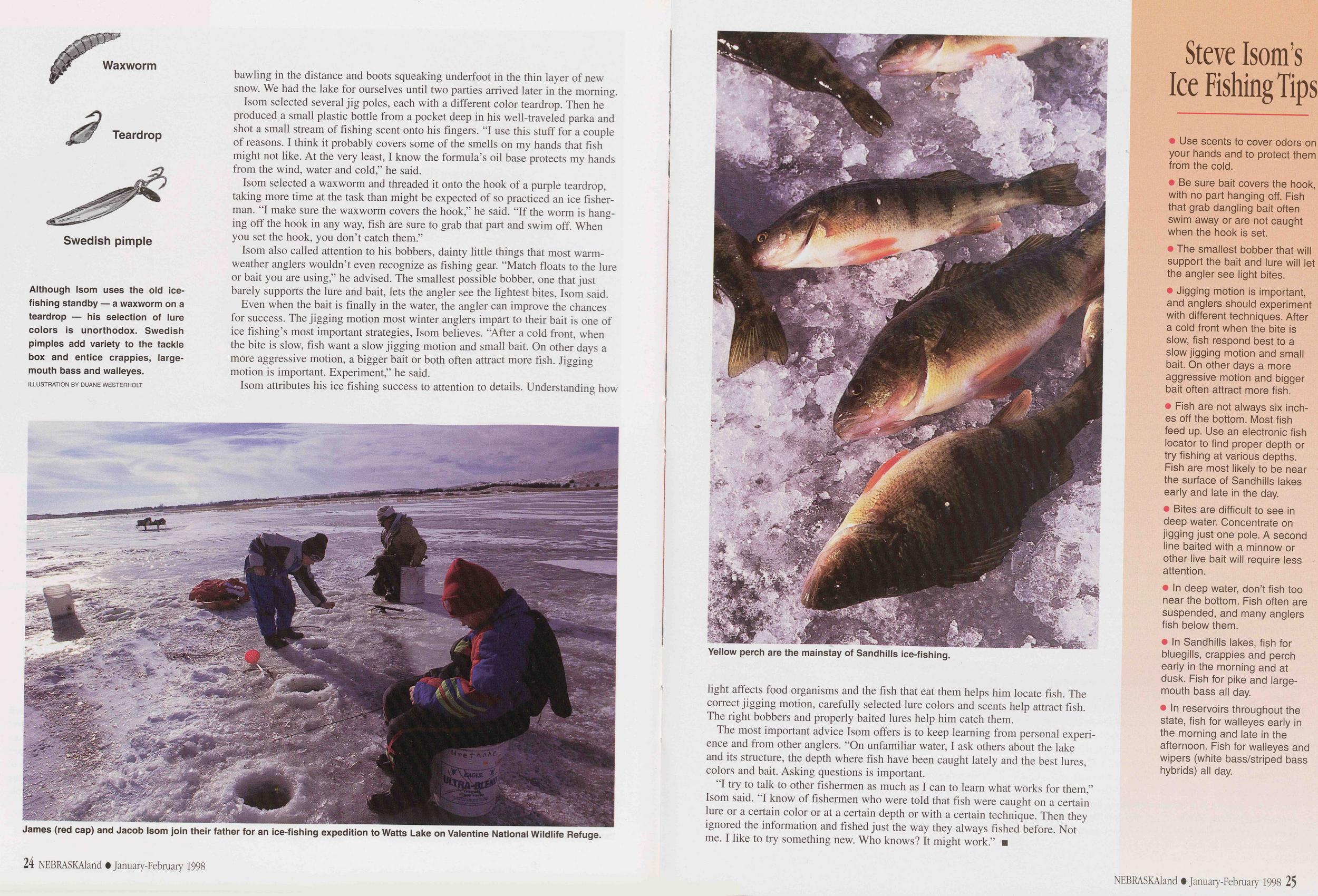
Waxworm
Teardrop
Swedish pimple
Although Isom uses the old ice-fishing standby — a waxworm on a teardrop — his selection of lure colors is unorthodox. Swedish pimples add variety to the tackle box and entice crappies, largemouth bass and walleyes.
ILLUSTRATION BY DUANE WESTERHOLTbawling in the distance and boots squeaking underfoot in the thin layer of new snow. We had the lake for ourselves until two parties arrived later in the morning.
Isom selected several jig poles, each with a different color teardrop. Then he produced a small plastic bottle from a pocket deep in his well-traveled parka and shot a small stream of fishing scent onto his fingers. "I use this stuff for a couple of reasons. I think it probably covers some of the smells on my hands that fish might not like. At the very least, I know the formula's oil base protects my hands from the wind, water and cold," he said.
Isom selected a waxworm and threaded it onto the hook of a purple teardrop, taking more time at the task than might be expected of so practiced an ice fisherman. "I make sure the waxworm covers the hook," he said. "If the worm is hanging off the hook in any way, fish are sure to grab that part and swim off. When you set the hook, you don't catch them."
Isom also called attention to his bobbers, dainty little things that most warm-weather anglers wouldn't even recognize as fishing gear. "Match floats to the lure or bait you are using," he advised. The smallest possible bobber, one that just barely supports the lure and bait, lets the angler see the lightest bites, Isom said.
Even when the bait is finally in the water, the angler can improve the chances for success. The jigging motion most winter anglers impart to their bait is one of ice fishing's most important strategies, Isom believes. "After a cold front, when the bite is slow, fish want a slow jigging motion and small bait. On other days a more aggressive motion, a bigger bait or both often attract more fish. Jigging motion is important. Experiment," he said.
Isom attributes his ice fishing success to attention to details. Understanding how
James (red cap) and Jacob Isom join their father for an ice-fishing expedition to Watts Lake on Valentine National Wildlife Refuge.
Yellow perch are the mainstay of Sandhills ice-fishing.
light affects food organisms and the fish that eat them helps him locate fish. The correct jigging motion, carefully selected lure colors and scents help attract fish. The right bobbers and properly baited lures help him catch them.
The most important advice Isom offers is to keep learning from personal experience and from other anglers. "On unfamiliar water, I ask others about the lake and its structure, the depth where fish have been caught lately and the best lures, colors and bait. Asking questions is important.
"I try to talk to other fishermen as much as I can to learn what works for them," Isom said. "I know of fishermen who were told that fish were caught on a certain lure or a certain color or at a certain depth or with a certain technique. Then they ignored the information and fished just the way they always fished before. Not me. I like to try something new. Who knows? It might work."
Steve Isom's Ice Fishing Tips
• Use scents to cover odors on your hands and to protect them from the cold. • Be sure bait covers the hook, with no part hanging off. Fish that grab dangling bait often swim away or are not caught when the hook is set. • The smallest bobber that will support the bait and lure will let the angler see light bites. • Jigging motion is important, and anglers should experiment with different techniques. After a cold front when the bite is slow, fish respond best to a slow jigging motion and small bait. On other days a more aggressive motion and bigger bait often attract more fish. • Fish are not always six inches off the bottom. Most fish feed up. Use an electronic fish locator to find proper depth or try fishing at various depths. Fish are most likely to be near the surface of Sandhills lakes early and late in the day. • Bites are difficult to see in deep water. Concentrate on jigging just one pole. A second line baited with a minnow or other live bait will require less attention. • In deep water, don't fish too near the bottom. Fish often are suspended, and many anglers fish below them. • In Sandhills lakes, fish for bluegills, crappies and perch early in the morning and at dusk. Fish for pike and largemouth bass all day. • In reservoirs throughout the state, fish for walleyes early in the morning and late in the afternoon. Fish for walleyes and wipers (white bass/striped bass hybrids) all day.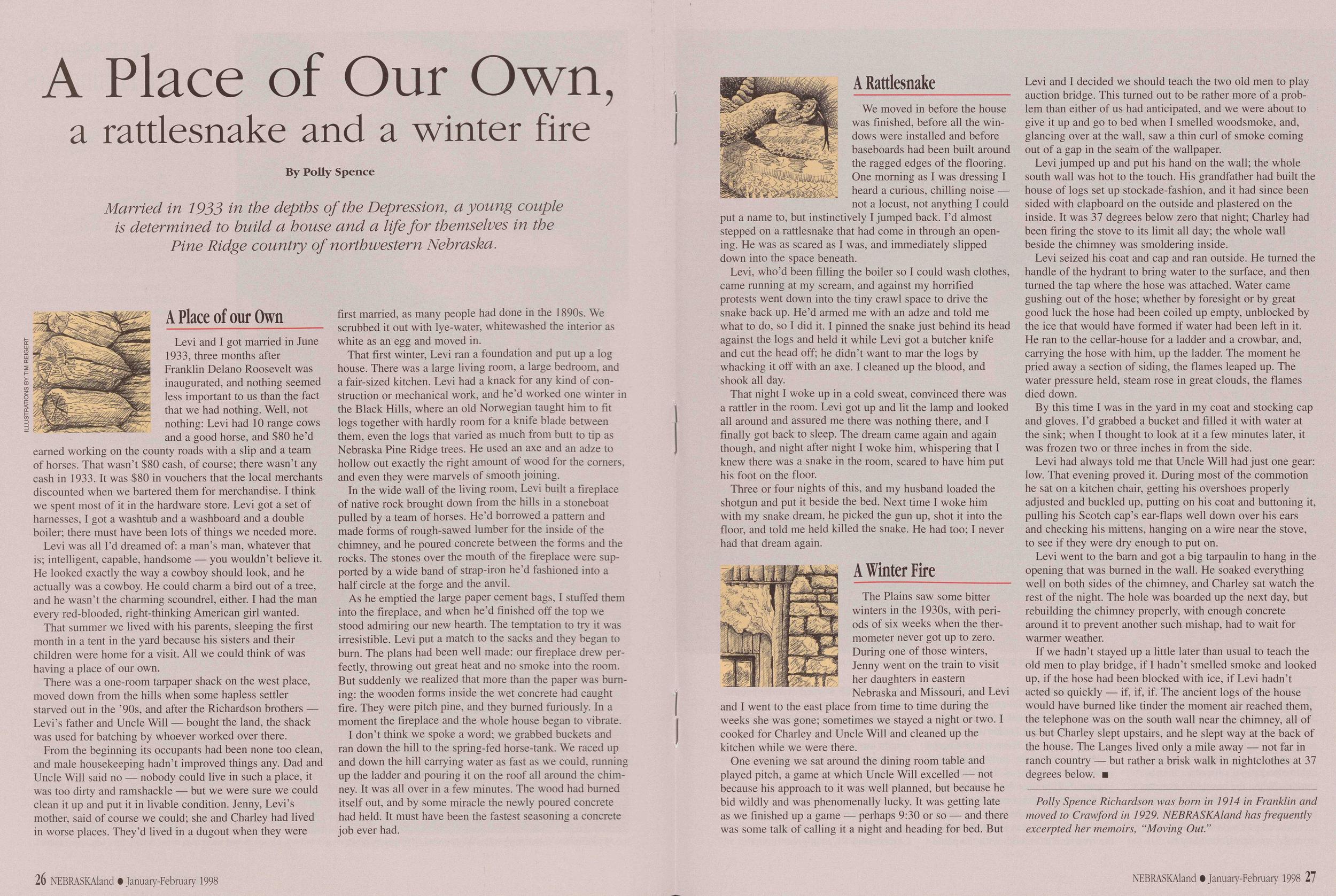
A Place of Our Own,
a rattlesnake and a winter fire By Polly Spence Married in 1933 in the depths of the Depression, a young couple is determined to build a house and a life for themselves in the Pine Ridge country of northwestern Nebraska.Levi and I got married in June 1933, three months after Franklin Delano Roosevelt was inaugurated, and nothing seemed less important to us than the fact that we had nothing. Well, not nothing: Levi had 10 range cows and a good horse, and $80 he'd earned working on the county roads with a slip and a team of horses. That wasn't $80 cash, of course; there wasn't any cash in 1933. It was $80 in vouchers that the local merchants discounted when we bartered them for merchandise. I think we spent most of it in the hardware store. Levi got a set of harnesses, I got a washtub and a washboard and a double boiler; there must have been lots of things we needed more.
Levi was all I'd dreamed of: a man's man, whatever that is; intelligent, capable, handsome — you wouldn't believe it. He looked exactly the way a cowboy should look, and he actually was a cowboy. He could charm a bird out of a tree, and he wasn't the charming scoundrel, either. I had the man every red-blooded, right-thinking American girl wanted.
That summer we lived with his parents, sleeping the first month in a tent in the yard because his sisters and their children were home for a visit. All we could think of was having a place of our own.
There was a one-room tarpaper shack on the west place, moved down from the hills when some hapless settler starved out in the '90s, and after the Richardson brothers — Levi's father and Uncle Will — bought the land, the shack was used for batching by whoever worked over there.
From the beginning its occupants had been none too clean, and male housekeeping hadn't improved things any. Dad and Uncle Will said no — nobody could live in such a place, it was too dirty and ramshackle — but we were sure we could clean it up and put it in livable condition. Jenny, Levi's mother, said of course we could; she and Charley had lived in worse places. They'd lived in a dugout when they were first married, as many people had done in the 1890s. We scrubbed it out with lye-water, whitewashed the interior as white as an egg and moved in.
That first winter, Levi ran a foundation and put up a log house. There was a large living room, a large bedroom, and a fair-sized kitchen. Levi had a knack for any kind of construction or mechanical work, and he'd worked one winter in the Black Hills, where an old Norwegian taught him to fit logs together with hardly room for a knife blade between them, even the logs that varied as much from butt to tip as Nebraska Pine Ridge trees. He used an axe and an adze to hollow out exactly the right amount of wood for the corners, and even they were marvels of smooth joining.
In the wide wall of the living room, Levi built a fireplace of native rock brought down from the hills in a stoneboat pulled by a team of horses. He'd borrowed a pattern and made forms of rough-sawed lumber for the inside of the chimney, and he poured concrete between the forms and the rocks. The stones over the mouth of the fireplace were supported by a wide band of strap-iron he'd fashioned into a half circle at the forge and the anvil.
As he emptied the large paper cement bags, I stuffed them into the fireplace, and when he'd finished off the top we stood admiring our new hearth. The temptation to try it was irresistible. Levi put a match to the sacks and they began to burn. The plans had been well made: our fireplace drew perfectly, throwing out great heat and no smoke into the room. But suddenly we realized that more than the paper was burning: the wooden forms inside the wet concrete had caught fire. They were pitch pine, and they burned furiously. In a moment the fireplace and the whole house began to vibrate.
I don't think we spoke a word; we grabbed buckets and ran down the hill to the spring-fed horse-tank. We raced up and down the hill carrying water as fast as we could, running up the ladder and pouring it on the roof all around the chimney. It was all over in a few minutes. The wood had burned itself out, and by some miracle the newly poured concrete had held. It must have been the fastest seasoning a concrete job ever had.
26 NEBRASKAland • January-February 1998We moved in before the house was finished, before all the windows were installed and before baseboards had been built around the ragged edges of the flooring. One morning as I was dressing I heard a curious, chilling noise — not a locust, not anything I could put a name to, but instinctively I jumped back. I'd almost stepped on a rattlesnake that had come in through an opening. He was as scared as I was, and immediately slipped down into the space beneath.
Levi, who'd been filling the boiler so I could wash clothes, came running at my scream, and against my horrified protests went down into the tiny crawl space to drive the snake back up. He'd armed me with an adze and told me what to do, so I did it. I pinned the snake just behind its head against the logs and held it while Levi got a butcher knife and cut the head off; he didn't want to mar the logs by whacking it off with an axe. I cleaned up the blood, and shook all day.
That night I woke up in a cold sweat, convinced there was a rattler in the room. Levi got up and lit the lamp and looked all around and assured me there was nothing there, and I finally got back to sleep. The dream came again and again though, and night after night I woke him, whispering that I knew there was a snake in the room, scared to have him put his foot on the floor.
Three or four nights of this, and my husband loaded the shotgun and put it beside the bed. Next time I woke him with my snake dream, he picked the gun up, shot it into the floor, and told me held killed the snake. He had too; I never had that dream again.
The Plains saw some bitter winters in the 1930s, with periods of six weeks when the thermometer never got up to zero. During one of those winters, Jenny went on the train to visit her daughters in eastern Nebraska and Missouri, and Levi and I went to the east place from time to time during the weeks she was gone; sometimes we stayed a night or two. I cooked for Charley and Uncle Will and cleaned up the kitchen while we were there.
One evening we sat around the dining room table and played pitch, a game at which Uncle Will excelled — not because his approach to it was well planned, but because he bid wildly and was phenomenally lucky. It was getting late as we finished up a game — perhaps 9:30 or so — and there was some talk of calling it a night and heading for bed. But Levi and I decided we should teach the two old men to play auction bridge. This turned out to be rather more of a problem than either of us had anticipated, and we were about to give it up and go to bed when I smelled woodsmoke, and, glancing over at the wall, saw a thin curl of smoke coming out of a gap in the seam of the wallpaper.
Levi jumped up and put his hand on the wall; the whole south wall was hot to the touch. His grandfather had built the house of logs set up stockade-fashion, and it had since been sided with clapboard on the outside and plastered on the inside. It was 37 degrees below zero that night; Charley had been firing the stove to its limit all day; the whole wall beside the chimney was smoldering inside.
Levi seized his coat and cap and ran outside. He turned the handle of the hydrant to bring water to the surface, and then turned the tap where the hose was attached. Water came gushing out of the hose; whether by foresight or by great good luck the hose had been coiled up empty, unblocked by the ice that would have formed if water had been left in it. He ran to the cellar-house for a ladder and a crowbar, and, carrying the hose with him, up the ladder. The moment he pried away a section of siding, the flames leaped up. The water pressure held, steam rose in great clouds, the flames died down.
By this time I was in the yard in my coat and stocking cap and gloves. I'd grabbed a bucket and filled it with water at the sink; when I thought to look at it a few minutes later, it was frozen two or three inches in from the side.
Levi had always told me that Uncle Will had just one gear: low. That evening proved it. During most of the commotion he sat on a kitchen chair, getting his overshoes properly adjusted and buckled up, putting on his coat and buttoning it, pulling his Scotch cap's ear-flaps well down over his ears and checking his mittens, hanging on a wire near the stove, to see if they were dry enough to put on.
Levi went to the barn and got a big tarpaulin to hang in the opening that was burned in the wall. He soaked everything well on both sides of the chimney, and Charley sat watch the rest of the night. The hole was boarded up the next day, but rebuilding the chimney properly, with enough concrete around it to prevent another such mishap, had to wait for warmer weather.
If we hadn't stayed up a little later than usual to teach the old men to play bridge, if I hadn't smelled smoke and looked up, if the hose had been blocked with ice, if Levi hadn't acted so quickly — if, if, if. The ancient logs of the house would have burned like tinder the moment air reached them, the telephone was on the south wall near the chimney, all of us but Charley slept upstairs, and he slept way at the back of the house. The Langes lived only a mile away — not far in ranch country — but rather a brisk walk in nightclothes at 37 degrees below.
Polly Spence Richardson was born in 1914 in Franklin and moved to Crawford in 1929. NEBRASKAland has frequently excerpted her memoirs, "Moving Out."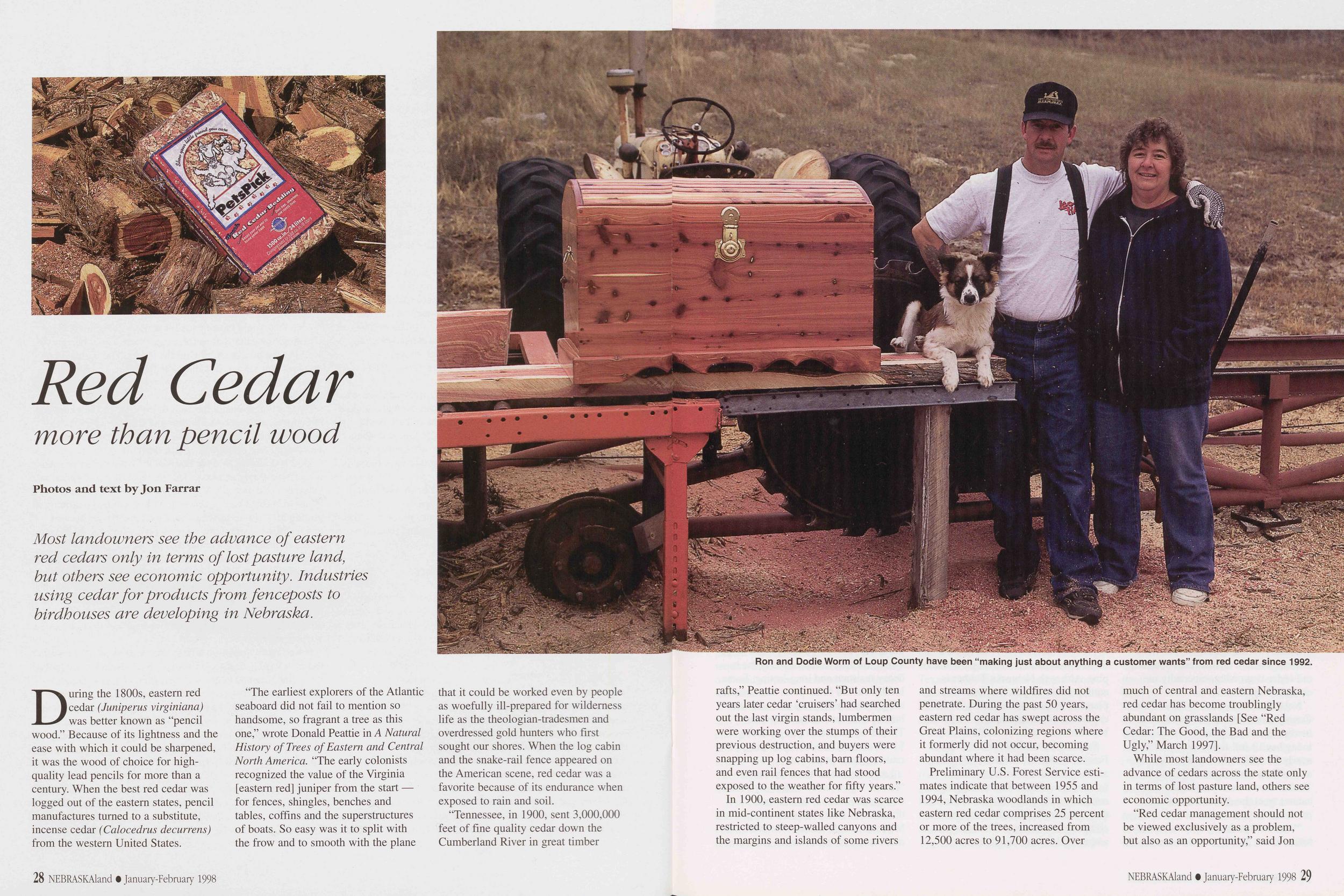
Red Cedar
more than pencil wood Photos and text by Jon Farrar Most landowners see the advance of eastern red cedars only in terms of lost pasture land, but others see economic opportunity. Industries using cedar for products from fenceposts to birdhouses are developing in Nebraska.During the 1800s, eastern red cedar (Juniperus virginiana) was better known as "pencil wood." Because of its lightness and the ease with which it could be sharpened, it was the wood of choice for high-quality lead pencils for more than a century. When the best red cedar was logged out of the eastern states, pencil manufactures turned to a substitute, incense cedar (Calocedrus decurrens) from the western United States.
"The earliest explorers of the Atlantic seaboard did not fail to mention so handsome, so fragrant a tree as this one," wrote Donald Peattie in A Natural History of Trees of Eastern and Central North America. "The early colonists recognized the value of the Virginia [eastern red] juniper from the start — for fences, shingles, benches and tables, coffins and the superstructures of boats. So easy was it to split with the frow and to smooth with the plane Ron and Dodie Worm of Loup County have been "making just about anything a customer wants" from red cedar since 1992. that it could be worked even by people as woefully ill-prepared for wilderness life as the theologian-tradesmen and overdressed gold hunters who first sought our shores. When the log cabin and the snake-rail fence appeared on the American scene, red cedar was a favorite because of its endurance when exposed to rain and soil.
"Tennessee, in 1900, sent 3,000,000 feet of fine quality cedar down the Cumberland River in great timber
28 NEBRASKAland • January-February 1998Ron and Dodie Worm of Loup County have been "making just about anything a customer wants" from red cedar since 1992.
rafts," Peattie continued. "But only ten years later cedar 'cruisers' had searched out the last virgin stands, lumbermen were working over the stumps of their previous destruction, and buyers were snapping up log cabins, barn floors, and even rail fences that had stood exposed to the weather for fifty years."
In 1900, eastern red cedar was scarce in mid-continent states like Nebraska, restricted to steep-walled canyons and the margins and islands of some rivers and streams where wildfires did not penetrate. During the past 50 years, eastern red cedar has swept across the Great Plains, colonizing regions where it formerly did not occur, becoming abundant where it had been scarce.
Preliminary U.S. Forest Service estimates indicate that between 1955 and 1994, Nebraska woodlands in which eastern red cedar comprises 25 percent or more of the trees, increased from 12,500 acres to 91,700 acres. Over much of central and eastern Nebraska, red cedar has become troublingly abundant on grasslands [See "Red Cedar: The Good, the Bad and the Ugly," March 1997].
While most landowners see the advance of cedars across the state only in terms of lost pasture land, others see economic opportunity.
"Red cedar management should not be viewed exclusively as a problem, but also as an opportunity," said Jon
NEBRASKAland • January-February 1998 29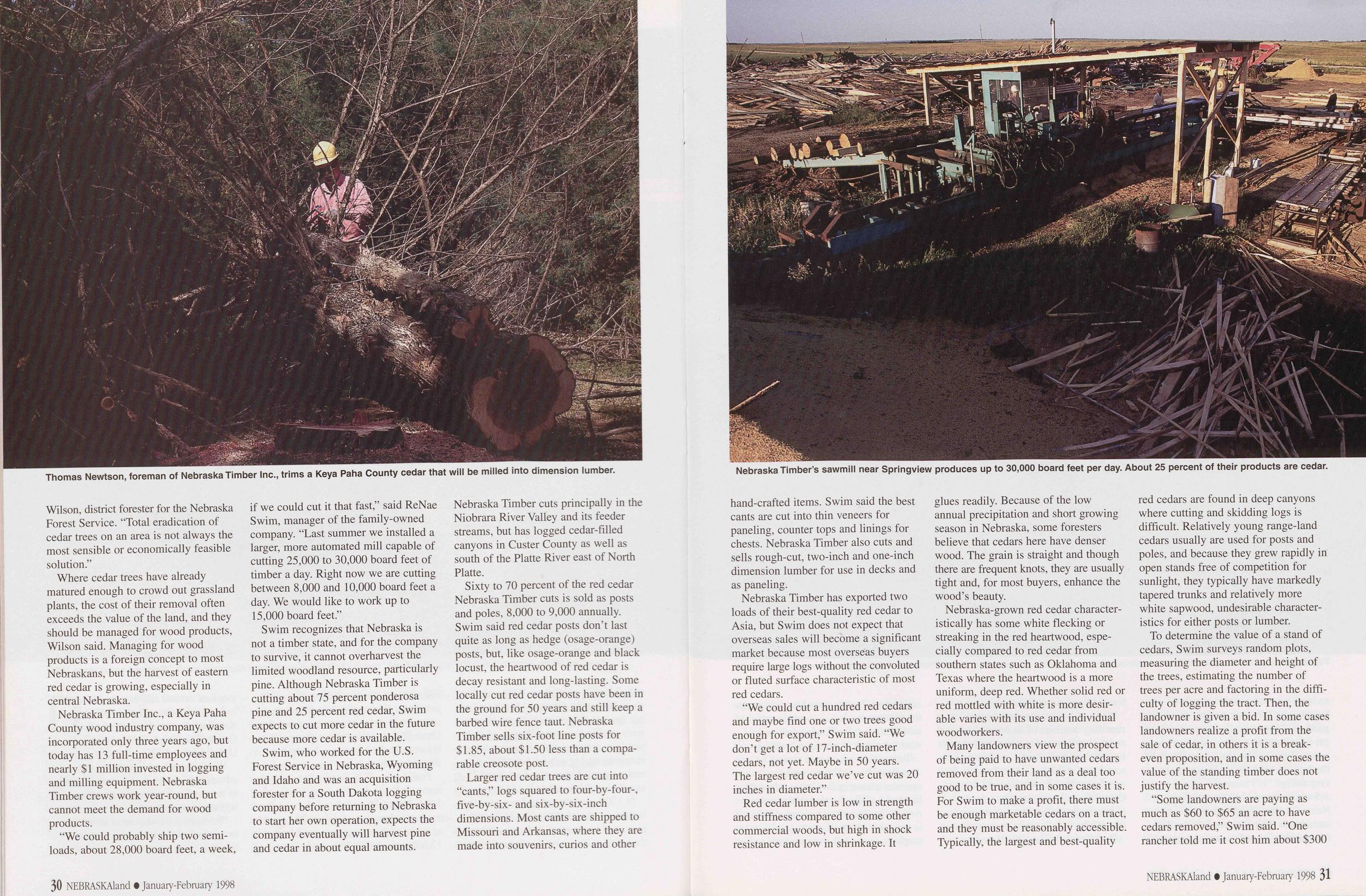
Thomas Newtson, foreman of Nebraska Timber Inc., trims a Keya Paha County cedar that will be milled into dimension lumber.
Wilson, district forester for the Nebraska Forest Service. "Total eradication of cedar trees on an area is not always the most sensible or economically feasible solution."
Where cedar trees have already matured enough to crowd out grassland plants, the cost of their removal often exceeds the value of the land, and they should be managed for wood products, Wilson said. Managing for wood products is a foreign concept to most Nebraskans, but the harvest of eastern red cedar is growing, especially in central Nebraska.
Nebraska Timber Inc., a Keya Paha County wood industry company, was incorporated only three years ago, but today has 13 full-time employees and nearly $1 million invested in logging and milling equipment. Nebraska Timber crews work year-round, but cannot meet the demand for wood products.
"We could probably ship two semi-loads, about 28,000 board feet, a week, if we could cut it that fast," said ReNae Swim, manager of the family-owned company. "Last summer we installed a larger, more automated mill capable of cutting 25,000 to 30,000 board feet of timber a day. Right now we are cutting between 8,000 and 10,000 board feet a day. We would like to work up to 15,000 board feet."
Swim recognizes that Nebraska is not a timber state, and for the company to survive, it cannot over-harvest the limited woodland resource, particularly pine. Although Nebraska Timber is cutting about 75 percent ponderosa pine and 25 percent red cedar, Swim expects to cut more cedar in the future because more cedar is available.
Swim, who worked for the U.S. Forest Service in Nebraska, Wyoming and Idaho and was an acquisition forester for a South Dakota logging company before returning to Nebraska to start her own operation, expects the company eventually will harvest pine and cedar in about equal amounts. Nebraska Timber cuts principally in the Niobrara River Valley and its feeder streams, but has logged cedar-filled canyons in Custer County as well as south of the Platte River east of North Platte.
Sixty to 70 percent of the red cedar Nebraska Timber cuts is sold as posts and poles, 8,000 to 9,000 annually. Swim said red cedar posts don't last quite as long as hedge (osage-orange) posts, but, like osage-orange and black locust, the heartwood of red cedar is decay resistant and long-lasting. Some locally cut red cedar posts have been in the ground for 50 years and still keep a barbed wire fence taut. Nebraska Timber sells six-foot line posts for $1.85, about $1.50 less than a comparable creosote post.
Larger red cedar trees are cut into "cants," logs squared to four-by-four-, five-by-six- and six-by-six-inch dimensions. Most cants are shipped to Missouri and Arkansas, where they are made into souvenirs, curios and other
30 NEBRASKAland • January-February 1998Nebraska Timber's sawmill near Springview produces up to 30,000 board feet per day. About 25 percent of their products are cedar.
hand-crafted items. Swim said the best cants are cut into thin veneers for paneling, counter tops and linings for chests. Nebraska Timber also cuts and sells rough-cut, two-inch and one-inch dimension lumber for use in decks and as paneling.
Nebraska Timber has exported two loads of their best-quality red cedar to Asia, but Swim does not expect that overseas sales will become a significant market because most overseas buyers require large logs without the convoluted or fluted surface characteristic of most red cedars.
"We could cut a hundred red cedars and maybe find one or two trees good enough for export," Swim said. "We don't get a lot of 17-inch-diameter cedars, not yet. Maybe in 50 years. The largest red cedar we've cut was 20 inches in diameter."
Red cedar lumber is low in strength and stiffness compared to some other commercial woods, but high in shock resistance and low in shrinkage. It glues readily. Because of the low annual precipitation and short growing season in Nebraska, some foresters believe that cedars here have denser wood. The grain is straight and though there are frequent knots, they are usually tight and, for most buyers, enhance the wood's beauty.
Nebraska-grown red cedar characteristically has some white flecking or streaking in the red heartwood, especially compared to red cedar from southern states such as Oklahoma and Texas where the heartwood is a more uniform, deep red. Whether solid red or red mottled with white is more desirable varies with its use and individual woodworkers.
Many landowners view the prospect of being paid to have unwanted cedars removed from their land as a deal too good to be true, and in some cases it is. For Swim to make a profit, there must be enough marketable cedars on a tract, and they must be reasonably accessible. Typically, the largest and best-quality red cedars are found in deep canyons where cutting and skidding logs is difficult. Relatively young range-land cedars usually are used for posts and poles, and because they grew rapidly in open stands free of competition for sunlight, they typically have markedly tapered trunks and relatively more white sapwood, undesirable characteristics for either posts or lumber.
To determine the value of a stand of cedars, Swim surveys random plots, measuring the diameter and height of the trees, estimating the number of trees per acre and factoring in the difficulty of logging the tract. Then, the landowner is given a bid. In some cases landowners realize a profit from the sale of cedar, in others it is a breakeven proposition, and in some cases the value of the standing timber does not justify the harvest.
"Some landowners are paying as much as $60 to $65 an acre to have cedars removed," Swim said. "One rancher told me it cost him about $300
NEBRASKAland • January-February 1998 31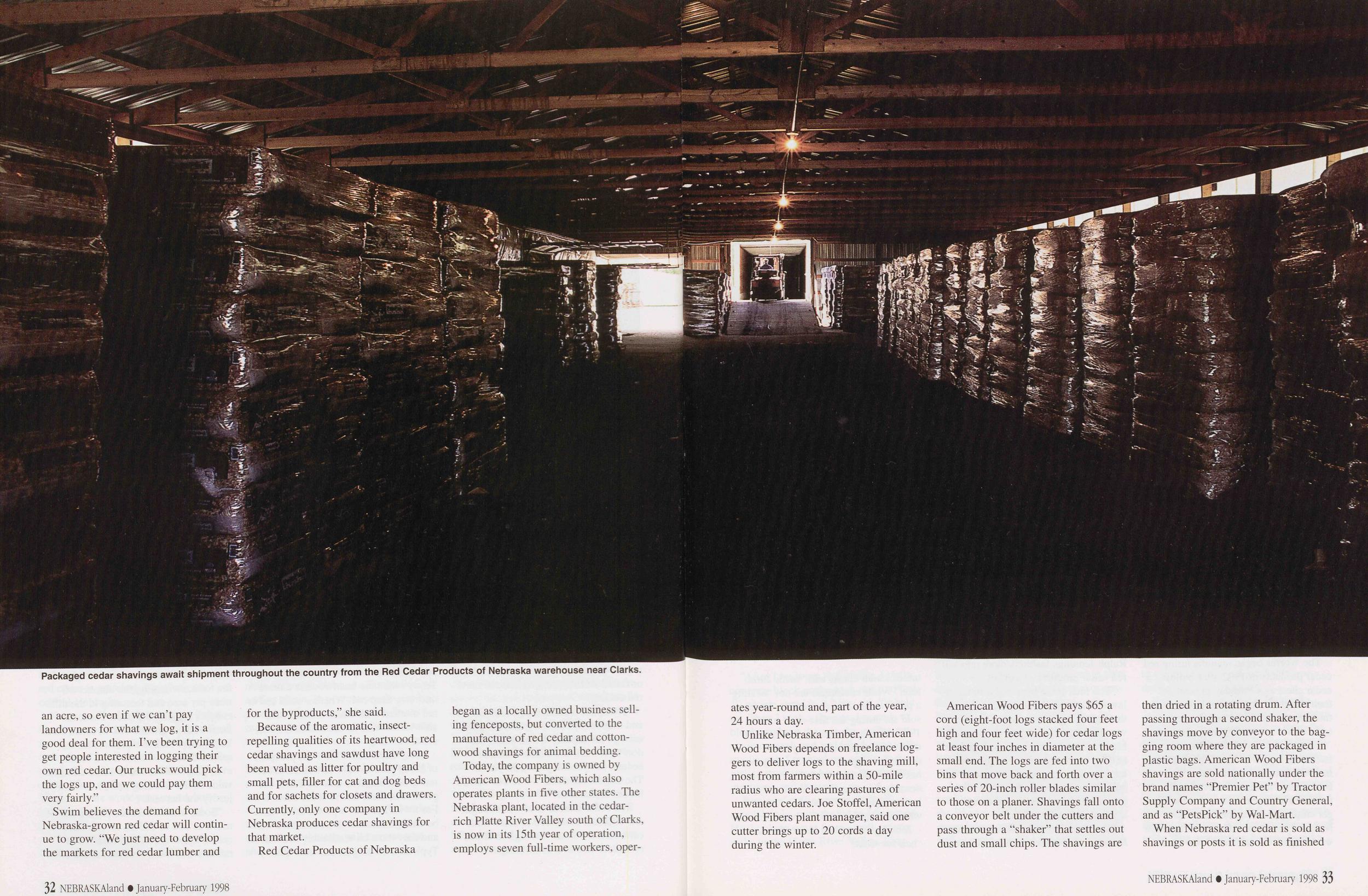
Packaged cedar shavings await shipment throughout the country from the Red Cedar Products of Nebraska warehouse near Clarks.
an acre, so even if we can't pay landowners for what we log, it is a good deal for them. I've been trying to get people interested in logging their own red cedar. Our trucks would pick the logs up, and we could pay them very fairly."
Swim believes the demand for Nebraska-grown red cedar will continue to grow. "We just need to develop the markets for red cedar lumber and for the byproducts," she said.
Because of the aromatic, insect-repelling qualities of its heartwood, red cedar shavings and sawdust have long been valued as litter for poultry and small pets, filler for cat and dog beds and for sachets for closets and drawers. Currently, only one company in Nebraska produces cedar shavings for that market.
Red Cedar Products of Nebraska began as a locally owned business selling fenceposts, but converted to the manufacture of red cedar and cottonwood shavings for animal bedding.
Today, the company is owned by American Wood Fibers, which also operates plants in five other states. The Nebraska plant, located in the cedar-rich Platte River Valley south of Clarks, is now in its 15th year of operation, employs seven full-time workers, operates
32 NEBRASKAland • January-February 1998year-round and, part of the year, 24 hours a day.
Unlike Nebraska Timber, American Wood Fibers depends on freelance loggers to deliver logs to the shaving mill, most from farmers within a 50-mile radius who are clearing pastures of unwanted cedars. Joe Stoffel, American Wood Fibers plant manager, said one cutter brings up to 20 cords a day during the winter.
American Wood Fibers pays $65 a cord (eight-foot logs stacked four feet high and four feet wide) for cedar logs at least four inches in diameter at the small end. The logs are fed into two bins that move back and forth over a series of 20-inch roller blades similar to those on a planer. Shavings fall onto a conveyor belt under the cutters and pass through a "shaker" that settles out dust and small chips. The shavings are then dried in a rotating drum. After passing through a second shaker, the shavings move by conveyor to the bagging room where they are packaged in plastic bags. American Wood Fibers shavings are sold nationally under the brand names "Premier Pet" by Tractor Supply Company and Country General, and as "PetsPick" by Wal-Mart.
When Nebraska red cedar is sold as shavings or posts it is sold as finished
NEBRASKAland • January-February 1998 33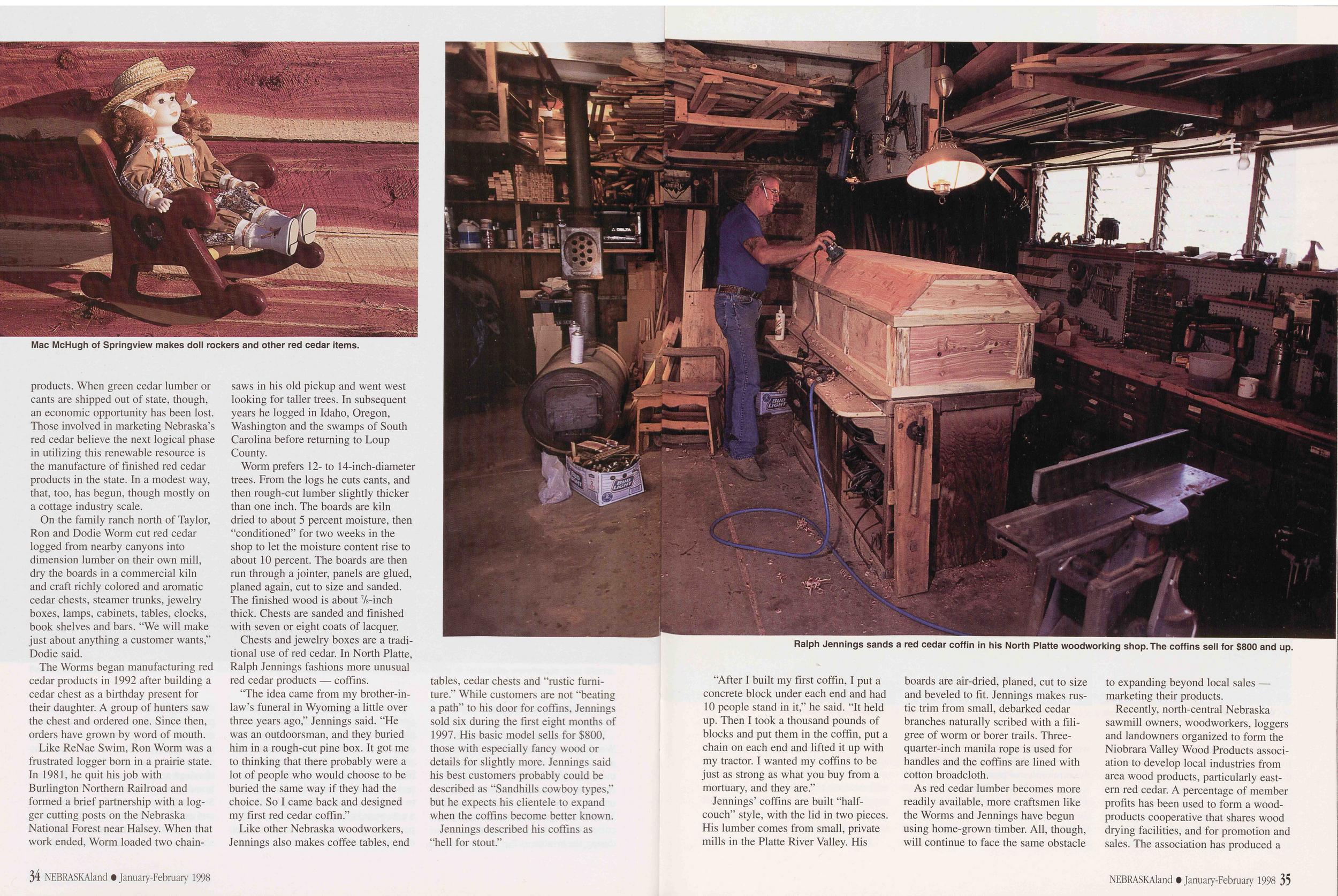
Mac McHugh of Springview makes doll rockers and other red cedar items.
products. When green cedar lumber or cants are shipped out of state, though, an economic opportunity has been lost. Those involved in marketing Nebraska's red cedar believe the next logical phase in utilizing this renewable resource is the manufacture of finished red cedar products in the state. In a modest way, that, too, has begun, though mostly on a cottage industry scale.
On the family ranch north of Taylor, Ron and Dodie Worm cut red cedar logged from nearby canyons into dimension lumber on their own mill, dry the boards in a commercial kiln and craft richly colored and aromatic cedar chests, steamer trunks, jewelry boxes, lamps, cabinets, tables, clocks, book shelves and bars. "We will make just about anything a customer wants," Dodie said.
The Worms began manufacturing red cedar products in 1992 after building a cedar chest as a birthday present for their daughter. A group of hunters saw the chest and ordered one. Since then, orders have grown by word of mouth.
Like ReNae Swim, Ron Worm was a frustrated logger born in a prairie state. In 1981, he quit his job with Burlington Northern Railroad and formed a brief partnership with a logger cutting posts on the Nebraska National Forest near Halsey. When that work ended, Worm loaded two chainsaws in his old pickup and went west looking for taller trees. In subsequent years he logged in Idaho, Oregon, Washington and the swamps of South Carolina before returning to Loup County.
Worm prefers 12- to 14-inch-diameter trees. From the logs he cuts cants, and then rough-cut lumber slightly thicker than one inch. The boards are kiln dried to about 5 percent moisture, then "conditioned" for two weeks in the shop to let the moisture content rise to about 10 percent. The boards are then run through a jointer, panels are glued, planed again, cut to size and sanded. The finished wood is about Vs-inch thick. Chests are sanded and finished with seven or eight coats of lacquer.
Chests and jewelry boxes are a traditional use of red cedar. In North Platte, Ralph Jennings fashions more unusual red cedar products — coffins.
"The idea came from my brother-in-law's funeral in Wyoming a little over three years ago," Jennings said. "He was an outdoorsman, and they buried him in a rough-cut pine box. It got me to thinking that there probably were a lot of people who would choose to be buried the same way if they had the choice. So I came back and designed my first red cedar coffin."
Like other Nebraska woodworkers, Jennings also makes coffee tables, end
Ralph Jennings sands a red cedar coffin in his North Platte woodworking shop. The coffins sell for $800 and up.
tables, cedar chests and "rustic furniture." While customers are not "beating a path" to his door for coffins, Jennings sold six during the first eight months of 1997. His basic model sells for $800, those with especially fancy wood or details for slightly more. Jennings said his best customers probably could be described as "Sandhills cowboy types," but he expects his clientele to expand when the coffins become better known.
Jennings described his coffins as "hell for stout."
34 NEBRASKAland • January-February 1998"After I built my first coffin, I put a concrete block under each end and had 10 people stand in it," he said. "It held up. Then I took a thousand pounds of blocks and put them in the coffin, put a chain on each end and lifted it up with my tractor. I wanted my coffins to be just as strong as what you buy from a mortuary, and they are."
Jennings' coffins are built "half-couch" style, with the lid in two pieces. His lumber comes from small, private mills in the Platte River Valley. His boards are air-dried, planed, cut to size and beveled to fit. Jennings makes rustic trim from small, debarked cedar branches naturally scribed with a filigree of worm or borer trails. Three-quarter-inch manila rope is used for handles and the coffins are lined with cotton broadcloth.
As red cedar lumber becomes more readily available, more craftsmen like the Worms and Jennings have begun using home-grown timber. All, though, will continue to face the same obstacle to expanding beyond local sales — marketing their products.
Recently, north-central Nebraska sawmill owners, woodworkers, loggers and landowners organized to form the Niobrara Valley Wood Products association to develop local industries from area wood products, particularly eastern red cedar. A percentage of member profits has been used to form a wood-products cooperative that shares wood drying facilities, and for promotion and sales. The association has produced a
NEBRASKAland • January-February 1998 35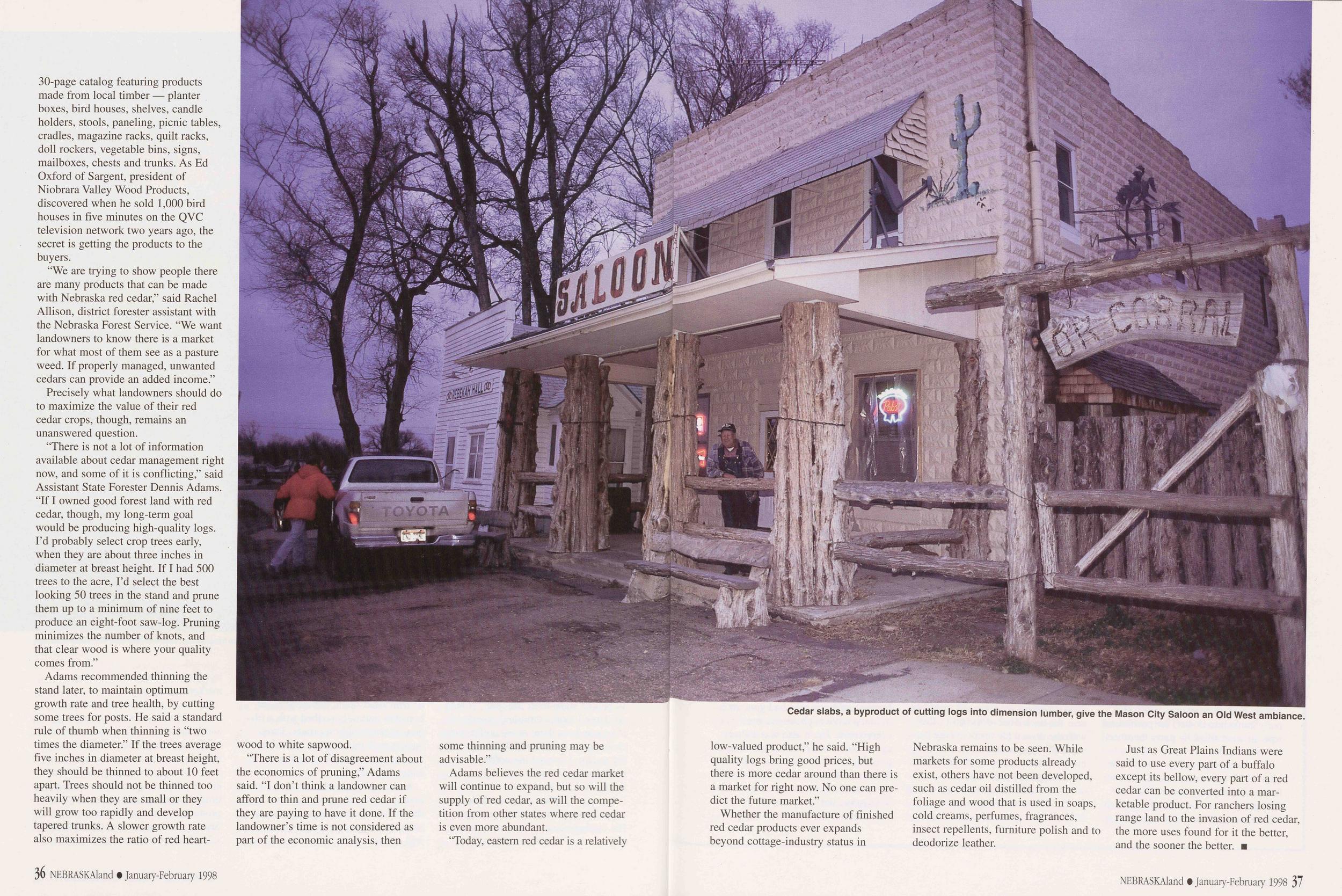
30-page catalog featuring products made from local timber — planter boxes, bird houses, shelves, candle holders, stools, paneling, picnic tables, cradles, magazine racks, quilt racks, doll rockers, vegetable bins, signs, mailboxes, chests and trunks. As Ed Oxford of Sargent, president of Niobrara Valley Wood Products, discovered when he sold 1,000 bird houses in five minutes on the QVC television network two years ago, the secret is getting the products to the buyers.
"We are trying to show people there are many products that can be made with Nebraska red cedar," said Rachel Allison, district forester assistant with the Nebraska Forest Service. "We want landowners to know there is a market for what most of them see as a pasture weed. If properly managed, unwanted cedars can provide an added income."
Precisely what landowners should do to maximize the value of their red cedar crops, though, remains an unanswered question.
"There is not a lot of information available about cedar management right now, and some of it is conflicting," said Assistant State Forester Dennis Adams. "If I owned good forest land with red cedar, though, my long-term goal would be producing high-quality logs. I'd probably select crop trees early, when they are about three inches in diameter at breast height. If I had 500 trees to the acre, I'd select the best looking 50 trees in the stand and prune them up to a minimum of nine feet to produce an eight-foot saw-log. Pruning minimizes the number of knots, and that clear wood is where your quality comes from."
Adams recommended thinning the stand later, to maintain optimum growth rate and tree health, by cutting some trees for posts. He said a standard rule of thumb when thinning is "two times the diameter." If the trees average five inches in diameter at breast height, they should be thinned to about 10 feet apart. Trees should not be thinned too heavily when they are small or they will grow too rapidly and develop tapered trunks. A slower growth rate also maximizes the ratio of red heartwood to white sapwood.
"There is a lot of disagreement about the economics of pruning," Adams said. "I don't think a landowner can afford to thin and prune red cedar if they are paying to have it done. If the landowner's time is not considered as part of the economic analysis, then some thinning and pruning may be advisable."
Adams believes the red cedar market will continue to expand, but so will the supply of red cedar, as will the competition from other states where red cedar is even more abundant.
"Today, eastern red cedar is a relatively
Cedar slabs, a byproduct of cutting logs indimnsion limber, give the Mason City Saloon and Old West ambiance.
low-valued product," he said. "High quality logs bring good prices, but there is more cedar around than there is a market for right now. No one can predict the future market."
Whether the manufacture of finished red cedar products ever expands beyond cottage-industry status in Nebraska remains to be seen. While markets for some products already exist, others have not been developed, such as cedar oil distilled from the foliage and wood that is used in soaps, cold creams, perfumes, fragrances, insect repellents, furniture polish and to deodorize leather.
Just as Great Plains Indians were said to use every part of a buffalo except its bellow, every part of a red cedar can be converted into a marketable product. For ranchers losing range land to the invasion of red cedar, the more uses found for it the better, and the sooner the better.
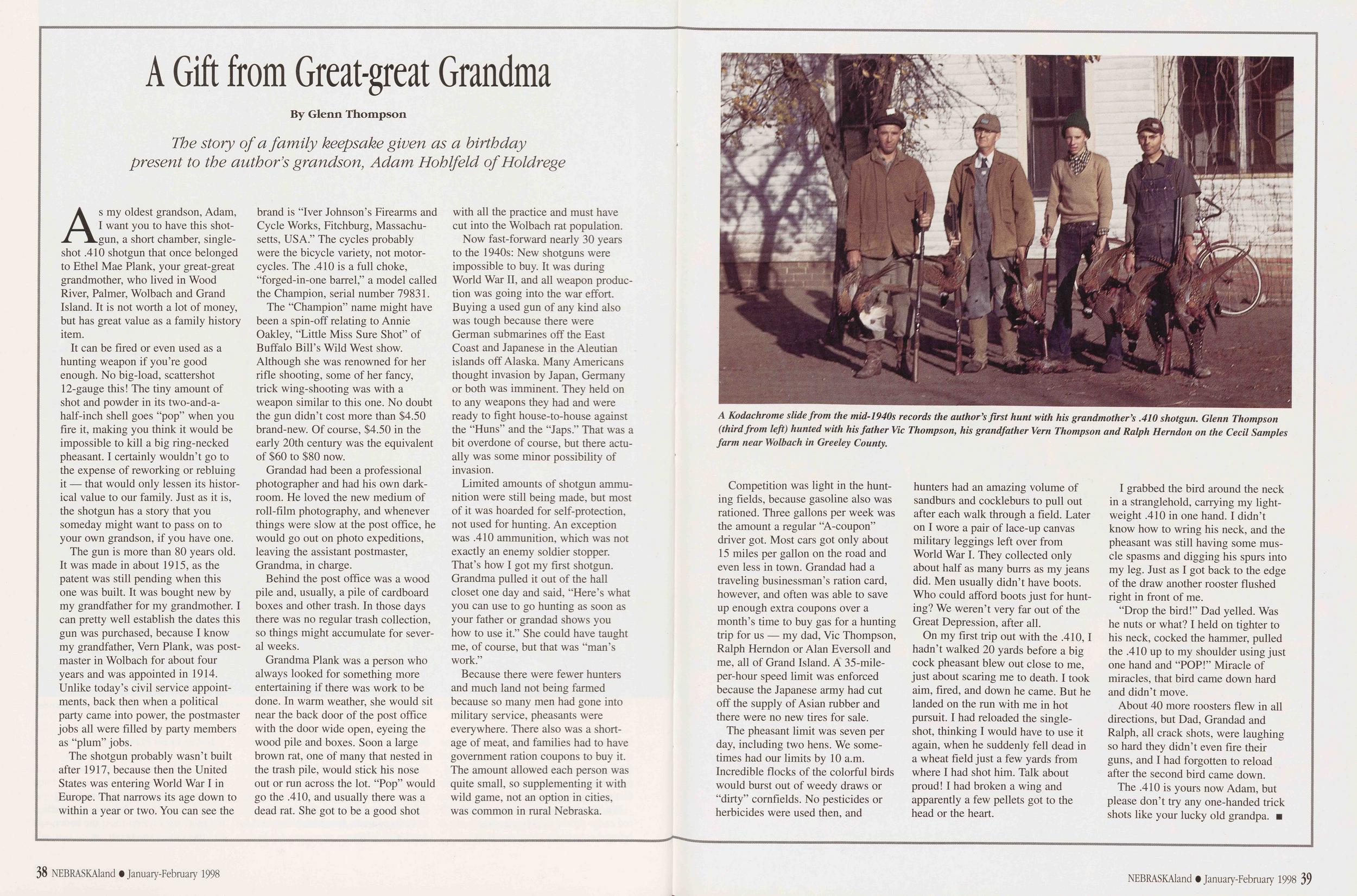
A Gift from Great-great Grandma
By Glenn Thompson The story of a family keepsake given as a birthday present to the author's grandson, Adam Hohlfeld of HoldregeAs my oldest grandson, Adam, I want you to have this shotgun, a short chamber, single-shot .410 shotgun that once belonged to Ethel Mae Plank, your great-great grandmother, who lived in Wood River, Palmer, Wolbach and Grand Island. It is not worth a lot of money, but has great value as a family history item.
It can be fired or even used as a hunting weapon if you're good enough. No big-load, scattershot 12-gauge this! The tiny amount of shot and powder in its two-and-a-half-inch shell goes "pop" when you fire it, making you think it would be impossible to kill a big ring-necked pheasant. I certainly wouldn't go to the expense of reworking or rebluing it — that would only lessen its historical value to our family. Just as it is, the shotgun has a story that you someday might want to pass on to your own grandson, if you have one.
The gun is more than 80 years old. It was made in about 1915, as the patent was still pending when this one was built. It was bought new by my grandfather for my grandmother. I can pretty well establish the dates this gun was purchased, because I know my grandfather, Vern Plank, was postmaster in Wolbach for about four years and was appointed in 1914. Unlike today's civil service appointments, back then when a political party came into power, the postmaster jobs all were filled by party members as "plum" jobs.
The shotgun probably wasn't built after 1917, because then the United States was entering World War I in Europe. That narrows its age down to within a year or two. You can see the brand is 'Tver Johnson's Firearms and Cycle Works, Fitchburg, Massachusetts, USA." The cycles probably were the bicycle variety, not motor- cycles. The .410 is a full choke, "forged-in-one barrel," a model called the Champion, serial number 79831.
The "Champion" name might have been a spin-off relating to Annie Oakley, "Little Miss Sure Shot" of Buffalo Bill's Wild West show. Although she was renowned for her rifle shooting, some of her fancy, trick wing-shooting was with a weapon similar to this one. No doubt the gun didn't cost more than $4.50 brand-new. Of course, $4.50 in the early 20th century was the equivalent of $60 to $80 now.
Grandad had been a professional photographer and had his own darkroom. He loved the new medium of roll-film photography, and whenever things were slow at the post office, he would go out on photo expeditions, leaving the assistant postmaster, Grandma, in charge.
Behind the post office was a wood pile and, usually, a pile of cardboard boxes and other trash. In those days there was no regular trash collection, so things might accumulate for several weeks.
Grandma Plank was a person who always looked for something more entertaining if there was work to be done. In warm weather, she would sit near the back door of the post office with the door wide open, eyeing the wood pile and boxes. Soon a large brown rat, one of many that nested in the trash pile, would stick his nose out or run across the lot. "Pop" would go the .410, and usually there was a dead rat. She got to be a good shot with all the practice and must have cut into the Wolbach rat population.
Now fast-forward nearly 30 years to the 1940s: New shotguns were impossible to buy. It was during World War II, and all weapon production was going into the war effort. Buying a used gun of any kind also was tough because there were German submarines off the East Coast and Japanese in the Aleutian islands off Alaska. Many Americans thought invasion by Japan, Germany or both was imminent. They held on to any weapons they had and were ready to fight house-to-house against the "Huns" and the "Japs." That was a bit overdone of course, but there actually was some minor possibility of invasion.
Limited amounts of shotgun ammunition were still being made, but most of it was hoarded for self-protection, not used for hunting. An exception was .410 ammunition, which was not exactly an enemy soldier stopper. That's how I got my first shotgun. Grandma pulled it out of the hall closet one day and said, "Here's what you can use to go hunting as soon as your father or grandad shows you how to use it." She could have taught me, of course, but that was "man's work."
Because there were fewer hunters and much land not being farmed because so many men had gone into military service, pheasants were everywhere. There also was a shortage of meat, and families had to have government ration coupons to buy it. The amount allowed each person was quite small, so supplementing it with wild game, not an option in cities, was common in rural Nebraska.
38 NEBRASKAland • January-February 1998A Kodachrome slide from the mid-1940s records the author's first hunt with his grandmother's .410 shotgun. Glenn Thompson (third from left) hunted with his father Vic Thompson, his grandfather Vern Thompson and Ralph Herndon on the Cecil Samples farm near Wolbach in Greeley County.
Competition was light in the hunting fields, because gasoline also was rationed. Three gallons per week was the amount a regular "A-coupon" driver got. Most cars got only about 15 miles per gallon on the road and even less in town. Grandad had a traveling businessman's ration card, however, and often was able to save up enough extra coupons over a month's time to buy gas for a hunting trip for us — my dad, Vic Thompson, Ralph Herndon or Alan Eversoll and me, all of Grand Island. A 35-mile-per-hour speed limit was enforced because the Japanese army had cut off the supply of Asian rubber and there were no new tires for sale.
The pheasant limit was seven per day, including two hens. We sometimes had our limits by 10 a.m. Incredible flocks of the colorful birds would burst out of weedy draws or "dirty" cornfields. No pesticides or herbicides were used then, and hunters had an amazing volume of sandburs and cockleburs to pull out after each walk through a field. Later on I wore a pair of lace-up canvas military leggings left over from World War I. They collected only about half as many burrs as my jeans did. Men usually didn't have boots. Who could afford boots just for hunting? We weren't very far out of the Great Depression, after all.
On my first trip out with the .410,1 hadn't walked 20 yards before a big cock pheasant blew out close to me, just about scaring me to death. I took aim, fired, and down he came. But he landed on the run with me in hot pursuit. I had reloaded the single-shot, thinking I would have to use it again, when he suddenly fell dead in a wheat field just a few yards from where I had shot him. Talk about proud! I had broken a wing and apparently a few pellets got to the head or the heart.
I grabbed the bird around the neck in a stranglehold, carrying my lightweight .410 in one hand. I didn't know how to wring his neck, and the pheasant was still having some muscle spasms and digging his spurs into my leg. Just as I got back to the edge of the draw another rooster flushed right in front of me.
"Drop the bird!" Dad yelled. Was he nuts or what? I held on tighter to his neck, cocked the hammer, pulled the .410 up to my shoulder using just one hand and "POP!" Miracle of miracles, that bird came down hard and didn't move.
About 40 more roosters flew in all directions, but Dad, Grandad and Ralph, all crack shots, were laughing so hard they didn't even fire their guns, and I had forgotten to reload after the second bird came down.
The .410 is yours now Adam, but please don't try any one-handed trick shots like your lucky old grandpa.
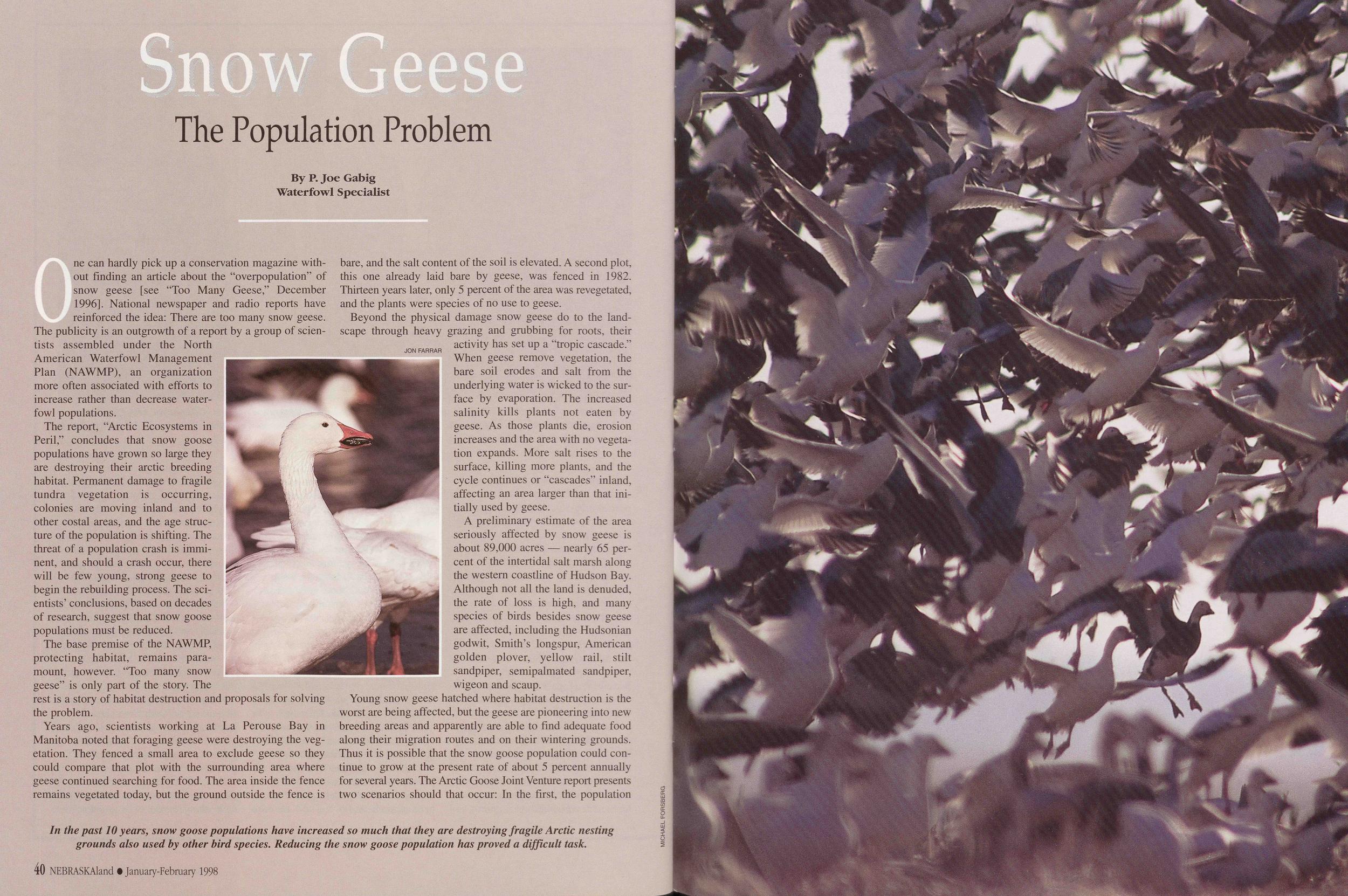
Snow Geese
The Population Problem By P. Joe Gabig Waterfowl SpecialistOne can hardly pick up a conservation magazine without finding an article about the "overpopulation" of snow geese [see "Too Many Geese," December 1996]. National newspaper and radio reports have reinforced the idea: There are too many snow geese. The publicity is an outgrowth of a report by a group of scientists assembled under the North American Waterfowl Management Plan (NAWMP), an organization more often associated with efforts to increase rather than decrease waterfowl populations.
The report, "Arctic Ecosystems in Peril," concludes that snow goose populations have grown so large they are destroying their arctic breeding habitat. Permanent damage to fragile tundra vegetation is occurring, colonies are moving inland and to other costal areas, and the age structure of the population is shifting. The threat of a population crash is imminent, and should a crash occur, there will be few young, strong geese to begin the rebuilding process. The scientists' conclusions, based on decades of research, suggest that snow goose populations must be reduced.
The base premise of the NAWMP, protecting habitat, remains paramount, however. "Too many snow geese" is only part of the story. The rest is a story of habitat destruction and proposals for solving the problem.
Years ago, scientists working at La Perouse Bay in Manitoba noted that foraging geese were destroying the vegetation. They fenced a small area to exclude geese so they could compare that plot with the surrounding area where geese continued searching for food. The area inside the fence remains vegetated today, but the ground outside the fence is bare, and the salt content of the soil is elevated. A second plot, this one already laid bare by geese, was fenced in 1982. Thirteen years later, only 5 percent of the area was revegetated, and the plants were species of no use to geese.
Beyond the physical damage snow geese do to the landscape through heavy grazing and grubbing for roots, their activity has set up a "tropic cascade." When geese remove vegetation, the bare soil erodes and salt from the underlying water is wicked to the surface by evaporation. The increased salinity kills plants not eaten by geese. As those plants die, erosion increases and the area with no vegetation expands. More salt rises to the surface, killing more plants, and the cycle continues or "cascades" inland, affecting an area larger than that initially used by geese.
A preliminary estimate of the area seriously affected by snow geese is about 89,000 acres — nearly 65 percent of the intertidal salt marsh along the western coastline of Hudson Bay. Although not all the land is denuded, the rate of loss is high, and many species of birds besides snow geese are affected, including the Hudsonian god wit, Smith's longspur, American golden plover, yellow rail, stilt sandpiper, semipalmated sandpiper, wigeon and scaup.
Young snow geese hatched where habitat destruction is the worst are being affected, but the geese are pioneering into new breeding areas and apparently are able to find adequate food along their migration routes and on their wintering grounds. Thus it is possible that the snow goose population could continue to grow at the present rate of about 5 percent annually for several years. The Arctic Goose Joint Venture report presents two scenarios should that occur: In the first, the population
In the past 10 years, snow goose populations have increased so much that they are destroying fragile Arctic nesting grounds also used by other bird species. Reducing the snow goose population has proved a difficult task. 40 NEBRASKAland • January-February 1998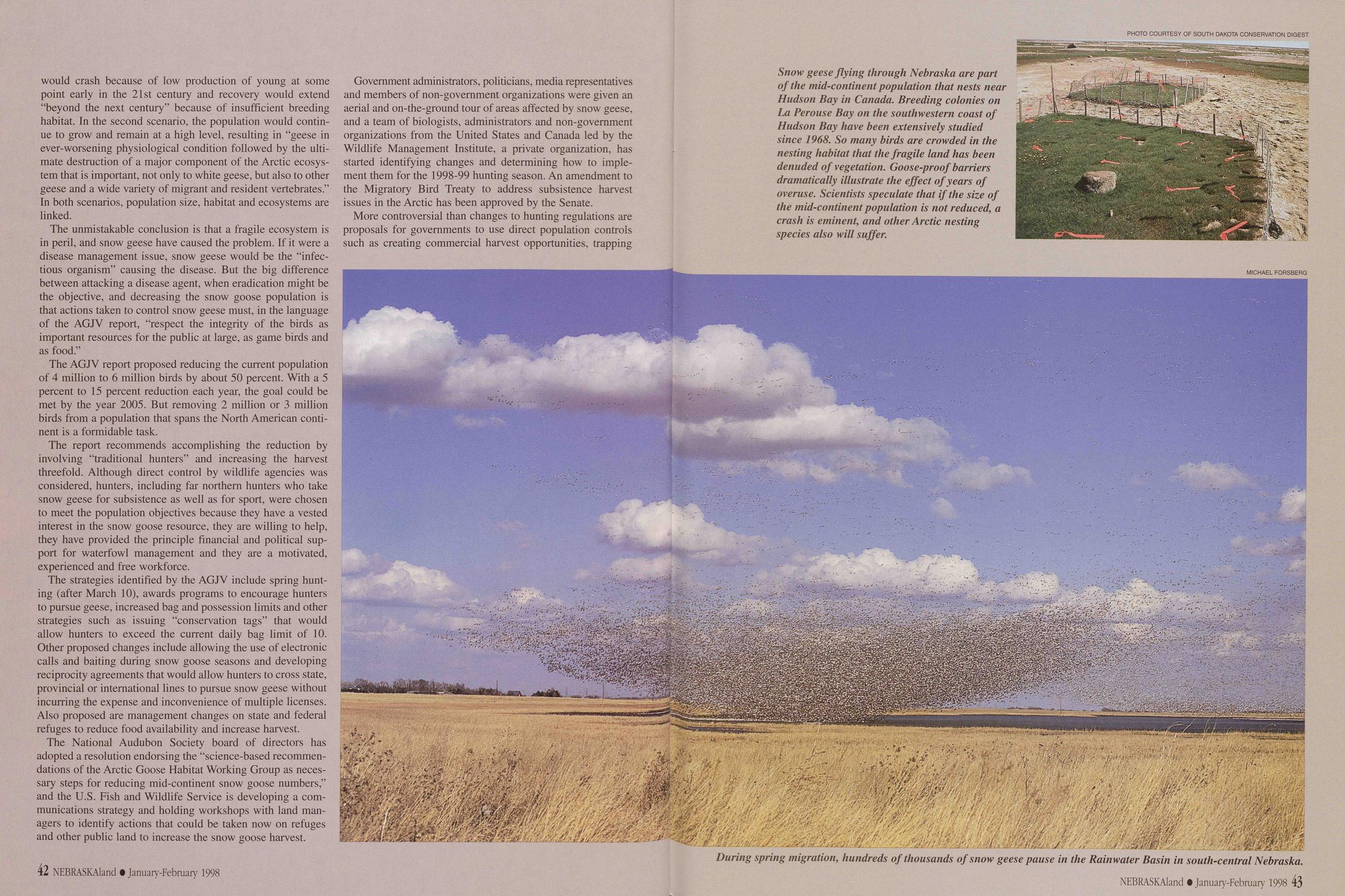
would crash because of low production of young at some point early in the 21st century and recovery would extend "beyond the next century" because of insufficient breeding habitat. In the second scenario, the population would continue to grow and remain at a high level, resulting in "geese in ever-worsening physiological condition followed by the ultimate destruction of a major component of the Arctic ecosystem that is important, not only to white geese, but also to other geese and a wide variety of migrant and resident vertebrates." In both scenarios, population size, habitat and ecosystems are linked.
The unmistakable conclusion is that a fragile ecosystem is in peril, and snow geese have caused the problem. If it were a disease management issue, snow geese would be the "infectious organism" causing the disease. But the big difference between attacking a disease agent, when eradication might be the objective, and decreasing the snow goose population is that actions taken to control snow geese must, in the language of the AGJV report, "respect the integrity of the birds as important resources for the public at large, as game birds and as food."
The AGJV report proposed reducing the current population of 4 million to 6 million birds by about 50 percent. With a 5 percent to 15 percent reduction each year, the goal could be met by the year 2005. But removing 2 million or 3 million birds from a population that spans the North American continent is a formidable task.
The report recommends accomplishing the reduction by involving "traditional hunters" and increasing the harvest threefold. Although direct control by wildlife agencies was considered, hunters, including far northern hunters who take snow geese for subsistence as well as for sport, were chosen to meet the population objectives because they have a vested interest in the snow goose resource, they are willing to help, they have provided the principle financial and political support for waterfowl management and they are a motivated, experienced and free workforce.
The strategies identified by the AGJV include spring hunting (after March 10), awards programs to encourage hunters to pursue geese, increased bag and possession limits and other strategies such as issuing "conservation tags" that would allow hunters to exceed the current daily bag limit of 10. Other proposed changes include allowing the use of electronic calls and baiting during snow goose seasons and developing reciprocity agreements that would allow hunters to cross state, provincial or international lines to pursue snow geese without incurring the expense and inconvenience of multiple licenses. Also proposed are management changes on state and federal refuges to reduce food availability and increase harvest.
The National Audubon Society board of directors has adopted a resolution endorsing the "science-based recommendations of the Arctic Goose Habitat Working Group as necessary steps for reducing mid-continent snow goose numbers," and the U.S. Fish and Wildlife Service is developing a communications strategy and holding workshops with land managers to identify actions that could be taken now on refuges and other public land to increase the snow goose harvest.
Government administrators, politicians, media representatives and members of non-government organizations were given an aerial and on-the-ground tour of areas affected by snow geese, and a team of biologists, administrators and non-government organizations from the United States and Canada led by the Wildlife Management Institute, a private organization, has started identifying changes and determining how to implement them for the 1998-99 hunting season. An amendment to the Migratory Bird Treaty to address subsistence harvest issues in the Arctic has been approved by the Senate.
More controversial than changes to hunting regulations are proposals for governments to use direct population controls such as creating commercial harvest opportunities, trapping
During spring migration, hundreds of thousands of snow geese pause in the Rainwater Basin in south-central Nebraska.
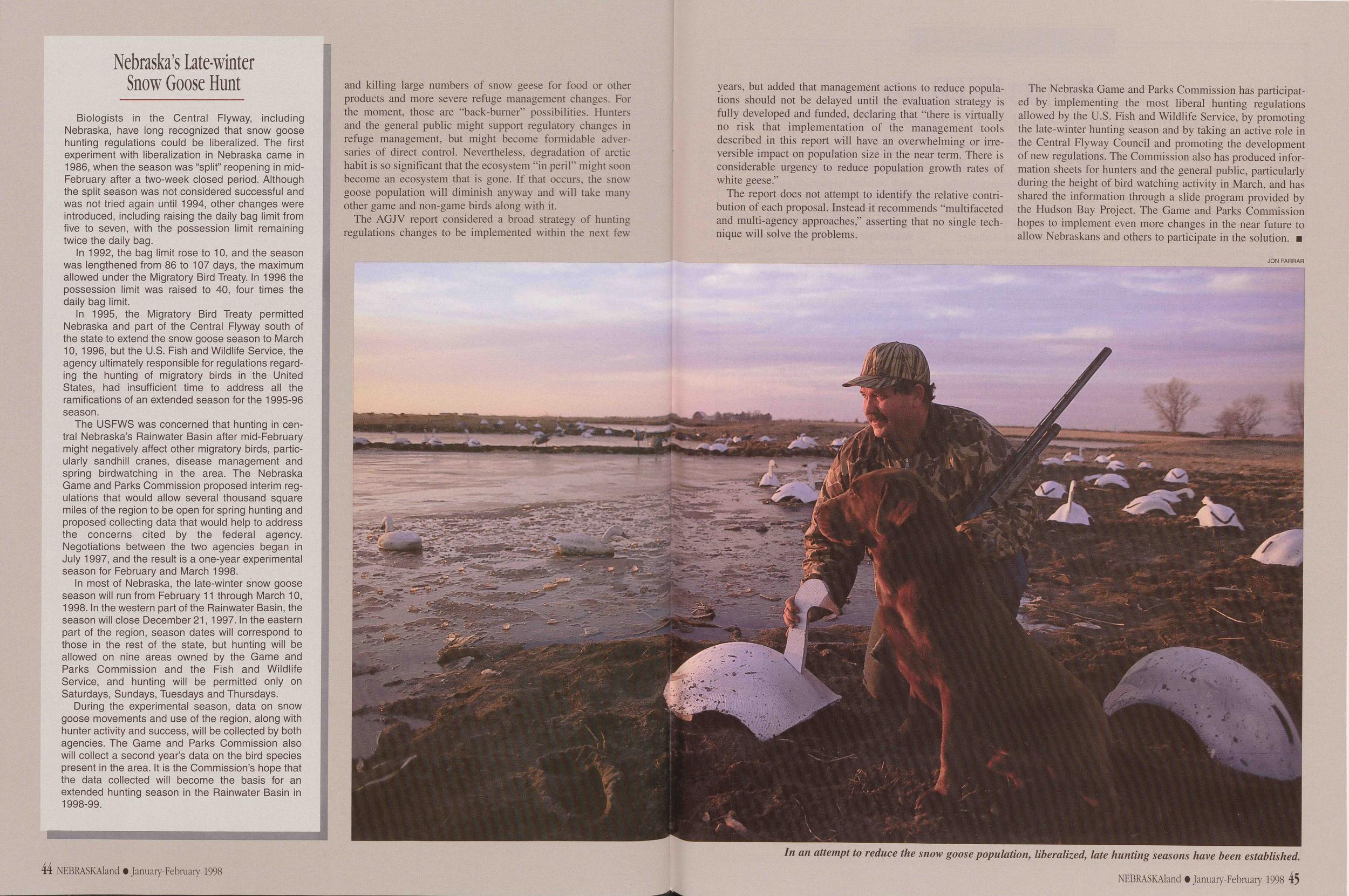
Nebraska's Late-winter Snow Goose Hunt
Biologists in the Central Flyway, including Nebraska, have long recognized that snow goose hunting regulations could be liberalized. The first experiment with liberalization in Nebraska came in 1986, when the season was "split" reopening in mid-February after a two-week closed period. Although the split season was not considered successful and was not tried again until 1994, other changes were introduced, including raising the daily bag limit from five to seven, with the possession limit remaining twice the daily bag.
In 1992, the bag limit rose to 10, and the season was lengthened from 86 to 107 days, the maximum allowed under the Migratory Bird Treaty. In 1996 the possession limit was raised to 40, four times the daily bag limit.
In 1995, the Migratory Bird Treaty permitted Nebraska and part of the Central Flyway south of the state to extend the snow goose season to March 10, 1996, but the U.S. Fish and Wildlife Service, the agency ultimately responsible for regulations regarding the hunting of migratory birds in the United States, had insufficient time to address all the ramifications of an extended season for the 1995-96 season.
The USFWS was concerned that hunting in central Nebraska's Rainwater Basin after mid-February might negatively affect other migratory birds, particularly sandhill cranes, disease management and spring birdwatching in the area. The Nebraska Game and Parks Commission proposed interim regulations that would allow several thousand square miles of the region to be open for spring hunting and proposed collecting data that would help to address the concerns cited by the federal agency. Negotiations between the two agencies began in July 1997, and the result is a one-year experimental season for February and March 1998.
In most of Nebraska, the late-winter snow goose season will run from February 11 through March 10, 1998. In the western part of the Rainwater Basin, the season will close December 21, 1997. In the eastern part of the region, season dates will correspond to those in the rest of the state, but hunting will be allowed on nine areas owned by the Game and Parks Commission and the Fish and Wildlife Service, and hunting will be permitted only on Saturdays, Sundays, Tuesdays and Thursdays.
During the experimental season, data on snow goose movements and use of the region, along with hunter activity and success, will be collected by both agencies. The Game and Parks Commission also will collect a second year's data on the bird species present in the area. It is the Commission's hope that the data collected will become the basis for an extended hunting season in the Rainwater Basin in 1998-99.
and killing large numbers of snow geese for food or other products and more severe refuge management changes. For the moment, those are "back-burner" possibilities. Hunters and the general public might support regulatory changes in refuge management, but might become formidable adversaries of direct control. Nevertheless, degradation of arctic habit is so significant that the ecosystem "in peril" might soon become an ecosystem that is gone. If that occurs, the snow goose population will diminish anyway and will take many other game and non-game birds along with it.
The AGJV report considered a broad strategy of hunting regulations changes to be implemented within the next few
In an attempt to reduce the snow goose population, liberalized, late hunting seasons have been established.
JON FARRARyears, but added that management actions to reduce populations should not be delayed until the evaluation strategy is fully developed and funded, declaring that "there is virtually no risk that implementation of the management tools described in this report will have an overwhelming or irreversible impact on population size in the near term. There is considerable urgency to reduce population growth rates of white geese."
The report does not attempt to identify the relative contribution of each proposal. Instead it recommends "multifaceted and multi-agency approaches," asserting that no single technique will solve the problems.
The Nebraska Game and Parks Commission has participated by implementing the most liberal hunting regulations allowed by the U.S. Fish and Wildlife Service, by promoting the late-winter hunting season and by taking an active role in the Central Flyway Council and promoting the development of new regulations. The Commission also has produced information sheets for hunters and the general public, particularly during the height of bird watching activity in March, and has shared the information through a slide program provided by the Hudson Bay Project. The Game and Parks Commission hopes to implement even more changes in the near future to allow Nebraskans and others to participate in the solution.
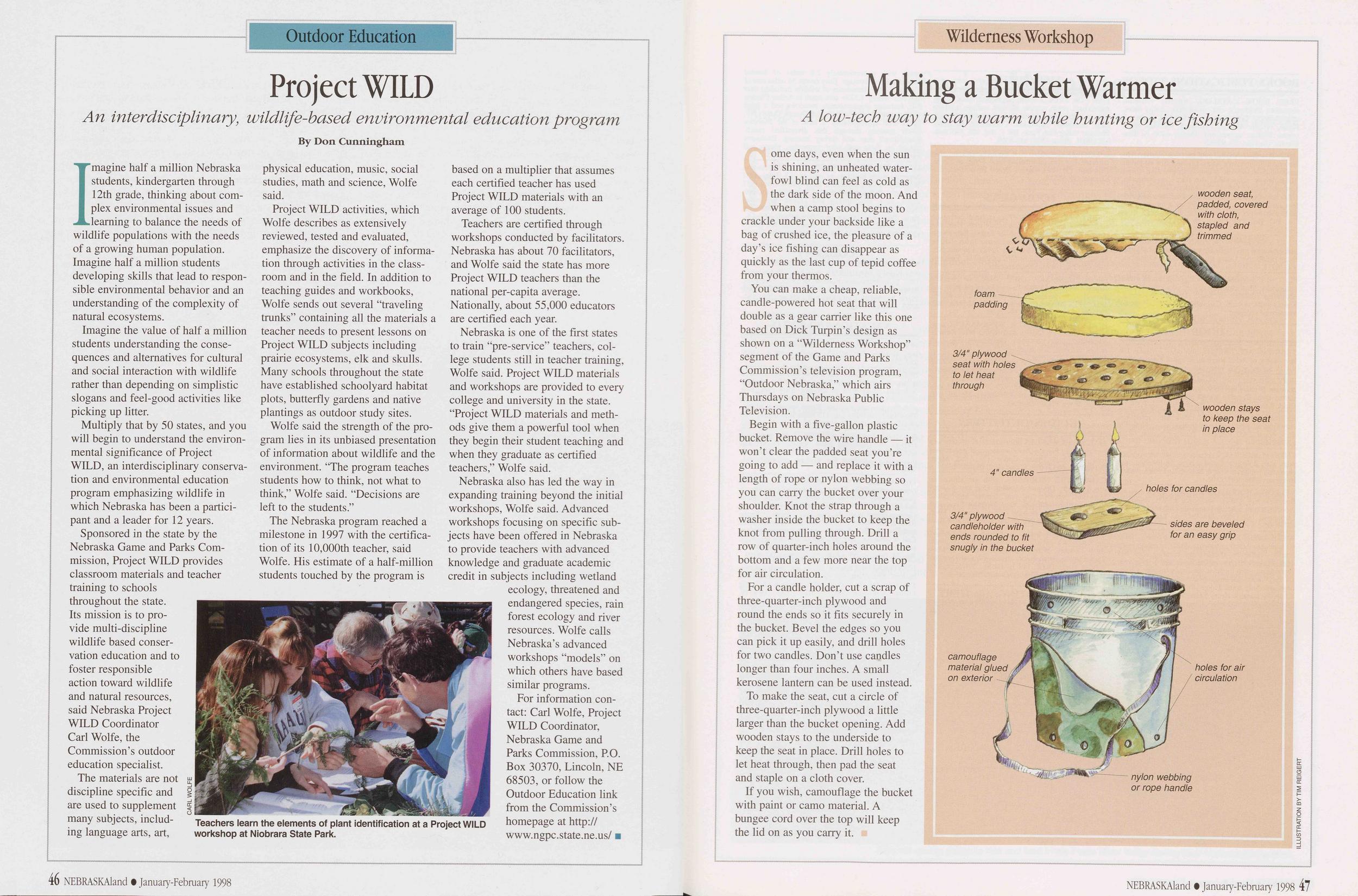
Outdoor Education
Project WILD
An interdisciplinary, wildlife-based environmental education program By Don CunninghamImagine half a million Nebraska students, kindergarten through 12th grade, thinking about complex environmental issues and learning to balance the needs of wildlife populations with the needs of a growing human population. Imagine half a million students developing skills that lead to responsible environmental behavior and an understanding of the complexity of natural ecosystems.
Imagine the value of half a million students understanding the consequences and alternatives for cultural and social interaction with wildlife rather than depending on simplistic slogans and feel-good activities like picking up litter.
Multiply that by 50 states, and you will begin to understand the environmental significance of Project WILD, an interdisciplinary conservation and environmental education program emphasizing wildlife in which Nebraska has been a participant and a leader for 12 years.
Sponsored in the state by the Nebraska Game and Parks Commission, Project WILD provides classroom materials and teacher training to schools throughout the state. Its mission is to provide multi-discipline wildlife based conservation education and to foster responsible action toward wildlife and natural resources, said Nebraska Project WILD Coordinator Carl Wolfe, the Commission's outdoor education specialist.
The materials are not discipline specific and are used to supplement many subjects, including language arts, art, physical education, music, social studies, math and science, Wolfe said.
Project WILD activities, which Wolfe describes as extensively reviewed, tested and evaluated, emphasize the discovery of information through activities in the classroom and in the field. In addition to teaching guides and workbooks, Wolfe sends out several "traveling trunks" containing all the materials a teacher needs to present lessons on Project WILD subjects including prairie ecosystems, elk and skulls. Many schools throughout the state have established schoolyard habitat plots, butterfly gardens and native plantings as outdoor study sites.
Wolfe said the strength of the program lies in its unbiased presentation of information about wildlife and the environment. "The program teaches students how to think, not what to think," Wolfe said. "Decisions are left to the students."
The Nebraska program reached a milestone in 1997 with the certification of its 10,000th teacher, said Wolfe. His estimate of a half-million students touched by the program is
Teachers learn the elements of plant identification at a Project WILD workshop at Niobrara State Park.
CARL WOLFEbased on a multiplier that assumes each certified teacher has used Project WILD materials with an average of 100 students.
Teachers are certified through workshops conducted by facilitators. Nebraska has about 70 facilitators, and Wolfe said the state has more Project WILD teachers than the national per-capita average. Nationally, about 55,000 educators are certified each year.
Nebraska is one of the first states to train "pre-service" teachers, college students still in teacher training, Wolfe said. Project WILD materials and workshops are provided to every college and university in the state. "Project WILD materials and methods give them a powerful tool when they begin their student teaching and when they graduate as certified teachers," Wolfe said.
Nebraska also has led the way in expanding training beyond the initial workshops, Wolfe said. Advanced workshops focusing on specific subjects have been offered in Nebraska to provide teachers with advanced knowledge and graduate academic credit in subjects including wetland ecology, threatened and endangered species, rain forest ecology and river resources. Wolfe calls Nebraska's advanced workshops "models" on which others have based similar programs.
For information contact: Carl Wolfe, Project WILD Coordinator, Nebraska Game and Parks Commission, P.O. Box 30370, Lincoln, NE 68503, or follow the Outdoor Education link from the Commission's homepage at http:// www.ngpc.state.ne.us/Wilderness Workshop
Making a Bucket Warmer A low-tech way to stay warm while hunting or ice fishingSome days, even when the sun is shining, an unheated waterfowl blind can feel as cold as the dark side of the moon. And when a camp stool begins to crackle under your backside like a bag of crushed ice, the pleasure of a day's ice fishing can disappear as quickly as the last cup of tepid coffee from your thermos.
You can make a cheap, reliable, candle-powered hot seat that will double as a gear carrier like this one based on Dick Turpin's design as shown on a "Wilderness Workshop" segment of the Game and Parks Commission's television program, "Outdoor Nebraska," which airs Thursdays on Nebraska Public Television.
Begin with a five-gallon plastic bucket. Remove the wire handle — it won't clear the padded seat you're going to add — and replace it with a length of rope or nylon webbing so you can carry the bucket over your shoulder. Knot the strap through a washer inside the bucket to keep the knot from pulling through. Drill a row of quarter-inch holes around the bottom and a few more near the top for air circulation.
For a candle holder, cut a scrap of three-quarter-inch plywood and round the ends so it fits securely in the bucket. Bevel the edges so you can pick it up easily, and drill holes for two candles. Don't use candles longer than four inches. A small kerosene lantern can be used instead.
To make the seat, cut a circle of three-quarter-inch plywood a little larger than the bucket opening. Add wooden stays to the underside to keep the seat in place. Drill holes to let heat through, then pad the seat and staple on a cloth cover.
If you wish, camouflage the bucket with paint or camo material. A bungee cord over the top will keep the lid on as you carry it.
wooden seat, padded, covered with cloth, stapled and trimmed
foam padding
3/4" plywood seat with holes to let heat through
wooden stays to keep the seat in place
4" candles
holes for candles
3/4" plywood candleholder with ends rounded to fit snugly in the bucket
sides are beveled for an easy grip
camouflage material glued on exterior
holes for air circulation
nylon webbing or rope handle
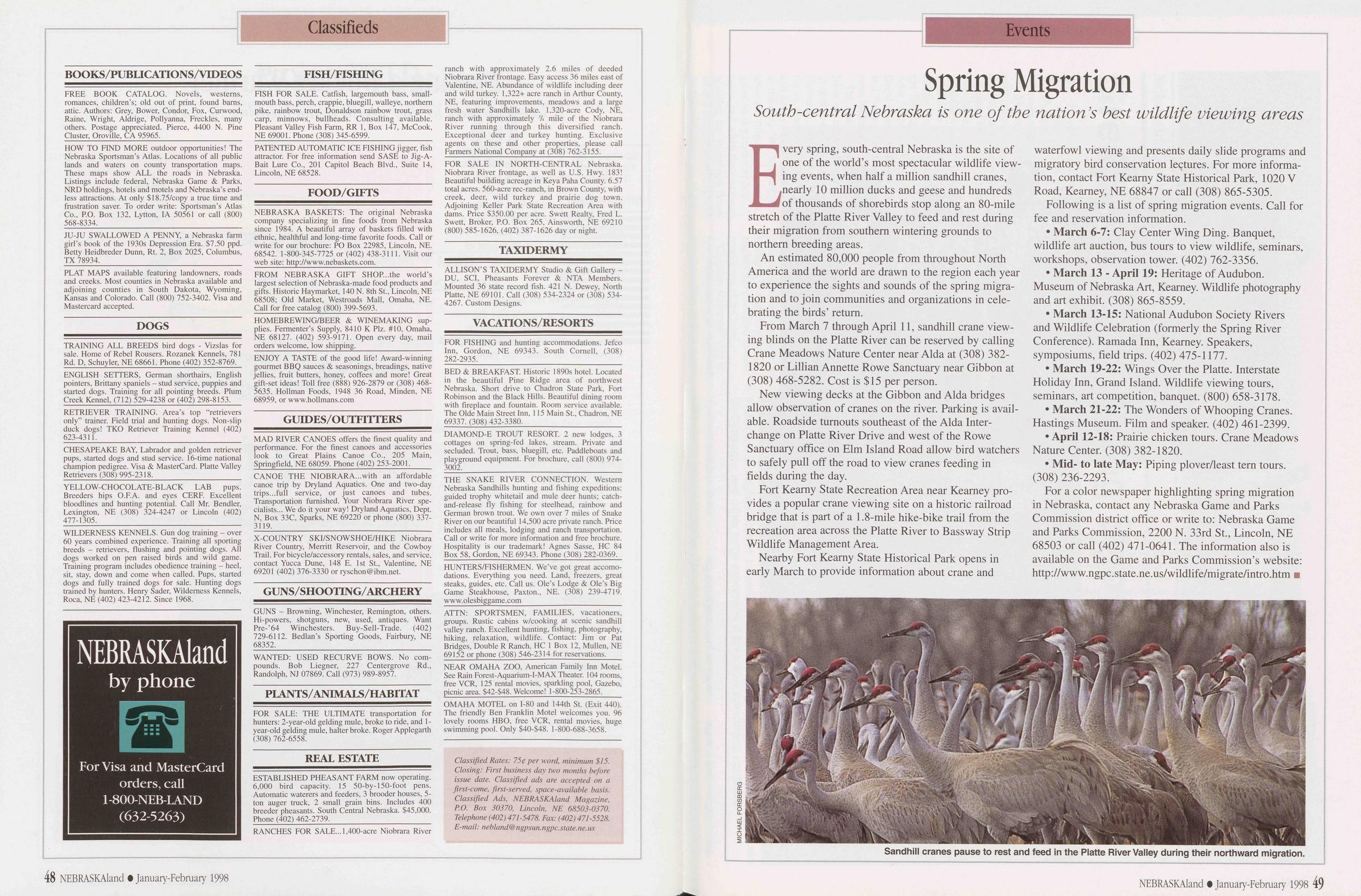
Classifieds
BOOKS/PUBLICATIONS/VIDEOS FREE BOOK CATALOG. Novels, westerns, romances, children's; old out of print, found bams, attic. Authors: Grey, Bower, Condor, Fox, Curwood, Raine, Wright, Aldrige, Pollyanna, Freckles, many others. Postage appreciated. Pierce, 4400 N. Pine Cluster, Oroville, CA 95965. HOW TO FIND MORE outdoor opportunities! The Nebraska Sportsman's Atlas. Locations of all public lands and waters on county transportation maps. These maps show ALL the roads in Nebraska. Listings include federal, Nebraska Game & Parks, NRD holdings, hotels and motels and Nebraska's endless attractions. At only $18.75/copy a true time and frustration saver. To order write: Sportsman's Atlas Co., P.O. Box 132, Lytton, IA 50561 or call (800) 568-8334. JU-JU SWALLOWED A PENNY, a Nebraska farm girl's book of the 1930s Depression Era. $7.50 ppd. Betty Heidbreder Dunn, Rt. 2, Box 2025, Columbus, TX 78934. PLAT MAPS available featuring landowners, roads and creeks. Most counties in Nebraska available and adjoining counties in South Dakota, Wyoming, Kansas and Colorado. Call (800) 752-3402. Visa and Mastercard accepted. DOGS TRAINING ALL BREEDS bird dogs - Vizslas for sale. Home of Rebel Rousers. Rozanek Kennels, 781 Rd. D, Schuyler, NE 68661. Phone (402) 352-8769. ENGLISH SETTERS, German shorthairs, English pointers, Brittany spaniels - stud service, puppies and started dogs. Training for all pointing breeds. Plum Creek Kennel, (712) 529-4238 or (402) 298-8153. RETRIEVER TRAINING. Area's top "retrievers only" trainer. Field trial and hunting dogs. Non-slip duck dogs! TKO Retriever Training Kennel (402) 623-4311. CHESAPEAKE BAY, Labrador and golden retriever pups, started dogs and stud service. 16-time national champion pedigree. Visa & MasterCard. Platte Valley Retrievers (308) 995-2318. YELLOW-CHOCOLATE-BLACK LAB pups. Breeders hips O.F.A. and eyes CERE Excellent bloodlines and hunting potential. Call Mr. Bendler, Lexington, NE (308) 324-4247 or Lincoln (402) 477-1305. WILDERNESS KENNELS. Gun dog training - over 60 years combined experience. Training all sporting breeds - retrievers, flushing and pointing dogs. All dogs worked on pen raised birds and wild game. Training program includes obedience training - heel, sit, stay, down and come when called. Pups, started dogs and fully trained dogs for sale. Hunting dogs trained by hunters. Henry Sader, Wilderness Kennels, Roca, NE (402) 423-4212. Since 1968. NEBRASKAland by phone For Visa and MasterCard orders, call 1-800-NEB-LAND (632-5263) FISH/FISHING FISH FOR SALE. Catfish, largemouth bass, smallmouth bass, perch, crappie, bluegill, walleye, northern pike, rainbow trout, Donaldson rainbow trout, grass carp, minnows, bullheads. Consulting available. Pleasant Valley Fish Farm, RR 1, Box 147, McCook, NE 69001. Phone (308) 345-6599. PATENTED AUTOMATIC ICE FISHING jigger, fish attractor. For free information send SASE to Jig-A-Bait Lure Co., 201 Capitol Beach Blvd., Suite 14, Lincoln, NE 68528. FOOD/GIFTS NEBRASKA BASKETS: The original Nebraska company specializing in fine foods from Nebraska since 1984. A beautiful array of baskets filled with ethnic, healthful and long-time favorite foods. Call or write for our brochure: PO Box 22985, Lincoln, NE. 68542. 1-800-345-7725 or (402) 438-3111. Visit our web site: http://www.nebaskets.com. FROM NEBRASKA GIFT SHOP...the world's largest selection of Nebraska-made food products and gifts. Historic Haymarket, 140 N. 8th St., Lincoln, NE 68508; Old Market, Westroads Mall, Omaha, NE. Call for free catalog (800) 399-5693. HOMEBREWING/BEER & WINEMAKING supplies. Fermenter's Supply, 8410 K Plz. #10, Omaha, NE 68127. (402) 593-9171. Open every day, mail orders welcome, low shipping. ENJOY A TASTE of the good life! Award-winning gourmet BBQ sauces & seasonings, breadings, native jellies, fruit butters, honey, coffees and more! Great gift-set ideas! Toll free (888) 926-2879 or (308) 468-5635. Hollman Foods, 1948 36 Road, Minden, NE 68959, or www.hollmans.com GUIDES/OUTFITTERS MAD RIVER CANOES offers the finest quality and performance. For the finest canoes and accessories look to Great Plains Canoe Co., 205 Main, Springfield, NE 68059. Phone (402) 253-2001. CANOE THE NIOBRARA...with an affordable canoe trip by Dryland Aquatics. One and two-day trips...full service, or just canoes and tubes. Transportation furnished. Your Niobrara River specialists... We do it your way! Dryland Aquatics, Dept. N, Box 33C, Sparks, NE 69220 or phone (800) 337-3119. X-COUNTRY SKI/SNOWSHOE/HIKE Niobrara River Country, Merritt Reservoir, and the Cowboy Trail. For bicycle/accessory rentals, sales, and service, contact Yucca Dune, 148 E. 1st St., Valentine, NE 69201 (402) 376-3330 orryschon@ibm.net. GUNS/SHOOTING/ARCHERY GUNS - Browning, Winchester, Remington, others. Hi-powers, shotguns, new, used, antiques. Want Pre-'64 Winchesters. Buy-Sell-Trade. (402) 729-6112. Bedlan's Sporting Goods, Fairbury, NE 68352. WANTED: USED RECURVE BOWS. No compounds. Bob Liegner, 227 Centergrove Rd., Randolph, NJ 07869. Call (973) 989-8957. PLANTS/ANIMALS/HABITAT FOR SALE: THE ULTIMATE transportation for hunters: 2-year-old gelding mule, broke to ride, and 1-year-old gelding mule, halter broke. Roger Applegarth (308) 762-6558. REAL ESTATE ESTABLISHED PHEASANT FARM now operating. 6,000 bird capacity. 15 50-by-150-foot pens. Automatic waterers and feeders, 3 brooder houses, 5-ton auger truck, 2 small grain bins. Includes 400 breeder pheasants. South Central Nebraska. $45,000. Phone (402) 462-2739. RANCHES FOR SALE...l,400-acre Niobrara River ranch with approximately 2.6 miles of deeded Niobrara River frontage. Easy access 36 miles east of Valentine, NE. Abundance of wildlife including deer and wild turkey. 1,322+ acre ranch in Arthur County, NE, featuring improvements, meadows and a large fresh water Sandhills lake. 1,320-acre Cody, NE, ranch with approximately 3A mile of the Niobrara River running through this diversified ranch. Exceptional deer and turkey hunting. Exclusive agents on these and other properties, please call Farmers National Company at (308) 762-3155. FOR SALE IN NORTH-CENTRAL Nebraska. Niobrara River frontage, as well as U.S. Hwy. 183! Beautiful building acreage in Keya Paha County. 6.57 total acres. 560-acre rec-ranch, in Brown County, with creek, deer, wild turkey and prairie dog town. Adjoining Keller Park State Recreation Area with dams. Price $350.00 per acre. Swett Realty, Fred L. Swett, Broker, P.O. Box 265, Ainsworth, NE 69210 (800) 585-1626, (402) 387-1626 day or night. TAXIDERMY ALLISON'S TAXIDERMY Studio & Gift Gallery - DU, SCI, Pheasants Forever & NTA Members. Mounted 36 state record fish. 421 N. Dewey, North Platte, NE 69101. Call (308) 534-2324 or (308) 534-4267. Custom Designs. VACATIONS/RESORTS FOR FISHING and hunting accommodations. Jefco Inn, Gordon, NE 69343. South Cornell, (308)282-2935. BED & BREAKFAST. Historic 1890s hotel. Located in the beautiful Pine Ridge area of northwest Nebraska. Short drive to Chadron State Park, Fort Robinson and the Black Hills. Beautiful dining room with fireplace and fountain. Room service available. The Olde Main Street Inn, 115 Main St., Chadron, NE 69337. (308) 432-3380. DIAMOND-E TROUT RESORT. 2 new lodges, 3 cottages on spring-fed lakes, stream. Private and secluded. Trout, bass, bluegill, etc. Paddleboats and playground equipment. For brochure, call (800) 974-3002. THE SNAKE RIVER CONNECTION. Western Nebraska Sandhills hunting and fishing expeditions: guided trophy whitetail and mule deer hunts; catch-and-release fly fishing for steelhead, rainbow and German brown trout. We own over 7 miles of Snake River on our beautiful 14,500 acre private ranch. Price includes all meals, lodging and ranch transportation. Call or write for more information and free brochure. Hospitality is our trademark! Agnes Sasse, HC 84 Box 58, Gordon, NE 69343. Phone (308) 282-0369. HUNTERS/FISHERMEN. We've got great accomodations. Everything you need. Land, freezers, great steaks, guides, etc. Call us. Ole's Lodge & Ole's Big Game Steakhouse, Paxton., NE. (308) 239-4719. www.olesbiggame.com ATTN: SPORTSMEN, FAMILIES, vacationers, groups. Rustic cabins w/cooking at scenic sandhill valley ranch. Excellent hunting, fishing, photography, hiking, relaxation, wildlife. Contact: Jim or Pat Bridges, Double R Ranch, HC 1 Box 12, Mullen, NE 69152 or phone (308) 546-2314 for reservations. NEAR OMAHA ZOO, American Family Inn Motel. See Rain Forest-Aquarium-I-MAX Theater. 104 rooms, free VCR, 125 rental movies, sparkling pool, Gazebo, picnic area. $42-$48. Welcome! 1-800-253-2865. OMAHA MOTEL on 1-80 and 144th St. (Exit 440). The friendly Ben Franklin Motel welcomes you. 96 lovely rooms HBO, free VCR, rental movies, huge swimming pool. Only $40-$48. 1-800-688-3658. Classified Rates: 75$ per word, minimum $15. Closing: First business day two months before issue date. Classified ads are accepted on a first-come, first-served, space-available basis. Classified Ads, NEBRASKAland Magazine, P.O. Box 30370, Lincoln, NE 68503-0370. Telephone (402) 471-5478. Fax: (402) 471-5528. E-mail: nebland@ngpsun.ngpc.state.ne.usEvents
Spring Migration
South-central Nebraska is one of the nation's best wildlife viewing areasEvery spring, south-central Nebraska is the site of one of the world's most spectacular wildlife viewing events, when half a million sandhill cranes, nearly 10 million ducks and geese and hundreds of thousands of shorebirds stop along an 80-mile stretch of the Platte River Valley to feed and rest during their migration from southern wintering grounds to northern breeding areas.
An estimated 80,000 people from throughout North America and the world are drawn to the region each year to experience the sights and sounds of the spring migration and to join communities and organizations in celebrating the birds' return.
From March 7 through April 11, sandhill crane viewing blinds on the Platte River can be reserved by calling Crane Meadows Nature Center near Alda at (308) 382-1820 or Lillian Annette Rowe Sanctuary near Gibbon at (308) 468-5282. Cost is $15 per person.
New viewing decks at the Gibbon and Alda bridges allow observation of cranes on the river. Parking is available. Roadside turnouts southeast of the Alda Interchange on Platte River Drive and west of the Rowe Sanctuary office on Elm Island Road allow bird watchers to safely pull off the road to view cranes feeding in fields during the day.
Fort Kearny State Recreation Area near Kearney provides a popular crane viewing site on a historic railroad bridge that is part of a 1.8-mile hike-bike trail from the recreation area across the Platte River to Bass way Strip Wildlife Management Area.
Nearby Fort Kearny State Historical Park opens in early March to provide information about crane and waterfowl viewing and presents daily slide programs and migratory bird conservation lectures. For more information, contact Fort Kearny State Historical Park, 1020 V Road, Kearney, NE 68847 or call (308) 865-5305.
Following is a list of spring migration events. Call for fee and reservation information. • March 6-7: Clay Center Wing Ding. Banquet, wildlife art auction, bus tours to view wildlife, seminars, workshops, observation tower. (402) 762-3356. • March 13 - April 19: Heritage of Audubon. Museum of Nebraska Art, Kearney. Wildlife photography and art exhibit. (308) 865-8559. • March 13-15: National Audubon Society Rivers and Wildlife Celebration (formerly the Spring River Conference). Ramada Inn, Kearney. Speakers, symposiums, field trips. (402) 475-1177. • March 19-22: Wings Over the Platte. Interstate Holiday Inn, Grand Island. Wildlife viewing tours, seminars, art competition, banquet. (800) 658-3178. • March 21-22: The Wonders of Whooping Cranes. Hastings Museum. Film and speaker. (402) 461-2399. • April 12-18: Prairie chicken tours. Crane Meadows Nature Center. (308) 382-1820. • Mid- to late May: Piping plover/least tern tours. (308) 236-2293.
For a color newspaper highlighting spring migration in Nebraska, contact any Nebraska Game and Parks Commission district office or write to: Nebraska Game and Parks Commission, 2200 N. 33rd St., Lincoln, NE 68503 or call (402) 471-0641. The information also is available on the Game and Parks Commission's website: http://www.ngpc.state.ne.us/wildlife/migrate/intro.htmK
Sandhill cranes pause to rest and feed in the Platte River Valley during their northward migration.

Portraits from the Past
"In the early '30s there was a glut of grain. Oats were selling for nine cents a bushel, and com for 15 cents. Farmers were producing too much grain. When Roosevelt was elected in 1932, his administration paid farmers a fancy price to idle whole farms. In my mind I can still see com and grain left unharvested in the fields. This made ideal habitat for wildlife, and pheasants, jackrabbits and other game increased a hundredfold. "I am sending a picture of myself (bareheaded) and four other hunters with 35 pheasants. We were allowed to shoot seven birds — five roosters and two hens. I do not remember the year, but I think it was 1934 or 1935.1 am the only one of this group still living, and I am 87 years old." — Ferd Bogner, Crofton Readers are invited to send contributions to "Portraits from the Past," NEBRASKAland Magazine, P. O. Box 30370, Lincoln, NE 68503-0370. Photos should depict outdoor activities before 1960. Please identify people, places and approximate date if you can. Photos will be returned.
Position: 737 (15 views)