Volume 75, Issue 10, 1997
NEBRASKAland
Nebraska Game & Parks Commission December 1997 $2.00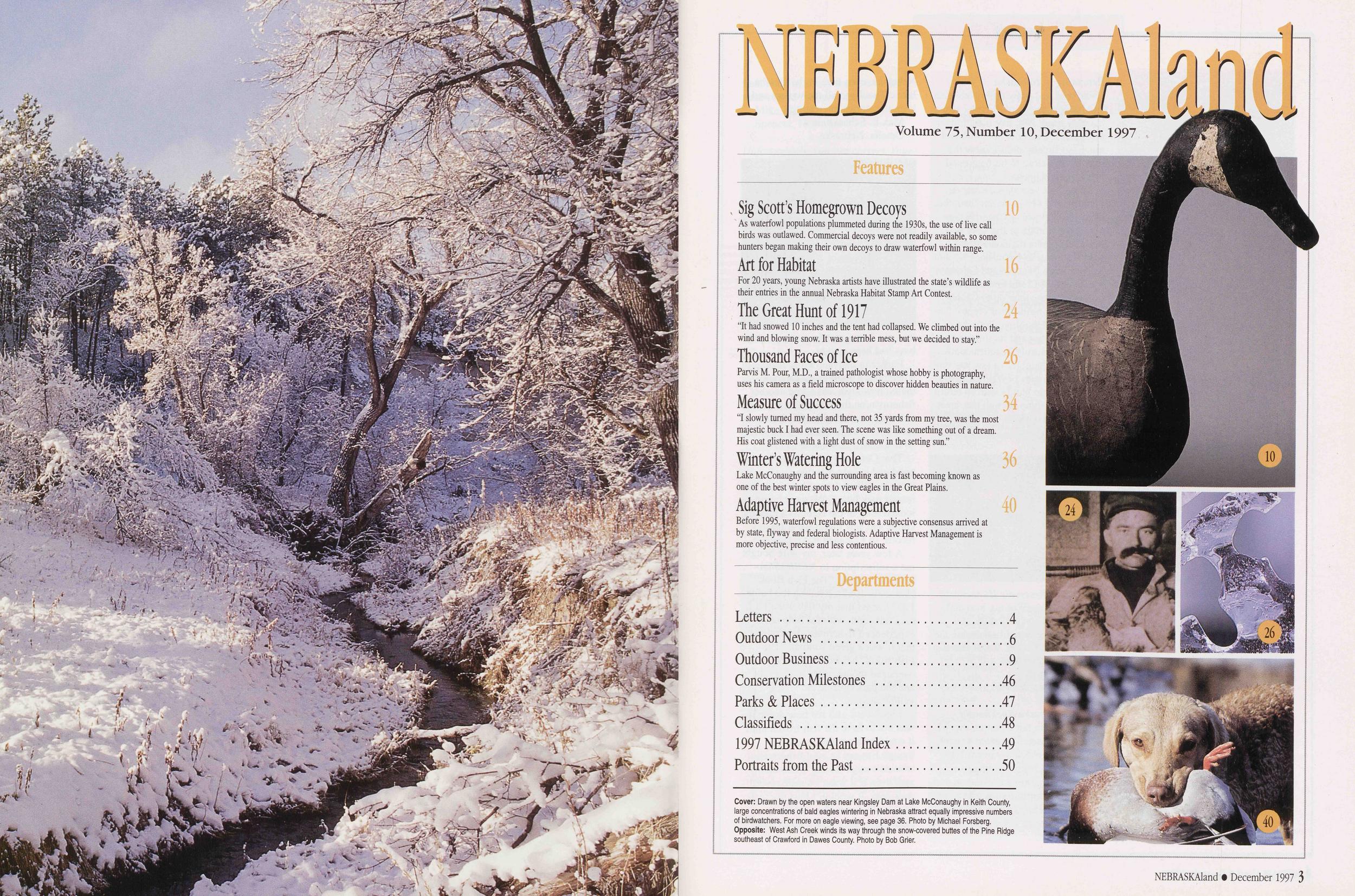
NEBRASKAland
Volume 75, Number 10, December 1997 Features Sig Scott's Homegrown Decoys 10As waterfowl populations plummeted during the 1930s, the use of live call birds was outlawed. Commercial decoys were not readily available, so some hunters began making their own decoys to draw waterfowl within range.
Art for Habitat 16For 20 years, young Nebraska artists have illustrated the state's wildlife as their entries in the annual Nebraska Habitat Stamp Art Contest.
The Great Hunt of 1917 24"It had snowed 10 inches and the tent had collapsed. We climbed out into the wind and blowing snow. It was a terrible mess, but we decided to stay."
Thousand Faces of Ice 26Parvis M. Pour, M.D., a trained pathologist whose hobby is photography, uses his camera as a field microscope to discover hidden beauties in nature.
Measure of Success 34"I slowly turned my head and there, not 35 yards from my tree, was the most majestic buck I had ever seen. The scene was like something out of a dream. His coat glistened with a light dust of snow in the setting sun."
Winter's Watering Hole 36Lake McConaughy and the surrounding area is fast becoming known as one of the best winter spots to view eagles in the Great Plains.
Adaptive Harvest Management 40Before 1995, waterfowl regulations were a subjective consensus arrived at by state, fly way and federal biologists. Adaptive Harvest Management is more objective, precise and less contentious.
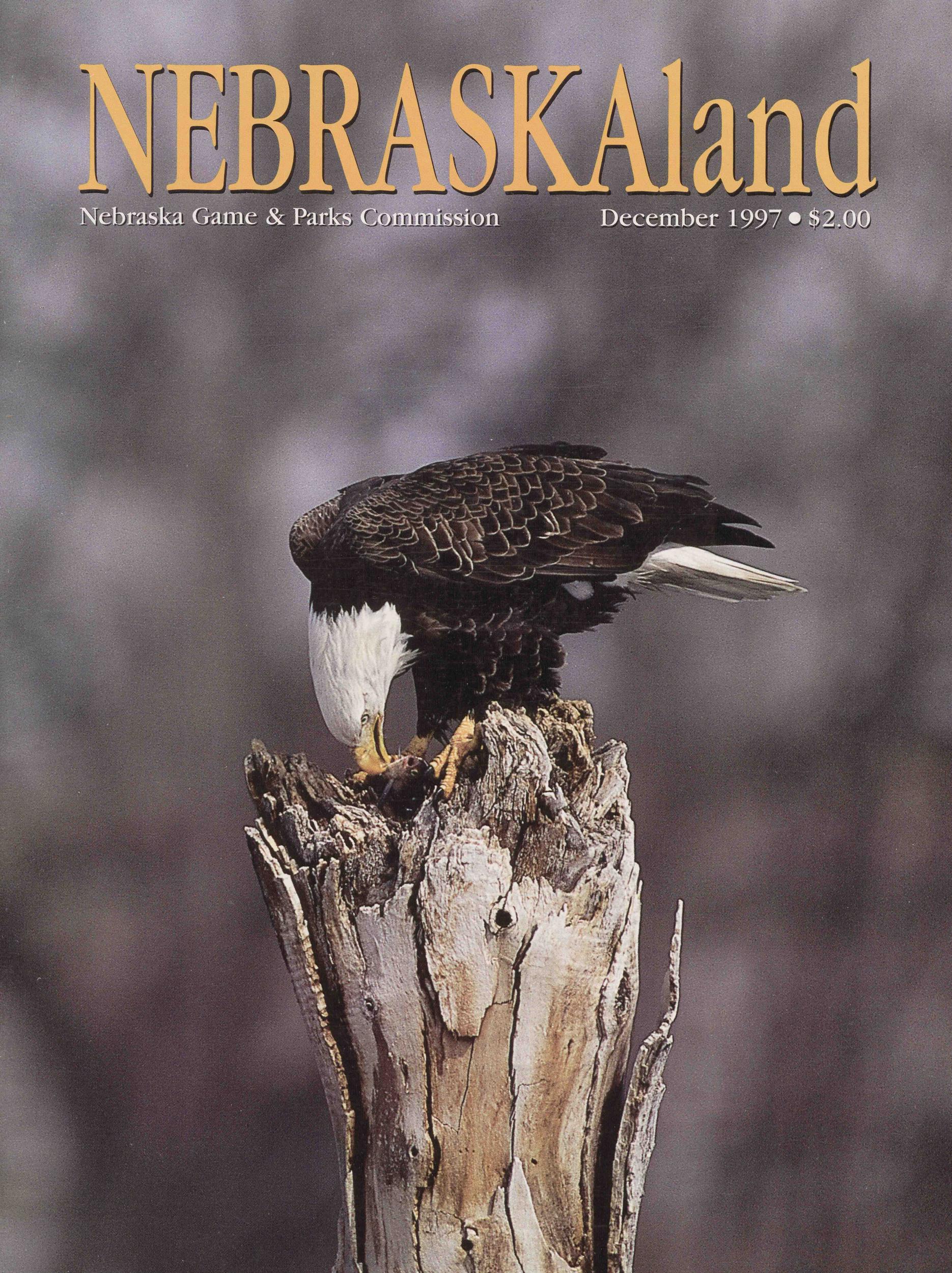
Departments Letters 4 Outdoor News 6 Outdoor Business 9 Conservation Milestones 46 Parks & Places 47 Classifieds 48 1997 NEBRASKAland Index 49 Portraits from the Past 50 Cover: Drawn by the open waters near Kingsley Dam at Lake McConaughy in Keith County, large concentrations of bald eagles wintering in Nebraska attract equally impressive numbers of birdwatchers. For more on eagle viewing, see page 36. Photo by Michael Forsberg. Opposite: West Ash Creek winds its way through the snow-covered buttes of the Pine Ridge southeast of Crawford in Dawes County. Photo by Bob Grier.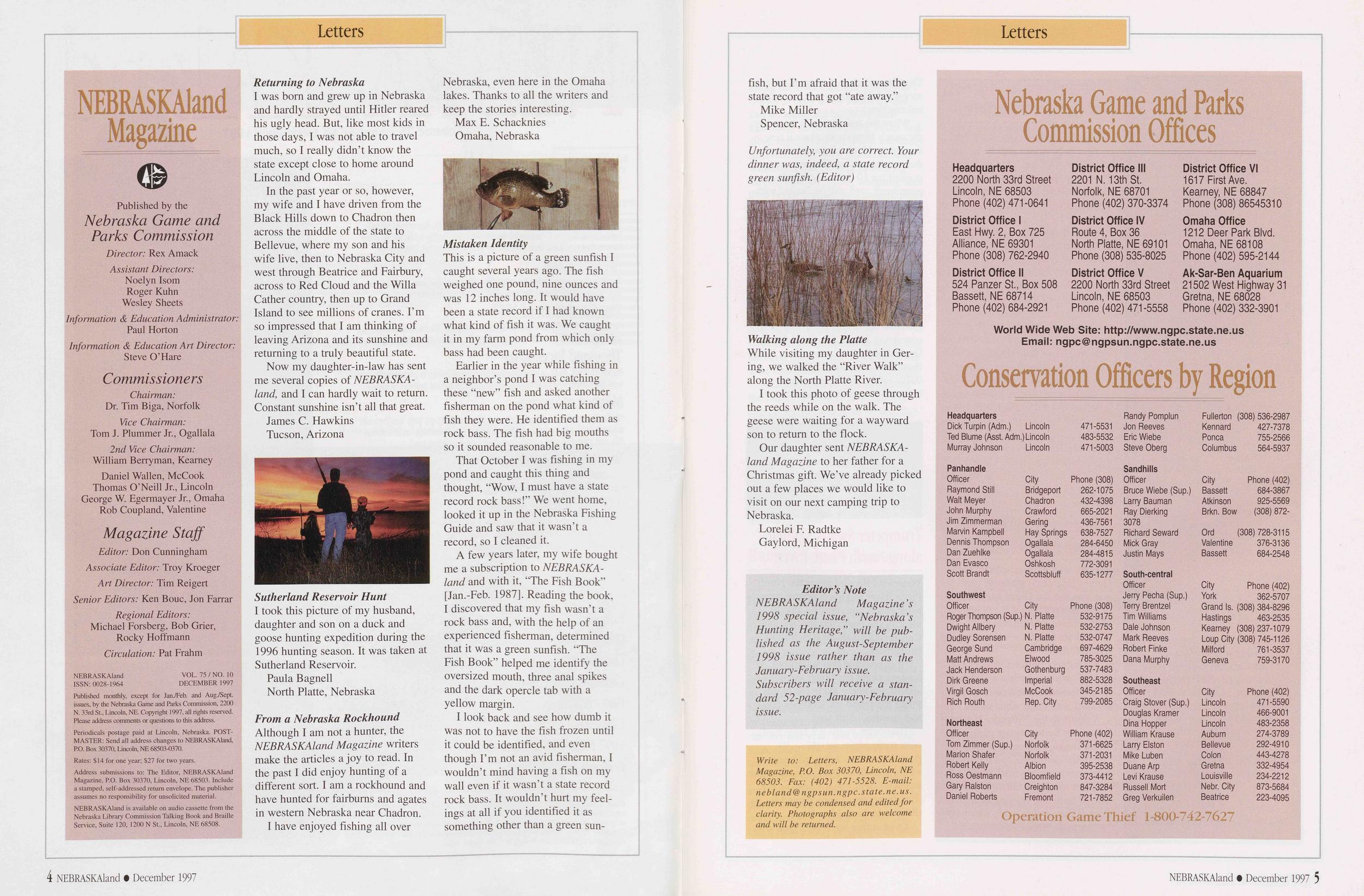
Letters
Returning to NebraskaI was born and grew up in Nebraska and hardly strayed until Hitler reared his ugly head. But, like most kids in those days, I was not able to travel much, so I really didn't know the state except close to home around Lincoln and Omaha.
In the past year or so, however, my wife and I have driven from the Black Hills down to Chadron then across the middle of the state to Bellevue, where my son and his wife live, then to Nebraska City and west through Beatrice and Fairbury, across to Red Cloud and the Willa Cather country, then up to Grand Island to see millions of cranes. I'm so impressed that I am thinking of leaving Arizona and its sunshine and returning to a truly beautiful state.
Now my daughter-in-law has sent me several copies of NEBRASKAland, and I can hardly wait to return. Constant sunshine isn't all that great.
James C. HawkinsTucson, Arizona
I took this picture of my husband, daughter and son on a duck and goose hunting expedition during the 1996 hunting season. It was taken at Sutherland Reservoir.
Paula BagnellNorth Platte, Nebraska
From a Nebraska RockhoundAlthough I am not a hunter, the NEBRASKAland Magazine writers make the articles a joy to read. In the past I did enjoy hunting of a different sort. I am a rockhound and have hunted for fairburns and agates in western Nebraska near Chadron.
I have enjoyed fishing all over Nebraska, even here in the Omaha lakes. Thanks to all the writers and keep the stories interesting.
Max E. SchackniesOmaha, Nebraska
This is a picture of a green sunfish I caught several years ago. The fish weighed one pound, nine ounces and was 12 inches long. It would have been a state record if I had known what kind of fish it was. We caught it in my farm pond from which only bass had been caught.
Earlier in the year while fishing in a neighbor's pond I was catching these "new" fish and asked another fisherman on the pond what kind of fish they were. He identified them as rock bass. The fish had big mouths so it sounded reasonable to me.
That October I was fishing in my pond and caught this thing and thought, "Wow, I must have a state record rock bass!" We went home, looked it up in the Nebraska Fishing Guide and saw that it wasn't a record, so I cleaned it.
A few years later, my wife bought me a subscription to NEBRASKAland and with it, "The Fish Book" [Jan.-Feb. 1987]. Reading the book, I discovered that my fish wasn't a rock bass and, with the help of an experienced fisherman, determined that it was a green sunfish. "The Fish Book" helped me identify the oversized mouth, three anal spikes and the dark opercle tab with a yellow margin.
I look back and see how dumb it was not to have the fish frozen until it could be identified, and even though I'm not an avid fisherman, I wouldn't mind having a fish on my wall even if it wasn't a state record rock bass. It wouldn't hurt my feelings at all if you identified it as something other than a green sun-
4 NEBRASKAland • December 1997 Lettersfish, but I'm afraid that it was the state record that got "ate away."
Mike MillerSpencer, Nebraska
Unfortunately, you are correct. Your dinner was, indeed, a state record green sunfish. (Editor)While visiting my daughter in Gering, we walked the "River Walk" along the North Platte River.
I took this photo of geese through the reeds while on the walk. The geese were waiting for a wayward son to return to the flock.
Our daughter sent NEBRASKAland Magazine to her father for a Christmas gift. We've already picked out a few places we would like to visit on our next camping trip to Nebraska.
Lorelei F. RadtkeGaylord, Michigan
Editor's Note NEBRASKAland Magazine's 1998 special issue, "Nebraska's Hunting Heritage," will be published as the August-September 1998 issue rather than as the January-February issue. Subscribers will receive a standard 52-page January-February issue. Write to: Letters, NEBRASKAland Magazine, P.O. Box 30370, Lincoln, NE 68503. Fax: (402) 471-5528. E-mail: nebland@ngpsun.ngpc.state.ne.us. Letters may be condensed and edited for clarity. Photographs also are welcome and will be returned.Nebraska Game and Parks
Commission Offices Headquarters 2200 North 33rd Street Lincoln, NE 68503 Phone (402) 471-0641 District Office I East Hwy. 2, Box 725 Alliance, NE 69301 Phone (308) 762-2940 District Office II 524 Panzer St., Box 508 Bassett, NE 68714 Phone (402) 684-2921 District Office 2201 N. 13th St. Norfolk, NE 68701 Phone (402) 370-3374 District Office IV Route 4, Box 36 North Platte, NE 69101 Phone (308) 535-8025 District Office V 2200 North 33rd Street Lincoln, NE 68503 Phone (402) 471-5558 District Office VI 1617 First Ave. Kearney, NE 68847 Phone (308) 86545310 Omaha Office 1212 Deer Park Blvd. Omaha, NE 68108 Phone (402) 595-2144 Ak-Sar-Ben Aquarium 21502 West Highway 31 Gretna, NE 68028 Phone (402) 332-3901 World Wide Web Site: http://www.ngpc.state.ne.us Email: ngpc@ngpsun.ngpc.state.ne.usConservation Officers by Region
Headquarters Dick Turpin (Adm.) Lincoln Ted Blume (Asst. Adm.) Lincoln Murray Johnson Lincoln Panhandle Officer Raymond Still Walt Meyer John Murphy Jim Zimmerman Marvin Kampbell Dennis Thompson Dan Zuehlke Dan Evasco Scott Brandt Southwest Officer Roger Thompson (Sup.) Dwight Allbery Dudley Sorensen George Sund Matt Andrews Jack Henderson Dirk Greene Virgil Gosch Rich Routh Northeast Officer Tom Zimmer (Sup.) Marion Shafer Robert Kelly Ross Oestmann Gary Ralston Daniel Roberts City Bridgeport Chadron Crawford Gering Hay Springs Ogallala Ogallala Oshkosh Scottsbluff City N. Platte N. Platte N. Platte Cambridge Elwood Gothenburg Imperial McCook Rep. City City Norfolk Norfolk Albion Bloomfieid Creighton Fremont 471-5531 483-5532 471-5003 Phone (308) 262-1075 432-4398 665-2021 436-7561 638-7527 284-6450 284-4815 772-3091 635-1277 Phone (308) 532-9175 532-2753 532-0747 697-4629 785-3025 537-7483 882-5328 345-2185 799-2085 Phone (402) 371-6625 371-2031 395-2538 373-4412 847-3284 721-7852 Randy Pomplun Jon Reeves Eric Wiebe Steve Oberg Sandhills Officer Bruce Wiebe (Sup.) Larry Bauman Ray Dierking 3078 Richard Seward Mick Gray Justin Mays South-central Officer Jerry Pecha (Sup.) Terry Brentzel Tim Williams Dale Johnson Mark Reeves Robert Finke Dana Murphy Southeast Officer Craig Stover (Sup.) Douglas Kramer Dina Hopper William Krause Larry Elston Mike Luben Duane Arp Levi Krause Russell Mort Greg Verkuilen Fullerton (308)536-2987 Kennard 427-7378 Ponca 755-2566 Columbus 564-5937 City Bassett Atkinson Brkn. Bow Phone (402) 684-3867 925-5569 (308) 872- Ord (308)728-3115 Valentine 376-3136 Bassett 684-2548 City York Grand Is. Hastings Kearney Loup City Milford Geneva Phone (402) 362-5707 (308) 384-8296 463-2535 (308)237-1079 (308)745-1126 761-3537 759-3170 City Lincoln Lincoln Lincoln Auburn Bellevue Colon Gretna Louisville Nebr. City Beatrice Phone (402) 471-5590 466-9001 483-2358 274-3789 292-4910 443-4278 332-4954 234-2212 873-5684 223-4095 Operation Game Thief 1-800-742-7627 NEBRASKAland • December 1997 5
Outdoor News
Program Requires Migratory Bird Hunters to RegisterBeginning in 1998, migratory bird hunters in Nebraska will be required to register with the National Migratory Bird Harvest Information Program (HIP) before hunting ducks, geese, swans, doves and other migratory birds.
When the program goes into effect, hunters will call a toll-free number, provide their name, address, date of birth and information about past hunting activities. After completing the call, hunters will receive a HIP registration number, which they can write on their hunting license or agency-provided HIP card. Hunters cannot hunt migratory birds without the authorization number, which is valid for one year.
The program is designed to assist state and federal wildlife officials in estimating the species and quantities of migratory birds harvested in the state. The HIP program is being implemented across the United States by the U.S. Fish and Wildlife Service.
Replacement Hunter Education Cards OnlineHunters who have misplaced their Hunter Education graduate cards now can use the Game and Parks Commission's web site to immediately receive a certificate that will allow them to hunt while waiting for a replacement.
All hunters born on or after Jan. 1, 1977, must complete a Hunter Education course and carry a graduate card with them while in the field.
Visitors to the Nebraska Hunter Education System home page will be led through a simple process to obtain the certificate and request a new permanent graduate card.
Users must provide their name, date of birth and mailing address. Cost of the service is $5, which must be charged online to a credit card. The Commission operates a secure server, which protects all transaction information.
When the transaction is complete, the user's browser displays a new temporary Hunter Education card that can be printed. The paper copy is valid for 10 days, and the new permanent card will be mailed within seven days. Those hunting outside Nebraska should check to be sure the state in which they will hunt honors temporary cards.
The service requires a forms-capable browser. The address is: http://www.ngpc.state.ne.us/ hunting/dupinfo.html
Replacement Hunter Education graduate cards also are available by contacting JoAnn Sturdy, Nebraska Game and Parks Commission, P.O. Box 30370, Lincoln, NE 68370-0370; (402) 471-5534; e-mail: huntered@ngpsun.ngpc.state.ne.us
Waterfowl hunters along the North Platte River might encounter trumpeter swans and must be able to identify the protected species, said Conservation Officer Ray Still of Bridgeport.
"It is possible that waterfowl hunters might encounter swans almost anywhere along the North Platte River and on Sandhills lakes and streams," Still said.
Trumpeter swans are large birds, with some adults weighing 30 pounds or more. Adult trumpeter swans are white, and younger swans might be light gray or gray-brown. The trumpeter swan is named for its distinctive, horn-like calls.
Swans often are seen flying low
6 NEBRASKAland • December 1997 Outdoor Newsalong the river channel, usually in flocks of only a few birds. Swans can be identified easily by their extremely large size, long necks and slow, rhythmic wing beats, markedly different from snow geese, another white bird that is open to hunting. Snow geese are small, weighing less than seven pounds, and usually travel in larger flocks.
NEBRASKAland, Web Site Judged Nation's BestNEBRASKAland Magazine and the Game and Parks Commission's web site have been judged the nation's best by the Association for Conservation Information (ACI), the national professional association for state conservation agency journalists.
NEBRASKAland also submitted the best article on state parks and earned second and third place awards for wildlife and general interest articles, respectively.
Trail Tales, an outdoor magazine for fourth-graders, earned a second place award in outdoor education. A radio public service announcement also was awarded second place in the competition.
Hunters Asked to Donate Game Meat to the NeedyHunters Feeding the Hungry, a grassroots program sponsored by Ted Nugent's United Sportsmen of America, is asking deer hunters to donate venison to the needy.
Paul Milone of Omaha, president of the Nebraska Chapter of United Sportsmen of America, said Nebraskans donated 2,650 pounds of venison to pantries and homeless shelters last year, and he hopes that more than 5,000 pounds will be collected this year.
Hunters have the meat processed and donate any amount from a pound to the entire deer. Hunters interested in donating venison can call a food pantry or shelter. In addition
Officer's Notebook
Trespassing Laws Require Landowner Cooperation Many landowners assume that the job of Nebraska Game and Parks Commission conservation officers is to keep trespassers off their land. Laws requiring hunters, anglers and others to obtain permission before entering private land are especially important since 95 percent of land in Nebraska is privately owned. Although trespass laws are written to protect landowners' rights, conservation officers do not have legal authority to remove trespassers from private land unless the landowner agrees to press charges. Often, even landowners willing to press charges provide officers only with the violator's license number. While helpful, such information alone is not enough to make an arrest. The landowner must not only be able to identify the trespassers, but, if the case goes to court, will have to testify about their observations. Conservation officers sympathize with landowners having trespassing problems and will do everything possible to assist, but landowners must understand the limitations of trespass laws and help solve the problem. Rick Seward Report Game Law Violations to Operation Game Thief The public can help put poachers out of business by calling Nebraska's Operation Game Thief Program hotline at 1-800-742-SNAP or by contacting a conservation officer. Those reporting a violation should note as many facts as possible and contact the hotline or officer immediately. Callers are not required to provide a name or to appear in court and may be eligible for a cash reward.Outdoor News
several meat lockers throughout the state have agreed to store the venison until it can be picked up.
For more information call: Omaha — Paul Milone (402) 894-2684 or Kevin Markt (402) 492-9203; Lincoln — Craig Schneider (402) 785-3965; Kearney — Dana Ernst (308) 236-5637; Ord — Kevin Markt (402) 492-9203; Hastings — Kevin Douglas (402) 462-9797; Long Pine — Greg McBride (402) 387-1921; or North Platte — Tony Johnson (308) 532-7430.
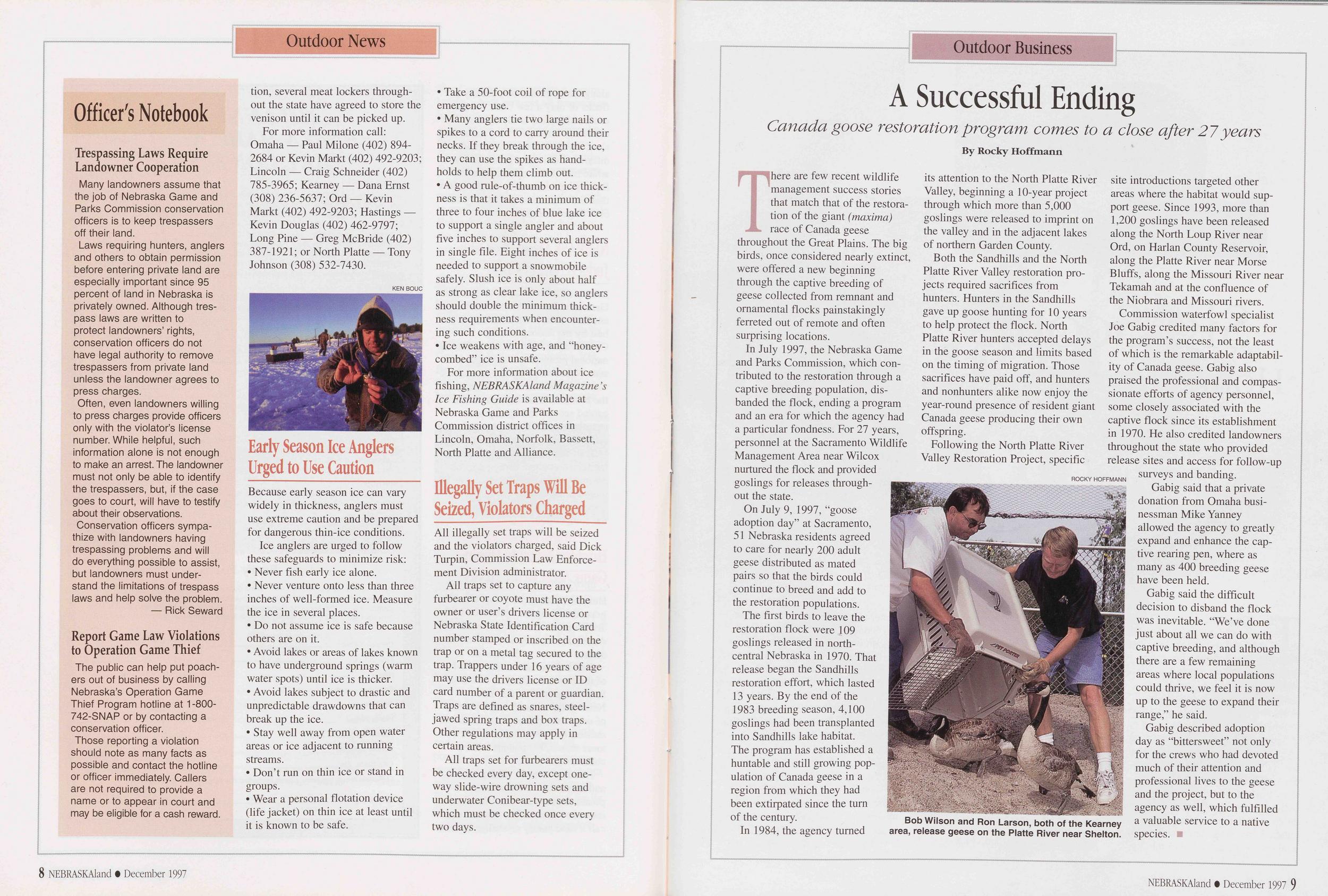
Because early season ice can vary widely in thickness, anglers must use extreme caution and be prepared for dangerous thin-ice conditions.
Ice anglers are urged to follow these safeguards to minimize risk:
Never fish early ice alone.
Never venture onto less than three inches of well-formed ice. Measure the ice in several places.
Do not assume ice is safe because others are on it.
Avoid lakes or areas of lakes known to have underground springs (warm water spots) until ice is thicker.
Avoid lakes subject to drastic and unpredictable drawdowns that can break up the ice.
Stay well away from open water areas or ice adjacent to running streams.
Don't run on thin ice or stand in groups.
Wear a personal flotation device (life jacket) on thin ice at least until it is known to be safe.
Take a 50-foot coil of rope for emergency use.
Many anglers tie two large nails or spikes to a cord to carry around their necks. If they break through the ice, they can use the spikes as handholds to help them climb out.
A good rule-of-thumb on ice thickness is that it takes a minimum of three to four inches of blue lake ice to support a single angler and about five inches to support several anglers in single file. Eight inches of ice is needed to support a snowmobile safely. Slush ice is only about half as strong as clear lake ice, so anglers should double the minimum thickness requirements when encountering such conditions.
Ice weakens with age, and "honeycombed" ice is unsafe.
For more information about ice fishing, NEBRASKAlandMagazine's Ice Fishing Guide is available at Nebraska Game and Parks Commission district offices in Lincoln, Omaha, Norfolk, Bassett, North Platte and Alliance.
Illegally Set Traps Will Be Seized, Violators ChargedAll illegally set traps will be seized and the violators charged, said Dick Turpin, Commission Law Enforcement Division administrator.
All traps set to capture any furbearer or coyote must have the owner or user's drivers license or Nebraska State Identification Card number stamped or inscribed on the trap or on a metal tag secured to the trap. Trappers under 16 years of age may use the drivers license or ID card number of a parent or guardian. Traps are defined as snares, steeljawed spring traps and box traps. Other regulations may apply in certain areas.
All traps set for furbearers must be checked every day, except oneway slide-wire drowning sets and underwater Conibear-type sets, which must be checked once every two days.
8 NEBRASKAland • December 1997Outdoor Business
A Successful Ending
Canada goose restoration program comes to a close after 27 years
There are few recent wildlife management success stories that match that of the restoration of the giant (maxima) race of Canada geese throughout the Great Plains. The big birds, once considered nearly extinct, were offered a new beginning through the captive breeding of geese collected from remnant and ornamental flocks painstakingly ferreted out of remote and often surprising locations.
In July 1997, the Nebraska Game and Parks Commission, which contributed to the restoration through a captive breeding population, disbanded the flock, ending a program and an era for which the agency had a particular fondness. For 27 years, personnel at the Sacramento Wildlife Management Area near Wilcox nurtured the flock and provided goslings for releases throughout the state.
On July 9, 1997, "goose adoption day" at Sacramento, 51 Nebraska residents agreed to care for nearly 200 adult geese distributed as mated pairs so that the birds could continue to breed and add to the restoration populations.
The first birds to leave the restoration flock were 109 goslings released in northcentral Nebraska in 1970. That release began the Sandhills restoration effort, which lasted 13 years. By the end of the 1983 breeding season, 4,100 goslings had been transplanted into Sandhills lake habitat. The program has established a huntable and still growing population of Canada geese in a region from which they had been extirpated since the turn of the century.
In 1984, the agency turned By Rocky Hoffmann its attention to the North Platte River Valley, beginning a 10-year project through which more than 5,000 goslings were released to imprint on the valley and in the adjacent lakes of northern Garden County.
Both the Sandhills and the North Platte River Valley restoration projects required sacrifices from hunters. Hunters in the Sandhills gave up goose hunting for 10 years to help protect the flock. North Platte River hunters accepted delays in the goose season and limits based on the timing of migration. Those sacrifices have paid off, and hunters and nonhunters alike now enjoy the year-round presence of resident giant Canada geese producing their own offspring.
Following the North Platte River Valley Restoration Project, specific
Bob Wilson and Ron Larson, both of the Kearney area, release geese on the Platte River near Shelton.
site introductions targeted other areas where the habitat would support geese. Since 1993, more than 1,200 goslings have been released along the North Loup River near Ord, on Harlan County Reservoir, along the Platte River near Morse Bluffs, along the Missouri River near Tekamah and at the confluence of the Niobrara and Missouri rivers.
Commission waterfowl specialist Joe Gabig credited many factors for the program's success, not the least of which is the remarkable adaptability of Canada geese. Gabig also praised the professional and compassionate efforts of agency personnel, some closely associated with the captive flock since its establishment in 1970. He also credited landowners throughout the state who provided release sites and access for follow-up surveys and banding.
Gabig said that a private donation from Omaha businessman Mike Yanney allowed the agency to greatly expand and enhance the captive rearing pen, where as many as 400 breeding geese have been held.
Gabig said the difficult decision to disband the flock was inevitable. "We've done just about all we can do with captive breeding, and although there are a few remaining areas where local populations could thrive, we feel it is now up to the geese to expand their range," he said.
Gabig described adoption day as "bittersweet" not only for the crews who had devoted much of their attention and professional lives to the geese and the project, but to the agency as well, which fulfilled a valuable service to a native species.
NEBRASKAland • December 1997 9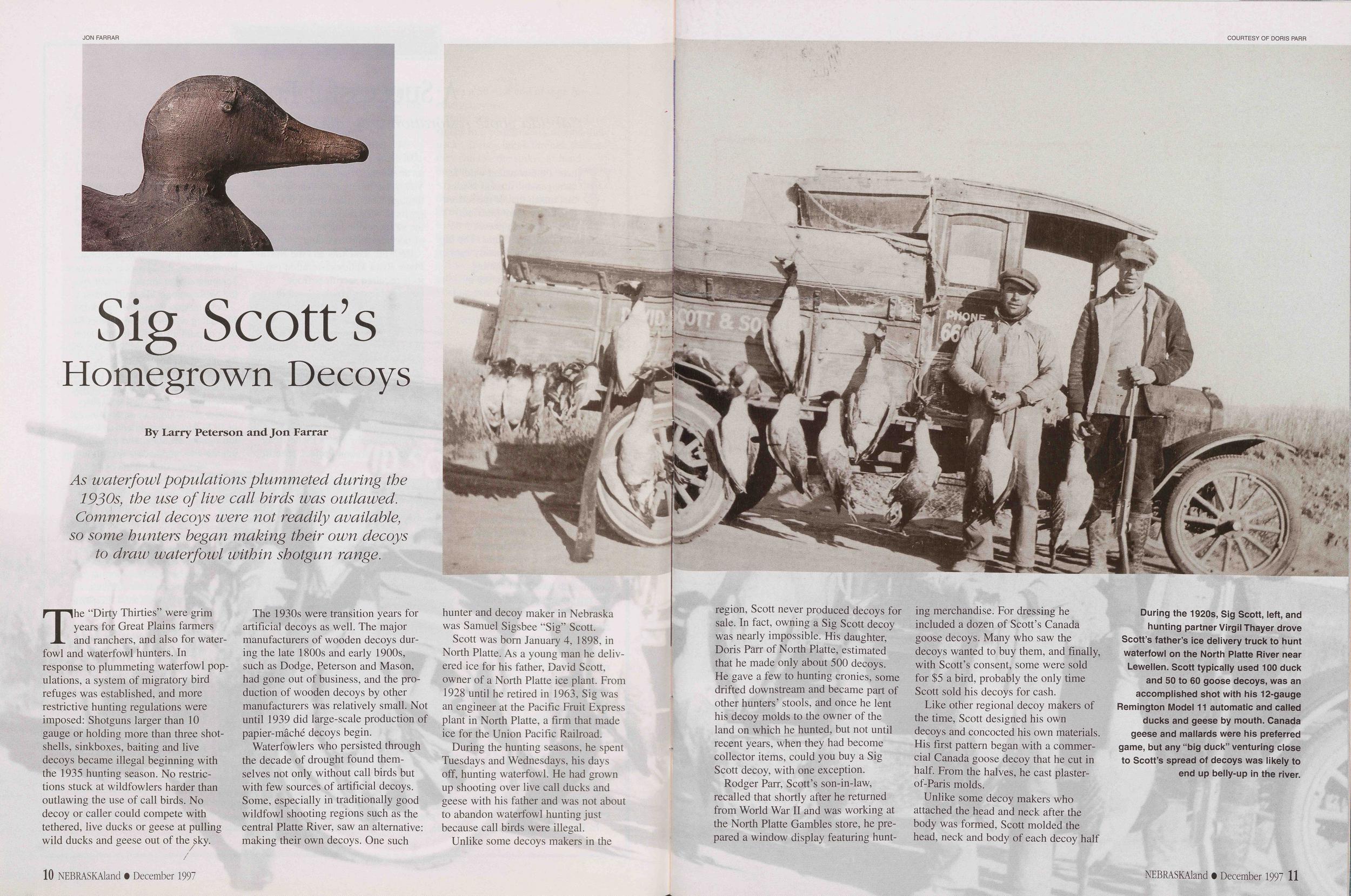
Sig Scott's Homegrown Decoys
As waterfowl populations plummeted during the 1930s, the use of live call birds was outlawed. Commercial decoys were not readily available, so some hunters began making their own decoys to draw waterfowl within shotgun range.
The "Dirty Thirties" were grim years for Great Plains farmers and ranchers, and also for waterfowl and waterfowl hunters. In response to plummeting waterfowl populations, a system of migratory bird refuges was established, and more restrictive hunting regulations were imposed: Shotguns larger than 10 gauge or holding more than three shotshells, sinkboxes, baiting and live decoys became illegal beginning with the 1935 hunting season. No restrictions stuck at wildfowlers harder than outlawing the use of call birds. No decoy or caller could compete with tethered, live ducks or geese at pulling wild ducks and geese out of the sky.
The 1930s were transition years for artificial decoys as well. The major manufacturers of wooden decoys during the late 1800s and early 1900s, such as Dodge, Peterson and Mason, had gone out of business, and the production of wooden decoys by other manufacturers was relatively small. Not until 1939 did large-scale production of papier-mache decoys begin.
Waterfowlers who persisted through the decade of drought found themselves not only without call birds but with few sources of artificial decoys. Some, especially in traditionally good wildfowl shooting regions such as the central Platte River, saw an alternative: making their own decoys. One such hunter and decoy maker in Nebraska was Samuel Sigsbee "Sig" Scott.
Scott was born January 4, 1898, in North Platte. As a young man he delivered ice for his father, David Scott, owner of a North Platte ice plant. From 1928 until he retired in 1963, Sig was an engineer at the Pacific Fruit Express plant in North Platte, a firm that made ice for the Union Pacific Railroad.
During the hunting seasons, he spent Tuesdays and Wednesdays, his days off, hunting waterfowl. He had grown up shooting over live call ducks and geese with his father and was not about to abandon waterfowl hunting just because call birds were illegal.
Unlike some decoys makers in the
10 NEBRASKAland • December 1997region, Scott never produced decoys for sale. In fact, owning a Sig Scott decoy was nearly impossible. His daughter, Doris Parr of North Platte, estimated that he made only about 500 decoys. He gave a few to hunting cronies, some drifted downstream and became part of other hunters' stools, and once he lent his decoy molds to the owner of the land on which he hunted, but not until recent years, when they had become collector items, could you buy a Sig Scott decoy, with one exception.
Rodger Parr, Scott's son-in-law, recalled that shortly after he returned from World War II and was working at the North Platte Gambles store, he prepared a window display featuring hunting merchandise. For dressing he included a dozen of Scott's Canada goose decoys^ Many who saw the decoys wanted to buy them, and finally, with Scott's consent, some were sold for $5 a bird, probably the only time Scott sold his decoys for cash.
Like other regional decoy makers of the time, Scott designed his own decoys and concocted his own materials. His first pattern began with a commercial Canada goose decoy that he cut in half From the halves, he cast plaster-of-Paris molds.
Unlike some decoy makers who attached the head and neck after the body was formed, Scott molded the head, neck and body of each decoy half
During the 1920s, Sig Scott, left, and hunting partner Virgil Thayer drove Scott's father's ice delivery truck to hunt waterfowl on the North Platte River near Lewellen. Scott typically used 100 duck and 50 to 60 goose decoys, was an accomplished shot with his 12-gauge Remington Model 11 automatic and called ducks and geese by mouth. Canada geese and mallards were his preferred game, but any "big duck" venturing close to Scott's spread of decoys was likely to end up belly-up in the river. NEBRASKAland • December 1997 11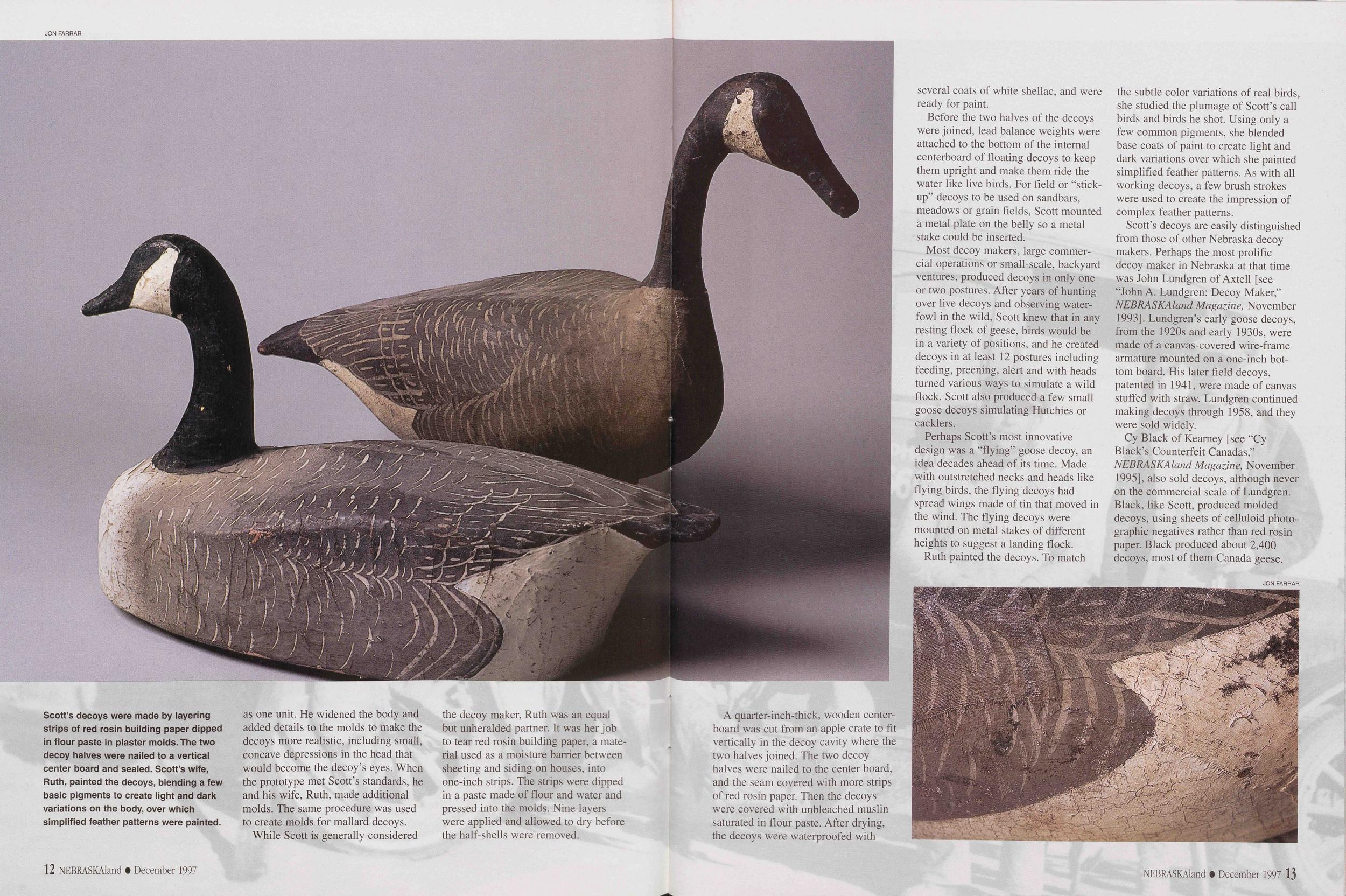
as one unit. He widened the body and added details to the molds to make the decoys more realistic, including small, concave depressions in the head that would become the decoy's eyes. When the prototype met Scott's standards, he and his wife, Ruth, made additional molds. The same procedure was used to create molds for mallard decoys.
While Scott is generally considered the decoy maker, Ruth was an equal but unheralded partner. It was her job to tear red rosin building paper, a material used as a moisture barrier between sheeting and siding on houses, into one-inch strips. The strips were dipped in a paste made of flour and water and pressed into the molds. Nine layers were applied and allowed to dry before the half-shells were removed.
12 NEBRASKAland • December 1997A quarter-inch-thick, wooden centerboard was cut from an apple crate to fit vertically in the decoy cavity where the two halves joined. The two decoy halves were nailed to the center board, and the seam covered with more strips of red rosin paper. Then the decoys were covered with unbleached muslin saturated in flour paste. After drying, the decoys were waterproofed with several coats of white shellac, and were ready for paint.
Before the two halves of the decoys were joined, lead balance weights were attached to the bottom of the internal centerboard of floating decoys to keep them upright and make them ride the water like live birds. For field or "stick-up" decoys to be used on sandbars, meadows or grain fields, Scott mounted a metal plate on the belly so a metal stake could be inserted.
Most decoy makers, large commercial operations or small-scale, backyard ventures, produced decoys in only one or two postures. After years of hunting over live decoys and observing waterfowl in the wild, Scott knew that in any resting flock of geese, birds would be in a variety of positions, and he created decoys in at least 12 postures including feeding, preening, alert and with heads turned various ways to simulate a wild flock. Scott also produced a few small goose decoys simulating Hutchies or cacklers.
Perhaps Scott's most innovative design was a "flying" goose decoy, an idea decades ahead of its time. Made with outstretched necks and heads like flying birds, the flying decoys had spread wings made of tin that moved in the wind. The flying decoys were mounted on metal stakes of different heights to suggest a landing flock.
Ruth painted the decoys. To match the subtle color variations of real birds, she studied the plumage of Scott's call birds and birds he shot. Using only a few common pigments, she blended base coats of paint to create light and dark variations over which she painted simplified feather patterns. As with all working decoys, a few brush strokes were used to create the impression of complex feather patterns.
Scott's decoys are easily distinguished from those of other Nebraska decoy makers. Perhaps the most prolific decoy maker in Nebraska at that time was John Lundgren of Axtell [see "John A. Lundgren: Decoy Maker," NEBRASKAland Magazine, November 1993]. Lundgren's early goose decoys, from the 1920s and early 1930s, were made of a canvas-covered wire-frame armature mounted on a one-inch bottom board. His later field decoys, patented in 1941, were made of canvas stuffed with straw. Lundgren continued making decoys through 1958, and they were sold widely.
Cy Black of Kearney [see "Cy Black's Counterfeit Canadas," NEBRASKAland Magazine, November 1995], also sold decoys, although never on the commercial scale of Lundgren. Black, like Scott, produced molded decoys, using sheets of celluloid photographic negatives rather than red rosin paper. Black produced about 2,400 decoys, most of them Canada geese.
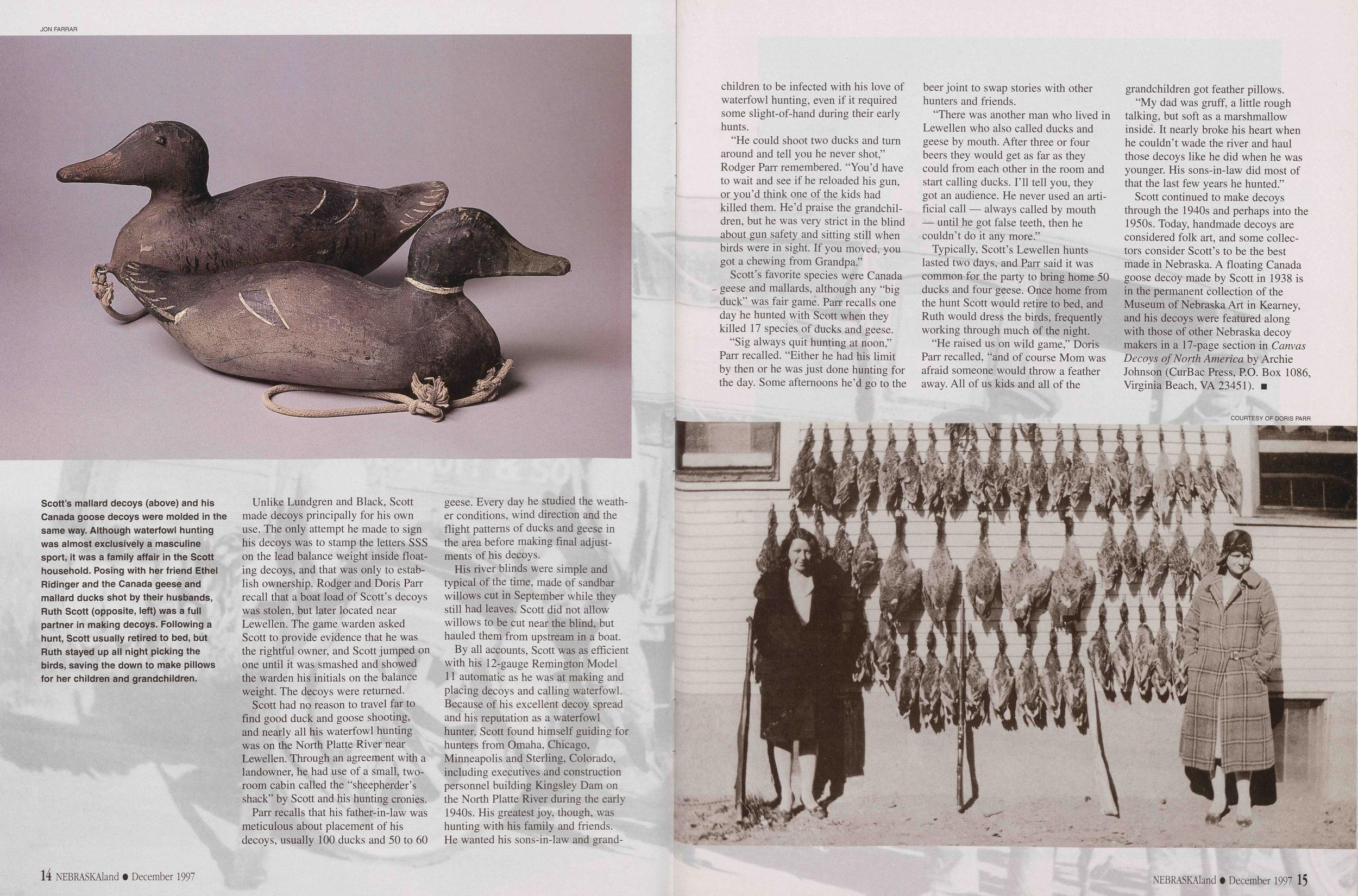
Unlike Lundgren and Black, Scott made decoys principally for his own use. The only attempt he made to sign his decoys was to stamp the letters SSS on the lead balance weight inside floating decoys, and that was only to establish ownership. Rodger and Doris Parr recall that a boat load of Scott's decoys was stolen, but later located near Lewellen. The game warden asked Scott to provide evidence that he was the rightful owner, and Scott jumped on one until it was smashed and showed the warden his initials on the balance weight. The decoys were returned.
Scott had no reason to travel far to find good duck and goose shooting, and nearly all his waterfowl hunting was on the North Platte River near Lewellen. Through an agreement with a landowner, he had use of a small, two-room cabin called the "sheepherder's shack" by Scott and his hunting cronies.
Parr recalls that his father-in-law was meticulous about placement of his decoys, usually 100 ducks and 50 to 60 geese. Every day he studied the weather conditions, wind direction and the flight patterns of ducks and geese in the area before making final adjustments of his decoys.
His river blinds were simple and typical of the time, made of sandbar willows cut in September while they still had leaves. Scott did not allow willows to be cut near the blind, but hauled them from upstream in a boat.
By all accounts, Scott was as efficient with his 12-gauge Remington Model 11 automatic as he was at making and placing decoys and calling waterfowl. Because of his excellent decoy spread and his reputation as a waterfowl hunter, Scott found himself guiding for hunters from Omaha, Chicago, Minneapolis and Sterling, Colorado, including executives and construction personnel building Kingsley Dam on the North Platte River during the early 1940s. His greatest joy, though, was hunting with his family and friends. He wanted his sons-in-law and grand-
14 NEBRASKAland • December 1997children to be infected with his love of waterfowl hunting, even if it required some slight-of-hand during their early hunts.
"He could shoot two ducks and turn around and tell you he never shot," Rodger Parr remembered. "You'd have to wait and see if he reloaded his gun, or you'd think one of the kids had killed them. He'd praise the grandchildren, but he was very strict in the blind about gun safety and sitting still when birds were in sight. If you moved, you got a chewing from Grandpa."
Scott's favorite species were Canada geese and mallards, although any "big duck" was fair game. Parr recalls one day he hunted with Scott when they killed 17 species of ducks and geese.
"Sig always quit hunting at noon," Parr recalled. "Either he had his limit by then or he was just done hunting for the day. Some afternoons he'd go to the beer joint to swap stories with other hunters and friends.
"There was another man who lived in Lewellen who also called ducks and geese by mouth. After three or four beers they would get as far as they could from each other in the room and start calling ducks. I'll tell you, they got an audience. He never used an artificial call — always called by mouth - until he got false teeth, then he couldn't do it any more."
Typically, Scott's Lewellen hunts lasted two days, and Parr said it was common for the party to bring home 50 ducks and four geese. Once home from the hunt Scott would retire to bed, and Ruth would dress the birds, frequently working though much of the night.
"He raised us on wild game," Doris Parr recalled, "and of course Mom was afraid someone would throw a feather away. All of us kids and all of the grandchildren got feather pillows.
"My dad was gruff, a little rough talking, but soft as a marshmallow inside. It nearly broke his heart when he couldn't wade the river and haul those decoys like he did when he was younger. His sons-in-law did most of that the last few years he hunted."
Scott continued to make decoys through the 1940s and perhaps into the 1950s. Today, handmade decoys are considered folk art, and some collectors consider Scott's to be the best made in Nebraska. A floating Canada goose decoy made by Scott in 1938 is in the permanent collection of the Museum of Nebraska Art in Kearney, and his decoys were featured along with those of other Nebraska decoy makers in a 17-page section in Canvas Decoys of North America by Archie Johnson (CurBac Press, P.O. Box 1086, Virginia Beach, VA 23451).
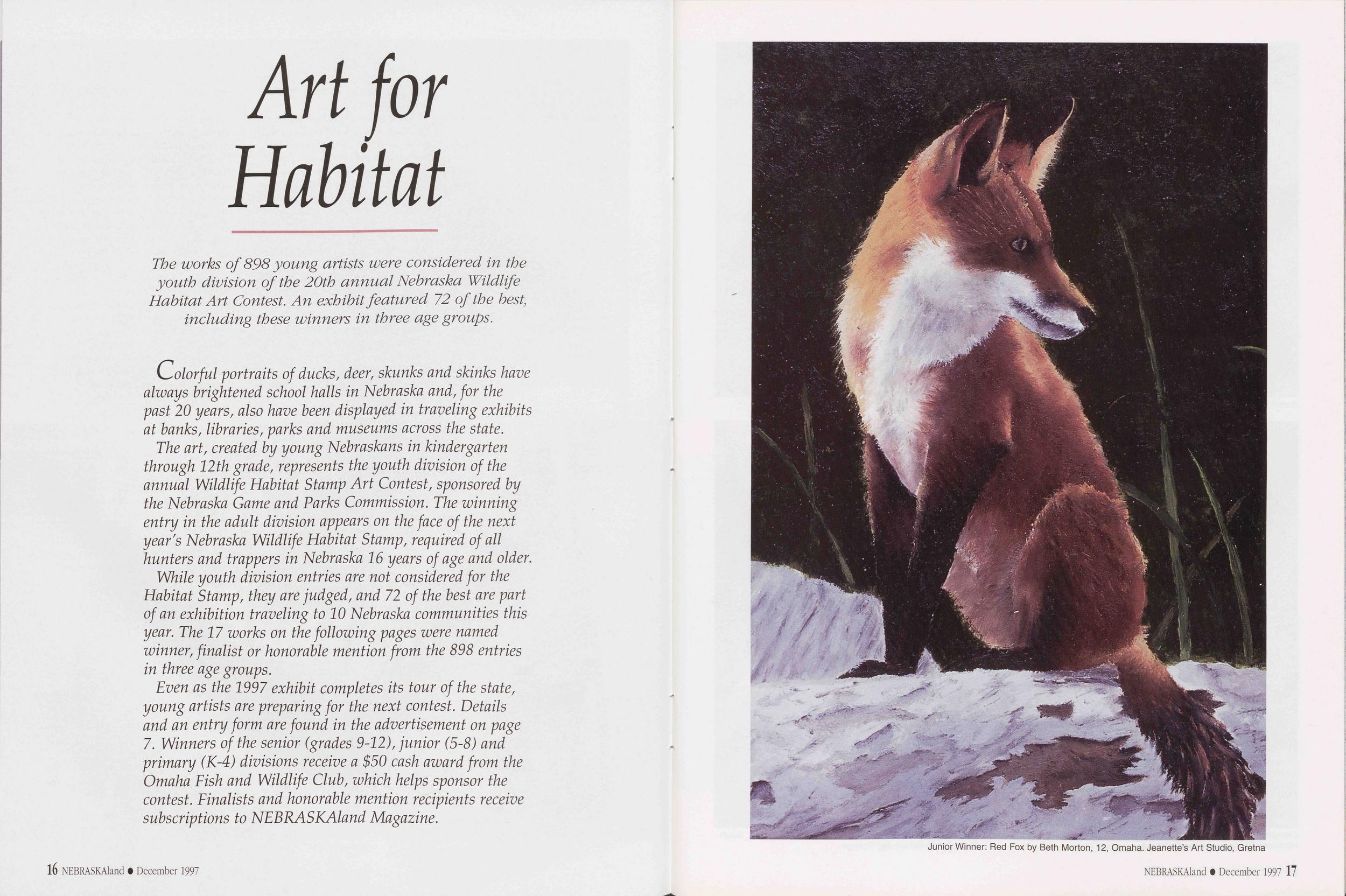
Art for Habitat
The works of 898 young artists were considered in the youth division of the 20th annual Nebraska Wildlife Habitat Art Contest. An exhibit featured 72 of the best, including these winners in three age groups.
Colorful portraits of ducks, deer, skunks and skinks have always brightened school halls in Nebraska and, for the past 20 years, also have been displayed in traveling exhibits at banks, libraries, parks and museums across the state. The art, created by young Nebraskans in kindergarten through 12th grade, represents the youth division of the annual Wildlife Habitat Stamp Art Contest, sponsored by the Nebraska Game and Parks Commission. The winning entry in the adult division appears on the face of the next year's Nebraska Wildlife Habitat Stamp, required of all hunters and trappers in Nebraska 16 years of age and older. While youth division entries are not considered for the Habitat Stamp, they are judged, and 72 of the best are part of an exhibition traveling to 10 Nebraska communities this year. The 17 works on the following pages were named winner, finalist or honorable mention from the 898 entries in three age groups. Even as the 1997 exhibit completes its tour of the state, young artists are preparing for the next contest. Details and an entry form are found in the advertisement on page 7. Winners of the senior (grades 9-12), junior (5-8) and primary (K-4) divisions receive a $50 cash award from the Omaha Fish and Wildlife Club, which helps sponsor the contest. Finalists and honorable mention recipients receive subscriptions to NEBRASKAland Magazine. 16 NEBRASKAland • December 1997Junior Winner: Red Fox by Beth Morton, 12, Omaha. Jeanette's Art Studio, Gretna
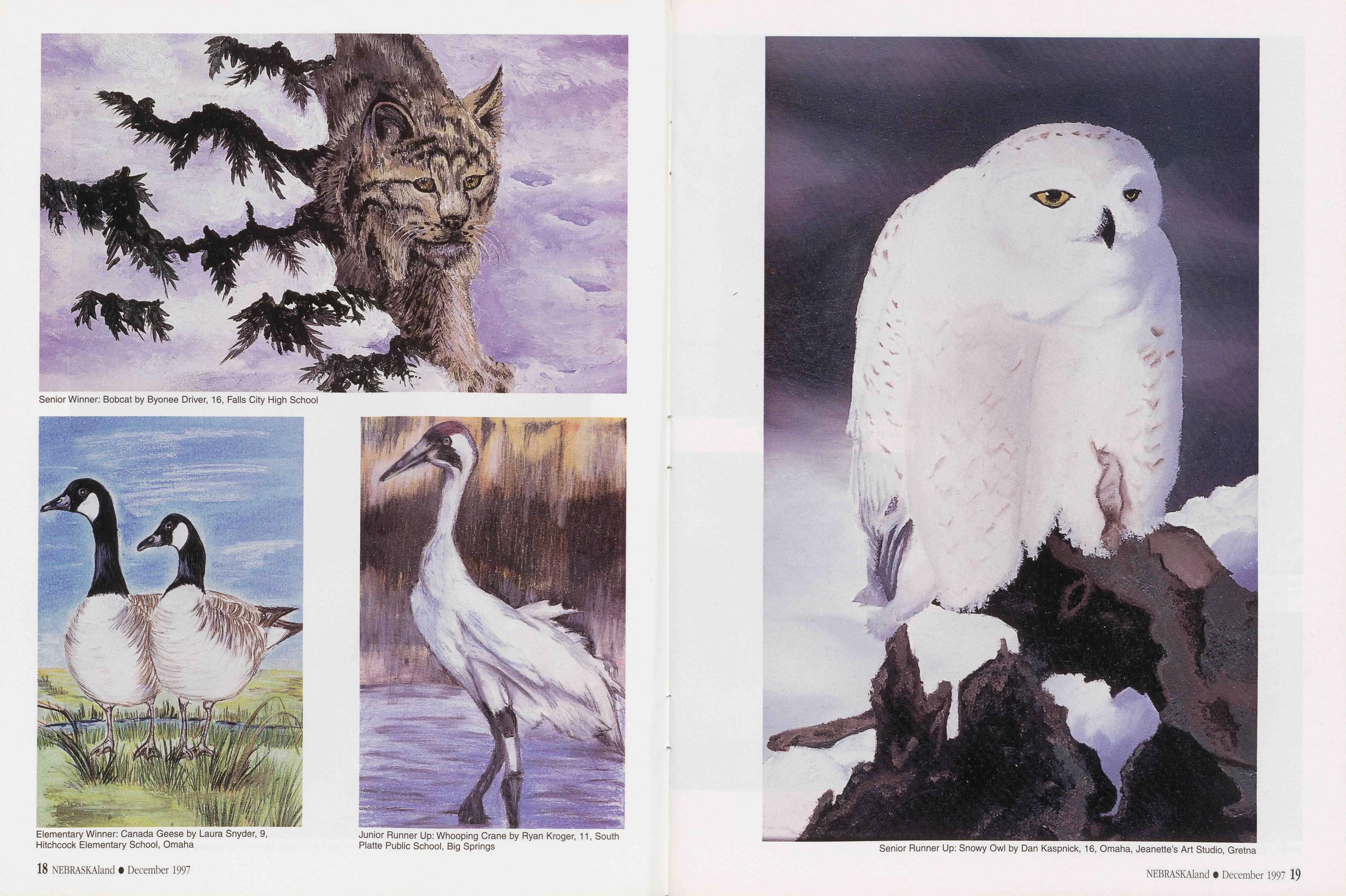
Senior Winner: Bobcat by Byonee Driver, 16, Falls City High School
Elementary Winner: Canada Geese by Laura Snyder, 9, Hitchcock Elementary School, Omaha
Junior Runner Up: Whooping Crane by Ryan Kroger, 11, South Platte Public School, Big Springs
Senior Runner Up: Snowy Owl by Dan Kaspnick, 16, Omaha, Jeanette's Art Studio, Gretna
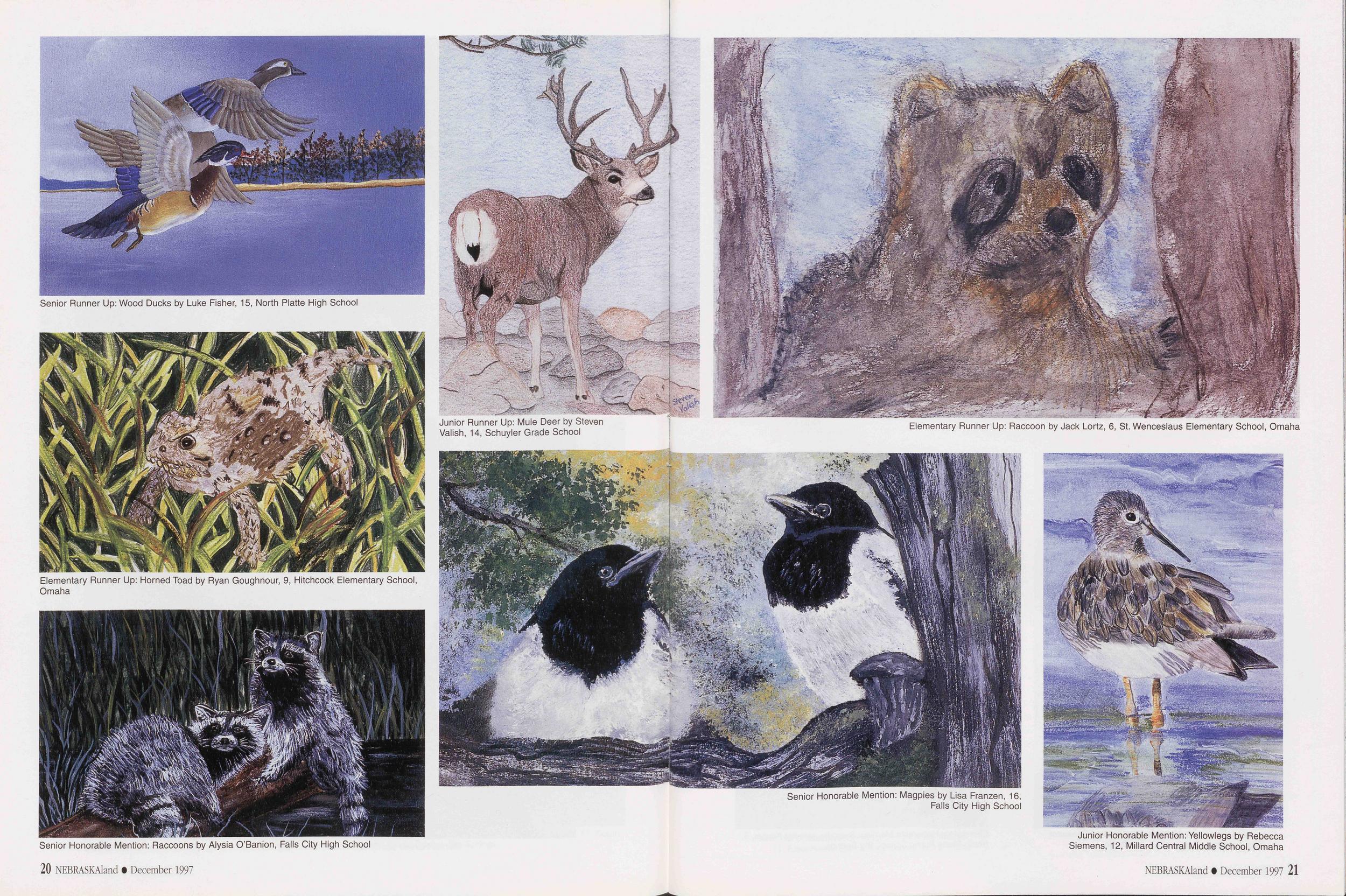
Senior Runner Up: Wood Ducks by Luke Fisher, 15, North Platte High School
Junior Runner Up: Mule Deer by Steven Valish, 14, Schuyler Grade School
Elementary Runner Up: Horned Toad by Ryan Goughnour, 9, Hitchcock Elementary School, Omaha
Senior Honorable Mention: Raccoons by Alysia O'Banion, Falls City High School
Elementary Runner Up: Raccoon by Jack Lortz, 6, St. Wenceslaus Elementary School, Omaha
Senior Honorable Mention: Magpies by Lisa Franzen, 16, Falls City High School
Junior Honorable Mention: Yellowlegs by Rebecca Siemens, 12, Millard Central Middle School, Omaha
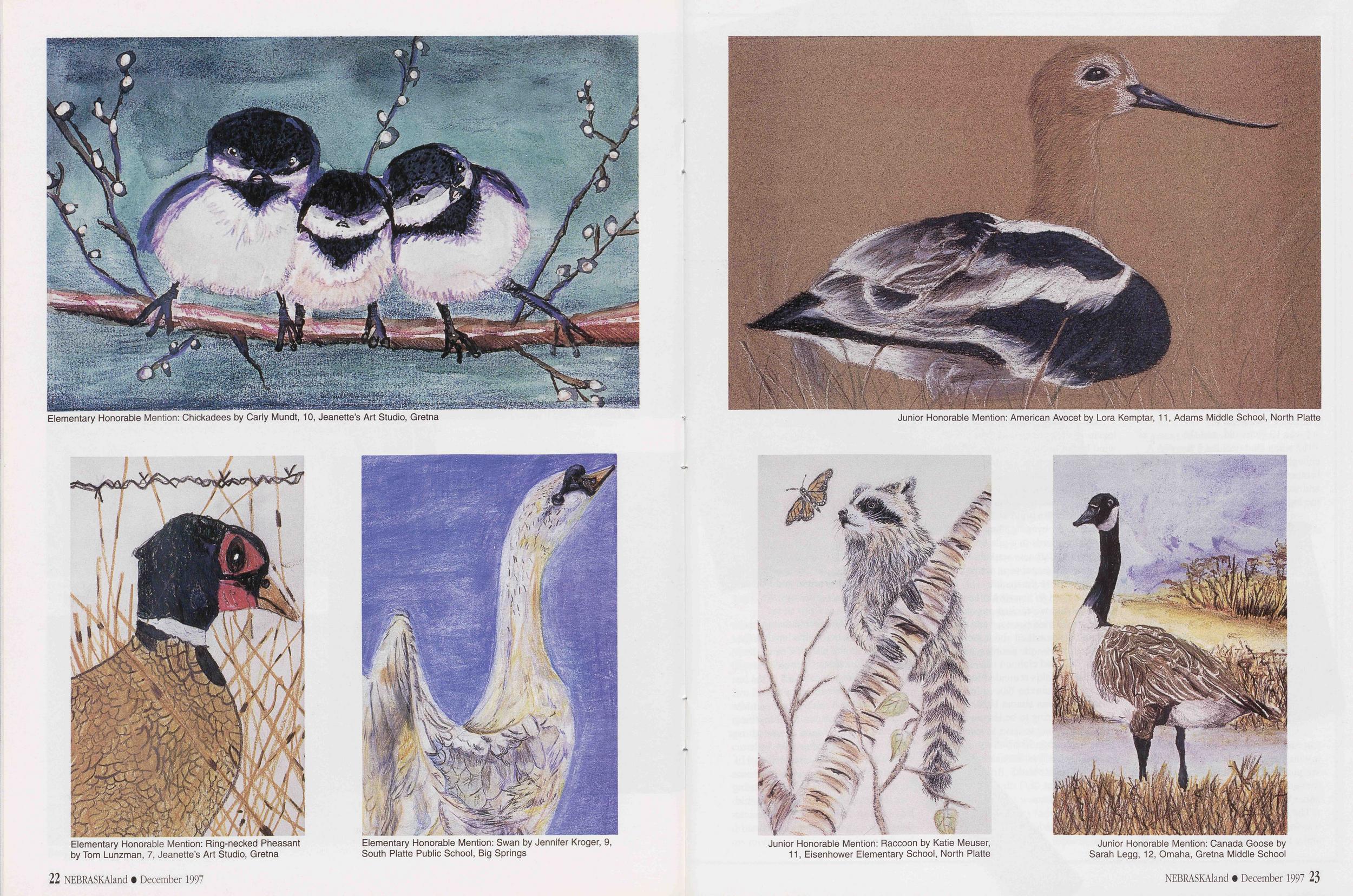
Elementary Honorable Mention: Chickadees by Carly Mundt, 10, Jeanette's Art Studio, Gretna
Elementary Honorable Mention: Ring-necked Pheasant by Tom Lunzman, 7, Jeanette's Art Studio, Gretna
Elementary Honorable Mention: Swan by Jennifer Kroger, 9, South Platte Public School, Big Springs
Junior Honorable Mention: American Avocet by Lora Kemptar, 11, Adams Middle School, North Platte
Junior Honorable Mention: Raccoon by Katie Meuser, 11, Eisenhower Elementary School, North Platte
Junior Honorable Mention: Canada Goose by Sarah Legg, 12, Omaha, Gretna Middle School
The Great Hunt of 1917
It had snowed 10 inches and the tent had collapsed. We climbed out into the wind and blowing snow. It was a terrible mess, but we decided to stay, because we were experienced hunters.
The wind was whistling through the cottonwood trees, and the snow was blinding, particularly if you looked to the north. We had three miles to go, but the wind was at our backs. My father looked down at me and said, "Son, you're pretty small. I don't think you'll make it!"
My father was Louis Charles Drost, a North Platte physician. He was a hunter and fisherman, and we hunted on the McGinley Ranch near Keystone, about 60 miles west of North Platte. Today, the original ranch is mostly covered by Lake McConaughy.
I was 10 years old, and the year was 1917 when Dad decided I was old enough to go. Also along was my older brother Louie, who was 16 at the time and would help Dad with the driving of the big, old Chalmers car. We would
We left North Platte on a rather balmy day. The sun was shining, but since it was mid-November, Dad said it was time to go for ducks. In those days there were few roads, and it took us about a half a day to travel from North Platte through Paxton and Roscoe to our destination. We pitched our tent and erected a half shelter, securing it with a rope tied between two trees. We put our food and lanterns under the shelter and retired to our tent to sleep under big feather ticks.
The next day I was informed that I was too small to go hunting and was along just to help tend camp. Dad and Louie put on their breast waders and went out to an island, dragging their cases of shells, two 12-gauge pumps, a 10-gauge double barrel and about 60 decoys. They scattered the decoys around the point and settled into the brush. It was a balmy day, and I played around camp, eating a lot of our food in the process.
Dad and Louie returned at about 10 a.m. with six ducks. I hadn't heard much shooting, so I knew it was a bad day. Dad lay down for a nap, while Louie and I played around camp.
About 1 p.m., there came a rustle of leaves in the cottonwood trees. The wind began to blow from the northwest, and clouds came in. The temperature dropped 20 degrees in an hour. Dad woke up and saw large flocks of mallards flying. He and Louie immediately went back to the blind and began shooting ducks. By evening, they had more than 100 mallards in a pile behind the blind. When darkness settled in they had to make several trips across the creek to retrieve the ducks.
We fed Sam so he wouldn't eat ducks all night, then we cooked our own supper of steak, fried potatoes and coffee. Dad and Louie talked about the great hunt they had — the doubles, and even a triple that Dad claimed he'd shot. Dad talked of how this reminded him of the old days, back in the '90s in Iowa. Now, here it was almost 1920, and the game was starting to be less each year. They were going to have to start doing something, like putting limits on what was shot, and Dad said it would take the joy out of hunting for a man.
Sam got in the tent with us, and. it was really
We cooked up some bacon and eggs, and I noticed my father looking to the north, then the west and the east. The snow had piled up at least a couple of inches since we awoke less than an hour earlier. Visibility continued to decrease, and Dad finally said, "Boys, I think we'd better try to get out of here."
We poured water into the car's radiator, and started up the Chalmers. We folded everything up in a big mess inside the tent, and threw the whole works into the back of the open touring car, leaving room for Sam and me. The storm had become brutal and Dad said, "What we haven't got, boys, we'll get later. Let's go."
Then Dad remembered that in his haste the night before, he had left the three guns on the island. One of the pumps, a Winchester Model 97, was rather new. We walked back to the river. Father made me go along, because he was afraid I would get lost in the snow. We couldn't see anything to the north, as the snow plastered over our eyes. Thank goodness the little creek and blind was somewhat east of the campsite. It had doubled in size and carried large blocks of floating ice. Dad said that perhaps we should leave the guns, but Louie jumped into the water with his breast waders and headed across the stream.
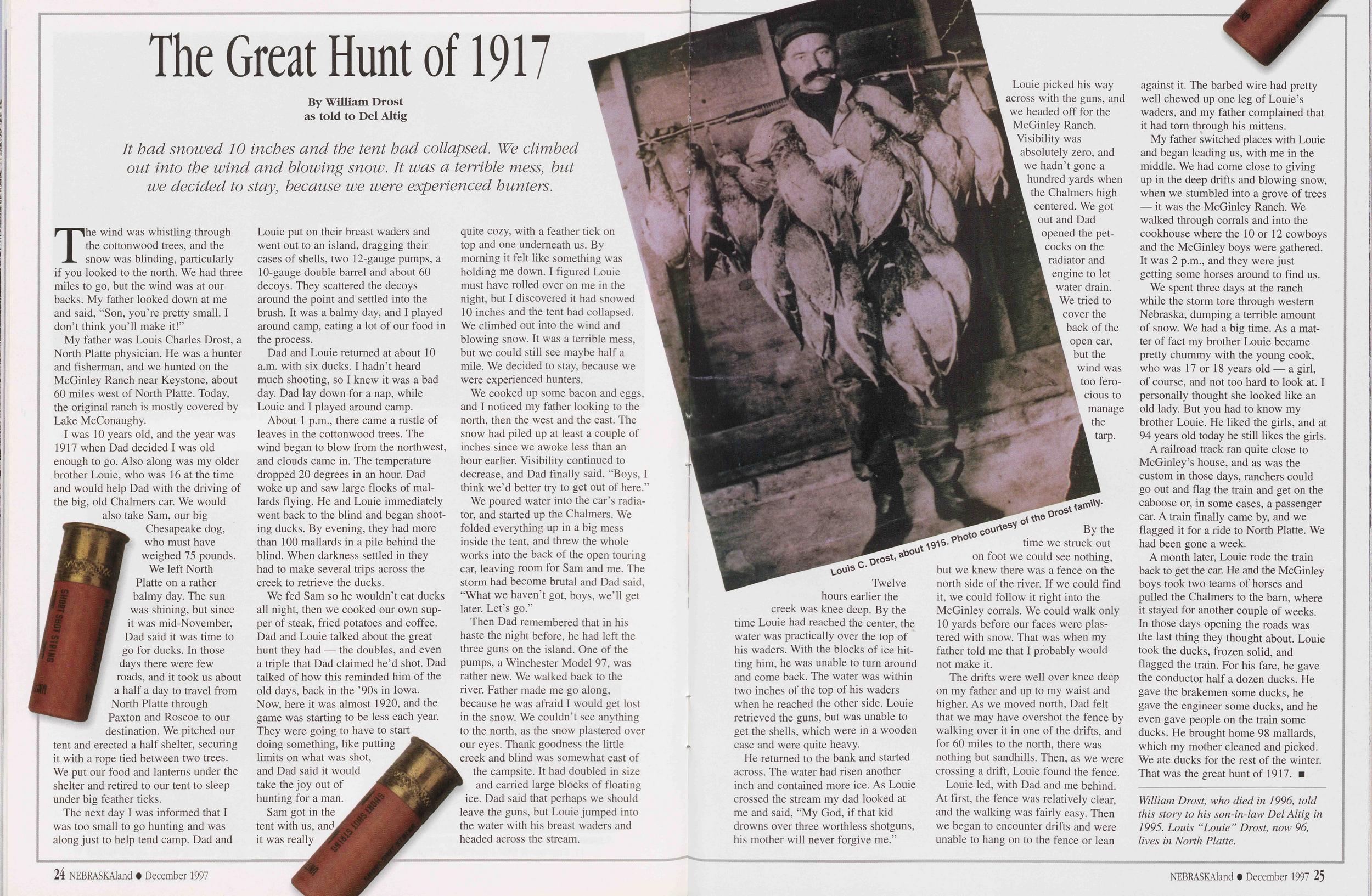
24 NEBRASKAland • December 1997Louis C. Drost, about 1915. Photo courtesy of the Drost family.
Twelve hours earlier the creek was knee deep. By the time Louie had reached the center, the water was practically over the top of his waders. With the blocks of ice hitting him, he was unable to turn around and come back. The water was within two inches of the top of his waders when he reached the other side. Louie retrieved the guns, but was unable to get the shells, which were in a wooden case and were quite heavy.
He returned to the bank and started across. The water had risen another inch and contained more ice. As Louie crossed the stream my dad looked at me and said, "My God, if that kid drowns over three worthless shotguns, his mother will never forgive me."
Louie picked his way across with the guns, and we headed off for the McGinley Ranch. Visibility was absolutely zero, and we hadn't gone a hundred yards when the Chalmers high centered. We got out and Dad opened the petcocks on the radiator and engine to let water drain. We tried to cover the back of the open car, but the wind was too ferocious to manage the tarp.
By the time we struck out on foot we could see nothing, but we knew there was a fence on the north side of the river. If we could find it, we could follow it right into the McGinley corrals. We could walk only 10 yards before our faces were plastered with snow. That was when my father told me that I probably would not make it.
The drifts were well over knee deep on my father and up to my waist and higher. As we moved north, Dad felt that we may have overshot the fence by walking over it in one of the drifts, and for 60 miles to the north, there was nothing but sandhills. Then, as we were crossing a drift, Louie found the fence.
Louie led, with Dad and me behind. At first, the fence was relatively clear, and the walking was fairly easy. Then we began to encounter drifts and were unable to hang on to the fence or lean
My father switched places with Louie and began leading us, with me in the middle. We had come close to giving up in the deep drifts and blowing snow, when we stumbled into a grove of trees — it was the McGinley Ranch. We walked through corrals and into the cookhouse where the 10 or 12 cowboys and the McGinley boys were gathered. It was 2 p.m., and they were just getting some horses around to find us.
We spent three days at the ranch while the storm tore through western Nebraska, dumping a terrible amount of snow. We had a big time. As a matter of fact my brother Louie became pretty chummy with the young cook, who was 17 or 18 years old — a girl, of course, and not too hard to look at. I personally thought she looked like an old lady. But you had to know my brother Louie. He liked the girls, and at 94 years old today he still likes the girls.
A railroad track ran quite close to McGinley's house, and as was the custom in those days, ranchers could go out and flag the train and get on the caboose or, in some cases, a passenger car. A train finally came by, and we flagged it for a ride to North Platte. We had been gone a week.
A month later, Louie rode the train back to get the car. He and the McGinley boys took two teams of horses and pulled the Chalmers to the barn, where it stayed for another couple of weeks. In those days opening the roads was the last thing they thought about. Louie took the ducks, frozen solid, and flagged the train. For his fare, he gave the conductor half a dozen ducks. He gave the brakemen some ducks, he gave the engineer some ducks, and he even gave people on the train some ducks. He brought home 98 mallards, which my mother cleaned and picked. We ate ducks for the rest of the winter. That was the great hunt of 1917.
William Drost, who died in 1996, told this story to his son-in-law Del Altig in 1995. Louis "Louie" Drost, now 96, lives in North Platte. NEBRASKAland • December 1997 25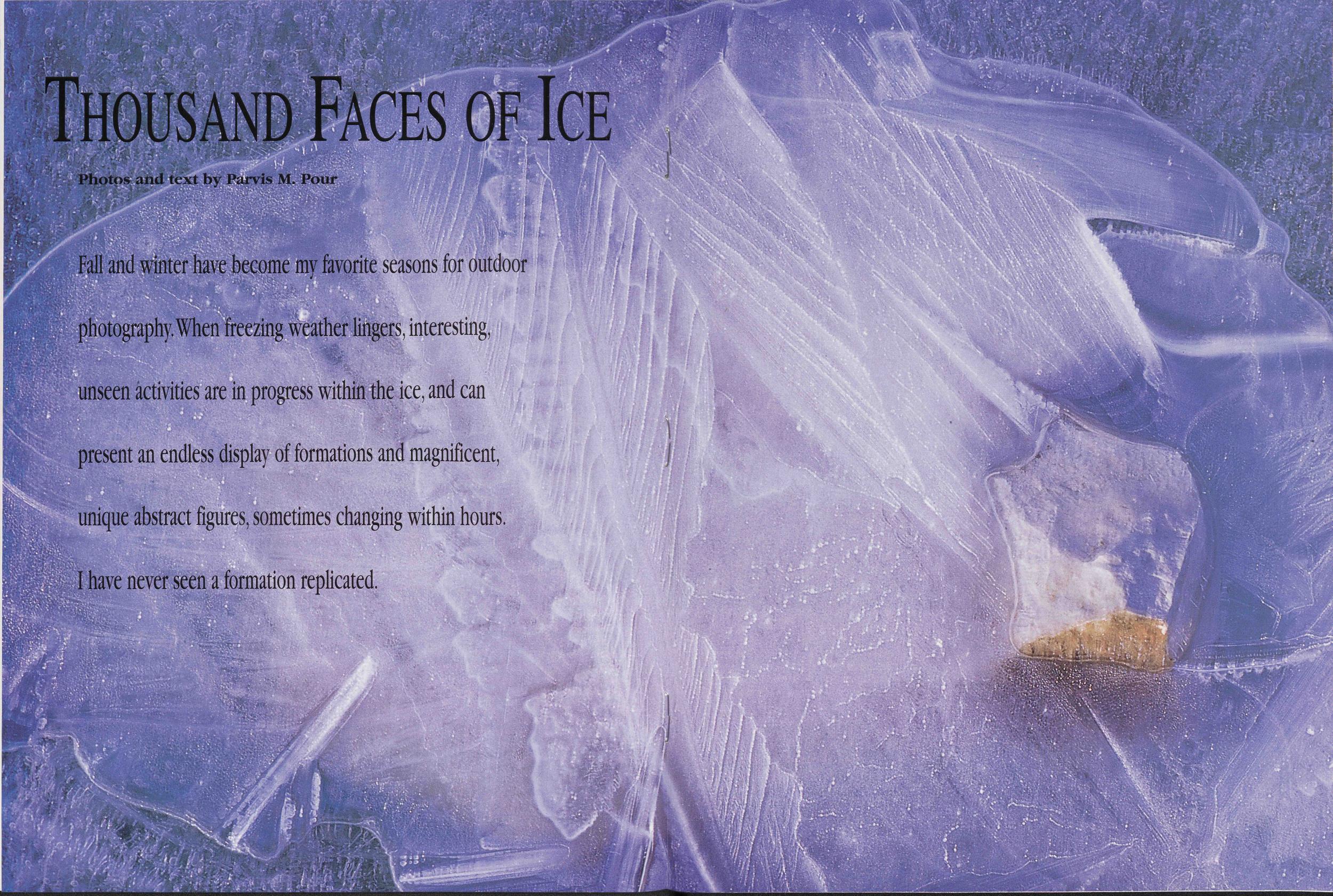
Thousand Faces of Ice
Fall and winter have become my favorite seasons for outdoor photography When freezing weather lingers, interesting. unseen activities are in progress within the ice, and can present an endless display of formations and magnificent. unique abstract figures, sometimes changing within hours. I have never seen a formation replicated.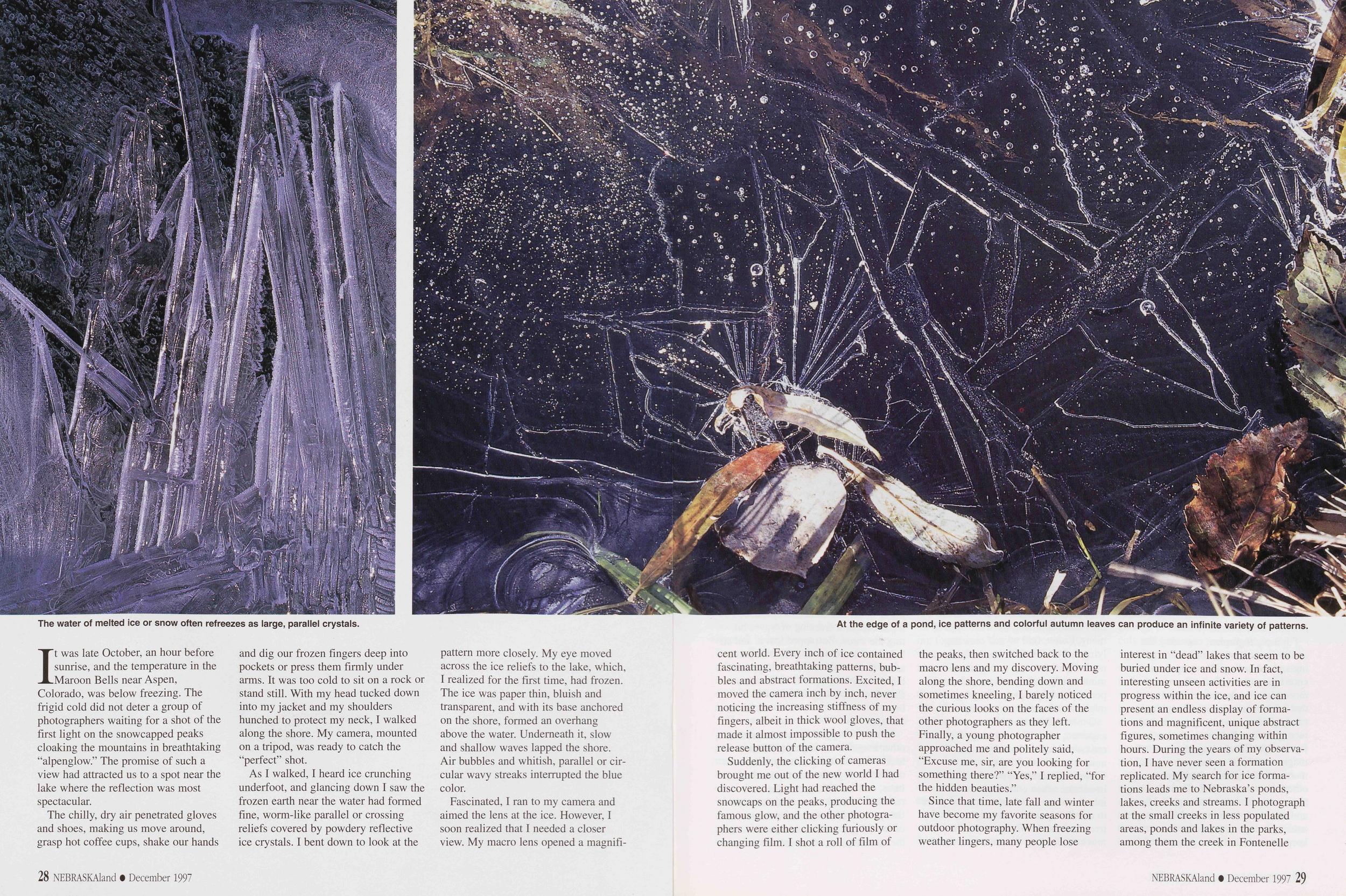
The water of melted ice or snow often refreezes as large, parallel crystals.
It was late October, an hour before sunrise, and the temperature in the Maroon Bells near Aspen, Colorado, was below freezing. The frigid cold did not deter a group of photographers waiting for a shot of the first light on the snowcapped peaks cloaking the mountains in breathtaking "alpenglow." The promise of such a view had attracted us to a spot near the lake where the reflection was most spectacular.
The chilly, dry air penetrated gloves and shoes, making us move around, grasp hot coffee cups, shake our hands and dig our frozen fingers deep into pockets or press them firmly under arms. It was too cold to sit on a rock or stand still. With my head tucked down into my jacket and my shoulders hunched to protect my neck, I walked along the shore. My camera, mounted on a tripod, was ready to catch the "perfect" shot.
As I walked, I heard ice crunching underfoot, and glancing down I saw the frozen earth near the water had formed fine, worm-like parallel or crossing reliefs covered by powdery reflective ice crystals. I bent down to look at the pattern more closely. My eye moved across the ice reliefs to the lake, which, I realized for the first time, had frozen. The ice was paper thin, bluish and transparent, and with its base anchored on the shore, formed an overhang above the water. Underneath it, slow and shallow waves lapped the shore. Air bubbles and whitish, parallel or circular wavy streaks interrupted the blue color.
Fascinated, I ran to my camera and aimed the lens at the ice. However, I soon realized that I needed a closer view. My macro lens opened a magnifi-
28 NEBRASKAland • December 1997At the edge of a pond, ice patterns and colorful autumn leaves can produce an infinite variety of patterns.
cent world. Every inch of ice contained fascinating, breathtaking patterns, bubbles and abstract formations. Excited, I moved the camera inch by inch, never noticing the increasing stiffness of my fingers, albeit in thick wool gloves, that made it almost impossible to push the release button of the camera.
Suddenly, the clicking of cameras brought me out of the new world I had discovered. Light had reached the snowcaps on the peaks, producing the famous glow, and the other photographers were either clicking furiously or changing film. I shot a roll of film of the peaks, then switched back to the macro lens and my discovery. Moving along the shore, bending down and sometimes kneeling, I barely noticed the curious looks on the faces of the other photographers as they left. Finally, a young photographer approached me and politely said, "Excuse me, sir, are you looking for something there?" "Yes," I replied, "for the hidden beauties."
Since that time, late fall and winter have become my favorite seasons for outdoor photography. When freezing weather lingers, many people lose interest in "dead" lakes that seem to be buried under ice and snow. In fact, interesting unseen activities are in progress within the ice, and ice can present an endless display of formations and magnificent, unique abstract figures, sometimes changing within hours. During the years of my observation, I have never seen a formation replicated. My search for ice formations leads me to Nebraska's ponds, lakes, creeks and streams. I photograph at the small creeks in less populated areas, ponds and lakes in the parks, among them the creek in Fontenelle
NEBRASKAland • December 1997 29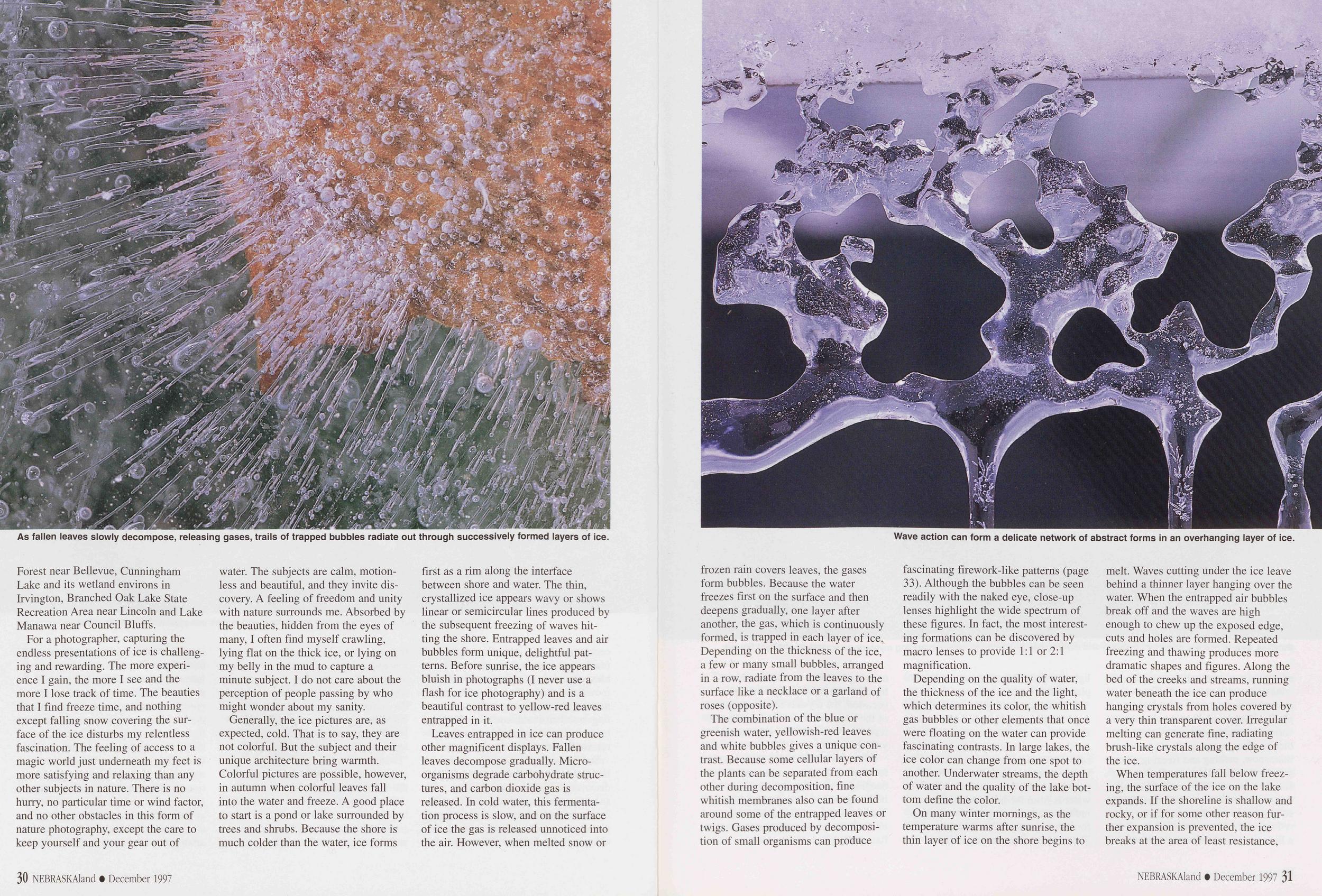
As fallen leaves slowly decompose, releasing gases, trails of trapped bubbles radiate out through successively formed layers of ice.
Forest near Bellevue, Cunningham Lake and its wetland environs in Irvington, Branched Oak Lake State Recreation Area near Lincoln and Lake Manawa near Council Bluffs.
For a photographer, capturing the endless presentations of ice is challenging and rewarding. The more experience I gain, the more I see and the more I lose track of time. The beauties that I find freeze time, and nothing except falling snow covering the surface of the ice disturbs my relentless fascination. The feeling of access to a magic world just underneath my feet is more satisfying and relaxing than any other subjects in nature. There is no hurry, no particular time or wind factor, and no other obstacles in this form of nature photography, except the care to keep yourself and your gear out of water. The subjects are calm, motionless and beautiful, and they invite discovery. A feeling of freedom and unity with nature surrounds me. Absorbed by the beauties, hidden from the eyes of many, I often find myself crawling, lying flat on the thick ice, or lying on my belly in the mud to capture a minute subject. I do not care about the perception of people passing by who might wonder about my sanity.
Generally, the ice pictures are, as expected, cold. That is to say, they are not colorful. But the subject and their unique architecture bring warmth. Colorful pictures are possible, however, in autumn when colorful leaves fall into the water and freeze. A good place to start is a pond or lake surrounded by trees and shrubs. Because the shore is much colder than the water, ice forms first as a rim along the interface between shore and water. The thin, crystallized ice appears wavy or shows linear or semicircular lines produced by the subsequent freezing of waves hitting the shore. Entrapped leaves and air bubbles form unique, delightful patterns. Before sunrise, the ice appears bluish in photographs (I never use a flash for ice photography) and is a beautiful contrast to yellow-red leaves entrapped in it.
Leaves entrapped in ice can produce other magnificent displays. Fallen leaves decompose gradually. Microorganisms degrade carbohydrate structures, and carbon dioxide gas is released. In cold water, this fermentation process is slow, and on the surface of ice the gas is released unnoticed into the air. However, when melted snow or
30 NEBRASKAland • December 1997Wave action can form a delicate network of abstract forms in an overhanging layer of ice.
frozen rain covers leaves, the gases form bubbles. Because the water freezes first on the surface and then deepens gradually, one layer after another, the gas, which is continuously formed, is trapped in each layer of ice. Depending on the thickness of the ice, a few or many small bubbles, arranged in a row, radiate from the leaves to the surface like a necklace or a garland of roses (opposite).
The combination of the blue or greenish water, yellowish-red leaves and white bubbles gives a unique contrast. Because some cellular layers of the plants can be separated from each other during decomposition, fine whitish membranes also can be found around some of the entrapped leaves or twigs. Gases produced by decomposition of small organisms can produce fascinating firework-like patterns (page 33). Although the bubbles can be seen readily with the naked eye, close-up lenses highlight the wide spectrum of these figures. In fact, the most interesting formations can be discovered by macro lenses to provide 1:1 or 2:1 magnification.
Depending on the quality of water, the thickness of the ice and the light, which determines its color, the whitish gas bubbles or other elements that once were floating on the water can provide fascinating contrasts. In large lakes, the ice color can change from one spot to another. Underwater streams, the depth of water and the quality of the lake bottom define the color.
On many winter mornings, as the temperature warms after sunrise, the thin layer of ice on the shore begins to melt. Waves cutting under the ice leave behind a thinner layer hanging over the water. When the entrapped air bubbles break off and the waves are high enough to chew up the exposed edge, cuts and holes are formed. Repeated freezing and thawing produces more dramatic shapes and figures. Along the bed of the creeks and streams, running water beneath the ice can produce hanging crystals from holes covered by a very thin transparent cover. Irregular melting can generate fine, radiating brush-like crystals along the edge of the ice.
When temperatures fall below freezing, the surface of the ice on the lake expands. If the shoreline is shallow and rocky, or if for some other reason further expansion is prevented, the ice breaks at the area of least resistance,
NEBRASKAland • December 1997 31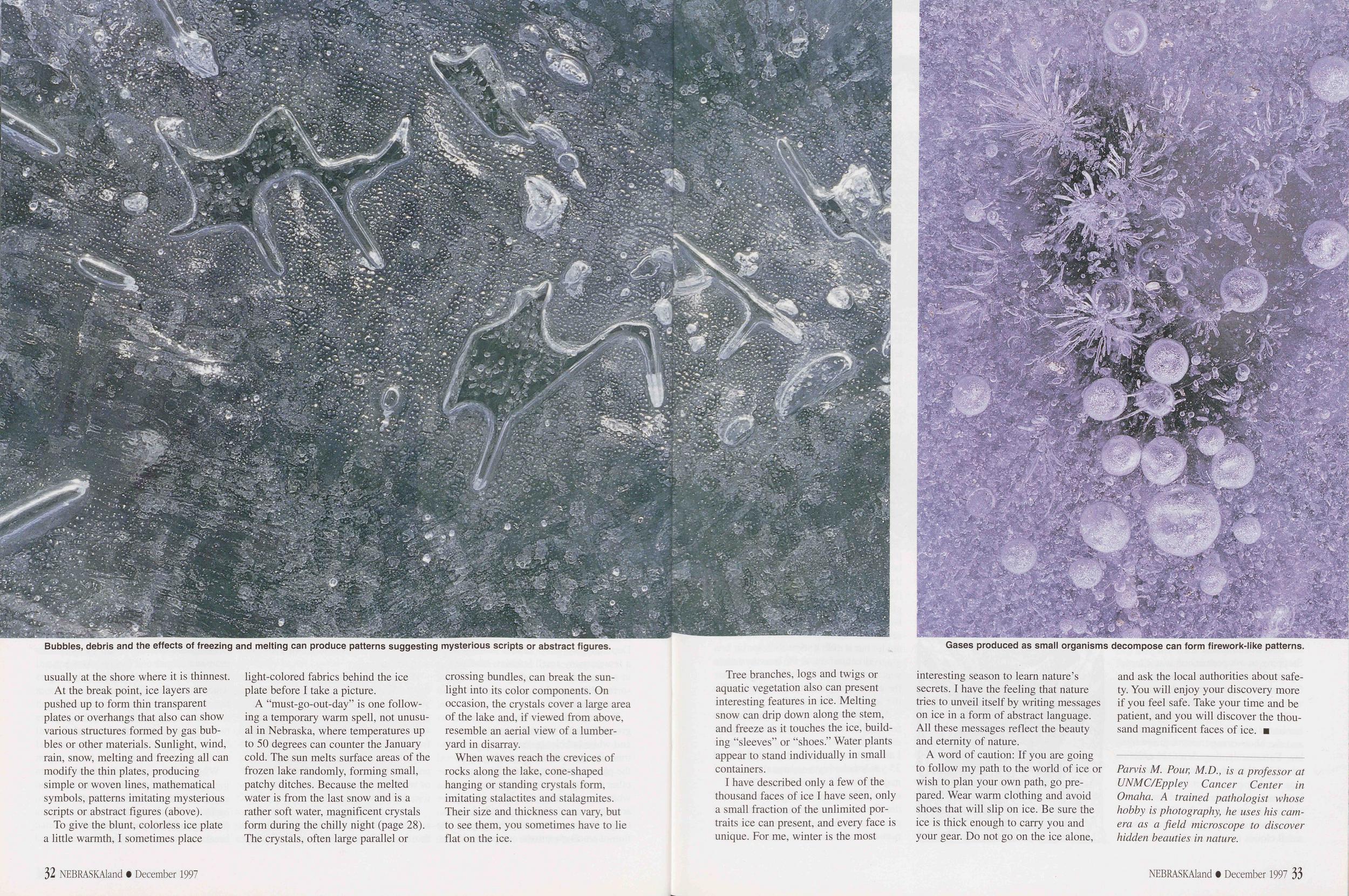
Bubbles, debris and the effects of freezing and melting can produce patterns suggesting mysterious scripts or abstract figures.
usually at the shore where it is thinnest.
At the break point, ice layers are pushed up to form thin transparent plates or overhangs that also can show various structures formed by gas bubbles or other materials. Sunlight, wind, rain, snow, melting and freezing all can modify the thin plates, producing simple or woven lines, mathematical symbols, patterns imitating mysterious scripts or abstract figures (above).
To give the blunt, colorless ice plate a little warmth, I sometimes place light-colored fabrics behind the ice plate before I take a picture.
A "must-go-out-day" is one following a temporary warm spell, not unusual in Nebraska, where temperatures up to 50 degrees can counter the January cold. The sun melts surface areas of the frozen lake randomly, forming small, patchy ditches. Because the melted water is from the last snow and is a rather soft water, magnificent crystals form during the chilly night (page 28). The crystals, often large parallel or crossing bundles, can break the sunlight into its color components. On occasion, the crystals cover a large area of the lake and, if viewed from above, resemble an aerial view of a lumberyard in disarray.
When waves reach the crevices of rocks along the lake, cone-shaped hanging or standing crystals form, imitating stalactites and stalagmites. Their size and thickness can vary, but to see them, you sometimes have to lie flat on the ice.
32 NEBRASKAland • December 1997Tree branches, logs and twigs or aquatic vegetation also can present interesting features in ice. Melting snow can drip down along the stem, and freeze as it touches the ice, building "sleeves" or "shoes." Water plants appear to stand individually in small containers.
I have described only a few of the thousand faces of ice I have seen, only a small fraction of the unlimited portraits ice can present, and every face is unique. For me, winter is the most
Gases produced as small organisms decompose can form firework-like patterns.
interesting season to learn nature's secrets. I have the feeling that nature tries to unveil itself by writing messages on ice in a form of abstract language. All these messages reflect the beauty and eternity of nature.
A word of caution: If you are going to follow my path to the world of ice or wish to plan your own path, go prepared. Wear warm clothing and avoid shoes that will slip on ice. Be sure the ice is thick enough to carry you and your gear. Do not go on the ice alone, and ask the local authorities about safety. You will enjoy your discovery more if you feel safe. Take your time and be patient, and you will discover the thousand magnificent faces of ice.
Parvis M. Pour, M.D., is a professor at UNMC/Eppley Cancer Center in Omaha. A trained pathologist whose hobby is photography, he uses his camera as a field microscope to discover hidden beauties in nature. NEBRASKAland • December 1997 33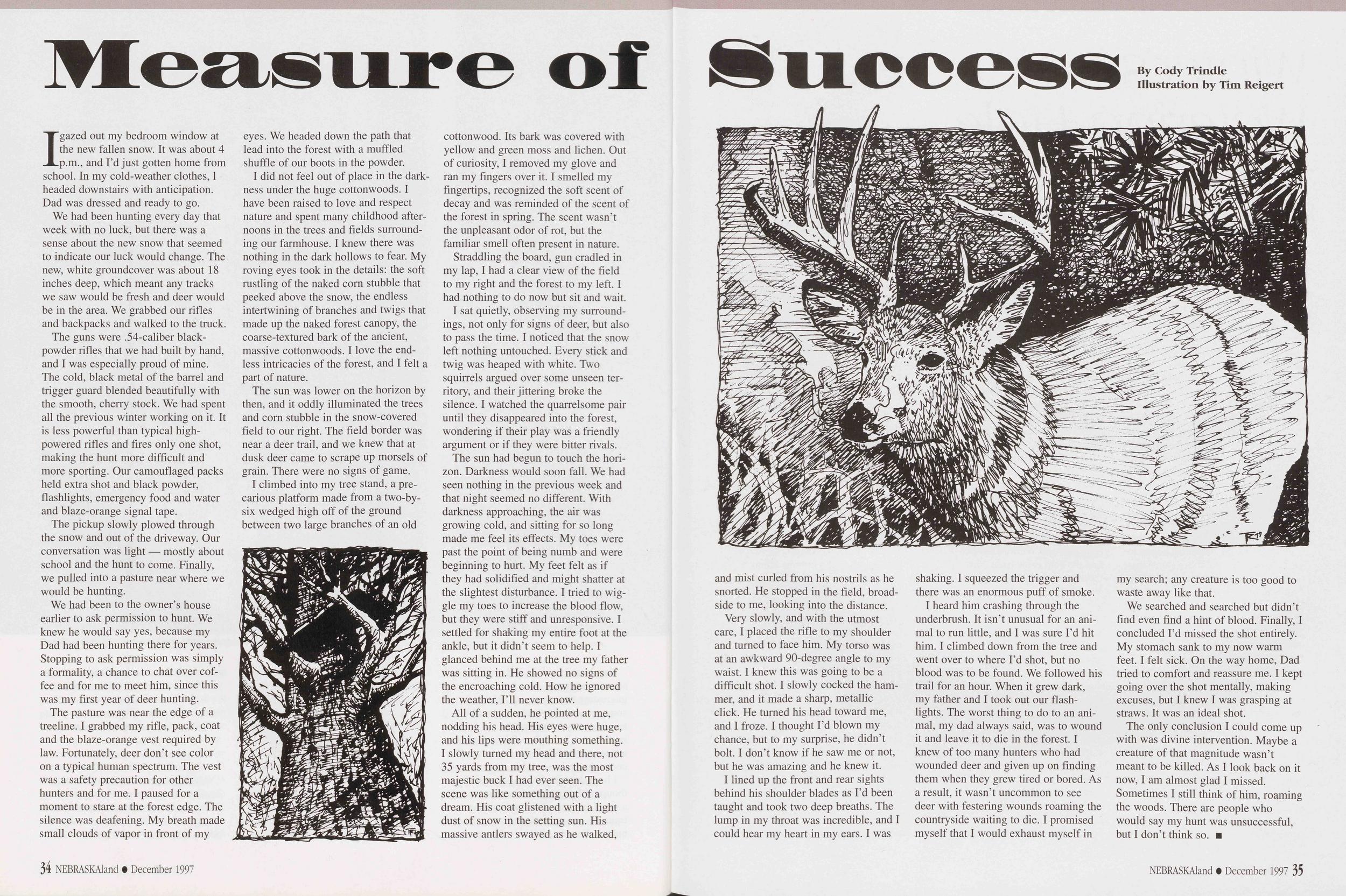
Measure of Success
I gazed out my bedroom window at the new fallen snow. It was about 4 p.m., and I'd just gotten home from school. In my cold-weather clothes, 1 headed downstairs with anticipation. Dad was dressed and ready to go.
We had been hunting every day that week with no luck, but there was a sense about the new snow that seemed to indicate our luck would change. The new, white groundcover was about 18 inches deep, which meant any tracks we saw would be fresh and deer would be in the area. We grabbed our rifles and backpacks and walked to the truck.
The guns were .54-caliber black-powder rifles that we had built by hand, and I was especially proud of mine. The cold, black metal of the barrel and trigger guard blended beautifully with the smooth, cherry stock. We had spent all the previous winter working on it. It is less powerful than typical high-powered rifles and fires only one shot, making the hunt more difficult and more sporting. Our camouflaged packs held extra shot and black powder, flashlights, emergency food and water and blaze-orange signal tape.
The pickup slowly plowed through the snow and out of the driveway. Our conversation was light — mostly about school and the hunt to come. Finally, we pulled into a pasture near where we would be hunting.
We had been to the owner's house earlier to ask permission to hunt. We knew he would say yes, because my Dad had been hunting there for years. Stopping to ask permission was simply a formality, a chance to chat over coffee and for me to meet him, since this was my first year of deer hunting.
The pasture was near the edge of a treeline. I grabbed my rifle, pack, coat and the blaze-orange vest required by law. Fortunately, deer don't see color on a typical human spectrum. The vest was a safety precaution for other hunters and for me. I paused for a moment to stare at the forest edge. The silence was deafening. My breath made small clouds of vapor in front of my eyes. We headed down the path that lead into the forest with a muffled shuffle of our boots in the powder.
I did not feel out of place in the darkness under the huge cottonwoods. I have been raised to love and respect nature and spent many childhood afternoons in the trees and fields surrounding our farmhouse. I knew there was nothing in the dark hollows to fear. My roving eyes took in the details: the soft rustling of the naked corn stubble that peeked above the snow, the endless intertwining of branches and twigs that made up the naked forest canopy, the coarse-textured bark of the ancient, massive cottonwoods. I love the endless intricacies of the forest, and I felt a part of nature.
The sun was lower on the horizon by then, and it oddly illuminated the trees and corn stubble in the snow-covered field to our right. The field border was near a deer trail, and we knew that at dusk deer came to scrape up morsels of grain. There were no signs of game.
I climbed into my tree stand, a precarious platform made from a two-by-six wedged high off of the ground between two large branches of an old
Straddling the board, gun cradled in my lap, I had a clear view of the field to my right and the forest to my left. I had nothing to do now but sit and wait.
I sat quietly, observing my surroundings, not only for signs of deer, but also to pass the time. I noticed that the snow left nothing untouched. Every stick and twig was heaped with white. Two squirrels argued over some unseen territory, and their jittering broke the silence. I watched the quarrelsome pair until they disappeared into the forest, wondering if their play was a friendly argument or if they were bitter rivals.
The sun had begun to touch the horizon. Darkness would soon fall. We had seen nothing in the previous week and that night seemed no different. With darkness approaching, the air was growing cold, and sitting for so long made me feel its effects. My toes were past the point of being numb and were beginning to hurt. My feet felt as if they had solidified and might shatter at the slightest disturbance. I tried to wiggle my toes to increase the blood flow, but they were stiff and unresponsive. I settled for shaking my entire foot at the ankle, but it didn't seem to help. I glanced behind me at the tree my father was sitting in. He showed no signs of the encroaching cold. How he ignored the weather, I'll never know.
All of a sudden, he pointed at me, nodding his head. His eyes were huge, and his lips were mouthing something. I slowly turned my head and there, not 35 yards from my tree, was the most majestic buck I had ever seen. The scene was like something out of a dream. His coat glistened with a light dust of snow in the setting sun. His massive antlers swayed as he walked,
34 NEBRASKAland • December 1997and mist curled from his nostrils as he snorted. He stopped in the field, broadside to me, looking into the distance.
Very slowly, and with the utmost care, I placed the rifle to my shoulder and turned to face him. My torso was at an awkward 90-degree angle to my waist. I knew this was going to be a difficult shot. I slowly cocked the hammer, and it made a sharp, metallic click. He turned his head toward me, and I froze. I thought I'd blown my chance, but to my surprise, he didn't bolt. I don't know if he saw me or not, but he was amazing and he knew it.
I lined up the front and rear sights behind his shoulder blades as I'd been taught and took two deep breaths. The lump in my throat was incredible, and I could hear my heart in my ears. I was shaking. I squeezed the trigger and there was an enormous puff of smoke.
I heard him crashing through the underbrush. It isn't unusual for an animal to run little, and I was sure I'd hit him. I climbed down from the tree and went over to where I'd shot, but no blood was to be found. We followed his trail for an hour. When it grew dark, my father and I took out our flashlights. The worst thing to do to an animal, my dad always said, was to wound it and leave it to die in the forest. I knew of too many hunters who had wounded deer and given up on finding them when they grew tired or bored. As a result, it wasn't uncommon to see deer with festering wounds roaming the countryside waiting to die. I promised myself that I would exhaust myself in my search; any creature is too good to waste away like that.
We searched and searched but didn't find even find a hint of blood. Finally, I concluded I'd missed the shot entirely. My stomach sank to my now warm feet. I felt sick. On the way home, Dad tried to comfort and reassure me. I kept going over the shot mentally, making excuses, but I knew I was grasping at straws. It was an ideal shot.
The only conclusion I could come up with was divine intervention. Maybe a creature of that magnitude wasn't meant to be killed. As I look back on it now, I am almost glad I missed. Sometimes I still think of him, roaming the woods. There are people who would say my hunt was unsuccessful, but I don't think so.
NEBRASKAland • December 1997 35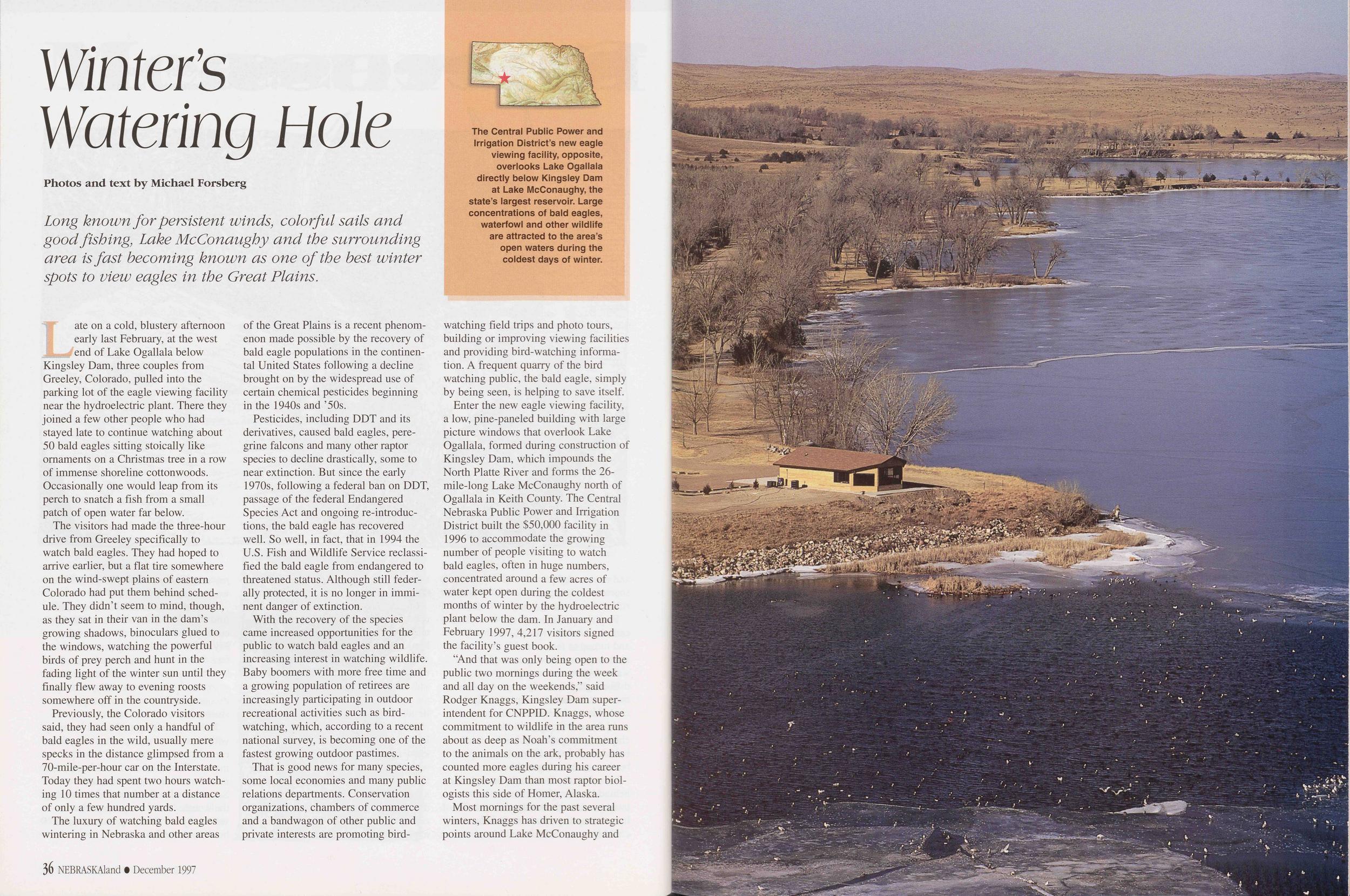
Winter's Watering Hole
Long known for persistent winds, colorful sails and good fishing, Lake McConaughy and the surrounding area is fast becoming known as one of the best winter spots to view eagles in the Great Plains.
Late on a cold, blustery afternoon early last February, at the west end of Lake Ogallala below Kingsley Dam, three couples from Greeley, Colorado, pulled into the parking lot of the eagle viewing facility near the hydroelectric plant. There they joined a few other people who had stayed late to continue watching about 50 bald eagles sitting stoically like ornaments on a Christmas tree in a row of immense shoreline cotton woods. Occasionally one would leap from its perch to snatch a fish from a small patch of open water far below.
The visitors had made the three-hour drive from Greeley specifically to watch bald eagles. They had hoped to arrive earlier, but a flat tire somewhere on the wind-swept plains of eastern Colorado had put them behind schedule. They didn't seem to mind, though, as they sat in their van in the dam's growing shadows, binoculars glued to the windows, watching the powerful birds of prey perch and hunt in the fading light of the winter sun until they finally flew away to evening roosts somewhere off in the countryside.
Previously, the Colorado visitors said, they had seen only a handful of bald eagles in the wild, usually mere specks in the distance glimpsed from a 70-mile-per-hour car on the Interstate. Today they had spent two hours watching 10 times that number at a distance of only a few hundred yards.
The luxury of watching bald eagles wintering in Nebraska and other areas of the Great Plains is a recent phenomenon made possible by the recovery of bald eagle populations in the continental United States following a decline brought on by the widespread use of certain chemical pesticides beginning in the 1940s and '50s.
Pesticides, including DDT and its derivatives, caused bald eagles, peregrine falcons and many other raptor species to decline drastically, some to near extinction. But since the early 1970s, following a federal ban on DDT, passage of the federal Endangered Species Act and ongoing re-introductions, the bald eagle has recovered well. So well, in fact, that in 1994 the U.S. Fish and Wildlife Service reclassified the bald eagle from endangered to threatened status. Although still federally protected, it is no longer in imminent danger of extinction.
With the recovery of the species came increased opportunities for the public to watch bald eagles and an increasing interest in watching wildlife. Baby boomers with more free time and a growing population of retirees are increasingly participating in outdoor recreational activities such as bird-watching, which, according to a recent national survey, is becoming one of the fastest growing outdoor pastimes.
That is good news for many species, some local economies and many public relations departments. Conservation organizations, chambers of commerce and a bandwagon of other public and private interests are promoting bird-watching field trips and photo tours, building or improving viewing facilities and providing bird-watching information. A frequent quarry of the bird watching public, the bald eagle, simply by being seen, is helping to save itself.
Enter the new eagle viewing facility, a low, pine-paneled building with large picture windows that overlook Lake Ogallala, formed during construction of Kingsley Dam, which impounds the North Platte River and forms the 26-mile-long Lake McConaughy north of Ogallala in Keith County. The Central Nebraska Public Power and Irrigation District built the $50,000 facility in 1996 to accommodate the growing number of people visiting to watch bald eagles, often in huge numbers, concentrated around a few acres of water kept open during the coldest months of winter by the hydroelectric plant below the dam. In January and February 1997, 4,217 visitors signed the facility's guest book.
"And that was only being open to the public two mornings during the week and all day on the weekends," said Rodger Knaggs, Kingsley Dam superintendent for CNPPID. Knaggs, whose commitment to wildlife in the area runs about as deep as Noah's commitment to the animals on the ark, probably has counted more eagles during his career at Kingsley Dam than most raptor biologists this side of Homer, Alaska.
Most mornings for the past several winters, Knaggs has driven to strategic points around Lake McConaughy and
36 NEBRASKAland • December 1997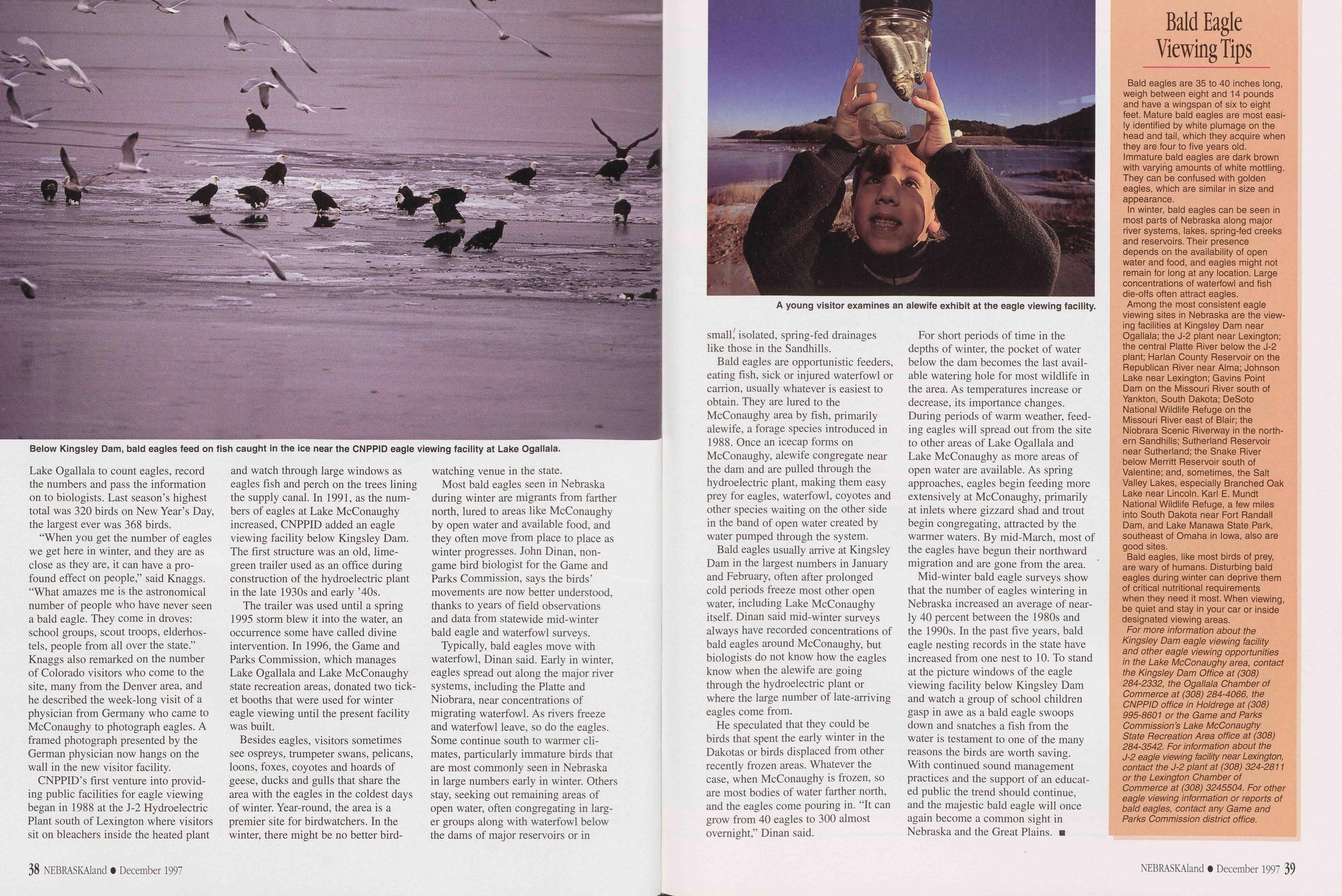
Below Kingsley Dam, bald eagles feed on fish caught in the ice near the CNPPID eagle viewing facility at Lake Ogallala.
Lake Ogallala to count eagles, record the numbers and pass the information on to biologists. Last season's highest total was 320 birds on New Year's Day, the largest ever was 368 birds.
"When you get the number of eagles we get here in winter, and they are as close as they are, it can have a profound effect on people," said Knaggs. "What amazes me is the astronomical number of people who have never seen a bald eagle. They come in droves: school groups, scout troops, elderhostels, people from all over the state." Knaggs also remarked on the number of Colorado visitors who come to the site, many from the Denver area, and he described the week-long visit of a physician from Germany who came to McConaughy to photograph eagles. A framed photograph presented by the German physician now hangs on the wall in the new visitor facility.
CNPPID's first venture into providing public facilities for eagle viewing began in 1988 at the J-2 Hydroelectric Plant south of Lexington where visitors sit on bleachers inside the heated plant and watch through large windows as eagles fish and perch on the trees lining the supply canal. In 1991, as the numbers of eagles at Lake McConaughy increased, CNPPID added an eagle viewing facility below Kingsley Dam. The first structure was an old, lime-green trailer used as an office during construction of the hydroelectric plant in the late 1930s and early '40s.
The trailer was used until a spring 1995 storm blew it into the water, an occurrence some have called divine intervention. In 1996, the Game and Parks Commission, which manages Lake Ogallala and Lake McConaughy state recreation areas, donated two ticket booths that were used for winter eagle viewing until the present facility was built.
Besides eagles, visitors sometimes see ospreys, trumpeter swans, pelicans, loons, foxes, coyotes and hoards of geese, ducks and gulls that share the area with the eagles in the coldest days of winter. Year-round, the area is a premier site for birdwatchers. In the winter, there might be no better bird-watching venue in the state.
Most bald eagles seen in Nebraska during winter are migrants from farther north, lured to areas like McConaughy by open water and available food, and they often move from place to place as winter progresses. John Dinan, nongame bird biologist for the Game and Parks Commission, says the birds' movements are now better understood, thanks to years of field observations and data from statewide mid-winter bald eagle and waterfowl surveys.
Typically, bald eagles move with waterfowl, Dinan said. Early in winter, eagles spread out along the major river systems, including the Platte and Niobrara, near concentrations of migrating waterfowl. As rivers freeze and waterfowl leave, so do the eagles. Some continue south to warmer climates, particularly immature birds that are most commonly seen in Nebraska in large numbers early in winter. Others stay, seeking out remaining areas of open water, often congregating in larger groups along with waterfowl below the dams of major reservoirs or in
38 NEBRASKAland • December 1997A young visitor examines an alewife exhibit at the eagle viewing facility.
small, isolated, spring-fed drainages like those in the Sandhills.
Bald eagles are opportunistic feeders, eating fish, sick or injured waterfowl or carrion, usually whatever is easiest to obtain. They are lured to the McConaughy area by fish, primarily alewife, a forage species introduced in 1988. Once an icecap forms on McConaughy, alewife congregate near the dam and are pulled through the hydroelectric plant, making them easy prey for eagles, waterfowl, coyotes and other species waiting on the other side in the band of open water created by water pumped through the system.
Bald eagles usually arrive at Kingsley Dam in the largest numbers in January and February, often after prolonged cold periods freeze most other open water, including Lake McConaughy itself. Dinan said mid-winter surveys always have recorded concentrations of bald eagles around McConaughy, but biologists do not know how the eagles know when the alewife are going through the hydroelectric plant or where the large number of late-arriving eagles come from.
He speculated that they could be birds that spent the early winter in the Dakotas or birds displaced from other recently frozen areas. Whatever the case, when McConaughy is frozen, so are most bodies of water farther north, and the eagles come pouring in. "It can grow from 40 eagles to 300 almost overnight," Dinan said.
For short periods of time in the depths of winter, the pocket of water below the dam becomes the last available watering hole for most wildlife in the area. As temperatures increase or decrease, its importance changes. During periods of warm weather, feeding eagles will spread out from the site to other areas of Lake Ogallala and Lake McConaughy as more areas of open water are available. As spring approaches, eagles begin feeding more extensively at McConaughy, primarily at inlets where gizzard shad and trout begin congregating, attracted by the warmer waters. By mid-March, most of the eagles have begun their northward migration and are gone from the area.
Mid-winter bald eagle surveys show that the number of eagles wintering in Nebraska increased an average of nearly 40 percent between the 1980s and the 1990s. In the past five years, bald eagle nesting records in the state have increased from one nest to 10. To stand at the picture windows of the eagle viewing facility below Kingsley Dam and watch a group of school children gasp in awe as a bald eagle swoops down and snatches a fish from the water is testament to one of the many reasons the birds are worth saving. With continued sound management practices and the support of an educated public the trend should continue, and the majestic bald eagle will once again become a common sight in Nebraska and the Great Plains.
Bald Eagle Viewing Tips
Bald eagles are 35 to 40 inches long, weigh between eight and 14 pounds and have a wingspan of six to eight feet. Mature bald eagles are most easily identified by white plumage on the head and tail, which they acquire when they are four to five years old. Immature bald eagles are dark brown with varying amounts of white mottling. They can be confused with golden eagles, which are similar in size and appearance. In winter, bald eagles can be seen in most parts of Nebraska along major river systems, lakes, spring-fed creeks and reservoirs. Their presence depends on the availability of open water and food, and eagles might not remain for long at any location. Large concentrations of waterfowl and fish die-offs often attract eagles. Among the most consistent eagle viewing sites in Nebraska are the viewing facilities at Kingsley Dam near Ogallala; the J-2 plant near Lexington; the central Platte River below the J-2 plant; Harlan County Reservoir on the Republican River near Alma; Johnson Lake near Lexington; Gavins Point Dam on the Missouri River south of Yankton, South Dakota; DeSoto National Wildlife Refuge on the Missouri River east of Blair; the Niobrara Scenic Riverway in the northern Sandhills; Sutherland Reservoir near Sutherland; the Snake River below Merritt Reservoir south of Valentine; and, sometimes, the Salt Valley Lakes, especially Branched Oak Lake near Lincoln. Karl E. Mundt National Wildlife Refuge, a few miles into South Dakota near Fort Randall Dam, and Lake Manawa State Park, southeast of Omaha in Iowa, also are good sites. Bald eagles, like most birds of prey, are wary of humans. Disturbing bald eagles during winter can deprive them of critical nutritional requirements when they need it most. When viewing, be quiet and stay in your car or inside designated viewing areas. For more information about the Kingsley Dam eagle viewing facility and other eagle viewing opportunities in the Lake McConaughy area, contact the Kingsley Dam Office at (308) 284-2332, the Ogallala Chamber of Commerce at (308) 284-4066, the CNPPID office in Holdrege at (308) 995-8601 or the Game and Parks Commission's Lake McConaughy State Recreation Area office at (308) 284-3542. For information about the J-2 eagle viewing facility near Lexington, contact the J-2 plant at (308) 324-2811 or the Lexington Chamber of Commerce at (308) 3245504. For other eagle viewing information or reports of bald eagles, contact any Game and Parks Commission district office. NEBRASKAland • December 1997 39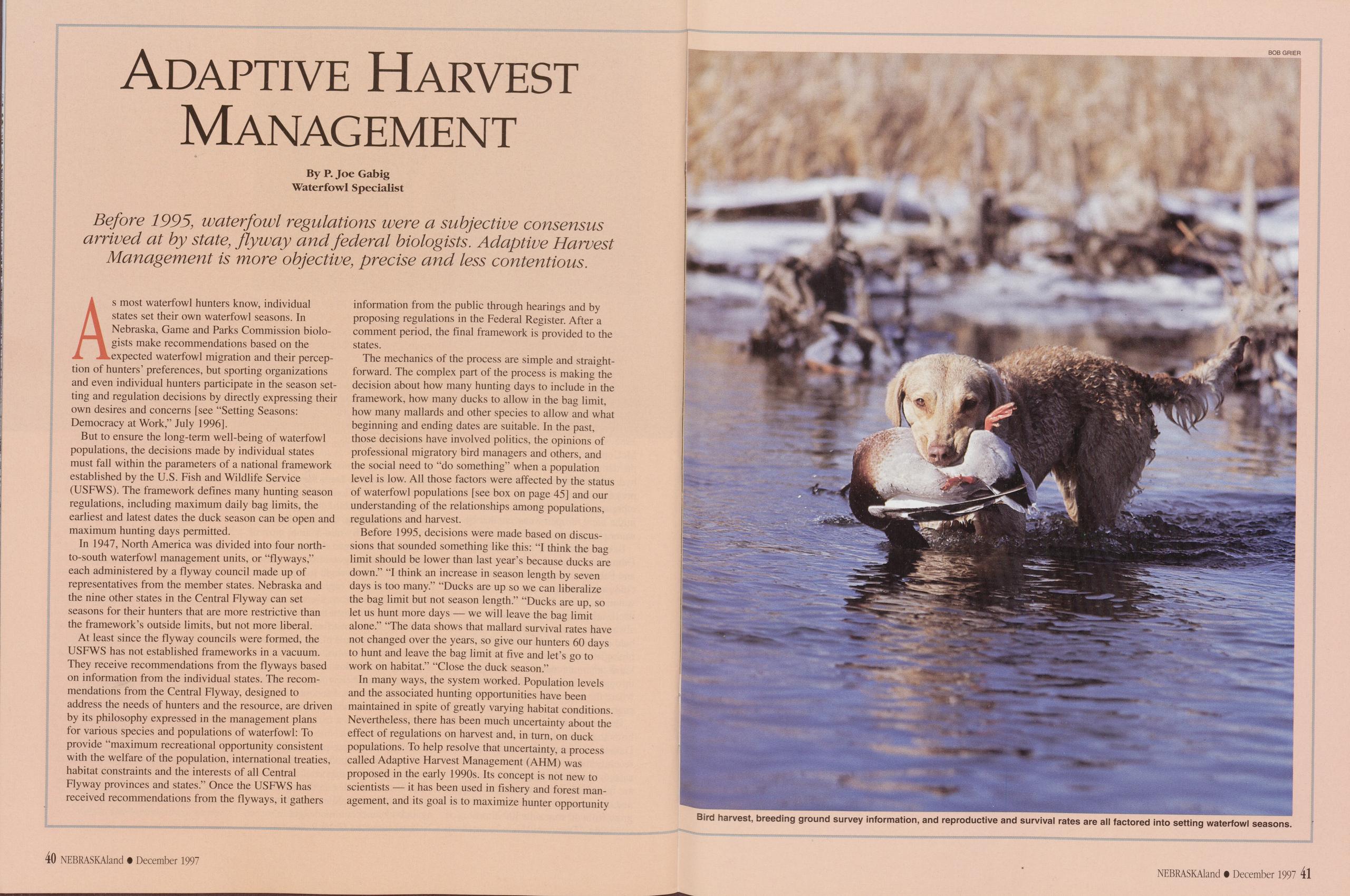
Adaptive Harvest Management
Before 1995, waterfowl regulations were a subjective consensus arrived at by state, flyway and federal biologists. Adaptive Harvest Management is more objective, precise and less contentious.
As most waterfowl hunters know, individual states set their own waterfowl seasons. In Nebraska, Game and Parks Commission biologists make recommendations based on the expected waterfowl migration and their perception of hunters' preferences, but sporting organizations and even individual hunters participate in the season setting and regulation decisions by directly expressing their own desires and concerns [see "Setting Seasons: Democracy at Work," July 1996].
But to ensure the long-term well-being of waterfowl populations, the decisions made by individual states must fall within the parameters of a national framework established by the U.S. Fish and Wildlife Service (USFWS). The framework defines many hunting season regulations, including maximum daily bag limits, the earliest and latest dates the duck season can be open and maximum hunting days permitted.
In 1947, North America was divided into four north-and-south water management units, or "flyways," each administered by a flyway council made up of representatives from the member states. Nebraska and the nine other states in the Central Flyway can set seasons for their hunters that are more restrictive than the framework's outside limits, but not more liberal.
At least since the flyway councils were formed, the USFWS has not established frameworks in a vacuum. They recieve recommendations from the flyways based on information from the individual states. The recommendations from the Central Flyway, designed to address the needs of hunters and the resource, are driven by its philosophy expressed in the management plans for its various species and populations fo waterfowl: To provide "maximum recreational opportunity consistent with the welfare of the population, international treaties, habitat constraints and the interests of all Central Flyway provinces and states." Once the USFWS has recieved recommendations from the flyways, it gathers information from the public through hearings and by proposing regulations in the Federal Register. After a comment period, the final framework is provided to the states.
The mechanics of the process are simple and straightforward. The complex part of the process is making the decision about how many hunting days to include in the framework, how many ducks to allow in the bag limit, how many mallards and other species to allow and what beginning and ending dates are suitable. In the past, those decisions have involved politics, the opinions of professional migratory bird managers and others, and the social need to "do something" when a population level is low. All those factors were affected by the status of waterfowl populations [see box on page 45] and our understanding of the relationships among populations, regulations and harvest.
Before 1995, decisions were made based on discussions that sounded something like this: "I think the bag limit should be lower than last year's because ducks are down." "I think an increase in season length by seven days is too many." "Ducks are up so we can liberalize the bag limit but not season length." "Ducks are up, so let us hunt more days - we will leave the bag limit alone." "The data shows that mallard survival rates have not changed over the years, so give our hunters 60 days to hunt and leave the bag limit at five and let's go to work on habitat." "Close the duck season."
In many ways, the system worked. Population levels and the associated hunting opportunities have been maintained in spite of greatly varying habitat conditions. Nevertheless, there has been much uncertainty about the effect of regulations on harvest and, in turn, on duck populations. To help resolve that uncertainty, a process called Adaptive Harvest Management (AHM) was proposed in the early 1990's. Its concept is not new to scientists - it has been used in fishery and forest management, and its goal is to maximize hunter opportunity
40 NEBRASKAland • December 1997 BOB GRIERBird harvest, breeding ground survey information, and reproductive and survival rates are all factored into setting waterfowl seasons.
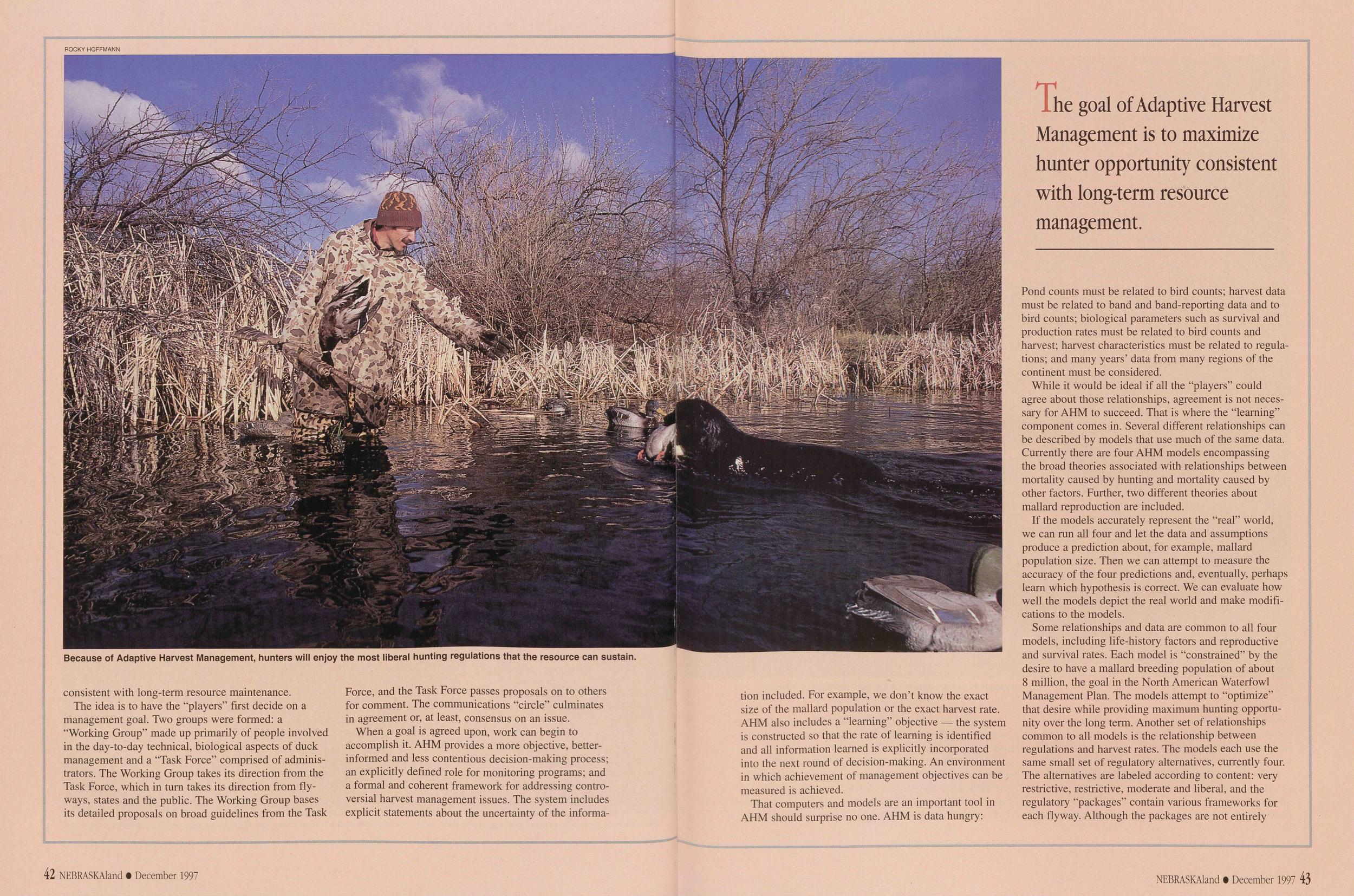
Because of Adaptive Harvest Management, hunters will enjoy the most liberal hunting regulations that the resource can sustain.
consistent with long-term resource maintenance.
The idea is to have the "players" first decide on a management goal. Two groups were formed: a "Working Group" made up primarily of people involved in the day-to-day technical, biological aspects of duck management and a "Task Force" comprised of administrators. The Working Group takes its direction from the Task Force, which in turn takes its direction from flyways, states and the public. The Working Group bases its detailed proposals on broad guidelines from the Task Force, and the Task Force passes proposals on to others for comment. The communications "circle" culminates in agreement or, at least, consensus on an issue.
When a goal is agreed upon, work can begin to accomplish it. AHM provides a more objective, better-informed and less contentious decision-making process; an explicitly defined role for monitoring programs; and a formal and coherent framework for addressing controversial harvest management issues. The system includes explicit statements about the uncertainty of the information
42 NEBRASKAland • December 1997 The goal of Adaptive Harvest Management is to maximize hunter opportunity consistent with long-term resource management.included. For example, we don't know the exact size of the mallard population or the exact harvest rate. AHM also includes a "learning" objective — the system is constructed so that the rate of learning is identified and all information learned is explicitly incorporated into the next round of decision-making. An environment in which achievement of management objectives can be measured is achieved.
That computers and models are an important tool in AHM should surprise no one. AHM is data hungry: Pond counts must be related to bird counts; harvest data must be related to band and band-reporting data and to bird counts; biological parameters such as survival and production rates must be related to bird counts and harvest; harvest characteristics must be related to regulations; and many years' data from many regions of the continent must be considered.
While it would be ideal if all the "players" could agree about those relationships, agreement is not necessary for AHM to succeed. That is where the "learning" component comes in. Several different relationships can be described by models that use much of the same data. Currently there are four AHM models encompassing the broad theories associated with relationships between mortality caused by hunting and mortality caused by other factors. Further, two different theories about mallard reproduction are included.
If the models accurately represent the "real" world, we can run all four and let the data and assumptions produce a prediction about, for example, mallard population size. Then we can attempt to measure the accuracy of the four predictions and, eventually, perhaps learn which hypothesis is correct. We can evaluate how well the models depict the real world and make modifications to the models.
Some relationships and data are common to all four models, including life-history factors and reproductive and survival rates. Each model is "constrained" by the desire to have a mallard breeding population of about 8 million, the goal in the North American Waterfowl Management Plan. The models attempt to "optimize" that desire while providing maximum hunting opportunity over the long term. Another set of relationships common to all models is the relationship between regulations and harvest rates. The models each use the same small set of regulatory alternatives, currently four. The alternatives are labeled according to content: very restrictive, restrictive, moderate and liberal, and the regulatory "packages" contain various frameworks for each fly way. Although the packages are not entirely
NEBRASKAland • December 1997 43 JON FARRAR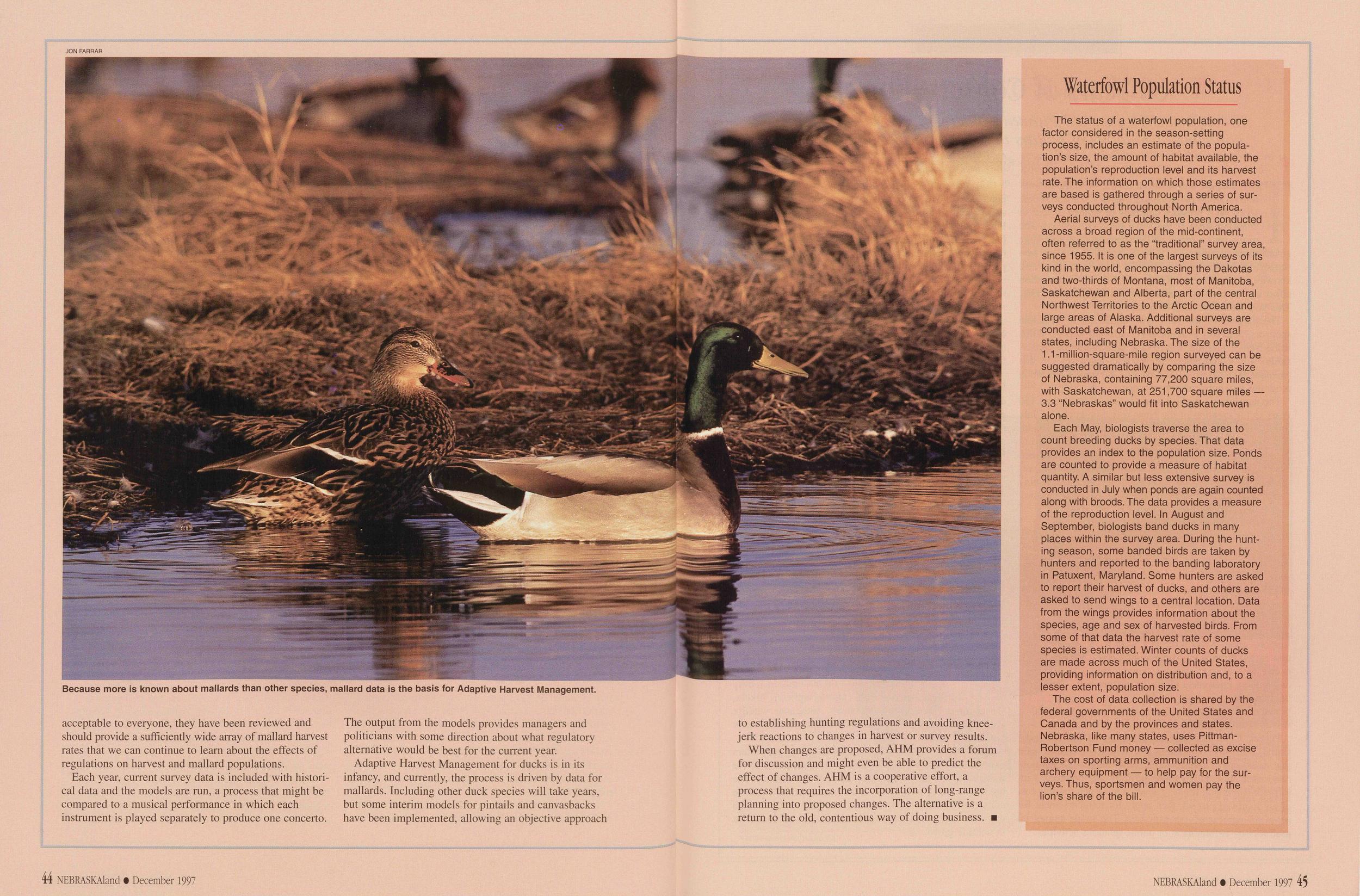
Because more is known about mallards than other species, mallard data is the basis for Adaptive Harvest Management.
acceptable to everyone, they have been reviewed and should provide a sufficiently wide array of mallard harvest rates that we can continue to learn about the effects of regulations on harvest and mallard populations.
Each year, current survey data is included with historical data and the models are run, a process that might be compared to a musical performance in which each instrument is played separately to produce one concerto. The output from the models provides managers and politicians with some direction about what regulatory alternative would be best for the current year.
Adaptive Harvest Management for ducks is in its infancy, and currently, the process is driven by data for mallards. Including other duck species will take years, but some interim models for pintails and canvasbacks have been implemented, allowing an objective approach 44 NEBRASKAland • December 1997 to establishing hunting regulations and avoiding kneejerk reactions to changes in harvest or survey results.
When changes are proposed, AHM provides a forum for discussion and might even be able to predict the effect of changes. AHM is a cooperative effort, a process that requires the incorporation of long-range planning into proposed changes. The alternative is a return to the old, contentious way of doing business.
Waterfowl Population Status
The status of a waterfowl population, one factor considered in the season-setting process, includes an estimate of the population's size, the amount of habitat available, the population's reproduction level and its harvest rate. The information on which those estimates are based is gathered through a series of surveys conducted throughout North America. Aerial surveys of ducks have been conducted across a broad region of the mid-continent, often referred to as the "traditional" survey area, since 1955. It is one of the largest surveys of its kind in the world, encompassing the Dakotas and two-thirds of Montana, most of Manitoba, Saskatchewan and Alberta, part of the central Northwest Territories to the Arctic Ocean and large areas of Alaska. Additional surveys are conducted east of Manitoba and in several states, including Nebraska. The size of the 1.1-million-square-mile region surveyed can be suggested dramatically by comparing the size of Nebraska, containing 77,200 square miles, with Saskatchewan, at 251,700 square miles — 3.3 "Nebraskas" would fit into Saskatchewan aione. Each May, biologists traverse the area to count breeding ducks by species. That data provides an index to the population size. Ponds are counted to provide a measure of habitat quantity. A similar but less extensive survey is conducted in July when ponds are again counted along with broods. The data provides a measure of the reproduction level. In August and September, biologists band ducks in many places within the survey area. During the hunting season, some banded birds are taken by hunters and reported to the banding laboratory in Patuxent, Maryland. Some hunters are asked to report their harvest of ducks, and others are asked to send wings to a central location. Data from the wings provides information about the species, age and sex of harvested birds. From some of that data the harvest rate of some species is estimated. Winter counts of ducks are made across much of the United States, providing information on distribution and, to a lesser extent, population size. The cost of data collection is shared by the federal governments of the United States and Canada and by the provinces and states. Nebraska, like many states, uses Pittman-Robertson Fund money — collected as excise taxes on sporting arms, ammunition and archery equipment — to help pay for the surveys. Thus, sportsmen and women pay the lion's share of the bill. NEBRASKAland • December 1997 45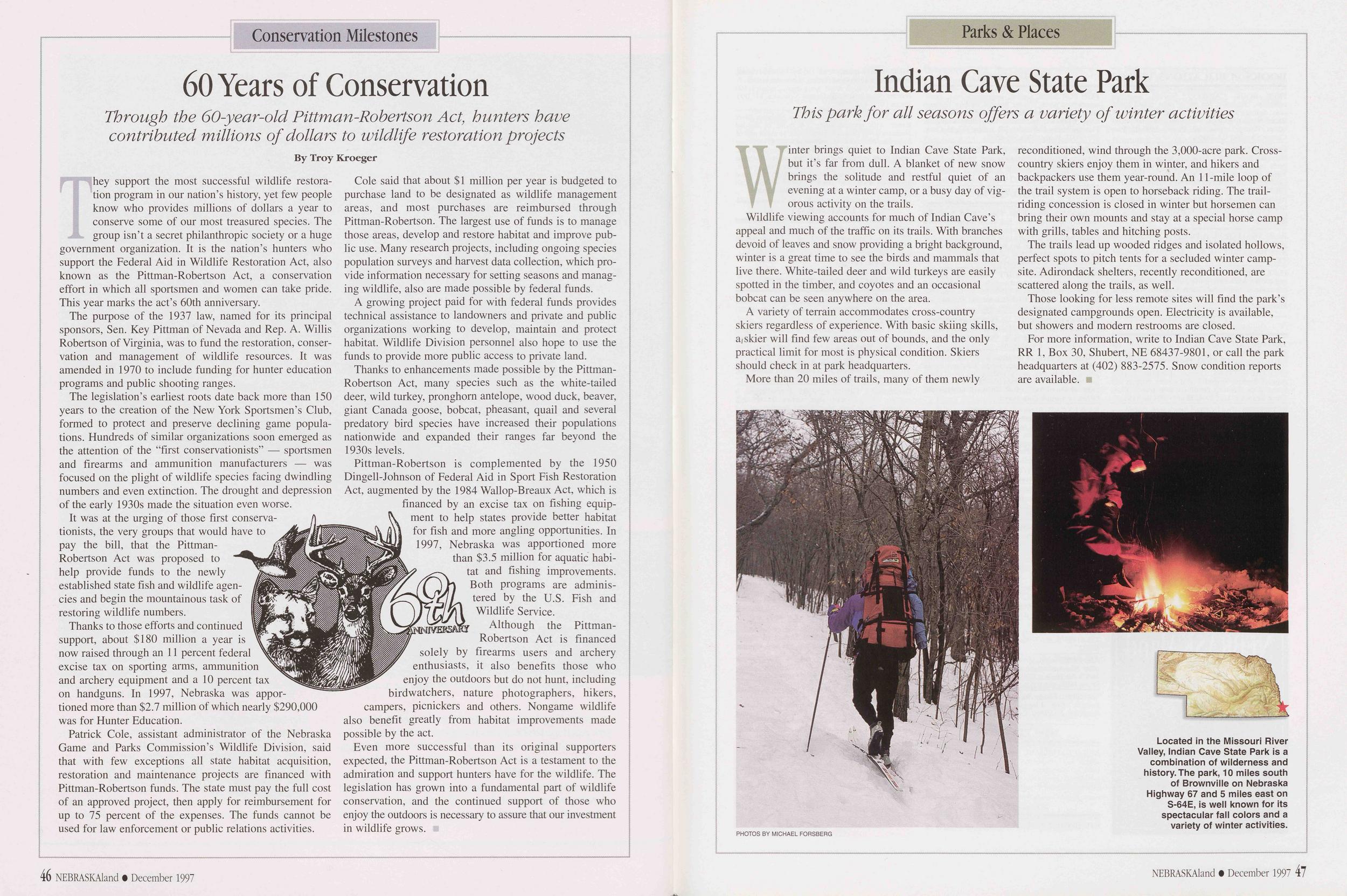
Conservation Milestones
60 Years of Conservation
Through the 60-year-old Pittman-Robertson Act, hunters have contributed millions of dollars to wildlife restoration projects
They support the most successful wildlife restoration program in our nation's history, yet few people know who provides millions of dollars a year to conserve some of our most treasured species. The group isn't a secret philanthropic society or a huge government organization. It is the nation's hunters who support the Federal Aid in Wildlife Restoration Act, also known as the Pittman-Robertson Act, a conservation effort in which all sportsmen and women can take pride. This year marks the act's 60th anniversary.
The purpose of the 1937 law, named for its principal sponsors, Sen. Key Pittman of Nevada and Rep. A. Willis Robertson of Virginia, was to fund the restoration, conservation and management of wildlife resources. It was amended in 1970 to include funding for hunter education programs and public shooting ranges.
The legislation's earliest roots date back more than 150 years to the creation of the New York Sportsmen's Club, formed to protect and preserve declining game populations. Hundreds of similar organizations soon emerged as the attention of the "first conservationists" — sportsmen and firearms and ammunition manufacturers — was focused on the plight of wildlife species facing dwindling numbers and even extinction. The drought and depression of the early 1930s made the situation even worse.
It was at the urging of those first conservationists, the very groups that would have to pay the bill, that the Pittman-Robertson Act was proposed to help provide funds to the newly established state fish and wildlife agencies and begin the mountainous task of restoring wildlife numbers.
Thanks to those efforts and continued support, about $180 million a year is now raised through an 11 percent federal excise tax on sporting arms, ammunition and archery equipment and a 10 percent tax on handguns. In 1997, Nebraska was apportioned more than $2.7 million of which nearly $290,000 was for Hunter Education.
Patrick Cole, assistant administrator of the Nebraska Game and Parks Commission's Wildlife Division, said that with few exceptions all state habitat acquisition, restoration and maintenance projects are financed with Pittman-Robertson funds. The state must pay the full cost of an approved project, then apply for reimbursement for up to 75 percent of the expenses. The funds cannot be used for law enforcement or public relations activities.
Cole said that about $1 million per year is budgeted to purchase land to be designated as wildlife management areas, and most purchases are reimbursed through Pittman-Robertson. The largest use of funds is to manage those areas, develop and restore habitat and improve public use. Many research projects, including ongoing species population surveys and harvest data collection, which provide information necessary for setting seasons and managing wildlife, also are made possible by federal funds.
A growing project paid for with federal funds provides technical assistance to landowners and private and public organizations working to develop, maintain and protect habitat. Wildlife Division personnel also hope to use the funds to provide more public access to private land.
Thanks to enhancements made possible by the Pittman-Robertson Act, many species such as the white-tailed deer, wild turkey, pronghorn antelope, wood duck, beaver, giant Canada goose, bobcat, pheasant, quail and several predatory bird species have increased their populations nationwide and expanded their ranges far beyond the 1930s levels.
Pittman-Robertson is complemented by the 1950 Dingell-Johnson of Federal Aid in Sport Fish Restoration Act, augmented by the 1984 Wallop-Breaux Act, which is financed by an excise tax on fishing equipment to help states provide better habitat for fish and more angling opportunities. In 1997, Nebraska was apportioned more than $3.5 million for aquatic habitat and fishing improvements. Both programs are administered by the U.S. Fish and Wildlife Service.
Although the Pittman-Robertson Act is financed solely by firearms users and archery enthusiasts, it also benefits those who enjoy the outdoors but do not hunt, including birdwatchers, nature photographers, hikers, campers, picnickers and others. Nongame wildlife also benefit greatly from habitat improvements made possible by the act.
Even more successful than its original supporters expected, the Pittman-Robertson Act is a testament to the admiration and support hunters have for the wildlife. The legislation has grown into a fundamental part of wildlife conservation, and the continued support of those who enjoy the outdoors is necessary to assure that our investment in wildlife grows.
46 NEBRASKAland • December 1997Parks & Places
Indian Cave State Park
This park for all seasons offers a variety of winter activities
Winter brings quiet to Indian Cave State Park, but it's far from dull. A blanket of new snow brings the solitude and restful quiet of an evening at a winter camp, or a busy day of vigorous activity on the trails.
Wildlife viewing accounts for much of Indian Cave's appeal and much of the traffic on its trails. With branches devoid of leaves and snow providing a bright background, winter is a great time to see the birds and mammals that live there. White-tailed deer and wild turkeys are easily spotted in the timber, and coyotes and an occasional bobcat can be seen anywhere on the area.
A variety of terrain accommodates cross-country skiers regardless of experience. With basic skiing skills, a/skier will find few areas out of bounds, and the only practical limit for most is physical condition. Skiers should check in at park headquarters.
More than 20 miles of trails, many of them newly reconditioned, wind through the 3,000-acre park. Crosscountry skiers enjoy them in winter, and hikers and backpackers use them year-round. An 11-mile loop of the trail system is open to horseback riding. The trail-riding concession is closed in winter but horsemen can bring their own mounts and stay at a special horse camp with grills, tables and hitching posts.
The trails lead up wooded ridges and isolated hollows, perfect spots to pitch tents for a secluded winter campsite. Adirondack shelters, recently reconditioned, are scattered along the trails, as well.
Those looking for less remote sites will find the park's designated campgrounds open. Electricity is available, but showers and modern restrooms are closed.
For more information, write to Indian Cave State Park, RR 1, Box 30, Shubert, NE 68437-9801, or call the park headquarters at (402) 883-2575. Snow condition reports are available.
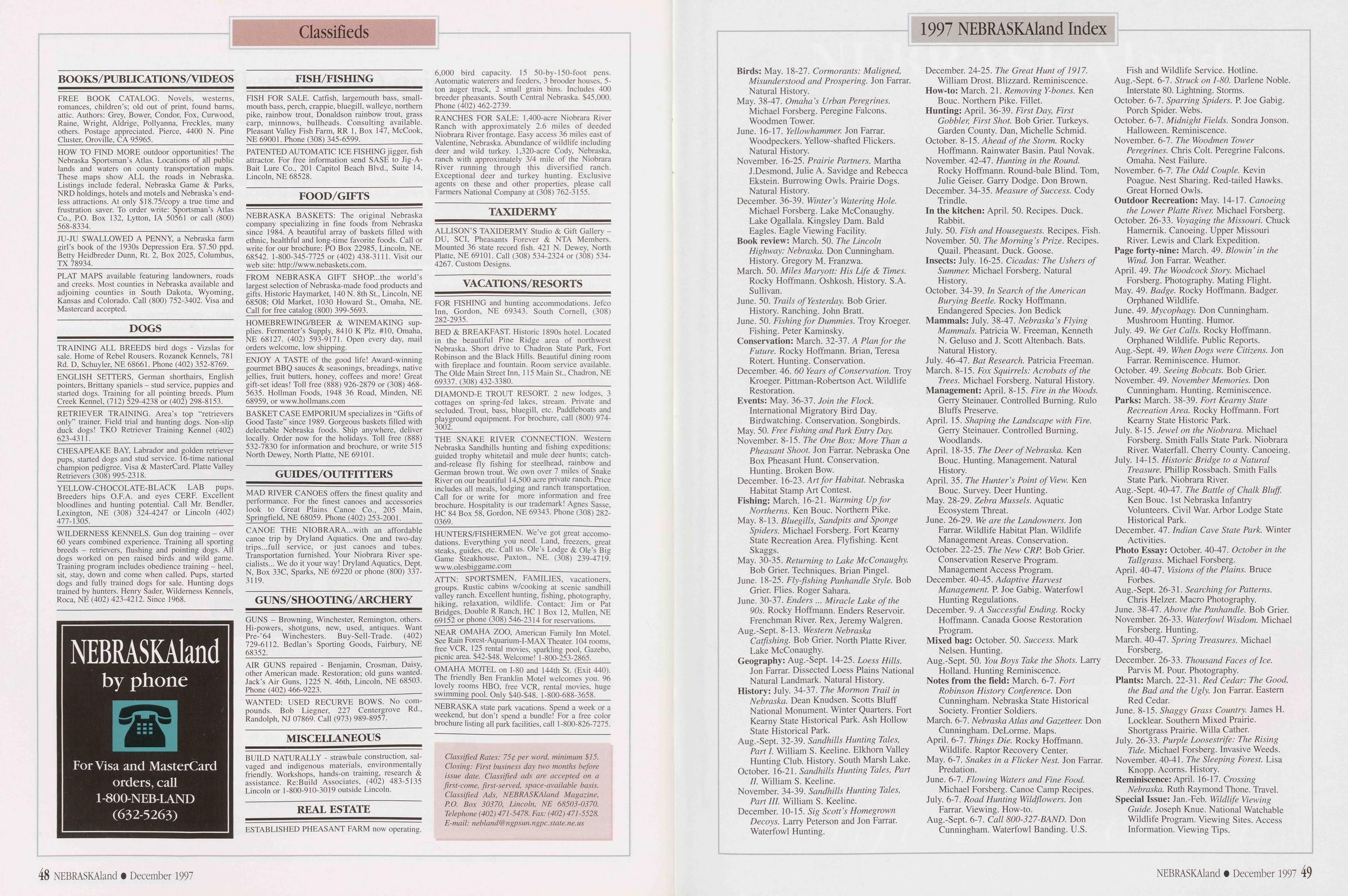
Classifieds
BOOKS/PUBLICATIONS/VIDEOS FREE BOOK CATALOG. Novels, westerns, romances, children's; old out of print, found barns, attic. Authors: Grey, Bower, Condor, Fox, Curwood, Raine, Wright, Aldrige, Pollyanna, Freckles, many others. Postage appreciated. Pierce, 4400 N. Pine Cluster, Provide, CA 95965. HOW TO FIND MORE outdoor opportunities! The Nebraska Sportsman's Atlas. Locations of all public lands and waters on county transportation maps. These maps show ALL the roads in Nebraska. Listings include federal, Nebraska Game & Parks, NRD holdings, hotels and motels and Nebraska's endless attractions. At only $18.75/copy a true time and frustration saver. To order write: Sportsman's Atlas Co., P.O. Box 132, Lytton, IA 50561 or call (800) 568-8334. JU-JU SWALLOWED A PENNY, a Nebraska farm girl's book of the 1930s Depression Era. $7.50 ppd. Betty Heidbreder Dunn, Rt. 2, Box 2025, Columbus, TX 78934. PLAT MAPS available featuring landowners, roads and creeks. Most counties in Nebraska available and adjoining counties in South Dakota, Wyoming, Kansas and Colorado. Call (800) 752-3402. Visa and Mastercard accepted. DOGS TRAINING ALL BREEDS bird dogs - Vizslas for sale. Home of Rebel Rousers. Rozanek Kennels, 781 Rd. D, Schuyler, NE 68661. Phone (402) 352-8769. ENGLISH SETTERS, German shorthairs, English pointers, Brittany spaniels - stud service, puppies and started dogs. Training for all pointing breeds. Plum Creek Kennel, (712) 529-4238 or (402) 298-8153. RETRIEVER TRAINING. Area's top "retrievers only" trainer. Field trial and hunting dogs. Non-slip duck dogs! TKO Retriever Training Kennel (402) 623-4311. CHESAPEAKE BAY, Labrador and golden retriever pups, started dogs and stud service. 16-time national champion pedigree. Visa & MasterCard. Platte Valley Retrievers (308) 995-2318. YELLOW-CHOCOLATE-BLACK LAB pups. Breeders hips O.F.A. and eyes CERE Excellent bloodlines and hunting potential. Call Mr. Bendler, Lexington, NE (308) 324-4247 or Lincoln (402) 477-1305. WILDERNESS KENNELS. Gun dog training - over 60 years combined experience. Training all sporting breeds - retrievers, flushing and pointing dogs. All dogs worked on pen raised birds and wild game. Training program includes obedience training - heel, sit, stay, down and come when called. Pups, started dogs and fully trained dogs for sale. Hunting dogs trained by hunters. Henry Sader, Wilderness Kennels, Roca, NE (402) 423-4212. Since 1968. NEBRASKAland by phone For Visa and MasterCard orders, call 1-800-NEB-LAND (632-5263) FISH/FISHING FISH FOR SALE. Catfish, largemouth bass, smallmouth bass, perch, crappie, bluegill, walleye, northern pike, rainbow trout, Donaldson rainbow trout, grass carp, minnows, bullheads. Consulting available. Pleasant Valley Fish Farm, RR 1, Box 147, McCook, NE 69001. Phone (308) 345-6599. PATENTED AUTOMATIC ICE FISHING jigger, fish attractor. For free information send SASE to Jig-A-Bait Lure Co., 201 Capitol Beach Blvd., Suite 14, Lincoln, NE 68528. FOOD/GIFTS NEBRASKA BASKETS: The original Nebraska company specializing in fine foods from Nebraska since 1984. A beautiful array of baskets filled with ethnic, healthful and long-time favorite foods. Call or write for our brochure: PO Box 22985, Lincoln, NE. 68542. 1-800-345-7725 or (402) 438-3111. Visit our web site: http://www.nebaskets.com. FROM NEBRASKA GIFT SHOP..the world's largest selection of Nebraska-made food products and gifts. Historic Haymarket, 140 N. 8th St., Lincoln, NE 68508; Old Market, 1030 Howard St., Omaha, NE. Call for free catalog (800) 399-5693. HOMEBREWING/BEER & WINEMAKING supplies. Fermenter's Supply, 8410 K Plz. #10, Omaha, NE 68127. (402) 593-9171. Open every day, mail orders welcome, low shipping. ENJOY A TASTE of the good life! Award-winning gourmet BBQ sauces & seasonings, breadings, native jellies, fruit butters, honey, coffees and more! Great gift-set ideas! Toll free (888) 926-2879 or (308) 468-5635. Hollman Foods, 1948 36 Road, Minden, NE 68959, or www.hollmans.com BASKET CASE EMPORIUM specializes in "Gifts of Good Taste" since 1989. Gorgeous baskets filled with delectable Nebraska foods. Ship anywhere, deliver locally. Order now for the holidays. Toll free (888) 532-7830 for information and brochure, or write 515 North Dewey, North Platte, NE 69101. GUIDES/OUTFITTERS MAD RIVER CANOES offers the finest quality and performance. For the finest canoes and accessories look to Great Plains Canoe Co., 205 Main, Springfield, NE 68059. Phone (402) 253-2001. CANOE THE NIOBRARA...with an affordable canoe trip by Dryland Aquatics. One and two-day trips...full service, or just canoes and tubes. Transportation furnished. Your Niobrara River specialists... We do it your way! Dryland Aquatics, Dept. N, Box 33C, Sparks, NE 69220 or phone (800) 337-3119. GUNS/SHOQTING/ARCHERY GUNS - Browning, Winchester, Remington, others. Hi-powers, shotguns, new, used, antiques. Want Pre-'64 Winchesters. Buy-Sell-Trade. (402) 729-6112. Bedlan's Sporting Goods, Fairbury, NE 68352. AIR GUNS repaired - Benjamin, Crosman, Daisy, other American made. Restoration; old guns wanted. Jack's Air Guns, 1225 N. 46th, Lincoln, NE 68503. Phone (402) 466-9223. WANTED: USED RECURVE BOWS. No compounds. Bob Liegner, 227 Centergrove Rd., Randolph, NJ 07869. Call (973) 989-8957. MISCELLANEOUS BUILD NATURALLY - strawbale construction, salvaged and indigenous materials, environmentally friendly. Workshops, hands-on training, research & assistance. Re:Build Associates, (402) 483-5135 Lincoln or 1-800-910-3019 outside Lincoln. REAL ESTATE ESTABLISHED PHEASANT FARM now operating. 6,000 bird capacity. 15 50-by- 150-foot pens. Automatic waterers and feeders, 3 brooder houses, 5-ton auger truck, 2 small grain bins. Includes 400 breeder pheasants. South Central Nebraska. $45,000. Phone (402) 462-2739. RANCHES FOR SALE: 1,400-acre Niobrara River Ranch with approximately 2.6 miles of deeded Niobrara River frontage. Easy access 36 miles east of Valentine, Nebraska. Abundance of wildlife including deer and wild turkey. 1,320-acre Cody, Nebraska, ranch with approximately 3/4 mile of the Niobrara River running through this diversified ranch. Exceptional deer and turkey hunting. Exclusive agents on these and other properties, please call Farmers National Company at (308) 762-3155. TAXIDERMY ALLISON'S TAXIDERMY Studio & Gift Gallery - DU, SCI, Pheasants Forever & NTA Members. Mounted 36 state record fish. 421 N. Dewey, North Platte, NE 69101. Call (308) 534-2324 or (308) 534-4267. Custom Designs. VACATIONS/RESORTS FOR FISHING and hunting accommodations. Jefco Inn, Gordon, NE 69343. South Cornell, (308) 282-2935. BED & BREAKFAST. Historic 1890s hotel. Located in the beautiful Pine Ridge area of northwest Nebraska. Short drive to Chadron State Park, Fort Robinson and the Black Hills. Beautiful dining room with fireplace and fountain. Room service available. The Olde Main Street Inn, 115 Main St., Chadron, NE 69337. (308) 432-3380. DIAMOND-E TROUT RESORT. 2 new lodges, 3 cottages on spring-fed lakes, stream. Private and secluded. Trout, bass, bluegill, etc. Paddleboats and playground equipment. For brochure, call (800) 974-3002. THE SNAKE RIVER CONNECTION. Western Nebraska Sandhills hunting and fishing expeditions: guided trophy whitetail and mule deer hunts; catch-and-release fly fishing for steelhead, rainbow and German brown trout. We own over 7 miles of Snake River on our beautiful 14,500 acre private ranch. Price includes all meals, lodging and ranch transportation. Call for or write for more information and free brochure. Hospitality is our trademark! Agnes Sasse, HC 84 Box 58, Gordon, NE 69343. Phone (308) 282-0369. HUNTERS/FISHERMEN. We've got great accomodations. Everything you need. Land, freezers, great steaks, guides, etc. Call us. Ole's Lodge & Ole's Big Game Steakhouse, Paxton., NE. (308) 239-4719. www.olesbiggame.com ATTN: SPORTSMEN, FAMILIES, vacationers, groups. Rustic cabins w/cooking at scenic sandhill valley ranch. Excellent hunting, fishing, photography, hiking, relaxation, wildlife. Contact: Jim or Pat Bridges, Double R Ranch, HC 1 Box 12, Mullen, NE 69152 or phone (308) 546-2314 for reservations. NEAR OMAHA ZOO, American Family Inn Motel. See Rain Forest-Aquarium-I-MAX Theater. 104 rooms, free VCR, 125 rental movies, sparkling pool, Gazebo, picnic area. $42-$48. Welcome! 1-800-253-2865. OMAHA MOTEL on 1-80 and 144th St. (Exit 440). The friendly Ben Franklin Motel welcomes you. 96 lovely rooms HBO, free VCR, rental movies, huge swimming pool. Only $40-$48. 1-800-688-3658. NEBRASKA state park vacations. Spend a week or a weekend, but don't spend a bundle! For a free color brochure listing all park facilities, call 1-800-826-7275. Classified Rates: 75$ per word, minimum $15. Closing: First business day two months before issue date. Classified ads are accepted on a first-come, first-served, space-available basis. Classified Ads, NEBRASKAland Magazine, P.O. Box 30370, Lincoln, NE 68503-0370. Telephone (402) 471-5478. Fax: (402) 471-5528. E-mail: nebland@ngpsun. ngpc. state.ne. us 48 NEBRASKAland • December 19971997 NEBRASKAland Index
Birds: May. 18-27. Cormorants: Maligned, Misunderstood and Prospering. Jon Farrar. Natural History. May. 38-47. Omaha's Urban Peregrines. Michael Forsberg. Peregine Falcons. Woodmen Tower. June. 16-17. Yellowhammer. Jon Farrar. Woodpeckers. Yellow-shafted Flickers. Natural History. November. 16-25. Prairie Partners. Martha J.Desmond, Julie A. Savidge and Rebecca Ekstein. Burrowing Owls. Prairie Dogs. Natural History. December. 36-39. Winter's Watering Hole. Michael Forsberg. Lake McConaughy. Lake Ogallala. Kingsley Dam. Bald Eagles. Eagle Viewing Facility. Book review: March. 50. The Lincoln Highway: Nebraska. Don Cunningham. History. Gregory M. Franzwa. March. 50. Miles Maryott: His Life & Times. Rocky Hoffmann. Oshkosh. History. S.A. Sullivan. June. 50. Trails of Yesterday. Bob Grier. History. Ranching. John Bratt. June. 50. Fishing for Dummies. Troy Kroeger. Fishing. Peter Kaminsky. Conservation: March. 32-37. A Plan for the Future. Rocky Hoffmann. Brian, Teresa Rotert. Hunting. Conservation. December. 46. 60 Years of Conservation. Troy Kroeger. Pittman-Robertson Act. Wildlife Restoration. Events: May. 36-37. Join the Flock. International Migratory Bird Day. Birdwatching. Conservation. Songbirds. May. 50. Free Fishing and Park Entry Day. November. 8-15. The One Box: More Than a Pheasant Shoot. Jon Farrar. Nebraska One Box Pheasant Hunt. Conservation. Hunting. Broken Bow. December. 16-23. Art for Habitat. Nebraska Habitat Stamp Art Contest. Fishing: March. 16-21. Warming Up for Northerns. Ken Bouc. Northern Pike. May. 8-13. Bluegills, Sandpits and Sponge Spiders. Michael Forsberg. Fort Kearny State Recreation Area. Flyfishing. Kent Skaggs. May. 30-35. Returning to Lake McConaughy. Bob Grier. Techniques. Brian Pingel. June. 18-25. Fly-fishing Panhandle Style. Bob Grier. Flies. Roger Sahara. June. 30-37. Enders ... Miracle Lake of the 90s. Rocky Hoffmann. Enders Reservoir. Frenchman River. Rex, Jeremy Walgren. Aug.-Sept. 8-13. Western Nebraska Catfishing. Bob Grier. North Platte River. Lake McConaughy. Geography: Aug.-Sept. 14-25. Loess Hills. Jon Farrar. Dissected Loess Plains National Natural Landmark. Natural History. History: July. 34-37. The Mormon Trail in Nebraska. Dean Knudsen. Scotts Bluff National Monument. Winter Quarters. Fort Kearny State Historical Park. Ash Hollow State Historical Park. Aug.-Sept. 32-39. Sandhills Hunting Tales, Part I. William S. Keeline. Elkhorn Valley Hunting Club. History. South Marsh Lake. October. 16-21. Sandhills Hunting Tales, Part II. William S. Keeline. November. 34-39. Sandhills Hunting Tales, Part III. William S. Keeline. December. 10-15. Sig Scott's Homegrown Decoys. Larry Peterson and Jon Farrar. Waterfowl Hunting. December. 24-25. The Great Hunt of 1917. William Drost. Blizzard. Reminiscence. How-to: March. 21. Removing Y-bones. Ken Bouc. Northern Pike. Fillet. Hunting: April. 36-39. First Day, First Gobbler, First Shot. Bob Grier. Turkeys. Garden County. Dan, Michelle Schmid. October. 8-15. Ahead of the Storm. Rocky Hoffmann. Rainwater Basin. Paul Novak. November. 42-47. Hunting in the Round. Rocky Hoffmann. Round-bale Blind. Tom, Julie Geiser. Garry Dodge. Don Brown. December. 34-35. Measure of Success. Cody Trindle. In the kitchen: April. 50. Recipes. Duck. Rabbit. July. 50. Fish and Houseguests. Recipes. Fish. November. 50. The Morning's Prize. Recipes. Quail. Pheasant. Duck. Goose. Insects: July. 16-25. Cicadas: The Ushers of Summer. Michael Forsberg. Natural History. October. 34-39. In Search of the American Burying Beetle. Rocky Hoffmann. Endangered Species. Jon Bedick Mammals: July. 38-47. Nebraska's Flying Mammals. Patricia W. Freeman, Kenneth N. Geluso and J. Scott Altenbach. Bats. Natural History. July. 46-47. Bat Research. Patricia Freeman. March. 8-15. Fox Squirrels: Acrobats of the Trees. Michael Forsberg. Natural History. Management: April. 8-15. Fire in the Woods. Gerry Steinauer. Controlled Burning. Rulo Bluffs Preserve. April. 15. Shaping the Landscape with Fire. Gerry Steinauer. Controlled Burning. Woodlands. April. 18-35. The Deer of Nebraska. Ken Bouc. Hunting. Management. Natural History. April. 35. The Hunter's Point of View. Ken Bouc. Survey. Deer Hunting. May. 28-29. Zebra Mussels. Aquatic Ecosystem Threat. June. 26-29. We are the Landowners. Jon Farrar. Wildlife Habitat Plan. Wildlife Management Areas. Conservation. October. 22-25. The New CRP. Bob Grier. Conservation Reserve Program. Management Access Program. December. 40-45. Adaptive Harvest Management. P. Joe Gabig. Waterfowl Hunting Regulations. December. 9. A Successful Ending. Rocky Hoffmann. Canada Goose Restoration Program. Mixed bag: October. 50. Success. Mark Nelsen. Hunting. Aug.-Sept. 50. You Boys Take the Shots. Larry Holland. Hunting Reminiscence. Notes from the field: March. 6-7. Fort Robinson History Conference. Don Cunningham. Nebraska State Historical Society. Frontier Soldiers. March. 6-7. Nebraska Atlas and Gazetteer. Don Cunningham. DeLorme. Maps. April. 6-7. Things Die. Rocky Hoffmann. Wildlife. Raptor Recovery Center. May. 6-7. Snakes in a Flicker Nest. Jon Farrar. Predation. June. 6-7. Flowing Waters and Fine Food. Michael Forsberg. Canoe Camp Recipes. July. 6-7. Road Hunting Wildflowers. Jon Farrar. Viewing. How-to. Aug.-Sept. 6-7. Call 800-327-BAND. Don Cunningham. Waterfowl Banding. U.S. Fish and Wildlife Service. Hotline. Aug.-Sept. 6-7. Struck on 1-80. Darlene Noble. Interstate 80. Lightning. Storms. October. 6-7. Sparring Spiders. P. Joe Gabig. Porch Spider. Webs. October. 6-7. Midnight Fields. Sondra Jonson. Halloween. Reminiscence. November. 6-7. The Woodmen Tower Peregrines. Chris Colt. Peregrine Falcons. Omaha. Nest Failure. November. 6-7. The Odd Couple. Kevin Poague. Nest Sharing. Red-tailed Hawks. Great Horned Owls. Outdoor Recreation: May. 14-17. Canoeing the Lower Platte River. Michael Forsberg. October. 26-33. Voyaging the Missouri. Chuck Hamernik. Canoeing. Upper Missouri River. Lewis and Clark Expedition. Page forty-nine: March. 49. Blow in' in the Wind. Jon Farrar. Weather. April. 49. The Woodcock Story. Michael Forsberg. Photography. Mating Flight. May. 49. Badge. Rocky Hoffmann. Badger. Orphaned Wildlife. June. 49. Mycophagy. Don Cunningham. Mushroom Hunting. Humor. July. 49. We Get Calls. Rocky Hoffmann. Orphaned Wildlife. Public Reports. Aug.-Sept. 49. When Dogs were Citizens. Jon Farrar. Reminiscence. Humor. October. 49. Seeing Bobcats. Bob Grier. November. 49. November Memories. Don Cunningham. Hunting. Reminiscence. Parks: March. 38-39. Fort Kearny State Recreation Area. Rocky Hoffmann. Fort Kearny State Historic Park. July. 8-15. Jewel on the Niobrara. Michael Forsberg. Smith Falls State Park. Niobrara River. Waterfall. Cherry County. Canoeing. July. 14-15. Historic Bridge to a Natural Treasure. Phillip Rossbach. Smith Falls State Park. Niobrara River. Aug.-Sept. 40-47. The Battle of Chalk Bluff. Ken Bouc. 1st Nebraska Infantry Volunteers. Civil War. Arbor Lodge State Historical Park. December. 47. Indian Cave State Park. Winter Activities. Photo Essay: October. 40-47. October in the Tallgrass. Michael Forsberg. April. 40-47. Visions of the Plains. Bruce Forbes. Aug.-Sept. 26-31. Searching for Patterns. Chris Helzer. Macro Photography. June. 38-47. Above the Panhandle. Bob Grier. November. 26-33. Waterfowl Wisdom. Michael Forsberg. Hunting. March. 40-47. Spring Treasures. Michael Forsberg. December. 26-33. Thousand Faces of Ice. Parvis M. Pour. Photography. Plants: March. 22-31. Red Cedar: The Good, the Bad and the Ugly. Jon Farrar. Eastern Red Cedar. June. 8-15. Shaggy Grass Country. James H. Locklear. Southern Mixed Prairie. Shortgrass Prairie. Willa Cather. July. 26-33. Purple Loosestrife: The Rising Tide. Michael Forsberg. Invasive Weeds. November. 40-41. The Sleeping Forest. Lisa Knopp. Acorns. History. Reminiscence: April. 16-17. Crossing Nebraska. Ruth Raymond Thone. Travel. Special Issue: Jan.-Feb. Wildlife Viewing Guide. Joseph Knue. National Watchable Wildlife Program. Viewing Sites. Access Information. Viewing Tips. NEBRASKAland • December 1997 49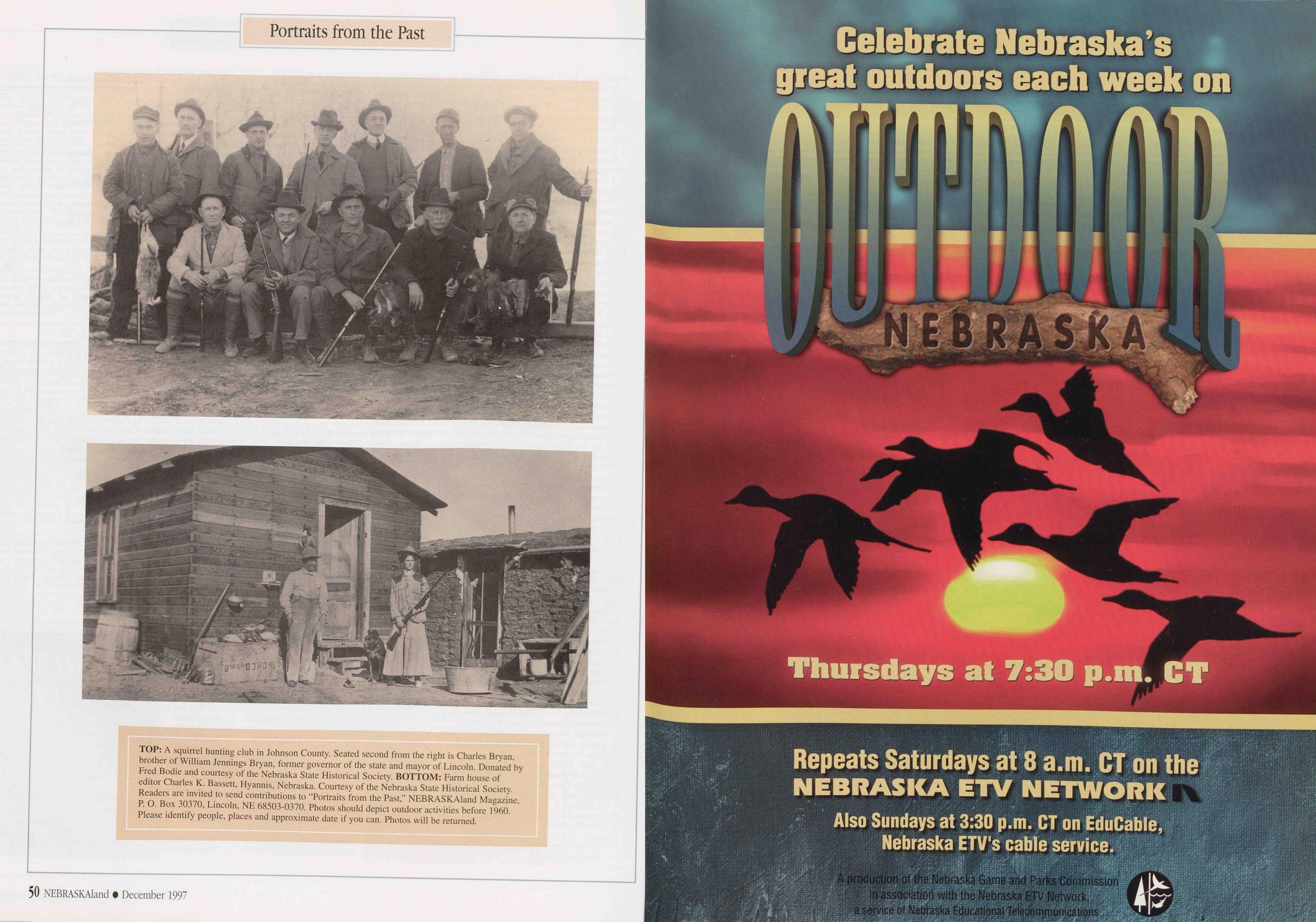
Portraits from the Past
Position: 79 (81 views)