Volume 75, Issue 9, 1997
NEBRASKAland
Nebraska Game & Parks Commission November 1997 $2.00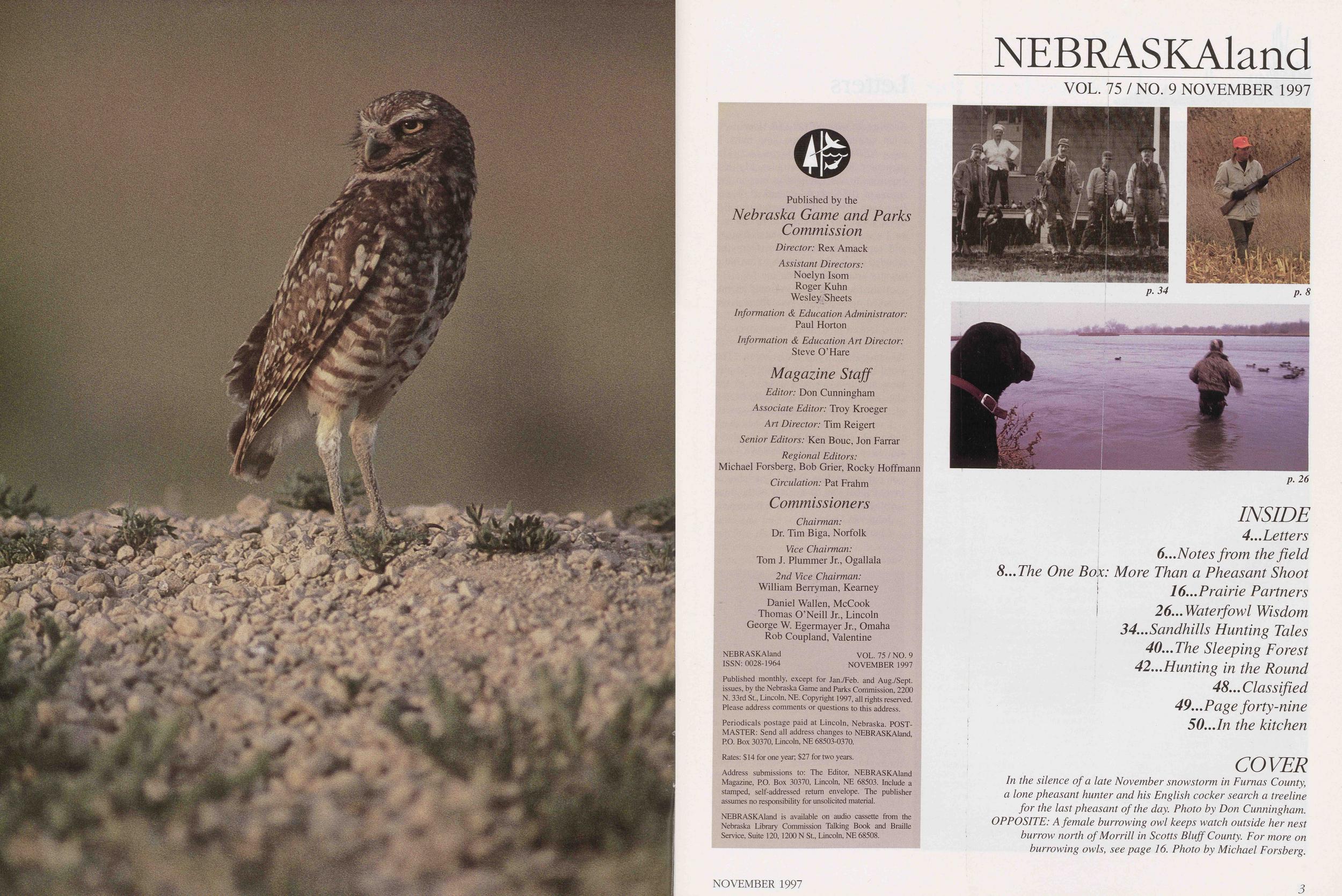
NEBRASKAland
VOL. 75 / NO. 9 NOVEMBER 1997
Published by the Nebraska Game and Parks Commission Director: Rex Amack Assistant Directors: Noelyn Isom Roger Kuhn Wesley Sheets Information & Education Administrator: Paul Horton Information & Education Art Director: Steve O'Hare Magazine Staff Editor: Don Cunningham Associate Editor: Troy Kroeger Art Director: Tim Reigert Senior Editors: Ken Bouc, Jon Farrar Regional Editors: Michael Forsberg, Bob Grier, Rocky Hoffmann Circulation: Pat Frahm Commissioners Chairman: Dr. Tim Biga, Norfolk Vice Chairman: Tom J. Plummer Jr., Ogallala 2nd Vice Chairman: William Berryman, Kearney Daniel Wallen, McCook Thomas O'Neill Jr., Lincoln George W. Egermayer Jr., Omaha Rob Coupland, Valentine NEBRASKAland ISSN: 0028-1964 VOL. 75/NO. 9 NOVEMBER 1997 Published monthly, except for Jan./Feb. and Aug./Sept. issues, by the Nebraska Game and Parks Commission, 2200 N. 33rd St., Lincoln, NE. Copyright 1997, all rights reserved. Please address comments or questions to this address. Periodicals postage paid at Lincoln, Nebraska. POSTMASTER: Send all address changes to NEBRASKAland, P.O. Box 30370, Lincoln, NE 68503-0370. Rates: $14 for one year; $27 for two years. Address submissions to: The Editor, NEBRASKAland Magazine, P.O. Box 30370, Lincoln, NE 68503. Include a stamped, self-addressed return envelope. The publisher assumes no responsibility for unsolicited material. NEBRASKAland is available on audio cassette from the Nebraska Library Commission Talking Book and Braille Service, Suite 120,1200 N St., Lincoln, NE 68508.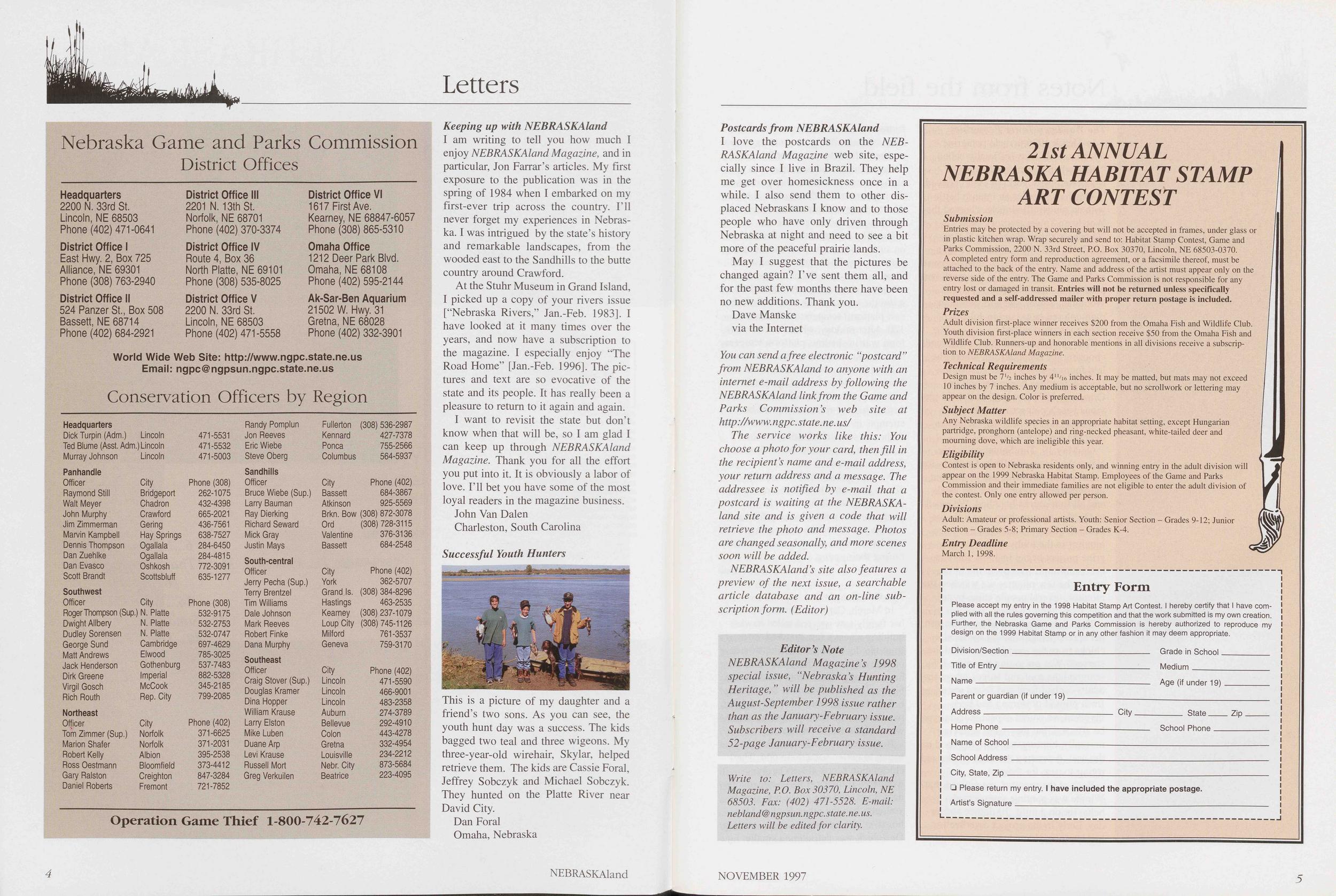
Letters
Keeping up with NEBRASKAlandI am writing to tell you how much I enjoy NEBRASKAland Magazine, and in particular, Jon Farrar's articles. My first exposure to the publication was in the spring of 1984 when I embarked on my first-ever trip across the country. I'll never forget my experiences in Nebraska. I was intrigued by the state's history and remarkable landscapes, from the wooded east to the Sandhills to the butte country around Crawford.
At the Stuhr Museum in Grand Island, I picked up a copy of your rivers issue ["Nebraska Rivers," Jan.-Feb. 1983]. I have looked at it many times over the years, and now have a subscription to the magazine. I especially enjoy "The Road Home" [Jan.-Feb. 1996]. The pictures and text are so evocative of the state and its people. It has really been a pleasure to return to it again and again.
I want to revisit the state but don't know when that will be, so I am glad I can keep up through NEBRASKAland Magazine. Thank you for all the effort you put into it. It is obviously a labor of love. I'll bet you have some of the most loyal readers in the magazine business.
John Van DalenCharleston, South Carolina
Successful Youth HuntersThis is a picture of my daughter and a friend's two sons. As you can see, the youth hunt day was a success. The kids bagged two teal and three wigeons. My three-year-old wirehair, Skylar, helped retrieve them. The kids are Cassie Foral, Jeffrey Sobczyk and Michael Sobczyk. They hunted on the Platte River near David City.
Dan ForalOmaha, Nebraska
4 NEBRASKAland Postcards from NEBRASKAlandI love the postcards on the NEBRASKAland Magazine web site, especially since I live in Brazil. They help me get over homesickness once in a while. I also send them to other displaced Nebraskans I know and to those people who have only driven through Nebraska at night and need to see a bit more of the peaceful prairie lands.
May I suggest that the pictures be changed again? I've sent them all, and for the past few months there have been no new additions. Thank you.
Dave Manskevia the Internet
You can send a free electronic "postcard" from NEBRASKAland to anyone with an internet e-mail address by following the NEBRASKAland link from the Game and Parks Commission's web site at http://www. ngpc. state. ne. us/
The service works like this: You choose a photo for your card, then fill in the recipient's name and e-mail address, your return address and a message. The addressee is notified by e-mail that a postcard is waiting at the NEBRASKAland site and is given a code that will retrieve the photo and message. Photos are changed seasonally, and more scenes soon will be added.
NEBRASKAland's site also features a preview of the next issue, a searchable article database and an on-line subscription form. (Editor)
Editor's Note NEBRASKAland Magazine's 1998 special issue, "Nebraska's Hunting Heritage," will be published as the August-September 1998 issue rather than as the January-February issue. Subscribers will receive a standard 52-page January-February issue. Write to: Letters, NEBRASKAland Magazine, P.O. Box30370, Lincoln, NE 68503. Fax: (402) 471-5528. E-mail: nebland@ngpsun. ngpc. state, ne. us. Letters will be edited for clarity.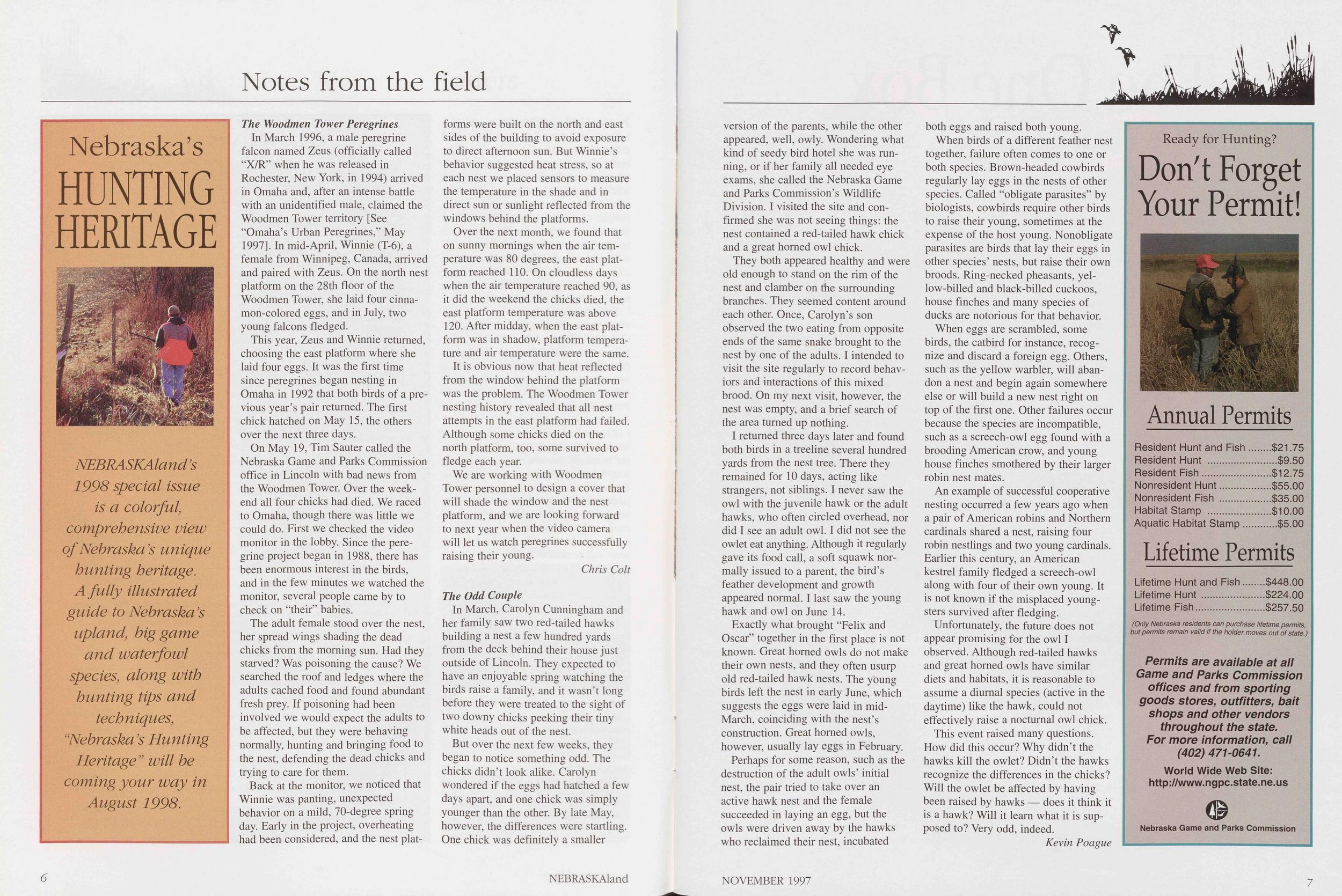
Notes from the field
The Woodmen Tower PeregrinesIn March 1996, a male peregrine falcon named Zeus (officially called "X/R" when he was released in Rochester, New York, in 1994) arrived in Omaha and, after an intense battle with an unidentified male, claimed the Woodmen Tower territory [See "Omaha's Urban Peregrines," May 1997]. In mid-April, Winnie (T-6), a female from Winnipeg, Canada, arrived and paired with Zeus. On the north nest platform on the 28th floor of the Woodmen Tower, she laid four cinnamon-colored eggs, and in July, two young falcons fledged.
This year, Zeus and Winnie returned, choosing the east platform where she laid four eggs. It was the first time since peregrines began nesting in Omaha in 1992 that both birds of a previous year's pair returned. The first chick hatched on May 15, the others over the next three days.
On May 19, Tim Sauter called the Nebraska Game and Parks Commission office in Lincoln with bad news from the Woodmen Tower. Over the week- end all four chicks had died. We raced to Omaha, though there was little we could do. First we checked the video monitor in the lobby. Since the peregrine project began in 1988, there has been enormous interest in the birds, and in the few minutes we watched the monitor, several people came by to check on "their" babies.
The adult female stood over the nest, her spread wings shading the dead chicks from the morning sun. Had they starved? Was poisoning the cause? We searched the roof and ledges where the adults cached food and found abundant fresh prey. If poisoning had been involved we would expect the adults to be affected, but they were behaving normally, hunting and bringing food to the nest, defending the dead chicks and trying to care for them.
Back at the monitor, we noticed that Winnie was panting, unexpected behavior on a mild, 70-degree spring day. Early in the project, overheating had been considered, and the nest platforms were built on the north and east sides of the building to avoid exposure to direct afternoon sun. But Winnie's behavior suggested heat stress, so at each nest we placed sensors to measure the temperature in the shade and in direct sun or sunlight reflected from the windows behind the platforms.
Over the next month, we found that on sunny mornings when the air temperature was 80 degrees, the east platform reached 110. On cloudless days when the air temperature reached 90, as it did the weekend the chicks died, the east platform temperature was above 120. After midday, when the east platform was in shadow, platform temperature and air temperature were the same. It is obvious now that heat reflected from the window behind the platform was the problem. The Woodmen Tower nesting history revealed that all nest attempts in the east platform had failed. Although some chicks died on the north platform, too, some survived to fledge each year.
We are working with Woodmen Tower personnel to design a cover that will shade the window and the nest platform, and we are looking forward to next year when the video camera will let us watch peregrines successfully raising their young.
Chris Colt The Odd CoupleIn March, Carolyn Cunningham and her family saw two red-tailed hawks building a nest a few hundred yards from the deck behind their house just outside of Lincoln. They expected to have an enjoyable spring watching the birds raise a family, and it wasn't long before they were treated to the sight of two downy chicks peeking their tiny white heads out of the nest.
But over the next few weeks, they began to notice something odd. The chicks didn't look alike. Carolyn wondered if the eggs had hatched a few days apart, and one chick was simply younger than the other. By late May, however, the differences were startling. One chick was definitely a smaller 6 NEBRASKAland version of the parents, while the other appeared, well, owly. Wondering what kind of seedy bird hotel she was running, or if her family all needed eye exams, she called the Nebraska Game and Parks Commission's Wildlife Division. I visited the site and confirmed she was not seeing things: the nest contained a red-tailed hawk chick and a great horned owl chick.
They both appeared healthy and were old enough to stand on the rim of the nest and clamber on the surrounding branches. They seemed content around each other. Once, Carolyn's son observed the two eating from opposite ends of the same snake brought to the nest by one of the adults. I intended to visit the site regularly to record behaviors and interactions of this mixed brood. On my next visit, however, the nest was empty, and a brief search of the area turned up nothing.
I returned three days later and found both birds in a treeline several hundred yards from the nest tree. There they remained for 10 days, acting like strangers, not siblings. I never saw the owl with the juvenile hawk or the adult hawks, who often circled overhead, nor did I see an adult owl. I did not see the owlet eat anything. Although it regularly gave its food call, a soft squawk normally issued to a parent, the bird's feather development and growth appeared normal. I last saw the young hawk and owl on June 14.
Exactly what brought "Felix and Oscar" together in the first place is not known. Great horned owls do not make their own nests, and they often usurp old red-tailed hawk nests. The young birds left the nest in early June, which suggests the eggs were laid in mid-March, coinciding with the nest's construction. Great horned owls, however, usually lay eggs in February.
Perhaps for some reason, such as the destruction of the adult owls' initial nest, the pair tried to take over an active hawk nest and the female succeeded in laying an egg, but the owls were driven away by the hawks who reclaimed their nest, incubated both eggs and raised both young. When birds of a different feather nest together, failure often comes to one or both species. Brown-headed cowbirds regularly lay eggs in the nests of other species. Called "obligate parasites" by biologists, cowbirds require other birds to raise their young, sometimes at the expense of the host young. Nonobligate parasites are birds that lay their eggs in other species' nests, but raise their own broods. Ring-necked pheasants, yellow-billed and black-billed cuckoos, house finches and many species of ducks are notorious for that behavior.
When eggs are scrambled, some birds, the catbird for instance, recognize and discard a foreign egg. Others, such as the yellow warbler, will abandon a nest and begin again somewhere else or will build a new nest right on top of the first one. Other failures occur because the species are incompatible, such as a screech-owl egg found with a brooding American crow, and young house finches smothered by their larger robin nest mates.
An example of successful cooperative nesting occurred a few years ago when a pair of American robins and Northern cardinals shared a nest, raising four robin nestlings and two young cardinals. Earlier this century, an American kestrel family fledged a screech-owl along with four of their own young. It is not known if the misplaced youngsters survived after fledging.
Unfortunately, the future does not appear promising for the owl I observed. Although red-tailed hawks and great horned owls have similar diets and habitats, it is reasonable to assume a diurnal species (active in the daytime) like the hawk, could not effectively raise a nocturnal owl chick.
This event raised many questions. How did this occur? Why didn't the hawks kill the owlet? Didn't the hawks recognize the differences in the chicks? Will the owlet be affected by having been raised by hawks — does it think it is a hawk? Will it learn what it is supposed to? Very odd, indeed.
Kevin Poague
The One Box
More Than a Pheasant Shoot
Since 1961, the Nebraska One Box Pheasant Hunt has drawn celebrities from across the country. Beneath the glitter is a mission of conservation and community improvement.
A pickup filled with orange-clad hunters, dogs and dog handlers, guides, a scorekeeper and a television crew bounced across a meadow in northeastern Custer County. Only a vague promise of sunrise glowed on the overcast eastern horizon, but it was shooting time on the second Saturday of the 1996 pheasant season.
Pickup doors were nudged shut and hunters spoke in whispers; then came the most delightful of sounds to fall on the ears of a bird hunter or a bird dog, the muted thunk of shotshells dropped into the tubes of an over-and-under and the oily squeak of the magazine springs of pumps and automatics. Released from its kennel, a yellow Lab bounded in widening circles, delighting in the morning's sights, sounds and smells. Perhaps the faint scent of pheasants already wafted on the morning breeze.
Five hunters formed a line and moved through a grove of cottonwoods and young cedars in a field of waist-high native grass. A cock pheasant, caught in its bed, erupted. Nebraska Governor Ben Nelson shouldered his shotgun and fired one shot. The bird glided down on the other side of the cottonwoods, and minutes later the Lab found and retrieved the dead bird. The scorekeeper recorded the time and five points were awarded to the Governor's Nebraska Team.
Fifty miles south, General Steve Ritchie, a Vietnam War fighter ace, and pitching great Rich "Goose" Gossage crashed through river-bottom weed patches determined to best the Governor's team and the other six in the field. The 36th annual Nebraska One Box Pheasant Hunt was officially under way.
In the BeginningThe Nebraska One Box Pheasant Hunt is the state's oldest celebrity or competition hunt, and claims to be the second oldest in the nation, second only to the Lander, Wyoming, One-Shot Antelope Hunt. That, in a fashion, was its inspiration. In the late 1950s, Broken Bow banker Tom Varney Jr. was a shooter in the Wyoming hunt.
"Tom came back with the idea that something like that would be great in Nebraska, only with the pheasants," recalled Grace Varney, daughter-in-law of the hunt's founder, and its unofficial historian. "He put his mind to it and got this thing organized. He thought it would be good for the community, Custer County and central Nebraska. But more than that, good sportsmanship, good hunting and good comradeship was to be, and has been, at the heart of the One Box."
"Broken Bow was a Saturday town in those days. Everybody worked all day Saturday, and farm families came to town to sell their produce and do their shopping," retired Broken Bow dentist Bill Arnold remembered. "Tom called me Friday afternoon, the day before the first hunt, and asked if I could be guide and bird dog for a team. I changed a bunch of appointments and did it. I've been involved with the One Box every year since."
Some details of the first hunt might not have been in place until the last minute, but newspaper clippings and photos suggest plans had been made. The 1930 Model-A Ford "Pheasant Hunter's Taxi," still used today, was festooned with the silhouette of a flushing pheasant and available for in-town transportation. Six teams had been invited to compete, but only five, representing Kansas, Nebraska, Oklahoma, Texas and Wyoming, made it to Broken Bow the first year, and with just cause.
"Broken Bow's One-Box Pheasant Hunt almost died 'aborning on Nov. 16, 1961, when cold winds and a typical November blizzard swept over the area," a 1965 brochure recounts. The airport was socked in, and participants who planned on flying in scrambled to find other transportation. Three teams arrived in the night, barely in time for the hunter's breakfast. When the shooting was over, the Wyoming team
Baseball pitching great Rich "Goose" Gossage, left, and Vietnam War fighter ace General Steve Richie were 1996 One Box shooters. 8 NEBRASKAland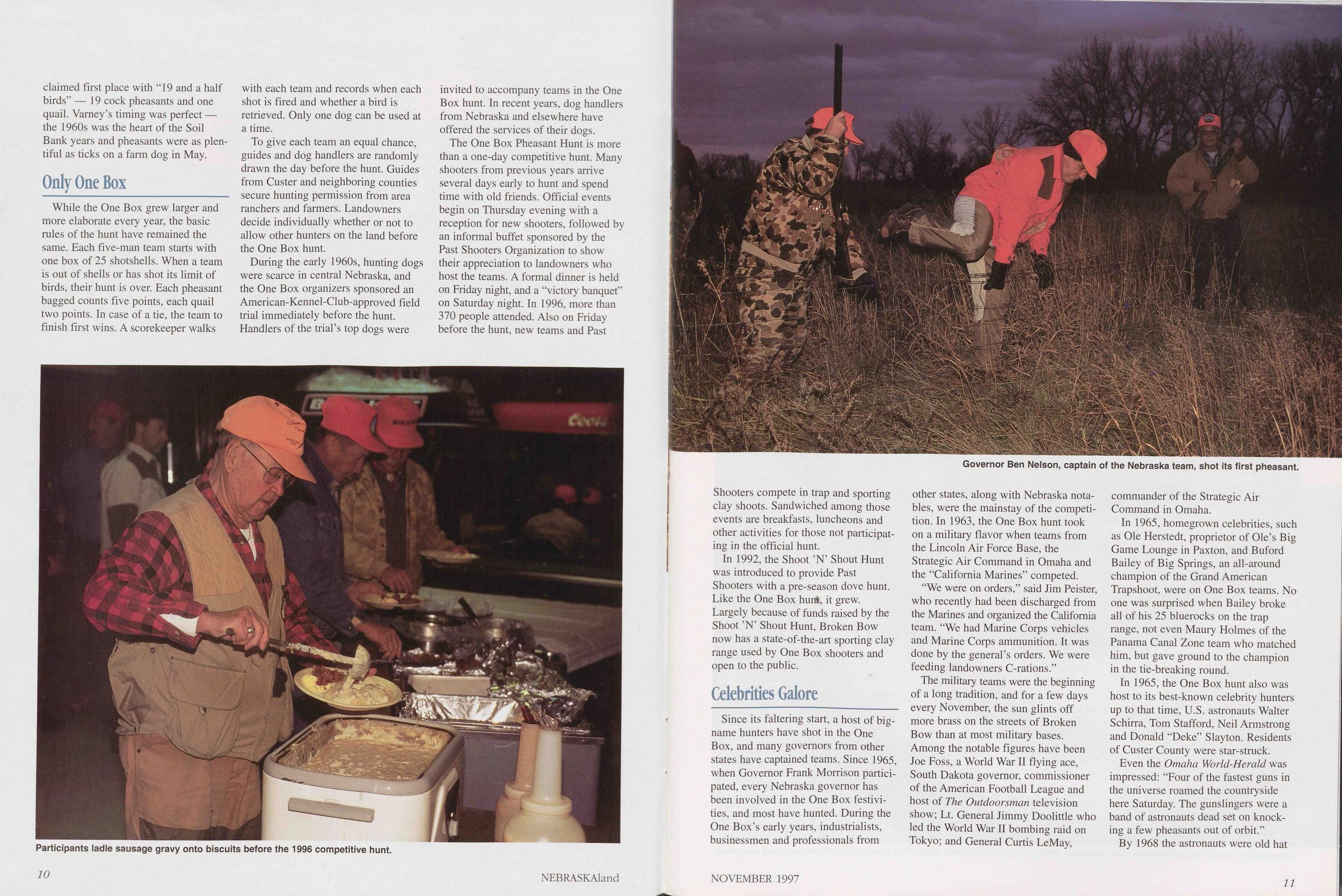
claimed first place with "19 and a half birds" — 19 cock pheasants and one quail. Varney's timing was perfect — the 1960s was the heart of the Soil Bank years and pheasants were as plentiful as ticks on a farm dog in May.
Only One BoxWhile the One Box grew larger and more elaborate every year, the basic rules of the hunt have remained the same. Each five-man team starts with one box of 25 shotshells. When a team is out of shells or has shot its limit of birds, their hunt is over. Each pheasant bagged counts five points, each quail two points. In case of a tie, the team to finish first wins. A scorekeeper walks with each team and records when each shot is fired and whether a bird is retrieved. Only one dog can be used at a time.
To give each team an equal chance, guides and dog handlers are randomly drawn the day before the hunt. Guides from Custer and neighboring counties secure hunting permission from area ranchers and farmers. Landowners decide individually whether or not to allow other hunters on the land before the One Box hunt.
During the early 1960s, hunting dogs were scarce in central Nebraska, and the One Box organizers sponsored an American-Kennel-Club-approved field trial immediately before the hunt. Handlers of the trial's top dogs were invited to accompany teams in the One Box hunt. In recent years, dog handlers from Nebraska and elsewhere have offered the services of their dogs.
The One Box Pheasant Hunt is more than a one-day competitive hunt. Many shooters from previous years arrive several days early to hunt and spend time with old friends. Official events begin on Thursday evening with a reception for new shooters, followed by an informal buffet sponsored by the Past Shooters Organization to show their appreciation to landowners who host the teams. A formal dinner is held on Friday night, and a "victory banquet" on Saturday night. In 1996, more than 370 people attended. Also on Friday before the hunt, new teams and Past
Participants ladle sausage gravy onto biscuits before the 1996 competitive hunt.
Governor Ben Nelson, captain of the Nebraska team, shot its first pheasant.
Shooters compete in trap and sporting clay shoots. Sandwiched among those events are breakfasts, luncheons and other activities for those not participating in the official hunt.
In 1992, the Shoot 'N' Shout Hunt was introduced to provide Past Shooters with a pre-season dove hunt. Like the One Box hunt, it grew. Largely because of funds raised by the Shoot 'N' Shout Hunt, Broken Bow now has a state-of-the-art sporting clay range used by One Box shooters and open to the public.
Celebrities GaloreSince its faltering start, a host of bigname hunters have shot in the One Box, and many governors from other states have captained teams. Since 1965, when Governor Frank Morrison participated, every Nebraska governor has been involved in the One Box festivities, and most have hunted. During the One Box's early years, industrialists, businessmen and professionals from other states, along with Nebraska notables, were the mainstay of the competition. In 1963, the One Box hunt took on a military flavor when teams from the Lincoln Air Force Base, the Strategic Air Command in Omaha and the "California Marines" competed.
"We were on orders," said Jim Peister, who recently had been discharged from the Marines and organized the California team. "We had Marine Corps vehicles and Marine Corps ammunition. It was done by the general's orders. We were feeding landowners C-rations."
The military teams were the beginning of a long tradition, and for a few days every November, the sun glints off more brass on the streets of Broken Bow than at most military bases. Among the notable figures have been Joe Foss, a World War II flying ace, South Dakota governor, commissioner of the American Football League and host of The Outdoorsman television show; Lt. General Jimmy Doolittle who led the World War II bombing raid on Tokyo; and General Curtis LeMay, commander of the Strategic Air Command in Omaha.
In 1965, homegrown celebrities, such as Ole Herstedt, proprietor of Ole's Big Game Lounge in Paxton, and Buford Bailey of Big Springs, an all-around champion of the Grand American Trapshoot, were on One Box teams. No one was surprised when Bailey broke all of his 25 bluerocks on the trap range, not even Maury Holmes of the Panama Canal Zone team who matched him, but gave ground to the champion in the tie-breaking round.
In 1965, the One Box hunt also was host to its best-known celebrity hunters up to that time, U.S. astronauts Walter Schirra, Tom Stafford, Neil Armstrong and Donald "Deke" Slayton. Residents of Custer County were star-struck.
Even the Omaha World-Herald was impressed: "Four of the fastest guns in the universe roamed the countryside here Saturday. The gunslingers were a band of astronauts dead set on knocking a few pheasants out of orbit." By 1968 the astronauts were old hat
NOVEMBER 1997 11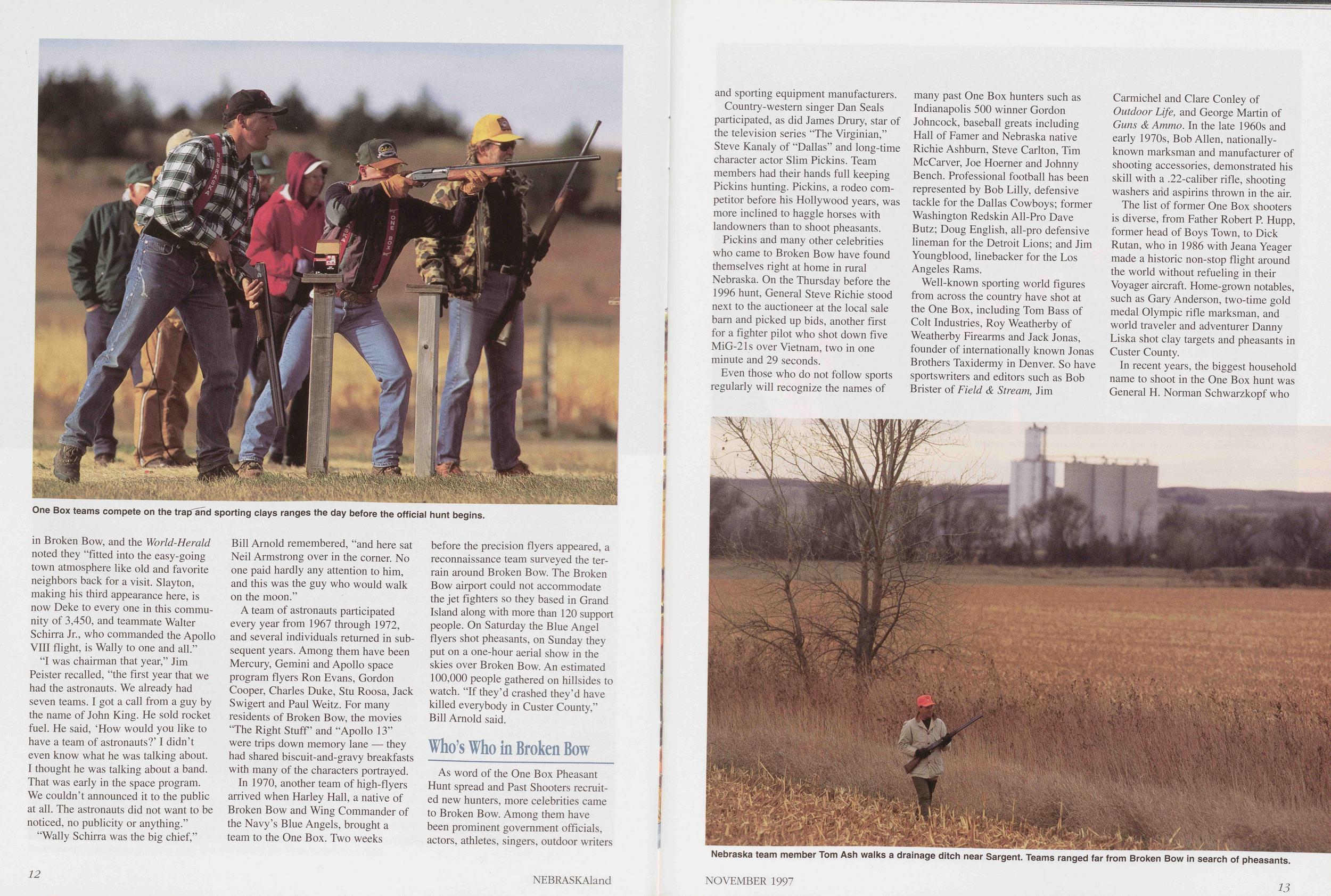
One Box teams compete on the trap'and sporting clays ranges the day before the official hunt begins.
in Broken Bow, and the World-Herald noted they "fitted into the easy-going town atmosphere like old and favorite neighbors back for a visit. Slayton, making his third appearance here, is now Deke to every one in this community of 3,450, and teammate Walter Schirra Jr., who commanded the Apollo VIII flight, is Wally to one and all."
"I was chairman that year," Jim Peister recalled, "the first year that we had the astronauts. We already had seven teams. I got a call from a guy by the name of John King. He sold rocket fuel. He said, 'How would you like to have a team of astronauts?' I didn't even know what he was talking about. I thought he was talking about a band. That was early in the space program. We couldn't announced it to the public at all. The astronauts did not want to be noticed, no publicity or anything."
"Wally Schirra was the big chief," Bill Arnold remembered, "and here sat Neil Armstrong over in the corner. No one paid hardly any attention to him, and this was the guy who would walk on the moon."
A team of astronauts participated every year from 1967 through 1972, and several individuals returned in subsequent years. Among them have been Mercury, Gemini and Apollo space program flyers Ron Evans, Gordon Cooper, Charles Duke, Stu Roosa, Jack Swigert and Paul Weitz. For many residents of Broken Bow, the movies "The Right Stuff and "Apollo 13" were trips down memory lane — they had shared biscuit-and-gravy breakfasts with many of the characters portrayed.
In 1970, another team of high-flyers arrived when Harley Hall, a native of Broken Bow and Wing Commander of the Navy's Blue Angels, brought a team to the One Box. Two weeks before the precision flyers appeared, a reconnaissance team surveyed the terrain around Broken Bow. The Broken Bow airport could not accommodate the jet fighters so they based in Grand Island along with more than 120 support people. On Saturday the Blue Angel flyers shot pheasants, on Sunday they put on a one-hour aerial show in the skies over Broken Bow. An estimated 100,000 people gathered on hillsides to watch. "If they'd crashed they'd have killed everybody in Custer County," Bill Arnold said.
Who's Who in Broken BowAs word of the One Box Pheasant Hunt spread and Past Shooters recruited new hunters, more celebrities came to Broken Bow. Among them have been prominent government officials, actors, athletes, singers, outdoor writers 12 NEBRASKAland and sporting equipment manufacturers.
Country-western singer Dan Seals participated, as did James Drury, star of the television series "The Virginian," Steve Kanaly of "Dallas" and long-time character actor Slim Pickins. Team members had their hands full keeping Pickins hunting. Pickins, a rodeo competitor before his Hollywood years, was more inclined to haggle horses with landowners than to shoot pheasants.
Pickins and many other celebrities who came to Broken Bow have found themselves right at home in rural Nebraska. On the Thursday before the 1996 hunt, General Steve Richie stood next to the auctioneer at the local sale barn and picked up bids, another first for a fighter pilot who shot down five MiG-21s over Vietnam, two in one minute and 29 seconds.
Even those who do not follow sports regularly will recognize the names of many past One Box hunters such as Indianapolis 500 winner Gordon Johncock, baseball greats including Hall of Famer and Nebraska native Richie Ashburn, Steve Carlton, Tim McCarver, Joe Hoerner and Johnny Bench. Professional football has been represented by Bob Lilly, defensive tackle for the Dallas Cowboys; former Washington Redskin All-Pro Dave Butz; Doug English, all-pro defensive lineman for the Detroit Lions; and Jim Youngblood, linebacker for the Los Angeles Rams.
Well-known sporting world figures from across the country have shot at the One Box, including Tom Bass of Colt Industries, Roy Weatherby of Weatherby Firearms and Jack Jonas, founder of internationally known Jonas Brothers Taxidermy in Denver. So have sports writers and editors such as Bob Brister of Field & Stream, Jim Carmichel and Clare Conley of Outdoor Life, and George Martin of Guns & Ammo. In the late 1960s and early 1970s, Bob Allen, nationally-known marksman and manufacturer of shooting accessories, demonstrated his skill with a .22-caliber rifle, shooting washers arid aspirins thrown in the air.
The list of former One Box shooters is diverse, from Father Robert P. Hupp, former head of Boys Town, to Dick Rutan, who in 1986 with Jeana Yeager made a historic non-stop flight around the world without refueling in their Voyager aircraft. Home-grown notables, such as Gary Anderson, two-time gold medal Olympic rifle marksman, and world traveler and adventurer Danny Liska shot clay targets and pheasants in Custer County.
In recent years, the biggest household name to shoot in the One Box hunt was General H. Norman Schwarzkopf who
Nebraska team member Tom Ash walks a drainage ditch near Sargent. Teams ranged far from Broken Bow in search of pheasants.
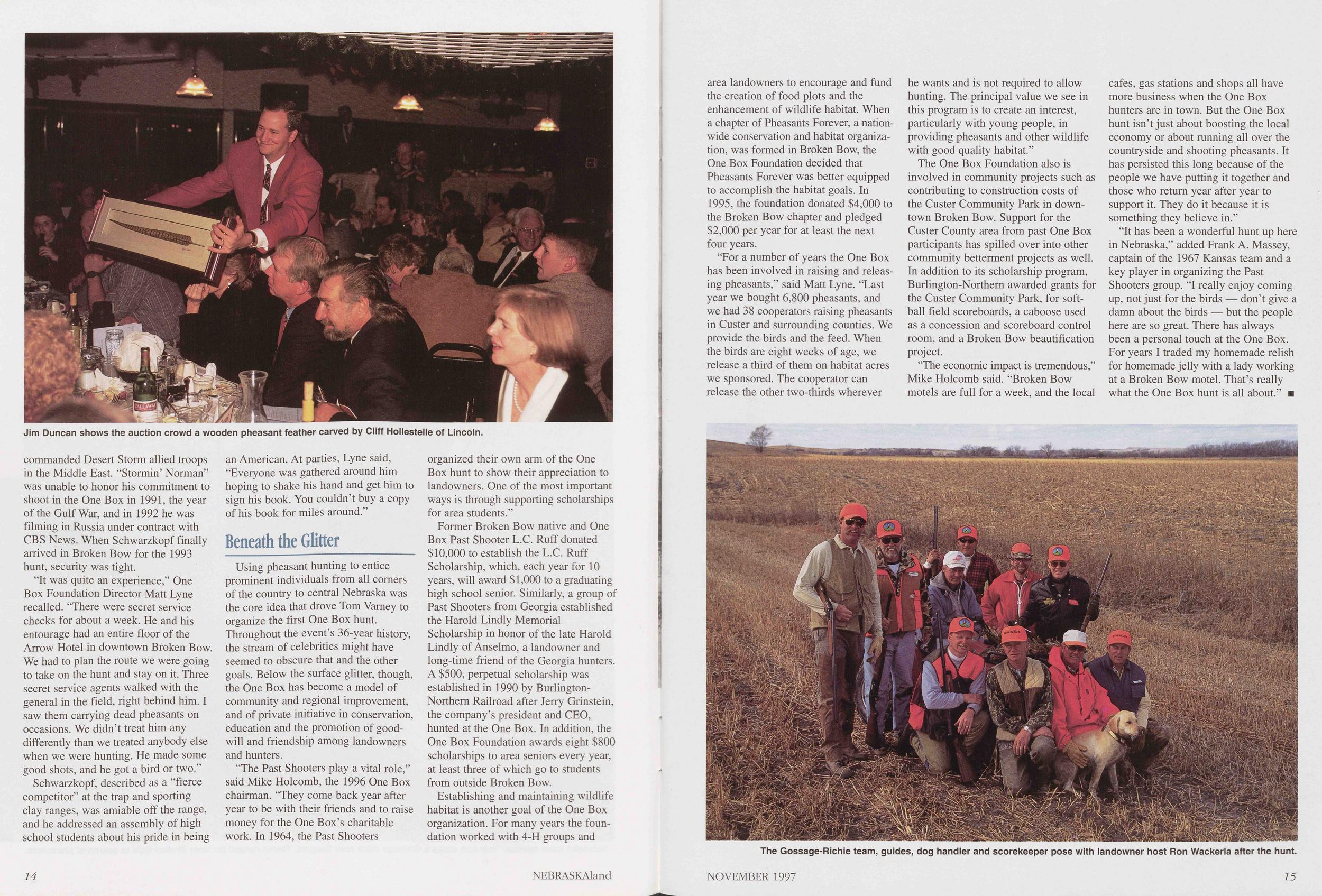
Jim Duncan shows the auction crowd a wooden pheasant feather carved by Cliff Hollestelle of Lincoln.
commanded Desert Storm allied troops in the Middle East. "Stormin' Norman" was unable to honor his commitment to shoot in the One Box in 1991, the year of the Gulf War, and in 1992 he was filming in Russia under contract with CBS News. When Schwarzkopf finally arrived in Broken Bow for the 1993 hunt, security was tight.
"It was quite an experience," One Box Foundation Director Matt Lyne recalled. "There were secret service checks for about a week. He and his entourage had an entire floor of the Arrow Hotel in downtown Broken Bow. We had to plan the route we were going to take on the hunt and stay on it. Three secret service agents walked with the general in the field, right behind him. I saw them carrying dead pheasants on occasions. We didn't treat him any differently than we treated anybody else when we were hunting. He made some good shots, and he got a bird or two."
Schwarzkopf, described as a "fierce competitor" at the trap and sporting clay ranges, was amiable off the range, and he addressed an assembly of high school students about his pride in being an American. At parties, Lyne said, "Everyone was gathered around him hoping to shake his hand and get him to sign his book. You couldn't buy a copy of his book for miles around."
Beneath the GlitterUsing pheasant hunting to entice prominent individuals from all corners of the country to central Nebraska was the core idea that drove Tom Varney to organize the first One Box hunt. Throughout the event's 36-year history, the stream of celebrities might have seemed to obscure that and the other goals. Below the surface glitter, though, the One Box has become a model of community and regional improvement, and of private initiative in conservation, education and the promotion of goodwill and friendship among landowners and hunters.
"The Past Shooters play a vital role," said Mike Holcomb, the 1996 One Box chairman. "They come back year after year to be with their friends and to raise money for the One Box's charitable work. In 1964, the Past Shooters organized their own arm of the One Box hunt to show their appreciation to landowners. One of the most important ways is through supporting scholarships for area students."
Former Broken Bow native and One Box Past Shooter L.C. Ruff donated $10,000 to establish the L.C. Ruff Scholarship, which, each year for 10 years, will award $1,000 to a graduating high school senior. Similarly, a group of Past Shooters from Georgia established the Harold Lindly Memorial Scholarship in honor of the late Harold Lindly of Anselmo, a landowner and long-time friend of the Georgia hunters. A $500, perpetual scholarship was established in 1990 by Burlington-Northern Railroad after Jerry Grinstein, the company's president and CEO, hunted at the One Box. In addition, the One Box Foundation awards eight $800 scholarships to area seniors every year, at least three of which go to students from outside Broken Bow.
Establishing and maintaining wildlife habitat is another goal of the One Box organization. For many years the foundation worked with 4-H groups and 14 NEBRASKAland area landowners to encourage and fund the creation of food plots and the enhancement of wildlife habitat. When a chapter of Pheasants Forever, a nationwide conservation and habitat organization, was formed in Broken Bow, the One Box Foundation decided that Pheasants Forever was better equipped to accomplish the habitat goals. In 1995, the foundation donated $4,000 to the Broken Bow chapter and pledged $2,000 per year for at least the next four years.
"For a number of years the One Box has been involved in raising and releasing pheasants," said Matt Lyne. "Last year we bought 6,800 pheasants, and we had 38 cooperators raising pheasants in Custer and surrounding counties. We provide the birds and the feed. When the birds are eight weeks of age, we release a third of them on habitat acres we sponsored. The cooperator can release the other two-thirds wherever he wants and is not required to allow hunting. The principal value we see in this program is to create an interest, particularly with young people, in providing pheasants and other wildlife with good quality habitat."
The One Box Foundation also is involved in community projects such as contributing to construction costs of the Custer Community Park in downtown Broken Bow. Support for the Custer County area from past One Box participants has spilled over into other community betterment projects as well. In addition to its scholarship program, Burlington-Northern awarded grants for the Custer Community Park, for softball field scoreboards, a caboose used as a concession and scoreboard control room, and a Broken Bow beautification project.
"The economic impact is tremendous," Mike Holcomb said. "Broken Bow motels are full for a week, and the local cafes, gas stations and shops all have more business when the One Box hunters are in town. But the One Box hunt isn't just about boosting the local economy or about running all over the countryside and shooting pheasants. It has persisted this long because of the people we have putting it together and those who return year after year to support it. They do it because it is something they believe in."
"It has been a wonderful hunt up here in Nebraska," added Frank A. Massey, captain of the 1967 Kansas team and a key player in organizing the Past Shooters group. "I really enjoy coming up, not just for the birds — don't give a damn about the birds — but the people here are so great. There has always been a personal touch at the One Box. For years I traded my homemade relish for homemade jelly with a lady working at a Broken Bow motel. That's really what the One Box hunt is all about."
The Gossage-Richie team, guides, dog handler and scorekeeper pose with landowner host Ron Wackerla after the hunt.
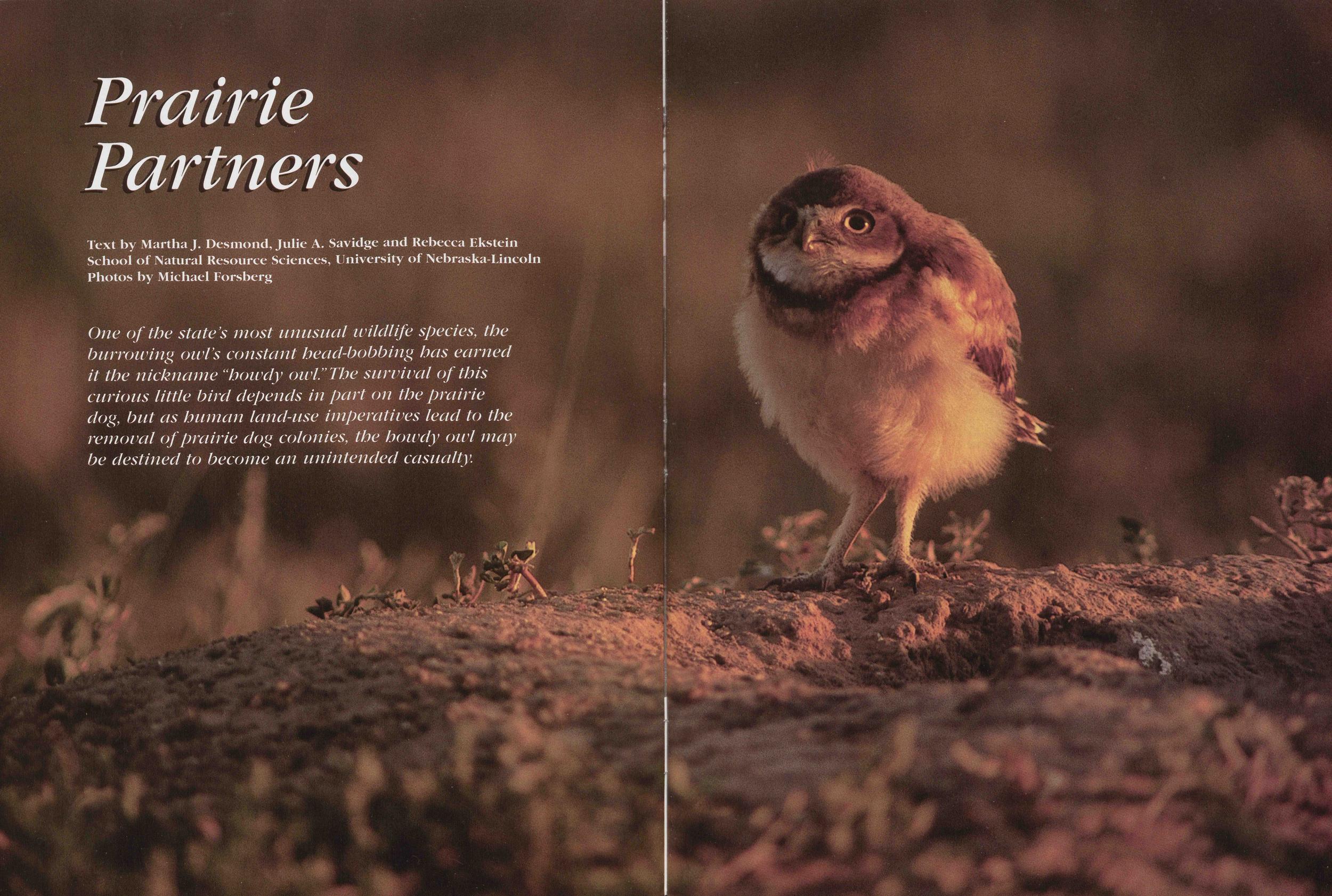
Prarie Partners
One of the state's most unusual wildlife species, the burrowing owl's constant head-bobbing has earned it the nickname "howdy owl"The survived of this curious little bird depends in part on the prairie dog, but as human land-use imperatives lead to the removed of prairie dog colonies, the howdy owl may be destined to become an unintended casualty.
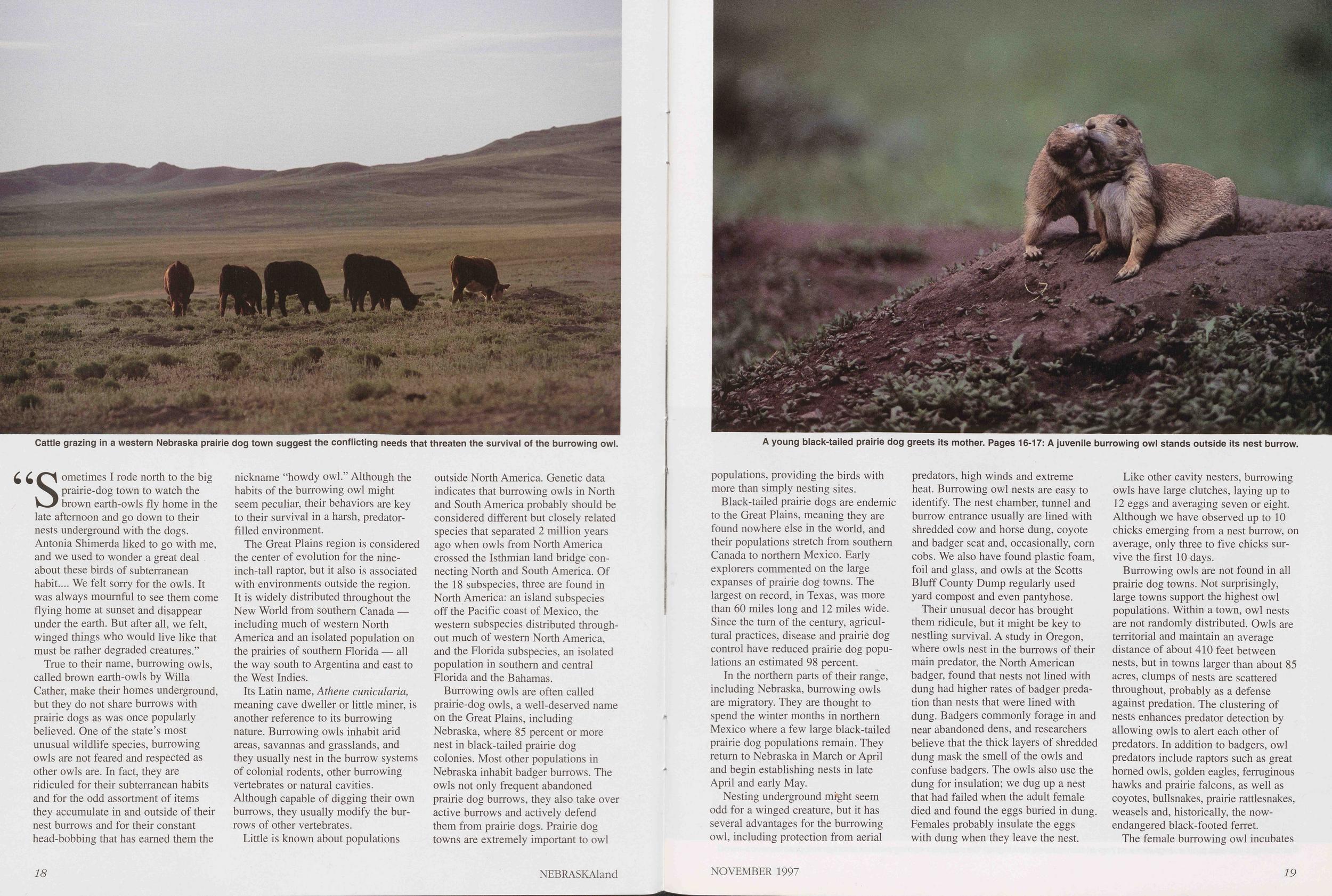
Cattle grazing in a western Nebraska prairie dog town suggest the conflicting needs that threaten the survival of the burrowing owl.
Sometimes I rode north to the big prairie-dog town to watch the brown earth-owls fly home in the late afternoon and go down to their nests underground with the dogs. Antonia Shimerda liked to go with me, and we used to wonder a great deal about these birds of subterranean habit.... We felt sorry for the owls. It was always mournful to see them come flying home at sunset and disappear under the earth. But after all, we felt, winged things who would live like that must be rather degraded creatures."
True to their name, burrowing owls, called brown earth-owls by Willa Cather, make their homes underground, but they do not share burrows with prairie dogs as was once popularly believed. One of the state's most unusual wildlife species, burrowing owls are not feared and respected as other owls are. In fact, they are ridiculed for their subterranean habits and for the odd assortment of items they accumulate in and outside of their nest burrows and for their constant head-bobbing that has earned them the nickname "howdy owl." Although the habits of the burrowing owl might seem peculiar, their behaviors are key to their survival in a harsh, predator-filled environment.
The Great Plains region is considered the center of evolution for the nine-inch-tall raptor, but it also is associated with environments outside the region. It is widely distributed throughout the New World from southern Canada — including much of western North America and an isolated population on the prairies of southern Florida — all the way south to Argentina and east to the West Indies.
Its Latin name, Athene cunicularia, meaning cave dweller or little miner, is another reference to its burrowing nature. Burrowing owls inhabit arid areas, savannas and grasslands, and they usually nest in the burrow systems of colonial rodents, other burrowing vertebrates or natural cavities. Although capable of digging their own burrows, they usually modify the burrows of other vertebrates.
Little is known about populations outside North America. Genetic data indicates that burrowing owls in North and South America probably should be considered different but closely related species that separated 2 million years ago when owls from North America crossed the Isthmian land bridge connecting North and South America. Of the 18 subspecies, three are found in North America: an island subspecies off the Pacific coast of Mexico, the western subspecies distributed throughout much of western North America, and the Florida subspecies, an isolated population in southern and central Florida and the Bahamas.
A young black-tailed prairie dog greets its mother. Pages 16-17: A juvenile burrowing owl stands outside its nest burrow.
Black-tailed prairie dogs are endemic to the Great Plains, meaning they are found nowhere else in the world, and their populations stretch from southern Canada to northern Mexico. Early explorers commented on the large expanses of prairie dog towns. The largest on record, in Texas, was more than 60 miles long and 12 miles wide. Since the turn of the century, agricultural practices, disease and prairie dog control have reduced prairie dog populations an estimated 98 percent.
In the northern parts of their range, including Nebraska, burrowing owls are migratory. They are thought to spend the winter months in northern Mexico where a few large black-tailed prairie dog populations remain. They return to Nebraska in March or April and begin establishing nests in late April and early May.
Nesting underground might seem odd for a winged creature, but it has several advantages for the burrowing owl, including protection from aerial predators, high winds and extreme heat. Burrowing owl nests are easy to identify. The nest chamber, tunnel and burrow entrance usually are lined with shredded cow and horse dung, coyote and badger scat and, occasionally, corn cobs. We also have found plastic foam, foil and glass, and owls at the Scotts Bluff County Dump regularly used yard compost and even pantyhose.
Their unusual decor has brought them ridicule, but it might be key to nestling survival. A study in Oregon, where owls nest in the burrows of their main predator, the North American badger, found that nests not lined with dung had higher rates of badger predation than nests that were lined with dung. Badgers commonly forage in and near abandoned dens, and researchers believe that the thick layers of shredded dung mask the smell of the owls and confuse badgers. The owls also use the dung for insulation; we dug up a nest that had failed when the adult female died and found the eggs buried in dung. Females probably insulate the eggs with dung when they leave the nest.
Like other cavity nesters, burrowing owls have large clutches, laying up to 12 eggs and averaging seven or eight. Although we have observed up to 10 chicks emerging from a nest burrow, on average, only three to five chicks survive the first 10 days.
Burrowing owls are not found in all prairie dog towns. Not surprisingly, large towns support the highest owl populations. Within a town, owl nests are not randomly distributed. Owls are territorial and maintain an average distance of about 410 feet between nests, but in towns larger than about 85 acres, clumps of nests are scattered throughout, probably as a defense against predation. The clustering of nests enhances predator detection by allowing owls to alert each other of predators. In addition to badgers, owl predators include raptors such as great horned owls, golden eagles, ferruginous hawks and prairie falcons, as well as coyotes, bullsnakes, prairie rattlesnakes, weasels and, historically, the now-endangered black-footed ferret.
The female burrowing owl incubates
NOVEMBER 1997 19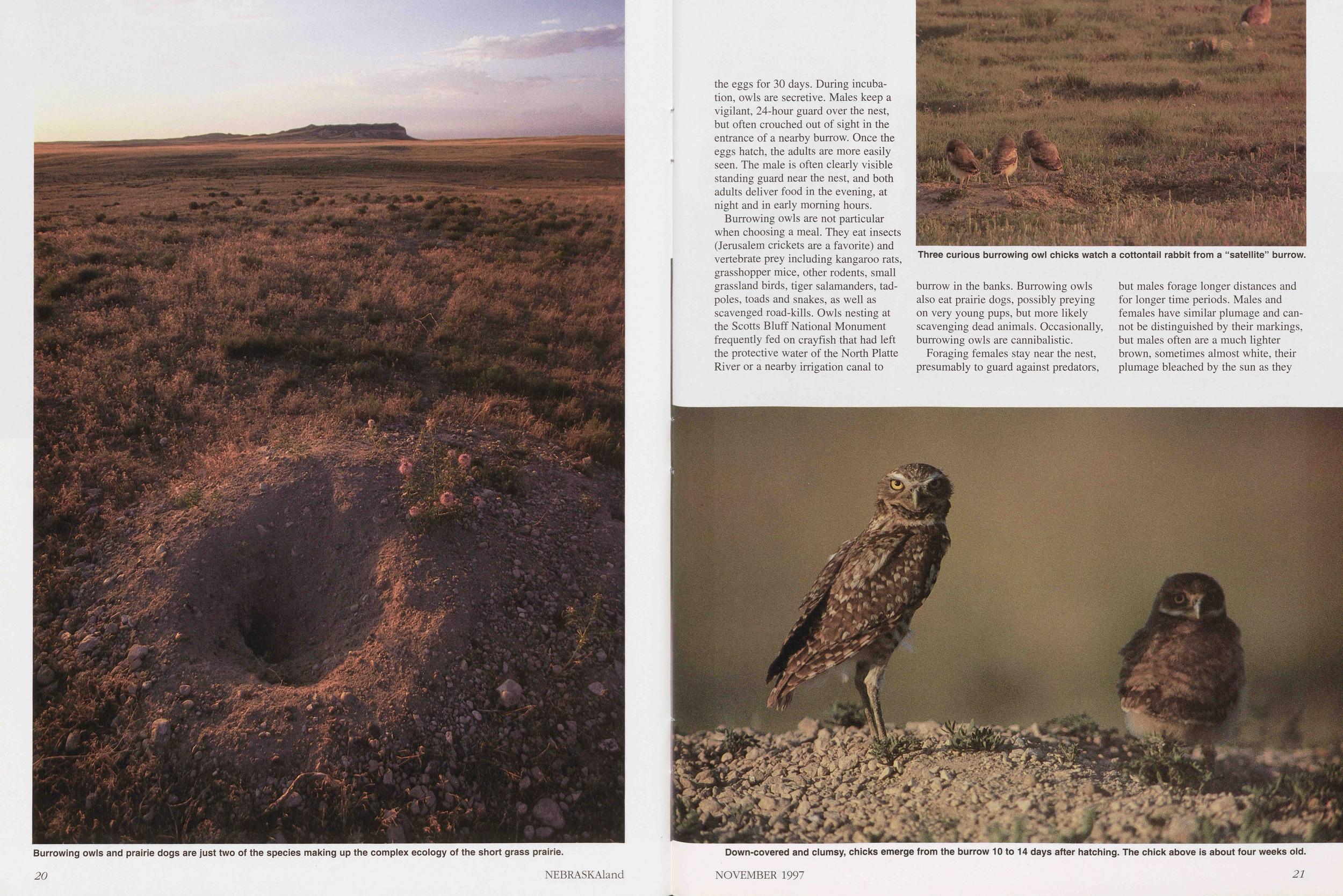
Burrowing owls and prairie dogs are just two of the species making up the complex ecology of the short grass prairie.
the eggs for 30 days. During incubation, owls are secretive. Males keep a vigilant, 24-hour guard over the nest, but often crouched out of sight in the entrance of a nearby burrow. Once the eggs hatch, the adults are more easily seen. The male is often clearly visible standing guard near the nest, and both adults deliver food in the evening, at night and in early morning hours.
Three curious burrowing owl chicks watch a cottontail rabbit from a "satellite" burrow.
Foraging females stay near the nest, presumably to guard against predators, but males forage longer distances and for longer time periods. Males and females have similar plumage and cannot be distinguished by their markings, but males often are a much lighter brown, sometimes almost white, their plumage bleached by the sun as they
Down-covered and clumsy, chicks emerge from the burrow 10 to 14 days after hatching. The chick above is about four weeks old.
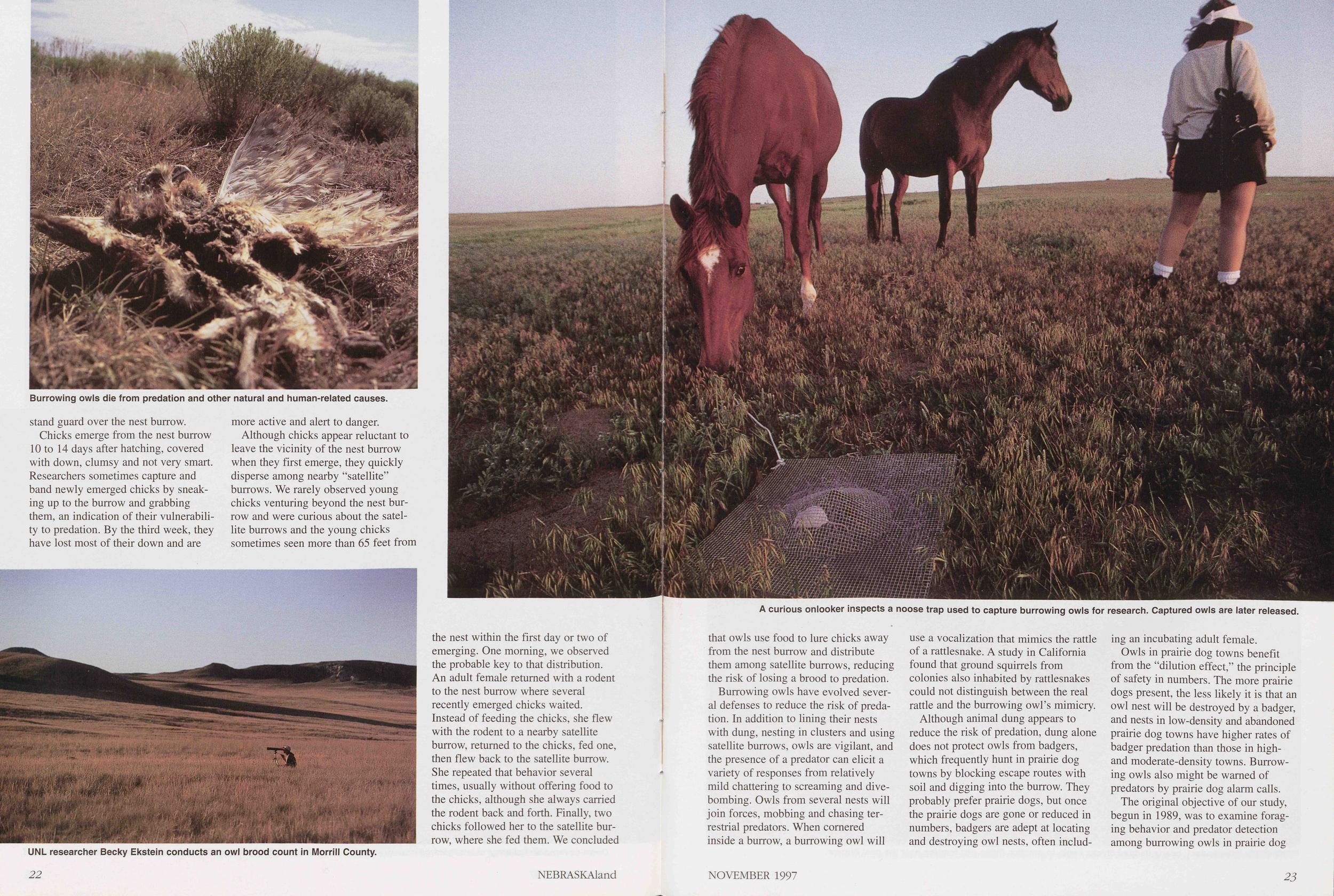
Burrowing owls die from predation and other natural and human-related causes.
stand guard over the nest burrow.
Chicks emerge from the nest burrow 10 to 14 days after hatching, covered with down, clumsy and not very smart. Researchers sometimes capture and band newly emerged chicks by sneaking up to the burrow and grabbing them, an indication of their vulnerability to predation. By the third week, they have lost most of their down and are more active and alert to danger.
Although chicks appear reluctant to leave the vicinity of the nest burrow when they first emerge, they quickly disperse among nearby "satellite" burrows. We rarely observed young chicks venturing beyond the nest burrow and were curious about the satellite burrows and the young chicks sometimes seen more than 65 feet from the nest within the first day or two of emerging. One morning, we observed the probable key to that distribution. An adult female returned with a rodent to the nest burrow where several recently emerged chicks waited. Instead of feeding the chicks, she flew with the rodent to a nearby satellite burrow, returned to the chicks, fed one, then flew back to the satellite burrow. She repeated that behavior several times, usually without offering food to the chicks, although she always carried the rodent back and forth. Finally, two chicks followed her to the satellite burrow, where she fed them. We concluded
UNL researcher Becky Ekstein conducts an owl brood count in Morrill County.
A curious onlooker inspects a noose trap used to capture burrowing owls for research. Captured owls are later released.
that owls use food to lure chicks away from the nest burrow and distribute them among satellite burrows, reducing the risk of losing a brood to predation.
Burrowing owls have evolved several defenses to reduce the risk of predation. In addition to lining their nests with dung, nesting in clusters and using satellite burrows, owls are vigilant, and the presence of a predator can elicit a variety of responses from relatively mild chattering to screaming and divebombing. Owls from several nests will join forces, mobbing and chasing terrestrial predators. When cornered inside a burrow, a burrowing owl will use a vocalization that mimics the rattle of a rattlesnake. A study in California found that ground squirrels from colonies also inhabited by rattlesnakes could not distinguish between the real rattle and the burrowing owl's mimicry.
Although animal dung appears to reduce the risk of predation, dung alone does not protect owls from badgers, which frequently hunt in prairie dog towns by blocking escape routes with soil and digging into the burrow. They probably prefer prairie dogs, but once the prairie dogs are gone or reduced in numbers, badgers are adept at locating and destroying owl nests, often including an incubating adult female.
Owls in prairie dog towns benefit from the "dilution effect," the principle of safety in numbers. The more prairie dogs present, the less likely it is that an owl nest will be destroyed by a badger, and nests in low-density and abandoned prairie dog towns have higher rates of badger predation than those in high-and moderate-density towns. Burrowing owls also might be warned of predators by prairie dog alarm calls.
The original objective of our study, begun in 1989, was to examine foraging behavior and predator detection among burrowing owls in prairie dog
NOVEMBER 1997 23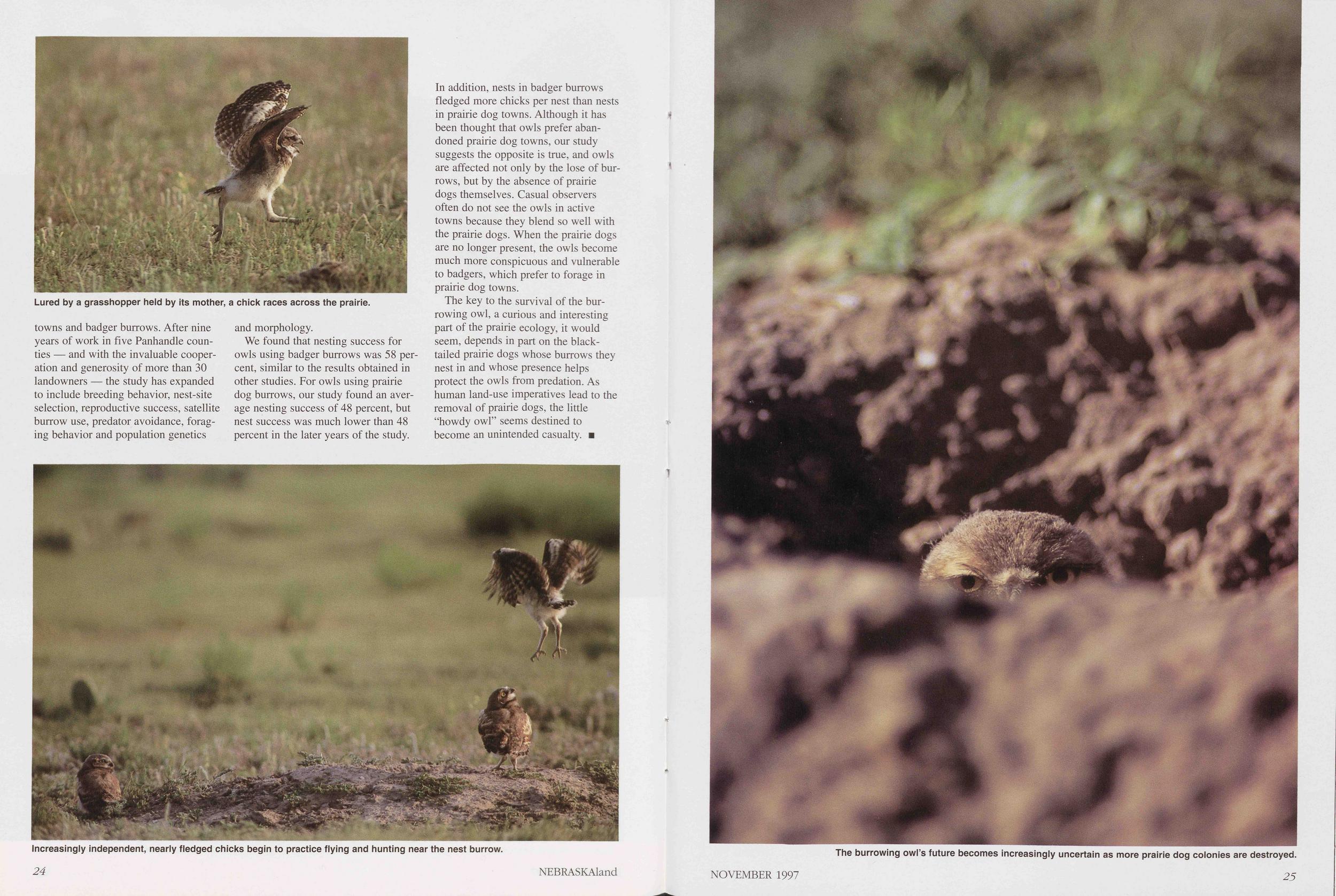
Lured by a grasshopper held by its mother, a chick races across the prairie.
towns and badger burrows. After nine years of work in five Panhandle counties — and with the invaluable cooperation and generosity of more than 30 landowners — the study has expanded to include breeding behavior, nest-site selection, reproductive success, satellite burrow use, predator avoidance, foraging behavior and population genetics and morphology.
We found that nesting success for owls using badger burrows was 58 percent, similar to the results obtained in other studies. For owls using prairie dog burrows, our study found an average nesting success of 48 percent, but nest success was much lower than 48 percent in the later years of the study. In addition, nests in badger burrows fledged more chicks per nest than nests in prairie dog towns. Although it has been thought that owls prefer abandoned prairie dog towns, our study suggests the opposite is true, and owls are affected not only by the lose of burrows, but by the absence of prairie dogs themselves. Casual observers often do not see the owls in active towns because they blend so well with the prairie dogs. When the prairie dogs are no longer present, the owls become much more conspicuous and vulnerable to badgers, which prefer to forage in prairie dog towns.
The key to the survival of the burrowing owl, a curious and interesting part of the prairie ecology, it would seem, depends in part on the black-tailed prairie dogs whose burrows they nest in and whose presence helps protect the owls from predation. As human land-use imperatives lead to the removal of prairie dogs, the little "howdy owl" seems destined to become an unintended casualty.
Increasingly independent, nearly fledged chicks begin to practice flying and hunting near the nest burrow.
The burrowing owl's future becomes increasingly uncertain as more prairie dog colonies are destroyed.
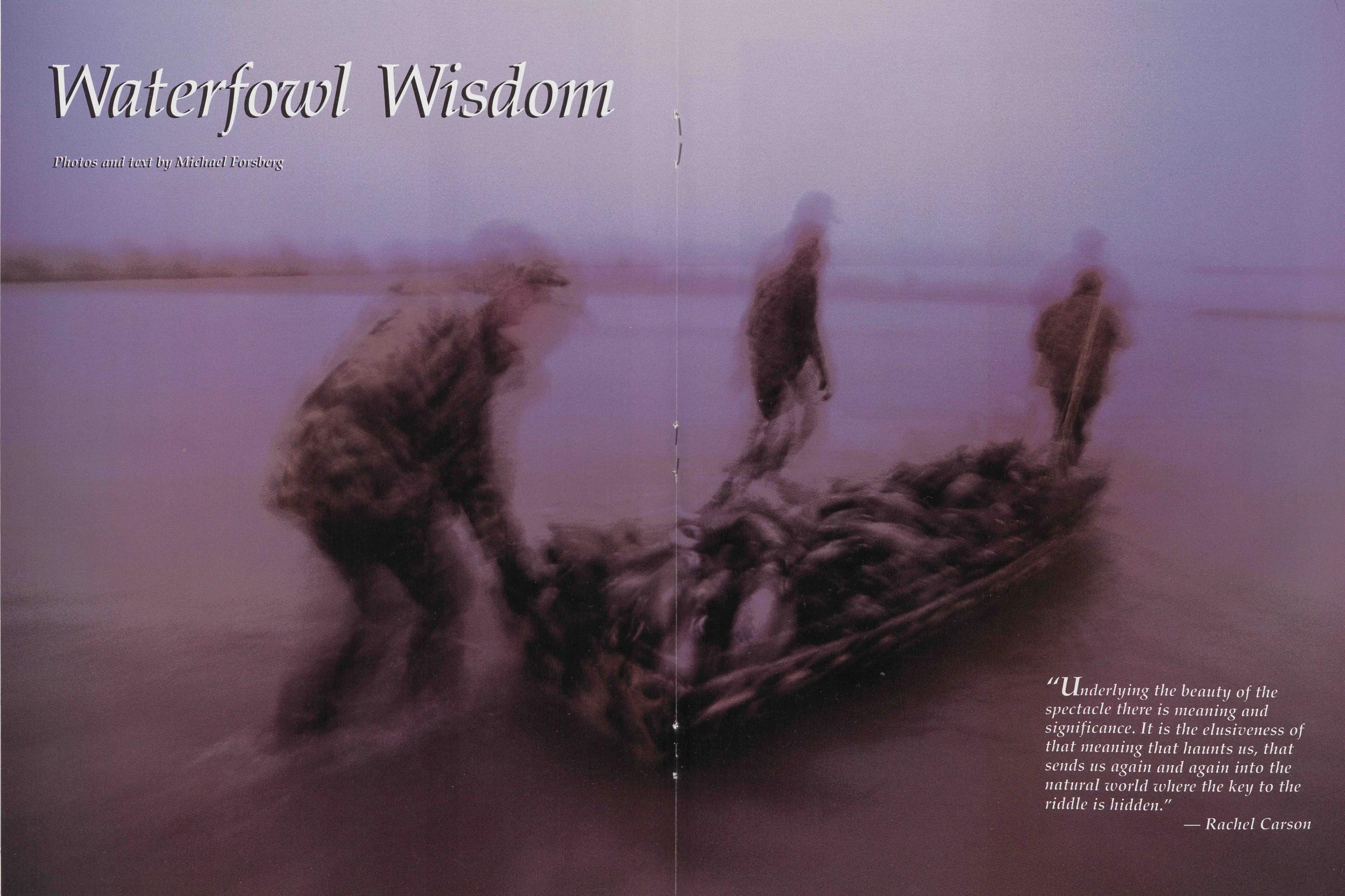
Waterfowl Wisdom
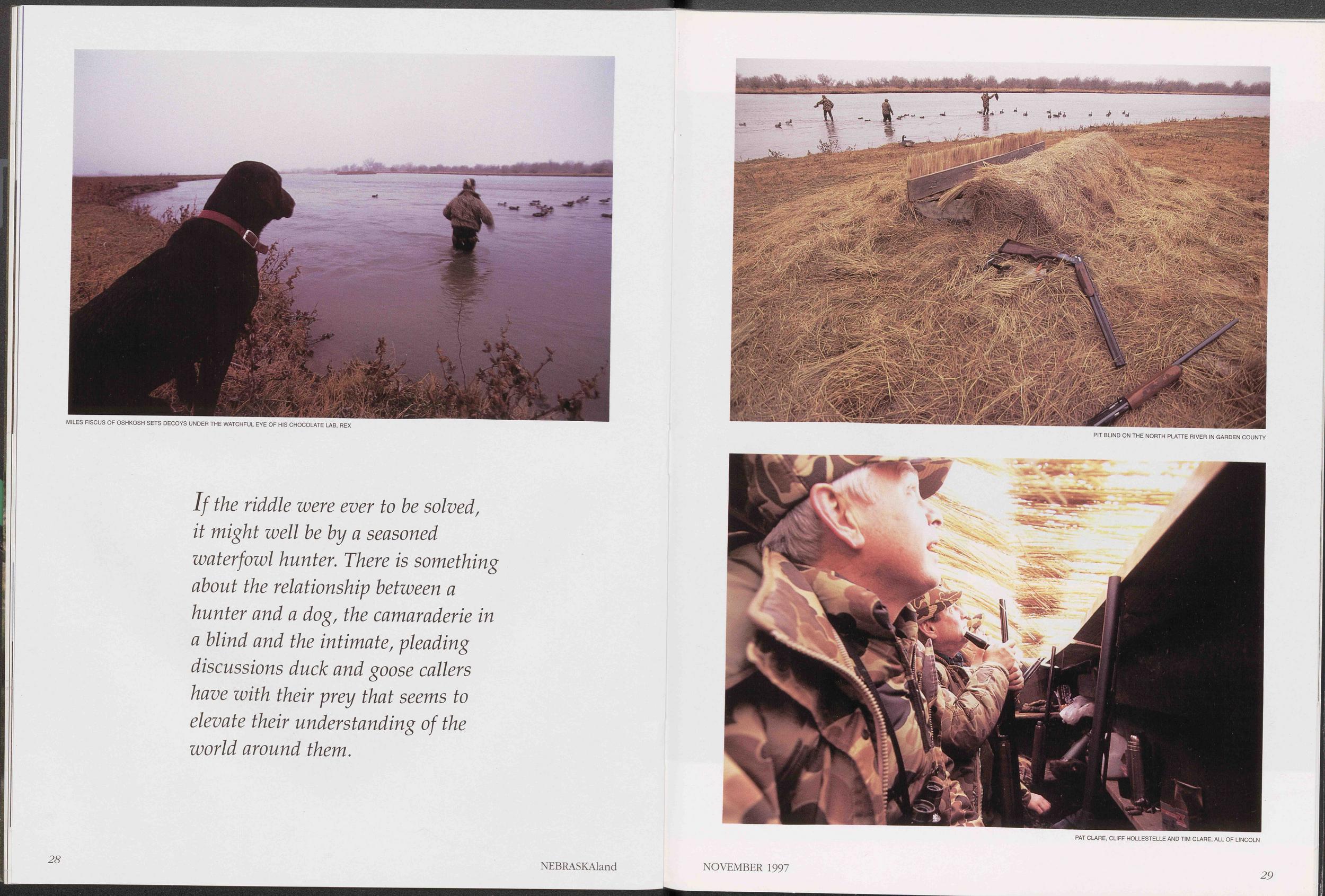
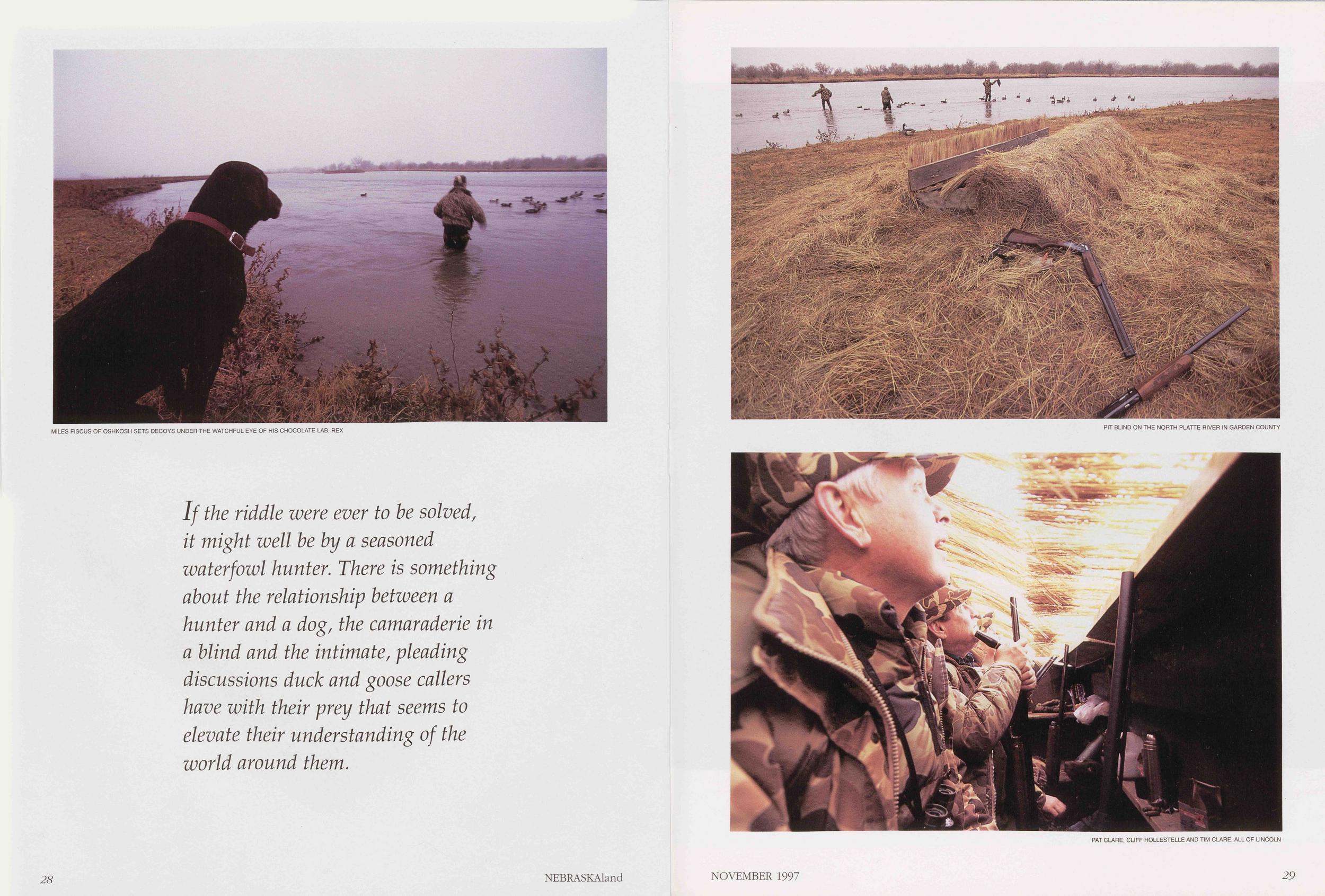
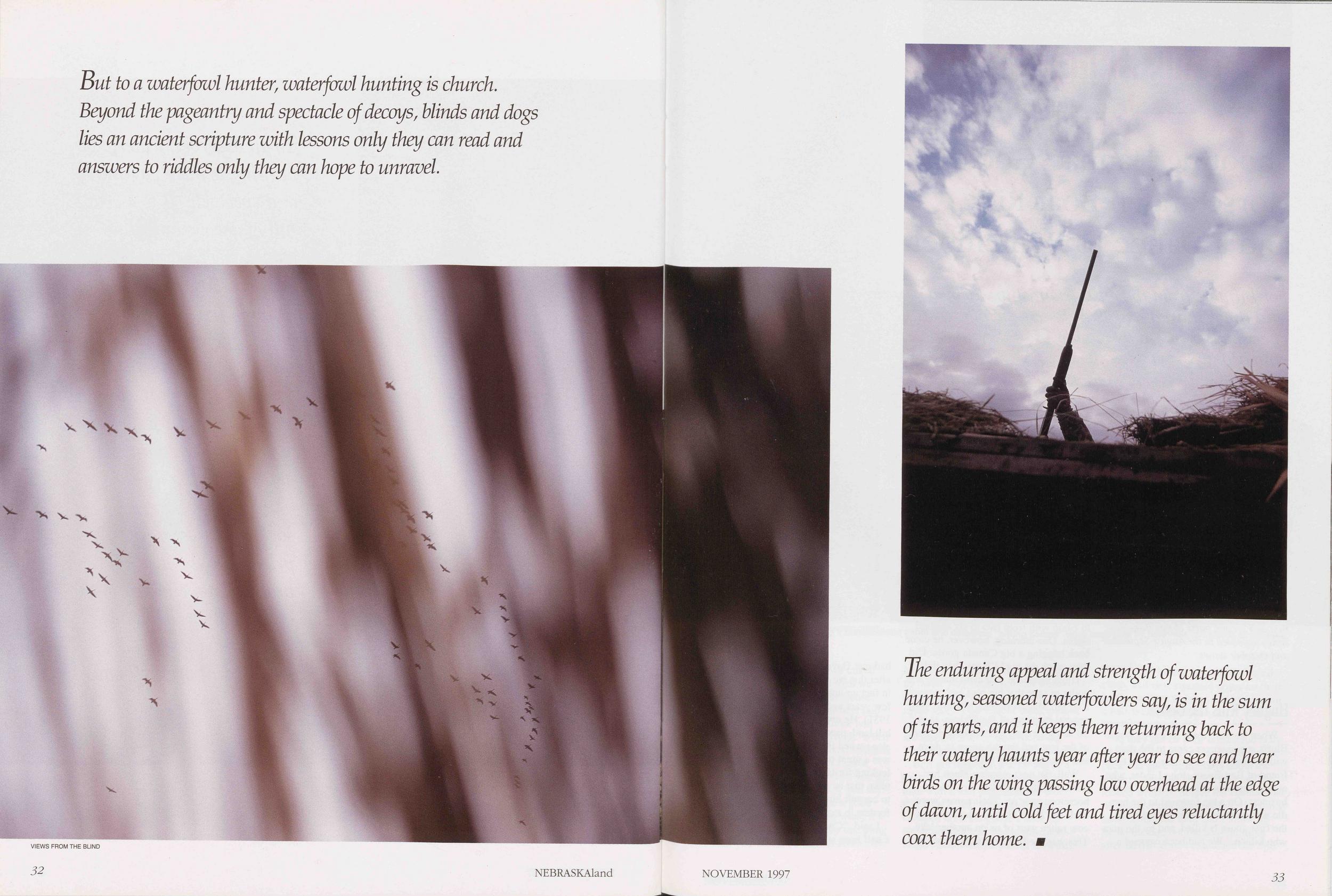 But to a waterfowl hunter, waterfowl hunting is church.
Beyond the pageantry and spectacle of decoys, blinds and dogs
lies an ancient scripture with lessons only they can read and
answers to riddles only they can hope to unravel.
But to a waterfowl hunter, waterfowl hunting is church.
Beyond the pageantry and spectacle of decoys, blinds and dogs
lies an ancient scripture with lessons only they can read and
answers to riddles only they can hope to unravel.
William S. Keeline's Sandhills Hunting Tales
Shooting Hannas' Goose, Horse-drawn Boat Ride and a Dance to Remember
For hunters from the east, friendships formed and times shared with Sandhills ranchers were cherished as much as memories of days when canvasbacks swarmed the decoys.
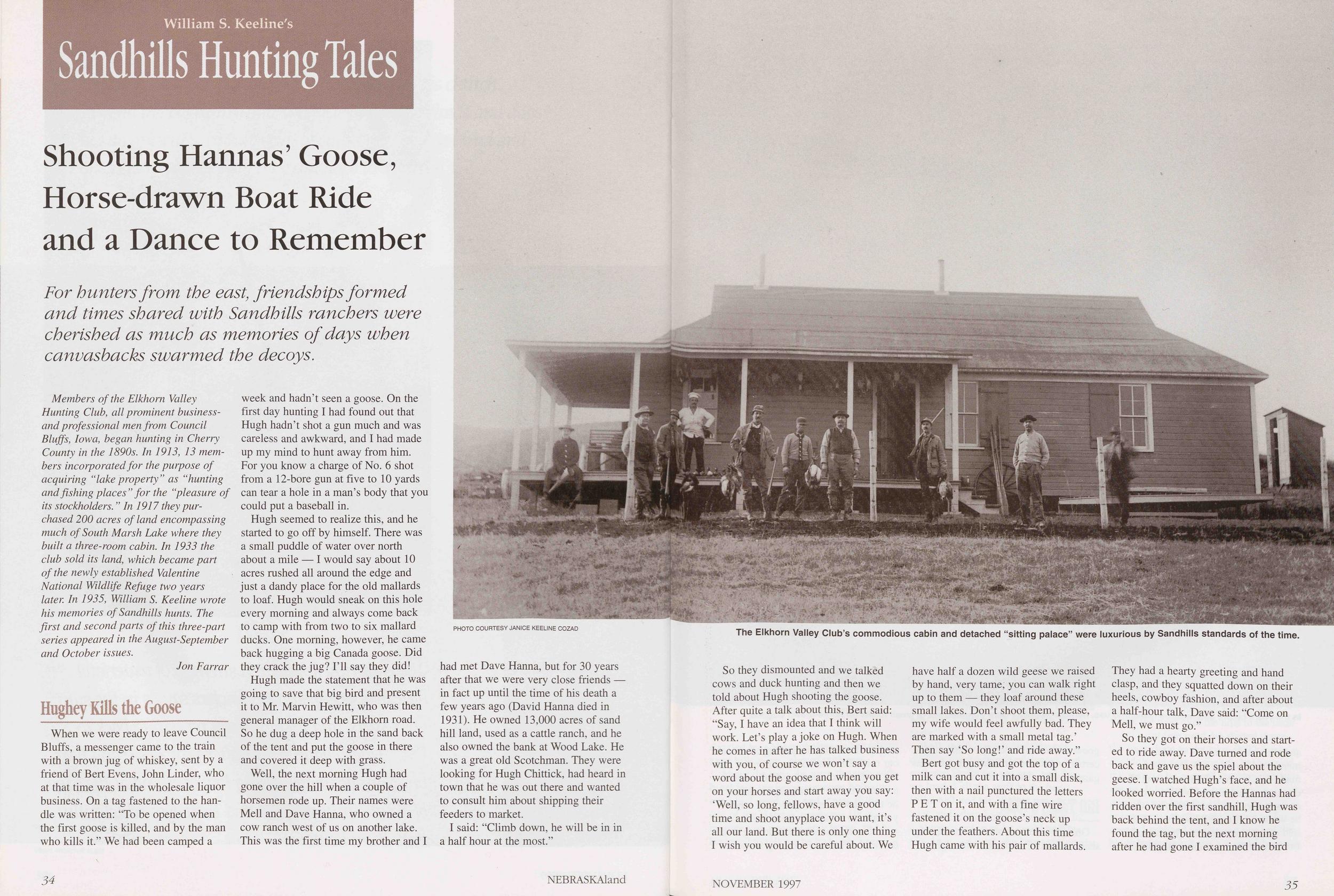
Members of the Elkhorn Valley Hunting Club, all prominent business-and professional men from Council Bluffs, Iowa, began hunting in Cherry County in the 1890s. In 1913, 13 members incorporated for the purpose of acquiring "lake property" as "hunting and fishing places" for the "pleasure of its stockholders." In 1917 they purchased 200 acres of land encompassing much of South Marsh Lake where they built a three-room cabin. In 1933 the club sold its land, which became part of the newly established Valentine National Wildlife Refuge two years later. In 1935, William S. Keeline wrote his memories of Sandhills hunts. The first and second parts of this three-part series appeared in the August-September and October issues. Jon Farrar Hughey Kills the GooseWhen we were ready to leave Council Bluffs, a messenger came to the train with a brown jug of whiskey, sent by a friend of Bert Evens, John Linder, who at that time was in the wholesale liquor business. On a tag fastened to the handle was written: "To be opened when the first goose is killed, and by the man who kills it." We had been camped a week and hadn't seen a goose. On the first day hunting I had found out that Hugh hadn't shot a gun much and was careless and awkward, and I had made up my mind to hunt away from him. For you know a charge of No. 6 shot from a 12-bore gun at five to 10 yards can tear a hole in a man's body that you could put a baseball in.
Hugh seemed to realize this, and he started to go off by himself. There was a small puddle of water over north about a mile — I would say about 10 acres rushed all around the edge and just a dandy place for the old mallards to loaf. Hugh would sneak on this hole every morning and always come back to camp with from two to six mallard ducks. One morning, however, he came back hugging a big Canada goose. Did they crack the jug? I'll say they did!
Hugh made the statement that he was going to save that big bird and present it to Mr. Marvin Hewitt, who was then general manager of the Elkhorn road. So he dug a deep hole in the sand back of the tent and put the goose in there and covered it deep with grass.
Well, the next morning Hugh had gone over the hill when a couple of horsemen rode up. Their names were Mell and Dave Hanna, who owned a cow ranch west of us on another lake. This was the first time my brother and I had met Dave Hanna, but for 30 years after that we were very close friends in fact up until the time of his death a few years ago (David Hanna died in 1931). He owned 13,000 acres of sand hill land, used as a cattle ranch, and he also owned the bank at Wood Lake. He was a great old Scotchman. They were looking for Hugh Chittick, had heard in town that he was out there and wanted to consult him about shipping their feeders to market.
I said: "Climb down, he will be in in a half hour at the most."
34 NEBRASKAlandThe Elkhorn Valley Club's commodious cabin and detached "sitting palace" were luxurious by Sandhills standards of the time.
So they dismounted and we talked cows and duck hunting and then we told about Hugh shooting the goose. After quite a talk about this, Bert said: "Say, I have an idea that I think will work. Let's play a joke on Hugh. When he comes in after he has talked business with you, of course we won't say a word about the goose and when you get on your horses and start away you say: 'Well, so long, fellows, have a good time and shoot anyplace you want, it's all our land. But there is only one thing I wish you would be careful about. We have half a dozen wild geese we raised by hand, very tame, you can walk right up to them — they loaf around these small lakes. Don't shoot them, please, my wife would feel awfully bad. They are marked with a small metal tag.' Then say 'So long!' and ride away."
Bert got busy and got the top of a milk can and cut it into a small disk, then with a nail punctured the letters P E T on it, and with a fine wire fastened it on the goose's neck up under the feathers. About this time Hugh came with his pair of mallards. They had a hearty greeting and hand clasp, and they squatted down on their heels, cowboy fashion, and after about a half-hour talk, Dave said: "Come on Mell, we must go."
So they got on their horses and started to ride away. Dave turned and rode back and gave us the spiel about the geese. I watched Hugh's face, and he looked worried. Before the Hannas had ridden over the first sandhill, Hugh was back behind the tent, and I know he found the tag, but the next morning after he had gone I examined the bird
NOVEMBER 1997 35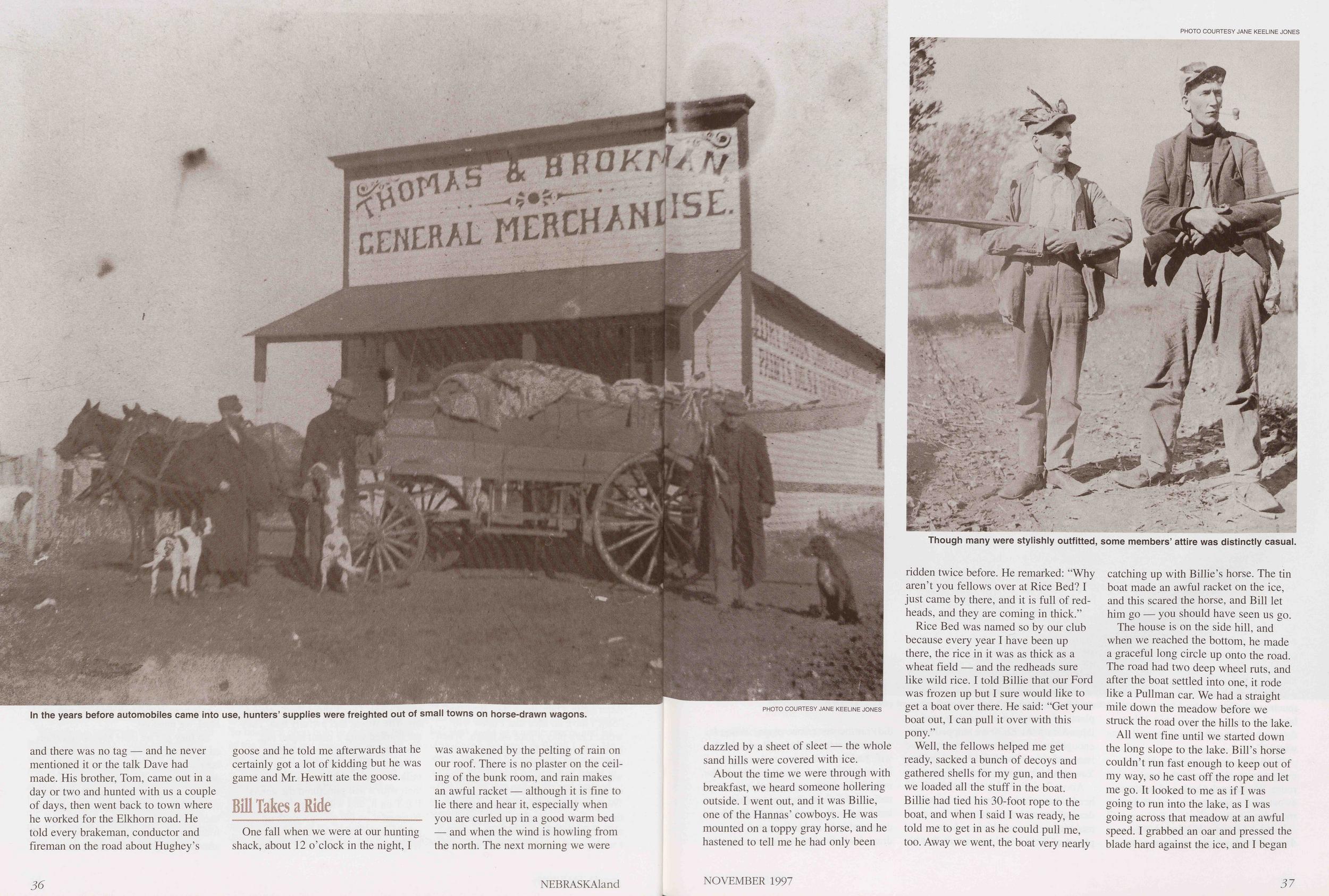
In the years before automobiles came into use, hunters' supplies were freighted out of small towns on horse-drawn wagons.
and there was no tag — and he never mentioned it or the talk Dave had made. His brother, Tom, came out in a day or two and hunted with us a couple of days, then went back to town where he worked for the Elkhorn road. He told every brakeman, conductor and fireman on the road about Hughey's goose and he told me afterwards that he certainly got a lot of kidding but he was game and Mr. Hewitt ate the goose.
Bill Takes a RideOne fall when we were at our hunting shack, about 12 o'clock in the night, I was awakened by the pelting of rain on our roof. There is no plaster on the ceiling of the bunk room, and rain makes an awful racket — although it is fine to lie there and hear it, especially when you are curled up in a good warm bed — and when the wind is howling from the north. The next morning we were
dazzled by a sheet of sleet — the whole sand hills were covered with ice.
About the time we were through with breakfast, we heard someone hollering outside. I went out, and it was Billie, one of the Hannas' cowboys. He was mounted on a toppy gray horse, and he hastened to tell me he had only been
36 NEBRASKAland PHOTO COURTESY JANE KEELINE JONESThough many were stylishly outfitted, some members' attire was distinctly casual.
ridden twice before. He remarked: "Why aren't you fellows over at Rice Bed? I just came by there, and it is full of redheads, and they are coming in thick."
Rice Bed was named so by our club because every year I have been up there, the rice in it was as thick as a wheat field — and the redheads sure like wild rice. I told Billie that our Ford was frozen up but I sure would like to get a boat over there. He said: "Get your boat out, I can pull it over with this pony."
Well, the fellows helped me get ready, sacked a bunch of decoys and gathered shells for my gun, and then we loaded all the stuff in the boat. Billie had tied his 30-foot rope to the boat, and when I said I was ready, he told me to get in as he could pull me, too. Away we went, the boat very nearly catching up with Billie's horse. The tin boat made an awful racket on the ice, and this scared the horse, and Bill let him go — you should have seen us go.
The house is on the side hill, and when we reached the bottom, he made a graceful long circle up onto the road. The road had two deep wheel ruts, and after the boat settled into one, it rode like a Pullman car. We had a straight mile down the meadow before we struck the road over the hills to the lake.
All went fine until we started down the long slope to the lake. Bill's horse couldn't run fast enough to keep out of my way, so he cast off the rope and let me go. It looked to me as if I was going to run into the lake, as I was going across that meadow at an awful speed. I grabbed an oar and pressed the blade hard against the ice, and I began
NOVEMBER 1997 37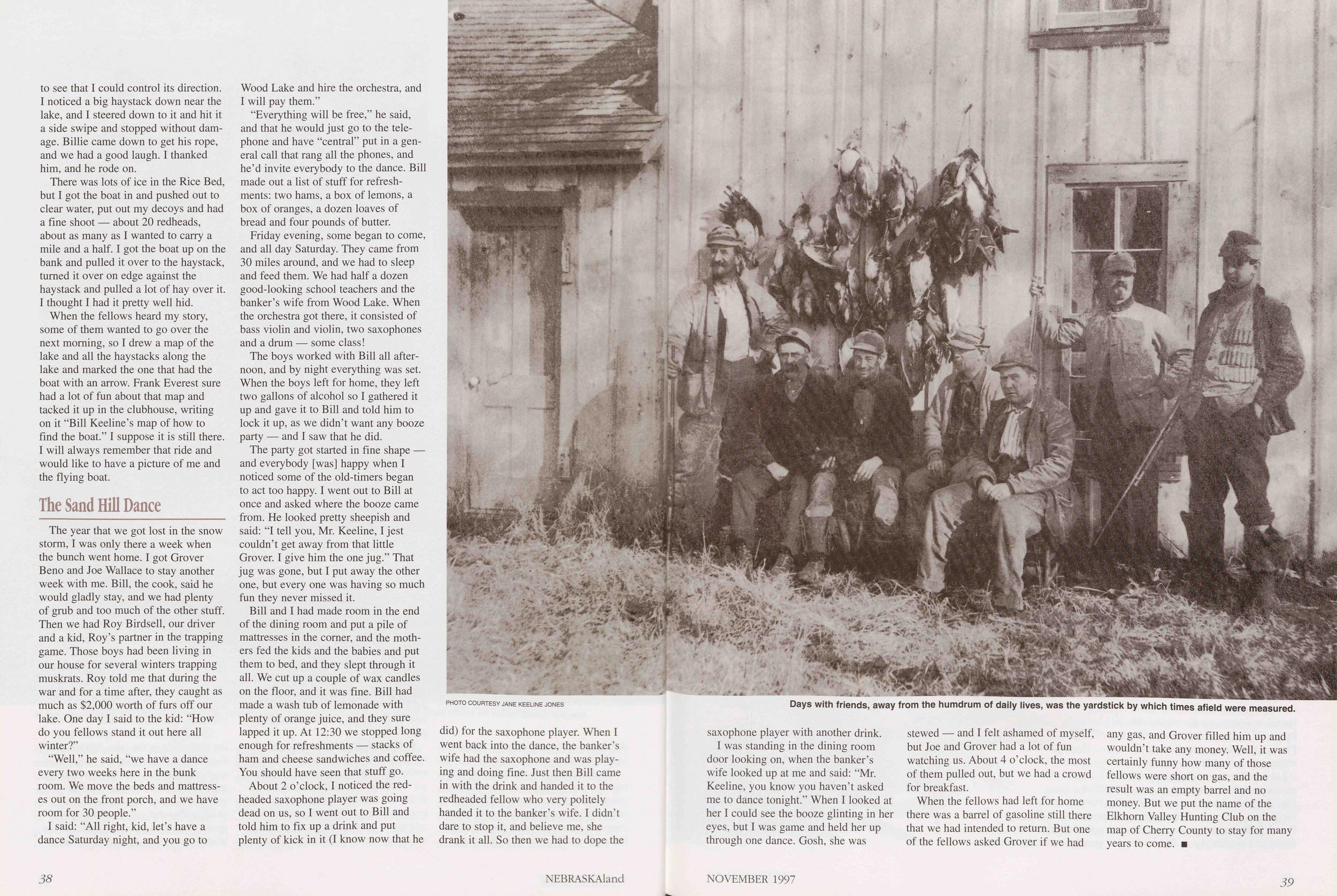
to see that I could control its direction. I noticed a big haystack down near the lake, and I steered down to it and hit it a side swipe and stopped without damage. Billie came down to get his rope, and we had a good laugh. I thanked him, and he rode on.
There was lots of ice in the Rice Bed, but I got the boat in and pushed out to clear water, put out my decoys and had a fine shoot — about 20 redheads, about as many as I wanted to carry a mile and a half. I got the boat up on the bank and pulled it over to the haystack, turned it over on edge against the haystack and pulled a lot of hay over it. I thought I had it pretty well hid.
When the fellows heard my story, some of them wanted to go over the next morning, so I drew a map of the lake and all the haystacks along the lake and marked the one that had the boat with an arrow. Frank Everest sure had a lot of fun about that map and tacked it up in the clubhouse, writing on it "Bill Keeline's map of how to find the boat." I suppose it is still there. I will always remember that ride and would like to have a picture of me and the flying boat.
The Sand Hill DanceThe year that we got lost in the snow storm, I was only there a week when the bunch went home. I got Grover Beno and Joe Wallace to stay another week with me. Bill, the cook, said he would gladly stay, and we had plenty of grub and too much of the other stuff. Then we had Roy Birdsell, our driver and a kid, Roy's partner in the trapping game. Those boys had been living in our house for several winters trapping muskrats. Roy told me that during the war and for a time after, they caught as much as $2,000 worth of furs off our lake. One day I said to the kid: "How do you fellows stand it out here all winter?"
"Well," he said, "we have a dance every two weeks here in the bunk room. We move the beds and mattresses out on the front porch, and we have room for 30 people."
I said: "All right, kid, let's have a dance Saturday night, and you go to Wood Lake and hire the orchestra, and I will pay them."
"Everything will be free," he said, and that he would just go to the telephone and have "central" put in a general call that rang all the phones, and he'd invite everybody to the dance. Bill made out a list of stuff for refreshments: two hams, a box of lemons, a box of oranges, a dozen loaves of bread and four pounds of butter.
Friday evening, some began to come, and all day Saturday. They came from 30 miles around, and we had to sleep and feed them. We had half a dozen good-looking school teachers and the banker's wife from Wood Lake. When the orchestra got there, it consisted of bass violin and violin, two saxophones and a drum — some class!
The boys worked with Bill all afternoon, and by night everything was set. When the boys left for home, they left two gallons of alcohol so I gathered it up and gave it to Bill and told him to lock it up, as we didn't want any booze party — and I saw that he did.
The party got started in fine shape — and everybody [was] happy when I noticed some of the old-timers began to act too happy. I went out to Bill at once and asked where the booze came from. He looked pretty sheepish and said: "I tell you, Mr. Keeline, I jest couldn't get away from that little Grover. I give him the one jug." That jug was gone, but I put away the other one, but every one was having so much fun they never missed it.
Bill and I had made room in the end of the dining room and put a pile of mattresses in the corner, and the mothers fed the kids and the babies and put them to bed, and they slept through it all. We cut up a couple of wax candles on the floor, and it was fine. Bill had made a wash tub of lemonade with plenty of orange juice, and they sure lapped it up. At 12:30 we stopped long enough for refreshments — stacks of ham and cheese sandwiches and coffee. You should have seen that stuff go.
About 2 o'clock, I noticed the redheaded saxophone player was going dead on us, so I went out to Bill and told him to fix up a drink and put plenty of kick in it (I know now that he
did) for the saxophone player. When I went back into the dance, the banker's wife had the saxophone and was playing and doing fine. Just then Bill came in with the drink and handed it to the redheaded fellow who very politely handed it to the banker's wife. I didn't dare to stop it, and believe me, she drank it all. So then we had to dope the
38 NEBRASKAlandDays with friends, away from the humdrum of daily lives, was the yardstick by which times afield were measured.
saxophone player with another drink.
I was standing in the dining room door looking on, when the banker's wife looked up at me and said: "Mr. Keeline, you know you haven't asked me to dance tonight." When I looked at her I could see the booze glinting in her eyes, but I was game and held her up through one dance. Gosh, she was stewed — and I felt ashamed of myself, but Joe and Grover had a lot of fun watching us. About 4 o'clock, the most of them pulled out, but we had a crowd for breakfast.
When the fellows had left for home there was a barrel of gasoline still there that we had intended to return. But one of the fellows asked Grover if we had any gas, and Grover filled him up and wouldn't take any money. Well, it was certainly funny how many of those fellows were short on gas, and the result was an empty barrel and no money. But we put the name of the Elkhorn Valley Hunting Club on the map of Cherry County to stay for many years to come.
NOVEMBER 1997 39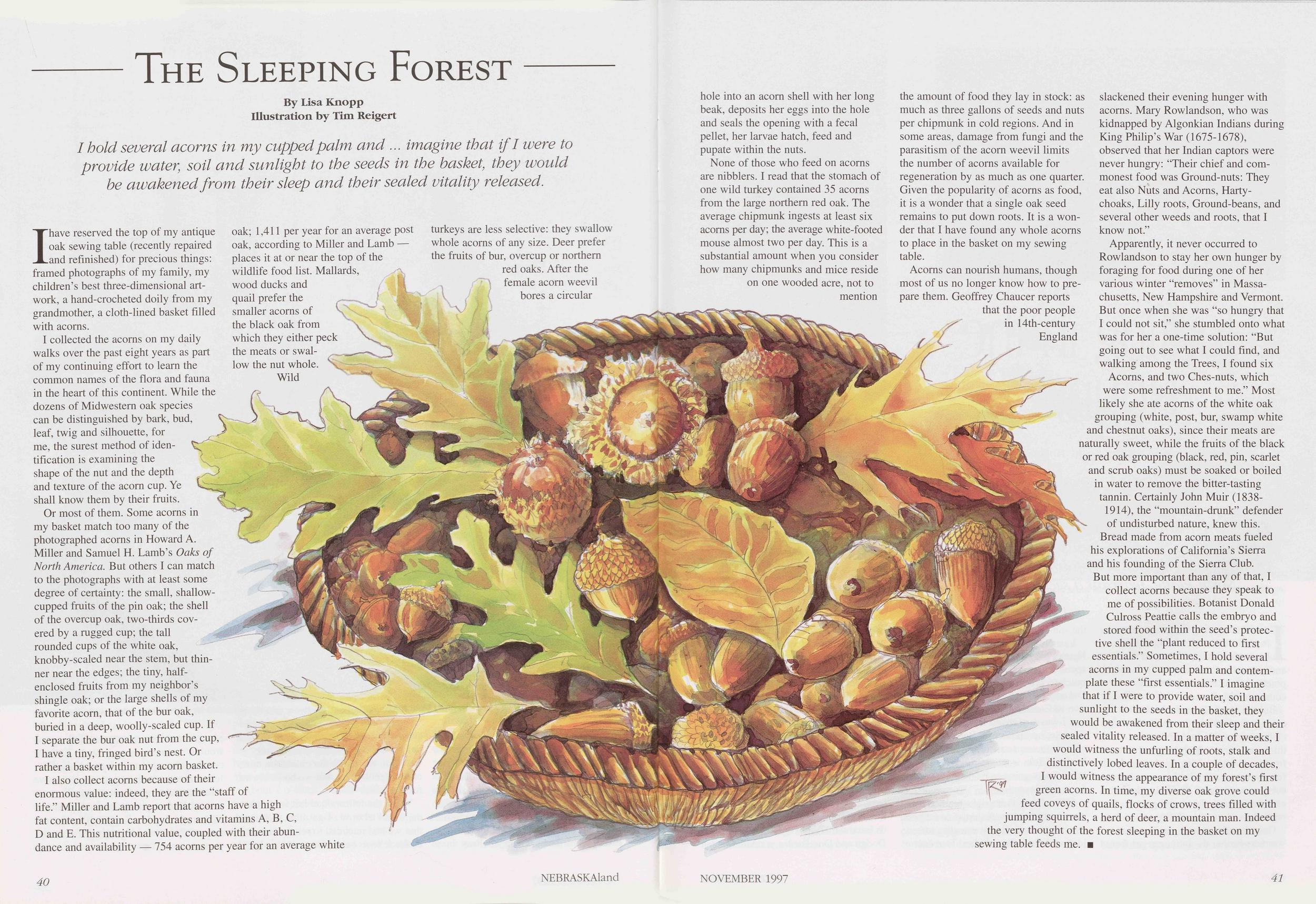
The Sleeping Forest
I hold several acorns in my cupped palm and ... imagine that if I were to provide water, soil and sunlight to the seeds in the basket, they would be awakened from their sleep and their sealed vitality released.
I have reserved the top of my antique oak sewing table (recently repaired and refinished) for precious things: framed photographs of my family, my children's best three-dimensional artwork, a hand-crocheted doily from my grandmother, a cloth-lined basket filled with acorns.
I collected the acorns on my daily walks over the past eight years as part of my continuing effort to learn the common names of the flora and fauna in the heart of this continent. While the dozens of Midwestern oak species can be distinguished by bark, bud, leaf, twig and silhouette, for me, the surest method of identification is examining the shape of the nut and the depth and texture of the acorn cup. Ye shall know them by their fruits.
Or most of them. Some acorns in my basket match too many of the photographed acorns in Howard A. Miller and Samuel H. Lamb's Oaks of North America. But others I can match to the photographs with at least some degree of certainty: the small, shallow-cupped fruits of the pin oak; the shell of the overcup oak, two-thirds covered by a rugged cup; the tall rounded cups of the white oak, knobby-scaled near the stem, but thinner near the edges; the tiny, half-enclosed fruits from my neighbor's shingle oak; or the large shells of my favorite acorn, that of the bur oak, buried in a deep, woolly-scaled cup. If I separate the bur oak nut from the cup, I have a tiny, fringed bird's nest. Or rather a basket within my acorn basket.
I also collect acorns because of their enormous value: indeed, they are the "staff of life." Miller and Lamb report that acorns have a high fat content, contain carbohydrates and vitamins A, B, C, D and E. This nutritional value, coupled with their abundance and availability — 754 acorns per year for an average white oak; 1,411 per year for an average post oak, according to Miller and Lamb — places it at or near the top of the wildlife food list. Mallards, wood ducks and quail prefer the smaller acorns of the black oak from which they either peck the meats or swallow the nut whole. Wild turkeys are less selective: they swallow whole acorns of any size. Deer prefer the fruits of bur, overcup or northern red oaks. After the female acorn weevil bores a circular
None of those who feed on acorns are nibblers. I read that the stomach of one wild turkey contained 35 acorns from the large northern red oak. The average chipmunk ingests at least six acorns per day; the average white-footed mouse almost two per day. This is a substantial amount when you consider how many chipmunks and mice reside on one wooded acre, not to mention the amount of food they lay in stock: as much as three gallons of seeds and nuts per chipmunk in cold regions. And in some areas, damage from fungi and the parasitism of the acorn weevil limits the number of acorns available for regeneration by as much as one quarter. Given the popularity of acorns as food, it is a wonder that a single oak seed remains to put down roots. It is a wonder that I have found any whole acorns to place in the basket on my sewing table.
Acorns can nourish humans, though most of us no longer know how to prepare them. Geoffrey Chaucer reports that the poor people in 14th-century England slackened their evening hunger with acorns. Mary Rowlandson, who was kidnapped by Algonkian Indians during King Philip's War (1675-1678), observed that her Indian captors were never hungry: "Their chief and commonest food was Ground-nuts: They eat also Nuts and Acorns, Harty-choaks, Lilly roots, Ground-beans, and several other weeds and roots, that I know not."
Apparently, it never occurred to Rowlandson to stay her own hunger by foraging for food during one of her various winter "removes" in Massachusetts, New Hampshire and Vermont. But once when she was "so hungry that I could not sit," she stumbled onto what was for her a one-time solution: "But going out to see what I could find, and walking among the Trees, I found six Acorns, and two Ches-nuts, which were some refreshment to me." Most likely she ate acorns of the white oak grouping (white, post, bur, swamp white and chestnut oaks), since their meats are naturally sweet, while the fruits of the black or red oak grouping (black, red, pin, scarlet and scrub oaks) must be soaked or boiled in water to remove the bitter-tasting tannin. Certainly John Muir (1838-1914), the "mountain-drunk" defender of undisturbed nature, knew this. Bread made from acorn meats fueled his explorations of California's Sierra and his founding of the Sierra Club.
But more important than any of that, I collect acorns because they speak to me of possibilities. Botanist Donald Culross Peattie calls the embryo and stored food within the seed's protective shell the "plant reduced to first essentials." Sometimes, I hold several acorns in my cupped palm and contemplate these "first essentials." I imagine that if I were to provide water, soil and sunlight to the seeds in the basket, they would be awakened from their sleep and their sealed vitality released. In a matter of weeks, I would witness the unfurling of roots, stalk and distinctively lobed leaves. In a couple of decades, I would witness the appearance of my forest's first green acorns. In time, my diverse oak grove could feed coveys of quails, flocks of crows, trees filled with jumping squirrels, a herd of deer, a mountain man. Indeed the very thought of the forest sleeping in the basket on my sewing table feeds me.
NOVEMBER 1997 41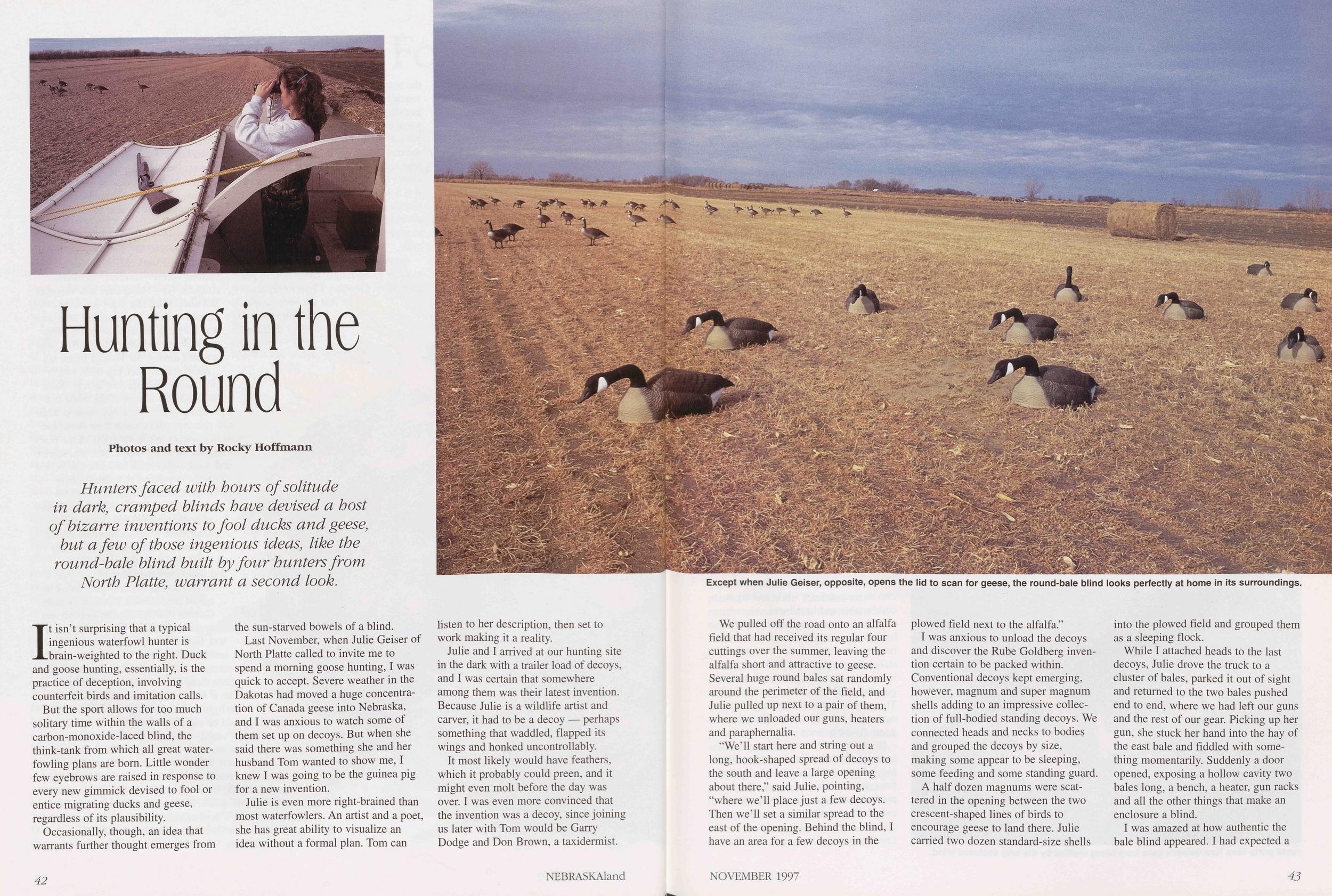
Hunting in the Round
Hunters faced with hours of solitude in dark, cramped blinds have devised a host of bizarre inventions to fool ducks and geese, but a few of those ingenious ideas, like the round-bale blind built by four hunters from North Platte, warrant a second look.
It isn't surprising that a typical ingenious waterfowl hunter is brain-weighted to the right. Duck and goose hunting, essentially, is the practice of deception, involving counterfeit birds and imitation calls.
But the sport allows for too much solitary time within the walls of a carbon-monoxide-laced blind, the think-tank from which all great water-fowling plans are born. Little wonder few eyebrows are raised in response to every new gimmick devised to fool or entice migrating ducks and geese, regardless of its plausibility.
Occasionally, though, an idea that warrants further thought emerges from the sun-starved bowels of a blind.
Last November, when Julie Geiser of North Platte called to invite me to spend a morning goose hunting, I was quick to accept. Severe weather in the Dakotas had moved a huge concentration of Canada geese into Nebraska, and I was anxious to watch some of them set up on decoys. But when she said there was something she and her husband Tom wanted to show me, I knew I was going to be the guinea pig for a new invention.
Julie is even more right-brained than most waterfowlers. An artist and a poet, she has great ability to visualize an idea without a formal plan. Tom can listen to her description, then set to work making it a reality.
Julie and I arrived at our hunting site in the dark with a trailer load of decoys, and I was certain that somewhere among them was their latest invention. Because Julie is a wildlife artist and carver, it had to be a decoy — perhaps something that waddled, flapped its wings and honked uncontrollably.
It most likely would have feathers, which it probably could preen, and it might even molt before the day was over. I was even more convinced that the invention was a decoy, since joining us later with Tom would be Garry Dodge and Don Brown, a taxidermist.
42 NEBRASKAlandExcept when Julie Geiser, opposite, opens the lid to scan for geese, the round-bale blind looks perfectly at home in its surroundings.
We pulled off the road onto an alfalfa field that had received its regular four cuttings over the summer, leaving the alfalfa short and attractive to geese. Several huge round bales sat randomly around the perimeter of the field, and Julie pulled up next to a pair of them, where we unloaded our guns, heaters and paraphernalia.
"We'll start here and string out a long, hook-shaped spread of decoys to the south and leave a large opening about there," said Julie, pointing, "where we'll place just a few decoys. Then we'll set a similar spread to the east of the opening. Behind the blind, I have an area for a few decoys in the plowed field next to the alfalfa."
I was anxious to unload the decoys and discover the Rube Goldberg invention certain to be packed within. Conventional decoys kept emerging, however, magnum and super magnum shells adding to an impressive collection of full-bodied standing decoys. We connected heads and necks to bodies and grouped the decoys by size, making some appear to be sleeping, some feeding and some standing guard.
A half dozen magnums were scattered in the opening between the two crescent-shaped lines of birds to encourage geese to land there. Julie carried two dozen standard-size shells into the plowed field and grouped them as a sleeping flock.
While I attached heads to the last decoys, Julie drove the truck to a cluster of bales, parked it out of sight and returned to the two bales pushed end to end, where we had left our guns and the rest of our gear. Picking up her gun, she stuck her hand into the hay of the east bale and fiddled with something momentarily. Suddenly a door opened, exposing a hollow cavity two bales long, a bench, a heater, gun racks and all the other things that make an enclosure a blind.
I was amazed at how authentic the bale blind appeared. I had expected a
NOVEMBER 1997 43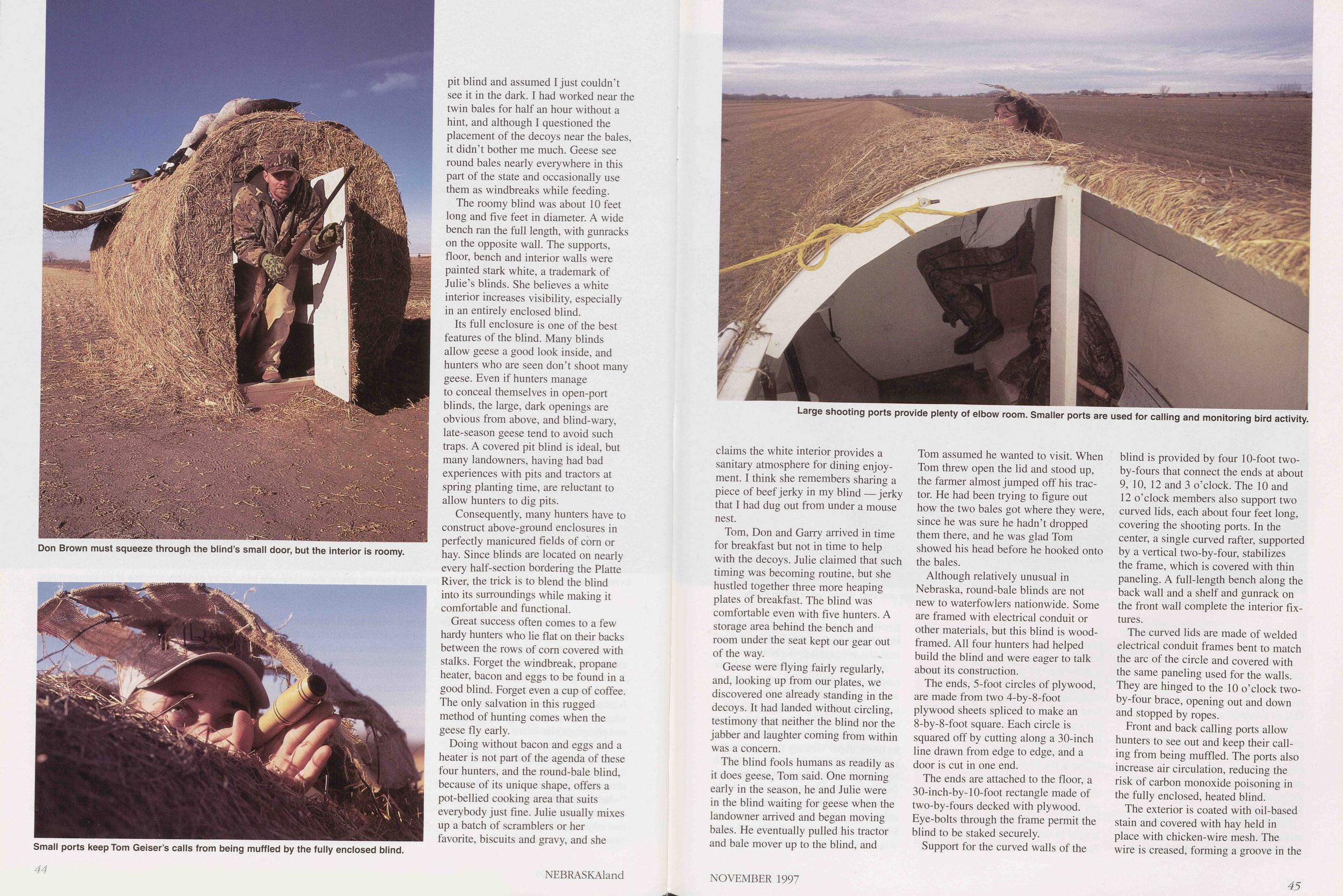
Don Brown must squeeze through the blind's small door, but the interior is roomy.
Small ports keep Tom Geiser's calls from being muffled by the fully enclosed blind.
pit blind and assumed I just couldn't see it in the dark. I had worked near the twin bales for half an hour without a hint, and although I questioned the placement of the decoys near the bales, it didn't bother me much. Geese see round bales nearly everywhere in this part of the state and occasionally use them as windbreaks while feeding.
The roomy blind was about 10 feet long and five feet in diameter. A wide bench ran the full length, with gunracks on the opposite wall. The supports, floor, bench and interior walls were painted stark white, a trademark of Julie's blinds. She believes a white interior increases visibility, especially in an entirely enclosed blind.
Its full enclosure is one of the best features of the blind. Many blinds allow geese a good look inside, and hunters who are seen don't shoot many geese. Even if hunters manage to conceal themselves in open-port blinds, the large, dark openings are obvious from above, and blind-wary, late-season geese tend to avoid such traps. A covered pit blind is ideal, but many landowners, having had bad experiences with pits and tractors at spring planting time, are reluctant to allow hunters to dig pits.
Consequently, many hunters have to construct above-ground enclosures in perfectly manicured fields of corn or hay. Since blinds are located on nearly every half-section bordering the Platte River, the trick is to blend the blind into its surroundings while making it comfortable and functional.
Great success often comes to a few hardy hunters who lie flat on their backs between the rows of corn covered with stalks. Forget the windbreak, propane heater, bacon and eggs to be found in a good blind. Forget even a cup of coffee. The only salvation in this rugged method of hunting comes when the geese fly early.
Doing without bacon and eggs and a heater is not part of the agenda of these four hunters, and the round-bale blind, because of its unique shape, offers a pot-bellied cooking area that suits everybody just fine. Julie usually mixes up a batch of scramblers or her favorite, biscuits and gravy, and she
44 NEBRASKAlandLarge shooting ports provide plenty of elbow room. Smaller ports are used for calling and monitoring bird activity.
claims the white interior provides a sanitary atmosphere for dining enjoyment. I think she remembers sharing a piece of beef jerky in my blind —jerky that I had dug out from under a mouse nest.
Tom, Don and Garry arrived in time for breakfast but not in time to help with the decoys. Julie claimed that such timing was becoming routine, but she hustled together three more heaping plates of breakfast. The blind was comfortable even with five hunters. A storage area behind the bench and room under the seat kept our gear out of the way.
Geese were flying fairly regularly, and, looking up from our plates, we discovered one already standing in the decoys. It had landed without circling, testimony that neither the blind nor the jabber and laughter coming from within was a concern.
The blind fools humans as readily as it does geese, Tom said. One morning early in the season, he and Julie were in the blind waiting for geese when the landowner arrived and began moving bales. He eventually pulled his tractor and bale mover up to the blind, and Tom assumed he wanted to visit. When Tom threw open the lid and stood up, the farmer almost jumped off his tractor. He had been trying to figure out how the two bales got where they were, since he was sure he hadn't dropped them there, and he was glad Tom showed his head before he hooked onto the bales.
Although relatively unusual in Nebraska, round-bale blinds are not new to waterfowlers nationwide. Some are framed with electrical conduit or other materials, but this blind is woodframed. All four hunters had helped build the blind and were eager to talk about its construction.
The ends, 5-foot circles of plywood, are made from two 4-by-8-foot plywood sheets spliced to make an 8-by-8-foot square. Each circle is squared off by cutting along a 30-inch line drawn from edge to edge, and a door is cut in one end.
The ends are attached to the floor, a 30-inch-by- 10-foot rectangle made of two-by-fours decked with plywood. Eye-bolts through the frame permit the blind to be staked securely.
Support for the curved walls of the blind is provided by four 10-foot two-by-fours that connect the ends at about 9, 10, 12 and 3 o'clock. The 10 and 12 o'clock members also support two curved lids, each about four feet long, covering the shooting ports. In the center, a single curved rafter, supported by a vertical two-by-four, stabilizes the frame, which is covered with thin paneling. A full-length bench along the back wall and a shelf and gunrack on the front wall complete the interior fixtures.
The curved lids are made of welded electrical conduit frames bent to match the arc of the circle and covered with the same paneling used for the walls. They are hinged to the 10 o'clock two-by-four brace, opening out and down and stopped by ropes.
Front and back calling ports allow hunters to see out and keep their calling from being muffled. The ports also increase air circulation, reducing the risk of carbon monoxide poisoning in the fully enclosed, heated blind.
The exterior is coated with oil-based stain and covered with hay held in place with chicken-wire mesh. The wire is creased, forming a groove in the
NOVEMBER 1997 45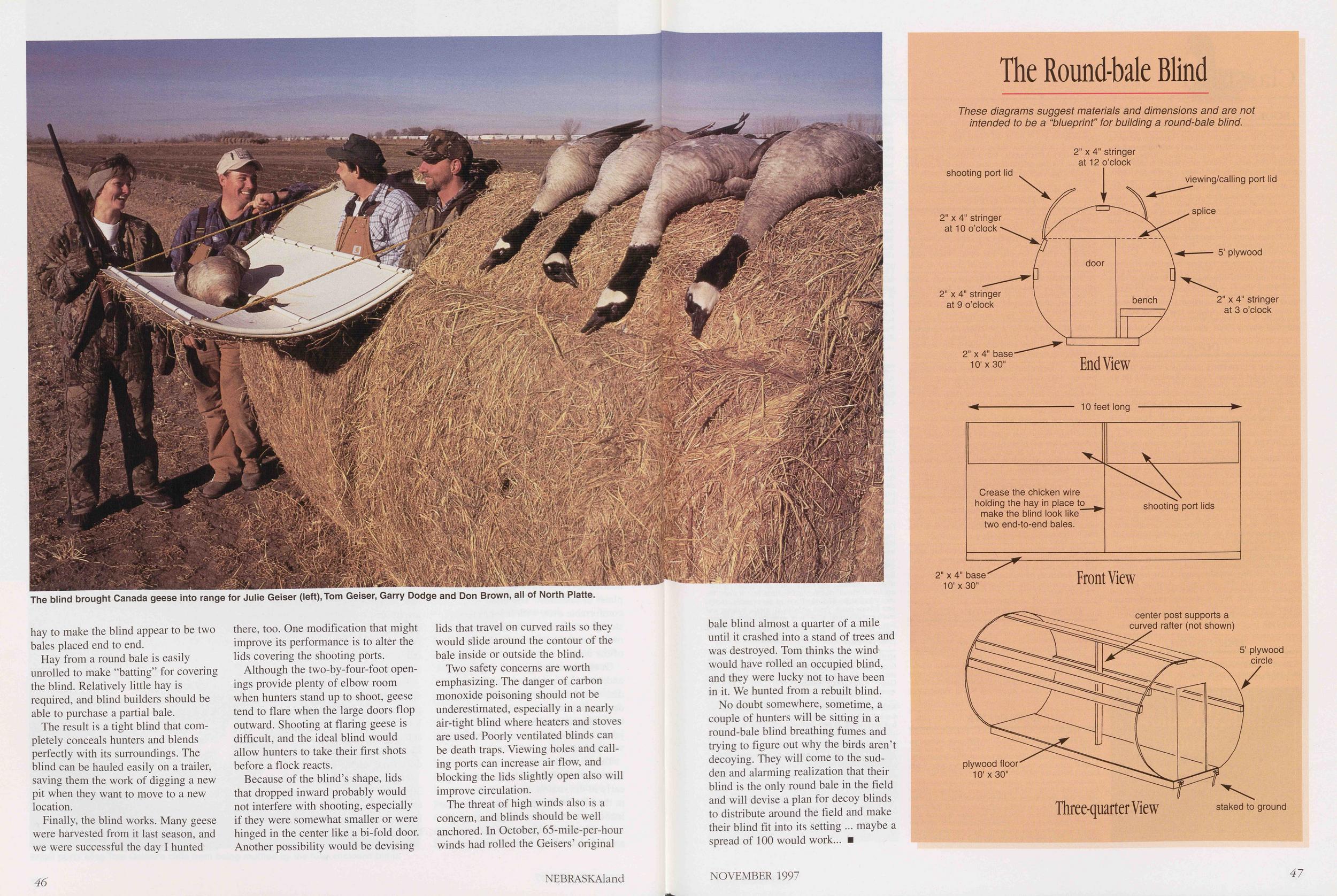
The blind brought Canada geese into range for Julie Geiser (left), Tom Geiser, Garry Dodge and Don Brown, all of North Platte.
hay to make the blind appear to be two bales placed end to end.
Hay from a round bale is easily unrolled to make "batting" for covering the blind. Relatively little hay is required, and blind builders should be able to purchase a partial bale.
The result is a tight blind that completely conceals hunters and blends perfectly with its surroundings. The blind can be hauled easily on a trailer, saving them the work of digging a new pit when they want to move to a new location.
Finally, the blind works. Many geese were harvested from it last season, and we were successful the day I hunted there, too. One modification that might improve its performance is to alter the lids covering the shooting ports.
Although the two-by-four-foot openings provide plenty of elbow room when hunters stand up to shoot, geese tend to flare when the large doors flop outward. Shooting at flaring geese is difficult, and the ideal blind would allow hunters to take their first shots before a flock reacts.
Because of the blind's shape, lids that dropped inward probably would not interfere with shooting, especially if they were somewhat smaller or were hinged in the center like a bi-fold door. Another possibility would be devising lids that travel on curved rails so they would slide around the contour of the bale inside or outside the blind.
Two safety concerns are worth emphasizing. The danger of carbon monoxide poisoning should not be underestimated, especially in a nearly air-tight blind where heaters and stoves are used. Poorly ventilated blinds can be death traps. Viewing holes and calling ports can increase air flow, and blocking the lids slightly open also will improve circulation.
The threat of high winds also is a concern, and blinds should be well anchored. In October, 65-mile-per-hour winds had rolled the Geisers' original
46 NEBRASKAlandbale blind almost a quarter of a mile until it crashed into a stand of trees and was destroyed. Tom thinks the wind would have rolled an occupied blind, and they were lucky not to have been in it. We hunted from a rebuilt blind.
No doubt somewhere, sometime, a couple of hunters will be sitting in a round-bale blind breathing fumes and trying to figure out why the birds aren't decoying. They will come to the sudden and alarming realization that their blind is the only round bale in the field and will devise a plan for decoy blinds to distribute around the field and make their blind fit into its setting ... maybe a spread of 100 would work...
The Round-bale Blind
These diagrams suggest materials and dimensions and are not intended to be a "blueprint" for building a round-bale blind. 2" x 4" stringer at 12 o'clock shooting port lid 2" x 4" stringer at 10 o'clock 2" x 4" stringer at 9 o'clock viewing/calling port lid 5' plywood 2" x 4" stringer at 3 o'clock 2" x 4" base 10' x30" End View 10 feet long holding the hay in place to make the blind look like" two end-to-end bales. shooting port lids 2" x 4" base' 10'x30" Front View center post supports a curved rafter (not shown) 5' plywood circle plywood floor 10' x 30" Three-quarter View staked to ground NOVEMBER 1997 47
Classified
BOOKS/PUBLICATIONS/VIDEOS FREE BOOK CATALOG. Novels, westerns, romances, children's; old out of print, found barns, attic. Authors: Grey, Bower, Condor, Fox, Curwood, Raine, Wright, Aldrige, Polly anna, Freckles, many others. Postage appreciated. Pierce, 4400 N. Pine Cluster, Oroville, CA 95965. HOW TO FIND MORE outdoor opportunities! The Nebraska Sportsman's Atlas. Locations of all public lands and waters on county transportation maps. These maps show ALL the roads in Nebraska. Listings include federal, Nebraska Game & Parks, NRD holdings, hotels and motels and Nebraska's endless attractions. At only $18.75/copy a true time and frustration saver. To order write: Sportsman's Atlas Co., P.O. Box 132, Lytton, IA 50561 or call (800) 568-8334. JU-JU SWALLOWED A PENNY, a Nebraska farm girl's book of the 1930s Depression Era. $7.50 ppd. Betty Heidbreder Dunn, Rt. 2, Box 2025, Columbus, TX 78934. PLAT MAPS available featuring landowners, roads and creeks. Most counties in Nebraska available and adjoining counties in South Dakota, Wyoming, Kansas and Colorado. Call (800) 752-3402. Visa and Mastercard accepted. DOGS TRAINING ALL BREEDS bird dogs - Vizslas for sale. Home of Rebel Rousers. Rozanek Kennels, 781 Rd. D, Schuyler, NE 68661. Phone (402) 352-8769. ENGLISH SETTERS, German shorthairs, English pointers, Brittany spaniels - stud service, puppies and started dogs. Training for all pointing breeds. Plum Creek Kennel, (712) 529-4238 or (402) 298-8153. RETRIEVER TRAINING. Area's top "retrievers only" trainer. Field trial and hunting dogs. Non-slip duck dogs! TKO Retriever Training Kennel (402) 623-4311. CHESAPEAKE BAY, Labrador and golden retriever pups, started dogs and stud service. 16-time national champion pedigree. Visa & MasterCard. Platte Valley Retrievers (308) 995-2318. YELLOW-CHOCOLATE-BLACK LAB pups. Breeders hips O.F.A. and eyes CERE Excellent bloodlines and hunting potential. Call Mr. Bendler, Lexington, NE (308) 324-4247 or Lincoln (402) 477-1305. WILDERNESS KENNELS. Gun dog training - over 60 years combined experience. Training all sporting breeds - retrievers, flushing and pointing dogs. All dogs worked on pen raised birds and wild game. Training program includes obedience training - heel, sit, stay, down and come when called. Pups, started dogs and fully trained dogs for sale. Hunting dogs trained by hunters. Henry Sader, Wilderness Kennels, Roca, NE (402) 423-4212. Since 1968. NEBRASKAland by phone For Visa and MasterCard orders, call 1-800-NEB-LAND (632-5263) FISH/FISHING FISH FOR SALE. Catfish, largemouth bass, smallmouth bass, perch, crappie, bluegill, walleye, northern pike, rainbow trout, Donaldson rainbow trout, grass carp, minnows, bullheads. Consulting available. Pleasant Valley Fish Farm, RR 1, Box 147, McCook, NE 69001. Phone (308) 345-6599. PATENTED AUTOMATIC ICE FISHING jigger, fish attractor. For free information send SASE to Jig-A-Bait Lure Co., 201 Capitol Beach Blvd., Suite 14, Lincoln, NE 68528. FOOD/GIFTS NEBRASKA BASKETS: The original Nebraska company specializing in fine foods from Nebraska since 1984. A beautiful array of baskets filled with ethnic, healthful and long-time favorite foods. Call or write for our brochure: P.O. Box 22985, Lincoln, NE 68542. Phone (800) 345-7725 or (402) 438-3111. FROM NEBRASKA GIFT SHOP..the world's largest selection of Nebraska-made food products and gifts. Historic Haymarket, 140 N. 8th St., Lincoln, NE 68508; Old Market, 1030 Howard St., Omaha, NE. Call for free catalog (800) 399-5693. HOMEBREWING/BEER & WINEMAKING supplies. Fermenter's Supply, 8410 K Plz. #10, Omaha, NE 68127. (402) 593-9171. Open every day, mail orders welcome, low shipping. ENJOY A TASTE of the good life! Award-winning gourmet BBQ sauces & seasonings, breadings, native jellies, fruit butters, honey, coffees and more! Great giftset ideas! Toll free (888) 926-2879 or (308) 468-5635. Hollman Foods, 1948 36 Road, Minden, NE 68959, or www.hollmans.com BASKET CASE EMPORIUM specializes in "Gifts of Good Taste" since 1989. Gorgeous baskets filled with delectable Nebraska foods. Ship anywhere, deliver locally. Order now for the holidays. Toll free (888) 532-7830 for information and brochure, or write 515 North Dewey, North Platte, NE 69101. GUIDES/OUTFITTERS MAD RIVER CANOES offers the finest quality and performance. For the finest canoes and accessories look to Great Plains Canoe Co., 205 Main, Springfield, NE 68059. Phone (402) 253-2001. CANOE THE NIOBRARA...with an affordable canoe trip by Dryland Aquatics. One and two-day trips...full service, or just canoes and tubes. Transportation furnished. Your Niobrara River specialists... We do it your way! Dryland Aquatics, Dept. N, Box 33C, Sparks, NE 69220 or phone (800) 337-3119. GUNS/SHOOTING/ARCHERY GUNS - Browning, Winchester, Remington, others. Hi-powers, shotguns, new, used, antiques. Want Pre-'64 Winchesters. Buy-Sell-Trade. (402) 729-6112. Bedlan's Sporting Goods, Fairbury, NE 68352. AIR GUNS repaired - Benjamin, Crosman, Daisy, other American made. Restoration; old guns wanted. Jack's Air Guns, 1225 N. 46th, Lincoln, NE 68503. Phone (402) 466-9223. REAL ESTATE ESTABLISHED PHEASANT FARM now operating. 6,000 bird capacity. 15 50-by- 150-foot pens. Automatic waterers and feeders, 3 brooder houses, 5-ton auger truck, 2 small grain bins. Includes 400 breeder pheasants. South Central Nebraska. $45,000. Phone (402) 462-2739. RANCHES FOR SALE: 1,400-acre Niobrara River Ranch with approximately 2.6 miles of deeded Niobrara River frontage. Easy access 36 miles east of Valentine, Nebraska. Abundance of wildlife including deer and wild turkey. 1,320-acre Cody, Nebraska, ranch with approximately 3/4 mile of the Niobrara River running through this diversified ranch. Exceptional deer and turkey hunting. Exclusive agents on these and other properties, please call Farmers National Company at (308) 762-3155. PAWNEE CITY, NEBRASKA: Hunting lodge; alu- minum/steel riveted mobile home; 50-by-12 feet, 2 bedrooms, full kitchen, livingroom with 2 sofa beds, bath/shower. Sleeps up to 8. Double dog runs with heated kennels. Fully furnished with complete kitchen, linens, and appliances. Ready to use now for fall hunts. Asking $8,000. Call (402) 238-2739. Photos available. FOR SALE IN NORTH central Nebraska. 160 to 3,079 acres of rec-property in Keya Paha County. Has Niobrara River frontage. 2 live streams, abundant deer, turkeys, timber and beauty. Hunter's paradise. Total acres priced at $300 per acre. Swett Realty, Fred L. Swett Broker, P.O. Box 265, Ainsworth, NE 69210. Phone (402) 387-1626 or (800) 585-1626 day or night. CRP PARCELS, RESIDENCES and other lands to be sold. School lands valued at over $3.4 million and containing 12,400 acres will be offered for deed sale this fall in 24 different Nebraska counties. This includes 26 parcels containing prior and/or future CRP acreages, and 6 residential acreages, plus other pasture and cropground. For further information contact Educational Lands and Funds, Dick LeBlanc, Executive Director, 555 No. Cotner Blvd, Lincoln, NE 68505-2347. Phone (402) 471-2014. TAXIDERMY ALLISON'S TAXIDERMY Studio & Gift Gallery - DU, SCI, Pheasants Forever & NTA Members. Mounted 36 state record fish. 421 N. Dewey, North Platte, NE 69101. Call (308) 534-2324 or (308) 534-4267. Custom Designs. VACATIONS/RESORTS FOR FISHING and hunting accommodations. Jefco Inn, Gordon, NE 69343. South Cornell, (308) 282-2935. BED & BREAKFAST. Historic 1890s hotel. Located in the beautiful Pine Ridge area of northwest Nebraska. Short drive to Chadron State Park, Fort Robinson and the Black Hills. Beautiful dining room with fireplace and fountain. Room service available. The Olde Main Street Inn, 115 Main St., Chadron, NE 69337. (308) 432-3380. DIAMOND-E TROUT RESORT. 2 new lodges, 3 cottages on spring-fed lakes, stream. Private and secluded. Trout, bass, bluegill, etc. Paddleboats and playground equipment. For brochure, call (800) 974-3002. THE SNAKE RIVER CONNECTION. Western Nebraska Sandhills hunting and fishing expeditions: guided trophy whitetail and mule deer hunts; catch-and-release fly fishing for steelhead, rainbow and German brown trout. We own over 7 miles of Snake River on our beautiful 14,500 acre private ranch. Price includes all meals, lodging and ranch transportation. Call for or write for more information and free brochure. Hospitality is our trademark! Agnes Sasse, HC 84 Box 58, Gordon, NE 69343. Phone (308) 282-0369. HUNTERS/FISHERMEN. We've got great accomodations. Everything you need. Land, freezers, great steaks, guides, etc. Call us. Ole's Lodge & Ole's Big Game Steakhouse, Paxton., NE. (308) 239-4719. www.olesbiggame.com NEBRASKA STATE PARK vacations. Spend a week or a weekend, but don't spend a bundle! For a free color brochure listing all park facilities, call 1-800-826-7275. Classified Rates: 750 per word, minimum $15. Closing: First business day two months before issue date. Classified ads are accepted on a first-come, first-served, space-available basis. Classified Ads, NEBRASKAland Magazine, P.O. Box 30370, Lincoln, NE 68503-0370. Tel (402) 471-5478. Fax (402) 471-5528. E-mail: nebland@ngpsun. ngpc. state, ne. us 48 NEBRASKAlandPage forty-nine
November MemoriesNot long ago, in the hazy half light of a late October evening, I heard on the wind the brassy music of a band and the muted roar of cheering, and as usual, high school football made me think of pheasant hunting. Memory creates its own disjunctions, its logic sometimes convoluted, but it was easy to follow this trail back nearly 40 years.
There was little time for contemplation after school the last day of October in my junior year. We had to be back at the gym by six, taped and warmed up by 7:30, kickoff time. But from the back steps, where I was eating two poached eggs, pale and lifeless on dry toast — the recommended pre-game meal — low, broken blue-black clouds riding a rising wind and sinuous, mile-long flocks of raucous blackbirds charged the intermittent evening light with portent and promise.
Later, in the dank dressing room, its concrete-block walls sweating the condensed breath of 30 nervous boys, we carried our equipment from the cage and shooed two freshmen from the corner bench we'd claimed. We heard the band begin the fight song, spirited and tinny, and we smeared an oily, black stripe below each eye to keep the lights from dazzling us and to make us terrifying to our down-the-valley rivals.
"Are you ready?" Tom asked, picking nervously at grass stains on his orange-and-white home-game jersey. "Yeah," I answered, not quite sure if he meant ready for tonight or for tomorrow. "Concentrate," the coach was telling us, "just concentrate." But I had a new shotgun to try out on Saturday, a 16-gauge, bolt-action H & R — not one of the enduring classic field guns by any standard, and why would a left-hander buy a right-hand bolt action anyway? But it was in good shape, and it cost only $25. My dad agreed that I could spend the money. We'd tried it out on blue-rocks, but tomorrow, opening day, would be its first real hunt.
We either won or lost the game. It is surprising how details that once meant so much could fade so quickly. We either capitalized on opportunities or lost our concentration. Maybe we let our daubers down. I still have no idea what daubers are, but we were often warned to keep them up.
But some details stay clear and clean, unfaded: A cold, black, pre-dawn sky, no cars on Main Street. Lights on in the cafe kitchen, the front door left unlocked for me. In the semi-darkness of the dining room, the blue gas flame flickering beneath the tall chrome coffee urn behind the counter. In the kitchen Tom and his dad, Ken, assembling sandwiches on a cutting board, rows of bread, pink rounds of lunch meat, a jar of mayonnaise.
Ken looked me over, a quick glance up and down, stern, severe, appraising, the hint of an ironic smile behind the set line of his lips belying the imperious exterior. "You plan to wear those shoes?"
"I left my boots out in the car."
"Go get 'em now or you'll forget. Let me have a look at that gun."
An hour later, in the half light of a windy dawn, we were 10 miles north of town, crossing a barbed-wire fence into a field corner choked with dry sweetclover. King walked at heel, tongue lolling, wagging tail thumping rhythmically against Ken's brown canvas trouser leg. Warming up, the stiffness and the bruises from the past night's game began to fall away.
"Spread out about 10 yards apart. We'll hunt the grass at the uphill end first. If they're still on the roost, they'll probably be on the lee side just down from the crest. They'll turn with the wind and head for the ravine or they'll fly east into the corn. Pay attention to the dog and don't walk too fast."
Now, that morning merges with a hundred others, from before and after, and Ken's instructions with those of my father, of teachers, scoutmasters and coaches: Here's how to flip flapjacks in a skillet over an open fire. Here's how to stay out of sight behind the willows so your shadow doesn't spook the trout... how to hear the music of a well-turned phrase ... how to skin a bullhead...how to spot arrowheads at the edge of a blowout... where to put the seine and how to keep the minnows alive...where to put the tent when the wind is blowing. Pick out one duck; you can't shoot the whole flock. Keep your head down and swing through the bird. Don't lose your temper when you miss. Ask permission. Pick up your trash. Don't track sand into the tent. Don't put your boots too close to the fire. Hunt pheasants into the wind, grouse with the wind. Keep the fire small. Coals cook better than flames. Check your shotgun before you put it in the car. Check it again. Concentrate. Carry a full pot of water in one hand; you'll spill it if you try to carry it with both. Stay dry; wet is cold. Wear your hat; if your head is warm, your body is warm ("Don't worry so much about your hair. You're too damn pretty as it is").
My family moved, high school friends dispersed. Chance and choices kept me away from that small western town for more than 10 years, then venturing back, I found the cafe was little changed. Tom's mother recognized me right away. "Ken's fishing, but he'd sure like to see you," she said. "He'll say you need a haircut." The door swung open, and Ken strode in carrying two fat rainbow trout. His eyes flicked up and down appraising me. "You could use a haircut," he said.
Twenty years later I had another glimpse of him, an almost spectral vision. Tom and I discovered we lived only an hour or so apart, and one fall he and his son and I found time to hunt together. We were working our way up a grassy hillside — spread out about 10 yards apart and not walking too fast — and we split up to hunt around a little knoll. When we converged, I was 15 yards behind them. Suddenly, unexpectedly, time bent. There ahead of me I saw not Tom and his son, but Ken and Tom of 30 years before. The shape of their heads, their stride and carriage, even the way their clothes moved when they walked reinforced the momentary illusion. Then the present flowed back into place.
So, last summer, when I learned that Ken had died, my thoughts rolled back again to late October Fridays when we couldn't concentrate on football, to cold November mornings in the cafe kitchen, to campfires, classes and the brassy sound of high school bands — and to all the mentors who have helped to make us who we are.
Don Cunningham NOVEMBER 1997 49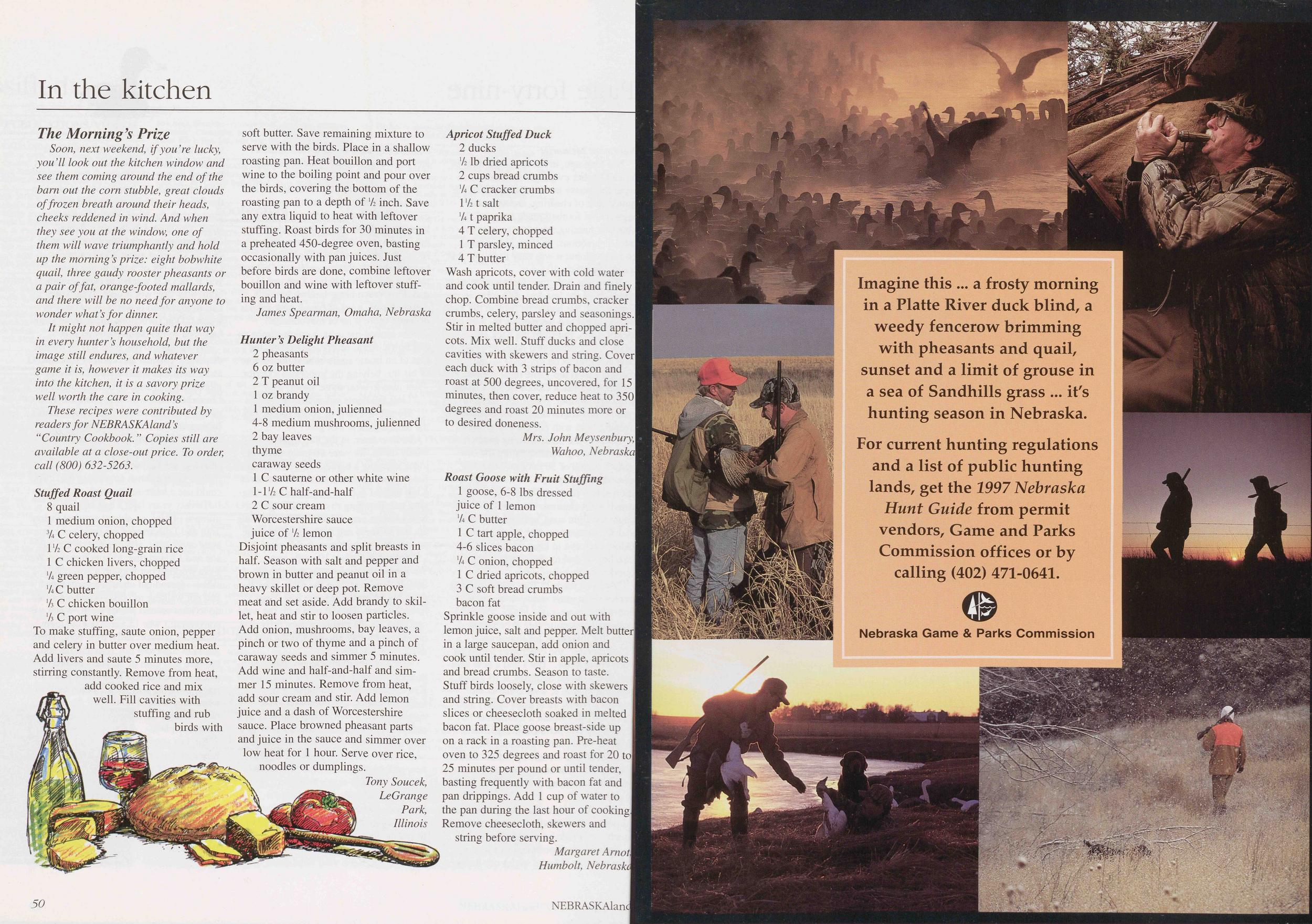
In the kitchen
The Morning's PrizeSoon, next weekend, if you 're lucky, you '11 look out the kitchen window and see them coming around the end of the barn out the corn stubble, great clouds of frozen breath around their heads, cheeks reddened in wind. And when they see you at the window, one of them will wave triumphantly and hold up the morning's prize: eight bobwhite quail, three gaudy rooster pheasants or a pair of fat, orange-footed mallards, and there will be no need for anyone to wonder what's for dinner.
It might not happen quite that way in every hunter's household, but the image still endures, and whatever game it is, however it makes its way into the kitchen, it is a savory prize well worth the care in cooking.
These recipes were contributed by readers for NEBRASKAland's "Country Cookbook." Copies still are available at a close-out price. To order, call (800) 632-5263.
Stuffed Roast Quail8 quail
1 medium onion, chopped
3/4 C celery, chopped
1 1/2 C cooked long-grain rice
1 C chicken livers, chopped
1/4 green pepper, chopped
1/4 C butter
1/3 C chicken bouillon
1/3 C port wine
To make stuffing, saute onion, pepper and celery in butter over medium heat. Add livers and saute 5 minutes more, stirring constantly. Remove from heat, add cooked rice and mix well. Fill cavities with stuffing and rub birds with
2 pheasants
6 oz butter
2 T peanut oil
1 oz brandy
1 medium onion, julienned
4-8 medium mushrooms, julienned
2 bay leaves
thyme
caraway seeds
1 C sauterne or other white wine
1-1 1/2 C half-and-half
2 C sour cream
Worcestershire sauce
juice of 1/2 lemon
Disjoint pheasants and split breasts in half. Season with salt and pepper and brown in butter and peanut oil in a heavy skillet or deep pot. Remove meat and set aside. Add brandy to skillet, heat and stir to loosen particles. Add onion, mushrooms, bay leaves, a pinch or two of thyme and a pinch of caraway seeds and simmer 5 minutes. Add wine and half-and-half and simmer 15 minutes. Remove from heat, add sour cream and stir. Add lemon juice and a dash of Worcestershire sauce. Place browned pheasant parts and juice in the sauce and simmer over low heat for 1 hour. Serve over rice, noodles or dumplings.
Tony Soucek, LeGrange Park, Illinois Apricot Stuffed Duck2 ducks
l/2 lb dried apricots
2 cups bread crumbs
1/4 C cracker crumbs
1 1/2 t salt
1/4 t paprika
4 T celery, chopped
1 T parsley, minced
4 T butter
Wash apricots, cover with cold water and cook until tender. Drain and finely chop. Combine bread crumbs, cracker crumbs, celery, parsley and seasonings. Stir in melted butter and chopped apricots. Mix well. Stuff ducks and close cavities with skewers and string. Cover| each duck with 3 strips of bacon and roast at 500 degrees, uncovered, for 15 minutes, then cover, reduce heat to 350 degrees and roast 20 minutes more or to desired doneness.
Mrs. John Meysenbury Wahoo, Nebraska Roast Goose with Fruit Stuffing1 goose, 6-8 lbs dressed
juice of 1 lemon
1/4 C butter
1 C tart apple, chopped
4-6 slices bacon
1/4 C onion, chopped
1 C dried apricots, chopped
3 C soft bread crumbs
bacon fat
Sprinkle goose inside and out with lemon juice, salt and pepper. Melt butter| in a large saucepan, add onion and cook until tender. Stir in apple, apricots and bread crumbs. Season to taste. Stuff birds loosely, close with skewers and string. Cover breasts with bacon slices or cheesecloth soaked in melted bacon fat. Place goose breast-side up on a rack in a roasting pan. Pre-heat oven to 325 degrees and roast for 20 to 25 minutes per pound or until tender, basting frequently with bacon fat and pan drippings. Add 1 cup of water to the pan during the last hour of cooking Remove cheesecloth, skewers and string before serving.
Margaret Arnot Humbolt, Nebraska 50 NEBRASKAland
Position: 820 (12 views)