Volume 75, Issue 8, 1997
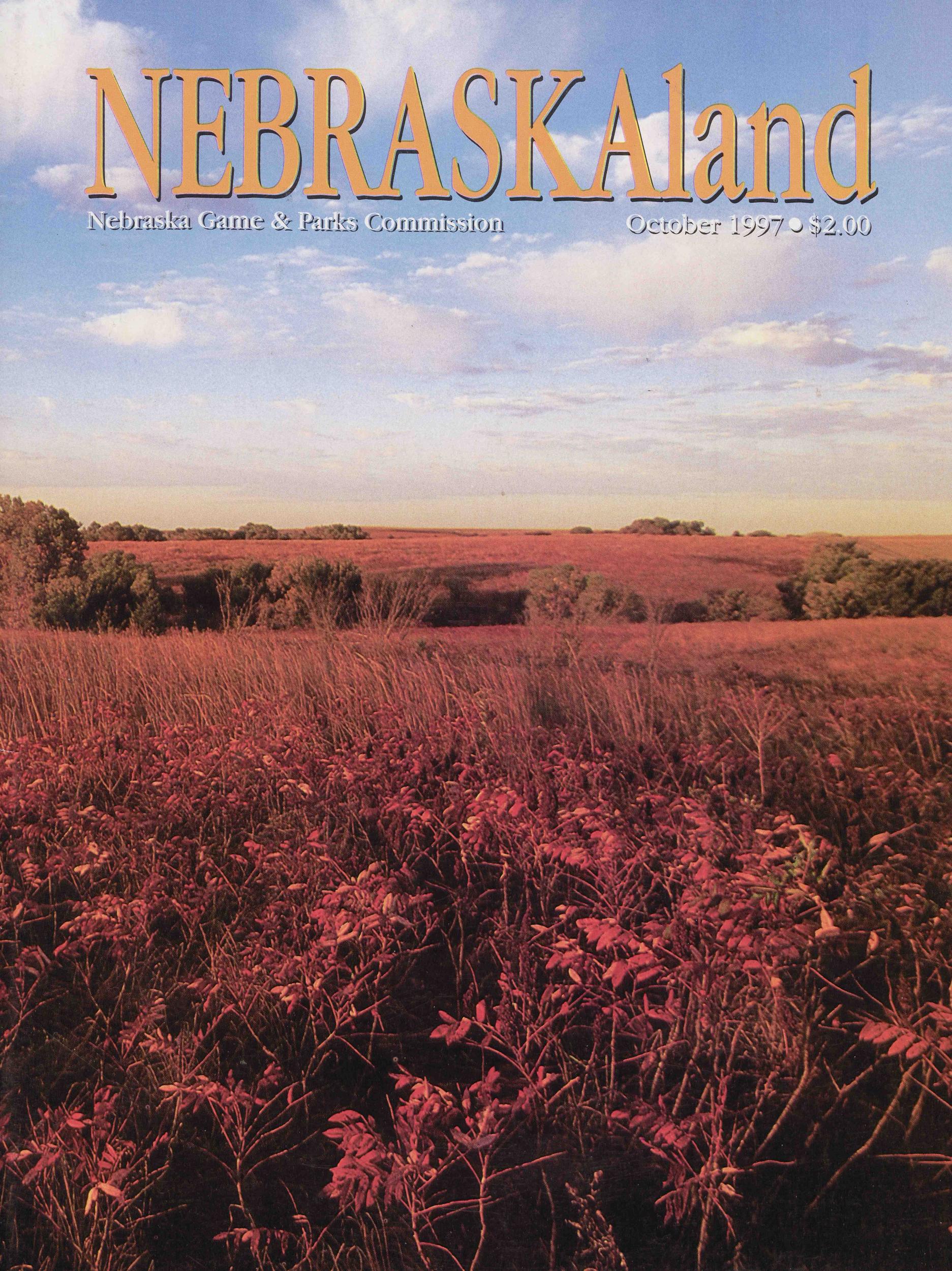
NEBRASKAland
Nebraska Game & Parks Commission October 1997 $2.00
NEBRASKAland VOL. 75 / NO. 8 OCTOBER 1997
p. 34
p. 40
p.16
Letters
A Tip of the HatA tip of the hat to Jon Farrar for two fine jobs on the "Loess Hills" article and his column about small-town dogs ["When Dogs Were Citizens," Page forty-nine, August-September 1997]. A long-time magazine writer (Omaha World-Herald's Sunday magazine), I had never heard of Nebraska's Loess Hills, except for the few on the west side of the Missouri River. It was interesting to read about those stretching through the central part of the state.
The frosting on the cake was Jon's piece about small-town dogs. I grew up in a small Nebraska town, too, and yes, we knew most of the dogs, especially the mongrels. I had one myself. And, no, his name wasn't Spot, Blackie or Rover, we called him Kayo. Don't ask me why; that just became his name.
Like the dogs in Jon's column, Kayo had no pedigree and ate scraps from the table. But he was smart. Once, when I started off for grade school, in the chill of winter, I forgot my stocking cap. Kayo saw me leave and kicked up a fuss. My mother opened the door, he took the stocking cap in his mouth and caught up with me before I reached school. Yes, he was a real small-town citizen!
James DenneyOmaha, Nebraska
Memories of NebraskaMy parents recently gave me a subscription to NEBRASKAland Magazine, and so far, I have been very satisfied.
I was born and raised in Nebraska, received my undergraduate degree from the University of Nebraska-Lincoln and worked for the Game and Parks Commission for a while. My roots are in Nebraska, and I return periodically to visit friends and family, and still venture into the Sandhills with my canoe.
The fine articles and photographs in NEBRASKAland trigger a flood of good memories: the prairies, the wind, the searing sun. I'll never forget my first trip to the Sandhills. I climbed the highest dune I could find and looked in all directions and for as far as I could see was an undulating sea of grass with a vivid blue 4 NEBRASKAland sky as a backdrop. A steer and windmill were the only traces of human presence.
"Shaggy Grass Country" by James H. Locklear [June 1997] stirred more memories of fishing trips with my father, when the wind, blowing as always, formed undulating waves on the water as well as on the meadows. The whole landscape seemed to be in motion.
Folks from where I live look at me with questioning eyes when I talk favorably of the treeless plains, but they have not looked beyond their senses to notice how the grass lies in a prairie stream or the fragile resilience of grasslands and the animals that live there.
Nebraska is not without environmental problems and damage to its streams and prairies, but where the ecosystem is largely unscathed, there is unmatched beauty, solitude and intricacy of its parts. This always will be the Nebraska I remember.
Bob HrabikOak Ridge, Missouri
Nebraska's Subtle TreasuresYou put out a great publication. "Loess Hills" and "Western Nebraska Catfishing" [August-September 1997] took me back to my childhood in Dawson County.
My dad would take my brother and me "up in the hills" to go hunting or exploring. We spent many winter days sledding, too. We lived on the banks of Buffalo Creek, which teemed with channel catfish and bullheads. I spent many days walking and fishing that creek.
I look forward to more articles on Nebraska's subtle treasures, its land and its people. The only change I would make in your magazine is a sturdier cover. Mine usually is torn by the time it arrives in my mailbox.
Zebulen LampNorthome, Minnesota
Write to: Letters, NEBRASKAland Magazine, P.O. Box 30370, Lincoln, NE 68503. Fax: (402) 471-5528. E-mail: nebland@ngpsun. ngpc.state, ne. us. Letters will be edited for clarity and length. Photographs are welcome.
Notes from the field
Sparring SpidersThis isn't really a note from the field, it happened on my front porch. But there is field activity in town, too. I was enjoying a cool mid-August evening and watching a porch spider. I assume they are called porch spiders that is about the only place I see them.
Its gray body was about three-quarters of an inch long, the underside marked with two small yellow spots. According to my field guide, it was of the family Araneidae, an orb weaver of the genus Araneus. Since females are by far the larger of the two sexes, I guessed it was female.
She sat in the middle of the two-foot web, typical for those spiders, each of her eight legs touching a radial strand of silk, feeling for a movement that would indicate some unlucky insect had strayed into the sticky web. I had not seen many "natural" catches, but I had fed her by catching moths attracted to the porch light and placing them in the web.
Her reaction to a snared moth depended on how far it was from the center of the web. If it was nearby, she almost instantly attacked, but she would turn slightly toward the radial twitched by a moth near the edge of the web and tighten her hold on the threads. When the moth twitched the web again, she would move a third of the way toward it, then stop. The next movement would draw the spider closer, but again she would stop to make sure of the prey's location. The moth's next movement would be its last — attack was instantaneous, and the moth was quickly enshrouded in silk.
Then I noticed a much smaller spider at the edge of her web merrily attaching threads of its own to it. The small spider wasn't caught; it was using the web as a pathway. The small spider was less than an eighth of an inch long, and it took a long time for her to notice its delicate movements.
She made her usual approach, but instead of an attack, her final movement was slow and deliberate. Then she stopped, hanging by a silken line.
The small spider moved away a bit, busily building its own dinner table, but it soon turned back toward the female "Goliath," laying line behind. About an inch from her, it stopped. I waited for the attack. It would take only a second for her to encase "David" in a silk shroud and add him to her pantry.
David raised his front legs and waved them at Goliath. She returned the salute. He moved closer, and their legs touched. Still I waited for the attack, but they continued to spar for what seemed like a long time. Then, apparently stunned by an uppercut, David swung away on a thread, but quickly regained his footing and climbed up the safety line. Still laying line, he headed straight for Goliath. Without hesitation he moved in for another round, this one lasting about 30 seconds. Again he was knocked back, swinging upside down for a moment.
He was down, but not out, and he went up the line and along the web radial to confront Goliath again. The sparring was intense, and several times their bodies almost touched. Fists — I mean legs — flew furiously. I couldn't see if either was biting the other.
This round also lasted about 30 seconds, and again David got knocked out of the ring or swung away deliberately. Again he climbed his fine strand of silk, but this time he stopped at the radial. Goliath took a few steps toward him and, several inches apart, they stared at each other. I thought the attack was imminent.
Then, Goliath turned and headed to her sentry-station in the web's center, facing downward as usual, her eight legs in their vibration-detecting position. She pulled the radials tight and settled in. David went back to building his seemingly haphazard web.
All this took only a few minutes — much less time than it takes to write a "field note" entry. For those of us who live in town, spiders, ants, fox squirrels, praying mantises and bluejays often are the subjects of our observations, but the opportunities are sometimes fleeting.
P. Joe Gabig 6 NEBRASKAland Midnight FieldsTonight, a frosty evening in late October, my boys and I huddled in the back of a trailer with 15 other families going out at dusk for a "Haunted Hay Ride." A few blocks' drive took us past the edge of town, and from there we set out on a dirt road, soon turning off across a wide cornfield — short, edgy stubs left from the harvest.
The cold wind in our faces smelled like coming hail, and the sky above was thick with layer after layer of broad, dark clouds. Where else on Earth could we drive over miles of corn stubble on an autumn night with nothing but endless fields stretching from every side of us to the distant horizon, and above us only dark and darker clouds, a faint green glow from the hidden moon, a sky so vast it seemed to define the word "infinity," and three sparse stars bravely shining through the mist?
The children giggled and squealed as masked goblins, ghosts and nightmare "bad guys" jumped up, roaring from behind trees and out of ditches. Plastic body parts hung from delicate branches, and cauldrons surrounded by skewered heads boiled over open fires. When these small towns decide to have a haunting, they do it right.
Every person in the trailer was connected to the land. They are farmers, farm wives and their children; they are farm suppliers, mechanics, teachers whose parents are farmers, bankers who support agriculture, storekeepers who presage the weather and the market, teenagers and toddlers who are grandchildren and great-grandchildren of farmers, who look to futures in livestock, crop production, veterinary medicine, machine mechanics, marriage, raising children and inheriting the family land.
Their look is simple — no Liz Claiborne or Neiman Marcus attire here: clean, lined faces, caps on the men, scarves and earmuffs on the women, family quilts wrapping the babies; but these lives are just as complex and turbulent, perhaps even more intertwined than urban families. And although they are landowners, it is they who are the owned.
The land rules here. The land is as awesome and powerful as the ocean, and as vast. The land determines every day and every night — the land demands and the land gives. The land and the weather join to become a powerful force as moody as a termagant and as generous as a grandmother. Here the people and the land are inseparable.
And to me, not a farmer, but an artist, the land gives peace. If I leave Nebraska, the Nebraska landscape, burrowed deep in my heart, will cling to me. The color gold that never ends when the crops are ripe, the black cattle on gray-green hills, the lonesome silos, the winding river that could have been etched by Leonardo and the overwhelming sky that covers our existence and whispers to me. My life, too, has been reshaped by this land.
We finally drove out of the cornfields, the wind behind us now, back into town — shivering, teeth chattering, fingers numb, and children's voices chorusing, "Can we go again, please?" Hot chocolate and home to our 90-year-old frame house, and to warm beds. After the children were safely off to sleep, I looked out to notice the full moon that had stayed hidden behind mysterious clouds all during our ghostly ride now sparkling clear and bright against a black sky, sparkling so brightly I thought it seemed to wink.
We moved here from a booming, well-lighted, concrete-lined city. And every day — from the day the boys sank their feet into the creek bank and caught their first frog, to the day they discovered milkweed, its pods white and frothing, to tonight's breezy sail through the ocean of midnight fields — every day rewards us with miracles.
I'll go to bed and wonder what pageant will be played out in tomorrow's sky and across tomorrow's fields when I wake up to "just another Nebraska morning."
Sondra Jonson Cambridge, Nebraska
Ahead of the Storm
Pushed south by the fierce winds of a two-day storm, record numbers of ducks and geese provided once-in-a-lifetime waterfowling for two North Platte hunters in the Rainwater Basin.
Jiggs was curled up nose to tail, asleep on the floor of the blind. An occasional shiver rattled his body, and wet feathers from a plucked teal clung to his curly coat. It was the last Monday in October and unseasonably warm — too warm for my heavy clothing, but obviously not warm enough to keep a wet dog from shaking.
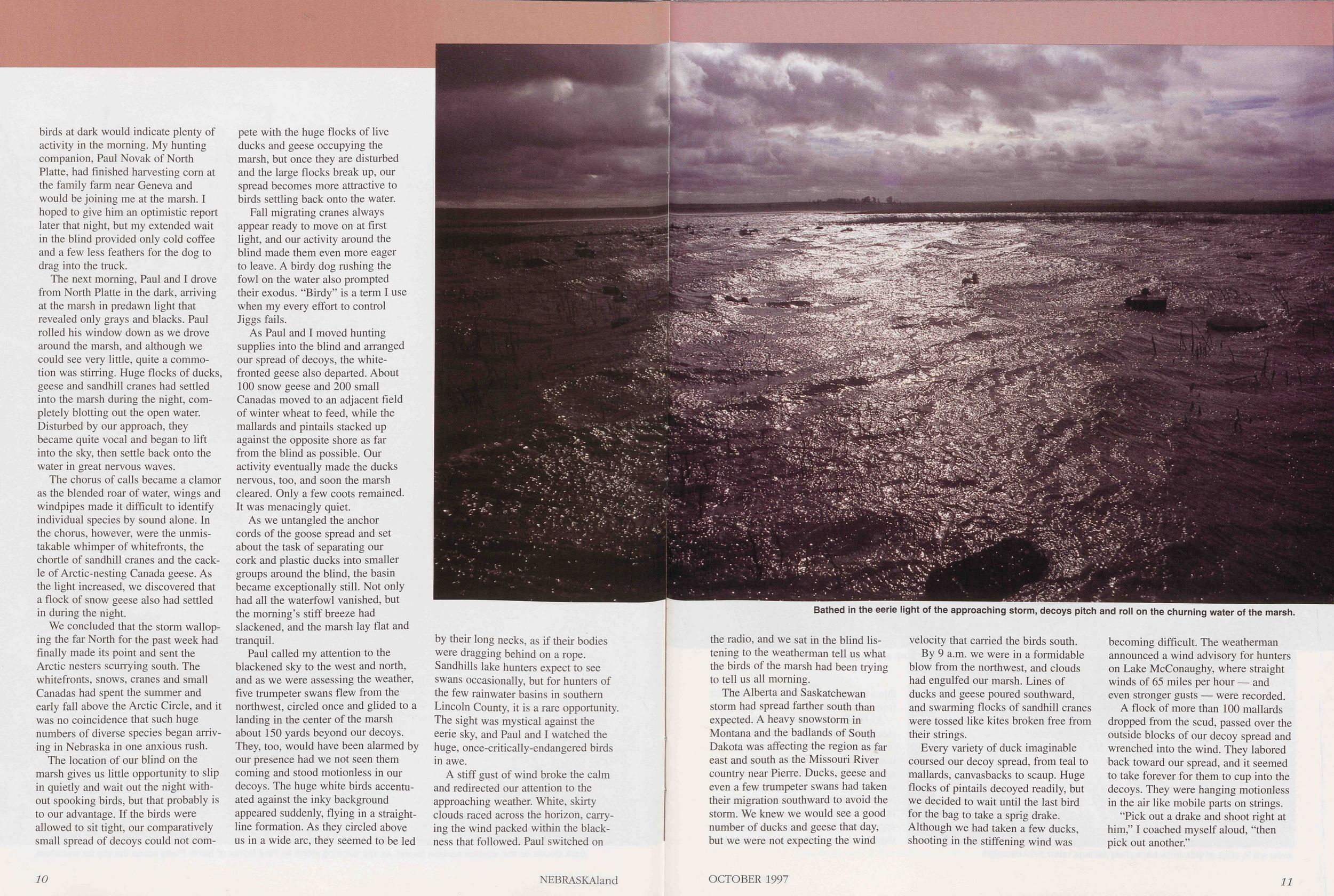
The sun had just disappeared beyond an unpicked cornfield west of the marsh and, although it was past shooting time, I was content to stay for a while to watch, listen, pull a few feathers from the dog's coat and pretend the coffee was still hot. Sunset in a marsh in October can be rewarding to those who enjoy the sights and sounds of the southward migration. Sandhill cranes and white-fronted geese often settle into such a spot for the night before continuing their journey at first light.
I thought about the past week's weather reports from Alaska, Alberta and Saskatchewan. Record cold and snow had punished Alaska and gradually pushed south and east into the provinces, finally crossing the border into Montana and the Dakotas. I knew the weather would force ducks and geese out of fall staging areas in the far North, and I was hoping for a flock of speckle-bellies during the week.
Although the whitefronts would visit Nebraska soon, I knew from the experience of past winters that most of the Canadas and mallards probably would hold up at Oahe Reservoir in South Dakota. That has been common in the past, and Nebraska hunters are somewhat penalized because the ducks and geese are so attracted to the large Missouri River reservoir. Never mind the fact that big reservoirs are important wintering refuges — hunters, regardless of the latitudes they hunt, want the ducks and geese to push south at least as far as their own setups.
Besides the aesthetic experience, I was waiting in the blind to see if dusk would bring a flight forecast for the next morning's hunt. A big push of
8 NEBRASKAlandDark clouds on the western horizon foretell an approaching storm as Paul Novak of North Platte scans the sky for waterfowl.
birds at dark would indicate plenty of activity in the morning. My hunting companion, Paul Novak of North Platte, had finished harvesting corn at the family farm near Geneva and would be joining me at the marsh. I hoped to give him an optimistic report later that night, but my extended wait in the blind provided only cold coffee and a few less feathers for the dog to drag into the truck.
The next morning, Paul and I drove from North Platte in the dark, arriving at the marsh in predawn light that revealed only grays and blacks. Paul rolled his window down as we drove around the marsh, and although we could see very little, quite a commotion was stirring. Huge flocks of ducks, geese and sandhill cranes had settled into the marsh during the night, completely blotting out the open water. Disturbed by our approach, they became quite vocal and began to lift into the sky, then settle back onto the water in great nervous waves.
The chorus of calls became a clamor as the blended roar of water, wings and windpipes made it difficult to identify individual species by sound alone. In the chorus, however, were the unmistakable whimper of whitefronts, the chortle of sandhill cranes and the cackle of Arctic-nesting Canada geese. As the light increased, we discovered that a flock of snow geese also had settled in during the night.
We concluded that the storm walloping the far North for the past week had finally made its point and sent the Arctic nesters scurrying south. The whitefronts, snows, cranes and small Canadas had spent the summer and early fall above the Arctic Circle, and it was no coincidence that such huge numbers of diverse species began arriving in Nebraska in one anxious rush.
The location of our blind on the marsh gives us little opportunity to slip in quietly and wait out the night without spooking birds, but that probably is to our advantage. If the birds were allowed to sit tight, our comparatively small spread of decoys could not compete with the huge flocks of live ducks and geese occupying the marsh, but once they are disturbed and the large flocks break up, our spread becomes more attractive to birds settling back onto the water.
Fall migrating cranes always appear ready to move on at first light, and our activity around the blind made them even more eager to leave. A birdy dog rushing the fowl on the water also prompted their exodus. "Birdy" is a term I use when my every effort to control Jiggs fails.
As Paul and I moved hunting supplies into the blind and arranged our spread of decoys, the whitefronted geese also departed. About 100 snow geese and 200 small Canadas moved to an adjacent field of winter wheat to feed, while the mallards and pintails stacked up against the opposite shore as far from the blind as possible. Our activity eventually made the ducks nervous, too, and soon the marsh cleared. Only a few coots remained. It was menacingly quiet.
As we untangled the anchor cords of the goose spread and set about the task of separating our cork and plastic ducks into smaller groups around the blind, the basin became exceptionally still. Not only had all the waterfowl vanished, but the morning's stiff breeze had slackened, and the marsh lay flat and tranquil.
Paul called my attention to the blackened sky to the west and north, and as we were assessing the weather, five trumpeter swans flew from the northwest, circled once and glided to a landing in the center of the marsh about 150 yards beyond our decoys. They, too, would have been alarmed by our presence had we not seen them coming and stood motionless in our decoys. The huge white birds accentuated against the inky background appeared suddenly, flying in a straight-line formation. As they circled above us in a wide arc, they seemed to be led by their long necks, as if their bodies were dragging behind on a rope. Sandhills lake hunters expect to see swans occasionally, but for hunters of the few rainwater basins in southern Lincoln County, it is a rare opportunity. The sight was mystical against the eerie sky, and Paul and I watched the huge, once-critically-endangered birds in awe.
Bathed in the eerie light of the approaching storm, decoys pitch and roll on the churning water of the marsh.
The Alberta and Saskatchewan storm had spread farther south than expected. A heavy snowstorm in Montana and the badlands of South Dakota was affecting the region as far east and south as the Missouri River country near Pierre. Ducks, geese and even a few trumpeter swans had taken their migration southward to avoid the storm. We knew we would see a good number of ducks and geese that day, but we were not expecting the wind velocity that carried the birds south.
By 9 a.m. we were in a formidable blow from the northwest, and clouds had engulfed our marsh. Lines of ducks and geese poured southward, and swarming flocks of sandhill cranes were tossed like kites broken free from their strings.
Every variety of duck imaginable coursed our decoy spread, from teal to mallards, canvasbacks to scaup. Huge flocks of pintails decoyed readily, but we decided to wait until the last bird for the bag to take a sprig drake. Although we had taken a few ducks, shooting in the stiffening wind was becoming difficult. The weatherman announced a wind advisory for hunters on Lake McConaughy, where straight winds of 65 miles per hour — and even stronger gusts — were recorded.
A flock of more than 100 mallards dropped from the scud, passed over the outside blocks of our decoy spread and wrenched into the wind. They labored back toward our spread, and it seemed to take forever for them to cup into the decoys. They were hanging motionless in the air like mobile parts on strings.
"Pick out a drake and shoot right at him," I coached myself aloud, "then pick out another."
OCTOBER 1997 11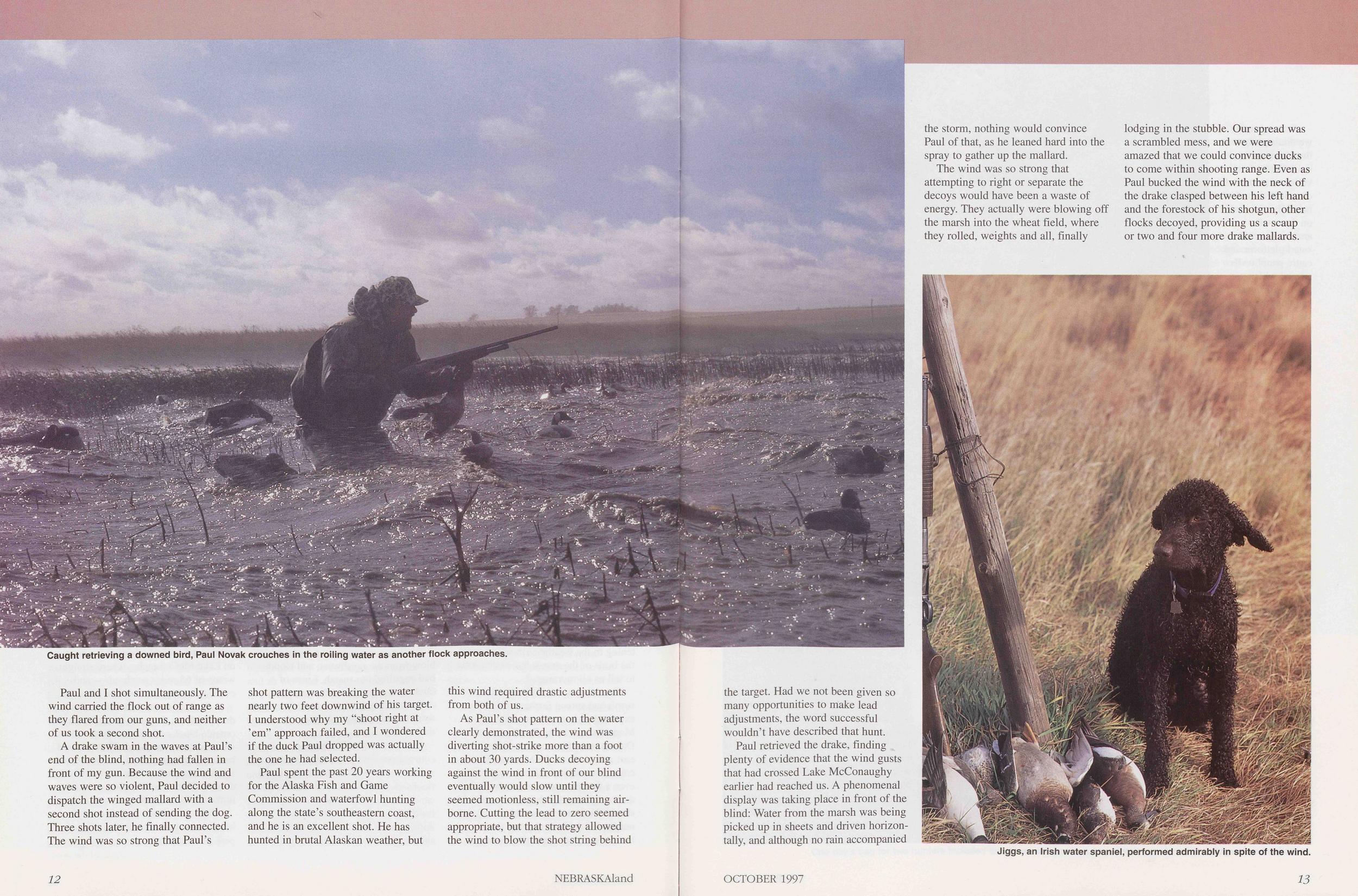
Caught retrieving a downed bird, Paul Novak crouches in the roiling water as another flock approaches.
Paul and I shot simultaneously. The wind carried the flock out of range as they flared from our guns, and neither of us took a second shot.
A drake swam in the waves at Paul's end of the blind, nothing had fallen in front of my gun. Because the wind and waves were so violent, Paul decided to dispatch the winged mallard with a second shot instead of sending the dog. Three shots later, he finally connected. The wind was so strong that Paul's shot pattern was breaking the water nearly two feet downwind of his target. I understood why my "shoot right at 'em" approach failed, and I wondered if the duck Paul dropped was actually the one he had selected.
Paul spent the past 20 years working for the Alaska Fish and Game Commission and waterfowl hunting along the state's southeastern coast, and he is an excellent shot. He has hunted in brutal Alaskan weather, but this wind required drastic adjustments from both of us.
As Paul's shot pattern on the water clearly demonstrated, the wind was diverting shot-strike more than a foot in about 30 yards. Ducks decoying against the wind in front of our blind eventually would slow until they seemed motionless, still remaining airborne. Cutting the lead to zero seemed appropriate, but that strategy allowed the wind to blow the shot string behind 12 NEBRASKAland the target. Had we not been given so many opportunities to make lead adjustments, the word successful wouldn't have described that hunt.
Jiggs, an Irish water spaniel, performed admirably in spite of the wind.
The wind was so strong that attempting to right or separate the decoys would have been a waste of energy. They actually were blowing off the marsh into the wheat field, where they rolled, weights and all, finally lodging in the stubble. Our spread was a scrambled mess, and we were amazed that we could convince ducks to come within shooting range. Even as Paul bucked the wind with the neck of the drake clasped between his left hand and the forestock of his shotgun, other flocks decoyed, providing us a scaup or two and four more drake mallards.
OCTOBER 1997 13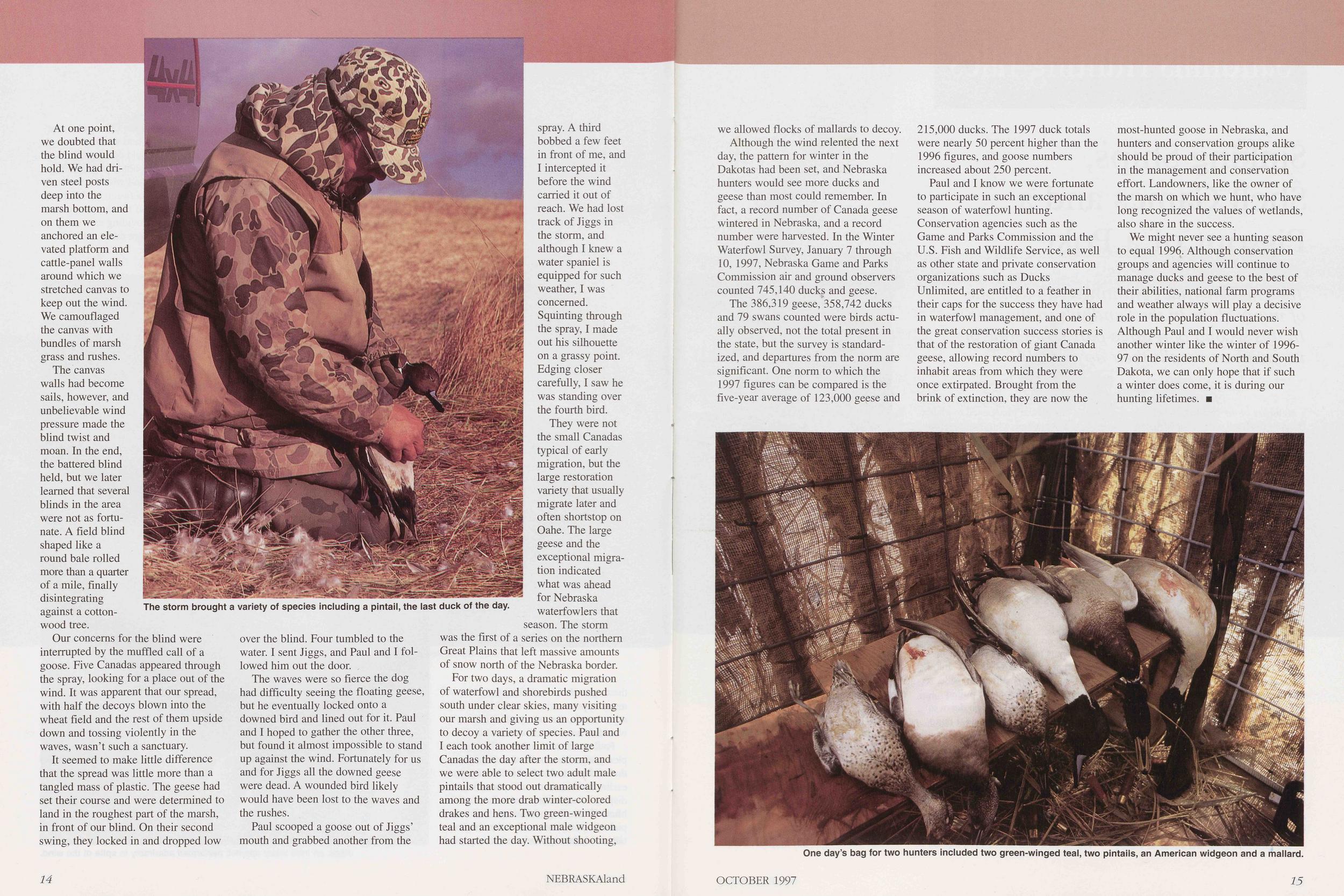
At one point, we doubted that the blind would hold. We had driven steel posts deep into the marsh bottom, and on them we anchored an elevated platform and cattle-panel walls around which we stretched canvas to keep out the wind. We camouflaged the canvas with bundles of marsh grass and rushes.
The canvas walls had become sails, however, and unbelievable wind pressure made the blind twist and moan. In the end, the battered blind held, but we later learned that several blinds in the area were not as fortunate. A field blind shaped like a round bale rolled more than a quarter of a mile, finally disintegrating against a cottonwood tree.
Our concerns for the blind were interrupted by the muffled call of a goose. Five Canadas appeared through the spray, looking for a place out of the wind. It was apparent that our spread, with half the decoys blown into the wheat field and the rest of them upside down and tossing violently in the waves, wasn't such a sanctuary.
The storm brought a variety of species including a pintail, the last duck of the day.
The waves were so fierce the dog had difficulty seeing the floating geese, but he eventually locked onto a downed bird and lined out for it. Paul and I hoped to gather the other three, but found it almost impossible to stand up against the wind. Fortunately for us and for Jiggs all the downed geese were dead. A wounded bird likely would have been lost to the waves and the rushes.
Paul scooped a goose out of Jiggs' mouth and grabbed another from the spray. A third bobbed a few feet in front of me, and I intercepted it before the wind carried it out of reach. We had lost track of Jiggs in the storm, and although I knew a water spaniel is equipped for such weather, I was concerned. Squinting through the spray, I made out his silhouette on a grassy point. Edging closer carefully, I saw he was standing over the fourth bird.
They were not the small Canadas typical of early migration, but the large restoration variety that usually migrate later and often shortstop on Oahe. The large geese and the exceptional migration indicated what was ahead for Nebraska waterfowlers that season. The storm was the first of a series on the northern Great Plains that left massive amounts of snow north of the Nebraska border.
For two days, a dramatic migration of waterfowl and shorebirds pushed south under clear skies, many visiting our marsh and giving us an opportunity to decoy a variety of species. Paul and I each took another limit of large Canadas the day after the storm, and we were able to select two adult male pintails that stood out dramatically among the more drab winter-colored drakes and hens. Two green-winged teal and an exceptional male widgeon had started the day. Without shooting, 14 NEBRASKAland we allowed flocks of mallards to decoy.
Although the wind relented the next day, the pattern for winter in the Dakotas had been set, and Nebraska hunters would see more ducks and geese than most could remember. In fact, a record number of Canada geese wintered in Nebraska, and a record number were harvested. In the Winter Waterfowl Survey, January 7 through 10, 1997, Nebraska Game and Parks Commission air and ground observers counted 745,140 ducks and geese.
The 386,319 geese, 358,742 ducks and 79 swans counted were birds actually observed, not the total present in the state, but the survey is standardized, and departures from the norm are significant. One norm to which the 1997 figures can be compared is the five-year average of 123,000 geese and 215,000 ducks. The 1997 duck totals were nearly 50 percent higher than the 1996 figures, and goose numbers increased about 250 percent.
Paul and I know we were fortunate to participate in such an exceptional season of waterfowl hunting. Conservation agencies such as the Game and Parks Commission and the U.S. Fish and Wildlife Service, as well as other state and private conservation organizations such as Ducks Unlimited, are entitled to a feather in their caps for the success they have had in waterfowl management, and one of the great conservation success stories is that of the restoration of giant Canada geese, allowing record numbers to inhabit areas from which they were once extirpated. Brought from the brink of extinction, they are now the most-hunted goose in Nebraska, and hunters and conservation groups alike should be proud of their participation in the management and conservation effort. Landowners, like the owner of the marsh on which we hunt, who have long recognized the values of wetlands, also share in the success.
We might never see a hunting season to equal 1996. Although conservation groups and agencies will continue to manage ducks and geese to the best of their abilities, national farm programs and weather always will play a decisive role in the population fluctuations. Although Paul and I would never wish another winter like the winter of 1996-97 on the residents of North and South Dakota, we can only hope that if such a winter does come, it is during our hunting lifetimes.
One day's bag for two hunters included two green-winged teal, two pintails, an American widgeon and a mallard.
William S. Keeline's Sandhills Hunting Tales
Sinking Ships, Shell Games and a Pig out of a Poke
The Elkhorn Valley Hunting Club was one of many clubs in the Sandhills in the 1900s. In this second of a three-part series, one of its members recalls their days afield.
Members of the Elkhorn Valley Hunting Club, all prominent business-and professional men from Council Bluffs, Iowa, began hunting waterfowl and grouse in Cherry County in the 1890s. In 1917 they purchased 200 acres of land encompassing much of South Marsh Lake where they built a three-room cabin. In 1933 the club sold its land, which in 1935 became part of the newly established Valentine National Wildlife Refuge. In 1935, William S. Keeline wrote his memories of Sandhills hunts. Jon Farrar Billie Saves My LifeThe fall we got out of the war [1918], I was delayed a week when the bunch went up into Cherry County. The morning I got there, after I had eaten my breakfast, I thought I would row up and have a look at my old blind in the west end of the lake. My boat had been used by some fellow, and he had put a shell box in it for a seat instead of the very low canvas seats that come with a Mullin boat. I didn't stop to change it and got along all right until I started back.
About the time I got [to] about the middle of the lake I happened to glance back and here came a big flock of redheads, flying low. I grabbed my gun, and as they got out sideways from me, I shot. When the gun went off, the kick slid me and the box over sidewise, and I accidentally pulled the trigger again — and over the boat went and me, too, headfirst into the water. It never scared me to be dumped out like this, as I have had it occur to me many times. I can swim like a fish but was considerably handicapped as I had on hip boots and a shell vest with 50 shells in it.
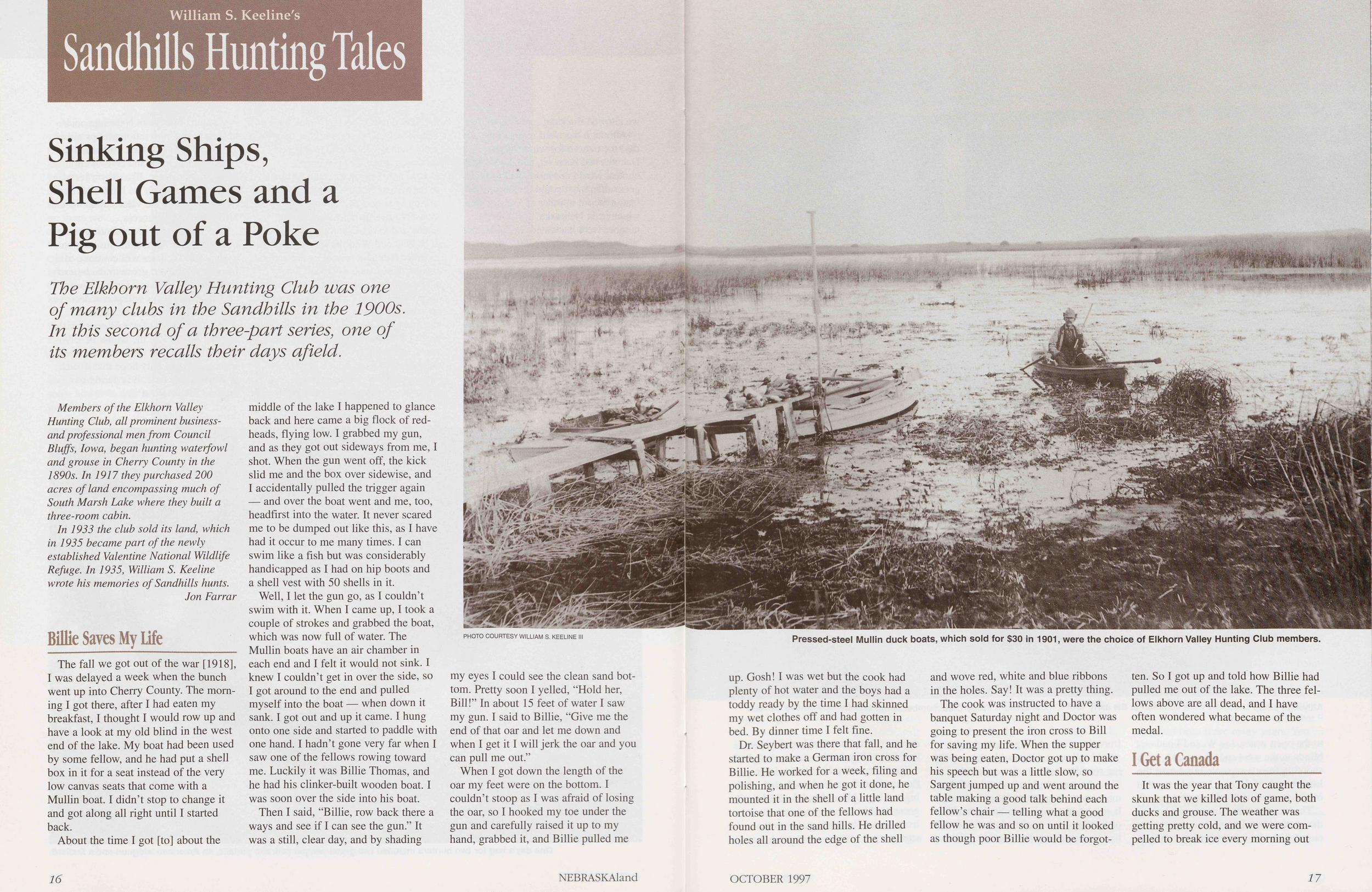
Well, I let the gun go, as I couldn't swim with it. When I came up, I took a couple of strokes and grabbed the boat, which was now full of water. The Mullin boats have an air chamber in each end and I felt it would not sink. I knew I couldn't get in over the side, so I got around to the end and pulled myself into the boat — when down it sank. I got out and up it came. I hung onto one side and started to paddle with one hand. I hadn't gone very far when I saw one of the fellows rowing toward me. Luckily it was Billie Thomas, and he had his clinker-built wooden boat. I was soon over the side into his boat.
Then I said, "Billie, row back there a ways and see if I can see the gun." It was a still, clear day, and by shading
my eyes I could see the clean sand bottom. Pretty soon I yelled, "Hold her, Bill!" In about 15 feet of water I saw my gun. I said to Billie, "Give me the end of that oar and let me down and when I get it I will jerk the oar and you can pull me out."
Pressed-steel Mullin duck boats, which sold for $30 in 1901, were the choice of Elkhorn Valley Hunting Club members.
Dr. Seybert was there that fall, and he started to make a German iron cross for Billie. He worked for a week, filing and polishing, and when he got it done, he mounted it in the shell of a little land tortoise that one of the fellows had found out in the sand hills. He drilled holes all around the edge of the shell and wove red, white and blue ribbons in the holes. Say! It was a pretty thing.
The cook was instructed to have a banquet Saturday night and Doctor was going to present the iron cross to Bill for saving my life. When the supper was being eaten, Doctor got up to make his speech but was a little slow, so Sargent jumped up and went around the table making a good talk behind each fellow's chair — telling what a good fellow he was and so on until it looked as though poor Billie would be forgotten. So I got up and told how Billie had pulled me out of the lake. The three fellows above are all dead, and I have often wondered what became of the medal.
I Get a CanadaIt was the year that Tony caught the skunk that we killed lots of game, both ducks and grouse. The weather was getting pretty cold, and we were compelled to break ice every morning out
OCTOBER 1997 17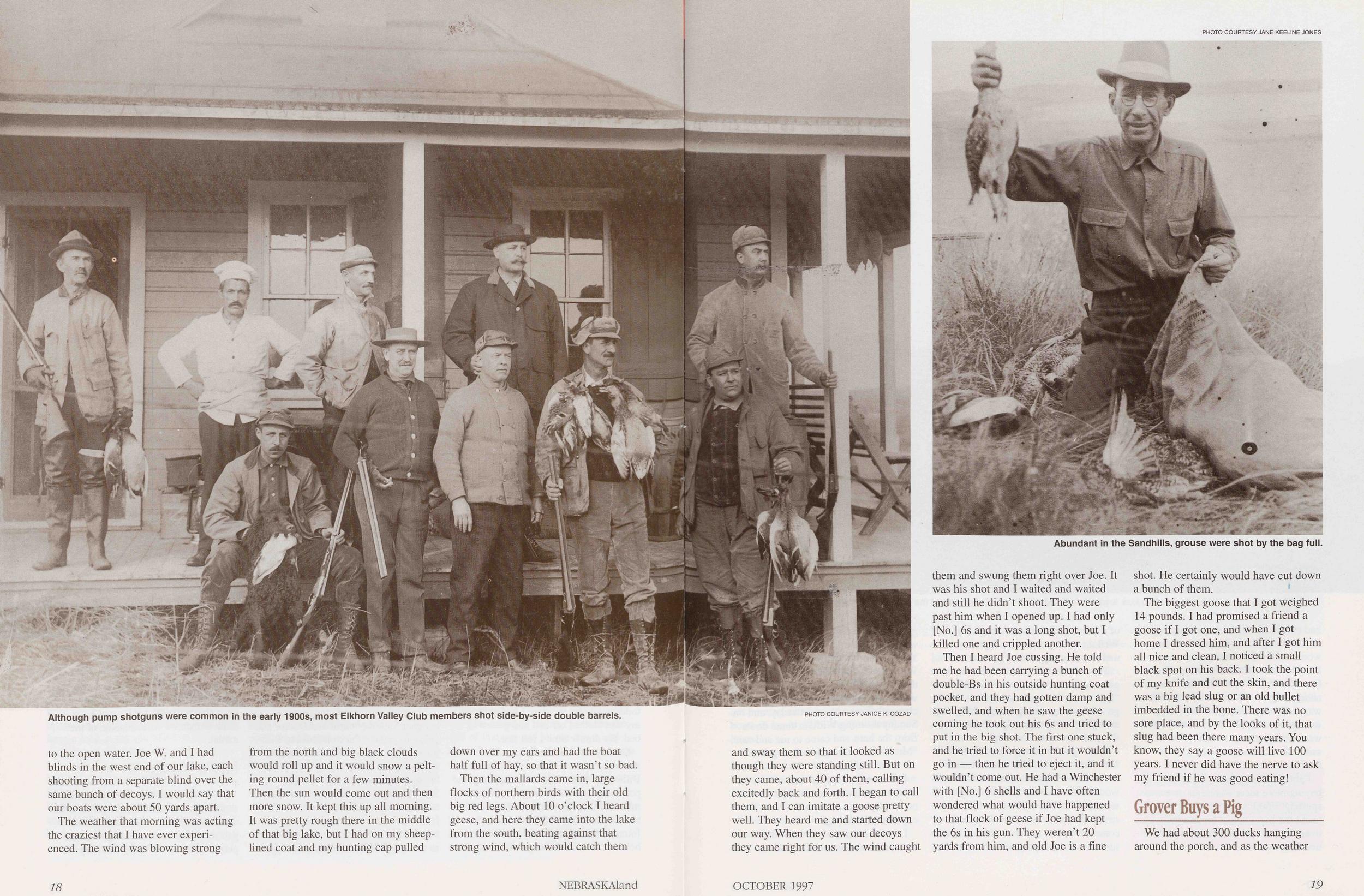
Although pump shotguns were common in the early 1900s, most Elkhorn Valley Club members shot side-by-side double barrels.
to the open water. Joe W. and I had blinds in the west end of our lake, each shooting from a separate blind over the same bunch of decoys. I would say that our boats were about 50 yards apart.
The weather that morning was acting the craziest that I have ever experienced. The wind was blowing strong from the north and big black clouds would roll up and it would snow a pelting round pellet for a few minutes. Then the sun would come out and then more snow. It kept this up all morning. It was pretty rough there in the middle of that big lake, but I had on my sheep-lined coat and my hunting cap pulled down over my ears and had the boat half full of hay, so that it wasn't so bad.
Then the mallards came in, large flocks of northern birds with their old big red legs. About 10 o'clock I heard geese, and here they came into the lake from the south, beating against that strong wind, which would catch them
18 NEBRASKAlandand sway them so that it looked as though they were standing still. But on they came, about 40 of them, calling excitedly back and forth. I began to call them, and I can imitate a goose pretty well. They heard me and started down our way. When they saw our decoys they came right for us. The wind caught
PHOTO COURTESY JANE KEELINE JONESAbundant in the Sandhills, grouse were shot by the bag full.
them and swung them right over Joe. It was his shot and I waited and waited and still he didn't shoot. They were past him when I opened up. I had only [No.] 6s and it was a long shot, but I killed one and crippled another.
Then I heard Joe cussing. He told me he had been carrying a bunch of double-Bs in his outside hunting coat pocket, and they had gotten damp and swelled, and when he saw the geese coming he took out his 6s and tried to put in the big shot. The first one stuck, and he tried to force it in but it wouldn't go in — then he tried to eject it, and it wouldn't come out. He had a Winchester with [No.] 6 shells and I have often wondered what would have happened to that flock of geese if Joe had kept the 6s in his gun. They weren't 20 yards from him, and old Joe is a fine shot. He certainly would have cut down a bunch of them.
The biggest goose that I got weighed 14 pounds. I had promised a friend a goose if I got one, and when I got home I dressed him, and after I got him all nice and clean, I noticed a small black spot on his back. I took the point of my knife and cut the skin, and there was a big lead slug or an old bullet imbedded in the bone. There was no sore place, and by the looks of it, that slug had been there many years. You know, they say a goose will live 100 years. I never did have the nerve to ask my friend if he was good eating!
Grover Buys a PigWe had about 300 ducks hanging around the porch, and as the weather
OCTOBER 1997 19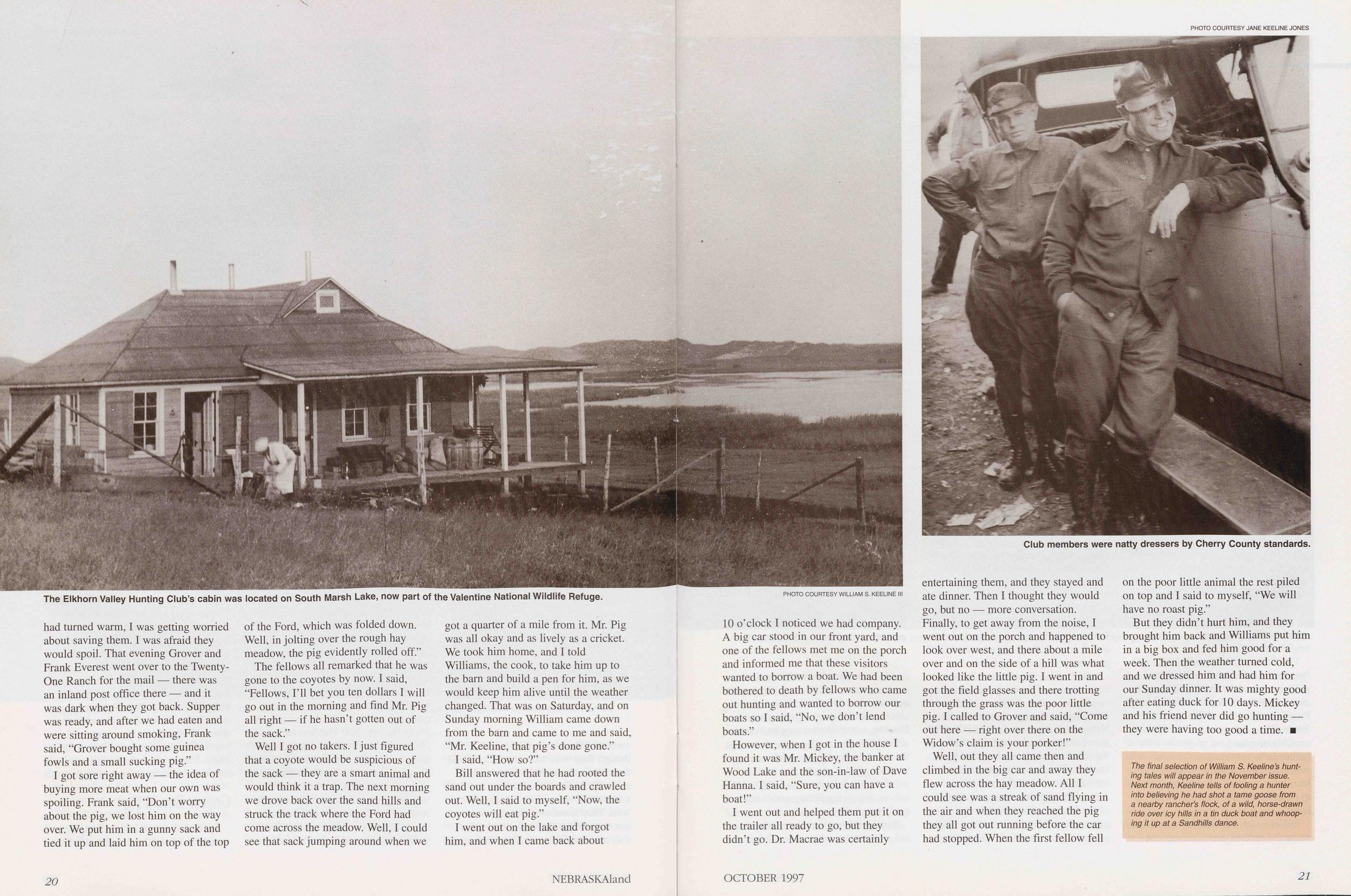
had turned warm, I was getting worried about saving them. I was afraid they would spoil. That evening Grover and Frank Everest went over to the Twenty-One Ranch for the mail — there was an inland post office there — and it was dark when they got back. Supper was ready, and after we had eaten and were sitting around smoking, Frank said, "Grover bought some guinea fowls and a small sucking pig."
I got sore right away — the idea of buying more meat when our own was spoiling. Frank said, "Don't worry about the pig, we lost him on the way over. We put him in a gunny sack and tied it up and laid him on top of the top of the Ford, which was folded down. Well, in jolting over the rough hay meadow, the pig evidently rolled off." The fellows all remarked that he was gone to the coyotes by now. I said, "Fellows, I'll bet you ten dollars I will go out in the morning and find Mr. Pig all right — if he hasn't gotten out of the sack."
Well I got no takers. I just figured that a coyote would be suspicious of the sack — they are a smart animal and would think it a trap. The next morning we drove back over the sand hills and struck the track where the Ford had come across the meadow. Well, I could see that sack jumping around when we got a quarter of a mile from it. Mr. Pig was all okay and as lively as a cricket. We took him home, and I told Williams, the cook, to take him up to the barn and build a pen for him, as we would keep him alive until the weather changed. That was on Saturday, and on Sunday morning William came down from the barn and came to me and said, "Mr. Keeline, that pig's done gone."
I said, "How so?"
Bill answered that he had rooted the sand out under the boards and crawled out. Well, I said to myself, "Now, the coyotes will eat pig."
I went out on the lake and forgot him, and when I came back about
20 NEBRASKAland10 o'clock I noticed we had company. A big car stood in our front yard, and one of the fellows met me on the porch and informed me that these visitors wanted to borrow a boat. We had been bothered to death by fellows who came out hunting and wanted to borrow our boats so I said, "No, we don't lend boats."
However, when I got in the house I found it was Mr. Mickey, the banker at Wood Lake and the son-in-law of Dave Hanna. I said, "Sure, you can have a boat!"
I went out and helped them put it on the trailer all ready to go, but they didn't go. Dr. Macrae was certainly
Club members were natty dressers by Cherry County standards.
entertaining them, and they stayed and ate dinner. Then I thought they would go, but no — more conversation. Finally, to get away from the noise, I went out on the porch and happened to look over west, and there about a mile over and on the side of a hill was what looked like the little pig. I went in and got the field glasses and there trotting through the grass was the poor little pig. I called to Grover and said, "Come out here — right over there on the Widow's claim is your porker!"
Well, out they all came then and climbed in the big car and away they flew across the hay meadow. All I could see was a streak of sand flying in the air and when they reached the pig they all got out running before the car had stopped. When the first fellow fell on the poor little animal the rest piled on top and I said to myself, "We will have no roast pig."
But they didn't hurt him, and they brought him back and Williams put him in a big box and fed him good for a week. Then the weather turned cold, and we dressed him and had him for our Sunday dinner. It was mighty good after eating duck for 10 days. Mickey and his friend never did go hunting — they were having too good a time.
The final selection of William S. Keeline's hunting tales will appear in the November issue. Next month, Keeline tells of fooling a hunter into believing he had shot a tame goose from a nearby rancher's flock, of a wild, horse-drawn ride over icy hills in a tin duck boat and whooping it up at a Sandhills dance. OCTOBER 1997 21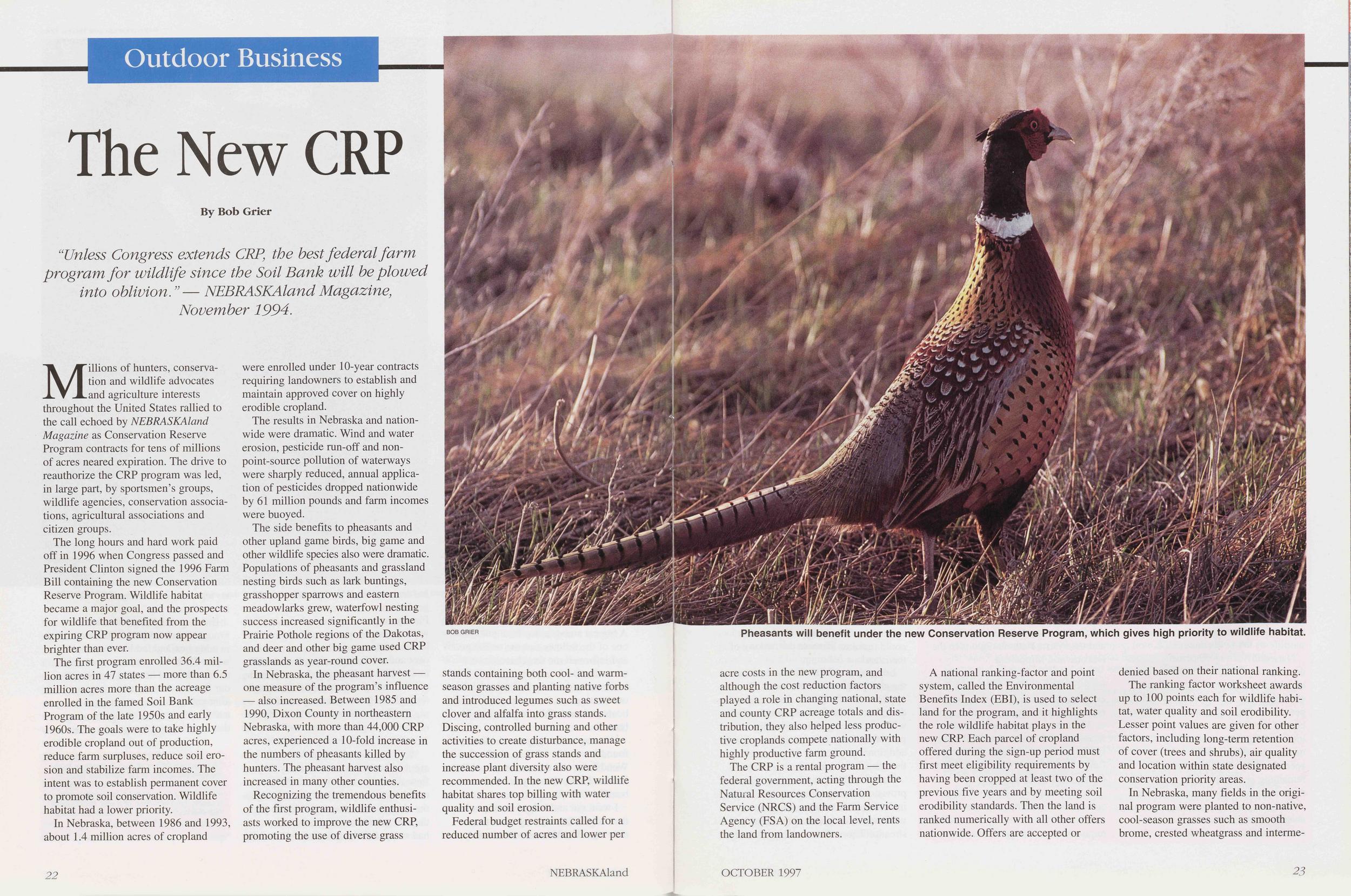
Outdoor Business
The New CRP
"Unless Congress extends CRP, the best federal farm program for wildlife since the Soil Bank will be plowed into oblivion."— NEBRASKAland Magazine, November 1994.
Millions of hunters, conservation and wildlife advocates and agriculture interests throughout the United States rallied to the call echoed by NEBRASKAland Magazine as Conservation Reserve Program contracts for tens of millions of acres neared expiration. The drive to reauthorize the CRP program was led, in large part, by sportsmen's groups, wildlife agencies, conservation associations, agricultural associations and citizen groups.
The long hours and hard work paid off in 1996 when Congress passed and President Clinton signed the 1996 Farm Bill containing the new Conservation Reserve Program. Wildlife habitat became a major goal, and the prospects for wildlife that benefited from the expiring CRP program now appear brighter than ever.
The first program enrolled 36.4 million acres in 47 states — more than 6.5 million acres more than the acreage enrolled in the famed Soil Bank Program of the late 1950s and early 1960s. The goals were to take highly erodible cropland out of production, reduce farm surpluses, reduce soil erosion and stabilize farm incomes. The intent was to establish permanent cover to promote soil conservation. Wildlife habitat had a lower priority. In Nebraska, between 1986 and 1993, about 1.4 million acres of cropland were enrolled under 10-year contracts requiring landowners to establish and maintain approved cover on highly erodible cropland.
The results in Nebraska and nationwide were dramatic. Wind and water erosion, pesticide run-off and nonpoint-source pollution of waterways were sharply reduced, annual application of pesticides dropped nationwide by 61 million pounds and farm incomes were buoyed.
The side benefits to pheasants and other upland game birds, big game and other wildlife species also were dramatic. Populations of pheasants and grassland nesting birds such as lark buntings, grasshopper sparrows and eastern meadowlarks grew, waterfowl nesting success increased significantly in the Prairie Pothole regions of the Dakotas, and deer and other big game used CRP grasslands as year-round cover.
In Nebraska, the pheasant harvest — one measure of the program's influence — also increased. Between 1985 and 1990, Dixon County in northeastern Nebraska, with more than 44,000 CRP acres, experienced a 10-fold increase in the numbers of pheasants killed by hunters. The pheasant harvest also increased in many other counties.
Recognizing the tremendous benefits of the first program, wildlife enthusiasts worked to improve the new CRP, promoting the use of diverse grass
stands containing both cool- and warm-season grasses and planting native forbs and introduced legumes such as sweet clover and alfalfa into grass stands. Discing, controlled burning and other activities to create disturbance, manage the succession of grass stands and increase plant diversity also were recommended. In the new CRP, wildlife habitat shares top billing with water quality and soil erosion.
Pheasants will benefit under the new Conservation Reserve Program, which gives high priority to wildlife habitat.
The CRP is a rental program — the federal government, acting through the Natural Resources Conservation Service (NRCS) and the Farm Service Agency (FSA) on the local level, rents the land from landowners.
A national ranking-factor and point system, called the Environmental Benefits Index (EBI), is used to select land for the program, and it highlights the role wildlife habitat plays in the new CRP. Each parcel of cropland offered during the sign-up period must first meet eligibility requirements by having been cropped at least two of the previous five years and by meeting soil erodibility standards. Then the land is ranked numerically with all other offers nationwide. Offers are accepted or denied based on their national ranking.
The ranking factor worksheet awards up to 100 points each for wildlife habitat, water quality and soil erodibility. Lesser point values are given for other factors, including long-term retention of cover (trees and shrubs), air quality and location within state designated conservation priority areas.
In Nebraska, many fields in the original program were planted to non-native, cool-season grasses such as smooth brome, crested wheatgrass and intermediate
OCTOBER 1997 23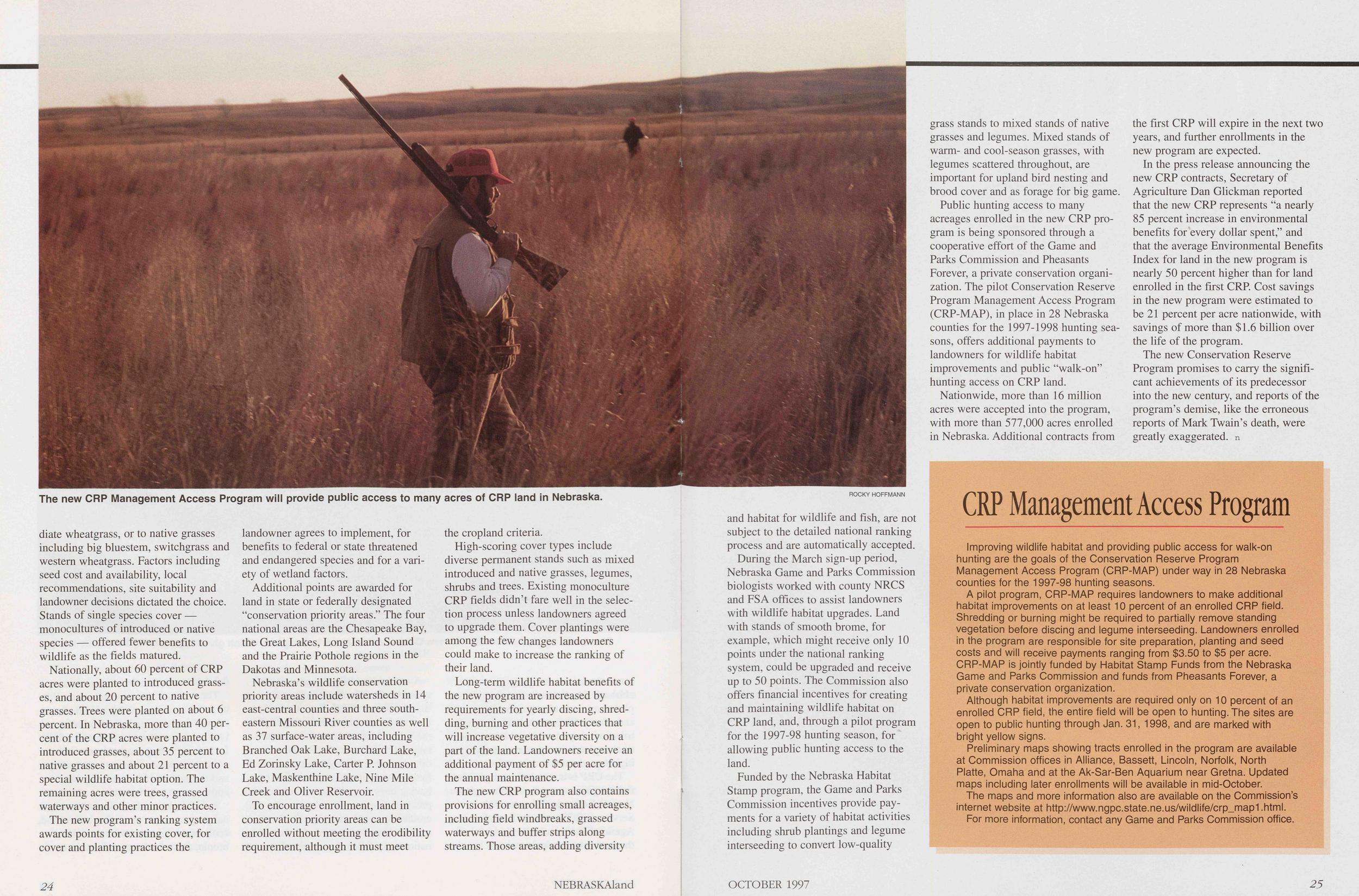
The new CRP Management Access Program will provide public access to many acres of CRP land in Nebraska.
wheatgrass, or to native grasses including big bluestem, switchgrass and western wheatgrass. Factors including seed cost and availability, local recommendations, site suitability and landowner decisions dictated the choice. Stands of single species cover — monocultures of introduced or native species — offered fewer benefits to wildlife as the fields matured.
Nationally, about 60 percent of CRP acres were planted to introduced grasses, and about 20 percent to native grasses. Trees were planted on about 6 percent. In Nebraska, more than 40 percent of the CRP acres were planted to introduced grasses, about 35 percent to native grasses and about 21 percent to a special wildlife habitat option. The remaining acres were trees, grassed waterways and other minor practices.
The new program's ranking system awards points for existing cover, for cover and planting practices the landowner agrees to implement, for benefits to federal or state threatened and endangered species and for a variety of wetland factors.
Additional points are awarded for land in state or federally designated "conservation priority areas." The four national areas are the Chesapeake Bay, the Great Lakes, Long Island Sound and the Prairie Pothole regions in the Dakotas and Minnesota.
Nebraska's wildlife conservation priority areas include watersheds in 14 east-central counties and three southeastern Missouri River counties as well as 37 surface-water areas, including Branched Oak Lake, Burchard Lake, Ed Zorinsky Lake, Carter P. Johnson Lake, Maskenthine Lake, Nine Mile Creek and Oliver Reservoir.
To encourage enrollment, land in conservation priority areas can be enrolled without meeting the erodibility requirement, although it must meet the cropland criteria.
High-scoring cover types include diverse permanent stands such as mixed introduced and native grasses, legumes, shrubs and trees. Existing monoculture CRP fields didn't fare well in the selection process unless landowners agreed to upgrade them. Cover plantings were among the few changes landowners could make to increase the ranking of their land.
Long-term wildlife habitat benefits of the new program are increased by requirements for yearly discing, shredding, burning and other practices that will increase vegetative diversity on a part of the land. Landowners receive an additional payment of $5 per acre for the annual maintenance.
The new CRP program also contains provisions for enrolling small acreages, including field windbreaks, grassed waterways and buffer strips along streams. Those areas, adding diversity
24 NEBRASKAlandand habitat for wildlife and fish, are not subject to the detailed national ranking process and are automatically accepted.
During the March sign-up period, Nebraska Game and Parks Commission biologists worked with county NRCS and FSA offices to assist landowners with wildlife habitat upgrades. Land with stands of smooth brome, for example, which might receive only 10 points under the national ranking system, could be upgraded and receive up to 50 points. The Commission also offers financial incentives for creating and maintaining wildlife habitat on CRP land, and, through a pilot program for the 1997-98 hunting season, for allowing public hunting access to the land.
Funded by the Nebraska Habitat Stamp program, the Game and Parks Commission incentives provide payments for a variety of habitat activities including shrub plantings and legume interseeding to convert low-quality grass stands to mixed stands of native grasses and legumes. Mixed stands of warm- and cool-season grasses, with legumes scattered throughout, are important for upland bird nesting and brood cover and as forage for big game.
Public hunting access to many acreages enrolled in the new CRP program is being sponsored through a cooperative effort of the Game and Parks Commission and Pheasants Forever, a private conservation organization. The pilot Conservation Reserve Program Management Access Program (CRP-MAP), in place in 28 Nebraska counties for the 1997-1998 hunting seasons, offers additional payments to landowners for wildlife habitat improvements and public "walk-on" hunting access on CRP land.
Nationwide, more than 16 million acres were accepted into the program, with more than 577,000 acres enrolled in Nebraska. Additional contracts from the first CRP will expire in the next two years, and further enrollments in the new program are expected.
In the press release announcing the new CRP contracts, Secretary of Agriculture Dan Glickman reported that the new CRP represents "a nearly 85 percent increase in environmental benefits for every dollar spent," and that the average Environmental Benefits Index for land in the new program is nearly 50 percent higher than for land enrolled in the first CRP. Cost savings in the new program were estimated to be 21 percent per acre nationwide, with savings of more than $1.6 billion over the life of the program.
The new Conservation Reserve Program promises to carry the significant achievements of its predecessor into the new century, and reports of the program's demise, like the erroneous reports of Mark Twain's death, were greatly exaggerated.
CRP Management Access Program
Improving wildlife habitat and providing public access for walk-on hunting are the goals of the Conservation Reserve Program Management Access Program (CRP-MAP) under way in 28 Nebraska counties for the 1997-98 hunting seasons.
A pilot program, CRP-MAP requires landowners to make additional habitat improvements on at least 10 percent of an enrolled CRP field. Shredding or burning might be required to partially remove standing vegetation before discing and legume interseeding. Landowners enrolled in the program are responsible for site preparation, planting and seed costs and will receive payments ranging from $3.50 to $5 per acre. CRP-MAP is jointly funded by Habitat Stamp Funds from the Nebraska Game and Parks Commission and funds from Pheasants Forever, a private conservation organization.
Although habitat improvements are required only on 10 percent of an enrolled CRP field, the entire field will be open to hunting. The sites are open to public hunting through Jan. 31, 1998, and are marked with bright yellow signs.
Preliminary maps showing tracts enrolled in the program are available at Commission offices in Alliance, Bassett, Lincoln, Norfolk, North Platte, Omaha and at the Ak-Sar-Ben Aquarium near Gretna. Updated maps including later enrollments will be available in mid-October.
The maps and more information also are available on the Commission's internet website at http://www.ngpc.state.ne.us/wildlife/crp_map1.html.
For more information, contact any Game and Parks Commission office.
OCTOBER 1997 25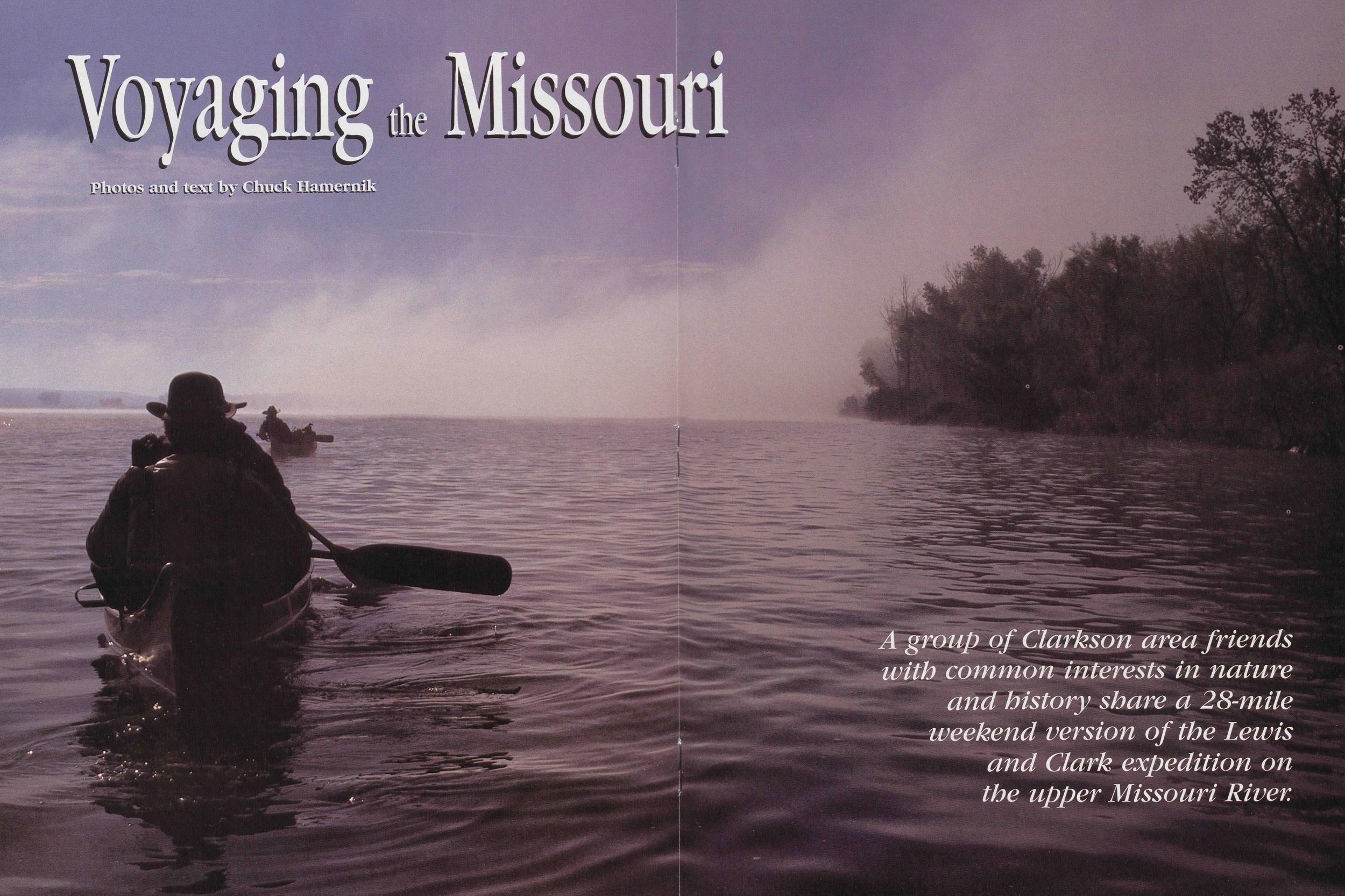
Voyaging the Missouri
A group of Clarkson area friends with common interests in nature and history share a 28-mile weekend version of the Lewis and Clark expedition on the upper Missouri River.
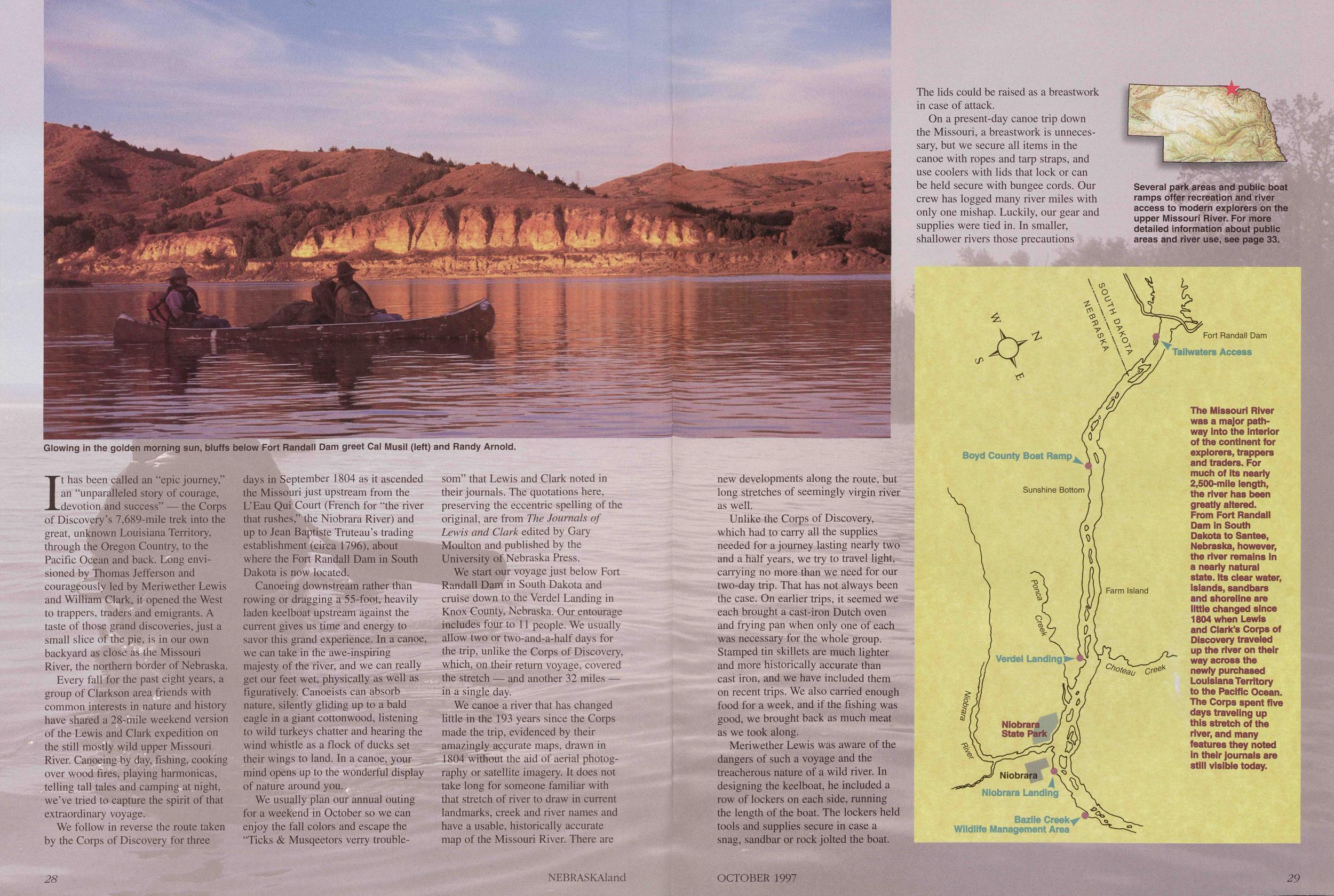
Glowing in the golden morning sun, bluffs below Fort Randall Dam greet Cal Musil (left) and Randy Arnold.
It has been called an "epic journey," an "unparalleled story of courage, devotion and success" — the Corps of Discovery's 7,689-mile trek into the great, unknown Louisiana Territory, through the Oregon Country, to the Pacific Ocean and back. Long envisioned by Thomas Jefferson and courageously led by Meriwether Lewis and William Clark, it opened the West to trappers, traders and emigrants. A taste of those grand discoveries, just a small slice of the pie, is in our own backyard as close as the Missouri River, the northern border of Nebraska.
Every fall for the past eight years, a group of Clarkson area friends with common interests in nature and history have shared a 28-mile weekend version of the Lewis and Clark expedition on the still mostly wild upper Missouri River. Canoeing by day, fishing, cooking over wood fires, playing harmonicas, telling tall tales and camping at night, we've tried to capture the spirit of that extraordinary voyage.
We follow in reverse the route taken by the Corps of Discovery for three days in September 1804 as it ascended the Missouri just upstream from the L'Eau Qui Court (French for "the river that rushes," the Niobrara River) and up to Jean Baptiste Truteau's trading establishment (circa 1796), about where the Fort Randall Dam in South Dakota is now located.
Canoeing downstream rather than rowing or dragging a 55-foot, heavily laden keelboat upstream against the current gives us time and energy to savor this grand experience. In a canoe, we can take in the awe-inspiring majesty of the river, and we can really get our feet wet, physically as well as figuratively. Canoeists can absorb nature, silently gliding up to a bald eagle in a giant cottonwood, listening to wild turkeys chatter and hearing the wind whistle as a flock of ducks set their wings to land. In a canoe, your mind opens up to the wonderful display of nature around you.
We usually plan our annual outing for a weekend in October so we can enjoy the fall colors and escape the "Ticks & Musqeetors very troublesome" that Lewis and Clark noted in their journals. The quotations here, preserving the eccentric spelling of the original, are from The Journals of Lewis and Clark edited by Gary Moulton and published by the University of Nebraska Press.
We start our voyage just below Fort Randall Dam in South Dakota and cruise down to the Verdel Landing in Knox County, Nebraska. Our entourage includes four to 11 people. We usually allow two or two-and-a-half days for the trip, unlike the Corps of Discovery, which, on their return voyage, covered the stretch — and another 32 miles — in a single day.
We canoe a river that has changed little in the 193 years since the Corps made the trip, evidenced by their amazingly accurate maps, drawn in 1804 without the aid of aerial photography or satellite imagery. It does not take long for someone familiar with that stretch of river to draw in current landmarks, creek and river names and have a usable, historically accurate map of the Missouri River. There are 28 NEBRASKAland new developments along the route, but long stretches of seemingly virgin river as well.
Unlike the Corps of Discovery, which had to carry all the supplies needed for a journey lasting nearly two and a half years, we try to travel light, carrying no more than we need for our two-day trip. That has not always been the case. On earlier trips, it seemed we each brought a cast-iron Dutch oven and frying pan when only one of each was necessary for the whole group. Stamped tin skillets are much lighter and more historically accurate than cast iron, and we have included them on recent trips. We also carried enough food for a week, and if the fishing was good, we brought back as much meat as we took along.
Meriwether Lewis was aware of the dangers of such a voyage and the treacherous nature of a wild river. In designing the keelboat, he included a row of lockers on each side, running the length of the boat. The lockers held tools and supplies secure in case a snag, sandbar or rock jolted the boat. The lids could be raised as a breastwork in case of attack.
On a present-day canoe trip down the Missouri, a breastwork is unnecessary, but we secure all items in the canoe with ropes and tarp straps, and use coolers with lids that lock or can be held secure with bungee cords. Our crew has logged many river miles with only one mishap. Luckily, our gear and supplies were tied in. In smaller, shallower rivers those precautions
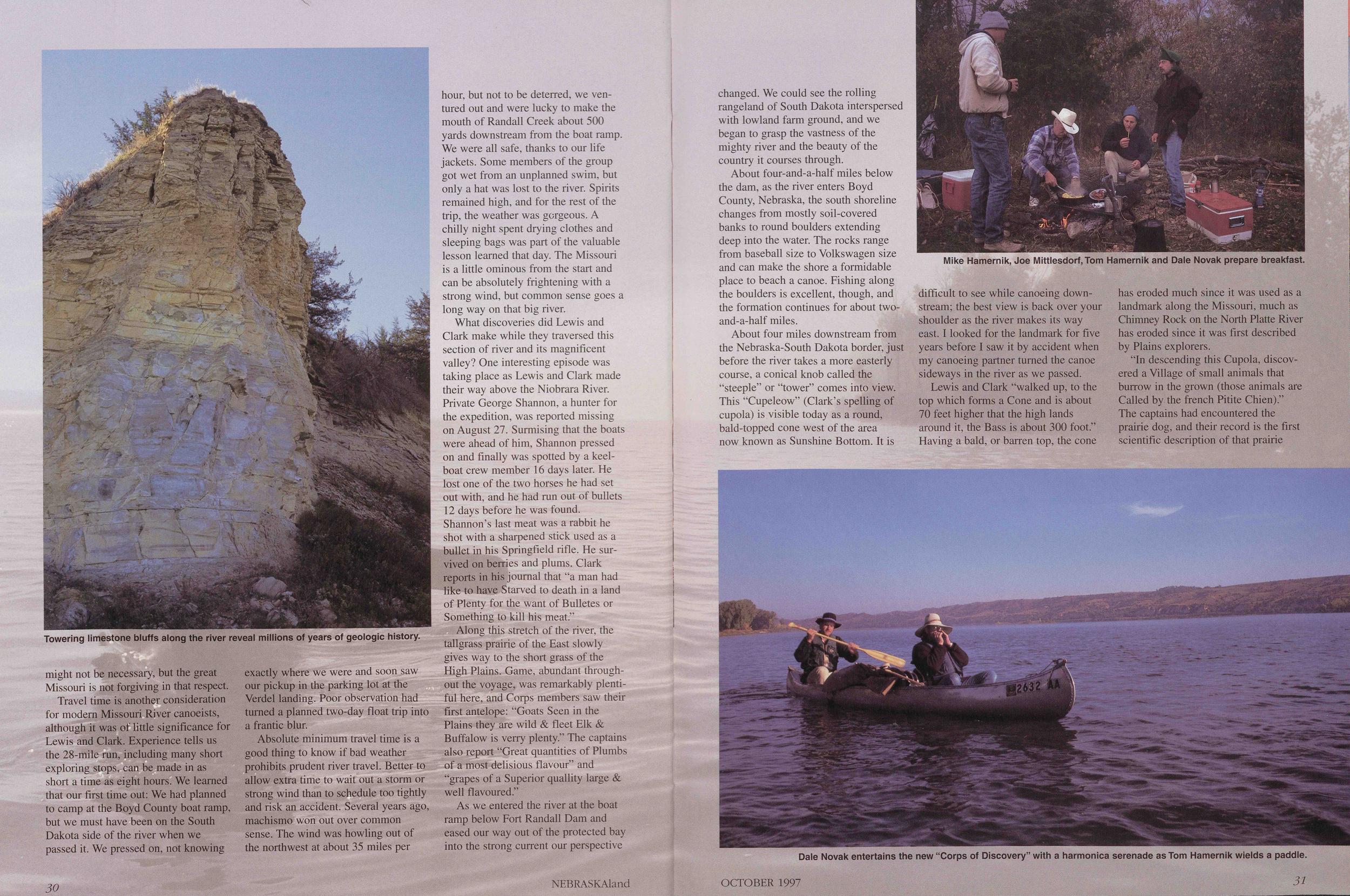
Towering limestone bluffs along the river reveal millions of years of geologic history.
might not be necessary, but the great Missouri is not forgiving in that respect.
Travel time is another consideration for modern Missouri River canoeists, although it was of little significance for Lewis and Clark. Experience tells us the 28-mile run, including many short exploring stops, can be made in as short a time as eight hours. We learned that our first time out: We had planned to camp at the Boyd County boat ramp, but we must have been on the South Dakota side of the river when we passed it. We pressed on, not knowing exactly where we were and soon saw our pickup in the parking lot at the Verdel landing. Poor observation had turned a planned two-day float trip into a frantic blur.
Absolute minimum travel time is a good thing to know if bad weather prohibits prudent river travel. Better to allow extra time to wait out a storm or strong wind than to schedule too tightly and risk an accident. Several years ago, machismo won out over common sense. The wind was howling out of the northwest at about 35 miles per hour, but not to be deterred, we ventured out and were lucky to make the mouth of Randall Creek about 500 yards downstream from the boat ramp. We were all safe, thanks to our life jackets. Some members of the group got wet from an unplanned swim, but only a hat was lost to the river. Spirits remained high, and for the rest of the trip, the weather was gorgeous. A chilly night spent drying clothes and sleeping bags was part of the valuable lesson learned that day. The Missouri is a little ominous from the start and can be absolutely frightening with a strong wind, but common sense goes a long way on that big river.
What discoveries did Lewis and Clark make while they traversed this section of river and its magnificent valley? One interesting episode was taking place as Lewis and Clark made their way above the Niobrara River. Private George Shannon, a hunter for the expedition, was reported missing on August 27. Surmising that the boats were ahead of him, Shannon pressed on and finally was spotted by a keelboat crew member 16 days later. He lost one of the two horses he had set out with, and he had run out of bullets 12 days before he was found. Shannon's last meat was a rabbit he shot with a sharpened stick used as a bullet in his Springfield rifle. He survived on berries and plums. Clark reports in his journal that "a man had like to have Starved to death in a land of Plenty for the want of Bulletes or Something to kill his meat."
Along this stretch of the river, the tallgrass prairie of the East slowly gives way to the short grass of the High Plains. Game, abundant throughout the voyage, was remarkably plentiful here, and Corps members saw their first antelope: "Goats Seen in the Plains they are wild & fleet Elk & Buffalow is verry plenty." The captains also report "Great quantities of Plumbs of a most delisious flavour'' and "grapes of a Superior quallity large & well flavoured."
As we entered the river at the boat ramp below Fort Randall Dam and eased our way out of the protected bay into the strong current our perspective 30 NEBRASKAland changed. We could see the rolling rangeland of South Dakota interspersed with lowland farm ground, and we began to grasp the vastness of the mighty river and the beauty of the country it courses through.
About four-and-a-half miles below the dam, as the river enters Boyd County, Nebraska, the south shoreline changes from mostly soil-covered banks to round boulders extending deep into the water. The rocks range from baseball size to Volkswagen size and can make the shore a formidable place to beach a canoe. Fishing along the boulders is excellent, though, and the formation continues for about two-and-a-half miles.
Mike Hamernik, Joe Mittlesdorf, Tom Hamernik and Dale Novak prepare breakfast.
Lewis and Clark "walked up, to the top which forms a Cone and is about 70 feet higher that the high lands around it, the Bass is about 300 foot." Having a bald, or barren top, the cone has eroded much since it was used as a landmark along the Missouri, much as Chimney Rock on the North Platte River has eroded since it was first described by Plains explorers.
"In descending this Cupola, discovered a Village of small animals that burrow in the grown (those animals are Called by the french Pitite Chien)." The captains had encountered the prairie dog, and their record is the first scientific description of that prairie
Dale Novak entertains the new "Corps of Discovery" with a harmonica serenade as Tom Hamernik wields a paddle.
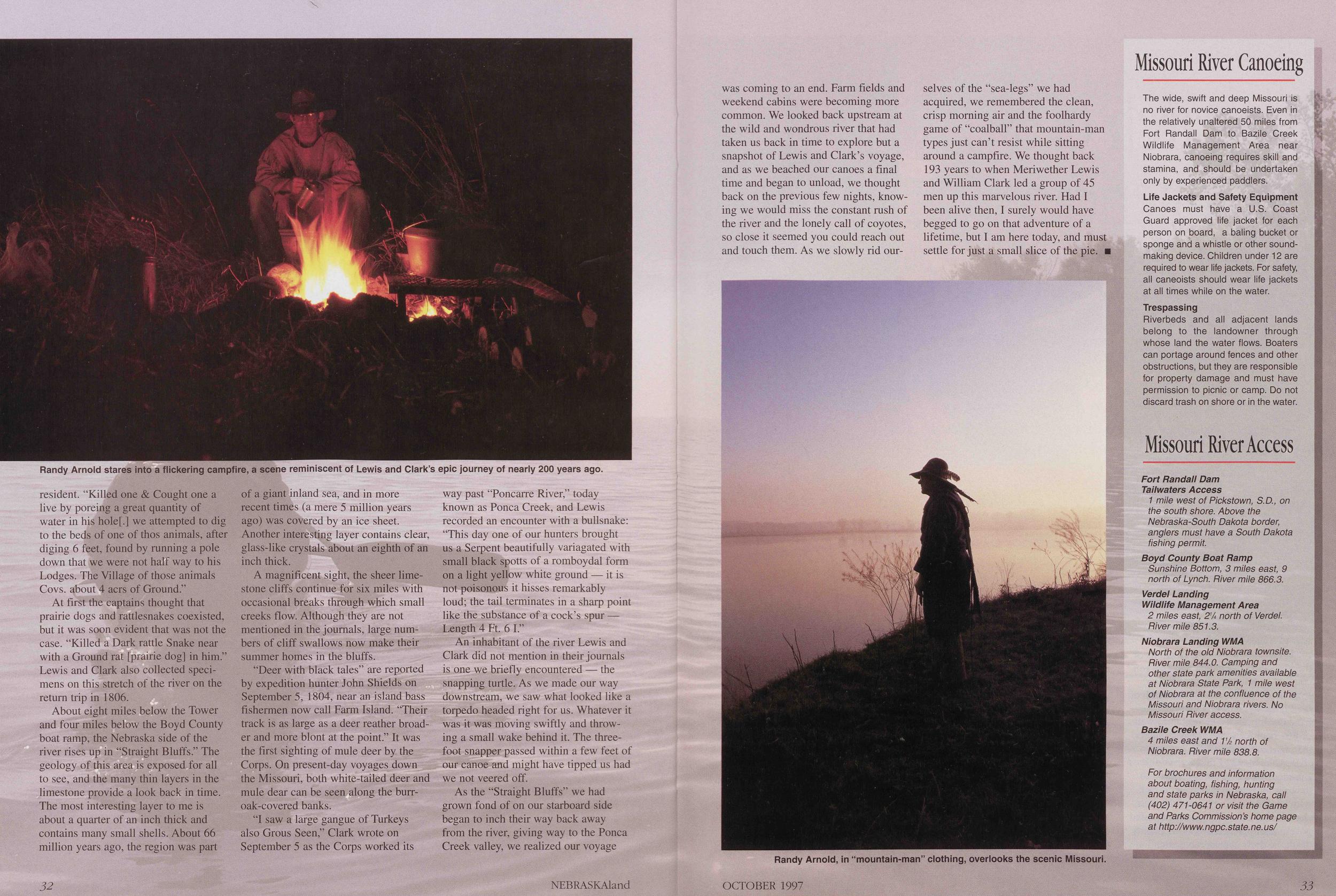
Randy Arnold stares into a flickering campfire, a scene reminiscent of Lewis and Clark's epic journey of nearly 200 years ago.
resident. "Killed one & Cought one a live by poreing a great quantity of water in his hole[.] we attempted to dig to the beds of one of thos animals, after diging 6 feet, found by running a pole down that we were not half way to his Lodges. The Village of those animals Covs. about 4 acrs of Ground."
At first the captains thought that prairie dogs and rattlesnakes coexisted, but it was soon evident that was not the case. "Killed a Dark rattle Snake near with a Ground rat [prairie dog] in him." Lewis and Clark also collected specimens on this stretch of the river on the return trip in 1806.
About eight miles below the Tower and four miles below the Boyd County boat ramp, the Nebraska side of the river rises up in "Straight Bluffs." The geology of this area is exposed for all to see, and the many thin layers in the limestone provide a look back in time. The most interesting layer to me is about a quarter of an inch thick and contains many small shells. About 66 million years ago, the region was part of a giant inland sea, and in more recent times (a mere 5 million years ago) was covered by an ice sheet. Another interesting layer contains clear, glass-like crystals about an eighth of an inch thick.
A magnificent sight, the sheer limestone cliffs continue for six miles with occasional breaks through which small creeks flow. Although they are not mentioned in the journals, large numbers of cliff swallows now make their summer homes in the bluffs.
"Deer with black tales" are reported by expedition hunter John Shields on September 5, 1804, near an island bass fishermen now call Farm Island. "Their track is as large as a deer reather broader and more blont at the point." It was the first sighting of mule deer by the Corps. On present-day voyages down the Missouri, both white-tailed deer and mule dear can be seen along the burroak-covered banks.
"I saw a large gangue of Turkeys also Grous Seen," Clark wrote on September 5 as the Corps worked its way past "Poncarre River," today known as Ponca Creek, and Lewis recorded an encounter with a bullsnake: "This day one of our hunters brought us a Serpent beautifully variagated with small black spotts of a romboydal form on a light yellow white ground — it is not poisonous it hisses remarkably loud; the tail terminates in a sharp point like the substance of a cock's spur — Length 4 Ft. 6 I."
An inhabitant of the river Lewis and Clark did not mention in their journals is one we briefly encountered — the snapping turtle. As we made our way downstream, we saw what looked like a torpedo headed right for us. Whatever it was it was moving swiftly and throwing a small wake behind it. The three-foot snapper passed within a few feet of our canoe and might have tipped us had we not veered off.
As the "Straight Bluffs" we had grown fond of on our starboard side began to inch their way back away from the river, giving way to the Ponca Creek valley, we realized our voyage 32 NEBRASKAland was coming to an end. Farm fields and weekend cabins were becoming more common. We looked back upstream at the wild and wondrous river that had taken us back in time to explore but a snapshot of Lewis and Clark's voyage, and as we beached our canoes a final time and began to unload, we thought back on the previous few nights, knowing we would miss the constant rush of the river and the lonely call of coyotes, so close it seemed you could reach out and touch them. As we slowly rid ourselves of the "sea-legs" we had acquired, we remembered the clean, crisp morning air and the foolhardy game of "coalball" that mountain-man types just can't resist while sitting around a campfire. We thought back 193 years to when Meriwether Lewis and William Clark led a group of 45 men up this marvelous river. Had I been alive then, I surely would have begged to go on that adventure of a lifetime, but I am here today, and must settle for just a small slice of the pie.
Randy Arnold, in "mountain-man" clothing, overlooks the scenic Missouri.
Missouri River Canoeing
The wide, swift and deep Missouri is no river for novice canoeists. Even in the relatively unaltered 50 miles from Fort Randall Dam to Bazile Creek Wildlife Management Area near Niobrara, canoeing requires skill and stamina, and should be undertaken only by experienced paddlers. Life Jackets and Safety Equipment Canoes must have a U.S. Coast Guard approved life jacket for each person on board, a baling bucket or sponge and a whistle or other sound-making device. Children under 12 are required to wear life jackets. For safety, all caneoists should wear life jackets at all times while on the water. Trespassing Riverbeds and all adjacent lands belong to the landowner through whose land the water flows. Boaters can portage around fences and other obstructions, but they are responsible for property damage and must have permission to picnic or camp. Do not discard trash on shore or in the water.Missouri River Access
Fort Randall Dam Tail waters Access 1 mile west of Pickstown, S.D., on the south shore. Above the Nebraska-South Dakota border, anglers must have a South Dakota fishing permit. Boyd County Boat Ramp Sunshine Bottom, 3 miles east, 9 north of Lynch. River mile 866.3. Verdel Landing Wildlife Management Area 2 miles east, 21/4 north of Verdel. River mile 851.3. Niobrara Landing WMA North of the old Niobrara townsite. River mile 844.0. Camping and other state park amenities available at Niobrara State Park, 1 mile west of Niobrara at the confluence of the Missouri and Niobrara rivers. No Missouri River access. Bazile Creek WMA 4 miles east and VA north of Niobrara. River mile 838.8. For brochures and information about boating, fishing, hunting and state parks in Nebraska, call (402) 471-0641 or visit the Game and Parks Commission's home page at http://www.ngpc.state.ne.us/ OCTOBER 1997 33
In Search of the American Burying Beetle
Nebraska populations of the American burying beetle might bold the key to the recovery of this endangered species, now absent from 90 percent of its historic North American range.
Jon Bedick's car raced along a canyon road southeast of Brady. The early morning sun's stagnant heat had transformed standing beads of rain from a middle-of-the-night shower into nearly visible humidity, and as his tires cut through a crust of dried mud, dust rose into the waterlogged sky, clearly tracing his course.
It is mostly trucks that wind their way to somewhere on the few dirt roads that follow major dissections of the loess hills in Lincoln and Dawson counties. Cars draw more attention from residents of the canyons south of the Platte. Cars usually carry people from distant places and different walks of life, here for some purpose other than farming or ranching.
Bedick, who had first arrived the summer before, was no exception to the cars-mean-strangers rule. In fact, with his long hair and beard, buckets, shovels and a car that not only sported government plates but smelled like death, he drew considerable attention.
As he pressed the car a bit harder into the curves and sped along the winding road, he returned a wave from a rancher fixing fence and another moving bales. They had come to accept his seasonal presence in their canyons because he brought with him a refreshing philosophy about his work, and he worked hard at what he did. Ranch people see value in that. In some contexts, the work that has occupied Bedick's life for the past two years might alarm landowners: He is studying the distribution of an endangered species that he and others have discovered in the remote canyon country of south-central Nebraska.
Bedick's ongoing study is part of the recovery plan established by the U.S. Fish and Wildlife Service for the American burying beetle, a plan designed to restore endangered populations to a level that would permit the species to be removed from the endangered list. Bedick, a graduate student at the University of Nebraska-Lincoln, is working with Dr. Brett Ratcliffe, curator of entomology at the University of Nebraska State Museum. The study is funded by a grant provided through the Nebraska Game and Parks Commission.
The American burying beetle is the only insect in Nebraska listed on the federal threatened or endangered species lists, and the fact that it is "only a bug" does not make it any less significant than other endangered species. The American burying beetle is as fully protected as the whooping 34 NEBRASKAland
"When residents learn that an endangered species has been discovered living on their land, they become anxious about the perceived ramifications of that find," Bedick said. "They immediately fear that there may be changes and restrictions imposed by the government on them as a result of that discovery."
But, Bedick said, his research indicates there is a healthy — possibly thriving — population in his research area in Nebraska and it would be foolish to request changes.
"It appears to me that the people who live and ranch in these canyons are doing everything right as it relates to the American burying beetle. Something has changed elsewhere, however, throughout this beetle's historic range that has caused a dangerous decline in its population."
Bedick was in a hurry that morning in late August because of the previous
OCTOBER 1997 35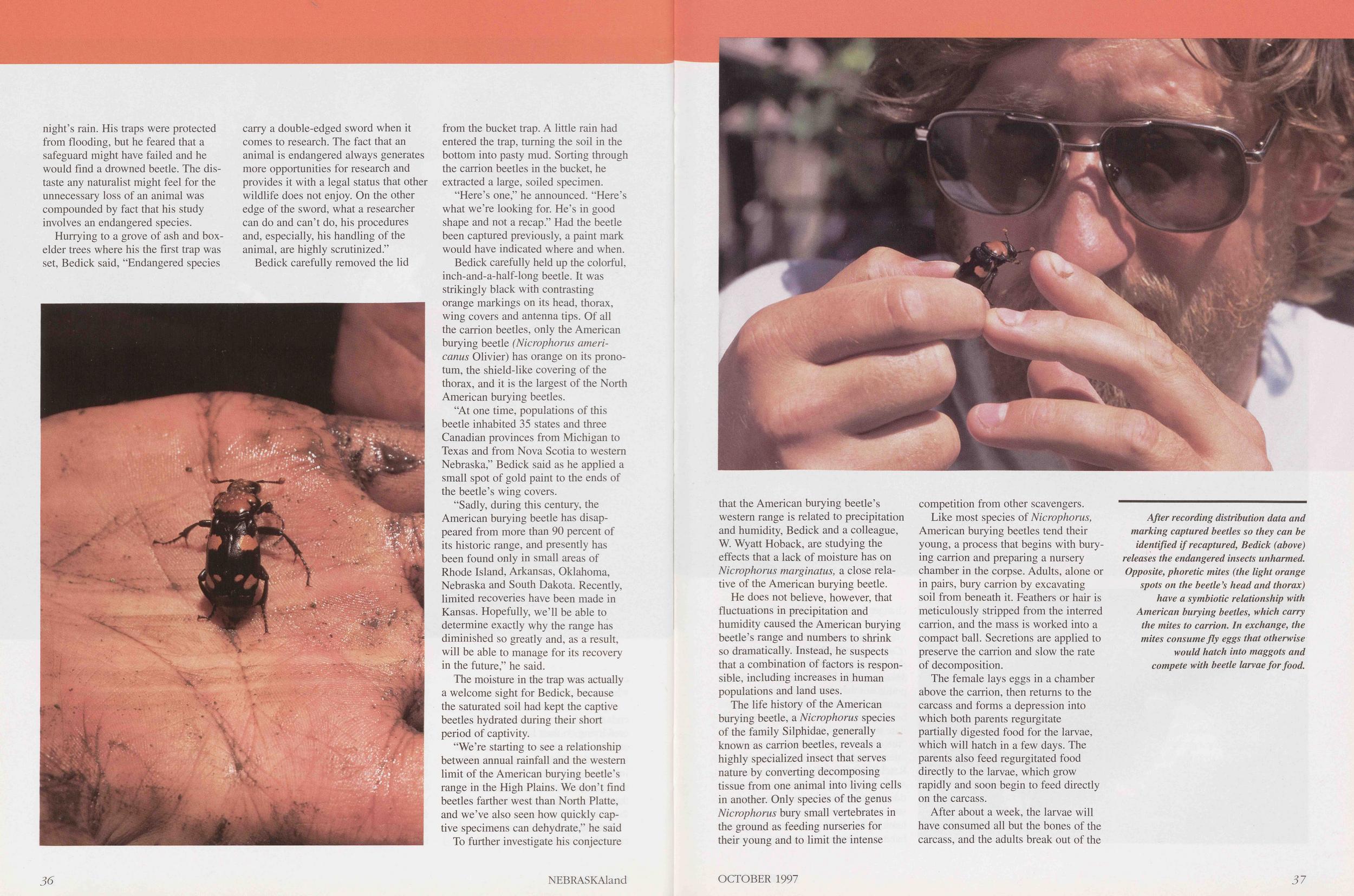
night's rain. His traps were protected from flooding, but he feared that a safeguard might have failed and he would find a drowned beetle. The distaste any naturalist might feel for the unnecessary loss of an animal was compounded by fact that his study involves an endangered species.
Hurrying to a grove of ash and boxelder trees where his the first trap was set, Bedick said, "Endangered species carry a double-edged sword when it comes to research. The fact that an animal is endangered always generates more opportunities for research and provides it with a legal status that other wildlife does not enjoy. On the other edge of the sword, what a researcher can do and can't do, his procedures and, especially, his handling of the animal, are highly scrutinized."
Bedick carefully removed the lid
"Here's one," he announced. "Here's what we're looking for. He's in good shape and not a recap." Had the beetle been captured previously, a paint mark would have indicated where and when.
Bedick carefully held up the colorful, inch-and-a-half-long beetle. It was strikingly black with contrasting orange markings on its head, thorax, wing covers and antenna tips. Of all the carrion beetles, only the American burying beetle (Nicrophorus americanus Olivier) has orange on its pronotum, the shield-like covering of the thorax, and it is the largest of the North American burying beetles.
"At one time, populations of this beetle inhabited 35 states and three Canadian provinces from Michigan to Texas and from Nova Scotia to western Nebraska," Bedick said as he applied a small spot of gold paint to the ends of the beetle's wing covers.
"Sadly, during this century, the American burying beetle has disappeared from more than 90 percent of its historic range, and presently has been found only in small areas of Rhode Island, Arkansas, Oklahoma, Nebraska and South Dakota. Recently, limited recoveries have been made in Kansas. Hopefully, we'll be able to determine exactly why the range has diminished so greatly and, as a result, will be able to manage for its recovery in the future," he said.
The moisture in the trap was actually a welcome sight for Bedick, because the saturated soil had kept the captive beetles hydrated during their short period of captivity.
"We're starting to see a relationship between annual rainfall and the western limit of the American burying beetle's range in the High Plains. We don't find beetles farther west than North Platte, and we've also seen how quickly captive specimens can dehydrate," he said
To further investigate his conjecture 36 NEBRASKAland
He does not believe, however, that fluctuations in precipitation and humidity caused the American burying beetle's range and numbers to shrink so dramatically. Instead, he suspects that a combination of factors is responsible, including increases in human populations and land uses.
The life history of the American burying beetle, a Nicrophorus species of the family Silphidae, generally known as carrion beetles, reveals a highly specialized insect that serves nature by converting decomposing tissue from one animal into living cells in another. Only species of the genus Nicrophorus bury small vertebrates in the ground as feeding nurseries for their young and to limit the intense competition from other scavengers.
Like most species of Nicrophorus, American burying beetles tend their young, a process that begins with burying carrion and preparing a nursery chamber in the corpse. Adults, alone or in pairs, bury carrion by excavating soil from beneath it. Feathers or hair is meticulously stripped from the interred carrion, and the mass is worked into a compact ball. Secretions are applied to preserve the carrion and slow the rate of decomposition.
The female lays eggs in a chamber above the carrion, then returns to the carcass and forms a depression into which both parents regurgitate partially digested food for the larvae, which will hatch in a few days. The parents also feed regurgitated food directly to the larvae, which grow rapidly and soon begin to feed directly on the carcass.
After about a week, the larvae will have consumed all but the bones of the carcass, and the adults break out of the
OCTOBER 1997 37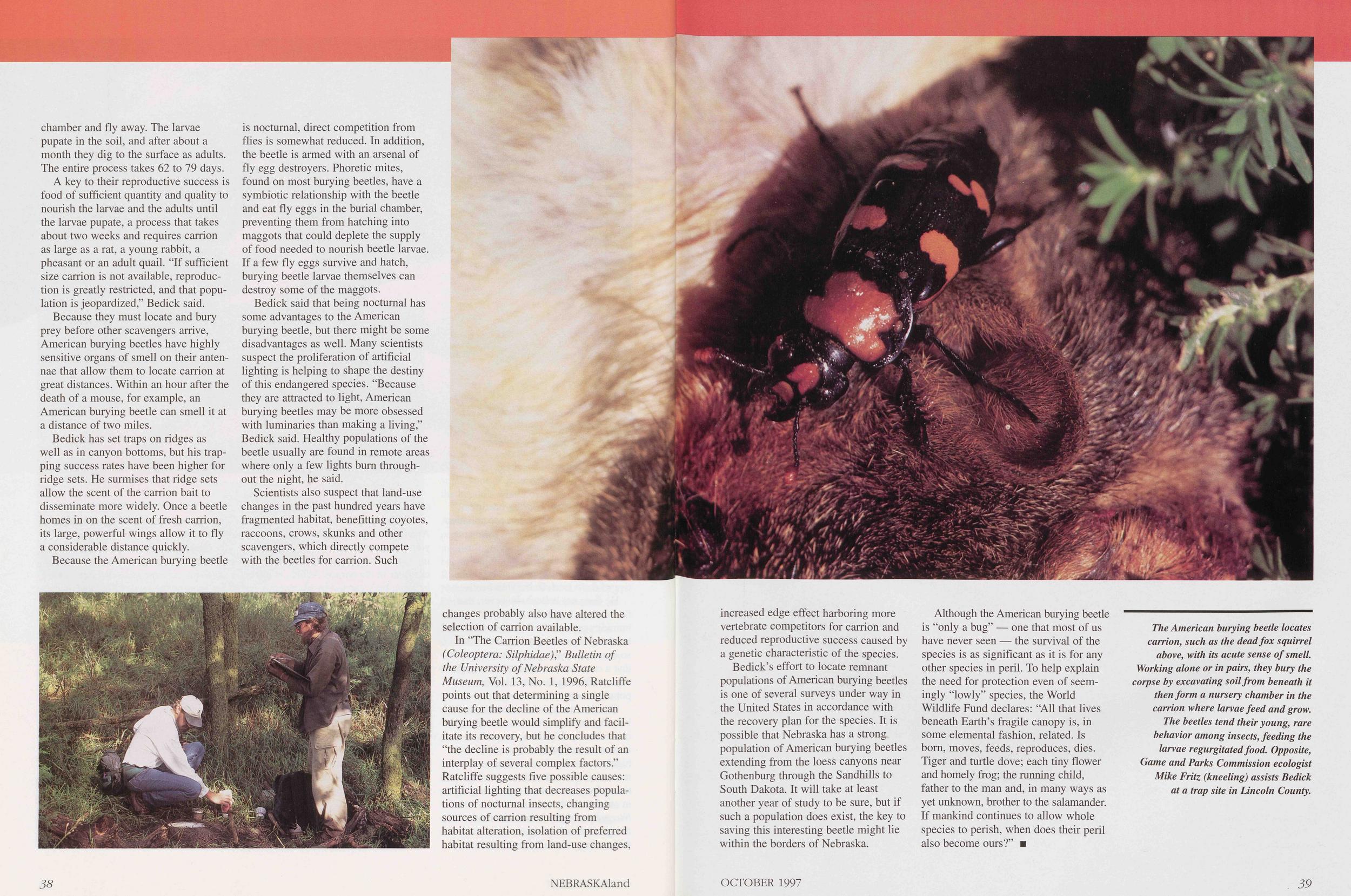
chamber and fly away. The larvae pupate in the soil, and after about a month they dig to the surface as adults. The entire process takes 62 to 79 days.
A key to their reproductive success is food of sufficient quantity and quality to nourish the larvae and the adults until the larvae pupate, a process that takes about two weeks and requires carrion as large as a rat, a young rabbit, a pheasant or an adult quail. "If sufficient size carrion is not available, reproduction is greatly restricted, and that population is jeopardized," Bedick said.
Because they must locate and bury prey before other scavengers arrive, American burying beetles have highly sensitive organs of smell on their antennae that allow them to locate carrion at great distances. Within an hour after the death of a mouse, for example, an American burying beetle can smell it at a distance of two miles.
Bedick has set traps on ridges as well as in canyon bottoms, but his trapping success rates have been higher for ridge sets. He surmises that ridge sets allow the scent of the carrion bait to disseminate more widely. Once a beetle homes in on the scent of fresh carrion, its large, powerful wings allow it to fly a considerable distance quickly.
Because the American burying beetle
Bedick said that being nocturnal has some advantages to the American burying beetle, but there might be some disadvantages as well. Many scientists suspect the proliferation of artificial lighting is helping to shape the destiny of this endangered species. "Because they are attracted to light, American burying beetles may be more obsessed with luminaries than making a living," Bedick said. Healthy populations of the beetle usually are found in remote areas where only a few lights burn throughout the night, he said.
Scientists also suspect that land-use changes in the past hundred years have fragmented habitat, benefitting coyotes, raccoons, crows, skunks and other scavengers, which directly compete with the beetles for carrion. Such changes probably also have altered the selection of carrion available.
In "The Carrion Beetles of Nebraska (Coleoptera: Silphidae)" Bulletin of the University of Nebraska State Museum, Vol. 13, No. 1, 1996, Ratcliffe points out that determining a single cause for the decline of the American burying beetle would simplify and facilitate its recovery, but he concludes that "the decline is probably the result of an interplay of several complex factors." Ratcliffe suggests five possible causes: artificial lighting that decreases populations of nocturnal insects, changing sources of carrion resulting from habitat alteration, isolation of preferred habitat resulting from land-use changes, 38 NEBRASKAland
Bedick's effort to locate remnant populations of American burying beetles is one of several surveys under way in the United States in accordance with the recovery plan for the species. It is possible that Nebraska has a strong population of American burying beetles extending from the loess canyons near Gothenburg through the Sandhills to South Dakota. It will take at least another year of study to be sure, but if such a population does exist, the key to saving this interesting beetle might lie within the borders of Nebraska.
Although the American burying beetle is "only a bug" — one that most of us have never seen — the survival of the species is as significant as it is for any other species in peril. To help explain the need for protection even of seemingly "lowly" species, the World Wildlife Fund declares: "All that lives beneath Earth's fragile canopy is, in some elemental fashion, related. Is born, moves, feeds, reproduces, dies. Tiger and turtle dove; each tiny flower and homely frog; the running child, father to the man and, in many ways as yet unknown, brother to the salamander. If mankind continues to allow whole species to perish, when does their peril also become ours?"
OCTOBER 1997 39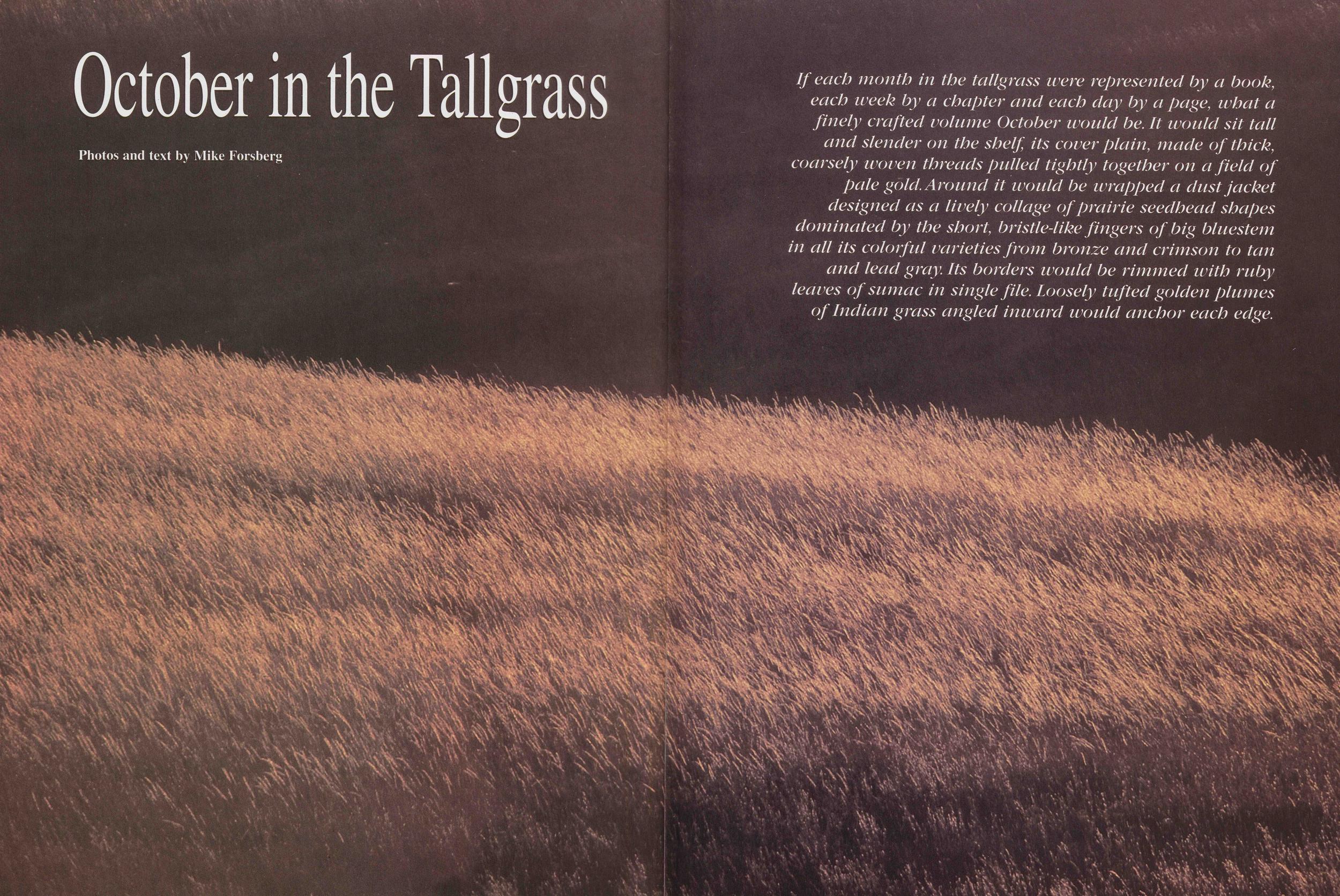
October in the Tallgrass
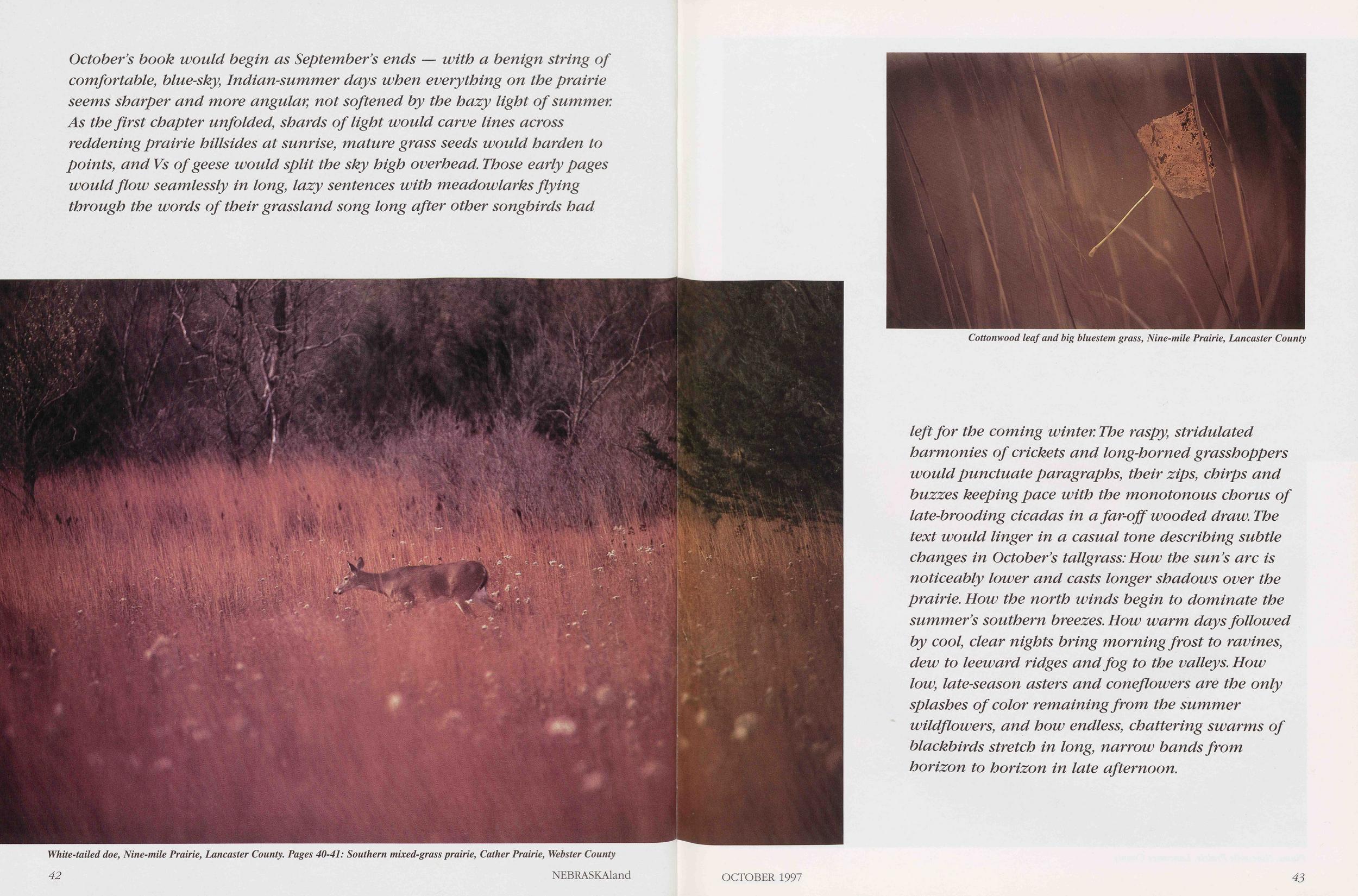
If each month in the tallgrass were represented by a book, each week by a chapter and each day by a page, what a finely crafted volume October would be. It would sit tall and slender on the shelf its cover plain, made of thick, coarsely woven threads pulled tightly together on afield of pale gold. Around it would be wrapped a dust jacket designed as a lively collage of prairie seedhead shapes dominated by the short, bristle-like fingers of big bluestem in cdl its colorful varieties from bronze and crimson to tan and lead gray. Its borders would be rimmed with ruby leaves of sumac in single file. Loosely tufted golden plumes of Indian grass angled inward would anchor each edge.
October's book would begin as September's ends — with a benign string of comfortable, blue-sky Indian-summer days when everything on the prairie seems sharper and more angular, not softened by the hazy light of summer. As the first chapter unfolded, shards of light would carve lines across reddening prairie hillsides at sunrise, mature grass seeds would harden to points, and Vs of geese would split the sky high overhead. Those early pages would flow seamlessly in long, lazy sentences with meadowlarks flying through the words of their grassland song long after other songbirds had
White-tailed doe, Nine-mile Prairie, Lancaster County. Pages 40-41: Southern mixed-grass prairie, Cather Prairie, Webster County
Cottonwood leaf and big bluestem grass, Nine-mile Prairie, Lancaster County
left for the coming winter. The raspy, stridulated harmonies of crickets and long-horned grasshoppers would punctuate paragraphs, their zips, chirps and buzzes keeping pace with the monotonous chorus of late-brooding cicadas in a far-off wooded draw. The text would linger in a casual tone describing subtle changes in October's tallgrass:How the sun's arc is noticeably lower and casts longer shadows over the prairie. How the north winds begin to dominate the summer's southern breezes. How warm days followed by cool, clear nights bring morning frost to ravines, dew to leeward ridges and fog to the valleys. How low, late-season asters and coneflowers are the only splashes of color remaining from the summer wildflowers, and how endless, chattering swarms of blackbirds stretch in long, narrow bands from horizon to horizon in late afternoon.
OCTOBER 1997 43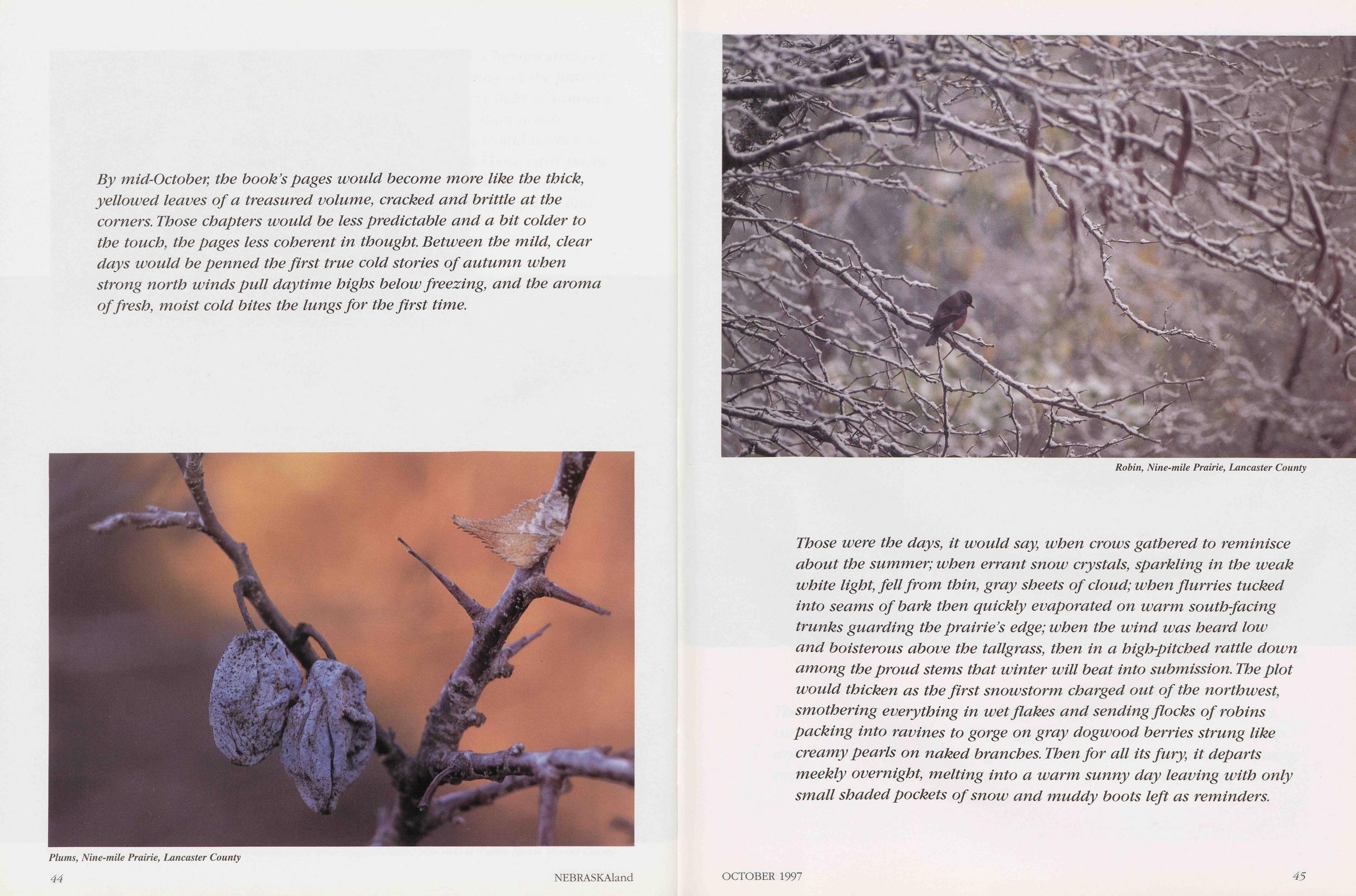
By mid-October, the book's pages would become more like the thick, yellowed leaves of a treasured volume, cracked and brittle at the corners. Those chapters would be less predictable and a bit colder to the touch, the pages less coherent in thought. Between the mild, clear days would be penned the first true cold stories of autumn when strong north winds pull daytime highs below freezing, and the aroma of fresh, moist cold bites the lungs for the first time.
Plums, Nine-mile Prairie, Lancaster County
Robin, Nine-mile Prairie, Lancaster County
Those were the days, it would say, when crows gathered to reminisce about the summer; when errant snow crystals, sparkling in the weak white light, fell from thin, gray sheets of cloud; when flurries tucked into seams of bark then quickly evaporated on warm south-facing trunks guarding the prairie's edge; when the wind was heard low and boisterous above the tallgrass, then in a high-pitched rattle down among the proud stems that winter will beat into submission. The plot would thicken as the first snowstorm charged out of the northwest, smothering everything in wet flakes and sending flocks of robins packing into ravines to gorge on gray dogwood berries strung like creamy pearls on naked branches. Then for all its fury, it departs meekly overnight, melting into a warm sunny day leaving with only small shaded pockets of snow and muddy boots left as reminders.
OCTOBER 1997 45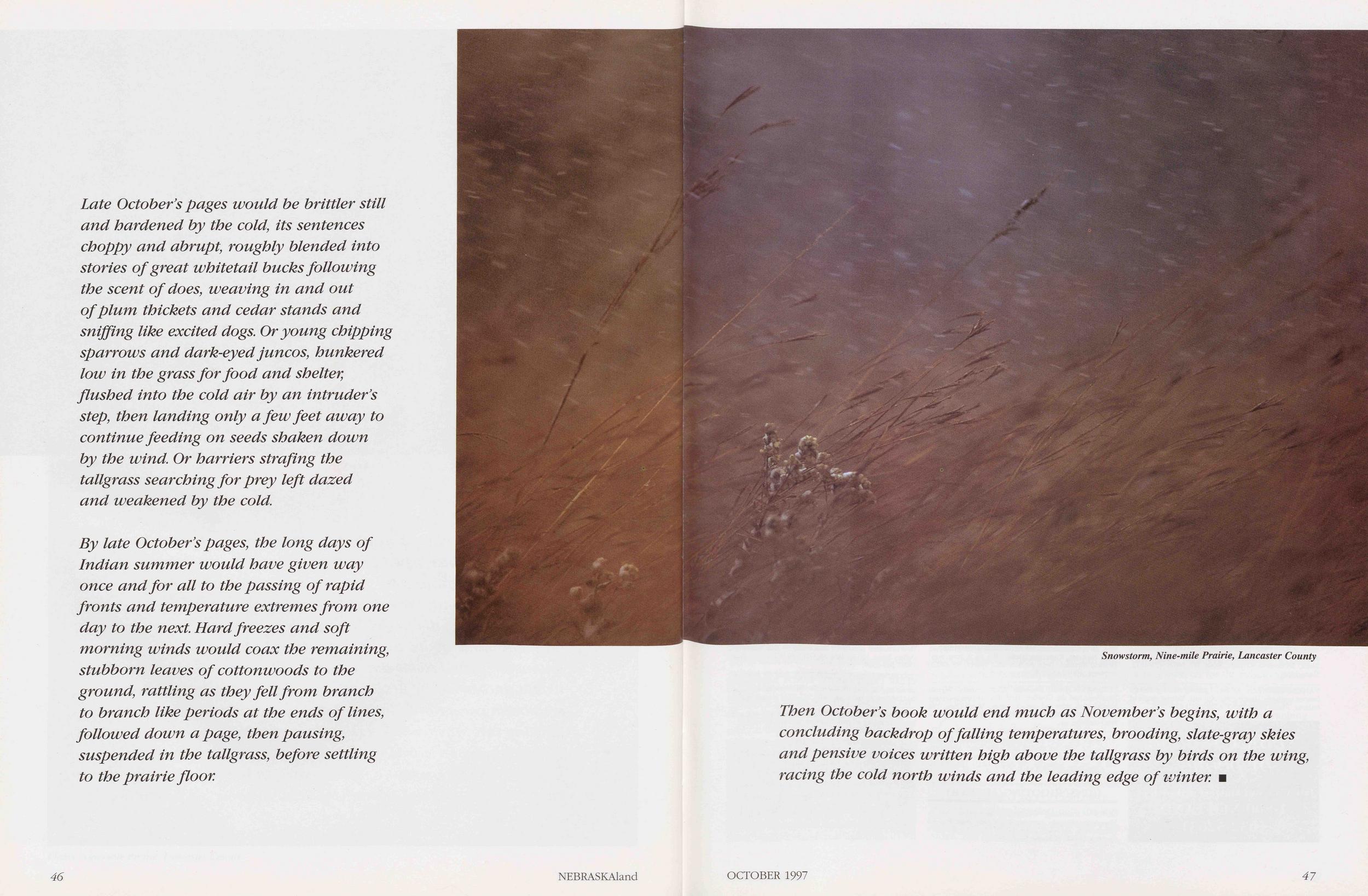
Late October's pages would be brittler still and hardened by the cold, its sentences choppy and abrupt, roughly blended into stories of great whitetail bucks following the scent of does, weaving in and out of plum thickets and cedar stands and sniffing like excited dogs. Or young chipping sparrows and dark-eyed juncos, hunkered low in the grass for food and shelter, flushed into the cold air by an intruder's step, then landing only a few feet away to continue feeding on seeds shaken down by the wind. Or harriers strafing the tallgrass searching for prey left dazed and weakened by the cold.
By late October's pages, the long days of Indian summer would have given way once and for all to the passing of rapid fronts and temperature extremes from one day to the next. Hard freezes and soft morning winds would coax the remaining, stubborn leaves of cottonwoods to the ground, rattling as they fell from branch to branch like periods at the ends of lines, followed down a page, then pausing, suspended in the tallgrass, before settling to the prairie floor.
46 NEBRASKAlandSnowstorm, Nine-mile Prairie, Lancaster County
Then October's book would end much as November's begins, with a concluding backdrop of falling temperatures, brooding, slate-gray skies and pensive voices written high above the tallgrass by birds on the wing, racing the cold north winds and the leading edge of winter.
OCTOBER 1997 47
Classified
BOOKS/PUBLICATIONS/VIDEOS FREE BOOK CATALOG. Novels, westerns, romances, children's; old out of print, found barns, attic. Authors: Grey, Bower, Condor, Fox, Curwood, Raine, Wright, Aldrige, Polly anna, Freckles, many others. Postage appreciated. Pierce, 4400 N. Pine Cluster, Oroville, CA 95965. HOW TO FIND MORE outdoor opportunities! The Nebraska Sportsman's Atlas. Locations of all public lands and waters on county transportation maps. These maps show ALL the roads in Nebraska. Listings include federal, Nebraska Game & Parks, NRD holdings, hotels and motels and Nebraska's endless attractions. At only $18.75/copy a true time and frustration saver. To order write: Sportsman's Atlas Co., P.O. Box 132, Lytton, LA 50561 or call (800) 568-8334. JU-JU SWALLOWED A PENNY, a Nebraska farm girl's book of the 1930s Depression Era. $7.50 ppd. Betty Heidbreder Dunn, Rt. 2, Box 2025, Columbus, TX 78934. PLAT MAPS available featuring landowners, roads and creeks. Most counties in Nebraska available and adjoining counties in South Dakota, Wyoming, Kansas and Colorado. Call (800) 752-3402. Visa and Mastercard accepted. VIDEO GUIDE TO NIOBRARA RIVER country. Send check or money order for $19.95 plus $2.95 shipping and handling to: American Summit Productions, 12105 W. Center Rd. Suite 145, Omaha, NE 68144. Allow 3-4 weeks for delivery. DOGS TRAINING ALL BREEDS bird dogs - Vizslas for sale. Home of Rebel Rousers. Rozanek Kennels, 781 Rd. D, Schuyler, NE 68661. Phone (402) 352-8769. ENGLISH SETTERS, German shorthairs, English pointers, Brittany spaniels - stud service, puppies and started dogs. Training for all pointing breeds. Plum Creek Kennel, (712) 529-4238 or (402) 298-8153. RETRIEVER TRAINING. Area's top "retrievers only" trainer. Field trial and hunting dogs. Non-slip duck dogs! TKO Retriever Training Kennel (402) 623-4311. CHESAPEAKE BAY, Labrador and golden retriever pups, started dogs and stud service. 16-time national champion pedigree. Visa & MasterCard. Platte Valley Retrievers (308) 995-2318. YELLOW-CHOCOLATE-BLACK LAB pups. Breeders hips O.F.A. and eyes CERE Excellent bloodlines and hunting potential. Call Mr. Bendler, Lexington, NE (308) 324-4247 or Lincoln (402) 477-1305. WILDERNESS KENNELS. Gun dog training - over 60 years combined experience. Training all sporting breeds - retrievers, flushing and pointing dogs. All dogs worked on pen raised birds and wild game. Training program includes obedience training - heel, sit, stay, down and come when called. Pups, started dogs and fully trained dogs for sale. Hunting dogs trained by hunters. Henry Sader, Wilderness Kennels, Roca, NE (402) 423-4212. Since 1968. YANKEE KENNELS. All breed gundog training. Private lessons available. Hunting dogs for sale. Various stages of training. Phone (402) 782-3723 or (402) 848-2393. NEBRASKAland by phone! For Visa and MasterCard orders, 1-800-NEB-LAND (632-5263) FISH/FISHING FISH FOR SALE. Catfish, largemouth bass, smallmouth bass, perch, crappie, bluegill, walleye, northern pike, rainbow trout, Donaldson rainbow trout, grass carp, minnows, bullheads. Consulting available. Pleasant Valley Fish Farm, RR 1, Box 147, McCook, NE 69001. Phone (308) 345-6599. WILLOW LAKE FISH HATCHERY. Channel cat, bluegill, hybrid bluegill, largemouth bass, crappie, grass carp, walleye, perch, minnows available for stocking. Gaylord Crawford, 7580 N. Highland Rd., Hastings, NE 68901 or phone (402) 463-8022 day or night. Also pond consultant. We deliver, grower price. FOOD/GIFTS NEBRASKA BASKETS: The original Nebraska company specializing in fine foods from Nebraska since 1984. A beautiful array of baskets filled with ethnic, healthful and long-time favorite foods. Call or write for our brochure: P.O. Box 22985, Lincoln, NE 68542. Phone (800) 345-7725 or (402) 438-3111. FROM NEBRASKA GIFT SHOP...the world's largest selection of Nebraska-made food products and gifts. Historic Haymarket, 140 N. 8th St., Lincoln, NE 68508; Old Market, 1030 Howard St., Omaha, NE. Call for free catalog (800) 399-5693. HOMEBREWING/BEER & WINEMAKING supplies. Fermenter's Supply, 8410 K Plz. #10, Omaha, NE 68127. (402) 593-9171. Open every day, mail orders welcome, low shipping. ENJOY A TASTE of the good life! Award-winning gourmet BBQ sauces & seasonings, breadings, native jellies, fruit butters, honey, coffees and more! Great giftset ideas! Toll free (888) 926-2879 or (308) 468-5635. Hollman Foods, 1948 36 Road, Minden, NE 68959, or www.hollmans.com SWEET MEAT incredible new-tasting jerky. Bonus sweet meat gourmet hamburgers. $5.00 for recipe to Backwoods, P.O. Box 85711, Department 114, Lincoln, NE 68501-5771. ODOR CONTROL SYSTEM: Naturally eliminates odors through patented atomization in that problem room for pennies a day. Revolutionary new product. Call Ecolo of Nebraska. (402) 445-2306. * GUIDES/OUTFITTERS MAD RIVER CANOES offers the finest quality and performance. For the finest canoes and accessories look to Great Plains Canoe Co., 205 Main, Springfield, NE 68059. Phone (402) 253-2001. CANOE THE NIOBRARA...with an affordable canoe trip by Dryland Aquatics. One and two-day trips...full service, or just canoes and tubes. Transportation furnished. Your Niobrara River specialists... We do it your way! Dryland Aquatics, Dept. N, Box 33C, Sparks, NE 69220 or phone (800) 337-3119. MOUNTAIN BIKE Niobrara River country, Merritt Reservoir and the Cowboy Trail. For bicycle/accessory rentals, trips, sales and service, contact Yucca Dune, 148 E. 1st St., Valentine, NE 69201 (402) 376-3330 or ryschon@ibm.net. KAYAKS BY PERCEPTION and Aquaterra. Durable kayaks for Niobrara touring and white-water adventure. Trips, boats and accessories for all abilities. Yucca Dune, 148 E. 1st St., Valentine, NE 69201 (402) 376-3330 or ryschon@ibm.net. GUNS/SHQQTING/ARCHERY GUNS - Browning, Winchester, Remington, others. Hi-powers, shotguns, new, used, antiques. Want Pre-'64 Winchesters. Buy-Sell-Trade. (402) 729-6112. Bedlan's Sporting Goods, Fairbury, NE 68352. PLANTS/ANIMALS/HABITAT WANTED: STRONG FLYING barn pigeons. $2.35 each delivered to us. (316) 836-3285. REAL ESTATE SPORTSMAN DREAM. 102 acres irrigated & riverfront land with cabin located adjacent to North Loup River in Howard County, Nebraska. Will be sold at auction November 10, 1997. Excellent hunting and fishing area. For free brochure call (308) 754-5479. Killinger Auction & Real Estate, 715 Howard Ave., St. Paul, NE 68873. 160 SCENIC ROLLING acres surrounding a 30-acre lake, 30 minutes Southeast of Lincoln. 90 acres in alfalfa in a managed wildlife habitat. Fish, deer, waterfowl, upland wildlife galore. Call (402) 782-3723. Fax (402) 782-2185. TAXIDERMY ALLISON'S TAXIDERMY Studio & Gift Gallery - DU, SCI, Pheasants Forever & NTA Members. Mounted 36 state record fish. 421 N. Dewey, North Platte, NE 69101. Call (308) 534-2324 or (308) 534-4267. Custom Designs. VACATIONS/RESORTS FOR FISHING and hunting accommodations. Jefco Inn, Gordon, NE 69343. South Cornell, (308) 282-2935. BED & BREAKFAST. Historic 1890s hotel. Located in the beautiful Pine Ridge area of northwest Nebraska. Short drive to Chadron State Park, Fort Robinson and the Black Hills. Beautiful dining room with fireplace and fountain. Room service available. The Olde Main Street Inn, 115 Main St., Chadron, NE 69337. (308) 432-3380. DIAMOND-E TROUT RESORT. 2 new lodges, 3 cottages on spring-fed lakes, stream. Private and secluded. Trout, bass, bluegill, etc. Paddleboats and playground equipment. For brochure, call (800) 974-3002. NEAR OMAHA ZOO, American Family Inn Motel. See rain forest, aquarium, I-MAX theater. 104 rooms, free VCR, 125 rental movies, sparkling pool, gazebo, picnic area. $42-$48. Welcome! (800) 253-2865. OMAHA MOTEL on 1-80 and 144th St. (Exit 440). The friendly Ben Franklin Motel welcomes you. 96 lovely rooms. HBO, free VCR, rental movies, huge swimming pool. Only $40-$48. (800) 688-3658. THE SNAKE RIVER CONNECTION. Western Nebraska Sandhills hunting and fishing expeditions: guided trophy whitetail and mule deer hunts; catch-and-release fly fishing for steelhead, rainbow and German brown trout. We own over 7 miles of Snake River on our beautiful 14,500 acre private ranch. Price includes all meals, lodging and ranch transportation. Call for or write for more information and free brochure. Hospitality is our trademark! Agnes Sasse, HC 84 Box 58, Gordon, NE 69343. Phone (308) 282-0369. CLEAR CREEK CANYON RANCH. Ranch lodging, meals and hunting available for Niobrara River canoers and hunters. Norden, NE (402) 387-0324 for information. NEBRASKA STATE PARK vacations. For a free color brochure listing all park facilities, call 800-826-7275. Classified Rates: 75$ per word, minimum $15. Closing: First business day two months before issue date. Classified ads are accepted on a first-come, first-served, space-available basis. Classified Ads, NEBRASKAland Magazine, P.O. Box 30370, Lincoln, NE 68503-0370. Tel. (402) 471-5478. Fax (402) 471-5528. E-mail: nebland @ ngpsun. ngpc. state, ne. us 48 NEBRASKAlandPage forty-nine
Seeing BobcatsIt must have been movement that first caught my eye, movement and a soft, rust-and-white color that seemed out of place at the edge of the frost-dulled thicket of buckbrush, plum and cottonwood saplings. It was on a fall bowhunting trip in the Pine Ridge more than 25 years ago, a trip otherwise forgotten except for that memorable, first encounter in the wild with one of Nebraska's most elusive predators.
My bowhunting companion was out of sight, still-hunting the other side of the brushy thicket, when I became aware of another hunter stalking the near edge of the cover. The bobcat was looking intently into the brush, obviously attracted by sound or movement. Each slow, stealthy stride brought the beautiful cat closer. Astonished, I stood mesmerized by its approach.
The instant the cat became aware of me, its slow-motion, purposeful movements changed. Several bounding strides carried it to a small island of brush with a single cottonwood sapling at the center. Startled birds — robins or meadowlarks — flushed as the cat jumped into the concealing cover.
Opportunities to observe bobcats in the wild have come infrequently over the intervening years — a brief glimpse of one crossing a narrow trail road in the badlands and a distant animal sitting on its haunches like an oversize house cat in an expansive shortgrass prairie come to mind. Even though I am seldom without a camera and telephoto lens, the chance to photograph a bobcat in the wild hasn't materialized.
Several years ago, a biologist and I observed a large, dog-like mammal on the Oglala National Grasslands north of Crawford. At first we thought it was a coyote moving across the gumbo more than a mile away. Even with binoculars we couldn't positively identify the animal through the mirage-filled air, nor could we make sense of the uncharacteristic short legs and quick-paced gait as it slowly moved out of sight behind a hill. Hiking around the hillside to the south while I approached from the north, the biologist got within 75 yards of a large bobcat sitting next to a pronghorn carcass.
The bobcat left the carcass and came around my side of the hill, approaching close enough for me to clearly see its ruff-fringed face and tawny, spotted fur, and it remained in sight for nearly five minutes. Mirage and tall grass evidently had concealed its legs and coloration during our first sighting. That morning was one of the few times I'd traveled the Oglala Grasslands without a camera.
Several years ago, another bobcat jumped across a trail road along the rim of a plateau overlooking the Grasslands. With camera and telephoto lens in hand, I followed the bobcat over the edge quickly, hoping to capture at least a distant image as it made tracks for the horizon. The edge of the plateau was gumbo and small piles of rock with a few clumps of grass and yucca, and the panorama below me stretched for miles, but I could not spot the cat. The bobcat's wonderful ability to disappear in a heartbeat left me wondering just how close to the concealed animal I had stepped.
The Pine Ridge, the Niobrara River Valley and the Wildcat Hills in the western Panhandle usually are considered Nebraska's traditional bobcat range, but the bobcat's distribution has expanded dramatically in recent years, especially south of the Platte River. Opportunities to see the elusive cat have increased, although its stealth and nocturnal habits usually make bobcat sightings a rare bonus to long hours in the field.
Bobcat fur has a considerable range of coloration, from yellowish gray or light brown to darker brown and reddish brown. The underpants and insides of the legs are lighter with black or dark brown spots or barring. Horizontal patterns of bars or spots extend down the chest and hindquarters onto the legs with vertical patterns on the flanks or sides. The facial ruff of fur, long whiskers, short tuft of black hairs at the tips of the ears and a short tail complete the bobcat's striking appearance.
Their usual breeding period extends from December through April, and kittens, weighing 10 to 12 ounces, are born March through May. Bobcat kittens usually remain with the female until the following spring.
Several years ago, spring turkey hunters on a friend's ranch in the Pine Ridge found a den with several kittens. One of the hunters carried a camera back to the den the following morning, but the litter had been moved.
On another occasion, a female bobcat with older kittens took up residence around the ranch buildings for several days, attracted by cottontails in the shelterbelt, garden and flower plantings. The less wary kittens were seen several times before the bobcats moved on. After several days, the cottontails' activities returned to normal.
Kitten survival is believed to be closely tied to prey availability — the interaction between snowshoe hare populations and the Canadian lynx is often cited as a graphic example of predator-prey relationships.
Cottontail populations that I have observed in the Pine Ridge and adjacent grasslands and those elsewhere in Nebraska, rise and fall dramatically from year to year, but there is less evidence of the effects on bobcat survival. More is known about the deadly winter of 1983-84 that decimated upland game populations throughout the Midwest. Biologists estimate bobcat kitten survival for the following two years was only 18 and 25 percent.
Chances to see this impressive predator are rare, and photographing a bobcat in the wild is even more difficult, but with the arrival of fall and winter, don't be too surprised if a puff of sandy red and white fur materializes, suddenly to become a bobcat, only to disappear like a ghost, leaving behind memories of the outdoors that can last a lifetime.
Bob Grier OCTOBER 1997 49
Mixed bag
SuccessI look forward to hunting with the fervor of a child on Christmas morning, whether it's a week-long elk camp high in the mountains or a morning goose hunt on the Platte River, but I especially like bowhunting close to the beginning of firearm deer season, at the height of the white-tailed deer rut.
A few years ago, I had two days off just before firearm season, so I called a friend who owns 40 acres of prime whitetail habitat in the North Platte River valley. "Come on out," he said, "you can bowhunt Thursday and Friday, and we'll hunt pheasants and ducks when firearm deer season opens."
I look forward to the spot near Interstate mile marker 314 where the Platte River meets the Interstate. The river is a great travelling companion, never failing to provide glimpses of river-valley fauna and flora. Other drivers seemed oblivious. Was I the only one to see the bald eagle near the Shelton interchange or the heron rookery near Brady? "No matter," I said to Pirate, my English cocker spaniel hunting companion, "we saw them."
Pulling into the ranch, I saw a pair of fawns feeding in the alfalfa bordering the heavily timbered river bottom. A good sign I thought. Pirate was ready to hunt, but he had to stay behind while I tried my luck with the crafty whitetails.
Scouting the riverbottom, I found plenty of deer sign and evidence of the rut. There were "rubs" on nearly every small willow, abrasions made by bucks rubbing their antlers on saplings when the velvety antler sheath begins to die and fall off in midsummer. Some experts think bucks rub to mark territories and engage the trees in mock battles, strengthening their neck muscles and polishing their antlers for the breeding season.
On the ground under the overhanging branches of Russian olive trees were buck "scrapes," areas scraped clear of vegetation and marked with urine and scent. Above, bucks chew leaves and rub their faces on branches, leaving scent from glands near the eyes. A doe in estrus will urinate in a scrape, a sign to the buck that she is ready to breed.
In the ungrazed bottomland, native grass grew shoulder high, dissected by deer trails. This should be an easy hunt, I thought, but nothing could have been further from the truth.
A northeast wind signaled a weather change, and it meant the deer would smell me before I could get to my stand, since my only access was from the north. I probably would spook any deer bedded in the alfalfa on my way in. Still-hunting was out of the question, because the vegetation was so thick I wouldn't get a shot.
Nevertheless, I would try. The essence of hunting is not so much the taking of game as it is the opportunity to see, smell, hear and be part of nature's ritual. Bringing home meat to feed my family and my primordial soul is important, but so is reverence and respect for the game, and that is all I would take home the first evening of this hunt. I didn't see a single deer until I left my stand after dark. I heard them moving through the thick grass toward the alfalfa, but they didn't allow me a glimpse.
At midnight, it began to rain, and it was still raining at 6 a.m. The rain would wipe out a blood trail or track, making the recovery of a deer next to impossible, so my morning hunt was from the dry confines of the ranch house, a hunt with my spotting scope rather than my bow.
Sipping coffee, I peeked into the whitetails' rainy day. About 9 a.m., I noticed movement in the alfalfa, and through the scope I made out a bedded doe. Feeding near her, thick-necked and walking with a stiff-legged gait, was a buck. The doe obviously was in heat, and the buck would not leave her side. For two hours, I watched him court her.
How strange, I thought. Everything I know about deer behavior tells me a buck should not be standing at mid-morning in an open field within 100 yards of a county road. Usually, bucks are most active at dawn and dusk and they never let their guard down for a moment, but in the rutting season, their drive to propagate the species dominates every action.
An hour later, new faces appeared. First, the twins I had seen the day before, two "button" bucks, so named for their button-like antlers. Next, an older buck. I was about to see a buck fight, I thought. But "fight" wasn't the right word for it. "Duck and run" better describes the next hour's activity.
The larger buck, still near the doe, would allow the newcomer to venture to within 75 yards. Then he would chase the intruder into the timber, and sprint back to the doe. About every 10 minutes, the small buck would return, and the ritual would be repeated.
When the weather cleared, I stepped into the yard to shake off cabin fever and give Pirate a break from his kennel. The deer that had entertained me all morning ambled back into the timber. "I'll be back after rifle season," I said, as Pirate's wagging tail turned my thoughts to game birds.
The next morning found us wading the river. The pup had never seen flowing water, much less a duck, so I was uneasy, but he loved the water, the cattails and the beaver pond, although his encounter with an industrious dam-builder ended abruptly with a nerve- shattering tail slap by the beaver.
It was a beautiful morning. The sun promised to shine and rooster pheasants were squawking. The ducks even cooperated, pitching into the beaver pond at our first pleading call. Best of all, I watched Pirate's transformation from puppy to hunting companion as he made his first retrieve.
As I rolled back down the Interstate, I thought about going back to work. "Successful trip?" someone would ask. I glanced over at Pirate, sleeping contently, no doubt dreaming about his first retrieve. My response would be what it always is: "Of course." How could it be anything else? After all, I was hunting.
Mark Nelsen 50 NEBRASKAland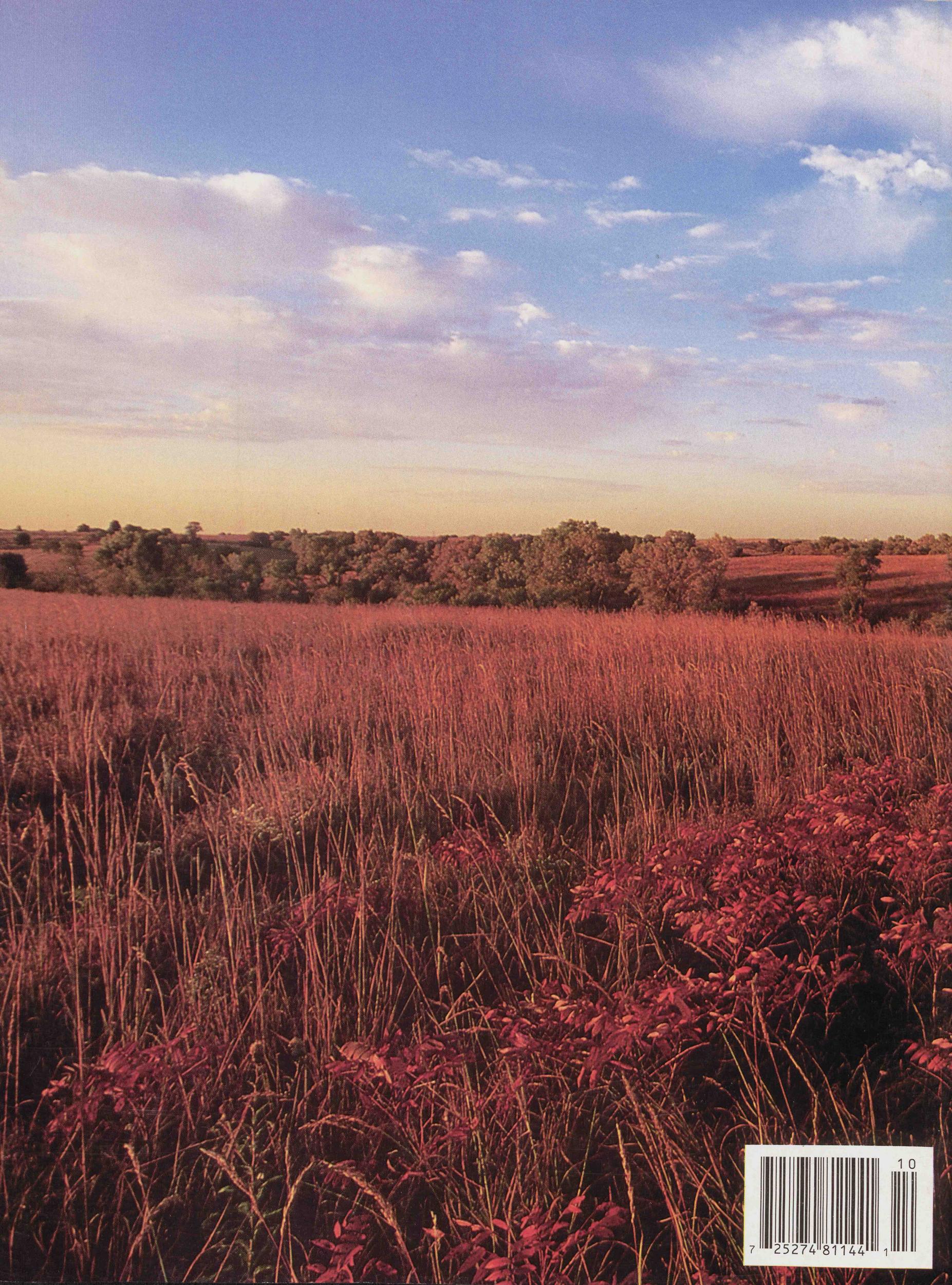
Position: 854 (10 views)