Volume 75, Issue 7, 1997
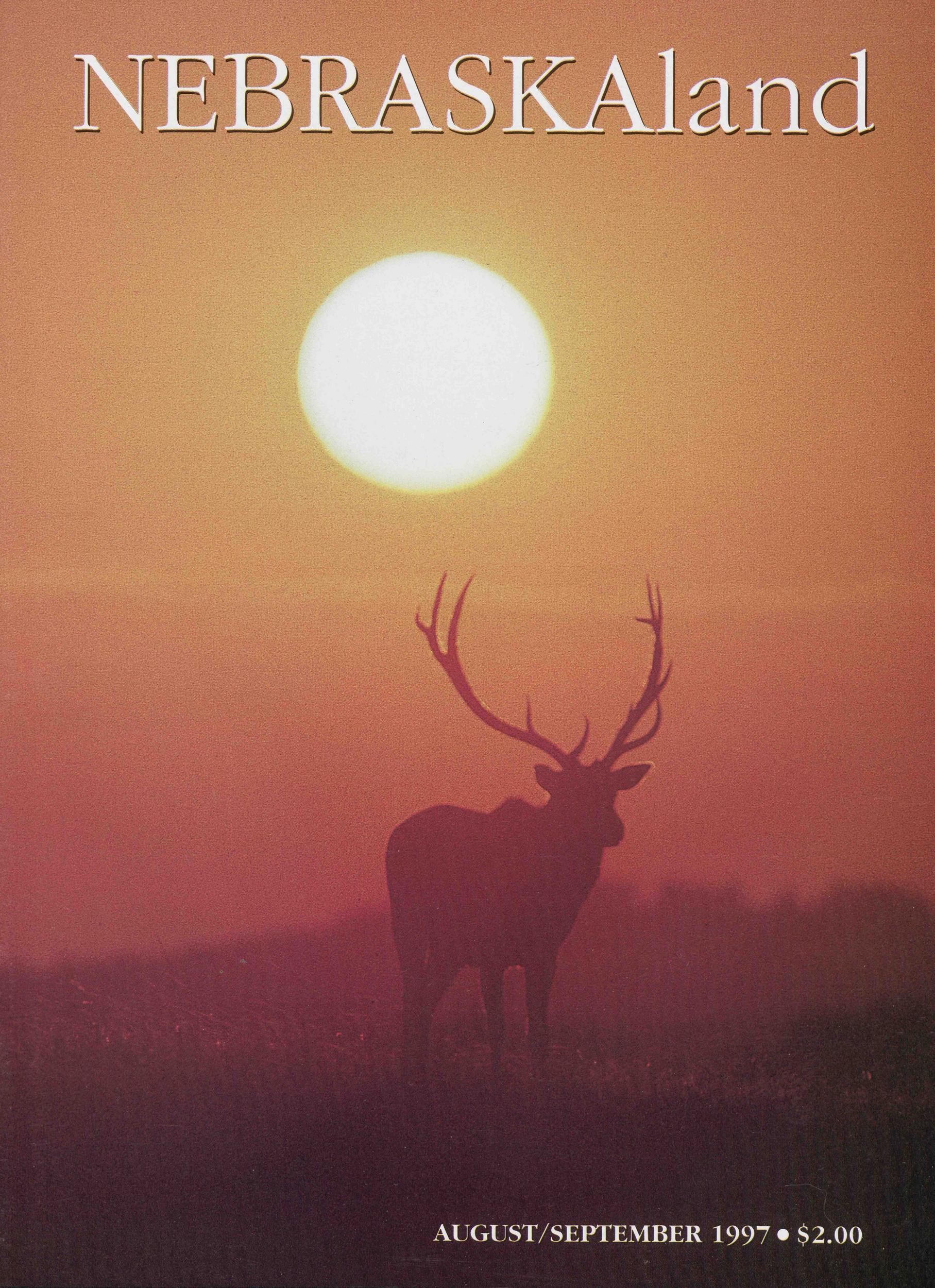
NEBRASKAland
AUGUST/SEPTEMBER 1997 $2.00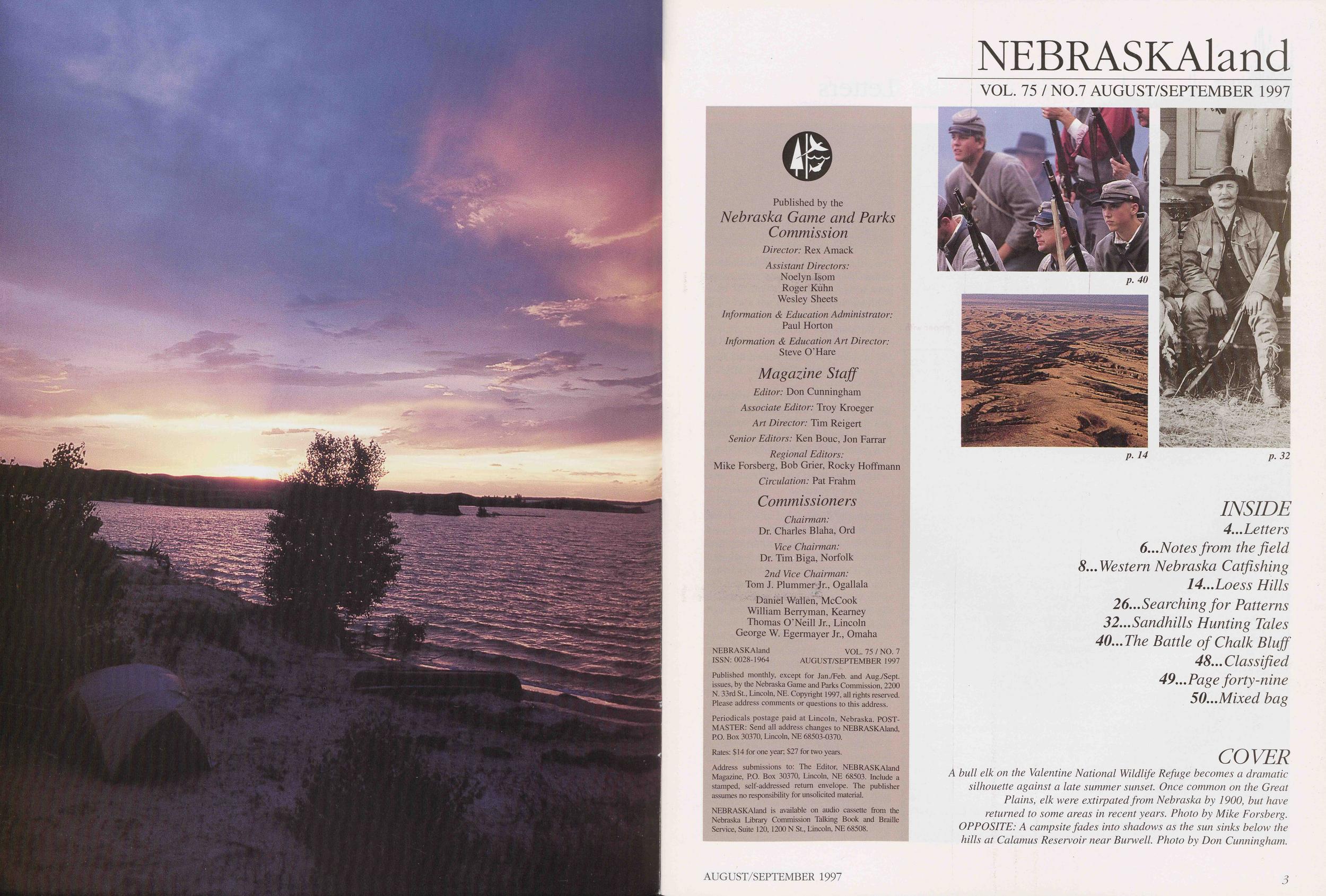
NEBRASKAland
VOL. 75 / NO. 7 AUGUST/SEPTEMBER 1997
Published by the Nebraska Game and Parks Commission Director: Rex Amack Assistant Directors: Noelyn Isom Roger Kuhn Wesley Sheets Information & Education Administrator: Paul Horton Information & Education Art Director: Steve O'Hare Magazine Staff Editor: Don Cunningham Associate Editor: Troy Kroeger Art Director: Tim Reigert Senior Editors: Ken Bouc, Jon Farrar Regional Editors: Mike Forsberg, Bob Grier, Rocky Hoffmann Circulation: Pat Frahm Commissioners Chairman: Dr. Charles Blaha, Ord Vice Chairman: Dr. Tim Biga, Norfolk 2nd Vice Chairman: Tom J. Plummet Jr., Ogallala Daniel Waiien,1vlcCook William Berryman, Kearney Thomas O'Neill Jr., Lincoln George W. Egermayer Jr., Omaha NEBRASKAland ISSN: 0028-1964 VOL. 75/NO. 7 AUGUST/SEPTEMBER 1997 Published monthly, except for Jan./Feb. and Aug./Sept. issues, by the Nebraska Game and Parks Commission, 2200 N. 33rd St., Lincoln, NE. Copyright 1997, all rights reserved. Please address comments or questions to this address. Periodicals postage paid at Lincoln, Nebraska. POSTMASTER: Send all address changes to NEBRASKAland, P.O. Box 30370, Lincoln, NE 68503-0370. Rates: $14 for one year; $27 for two years. Address submissions to: The Editor, NEBRASKAland Magazine, P.O. Box 30370, Lincoln, NE 68503. Include a stamped, self-addressed return envelope. The publisher assumes no responsibility for unsolicited material. NEBRASKAland is available on audio cassette from the Nebraska Library Corrrrnission Talking Book and Braille Service, Suite 120,1200 N St., Lincoln, NE 68508.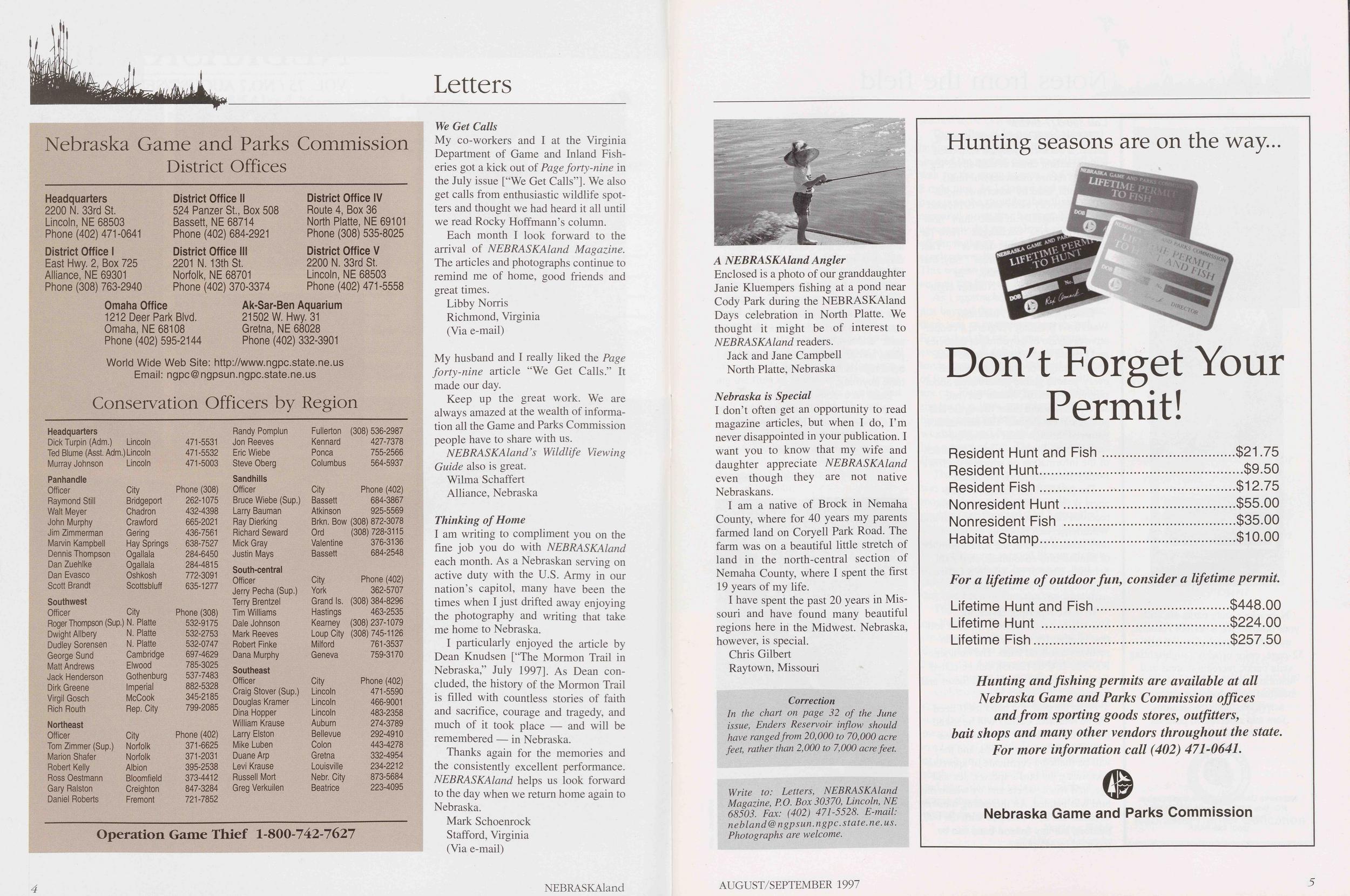 Nebraska Game and Parks Commission
District Offices
Headquarters
2200 N. 33rd St.
Lincoln, NE 68503
Phone (402) 471-0641
District Office I
East Hwy. 2, Box 725
Alliance, NE 69301
Phone (308) 763-2940
District Office II
524 Panzer St., Box 508
Bassett, NE 68714
Phone (402) 684-2921
District Office III
2201 N. 13th St.
Norfolk, NE 68701
Phone (402) 370-3374
District Office IV
Route 4, Box 36
North Platte, NE 69101
Phone (308) 535-8025
District Office V
2200 N. 33rd St.
Lincoln, NE 68503
Phone (402) 471-5558
Omaha Office
1212 Deer Park Blvd.
Omaha, NE 68108
Phone (402) 595-2144
Ak-Sar-Ben Aquarium
21502 W. Hwy. 31
Gretna, NE 68028
Phone (402) 332-3901
World Wide Web Site: http://www.ngpc.state.ne.us
Email: ngpc@ngpsun.ngpc.state.ne.us
Conservation Officers by Region
Headquarters
Dick Turpin (Adm.) Lincoln
Ted Blume (Asst. Adm.) Lincoln
Murray Johnson Lincoln
Panhandle
Officer
Raymond Still
Walt Meyer
John Murphy
Jim Zimmerman
Marvin Kampbell
Dennis Thompson
Dan Zuehlke
Dan Evasco
Scott Brandt
Southwest
Officer
Roger Thompson (Sup.)
Dwight Allbery
Dudley Sorensen
George Sund
Matt Andrews
Jack Henderson
Dirk Greene
Virgil Gosch
Rich Routh
Northeast
Officer
Tom Zimmer (Sup.)
Marion Shafer
Robert Kelly
Ross Oestmann
Gary Ralston
Daniel Roberts
City
Bridgeport
Chadron
Crawford
Gering
Hay Springs
Ogallala
Ogallala
Oshkosh
Scottsbluff
City
N. Platte
N. Platte
N. Platte
Cambridge
Elwood
Gothenburg
Imperial
McCook
Rep. City
City
Norfolk
Norfolk
Albion
Bloomfield
Creighton
Fremont
471-5531
471-5532
471-5003
Phone (308)
262-1075
432-4398
665-2021
436-7561
638-7527
284-6450
284-4815
772-3091
635-1277
Phone (308)
532-9175
532-2753
532-0747
697-4629
785-3025
537-7483
882-5328
345-2185
799-2085
Phone (402)
371-6625
371-2031
395-2538
373-4412
847-3284
721-7852
Randy Pomplun Fullerton (308) 536-2987
Jon Reeves Kennard 427-7378
Eric Wiebe Ponca 755-2566
Steve Oberg Columbus 564-5937
Sandhills
Officer City Phone (402)
Bruce Wiebe (Sup.) Bassett 684-3867
Larry Bauman Atkinson 925-5569
Ray Dierking Brkn. Bow (308) 872-3078
Richard Seward Ord (308)728-3115
Mick Gray Valentine 376-3136
Justin Mays Bassett 684-2548
South-central
Officer City Phone (402)
Jerry Pecha (Sup.) York 362-5707
Terry Brentzel Grand Is. (308) 384-8296
Tim Williams Hastings 463-2535
Dale Johnson Kearney (308)237-1079
Mark Reeves Loup City (308)745-1126
Robert Finke Milford 761-3537
Dana Murphy Geneva 759-3170
Southeast
Officer City Phone (402)
Craig Stover (Sup.) Lincoln 471-5590
Douglas Kramer Lincoln 466-9001
Dina Hopper Lincoln 483-2358
William Krause Auburn 274-3789
Larry Elston Bellevue 292-4910
Mike Luben Colon 443-4278
Duane Arp Gretna 332-4954
Levi Krause Louisville 234-2212
Russell Mort Nebr.City 873-5684
Greq Verkuilen Beatrice 223-4095
Operation Game Thief 1-800-742-7627
Nebraska Game and Parks Commission
District Offices
Headquarters
2200 N. 33rd St.
Lincoln, NE 68503
Phone (402) 471-0641
District Office I
East Hwy. 2, Box 725
Alliance, NE 69301
Phone (308) 763-2940
District Office II
524 Panzer St., Box 508
Bassett, NE 68714
Phone (402) 684-2921
District Office III
2201 N. 13th St.
Norfolk, NE 68701
Phone (402) 370-3374
District Office IV
Route 4, Box 36
North Platte, NE 69101
Phone (308) 535-8025
District Office V
2200 N. 33rd St.
Lincoln, NE 68503
Phone (402) 471-5558
Omaha Office
1212 Deer Park Blvd.
Omaha, NE 68108
Phone (402) 595-2144
Ak-Sar-Ben Aquarium
21502 W. Hwy. 31
Gretna, NE 68028
Phone (402) 332-3901
World Wide Web Site: http://www.ngpc.state.ne.us
Email: ngpc@ngpsun.ngpc.state.ne.us
Conservation Officers by Region
Headquarters
Dick Turpin (Adm.) Lincoln
Ted Blume (Asst. Adm.) Lincoln
Murray Johnson Lincoln
Panhandle
Officer
Raymond Still
Walt Meyer
John Murphy
Jim Zimmerman
Marvin Kampbell
Dennis Thompson
Dan Zuehlke
Dan Evasco
Scott Brandt
Southwest
Officer
Roger Thompson (Sup.)
Dwight Allbery
Dudley Sorensen
George Sund
Matt Andrews
Jack Henderson
Dirk Greene
Virgil Gosch
Rich Routh
Northeast
Officer
Tom Zimmer (Sup.)
Marion Shafer
Robert Kelly
Ross Oestmann
Gary Ralston
Daniel Roberts
City
Bridgeport
Chadron
Crawford
Gering
Hay Springs
Ogallala
Ogallala
Oshkosh
Scottsbluff
City
N. Platte
N. Platte
N. Platte
Cambridge
Elwood
Gothenburg
Imperial
McCook
Rep. City
City
Norfolk
Norfolk
Albion
Bloomfield
Creighton
Fremont
471-5531
471-5532
471-5003
Phone (308)
262-1075
432-4398
665-2021
436-7561
638-7527
284-6450
284-4815
772-3091
635-1277
Phone (308)
532-9175
532-2753
532-0747
697-4629
785-3025
537-7483
882-5328
345-2185
799-2085
Phone (402)
371-6625
371-2031
395-2538
373-4412
847-3284
721-7852
Randy Pomplun Fullerton (308) 536-2987
Jon Reeves Kennard 427-7378
Eric Wiebe Ponca 755-2566
Steve Oberg Columbus 564-5937
Sandhills
Officer City Phone (402)
Bruce Wiebe (Sup.) Bassett 684-3867
Larry Bauman Atkinson 925-5569
Ray Dierking Brkn. Bow (308) 872-3078
Richard Seward Ord (308)728-3115
Mick Gray Valentine 376-3136
Justin Mays Bassett 684-2548
South-central
Officer City Phone (402)
Jerry Pecha (Sup.) York 362-5707
Terry Brentzel Grand Is. (308) 384-8296
Tim Williams Hastings 463-2535
Dale Johnson Kearney (308)237-1079
Mark Reeves Loup City (308)745-1126
Robert Finke Milford 761-3537
Dana Murphy Geneva 759-3170
Southeast
Officer City Phone (402)
Craig Stover (Sup.) Lincoln 471-5590
Douglas Kramer Lincoln 466-9001
Dina Hopper Lincoln 483-2358
William Krause Auburn 274-3789
Larry Elston Bellevue 292-4910
Mike Luben Colon 443-4278
Duane Arp Gretna 332-4954
Levi Krause Louisville 234-2212
Russell Mort Nebr.City 873-5684
Greq Verkuilen Beatrice 223-4095
Operation Game Thief 1-800-742-7627
Letters
We Get CallsMy co-workers and I at the Virginia Department of Game and Inland Fisheries got a kick out of Page forty-nine in the July issue ["We Get Calls"]. We also get calls from enthusiastic wildlife spotters and thought we had heard it all until we read Rocky Hoffmann's column.
Each month I look forward to the arrival of NEBRASKAland Magazine. The articles and photographs continue to remind me of home, good friends and great times.
Libby NorrisRichmond, Virginia
(Via e-mail)
My husband and I really liked the Page forty-nine article "We Get Calls." It made our day.
Keep up the great work. We are always amazed at the wealth of information all the Game and Parks Commission people have to share with us.
NEBRASKAland's Wildlife Viewing Guide also is great.
Wilma SchaffertAlliance, Nebraska
Thinking of HomeI am writing to compliment you on the fine job you do with NEBRASKAland each month. As a Nebraskan serving on active duty with the U.S. Army in our nation's capitol, many have been the times when I just drifted away enjoying the photography and writing that take me home to Nebraska.
I particularly enjoyed the article by Dean Knudsen ["The Mormon Trail in Nebraska," July 1997]. As Dean concluded, the history of the Mormon Trail is filled with countless stories of faith and sacrifice, courage and tragedy, and much of it took place — and will be remembered — in Nebraska.
Thanks again for the memories and the consistently excellent performance. NEBRASKAland helps us look forward to the day when we return home again to Nebraska.
Mark SchoenrockStafford, Virginia
(Via e-mail)
4 NEBRASKAlandEnclosed is a photo of our granddaughter Janie Kluempers fishing at a pond near Cody Park during the NEBRASKAland Days celebration in North Platte. We thought it might be of interest to NEBRASKAland readers.
Jack and Jane CampbellNorth Platte, Nebraska
Nebraska is SpecialI don't often get an opportunity to read magazine articles, but when I do, I'm never disappointed in your publication. I want you to know that my wife and daughter appreciate NEBRASKAland even though they are not native Nebraskans.
I am a native of Brock in Nemaha County, where for 40 years my parents farmed land on Coryell Park Road. The farm was on a beautiful little stretch of land in the north-central section of Nemaha County, where I spent the first 19 years of my life.
I have spent the past 20 years in Missouri and have found many beautiful regions here in the Midwest. Nebraska, however, is special.
Chris GilbertRaytown, Missouri
Correction In the chart on page 32 of the June issue, Enders Reservoir inflow should have ranged from 20,000 to 70,000 acre feet, rather than 2,000 to 7,000 acre feet. Write to: Letters, NEBRASKAland Magazine, P.O. Box30370, Lincoln, NE 68503. Fax: (402) 471-5528. E-mail: nebland@ngpsun.ngpc.state.ne.us. Photographs are welcome.Hunting seasons are on the way...
Notes from the field
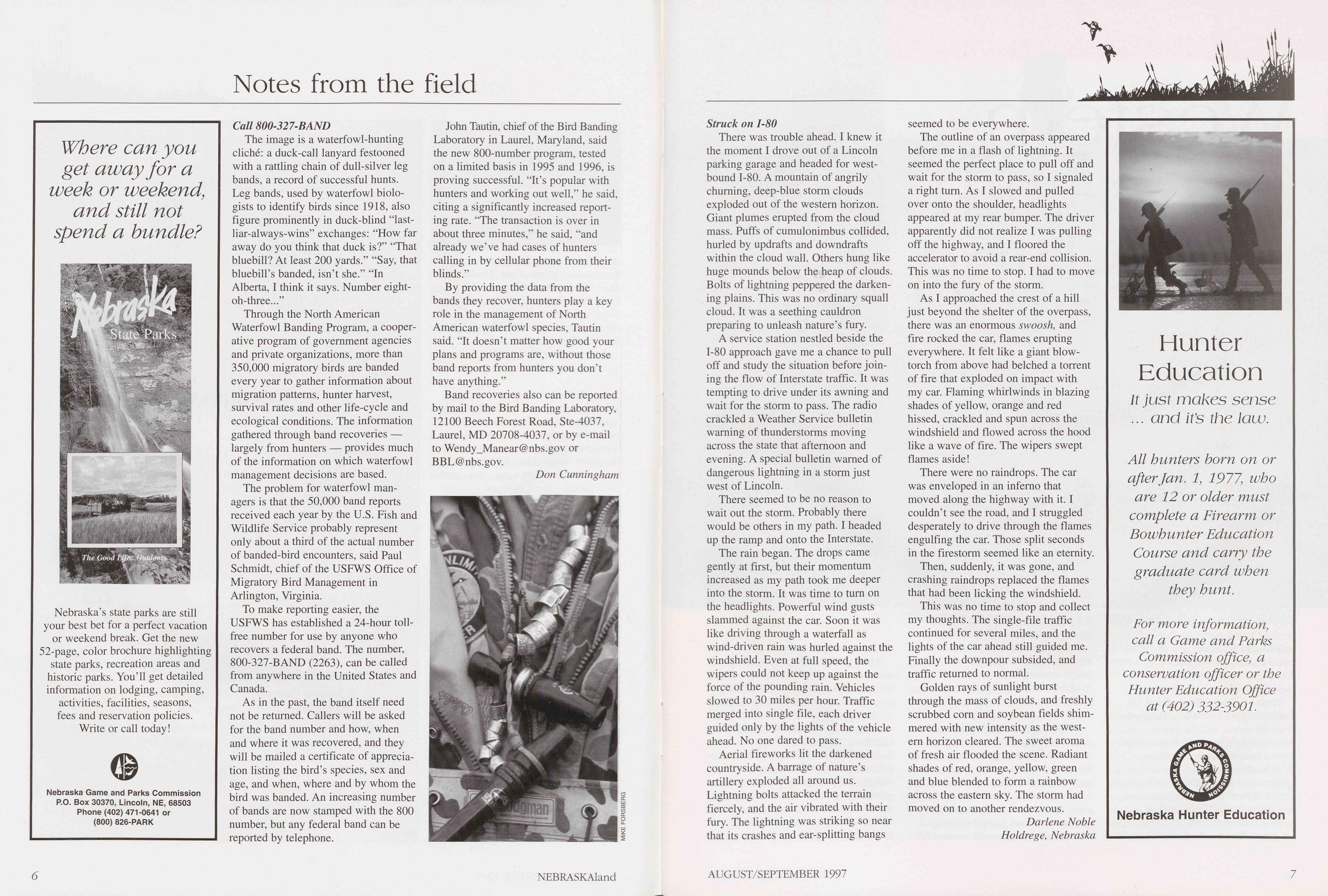
Call 800-327-BANDThe image is a waterfowl-hunting cliche: a duck-call lanyard festooned with a rattling chain of dull-silver leg bands, a record of successful hunts. Leg bands, used by waterfowl biologists to identify birds since 1918, also figure prominently in duck-blind "last-liar-always-wins" exchanges: "How far away do you think that duck is?" 'That bluebill? At least 200 yards." "Say, that bluebill's banded, isn't she." "In Alberta, I think it says. Number eight-oh-three..."
Through the North American Waterfowl Banding Program, a cooperative program of government agencies and private organizations, more than 350,000 migratory birds are banded every year to gather information about migration patterns, hunter harvest, survival rates and other life-cycle and ecological conditions. The information gathered through band recoveries — largely from hunters — provides much of the information on which waterfowl management decisions are based.
The problem for waterfowl managers is that the 50,000 band reports received each year by the U.S. Fish and Wildlife Service probably represent only about a third of the actual number of banded-bird encounters, said Paul Schmidt, chief of the USFWS Office of Migratory Bird Management in Arlington, Virginia.
To make reporting easier, the USFWS has established a 24-hour toll-free number for use by anyone who recovers a federal band. The number, 800-327-BAND (2263), can be called from anywhere in the United States and Canada.
As in the past, the band itself need not be returned. Callers will be asked for the band number and how, when and where it was recovered, and they will be mailed a certificate of appreciation listing the bird's species, sex and age, and when, where and by whom the bird was banded. An increasing number of bands are now stamped with the 800 number, but any federal band can be reported by telephone.
John Tautin, chief of the Bird Banding Laboratory in Laurel, Maryland, said the new 800-number program, tested on a limited basis in 1995 and 1996, is proving successful. "It's popular with hunters and working out well," he said, citing a significantly increased reporting rate. "The transaction is over in about three minutes," he said, "and already we've had cases of hunters calling in by cellular phone from their blinds."
By providing the data from the bands they recover, hunters play a key role in the management of North American waterfowl species, Tautin said. "It doesn't matter how good your plans and programs are, without those band reports from hunters you don't have anything."
Band recoveries also can be reported by mail to the Bird Banding Laboratory, 12100 Beech Forest Road, Ste-4037, Laurel, MD 20708-4037, or by e-mail to Wendy_Manear@nbs.gov or BBL@nbs.gov.
Don CunninghamThere was trouble ahead. I knew it the moment I drove out of a Lincoln parking garage and headed for west-bound 1-80. A mountain of angrily churning, deep-blue storm clouds exploded out of the western horizon. Giant plumes erupted from the cloud mass. Puffs of cumulonimbus collided, hurled by updrafts and downdrafts within the cloud wall. Others hung like huge mounds below the heap of clouds. Bolts of lightning peppered the darkening plains. This was no ordinary squall cloud. It was a seething cauldron preparing to unleash nature's fury.
A service station nestled beside the 1-80 approach gave me a chance to pull off and study the situation before joining the flow of Interstate traffic. It was tempting to drive under its awning and wait for the storm to pass. The radio crackled a Weather Service bulletin warning of thunderstorms moving across the state that afternoon and evening. A special bulletin warned of dangerous lightning in a storm just west of Lincoln.
There seemed to be no reason to wait out the storm. Probably there would be others in my path. I headed up the ramp and onto the Interstate.
The rain began. The drops came gently at first, but their momentum increased as my path took me deeper into the storm. It was time to turn on the headlights. Powerful wind gusts slammed against the car. Soon it was like driving through a waterfall as wind-driven rain was hurled against the windshield. Even at full speed, the wipers could not keep up against the force of the pounding rain. Vehicles slowed to 30 miles per hour. Traffic merged into single file, each driver guided only by the lights of the vehicle ahead. No one dared to pass.
Aerial fireworks lit the darkened countryside. A barrage of nature's artillery exploded all around us. Lightning bolts attacked the terrain fiercely, and the air vibrated with their fury. The lightning was striking so near that its crashes and ear-splitting bangs seemed to be everywhere.
The outline of an overpass appeared before me in a flash of lightning. It seemed the perfect place to pull off and wait for the storm to pass, so I signaled a right turn. As I slowed and pulled over onto the shoulder, headlights appeared at my rear bumper. The driver apparently did not realize I was pulling off the highway, and I floored the accelerator to avoid a rear-end collision. This was no time to stop. I had to move on into the fury of the storm.
As I approached the crest of a hill just beyond the shelter of the overpass, there was an enormous swoosh, and fire rocked the car, flames erupting everywhere. It felt like a giant blowtorch from above had belched a torrent of fire that exploded on impact with my car. Flaming whirlwinds in blazing shades of yellow, orange and red hissed, crackled and spun across the windshield and flowed across the hood like a wave of fire. The wipers swept flames aside!
There were no raindrops. The car was enveloped in an inferno that moved along the highway with it. I couldn't see the road, and I struggled desperately to drive through the flames engulfing the car. Those split seconds in the firestorm seemed like an eternity.
Then, suddenly, it was gone, and crashing raindrops replaced the flames that had been licking the windshield.
This was no time to stop and collect my thoughts. The single-file traffic continued for several miles, and the lights of the car ahead still guided me. Finally the downpour subsided, and traffic returned to normal.
Golden rays of sunlight burst through the mass of clouds, and freshly scrubbed corn and soybean fields shimmered with new intensity as the western horizon cleared. The sweet aroma of fresh air flooded the scene. Radiant shades of red, orange, yellow, green and blue blended to form a rainbow across the eastern sky. The storm had moved on to another rendezvous.
Darlene Noble Holdrege, Nebraska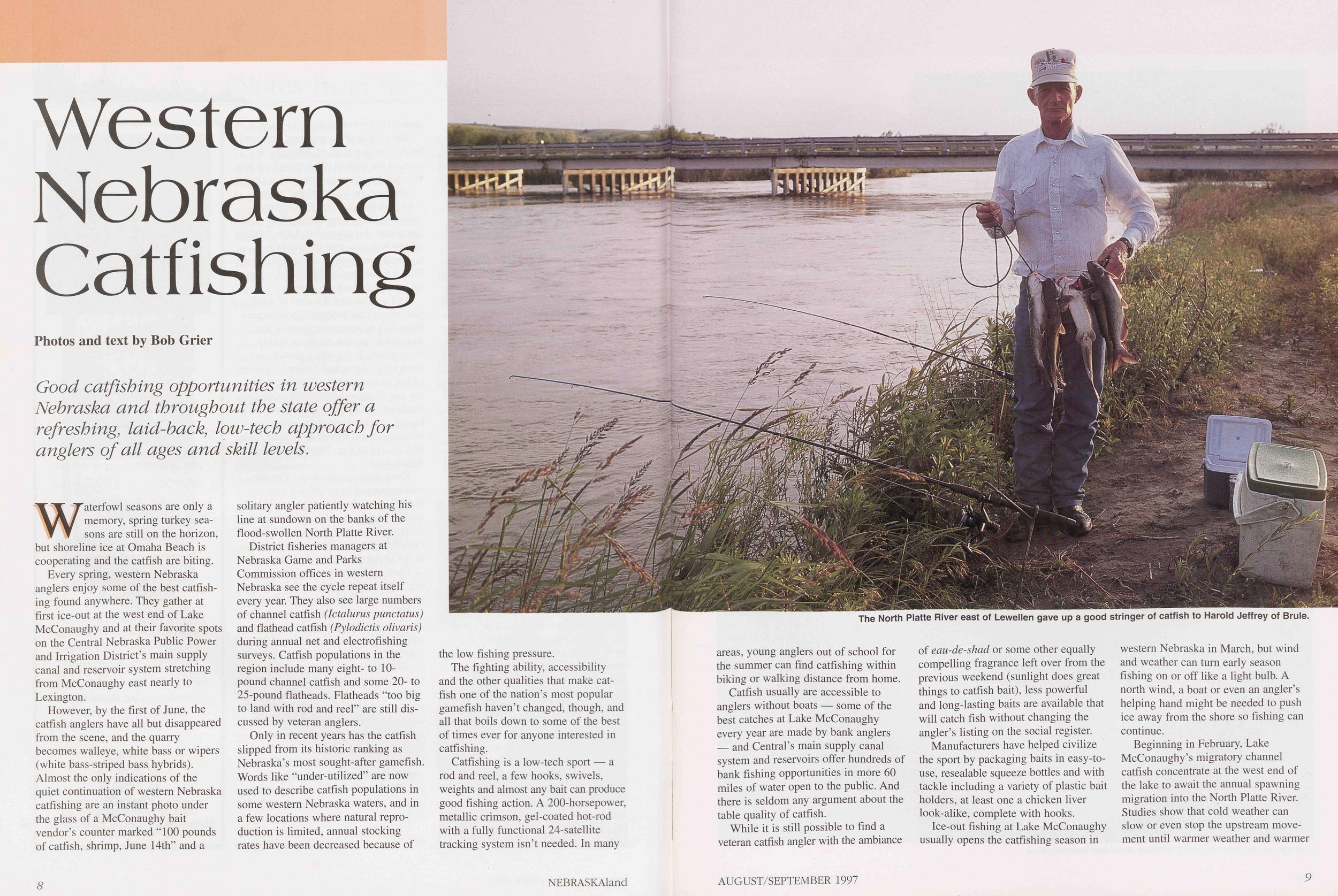
Western Nebraska Catfishing
Good catfishing opportunities in western Nebraska and throughout the state offer a refreshing, laid-back, low-tech approach for anglers of all ages and skill levels.Waterfowl seasons are only a memory, spring turkey seasons are still on the horizon, but shoreline ice at Omaha Beach is cooperating and the catfish are biting.
Every spring, western Nebraska anglers enjoy some of the best catfishing found anywhere. They gather at first ice-out at the west end of Lake McConaughy and at their favorite spots on the Central Nebraska Public Power and irrigation District's main supply canal and reservoir system stretching from McConaughy east nearly to Lexington.
However, by the first of June, the catfish anglers have all but disappeared from the scene, and the quarry becomes walleye, white bass or wipers (white bass-striped bass hybrids). Almost the only indications of the quiet continuation of western Nebraska catfishing are an instant photo under the glass of a McConaughy bait vendor's counter marked "100 pounds of catfish, shrimp, June 14th" and a solitary angler patiently watching his line at sundown on the banks of the flood-swollen North Platte River.
District fisheries managers at Nebraska Game and Parks Commission offices in western Nebraska see the cycle repeat itself every year. They also see large numbers of channel catfish (Ictalurus punctatus) and flathead catfish (Pylodictis olivaris) during annual net and electrofishing surveys. Catfish populations in the region include many eight- to 10-pound channel catfish and some 20- to 25-pound flatheads. Flatheads "too big to land with rod and reel" are still discussed by veteran anglers.
Only in recent years has the catfish slipped from its historic ranking as Nebraska's most sought-after gamefish. Words like "under-utilized" are now used to describe catfish populations in some western Nebraska waters, and in a few locations where natural reproduction is limited, annual stocking rates have been decreased because of the low fishing pressure.
The fighting ability, accessibility and the other qualities that make catfish one of the nation's most popular gamefish haven't changed, though, and all that boils down to some of the best of times ever for anyone interested in catfishing.
Catfishing is a low-tech sport — a rod and reel, a few hooks, swivels, weights and almost any bait can produce good fishing action. A 200-horsepower, metallic crimson, gel-coated hot-rod with a fully functional 24-satellite tracking system isn't needed. In many
8 NEBRASKAlandThe North Platte River east of Lewellen gave up a good stringer of catfish to Harold Jeffrey of Brule.
areas, young anglers out of school for the summer can find catfishing within biking or walking distance from home.
Catfish usually are accessible to anglers without boats — some of the best catches at Lake McConaughy every year are made by bank anglers — and Central's main supply canal system and reservoirs offer hundreds of bank fishing opportunities in more 60 miles of water open to the public. And there is seldom any argument about the table quality of catfish.
While it is still possible to find a veteran catfish angler with the ambiance of eau-de-shad or some other equally compelling fragrance left over from the previous weekend (sunlight does great things to catfish bait), less powerful and long-lasting baits are available that will catch fish without changing the angler's listing on the social register.
Manufacturers have helped civilize the sport by packaging baits in easy-to-use, resealable squeeze bottles and with tackle including a variety of plastic bait holders, at least one a chicken liver look-alike, complete with hooks.
Ice-out fishing at Lake McConaughy usually opens the catfishing season in western Nebraska in March, but wind and weather can turn early season fishing on or off like a light bulb. A north wind, a boat or even an angler's helping hand might be needed to push ice away from the shore so fishing can continue.
Beginning in February, Lake McConaughy's migratory channel catfish concentrate at the west end of the lake to await the annual spawning migration into the North Platte River. Studies show that cold weather can slow or even stop the upstream movement until warmer weather and warmer
AUGUST/SEPTEMBER 1997 9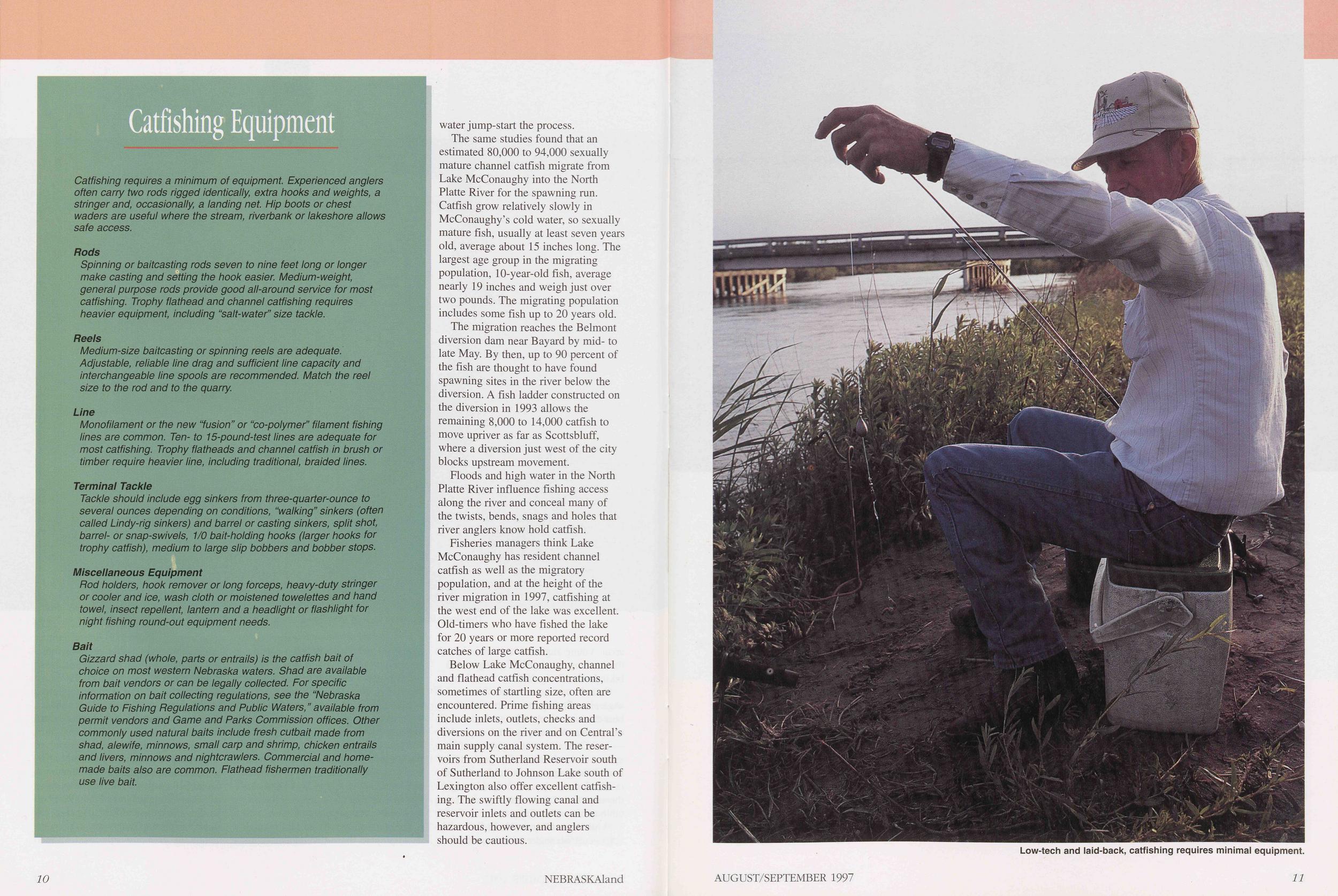
Catfishing Equipment
Catfishing requires a minimum of equipment. Experienced anglers often carry two rods rigged identically, extra hooks and weights, a stringer and, occasionally, a landing net. Hip boots or chest waders are useful where the stream, riverbank or lakeshore allows safe access. Rods Spinning or baitcasting rods seven to nine feet long or longer make casting and setting the hook easier. Medium-weight, general purpose rods provide good all-around service for most catfishing. Trophy flathead and channel catfishing requires heavier equipment, including "salt-water" size tackle. Reels Medium-size baitcasting or spinning reels are adequate. Adjustable, reliable line drag and sufficient line capacity and interchangeable line spools are recommended. Match the reel size to the rod and to the quarry. Line Monofilament or the new "fusion" or "co-polymer" filament fishing lines are common. Ten- to 15-pound-test lines are adequate for most catfishing. Trophy ffatheads and channel catfish in brush or timber require heavier line, including traditional, braided lines. Terminal Tackle Tackle should include egg sinkers from three-quarter-ounce to several ounces depending on conditions, "walking" sinkers (often called Lindy-rig sinkers) and barrel or casting sinkers, split shot, barrel- or snap-swivels, 1/0 bait-holding hooks (larger hooks for trophy catfish), medium to large slip bobbers and bobber stops. Miscellaneous Equipment Rod holders, hook remover or long forceps, heavy-duty stringer or cooler and ice, wash cloth or moistened towelettes and hand towel, insect repellent, lantern and a headlight or flashlight for night fishing round-out equipment needs. Bait Gizzard shad (whole, parts or entrails) is the catfish bait of choice on most western Nebraska waters. Shad are available from bait vendors or can be legally collected. For specific information on bait collecting regulations, see the "Nebraska Guide to Fishing Regulations and Public Waters,"available from permit vendors and Game and Parks Commission offices. Other commonly used natural baits include fresh cutbait made from shad, alewife, minnows, small carp and shrimp, chicken entrails and livers, minnows and nightcrawlers. Commercial and homemade baits also are common. Flathead fishermen traditionally use live bait.water jump-start the process.
The same studies found that an estimated 80,000 to 94,000 sexually mature channel catfish migrate from Lake McConaughy into the North Platte River for the spawning run. Catfish grow relatively slowly in McConaughy's cold water, so sexually mature fish, usually at least seven years old, average about 15 inches long. The largest age group in the migrating population, 10-year-old fish, average nearly 19 inches and weigh just over two pounds. The migrating population includes some fish up to 20 years old.
The migration reaches the Belmont diversion dam near Bayard by mid- to late May. By then, up to 90 percent of the fish are thought to have found spawning sites in the river below the diversion. A fish ladder constructed on the diversion in 1993 allows the remaining 8,000 to 14,000 catfish to move upriver as far as Scottsbluff, where a diversion just west of the city blocks upstream movement.
Floods and high water in the North Platte River influence fishing access along the river and conceal many of the twists, bends, snags and holes that river anglers know hold catfish.
Fisheries managers think Lake McConaughy has resident channel catfish as well as the migratory population, and at the height of the river migration in 1997, catfishing at the west end of the lake was excellent. Old-timers who have fished the lake for 20 years or more reported record catches of large catfish.
Below Lake McConaughy, channel and flathead catfish concentrations, sometimes of startling size, often are encountered. Prime fishing areas include inlets, outlets, checks and diversions on the river and on Central's main supply canal system. The reservoirs from Sutherland Reservoir south of Sutherland to Johnson Lake south of Lexington also offer excellent catfishing. The swiftly flowing canal and reservoir inlets and outlets can be hazardous, however, and anglers should be cautious.
10 NEBRASKAlandLow-tech and laid-back, catfishing requires minimal equipment.
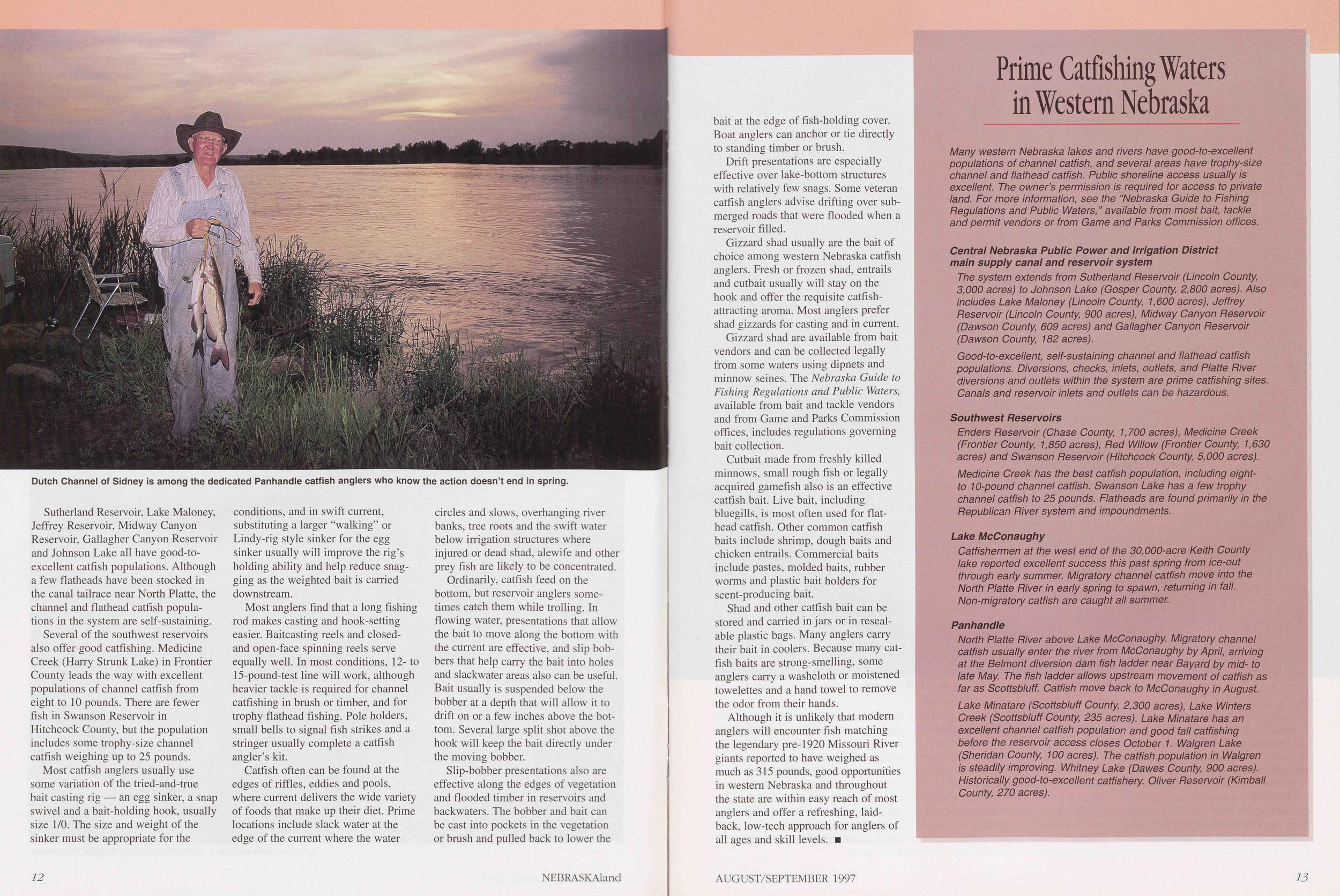
Dutch Channel of Sidney is among the dedicated Panhandle catfish anglers who know the action doesn't end in spring.
Sutherland Reservoir, Lake Maloney, Jeffrey Reservoir, Midway Canyon Reservoir, Gallagher Canyon Reservoir and Johnson Lake all have good-to-excellent catfish populations. Although a few flatheads have been stocked in the canal tailrace near North Platte, the channel and flathead catfish populations in the system are self-sustaining.
Several of the southwest reservoirs also offer good catfishing. Medicine Creek (Harry Strunk Lake) in Frontier County leads the way with excellent populations of channel catfish from eight to 10 pounds. There are fewer fish in Swanson Reservoir in Hitchcock County, but the population includes some trophy-size channel catfish weighing up to 25 pounds.
Most catfish anglers usually use some variation of the tried-and-true bait casting rig — an egg sinker, a snap swivel and a bait-holding hook, usually size 1/0. The size and weight of the sinker must be appropriate for the conditions, and in swift current, substituting a larger "walking" or Lindy-rig style sinker for the egg sinker usually will improve the rig's holding ability and help reduce snagging as the weighted bait is carried downstream.
Most anglers find that a long fishing rod makes casting and hook-setting easier. Baitcasting reels and closed-and open-face spinning reels serve equally well. In most conditions, 12- to 15-pound-test line will work, although heavier tackle is required for channel catfishing in brush or timber, and for trophy flathead fishing. Pole holders, small bells to signal fish strikes and a stringer usually complete a catfish angler's kit.
Catfish often can be found at the edges of riffles, eddies and pools, where current delivers the wide variety of foods that make up their diet. Prime locations include slack water at the edge of the current where the water circles and slows, overhanging river banks, tree roots and the swift water below irrigation structures where injured or dead shad, alewife and other prey fish are likely to be concentrated.
Ordinarily, catfish feed on the bottom, but reservoir anglers sometimes catch them while trolling. In flowing water, presentations that allow the bait to move along the bottom with the current are effective, and slip bobbers that help carry the bait into holes and slackwater areas also can be useful. Bait usually is suspended below the bobber at a depth that will allow it to drift on or a few inches above the bottom. Several large split shot above the hook will keep the bait directly under the moving bobber.
Slip-bobber presentations also are effective along the edges of vegetation and flooded timber in reservoirs and backwaters. The bobber and bait can be cast into pockets in the vegetation or brush and pulled back to lower the
12 NEBRASKAlandbait at the edge of fish-holding cover. Boat anglers can anchor or tie directly to standing timber or brush.
Drift presentations are especially effective over lake-bottom structures with relatively few snags. Some veteran catfish anglers advise drifting over submerged roads that were flooded when a reservoir filled.
Gizzard shad usually are the bait of choice among western Nebraska catfish anglers. Fresh or frozen shad, entrails and cutbait usually will stay on the hook and offer the requisite catfish-attracting aroma. Most anglers prefer shad gizzards for casting and in current.
Gizzard shad are available from bait vendors and can be collected legally from some waters using dipnets and minnow seines. The Nebraska Guide to Fishing Regulations and Public Waters, available from bait and tackle vendors and from Game and Parks Commission offices, includes regulations governing bait collection.
Cutbait made from freshly killed minnows, small rough fish or legally acquired gamefish also is an effective catfish bait. Live bait, including bluegills, is most often used for flathead catfish. Other common catfish baits include shrimp, dough baits and chicken entrails. Commercial baits include pastes, molded baits, rubber worms and plastic bait holders for scent-producing bait.
Shad and other catfish bait can be stored and carried in jars or in resealable plastic bags. Many anglers carry their bait in coolers. Because many catfish baits are strong-smelling, some anglers carry a washcloth or moistened towelettes and a hand towel to remove the odor from their hands.
Although it is unlikely that modern anglers will encounter fish matching the legendary pre-1920 Missouri River giants reported to have weighed as much as 315 pounds, good opportunities in western Nebraska and throughout the state are within easy reach of most anglers and offer a refreshing, laidback, low-tech approach for anglers of all ages and skill levels.
Prime Catfishing Waters in Western Nebraska
Many western Nebraska lakes and rivers have good-to-excellent populations of channel catfish, and several areas have trophy-size channel and flathead catfish. Public shoreline access usually is excellent The owner's permission is required for access to private land. For more information, see the "Nebraska Guide to Fishing Regulations and Public Waters," available from most bait, tackle and permit vendors or from Game and Parks Commission offices. Central Nebraska Public Power and Irrigation District main supply canal and reservoir system The system extends from Sutherland Reservoir (Lincoln County, 3,000 acres) to Johnson Lake (Gosper County, 2,800 acres). Also includes Lake Maloney (Lincoln County, 1,600 acres), Jeffrey Reservoir (Lincoln County, 900 acres), Midway Canyon Reservoir (Dawson County, 609 acres) and Gallagher Canyon Reservoir (Dawson County, 182 acres). Good-to-excellent, self-sustaining channel and flathead catfish populations. Diversions, checks, inlets, outlets, and Platte River diversions and outlets within the system are prime catfishing sites. Canals and reservoir inlets and outlets can be hazardous. Southwest Reservoirs Enders Reservoir (Chase County 1,700 acres), Medicine Creek (Frontier County 1,850 acres), Red Willow (Frontier County, 1,630 acres) and Swanson Reservoir (Hitchcock County, 5,000 acres). Medicine Creek has the best catfish population, including eight-to 10-pound channel catfish. Swanson Lake has a few trophy channel catfish to 25 pounds. Flatheads are found primarily in the Republican River system and impoundments. Lake McConaughy Catfishermen at the west end of the 30,000-acre Keith County lake reported excellent success this past spring from ice-out through early summer. Migratory channel catfish move into the North Platte River in early spring to spawn, returning in fall. Non-migratory catfish are caught all summer. Panhandle North Platte River above Lake McConaughy. Migratory channel catfish usually enter the river from McConaughy by April, arriving at the Belmont diversion dam fish ladder near Bayard by mid- to late May The fish ladder allows upstream movement of catfish as far as Scottsbluff. Catfish move back to McConaughy in August. Lake Minatare (Scottsbluff County, 2,300 acres), Lake Winters Creek (Scottsbluff County, 235 acres). Lake Minatare has an excellent channel catfish population and good fall catfishing before the reservoir access closes October 1. Walgren Lake (Sheridan County, 100 acres). The catfish population in Walgren is steadily improving. Whitney Lake (Dawes County, 900 acres). Historically good-to-excellent catfishery. Oliver Reservoir (Kimball County, 270 acres).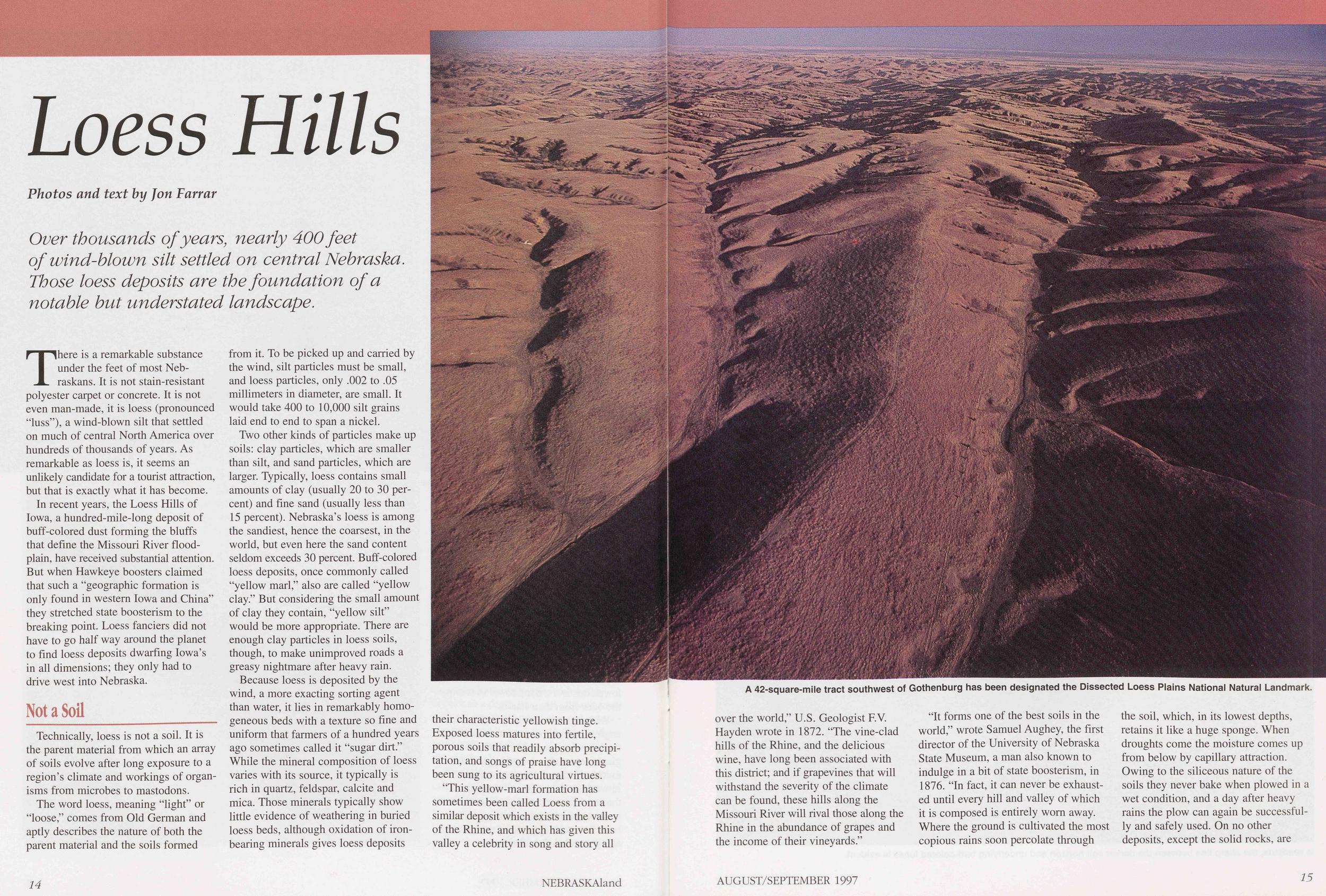
Loess Hills
Over thousands of years, nearly 400 feet of wind-blown silt settled on central Nebraska. Those loess deposits are the foundation of a notable but understated landscape.
There is a remarkable substance under the feet of most Nebraskans. It is not stain-resistant polyester carpet or concrete. It is not even man-made, it is loess (pronounced "luss"), a wind-blown silt that settled on much of central North America over hundreds of thousands of years. As remarkable as loess is, it seems an unlikely candidate for a tourist attraction, but that is exactly what it has become.
In recent years, the Loess Hills of Iowa, a hundred-mile-long deposit of buff-colored dust forming the bluffs that define the Missouri River floodplain, have received substantial attention. But when Hawkeye boosters claimed that such a "geographic formation is only found in western Iowa and China" they stretched state boosterism to the breaking point. Loess fanciers did not have to go half way around the planet to find loess deposits dwarfing Iowa's in all dimensions; they only had to drive west into Nebraska.
Not a SoilTechnically, loess is not a soil. It is the parent material from which an array of soils evolve after long exposure to a region's climate and workings of organisms from microbes to mastodons.
The word loess, meaning "light" or "loose," comes from Old German and aptly describes the nature of both the parent material and the soils formed from it. To be picked up and carried by the wind, silt particles must be small, and loess particles, only .002 to .05 millimeters in diameter, are small. It would take 400 to 10,000 silt grains laid end to end to span a nickel.
Two other kinds of particles make up soils: clay particles, which are smaller than silt, and sand particles, which are larger. Typically, loess contains small amounts of clay (usually 20 to 30 percent) and fine sand (usually less than 15 percent). Nebraska's loess is among the sandiest, hence the coarsest, in the world, but even here the sand content seldom exceeds 30 percent. Buff-colored loess deposits, once commonly called "yellow marl," also are called "yellow clay." But considering the small amount of clay they contain, "yellow silt" would be more appropriate. There are enough clay particles in loess soils, though, to make unimproved roads a greasy nightmare after heavy rain.
Because loess is deposited by the wind, a more exacting sorting agent than water, it lies in remarkably homogeneous beds with a texture so fine and uniform that farmers of a hundred years ago sometimes called it "sugar dirt." While the mineral composition of loess varies with its source, it typically is rich in quartz, feldspar, calcite and mica. Those minerals typically show little evidence of weathering in buried loess beds, although oxidation of iron-bearing minerals gives loess deposits their characteristic yellowish tinge. Exposed loess matures into fertile, porous soils that readily absorb precipitation, and songs of praise have long been sung to its agricultural virtues.
"This yellow-marl formation has sometimes been called Loess from a similar deposit which exists in the valley of the Rhine, and which has given this valley a celebrity in song and story all
14 NEBRASKAlandA 42-square-mile tract southwest of Gothenburg has been designated the Dissected Loess Plains National Natural Landmark.
over the world," U.S. Geologist F.V. Hayden wrote in 1872. "The vine-clad hills of the Rhine, and the delicious wine, have long been associated with this district; and if grapevines that will withstand the severity of the climate can be found, these hills along the Missouri River will rival those along the Rhine in the abundance of grapes and the income of their vineyards."
"It forms one of the best soils in the world," wrote Samuel Aughey, the first director of the University of Nebraska State Museum, a man also known to indulge in a bit of state boosterism, in 1876. "In fact, it can never be exhausted until every hill and valley of which it is composed is entirely worn away. Where the ground is cultivated the most copious rains soon percolate through the soil, which, in its lowest depths, retains it like a huge sponge. When droughts come the moisture comes up from below by capillary attraction. Owing to the siliceous nature of the soils they never bake when plowed in a wet condition, and a day after heavy rains the plow can again be successfully and safely used. On no other deposits, except the solid rocks, are
AUGUST/SEPTEMBER 1997 15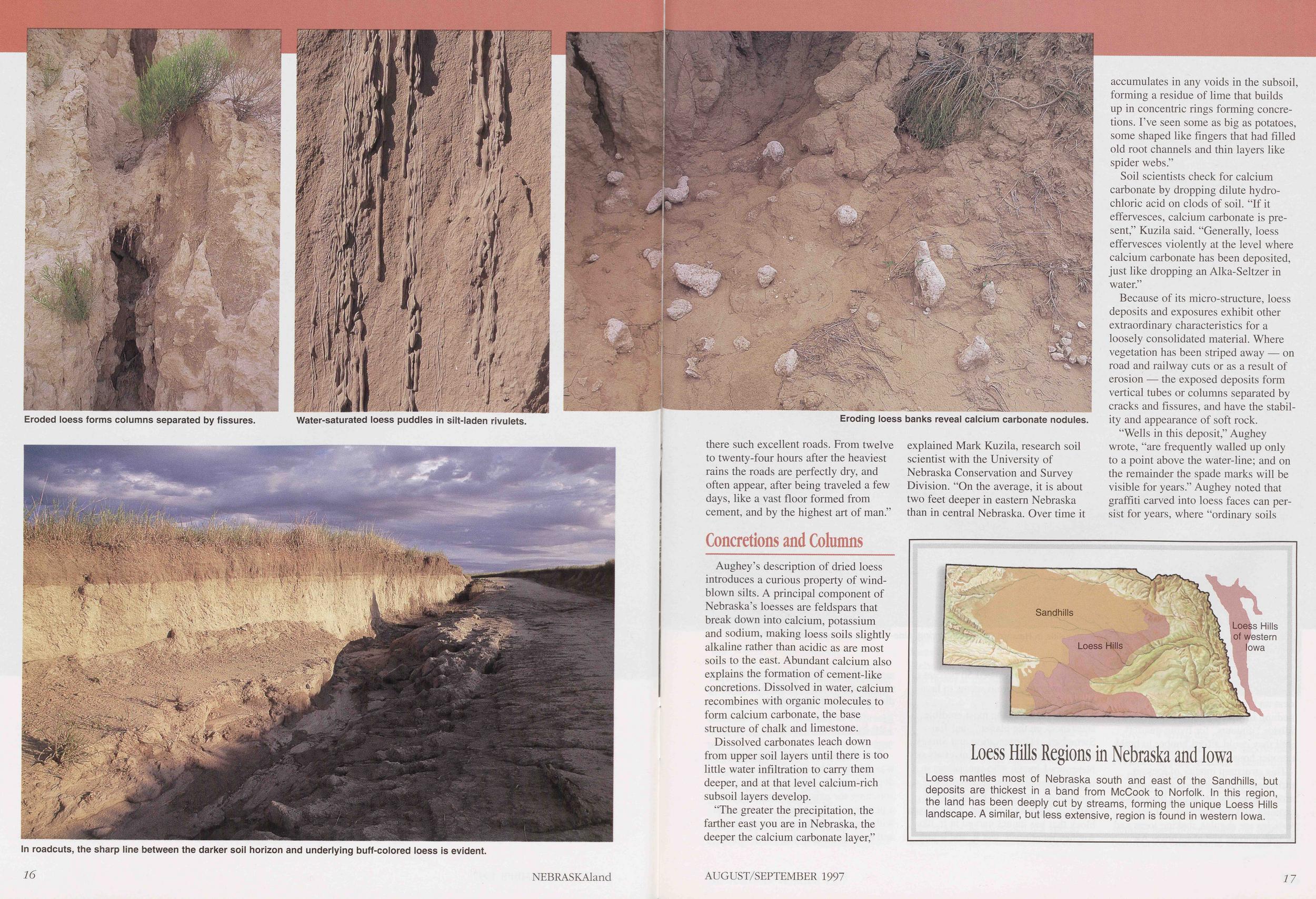
Eroded loess forms columns separated by fissures.
Water-saturated loess puddles in silt-laden rivulets.
In roadcuts, the sharp line between the darker soil horizon and underlying buff-colored loess is evident.
Eroding loess banks reveal calcium carbonate nodules.
there such excellent roads. From twelve to twenty-four hours after the heaviest rains the roads are perfectly dry, and often appear, after being traveled a few days, like a vast floor formed from cement, and by the highest art of man."
Concretions and ColumnsAughey's description of dried loess introduces a curious property of wind-blown silts. A principal component of Nebraska's loesses are feldspars that break down into calcium, potassium and sodium, making loess soils slightly alkaline rather than acidic as are most soils to the east. Abundant calcium also explains the formation of cement-like concretions. Dissolved in water, calcium recombines with organic molecules to form calcium carbonate, the base structure of chalk and limestone.
Dissolved carbonates leach down from upper soil layers until there is too little water infiltration to carry them deeper, and at that level calcium-rich subsoil layers develop.
"The greater the precipitation, the farther east you are in Nebraska, the deeper the calcium carbonate layer," explained Mark Kuzila, research soil scientist with the University of Nebraska Conservation and Survey Division. "On the average, it is about two feet deeper in eastern Nebraska than in central Nebraska. Over time it accumulates in any voids in the subsoil, forming a residue of lime that builds up in concentric rings forming concretions. I've seen some as big as potatoes, some shaped like fingers that had filled old root channels and thin layers like spider webs."
Soil scientists check for calcium carbonate by dropping dilute hydrochloric acid on clods of soil. "If it effervesces, calcium carbonate is present," Kuzila said. "Generally, loess effervesces violently at the level where calcium carbonate has been deposited, just like dropping an Alka-Seltzer in water."
Because of its micro-structure, loess deposits and exposures exhibit other extraordinary characteristics for a loosely consolidated material. Where vegetation has been striped away — on road and railway cuts or as a result of erosion — the exposed deposits form vertical tubes or columns separated by cracks and fissures, and have the stability and appearance of soft rock.
"Wells in this deposit," Aughey wrote, "are frequently walled up only to a point above the water-line; and on the remainder the spade marks will be visible for years." Aughey noted that graffiti carved into loess faces can persist for years, where "ordinary soils
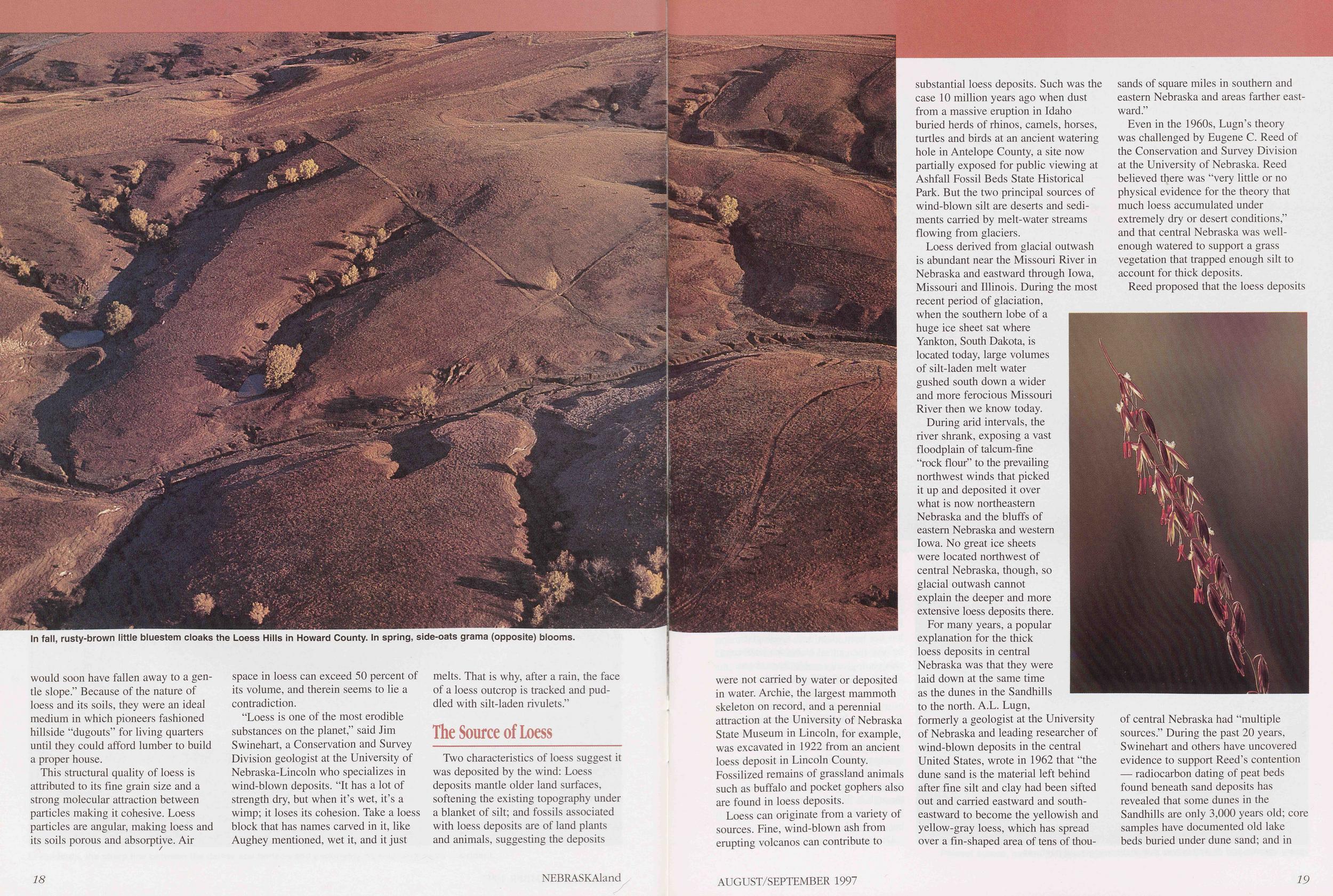
In fall, rusty-brown little bluestem cloaks the Loess Hills in Howard County. In spring, side-oats grama (opposite) blooms.
would soon have fallen away to a gentle slope." Because of the nature of loess and its soils, they were an ideal medium in which pioneers fashioned hillside "dugouts" for living quarters until they could afford lumber to build a proper house.
This structural quality of loess is attributed to its fine grain size and a strong molecular attraction between particles making it cohesive. Loess particles are angular, making loess and its soils porous and absorptive. Air space in loess can exceed 50 percent of its volume, and therein seems to lie a contradiction.
"Loess is one of the most erodible substances on the planet," said Jim Swinehart, a Conservation and Survey Division geologist at the University of Nebraska-Lincoln who specializes in wind-blown deposits. "It has a lot of strength dry, but when it's wet, it's a wimp; it loses its cohesion. Take a loess block that has names carved in it, like Aughey mentioned, wet it, and it just melts. That is why, after a rain, the face of a loess outcrop is tracked and puddled with silt-laden rivulets."
The Source of LoessTwo characteristics of loess suggest it was deposited by the wind: Loess deposits mantle older land surfaces, softening the existing topography under a blanket of silt; and fossils associated with loess deposits are of land plants and animals, suggesting the deposits
18 NEBRASKAlandwere not carried by water or deposited in water. Archie, the largest mammoth skeleton on record, and a perennial attraction at the University of Nebraska State Museum in Lincoln, for example, was excavated in 1922 from an ancient loess deposit in Lincoln County. Fossilized remains of grassland animals such as buffalo and pocket gophers also are found in loess deposits.
Loess can originate from a variety of sources. Fine, wind-blown ash from erupting volcanos can contribute to substantial loess deposits. Such was the case 10 million years ago when dust from a massive eruption in Idaho buried herds of rhinos, camels, horses, turtles and birds at an ancient watering hole in Antelope County, a site now partially exposed for public viewing at Ashfall Fossil Beds State Historical Park. But the two principal sources of wind-blown silt are deserts and sediments carried by melt-water streams flowing from glaciers.
Loess derived from glacial outwash is abundant near the Missouri River in Nebraska and eastward through Iowa, Missouri and Illinois. During the most recent period of glaciation, when the southern lobe of a huge ice sheet sat where Yankton, South Dakota, is located today, large volumes of silt-laden melt water gushed south down a wider and more ferocious Missouri River then we know today.
During arid intervals, the river shrank, exposing a vast floodplain of talcum-fine "rock flour" to the prevailing northwest winds that picked it up and deposited it over what is now northeastern Nebraska and the bluffs of eastern Nebraska and western Iowa. No great ice sheets were located northwest of central Nebraska, though, so glacial outwash cannot explain the deeper and more extensive loess deposits there.
For many years, a popular explanation for the thick loess deposits in central Nebraska was that they were laid down at the same time as the dunes in the Sandhills to the north. A.L. Lugn, formerly a geologist at the University of Nebraska and leading researcher of wind-blown deposits in the central United States, wrote in 1962 that "the dune sand is the material left behind after fine silt and clay had been sifted out and carried eastward and south-eastward to become the yellowish and yellow-gray loess, which has spread over a fin-shaped area of tens of thousands of square miles in southern and eastern Nebraska and areas farther eastward."
Even in the 1960s, Lugn's theory was challenged by Eugene C. Reed of the Conservation and Survey Division at the University of Nebraska. Reed believed there was "very little or no physical evidence for the theory that much loess accumulated under extremely dry or desert conditions," and that central Nebraska was well-enough watered to support a grass vegetation that trapped enough silt to account for thick deposits.
Reed proposed that the loess deposits
the eastern Sandhills, loess deposits have been found under dune sand. All those findings suggest that the thicker and more recent loess deposits south and east of the Sandhills region predate today's Sandhills dune field.
Swinehart explained that the face of central Nebraska has changed many times since the beginning of the Ice Age about 2 million years ago. He speculates that the Sandhills region already was blanketed with wind-blown sands at the beginning of the Ice Age. "We don't know if there were big dunes, but there were deep sand-sheet deposits," Swinehart said.
It is possible that an ancient, now mostly buried loess deposit southeast of the Sandhills, called the Fullerton formation, a deposit up to 170 feet thick, blew out of an older Sandhills desert during arid periods. That does not explain the source of younger loess overlying the Fullerton formation.
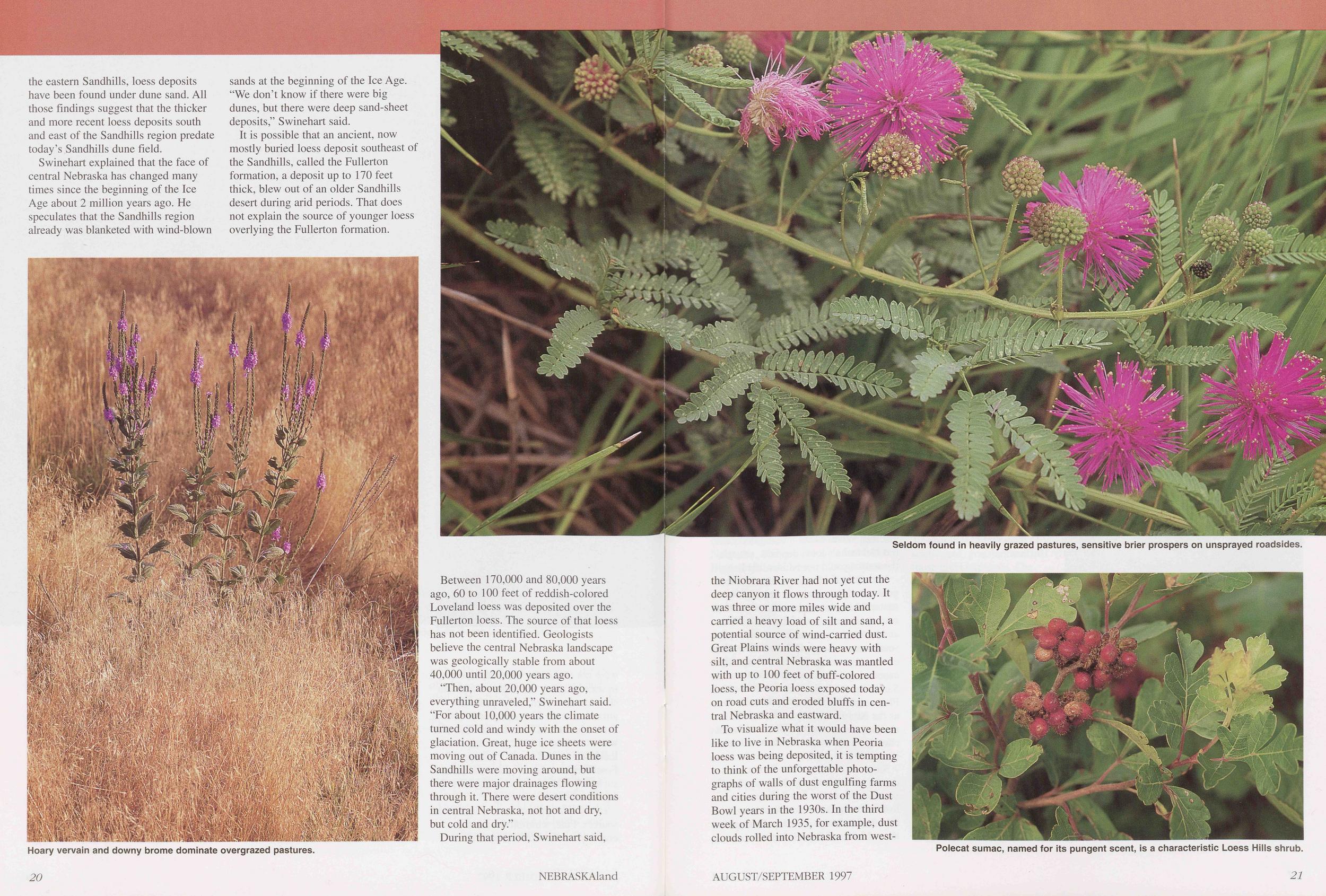
Hoary vervain and downy brome dominate overgrazed pastures.
Between 170,000 and 80,000 years ago, 60 to 100 feet of reddish-colored Loveland loess was deposited over the Fullerton loess. The source of that loess has not been identified. Geologists believe the central Nebraska landscape was geologically stable from about 40,000 until 20,000 years ago.
"Then, about 20,000 years ago, everything unraveled," Swinehart said. "For about 10,000 years the climate turned cold and windy with the onset of glaciation. Great, huge ice sheets were moving out of Canada. Dunes in the Sandhills were moving around, but there were major drainages flowing through it. There were desert conditions in central Nebraska, not hot and dry, but cold and dry."
During that period, Swinehart said,
Seldom found in heavily grazed pastures, sensitive brier prospers on unsprayed roadsides.
the Niobrara River had not yet cut the deep canyon it flows through today. It was three or more miles wide and carried a heavy load of silt and sand, a potential source of wind-carried dust. Great Plains winds were heavy with silt, and central Nebraska was mantled with up to 100 feet of buff-colored loess, the Peoria loess exposed today on road cuts and eroded bluffs in central Nebraska and eastward.
To visualize what it would have been like to live in Nebraska when Peoria loess was being deposited, it is tempting to think of the unforgettable photographs of walls of dust engulfing farms and cities during the worst of the Dust Bowl years in the 1930s. In the third week of March 1935, for example, dust clouds rolled into Nebraska from western
Polecat sumac, named for its pungent scent, is a characteristic Loess Hills shrub. 20
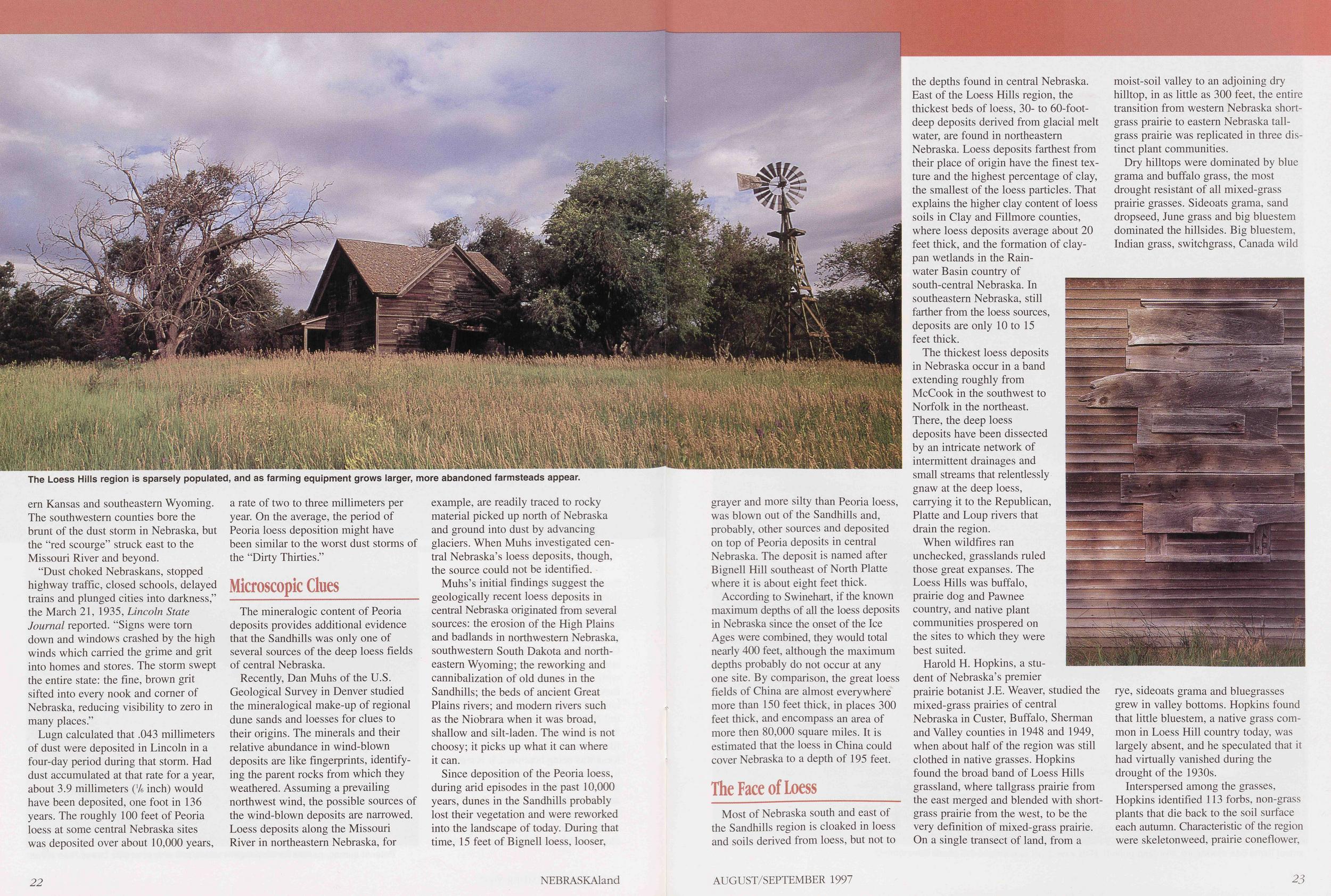
The Loess Hills region is sparsely populated, and as farming equipment grows larger, more abandoned farmsteads appear.
Kansas and southeastern Wyoming. The southwestern counties bore the brunt of the dust storm in Nebraska, but the "red scourge" struck east to the Missouri River and beyond.
"Dust choked Nebraskans, stopped highway traffic, closed schools, delayed trains and plunged cities into darkness," the March 21, 1935, Lincoln State Journal reported. "Signs were torn down and windows crashed by the high winds which carried the grime and grit into homes and stores. The storm swept the entire state: the fine, brown grit sifted into every nook and corner of Nebraska, reducing visibility to zero in many places."
Lugn calculated that .043 millimeters of dust were deposited in Lincoln in a four-day period during that storm. Had dust accumulated at that rate for a year, about 3.9 millimeters (Ve inch) would have been deposited, one foot in 136 years. The roughly 100 feet of Peoria loess at some central Nebraska sites was deposited over about 10,000 years, a rate of two to three millimeters per year. On the average, the period of Peoria loess deposition might have been similar to the worst dust storms of the "Dirty Thirties."
Microscopic CluesThe mineralogic content of Peoria deposits provides additional evidence that the Sandhills was only one of several sources of the deep loess fields of central Nebraska.
Recently, Dan Muhs of the U.S. Geological Survey in Denver studied the mineralogical make-up of regional dune sands and loesses for clues to their origins. The minerals and their relative abundance in wind-blown deposits are like fingerprints, identifying the parent rocks from which they weathered. Assuming a prevailing northwest wind, the possible sources of the wind-blown deposits are narrowed. Loess deposits along the Missouri River in northeastern Nebraska, for example, are readily traced to rocky material picked up north of Nebraska and ground into dust by advancing glaciers. When Muhs investigated central Nebraska's loess deposits, though, the source could not be identified.
Mulis's initial findings suggest the geologically recent loess deposits in central Nebraska originated from several sources: the erosion of the High Plains and badlands in northwestern Nebraska, southwestern South Dakota and northeastern Wyoming; the reworking and cannibalization of old dunes in the Sandhills; the beds of ancient Great Plains rivers; and modern rivers such as the Niobrara when it was broad, shallow and silt-laden. The wind is not choosy; it picks up what it can where it can.
Since deposition of the Peoria loess, during arid episodes in the past 10,000 years, dunes in the Sandhills probably lost their vegetation and were reworked into the landscape of today. During that time, 15 feet of Bignell loess, looser,
22 NEBRASKAlandgrayer and more silty than Peoria loess, was blown out of the Sandhills and, probably, other sources and deposited on top of Peoria deposits in central Nebraska. The deposit is named after Bignell Hill southeast of North Platte where it is about eight feet thick.
According to Swinehart, if the known maximum depths of all the loess deposits in Nebraska since the onset of the Ice Ages were combined, they would total nearly 400 feet, although the maximum depths probably do not occur at any one site. By comparison, the great loess fields of China are almost everywhere more than 150 feet thick, in places 300 feet thick, and encompass an area of more then 80,000 square miles. It is estimated that the loess in China could cover Nebraska to a depth of 195 feet.
The Face of LoessMost of Nebraska south and east of the Sandhills region is cloaked in loess and soils derived from loess, but not to the depths found in central Nebraska. East of the Loess Hills region, the thickest beds of loess, 30- to 60-foot-deep deposits derived from glacial melt water, are found in northeastern Nebraska. Loess deposits farthest from their place of origin have the finest texture and the highest percentage of clay, the smallest of the loess particles. That explains the higher clay content of loess soils in Clay and Fillmore counties, where loess deposits average about 20 feet thick, and the formation of clay-pan wetlands in the Rainwater Basin country of south-central Nebraska. In southeastern Nebraska, still farther from the loess sources, deposits are only 10 to 15 feet thick.
The thickest loess deposits in Nebraska occur in a band extending roughly from McCook in the southwest to Norfolk in the northeast. There, the deep loess deposits have been dissected by an intricate network of intermittent drainages and small streams that relentlessly gnaw at the deep loess, carrying it to the Republican, Platte and Loup rivers that drain the region.
When wildfires ran unchecked, grasslands ruled those great expanses. The Loess Hills was buffalo, prairie dog and Pawnee country, and native plant communities prospered on the sites to which they were best suited.
Harold H. Hopkins, a student of Nebraska's premier prairie botanist J.E. Weaver, studied the mixed-grass prairies of central Nebraska in Custer, Buffalo, Sherman and Valley counties in 1948 and 1949, when about half of the region was still clothed in native grasses. Hopkins found the broad band of Loess Hills grassland, where tallgrass prairie from the east merged and blended with short grass prairie from the west, to be the very definition of mixed-grass prairie. On a single transect of land, from a moist-soil valley to an adjoining dry hilltop, in as little as 300 feet, the entire transition from western Nebraska short-grass prairie to eastern Nebraska tall-grass prairie was replicated in three distinct plant communities.
Dry hilltops were dominated by blue grama and buffalo grass, the most drought resistant of all mixed-grass prairie grasses. Sideoats grama, sand dropseed, June grass and big bluestem dominated the hillsides. Big bluestem, Indian grass, switchgrass, Canada wild
rye, sideoats grama and bluegrasses grew in valley bottoms. Hopkins found that little bluestem, a native grass common in Loess Hill country today, was largely absent, and he speculated that it had virtually vanished during the drought of the 1930s.
Interspersed among the grasses, Hopkins identified 113 forbs, non-grass plants that die back to the soil surface each autumn. Characteristic of the region were skeletonweed, prairie coneflower,
AUGUST/SEPTEMBER 1997 23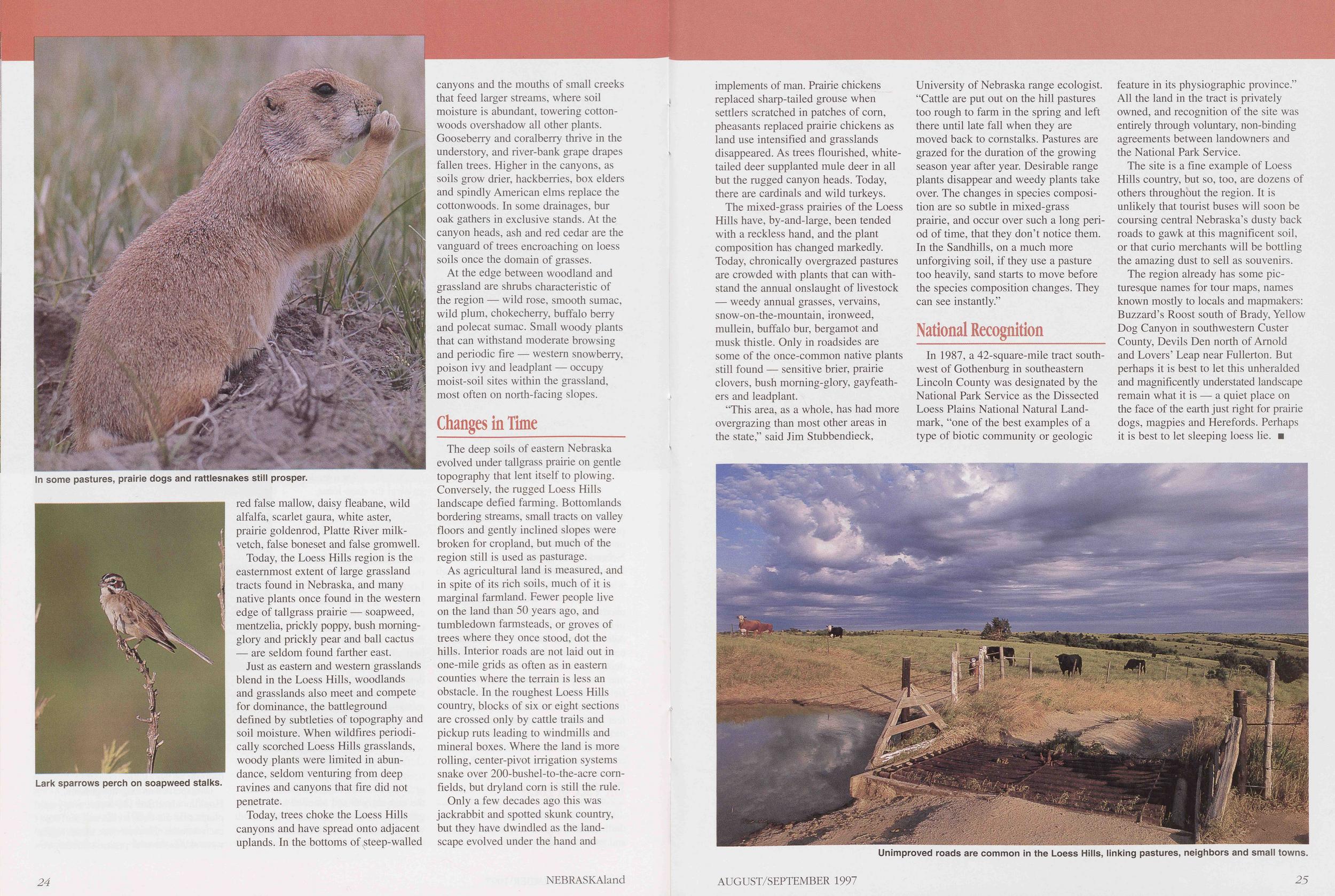
In some pastures, prairie dogs and rattlesnakes still prosper.
Lark sparrows perch on soapweed stalks.
red false mallow, daisy fleabane, wild alfalfa, scarlet gaura, white aster, prairie goldenrod, Platte River milk-vetch, false boneset and false gromwell.
Today, the Loess Hills region is the easternmost extent of large grassland tracts found in Nebraska, and many native plants once found in the western edge of tallgrass prairie — soapweed, mentzelia, prickly poppy, bush morning-glory and prickly pear and ball cactus — are seldom found farther east.
Just as eastern and western grasslands blend in the Loess Hills, woodlands and grasslands also meet and compete for dominance, the battleground defined by subtleties of topography and soil moisture. When wildfires periodically scorched Loess Hills grasslands, woody plants were limited in abundance, seldom venturing from deep ravines and canyons that fire did not penetrate.
Today, trees choke the Loess Hills canyons and have spread onto adjacent uplands. In the bottoms of steep-walled canyons and the mouths of small creeks that feed larger streams, where soil moisture is abundant, towering cottonwoods overshadow all other plants. Gooseberry and coralberry thrive in the understory, and river-bank grape drapes fallen trees. Higher in the canyons, as soils grow drier, hackberries, box elders and spindly American elms replace the cottonwoods. In some drainages, bur oak gathers in exclusive stands. At the canyon heads, ash and red cedar are the vanguard of trees encroaching on loess soils once the domain of grasses.
At the edge between woodland and grassland are shrubs characteristic of the region — wild rose, smooth sumac, wild plum, chokecherry, buffalo berry and polecat sumac. Small woody plants that can withstand moderate browsing and periodic fire — western snowberry, poison ivy and leadplant — occupy moist-soil sites within the grassland, most often on north-facing slopes.
Changes in TimeThe deep soils of eastern Nebraska evolved under tallgrass prairie on gentle topography that lent itself to plowing. Conversely, the rugged Loess Hills landscape defied farming. Bottomlands bordering streams, small tracts on valley floors and gently inclined slopes were broken for cropland, but much of the region still is used as pasturage.
As agricultural land is measured, and in spite of its rich soils, much of it is marginal farmland. Fewer people live on the land than 50 years ago, and tumbledown farmsteads, or groves of trees where they once stood, dot the hills. Interior roads are not laid out in one-mile grids as often as in eastern counties where the terrain is less an obstacle. In the roughest Loess Hills country, blocks of six or eight sections are crossed only by cattle trails and pickup ruts leading to windmills and mineral boxes. Where the land is more rolling, center-pivot irrigation systems snake over 200-bushel-to-the-acre cornfields, but dryland corn is still the rule.
Only a few decades ago this was jackrabbit and spotted skunk country, but they have dwindled as the landscape evolved under the hand and
24 NEBRASKAlandimplements of man. Prairie chickens replaced sharp-tailed grouse when settlers scratched in patches of corn, pheasants replaced prairie chickens as land use intensified and grasslands disappeared. As trees flourished, whitetailed deer supplanted mule deer in all but the rugged canyon heads. Today, there are cardinals and wild turkeys.
The mixed-grass prairies of the Loess Hills have, by-and-large, been tended with a reckless hand, and the plant composition has changed markedly. Today, chronically overgrazed pastures are crowded with plants that can withstand the annual onslaught of livestock — weedy annual grasses, vervains, snow-on-the-mountain, ironweed, mullein, buffalo bur, bergamot and musk thistle. Only in roadsides are some of the once-common native plants still found — sensitive brier, prairie clovers, bush morning-glory, gayfeathers and leadplant.
"This area, as a whole, has had more overgrazing than most other areas in the state," said Jim Stubbendieck, University of Nebraska range ecologist. "Cattle are put out on the hill pastures too rough to farm in the spring and left there until late fall when they are moved back to cornstalks. Pastures are grazed for the duration of the growing season year after year. Desirable range plants disappear and weedy plants take over. The changes in species composition are so subtle in mixed-grass prairie, and occur over such a long period of time, that they don't notice them. In the Sandhills, on a much more unforgiving soil, if they use a pasture too heavily, sand starts to move before the species composition changes. They can see instantly."
National RecognitionIn 1987, a 42-square-mile tract southwest of Gothenburg in southeastern Lincoln County was designated by the National Park Service as the Dissected Loess Plains National Natural Landmark, "one of the best examples of a type of biotic community or geologic feature in its physiographic province." All the land in the tract is privately owned, and recognition of the site was entirely through voluntary, non-binding agreements between landowners and the National Park Service.
The site is a fine example of Loess Hills country, but so, too, are dozens of others throughout the region. It is unlikely that tourist buses will soon be coursing central Nebraska's dusty back roads to gawk at this magnificent soil, or that curio merchants will be bottling the amazing dust to sell as souvenirs.
The region already has some picturesque names for tour maps, names known mostly to locals and mapmakers: Buzzard's Roost south of Brady, Yellow Dog Canyon in southwestern Custer County, Devils Den north of Arnold and Lovers' Leap near Fullerton. But perhaps it is best to let this unheralded and magnificently understated landscape remain what it is — a quiet place on the face of the earth just right for prairie dogs, magpies and Herefords. Perhaps it is best to let sleeping loess lie.
Unimproved roads are common in the Loess Hills, linking pastures, neighbors and small towns.
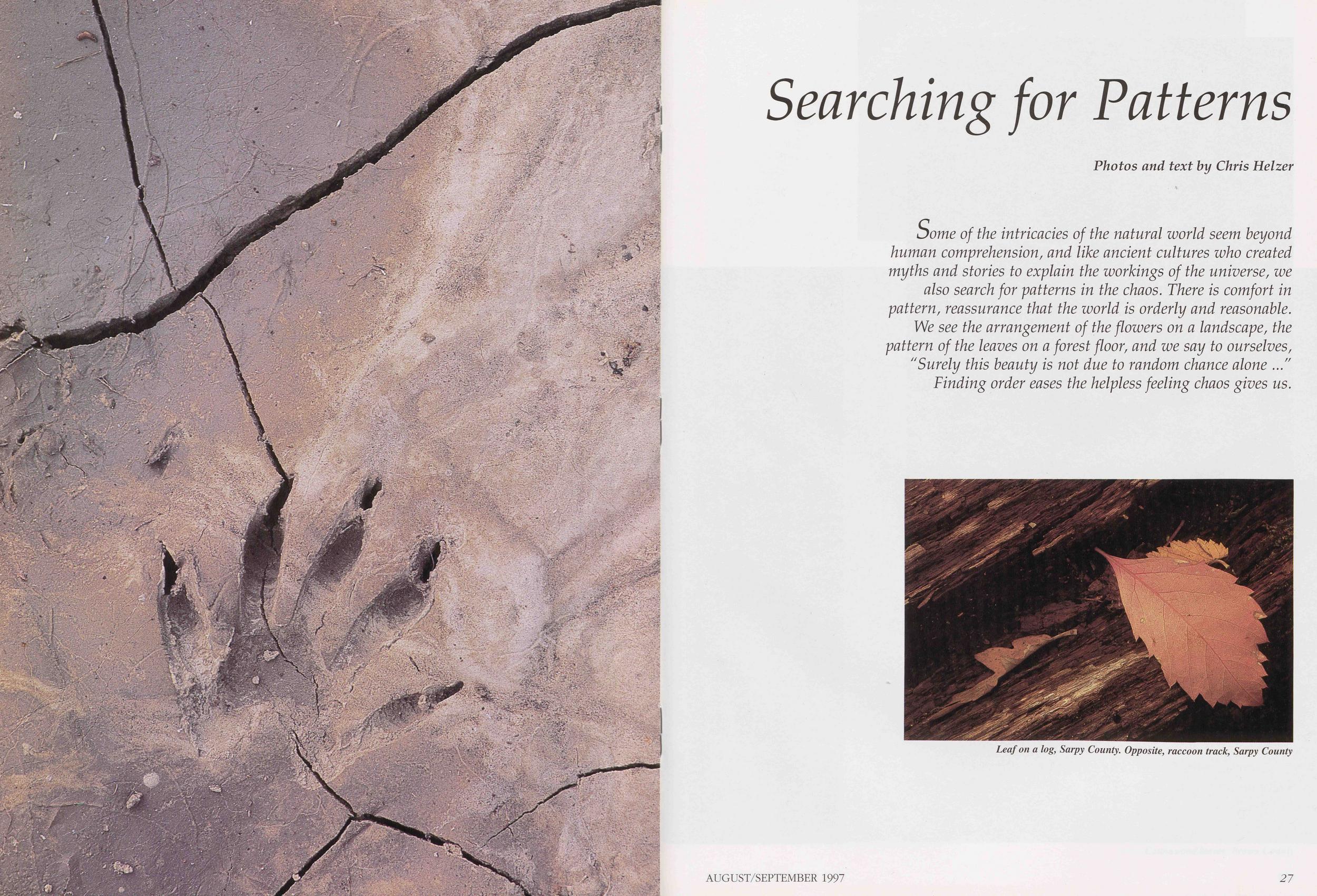
Searching for Patterns
Some of the intricacies of the natural world seem beyond human comprehension, and like ancient cultures who created myths and stories to explain the workings of the universe, we also search for patterns in the chaos. There is comfort in pattern, reassurance that the world is orderly and reasonable. We see the arrangement of the flowers on a landscape, the pattern of the leaves on a forest floor, and we say to ourselves, "Surely this beauty is not due to random chance alone..." Finding order eases the helpless feeling chaos gives us.Leaf on a log, Sarpy County. Opposite, raccoon track, Sarpy County
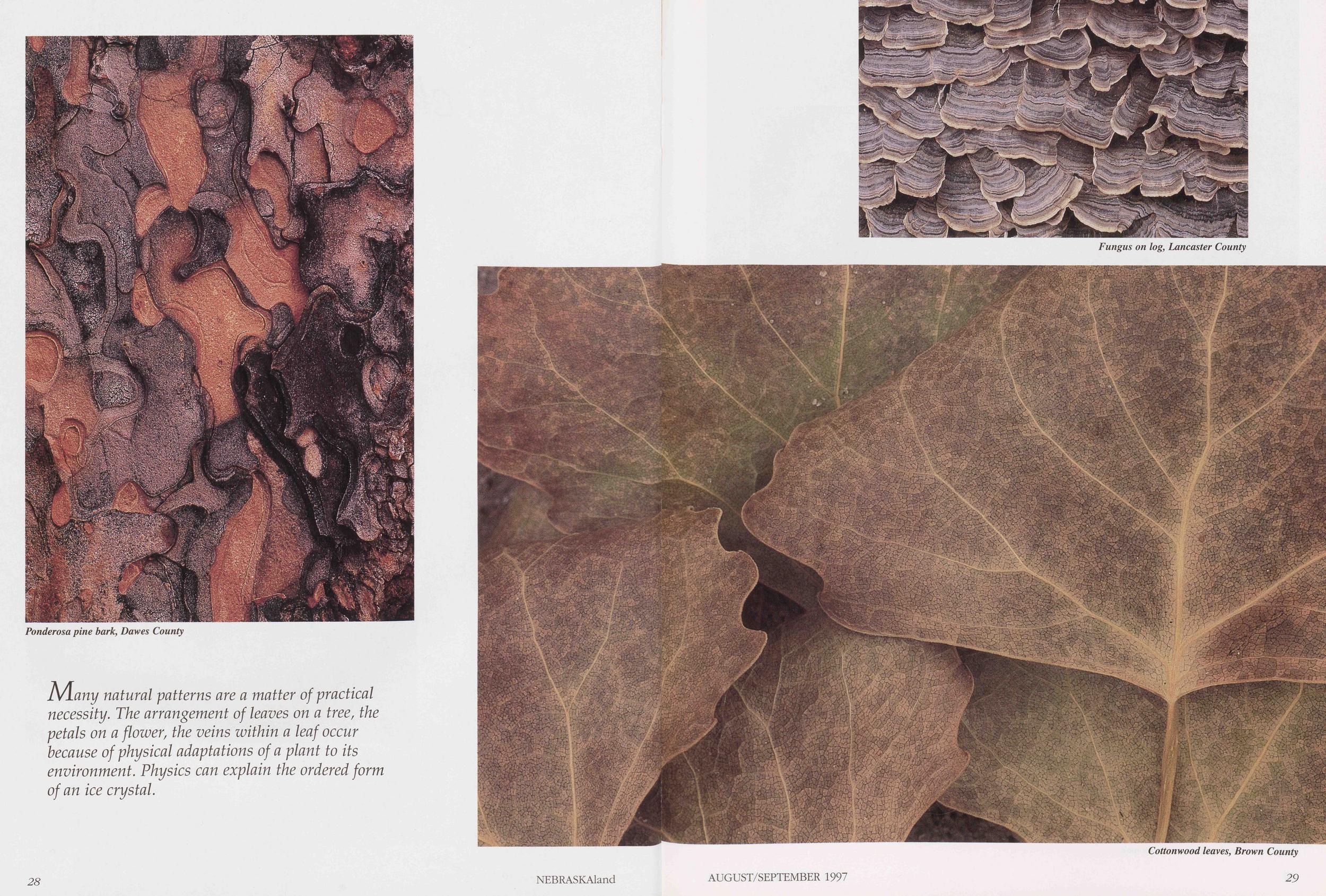
Ponderosa pine bark, Dawes County
Fungus on log, Lancaster County
Cottonwood leaves, Brown County
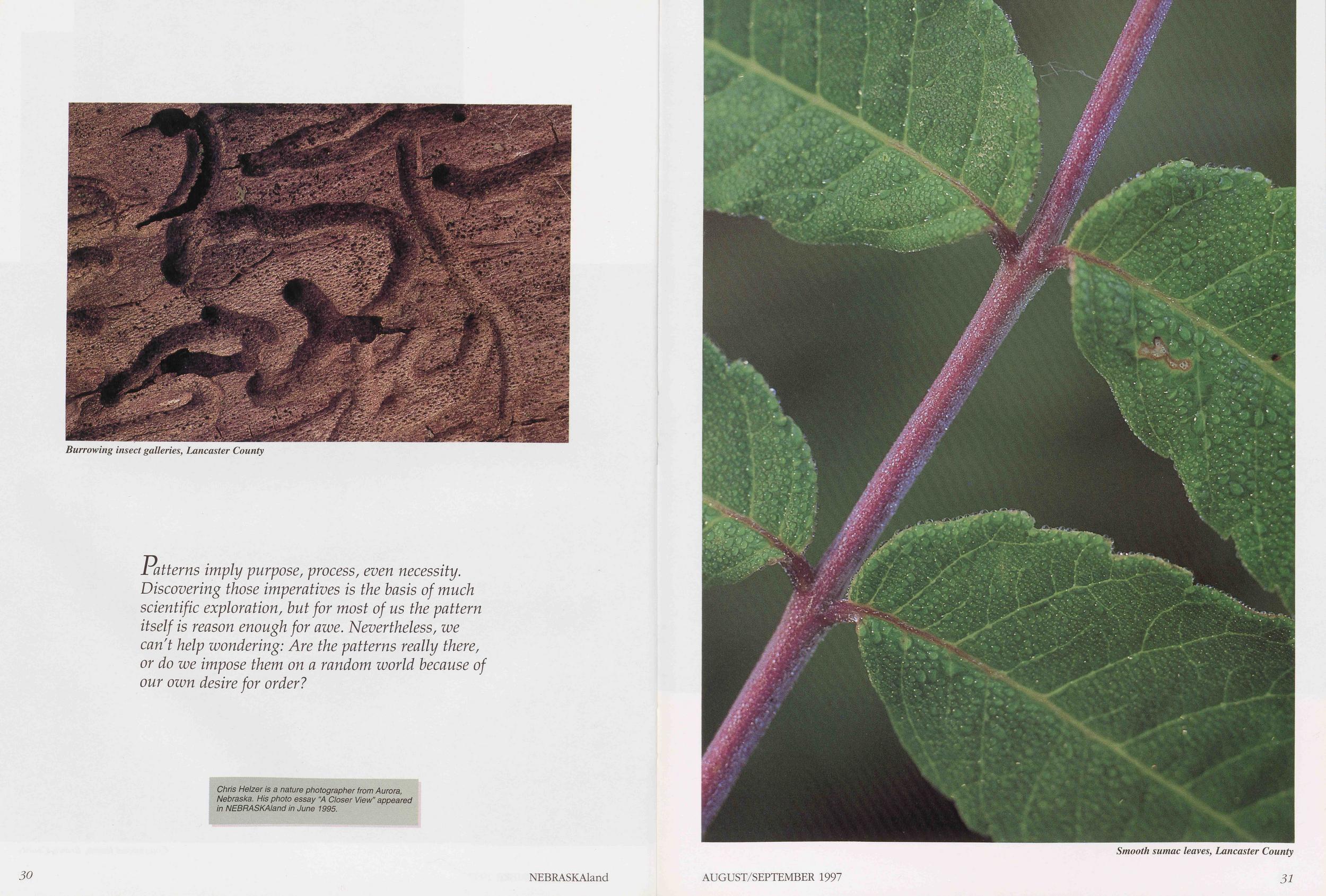
Burrowing insect galleries, Lancaster County
Smooth sumac leaves, Lancaster County
William S. Keeline's Sandhills Hunting Tales
Jackrabbit Pie, Lost in the Fog, Fish-eating "Redheads," Ten-mile-wide Roads and Rope Snakes
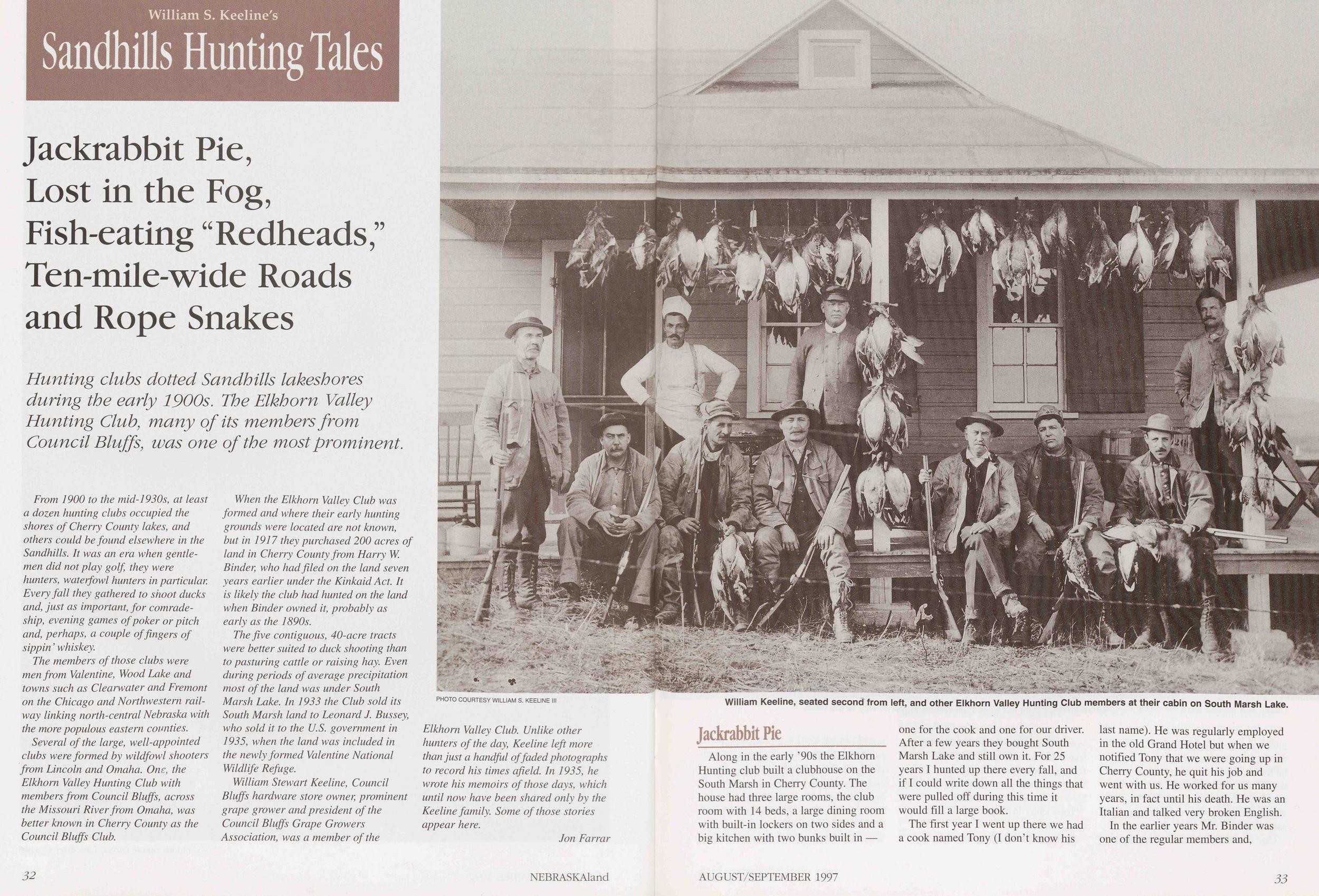
Hunting clubs dotted Sandhills lakeshores during the early 1900s. The Elkhorn Valley Hunting Club, many of its members from Council Bluffs, was one of the most prominent.
From 1900 to the mid-1950s, at least a dozen hunting clubs occupied the shores of Cherry County lakes, and others could be found elsewhere in the Sandhills. It was an era when gentlemen did not play golf, they were hunters, waterfowl hunters in particular. Every fall they gathered to shoot ducks and, just as important, for comradeship, evening games of poker or pitch and, perhaps, a couple of fingers of sippin' whiskey.
The members of those clubs were men from Valentine, Wood Lake and towns such as Clearwater and Fremont on the Chicago and Northwestern railway linking north-central Nebraska with the more populous eastern counties. Several of the large, well-appointed clubs were formed by wildfowl shooters from Lincoln and Omaha. One, the Elkhorn Valley Hunting Club with members from Council Bluffs, across the Missouri River from Omaha, was better known in Cherry County as the Council Bluffs Club.
When the Elkhorn Valley Club was formed and where their early hunting grounds were located are not known, but in 1917 they purchased 200 acres of land in Cherry County from Harry W Binder, who had filed on the land seven years earlier under the Kinkaid Act. It is likely the club had hunted on the land when Binder owned it, probably as early as the 1890s.
The five contiguous, 40-acre tracts were better suited to duck shooting than to pasturing cattle or raising hay. Even during periods of average precipitation most of the land was under South Marsh Lake. In 1933 the Club sold its South Marsh land to Leonard J. Bussey, who sold it to the U.S. government in 1935, when the land was included in the newly formed Valentine National Wildlife Refuge.
William Stewart Keeline, Council Bluffs hardware store owner, prominent grape grower and president of the Council Bluffs Grape Growers Association, was a member of the
Elkhorn Valley Club. Unlike other hunters of the day, Keeline left more than just a handful of faded photographs to record his times afield. In 1935, he wrote his memoirs of those days, which until now have been shared only by the Keeline family. Some of those stories appear here.
Jon Farrar 32 NEBRASKAlandWilliam Keeline, seated second from left, and other Elkhorn Valley Hunting Club members at their cabin on South Marsh Lake.
Along in the early '90s the Elkhorn Hunting club built a clubhouse on the South Marsh in Cherry County. The house had three large rooms, the club room with 14 beds, a large dining room with built-in lockers on two sides and a big kitchen with two bunks built in — one for the cook and one for our driver. After a few years they bought South Marsh Lake and still own it. For 25 years I hunted up there every fall, and if I could write down all the things that were pulled off during this time it would fill a large book.
The first year I went up there we had a cook named Tony (I don't know his last name). He was regularly employed in the old Grand Hotel but when we notified Tony that we were going up in Cherry County, he quit his job and went with us. He worked for us many years, in fact until his death. He was an Italian and talked very broken English.
In the earlier years Mr. Binder was one of the regular members and,
AUGUST/SEPTEMBER 1997 33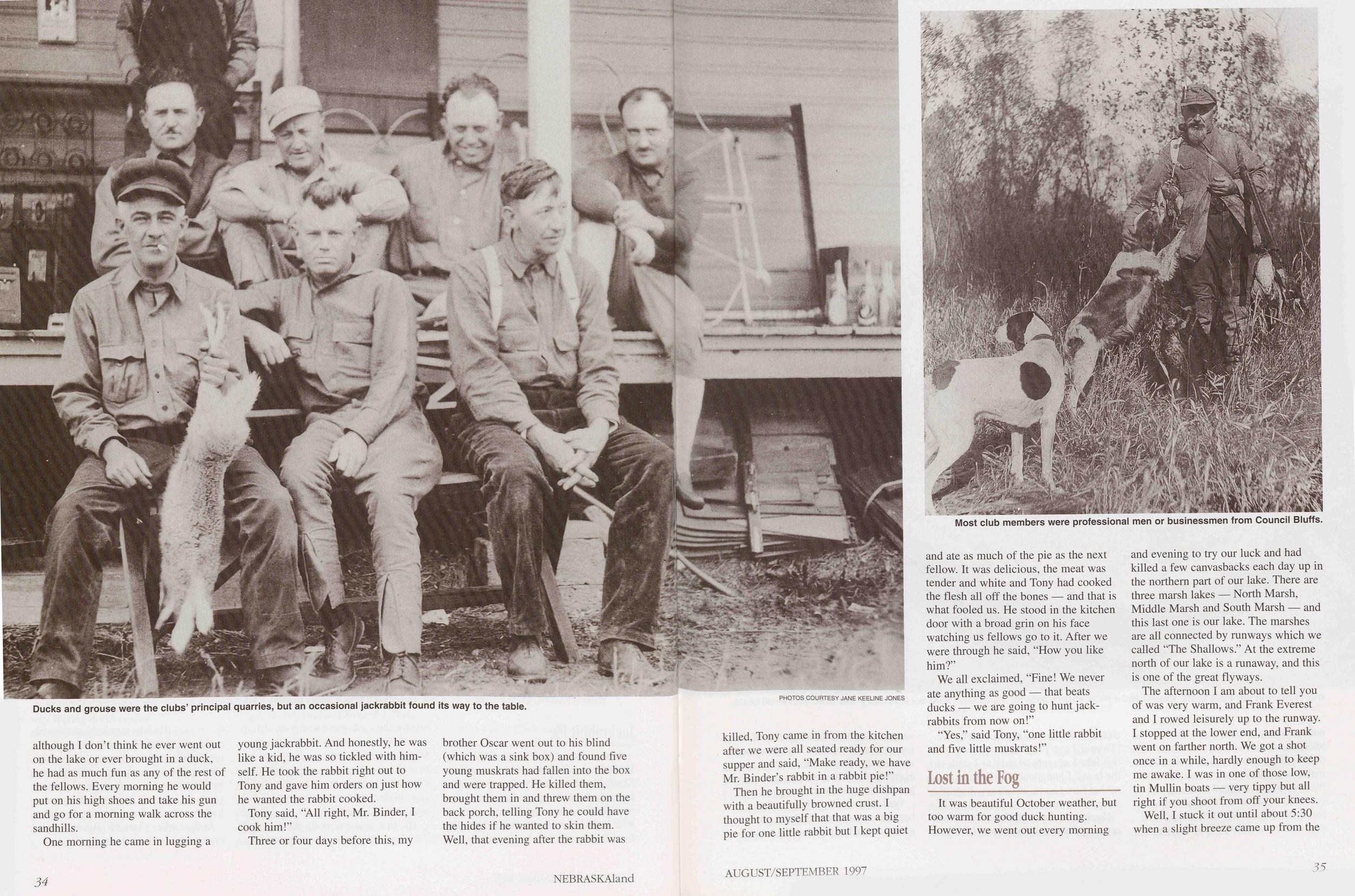
Ducks and grouse were the clubs' principal quarries, but an occasional jackrabbit found its way to the table.
although I don't think he ever went out on the lake or ever brought in a duck, he had as much fun as any of the rest of the fellows. Every morning he would put on his high shoes and take his gun and go for a morning walk across the sandhills.
One morning he came in lugging a young jackrabbit. And honestly, he was like a kid, he was so tickled with himself. He took the rabbit right out to Tony and gave him orders on just how he wanted the rabbit cooked.
Tony said, "All right, Mr. Binder, I cook him!"
Three or four days before this, my brother Oscar went out to his blind (which was a sink box) and found five young muskrats had fallen into the box and were trapped. He killed them, brought them in and threw them on the back porch, telling Tony he could have the hides if he wanted to skin them. Well, that evening after the rabbit was
34 NEBRASKAlandkilled, Tony came in from the kitchen after we were all seated ready for our supper and said, "Make ready, we have Mr. Binder's rabbit in a rabbit pie!"
Most club members were professional men or businessmen from Council Bluffs.
We all exclaimed, "Fine! We never ate anything as good — that beats ducks — we are going to hunt jack-rabbits from now on!"
"Yes," said Tony, "one little rabbit and five little muskrats!"
Lost in the FogIt was beautiful October weather, but too warm for good duck hunting. However, we went out every morning and evening to try our luck and had killed a few canvasbacks each day up in the northern part of our lake. There are three marsh lakes — North Marsh, Middle Marsh and South Marsh — and this last one is our lake. The marshes are all connected by runways which we called "The Shallows." At the extreme north of our lake is a runaway, and this is one of the great Byways.
The afternoon I am about to tell you of was very warm, and Frank Everest and I rowed leisurely up to the runway. I stopped at the lower end, and Frank went on farther north. We got a shot once in a while, hardly enough to keep me awake. I was in one of those low, tin Mullin boats — very tippy but all right if you shoot from off your knees.
Well, I stuck it out until about 5:30 when a slight breeze came up from the
AUGUST/SEPTEMBER 1997 35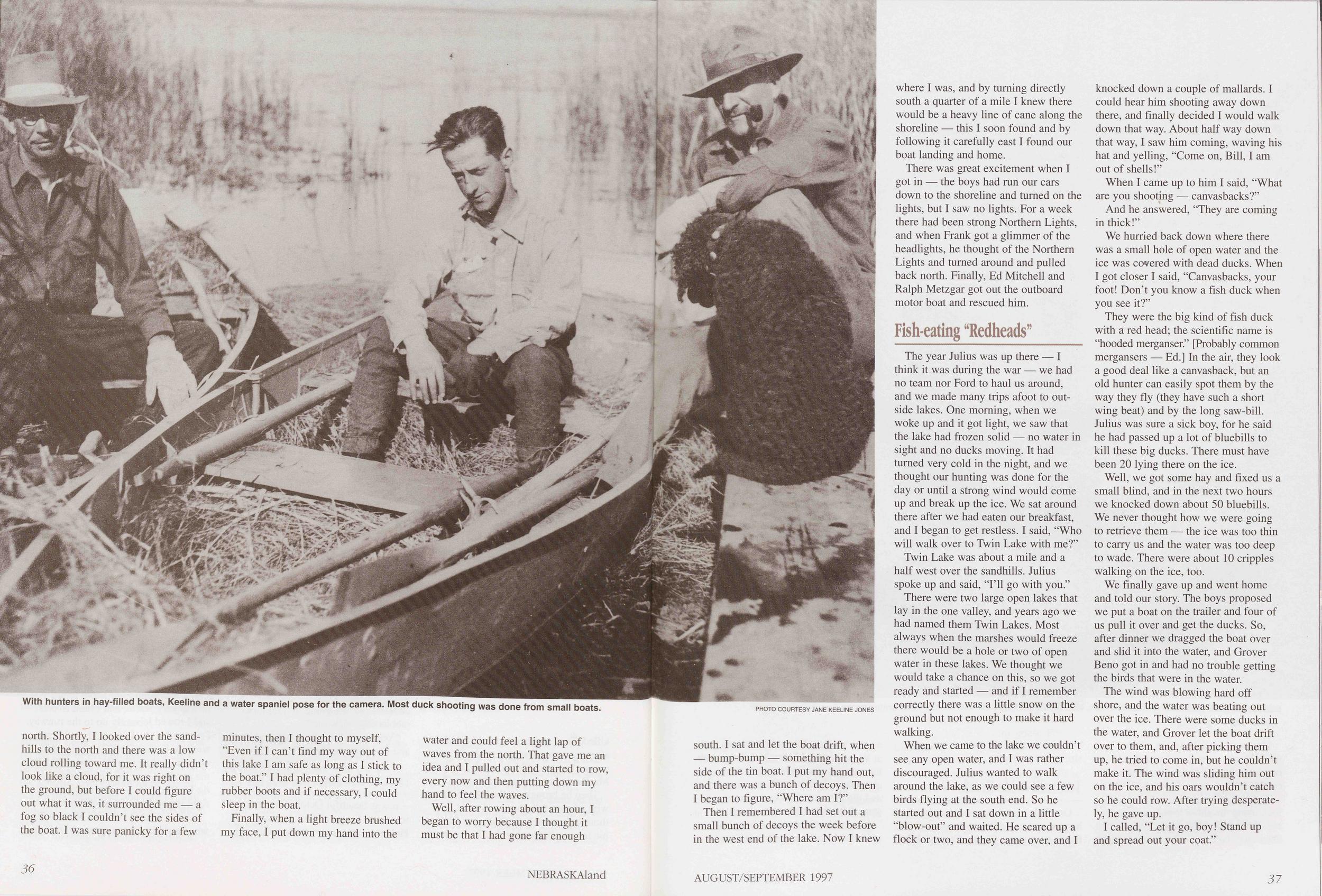
With hunters in hay-filled boats, Keeline and a water spaniel pose for the camera. Most duck shooting was done from small boats.
north. Shortly, I looked over the sandhills to the north and there was a low cloud rolling toward me. It really didn't look like a cloud, for it was right on the ground, but before I could figure out what it was, it surrounded me — a fog so black I couldn't see the sides of the boat. I was sure panicky for a few minutes, then I thought to myself, "Even if I can't find my way out of this lake I am safe as long as I stick to the boat." I had plenty of clothing, my rubber boots and if necessary, I could sleep in the boat.
Finally, when a light breeze brushed my face, I put down my hand into the water and could feel a light lap of waves from the north. That gave me an idea and I pulled out and started to row, every now and then putting down my hand to feel the waves.
Well, after rowing about an hour, I began to worry because I thought it must be that I had gone far enough
36 NEBRASKAlandsouth. I sat and let the boat drift, when — bump-bump — something hit the side of the tin boat. I put my hand out, and there was a bunch of decoys. Then I began to figure, "Where am I?"
Then I remembered I had set out a small bunch of decoys the week before in the west end of the lake. Now I knew where I was, and by turning directly south a quarter of a mile I knew there would be a heavy line of cane along the shoreline — this I soon found and by following it carefully east I found our boat landing and home.
There was great excitement when I got in — the boys had run our cars down to the shoreline and turned on the lights, but I saw no lights. For a week there had been strong Northern Fights, and when Frank got a glimmer of the headlights, he thought of the Northern Fights and turned around and pulled back north. Finally, Ed Mitchell and Ralph Metzgar got out the outboard motor boat and rescued him.
Fish-eating "Readheads"The year Julius was up there — I think it was during the war — we had no team nor Ford to haul us around, and we made many trips afoot to outside lakes. One morning, when we woke up and it got light, we saw that the lake had frozen solid — no water in sight and no ducks moving. It had turned very cold in the night, and we thought our hunting was done for the day or until a strong wind would come up and break up the ice. We sat around there after we had eaten our breakfast, and I began to get restless. I said, "Who will walk over to Twin Fake with me?"
Twin Lake was about a mile and a half west over the sandhills. Julius spoke up and said, "I'll go with you."
There were two large open lakes that lay in the one valley, and years ago we had named them Twin Lakes. Most always when the marshes would freeze there would be a hole or two of open water in these lakes. We thought we would take a chance on this, so we got ready and started — and if I remember correctly there was a little snow on the ground but not enough to make it hard walking.
When we came to the lake we couldn't see any open water, and I was rather discouraged. Julius wanted to walk around the lake, as we could see a few birds flying at the south end. So he started out and I sat down in a little "blow-out" and waited. He scared up a flock or two, and they came over, and I knocked down a couple of mallards. I could hear him shooting away down there, and finally decided I would walk down that way. About half way down that way, I saw him coming, waving his hat and yelling, "Come on, Bill, I am out of shells!"
When I came up to him I said, "What are you shooting — canvasbacks?"
And he answered, "They are coming in thick!"
We hurried back down where there was a small hole of open water and the ice was covered with dead ducks. When I got closer I said, "Canvasbacks, your foot! Don't you know a fish duck when you see it?"
They were the big kind of fish duck with a red head; the scientific name is "hooded merganser." [Probably common mergansers — Ed.] In the air, they look a good deal like a canvasback, but an old hunter can easily spot them by the way they fly (they have such a short wing beat) and by the long saw-bill. Julius was sure a sick boy, for he said he had passed up a lot of bluebills to kill these big ducks. There must have been 20 lying there on the ice.
Well, we got some hay and fixed us a small blind, and in the next two hours we knocked down about 50 bluebills. We never thought how we were going to retrieve them — the ice was too thin to carry us and the water was too deep to wade. There were about 10 cripples walking on the ice, too.
We finally gave up and went home and told our story. The boys proposed we put a boat on the trailer and four of us pull it over and get the ducks. So, after dinner we dragged the boat over and slid it into the water, and Grover Beno got in and had no trouble getting the birds that were in the water.
The wind was blowing hard off shore, and the water was beating out over the ice. There were some ducks in the water, and Grover let the boat drift over to them, and, after picking them up, he tried to come in, but he couldn't make it. The wind was sliding him out on the ice, and his oars wouldn't catch so he could row. After trying desperately, he gave up.
I called, "Let it go, boy! Stand up and spread out your coat."
AUGUST/SEPTEMBER 1997 37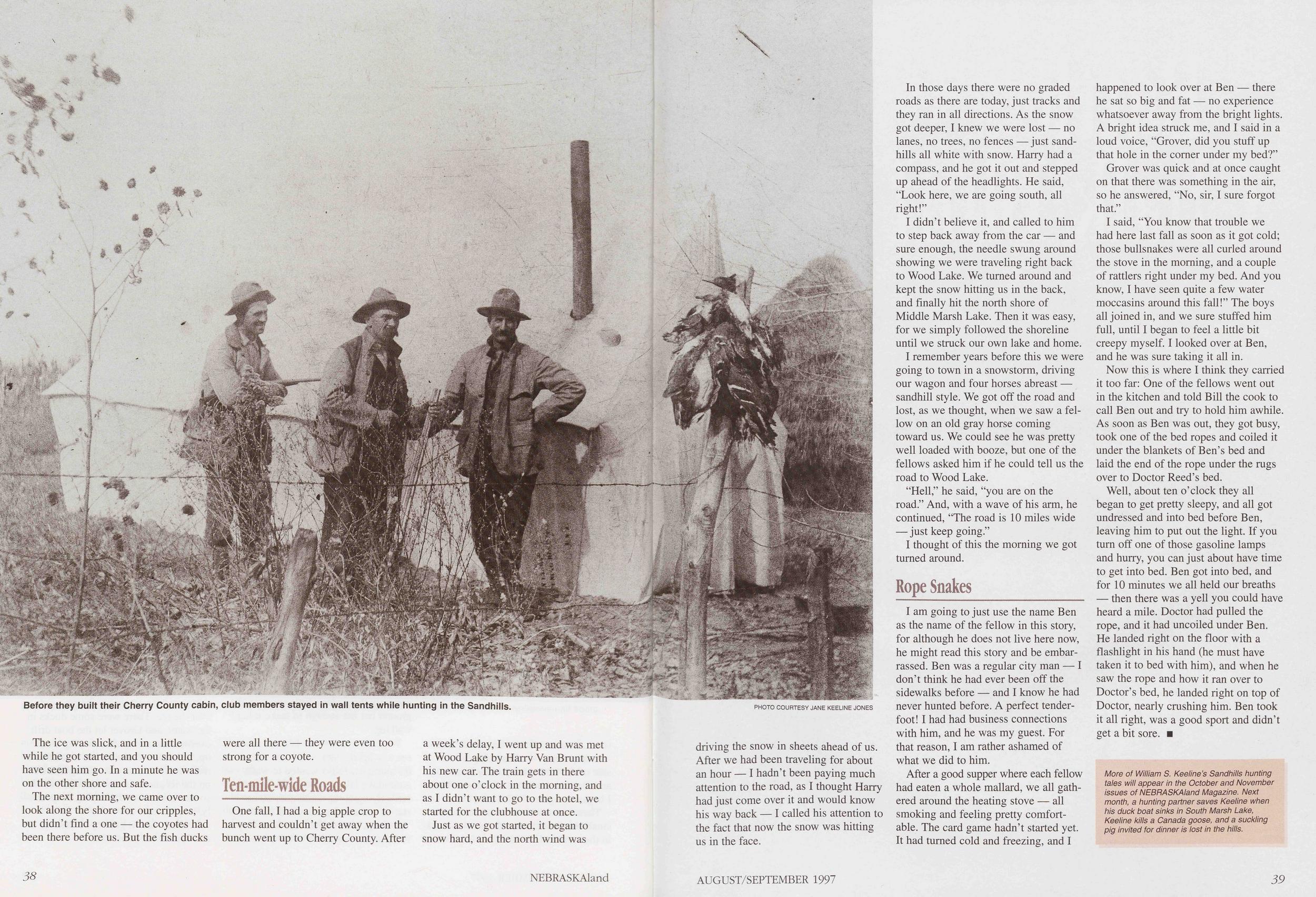
Before they built their Cherry County cabin, club members stayed in wall tents while hunting in the Sandhills.
PHOTO COURTESY JANE KEELINE JONESThe ice was slick, and in a little while he got started, and you should have seen him go. In a minute he was on the other shore and safe.
The next morning, we came over to look along the shore for our cripples, but didn't find a one — the coyotes had been there before us. But the fish ducks were all there — they were even too strong for a coyote.
Ten-mile-wide RoadsOne fall, I had a big apple crop to harvest and couldn't get away when the bunch went up to Cherry County. After a week's delay, I went up and was met at Wood Lake by Harry Van Brunt with his new car. The train gets in there about one o'clock in the morning, and as I didn't want to go to the hotel, we started for the clubhouse at once.
Just as we got started, it began to snow hard, and the north wind was
38 NEBRASKAlanddriving the snow in sheets ahead of us. After we had been traveling for about an hour — I hadn't been paying much attention to the road, as I thought Harry had just come over it and would know his way back — I called his attention to the fact that now the snow was hitting us in the face.
In those days there were no graded roads as there are today, just tracks and they ran in all directions. As the snow got deeper, I knew we were lost — no lanes, no trees, no fences — just sandhills all white with snow. Harry had a compass, and he got it out and stepped up ahead of the headlights. He said, "Look here, we are going south, all right!"
I didn't believe it, and called to him to step back away from the car — and sure enough, the needle swung around showing we were traveling right back to Wood Lake. We turned around and kept the snow hitting us in the back, and finally hit the north shore of Middle Marsh Lake. Then it was easy, for we simply followed the shoreline until we struck our own lake and home.
I remember years before this we were going to town in a snowstorm, driving our wagon and four horses abreast — sandhill style. We got off the road and lost, as we thought, when we saw a fellow on an old gray horse coming toward us. We could see he was pretty well loaded with booze, but one of the fellows asked him if he could tell us the road to Wood Lake.
"Hell," he said, "you are on the road." And, with a wave of his arm, he continued, "The road is 10 miles wide — just keep going."
I thought of this the morning we got turned around.
Rope SnakesI am going to just use the name Ben as the name of the fellow in this story, for although he does not live here now, he might read this story and be embarrassed. Ben was a regular city man — I don't think he had ever been off the sidewalks before — and I know he had never hunted before. A perfect tender-foot! I had had business connections with him, and he was my guest. For that reason, I am rather ashamed of what we did to him.
After a good supper where each fellow had eaten a whole mallard, we all gathered around the heating stove — all smoking and feeling pretty comfortable. The card game hadn't started yet. It had turned cold and freezing, and I happened to look over at Ben — there he sat so big and fat — no experience whatsoever away from the bright lights. A bright idea struck me, and I said in a loud voice, "Grover, did you stuff up that hole in the corner under my bed?"
Grover was quick and at once caught on that there was something in the air, so he answered, "No, sir, I sure forgot that."
I said, "You know that trouble we had here last fall as soon as it got cold; those bullsnakes were all curled around the stove in the morning, and a couple of rattlers right under my bed. And you know, I have seen quite a few water moccasins around this fall!" The boys all joined in, and we sure stuffed him full, until I began to feel a little bit creepy myself. I looked over at Ben, and he was sure taking it all in.
Now this is where I think they carried it too far: One of the fellows went out in the kitchen and told Bill the cook to call Ben out and try to hold him awhile. As soon as Ben was out, they got busy, took one of the bed ropes and coiled it under the blankets of Ben's bed and laid the end of the rope under the rugs over to Doctor Reed's bed.
Well, about ten o'clock they all began to get pretty sleepy, and all got undressed and into bed before Ben, leaving him to put out the light. If you turn off one of those gasoline lamps and hurry, you can just about have time to get into bed. Ben got into bed, and for 10 minutes we all held our breaths — then there was a yell you could have heard a mile. Doctor had pulled the rope, and it had uncoiled under Ben. He landed right on the floor with a flashlight in his hand (he must have taken it to bed with him), and when he saw the rope and how it ran over to Doctor's bed, he landed right on top of Doctor, nearly crushing him. Ben took it all right, was a good sport and didn't get a bit sore.
More of William S. Keeline's Sandhills hunting tales will appear in the October and November issues of NEBRASKAland Magazine. Next month, a hunting partner saves Keeline when his duck boat sinks in South Marsh Lake, Keeline kills a Canada goose, and a suckling pig invited for dinner is lost in the hills. AUGUST/SEPTEMBER 1997 39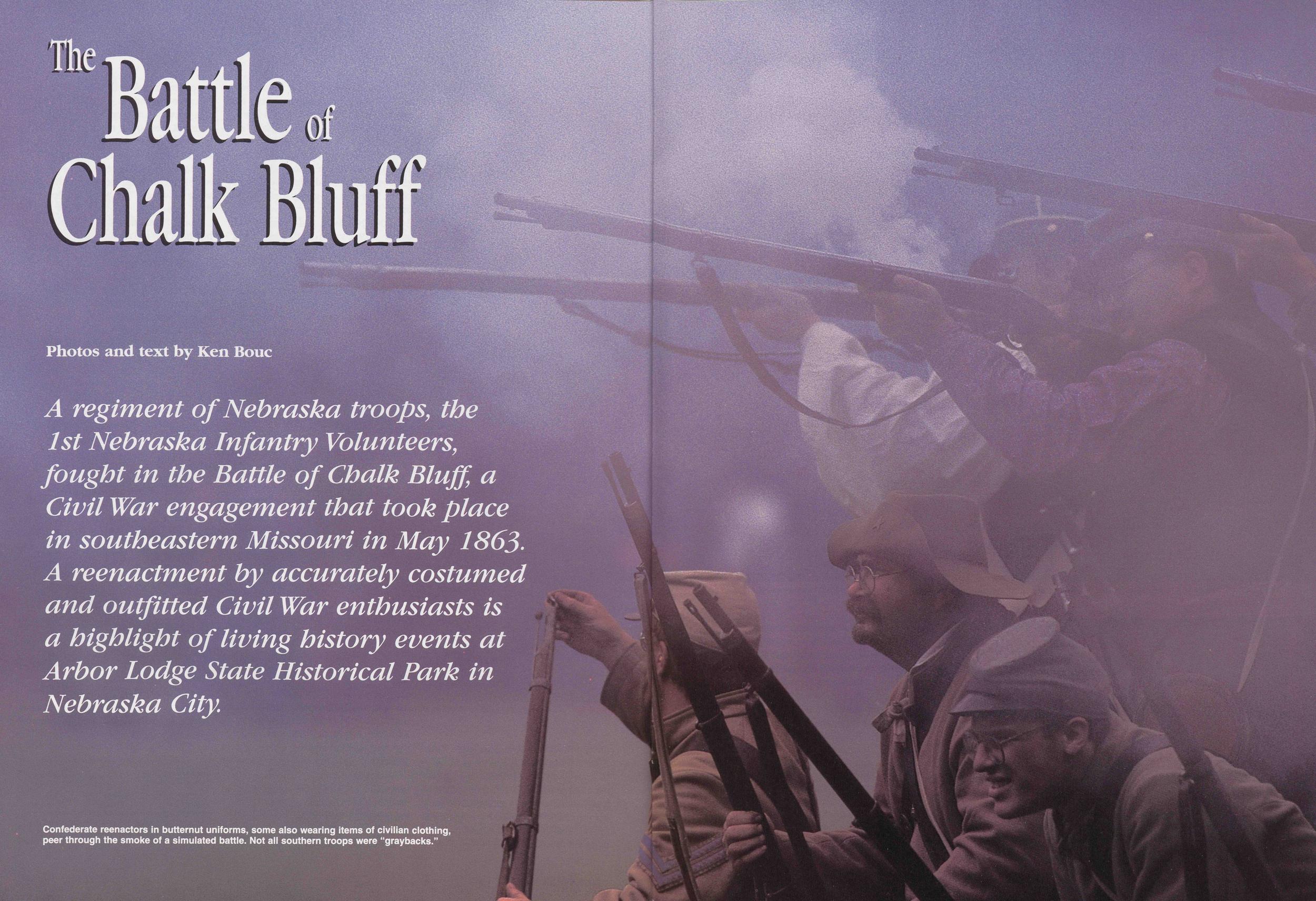
The Battle of Chalk Bluff
A regiment of Nebraska troops, the 1st Nebraska Infantry Volunteers, fought in the Battle of Chalk Bluff, a Civil War engagement that took place in southeastern Missouri in May 1863. A reenactment by accurately costumed and outfitted Civil War enthusiasts is a highlight of living history events at Arbor Lodge State Historical Park in Nebraska City.
Confederate reenactors in butternut uniforms, some also wearing items of civilian clothing, peer through the smoke of a simulated battle. Not all southern troops were "graybacks."
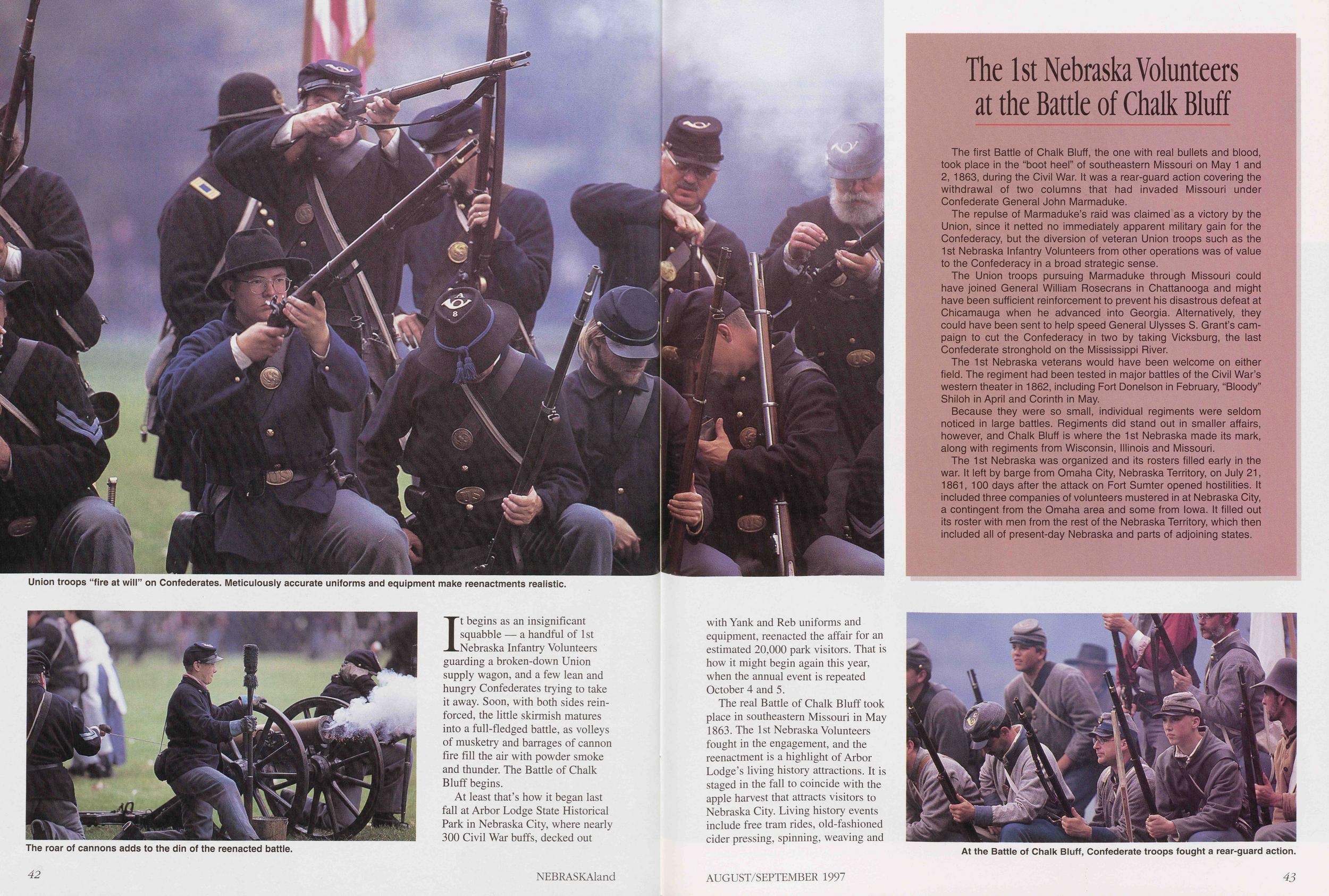
Union troops "fire at will" on Confederates. Meticulously accurate uniforms and equipment make reenactments realistic.
The roar of cannons adds to the din of the reenacted battle.
It begins as an insignificant squabble — a handful of 1st Nebraska Infantry Volunteers guarding a broken-down Union supply wagon, and a few lean and hungry Confederates trying to take it away. Soon, with both sides reinforced, the little skirmish matures into a full-fledged battle, as volleys of musketry and barrages of cannon fire fill the air with powder smoke and thunder. The Battle of Chalk Bluff begins.
At least that's how it began last fall at Arbor Lodge State Historical Park in Nebraska City, where nearly 300 Civil War buffs, decked out
42 NEBRASKAlandwith Yank and Reb uniforms and equipment, reenacted the affair for an estimated 20,000 park visitors. That is how it might begin again this year, when the annual event is repeated October 4 and 5.
The real Battle of Chalk Bluff took place in southeastern Missouri in May 1863. The 1st Nebraska Volunteers fought in the engagement, and the reenactment is a highlight of Arbor Lodge's living history attractions. It is staged in the fall to coincide with the apple harvest that attracts visitors to Nebraska City. Living history events include free tram rides, old-fashioned cider pressing, spinning, weaving and
At the Battle of Chalk Bluff, Confederate troops fought a rear-guard action.
Nebraska Volunteers at the Battle of Chalk Bluff
The first Battle of Chalk Bluff, the one with real bullets and blood, took place in the "boot heel" of southeastern Missouri on May 1 and 2, 1863, during the Civil War. It was a rear-guard action covering the withdrawal of two columns that had invaded Missouri under Confederate General John Marmaduke. The repulse of Marmaduke's raid was claimed as a victory by the Union, since it netted no immediately apparent military gain for the Confederacy, but the diversion of veteran Union troops such as the 1st Nebraska Infantry Volunteers from other operations was of value to the Confederacy in a broad strategic sense. The Union troops pursuing Marmaduke through Missouri could have joined General William Rosecrans in Chattanooga and might have been sufficient reinforcement to prevent his disastrous defeat at Chicamauga when he advanced into Georgia. Alternatively, they could have been sent to help speed General Ulysses S. Grant's campaign to cut the Confederacy in two by taking Vicksburg, the last Confederate stronghold on the Mississippi River. The 1st Nebraska veterans would have been welcome on either field. The regiment had been tested in major battles of the Civil War's western theater in 1862, including Fort Donelson in February, "Bloody" Shiloh in April and Corinth in May. Because they were so small, individual regiments were seldom noticed in large battles. Regiments did stand out in smaller affairs, however, and Chalk Bluff is where the 1st Nebraska made its mark, along with regiments from Wisconsin, Illinois and Missouri. The 1st Nebraska was organized and its rosters filled early in the war. It left by barge from Omaha City, Nebraska Territory, on July 21, 1861, 100 days after the attack on Fort Sumter opened hostilities. It included three companies of volunteers mustered in at Nebraska City, a contingent from the Omaha area and some from Iowa. It filled out its roster with men from the rest of the Nebraska Territory, which then included all of present-day Nebraska and parts of adjoining states.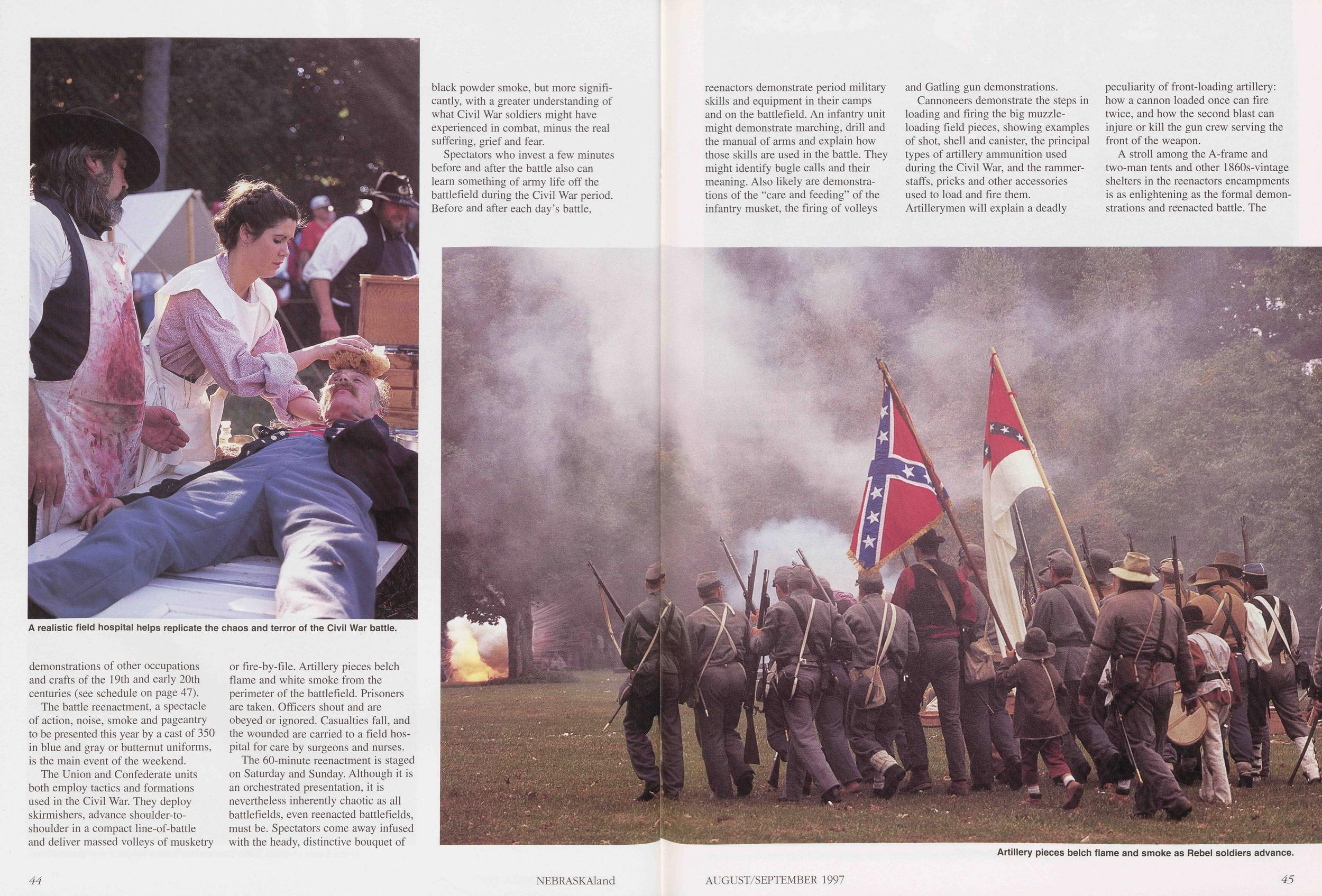
A realistic field hospital helps replicate the chaos and terror of the Civil War battle.
demonstrations of other occupations and crafts of the 19th and early 20th centuries (see schedule on page 47).
The battle reenactment, a spectacle of action, noise, smoke and pageantry to be presented this year by a cast of 350 in blue and gray or butternut uniforms, is the main event of the weekend.
The Union and Confederate units both employ tactics and formations used in the Civil War. They deploy skirmishers, advance shoulder-to-shoulder in a compact line-of-battle and deliver massed volleys of musketry or fire-by-file. Artillery pieces belch flame and white smoke from the perimeter of the battlefield. Prisoners are taken. Officers shout and are obeyed or ignored. Casualties fall, and the wounded are carried to a field hospital for care by surgeons and nurses.
The 60-minute reenactment is staged on Saturday and Sunday. Although it is an orchestrated presentation, it is nevertheless inherently chaotic as all battlefields, even reenacted battlefields, must be. Spectators come away infused with the heady, distinctive bouquet of black powder smoke, but more significantly, with a greater understanding of what Civil War soldiers might have experienced in combat, minus the real suffering, grief and fear.
Spectators who invest a few minutes before and after the battle also can learn something of army life off the battlefield during the Civil War period. Before and after each day's battle,
44 NEBRASKAlandreenactors demonstrate period military skills and equipment in their camps and on the battlefield. An infantry unit might demonstrate marching, drill and the manual of arms and explain how those skills are used in the battle. They might identify bugle calls and their meaning. Also likely are demonstrations of the "care and feeding" of the infantry musket, the firing of volleys and Gatling gun demonstrations.
Cannoneers demonstrate the steps in loading and firing the big muzzle-loading field pieces, showing examples of shot, shell and canister, the principal types of artillery ammunition used during the Civil War, and the rammer-staffs, pricks and other accessories used to load and fire them. Artillerymen will explain a deadly peculiarity of front-loading artillery: how a cannon loaded once can fire twice, and how the second blast can injure or kill the gun crew serving the front of the weapon.
A stroll among the A-frame and two-man tents and other 1860s-vintage shelters in the reenactors encampments is as enlightening as the formal demonstrations and reenacted battle. The
Artillery pieces belch flame and smoke as Rebel soldiers advance.
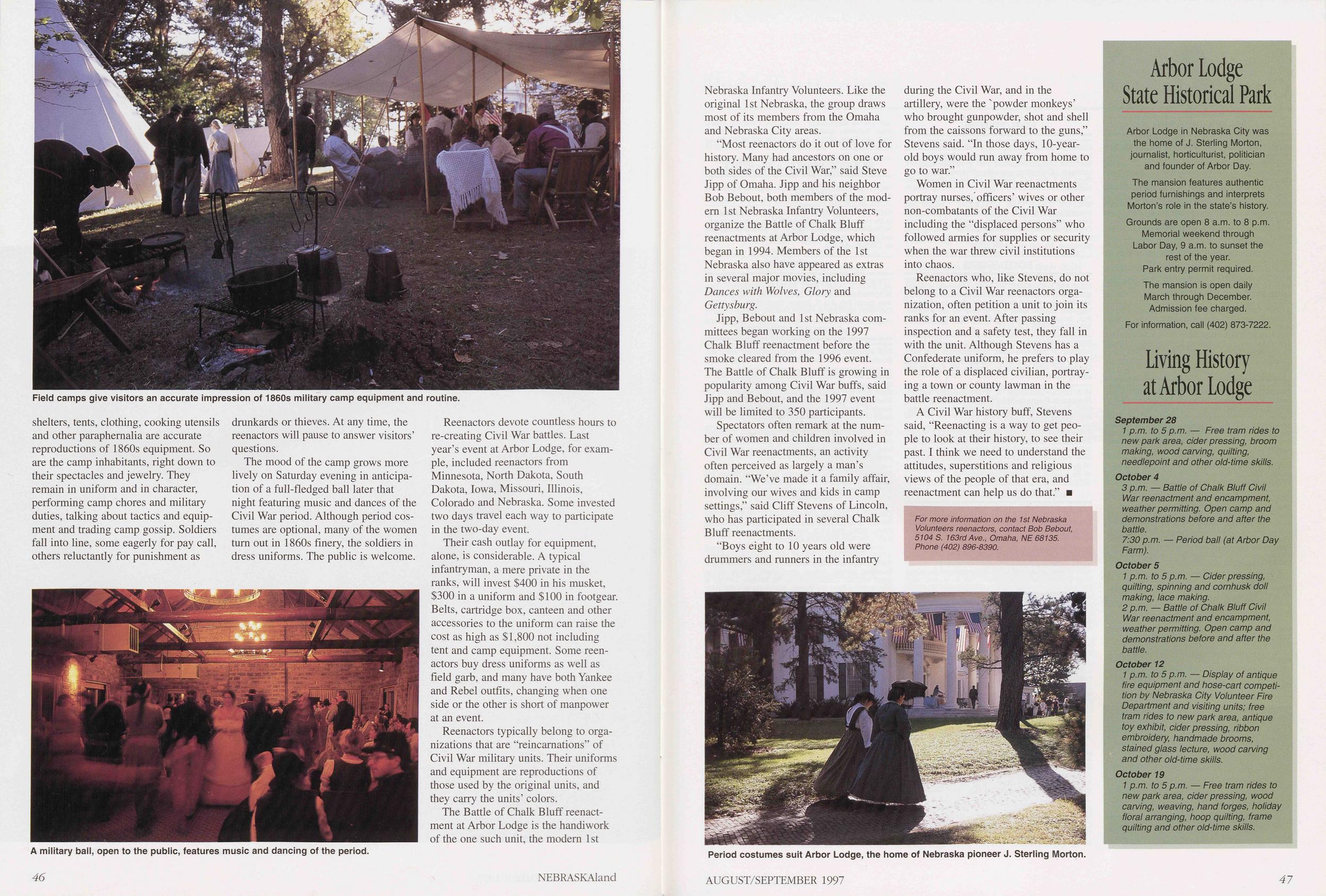
Field camps give visitors an accurate impression of 1860s military camp equipment and routine.
shelters, tents, clothing, cooking utensils and other paraphernalia are accurate reproductions of 1860s equipment. So are the camp inhabitants, right down to their spectacles and jewelry. They remain in uniform and in character, performing camp chores and military duties, talking about tactics and equipment and trading camp gossip. Soldiers fall into line, some eagerly for pay call, others reluctantly for punishment as drunkards or thieves. At any time, the reenactors will pause to answer visitors' questions.
The mood of the camp grows more lively on Saturday evening in anticipation of a full-fledged ball later that night featuring music and dances of the Civil War period. Although period costumes are optional, many of the women turn out in 1860s finery, the soldiers in dress uniforms. The public is welcome.
Reenactors devote countless hours to re-creating Civil War battles. Last year's event at Arbor Lodge, for example, included reenactors from Minnesota, North Dakota, South Dakota, Iowa, Missouri, Illinois, Colorado and Nebraska. Some invested two days travel each way to participate in the two-day event.
Their cash outlay for equipment, alone, is considerable. A typical infantryman, a mere private in the ranks, will invest $400 in his musket, $300 in a uniform and $100 in footgear. Belts, cartridge box, canteen and other accessories to the uniform can raise the cost as high as $1,800 not including tent and camp equipment. Some reenactors buy dress uniforms as well as field garb, and many have both Yankee and Rebel outfits, changing when one side or the other is short of manpower at an event.
Reenactors typically belong to organizations that are "reincarnations" of Civil War military units. Their uniforms and equipment are reproductions of those used by the original units, and they carry the units' colors.
The Battle of Chalk Bluff reenactment at Arbor Lodge is the handiwork of the one such unit, the modern 1st
A military ball, open to the public, features music and dancing of the period.
Nebraska Infantry Volunteers. Like the original 1st Nebraska, the group draws most of its members from the Omaha and Nebraska City areas.
"Most reenactors do it out of love for history. Many had ancestors on one or both sides of the Civil War," said Steve Jipp of Omaha. Jipp and his neighbor Bob Bebout, both members of the modern 1st Nebraska Infantry Volunteers, organize the Battle of Chalk Bluff reenactments at Arbor Lodge, which began in 1994. Members of the 1st Nebraska also have appeared as extras in several major movies, including Dances with Wolves, Glory and Gettysburg.
Jipp, Bebout and 1st Nebraska committees began working on the 1997 Chalk Bluff reenactment before the smoke cleared from the 1996 event. The Battle of Chalk Bluff is growing in popularity among Civil War buffs, said Jipp and Bebout, and the 1997 event will be limited to 350 participants.
Spectators often remark at the number of women and children involved in Civil War reenactments, an activity often perceived as largely a man's domain. "We've made it a family affair, involving our wives and kids in camp settings," said Cliff Stevens of Lincoln, who has participated in several Chalk Bluff reenactments.
"Boys eight to 10 years old were drummers and runners in the infantry during the Civil War, and in the artillery, were the v-powder monkeys' who brought gunpowder, shot and shell from the caissons forward to the guns," Stevens said. "In those days, 10-year-old boys would run away from home to go to war."
Women in Civil War reenactments portray nurses, officers' wives or other non-combatants of the Civil War including the "displaced persons" who followed armies for supplies or security when the war threw civil institutions into chaos.
Reenactors who, like Stevens, do not belong to a Civil War reenactors organization, often petition a unit to join its ranks for an event. After passing inspection and a safety test, they fall in with the unit. Although Stevens has a Confederate uniform, he prefers to play the role of a displaced civilian, portraying a town or county lawman in the battle reenactment.
A Civil War history buff, Stevens said, "Reenacting is a way to get people to look at their history, to see their past. I think we need to understand the attitudes, superstitions and religious views of the people of that era, and reenactment can help us do that."
For more information on the 1st Nebraska Volunteers reenactors, contact Bob Bebout, 5104 S. 163rd Ave., Omaha, NE 68135. Phone (402) 896-8390.Arbor Lodge State Historical Park
Arbor Lodge in Nebraska City was the home of J. Sterling Morton, journalist, horticulturist, politician and founder of Arbor Day. The mansion features authentic period furnishings and interprets Morton's role in the state's history. Grounds are open 8 a.m. to 8 p.m. Memorial weekend through Labor Day, 9 a.m. to sunset the rest of the year. Park entry permit required. The mansion is open daily March through December. Admission fee charged. For information, call (402) 873-7222.Living History at Arbor Lodge
September 28 1 p.m. to 5 p.m. — Free tram rides to new park area, cider pressing, broom making, wood carving, quilting, needlepoint and other ofd-time skills. October 4 3 p.m. — Battle of Chalk Bluff Civil War reenactment and encampment, weather permitting. Open camp and demonstrations before and after the battle. 7:30 p.m. — Period ball (at Arbor Day Farm). October 5 1 p.m. to 5 p.m. — Cider pressing, quilting, spinning and cornhusk doll making, lace making. 2 p.m.— Battle of Chalk Bluff Civil War reenactment and encampment, weather permitting. Open camp and demonstrations before and after the battle. October 12 1 p.m. to 5 p.m. — Display of antique fire equipment and hose-cart competition by Nebraska City Volunteer Fire Department and visiting units; free tram rides to new park area, antique toy exhibit, cider pressing, ribbon embroidery, handmade brooms, stained glass lecture, wood carving and other old-time skills. October 19 1 p.m. to 5 p.m. — Free tram rides to new park area, cider pressing, wood carving, weaving, hand forges, holiday floral arranging, hoop quilting, frame quilting and other old-time skills.Period costumes suit Arbor Lodge, the home of Nebraska pioneer J. Sterling Morton.
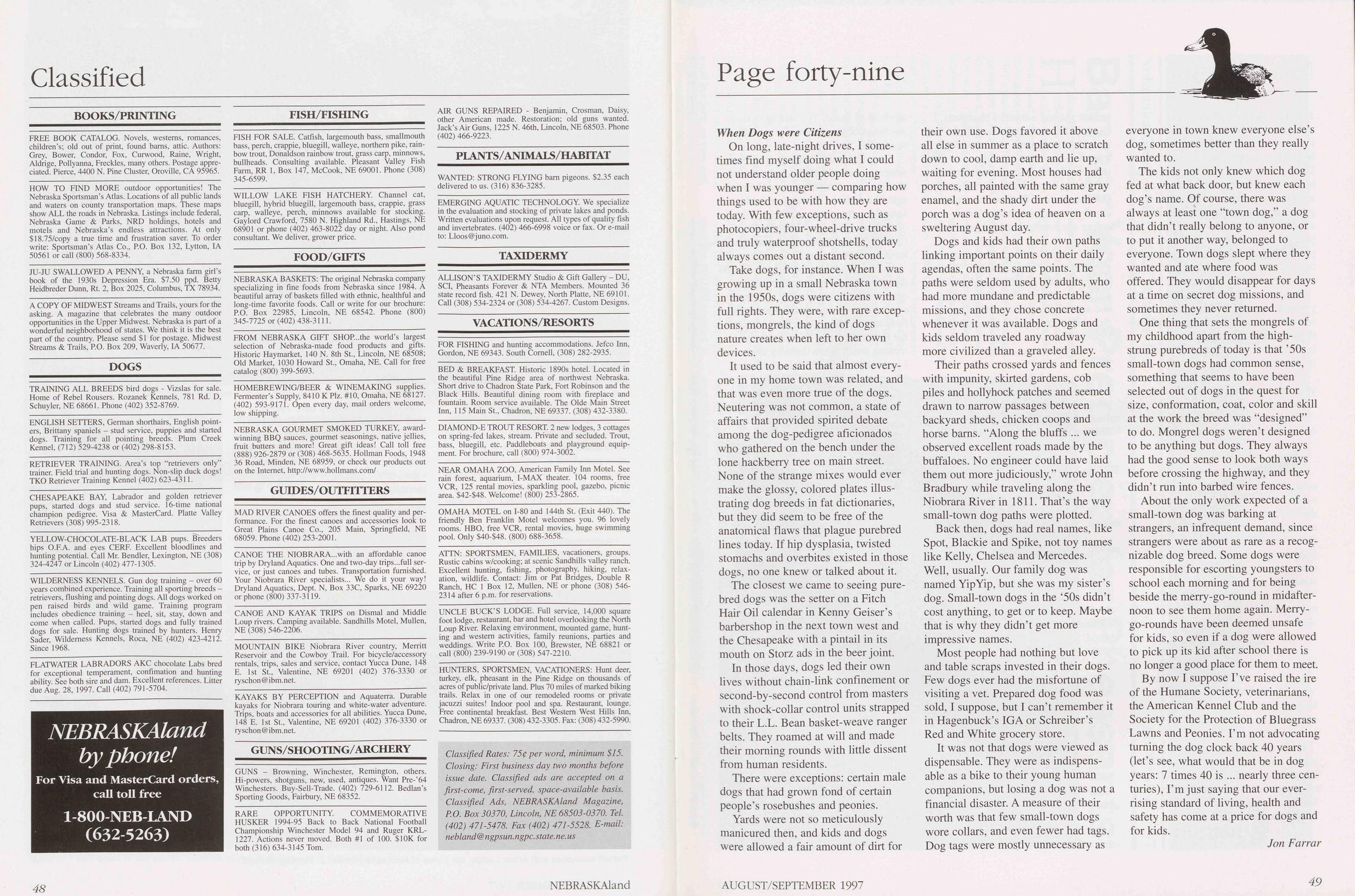
Classified
BOOKS/PRINTING FISH/FISHING FREE BOOK CATALOG. Novels, westerns, romances, children's; old out of print, found barns, attic. Authors: Grey, Bower, Condor, Fox, Curwood, Raine, Wright, Aldrige, Pollyanna, Freckles, many others. Postage appreciated. Pierce, 4400 N. Pine Cluster, Oroville, CA 95965. HOW TO FIND MORE outdoor opportunities! The Nebraska Sportsman's Atlas. Locations of all public lands and waters on county transportation maps. These maps show ALL the roads in Nebraska. Listings include federal, Nebraska Game & Parks, NRD holdings, hotels and motels and Nebraska's endless attractions. At only $18.75/copy a true time and frustration saver. To order write: Sportsman's Atlas Co., P.O. Box 132, Lytton, IA 50561 or call (800) 568-8334. JU-JU SWALLOWED A PENNY, a Nebraska farm girl's book of the 1930s Depression Era. $7.50 ppd. Betty Heidbreder Dunn, Rt. 2, Box 2025, Columbus, TX 78934. A COPY OF MIDWEST Streams and Trails, yours for the asking. A magazine that celebrates the many outdoor opportunities in the Upper Midwest. Nebraska is part of a wonderful neighborhood of states. We think it is the best part of the country. Please send $1 for postage. Midwest Streams & Trails, P.O. Box 209, Waverly, IA 50677. DOGS TRAINING ALL BREEDS bird dogs - Vizslas for sale. Home of Rebel Rousers. Rozanek Kennels, 781 Rd. D, Schuyler, NE 68661. Phone (402) 352-8769. ENGLISH SETTERS, German shorthairs, English pointers, Brittany spaniels - stud service, puppies and started dogs. Training for all pointing breeds. Plum Creek Kennel, (712) 529-4238 or (402) 298-8153. RETRIEVER TRAINING. Area's top "retrievers only" trainer. Field trial and hunting dogs. Non-slip duck dogs! TKO Retriever Training Kennel (402) 623-4311. CHESAPEAKE BAY, Labrador and golden retriever pups, started dogs and stud service. 16-time national champion pedigree. Visa & MasterCard. Platte Valley Retrievers (308) 995-2318. YELLOW-CHOCOLATE-BLACK LAB pups. Breeders hips O.F.A. and eyes CERE Excellent bloodlines and hunting potential. Call Mr. Bendler, Lexington, NE (308) 324-4247 or Lincoln (402) 477-1305. WILDERNESS KENNELS. Gun dog training - over 60 years combined experience. Training all sporting breeds - retrievers, flushing and pointing dogs. All dogs worked on pen raised birds and wild game. Training program includes obedience training - heel, sit, stay, down and come when called. Pups, started dogs and fully trained dogs for sale. Hunting dogs trained by hunters. Henry Sader, Wilderness Kennels, Roca, NE (402) 423-4212. Since 1968. FLATWATER LABRADORS AKC chocolate Labs bred for exceptional temperament, confirmation and hunting ability. See both sire and dam. Excellent references. Litter due Aug. 28, 1997. Call (402) 791-5704. NEBRASKAland by phone! For Visa and MasterCard orders, call toll free l-800-NEB-LAND (632-5263) FISH FOR SALE. Catfish, largemouth bass, smallmouth bass, perch, crappie, bluegill, walleye, northern pike, rainbow trout, Donaldson rainbow trout, grass carp, minnows, bullheads. Consulting available. Pleasant Valley Fish Farm, RR 1, Box 147, McCook, NE 69001. Phone (308) 345-6599. WILLOW LAKE FISH HATCHERY. Channel cat, bluegill, hybrid bluegill, largemouth bass, crappie, grass carp, walleye, perch, minnows available for stocking. Gay lord Crawford, 7580 N. Highland Rd., Hastings, NE 68901 or phone (402) 463-8022 day or night. Also pond consultant. We deliver, grower price. FOOD/GIFTS NEBRASKA BASKETS: The original Nebraska company specializing in fine foods from Nebraska since 1984. A beautiful array of baskets filled with ethnic, healthful and long-time favorite foods. Call or write for our brochure: P.O. Box 22985, Lincoln, NE 68542. Phone (800) 345-7725 or (402) 438-3111. FROM NEBRASKA GIFT SHOP..the world's largest selection of Nebraska-made food products and gifts. Historic Haymarket, 140 N. 8th St., Lincoln, NE 68508; Old Market, 1030 Howard St., Omaha, NE. Call for free catalog (800) 399-5693. HOMEBREWING/BEER & WINEMAKING supplies. Fermenter's Supply, 8410 K Plz. #10, Omaha, NE 68127. (402) 593-9171. Open every day, mail orders welcome, low shipping. NEBRASKA GOURMET SMOKED TURKEY, award-winning BBQ sauces, gourmet seasonings, native jellies, fruit butters and more! Great gift ideas! Call toll free (888) 926-2879 or (308) 468-5635. Hollman Foods, 1948 36 Road, Minden, NE 68959, or check our products out on the Internet, http://www.hollmans.com/ GUIDES/OUTFITTERS MAD RIVER CANOES offers the finest quality and performance. For the finest canoes and accessories look to Great Plains Canoe Co., 205 Main, Springfield, NE 68059. Phone (402) 253-2001. CANOE THE NIOBRARA...with an affordable canoe trip by Dryland Aquatics. One and two-day trips...full service, or just canoes and tubes. Transportation furnished. Your Niobrara River specialists... We do it your way! Dryland Aquatics, Dept. N, Box 33C, Sparks, NE 69220 or phone (800) 337-3119. CANOE AND KAYAK TRIPS on Dismal and Middle Loup rivers. Camping available. Sandhills Motel, Mullen, NE (308) 546-2206. MOUNTAIN BIKE Niobrara River country, Merritt Reservoir and the Cowboy Trail. For bicycle/accessory rentals, trips, sales and service, contact Yucca Dune, 148 E. 1st St., Valentine, NE 69201 (402) 376-3330 or ryschon@ibm.net. KAYAKS BY PERCEPTION and Aquaterra. Durable kayaks for Niobrara touring and white-water adventure. Trips, boats and accessories for all abilities. Yucca Dune, 148 E. 1st St., Valentine, NE 69201 (402) 376-3330 or ryschon@ibm.net. GUNS/SHOOTING/ARCHERY GUNS - Browning, Winchester, Remington, others. Hi-powers, shotguns, new, used, antiques. Want Pre-'64 Winchesters. Buy-Sell-Trade. (402) 729-6112. Bedlan's Sporting Goods, Fairbury, NE 68352. RARE OPPORTUNITY. COMMEMORATIVE HUSKER 1994-95 Back to Back National Football Championship Winchester Model 94 and Ruger KTL-1227. Actions never moved. Both #1 of 100. $10K for both (316) 634-3145 Tom. AIR GUNS REPAIRED - Benjamin, Crosman, Daisy, other American made. Restoration; old guns wanted. Jack's Air Guns, 1225 N. 46th, Lincoln, NE 68503. Phone (402) 466-9223. PLANTS/ANIMALS/HABITAT WANTED: STRONG FLYING barn pigeons. $2.35 each delivered to us. (316) 836-3285. EMERGING AQUATIC TECHNOLOGY. We specialize in the evaluation and stocking of private lakes and ponds. Written evaluations upon request. All types of quality fish and invertebrates. (402) 466-6998 voice or fax. Or e-mail to: Lloos@juno.com. TAXIDERMY ALLISON'S TAXIDERMY Studio & Gift Gallery - DU, SCI, Pheasants Forever & NTA Members. Mounted 36 state record fish. 421 N. Dewey, North Platte, NE 69101. Call (308) 534-2324 or (308) 534-4267. Custom Designs. VACATIONS/RESORTS FOR FISHING and hunting accommodations. Jefco Inn, Gordon, NE 69343. South Cornell, (308) 282-2935. BED & BREAKFAST. Historic 1890s hotel. Located in the beautiful Pine Ridge area of northwest Nebraska. Short drive to Chadron State Park, Fort Robinson and the Black Hills. Beautiful dining room with fireplace and fountain. Room service available. The Olde Main Street Inn, 115 Main St., Chadron, NE 69337. (308) 432-3380. DIAMOND-E TROUT RESORT. 2 new lodges, 3 cottages on spring-fed lakes, stream. Private and secluded. Trout, bass, bluegill, etc. Paddleboats and playground equipment. For brochure, call (800) 974-3002. NEAR OMAHA ZOO, American Family Inn Motel. See rain forest, aquarium, I-MAX theater. 104 rooms, free VCR, 125 rental movies, sparkling pool, gazebo, picnic area. $42-$48. Welcome! (800) 253-2865. OMAHA MOTEL on 1-80 and 144th St. (Exit 440). The friendly Ben Franklin Motel welcomes you. 96 lovely rooms. HBO, free VCR, rental movies, huge swimming pool. Only $40-$48. (800) 688-3658. ATTN: SPORTSMEN, FAMILIES, vacationers, groups. Rustic cabins w/cooking; at scenic Sandhills valley ranch. Excellent hunting, fishing, photography, hiking, relaxation, wildlife. Contact: Jim or Pat Bridges, Double R Ranch, HC 1 Box 12, Mullen, NE or phone (308) 546-2314 after 6 p.m. for reservations. UNCLE BUCK'S LODGE. Full service, 14,000 square foot lodge, restaurant, bar and hotel overlooking the North Loup River. Relaxing environment, mounted game, hunting and western activities, family reunions, parties and weddings. Write P.O. Box 100, Brewster, NE 68821 or call (800) 239-9190 or (308) 547-2210. HUNTERS, SPORTSMEN, VACATIONERS: Hunt deer, turkey, elk, pheasant in the Pine Ridge on thousands of acres of public/private land. Plus 70 miles of marked biking trails. Relax in one of our remodeled rooms or private Jacuzzi suites! Indoor pool and spa. Restaurant, lounge. Free continental breakfast. Best Western West Hills Inn, Chadron, NE 69337. (308) 432-3305. Fax: (308) 432-5990. Classified Rates: 750 per word, minimum $15. Closing: First business day two months before issue date. Classified ads are accepted on a first-come, first-served, space-available basis. Classified Ads, NEBRASKAland Magazine, P.O. Box 30370, Lincoln, NE 68503-0370. Tel. (402) 471-5478. Fax (402) 471-5528. E-mail: nebland@ngpsun.ngpc.state, ne. us 48 NEBRASKAlandPage forty-nine
When Dogs were CitizensOn long, late-night drives, I sometimes find myself doing what I could not understand older people doing when I was younger — comparing how things used to be with how they are today. With few exceptions, such as photocopiers, four-wheel-drive trucks and truly waterproof shotshells, today always comes out a distant second.
Take dogs, for instance. When I was growing up in a small Nebraska town in the 1950s, dogs were citizens with full rights. They were, with rare exceptions, mongrels, the kind of dogs nature creates when left to her own devices.
It used to be said that almost everyone in my home town was related, and that was even more true of the dogs. Neutering was not common, a state of affairs that provided spirited debate among the dog-pedigree aficionados who gathered on the bench under the lone hackberry tree on main street. None of the strange mixes would ever make the glossy, colored plates illustrating dog breeds in fat dictionaries, but they did seem to be free of the anatomical flaws that plague purebred lines today. If hip dysplasia, twisted stomachs and overbites existed in those dogs, no one knew or talked about it.
The closest we came to seeing purebred dogs was the setter on a Fitch Hair Oil calendar in Kenny Geiser's barbershop in the next town west and the Chesapeake with a pintail in its mouth on Storz ads in the beer joint.
In those days, dogs led their own lives without chain-link confinement or second-by-second control from masters with shock-collar control units strapped to their L.L. Bean basket-weave ranger belts. They roamed at will and made their morning rounds with little dissent from human residents.
There were exceptions: certain male dogs that had grown fond of certain people's rosebushes and peonies.
Yards were not so meticulously manicured then, and kids and dogs were allowed a fair amount of dirt for their own use. Dogs favored it above all else in summer as a place to scratch down to cool, damp earth and lie up, waiting for evening. Most houses had porches, all painted with the same gray enamel, and the shady dirt under the porch was a dog's idea of heaven on a sweltering August day.
Dogs and kids had their own paths linking important points on their daily agendas, often the same points. The paths were seldom used by adults, who had more mundane and predictable missions, and they chose concrete whenever it was available. Dogs and kids seldom traveled any roadway more civilized than a graveled alley.
Their paths crossed yards and fences with impunity, skirted gardens, cob piles and hollyhock patches and seemed drawn to narrow passages between backyard sheds, chicken coops and horse barns. "Along the bluffs...we observed excellent roads made by the buffaloes. No engineer could have laid them out more judiciously," wrote John Bradbury while traveling along the Niobrara River in 1811. That's the way small-town dog paths were plotted.
Back then, dogs had real names, like Spot, Blackie and Spike, not toy names like Kelly, Chelsea and Mercedes. Well, usually. Our family dog was named Yip Yip, but she was my sister's dog. Small-town dogs in the '50s didn't cost anything, to get or to keep. Maybe that is why they didn't get more impressive names.
Most people had nothing but love and table scraps invested in their dogs. Few dogs ever had the misfortune of visiting a vet. Prepared dog food was sold, I suppose, but I can't remember it in Hagenbuck's IGA or Schreiber's Red and White grocery store.
It was not that dogs were viewed as dispensable. They were as indispens- able as a bike to their young human companions, but losing a dog was not a financial disaster. A measure of their worth was that few small-town dogs wore collars, and even fewer had tags. Dog tags were mostly unnecessary as everyone in town knew everyone else's dog, sometimes better than they really wanted to.
The kids not only knew which dog fed at what back door, but knew each dog's name. Of course, there was always at least one "town dog," a dog that didn't really belong to anyone, or to put it another way, belonged to everyone. Town dogs slept where they wanted and ate where food was offered. They would disappear for days at a time on secret dog missions, and sometimes they never returned.
One thing that sets the mongrels of my childhood apart from the high- strung purebreds of today is that '50s small-town dogs had common sense, something that seems to have been selected out of dogs in the quest for size, conformation, coat, color and skill at the work the breed was "designed" to do. Mongrel dogs weren't designed to be anything but dogs. They always had the good sense to look both ways before crossing the highway, and they didn't run into barbed wire fences.
About the only work expected of a small-town dog was barking at strangers, an infrequent demand, since strangers were about as rare as a recognizable dog breed. Some dogs were responsible for escorting youngsters to school each morning and for being beside the merry-go-round in midafternoon to see them home again. Merry-go-rounds have been deemed unsafe for kids, so even if a dog were allowed to pick up its kid after school there is no longer a good place for them to meet.
By now I suppose I've raised the ire of the Humane Society, veterinarians, the American Kennel Club and the Society for the Protection of Bluegrass Lawns and Peonies. I'm not advocating turning the dog clock back 40 years (let's see, what would that be in dog years: 7 times 40 is ... nearly three centuries), I'm just saying that our everrising standard of living, health and safety has come at a price for dogs and for kids.
Jon Farrar AUGUST/SEPTEMBER 1997 49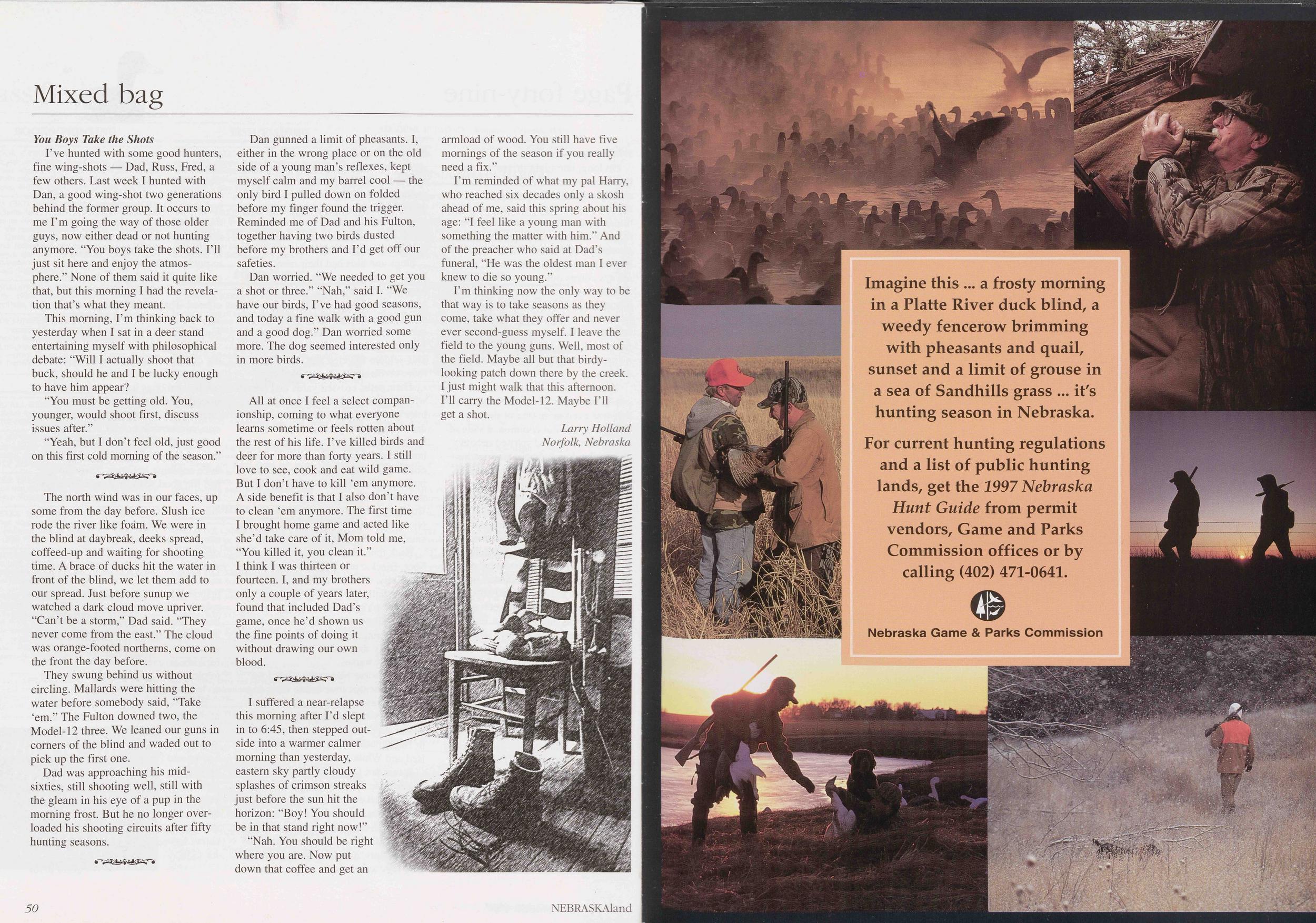
Mixed bag
You Boys Take the ShotsI've hunted with some good hunters, fine wing-shots — Dad, Russ, Fred, a few others. Last week I hunted with Dan, a good wing-shot two generations behind the former group. It occurs to me I'm going the way of those older guys, now either dead or not hunting anymore. "You boys take the shots. I'll just sit here and enjoy the atmosphere." None of them said it quite like that, but this morning I had the revelation that's what they meant.
This morning, I'm thinking back to yesterday when I sat in a deer stand entertaining myself with philosophical debate: "Will I actually shoot that buck, should he and I be lucky enough to have him appear?
"You must be getting old. You, younger, would shoot first, discuss issues after."
"Yeah, but I don't feel old, just good on this first cold morning of the season."
The north wind was in our faces, up some from the day before. Slush ice rode the river like foam. We were in the blind at daybreak, deeks spread, coffeed-up and waiting for shooting time. A brace of ducks hit the water in front of the blind, we let them add to our spread. Just before sunup we watched a dark cloud move upriver. "Can't be a storm," Dad said. "They never come from the east." The cloud was orange-footed northerns, come on the front the day before.
They swung behind us without circling. Mallards were hitting the water before somebody said, "Take 'em." The Fulton downed two, the Model-12 three. We leaned our guns in corners of the blind and waded out to pick up the first one.
Dad was approaching his midsixties, still shooting well, still with the gleam in his eye of a pup in the morning frost. But he no longer over-loaded his shooting circuits after fifty hunting seasons.
Dan gunned a limit of pheasants. I, either in the wrong place or on the old side of a young man's reflexes, kept myself calm and my barrel cool — the only bird I pulled down on folded before my finger found the trigger. Reminded me of Dad and his Fulton, together having two birds dusted before my brothers and I'd get off our safeties.
Dan worried. "We needed to get you a shot or three." "Nah," said I. "We have our birds, I've had good seasons, and today a fine walk with a good gun and a good dog." Dan worried some more. The dog seemed interested only in more birds.
All at once I feel a select companionship, coming to what everyone learns sometime or feels rotten about the rest of his life. I've killed birds and deer for more than forty years. I still love to see, cook and eat wild game. But I don't have to kill 'em anymore. A side benefit is that I also don' to clean 'em anymore. The first I brought home game and acted she'd take care of it, Mom told "You killed it, you clean it." I think I was thirteen or fourteen. I, and my brothers only a couple of years later, found that included Dad's game, once he'd shown us the fine points of doing it without drawing our own blood.
I suffered a near-relapse this morning after I'd slept in to 6:45, then stepped outside into a warmer calmer morning than yesterday, eastern sky partly cloudy splashes of crimson streaks just before the sun hit the horizon: "Boy! You should be in that stand right now!"
"Nah. You should be right where you are. Now put down that coffee and get an armload of wood. You still have five mornings of the season if you really need a fix."
I'm reminded of what my pal Harry, who reached six decades only a skosh ahead of me, said this spring about his age: "I feel like a young man with something the matter with him." And of the preacher who said at Dad's funeral, "He was the oldest man I ever knew to die so young."
I'm thinking now the only way to be that way is to take seasons as they come, take what they offer and never ever second-guess myself. I leave the field to the young guns. Well, most of the field. Maybe all but that birdy-looking patch down there by the creek. I just might walk that this afternoon. I'll carry the Model-12. Maybe I'll get a shot.
Larry Holland Norfolk, Nebraska 50 NEBRASKAland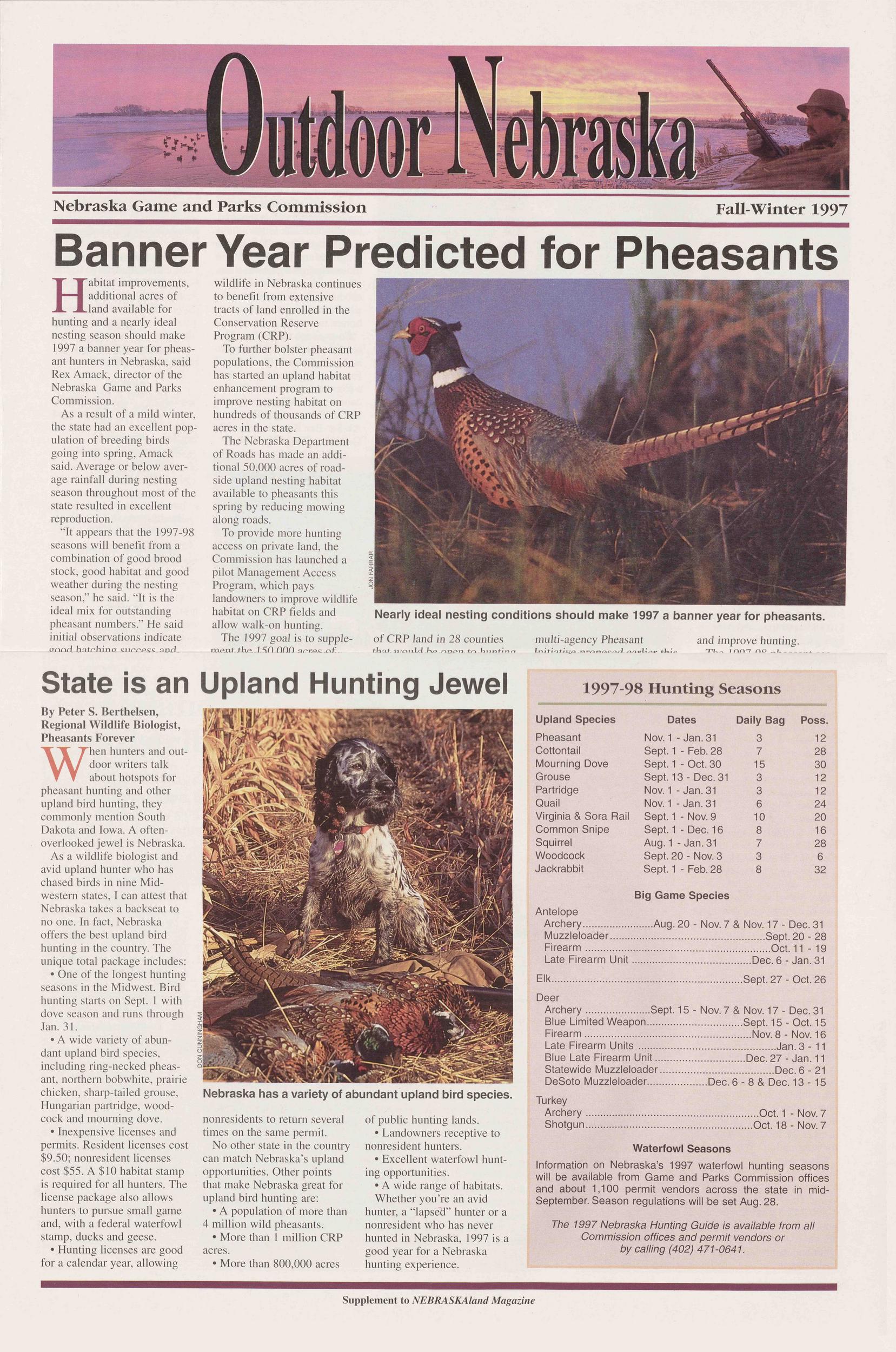
Outdoor Nebraska
Nebraska Game and Parks Commission Fall-Winter 1997
Banner Year Predicted for Pheasants
Habitat improvements, additional acres of land available for hunting and a nearly ideal nesting season should make 1997 a banner year for pheasant hunters in Nebraska, said Rex Amack, director of the Nebraska Game and Parks Commission.
As a result of a mild winter, the state had an excellent population of breeding birds going into spring, Amack said. Average or below average rainfall during nesting season throughout most of the state resulted in excellent reproduction.
"It appears that the 1997-98 seasons will benefit from a combination of good brood stock, good habitat and good weather during the nesting season," he said. "It is the ideal mix for outstanding pheasant numbers." He said initial observations indicate wildlife in Nebraska continues to benefit from extensive tracts of land enrolled in the Conservation Reserve Program (CRP).
To further bolster pheasant populations, the Commission has started an upland habitat enhancement program to improve nesting habitat on hundreds of thousands of CRP acres in the state.
The Nebraska Department of Roads has made an additional 50,000 acres of roadside upland nesting habitat available to pheasants this spring by reducing mowing along roads.
To provide more hunting access on private land, the Commission has launched a pilot Management Access Program, which pays landowners to improve wildlife habitat on CRP fields and allow walk-on hunting. The 1997 goal is to supplement the 150,000 acres of
Nearly ideal nesting conditions should make 1997 a banner year for pheasants.
of CRP land in 28 counties multi-agency Pheasant and improve hunting.
State is an Upland Hunting Jewel
When hunters and outdoor writers talk about hotspots for pheasant hunting and other upland bird hunting, they commonly mention South Dakota and Iowa. A often-overlooked jewel is Nebraska.
As a wildlife biologist and avid upland hunter who has chased birds in nine Midwestern states, 1 can attest that Nebraska takes a backseat to no one. In fact, Nebraska offers the best upland bird hunting in the country. The unique total package includes:
One of the longest hunting seasons in the Midwest. Bird hunting starts on Sept. 1 with dove season and runs through Jan. 31.
A wide variety of abundant upland bird species, including ring-necked pheasant, northern bobwhite, prairie chicken, sharp-tailed grouse, Hungarian partridge, woodcock and mourning dove.
Inexpensive licenses and permits. Resident licenses cost $9.50; nonresident licenses cost $55. A $10 habitat stamp is required for all hunters. The license package also allows hunters to pursue small game and, with a federal waterfowl stamp, ducks and geese.
Nebraska has a variety of abundant upland bird species.
No other state in the country can match Nebraska's upland opportunities. Other points that make Nebraska great for upland bird hunting are:
A population of more than 4 million wild pheasants.
More than 1 million CRP acres.
More than 800,000 acres of public hunting lands.
Landowners receptive to nonresident hunters.
Excellent waterfowl hunting opportunities.
A wide range of habitats.
Whether you're an avid hunter, a "lapsed" hunter or a nonresident who has never hunted in Nebraska, 1997 is a good year for a Nebraska hunting experience.
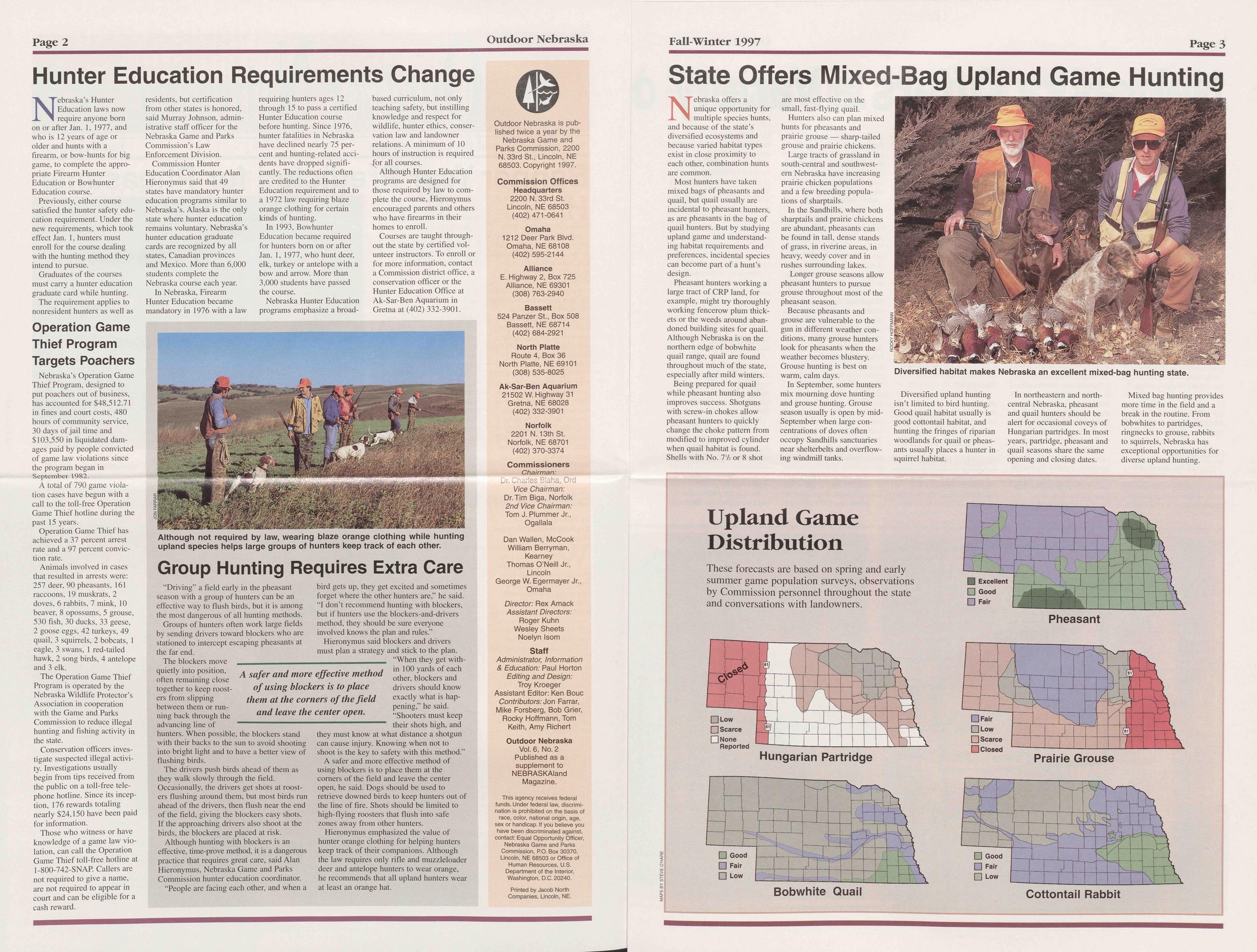 Page 2
Outdoor Nebraska
Page 2
Outdoor Nebraska
Hunter Education Requirements Change
Nebraska's Hunter Education laws now require anyone born on or after Jan. 1, 1977, and who is 12 years of age or older and hunts with a firearm, or bow-hunts for big game, to complete the appropriate Firearm Hunter Education or Bowhunter Education course.
Previously, either course satisfied the hunter safety education requirement. Under the new requirements, which took effect Jan. 1, hunters must enroll for the course dealing with the hunting method they intend to pursue.
Graduates of the courses must carry a hunter education graduate card while hunting.
The requirement applies to nonresident hunters as well as residents, but certification from other states is honored, said Murray Johnson, administrative staff officer for the Nebraska Game and Parks Commission's Law Enforcement Division.
Commission Hunter Education Coordinator Alan Hieronymus said that 49 states have mandatory hunter education programs similar to Nebraska's. Alaska is the only state where hunter education remains voluntary. Nebraska's hunter education graduate cards are recognized by all states, Canadian provinces and Mexico. More than 6,000 students complete the Nebraska course each year.
In Nebraska, Firearm Hunter Education became mandatory in 1976 with a law requiring hunters ages 12 through 15 to pass a certified Hunter Education course before hunting. Since 1976, hunter fatalities in Nebraska have declined nearly 75 percent and hunting-related accidents have dropped significantly. The reductions often are credited to the Hunter Education requirement and to a 1972 law requiring blaze orange clothing for certain kinds of hunting.
In 1993, Bowhunter Education became required for hunters born on or after Jan. 1, 1977, who hunt deer, elk, turkey or antelope with a bow and arrow. More than 3,000 students have passed the course.
Nebraska Hunter Education programs emphasize a broad-based curriculum, not only teaching safety, but instilling knowledge and respect for wildlife, hunter ethics, conservation law and landowner relations. A minimum of 10 hours of instruction is required for all courses.
Although Hunter Education programs are designed for those required by law to complete the course, Hieronymus encouraged parents and others who have firearms in their homes to enroll.
Courses are taught throughout the state by certified volunteer instructors. To enroll or for more information, contact a Commission district office, a conservation officer or the Hunter Education Office at Ak-Sar-Ben Aquarium in Gretna at (402) 332-3901.
Operation Game Thief Program Targets Poachers
Nebraska's Operation Game Thief Program, designed to put poachers out of business, has accounted for $48,512.71 in fines and court costs, 480 hours of community service, 30 days of jail time and $103,550 in liquidated damages paid by people convicted of game law violations since the program began in September 1982.
A total of 790 game violation cases have begun with a call to the toll-free Operation Game Thief hotline during the past 15 years.
Operation Game Thief has achieved a 37 percent arrest rate and a 97 percent conviction rate.
Animals involved in cases that resulted in arrests were: 257 deer, 90 pheasants, 161 raccoons, 19 muskrats, 2 doves, 6 rabbits, 7 mink, 10 beaver, 8 opossums, 5 grouse, 530 fish, 30 ducks, 33 geese, 2 goose eggs, 42 turkeys, 49 quail, 3 squirrels, 2 bobcats, 1 eagle, 3 swans, 1 red-tailed hawk, 2 song birds, 4 antelope and 3 elk.
The Operation Game Thief Program is operated by the Nebraska Wildlife Protector's Association in cooperation with the Game and Parks Commission to reduce illegal hunting and fishing activity in the state.
Conservation officers investigate suspected illegal activity. Investigations usually begin from tips received from the public on a toll-free telephone hotline. Since its inception, 176 rewards totaling nearly $24,150 have been paid for information.
Those who witness or have knowledge of a game law violation, can call the Operation Game Thief toll-free hotline at 1-800-742-SNAP. Callers are not required to give a name, are not required to appear in court and can be eligible for a cash reward.
Although not required by law, wearing blaze orange clothing while hunting upland species helps large groups of hunters keep track of each other.
Group Hunting Requires Extra Care
"Driving" a field early in the pheasant season with a group of hunters can be an effective way to flush birds, but it is among the most dangerous of all hunting methods. Groups of hunters often work large fields by sending drivers toward blockers who are stationed to intercept escaping pheasants at the far end.
The blockers move quietly into position, often remaining close together to keep roosters from slipping between them or running back through the advancing line of hunters. When possible, the blockers stand with their backs to the sun to avoid shooting into bright light and to have a better view of flushing birds.
The drivers push birds ahead of them as they walk slowly through the field. Occasionally, the drivers get shots at roosters flushing around them, but most birds run ahead of the drivers, then flush near the end of the field, giving the blockers easy shots. If the approaching drivers also shoot at the birds, the blockers are placed at risk.
Although hunting with blockers is an effective, time-prove method, it is a dangerous practice that requires great care, said Alan Hieronymus, Nebraska Game and Parks Commission hunter education coordinator. "People are facing each other, and when a
A safer and more effective method of using blockers is to place them at the corners of the field and leave the center open.bird gets up, they get excited and sometimes forget where the other hunters are," he said. "I don't recommend hunting with blockers, but if hunters use the blockers-and-drivers method, they should be sure everyone involved knows the plan and rules."
Hieronymus said blockers and drivers must plan a strategy and stick to the plan. "When they get within 100 yards of each other, blockers and drivers should know exactly what is happening," he said. "Shooters must keep their shots high, and they must know at what distance a shotgun can cause injury. Knowing when not to shoot is the key to safety with this method."
A safer and more effective method of using blockers is to place them at the corners of the field and leave the center open, he said. Dogs should be used to retrieve downed birds to keep hunters out of the line of fire. Shots should be limited to high-flying roosters that flush into safe zones away from other hunters.
Hieronymus emphasized the value of hunter orange clothing for helping hunters keep track of their companions. Although the law requires only rifle and muzzleloader deer and antelope hunters to wear orange, he recommends that all upland hunters wear at least an orange hat.
State Offers Mixed-Bag Upland Game Hunting
Nebraska offers a unique opportunity for multiple species hunts, and because of the state's diversified ecosystems and because varied habitat types exist in close proximity to each other, combination hunts are common.
Most hunters have taken mixed bags of pheasants and quail, but quail usually are incidental to pheasant hunters, as are pheasants in the bag of quail hunters. But by studying upland game and understanding habitat requirements and preferences, incidental species can become part of a hunt's design.
Pheasant hunters working a large tract of CRP land, for example, might try thoroughly working fencerow plum thickets or the weeds around abandoned building sites for quail. Although Nebraska is on the northern edge of bobwhite quail range, quail are found throughout much of the state, especially after mild winters.
Being prepared for quail while pheasant hunting also improves success. Shotguns with screw-in chokes allow pheasant hunters to quickly change the choke pattern from modified to improved cylinder when quail habitat is found. Shells with No. 772 or 8 shot are most effective on the small, fast-flying quail.
Hunters also can plan mixed hunts for pheasants and prairie grouse — sharp-tailed grouse and prairie chickens.
Large tracts of grassland in south-central and southwestern Nebraska have increasing prairie chicken populations and a few breeding populations of sharptails.
In the Sandhills, where both sharptails and prairie chickens are abundant, pheasants can be found in tall, dense stands of grass, in riverine areas, in heavy, weedy cover and in rushes surrounding lakes.
Longer grouse seasons allow pheasant hunters to pursue grouse throughout most of the pheasant season.
Because pheasants and grouse are vulnerable to the gun in different weather conditions, many grouse hunters look for pheasants when the weather becomes blustery. Grouse hunting is best on warm, calm days.
In September, some hunters mix mourning dove hunting and grouse hunting. Grouse season usually is open by mid-September when large concentrations of doves often occupy Sandhills sanctuaries near shelterbelts and overflowing windmill tanks.
Diversified habitat makes Nebraska an excellent mixed-bag hunting state.
Diversified upland hunting isn't limited to bird hunting. Good quail habitat usually is good cottontail habitat, and hunting the fringes of riparian woodlands for quail or pheasants usually places a hunter in squirrel habitat.
In northeastern and north-central Nebraska, pheasant and quail hunters should be alert for occasional coveys of Hungarian partridges. In most years, partridge, pheasant and quail seasons share the same opening and closing dates.
Mixed bag hunting provides more time in the field and a break in the routine. From bobwhites to partridges, ringnecks to grouse, rabbits to squirrels, Nebraska has exceptional opportunities for diverse upland hunting.
Pheasant
Hungarian Partridge
Prairie Grouse
Bobwhite Quail
Cottontail Rabbit
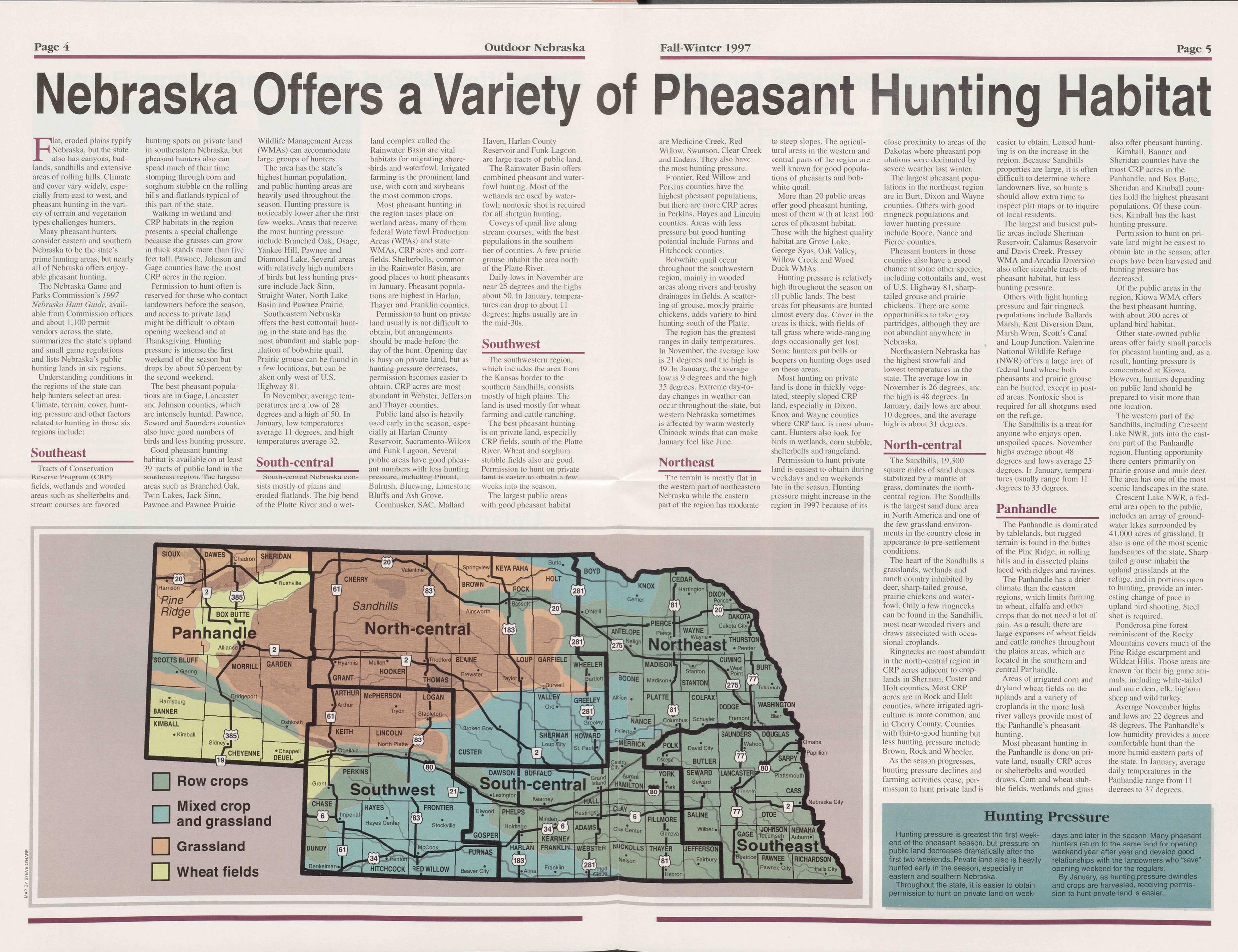 Page 4
Outdoor Nebraska
Page 4
Outdoor Nebraska
Nebraska Offers a Variety of Pheasant Hunting Habitat
Flat, eroded plains typify Nebraska, but the state also has canyons, badlands, sandhills and extensive areas of rolling hills. Climate and cover vary widely, especially from east to west, and pheasant hunting in the variety of terrain and vegetation types challenges hunters.
Many pheasant hunters consider eastern and southern Nebraska to be the state's prime hunting areas, but nearly all of Nebraska offers enjoyable pheasant hunting.
The Nebraska Game and Parks Commission's 7997 Nebraska Hunt Guide, available from Commission offices and about 1,100 permit vendors across the state, summarizes the state's upland and small game regulations and lists Nebraska's public hunting lands in six regions.
Understanding conditions in the regions of the state can help hunters select an area. Climate, terrain, cover, hunting pressure and other factors related to hunting in those six regions include:
SoutheastTracts of Conservation Reserve Program (CRP) fields, wetlands and wooded areas such as shelterbelts and stream courses are favored hunting spots on private land in southeastern Nebraska, but pheasant hunters also can spend much of their time stomping through corn and sorghum stubble on the rolling hills and flatlands typical of this part of the state.
Walking in wetland and CRP habitats in the region presents a special challenge because the grasses can grow in thick stands more than five feet tall. Pawnee, Johnson and Gage counties have the most CRP acres in the region.
Permission to hunt often is reserved for those who contact landowners before the season, and access to private land might be difficult to obtain opening weekend and at Thanksgiving. Hunting pressure is intense the first weekend of the season but drops by about 50 percent by the second weekend.
The best pheasant populations are in Gage, Lancaster and Johnson counties, which are intensely hunted. Pawnee, Seward and Saunders counties also have good numbers of birds and less hunting pressure.
Good pheasant hunting habitat is available on at least 39 tracts of public land in the southeast region. The largest areas such as Branched Oak, Twin Lakes, Jack Sinn, Pawnee and Pawnee Prairie Wildlife Management Areas (WMAs) can accommodate large groups of hunters.
The area has the state's highest human population, and public hunting areas are heavily used throughout the season. Hunting pressure is noticeably lower after the first few weeks. Areas that receive the most hunting pressure include Branched Oak, Osage, Yankee Hill, Pawnee and Diamond Lake. Several areas with relatively high numbers of birds but less hunting pressure include Jack Sinn, Straight Water, North Lake Basin and Pawnee Prairie.
Southeastern Nebraska offers the best cottontail hunting in the state and has the most abundant and stable population of bobwhite quail. Prairie grouse can be found in a few locations, but can be taken only west of U.S. Highway 81.
In November, average temperatures are a low of 28 degrees and a high of 50. In January, low temperatures average 11 degrees, and high temperatures average 32.
South-centralSouth-central Nebraska consists mostly of plains and eroded flatlands. The big bend of the Platte River and a wetland complex called the Rainwater Basin are vital habitats for migrating shore-birds and waterfowl. Irrigated farming is the prominent land use, with corn and soybeans the most common crops.
Most pheasant hunting in the region takes place on wetland areas, many of them federal Waterfowl Production Areas (WPAs) and state WMAs, CRP acres and cornfields. Shelterbelts, common in the Rainwater Basin, are good places to hunt pheasants in January. Pheasant populations are highest in Harlan, Thayer and Franklin counties.
Permission to hunt on private land usually is not difficult to obtain, but arrangements should be made before the day of the hunt. Opening day is busy on private land, but as hunting pressure decreases, permission becomes easier to obtain. CRP acres are most abundant in Webster, Jefferson and Thayer counties.
Public land also is heavily used early in the season, especially at Harlan County Reservoir, Sacramento-Wilcox and Funk Lagoon. Several public areas have good pheasant numbers with less hunting pressure, including Pintail, Bulrush, Bluewing, Limestone Bluffs and Ash Grove.
Cornhusker, SAC, Mallard Haven, Harlan County Reservoir and Funk Lagoon are large tracts of public land.
The Rainwater Basin offers combined pheasant and water-fowl hunting. Most of the wetlands are used by water-fowl; nontoxic shot is required for all shotgun hunting.
Coveys of quail live along stream courses, with the best populations in the southern tier of counties. A few prairie grouse inhabit the area north of the Platte River.
Daily lows in November are near 25 degrees and the highs about 50. In January, temperatures can drop to about 11 degrees; highs usually are in the mid-30s.
SouthwestThe southwestern region, which includes the area from the Kansas border to the southern Sandhills, consists mostly of high plains. The land is used mostly for wheat farming and cattle ranching.
The best pheasant hunting is on private land, especially CRP fields, south of the Platte River. Wheat and sorghum stubble fields also are good. Permission to hunt on private land is easier to obtain a few weeks into the season.
The largest public areas with good pheasant habitat
are Medicine Creek, Red Willow, Swanson, Clear Creek and Enders. They also have the most hunting pressure.
Frontier, Red Willow and Perkins counties have the highest pheasant populations, but there are more CRP acres in Perkins, Hayes and Lincoln counties. Areas with less pressure but good hunting potential include Furnas and Hitchcock counties.
Bobwhite quail occur throughout the southwestern region, mainly in wooded areas along rivers and brushy drainages in fields. A scattering of grouse, mostly prairie chickens, adds variety to bird hunting south of the Platte.
The region has the greatest ranges in daily temperatures. In November, the average low is 21 degrees and the high is 49. In January, the average low is 9 degrees and the high 35 degrees. Extreme day-to-day changes in weather can occur throughout the state, but western Nebraska sometimes is affected by warm westerly Chinook winds that can make January feel like June.
NortheastThe terrain is mostly flat in the western part of northeastern Nebraska while the eastern part of the region has moderate to steep slopes. The agricultural areas in the western and central parts of the region are well known for good populations of pheasants and bob-white quail.
More than 20 public areas offer good pheasant hunting, most of them with at least 160 acres of pheasant habitat. Those with the highest quality habitat are Grove Lake, George Syas, Oak Valley, Willow Creek and Wood Duck WMAs.
Hunting pressure is relatively high throughout the season on all public lands. The best areas for pheasants are hunted almost every day. Cover in the areas is thick, with fields of tall grass where wide-ranging dogs occasionally get lost. Some hunters put bells or beepers on hunting dogs used on these areas.
Most hunting on private land is done in thickly vegetated, steeply sloped CRP land, especially in Dixon, Knox and Wayne counties where CRP land is most abundant. Hunters also look for birds in wetlands, corn stubble, shelterbelts and rangeland.
Permission to hunt private land is easiest to obtain during weekdays and on weekends late in the season. Hunting pressure might increase in the region in 1997 because of its close proximity to areas of the Dakotas where pheasant populations were decimated by severe weather last winter.
The largest pheasant populations in the northeast region are in Burt, Dixon and Wayne counties. Others with good ringneck populations and lower hunting pressure include Boone, Nance and Pierce counties.
Pheasant hunters in those counties also have a good chance at some other species, including cottontails and, west of U.S. Highway 81, sharptailed grouse and prairie chickens. There are some opportunities to take gray partridges, although they are not abundant anywhere in Nebraska.
Northeastern Nebraska has the highest snowfall and lowest temperatures in the state. The average low in November is 26 degrees, and the high is 48 degrees. In January, daily lows are about 10 degrees, and the average high is about 31 degrees.
North-centralThe Sandhills, 19,300 square miles of sand dunes stabilized by a mantle of grass, dominates the northcentral region. The Sandhills is the largest sand dune area in North America and one of the few grassland environments in the country close in appearance to pre-settlement conditions.
The heart of the Sandhills is grasslands, wetlands and ranch country inhabited by deer, sharp-tailed grouse, prairie chickens and waterfowl. Only a few ringnecks can be found in the Sandhills, most near wooded rivers and draws associated with occasional croplands.
Ringnecks are most abundant in the north-central region in CRP acres adjacent to croplands in Sherman, Custer and Holt counties. Most CRP acres are in Rock and Holt counties, where irrigated agriculture is more common, and in Cherry County. Counties with fair-to-good hunting but less hunting pressure include Brown, Rock and Wheeler.
As the season progresses, hunting pressure declines and farming activities cease, permission to hunt private land is easier to obtain. Leased hunting is on the increase in the region. Because Sandhills properties are large, it is often difficult to determine where landowners live, so hunters should allow extra time to inspect plat maps or to inquire of local residents.
The largest and busiest public areas include Sherman Reservoir, Calamus Reservoir and Davis Creek. Pressey WMA and Arcadia Diversion also offer sizeable tracts of pheasant habitat, but less hunting pressure.
Others with light hunting pressure and fair ringneck populations include Ballards Marsh, Kent Diversion Dam, Marsh Wren, Scott's Canal and Loup Junction. Valentine National Wildlife Refuge (NWR) offers a large area of federal land where both pheasants and prairie grouse can be hunted, except in posted areas. Nontoxic shot is required for all shotguns used on the refuge.
The Sandhills is a treat for anyone who enjoys open, unspoiled spaces. November highs average about 48 degrees and lows average 25 degrees. In January, temperatures usually range from 11 degrees to 33 degrees.
PanhandleThe Panhandle is dominated by tablelands, but rugged terrain is found in the buttes of the Pine Ridge, in rolling hills and in dissected plains laced with ridges and ravines.
The Panhandle has a drier climate than the eastern regions, which limits farming to wheat, alfalfa and other crops that do not need a lot of rain. As a result, there are large expanses of wheat fields and cattle ranches throughout the plains areas, which are located in the southern and central Panhandle.
Areas of irrigated corn and dryland wheat fields on the uplands and a variety of croplands in the more lush river valleys provide most of the Panhandle's pheasant hunting.
Most pheasant hunting in the Panhandle is done on private land, usually CRP acres or shelterbelts and wooded draws. Corn and wheat stubble fields, wetlands and grass also offer pheasant hunting.
Kimball, Banner and Sheridan counties have the most CRP acres in the Panhandle, and Box Butte, Sheridan and Kimball counties hold the highest pheasant populations. Of these counties, Kimball has the least hunting pressure.
Permission to hunt on private land might be easiest to obtain late in the season, after crops have been harvested and hunting pressure has decreased.
Of the public areas in the region, Kiowa WMA offers the best pheasant hunting, with about 300 acres of upland bird habitat.
Other state-owned public areas offer fairly small parcels for pheasant hunting and, as a result, hunting pressure is concentrated at Kiowa. However, hunters depending on public land should be prepared to visit more than one location.
The western part of the Sandhills, including Crescent Lake NWR, juts into the eastern part of the Panhandle region. Hunting opportunity there centers primarily on prairie grouse and mule deer. The area has one of the most scenic landscapes in the state.
Crescent Lake NWR, a federal area open to the public, includes an array of groundwater lakes surrounded by 41,000 acres of grassland. It also is one of the most scenic landscapes of the state. Sharptailed grouse inhabit the upland grasslands at the refuge, and in portions open to hunting, provide an interesting change of pace in upland bird shooting. Steel shot is required.
Ponderosa pine forest reminiscent of the Rocky Mountains covers much of the Pine Ridge escarpment and Wildcat Hills. Those areas are known for their big game animals, including white-tailed and mule deer, elk, bighorn sheep and wild turkey.
Average November highs and lows are 22 degrees and 48 decrees. The Panhandle's low humidity provides a more comfortable hunt than the more humid eastern parts of the state. In January, average daily temperatures in the Panhandle range from 11 degrees to 37 degrees.
Hunting Pressure
Hunting pressure is greatest the first weekend of the pheasant season, but pressure on public land decreases dramatically after the first two weekends. Private land also is heavily hunted early in the season, especially in eastern and southern Nebraska. Throughout the state, it is easier to obtain permission to hunt on private land on weekdays and later in the season. Many pheasant hunters return to the same land for opening weekend year after year and develop good relationships with the landowners who "save" opening weekend for the regulars. By January, as hunting pressure dwindles and crops are harvested, receiving permission to hunt private land is easier.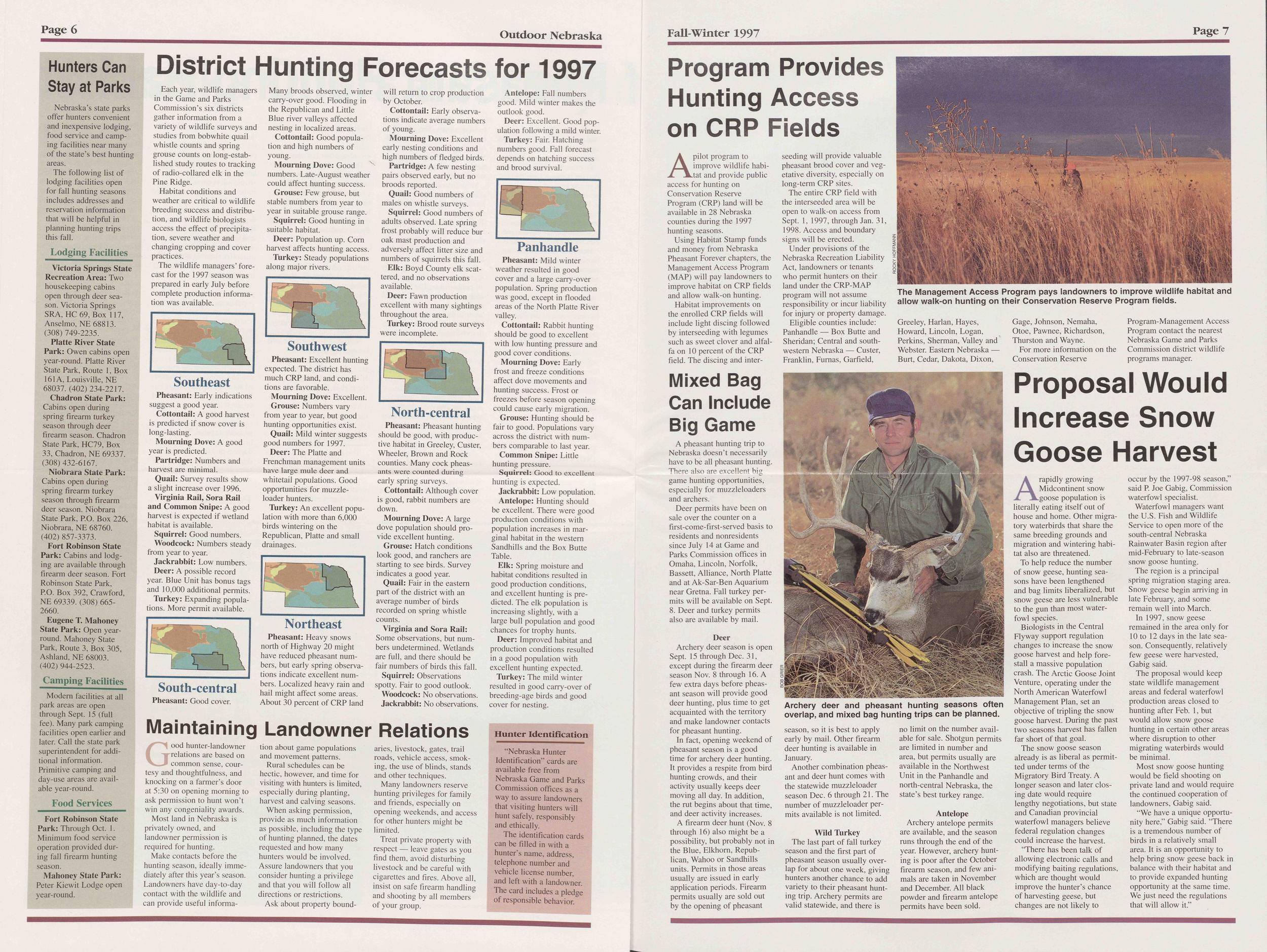 Page 6
Outdoor Nebraska
Page 6
Outdoor Nebraska
Hunters Can Stay at Parks
Nebraska's state parks offer hunters convenient and inexpensive lodging, food service and camping facilities near many of the state's best hunting areas. The following list of lodging facilities open for fall hunting seasons includes addresses and reservation information that will be helpful in planning hunting trips this fall. Lodging Facilities Victoria Springs State Recreation Area: Two housekeeping cabins open through deer season. Victoria Springs SRA, HC 69, Box 117, Anselmo, NE 68813. (308) 749-2235. Platte River State Park: Owen cabins open year-round. Platte River State Park, Route 1, Box 161 A, Louisville, NE 68037.(402)234-2217. Chadron State Park: Cabins open during spring firearm turkey season through deer firearm season. Chadron State Park, HC79, Box 33, Chadron, NE 69337. (308) 432-6167. Niobrara State Park: Cabins open during spring firearm turkey season through firearm deer season. Niobrara State Park, P.O. Box 226, Niobrara, NE 68760. (402) 857-3373. Fort Robinson State Park: Cabins and lodging are available through firearm deer season. Fort Robinson State Park, P.O. Box 392, Crawford, NE 69339. (308) 665-2660. Eugene T. Mahoney State Park: Open year-round. Mahoney State Park, Route 3, Box 305, Ashland, NE 68003. (402) 944-2523. Camping Facilities Modern facilities at all park areas are open through Sept. 15 (full fee). Many park camping facilities open earlier and later. Call the state park superintendent for additional information. Primitive camping and day-use areas are available year-round. Food Services Fort Robinson State Park: Through Oct. 1. Minimum food service operation provided during fall firearm hunting season. Mahoney State Park: Peter Kiewit Lodge open year-round.District Hunting Forecasts for 1997
Each year, wildlife managers in the Game and Parks Commission's six districts gather information from a variety of wildlife surveys and studies from bobwhite quail whistle counts and spring grouse counts on long-established study routes to tracking of radio-collared elk in the Pine Ridge.
Habitat conditions and weather are critical to wildlife breeding success and distribution, and wildlife biologists access the effect of precipitation, severe weather and changing cropping and cover practices.
The wildlife managers' forecast for the 1997 season was prepared in early July before complete production information was available.
Pheasant: Early indications suggest a good year.
Cottontail: A good harvest is predicted if snow cover is long-lasting.
Mourning Dove: A good year is predicted.
Partridge: Numbers and harvest are minimal.
Quail: Survey results show a slight increase over 1996.
Virginia Rail, Sora Rail and Common Snipe: A good harvest is expected if wetland habitat is available.
Squirrel: Good numbers.
Woodcock: Numbers steady from year to year.
Jackrabbit: Low numbers.
Deer: A possible record year. Blue Unit has bonus tags and 10,000 additional permits.
Turkey: Expanding populations. More permit available.
Pheasant: Good cover. Many broods observed, winter carry-over good. Flooding in the Republican and Little Blue river valleys affected nesting in localized areas.
Cottontail: Good population and high numbers of young.
Mourning Dove: Good numbers. Late-August weather could affect hunting success.
Grouse: Few grouse, but stable numbers from year to year in suitable grouse range.
Squirrel: Good hunting in suitable habitat.
Deer: Population up. Corn harvest affects hunting access.
Turkey: Steady populations along major rivers.
Pheasant: Excellent hunting expected. The district has much CRP land, and conditions are favorable.
Mourning Dove: Excellent.
Grouse: Numbers vary from year to year, but good hunting opportunities exist.
Quail: Mild winter suggests good numbers for 1997.
Deer: The Platte and Frenchman management units have large mule deer and whitetail populations. Good opportunities for muzzleloader hunters.
Turkey: An excellent population with more than 6,000 birds wintering on the Republican, Platte and small drainages.
Pheasant: Heavy snows north of Highway 20 might have reduced pheasant numbers, but early spring observations indicate excellent numbers. Localized heavy rain and hail might affect some areas. About 30 percent of CRP land will return to crop production by October.
Cottontail: Early observations indicate average numbers of young.
Mourning Dove: Excellent early nesting conditions and high numbers of fledged birds.
Partridge: A few nesting pairs observed early, but no broods reported.
Quail: Good numbers of males on whistle surveys.
Squirrel: Good numbers of adults observed. Late spring frost probably will reduce bur oak mast production and adversely affect litter size and numbers of squirrels this fall.
Elk: Boyd County elk scattered, and no observations available.
Deer: Fawn production excellent with many sightings throughout the area.
Turkey: Brood route surveys were incomplete.
Pheasant: Pheasant hunting should be good, with productive habitat in Greeley, Custer, Wheeler, Brown and Rock counties. Many cock pheasants were counted during early spring surveys.
Cottontail: Although cover is good, rabbit numbers are down.
Mourning Dove: A large dove population should provide excellent hunting.
Grouse: Hatch conditions look good, and ranchers are starting to see birds. Survey indicates a good year.
Quail: Fair in the eastern part of the district with an average number of birds recorded on spring whistle counts.
Virginia and Sora Rail: Some observations, but numbers undetermined. Wetlands are full, and there should be fair numbers of birds this fall.
Squirrel: Observations spotty. Fair to good outlook.
Woodcock: No observations.
Jackrabbit: No observations.
Antelope: Fall numbers good. Mild winter makes the outlook good.
Deer: Excellent. Good population following a mild winter.
Turkey: Fair. Hatching numbers good. Fall forecast depends on hatching success and brood survival.
Pheasant: Mild winter weather resulted in good cover and a large carry-over population. Spring production was good, except in flooded areas of the North Platte River valley.
Cottontail: Rabbit hunting should be good to excellent with low hunting pressure and good cover conditions.
Mourning Dove: Early frost and freeze conditions affect dove movements and hunting success. Frost or freezes before season opening could cause early migration.
Grouse: Hunting should be fair to good. Populations vary across the district with numbers comparable to last year.
Common Snipe: Little hunting pressure.
Squirrel: Good to excellent hunting is expected.
Jackrabbit: Low population.
Antelope: Hunting should be excellent. There were good production conditions with population increases in marginal habitat in the western Sandhills and the Box Butte Table.
Elk: Spring moisture and habitat conditions resulted in good production conditions, and excellent hunting is predicted. The elk population is increasing slightly, with a large bull population and good chances for trophy hunts.
Deer: Improved habitat and production conditions resulted in a good population with excellent hunting expected.
Turkey: The mild winter resulted in good carry-over of breeding-age birds and good cover for nesting.
Maintaining Landowner Relations
Good hunter-landowner relations are based on common sense, courtesy and thoughtfulness, and knocking on a farmer's door at 5:30 on opening morning to ask permission to hunt won't win any congeniality awards.
Most land in Nebraska is privately owned, and landowner permission is required for hunting.
Make contacts before the hunting season, ideally immediately after this year's season. Landowners have day-to-day contact with the wildlife and can provide useful information about game populations and movement patterns.
Rural schedules can be hectic, however, and time for visiting with hunters is limited, especially during planting, harvest and calving seasons.
When asking permission, provide as much information as possible, including the type of hunting planned, the dates requested and how many hunters would be involved. Assure landowners that you consider hunting a privilege and that you will follow all directions or restrictions.
Ask about property boundaries, livestock, gates, trail roads, vehicle access, smoking, the use of blinds, stands and other techniques.
Many landowners reserve hunting privileges for family and friends, especially on opening weekends, and access for other hunters might be limited.
Treat private property with respect — leave gates as you find them, avoid disturbing livestock and be careful with cigarettes and fires. Above all, insist on safe firearm handling and shooting by all members of your group.
Hunter Identification
"Nebraska Hunter Identification" cards are available free from Nebraska Game and Parks Commission offices as a way to assure landowners that visiting hunters will hunt safely, responsibly and ethically. The identification cards can be filled in with a hunter's name, address, telephone number and vehicle license number, and left with a landowner. The card includes a pledge of responsible behavior.Program Provides Hunting Access on CRP Fields
A pilot program to improve wildlife habitat and provide public access for hunting on Conservation Reserve Program (CRP) land will be available in 28 Nebraska counties during the 1997 hunting seasons.
Using Habitat Stamp funds and money from Nebraska Pheasant Forever chapters, the Management Access Program (MAP) will pay landowners to improve habitat on CRP fields and allow walk-on hunting.
Habitat improvements on the enrolled CRP fields will include light discing followed by interseeding with legumes such as sweet clover and alfalfa on 10 percent of the CRP field. The discing and interseeding will provide valuable pheasant brood cover and vegetative diversity, especially on long-term CRP sites.
The entire CRP field with the interseeded area will be open to walk-on access from Sept. 1, 1997, through Jan. 31, 1998. Access and boundary signs will be erected.
Under provisions of the Nebraska Recreation Liability Act, landowners or tenants who permit hunters on their land under the CRP-MAP program will not assume responsibility or incur liability for injury or property damage.
The Management Access Program pays landowners to improve wildlife habitat and allow walk-on hunting on their Conservation Reserve Program fields.
For more information on the Conservation Reserve Program-Management Access Program contact the nearest Nebraska Game and Parks Commission district wildlife programs manager.
Mixed Bag Can Include Big Game
A pheasant hunting trip to Nebraska doesn't necessarily have to be all pheasant hunting. There also are excellent big game hunting opportunities, especially for muzzleloaders and archers.
Deer permits have been on sale over the counter on a first-come-first-served basis to residents and nonresidents since July 14 at Game and Parks Commission offices in Omaha, Lincoln, Norfolk, Bassett, Alliance, North Platte and at Ak-Sar-Ben Aquarium near Gretna. Fall turkey permits will be available on Sept. 8. Deer and turkey permits also are available by mail.
DeerArchery deer season is open Sept. 15 through Dec. 31, except during the firearm deer season Nov. 8 through 16. A few extra days before pheasant season will provide good deer hunting, plus time to get acquainted with the territory and make landowner contacts for pheasant hunting.
In fact, opening weekend of pheasant season is a good time for archery deer hunting. It provides a respite from bird hunting crowds, and their activity usually keeps deer moving all day. In addition, the rut begins about that time, and deer activity increases.
Archery deer and pheasant hunting seasons often overlap, and mixed bag hunting trips can be planned.
Another combination pheasant and deer hunt comes with the statewide muzzleloader season Dec. 6 through 21. The number of muzzleloader permits available is not limited.
Wild TurkeyThe last part of fall turkey season and the first part of pheasant season usually overlap for about one week, giving hunters another chance to add variety to their pheasant hunting trip. Archery permits are valid statewide, and there is no limit on the number available for sale. Shotgun permits are limited in number and area, but permits usually are available in the Northwest Unit in the Panhandle and north-central Nebraska, the state's best turkey range.
AntelopeArchery antelope permits are available, and the season runs through the end of the year. However, archery hunting is poor after the October firearm season, and few animals are taken in November and December. All black powder and firearm antelope permits have been sold.
Proposal Would Increase Snow Goose Harvest
A rapidly growing Midcontinent snow goose population is literally eating itself out of house and home. Other migratory waterbirds that share the same breeding grounds and migration and wintering habitat also are threatened.
To help reduce the number of snow geese, hunting seasons have been lengthened and bag limits liberalized, but snow geese are less vulnerable to the gun than most waterfowl species.
Biologists in the Central Fly way support regulation changes to increase the snow goose harvest and help forestall a massive population crash. The Arctic Goose Joint Venture, operating under the North American Waterfowl Management Plan, set an objective of tripling the snow goose harvest. During the past two seasons harvest has fallen far short of that goal.
The snow goose season already is as liberal as permitted under terms of the Migratory Bird Treaty. A longer season and later closing date would require lengthy negotiations, but state and Canadian provincial waterfowl managers believe federal regulation changes could increase the harvest.
"There has been talk of allowing electronic calls and modifying baiting regulations, which are thought would improve the hunter's chance of harvesting geese, but changes are not likely to occur by the 1997-98 season," said P. Joe Gabig, Commission waterfowl specialist.
Waterfowl managers want the U.S. Fish and Wildlife Service to open more of the south-central Nebraska Rainwater Basin region after mid-February to late-season snow goose hunting.
The region is a principal spring migration staging area. Snow geese begin arriving in late February, and some remain well into March.
In 1997, snow geese remained in the area only for 10 to 12 days in the late season. Consequently, relatively few geese were harvested, Gabig said.
The proposal would keep state wildlife management areas and federal waterfowl production areas closed to hunting after Feb. 1, but would allow snow goose hunting in certain other areas where disruption to other migrating waterbirds would be minimal.
Most snow goose hunting would be field shooting on private land and would require the continued cooperation of landowners, Gabig said.
"We have a unique opportunity here," Gabig said. "There is a tremendous number of birds in a relatively small area. It is an opportunity to help bring snow geese back in balance with their habitat and to provide expanded hunting opportunity at the same time. We just need the regulations that will allow it."
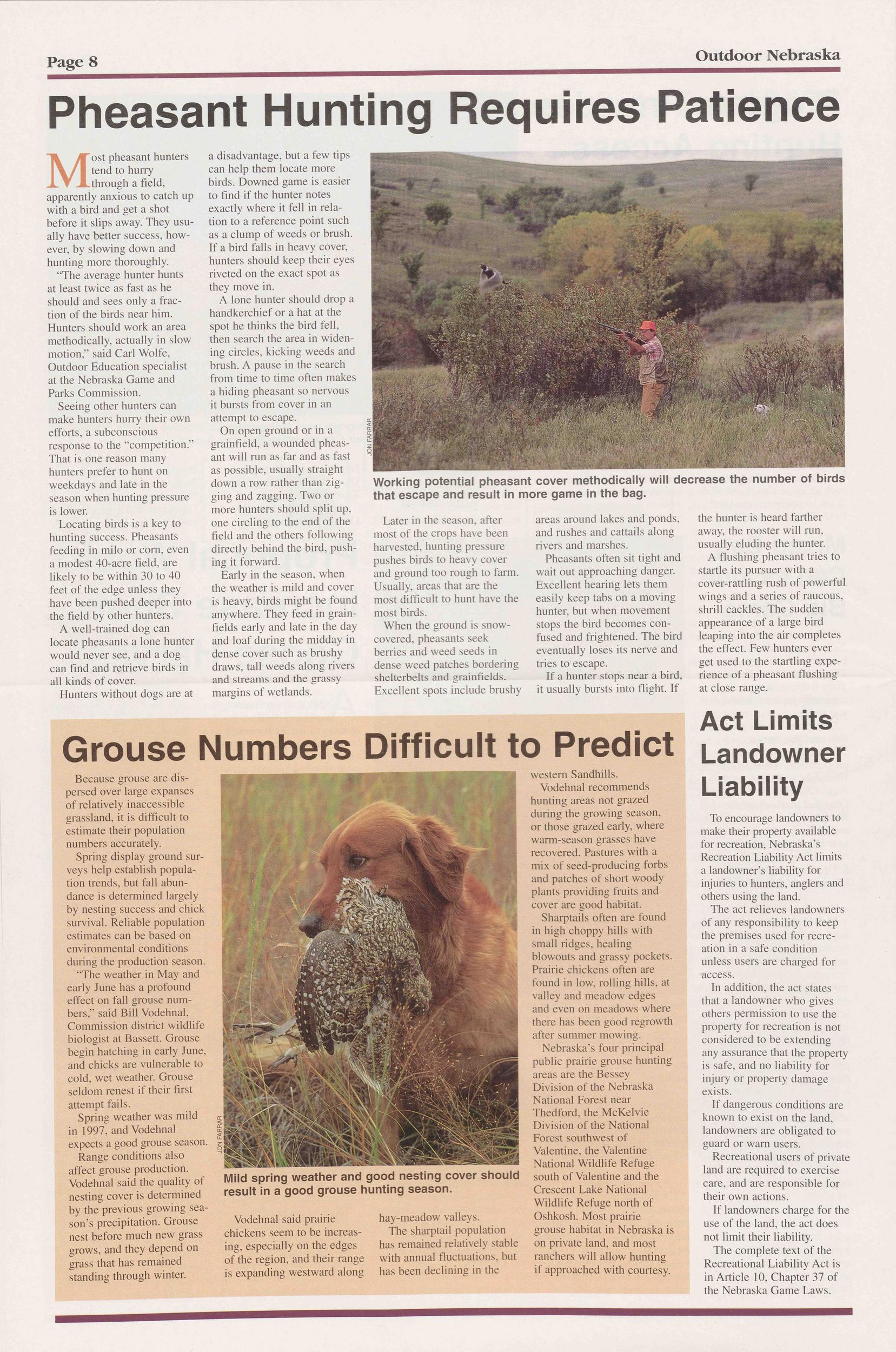 Page 8
Outdoor Nebraska
Page 8
Outdoor Nebraska
Pheasant Hunting Requires Patience
Most pheasant hunters tend to hurry through a field, apparently anxious to catch up with a bird and get a shot before it slips away. They usually have better success, however, by slowing down and hunting more thoroughly.
"The average hunter hunts at least twice as fast as he should and sees only a fraction of the birds near him. Hunters should work an area methodically, actually in slow motion," said Carl Wolfe, Outdoor Education specialist at the Nebraska Game and Parks Commission.
Seeing other hunters can make hunters hurry their own efforts, a subconscious response to the "competition." That is one reason many hunters prefer to hunt on weekdays and late in the season when hunting pressure is lower.
Locating birds is a key to hunting success. Pheasants feeding in milo or corn, even a modest 40-acre field, are likely to be within 30 to 40 feet of the edge unless they have been pushed deeper into the field by other hunters.
A well-trained dog can locate pheasants a lone hunter would never see, and a dog can find and retrieve birds in all kinds of cover.
Hunters without dogs are at a disadvantage, but a few tips can help them locate more birds. Downed game is easier to find if the hunter notes exactly where it fell in relation to a reference point such as a clump of weeds or brush. If a bird falls in heavy cover, hunters should keep their eyes riveted on the exact spot as they move in.
A lone hunter should drop a handkerchief or a hat at the spot he thinks the bird fell, then search the area in widening circles, kicking weeds and brush. A pause in the search from time to time often makes a hiding pheasant so nervous it bursts from cover in an attempt to escape.
On open ground or in a grainfield, a wounded pheasant will run as far and as fast as possible, usually straight down a row rather than zigging and zagging. Two or more hunters should split up, one circling to the end of the field and the others following directly behind the bird, pushing it forward.
Early in the season, when the weather is mild and cover is heavy, birds might be found anywhere. They feed in grainfields early and late in the day and loaf during the midday in dense cover such as brushy draws, tall weeds along rivers and streams and the grassy margins of wetlands.
Working potential pheasant cover methodically will decrease the number of birds that escape and result in more game in the bag.
Later in the season, after most of the crops have been harvested, hunting pressure pushes birds to heavy cover and ground too rough to farm. Usually, areas that are the most difficult to hunt have the most birds.
When the ground is snow-covered, pheasants seek berries and weed seeds in dense weed patches bordering shelterbelts and srainfields. Excellent spots include brushy areas around lakes and ponds, and rushes and cattails along rivers and marshes.
Pheasants often sit tight and wait out approaching danger. Excellent hearing lets them easily keep tabs on a moving hunter, but when movement stops the bird becomes confused and frightened. The bird eventually loses its nerve and tries to escape.
If a hunter stops near a bird, it usually bursts into flight. If the hunter is heard farther away, the rooster will run, usually eluding the hunter.
A flushing pheasant tries to startle its pursuer with a cover-rattling rush of powerful wings and a series of raucous, shrill cackles. The sudden appearance of a large bird leaping into the air completes the effect. Few hunters ever get used to the startling experience of a pheasant flushing at close range.
Grouse Numbers Difficult to Predict
Because grouse are dispersed over large expanses of relatively inaccessible grassland, it is difficult to estimate their population numbers accurately.
Spring display ground surveys help establish population trends, but fall abundance is determined largely by nesting success and chick survival. Reliable population estimates can be based on environmental conditions during the production season.
"The weather in May and early June has a profound effect on fall grouse numbers," said Bill Vodehnal, Commission district wildlife biologist at Bassett. Grouse begin hatching in early June, and chicks are vulnerable to cold, wet weather. Grouse seldom renest if their first attempt fails.
Spring weather was mild in 1997, and Vodehnal expects a good grouse season.
Range conditions also affect grouse production. Vodehnal said the quality of nesting cover is determined by the previous growing season's precipitation. Grouse nest before much new grass grows, and they depend on grass that has remained standing through winter.
Mild spring weather and good nesting cover should result in a good grouse hunting season.
Vodehnal said prairie chickens seem to be increasing, especially on the edges of the region, and their range is expanding westward along hay-meadow valleys.
The sharptail population has remained relatively stable with annual fluctuations, but has been declining in the western Sandhills.
Vodehnal recommends hunting areas not grazed during the growing season, or those grazed early, where warm-season grasses have recovered. Pastures with a mix of seed-producing forbs and patches of short woody plants providing fruits and cover are good habitat.
Sharptails often are found in high choppy hills with small ridges, healing blowouts and grassy pockets. Prairie chickens often are found in low, rolling hills, at valley and meadow edges and even on meadows where there has been good regrowth after summer mowing.
Nebraska's four principal public prairie grouse hunting areas are the Bessey Division of the Nebraska National Forest near Thedford, the McKelvie Division of the National Forest southwest of Valentine, the Valentine National Wildlife Refuge south of Valentine and the Crescent Lake National Wildlife Refuge north of Oshkosh. Most prairie grouse habitat in Nebraska is on private land, and most ranchers will allow hunting if approached with courtesy.
Act Limits Landowner Liability
To encourage landowners to make their property available for recreation, Nebraska's Recreation Liability Act limits a landowner's liability for injuries to hunters, anglers and others using the land.
The act relieves landowners of any responsibility to keep the premises used for recreation in a safe condition unless users are charged for access.
In addition, the act states that a landowner who gives others permission to use the property for recreation is not considered to be extending any assurance that the property is safe, and no liability for injury or property damage exists.
If dangerous conditions are known to exist on the land, landowners are obligated to guard or warn users.
Recreational users of private land are required to exercise care, and are responsible for their own actions.
If landowners charge for the use of the land, the act does not limit their liability.
The complete text of the Recreational Liability Act is in Article 10, Chapter 37 of the Nebraska Game Laws.
Position: 798 (13 views)