Volume 75, Issue 6, 1997

NEBRASKAland
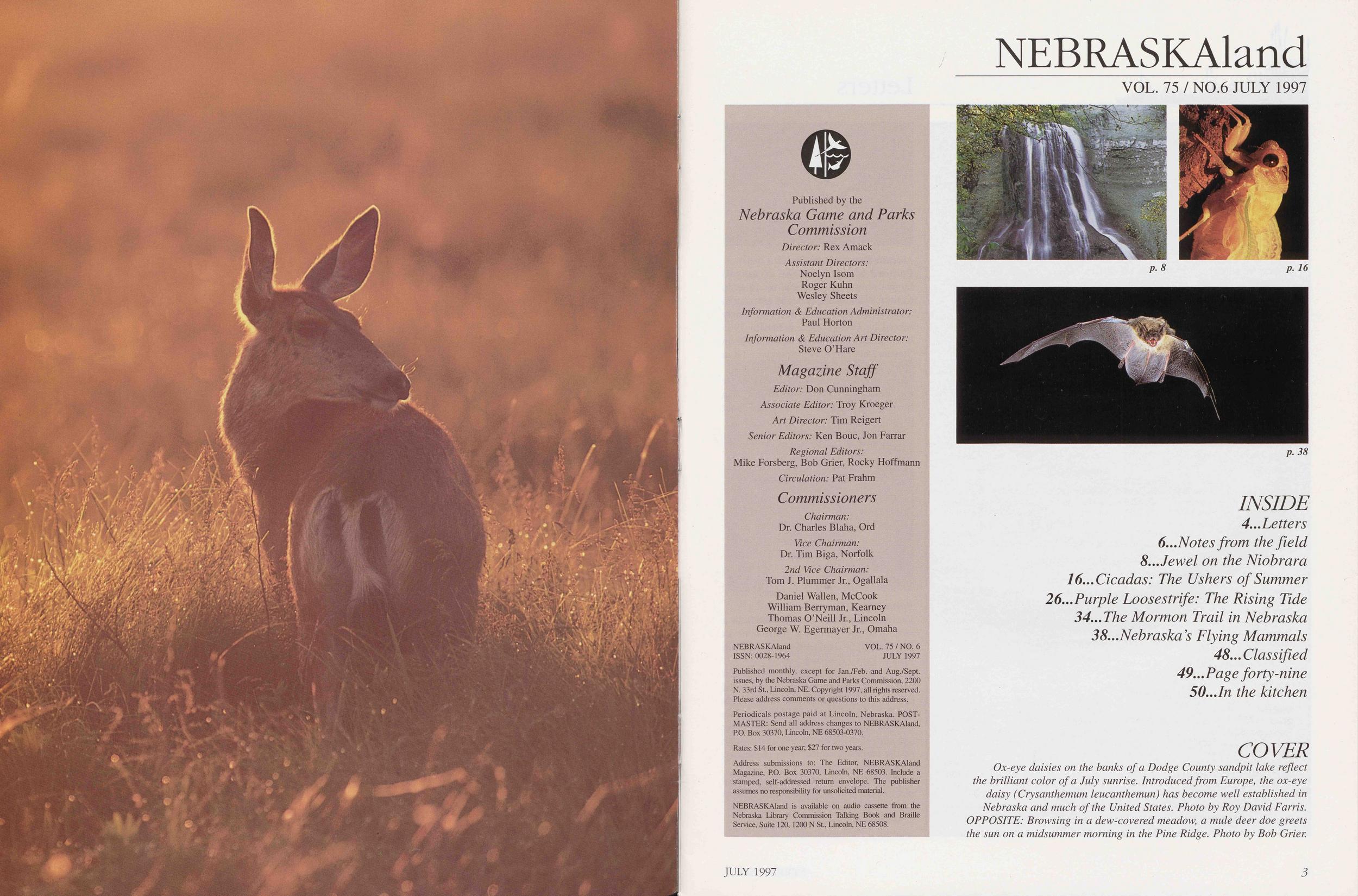
NEBRASKAland
VOL. 75 / NO. 6 JULY 1997 Published by the Nebraska Game and Parks Commission Director: Rex Amack Assistant Directors: Noelyn Isom Roger Kuhn Wesley Sheets Information & Education Administrator: Paul Horton Information & Education Art Director: Steve O'Hare Magazine Staff Editor: Don Cunningham Associate Editor: Troy Kroeger Art Director: Tim Reigert Senior Editors: Ken Bouc, Jon Farrar Regional Editors: Mike Forsberg, Bob Grier, Rocky Hoffmann Circulation: Pat Frahm Commissioners Chairman: Dr. Charles Blaha, Ord Vice Chairman: Dr. Tim Biga, Norfolk 2nd Vice Chairman: Tom J. Plummer Jr., Ogallala Daniel Wallen, McCook William Berry man, Kearney Thomas O'Neill Jr., Lincoln George W. Egermayer Jr., Omaha NEBRASKAland ISSN: 0028-1964 VOL. 75 / NO. 6 JULY 1997 Published monthly, except for Jan./Feb. and Aug./Sept. issues, by the Nebraska Game and Parks Commission, 2200 N. 33rd St., Lincoln, NE. Copyright 1997, all rights reserved. Please address comments or questions to this address. Periodicals postage paid at Lincoln, Nebraska. POSTMASTER: Send all address changes to NEBRASKAland, P.O. Box 30370, Lincoln, NE 68503-0370. Rates: $14 for one year; $27 for two years. Address submissions to: The Editor, NEBRASKAland Magazine, P.O. Box 30370, Lincoln, NE 68503. Include a stamped, self-addressed return envelope. The publisher assumes no responsibility for unsolicited material. NEBRASKAland is available on audio cassette from the Nebraska Library Commission Talking Book and Braille Service, Suite 120,1200 N St., Lincoln, NE 68508.
Letters
Enclosed is a photo of one of the two largest cottonwood trees in Lincoln County. A volunteer, it began growing in about 1900 on a farm north of Brady owned by George Fickenscher. In 1965 he sold the farm to his nephew Orvin Stevens, and Ken Stevens purchased it in 1991.
The tree was measured and verified by the Extension Service in 1995. Ken Stevens provided the information about its history.
Jann BellBrady, Nebraska
Enclosed is a photo of birds that built a nest near my mother's front door in Anselmo. She included the following lines in her Christmas letter:
"In June, a pair of birds discovered a barbed wire wreath with a little nest and artificial bird by the nest. The birds decided to make the nest their home on my house. Four small eggs soon appeared. During the nesting period, one of the parents guarded them constantly. Three babies survived."
My mother, Irene Christy, is 84 years old. She has always enjoyed birds, flowers and the other beauties of nature.
William S. ChristySidney, Nebraska
4 NEBRASKAland Homesick for NebraskaI have subscribed to NEBRASKAland for years and it keeps me in touch with the part of the country that I love most, western Nebraska.
I still get out to Scottsbluff and the surrounding area every few years, and I hate to leave every time. Even though I am living in South Carolina now, my heart is still out in the Panhandle.
Keep up the fine work and the photography. NEBRASKAland's coverage and presentation of subject matter is without a doubt the best of this kind of magazine.
Tex DendyNorth Augusta, South Carolina
These five little geese hatched on the lakes at the Western Nebraska Veterans Home in Scottsbluff on May 4. There was another hatch a week later.
We have so much fun at our lake, and we fish there, too. I've lived here for eight years.
Iva RossScottsbluff, Nebraska
Correction A printer's error in the June issue caused lines to be omitted from the "Page forty-nine" column. The last three lines should read: But next year I think I'll go mushroom hunting without my fungiverous friend. Don Cunningham Write to: Letters, NEBRASKAland Magazine, P.O. Box30370, Lincoln, NE 68503. Fax: (402) 471-5528. E-mail: nebland@ngpsun.ngpc. state.ne. us. Photographs are welcome.
Notes from the field
Road Hunting WildflowersSince the invention of the automobile, and even in horse-and buggy days, there have been road hunters. For most of this century, bagging your quarry from the roadway has been illegal, but there are still those who prefer it to hunting behind a bird dog.
There is a form of road hunting, though, that is not only legal but enjoyable: road hunting for wildflowers. Most Nebraska prairie is now used for row-crop production or grazing, and throughout much of the state, the best remnants of native grassland are now found in roadsides.
Even in range country, where grasslands are the foundation of life, the composition of the native prairie has changed. "Candy plants," those preferred by grazing animals, plants like leadplant and sensitive brier, persist only on the road side of barbed-wire fences.
Except when heavy rains turn them into muddy quagmires, the best wildflower roads are those least traveled, roads ignored by county weed-control crews spraying for noxious weeds. Roads that pass near rock outcrops, through native grasslands and hay meadows or along streams and wetlands are particularly fertile hunting grounds.
Minimum-maintenance signs often mark drives where native grasses, shrubs and wildflowers will be found. For those who gather wild fruits for jams, jellies and wine, a drive for wildflowers is also a good time to track the progress of plum, grape, raspberry, chokecherry, elderberry, buffalo berry and sand cherry crops.
From May through September, the palette of wildflowers along Nebraska's back roads changes constantly, and July is among the best of months to view them. Plants of medium height tower over the early-flowering, short-stature plants, and by the end of the month, chest-high plants of late summer command the landscape.
Wildflower hunters searching roadside wetlands in July might find swamp milkweed, Illinois bundleflower, marsh mallow, coreopsis, Alleghany monkey-flower, arrowheads, Joe-pye weed, spotted touch-me-not, native loosestrifes and perhaps even a few late-flowering meadow anemones. These are showy wildflowers not otherwise encountered without donning hip boots or launching a canoe.
In July, some eastern Nebraska roadsides are lined with the blue of chicory and wild lettuce; the yellow of
black-eyed Susan, partridge pea, gray-head coneflower and bird's-foot trefoil; the creamy white of bouncing Bet and Queen Anne's lace; the red-violet of tickclovers; the orange-red of butterfly milkweed; and in shaded, river-valley woodlands, the cool blue blossoms of American bellflower. In hay meadows not cropped until later in summer might be Indian plantain and purple and white prairie clovers.
Some wildflower enthusiasts see beauty only in the blossoms of pristine prairie plants, but the flowers of native plants that evolved to reclaim disturbed soils often deserve equal admiration. True, some of those pioneer plants are coarse, some even prickly, but they serve a need of nature. In disturbed pastures, look for ironweeds, beebalms, snow-on-the-mountain, horse-nettle, vervains, buffalo bur and curly-top gumweed.
Watch, too, for native thistles — Flodman's and perhaps a late-flowering Platte thistle — that belong in our grasslands but have been condemned along with the invasive exotics like Canada thistle and musk thistle. July is the time prairie gentians raise their pale blue blossoms in sandy pastures along the Platte River, and a few poppy mallows still blanket the ground.
When conditions are right in early July, fields of fourpoint evening primrose paint the Sandhills with lemon-yellow, and the white flowers of mentzelia, prickly poppy and gilia define single-lane ranch roads. Look closely on healing roadcuts for the delicate rows of leaves and trailing flowerheads of silky prairie clover. In western Nebraska, rocky pastures are sometimes white with the delicate flowers of ground-hugging evening primroses.
It is in July that the dusty mauve of milkweed blossoms line the roadsides, common milkweed in the east and showy milkweed in the west, and prairie coneflowers have their last hurrah in pastures. In central and western Nebraska, the prickly pears spread their fleshy blossoms after the sun rises JULY 1997 and close them before it falls to the horizon.
As with those who pursue game animals, there are wildflower hunters who search for trophy flowers, and in July three Nebraska species are sought because of their rarity — the prairie fringed orchid of eastern tallgrass prairie and wet meadows in the Sandhills, western red lily in northern Sandhills meadows and Turk's cap lily in eastern meadows, particularly along the Elkhorn River.
During July, tall summer bloomers show their colors — rosinweed, false sunflower, compass plant and cupplant. As the month draws to a close, the vanguard of late-summer flowers appears — early-flowering sunflowers and goldenrods; thick-spike gayfeather in the east, dotted gayfeather and blazing star in the central and west. The seedheads of native warm-season grasses are beginning to unfurl, too, and spider webs are strung between them like fishnets, sagging under the weight of morning dew.
Wildflowers are freshest in early morning, but the end of the day when the wind falls can be nearly as rewarding. Some roadway flower hunters use field glasses to scan grasslands and creekbottoms before deciding if a closer look is warranted. That is the advantage of road hunting — it can all be done from the comfort of a car. Strong legs and a resistance to mosquitoes are not required.
It is human nature to name all things, and so a good field guide should be a companion on wildflower forays to better define the multitudinous "bluebells" and "buttercups" and to learn more about the plants than just their names.
Caution should be exercised while road hunting, and the rights of landowners and motorists not traveling so leisurely should be respected. The safest roads are those infrequently traveled. Do not stop near hilltops or curves, pull off the road when possible and use flasher lights when stopped.
Jon Farrar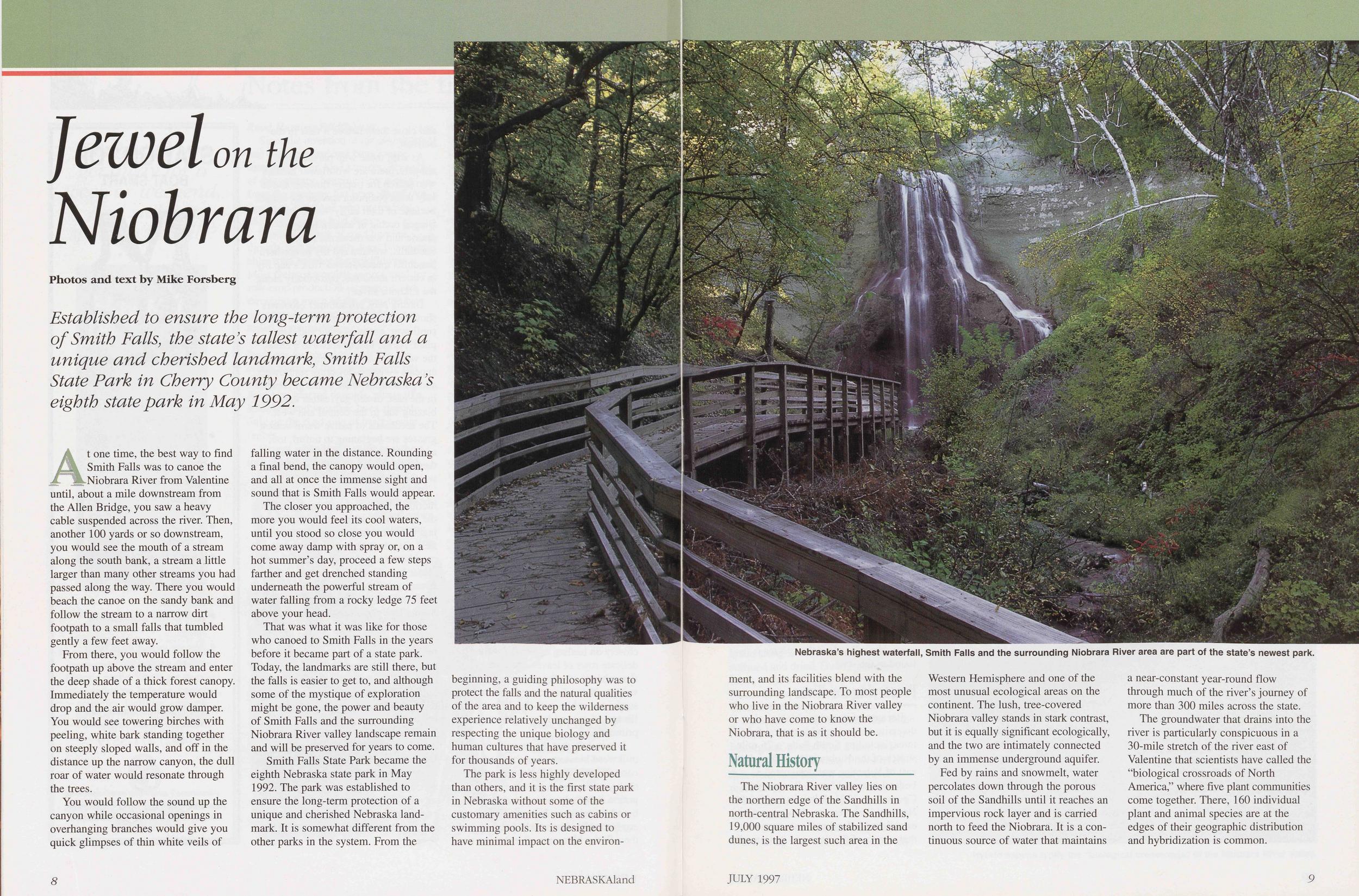
Jewel on the Niobrara
Established to ensure the long-term protection of Smith Falls, the state's tallest waterfall and a unique and cherished landmark, Smith Falls State Park in Cherry County became Nebraska's eighth state park in May 1992.
At one time, the best way to find Smith Falls was to canoe the Niobrara River from Valentine until, about a mile downstream from the Allen Bridge, you saw a heavy cable suspended across the river. Then, another 100 yards or so downstream, you would see the mouth of a stream along the south bank, a stream a little larger than many other streams you had passed along the way. There you would beach the canoe on the sandy bank and follow the stream to a narrow dirt footpath to a small falls that tumbled gently a few feet away.
From there, you would follow the footpath up above the stream and enter the deep shade of a thick forest canopy. Immediately the temperature would drop and the air would grow damper. You would see towering birches with peeling, white bark standing together on steeply sloped walls, and off in the distance up the narrow canyon, the dull roar of water would resonate through the trees.
You would follow the sound up the canyon while occasional openings in overhanging branches would give you quick glimpses of thin white veils of falling water in the distance. Rounding a final bend, the canopy would open, and all at once the immense sight and sound that is Smith Falls would appear.
The closer you approached, the more you would feel its cool waters, until you stood so close you would come away damp with spray or, on a hot summer's day, proceed a few steps farther and get drenched standing underneath the powerful stream of water falling from a rocky ledge 75 feet above your head.
That was what it was like for those who canoed to Smith Falls in the years before it became part of a state park. Today, the landmarks are still there, but the falls is easier to get to, and although some of the mystique of exploration might be gone, the power and beauty of Smith Falls and the surrounding Niobrara River valley landscape remain and will be preserved for years to come.
Smith Falls State Park became the eighth Nebraska state park in May 1992. The park was established to ensure the long-term protection of a unique and cherished Nebraska landmark. It is somewhat different from the other parks in the system. From the beginning, a guiding philosophy was to protect the falls and the natural qualities of the area and to keep the wilderness experience relatively unchanged by respecting the unique biology and human cultures that have preserved it for thousands of years.
The park is less highly developed than others, and it is the first state park in Nebraska without some of the customary amenities such as cabins or swimming pools. Its is designed to have minimal impact on the environment,
8 NEBRASKAlandNebraska's highest waterfall, Smith Falls and the surrounding Niobrara River area are part of the state's newest park.
and its facilities blend with the surrounding landscape. To most people who live in the Niobrara River valley or who have come to know the Niobrara, that is as it should be.
Natural HistoryThe Niobrara River valley lies on the northern edge of the Sandhills in north-central Nebraska. The Sandhills, 19,000 square miles of stabilized sand dunes, is the largest such area in the Western Hemisphere and one of the most unusual ecological areas on the continent. The lush, tree-covered Niobrara valley stands in stark contrast, but it is equally significant ecologically, and the two are intimately connected by an immense underground aquifer.
Fed by rains and snowmelt, water percolates down through the porous soil of the Sandhills until it reaches an impervious rock layer and is carried north to feed the Niobrara. It is a continuous source of water that maintains a near-constant year-round flow through much of the river's journey of more than 300 miles across the state.
The groundwater that drains into the river is particularly conspicuous in a 30-mile stretch of the river east of Valentine that scientists have called the "biological crossroads of North America," where five plant communities come together. There, 160 individual plant and animal species are at the edges of their geographic distribution and hybridization is common.
JULY 1997 9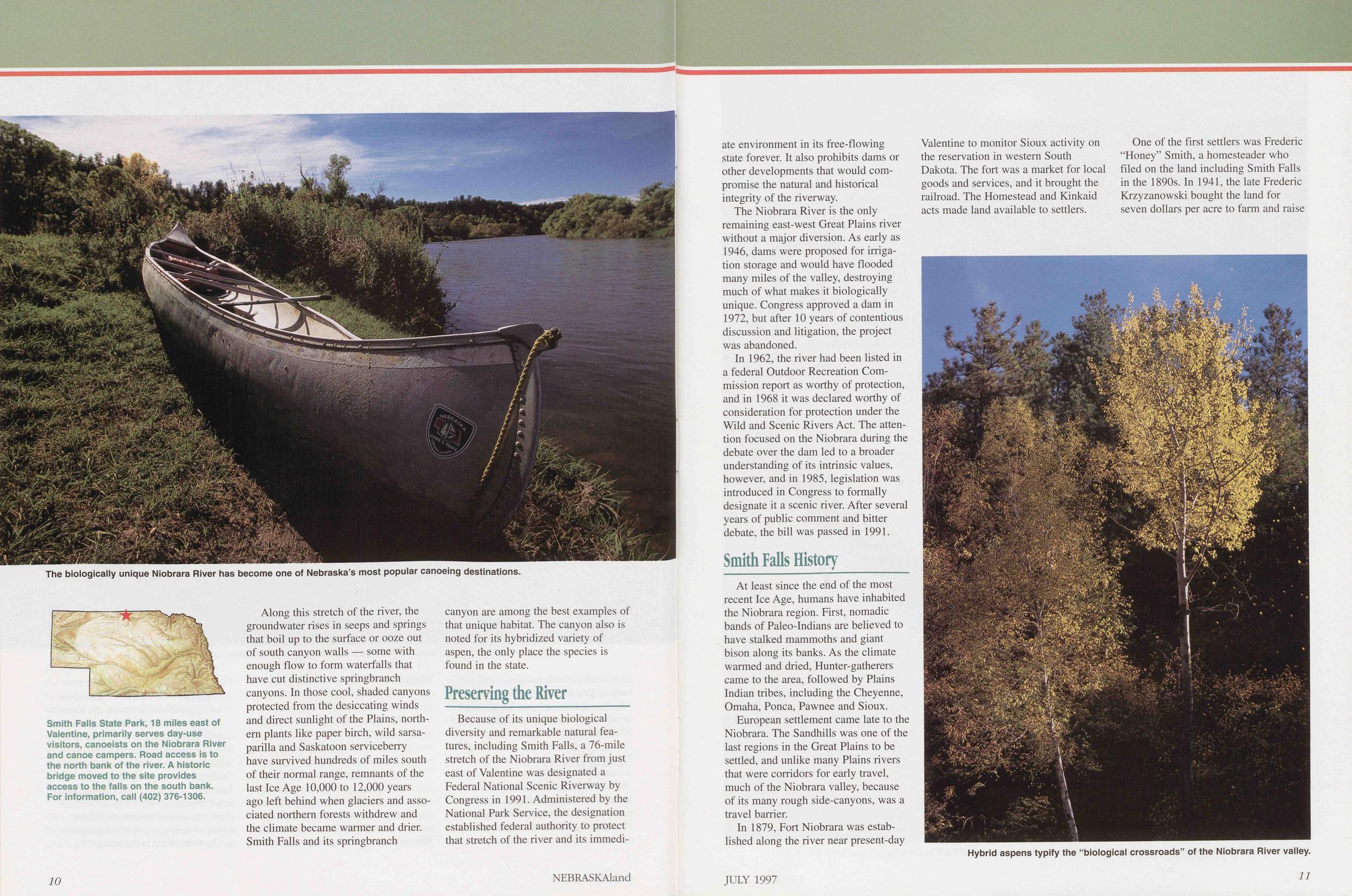
The biologically unique Niobrara River has become one of Nebraska's most popular canoeing destinations.
Along this stretch of the river, the groundwater rises in seeps and springs that boil up to the surface or ooze out of south canyon walls — some with enough flow to form waterfalls that have cut distinctive springbranch canyons. In those cool, shaded canyons protected from the desiccating winds and direct sunlight of the Plains, northern plants like paper birch, wild sarsaparilla and Saskatoon serviceberry have survived hundreds of miles south of their normal range, remnants of the last Ice Age 10,000 to 12,000 years ago left behind when glaciers and associated northern forests withdrew and the climate became warmer and drier. Smith Falls and its springbranch canyon are among the best examples of that unique habitat. The canyon also is noted for its hybridized variety of aspen, the only place the species is found in the state.
Preserving the RiverBecause of its unique biological diversity and remarkable natural features, including Smith Falls, a 76-mile stretch of the Niobrara River from just east of Valentine was designated a Federal National Scenic Riverway by Congress in 1991. Administered by the National Park Service, the designation established federal authority to protect that stretch of the river and its immediate
10 NEBRASKAlandenvironment in its free-flowing state forever. It also prohibits dams or other developments that would compromise the natural and historical integrity of the riverway.
The Niobrara River is the only remaining east-west Great Plains river without a major diversion. As early as 1946, dams were proposed for irrigation storage and would have flooded many miles of the valley, destroying much of what makes it biologically unique. Congress approved a dam in 1972, but after 10 years of contentious discussion and litigation, the project was abandoned.
In 1962, the river had been listed in a federal Outdoor Recreation Commission report as worthy of protection, and in 1968 it was declared worthy of consideration for protection under the Wild and Scenic Rivers Act. The attention focused on the Niobrara during the debate over the dam led to a broader understanding of its intrinsic values, however, and in 1985, legislation was introduced in Congress to formally designate it a scenic river. After several years of public comment and bitter debate, the bill was passed in 1991.
Smith Falls HistoryAt least since the end of the most recent Ice Age, humans have inhabited the Niobrara region. First, nomadic bands of Paleo-Indians are believed to have stalked mammoths and giant bison along its banks. As the climate warmed and dried, Hunter-gatherers came to the area, followed by Plains Indian tribes, including the Cheyenne, Omaha, Ponca, Pawnee and Sioux.
European settlement came late to the Niobrara. The Sandhills was one of the last regions in the Great Plains to be settled, and unlike many Plains rivers that were corridors for early travel, much of the Niobrara valley, because of its many rough side-canyons, was a travel barrier.
In 1879, Fort Niobrara was established along the river near present-day Valentine to monitor Sioux activity on the reservation in western South Dakota. The fort was a market for local goods and services, and it brought the railroad. The Homestead and Kinkaid acts made land available to settlers.
One of the first settlers was Frederic "Honey" Smith, a homesteader who filed on the land including Smith Falls in the 1890s. In 1941, the late Frederic Krzyzanowski bought the land for seven dollars per acre to farm and raise
Hybrid aspens typify the "biological crossroads" of the Niobrara River valley.
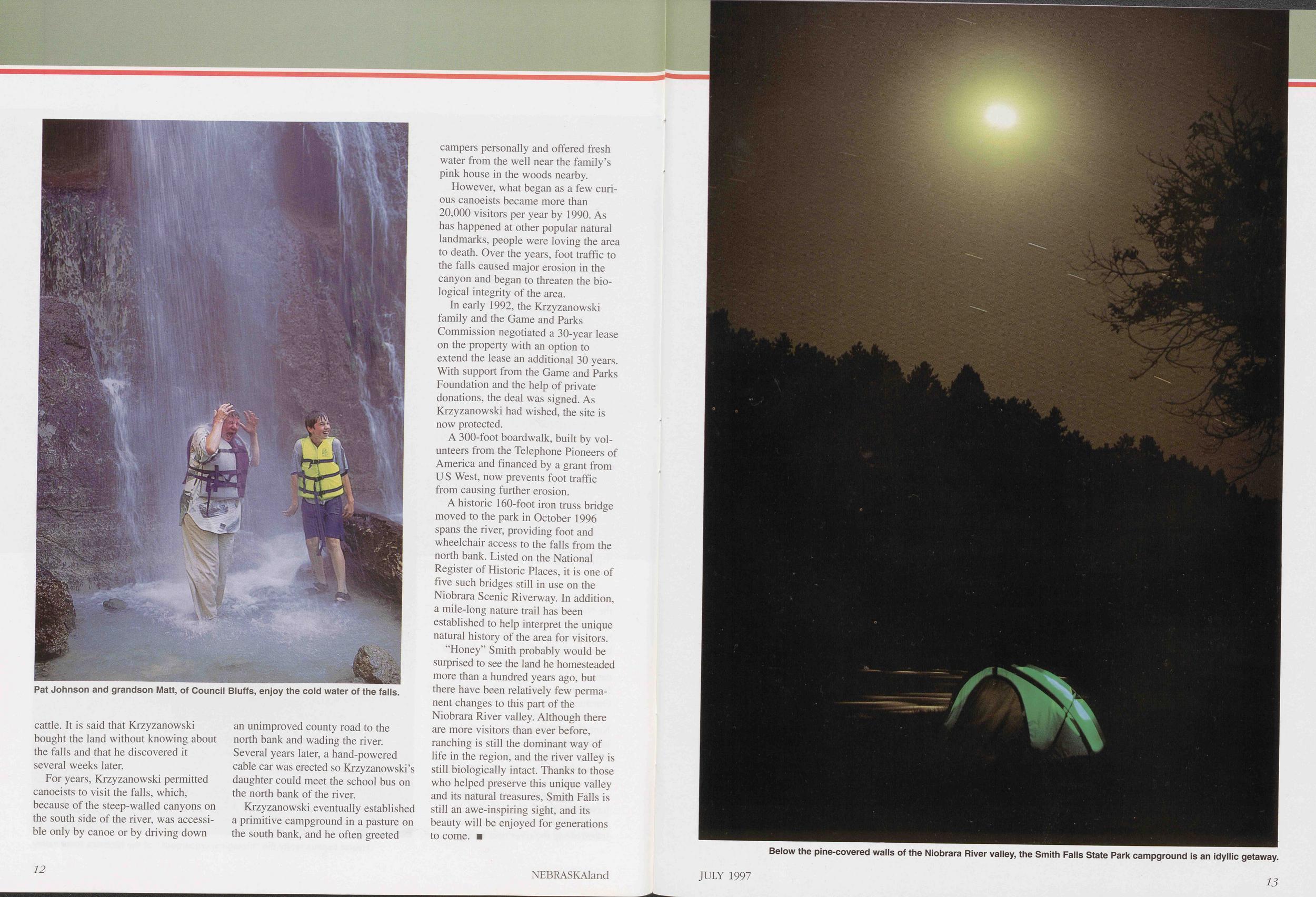
Pat Johnson and grandson Matt, of Council Bluffs, enjoy the cold water of the falls.
cattle. It is said that Krzyzanowski bought the land without knowing about the falls and that he discovered it several weeks later.
For years, Krzyzanowski permitted canoeists to visit the falls, which, because of the steep-walled canyons on the south side of the river, was accessible only by canoe or by driving down an unimproved county road to the north bank and wading the river. Several years later, a hand-powered cable car was erected so Krzyzanowski's daughter could meet the school bus on the north bank of the river.
Krzyzanowski eventually established a primitive campground in a pasture on the south bank, and he often greeted campers personally and offered fresh water from the well near the family's pink house in the woods nearby.
However, what began as a few curious canoeists became more than 20,000 visitors per year by 1990. As has happened at other popular natural landmarks, people were loving the area to death. Over the years, foot traffic to the falls caused major erosion in the canyon and began to threaten the biological integrity of the area.
In early 1992, the Krzyzanowski family and the Game and Parks Commission negotiated a 30-year lease on the property with an option to extend the lease an additional 30 years. With support from the Game and Parks Foundation and the help of private donations, the deal was signed. As Krzyzanowski had wished, the site is now protected.
A 300-foot boardwalk, built by volunteers from the Telephone Pioneers of America and financed by a grant from U S West, now prevents foot traffic from causing further erosion.
A historic 160-foot iron truss bridge moved to the park in October 1996 spans the river, providing foot and wheelchair access to the falls from the north bank. Listed on the National Register of Historic Places, it is one of five such bridges still in use on the Niobrara Scenic Riverway. In addition, a mile-long nature trail has been established to help interpret the unique natural history of the area for visitors.
"Honey" Smith probably would be surprised to see the land he homesteaded more than a hundred years ago, but there have been relatively few permanent changes to this part of the Niobrara River valley. Although there are more visitors than ever before, ranching is still the dominant way of life in the region, and the river valley is still biologically intact. Thanks to those who helped preserve this unique valley and its natural treasures, Smith Falls is still an awe-inspiring sight, and its beauty will be enjoyed for generations to come.
12 NEBRASKAlandBelow the pine-covered walls of the Niobrara River valley, the Smith Falls State Park campground is an idyllic getaway.
JULY 1997 13
Historic Bridge to a Natural Treasure
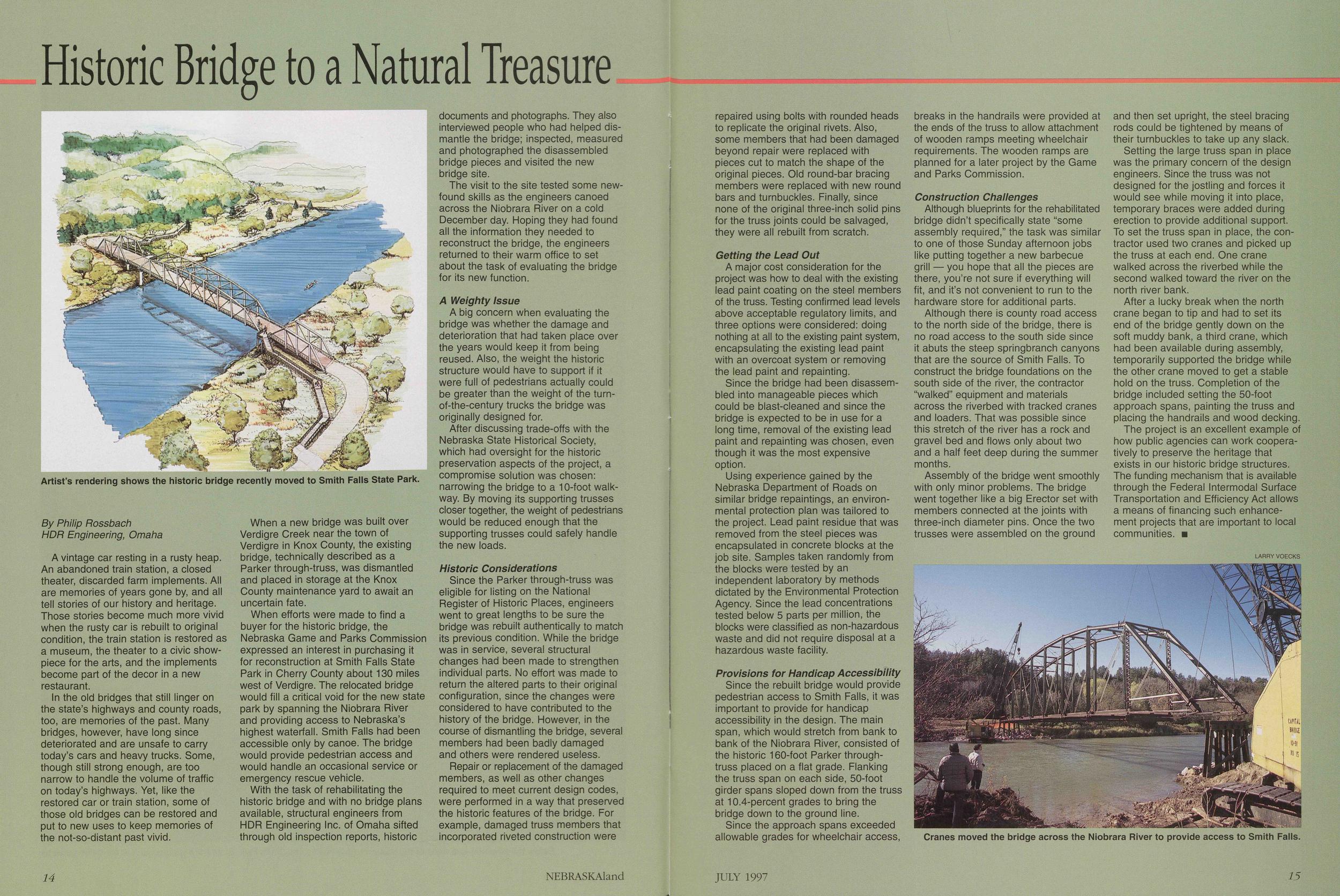
Artist's rendering shows the historic bridge recently moved to Smith Falls State Park.
A vintage car resting in a rusty heap. An abandoned train station, a closed theater, discarded farm implements. All are memories of years gone by, and all tell stories of our history and heritage. Those stories become much more vivid when the rusty car is rebuilt to original condition, the train station is restored as a museum, the theater to a civic showpiece for the arts, and the implements become part of the decor in a new restaurant.
In the old bridges that still linger on the state's highways and county roads, too, are memories of the past. Many bridges, however, have long since deteriorated and are unsafe to carry today's cars and heavy trucks. Some, though still strong enough, are too narrow to handle the volume of traffic on today's highways. Yet, like the restored car or train station, some of those old bridges can be restored and put to new uses to keep memories of the not-so-distant past vivid.
When a new bridge was built over Verdigre Creek near the town of Verdigre in Knox County, the existing bridge, technically described as a Parker through-truss, was dismantled and placed in storage at the Knox County maintenance yard to await an uncertain fate.
When efforts were made to find a buyer for the historic bridge, the Nebraska Game and Parks Commission expressed an interest in purchasing it for reconstruction at Smith Falls State Park in Cherry County about 130 miles west of Verdigre. The relocated bridge would fill a critical void for the new state park by spanning the Niobrara River and providing access to Nebraska's highest waterfall. Smith Falls had been accessible only by canoe. The bridge would provide pedestrian access and would handle an occasional service or emergency rescue vehicle.
With the task of rehabilitating the historic bridge and with no bridge plans available, structural engineers from HDR Engineering Inc. of Omaha sifted through old inspection reports, historic documents and photographs. They also interviewed people who had helped dismantle the bridge; inspected, measured and photographed the disassembled bridge pieces and visited the new bridge site.
The visit to the site tested some newfound skills as the engineers canoed across the Niobrara River on a cold December day. Hoping they had found all the information they needed to reconstruct the bridge, the engineers returned to their warm office to set about the task of evaluating the bridge for its new function.
A Weighty IssueA big concern when evaluating the bridge was whether the damage and deterioration that had taken place over the years would keep it from being reused. Also, the weight the historic structure would have to support if it were full of pedestrians actually could be greater than the weight of the turn-of-the-century trucks the bridge was originally designed for.
After discussing trade-offs with the Nebraska State Historical Society, which had oversight for the historic preservation aspects of the project, a compromise solution was chosen: narrowing the bridge to a 10-foot walkway. By moving its supporting trusses closer together, the weight of pedestrians would be reduced enough that the supporting trusses could safely handle the new loads.
Historic ConsiderationsSince the Parker through-truss was eligible for listing on the National Register of Historic Places, engineers went to great lengths to be sure the bridge was rebuilt authentically to match its previous condition. While the bridge was in service, several structural changes had been made to strengthen individual parts. No effort was made to return the altered parts to their original configuration, since the changes were considered to have contributed to the history of the bridge. However, in the course of dismantling the bridge, several members had been badly damaged and others were rendered useless.
Repair or replacement of the damaged members, as well as other changes required to meet current design codes, were performed in a way that preserved the historic features of the bridge. For example, damaged truss members that incorporated riveted construction were
14 NEBRASKAlandrepaired using bolts with rounded heads to replicate the original rivets. Also, some members that had been damaged beyond repair were replaced with pieces cut to match the shape of the original pieces. Old round-bar bracing members were replaced with new round bars and tumbuckles. Finally, since none of the original three-inch solid pins for the truss joints could be salvaged, they were all rebuilt from scratch.
Getting the Lead OutA major cost consideration for the project was how to deal with the existing lead paint coating on the steel members of the truss. Testing confirmed lead levels above acceptable regulatory limits, and three options were considered: doing nothing at ail to the existing paint system, encapsulating the existing lead paint with an overcoat system or removing the lead paint and repainting.
Since the bridge had been disassembled into manageable pieces which could be blast-cleaned and since the bridge is expected to be in use for a long time, removal of the existing lead paint and repainting was chosen, even though it was the most expensive option.
Using experience gained by the Nebraska Department of Roads on similar bridge repaintings, an environmental protection plan was tailored to the project. Lead paint residue that was removed from the steel pieces was encapsulated in concrete blocks at the job site. Samples taken randomly from the blocks were tested by an independent laboratory by methods dictated by the Environmental Protection Agency. Since the lead concentrations tested below 5 parts per million, the blocks were classified as non-hazardous waste and did not require disposal at a hazardous waste facility.
Provisions for Handicap AccessibilitySince the rebuilt bridge would provide pedestrian access to Smith Falls, it was important to provide for handicap accessibility in the design. The main span, which would stretch from bank to bank of the Niobrara River, consisted of the historic 160-foot Parker through-truss placed on a flat grade. Flanking the truss span on each side, 50-foot girder spans sloped down from the truss at 10.4-percent grades to bring the bridge down to the ground line.
Since the approach spans exceeded allowable grades for wheelchair access, breaks in the handrails were provided at the ends of the truss to allow attachment of wooden ramps meeting wheelchair requirements. The wooden ramps are planned for a later project by the Game and Parks Commission.
Construction ChaiiengesAlthough blueprints for the rehabilitated bridge didn't specifically state "some assembly required," the task was similar to one of those Sunday afternoon jobs like putting together a new barbecue grill — you hope that all the pieces are there, you're not sure if everything will fit, and it's not convenient to run to the hardware store for additional parts.
Although there is county road access to the north side of the bridge, there is no road access to the south side since it abuts the steep springbranch canyons that are the source of Smith Falls. To construct the bridge foundations on the south side of the river, the contractor "walked" equipment and materials across the riverbed with tracked cranes and loaders. That was possible since this stretch of the river has a rock and gravel bed and flows only about two and a half feet deep during the summer months.
Assembly of the bridge went smoothly with only minor problems. The bridge went together like a big Erector set with members connected at the joints with three-inch diameter pins. Once the two trusses were assembled on the ground and then set upright, the steel bracing rods could be tightened by means of their tumbuckles to take up any slack.
Setting the large truss span in place was the primary concern of the design engineers. Since the truss was not designed for the jostling and forces it would see while moving it into place, temporary braces were added during erection to provide additional support. To set the truss span in place, the contractor used two cranes and picked up the truss at each end. One crane walked across the riverbed while the second walked toward the river on the north river bank.
After a lucky break when the north crane began to tip and had to set its end of the bridge gently down on the soft muddy bank, a third crane, which had been available during assembly, temporarily supported the bridge while the other crane moved to get a stable hold on the truss. Completion of the bridge included setting the 50-foot approach spans, painting the truss and placing the handrails and wood decking.
The project is an excellent example of how public agencies can work cooperatively to preserve the heritage that exists in our historic bridge structures. The funding mechanism that is available through the Federal Intermodal Surface Transportation and Efficiency Act allows a means of financing such enhancement projects that are important to local communities.
Cranes moved the bridge across the Niobrara River to provide access to Smith Falls.
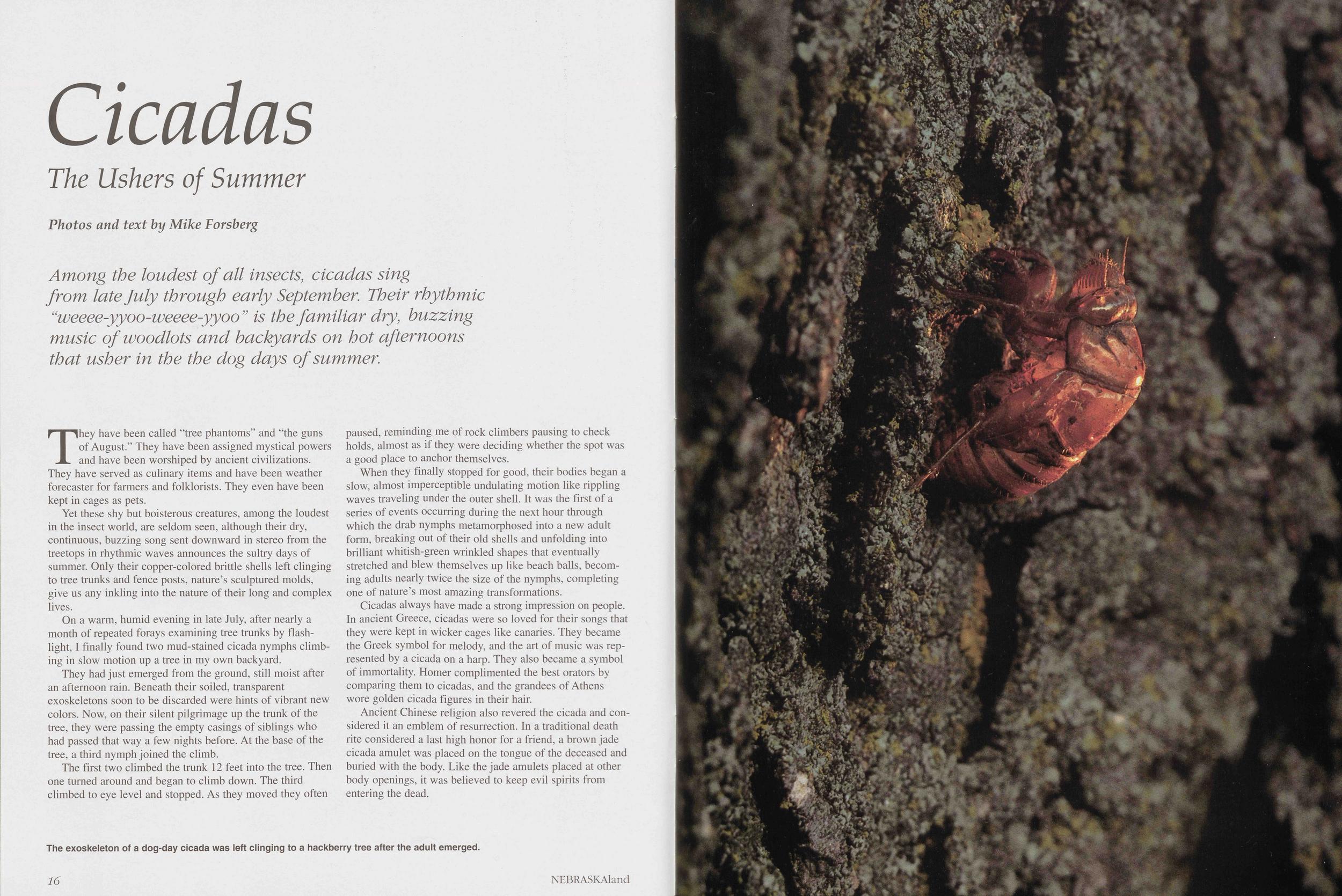
Cicadas The Ushers of Summer
Among the loudest of all insects, cicadas sing from late July through early September. Their rhythmic "weeee-yyoo-weeee-yyoo" is the familiar dry, buzzing music of woodlots and backyards on hot afternoons that usher in the the dog days of summer.
They have been called "tree phantoms" and "the guns of August." They have been assigned mystical powers and have been worshiped by ancient civilizations. They have served as culinary items and have been weather forecaster for farmers and folklorists. They even have been kept in cages as pets.
Yet these shy but boisterous creatures, among the loudest in the insect world, are seldom seen, although their dry, continuous, buzzing song sent downward in stereo from the treetops in rhythmic waves announces the sultry days of summer. Only their copper-colored brittle shells left clinging to tree trunks and fence posts, nature's sculptured molds, give us any inkling into the nature of their long and complex lives.
On a warm, humid evening in late July, after nearly a month of repeated forays examining tree trunks by flashlight, I finally found two mustained cicada nymphs climbing in slow motion up a tree in my own backyard.
They had just emerged from the ground, still moist after an afternoon rain. Beneath their soiled, transparent exoskeletons soon to be discarded were hints of vibrant new colors. Now, on their silent pilgrimage up the trunk of the tree, they were passing the empty casings of siblings who had passed that way a few nights before. At the base of the tree, a third nymph joined the climb.
The first two climbed the trunk 12 feet into the tree. Then one turned around and began to climb down. The third climbed to eye level and stopped. As they moved they often paused, reminding me of rock climbers pausing to check holds, almost as if they were deciding whether the spot was a good place to anchor themselves.
When they finally stopped for good, their bodies began a slow, almost imperceptible undulating motion like rippling waves traveling under the outer shell. It was the first of a series of events occurring during the next hour through which the drab nymphs metamorphosed into a new adult form, breaking out of their old shells and unfolding into brilliant whitish-green wrinkled shapes that eventually stretched and blew themselves up like beach balls, becoming adults nearly twice the size of the nymphs, completing one of nature's most amazing transformations.
Cicadas always have made a strong impression on people. In ancient Greece, cicadas were so loved for their songs that they were kept in wicker cages like canaries. They became the Greek symbol for melody, and the art of music was represented by a cicada on a harp. They also became a symbol of immortality. Homer complimented the best orators by comparing them to cicadas, and the grandees of Athens wore golden cicada figures in their hair.
Ancient Chinese religion also revered the cicada and considered it an emblem of resurrection. In a traditional death rite considered a last high honor for a friend, a brown jade cicada amulet was placed on the tongue of the deceased and buried with the body. Like the jade amulets placed at other body openings, it was believed to keep evil spirits from entering the dead.
The exoskeleton of a dog-day cicada was left clinging to a hackberry tree after the adult emerged. 16 NEBRASKAland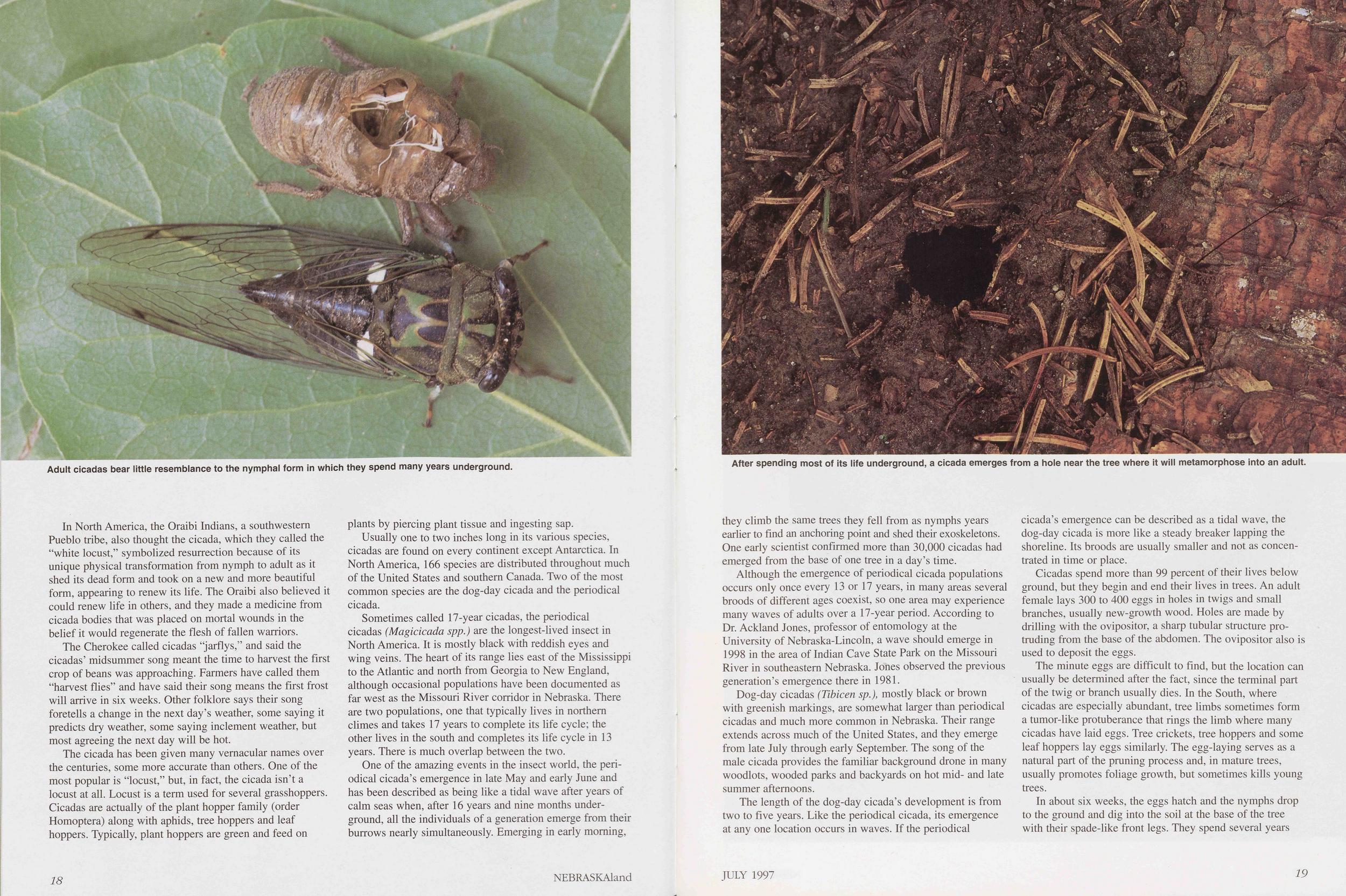
Adult cicadas bear little resemblance to the nymphal form in which they spend many years underground.
In North America, the Oraibi Indians, a southwestern Pueblo tribe, also thought the cicada, which they called the "white locust," symbolized resurrection because of its unique physical transformation from nymph to adult as it shed its dead form and took on a new and more beautiful form, appearing to renew its life. The Oraibi also believed it could renew life in others, and they made a medicine from cicada bodies that was placed on mortal wounds in the belief it would regenerate the flesh of fallen warriors.
The Cherokee called cicadas "jarflys," and said the cicadas' midsummer song meant the time to harvest the first crop of beans was approaching. Farmers have called them "harvest flies" and have said their song means the first frost will arrive in six weeks. Other folklore says their song foretells a change in the next day's weather, some saying it predicts dry weather, some saying inclement weather, but most agreeing the next day will be hot.
The cicada has been given many vernacular names over the centuries, some more accurate than others. One of the most popular is "locust," but, in fact, the cicada isn't a locust at all. Locust is a term used for several grasshoppers. Cicadas are actually of the plant hopper family (order Homoptera) along with aphids, tree hoppers and leaf hoppers. Typically, plant hoppers are green and feed on plants by piercing plant tissue and ingesting sap.
Usually one to two inches long in its various species, cicadas are found on every continent except Antarctica. In North America, 166 species are distributed throughout much of the United States and southern Canada. Two of the most common species are the dog-day cicada and the periodical cicada.
Sometimes called 17-year cicadas, the periodical cicadas (Magicicada spp.) are the longest-lived insect in North America. It is mostly black with reddish eyes and wing veins. The heart of its range lies east of the Mississippi to the Atlantic and north from Georgia to New England, although occasional populations have been documented as far west as the Missouri River corridor in Nebraska. There are two populations, one that typically lives in northern climes and takes 17 years to complete its life cycle; the other lives in the south and completes its life cycle in 13 years. There is much overlap between the two.
One of the amazing events in the insect world, the periodical cicada's emergence in late May and early June and has been described as being like a tidal wave after years of calm seas when, after 16 years and nine months underground, all the individuals of a generation emerge from their burrows nearly simultaneously. Emerging in early morning,
18 NEBRASKAlandAfter spending most of its life underground, a cicada emerges from a hole near the tree where it will metamorphose into an adult.
they climb the same trees they fell from as nymphs years earlier to find an anchoring point and shed their exoskeletons. One early scientist confirmed more than 30,000 cicadas had emerged from the base of one tree in a day's time.
Although the emergence of periodical cicada populations occurs only once every 13 or 17 years, in many areas several broods of different ages coexist, so one area may experience many waves of adults over a 17-year period. According to Dr. Ackland Jones, professor of entomology at the University of Nebraska-Lincoln, a wave should emerge in 1998 in the area of Indian Cave State Park on the Missouri River in southeastern Nebraska. Jones observed the previous generation's emergence there in 1981.
Dog-day cicadas (Tibicen sp.), mostly black or brown with greenish markings, are somewhat larger than periodical cicadas and much more common in Nebraska. Their range extends across much of the United States, and they emerge from late July through early September. The song of the male cicada provides the familiar background drone in many woodlots, wooded parks and backyards on hot mid- and late summer afternoons.
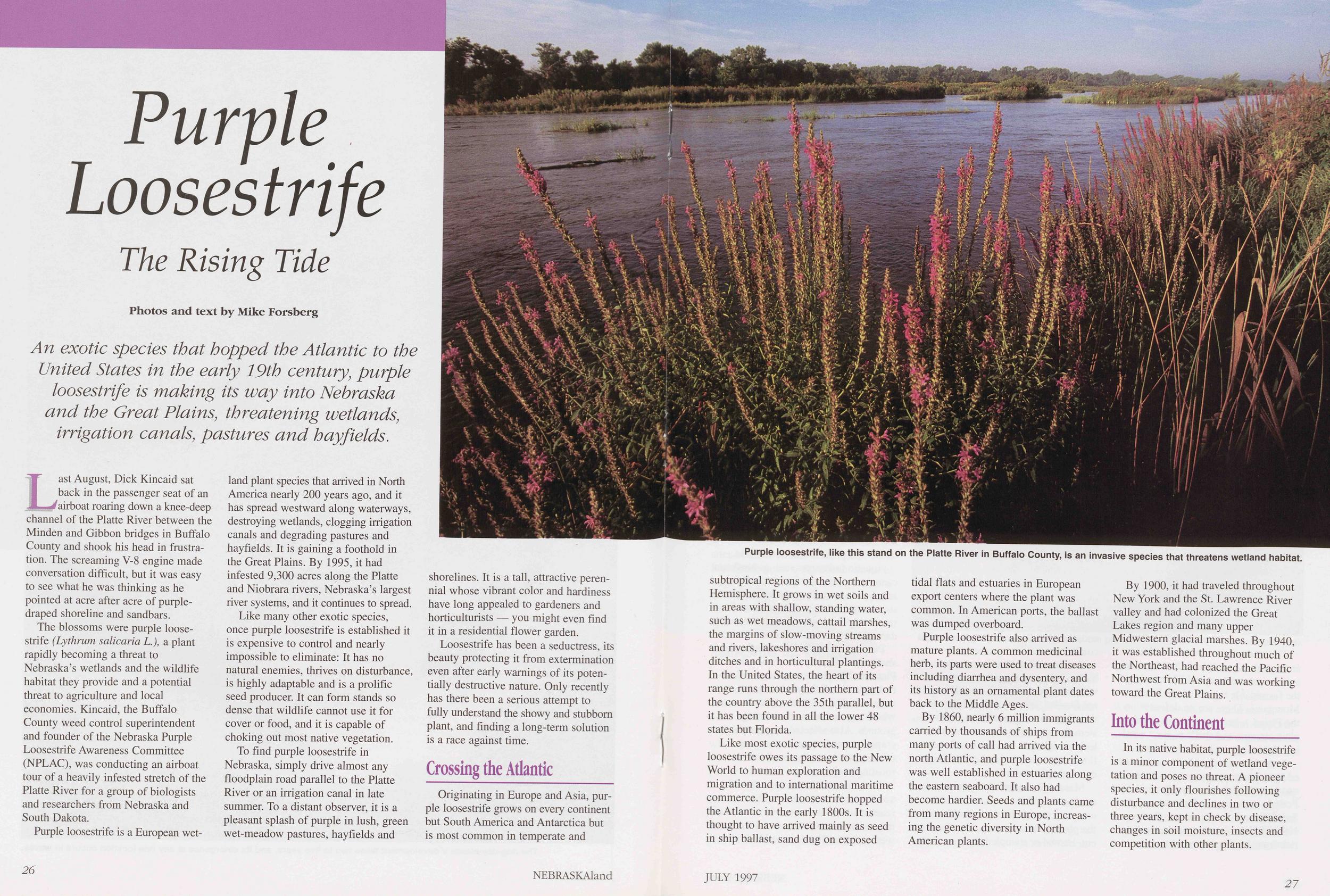
The length of the dog-day cicada's development is from two to five years. Like the periodical cicada, its emergence at any one location occurs in waves. If the periodical cicada's emergence can be described as a tidal wave, the dog-day cicada is more like a steady breaker lapping the shoreline. Its broods are usually smaller and not as concentrated in time or place.
Cicadas spend more than 99 percent of their lives below ground, but they begin and end their lives in trees. An adult female lays 300 to 400 eggs in holes in twigs and small branches, usually new-growth wood. Holes are made by drilling with the ovipositor, a sharp tubular structure protruding from the base of the abdomen. The ovipositor also is used to deposit the eggs.
The minute eggs are difficult to find, but the location can usually be determined after the fact, since the terminal part of the twig or branch usually dies. In the South, where cicadas are especially abundant, tree limbs sometimes form a tumor-like protuberance that rings the limb where many cicadas have laid eggs. Tree crickets, tree hoppers and some leaf hoppers lay eggs similarly. The egg-laying serves as a natural part of the pruning process and, in mature trees, usually promotes foliage growth, but sometimes kills young trees.
In about six weeks, the eggs hatch and the nymphs drop to the ground and dig into the soil at the base of the tree with their spade-like front legs. They spend several years
JULY 1997 19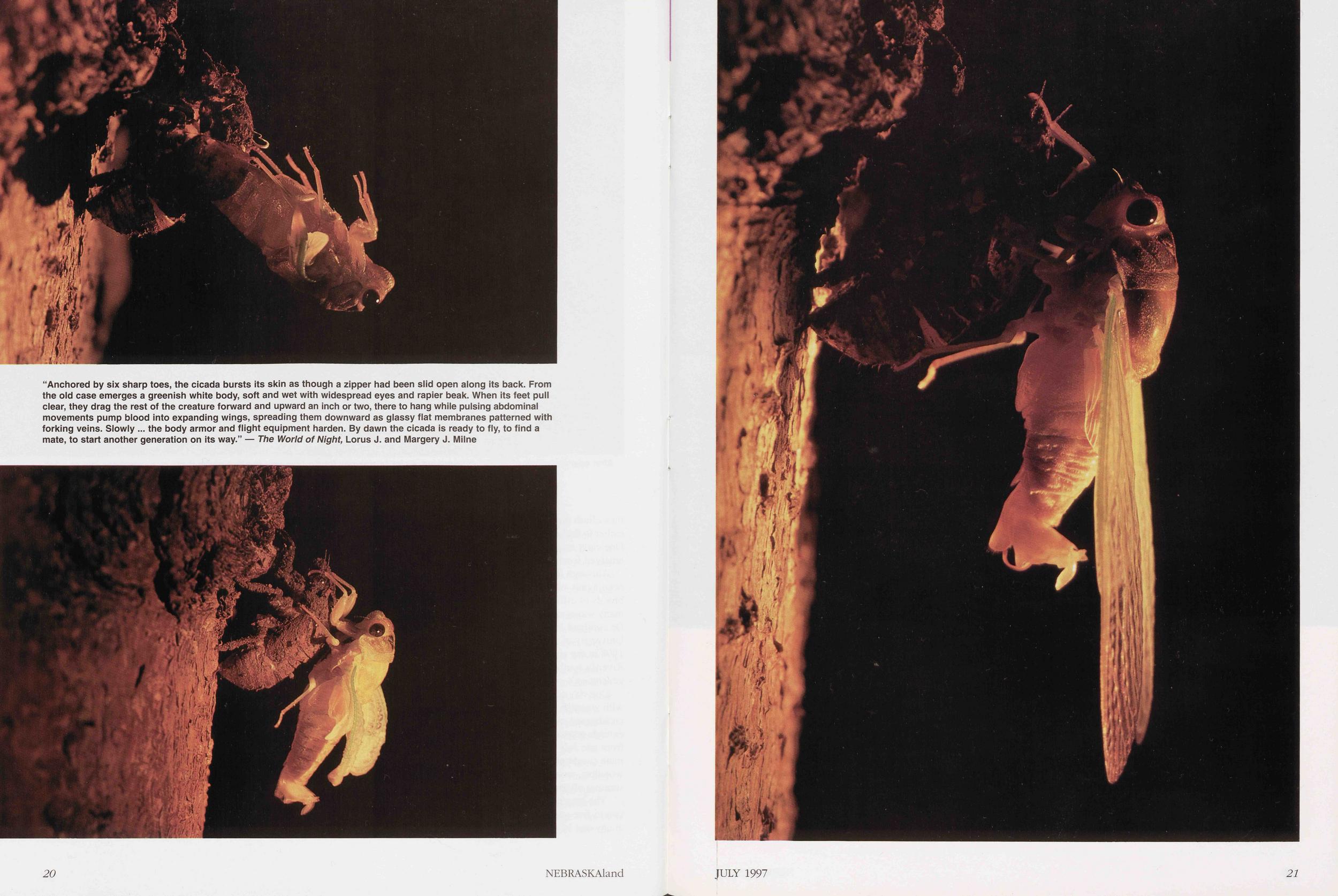
"Anchored by six sharp toes, the cicada bursts its skin as though a zipper had been slid open along its back. From the old case emerges a greenish white body, soft and wet with widespread eyes and rapier beak. When its feet pull clear, they drag the rest of the creature forward and upward an inch or two, there to hang while pulsing abdominal movements pump blood into expanding wings, spreading them downward as glassy flat membranes patterned with forking veins. Slowly ... the body armor and flight equipment harden. By dawn the cicada is ready to fly, to find a mate, to start another generation on its way." — The World of Night, Lorus J. and Margery J. Milne
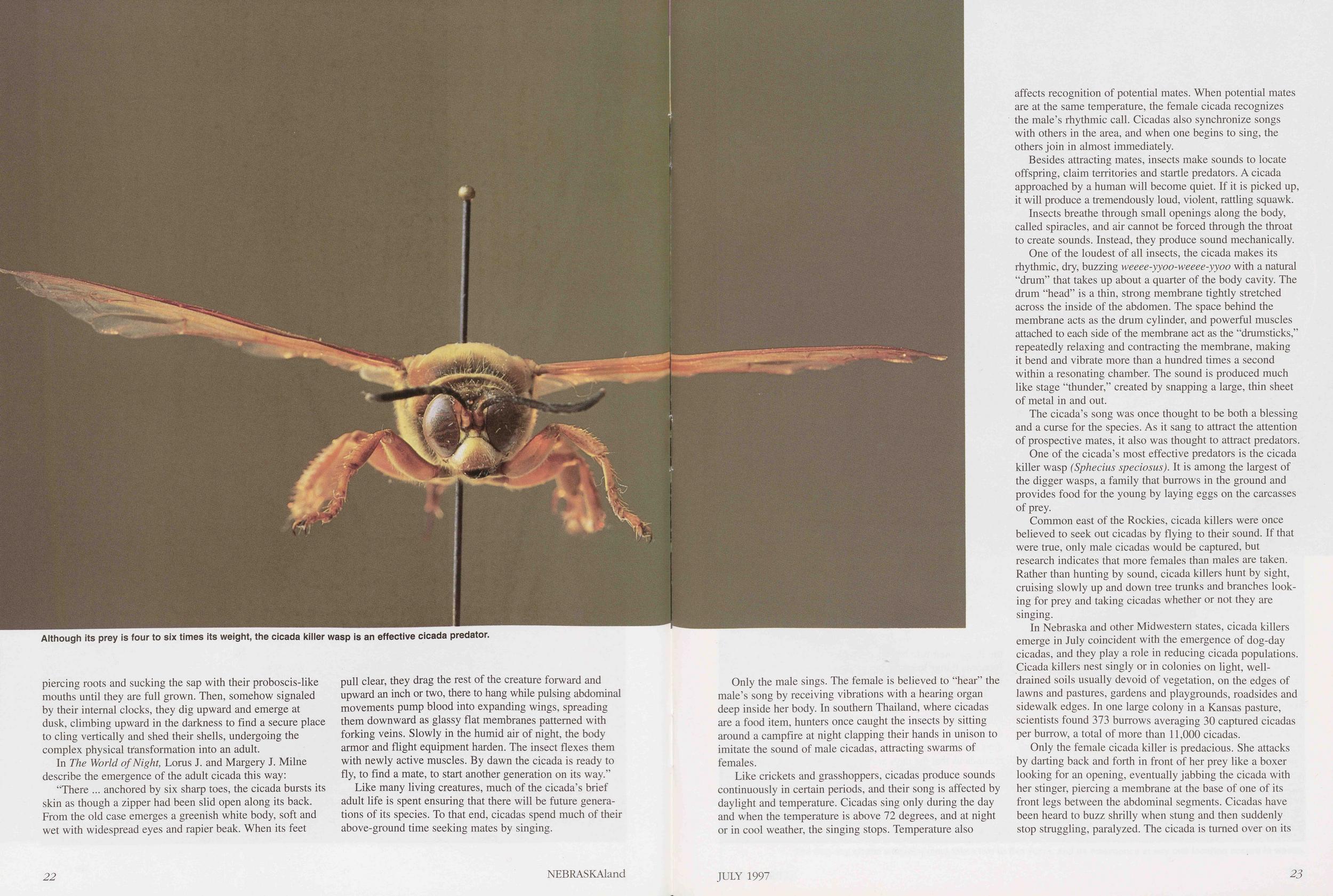
Although its prey is four to six times its weight, the cicada killer wasp is an effective cicada predator.
piercing roots and sucking the sap with their proboscis-like mouths until they are full grown. Then, somehow signaled by their internal clocks, they dig upward and emerge at dusk, climbing upward in the darkness to find a secure place to cling vertically and shed their shells, undergoing the complex physical transformation into an adult.
In The World of Night, Lorus J. and Margery J. Milne describe the emergence of the adult cicada this way:
"There ... anchored by six sharp toes, the cicada bursts its skin as though a zipper had been slid open along its back. From the old case emerges a greenish white body, soft and wet with widespread eyes and rapier beak. When its feet pull clear, they drag the rest of the creature forward and upward an inch or two, there to hang while pulsing abdominal movements pump blood into expanding wings, spreading them downward as glassy flat membranes patterned with forking veins. Slowly in the humid air of night, the body armor and flight equipment harden. The insect flexes them with newly active muscles. By dawn the cicada is ready to fly, to find a mate, to start another generation on its way."
Like many living creatures, much of the cicada's brief adult life is spent ensuring that there will be future generations of its species. To that end, cicadas spend much of their above-ground time seeking mates by singing.
22 NEBRASKAlandOnly the male sings. The female is believed to "hear" the male's song by receiving vibrations with a hearing organ deep inside her body. In southern Thailand, where cicadas are a food item, hunters once caught the insects by sitting around a campfire at night clapping their hands in unison to imitate the sound of male cicadas, attracting swarms of females.
Like crickets and grasshoppers, cicadas produce sounds continuously in certain periods, and their song is affected by daylight and temperature. Cicadas sing only during the day and when the temperature is above 72 degrees, and at night or in cool weather, the singing stops. Temperature also affects recognition of potential mates. When potential mates are at the same temperature, the female cicada recognizes the male's rhythmic call. Cicadas also synchronize songs with others in the area, and when one begins to sing, the others join in almost immediately.
Besides attracting mates, insects make sounds to locate offspring, claim territories and startle predators. A cicada approached by a human will become quiet. If it is picked up, it will produce a tremendously loud, violent, rattling squawk. Insects breathe through small openings along the body, called spiracles, and air cannot be forced through the throat to create sounds. Instead, they produce sound mechanically.
One of the loudest of all insects, the cicada makes its rhythmic, dry, buzzing weeee-yyoo-weeee-yyoo with a natural "drum" that takes up about a quarter of the body cavity. The drum "head" is a thin, strong membrane tightly stretched across the inside of the abdomen. The space behind the membrane acts as the drum cylinder, and powerful muscles attached to each side of the membrane act as the "drumsticks," repeatedly relaxing and contracting the membrane, making it bend and vibrate more than a hundred times a second within a resonating chamber. The sound is produced much like stage "thunder," created by snapping a large, thin sheet of metal in and out.
The cicada's song was once thought to be both a blessing and a curse for the species. As it sang to attract the attention of prospective mates, it also was thought to attract predators.
One of the cicada's most effective predators is the cicada killer wasp (Sphecius speciosus). It is among the largest of the digger wasps, a family that burrows in the ground and provides food for the young by laying eggs on the carcasses of prey.
Common east of the Rockies, cicada killers were once believed to seek out cicadas by flying to their sound. If that were true, only male cicadas would be captured, but research indicates that more females than males are taken. Rather than hunting by sound, cicada killers hunt by sight, cruising slowly up and down tree trunks and branches looking for prey and taking cicadas whether or not they are singing.
In Nebraska and other Midwestern states, cicada killers emerge in July coincident with the emergence of dog-day cicadas, and they play a role in reducing cicada populations. Cicada killers nest singly or in colonies on light, well-drained soils usually devoid of vegetation, on the edges of lawns and pastures, gardens and playgrounds, roadsides and sidewalk edges. In one large colony in a Kansas pasture, scientists found 373 burrows averaging 30 captured cicadas per burrow, a total of more than 11,000 cicadas.
Only the female cicada killer is predacious. She attacks by darting back and forth in front of her prey like a boxer looking for an opening, eventually jabbing the cicada with her stinger, piercing a membrane at the base of one of its front legs between the abdominal segments. Cicadas have been heard to buzz shrilly when stung and then suddenly stop struggling, paralyzed. The cicada is turned over on its
JULY 1997 23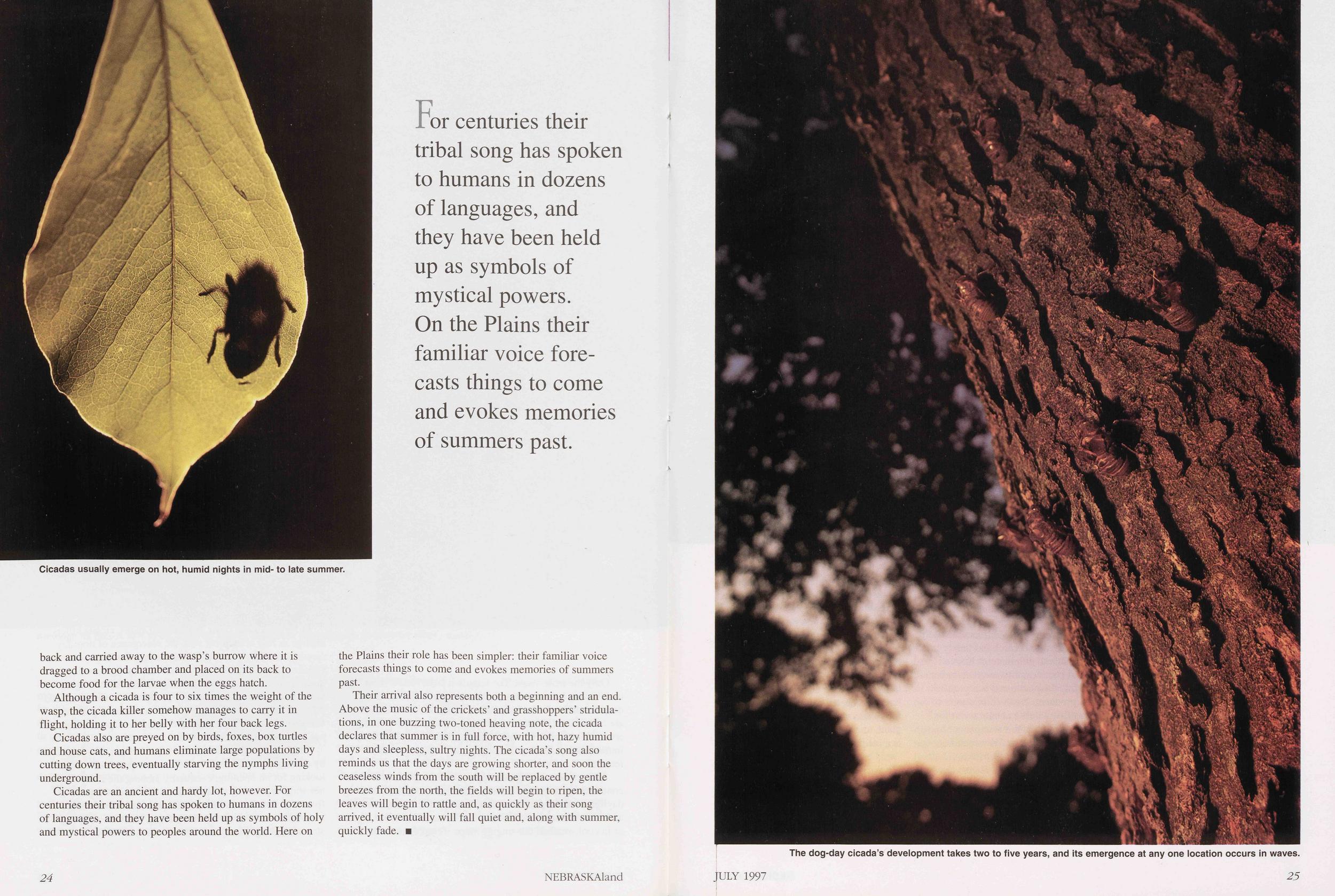
Cicadas usually emerge on hot, humid nights in mid- to late summer.
back and carried away to the wasp's burrow where it is dragged to a brood chamber and placed on its back to become food for the larvae when the eggs hatch.
Although a cicada is four to six times the weight of the wasp, the cicada killer somehow manages to carry it in flight, holding it to her belly with her four back legs. Cicadas also are preyed on by birds, foxes, box turtles and house cats, and humans eliminate large populations by cutting down trees, eventually starving the nymphs living underground.
Cicadas are an ancient and hardy lot, however. For centuries their tribal song has spoken to humans in dozens of languages, and they have been held up as symbols of holy and mystical powers to peoples around the world. Here on the Plains their role has been simpler: their familiar voice forecasts things to come and evokes memories of summers past.
Their arrival also represents both a beginning and an end. Above the music of the crickets' and grasshoppers' stridulations, in one buzzing two-toned heaving note, the cicada declares that summer is in full force, with hot, hazy humid days and sleepless, sultry nights. The cicada's song also reminds us that the days are growing shorter, and soon the ceaseless winds from the south will be replaced by gentle breezes from the north, the fields will begin to ripen, the leaves will begin to rattle and, as quickly as their song arrived, it eventually will fall quiet and, along with summer, quickly fade.
24 NEBRASKAlandThe dog-day cicada's development takes two to five years, and its emergence at any one location occurs in waves.
Purple Loosestrife The Rising Tide
An exotic species that hopped the Atlantic to the United States in the early 19th century, purple loosestrife is making its way into Nebraska and the Great Plains, threatening wetlands, irrigation canals, pastures and hayfields.
Last August, Dick Kincaid sat back in the passenger seat of an rairboat roaring down a knee-deep channel of the Platte River between the Minden and Gibbon bridges in Buffalo County and shook his head in frustration. The screaming V-8 engine made conversation difficult, but it was easy to see what he was thinking as he pointed at acre after acre of purple-draped shoreline and sandbars.
The blossoms were purple loose-strife (Lythrum salicaria L.), a plant rapidly becoming a threat to Nebraska's wetlands and the wildlife habitat they provide and a potential threat to agriculture and local economies. Kincaid, the Buffalo County weed control superintendent and founder of the Nebraska Purple Loosestrife Awareness Committee (NPLAC), was conducting an airboat tour of a heavily infested stretch of the Platte River for a group of biologists and researchers from Nebraska and South Dakota.
Purple loosestrife is a European wetland plant species that arrived in North America nearly 200 years ago, and it has spread westward along waterways, destroying wetlands, clogging irrigation canals and degrading pastures and hayfields. It is gaining a foothold in the Great Plains. By 1995, it had infested 9,300 acres along the Platte and Niobrara rivers, Nebraska's largest river systems, and it continues to spread.
Like many other exotic species, once purple loosestrife is established it is expensive to control and nearly impossible to eliminate: It has no natural enemies, thrives on disturbance, is highly adaptable and is a prolific seed producer. It can form stands so dense that wildlife cannot use it for cover or food, and it is capable of choking out most native vegetation.
To find purple loosestrife in Nebraska, simply drive almost any floodplain road parallel to the Platte River or an irrigation canal in late summer. To a distant observer, it is a pleasant splash of purple in lush, green wet-meadow pastures, hayfields and shorelines. It is a tall, attractive perennial whose vibrant color and hardiness have long appealed to gardeners and horticulturists — you might even find it in a residential flower garden.
Loosestrife has been a seductress, its beauty protecting it from extermination even after early warnings of its potentially destructive nature. Only recently has there been a serious attempt to fully understand the showy and stubborn plant, and finding a long-term solution is a race against time.
Crossing the AtlanticOriginating in Europe and Asia, purple loosestrife grows on every continent but South America and Antarctica but is most common in temperate and
26 NEBRASKAlandPurple loosestrife, like this stand on the Platte River in Buffalo County, is an invasive species that threatens wetland habitat.
subtropical regions of the Northern Hemisphere. It grows in wet soils and in areas with shallow, standing water, such as wet meadows, cattail marshes, the margins of slow-moving streams and rivers, lakeshores and irrigation ditches and in horticultural plantings. In the United States, the heart of its range runs through the northern part of the country above the 35th parallel, but it has been found in all the lower 48 states but Florida.
Like most exotic species, purple loosestrife owes its passage to the New World to human exploration and migration and to international maritime commerce. Purple loosestrife hopped the Atlantic in the early 1800s. It is thought to have arrived mainly as seed in ship ballast, sand dug on exposed tidal flats and estuaries in European export centers where the plant was common. In American ports, the ballast was dumped overboard.
Purple loosestrife also arrived as mature plants. A common medicinal herb, its parts were used to treat diseases including diarrhea and dysentery, and its history as an ornamental plant dates back to the Middle Ages.
By 1860, nearly 6 million immigrants carried by thousands of ships from many ports of call had arrived via the north Atlantic, and purple loosestrife was well established in estuaries along the eastern seaboard. It also had become hardier. Seeds and plants came from many regions in Europe, increasing the genetic diversity in North American plants.
By 1900, it had traveled throughout New York and the St. Lawrence River valley and had colonized the Great Lakes region and many upper Midwestern glacial marshes. By 1940, it was established throughout much of the Northeast, had reached the Pacific Northwest from Asia and was working toward the Great Plains.
Into the ContinentIn its native habitat, purple loosestrife is a minor component of wetland vegetation and poses no threat. A pioneer species, it only flourishes following disturbance and declines in two or three years, kept in check by disease, changes in soil moisture, insects and competition with other plants.
JULY 1997 27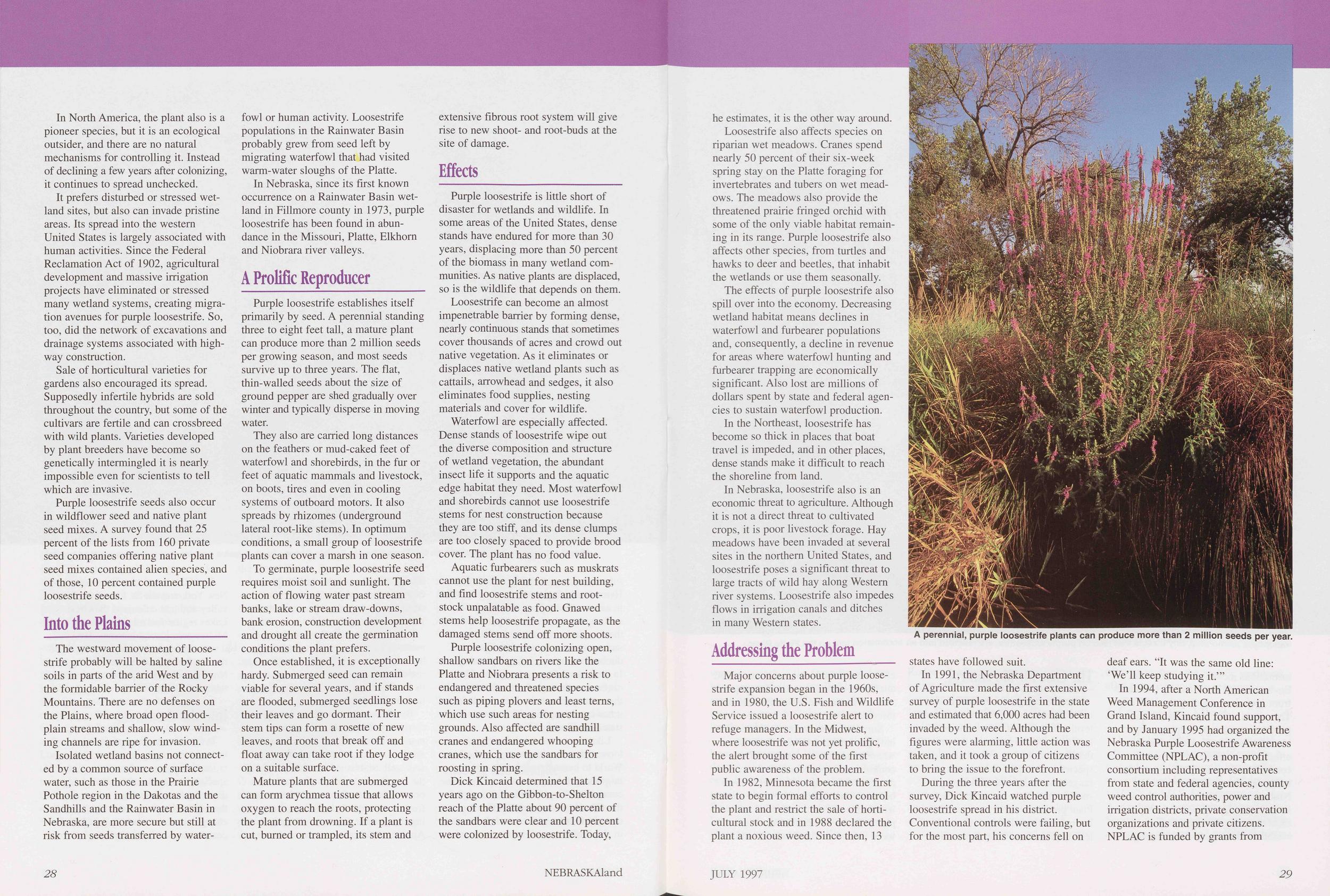
In North America, the plant also is a pioneer species, but it is an ecological outsider, and there are no natural mechanisms for controlling it. Instead of declining a few years after colonizing, it continues to spread unchecked.
It prefers disturbed or stressed wetland sites, but also can invade pristine areas. Its spread into the western United States is largely associated with human activities. Since the Federal Reclamation Act of 1902, agricultural development and massive irrigation projects have eliminated or stressed many wetland systems, creating migration avenues for purple loosestrife. So, too, did the network of excavations and drainage systems associated with highway construction.
Sale of horticultural varieties for gardens also encouraged its spread. Supposedly infertile hybrids are sold throughout the country, but some of the cultivars are fertile and can crossbreed with wild plants. Varieties developed by plant breeders have become so genetically intermingled it is nearly impossible even for scientists to tell which are invasive.
Purple loosestrife seeds also occur in wildflower seed and native plant seed mixes. A survey found that 25 percent of the lists from 160 private seed companies offering native plant seed mixes contained alien species, and of those, 10 percent contained purple loosestrife seeds.
Into the PlainsThe westward movement of loosestrife probably will be halted by saline soils in parts of the arid West and by the formidable barrier of the Rocky Mountains. There are no defenses on the Plains, where broad open flood-plain streams and shallow, slow wind- ing channels are ripe for invasion.
Isolated wetland basins not connected by a common source of surface water, such as those in the Prairie Pothole region in the Dakotas and the Sandhills and the Rainwater Basin in Nebraska, are more secure but still at risk from seeds transferred by waterfowl or human activity. Loosestrife populations in the Rainwater Basin probably grew from seed left by migrating waterfowl that had visited warm-water sloughs of the Platte.
In Nebraska, since its first known occurrence on a Rainwater Basin wetland in Fillmore county in 1973, purple loosestrife has been found in abundance in the Missouri, Platte, Elkhorn and Niobrara river valleys.
A Prolific ReproducerPurple loosestrife establishes itself primarily by seed. A perennial standing three to eight feet tall, a mature plant can produce more than 2 million seeds per growing season, and most seeds survive up to three years. The flat, thin-walled seeds about the size of ground pepper are shed gradually over winter and typically disperse in moving water.
They also are carried long distances on the feathers or mud-caked feet of waterfowl and shorebirds, in the fur or feet of aquatic mammals and livestock, on boots, tires and even in cooling systems of outboard motors. It also spreads by rhizomes (underground lateral root-like stems). In optimum conditions, a small group of loosestrife plants can cover a marsh in one season.
To germinate, purple loosestrife seed requires moist soil and sunlight. The action of flowing water past stream banks, lake or stream draw-downs, bank erosion, construction development and drought all create the germination conditions the plant prefers.
Once established, it is exceptionally hardy. Submerged seed can remain viable for several years, and if stands are flooded, submerged seedlings lose their leaves and go dormant. Their stem tips can form a rosette of new leaves, and roots that break off and float away can take root if they lodge on a suitable surface.
Mature plants that are submerged can form arychmea tissue that allows oxygen to reach the roots, protecting the plant from drowning. If a plant is cut, burned or trampled, its stem and extensive fibrous root system will give rise to new shoot- and root-buds at the site of damage.
EffectsPurple loosestrife is little short of disaster for wetlands and wildlife. In some areas of the United States, dense stands have endured for more than 30 years, displacing more than 50 percent of the biomass in many wetland communities. As native plants are displaced, so is the wildlife that depends on them.
Loosestrife can become an almost impenetrable barrier by forming dense, nearly continuous stands that sometimes cover thousands of acres and crowd out native vegetation. As it eliminates or displaces native wetland plants such as cattails, arrowhead and sedges, it also eliminates food supplies, nesting materials and cover for wildlife.
Waterfowl are especially affected. Dense stands of loosestrife wipe out the diverse composition and structure of wetland vegetation, the abundant insect life it supports and the aquatic edge habitat they need. Most waterfowl and shorebirds cannot use loosestrife stems for nest construction because they are too stiff, and its dense clumps are too closely spaced to provide brood cover. The plant has no food value.
Aquatic furbearers such as muskrats cannot use the plant for nest building, and find loosestrife stems and root-stock unpalatable as food. Gnawed stems help loosestrife propagate, as the damaged stems send off more shoots.
Purple loosestrife colonizing open, shallow sandbars on rivers like the Platte and Niobrara presents a risk to endangered and threatened species such as piping plovers and least terns, which use such areas for nesting grounds. Also affected are sandhill cranes and endangered whooping cranes, which use the sandbars for roosting in spring.
Dick Kincaid determined that 15 years ago on the Gibbon-to-Shelton reach of the Platte about 90 percent of the sandbars were clear and 10 percent were colonized by loosestrife. Today,
28 NEBRASKAlandhe estimates, it is the other way around.
Loosestrife also affects species on riparian wet meadows. Cranes spend nearly 50 percent of their six-week spring stay on the Platte foraging for invertebrates and tubers on wet meadows. The meadows also provide the threatened prairie fringed orchid with some of the only viable habitat remaining in its range. Purple loosestrife also affects other species, from turtles and hawks to deer and beetles, that inhabit the wetlands or use them seasonally.
The effects of purple loosestrife also spill over into the economy. Decreasing wetland habitat means declines in waterfowl and furbearer populations and, consequently, a decline in revenue for areas where waterfowl hunting and furbearer trapping are economically significant. Also lost are millions of dollars spent by state and federal agencies to sustain waterfowl production.
In the Northeast, loosestrife has become so thick in places that boat travel is impeded, and in other places, dense stands make it difficult to reach the shoreline from land.
In Nebraska, loosestrife also is an economic threat to agriculture. Although it is not a direct threat to cultivated crops, it is poor livestock forage. Hay meadows have been invaded at several sites in the northern United States, and loosestrife poses a significant threat to large tracts of wild hay along Western river systems. Loosestrife also impedes flows in irrigation canals and ditches in many Western states.
Addressing the ProblemMajor concerns about purple loose-strife expansion began in the 1960s, and in 1980, the U.S. Fish and Wildlife Service issued a loosestrife alert to refuge managers. In the Midwest, where loosestrife was not yet prolific, the alert brought some of the first public awareness of the problem.
A perennial, purple loosestrife plants can produce more than 2 million seeds per year
In 1991, the Nebraska Department of Agriculture made the first extensive survey of purple loosestrife in the state and estimated that 6,000 acres had been invaded by the weed. Although the figures were alarming, little action was taken, and it took a group of citizens to bring the issue to the forefront.
During the three years after the survey, Dick Kincaid watched purple loosestrife spread in his district. Conventional controls were failing, but for the most part, his concerns fell on deaf ears. "It was the same old line: 'We'll keep studying it.'"
In 1994, after a North American Weed Management Conference in Grand Island, Kincaid found support, and by January 1995 had organized the Nebraska Purple Loosestrife Awareness Committee (NPLAC), a non-profit consortium including representatives from state and federal agencies, county weed control authorities, power and irrigation districts, private conservation organizations and private citizens. NPLAC is funded by grants from
JULY 1997 29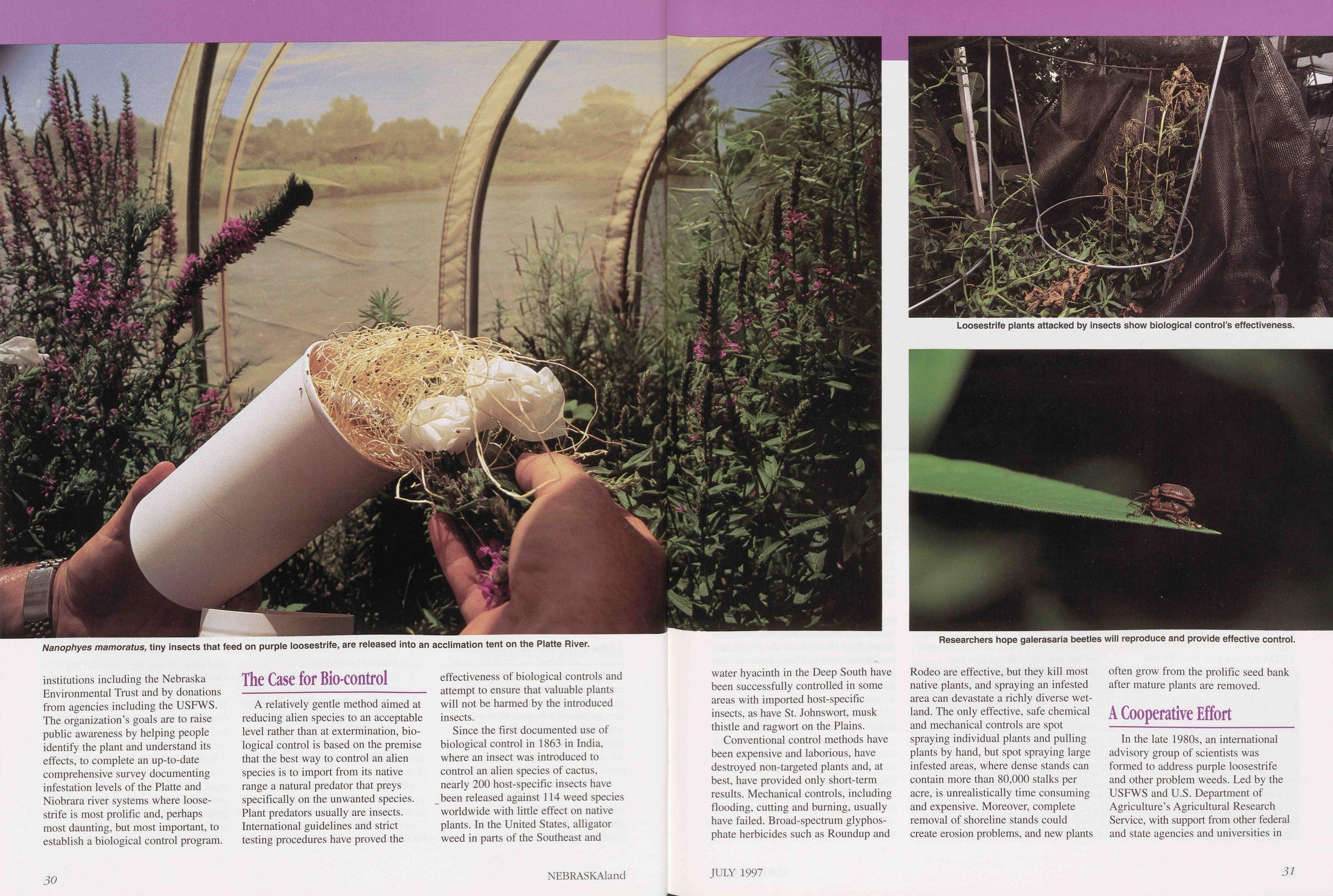
Nanophyes mamoratus, tiny insects that feed on purple loosestrife, are released into an acclimation tent on the Platte River.
institutions including the Nebraska Environmental Trust and by donations from agencies including the USFWS. The organization's goals are to raise public awareness by helping people identify the plant and understand its effects, to complete an up-to-date comprehensive survey documenting infestation levels of the Platte and Niobrara river systems where loose-strife is most prolific and, perhaps most daunting, but most important, to establish a biological control program.
The Case for Bio-controlA relatively gentle method aimed at reducing alien species to an acceptable level rather than at extermination, biological control is based on the premise that the best way to control an alien species is to import from its native range a natural predator that preys specifically on the unwanted species. Plant predators usually are insects. International guidelines and strict testing procedures have proved the effectiveness of biological controls and attempt to ensure that valuable plants will not be harmed by the introduced insects.
Since the first documented use of biological control in 1863 in India, where an insect was introduced to control an alien species of cactus, nearly 200 host-specific insects have been released against 114 weed species worldwide with little effect on native plants. In the United States, alligator weed in parts of the Southeast and
30 NEBRASKAlandLoosestrife plants attacked by insects show biological control's effectiveness.
Researchers hope galerasaria beetles will reproduce and provide effective control.
water hyacinth in the Deep South have been successfully controlled in some areas with imported host-specific insects, as have St. Johnswort, musk thistle and ragwort on the Plains.
Conventional control methods have been expensive and laborious, have destroyed non-targeted plants and, at best, have provided only short-term results. Mechanical controls, including flooding, cutting and burning, usually have failed. Broad-spectrum glyphosphate herbicides such as Roundup and Rodeo are effective, but they kill most native plants, and spraying an infested area can devastate a richly diverse wetland. The only effective, safe chemical and mechanical controls are spot spraying individual plants and pulling plants by hand, but spot spraying large infested areas, where dense stands can contain more than 80,000 stalks per acre, is unrealistically time consuming and expensive. Moreover, complete removal of shoreline stands could create erosion problems, and new plants often grow from the prolific seed bank after mature plants are removed.
A Cooperative EffortIn the late 1980s, an international advisory group of scientists was formed to address purple loosestrife and other problem weeds. Led by the USFWS and U.S. Department of Agriculture's Agricultural Research Service, with support from other federal and state agencies and universities in
JULY 1997 31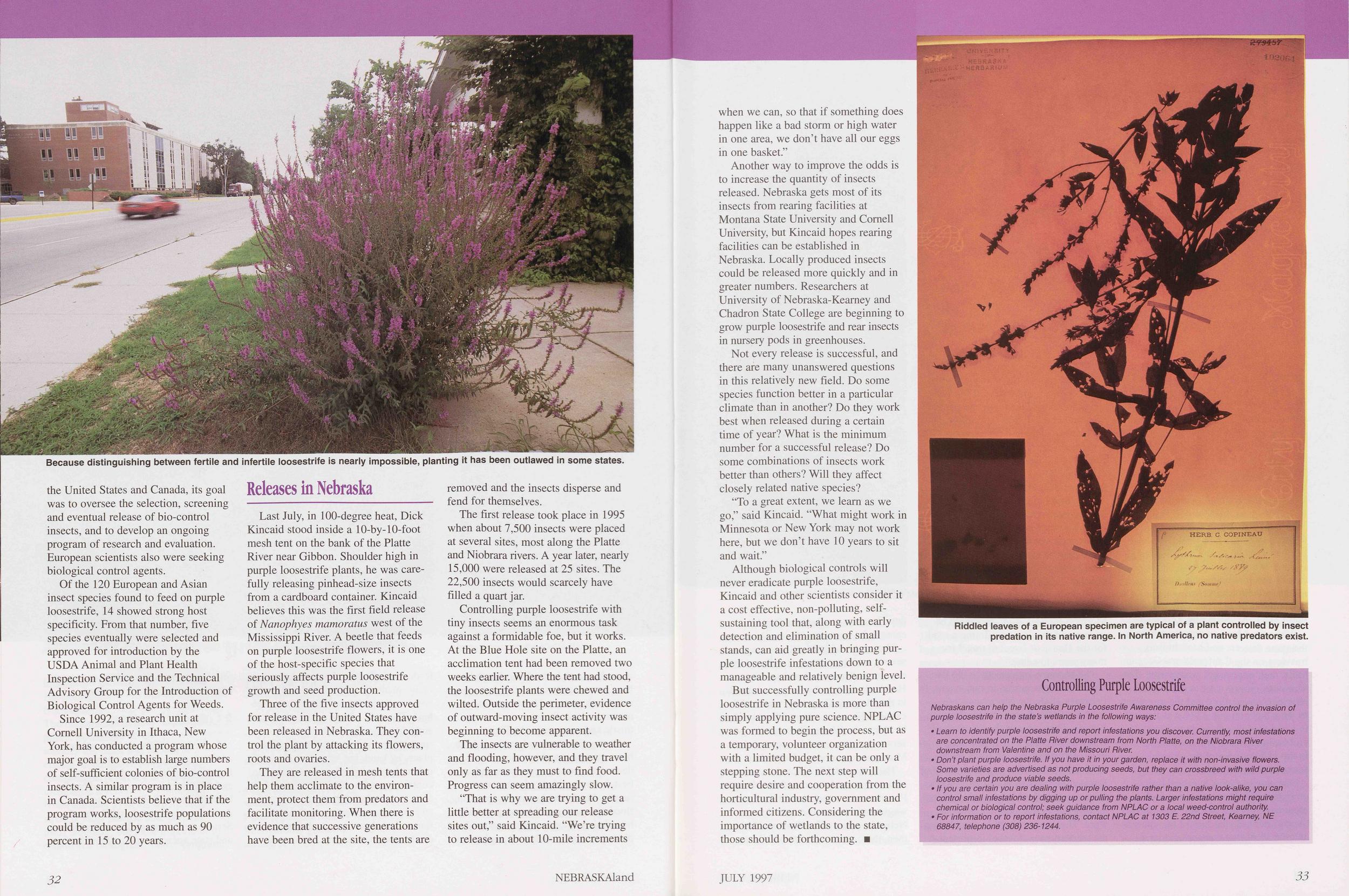
Because distinguishing between fertile and infertile loosestrife is nearly impossible, planting it has been outlawed in some states.
the United States and Canada, its goal was to oversee the selection, screening and eventual release of bio-control insects, and to develop an ongoing program of research and evaluation. European scientists also were seeking biological control agents.
Of the 120 European and Asian insect species found to feed on purple loosestrife, 14 showed strong host specificity. From that number, five species eventually were selected and approved for introduction by the USDA Animal and Plant Health Inspection Service and the Technical Advisory Group for the Introduction of Biological Control Agents for Weeds.
Since 1992, a research unit at Cornell University in Ithaca, New York, has conducted a program whose major goal is to establish large numbers of self-sufficient colonies of bio-control insects. A similar program is in place in Canada. Scientists believe that if the program works, loosestrife populations could be reduced by as much as 90 percent in 15 to 20 years.
Releases in NebraskaLast July, in 100-degree heat, Dick Kincaid stood inside a 10-by-10-foot mesh tent on the bank of the Platte River near Gibbon. Shoulder high in purple loosestrife plants, he was carefully releasing pinhead-size insects from a cardboard container. Kincaid believes this was the first field release of Nanophyes mamoratus west of the Mississippi River. A beetle that feeds on purple loosestrife flowers, it is one of the host-specific species that seriously affects purple loosestrife growth and seed production.
Three of the five insects approved for release in the United States have been released in Nebraska. They control the plant by attacking its flowers, roots and ovaries.
They are released in mesh tents that help them acclimate to the environment, protect them from predators and facilitate monitoring. When there is evidence that successive generations have been bred at the site, the tents are removed and the insects disperse and fend for themselves.
The first release took place in 1995 when about 7,500 insects were placed at several sites, most along the Platte and Niobrara rivers. A year later, nearly 15,000 were released at 25 sites. The 22,500 insects would scarcely have filled a quart jar.
Controlling purple loosestrife with tiny insects seems an enormous task against a formidable foe, but it works. At the Blue Hole site on the Platte, an acclimation tent had been removed two weeks earlier. Where the tent had stood, the loosestrife plants were chewed and wilted. Outside the perimeter, evidence of outward-moving insect activity was beginning to become apparent.
The insects are vulnerable to weather and flooding, however, and they travel only as far as they must to find food. Progress can seem amazingly slow.
"That is why we are trying to get a little better at spreading our release sites out," said Kincaid. "We're trying to release in about 10-mile increments
32 NEBRASKAlandwhen we can, so that if something does happen like a bad storm or high water in one area, we don't have all our eggs in one basket."
Another way to improve the odds is to increase the quantity of insects released. Nebraska gets most of its insects from rearing facilities at Montana State University and Cornell University, but Kincaid hopes rearing facilities can be established in Nebraska. Locally produced insects could be released more quickly and in greater numbers. Researchers at University of Nebraska-Kearney and Chadron State College are beginning to grow purple loosestrife and rear insects in nursery pods in greenhouses.
Not every release is successful, and there are many unanswered questions in this relatively new field. Do some species function better in a particular climate than in another? Do they work best when released during a certain time of year? What is the minimum number for a successful release? Do some combinations of insects work better than others? Will they affect closely related native species?
"To a great extent, we learn as we go," said Kincaid. "What might work in Minnesota or New York may not work here, but we don't have 10 years to sit and wait."
Although biological controls will never eradicate purple loosestrife, Kincaid and other scientists consider it a cost effective, non-polluting, self-sustaining tool that, along with early detection and elimination of small stands, can aid greatly in bringing purple loosestrife infestations down to a manageable and relatively benign level.
But successfully controlling purple loosestrife in Nebraska is more than simply applying pure science. NPLAC was formed to begin the process, but as a temporary, volunteer organization with a limited budget, it can be only a stepping stone. The next step will require desire and cooperation from the horticultural industry, government and informed citizens. Considering the importance of wetlands to the state, those should be forthcoming.
Riddled leaves of a European specimen are typical of a plant controlled by insect predation in its native range. In North America, no native predators exist.
Controlling Purple Loosestrife
Nebraskans can help the Nebraska Purple Loosestrife Awareness Committee control the invasion of purple loosestrife in the state's wetlands in the following ways: Learn to identify purple loosestrife and report infestations you discover. Currently most infestations are concentrated on the Platte River downstream from North Platte, on the Niobrara River downstream from Valentine and on the Missouri River. Don't plant purple loosestrife. If you have it in your garden, replace it with noninvasive flowers. Some varieties are advertised as not producing seeds, but they can crossbreed with wild purple loosestrife and produce viable seeds. If you are certain you are dealing with purple loosestrife rather than a native lookalike, you can control small infestations by digging up or pulling the plants. Larger infestations might require chemical or biological control; seek guidance from NPLAC or a local weed-control authority. For information or to report infestations, contact NPLAC at 1303 E. 22nd Street, Kearney, NE 68847, telephone (308) 236-1244. JULY 1997 33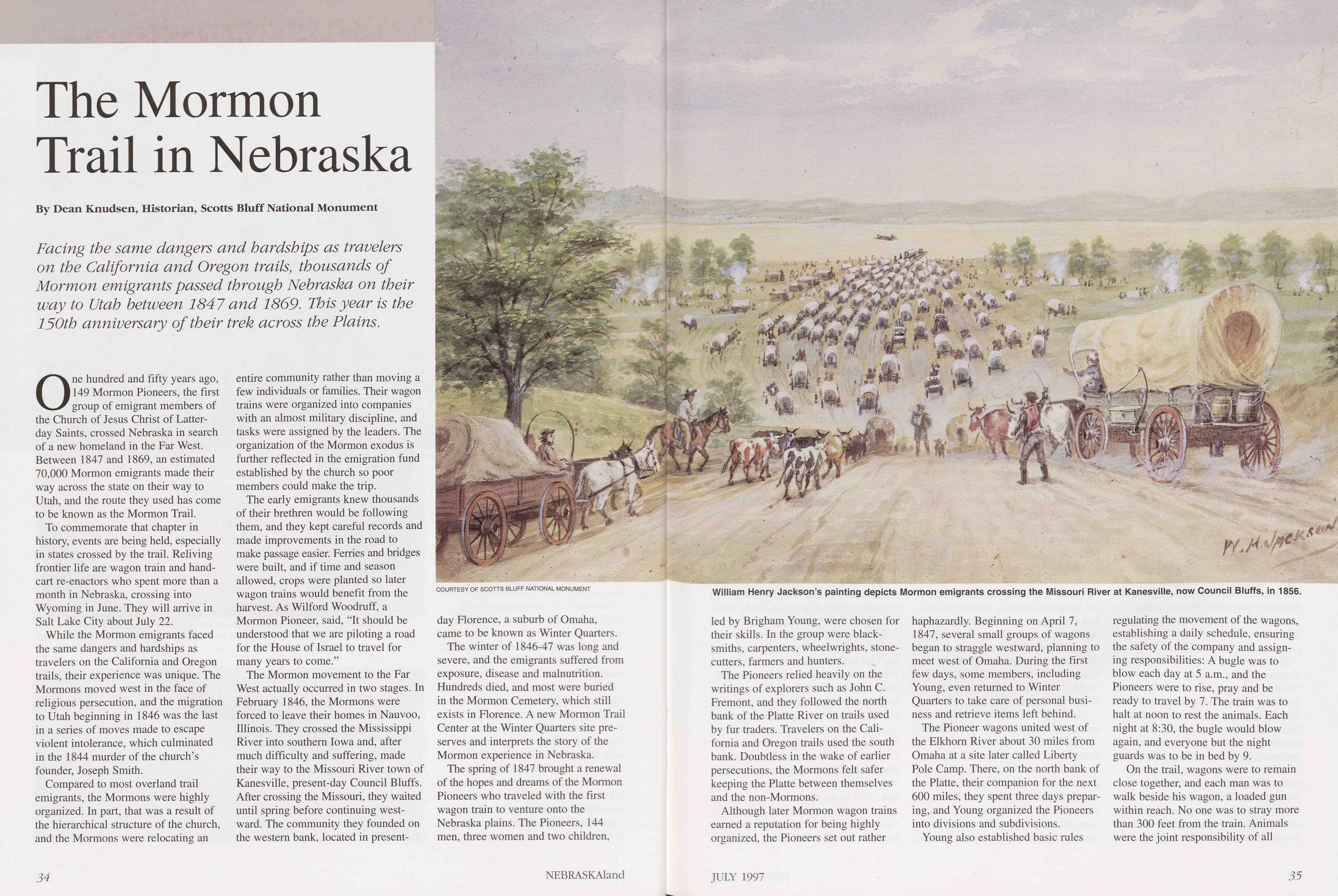
The Mormon Trail in Nebraska
Facing the same dangers and hardships as travelers on the California and Oregon trails, thousands of Mormon emigrants passed through Nebraska on their way to Utah between 1847 and 1869. This year is the 150th anniversary of their trek across the Plains.
One hundred and fifty years ago, 149 Mormon Pioneers, the first group of emigrant members of the Church of Jesus Christ of Latter-day Saints, crossed Nebraska in search of a new homeland in the Far West. Between 1847 and 1869, an estimated 70,000 Mormon emigrants made their way across the state on their way to Utah, and the route they used has come to be known as the Mormon Trail.
To commemorate that chapter in history, events are being held, especially in states crossed by the trail. Reliving frontier life are wagon train and handcart re-enactors who spent more than a month in Nebraska, crossing into Wyoming in June. They will arrive in Salt Lake City about July 22.
While the Mormon emigrants faced the same dangers and hardships as travelers on the California and Oregon trails, their experience was unique. The Mormons moved west in the face of religious persecution, and the migration to Utah beginning in 1846 was the last in a series of moves made to escape violent intolerance, which culminated in the 1844 murder of the church's founder, Joseph Smith.
Compared to most overland trail emigrants, the Mormons were highly organized. In part, that was a result of the hierarchical structure of the church, and the Mormons were relocating an entire community rather than moving a few individuals or families. Their wagon trains were organized into companies with an almost military discipline, and tasks were assigned by the leaders. The organization of the Mormon exodus is further reflected in the emigration fund established by the church so poor members could make the trip.
The early emigrants knew thousands of their brethren would be following them, and they kept careful records and made improvements in the road to make passage easier. Ferries and bridges were built, and if time and season allowed, crops were planted so later wagon trains would benefit from the harvest. As Wilford Woodruff, a Mormon Pioneer, said, "It should be understood that we are piloting a road for the House of Israel to travel for many years to come."
The Mormon movement to the Far West actually occurred in two stages. In February 1846, the Mormons were forced to leave their homes in Nauvoo, Illinois. They crossed the Mississippi River into southern Iowa and, after much difficulty and suffering, made their way to the Missouri River town of Kanesville, present-day Council Bluffs. After crossing the Missouri, they waited until spring before continuing westward. The community they founded on the western bank, located in present
day Florence, a suburb of Omaha, came to be known as Winter Quarters.
The winter of 1846-47 was long and severe, and the emigrants suffered from exposure, disease and malnutrition. Hundreds died, and most were buried in the Mormon Cemetery, which still exists in Florence. A new Mormon Trail Center at the Winter Quarters site preserves and interprets the story of the Mormon experience in Nebraska.
The spring of 1847 brought a renewal of the hopes and dreams of the Mormon Pioneers who traveled with the first wagon train to venture onto the Nebraska plains. The Pioneers, 144 men, three women and two children,
34 NEBRASKAlandWilliam Henry Jackson's painting depicts Mormon emigrants crossing the Missouri River at Kanesville, now Council Bluffs, in 1856.
led by Brigham Young, were chosen for their skills. In the group were blacksmiths, carpenters, wheelwrights, stonecutters, farmers and hunters.
The Pioneers relied heavily on the writings of explorers such as John C. Fremont, and they followed the north bank of the Platte River on trails used by fur traders. Travelers on the California and Oregon trails used the south bank. Doubtless in the wake of earlier persecutions, the Mormons felt safer keeping the Platte between themselves and the non-Mormons.
Although later Mormon wagon trains earned a reputation for being highly organized, the Pioneers set out rather haphazardly. Beginning on April 7, 1847, several small groups of wagons began to straggle westward, planning to meet west of Omaha. During the first few days, some members, including Young, even returned to Winter Quarters to take care of personal business and retrieve items left behind.
The Pioneer wagons united west of the Elkhorn River about 30 miles from Omaha at a site later called Liberty Pole Camp. There, on the north bank of the Platte, their companion for the next 600 miles, they spent three days preparing, and Young organized the Pioneers into divisions and subdivisions.
Young also established basic rules regulating the movement of the wagons, establishing a daily schedule, ensuring the safety of the company and assigning responsibilities: A bugle was to blow each day at 5 a.m., and the Pioneers were to rise, pray and be ready to travel by 7. The train was to halt at noon to rest the animals. Each night at 8:30, the bugle would blow again, and everyone but the night guards was to be in bed by 9.
On the trail, wagons were to remain close together, and each man was to walk beside his wagon, a loaded gun within reach. No one was to stray more than 300 feet from the train. Animals were the joint responsibility of all
JULY 1997 35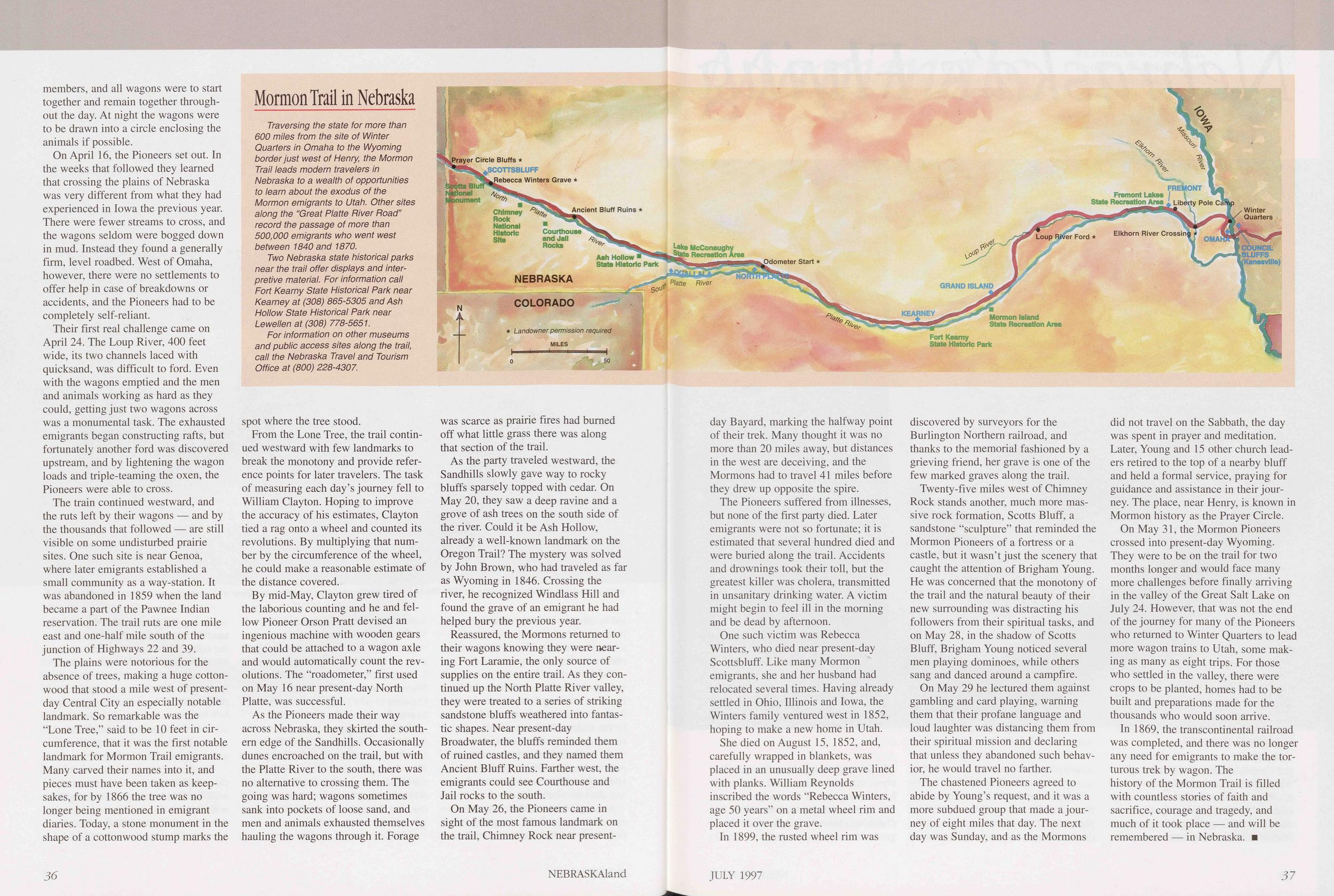
members, and all wagons were to start together and remain together throughout the day. At night the wagons were to be drawn into a circle enclosing the animals if possible.
On April 16, the Pioneers set out. In the weeks that followed they learned that crossing the plains of Nebraska was very different from what they had experienced in Iowa the previous year. There were fewer streams to cross, and the wagons seldom were bogged down in mud. Instead they found a generally firm, level roadbed. West of Omaha, however, there were no settlements to offer help in case of breakdowns or accidents, and the Pioneers had to be completely self-reliant.
Their first real challenge came on April 24. The Loup River, 400 feet wide, its two channels laced with quicksand, was difficult to ford. Even with the wagons emptied and the men and animals working as hard as they could, getting just two wagons across was a monumental task. The exhausted emigrants began constructing rafts, but fortunately another ford was discovered upstream, and by lightening the wagon loads and triple-teaming the oxen, the Pioneers were able to cross.
The train continued westward, and the ruts left by their wagons — and by the thousands that followed — are still visible on some undisturbed prairie sites. One such site is near Genoa, where later emigrants established a small community as a way-station. It was abandoned in 1859 when the land became a part of the Pawnee Indian reservation. The trail ruts are one mile east and one-half mile south of the junction of Highways 22 and 39.
The plains were notorious for the absence of trees, making a huge cottonwood that stood a mile west of present-day Central City an especially notable landmark. So remarkable was the "Lone Tree," said to be 10 feet in circumference, that it was the first notable landmark for Mormon Trail emigrants. Many carved their names into it, and pieces must have been taken as keepsakes, for by 1866 the tree was no longer being mentioned in emigrant diaries. Today, a stone monument in the shape of a cottonwood stump marks the
spot where the tree stood.
From the Lone Tree, the trail continued westward with few landmarks to break the monotony and provide reference points for later travelers. The task of measuring each day's journey fell to William Clayton. Hoping to improve the accuracy of his estimates, Clayton tied a rag onto a wheel and counted its revolutions. By multiplying that number by the circumference of the wheel, he could make a reasonable estimate of the distance covered.
By mid-May, Clayton grew tired of the laborious counting and he and fellow Pioneer Orson Pratt devised an ingenious machine with wooden gears that could be attached to a wagon axle and would automatically count the revolutions. The "roadometer," first used on May 16 near present-day North Platte, was successful.
As the Pioneers made their way across Nebraska, they skirted the southern edge of the Sandhills. Occasionally dunes encroached on the trail, but with the Platte River to the south, there was no alternative to crossing them. The going was hard; wagons sometimes sank into pockets of loose sand, and men and animals exhausted themselves hauling the wagons through it. Forage was scarce as prairie fires had burned off what little grass there was along that section of the trail.
As the party traveled westward, the Sandhills slowly gave way to rocky bluffs sparsely topped with cedar. On May 20, they saw a deep ravine and a grove of ash trees on the south side of the river. Could it be Ash Hollow, already a well-known landmark on the Oregon Trail? The mystery was solved by John Brown, who had traveled as far as Wyoming in 1846. Crossing the river, he recognized Windlass Hill and found the grave of an emigrant he had helped bury the previous year.
Reassured, the Mormons returned to their wagons knowing they were Hearing Fort Laramie, the only source of supplies on the entire trail. As they continued up the North Platte River valley, they were treated to a series of striking sandstone bluffs weathered into fantastic shapes. Near present-day Broadwater, the bluffs reminded them of ruined castles, and they named them Ancient Bluff Ruins. Farther west, the emigrants could see Courthouse and Jail rocks to the south.
On May 26, the Pioneers came in sight of the most famous landmark on the trail, Chimney Rock near present-
36 NEBRASKAlandday Bayard, marking the halfway point of their trek. Many thought it was no more than 20 miles away, but distances in the west are deceiving, and the Mormons had to travel 41 miles before they drew up opposite the spire.
The Pioneers suffered from illnesses, but none of the first party died. Later emigrants were not so fortunate; it is estimated that several hundred died and were buried along the trail. Accidents and drownings took their toll, but the greatest killer was cholera, transmitted in unsanitary drinking water. A victim might begin to feel ill in the morning and be dead by afternoon.
One such victim was Rebecca Winters, who died near present-day Scottsbluff. Like many Mormon emigrants, she and her husband had relocated several times. Having already settled in Ohio, Illinois and Iowa, the Winters family ventured west in 1852, hoping to make a new home in Utah.
She died on August 15, 1852, and, carefully wrapped in blankets, was placed in an unusually deep grave lined with planks. William Reynolds inscribed the words "Rebecca Winters, age 50 years" on a metal wheel rim and placed it over the grave.
In 1899, the rusted wheel rim was discovered by surveyors for the Burlington Northern railroad, and thanks to the memorial fashioned by a grieving friend, her grave is one of the few marked graves along the trail.
Twenty-five miles west of Chimney Rock stands another, much more massive rock formation, Scotts Bluff, a sandstone "sculpture" that reminded the Mormon Pioneers of a fortress or a castle, but it wasn't just the scenery that caught the attention of Brigham Young. He was concerned that the monotony of the trail and the natural beauty of their new surrounding was distracting his followers from their spiritual tasks, and on May 28, in the shadow of Scotts Bluff, Brigham Young noticed several men playing dominoes, while others sang and danced around a campfire.
On May 29 he lectured them against gambling and card playing, warning them that their profane language and loud laughter was distancing them from their spiritual mission and declaring that unless they abandoned such behavior, he would travel no farther.
The chastened Pioneers agreed to abide by Young's request, and it was a more subdued group that made a journey of eight miles that day. The next day was Sunday, and as the Mormons did not travel on the Sabbath, the day was spent in prayer and meditation. Later, Young and 15 other church leaders retired to the top of a nearby bluff and held a formal service, praying for guidance and assistance in their journey. The place, near Henry, is known in Mormon history as the Prayer Circle.
On May 31, the Mormon Pioneers crossed into present-day Wyoming. They were to be on the trail for two months longer and would face many more challenges before finally arriving in the valley of the Great Salt Lake on July 24. However, that was not the end of the journey for many of the Pioneers who returned to Winter Quarters to lead more wagon trains to Utah, some making as many as eight trips. For those who settled in the valley, there were crops to be planted, homes had to be built and preparations made for the thousands who would soon arrive.
In 1869, the transcontinental railroad was completed, and there was no longer any need for emigrants to make the torturous trek by wagon. The history of the Mormon Trail is filled with countless stories of faith and sacrifice, courage and tragedy, and much of it took place — and will be remembered — in Nebraska.
JULY 1997 37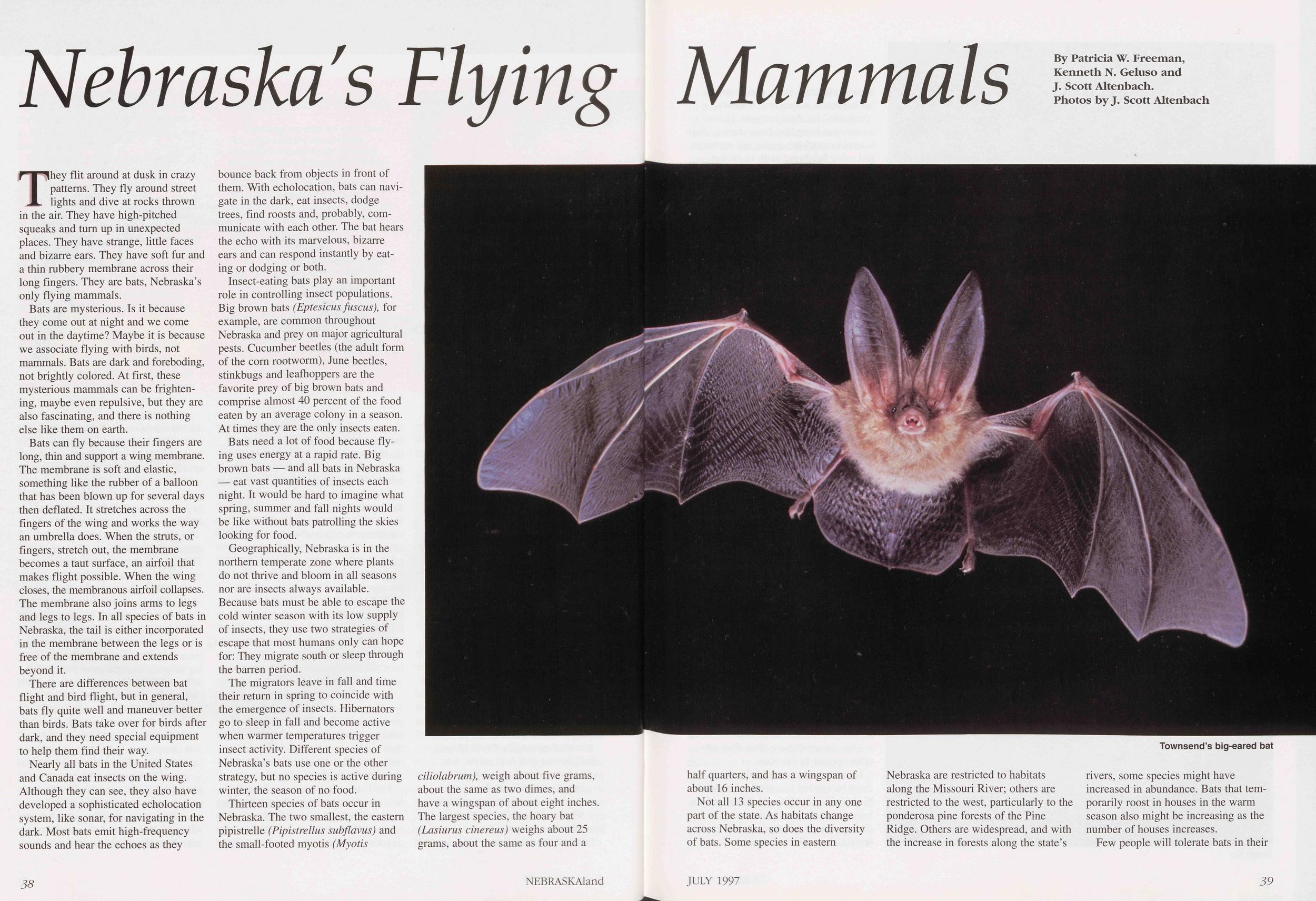
Nebraska's Flying Mammals
They flit around at dusk in crazy patterns. They fly around street lights and dive at rocks thrown in the air. They have high-pitched squeaks and turn up in unexpected places. They have strange, little faces and bizarre ears. They have soft fur and a thin rubbery membrane across their long fingers. They are bats, Nebraska's only flying mammals.
Bats are mysterious. Is it because they come out at night and we come out in the daytime? Maybe it is because we associate flying with birds, not mammals. Bats are dark and foreboding, not brightly colored. At first, these mysterious mammals can be frightening, maybe even repulsive, but they are also fascinating, and there is nothing else like them on earth.
Bats can fly because their fingers are long, thin and support a wing membrane. The membrane is soft and elastic, something like the rubber of a balloon that has been blown up for several days then deflated. It stretches across the fingers of the wing and works the way an umbrella does. When the struts, or fingers, stretch out, the membrane becomes a taut surface, an airfoil that makes flight possible. When the wing closes, the membranous airfoil collapses. The membrane also joins arms to legs and legs to legs. In all species of bats in Nebraska, the tail is either incorporated in the membrane between the legs or is free of the membrane and extends beyond it.
There are differences between bat flight and bird flight, but in general, bats fly quite well and maneuver better than birds. Bats take over for birds after dark, and they need special equipment to help them find their way.
Nearly all bats in the United States and Canada eat insects on the wing. Although they can see, they also have developed a sophisticated echolocation system, like sonar, for navigating in the dark. Most bats emit high-frequency sounds and hear the echoes as they bounce back from objects in front of them. With echolocation, bats can navigate in the dark, eat insects, dodge trees, find roosts and, probably, communicate with each other. The bat hears the echo with its marvelous, bizarre ears and can respond instantly by eating or dodging or both.
Insect-eating bats play an important role in controlling insect populations. Big brown bats (Eptesicus fuscus), for example, are common throughout Nebraska and prey on major agricultural pests. Cucumber beetles (the adult form of the corn rootworm), June beetles, stinkbugs and leafhoppers are the favorite prey of big brown bats and comprise almost 40 percent of the food eaten by an average colony in a season. At times they are the only insects eaten.
Bats need a lot of food because flying uses energy at a rapid rate. Big brown bats — and all bats in Nebraska — eat vast quantities of insects each night. It would be hard to imagine what spring, summer and fall nights would be like without bats patrolling the skies looking for food.
Geographically, Nebraska is in the northern temperate zone where plants do not thrive and bloom in all seasons nor are insects always available. Because bats must be able to escape the cold winter season with its low supply of insects, they use two strategies of escape that most humans only can hope for: They migrate south or sleep through the barren period.
The migrators leave in fall and time their return in spring to coincide with the emergence of insects. Hibernators go to sleep in fall and become active when warmer temperatures trigger insect activity. Different species of Nebraska's bats use one or the other strategy, but no species is active during winter, the season of no food.
Thirteen species of bats occur in Nebraska. The two smallest, the eastern pipistrelle (Pipistrellus subflavus) and the small-footed myotis (Myotis ciliolabrum), weigh about five grams, about the same as two dimes, and have a wingspan of about eight inches. The largest species, the hoary bat (Lasiurus cinereus) weighs about 25 grams, about the same as four and a
38 NEBRASKAlandhalf quarters, and has a wingspan of about 16 inches.
Townsend's big-eared bat
Few people will tolerate bats in their
JULY 1997 39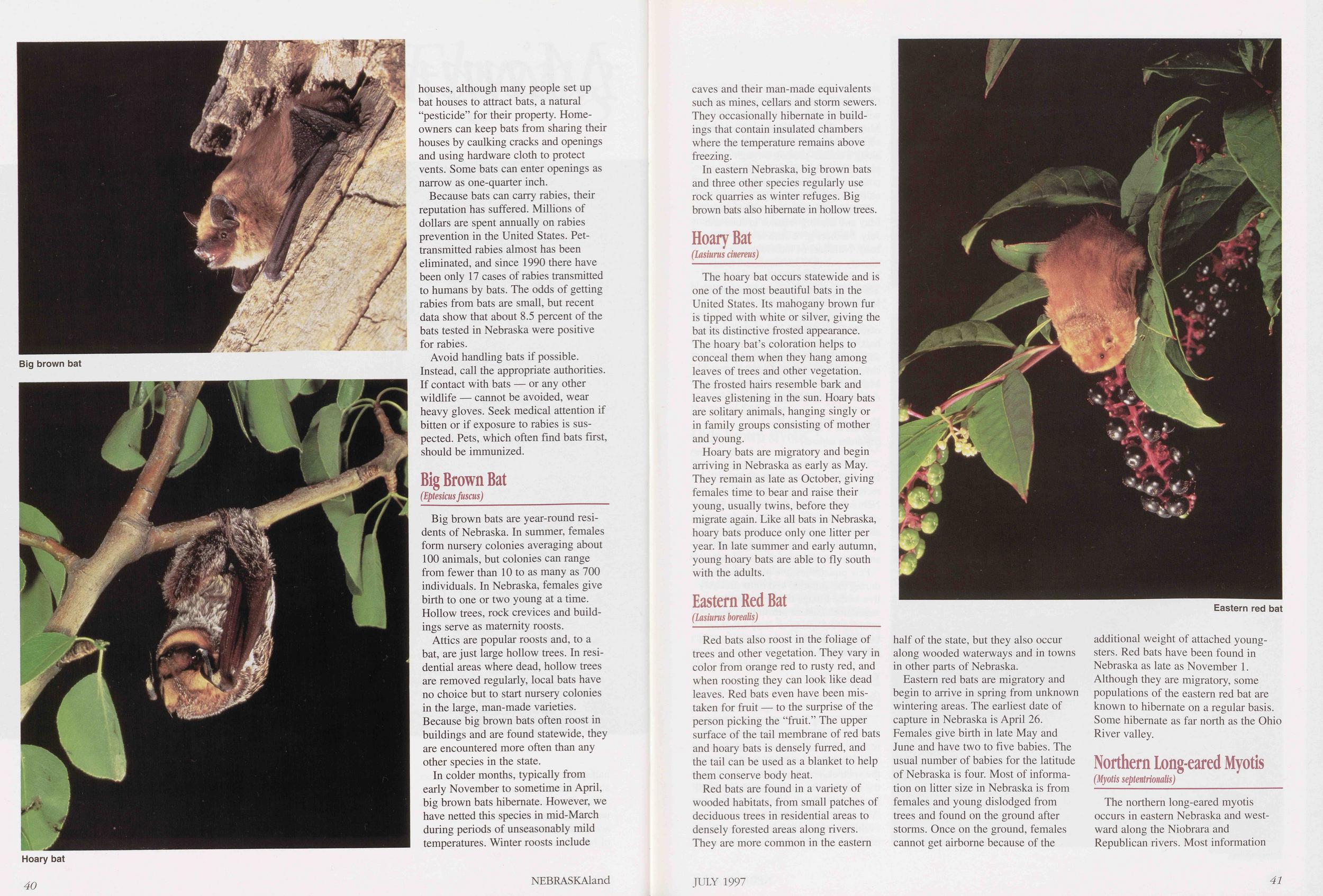
Big brown bat
Hoary bat
houses, although many people set up bat houses to attract bats, a natural "pesticide" for their property. Homeowners can keep bats from sharing their houses by caulking cracks and openings and using hardware cloth to protect vents. Some bats can enter openings as narrow as one-quarter inch.
Because bats can carry rabies, their reputation has suffered. Millions of dollars are spent annually on rabies prevention in the United States. Pet-transmitted rabies almost has been eliminated, and since 1990 there have been only 17 cases of rabies transmitted to humans by bats. The odds of getting rabies from bats are small, but recent data show that about 8.5 percent of the bats tested in Nebraska were positive for rabies.
Avoid handling bats if possible. Instead, call the appropriate authorities. If contact with bats — or any other wildlife — cannot be avoided, wear heavy gloves. Seek medical attention if bitten or if exposure to rabies is suspected. Pets, which often find bats first, should be immunized.
Big Brown Bat (Eptesicusfuscus)Big brown bats are year-round residents of Nebraska. In summer, females form nursery colonies averaging about 100 animals, but colonies can range from fewer than 10 to as many as 700 individuals. In Nebraska, females give birth to one or two young at a time. Hollow trees, rock crevices and buildings serve as maternity roosts.
Attics are popular roosts and, to a bat, are just large hollow trees. In residential areas where dead, hollow trees are removed regularly, local bats have no choice but to start nursery colonies in the large, man-made varieties. Because big brown bats often roost in buildings and are found statewide, they are encountered more often than any other species in the state.
In colder months, typically from early November to sometime in April, big brown bats hibernate. However, we have netted this species in mid-March during periods of unseasonably mild temperatures. Winter roosts include
caves and their man-made equivalents such as mines, cellars and storm sewers. They occasionally hibernate in buildings that contain insulated chambers where the temperature remains above freezing.
40 NEBRASKAlandIn eastern Nebraska, big brown bats and three other species regularly use rock quarries as winter refuges. Big brown bats also hibernate in hollow trees.
Hoary Bat (Lasiums cinereus)The hoary bat occurs statewide and is one of the most beautiful bats in the United States. Its mahogany brown fur is tipped with white or silver, giving the bat its distinctive frosted appearance. The hoary bat's coloration helps to conceal them when they hang among leaves of trees and other vegetation. The frosted hairs resemble bark and leaves glistening in the sun. Hoary bats are solitary animals, hanging singly or in family groups consisting of mother and young.
Hoary bats are migratory and begin arriving in Nebraska as early as May. They remain as late as October, giving females time to bear and raise their young, usually twins, before they migrate again. Like all bats in Nebraska, hoary bats produce only one litter per year. In late summer and early autumn, young hoary bats are able to fly south with the adults.
Eastern Red Bat (Lasiums borealis)Red bats also roost in the foliage of trees and other vegetation. They vary in color from orange red to rusty red, and when roosting they can look like dead leaves. Red bats even have been mis- taken for fruit — to the surprise of the person picking the "fruit." The upper surface of the tail membrane of red bats and hoary bats is densely furred, and the tail can be used as a blanket to help them conserve body heat.
Red bats are found in a variety of wooded habitats, from small patches of deciduous trees in residential areas to densely forested areas along rivers. They are more common in the eastern half of the state, but they also occur along wooded waterways and in towns in other parts of Nebraska.
Eastern red bat
The northern long-eared myotis occurs in eastern Nebraska and westward along the Niobrara and Republican rivers. Most information
JULY 1997 41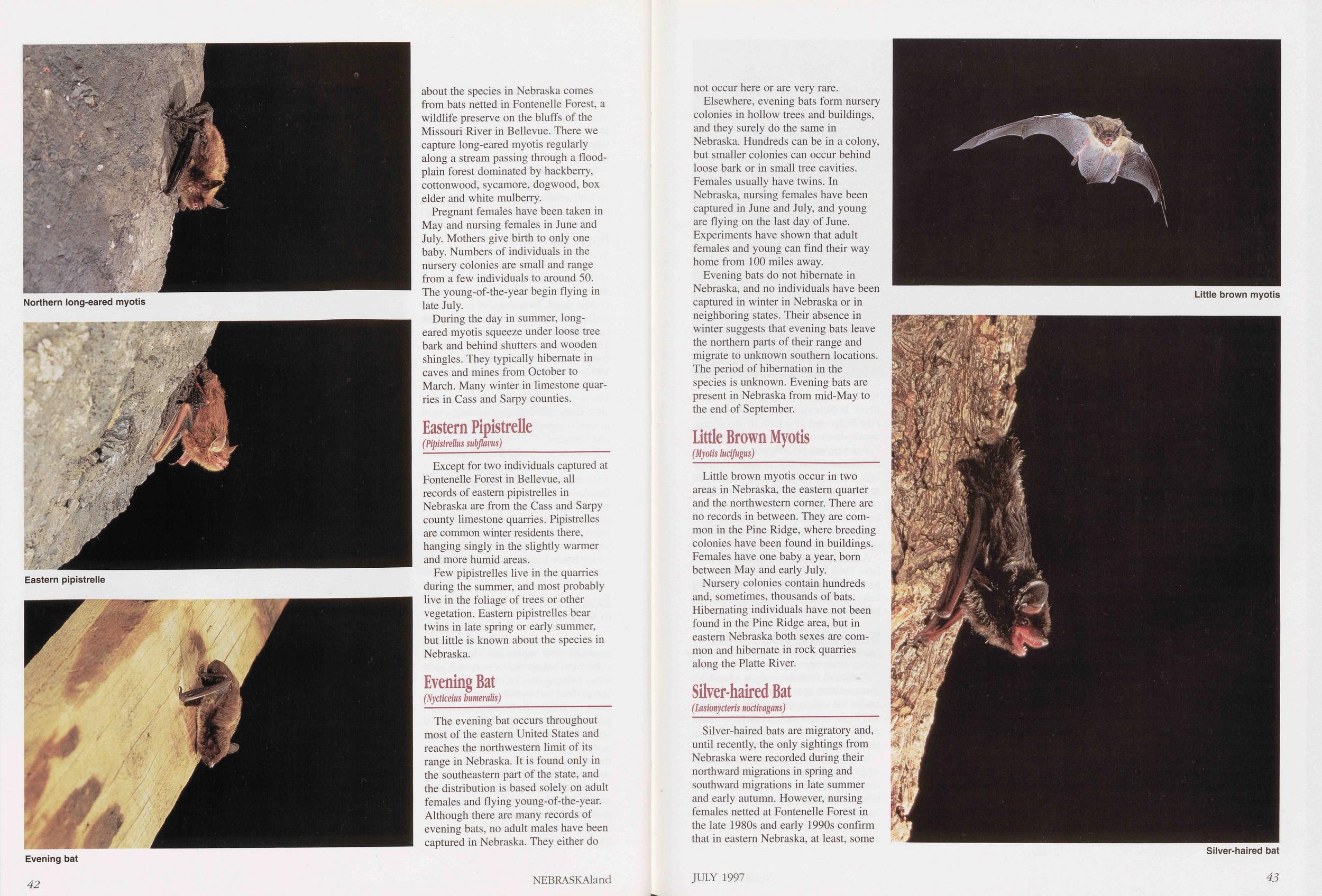
Northern long-eared myotis
Eastern pipistrelle
Evening bat
about the species in Nebraska comes from bats netted in Fontenelle Forest, a wildlife preserve on the bluffs of the Missouri River in Bellevue. There we capture long-eared myotis regularly along a stream passing through a floodplain forest dominated by hackberry, cottonwood, sycamore, dogwood, box elder and white mulberry.
Pregnant females have been taken in May and nursing females in June and July. Mothers give birth to only one baby. Numbers of individuals in the nursery colonies are small and range from a few individuals to around 50. The young-of-the-year begin flying in late July.
During the day in summer, longeared myotis squeeze under loose tree bark and behind shutters and wooden shingles. They typically hibernate in caves and mines from October to March. Many winter in limestone quarries in Cass and Sarpy counties.
Eastern Pipistrelle (Pipistreuus subflavus)Except for two individuals captured at Fontenelle Forest in Bellevue, all records of eastern pipistrelles in Nebraska are from the Cass and Sarpy county limestone quarries. Pipistrelles are common winter residents there, hanging singly in the slightly warmer and more humid areas.
Few pipistrelles live in the quarries during the summer, and most probably live in the foliage of trees or other vegetation. Eastern pipistrelles bear twins in late spring or early summer, but little is known about the species in Nebraska.
Evening Bat (Nycticeius humeralis)The evening bat occurs throughout most of the eastern United States and reaches the northwestern limit of its range in Nebraska. It is found only in the southeastern part of the state, and the distribution is based solely on adult females and flying young-of-the-year. Although there are many records of evening bats, no adult males have been captured in Nebraska. They either do
42 NEBRASKAlandnot occur here or are very rare.
Elsewhere, evening bats form nursery colonies in hollow trees and buildings, and they surely do the same in Nebraska. Hundreds can be in a colony, but smaller colonies can occur behind loose bark or in small tree cavities. Females usually have twins. In Nebraska, nursing females have been captured in June and July, and young are flying on the last day of June. Experiments have shown that adult females and young can find their way home from 100 miles away.
Evening bats do not hibernate in Nebraska, and no individuals have been captured in winter in Nebraska or in neighboring states. Their absence in winter suggests that evening bats leave the northern parts of their range and migrate to unknown southern locations. The period of hibernation in the species is unknown. Evening bats are present in Nebraska from mid-May to the end of September.
Little Brown Myotis (Myotis lucifugus)Little brown myotis occur in two areas in Nebraska, the eastern quarter and the northwestern corner. There are no records in between. They are common in the Pine Ridge, where breeding colonies have been found in buildings. Females have one baby a year, born between May and early July.
Nursery colonies contain hundreds and, sometimes, thousands of bats. Hibernating individuals have not been found in the Pine Ridge area, but in eastern Nebraska both sexes are common and hibernate in rock quarries along the Platte River.
Silver-haired Bat (Lasionycteris noctivagans)Silver-haired bats are migratory and, until recently, the only sightings from Nebraska were recorded during their northward migrations in spring and southward migrations in late summer and early autumn. However, nursing females netted at Fontenelle Forest in the late 1980s and early 1990s confirm that in eastern Nebraska, at least, some
Little brown myotis
Silver-haired bat
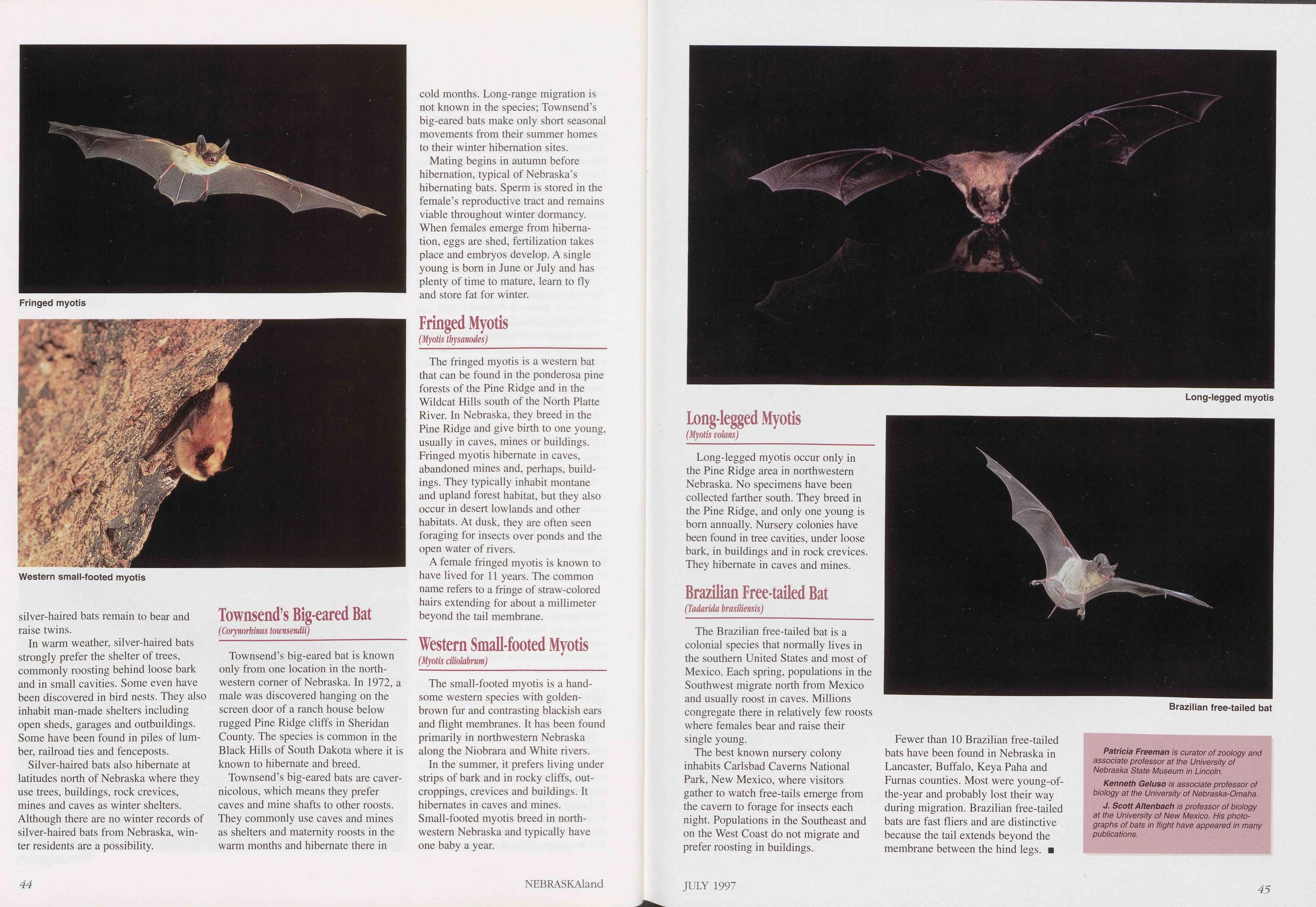
Fringed myotis
Western small-footed myotis
silver-haired bats remain to bear and raise twins.
In warm weather, silver-haired bats strongly prefer the shelter of trees, commonly roosting behind loose bark and in small cavities. Some even have been discovered in bird nests. They also inhabit man-made shelters including open sheds, garages and outbuildings. Some have been found in piles of lumber, railroad ties and fenceposts.
Silver-haired bats also hibernate at latitudes north of Nebraska where they use trees, buildings, rock crevices, mines and caves as winter shelters. Although there are no winter records of silver-haired bats from Nebraska, winter residents are a possibility.
Townsend's Big-eared Bat (Corynorhinus townsendii)Townsend's big-eared bat is known only from one location in the northwestern corner of Nebraska. In 1972, a male was discovered hanging on the screen door of a ranch house below rugged Pine Ridge cliffs in Sheridan County. The species is common in the Black Hills of South Dakota where it is known to hibernate and breed.
Townsend's big-eared bats are cavernicolous, which means they prefer caves and mine shafts to other roosts. They commonly use caves and mines as shelters and maternity roosts in the warm months and hibernate there in cold months. Long-range migration is not known in the species; Townsend's big-eared bats make only short seasonal movements from their summer homes to their winter hibernation sites.
Mating begins in autumn before hibernation, typical of Nebraska's hibernating bats. Sperm is stored in the female's reproductive tract and remains viable throughout winter dormancy. When females emerge from hibernation, eggs are shed, fertilization takes place and embryos develop. A single young is born in June or July and has plenty of time to mature, learn to fly and store fat for winter.
Fringed Myotis (Myotis thysanodes)The fringed myotis is a western bat that can be found in the ponderosa pine forests of the Pine Ridge and in the Wildcat Hills south of the North Platte River. In Nebraska, they breed in the Pine Ridge and give birth to one young, usually in caves, mines or buildings. Fringed myotis hibernate in caves, abandoned mines and, perhaps, buildings. They typically inhabit montane and upland forest habitat, but they also occur in desert lowlands and other habitats. At dusk, they are often seen foraging for insects over ponds and the open water of rivers.
A female fringed myotis is known to have lived for 11 years. The common name refers to a fringe of straw-colored hairs extending for about a millimeter beyond the tail membrane.
Western Small-footed Myotis (Myotis ciliolabrum)The small-footed myotis is a handsome western species with golden-brown fur and contrasting blackish ears and flight membranes. It has been found primarily in northwestern Nebraska along the Niobrara and White rivers.
In the summer, it prefers living under strips of bark and in rocky cliffs, outcroppings, crevices and buildings. It hibernates in caves and mines. Small-footed myotis breed in northwestern Nebraska and typically have one baby a year.
44 NEBRASKAland Long-legged Myotis (Myotis volans)Long-legged myotis occur only in the Pine Ridge area in northwestern Nebraska. No specimens have been collected farther south. They breed in the Pine Ridge, and only one young is born annually. Nursery colonies have been found in tree cavities, under loose bark, in buildings and in rock crevices. They hibernate in caves and mines.
Brazilian Free-tailed Bat (Tadarida brasiliensis)The Brazilian free-tailed bat is a colonial species that normally lives in the southern United States and most of Mexico. Each spring, populations in the Southwest migrate north from Mexico and usually roost in caves. Millions congregate there in relatively few roosts where females bear and raise their single young.
The best known nursery colony inhabits Carlsbad Caverns National Park, New Mexico, where visitors gather to watch free-tails emerge from the cavern to forage for insects each night. Populations in the Southeast and on the West Coast do not migrate and prefer roosting in buildings.
Long-legged myotis
Brazilian free-tailed bat
Fewer than 10 Brazilian free-tailed bats have been found in Nebraska in Lancaster, Buffalo, Keya Paha and Furnas counties. Most were young-of-the-year and probably lost their way during migration. Brazilian free-tailed bats are fast fliers and are distinctive because the tail extends beyond the membrane between the hind legs.
Patricia Freeman is curator of zoology and associate professor at the University of Nebraska State Museum in Lincoln. Kenneth Geiuso is associate professor of biology at the University of Nebraska-Omaha. J. Scott Altenbach is professor of biology at the University of New Mexico. His photographs of bats in flight have appeared in many publications. JULY 1997 45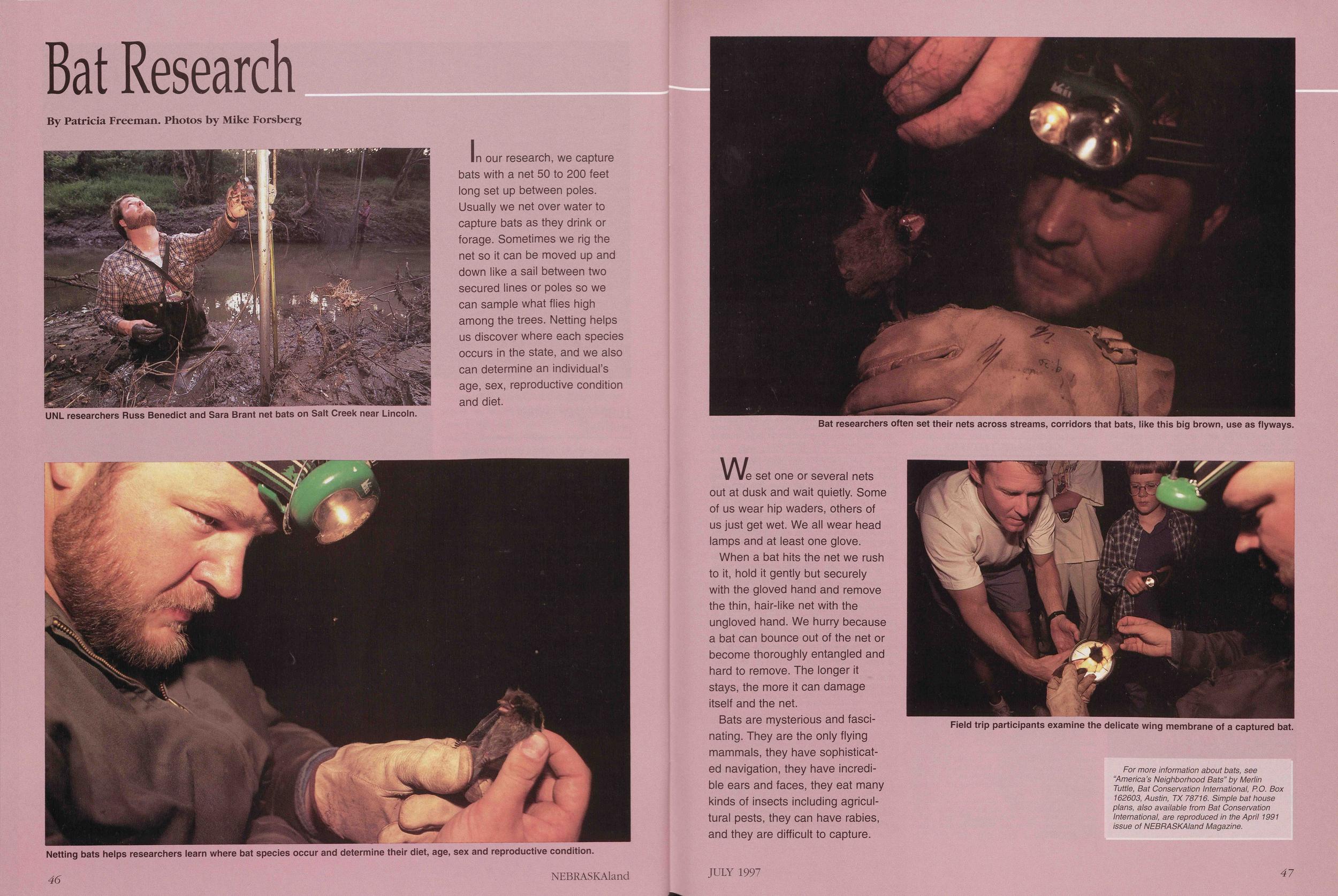
Bat Research
UNL researchers Russ Benedict and Sara Brant net bats on Salt Creek near Lincoln.
In our research, we capture bats with a net 50 to 200 feet long set up between poles. Usually we net over water to capture bats as they drink or forage. Sometimes we rig the net so it can be moved up and down like a sail between two secured lines or poles so we can sample what flies high among the trees. Netting helps us discover where each species occurs in the state, and we also can determine an individual's age, sex, reproductive condition and diet.
Netting bats helps researchers learn where bat species occur and determine their diet, age, sex and reproductive condition.
Bat researchers often set their nets across streams, corridors that bats, like this big brown, use as flyways.
We set one or several nets out at dusk and wait quietly. Some of us wear hip waders, others of us just get wet. We all wear head lamps and at least one glove.
When a bat hits the net we rush to it, hold it gently but securely with the gloved hand and remove the thin, hair-like net with the ungloved hand. We hurry because a bat can bounce out of the net or become thoroughly entangled and hard to remove. The longer it stays, the more it can damage itself and the net.
Bats are mysterious and fascinating. They are the only flying mammals, they have sophisticated navigation, they have incredible ears and faces, they eat many kinds of insects including agricultural pests, they can have rabies, and they are difficult to capture.
Field trip participants examine the delicate wing membrane of a captured bat. For more information about bats, see "America's Neighborhood Bats" by Merlin Tuttle, Bat Conservation International, P.O. Box 162603, Austin, TX 78716. Simple bat house plans, also available from Bat Conservation International, are reproduced in the April 1991 issue of NEBRASKAland Magazine. JULY 1997 47
Classified
BOOKS/PRINTING FREE BOOK CATALOG. Novels, westerns, romances, children's; old out of print, found barns, attic. Authors: Grey, Bower, Condor, Fox, Curwood, Raine, Wright, Aldrige, Pollyanna, Freckles, many others. Postage appreciated. Pierce, 4400 N. Pine Cluster, Oroville, CA 95965. HOW TO FIND MORE outdoor opportunities! The Nebraska Sportsman's Atlas. Locations of all public lands and waters on county transportation maps. These maps show ALL the roads in Nebraska. Listings include federal, Nebraska Game & Parks, NRD holdings, hotels and motels and Nebraska's endless attractions. At only $18.75/copy a true time and frustration saver. To order write: Sportsman's Atlas Co., P.O. Box 132, Lytton, IA 50561 or call (800) 568-8334. JU-JU SWALLOWED A PENNY, a Nebraska farm girl's book of the 1930s Depression Era. $7.50 ppd. Betty Heidbreder Dunn, Rt. 2, Box 2025, Columbus, TX 78934. DOGS TRAINING ALL BREEDS bird dogs - Vizslas for sale. Home of Rebel Rousers. Rozanek Kennels, RR 2, Schuyler, NE 68661. Phone (402) 352-8769. ENGLISH SETTERS, German shorthairs, English pointers, Brittany spaniels - stud service, puppies and started dogs. Training for all pointing breeds. Plum Creek Kennel, (712) 529-4238 or (402) 298-8153. RETRIEVER TRAINING. Area's top "retrievers only" trainer. Field trial and hunting dogs. Non-slip duck dogs! TKO Retriever Training Kennel (402) 623-4311. ENGLISH SETTERS and Labradors from outstanding lines. Bred for hunters who appreciate fine bird dogs! Wind Fall Gun Dogs, (402) 421-4693. CHESAPEAKE BAY, Labrador and golden retriever pups, started dogs and stud service. 16-time national champion pedigree. Visa & MasterCard. Platte Valley Retrievers (308) 995-2318. YELLOW-CHOCOLATE-BLACK LAB pups. Breeders hips O.F.A. and eyes CERF. Excellent bloodlines and hunting potential. Call Mr. Bendler, Lexington, NE (308) 324-4247 or Lincoln (402) 477-1305. WILDERNESS KENNELS. Gun dog training - over 60 years combined experience. Training all sporting breeds - retrievers, flushing and pointing dogs. All dogs worked on pen raised birds and wild game. Training program includes obedience training - heel, sit, stay, down and come when called. Pups, started dogs and fully trained dogs for sale. Hunting dogs trained by hunters. Henry Sader, Wilderness Kennels, Roca, NE (402) 423-4212. Since 1968. NEBRASKAland by phone! For Visa and MasterCard orders, call toll free 1-800-NEB-LAND (632-5263) FISH/FISHING FISH FOR SALE. Catfish, largemouth bass, smallmouth bass, perch, crappie, bluegill, walleye, northern pike, rainbow trout, Donaldson rainbow trout, grass carp, minnows, bullheads. Consulting available. Pleasant Valley Fish Farm, RR 1, Box 147, McCook, NE 69001. Phone (308) 345-6599. WILLOW LAKE FISH HATCHERY. Channel cat, bluegill, hybrid bluegill, largemouth bass, crappie, grass carp, walleye, perch, minnows available for stocking. Gaylord Crawford, 7580 N. Highland Rd., Hastings, NE 68901 or phone (402) 463-8022 day or night. Also pond consultant. We deliver, grower price. FOOD/GIFTS NEBRASKA BASKETS: The original Nebraska company specializing in fine foods from Nebraska since 1984. A beautiful array of baskets filled with ethnic, healthful and long-time favorite foods. Call or write for our brochure: P.O. Box 22985, Lincoln, NE 68542. Phone (800) 345-7725 or (402) 438-3111. FROM NEBRASKA GIFT SHOP..the world's largest selection of Nebraska-made food products and gifts. Historic Haymarket, 140 N. 8th St., Lincoln, NE 68508; Old Market, 1030 Howard St., Omaha, NE. Call for free catalog (800) 399-5693. HOMEBREWING/BEER & WINEMAKING supplies. Fermenter's Supply, 8410 K Plz. #10, Omaha, NE 68127. (402) 593-9171. Open every day, mail orders welcome, low shipping. NEBRASKA GOURMET SMOKED TURKEY, award-winning BBQ sauces, gourmet seasonings, native jellies, fruit butters and more! Great gift ideas! Call toll free (888) 926-2879 or (308) 468-5635. Hollman Foods, 1948 36 Road, Minden, NE 68959, or check our products out on the Internet, http://www.hollmans.com/ GUIDES/OUTFITTERS MAD RIVER CANOES offers the finest quality and performance. For the finest canoes and accessories look to Great Plains Canoe Co., 205 Main, Springfield, NE 68059. Phone (402) 253-2001. CANOE THE NIOBRARA...with an affordable canoe trip by Dryland Aquatics. One and two-day trips...full service, or just canoes and tubes. Transportation furnished. Your Niobrara River specialists... We do it your way! Dryland Aquatics, Dept. N, Box 33C, Sparks, NE 69220 or phone (800) 337-3119. CANOE AND KAYAK TRIPS on Dismal and Middle Loup rivers. Camping available. Sandhills Motel, Mullen, NE (308) 546-2206. MOUNTAIN BIKE Niobrara River country, Merritt Reservoir and the Cowboy Trail. For bicycle/accessory rentals, trips, sales and service, contact Yucca Dune, 148 E. 1st St., Valentine, NE 69201 (402) 376-3330 or ryschon @ ibm.net. KAYAKS BY PERCEPTION and Aquaterra. Durable kayaks for Niobrara touring and white-water adventure. Trips, boats and accessories for all abilities. Yucca Dune, 148 E. 1st St., Valentine, NE 69201 (402) 376-3330 or ryschon @ ibm.net. GUNS/SHOOTING/ARCHERY GUNS - Browning, Winchester, Remington, others. Hi-powers, shotguns, new, used, antiques. Want Pre-'64 Winchesters. Buy-Sell-Trade. (402) 729-6112. Bedlan's Sporting Goods, Fairbury, NE 68352. RARE OPPORTUNITY. COMMEMORATIVE HUSKER 1994-95 Back to Back National Football Championship Winchester Model 94 and Ruger KRL-1227. Actions never moved. Both #1 of 100. $10K for both (316) 634-3145 Tom. AIR GUNS REPAIRED - Benjamin, Crosman, Daisy, other American made. Restoration; old guns wanted. Jack's Air Guns, 1225 N. 46th, Lincoln, NE 68503. Phone (402) 466-9223. PLANTS/ANIMALS/HABITAT WANTED: STRONG FLYING barn pigeons. $2.35 each delivered to us. (316) 836-3285. TAXIDERMY ALLISON'S TAXIDERMY Studio & Gift Gallery - DU, SCI, Pheasants Forever & NTA Members. Mounted 36 state record fish. 421 N. Dewey, North Platte, NE 69101. Call (308) 534-2324 or (308) 534-4267. Custom Designs. VACATIONS/RESORTS FOR FISHING and hunting accommodations. Jefco Inn, Gordon, NE 69343. South Cornell, (308) 282-2935. BED & BREAKFAST. Historic 1890s hotel. Located in the beautiful Pine Ridge area of northwest Nebraska. Short drive to Chadron State Park, Fort Robinson and the Black Hills. Beautiful dining room with fireplace and fountain. Room service available. The Olde Main Street Inn, 115 Main St., Chadron, NE 69337. (308) 432-3380. DIAMOND-E TROUT RESORT. 2 new lodges, 3 cottages on spring-fed lakes, stream. Private and secluded. Trout, bass, bluegill, etc. Paddleboats and playground equipment. For brochure, call (800) 974-3002. NEAR OMAHA ZOO, American Family Inn Motel. See rain forest, aquarium, I-MAX theater. 104 rooms, free VCR, 125 rental movies, sparkling pool, gazebo, picnic area. $42-$48. Welcome! (800) 253-2865. OMAHA MOTEL on 1-80 and 144th St. (Exit 440). The friendly Ben Franklin Motel welcomes you. 96 lovely rooms. HBO, free VCR, rental movies, huge swimming pool. Only $40-$48. (800) 688-3658. FAMILY AND FRIENDS VACATION together. Four bedroom ranch house and barn loft by Lewis & Clark Lake. Access to park facilities for boating, fishing, biking, golf and trail riding. Bring your horse. Brochures available. Call Cedar Ridge Ranch (712) 255-3047 days. (712) 239-2337 nights. LOVELY LAKESIDE COTTAGE in the Sandhills. Fully furnished. Screened front porch. Canoeing. Available by week/month to one or two non smoking adults. No pets. James Norton, P.O. Box 7, Ericson, NE 68637. Call (308) 653-3121. ATTN: SPORTSMEN, FAMILIES, vacationers, groups. Rustic cabins w/cooking; at scenic Sandhills valley ranch. Excellent hunting, fishing, photography, hiking, relaxation, wildlife. Contact: Jim or Pat Bridges, Double R Ranch, HC 1 Box 12, Mullen, NE or phone (308) 546-2314 after 6 p.m. for reservations. UNCLE BUCK'S LODGE. Full service, 14,000 square foot lodge, restaurant, bar and hotel overlooking the North Loup River. Relaxing environment, mounted game, hunting and western activities, family reunions, parties and weddings. Write P.O. Box 100, Brewster, NE 68821 or call (800) 239-9190 or (308) 547-2210. NEBRASKA state park vacations. From the Fall foliage at Indian Cave to the clear blue skies over the Pine Ridge, Nebraska state parks are the perfect place for an autumn getaway. For a free color brochure listing all park facilities, call (800) 826-7275. Classified Rates: 75c per word, minimum $15. Closing: First business day two months before issue date. Classified ads are accepted on a first-come, first-served, space-available basis. Classified Ads, NEBRASKAland Magazine, RO. Box 30370, Lincoln, NE 68503-0370. Tel. (402) 471-5478. Fax (402) 471-5528. E-mail: nebland@ngpsun. ngpc. state. ne. us 48 NEBRASKAlandPage forty-nine
We Get CallsThe secretary rang my extension. "Call for you on line two."
The caller, on a cell phone, was an acquaintance through my work at the Game and Parks Commission district office in North Platte.
"I've got the crosshairs of my rifle fixed right between the eyes of a mountain lion down here on Medicine Creek. Is it all right for me to shoot it?"
"No! Mountain lions are protected in Nebraska." I hoped my words reached him before he reached for the trigger.
"I thought so," he replied, as the tension eased from his voice.
"You won't believe this, but there are two of them just sitting on the bank and looking into the sun. One's real big, and the other's about half- to three-quarters grown. Must be a cub."
"Let's not waste this opportunity," I said. "Describe the one you're looking at — size, color, length of tail, hair..."
The caller perfectly described a mountain lion before the two animals slipped away into the cedars.
There is no reason to doubt the sighting. He was not remembering a past sighting, but was reporting one as it happened. He was looking through a telescopic lens and had time to observe and to answer guided questions while he was looking at the animal. A valid sighting? Probably, but not necessarily.
Another cell phone call, another day from a woman stopped along U.S. 83. She was certain she was looking at a black panther hiding in the road ditch. She was so convincing that a conservation officer drove south to meet her, only to discover that she was looking at a black house cat of normal size.
Don't make that typical male sexist mistake and criticize the sighting because it was made by a woman. Since that incident, two convincing black panther sightings have come from men. Both animals turned out to be house cats. One suspected panther sighting, also confirmed as a house cat, was made by a trapper who has spent most of his life outdoors.
In 1984, two years before we began releasing river otters, a UPS driver called me: "I'm out south by your place, and there's an otter hiding under your front steps."
I knew him well enough to ask if he was feeling okay.
"I knew you'd say that, and I'm waiting right here where I can keep an eye on it. Bring a net and a big cage."
I live 10 miles south of the Platte River in a range of sandhills that hasn't seen a stream since dinosaurs walked the planet. There had been no river otters in the state since the turn of the century, and I was certain there still were none — especially hiding in the dry sand under my porch.
I went, however, not because I believed the sighting, but because the UPS driver was a friend, and I didn't want him to get fired for sitting out at my place instead of making his deliveries. I took a net and a cage. Two hours later I returned to the office, exhausted, with an adult male river otter in the cage. Biologists examined and tagged the animal and released it into the South Platte River.
"What's brown and speckled and about the size of a hen pheasant? I've got it under a bucket in the back yard."
Turned out to be a flicker.
"I'm bringing a dead peregrine falcon in to your office."
Turned out to be a racing pigeon with a band on one leg.
"We've got a single sandhill crane
Turned out to be a single sandhill crane that landed by their goose blind every morning to get a doughnut.
One cold clammy night, the phone rang at home. It was from a young fellow who lives at the lake. "The biggest fish you ever saw in your life just washed up on the beach. In the moonlight, we thought it was a man."
"How big a fish?" I asked.
"Big enough to be a man," he replied.
"I'll be right over."
A small crowd had gathered on the beach around an object that, in the moonlight, looked like a man — or at least was as big as a man. It was a paddlefish that weighed more than 140 pounds. How it got into Lake Maloney and grew undetected for so many years is a mystery.
The point is, we take all observations seriously. The paddlefish, the river otter and the sandhill crane with the doughnut fetish are testimony to why we do.
Perhaps we expect too much from the public. When a local electrician calls excitedly to report seeing a bald eagle on the Platte River, we expect him to know that hundreds of bald eagles winter in Nebraska. We don't have a clue, however, about wiring a house, so we seek his expertise, just as he seeks ours about wildlife.
Ten years ago, we would have been as skeptical about an elk sighting as we are now about mountain lion reports. Now elk could be reported from any county with hardly an eyebrow raised. Some of us remember when a deer sighting was an event to talk about.
We depend on the public for reports. Most whooping crane observations come from the public. We have to weed out a few white pelicans here and there, but that's fine. We're also better able to keep track of elk populations with reports from the public, and our only chance to verify lion sightings is to hear about them. So don't be shy. Keep those calls coming.
Rocky Hoffmann JULY 1997 49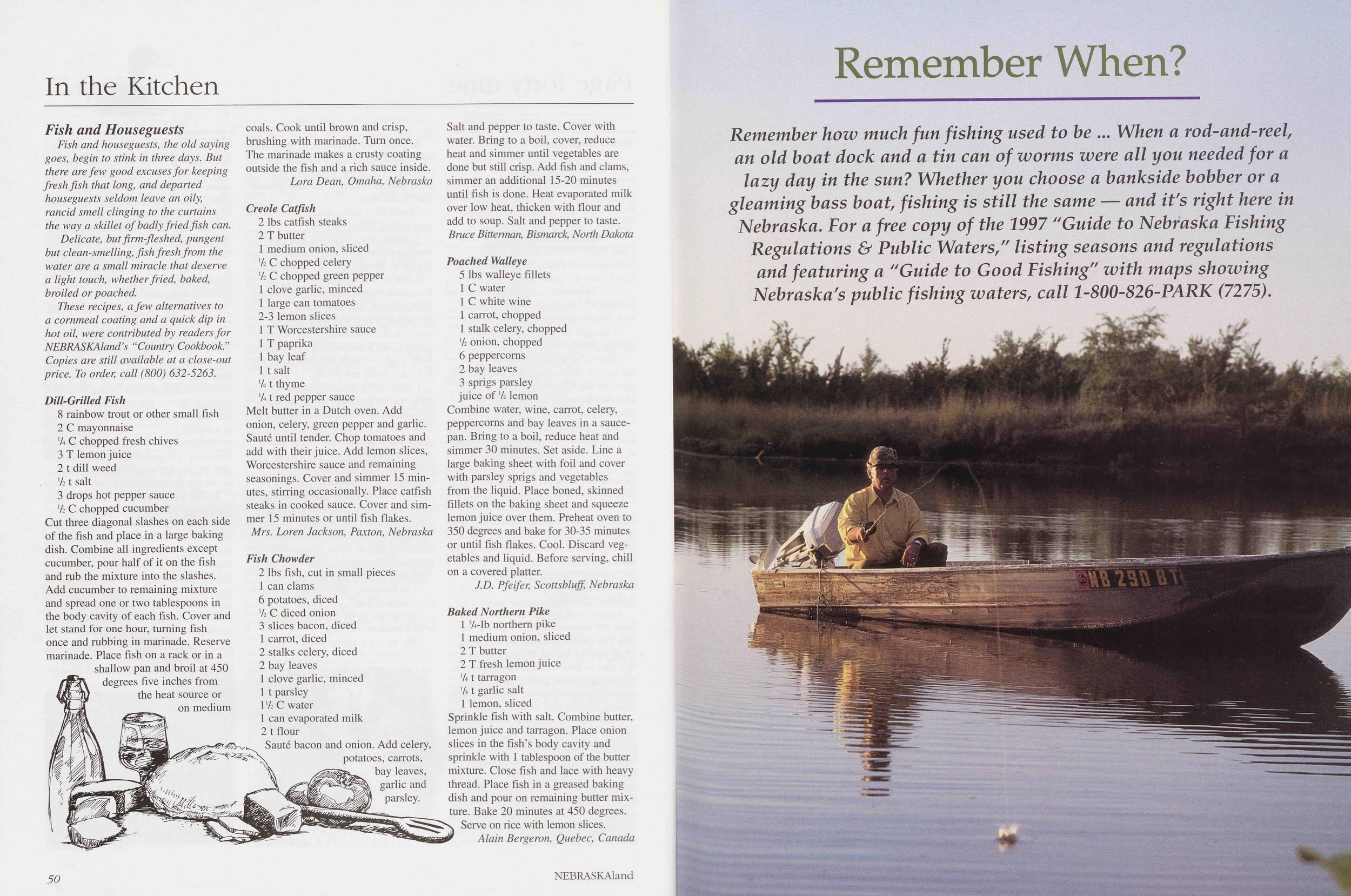
In the Kitchen
Fish and Houseguests Fish and houseguests, the old saying goes, begin to stink in three days. But there are few good excuses for keeping fresh fish that long, and departed houseguests seldom leave an oily, rancid smell clinging to the curtains the way a skillet of badly fried fish can. Delicate, but firm-fleshed, pungent but clean-smelling, fish fresh from the water are a small miracle that deserve a light touch, whether fried, baked, broiled or poached. These recipes, a few alternatives to a cornmeal coating and a quick dip in hot oil, were contributed by readers for NEBRASKAland's "Country Cookbook:' Copies are still available at a close-out price. To order, call (800) 632-5263. Dill-Grilled Fish8 rainbow trout or other small fish
2 C mayonnaise
1/4 C chopped fresh chives
3 T lemon juice
2 t dill weed
1/2 t salt
3 drops hot pepper sauce
1/2 C chopped cucumber
Cut three diagonal slashes on each side of the fish and place in a large baking dish. Combine all ingredients except cucumber, pour half of it on the fish and rub the mixture into the slashes. Add cucumber to remaining mixture and spread one or two tablespoons in the body cavity of each fish. Cover and let stand for one hour, turning fish once and rubbing in marinade. Reserve marinade. Place fish on a rack or in a shallow pan and broil at 450 degrees five inches from the heat source or on medium
2 lbs catfish steaks
2 T butter
1 medium onion, sliced
l/2 C chopped celery
l/2 C chopped green pepper
1 clove garlic, minced
1 large can tomatoes
2-3 lemon slices
1 T Worcestershire sauce
1 T paprika
1 bay leaf
1 t salt
1/4 t thyme
1/4 t red pepper sauce
Melt butter in a Dutch oven. Add onion, celery, green pepper and garlic. Saute until tender. Chop tomatoes and add with their juice. Add lemon slices, Worcestershire sauce and remaining seasonings. Cover and simmer 15 minutes, stirring occasionally. Place catfish steaks in cooked sauce. Cover and simmer 15 minutes or until fish flakes.
Mrs. Loren Jackson, Paxton, Nebraska Fish Chowder2 lbs fish, cut in small pieces
1 can clams
6 potatoes, diced
1/2 C diced onion
3 slices bacon, diced
1 carrot, diced
2 stalks celery, diced
2 bay leaves
1 clove garlic, minced
1 t parsley
1 1/2 C water
1 can evaporated milk
2 t flour
Saute bacon and onion. Add celery, potatoes, carrots, bay leaves, garlic and parsley. Salt and pepper to taste. Cover with water. Bring to a boil, cover, reduce heat and simmer until vegetables are done but still crisp. Add fish and clams, simmer an additional 15-20 minutes until fish is done. Heat evaporated milk over low heat, thicken with flour and add to soup. Salt and pepper to taste.
Bruce Bitterman, Bismarck, North Dakota Poached Walleye5 lbs walleye fillets
1 C water
1 C white wine
1 carrot, chopped
1 stalk celery, chopped
1/2 onion, chopped
6 peppercorns
2 bay leaves
3 sprigs parsley
juice of 1/2 lemon
Combine water, wine, carrot, celery, peppercorns and bay leaves in a sauce-pan. Bring to a boil, reduce heat and simmer 30 minutes. Set aside. Line a large baking sheet with foil and cover with parsley sprigs and vegetables from the liquid. Place boned, skinned fillets on the baking sheet and squeeze lemon juice over them. Preheat oven to 350 degrees and bake for 30-35 minutes or until fish flakes. Cool. Discard vegetables and liquid. Before serving, chill on a covered platter.
J.D. Pfeifer, Scottsbluff, Nebraska Baked Northern Pike1 3/4-lb northern pike
1 medium onion, sliced
2 T butter
2 T fresh lemon juice
1/4 t tarragon
1/4 t garlic salt
1 lemon, sliced
Sprinkle fish with salt. Combine butter, lemon juice and tarragon. Place onion slices in the fish's body cavity and sprinkle with 1 tablespoon of the butter mixture. Close fish and lace with heavy thread. Place fish in a greased baking dish and pour on remaining butter mixture. Bake 20 minutes at 450 degrees.
Serve on rice with lemon slices.
Alain Bergeron, Quebec, Canada
Position: 737 (15 views)