Volume 75, Issue 5, 1997
NEBRASKAland
June 1997 $2.00
Letters
Nebraska's Outdoor TreasuresI was born in Omaha and "cornfed" until I was 10. My father was transferred to Texas, where I am living now (and loving it). In Nebraska, my parents instilled the values of the "Great Outdoors" in us and exposed us to Nebraska's treasures — parks, wildlife, fishing and hunting.
My dad and I have hunted deer in the Crawford area, and the Pine Ridge Unit, with its beauty and wildlife diversity, gives Texas a run for its money. I will be going into wildlife management when I graduate from college. The outdoors is my passion, and I have read many magazines, including NEBRASKAland. My father subscribed when I was a kid, and, then, I did not truly appreciate y'alls publication — I just looked for the best places to kill squirrels and catch bullheads. Now I can say that your publication is far and away the best. I am sure I will be a lifetime subscriber.
I appreciate your articles about management and participation. I think the best way to preserve wildlife and wilderness is through education and recruitment, precisely what your magazine is promoting. A heartfelt hats off to you for what you are doing for Nebraska and our nation's wildlife. Even if I don't end up in Nebraska, I will always have a special place in my heart for it.
Jesse TruaxMagnolia, Texas
This photo of the comet Hale-Bopp was taken March 25 about half a mile east of Fremont about one hour after sunset.
Audie CalvertFremont, Nebraska
4 NEBRASKAland Baltimore or Orchard Oriole?I enjoyed the May issue of NEBRASKAland, especially the article on the peregrine falcons.
I live on Rustic Isle on the Platte River just west of Venice, so I immediately noticed an error on the map on page 16. That is Highway 92 going across the river and my island, not Highway 91, which is approximately six miles north of Fremont.
Also, I believe that the bird pictured on page 36 is an orchard oriole, not a Baltimore oriole.
I always send this great publication on to a community center where it is enjoyed by many senior citizens.
G.E. Dave FullerOmaha, Nebraska
Mr. Fuller is correct. Highway 92 is mislabeled on the map. Game and Parks Commission biologist Kevin Poague agrees that the yellow coloration of the oriole pictured on page 36 might appear more typical of the orchard oriole than of the Baltimore, which typically shows more orange tones. However, the photographer also photographed the male feeding the young at the nest, and it is clearly a Baltimore. Finally, the two species build significantly different nests, and the nest in the picture is much more representative of the Baltimore than of the orchard oriole. (Editor) Editor's Note There is an error in the "Nebraska's Threatened and Endangered Species" brochure bound between pages 26 and 27 of this issue. The headline on page 2 of the brochure should read "Interior Least Tern — An endangered species." Correction On page 5 of the May issue, telephone numbers for the Wildlife Rescue Team are transposed. The correct listings are (402) 341-8619 in Omaha and (402) 473-1951 in Lincoln. Write to: Letters, NEBRASKAland Magazine, P.O. Box 30370, Lincoln, NE 68503. Fax: (402) 471-5528. E-mail: nebland@ngpsun.ngpc.state, ne. us. NEBRASKAland special issues from past years: One for $3, two or more books moiled to the same address, $2.50 each.
Notes from the field
Flowing Waters and Fine FoodWoe to backpackers who have to carry their food on their backs. Their choices restricted by the weight they can carry and the limited space they have for packing, backpackers usually have to be more concerned about essential nutritional requirements than about the taste of the food they eat.
Often when they come to the end of a few days' stomping in the hills, having fed three times a day on barely identifiable, cardboard-flavored, freeze-dried chunks and fragments, the foremost thing on the minds of many backpackers is getting a good meal.
Canoeists, however, those lovers of the water who seek relaxation and solitude on Nebraska's rivers from late spring to early fall, experience no such hardships in making decisions about what food to take. The canoe carries the load, and usually with ample space for at least a little gastronomic luxury.
Armed with a little knowledge and reinforced with planning and an experienced chef or two in the party, canoeists' meals on the river can taste as good as those cooked at home — sometimes even better. Listed below are a few practical meal and packing tips for canoeists, and a few easy recipes worth taking along downriver.
Packing principles: One of the advantages of a canoe, which usually is 16 to 18 feet long, is the relatively large space between the two canoeists that can be used for carrying a few luxuries along with the gear required for comfort and survival. Besides personal and camping gear, most canoeists can find room for food and beverage coolers, multi-burner camp stoves, a firepan, a small grill and a relatively elaborate cooking kit that might include a cast iron skillet or two and even a Dutch oven stuffed into a duffle bag. If the expedition includes several canoes, the heavy and bulky equipment can be parceled among them.
Heavy items such as coolers and cooking equipment should be packed in the middle of the canoe or just a bit back toward the stern. Proper weight distribution will help a canoe ride down river smoothly. Avoid weight-forward packing. Remember that canoes tip easily — be wise and "don't carry all your eggs in one basket," as the saying goes.
Cool ideas: When packing perishable foods that must be refrigerated on a multi-day canoe trip, try to fill the cooler all the way to the top to cut down on dead air space. The more dead air space you have in a cooler, the faster you lose refrigeration.
Be sure that items to go in the cooler are as cold as possible — or frozen — before they are packed so you don't waste ice cooling down warm items. As food is removed and eaten, refill the space with something else — nonperishable food items, extra clothing, or an extra life jacket.
Since you have refrigeration available on a canoe trip, you can pack meat. Most meat and other foods that require refrigeration should be used early in the trip to avoid the risk of spoilage.
One way to lengthen refrigeration, however, particularly useful for extended trips, is to use a small block of dry ice. Isolate a corner of your cooler for dry ice and place the items you want to keep cold the longest nearest to it. Dry ice, usually wrapped in a paper sack, is extremely cold and will keep items frozen. If you are going to have a meat dish in the evening, take it away from the dry ice in the morning and put it in another part of the cooler to thaw.
Portable flrepit: A firepan, often a sheet of non-galvanized steel turned up at the edges, is used by experienced canoeists who frequent primitive river campsites without grills or firepits. A firepan and a bag of charcoal can be a ready-made grilling site for meat and can provide a hot bed of coals for a Dutch oven. When the meal is done and the ashes have cooled, they can be dumped into a plastic bag and packed out, leaving the area undisturbed.
6 NEBRASKAlandThe following canoe camp recipes serve eight adults:
Dutch Oven Lasagna2 lbs lasagna noodles 2 15-oz cans zucchini with tomatoes 2 cans mushrooms 1 large onion 1 lb ricotta cheese 1 12-oz pkg frozen spinach 1 16-oz can tomato sauce 1 6-oz can sliced black olives 1/2 lb grated Parmesan cheese 1 lb grated mozzarella cheese Olive oil oregano, black pepper, crushed red pepper, white pepper, basil, sugar, salt.
Start coals. Prepare lasagna noodles according to package directions. Chop onions and saute in Dutch oven. Add a small amount of oil. Mix spinach and ricotta cheese. Layer vegetables, noodles and cheeses. Place hot coals on and under Dutch oven. Bake 30-35 minutes. Cover with mozzarella cheese and bake 10 more minutes.
Barbecue with VegetablesChicken, steak or pork chops barbecue sauce 8 baking potatoes 1 pkg carrots 1 large green bell pepper 1 large red bell pepper 3 small zucchini 1 onion butter 1/2 lb grated colby cheese black pepper, dill, finely chopped garlic, paprika
Start coals. Cut potatoes into 6 sections by slicing lengthwise once and cross- wise twice. Place on sheets of foil. Thinly slice carrots, peppers, onions and zucchini and place inside potato sections, add seasoning and butter. Close the foil and place potatoes directly on hot coals. Cook for about 40 minutes turning frequently. Grill meat to taste, adding barbecue sauce about five minutes before serving. Serve potatoes with grated cheese.
Farmer's Breakfast Skillet Meal2 lbs sausage 6-8 chopped potatoes 2 dozen eggs 1 chopped onion 2 chopped green peppers 1/2 lb grated colby cheese
Cut up and fry sausage in large skillet. In another skillet, start frying potatoes. When almost done, add potatoes to sausage skillet. When the potatoes are done, add other vegetables. Add eggs and scramble. Add cheese and cook until melted.
Cheesecake2 8-oz pkgs cream cheese 2 2-cup pkgs whipped topping powdered milk powdered sugar 2 graham cracker pie shells 1-2 cans fruit topping
Mix milk and whipped topping according to package directions. Cut cream cheese and powdered sugar into mixture. Pour mixture into pie shells and place them in the cooler to set up, usually an hour or two — the longer the better. Top with fruit.
Mike Forsberg
Shaggy Grass Country
It seems that no one can write about grasslands without quoting Willa Cather. Her word-pictures of the prairie are not only beautifully crafted, they are wonderfully accurate; not in scientific precision, but in look and feel. Her ability to describe the landscape is unmatched; you find yourself rereading passages, amazed, not so much at what she said, but at what she saw. Yet Cather is almost always quoted out of context; not in a literary sense, but in a geographic one. Her words are most often invoked to describe tallgrass prairie before the plow, although I have even seen her quoted in the preface to an article on Florida grasslands. The problem is, to fully appreciate someone's ability to see, you have to be looking through the same window, and Cather's window looked out on a grassland unlike either of those. When most people hear or read the word prairie, they picture tallgrass prairie, the grassland of the relatively moist eastern edge of the Plains. As the name implies, tallgrass prairie is dominated by the tallest of grasses, species that reach four to six feet or more in height; big bluestem (Andropogon gerardii), switchgrass (Panicum virgatum) and Indiangrass (Sorghastrum nutans) form the tallgrass triumvirate.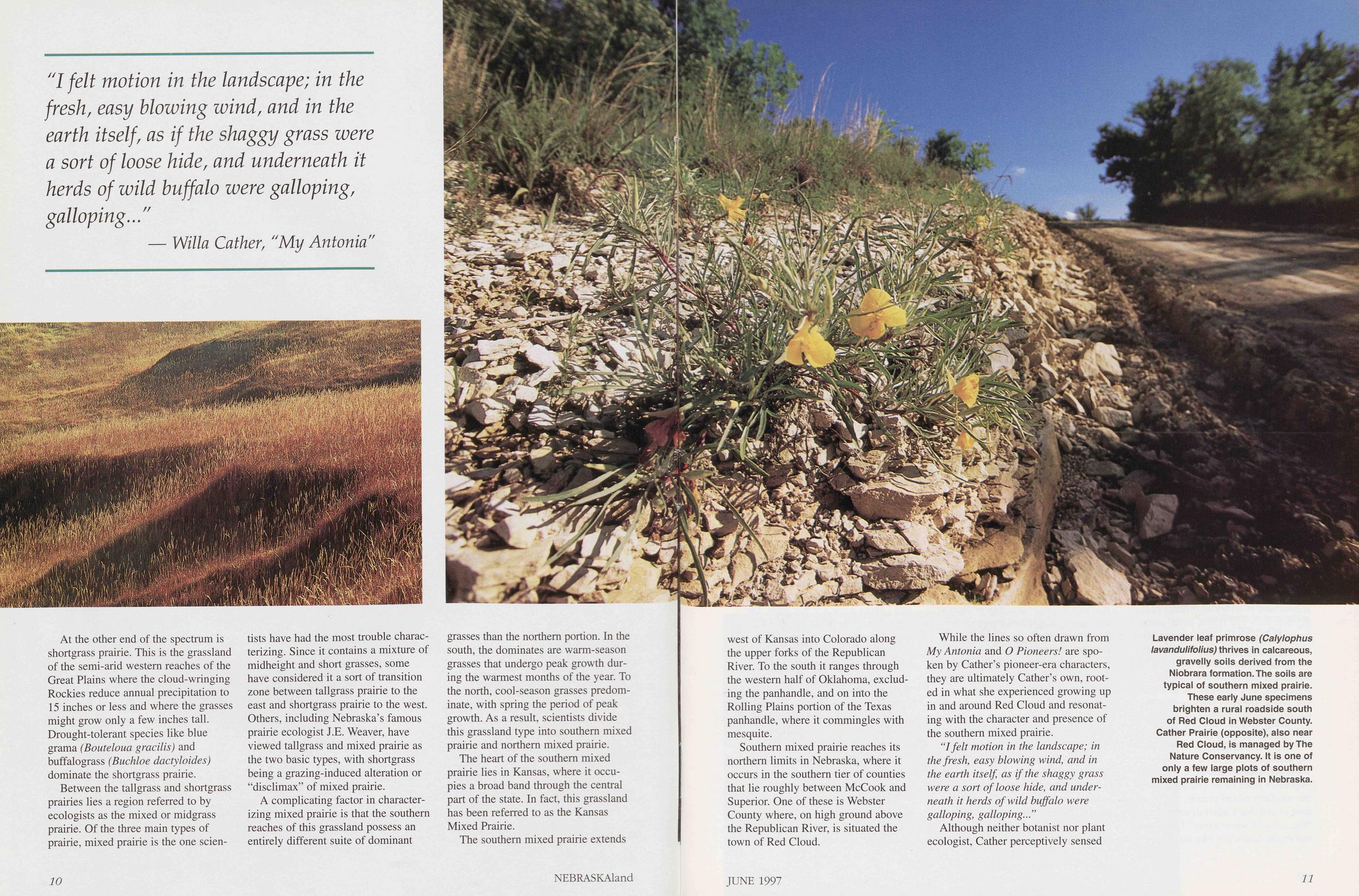 "I felt motion in the landscape; in the
fresh, easy blowing wind, and in the
earth itself, as if the shaggy grass were
a sort of loose hide, and underneath it
herds of wild buffalo were galloping,
galloping..."
Willa Cather, "My Antonia"
"I felt motion in the landscape; in the
fresh, easy blowing wind, and in the
earth itself, as if the shaggy grass were
a sort of loose hide, and underneath it
herds of wild buffalo were galloping,
galloping..."
Willa Cather, "My Antonia"
At the other end of the spectrum is shortgrass prairie. This is the grassland of the semi-arid western reaches of the Great Plains where the cloud-wringing Rockies reduce annual precipitation to 15 inches or less and where the grasses might grow only a few inches tall. Drought-tolerant species like blue grama (Bouteloua gracilis) and buffalograss (Buchloe dactyloides) dominate the shortgrass prairie.
Between the tallgrass and shortgrass prairies lies a region referred to by ecologists as the mixed or midgrass prairie. Of the three main types of prairie, mixed prairie is the one scientists have had the most trouble characterizing. Since it contains a mixture of midheight and short grasses, some have considered it a sort of transition zone between tallgrass prairie to the east and shortgrass prairie to the west. Others, including Nebraska's famous prairie ecologist J.E. Weaver, have viewed tallgrass and mixed prairie as the two basic types, with shortgrass being a grazing-induced alteration or "disclimax" of mixed prairie.
A complicating factor in characterizing mixed prairie is that the southern reaches of this grassland possess an entirely different suite of dominant grasses than the northern portion. In the south, the dominates are warm-season grasses that undergo peak growth during the warmest months of the year. To the north, cool-season grasses predominate, with spring the period of peak growth. As a result, scientists divide this grassland type into southern mixed prairie and northern mixed prairie.
The heart of the southern mixed prairie lies in Kansas, where it occupies a broad band through the central part of the state. In fact, this grassland has been referred to as the Kansas Mixed Prairie.
The southern mixed prairie extends
10 NEBRASKAlandwest of Kansas into Colorado along the upper forks of the Republican River. To the south it ranges through the western half of Oklahoma, excluding the panhandle, and on into the Rolling Plains portion of the Texas panhandle, where it commingles with mesquite.
Southern mixed prairie reaches its northern limits in Nebraska, where it occurs in the southern tier of counties that lie roughly between McCook and Superior. One of these is Webster County where, on high ground above the Republican River, is situated the town of Red Cloud.
While the lines so often drawn from My Antonia and O Pioneers! are spoken by Cather's pioneer-era characters, they are ultimately Cather's own, root- ed in what she experienced growing up in and around Red Cloud and resonating with the character and presence of the southern mixed prairie.
"I felt motion in the landscape; in the fresh, easy blowing wind, and in the earth itself, as if the shaggy grass were a sort of loose hide, and underneath it herds of wild buffalo were galloping, galloping..."
Although neither botanist nor plant ecologist, Cather perceptively sensed
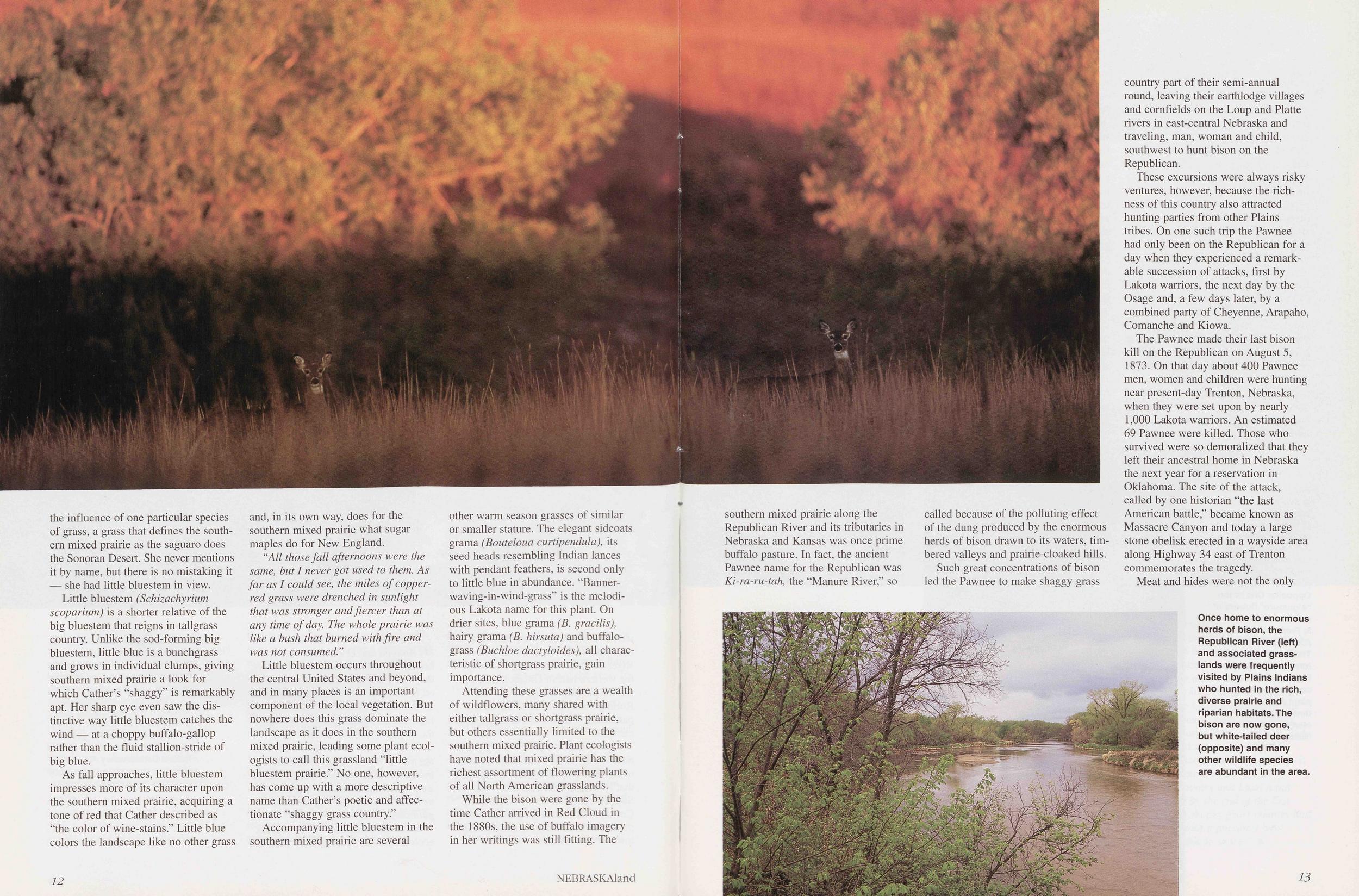
the influence of one particular species of grass, a grass that defines the southern mixed prairie as the saguaro does the Sonoran Desert. She never mentions it by name, but there is no mistaking it — she had little bluestem in view.
Little bluestem (Schizachyrium scoparium) is a shorter relative of the big bluestem that reigns in tallgrass country. Unlike the sod-forming big bluestem, little blue is a bunchgrass and grows in individual clumps, giving southern mixed prairie a look for which Cather's "shaggy" is remarkably apt. Her sharp eye even saw the distinctive way little bluestem catches the wind — at a choppy buffalo-gallop rather than the fluid stallion-stride of big blue.
As fall approaches, little bluestem impresses more of its character upon the southern mixed prairie, acquiring a tone of red that Cather described as "the color of wine-stains." Little blue colors the landscape like no other grass and, in its own way, does for the southern mixed prairie what sugar maples do for New England.
"All those fall afternoons were the same, but I never got used to them. As far as I could see, the miles of copperred grass were drenched in sunlight that was stronger and fiercer than at any time of day. The whole prairie was like a bush that burned with fire and was not consumed."
Little bluestem occurs throughout the central United States and beyond, and in many places is an important component of the local vegetation. But nowhere does this grass dominate the landscape as it does in the southern mixed prairie, leading some plant ecologists to call this grassland "little bluestem prairie." No one, however, has come up with a more descriptive name than Cather's poetic and affectionate "shaggy grass country."
Accompanying little bluestem in the southern mixed prairie are several other warm season grasses of similar or smaller stature. The elegant sideoats grama (Bouteloua curtipendula), its seed heads resembling Indian lances with pendant feathers, is second only to little blue in abundance. "Banner-waving-in-wind-grass" is the melodious Lakota name for this plant. On drier sites, blue grama (B. gracilis), hairy grama (B. hirsuta) and buffalograss (Buchloe dactyloides), all characteristic of shortgrass prairie, gain importance.
Attending these grasses are a wealth of wildflowers, many shared with either tallgrass or shortgrass prairie, but others essentially limited to the southern mixed prairie. Plant ecologists have noted that mixed prairie has the richest assortment of flowering plants of all North American grasslands.
While the bison were gone by the time Cather arrived in Red Cloud in the 1880s, the use of buffalo imagery in her writings was still fitting. The 12 NEBRASKAland southern mixed prairie along the Republican River and its tributaries in Nebraska and Kansas was once prime buffalo pasture. In fact, the ancient Pawnee name for the Republican was Ki-ra-ru-tah, the "Manure River," so called because of the polluting effect of the dung produced by the enormous herds of bison drawn to its waters, timbered valleys and prairie-cloaked hills.
Such great concentrations of bison led the Pawnee to make shaggy grass country part of their semi-annual round, leaving their earthlodge villages and cornfields on the Loup and Platte rivers in east-central Nebraska and traveling, man, woman and child, southwest to hunt bison on the Republican.
These excursions were always risky ventures, however, because the richness of this country also attracted hunting parties from other Plains tribes. On one such trip the Pawnee had only been on the Republican for a day when they experienced a remarkable succession of attacks, first by Lakota warriors, the next day by the Osage and, a few days later, by a combined party of Cheyenne, Arapaho, Comanche and Kiowa.
The Pawnee made their last bison kill on the Republican on August 5, 1873. On that day about 400 Pawnee men, women and children were hunting near present-day Trenton, Nebraska, when they were set upon by nearly 1,000 Lakota warriors. An estimated 69 Pawnee were killed. Those who survived were so demoralized that they left their ancestral home in Nebraska the next year for a reservation in Oklahoma. The site of the attack, called by one historian "the last American battle," became known as Massacre Canyon and today a large stone obelisk erected in a wayside area along Highway 34 east of Trenton commemorates the tragedy.
Meat and hides were not the only
resources procured on these excursions. As they wind their way through southern Nebraska, the Republican and its tributaries cut down into the underlying bedrock, exposing the chalky Niobrara formation. At certain places in these rock exposures, occurs a cherty, yellowish-brown stone that was used for thousands of years by native peoples to fashion arrow heads and other stone implements. Studies of stone artifacts found at a Skidi Pawnee village site on the Loup River revealed that more than 80 percent were made of this stone, often called Republican River jasper.
The exposure of the Niobrara formation in this part of Nebraska has a significant effect on the vegetation of the area. The part of the formation that occurs in the Republican River valley is termed by geologists the Smoky Hill chalk member of the Niobrara formation. Smoky Hill chalk contains the toxic element selenium and weathers into tight, droughty soils that are inhospitable to many plant species. A number of interesting plant species are restricted to these difficult soils.
On the rawest exposures of the Smoky Hill, where concentrations of selenium are so high that you can smell it in the air, two plants seem to flourish without a care. Alkali milkvetch (Astragalus racemosus) is a tall, rangy member of the bean family that is always a good indicator of the presence of selenium. It actually accumulates this element in its tissues, and is highly poisonous if grazed by livestock.
Ten petal mentzelia (Mentzelia decapetala) is a species that can occur in a variety of difficult soils. The three-foot-tall plant itself is rather coarse and unattractive, but it produces an abundance of large showy flowers that open in the late afternoon and produce a strong fragrance that attracts night-flying pollinators.
Although the settings where these two plants occur are usually rather uninviting, in other places the Niobrara formation weathers into gravelly soils that support veritable gardens of wildflowers. Here can be seen a rich array of typical prairie forbs including purple prairie clover (Dalea purpurea), white beardtongue (Penstemon albidus), black sampson (Echinacea purpurea), sensitive briar (Schrankia nuttallii) and a number of prairie milkweeds (Asclepias spp.). These natural gardens sometimes also host the regal fritillary, a beautiful and uncommon butterfly that occurs only in association with relatively high-quality prairie.
A number of species with ranges limited to the southern mixed prairie reach their northern limits along the Republican River in Nebraska. These include Fremont's evening primrose
(Oenothera macrocarpa ssp. fremontii), Fendler's aster (Aster fendleri), stenosiphon (Stenosiphon linifolius) and babywhite aster (Leucelene ericoides). Like the more common species, these plants flourish in the gravelly soils where the prairie grasses are not as competitive.
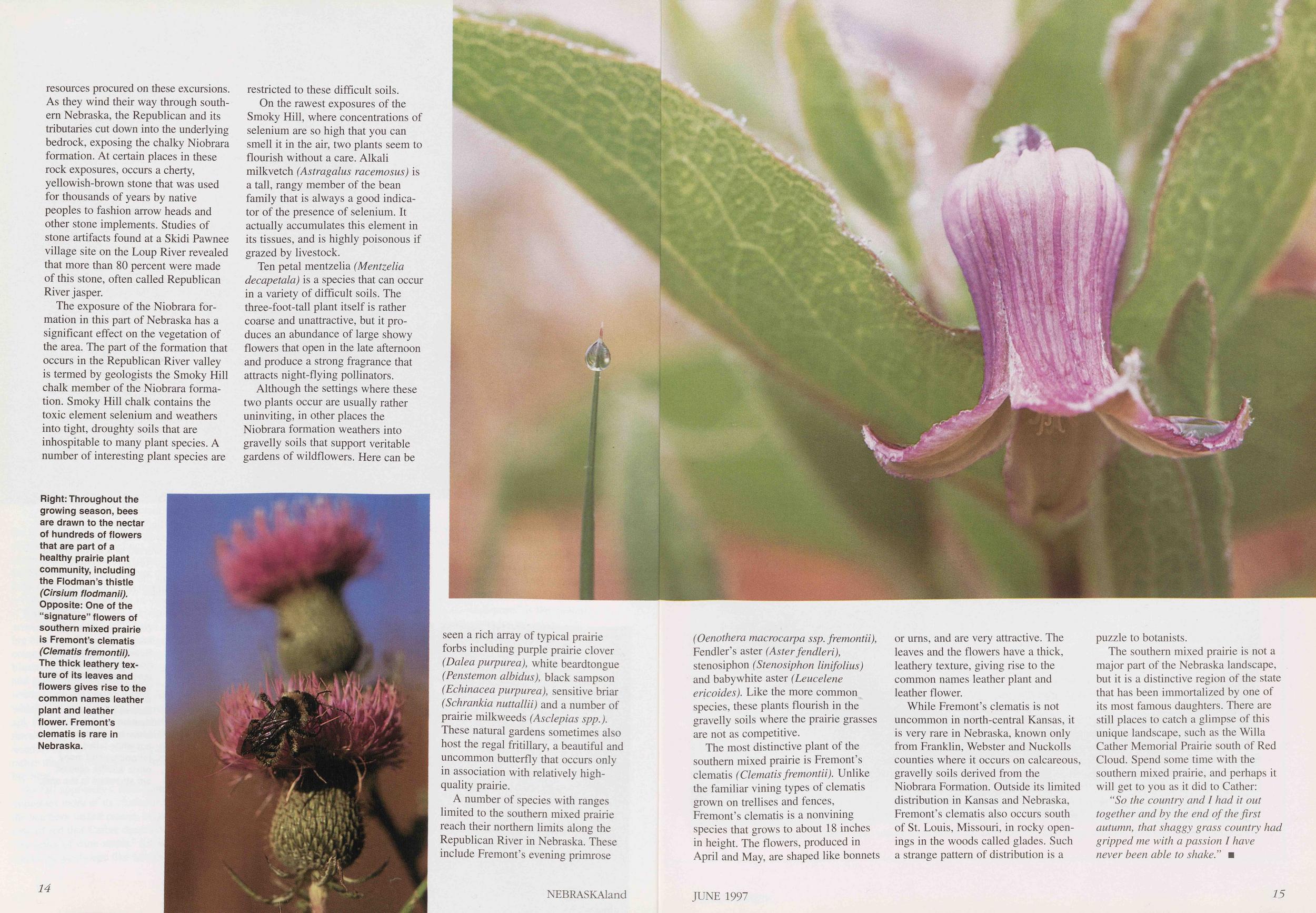
The most distinctive plant of the southern mixed prairie is Fremont's clematis (Clematis fremontii). Unlike the familiar vining types of clematis grown on trellises and fences, Fremont's clematis is a nonvining species that grows to about 18 inches in height. The flowers, produced in April and May, are shaped like bonnets or urns, and are very attractive. The leaves and the flowers have a thick, leathery texture, giving rise to the common names leather plant and leather flower.
While Fremont's clematis is not uncommon in north-central Kansas, it is very rare in Nebraska, known only from Franklin, Webster and Nuckolls counties where it occurs on calcareous, gravelly soils derived from the Niobrara Formation. Outside its limited distribution in Kansas and Nebraska, Fremont's clematis also occurs south of St. Louis, Missouri, in rocky openings in the woods called glades. Such a strange pattern of distribution is a puzzle to botanists.
The southern mixed prairie is not a major part of the Nebraska landscape, but it is a distinctive region of the state that has been immortalized by one of its most famous daughters. There are still places to catch a glimpse of this unique landscape, such as the Willa Cather Memorial Prairie south of Red Cloud. Spend some time with the southern mixed prairie, and perhaps it will get to you as it did to Cather:
"So the country and I had it out together and by the end of the first autumn, that shaggy grass country had gripped me with a passion I have never been able to shake."
JUNE 1997 15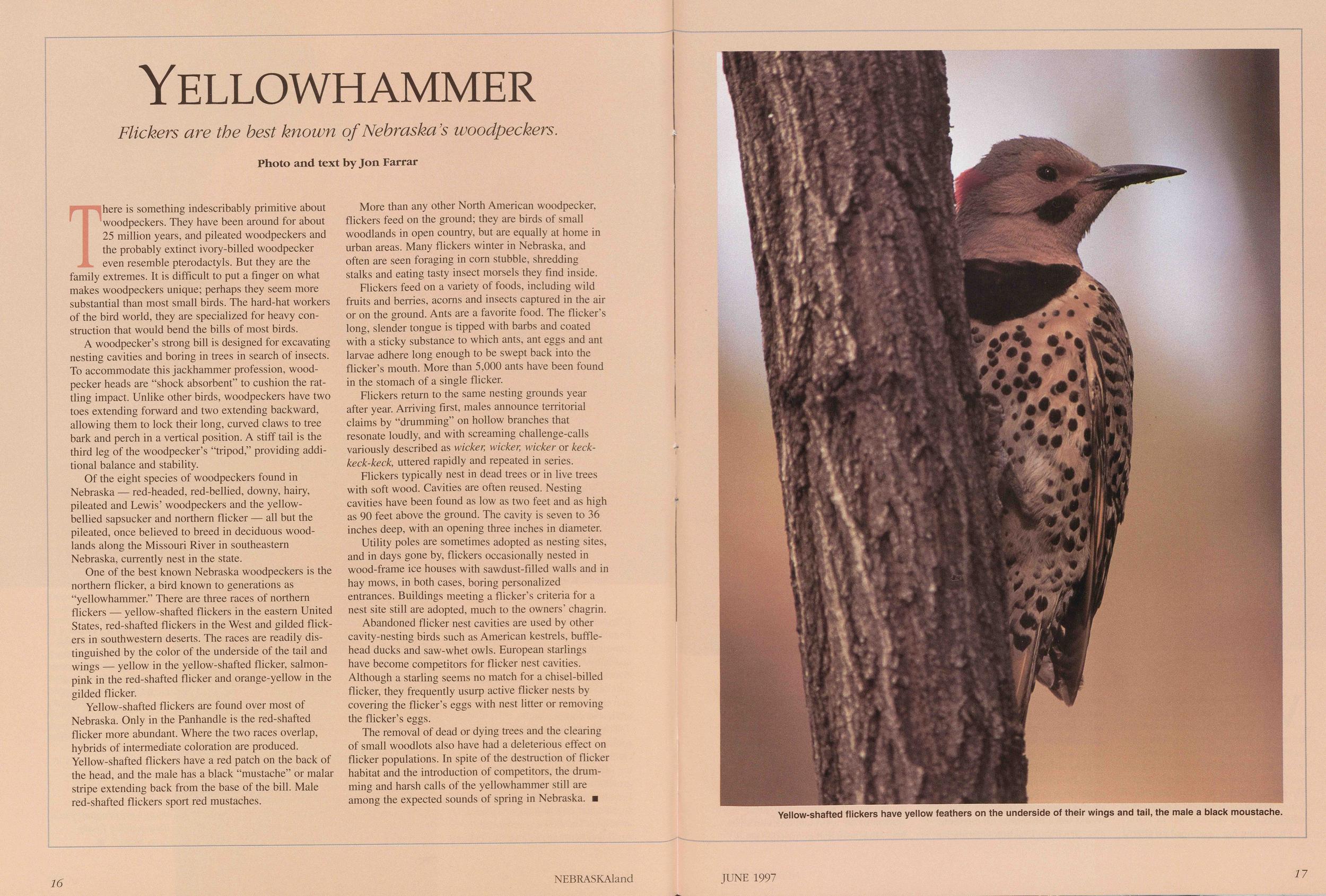
Yellowhammer
Flickers are the best known of Nebraska's woodpeckers.
There is something indescribably primitive about woodpeckers. They have been around for about 25 million years, and pileated woodpeckers and the probably extinct ivory-billed woodpecker JIL even resemble pterodactyls. But they are the family extremes. It is difficult to put a finger on what makes woodpeckers unique; perhaps they seem more substantial than most small birds. The hard-hat workers of the bird world, they are specialized for heavy construction that would bend the bills of most birds.
A woodpecker's strong bill is designed for excavating nesting cavities and boring in trees in search of insects. To accommodate this jackhammer profession, woodpecker heads are "shock absorbent" to cushion the rattling impact. Unlike other birds, woodpeckers have two toes extending forward and two extending backward, allowing them to lock their long, curved claws to tree bark and perch in a vertical position. A stiff tail is the third leg of the woodpecker's "tripod," providing additional balance and stability.
Of the eight species of woodpeckers found in Nebraska — red-headed, red-bellied, downy, hairy, pileated and Lewis' woodpeckers and the yellow-bellied sapsucker and northern flicker — all but the pileated, once believed to breed in deciduous woodlands along the Missouri River in southeastern Nebraska, currently nest in the state.
One of the best known Nebraska woodpeckers is the northern flicker, a bird known to generations as "yellowhammer." There are three races of northern flickers — yellow-shafted flickers in the eastern United States, red-shafted flickers in the West and gilded flickers in southwestern deserts. The races are readily distinguished by the color of the underside of the tail and wings — yellow in the yellow-shafted flicker, salmon-pink in the red-shafted flicker and orange-yellow in the gilded flicker.
Yellow-shafted flickers are found over most of Nebraska. Only in the Panhandle is the red-shafted flicker more abundant. Where the two races overlap, hybrids of intermediate coloration are produced. Yellow-shafted flickers have a red patch on the back of the head, and the male has a black "mustache" or malar stripe extending back from the base of the bill. Male red-shafted flickers sport red mustaches.
More than any other North American woodpecker, flickers feed on the ground; they are birds of small woodlands in open country, but are equally at home in urban areas. Many flickers winter in Nebraska, and often are seen foraging in corn stubble, shredding stalks and eating tasty insect morsels they find inside.
Flickers feed on a variety of foods, including wild fruits and berries, acorns and insects captured in the air or on the ground. Ants are a favorite food. The flicker's long, slender tongue is tipped with barbs and coated with a sticky substance to which ants, ant eggs and ant larvae adhere long enough to be swept back into the flicker's mouth. More than 5,000 ants have been found in the stomach of a single flicker.
Flickers return to the same nesting grounds year after year. Arriving first, males announce territorial claims by "drumming" on hollow branches that resonate loudly, and with screaming challenge-calls variously described as wicker, wicker, wicker or keck-keck-keck, uttered rapidly and repeated in series.
Flickers typically nest in dead trees or in live trees with soft wood. Cavities are often reused. Nesting cavities have been found as low as two feet and as high as 90 feet above the ground. The cavity is seven to 36 inches deep, with an opening three inches in diameter.
Utility poles are sometimes adopted as nesting sites, and in days gone by, flickers occasionally nested in wood-frame ice houses with sawdust-filled walls and in hay mows, in both cases, boring personalized entrances. Buildings meeting a flicker's criteria for a nest site still are adopted, much to the owners' chagrin.
Abandoned flicker nest cavities are used by other cavity-nesting birds such as American kestrels, bufflehead ducks and saw-whet owls. European starlings have become competitors for flicker nest cavities. Although a starling seems no match for a chisel-billed flicker, they frequently usurp active flicker nests by covering the flicker's eggs with nest litter or removing the flicker's eggs.
The removal of dead or dying trees and the clearing of small woodlots also have had a deleterious effect on flicker populations. In spite of the destruction of flicker habitat and the introduction of competitors, the drumming and harsh calls of the yellowhammer still are among the expected sounds of spring in Nebraska.
16 NEBRASKAlandYellow-shafted flickers have yellow feathers on the underside of their wings and tail, the male a black moustache.
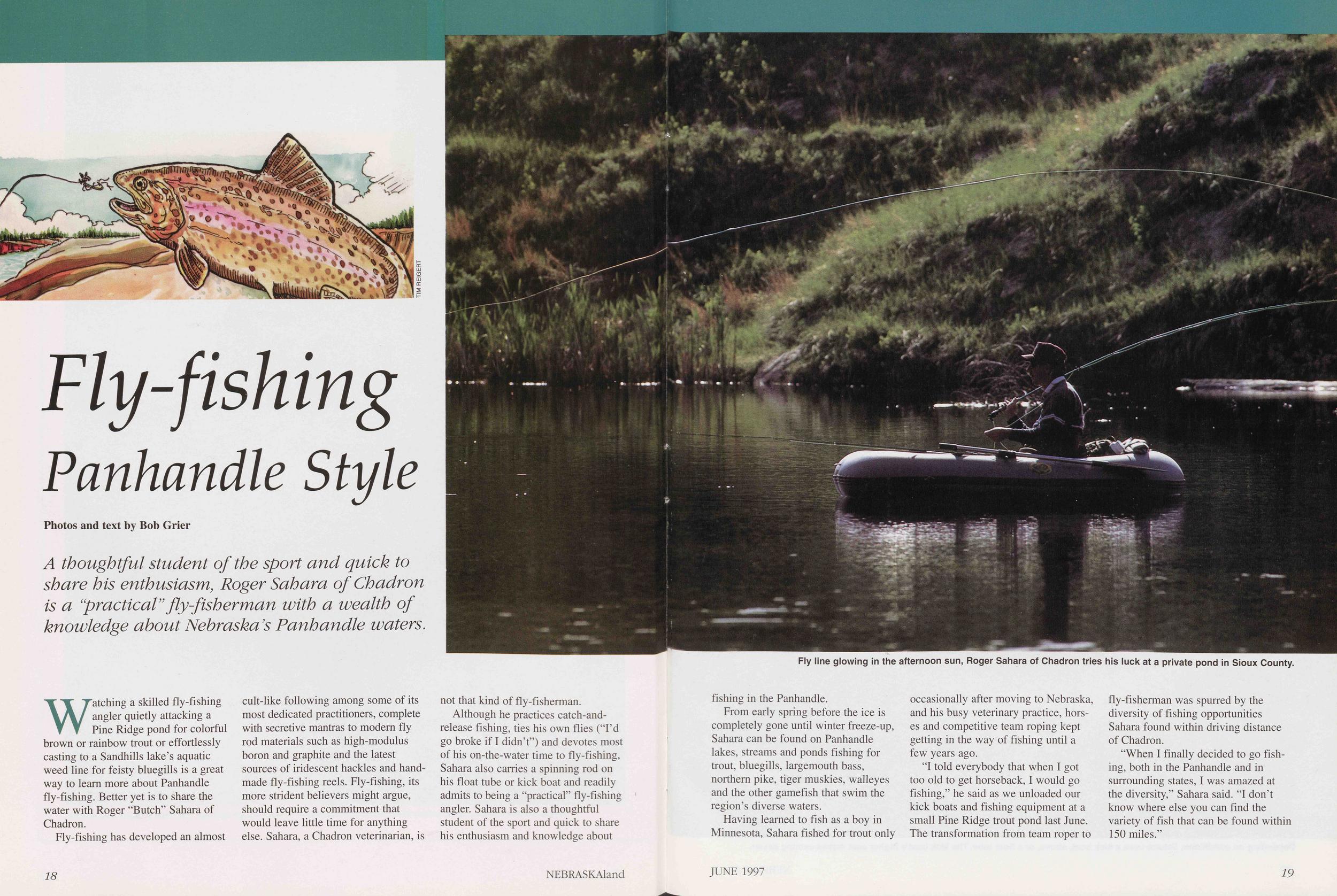
Fly-fishing Panhandle Style
A thoughtful student of the sport and quick to share his enthusiasm, Roger Sahara of Chadron is a "practical" fly-fisherman with a wealth of knowledge ahout Nebraska's Panhandle waters.
Watching a skilled fly-fishing angler quietly attacking a Pine Ridge pond for colorful brown or rainbow trout or effortlessly casting to a Sandhills lake's aquatic weed line for feisty bluegills is a great way to learn more about Panhandle fly-fishing. Better yet is to share the water with Roger "Butch" Sahara of Chadron.
Fly-fishing has developed an almost cult-like following among some of its most dedicated practitioners, complete with secretive mantras to modern fly rod materials such as high-modulus boron and graphite and the latest sources of iridescent hackles and handmade fly-fishing reels. Fly-fishing, its more strident believers might argue, should require a commitment that would leave little time for anything else. Sahara, a Chadron veterinarian, is not that kind of fly-fisherman.
Although he practices catch-and-release fishing, ties his own flies ("I'd go broke if I didn't") and devotes most of his on-the-water time to fly-fishing, Sahara also carries a spinning rod on his float tube or kick boat and readily admits to being a "practical" fly-fishing angler. Sahara is also a thoughtful student of the sport and quick to share his enthusiasm and knowledge about
18 NEBRASKAlandFly line glowing in the afternoon sun, Roger Sahara of Chadron tries his luck at a private pond in Sioux County.
fishing in the Panhandle.
From early spring before the ice is completely gone until winter freeze-up, Sahara can be found on Panhandle lakes, streams and ponds fishing for trout, bluegills, largemouth bass, northern pike, tiger muskies, walleyes and the other gamefish that swim the region's diverse waters.
Having learned to fish as a boy in Minnesota, Sahara fished for trout only occasionally after moving to Nebraska, and his busy veterinary practice, horses and competitive team roping kept getting in the way of fishing until a few years ago.
"I told everybody that when I got too old to get horseback, I would go fishing," he said as we unloaded our kick boats and fishing equipment at a small Pine Ridge trout pond last June. The transformation from team roper to fly-fisherman was spurred by the diversity of fishing opportunities Sahara found within driving distance of Chadron.
"When I finally decided to go fishing, both in the Panhandle and in surrounding states, I was amazed at the diversity," Sahara said. "I don't know where else you can find the variety of fish that can be found within 150 miles."
JUNE 1997 19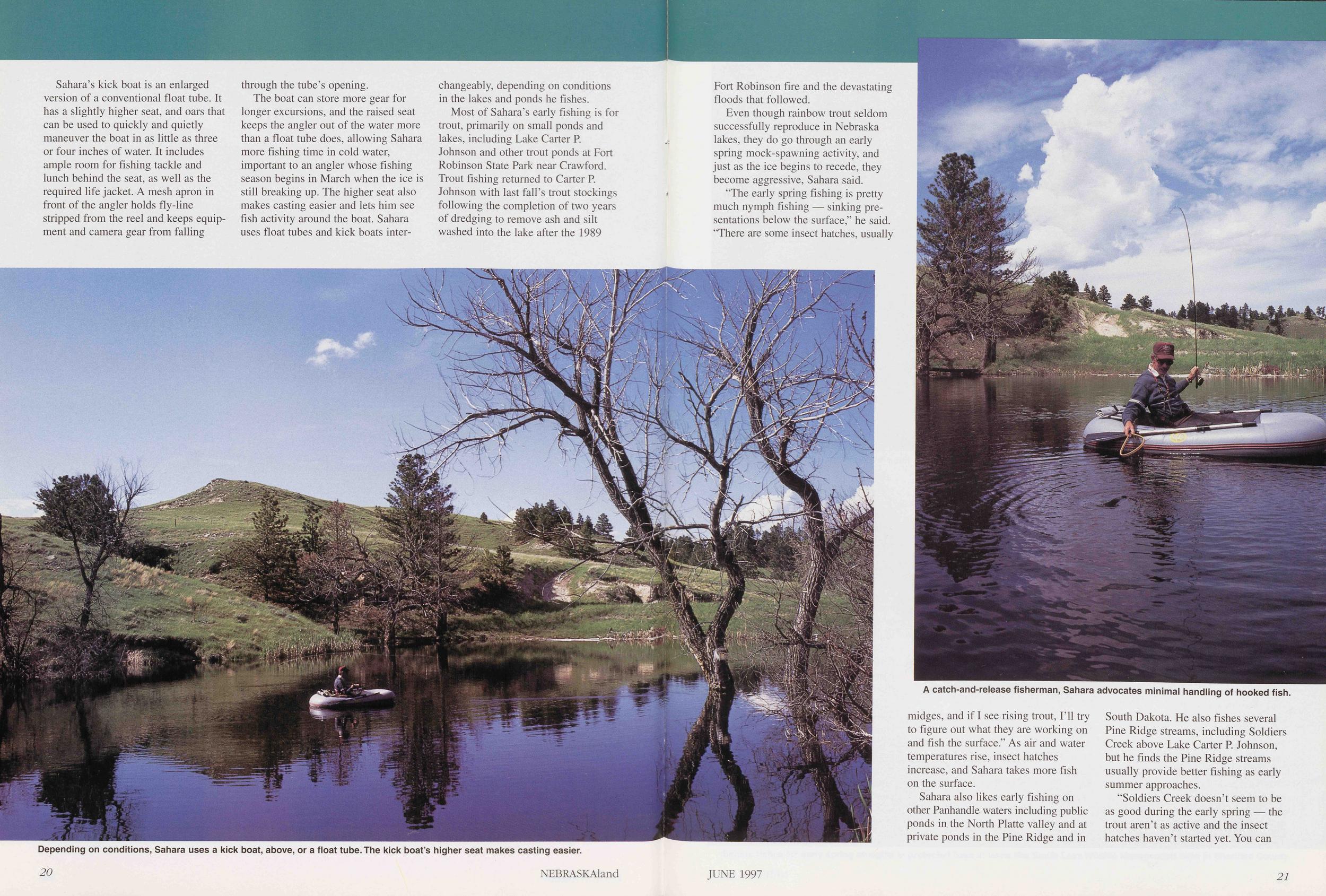
Sahara's kick boat is an enlarged version of a conventional float tube. It has a slightly higher seat, and oars that can be used to quickly and quietly maneuver the boat in as little as three or four inches of water. It includes ample room for fishing tackle and lunch behind the seat, as well as the required life jacket. A mesh apron in front of the angler holds fly-line stripped from the reel and keeps equipment and camera gear from falling through the tube's opening.
The boat can store more gear for longer excursions, and the raised seat keeps the angler out of the water more than a float tube does, allowing Sahara more fishing time in cold water, important to an angler whose fishing season begins in March when the ice is still breaking up. The higher seat also makes casting easier and lets him see fish activity around the boat. Sahara uses float tubes and kick boats interchangeably, depending on conditions in the lakes and ponds he fishes.
Most of Sahara's early fishing is for trout, primarily on small ponds and lakes, including Lake Carter P. Johnson and other trout ponds at Fort Robinson State Park near Crawford. Trout fishing returned to Carter P. Johnson with last fall's trout stockings following the completion of two years of dredging to remove ash and silt washed into the lake after the 1989
Depending on conditions, Sahara uses a kick boat, above, or a float tube. The kick boat's higher seat makes casting easier.
Fort Robinson fire and the devastating floods that followed.
Even though rainbow trout seldom successfully reproduce in Nebraska lakes, they do go through an early spring mock-spawning activity, and just as the ice begins to recede, they become aggressive, Sahara said.
A catch-and-release fisherman, Sahara advocates minimal handling of hooked fish.
Sahara also likes early fishing on other Panhandle waters including public ponds in the North Platte valley and at private ponds in the Pine Ridge and in South Dakota. He also fishes several Pine Ridge streams, including Soldiers Creek above Lake Carter P. Johnson, but he finds the Pine Ridge streams usually provide better fishing as early summer approaches.
"Soldiers Creek doesn't seem to be as good during the early spring — the trout aren't as active and the insect hatches haven't started yet. You can
JUNE 1997 21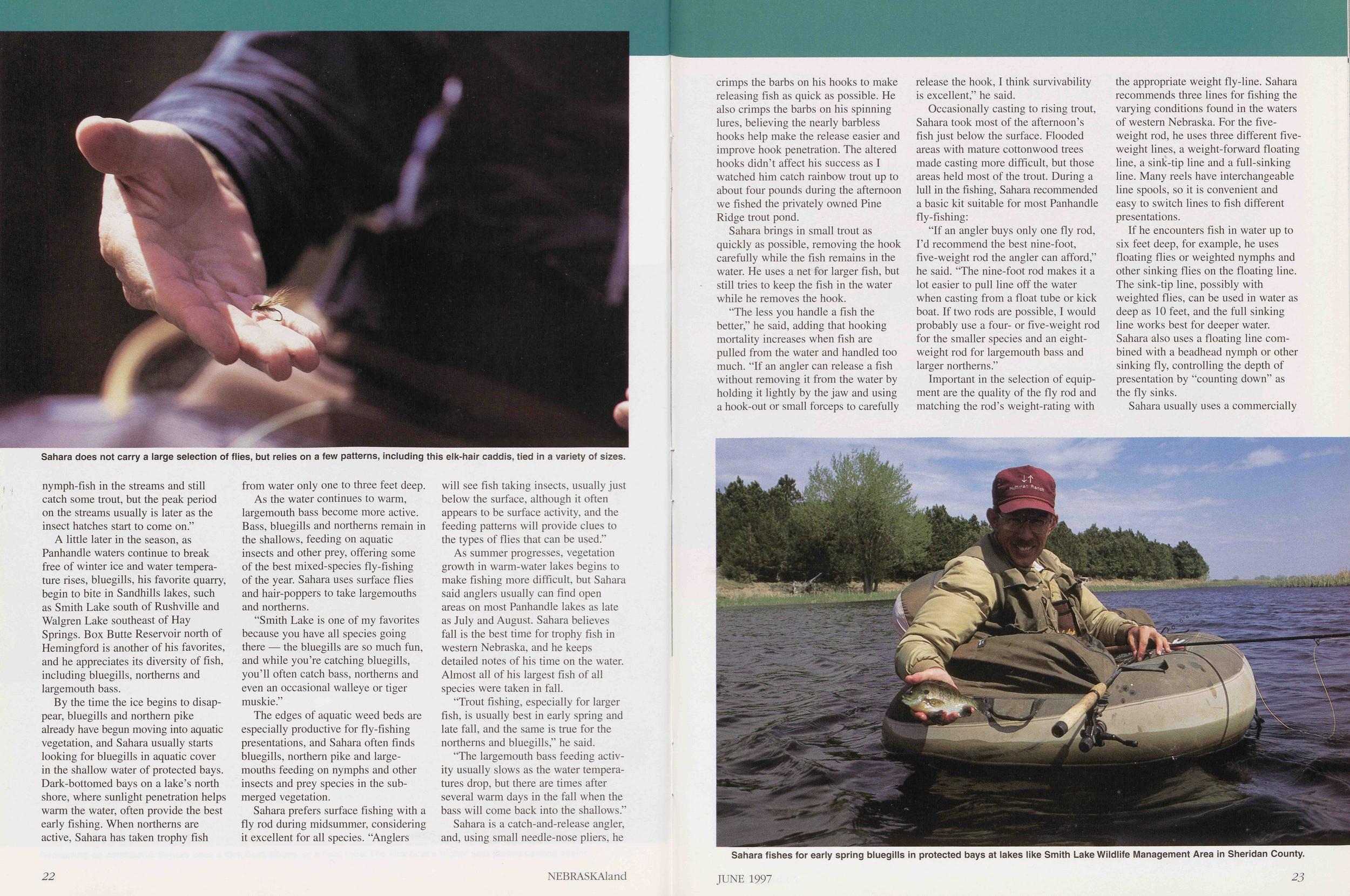
Sahara does not carry a large selection of flies, but relies on a few patterns, including this elk-hair caddis, tied in a variety of sizes.
nymph-fish in the streams and still catch some trout, but the peak period on the streams usually is later as the insect hatches start to come on."
A little later in the season, as Panhandle waters continue to break free of winter ice and water temperature rises, bluegills, his favorite quarry, begin to bite in Sandhills lakes, such as Smith Lake south of Rushville and Walgren Lake southeast of Hay Springs. Box Butte Reservoir north of Hemingford is another of his favorites, and he appreciates its diversity of fish, including bluegills, northerns and largemouth bass.
By the time the ice begins to disappear, bluegills and northern pike already have begun moving into aquatic vegetation, and Sahara usually starts looking for bluegills in aquatic cover in the shallow water of protected bays. Dark-bottomed bays on a lake's north shore, where sunlight penetration helps warm the water, often provide the best early fishing. When northerns are active, Sahara has taken trophy fish from water only one to three feet deep.
As the water continues to warm, largemouth bass become more active. Bass, bluegills and northerns remain in the shallows, feeding on aquatic insects and other prey, offering some of the best mixed-species fly-fishing of the year. Sahara uses surface flies and hair-poppers to take largemouths and northerns.
"Smith Lake is one of my favorites because you have all species going there — the bluegills are so much fun, and while you're catching bluegills, you'll often catch bass, northerns and even an occasional walleye or tiger muskie."
The edges of aquatic weed beds are especially productive for fly-fishing presentations, and Sahara often finds bluegills, northern pike and largemouths feeding on nymphs and other insects and prey species in the submerged vegetation.
Sahara prefers surface fishing with a fly rod during midsummer, considering it excellent for all species. "Anglers will see fish taking insects, usually just below the surface, although it often appears to be surface activity, and the feeding patterns will provide clues to the types of flies that can be used."
As summer progresses, vegetation growth in warm-water lakes begins to make fishing more difficult, but Sahara said anglers usually can find open areas on most Panhandle lakes as late as July and August. Sahara believes fall is the best time for trophy fish in western Nebraska, and he keeps detailed notes of his time on the water. Almost all of his largest fish of all species were taken in fall.
"Trout fishing, especially for larger fish, is usually best in early spring and late fall, and the same is true for the northerns and bluegills," he said.
"The largemouth bass feeding activity usually slows as the water temperatures drop, but there are times after several warm days in the fall when the bass will come back into the shallows." Sahara is a catch-and-release angler, and, using small needle-nose pliers, he
22 NEBRASKAlandcrimps the barbs on his hooks to make releasing fish as quick as possible. He also crimps the barbs on his spinning lures, believing the nearly barbless hooks help make the release easier and improve hook penetration. The altered hooks didn't affect his success as I watched him catch rainbow trout up to about four pounds during the afternoon we fished the privately owned Pine Ridge trout pond.
Sahara brings in small trout as quickly as possible, removing the hook carefully while the fish remains in the water. He uses a net for larger fish, but still tries to keep the fish in the water while he removes the hook.
"The less you handle a fish the better," he said, adding that hooking mortality increases when fish are pulled from the water and handled too much. "If an angler can release a fish without removing it from the water by holding it lightly by the jaw and using a hook-out or small forceps to carefully release the hook, I think survivability is excellent," he said.
Occasionally casting to rising trout, Sahara took most of the afternoon's fish just below the surface. Flooded areas with mature cottonwood trees made casting more difficult, but those areas held most of the trout. During a lull in the fishing, Sahara recommended a basic kit suitable for most Panhandle fly-fishing:
"If an angler buys only one fly rod, I'd recommend the best nine-foot, five-weight rod the angler can afford," he said. "The nine-foot rod makes it a lot easier to pull line off the water when casting from a float tube or kick boat. If two rods are possible, I would probably use a four- or five-weight rod for the smaller species and an eight-weight rod for largemouth bass and larger northerns."
Important in the selection of equipment are the quality of the fly rod and matching the rod's weight-rating with the appropriate weight fly-line. Sahara recommends three lines for fishing the varying conditions found in the waters of western Nebraska. For the five-weight rod, he uses three different five-weight lines, a weight-forward floating line, a sink-tip line and a full-sinking line. Many reels have interchangeable line spools, so it is convenient and easy to switch lines to fish different presentations.
If he encounters fish in water up to six feet deep, for example, he uses floating flies or weighted nymphs and other sinking flies on the floating line. The sink-tip line, possibly with weighted flies, can be used in water as deep as 10 feet, and the full sinking line works best for deeper water. Sahara also uses a floating line combined with a beadhead nymph or other sinking fly, controlling the depth of presentation by "counting down" as the fly sinks.
Sahara usually uses a commercially
Sahara fishes for early spring bluegills in protected bays at lakes like Smith Lake Wildlife Management Area in Sheridan County.
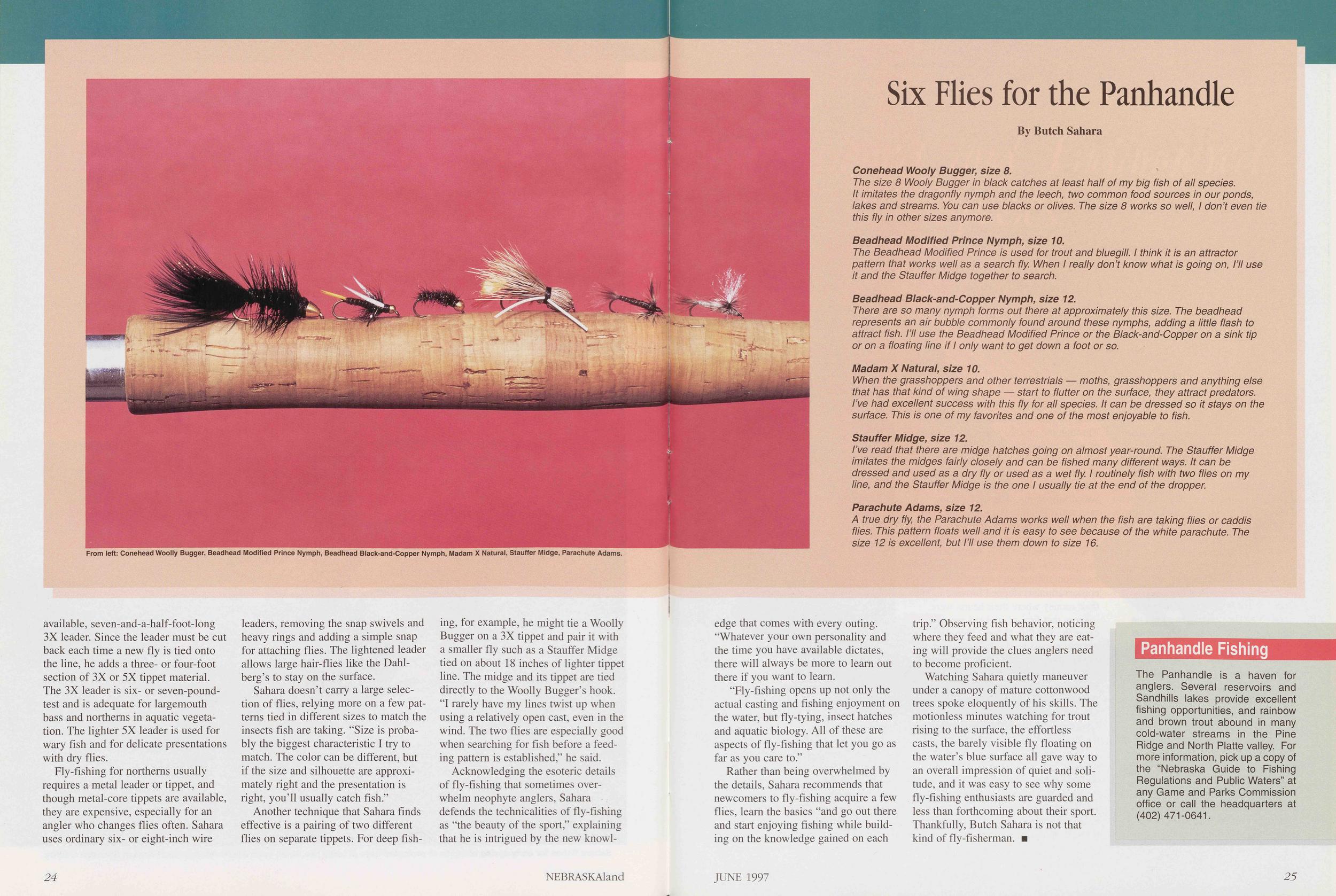
From left: Conehead Woolly Bugger, Beadhead Modified Prince Nymph, Beadhead Black-and-Copper Nymph, Madam X Natural, Stauffer Midge, Parachute Adams.
Six Flies for the Panhandle
Conehead Wooly Bugger, size 8. The size 8 Wooly Bugger in black catches at least half of my big fish of all species. It imitates the dragonfly nymph and the leech, two common food sources in our ponds, lakes and streams. You can use blacks or olives. The size 8 works so well, I don't even tie this fly in other sizes anymore. Beadhead Modified Prince Nymph, size 10. The Beadhead Modified Prince is used for trout and bluegill. I think it is an attractor pattern that works well as a search fly. When I really don't know what is going on, I'll use it and the Stauffer Midge together to search. Beadhead Biack-and-Copper Nymph, size 12. There are so many nymph forms out there at approximately this size. The beadhead represents an air bubble commonly found around these nymphs, adding a little flash to attract fish. I'll use the Beadhead Modified Prince or the Biack-and-Copper on a sink tip or on a floating line if I only want to get down a foot or so. Madam X Natural, size 10. When the grasshoppers and other terrestrials — moths, grasshoppers and anything else that has that kind of wing shape — start to flutter on the surface, they attract predators. I've had excellent success with this fly for all species. It can be dressed so it stays on the surface. This is one of my favorites and one of the most enjoyable to fish. Stauffer Midge, size 12. I've read that there are midge hatches going on almost year-round. The Stauffer Midge imitates the midges fairly closely and can be fished many different ways. It can be dressed and used as a dry fly or used as a wet fly. I routinely fish with two flies on my line, and the Stauffer Midge is the one I usually tie at the end of the dropper. Parachute Adams, size 12. A true dry fly, the Parachute Adams works well when the fish are taking flies or caddis flies. This pattern floats well and it is easy to see because of the white parachute. The size 12 is excellent, but I'll use them down to size 16.available, seven-and-a-half-foot-long 3X leader. Since the leader must be cut back each time a new fly is tied onto the line, he adds a three- or four-foot section of 3X or 5X tippet material. The 3X leader is six- or seven-pound-test and is adequate for largemouth bass and northerns in aquatic vegetation. The lighter 5X leader is used for wary fish and for delicate presentations with dry flies.
Fly-fishing for northerns usually requires a metal leader or tippet, and though metal-core tippets are available, they are expensive, especially for an angler who changes flies often. Sahara uses ordinary six- or eight-inch wire leaders, removing the snap swivels and heavy rings and adding a simple snap for attaching flies. The lightened leader allows large hair-flies like the Dahlberg's to stay on the surface.
Sahara doesn't carry a large selection of flies, relying more on a few pat- terns tied in different sizes to match the insects fish are taking. "Size is probably the biggest characteristic I try to match. The color can be different, but if the size and silhouette are approximately right and the presentation is right, you'll usually catch fish."
Another technique that Sahara finds effective is a pairing of two different flies on separate tippets. For deep fishing, for example, he might tie a Woolly Bugger on a 3X tippet and pair it with a smaller fly such as a Stauffer Midge tied on about 18 inches of lighter tippet line. The midge and its tippet are tied directly to the Woolly Bugger's hook. "I rarely have my lines twist up when using a relatively open cast, even in the wind. The two flies are especially good when searching for fish before a feeding pattern is established," he said.
Acknowledging the esoteric details of fly-fishing that sometimes overwhelm neophyte anglers, Sahara defends the technicalities of fly-fishing as "the beauty of the sport," explaining that he is intrigued by the new knowledge
24 NEBRASKAlandthat comes with every outing. "Whatever your own personality and the time you have available dictates, there will always be more to learn out there if you want to learn.
"Fly-fishing opens up not only the actual casting and fishing enjoyment on the water, but fly-tying, insect hatches and aquatic biology. All of these are aspects of fly-fishing that let you go as far as you care to."
Rather than being overwhelmed by the details, Sahara recommends that newcomers to fly-fishing acquire a few flies, learn the basics "and go out there and start enjoying fishing while building on the knowledge gained on each trip." Observing fish behavior, noticing where they feed and what they are eating will provide the clues anglers need to become proficient.
Watching Sahara quietly maneuver under a canopy of mature cottonwood trees spoke eloquently of his skills. The motionless minutes watching for trout rising to the surface, the effortless casts, the barely visible fly floating on the water's blue surface all gave way to an overall impression of quiet and solitude, and it was easy to see why some fly-fishing enthusiasts are guarded and less than forthcoming about their sport. Thankfully, Butch Sahara is not that kind of fly-fisherman.
Panhandle Fishing The Panhandle is a haven for anglers. Several reservoirs and Sandhills lakes provide excellent fishing opportunities, and rainbow and brown trout abound in many cold-water streams in the Pine Ridge and North Platte valley. For more information, pick up a copy of the "Nebraska Guide to Fishing Regulations and Public Waters" at any Game and Parks Commission office or call the headquarters at (402) 471-0641. JUNE 1997 25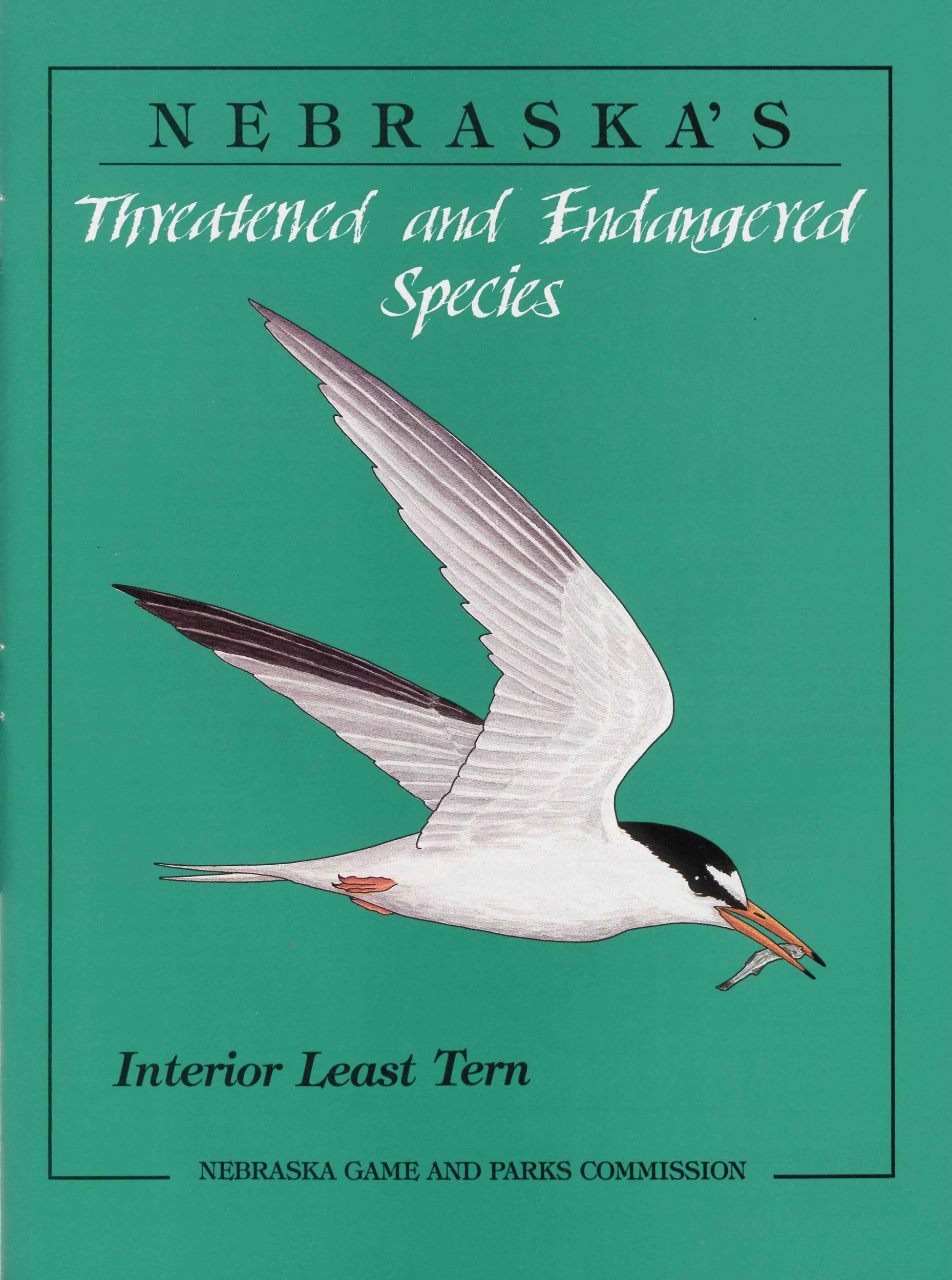
NEBRASKA'S Threatened and Endangered Species
Interior Least Tern
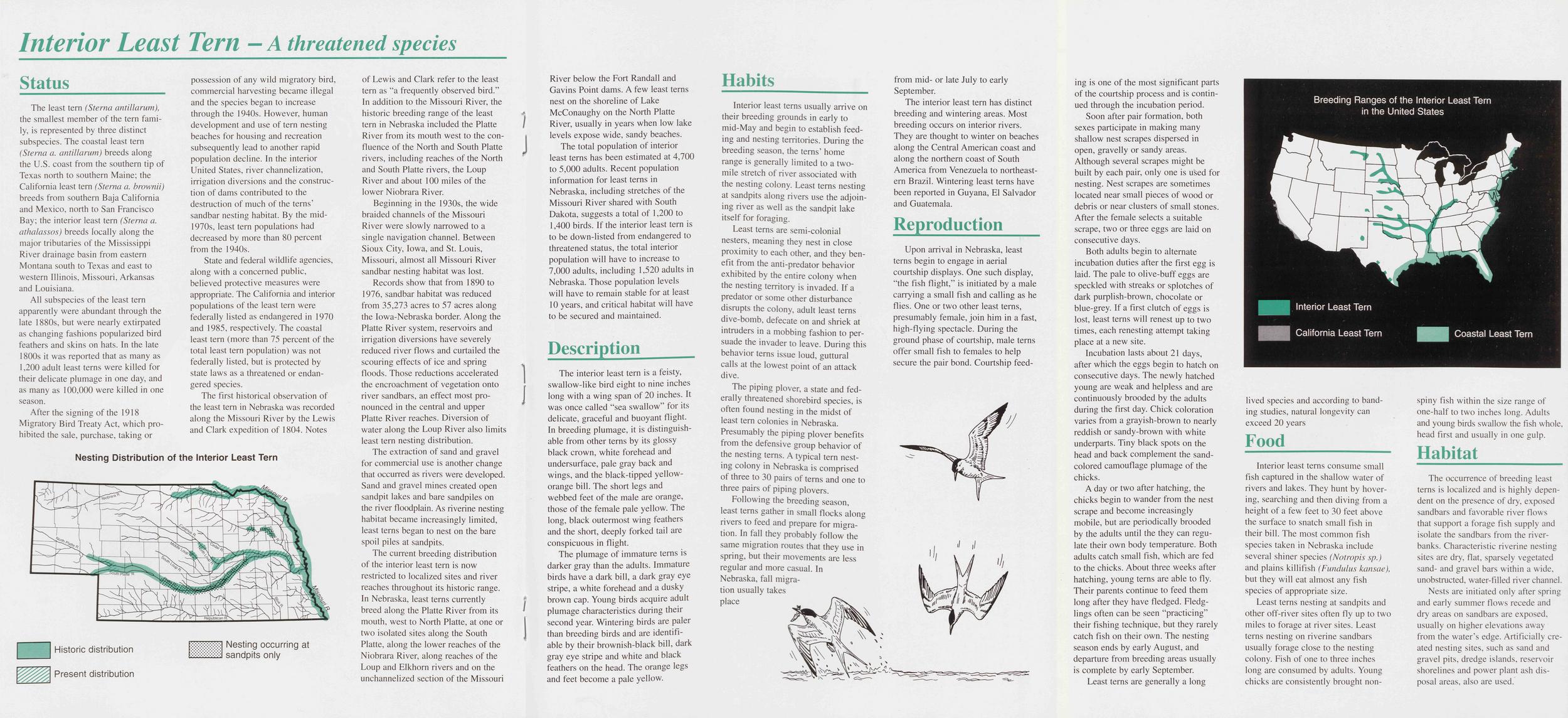
Interior Least Tern — A threatened species
StatusThe least tern (Sterna antillarum), the smallest member of the tern family, is represented by three distinct subspecies. The coastal least tern (Sterna a. antillarum) breeds along the U.S. coast from the southern tip of Texas north to southern Maine; the California least tern (Sterna a. brownii) breeds from southern Baja California and Mexico, north to San Francisco Bay; the interior least tern (Sterna a. athalassos) breeds locally along the major tributaries of the Mississippi River drainage basin from eastern Montana south to Texas and east to western Illinois, Missouri, Arkansas and Louisiana.
All subspecies of the least tern apparently were abundant through the late 1880s, but were nearly extirpated as changing fashions popularized bird feathers and skins on hats. In the late 1800s it was reported that as many as 1,200 adult least terns were killed for their delicate plumage in one day, and as many as 100,000 were killed in one season.
After the signing of the 1918 Migratory Bird Treaty Act, which prohibited the sale, purchase, taking or possession of any wild migratory bird, commercial harvesting became illegal and the species began to increase through the 1940s. However, human development and use of tern nesting beaches for housing and recreation subsequently lead to another rapid population decline. In the interior United States, river channelization, irrigation diversions and the construction of dams contributed to the destruction of much of the terns' sandbar nesting habitat. By the mid-1970s, least tern populations had decreased by more than 80 percent from the 1940s.
Nesting Distribution of the Interior Least Tern
Beginning in the 1930s, the wide braided channels of the Missouri River were slowly narrowed to a single navigation channel. Between Sioux City, Iowa, and St. Louis, Missouri, almost all Missouri River sandbar nesting habitat was lost.
Records show that from 1890 to 1976, sandbar habitat was reduced from 35,273 acres to 57 acres along the Iowa-Nebraska border. Along the Platte River system, reservoirs and irrigation diversions have severely reduced river flows and curtailed the scouring effects of ice and spring floods. Those reductions accelerated the encroachment of vegetation onto river sandbars, an effect most pronounced in the central and upper Platte River reaches. Diversion of water along the Loup River also limits least tern nesting distribution.
The extraction of sand and gravel for commercial use is another change that occurred as rivers were developed. Sand and gravel mines created open sandpit lakes and bare sandpiles on the river floodplain. As riverine nesting habitat became increasingly limited, least terns began to nest on the bare spoil piles at sandpits.
The current breeding distribution of the interior least tern is now restricted to localized sites and river reaches throughout its historic range. In Nebraska, least terns currently breed along the Platte River from its mouth, west to North Platte, at one or two isolated sites along the South Platte, along the lower reaches of the Niobrara River, along reaches of the Loup and Elkhorn rivers and on the unchannelized section of the Missouri
River below the Fort Randall and Gavins Point dams. A few least terns nest on the shoreline of Lake McConaughy on the North Platte River, usually in years when low lake levels expose wide, sandy beaches.
The total population of interior least terns has been estimated at 4,700 to 5,000 adults. Recent population information for least terns in Nebraska, including stretches of the Missouri River shared with South Dakota, suggests a total of 1,200 to 1,400 birds. If the interior least tern is to be down-listed from endangered to threatened status, the total interior population will have to increase to 7,000 adults, including 1,520 adults in Nebraska. Those population levels will have to remain stable for at least 10 years, and critical habitat will have to be secured and maintained.
DescriptionThe interior least tern is a feisty, swallow-like bird eight to nine inches long with a wing span of 20 inches. It was once called "sea swallow" for its delicate, graceful and buoyant flight. In breeding plumage, it is distinguishable from other terns by its glossy black crown, white forehead and undersurface, pale gray back and wings, and the black-tipped yellow-orange bill. The short legs and webbed feet of the male are orange, those of the female pale yellow. The long, black outermost wing feathers and the short, deeply forked tail are conspicuous in flight.
The plumage of immature terns is darker gray than the adults. Immature birds have a dark bill, a dark gray eye stripe, a white forehead and a dusky brown cap. Young birds acquire adult plumage characteristics during their second year. Wintering birds are paler than breeding birds and are identifiable by their brownish-black bill, dark gray eye stripe and white and black feathers on the head. The orange legs and feet become a pale yellow.
HabitsInterior least terns usually arrive on their breeding grounds in early to mid-May and begin to establish feeding and nesting territories. During the breeding season, the terns' home range is generally limited to a two-mile stretch of river associated with the nesting colony. Least terns nesting at sandpits along rivers use the adjoining river as well as the sandpit lake itself for foraging.
Least terns are semi-colonial nesters, meaning they nest in close proximity to each other, and they benefit from the anti-predator behavior exhibited by the entire colony when the nesting territory is invaded. If a predator or some other disturbance disrupts the colony, adult least terns dive-bomb, defecate on and shriek at intruders in a mobbing fashion to persuade the invader to leave. During this behavior terns issue loud, guttural calls at the lowest point of an attack dive.
The piping plover, a state and federally threatened shorebird species, is often found nesting in the midst of least tern colonies in Nebraska. Presumably the piping plover benefits from the defensive group behavior of the nesting terns. A typical tern nesting colony in Nebraska is comprised of three to 30 pairs of terns and one to three pairs of piping plovers.
Following the breeding season, least terns gather in small flocks along rivers to feed and prepare for migration. In fall they probably follow the same migration routes that they use in spring, but their movements are less regular and more casual. In Nebraska, fall migration usually takes place
The interior least tern has distinct breeding and wintering areas. Most breeding occurs on interior rivers. They are thought to winter on beaches along the Central American coast and along the northern coast of South America from Venezuela to northeastern Brazil. Wintering least terns have been reported in Guyana, El Salvador and Guatemala.
ReproductionUpon arrival in Nebraska, least terns begin to engage in aerial courtship displays. One such display, "the fish flight," is initiated by a male carrying a small fish and calling as he flies. One or two other least terns, presumably female, join him in a fast, high-flying spectacle. During the ground phase of courtship, male terns offer small fish to females to help secure the pair bond. Courtship feed-
ing is one of the most significant parts of the courtship process and is continued through the incubation period.
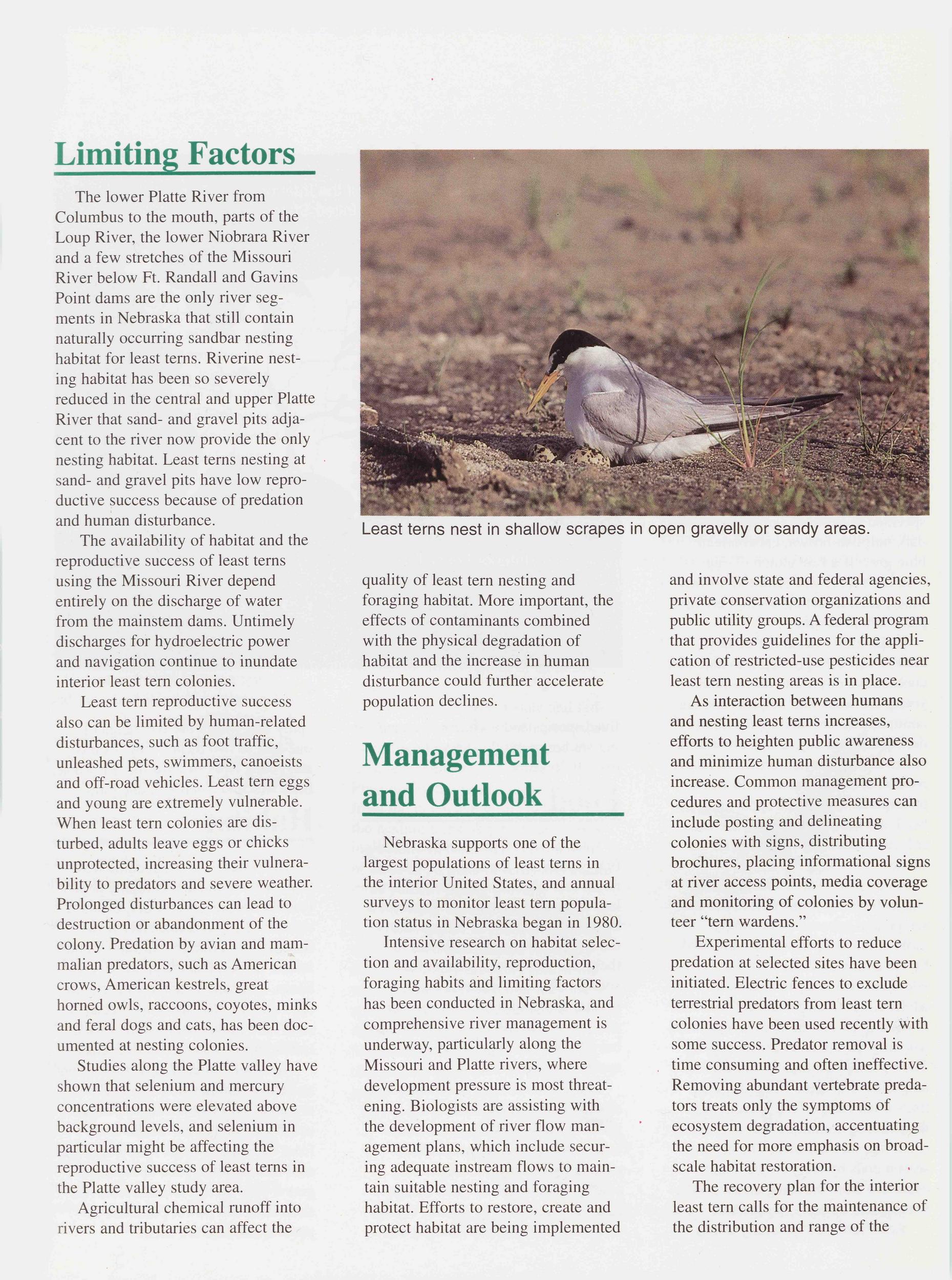
Soon after pair formation, both sexes participate in making many shallow nest scrapes dispersed in open, gravelly or sandy areas. Although several scrapes might be built by each pair, only one is used for nesting. Nest scrapes are sometimes located near small pieces of wood or debris or near clusters of small stones. After the female selects a suitable scrape, two or three eggs are laid on consecutive days.
Both adults begin to alternate incubation duties after the first egg is laid. The pale to olive-buff eggs are speckled with streaks or splotches of dark purplish-brown, chocolate or blue-grey. If a first clutch of eggs is lost, least terns will renest up to two times, each renesting attempt taking place at a new site.
Incubation lasts about 21 days, after which the eggs begin to hatch on consecutive days. The newly hatched young are weak and helpless and are continuously brooded by the adults during the first day. Chick coloration varies from a grayish-brown to nearly reddish or sandy-brown with white underparts. Tiny black spots on the head and back complement the sand-colored camouflage plumage of the chicks.
A day or two after hatching, the chicks begin to wander from the nest scrape and become increasingly mobile, but are periodically brooded by the adults until the they can regulate their own body temperature. Both adults catch small fish, which are fed to the chicks. About three weeks after hatching, young terns are able to fly. Their parents continue to feed them long after they have fledged. Fledglings often can be seen "practicing" their fishing technique, but they rarely catch fish on their own. The nesting season ends by early August, and departure from breeding areas usually is complete by early September.
Least terns are generally a long
Interior least terns consume small fish captured in the shallow water of rivers and lakes. They hunt by hovering, searching and then diving from a height of a few feet to 30 feet above the surface to snatch small fish in their bill. The most common fish species taken in Nebraska include several shiner species (Notropis sp.) and plains killifish (Fundulus kansae), but they will eat almost any fish species of appropriate size.
Least terns nesting at sandpits and other off-river sites often fly up to two miles to forage at river sites. Least terns nesting on riverine sandbars usually forage close to the nesting colony. Fish of one to three inches long are consumed by adults. Young chicks are consistently brought non-spiny fish within the size range of one-half to two inches long. Adults and young birds swallow the fish whole, head first and usually in one gulp.
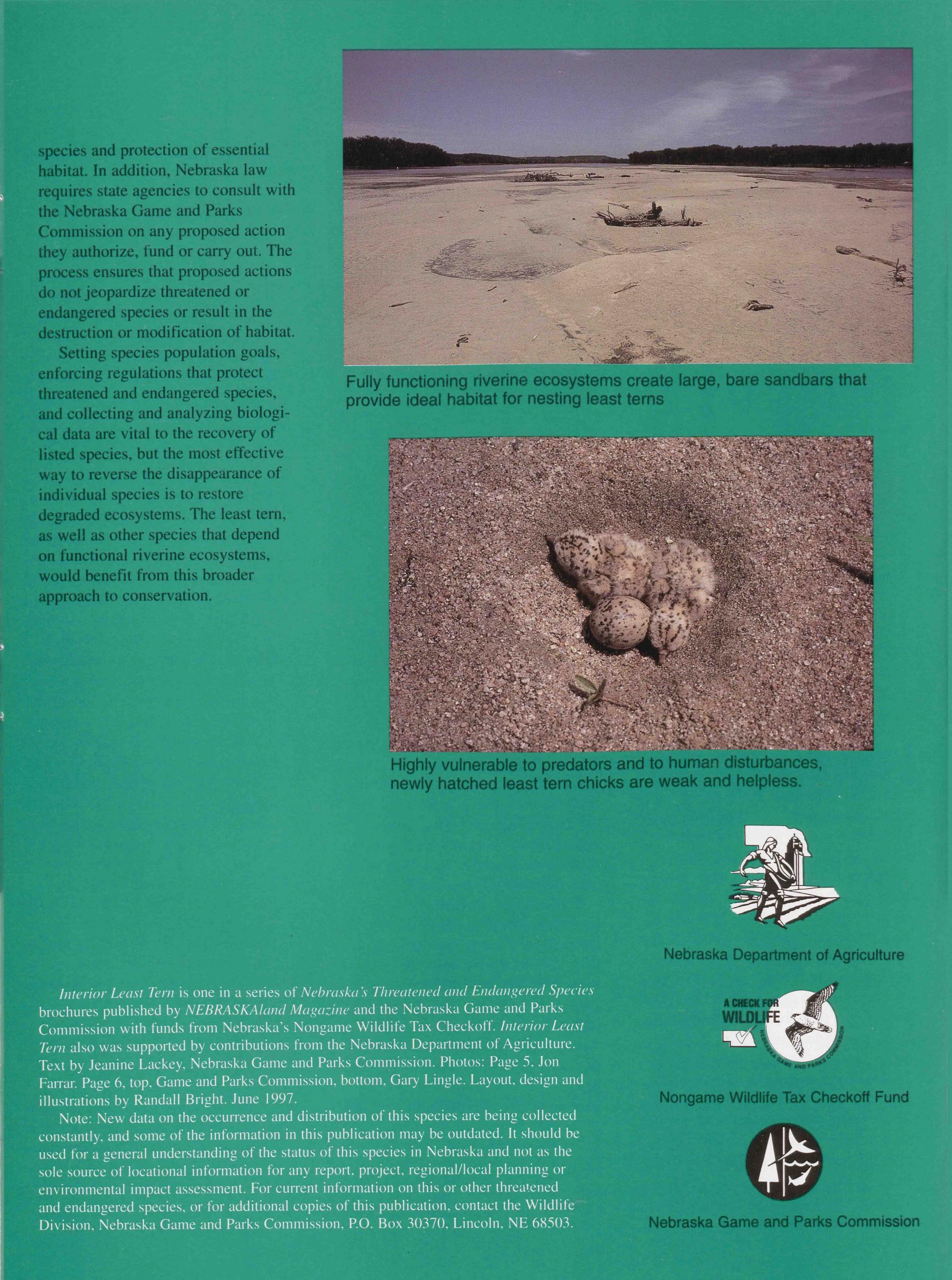
HabitatThe occurrence of breeding least terns is localized and is highly dependent on the presence of dry, exposed sandbars and favorable river flows that support a forage fish supply and isolate the sandbars from the riverbanks. Characteristic riverine nesting sites are dry, flat, sparsely vegetated sand- and gravel bars within a wide, unobstructed, water-filled river channel.
Nests are initiated only after spring and early summer flows recede and dry areas on sandbars are exposed, usually on higher elevations away from the water's edge. Artificially created nesting sites, such as sand and gravel pits, dredge islands, reservoir shorelines and power plant ash disposal areas, also are used.
 Limiting Factors
The lower Platte River from Columbus to the mouth, parts of the Loup River, the lower Niobrara River and a few stretches of the Missouri River below Ft. Randall and Gavins Point dams are the only river segments in Nebraska that still contain naturally occurring sandbar nesting habitat for least terns. Riverine nesting habitat has been so severely reduced in the central and upper Platte River that sand- and gravel pits adjacent to the river now provide the only nesting habitat. Least terns nesting at sand- and gravel pits have low reproductive success because of predation and human disturbance.
The availability of habitat and the reproductive success of least terns using the Missouri River depend entirely on the discharge of water from the mainstem dams. Untimely discharges for hydroelectric power and navigation continue to inundate interior least tern colonies.
Least tern reproductive success also can be limited by human-related disturbances, such as foot traffic, unleashed pets, swimmers, canoeists and off-road vehicles. Least tern eggs and young are extremely vulnerable. When least tern colonies are disturbed, adults leave eggs or chicks unprotected, increasing their vulnerability to predators and severe weather. Prolonged disturbances can lead to destruction or abandonment of the colony. Predation by avian and mammalian predators, such as American crows, American kestrels, great horned owls, raccoons, coyotes, minks and feral dogs and cats, has been documented at nesting colonies.
Studies along the Platte valley have shown that selenium and mercury concentrations were elevated above background levels, and selenium in particular might be affecting the reproductive success of least terns in the Platte valley study area.
Least terns nest in shallow scrapes in open gravelly or sandy areas.
Nebraska supports one of the largest populations of least terns in the interior United States, and annual surveys to monitor least tern population status in Nebraska began in 1980.
Intensive research on habitat selection and availability, reproduction, foraging habits and limiting factors has been conducted in Nebraska, and comprehensive river management is underway, particularly along the Missouri and Platte rivers, where development pressure is most threatening. Biologists are assisting with the development of river flow management plans, which include securing adequate instream flows to maintain suitable nesting and foraging habitat. Efforts to restore, create and protect habitat are being implemented and involve state and federal agencies, private conservation organizations and public utility groups. A federal program that provides guidelines for the application of restricted-use pesticides near least tern nesting areas is in place.
As interaction between humans and nesting least terns increases, efforts to heighten public awareness and minimize human disturbance also increase. Common management procedures and protective measures can include posting and delineating colonies with signs, distributing brochures, placing informational signs at river access points, media coverage and monitoring of colonies by volunteer "tern wardens."
Experimental efforts to reduce predation at selected sites have been initiated. Electric fences to exclude terrestrial predators from least tern colonies have been used recently with some success. Predator removal is time consuming and often ineffective. Removing abundant vertebrate predators treats only the symptoms of ecosystem degradation, accentuating the need for more emphasis on broadscale habitat restoration.
The recovery plan for the interior least tern calls for the maintenance of the distribution and range of the
species and protection of essential habitat. In addition, Nebraska law requires state agencies to consult with the Nebraska Game and Parks Commission on any proposed action they authorize, fund or carry out. The process ensures that proposed actions do not jeopardize threatened or endangered species or result in the destruction or modification of habitat.
Setting species population goals, enforcing regulations that protect threatened and endangered species, and collecting and analyzing biological data are vital to the recovery of listed species, but the most effective way to reverse the disappearance of individual species is to restore degraded ecosystems. The least tern, well as other species that depend on functional riverine ecosystems, would benefit from this broader approach to conservation.
Fully functioning riverine ecosystems create large, bare sandbars the provide ideal habitat for nesting least terns
Highly vulnerable to predators and to human disturbances, newly hatched least tern chicks are weak and helpless.
Outdoor Business
We are the Landowners
With the dollars we spend on hunting and fishing permits, habitat stamps and excise taxes on sporting equipment, we have purchased these lands just as surely as if we personally held title.
Is there a duck hunter living who has not dreamed of owning a marsh, a quail hunter who has not dreamed of landscaping his own 80 acres to keep a covey or two, a pheasant hunter who hasn't fantasized about a patch of native grass where he could run his dog in the off-season, a squirrel hunter who doesn't long for his own hickory grove, or a bass fisherman who does not fancy his own cattail-lined backwater?
Most of us will never have wallets fat enough to own the land we dream of, but for a few dollars a year we share our dreams with others like us on places called wildlife management areas. With the dollars we spend on hunting and fishing permits, habitat stamps and excise taxes on sporting equipment, we have purchased these lands just as surely as if we personally held title. We are the landowners, stockholders in the corporation.
The oldest wildlife management area in Nebraska is Goose Lake in Holt County, purchased in 1925. During the Game Commission's early years such sites were called recreation areas, but as their uses became more specific, properties used principally for hunting or fishing were redesignated as special use areas. Not until 1978 were some designated as wildlife management areas, signifying that they had been set aside for wildlife, hunting and fishing. Through the past 20 years, the number of wildlife management areas purchased with funds generated by the sale of habitat stamps has nearly doubled.
By 1975, Nebraska wildlife habitat was disappearing at an accelerating rate, and a Wildlife Habitat Conference was held in Lincoln to find ways to preserve and enhance wildlife habitat. It was evident that more funds would have to be available before that could be accomplished, and sportsmen and conservationists stepped forward to put their money where their hearts were.
From that first-of-its-kind meeting came the Wildlife Habitat Plan, subsequently passed by the 1976 Nebraska Legislature and signed into law by then-Governor J.J. Exon. The Habitat Plan was designed to stem the loss of wildlife habitat on three fronts by providing financial incentives for private landowners to create and preserve habitat, by providing more funds to better manage existing and future wildlife management areas, and by acquiring additional land. Just as the federal duck stamp, born of the drought years in the 1930s, led to the creation of a system of migratory bird refuges, money from the sale of habitat stamps is used to acquire and enhance wildlife lands.
The Habitat Plan has exceeded all expectations. Since January 1977, 34,533 acres of land have been purchased in 50 counties. Today, 75 of Nebraska's 93 counties have at least one wildlife management area. Statewide, 118,312 deeded acres of wildlife management area land are open to hunters, anglers and non-consumptive users. Wildlife areas on leased land bring the statewide total to more than 142,000 acres.
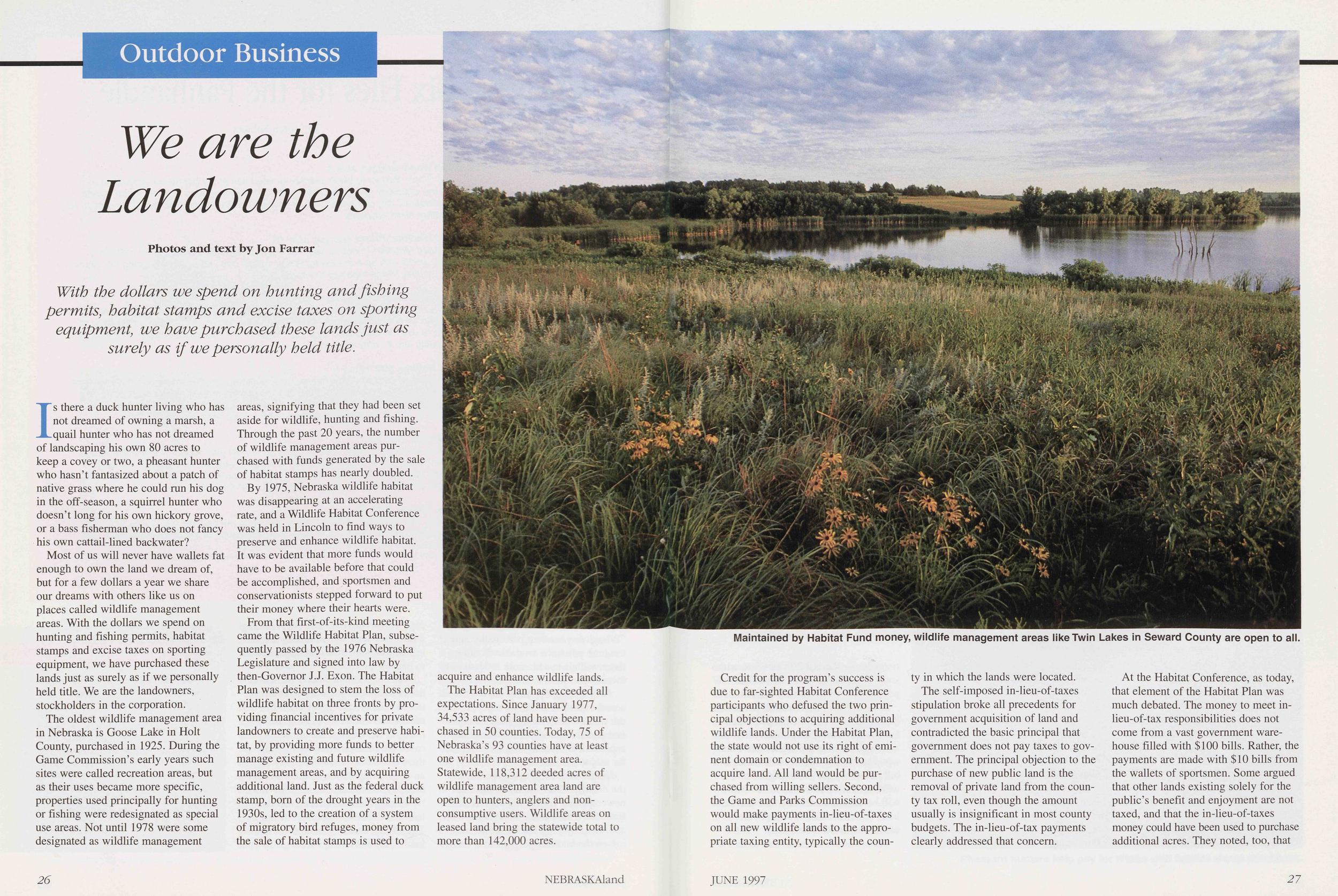
26 NEBRASKAlandMaintained by Habitat Fund money, wildlife management areas like Twin Lakes in Seward County are open to all.
Credit for the program's success is due to far-sighted Habitat Conference participants who defused the two principal objections to acquiring additional wildlife lands. Under the Habitat Plan, the state would not use its right of eminent domain or condemnation to acquire land. All land would be purchased from willing sellers. Second, the Game and Parks Commission would make payments in-lieu-of-taxes on all new wildlife lands to the appropriate taxing entity, typically the county in which the lands were located.
The self-imposed in-lieu-of-taxes stipulation broke all precedents for government acquisition of land and contradicted the basic principal that government does not pay taxes to government. The principal objection to the purchase of new public land is the removal of private land from the county tax roll, even though the amount usually is insignificant in most county budgets. The in-lieu-of-tax payments clearly addressed that concern.
At the Habitat Conference, as today, that element of the Habitat Plan was much debated. The money to meet inlieu-of-tax responsibilities does not come from a vast government warehouse filled with $100 bills. Rather, the payments are made with $10 bills from the wallets of sportsmen. Some argued that other lands existing solely for the public's benefit and enjoyment are not taxed, and that the in-lieu-of-taxes money could have been used to purchase additional acres. They noted, too, that
JUNE 1997 27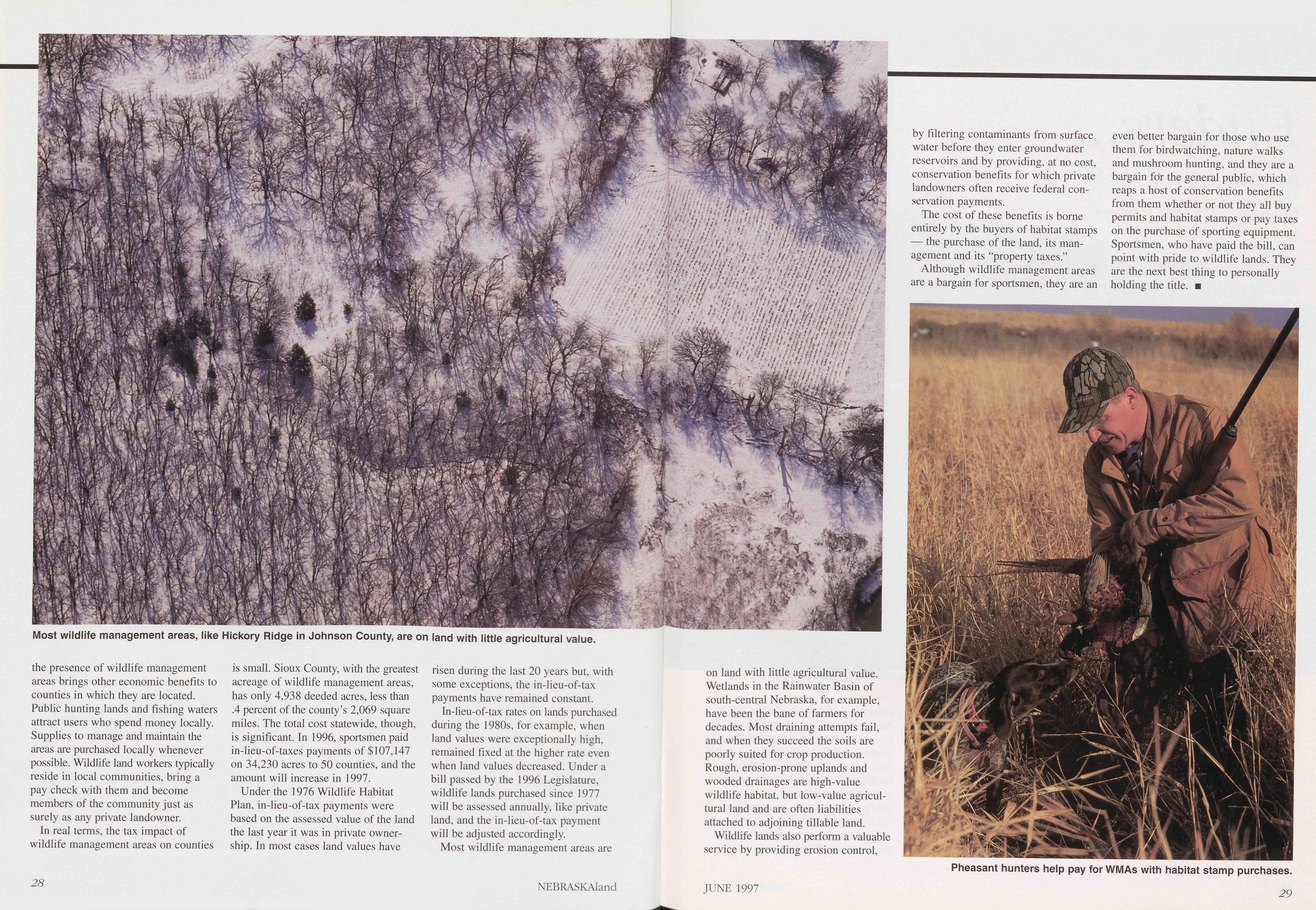
Most wildlife management areas, like Hickory Ridge in Johnson County, are on land with little agricultural value.
the presence of wildlife management areas brings other economic benefits to counties in which they are located. Public hunting lands and fishing waters attract users who spend money locally. Supplies to manage and maintain the areas are purchased locally whenever possible. Wildlife land workers typically reside in local communities, bring a pay check with them and become members of the community just as surely as any private landowner.
In real terms, the tax impact of wildlife management areas on counties is small. Sioux County, with the greatest acreage of wildlife management areas, has only 4,938 deeded acres, less than .4 percent of the county's 2,069 square miles. The total cost statewide, though, is significant. In 1996, sportsmen paid in-lieu-of-taxes payments of $107,147 on 34,230 acres to 50 counties, and the amount will increase in 1997.
Under the 1976 Wildlife Habitat Plan, in-lieu-of-tax payments were based on the assessed value of the land the last year it was in private ownership. In most cases land values have risen during the last 20 years but, with some exceptions, the in-lieu-of-tax payments have remained constant.
In-lieu-of-tax rates on lands purchased during the 1980s, for example, when land values were exceptionally high, remained fixed at the higher rate even when land values decreased. Under a bill passed by the 1996 Legislature, wildlife lands purchased since 1977 will be assessed annually, like private land, and the in-lieu-of-tax payment will be adjusted accordingly.
Most wildlife management areas are
28 NEBRASKAlandon land with little agricultural value. Wetlands in the Rainwater Basin of south-central Nebraska, for example, have been the bane of farmers for decades. Most draining attempts fail, and when they succeed the soils are poorly suited for crop production. Rough, erosion-prone uplands and wooded drainages are high-value wildlife habitat, but low-value agricultural land and are often liabilities attached to adjoining tillable land.
Wildlife lands also perform a valuable service by providing erosion control, by filtering contaminants from surface water before they enter groundwater reservoirs and by providing, at no cost, conservation benefits for which private landowners often receive federal conservation payments.
The cost of these benefits is borne entirely by the buyers of habitat stamps — the purchase of the land, its management and its "property taxes."
Although wildlife management areas are a bargain for sportsmen, they are an even better bargain for those who use them for bird watching, nature walks and mushroom hunting, and they are a bargain for the general public, which reaps a host of conservation benefits from them whether or not they all buy permits and habitat stamps or pay taxes on the purchase of sporting equipment. Sportsmen, who have paid the bill, can point with pride to wildlife lands. They are the next best thing to personally holding the title.
Pheasant hunters help pay for WMAs with habitat stamp purchases.
Enders...
Miracle Lake of the 90s
Twenty years ago, experts predicted that only a miracle could prevent Enders Reservoir in Chase County from drying up. That miracle occurred, and the reservoir's clear water and mixed-hag fishing draw crowds of anglers.
Four devastating floods ravaged the Republican River drainage in 1935, all within a 20-day period. The first occurred on May 28, and oldtimers compared it to the big flood of 1915. The second came four days later, dwarfing the original onslaught, claiming at least 113 lives and destroying thousands of head of livestock. As mournful river residents began cleaning up, the third flood inundated the valley. Relentlessly, on June 16, the final assault occurred when flood water battered the valley once again.
By 1940, Republican River, Frenchman River, Willow Creek and Medicine Creek flood survivors had formed the Republican Valley Conservation Association and were lobbying Congress for a $100 million flood-control project to protect the watershed. Water from the project's impoundments also would provide irrigation and recreation benefits.
In only 13 years, five major dams tamed the Republican basin. Above Harlan County Reservoir on the lower Republican, Harry Strunk Dam was built to control Medicine Creek, Hugh Butler would restrain Red Willow Creek, Swanson would slow the upper Republican, and Enders would teach the Frenchman some respect.
In 1952, Enders Reservoir on the Frenchman River southeast of Imperial, the second of the chain of big dams to be built in the drainage, was dedicated. That also was the year Rex Walgren of Wauneta was born, and the lake soon became his childhood sweetheart.
"I have a lot of good memories of fishing on the lake with my dad and brother. Dad took us fishing probably more than he would have liked to, but if one of us wasn't pestering him to go, the other one was," Walgren said.
Enders was no doubt one of the most beautiful lakes of the time, as it is today with its irregular shape, finger-like coves, rocky escarpments, sandy beaches and, above all, its water. Frenchman Creek, as it is known locally, carries high-quality water from as far west as the high plains of Colorado. Very little surface runoff clouds the Frenchman, primarily because the area receives so little rain.
Rainfall at Enders averages about 19 inches per year, even less upstream. During the reservoir's first 20 years, despite little annual rainfall, the Frenchman, fed directly from underground sources, delivered a bountiful supply of water.
When the reservoir and Walgren turned 20 years old in 1972, he noticed subtle changes beginning to occur in his beautiful lake — the lake that was partly responsible for his having stayed in Wauneta to live and raise a family.
In 1970, his father, Robert, had purchased a grocery store, and eventually Rex and his brother, Scott, joined him to establish Walgren's Super Market. It remains a family business today, and Rex suggests that the longevity of the business relationship began with the strengthening of the family relationship when the three partners began fishing Enders Reservoir.
The changes in the reservoir were the result of a changing river. The
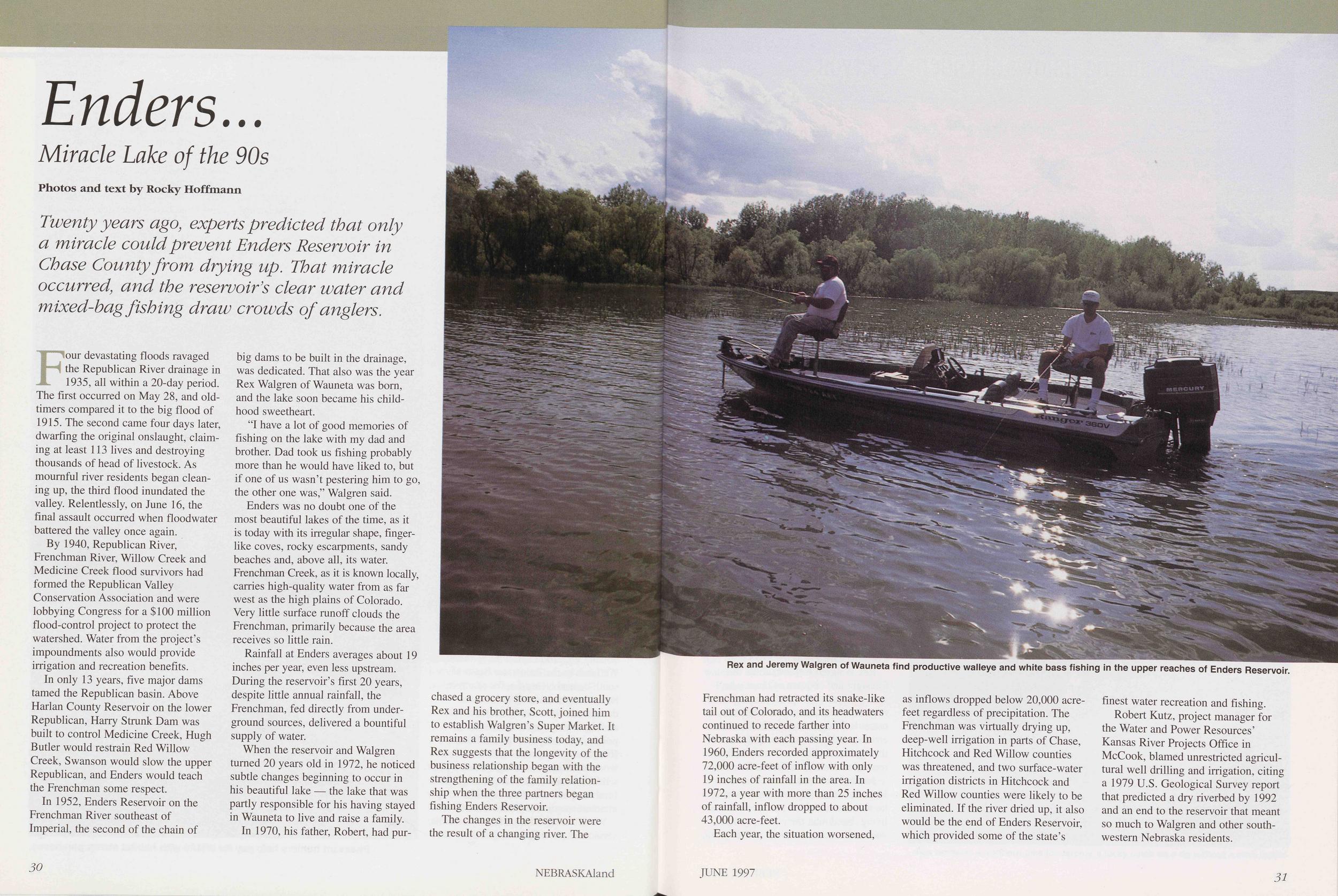
30 NEBRASKAlandRex and Jeremy Walgren of Wauneta find productive walleye and white bass fishing in the upper reaches of Enders Reservoir.
Frenchman had retracted its snake-like tail out of Colorado, and its headwaters continued to recede farther into Nebraska with each passing year. In 1960, Enders recorded approximately 72,000 acre-feet of inflow with only 19 inches of rainfall in the area. In 1972, a year with more than 25 inches of rainfall, inflow dropped to about 43,000 acre-feet.
Each year, the situation worsened, as inflows dropped below 20,000 acre-feet regardless of precipitation. The Frenchman was virtually drying up, deep-well irrigation in parts of Chase, Hitchcock and Red Willow counties was threatened, and two surface-water irrigation districts in Hitchcock and Red Willow counties were likely to be eliminated. If the river dried up, it also would be the end of Enders Reservoir, which provided some of the state's finest water recreation and fishing.
Robert Kutz, project manager for the Water and Power Resources' Kansas River Projects Office in McCook, blamed unrestricted agricultural well drilling and irrigation, citing a 1979 U.S. Geological Survey report that predicted a dry riverbed by 1992 and an end to the reservoir that meant so much to Walgren and other southwestern Nebraska residents.
JUNE 1997 31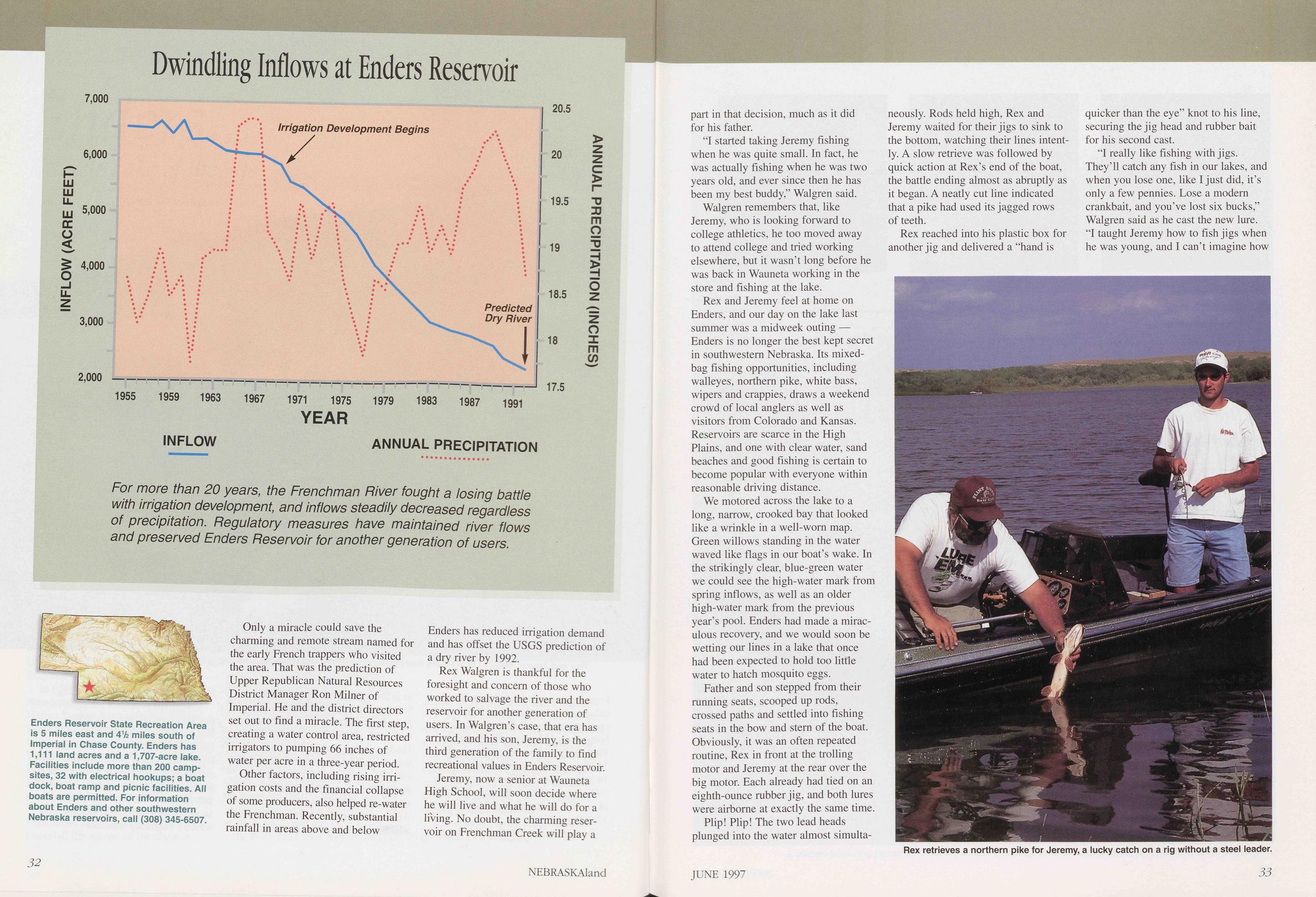 Dwindling Inflows at Enders Reservoir
Only a miracle could save the charming and remote stream named for the early French trappers who visited the area. That was the prediction of Upper Republican Natural Resources District Manager Ron Milner of Imperial. He and the district directors set out to find a miracle. The first step, creating a water control area, restricted irrigators to pumping 66 inches of water per acre in a three-year period.
Other factors, including rising irrigation costs and the financial collapse of some producers, also helped re-water the Frenchman. Recently, substantial rainfall in areas above and below Enders has reduced irrigation demand and has offset the USGS prediction of a dry river by 1992.
Rex Walgren is thankful for the foresight and concern of those who worked to salvage the river and the reservoir for another generation of users. In Walgren's case, that era has arrived, and his son, Jeremy, is the third generation of the family to find recreational values in Enders Reservoir.
Jeremy, now a senior at Wauneta High School, will soon decide where he will live and what he will do for a living. No doubt, the charming reservoir on Frenchman Creek will play a
32 NEBRASKAlandpart in that decision, much as it did for his father.
"I started taking Jeremy fishing when he was quite small. In fact, he was actually fishing when he was two years old, and ever since then he has been my best buddy," Walgren said.
Walgren remembers that, like Jeremy, who is looking forward to college athletics, he too moved away to attend college and tried working elsewhere, but it wasn't long before he was back in Wauneta working in the store and fishing at the lake.
Rex and Jeremy feel at home on Enders, and our day on the lake last summer was a midweek outing — Enders is no longer the best kept secret in southwestern Nebraska. Its mixed-bag fishing opportunities, including walleyes, northern pike, white bass, wipers and crappies, draws a weekend crowd of local anglers as well as visitors from Colorado and Kansas. Reservoirs are scarce in the High Plains, and one with clear water, sand beaches and good fishing is certain to become popular with everyone within reasonable driving distance.
We motored across the lake to a long, narrow, crooked bay that looked like a wrinkle in a well-worn map. Green willows standing in the water waved like flags in our boat's wake. In the strikingly clear, blue-green water we could see the high-water mark from spring inflows, as well as an older high-water mark from the previous year's pool. Enders had made a miraculous recovery, and we would soon be wetting our lines in a lake that once had been expected to hold too little water to hatch mosquito eggs.
Father and son stepped from their running seats, scooped up rods, crossed paths and settled into fishing seats in the bow and stern of the boat. Obviously, it was an often repeated routine, Rex in front at the trolling motor and Jeremy at the rear over the big motor. Each already had tied on an eighth-ounce rubber jig, and both lures were airborne at exactly the same time.
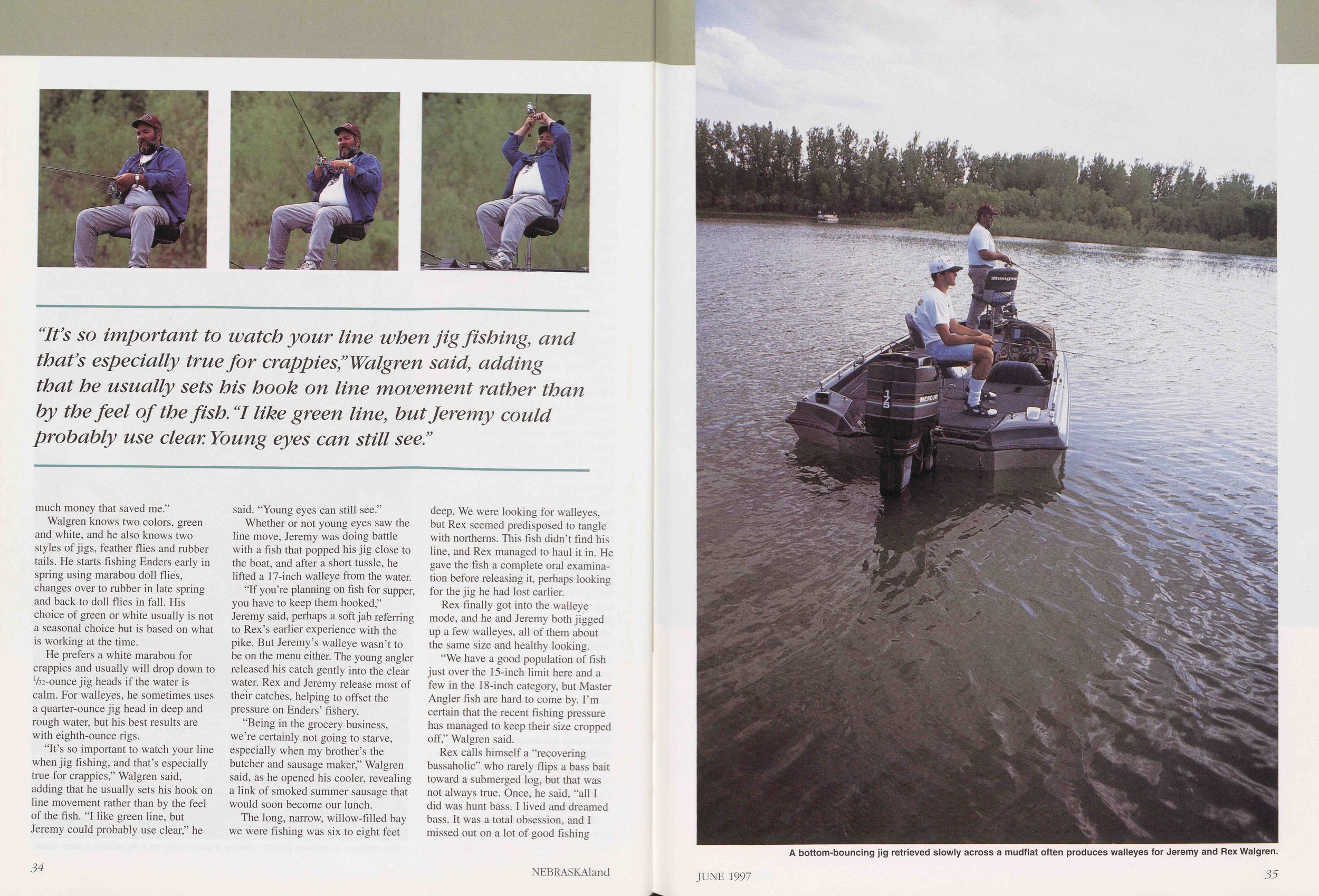
Plip! Plip! The two lead heads plunged into the water almost simultaneously. Rods held high, Rex and Jeremy waited for their jigs to sink to the bottom, watching their lines intently. A slow retrieve was followed by quick action at Rex's end of the boat, the battle ending almost as abruptly as it began. A neatly cut line indicated that a pike had used its jagged rows of teeth.
Rex reached into his plastic box for another jig and delivered a "hand is quicker than the eye" knot to his line, securing the jig head and rubber bait for his second cast. "I really like fishing with jigs. They'll catch any fish in our lakes, and when you lose one, like I just did, it's only a few pennies. Lose a modern crankbait, and you've lost six bucks," Walgren said as he cast the new lure. "I taught Jeremy how to fish jigs when he was young, and I can't imagine how
Rex retrieves a northern pike for Jeremy, a lucky catch on a rig without a steel leader.
much money that saved me."
Walgren knows two colors, green and white, and he also knows two styles of jigs, feather flies and rubber tails. He starts fishing Enders early in spring using marabou doll flies, changes over to rubber in late spring and back to doll flies in fall. His choice of green or white usually is not a seasonal choice but is based on what is working at the time.
He prefers a white marabou for crappies and usually will drop down to 732-ounce jig heads if the water is calm. For walleyes, he sometimes uses a quarter-ounce jig head in deep and rough water, but his best results are with eighth-ounce rigs.
"It's so important to watch your line when jig fishing, and that's especially true for crappies," Walgren said, adding that he usually sets his hook on line movement rather than by the feel of the fish. "I like green line, but Jeremy could probably use clear," he said. "Young eyes can still see."
Whether or not young eyes saw the line move, Jeremy was doing battle with a fish that popped his jig close to the boat, and after a short tussle, he lifted a 17-inch walleye from the water.
"If you're planning on fish for supper, you have to keep them hooked," Jeremy said, perhaps a soft jab referring to Rex's earlier experience with the pike. But Jeremy's walleye wasn't to be on the menu either. The young angler released his catch gently into the clear water. Rex and Jeremy release most of their catches, helping to offset the pressure on Enders' fishery.
"Being in the grocery business, we're certainly not going to starve, especially when my brother's the butcher and sausage maker," Walgren said, as he opened his cooler, revealing a link of smoked summer sausage that would soon become our lunch.
The long, narrow, willow-filled bay we were fishing was six to eight feet deep. We were looking for walleyes, but Rex seemed predisposed to tangle with northerns. This fish didn't find his line, and Rex managed to haul it in. He gave the fish a complete oral examination before releasing it, perhaps looking for the jig he had lost earlier.
Rex finally got into the walleye mode, and he and Jeremy both jigged up a few walleyes, all of them about the same size and healthy looking. "We have a good population of fish just over the 15-inch limit here and a few in the 18-inch category, but Master Angler fish are hard to come by. I'm certain that the recent fishing pressure has managed to keep their size cropped off," Walgren said.
Rex calls himself a "recovering bassaholic" who rarely flips a bass bait toward a submerged log, but that was not always true. Once, he said, "all I did was hunt bass. I lived and dreamed bass. It was a total obsession, and I missed out on a lot of good fishing
34 NEBRASKAlandA bottom-bouncing jig retrieved slowly across a mudflat often produces walleyes for Jeremy and Rex Walgren.
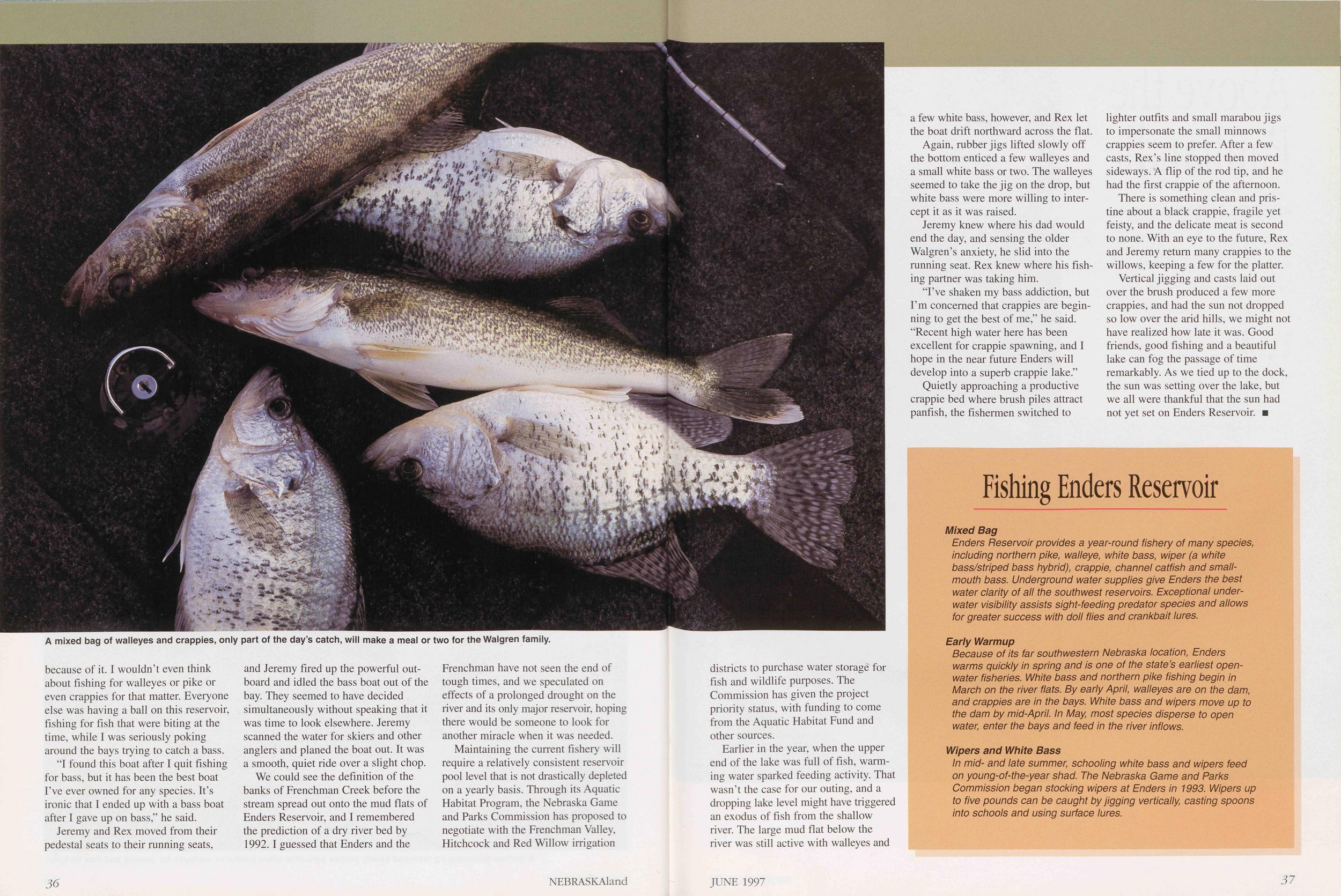
A mixed bag of walleyes and crappies, only part of the day's catch, will make a meal or two for the Walgren family.
because of it. I wouldn't even think about fishing for walleyes or pike or even crappies for that matter. Everyone else was having a ball on this reservoir, fishing for fish that were biting at the time, while I was seriously poking around the bays trying to catch a bass.
"I found this boat after I quit fishing for bass, but it has been the best boat I've ever owned for any species. It's ironic that I ended up with a bass boat after I gave up on bass," he said.
Jeremy and Rex moved from their pedestal seats to their running seats, and Jeremy fired up the powerful outboard and idled the bass boat out of the bay. They seemed to have decided simultaneously without speaking that it was time to look elsewhere. Jeremy scanned the water for skiers and other anglers and planed the boat out. It was a smooth, quiet ride over a slight chop.
We could see the definition of the banks of Frenchman Creek before the stream spread out onto the mud flats of Enders Reservoir, and I remembered the prediction of a dry river bed by 1992.1 guessed that Enders and the Frenchman have not seen the end of tough times, and we speculated on effects of a prolonged drought on the river and its only major reservoir, hoping there would be someone to look for another miracle when it was needed.
Maintaining the current fishery will require a relatively consistent reservoir pool level that is not drastically depleted on a yearly basis. Through its Aquatic Habitat Program, the Nebraska Game and Parks Commission has proposed to negotiate with the Frenchman Valley, Hitchcock and Red Willow irrigation
36 NEBRASKAlanddistricts to purchase water storage for fish and wildlife purposes. The Commission has given the project priority status, with funding to come from the Aquatic Habitat Fund and other sources.
Earlier in the year, when the upper end of the lake was full of fish, warming water sparked feeding activity. That wasn't the case for our outing, and a dropping lake level might have triggered an exodus of fish from the shallow river. The large mud flat below the river was still active with walleyes and a few white bass, however, and Rex let the boat drift northward across the flat.
Again, rubber jigs lifted slowly off the bottom enticed a few walleyes and a small white bass or two. The walleyes seemed to take the jig on the drop, but white bass were more willing to intercept it as it was raised.
Jeremy knew where his dad would end the day, and sensing the older Walgren's anxiety, he slid into the running seat. Rex knew where his fishing partner was taking him. "I've shaken my bass addiction, but I'm concerned that crappies are beginning to get the best of me," he said. "Recent high water here has been excellent for crappie spawning, and I hope in the near future Enders will develop into a superb crappie lake."
Quietly approaching a productive crappie bed where brush piles attract panfish, the fishermen switched to lighter outfits and small marabou jigs to impersonate the small minnows crappies seem to prefer. After a few casts, Rex's line stopped then moved sideways. A flip of the rod tip, and he had the first crappie of the afternoon.
There is something clean and pristine about a black crappie, fragile yet feisty, and the delicate meat is second to none. With an eye to the future, Rex and Jeremy return many crappies to the willows, keeping a few for the platter.
Vertical jigging and casts laid out over the brush produced a few more crappies, and had the sun not dropped so low over the arid hills, we might not have realized how late it was. Good friends, good fishing and a beautiful lake can fog the passage of time remarkably. As we tied up to the dock, the sun was setting over the lake, but we all were thankful that the sun had not yet set on Enders Reservoir.
Fishing Enders Reservoir
Mixed Bag Enders Reservoir provides a year-round fishery of many species, including northern pike, walleye, white bass, wiper (a white bass/striped bass hybrid), crappie, channel catfish and smallmouth bass. Underground water supplies give Enders the best water clarity of all the southwest reservoirs. Exceptional underwater visibility assists sight-feeding predator species and allows for greater success with doll flies and crankbait lures. Early Warmup Because of its far southwestern Nebraska location, Enders warms quickly in spring and is one of the state's earliest openwater fisheries. White bass and northern pike fishing begin in March on the river flats. By early April, walleyes are on the dam, and crappies are in the bays. White bass and wipers move up to the dam by mid-April. In May, most species disperse to open water, enter the bays and feed in the river inflows. Wipers and White Bass In mid- and late summer, schooling white bass and wipers feed on young-of-the-year shad. The Nebraska Game and Parks Commission began stocking wipers at Enders in 1993. Wipers up to five pounds can be caught by jigging vertically, casting spoons into schools and using surface lures. JUNE 1997 37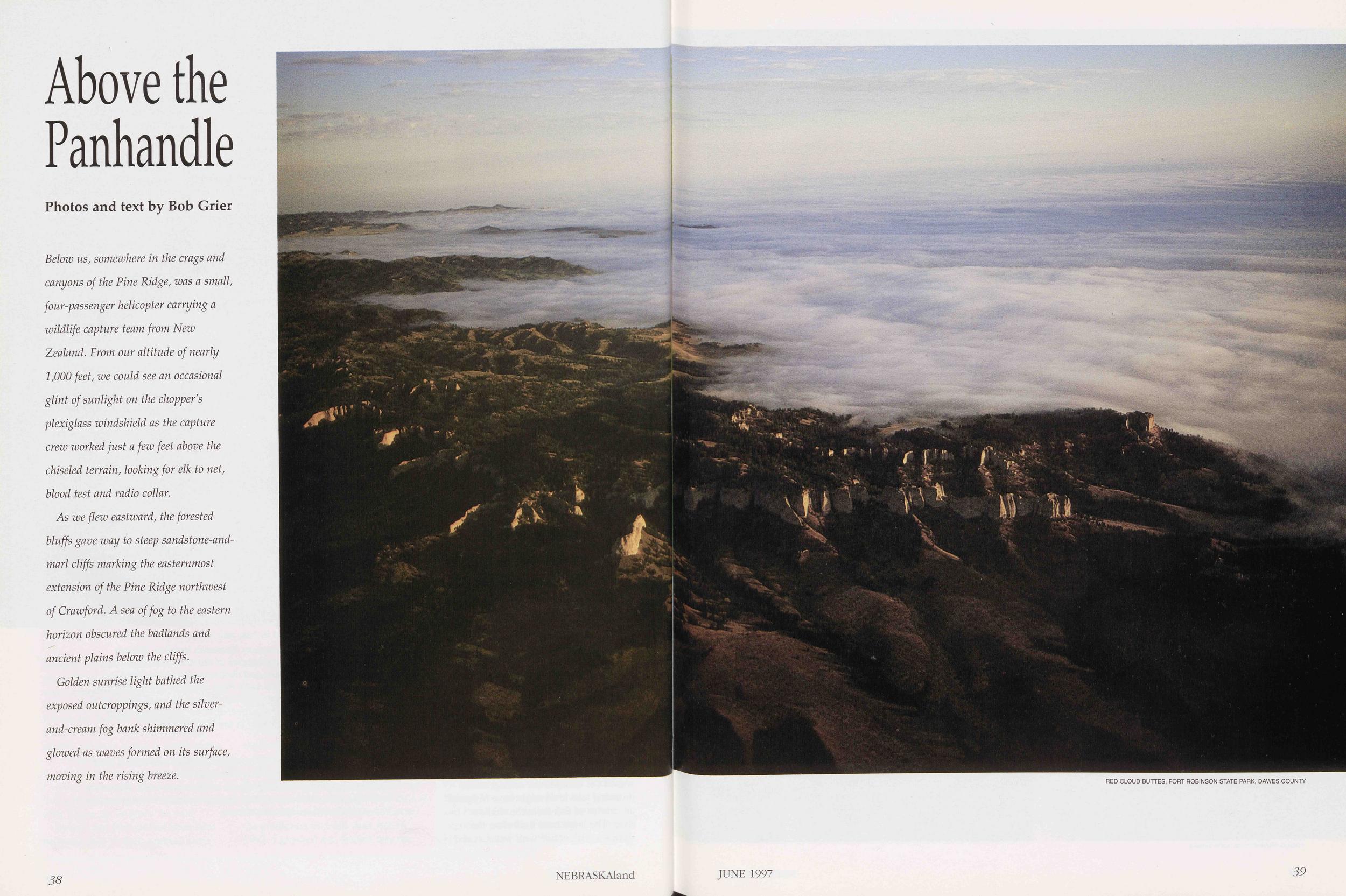
Above the Panhandle
Below us, somewhere in the crags and canyons of the Pine Ridge, was a small, four-passenger helicopter carrying a wildlife capture team from New Zealand. From our altitude of nearly 1,000 feet, we could see an occasional glint of sunlight on the chopper's plexiglass windshield as the capture crew worked just a few feet above the chiseled terrain, looking for elk to net, blood test and radio collar.
As we flew eastward, the forested bluffs gave way to steep sandstone-and-marl cliffs marking the easternmost extension of the Pine Ridge northwest of Crawford. A sea of fog to the eastern horizon obscured the badlands and ancient plains below the cliffs.
Golden sunrise light bathed the exposed outcroppings, and the silver-and-cream fog bank shimmered and glowed as waves formed on its surface, moving in the rising breeze.
38 NEBRASKAland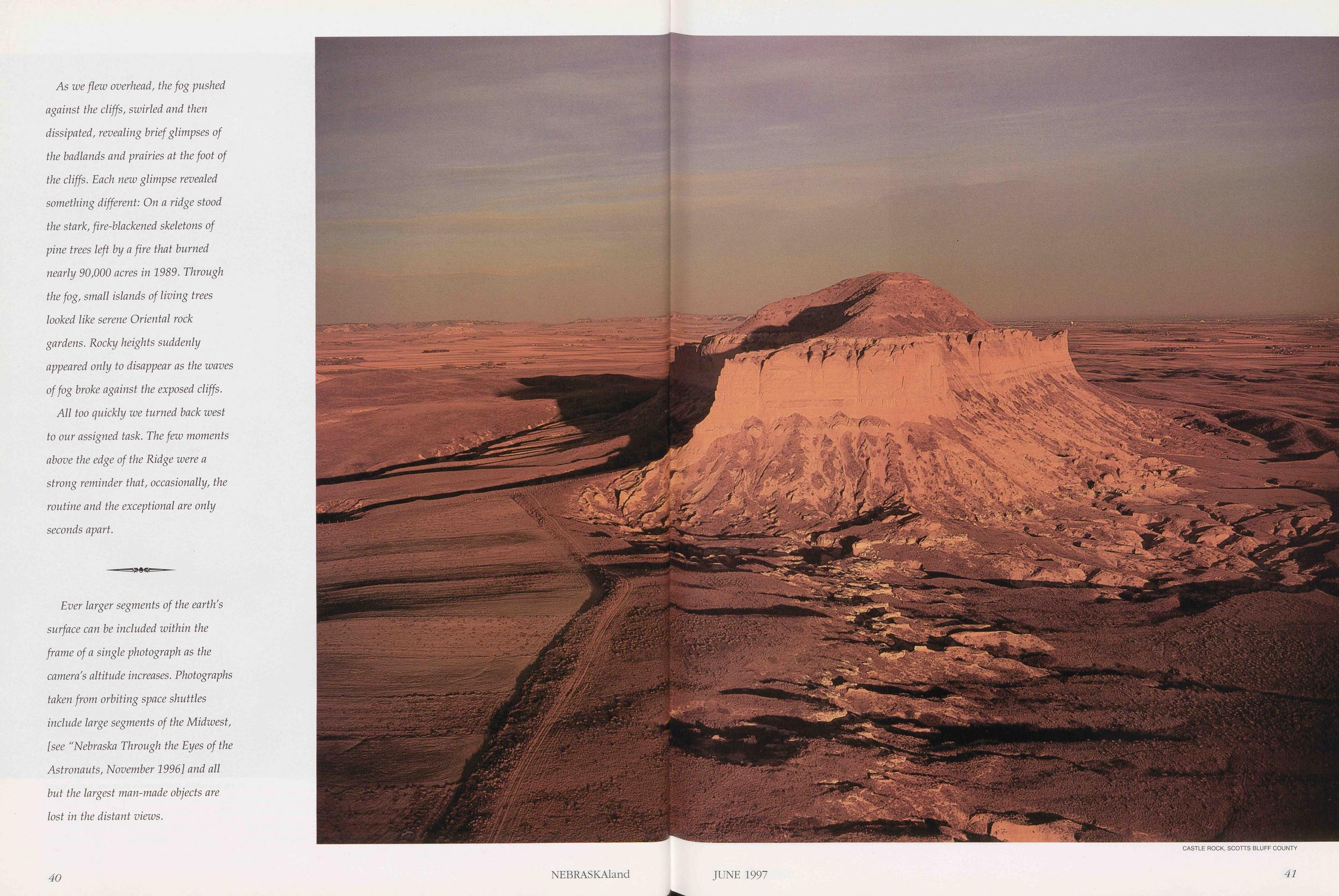
As we flew overhead, the fog pushed against the cliffs, swirled and then dissipated, revealing brief glimpses of the badlands and prairies at the foot of the cliffs. Each new glimpse revealed something different: On a ridge stood the stark, fire-blackened skeletons of pine trees left by a fire that burned nearly 90,000 acres in 1989. Through the fog, small islands of living trees looked like serene Oriental rock gardens. Rocky heights suddenly appeared only to disappear as the waves of fog broke against the exposed cliffs.
All too quickly we turned back west to our assigned task. The few moments above the edge of the Ridge were a strong reminder that, occasionally, the routine and the exceptional are only seconds apart.
Ever larger segments of the earth's surface can be included within the frame of a single photograph as the camera's altitude increases. Photographs taken from orbiting space shuttles include large segments of the Midwest, [see "Nebraska Through the Eyes of the Astronauts, November 1996] and all but the largest man-made objects are lost in the distant views.
40 NEBRASKAland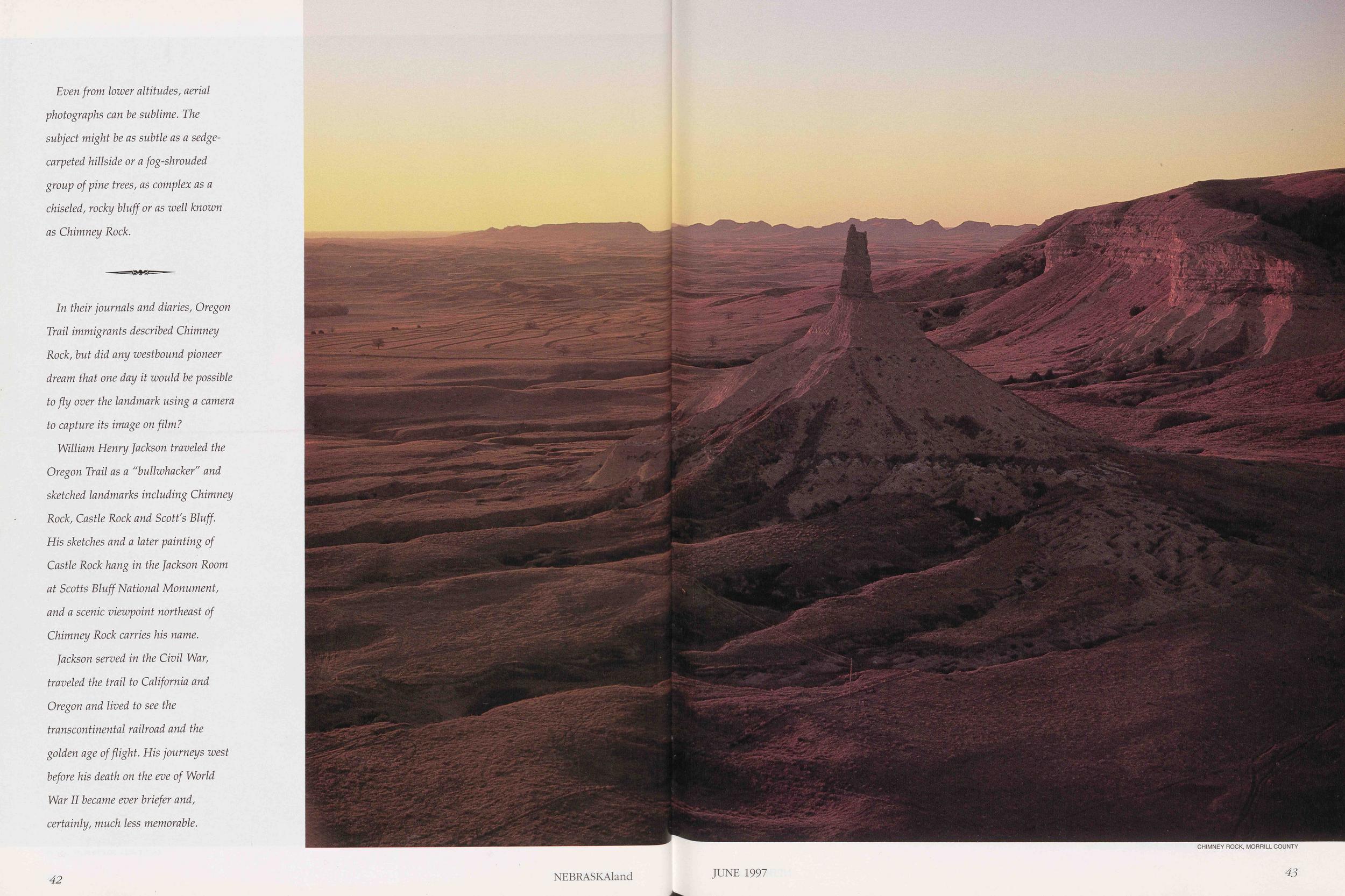
Even from lower altitudes, aerial photographs can be sublime. The subject might be as subtle as a sedge-carpeted hillside or a fog-shrouded group of pine trees, as complex as a chiseled, rocky bluff or as well known as Chimney Rock.
In their journals and diaries, Oregon Trail immigrants described Chimney Rock, but did any westbound pioneer dream that one day it would be possible to fly over the landmark using a camera to capture its image on film?
William Henry Jackson traveled the Oregon Trail as a "bullwhacker" and sketched landmarks including Chimney Rock, Castle Rock and Scott's Bluff. His sketches and a later painting of Castle Rock hang in the Jackson Room at Scotts Bluff National Monument, and a scenic viewpoint northeast of Chimney Rock carries his name. Jackson served in the Civil War, traveled the trail to California and Oregon and lived to see the transcontinental railroad and the golden age of flight. His journeys west before his death on the eve of World War II became ever briefer and, certainly, much less memorable.
42 NEBRASKAland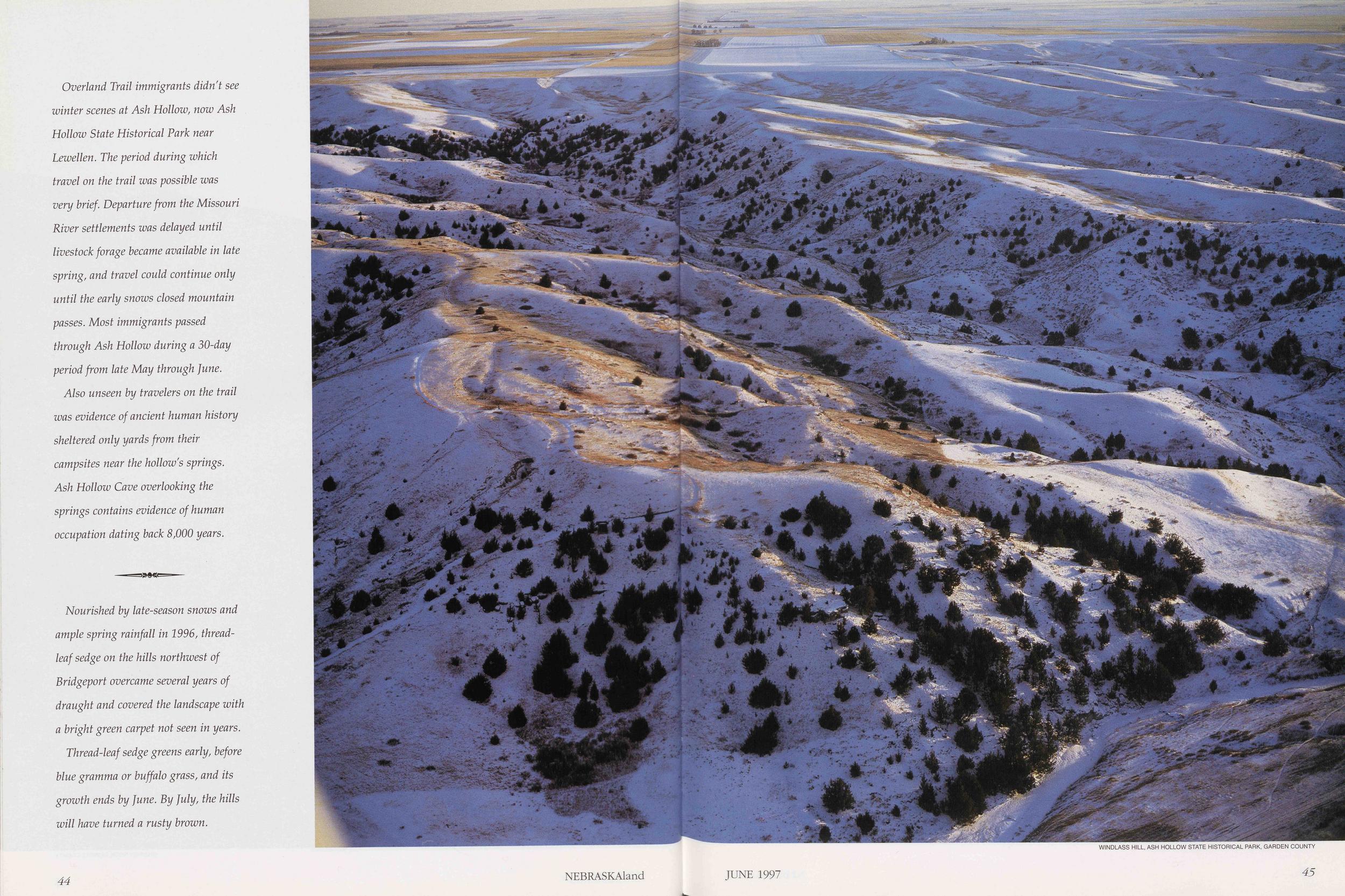
Overland Trail immigrants didn't see winter scenes at Ash Hollow, now Ash Hollow State Historical Park near Lewellen. The period during which travel on the trail was possible was very brief. Departure from the Missouri River settlements was delayed until livestock forage became available in late spring, and travel could continue only until the early snows closed mountain passes. Most immigrants passed through Ash Hollow during a 30-day period from late May through June.
Also unseen by travelers on the trail was evidence of ancient human history sheltered only yards from their campsites near the hollow's springs. Ash Hollow Cave overlooking the springs contains evidence of human occupation dating back 8,000 years.
Nourished by late-season snows and ample spring rainfall in 1996, thread-leaf sedge on the hills northwest of Bridgeport overcame several years of draught and covered the landscape with a bright green carpet not seen in years. Thread-leaf sedge greens early, before blue gramma or buffalo grass, and its growth ends by June. By July, the hills will have turned a rusty brown.
44 NEBRASKAland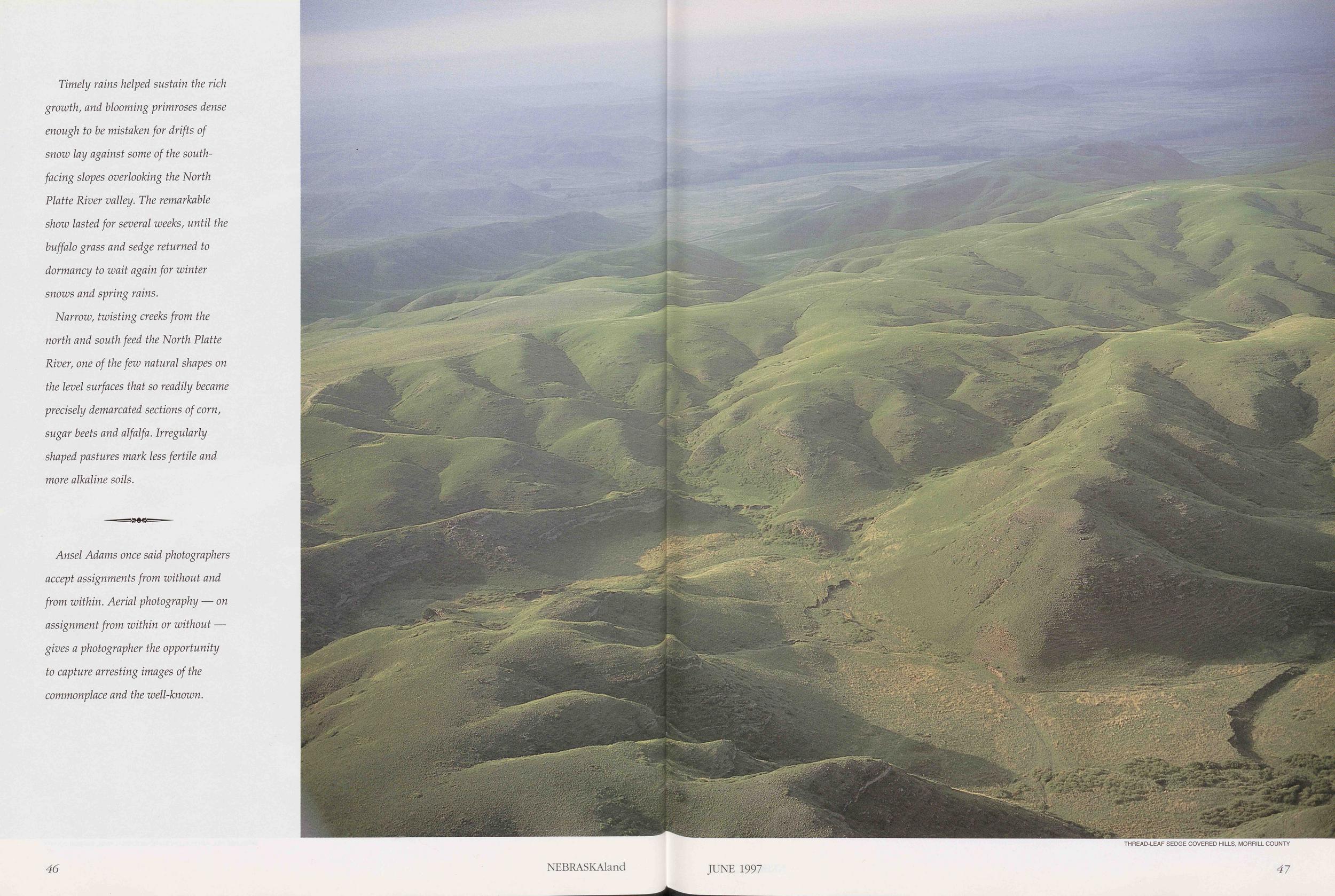
Timely rains helped sustain the rich growth, and blooming primroses dense enough to be mistaken for drifts of snow lay against some of the south-facing slopes overlooking the North Platte River valley. The remarkable show lasted for several weeks, until the buffalo grass and sedge returned to dormancy to wait again for winter snows and spring rains.
Narrow, twisting creeks from the north and south feed the North Platte River, one of the few natural shapes on the level surfaces that so readily became precisely demarcated sections of corn, sugar beets and alfalfa. Irregularly shaped pastures mark less fertile and more alkaline soils.
Ansel Adams once said photographers accept assignments from without and from within. Aerial photography — on assignment from within or without gives a photographer the opportunity to capture arresting images of the commonplace and the well-known.
46 NEBRASKAland
Classified
BOOKS/PRINTING FREE BOOK CATALOG. Novels, westerns, romances, children's; old out of print, found bams, attic. Authors: Grey, Bower, Condor, Fox, Curwood, Raine, Wright, Aldrige, Pollyanna, Freckles, many others. Postage appreciated. Pierce, 4400 N. Pine Cluster, Oroville, CA 95965. HOW TO FIND MORE outdoor opportunities! The Nebraska Sportsman's Atlas. Locations of all public lands and waters on county transportation maps. These maps show ALL the roads in Nebraska. Listings include federal, Nebraska Game & Parks, NRD holdings, hotels and motels and Nebraska's endless attractions. At only $18.75/copy a true time and frustration saver. To order write: Sportsman's Atlas Co., PO Box 132, Lytton, IA 50561 or call 1-800-568-8334. JU-JU SWALLOWED A PENNY, a Nebraska farm girl's book of the 1930s Depression Era. $7.50 ppd. Betty Heidbreder Dunn, Rt. 2, Box 2025, Columbus, TX 78934. WANTED: THE JANUARY 1976 copy of NEBRASKAland Magazine titled "Portrait of the Plains." Will pay a premium price. Call collect (719) 593-2135. DOGS TRAINING ALL BREEDS bird dogs - Vizslas for sale. Home of Rebel Rousers. Rozanek Kennels, RR 2, Schuyler, NE 68661. Phone (402) 352-8769. ENGLISH SETTERS, German shorthairs, English pointers, Brittany spaniels - stud service, puppies and started dogs. Training for all pointing breeds. Plum Creek Kennel, (712) 529-4238 or (402) 298-8153. RETRIEVER TRAINING. Area's top "retrievers only" trainer. Field trial and hunting dogs. Non-slip duck dogs! TKO Retriever Training Kennel (402) 623-4311. ENGLISH SETTERS and Labradors from outstanding lines. Bred for hunters who appreciate fine bird dogs! Wind Fall Gun Dogs, (402) 421-4693. CHESAPEAKE BAY, Labrador and golden retriever pups, started dogs and stud service. 16-time national champion pedigree. Visa & MasterCard. Platte Valley Retrievers (308) 995-2318. YELLOW-CHOCOLATE-BLACK LAB pups. Breeders hips O.F.A. and eyes CERE Excellent bloodlines and hunting potential. Call Mr. Bendler, Lexington, NE (308) 324-4247 or Lincoln (402) 477-1305. WILDERNESS KENNELS. Gun dog training - over 60 years combined experience. Training all sporting breeds - retrievers, flushing and pointing dogs. All dogs worked on pen raised birds and wild game. Training program includes obedience training - heel, sit, stay, down and come when called. Pups, started dogs and fully trained dogs for sale. Hunting dogs trained by hunters. Henry Sader, Wilderness Kennels, Roca, NE (402) 423-4212. Since 1968. ATTENTION RETRIEVER ENTHUSIASTS, retriever trials held monthly. For information contact Jack. (402) 571-7545. ENGLISH SETTER PUPS. FDSB registered. Due May 12. Both parents excellent hunters. Call (307) 686-1805. FISH/FISHING FISH FOR SALE. Catfish, largemouth bass, smallmouth bass, perch, crappie, bluegill, walleye, northern pike, rainbow trout, Donaldson rainbow trout, grass carp, minnows, bullheads. Consulting available. Pleasant Valley Fish Farm, RR 1, Box 147, McCook, NE 69001. Phone (308) 345-6599. WILLOW LAKE FISH HATCHERY. Channel cat, bluegill, hybrid bluegill, largemouth bass, crappie, triploid grass carp, walleye, perch, minnows available for stocking. Gaylord Crawford, 7580 N. Highland Rd., Hastings, NE 68901 or phone (402) 463-8022 day or night. Also pond consultant. We deliver, grower price. FOOD/GIFTS NEBRASKA BASKETS: The original Nebraska company specializing in fine foods from Nebraska since 1984. A beautiful array of baskets filled with ethnic, healthful and long-time favorite foods. Call or write for our brochure: P.O. Box 22985, Lincoln, NE 68542. Phone 1-800-345-7725 or (402) 438-3111. FROM NEBRASKA GIFT SHOP..the world's largest selection of Nebraska-made food products and gifts. Historic Haymarket, 140 N. 8th St., Lincoln, NE 68508; Old Market, 1030 Howard St., Omaha, NE. Call for free catalog 1-800-399-5693. HOMEBREWING/BEER & WINEMAKING supplies. Fermenter's Supply, 8410 K Plz. #10, Omaha, NE 68127. (402) 593-9171. Open every day, mail orders welcome, low shipping. NEBRASKA GOURMET SMOKED TURKEY, award- winning BBQ sauces, gourmet seasonings, native jellies, fruit butters and more! Great gift ideas! Call toll free 1-888-926-2879 or (308) 468-5635. Hollman Foods, 1948 36 Road, Minden, NE 68959, or check our products out on the Internet, http://www.hollmans.com/ GUIDES/OUTFITTERS MAD RIVER CANOES offers the finest quality and performance. For the finest canoes and accessories look to Great Plains Canoe Co., 205 Main, Springfield, NE 68059. Phone (402) 253-2001. CANOE THE NIOBRARA...with an affordable canoe trip by Dryland Aquatics. One and two-day trips...full service, or just canoes and tubes. Transportation furnished. Your Niobrara River specialists... We do it your way! Dryland Aquatics, Dept. N, Box 33C, Sparks, NE 69220 or phone 1-800-337-3119. CANOE AND KAYAK TRIPS on Dismal and Middle Loup rivers. Camping available. Sandhills Motel, Mullen, NE (308) 546-2206. MOUNTAIN BIKE Niobrara River country, Merritt Reservoir and the Cowboy Trail. For bicycle/accessory rentals, trips, sales and service, contact Yucca Dune, 148 E. 1st St., Valentine, NE 69201 (402) 376-3330 or ry schon @ ibm.net. KAYAKS BY PERCEPTION and Aquaterra. Durable kayaks for Niobrara touring and white-water adventure. Trips, boats and accessories for all abilities. Yucca Dune, 148 E. 1st St., Valentine, NE 69201 (402) 376-3330 or ryschon@ibm.net. GUNS/SHOOTING/ARCHERY GUNS - Browning, Winchester, Remington, others. Hi-powers, shotguns, new, used, antiques. Want Pre-'64 Winchesters. Buy-Sell-Trade. (402) 729-6112. Bedlan's Sporting Goods, Fairbury, NE 68352. RARE OPPORTUNITY. COMMEMORATIVE HUSKER 1994-95 Back to Back National Football Championship Winchester Model 94 and Ruger KRL-1227. Actions never moved. Both #1 of 100. $10K for both (316) 634-3145 Tom. REAL ESTATE "MY CABIN BETWEEN THE RIVERS," 7 miles to the Missouri and 4 miles to the Niobrara. Lynch, Nebraska. To see call Findrew Nelson (308) 962-7978 or locally Louis Klasna (402) 598-1006. PLANTS/ANIMALS/HABITAT PLATTE RIVER PHEASANTS: Eggs 25 cents, chicks $1.00, adults call for price. Free delivery available on larger orders. Hastings. (402) 462-2739. WANTED: STRONG FLYING barn pigeons. $2.35 each delivered to us. (316) 836-3285. TAXIDERMY ALLISON'S TAXIDERMY Studio & Gift Gallery - DU, SCI, Pheasants Forever & NTA Members. Mounted 36 state record fish. 421 N. Dewey, North Platte, NE 69101. Call (308) 534-2324 or (308) 534-4267. Custom Designs. VACATIONS/RESORTS FOR FISHING and hunting accommodations. Jefco Inn, Gordon, NE 69343. South Cornell, (308) 282-2935. BED & BREAKFAST. Historic 1890s hotel. Located in the beautiful Pine Ridge area of northwest Nebraska. Short drive to Chadron State Park, Fort Robinson and the Black Hills. Beautiful dining room with fireplace and fountain. Room service available. The Olde Main Street Inn, 115 Main St., Chadron, NE 69337. (308) 432-3380. DIAMOND-E TROUT RESORT. 2 new lodges, 3 cottages on spring-fed lakes, stream. Private and secluded. Trout, bass, bluegill, etc. Paddleboats and playground equipment. For brochure, call 1-800-974-3002. NEAR OMAHA ZOO, American Family Inn Motel. See rain forest, aquarium, I-MAX theater. 104 rooms, free VCR, 125 rental movies, sparkling pool, gazebo, picnic area. $42-$48. Welcome! 1-800-253-2865. OMAHA MOTEL on 1-80 and 144th St. (Exit 440). The friendly Ben Franklin Motel welcomes you. 96 lovely rooms. HBO, free VCR, rental movies, huge swimming pool. Only $40-$48. 1-800-688-3658. EXPERIENCE ONE OF NEBRASKA'S best-kept secrets, The Traveler's Inn B&B, Callaway, NE. Renew your spirit at our turn-of-the-century Victorian home. We'll pamper you with small-town hospitality. Call (308) 836-2200. FAMILY AND FRIENDS VACATION together. Four bedroom ranch house and barn loft by Lewis & Clark Lake. Access to park facilities for boating, fishing, biking, golf and trail riding. Bring your horse. Brochures available. Call Cedar Ridge Ranch (712) 255-3047 days. (712) 239-2337 nights. AVAILABLE FOR RENT - modern lodge. Bass ponds, hiking, birdwatching and wildflower viewing in season. 8 miles north of O'Neill, NE. For more information call Blackbird Valley Ringnecks (800) 559-5738. LOVELY LAKESIDE COTTAGE in the Sandhills. Fully furnished. Screened front porch. Canoeing. Available by week/month to one or two non smoking adults. No pets. James Norton, PO Box 7, Ericson, NE 68637. Call (308) 653-3121. VACATIONERS, SPORTSMEN. Relax in one of our newly remodeled large rooms or Jacuzzi suites! Indoor pool and spa. Exercise room. Restaurant, lounge. Free continental breakfast. Fort Robinson, Chadron State Park, hunting, fishing, over 70 miles of marked biking trails. Best Western West Hills Inn, Chadron, NE 69337. (308) 432-3305. SANDHILLS GUEST RANCH Bed & Breakfast, private cabin. Excellent hunting, upland game and waterfowl, fishing. Beautiful river view. Bring your horse, acres of prairie to ride. Sandhills Country Cabin B&B, HC 63 Box 13, Brewster, NE 68821. Phone (308) 547-2460. 75c per word, minimum $15. Closing: Two months before issue date. NEBRASKAland Magazine, Box 30370, Lincoln, NE 68503. (402) 471-5478. Fax: (402) 471-5528. E-mail: nebland@ ngpsun. ngpc. state. ne. us 48 NEBRASKAlandPage forty-nine
MycophagyHis voice had a distant, buzzing, tinny timbre, and I pictured him sitting at his desk with his arms crossed, convinced that a speaker phone lent elegance and authority to his otherwise banal conversation. I could only pick out a word here and there, but he seemed to be delivering some sort of spring sermon.
"Hello, Athol," I said. "Pick up the receiver. You sound like you're trapped in a culvert. And what's all this about my moral duties?"
"Not duties," he brayed into the receiver at his usual 90 decibels, "beauties! Not morals, MORELS! Morchella esculenta! The queen of wild mushrooms. Off the Ottoman and into your Wellies, old Puffball, the lilacs are in bloom!"
"I think I resent that," I said. To safeguard what's left of my hearing, I held the receiver away from my ear while Athol waxed eloquent about spores, mycelium, veils and gills, and fairy rings. "The lilacs are blooming and the woods are full of mushroom hunters," he concluded, "a sure sign the morels are up. Be ready at six."
As we drove toward the river that evening, Athol chirped on happily, cataloging mycological obscurities ("Mycology, in case it's slipped your mind, old Shaggymane, is the botanical study of mushrooms." Somehow it had slipped my mind). He was resplendent in loden-cloth knickers, green rubber Wellington boots and a thorn-proof, waxed-cotton jacket that smelled like an army-surplus shelterhalf. He wouldn't have looked out of place sitting on a huge toadstool smoking a hookah.
We left the highway and jounced down a rutted road paralleling the river. The dense floodplain undergrowth, stark and open when we'd flushed the season's last covey of quail near there a few months ago, was beginning to close up in a cloud of new green leaves. Every half mile or so we passed a parked pickup, two wheels off the muddy road in the weeds. Athol was right about the mushroom hunters.
A minute later he pulled over, hopped out and handed me a cotton laundry bag. "Fill 'er up," he hooted, "We're burning daylight."
"Look," I ventured as we plunged into the woods, "I like the occasional bit of butter-saturated fungus as well as the next man, but doesn't this business of kicking around in a thicket and eating slimy plants involve some fairly exotic risks along with the ordinary outdoor discomforts? Haven't entire European royal families been rubbed out by mushrooms?"
"You're thinking of boiled eels," Athol said. "Stick with me, Stinkhorn, I know the lore of the woods, the secrets of the wild: 'Leaflets three, let it be' and all that."
"That's for poison ivy," I said, "an itch. What I'm worried about are cramping pains, delirium and death."
"Here's what we're looking for," he said, pointing toward the base of an decaying cotton wood stump. Emerging from the leaf mold were dozens of conical, tan bath sponges on pale stems. Irregularly ridged and pitted, they ranged from delicate two-inch-tall miniatures to magnificent eight-inch specimens as big around as a coffee mug. Breaking the brittle, hollow stems off at the base, we carefully placed them in the bag. "Wait'll you taste 'em. Ambrosia. Food of the Gods. Manna," Athol sighed.
Finding the first clump seemed to make them easier to spot, and we began to see morels ahead of us on the variegated forest floor. Hurrying from clump to clump in the fading twilight, we followed the morel trail deep into the woods, picking until the bag was full. Their faintly tart, earthy aroma clung to our fingers and wafted through the coarse cotton cloth.
"That ought to do it, old Inkycap," Athol said, holding up the swollen bag. "Let's head for the truck."
"Lead the way, Athol," I said.
"I was thinking you might lead the way," he said in an uncharacteristically subdued voice, and I realized we were lost. Not never-to-be-seen-again lost— we were between the river and the road and bound to find the truck sooner or later — but lost enough that we might have spent the night wandering through the swampy bottoms knocking our heads on low branches, filling our boots with muck and lacerating our faces on thorns if it hadn't been for the bear. We were threading through a dense stand of willows when we heard it: an echoing, deep rolling growl followed by an ominous, breathy snuffling.
"Hark!" Athol barked, possibly the only non-literary use of the word in the latter half of the 20th century, and we heard it again. "A bear!"
"There haven't been bears here for a hundred and fifty years," I whispered.
"Well, they're back," he hissed. "Come on, let's sneak up on him." You have to give him credit for courage.
In the lowering darkness, we crossed a former channel of the Platte, and as we climbed the far bank, we came face to face with it: a huge brown shape towering over us and roaring.
Swinging the bag like a mace, Athol smashed our morels over the head of an elderly priest in a tan windbreaker who was snoring sonorously, leaning against a fallen log, an open book on the grass beside him.
"My goodness!" he said. "I must have fallen asleep. What happened?"
"Sorry, Father," said Athol. "I, uh, stumbled. Our mushrooms, uh, fell on you. Let us help you to your car."
Luckily, the priest remembered where his car was, just a hundred yards down the road from Athol's truck. We found two unbroken morels in the bag of fragments and gave them to him.
"You take the rest," Athol said as we pulled up in front of my house.
I sauted a few of the larger chunks for supper. They were delicious. Athol was right: One taste turned me into a morel eater, a mycophag. But next year I think I'll go mushroom hunting with-
JUNE 1997 49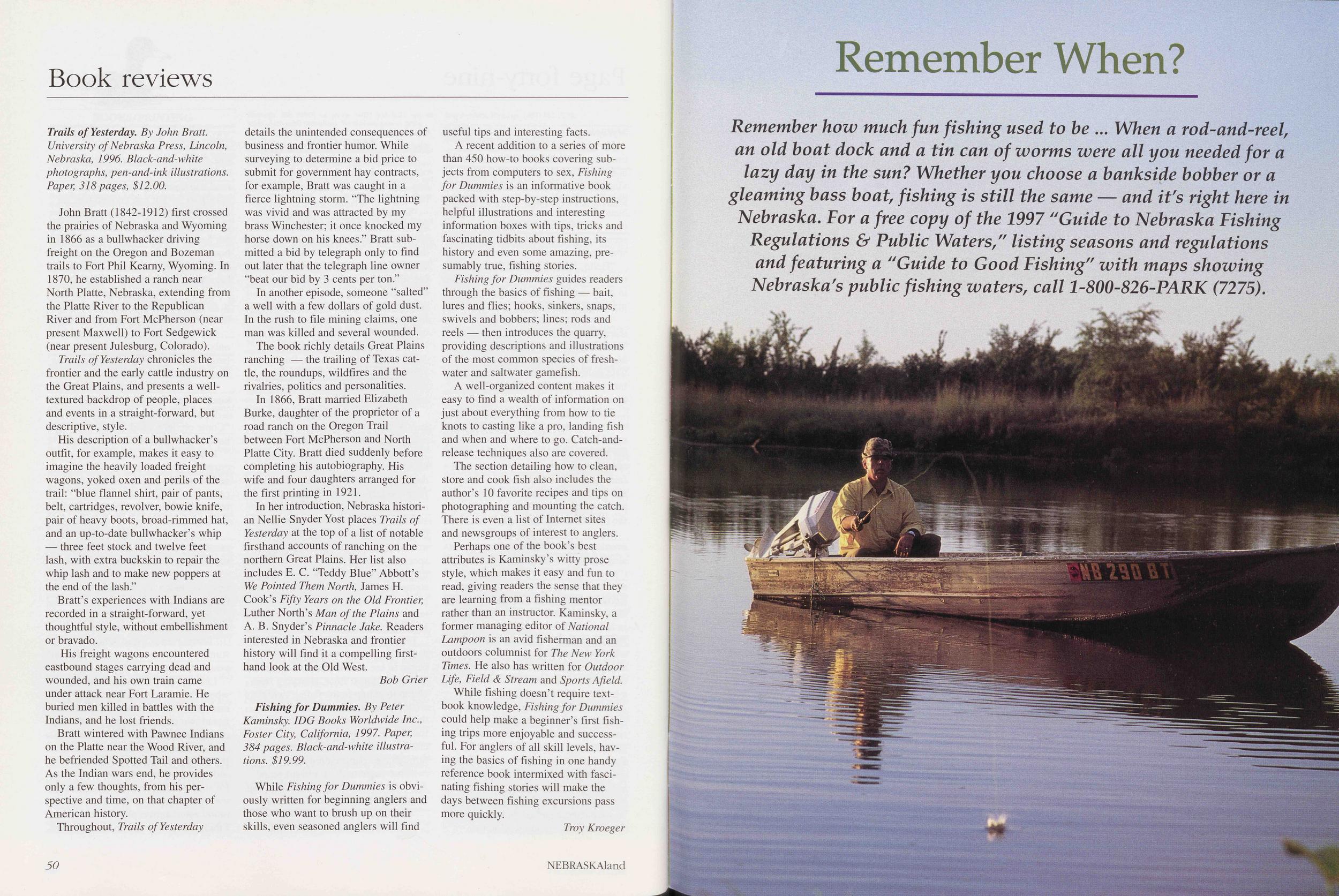
Book reviews
Trails of Yesterday. By John Bratt. University of Nebraska Press, Lincoln, Nebraska, 1996. Black-and-white photographs, pen-and-ink illustrations. Paper, 318 pages, $12.00.John Bratt (1842-1912) first crossed the prairies of Nebraska and Wyoming in 1866 as a bullwhacker driving freight on the Oregon and Bozeman trails to Fort Phil Kearny, Wyoming. In 1870, he established a ranch near North Platte, Nebraska, extending from the Platte River to the Republican River and from Fort McPherson (near present Maxwell) to Fort Sedgewick (near present Julesburg, Colorado).
Trails of Yesterday chronicles the frontier and the early cattle industry on the Great Plains, and presents a well-textured backdrop of people, places and events in a straight-forward, but descriptive, style.
His description of a bullwhacker's outfit, for example, makes it easy to imagine the heavily loaded freight wagons, yoked oxen and perils of the trail: "blue flannel shirt, pair of pants, belt, cartridges, revolver, bowie knife, pair of heavy boots, broad-rimmed hat, and an up-to-date bullwhacker's whip — three feet stock and twelve feet lash, with extra buckskin to repair the whip lash and to make new poppers at the end of the lash."
Bratt's experiences with Indians are recorded in a straight-forward, yet thoughtful style, without embellishment or bravado.
His freight wagons encountered eastbound stages carrying dead and wounded, and his own train came under attack near Fort Laramie. He buried men killed in battles with the Indians, and he lost friends.
Bratt wintered with Pawnee Indians on the Platte near the Wood River, and he befriended Spotted Tail and others. As the Indian wars end, he provides only a few thoughts, from his perspective and time, on that chapter of American history.
Throughout, Trails of Yesterday details the unintended consequences of business and frontier humor. While surveying to determine a bid price to submit for government hay contracts, for example, Bratt was caught in a fierce lightning storm. "The lightning was vivid and was attracted by my brass Winchester; it once knocked my horse down on his knees." Bratt submitted a bid by telegraph only to find out later that the telegraph line owner "beat our bid by 3 cents per ton."
In another episode, someone "salted" a well with a few dollars of gold dust. In the rush to file mining claims, one man was killed and several wounded.
The book richly details Great Plains ranching — the trailing of Texas cattle, the roundups, wildfires and the rivalries, politics and personalities.
In 1866, Bratt married Elizabeth Burke, daughter of the proprietor of a road ranch on the Oregon Trail between Fort McPherson and North Platte City. Bratt died suddenly before completing his autobiography. His wife and four daughters arranged for the first printing in 1921.
In her introduction, Nebraska historian Nellie Snyder Yost places Trails of Yesterday at the top of a list of notable firsthand accounts of ranching on the northern Great Plains. Her list also includes E. C. "Teddy Blue" Abbott's We Pointed Them North, James H. Cook's Fifty Years on the Old Frontier, Luther North's Man of the Plains and A. B. Snyder's Pinnacle Jake. Readers interested in Nebraska and frontier history will find it a compelling first-hand look at the Old West.
Bob Grier Fishing for Dummies. By Peter Kaminsky. IDG Books Worldwide Inc., Foster City, California, 1997. Paper, 384 pages. Black-and-white illustrations. $19.99.While Fishing for Dummies is obviously written for beginning anglers and those who want to brush up on their skills, even seasoned anglers will find useful tips and interesting facts.
A recent addition to a series of more than 450 how-to books covering subjects from computers to sex, Fishing for Dummies is an informative book packed with step-by-step instructions, helpful illustrations and interesting information boxes with tips, tricks and fascinating tidbits about fishing, its history and even some amazing, presumably true, fishing stories.
Fishing for Dummies guides readers through the basics of fishing — bait, lures and flies; hooks, sinkers, snaps, swivels and bobbers; lines; rods and reels — then introduces the quarry, providing descriptions and illustrations of the most common species of freshwater and saltwater gamefish.
A well-organized content makes it easy to find a wealth of information on just about everything from how to tie knots to casting like a pro, landing fish and when and where to go. Catch-and-release techniques also are covered.
The section detailing how to clean, store and cook fish also includes the author's 10 favorite recipes and tips on photographing and mounting the catch. There is even a list of Internet sites and newsgroups of interest to anglers.
Perhaps one of the book's best attributes is Kaminsky's witty prose style, which makes it easy and fun to read, giving readers the sense that they are learning from a fishing mentor rather than an instructor. Kaminsky, a former managing editor of National Lampoon is an avid fisherman and an outdoors columnist for The New York Times. He also has written for Outdoor Life, Field & Stream and Sports Afield.
While fishing doesn't require text-book knowledge, Fishing for Dummies could help make a beginner's first fishing trips more enjoyable and successful. For anglers of all skill levels, having the basics of fishing in one handy reference book intermixed with fascinating fishing stories will make the days between fishing excursions pass more quickly.
Troy Kroeger 50 NEBRASKAland
Position: 853 (10 views)