Volume 75, Issue 4, 1997
 Nebraska Game and Parks ( Commission
District Offices
Headquarters District Office II District Office IV
2200 N. 33rd St. 524 Panzer St., Box 508 Route 4, Box 36
Lincoln, NE 68503 Bassett, NE 68714 North Platte, NE 69101
Phone (402) 471-0641 Phone (402) 684-2921 Phone (308) 535-8025
District Office 1 District Office III District Office V
East Hwy. 2, Box 725 2201 N. 13th St. 2200 N. 33rd St.
Alliance, NE 69301 Norfolk, NE 68701 Lincoln, NE 68503
Phone (308) 763-2940 Phone (402) 370-3374 Phone (402) 471-5558
Omaha Office Ak-Sar-Ben Aquarium
1212 Deer Park Blvd. 21502 W. Hwy. 31
Omaha, NE 68108 Gretna, NE 68028
Phone (402) 595-2144 Phone (402) 332-3901
World Wide Web Site: http://www.nqpc.state.ne.us
Email: ngpc@ngpsun.ngpc.state.ne.us
Conservation Officers by Region
Headquarters Randy Pomplun Fullerton (308) 536-2987
Dick Turpin (Adm.) Lincoln 471-5531 Jon Reeves Kennard 427-7378
Ted Blume (Asst. Adm.) Lincoln 483-5643 Eric Wiebe Ponca 755-2566
Dan Klammer Lincoln 475-1475 Steve Oberg West Point t 372-3062
Panhandle Sandhills
Officer City Phone (308) Officer City Phone (402)
Richard Furley (Sup.) Alliance 762-2024 Bruce Wiebe (Sup.) Bassett 684-3867
Raymond Still Bridgeport 262-1075 Larry Bauman Atkinson 925-5569
Walt Meyer Chadron 432-4398 Ray Dierking Brkn. Bow (308) 872-3078
John Murphy Crawford 665-2021 Richard Seward Ord (308) 728-3115
Jim Zimmerman Gering 436-7561 Mick Gray Valentine 376-3136
Marvin Kampbell Hay Springs 638-7527 Justin Mays Bassett 684-2546
Dennis Thompson Ogallala 284-6450 South-central
Dan Zuehlke Dan Evasco Scott Brandt Ogallala Oshkosh Scottsbluff 284-4815 772-3091
635-1277 vvUUl VVlIllUI Officer Jerry Pecha (Sup.) Terry Brentzel City York Grand
Is. Phone (402) 362-5707 (308) 384-8296
Southwest Tim Williams Hastings 463-2535
Officer City Phone (308) Dale Johnson Kearney (308) 237-1079
Roger Thompson (Sup.) N. Platte 532-9175 Mark Reeves Loup City (308) 745-1126
Dwight Allbery N. Platte 532-2753 Robert Finke Milford 761-3537
George Sund Cambridge 697-4629 Dana Murphy Geneva 759-3170
Matt Andrews Elwood 785-3025 Southeast Officer Craig Stover (Sup.) Murray Johnson
Douglas Kramer
Jack Henderson Dirk Greene Virgil Gosch Rich Routh Gothenburg Imperial McCook Rep.
City 537-7483 882-5328 345-2185 799-2085 City Lincoln Lincoln Lincoln Phone (402)
471-5590 488-2923 466-9001
Northeast Dina Hopper Lincoln 483-2358
Officer City Phone (402) William Krause Auburn 274-3789
Tom Zimmer (Sup.) Norfolk 371-6625 Larry Elston Bellevue 292-4910
Marion Shafer Norfolk 371-2031 Mike Luben Colon 443-4278
Robert Kelly Albion 395-2538 Duane Arp Gretna 332-4954
Ross Oestmann Bloomfield 373-4412 Levi Krause Louisville 234-2212
L. A. Wilkinson Columbus 564-4375 Russell Mort Nebr. City 873-5684
Gary Ralston Creighton 847-3284 Greg Zerkuilen Beatrice 223-4095
Daniel Roberts Fremont 721-7852
Operation Game Thief 1-800-742-7627
Letters
Misidentified Virginia Creeper
Nebraska Game and Parks ( Commission
District Offices
Headquarters District Office II District Office IV
2200 N. 33rd St. 524 Panzer St., Box 508 Route 4, Box 36
Lincoln, NE 68503 Bassett, NE 68714 North Platte, NE 69101
Phone (402) 471-0641 Phone (402) 684-2921 Phone (308) 535-8025
District Office 1 District Office III District Office V
East Hwy. 2, Box 725 2201 N. 13th St. 2200 N. 33rd St.
Alliance, NE 69301 Norfolk, NE 68701 Lincoln, NE 68503
Phone (308) 763-2940 Phone (402) 370-3374 Phone (402) 471-5558
Omaha Office Ak-Sar-Ben Aquarium
1212 Deer Park Blvd. 21502 W. Hwy. 31
Omaha, NE 68108 Gretna, NE 68028
Phone (402) 595-2144 Phone (402) 332-3901
World Wide Web Site: http://www.nqpc.state.ne.us
Email: ngpc@ngpsun.ngpc.state.ne.us
Conservation Officers by Region
Headquarters Randy Pomplun Fullerton (308) 536-2987
Dick Turpin (Adm.) Lincoln 471-5531 Jon Reeves Kennard 427-7378
Ted Blume (Asst. Adm.) Lincoln 483-5643 Eric Wiebe Ponca 755-2566
Dan Klammer Lincoln 475-1475 Steve Oberg West Point t 372-3062
Panhandle Sandhills
Officer City Phone (308) Officer City Phone (402)
Richard Furley (Sup.) Alliance 762-2024 Bruce Wiebe (Sup.) Bassett 684-3867
Raymond Still Bridgeport 262-1075 Larry Bauman Atkinson 925-5569
Walt Meyer Chadron 432-4398 Ray Dierking Brkn. Bow (308) 872-3078
John Murphy Crawford 665-2021 Richard Seward Ord (308) 728-3115
Jim Zimmerman Gering 436-7561 Mick Gray Valentine 376-3136
Marvin Kampbell Hay Springs 638-7527 Justin Mays Bassett 684-2546
Dennis Thompson Ogallala 284-6450 South-central
Dan Zuehlke Dan Evasco Scott Brandt Ogallala Oshkosh Scottsbluff 284-4815 772-3091
635-1277 vvUUl VVlIllUI Officer Jerry Pecha (Sup.) Terry Brentzel City York Grand
Is. Phone (402) 362-5707 (308) 384-8296
Southwest Tim Williams Hastings 463-2535
Officer City Phone (308) Dale Johnson Kearney (308) 237-1079
Roger Thompson (Sup.) N. Platte 532-9175 Mark Reeves Loup City (308) 745-1126
Dwight Allbery N. Platte 532-2753 Robert Finke Milford 761-3537
George Sund Cambridge 697-4629 Dana Murphy Geneva 759-3170
Matt Andrews Elwood 785-3025 Southeast Officer Craig Stover (Sup.) Murray Johnson
Douglas Kramer
Jack Henderson Dirk Greene Virgil Gosch Rich Routh Gothenburg Imperial McCook Rep.
City 537-7483 882-5328 345-2185 799-2085 City Lincoln Lincoln Lincoln Phone (402)
471-5590 488-2923 466-9001
Northeast Dina Hopper Lincoln 483-2358
Officer City Phone (402) William Krause Auburn 274-3789
Tom Zimmer (Sup.) Norfolk 371-6625 Larry Elston Bellevue 292-4910
Marion Shafer Norfolk 371-2031 Mike Luben Colon 443-4278
Robert Kelly Albion 395-2538 Duane Arp Gretna 332-4954
Ross Oestmann Bloomfield 373-4412 Levi Krause Louisville 234-2212
L. A. Wilkinson Columbus 564-4375 Russell Mort Nebr. City 873-5684
Gary Ralston Creighton 847-3284 Greg Zerkuilen Beatrice 223-4095
Daniel Roberts Fremont 721-7852
Operation Game Thief 1-800-742-7627
Letters
Misidentified Virginia Creeper
The inside cover photograph in the April 1997 issue was misidentified as a hack- berry. Hackberry has distinctive, warty bark not evident in the photo, and its leaves are simple.
I believe the photo is of a Virginia creeper vine (parthenocissus quinquefo- lia) clinging to the tree. The tendrils can be seen at the base of the first cluster of leaves. Above the tendrils is the enlarged leaf scar of the previous year’s leaf. Hackberry does not have a large leaf scar, and it sits on a slight shelf-like projection from the twig. What appears to be a green twig is a grooved petiole leading to the palmate cluster of leaflets.
The large conical bud protruding from the base of the second cluster is too large and too reddish to be a hackberry.
Richard K. Sutton Department of Horticulture University of Nebraska-Lincoln Crossing NebraskaRuth Thone’s “Crossing Nebraska,” [April 1997] brought back many sweet memories. Before I left Omaha for Texas and New Mexico 20 years ago, I traversed many of the areas she described, as well as others I’m sure she’s been to but did not mention: High- way 2 north of Broken Bow into Mari Sandoz’s “frozen ocean;” Smith Falls on the Niobrara; Arthur, the only town in Arthur County; the then one-lane High- way 97 south from Valentine to Mullen; and Highway 20 across northern Nebraska to Fort Robinson.
I’m ready to retrace. Just last week- end I took my granddaughter and a friend to see the sandhill cranes. It’s great to be home again.
John O. Bozell Lincoln, Nebraska Singing Your PraisesI’m singing your praises, NEBRASKA- land. I love my “Wildlife Viewing Guide” and thank you for brightening up January and February with a copy. I have made several short trips since receiving it, using it as a field guide. The maps are helpful and the illustra- tions and photographs are wonderful. I enjoy NEBRASKAland every month and appreciate the high standards, quality and care put into each issue. Keep up the good work.
Jean M. Knight Lincoln, Nebraska Things Die“Things Die” [Notes from the field, April 1997] failed to recognize the con- tributions of the Wildlife Rescue Team Inc. (WRT). WRT operates under the auspices of the Nebraska Game and Parks Commission and responds to thousands of wildlife inquiries.
WRT is authorized to rehabilitate all Nebraska wildlife except raptors and deer. Team leaders are certified wildlife rehabilitators and specialists in the nat- ural history and rehabilitation of a sin- gle species or a group of related species. Team leaders work with veterinarians to recover, rehabilitate, recondition and release wild animals. Several team lead- ers have published in wildlife journals and are nationally recognized in wild- life husbandry and rehabilitation.
We do not have the volunteer staff to care for an average of 2,500 to 3,000 wild animals per year and simultane- ously promote our organization’s work. As a result, the resources offered by WRT are not well known, and the author did not intentionally omit WRT: He did not know we exist.
The Wildlife Rescue Team Inc., a professional rehabilitation organization, contributes to research and conservation of Nebraska’s treasured wildlife.
Jo Anne Rogers Luebbert WRT Waterfowl/Water Bird Team Leader, Omaha Region For more information about the Wildlife Rescue Team or for help in determining if an animal needs assistance, call (402) 473-1951 in Omaha or (402) 341-8619 in Lincoln. Write to: Letters, NEBRASKAland Magazine, P.O. Box 30370, Lincoln, NE 68503. Fax: (402) 471-5528. E-mail: nebland @ ngpsun. ngpc. state, ne. us.
In spring, the Sandhills lake country offers a veritable smorgasbord of nesting birds for wildlife photographers, and the spring of 1996 was no exception. By the third week of May, with the help of Len McDaniel, Valentine National Wildlife Refuge wildlife biologist, I had located more nests than I'd have time to photograph.
In the course of monitoring duck production on the refuge, Len already had marked more than 80 mallard nests on a small island on Marsh Lake. Gadwall, blue-winged teal and other duck species were just beginning to nest. Most mallard nests were in rank, knee-high vegetation where photos would be impossible. I hung my hopes on mallard nest No. 11 in a clump of snowberry on the edge of a Marsh Lake island. On May 17 there were 10 eggs in the down-lined nest.
In a plum thicket on a hillside near the lake, I found a loggerhead shrike nest with three eggs. Later that day I found a robin nest with one hatchling and two eggs, and a mourning dove nest with three opalescent eggs, both in cedar trees, exactly the photos I needed for an upcoming article.
The next day I staked a blind 25 feet from a flicker nest Len had found in a grove of black locust trees at refuge headquarters. It was a perfect setting; the nest cavity was only five feet off the ground, and a shelf mushroom capped the entrance like an awning. On a grassy hill above the flicker nest I found a mallard nest with eight eggs nestled in three clumps of little bluestem, but open enough on the south so I could photograph the hen as she incubated.
Prospects for bird photography were good, then Mother Nature showed her ugly side and took away what she had provided so abundantly. For a photographer it was a daily diet of disappointment; for some bird pairs it meant no young would be produced in 1996.
On May 22, a prolonged period of rain and dreary weather settled over Nebraska. On the night of the 23rd, it hailed in Cherry County. The next morning the robin nest, a substantial nest deep in the bowels of the cedar tree, had no hatchling and no adults. Remarkably, the female dove was still incubating on her exposed, flimsy nest. For six days, thunderstorms, hail, powerful straight winds and tornados stalked across Nebraska.
On June 1,1 returned to the Sandhills. Warm days had returned, and bullsnakes were on the move. I have a special fondness for animals many people don't like, including bullsnakes, and on Highway 83 north of Thedford I swerved sharply to avoid hitting a five-foot-long bullsnake stretched out on the road.
I checked the duck nests on Marsh Lake. Because of the heavy rains, the lake had risen five or six inches and many of the nests on the island were flooded. Eggs not washed away bobbed in soggy nests, including "my" nest, No. 11, which had been carefully covered with down one last time by the hen, and then abandoned. Ring-billed gulls had opened eggs in other nests, and carrion beetles were already going about their grisly task.
My shrikes fared better. Their nest now held six eggs. Len and I decided to candle the mallard eggs in the nest on the hill above the flickers that afternoon so I would know when they would hatch, but as we approached we could see scattered egg fragments on the ground. A coyote had dined on fresh eggs before I'd taken my first photo. We checked the flicker nest and heard the sounds of young from the dark recesses of the tree cavity.
Len's stories about bullsnakes climbing trees and raiding bird nests had left me uneasy, and on June 4, he and I ringed the trunk of the flicker-nest tree with foot-and-a-half aluminum flashing. Late that afternoon a thunderstorm with large hail and heavy rain passed through. The next morning the two four-day-old squabs in the dove nest were gone.
In the afternoon, I walked to the shrike nest in the plum thicket. Showy
6 NEBRASKAlandpeavine flowers littered the ground, grass was lodged, and the hail had chopped a thigh-high patch of nettles down to foot-tall stems. Clusters of plum leaves lay under the shrike nest. The six eggs that had been in the nest four days earlier were now one egg and five three-day-old hatchlings.
The night of June 5, Len's son Paul knocked on my door and said his dad had sent a "friend" for me, and I could decide what to do with it. In a wire cage was a three-foot-long female bullsnake. Mid-body there was a bulge — two of "my" flicker chicks.
Gary Packard, a professor of zoology at Colorado State University, was camped near the flicker nest doing turtle research. Hearing a ruckus at the flicker nest, he found the bullsnake wrapped around the tree, its head in the cavity. He captured the snake and took it to refuge headquarters. When he and Len returned to the flicker nest, a male bullsnake was in the cavity, and the last two flicker chicks were already moving down its gullet. It was breeding season, and the male probably had followed the female's scent trail under a gap in the flashing to the flicker nest.
Many times over the years, Len and I have talked late into the night about the ethics and practicality of trying to increase the nesting success of birds such as ducks by reducing the abundance of predators like bullsnakes, minks, skunks, raccoons and coyotes. I had always taken the moral high road and maintained that predation was a natural part of the system, that the real threat to waterfowl populations was the destruction and degradation of nesting habitat, and that it was not practical to suppress predator abundance on a large enough scale to be significant.
In principal, Len agreed. He bore no personal ill-will toward predatory animals, and in fact respected a good many of them. But, he told me, I, too, would take predation personally if I'd seen as many nests destroyed by predators as he had. I recalled his often-told story of a bluewing hen in nest No. 101, a bird so trusting he could reach down and touch her, and of his anger when a mink killed her as she brooded her eggs.
By putting the fate of the flicker-killing bullsnake in my hands, Len was making sure I understood his sometimes personal feelings about predation. He knew I had started taking "my" nests personally, too, only to see them vanish one by one. Sometimes you want to lash out in anger, strike a blow for the defenseless, kill the offenders. If I'd been the one to catch the bullsnake in the flicker nest, I might have, but instead, I opened the cage and let the snake slither off to some secluded spot to digest "its" flicker chicks.
Jon Farrar Two More Weeks for Deer HuntersA new permit application process means firearm deer hunters have until May 16 to apply for permits in the first application period, which opened April 1.
The number of application periods has been reduced from four to three, and all residents, whether or not they had a permit last year, can now apply in the first period. Priority will be given to applicants who did not hold a permit last year. Formerly, only residents who had not held permits the previous year were eligible for first-period applications. A drawing for permits in oversubscribed units will be held July 1-3.
The second application period will open July 14. Permits will be issued on a first-come, first-served basis to residents who did not obtain a permit in the first period and nonresidents. In the third application period, which opens September 8, hunters can apply for a second permit in units where permits remain.
For more information on deer permit applications, eligibility and requirements, and for information about antelope and elk permits, contact any Nebraska Game and Parks Commission office or the headquarters in Lincoln at (402) 471-0641.
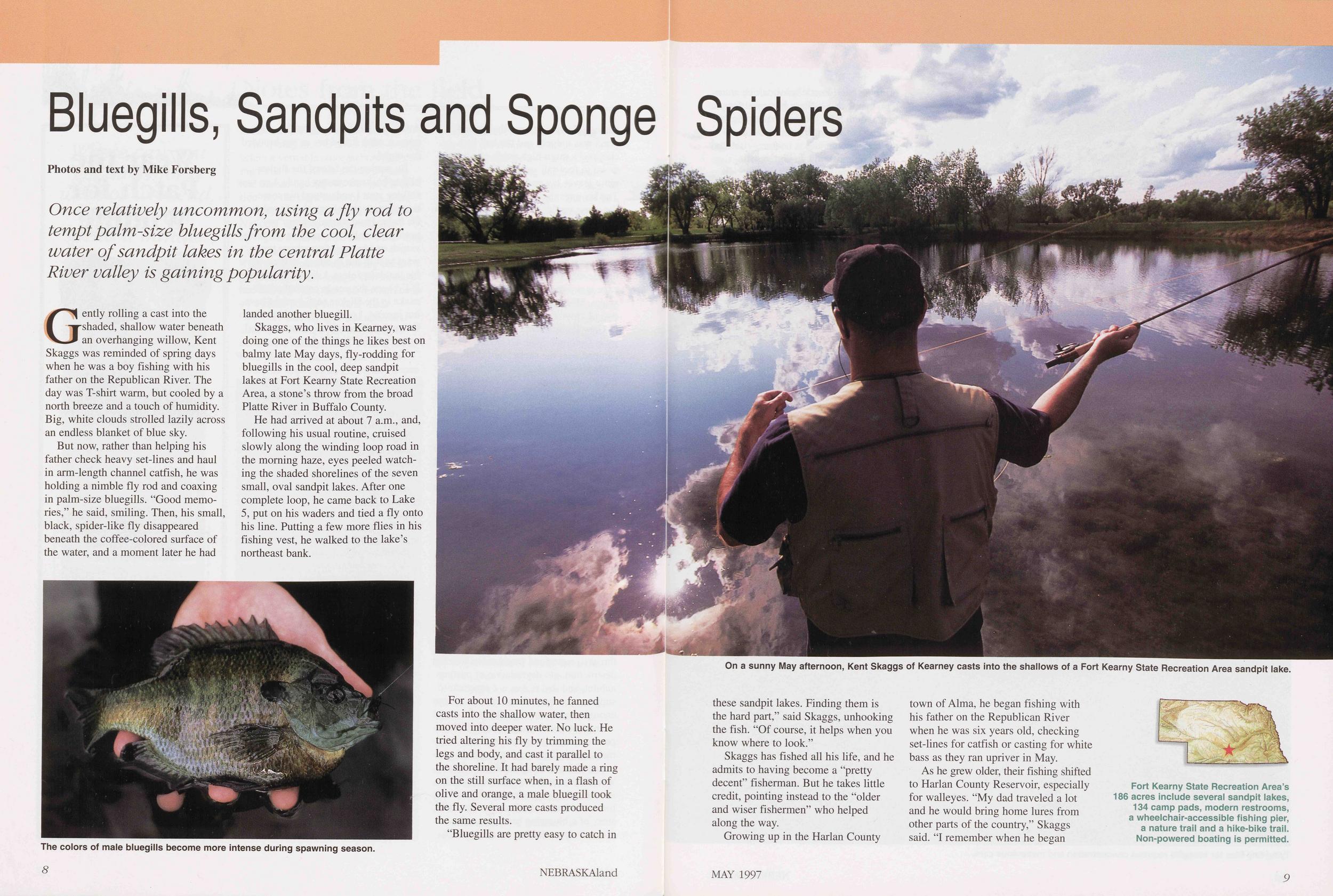
Gently rolling a cast into the shaded, shallow water beneath an overhanging willow, Kent Skaggs was reminded of spring days when he was a boy fishing with his father on the Republican River. The day was T-shirt warm, but cooled by a north breeze and a touch of humidity. Big, white clouds strolled lazily across an endless blanket of blue sky.
But now, rather than helping his father check heavy set-lines and haul in arm-length channel catfish, he was holding a nimble fly rod and coaxing in palm-size bluegills. "Good memories," he said, smiling. Then, his small, black, spider-like fly disappeared beneath the coffee-colored surface of the water, and a moment later he had landed another bluegill.
Skaggs, who lives in Kearney, was doing one of the things he likes best on balmy late May days, fly-rodding for bluegills in the cool, deep sandpit lakes at Fort Kearny State Recreation Area, a stone's throw from the broad Platte River in Buffalo County.
He had arrived at about 7 a.m., and, following his usual routine, cruised slowly along the winding loop road in the morning haze, eyes peeled watching the shaded shorelines of the seven small, oval sandpit lakes. After one complete loop, he came back to Lake 5, put on his waders and tied a fly onto his line. Putting a few more flies in his fishing vest, he walked to the lake's northeast bank.
On a sunny May afternoon, Kent Skaggs of Kearney casts into the shallows of a Fort Kearny State Recreation Area sandpit lake.For about 10 minutes, he fanned casts into the shallow water, then moved into deeper water. No luck. He tried altering his fly by trimming the legs and body, and cast it parallel to the shoreline. It had barely made a ring on the still surface when, in a flash of olive and orange, a male bluegill took the fly. Several more casts produced the same results.
"Bluegills are pretty easy to catch in these sandpit lakes. Finding them is the hard part," said Skaggs, unhooking the fish. "Of course, it helps when you know where to look."
Skaggs has fished all his life, and he admits to having become a "pretty decent" fisherman. But he takes little credit, pointing instead to the "older and wiser fishermen" who helped along the way.
Growing up in the Harlan County town of Alma, he began fishing with his father on the Republican River when he was six years old, checking set-lines for catfish or casting for white bass as they ran upriver in May.
As he grew older, their fishing shifted to Harlan County Reservoir, especially for walleyes. "My dad traveled a lot and he would bring home lures from other parts of the country," Skaggs said. "I remember when he began bringing back BeetleSpins, which were then mainly a Southern lure used for largemouth bass. But we experimented trolling with them for walleyes, and they worked great."
Fort Kearny State Recreation Area's 186 acres include several sandpit lakes, 134 camp pads, modern restrooms, a wheelchair-accessible fishing pier, a nature trail and a hike-bike trail. Non-powered boating is permitted.
The colors of male bluegills become more intense during spawning season. 8 NEBRASKAland MAY 1997
Unlike most young anglers who begin fishing for bluegills and work up to bigger, more challenging fish, Skaggs took up bluegill fishing later in life. When he moved to Kearney to attend college, he took a summer job at Fort Kearny State Historical Park and began noticing a small group of anglers using fly rods to fish for bluegills and bass.
One of them, Jerry Johnson, who regularly camped at the park on weekends, also was from Alma, and Skaggs often joined him, learning where to find bluegills and how to tie flies.
Skaggs also met Craig Stover, a Nebraska Game and Parks Commission conservation officer, who gave him a few flies and showed him the basics of Skaggs uses an assortment of fly patterns to catch bluegills in sandpit lakes.
In spring, male bluegills protect their nests on shallow spawning beds.fly-casting. "I wasn't really interested in bluegill fishing as much as I was in learning how to throw a fly with a fly rod so I could go to Colorado and fish for trout," said Skaggs.
Skaggs bought an inexpensive fiberglass rod-and-reel combination and practiced fly-casting in his yard, depending on magazine articles for tips and techniques. Then he moved to the sandpits to practice on bluegills. "From that point, I learned by trial and error and watching others who were catching fish when I wasn't. I scared more fish than I caught the first few years, but each year I figured out something else."
In the process, he also began to enjoy fly-rodding for bluegills for its own sake, and he is now among the small but increasing number of anglers who fly-fish the area's sandpit lakes.
Many of the lakes were created in the late 1960s when an enormous amount of sand was mined in the Platte valley for the construction of Interstate 80. Groundwater filled the resulting pits, forming deep, clear lakes with high quality aquatic habitat and good conditions for the natural
Tying tiny flies for bluegills requires concentration and meticulous care. 10 NEBRASKAland MAY 1997 11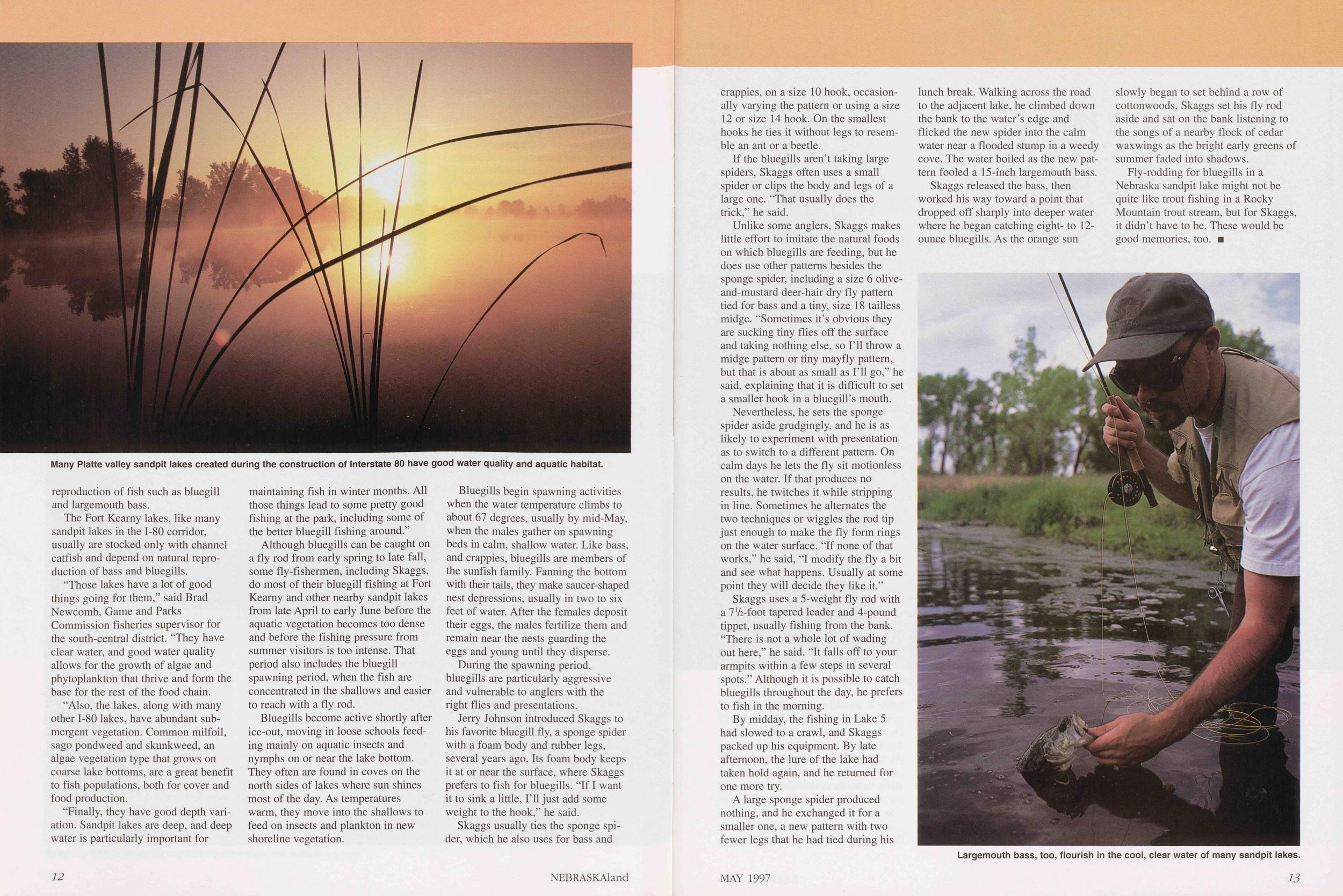 Many Platte valley sandpit lakes created during the construction of Interstate 80
have good water quality and aquatic habitat.
Many Platte valley sandpit lakes created during the construction of Interstate 80
have good water quality and aquatic habitat.
reproduction of fish such as bluegill and largemouth bass.
The Fort Kearny lakes, like many sandpit lakes in the 1-80 corridor, usually are stocked only with channel catfish and depend on natural reproduction of bass and bluegills.
"Those lakes have a lot of good things going for them," said Brad Newcomb, Game and Parks Commission fisheries supervisor for the south-central district. "They have clear water, and good water quality allows for the growth of algae and phytoplankton that thrive and form the base for the rest of the food chain.
"Also, the lakes, along with many other 1-80 lakes, have abundant submerged vegetation. Common milfoil, sago pondweed and skunkweed, an algae vegetation type that grows on coarse lake bottoms, are a great benefit to fish populations, both for cover and food production.
"Finally, they have good depth variation. Sandpit lakes are deep, and deep water is particularly important for maintaining fish in winter months. All those things lead to some pretty good fishing at the park, including some of the better bluegill fishing around."
Although bluegills can be caught on a fly rod from early spring to late fall, some fly-fishermen, including Skaggs, do most of their bluegill fishing at Fort Kearny and other nearby sandpit lakes from late April to early June before the aquatic vegetation becomes too dense and before the fishing pressure from summer visitors is too intense. That period also includes the bluegill spawning period, when the fish are concentrated in the shallows and easier to reach with a fly rod.
Bluegills become active shortly after ice-out, moving in loose schools feeding mainly on aquatic insects and nymphs on or near the lake bottom. They often are found in coves on the north sides of lakes where sun shines most of the day. As temperatures warm, they move into the shallows to feed on insects and plankton in new shoreline vegetation.
Bluegills begin spawning activities when the water temperature climbs to about 67 degrees, usually by mid-May, when the males gather on spawning beds in calm, shallow water. Like bass, and crappies, bluegills are members of the sunfish family. Fanning the bottom with their tails, they make saucer-shaped nest depressions, usually in two to six feet of water. After the females deposit their eggs, the males fertilize them and remain near the nests guarding the eggs and young until they disperse.
During the spawning period, bluegills are particularly aggressive and vulnerable to anglers with the right flies and presentations.
Jerry Johnson introduced Skaggs to his favorite bluegill fly, a sponge spider with a foam body and rubber legs, several years ago. Its foam body keeps it at or near the surface, where Skaggs prefers to fish for bluegills. "If I want it to sink a little, I'll just add some weight to the hook," he said.
Skaggs usually ties the sponge spider, which he also uses for bass and crappies, on a size 10 hook, occasionally varying the pattern or using a size 12 or size 14 hook. On the smallest hooks he ties it without legs to resemble an ant or a beetle. If the bluegills aren't taking large spiders, Skaggs often uses a small spider or clips the body and legs of a large one. "That usually does the trick," he said.
Unlike some anglers, Skaggs makes little effort to imitate the natural foods on which bluegills are feeding, but he does use other patterns besides the sponge spider, including a size 6 olive-and-mustard deer-hair dry fly pattern tied for bass and a tiny, size 18 tailless midge. "Sometimes it's obvious they are sucking tiny flies off the surface and taking nothing else, so I'll throw a midge pattern or tiny mayfly pattern, but that is about as small as I'll go," he said, explaining that it is difficult to set a smaller hook in a bluegill's mouth.
Nevertheless, he sets the sponge spider aside grudgingly, and he is as likely to experiment with presentation as to switch to a different pattern. On calm days he lets the fly sit motionless on the water. If that produces no results, he twitches it while stripping in line. Sometimes he alternates the two techniques or wiggles the rod tip just enough to make the fly form rings on the water surface. "If none of that works," he said, "I modify the fly a bit and see what happens. Usually at some point they will decide they like it."
Skaggs uses a 5-weight fly rod with a 772-foot tapered leader and 4-pound tippet, usually fishing from the bank. "There is not a whole lot of wading out here," he said. "It falls off to your armpits within a few steps in several spots." Although it is possible to catch bluegills throughout the day, he prefers to fish in the morning.
By midday, the fishing in Lake 5 had slowed to a crawl, and Skaggs packed up his equipment. By late afternoon, the lure of the lake had taken hold again, and he returned for one more try.
A large sponge spider produced nothing, and he exchanged it for a smaller one, a new pattern with two fewer legs that he had tied during his lunch break. Walking across the road to the adjacent lake, he climbed down the bank to the water's edge and flicked the new spider into the calm water near a flooded stump in a weedy cove. The water boiled as the new pattern fooled a 15-inch largemouth bass. Skaggs released the bass, then worked his way toward a point that dropped off sharply into deeper water where he began catching eight- to 12-ounce bluegills. As the orange sun slowly began to set behind a row of cottonwoods, Skaggs set his fly rod aside and sat on the bank listening to the songs of a nearby flock of cedar waxwings as the bright early greens of summer faded into shadows.
Fly-rodding for bluegills in a Nebraska sandpit lake might not be quite like trout fishing in a Rocky Mountain trout stream, but for Skaggs, it didn't have to be. These would be good memories, too.
Largemouth bass, too, flourish in the cool, clear water of many sandpit lakes. 12 NEBRASKAland MAY 1997 13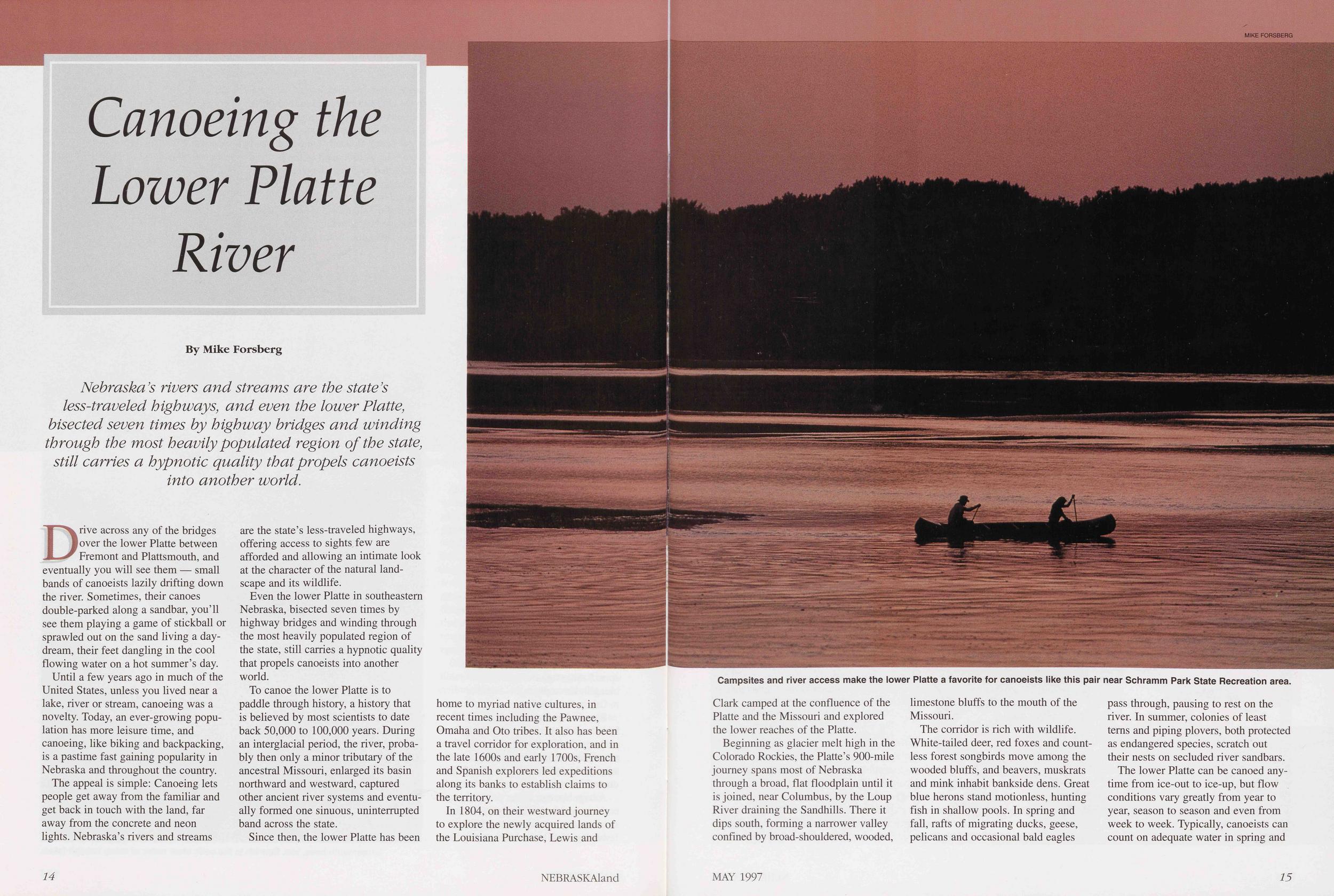
Nebraska's rivers and streams are the state's less-traveled highways, and even the lower Platte, bisected seven times by highway bridges and winding through the most heavily populated region of the state, still carries a hypnotic quality that propels canoeists into another world.
Drive across any of the bridges over the lower Platte between Fremont and Plattsmouth, and eventually you will see them — small bands of canoeists lazily drifting down the river. Sometimes, their canoes double-parked along a sandbar, you'll see them playing a game of stickball or sprawled out on the sand living a daydream, their feet dangling in the cool flowing water on a hot summer's day.
Until a few years ago in much of the United States, unless you lived near a lake, river or stream, canoeing was a novelty. Today, an ever-growing population has more leisure time, and canoeing, like biking and backpacking, is a pastime fast gaining popularity in Nebraska and throughout the country.
The appeal is simple: Canoeing lets people get away from the familiar and get back in touch with the land, far away from the concrete and neon lights. Nebraska's rivers and streams are the state's less-traveled highways, offering access to sights few are afforded and allowing an intimate look at the character of the natural landscape and its wildlife. Even the lower Platte in southeastern Nebraska, bisected seven times by highway bridges and winding through the most heavily populated region of the state, still carries a hypnotic quality that propels canoeists into another world.
To canoe the lower Platte is to paddle through history, a history that is believed by most scientists to date back 50,000 to 100,000 years. During an interglacial period, the river, probably then only a minor tributary of the ancestral Missouri, enlarged its basin northward and westward, captured other ancient river systems and eventually formed one sinuous, uninterrupted band across the state.
Since then, the lower Platte has been home to myriad native cultures, in recent times including the Pawnee, Omaha and Oto tribes. It also has been a travel corridor for exploration, and in the late 1600s and early 1700s, French and Spanish explorers led expeditions along its banks to establish claims to the territory.
In 1804, on their westward journey to explore the newly acquired lands of the Louisiana Purchase, Lewis and Campsites and river access make the lower Platte a favorite for canoeists like this pair near Schramm Park State Recreation area. Clark camped at the confluence of the Platte and the Missouri and explored the lower reaches of the Platte.
Beginning as glacier melt high in the Colorado Rockies, the Platte's 900-mile journey spans most of Nebraska through a broad, flat floodplain until it is joined, near Columbus, by the Loup River draining the Sandhills. There it dips south, forming a narrower valley confined by broad-shouldered, wooded, limestone bluffs to the mouth of the Missouri.
The corridor is rich with wildlife. White-tailed deer, red foxes and countless forest songbirds move among the wooded bluffs, and beavers, muskrats and mink inhabit bankside dens. Great blue herons stand motionless, hunting fish in shallow pools. In spring and fall, rafts of migrating ducks, geese, pelicans and occasional bald eagles pass through, pausing to rest on the river. In summer, colonies of least terns and piping plovers, both protected as endangered species, scratch out their nests on secluded river sandbars.
The lower Platte can be canoed anytime from ice-out to ice-up, but flow conditions vary greatly from year to year, season to season and even from week to week. Typically, canoeists can count on adequate water in spring and
14 NEBRASKAland MAY 1997 15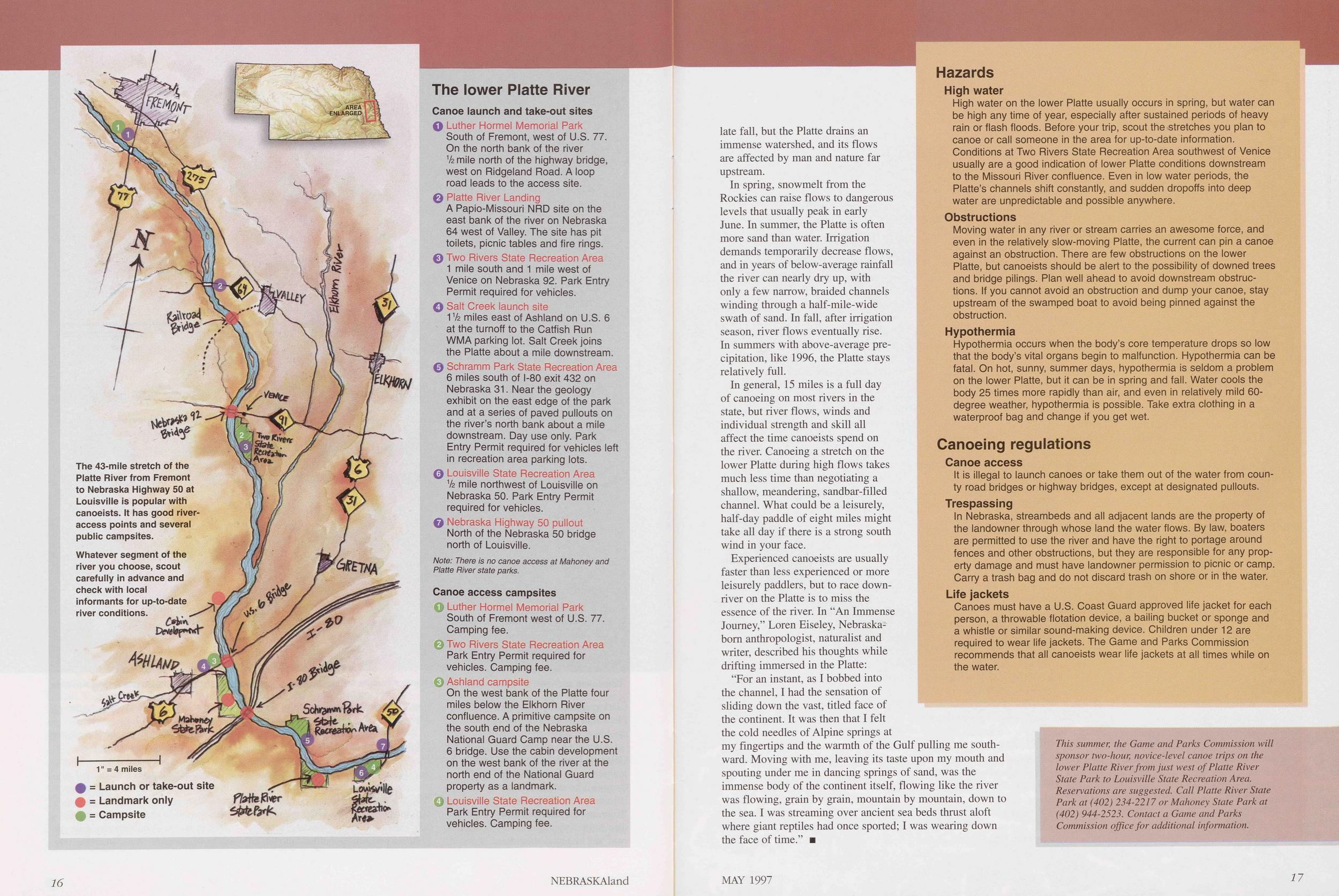 1" = 4 miles
= Launch or take-out site
: Landmark only
: Campsite
Aw-
The lower Platte River
Canoe launch and take-out sites
Luther Hormel Memorial Park
South of Fremont, west of U.S. 77.
On the north bank of the river
1/2mile north of the highway bridge,
west on Ridgeland Road. A loop
road leads to the access site.
0 Platte River Landing
A Papio-Missouri NRD site on the
east bank of the river on Nebraska
64 west of Valley. The site has pit
toilets, picnic tables and fire rings.
0 Two Rivers State Recreation Area
1 mile south and 1 mile west of
Venice on Nebraska 92. Park Entry
Permit required for vehicles.
0 Salt Creek launch site
Vk miles east of Ashland on U.S. 6
at the turnoff to the Catfish Run
WMA parking lot. Salt Creek joins
the Platte about a mile downstream,
0 Schramm Park State Recreation Area
6 miles south of I-80 exit 432 on
Nebraska 31. Near the geology
exhibit on the east edge of the park
and at a series of paved pullouts on
the river's north bank about a mile
downstream. Day use only. Park
Entry Permit required for vehicles left
in recreation area parking lots.
0 Louisville State Recreation Area
V2 mile northwest of Louisville on
Nebraska 50. Park Entry Permit
required for vehicles.
North of the Nebraska 50 bridge
north of Louisville.
Note: There is no canoe access at Mahoney and
Platte River state parks.
Canoe access campsites
South of Fremont west of U.S. 77.
Camping fee.
#Two Rivers State Recreation Area
Park Entry Permit required for
vehicles. Camping fee.
VOI 111
On the west bank of the Platte four
miles below the Elkhorn River
confluence. A primitive campsite on
the south end of the Nebraska
National Guard Camp near the U.S.
6 bridge. Use the cabin development
on the west bank of the river at the
north end of the National Guard
property as a landmark.
Louisville State Recreation Area
Park Entry Permit required for
vehicles. Camping fee.
16
NEBRASKAland
1" = 4 miles
= Launch or take-out site
: Landmark only
: Campsite
Aw-
The lower Platte River
Canoe launch and take-out sites
Luther Hormel Memorial Park
South of Fremont, west of U.S. 77.
On the north bank of the river
1/2mile north of the highway bridge,
west on Ridgeland Road. A loop
road leads to the access site.
0 Platte River Landing
A Papio-Missouri NRD site on the
east bank of the river on Nebraska
64 west of Valley. The site has pit
toilets, picnic tables and fire rings.
0 Two Rivers State Recreation Area
1 mile south and 1 mile west of
Venice on Nebraska 92. Park Entry
Permit required for vehicles.
0 Salt Creek launch site
Vk miles east of Ashland on U.S. 6
at the turnoff to the Catfish Run
WMA parking lot. Salt Creek joins
the Platte about a mile downstream,
0 Schramm Park State Recreation Area
6 miles south of I-80 exit 432 on
Nebraska 31. Near the geology
exhibit on the east edge of the park
and at a series of paved pullouts on
the river's north bank about a mile
downstream. Day use only. Park
Entry Permit required for vehicles left
in recreation area parking lots.
0 Louisville State Recreation Area
V2 mile northwest of Louisville on
Nebraska 50. Park Entry Permit
required for vehicles.
North of the Nebraska 50 bridge
north of Louisville.
Note: There is no canoe access at Mahoney and
Platte River state parks.
Canoe access campsites
South of Fremont west of U.S. 77.
Camping fee.
#Two Rivers State Recreation Area
Park Entry Permit required for
vehicles. Camping fee.
VOI 111
On the west bank of the Platte four
miles below the Elkhorn River
confluence. A primitive campsite on
the south end of the Nebraska
National Guard Camp near the U.S.
6 bridge. Use the cabin development
on the west bank of the river at the
north end of the National Guard
property as a landmark.
Louisville State Recreation Area
Park Entry Permit required for
vehicles. Camping fee.
16
NEBRASKAland
late fall, but the Platte drains an immense watershed, and its flows are affected by man and nature far upstream.
In spring, snowmelt from the Rockies can raise flows to dangerous levels that usually peak in early June. In summer, the Platte is often more sand than water. Irrigation demands temporarily decrease flows, and in years of below-average rainfall the river can nearly dry up, with only a few narrow, braided channels winding through a half-mile-wide swath of sand. In fall, after irrigation season, river flows eventually rise. In summers with above-average precipitation, like 1996, the Platte stays relatively full.
In general, 15 miles is a full day of canoeing on most rivers in the state, but river flows, winds and individual strength and skill all affect the time canoeists spend on the river. Canoeing a stretch on the lower Platte during high flows takes much less time than negotiating a shallow, meandering, sandbar-filled channel. What could be a leisurely, half-day paddle of eight miles might take all day if there is a strong south wind in your face.
Experienced canoeists are usually faster than less experienced or more leisurely paddlers, but to race downriver on the Platte is to miss the essence of the river. In "An Immense Journey," Loren Eiseley, Nebraska-born anthropologist, naturalist and writer, described his thoughts while drifting immersed in the Platte:
"For an instant, as I bobbed into the channel, I had the sensation of sliding down the vast, titled face of the continent. It was then that I felt the cold needles of Alpine springs at my fingertips and the warmth of the Gulf pulling me southward. Moving with me, leaving its taste upon my mouth and spouting under me in dancing springs of sand, was the immense body of the continent itself, flowing like the river was flowing, grain by grain, mountain by mountain, down to the sea. I was streaming over ancient sea beds thrust aloft where giant reptiles had once sported; I was wearing down the face of time."
Hazards High waterHigh water on the lower Platte usually occurs in spring, but water can be high any time of year, especially after sustained periods of heavy rain or flash floods. Before your trip, scout the stretches you plan to canoe or call someone in the area for up-to-date information. Conditions at Two Rivers State Recreation Area southwest of Venice usually are a good indication of lower Platte conditions downstream to the Missouri River confluence. Even in low water periods, the Platte's channels shift constantly, and sudden dropoffs into deep water are unpredictable and possible anywhere.
ObstructionsMoving water in any river or stream carries an awesome force, and even in the relatively slow-moving Platte, the current can pin a canoe against an obstruction. There are few obstructions on the lower Platte, but canoeists should be alert to the possibility of downed trees and bridge pilings. Plan well ahead to avoid downstream obstructions. If you cannot avoid an obstruction and dump your canoe, stay upstream of the swamped boat to avoid being pinned against the obstruction.
HypothermiaHypothermia occurs when the body's core temperature drops so low that the body's vital organs begin to malfunction. Hypothermia can be fatal. On hot, sunny, summer days, hypothermia is seldom a problem on the lower Platte, but it can be in spring and fall. Water cools the body 25 times more rapidly than air, and even in relatively mild 60-degree weather, hypothermia is possible. Take extra clothing in a waterproof bag and change if you get wet.
Canoeing regulations Canoe accessIt is illegal to launch canoes or take them out of the water from county road bridges or highway bridges, except at designated pullouts.
TrespassingIn Nebraska, streambeds and all adjacent lands are the property of the landowner through whose land the water flows. By law, boaters are permitted to use the river and have the right to portage around fences and other obstructions, but they are responsible for any property damage and must have landowner permission to picnic or camp. Carry a trash bag and do not discard trash on shore or in the water.
Life jacketsCanoes must have a U.S. Coast Guard approved life jacket for each person, a throwable flotation device, a bailing bucket or sponge and a whistle or similar sound-making device. Children under 12 are required to wear life jackets. The Game and Parks Commission recommends that all canoeists wear life jackets at all times while on the water.
This summer, the Game and Parks Commission will sponsor two-hour, novice-level canoe trips on the lower Platte River from just west of Platte River State Park to Louisville State Recreation Area. Reservations are suggested. Call Platte River State Park at (402) 234-2217 or Mahoney State Park at (402) 944-2523. Contact a Game and Parks Commission office for additional information.
MAY 1997 17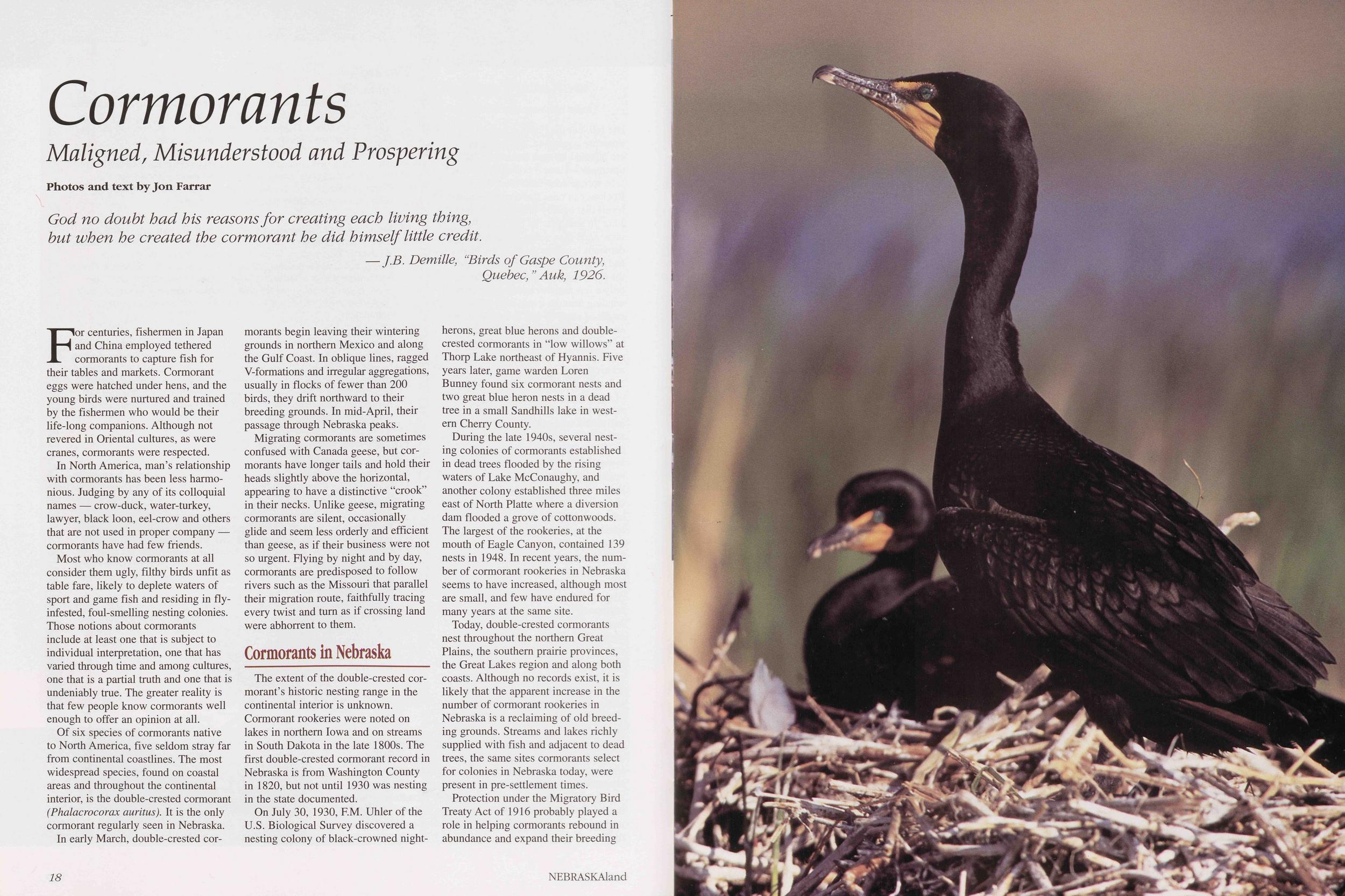
For centuries, fishermen in Japan and China employed tethered cormorants to capture fish for their tables and markets. Cormorant eggs were hatched under hens, and the young birds were nurtured and trained by the fishermen who would be their life-long companions. Although not revered in Oriental cultures, as were cranes, cormorants were respected.
In North America, man's relationship with cormorants has been less harmonious. Judging by any of its colloquial names — crow-duck, water-turkey, lawyer, black loon, eel-crow and others that are not used in proper company — cormorants have had few friends.
Most who know cormorants at all consider them ugly, filthy birds unfit as table fare, likely to deplete waters of sport and game fish and residing in fly-infested, foul-smelling nesting colonies.
Those notions about cormorants include at least one that is subject to individual interpretation, one that has varied through time and among cultures, one that is a partial truth and one that is undeniably true. The greater reality is that few people know cormorants well enough to offer an opinion at all.
Of six species of cormorants native to North America, five seldom stray far from continental coastlines. The most widespread species, found on coastal areas and throughout the continental interior, is the double-crested cormorant (Phalacrocorax auritus). It is the only cormorant regularly seen in Nebraska.
In early March, double-crested cormorants begin leaving their wintering grounds in northern Mexico and along the Gulf Coast. In oblique lines, ragged V-formations and irregular aggregations, usually in flocks of fewer than 200 birds, they drift northward to their breeding grounds. In mid-April, their passage through Nebraska peaks.
Migrating cormorants are sometimes confused with Canada geese, but cormorants have longer tails and hold their heads slightly above the horizontal, appearing to have a distinctive "crook" in their necks. Unlike geese, migrating cormorants are silent, occasionally glide and seem less orderly and efficient than geese, as if their business were not so urgent. Flying by night and by day, cormorants are predisposed to follow rivers such as the Missouri that parallel their migration route, faithfully tracing every twist and turn as if crossing land were abhorrent to them.
Cormorants in NebraskaThe extent of the double-crested cormorant's historic nesting range in the continental interior is unknown. Cormorant rookeries were noted on lakes in northern Iowa and on streams in South Dakota in the late 1800s. The first double-crested cormorant record in Nebraska is from Washington County in 1820, but not until 1930 was nesting in the state documented.
On July 30, 1930, FM. Uhler of the U.S. Biological Survey discovered a nesting colony of black-crowned night-herons, great blue herons and double-crested cormorants in "low willows" at Thorp Lake northeast of Hyannis. Five years later, game warden Loren Bunney found six cormorant nests and two great blue heron nests in a dead tree in a small Sandhills lake in western Cherry County.
During the late 1940s, several nesting colonies of cormorants established in dead trees flooded by the rising waters of Lake McConaughy, and another colony established three miles east of North Platte where a diversion dam flooded a grove of cottonwoods. The largest of the rookeries, at the mouth of Eagle Canyon, contained 139 nests in 1948. In recent years, the number of cormorant rookeries in Nebraska seems to have increased, although most are small, and few have endured for many years at the same site.
Today, double-crested cormorants nest throughout the northern Great Plains, the southern prairie provinces, the Great Lakes region and along both coasts. Although no records exist, it is likely that the apparent increase in the number of cormorant rookeries in Nebraska is a reclaiming of old breeding grounds. Streams and lakes richly supplied with fish and adjacent to dead trees, the same sites cormorants select for colonies in Nebraska today, were present in pre-settlement times.
Protection under the Migratory Bird Treaty Act of 1916 probably played a role in helping cormorants rebound in abundance and expand their breeding
NEBRASKAland Cormorant chicks aggressively solicit food from parents returning from hunting forays.range. Although certainly not by design, man has created additional sites for cormorant rookeries.
RookeriesCompared to other colonial-nesting waterbirds — terns, gulls, grebes, pelicans, egrets and herons — cormorants are extremely adaptable, nesting in trees or on the ground. Cormorants typically nest on rocks or bare soil on isolated islands or on cliff ledges in coastal areas.
In Nebraska, and the continental interior in general, cormorants nest in trees bordering lakes and streams or on the ground on islands in lakes. The principal requirement for a cormorant nesting colony site is that it be reasonably secure from predators and near a reliable source of food. Rookeries remote from human disturbance are the largest and endure the longest.
Some researchers believe that cormorants evolved as ground nesters, presenting as evidence the design of their feet, which are specialized to propel them through water, not to perch in trees. Cormorants, along with such exotic seabirds as tropicbirds, pelicans, gannets, boobies, darters and frigate-birds, belong to the order of birds called Pelecaniformes, or "totipalmate swimmers."
The four toes of these birds are connected by webs, unlike the feet of waterbirds such as ducks and geese, which are webbed between the front three toes but have a free hind toe. Webbed feet and stocky legs positioned near the rear of the body make cormorants poorly adapted for graceful movement on land or in trees. Despite those apparent design shortcomings, cormorants show a fondness for perching in dead trees at the water's edge or protruding above the surface.
Although cormorants nest in living trees, they prefer the leafless skeletons of dead trees. Riparian woodlands flooded by reservoirs create ideal, though short-lived, nest sites for cormorants, as was evident in the late 1940s at Lake McConaughy, and subsequently at other reservoirs in central and western Nebraska.
Small cormorant rookeries are also found in trees over beaver-dammed backwaters along rivers and in willows and cottonwoods on the shores of natural lakes in the Sandhills. Nesting colonies often are shared with great blue herons.
The two largest and enduring cormorant rookeries in Nebraska in recent years have been on islands in lakes on the Valentine National Wildlife Refuge south of Valentine and Crescent Lake National Wildlife Refuge north of Oshkosh. The history of cormorant rookeries on those wildlife refuges has many parallels.
Before the 1960s, cormorant rookeries were reported in lakeside trees on both refuges. Although not by design, a U.S. Fish and Wildlife Service effort to restore Canada geese as breeding birds in the Sandhills region provided new, and apparently more appealing, options for nesting cormorants. During the 1950s, goose nesting platforms made of telephone poles and of wooden frameworks on old car bodies were placed on Crescent Lake refuge lakes. Canada geese failed to establish as breeders, but by 1963 cormorants had adopted the structures as nesting islands.
In the mid-1970s, the Crescent Lake cormorants moved their rookery to a small island on Goose Lake. In subsequent years the number of nests varied from 50 to 150 depending on the size of the island. Since 1991 the island has been inundated, the cormorants have nested in dense beds of bulrush, and the number of nests has declined.
Canada goose nesting structures were placed on the Valentine refuge in the mid-1960s, and within a few years they were adopted by nesting cormorants on North, South and Middle Marsh lakes. By the early 1980s, Canada geese were well established as breeding birds in the Sandhills, and no new goose nesting structures were added. Most of the old structures collapsed into the lakes and marshes or were toppled when the ice went out in spring, and the cormorants were forced to seek other quarters during the breeding season. Compared to other birds, cormorants are laborious flyers. Through most of the 1980s, the Marsh lakes cormorants nested in dense colonies of cattails and phragmites, and on floating mats of marsh vegetation gathered by the wind.
In the early 1980s, lake levels rose and land separating the Marsh lakes was inundated, leaving small islands. In 1989, a rookery was established on one of those tiny islands. Since that time the number of cormorant nests in the Marsh lakes rookery has fluctuated from a low of 240 to a high of 900 as lake levels determined the amount of land available for nesting.
The establishment of large, enduring cormorant rookeries in the Sandhills lake country is not surprising. A reliable supply of fish is at hand, and over the years cormorants have freely adopted new nesting sites when old ones vanish. The rookery sites on both refuges are on lakes not open to fishing and generally inaccessible to human traffic. Probably the only limiting factor is the availability of nest sites.
The CourtshipAt large cormorant rookeries like the one on the Marsh lakes, the true nature of double-crested cormorants
Pelicans regularly frequent the Marsh lakes cormorant rookery on the Valentine National Wildlife Refuge. 20 NEBRASKAland MAY 1997 21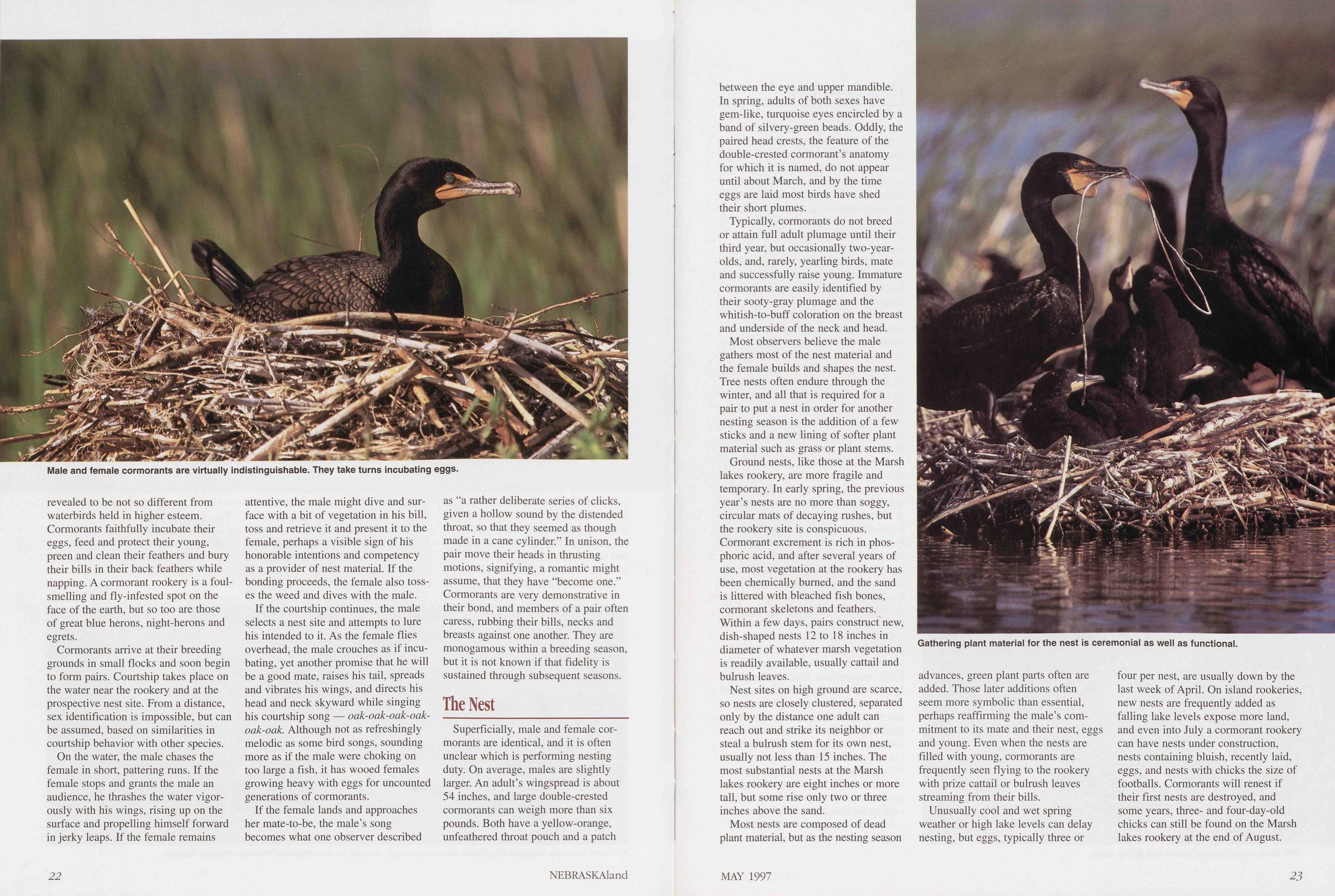 Male and female cormorants are virtually indistinguishable. They take turns incubating
eggs.
Male and female cormorants are virtually indistinguishable. They take turns incubating
eggs.
revealed to be not so different from waterbirds held in higher esteem. Cormorants faithfully incubate their eggs, feed and protect their young, preen and clean their feathers and bury their bills in their back feathers while napping. A cormorant rookery is a foul-smelling and fly-infested spot on the face of the earth, but so too are those of great blue herons, night-herons and egrets.
Cormorants arrive at their breeding grounds in small flocks and soon begin to form pairs. Courtship takes place on the water near the rookery and at the prospective nest site. From a distance, sex identification is impossible, but can be assumed, based on similarities in courtship behavior with other species.
On the water, the male chases the female in short, pattering runs. If the female stops and grants the male an audience, he thrashes the water vigorously with his wings, rising up on the surface and propelling himself forward in jerky leaps. If the female remains
22attentive, the male might dive and surface with a bit of vegetation in his bill, toss and retrieve it and present it to the female, perhaps a visible sign of his honorable intentions and competency as a provider of nest materiaL If the bonding proceeds, the female also tosses the weed and dives with the male.
If the courtship continues, the male selects a nest site and attempts to lure his intended to it. As the female flies overhead, the male crouches as if incubating, yet another promise that he will be a good mate, raises his tail, spreads and vibrates his wings, and directs his head and neck skyward while singing his courtship song — oak-oak-oak-oak-oak-oak. Although not as refreshingly melodic as some bird songs, sounding more as if the male were choking on too large a fish, it has wooed females growing heavy with eggs for uncounted generations of cormorants.
If the female lands and approaches her mate-to-be, the male's song becomes what one observer described as "a rather deliberate series of clicks, given a hollow sound by the distended throat, so that they seemed as though made in a cane cylinder." In unison, the pair move their heads in thrusting motions, signifying, a romantic might assume, that they have "become one." Cormorants are very demonstrative in their bond, and members of a pair often caress, rubbing their bills, necks and breasts against one another. They are monogamous within a breeding season, but it is not known if that fidelity is sustained through subsequent seasons.
The NestSuperficially, male and female cormorants are identical, and it is often unclear which is performing nesting duty. On average, males are slightly larger. An adult's wingspread is about 54 inches, and large double-crested cormorants can weigh more than six pounds. Both have a yellow-orange, unfeathered throat pouch and a patch
NEBRASKAlandbetween the eye and upper mandible.
In spring, adults of both sexes have gem-like, turquoise eyes encircled by a band of silvery-green beads. Oddly, the paired head crests, the feature of the double-crested cormorant's anatomy for which it is named, do not appear until about March, and by the time eggs are laid most birds have shed their short plumes.
Typically, cormorants do not breed or attain full adult plumage until their third year, but occasionally two-year-olds, and, rarely, yearling birds, mate and successfully raise young. Immature cormorants are easily identified by their sooty-gray plumage and the whitish-to-buff coloration on the breast and underside of the neck and head.
Most observers believe the male gathers most of the nest material and the female builds and shapes the nest. Tree nests often endure through the winter, and all that is required for a pair to put a nest in order for another nesting season is the addition of a few sticks and a new lining of softer plant material such as grass or plant stems.
Ground nests, like those at the Marsh lakes rookery, are more fragile and temporary. In early spring, the previous year's nests are no more than soggy, circular mats of decaying rushes, but the rookery site is conspicuous.
Cormorant excrement is rich in phosphoric acid, and after several years of use, most vegetation at the rookery has been chemically burned, and the sand is littered with bleached fish bones, cormorant skeletons and feathers. Within a few days, pairs construct new, dish-shaped nests 12 to 18 inches in diameter of whatever marsh vegetation is readily available, usually cattail and bulrush leaves.
Nest sites on high ground are scarce, so nests are closely clustered, separated only by the distance one adult can reach out and strike its neighbor or steal a bulrush stem for its own nest, usually not less than 15 inches. The most substantial nests at the Marsh lakes rookery are eight inches or more tall, but some rise only two or three inches above the sand.
Most nests are composed of dead plant material, but as the nesting season Gathering plant material for the nest is ceremonial as well as functional. advances, green plant parts often are added. Those later additions often seem more symbolic than essential, perhaps reaffirming the male's commitment to its mate and their nest, eggs and young. Even when the nests are filled with young, cormorants are frequently seen flying to the rookery with prize cattail or bulrush leaves streaming from their bills.
Unusually cool and wet spring weather or high lake levels can delay nesting, but eggs, typically three or four per nest, are usually down by the last week of April. On island rookeries, new nests are frequently added as falling lake levels expose more land, and even into July a cormorant rookery can have nests under construction, nests containing bluish, recently laid, eggs, and nests with chicks the size of footballs. Cormorants will renest if their first nests are destroyed, and some years, three- and four-day-old chicks can still be found on the Marsh lakes rookery at the end of August.
MAY 1997 23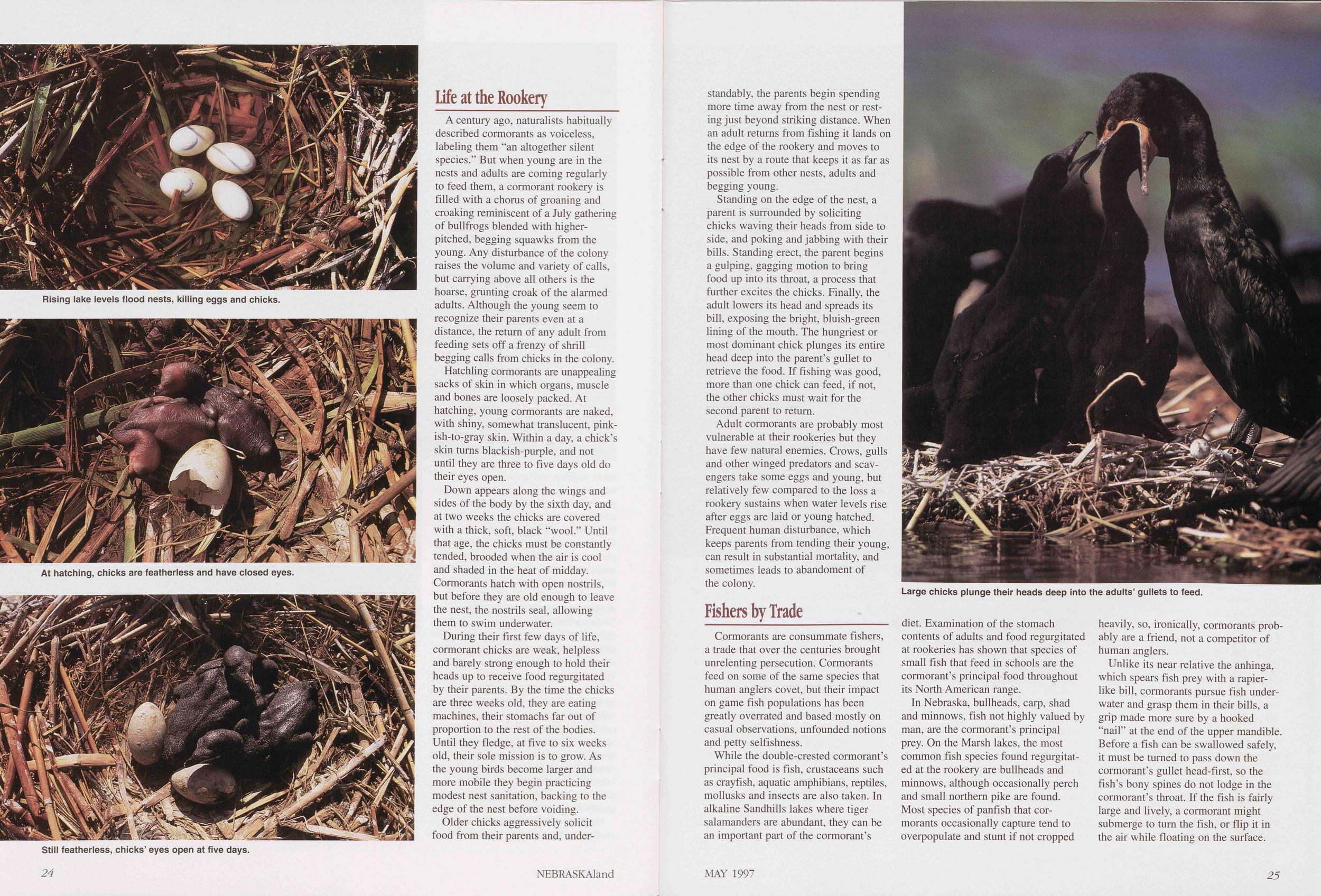 Rising lake levels flood nests, killing eggs and chicks.
At hatching, chicks are featherless and have closed eyes.
Life at the Rookery
Rising lake levels flood nests, killing eggs and chicks.
At hatching, chicks are featherless and have closed eyes.
Life at the Rookery
A century ago, naturalists habitually described cormorants as voiceless, labeling them "an altogether silent species." But when young are in the nests and adults are coming regularly to feed them, a cormorant rookery is filled with a chorus of groaning and croaking reminiscent of a July gathering of bullfrogs blended with higher- pitched, begging squawks from the young. Any disturbance of the colony raises the volume and variety of calls, but carrying above all others is the hoarse, grunting croak of the alarmed adults. Although the young seem to recognize their parents even at a distance, the return of any adult from feeding sets off a frenzy of shrill begging calls from chicks in the colony.
Hatchling cormorants are unappealing sacks of skin in which organs, muscle and bones are loosely packed. At hatching, young cormorants are naked, with shiny, somewhat translucent, pinkish-to-gray skin. Within a day, a chick's skin turns blackish-purple, and not until they are three to five days old do their eyes open.
Down appears along the wings and sides of the body by the sixth day, and at two weeks the chicks are covered with a thick, soft, black "wool." Until that age, the chicks must be constantly tended, brooded when the air is cool and shaded in the heat of midday. Cormorants hatch with open nostrils, but before they are old enough to leave the nest, the nostrils seal, allowing them to swim underwater.
During their first few days of life, cormorant chicks are weak, helpless and barely strong enough to hold their heads up to receive food regurgitated by their parents. By the time the chicks are three weeks old, they are eating machines, their stomachs far out of proportion to the rest of the bodies. Until they fledge, at five to six weeks old, their sole mission is to grow. As the young birds become larger and more mobile they begin practicing modest nest sanitation, backing to the edge of the nest before voiding. Older chicks aggressively solicit food from their parents and, understandably, the parents begin spending more time away from the nest or resting just beyond striking distance. When an adult returns from fishing it lands on the edge of the rookery and moves to its nest by a route that keeps it as far as possible from other nests, adults and begging young.
Standing on the edge of the nest, a parent is surrounded by soliciting chicks waving their heads from side to side, and poking and jabbing with their bills. Standing erect, the parent begins a gulping, gagging motion to bring food up into its throat, a process that further excites the chicks. Finally, the adult lowers its head and spreads its bill, exposing the bright, bluish-green lining of the mouth. The hungriest or most dominant chick plunges its entire head deep into the parent's gullet to retrieve the food. If fishing was good, more than one chick can feed, if not, the other chicks must wait for the second parent to return.
Adult cormorants are probably most vulnerable at their rookeries but they have few natural enemies. Crows, gulls and other winged predators and scavengers take some eggs and young, but relatively few compared to the loss a rookery sustains when water levels rise after eggs are laid or young hatched. Frequent human disturbance, which keeps parents from tending their young, can result in substantial mortality, and sometimes leads to abandoment of the colony.
Fishers by TradeCormorants are consummate fishers, a trade that over the centuries brought unrelenting persecution. Cormorants feed on some of the same species that human anglers covet, but their impact on game fish populations has been greatly overrated and based mostly on casual observations, unfounded notions and petty selfishness.
While the double-crested cormorant's principal food is fish, crustaceans such as crayfish, aquatic amphibians, reptiles, mollusks and insects are also taken. In alkaline Sandhills lakes where tiger salamanders are abundant, they can be an important part of the cormorant's Large chicks plunge their heads deep into the adults' gullets to feed. diet. Examination of the stomach contents of adults and food regurgitated at rookeries has shown that species of small fish that feed in schools are the cormorant's principal food throughout its North American range.
In Nebraska, bullheads, carp, shad and minnows, fish not highly valued by man, are the cormorant's principal prey. On the Marsh lakes, the most common fish species found regurgitated at the rookery are bullheads and minnows, although occasionally perch and small northern pike are found.
Most species of panfish that cormorants occasionally capture tend to overpopulate and stunt if not cropped heavily, so, ironically, cormorants probably are a friend, not a competitor of human anglers.
Unlike its near relative the anhinga, which spears fish prey with a rapier-like bill, cormorants pursue fish underwater and grasp them in their bills, a grip made more sure by a hooked "nail" at the end of the upper mandible. Before a fish can be swallowed safely, it must be turned to pass down the cormorant's gullet head-first, so the fish's bony spines do not lodge in the cormorant's throat. If the fish is fairly large and lively, a cormorant might submerge to turn the fish, or flip it in the air while floating on the surface. Still featherless, chicks' eyes open at five days.
24 NEBRASKAland MAY 1997 25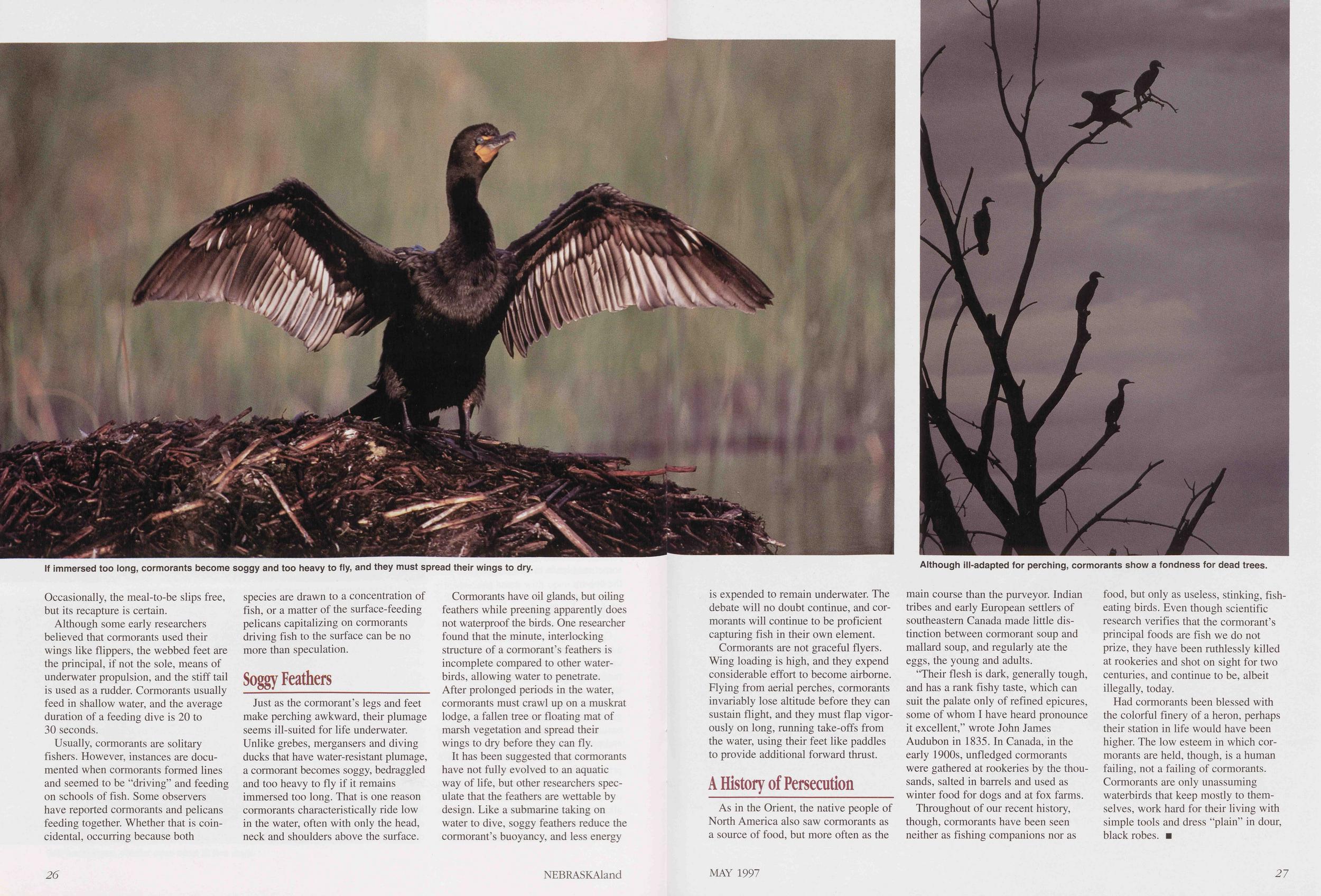
Blowout penstemon (Penstemon haydenii), the rarest plant species native to the Great Plains, grows only in the Nebraska Sandhills and is the only endangered plant in the state. Now growing only in the open, sandy habitat of blowouts — the rounded, wind-excavated depressions in dune tops — natural populations presently are restricted to Box Butte, Cherry, Garden, Morrill and Thomas counties. It was classified as endangered in 1987.
Blowout penstemon was once com- mon in the Sandhills. In his 1913 description of the Sandhills flora, University of Nebraska Professor Raymond Pool frequently mentioned the species, but by the 1940s it was thought to be extinct. It was rediscovered in 1968. Today, 3,000 to 5,000 plants, their number varying yearly depending on climatic conditions, remain at 13 sites. More than 80 percent of the sites are within an area less than 50 miles in diameter, making them highly susceptible to localized drought or other threats.
DescriptionBlowout penstemon can be readily identified in the field. It is most common in the bare sand in the bowl of blowouts or in colonies of blowout-grass (Redfieldia flexuosa) and lemon scurfpea (Psoralen lanceolata). It also can be found around the rims of blowouts where sand is deposited. In May and June, when it is in bloom, its large lavender flower heads stand out in the scant vegetation in and around blowouts.
A short-lived perennial, it frequently occurs in large, multi-stemmed clumps. Stems are of two types, flowering and vegetative. Vegetative stems are commonly one foot tall or shorter, but can reach nearly two feet. They are lax and curved upward from the base. Plants often root from the stem nodes if the nodes are buried in sand. The lax, linear leaves, one to eight inches long and one-quarter to one inch wide, grow opposite each other and have no petiole, but are attached directly to the stem. They have parallel veins and smooth edges. They are greenish-blue, waxy in appearance and have no pubescence (hairs).
The flowering stems, up to about one-half inch in diameter, are stout and usually six to 18 inches tall. Leaves on the flowering stems are up to three inches wide, lance-shaped and stiff. The flowering head is cylindrical with 16 to 80 flowers arranged in several whorls. Each whorl is located directly above a pair of stiff, overlapping, leaf-like bracts. The bracts are longer than they are wide with heart-shaped bases. The one- to one-and-a-half-inch, tube-shaped corolla (the petals) is milky blue to milky lavender or, rarely, white or pink. The upper lip of the corolla has two lobes and the lower lip has three lobes. Distinct magenta lines inside the corolla guide insects to the nectar. The brown, diskshaped seeds are one-tenth to one-fifteenth inch in diameter. They form in sharp-pointed capsules from about one-half inch to about one inch long.
Blowout penstemon often is confused with shell-leaf penstemon (Penstemon grandiflorus) and narrow penstemon (Penstemon angustifolius),
Blowout Penstemon Distribution in Nebraska Sandhills Known populations of blowout penstemonwhich also grow in the Sandhills. The flowers of narrow penstemon are similar in color to those of blowout penstemon, but are less than one inch long. Shell-leaf penstemon often has flowers similar in size and color to blowout penstemon, but its leaves are tgg- or spatula-shaped with the broadest part above the middle. Both species are common along roadsides in the Sandhills and usually grow in denser vegetation than does blowout penstemon. The blowout penstemon is not found along roadsides or in Sandhills prairie vegetation. Its lavender or vanilla-like fragrance is a distinguishing characteristic. It is the only penstemon in Nebraska with fragrant flowers, and it is one of only two fragrant species of the 300 penstemons in the world.
Life HistoryGrowth begins in late March or early April from buds on the lower stems formed the previous year. Some stems near the soil surface can remain green through the winter. By early May, flowering shoots can be distinguished from vegetative shoots by the developing broad bracts of the inflorescence. The plants bloom from late May to late June. Though it is uncommon, a few plants sometimes bloom in August or September. Individual flowers bloom for five to nine days.
Blooming begins at the base of the inflorescence and proceeds upward, and an individual plant is usually in bloom for three to four weeks. Not all plants bloom every year. Cross-pollination is most common, but self-pollination also occurs. Flowers are pollinated by many insects, including wasps, ants, bees, beetles, butterflies and flies.
The fruit, a capsule containing 25 to 35 seeds, begins to form soon after the flowers drop and continues to develop through the summer. An average of 1,500 seeds are produced by each plant. By late August the mature fruits have turned brown, and in early September they split open and the seeds fall to the ground. The seeds are relished by many small mammals, such as kangaroo rats, and by birds, such as prairie grouse.
The few seeds that remain uneaten are blown along the soil surface until they are covered, a thick seed-coat protecting them from the abrasive sand. Buried seeds can remain viable for 20 years and can germinate if sand movement eventually brings them close to the surface. For seeds to germinate and for the roots of seedlings to reach a depth where moisture is constantly available, blowout sand must remain damp for at least two weeks, conditions that usually occur only in one of eight or 10 years, limiting seedling establishment. Seedlings are rare even where adult plants are present and seeds are abundant.
Flowering and vegetative stems of the blowout penstemon are connected by a rhizomatous-like root. HabitatThe Sandhills is the largest area of sand dunes in the Western Hemisphere, occupying more than 12 million acres in north-central Nebraska. The dunes range in height from a few feet to more than 300 feet. Major periods of dune movement occurred 8,000 to 5,000 years ago, with more recent periods of lesser dune reactivation. In the most recent centuries, climatic conditions have been wet enough for the dunes to support sufficient vegetation to keep them stable.
Nevertheless, dune soils are poorly developed because of the constant erosion and deposition of sand. Annual rainfall varies from 17 inches in the western Sandhills to 23 inches in the east. Cattle ranching is the primary land use in the region.
Most of the upland dunes support Sandhills prairie dominated by tall grasses, including sand bluestem (Andropogon hallii) and prairie sandreed (Calamovilfa longifolia), and midgrasses, including little bluestem (Schizachyrium scoparium) and junegrass (Koeleria macrantha). Forbs (wildflowers) also are common in the Sandhills.
Blowouts form in the dune tops when their protective vegetative cover is reduced and wind erosion eventually forms craters, depositing the excavated sand on the downwind side. Most blowouts are less than one acre in size. Blowout penstemon is one of the first species to invade blowouts along with winged pigweed (Cycloloma atriplicifolium) and clammy ground-cherry (Physalis heterophylla). Eventually, blowouts can heal, reverting to Sandhills prairie.
Limiting FactorsEcologists are not sure what caused the sudden decline in blowout penstemon in the first half of the 20th century, but several factors, including the Great Drought of the 1930s, might have contributed. Blowout penstemon requires abundant soil moisture, and in dry years, moisture is not adequate even in sparsely vegetated blowouts.
In recent years, larvae of a pyralid moth have caused extensive damage to some populations of blowout penstemon, causing losses up to 75 percent. The moth larvae burrow into penstemon stems, causing tissue damage.
Blowout penstemon habitat has greatly decreased since the settlement of the Sandhills. Before settlement, lightning- and Indian-set prairie fires frequently burned extensive areas, especially if they occurred from late summer to early winter. Fires, along with bison grazing, exposed the sand to winter and spring winds. Early reports describe extensive areas of blowing sand, a contrast to today's stabilized, grass-covered dunes.
After settlement, prairie fires were less frequent and extensive. The vegetation cover thickened, and open, sandy areas declined. Blowout penstemon soon was restricted to blowouts, the last remaining areas of bare sand. Originally called Hayden's penstemon, honoring Ferdinand V. Hayden who first collected the plant in 1857, it was referred to as "blow-out' penstemon by Pool as early as 1913, suggesting that its habitat was already restricted by that time.
Range management in recent decades has further altered the vegetation of the Sandhills. Reduced grazing
Blowout penstemon is now found only in the open, sandy habitat of blowouts, the rounded, wind-excavated depressions in dune tops. Blowout penstemon flowers typically are milky blue to milky lavender. Although rare, white flowers occasionally are found.intensity and implementation of planned grazing systems have increased the total vegetative cover and led to a reduction in the number of blowouts. Grazing itself is seldom a problem for blowout penstemon.
Cattle eat the plant only infrequently if other forage is available. Penstemon plants are sometimes eaten in pastures that receive heavy spring grazing, and heavy grazing for several consecutive years could reduce plant numbers. Since the 1920s many blowouts have been seeded and reshaped to improve range conditions; some penstemon habitat and probably some plants were lost in the process.
Blowout penstemon now remains only in a few sites where wind erosion has maintained active blowouts, a dynamic, relatively short-lived and now uncommon habitat. Further complicating the issue, most populations of blowout penstemon are now so isolated that there is little chance for seeds to migrate to new blowouts if they do form. Populations also are genetically isolated, and there is little chance for an influx of new genetic material into established populations through pollen from other populations. Habitat reduction, the plant's relatively short life span (six to eight years) and limited germination conditions all threaten the health of the blowout penstemon.
ManagementThe recovery plan for the blowout penstemon calls for research on the life history, minimum genetically viable population size and management criteria for the species. The recovery strategy also requires the monitoring of all known populations to gather information on population changes and the health of each population. An inventory of suitable habitat is being conducted to determine sites for reintroduction. The recovery effort is being conducted cooperatively by the Nebraska Department of Agriculture, the Nebraska Game and Parks Commission and the University of Nebraska-Lincoln.
Seedlings grown in greenhouses at the University of Nebraska-Lincoln with funds provided by the Nebraska Environmental Trust are being transplanted into suitable habitat to increase the total number of plants and the range of blowout penstemon to reduce the potentially devastating effect of a local drought or other disaster. The current goal is to have a minimum of 10,000 plants in five population groups before the species can be reclassified from endangered to threatened. When 15,000 plants occur in 10 population groups, the plant could be delisted.
RegulationsBlowout penstemon is protected by the federal government through the federal Endangered Species Act of 1973 and the state Nongame and Endangered Species Conservation Act of 1984. Federal law prohibits the removal or destruction of listed plants on any area under federal jurisdiction. Exporting and possession of the plant is prohibited by state law. Violations carry civil and criminal penalties of up to $25,000.
Pesticides may not be applied in the vicinity of blowout penstemon. The Nebraska Department of Agriculture is responsible for enforcing pesticide regulations in the state and can provide information about regulations governing pesticide application in the vicinity of blowout penstemon. Violation of the Nebraska Pesticide Act can result in administrative penalties of up to $5,000 and civil penalties of up to $ 15,000.
The beauty and rarity of blowout penstemon could attract unscrupulous collectors and wildflower enthusiasts. Removal of only one or two plants from a small population could seriously reduce its continued viability and survival. Therefore, the exact locations of blowout penstemon populations are not publicized, and collection or possession of blowout penstemon on public and private property without proper permits is a violation of federal and state laws.
Potential habitat for blowout penstemon is created when wind erosion forms blowouts in dunes and deposits the excavated sand on the downwind side. Suggested Reading Flessner, T. R. 1988. Propagation, establishment, and ecological characteristics of Penstemon haydenii S. Wats. Master of Science Thesis. University of Nebraska, Lincoln. Fritz, M., J. Stubbendieck, and W. Jobman. 1992. Blowout penstemon (Penstemon haydenii S. Wats.) recovery plan. U.S. Fish and Wildlife Service, Denver. Stubbendieck, J., T.R. Flessner, and R.R. Weedon. 1989. Blowouts in the Nebraska Sandhills: The habitat of Penstemon haydenii. Pages 223-225, In T.B. Bragg and J. Stubbendieck (eds.), Proceedings of the Eleventh North American Prairie Conference. University of Nebraska, Lincoln. Stubbendieck, J., T.R. Flessner, C.H. Butterfield, and A.A. Steuter. 1993. Establishment and survival of the endangered blowout penstemon. Great Plains Research 3:3-19. Sutherland, D.M. 1988. Historical notes on collections and taxonomy of Penstemon haydenii S. Wats, (blowout penstemon), Nebraska's only endemic plant species. Transactions of the Nebraska Academy of Sciences 16:191-194. Weedon, R.R., J. Stubbendieck, and M. Beel. 1982. Blowout penstemon. NEBRASKAland 60:49-51.Blowout Penstemon is one in a series of Nebraska's Threatened and Endangered Speeies brochures published by NEBRASKAland Magazine and the Nebraska Game and Parks Commission with funds from Nebraska's Nongame Wildlife Tax Checkoff. Blowout Penstemon also was supported by contributions from the Nebraska Department of Agriculture. Text by James Stubbendieck, Julia A. Lamphere and Jay B. Fitzgerald, University of Nebraska-Lincoln. Photos: Page 4, Bob Grier; Page 5, James Stubbendieck; Page 6, left, Jon Farrar, right. Bob Grier. Illustration: Page 2. Bellamy Parks Jansen. Layout, design and illustrations by Randall Bright. May 1997.
Note: New data on the occurrence and distribution of this species are being collected constantly, and some of the information in this publication may be outdated. It should be used for a general understanding of the status of this species in Nebraska and not as the sole source of locational information for any report, project, regional/local planning or environmental impact assessment. For current information on this or other threatened and endangered species, or for additional copies of this publication, contact the Wildlife Division, Nebraska Game and Parks Commission, P.O. Box 30370, Lincoln, NE 68503.
The lavender flowers of blowout penstemon appear in May and June. Nebraska Department of Agriculture A CHECK FOR WILDLIFE Nongame Wildlife Tax Checkoff Fund Nebraska Game and Parks CommissionOccasionally, the meal-to-be slips free, but its recapture is certain. Although some early researchers believed that cormorants used their wings like flippers, the webbed feet are the principal, if not the sole, means of underwater propulsion, and the stiff tail is used as a rudder. Cormorants usually feed in shallow water, and the average duration of a feeding dive is 20 to 30 seconds.
Usually, cormorants are solitary fishers. However, instances are documented when cormorants formed lines and seemed to be "driving" and feeding on schools of fish. Some observers have reported cormorants and pelicans feeding together. Whether that is coincidental, occurring because both species are drawn to a concentration of fish, or a matter of the surface-feeding pelicans capitalizing on cormorants driving fish to the surface can be no more than speculation.
Soggy FeathersJust as the cormorant's legs and feet make perching awkward, their plumage seems ill-suited for life underwater. Unlike grebes, mergansers and diving ducks that have water-resistant plumage, a cormorant becomes soggy, bedraggled and too heavy to fly if it remains immersed too long. That is one reason cormorants characteristically ride low in the water, often with only the head, neck and shoulders above the surface. Cormorants have oil glands, but oiling feathers while preening apparently does not waterproof the birds. One researcher found that the minute, interlocking structure of a cormorant's feathers is incomplete compared to other water-birds, allowing water to penetrate. After prolonged periods in the water, cormorants must crawl up on a muskrat lodge, a fallen tree or floating mat of marsh vegetation and spread their wings to dry before they can fly.
It has been suggested that cormorants have not fully evolved to an aquatic way of life, but other researchers speculate that the feathers are wettable by design. Like a submarine taking on water to dive, soggy feathers reduce the cormorant's buoyancy, and less energy is expended to remain underwater. The debate will no doubt continue, and cormorants will continue to be proficient capturing fish in their own element.
Cormorants are not graceful flyers. Wing loading is high, and they expend considerable effort to become airborne. Flying from aerial perches, cormorants invariably lose altitude before they can sustain flight, and they must flap vigorously on long, running take-offs from the water, using their feet like paddles to provide additional forward thrust.
A History of PersecutionAs in the Orient, the native people of North America also saw cormorants as a source of food, but more often as the
Although ill-adapted for perching, cormorants show a fondness for dead trees.main course than the purveyor. Indian tribes and early European settlers of southeastern Canada made little distinction between cormorant soup and mallard soup, and regularly ate the eggs, the young and adults.
"Their flesh is dark, generally tough, and has a rank fishy taste, which can suit the palate only of refined epicures, some of whom I have heard pronounce it excellent," wrote John James Audubon in 1835. In Canada, in the early 1900s, unfledged cormorants were gathered at rookeries by the thousands, salted in barrels and used as winter food for dogs and at fox farms.
Throughout of our recent history, though, cormorants have been seen neither as fishing companions nor as food, but only as useless, stinking, fish-eating birds. Even though scientific research verifies that the cormorant's principal foods are fish we do not prize, they have been ruthlessly killed at rookeries and shot on sight for two centuries, and continue to be, albeit illegally, today.
Had cormorants been blessed with the colorful finery of a heron, perhaps their station in life would have been higher. The low esteem in which cormorants are held, though, is a human failing, not a failing of cormorants. Cormorants are only unassuming waterbirds that keep mostly to themselves, work hard for their living with simple tools and dress "plain" in dour, black robes.
26 NEBRASKAland MAY 1997 27
Sand Point, east of Otter Creek on Lake McConaughy's north shore, was the place to be, judging from the 15 to 20 boats trolling, drift fishing or anchored around the long, narrow point. Postcard weather — blue skies, low wind and moderate temperatures — filled the July morning with promise. If only the fish would cooperate.
I slowed the boat to a stop and began untangling fishing equipment stored too long in the boat's rod locker, thinking about the dramatic changes that have occurred at "Lake Mac." During the past 20 years, McConaughy evolved from a classic "two-story" white bass, catfish, walleye and trout supporting irrigation impoundment into a lake dominated by trophy striped bass. More recently, with the introduction of an alewife prey base and hybrids such as tiger muskies and wipers, the lake has changed again.
Keeping my fishing techniques up-to-date with the changing lake had been too much for me, but a chance meeting with Colorado angler Brian Pingel near Sand Point gave me a personal Lake McConaughy fishing mentor. After the usual greetings and fishing questions, Pingel invited me to join him trolling along the south shore. Fifteen minutes later he was holding up a 10-pound walleye.
"I started fishing Lake Mac with my father in about 1979," Pingel said. "I didn't really know much about fishing, but in those years you could stand on the shore and throw almost anything in the water and catch white bass. Occasionally, we did extremely well, especially in April, May and June, but there were days when we didn't catch a single fish and times when the weather kept us off the water completely."
In the early '80s, Pingel began fishing McConaughy regularly for white bass, catfish and walleyes. Over the years, he has seen an wide variety of gamefish, including walleyes, white bass, trout, stripers, catfish, perch, tiger muskies, northerns and wipers. "I've also seen crappie fishing at Lake McConaughy and a steady increase in the smallmouth bass fishing over the years," he said. Locating fish on the 35,700-acre lake was the key to Pingel's early success at McConaughy, and finding Mac's classic top-water white bass fishing in the early years was as easy as following the gulls.
"We would go out to the middle of the lake and watch the gulls. Diving gulls would pinpoint schools of white bass and gizzard shad boiling on the surface," he said, and the white bass would take almost any lure. A declining shad population led to a decline in white bass fishing, but Pingel still catches white bass at McConaughy. "We've seen shad boiling on the surface in coves in recent years and have gone in and caught white bass and wipers," he said.
In nearly 20 years of fishing at Lake McConaughy, Brian Pingel of Aurora, Colorado, has learned many of the big lake's secrets. 30 NEBRASKAland MAY 1997 31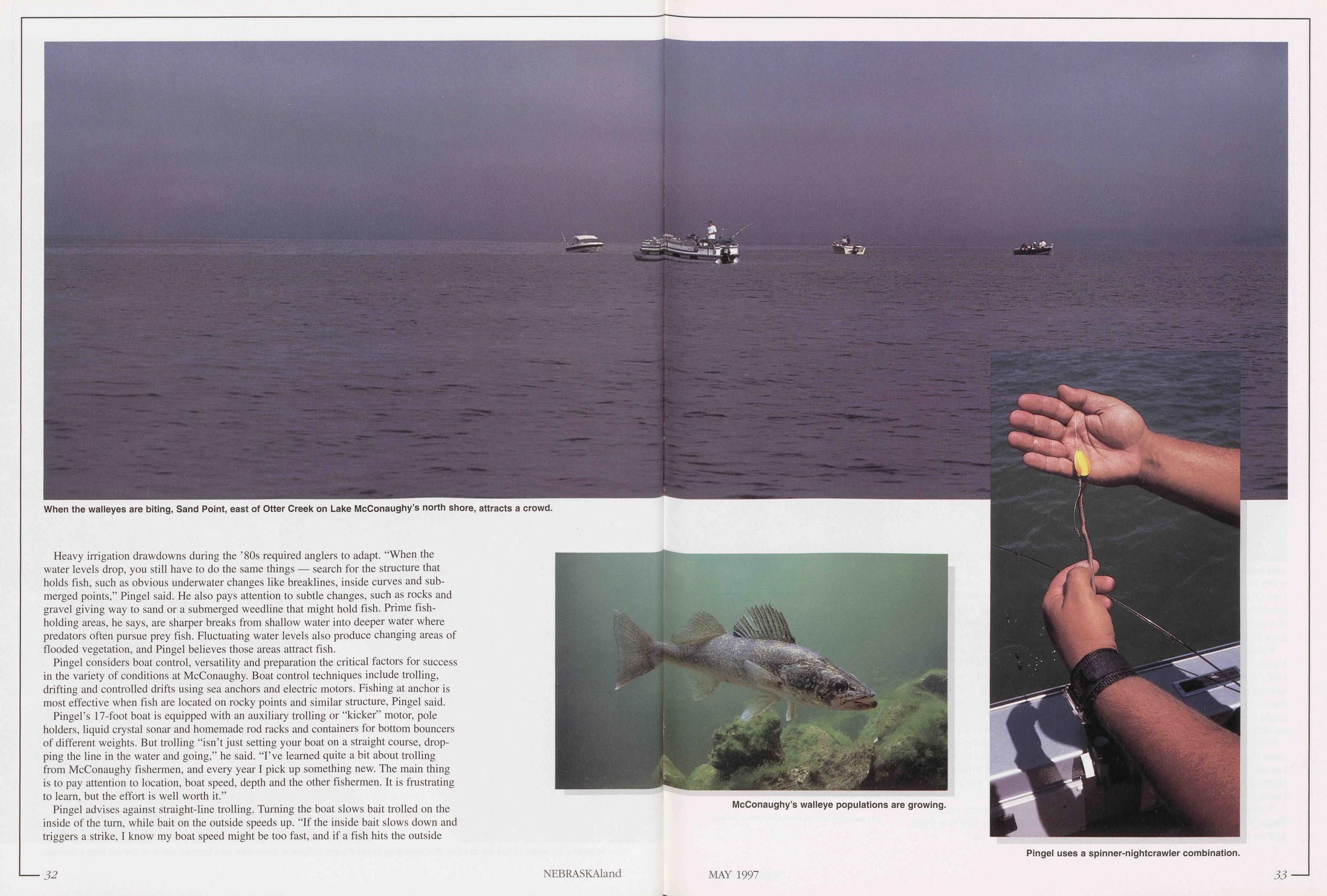 When the walleyes are biting, Sand Point, east of Otter Creek on Lake McConaughy's
north shore, attracts a crowd.
When the walleyes are biting, Sand Point, east of Otter Creek on Lake McConaughy's
north shore, attracts a crowd.
Heavy irrigation drawdowns during the '80s required anglers to adapt. "When the water levels drop, you still have to do the same things — search for the structure that holds fish, such as obvious underwater changes like breaklines, inside curves and submerged points," Pingel said. He also pays attention to subtle changes, such as rocks and gravel giving way to sand or a submerged weedline that might hold fish. Prime fish-holding areas, he says, are sharper breaks from shallow water into deeper water where predators often pursue prey fish. Fluctuating water levels also produce changing areas of flooded vegetation, and Pingel believes those areas attract fish.
Pingel considers boat control, versatility and preparation the critical factors for success in the variety of conditions at McConaughy. Boat control techniques include trolling, drifting and controlled drifts using sea anchors and electric motors. Fishing at anchor is most effective when fish are located on rocky points and similar structure, Pingel said. Pingel's 17-foot boat is equipped with an auxiliary trolling or "kicker" motor, pole holders, liquid crystal sonar and homemade rod racks and containers for bottom bouncers of different weights. But trolling "isn't just setting your boat on a straight course, dropping the line in the water and going," he said. "I've learned quite a bit about trolling from McConaughy fishermen, and every year I pick up something new. The main thing is to pay attention to location, boat speed, depth and the other fishermen. It is frustrating to learn, but the effort is well worth it."
Pingel advises against straight-line trolling. Turning the boat slows bait trolled on the inside of the turn, while bait on the outside speeds up. "If the inside bait slows down and triggers a strike, I know my boat speed might be too fast, and if a fish hits the outside
McConaughy's walleye populations are growing. Pingel uses a spinner-nightcrawler combination. 32 NEBRASKAland MAY 1997 33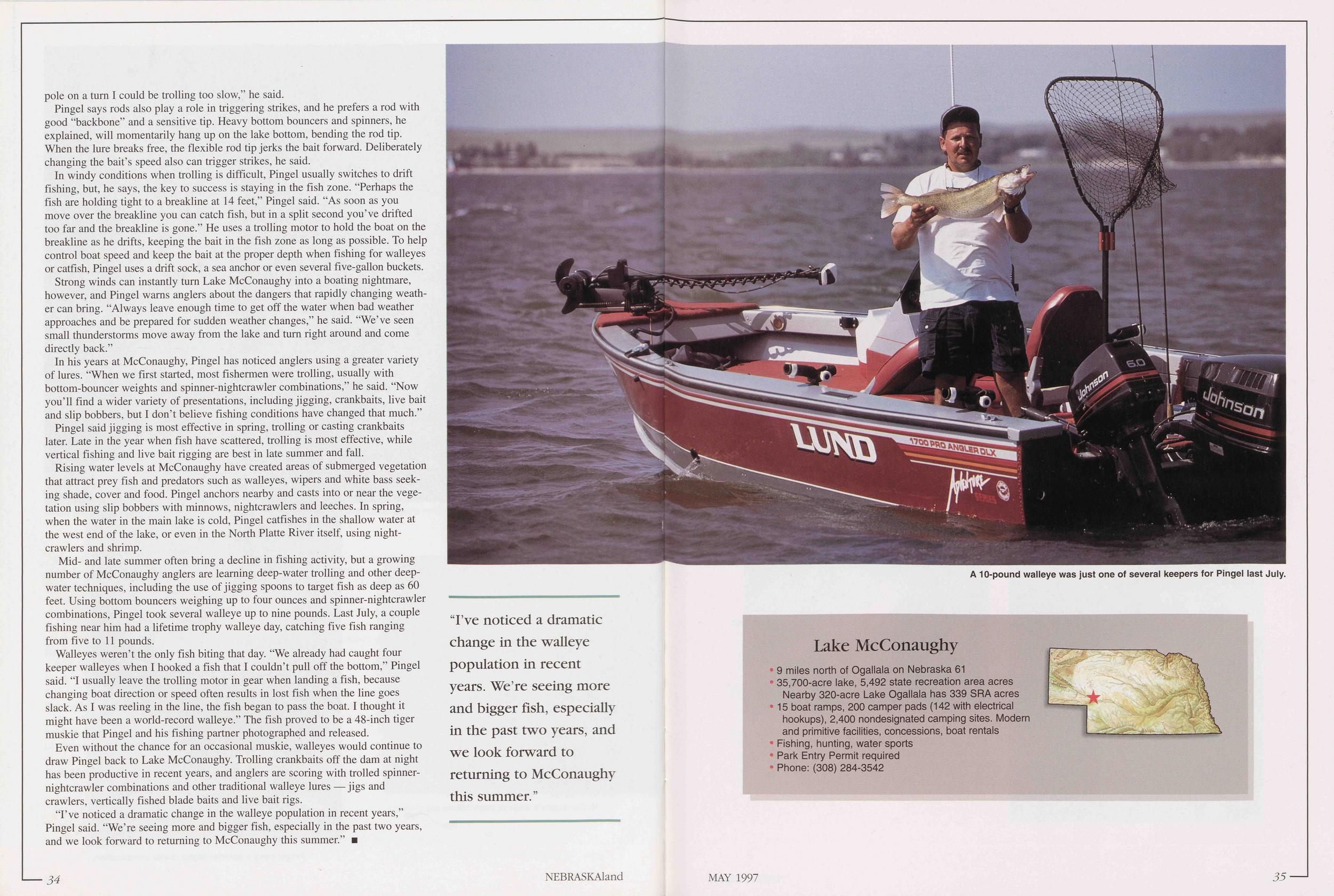
pole on a turn I could be trolling too slow," he said.
Pingel says rods also play a role in triggering strikes, and he prefers a rod with good "backbone" and a sensitive tip. Heavy bottom bouncers and spinners, he explained, will momentarily hang up on the lake bottom, bending the rod tip. When the lure breaks free, the flexible rod tip jerks the bait forward. Deliberately changing the bait's speed also can trigger strikes, he said.
In windy conditions when trolling is difficult, Pingel usually switches to drift fishing, but, he says, the key to success is staying in the fish zone. "Perhaps the fish are holding tight to a breakline at 14 feet," Pingel said. "As soon as you move over the breakline you can catch fish, but in a split second you've drifted too far and the breakline is gone." He uses a trolling motor to hold the boat on the breakline as he drifts, keeping the bait in the fish zone as long as possible. To help control boat speed and keep the bait at the proper depth when fishing for walleyes or catfish, Pingel uses a drift sock, a sea anchor or even several five-gallon buckets.
Strong winds can instantly turn Lake McConaughy into a boating nightmare, however, and Pingel warns anglers about the dangers that rapidly changing weather can bring. "Always leave enough time to get off the water when bad weather approaches and be prepared for sudden weather changes," he said. "We've seen small thunderstorms move away from the lake and turn right around and come directly back."
In his years at McConaughy, Pingel has noticed anglers using a greater variety of lures. "When we first started, most fishermen were trolling, usually with bottom-bouncer weights and spinner-nightcrawler combinations," he said. "Now you'll find a wider variety of presentations, including jigging, crankbaits, live bait and slip bobbers, but I don't believe fishing conditions have changed that much." Pingel said jigging is most effective in spring, trolling or casting crankbaits later. Late in the year when fish have scattered, trolling is most effective, while vertical fishing and live bait rigging are best in late summer and fall.
Rising water levels at McConaughy have created areas of submerged vegetation that attract prey fish and predators such as walleyes, wipers and white bass seeking shade, cover and food. Pingel anchors nearby and casts into or near the vegetation using slip bobbers with minnows, nightcrawlers and leeches. In spring, when the water in the main lake is cold, Pingel catfishes in the shallow water at the west end of the lake, or even in the North Platte River itself, using nightcrawlers and shrimp.
Mid- and late summer often bring a decline in fishing activity, but a growing number of McConaughy anglers are learning deep-water trolling and other deepwater techniques, including the use of jigging spoons to target fish as deep as 60 feet. Using bottom bouncers weighing up to four ounces and spinner-nightcrawler combinations, Pingel took several walleye up to nine pounds. Last July, a couple fishing near him had a lifetime trophy walleye day, catching five fish ranging from five to 11 pounds.
Walleyes weren't the only fish biting that day. "We already had caught four keeper walleyes when I hooked a fish that I couldn't pull off the bottom," Pingel said. "I usually leave the trolling motor in gear when landing a fish, because changing boat direction or speed often results in lost fish when the line goes slack. As I was reeling in the line, the fish began to pass the boat. I thought it might have been a world-record walleye." The fish proved to be a 48-inch tiger muskie that Pingel and his fishing partner photographed and released.
Even without the chance for an occasional muskie, walleyes would continue to draw Pingel back to Lake McConaughy. Trolling crankbaits off the dam at night has been productive in recent years, and anglers are scoring with trolled spinner-nightcrawler combinations and other traditional walleye lures —jigs and crawlers, vertically fished blade baits and live bait rigs.
"I've noticed a dramatic change in the walleye population in recent years," Pingel said. "We're seeing more and bigger fish, especially in the past two years, and we look forward to returning to McConaughy this summer."
A 10-pound walleye was just one of several keepers for Pingel last July. "I've noticed a dramatic change in the walleye population in recent years. We're seeing more and bigger fish, especially in the past two years, and we look forward to returning to McConaughy this summer." Lake McConaughy 9 miles north of Ogallala on Nebraska 61 35,700-acre lake, 5,492 state recreation area acres Nearby 320-acre Lake Ogallala has 339 SRA acres 15 boat ramps, 200 camper pads (142 with electrical hookups), 2,400 nondesignated camping sites. Modern and primitive facilities, concessions, boat rentals Fishing, hunting, water sports Park Entry Permit required Phone: (308) 284-3542 34 NEBRASKAland MAY 1997 35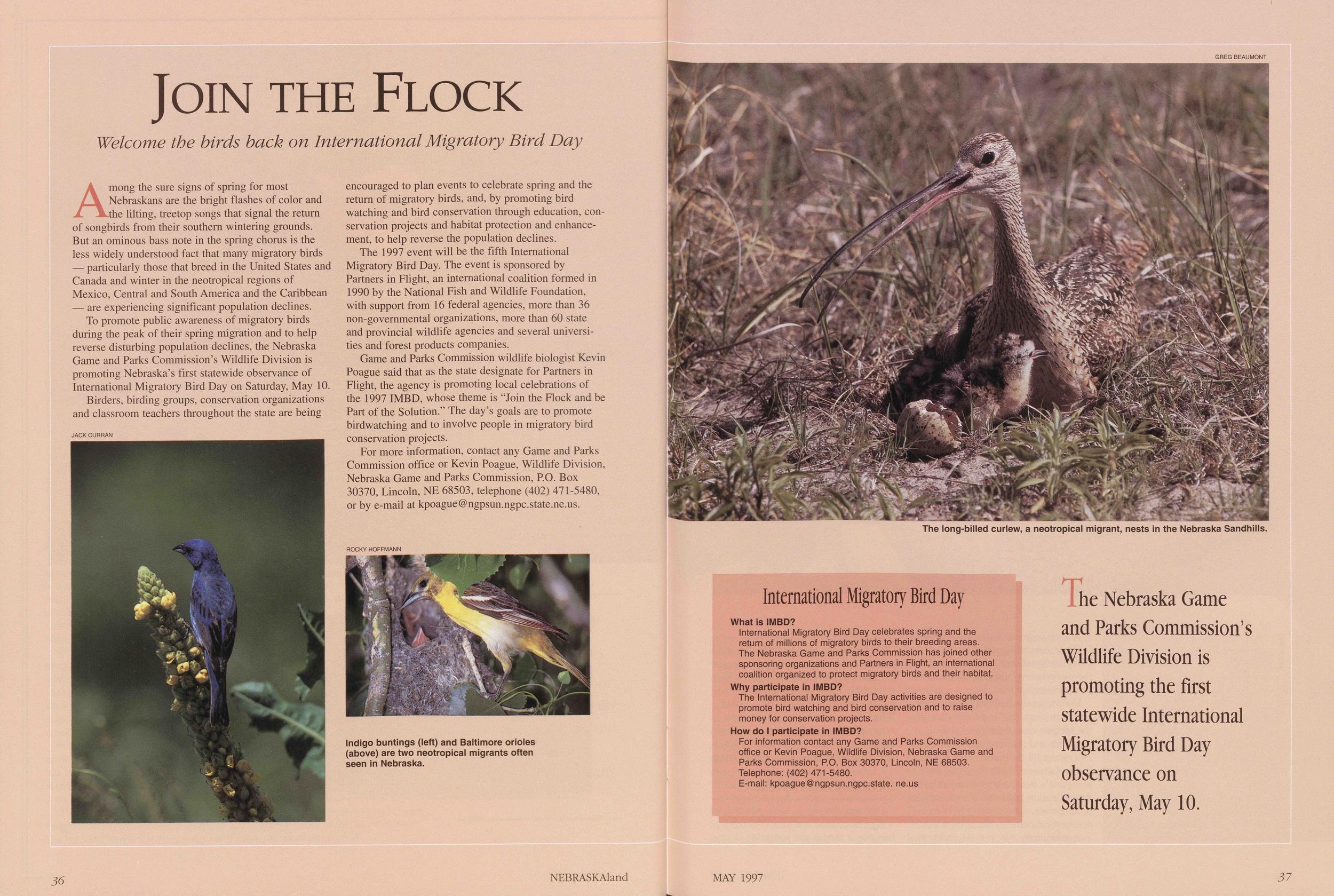
Among the sure signs of spring for most Nebraskans are the bright flashes of color and The lilting, treetop songs that signal the return of songbirds from their southern wintering grounds. But an ominous bass note in the spring chorus is the less widely understood fact that many migratory birds particularly those that breed in the United States and Canada and winter in the neotropical regions of Mexico, Central and South America and the Caribbean are experiencing significant population declines.
To promote public awareness of migratory birds during the peak of their spring migration and to help reverse disturbing population declines, the Nebraska Game and Parks Commission's Wildlife Division is promoting Nebraska's first statewide observance of International Migratory Bird Day on Saturday, May 10.
Birders, birding groups, conservation organizations and classroom teachers throughout the state are being
JACK CURRANencouraged to plan events to celebrate spring and the return of migratory birds, and, by promoting bird watching and bird conservation through education, conservation projects and habitat protection and enhancement, to help reverse the population declines.
The 1997 event will be the fifth International Migratory Bird Day. The event is sponsored by Partners in Flight, an international coalition formed in 1990 by the National Fish and Wildlife Foundation, with support from 16 federal agencies, more than 36 non-governmental organizations, more than 60 state and provincial wildlife agencies and several universities and forest products companies. Game and Parks Commission wildlife biologist Kevin Poague said that as the state designate for Partners in Flight, the agency is promoting local celebrations of the 1997 IMBD, whose theme is "Join the Flock and be Part of the Solution." The day's goals are to promote birdwatching and to involve people in migratory bird conservation projects.
For more information, contact any Game and Parks Commission office or Kevin Poague, Wildlife Division, Nebraska Game and Parks Commission, P.O. Box 30370, Lincoln, NE 68503, telephone (402) 471-5480, or by e-mail at kpoague@ngpsun.ngpc.state.ne.us.
ROCKY HOFFMANN Indigo buntings (left) and Baltimore orioles (above) are two neotropical migrants often seen in Nebraska. The long-billed curlew, a neotropical migrant, nests in the Nebraska Sandhills. International Migratory Bird Day What is IMBD?International Migratory Bird Day celebrates spring and the return of millions of migratory birds to their breeding areas. The Nebraska Game and Parks Commission has joined other sponsoring organizations and Partners in Flight, an international coalition organized to protect migratory birds and their habitat.
Why participate in IMBD?The International Migratory Bird Day activities are designed to promote bird watching and bird conservation and to raise money for conservation projects.
How do I participate in IMBD?For information contact any Game and Parks Commission office or Kevin Poague, Wildlife Division, Nebraska Game and Parks Commission, P.O. Box 30370, Lincoln, NE 68503. Telephone: (402) 471-5480. E-mail: kpoague@ngpsun.ngpc.state. ne.us
he Nebraska Game and Parks Commission's Wildlife Division is promoting the first statewide International Migratory Bird Day observance on Saturday, May 10. 36 NEBRASKAland MAY 1997 37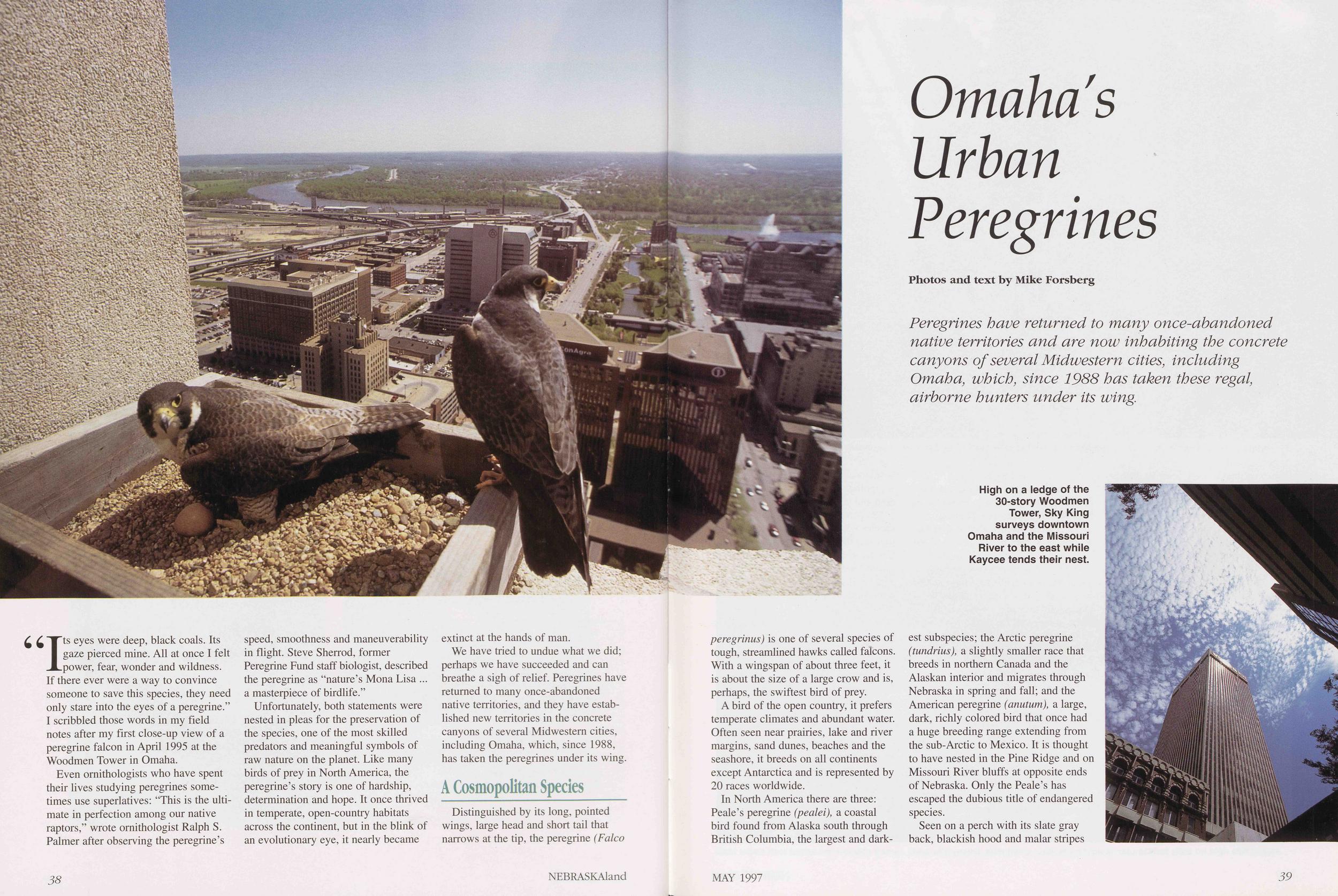
its eyes were deep, black coals. Its gaze pierced mine. All at once I felt power, fear, wonder and wildness. If there ever were a way to convince someone to save this species, they need only stare into the eyes of a peregrine." I scribbled those words in my field notes after my first close-up view of a peregrine falcon in April 1995 at the Woodmen Tower in Omaha.
Even ornithologists who have spent their lives studying peregrines sometimes use superlatives: "This is the ultimate in perfection among our native raptors," wrote ornithologist Ralph S. Palmer after observing the peregrine's speed, smoothness and maneuverability in flight. Steve Sherrod, former Peregrine Fund staff biologist, described the peregrine as "nature's Mona Lisa... a masterpiece of birdlife."
Unfortunately, both statements were nested in pleas for the preservation of the species, one of the most skilled predators and meaningful symbols of raw nature on the planet. Like many birds of prey in North America, the peregrine's story is one of hardship, determination and hope. It once thrived in temperate, open-country habitats across the continent, but in the blink of an evolutionary eye, it nearly became extinct at the hands of man.
We have tried to undue what we did; perhaps we have succeeded and can breathe a sigh of relief. Peregrines have returned to many once-abandoned native territories, and they have established new territories in the concrete canyons of several Midwestern cities, including Omaha, which, since 1988, has taken the peregrines under its wing.
A Cosmopolitan SpeciesDistinguished by its long, pointed wings, large head and short tail that narrows at the tip, the peregrine (Falco peregrinus) is one of several species of tough, streamlined hawks called falcons. With a wingspan of about three feet, it is about the size of a large crow and is, perhaps, the swiftest bird of prey.
A bird of the open country, it prefers temperate climates and abundant water. Often seen near prairies, lake and river margins, sand dunes, beaches and the seashore, it breeds on all continents except Antarctica and is represented by 20 races worldwide.
High on a ledge of the 30-story Woodmen Tower, Sky King surveys downtown Omaha and the Missouri River to the east while Kaycee tends their nest.
In North America there are three: Peale's peregrine (pealei), a coastal bird found from Alaska south through British Columbia, the largest and darkest subspecies; the Arctic peregrine (tundrius), a slightly smaller race that breeds in northern Canada and the Alaskan interior and migrates through Nebraska in spring and fall; and the American peregrine (anutum), a large, dark, richly colored bird that once had a huge breeding range extending from the sub-Arctic to Mexico. It is thought to have nested in the Pine Ridge and on Missouri River bluffs at opposite ends of Nebraska. Only the Peale's has escaped the dubious title of endangered species.
Seen on a perch with its slate gray back, blackish hood and malar stripes
38 NEBRASKAland MAY 1997 39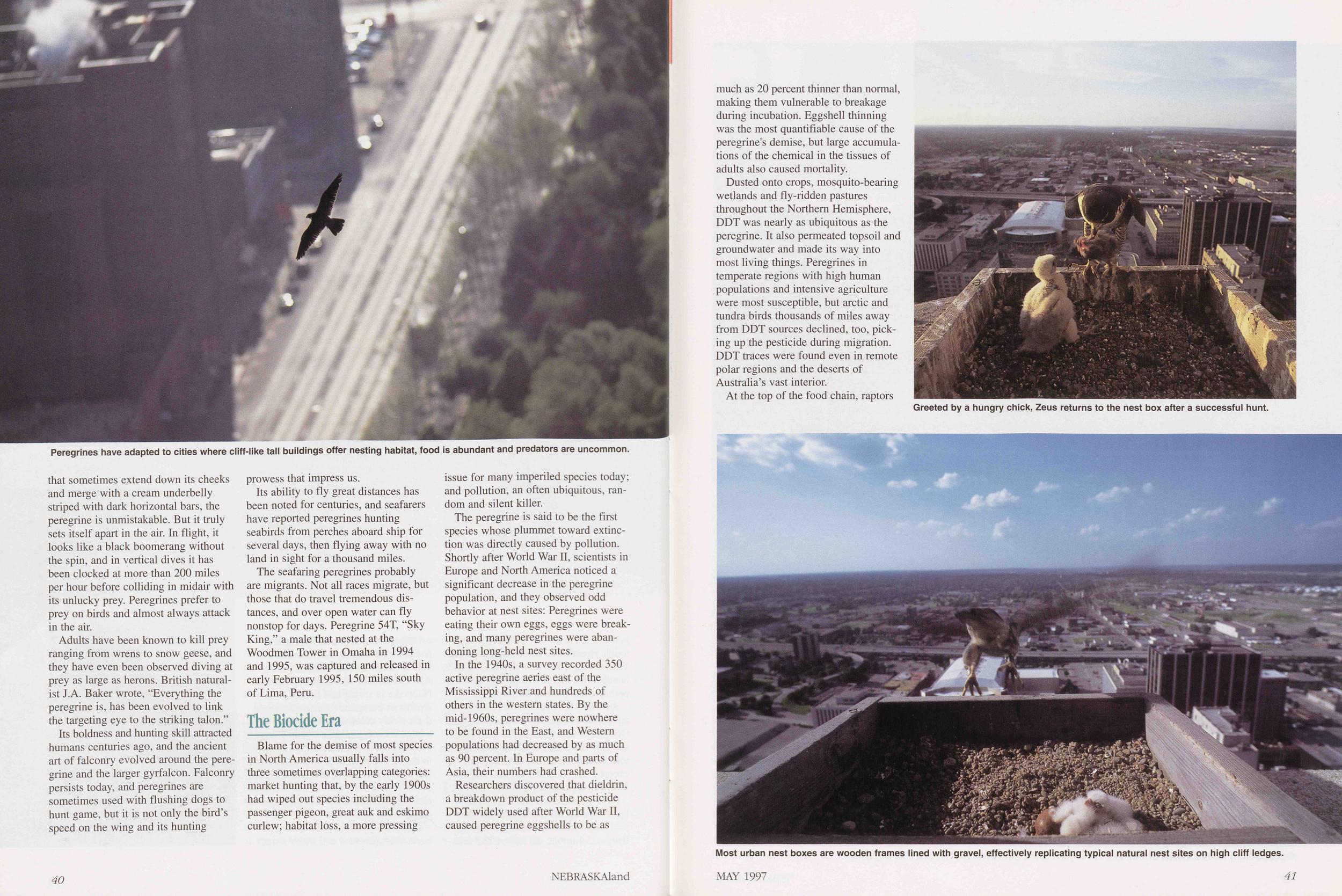 Peregrines have adapted to cities where cliff-like tall buildings offer nesting habitat,
food is abundant and predators are uncommon.
Peregrines have adapted to cities where cliff-like tall buildings offer nesting habitat,
food is abundant and predators are uncommon.
that sometimes extend down its cheeks and merge with a cream underbelly striped with dark horizontal bars, the peregrine is unmistakable. But it truly sets itself apart in the air. In flight, it looks like a black boomerang without the spin, and in vertical dives it has been clocked at more than 200 miles per hour before colliding in midair with its unlucky prey. Peregrines prefer to prey on birds and almost always attack in the air.
Adults have been known to kill prey ranging from wrens to snow geese, and they have even been observed diving at prey as large as herons. British naturalist J.A. Baker wrote, "Everything the peregrine is, has been evolved to link the targeting eye to the striking talon." Its boldness and hunting skill attracted humans centuries ago, and the ancient art of falconry evolved around the peregrine and the larger gyrfalcon. Falconry persists today, and peregrines are sometimes used with flushing dogs to hunt game, but it is not only the bird's speed on the wing and its hunting prowess that impress us.
Its ability to fly great distances has been noted for centuries, and seafarers have reported peregrines hunting seabirds from perches aboard ship for several days, then flying away with no land in sight for a thousand miles.
The seafaring peregrines probably are migrants. Not all races migrate, but those that do travel tremendous distances, and over open water can fly nonstop for days. Peregrine 54T, "Sky King," a male that nested at the Woodmen Tower in Omaha in 1994 and 1995, was captured and released in early February 1995, 150 miles south of Fima, Peru.
The Biodde EraBlame for the demise of most species in North America usually falls into three sometimes overlapping categories: market hunting that, by the early 1900s had wiped out species including the passenger pigeon, great auk and eskimo curlew; habitat loss, a more pressing issue for many imperiled species today; and pollution, an often ubiquitous, random and silent killer.
The peregrine is said to be the first species whose plummet toward extinction was directly caused by pollution. Shortly after World War II, scientists in Europe and North America noticed a significant decrease in the peregrine population, and they observed odd behavior at nest sites: Peregrines were eating their own eggs, eggs were breaking, and many peregrines were abandoning long-held nest sites.
In the 1940s, a survey recorded 350 active peregrine aeries east of the Mississippi River and hundreds of others in the western states. By the mid-1960s, peregrines were nowhere to be found in the East, and Western populations had decreased by as much as 90 percent. In Europe and parts of Asia, their numbers had crashed.
Researchers discovered that dieldrin, a breakdown product of the pesticide DDT widely used after World War II, caused peregrine eggshells to be as much as 20 percent thinner than normal, making them vulnerable to breakage during incubation. Eggshell thinning was the most quantifiable cause of the peregrine's demise, but large accumulations of the chemical in the tissues of adults also caused mortality.
Dusted onto crops, mosquito-bearing wetlands and fly-ridden pastures throughout the Northern Hemisphere, DDT was nearly as ubiquitous as the peregrine. It also permeated topsoil and groundwater and made its way into most living things. Peregrines in temperate regions with high human populations and intensive agriculture were most susceptible, but arctic and tundra birds thousands of miles away from DDT sources declined, too, picking up the pesticide during migration. DDT traces were found even in remote polar regions and the deserts of Australia's vast interior.
At the top of the food chain, raptors Greeted by a hungry chick, Zeus returns to the nest box after a successful hunt. Most urban nest boxes are wooden frames lined with gravel, effectively replicating typical natural nest sites on high cliff ledges.
40 NEBRASKAland MAY 1997 41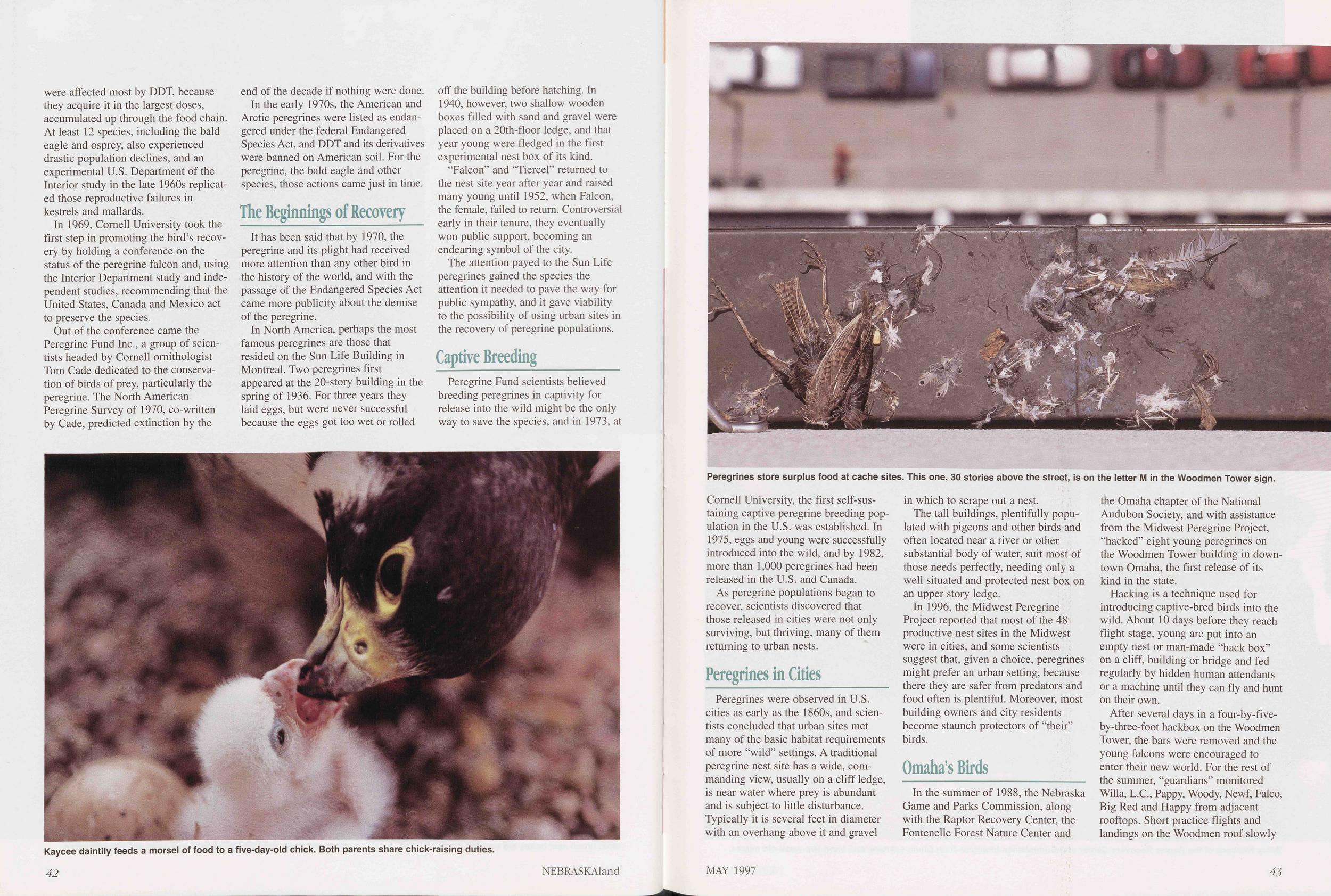
were affected most by DDT, because they acquire it in the largest doses, accumulated up through the food chain. At least 12 species, including the bald eagle and osprey, also experienced drastic population declines, and an experimental U.S. Department of the Interior study in the late 1960s replicated those reproductive failures in kestrels and mallards.
In 1969, Cornell University took the first step in promoting the bird's recovery by holding a conference on the status of the peregrine falcon and, using the Interior Department study and independent studies, recommending that the United States, Canada and Mexico act to preserve the species.
Out of the conference came the Peregrine Fund Inc., a group of scientists headed by Cornell ornithologist Tom Cade dedicated to the conservation of birds of prey, particularly the peregrine. The North American Peregrine Survey of 1970, co-written by Cade, predicted extinction by the end of the decade if nothing were done.
In the early 1970s, the American and Arctic peregrines were listed as endangered under the federal Endangered Species Act, and DDT and its derivatives were banned on American soil. For the peregrine, the bald eagle and other species, those actions came just in time.
The Beginnings of Recovery It has been said that by 1970, the peregrine and its plight had received more attention than any other bird in the history of the world, and with the passage of the Endangered Species Act came more publicity about the demise of the peregrine.
In North America, perhaps the most famous peregrines are those that resided on the Sun Life Building in Montreal. Two peregrines first appeared at the 20-story building in the spring of 1936. For three years they laid eggs, but were never successful because the eggs got too wet or rolled off the building before hatching. In 1940, however, two shallow wooden boxes filled with sand and gravel were placed on a 20th-floor ledge, and that year young were fledged in the first experimental nest box of its kind.
"Falcon" and "Tiercel" returned to the nest site year after year and raised many young until 1952, when Falcon, the female, failed to return. Controversial early in their tenure, they eventually won public support, becoming an endearing symbol of the city.
The attention payed to the Sun Life peregrines gained the species the attention it needed to pave the way for public sympathy, and it gave viability to the possibility of using urban sites in the recovery of peregrine populations.
Captive BreedingPeregrine Fund scientists believed breeding peregrines in captivity for release into the wild might be the only way to save the species, and in 1973, at
Peregrines store surplus food at cache sites. This one, 30 stories above the street, is on the letter M in the Woodmen Tower sign.Cornell University, the first self-sustaining captive peregrine breeding population in the U.S. was established. In 1975, eggs and young were successfully introduced into the wild, and by 1982, more than 1,000 peregrines had been released in the U.S. and Canada. As peregrine populations began to recover, scientists discovered that those released in cities were not only surviving, but thriving, many of them returning to urban nests.
Peregrines in CitiesPeregrines were observed in U.S. cities as early as the 1860s, and scientists concluded that urban sites met many of the basic habitat requirements of more "wild" settings. A traditional peregrine nest site has a wide, commanding view, usually on a cliff ledge, is near water where prey is abundant and is subject to little disturbance. Typically it is several feet in diameter with an overhang above it and gravel in which to scrape out a nest.
The tall buildings, plentifully populated with pigeons and other birds and often located near a river or other substantial body of water, suit most of those needs perfectly, needing only a well situated and protected nest box on an upper story ledge.
In 1996, the Midwest Peregrine Project reported that most of the 48 productive nest sites in the Midwest were in cities, and some scientists suggest that, given a choice, peregrines might prefer an urban setting, because there they are safer from predators and food often is plentiful. Moreover, most building owners and city residents become staunch protectors of "their" birds.
Omaha's BirdsIn the summer of 1988, the Nebraska Game and Parks Commission, along with the Raptor Recovery Center, the Fontenelle Forest Nature Center and the Omaha chapter of the National Audubon Society, and with assistance from the Midwest Peregrine Project, "hacked" eight young peregrines on the Woodmen Tower building in downtown Omaha, the first release of its kind in the state.
Hacking is a technique used for introducing captive-bred birds into the wild. About 10 days before they reach flight stage, young are put into an empty nest or man-made "hack box" on a cliff, building or bridge and fed regularly by hidden human attendants or a machine until they can fly and hunt on their own.
After several days in a four-by-five-by-three-foot hackbox on the Woodmen Tower, the bars were removed and the young falcons were encouraged to enter their new world. For the rest of the summer, "guardians" monitored Willa, L.C., Pappy, Woody, Newf, Falcon Big Red and Happy from adjacent rooftops. Short practice flights and landings on the Woodmen roof slowly
Kaycee daintily feeds a morsel of food to a five-day-oid chick. Both parents share chick-raising duties. 42 NEBRASKAland MAY 1997 43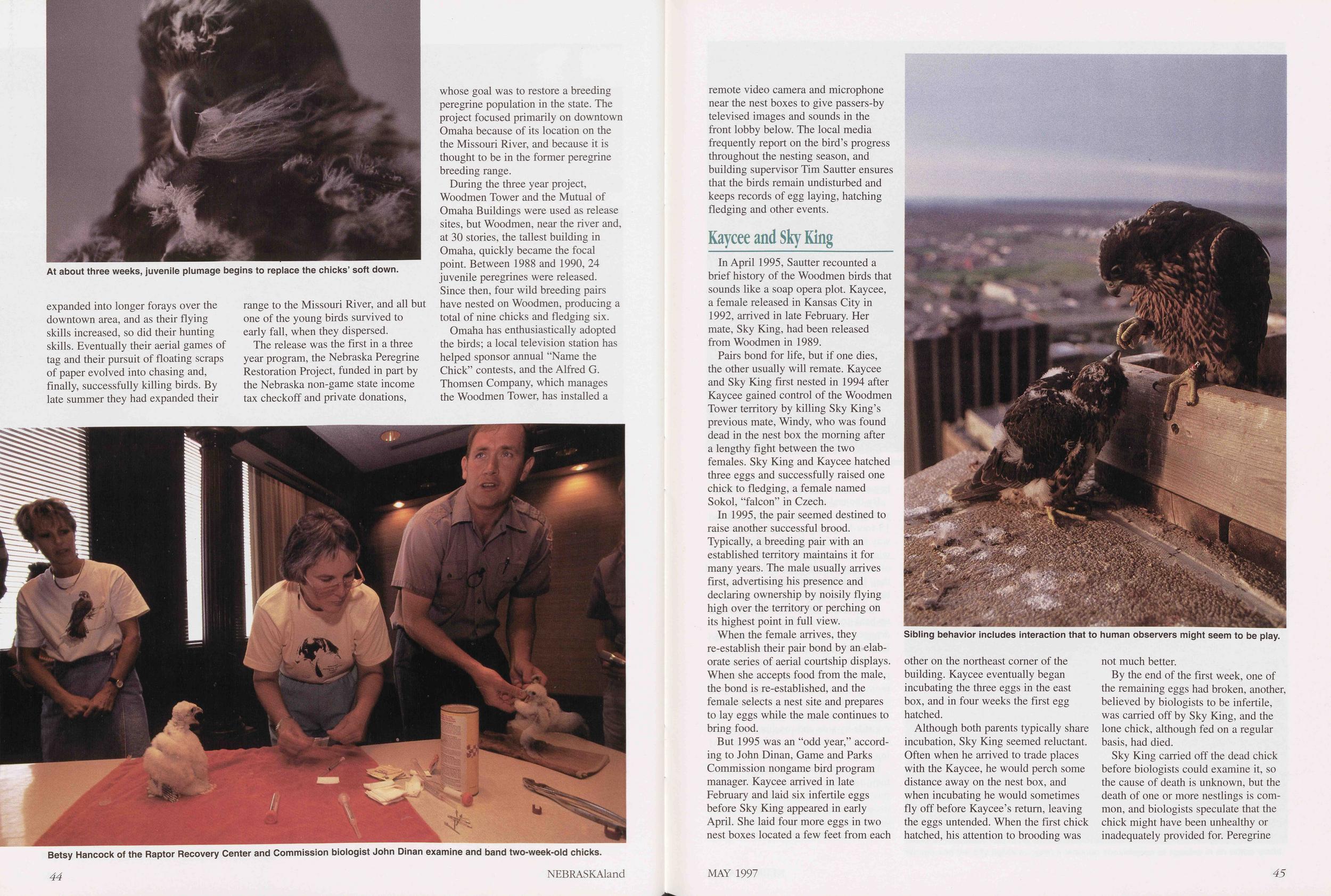 At about three weeks, juvenile plumage begins to replace the chicks' soft down.
expanded into longer forays over the downtown area, and as their flying skills increased, so did their hunting skills. Eventually their aerial games of tag and their pursuit of floating scraps of paper evolved into chasing and, finally, successfully killing birds. By late summer they had expanded then-range to the Missouri River, and all but one of the young birds survived to early fall, when they dispersed.
The release was the first in a three year program, the Nebraska Peregrine Restoration Project, funded in part by the Nebraska non-game state income tax checkoff and private donations, whose goal was to restore a breeding peregrine population in the state. The project focused primarily on downtown Omaha because of its location on the the Missouri River, and because it is thought to be in the former peregrine breeding range.
During the three year project, Woodmen Tower and the Mutual of Omaha Buildings were used as release sites, but Woodmen, near the river and, at 30 stories, the tallest building in Omaha, quickly became the focal point. Between 1988 and 1990, 24 juvenile peregrines were released. Since then, four wild breeding pairs have nested on Woodmen, producing a total of nine chicks and fledging six.
Omaha has enthusiastically adopted the birds; a local television station has helped sponsor annual "Name the Chick" contests, and the Alfred G. Thomsen Company, which manages the Woodmen Tower, has installed a remote video camera and microphone near the nest boxes to give passers-by televised images and sounds in the front lobby below. The local media frequently report on the bird's progress throughout the nesting season, and building supervisor Tim Sautter ensures that the birds remain undisturbed and keeps records of egg laying, hatching fledging and other events.
Kaycee and Sky KingIn April 1995, Sautter recounted a brief history of the Woodmen birds that sounds like a soap opera plot. Kaycee, a female released in Kansas City in 1992, arrived in late February. Her mate, Sky King, had been released from Woodmen in 1989.
Pairs bond for life, but if one dies, the other usually will remate. Kaycee and Sky King first nested in 1994 after Kaycee gained control of the Woodmen Tower territory by killing Sky King's previous mate, Windy, who was found dead in the nest box the morning after a lengthy fight between the two females. Sky King and Kaycee hatched three eggs and successfully raised one chick to fledging, a female named Sokol, "falcon" in Czech.
In 1995, the pair seemed destined to raise another successful brood. Typically, a breeding pair with an established territory maintains it for many years. The male usually arrives first, advertising his presence and declaring ownership by noisily flying high over the territory or perching on its highest point in full view.
When the female arrives, they re-establish their pair bond by an elaborate series of aerial courtship displays. When she accepts food from the male, the bond is re-established, and the female selects a nest site and prepares to lay eggs while the male continues to bring food.
But 1995 was an "odd year," according to John Dinan, Game and Parks Commission nongame bird program manager. Kaycee arrived in late February and laid six infertile eggs before Sky King appeared in early April. She laid four more eggs in two nest boxes located a few feet from each Sibling behavior includes interaction that to human observers might seem to be play. other on the northeast corner of the building. Kaycee eventually began incubating the three eggs in the east box, and in four weeks the first egg hatched.
Although both parents typically share incubation, Sky King seemed reluctant. Often when he arrived to trade places with the Kaycee, he would perch some distance away on the nest box, and when incubating he would sometimes fly off before Kaycee's return, leaving the eggs untended. When the first chick hatched, his attention to brooding was
Betsy Hancock of the Raptor Recovery Center and Commission biologist John Dinan examine and band two-week-old chicks. 44 NEBRASKAland MAY 1997not much better. By the end of the first week, one of the remaining eggs had broken, another, believed by biologists to be infertile, was carried off by Sky King, and the lone chick, although fed on a regular basis, had died.
Sky King carried off the dead chick before biologists could examine it, so the cause of death is unknown, but the death of one or more nestlings is common, and biologists speculate that the chick might have been unhealthy or inadequately provided for. Peregrine
45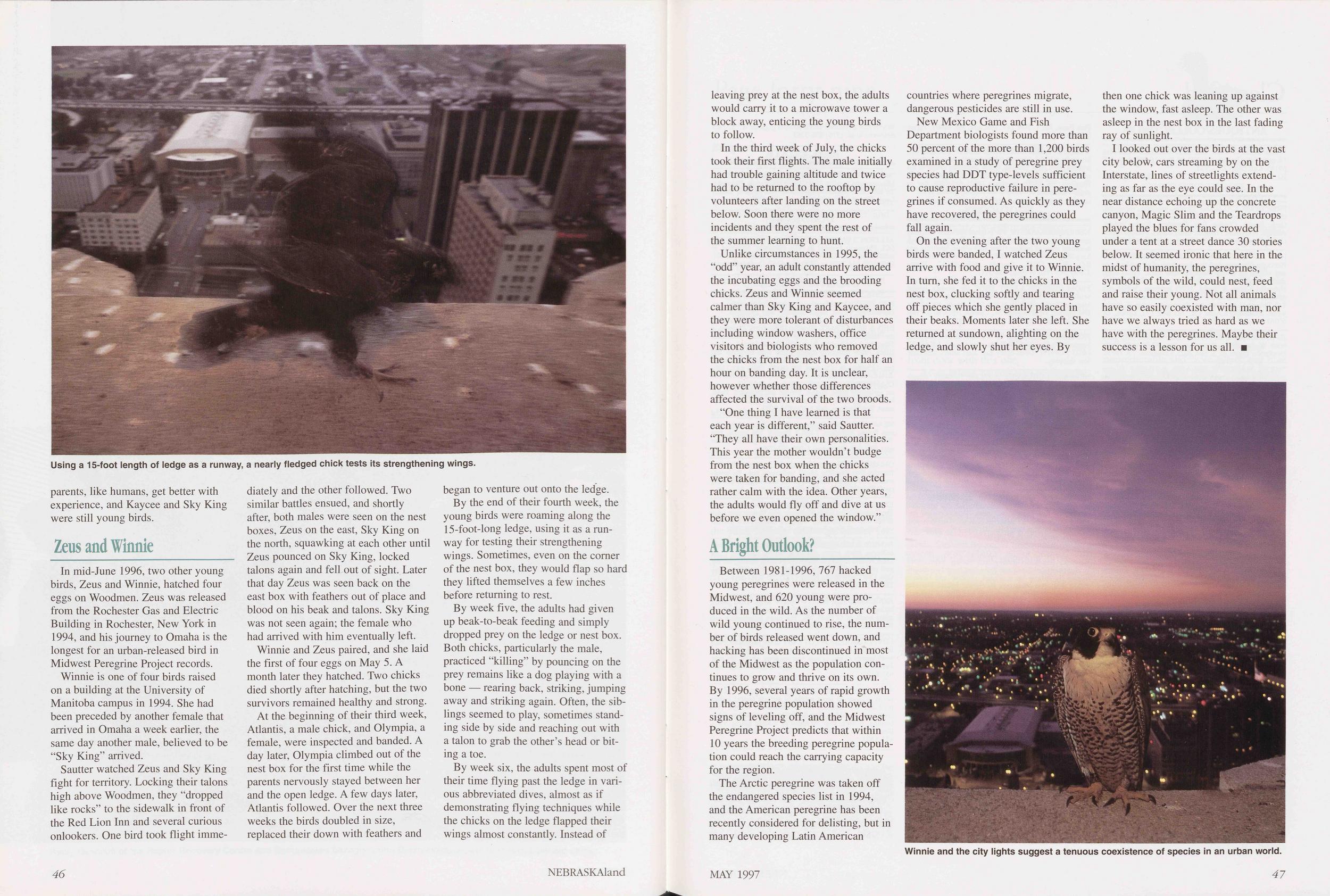
Using a 15-foot length of ledge as a runway, a nearly fledged chick tests its strengthening wings. parents, like humans, get better with experience, and Kaycee and Sky King were still young birds.
Zeus and WinnieIn mid-June 1996, two other young birds, Zeus and Winnie, hatched four eggs on Woodmen. Zeus was released from the Rochester Gas and Electric Building in Rochester, New York in 1994, and his journey to Omaha is the longest for an urban-released bird in Midwest Peregrine Project records. Winnie is one of four birds raised on a building at the University of Manitoba campus in 1994. She had been preceded by another female that arrived in Omaha a week earlier, the same day another male, believed to be "Sky King" arrived.
Sautter watched Zeus and Sky King fight for territory. Locking their talons high above Woodmen, they "dropped like rocks" to the sidewalk in front of the Red Lion Inn and several curious onlookers. One bird took flight immediately and the other followed. Two similar battles ensued, and shortly after, both males were seen on the nest boxes, Zeus on the east, Sky King on the north, squawking at each other until Zeus pounced on Sky King, locked talons again and fell out of sight. Later that day Zeus was seen back on the east box with feathers out of place and blood on his beak and talons. Sky King was not seen again; the female who had arrived with him eventually left.
Winnie and Zeus paired, and she laid the first of four eggs on May 5. A month later they hatched. Two chicks died shortly after hatching, but the two survivors remained healthy and strong.
At the beginning of their third week, Atlantis, a male chick, and Olympia, a female, were inspected and banded. A day later, Olympia climbed out of the nest box for the first time while the parents nervously stayed between her and the open ledge. A few days later, Atlantis followed. Over the next three weeks the birds doubled in size, replaced their down with feathers and began to venture out onto the ledge.
By the end of their fourth week, the young birds were roaming along the 15-foot-long ledge, using it as a runway for testing their strengthening wings. Sometimes, even on the corner of the nest box, they would flap so hard they lifted themselves a few inches before returning to rest.
By week five, the adults had given up beak-to-beak feeding and simply dropped prey on the ledge or nest box. Both chicks, particularly the male, practiced "killing" by pouncing on the prey remains like a dog playing with a bone — rearing back, striking, jumping away and striking again. Often, the siblings seemed to play, sometimes stand- ing side by side and reaching out with a talon to grab the other's head or biting a toe.
By week six, the adults spent most of their time flying past the ledge in various abbreviated dives, almost as if demonstrating flying techniques while the chicks on the ledge flapped their wings almost constantly. Instead of
46 NEBRASKAlandleaving prey at the nest box, the adults would carry it to a microwave tower a block away, enticing the young birds to follow.
In the third week of July, the chicks took their first flights. The male initially had trouble gaining altitude and twice had to be returned to the rooftop by volunteers after landing on the street below. Soon there were no more incidents and they spent the rest of the summer learning to hunt.
Unlike circumstances in 1995, the "odd" year, an adult constantly attended the incubating eggs and the brooding chicks. Zeus and Winnie seemed calmer than Sky King and Kaycee, and they were more tolerant of disturbances including window washers, office visitors and biologists who removed the chicks from the nest box for half an hour on banding day. It is unclear, however whether those differences affected the survival of the two broods.
"One thing I have learned is that each year is different," said Sautter. "They all have their own personalities. This year the mother wouldn't budge from the nest box when the chicks were taken for banding, and she acted rather calm with the idea. Other years, the adults would fly off and dive at us before we even opened the window."
A Bright Outlook?Between 1981-1996, 767 hacked young peregrines were released in the Midwest, and 620 young were produced in the wild. As the number of wild young continued to rise, the number of birds released went down, and hacking has been discontinued in most of the Midwest as the population continues to grow and thrive on its own. By 1996, several years of rapid growth in the peregrine population showed signs of leveling off, and the Midwest Peregrine Project predicts that within 10 years the breeding peregrine population could reach the carrying capacity for the region.
The Arctic peregrine was taken off the endangered species list in 1994, and the American peregrine has been recently considered for delisting, but in many developing Latin American countries where peregrines migrate, dangerous pesticides are still in use.
New Mexico Game and Fish Department biologists found more than 50 percent of the more than 1,200 birds examined in a study of peregrine prey species had DDT type-levels sufficient to cause reproductive failure in peregrines if consumed. As quickly as they have recovered, the peregrines could fall again.
On the evening after the two young birds were banded, I watched Zeus arrive with food and give it to Winnie. In turn, she fed it to the chicks in the nest box, clucking softly and tearing off pieces which she gently placed in their beaks. Moments later she left. She returned at sundown, alighting on the ledge, and slowly shut her eyes. By then one chick was leaning up against the window, fast asleep. The other was asleep in the nest box in the last fading ray of sunlight.
I looked out over the birds at the vast city below, cars streaming by on the Interstate, lines of streetlights extending as far as the eye could see. In the near distance echoing up the concrete canyon, Magic Slim and the Teardrops played the blues for fans crowded under a tent at a street dance 30 stories below. It seemed ironic that here in the midst of humanity, the peregrines, symbols of the wild, could nest, feed and raise their young. Not all animals have so easily coexisted with man, nor have we always tried as hard as we have with the peregrines. Maybe their success is a lesson for us all.
Winnie and the city lights suggest a tenuous coexistence of species in an urban world. MAY 1997 47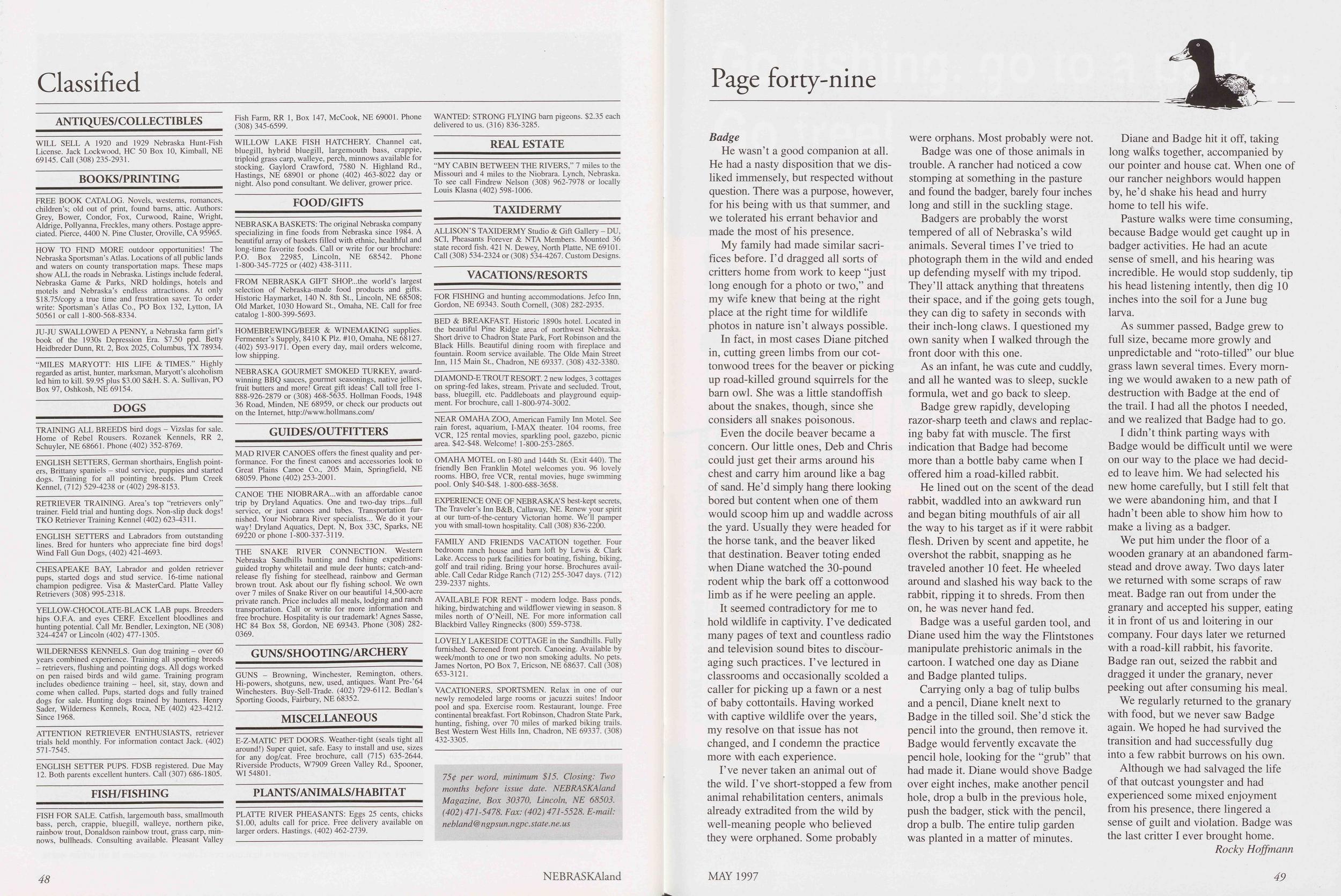
WILL SELL A 1920 and 1929 Nebraska Hunt-Fish License. Jack Lockwood, HC 50 Box 10, Kimball, NE 69145. Call (308) 235-2931.
BOOKS/PRINTINGFREE BOOK CATALOG. Novels, westerns, romances, children's; old out of print, found bams, attic. Authors: Grey, Bower, Condor, Fox, Curwood, Raine, Wright, Aldrige, Pollyanna, Freckles, many others. Postage appreciated. Pierce, 4400 N. Pine Cluster, Oroville, CA 95965.
HOW TO FIND MORE outdoor opportunities! The Nebraska Sportsman's Atlas. Locations of all public lands and waters on county transportation maps. These maps show ALL the roads in Nebraska. Listings include federal, Nebraska Game & Parks, NRD holdings, hotels and motels and Nebraska's endless attractions. At only $18.75/copy a true time and frustration saver. To order write: Sportsman's Atlas Co., PO Box 132, Lytton, IA 50561 or call 1-800-568-8334.
JU-JU SWALLOWED A PENNY, a Nebraska farm girl's book of the 1930s Depression Era. $7.50 ppd. Betty Heidbreder Dunn, Rt. 2, Box 2025, Columbus, TX 78934.
"MILES MARYOTT: HIS LIFE & TIMES." Highly regarded as artist, hunter, marksman, Maryott's alcoholism led him to kill. $9.95 plus $3.00 S&H. S. A. Sullivan, PO Box 97, Oshkosh, NE 69154.
DOGSTRAINING ALL BREEDS bird dogs - Vizslas for sale. Home of Rebel Rousers. Rozanek Kennels, RR 2, Schuyler, NE 68661. Phone (402) 352-8769.
ENGLISH SETTERS, German shorthairs, English pointers, Brittany spaniels - stud service, puppies and started dogs. Training for all pointing breeds. Plum Creek Kennel, (712) 529-4238 or (402) 298-8153.
RETRIEVER TRAINING. Area's top "retrievers only" trainer. Field trial and hunting dogs. Non-slip duck dogs! TKO Retriever Training Kennel (402) 623-4311. ENGLISH SETTERS and Labradors from outstanding lines. Bred for hunters who appreciate fine bird dogs! Wind Fall Gun Dogs, (402) 421-4693.
CHESAPEAKE BAY, Labrador and golden retriever pups, started dogs and stud service. 16-time national champion pedigree. Visa & MasterCard. Platte Valley Retrievers (308) 995-2318.
YELLOW-CHOCOLATE-BLACK LAB pups. Breeders hips O.F.A. and eyes CERE. Excellent bloodlines and hunting potential. Call Mr. Bendler, Lexington, NE (308) 324-4247 or Lincoln (402) 477-1305.
WILDERNESS KENNELS. Gun dog training - over 60 years combined experience. Training all sporting breeds - retrievers, flushing and pointing dogs. All dogs worked on pen raised birds and wild game. Training program includes obedience training - heel, sit, stay, down and come when called. Pups, started dogs and fully trained dogs for sale. Hunting dogs trained by hunters. Henry Sader, Wilderness Kennels, Roca, NE (402) 423-4212. Since 1968.
ATTENTION RETRIEVER ENTHUSIASTS, retriever trials held monthly. For information contact Jack. (402) 571-7545.
ENGLISH SETTER PUPS. FDSB registered. Due May 12. Both parents excellent hunters. Call (307) 686-1805.
FISH/FISHINGFISH FOR SALE. Catfish, largemouth bass, smallmouth bass, perch, crappie, bluegill, walleye, northern pike, rainbow trout, Donaldson rainbow trout, grass carp, minnows, bullheads. Consulting available. Pleasant Valley Fish Farm, RR 1, Box 147, McCook, NE 69001. Phone (308) 345-6599.
WILLOW LAKE FISH HATCHERY. Channel cat, bluegill, hybrid bluegill, largemouth bass, crappie, diploid grass carp, walleye, perch, minnows available for stocking. Gay lord Crawford, 7580 N. Highland Rd., Hastings, NE 68901 or phone (402) 463-8022 day or night. Also pond consultant. We deliver, grower price.
FOOD/GIFTSNEBRASKA BASKETS: The original Nebraska company specializing in fine foods from Nebraska since 1984. A beautiful array of baskets filled with ethnic, healthful and long-time favorite foods. Call or write for our brochure: P.O. Box 22985, Lincoln, NE 68542. Phone 1-800-345-7725 or (402) 438-3111.
FROM NEBRASKA GIFT SHOP...the world's largest selection of Nebraska-made food products and gifts. Historic Haymarket, 140 N. 8th St., Lincoln, NE 68508; Old Market, 1030 Howard St., Omaha, NE. Call for free catalog 1-800-399-5693.
HOMEBREWING/BEER & WINEMAKING supplies. Fermenter's Supply, 8410 K Plz. #10, Omaha, NE 68127. (402) 593-9171. Open every day, mail orders welcome, low shipping.
NEBRASKA GOURMET SMOKED TURKEY, award-winning BBQ sauces, gourmet seasonings, native jellies, fruit butters and more! Great gift ideas! Call toll free 1-888-926-2879 or (308) 468-5635. Hollman Foods, 1948 36 Road, Minden, NE 68959, or check our products out on the Internet, http://www.hollmans.com/
GUIDES/OUTFITTERSMAD RIVER CANOES offers the finest quality and performance. For the finest canoes and accessories look to Great Plains Canoe Co., 205 Main, Springfield, NE 68059. Phone (402) 253-2001.
CANOE THE NIOBRARA...with an affordable canoe trip by Dryland Aquatics. One and two-day trips...full service, or just canoes and tubes. Transportation furnished. Your Niobrara River specialists... We do it your way! Dryland Aquatics, Dept. N, Box 33C, Sparks, NE 69220 or phone 1-800-337-3119.
THE SNAKE RIVER CONNECTION. Western Nebraska Sandhills hunting and fishing expeditions: guided trophy whitetail and mule deer hunts; catch-and-release fly fishing for steelhead, rainbow and German brown trout. Ask about our fly fishing school. We own over 7 miles of Snake River on our beautiful 14,500-acre private ranch. Price includes all meals, lodging and ranch transportation. Call or write for more information and free brochure. Hospitality is our trademark! Agnes Sasse, HC 84 Box 58, Gordon, NE 69343. Phone (308) 282-0369.
GUNS/SHOOTING/ARCHERYGUNS - Browning, Winchester, Remington, others. Hi-powers, shotguns, new, used, antiques. Want Pre-'64 Winchesters. Buy-Sell-Trade. (402) 729-6112. Bedlan's Sporting Goods, Fairbury, NE 68352.
MISCELLANEOUSE-Z-MATIC PET DOORS. Weather-tight (seals tight all around!) Super quiet, safe. Easy to install and use, sizes for any dog/cat. Free brochure, call (715) 635-2644. Riverside Products, W7909 Green Valley Rd., Spooner, WI 54801.
PLANTS/ANIMALS/HABITATPLATTE RIVER PHEASANTS: Eggs 25 cents, chicks $1.00, adults call for price. Free delivery available on larger orders. Hastings. (402) 462-2739. WANTED: STRONG FLYING barn pigeons. $2.35 each delivered to us. (316) 836-3285.
REAL ESTATE"MY CABIN BETWEEN THE RIVERS," 7 miles to the Missouri and 4 miles to the Niobrara. Lynch, Nebraska. To see call Findrew Nelson (308) 962-7978 or locally Louis Klasna (402) 598-1006.
TAXIDERMYALLISON'S TAXIDERMY Studio & Gift Gallery - DU, SCI, Pheasants Forever & NTA Members. Mounted 36 state record fish. 421 N. Dewey, North Platte, NE 69101. Call (308) 534-2324 or (308) 534-4267. Custom Designs.
VACATIONS/RESORTSFOR FISHING and hunting accommodations. Jefco Inn, Gordon, NE 69343. South Cornell, (308) 282-2935.
BED & BREAKFAST. Historic 1890s hotel. Located in the beautiful Pine Ridge area of northwest Nebraska. Short drive to Chadron State Park, Fort Robinson and the Black Hills. Beautiful dining room with fireplace and fountain. Room service available. The Olde Main Street Inn, 115 Main St., Chadron, NE 69337. (308) 432-3380.
DIAMOND-E TROUT RESORT. 2 new lodges, 3 cottages on spring-fed lakes, stream. Private and secluded. Trout, bass, bluegill, etc. Paddleboats and playground equipment. For brochure, call 1-800-974-3002.
NEAR OMAHA ZOO, American Family Inn Motel. See rain forest, aquarium, I-MAX theater. 104 rooms, free VCR, 125 rental movies, sparkling pool, gazebo, picnic area. $42-$48. Welcome! 1-800-253-2865.
OMAHA MOTEL on 1-80 and 144th St. (Exit 440). The friendly Ben Franklin Motel welcomes you. 96 lovely rooms. HBO, free VCR, rental movies, huge swimming pool. Only $40-$48. 1-800-688-3658.
EXPERIENCE ONE OF NEBRASKA'S best-kept secrets, The Traveler's Inn B&B, Callaway, NE. Renew your spirit at our tum-of-the-century Victorian home. We'll pamper you with small-town hospitality. Call (308) 836-2200.
FAMILY AND FRIENDS VACATION together. Four bedroom ranch house and barn loft by Lewis & Clark Lake. Access to park facilities for boating, fishing, biking, golf and trail riding. Bring your horse. Brochures available. Call Cedar Ridge Ranch (712) 255-3047 days. (712) 239-2337 nights.
AVAILABLE FOR RENT - modern lodge. Bass ponds, hiking, birdwatching and wildflower viewing in season. 8 miles north of O'Neill, NE. For more information call Blackbird Valley Ringnecks (800) 559-5738.
LOVELY LAKESIDE COTTAGE in the Sandhills. Fully furnished. Screened front porch. Canoeing. Available by week/month to one or two non smoking adults. No pets. James Norton, PO Box 7, Ericson, NE 68637. Call (308) 653-3121.
VACATIONERS, SPORTSMEN. Relax in one of our newly remodeled large rooms or Jacuzzi suites! Indoor pool and spa. Exercise room. Restaurant, lounge. Free continental breakfast. Fort Robinson, Chadron State Park, hunting, fishing, over 70 miles of marked biking trails. Best Western West Hills Inn, Chadron, NE 69337. (308) 432-3305.
$.75 per word, minimum $15. Closing: Two months before issue date. NEBRASKAland Magazine, Box 30370, Lincoln, NE 68503. (402) 471-5478. Fax: (402) 471-5528. E-mail: nebland@ngpsun. ngpc. state.ne. us
He wasn't a good companion at all. He had a nasty disposition that we disliked immensely, but respected without question. There was a purpose, however, for his being with us that summer, and we tolerated his errant behavior and made the most of his presence.
My family had made similar sacrifices before. I'd dragged all sorts of critters home from work to keep "just long enough for a photo or two," and my wife knew that being at the right place at the right time for wildlife photos in nature isn't always possible.
In fact, in most cases Diane pitched in, cutting green limbs from our Cottonwood trees for the beaver or picking up road-killed ground squirrels for the barn owl. She was a little standoffish about the snakes, though, since she considers all snakes poisonous.
Even the docile beaver became a concern. Our little ones, Deb and Chris could just get their arms around his chest and carry him around like a bag of sand. He'd simply hang there looking bored but content when one of them would scoop him up and waddle across the yard. Usually they were headed for the horse tank, and the beaver liked that destination. Beaver toting ended when Diane watched the 30-pound rodent whip the bark off a cottonwood limb as if he were peeling an apple.
It seemed contradictory for me to hold wildlife in captivity. I've dedicated many pages of text and countless radio and television sound bites to discouraging such practices. I've lectured in classrooms and occasionally scolded a caller for picking up a fawn or a nest of baby cottontails. Having worked with captive wildlife over the years, my resolve on that issue has not changed, and I condemn the practice more with each experience.
I've never taken an animal out of the wild. I've short-stopped a few from animal rehabilitation centers, animals already extradited from the wild by well-meaning people who believed they were orphaned. Some probably were orphans. Most probably were not. Badge was one of those animals in trouble. A rancher had noticed a cow stomping at something in the pasture and found the badger, barely four inches long and still in the suckling stage.
Badgers are probably the worst tempered of all of Nebraska's wild animals. Several times I've tried to photograph them in the wild and ended up defending myself with my tripod. They'll attack anything that threatens their space, and if the going gets tough, they can dig to safety in seconds with their inch-long claws. I questioned my own sanity when I walked through the front door with this one.
As an infant, he was cute and cuddly, and all he wanted was to sleep, suckle formula, wet and go back to sleep. Badge grew rapidly, developing razor-sharp teeth and claws and replacing baby fat with muscle. The first indication that Badge had become more than a bottle baby came when I offered him a road-killed rabbit.
He lined out on the scent of the dead rabbit, waddled into an awkward run and began biting mouthfuls of air all the way to his target as if it were rabbit flesh. Driven by scent and appetite, he overshot the rabbit, snapping as he traveled another 10 feet. He wheeled around and slashed his way back to the rabbit, ripping it to shreds. From then on, he was never hand fed.
Badge was a useful garden tool, and Diane used him the way the Flintstones manipulate prehistoric animals in the cartoon. I watched one day as Diane and Badge planted tulips.
Carrying only a bag of tulip bulbs and a pencil, Diane knelt next to Badge in the tilled soil. She'd stick the pencil into the ground, then remove it. Badge would fervently excavate the pencil hole, looking for the "grub" that had made it. Diane would shove Badge over eight inches, make another pencil hole, drop a bulb in the previous hole, push the badger, stick with the pencil, drop a bulb. The entire tulip garden was planted in a matter of minutes. Diane and Badge hit it off, taking long walks together, accompanied by our pointer and house cat. When one of our rancher neighbors would happen by, he'd shake his head and hurry home to tell his wife.
Pasture walks were time consuming, because Badge would get caught up in badger activities. He had an acute sense of smell, and his hearing was incredible. He would stop suddenly, tip his head listening intently, then dig 10 inches into the soil for a June bug larva.
As summer passed, Badge grew to full size, became more growly and unpredictable and "roto-tilled" our blue grass lawn several times. Every morning we would awaken to a new path of destruction with Badge at the end of the trail. I had all the photos I needed, and we realized that Badge had to go. I didn't think parting ways with Badge would be difficult until we were on our way to the place we had decided to leave him. We had selected his new home carefully, but I still felt that we were abandoning him, and that I hadn't been able to show him how to make a living as a badger.
We put him under the floor of a wooden granary at an abandoned farmstead and drove away. Two days later we returned with some scraps of raw meat. Badge ran out from under the granary and accepted his supper, eating it in front of us and loitering in our company. Four days later we returned with a road-kill rabbit, his favorite. Badge ran out, seized the rabbit and dragged it under the granary, never peeking out after consuming his meal.
We regularly returned to the granary with food, but we never saw Badge again. We hoped he had survived the transition and had successfully dug into a few rabbit burrows on his own.
Although we had salvaged the life of that outcast youngster and had experienced some mixed enjoyment from his presence, there lingered a sense of guilt and violation. Badge was the last critter I ever brought home.
Rocky Hoffmann MAY 1997 49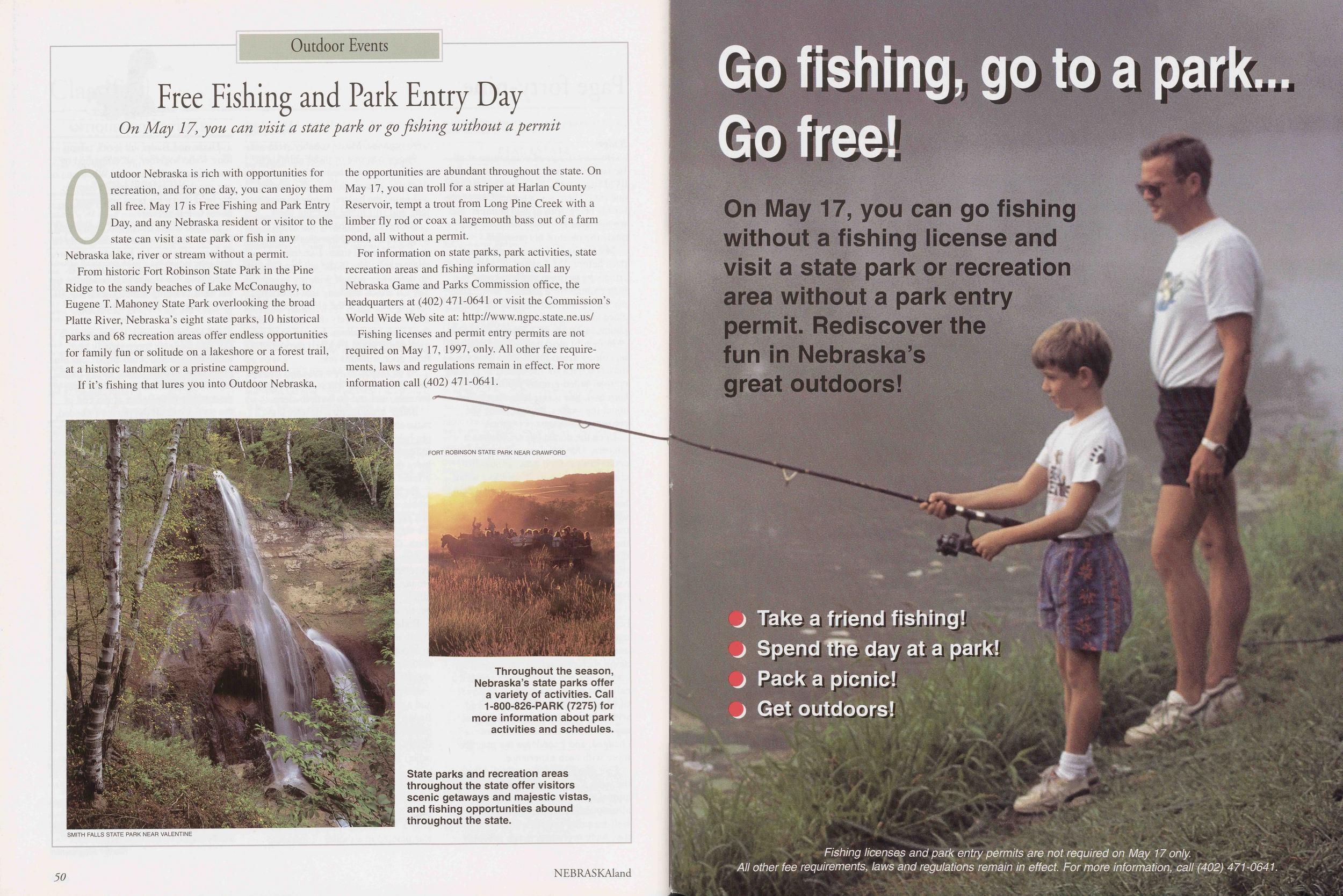
Free Fishing and Park Entry Day On May 17 you can visit a state park or go fishing without a permit Outdoor Nebraska is rich with opportunities for recreation, and for one day, you can enjoy them all free. May 17 is Free Fishing and Park Entry Day, and any Nebraska resident or visitor to the state can visit a state park or fish in any Nebraska lake, river or stream without a permit.
From historic Fort Robinson State Park in the Pine Ridge to the sandy beaches of Lake McConaughy, to Eugene T. Mahoney State Park overlooking the broad Platte River, Nebraska's eight state parks, 10 historical parks and 68 recreation areas offer endless opportunities for family fun or solitude on a lakeshore or a forest trail, at a historic landmark or a pristine campground.
If it's fishing that lures you into Outdoor Nebraska, the opportunities are abundant throughout the state. On May 17, you can troll for a striper at Harlan County Reservoir, tempt a trout from Long Pine Creek with a limber fly rod or coax a largemouth bass out of a farm pond, all without a permit.
For information on state parks, park activities, state recreation areas and fishing information call any Nebraska Game and Parks Commission office, the headquarters at (402) 471-0641 or visit the Commission's World Wide Web site at: http://www.ngpc.state.ne.us/ Fishing licenses and permit entry permits are not required on May 17, 1997, only. All other fee requirements, laws and regulations remain in effect. For more information call (402) 471-0641.
FORT ROBINSON STATE PARK NEAR CRAWFORD Throughout the season, Nebraska's state parks offer a variety of activities. Call 1-800-826-PARK (7275) for more information about park activities and schedules. State parks and recreation areas throughout the state offer visitors scenic getaways and majestic vistas, and fishing opportunities abound throughout the state. SMITH FALLS STATE PARK NEAR VALENTINE 50 NEBRASKAland
Position: 769 (14 views)