Volume 75, Issue 3, 1997
 Nebraska Game and Parks Commission
District Offices
Headquarters
2200 North 33rd Street
Lincoln, NE 68503
Phone (402) 471-0641
District Office I
Box 725
Alliance, NE 69301
Phone (308) 762-5605
District Office II
Box 508
Bassett, NE 68714
Phone (402) 684-2921
District Office III
Box 934
Norfolk, NE 68702
Phone (402) 370-3374
District Office IV
Route 4, Box 36
North Platte, NE 69101
Phone (308) 535-8025
District Office V
2200 North 33rd Street
Lincoln, NE 68503
Phone (402) 471-5558
Omaha Office
1212 Deer Park Blvd.
Omaha, NE 68108
Phone (402) 595-2144
Ak-Sar-Ben Aquarium
21502 West Highway 31
Gretna, NE 68028
Phone (402) 332-3901
World Wide Web Site: http://www.ngpc.state.ne.us
Email: ngpc@ngpsun.ngpc.state.ne.us
Conservation Officers by Region
Headquarters
Dick Turpin (Adm.) Lincoln
Ted Blume (Asst. Adm.) Lincoln
Dan Klammer Lincoln
Panhandle
Officer
Richard Furley (Sup.)
Raymond Still
Walt Meyer
John Murphy
Jim Zimmerman
Marvin Kampbell
Dennis Thompson
Dan Zuehlke
Dan Evasco
Scott Brandt
Southwest
Officer
Roger Thompson (Sup.)
Dwight Atlbery
George Sund
Matt Andrews
Jack Henderson
Dirk Greene
Virgil Gosch
Rich Routh
Northeast
Officer City
Tom Zimmer (Sup.) Norfolk
Marion Shafer Norfolk
Robert Kelly Albion
Ross Oestmann Bloomfield
L. A. Wilkinson Columbus
City
Alliance
Bridgeport
Ghadron
Crawford
Gering
Hay Springs
Ogallala
Ogallala
Oshkosh
Seottsbluff
City
N. Platte
N. Platte
Cambridge
Elwood
Gothenburg
Imperial
McCook
Rep. City
471-5531
483-5643
475-1475
Phone (308)
762-2024
262-1075
432-4398
665-2021
436-7561
638-7527
284-6450
284-4815
772-3091
635-1277
Phone (308)
532-9175
532-2753
697-4629
785-3025
537-7483
882-5328
345-2185
799-2085
Phone (402)
371-6625
371-2031
395-2538
373-4412
564-4375
Gary Ralston
Daniel Roberts
Randy Pomplun
Jon Reeves
Eric Wiebe
Steve Oberg
Sandhills
Officer
Bruce Wiebe (Sup.)
Larry Bauman
Ray Dierking
Richard Seward
Mick Gray
South-central
Officer
Jerry Pecha (Sup.)
Terry Brentzel
Tim Williams
Dale Johnson
Mark Reeves
Robert Finke
Southeast
Officer
Craig Stover (Sup.)
Murray Johnson
Douglas Kramer
Dina Hopper
William Krause
Larry Elston
Mike Luben
Duane Arp
Levi Krause
Russell Mort
Creighton 847-3284
Fremont 721-7852
Fullerton (308)536-2987
Kennard 427-7378
Ponca 755-2566
West Point 372-3062
City Phone (402)
Bassett 684-3867
Atkinson 925-5569
Brkn. Bow (308) 872-3078
Ord (308) 728-3115
Valentine 376-3136
City
York
Grand Is.
Hastings
Hebron
Loup City
Miiford
City
Lincoln
Lincoln
Lincoln
Lincoln
Auburn
Bellevue
Colon
Gretna
Louisville
Nebr. City
Phone (402)
362-5707
(308) 384-8296
463-2535
768-7363
(308)745-1126
761-3537
Phone (402)
471-5590
488-2923
466-9001
483-2358
274-3789
292-4910
443-4278
332-4954
234-2212
873-5684
Operation Game Thief 1-800-742-7627
Nebraska Game and Parks Commission
District Offices
Headquarters
2200 North 33rd Street
Lincoln, NE 68503
Phone (402) 471-0641
District Office I
Box 725
Alliance, NE 69301
Phone (308) 762-5605
District Office II
Box 508
Bassett, NE 68714
Phone (402) 684-2921
District Office III
Box 934
Norfolk, NE 68702
Phone (402) 370-3374
District Office IV
Route 4, Box 36
North Platte, NE 69101
Phone (308) 535-8025
District Office V
2200 North 33rd Street
Lincoln, NE 68503
Phone (402) 471-5558
Omaha Office
1212 Deer Park Blvd.
Omaha, NE 68108
Phone (402) 595-2144
Ak-Sar-Ben Aquarium
21502 West Highway 31
Gretna, NE 68028
Phone (402) 332-3901
World Wide Web Site: http://www.ngpc.state.ne.us
Email: ngpc@ngpsun.ngpc.state.ne.us
Conservation Officers by Region
Headquarters
Dick Turpin (Adm.) Lincoln
Ted Blume (Asst. Adm.) Lincoln
Dan Klammer Lincoln
Panhandle
Officer
Richard Furley (Sup.)
Raymond Still
Walt Meyer
John Murphy
Jim Zimmerman
Marvin Kampbell
Dennis Thompson
Dan Zuehlke
Dan Evasco
Scott Brandt
Southwest
Officer
Roger Thompson (Sup.)
Dwight Atlbery
George Sund
Matt Andrews
Jack Henderson
Dirk Greene
Virgil Gosch
Rich Routh
Northeast
Officer City
Tom Zimmer (Sup.) Norfolk
Marion Shafer Norfolk
Robert Kelly Albion
Ross Oestmann Bloomfield
L. A. Wilkinson Columbus
City
Alliance
Bridgeport
Ghadron
Crawford
Gering
Hay Springs
Ogallala
Ogallala
Oshkosh
Seottsbluff
City
N. Platte
N. Platte
Cambridge
Elwood
Gothenburg
Imperial
McCook
Rep. City
471-5531
483-5643
475-1475
Phone (308)
762-2024
262-1075
432-4398
665-2021
436-7561
638-7527
284-6450
284-4815
772-3091
635-1277
Phone (308)
532-9175
532-2753
697-4629
785-3025
537-7483
882-5328
345-2185
799-2085
Phone (402)
371-6625
371-2031
395-2538
373-4412
564-4375
Gary Ralston
Daniel Roberts
Randy Pomplun
Jon Reeves
Eric Wiebe
Steve Oberg
Sandhills
Officer
Bruce Wiebe (Sup.)
Larry Bauman
Ray Dierking
Richard Seward
Mick Gray
South-central
Officer
Jerry Pecha (Sup.)
Terry Brentzel
Tim Williams
Dale Johnson
Mark Reeves
Robert Finke
Southeast
Officer
Craig Stover (Sup.)
Murray Johnson
Douglas Kramer
Dina Hopper
William Krause
Larry Elston
Mike Luben
Duane Arp
Levi Krause
Russell Mort
Creighton 847-3284
Fremont 721-7852
Fullerton (308)536-2987
Kennard 427-7378
Ponca 755-2566
West Point 372-3062
City Phone (402)
Bassett 684-3867
Atkinson 925-5569
Brkn. Bow (308) 872-3078
Ord (308) 728-3115
Valentine 376-3136
City
York
Grand Is.
Hastings
Hebron
Loup City
Miiford
City
Lincoln
Lincoln
Lincoln
Lincoln
Auburn
Bellevue
Colon
Gretna
Louisville
Nebr. City
Phone (402)
362-5707
(308) 384-8296
463-2535
768-7363
(308)745-1126
761-3537
Phone (402)
471-5590
488-2923
466-9001
483-2358
274-3789
292-4910
443-4278
332-4954
234-2212
873-5684
Operation Game Thief 1-800-742-7627
Letters
Blowin' in the WindWhen transplanted by the railroad to southwestern Nebraska, I immediately became aware of two constants: the ever-present winds and the sharp wit of the Nebraska people. The essence of both these qualities was admirably expressed by Jon Farrar in his essay "Blowin' in the Wind" [Page forty-nine, March 1997]. Excellent reading, as was the entire March issue.
Rik CharbonneauxMcCook, Nebraska
Too Many GeeseMy compliments to NEBRASKAland and R Joe Gabig for the informative article, "Too Many Geese" [December 1996]. It cannot be overemphasized that the effects of one species on habitat affects all the species using the habitat.
As noted, the Central Fly way had recognized the problem of too many geese and habitat damage by 1982, yet the first "treatments" didn't come until 1990 and 1992, and the average harvests suggest the liberalized regulations might not have been much help. I hope the recommendations of the Arctic Goose Joint Venture will be implemented in time, and that they will be successful.
Harvey W. MillerMontrose, Colorado
Blizzard MemoriesCongratulations on a great magazine. We have enjoyed features in every issue for many years.
"Blizzard" by Polly Spence [December 1996] and the reliance of Nebraskans on radio reports over stations such as KLZ, KOLT and KOTA brought back memories of my experience in that snow-blanketed winter when I was farm editor for WOW radio and television.
WOWT went on the air in August 1949, and the storm that began in '49 and extended into '50 was covered by our crew with black-and-white still pictures taken by a Speed Graphic, the only way we had of displaying news events visually in those early TV days.
Malvin L. HansenOmaha, Nebraska
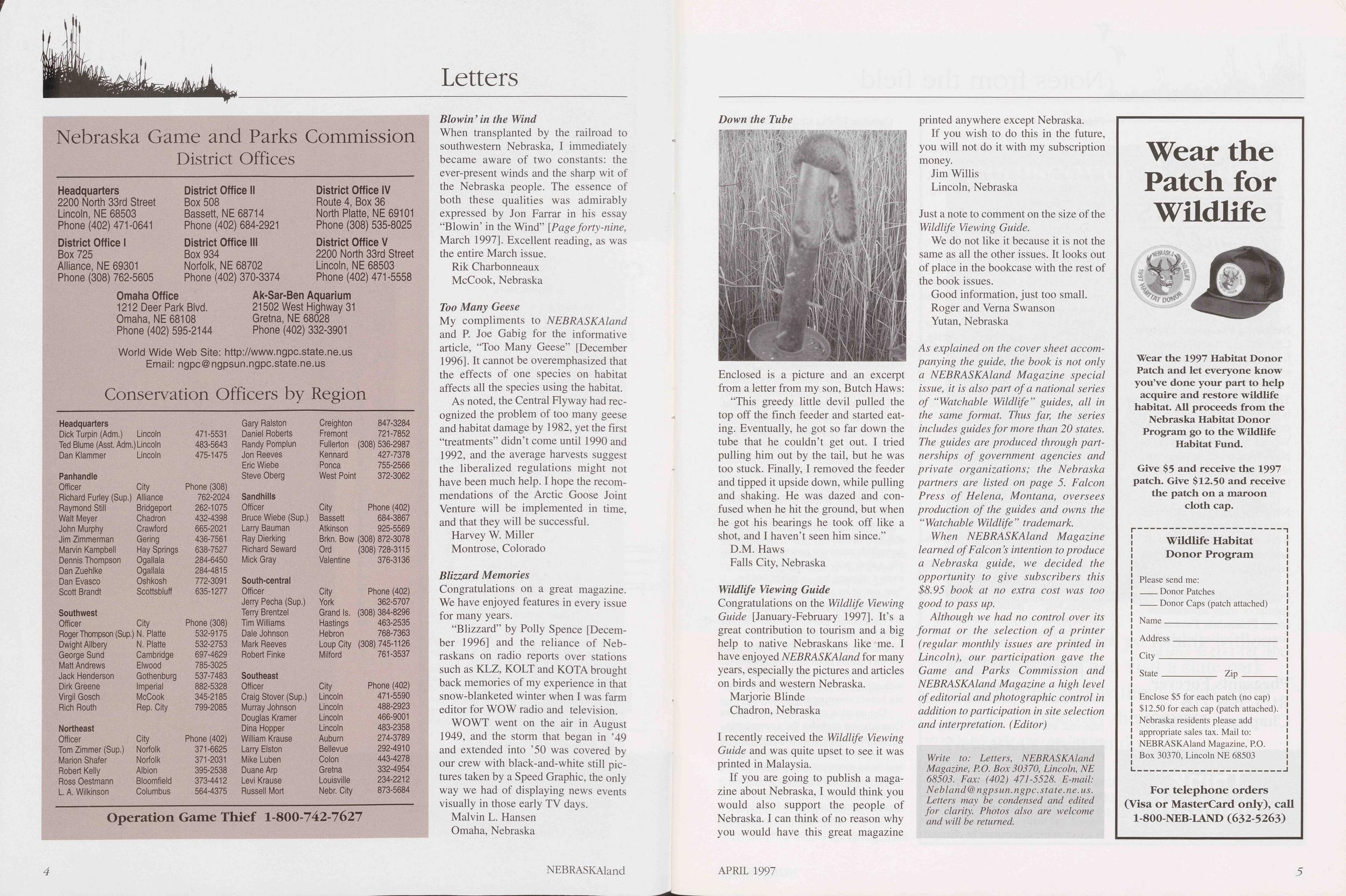
4 NEBRASKAland Down the TubeEnclosed is a picture and an excerpt from a letter from my son, Butch Haws:
"This greedy little devil pulled the top off the finch feeder and started eating. Eventually, he got so far down the tube that he couldn't get out. I tried pulling him out by the tail, but he was too stuck. Finally, I removed the feeder and tipped it upside down, while pulling and shaking. He was dazed and confused when he hit the ground, but when he got his bearings he took off like a shot, and I haven't seen him since."
D.M. HawsFalls City, Nebraska
Wildlife Viewing GuideCongratulations on the Wildlife Viewing Guide [January-February 1997]. It's a great contribution to tourism and a big help to native Nebraskans like me. I have enjoyed NEBRASKAland for many years, especially the pictures and articles on birds and western Nebraska.
Marjorie BlindeChadron, Nebraska
I recently received the Wildlife Viewing Guide and was quite upset to see it was printed in Malaysia.
If you are going to publish a magazine about Nebraska, I would think you would also support the people of Nebraska. I can think of no reason why you would have this great magazine printed anywhere except Nebraska.
If you wish to do this in the future, you will not do it with my subscription money.
Jim WillisLincoln, Nebraska
Just a note to comment on the size of the Wildlife Viewing Guide.
We do not like it because it is not the same as all the other issues. It looks out of place in the bookcase with the rest of the book issues.
Good information, just too small.
Roger and Verna SwansonYutan, Nebraska
As explained on the cover sheet accompanying the guide, the book is not only a NEBRASKAland Magazine special issue, it is also part of a national series of uWatchable Wildlife" guides, all in the same format. Thus far, the series includes guides for more than 20 states. The guides are produced through partnerships of government agencies and private organizations; the Nebraska partners are listed on page 5. Falcon Press of Helena, Montana, oversees production of the guides and owns the "Watchable Wildlife" trademark.
When NEBRASKAland Magazine learned of Falcon's intention to produce a Nebraska guide, we decided the opportunity to give subscribers this $8.95 book at no extra cost was too good to pass up.
Although we had no control over its format or the selection of a printer (regular monthly issues are printed in Lincoln), our participation gave the Game and Parks Commission and NEBRASKAland Magazine a high level of editorial and photographic control in addition to participation in site selection and interpretation. (Editor)
Write to: Letters, NEBRASKAland Magazine, P.O. Box 30370, Lincoln, NE 68503. Fax: (402) 471-5528. E-mail: Nebland@ngpsun.ngpc. state, NE. us. Letters may be condensed and edited for clarity. Photos also are welcome and will be returned.
Notes from the field
Things DieAlmost unnoticed, death occurs every day in the out-of-doors: animals die. We all know that, or at least we should know, but we rarely witness it, and often we fail to perceive the magnitude of the event.
Wildlife deaths can be attributed to several factors, including disease, predation, starvation, environmental influences, injury and, rarely, age. Death is as much a part of the life cycle as birth, and both the birth rate and the death rate are high among most wildlife species.
Among some species, 70 percent or more of the young produced in spring will have perished by year's end, with luck reducing the population only to the approximate carrying capacity of the habitat it occupies. In a species with a high birth rate, the death of 70 percent of the young means death comes to a phenomenal number of individual animals, but the loss of an individual is insignificant to the total population unless it is endangered or threatened.
Most people are oblivious to the large-scale die-offs that occur when populations exceed the land's carrying capacity. Disease, starvation and predation are secretive killers in the wild.
Some people, however, occasionally encounter a distressed animal for whom death seems inevitable unless it receives help — perhaps an animal with a recent injury, such as a robin with a broken wing — and they want to help it.
Some of those people call the Game and Parks Commission. Surely, they think, the people at Game and Parks will scramble like paramedics responding to a major trauma when the call is received, and some callers are disappointed and angry when that is not the response they get.
It is often said that it is a cruel world out there. Actually, and more appropriately, it should be said that it is a natural world out there. Wild animals get injured, and many of them die. Mortality is a fact of life that cannot be changed.
Game and Parks Commission biologists are sensitive to wildlife injuries, but they are also aware that little, if anything, can be done to treat the injuries to many wild animals. Often the animals are highly resistant to human handling and treatment. Veterinarians are not equipped to treat a robin's broken wing, for example, nor are they equipped to nourish the bird during its recuperation. Feather damage alone can require holding a bird through an entire molt cycle before it could survive on its own.
Facilities and funding simply are not available for widespread wildlife trauma care. A few volunteer facilities do exist, but they are not centrally located, and receiving an animal, notifying the rehabilitation center and transporting the animals is costly in personnel time and equipment. Many animals brought to Game and Parks Commission biologists to be assessed for rehabilitation are not good candidates for treatment.
Animals judged unlikely to survive are usually dispatched quickly and humanely, sparing the animal the cruelty of treatment it cannot understand, and in most cases will not tolerate or survive.
In other cases, wildlife injuries are left untreated, since most animals have incredible recovery powers. For example, a deer with a damaged leg — or even a missing leg — might not be "put out of its misery." Every year at deer hunting check stations, a few deer are received that have lost legs through previous injuries but have totally healed. In most cases, the hunters report that the deer's mobility was unimpaired and the hunter had no indication that the deer had a missing leg before shooting it.
The mission of the Game and Parks Commission includes the stewardship of the state's fish and wildlife in the best long-term interests of the people and those resources. Stewardship refers to the overall management of species populations and the habitat supporting them, and its time, effort, knowledge and budget must be devoted to programs and management techniques that will 6 NEBRASKAland best benefit wildlife populations and species. Doing less or targeting individual animals would not be in the best long-term interests of the people and the resources.
Improving habitat and managing the harvest is the key to successful wildlife management. Spending countless hours locating, capturing and treating individual animals with injuries that occurred naturally means nothing to the overall population of the species, and usually it means nothing to the individual animal because it is so unlikely to recuperate fully.
Because raptors — birds of prey such as hawks, eagles and owls — seem to have a high incidence of injuries, and rehabilitation efforts are reasonably successful with birds of prey, the Commission works closely with the Raptor Recovery Center in Elmwood. The center accepts injured or sick hawks, owls and eagles, and a network of volunteers across the state shuttles the birds to the center. After treatment and recovery, volunteers acclimate birds for return to the wild.
If you find an injured raptor, approach cautiously; their feet, talons and beaks are powerful weapons, and an injured bird will see you as a further threat to its well-being, not as a rescuer. Do not attempt to treat or feed a bird yourself. A well-meant attempt can result in further injury or death, and time is crucial. Contact the Raptor Recovery Center or the Game and Parks Commission immediately. If you must transport a bird yourself, use a cardboard box just large enough to allow the bird some movement. Ventilation is important. A confined bird can overheat quickly.
For information about the center's work and tips on handling injured raptors and other wildlife, see "Return to the Wild," NEBRASKAland Magazine, March 1993. The center's address and telephone number are no longer as listed in the article. The current address is 2730 Adams St., Elmwood, NE 68349, telephone (402) 994-2009.
Rocky Hoffmann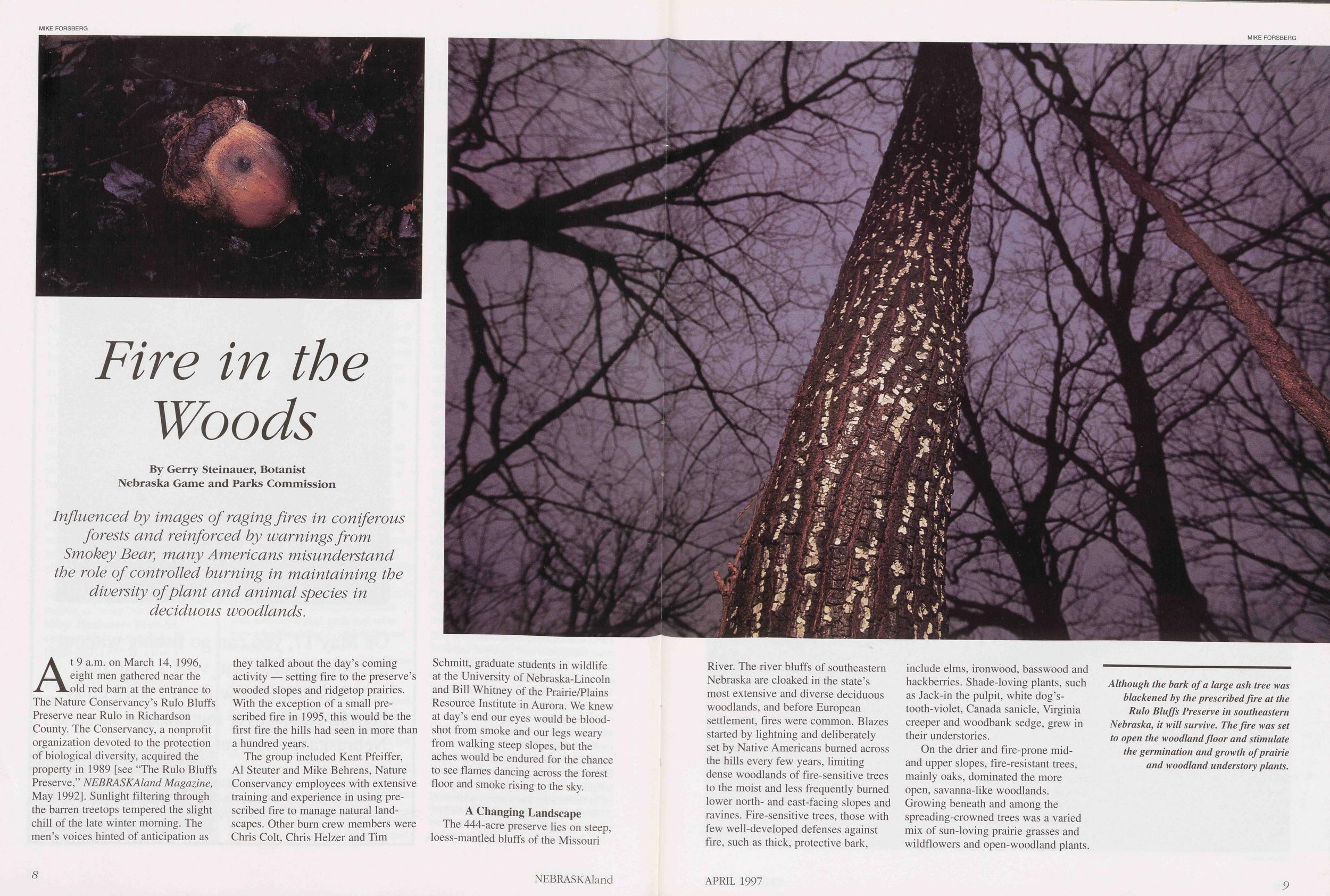
Fire in the Woods
Influenced by images of raging fires in coniferous forests and reinforced by warnings from Smokey Bear, many Americans misunderstand the role of controlled burning in maintaining the diversity of plant and animal species in deciduous woodlands.
At 9 a.m. on March 14, 1996, eight men gathered near the old red barn at the entrance to The Nature Conservancy's Rulo Bluffs Preserve near Rulo in Richardson County. The Conservancy, a nonprofit organization devoted to the protection of biological diversity, acquired the property in 1989 [see "The Rulo Bluffs Preserve," NEBRASKAland Magazine, May 1992]. Sunlight filtering through the barren treetops tempered the slight chill of the late winter morning. The men's voices hinted of anticipation as they talked about the day's coming activity — setting fire to the preserve's wooded slopes and ridgetop prairies. With the exception of a small prescribed fire in 1995, this would be the first fire the hills had seen in more than a hundred years.
The group included Kent Pfeiffer, Al Steuter and Mike Behrens, Nature Conservancy employees with extensive training and experience in using prescribed fire to manage natural landscapes. Other burn crew members were Chris Colt, Chris Helzer and Tim Schmitt, graduate students in wildlife at the University of Nebraska-Lincoln and Bill Whitney of the Prairie/Plains Resource Institute in Aurora. We knew at day's end our eyes would be bloodshot from smoke and our legs weary from walking steep slopes, but the aches would be endured for the chance to see flames dancing across the forest floor and smoke rising to the sky.
A Changing LandscapeThe 444-acre preserve lies on steep, loess-mantled bluffs of the Missouri
8 NEBRASKAlandRiver. The river bluffs of southeastern Nebraska are cloaked in the state's most extensive and diverse deciduous woodlands, and before European settlement, fires were common. Blazes started by lightning and deliberately set by Native Americans burned across the hills every few years, limiting dense woodlands of fire-sensitive trees to the moist and less frequently burned lower north- and east-facing slopes and ravines. Fire-sensitive trees, those with few well-developed defenses against fire, such as thick, protective bark, include elms, ironwood, basswood and hackberries. Shade-loving plants, such as Jack-in the pulpit, white dog's-tooth-violet, Canada sanicle, Virginia creeper and woodbank sedge, grew in their understories.
On the drier and fire-prone mid-and upper slopes, fire-resistant trees, mainly oaks, dominated the more open, savanna-like woodlands. Growing beneath and among the spreading-crowned trees was a varied mix of sun-loving prairie grasses and wildflowers and open-woodland plants.
Although the bark of a large ash tree was blackened by the prescribed fire at the Rulo Bluffs Preserve in southeastern Nebraska, it will survive. The fire was set to open the woodland floor and stimulate the germination and growth of prairie and woodland understory plants. APRIL 1997 9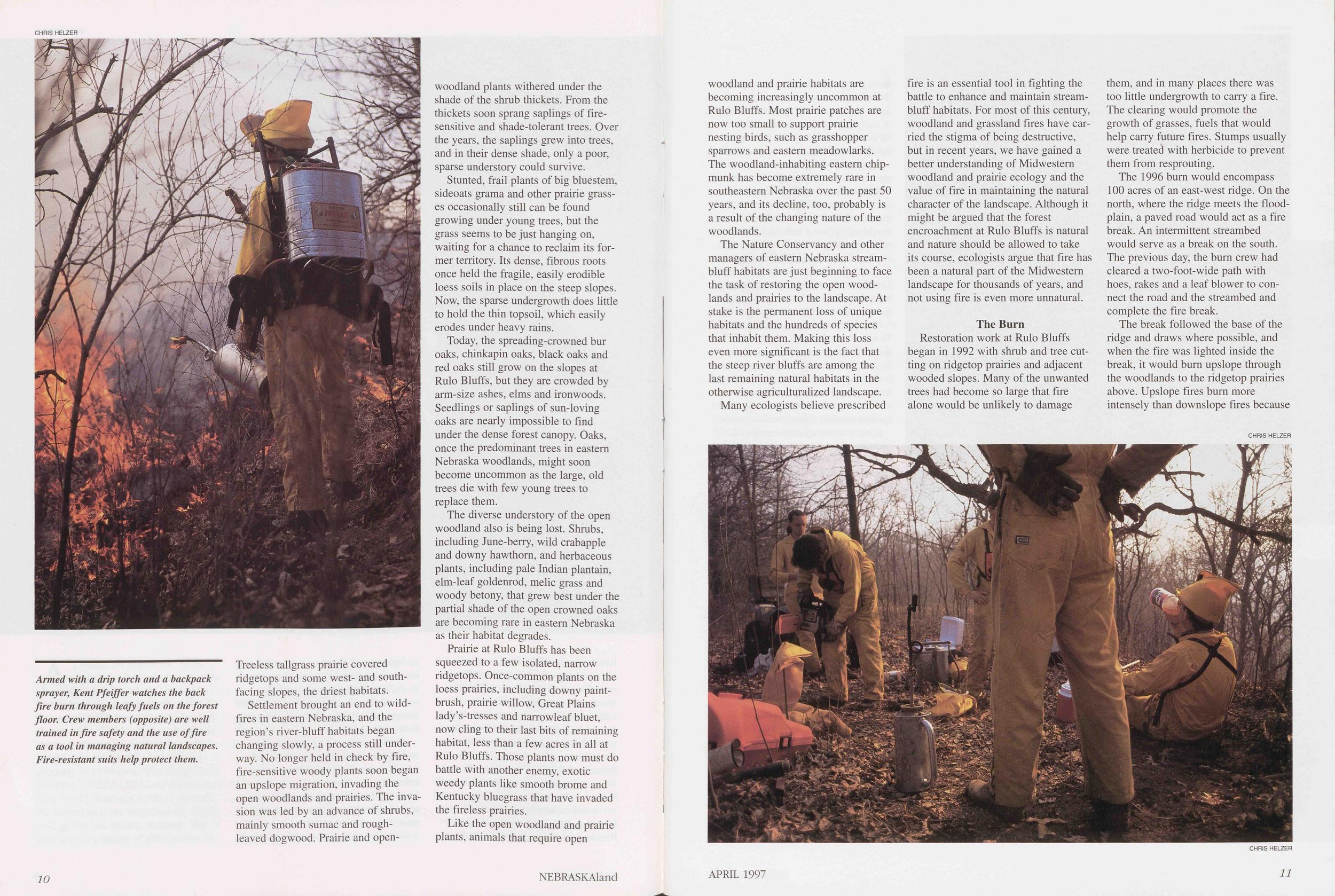
Treeless tallgrass prairie covered ridgetops and some west- and south-facing slopes, the driest habitats.
Settlement brought an end to wildfires in eastern Nebraska, and the region's river-bluff habitats began changing slowly, a process still underway. No longer held in check by fire, fire-sensitive woody plants soon began an upslope migration, invading the open woodlands and prairies. The invasion was led by an advance of shrubs, mainly smooth sumac and rough-leaved dogwood. Prairie and open-woodland plants withered under the shade of the shrub thickets. From the thickets soon sprang saplings of fire-sensitive and shade-tolerant trees. Over the years, the saplings grew into trees, and in their dense shade, only a poor, sparse understory could survive.
Stunted, frail plants of big bluestem, sideoats grama and other prairie grasses occasionally still can be found growing under young trees, but the grass seems to be just hanging on, waiting for a chance to reclaim its former territory. Its dense, fibrous roots once held the fragile, easily erodible loess soils in place on the steep slopes. Now, the sparse undergrowth does little to hold the thin topsoil, which easily erodes under heavy rains.
Today, the spreading-crowned bur oaks, chinkapin oaks, black oaks and red oaks still grow on the slopes at Rulo Bluffs, but they are crowded by arm-size ashes, elms and iron woods. Seedlings or saplings of sun-loving oaks are nearly impossible to find under the dense forest canopy. Oaks, once the predominant trees in eastern Nebraska woodlands, might soon become uncommon as the large, old trees die with few young trees to replace them.
The diverse understory of the open woodland also is being lost. Shrubs, including June-berry, wild crabapple and downy hawthorn, and herbaceous plants, including pale Indian plantain, elm-leaf goldenrod, melic grass and woody betony, that grew best under the partial shade of the open crowned oaks are becoming rare in eastern Nebraska as their habitat degrades.
Prairie at Rulo Bluffs has been squeezed to a few isolated, narrow ridgetops. Once-common plants on the loess prairies, including downy paintbrush, prairie willow, Great Plains lady's-tresses and narrowleaf bluet, now cling to their last bits of remaining habitat, less than a few acres in all at Rulo Bluffs. Those plants now must do battle with another enemy, exotic weedy plants like smooth brome and Kentucky bluegrass that have invaded the fireless prairies.
Like the open woodland and prairie plants, animals that require open 10 NEBRASKAland woodland and prairie habitats are becoming increasingly uncommon at Rulo Bluffs. Most prairie patches are now too small to support prairie nesting birds, such as grasshopper sparrows and eastern meadowlarks. The woodland-inhabiting eastern chipmunk has become extremely rare in southeastern Nebraska over the past 50 years, and its decline, too, probably is a result of the changing nature of the woodlands.
The Nature Conservancy and other managers of eastern Nebraska streambluff habitats are just beginning to face the task of restoring the open woodlands and prairies to the landscape. At stake is the permanent loss of unique habitats and the hundreds of species that inhabit them. Making this loss even more significant is the fact that the steep river bluffs are among the last remaining natural habitats in the otherwise agriculturalized landscape.
Many ecologists believe prescribed fire is an essential tool in fighting the battle to enhance and maintain stream- bluff habitats. For most of this century, woodland and grassland fires have carried the stigma of being destructive, but in recent years, we have gained a better understanding of Midwestern woodland and prairie ecology and the value of fire in maintaining the natural character of the landscape. Although it might be argued that the forest encroachment at Rulo Bluffs is natural and nature should be allowed to take its course, ecologists argue that fire has been a natural part of the Midwestern landscape for thousands of years, and not using fire is even more unnatural.
The BurnRestoration work at Rulo Bluffs began in 1992 with shrub and tree cutting on ridgetop prairies and adjacent wooded slopes. Many of the unwanted trees had become so large that fire alone would be unlikely to damage them, and in many places there was too little undergrowth to carry a fire. The clearing would promote the growth of grasses, fuels that would help carry future fires. Stumps usually were treated with herbicide to prevent them from resprouting.
The 1996 burn would encompass 100 acres of an east-west ridge. On the north, where the ridge meets the floodplain, a paved road would act as a fire break. An intermittent streambed would serve as a break on the south. The previous day, the burn crew had cleared a two-foot-wide path with hoes, rakes and a leaf blower to connect the road and the streambed and complete the fire break.
The break followed the base of the ridge and draws where possible, and when the fire was lighted inside the break, it would burn upslope through the woodlands to the ridgetop prairies above. Upslope fires burn more intensely than downslope fires because
the flame tips are in close contact with upcoming fuels, drying and preheating them and prompting their ignition.
Back at the barn, Kent, the burn crew leader, went over the burn plan with the crew one last time. The local fire department and adjacent landowners had been contacted in advance to prevent concern when the billowing smoke appeared later that day. A short section of break still had to be cleared, and the hour it took gave the breeze a chance to pick up and the morning-damp leaf and grass fuels a chance to dry. Both would help carry the fire through the woodlands. Deciduous woodland burns are best conducted under dry conditions in late fall, winter or early spring when adequate leaf litter is present to carry the fire through the otherwise fuel-sparse understories.
By late morning, the crew had gathered on the south side of the unit where the fire would be started. Kent made one last call to the weather station to confirm that wind conditions would still allow a safe burn, and the crew donned yellow, fire-proof suits and hardhats. A small fire was lighted and extinguished to test the leafy fuels. Satisfied they would burn adequately, but safely, the crew was ready to start the main fire.
The crew was split into two teams. To spread the fire and control its progress, each team was armed with a drip torch fueled by a mixture of diesel fuel and gasoline, five-gallon backpack water sprayers, rakes and "flappers," thick rubber pads on wooden handles used to smother flames.
A slow-moving, easy-to-control backfire was started downwind on the south side of the unit, and the teams spread the backfire in opposite directions along the break, staying in radio contact as they went. Moving around the roughly rectangular unit, the crews eventually had the wind at their backs, and the fire became a headfire. Pushed by the wind, headfires burn with more speed and are more dangerous than backfires, but by the time the headfire started, the backfire had blackened a wide zone of safety downwind. Eventually, the two crews met along the north side, and the unit was encircled by the inward-burning fire
On particularly damp north-facing slopes and areas nearly devoid of leaf litter, the fire moved slowly, leaving unburned patches. In leaf-filled draws, three- to eight-foot flames licked skyward. Small red cedar trees caught by the flames crackled into puffs of fire as the highly volatile oils in their stems and leaves heated, vaporized and ignited. Moving upslope, the fire eventually reached fingers of prairie. Fed by the grassy fuels, the four- to 12-foot flames raced quickly upslope, slowing only when the fire reached the woods on the opposite side of the ridge, leaving 12 NEBRASKAland scorched dogwood and sumac stems in its wake.
It was evident that prairie and woodland fires are different. The abundant, fine grassy fuels burn faster than the leafy woodland fuels. Because grassland fires are so fast, burn crews sometimes have little time to react to problems, such as fire jumping a break. Deciduous woodland fires are comparatively slow moving, giving crews more time to react. Because prescribed woodland burns are slow, however, there is more time for problems to develop, such as changes in wind speed or direction. Deciduous woodland burns also must be designed to keep the dense smoke away from roads and houses.
After about five hours, the fire was slowly burning itself out, its flames visible only in a few areas. Several crew members still patrolled the fire break, while others set fire to small prairie patches the fire did not reach. Walking over the ashy slopes, it was evident that the prescribed fire was tame compared to television images of wildfire. Wildfires, such as the 1989 Yellowstone and Pine Ridge fires, fed by decades of accumulated pine needles and fallen timber, burned coniferous woodlands under tinder-dry conditions and high winds. They frequently leapt into the tree crowns and burned from tree to tree, killing many trees.
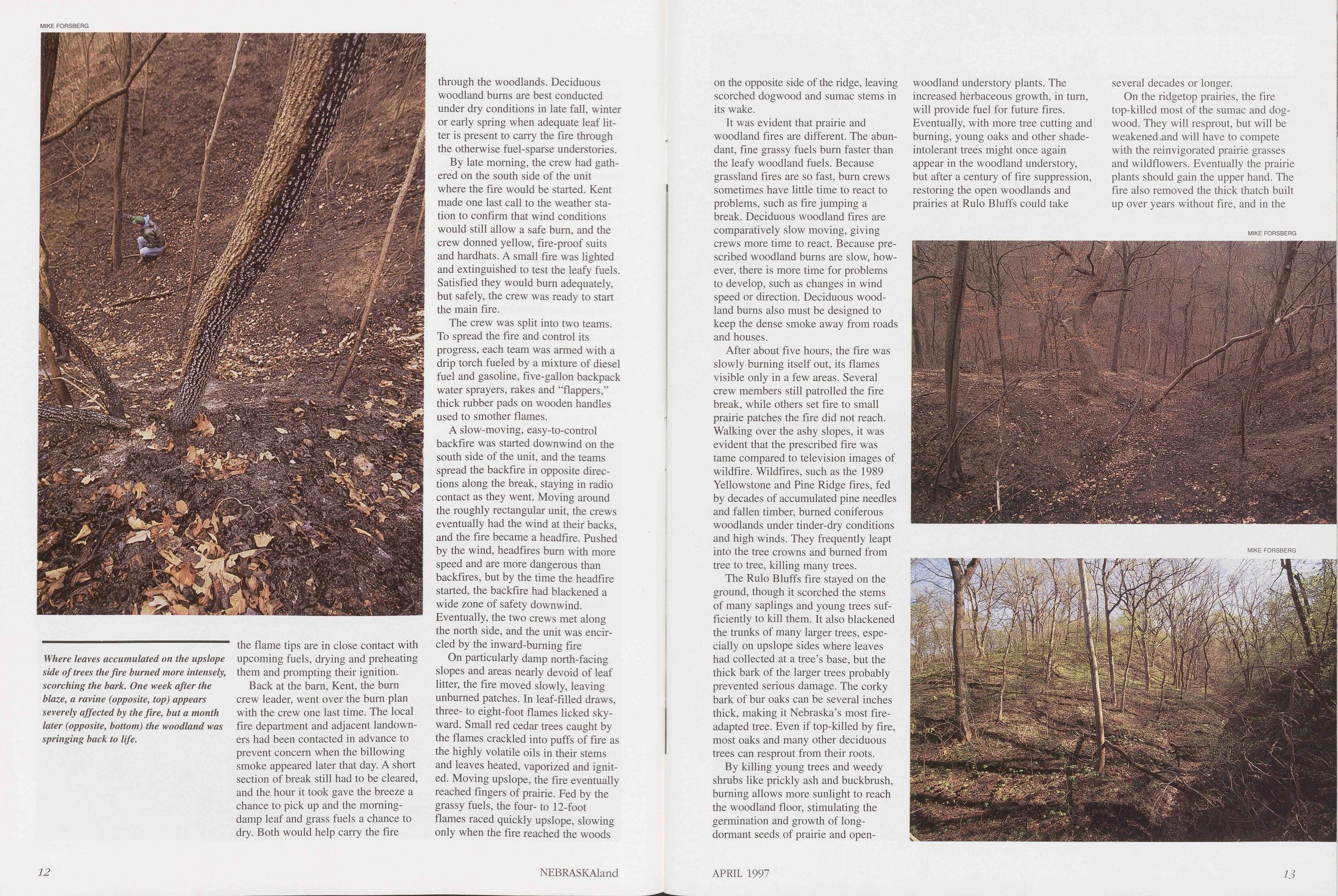
The Rulo Bluffs fire stayed on the ground, though it scorched the stems of many saplings and young trees sufficiently to kill them. It also blackened the trunks of many larger trees, especially on upslope sides where leaves had collected at a tree's base, but the thick bark of the larger trees probably prevented serious damage. The corky bark of bur oaks can be several inches thick, making it Nebraska's most fire-adapted tree. Even if top-killed by fire, most oaks and many other deciduous trees can resprout from their roots.
By killing young trees and weedy shrubs like prickly ash and buckbrush, burning allows more sunlight to reach the woodland floor, stimulating the germination and growth of long-dormant seeds of prairie and open-woodland understory plants. The increased herbaceous growth, in turn, will provide fuel for future fires. Eventually, with more tree cutting and burning, young oaks and other shade-intolerant trees might once again appear in the woodland understory, but after a century of fire suppression, restoring the open woodlands and prairies at Rulo Bluffs could take several decades or longer.
On the ridgetop prairies, the fire top-killed most of the sumac and dogwood. They will resprout, but will be weakened and will have to compete with the reinvigorated prairie grasses and wildflowers. Eventually the prairie plants should gain the upper hand. The fire also removed the thick thatch built up over years without fire, and in the
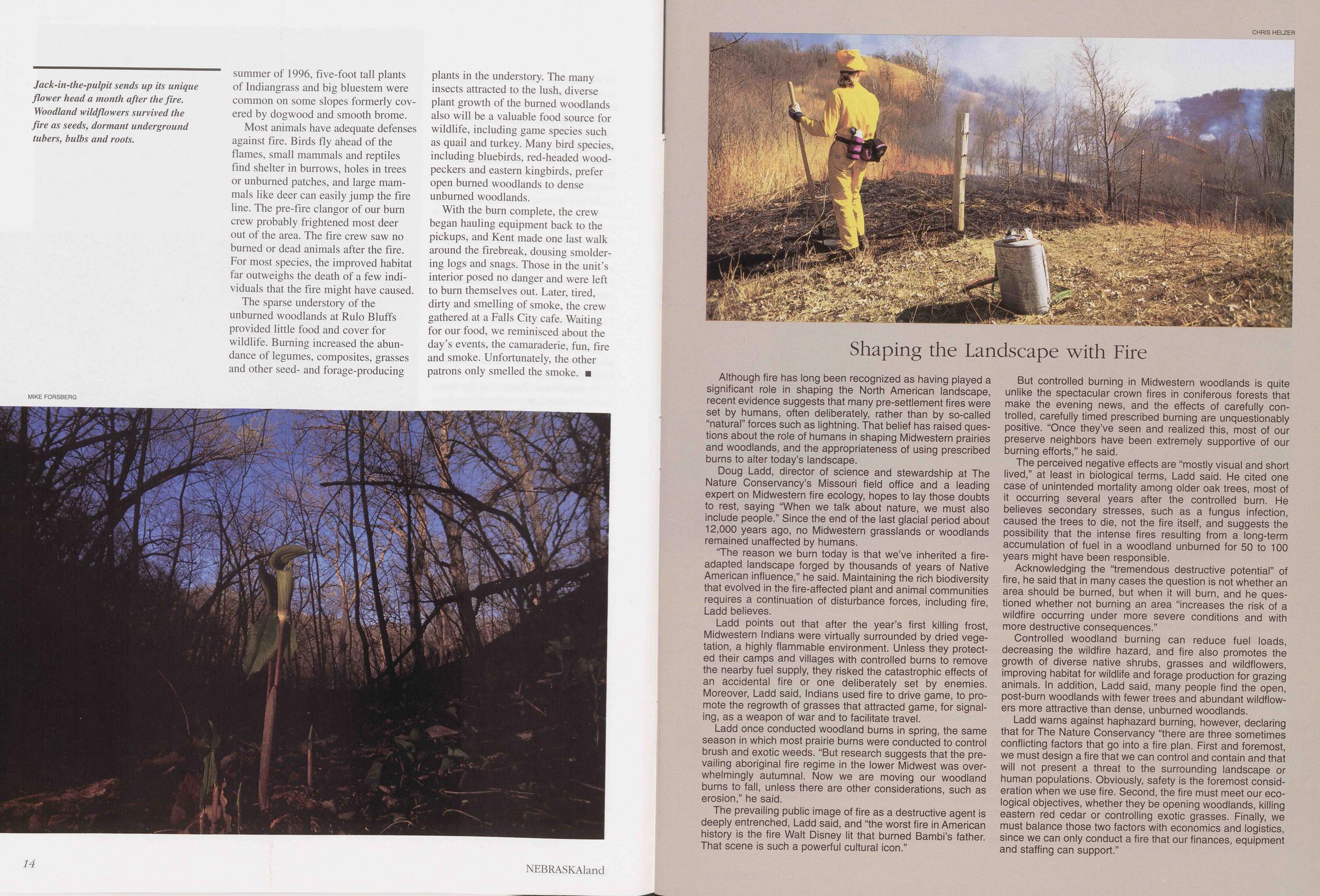
summer of 1996, five-foot tall plants of Indiangrass and big bluestem were common on some slopes formerly covered by dogwood and smooth brome.
Most animals have adequate defenses against fire. Birds fly ahead of the flames, small mammals and reptiles find shelter in burrows, holes in trees or unburned patches, and large mammals like deer can easily jump the fire line. The pre-fire clangor of our burn crew probably frightened most deer out of the area. The fire crew saw no burned or dead animals after the fire. For most species, the improved habitat far outweighs the death of a few individuals that the fire might have caused.
The sparse understory of the unburned woodlands at Rulo Bluffs provided little food and cover for wildlife. Burning increased the abundance of legumes, composites, grasses and other seed- and forage-producing plants in the understory. The many insects attracted to the lush, diverse plant growth of the burned woodlands also will be a valuable food source for wildlife, including game species such as quail and turkey. Many bird species, including bluebirds, red-headed woodpeckers and eastern kingbirds, prefer open burned woodlands to dense unburned woodlands.
With the burn complete, the crew began hauling equipment back to the pickups, and Kent made one last walk around the firebreak, dousing smoldering logs and snags. Those in the unit's interior posed no danger and were left to burn themselves out. Later, tired, dirty and smelling of smoke, the crew gathered at a Falls City cafe. Waiting for our food, we reminisced about the day's events, the camaraderie, fun, fire and smoke. Unfortunately, the other patrons only smelled the smoke.
Shaping the Landscape with Fire
Although fire has long been recognized as having played a significant role in shaping the North American landscape, recent evidence suggests that many pre-settlement fires were set by humans, often deliberately, rather than by so-called "natural" forces such as lightning. That belief has raised questions about the role of humans in shaping Midwestern prairies and woodlands, and the appropriateness of using prescribed burns to alter today's landscape.
Doug Ladd, director of science and stewardship at The Nature Conservancy's Missouri field office and a leading expert on Midwestern fire ecology, hopes to lay those doubts to rest, saying "When we talk about nature, we must also include people." Since the end of the last glacial period about 12,000 years ago, no Midwestern grasslands or woodlands remained unaffected by humans.
"The reason we burn today is that we've inherited a fire-adapted landscape forged by thousands of years of Native American influence," he said. Maintaining the rich biodiversity that evolved in the fire-affected plant and animal communities requires a continuation of disturbance forces, including fire, Ladd believes.
Ladd points out that after the year's first killing frost, Midwestern Indians were virtually surrounded by dried vegetation, a highly flammable environment. Unless they protect- ed their camps and villages with controlled burns to remove the nearby fuel supply, they risked the catastrophic effects of an accidental fire or one deliberately set by enemies. Moreover, Ladd said, Indians used fire to drive game, to promote the regrowth of grasses that attracted game, for signaling, as a weapon of war and to facilitate travel.
Ladd once conducted woodland burns in spring, the same season in which most prairie burns were conducted to control brush and exotic weeds. "But research suggests that the prevailing aboriginal fire regime in the lower Midwest was overwhelmingly autumnal. Now we are moving our woodland burns to fall, unless there are other considerations, such as erosion," he said.
The prevailing public image of fire as a destructive agent is deeply entrenched, Ladd said, and "the worst fire in American history is the fire Walt Disney lit that burned Bambi's father. That scene is such a powerful cultural icon."
But controlled burning in Midwestern woodlands is quite unlike the spectacular crown fires in coniferous forests that make the evening news, and the effects of carefully controlled, carefully timed prescribed burning are unquestionably positive. "Once they've seen and realized this, most of our preserve neighbors have been extremely supportive of our burning efforts," he said.
The perceived negative effects are "mostly visual and short lived," at least in biological terms, Ladd said. He cited one case of unintended mortality among older oak trees, most of it occurring several years after the controlled burn. He believes secondary stresses, such as a fungus infection, caused the trees to die, not the fire itself, and suggests the possibility that the intense fires resulting from a long-term accumulation of fuel in a woodland unburned for 50 to 100 years might have been responsible.
Acknowledging the "tremendous destructive potential" of fire, he said that in many cases the question is not whether an area should be burned, but when it will burn, and he questioned whether not burning an area "increases the risk of a wildfire occurring under more severe conditions and with more destructive consequences."
Controlled woodland burning can reduce fuel loads, decreasing the wildfire hazard, and fire also promotes the growth of diverse native shrubs, grasses and wildflowers, improving habitat for wildlife and forage production for grazing animals. In addition, Ladd said, many people find the open, post-burn woodlands with fewer trees and abundant wildflowers more attractive than dense, unburned woodlands.
Ladd warns against haphazard burning, however, declaring that for The Nature Conservancy "there are three sometimes conflicting factors that go into a fire plan. First and foremost, we must design a fire that we can control and contain and that will not present a threat to the surrounding landscape or human populations. Obviously, safety is the foremost consideration when we use fire. Second, the fire must meet our ecological objectives, whether they be opening woodlands, killing eastern red cedar or controlling exotic grasses. Finally, we must balance those two factors with economics and logistics, since we can only conduct a fire that our finances, equipment and staffing can support."
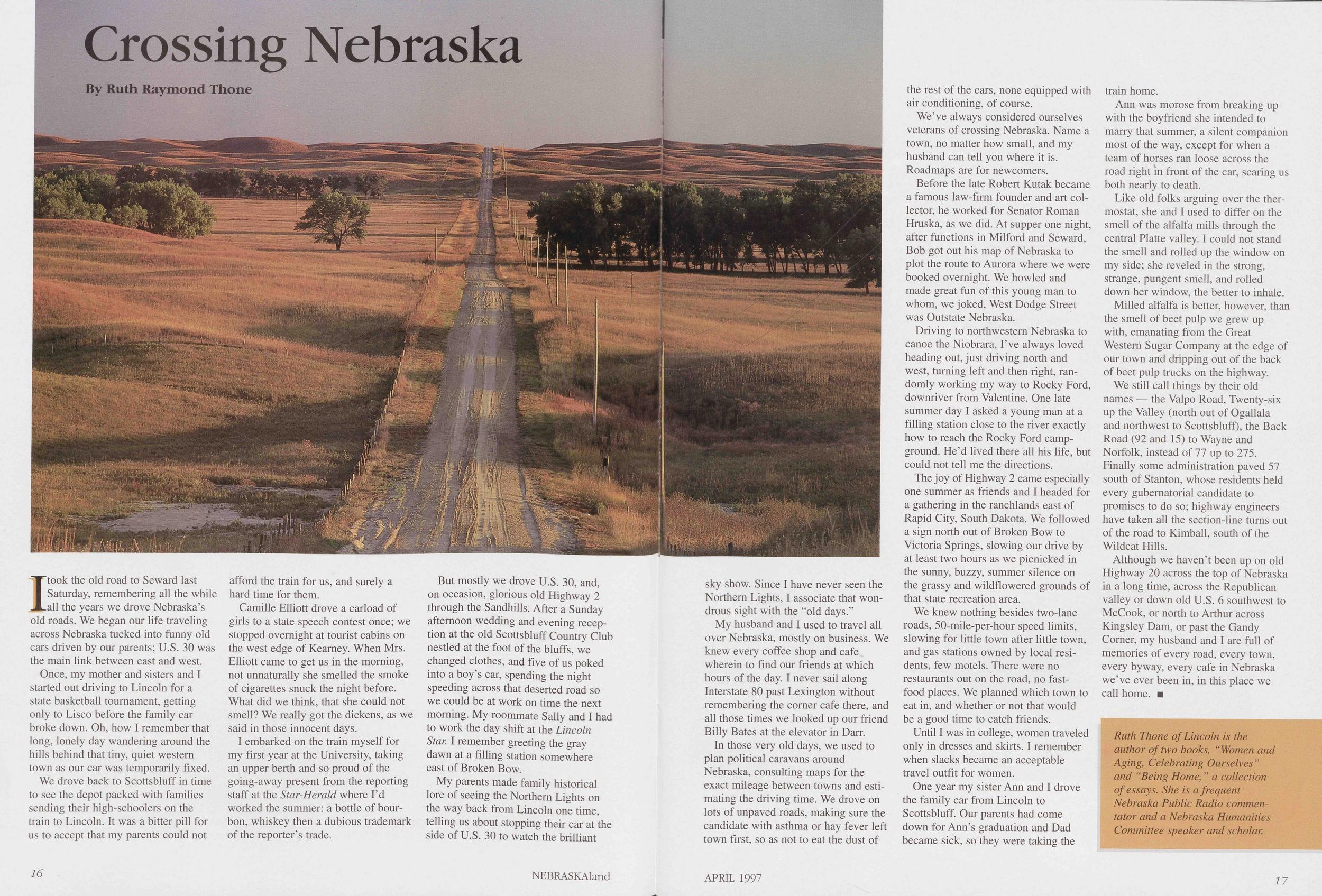
Crossing Nebraska
I took the old road to Seward last Saturday, remembering all the while all the years we drove Nebraska's old roads. We began our life traveling across Nebraska tucked into funny old cars driven by our parents; U.S. 30 was the main link between east and west.
Once, my mother and sisters and I started out driving to Lincoln for a state basketball tournament, getting only to Lisco before the family car broke down. Oh, how I remember that long, lonely day wandering around the hills behind that tiny, quiet western town as our car was temporarily fixed.
We drove back to Scottsbluff in time to see the depot packed with families sending their high-schoolers on the train to Lincoln. It was a bitter pill for us to accept that my parents could not afford the train for us, and surely a hard time for them.
Camille Elliott drove a carload of girls to a state speech contest once; we stopped overnight at tourist cabins on the west edge of Kearney. When Mrs. Elliott came to get us in the morning, not unnaturally she smelled the smoke of cigarettes snuck the night before. What did we think, that she could not smell? We really got the dickens, as we said in those innocent days.
I embarked on the train myself for my first year at the University, taking an upper berth and so proud of the going-away present from the reporting staff at the Star-Herald where I'd worked the summer: a bottle of bourbon, whiskey then a dubious trademark of the reporter's trade.
But mostly we drove U.S. 30, and, on occasion, glorious old Highway 2 through the Sandhills. After a Sunday afternoon wedding and evening reception at the old Scottsbluff Country Club nestled at the foot of the bluffs, we changed clothes, and five of us poked into a boy's car, spending the night speeding across that deserted road so we could be at work on time the next morning. My roommate Sally and I had to work the day shift at the Lincoln Star. I remember greeting the gray dawn at a filling station somewhere east of Broken Bow.
My parents made family historical lore of seeing the Northern Lights on the way back from Lincoln one time, telling us about stopping their car at the side of U.S. 30 to watch the brilliant 16 NEBRASKAland sky show. Since I have never seen the Northern Lights, I associate that wondrous sight with the "old days."
My husband and I used to travel all over Nebraska, mostly on business. We knew every coffee shop and cafe wherein to find our friends at which hours of the day. I never sail along Interstate 80 past Lexington without remembering the corner cafe there, and all those times we looked up our friend Billy Bates at the elevator in Darr.
In those very old days, we used to plan political caravans around Nebraska, consulting maps for the exact mileage between towns and estimating the driving time. We drove on lots of unpaved roads, making sure the candidate with asthma or hay fever left town first, so as not to eat the dust of the rest of the cars, none equipped with air conditioning, of course.
We've always considered ourselves veterans of crossing Nebraska. Name a town, no matter how small, and my husband can tell you where it is. Roadmaps are for newcomers.
Before the late Robert Kutak became a famous law-firm founder and art collector, he worked for Senator Roman Hruska, as we did. At supper one night, after functions in Milford and Seward, Bob got out his map of Nebraska to plot the route to Aurora where we were booked overnight. We howled and made great fun of this young man to whom, we joked, West Dodge Street was Outstate Nebraska.
Driving to northwestern Nebraska to canoe the Niobrara, I've always loved heading out, just driving north and west, turning left and then right, randomly working my way to Rocky Ford, downriver from Valentine. One late summer day I asked a young man at a filling station close to the river exactly how to reach the Rocky Ford camp- ground. He'd lived there all his life, but could not tell me the directions.
The joy of Highway 2 came especially one summer as friends and I headed for a gathering in the ranchlands east of Rapid City, South Dakota. We followed a sign north out of Broken Bow to Victoria Springs, slowing our drive by at least two hours as we picnicked in the sunny, buzzy, summer silence on the grassy and wildflowered grounds of that state recreation area.
We knew nothing besides two-lane roads, 50-mile-per-hour speed limits, slowing for little town after little town, and gas stations owned by local residents, few motels. There were no restaurants out on the road, no fastfood places. We planned which town to eat in, and whether or not that would be a good time to catch friends.
Until I was in college, women traveled only in dresses and skirts. I remember when slacks became an acceptable travel outfit for women.
One year my sister Ann and I drove the family car from Lincoln to Scottsbluff. Our parents had come down for Ann's graduation and Dad became sick, so they were taking the train home.
Ann was morose from breaking up with the boyfriend she intended to marry that summer, a silent companion most of the way, except for when a team of horses ran loose across the road right in front of the car, scaring us both nearly to death.
Like old folks arguing over the thermostat, she and I used to differ on the smell of the alfalfa mills through the central Platte valley. I could not stand the smell and rolled up the window on my side; she reveled in the strong, strange, pungent smell, and rolled down her window, the better to inhale.
Milled alfalfa is better, however, than the smell of beet pulp we grew up with, emanating from the Great Western Sugar Company at the edge of our town and dripping out of the back of beet pulp trucks on the highway.
We still call things by their old names — the Valpo Road, Twenty-six up the Valley (north out of Ogallala and northwest to Scottsbluff), the Back Road (92 and 15) to Wayne and Norfolk, instead of 77 up to 275. Finally some administration paved 57 south of Stanton, whose residents held every gubernatorial candidate to promises to do so; highway engineers have taken all the section-line turns out of the road to Kimball, south of the Wildcat Hills.
Although we haven't been up on old Highway 20 across the top of Nebraska in a long time, across the Republican valley or down old U.S. 6 southwest to McCook, or north to Arthur across Kingsley Dam, or past the Gandy Corner, my husband and I are full of memories of every road, every town, every byway, every cafe in Nebraska we've ever been in, in this place we call home.
Ruth Thone of Lincoln is the author of two books, "Women and Aging, Celebrating Ourselves'' and "Being Home," a collection of essays. She is a frequent Nebraska Public Radio commentator and a Nebraska Humanities Committee speaker and scholar. APRIL 1997 17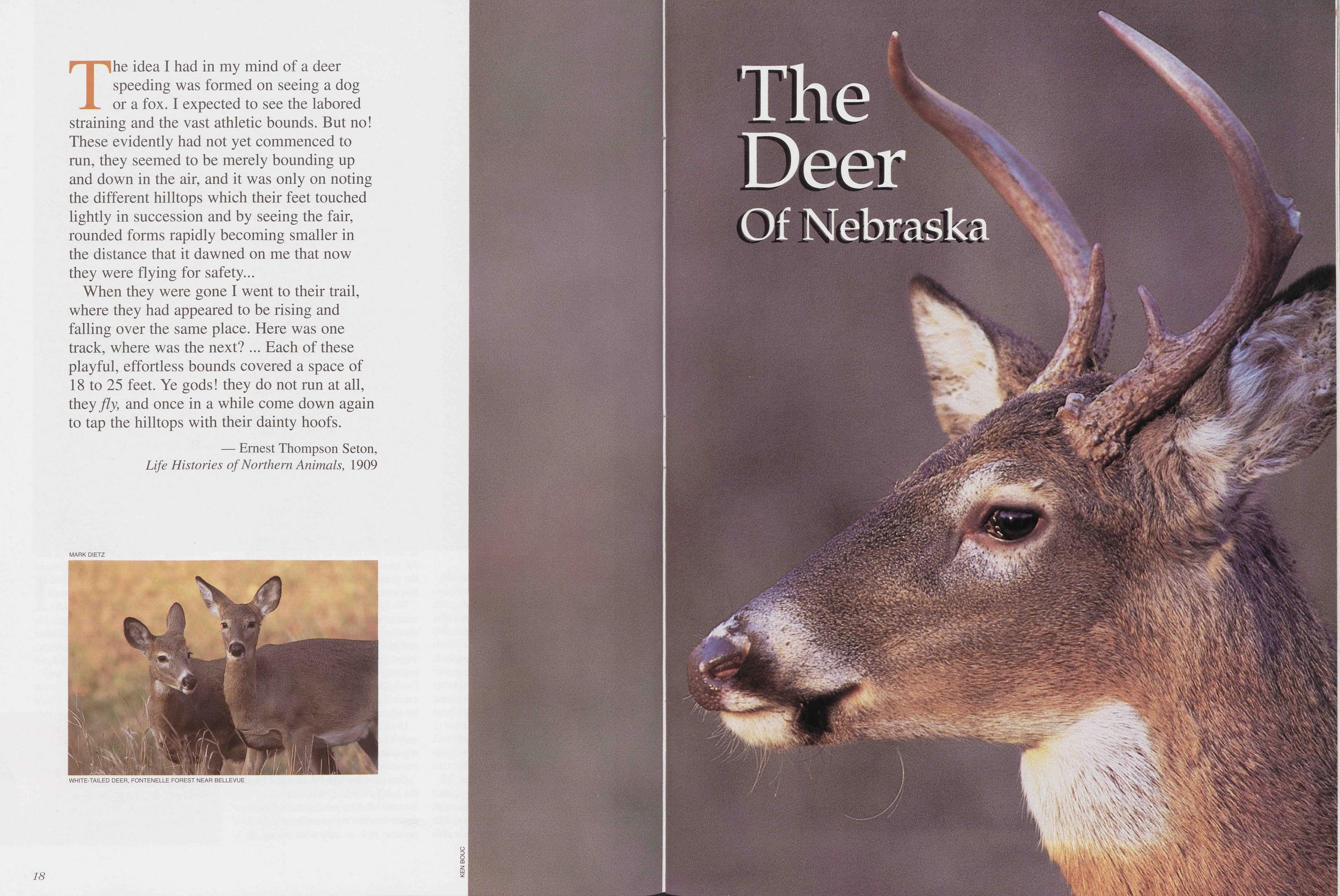
The Deer Of Nebraska
The idea I had in my mind of a deer speeding was formed on seeing a dog or a fox. I expected to see the labored straining and the vast athletic bounds. But no! These evidently had not yet commenced to run, they seemed to be merely bounding up and down in the air, and it was only on noting the different hilltops which their feet touched lightly in succession and by seeing the fair, rounded forms rapidly becoming smaller in the distance that it dawned on me that now they were flying for safety.
When they were gone I went to their trail, where they had appeared to be rising and falling over the same place. Here was one track, where was the next? Each of these playful, effortless bounds covered a space of 18 to 25 feet. Ye gods! they do not run at all, they fly, and once in a while come down again to tap the hilltops with their dainty hoofs.
—Ernest Thompson Seton, Life Histories of Northern Animals, 1909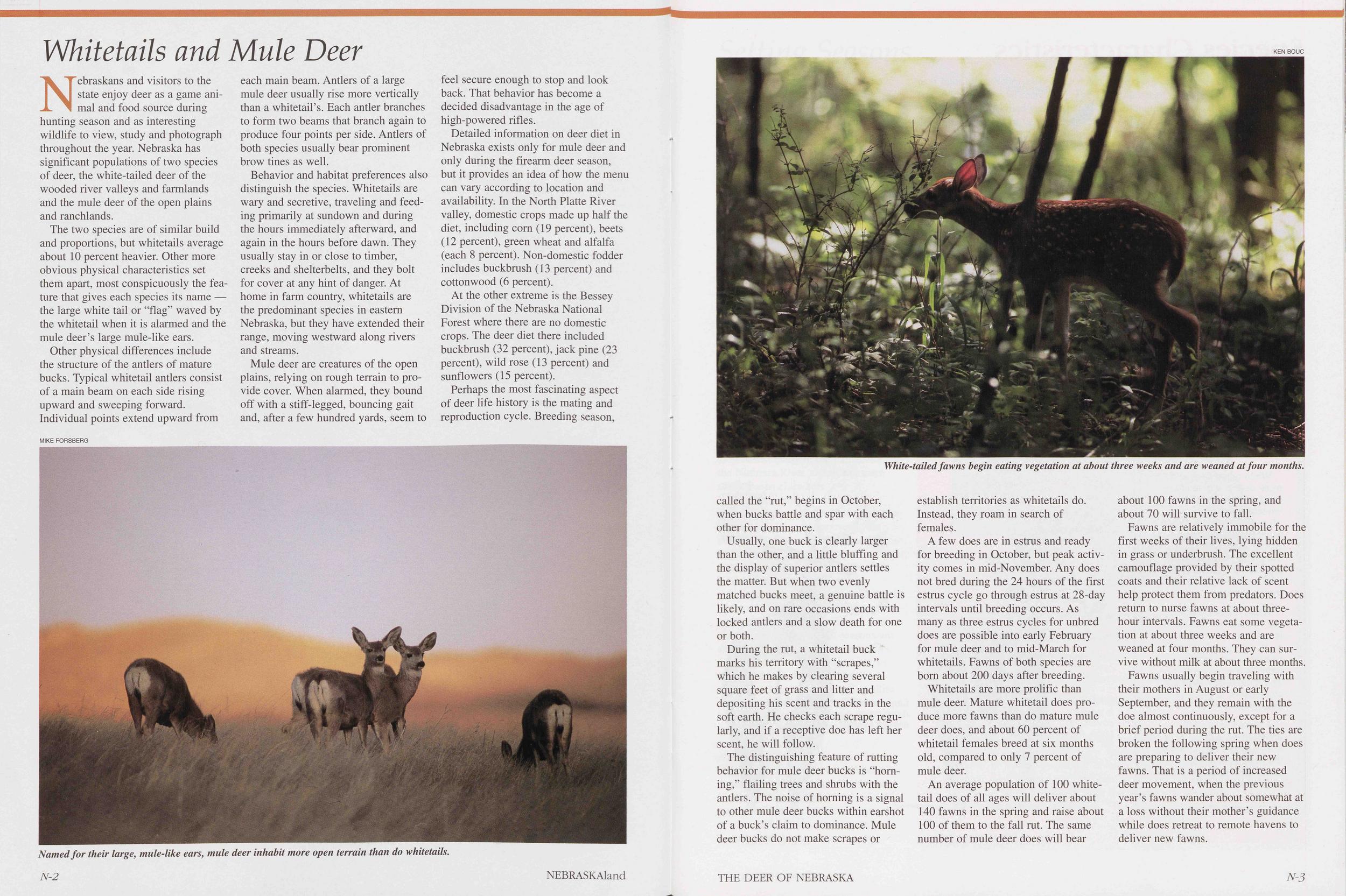 Whitetails and Mule Deer
Nebraskans and visitors to the state enjoy deer as a game animal and food source during hunting season and as interesting wildlife to view, study and photograph throughout the year. Nebraska has significant populations of two species of deer, the white-tailed deer of the wooded river valleys and farmlands and the mule deer of the open plains and ranchlands.
The two species are of similar build and proportions, but whitetails average about 10 percent heavier. Other more obvious physical characteristics set them apart, most conspicuously the feature that gives each species its name — the large white tail or "flag" waved by the whitetail when it is alarmed and the mule deer's large mule-like ears.
Other physical differences include the structure of the antlers of mature bucks. Typical whitetail antlers consist of a main beam on each side rising upward and sweeping forward. Individual points extend upward from each main beam. Antlers of a large mule deer usually rise more vertically than a whitetail's. Each antler branches to form two beams that branch again to produce four points per side. Antlers of both species usually bear prominent brow tines as well.
Behavior and habitat preferences also distinguish the species. Whitetails are wary and secretive, traveling and feeding primarily at sundown and during the hours immediately afterward, and again in the hours before dawn. They usually stay in or close to timber, creeks and shelterbelts, and they bolt for cover at any hint of danger. At home in farm country, whitetails are the predominant species in eastern Nebraska, but they have extended their range, moving westward along rivers and streams.
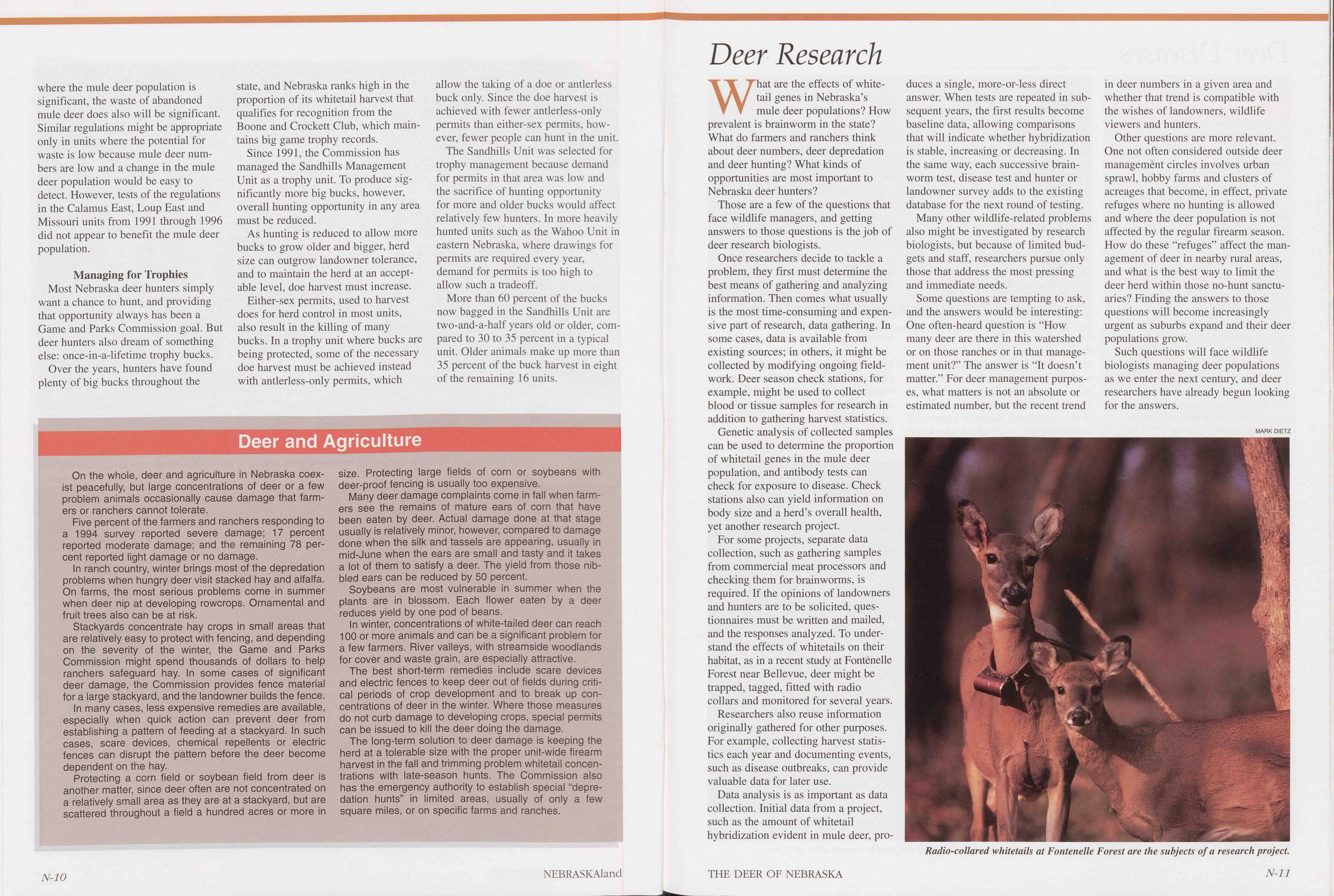
Mule deer are creatures of the open plains, relying on rough terrain to provide cover. When alarmed, they bound off with a stiff-legged, bouncing gait and, after a few hundred yards, seem to feel secure enough to stop and look back. That behavior has become a decided disadvantage in the age of high-powered rifles.
Detailed information on deer diet in Nebraska exists only for mule deer and only during the firearm deer season, but it provides an idea of how the menu can vary according to location and availability. In the North Platte River valley, domestic crops made up half the diet, including corn (19 percent), beets (12 percent), green wheat and alfalfa (each 8 percent). Non-domestic fodder includes buckbrush (13 percent) and cottonwood (6 percent).
At the other extreme is the Bessey Division of the Nebraska National Forest where there are no domestic crops. The deer diet there included buckbrush (32 percent), jack pine (23 percent), wild rose (13 percent) and sunflowers (15 percent).
Perhaps the most fascinating aspect of deer life history is the mating and reproduction cycle. Breeding season,
Named for their large, mule-like ears, mule deer inhabit more open terrain than do whitetails.
White-tailed fawns begin eating vegetation at about three weeks and are weaned at four months.
called the "rut," begins in October, when bucks battle and spar with each other for dominance.
Usually, one buck is clearly larger than the other, and a little bluffing and the display of superior antlers settles the matter. But when two evenly matched bucks meet, a genuine battle is likely, and on rare occasions ends with locked antlers and a slow death for one or both.
During the rut, a whitetail buck marks his territory with "scrapes," which he makes by clearing several square feet of grass and litter and depositing his scent and tracks in the soft earth. He checks each scrape regularly, and if a receptive doe has left her scent, he will follow.
The distinguishing feature of rutting behavior for mule deer bucks is "horning," flailing trees and shrubs with the antlers. The noise of horning is a signal to other mule deer bucks within earshot of a buck's claim to dominance. Mule deer bucks do not make scrapes or establish territories as whitetails do. Instead, they roam in search of females.
A few does are in estrus and ready for breeding in October, but peak activity comes in mid-November. Any does not bred during the 24 hours of the first estrus cycle go through estrus at 28-day intervals until breeding occurs. As many as three estrus cycles for unbred does are possible into early February for mule deer and to mid-March for whitetails. Fawns of both species are born about 200 days after breeding.
Whitetails are more prolific than mule deer. Mature whitetail does produce more fawns than do mature mule deer does, and about 60 percent of whitetail females breed at six months old, compared to only 7 percent of mule deer.
An average population of 100 whitetail does of all ages will deliver about 140 fawns in the spring and raise about 100 of them to the fall rut. The same number of mule deer does will bear about 100 fawns in the spring, and about 70 will survive to fall.
Fawns are relatively immobile for the first weeks of their lives, lying hidden in grass or underbrush. The excellent camouflage provided by their spotted coats and their relative lack of scent help protect them from predators. Does return to nurse fawns at about three-hour intervals. Fawns eat some vegetation at about three weeks and are weaned at four months. They can survive without milk at about three months.
Fawns usually begin traveling with their mothers in August or early September, and they remain with the doe almost continuously, except for a brief period during the rut. The ties are broken the following spring when does are preparing to deliver their new fawns. That is a period of increased deer movement, when the previous year's fawns wander about somewhat at a loss without their mother's guidance while does retreat to remote havens to deliver new fawns.
THE DEER OF NEBRASKA N-3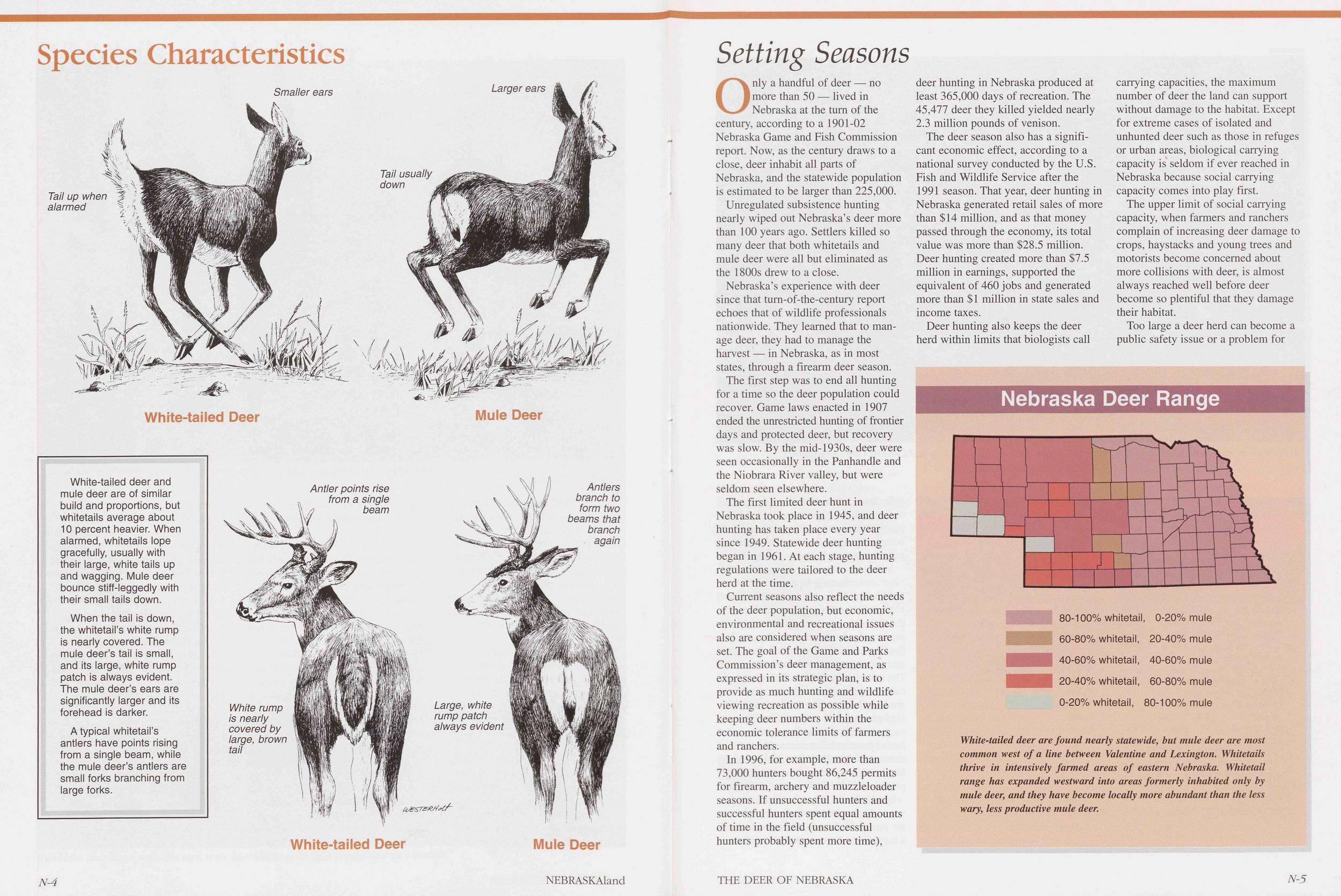 Species Characteristics
Only a handful of deer — no more than 50 — lived in Nebraska at the turn of the century, according to a 1901-02 Nebraska Game and Fish Commission report. Now, as the century draws to a close, deer inhabit all parts of Nebraska, and the statewide population is estimated to be larger than 225,000.
Unregulated subsistence hunting nearly wiped out Nebraska's deer more than 100 years ago. Settlers killed so many deer that both whitetails and mule deer were all but eliminated as the 1800s drew to a close.
Nebraska's experience with deer since that turn-of-the-century report echoes that of wildlife professionals nationwide. They learned that to manage deer, they had to manage the harvest — in Nebraska, as in most states, through a firearm deer season.
The first step was to end all hunting for a time so the deer population could recover. Game laws enacted in 1907 ended the unrestricted hunting of frontier days and protected deer, but recovery was slow. By the mid-1930s, deer were seen occasionally in the Panhandle and the Niobrara River valley, but were seldom seen elsewhere.
The first limited deer hunt in Nebraska took place in 1945, and deer hunting has taken place every year since 1949. Statewide deer hunting began in 1961. At each stage, hunting regulations were tailored to the deer herd at the time.
Current seasons also reflect the needs of the deer population, but economic, environmental and recreational issues also are considered when seasons are set. The goal of the Game and Parks Commission's deer management, as expressed in its strategic plan, is to provide as much hunting and wildlife viewing recreation as possible while keeping deer numbers within the economic tolerance limits of farmers and ranchers.
In 1996, for example, more than 73,000 hunters bought 86,245 permits for firearm, archery and muzzleloader seasons. If unsuccessful hunters and successful hunters spent equal amounts of time in the field (unsuccessful hunters probably spent more time), deer hunting in Nebraska produced at least 365,000 days of recreation. The 45,477 deer they killed yielded nearly 2.3 million pounds of venison.
The deer season also has a significant economic effect, according to a national survey conducted by the U.S. Fish and Wildlife Service after the 1991 season. That year, deer hunting in Nebraska generated retail sales of more than $14 million, and as that money passed through the economy, its total value was more than $28.5 million. Deer hunting created more than $7.5 million in earnings, supported the equivalent of 460 jobs and generated more than $1 million in state sales and income taxes.
Deer hunting also keeps the deer herd within limits that biologists call carrying capacities, the maximum number of deer the land can support without damage to the habitat. Except for extreme cases of isolated and unhunted deer such as those in refuges or urban areas, biological carrying capacity is seldom if ever reached in Nebraska because social carrying capacity comes into play first.
The upper limit of social carrying capacity, when farmers and ranchers complain of increasing deer damage to crops, haystacks and young trees and motorists become concerned about more collisions with deer, is almost always reached well before deer become so plentiful that they damage their habitat.
Too large a deer herd can become a public safety issue or a problem for
60-80% whitetail, 20-40% mule
40-60% whitetail, 40-60% mule
20-40% whitetail, 60-80% mule
0-20% whitetail, 80-100% mule White-tailed deer are found nearly statewide, but mule deer are most common west of a line between Valentine and Lexington. Whitetails thrive in intensively farmed areas of eastern Nebraska. Whitetail range has expanded westward into areas formerly inhabited only by mule deer, and they have become locally more abundant than the less wary, less productive mule deer.
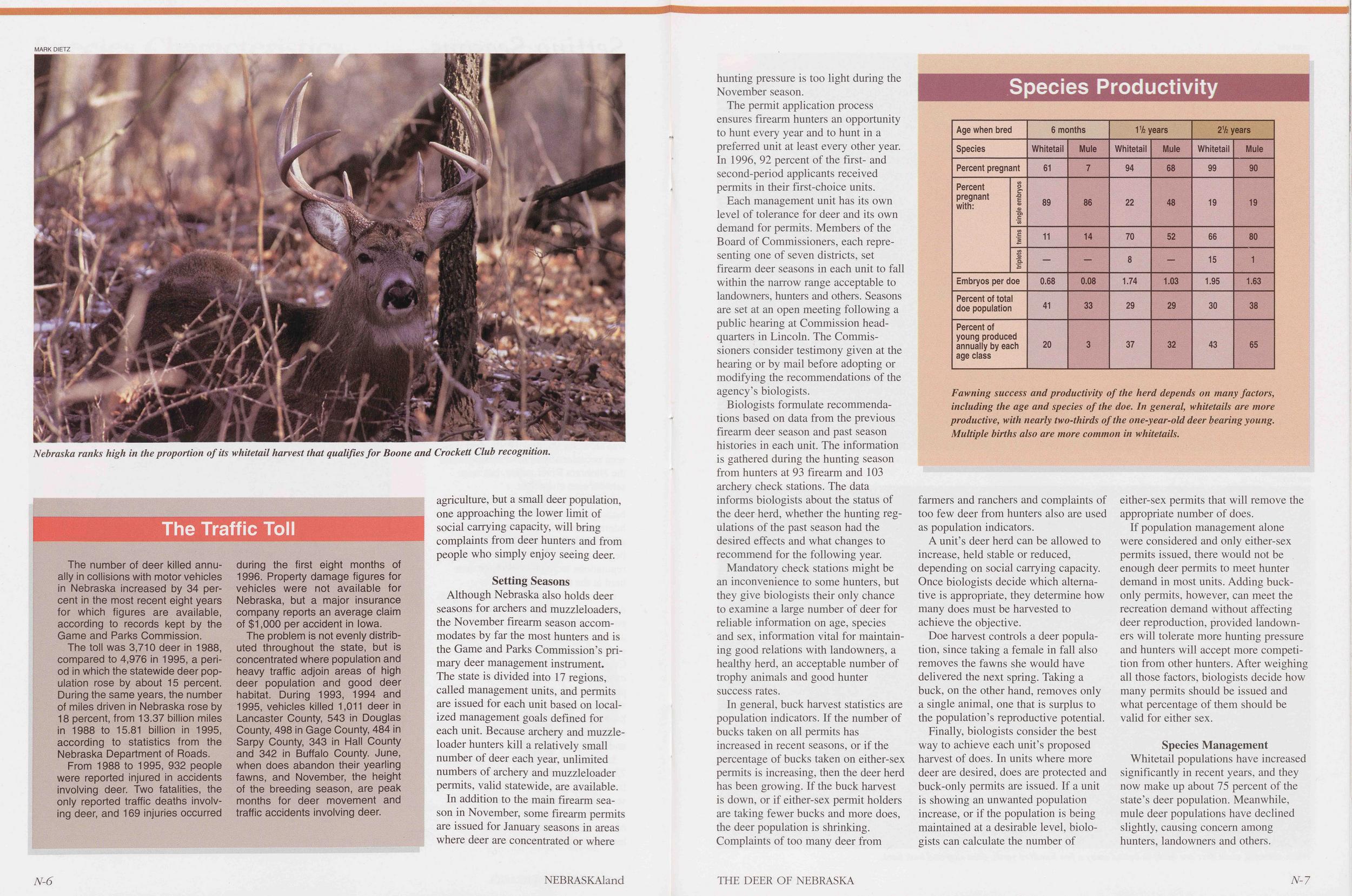
Nebraska ranks high in the proportion of its whitetail harvest that qualifies for Boone and Crockett Club recognition.
agriculture, but a small deer population, one approaching the lower limit of social carrying capacity, will bring complaints from deer hunters and from people who simply enjoy seeing deer.
Setting SeasonsAlthough Nebraska also holds deer seasons for archers and muzzleloaders, the November firearm season accommodates by far the most hunters and is the Game and Parks Commission's primary deer management instrument. The state is divided into 17 regions, called management units, and permits are issued for each unit based on localized management goals defined for each unit. Because archery and muzzle-loader hunters kill a relatively small number of deer each year, unlimited numbers of archery and muzzleloader permits, valid statewide, are available.
In addition to the main firearm season in November, some firearm permits are issued for January seasons in areas where deer are concentrated or where
N-6 NEBRASKAlandhunting pressure is too light during the November season.
The permit application process ensures firearm hunters an opportunity to hunt every year and to hunt in a preferred unit at least every other year. In 1996, 92 percent of the first- and second-period applicants received permits in their first-choice units.
Each management unit has its own level of tolerance for deer and its own demand for permits. Members of the Board of Commissioners, each representing one of seven districts, set firearm deer seasons in each unit to fall within the narrow range acceptable to landowners, hunters and others. Seasons are set at an open meeting following a public hearing at Commission headquarters in Lincoln. The Commissioners consider testimony given at the hearing or by mail before adopting or modifying the recommendations of the agency's biologists.
Biologists formulate recommendations based on data from the previous firearm deer season and past season histories in each unit. The information is gathered during the hunting season from hunters at 93 firearm and 103 archery check stations. The data informs biologists about the status of the deer herd, whether the hunting regulations of the past season had the desired effects and what changes to recommend for the following year.
Mandatory check stations might be an inconvenience to some hunters, but they give biologists their only chance to examine a large number of deer for reliable information on age, species and sex, information vital for maintaining good relations with landowners, a healthy herd, an acceptable number of trophy animals and good hunter success rates.
In general, buck harvest statistics are population indicators. If the number of bucks taken on all permits has increased in recent seasons, or if the percentage of bucks taken on either-sex permits is increasing, then the deer herd has been growing. If the buck harvest is down, or if either-sex permit holders are taking fewer bucks and more does, the deer population is shrinking. Complaints of too many deer from
Species Productivity Age when bred 6 months Vk years 2% years Species Whitetail Mule Whitetail Mule Whitetail Mule Percent pregnant 61 7 94 68 99 90 Percent pregnant with: 89 86 22 48 19 19 CO 11 14 70 52 66 80 CL 8 15 1 Embryos per doe 0.68 0.08 1.74 1.03 1.95 1.63 Percent of total doe population 41 33 29 29 30 38 Percent of young produced annually by each age class 20 3 37 32 43 65 Fawning success and productivity of the herd depends on many factors, including the age and species of the doe. In general, whitetails are more productive, with nearly two-thirds of the one-year-old deer bearing young. Multiple births also are more common in whitetails.farmers and ranchers and complaints of too few deer from hunters also are used as population indicators.
A unit's deer herd can be allowed to increase, held stable or reduced, depending on social carrying capacity. Once biologists decide which alternative is appropriate, they determine how many does must be harvested to achieve the objective.
Doe harvest controls a deer population, since taking a female in fall also removes the fawns she would have delivered the next spring. Taking a buck, on the other hand, removes only a single animal, one that is surplus to the population's reproductive potential.
Finally, biologists consider the best way to achieve each unit's proposed harvest of does. In units where more deer are desired, does are protected and buck-only permits are issued. If a unit is showing an unwanted population increase, or if the population is being maintained at a desirable level, biologists can calculate the number of either-sex permits that will remove the appropriate number of does.
If population management alone were considered and only either-sex permits issued, there would not be enough deer permits to meet hunter demand in most units. Adding buck-only permits, however, can meet the recreation demand without affecting deer reproduction, provided landowners will tolerate more hunting pressure and hunters will accept more competition from other hunters. After weighing all those factors, biologists decide how many permits should be issued and what percentage of them should be valid for either sex.
Species ManagementWhitetail populations have increased significantly in recent years, and they now make up about 75 percent of the state's deer population. Meanwhile, mule deer populations have declined slightly, causing concern among hunters, landowners and others.
THE DEER OF NEBRASKA N-7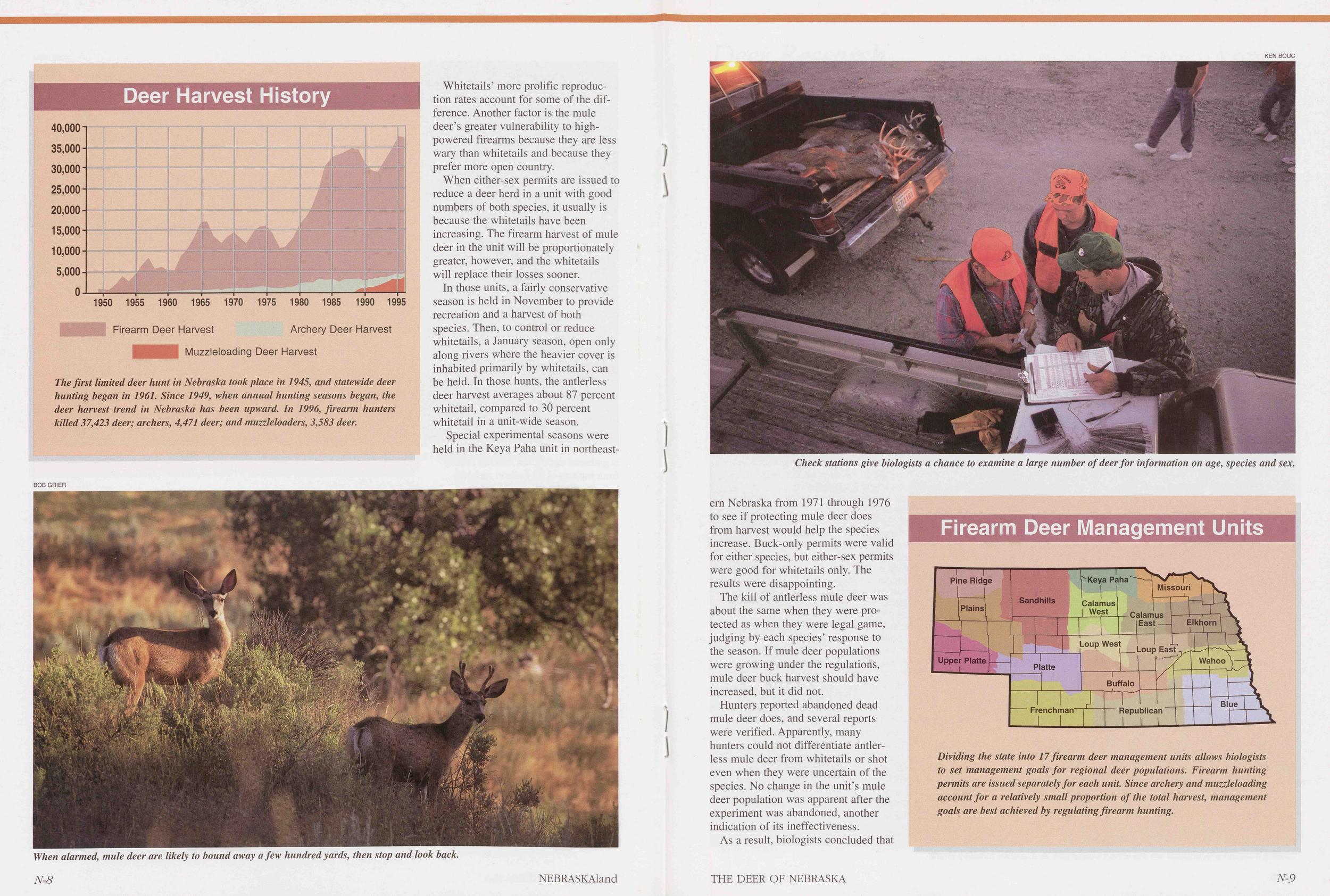 Deer Harvest History
40,000
35,000
30,0001
25,000
20,000
15,000
10,000
5,000
0
1950 1955 1960 1965
Firearm Deer Harvest
1970 1975 1980 1985
1990 1995
Archery Deer Harvest
Muzzleloading Deer Harvest
The first limited deer hunt in Nebraska took place in 1945, and statewide deer
hunting began in 1961, Since 1949, when annual hunting seasons began, the
deer harvest trend in Nebraska has been upward. In 1996, firearm hunters
killed 37,423 deer; archers, 4,471 deer; and muzzleloaders, 3,583 deer.
Deer Harvest History
40,000
35,000
30,0001
25,000
20,000
15,000
10,000
5,000
0
1950 1955 1960 1965
Firearm Deer Harvest
1970 1975 1980 1985
1990 1995
Archery Deer Harvest
Muzzleloading Deer Harvest
The first limited deer hunt in Nebraska took place in 1945, and statewide deer
hunting began in 1961, Since 1949, when annual hunting seasons began, the
deer harvest trend in Nebraska has been upward. In 1996, firearm hunters
killed 37,423 deer; archers, 4,471 deer; and muzzleloaders, 3,583 deer.
Whitetails' more prolific reproduction rates account for some of the difference. Another factor is the mule deer's greater vulnerability to high-powered firearms because they are less wary than whitetails and because they prefer more open country.
When either-sex permits are issued to reduce a deer herd in a unit with good numbers of both species, it usually is because the whitetails have been increasing. The firearm harvest of mule deer in the unit will be proportionately greater, however, and the whitetails will replace their losses sooner.
In those units, a fairly conservative season is held in November to provide recreation and a harvest of both species. Then, to control or reduce whitetails, a January season, open only along rivers where the heavier cover is inhabited primarily by whitetails, can be held. In those hunts, the antlerless deer harvest averages about 87 percent whitetail, compared to 30 percent whitetail in a unit-wide season.
Special experimental seasons were held in the Keya Paha unit in northeastern
When alarmed, mule deer are likely to bound away a few hundred yards, then stop and look back.
Check stations give biologists a chance to examine a large number of deer for information on age, species and sex.
Nebraska from 1971 through 1976 to see if protecting mule deer does from harvest would help the species increase. Buck-only permits were valid for either species, but either-sex permits were good for whitetails only. The results were disappointing.
The kill of antlerless mule deer was about the same when they were protected as when they were legal game, judging by each species' response to the season. If mule deer populations were growing under the regulations, mule deer buck harvest should have increased, but it did not.
Hunters reported abandoned dead mule deer does, and several reports were verified. Apparently, many hunters could not differentiate antlerless mule deer from whitetails or shot even when they were uncertain of the species. No change in the unit's mule deer population was apparent after the experiment was abandoned, another indication of its ineffectiveness.
As a result, biologists concluded that
where the mule deer population is significant, the waste of abandoned mule deer does also will be significant. Similar regulations might be appropriate only in units where the potential for waste is low because mule deer numbers are low and a change in the mule deer population would be easy to detect. However, tests of the regulations in the Calamus East, Loup East and Missouri units from 1991 through 1996 did not appear to benefit the mule deer population.
Managing for TrophiesMost Nebraska deer hunters simply want a chance to hunt, and providing that opportunity always has been a Game and Parks Commission goal. But deer hunters also dream of something else: once-in-a-lifetime trophy bucks.
Over the years, hunters have found plenty of big bucks throughout the state, and Nebraska ranks high in the proportion of its whitetail harvest that qualifies for recognition from the Boone and Crockett Club, which maintains big game trophy records.
Since 1991, the Commission has managed the Sandhills Management Unit as a trophy unit. To produce significantly more big bucks, however, overall hunting opportunity in any area must be reduced.
As hunting is reduced to allow more bucks to grow older and bigger, herd size can outgrow landowner tolerance, and to maintain the herd at an acceptable level, doe harvest must increase.
Either-sex permits, used to harvest does for herd control in most units, also result in the killing of many bucks. In a trophy unit where bucks are being protected, some of the necessary doe harvest must be achieved instead with antlerless-only permits, which allow the taking of a doe or antlerless buck only. Since the doe harvest is achieved with fewer antlerless-only permits than either-sex permits, however, fewer people can hunt in the unit.
The Sandhills Unit was selected for trophy management because demand for permits in that area was low and the sacrifice of hunting opportunity for more and older bucks would affect relatively few hunters. In more heavily hunted units such as the Wahoo Unit in eastern Nebraska, where drawings for permits are required every year, demand for permits is too high to allow such a tradeoff.
More than 60 percent of the bucks now bagged in the Sandhills Unit are two-and-a-half years old or older, compared to 30 to 35 percent in a typical unit. Older animals make up more than 35 percent of the buck harvest in eight of the remaining 16 units.
Deer and Agriculture On the whole, deer and agriculture in Nebraska coexist peacefully, but large concentrations of deer or a few problem animals occasionally cause damage that farmers or ranchers cannot tolerate. Five percent of the farmers and ranchers responding to a 1994 survey reported severe damage; 17 percent reported moderate damage; and the remaining 78 percent reported light damage or no damage. In ranch country, winter brings most of the depredation problems when hungry deer visit stacked hay and alfalfa. On farms, the most serious problems come in summer when deer nip at developing rowcrops. Ornamental and fruit trees also can be at risk. Stackyards concentrate hay crops in small areas that are relatively easy to protect with fencing, and depending on the severity of the winter, the Game and Parks Commission might spend thousands of dollars to help ranchers safeguard hay. In some cases of significant deer damage, the Commission provides fence material for a large stackyard, and the landowner builds the fence. In many cases, less expensive remedies are available, especially when quick action can prevent deer from establishing a pattern of feeding at a stackyard. In such cases, scare devices, chemical repellents or electric fences can disrupt the pattern before the deer become dependent on the hay. Protecting a corn field or soybean field from deer is another matter, since deer often are not concentrated on a relatively small area as they are at a stackyard, but are scattered throughout a field a hundred acres or more in size. Protecting large fields of corn or soybeans with deer-proof fencing is usually too expensive. Many deer damage complaints come in fall when farmers see the remains of mature ears of corn that have been eaten by deer. Actual damage done at that stage usually is relatively minor, however, compared to damage done when the silk and tassels are appearing, usually in mid-June when the ears are small and tasty and it takes a lot of them to satisfy a deer. The yield from those nibbled ears can be reduced by 50 percent. Soybeans are most vulnerable in summer when the plants are in blossom. Each flower eaten by a deer reduces yield by one pod of beans. In winter, concentrations of white-tailed deer can reach 100 or more animals and can be a significant problem for a few farmers. River valleys, with streamside woodlands for cover and waste grain, are especially attractive. The best short-term remedies include scare devices and electric fences to keep deer out of fields during critical periods of crop development and to break up concentrations of deer in the winter. Where those measures do not curb damage to developing crops, special permits can be issued to kill the deer doing the damage. The long-term solution to deer damage is keeping the herd at a tolerable size with the proper unit-wide firearm harvest in the fall and trimming problem whitetail concentrations with late-season hunts. The Commission also has the emergency authority to establish special "depredation hunts" in limited areas, usually of only a few square miles, or on specific farms and ranches. N-10 NEBRASKAland Deer ResearchWhat are the effects of whitetail genes in Nebraska's mule deer populations? How prevalent is brainworm in the state? What do farmers and ranchers think about deer numbers, deer depredation and deer hunting? What kinds of opportunities are most important to Nebraska deer hunters?
Those are a few of the questions that face wildlife managers, and getting answers to those questions is the job of deer research biologists.
Once researchers decide to tackle a problem, they first must determine the best means of gathering and analyzing information. Then comes what usually is the most time-consuming and expensive part of research, data gathering. In some cases, data is available from existing sources; in others, it might be collected by modifying ongoing fieldwork. Deer season check stations, for example, might be used to collect blood or tissue samples for research in addition to gathering harvest statistics.
Genetic analysis of collected samples can be used to determine the proportion of whitetail genes in the mule deer population, and antibody tests can check for exposure to disease. Check stations also can yield information on body size and a herd's overall health, yet another research project.
For some projects, separate data collection, such as gathering samples from commercial meat processors and checking them for brainworms, is required. If the opinions of landowners and hunters are to be solicited, questionnaires must be written and mailed, and the responses analyzed. To understand the effects of whitetails on their habitat, as in a recent study at Fontanelle Forest near Bellevue, deer might be trapped, tagged, fitted with radio collars and monitored for several years.
Researchers also reuse information originally gathered for other purposes. For example, collecting harvest statistics each year and documenting events, such as disease outbreaks, can provide valuable data for later use.
Data analysis is as important as data collection. Initial data from a project, such as the amount of whitetail hybridization evident in mule deer, produces a single, more-or-less direct answer. When tests are repeated in subsequent years, the first results become baseline data, allowing comparisons that will indicate whether hybridization is stable, increasing or decreasing. In the same way, each successive brainworm test, disease test and hunter or landowner survey adds to the existing database for the next round of testing.
Many other wildlife-related problems also might be investigated by research biologists, but because of limited budgets and staff, researchers pursue only those that address the most pressing and immediate needs.
Some questions are tempting to ask, and the answers would be interesting: One often-heard question is "How many deer are there in this watershed or on those ranches or in that management unit?" The answer is "It doesn't matter." For deer management purposes, what matters is not an absolute or estimated number, but the recent trend in deer numbers in a given area and whether that trend is compatible with the wishes of landowners, wildlife viewers and hunters.
Other questions are more relevant. One not often considered outside deer management circles involves urban sprawl, hobby farms and clusters of acreages that become, in effect, private refuges where no hunting is allowed and where the deer population is not affected by the regular firearm season. How do these "refuges" affect the management of deer in nearby rural areas, and what is the best way to limit the deer herd within those no-hunt sanctuaries? Finding the answers to those questions will become increasingly urgent as suburbs expand and their deer populations grow.
Such questions will face wildlife biologists managing deer populations as we enter the next century, and deer researchers have already begun looking for the answers.
Radio-collared whitetails at Fontanelle Forest are the subjects of a research project.
 Deer Diseases
Nebraska's deer herd is vigorous and hearty, but like any other large population, it is not free of diseases. Two disorders merit attention, one with an established history in Nebraska and another that could cause future problems.
Hemorrhagic DiseaseThe first disease threat is actually two related diseases so similar that biologists treat them as one. Called hemorrhagic disease, it is the most significant infectious disease among white-tailed deer. Hemorrhagic disease includes epizootic hemorrhagic disease (EHD), first noted in the southeastern United States in 1955, and bluetongue, identified in 1968.
Hemorrhagic disease is the only disease that can significantly affect the size of the deer population throughout a large area. In 1976, EHD killed 30 to 40 percent of Nebraska's deer population, but in the following three years the deer herd recovered in even the hardest hit units.
EHD and bluetongue are caused by viruses transmitted by a tiny insect, the biting midge. Among its local names are sand gnat, sand fly, no-see-um and punky. Hemorrhagic disease outbreaks begin in summer when insect numbers are high and last into early fall. When cold weather kills insects, the spread of hemorrhagic disease ends.
Hemorrhagic disease is always present in the whitetail population to some extent, and several small, localized outbreaks are reported in Nebraska in the summer and early fall nearly every year. Deer surviving an outbreak develop an immunity that protects them from the sub-type of virus they had.
Deer with hemorrhagic disease seem listless and disoriented, and a high fever and the resulting thirst keeps them near water. Other external symptoms include swelling of the head, neck, tongue and eyelids, and difficulty in breathing. Internal examination shows lesions, swelling or hemorrhage of the heart, lungs and other organs. Laboratory tests to identify hemorrhagic disease virus require that samples be taken from a living or newly dead deer, since the virus cannot survive outside a living host animal or the insect carrier.
While whitetails are most vulnerable to hemorrhagic disease, it also affects mule deer, pronghorn antelope and bighorn sheep. Humans are not at risk.
The effects of bluetongue and EHD on cattle and goats can range from benign to debilitating, but the diseases are seldom fatal. Sheep are not affected by EHD, but can be made seriously ill by bluetongue. Livestock contract hemorrhagic disease from the same midges that infect deer, but not from direct contact with deer. Deer in Nebraska have not been found to be carriers of any significant livestock diseases, including brucellosis or leptospirosis.
Hemorrhagic disease is not caused by overpopulation of deer, although the disease will sicken and kill more individuals in a large deer population than in a small one, making the effect seem greater. Virulence of the strain of virus involved, density of the biting midge
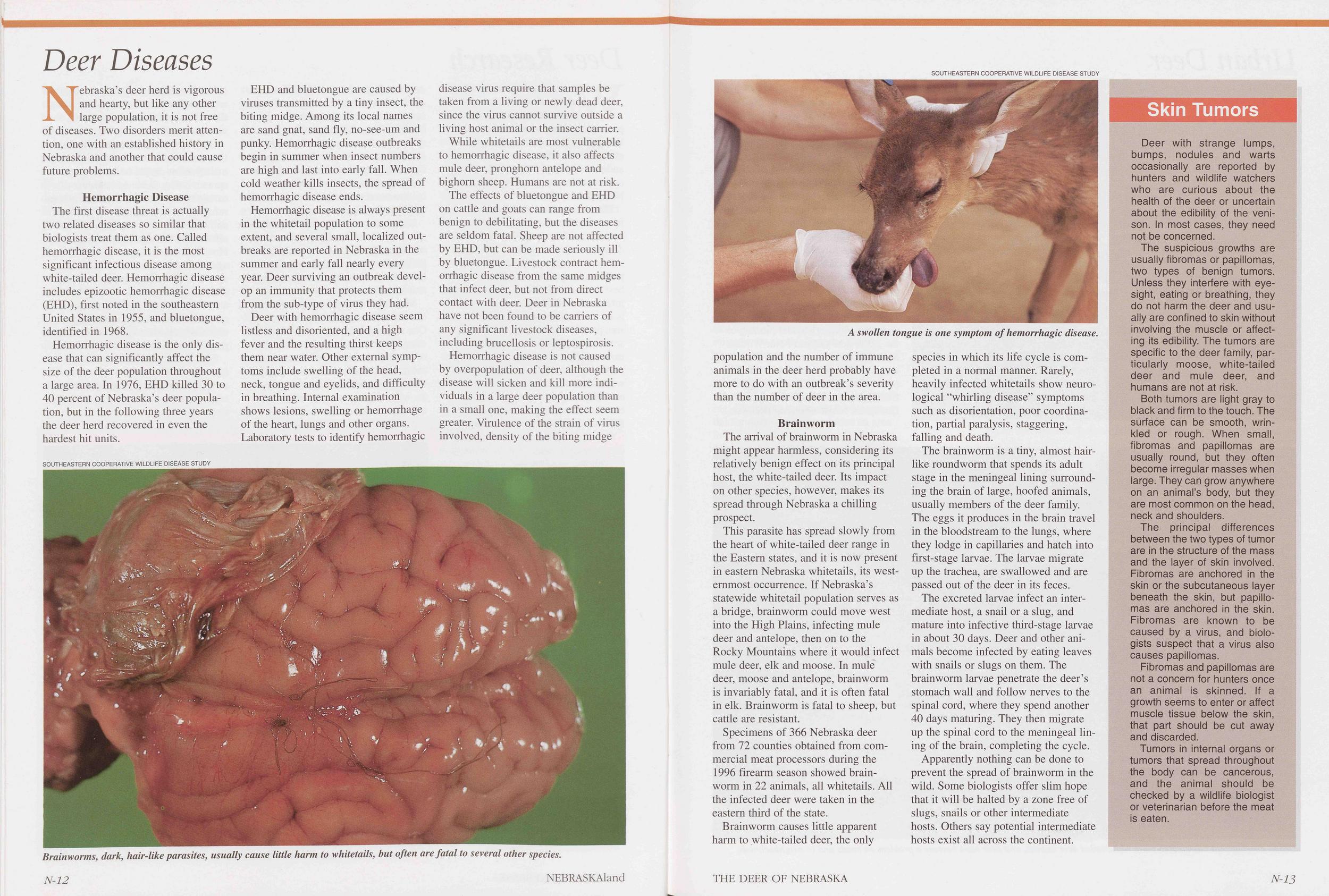
Brainworms, dark, hair-like parasites, usually cause little harm to whitetails, but often are fatal to several other species.
A swollen tongue is one symptom of hemorrhagic disease.
population and the number of immune animals in the deer herd probably have more to do with an outbreak's severity than the number of deer in the area.
BrainwormThe arrival of brainworm in Nebraska might appear harmless, considering its relatively benign effect on its principal host, the white-tailed deer. Its impact on other species, however, makes its spread through Nebraska a chilling prospect.
This parasite has spread slowly from the heart of white-tailed deer range in the Eastern states, and it is now present in eastern Nebraska whitetails, its westernmost occurrence. If Nebraska's statewide whitetail population serves as a bridge, brainworm could move west into the High Plains, infecting mule deer and antelope, then on to the Rocky Mountains where it would infect mule deer, elk and moose. In mule deer, moose and antelope, brainworm is invariably fatal, and it is often fatal in elk. Brainworm is fatal to sheep, but cattle are resistant.
Specimens of 366 Nebraska deer from 72 counties obtained from commercial meat processors during the 1996 firearm season showed brainworm in 22 animals, all whitetails. All the infected deer were taken in the eastern third of the state.
Brainworm causes little apparent harm to white-tailed deer, the only species in which its life cycle is completed in a normal manner. Rarely, heavily infected whitetails show neurological "whirling disease" symptoms such as disorientation, poor coordination, partial paralysis, staggering, falling and death.
The brainworm is a tiny, almost hair-like roundworm that spends its adult stage in the meningeal lining surrounding the brain of large, hoofed animals, usually members of the deer family. The eggs it produces in the brain travel in the bloodstream to the lungs, where they lodge in capillaries and hatch into first-stage larvae. The larvae migrate up the trachea, are swallowed and are passed out of the deer in its feces.
The excreted larvae infect an intermediate host, a snail or a slug, and mature into infective third-stage larvae in about 30 days. Deer and other animals become infected by eating leaves with snails or slugs on them. The brainworm larvae penetrate the deer's stomach wall and follow nerves to the spinal cord, where they spend another 40 days maturing. They then migrate up the spinal cord to the meningeal lining of the brain, completing the cycle.
Apparently nothing can be done to prevent the spread of brainworm in the wild. Some biologists offer slim hope that it will be halted by a zone free of slugs, snails or other intermediate hosts. Others say potential intermediate hosts exist all across the continent.
Skin Tumors Deer with strange lumps, bumps, nodules and warts occasionally are reported by hunters and wildlife watchers who are curious about the health of the deer or uncertain about the edibility of the venison. In most cases, they need not be concerned. The suspicious growths are usually fibromas or papillomas, two types of benign tumors. Unless they interfere with eyesight, eating or breathing, they do not harm the deer and usually are confined to skin without involving the muscle or affecting its edibility. The tumors are specific to the deer family, particularly moose, white-tailed deer and mule deer, and humans are not at risk. Both tumors are light gray to black and firm to the touch. The surface can be smooth, wrinkled or rough. When small, fibromas and papillomas are usually round, but they often become irregular masses when large. They can grow anywhere on an animal's body, but they are most common on the head, neck and shoulders. The principal differences between the two types of tumor are in the structure of the mass and the layer of skin involved. Fibromas are anchored in the skin or the subcutaneous layer beneath the skin, but papillomas are anchored in the skin. Fibromas are known to be caused by a virus, and biologists suspect that a virus also causes papillomas. Fibromas and papillomas are not a concern for hunters once an animal is skinned. If a growth seems to enter or affect muscle tissue below the skin, that part should be cut away and discarded. Tumors in internal organs or tumors that spread throughout the body can be cancerous, and the animal should be checked by a wildlife biologist or veterinarian before the meat is eaten. THE DEER OF NEBRASKA N-13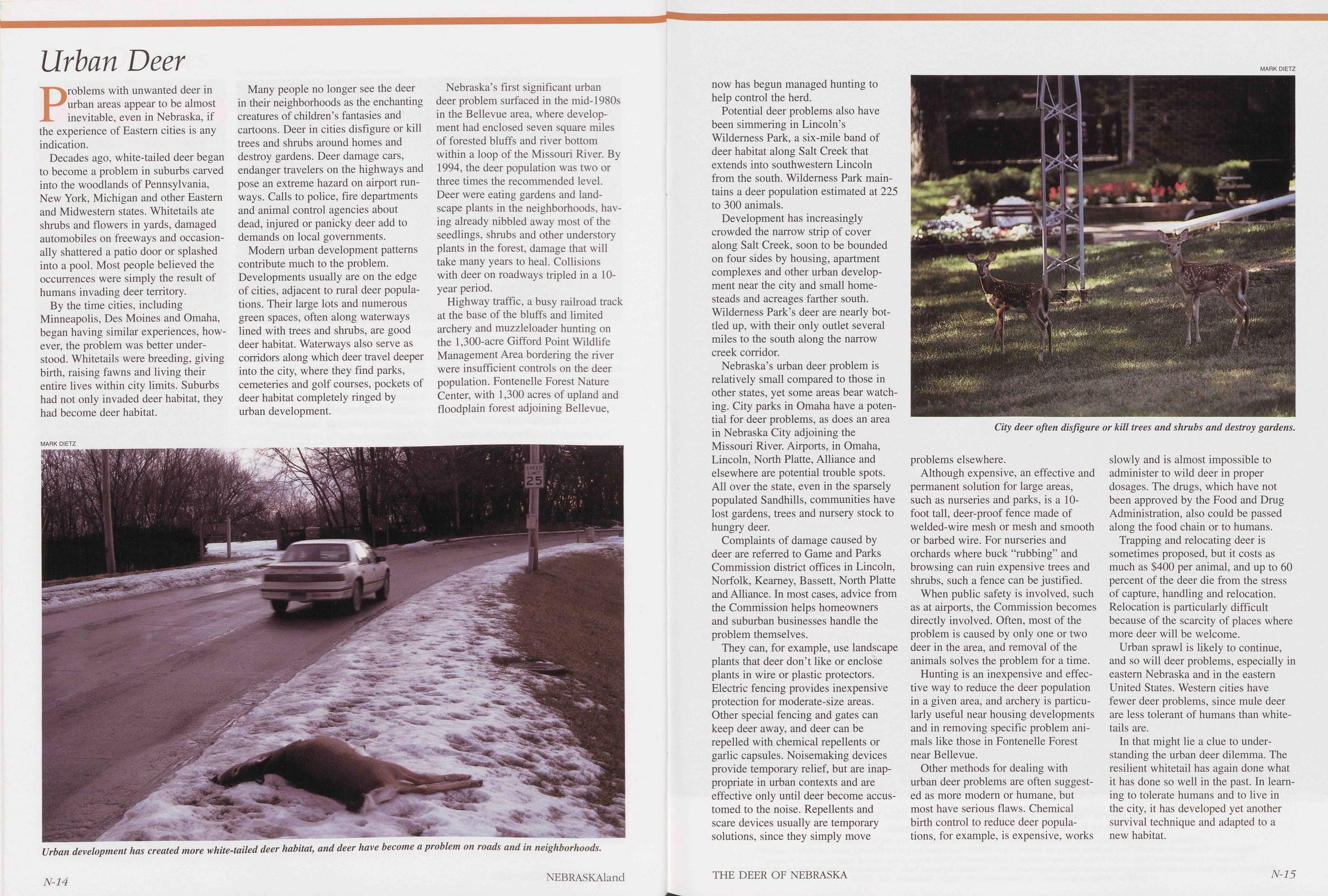 Urban Deer
Problems with unwanted deer in urban areas appear to be almost inevitable, even in Nebraska, if the experience of Eastern cities is any indication.
Decades ago, white-tailed deer began to become a problem in suburbs carved into the woodlands of Pennsylvania, New York, Michigan and other Eastern and Midwestern states. Whitetails ate shrubs and flowers in yards, damaged automobiles on freeways and occasionally shattered a patio door or splashed into a pool. Most people believed the occurrences were simply the result of humans invading deer territory.
By the time cities, including Minneapolis, Des Moines and Omaha, began having similar experiences, however, the problem was better understood. Whitetails were breeding, giving birth, raising fawns and living their entire lives within city limits. Suburbs had not only invaded deer habitat, they had become deer habitat.
Many people no longer see the deer in their neighborhoods as the enchanting creatures of children's fantasies and cartoons. Deer in cities disfigure or kill trees and shrubs around homes and destroy gardens. Deer damage cars, endanger travelers on the highways and pose an extreme hazard on airport runways. Calls to police, fire departments and animal control agencies about dead, injured or panicky deer add to demands on local governments.
Modern urban development patterns contribute much to the problem. Developments usually are on the edge of cities, adjacent to rural deer populations. Their large lots and numerous green spaces, often along waterways lined with trees and shrubs, are good deer habitat. Waterways also serve as corridors along which deer travel deeper into the city, where they find parks, cemeteries and golf courses, pockets of deer habitat completely ringed by urban development.
Nebraska's first significant urban deer problem surfaced in the mid-1980s in the Bellevue area, where development had enclosed seven square miles of forested bluffs and river bottom within a loop of the Missouri River. By 1994, the deer population was two or three times the recommended level. Deer were eating gardens and landscape plants in the neighborhoods, having already nibbled away most of the seedlings, shrubs and other understory plants in the forest, damage that will take many years to heal. Collisions with deer on roadways tripled in a 10-year period.
Highway traffic, a busy railroad track at the base of the bluffs and limited archery and muzzleloader hunting on the 1,300-acre Gifford Point Wildlife Management Area bordering the river were insufficient controls on the deer population. Fontanelle Forest Nature Center, with 1,300 acres of upland and floodplain forest adjoining Bellevue,
Urban development has created more white-tailed deer habitat, and deer have become a problem on roads and in neighborhoods.
now has begun managed hunting to help control the herd.
Potential deer problems also have been simmering in Lincoln's Wilderness Park, a six-mile band of deer habitat along Salt Creek that extends into southwestern Lincoln from the south. Wilderness Park maintains a deer population estimated at 225 to 300 animals.
Development has increasingly crowded the narrow strip of cover along Salt Creek, soon to be bounded on four sides by housing, apartment complexes and other urban development near the city and small homesteads and acreages farther south. Wilderness Park's deer are nearly bottled up, with their only outlet several miles to the south along the narrow creek corridor.
Nebraska's urban deer problem is relatively small compared to those in other states, yet some areas bear watching. City parks in Omaha have a potential for deer problems, as does an area in Nebraska City adjoining the Missouri River. Airports, in Omaha, Lincoln, North Platte, Alliance and elsewhere are potential trouble spots. All over the state, even in the sparsely populated Sandhills, communities have lost gardens, trees and nursery stock to hungry deer.
Complaints of damage caused by deer are referred to Game and Parks Commission district offices in Lincoln, Norfolk, Kearney, Bassett, North Platte and Alliance. In most cases, advice from the Commission helps homeowners and suburban businesses handle the problem themselves.
They can, for example, use landscape plants that deer don't like or enclose plants in wire or plastic protectors. Electric fencing provides inexpensive protection for moderate-size areas. Other special fencing and gates can keep deer away, and deer can be repelled with chemical repellents or garlic capsules. Noisemaking devices provide temporary relief, but are inappropriate in urban contexts and are effective only until deer become accustomed to the noise. Repellents and scare devices usually are temporary solutions, since they simply move
City deer often disfigure or kill trees and shrubs and destroy gardens.
problems elsewhere.
Although expensive, an effective and permanent solution for large areas, such as nurseries and parks, is a 10-foot tall, deer-proof fence made of welded-wire mesh or mesh and smooth or barbed wire. For nurseries and orchards where buck "rubbing" and browsing can ruin expensive trees and shrubs, such a fence can be justified.
When public safety is involved, such as at airports, the Commission becomes directly involved. Often, most of the problem is caused by only one or two deer in the area, and removal of the animals solves the problem for a time.
Hunting is an inexpensive and effective way to reduce the deer population in a given area, and archery is particularly useful near housing developments and in removing specific problem animals like those in Fontanelle Forest near Bellevue.
Other methods for dealing with urban deer problems are often suggested as more modern or humane, but most have serious flaws. Chemical birth control to reduce deer populations, for example, is expensive, works slowly and is almost impossible to administer to wild deer in proper dosages. The drugs, which have not been approved by the Food and Drug Administration, also could be passed along the food chain or to humans.
Trapping and relocating deer is sometimes proposed, but it costs as much as $400 per animal, and up to 60 percent of the deer die from the stress of capture, handling and relocation. Relocation is particularly difficult because of the scarcity of places where more deer will be welcome.
Urban sprawl is likely to continue, and so will deer problems, especially in eastern Nebraska and in the eastern United States. Western cities have fewer deer problems, since mule deer are less tolerant of humans than white-tails are.
In that might lie a clue to understanding the urban deer dilemma. The resilient whitetail has again done what it has done so well in the past. In learning to tolerate humans and to live in the city, it has developed yet another survival technique and adapted to a new habitat.
THE DEER OF NEBRASKA N-15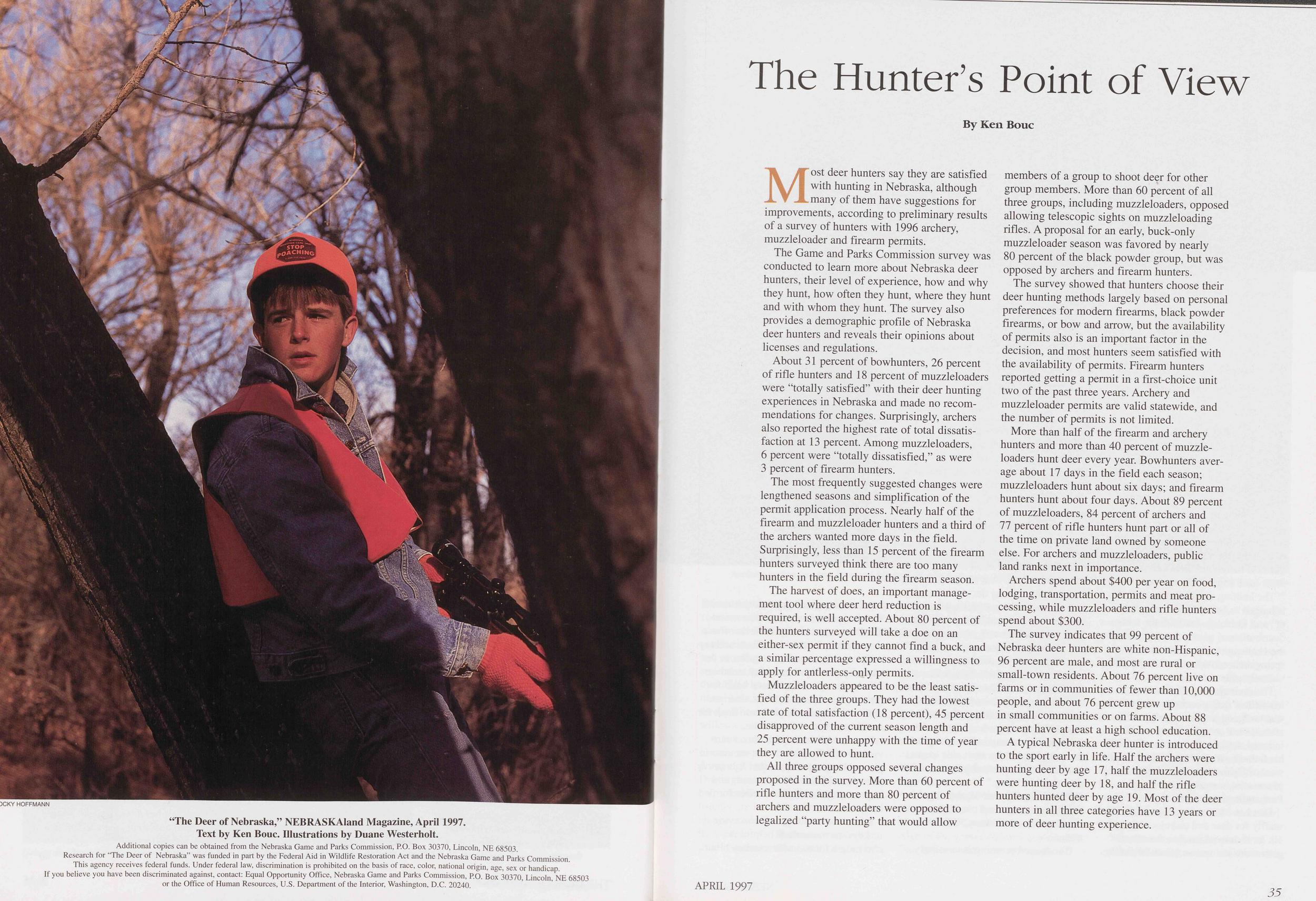
The Hunter's Point of View
Most deer hunters say they are satisfied with hunting in Nebraska, although many of them have suggestions for improvements, according to preliminary results of a survey of hunters with 1996 archery, muzzleloader and firearm permits.
The Game and Parks Commission survey was conducted to learn more about Nebraska deer hunters, their level of experience, how and why they hunt, how often they hunt, where they hunt and with whom they hunt. The survey also provides a demographic profile of Nebraska deer hunters and reveals their opinions about licenses and regulations.
About 31 percent of bowhunters, 26 percent of rifle hunters and 18 percent of muzzleloaders were "totally satisfied" with their deer hunting experiences in Nebraska and made no recommendations for changes. Surprisingly, archers also reported the highest rate of total dissatisfaction at 13 percent. Among muzzleloaders, 6 percent were "totally dissatisfied," as were 3 percent of firearm hunters.
The most frequently suggested changes were lengthened seasons and simplification of the permit application process. Nearly half of the firearm and muzzleloader hunters and a third of the archers wanted more days in the field. Surprisingly, less than 15 percent of the firearm hunters surveyed think there are too many hunters in the field during the firearm season.
The harvest of does, an important management tool where deer herd reduction is required, is well accepted. About 80 percent of the hunters surveyed will take a doe on an either-sex permit if they cannot find a buck, and a similar percentage expressed a willingness to apply for antlerless-only permits.
Muzzleloaders appeared to be the least satisfied of the three groups. They had the lowest rate of total satisfaction (18 percent), 45 percent disapproved of the current season length and 25 percent were unhappy with the time of year they are allowed to hunt.
All three groups opposed several changes proposed in the survey. More than 60 percent of rifle hunters and more than 80 percent of archers and muzzleloaders were opposed to legalized "party hunting" that would allow members of a group to shoot deer for other group members. More than 60 percent of all three groups, including muzzleloaders, opposed allowing telescopic sights on muzzleloading rifles. A proposal for an early, buck-only muzzleloader season was favored by nearly 80 percent of the black powder group, but was opposed by archers and firearm hunters.
The survey showed that hunters choose their deer hunting methods largely based on personal preferences for modern firearms, black powder firearms, or bow and arrow, but the availability of permits also is an important factor in the decision, and most hunters seem satisfied with the availability of permits. Firearm hunters reported getting a permit in a first-choice unit two of the past three years. Archery and muzzleloader permits are valid statewide, and the number of permits is not limited.
More than half of the firearm and archery hunters and more than 40 percent of muzzle-loaders hunt deer every year. Bowhunters average about 17 days in the field each season; muzzleloaders hunt about six days; and firearm hunters hunt about four days. About 89 percent of muzzleloaders, 84 percent of archers and 77 percent of rifle hunters hunt part or all of the time on private land owned by someone else. For archers and muzzleloaders, public land ranks next in importance.
Archers spend about $400 per year on food, lodging, transportation, permits and meat processing, while muzzleloaders and rifle hunters spend about $300.
The survey indicates that 99 percent of Nebraska deer hunters are white non-Hispanic, 96 percent are male, and most are rural or small-town residents. About 76 percent live on farms or in communities of fewer than 10,000 people, and about 76 percent grew up in small communities or on farms. About 88 percent have at least a high school education.
A typical Nebraska deer hunter is introduced to the sport early in life. Half the archers were hunting deer by age 17, half the muzzleloaders were hunting deer by 18, and half the rifle hunters hunted deer by age 19. Most of the deer hunters in all three categories have 13 years or more of deer hunting experience.
APRIL 1997 35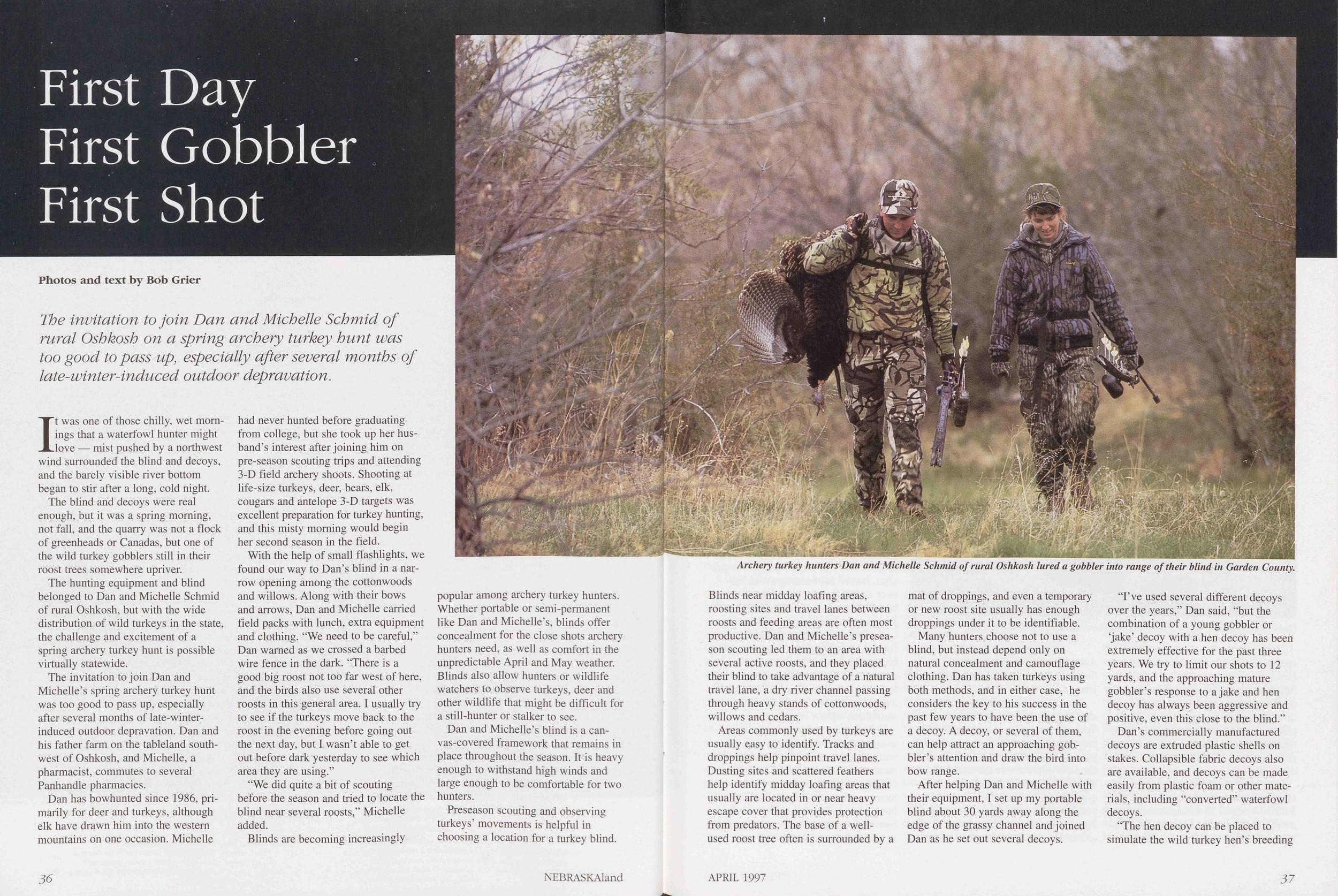
First Day First Gobbler First Shot
The invitation to join Dan and Michelle Schmid of rural Oshkosh on a spring archery turkey hunt was too good to pass up, especially after several months of late-winter-induced outdoor depravation.
It was one of those chilly, wet mornings that a waterfowl hunter might love — mist pushed by a northwest wind surrounded the blind and decoys, and the barely visible river bottom began to stir after a long, cold night.
The blind and decoys were real enough, but it was a spring morning, not fall, and the quarry was not a flock of greenheads or Canadas, but one of the wild turkey gobblers still in their roost trees somewhere upriver.
The hunting equipment and blind belonged to Dan and Michelle Schmid of rural Oshkosh, but with the wide distribution of wild turkeys in the state, the challenge and excitement of a spring archery turkey hunt is possible virtually statewide.
The invitation to join Dan and Michelle's spring archery turkey hunt was too good to pass up, especially after several months of late-winter-induced outdoor depravation. Dan and his father farm on the tableland southwest of Oshkosh, and Michelle, a pharmacist, commutes to several Panhandle pharmacies.
Dan has bowhunted since 1986, primarily for deer and turkeys, although elk have drawn him into the western mountains on one occasion. Michelle had never hunted before graduating from college, but she took up her husband's interest after joining him on pre-season scouting trips and attending 3-D field archery shoots. Shooting at life-size turkeys, deer, bears, elk, cougars and antelope 3-D targets was excellent preparation for turkey hunting, and this misty morning would begin her second season in the field.
With the help of small flashlights, we found our way to Dan's blind in a narrow opening among the cottonwoods and willows. Along with their bows and arrows, Dan and Michelle carried field packs with lunch, extra equipment and clothing. "We need to be careful," Dan warned as we crossed a barbed wire fence in the dark. "There is a good big roost not too far west of here, and the birds also use several other roosts in this general area. I usually try to see if the turkeys move back to the roost in the evening before going out the next day, but I wasn't able to get out before dark yesterday to see which area they are using."
"We did quite a bit of scouting before the season and tried to locate the blind near several roosts," Michelle added.
Blinds are becoming increasingly popular among archery turkey hunters. Whether portable or semi-permanent like Dan and Michelle's, blinds offer concealment for the close shots archery hunters need, as well as comfort in the unpredictable April and May weather. Blinds also allow hunters or wildlife watchers to observe turkeys, deer and other wildlife that might be difficult for a still-hunter or stalker to see.
Dan and Michelle's blind is a canvas-covered framework that remains in place throughout the season. It is heavy enough to withstand high winds and large enough to be comfortable for two hunters.
Preseason scouting and observing turkeys' movements is helpful in choosing a location for a turkey blind.
36 NEBRASKAlandArchery turkey hunters Dan and Michelle Schmid of rural Oshkosh lured a gobbler into range of their blind in Garden County.
Blinds near midday loafing areas, roosting sites and travel lanes between roosts and feeding areas are often most productive. Dan and Michelle's preseason scouting led them to an area with several active roosts, and they placed their blind to take advantage of a natural travel lane, a dry river channel passing through heavy stands of cottonwoods, willows and cedars.
Areas commonly used by turkeys are usually easy to identify. Tracks and droppings help pinpoint travel lanes. Dusting sites and scattered feathers help identify midday loafing areas that usually are located in or near heavy escape cover that provides protection from predators. The base of a well-used roost tree often is surrounded by a mat of droppings, and even a temporary or new roost site usually has enough droppings under it to be identifiable.
Many hunters choose not to use a blind, but instead depend only on natural concealment and camouflage clothing. Dan has taken turkeys using both methods, and in either case, he considers the key to his success in the past few years to have been the use of a decoy. A decoy, or several of them, can help attract an approaching gobbler's attention and draw the bird into bow range.
After helping Dan and Michelle with their equipment, I set up my portable blind about 30 yards away along the edge of the grassy channel and joined Dan as he set out several decoys.
"I've used several different decoys over the years," Dan said, "but the combination of a young gobbler or 'jake' decoy with a hen decoy has been extremely effective for the past three years. We try to limit our shots to 12 yards, and the approaching mature gobbler's response to a jake and hen decoy has always been aggressive and positive, even this close to the blind."
Dan's commercially manufactured decoys are extruded plastic shells on stakes. Collapsible fabric decoys also are available, and decoys can be made easily from plastic foam or other materials, including "converted" waterfowl decoys.
"The hen decoy can be placed to simulate the wild turkey hen's breeding
APRIL 1997 37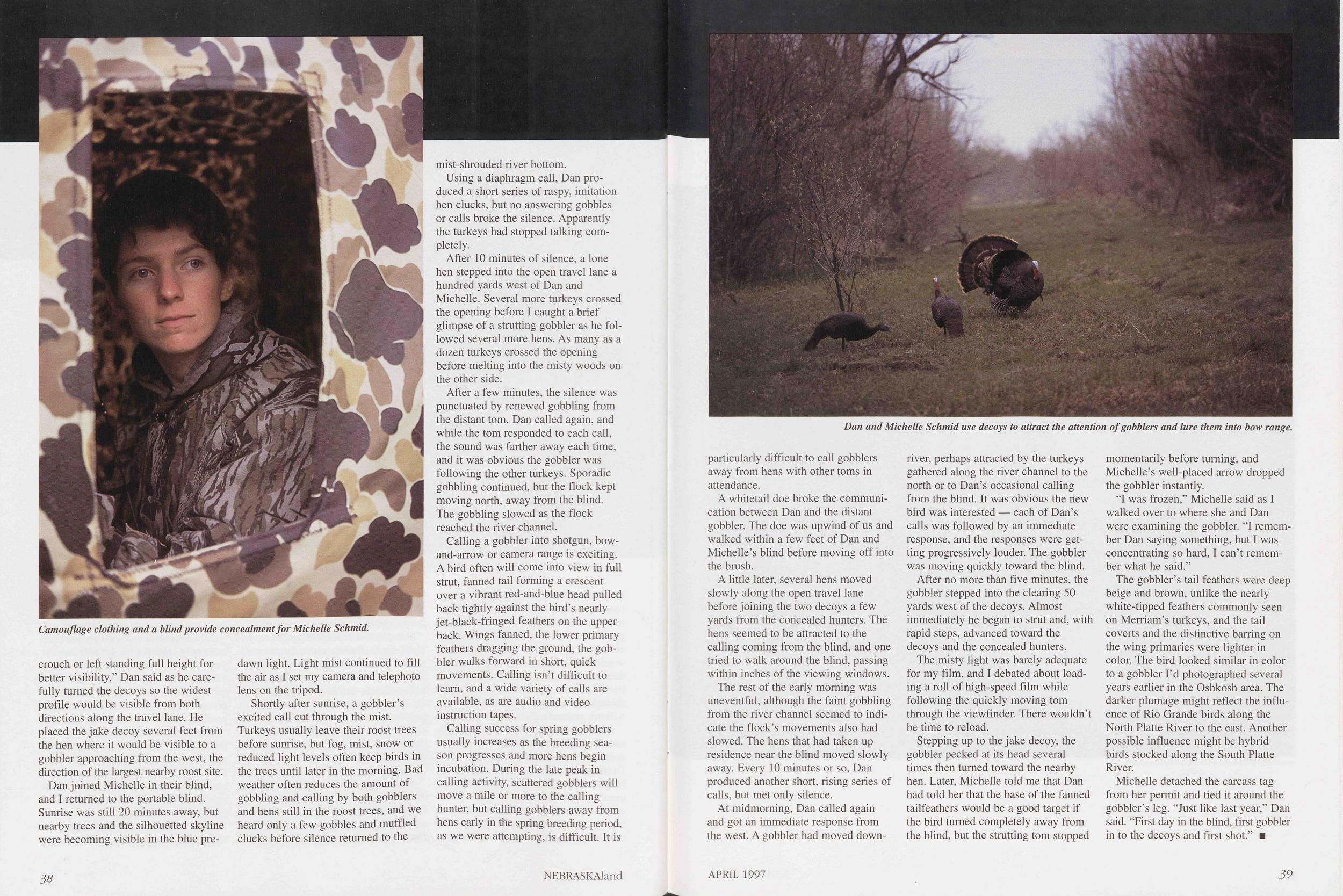
Camouflage clothing and a blind provide concealment for Michelle Schmid.
crouch or left standing full height for better visibility," Dan said as he carefully turned the decoys so the widest profile would be visible from both directions along the travel lane. He placed the jake decoy several feet from the hen where it would be visible to a gobbler approaching from the west, the direction of the largest nearby roost site.
Dan joined Michelle in their blind, and I returned to the portable blind. Sunrise was still 20 minutes away, but nearby trees and the silhouetted skyline were becoming visible in the blue predawn light. Light mist continued to fill the air as I set my camera and telephoto lens on the tripod.
Shortly after sunrise, a gobbler's excited call cut through the mist. Turkeys usually leave their roost trees before sunrise, but fog, mist, snow or reduced light levels often keep birds in the trees until later in the morning. Bad weather often reduces the amount of gobbling and calling by both gobblers and hens still in the roost trees, and we heard only a few gobbles and muffled clucks before silence returned to the mist-shrouded river bottom.
Using a diaphragm call, Dan produced a short series of raspy, imitation hen clucks, but no answering gobbles or calls broke the silence. Apparently the turkeys had stopped talking completely.
After 10 minutes of silence, a lone hen stepped into the open travel lane a hundred yards west of Dan and Michelle. Several more turkeys crossed the opening before I caught a brief glimpse of a strutting gobbler as he followed several more hens. As many as a dozen turkeys crossed the opening before melting into the misty woods on the other side.
After a few minutes, the silence was punctuated by renewed gobbling from the distant torn. Dan called again, and while the torn responded to each call, the sound was farther away each time, and it was obvious the gobbler was following the other turkeys. Sporadic gobbling continued, but the flock kept moving north, away from the blind. The gobbling slowed as the flock reached the river channel.
Calling a gobbler into shotgun, bow-and-arrow or camera range is exciting. A bird often will come into view in full strut, fanned tail forming a crescent over a vibrant red-and-blue head pulled back tightly against the bird's nearly jet-black-fringed feathers on the upper back. Wings fanned, the lower primary feathers dragging the ground, the gobbler walks forward in short, quick movements. Calling isn't difficult to learn, and a wide variety of calls are available, as are audio and video instruction tapes.
Calling success for spring gobblers usually increases as the breeding season progresses and more hens begin incubation. During the late peak in calling activity, scattered gobblers will move a mile or more to the calling hunter, but calling gobblers away from hens early in the spring breeding period, as we were attempting, is difficult. It is
38 NEBRASKAlandDan and Michelle Schmid use decoys to attract the attention of gobblers and lure them into bow range.
particularly difficult to call gobblers away from hens with other toms in attendance.
A whitetail doe broke the communication between Dan and the distant gobbler. The doe was upwind of us and walked within a few feet of Dan and Michelle's blind before moving off into the brush.
A little later, several hens moved slowly along the open travel lane before joining the two decoys a few yards from the concealed hunters. The hens seemed to be attracted to the calling coming from the blind, and one tried to walk around the blind, passing within inches of the viewing windows.
The rest of the early morning was uneventful, although the faint gobbling from the river channel seemed to indicate the flock's movements also had slowed. The hens that had taken up residence near the blind moved slowly away. Every 10 minutes or so, Dan produced another short, rising series of calls, but met only silence.
At midmorning, Dan called again and got an immediate response from the west. A gobbler had moved downriver, perhaps attracted by the turkeys gathered along the river channel to the north or to Dan's occasional calling from the blind. It was obvious the new bird was interested — each of Dan's calls was followed by an immediate response, and the responses were getting progressively louder. The gobbler was moving quickly toward the blind.
After no more than five minutes, the gobbler stepped into the clearing 50 yards west of the decoys. Almost immediately he began to strut and, with rapid steps, advanced toward the decoys and the concealed hunters.
The misty light was barely adequate for my film, and I debated about loading a roll of high-speed film while following the quickly moving torn through the viewfinder. There wouldn't be time to reload.
Stepping up to the jake decoy, the gobbler pecked at its head several times then turned toward the nearby hen. Later, Michelle told me that Dan had told her that the base of the fanned tailfeathers would be a good target if the bird turned completely away from the blind, but the strutting torn stopped momentarily before turning, and Michelle's well-placed arrow dropped the gobbler instantly.
"I was frozen," Michelle said as I walked over to where she and Dan were examining the gobbler. "I remember Dan saying something, but I was concentrating so hard, I can't remember what he said." The gobbler's tail feathers were deep beige and brown, unlike the nearly white-tipped feathers commonly seen on Merriam's turkeys, and the tail coverts and the distinctive barring on the wing primaries were lighter in color. The bird looked similar in color to a gobbler I'd photographed several years earlier in the Oshkosh area. The darker plumage might reflect the influence of Rio Grande birds along the North Platte River to the east. Another possible influence might be hybrid birds stocked along the South Platte River.
Michelle detached the carcass tag from her permit and tied it around the gobbler's leg. "Just like last year," Dan said. "First day in the blind, first gobbler in to the decoys and first shot."
APRIL 1997 39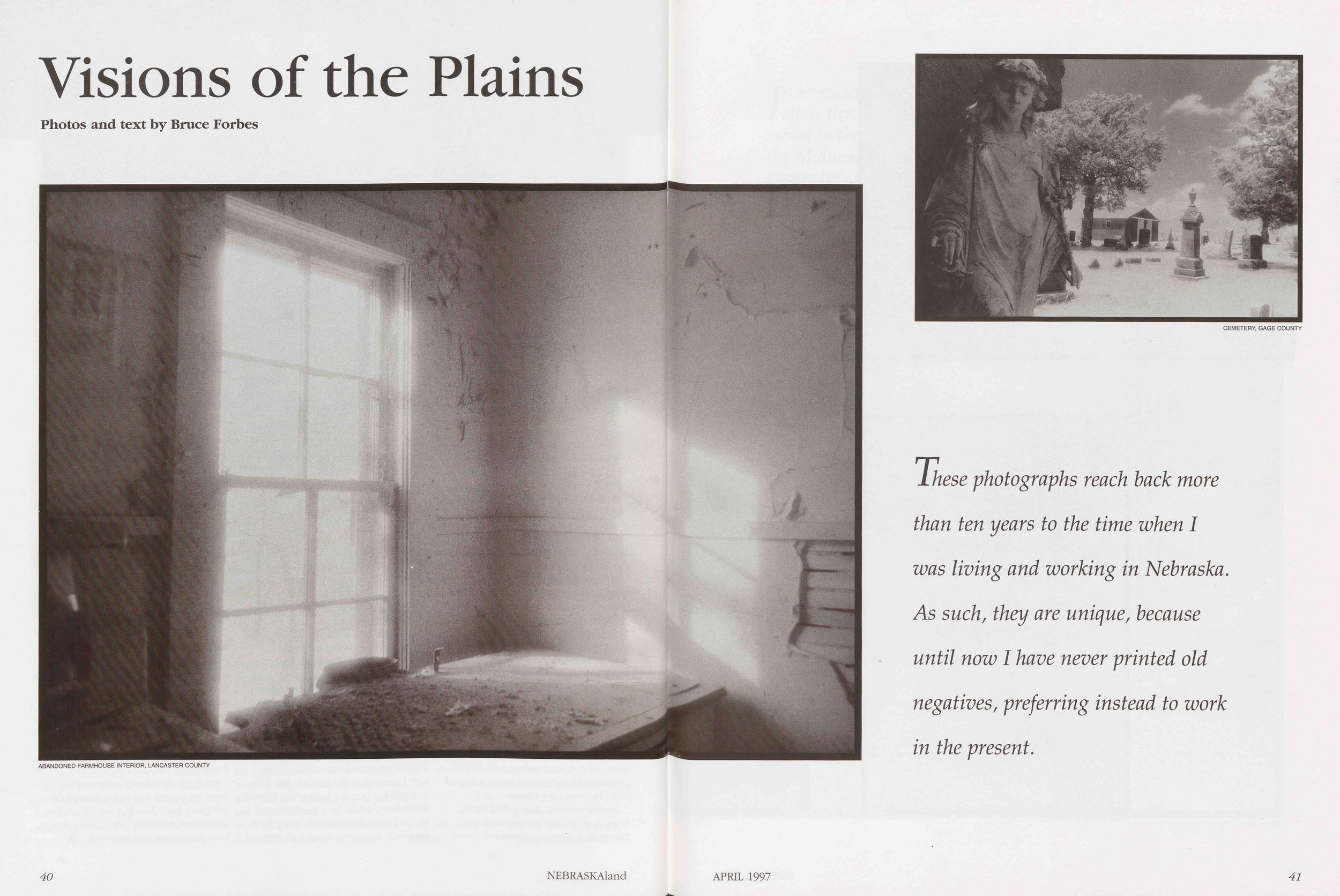
Visions of the Plains
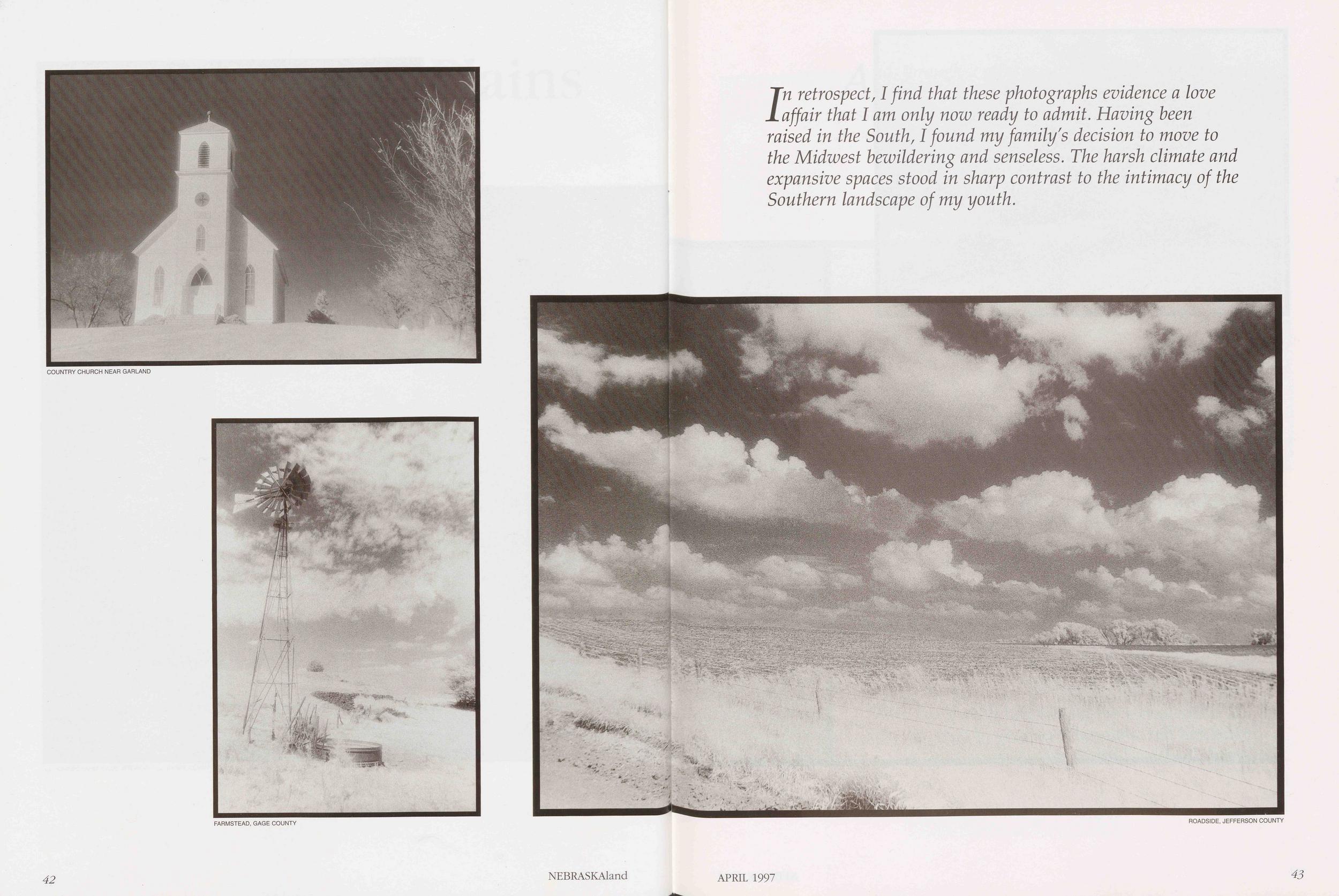
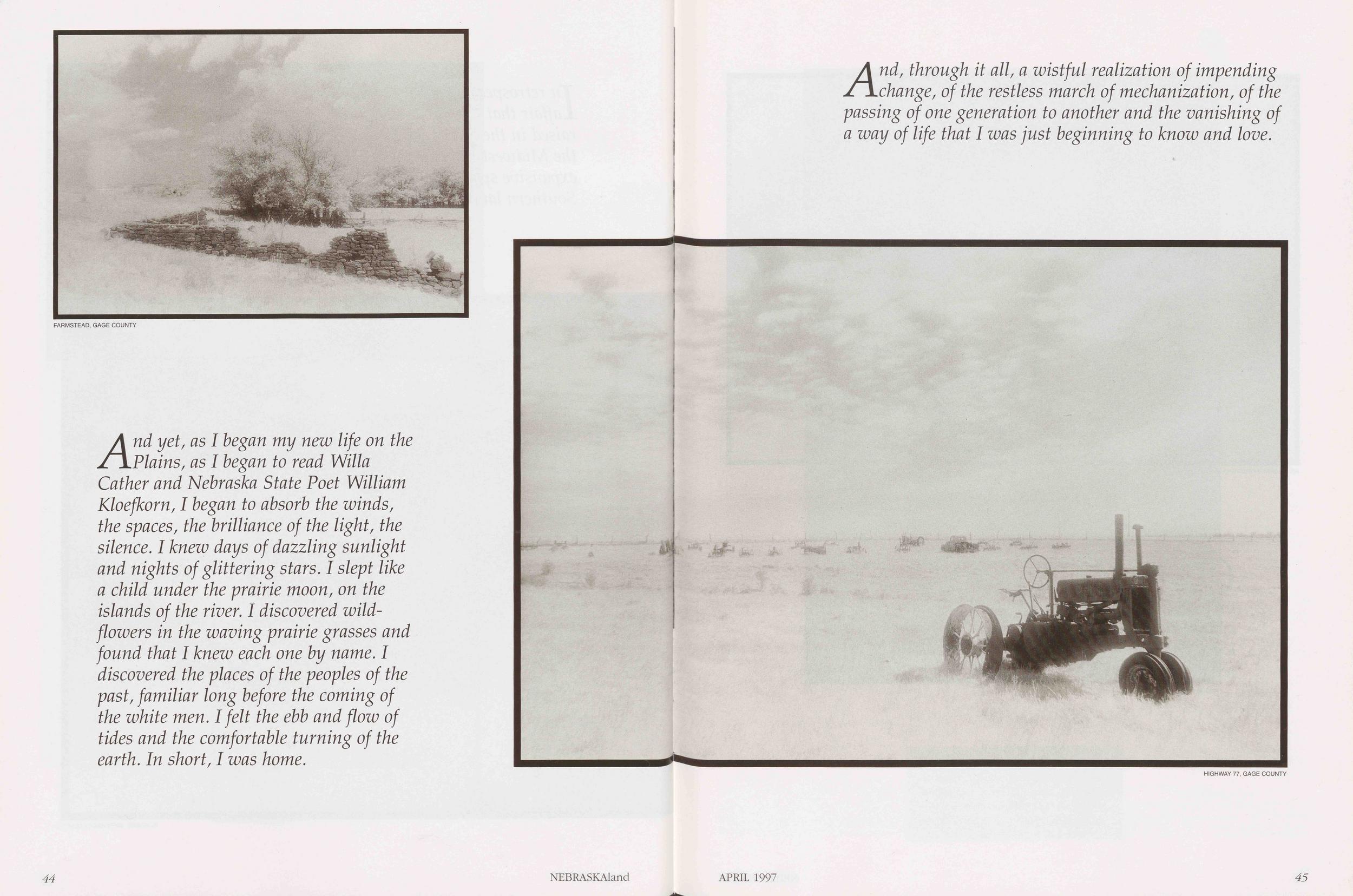
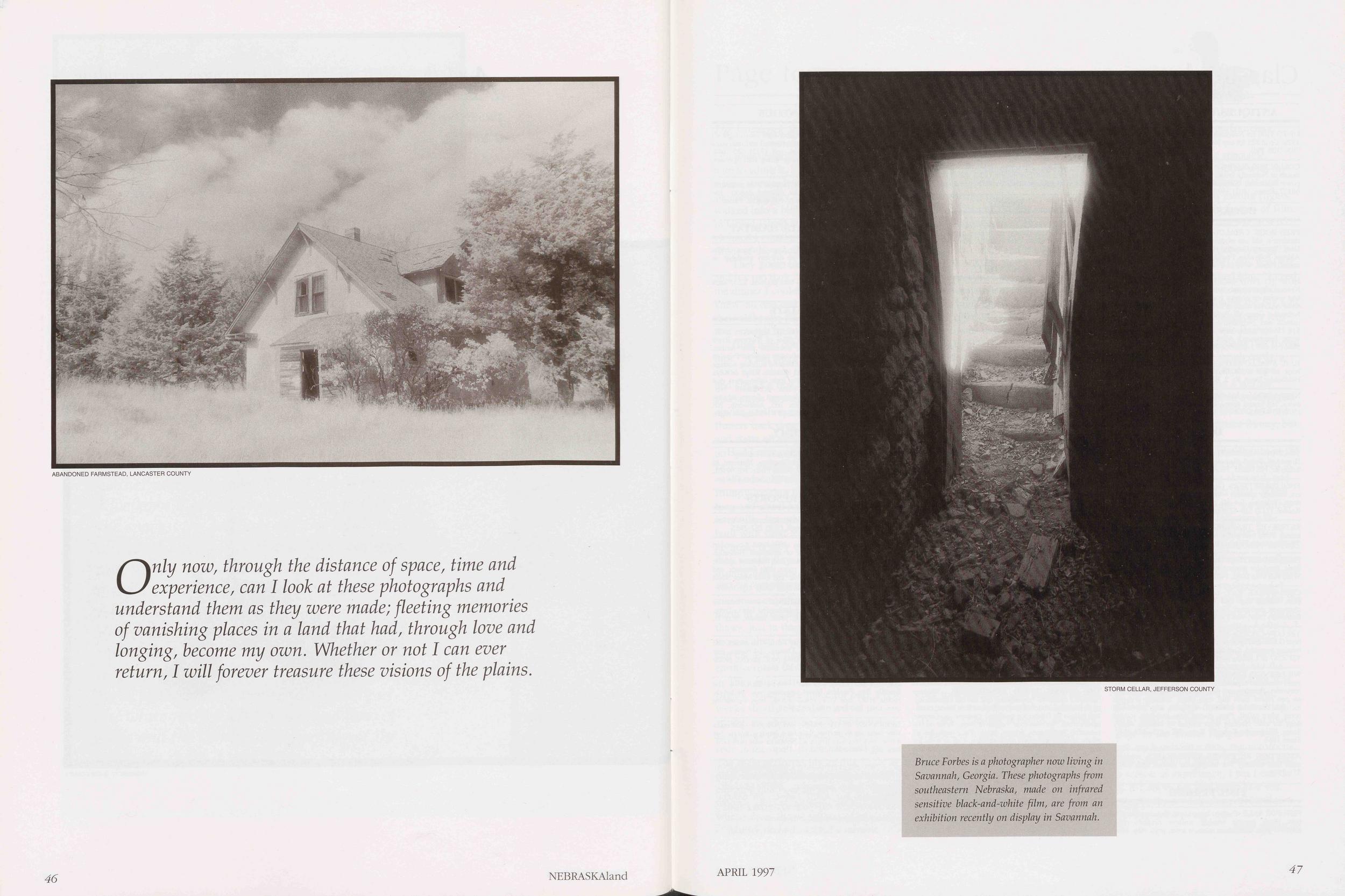
Page forty-nine
The Woodcock StorySuccess sometimes breeds arrogance in a photographer, and as much as I hate to admit it, it has happened to me a time or two. It was shortly after a successful foray last spring that I walked into a biologist friend's office in Grand Island and boastfully proclaimed I could photograph the mating flight of the woodcock.
"They go up too fast, fly too high, and it's too dark," he said, and he bet me dinner I couldn't do it. As far as he knew, no one had ever photographed their elaborate flight. That was incentive enough for me.
"How hard could it be?" I asked him. "A fat, sluggish bird lands at the same spot every night, walks around and clucks a few times, then takes off and spirals upward in broad, lazy circles, stalls out, sings a few notes and flutters back down to the same spot and starts all over again."
Had I ever seen it, he asked. "No," I said. He grinned a sly grin.
Woodcocks are drab, stocky, almost frumpy-looking birds about nine inches long and about half that tall. They have long bills, but otherwise are compactly built with short legs, a stumpy tail and no neck. If they were football players, they would play offensive line. They usually live in moist woodlands, swamps and thickets that adjoin wet meadows or pastures. They migrate north in spring shortly after the ground thaws, just in time to feed on earthworms, their favorite food, and they can eat nearly their own weight in earthworms a day.
They are nocturnal, so their mating flights, which take place for only a few weeks shortly after their arrival in spring, are about the only times the ground-dwelling woodcock can be seen in the open, much less in flight. The male performs his mating flight at dusk in an open area, usually slightly elevated and in clear view of his mate, who remains at her nest, usually somewhere along the woodland edge.
My friend had located a reliable woodcock spot on a wet meadow near his home along the Platte River His house, incidentally, has a large painting of woodcocks hanging above the couch. Last April, he took me out to see the mating flight.
After a 20-minute ride across bumpy floodplain pasture, we arrived at the site, an open thicket in a patchy meadow dotted with cedars and Russian olive trees. It was 8:15, about 15 minutes before sunset, the sky was clear, the temperature moderate, and the air was still. We hunkered down between two Russian olive trees and waited.
"He comes in like clockwork at 8:30 and leaves at 9:05," my friend whispered, looking at his watch. I had brought the bare essentials: a telephoto lens that looks more like a cannon, a tripod and plenty of film. He had brought a brown wool sock stuffed with tissue and with a long bill-like stick in one end. He set his "decoy" several feet away, hoping to lure the male woodcock.
"Zeipp."
"There he is!" my friend whispered hoarsely. The woodcock had flown in and landed about 15 feet away. I raised my eye to the viewfinder, but a low shrub blocked my view.
"Zeipp."
"There he is again." We could just barely see him. Sometimes he would just stand still, making that loud rasping "zeipp." Other times he would walk slowly around in circles, making a low guttural "p'tul," followed closely by another "zeipp."
"He's going to fly anytime," my friend warned. Suddenly, the woodcock took off like a dart angling rapidly upward in wide circles to at least 300 feet. Spiraling skyward, his wings whistled in a continuous, melodic "twitter" until I could hardly see him against the darkening sky.
Then his song changed to multisyllable, clear, musical notes, "pchuck tuck cuckoo, pchuck tuck cuckoo," and he fluttered back downward, circling and zigzagging, to the same spot on the ground. Then the performance started over again.
I was amazed at the spectacle, which I could barely follow with my eyes, much less a camera. I sat and watched the rest of his mating flights, firing no more than six frames of film. Then, as my friend predicted, at 9:05 the woodcock left.
"Do you think you got anything?" he asked as we left. "No, this was just a scouting trip," I assured him. "I need more gear. I'll be back tomorrow."
The next night I brought the big lens and a slightly smaller autofocus lens for quick flight shots, two flashes mounted with teleflash units that throw the flash twice as far, synch cords, a woodcock mating-call tape, a tape player and speakers and a stuffed woodcock borrowed from a colleague. Loaded with gear, we looked like we were chasing the Energizer Bunny, but this time I was ready.
We were crouched like statues in the thicket when the woodcock arrived at 8:30.1 pointed the lens skyward, and my friend held the flash units. When the woodcock took flight, we twirled in dance-like circles, following the bird. My friend called out the bird's position while I tried frantically to find it in the viewfinder, firing frame after frame. Flashes lit up the sky. The mating tape blared in the background. I shot four 36-exposure rolls and saw the bird in the viewfinder only once during his five, minute-long flights. At 9:05,1 sat dizzy, frustrated and entangled in camera cords. My friend was amused.
Twice in April I returned, but the only woodcock photograph I got was of the stuffed decoy. I lost the bet. Maybe we can go double or nothing this April. If I take out a second mortgage on our house, I might be able to get my hands on a new, big autofocus lens, and with a better flash setup and a season of experience, I bet I can do it. It's really not that hard: You see, woodcocks are fat, sluggish birds... Well, you know the rest.
Mike Forsberg APRIL 1997 49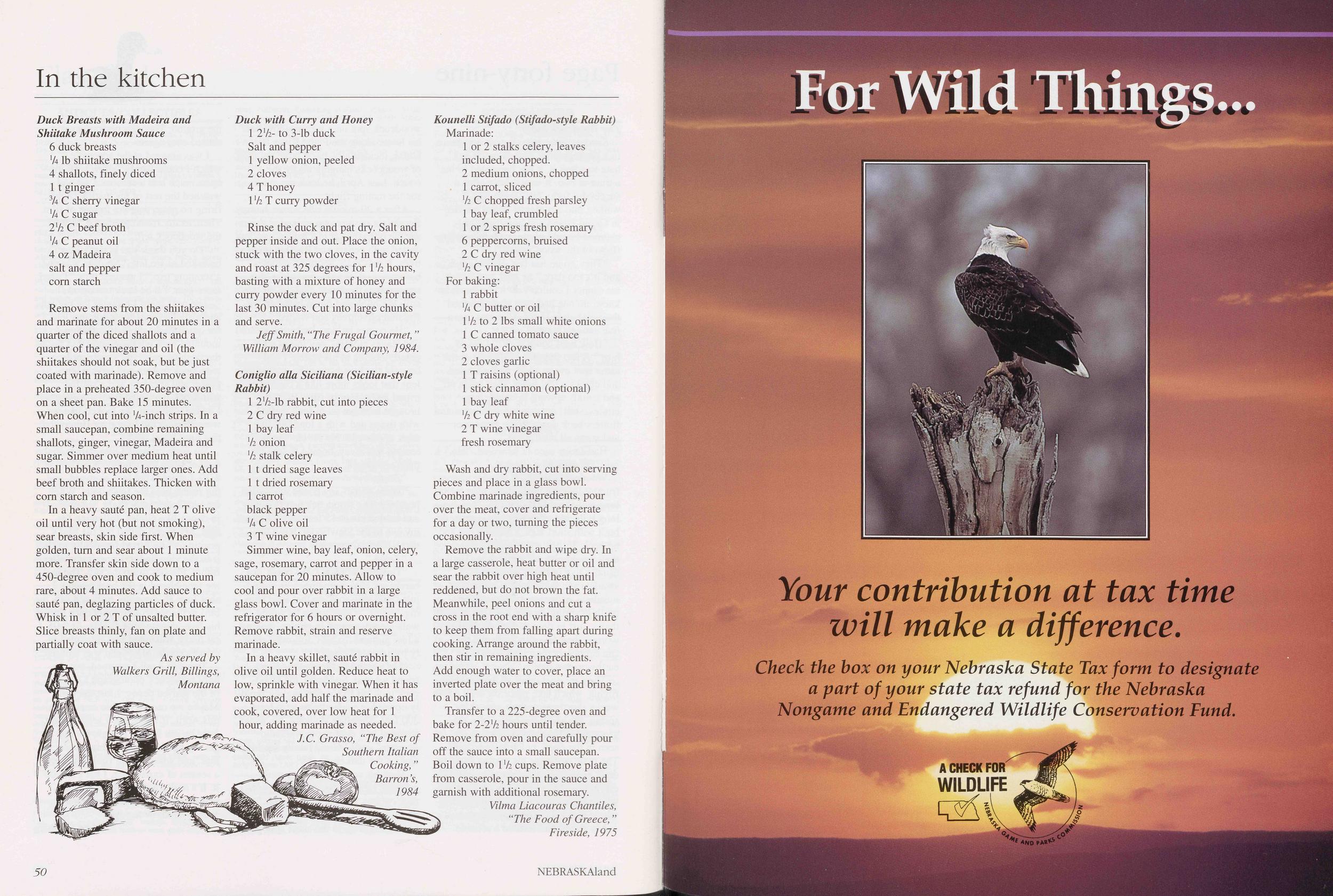
In the kitchen
Duck Breasts with Madeira and Shiitake Mushroom Sauce6 duck breasts
l14 lb shiitake mushrooms
4 shallots, finely diced
1 t ginger
3/4 C sherry vinegar
l/4 C sugar
2 1/2 C beef broth
1/4 C peanut oil
4 oz Madeira
salt and pepper
corn starch
Remove stems from the shiitakes and marinate for about 20 minutes in a quarter of the diced shallots and a quarter of the vinegar and oil (the shiitakes should not soak, but be just coated with marinade). Remove and place in a preheated 350-degree oven on a sheet pan. Bake 15 minutes. When cool, cut into 1/4-inch strips. In a small saucepan, combine remaining shallots, ginger, vinegar, Madeira and sugar. Simmer over medium heat until small bubbles replace larger ones. Add beef broth and shiitakes. Thicken with corn starch and season.
In a heavy saute pan, heat 2 T olive oil until very hot (but not smoking), sear breasts, skin side first. When golden, turn and sear about 1 minute more. Transfer skin side down to a 450-degree oven and cook to medium rare, about 4 minutes. Add sauce to saute pan, deglazing particles of duck. Whisk in 1 or 2 T of unsalted butter. Slice breasts thinly, fan on plate and partially coat with sauce.
As served by Walkers Grill, Billings, Montana1 1/2- to 3-lb duck
Salt and pepper
1 yellow onion, peeled
2 cloves
4 T honey
1/2 T curry powder
Rinse the duck and pat dry. Salt and pepper inside and out. Place the onion, stuck with the two cloves, in the cavity and roast at 325 degrees for 1 1/2 hours, basting with a mixture of honey and curry powder every 10 minutes for the last 30 minutes. Cut into large chunks and serve.
Jeff Smith, "The Frugal Gourmet, " William Morrow and Company, 1984. Coniglio alia Siciliana (Sicilian-style Rabbit)1 2 1/2-lb rabbit, cut into pieces
2 C dry red wine
1 bay leaf
1/2 onion
1/2 stalk celery
1 t dried sage leaves
1 t dried rosemary
1 carrot
black pepper
1/4 C olive oil
3 T wine vinegar
Simmer wine, bay leaf, onion, celery, sage, rosemary, carrot and pepper in a saucepan for 20 minutes. Allow to cool and pour over rabbit in a large glass bowl. Cover and marinate in the refrigerator for 6 hours or overnight. Remove rabbit, strain and reserve marinade.
In a heavy skillet, saute rabbit in olive oil until golden. Reduce heat to low, sprinkle with vinegar. When it has evaporated, add half the marinade and cook, covered, over low heat for 1 hour, adding marinade as needed.
J.C. Grasso, "The Best of Southern Italian Cooking,' Barron's, 1984 Kounelli Stifado (Stifado-style Rabbit)Marinade:
1 or 2 stalks celery, leaves included, chopped.
2 medium onions, chopped
1 carrot, sliced
1/2 C chopped fresh parsley
1 bay leaf, crumbled
1 or 2 sprigs fresh rosemary
6 peppercorns, bruised
2 C dry red wine
1/2 C vinegar
For baking:
1 rabbit
1/4 C butter or oil
1 1/2 to 2 lbs small white onions
1 C canned tomato sauce
3 whole cloves
2 cloves garlic
1 T raisins (optional)
1 stick cinnamon (optional)
1 bay leaf
1/2 C dry white wine
2 T wine vinegar
fresh rosemary
Wash and dry rabbit, cut into serving pieces and place in a glass bowl. Combine marinade ingredients, pour over the meat, cover and refrigerate for a day or two, turning the pieces occasionally.
Remove the rabbit and wipe dry. In a large casserole, heat butter or oil and sear the rabbit over high heat until reddened, but do not brown the fat. Meanwhile, peel onions and cut a cross in the root end with a sharp knife to keep them from falling apart during cooking. Arrange around the rabbit, then stir in remaining ingredients. Add enough water to cover, place an inverted plate over the meat and bring to a boil.
Transfer to a 225-degree oven and bake for 2-272 hours until tender. Remove from oven and carefully pour off the sauce into a small saucepan. Boil down to Vh cups. Remove plate from casserole, pour in the sauce and garnish with additional rosemary.
Vilma Liacouras Chantiles, "The Food of Greece,' Fireside, 1975 50 NEBRASKAland
Position: 798 (13 views)