Volume 75, Issue 2, 1997
NEBRASKAland
MARCH 1997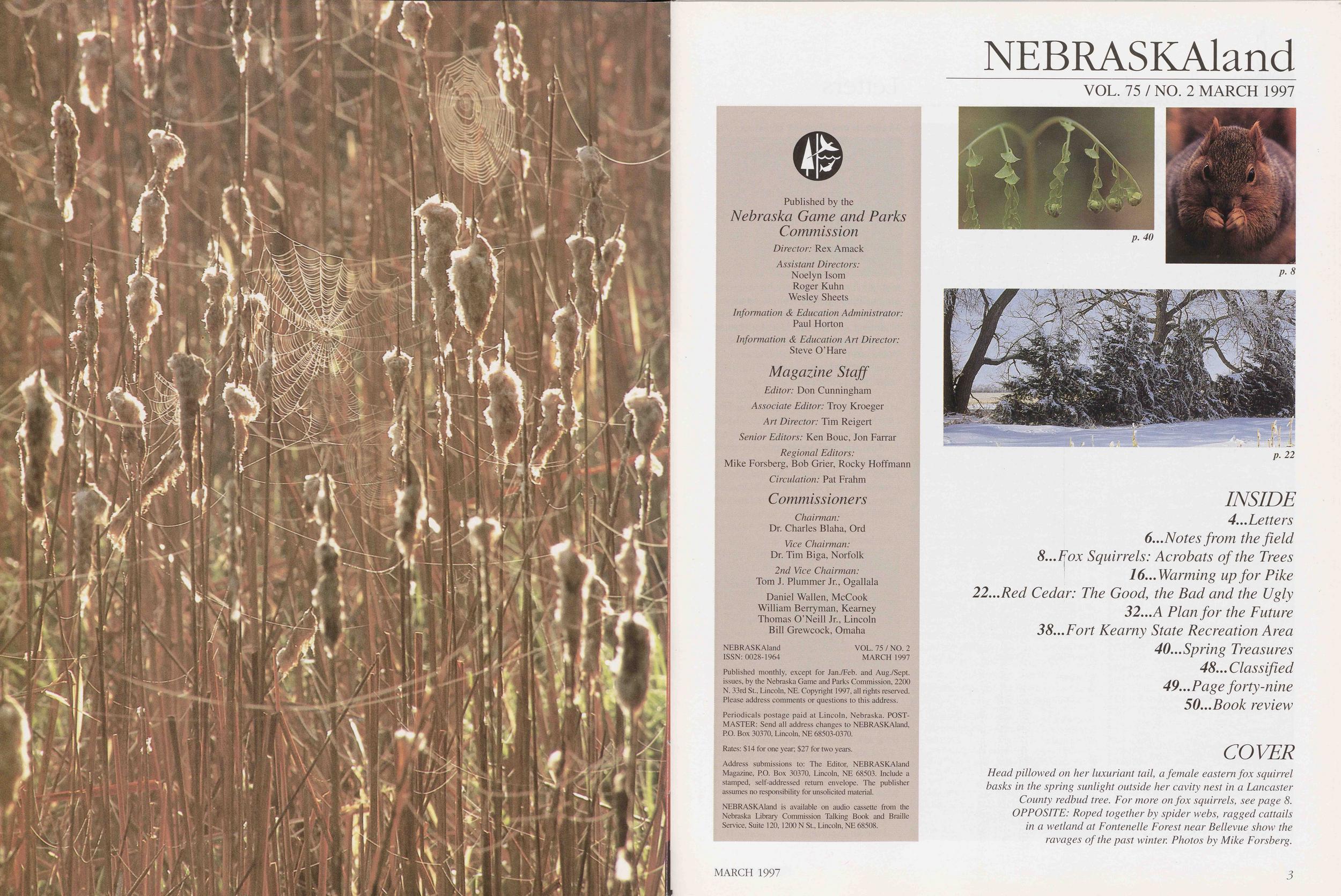
p. 40
p. 8
p. 22
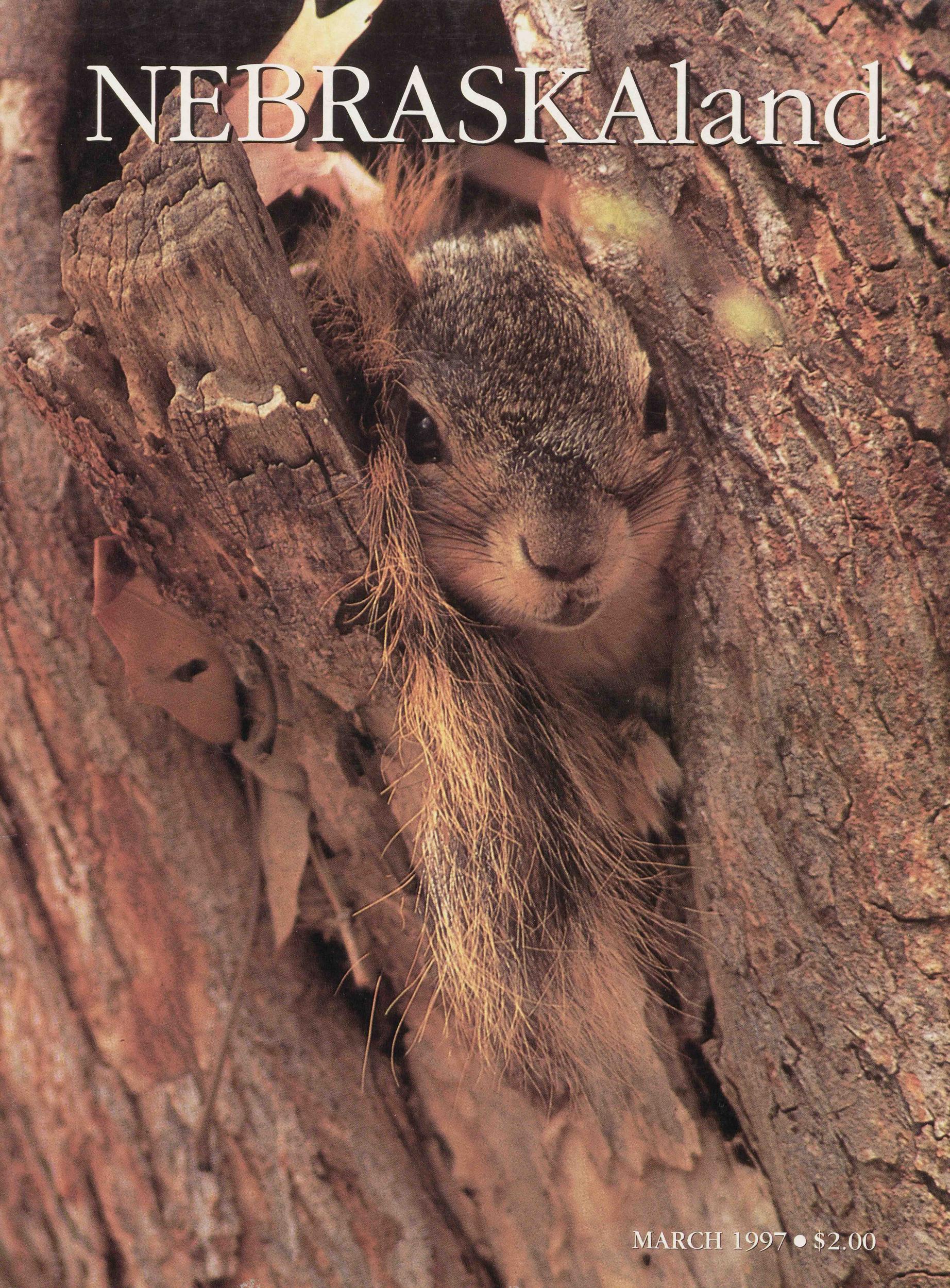
COVER Head pillowed on her luxuriant tail, a female eastern fox squirrel basks in the spring sunlight outside her cavity nest in a Lancaster County redbud tree. For more on fox squirrels, see page 8. OPPOSITE: Roped together by spider webs, ragged cattails in a wetland at Fontanelle Forest near Bellevue show the ravages of the past winter. Photos by Mike Forsberg.
 Nebraska Game and Parks Commission
District Offices
Headquarters
2200 North 33rd Street
Lincoln, NE 68503
Phone (402) 471-0641
District Office I
Box 725
Alliance, NE 69301
Phone (308) 762-5605
District Office II
Box 508
Bassett, NE 68714
Phone (402) 684-2921
District Office III
Box 934
Norfolk, NE 68702
Phone (402) 370-3374
District Office IV
Route 4, Box 36
North Platte, NE 69101
Phone (308) 535-8025
District Office V
2200 North 33rd Street
Lincoln, NE 68503
Phone (402) 471-5558
Omaha Office
1212 Deer Park Blvd.
Omaha, NE 68108
Phone (402) 595-2144
Ak-Sar-Ben Aquarium
21502 West Highway 31
Gretna, NE 68028
Phone (402) 332-3901
World Wide Web Site: http://www.ngpc.state.ne.us
Email: ngpe@ngpsun.ngpc.state.ne.us
Conservation Officers by Region
Headquarters
Dick Turpin (Adm.) Lincoln
Ted Blume (Asst. Adm.) Lincoln
Dan Klammer Lincoln
Panhandle
Officer
Richard Furley (Sup.)
Raymond Still
Walt Meyer
John Murphy
Jim Zimmerman
Marvin Kampbell
Dennis Thompson
DanZuehlke
Dan Evasco
Scott Brandt
Southwest
Officer
Roger Thompson (Sup.)
Dwight Allbery
George Sund
Matt Andrews
Jack Henderson
Dirk Greene
Virgil Gosch
Rich Routh
Northeast
Officer
Tom Zimmer (Sup.)
Marion Shafer
Robert Kelly
Ross Oestmann
LA. .Wilkinson
City
Alliance
Bridgeport
Chadron
Crawford
Gering
Hay Springs
Ogallala
Ogallala
Oshkosh
Scottsbluff
City
N. Platte
N. Platte
Cambridge
Elwood
Gothenburg
Imperial
McCook
Rep. City
City
Norfolk
Norfolk
Albion
Bloomfield
Columbus
471-5531
483-5643
475-1475
Phone (308)
762-2024
262-1075
432-4398
665-2021
436-7561
638-7527
284-6450
284-4815
772-3091
635-1277
Phone (308)
532-9175
532-2753
697-4629
785-3025
537-7483
882-5328
345-2185
799-2085
Phone (402)
371-6625
371-2031
395-2538
373-4412
564-4375
Gary Ralston
Daniel Roberts
Randy Pomplun
Jon Reeves
Eric Wiebe
Steve Oberg
Sandhills
Officer
Bruce Wiebe (Sup.)
Larry Bauman
Ray Dierking
Richard Seward
Mick Gray
South-central
Officer
Jerry Pecha (Sup.)
Terry Brentzel
Tim Williams
Dale Johnson
Mark Reeves
Robert Finke
Southeast
Officer
Craig Stover (Sup.)
Murray Johnson
Douglas Kramer
Dina Hopper
William Krause
Larry Elston
Mike Luben
DuaneArp
Levi Krause
Russell Mort
Creighton 847-3284
Fremont 721-7852
Fullerton (308) 536-2987
Kennard 427-7378
Ponca 755-2566
West Point 372-3062
City Phone (402)
Bassett 684-3867
Atkinson 925-5569
Brkn.Bow (308) 872-3078
Ord (308) 728-3115
Valentine 376-3136
City
York
Grand Is.
Hastings
Hebron
Loup City
Milford
City
Lincoln
Lincoln
Lincoln
Lincoln
Auburn
Bellevue
Colon
Gretna
Louisville
Nebr. City
Phone (402)
362-5707
(308) 384-8296
463-2535
768-7363
(308)745-1126
761-3537
Phone (402)
471-5590
488-2923
466-9001
483-2358
274-3789
292-4910
443-4278
332-4954
234-2212
873-5684
Operation Game Thief 1-800-742-7627
Nebraska Game and Parks Commission
District Offices
Headquarters
2200 North 33rd Street
Lincoln, NE 68503
Phone (402) 471-0641
District Office I
Box 725
Alliance, NE 69301
Phone (308) 762-5605
District Office II
Box 508
Bassett, NE 68714
Phone (402) 684-2921
District Office III
Box 934
Norfolk, NE 68702
Phone (402) 370-3374
District Office IV
Route 4, Box 36
North Platte, NE 69101
Phone (308) 535-8025
District Office V
2200 North 33rd Street
Lincoln, NE 68503
Phone (402) 471-5558
Omaha Office
1212 Deer Park Blvd.
Omaha, NE 68108
Phone (402) 595-2144
Ak-Sar-Ben Aquarium
21502 West Highway 31
Gretna, NE 68028
Phone (402) 332-3901
World Wide Web Site: http://www.ngpc.state.ne.us
Email: ngpe@ngpsun.ngpc.state.ne.us
Conservation Officers by Region
Headquarters
Dick Turpin (Adm.) Lincoln
Ted Blume (Asst. Adm.) Lincoln
Dan Klammer Lincoln
Panhandle
Officer
Richard Furley (Sup.)
Raymond Still
Walt Meyer
John Murphy
Jim Zimmerman
Marvin Kampbell
Dennis Thompson
DanZuehlke
Dan Evasco
Scott Brandt
Southwest
Officer
Roger Thompson (Sup.)
Dwight Allbery
George Sund
Matt Andrews
Jack Henderson
Dirk Greene
Virgil Gosch
Rich Routh
Northeast
Officer
Tom Zimmer (Sup.)
Marion Shafer
Robert Kelly
Ross Oestmann
LA. .Wilkinson
City
Alliance
Bridgeport
Chadron
Crawford
Gering
Hay Springs
Ogallala
Ogallala
Oshkosh
Scottsbluff
City
N. Platte
N. Platte
Cambridge
Elwood
Gothenburg
Imperial
McCook
Rep. City
City
Norfolk
Norfolk
Albion
Bloomfield
Columbus
471-5531
483-5643
475-1475
Phone (308)
762-2024
262-1075
432-4398
665-2021
436-7561
638-7527
284-6450
284-4815
772-3091
635-1277
Phone (308)
532-9175
532-2753
697-4629
785-3025
537-7483
882-5328
345-2185
799-2085
Phone (402)
371-6625
371-2031
395-2538
373-4412
564-4375
Gary Ralston
Daniel Roberts
Randy Pomplun
Jon Reeves
Eric Wiebe
Steve Oberg
Sandhills
Officer
Bruce Wiebe (Sup.)
Larry Bauman
Ray Dierking
Richard Seward
Mick Gray
South-central
Officer
Jerry Pecha (Sup.)
Terry Brentzel
Tim Williams
Dale Johnson
Mark Reeves
Robert Finke
Southeast
Officer
Craig Stover (Sup.)
Murray Johnson
Douglas Kramer
Dina Hopper
William Krause
Larry Elston
Mike Luben
DuaneArp
Levi Krause
Russell Mort
Creighton 847-3284
Fremont 721-7852
Fullerton (308) 536-2987
Kennard 427-7378
Ponca 755-2566
West Point 372-3062
City Phone (402)
Bassett 684-3867
Atkinson 925-5569
Brkn.Bow (308) 872-3078
Ord (308) 728-3115
Valentine 376-3136
City
York
Grand Is.
Hastings
Hebron
Loup City
Milford
City
Lincoln
Lincoln
Lincoln
Lincoln
Auburn
Bellevue
Colon
Gretna
Louisville
Nebr. City
Phone (402)
362-5707
(308) 384-8296
463-2535
768-7363
(308)745-1126
761-3537
Phone (402)
471-5590
488-2923
466-9001
483-2358
274-3789
292-4910
443-4278
332-4954
234-2212
873-5684
Operation Game Thief 1-800-742-7627
Letters
Sharptails and Prairie Chickens
Rocky Hoffmann's article, "An Extra Month for Grouse," [December 1996] was interesting and had excellent photos, but the caption on page 37 is wrong.
As a native of the Sandhills and an avid hunter, I am hard to fool about the difference between sharp-tailed grouse and prairie chickens. Even if I turn the photo upside down and left to right, it still doesn't change the feathers.
By the way, what is the one in the middle? It's something we haven't seen too much lately, but I seem to recall it.
I have read NEBRASKAland since its beginning and always look forward to the next issue, even if there is an occasional error.
Bob Stevens Valentine, Nebraska Mr. Stevens and many other readers caught our error. The caption should read, "Prairie chicken, left, has a barred breast; sharptail, right, has V-shaped markings.' If you haven 't been seeing plenty of the species in the middle, you must be looking in the wrong places, as many Nebraska pheasant hunters can attest. (Editor)Late Season Snows
I thought your "Late Season Snows" feature was fantastic. I've always been primarily a pheasant and quail hunter, but that article has given me incentive to try a new sport.
I'm enclosing a photo of my Lab-mix, Slacker, on a recent pheasant hunt in Pawnee County. With a little luck, I hope soon to be watching her retrieve snows and whitefronts.
Patrick T. Carraher Lincoln, Nebraska 4 NEBRASKAlandA Surprise for Dad
I have been married to an avid duck and goose hunter for 39 years, and we have raised three daughters who hunt in the duck blinds with their father.
For Christmas this year, DruAnn, Colleen and Kris surprised their dad by having this photo taken for his office. They had a lot of laughs posing in the rain in hunting gear.
Sandy Keating Duncan, NebraskaRemembering "My Game Warden"
Thank you for the very special Page forty-nine, "My Game Warden," about retired Conservation Officer Lyman Wilkinson [November 1997]. Yes, his grandmother really fished. I know, because "Wilke" is my brother.
Wilke didn't know our grandmother, Marie Frimel, since she died before he was born. She and Grandpa Frimel were Czech immigrants who homesteaded in Hayes County in the 1800s. Our mother told us stories of how Grandma Frimel enjoyed fishing in the creek, probably Red Willow Creek, near their soddie.
One of my best memories of her is after they moved to Crete. During a visit, we found her sitting on a box on the bank of the Blue River, fishing. I don't know that she ever had a license. I have heard that she was very upset when our dad's fishing license went floating down the Blue River.
"My Game Warden" touches me personally, but more than that, it carries the message of the importance of the work of the conservation officers and the laws that protect and preserve wildlife.
Georgia (Wilkinson) Bishel Hastings, NebraskaAs always, Page forty-nine was excellent, but "My Game Warden" reminds me of a story directly related to your magazine.
In the late 1950s, my father took my brother and me to a lake south of Richland to fish. Out of nowhere appeared Wilke to "check us out." He then told my father about a publication called Outdoor Nebraska [NEBRASKAland's title until 1964]. Dad bought a subscription, and Wilke left.
Dad died in 1986, and I never asked the question: Was he more interested in the magazine or in getting Wilke out of there? I suspect the latter.
Ed Walters Broomfield, ColoradoTwenty Years of Hospitality
I just returned from my 20th annual pheasant hunt in Nebraska. In November 1977, as our group left a cafe in Beaver City, we were engaged in conversation by a local resident, who invited us to spend the rest of our hunt at her home.
Mrs. G.W. (Jean) Shafer, a recent widow, insisted we leave our hotel in Kansas and move in. You can imagine the concerns of her two sons in Beaver City and her daughter in Chicago about the strange men from Alabama their mother had picked up off the street, but "mom knows best."
I have returned yearly with three regulars and one or two guests. We have come to share our lives with the Shafer family. We have met on vacations and watched children grow up. We have become family.
The annual trek to Nebraska is filled with wonderful memories because of a beautiful lady and the warmth and generosity of her remarkable family.
Eddie Brown Birmingham, Alabama Write to: Letters, NEBRASKAland Magazine, P.O. Box30370, Lincoln, NE 68503. Fax: (402) 471-5528. E-mail: Nebland@ngpsun. ngpc. state, ne. us. Letters may be condensed and edited for clarity. Photos also are welcome and will be returned.
Notes from the field
Fort Robinson History Conference
In movies, on television, even in old woodcuts and steel engravings, the images reappear, reinforcing a romantic image that has become part of our national mythology: Blue-clad cavalry troops charge across the prairie on foam-flecked horses, sabers at the ready or carbines spitting smoke. Boisterous soldiers swing sultry, satin-bedecked women across a dance floor to the strains of a tinkling piano. But what really lay behind those pervasive images of military life on the Plains? What was everyday life really like for frontier soldiers?
That question is the theme of the second Fort Robinson History Conference to be held April 24 - 26 at Fort Robinson near Crawford. Sponsored by the Nebraska State Historical Society and the Nebraska Game and Parks Commission, and funded in part by the Nebraska Humanities Council, an affiliate of the National Endowment for the Humanities, the conference will take place on the grounds of Fort Robinson, one of the most important frontier posts and now a state historical park.
The conference will feature presentations by eminent scholars of the frontier military experience, and guest speaker at the Saturday banquet will be Frank N. Schubert of the Department of History, Joint Chiefs of Staff, the Pentagon. Schubert is the nation's preeminent historian on the Buffalo Soldiers, African-American troops who served in the frontier army and some of whom were stationed at Fort Robinson.
Speakers and their topics include: Anne W. Bond, Colorado State Historical Society: African-American noncommissioned officers and Fort Garland archaeology. Brian W. Dipple, University of Victoria: Frontier soldiers in the Western art of Frederic Remington. Roye D. Lindsay, Nebraska Game and Parks Commission: Interpreting the everyday life of the frontier soldier at Fort Hartsuff. John D. McDermott, Sheridan, Wyoming: Frontier army desertions. James E. Potter, Nebraska State Historical Society: Firearms accidents and casualties. Charles E. Trimble, Nebraska State Historical Society and Nebraska Indian Commission: "Squaw men" as cultural intermediaries. James W. Wenger, Nebraska State Historical Society and Omaha Corral of the Westerners: Frontier army medicine. Mary L. Williams, National Park Service: The ladies of the regiment and their influence on the post.
Moderator will be Dennis Shimmin, superintendent of Ash Hollow State Historical Park.
Other activities will include tours of the park and of the old post's historic sites and structures lead by Tom Buecker, Fort Robinson Museum curator, and Terry Steinacher, Historical Society preservation archeologist.
A historical marker to the 9th and 10th cavalry regiments will be dedicated, and a living history demonstration camp will be conducted by interpreters from Fort Laramie National Historic Site in Wyoming [see "Soldiering at Fort Hartsuff," NEBRASKAland, October 1996].
Limited lodging facilities have been reserved in historic structures, and electrical hookups, showers and toilets are available at the park campground.
For registration forms and conference information, call (308) 665-2919 or (402) 471-4748. For lodging information, call (308) 665-2900.
Nebraska Atlas and Gazetteer
Minimum-maintenance meanderers and crossroads connoisseurs will be interested in a recently published atlas of topographical maps of Nebraska from the DeLorme company of Freeport, Maine.
The 11- by 1572-inch paperback Nebraska Atlas and Gazetteer contains 65 pages of color topographic maps at a scale of 1:200,000 (about 3.2 miles to the inch) covering the state. Contour intervals of 120 feet provide an accurate guide to the lay of the land, and 6 NEBRASKAland color relief-shading permits a "three-dimensional" topographical perspective. Global positioning system (GPS) users will appreciate the grid system in the map margins indicating latitude and longitude.
The maps include major highways, secondary routes, county roads and trails but do not indicate road surface materials or condition, so venture cautiously onto the thin red lines, especially when bad weather might turn an unimproved rural road into a snowdrift, mud puddle or sandtrap.
Symbols and shading mark campgrounds, historic sites, parks and other noteworthy features. Charts and tables list attractions, including scenic drives, trails, historic sties and public land. Users should be aware, however, that tracts of public land containing private inholdings, such as the Oglala National Grasslands or the Nebraska National Forest in northwestern Nebraska, are uniformly shaded with only perimeter boundaries demarcated. The boundaries of internal private holdings are not shown, and landowner restrictions must be respected even though they might not be indicated on the maps.
DeLorme Public Relations Associate Matthew Rodenberger said the company is confident of the maps' accuracy, citing the quality of data available, the computer technology used to produce them and the care taken with fact checking. Future editions will include updates from users, he said, and he encourages users who find discrepancies or errors to report them to the company.
The $16.95 atlas is available at bookstores and outdoor outlets. DeLorme is located at Latitude 43°50.8325' North, Longitude 70°06.7525' West, though the company is somewhat easier to reach at P.O. Box 298, Freeport, ME 04023, phone (207) 865-1234.
In a long-running, whimsical DeLorme tradition, the book includes a small state-specific symbol hidden on one of the pages. If you find it, let us know — we haven't located it yet.
Don Cunningham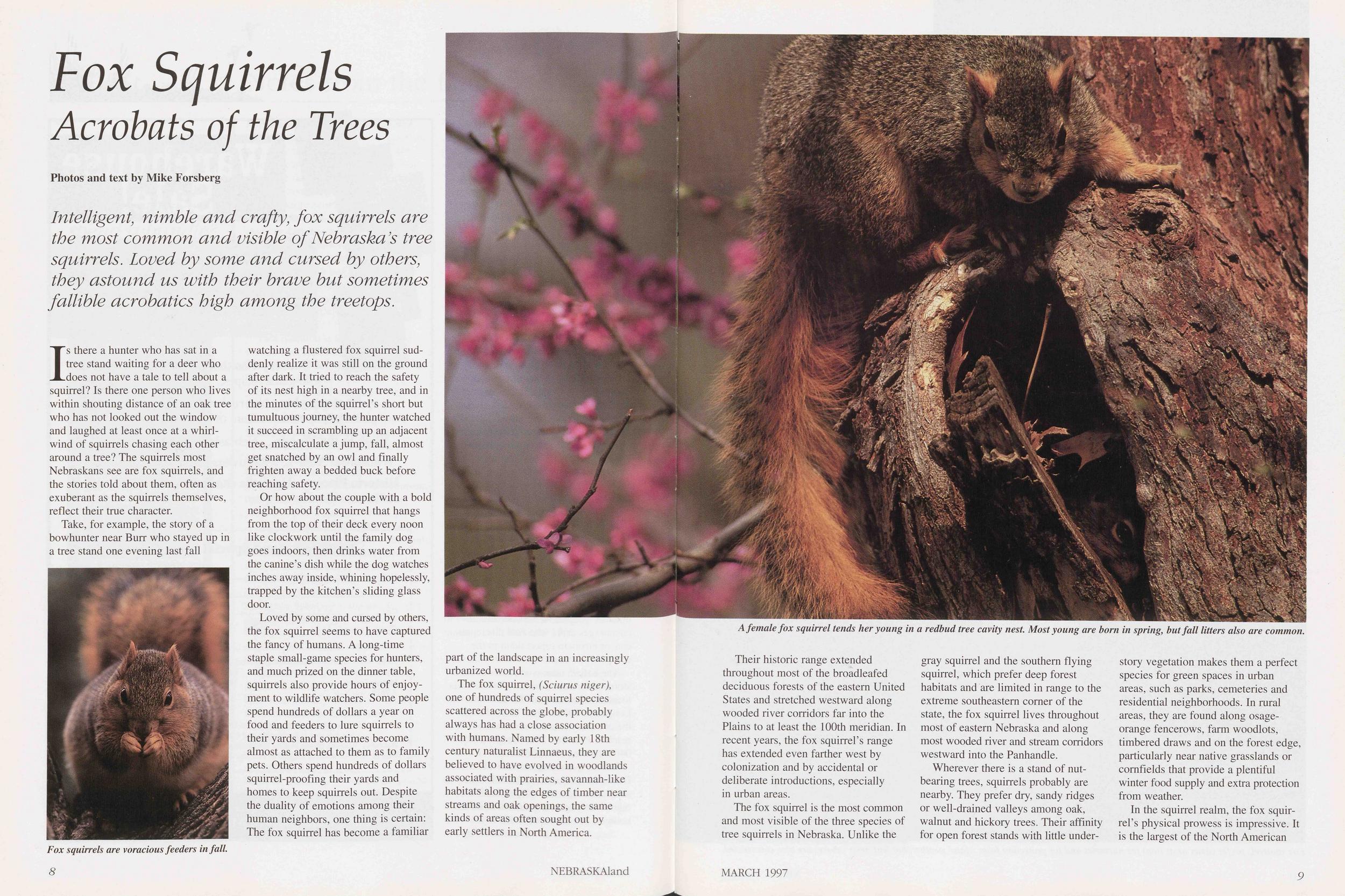
Fox Squirrels Acrobats of the Trees
Photos and text by Mike Forsberg Intelligent, nimble and crafty, fox squirrels are the most common and visible of Nebraska's tree squirrels. Loved by some and cursed by others, they astound us with their brave but sometimes fallible acrobatics high among the treetops.Is there a hunter who has sat in a tree stand waiting for a deer who does not have a tale to tell about a squirrel? Is there one person who lives within shouting distance of an oak tree who has not looked out the window and laughed at least once at a whirlwind of squirrels chasing each other around a tree? The squirrels most Nebraskans see are fox squirrels, and the stories told about them, often as exuberant as the squirrels themselves, reflect their true character.
Fox squirrels are voracious feeders in fall.
Or how about the couple with a bold neighborhood fox squirrel that hangs from the top of their deck every noon like clockwork until the family dog goes indoors, then drinks water from the canine's dish while the dog watches inches away inside, whining hopelessly, trapped by the kitchen's sliding glass door.
Loved by some and cursed by others, the fox squirrel seems to have captured the fancy of humans. A long-time staple small-game species for hunters, and much prized on the dinner table, squirrels also provide hours of enjoyment to wildlife watchers. Some people spend hundreds of dollars a year on food and feeders to lure squirrels to their yards and sometimes become almost as attached to them as to family pets. Others spend hundreds of dollars squirrel-proofing their yards and homes to keep squirrels out. Despite the duality of emotions among their human neighbors, one thing is certain: The fox squirrel has become a familiar part of the landscape in an increasingly urbanized world.
The fox squirrel, (Sciurus niger), one of hundreds of squirrel species scattered across the globe, probably always has had a close association with humans. Named by early 18th century naturalist Linnaeus, they are believed to have evolved in woodlands associated with prairies, savannah-like habitats along the edges of timber near streams and oak openings, the same kinds of areas often sought out by early settlers in North America.
8 NEBRASKAlandA female fox squirrel tends her young in a redbud tree cavity nest. Most young are born in spring, but fall litters also are common.
Their historic range extended throughout most of the broadleafed deciduous forests of the eastern United States and stretched westward along wooded river corridors far into the Plains to at least the 100th meridian. In recent years, the fox squirrel's range has extended even farther west by colonization and by accidental or deliberate introductions, especially in urban areas.
The fox squirrel is the most common and most visible of the three species of tree squirrels in Nebraska. Unlike the gray squirrel and the southern flying squirrel, which prefer deep forest habitats and are limited in range to the extreme southeastern corner of the state, the fox squirrel lives throughout most of eastern Nebraska and along most wooded river and stream corridors westward into the Panhandle.
Wherever there is a stand of nut-bearing trees, squirrels probably are nearby. They prefer dry, sandy ridges or well-drained valleys among oak, walnut and hickory trees. Their affinity for open forest stands with little understory vegetation makes them a perfect species for green spaces in urban areas, such as parks, cemeteries and residential neighborhoods. In rural areas, they are found along osage-orange fencerows, farm woodlots, timbered draws and on the forest edge, particularly near native grasslands or cornfields that provide a plentiful winter food supply and extra protection from weather.
In the squirrel realm, the fox squirrel's physical prowess is impressive. It
is the largest of the North American
MARCH 1997
11
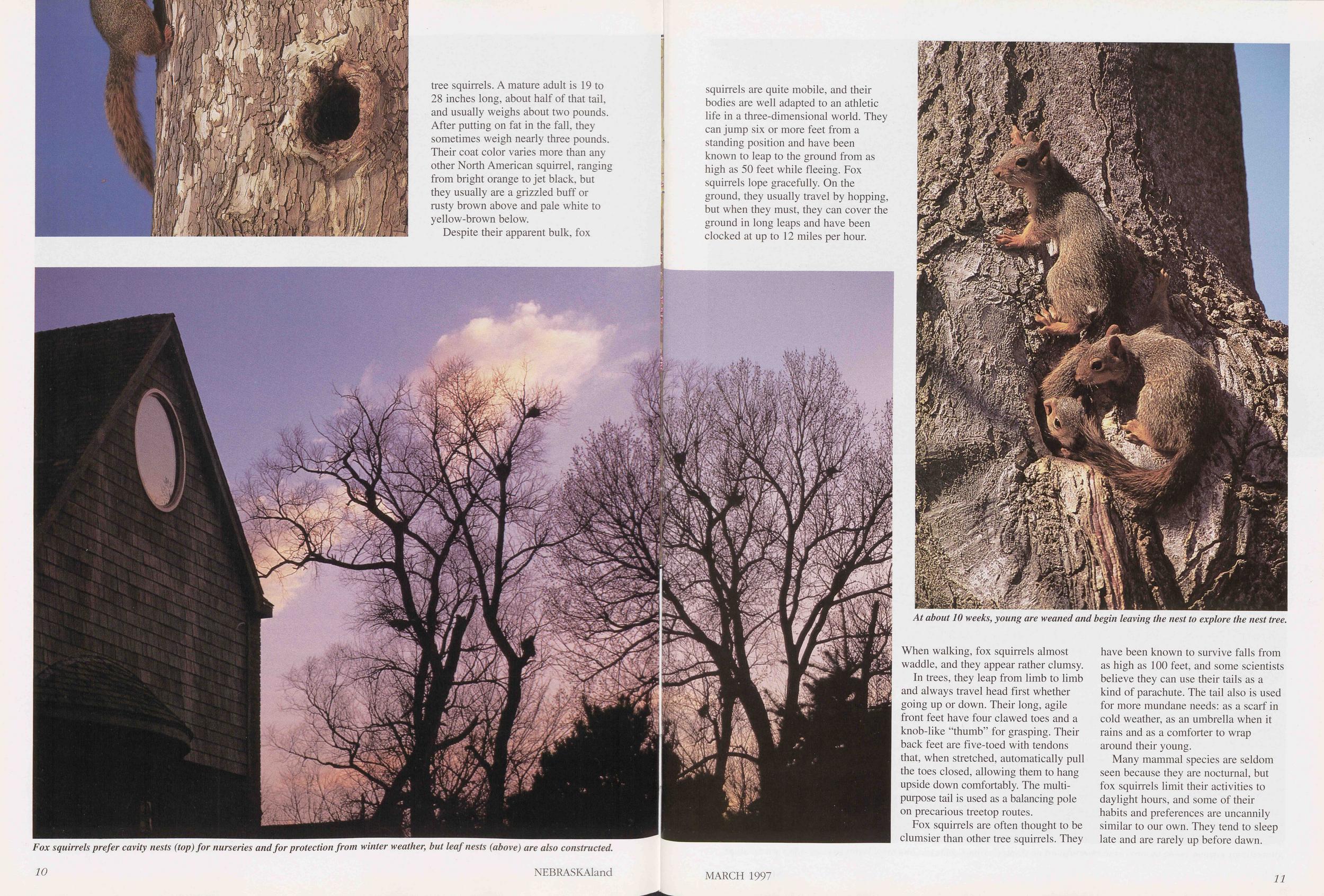
Fox squirrels prefer cavity nests (top) for nurseries and for protection from winter weather, but leaf nests (above) are also constructed.
At about 10 weeks, young are weaned and begin leaving the nest to explore the nest tree.
In trees, they leap from limb to limb and always travel head first whether going up or down. Their long, agile front feet have four clawed toes and a knob-like "thumb" for grasping. Their back feet are five-toed with tendons that, when stretched, automatically pull the toes closed, allowing them to hang upside down comfortably. The multipurpose tail is used as a balancing pole on precarious treetop routes.
Fox squirrels are often thought to be clumsier then other tree squirrels. They have been known to survive falls from as high as 100 feet, and some scientists believe they can use their tails as a kind of parachute. The tail also is used for more mundane needs: as a scarf in cold weather, as an umbrella when it rains and as a comforter to wrap around their young.
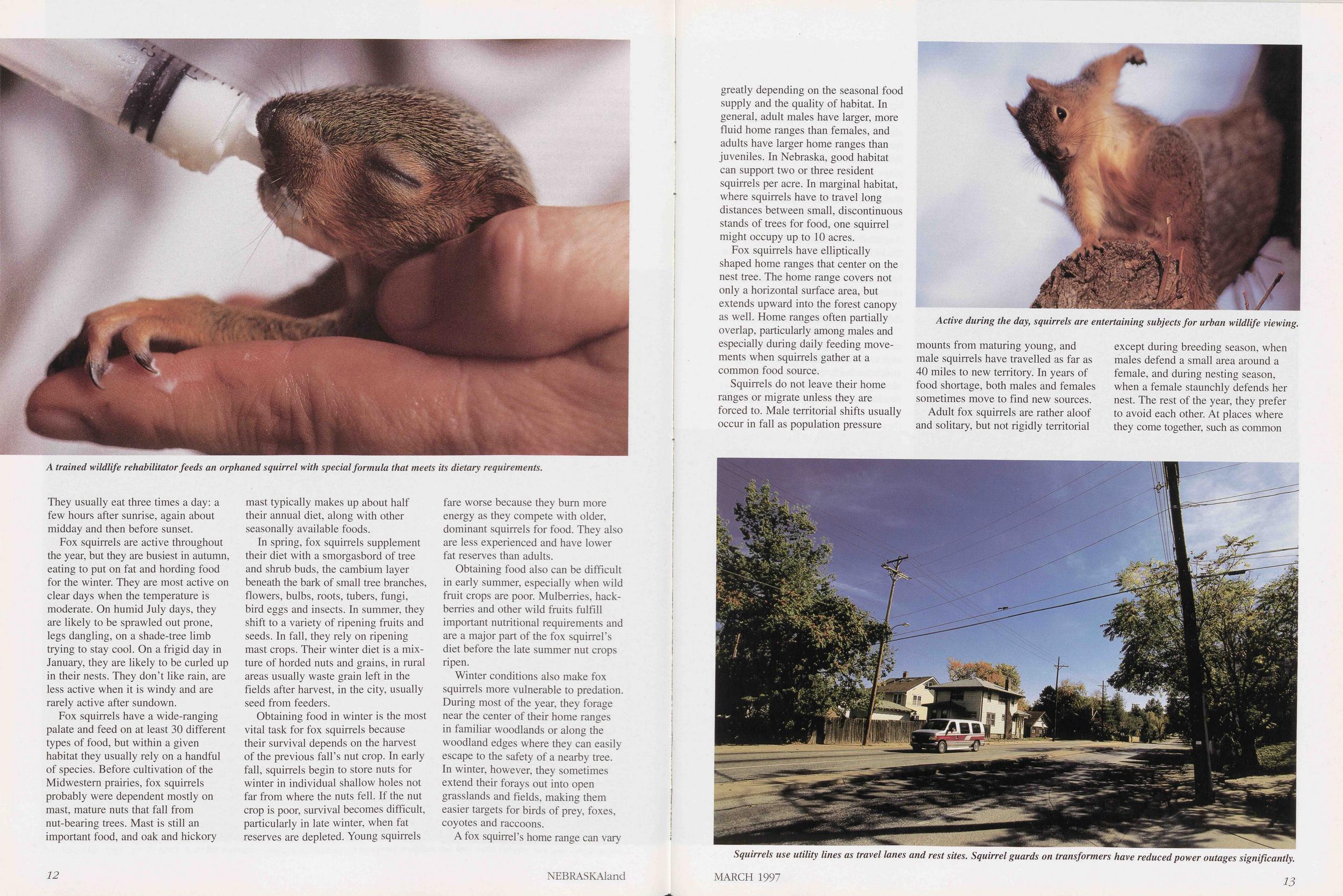
A trained wildlife rehabilitator feeds an orphaned squirrel with special formula that meets its dietary requirements.
Fox squirrels are active throughout the year, but they are busiest in autumn, eating to put on fat and hording food for the winter. They are most active on clear days when the temperature is moderate. On humid July days, they are likely to be sprawled out prone, legs dangling, on a shade-tree limb trying to stay cool. On a frigid day in January, they are likely to be curled up in their nests. They don't like rain, are less active when it is windy and are rarely active after sundown.
Fox squirrels have a wide-ranging palate and feed on at least 30 different types of food, but within a given habitat they usually rely on a handful of species. Before cultivation of the Midwestern prairies, fox squirrels probably were dependent mostly on mast, mature nuts that fall from nut-bearing trees. Mast is still an important food, and oak and hickory mast typically makes up about half their annual diet, along with other seasonally available foods.
In spring, fox squirrels supplement their diet with a smorgasbord of tree and shrub buds, the cambium layer beneath the bark of small tree branches, flowers, bulbs, roots, tubers, fungi, bird eggs and insects. In summer, they shift to a variety of ripening fruits and seeds. In fall, they rely on ripening mast crops. Their winter diet is a mixture of horded nuts and grains, in rural areas usually waste grain left in the fields after harvest, in the city, usually seed from feeders.
Obtaining food in winter is the most vital task for fox squirrels because their survival depends on the harvest of the previous fall's nut crop. In early fall, squirrels begin to store nuts for winter in individual shallow holes not far from where the nuts fell. If the nut crop is poor, survival becomes difficult, particularly in late winter, when fat reserves are depleted. Young squirrels fare worse because they burn more energy as they compete with older, dominant squirrels for food. They also are less experienced and have lower fat reserves than adults.
Obtaining food also can be difficult in early summer, especially when wild fruit crops are poor. Mulberries, hackberries and other wild fruits fulfill important nutritional requirements and are a major part of the fox squirrel's diet before the late summer nut crops ripen.
Winter conditions also make fox squirrels more vulnerable to predation. During most of the year, they forage near the center of their home ranges in familiar woodlands or along the woodland edges where they can easily escape to the safety of a nearby tree. In winter, however, they sometimes extend their forays out into open grasslands and fields, making them easier targets for birds of prey, foxes, coyotes and raccoons.
A fox squirrel's home range can vary 12 NEBRASKAland greatly depending on the seasonal food supply and the quality of habitat. In general, adult males have larger, more fluid home ranges than females, and adults have larger home ranges than juveniles. In Nebraska, good habitat can support two or three resident squirrels per acre. In marginal habitat, where squirrels have to travel long distances between small, discontinuous stands of trees for food, one squirrel might occupy up to 10 acres.
Fox squirrels have elliptically shaped home ranges that center on the nest tree. The home range covers not only a horizontal surface area, but extends upward into the forest canopy as well. Home ranges often partially overlap, particularly among males and especially during daily feeding movements when squirrels gather at a common food source.
Active during the day, squirrels are entertaining subjects for urban wildlife viewing.
Squirrels do not leave their home ranges or migrate unless they are forced to. Male territorial shifts usually occur in fall as population pressure mounts from maturing young, and male squirrels have travelled as far as 40 miles to new territory. In years of food shortage, both males and females sometimes move to find new sources.
Squirrels use utility lines as travel lanes and rest sites. Squirrel guards on transformers have reduced power outages significantly.
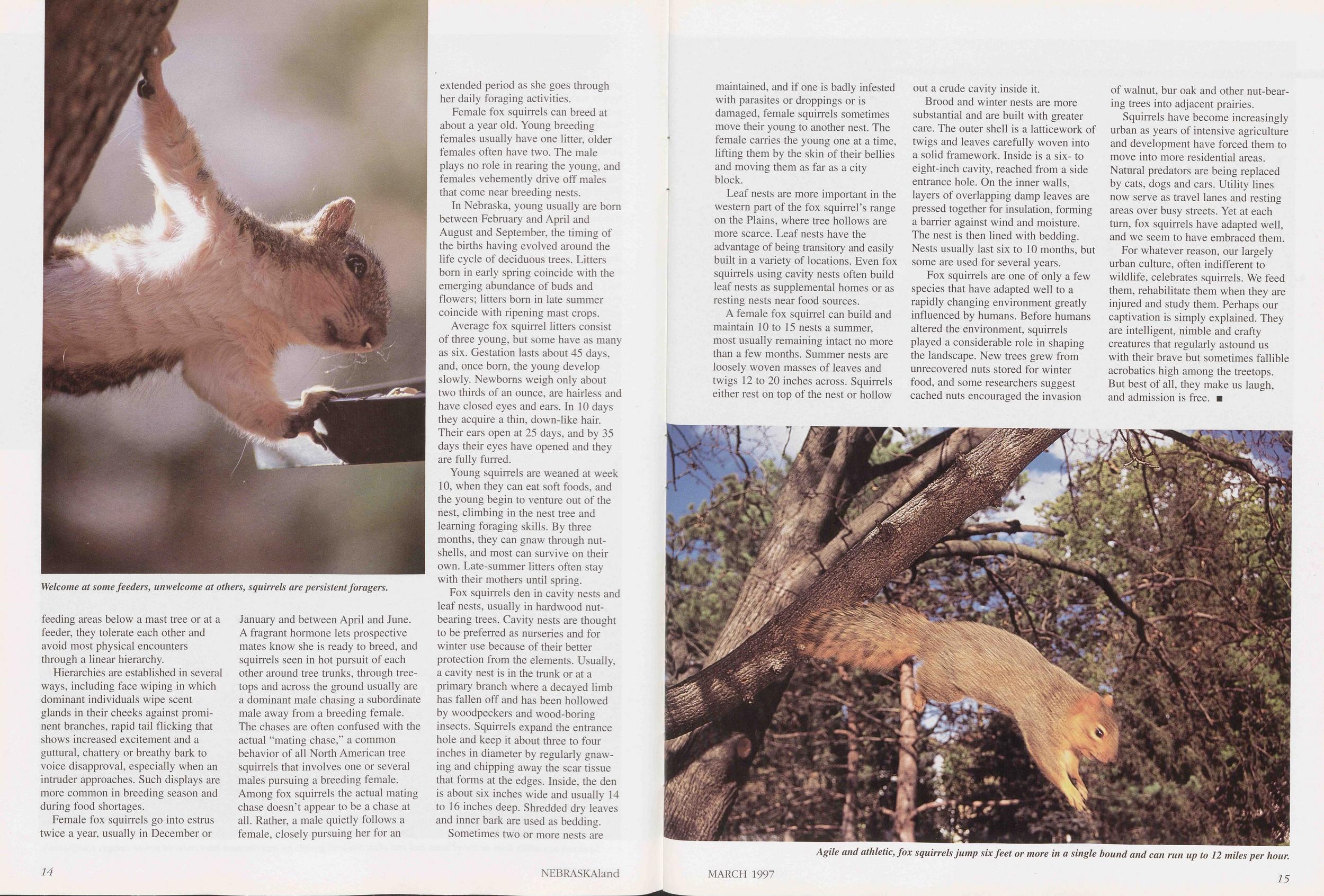
Welcome at some feeders, unwelcome at others, squirrels are persistent foragers.
Hierarchies are established in several ways, including face wiping in which dominant individuals wipe scent glands in their cheeks against prominent branches, rapid tail flicking that shows increased excitement and a guttural, chattery or breathy bark to voice disapproval, especially when an intruder approaches. Such displays are more common in breeding season and during food shortages.
Female fox squirrels go into estrus twice a year, usually in December or January and between April and June. A fragrant hormone lets prospective mates know she is ready to breed, and squirrels seen in hot pursuit of each other around tree trunks, through treetops and across the ground usually are a dominant male chasing a subordinate male away from a breeding female. The chases are often confused with the actual "mating chase," a common behavior of all North American tree squirrels that involves one or several males pursuing a breeding female. Among fox squirrels the actual mating chase doesn't appear to be a chase at all. Rather, a male quietly follows a female, closely pursuing her for an extended period as she goes through her daily foraging activities.
Female fox squirrels can breed at about a year old. Young breeding females usually have one litter, older females often have two. The male plays no role in rearing the young, and females vehemently drive off males that come near breeding nests.
In Nebraska, young usually are born between February and April and August and September, the timing of the births having evolved around the life cycle of deciduous trees. Litters born in early spring coincide with the emerging abundance of buds and flowers; litters born in late summer coincide with ripening mast crops.
Average fox squirrel litters consist of three young, but some have as many as six. Gestation lasts about 45 days, and, once born, the young develop slowly. Newborns weigh only about two thirds of an ounce, are hairless and have closed eyes and ears. In 10 days they acquire a thin, down-like hair. Their ears open at 25 days, and by 35 days their eyes have opened and they are fully furred.
Young squirrels are weaned at week 10, when they can eat soft foods, and the young begin to venture out of the nest, climbing in the nest tree and learning foraging skills. By three months, they can gnaw through nutshells, and most can survive on their own. Late-summer litters often stay with their mothers until spring.
Fox squirrels den in cavity nests and leaf nests, usually in hardwood nut-bearing trees. Cavity nests are thought to be preferred as nurseries and for winter use because of their better protection from the elements. Usually, a cavity nest is in the trunk or at a primary branch where a decayed limb has fallen off and has been hollowed by woodpeckers and wood-boring insects. Squirrels expand the entrance hole and keep it about three to four inches in diameter by regularly gnawing and chipping away the scar tissue that forms at the edges. Inside, the den is about six inches wide and usually 14 to 16 inches deep. Shredded dry leaves and inner bark are used as bedding.
Sometimes two or more nests are 14 NEBRASKAland maintained, and if one is badly infested with parasites or droppings or is damaged, female squirrels sometimes move their young to another nest. The female carries the young one at a time, lifting them by the skin of their bellies and moving them as far as a city block.
Leaf nests are more important in the western part of the fox squirrel's range on the Plains, where tree hollows are more scarce. Leaf nests have the advantage of being transitory and easily built in a variety of locations. Even fox squirrels using cavity nests often build leaf nests as supplemental homes or as resting nests near food sources.
A female fox squirrel can build and maintain 10 to 15 nests a summer, most usually remaining intact no more than a few months. Summer nests are loosely woven masses of leaves and twigs 12 to 20 inches across. Squirrels either rest on top of the nest or hollow out a crude cavity inside it.
Brood and winter nests are more substantial and are built with greater care. The outer shell is a latticework of twigs and leaves carefully woven into a solid framework. Inside is a six- to eight-inch cavity, reached from a side entrance hole. On the inner walls, layers of overlapping damp leaves are pressed together for insulation, forming a barrier against wind and moisture. The nest is then lined with bedding. Nests usually last six to 10 months, but some are used for several years.
Fox squirrels are one of only a few species that have adapted well to a rapidly changing environment greatly influenced by humans. Before humans altered the environment, squirrels played a considerable role in shaping the landscape. New trees grew from unrecovered nuts stored for winter food, and some researchers suggest cached nuts encouraged the invasion of walnut, bur oak and other nut-bearing trees into adjacent prairies.
Squirrels have become increasingly urban as years of intensive agriculture and development have forced them to move into more residential areas. Natural predators are being replaced by cats, dogs and cars. Utility lines now serve as travel lanes and resting areas over busy streets. Yet at each turn, fox squirrels have adapted well, and we seem to have embraced them.
For whatever reason, our largely urban culture, often indifferent to wildlife, celebrates squirrels. We feed them, rehabilitate them when they are injured and study them. Perhaps our captivation is simply explained. They are intelligent, nimble and crafty creatures that regularly astound us with their brave but sometimes fallible acrobatics high among the treetops. But best of all, they make us laugh, and admission is free.
Agile and athletic, fox squirrels jump six feet or more in a single bound and can run up to 12 miles per hour.
Warming up for Northerns
Northern pike, the first game fish to banish anglers' winter doldrums, often spawn even as the ice melts from frozen lakes, and a tacklebox full of tricks can help anglers begin the fishing season by tussling with the pugnacious pike.
Savvy anglers understand that it is never too early to be ready for northern pike fishing. Northerns are among the first game fish awaiting anglers eager to end a long winter's confinement.
Before they begin feeding in earnest, however, pike must take care of other important business. They begin to spawn about mid-March, regardless of the weather. Most years, that is ice-out time, but if winter conditions persist, pike spawn under the ice. Photoperiod, the duration of exposure to sunlight, not water temperature, governs spawning activity.
It takes a week or two for northerns, especially the females, to recover from the stress of spawning before they start feeding in earnest. Not all northerns in a lake spawn at exactly the same time, however, so it pays to start fishing as spawning tapers off, since early spawners begin feeding while laggards are finishing up.
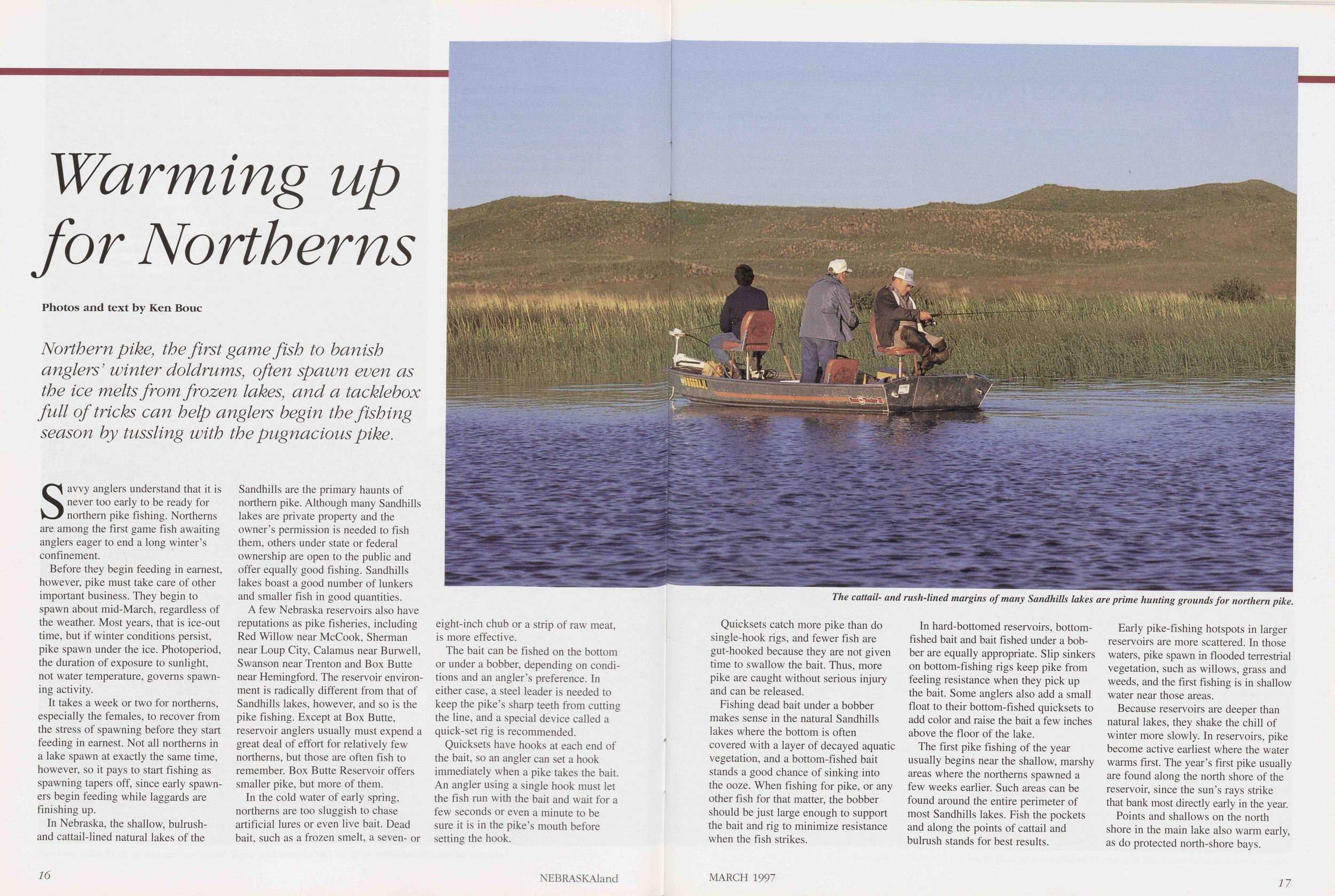
In Nebraska, the shallow, bulrush-and cattail-lined natural lakes of the Sandhills are the primary haunts of northern pike. Although many Sandhills lakes are private property and the owner's permission is needed to fish them, others under state or federal ownership are open to the public and offer equally good fishing. Sandhills lakes boast a good number of lunkers and smaller fish in good quantities.
A few Nebraska reservoirs also have reputations as pike fisheries, including Red Willow near McCook, Sherman near Loup City, Calamus near Burwell, Swanson near Trenton and Box Butte near Hemingford. The reservoir environment is radically different from that of Sandhills lakes, however, and so is the pike fishing. Except at Box Butte, reservoir anglers usually must expend a great deal of effort for relatively few northerns, but those are often fish to remember. Box Butte Reservoir offers smaller pike, but more of them.
In the cold water of early spring, northerns are too sluggish to chase artificial lures or even live bait. Dead bait, such as a frozen smelt, a seven- or eight-inch chub or a strip of raw meat, is more effective.
The bait can be fished on the bottom or under a bobber, depending on conditions and an angler's preference. In either case, a steel leader is needed to keep the pike's sharp teeth from cutting the line, and a special device called a quick-set rig is recommended.
Quicksets have hooks at each end of the bait, so an angler can set a hook immediately when a pike takes the bait. An angler using a single hook must let the fish run with the bait and wait for a few seconds or even a minute to be sure it is in the pike's mouth before setting the hook.
16 NEBRASKAlandThe cattail- and rush-lined margins of many Sandhills lakes are prime hunting grounds for northern pike.
Quicksets catch more pike than do single-hook rigs, and fewer fish are gut-hooked because they are not given time to swallow the bait. Thus, more pike are caught without serious injury and can be released.
Fishing dead bait under a bobber makes sense in the natural Sandhills lakes where the bottom is often covered with a layer of decayed aquatic vegetation, and a bottom-fished bait stands a good chance of sinking into the ooze. When fishing for pike, or any other fish for that matter, the bobber should be just large enough to support the bait and rig to minimize resistance when the fish strikes.
In hard-bottomed reservoirs, bottom-fished bait and bait fished under a bobber are equally appropriate. Slip sinkers on bottom-fishing rigs keep pike from feeling resistance when they pick up the bait. Some anglers also add a small float to their bottom-fished quicksets to add color and raise the bait a few inches above the floor of the lake.
The first pike fishing of the year usually begins near the shallow, marshy areas where the northerns spawned a few weeks earlier. Such areas can be found around the entire perimeter of most Sandhills lakes. Fish the pockets and along the points of cattail and bulrush stands for best results.
Early pike-fishing hotspots in larger reservoirs are more scattered. In those waters, pike spawn in flooded terrestrial vegetation, such as willows, grass and weeds, and the first fishing is in shallow water near those areas.
Because reservoirs are deeper than natural lakes, they shake the chill of winter more slowly. In reservoirs, pike become active earliest where the water warms first. The year's first pike usually are found along the north shore of the reservoir, since the sun's rays strike that bank most directly early in the year.
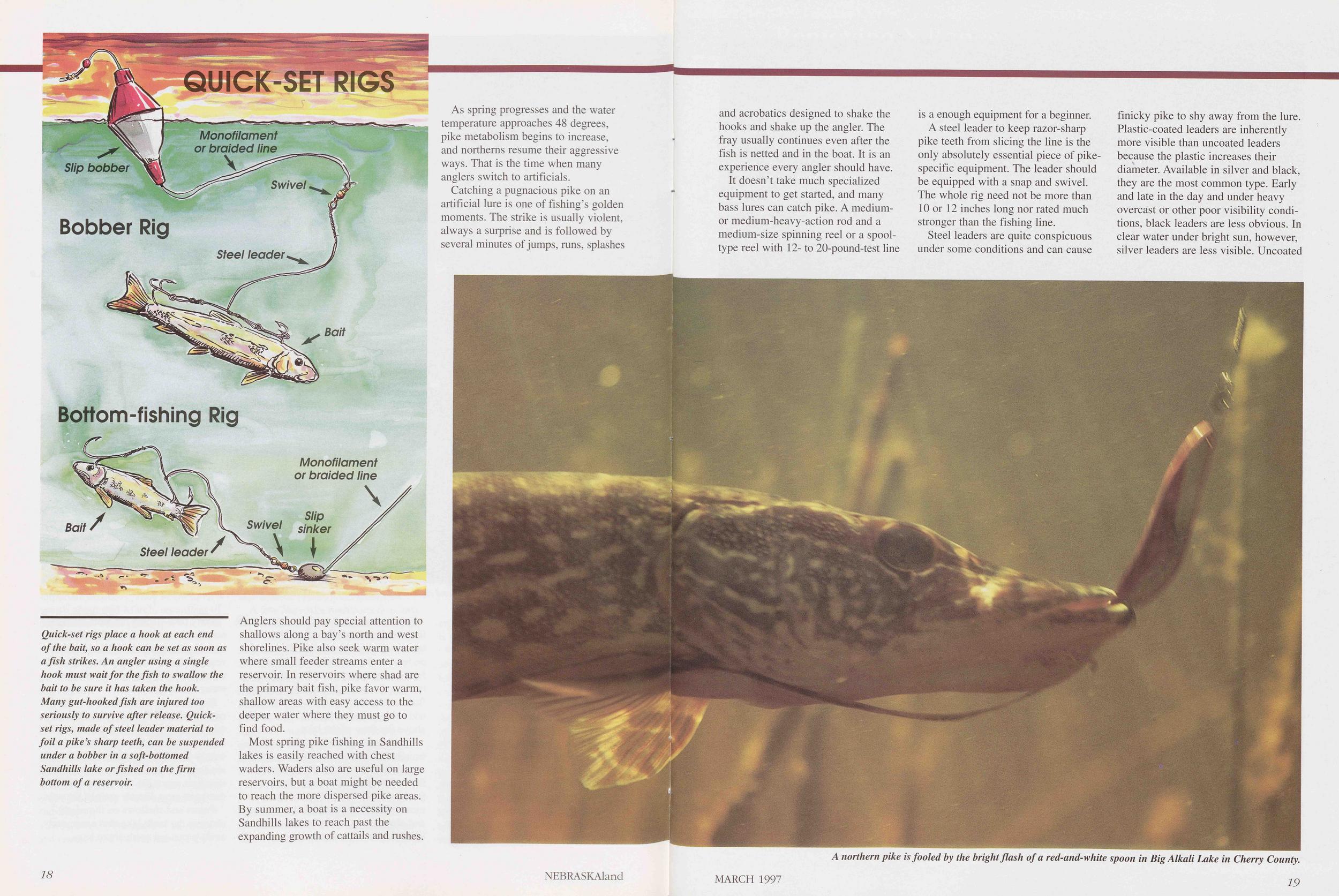
Quick-set rigs place a hook at each end of the baity so a hook can be set as soon as a fish strikes. An angler using a single hook must wait for the fish to swallow the bait to be sure it has taken the hook. Many gut-hooked fish are injured too seriously to survive after release. Quickset rigs, made of steel leader material to foil a pike's sharp teeth, can be suspended under a bobber in a soft-bottomed Sandhills lake or fished on the firm bottom of a reservoir.
Most spring pike fishing in Sandhills lakes is easily reached with chest waders. Waders also are useful on large reservoirs, but a boat might be needed to reach the more dispersed pike areas. By summer, a boat is a necessity on Sandhills lakes to reach past the expanding growth of cattails and rushes.
As spring progresses and the water temperature approaches 48 degrees, pike metabolism begins to increase, and northerns resume their aggressive ways. That is the time when many anglers switch to artificials.
Catching a pugnacious pike on an artificial lure is one of fishing's golden moments. The strike is usually violent, always a surprise and is followed by several minutes of jumps, runs, splashes 18 NEBRASKAland and acrobatics designed to shake the hooks and shake up the angler. The fray usually continues even after the fish is netted and in the boat. It is an experience every angler should have.
It doesn't take much specialized equipment to get started, and many bass lures can catch pike. A medium-or medium-heavy-action rod and a medium-size spinning reel or a spool-type reel with 12- to 20-pound-test line is a enough equipment for a beginner.
A steel leader to keep razor-sharp pike teeth from slicing the line is the only absolutely essential piece of pike-specific equipment. The leader should be equipped with a snap and swivel. The whole rig need not be more than 10 or 12 inches long nor rated much stronger than the fishing line.
A northern pike is fooled by the bright flash of a red-and-white spoon in Big Alkali Lake in Cherry County.
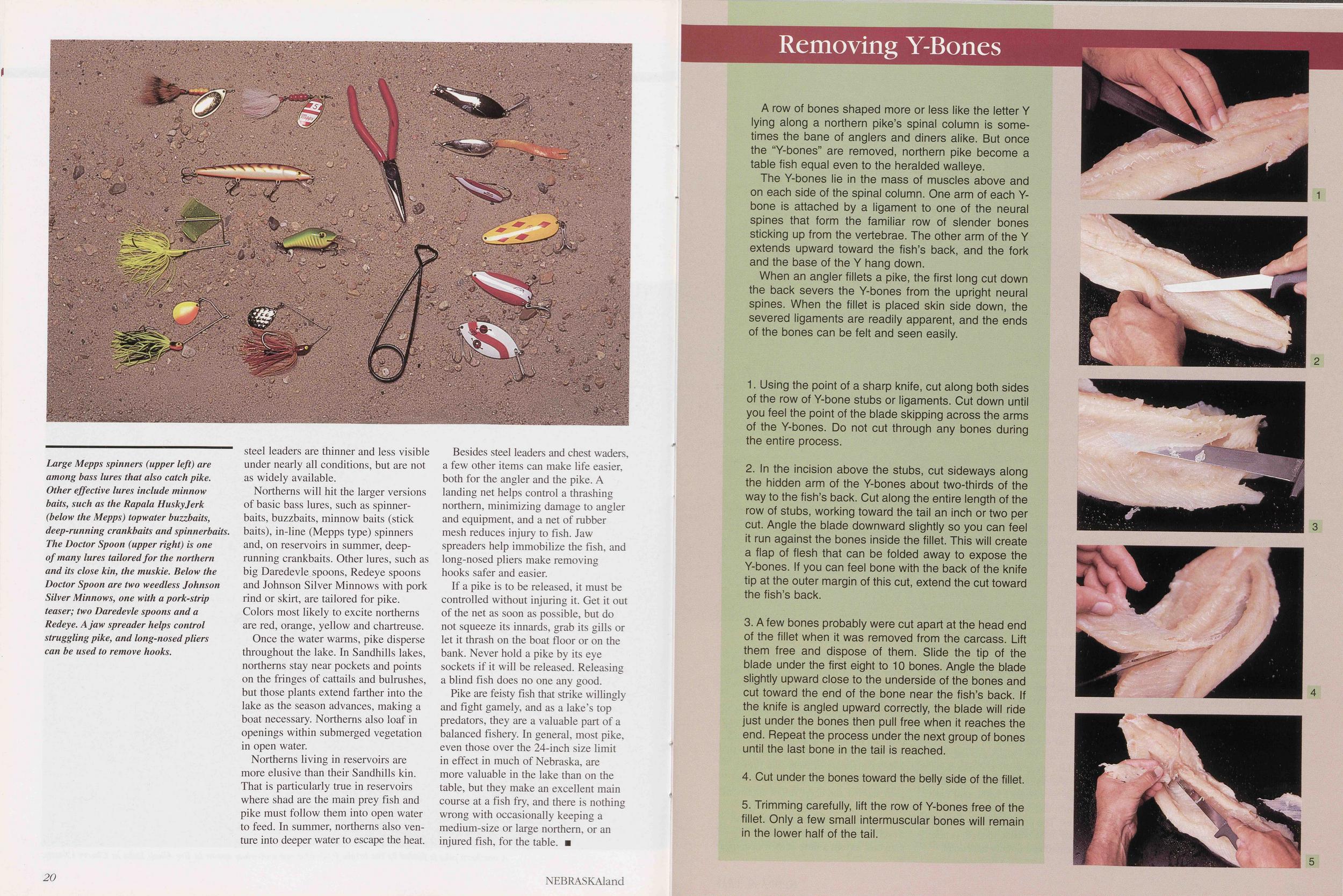
Northerns will hit the larger versions of basic bass lures, such as spinner-baits, buzzbaits, minnow baits (stick baits), in-line (Mepps type) spinners and, on reservoirs in summer, deep-running crankbaits. Other lures, such as big Daredevle spoons, Redeye spoons and Johnson Silver Minnows with pork rind or skirt, are tailored for pike. Colors most likely to excite northerns are red, orange, yellow and chartreuse.
Once the water warms, pike disperse throughout the lake. In Sandhills lakes, northerns stay near pockets and points on the fringes of cattails and bulrushes, but those plants extend farther into the lake as the season advances, making a boat necessary. Northerns also loaf in openings within submerged vegetation in open water.
Northerns living in reservoirs are more elusive than their Sandhills kin. That is particularly true in reservoirs where shad are the main prey fish and pike must follow them into open water to feed. In summer, northerns also venture into deeper water to escape the heat.
Besides steel leaders and chest waders, a few other items can make life easier, both for the angler and the pike. A landing net helps control a thrashing northern, minimizing damage to angler and equipment, and a net of rubber mesh reduces injury to fish. Jaw spreaders help immobilize the fish, and long-nosed pliers make removing hooks safer and easier.
If a pike is to be released, it must be controlled without injuring it. Get it out of the net as soon as possible, but do not squeeze its innards, grab its gills or let it thrash on the boat floor or on the bank. Never hold a pike by its eye sockets if it will be released. Releasing a blind fish does no one any good.
Pike are feisty fish that strike willingly and fight gamely, and as a lake's top predators, they are a valuable part of a balanced fishery. In general, most pike, even those over the 24-inch size limit in effect in much of Nebraska, are more valuable in the lake than on the table, but they make an excellent main course at a fish fry, and there is nothing wrong with occasionally keeping a medium-size or large northern, or an injured fish, for the table.
Removing Y-Bones
A row of bones shaped more or less like the letter Y lying along a northern pike's spinal column is sometimes the bane of anglers and diners alike. But once the "Y-bones" are removed, northern pike become a table fish equal even to the heralded walleye.
The Y-bones lie in the mass of muscles above and on each side of the spinal column. One arm of each Y-bone is attached by a ligament to one of the neural spines that form the familiar row of slender bones sticking up from the vertebrae. The other arm of the. Y extends upward toward the fish's back, and the fork and the base of the Y hang down.
When an angler fillets a pike, the first long cut down the back severs the Y-bones from the upright neural spines. When the fillet is placed skin side down, the severed ligaments are readily apparent, and the ends of the bones can be felt and seen easily.
1. Using the point of a sharp knife, cut along both sides of the row of Y-bone stubs or ligaments. Gut down until you feel the point of the blade skipping across the arms of the Y-bones. Do not cut through any bones during the entire process.
2. In the incision above the stubs, cut sideways along the hidden arm of the Y-bones about two-thirds of the way to the fish's back. Cut along the entire length of the row of stubs, working toward the tail an inch or two per cut. Angle the blade downward slightly so you can feel it run against the bones inside the fillet. This will create a flap of flesh that can be folded away to expose the Y-bones. If you can feel bone with the back of the knife tip at the outer margin of this cut, extend the cut toward the fish's back.
3. A few bones probably were cut apart at the head end of the fillet when it was removed from the carcass. Lift them free and dispose of them. Slide the tip of the blade under the first eight to 10 bones. Angle the blade slightly upward close to the underside of the bones and cut toward the end of the bone near the fish's back. If the knife is angled upward correctly, the blade will ride just under the bones then pull free when it reaches the end. Repeat the process under the next group of bones until the last bone in the tail is reached.
4. Cut under the bones toward the belly side of the fillet.5. Trimming carefully, lift the row of Y-bones free of the fillet. Only a few small intermuscular bones will remain in the lower half of the tail.
Red Cedar The Good, the Bad and the Ugly
When wildfires regularly stalked Nebraska, cedars prospered only as understory trees in eastern riparian woodlands and in steep-walled canyons and ravines. In recent years, they have advanced into areas where they never before ventured.
Like all gradual changes, the march of red cedars across the Nebraska landscape went mostly unnoticed until recent years. Then, suddenly they seemed to be everywhere —creeping out of shadowy canyons and across pastures, filling river floodplains, transforming bur oak ravines into cedar ravines and venturing farther from Sandhills rivers to which they once clung for protection from wildfires. University of Nebraska professor Charles Bessey, who in the 1890s proposed that rangelands could be made "productive" with tree plantings and successfully promoted the establishment of two man-planted national forests in the Sandhills, would be ecstatic.
The advance of the red cedar across the once nearly treeless Tree Planter State is viewed with alarm by some, delight by others and with reservations by wildlife managers and those with a keen knowledge of Great Plains ecology. How we feel about more cedars is colored by our designs on the land they colonize and by their effect on end-of-the-year spreadsheets. The spread of red cedars is a complex story with many chapters, some yet to be written.
The Natural StateEastern red cedar (Juniperus virginiana) is the most widely distributed tree-size conifer in the eastern United States. It is found in every state east of the 100th meridian, which passes through central Nebraska. In Nebraska, red cedar probably was native to most counties east of the Panhandle where appropriate growing sites occurred. Along the Missouri River and on the lower reaches of its tributaries, red cedars were common understory trees in riparian woodlands.
When the first settlers arrived, red cedars also were well established in central Nebraska where they could compete successfully with other native vegetation and were protected from wildfires. The pre-settlement range of red cedar in Nebraska, though, is poorly documented and largely anecdotal.
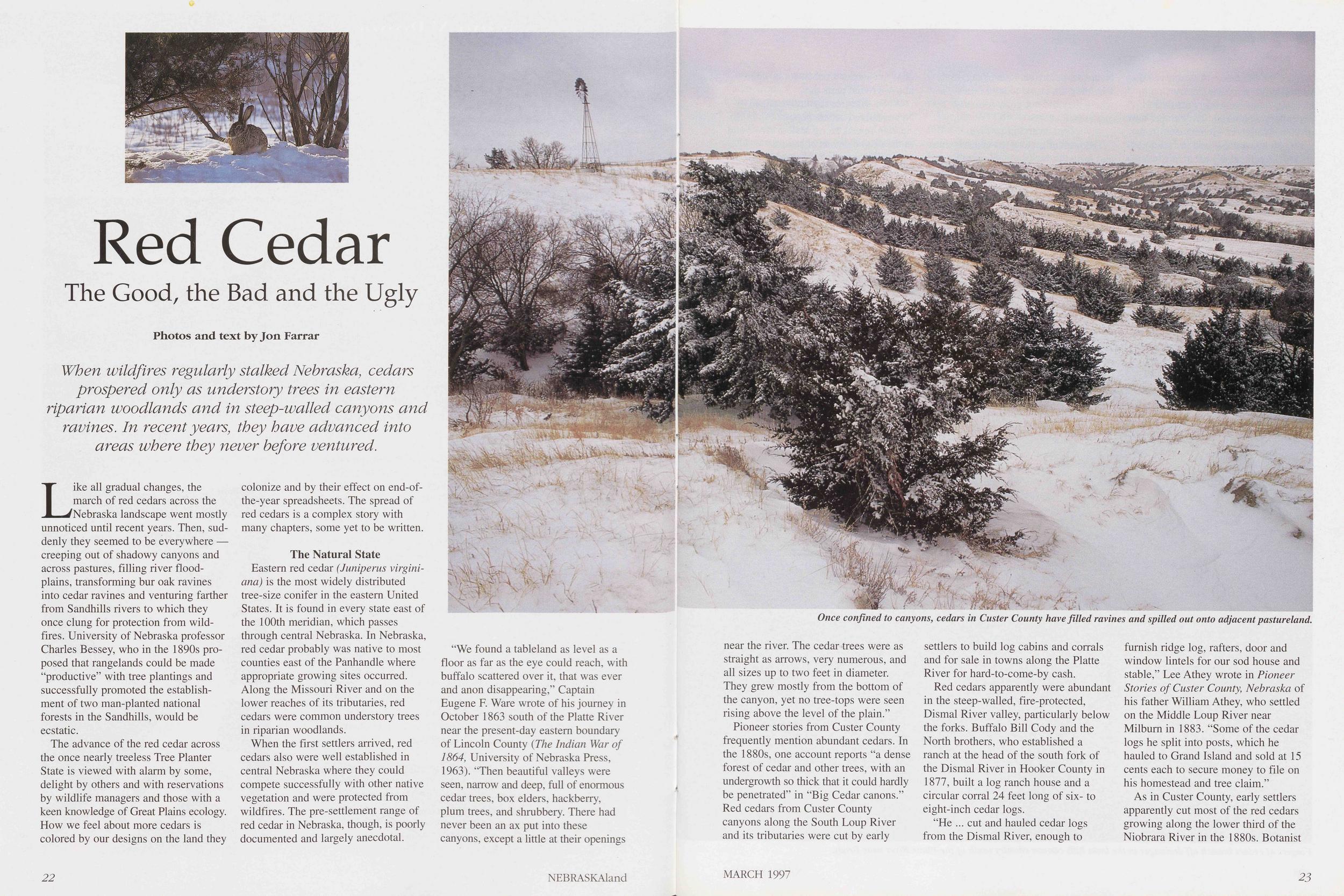
Once confined to canyons, cedars in Custer County have filled ravines and spilled out onto adjacent pastureland.
Pioneer stories from Custer County frequently mention abundant cedars. In the 1880s, one account reports "a dense forest of cedar and other trees, with an undergrowth so thick that it could hardly be penetrated" in "Big Cedar canons." Red cedars from Custer County canyons along the South Loup River and its tributaries were cut by early settlers to build log cabins and corrals and for sale in towns along the Platte River for hard-to-come-by cash.
Red cedars apparently were abundant in the steep-walled, fire-protected, Dismal River valley, particularly below the forks. Buffalo Bill Cody and the North brothers, who established a ranch at the head of the south fork of the Dismal River in Hooker County in 1877, built a log ranch house and a circular corral 24 feet long of six- to eight-inch cedar logs.
"He...cut and hauled cedar logs from the Dismal River, enough to furnish ridge log, rafters, door and window lintels for our sod house and stable," Lee Athey wrote in Pioneer Stories of Custer County, Nebraska of his father William Athey, who settled on the Middle Loup River near Milburn in 1883. "Some of the cedar logs he split into posts, which he hauled to Grand Island and sold at 15 cents each to secure money to file on his homestead and tree claim."
As in Custer County, early settlers
apparently cut most of the red cedars
growing along the lower third of the
Niobrara River in the 1880s. Botanist
MARCH 1997
23
 William L. Tolstead, who surveyed the
vegetation of northern Cherry County
in 1942, found red cedars on shaded,
north-facing Niobrara River slopes east
of Valentine where groundwater from
springs was available and in "scattered
stands throughout the deciduous woodlands." He noted that the oldest trees in
the valley were 30 to 40 years old and
probably were second-growth trees.
William L. Tolstead, who surveyed the
vegetation of northern Cherry County
in 1942, found red cedars on shaded,
north-facing Niobrara River slopes east
of Valentine where groundwater from
springs was available and in "scattered
stands throughout the deciduous woodlands." He noted that the oldest trees in
the valley were 30 to 40 years old and
probably were second-growth trees.
Understanding why red cedars prospered only at some sites in central Nebraska before settlement suggests why they are found today at sites where they did not grow formerly.
An Aversion to FireThe bark of eastern red cedar is thin and resinous, making it susceptible to fire damage. Although the foliage does not burn readily, few small trees survive hot grassland fires, and even large trees are often damaged and eventually perish. Unlike many species, red cedar does not sucker from its roots when above-ground parts die.
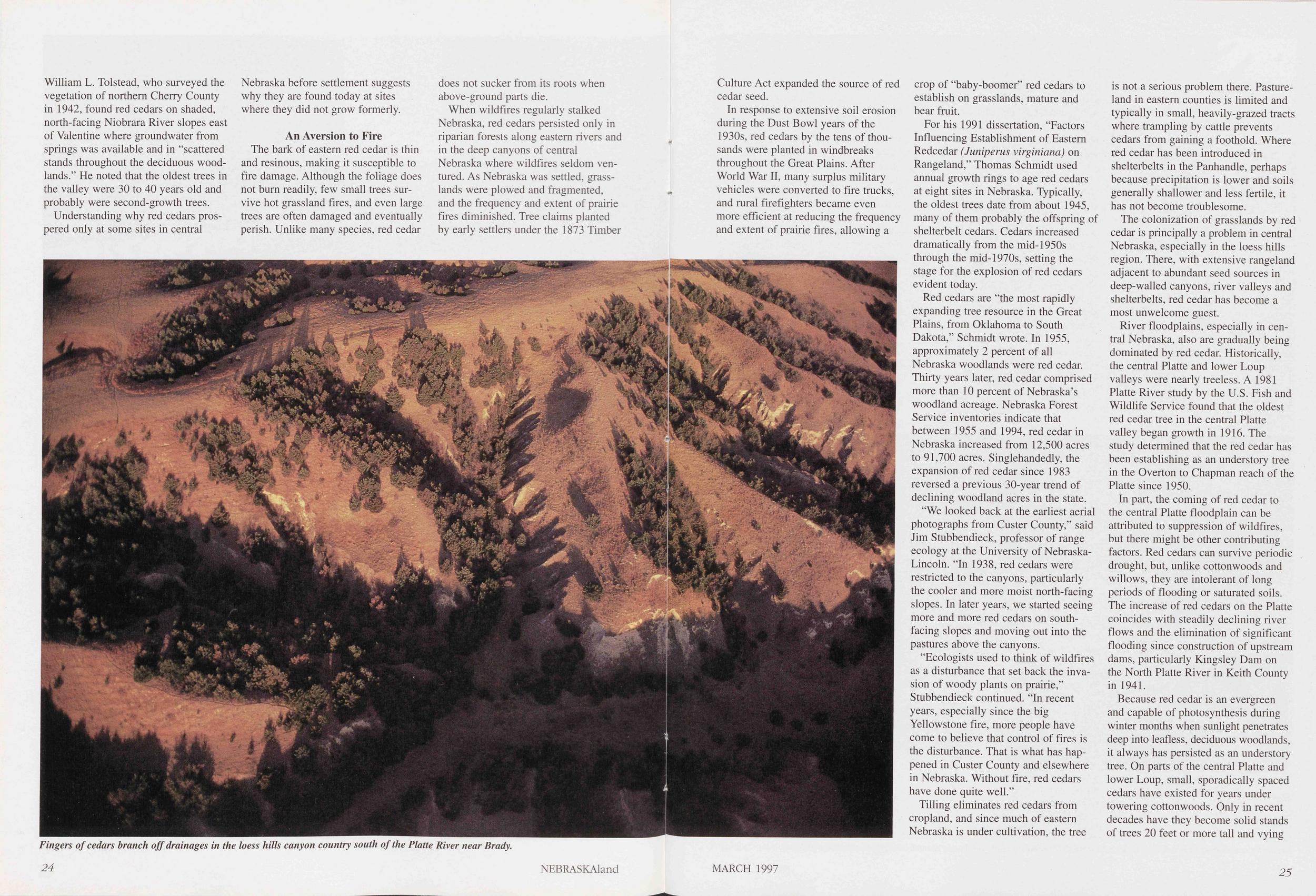
Fingers of cedars branch off drainages in the loess hills canyon country south of the Platte River near Brady.
In response to extensive soil erosion during the Dust Bowl years of the 1930s, red cedars by the tens of thousands were planted in windbreaks throughout the Great Plains. After World War II, many surplus military vehicles were converted to fire trucks, and rural firefighters became even more efficient at reducing the frequency and extent of prairie fires, allowing a crop of "baby-boomer" red cedars to establish on grasslands, mature and bear fruit.
For his 1991 dissertation, "Factors Influencing Establishment of Eastern Redcedar (Juniperus virginiana) on Rangeland," Thomas Schmidt used annual growth rings to age red cedars at eight sites in Nebraska. Typically, the oldest trees date from about 1945, many of them probably the offspring of shelterbelt cedars. Cedars increased dramatically from the mid-1950s through the mid-1970s, setting the stage for the explosion of red cedars evident today.
Red cedars are "the most rapidly expanding tree resource in the Great Plains, from Oklahoma to South Dakota," Schmidt wrote. In 1955, approximately 2 percent of all Nebraska woodlands were red cedar. Thirty years later, red cedar comprised more than 10 percent of Nebraska's woodland acreage. Nebraska Forest Service inventories indicate that between 1955 and 1994, red cedar in Nebraska increased from 12,500 acres to 91,700 acres. Singlehandedly, the expansion of red cedar since 1983 reversed a previous 30-year trend of declining woodland acres in the state.
"We looked back at the earliest aerial photographs from Custer County," said Jim Stubbendieck, professor of range ecology at the University of Nebraska-Lincoln. "In 1938, red cedars were restricted to the canyons, particularly the cooler and more moist north-facing slopes. In later years, we started seeing more and more red cedars on south-facing slopes and moving out into the pastures above the canyons.
"Ecologists used to think of wildfires as a disturbance that set back the invasion of woody plants on prairie," Stubbendieck continued. "In recent years, especially since the big Yellowstone fire, more people have come to believe that control of fires is the disturbance. That is what has happened in Custer County and elsewhere in Nebraska. Without fire, red cedars have done quite well."
Tilling eliminates red cedars from cropland, and since much of eastern Nebraska is under cultivation, the tree is not a serious problem there. Pastureland in eastern counties is limited and typically in small, heavily-grazed tracts where trampling by cattle prevents cedars from gaining a foothold. Where red cedar has been introduced in shelterbelts in the Panhandle, perhaps because precipitation is lower and soils generally shallower and less fertile, it has not become troublesome.
The colonization of grasslands by red cedar is principally a problem in central Nebraska, especially in the loess hills region. There, with extensive rangeland adjacent to abundant seed sources in deep-walled canyons, river valleys and shelterbelts, red cedar has become a most unwelcome guest.
River floodplains, especially in central Nebraska, also are gradually being dominated by red cedar. Historically, the central Platte and lower Loup valleys were nearly treeless. A 1981 Platte River study by the U.S. Fish and Wildlife Service found that the oldest red cedar tree in the central Platte valley began growth in 1916. The study determined that the red cedar has been establishing as an understory tree in the Overton to Chapman reach of the Platte since 1950.
In part, the coming of red cedar to the central Platte floodplain can be attributed to suppression of wildfires, but there might be other contributing factors. Red cedars can survive periodic drought, but, unlike cottonwoods and willows, they are intolerant of long periods of flooding or saturated soils. The increase of red cedars on the Platte coincides with steadily declining river flows and the elimination of significant flooding since construction of upstream dams, particularly Kingsley Dam on the North Platte River in Keith County in 1941.
Because red cedar is an evergreen
and capable of photosynthesis during
winter months when sunlight penetrates
deep into leafless, deciduous woodlands,
it always has persisted as an understory
tree. On parts of the central Platte and
lower Loup, small, sporadically spaced
cedars have existed for years under
towering cottonwoods. Only in recent
decades have they become solid stands
of trees 20 feet or more tall and vying
MARCH 1997
25
 to be the dominant tree of riparian
woodlands.
to be the dominant tree of riparian
woodlands.
Only massive wildfire or flood, neither of which is likely to occur, or costly mechanical removal can set back this unnatural succession and restore the more diverse riparian flora and fauna that once existed. While encroaching red cedars along Nebraska rivers might be of significant concern in the future, most attention today is being paid to their invasion of rangeland, where economic losses are more easily measured.
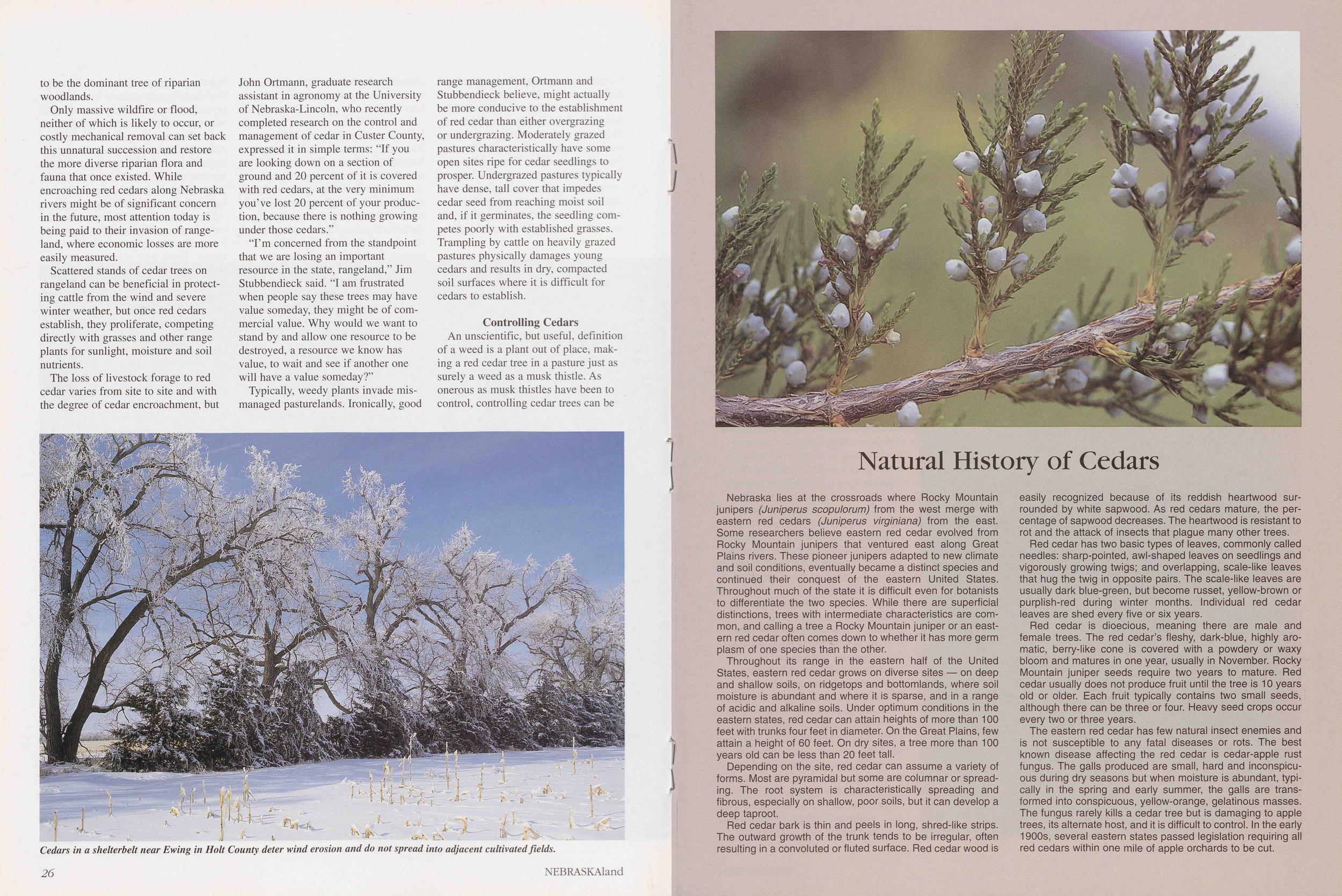
Scattered stands of cedar trees on rangeland can be beneficial in protecting cattle from the wind and severe winter weather, but once red cedars establish, they proliferate, competing directly with grasses and other range plants for sunlight, moisture and soil nutrients.
The loss of livestock forage to red cedar varies from site to site and with the degree of cedar encroachment, but John Ortmann, graduate research assistant in agronomy at the University of Nebraska-Lincoln, who recently completed research on the control and management of cedar in Custer County, expressed it in simple terms: "If you are looking down on a section of ground and 20 percent of it is covered with red cedars, at the very minimum you've lost 20 percent of your production, because there is nothing growing under those cedars."
"I'm concerned from the standpoint that we are losing an important resource in the state, rangeland," Jim Stubbendieck said. "I am frustrated when people say these trees may have value someday, they might be of commercial value. Why would we want to stand by and allow one resource to be destroyed, a resource we know has value, to wait and see if another one will have a value someday?"
Typically, weedy plants invade mismanaged pasturelands. Ironically, good range management, Ortmann and Stubbendieck believe, might actually be more conducive to the establishment of red cedar than either overgrazing or undergrazing. Moderately grazed pastures characteristically have some open sites ripe for cedar seedlings to prosper. Undergrazed pastures typically have dense, tall cover that impedes cedar seed from reaching moist soil and, if it germinates, the seedling competes poorly with established grasses. Trampling by cattle on heavily grazed pastures physically damages young cedars and results in dry, compacted soil surfaces where it is difficult for cedars to establish.
Controlling CedarsAn unscientific, but useful, definition of a weed is a plant out of place, making a red cedar tree in a pasture just as surely a weed as a musk thistle. As onerous as musk thistles have been to control, controlling cedar trees can be even more difficult and costly.
Cedars in a shelterbelt near Ewing in Holt County deter wind erosion and do not spread into adjacent cultivated fields.
Natural History of Cedars
Nebraska lies at the crossroads where Rocky Mountain junipers (Juniperus scopulorum) from the west merge with eastern red cedars (Juniperus virginiana) from the east. Some researchers believe eastern red cedar evolved from Rocky Mountain junipers that ventured east along Great Plainsfivers. These pioneer junipers adapted to new climate and soil conditions, eventually became a distinct species and continued their conquest of the eastern United States. Throughout much of the state it is difficult even for botanists to differentiate the two species. While there are superficial distinctions, trees with intermediate characteristics are common, and calling a tree a Rocky Mountain juniper or an eastern red cedar often comes down to whether it has more germ plasm of one species than the other.
Throughout its range in the eastern half of the United States, eastern red cedar grows on diverse sites — on deep and shallow soils, on ridgetops and bottomlands, where soil moisture is abundant and where it is sparse, and in a range of acidic and alkaline soils. Under optimum conditions in the eastern states, red cedar can attain heights of more than 100 feet with trunks four feet in diameter. On the Great Plains, few attain a height of 60 feet. On dry sites, a tree more than 100 years old can be less than 20 feet tall.
Depending on the site, red cedar can assume a variety of forms. Most are pyramidal but some are columnar or spreading. The root system is characteristically spreading and fibrous, especially on shallow, poor soils, but it can develop a deep taproot.
Red cedar bark is thin and peels in long, shred-like strips. The outward growth of the trunk tends to be irregular, often resulting in a convoluted or fluted surface. Red cedar wood is easily recognized because of its reddish heartwood surrounded by white sap wood. As red cedars mature, the percentage of sapwood decreases. The heartwood is resistant to rot and the attack of insects that plague many other trees.
Red cedar has two basic types of leaves, commonly called needles: sharp-pointed, awl-shaped leaves on seedlings and vigorously growing twigs; and overlapping, scale-like leaves that hug the twig in opposite pairs. The scale-like leaves are usually dark blue-green, but become russet, yellow-brown or purplish-red during winter months. Individual red cedar leaves are shed every five or six years.
Red cedar is dioecious, meaning there are male and female trees. The red cedar's fleshy, dark-blue, highly aromatic, berry-like cone is covered with a powdery or waxy bloom and matures in one year, usually in November. Rocky Mountain juniper seeds require two years to mature. Red cedar usually does not produce fruit until the tree is 10 years old or older. Each fruit typically contains two small seeds, although there can be three or four. Heavy seed crops occur every two or three years.
The eastern red cedar has few natural insect enemies and is not susceptible to any fatal diseases or rots. The best known disease affecting the red cedar is cedar-apple rust fungus. The galls produced are small, hard and inconspicuous during dry seasons but when moisture is abundant, typically in the spring and early summer, the galls are transformed into conspicuous, yellow-orange, gelatinous masses. The fungus rarely kills a cedar tree but is damaging to apple trees, its alternate host, and it is difficult to control. In the early 1900s, several eastern states passed legislation requiring all red cedars within one mile of apple orchards to be cut.
Unwanted red cedars can be controlled mechanically or chemically. Small cedars are easily cut with hand pruners. Tractor-mounted hydraulic shears or power saws work well on relatively level land but can cost landowners $60 or more an hour, a rather high-priced solution on rangeland worth $300 an acre. Control on rough terrain requires hand equipment such as chainsaws and is relatively inexpensive if labor costs are not a factor. Several herbicides effectively kill cedars, but the cost is relatively high.
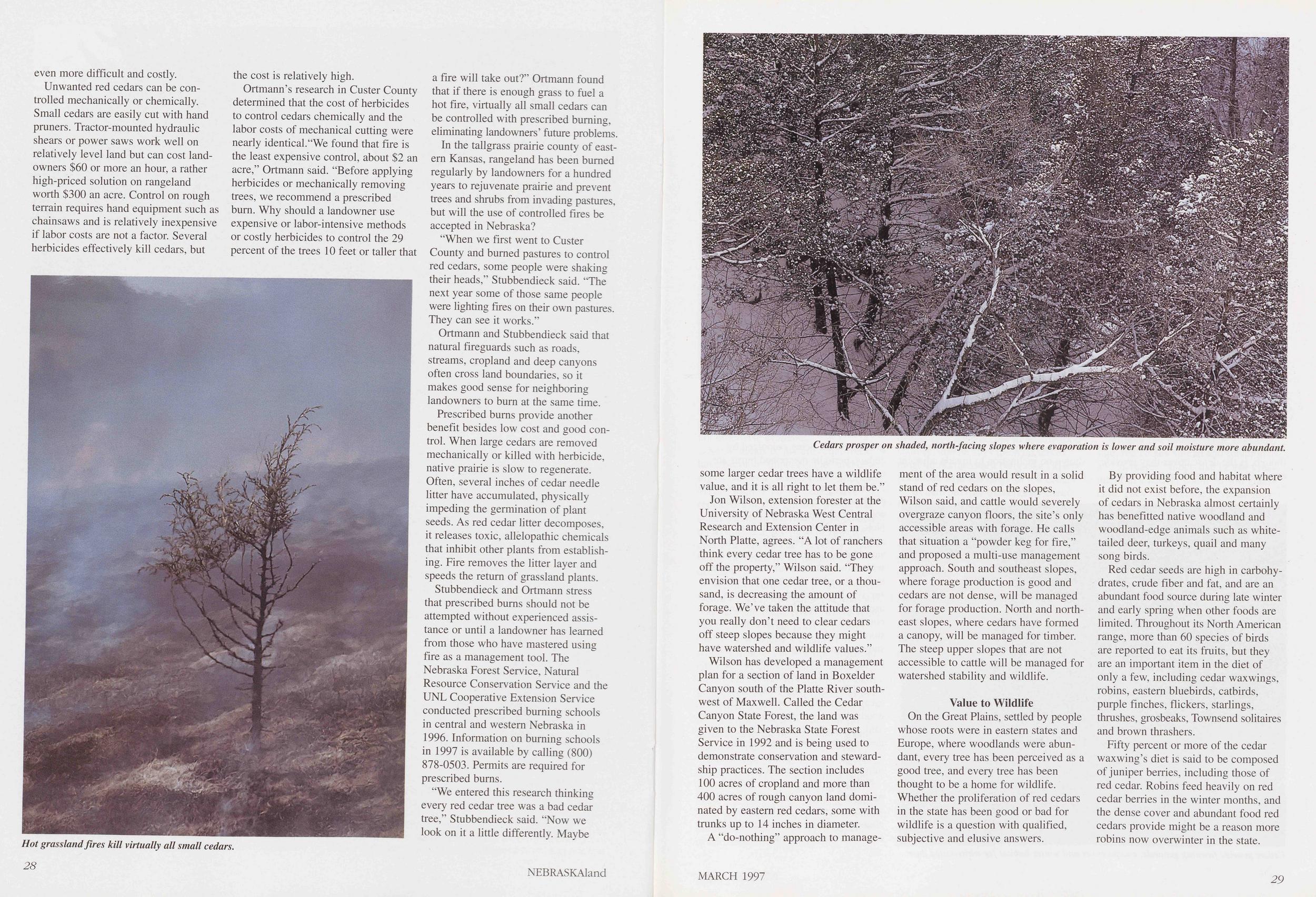
Ortmann's research in Custer County determined that the cost of herbicides to control cedars chemically and the labor costs of mechanical cutting were nearly identical."We found that fire is the least expensive control, about $2 an acre," Ortmann said. "Before applying herbicides or mechanically removing trees, we recommend a prescribed burn. Why should a landowner use expensive or labor-intensive methods or costly herbicides to control the 29 percent of the trees 10 feet or taller that a fire will take out?" Ortmann found that if there is enough grass to fuel a hot fire, virtually all small cedars can be controlled with prescribed burning, eliminating landowners' future problems.
In the tallgrass prairie county of eastern Kansas, rangeland has been burned regularly by landowners for a hundred years to rejuvenate prairie and prevent trees and shrubs from invading pastures, but will the use of controlled fires be accepted in Nebraska?
"When we first went to Custer County and burned pastures to control red cedars, some people were shaking their heads," Stubbendieck said. "The next year some of those same people were lighting fires on their own pastures. They can see it works."
Ortmann and Stubbendieck said that natural fireguards such as roads, streams, cropland and deep canyons often cross land boundaries, so it makes good sense for neighboring landowners to burn at the same time.
Prescribed burns provide another benefit besides low cost and good control. When large cedars are removed mechanically or killed with herbicide, native prairie is slow to regenerate. Often, several inches of cedar needle litter have accumulated, physically impeding the germination of plant seeds. As red cedar litter decomposes, it releases toxic, allelopathic chemicals that inhibit other plants from establishing. Fire removes the litter layer and speeds the return of grassland plants.
Stubbendieck and Ortmann stress that prescribed burns should not be attempted without experienced assistance or until a landowner has learned from those who have mastered using fire as a management tool. The Nebraska Forest Service, Natural Resource Conservation Service and the UNL Cooperative Extension Service conducted prescribed burning schools in central and western Nebraska in 1996. Information on burning schools in 1997 is available by calling (800) 878-0503. Permits are required for prescribed burns.
Hot grassland fires kill virtually all small cedars.
Cedars prosper on shaded, north-facing slopes where evaporation is lower and soil moisture more abundant.
Jon Wilson, extension forester at the University of Nebraska West Central Research and Extension Center in North Platte, agrees. "A lot of ranchers think every cedar tree has to be gone off the property," Wilson said. "They envision that one cedar tree, or a thousand, is decreasing the amount of forage. We've taken the attitude that you really don't need to clear cedars off steep slopes because they might have watershed and wildlife values."
Wilson has developed a management plan for a section of land in Boxelder Canyon south of the Platte River southwest of Maxwell. Called the Cedar Canyon State Forest, the land was given to the Nebraska State Forest Service in 1992 and is being used to demonstrate conservation and stewardship practices. The section includes 100 acres of cropland and more than 400 acres of rough canyon land dominated by eastern red cedars, some with trunks up to 14 inches in diameter.
A "do-nothing" approach to management of the area would result in a solid stand of red cedars on the slopes, Wilson said, and cattle would severely overgraze canyon floors, the site's only accessible areas with forage. He calls that situation a "powder keg for fire," and proposed a multi-use management approach. South and southeast slopes, where forage production is good and cedars are not dense, will be managed for forage production. North and northeast slopes, where cedars have formed a canopy, will be managed for timber. The steep upper slopes that are not accessible to cattle will be managed for watershed stability and wildlife.
Value to WildlifeOn the Great Plains, settled by people whose roots were in eastern states and Europe, where woodlands were abundant, every tree has been perceived as a good tree, and every tree has been thought to be a home for wildlife. Whether the proliferation of red cedars in the state has been good or bad for wildlife is a question with qualified, subjective and elusive answers.
By providing food and habitat where it did not exist before, the expansion of cedars in Nebraska almost certainly has benefitted native woodland and woodland-edge animals such as white-tailed deer, turkeys, quail and many song birds.
Red cedar seeds are high in carbohydrates, crude fiber and fat, and are an abundant food source during late winter and early spring when other foods are limited. Throughout its North American range, more than 60 species of birds are reported to eat its fruits, but they are an important item in the diet of only a few, including cedar waxwings, robins, eastern bluebirds, catbirds, purple finches, flickers, starlings, thrushes, grosbeaks, Townsend solitaires and brown thrashers.
Fifty percent or more of the cedar
waxwing's diet is said to be composed
of juniper berries, including those of
red cedar. Robins feed heavily on red
cedar berries in the winter months, and
the dense cover and abundant food red
cedars provide might be a reason more
robins now overwinter in the state.
MARCH 1997
29
 Wild turkeys eat eastern red cedar fruits
when traditional mast crops are in short
supply. Coyotes, foxes, beavers and
opossums also are reported to feed on
the fruit of red cedar. White-tailed deer,
mule deer and pronghorns browse
junipers such as red cedar but usually
only during severe winters when more
desirable plants are not available.
Wild turkeys eat eastern red cedar fruits
when traditional mast crops are in short
supply. Coyotes, foxes, beavers and
opossums also are reported to feed on
the fruit of red cedar. White-tailed deer,
mule deer and pronghorns browse
junipers such as red cedar but usually
only during severe winters when more
desirable plants are not available.
Red cedar seeds pass intact through the digestive tracts of mammals and birds. In fact, a cedar seed's chances of germinating are enhanced by such passage, and small birds are the red cedar's principal means of seed dispersal. Seeds dropped in the shadow of a mature cedar are unlikely to prosper, but those deposited elsewhere by birds have a greater chance of falling on fertile ground.
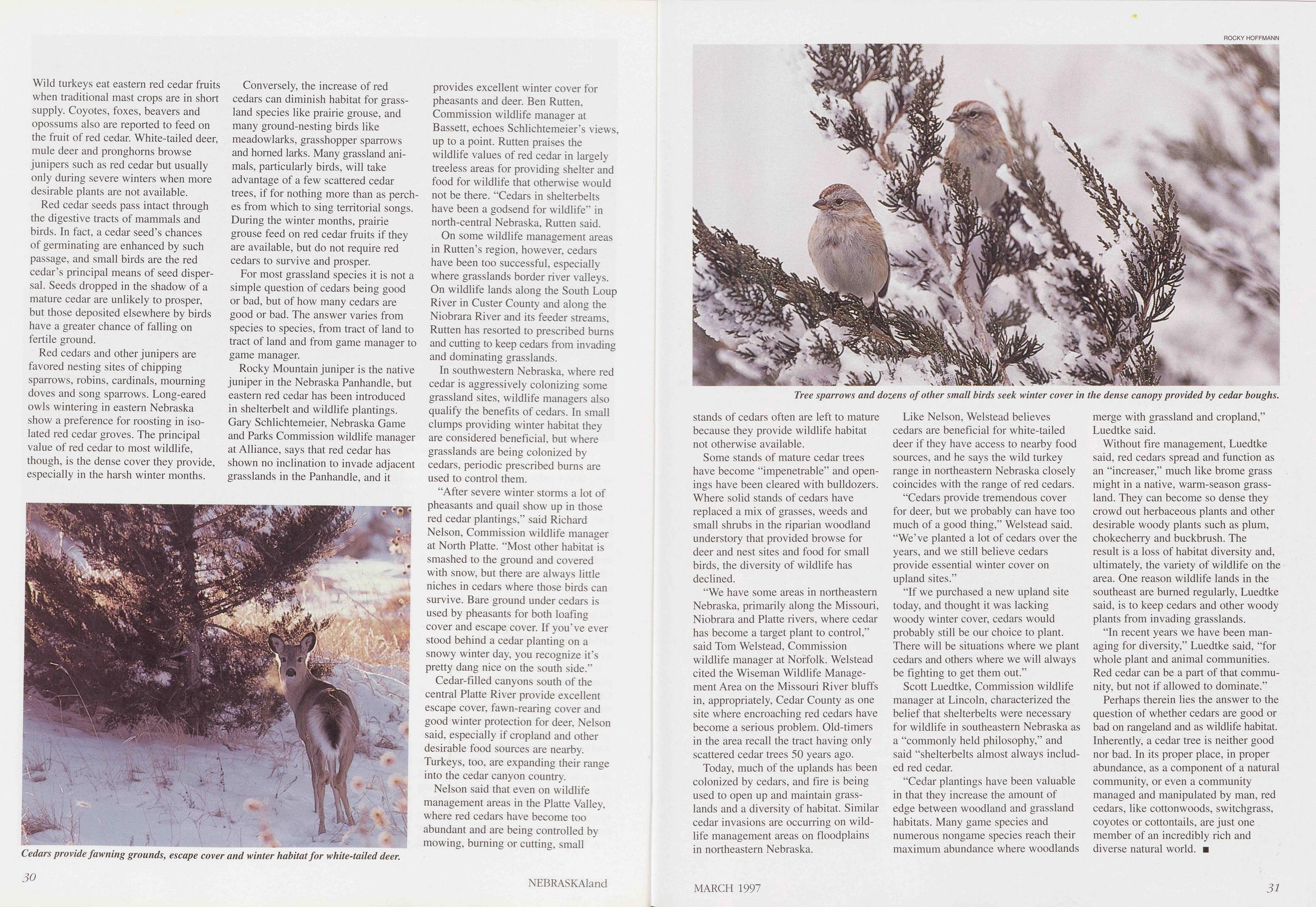
Red cedars and other junipers are favored nesting sites of chipping sparrows, robins, cardinals, mourning doves and song sparrows. Long-eared owls wintering in eastern Nebraska show a preference for roosting in isolated red cedar groves. The principal value of red cedar to most wildlife, though, is the dense cover they provide, especially in the harsh winter months.
Conversely, the increase of red cedars can diminish habitat for grassland species like prairie grouse, and many ground-nesting birds like meadowlarks, grasshopper sparrows and horned larks. Many grassland animals, particularly birds, will take advantage of a few scattered cedar trees, if for nothing more than as perches from which to sing territorial songs. During the winter months, prairie grouse feed on red cedar fruits if they are available, but do not require red cedars to survive and prosper.
For most grassland species it is not a simple question of cedars being good or bad, but of how many cedars are good or bad. The answer varies from species to species, from tract of land to tract of land and from game manager to game manager.
Cedars provide fawning grounds, escape cover and winter habitat for white-tailed deer.
On some wildlife management areas in Rutten's region, however, cedars have been too successful, especially where grasslands border river valleys. On wildlife lands along the South Loup River in Custer County and along the Niobrara River and its feeder streams, Rutten has resorted to prescribed burns and cutting to keep cedars from invading and dominating grasslands.
In southwestern Nebraska, where red cedar is aggressively colonizing some grassland sites, wildlife managers also qualify the benefits of cedars. In small clumps providing winter habitat they are considered beneficial, but where grasslands are being colonized by cedars, periodic prescribed burns are used to control them.
"After severe winter storms a lot of pheasants and quail show up in those red cedar plantings," said Richard Nelson, Commission wildlife manager at North Platte. "Most other habitat is smashed to the ground and covered with snow, but there are always little niches in cedars where those birds can survive. Bare ground under cedars is used by pheasants for both loafing cover and escape cover. If you've ever stood behind a cedar planting on a snowy winter day, you recognize it's pretty dang nice on the south side."
Cedar-filled canyons south of the central Platte River provide excellent escape cover, fawn-rearing cover and good winter protection for deer, Nelson said, especially if cropland and other desirable food sources are nearby. Turkeys, too, are expanding their range into the cedar canyon country.
Tree sparrows and dozens of other small birds seek winter cover in the dense canopy provided by cedar boughs.
Some stands of mature cedar trees have become "impenetrable" and openings have been cleared with bulldozers. Where solid stands of cedars have replaced a mix of grasses, weeds and small shrubs in the riparian woodland understory that provided browse for deer and nest sites and food for small birds, the diversity of wildlife has declined.
"We have some areas in northeastern Nebraska, primarily along the Missouri, Niobrara and Platte rivers, where cedar has become a target plant to control," said Tom Welstead, Commission wildlife manager at Norfolk. Welstead cited the Wiseman Wildlife Management Area on the Missouri River bluffs in, appropriately, Cedar County as one site where encroaching red cedars have become a serious problem. Old-timers in the area recall the tract having only scattered cedar trees 50 years ago.
Today, much of the uplands has been colonized by cedars, and fire is being used to open up and maintain grasslands and a diversity of habitat. Similar cedar invasions are occurring on wildlife management areas on floodplains in northeastern Nebraska.
Like Nelson, Welstead believes cedars are beneficial for white-tailed deer if they have access to nearby food sources, and he says the wild turkey range in northeastern Nebraska closely coincides with the range of red cedars.
"Cedars provide tremendous cover for deer, but we probably can have too much of a good thing," Welstead said. "We've planted a lot of cedars over the years, and we still believe cedars provide essential winter cover on upland sites."
"If we purchased a new upland site today, and thought it was lacking woody winter cover, cedars would probably still be our choice to plant. There will be situations where we plant cedars and others where we will always be fighting to get them out."
Scott Luedtke, Commission wildlife manager at Lincoln, characterized the belief that shelterbelts were necessary for wildlife in southeastern Nebraska as a "commonly held philosophy," and said "shelterbelts almost always included red cedar.
"Cedar plantings have been valuable in that they increase the amount of edge between woodland and grassland habitats. Many game species and numerous nongame species reach their maximum abundance where woodlands merge with grassland and cropland," Luedtke said.
Without fire management, Luedtke said, red cedars spread and function as an "increaser," much like brome grass might in a native, warm-season grassland. They can become so dense they crowd out herbaceous plants and other desirable woody plants such as plum, chokecherry and buckbrush. The result is a loss of habitat diversity and, ultimately, the variety of wildlife on the area. One reason wildlife lands in the southeast are burned regularly, Luedtke said, is to keep cedars and other woody plants from invading grasslands.
"In recent years we have been managing for diversity," Luedtke said, "for whole plant and animal communities. Red cedar can be a part of that community, but not if allowed to dominate."
Perhaps therein lies the answer to the question of whether cedars are good or bad on rangeland and as wildlife habitat. Inherently, a cedar tree is neither good nor bad. In its proper place, in proper abundance, as a component of a natural community, or even a community managed and manipulated by man, red cedars, like cottonwoods, switchgrass, coyotes or cottontails, are just one member of an incredibly rich and diverse natural world.
MARCH 1997 31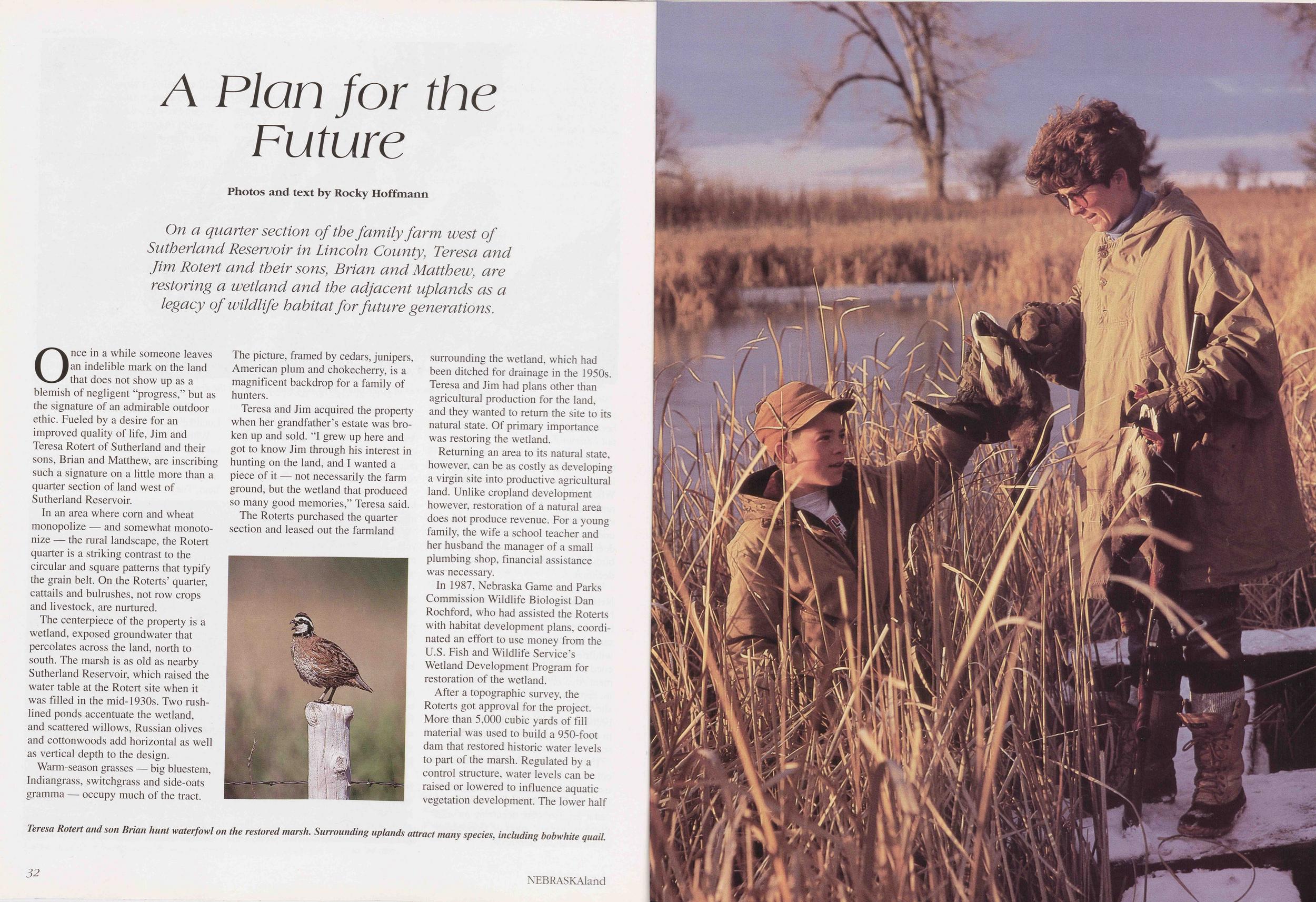
A Plan for the Future
On a quarter section of the family farm west of Sutherland Reservoir in Lincoln County, Teresa and Jim Rotert and their sons, Brian and Matthew, are restoring a wetland and the adjacent uplands as a legacy of wildlife habitat for future generations.
Once in a while someone leaves an indelible mark on the land that does not show up as a blemish of negligent "progress," but as the signature of an admirable outdoor ethic. Fueled by a desire for an improved quality of life, Jim and Teresa Rotert of Sutherland and their sons, Brian and Matthew, are inscribing such a signature on a little more than a quarter section of land west of Sutherland Reservoir.
In an area where corn and wheat monopolize — and somewhat monotonize — the rural landscape, the Rotert quarter is a striking contrast to the circular and square patterns that typify the grain belt. On the Roterts' quarter, cattails and bulrushes, not row crops and livestock, are nurtured.
The centerpiece of the property is a wetland, exposed groundwater that percolates across the land, north to south. The marsh is as old as nearby Sutherland Reservoir, which raised the water table at the Rotert site when it was filled in the mid-1930s. Two rushlined ponds accentuate the wetland, and scattered willows, Russian olives and cottonwoods add horizontal as well as vertical depth to the design.
Warm-season grasses — big bluestem, Indiangrass, switchgrass and side-oats gramma — occupy much of the tract. The picture, framed by cedars, junipers, American plum and chokecherry, is a magnificent backdrop for a family of hunters.
Teresa and Jim acquired the property when her grandfather's estate was broken up and sold. "I grew up here and got to know Jim through his interest in hunting on the land, and I wanted a piece of it — not necessarily the farm ground, but the wetland that produced so many good memories," Teresa said.
The Roterts purchased the quarter section and leased out the farmland
Returning an area to its natural state, however, can be as costly as developing a virgin site into productive agricultural land. Unlike cropland development however, restoration of a natural area does not produce revenue. For a young family, the wife a school teacher and her husband the manager of a small plumbing shop, financial assistance was necessary.
In 1987, Nebraska Game and Parks Commission Wildlife Biologist Dan Rochford, who had assisted the Roterts with habitat development plans, coordinated an effort to use money from the U.S. Fish and Wildlife Service's Wetland Development Program for restoration of the wetland.
Teresa Rotert and son Brian hunt waterfowl on the restored marsh. Surrounding uplands attract many species, including bobwhite quail.
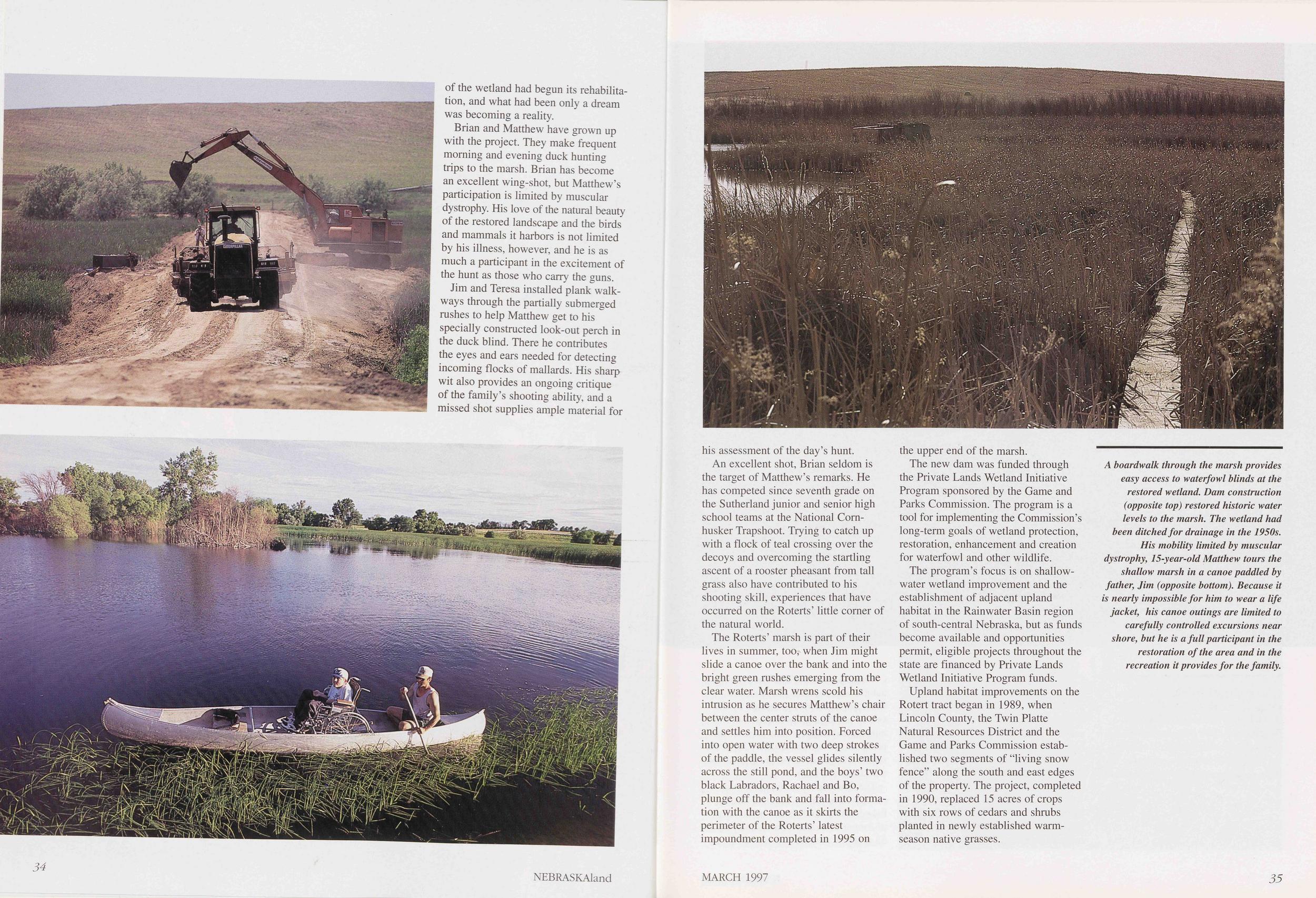
Brian and Matthew have grown up with the project. They make frequent morning and evening duck hunting trips to the marsh. Brian has become an excellent wing-shot, but Matthew's participation is limited by muscular dystrophy. His love of the natural beauty of the restored landscape and the birds and mammals it harbors is not limited by his illness, however, and he is as much a participant in the excitement of the hunt as those who carry the guns.
Jim and Teresa installed plank walkways through the partially submerged rushes to help Matthew get to his specially constructed look-out perch in the duck blind. There he contributes the eyes and ears needed for detecting incoming flocks of mallards. His sharp, wit also provides an ongoing critique of the family's shooting ability, and a missed shot supplies ample material for
An excellent shot, Brian seldom is the target of Matthew's remarks. He has competed since seventh grade on the Sutherland junior and senior high school teams at the National Cornhusker Trapshoot. Trying to catch up with a flock of teal crossing over the decoys and overcoming the startling ascent of a rooster pheasant from tall grass also have contributed to his shooting skill, experiences that have occurred on the Roterts' little corner of the natural world.
The Roterts' marsh is part of their lives in summer, too, when Jim might slide a canoe over the bank and into the bright green rushes emerging from the clear water. Marsh wrens scold his intrusion as he secures Matthew's chair between the center struts of the canoe and settles him into position. Forced into open water with two deep strokes of the paddle, the vessel glides silently across the still pond, and the boys' two black Labradors, Rachael and Bo, plunge off the bank and fall into formation with the canoe as it skirts the perimeter of the Roterts' latest impoundment completed in 1995 on the upper end of the marsh.
The new dam was funded through the Private Lands Wetland Initiative Program sponsored by the Game and Parks Commission. The program is a tool for implementing the Commission's long-term goals of wetland protection, restoration, enhancement and creation for waterfowl and other wildlife.
The program's focus is on shallowwater wetland improvement and the establishment of adjacent upland habitat in the Rainwater Basin region of south-central Nebraska, but as funds become available and opportunities permit, eligible projects throughout the state are financed by Private Lands Wetland Initiative Program funds.
Upland habitat improvements on the Rotert tract began in 1989, when Lincoln County, the Twin Platte Natural Resources District and the Game and Parks Commission established two segments of "living snow fence" along the south and east edges of the property. The project, completed in 1990, replaced 15 acres of crops with six rows of cedars and shrubs planted in newly established warmseason native grasses.
MARCH 1997 35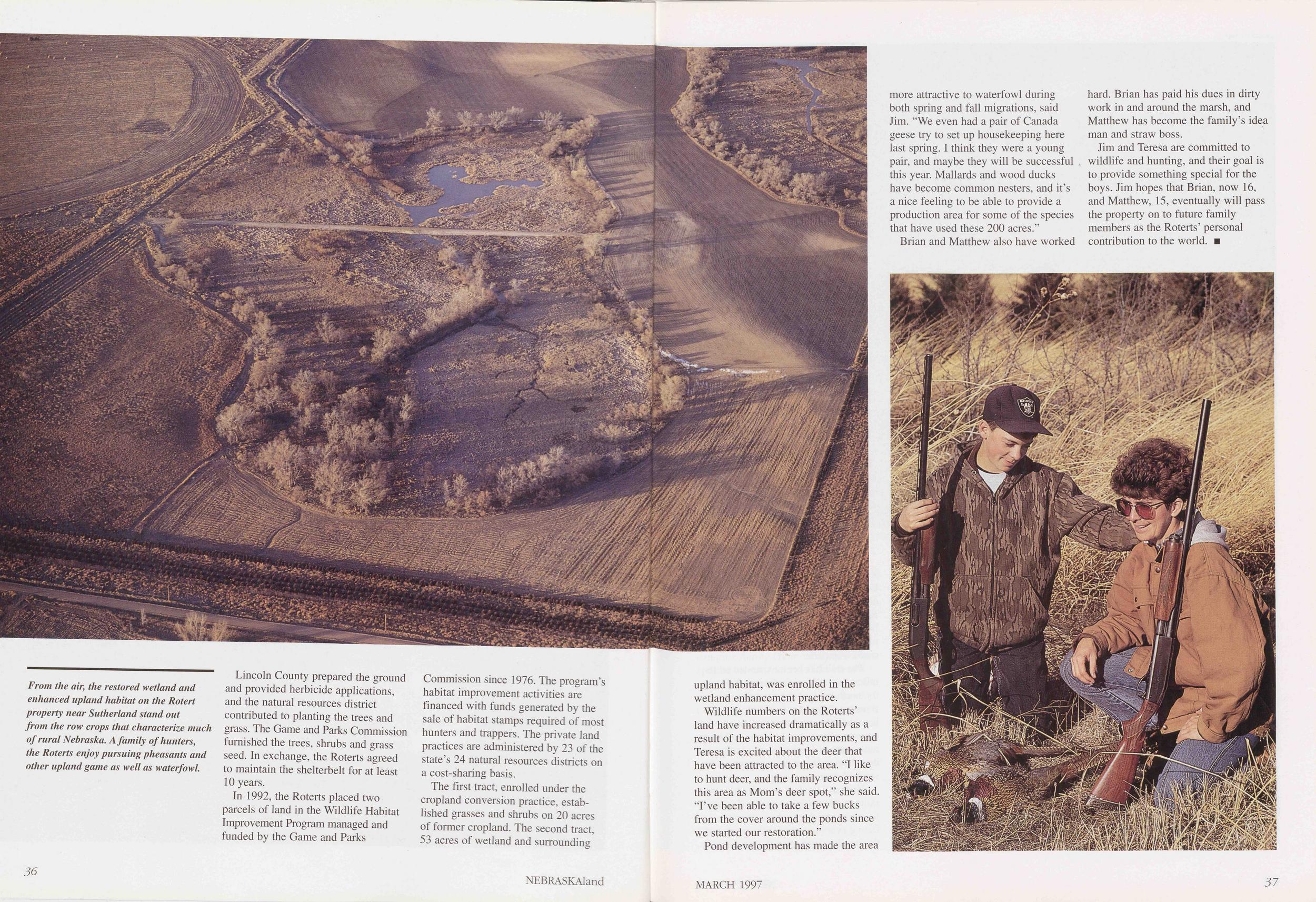
Lincoln County prepared the ground and provided herbicide applications, and the natural resources district contributed to planting the trees and grass. The Game and Parks Commission furnished the trees, shrubs and grass seed. In exchange, the Roterts agreed to maintain the shelterbelt for at least 10 years.
In 1992, the Roterts placed two parcels of land in the Wildlife Habitat Improvement Program managed and funded by the Game and Parks Commission since 1976. The program's habitat improvement activities are financed with funds generated by the sale of habitat stamps required of most hunters and trappers. The private land practices are administered by 23 of the state's 24 natural resources districts on a cost-sharing basis.
The first tract, enrolled under the cropland conversion practice, established grasses and shrubs on 20 acres of former cropland. The second tract, 53 acres of wetland and surrounding 36 NEBRASKAland upland habitat, was enrolled in the wetland enhancement practice.
Wildlife numbers on the Roterts' land have increased dramatically as a result of the habitat improvements, and Teresa is excited about the deer that have been attracted to the area. "I like to hunt deer, and the family recognizes this area as Mom's deer spot," she said. "I've been able to take a few bucks from the cover around the ponds since we started our restoration."
Pond development has made the area more attractive to waterfowl during both spring and fall migrations, said Jim. "We even had a pair of Canada geese try to set up housekeeping here last spring. I think they were a young pair, and maybe they will be successful this year. Mallards and wood ducks have become common nesters, and it's a nice feeling to be able to provide a production area for some of the species that have used these 200 acres."
Brian and Matthew also have worked hard. Brian has paid his dues in dirty work in and around the marsh, and Matthew has become the family's idea man and straw boss.
Jim and Teresa are committed to wildlife and hunting, and their goal is to provide something special for the boys. Jim hopes that Brian, now 16, and Matthew, 15, eventually will pass the property on to future family members as the Roterts' personal contribution to the world.
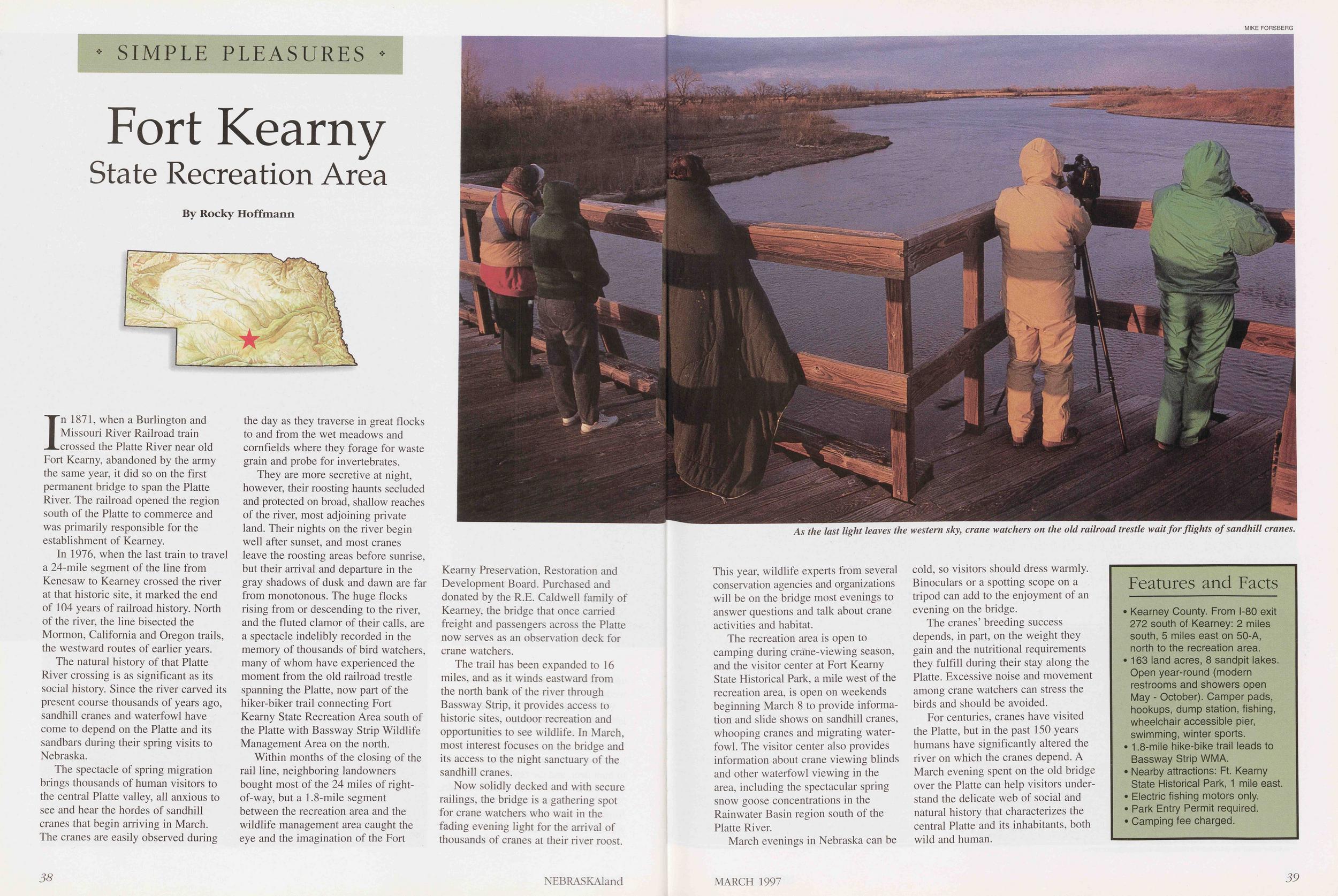
SIMPLE PLEASURES Fort Kearny State Recreation Area
In 1871, when a Burlington and Missouri River Railroad train crossed the Platte River near old Fort Kearny, abandoned by the army the same year, it did so on the first permanent bridge to span the Platte River. The railroad opened the region south of the Platte to commerce and was primarily responsible for the establishment of Kearney.
In 1976, when the last train to travel a 24-mile segment of the line from Kenesaw to Kearney crossed the river at that historic site, it marked the end of 104 years of railroad history. North of the river, the line bisected the Mormon, California and Oregon trails, the westward routes of earlier years. The natural history of that Platte River crossing is as significant as its social history. Since the river carved its present course thousands of years ago, sandhill cranes and waterfowl have come to depend on the Platte and its sandbars during their spring visits to Nebraska.
The spectacle of spring migration brings thousands of human visitors to the central Platte valley, all anxious to see and hear the hordes of sandhill cranes that begin arriving in March. The cranes are easily observed during the day as they traverse in great flocks to and from the wet meadows and cornfields where they forage for waste grain and probe for invertebrates.
They are more secretive at night, however, their roosting haunts secluded and protected on broad, shallow reaches of the river, most adjoining private land. Their nights on the river begin well after sunset, and most cranes leave the roosting areas before sunrise, but their arrival and departure in the gray shadows of dusk and dawn are far from monotonous. The huge flocks rising from or descending to the river, and the fluted clamor of their calls, are a spectacle indelibly recorded in the memory of thousands of bird watchers, many of whom have experienced the moment from the old railroad trestle spanning the Platte, now part of the hiker-biker trail connecting Fort Kearny State Recreation Area south of the Platte with Bass way Strip Wildlife Management Area on the north.
Within months of the closing of the rail line, neighboring landowners bought most of the 24 miles of right-of-way, but a 1.8-mile segment between the recreation area and the wildlife management area caught the eye and the imagination of the Fort Kearny Preservation, Restoration and Development Board. Purchased and donated by the R.E. Caldwell family of Kearney, the bridge that once carried freight and passengers across the Platte now serves as an observation deck for crane watchers.
The trail has been expanded to 16 miles, and as it winds eastward from the north bank of the river through Bassway Strip, it provides access to historic sites, outdoor recreation and opportunities to see wildlife. In March, most interest focuses on the bridge and its access to the night sanctuary of the sandhill cranes.
As the last light leaves the western sky, crane watchers on the old railroad trestle wait for flights of sandhill cranes.
The recreation area is open to camping during crane-viewing season, and the visitor center at Fort Kearny State Historical Park, a mile west of the recreation area, is open on weekends beginning March 8 to provide information and slide shows on sandhill cranes, whooping cranes and migrating waterfowl. The visitor center also provides information about crane viewing blinds and other waterfowl viewing in the area, including the spectacular spring snow goose concentrations in the Rainwater Basin region south of the Platte River.
March evenings in Nebraska can be cold, so visitors should dress warmly. Binoculars or a spotting scope on a tripod can add to the enjoyment of an evening on the bridge.
The cranes' breeding success depends, in part, on the weight they gain and the nutritional requirements they fulfill during their stay along the Platte. Excessive noise and movement among crane watchers can stress the birds and should be avoided.
For centuries, cranes have visited the Platte, but in the past 150 years humans have significantly altered the river on which the cranes depend. A March evening spent on the old bridge over the Platte can help visitors understand the delicate web of social and natural history that characterizes the central Platte and its inhabitants, both wild and human.
Features and Facts Kearney County. From 1-80 exit 272 south of Kearney: 2 miles south, 5 miles east on 50-A, north to the recreation area. 163 land acres, 8 sandpit lakes. Open year-round (modern restrooms and showers open May - October). Camper pads, hookups, dump station, fishing, wheelchair accessible pier, swimming, winter sports. 1.8-mile hike-bike trail leads to Bassway Strip WMA. Nearby attractions: Ft. Kearny State Historical Park, 1 mile east. Electric fishing motors only. Park Entry Permit required. Camping fee charged. MARCH 1997 39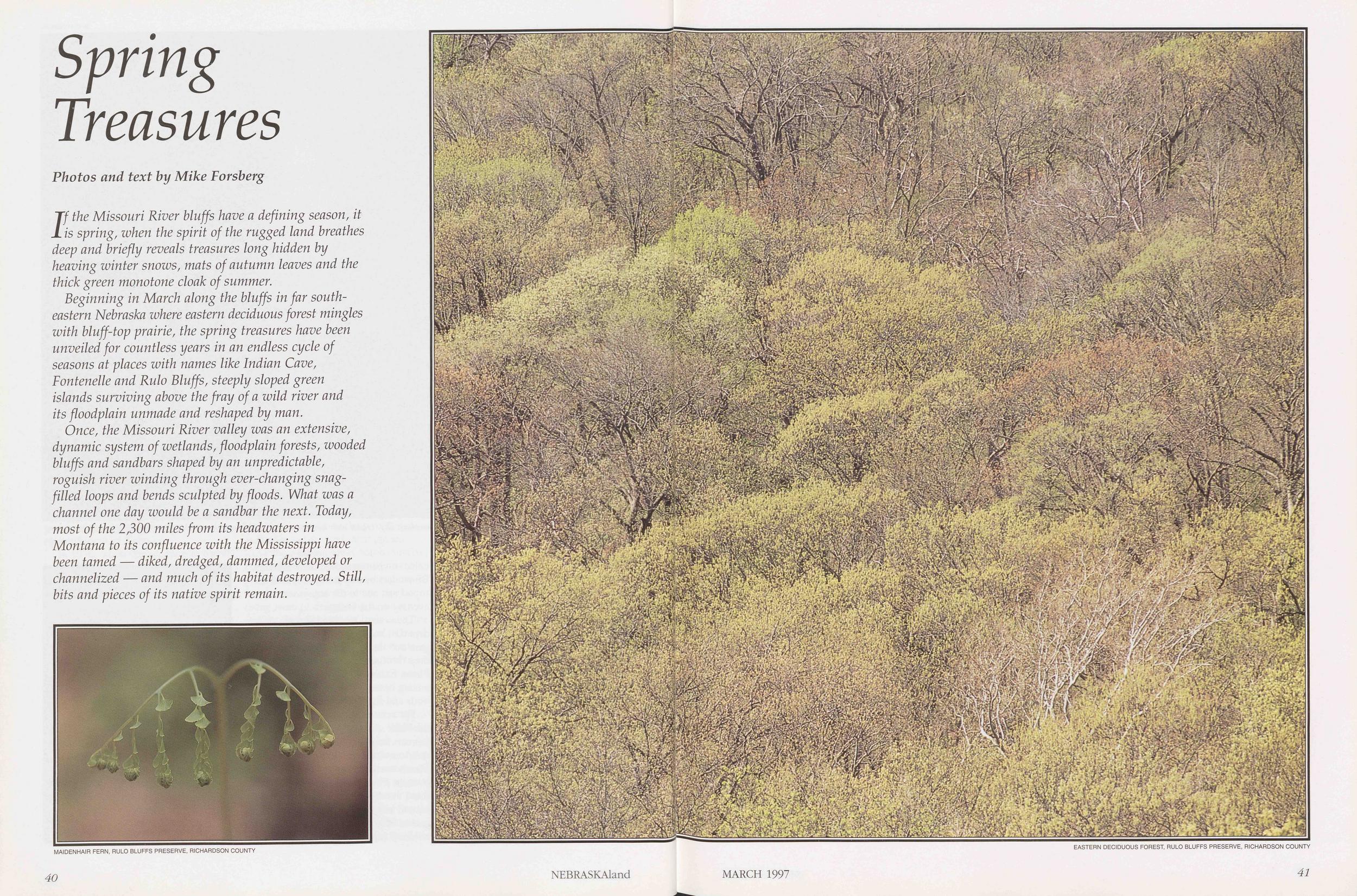
Spring Treasures
If the Missouri River bluffs have a defining season, it is spring, when the spirit of the rugged land breathes deep and briefly reveals treasures long hidden by heaving winter snows, mats of autumn leaves and the thick green monotone cloak of summer. Beginning in March along the bluffs in far southeastern Nebraska where eastern deciduous forest mingles with bluff-top prairie, the spring treasures have been unveiled for countless years in an endless cycle of seasons at places with names like Indian Cave, Fontenelle and Rulo Bluffs, steeply sloped green islands surviving above the fray of a wild river and its floodplain unmade and reshaped by man. Once, the Missouri River valley was an extensive, dynamic system of wetlands, floodplain forests, wooded bluffs and sandbars shaped by an unpredictable, roguish river winding through ever-changing snag-filled loops and bends sculpted by floods. What was a channel one day would be a sandbar the next. Today, most of the 2,300 miles from its headwaters in Montana to its confluence with the Mississippi have been tamed — diked, dredged, dammed, developed or channelized — and much of its habitat destroyed. Still, bits and pieces of its native spirit remain.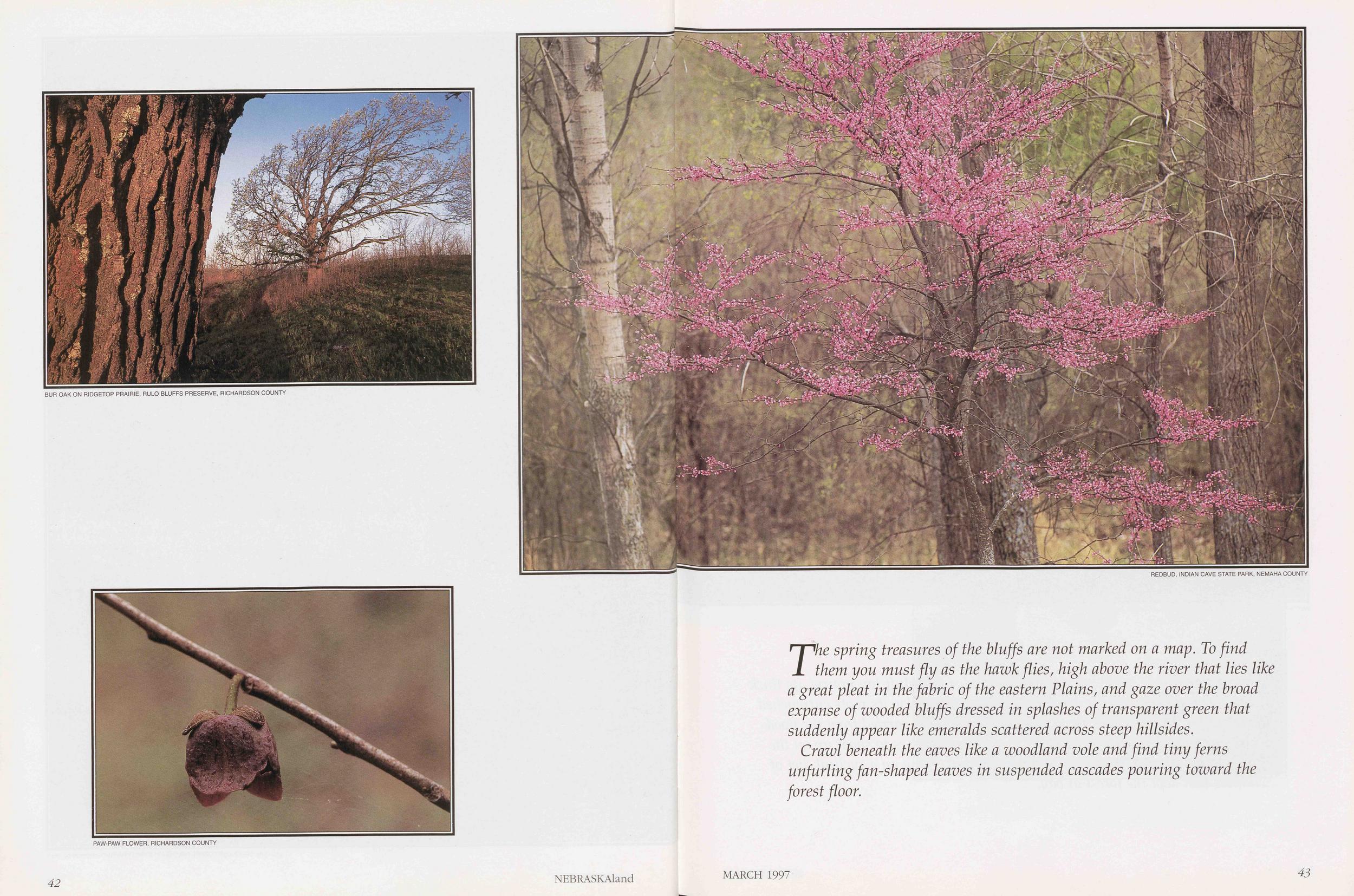
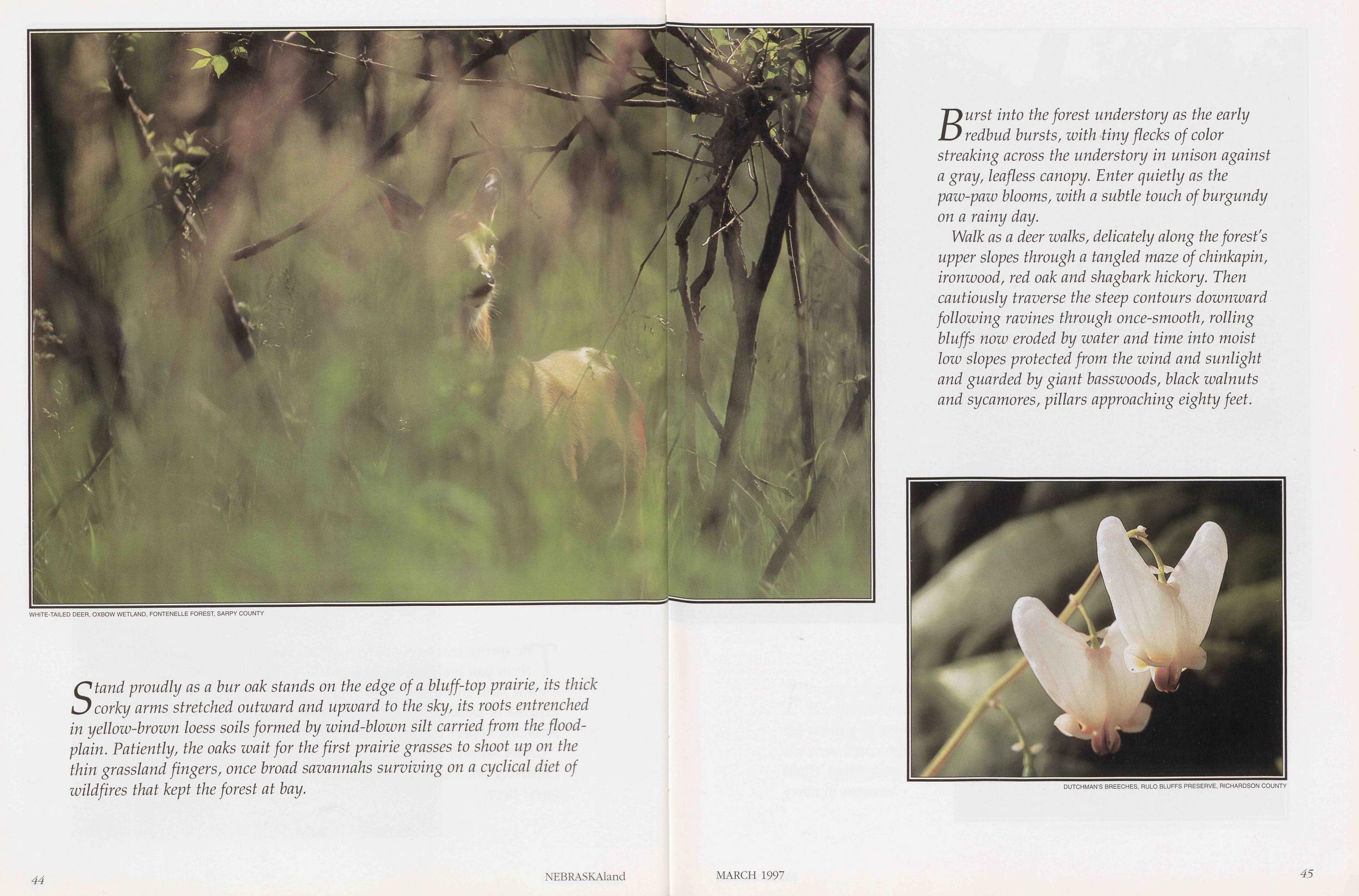
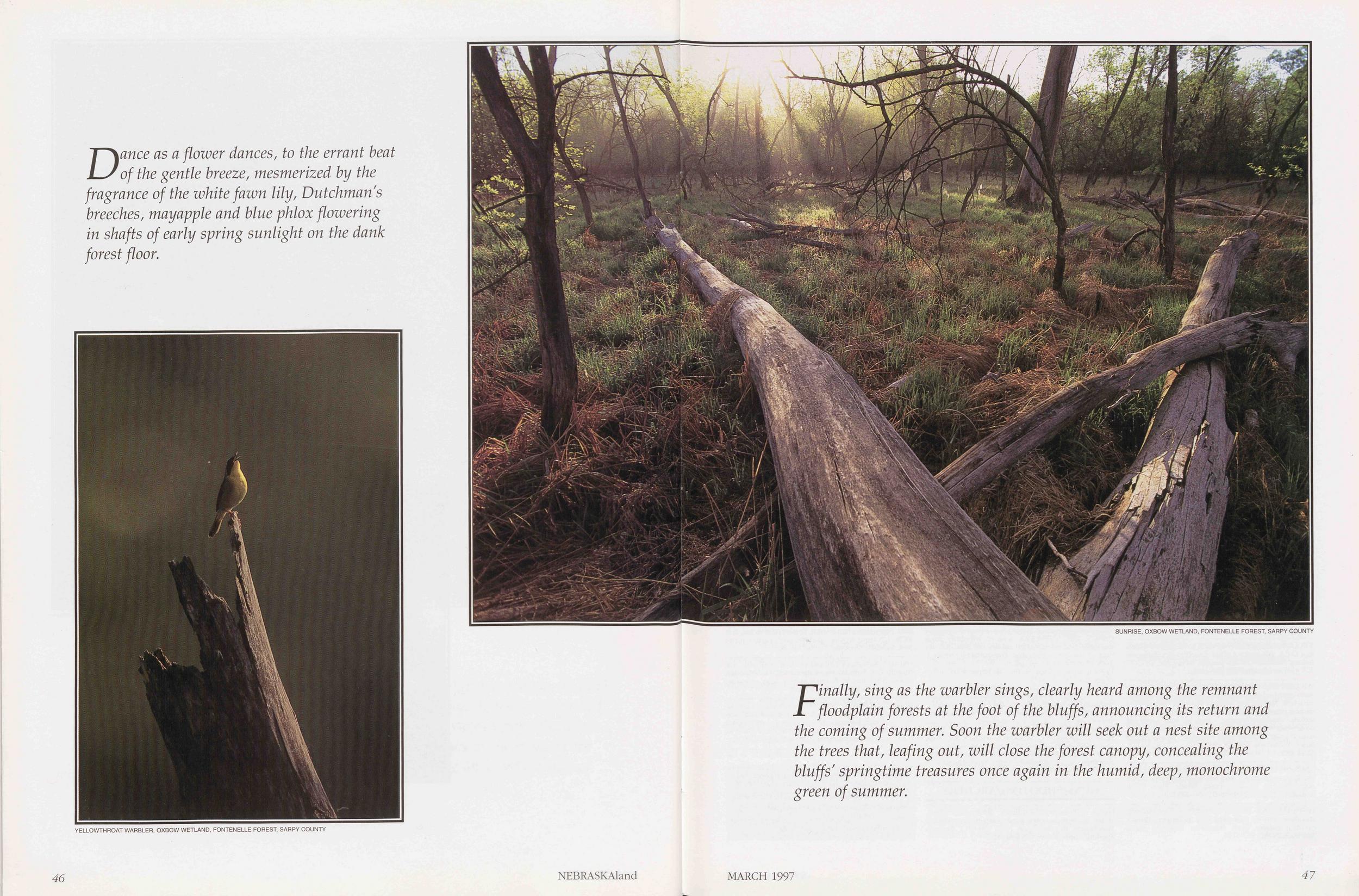 Dance as a flower dances, to the errant heat
of the gentle breeze, mesmerized by the
fragrance of the white fawn lily, Dutchman s
breeches, may apple and blue phlox flowering
in shafts of early spring sunlight on the dank
forest floor.
Dance as a flower dances, to the errant heat
of the gentle breeze, mesmerized by the
fragrance of the white fawn lily, Dutchman s
breeches, may apple and blue phlox flowering
in shafts of early spring sunlight on the dank
forest floor.
Classified
ANTIQUES/COLLECTIBLES UP TO $100 for Nebraska hunting licenses 1901 through 1920. Up to $25 for any Nebraska trapping licenses. (402) 785-7500. Phil. COLLECTOR BUYING: Old bottles embossed with the names of Nebraska towns, also colored glass telephone & power insulators. Kenn, 6428 S. 107th St., Omaha, NE 68127. Phone: (402) 339-8702. WANTED OLD SURVEY/SCIENTIFIC instruments: compasses, transits, sextants, calculators, microscopes, etc. Beale, 506 E. 73rd Ave., Anchorage, AK 99518. Call (907) 344-7948. BOOKS/PRINTING FREE BOOK CATALOG. Novels, westerns, romances, children's; old out of print, found barns, attic. Authors: Grey, Bower, Condor, Fox, Curwood, Raine, Wright, Aldrige, Pollyanna, Freckles, many others. Postage appreciated. Pierce, 4400 N. Pine Cluster, Oroville, CA 95965. HOW TO FIND MORE outdoor opportunities! The Nebraska Sportsman's Atlas. Locations of all public lands and waters on county transportation maps. These maps show ALL the roads in Nebraska. Listings include federal, Nebraska Game & Parks, NRD holdings, hotels and motels and Nebraska's endless attractions. At only $18.75/copy a true time and frustration saver. To order write: Sportsman's Atlas Co., PO Box 132, Lytton, IA 50561 or call 1-800-568-8334. JU-JU SWALLOWED A PENNY, a Nebraska farm girl's book of the 1930s Depression Era. $7.50 ppd. Betty Heidbreder Dunn, Rt. 2, Box 2025, Columbus, TX 78934. GREAT PRICES on great books! Special issues from NEBRASKAland Magazine — woodlands, wildflowers, photography, recipes and history. Lowest prices ever. For titles and order information, call 1-800-632-5263. DOGS TRAINING ALL BREEDS bird dogs - Vizslas for sale. Home of Rebel Rousers. Rozanek Kennels, RR 2, Schuyler, NE 68661. Phone (402) 352-8769. RETRIEVER TRAINING. Area's top "retrievers only" trainer. Field trial and hunting.dogs. Non-slip duck dogs! TKO Retriever Training Kennel (402) 623-4311. ENGLISH SETTERS and Labradors from outstanding lines. Bred for hunters who appreciate fine bird dogs! Wind Fall Gun Dogs, (402) 421-4693. CHESAPEAKE BAY, Labrador and golden retriever pups, started dogs and stud service. 16-time national champion pedigree. Visa & MasterCard. Platte Valley Retrievers (308) 995-2318. YELLOW-CHOCOLATE-BLACK LAB pups. Breeders hips O.F.A. and eyes c.e.r.f./ed. Excellent bloodlines and hunting potential. Call Mr. Bendler, Lexington, NE (308) 324-4247 or Lincoln (402) 477-1305. WILDERNESS KENNELS. Gun dog training - over 60 years combined experience. Training all sporting breeds - retrievers, flushing and pointing dogs. All dogs worked on pen raised birds and wild game. Training program includes obedience training - heel, sit, stay, down and come when called. Pups, started dogs and fully trained dogs for sale. Hunting dogs trained by hunters. Henry Sader, Wilderness Kennels, Roca, NE (402) 423-4212. Since 1968. ENGLISH SETTERS, German shorthairs, English pointers, Brittany spaniels - stud service, puppies and started dogs. Training for all pointing breeds. Plum Creek Kennel, (712) 529-4238 or (402) 298-8153. FOR SALE: AKC Brittany Spaniel Pups. Championship Bloodline. Proven past pups with references. Parents excellent hunters. Great disposition. Hips and health guaranteed. (402) 362-5108. FISH/FISHING FISH FOR SALE. Catfish, largemouth bass, smallmouth bass, perch, crappie, bluegill, walleye, northern pike, rainbow trout, Donaldson rainbow trout, grass carp, minnows, bullheads. Consulting available. Pleasant Valley Fish Farm, RR 1, Box 147, McCook, NE 69001. Phone (308) 345-6599. WILLOW LAKE FISH HATCHERY. Channel cat, bluegill, hybrid bluegill, largemouth bass, crappie, triploid grass carp, walleye, perch, minnows available for stocking. Gaylord Crawford, 7580 N. Highland Rd., Hastings, NE 68901 or phone (402) 463-8022 day or night. Also pond consultant. We deliver, grower price. FOOD/GIFTS NEBRASKA BASKETS: The original Nebraska company specializing in fine foods from Nebraska since 1984. A beautiful array of baskets filled with ethnic, healthful and long-time favorite foods. Call or write for our brochure: P.O. Box 22985, Lincoln, NE 68542. Phone 1-800-345-7725 or (402) 438-3111. FROM NEBRASKA GIFT SHOP...the world's largest selection of Nebraska-made food products and gifts. Historic Haymarket, 140 N. 8th St., Lincoln, NE 68508; Old Market, 1030 Howard St., Omaha, NE. Call for free catalog 1-800-399-5693. HOP RHIZOMES, BEER & WINEMAKING supplies. Fermenter's Supply, 8410 K Plz. #10, Omaha, NE 68127. (888) 655-BREW. Open every day, mail orders. Ask about free shipping. NEBRASKA GOURMET SMOKED TURKEY, award-winning BBQ sauces, gourmet seasonings, native jellies, fruit butters and more! Great gift ideas! Call toll free 1-888-926-2879, Hollman Foods, 1948 36 Road, Minden, NE 68959, or check our products out on the Internet, http://www.lopernet.net/hollmansAhollmans.htm NEBRASKA GREETING CARDS & GIFTS, mugs, stationery, stamps, Nebraska cookie cutters. Christmas cards and more. Originally designed in Nebraska. Call or write for free brochure: Prairie Heart Greetings, RR 3 Box 200, North Platte, NE 69101. 1-800-632-7623. LIFETIME HUNTING/FISHING PERMITS for a lifetime of Nebraska outdoor adventure. Applications are available from any Game and Parks Commission office or permit vendor. Call (402) 471-0641 for more information. GUIDES/OUTFITTERS MAD RIVER CANOES offers the finest quality and performance. For the finest canoes and accessories look to Great Plains Canoe Co., 205 Main, Springfield, NE 68059. Phone (402) 253-2001. CANOE THE NIOBRARA...with an affordable canoe trip by Dryland Aquatics. One and two-day trips...full service, or just canoes and tubes. Transportation furnished. Your Niobrara River specialists... We do it your way! Dryland Aquatics, Dept. N, Box 33C, Sparks, NE 69220 or phone 1-800-337-3119. THE SNAKE RIVER CONNECTION. Western Nebraska Sandhills bowhunting and fishing expeditions: guided trophy whitetail and mule deer bow hunts; catch-and-release fly fishing for steelhead, rainbow and German brown trout. We own over 7 miles of Snake River on our beautiful 14,500-acre private ranch. Price includes all meals, lodging and ranch transportation. Call or write for more information and free brochure. Hospitality is our trademark! Agnes Sasse, HC 84 Box 58, Gordon, NE 69343. Phone (308) 282-0369. GUNS/SHQOTING/ARCHERY GUNS - Browning, Winchester, Remington, others. Hi-powers, shotguns, new, used, antiques. Want Pre-'64 Winchesters. Buy-Sell-Trade. (402) 729-6112. Bedlan's Sporting Goods, Fairbury, NE 68352. AIR GUNS repaired - Benjamin, Crosman, Daisy, other American made. Restoration; old guns wanted. Jack's Air Guns, 1225 No. 46th, Lincoln, NE 68503. (402) 466-9223. MISCELLANEOUS E-Z-MATIC PET DOORS. Weather-tight (seals tight all around!) Super quiet, safe. Easy to install and use, sizes for any dog/cat. Free brochure, call (715) 635-2644. Riverside Products, W7909 Green Valley Rd., Spooner, WI 54801. GREEN CLEANING/PERSONAL CARE products. Eliminate harmful chemicals and toxins in homes and environments now! For free catalog, send name and address to MTC, RR 2 Box 34, Wauneta, NE 69045. TAXIDERMY ALLISON'S TAXIDERMY Studio & Gift Gallery - DU, SCI, Pheasants Forever & NTA Members. Mounted 36 state record fish. 421 N. Dewey, North Platte, NE 69101. Call (308) 534-2324 or (308) 534-4267. Custom Designs. VACATIONS/RESORTS FOR FISHING and hunting accommodations. Jefco Inn, Gordon, NE 69343. South Cornell, (308) 282-2935. BED & BREAKFAST. Historic 1890s hotel. Located in the beautiful Pine Ridge area of northwest Nebraska. Short drive to Chadron State Park, Fort Robinson and the Black Hills. Beautiful dining room with fireplace and fountain. Room service available. The Olde Main Street Inn, 115 Main St., Chadron, NE 69337. (308) 432-3380. NE NEBRASKA TROUT FISHING. Mon.-Thurs. or Fri.-Sun. 3 modern cottages, 5 spring-fed lakes. Trout, bass and bluegill. Diamond E Trout Resort, Box B, Orchard, NE 1-800-658-3244. EASY HOUR RANCH family resort. Secluded fishing 22 miles up the Calamus River, west of the Calamus Lake. Four private ponds stocked with bass, bluegill, perch and crappie. Beautiful cabin along scenic Calamus River, hiking, tubing, swimming, with a laid-back relaxed setting. Special rates for families and large groups. Phone (402) 387-1719 or (308) 346-4244. SANDHILLS GUEST RANCH Bed & Breakfast, private cabin. Excellent hunting, upland game and waterfowl, fishing. Beautiful river view. Bring your horse, acres of prairie to ride. Sandhills Country Cabin B&B, HC 63 Box 13, Brewster, NE 68821. Phone (308) 547-2460. CLEAR CREEK CANYON ranch. Ranch lodging, meals and hunting available for Niobrara River canoers and hunters. Norden, NE (402) 387-0324 for information. NEAR OMAHA ZOO, American Family Inn Motel. See Rain Forest-Aquarium-I-MAX Theater. 104 rooms, free VCR, 125 rental movies, sparkling pool, gazebo, picnic area. $42-$48. Welcome! 1-800-253-2865. OMAHA MOTEL on 1-80 and 144th St. (Exit 440). The friendly Ben Franklin Motel welcomes you. 96 lovely rooms. HBO, free VCR, rental movies, huge swimming pool. Only $40-$48. 1-800-688-3658. NEBRASKA STATE PARK VACATIONS. From the redbud blossoms at Indian Cave to the clear blue skies over the Pine Ridge, Nebraska state parks are the perfect place for a spring getaway. For a free color brochure listing all Nebraska state park facilities, call 1-800-826-7275. 75c per word, minimum $15. Closing: Two months before issue date. First-come, first-served, space-available. NEBRASKAland Magazine, Box 30370, Lincoln, NE 68503. (402) 471-5478. Fax: (402) 471-5528. E-mail: nebland@ngpsun.ngpc.state.ne.us 48 NEBRASKAlandPage forty-nine
Blowin' in the Wind Said the Wind to the Moon, "I will blow you out!" — George Macdonald.Two sentences in Mari Sandoz's Old Jules have skulked through my mind since I first read it: "One of two young Swedes who got lost in the sandhills came out completely crazy. His brother hung himself from a manger." Perhaps it is the brooding Swedish blood coursing my veins that drew me to those words, but it is more than that. I know the Sandhills and I know what drove the young Swedes crazy — it was the wind. The wind that blows day after day and often without pause through the nights. The damnable wind that frays grassland plants and the will of creatures, particularly those capable of superfluous thinking.
Some profess to be fond of the wind, but they are not Great Plains people; they are people who never left the sanctuary of forested country, who never lived face-to-face with the wind. Or, they are people of houses with closed windows who fondly remember wind rustling pines over vacation cabins. They have not lived where there is nothing for the wind to rustle, where it bores into chambers of the ears and drives one to shelter or to hang one's self from a manger.
There is a nagging flaw in that supposition, and it troubles me. The wind was a mystical earth force honored by Great Plains Indians. Some tribes believed it was the breath of their ancestors. For those Plains people there was no respite from the wind, yet they revered it. Why?
On windy May days that turn deadly calm, when smoke rises straight in the sky and lakes turn glassy, I have seen people grow uneasy and apprehensive, as if something cataclysmic or apocalyptic were about to happen. Perhaps it was so with Native Americans who were accustomed to living with the wind — something was wrong when the wind was not blowing.
Settlers did their best to keep the wind at bay: "My first load of lumber was used to build a windbreak for my team and ourselves, pending the time we could build a house," wrote William Marshal Frasier who settled in Dundy County in the 1880s.
With ingenuity, pioneers also put the wind to service, and windmill business boomed on the Great Plains. Before the Rural Electrification Administration's wires reached Nebraska's isolated counties, many farm- and ranchsteads hummed and glowed with electricity from wind generators. "Power mills" were used to grind feed, saw wood and run churns and grindstones. With wind power so essential to their daily lives, the wind must have been seen as a generous benefactor, even a living entity to be treated with respect. When steel windmills became popular in the 1890s, one old-timer refused to give up wooden mills, believing that wood was "less likely to damage the wind."
Today, especially in the heat of summer, ranchers still welcome the winds that turn the fans that pump the water that slakes their cattle's thirst. Few, though, think it so benevolent when it drives snow horizontal in March, when newborn calves are on the ground. What ranchers, and indeed most of us, want is to turn the wind on and off, and regulate its force to suit our needs.
Great Plains settlers were fond of saying that there was nothing to slow the wind between the Dakotas and Texas except a barbed wire fence, and it was down most of the time. When most Nebraskans were rural and spent much of their lives outdoors, the wind was an ever-present element to discuss and cuss. Droughts, blizzards and tornadoes came along only every now and then, but the wind was always there, ready to snatch up and carry away the worst curses hurled at it.
People always have had something to say about the wind: There are 164 entries under "wind" in my Bartlett's Familiar Quotations. Anglers and photographers could add scores of heartfelt quotations about the wind, most inappropriate for proper books. Many adjectives attached to the word wind in literature carry negative connotations — "cruel," "ill," "rude." The best known wind quotations are related to oceans, where it is ever-present. So it is on the Plains, but few grassland writers have given the wind its due.
The unrelenting wind is an annoyance, but the Great Plains would not be the Great Plains without it. Spectacular forces — glaciers, pounding surf, raging rivers, volcanos and earthquakes — continue to shape the planet's crust, but it is the untiring wind that fashions the face of the Great Plains.
So omnipresent is the wind that most grassland plants depend on it for pollination and seed dispersal, and their very form and gesture evolved to endure its ravages or make it their servant. Even hybrid corn and wheat, hardly recognizable as the grasses they were, still need the wind to bear fruit.
I wonder what birds, the ultimate creatures of the air, would write about Nebraska winds. Surely they would praise winds that are advantageous for migration, but when the wind is so strong that even crows and yellow-headed blackbirds fall silent, when avocets hunker with blue legs folded like carpenters' measures, and kite-like herons, egrets and cranes fear to spread their wings at all, surely they, too, must curse it. Few dare to challenge a strong wind. "The relation between superiors and inferiors is like that between the wind and the grass," Confucius wrote. "The grass must bend when the wind blows across it."
The Great Plains will always be wind country, and those of us who choose to live here, or have chosen not to leave, should not expect many days without the wind. This is not New England, where snow is said to stack a foot tall on fenceposts. So why do we stay if the wind makes us so damnably miserable so much of the time? "The answer, my friend," wrote Bob Dylan, "is blowin' in the wind."
Jon Farrar MARCH 1997 49
Book review
The Lincoln Highway: Nebraska. By Gregory M. Franzwa. The Patrice Press, Tucson, Arizona, 1996. Cloth, 216 pages. Maps, Black-and-white photographs, index. $34.50.A commonplace often used to describe both the great westward migration of the 19th century and the changes wrought in the following 150 years is the juxtaposition of two images: the slow wending of wagons westward on the Oregon Trail and the rush of traffic on the twin concrete ribbons of Interstate 80 following roughly the same route. Sometimes forgotten are the years between, when the country struggled to make its highway infrastructure catch up with a rapidly developing automobile technology and a restless populace eager for "motoring."
In 1912, a road was "improved" if it was graded. Gravel was rare, brick essentially an urban luxury, concrete and asphalt highways still beyond the horizon. But entrepreneurs, regional boosters and politicians — and the automobile manufacturers — understood that the old hodgepodge system of roads, routes and roadway marking was inadequate.
The result, in 1913, was the Lincoln Highway, a transcontinental route primarily made up of existing roads, extending from Times Square in New York City to Lincoln Park in San Francisco. In its 12-year official life, it carried millions of travelers and ushered in a new era of independent travel. Like the Oregon Trail and Interstate 80, the Lincoln Highway also traversed Nebraska following the Platte River.
Franzwa's book is the second in a planned series of 12 volumes, one on each of the the Lincoln Highway states. It is divided into two parts, a "narrative history and a guide to following the old road," and a collection of 127 maps tracing the highway on USGS quadrangle maps. Laced with anecdotes, period photographs, quotations from guidebooks newspapers and reminiscences, maps and informed speculation, the book weaves the history of the highway and its travelers and descriptions of the route into an intriguing armchair adventure.
Readers who want a detailed history of the conception and development of the Lincoln Highway can find more detail elsewhere — Drake Hokanson's Lincoln Highway: Main Street across America (University of Iowa Press, 1988), for example — but Franzwa's book is a detailed, fascinating siren call to the open road. In the words of Nebraska State Historical Society Director Lawrence Sommer's introduction, "Those who travel with this book will be riding on city streets, country roads paved with the original brick of the Lincoln, on gravel and even on graded dirt. Today's explorers are asked to look out their rearview mirrors to see the billowing clouds of dust following them —the same dust that bedeviled the tourists of the teens and twenties who had to have goggles and dusters to drive those same roads in their open automobiles."
Don Cunningham Miles Maryott: His Life & Times. By S. A. Sullivan. Morris Publishing Company, Kearney, Nebraska, 1996. Paperback, 94 pages. $9.95.Miles Maryott: His Life & Times is not a "whodunit." Miles J. Maryott did it: In November 1926, he killed an Oshkosh town marshal with a single shot from his .45-caliber Colt, and he did it in front of witnesses. Why he did it was the question the jury had to decide in his 1927 trial, and it is the central issue of the book. Was it self-defense as Maryott claimed or cold-blooded murder as the jury ultimately decided?
Maryott was sentenced to life imprisonment in the Nebraska State Penitentiary, isolated from his beloved outdoors and from hunting, fishing and taxidermy. Removed from his North Platte River and Sandhills haunts, he was confined in a concrete cubicle with a barred window that provided only a glimpse of a distant patch of grass.
Born in Burt County, Nebraska, in 1873, Maryott became an accomplished wildlife and landscape artist and taxidermist. Early in life he began using his talent to satisfy debts resulting from bouts of drunkenness and irresponsibility, and he was a prisoner of rage, addiction and paranoia long before he became a prisoner of the state.
The author grew up in Oshkosh, the small Panhandle town where Maryott spent most of his free life guiding goose and duck hunters on the river and at his hunting cabin near Crescent Lake.
Only four months before the murder, The Ord Journal called for recognition of Maryott as Nebraska's "State Naturalist," an honorary title similar to poet laureate. Maryott was thrilled with the opportunities such a nomination might lead to and was even more pleased that his mother would be able to read the Journal's accolades. Pleasing his mother was important to Maryott, but it was something he failed at repeatedly, especially in his final act.
Sullivan's book presents seemingly unrelated "scrapbook snapshots" of information about residents and events in the Oshkosh area. The Klu Klux Klan, Prohibition, Judge Alfred Gumaer, Maryott's devotion to his invalid mother and everything else Sullivan describes are pieces of the puzzle that might answer the question of why Maryott killed George Albee, but Sullivan draws no conclusions, and readers are left to struggle with the pieces.
Perhaps all the pieces are there, perhaps not. Perhaps solving the mystery of Maryott's personal tragedy is not the author's intention, but readers are left wondering why an ordinarily peaceful man in a tranquil environment flew into fits of rage against family and friends and ultimately committed murder.
The book is vigorous and emotional, moving rapidly through a series of short chapters. As the title implies, Sullivan deals as much with the times as with the life of Maryott, who was a nationally known artist, taxidermist, skilled shooter and naturalist.
The story is based on interviews, court documents and published accounts, but much of the dialogue is Sullivan's own version of what might have taken place. The imagined dialogue is compelling and believable, however, and it suggests considerable research and extensive interviews.
A 1929 Maryott prison painting called "Raccoon Fishing from Rush Creek in Garden County" is on the book's cover. The other illustration is a portrait photograph that makes Maryott appear to be a distinguished, kind and decent-looking gentleman.
Essential to the book is the prologue, a 1930 Omaha World-Herald article by Eva Mahoney that contains an explanation of the killing in Maryott's own words. The reader must judge those words.
Rocky Hoffmann 50 NEBRASKAland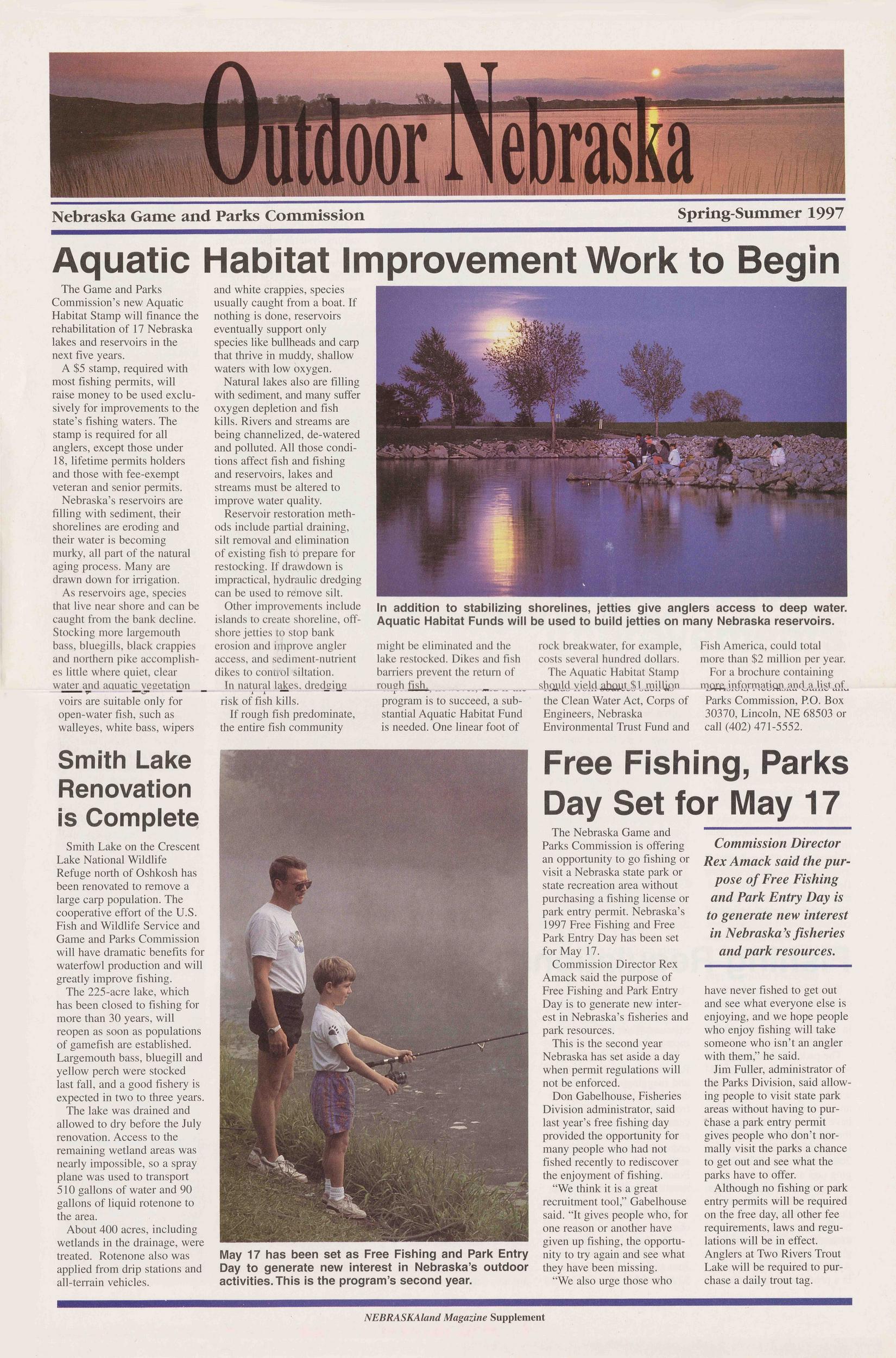
Aquatic Habitat Improvement Work to Begin
The Game and Parks Commission's new Aquatic Habitat Stamp will finance the rehabilitation of 17 Nebraska lakes and reservoirs in the next five years.
A $5 stamp, required with most fishing permits, will raise money to be used exclusively for improvements to the state's fishing waters. The stamp is required for all anglers, except those under 18, lifetime permits holders and those with fee-exempt veteran and senior permits.
Nebraska's reservoirs are filling with sediment, their shorelines are eroding and their water is becoming murky, all part of the natural aging process. Many are drawn down for irrigation.
As reservoirs age, species that live near shore and can be caught from the bank decline. Stocking more largemouth bass, bluegills, black crappies and northern pike accomplishes little where quiet, clear water and aquatic vegetation voirs are suitable only for open-water fish, such as walleyes, white bass, wipers and white crappies, species usually caught from a boat. If nothing is done, reservoirs eventually support only species like bullheads and carp that thrive in muddy, shallow waters with low oxygen.
Natural lakes also are filling with sediment, and many suffer oxygen depletion and fish kills. Rivers and streams are being channelized, de-watered and polluted. All those conditions affect fish and fishing and reservoirs, lakes and streams must be altered to improve water quality.
Reservoir restoration methods include partial draining, silt removal and elimination of existing fish to prepare for restocking. If drawdown is impractical, hydraulic dredging can be used to remove silt.
Other improvements include islands to create shoreline, offshore jetties to stop bank erosion and irhprove angler access, and sediment-nutrient dikes to control siltation.
In natural lakes, dredging might be eliminated and the lake restocked. Dikes and fish barriers prevent the return of rough fish.
rock breakwater, for example, costs several hundred dollars. The Aquatic Habitat Stamp Fish America, could total more than $2 million per year.
For a brochure containing should yield about $1 million more information and a list of risk of fish kills.
If rough fish predominate, the entire fish community program is to succeed, a substantial Aquatic Habitat Fund is needed. One linear foot of the Clean Water Act, Corps of Engineers, Nebraska Environmental Trust Fund and Parks Commission, P.O. Box 30370, Lincoln, NE 68503 or call (402) 471-5552.
In addition to stablizing shorelines, jetties give anglers access to deep water. Aquatic Habitat Funds will be used to build jetties on many Nebraska reservoirs.
Smith Lake Renovation is Complete
Smith Lake on the Crescent Lake National Wildlife Refuge north of Oshkosh has been renovated to remove a large carp population. The cooperative effort of the U.S. Fish and Wildlife Service and Game and Parks Commission will have dramatic benefits for waterfowl production and will greatly improve fishing.
The 225-acre lake, which has been closed to fishing for more than 30 years, will reopen as soon as populations of gamefish are established. Largemouth bass, bluegill and yellow perch were stocked last fall, and a good fishery is expected in two to three years.
The lake was drained and allowed to dry before the July renovation. Access to the remaining wetland areas was nearly impossible, so a spray plane was used to transport 510 gallons of water and 90 gallons of liquid rotenone to the area.
About 400 acres, including wetlands in the drainage, were treated. Rotenone also was applied from drip stations and all-terrain vehicles.
May 17 has been set as Free Fishing and Park Entry Day to generate new interest in Nebraska's outdoor activities. This is the program's second year.
The Nebraska Game and Parks Commission is offering an opportunity to go fishing or visit a Nebraska state park or state recreation area without purchasing a fishing license or park entry permit. Nebraska's 1997 Free Fishing and Free Park Entry Day has been set for May 17.
Commission Director Rex Amack said the purpose of Free Fishing and Park Entry Day is to generate new interest in Nebraska's fisheries and park resources.
This is the second year Nebraska has set aside a day when permit regulations will not be enforced.
Don Gabelhouse, Fisheries Division administrator, said last year's free fishing day provided the opportunity for many people who had not fished recently to rediscover the enjoyment of fishing.
"We think it is a great recruitment tool," Gabelhouse said. "It gives people who, for one reason or another have given up fishing, the opportunity to try again and see what they have been missing.
Commission Director Rex Amack said the purpose of Free Fishing and Park Entry Day is to generate new interest in Nebraska's fisheries and park resources."We also urge those who have never fished to get out and see what everyone else is enjoying, and we hope people who enjoy fishing will take someone who isn't an angler with them," he said.
Jim Fuller, administrator of the Parks Division, said allowing people to visit state park areas without having to purchase a park entry permit gives people who don't normally visit the parks a chance to get out and see what the parks have to offer.
Although no fishing or park entry permits will be required on the free day, all other fee requirements, laws and regulations will be in effect. Anglers at Two Rivers Trout Lake will be required to purchase a daily trout tag.
NEBRASKAland Magazine Supplement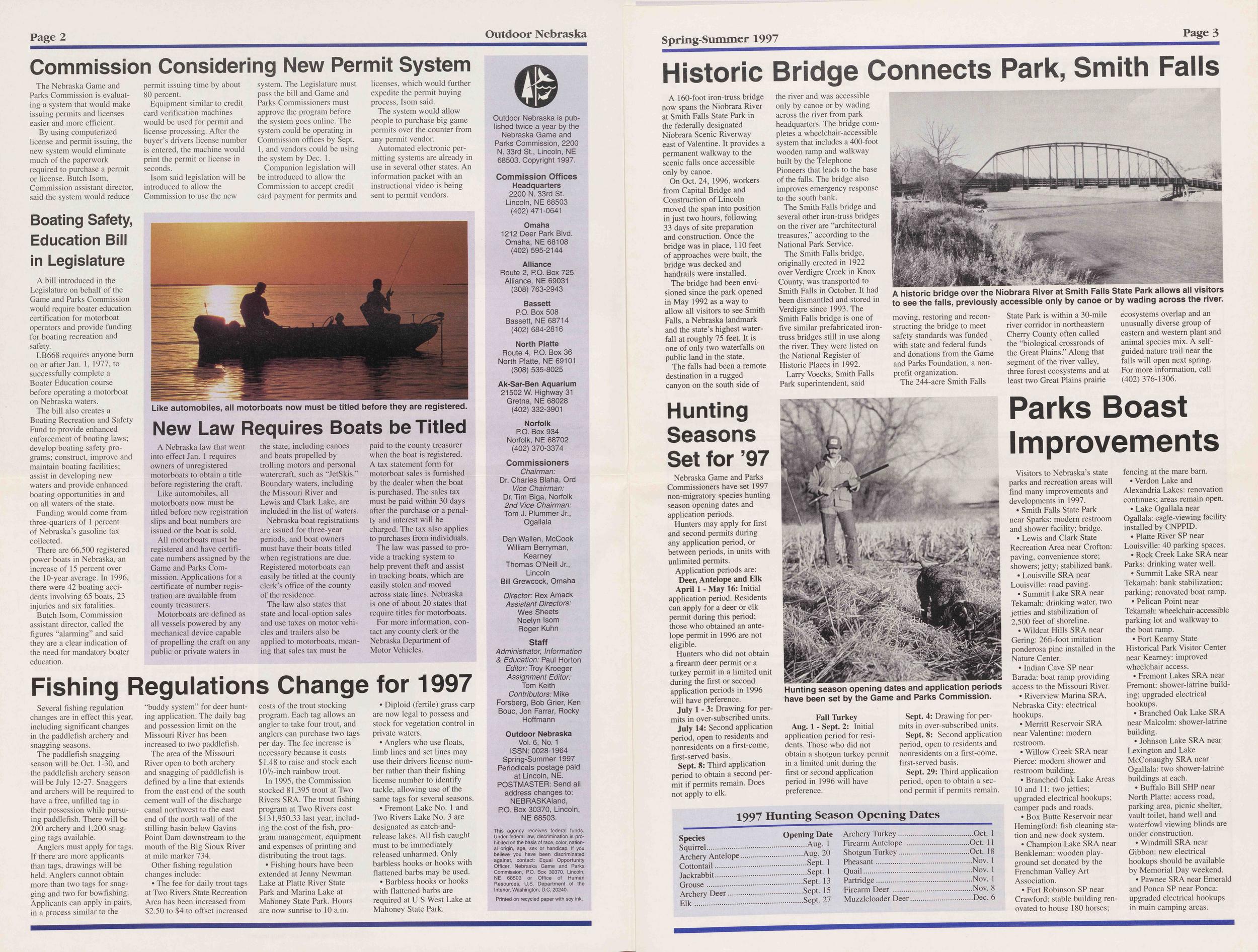 Page 2
Outdoor Nebraska
Page 2
Outdoor Nebraska
Commission Considering New Permit System
The Nebraska Game and Parks Commission is evaluating a system that would make issuing permits and licenses easier and more efficient.
By using computerized license and permit issuing, the new system would eliminate much of the paperwork required to purchase a permit or license. Butch Isom, Commission assistant director, said the system would reduce permit issuing time by about 80 percent.
Equipment similar to credit card verification machines would be used for permit and license processing. After the buyer's drivers license number is entered, the machine would print the permit or license in seconds.
Isom said legislation will be introduced to allow the Commission to use the new system. The Legislature must pass the bill and Game and Parks Commissioners must approve the program before the system goes online. The system could be operating in Commission offices by Sept. 1, and vendors could be using the system by Dec. 1.
Companion legislation will be introduced to allow the Commission to accept credit card payment for permits and licenses, which would further expedite the permit buying process, Isom said. The system would allow people to purchase big game permits over the counter from any permit vendor.
Automated electronic permitting systems are already in use in several other states. An information packet with an instructional video is being sent to permit vendors.
Boating Safety, Education Bill in Legislature
A bill introduced in the Legislature on behalf of the Game and Parks Commission would require boater education certification for motorboat operators and provide funding for boating recreation and safety.
LB668 requires anyone born on or after Jan. 1, 1977, to successfully complete a Boater Education course before operating a motorboat on Nebraska waters.
The bill also creates a Boating Recreation and Safety Fund to provide enhanced enforcement of boating laws; develop boating safety programs; construct, improve and maintain boating facilities; assist in developing new waters and provide enhanced boating opportunities in and on all waters of the state.
Funding would come from three-quarters of 1 percent of Nebraska's gasoline tax collected.
There are 66,500 registered power boats in Nebraska, an increase of 15 percent over the 10-year average. In 1996, there were 42 boating accidents involving 65 boats, 23 injuries and six fatalities.
Butch Isom, Commission assistant director, called the figures "alarming" and said they are a clear indication of the need for mandatory boater education.
New Law Requires Boats be Titled
A Nebraska law that went into effect Jan. 1 requires owners of unregistered motorboats to obtain a title before registering the craft.
Like automobiles, all motorboats now must be titled before new registration slips and boat numbers are issued or the boat is sold.
All motorboats must be registered and have certificate numbers assigned by the Game and Parks Commission. Applications for a certificate of number registration are available from county treasurers.
Motorboats are defined as all vessels powered by any mechanical device capable of propelling the craft on any public or private waters in the state, including canoes and boats propelled by trolling motors and personal watercraft, such as "JetSkis." Boundary waters, including the Missouri River and Lewis and Clark Lake, are included in the list of waters.
Nebraska boat registrations are issued for three-year periods, and boat owners must have their boats titled when registrations are due. Registered motorboats can easily be titled at the county clerk's office of the county of the residence.
The law also states that state and local-option sales and use taxes on motor vehicles and trailers also be applied to motorboats, meaning that sales tax must be paid to the county treasurer when the boat is registered. A tax statement form for motorboat sales is furnished by the dealer when the boat is purchased. The sales tax must be paid within 30 days after the purchase or a penalty and interest will be charged. The tax also applies to purchases from individuals.
The law was passed to provide a tracking system to help prevent theft and assist in tracking boats, which are easily stolen and moved across state lines. Nebraska is one of about 20 states that require titles for motorboats.
For more information, contact any county clerk or the Nebraska Department of Motor Vehicles.
Fishing Regulations Change for 1997
Several fishing regulation changes are in effect this year, including significant changes in the paddlefish archery and snagging seasons.
The paddlefish snagging season will be Oct. 1-30, and the paddlefish archery season will be July 12-27. Snaggers and archers will be required to have a free, unfilled tag in their possession while pursuing paddlefish. There will be 200 archery and 1,200 snagging tags available.
Anglers must apply for tags. If there are more applicants than tags, drawings will be held. Anglers cannot obtain more than two tags for snagging and two for bowfishing. Applicants can apply in pairs, in a process similar to the "buddy system" for deer hunting application. The daily bag and possession limit on the Missouri River has been increased to two paddlefish.
The area of the Missouri River open to both archery and snagging of paddlefish is defined by a line that extends from the east end of the south cement wall of the discharge canal northwest to the east end of the north wall of the stilling basin below Gavins Point Dam downstream to the mouth of the Big Sioux River at mile marker 734.
Other fishing regulation changes include:
The fee for daily trout tags at Two Rivers State Recreation Area has been increased from $2.50 to $4 to offset increased costs of the trout stocking program. Each tag allows an angler to take four trout, and anglers can purchase two tags per day. The fee increase is necessary because it costs $1.48 to raise and stock each 1072-inch rainbow trout.
In 1995, the Commission stocked 81,395 trout at Two Rivers SRA. The trout fishing program at Two Rivers cost $131,950.33 last year, including the cost of the fish, program management, equipment and expenses of printing and distributing the trout tags.
Fishing hours have been extended at Jenny Newman Lake at Platte River State Park and Marina Lake at Mahoney State Park. Hours are now sunrise to 10 a.m.
Diploid (fertile) grass carp are now legal to possess and stock for vegetation control in private waters.
Anglers who use floats, limb lines and set lines may use their drivers license number rather than their fishing license number to identify tackle, allowing use of the same tags for several seasons.
Fremont Lake No. 1 and Two Rivers Lake No. 3 are designated as catch-and- release lakes. All fish caught must to be immediately released unharmed. Only barbless hooks or hooks with flattened barbs may be used. Barbless hooks or hooks with flattened barbs are required at U S West Lake at Mahoney State Park.
Historic Bridge Connects Park, Smith Falls
A 160-foot iron-truss bridge now spans the Niobrara River at Smith Falls State Park in the federally designated Niobrara Scenic Riverway east of Valentine. It provides a permanent walkway to the scenic falls once accessible only by canoe.
On Oct. 24, 1996, workers from Capital Bridge and Construction of Lincoln moved the span into position in just two hours, following 33 days of site preparation and construction. Once the bridge was in place, 110 feet of approaches were built, the bridge was decked and handrails were installed.
The bridge had been envisioned since the park opened in May 1992 as a way to allow all visitors to see Smith Falls, a Nebraska landmark and the state's highest waterfall at roughly 75 feet. It is one of only two waterfalls on public land in the state.
The falls had been a remote destination in a rugged canyon on the south side of the river and was accessible only by canoe or by wading across the river from park headquarters. The bridge completes a wheelchair-accessible system that includes a 400-foot wooden ramp and walkway built by the Telephone Pioneers that leads to the base of the falls. The bridge also improves emergency response to the south bank.
The Smith Falls bridge and several other iron-truss bridges on the river are "architectural treasures," according to the National Park Service.
The Smith Falls bridge, originally erected in 1922 over Verdigre Creek in Knox County, was transported to Smith Falls in October. It had been dismantled and stored in Verdigre since 1993. The Smith Falls bridge is one of five similar prefabricated irontruss bridges still in use along the river. They were listed on the National Register of Historic Places in 1992.
A historic bridge over the Niobrara River at Smith Falls State Park allows all visitor to see the falls, previously accessible only by canoe or by wading across the river.
The 244-acre Smith Falls State Park is within a 30-mile river corridor in northeastern Cherry County often called the "biological crossroads of the Great Plains." Along that segment of the river valley, three forest ecosystems and at least two Great Plains prairie ecosystems overlap and an unusually diverse group of eastern and western plant and animal species mix. A self-guided nature trail near the falls will open next spring. For more information, call (402) 376-1306.
Hunting Seasons Set for '97
Nebraska Game and Parks Commissioners have set 1997 non-migratory species hunting season opening dates and application periods.
Hunters may apply for first and second permits during any application period, or between periods, in units with unlimited permits.
Application periods are:
Deer, Antelope and ElkApril 1 - May 16: Initial application period. Residents can apply for a deer or elk permit during this period; those who obtained an antelope permit in 1996 are not eligible.
Hunters who did not obtain a firearm deer permit or a turkey permit in a limited unit during the first or second application periods in 1996 will have preference.
July 1-3: Drawing for permits in over-subscribed units.
July 14: Second application period, open to residents and nonresidents on a first-come, first-served basis.
Sept. 8: Third application period to obtain a second permit if permits remain. Does not apply to elk.
Hunting season opening dates and application periods have been set by the Game and Parks Commission.
Aug. 1 - Sept. 2: Initial application period for residents. Those who did not obtain a shotgun turkey permit in a limited unit during the first or second application period in 1996 will have preference.
Sept. 4: Drawing for permits in over-subscribed units.
Sept. 8: Second application period, open to residents and nonresidents on a first-come, first-served basis.
Sept. 29: Third application period, open to obtain a second permit if permits remain.
1997 Hunting Season Opening Dates
Species Opening Date Squirrel Aug. 1 Archery Antelope Aug. 20 Cottontail Sept. Jackrabbit Sept. 1 Grouse Sept. 13 Archery Deer Sept. 15 Elk Sept. 27 Archery Turkey Oct. 1 Firearm Antelope Oct. 11 Shotgun Turkey Oct. 18 Pheasant Nov. 1 Quail Nov. 1 Partridge Nov. 1 Firearm Deer Nov. 8 Muzzleloader Deer Dec. 6Parks Boast Improvements
Visitors to Nebraska's state parks and recreation areas will find many improvements and developments in 1997.
Smith Falls State Park near Sparks: modern restroom and shower facility; bridge.
Lewis and Clark State Recreation Area near Crofton: paving, convenience store; showers; jetty; stabilized bank.
Louisville SRA near Louisville: road paving.
Summit Lake SRA near Tekamah: drinking water, two jetties and stabilization of 2,500 feet of shoreline.
Wildcat Hills SRA near Gering: 26fi-foot imitation ponderosa pine installed in the Nature Center.
Indian Cave SP near Barada: boat ramp providing access to the Missouri River.
Riverview Marina SRA, Nebraska City: electrical hookups.
Merritt Reservoir SRA near Valentine: modern restroom.
Willow Creek SRA near Pierce: modern shower and restroom building.
Branched Oak Lake Areas 10 and 11: two jetties; upgraded electrical hookups; camper pads and roads.
Box Butte Reservoir near Hemingford: fish cleaning station and new dock system.
Champion Lake SRA near Benkleman: wooden playground set donated by the Frenchman Valley Art Association.
Fort Robinson SP near Crawford: stable building renovated to house 180 horses; fencing at the mare barn.
Verdon Lake and Alexandria Lakes: renovation continues; areas remain open.
Lake Ogallala near Ogallala: eagle-viewing facility installed by CNPPID.
Platte River SP near Louisville: 40 parking spaces.
Rock Creek Lake SRA near Parks: drinking water well.
Summit Lake SRA near Tekamah: bank stabilization; parking; renovated boat ramp.
Pelican Point near Tekamah: wheelchair-accessible parking lot and walkway to the boat ramp.
Fort Kearny State Historical Park Visitor Center near Kearney: improved wheelchair access.
Fremont Lakes SRA near Fremont: shower-latrine building; upgraded electrical hookups.
Branched Oak Lake SRA near Malcolm: shower-latrine building.
Johnson Lake SRA near Lexington and Lake McConaughy SRA near Ogallala: two shower-latrine buildings at each.
Buffalo Bill SHP near North Platte: access road, parking area, picnic shelter, vault toilet, hand well and waterfowl viewing blinds are under construction.
Windmill SRA near Gibbon: new electrical hookups should be available by Memorial Day weekend.
Pawnee SRA near Emerald and Ponca SP near Ponca: upgraded electrical hookups in main camping areas.
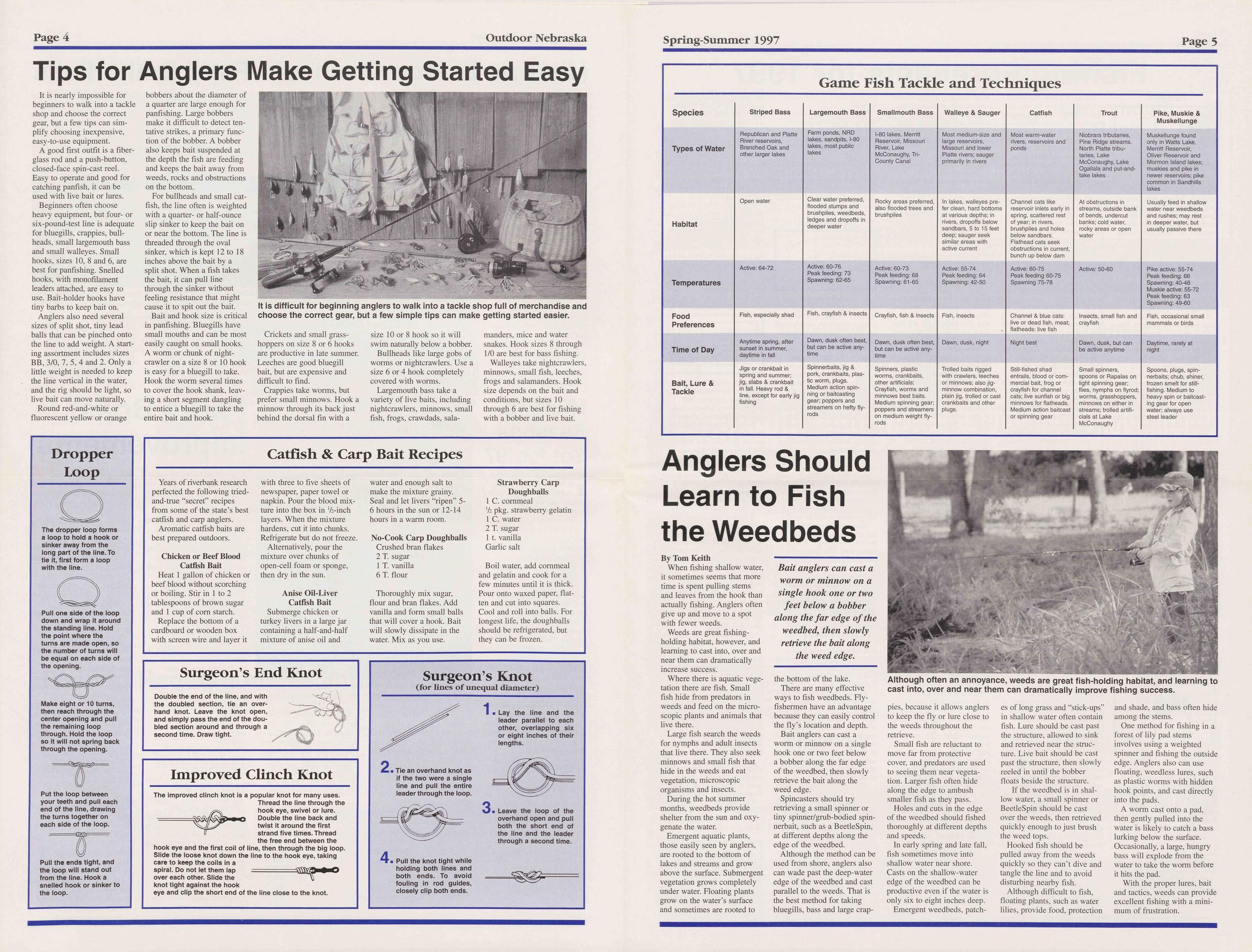 Page 4
Outdoor Nebraska
Page 4
Outdoor Nebraska
Tips for Anglers Make Getting Started Easy
It is nearly impossible for beginners to walk into a tackle shop and choose the correct gear, but a few tips can simplify choosing inexpensive, easy-to-use equipment.
A good first outfit is a fiberglass rod and a push-button, closed-face spin-cast reel. Easy to operate and good for catching panfish, it can be used with live bait or lures.
Beginners often choose heavy equipment, but four- or six-pound-test line is adequate for bluegills, crappies, bullheads, small largemouth bass and small walleyes. Small hooks, sizes 10, 8 and 6, are best for panfishing. Snelled hooks, with monofilament leaders attached, are easy to use. Bait-holder hooks have tiny barbs to keep bait on.
Anglers also need several sizes of split shot, tiny lead balls that can be pinched onto the line to add weight. A starting assortment includes sizes BB, 3/0, 7, 5, 4 and 2. Only a little weight is needed to keep the line vertical in the water, and the rig should be light, so live bait can move naturally.
Round red-and-white or fluorescent yellow or orange bobbers about the diameter of a quarter are large enough for panfishing. Large bobbers make it difficult to detect tentative strikes, a primary function of the bobber. A bobber also keeps bait suspended at the depth the fish are feeding and keeps the bait away from weeds, rocks and obstructions on the bottom.
For bullheads and small catfish, the line often is weighted with a quarter- or half-ounce slip sinker to keep the bait on or near the bottom. The line is threaded through the oval sinker, which is kept 12 to 18 inches above the bait by a split shot. When a fish takes the bait, it can pull line through the sinker without feeling resistance that might cause it to spit out the bait.
Bait and hook size is critical in panfishing. Bluegills have small mouths and can be most easily caught on small hooks. A worm or chunk of night-crawler on a size 8 or 10 hook is easy for a bluegill to take. Hook the worm several times to cover the hook shank, leaving a short segment dangling to entice a bluegill to take the entire bait and hook.
It is difficult for beginning anglers to walk into a tackle shop full of merchandise and choose the correct gear, but a few simple tips can make getting started easier.
Crickets and small grass-hoppers on size 8 or 6 hooks are productive in late summer. Leeches are good bluegill bait, but are expensive and difficult to find.
Crappies take worms, but prefer small minnows. Hook a minnow through its back just behind the dorsal fin with a size 10 or 8 hook so it will swim naturally below a bobber.
Bullheads like large gobs of worms or nightcrawlers. Use a size 6 or 4 hook completely covered with worms.
Largemouth bass take a variety of live baits, including nightcrawlers, minnows, small fish, frogs, crawdads, salamanders, mice and water snakes. Hook sizes 8 through 1/0 are best for bass fishing.
Walleyes take nightcrawlers, minnows, small fish, leeches, frogs and salamanders. Hook size depends on the bait and conditions, but sizes 10 through 6 are best for fishing with a bobber and live bait.
Dropper Loop
Catfish & Carp Bait Recipes
Years of riverbank research perfected the following tried- and-true "secret" recipes from some of the state's best catfish and carp anglers. Aromatic catfish baits are best prepared outdoors.
Chicken or Beef Blood Catfish BaitHeat 1 gallon of chicken or beef blood without scorching or boiling. Stir in 1 to 2 tablespoons of brown sugar and 1 cup of corn starch.
Replace the bottom of a cardboard or wooden box with screen wire and layer it with three to five sheets of newspaper, paper towel or napkin. Pour the blood mix- ture into the box in 72-inch layers. When the mixture hardens, cut it into chunks. Refrigerate but do not freeze.
Alternatively, pour the mixture over chunks of open-cell foam or sponge, then dry in the sun.
Anise Oil-Liver Catfish Bait Submerge chicken or turkey livers in a large jar containing a half-and-half mixture of anise oil and water and enough salt to make the mixture grainy. Seal and let livers "ripen" 5- 6 hours in the sun or 12-14 hours in a warm room. No-Cook Carp Doughballs Crushed bran flakes 2 T. sugar 1 T. vanilla 6 T. flourThoroughly mix sugar, flour and bran flakes. Add vanilla and form small balls that will cover a hook. Bait will slowly dissipate in the water. Mix as you use.
Strawberry Carp Doughballs 1 C. cornmeal 72 pkg. strawberry gelatin 1 C. water 2 T. sugar 1 t. vanilla Garlic saltBoil water, add cornmeal and gelatin and cook for a few minutes until it is thick. Pour onto waxed paper, flat- ten and cut into squares. Cool and roll into balls. For longest life, the doughballs should be refrigerated, but they can be frozen.
Surgeon's End Knot
Double the end of the line, and with the doubled section, tie an overhand knot. Leave the knot open, and simply pass the end of the doubled section around and through a second time. Draw tight.
Improved Clinch Knot
The improved clinch knot is a popular knot for many uses. Thread the line through the hook eye, swivel or lure. Double the line back and twist it around the first strand five times. Thread the free end between the hook eye and the first coil of line, then through the big loop. Slide the loose knot down the line to the hook eye, taking care to keep the coils in a spiral. Do not let them lap over each other. Slide the knot tight against the hook eye and clip the short end of the line close to the knot.
Surgeon's Knot
(for lines of unequal diameter)1 Lay the line and the leader parallel to each other, overlapping six or eight inches of their lengths.
2 Tie an overhand knot as if the two were a single line and pull the entire leader through the loop.
3 Leave the loop of the overhand open and pull both the short end of the line and the leader through a second time.
4 Pull the knot tight while holding both lines and both ends. To avoid fouling in rod guides, closely clip both ends.
Game Fish Tackle and Techniques
Species Striped Bass Largemouth Bass Smallmouth Bass Walleye & Sauger Catfish Trout Pike, Muskie & Muskellunge Republican and Platte Farm ponds, NRD I-80 lakes, Merritt Most medium-size and Most warm-water Niobrara tributaries, Muskeliunge found River reservoirs, lakes, sandpits, I-80 Reservoir, Missouri large reservoirs, rivers, reservoirs and Pine Ridge streams. only in Watts Lake, Types of Water Branched Oak and lakes, most public River, Lake Missouri and lower ponds North Platte tributaries, Lake Merritt Reservoir, other larger lakes lakes McConaughy, Tri- Platte rivers; sauger Oliver Reservoir and County Canal primarily in rivers McConaughy, Lake Ogallala and put-and-take lakes Mormon Island lakes; muskies and pike in newer reservoirs; pike common in Sandhills lakes Open water Clear water preferred, Rocky areas preferred, In lakes, walleyes pre- Channel cats like At obstructions in Usually feed in shallow flooded stumps and also flooded trees and fer clean, hard bottoms reservoir inlets early in streams, outside bank water near weedbeds brushpiles, weedbeds, brushpiles at various depths; in spring, scattered rest of bends, undercut and rushes; may rest Habitat ledges and dropoffs in rivers, dropoffs below of year; in rivers, banks; cold water, in deeper water, but deeper water sandbars, 5 to 15 feet brushpiles and holes rocky areas or open usually passive there deep; sauger seek below sandbars. water similar areas with Flathead cats seek active current obstructions in current, bunch up below dam Active: 64-72 Active: 60-76 Active: 60-73 Active: 55-74 Active: 60-75 Active: 50-60 Pike active: 55-74 Peak feeding: 73 Peak feeding: 68 Peak feeding: 64 Peak feeding 60-75 Peak feeding: 66 Temperatures Spawning: 62-65 Spawning: 61 -65 Spawning: 42-50 Spawning 75-78 Spawning: 40-48 Muskie active: 55-72 Peak feeding: 63 Spawning: 49-60 Food Fish, especially shad Fish, crayfish & insects Crayfish, fish & insects Fish, insects Channel & blue cats: Insects, small fish and Fish, occasional small Preferences live or dead fish, meat; flatheads: live fish crayfish mammals or birds Anytime spring, after Dawn, dusk often best, Dawn, dusk often best, Dawn, dusk, night Night best Dawn, dusk, but can Daytime, rarely at Time of Day sunset in summer, Dut can De active any-daytime in fall time but can be active anytime be active anytime night Jigs or crankbait in Spinnerbaits, jig & Spinners, plastic Trolled baits rigged Still-fished shad Small spinners, Spoons, plugs, spin- spring and summer; pork, crankbaits, plas- worms, crankbaits, with crawlers, leeches entrails, blood or com- spoons or Rapalas on nerbaits; chub, shiner, Bait, Lure & jig, slabs & crankbait tic worm, plugs. other artificials; or minnows; also jig- mercial bait, frog or light spinning gear; frozen smelt for still- Tackle in fall. Heavy rod & Medium action spin- Crayfish, worms and minnow combination, crayfish for channel flies, nymphs on flyrod; fishing. Medium to line, except for early jig ning or baitcasting minnows best baits. plain jig, trolled or cast cats; live sunfish or big worms, grasshoppers, heavy spin or baitcast- fishing gear; poppers and Medium spinning gear; crankbaits and other minnows for flatheads. minnows on either in ing gear for open streamers on hefty fly- poppers and streamers plugs. Medium action baitcast streams; trolled artifi- water; always use rods on medium weight fly-rods or spinning gear cials at Lake McConaughy steel leaderAnglers Should Learn to Fish the Weedbeds
When fishing shallow water, it sometimes seems that more time is spent pulling stems and leaves from the hook than actually fishing. Anglers often give up and move to a spot with fewer weeds.
Weeds are great fishing-holding habitat, however, and learning to cast into, over and near them can dramatically increase success.
Where there is aquatic vegetation there are fish. Small fish hide from predators in weeds and feed on the microscopic plants and animals that live there.
Large fish search the weeds for nymphs and adult insects that live there. They also seek minnows and small fish that hide in the weeds and eat vegetation, microscopic organisms and insects.
During the hot summer months, weedbeds provide shelter from the sun and oxygenate the water.
Emergent aquatic plants, those easily seen by anglers, are rooted to the bottom of lakes and streams and grow above the surface. Submergent vegetation grows completely under water. Floating plants grow on the water's surface and sometimes are rooted to the bottom of the lake.
Bait anglers can cast a worm or minnow on a single hook one or two feet below a bobber along the far edge of the weedbed, then slowly retrieve the bait along the weed edge. There are many effective ways to fish weedbeds. Fly-fishermen have an advantage because they can easily control the fly's location and depth. Bait anglers can cast a worm or minnow on a single hook one or two feet below a bobber along the far edge of the weedbed, then slowly retrieve the bait along the weed edge. Spincasters should try retrieving a small spinner or tiny spinner/grub-bodied spinnerbait, such as a BeetleSpin, at different depths along the edge of the weedbed.Although often an annoyance, weeds are great fish-holding habitat, and learning to cast into, over and near them can dramatically improve fishing success.
Small fish are reluctant to move far from protective cover, and predators are used to seeing them near vegetation. Larger fish often hide along the edge to ambush smaller fish as they pass.
Holes and cuts in the edge of the weedbed should fished thoroughly at different depths and speeds.
In early spring and late fall, fish sometimes move into shallow water near shore. Casts on the shallow-water edge of the weedbed can be productive even if the water is only six to eight inches deep.
Emergent weedbeds, patch- es of long grass and "stick-ups" in shallow water often contain fish. Lure should be cast past the structure, allowed to sink and retrieved near the structure. Live bait should be cast past the structure, then slowly reeled in until the bobber floats beside the structure.
If the weedbed is in shallow water, a small spinner or BeetleSpin should be cast over the weeds, then retrieved quickly enough to just brush the weed tops.
Hooked fish should be pulled away from the weeds quickly so they can't dive and tangle the line and to avoid disturbing nearby fish.
Although difficult to fish, floating plants, such as water lilies, provide food, protection and shade, and bass often hide among the stems.
One method for fishing in a forest of lily pad stems involves using a weighted spinner and fishing the outside edge. Anglers also can use floating, weedless lures, such as plastic worms with hidden hook points, and cast directly into the pads.
A worm cast onto a pad, then gently pulled into the water is likely to catch a bass lurking below the surface. Occasionally, a large, hungry bass will explode from the water to take the worm before it hits the pad.
With the proper lures, bait and tactics, weeds can provide excellent fishing with a minimum of frustration.
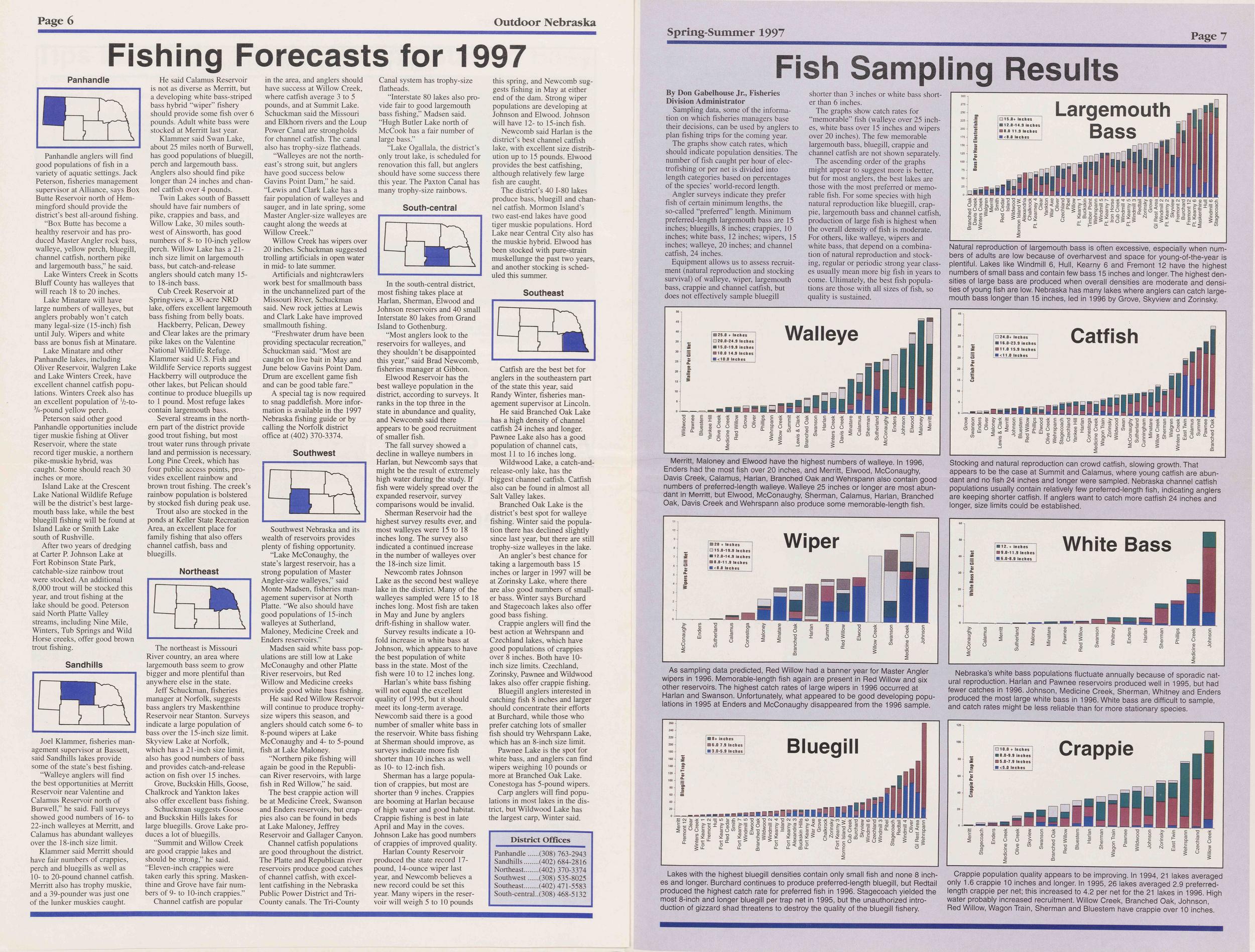 Page 6
Outdoor Nebraska
Page 6
Outdoor Nebraska
Fishing Forecasts for 1997
PanhandlePanhandle anglers will find good populations of fish in a variety of aquatic settings. Jack Peterson, fisheries management supervisor at Alliance, says Box Butte Reservoir north of Hemmingford should provide the district's best all-around fishing.
"Box Butte has become a healthy reservoir and has produced Master Angler rock bass, walleye, yellow perch, bluegill, channel catfish, northern pike and largemouth bass," he said.
Lake Winters Creek in Scotts Bluff County has walleyes that will reach 18 to 20 inches.
Lake Minatare will have large numbers of walleyes, but anglers probably won't catch many legal-size (15-inch) fish until July. Wipers and white bass are bonus fish at Minatare.
Lake Minatare and other Panhandle lakes, including Oliver Reservoir, Walgren Lake and Lake Winters Creek, have excellent channel catfish populations. Winters Creek also has an excellent population of 72-to-3A-pound yellow perch.
Peterson said other good Panhandle opportunities include tiger muskie fishing at Oliver Reservoir, where the state record tiger muskie, a northern pike-muskie hybrid, was caught. Some should reach 30 inches or more.
Island Lake at the Crescent Lake National Wildlife Refuge will be the district's best largemouth bass lake, while the best bluegill fishing will be found at Island Lake or Smith Lake south of Rushville.
After two years of dredging at Carter P. Johnson Lake at Fort Robinson State Park, catchable-size rainbow trout were stocked. An additional 8,000 trout will be stocked this year, and trout fishing at the lake should be good. Peterson said North Platte Valley streams, including Nine Mile, Winters, Tub Springs and Wild Horse creeks, offer good brown trout fishing.
SandhillsJoel Klammer, fisheries management supervisor at Bassett, said Sandhills lakes provide some of the state's best fishing.
"Walleye anglers will find the best opportunities at Merritt Reservoir near Valentine and Calamus Reservoir north of Burwell," he said. Fall surveys showed good numbers of 16- to 22-inch walleyes at Merritt, and Calamus has abundant walleyes over the 18-inch size limit.
Klammer said Merritt should have fair numbers of crappies, perch and bluegills as well as 10- to 20-pound channel catfish. Merritt also has trophy muskie, and a 39-pounder was just one of the lunker muskies caught.
He said Calamus Reservoir is not as diverse as Merritt, but a developing white bass-striped bass hybrid "wiper" fishery should provide some fish over 6 pounds. Adult white bass were stocked at Merritt last year.
Klammer said Swan Lake, about 25 miles north of Burwell, has good populations of bluegill, perch and largemouth bass. Anglers also should find pike longer than 24 inches and channel catfish over 4 pounds.
Twin Lakes south of Bassett should have fair numbers of pike, crappies and bass, and Willow Lake, 30 miles southwest of Ainsworth, has good numbers of 8- to 10-inch yellow perch. Willow Lake has a 21-inch size limit on largemouth bass, but catch-and-release anglers should catch many 15-to 18-inch bass.
Cub Creek Reservoir at Spring view, a 30-acre NRD lake, offers excellent largemouth bass fishing from belly boats.
Hackberry, Pelican, Dewey and Clear lakes are the primary pike lakes on the Valentine National Wildlife Refuge. Klammer said U.S. Fish and Wildlife Service reports suggest Hackberry will outproduce the other lakes, but Pelican should continue to produce bluegills up to 1 pound. Most refuge lakes contain largemouth bass.
Several streams in the northern part of the district provide good trout fishing, but most trout water runs through private land and permission is necessary. Long Pine Creek, which has four public access points, provides excellent rainbow and brown trout fishing. The creek's rainbow population is bolstered by stocked fish during peak use.
Trout also are stocked in the ponds at Keller State Recreation Area, an excellent place for family fishing that also offers channel catfish, bass and bluegills.
NortheastThe northeast is Missouri River country, an area where largemouth bass seem to grow bigger and more plentiful than anywhere else in the state.
Jeff Schuckman, fisheries manager at Norfolk, suggests bass anglers try Maskenthine Reservoir near Stanton. Surveys indicate a large population of bass over the 15-inch size limit. Skyview Lake at Norfolk, which has a 21-inch size limit, also has good numbers of bass and provides catch-and-release action on fish over 15 inches.
Grove, Buckskin Hills, Goose, Chalkrock and Yankton lakes also offer excellent bass fishing.
Schuckman suggests Goose and Buckskin Hills lakes for large bluegills. Grove Lake produces a lot of bluegills.
"Surnmit and Willow Creek are good crappie lakes and should be strong," he said. "Eleven-inch crappies were taken early this spring. Maskenthine and Grove have fair numbers of 9- to 10-inch crappies."
Channel catfish are popular in the area, and anglers should have success at Willow Creek, where catfish average 3 to 5 pounds, and at Summit Lake. Schuckman said the Missouri and Elkhorn rivers and the Loup Power Canal are strongholds for channel catfish. The canal also has trophy-size flatheads.
"Walleyes are not the northeast's strong suit, but anglers have good success below Gavins Point Dam," he said. "Lewis and Clark Lake has a fair population of walleyes and sauger, and in late spring, some Master Angler-size walleyes are caught along the weeds at Willow Creek."
Willow Creek has wipers over 20 inches. Schuckman suggested trolling artificials in open water in mid- to late summer.
Artificials and nightcrawlers work best for smallmouth bass in the unchannelized part of the Missouri River, Schuckman said. New rock jetties at Lewis and Clark Lake have improved smallmouth fishing.
"Freshwater drum have been providing spectacular recreation," Schuckman said. "Most are caught on live bait in May and June below Gavins Point Dam. Drum are excellent game fish and can be good table fare."
A special tag is now required to snag paddlefish. More information is available in the 1997 Nebraska fishing guide or by calling the Norfolk district office at (402) 370-3374.
SouthwestSouthwest Nebraska and its wealth of reservoirs provides plenty of fishing opportunity.
"Lake McConaughy, the state's largest reservoir, has a strong population of Master Angler-size walleyes," said Monte Madsen, fisheries management supervisor at North Platte. "We also should have good populations of 15-inch walleyes at Sutherland, Maloney, Medicine Creek and Enders reservoirs."
Madsen said white bass populations are still low at Lake McConaughy and other Platte River reservoirs, but Red Willow and Medicine creeks provide good white bass fishing.
He said Red Willow Reservoir will continue to produce trophy-size wipers this season, and anglers should catch some 6- to 8-pound wipers at Lake McConaughy and 4- to 5-pound fish at Lake Maloney.
"Northern pike fishing will again be good in the Republican River reservoirs, with large fish in Red Willow," he said.
The best crappie action will be at Medicine Creek, Swanson and Enders reservoirs, but crappies also can be found in beds at Lake Maloney, Jeffrey Reservoir and Gallager Canyon.
Channel catfish populations are good throughout the district. The Platte and Republican river reservoirs produce good catches of channel catfish, with excellent catfishing in the Nebraska Public Power District and Tri-County canals. The Tri-County Canal system has trophy-size flatheads.
"Interstate 80 lakes also provide fair to good largemouth bass fishing," Madsen said. "Hugh Butler Lake north of McCook has a fair number of large bass."
"Lake Ogallala, the district's only trout lake, is scheduled for renovation this fall, but anglers should have some success there this year. The Paxton Canal has many trophy-size rainbows.
South-centralIn the south-central district, most fishing takes place at Harlan, Sherman, Elwood and Johnson reservoirs and 40 small Interstate 80 lakes from Grand Island to Gothenburg.
"Most anglers look to the reservoirs for walleyes, and they shouldn't be disappointed this year," said Brad Newcomb, fisheries manager at Gibbon.
Elwood Reservoir has the best walleye population in the district, according to surveys. It ranks in the top three in the state in abundance and quality, and Newcomb said there appears to be good recruitment of smaller fish.
The fall survey showed a decline in walleye numbers in Harlan, but Newcomb says that might be the result of extremely high water during the study. If fish were widely spread over the expanded reservoir, survey comparisons would be invalid.
Sherman Reservoir had the highest survey results ever, and most walleyes were 15 to 18 inches long. The survey also indicated a continued increase in the number of walleyes over the 18-inch size limit.
Newcomb rates Johnson Lake as the second best walleye lake in the district. Many of the walleyes sampled were 15 to 18 inches long. Most fish are taken in May and June by anglers drift-fishing in shallow water.
Survey results indicate a 10-fold increase in white bass at Johnson, which appears to have the best population of white bass in the state. Most of the fish were 10 to 12 inches long.
Harlan's white bass fishing will not equal the excellent quality of 1995, but it should meet its long-term average. Newcomb said there is a good number of smaller white bass in the reservoir. White bass fishing at Sherman should improve, as surveys indicate more fish shorter than 10 inches as well as 10- to 12-inch fish.
Sherman has a large population of crappies, but most are shorter than 9 inches. Crappies are booming at Harlan because of high water and good habitat. Crappie fishing is best in late April and May in the coves. Johnson Lake has good numbers of crappies of improved quality.
Harlan County Reservoir produced the state record 17-pound, 14-ounce wiper last year, and Newcomb believes a new record could be set this year. Many wipers in the reservoir will weigh 5 to 10 pounds this spring, and Newcomb suggests fishing in May at either end of the dam. Strong wiper populations are developing at Johnson and Elwood. Johnson will have 12- to 15-inch fish.
Newcomb said Harlan is the district's best channel catfish lake, with excellent size distribution up to 15 pounds. Elwood provides the best catfishing, although relatively few large fish are caught.
The district's 40 1-80 lakes produce bass, bluegill and channel catfish. Mormon Island's two east-end lakes have good tiger muskie populations. Hord Lake near Central City also has the muskie hybrid. Elwood has been stocked with pure-strain muskellunge the past two years, and another stocking is scheduled this summer.
SoutheastCatfish are the best bet for anglers in the southeastern part of the state this year, said Randy Winter, fisheries management supervisor at Lincoln.
He said Branched Oak Lake has a high density of channel catfish 24 inches and longer. Pawnee Lake also has a good population of channel cats, most 11 to 16 inches long.
Wildwood Lake, a catch-and-release-only lake, has the biggest channel catfish. Catfish also can be found in almost all Salt Valley lakes.
Branched Oak Lake is the district's best spot for walleye fishing. Winter said the population there has declined slightly since last year, but there are still trophy-size walleyes in the lake.
An angler's best chance for taking a largemouth bass 15 inches or larger in 1997 will be at Zorinsky Lake, where there are also good numbers of smaller bass. Winter says Burchard and Stagecoach lakes also offer good bass fishing.
Crappie anglers will find the best action at Wehrspann and Czechland lakes, which have good populations of crappies over 8 inches. Both have 10-inch size limits. Czechland, Zorinsky, Pawnee and Wildwood lakes also offer crappie fishing.
Bluegill anglers interested in catching fish 8 inches and larger should concentrate their efforts at Burchard, while those who prefer catching lots of smaller fish should try Wehrspann Lake, which has an 8-inch size limit.
Pawnee Lake is the spot for white bass, and anglers can find wipers weighing 10 pounds or more at Branched Oak Lake. Conestoga has 5-pound wipers. Carp anglers will find populations in most lakes in the district, but Wildwood Lake has the largest carp, Winter said.
District Offices Panhandle (308) 763-2943 Sandhills (402) 684-2816 Northeast (402) 370-3374 Southwest (308) 535-8025 Southeast (402) 471-5583 South-central (308) 468-5132Fish Sampling Results
Sampling data, some of the information on which fisheries managers base their decisions, can be used by anglers to plan fishing trips for the coming year.
The graphs show catch rates, which should indicate population densities. The number of fish caught per hour of electrofishing or per net is divided into length categories based on percentages of the species' world-record length.
Angler surveys indicate they prefer fish of certain minimum lengths, the so-called "preferred" length. Minimum preferred-length largemouth bass are 15 inches; bluegills, 8 inches; crappies, 10 inches; white bass, 12 inches; wipers, 15 inches; walleye, 20 inches; and channel catfish, 24 inches.
Equipment allows us to assess recruitment (natural reproduction and stocking survival) of walleye, wiper, largemouth bass, crappie and channel catfish, but does not effectively sample bluegill shorter than 3 inches or white bass shorter than 6 inches.
The graphs show catch rates for "memorable" fish (walleye over 25 inches, white bass over 15 inches and wipers over 20 inches). The few memorable largemouth bass, bluegill, crappie and channel catfish are not shown separately.
The ascending order of the graphs might appear to suggest more is better, but for most anglers, the best lakes are those with the most preferred or memorable fish. For some species with high natural reproduction like bluegill, crappie, largemouth bass and channel catfish, production of large fish is highest when the overall density of fish is moderate. For others, like walleye, wipers and white bass, that depend on a combination of natural reproduction and stocking, regular or periodic strong year classes usually mean more big fish in years to come. Ultimately, the best fish populations are those with all sizes of fish, so quality is sustained.
Walleye
Merritt, Maloney and Elwood have the highest numbers of walleye. In 1996, Enders had the most fish over 20 inches, and Merritt, Elwood, McConaughy, Davis Creek, Calamus, Harlan, Branched Oak and Wehrspann also contain good numbers of preferred-length walleye. Walleye 25 inches or longer are most abundant in Merritt, but Elwood, McConaughy, Sherman, Calamus, Harlan, Branched Oak, Davis Creek and Wehrspann also produce some memorable-length fish.
Wiper
As sampling data predicted, Red Willow had a banner year for Master Angler wipers in 1996. Memorable-length fish again are present in Red Willow and six other reservoirs. The highest catch rates of large wipers in 1996 occurred at Harlan and Swanson. Unfortunately, what appeared to be good developing populations in 1995 at Enders and McConaughy disappeared from the 1996 sample.
Bluegill
Lakes with the highest bluegill densities contain only small fish and none 8 inches and longer. Burchard continues to produce preferred-length bluegill, but Redtail produced the highest catch rate for preferred fish in 1996. Stagecoach yielded the most 8-inch and longer bluegill per trap net in 1995, but the unauthorized introduction of gizzard shad threatens to destroy the quality of the bluegill fishery.
Largemouth Bass
Natural reproduction of largemouth bass is often excessive, especially when numbers of adults are low because of overharvest and space for young-of-the-year is plentiful. Lakes like Windmill 6, Hull, Kearny 6 and Fremont 12 have the highest numbers of small bass and contain few bass 15 inches and longer. The highest densities of large bass are produced when overall densities are moderate and densities of young fish are low. Nebraska has many lakes where anglers can catch largemouth bass longer than 15 inches, led in 1996 by Grove, Skyview and Zorinsky.
Catfish
Stocking and natural reproduction can crowd catfish, slowing growth. That appears to be the case at Summit and Calamus, where young catfish are abundant and no fish 24 inches and longer were sampled. Nebraska channel catfish populations usually contain relatively few preferred-length fish, indicating anglers are keeping shorter catfish. If anglers want to catch more catfish 24 inches and longer, size limits could be established.
White Bass
Nebraska's white bass populations fluctuate annually because of sporadic natural reproduction. Harlan and Pawnee reservoirs produced well in 1995, but had fewer catches in 1996. Johnson, Medicine Creek, Sherman, Whitney and Enders produced the most large white bass in 1996. White bass are difficult to sample, and catch rates might be less reliable than for more stationary species.
Crappie
Crappie population quality appears to be improving. In 1994, 21 lakes averaged only 1.6 crappie 10 inches and longer. In 1995, 26 lakes averaged 2.9 preferred-length crappie per net; this increased to 4.2 per net for the 21 lakes In 1996. High water probably increased recruitment. Willow Creek, Branched Oak, Johnson, Red Willow, Wagon Train, Sherman and Bluestem have crappie over 10 inches.
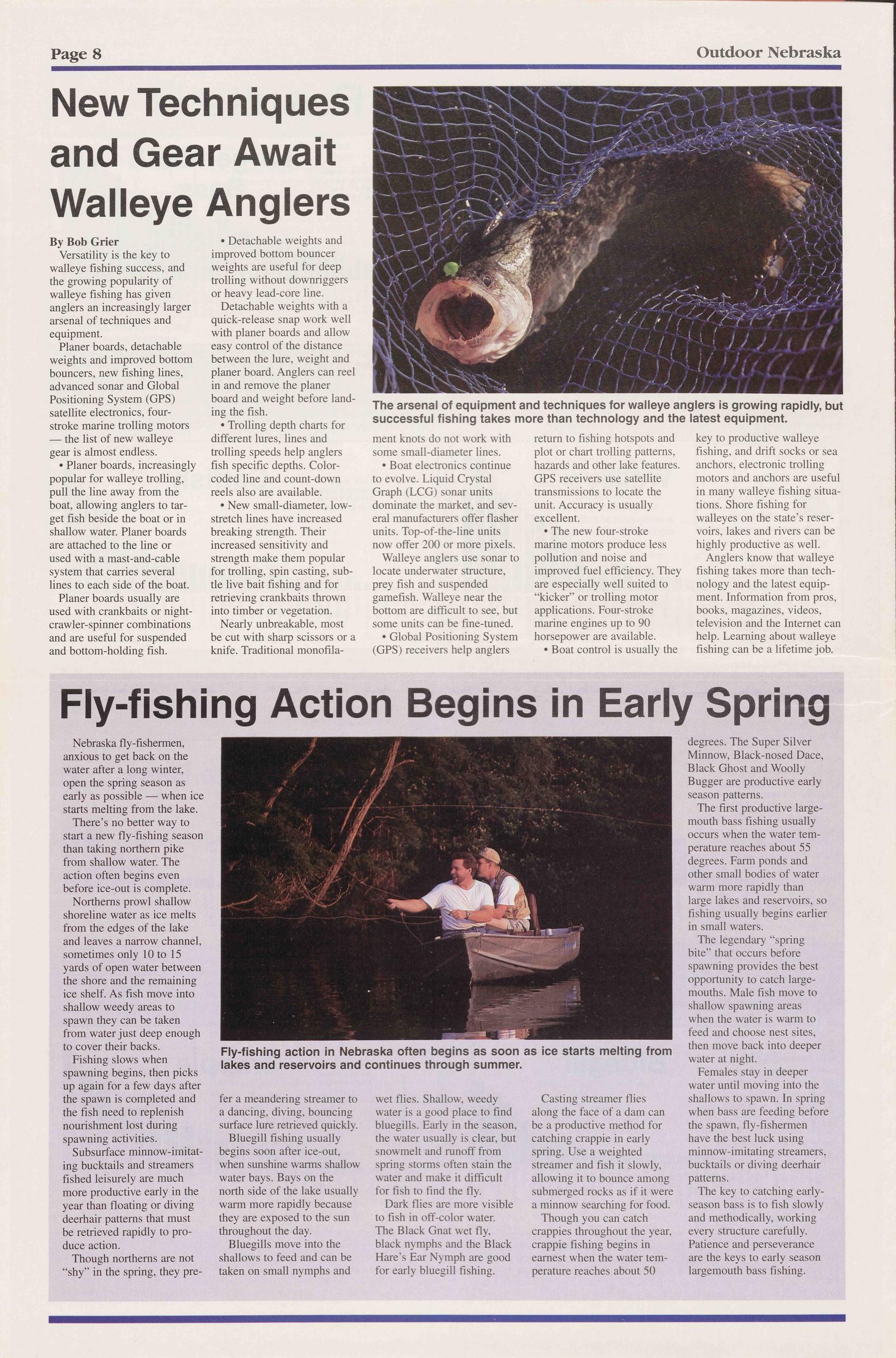
New Techniques and Gear Await Walleye Anglers
Versatility is the key to walleye fishing success, and the growing popularity of walleye fishing has given anglers an increasingly larger arsenal of techniques and equipment.
Planer boards, detachable weights and improved bottom bouncers, new fishing lines, advanced sonar and Global Positioning System (GPS) satellite electronics, fourstroke marine trolling motors the list of new walleye gear is almost endless.
Planer boards, increasingly popular for walleye trolling, pull the line away from the boat, allowing anglers to target fish beside the boat or in shallow water. Planer boards are attached to the line or used with a mast-and-cable system that carries several lines to each side of the boat.
Planer boards usually are used with crankbaits or night-crawler-spinner combinations and are useful for suspended and bottom-holding fish.
Detachable weights and improved bottom bouncer weights are useful for deep trolling without downriggers or heavy lead-core line.
Detachable weights with a quick-release snap work well with planer boards and allow easy control of the distance between the lure, weight and planer board. Anglers can reel in and remove the planer board and weight before landing the fish.
Trolling depth charts for different lures, lines and trolling speeds help anglers fish specific depths. Colorcoded line and count-down reels also are available.
New small-diameter, low-stretch lines have increased breaking strength. Their increased sensitivity and strength make them popular for trolling, spin casting, subtle live bait fishing and for retrieving crankbaits thrown into timber or vegetation.
Nearly unbreakable, most be cut with sharp scissors or a knife. Traditional monofilament knots do not work with some small-diameter lines.
The arsenal of equipment and techniques for walleye anglers is growing rapidly, but successful fishing takes more than technology and the latest equipment.
Boat electronics continue to evolve. Liquid Crystal Graph (LCG) sonar units dominate the market, and several manufacturers offer flasher units. Top-of-the-line units now offer 200 or more pixels.
Walleye anglers use sonar to locate underwater structure, prey fish and suspended gamefish. Walleye near the bottom are difficult to see, but some units can be fine-tuned.
Global Positioning System (GPS) receivers help anglers return to fishing hotspots and plot or chart trolling patterns, hazards and other lake features. GPS receivers use satellite transmissions to locate the unit. Accuracy is usually excellent.
The new four-stroke marine motors produce less pollution and noise and improved fuel efficiency. They are especially well suited to "kicker" or trolling motor applications. Four-stroke marine engines up to 90 horsepower are available.
Boat control is usually the key to productive walleye fishing, and drift socks or sea anchors, electronic trolling motors and anchors are useful in many walleye fishing situations. Shore fishing for walleyes on the state's reservoirs, lakes and rivers can be highly productive as well.
Anglers know that walleye fishing takes more than technology and the latest equipment. Information from pros, books, magazines, videos, television and the Internet can help. Learning about walleye fishing can be a lifetime job.
Fly-fishing Action Begins in Early Spring
Nebraska fly-fishermen, anxious to get back on the water after a long winter, open the spring season as early as possible — when ice starts melting from the lake.
There's no better way to start a new fly-fishing season than taking northern pike from shallow water. The action often begins even before ice-out is complete.
Northerns prowl shallow shoreline water as ice melts from the edges of the lake and leaves a narrow channel, sometimes only 10 to 15 yards of open water between the shore and the remaining ice shelf. As fish move into shallow weedy areas to spawn they can be taken from water just deep enough to cover their backs.
Fishing slows when spawning begins, then picks up again for a few days after the spawn is completed and the fish need to replenish nourishment lost during spawning activities.
Subsurface minnow-imitating bucktails and streamers fished leisurely are much more productive early in the year than floating or diving deerhair patterns that must be retrieved rapidly to produce action. Though northerns are not "shy" in the spring, they prefer a meandering streamer to a dancing, diving, bouncing surface lure retrieved quickly.
Fly-fishing action in Nebraska often begins as soon as ice starts melting from lakes and reservoirs and continues through summer.
Bluegill fishing usually begins soon after ice-out, when sunshine warms shallow water bays. Bays on the north side of the lake usually warm more rapidly because they are exposed to the sun throughout the day.
Bluegills move into the shallows to feed and can be taken on small nymphs and wet flies. Shallow, weedy water is a good place to find bluegills. Early in the season, the water usually is clear, but snowmelt and runoff from spring storms often stain the water and make it difficult for fish to find the fly.
Dark flies are more visible to fish in off-color water. The Black Gnat wet fly, black nymphs and the Black Hare's Ear Nymph are good for early bluegill fishing.
Casting streamer flies along the face of a dam can be a productive method for catching crappie in early spring. Use a weighted streamer and fish it slowly, allowing it to bounce among submerged rocks as if it were a minnow searching for food.
Though you can catch crappies throughout the year, crappie fishing begins in earnest when the water temperature reaches about 50 degrees. The Super Silver Minnow, Black-nosed Dace, Black Ghost and Woolly Bugger are productive early season patterns.
The first productive largemouth bass fishing usually occurs when the water temperature reaches about 55 degrees. Farm ponds and other small bodies of water warm more rapidly than large lakes and reservoirs, so fishing usually begins earlier in small waters.
The legendary "spring bite" that occurs before spawning provides the best opportunity to catch largemouths. Male fish move to shallow spawning areas when the water is warm to feed and choose nest sites, then move back into deeper water at night.
Females stay in deeper water until moving into the shallows to spawn. In spring when bass are feeding before the spawn, fly-fishermen have the best luck using minnow-imitating streamers, bucktails or diving deerhair patterns.
The key to catching early-season bass is to fish slowly and methodically, working every structure carefully. Patience and perseverance are the keys to early season largemouth bass fishing.
Position: 737 (15 views)