Volume 74, Issue 10, 1996
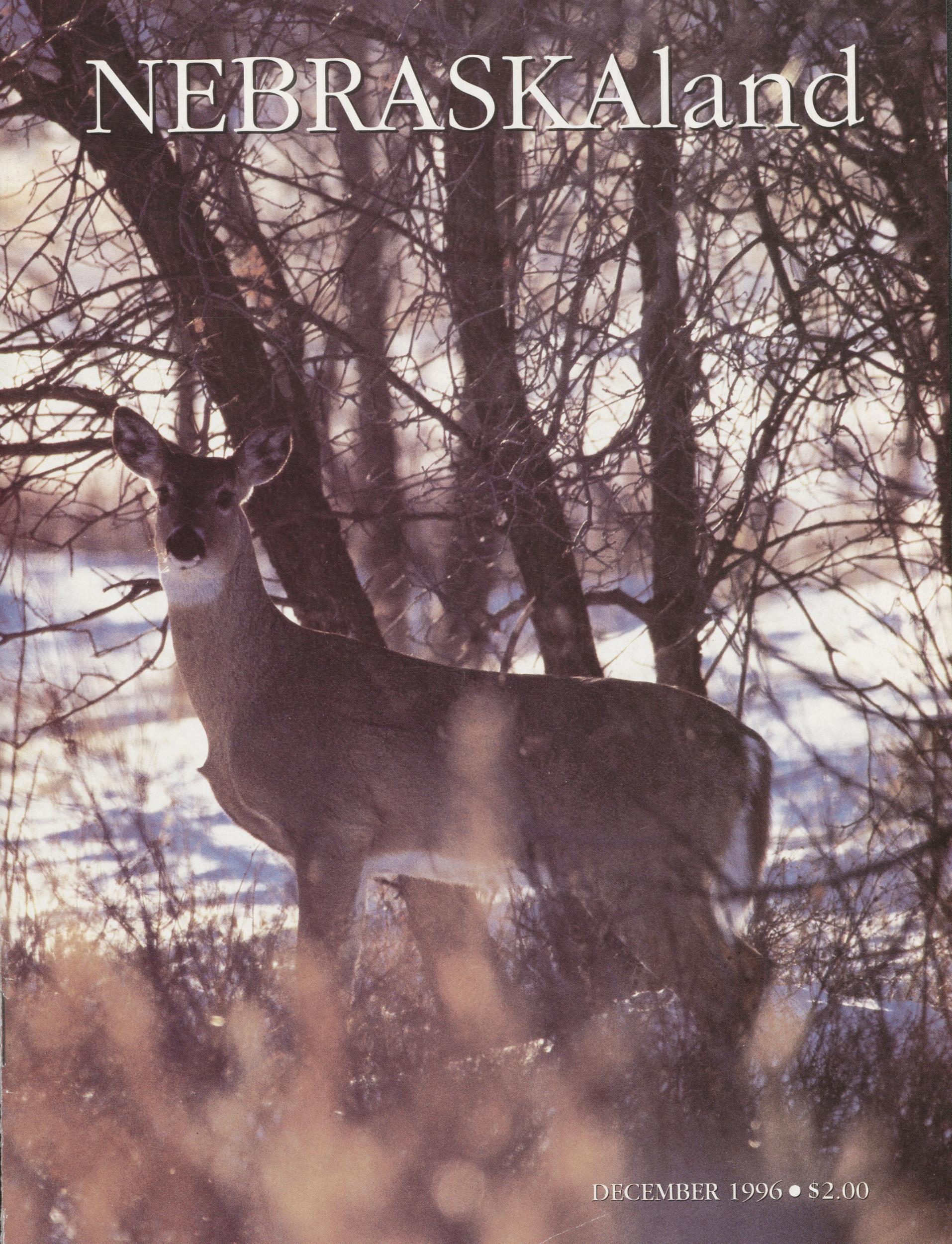
NEBRASKAland
DECEMBER 1996 S2.00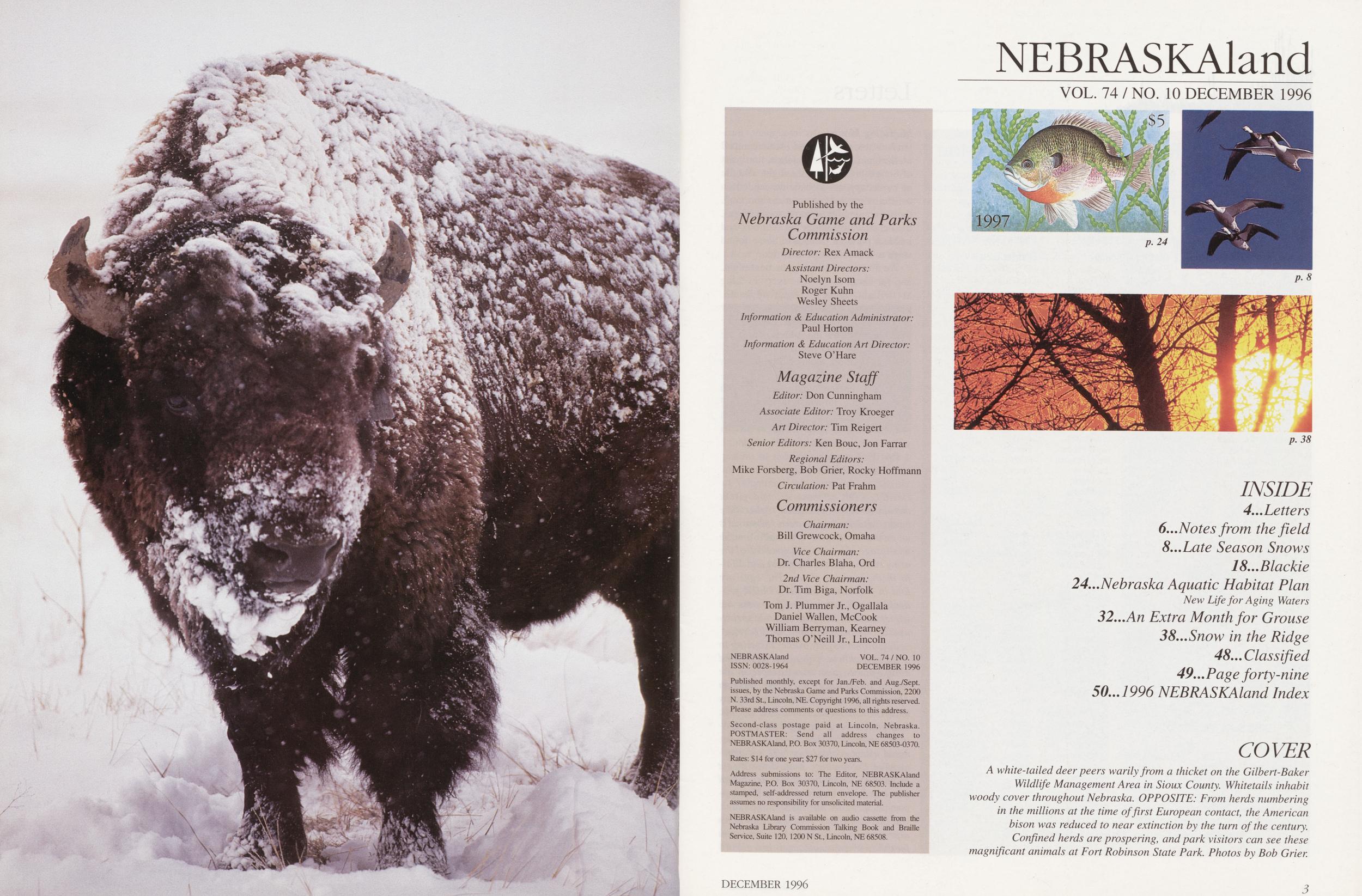
NEBRASKAland
Published by the Nebraska Game and Parks Commission Director: Rex Amack Assistant Directors: Noelyn Isom Roger Kuhn Wesley Sheets Information & Education Administrator: Paul Horton Information & Education Art Director: Steve O'Hare Magazine Staff Editor: Don Cunningham Associate Editor: Troy Kroeger Art Director: Tim Reigert Senior Editors: Ken Bouc, Jon Farrar Regional Editors: Mike Forsberg, Bob Grier, Rocky Hoffmann Circulation: Pat Frahm Commissioners Chairman: Bill Grewcock, Omaha Vice Chairman: Dr. Charles Blaha, Ord 2nd Vice Chairman: Dr. Tim Biga, Norfolk Tom J. Plummer Jr., Ogallala Daniel Wallen, McCook William Berryman, Kearney Thomas O'Neill Jr., Lincoln NEBRASKAland ISSN: 0028-1964 VOL. 74/NO. 10 DECEMBER 1996 Published monthly, except for Jan./Feb. and Aug./Sept. issues, by the Nebraska Game and Parks Commission, 2200 N. 33rd St., Lincoln, NE. Copyright 1996, all rights reserved. Please address comments or questions to this address. Second-class postage paid at Lincoln, Nebraska. POSTMASTER: Send all address changes to NEBRASKAland, P.O. Box 30370, Lincoln, NE 68503-0370. Rates: $14 for one year; $27 for two years. Address submissions to: The Editor, NEBRASKAland Magazine, P.O. Box 30370, Lincoln, NE 68503. Include a stamped, self-addressed return envelope. The publisher assumes no responsibility for unsolicited material. NEBRASKAland is available on audio cassette from the Nebraska Library Commission Talking Book and Braille Service, Suite 120, 1200 N St., Lincoln, NE 68508. VOL. 74 / NO. 10 DECEMBER 1996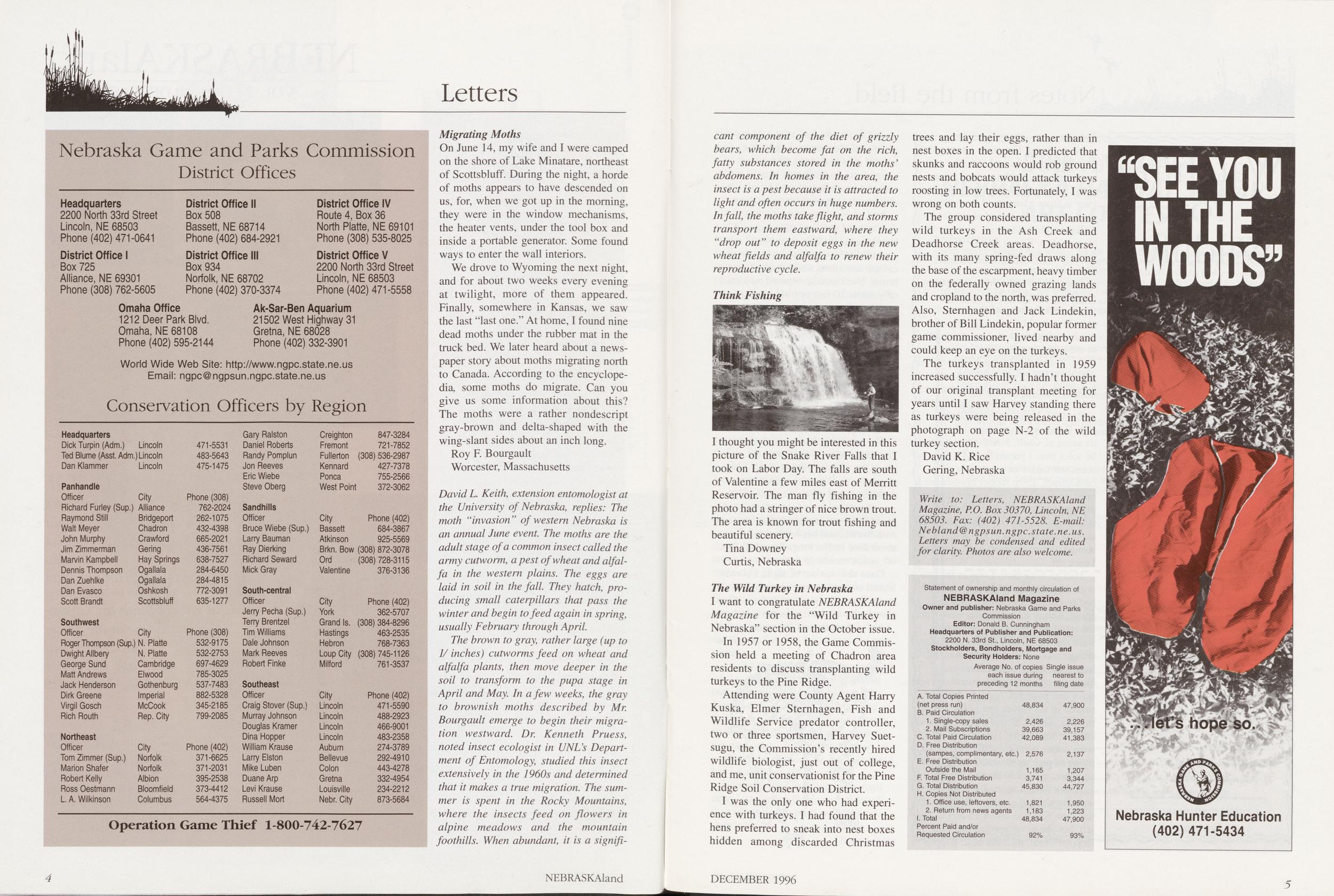
Letters
and Parks Commission District Offices Headquarters 2200 North 33rd Street Lincoln, NE 68503 Phone (402) 471-0641 District Office I Box 725 Alliance, NE 69301 Phone (308) 762-5605 District Office II Box 508 Bassett, NE 68714 Phone (402) 684-2921 District Office III Box 934 Norfolk, NE 68702 Phone (402) 370-3374 District Office IV Route 4, Box 36 North Platte, NE 69101 Phone (308) 535-8025 District Office V 2200 North 33rd Street Lincoln, NE 68503 Phone (402) 471-5558 Omaha Office 1212 Deer Park Blvd. Omaha, NE 68108 Phone (402) 595-2144 Ak-Sar-Ben Aquarium 21502 West Highway 31 Gretna, NE 68028 Phone (402) 332-3901 World Wide Web Site: http://www.ngpc.state.ne.us Email: ngpc@ngpsun.ngpc.state.ne.us Conservation Officers by Region Headquarters Gary Ralston Creighton 847-3284 Dick Turpin (Adm.) Lincoln 471-5531 Daniel Roberts Fremont 721-7852 Ted Blume (Asst. Adm.) Lincoln 483-5643 Randy Pomplun Fullerton (308) 536-2987 Dan Klammer Lincoln 475-1475 Jon Reeves Kennard 427-7378 Eric Wiebe Ponca 755-2566 Panhandle Steve Oberg West Point 372-3062 Officer City Phone (308) Richard Furley (Sup.) Alliance 762-2024 Sandhills Raymond Still Bridgeport 262-1075 Officer City Phone (402) Walt Meyer Chadron 432-4398 Bruce Wiebe (Sup.) Bassett 684-3867 John Murphy Crawford 665-2021 Larry Bauman Atkinson 925-5569 Jim Zimmerman Gering 436-7561 Ray Dierking Brkn. Bow (308) 872-3078 Marvin Kampbell Hay Springs 638-7527 Richard Seward Ord (308)728-3115 Dennis Thompson Ogallala 284-6450 Mick Gray Valentine 376-3136 Dan Zuehlke Ogallala 284-4815 Dan Evasco Oshkosh 772-3091 South-central Scott Brandt Scottsbluff 635-1277 Officer City Phone (402) Jerry Pecha (Sup.) York 362-5707 Southwest Terry Brentzel Grand Is. (308) 384-8296 Officer City Phone (308) Tim Williams Hastings 463-2535 Roger Thompson (Sup.) N. Platte 532-9175 Dale Johnson Hebron 768-7363 Dwight Allbery N. Platte 532-2753 Mark Reeves Loup City (308)745-1126 George Sund Cambridge 697-4629 Robert Finke Milford 761-3537 Matt Andrews Elwood 785-3025 Jack Henderson Gothenburg 537-7483 Southeast Dirk Greene Imperial 882-5328 Officer City Phone (402) Virgil Gosch McCook 345-2185 Craig Stover (Sup.) Lincoln 471-5590 Rich Routh Rep. City 799-2085 Murray Johnson Lincoln 488-2923 Douglas Kramer Lincoln 466-9001 Northeast Dina Hopper Lincoln 483-2358 Officer City Phone (402) William Krause Auburn 274-3789 Tom Zimmer (Sup.) Norfolk 371-6625 Larry Elston Bellevue 292-4910 Marion Shafer Norfolk 371-2031 Mike Luben Colon 443-4278 Robert Kelly Albion 395-2538 Duane Arp Gretna 332-4954 Ross Oestmann Bloomfield 373-4412 Levi Krause Louisville 234-2212 L. A. Wilkinson Columbus 564-4375 Russell Mort Nebr. City 873-5684 Operation Game Thief 1-800-742-7627 Migrating MothsOn June 14, my wife and I were camped on the shore of Lake Minatare, northeast of Scottsbluff. During the night, a horde of moths appears to have descended on us, for, when we got up in the morning, they were in the window mechanisms, the heater vents, under the tool box and inside a portable generator. Some found ways to enter the wall interiors.
We drove to Wyoming the next night, and for about two weeks every evening at twilight, more of them appeared. Finally, somewhere in Kansas, we saw the last "last one." At home, I found nine dead moths under the rubber mat in the truck bed. We later heard about a newspaper story about moths migrating north to Canada. According to the encyclopedia, some moths do migrate. Can you give us some information about this? The moths were a rather nondescript gray-brown and delta-shaped with the wing-slant sides about an inch long.
Roy F. Bourgault Worcester, MassachusettsDavid L. Keith, extension entomologist at the University of Nebraska, replies: The moth uinvasion " of western Nebraska is an annual June event. The moths are the adult stage of a common insect called the army cutworm, a pest of wheat and alfalfa in the western plains. The eggs are laid in soil in the fall. They hatch, producing small caterpillars that pass the winter and begin to feed again in spring, usually February through April.
The brown to gray, rather large (up to 1/ inches) cutworms feed on wheat and alfalfa plants, then move deeper in the soil to transform to the pupa stage in April and May. In a few weeks, the gray to brownish moths described by Mr. Bourgault emerge to begin their migration westward. Dr. Kenneth Pruess, noted insect ecologist in UNL's Department of Entomology, studied this insect extensively in the 1960s and determined that it makes a true migration. The summer is spent in the Rocky Mountains, where the insects feed on flowers in alpine meadows and the mountain foothills. When abundant, it is a significant component of the diet of grizzly bears, which become fat on the rich, fatty substances stored in the moths' abdomens. In homes in the area, the insect is a pest because it is attracted to light and often occurs in huge numbers. In fall, the moths take flight, and storms transport them eastward, where they udrop out" to deposit eggs in the new wheat fields and alfalfa to renew their reproductive cycle.
Think FishingI thought you might be interested in this picture of the Snake River Falls that I took on Labor Day. The falls are south of Valentine a few miles east of Merritt Reservoir. The man fly fishing in the photo had a stringer of nice brown trout. The area is known for trout fishing and beautiful scenery.
Tina Downey Curtis, Nebraska The Wild Turkey in NebraskaI want to congratulate NEBRASKAland Magazine for the "Wild Turkey in Nebraska" section in the October issue.
In 1957 or 1958, the Game Commission held a meeting of Chadron area residents to discuss transplanting wild turkeys to the Pine Ridge.
Attending were County Agent Harry Kuska, Elmer Sternhagen, Fish and Wildlife Service predator controller, two or three sportsmen, Harvey Suetsugu, the Commission's recently hired wildlife biologist, just out of college, and me, unit conservationist for the Pine Ridge Soil Conservation District.
I was the only one who had experience with turkeys. I had found that the hens preferred to sneak into nest boxes hidden among discarded Christmas trees and lay their eggs, rather than in nest boxes in the open. I predicted that skunks and raccoons would rob ground nests and bobcats would attack turkeys roosting in low trees. Fortunately, I was wrong on both counts.
The group considered transplanting wild turkeys in the Ash Creek and Deadhorse Creek areas. Deadhorse, with its many spring-fed draws along the base of the escarpment, heavy timber on the federally owned grazing lands and cropland to the north, was preferred. Also, Sternhagen and Jack Lindekin, brother of Bill Lindekin, popular former game commissioner, lived nearby and could keep an eye on the turkeys.
The turkeys transplanted in 1959 increased successfully. I hadn't thought of our original transplant meeting for years until I saw Harvey standing there as turkeys were being released in the photograph on page N-2 of the wild turkey section.
David K. Rice Gering, Nebraska Write to: Letters, NEBRASKAland Magazine, P.O. Box30370, Lincoln, NE 68503. Fax: (402) 471-5528. E-mail: Nebland@ngpsun.ngpc. state, ne. us. Letters may be condensed and edited for clarity. Photos are also welcome. Statement of ownership and monthly circulation of NEBRASKAland Magazine Owner and publisher: Nebraska Game and Parks Commission Editor: Donald B. Cunningham Headquarters of Publisher and Publication: 2200 N. 33rd St., Lincoln, NE 68503 Stockholders, Bondholders, Mortgage and Security Holders: None Average No. of copies Single issue each issue during nearest to preceding 12 months filing date A. Total Copies Printed (net press run) 48,834 47,900 B. Paid Circulation 1. Single-copy sales 2,426 2,226 2. Mail Subscriptions 39,663 39,157 C. Total Paid Circulation 42,089 41,383 D. Free Distribution (sampes, complimentary, etc.) 2,576 2,137 E. Free Distribution Outside the Mail 1,165 1,207 F. Total Free Distribution 3,741 3,344 G. Total Distribution 45,830 44,727 H. Copies Not Distributed 1. Office use, leftovers, etc. 1,821 1,950 2. Return from news agents 1,183 1,223 I. Total 48,834 47,900 Percent Paid and/or Requested Circulation 92% 93% Nebraska Hunter Education (402)471-5434 DECEMBER 1996 5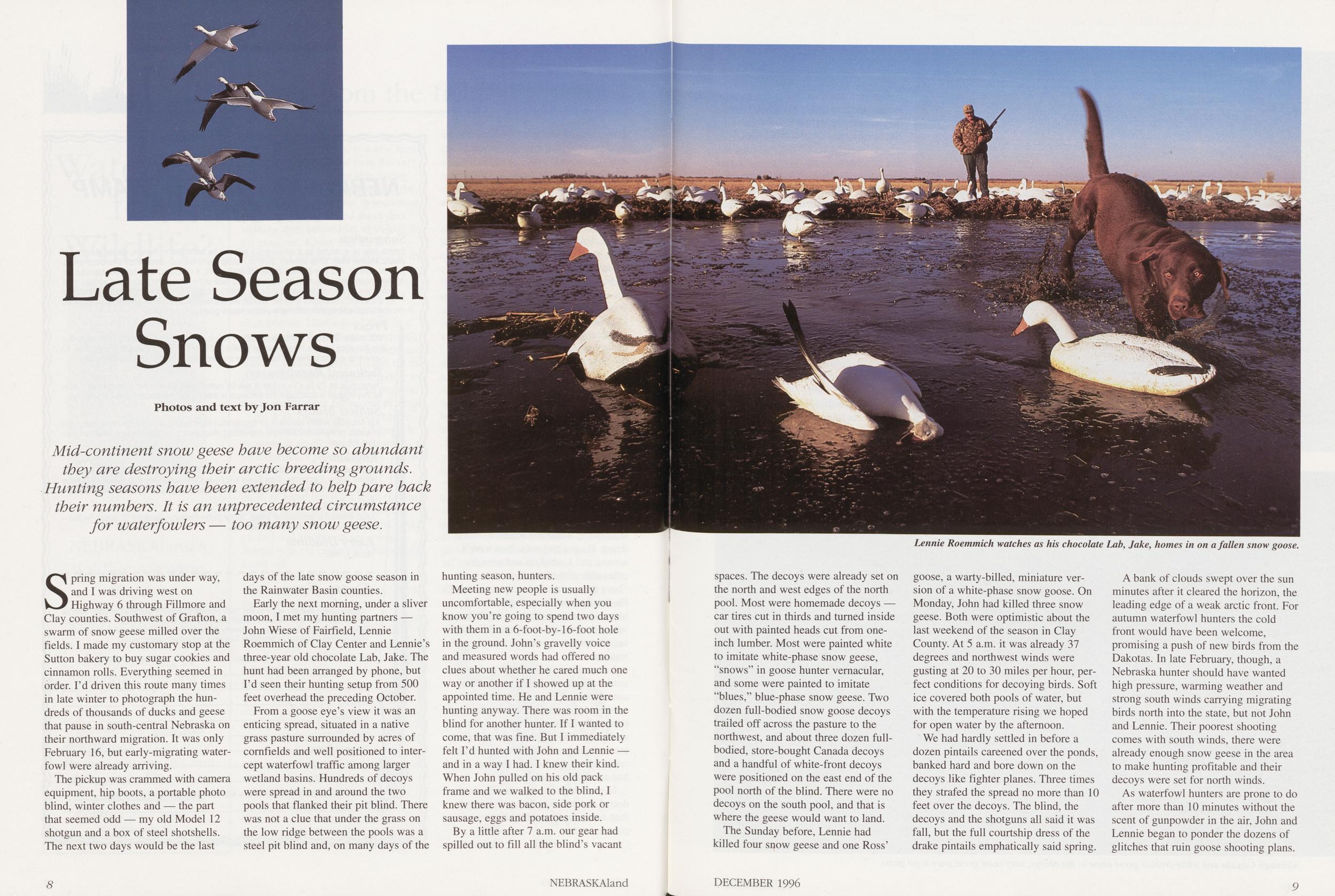
Late Season Snows
Photos and text by Jon Farrar Mid-continent snow geese have become so abundant they are destroying their arctic breeding grounds. Hunting seasons have been extended to help pare back their numbers. It is an unprecedented circumstance for waterfowlers — too many snow geese.Spring migration was under way, and I was driving west on Highway 6 through Fillmore and Clay counties. Southwest of Grafton, a swarm of snow geese milled over the fields. I made my customary stop at the Sutton bakery to buy sugar cookies and cinnamon rolls. Everything seemed in order. I'd driven this route many times in late winter to photograph the hundreds of thousands of ducks and geese that pause in south-central Nebraska on their northward migration. It was only February 16, but early-migrating waterfowl were already arriving.
The pickup was crammed with camera equipment, hip boots, a portable photo blind, winter clothes and — the part that seemed odd — my old Model 12 shotgun and a box of steel shot shells. The next two days would be the last days of the late snow goose season in the Rainwater Basin counties.
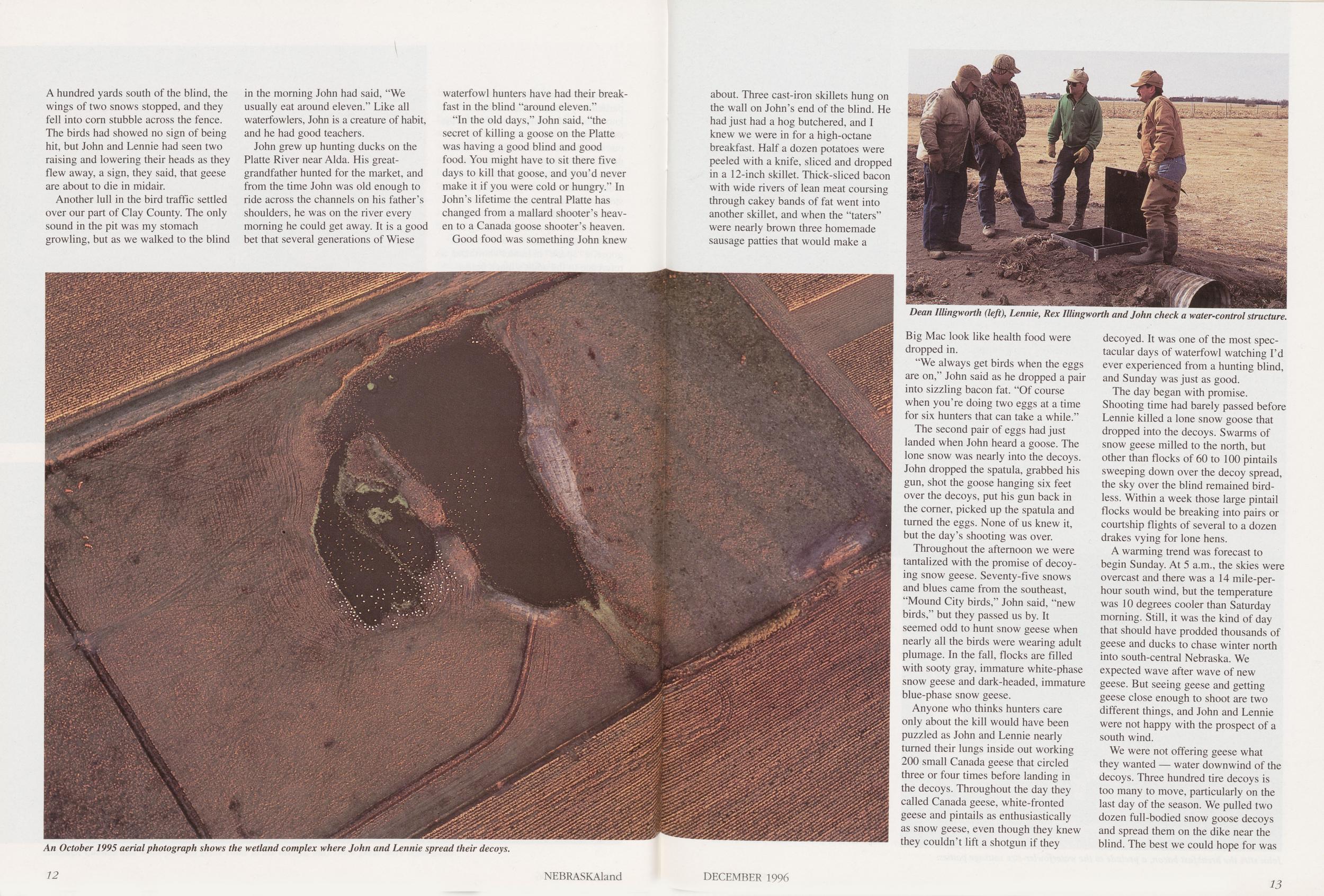
Early the next morning, under a sliver moon, I met my hunting partners — John Wiese of Fairfield, Lennie Roemmich of Clay Center and Lennie's three-year old chocolate Lab, Jake. The hunt had been arranged by phone, but I'd seen their hunting setup from 500 feet overhead the preceding October.
From a goose eye's view it was an enticing spread, situated in a native grass pasture surrounded by acres of cornfields and well positioned to intercept waterfowl traffic among larger wetland basins. Hundreds of decoys were spread in and around the two pools that flanked their pit blind. There was not a clue that under the grass on the low ridge between the pools was a steel pit blind and, on many days of the hunting season, hunters.
Meeting new people is usually uncomfortable, especially when you know you're going to spend two days with them in a 6-foot-by-16-foot hole in the ground. John's gravelly voice and measured words had offered no clues about whether he cared much one way or another if I showed up at the appointed time. He and Lennie were hunting anyway. There was room in the blind for another hunter. If I wanted to come, that was fine. But I immediately felt I'd hunted with John and Lennie — and in a way I had. I knew their kind. When John pulled on his old pack frame and we walked to the blind, I knew there was bacon, side pork or sausage, eggs and potatoes inside.
By a little after 7 a.m. our gear had spilled out to fill all the blind's vacant 8 NEBRASKAland
The Sunday before, Lennie had killed four snow geese and one Ross' goose, a warty-billed, miniature version of a white-phase snow goose. On Monday, John had killed three snow geese. Both were optimistic about the last weekend of the season in Clay County. At 5 a.m. it was already 37 degrees and northwest winds were gusting at 20 to 30 miles per hour, per- fect conditions for decoying birds. Soft ice covered both pools of water, but with the temperature rising we hoped for open water by the afternoon.
We had hardly settled in before a dozen pintails careened over the ponds, banked hard and bore down on the decoys like fighter planes. Three times they strafed the spread no more than 10 feet over the decoys. The blind, the decoys and the shotguns all said it was fall, but the full courtship dress of the drake pintails emphatically said spring.
A bank of clouds swept over the sun minutes after it cleared the horizon, the leading edge of a weak arctic front. For autumn waterfowl hunters the cold front would have been welcome, promising a push of new birds from the Dakotas. In late February, though, a Nebraska hunter should have wanted high pressure, warming weather and strong south winds carrying migrating birds north into the state, but not John and Lennie. Their poorest shooting comes with south winds, there were already enough snow geese in the area to make hunting profitable and their decoys were set for north winds.
As waterfowl hunters are prone to do
after more than 10 minutes without the
scent of gunpowder in the air, John and
Lennie began to ponder the dozens of
glitches that ruin goose shooting plans.
DECEMBER 1996
9
Geese were leaving their night roosts on large basins and moving to corn fields to feed, but early in the migration season they did not have to fly far to find a field full of waste grain. John said the best time to decoy geese was midmorning, after the birds have fed and are looking for water and a patch of grassland or wheat field where they can graze. John put the blackened coffee pot on the propane burner and we leaned back to wait.
To the uninitiated, hunting yarns might seem to be nothing more than
Our first birds were an odd assemblage, at least by autumn hunting standards: two blues and a white-fronted goose, a "speck" in hunter shorthand, a reference to the adult's black breast bars. The speck seemed to sense it had fallen in with the wrong kind and wanted to come down. Again and again it circled the spread, passing no more than 20 yards over the blind, craning its neck, calling, dropping its feet when John and Lennie coaxed it with their calls, but the two blues, the birds we wanted, continued to circle high, and when the whitefront drifted off across the cornfields they followed.
With ice on the ponds, John didn't expect geese to land in the decoys. The best shooting we could hope for would be at birds passing low over the decoys. With the strong wind we would get only one or two shots before the birds spread their wings and were swept beyond shotgun range.
It was midmorning before geese began milling over the grain fields. John and Lennie resisted the temptation to stand in the blind watching the skies. Instead, they listened to flocks of ducks and geese, and by their calls alone generated a lively discussion — what species was calling, how many were there, where were they and whether they approaching or moving away.
The first shooting came when John and Lennie heard whitefronts, then spotted eight snow geese coming from the south. Over the years they've found whitefronts respond to the call better than other species of geese. When whitefronts are flying with Canadas or snow geese, John and Lennie are just as likely to call the specks, hoping they will lead the other species of geese to the decoys. Picking snow geese out of a mixed-species flock can be difficult, but mixed flocks often sort by species as they land.
When the little group of geese was nearly to us, John decided we had better take them. More than likely they wouldn't make a second pass without open water to bring them all the way down. Two blues and a snow tumbled to the ice. For only five shots fired, we had accounted ourselves well enough.
Liberated from the pit blind, Jake churned across the icy pond like a freight train, put on the brakes at the last minute and slid for 10 yards, pushing a goose ahead of him until both came to rest on the opposite shoreline.
Geese of all types and pintails were on the move, finished feeding and looking for water or company, preferably both in the same place. But water was in short supply in the Rainwater Basin. Winter snows had been scant. State and federal wildlife agencies were only beginning to pump water into wetlands to accommodate the arriving waterfowl. Many of the federal waterfowl production areas and state wildlife management areas were dry. Those with water had only small pools and were ice-covered. Geese and ducks will roost on the ice, but with crops full of corn they want water.
Canada geese, white-fronted geese and pintails were moving, but we had yet to see mallards, which along with pintails and green-winged teal are usually the first ducks to arrive during spring migration. Occasionally, we saw a dense swarm of birds on the horizon, and there was little doubt they were the most gregarious of North American waterfowl — snow geese.
An hour passed, then 30 snow geese and three specks drifted past the blind, riding the rising wind, too high to shoot but promising. Several broke off and labored into the north wind toward the decoys. The flock hooked and followed. As with the earlier birds, it was doubtful they would commit fully to the decoys, and when they were overhead we took them. Two geese fell near the blind. The rest of the flock was swept away like kites in a gale.
Again we had fired five shots, and I
was surprised that only two geese had
fallen. John and Lennie intently
watched the rest of the flock drift away.
DECEMBER 1996
11
 A hundred yards south of the blind, the
wings of two snows stopped, and they
fell into corn stubble across the fence.
The birds had showed no sign of being
hit, but John and Lennie had seen two
raising and lowering their heads as they
flew away, a sign, they said, that geese
are about to die in midair.
A hundred yards south of the blind, the
wings of two snows stopped, and they
fell into corn stubble across the fence.
The birds had showed no sign of being
hit, but John and Lennie had seen two
raising and lowering their heads as they
flew away, a sign, they said, that geese
are about to die in midair.
Another lull in the bird traffic settled over our part of Clay County. The only sound in the pit was my stomach growling, but as we walked to the blind in the morning John had said, "We usually eat around eleven." Like all waterfowlers, John is a creature of habit, and he had good teachers.
John grew up hunting ducks on the Platte River near Alda. His great- grandfather hunted for the market, and from the time John was old enough to ride across the channels on his father's shoulders, he was on the river every morning he could get away. It is a good bet that several generations of Wiese waterfowl hunters have had their breakfast in the blind "around eleven."
"In the old days," John said, "the secret of killing a goose on the Platte was having a good blind and good food. You might have to sit there five days to kill that goose, and you'd never make it if you were cold or hungry." In John's lifetime the central Platte has changed from a mallard shooter's heaven to a Canada goose shooter's heaven.
Good food was something John knew
"We always get birds when the eggs are on," John said as he dropped a pair into sizzling bacon fat. "Of course when you're doing two eggs at a time for six hunters that can take a while."
The second pair of eggs had just landed when John heard a goose. The lone snow was nearly into the decoys. John dropped the spatula, grabbed his gun, shot the goose hanging six feet over the decoys, put his gun back in the corner, picked up the spatula and turned the eggs. None of us knew it, but the day's shooting was over.
Throughout the afternoon we were tantalized with the promise of decoying snow geese. Seventy-five snows and blues came from the southeast, "Mound City birds," John said, "new birds," but they passed us by. It seemed odd to hunt snow geese when nearly all the birds were wearing adult plumage. In the fall, flocks are filled with sooty gray, immature white-phase snow geese and dark-headed, immature blue-phase snow geese.
Anyone who thinks hunters care only about the kill would have been puzzled as John and Lennie nearly turned their lungs inside out working 200 small Canada geese that circled three or four times before landing in the decoys. Throughout the day they called Canada geese, white-fronted geese and pintails as enthusiastically as snow geese, even though they knew they couldn't lift a shotgun if they decoyed. It was one of the most spectacular days of waterfowl watching I'd ever experienced from a hunting blind, and Sunday was just as good.
The day began with promise. Shooting time had barely passed before Lennie killed a lone snow goose that dropped into the decoys. Swarms of snow geese milled to the north, but other than flocks of 60 to 100 pintails sweeping down over the decoy spread, the sky over the blind remained bird- less. Within a week those large pintail flocks would be breaking into pairs or courtship flights of several to a dozen drakes vying for lone hens.
A warming trend was forecast to begin Sunday. At 5 a.m., the skies were overcast and there was a 14 mile-per-hour south wind, but the temperature was 10 degrees cooler than Saturday morning. Still, it was the kind of day that should have prodded thousands of geese and ducks to chase winter north into south-central Nebraska. We expected wave after wave of new geese. But seeing geese and getting geese close enough to shoot are two different things, and John and Lennie were not happy with the prospect of a south wind.
We were not offering geese what
they wanted — water downwind of the
decoys. Three hundred tire decoys is
too many to move, particularly on the
last day of the season. We pulled two
dozen full-bodied snow goose decoys
and spread them on the dike near the
blind. The best we could hope for was
DECEMBER 1996
13
 small flocks working the spread low
enough to offer pass shooting.
small flocks working the spread low
enough to offer pass shooting.
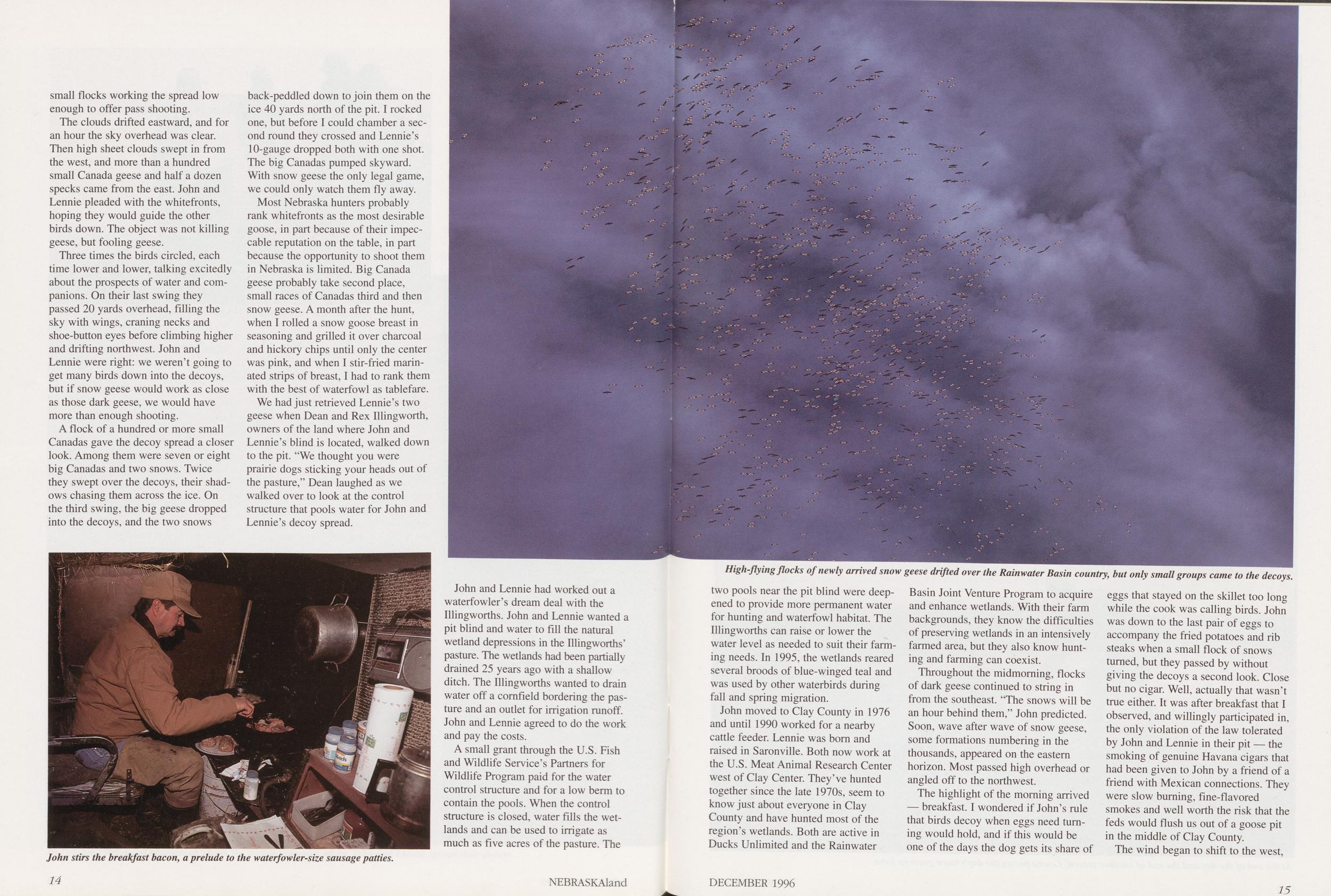
The clouds drifted eastward, and for an hour the sky overhead was clear. Then high sheet clouds swept in from the west, and more than a hundred small Canada geese and half a dozen specks came from the east. John and Lennie pleaded with the whitefronts, hoping they would guide the other birds down. The object was not killing geese, but fooling geese.
Three times the birds circled, each time lower and lower, talking excitedly about the prospects of water and companions. On their last swing they passed 20 yards overhead, filling the sky with wings, craning necks and shoe-button eyes before climbing higher and drifting northwest. John and Lennie were right: we weren't going to get many birds down into the decoys, but if snow geese would work as close as those dark geese, we would have more than enough shooting.
A flock of a hundred or more small Canadas gave the decoy spread a closer look. Among them were seven or eight big Canadas and two snows. Twice they swept over the decoys, their shadows chasing them across the ice. On the third swing, the big geese dropped into the decoys, and the two snows back-peddled down to join them on the ice 40 yards north of the pit. I rocked one, but before I could chamber a second round they crossed and Lennie's 10-gauge dropped both with one shot. The big Canadas pumped skyward. With snow geese the only legal game, we could only watch them fly away.
Most Nebraska hunters probably rank whitefronts as the most desirable goose, in part because of their impeccable reputation on the table, in part because the opportunity to shoot them in Nebraska is limited. Big Canada geese probably take second place, small races of Canadas third and then snow geese. A month after the hunt, when I rolled a snow goose breast in seasoning and grilled it over charcoal and hickory chips until only the center was pink, and when I stir-fried marinated strips of breast, I had to rank them with the best of waterfowl as tablefare.
We had just retrieved Lennie's two geese when Dean and Rex Illingworth, owners of the land where John and Lennie's blind is located, walked down to the pit. "We thought you were prairie dogs sticking your heads out of the pasture," Dean laughed as we walked over to look at the control structure that pools water for John and Lennie's decoy spread.
John and Lennie had worked out a waterfowler's dream deal with the Illingworths. John and Lennie wanted a pit blind and water to fill the natural wetland depressions in the Illing worths' pasture. The wetlands had been partially drained 25 years ago with a shallow ditch. The Illing worths wanted to drain water off a cornfield bordering the pasture and an outlet for irrigation runoff. John and Lennie agreed to do the work and pay the costs.
A small grant through the U.S. Fish and Wildlife Service's Partners for Wildlife Program paid for the water control structure and for a low berm to contain the pools. When the control structure is closed, water fills the wetlands and can be used to irrigate as much as five acres of the pasture. The
John moved to Clay County in 1976 and until 1990 worked for a nearby cattle feeder. Lennie was born and raised in Saronville. Both now work at the U.S. Meat Animal Research Center west of Clay Center. They've hunted together since the late 1970s, seem to know just about everyone in Clay County and have hunted most of the region's wetlands. Both are active in Ducks Unlimited and the Rainwater Basin Joint Venture Program to acquire and enhance wetlands. With their farm backgrounds, they know the difficulties of preserving wetlands in an intensively farmed area, but they also know hunting and farming can coexist.
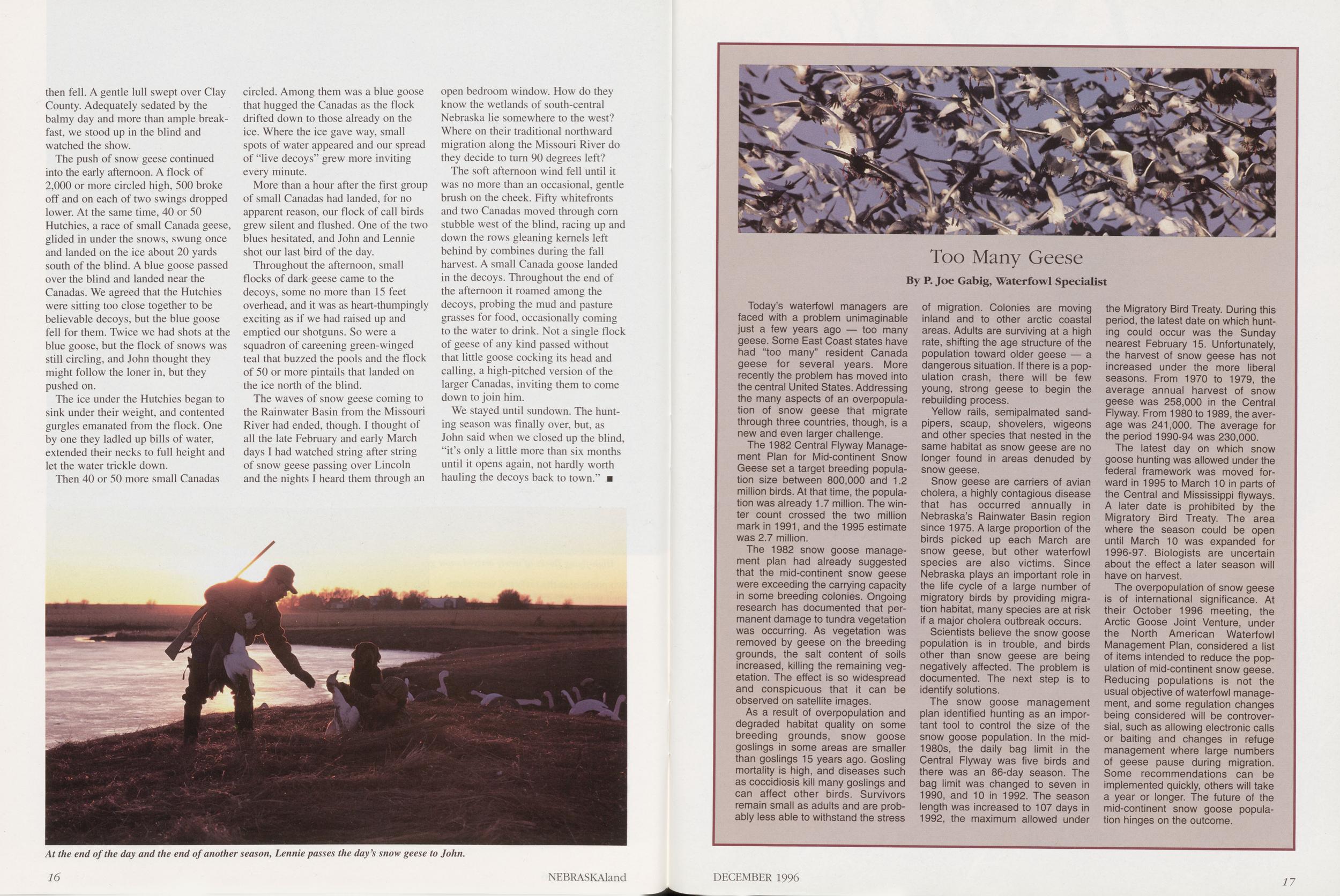
Throughout the midmorning, flocks of dark geese continued to string in from the southeast. "The snows will be an hour behind them," John predicted. Soon, wave after wave of snow geese, some formations numbering in the thousands, appeared on the eastern horizon. Most passed high overhead or angled off to the northwest.
The highlight of the morning arrived — breakfast. I wondered if John's rule that birds decoy when eggs need turning would hold, and if this would be one of the days the dog gets its share of eggs that stayed on the skillet too long while the cook was calling birds. John was down to the last pair of eggs to accompany the fried potatoes and rib steaks when a small flock of snows turned, but they passed by without giving the decoys a second look. Close but no cigar. Well, actually that wasn't true either. It was after breakfast that I observed, and willingly participated in, the only violation of the law tolerated by John and Lennie in their pit — the smoking of genuine Havana cigars that had been given to John by a friend of a friend with Mexican connections. They were slow burning, fine-flavored smokes and well worth the risk that the feds would flush us out of a goose pit in the middle of Clay County.
The wind began to shift to the west,
DECEMBER 1996
15
 then fell. A gentle lull swept over Clay
County. Adequately sedated by the
balmy day and more than ample
breakfast, we stood up in the blind and
watched the show.
then fell. A gentle lull swept over Clay
County. Adequately sedated by the
balmy day and more than ample
breakfast, we stood up in the blind and
watched the show.
The push of snow geese continued into the early afternoon. A flock of 2,000 or more circled high, 500 broke off and on each of two swings dropped lower. At the same time, 40 or 50 Hutchies, a race of small Canada geese, glided in under the snows, swung once and landed on the ice about 20 yards south of the blind. A blue goose passed over the blind and landed near the Canadas. We agreed that the Hutchies were sitting too close together to be believable decoys, but the blue goose fell for them. Twice we had shots at the blue goose, but the flock of snows was still circling, and John thought they might follow the loner in, but they pushed on.
The ice under the Hutchies began to sink under their weight, and contented gurgles emanated from the flock. One by one they ladled up bills of water, extended their necks to full height and let the water trickle down.
Then 40 or 50 more small Canadas circled. Among them was a blue goose that hugged the Canadas as the flock drifted down to those already on the ice. Where the ice gave way, small spots of water appeared and our spread of "live decoys" grew more inviting every minute.
More than a hour after the first group of small Canadas had landed, for no apparent reason, our flock of call birds grew silent and flushed. One of the two blues hesitated, and John and Lennie shot our last bird of the day.
Throughout the afternoon, small flocks of dark geese came to the decoys, some no more than 15 feet overhead, and it was as heart-thumpingly exciting as if we had raised up and emptied our shotguns. So were a squadron of careening green-winged teal that buzzed the pools and the flock of 50 or more pintails that landed on the ice north of the blind.
The waves of snow geese coming to the Rainwater Basin from the Missouri River had ended, though. I thought of all the late February and early March days I had watched string after string of snow geese passing over Lincoln and the nights I heard them through an open bedroom window. How do they know the wetlands of south-central Nebraska lie somewhere to the west? Where on their traditional northward migration along the Missouri River do they decide to turn 90 degrees left?
The soft afternoon wind fell until it was no more than an occasional, gentle brush on the cheek. Fifty whitefronts and two Canadas moved through corn stubble west of the blind, racing up and down the rows gleaning kernels left behind by combines during the fall harvest. A small Canada goose landed in the decoys. Throughout the end of the afternoon it roamed among the decoys, probing the mud and pasture grasses for food, occasionally coming to the water to drink. Not a single flock of geese of any kind passed without that little goose cocking its head and calling, a high-pitched version of the larger Canadas, inviting them to come down to join him.
We stayed until sundown. The hunting season was finally over, but, as John said when we closed up the blind, "it's only a little more than six months until it opens again, not hardly worth hauling the decoys back to town."
Today's waterfowl managers are faced with a problem unimaginable just a few years ago — too many geese. Some East Coast states have had "too many" resident Canada geese for several years. More recently the problem has moved into the central United States. Addressing the many aspects of an overpopulation of snow geese that migrate through three countries, though, is a new and even larger challenge.
The 1982 Central Flyway Management Plan for Mid-continent Snow Geese set a target breeding population size between 800,000 and 1.2 million birds. At that time, the population was already 1.7 million. The winter count crossed the two million mark in 1991, and the 1995 estimate was 2.7 million.
The 1982 snow goose management plan had already suggested that the mid-continent snow geese were exceeding the carrying capacity in some breeding colonies. Ongoing research has documented that permanent damage to tundra vegetation was occurring. As vegetation was removed by geese on the breeding grounds, the salt content of soils increased, killing the remaining vegetation. The effect is so widespread and conspicuous that it can be observed on satellite images.
As a result of overpopulation and degraded habitat quality on some breeding grounds, snow goose goslings in some areas are smaller than goslings 15 years ago. Gosling mortality is high, and diseases such as coccidiosis kill many goslings and can affect other birds. Survivors remain small as adults and are probably less able to withstand the stress of migration. Colonies are moving inland and to other arctic coastal areas. Adults are surviving at a high rate, shifting the age structure of the population toward older geese — a dangerous situation. If there is a population crash, there will be few young, strong geese to begin the rebuilding process.
Yellow rails, semipalmated sandpipers, scaup, shovelers, wigeons and other species that nested in the same habitat as snow geese are no longer found in areas denuded by snow geese.
Snow geese are carriers of avian cholera, a highly contagious disease that has occurred annually in Nebraska's Rainwater Basin region since 1975. A large proportion of the birds picked up each March are snow geese, but other waterfowl species are also victims. Since Nebraska plays an important role in the life cycle of a large number of migratory birds by providing migration habitat, many species are at risk if a major cholera outbreak occurs.
Scientists believe the snow goose population is in trouble, and birds other than snow geese are being negatively affected. The problem is documented. The next step is to identify solutions.
The snow goose management plan identified hunting as an important tool to control the size of the snow goose population. In the mid-1980s, the daily bag limit in the Central Flyway was five birds and there was an 86-day season. The bag limit was changed to seven in 1990, and 10 in 1992. The season length was increased to 107 days in 1992, the maximum allowed under the Migratory Bird Treaty. During this period, the latest date on which hunting could occur was the Sunday nearest February 15. Unfortunately, the harvest of snow geese has not increased under the more liberal seasons. From 1970 to 1979, the average annual harvest of snow geese was 258,000 in the Central Flyway. From 1980 to 1989, the average was 241,000. The average for the period 1990-94 was 230,000.
The latest day on which snow goose hunting was allowed under the federal framework was moved forward in 1995 to March 10 in parts of the Central and Mississippi flyways. A later date is prohibited by the Migratory Bird Treaty. The area where the season could be open until March 10 was expanded for 1996-97. Biologists are uncertain about the effect a later season will have on harvest.
The overpopulation of snow geese is of international significance. At their October 1996 meeting, the Arctic Goose Joint Venture, under the North American Waterfowl Management Plan, considered a list of items intended to reduce the population of mid-continent snow geese. Reducing populations is not the usual objective of waterfowl management, and some regulation changes being considered will be controversial, such as allowing electronic calls or baiting and changes in refuge management where large numbers of geese pause during migration. Some recommendations can be implemented quickly, others will take a year or longer. The future of the mid-continent snow goose population hinges on the outcome.
DECEMBER 1996 17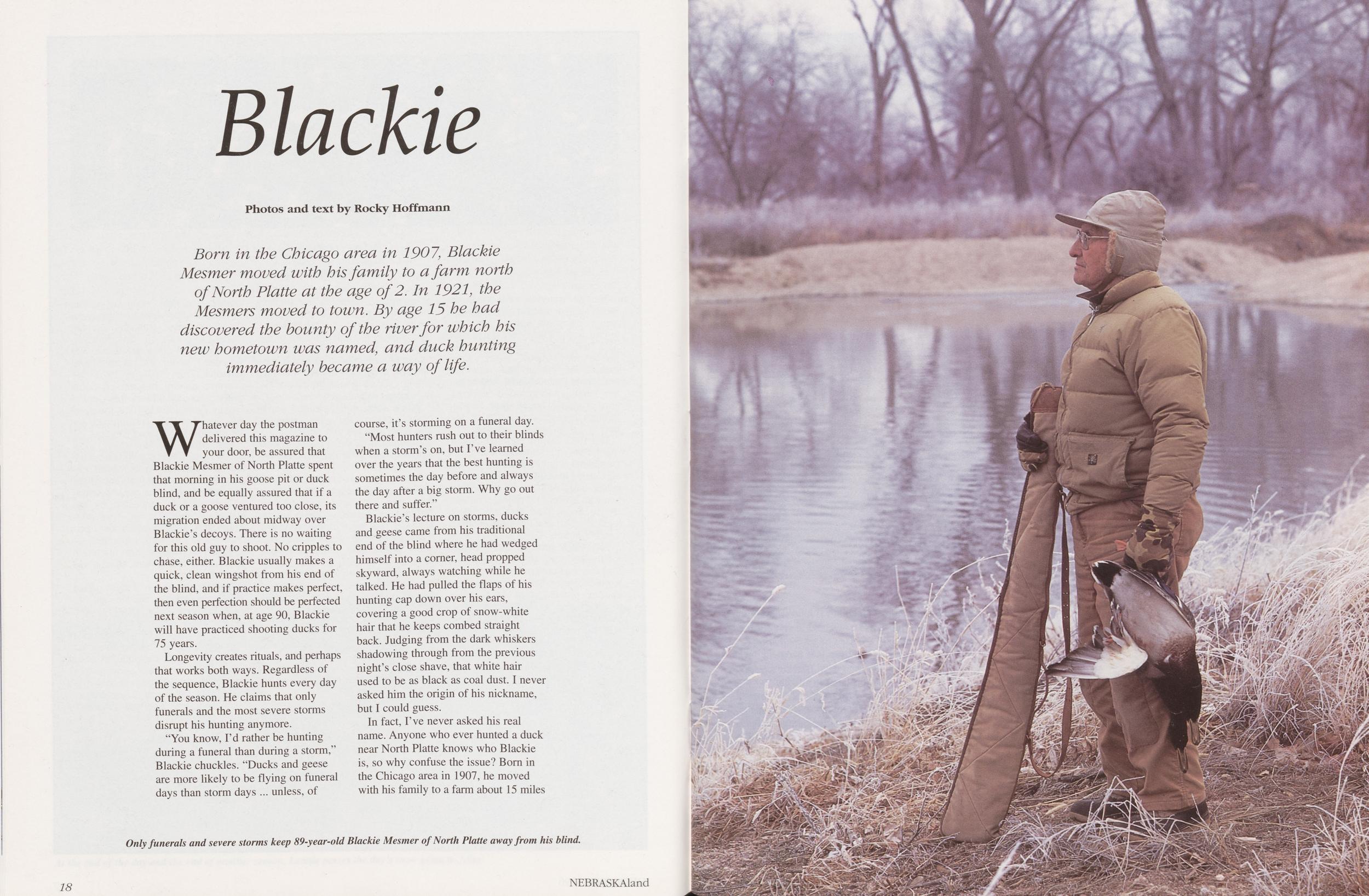
Blackie
Photos and text by Rocky Hoffmann Born in the Chicago area in 1907, Blackie Mesmer moved with his family to a farm north of North Platte at the age of 2. In 1921, the Mesmers moved to town. By age 15 he had discovered the bounty of the river for which his new hometown was named, and duck hunting immediately became a way of life.Whatever day the postman delivered this magazine to your door, be assured that Blackie Mesmer of North Platte spent that morning in his goose pit or duck blind, and be equally assured that if a duck or a goose ventured too close, its migration ended about midway over Blackie's decoys. There is no waiting for this old guy to shoot. No cripples to chase, either. Blackie usually makes a quick, clean wingshot from his end of the blind, and if practice makes perfect, then even perfection should be perfected next season when, at age 90, Blackie will have practiced shooting ducks for 75 years.
Longevity creates rituals, and perhaps that works both ways. Regardless of the sequence, Blackie hunts every day of the season. He claims that only funerals and the most severe storms disrupt his hunting anymore.
"You know, I'd rather be hunting during a funeral than during a storm," Blackie chuckles. "Ducks and geese are more likely to be flying on funeral days than storm days ... unless, of course, it's storming on a funeral day.
"Most hunters rush out to their blinds when a storm's on, but I've learned over the years that the best hunting is sometimes the day before and always the day after a big storm. Why go out there and suffer."
Blackie's lecture on storms, ducks and geese came from his traditional end of the blind where he had wedged himself into a corner, head propped skyward, always watching while he talked. He had pulled the flaps of his hunting cap down over his ears, covering a good crop of snow-white hair that he keeps combed straight back. Judging from the dark whiskers shadowing through from the previous night's close shave, that white hair used to be as black as coal dust. I never asked him the origin of his nickname, but I could guess.
In fact, I've never asked his real name. Anyone who ever hunted a duck near North Platte knows who Blackie is, so why confuse the issue? Born in the Chicago area in 1907, he moved with his family to a farm about 15 miles Only funerals and severe storms keep 89-year-old 18 NEBRASKAland
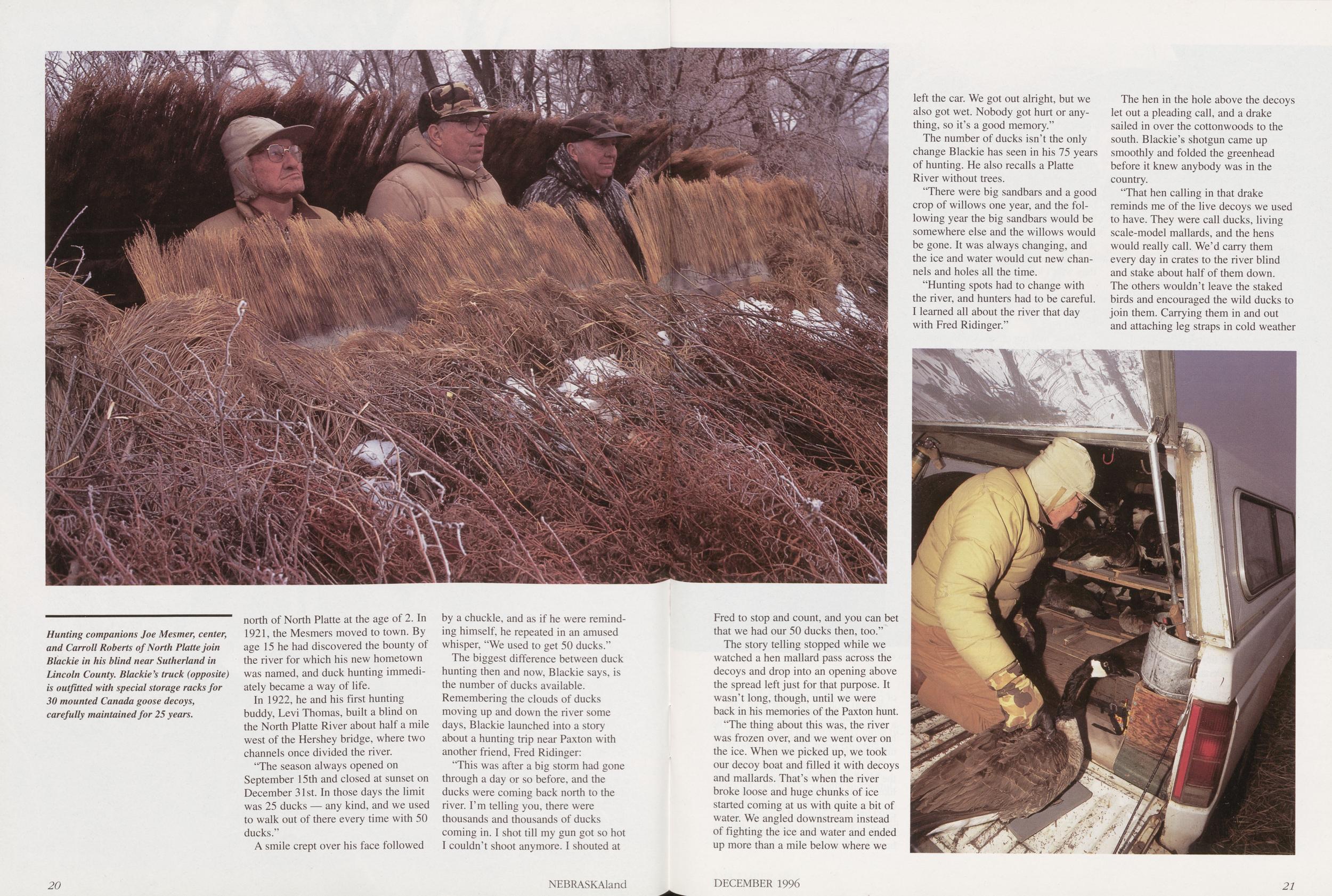
In 1922, he and his first hunting buddy, Levi Thomas, built a blind on the North Platte River about half a mile west of the Hershey bridge, where two channels once divided the river.
"The season always opened on September 15th and closed at sunset on December 31st. In those days the limit was 25 ducks — any kind, and we used to walk out of there every time with 50 ducks."
A smile crept over his face followed by a chuckle, and as if he were reminding himself, he repeated in an amused whisper, "We used to get 50 ducks."
The biggest difference between duck hunting then and now, Blackie says, is the number of ducks available. Remembering the clouds of ducks moving up and down the river some days, Blackie launched into a story about a hunting trip near Paxton with another friend, Fred Ridinger:
"This was after a big storm had gone through a day or so before, and the ducks were coming back north to the river. I'm telling you, there were thousands and thousands of ducks coming in. I shot till my gun got so hot I couldn't shoot anymore. I shouted at 20 NEBRASKAland Fred to stop and count, and you can bet that we had our 50 ducks then, too."
The story telling stopped while we watched a hen mallard pass across the decoys and drop into an opening above the spread left just for that purpose. It wasn't long, though, until we were back in his memories of the Paxton hunt.
"The thing about this was, the river was frozen over, and we went over on the ice. When we picked up, we took our decoy boat and filled it with decoys and mallards. That's when the river broke loose and huge chunks of ice started coming at us with quite a bit of water. We angled downstream instead of fighting the ice and water and ended up more than a mile below where we left the car. We got out alright, but we also got wet. Nobody got hurt or anything, so it's a good memory."
The number of ducks isn't the only change Blackie has seen in his 75 years of hunting. He also recalls a Platte River without trees.
"There were big sandbars and a good crop of willows one year, and the following year the big sandbars would be somewhere else and the willows would be gone. It was always changing, and the ice and water would cut new channels and holes all the time.
"Hunting spots had to change with the river, and hunters had to be careful. I learned all about the river that day with Fred Ridinger."
The hen in the hole above the decoys let out a pleading call, and a drake sailed in over the cottonwoods to the south. Blackie's shotgun came up smoothly and folded the greenhead before it knew anybody was in the country.
"That hen calling in that drake reminds me of the live decoys we used to have. They were call ducks, living scale-model mallards, and the hens would really call. We'd carry them every day in crates to the river blind and stake about half of them down. The others wouldn't leave the staked birds and encouraged the wild ducks to join them. Carrying them in and out and attaching leg straps in cold weather
 was a lot of work. Duck and goose
hunting still is a lot of work."
was a lot of work. Duck and goose
hunting still is a lot of work."
Even at 89, Blackie doesn't shy away from work, and although his everyday hunting partners, Carroll Roberts and Norm House of North Platte, share equally in the tasks, Blackie carries his load and more-or-less runs the operation. House and Roberts think Blackie is the right man for the job, though, agreeing that every hunter should be lucky enough to have a blind-boss with 75 years of proven experience.
Once again, we heard the distinctive call of a hen mallard somewhere up in the fog circling our decoys. Blackie noted that it was a hen, but he thought she had a drake with her. Sure enough, when we listened closely, we could hear a drake softly talking as it circled with the hen. Two shadowy forms appeared in the mist, and Blackie plucked the one with the green head out of the pair. Carroll went to get it.
"I've hunted over a lot of dogs in my day, but now I have Carroll and Norm. If I was closer to the door, I'd go get it myself. One guy I knew had the damnedest dog I ever saw. In fact he had two. They were Chesapeakes, but one in particular was really something.
"This guy, John Den, had a cigar shop in North Platte with a couple of gambling rooms. He also sold shells and fishing lures along with cigars. He lived to hunt and fish and was involved with a hunting club near Sutherland that included Keith Neville, General Miltonberger and other prominent people. They kept a cabin there from about 1915 through the early '20s, and they would sometimes hunt for several days.
"This dog understood river currents, and when we would knock down a bunch of ducks in the river all at once, the dog would hurry out and collect ducks, stacking them on the sandbar. Then, when he had them all high and dry, he would retrieve them to the blind."
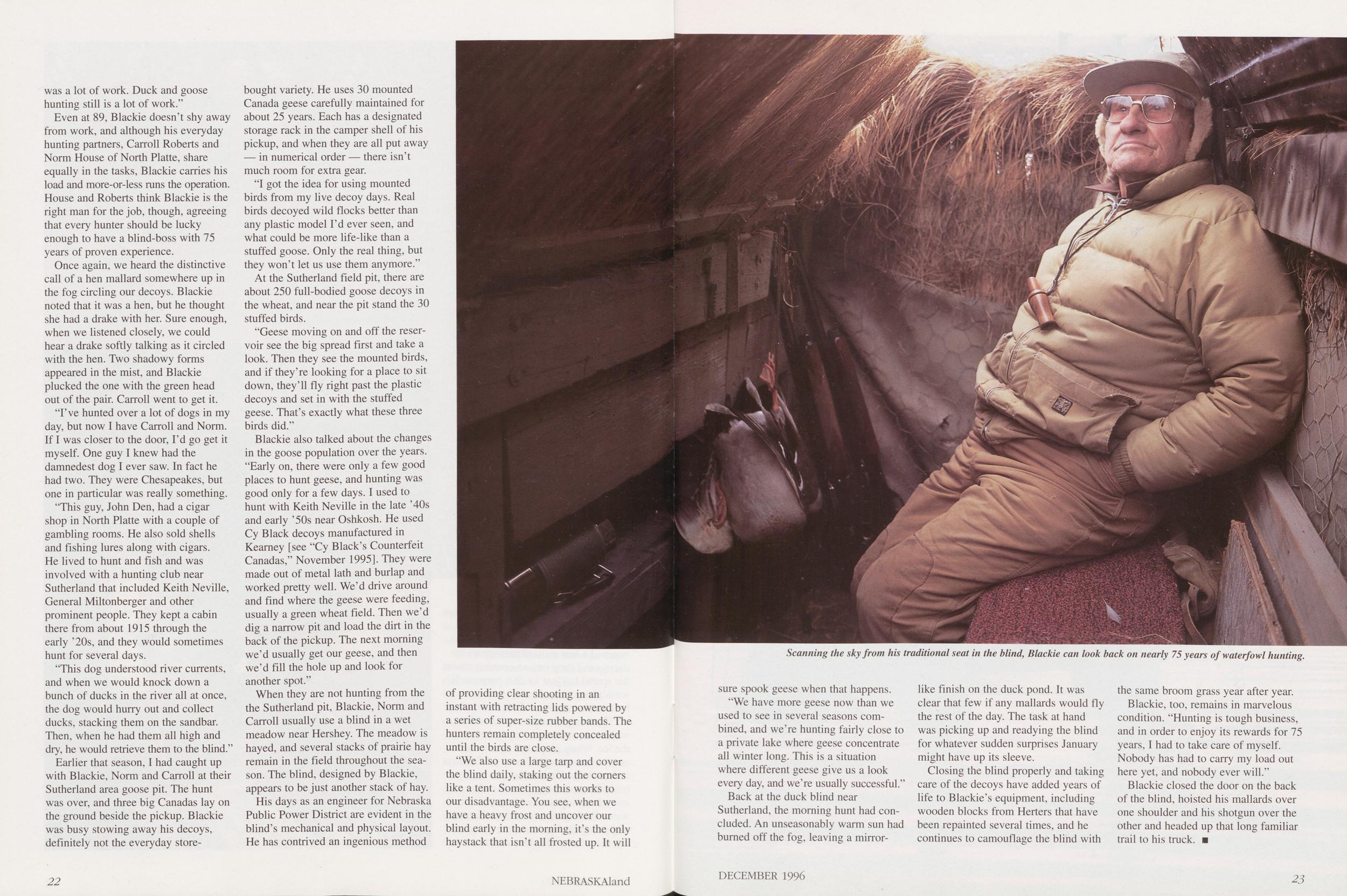
Earlier that season, I had caught up with Blackie, Norm and Carroll at their Sutherland area goose pit. The hunt was over, and three big Canadas lay on the ground beside the pickup. Blackie was busy stowing away his decoys, definitely not the everyday store bought variety. He uses 30 mounted Canada geese carefully maintained for about 25 years. Each has a designated storage rack in the camper shell of his pickup, and when they are all put away — in numerical order — there isn't much room for extra gear.
"I got the idea for using mounted birds from my live decoy days. Real birds decoyed wild flocks better than any plastic model I'd ever seen, and what could be more life-like than a stuffed goose. Only the real thing, but they won't let us use them anymore."
At the Sutherland field pit, there are about 250 full-bodied goose decoys in the wheat, and near the pit stand the 30 stuffed birds.
"Geese moving on and off the reservoir see the big spread first and take a look. Then they see the mounted birds, and if they're looking for a place to sit down, they'll fly right past the plastic decoys and set in with the stuffed geese. That's exactly what these three birds did."
Blackie also talked about the changes in the goose population over the years. "Early on, there were only a few good places to hunt geese, and hunting was good only for a few days. I used to hunt with Keith Neville in the late '40s and early '50s near Oshkosh. He used Cy Black decoys manufactured in Kearney [see "Cy Black's Counterfeit Canadas," November 1995]. They were made out of metal lath and burlap and worked pretty well. We'd drive around and find where the geese were feeding, usually a green wheat field. Then we'd dig a narrow pit and load the dirt in the back of the pickup. The next morning we'd usually get our geese, and then we'd fill the hole up and look for another spot."
When they are not hunting from the the Sutherland pit, Blackie, Norm and Carroll usually use a blind in a wet meadow near Hershey. The meadow is hayed, and several stacks of prairie hay remain in the field throughout the season. The blind, designed by Blackie, appears to be just another stack of hay.
His days as an engineer for Nebraska Public Power District are evident in the blind's mechanical and physical layout. He has contrived an ingenious method of providing clear shooting in an instant with retracting lids powered by a series of super-size rubber bands. The hunters remain completely concealed until the birds are close.
"We also use a large tarp and cover the blind daily, staking out the corners like a tent. Sometimes this works to our disadvantage. You see, when we have a heavy frost and uncover our blind early in the morning, it's the only haystack that isn't all frosted up. It will 22 NEBRASKAland
'We have more geese now than we used to see in several seasons combined, and we're hunting fairly close to a private lake where geese concentrate all winter long. This is a situation where different geese give us a look every day, and we're usually successful."
Back at the duck blind near Sutherland, the morning hunt had concluded. An unseasonably warm sun had burned off the fog, leaving a mirror-like finish on the duck pond. It was clear that few if any mallards would fly the rest of the day. The task at hand was picking up and readying the blind for whatever sudden surprises January might have up its sleeve.
Closing the blind properly and taking care of the decoys have added years of life to Blackie's equipment, including wooden blocks from Herters that have been repainted several times, and he continues to camouflage the blind with the same broom grass year after year.
Blackie, too, remains in marvelous condition. "Hunting is tough business, and in order to enjoy its rewards for 75 years, I had to take care of myself. Nobody has had to carry my load out here yet, and nobody ever will."
Blackie closed the door on the back of the blind, hoisted his mallards over one shoulder and his shotgun over the other and headed up that long familiar trail to his truck.
DECEMBER 1996 23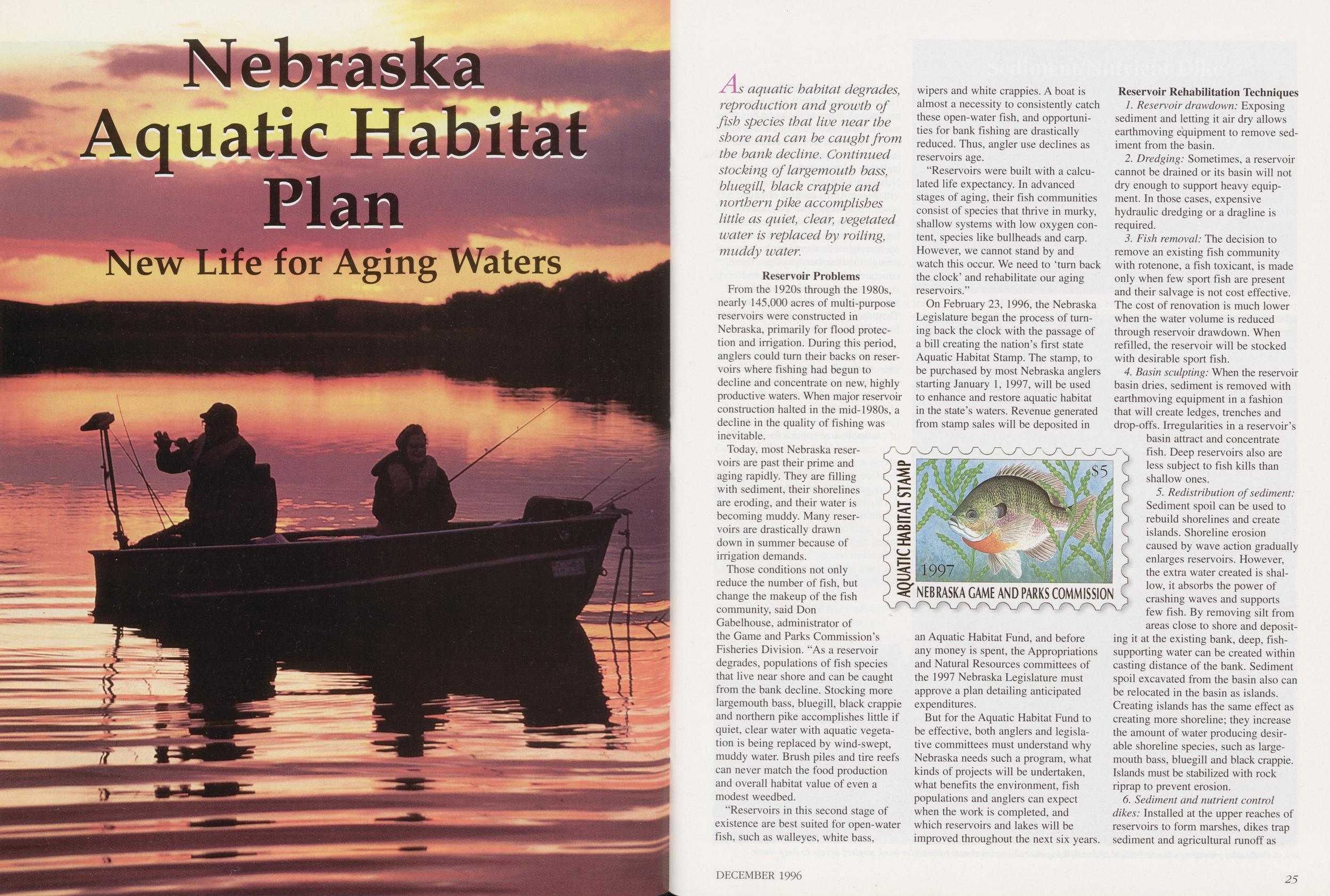
Nebraska Aquatic Habitat Plan
New Life for Aging Waters fs aquatic habitat degrades, reproduction and growth of fish species that live near the shore and can be caught from the bank decline. Continued stocking of largemouth bass, bluegill, black crappie and northern pike accomplishes little as quiet, clear, vegetated water is replaced by roiling, muddy water. Reservoir ProblemsFrom the 1920s through the 1980s, nearly 145,000 acres of multi-purpose reservoirs were constructed in Nebraska, primarily for flood protection and irrigation. During this period, anglers could turn their backs on reservoirs where fishing had begun to decline and concentrate on new, highly productive waters. When major reservoir construction halted in the mid-1980s, a decline in the quality of fishing was inevitable.
Today, most Nebraska reservoirs are past their prime and aging rapidly. They are filling with sediment, their shorelines are eroding, and their water is becoming muddy. Many reservoirs are drastically drawn down in summer because of irrigation demands.
Those conditions not only reduce the number of fish, but change the makeup of the fish community, said Don Gabelhouse, administrator of the Game and Parks Commission's Fisheries Division. "As a reservoir degrades, populations of fish species that live near shore and can be caught from the bank decline. Stocking more largemouth bass, bluegill, black crappie and northern pike accomplishes little if quiet, clear water with aquatic vegetation is being replaced by wind-swept, muddy water. Brush piles and tire reefs can never match the food production and overall habitat value of even a modest weedbed.
"Reservoirs in this second stage of existence are best suited for open-water fish, such as walleyes, white bass, wipers and white crappies. A boat is almost a necessity to consistently catch these open-water fish, and opportunities for bank fishing are drastically reduced. Thus, angler use declines as reservoirs age.
"Reservoirs were built with a calculated life expectancy. In advanced stages of aging, their fish communities consist of species that thrive in murky, shallow systems with low oxygen content, species like bullheads and carp. However, we cannot stand by and watch this occur. We need to 'turn back the clock' and rehabilitate our aging reservoirs."
On February 23, 1996, the Nebraska Legislature began the process of turning back the clock with the passage of a bill creating the nation's first state Aquatic Habitat Stamp. The stamp, to be purchased by most Nebraska anglers starting January 1, 1997, will be used to enhance and restore aquatic habitat in the state's waters. Revenue generated from stamp sales will be deposited in an Aquatic Habitat Fund, and before any money is spent, the Appropriations and Natural Resources committees of the 1997 Nebraska Legislature must approve a plan detailing anticipated expenditures.
But for the Aquatic Habitat Fund to be effective, both anglers and legislative committees must understand why Nebraska needs such a program, what kinds of projects will be undertaken, what benefits the environment, fish populations and anglers can expect when the work is completed, and which reservoirs and lakes will be improved throughout the next six years.
Reservoir Rehabilitation Techniques1. Reservoir drawdown: Exposing sediment and letting it air dry allows earthmoving equipment to remove sediment from the basin.
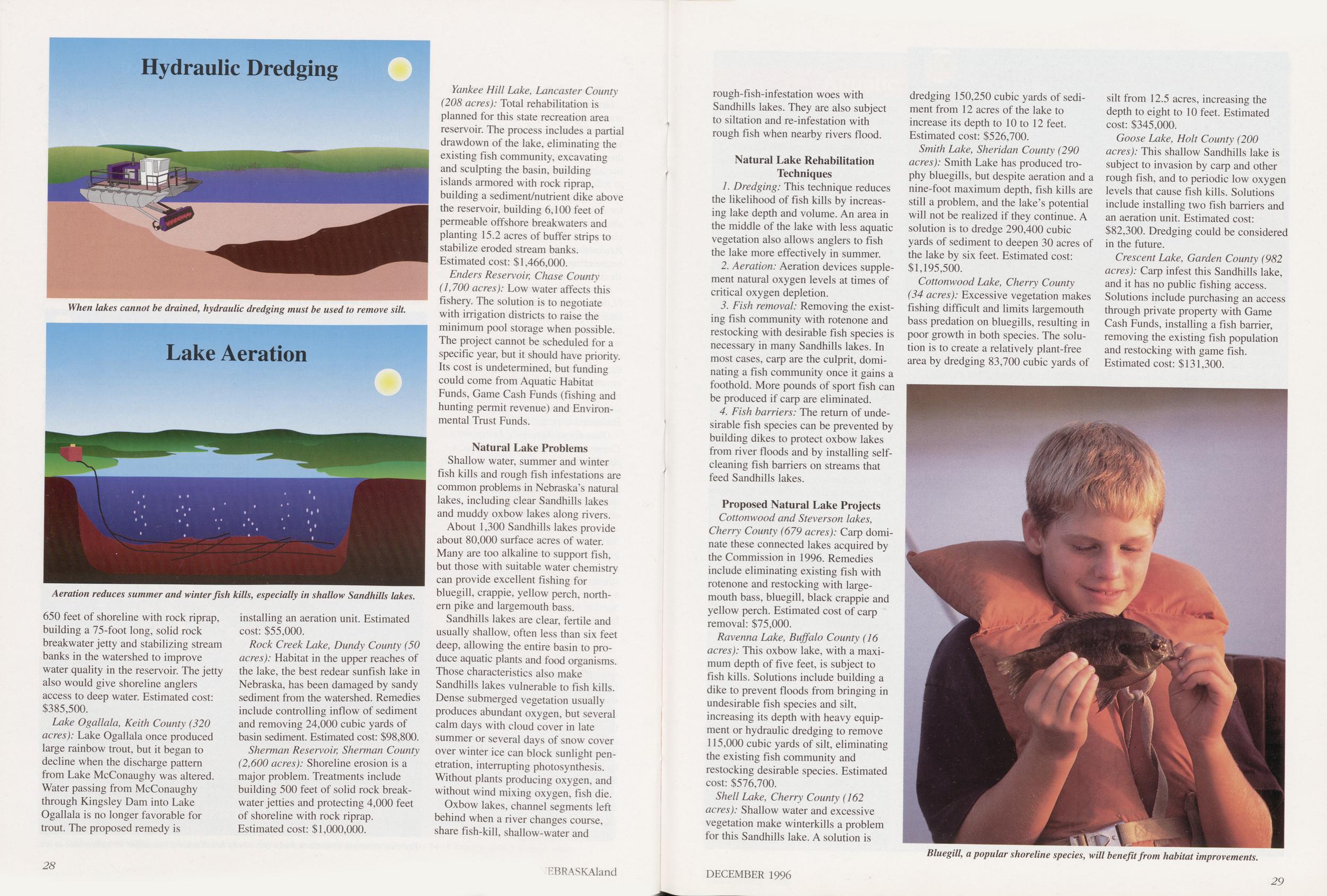
2. Dredging: Sometimes, a reservoir cannot be drained or its basin will not dry enough to support heavy equipment. In those cases, expensive hydraulic dredging or a dragline is required.
3. Fish removal: The decision to remove an existing fish community with rotenone, a fish toxicant, is made only when few sport fish are present and their salvage is not cost effective. The cost of renovation is much lower when the water volume is reduced through reservoir drawdown. When refilled, the reservoir will be stocked with desirable sport fish.
4. Basin sculpting: When the reservoir basin dries, sediment is removed with earthmoving equipment in a fashion that will create ledges, trenches and drop-offs. Irregularities in a reservoir's basin attract and concentrate fish. Deep reservoirs also are less subject to fish kills than shallow ones.
5. Redistribution of sediment: Sediment spoil can be used to rebuild shorelines and create islands. Shoreline erosion caused by wave action gradually enlarges reservoirs. However, the extra water created is shallow, it absorbs the power of crashing waves and supports few fish. By removing silt from areas close to shore and depositing it at the existing bank, deep, fish supporting water can be created within casting distance of the bank. Sediment spoil excavated from the basin also can be relocated in the basin as islands. Creating islands has the same effect as creating more shoreline; they increase the amount of water producing desirable shoreline species, such as large mouth bass, bluegill and black crappie. Islands must be stabilized with rock riprap to prevent erosion.
6. Sediment and nutrient control dikes: Installed at the upper reaches of reservoirs to form marshes, dikes trap sediment and agricultural runoff as DECEMBER 1996 25 Sediment/Nutrient Dike water enters the lake. Trapping sediment above the reservoir where it can be removed periodically keeps the water in the reservoir clearer than if sediment is allowed to accumulate in the basin or remain suspended. The importance of clear water cannot be overstated.
Anglers catch more fish from clear water, and more sport fish can be supported by a reservoir with clear water. Clear water produces more zooplankton than muddy water, and those microscopic animals are the food on which small fish live. Regardless of size and bag limits, a bass will never reach five pounds if zooplankton is not available when the fish is no more than an inch long.
Water clarity also affects the amount of vegetation a reservoir will support. Sunlight does not penetrate murky water, so rooted aquatic plants, the key to good habitat, cannot grow. Aquatic plants provide refuge for young game fish and baitfish, feeding areas for predators and shade from summer sun, but aquatic vegetation has an even greater value. The leaves and stems provide surfaces on which crustaceans, aquatic insects and other food organ- isms attach and grow, and the plants' process of photosynthesis replenishes the water's vital oxygen supply. Sediment/nutrient dikes also benefit terrestrial wildlife, including fur bearers and waterfowl, by creating wetlands above and below the structures.
7. Off-shore breakwater jetties: Built near erosion-prone shorelines in water four or five feet deep, these structures create quiet water near shore. Structures must be connected to the shore at intervals to exclude boats, and culverts must be included to allow fish passage. These structures are a better alternative for stabilizing eroding shorelines than simply dumping rock riprap. Aquatic vegetation should grow between the structures and the shore, allowing both shore-bound anglers and boat anglers access to productive fishing water. Jetties also can serve as spawning habitat for walleyes.
8. Atkinson Permeable Breakwaters: These pre-cast concrete structures can accomplish many of the same things as solid rock breakwaters, but at a lower cost. They work well in oceans, but they must be tested to determine how well they withstand the pressures of Nebraska's winters.
9. Piers: At the mouths of large coves, rock breakwater piers can be built from opposing shorelines, extending toward one another so that the opening between them is just wide enough to allow boat passage. These structures reduce wave action and shoreline erosion in the cove and provide anglers access to deep water. They, too, can enhance spawning habitat for walleyes.
10. Increased water storage: Summer drawdowns in irrigation reservoirs flush fish and reduce the space and habitat available for fish. Stable water levels would increase the number of small fish that survive beyond their first year of life, increasing the number of catchable-size fish for the future.
Grade Creek Pond, Loup County (2 acres): A popular put-and-take trout fishery, Gracie Creek Pond has filled with sediment and is a candidate for dredging. First, however, land use practices in the watershed must be modified to reduce sediment entering the pond. The pond has an adequate water supply for a year-round trout fishery, but its abundant carp population reduces water clarity and limits its capacity for trout. Removal of the carp and design and engineering for a sediment control dike should cost about $5,500.
Lake Moloney, Lincoln County (1,600 acres): A smooth basin provides little fish-attracting structure. Solutions include building a 100-foot rock breakwater jetty in the main recreation area on Peck's Point and stabilizing more than 300 feet of eroding shoreline around Goose Island. The improvements will take place during two scheduled reservoir drawdowns. Estimated cost: $111,800.
Olive Creek Reservoir, Lancaster County (175 acres): Muddy water, a silt-filled basin with a maximum depth of nine feet and a large carp population plague this lake. Total rehabilitation would include lowering the water level, eliminating the existing fish, building a sediment/nutrient dike, removing 300,000 cubic yards of sediment, creating islands and building two miles of riparian buffer strips along the inlet stream. Environmental Trust Funds and a U.S. Army Corps of Engineers Section 1135 grant will be needed to fund half the project. Estimated cost: $1,411,600.
Pibel Lake, Wheeler County (27 acres): Shallow water, excessive aquatic vegetation and fish kills limit the Pibel Lake fishery. Solutions include lowering the water level, removing 60,000 cubic yards of sediment and building two 100-foot long combination earth and rock riprap jetties to reduce shoreline erosion and improve angler access to deep water. Estimated cost: $168,000.
Willow Creek Reservoir, Pierce County (700 acres): Wind-driven shoreline erosion afflicts an otherwise good fishery. Solutions include stabilizing
Lake Ogallala, Keith County (320 acres): Lake Ogallala once produced large rainbow trout, but it began to decline when the discharge pattern from Lake McConaughy was altered. Water passing from McConaughy through Kingsley Dam into Lake Ogallala is no longer favorable for trout. The proposed remedy is installing an aeration unit. Estimated cost: $55,000.
Rock Creek Lake, Dundy County (50 acres): Habitat in the upper reaches of the lake, the best redear sunfish lake in Nebraska, has been damaged by sandy sediment from the watershed. Remedies include controlling inflow of sediment and removing 24,000 cubic yards of basin sediment. Estimated cost: $98,800.
Sherman Reservoir, Sherman County (2,600 acres): Shoreline erosion is a major problem. Treatments include building 500 feet of solid rock break water jetties and protecting 4,000 feet of shoreline with rock riprap. Estimated cost: $1,000,000.
Yankee Hill Lake, Lancaster County (208 acres): Total rehabilitation is planned for this state recreation area reservoir. The process includes a partial drawdown of the lake, eliminating the existing fish community, excavating and sculpting the basin, building islands armored with rock riprap, building a sediment/nutrient dike above the reservoir, building 6,100 feet of permeable offshore breakwaters and planting 15.2 acres of buffer strips to stabilize eroded stream banks. Estimated cost: $1,466,000.
Enders Reservoir, Chase County (1,700 acres): Low water affects this fishery. The solution is to negotiate with irrigation districts to raise the minimum pool storage when possible. The project cannot be scheduled for a specific year, but it should have priority. Its cost is undetermined, but funding could come from Aquatic Habitat Funds, Game Cash Funds (fishing and hunting permit revenue) and Environmental Trust Funds.
Natural Lake ProblemsShallow water, summer and winter fish kills and rough fish infestations are common problems in Nebraska's natural lakes, including clear Sandhills lakes and muddy oxbow lakes along rivers.
About 1,300 Sandhills lakes provide about 80,000 surface acres of water. Many are too alkaline to support fish, but those with suitable water chemistry can provide excellent fishing for bluegill, crappie, yellow perch, northern pike and largemouth bass.
Sandhills lakes are clear, fertile and usually shallow, often less than six feet deep, allowing the entire basin to produce aquatic plants and food organisms. Those characteristics also make Sandhills lakes vulnerable to fish kills. Dense submerged vegetation usually produces abundant oxygen, but several calm days with cloud cover in late summer or several days of snow cover over winter ice can block sunlight penetration, interrupting photosynthesis. Without plants producing oxygen, and without wind mixing oxygen, fish die.
Oxbow lakes, channel segments left behind when a river changes course, share fish-kill, shallow-water and 28 EBRASKAland rough-fish-infestation woes with Sandhills lakes. They are also subject to siltation and re-infestation with rough fish when nearby rivers flood.
Natural Lake Rehabilitation Techniques7. Dredging: This technique reduces the likelihood of fish kills by increasing lake depth and volume. An area in the middle of the lake with less aquatic vegetation also allows anglers to fish the lake more effectively in summer.
2. Aeration: Aeration devices supplement natural oxygen levels at times of critical oxygen depletion.
3. Fish removal: Removing the existing fish community with rotenone and restocking with desirable fish species is necessary in many Sandhills lakes. In most cases, carp are the culprit, dominating a fish community once it gains a foothold. More pounds of sport fish can be produced if carp are eliminated.
4. Fish barriers: The return of undesirable fish species can be prevented by building dikes to protect oxbow lakes from river floods and by installing self cleaning fish barriers on streams that feed Sandhills lakes.
Proposed Natural Lake Projects Cottonwood and Steverson lakes, Cherry County (679 acres): Carp dominate these connected lakes acquired by the Commission in 1996. Remedies include eliminating existing fish with rotenone and restocking with large mouth bass, bluegill, black crappie and yellow perch. Estimated cost of carp removal: $75,000. Ravenna Lake, Buffalo County (16 acres): This oxbow lake, with a maximum depth of five feet, is subject to fish kills. Solutions include building a dike to prevent floods from bringing in undesirable fish species and silt, increasing its depth with heavy equipment or hydraulic dredging to remove 115,000 cubic yards of silt, eliminating the existing fish community and restocking desirable species. Estimated cost: $576,700. Shell Lake, Cherry County (162 acres): Shallow water and excessive vegetation make winterkills a problem for this Sandhills lake. A solution is dredging 150,250 cubic yards of sediment from 12 acres of the lake to increase its depth to 10 to 12 feet. Estimated cost: $526,700.Smith Lake, Sheridan County (290 acres): Smith Lake has produced trophy bluegills, but despite aeration and a nine-foot maximum depth, fish kills are still a problem, and the lake's potential will not be realized if they continue. A solution is to dredge 290,400 cubic yards of sediment to deepen 30 acres of the lake by six feet. Estimated cost: $1,195,500.
Cottonwood Lake, Cherry County (34 acres): Excessive vegetation makes fishing difficult and limits largemouth bass predation on bluegills, resulting in poor growth in both species. The solution is to create a relatively plant-free area by dredging 83,700 cubic yards of silt from 12.5 acres, increasing the depth to eight to 10 feet. Estimated cost: $345,000.
Goose Lake, Holt County (200 acres): This shallow Sandhills lake is subject to invasion by carp and other rough fish, and to periodic low oxygen levels that cause fish kills. Solutions include installing two fish barriers and an aeration unit. Estimated cost: $82,300. Dredging could be considered in the future.
Crescent Lake, Garden County (982 acres): Carp infest this Sandhills lake, and it has no public fishing access. Solutions include purchasing an access through private property with Game Cash Funds, installing a fish barrier, removing the existing fish population and restocking with game fish. Estimated cost: $131,300.
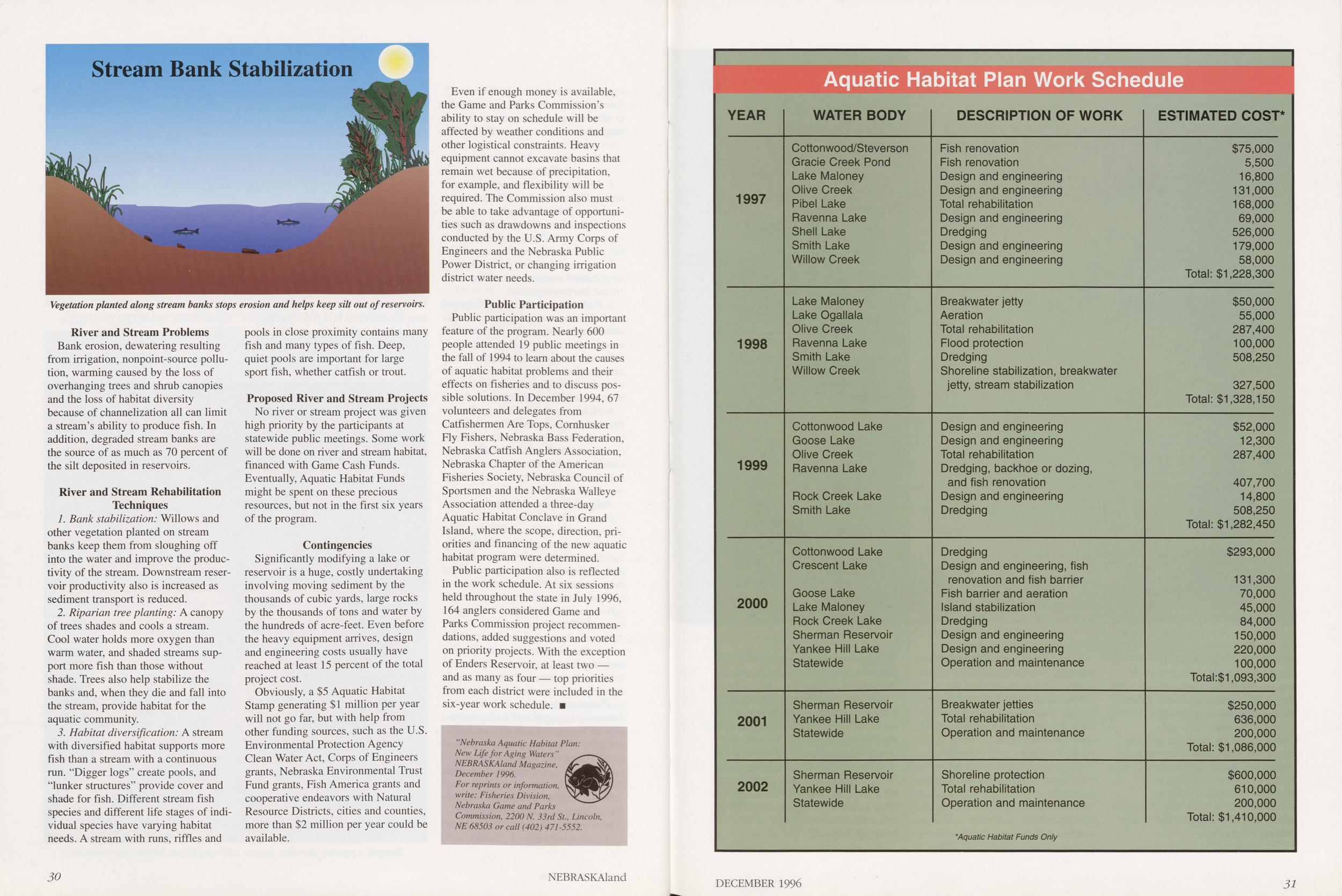
Bank erosion, dewatering resulting from irrigation, nonpoint-source pollution, warming caused by the loss of overhanging trees and shrub canopies and the loss of habitat diversity because of channelization all can limit a stream's ability to produce fish. In addition, degraded stream banks are the source of as much as 70 percent of the silt deposited in reservoirs.
River and Stream Rehabilitation Techniques7. Bank stabilization: Willows and other vegetation planted on stream banks keep them from sloughing off into the water and improve the productivity of the stream. Downstream reservoir productivity also is increased as sediment transport is reduced.
2. Riparian tree planting: A canopy of trees shades and cools a stream. Cool water holds more oxygen than warm water, and shaded streams support more fish than those without shade. Trees also help stabilize the banks and, when they die and fall into the stream, provide habitat for the aquatic community.
3. Habitat diversification: A stream with diversified habitat supports more fish than a stream with a continuous run. "Digger logs" create pools, and "lunker structures" provide cover and shade for fish. Different stream fish species and different life stages of individual species have varying habitat needs. A stream with runs, riffles and pools in close proximity contains many fish and many types of fish. Deep, quiet pools are important for large sport fish, whether catfish or trout.
Proposed River and Stream ProjectsNo river or stream project was given high priority by the participants at statewide public meetings. Some work will be done on river and stream habitat, financed with Game Cash Funds. Eventually, Aquatic Habitat Funds might be spent on these precious resources, but not in the first six years of the program.
ContingenciesSignificantly modifying a lake or reservoir is a huge, costly undertaking involving moving sediment by the thousands of cubic yards, large rocks by the thousands of tons and water by the hundreds of acre-feet. Even before the heavy equipment arrives, design and engineering costs usually have reached at least 15 percent of the total project cost.
Obviously, a $5 Aquatic Habitat Stamp generating $1 million per year will not go far, but with help from other funding sources, such as the U.S. Environmental Protection Agency Clean Water Act, Corps of Engineers grants, Nebraska Environmental Trust Fund grants, Fish America grants and cooperative endeavors with Natural Resource Districts, cities and counties, more than $2 million per year could be available.
Even if enough money is available, the Game and Parks Commission's ability to stay on schedule will be affected by weather conditions and other logistical constraints. Heavy equipment cannot excavate basins that remain wet because of precipitation, for example, and flexibility will be required. The Commission also must be able to take advantage of opportunities such as drawdowns and inspections conducted by the U.S. Army Corps of Engineers and the Nebraska Public Power District, or changing irrigation district water needs.
Public ParticipationPublic participation was an important feature of the program. Nearly 600 people attended 19 public meetings in the fall of 1994 to learn about the causes of aquatic habitat problems and their effects on fisheries and to discuss possible solutions. In December 1994, 67 volunteers and delegates from Catfishermen Are Tops, Cornhusker Fly Fishers, Nebraska Bass Federation, Nebraska Catfish Anglers Association, Nebraska Chapter of the American Fisheries Society, Nebraska Council of Sportsmen and the Nebraska Walleye Association attended a three-day Aquatic Habitat Conclave in Grand Island, where the scope, direction, priorities and financing of the new aquatic habitat program were determined.
Public participation also is reflected in the work schedule. At six sessions held throughout the state in July 1996, 164 anglers considered Game and Parks Commission project recommendations, added suggestions and voted on priority projects. With the exception of Enders Reservoir, at least two — and as many as four — top priorities from each district were included in the six-year work schedule.
"Nebraska Aquatic Habitat Plan: New Life for Aging Waters " NEBRASKAland Magazine, December 1996. For reprints or information, write: Fisheries Division, Nebraska Game and Parks Commission, 2200 N. 33rd St., Lincoln, NE 68503 or call (402) 471-5552. 30 NEBRASKAland quatic RlJfs YEAR WATER BODY DESCRIPTION OF WORK ESTIMATED COST 1997 Cottonwood/Steverson Gracie Creek Pond Lake Maloney Olive Creek Pibel Lake Ravenna Lake Shell Lake Smith Lake Willow Creek Fish renovation Fish renovation Design and engineering Design and engineering Total rehabilitation Design and engineering Dredging Design and engineering Design and engineering $75,000 5,500 16,800 131,000 168,000 69,000 526,000 179,000 58,000 Total: $1,228,300 1998 Lake Maloney Lake Ogallala Olive Creek Ravenna Lake Smith Lake Willow Creek Breakwater jetty Aeration Total rehabilitation Flood protection Dredging Shoreline stabilization, breakwater jetty, stream stabilization $50,000 55,000 287,400 100,000 508,250 327,500 Total: $1,328,150 1999 Cottonwood Lake Goose Lake Olive Creek Ravenna Lake Rock Creek Lake Smith Lake Design and engineering Design and engineering Total rehabilitation Dredging, backhoe or dozing, and fish renovation Design and engineering Dredging $52,000 12,300 287,400 407,700 14,800 508,250 Total: $1,282,450 2000 Cottonwood Lake Crescent Lake Goose Lake Lake Maloney Rock Creek Lake Sherman Reservoir Yankee Hill Lake Statewide Dredging Design and engineering, fish renovation and fish barrier Fish barrier and aeration Island stabilization Dredging Design and engineering Design and engineering Operation and maintenance $293,000 131,300 70,000 45,000 84,000 150,000 220,000 100,000 Total:$1,093,300 2001 Sherman Reservoir Yankee Hill Lake Statewide Breakwater jetties Total rehabilitation Operation and maintenance $250,000 636,000 200,000 Total: $1,086,000 2002 Sherman Reservoir Yankee Hill Lake Statewide Shoreline protection Total rehabilitation Operation and maintenance $600,000 610,000 200,000 Total: $1,410,000 * Aquatic Habitat Funds Only DECEMBER 1996 31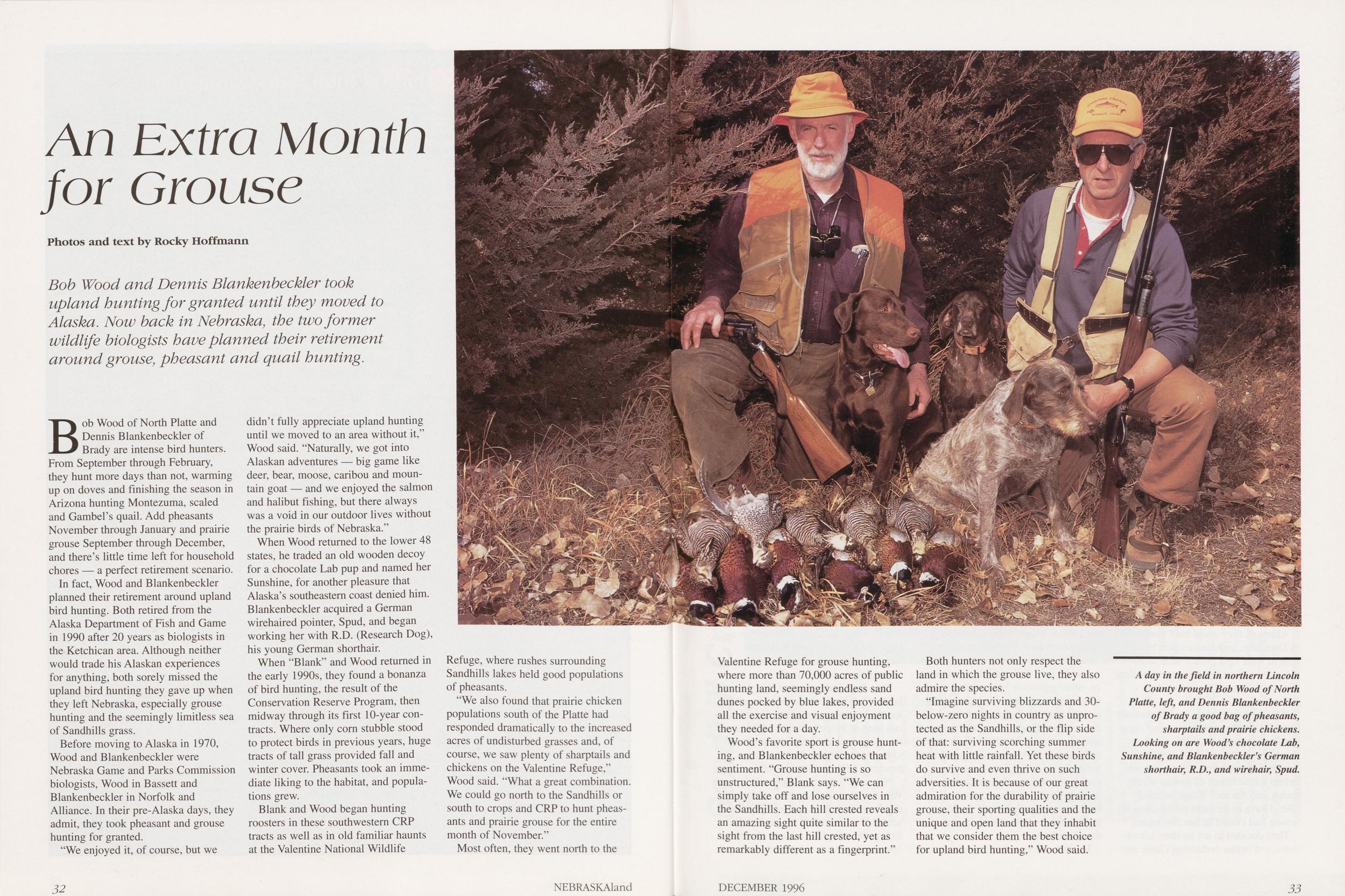
An Extra Month for Grouse
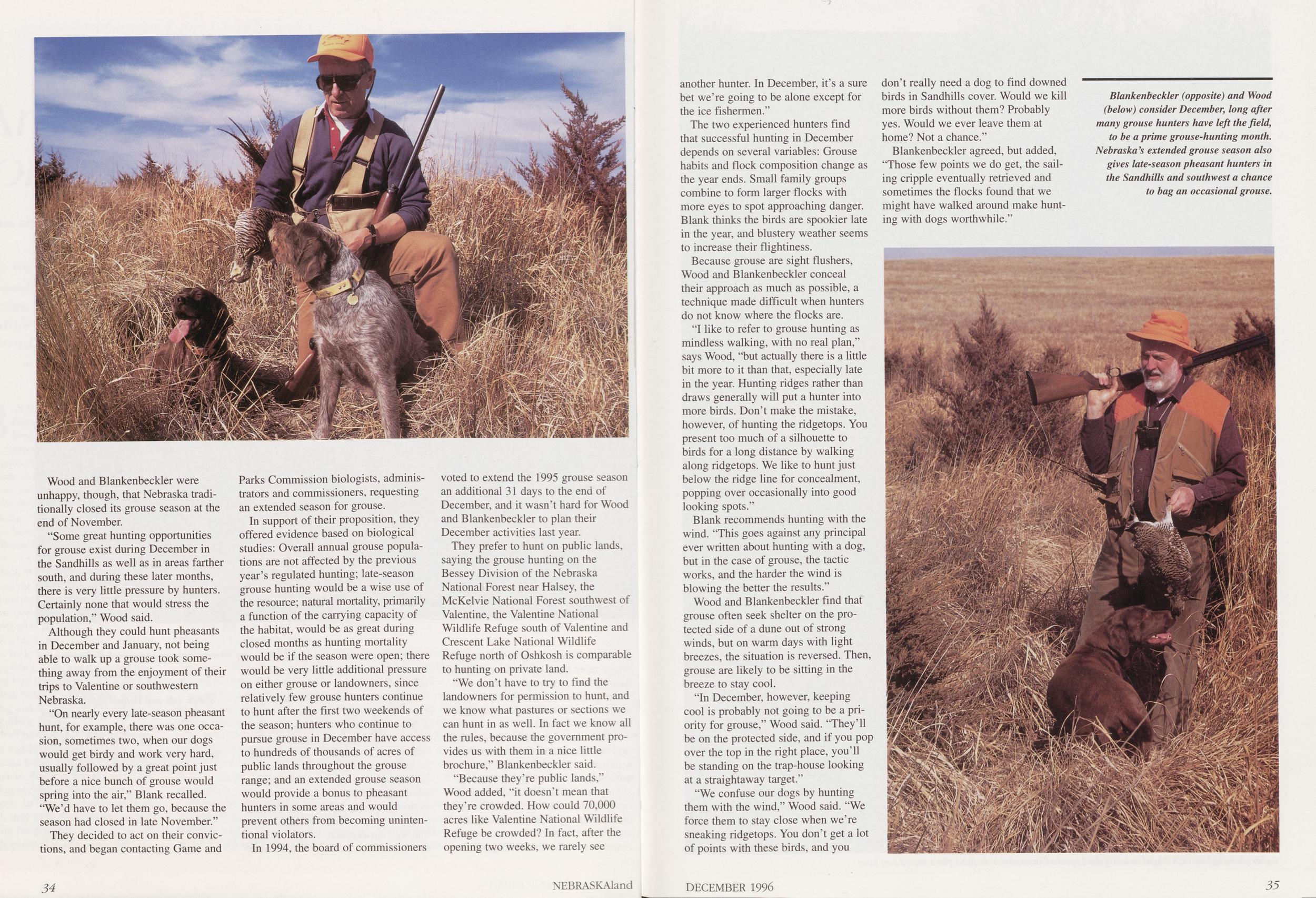
Photos and text by Rocky Hoffmann Bob Wood and Dennis Blankenbeckler took upland hunting for granted until they moved to Alaska. Now back in Nebraska, the two former wildlife biologists have planned their retirement around grouse, pheasant and quail hunting.Bob Wood of North Platte and Dennis Blankenbeckler of Brady are intense bird hunters. From September through February, they hunt more days than not, warming up on doves and finishing the season in Arizona hunting Montezuma, scaled and Gambel's quail. Add pheasants November through January and prairie grouse September through December, and there's little time left for household chores — a perfect retirement scenario.
In fact, Wood and Blankenbeckler planned their retirement around upland bird hunting. Both retired from the Alaska Department of Fish and Game in 1990 after 20 years as biologists in the Ketchican area. Although neither would trade his Alaskan experiences for anything, both sorely missed the upland bird hunting they gave up when they left Nebraska, especially grouse hunting and the seemingly limitless sea of Sandhills grass.
Before moving to Alaska in 1970, Wood and Blankenbeckler were Nebraska Game and Parks Commission biologists, Wood in Bassett and Blankenbeckler in Norfolk and Alliance. In their pre-Alaska days, they admit, they took pheasant and grouse hunting for granted.
"We enjoyed it, of course, but we didn't fully appreciate upland hunting until we moved to an area without it," Wood said. "Naturally, we got into Alaskan adventures — big game like deer, bear, moose, caribou and mountain goat — and we enjoyed the salmon and halibut fishing, but there always was a void in our outdoor lives without the prairie birds of Nebraska."
When Wood returned to the lower 48 states, he traded an old wooden decoy for a chocolate Lab pup and named her Sunshine, for another pleasure that Alaska's southeastern coast denied him. Blankenbeckler acquired a German wire haired pointer, Spud, and began working her with R.D. (Research Dog), his young German shorthair.
When "Blank" and Wood returned in the early 1990s, they found a bonanza of bird hunting, the result of the Conservation Reserve Program, then midway through its first 10-year contracts. Where only corn stubble stood to protect birds in previous years, huge tracts of tall grass provided fall and winter cover. Pheasants took an immediate liking to the habitat, and populations grew.
Blank and Wood began hunting roosters in these southwestern CRP tracts as well as in old familiar haunts at the Valentine National Wildlife Refuge, where rushes surrounding Sandhills lakes held good populations of pheasants.
"We also found that prairie chicken populations south of the Platte had responded dramatically to the increased acres of undisturbed grasses and, of course, we saw plenty of sharptails and chickens on the Valentine Refuge," Wood said. "What a great combination. We could go north to the Sandhills or south to crops and CRP to hunt pheasants and prairie grouse for the entire month of November."
Most often, they went north to the 32 NEBRASKAland Valentine Refuge for grouse hunting, where more than 70,000 acres of public hunting land, seemingly endless sand dunes pocked by blue lakes, provided all the exercise and visual enjoyment they needed for a day.
Wood's favorite sport is grouse hunting, and Blankenbeckler echoes that sentiment. "Grouse hunting is so unstructured," Blank says. "We can simply take off and lose ourselves in the Sandhills. Each hill crested reveals an amazing sight quite similar to the sight from the last hill crested, yet as remarkably different as a fingerprint."
Both hunters not only respect the land in which the grouse live, they also admire the species.
"Imagine surviving blizzards and 30-below-zero nights in country as unprotected as the Sandhills, or the flip side of that: surviving scorching summer heat with little rainfall. Yet these birds do survive and even thrive on such adversities. It is because of our great admiration for the durability of prairie grouse, their sporting qualities and the unique and open land that they inhabit that we consider them the best choice for upland bird hunting," Wood said.
Wood and Blankenbeckler were unhappy, though, that Nebraska traditionally closed its grouse season at the end of November.
"Some great hunting opportunities for grouse exist during December in the Sandhills as well as in areas farther south, and during these later months, there is very little pressure by hunters. Certainly none that would stress the population," Wood said.
Although they could hunt pheasants in December and January, not being able to walk up a grouse took something away from the enjoyment of their trips to Valentine or southwestern Nebraska.
"On nearly every late-season pheasant hunt, for example, there was one occasion, sometimes two, when our dogs would get birdy and work very hard, usually followed by a great point just before a nice bunch of grouse would spring into the air," Blank recalled. "We'd have to let them go, because the season had closed in late November."
They decided to act on their convictions, and began contacting Game and Parks Commission biologists, administrators and commissioners, requesting an extended season for grouse.
In support of their proposition, they offered evidence based on biological studies: Overall annual grouse populations are not affected by the previous year's regulated hunting; late-season grouse hunting would be a wise use of the resource; natural mortality, primarily a function of the carrying capacity of the habitat, would be as great during closed months as hunting mortality would be if the season were open; there would be very little additional pressure on either grouse or landowners, since relatively few grouse hunters continue to hunt after the first two weekends of the season; hunters who continue to pursue grouse in December have access to hundreds of thousands of acres of public lands throughout the grouse range; and an extended grouse season would provide a bonus to pheasant hunters in some areas and would prevent others from becoming unintentional violators.
In 1994, the board of commissioners voted to extend the 1995 grouse season an additional 31 days to the end of December, and it wasn't hard for Wood and Blankenbeckler to plan their December activities last year.
They prefer to hunt on public lands, saying the grouse hunting on the Bessey Division of the Nebraska National Forest near Halsey, the McKelvie National Forest southwest of Valentine, the Valentine National Wildlife Refuge south of Valentine and Crescent Lake National Wildlife Refuge north of Oshkosh is comparable to hunting on private land.
"We don't have to try to find the landowners for permission to hunt, and we know what pastures or sections we can hunt in as well. In fact we know all the rules, because the government provides us with them in a nice little brochure," Blankenbeckler said.
"Because they're public lands," Wood added, "it doesn't mean that they're crowded. How could 70,000 acres like Valentine National Wildlife Refuge be crowded? In fact, after the opening two weeks, we rarely see 34 NEBRASKAland another hunter. In December, it's a sure bet we're going to be alone except for the ice fishermen."
The two experienced hunters find that successful hunting in December depends on several variables: Grouse habits and flock composition change as the year ends. Small family groups combine to form larger flocks with more eyes to spot approaching danger. Blank thinks the birds are spookier late in the year, and blustery weather seems to increase their flightiness.
Because grouse are sight fishers, Wood and Blankenbeckler conceal their approach as much as possible, a technique made difficult when hunters do not know where the flocks are.
"I like to refer to grouse hunting as mindless walking, with no real plan," says Wood, "but actually there is a little bit more to it than that, especially late in the year. Hunting ridges rather than draws generally will put a hunter into more birds. Don't make the mistake, however, of hunting the ridgetops. You present too much of a silhouette to birds for a long distance by walking along ridgetops. We like to hunt just below the ridge line for concealment, popping over occasionally into good looking spots."
Blank recommends hunting with the wind. "This goes against any principal ever written about hunting with a dog, but in the case of grouse, the tactic works, and the harder the wind is blowing the better the results."
Wood and Blankenbeckler find that grouse often seek shelter on the protected side of a dune out of strong winds, but on warm days with light breezes, the situation is reversed. Then, grouse are likely to be sitting in the breeze to stay cool.
"In December, however, keeping cool is probably not going to be a priority for grouse," Wood said. "They'll be on the protected side, and if you pop over the top in the right place, you'll be standing on the trap-house looking at a straightaway target."
"We confuse our dogs by hunting them with the wind," Wood said. "We force them to stay close when we're sneaking ridgetops. You don't get a lot of points with these birds, and you don't really need a dog to find downed birds in Sandhills cover. Would we kill more birds without them? Probably yes. Would we ever leave them at home? Not a chance."
Blankenbeckler agreed, but added, "Those few points we do get, the sailing cripple eventually retrieved and sometimes the flocks found that we might have walked around make hunting with dogs worthwhile."
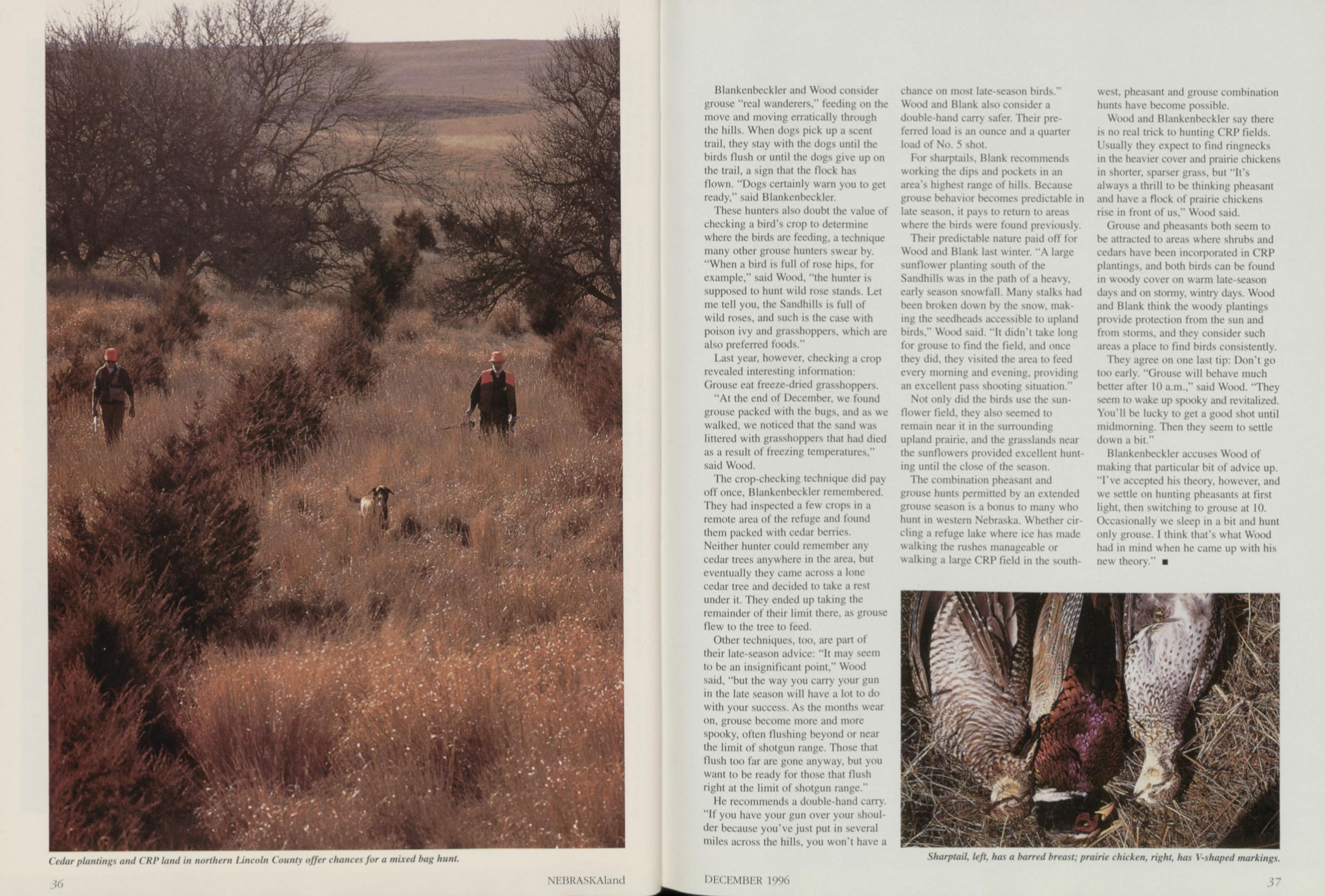
Blankenbecklei and Wood considi grouse "real wanderers,*1 feeding on the move and moving erratically throu the hill When Joes pick up a scent trail, they stay with the does until the Hush 01 until the dive up on the trail, a sign that the flock has flown. "I logs certainly warn you to gel ready,*1 said Blankenbecklei
These hunters also doubt the value o! checking a bird's crop to determine where the birds are feeding, a technique many of the grouse hunters swear "When a bud is lull Of rose hips, example." said Wood, 'die hunter is supposed tO hunt wild rose stands I et me tell yOU, the Sandhills is lull of wild loses, and such is the ease with poison i\\ and grasshoppers, which are also preferred food
l ast year, however, checking a crop revealed interesting information OrOUSe eat freeze dried grasshoppers
to the end of decemher. we pound grouse packed With the bugs, and as we walked. WC noticed that the sand littered with grasshoppers that had died as a result of freezing temperature said Wood
The crop did ponce, Blankenbecklei remembered. They had inspected a few crops m a remote area to the refuge and tound them packed with hemes Neither hunter could remember in the area, but eventually the) came across a lone cedar tree and decided to take a rest under it. I hex ended up taking the remainder to their limit there, as gofer Hew to the tied to teed
thetechniques, too. are part of then late season advice 'It max seem to be an insignitleant point." Wood said, "but the wax your ear you cam in the late season will have a lot to u with Your success As the months wear on, grouse become mote and more Spooky, gotten Hushing beyond or near the limit to shotgun range, Those that Hush too tall gone wax. but you want to be lead those that Hush night at the limit of shotgun rang
lie recommends a double hand carry you have your gun over your shoulder because you've just put in several miles across the lulls, you won't have
sharptails. Blank recommends working the dips and pockets in an Inchest hills Because becomes predictable in lab it pays to return to areas where the buds were pound previous
I heir predictable nature paid out Wood and Blank last w inter planting south to the landhills was in the path to a In mason snow tall Manx sialks hail been broken down bythe snow, make ing the seedheads a«ible to upland buds." Wood said "It didn't take loll tor grouse to find the field, and 001 they Hid. they visited the area to feed morning and evening, providing an Merit pass shooting situation " Not only did the buds use the sun Bower field, they also seemed to mam near it in the suriounding upland prairie, and the grasslands near the sunflowers provided Hem hunt until the Jose to the season
I he Combination pheasant and OUSC hunts permitted byan extended 'ii is a hi Mills to mail) who hunt in western Nebraska Whether CU has made liking the rushes manageable field m the south west, pheasant and grous hunts have become possibly
Wood and Blankenbecklei say the tuck to hunting ( KB fields. Usually they expect to find ringnecks always B thrill to be thinking pheasant and have a Rock ol prairie chickens use in trout of us. Wood Said
pheasants both seem to be attracted to areas where seedheads and dais have been incorporated in (!RP plantings, and both birds
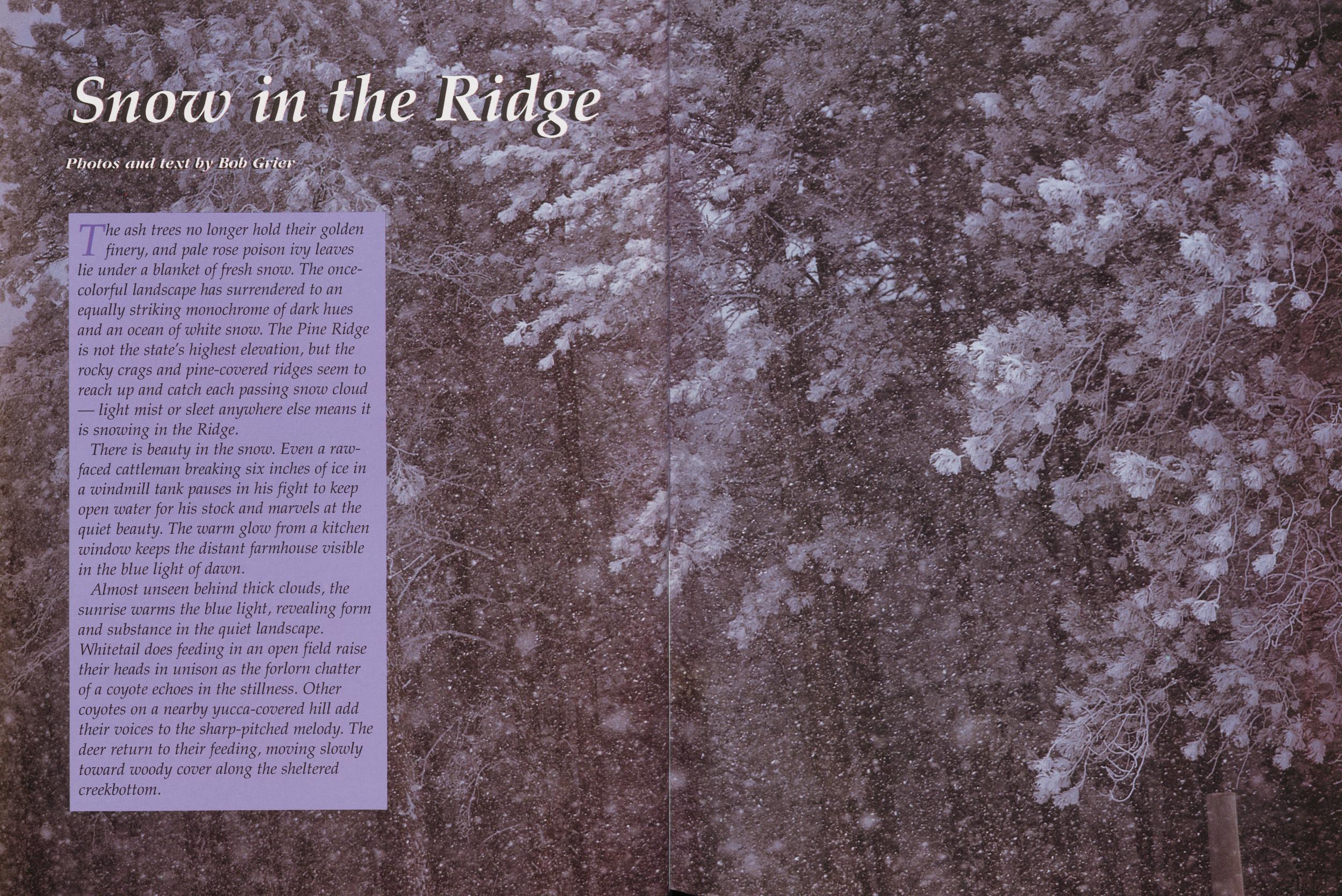
Snow in the Ridge
Photos and text by Bobhe ash trees no longer hold their golden finery, and pale rose poison ivy leaves lie under a blanket of fresh snow. The once colorful landscape has surrendered to an equally striking monochrome of dark hues and an ocean of white snow. The Pine Ridge is not the states highest elevation, but the rocky crags and pine-covered ridges seem to reach up and catch each passing snow cloud — light mist or sleet anywhere else means it is snowing in the Ridge,
There is beauty in the snow. Even a raw-faced cattleman breaking six inches of ice in a windmill tank pauses in his fight to keep open water for his stock and marvels at the quiet beauty. The warm glow from a kitchen window keeps the distant farmhouse visible in the blue light of dawn.
Almost unseen behind thick clouds, the sunrise warms the blue light, revealing form and substance in the quiet landscape. Whitetail does feeding in an open field raise their heads in unison as the forlorn chatter of a coyote echoes in the stillness. Other coyotes on a nearby yucca-covered hill add their voices to the sharp-pitched melody. The deer return to their feeding, moving slowly toward woody cover along the sheltered creek bottom.
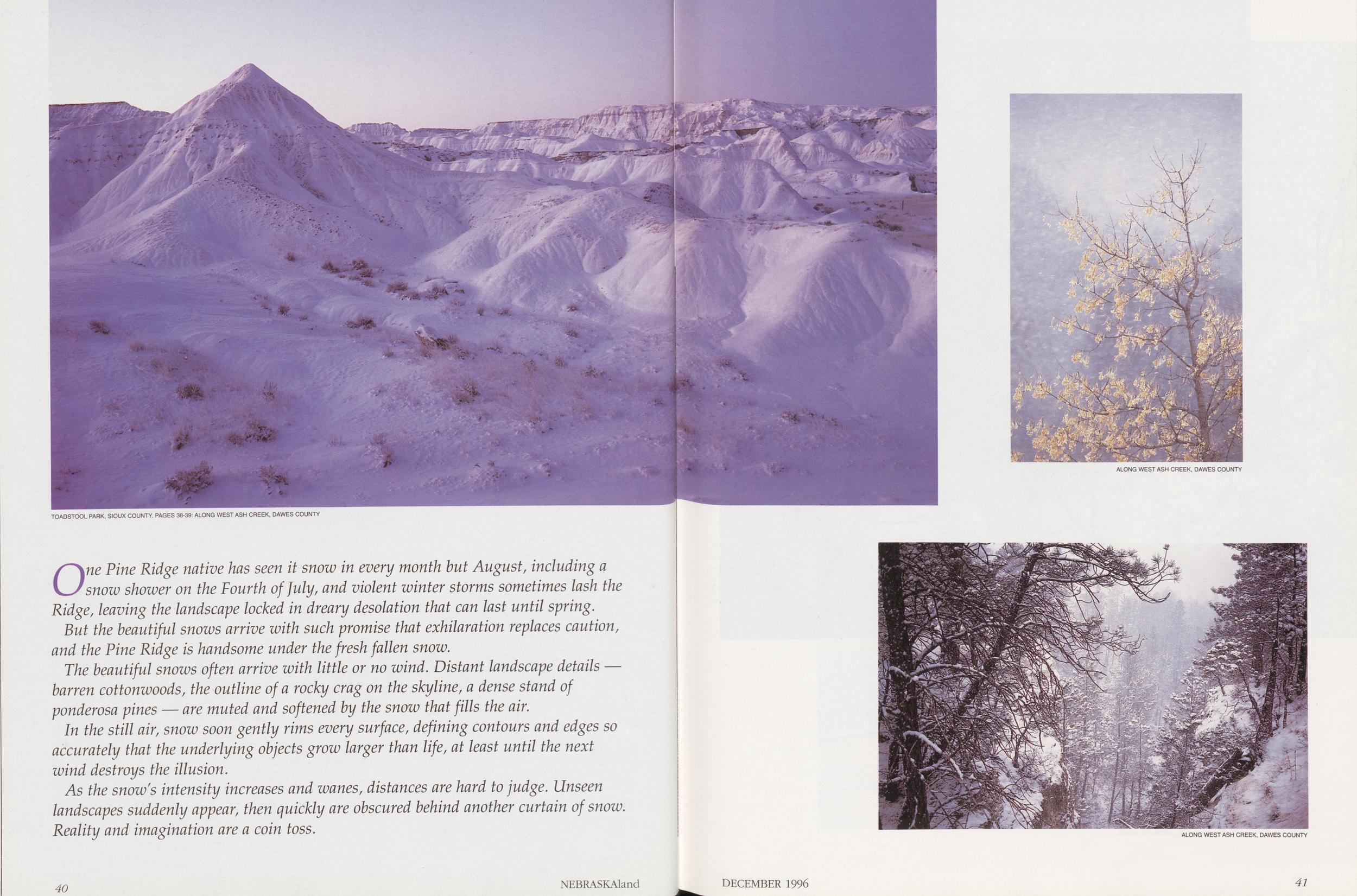
One Pine Ridge native has seen it snow in every month but August, including a snow shower on the Fourth of July, and violent winter storms sometimes lash the Ridge, leaving the landscape locked in dreary desolation that can last until spring. But the beautiful snows arrive with such promise that exhilaration replaces caution, and the Pine Ridge is handsome under the fresh fallen snow.
The beautiful snows often arrive with little or no wind. Distant landscape details — barren cottonwoods, the outline of a rocky crag on the skyline, a dense stand of ponderosa pines — are muted and softened by the snow that fills the air.
In the still air, snow soon gently rims every surface, defining contours and edges so accurately that the underlying objects grow larger than life, at least until the next wind destroys the illusion.
As the snow's intensity increases and wanes, distances are hard to judge. Unseen landscapes suddenly appear, then quickly are obscured behind another curtain of snow. Reality and imagination are a coin toss.
40 NEBRASKAland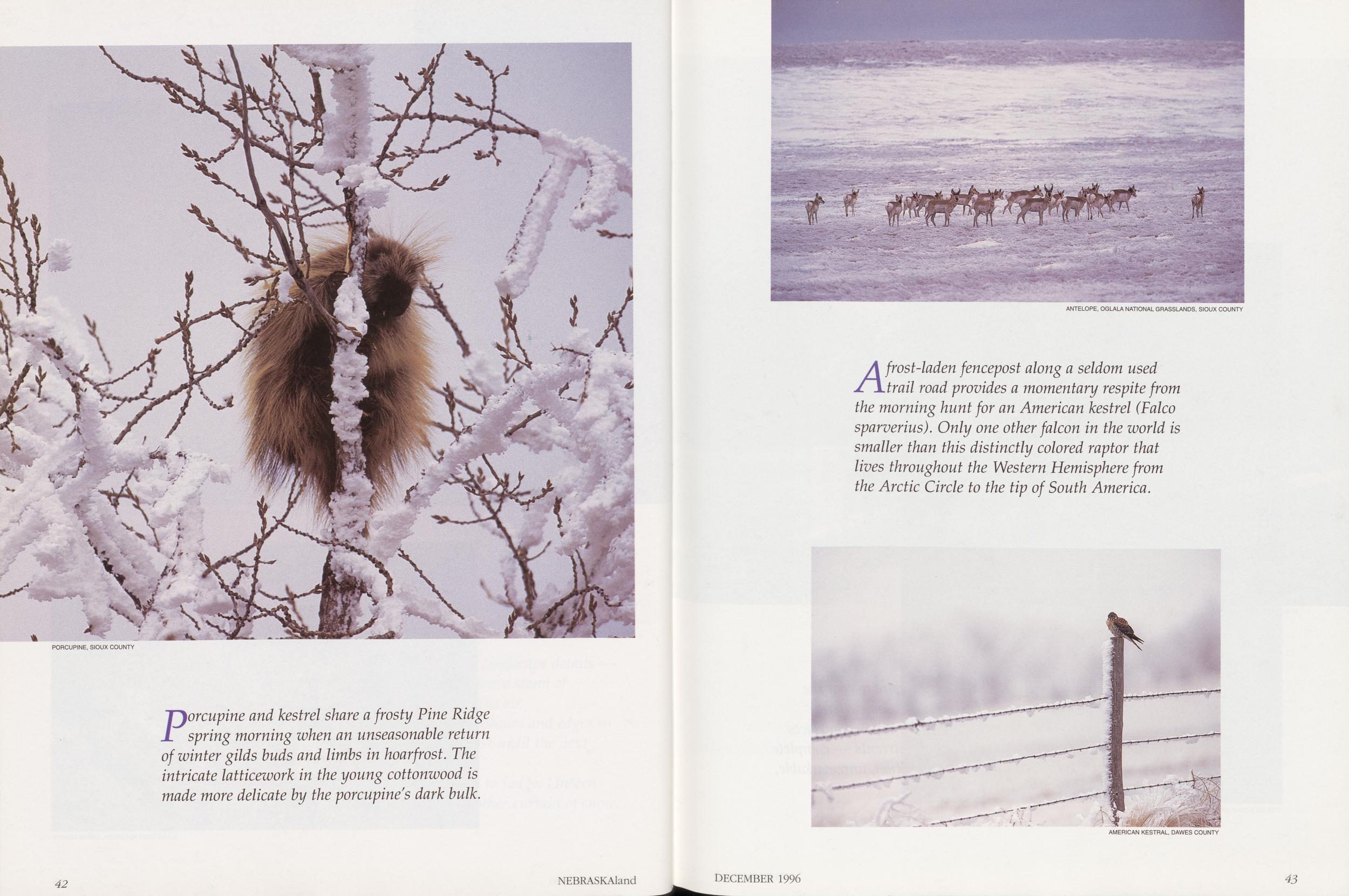
Porcupine and kestrel share a frosty Pine Ridge spring morning when an unseasonable return of winter gilds buds and limbs in hoarfrost. The intricate latticework in the young cottonwood is made more delicate by the porcupines dark bulk.
42 NEBRASKAlandA frost-laden fencepost along a seldom used trail road provides a momentary respite from the morning hunt for an American kestrel (Falco sparverius). Only one other falcon in the world is smaller than this distinctly colored raptor that lives throughout the Western Hemisphere from the Arctic Circle to the tip of South America.
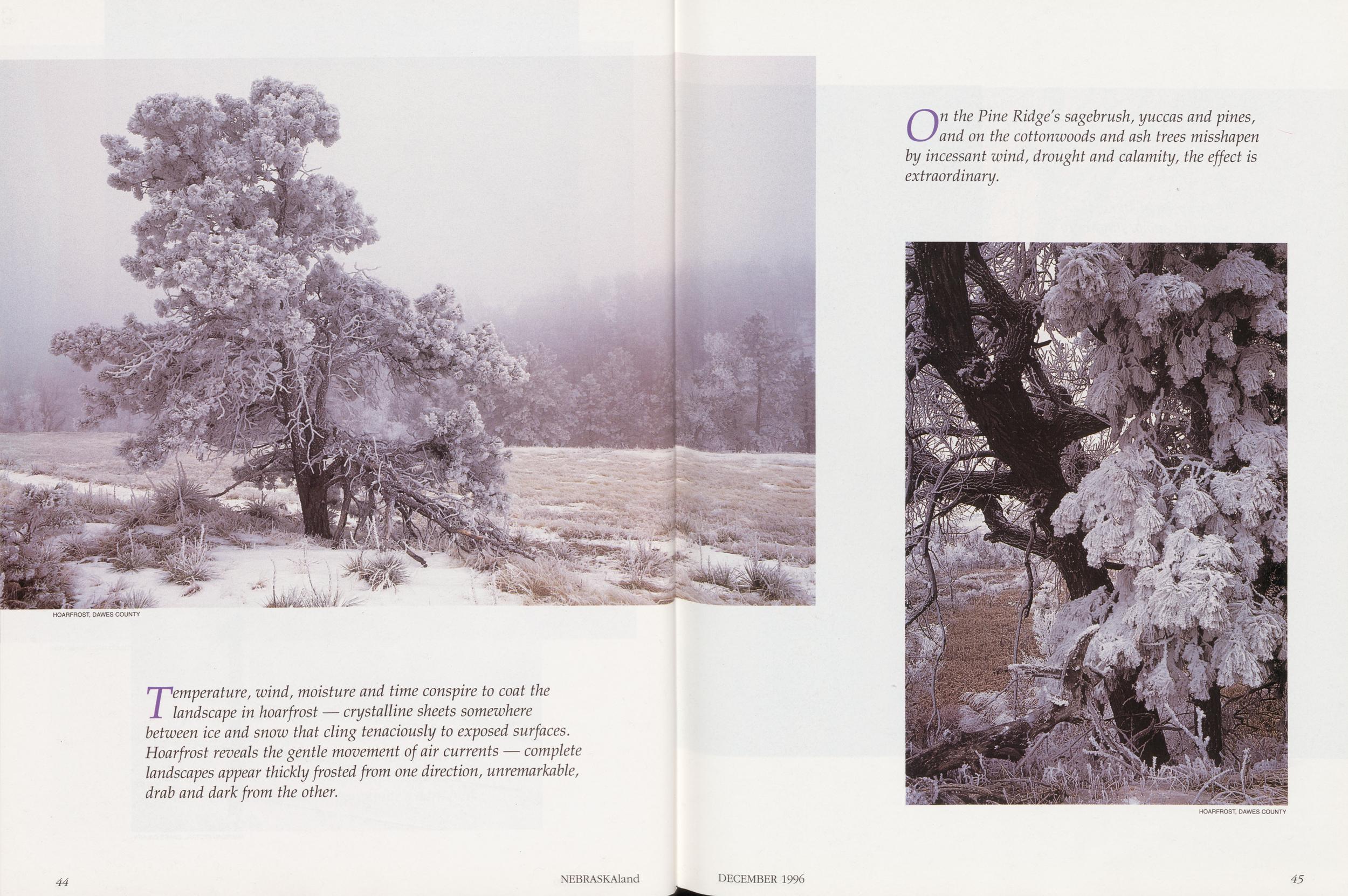
Temperature, wind, moisture and time conspire to coat tine landscape in hoarfrost — crystalline sheets somewhere between ice and snow that cling tenaciously to exposed surfaces. Hoarfrost reveals the gentle movement of air currents — complete landscapes appear thickly frosted from one direction, unremarkable, drab and dark from the other.
44 NEBRASKAlandOn the Pine Ridges sagebrush, yuccas and pines, and on the cottonwoods and ash trees misshapen by incessant wind, drought and calamity, the effect is extraordinary.
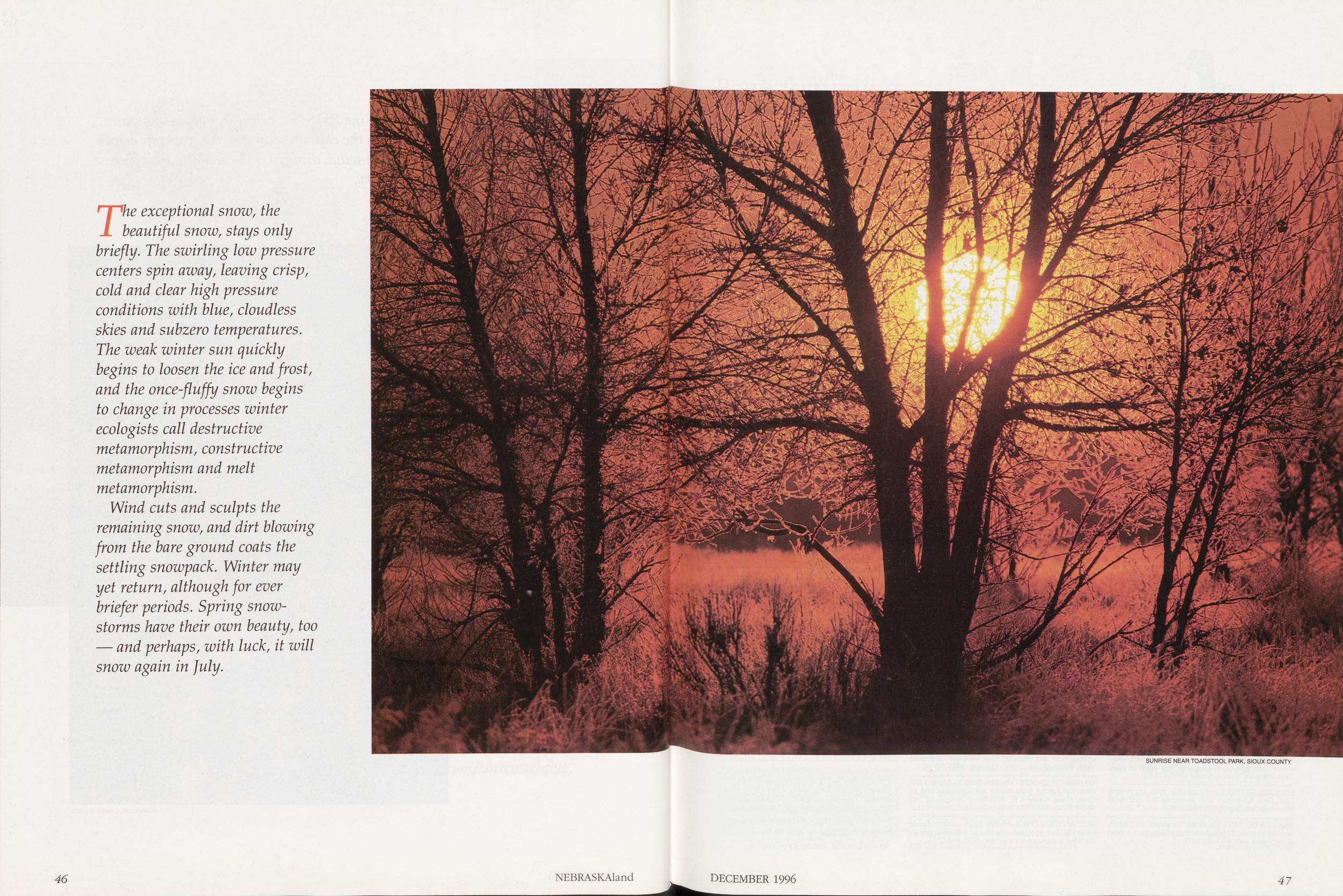
The exceptional snow, the beautiful snow, stays only briefly. The swirling low pressure centers spin away, leaving crisp, cold and clear high pressure conditions with blue, cloudless skies and subzero temperatures. The weak winter sun quickly begins to loosen the ice and frost, and the once-fluffy snow begins to change in processes winter ecologists call destructive metamorphism, constructive metamorphism and melt metamorphism.
Wind cuts and sculpts the remaining snow, and dirt blowing from the bare ground coats the settling snowpack. Winter may yet return, although for ever briefer periods. Spring snow storms have their own beauty, too — and perhaps, with luck, it will snow again in July.
46 NEBRASKAland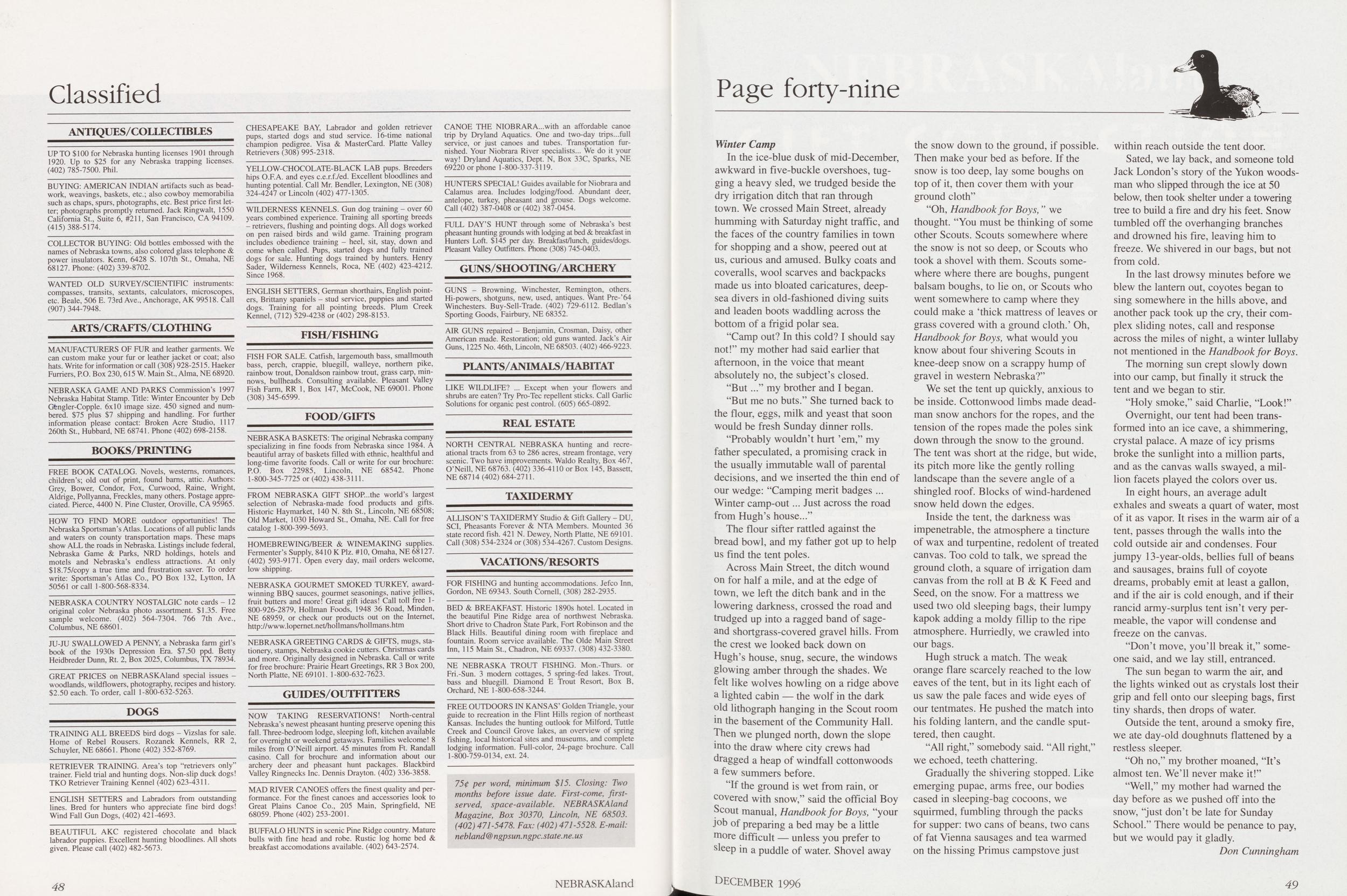
Classified
ANTIQUES/COLLECTIBLESUP TO $100 for Nebraska hunting licenses 1901 through 1920. Up to $25 for any Nebraska trapping licenses. (402) 785-7500. Phil.
BUYING: AMERICAN INDIAN artifacts such as bead work, weavings, baskets, etc.; also cowboy memorabilia such as chaps, spurs, photographs, etc. Best price first letter; photographs promptly returned. Jack Ringwalt, 1550 California St., Suite 6, #211, San Francisco, CA 94109. (415)388-5174.
COLLECTOR BUYING: Old bottles embossed with the names of Nebraska towns, also colored glass telephone & power insulators. Kenn, 6428 S. 107th St., Omaha, NE 68127. Phone: (402) 339-8702.
WANTED OLD SURVEY/SCIENTIFIC instruments: compasses, transits, sextants, calculators, microscopes, etc. Beale, 506 E. 73rd Ave., Anchorage, AK 99518. Call (907) 344-7948.
ARTS/CRAFTS/CLOTHINGMANUFACTURERS OF FUR and leather garments. We can custom make your fur or leather jacket or coat; also hats. Write for information or call (308) 928-2515. Haeker Furriers, P.O. Box 230, 615 W. Main St., Alma, NE 68920.
NEBRASKA GAME AND PARKS Commission's 1997 Nebraska Habitat Stamp. Title: Winter Encounter by Deb Gfengler-Copple. 6x10 image size. 450 signed and numbered. $75 plus $7 shipping and handling. For further information please contact: Broken Acre Studio, 1117 260th St., Hubbard, NE 68741. Phone (402) 698-2158.
BOOKS/PRINTINGFREE BOOK CATALOG. Novels, westerns, romances, children's; old out of print, found barns, attic. Authors: Grey, Bower, Condor, Fox, Curwood, Raine, Wright, Aldrige, Pollyanna, Freckles, many others. Postage appreciated. Pierce, 4400 N. Pine Cluster, Oroville, CA 95965.
HOW TO FIND MORE outdoor opportunities! The Nebraska Sportsman's Atlas. Locations of all public lands and waters on county transportation maps. These maps show ALL the roads in Nebraska. Listings include federal, Nebraska Game & Parks, NRD holdings, hotels and motels and Nebraska's endless attractions. At only $18.75/copy a true time and frustration saver. To order write: Sportsman's Atlas Co., PO Box 132, Lytton, IA 50561 or call 1-800-568-8334.
NEBRASKA COUNTRY NOSTALGIC note cards - 12 original color Nebraska photo assortment. $1.35. Free sample welcome. (402) 564-7304. 766 7th Ave., Columbus, NE 68601.
JU-JU SWALLOWED A PENNY, a Nebraska farm girl's book of the 1930s Depression Era. $7.50 ppd. Betty Heidbreder Dunn, Rt. 2, Box 2025, Columbus, TX 78934.
GREAT PRICES on NEBRASKAland special issues - woodlands, wildflowers, photography, recipes and history. $2.50 each. To order, call 1-800-632-5263.
DOGSTRAINING ALL BREEDS bird dogs - Vizslas for sale. Horpe of Rebel Rousers. Rozanek Kennels, RR 2, Schuyler, NE 68661. Phone (402) 352-8769.
RETRIEVER TRAINING. Area's top "retrievers only" trainer. Field trial and hunting dogs. Non-slip duck dogs! TKO Retriever Training Kennel (402) 623-4311.
ENGLISH SETTERS and Labradors from outstanding lines. Bred for hunters who appreciate fine bird dogs! Wind Fall Gun Dogs, (402) 421-4693.
BEAUTIFUL AKC registered chocolate and black labrador puppies. Excellent hunting bloodlines. All shots given. Please call (402) 482-5673.
CHESAPEAKE BAY, Labrador and golden retriever pups, started dogs and stud service. 16-time national champion pedigree. Visa & MasterCard. Platte Valley Retrievers (308) 995-2318.
YELLOW-CHOCOLATE-BLACK LAB pups. Breeders hips O.F.A. and eyes c.e.r.f./ed. Excellent bloodlines and hunting potential. Call Mr. Bendler, Lexington, NE (308) 324-4247 or Lincoln (402) 477-1305.
WILDERNESS KENNELS. Gun dog training - over 60 years combined experience. Training all sporting breeds - retrievers, flushing and pointing dogs. All dogs worked on pen raised birds and wild game. Training program includes obedience training - heel, sit, stay, down and come when called. Pups, started dogs and fully trained dogs for sale. Hunting dogs trained by hunters. Henry Sader, Wilderness Kennels, Roca, NE (402) 423-4212. Since 1968.
ENGLISH SETTERS, German shorthairs, English point- ers, Brittany spaniels - stud service, puppies and started dogs. Training for all pointing breeds. Plum Creek Kennel, (712) 529-4238 or (402) 298-8153.
FISH/FISHINGFISH FOR SALE. Catfish, largemouth bass, smallmouth bass, perch, crappie, bluegill, walleye, northern pike, rainbow trout, Donaldson rainbow trout, grass carp, minnows, bullheads. Consulting available. Pleasant Valley Fish Farm, RR 1, Box 147, McCook, NE 69001. Phone (308) 345-6599.
FOOD/GIFTSNEBRASKA BASKETS: The original Nebraska company specializing in fine foods from Nebraska since 1984. A beautiful array of baskets filled with ethnic, healthful and long-time favorite foods. Call or write for our brochure: P.O. Box 22985, Lincoln, NE 68542. Phone 1-800-345-7725 or (402) 438-3111.
FROM NEBRASKA GIFT SHOP..the world's largest selection of Nebraska-made food products and gifts. Historic Haymarket, 140 N. 8th St., Lincoln, NE 68508; Old Market, 1030 Howard St., Omaha, NE. Call for free catalog 1-800-399-5693.
HOMEBREWING/BEER & WINEMAKING supplies. Fermenter's Supply, 8410 K Plz. #10, Omaha, NE 68127. (402) 593-9171. Open every day, mail orders welcome, low shipping.
NEBRASKA GOURMET SMOKED TURKEY, award- winning BBQ sauces, gourmet seasonings, native jellies, fruit butters and more! Great gift ideas! Call toll free 1- 800-926-2879, Hollman Foods, 1948 36 Road, Minden, NE 68959, or check our products out on the Internet, http://www.lopernet.net/hollmans/hollmans.htm
NEBRASKA GREETING CARDS & GIFTS, mugs, stationery, stamps, Nebraska cookie cutters. Christmas cards and more. Originally designed in Nebraska. Call or write for free brochure: Prairie Heart Greetings, RR 3 Box 200, North Platte, NE 69101. 1-800-632-7623.
GUIDES/OUTFITTERSNOW TAKING RESERVATIONS! North-central Nebraska's newest pheasant hunting preserve opening this fall. Three-bedroom lodge, sleeping loft, kitchen available for overnight or weekend getaways. Families welcome! 8 miles from O'Neill airport. 45 minutes from Ft. Randall casino. Call for brochure and information about our archery deer and pheasant hunt packages. Blackbird Valley Ringnecks Inc. Dennis Drayton. (402) 336-3858.
MAD RIVER CANOES offers the finest quality and per- formance. For the finest canoes and accessories look to Great Plains Canoe Co., 205 Main, Springfield, NE 68059. Phone (402) 253-2001.
BUFFALO HUNTS in scenic Pine Ridge country. Mature bulls with fine head and robe. Rustic log home bed & breakfast accomodations available. (402) 643-2574.
CANOE THE NIOBRARA...with an affordable canoe trip by Dryland Aquatics. One and two-day trips...full service, or just canoes and tubes. Transportation furnished. Your Niobrara River specialists... We do it your way! Dryland Aquatics, Dept. N, Box 33C, Sparks, NE 69220 or phone 1-800-337-3119.
HUNTERS SPECIAL! Guides available for Niobrara and Calamus area. Includes lodging/food. Abundant deer, antelope, turkey, pheasant and grouse. Dogs welcome. Call (402) 387-0408 or (402) 387-0454.
FULL DAY'S HUNT through some of Nebraska's best pheasant hunting grounds with lodging at bed & breakfast in Hunters Loft. $145 per day. Breakfast/lunch, guides/dogs. Pleasant Valley Outfitters. Phone (308) 745-0403.
GUNS/SHOOTING/ARCHERYGUNS - Browning, Winchester, Remington, others. Hi-powers, shotguns, new, used, antiques. Want Pre-'64 Winchesters. Buy-Sell-Trade. (402) 729-6112. Bedlan's Sporting Goods, Fairbury, NE 68352.
AIR GUNS repaired - Benjamin, Crosman, Daisy, other American made. Restoration; old guns wanted. Jack's Air Guns, 1225 No. 46th, Lincoln, NE 68503. (402) 466-9223.
PLANTS/ANIMALS/HABITATLIKE WILDLIFE? ... Except when your flowers and shrubs are eaten? Try Pro-Tec repellent sticks. Call Garlic Solutions for organic pest control. (605) 665-0892.
REAL ESTATENORTH CENTRAL NEBRASKA hunting and recreational tracts from 63 to 286 acres, stream frontage, very scenic. Two have improvements. Waldo Realty, Box 467, O'Neill, NE 68763. (402) 336-4110 or Box 145, Bassett, NE 68714 (402) 684-2711.
TAXIDERMYALLISON'S TAXIDERMY Studio & Gift Gallery - DU, SCI, Pheasants Forever & NTA Members. Mounted 36 state record fish. 421 N. Dewey, North Platte, NE 69101. Call (308) 534-2324 or (308) 534-4267. Custom Designs.
VACATIONS/RESORTSFOR FISHING and hunting accommodations. Jefco Inn, Gordon, NE 69343. South Cornell, (308) 282-2935.
BED & BREAKFAST. Historic 1890s hotel. Located in the beautiful Pine Ridge area of northwest Nebraska. Short drive to Chadron State Park, Fort Robinson and the Black Hills. Beautiful dining room with fireplace and fountain. Room service available. The Olde Main Street Inn, 115 Main St., Chadron, NE 69337. (308) 432-3380.
NE NEBRASKA TROUT FISHING. Mon.-Thurs. or Fri.-Sun. 3 modern cottages, 5 spring-fed lakes. Trout, bass and bluegill. Diamond E Trout Resort, Box B, Orchard, NE 1-800-658-3244.
FREE OUTDOORS IN KANSAS' Golden Triangle, your guide to recreation in the Flint Hills region of northeast Kansas. Includes the hunting outlook for Milford, Tuttle Creek and Council Grove lakes, an overview of spring fishing, local historical sites and museums, and complete lodging information. Full-color, 24-page brochure. Call 1-800-759-0134, ext. 24.
75$ per word, minimum $15. Closing: Two months before issue date. First-come, first served, space-available. NEBRASKAland Magazine, Box 30370, Lincoln, NE 68503. (402) 471-5478. Fax: (402) 471-5528. E-mail: nebland@ ngpsun. ngpc. state, ne. us 48 NEBRASKAlandPage forty-nine
Winter CampIn the ice-blue dusk of mid-December, awkward in five-buckle overshoes, tug- ging a heavy sled, we trudged beside the dry irrigation ditch that ran through town. We crossed Main Street, already humming with Saturday night traffic, and the faces of the country families in town for shopping and a show, peered out at us, curious and amused. Bulky coats and coveralls, wool scarves and backpacks made us into bloated caricatures, deepsea divers in old-fashioned diving suits and leaden boots waddling across the bottom of a frigid polar sea.
"Camp out? In this cold? I should say not!" my mother had said earlier that afternoon, in the voice that meant absolutely no, the subject's closed.
"But..." my brother and I began.
"But me no buts." She turned back to the flour, eggs, milk and yeast that soon would be fresh Sunday dinner rolls.
"Probably wouldn't hurt 'em," my father speculated, a promising crack in the usually immutable wall of parental decisions, and we inserted the thin end of our wedge: "Camping merit badges ... Winter camp-out... Just across the road from Hugh's house..."
The flour sifter rattled against the bread bowl, and my father got up to help us find the tent poles.
Across Main Street, the ditch wound on for half a mile, and at the edge of town, we left the ditch bank and in the lowering darkness, crossed the road and trudged up into a ragged band of sage and shortgrass-covered gravel hills. From the crest we looked back down on Hugh's house, snug, secure, the windows glowing amber through the shades. We felt like wolves howling on a ridge above a lighted cabin — the wolf in the dark old lithograph hanging in the Scout room in the basement of the Community Hall. Then we plunged north, down the slope into the draw where city crews had dragged a heap of windfall cottonwoods a few summers before.
"If the ground is wet from rain, or covered with snow," said the official Boy Scout manual, Handbook for Boys, "your job of preparing a bed may be a little more difficult — unless you prefer to sleep in a puddle of water. Shovel away the snow down to the ground, if possible. Then make your bed as before. If the snow is too deep, lay some boughs on top of it, then cover them with your ground cloth"
"Oh, Handbook for Boys, " we thought. "You must be thinking of some other Scouts. Scouts somewhere where the snow is not so deep, or Scouts who took a shovel with them. Scouts somewhere where there are boughs, pungent balsam boughs, to lie on, or Scouts who went somewhere to camp where they could make a 'thick mattress of leaves or grass covered with a ground cloth.' Oh, Handbook for Boys, what would you know about four shivering Scouts in knee-deep snow on a scrappy hump of gravel in western Nebraska?"
We set the tent up quickly, anxious to be inside. Cottonwood limbs made dead-]man snow anchors for the ropes, and the tension of the ropes made the poles sink down through the snow to the ground. The tent was short at the ridge, but wide, its pitch more like the gently rolling landscape than the severe angle of a shingled roof. Blocks of wind-hardened snow held down the edges.
Inside the tent, the darkness was impenetrable, the atmosphere a tincture of wax and turpentine, redolent of treated canvas. Too cold to talk, we spread the ground cloth, a square of irrigation dam canvas from the roll at B & K Feed and Seed, on the snow. For a mattress we used two old sleeping bags, their lumpy kapok adding a moldy fillip to the ripe atmosphere. Hurriedly, we crawled into our bags.
Hugh struck a match. The weak orange flare scarcely reached to the low eaves of the tent, but in its light each of us saw the pale faces and wide eyes of our tentmates. He pushed the match into his folding lantern, and the candle sputtered, then caught.
"All right," somebody said. "All right," we echoed, teeth chattering.
Gradually the shivering stopped. Like emerging pupae, arms free, our bodies cased in sleeping-bag cocoons, we squirmed, fumbling through the packs for supper: two cans of beans, two cans of fat Vienna sausages and tea warmed on the hissing Primus camp stove just within reach outside the tent door.
Sated, we lay back, and someone told Jack London's story of the Yukon woodsman who slipped through the ice at 50 below, then took shelter under a towering tree to build a fire and dry his feet. Snow tumbled off the overhanging branches and drowned his fire, leaving him to freeze. We shivered in our bags, but not from cold.
In the last drowsy minutes before we blew the lantern out, coyotes began to sing somewhere in the hills above, and another pack took up the cry, their complex sliding notes, call and response across the miles of night, a winter lullaby not mentioned in the Handbook for Boys.
The morning sun crept slowly down into our camp, but finally it struck the tent and we began to stir.
"Holy smoke," said Charlie, "Look!"
Overnight, our tent had been transformed into an ice cave, a shimmering, crystal palace. A maze of icy prisms broke the sunlight into a million parts, and as the canvas walls swayed, a million facets played the colors over us.
In eight hours, an average adult exhales and sweats a quart of water, most of it as vapor. It rises in the warm air of a tent, passes through the walls into the cold outside air and condenses. Four jumpy 13-year-olds, bellies full of beans and sausages, brains full of coyote dreams, probably emit at least a gallon, and if the air is cold enough, and if their rancid army-surplus tent isn't very permeable, the vapor will condense and freeze on the canvas.
"Don't move, you'll break it," someone said, and we lay still, entranced.
The sun began to warm the air, and the lights winked out as crystals lost their grip and fell onto our sleeping bags, first tiny shards, then drops of water.
Outside the tent, around a smoky fire, we ate day-old doughnuts flattened by a restless sleeper.
"Oh no," my brother moaned, "It's almost ten. We'll never make it!"
"Well," my mother had warned the day before as we pushed off into the snow, "just don't be late for Sunday School." There would be penance to pay, but we would pay it gladly.
Don Cunningham DECEMBER 1996 49
1996 NEBRASKAland Index
Artists: July. 32-41. Why Nebraska? Audrey Hulburd. Nebraska Scenes. Birds: March. 16-17. Gobbler's Chorus. Bob Grier. Turkeys. Display Rituals. April. 8-17. Enigmatic Magpie. Mike Forsberg. October. 18-35. Wild Turkey in Nebraska. Harvey Suetsugu, Karl Menzel, Bob Grier. Life Cycle. Hunting. Management. October. 35. The Wild Turkey's Return. Bob Grier. Turkey Hunting and Management. November. 18-25. Winter Bird Feeding. Bob Grier. Book review: November. 50. Nebraska Sand Hills: The Human Landscape by Charles Barron Mcintosh. Jon Farrar. University of Nebraska Press. Fauna Notes: July. 50. Garden Spiders. Brett Ratcliffe. Fishing: April. 36-41. Spring is for Panfishing. Tom Keith. April. 42-47. Back to the Willow. Rocky Hoffmann. Red Willow Reservoir. June. 30-35. Bucktails and Streamers. Tom Keith. Flyfishing. Aug.-Sept. 16-21. Now in These Waning Days of Summer. Jon Farrar. Aug.-Sept. 22-31. Fishing the Tradition. Jon Farrar. Valentine National Wildlife Refuge. Game and Parks: November. 36-39.1-80 Road Check. Rocky Hoffmann. Game Law Enforcement. History: June. 8-19. Last of the Great Scouts. Tom Morrison. Buffalo Bill Cody. Aug.-Sept. 8-15. Places to Play. Troy Kroeger. Parks. Historic Photographs. October. 8-17. Paper Decoys. Jon Farrar. Papier Mache Decoys. Waterfowl Hunting. Hunting-Misc: Aug.-Sept. 44-47. Guiding Young Hunters. Ken Bouc. Education. Hunting-Upland: December. 32-37. Extra Month for Grouse. Rocky Hoffmann. Hunting-Waterfowl: July. 8-13. Filling the Spread. Rocky Hoffmann. Decoys. November. 8-17. Mallards on the Missouri. Jon Farrar. Missouri River. November. 28-35. Clear Creek: A Platte Valley Paradise. Rocky Hoffmann. Clear Creek WMA. Refuge. December. 8-17. Late Season Snows. Jon Farrar. Snow Geese. December. 17. Too Many Geese. P. Joe Gabig. Overpopulation. December. 18-23. Blackie. Rocky Hoffmann. Hunter Profile. In the kitchen: April. 50. Spring Thanksgiving. Wild Turkey Recipes. Insects: May. 8-19. Jewels of the Night. John Jordison. Underwing Moths. May. 17. Walking the Nighttime Bait Trail. John Jordison. Underwing Moths. Mammals: Aug.-Sept. 32-35. Porky in the Pigweeds. Jon Farrar. Porcupines. Management: Aug.-Sept. 36-43. Too Many Deer, Not Enough Forest. Ken Bouc. 50 Fontenelle Forest. Overpopulation. Aug.-Sept. 50. Speaking for Wildlife. Paul Horton. International Association of Fish and Wildlife Agencies Annual Meeting. October. 50. Hunter Ethics. Gary Schlichtemeier. December. 24-31. Nebraska Aquatic Habitat Plan. Don Gabelhouse. Notes from the field: March. 6-7. Dealing with Cold. Mike Forsberg. Hypothermia. April. 6-7. Just a Sunday Drive. Mark Nelsen. Travel. Snowstorms. April. 7. Nature and the National Character. Don Cunningham. Abraham Lincoln Lectures. Richard White. May. 6-7. Troester Tunnel. Jon Farrar. Henry Siebert. Troester Lake. June. 6-7. Purple Problem. Ted LaGrange. Purple Loosestrife. July. 6-7. Place Without Boundaries. Mike Forsberg. Sugarloaf Butte. Wildlife. Aug.-Sept. 6-7. Stop, Look and Listen. Steve Brezenski. Wildlife Watching. October. 6-7. Blind Visions. Jon Farrar. Reminiscence. November. 6-7. My Window Paradise. Evelyn Neitzel. Bird Feeding. December. 6-7. Bobcats. Dianna Ham. Outdoor Business: May. 34-35. What to Stock? Jon Farrar. Fish Management. June. 36-39. Wildlife DNA: Blueprints for Biologists. Troy Kroeger. Forensics. Genetics. July. 42-45. Setting Seasons: Democracy at Work. Jon Farrar. Waterfowl Seasons. Page forty-nine: March. 49. Birds Court Better. Jon Farrar. Mating Rituals. April. 49. Storm Camping. Tim Reigert. May. 49. Among the Cranes. Mike Forsberg. Sandhill Cranes. Platte River. June. 49. Magic of Bamboo. Don Cunningham. Fly Fishing. July. 49. Band-Aids for Wildlife. Jon Farrar. Wildlife Management. Aug.-Sept. 49. Snakes in the Grass. Mike Forsberg. Phobias. October. 49. Calling all Ducks. Jon Farrar. Duck Hunting. Duck Calling. November. 49. My Game Warden. Jon Farrar. Lyman Wilkinson. Reminiscence. December. 49. Winter Camp. Don Cunningham. Paleontology: June. 26-29. Stone Tracks. David Nixon. Trackway. Fossils. Parks: March. 8-15. Wildcat Hills Nature Center. Bob Grier. April. 18-35. Nebraska Parklands. Bob Grier. State Parks Guide. June. 18-19. Buffalo Bill Ranch State Historical Park. Tom Morrison. Photo Essay: March. 36-47. What Cranes Say. Paul Gruchow. Sandhill Cranes. May. 22-33. Sandoz Country. Kira Gale. Mari Sandoz. Sandhills. June. 40-47. Nebraska Cliches. Kent Klima. Don Cunningham. July. 16-29. End of the Day. Jon Farrar. Back Roads. October. 38-47. Soldiering at Fort Hartsuff Bob Grier. General Miles Marching and Chowder Society. History. November. 40-47. Nebraska Through the Eyes of Astronauts. Bradley Rundquist, Kamlesh Lulla. Space Shuttle. December. 38-47. Snow in the Ridge. Bob Grier. Pine Ridge. Plants: June. 20-23. Spatterdock: Lillies for Cows. Jon Farrar. Poetry: July. 46-47. South of Lakeside. Greg Kosmicki. Badgers. Reminiscence: May. 20-21. Old Splitfin. M.J. Nicolaus. Rainbow Trout Fishing. July. 14-15. Grandmother's Last Hurrah. Jean Schneider. Catfish. November. 26-27. Blizzard. Polly Spence. Pine Ridge. Blizzard of 1949. Simple Pleasures: June. 24-25. Champion Mill State Historical Park. Rocky Hoffmann. July. 30-31. Wildwood Wildlife Management Area. Mike Forsberg. October. 36-37. Wellfleet Wildlife Management Area. Rocky Hoffmann. Special Issue: Jan.-Feb. Weather and Climate of Nebraska. 6-13. Place of Beauty and Contrast. Kenneth Dewey. 14-25. Reasons for the Seasons. John Harrington. 28-43. Spring: The Turbulent Season. Natalie Williams ancWai-Lok Siu. 39. Warm Season Severe Weather Safety. Kenneth Dewey. 41. Chasing the Storms. Kenneth Dewey. 42-43. Basic Cloud Types. T.J. Walker. 46-63. Summer: The Season of Sun. Kenneth Dewey. 55. River Flooding in Nebraska. Roy Osugi. 60. Weather and Fish. Ken Bouc. 66-75. Autumn: A Season of Change. Rick Clark, Eric Grelson. 70. Migration and Weather. J Farrar. 73. Weather and Climate Folklo Kenneth Dewey. 75. Weather and Wildlife. Amy Richert. 78-95. Winter: The Frigid Season. Kenneth Dewey. 8 Severe Winter Weather Safety. Kenneth Dewey. 91. Weather and Transportation Eric Grelson. 95. 1936: The Year of Ultimate Contrasts. Kenneth Dewey. 96-105. Collecting Weather and Clim. Information. Mark Anderson. 99. Cric as a Thermometer. Kenneth Dewey. 1 Television Broadcast Meteorology. Bill Randby. 106-121. Nebraska's Climate Past and Future. Michael Palecki. 112 Could the Sandhills Start Moving Again Michael Palecki. Wildlife Lands: March. 18-35. Nebraska Rainwater Basin. Jon Farrar. Wetland Waterfowl. March. 34-35. Between-land. Jon Farrar. Wetlands. May. 36-47. Wet Meadows of the Platte. Mike Forsberg. Platte River. Wildlife. 50 NEBRASKAh Celebrate Nebraska's great outdoors each week inning J (repeating Saturdays at 8 a.m.) on the NEBRASKA ETV NETWORK IV Also Sundays at 4 p.m. (CST) on EduCable, Nebraska ETV's cable service. A production of the Nebraska Game and Parks Commission in association with the Nebraska ETV Network, a service of Nebraska Educational Telecommunications.
Position: 769 (14 views)