Volume 74, Issue 9, 1996
NEBRASKAland
NOVBMBER 1996 $2.00
NEBRASKAland
Published by the Nebraska Game and Parks Commission Director: Rex Amack Assistant Directors: Noelyn Isom Roger Kuhn Wesley Sheets Information & Education Administrator: Paul Horton Information & Education Art Director: Steve O'Hare Magazine Staff Editor: Don Cunningham Associate Editor: Troy Kroeger Art Director: Tim Reigert Senior Editors: Ken Bouc, Jon Farrar Regional Editors: Mike Forsberg, Bob Grier, Rocky Hoffmann Circulation: Pat Frahm Commissioners Chairman: Bill Grewcock, Omaha Vice Chairman: Dr. Charles Blaha, Ord 2nd Vice Chairman: Dr. Tim Biga, Norfolk Tom J. Plummer Jr., Ogallala Daniel Wallen, McCook William Berry man, Kearney Thomas O'Neill Jr., Lincoln NEBRASKAland ISSN: 0028-1964 VOL. 74 / NO. 9 NOVEMBER 1996 Published monthly, except for Jan./Feb. and Aug./Sept. issues, by the Nebraska Game and Parks Commission, 2200 N. 33rd St., Lincoln, NE. Copyright 1996, all rights reserved. Please address comments or questions to this address. Second-class postage paid at Lincoln, Nebraska. POSTMASTER: Send all address changes to NEBRASKAland, P.O. Box 30370, Lincoln, NE 68503-0370. Rates: $14 for one year; $27 for two years. Address submissions to: The Editor, NEBRASKAland Magazine, P.O. Box 30370, Lincoln, NE 68503. Include a stamped, self-addressed return envelope. The publisher assumes no responsibility for unsolicited material. NEBRASKAland is available on audio cassette from the Nebraska Library Commission Talking Book and Braille Service, Suite 120, 1200 N St., Lincoln, NE 68508. VOL. 74 / NO. 9 NOVEMBER 1996
Letters
Nebraska Game and Parks Commission District Offices Headquarters 2200 North 33rd Street Lincoln, NE 68503 Phone (402) 471-0641 District Office I Box 725 Alliance, NE 69301 Phone (308) 762-5605 District Office II Box 508 Bassett, NE 68714 Phone (402) 684-2921 District Office III Box 934 Norfolk, NE 68702 Phone (402) 370-3374 District Office IV Route 4, Box 36 North Platte, NE 69101 Phone (308) 535-8025 District Office V 2200 North 33rd Street Lincoln, NE 68503 Phone (402) 471-5558 Omaha Office 1212 Deer Park Blvd. Omaha, NE 68108 Phone (402) 595-2144 Ak-Sar-Ben Aquarium 21502 West Highway 31 Gretna, NE 68028 Phone (402) 332-3901 World Wide Web Site: http://www.ngpc.state.ne.us Email: ngpc@ngpsun.ngpc.state.ne.us Conservation Officers by Region Headquarters Gary Ralston Creighton 847-3284 Dick Turpin (Adm.) Lincoln 471-5531 Daniel Roberts Fremont 721-7852 Ted Blume (Asst. Adm.) Lincoln 483-5643 Randy Pomplun Fullerton (308) 536-2987 Dan Klammer Lincoln 475-1475 Jon Reeves Kennard 427-7378 Eric Wiebe Ponca 755-2566 Panhandle Steve Oberg West Point 372-3062 Officer City Phone (308) Richard Furley (Sup.) Alliance 762-2024 Sandhills Raymond Still Bridgeport 262-1075 Officer City Phone (402) Walt Meyer Chadron 432-4398 Bruce Wiebe (Sup.) Bassett 684-3867 John Murphy Crawford 665-2021 Larry Bauman Atkinson 925-5569 Jim Zimmerman Gering 436-7561 Ray Dierking Brkn. Bow (308) 872-3078 Marvin Kampbell Hay Springs638-7527 Richard Seward Ord (308)728-3115 Dennis Thompson Ogallala 284-6450 Mick Gray Valentine 376-3136 Dan Zuehlke Ogallala 284-4815 Dan Evasco Oshkosh 772-3091 South-central Scott Brandt Scottsbluff 635-1277 Officer City Phone (402) Jerry Pecha (Sup.) York 362-5707 Southwest Terry Brentzel Grand Is. (308)384-8296 Officer City Phone (308) Tim Williams Hastings 463-2535 Roger Thompson (Sup.) N. Platte 532-9175 Dale Johnson Hebron 768-7363 Dwight Allbery N. Platte 532-2753 Mark Reeves Loup City (308)745-1126 George Sund Cambridge 697-4629 Robert Finke Milford 761-3537 Matt Andrews Elwood 785-3025 Jack Henderson Gothenburg 537-7483 Southeast Dirk Greene Imperial 882-5328 Officer City Phone (402) Virgil Gosch McCook 345-2185 Craig Stover (Sup.) Lincoln 471-5590 Rich Routh Rep. City 799-2085 Murray Johnson Lincoln 488-2923 Douglas Kramer Lincoln 466-9001 Northeast Dina Hopper Lincoln 483-2358 Officer City Phone (402) William Krause Auburn 274-3789 Tom Zimmer (Sup.) Norfolk 371-6625 Larry Elston Bellevue 292-4910 Marion Shafer Norfolk 371-2031 Mike Luben Colon 443-4278 Robert Kelly Albion 395-2538 Duane Arp Gretna 332-4954 Ross Oestmann Bloomfield 373-4412 Levi Krause Louisville 234-2212 L. A. Wilkinson Columbus 564-4375 Russell Mort Nebr. City 873-5684 Operation Game Thief 1-800-742-7627 A Record Whitetail?I was born and raised in Cozad. In the early 1950s, I killed a white-tailed deer that I think was one of the biggest deer ever taken in Nebraska [see "How big a Deer Was It?" Letters, October 1996].
I checked the deer in at Lexington, where an official checked the teeth and said it was seven and a half years old. It was the biggest deer he had ever seen.
I took the deer to the F&S Sausage Company in Cozad, and Rudy Fisher weighed it at 323 pounds field dressed and with the legs cut off at the knees.
It was a 10-point whitetail. Both brow tines had two points. I killed it south of Cozad on the river, and it was so heavy we floated it down to the head gates in a flat boat.
Derry Wells Grants Pass, Oregon Photographic GhostsSomething caught my eye as I was looking through the August-September 1996 issue of NEBRASKAland. In the top picture on page 12 there seems to be a "shadow" next to the second man from the left, although it's not on the ground like the others.
It can't be his shadow because the man has a beard and his "shadow" does not. Is there something wrong with the picture or is it a "ghost"? Am I the only one who has noticed this? I spotted it the minute I turned the page.
Sandy Coufal Wahoo, NebraskaJohn Carter, curator of photographic collections at the Nebraska State Historical Society, replies:
4 NEBRASKAlandYes, Ms. Coufal, you did see a ghost. What you are observing is a person who moved at the moment the photograph was taken. With a shutter speed of about 7/4 to lh of a second, everybody who is standing still shows up just fine. If you happen to move during the duration of the exposure, you become a ghost: half there, half not.
Though it is unintentional in this instance, 19th century spiritualists used such fabrications as evidence that they had connected with a spirit on the other side. Because photographs do not lie, they contended, you have proof positive that ghosts exist. Thanks to observant people like yourself, the hoax was not long lived. Good observation.
Family Pheasant HuntThis photo was taken the day after Thanksgiving 1995. Pictured are my son-in-law, Tom Brown of Langehorne, Pennsylvania, my granddaughter, Brittany and my dog, Jake. The hunt took place in the Diller area.
Brittany and I enjoyed conversations that can only be had in the great outdoors, handling blocking assignments and enjoying the next best part of the hunt — a snack that only grandma can make — peanut butter and jelly sandwiches, Grandma's homemade cookies, hot chocolate and a few candy kisses for dessert.
Needless to say Tom and Brittany are hooked on "The Good Life," and they are both looking forward to "The Hunt Nebraska Style '96.
Dale Oltman Beatrice, Nebraska Bowring Ranch State Historical ParkI visited Bowring Ranch State Historical Park in August, and it was one of the most interesting stops I made on my 5,134-mile journey through seven states and several national monuments and national parks.
The main house and Mrs. Bo wring's lifestyle are not representative of a working cattle ranch of my era, but the visitor center is a definite plus. The highlight is the sod house lady [Ardith Morton] and her presentation of how a soddie was built and furnished, cooking on a wood stove, dealing with critters dropping from the ceiling or wandering through open doors, gardening and other chores common to prairie life.
Visitors are invited to explore the sod house, not just look at but touch the displays, sit down, have a homemade cookie, ask innumerable questions all of which are answered and take home whatever vegetables and dried herbs ready from the on-site garden.
Our group was told she would take 15 minutes of our time. We were there 45 minutes, and no one was bored or restless. This lady is a treasure, and I hope she remains a part of this place for years to come.
Rita G. Cownie El Cajon, California Thanks for NEBRASKAlandI received my first NEBRASKAland since being reassigned to South Korea. Thanks for the wonderful magazine bringing the beauty of Nebraska to those of us who can't be there.
A special thanks to my parents, Bob and Esther Bode of Lyman, for sending the subscription. NEBRASKAland helps close the distance between duty here and our great state.
Brian Bode, Lt. Col., U.S. Army Camp Casey, Republic of Korea Write to: Letters, NEBRASKAland Magazine, P.O. Box 30370, Lincoln, NE 68503. Fax: (402) 471-5528. E-mail: Nebland@ngpsun.ngpc. state, ne. us. Letters may be condensed and edited for clarity. Photos are also welcome. Nebraska Hunter Education (402)471-5434 NOVEMBER 1996 5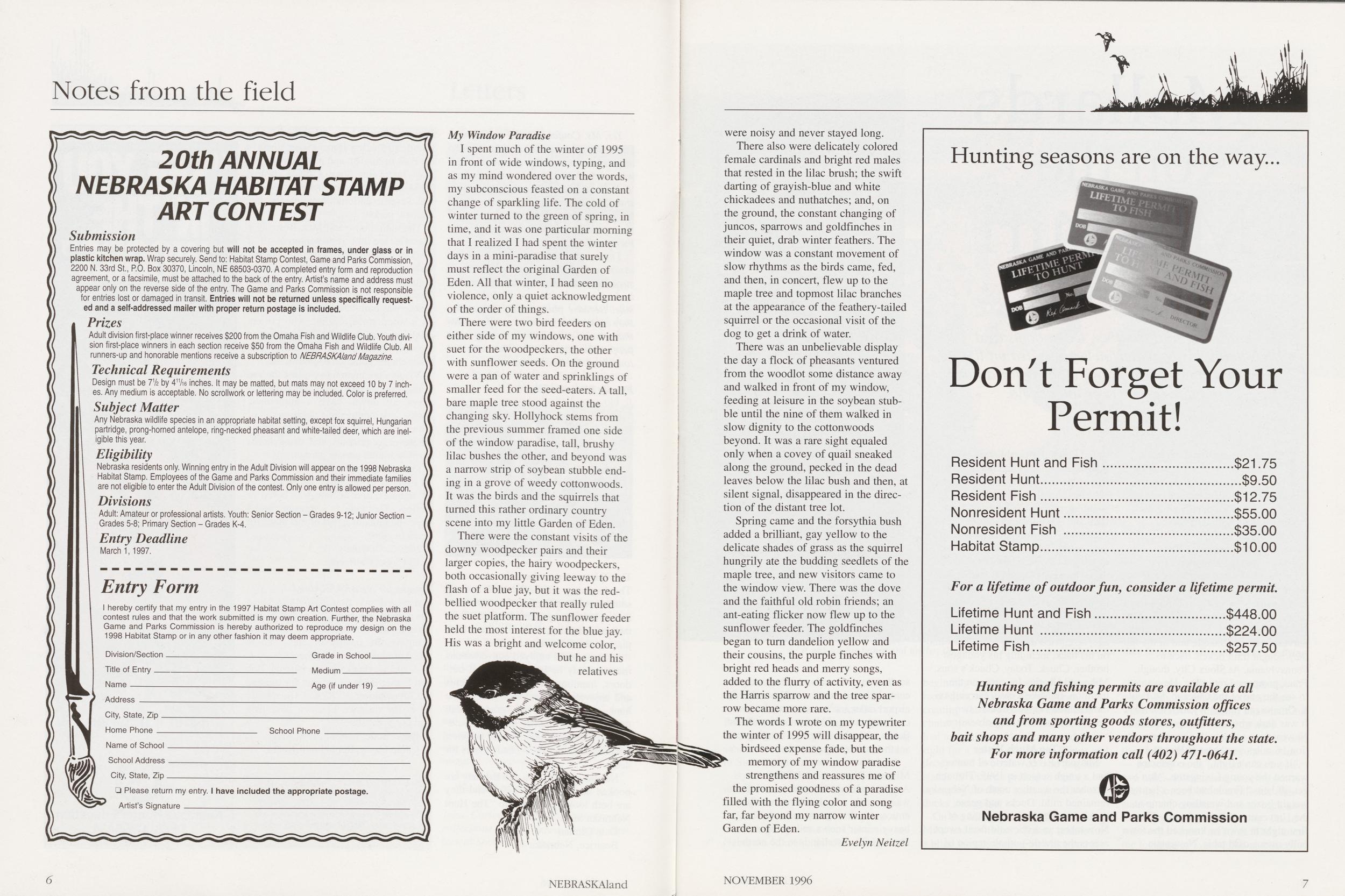
Notes from the field
20th ANNUAL NEBRASKA HABITAT STAMP ART CONTEST Submission Entries may be protected by a covering but will not be accepted in frames, under glass or in plastic kitchen wrap. Wrap securely. Send to: Habitat Stamp Contest, Game and Parks Commission, 2200 N. 33rd St., P.O. Box 30370, Lincoln, NE 68503-0370. A completed entry form and reproduction agreement, or a facsimile, must be attached to the back of the entry. Artist's name and address must appear only on the reverse side of the entry. The Game and Parks Commission is not responsible for entries lost or damaged in transit. Entries will not be returned unless specifically requested and a self-addressed mailer with proper return postage is included. Prizes Adult division first-place winner receives $200 from the Omaha Fish and Wildlife Club. Youth division first-place winners in each section receive $50 from the Omaha Fish and Wildlife Club. All runners-up and honorable mentions receive a subscription to NEBRASKAland Magazine. Technical Requirements Design must be 7V2 by 411/ie inches. It may be matted, but mats may not exceed 10 by 7 inches. Any medium is acceptable. No scrollwork or lettering may be included. Color is preferred. Subject Matter Any Nebraska wildlife species in an appropriate habitat setting, except fox squirrel, Hungarian partridge, prong-horned antelope, ring-necked pheasant and white-tailed deer, which are ineligible this year. Eligibility Nebraska residents only. Winning entry in the Adult Division will appear on the 1998 Nebraska Habitat Stamp. Employees of the Game and Parks Commission and their immediate families are not eligible to enter the Adult Division of the contest. Only one entry is allowed per person. Divisions Adult: Amateur or professional artists. Youth: Senior Section - Grades 9-12; Junior Section - Grades 5-8; Primary Section - Grades K-4. Entry Deadline March 1,1997. Entry Form I hereby certify that my entry in the 1997 Habitat Stamp Art Contest complies with all contest rules and that the work submitted is my own creation. Further, the Nebraska Game and Parks Commission is hereby authorized to reproduce my design on the 1998 Habitat Stamp or in any other fashion it may deem appropriate. Division/Section Title of Entry Name Grade in School. Medium Age (if under 19) Address City, State, Zip Home Phone _ School Phone Name of School School Address City, State, Zip Please return my entry. I have included the appropriate postage. Artist's Signature My Window ParadiseI spent much of the winter of 1995 in front of wide windows, typing, and as my mind wondered over the words, my subconscious feasted on a constant change of sparkling life. The cold of winter turned to the green of spring, in time, and it was one particular morning that I realized I had spent the winter days in a mini-paradise that surely must reflect the original Garden of Eden. All that winter, I had seen no violence, only a quiet acknowledgment of the order of things.
There were two bird feeders on either side of my windows, one with suet for the woodpeckers, the other with sunflower seeds. On the ground were a pan of water and sprinklings of smaller feed for the seed-eaters. A tall, bare maple tree stood against the changing sky. Hollyhock stems from the previous summer framed one side of the window paradise, tall, brushy lilac bushes the other, and beyond was a narrow strip of soybean stubble ending in a grove of weedy cottonwoods. It was the birds and the squirrels that turned this rather ordinary country scene into my little Garden of Eden.
There were the constant visits of the downy woodpecker pairs and their larger copies, the hairy woodpeckers, both occasionally giving leeway to the flash of a blue jay, but it was the redbellied woodpecker that really ruled the suet platform. The sunflower feeder held the most interest for the blue jay. His was a bright and welcome color, but he and his relatives
There also were delicately colored female cardinals and bright red males that rested in the lilac brush; the swift darting of grayish-blue and white chickadees and nuthatches; and, on the ground, the constant changing of juncos, sparrows and goldfinches in their quiet, drab winter feathers. The window was a constant movement of slow rhythms as the birds came, fed, and then, in concert, flew up to the maple tree and topmost lilac branches at the appearance of the feathery-tailed squirrel or the occasional visit of the dog to get a drink of water.
There was an unbelievable display the day a flock of pheasants ventured from the woodlot some distance away and walked in front of my window, feeding at leisure in the soybean stubble until the nine of them walked in slow dignity to the cottonwoods beyond. It was a rare sight equaled only when a covey of quail sneaked along the ground, pecked in the dead leaves below the lilac bush and then, at silent signal, disappeared in the diretion of the distant tree lot.
Spring came and the forsythia bush added a brilliant, gay yellow to the delicate shades of grass as the squirrel hungrily ate the budding seedlets of the maple tree, and new visitors came to the window view. There was the dove and the faithful old robin friends; an ant-eating flicker now flew up to the sunflower feeder. The goldfinches began to turn dandelion yellow and their cousins, the purple finches with bright red heads and merry songs, added to the flurry of activity, even as the Harris sparrow and the tree spar- row became more rare.
The words I wrote on my typewriter the winter of 1995 will disappear, the birdseed expense fade, but the memory of my window paradise strengthens and reassures me of the promised goodness of a paradise filled with the flying color and song far, far beyond my narrow winter Garden of Eden.
Evelyn Neitzel Hunting seasons are on the way... Don't Forget Your Permit! Resident Hunt and Fish $21.75 Resident Hunt $9.50 Resident Fish $12.75 Nonresident Hunt $55.00 Nonresident Fish $35.00 Habitat Stamp $10.00 For a lifetime of outdoor fun, consider a lifetime permit. Lifetime Hunt and Fish $448.00 Lifetime Hunt $224.00 Lifetime Fish $257.50 Hunting and fishing permits are available at all Nebraska Game and Parks Commission offices and from sporting goods stores, outfitters, bait shops and many other vendors throughout the state. For more information call (402) 471-0641. Nebraska Game and Parks Commission NOVEMBER 1996 7
Mallards on the Missouri
Photos and text by Jon Farrar Enduring foul weather, leaky boots and high-flying birds, waterfowlers are drawn to the river in a timeless tradition, waiting for a flock to back-peddle over the decoys.There is no empirical evidence that the compulsion to hunt waterfowl is genetically transmitted. If it is, it must be a recessive trait, like blue eyes, manifesting itself randomly in bloodlines. I offer as evidence Frank Livingston, Mike Livingston's paternal grandfather, who was not a waterfowl hunter.
Fresh out of veterinary school in Pennsylvania, Frank Livingston and a friend came west in 1914. Both wanted to see new country before establishing practices back East. Both worked the harvest in South Dakota, and in the fall they bought train tickets back to Pennsylvania. At Sioux City, though, Frank postponed returning. He wanted to see the end of the Chicago, St. Paul & Omaha rail line at Wynot, Nebraska. It was dark when the train pulled into Newcastle, a town with a rough reputation 16 miles southeast of Wynot.
"If you can't fight," the conductor warned the young Livingston, "don't get off here." Frank had been a heavyweight boxer and wrestling champ at the University of Pennsylvania. The first night in town he knocked the town bully over a card table. Newcastle suited Frank. He established a practice, married a local girl and lived there the rest of his life. He returned to Pennsylvania only three times — after his wedding, to see the Dempsey-Tuney fight and when his mother died.
Frank Livingston never picked up a gun, but his sons took to waterfowl hunting on the Missouri River like ducks to water. Melvin Benedict, one of Newcastle's dedicated waterfowl hunters, started the oldest Livingston brother, Eddie, hunting on the river, and when Eddie's brothers came of age, he carried them to a sandbar blind on his back, including his youngest brother, Chuck. Today, Chuck's sons, Mike and Charles Jr., carry on the tradition. In Mike's case, carrying on the tradition is a year-round, two-decade-and-still-running obsession.
Too Much Water Missouri River waterfowl hunters had a tough season in 1995. Through October the weather north of Nebraska remained mild. Ducks and geese trickled south. At the beginning of November, an arctic cold front swept across the prairie-pothole region of south-central Canada and the northcentral United States. On November 3, airport radar screens were tracking a confused mass of blips, not aircraft, but flocks of ducks and geese winging south to wintering grounds.As if that were not enough, the Missouri River ran bank full from August well into November, and there was scarcely a backwater or sandbar to entice a duck or goose to land. The heavy winter snows and spring rains that had filled wetlands to the north 8 NEBRASKAland
By the end of November, upstream releases were diminishing, and Mike Livingston was hunting as many days as he could take off from his job as a research geneticist at the University of Nebraska-Lincoln. Sandbars were beginning to rear up on the unchannelized Missouri River above Ponca, creating dead-water areas and shallow chutes, just the spots for mallards to loaf away the midday hours, and just right for a spread of decoys. Blinds and decoys had to be moved, and dog-hair stands of willows pruned to make emerging sandbars more attractive to ducks and geese.
On the Monday before Thanksgiving,
Mike and his father, Chuck, huddled in
a blind usually shared by Mike and six
other hunters. Mike's expectations
were high, his usual emotional state
when waterfowl hunting. That morning
he had just cause. Mallards were
plentiful, but in the previous two weeks
they had settled into a regular routine
— roosting on an unhunted backwater
two miles downstream, moving out to
feed in South Dakota cornfields after
sunrise and returning to their backwater
sanctuary later in the morning. These
were experienced mallards: They knew
the location of every blind and decoy
NOVEMBER 1996
9
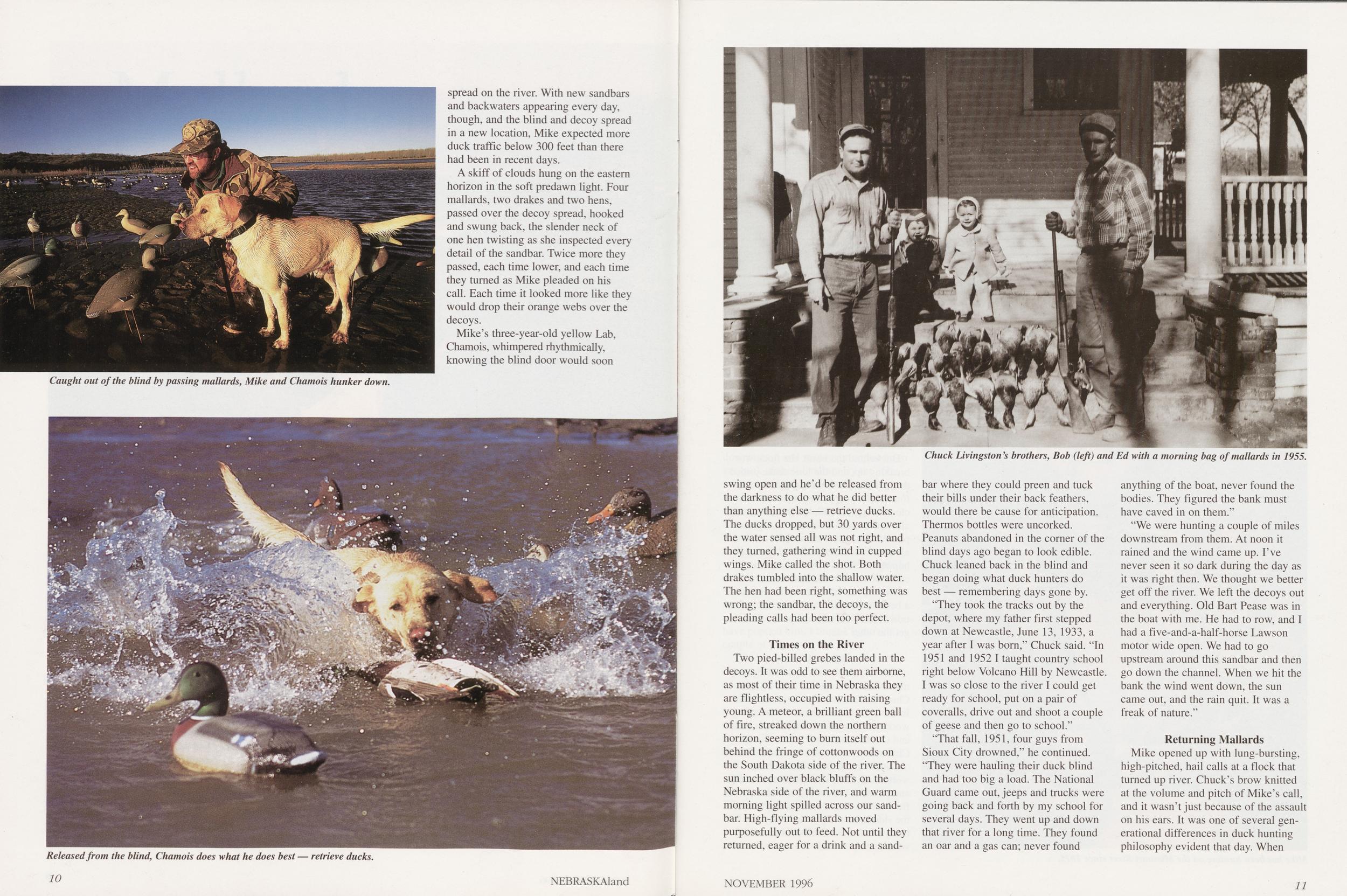
A skiff of clouds hung on the eastern horizon in the soft predawn light. Four mallards, two drakes and two hens, passed over the decoy spread, hooked and swung back, the slender neck of one hen twisting as she inspected every detail of the sandbar. Twice more they passed, each time lower, and each time they turned as Mike pleaded on his call. Each time it looked more like they would drop their orange webs over the decoys.
Mike's three-year-old yellow Lab, Chamois, whimpered rhythmically, knowing the blind door would soon
Two pied-billed grebes landed in the decoys. It was odd to see them airborne, as most of their time in Nebraska they are flightless, occupied with raising young. A meteor, a brilliant green ball of fire, streaked down the northern horizon, seeming to burn itself out behind the fringe of cottonwoods on the South Dakota side of the river. The sun inched over black bluffs on the Nebraska side of the river, and warm morning light spilled across our sandbar. High-flying mallards moved purposefully out to feed. Not until they returned, eager for a drink and a sandbar where they could preen and tuck their bills under their back feathers, would there be cause for anticipation. Thermos bottles were uncorked. Peanuts abandoned in the corner of the blind days ago began to look edible. Chuck leaned back in the blind and began doing what duck hunters do best — remembering days gone by.
They took the tracks out by the depot, where my father first stepped down at Newcastle, June 13, 1933, a year after I was born," Chuck said. "In 1951 and 1952 I taught country school right below Volcano Hill by Newcastle. I was so close to the river I could get ready for school, put on a pair of coveralls, drive out and shoot a couple of geese and then go to school."
"That fall, 1951, four guys from Sioux City drowned," he continued. "They were hauling their duck blind and had too big a load. The National Guard came out, jeeps and trucks were going back and forth by my school for several days. They went up and down that river for a long time. They found an oar and a gas can; never found anything of the boat, never found the bodies. They figured the bank must have caved in on them."
"We were hunting a couple of miles downstream from them. At noon it rained and the wind came up. I've never seen it so dark during the day as it was right then. We thought we better get off the river. We left the decoys out and everything. Old Bart Pease was in the boat with me. He had to row, and I had a five-and-a-half-horse Lawson motor wide open. We had to go upstream around this sandbar and then go down the channel. When we hit the bank the wind went down, the sun came out, and the rain quit. It was a freak of nature."
Returning MallardsMike opened up with lung-bursting,
high-pitched, hail calls at a flock that
turned up river. Chuck's brow knitted
at the volume and pitch of Mike's call,
and it wasn't just because of the assault
on his ears. It was one of several
generational differences in duck hunting
philosophy evident that day. When
11
 Chuck started duck hunting, calls were
low and raspy, and hunters begged,
rather than demanded, that ducks come
to the decoys. He thought chest waders
were dangerous, that it was easier to
slip out of hip boots if dumped in the
channel. And there was the age-old
dispute about the best way to set decoys.
Chuck started duck hunting, calls were
low and raspy, and hunters begged,
rather than demanded, that ducks come
to the decoys. He thought chest waders
were dangerous, that it was easier to
slip out of hip boots if dumped in the
channel. And there was the age-old
dispute about the best way to set decoys.
The flock flew on, and dozens of others followed, pushing out to feed. "There's a big bunch coming up the river," Chuck whispered to Mike. "Call to 'em, they're coming, call to 'em."
Chuck joined in with a mellow, mature version of the same sequence of calls Mike was using. The flock came on, and the hail calls changed to excited greeting calls. The birds began to veer from a course that would have brought them over the decoys. Mike and Chuck switched to excited quacks telling the ducks they were leaving the best spot on the river and some darn fine company. The flock turned. Feeding chuckles and lonesome-hen calls lied to the flock — "we're contented as can be down here on the sandbar, nothing to fear."
As the river fell, shallow water appeared on the north side of the sandbar where the Livingstons hunt. Mike had no choice but to put the decoys there, but it was not ideal with a northwest wind. Incoming ducks made their final swing over the channel south of the blind and vanished from sight in the critical moments when a hunter needs to see them. Are they coming in or swinging to make another pass? Are they rising, most likely not to return?
Most of the flock had pulled up by the time we could see them, wanting one more look before coming down. A single drake hung 10 yards over the decoys for an eternity, hovering, its head shifting from side to side looking for a spot of water in the decoy spread. Mike and Chuck issued the softest of hen quacks and chuckles. Surely the rest of the flock would be drawn in behind the drake.
But behind the blind, the flock was breaking up, and the lone drake joined them. Then, from behind the blind, four mallards appeared over the decoys close enough to kill, but they, too, were allowed to pass. The same thoughts passed through all our minds — we'd all done it before — let one or two go, hoping the flock would swing and come down. It is the duck hunter's version of the fable about the dog with a bone in its mouth who sees his reflection in the water and drops the bone to get the other one.
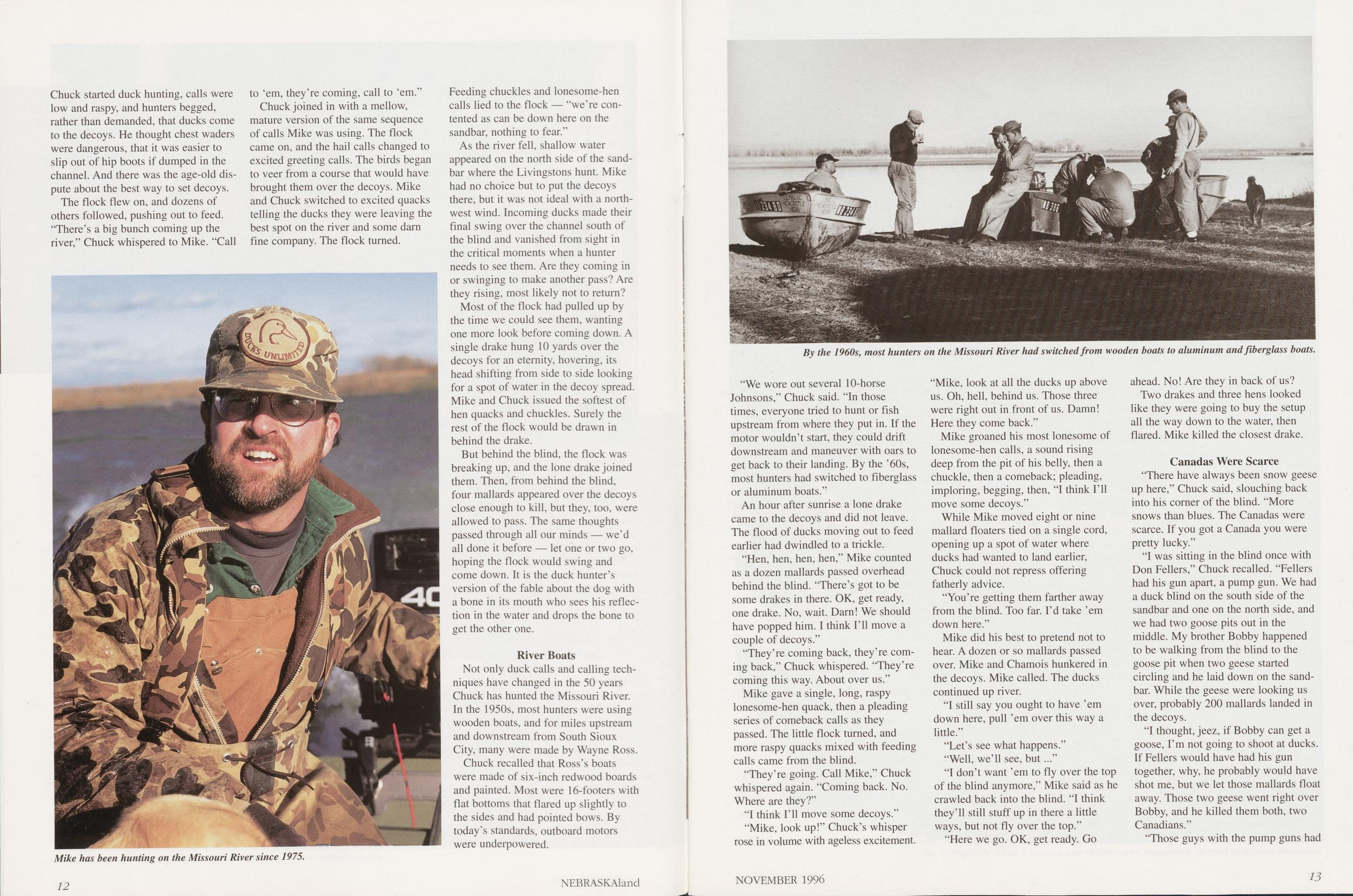
River BoatsNot only duck calls and calling techniques have changed in the 50 years Chuck has hunted the Missouri River. In the 1950s, most hunters were using wooden boats, and for miles upstream and downstream from South Sioux City, many were made by Wayne Ross. Chuck recalled that Ross's boats were made of six-inch redwood boards and painted. Most were 16-footers with flat bottoms that flared up slightly to the sides and had pointed bows. By today's standards, outboard motors were underpowered.
"We wore out several 10-horse Johnsons," Chuck said. "In those times, everyone tried to hunt or fish upstream from where they put in. If the motor wouldn't start, they could drift downstream and maneuver with oars to get back to their landing. By the '60s, most hunters had switched to fiberglass or aluminum boats."
An hour after sunrise a lone drake came to the decoys and did not leave. The flood of ducks moving out to feed earlier had dwindled to a trickle.
"Hen, hen, hen, hen," Mike counted as a dozen mallards passed overhead behind the blind. "There's got to be some drakes in there. OK, get ready, one drake. No, wait. Darn! We should have popped him. I think I'll move a couple of decoys."
"They're coming back, they're coming back," Chuck whispered. "They're coming this way. About over us."
Mike gave a single, long, raspy lonesome-hen quack, then a pleading series of comeback calls as they passed. The little flock turned, and more raspy quacks mixed with feeding calls came from the blind.
"They're going. Call Mike," Chuck whispered again. "Coming back. No. Where are they?"
"I think I'll move some decoys."
"Mike, look up!" Chuck's whisper rose in volume with ageless excitement. "Mike, look at all the ducks up above us. Oh, hell, behind us. Those three were right out in front of us. Damn! Here they come back."
Mike groaned his most lonesome of lonesome-hen calls, a sound rising deep from the pit of his belly, then a chuckle, then a comeback; pleading, imploring, begging, then, "I think I'll move some decoys."
While Mike moved eight or nine mallard floaters tied on a single cord, opening up a spot of water where ducks had wanted to land earlier, Chuck could not repress offering fatherly advice.
'You're getting them farther away from the blind. Too far. I'd take 'em down here."
Mike did his best to pretend not to hear. A dozen or so mallards passed over. Mike and Chamois hunkered in the decoys. Mike called. The ducks continued up river.
"I still say you ought to have 'em down here, pull 'em over this way a little."
"Let's see what happens."
"Well, we'll see, but..."
"I don't want 'em to fly over the top of the blind anymore," Mike said as he crawled back into the blind. "I think they'll still stuff up in there a little ways, but not fly over the top."
"Here we go. OK, get ready. Go ahead. No! Are they in back of us?
Two drakes and three hens looked like they were going to buy the setup all the way down to the water, then flared. Mike killed the closest drake.
Canadas Were Scarce"There have always been snow geese up here," Chuck said, slouching back into his corner of the blind. "More snows than blues. The Canadas were scarce. If you got a Canada you were pretty lucky."
"I was sitting in the blind once with Don Fellers," Chuck recalled. "Fellers had his gun apart, a pump gun. We had a duck blind on the south side of the sandbar and one on the north side, and we had two goose pits out in the middle. My brother Bobby happened to be walking from the blind to the goose pit when two geese started circling and he laid down on the sandbar. While the geese were looking us over, probably 200 mallards landed in the decoys.
"I thought, jeez, if Bobby can get a goose, I'm not going to shoot at ducks. If Fellers would have had his gun together, why, he probably would have shot me, but we let those mallards float away. Those two geese went right over Bobby, and he killed them both, two Canadians."
'Those guys with the pump guns had
NOVEMBER 1996
13
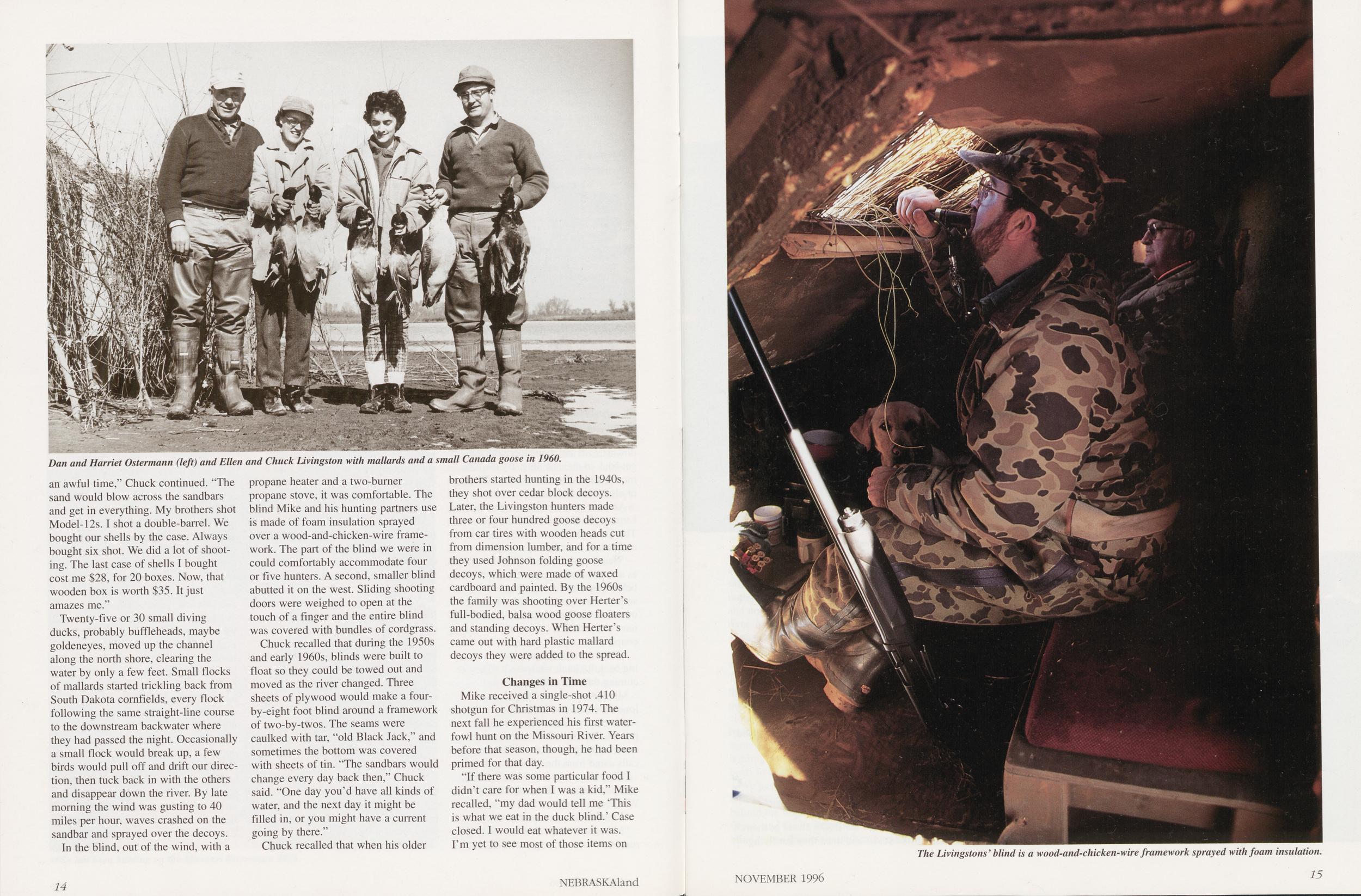
Twenty-five or 30 small diving ducks, probably buffleheads, maybe goldeneyes, moved up the channel along the north shore, clearing the water by only a few feet. Small flocks of mallards started trickling back from South Dakota cornfields, every flock following the same straight-line course to the downstream backwater where they had passed the night. Occasionally a small flock would break up, a few birds would pull off and drift our direction, then tuck back in with the others and disappear down the river. By late morning the wind was gusting to 40 miles per hour, waves crashed on the sandbar and sprayed over the decoys.
In the blind, out of the wind, with a propane heater and a two-burner propane stove, it was comfortable. The blind Mike and his hunting partners use is made of foam insulation sprayed over a wood-and-chicken-wire framework. The part of the blind we were in could comfortably accommodate four or five hunters. A second, smaller blind abutted it on the west. Sliding shooting doors were weighed to open at the touch of a finger and the entire blind was covered with bundles of cordgrass.
Chuck recalled that during the 1950s and early 1960s, blinds were built to float so they could be towed out and moved as the river changed. Three sheets of plywood would make a four- by-eight foot blind around a framework of two-by-twos. The seams were caulked with tar, "old Black Jack," and sometimes the bottom was covered with sheets of tin. "The sandbars would change every day back then," Chuck said. "One day you'd have all kinds of water, and the next day it might be filled in, or you might have a current going by there."
Chuck recalled that when his older brothers started hunting in the 1940s, they shot over cedar block decoys. Later, the Livingston hunters made three or four hundred goose decoys from car tires with wooden heads cut from dimension lumber, and for a time they used Johnson folding goose decoys, which were made of waxed cardboard and painted. By the 1960s the family was shooting over Herter's full-bodied, balsa wood goose floaters and standing decoys. When Herter's came out with hard plastic mallard decoys they were added to the spread.
Changes in TimeMike received a single-shot .410 shotgun for Christmas in 1974. The next fall he experienced his first waterfowl hunt on the Missouri River. Years before that season, though, he had been primed for that day.
"If there was some particular food I didn't care for when I was a kid," Mike recalled, "my dad would tell me This is what we eat in the duck blind.' Case closed. I would eat whatever it was. I'm yet to see most of those items on 14 NEBRASKAland
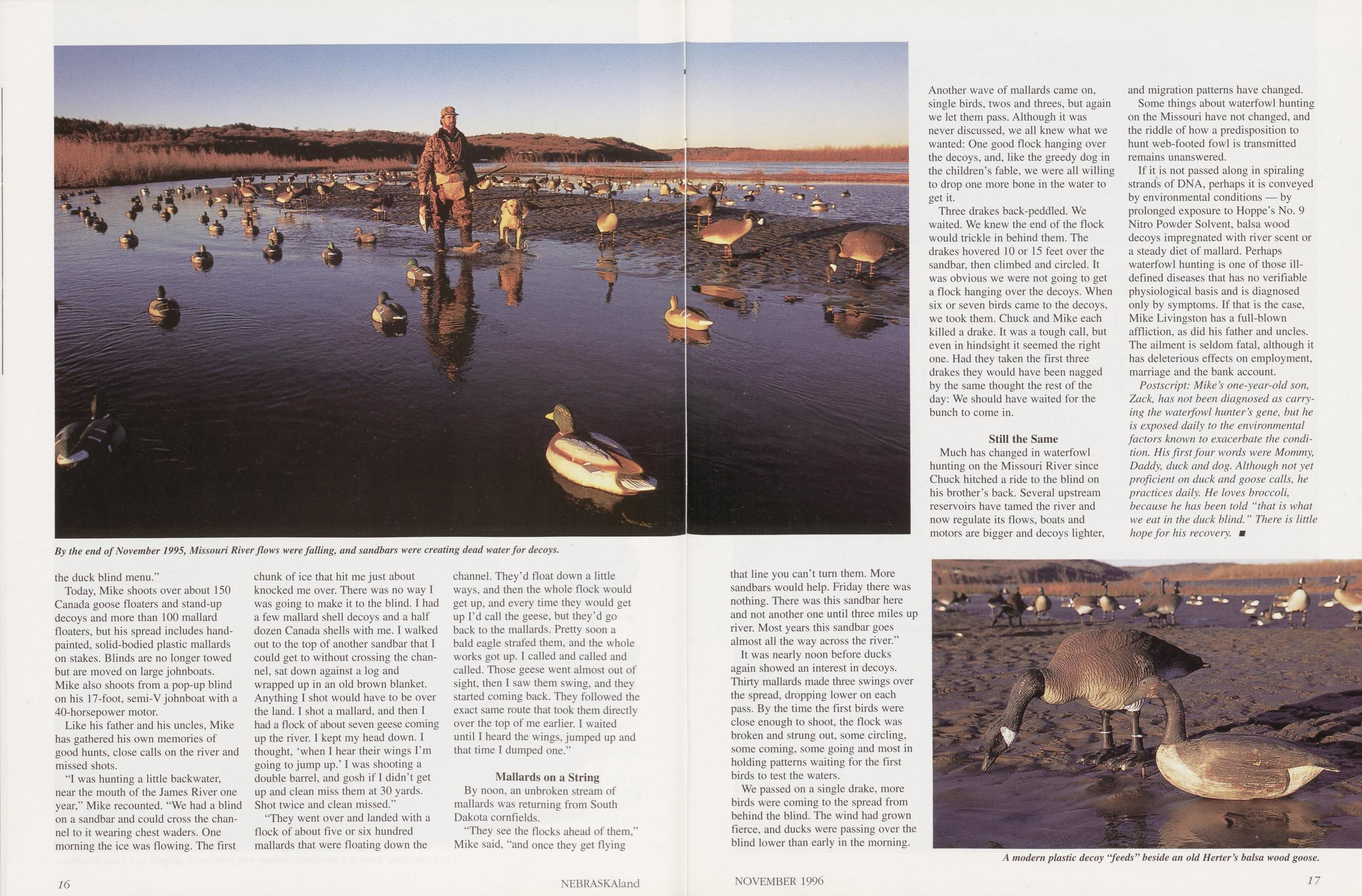
Today, Mike shoots over about 150 Canada goose floaters and stand-up decoys and more than 100 mallard floaters, but his spread includes handpainted, solid-bodied plastic mallards on stakes. Blinds are no longer towed but are moved on large johnboats. Mike also shoots from a pop-up blind on his 17-foot, semi-V johnboat with a 40-horsepower motor.
Like his father and his uncles, Mike has gathered his own memories of good hunts, close calls on the river and missed shots.
'T was hunting a little backwater, near the mouth of the James River one year," Mike recounted. "We had a blind on a sandbar and could cross the channel to it wearing chest waders. One morning the ice was flowing. The first chunk of ice that hit me just about knocked me over. There was no way I was going to make it to the blind. I had a few mallard shell decoys and a half dozen Canada shells with me. I walked out to the top of another sandbar that I could get to without crossing the channel, sat down against a log and wrapped up in an old brown blanket. Anything I shot would have to be over the land. I shot a mallard, and then I had a flock of about seven geese coming up the river. I kept my head down. I thought, 'when I hear their wings I'm going to jump up.' I was shooting a double barrel, and gosh if I didn't get up and clean miss them at 30 yards. Shot twice and clean missed."
"They went over and landed with a flock of about five or six hundred mallards that were floating down the channel. They'd float down a little ways, and then the whole flock would get up, and every time they would get up I'd call the geese, but they'd go back to the mallards. Pretty soon a bald eagle strafed them, and the whole works got up. I called and called and called. Those geese went almost out of sight, then I saw them swing, and they started coming back. They followed the exact same route that took them directly over the top of me earlier. I waited until I heard the wings, jumped up and that time I dumped one."
Mallards on a StringBy noon, an unbroken stream of mallards was returning from South Dakota cornfields.
"They see the flocks ahead of them," Mike said, "and once they get flying 16 NEBRASKAland that line you can't turn them. More sandbars would help. Friday there was nothing. There was this sandbar here and not another one until three miles up river. Most years this sandbar goes almost all the way across the river."
It was nearly noon before ducks again showed an interest in decoys. Thirty mallards made three swings over the spread, dropping lower on each pass. By the time the first birds were close enough to shoot, the flock was broken and strung out, some circling, some coming, some going and most in holding patterns waiting for the first birds to test the waters.
We passed on a single drake, more birds were coming to the spread from behind the blind. The wind had grown fierce, and ducks were passing over the blind lower than early in the morning. Another wave of mallards came on, single birds, twos and threes, but again we let them pass. Although it was never discussed, we all knew what we wanted: One good flock hanging over the decoys, and, like the greedy dog in the children's fable, we were all willing to drop one more bone in the water to get it.
Three drakes back-peddled. We waited. We knew the end of the flock would trickle in behind them. The drakes hovered 10 or 15 feet over the sandbar, then climbed and circled. It was obvious we were not going to get a flock hanging over the decoys. When six or seven birds came to the decoys, we took them. Chuck and Mike each killed a drake. It was a tough call, but even in hindsight it seemed the right one. Had they taken the first three drakes they would have been nagged by the same thought the rest of the day: We should have waited for the bunch to come in.
Still the SameMuch has changed in waterfowl hunting on the Missouri River since Chuck hitched a ride to the blind on his brother's back. Several upstream reservoirs have tamed the river and now regulate its flows, boats and motors are bigger and decoys lighter, and migration patterns have changed.
Some things about waterfowl hunting on the Missouri have not changed, and the riddle of how a predisposition to hunt web-footed fowl is transmitted remains unanswered.
If it is not passed along in spiraling strands of DNA, perhaps it is conveyed by environmental conditions — by prolonged exposure to Hoppe's No. 9 Nitro Powder Solvent, balsa wood decoys impregnated with river scent or a steady diet of mallard. Perhaps waterfowl hunting is one of those illdefined diseases that has no verifiable physiological basis and is diagnosed only by symptoms. If that is the case, Mike Livingston has a full-blown affliction, as did his father and uncles. The ailment is seldom fatal, although it has deleterious effects on employment, marriage and the bank account.
Postscript: Mike *s one-year-old son, Zack, has not been diagnosed as carrying the waterfowl hunter of gene, but he is exposed daily to the environmental factors known to exacerbate the condition. His first four words were Mommy, Daddy, duck and dog. Although not yet proficient on duck and goose calls, he practices daily. He loves broccoli, because he has been told "that is what we eat in the duck blind. " There is little hope for his recovery,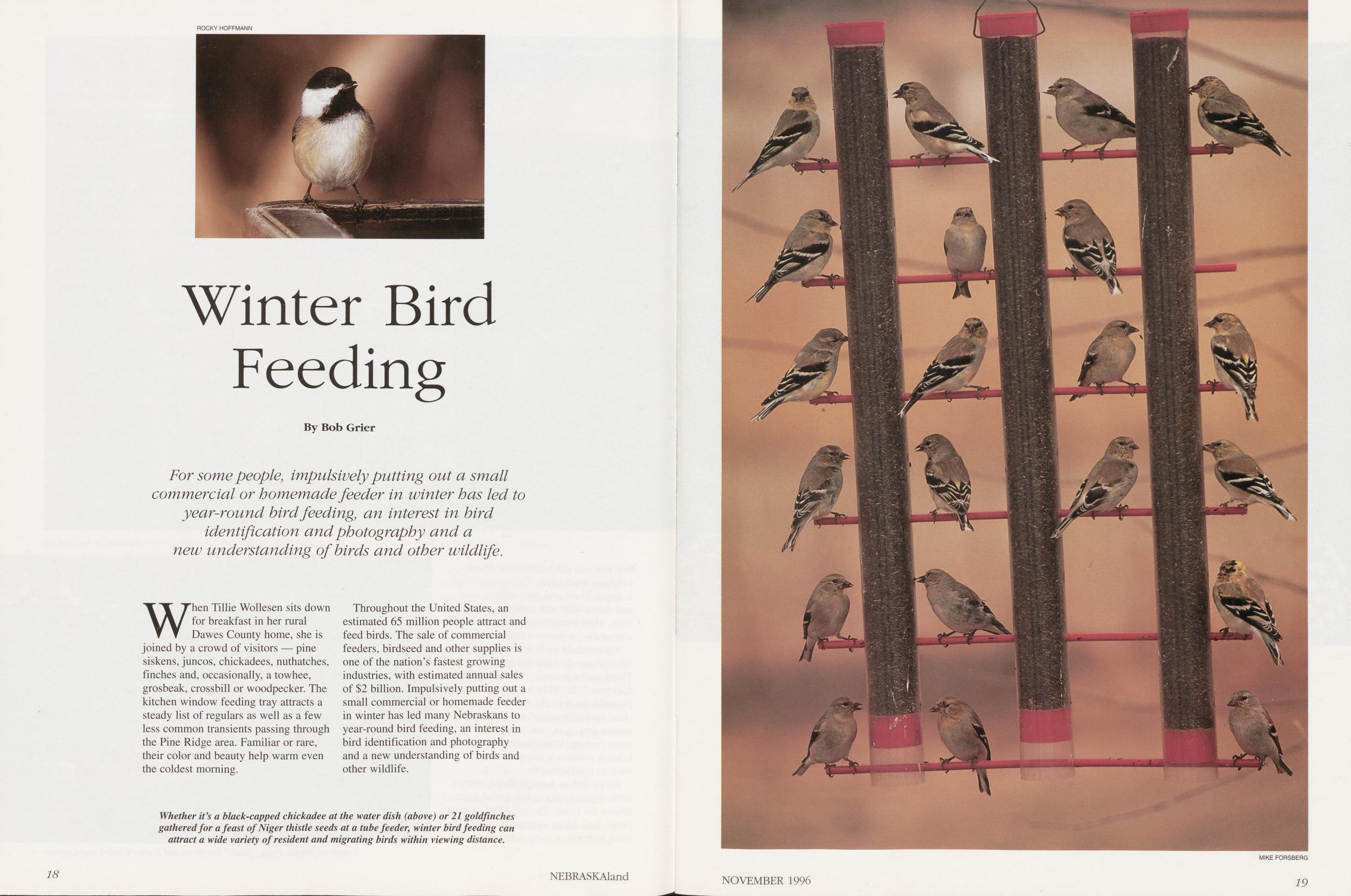
Winter Bird Feeding
By Bob Grier For some people, impulsively putting out a small commercial or homemade feeder in winter has led to year-round bird feeding, an interest in bird identification and photography and a new understanding of birds and other wildlife.When Tillie Wollesen sits down for breakfast in her rural Dawes County home, she is joined by a crowd of visitors — pine siskens, juncos, chickadees, nuthatches, finches and, occasionally, a towhee, grosbeak, crossbill or woodpecker. The kitchen window feeding tray attracts a steady list of regulars as well as a few less common transients passing through the Pine Ridge area. Familiar or rare, their color and beauty help warm even the coldest morning.
Throughout the United States, an estimated 65 million people attract and feed birds. The sale of commercial feeders, birdseed and other supplies is one of the nation's fastest growing industries, with estimated annual sales of $2 billion. Impulsively putting out a small commercial or homemade feeder in winter has led many Nebraskans to year-round bird feeding, an interest in bird identification and photography and a new understanding of birds and other wildlife.
18 NEBRASKAland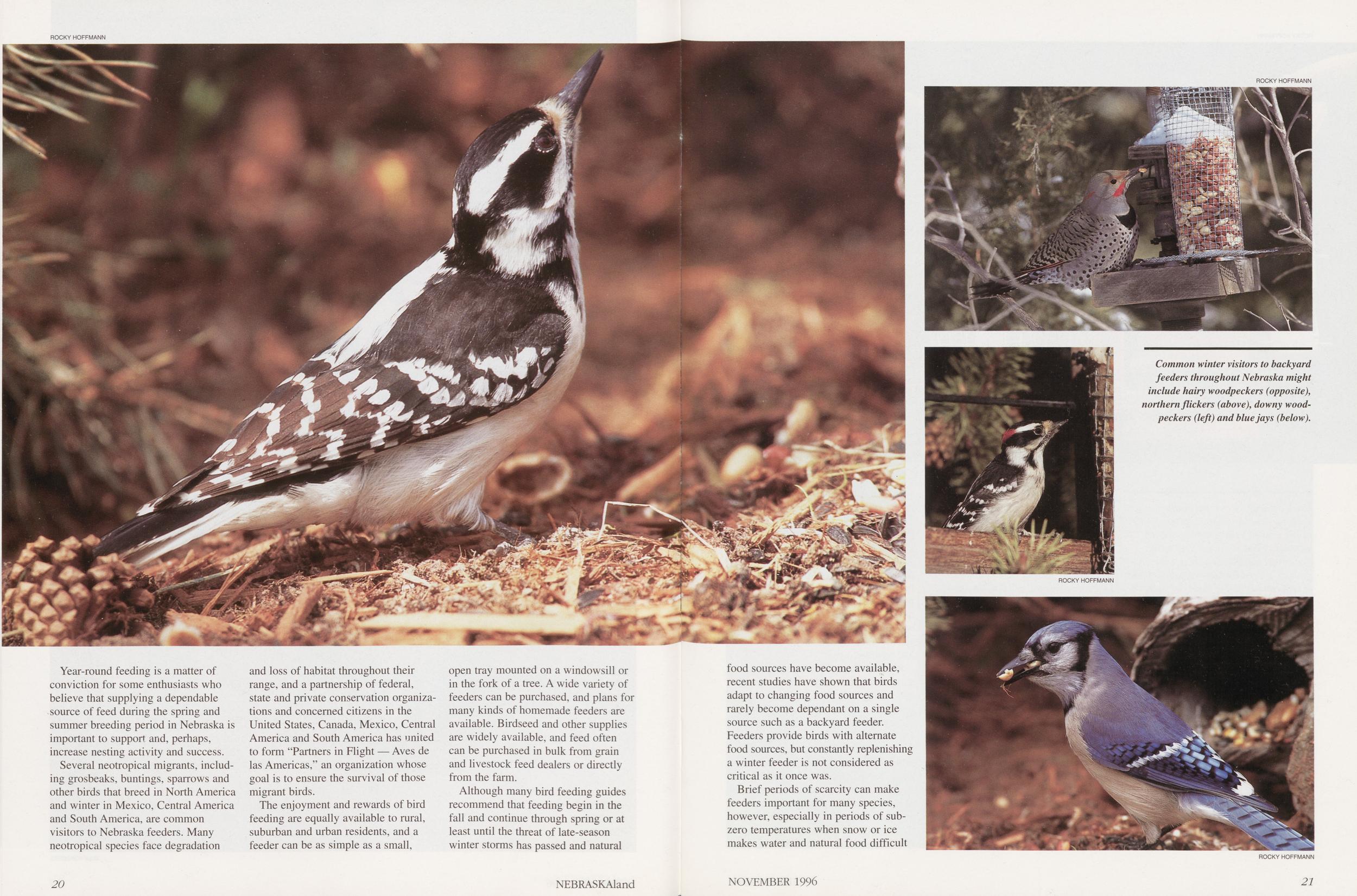
Year-round feeding is a matter of conviction for some enthusiasts who believe that supplying a dependable source of feed during the spring and summer breeding period in Nebraska is important to support and, perhaps, increase nesting activity and success.
Several neotropical migrants, including grosbeaks, buntings, sparrows and other birds that breed in North America and winter in Mexico, Central America and South America, are common visitors to Nebraska feeders. Many neotropical species face degradation and loss of habitat throughout their range, and a partnership of federal, state and private conservation organizations and concerned citizens in the United States, Canada, Mexico, Central America and South America has united to form "Partners in Flight — Aves de las Americas," an organization whose goal is to ensure the survival of those migrant birds.
The enjoyment and rewards of bird feeding are equally available to rural, suburban and urban residents, and a feeder can be as simple as a small, open tray mounted on a windowsill or in the fork of a tree. A wide variety of feeders can be purchased, and plans for many kinds of homemade feeders are available. Birdseed and other supplies are widely available, and feed often can be purchased in bulk from grain and livestock feed dealers or directly from the farm.
Although many bird feeding guides recommend that feeding begin in the fall and continue through spring or at least until the threat of late-season winter storms has passed and natural 20 NEBRASKAland food sources have become available, recent studies have shown that birds adapt to changing food sources and rarely become dependent on a single source such as a backyard feeder. Feeders provide birds with alternate food sources, but constantly replenishing a winter feeder is not considered as critical as it once was.
Brief periods of scarcity can make feeders important for many species, however, especially in periods of subzero temperatures when snow or ice makes water and natural food difficult
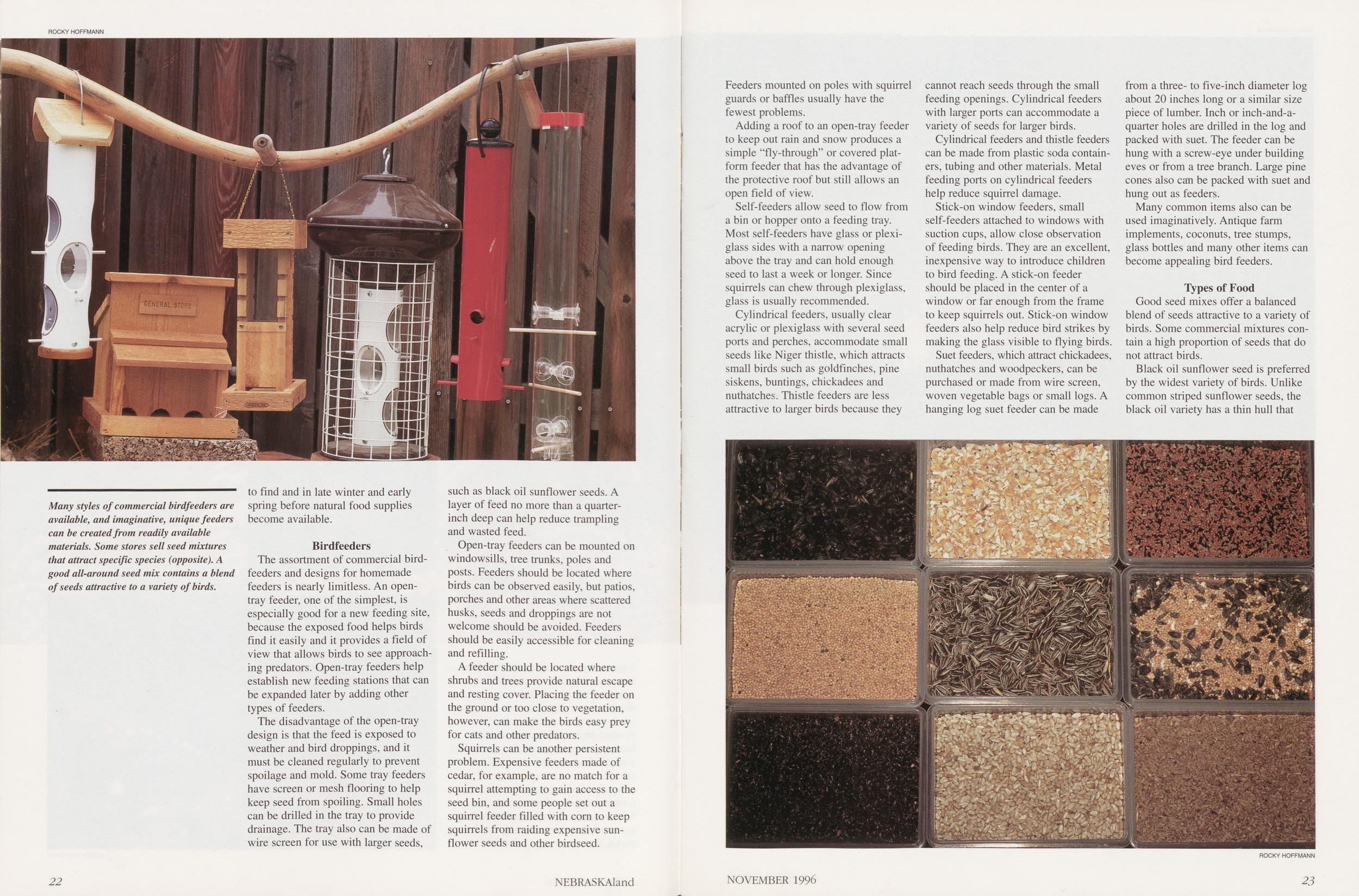
The assortment of commercial birdfeeders and designs for homemade feeders is nearly limitless. An opentray feeder, one of the simplest, is especially good for a new feeding site, because the exposed food helps birds find it easily and it provides a field of view that allows birds to see approaching predators. Open-tray feeders help establish new feeding stations that can be expanded later by adding other types of feeders.
The disadvantage of the open-tray design is that the feed is exposed to weather and bird droppings, and it must be cleaned regularly to prevent spoilage and mold. Some tray feeders have screen or mesh flooring to help keep seed from spoiling. Small holes can be drilled in the tray to provide drainage. The tray also can be made of wire screen for use with larger seeds, such as black oil sunflower seeds. A layer of feed no more than a quarter inch deep can help reduce trampling and wasted feed.
Open-tray feeders can be mounted on windowsills, tree trunks, poles and posts. Feeders should be located where birds can be observed easily, but patios, porches and other areas where scattered husks, seeds and droppings are not welcome should be avoided. Feeders should be easily accessible for cleaning and refilling.
A feeder should be located where shrubs and trees provide natural escape and resting cover. Placing the feeder on the ground or too close to vegetation, however, can make the birds easy prey for cats and other predators.
Squirrels can be another persistent problem. Expensive feeders made of cedar, for example, are no match for a squirrel attempting to gain access to the seed bin, and some people set out a squirrel feeder filled with corn to keep squirrels from raiding expensive sunflower seeds and other birdseed. 22 NEBRASKAland Feeders mounted on poles with squirrel guards or baffles usually have the fewest problems.
Adding a roof to an open-tray feeder to keep out rain and snow produces a simple "fly-through" or covered platform feeder that has the advantage of the protective roof but still allows an open field of view.
Self-feeders allow seed to flow from a bin or hopper onto a feeding tray. Most self-feeders have glass or plexiglass sides with a narrow opening above the tray and can hold enough seed to last a week or longer. Since squirrels can chew through plexiglass, glass is usually recommended.
Cylindrical feeders, usually clear acrylic or plexiglass with several seed ports and perches, accommodate small seeds like Niger thistle, which attracts small birds such as goldfinches, pine siskens, buntings, chickadees and nuthatches. Thistle feeders are less attractive to larger birds because they cannot reach seeds through the small feeding openings. Cylindrical feeders with larger ports can accommodate a variety of seeds for larger birds.
Cylindrical feeders and thistle feeders can be made from plastic soda contain- ers, tubing and other materials. Metal feeding ports on cylindrical feeders help reduce squirrel damage.
Stick-on window feeders, small self-feeders attached to windows with suction cups, allow close observation of feeding birds. They are an excellent, inexpensive way to introduce children to bird feeding. A stick-on feeder should be placed in the center of a window or far enough from the frame to keep squirrels out. Stick-on window feeders also help reduce bird strikes by making the glass visible to flying birds.
Suet feeders, which attract chickadees, nuthatches and woodpeckers, can be purchased or made from wire screen, woven vegetable bags or small logs. A hanging log suet feeder can be made from a three- to five-inch diameter log about 20 inches long or a similar size piece of lumber. Inch or inch-and-a-quarter holes are drilled in the log and packed with suet. The feeder can be hung with a screw-eye under building eves or from a tree branch. Large pine cones also can be packed with suet and hung out as feeders.
Many common items also can be used imaginatively. Antique farm implements, coconuts, tree stumps, glass bottles and many other items can become appealing bird feeders.
Types of FoodGood seed mixes offer a balanced blend of seeds attractive to a variety of birds. Some commercial mixtures contain a high proportion of seeds that do not attract birds.
Black oil sunflower seed is preferred by the widest variety of birds. Unlike common striped sunflower seeds, the black oil variety has a thin hull that
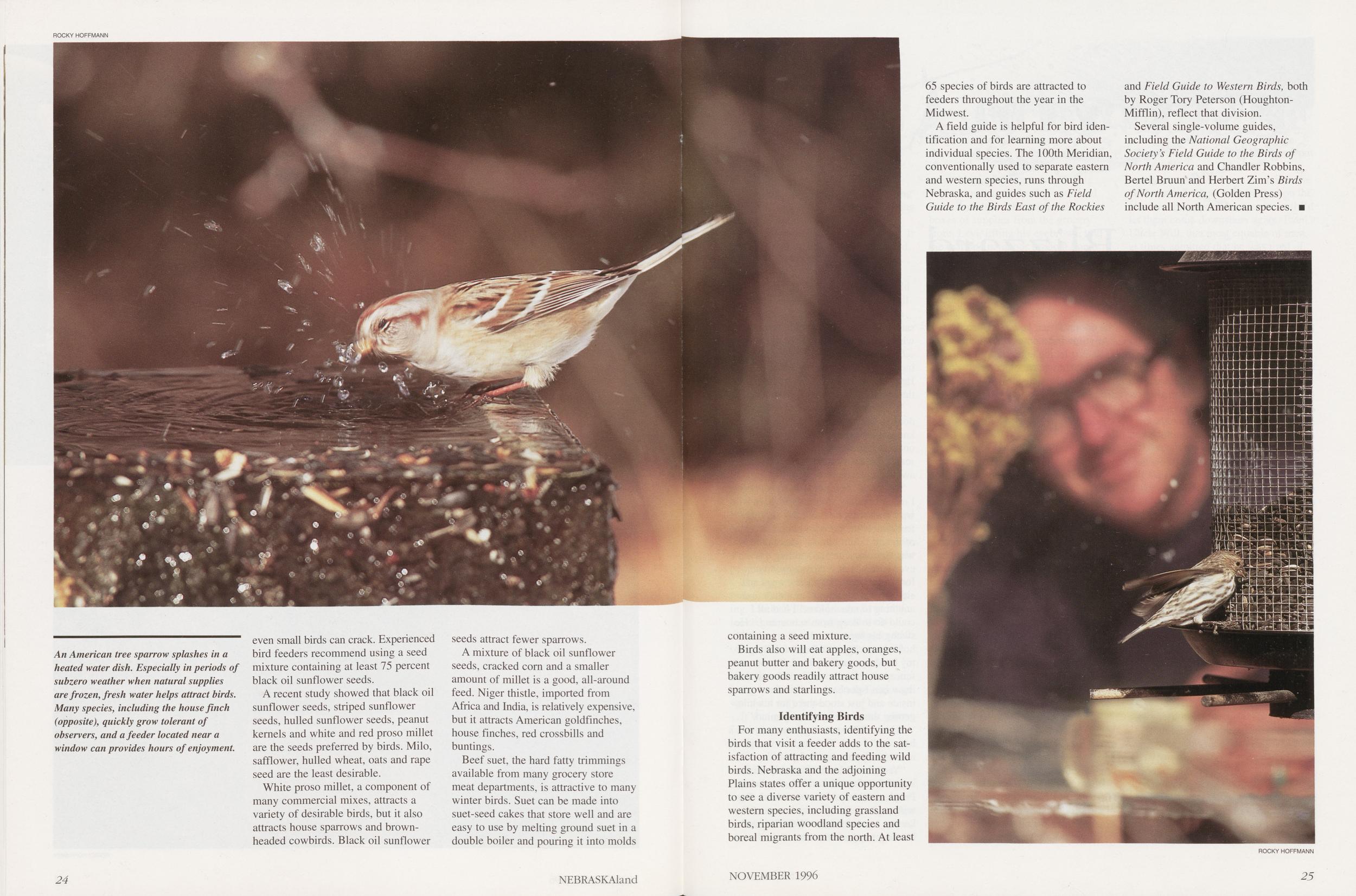
A recent study showed that black oil sunflower seeds, striped sunflower seeds, hulled sunflower seeds, peanut kernels and white and red proso millet are the seeds preferred by birds. Milo, safflower, hulled wheat, oats and rape seed are the least desirable.
White proso millet, a component of many commercial mixes, attracts a variety of desirable birds, but it also attracts house sparrows and brown headed cowbirds. Black oil sunflower seeds attract fewer sparrows.
A mixture of black oil sunflower seeds, cracked corn and a smaller amount of millet is a good, all-around feed. Niger thistle, imported from Africa and India, is relatively expensive, but it attracts American goldfinches, house finches, red crossbills and buntings.
Beef suet, the hard fatty trimmings available from many grocery store meat departments, is attractive to many winter birds. Suet can be made into suet-seed cakes that store well and are easy to use by melting ground suet in a double boiler and pouring it into molds 24 NEBRASKAland containing a seed mixture.
Birds also will eat apples, oranges, peanut butter and bakery goods, but bakery goods readily attract house sparrows and starlings.
Identifying BirdsFor many enthusiasts, identifying the birds that visit a feeder adds to the satisfaction of attracting and feeding wild birds. Nebraska and the adjoining Plains states offer a unique opportunity to see a diverse variety of eastern and western species, including grassland birds, riparian woodland species and boreal migrants from the north. At least 65 species of birds are attracted to feeders throughout the year in the Midwest.
A field guide is helpful for bird identification and for learning more about individual species. The 100th Meridian, conventionally used to separate eastern and western species, runs through Nebraska, and guides such as Field Guide to the Birds East of the Rockies and Field Guide to Western Birds, both by Roger Tory Peterson (Houghton-Mifflin), reflect that division.
Several single-volume guides, including the National Geographic Society's Field Guide to the Birds of North America and Chandler Robbins, Bertel Bruun and Herbert Zim's Birds of North America, (Golden Press) include all North American species.
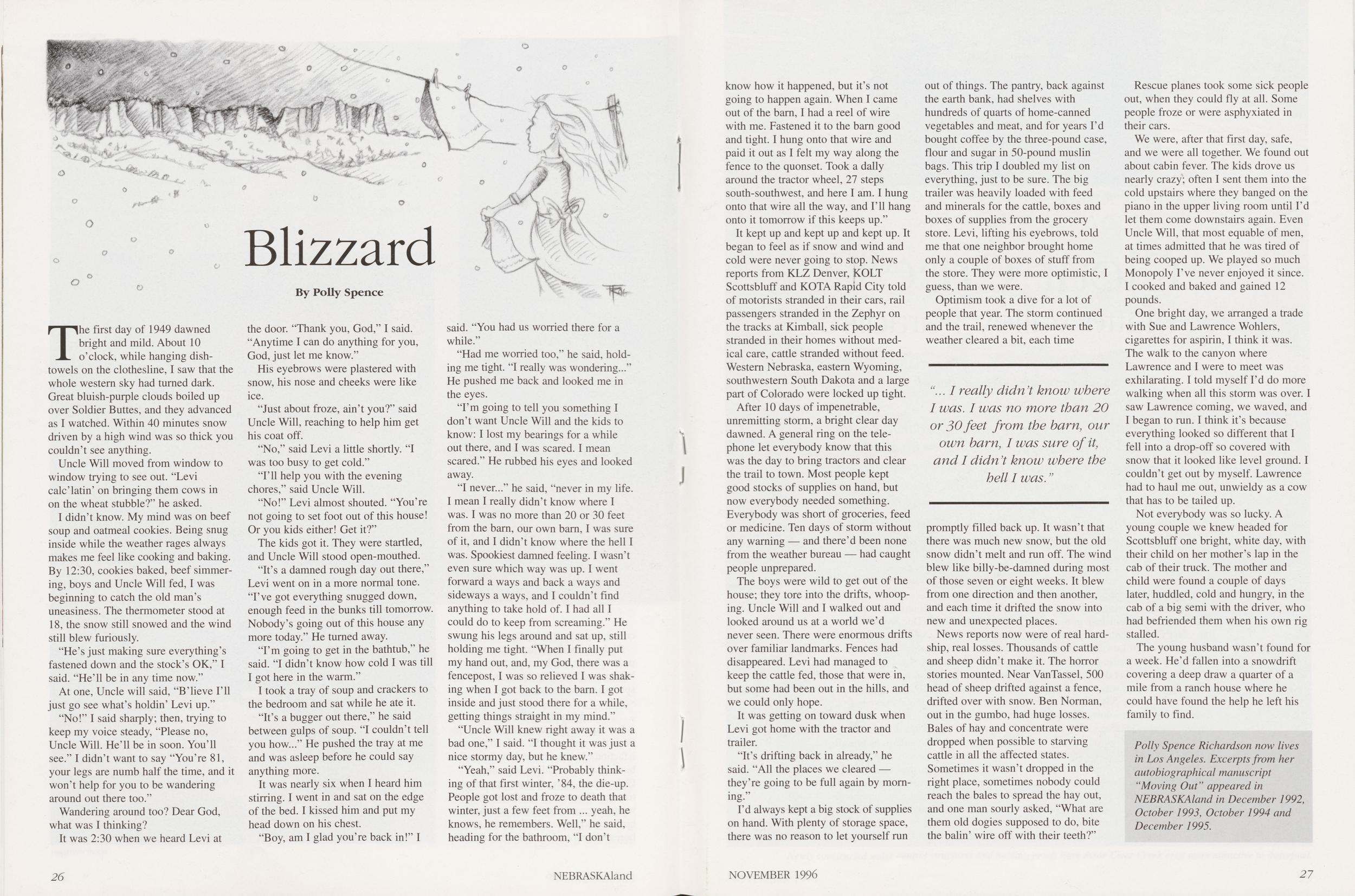
Blizzard
By Polly SpenceThe first day of 1949 dawned bright and mild. About 10 o'clock, while hanging dishtowels on the clothesline, I saw that the whole western sky had turned dark. Great bluish-purple clouds boiled up over Soldier Buttes, and they advanced as I watched. Within 40 minutes snow driven by a high wind was so thick you couldn't see anything.
Uncle Will moved from window to window trying to see out. "Levi calculation on bringing them cows in on the wheat stubble?" he asked.
I didn't know. My mind was on beef soup and oatmeal cookies. Being snug inside while the weather rages always makes me feel like cooking and baking. By 12:30, cookies baked, beef simmering, boys and Uncle Will fed, I was beginning to catch the old man's uneasiness. The thermometer stood at 18, the snow still snowed and the wind still blew furiously.
"He's just making sure everything's fastened down and the stock's OK," I said. "He'll be in any time now."
At one, Uncle will said, "BTieve I'll just go see what's holdin' Levi up."
"No!" I said sharply; then, trying to keep my voice steady, "Please no, Uncle Will. He'll be in soon. You'll see." I didn't want to say "You're 81, your legs are numb half the time, and it won't help for you to be wandering around out there too."
Wandering around too? Dear God, what was I thinking?
It was 2:30 when we heard Levi at the door. "Thank you, God," I said. "Anytime I can do anything for you, God, just let me know."
His eyebrows were plastered with snow, his nose and cheeks were like ice.
"Just about froze, ain't you?" said Uncle Will, reaching to help him get his coat off.
"No," said Levi a little shortly. "I was too busy to get cold."
"I'll help you with the evening chores," said Uncle Will.
"No!" Levi almost shouted. "You're not going to set foot out of this house! Or you kids either! Get it?"
The kids got it. They were startled, and Uncle Will stood open-mouthed.
"It's a damned rough day out there," Levi went on in a more normal tone. "I've got everything snugged down, enough feed in the bunks till tomorrow. Nobody's going out of this house any more today." He turned away.
"I'm going to get in the bathtub," he said. "I didn't know how cold I was till I got here in the warm."
I took a tray of soup and crackers to the bedroom and sat while he ate it.
"It's a bugger out there," he said between gulps of soup. "I couldn't tell you how..." He pushed the tray at me and was asleep before he could say anything more.
It was nearly six when I heard him stirring. I went in and sat on the edge of the bed. I kissed him and put my head down on his chest.
"Boy, am I glad you're back in!" I said. "You had us worried there for a while."
"Had me worried too," he said, holding me tight. "I really was wondering..." He pushed me back and looked me in the eyes.
"I'm going to tell you something I don't want Uncle Will and the kids to know: I lost my bearings for a while out there, and I was scared. I mean scared." He rubbed his eyes and looked away.
"I never..." he said, "never in my life. I mean I really didn't know where I was. I was no more than 20 or 30 feet from the barn, our own barn, I was sure of it, and I didn't know where the hell I was. Spookiest damned feeling. I wasn't even sure which way was up. I went forward a ways and back a ways and sideways a ways, and I couldn't find anything to take hold of. I had all I could do to keep from screaming." He swung his legs around and sat up, still holding me tight. "When I finally put my hand out, and, my God, there was a fencepost, I was so relieved I was shaking when I got back to the barn. I got inside and just stood there for a while, getting things straight in my mind."
"Uncle Will knew right away it was a bad one," I said. "I thought it was just a nice stormy day, but he knew."
"Yeah," said Levi. "Probably think- ing of that first winter, '84, the die-up. People got lost and froze to death that winter, just a few feet from ... yeah, he knows, he remembers. Well," he said, heading for the bathroom, "I don't 26 NEBRASKAland know how it happened, but it's not going to happen again. When I came out of the barn, I had a reel of wire with me. Fastened it to the barn good and tight. I hung onto that wire and paid it out as I felt my way along the fence to the quonset. Took a dally around the tractor wheel, 27 steps south-southwest, and here I am. I hung onto that wire all the way, and I'll hang onto it tomorrow if this keeps up."
It kept up and kept up and kept up. It began to feel as if snow and wind and cold were never going to stop. News reports from KLZ Denver, KOLT Scottsbluff and KOTA Rapid City told of motorists stranded in their cars, rail passengers stranded in the Zephyr on the tracks at Kimball, sick people stranded in their homes without medical care, cattle stranded without feed. Western Nebraska, eastern Wyoming, southwestern South Dakota and a large part of Colorado were locked up tight.
After 10 days of impenetrable, unremitting storm, a bright clear day dawned. A general ring on the telephone let everybody know that this was the day to bring tractors and clear the trail to town. Most people kept good stocks of supplies on hand, but now everybody needed something. Everybody was short of groceries, feed or medicine. Ten days of storm without any warning — and there'd been none from the weather bureau — had caught people unprepared.
The boys were wild to get out of the house; they tore into the drifts, whooping. Uncle Will and I walked out and looked around us at a world we'd never seen. There were enormous drifts over familiar landmarks. Fences had disappeared. Levi had managed to keep the cattle fed, those that were in, but some had been out in the hills, and we could only hope.
It was getting on toward dusk when Levi got home with the tractor and trailer.
"It's drifting back in already," he said. "All the places we cleared — they're going to be full again by morning."
I'd always kept a big stock of supplies on hand. With plenty of storage space, there was no reason to let yourself run out of things. The pantry, back against the earth bank, had shelves with hundreds of quarts of home-canned vegetables and meat, and for years I'd bought coffee by the three-pound case, flour and sugar in 50-pound muslin bags. This trip I doubled my list on everything, just to be sure. The big trailer was heavily loaded with feed and minerals for the cattle, boxes and boxes of supplies from the grocery store. Levi, lifting his eyebrows, told me that one neighbor brought home only a couple of boxes of stuff from the store. They were more optimistic, I guess, than we were.
"... I really didn't know where I was. I was no more than 20 or 30 feet from the barn, our own barn, I was sure of it, and I didn't know where the hell I was."Optimism took a dive for a lot of people that year. The storm continued and the trail, renewed whenever the weather cleared a bit, each time promptly filled back up. It wasn't that there was much new snow, but the old snow didn't melt and run off. The wind blew like billy-be-damned during most of those seven or eight weeks. It blew from one direction and then another, and each time it drifted the snow into new and unexpected places.
News reports now were of real hardship, real losses. Thousands of cattle and sheep didn't make it. The horror stories mounted. Near VanTassel, 500 head of sheep drifted against a fence, drifted over with snow. Ben Norman, out in the gumbo, had huge losses. Bales of hay and concentrate were dropped when possible to starving cattle in all the affected states. Sometimes it wasn't dropped in the right place, sometimes nobody could reach the bales to spread the hay out, and one man sourly asked, "What are them old dogies supposed to do, bite the balin' wire off with their teeth?"
Rescue planes took some sick people out, when they could fly at all. Some people froze or were asphyxiated in their cars.
We were, after that first day, safe, and we were all together. We found out about cabin fever. The kids drove us nearly crazy; often I sent them into the cold upstairs where they banged on the piano in the upper living room until I'd let them come downstairs again. Even Uncle Will, that most equable of men, at times admitted that he was tired of being cooped up. We played so much Monopoly I've never enjoyed it since. I cooked and baked and gained 12 pounds.
One bright day, we arranged a trade with Sue and Lawrence Wohlers, cigarettes for aspirin, I think it was. The walk to the canyon where Lawrence and I were to meet was exhilarating. I told myself I'd do more walking when all this storm was over. I saw Lawrence coming, we waved, and I began to run. I think it's because everything looked so different that I fell into a drop-off so covered with snow that it looked like level ground. I couldn't get out by myself. Lawrence had to haul me out, unwieldy as a cow that has to be tailed up.
Not everybody was so lucky. A young couple we knew headed for Scottsbluff one bright, white day, with their child on her mother's lap in the cab of their truck. The mother and child were found a couple of days later, huddled, cold and hungry, in the cab of a big semi with the driver, who had befriended them when his own rig stalled.
The young husband wasn't found for a week. He'd fallen into a snowdrift covering a deep draw a quarter of a mile from a ranch house where he could have found the help he left his family to find.
Polly Spence Richardson now lives in Los Angeles. Excerpts from her autobiographical manuscript i( Moving Oufy appeared in NEBRASKAland in December 1992, October 1993, October 1994 and December 1995. NOVEMBER 1996 27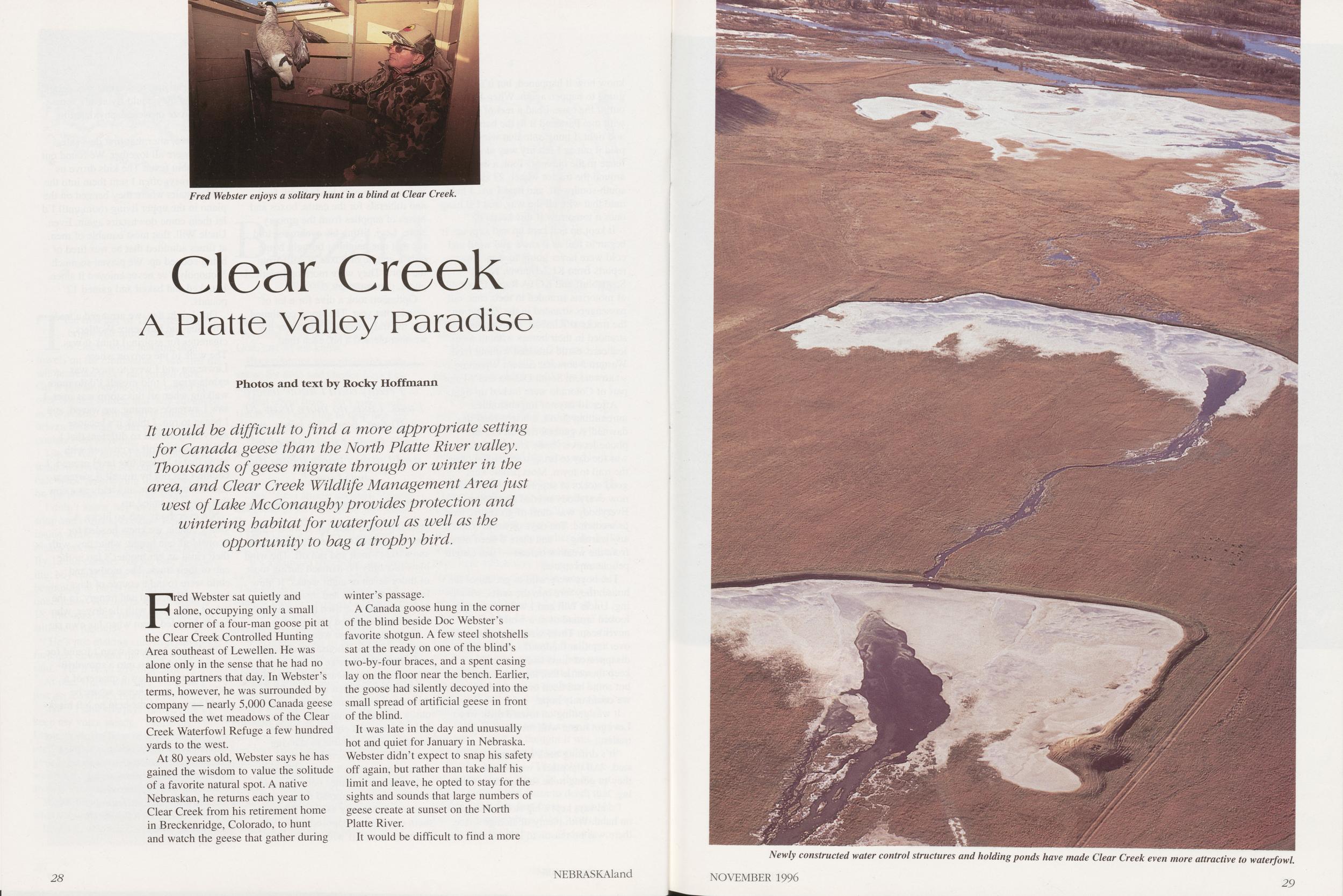
Clear Creek
A Platte Valley Paradise Photos and text by Rocky Hoffmann It would be difficult to find a more appropriate setting for Canada geese than the North Platte River valley. Thousands of geese migrate through or winter in the area, and Clear Creek Wildlife Management Area just west of Lake McConaughy provides protection and wintering habitat for waterfowl as well as the opportunity to bag a trophy bird.Fred Webster sat quietly and alone, occupying only a small corner of a four-man goose pit at the Clear Creek Controlled Hunting Area southeast of Lewellen. He was alone only in the sense that he had no hunting partners that day. In Webster's terms, however, he was surrounded by company — nearly 5,000 Canada geese browsed the wet meadows of the Clear Creek Waterfowl Refuge a few hundred yards to the west.
At 80 years old, Webster says he has gained the wisdom to value the solitude of a favorite natural spot. A native Nebraskan, he returns each year to Clear Creek from his retirement home in Breckenridge, Colorado, to hunt and watch the geese that gather during winter's passage.
A Canada goose hung in the corner of the blind beside Doc Webster's favorite shotgun. A few steel shot shells sat at the ready on one of the blind's two-by-four braces, and a spent casing lay on the floor near the bench. Earlier, the goose had silently decoyed into the small spread of artificial geese in front of the blind.
It was late in the day and unusually hot and quiet for January in Nebraska. Webster didn't expect to snap his safety off again, but rather than take half his limit and leave, he opted to stay for the sights and sounds that large numbers of geese create at sunset on the North Platte River.
It would be difficult to find a more 28 NEBRASKAland
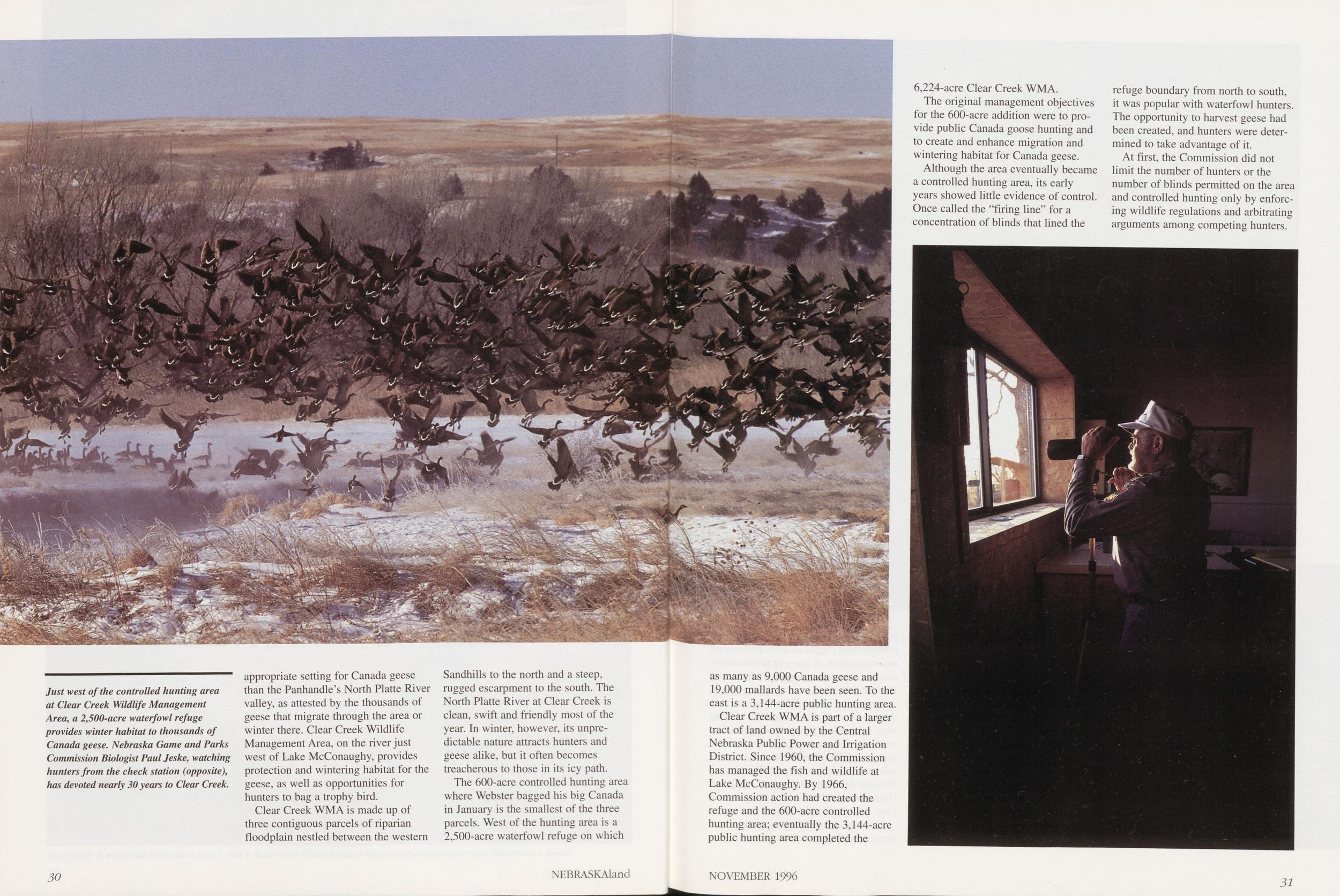
Clear Creek WMA is made up of three contiguous parcels of riparian floodplain nestled between the western Sandhills to the north and a steep, rugged escarpment to the south. The North Platte River at Clear Creek is clean, swift and friendly most of the year. In winter, however, its unpredictable nature attracts hunters and geese alike, but it often becomes treacherous to those in its icy path.
The 600-acre controlled hunting area where Webster bagged his big Canada in January is the smallest of the three parcels. West of the hunting area is a 2,500-acre waterfowl refuge on which 30 NEBRASKAland as many as 9,000 Canada geese and 19,000 mallards have been seen. To the east is a 3,144-acre public hunting area.
Clear Creek WMA is part of a larger tract of land owned by the Central Nebraska Public Power and Irrigation District. Since 1960, the Commission has managed the fish and wildlife at Lake McConaughy. By 1966, Commission action had created the refuge and the 600-acre controlled hunting area; eventually the 3,144-acre public hunting area completed the 6,224-acre Clear Creek WMA.
The original management objectives for the 600-acre addition were to provide public Canada goose hunting and to create and enhance migration and wintering habitat for Canada geese.
Although the area eventually became a controlled hunting area, its early years showed little evidence of control. Once called the "firing line" for a concentration of blinds that lined the refuge boundary from north to south, it was popular with waterfowl hunters. The opportunity to harvest geese had been created, and hunters were determined to take advantage of it.
At first, the Commission did not limit the number of hunters or the number of blinds permitted on the area and controlled hunting only by enforcing wildlife regulations and arbitrating arguments among competing hunters.
NOVEMBER 1996 31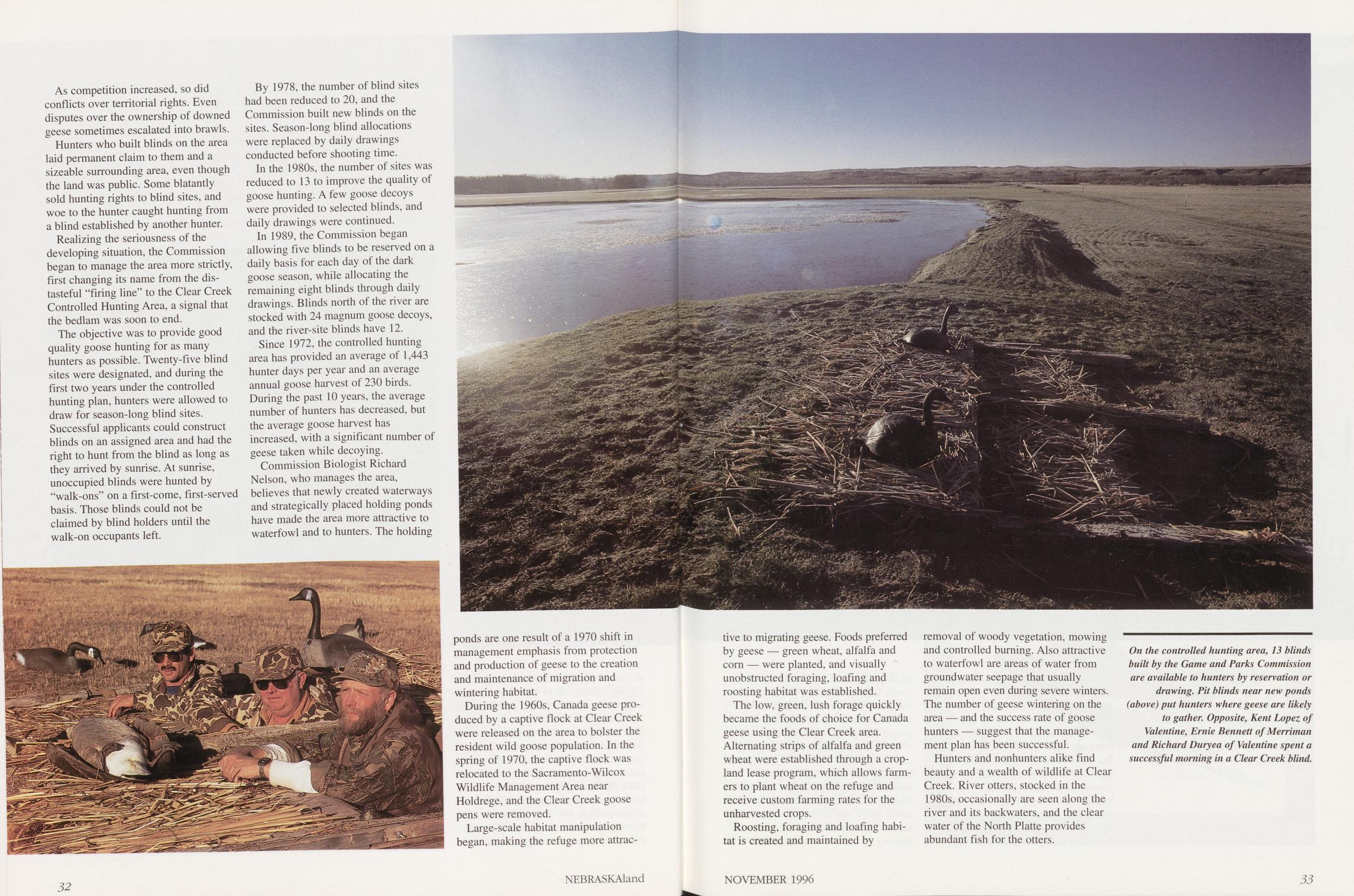
As competition increased, so did conflicts over territorial rights. Even disputes over the ownership of downed geese sometimes escalated into brawls.
Hunters who built blinds on the area laid permanent claim to them and a sizeable surrounding area, even though the land was public. Some blatantly sold hunting rights to blind sites, and woe to the hunter caught hunting from a blind established by another hunter.
Realizing the seriousness of the developing situation, the Commission began to manage the area more strictly, first changing its name from the distasteful "firing line" to the Clear Creek Controlled Hunting Area, a signal that the bedlam was soon to end.
The objective was to provide good quality goose hunting for as many hunters as possible. Twenty-five blind sites were designated, and during the first two years under the controlled hunting plan, hunters were allowed to draw for season-long blind sites. Successful applicants could construct blinds on an assigned area and had the right to hunt from the blind as long as they arrived by sunrise. At sunrise, unoccupied blinds were hunted by "walk-ons" on a first-come, first-served basis. Those blinds could not be claimed by blind holders until the walk-on occupants left.
By 1978, the number of blind sites had been reduced to 20, and the Commission built new blinds on the sites. Season-long blind allocations were replaced by daily drawings conducted before shooting time.
In the 1980s, the number of sites was reduced to 13 to improve the quality of goose hunting. A few goose decoys were provided to selected blinds, and daily drawings were continued.
In 1989, the Commission began allowing five blinds to be reserved on a daily basis for each day of the dark goose season, while allocating the remaining eight blinds through daily drawings. Blinds north of the river are stocked with 24 magnum goose decoys, and the river-site blinds have 12.
Since 1972, the controlled hunting area has provided an average of 1,443 hunter days per year and an average annual goose harvest of 230 birds. During the past 10 years, the average number of hunters has decreased, but the average goose harvest has increased, with a significant number of geese taken while decoying.
Commission Biologist Richard Nelson, who manages the area, believes that newly created waterways and strategically placed holding ponds have made the area more attractive to waterfowl and to hunters. The holding ponds are one result of a 1970 shift in management emphasis from protection and production of geese to the creation and maintenance of migration and wintering habitat.
During the 1960s, Canada geese produced by a captive flock at Clear Creek were released on the area to bolster the resident wild goose population. In the spring of 1970, the captive flock was relocated to the Sacramento-Wilcox Wildlife Management Area near Holdrege, and the Clear Creek goose pens were removed.
Large-scale habitat manipulation began, making the refuge more
The low, green, lush forage quickly became the foods of choice for Canada geese using the Clear Creek area. Alternating strips of alfalfa and green wheat were established through a cropland lease program, which allows farmers to plant wheat on the refuge and receive custom farming rates for the unharvested crops.
Roosting, foraging and loafing habitat is created and maintained by removal of woody vegetation, mowing and controlled burning. Also attractive to waterfowl are areas of water from groundwater seepage that usually remain open even during severe winters. The number of geese wintering on the area — and the success rate of goose hunters — suggest that the management plan has been successful.
Hunters and nonhunters alike find beauty and a wealth of wildlife at Clear Creek. River otters, stocked in the 1980s, occasionally are seen along the river and its backwaters, and the clear water of the North Platte provides abundant fish for the otters.
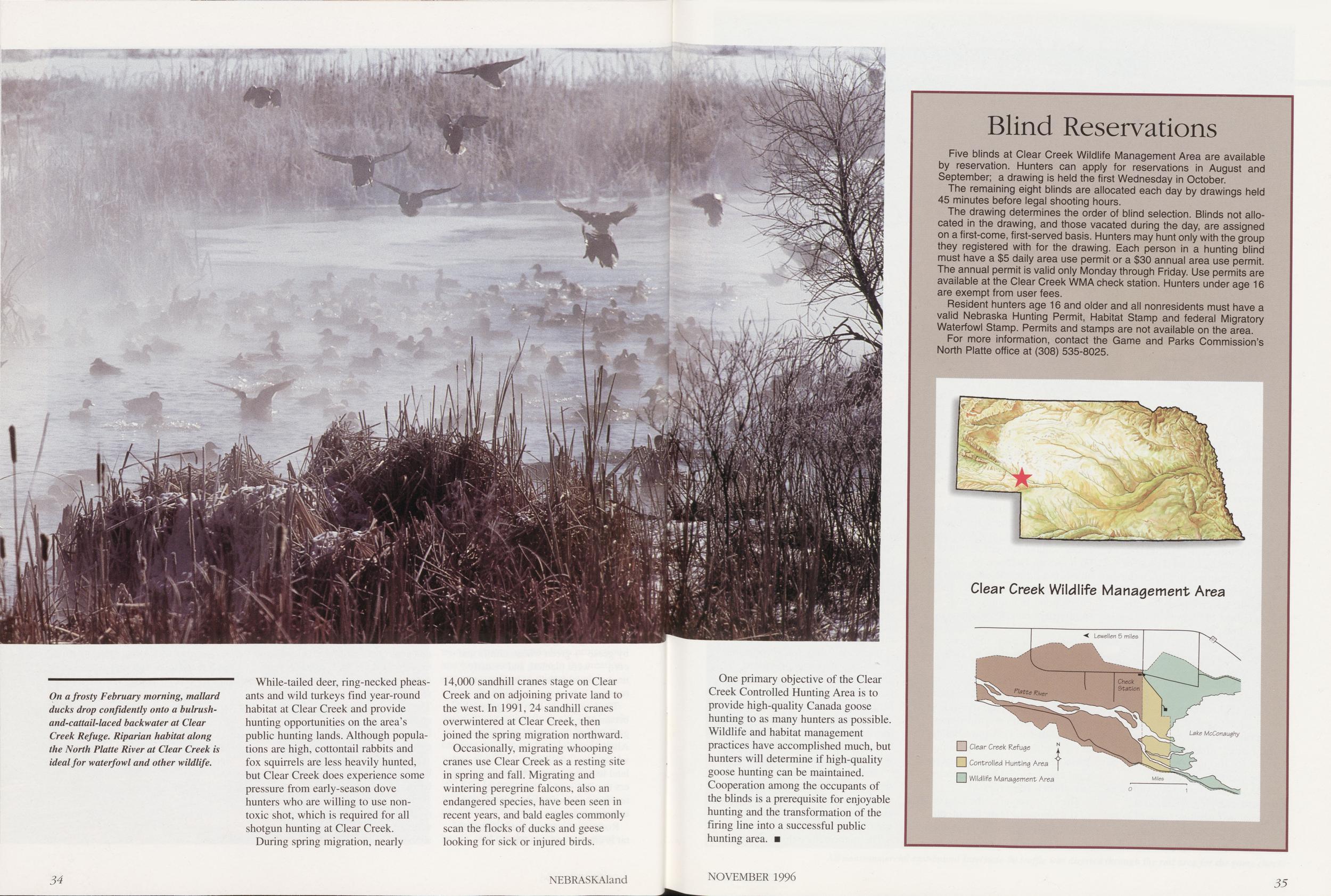
While-tailed deer, ring-necked pheasants and wild turkeys find year-round habitat at Clear Creek and provide hunting opportunities on the area's public hunting lands. Although populations are high, cottontail rabbits and fox squirrels are less heavily hunted, but Clear Creek does experience some pressure from early-season dove hunters who are willing to use nontoxic shot, which is required for all shotgun hunting at Clear Creek.
During spring migration, nearly 14,000 sandhill cranes stage on Clear Creek and on adjoining private land to the west. In 1991, 24 sandhill cranes overwintered at Clear Creek, then joined the spring migration northward.
Occasionally, migrating whooping cranes use Clear Creek as a resting site in spring and fall. Migrating and wintering peregrine falcons, also an endangered species, have been seen in recent years, and bald eagles commonly scan the flocks of ducks and geese looking for sick or injured birds.
34 NEBRASKAlandOne primary objective of the Clear Creek Controlled Hunting Area is to provide high-quality Canada goose hunting to as many hunters as possible. Wildlife and habitat management practices have accomplished much, but hunters will determine if high-quality goose hunting can be maintained. Cooperation among the occupants of the blinds is a prerequisite for enjoyable hunting and the transformation of the firing line into a successful public hunting area.
Blind ReservationsFive blinds at Clear Creek Wildlife Management Area are available by reservation. Hunters can apply for reservations in August and September; a drawing is held the first Wednesday in October. The remaining eight blinds are allocated each day by drawings held 45 minutes before legal shooting hours.
The drawing determines the order of blind selection. Blinds not allocated in the drawing, and those vacated during the day, are assigned on a first-come, first-served basis. Hunters may hunt only with the group they registered with for the drawing. Each person in a hunting blind must have a $5 daily area use permit or a $30 annual area use permit. The annual permit is valid only Monday through Friday. Use permits are available at the Clear Creek WMA check station. Hunters under age 16 are exempt from user fees.
Resident hunters age 16 and older and all nonresidents must have a valid Nebraska Hunting Permit, Habitat Stamp and federal Migratory Waterfowl Stamp. Permits and stamps are not available on the area. For more information, contact the Game and Parks Commission's North Platte office at (308) 535-8025.
Outdoor Business
1-80 Road Check
Photos and text by Rocky Hoffmann In October 1995 at an Interstate-80 rest area near Brady, representatives from 28 state wildlife agencies joined federal officials in the largest game check in the history of U.S. wildlife law enforcement. More than 2,000 hunters were checked in the 60-hour operation.Enforcing wildlife regulations is an immense task. Hunters and anglers outnumber state and federal wildlife conservation officers, and monitoring their activities is an awesome responsibility made more difficult by the remote, relatively inaccessible places where hunting and fishing violations often occur.
Hunters, especially, are likely to be difficult to contact, and typically officers see hunters only once during a hunt, often when they are just setting out. Effectively contacting large numbers of hunters at the end of their hunts, after violations have occurred, is difficult.
Nevertheless, "law-abiding hunters expect us to do our job and apprehend for prosecution those who commit crimes against wildlife," said Nebraska Game and Parks Commission Law Enforcement Supervisor Roger Thompson of North Platte. "After all, they pay for that service through the purchase of hunting and fishing permits."
Modern conservation law enforcement is developing scientific and biological investigative tools to help provide evidence in court, but before that technology can be put to use, hunter contacts have to be made, Thompson said.
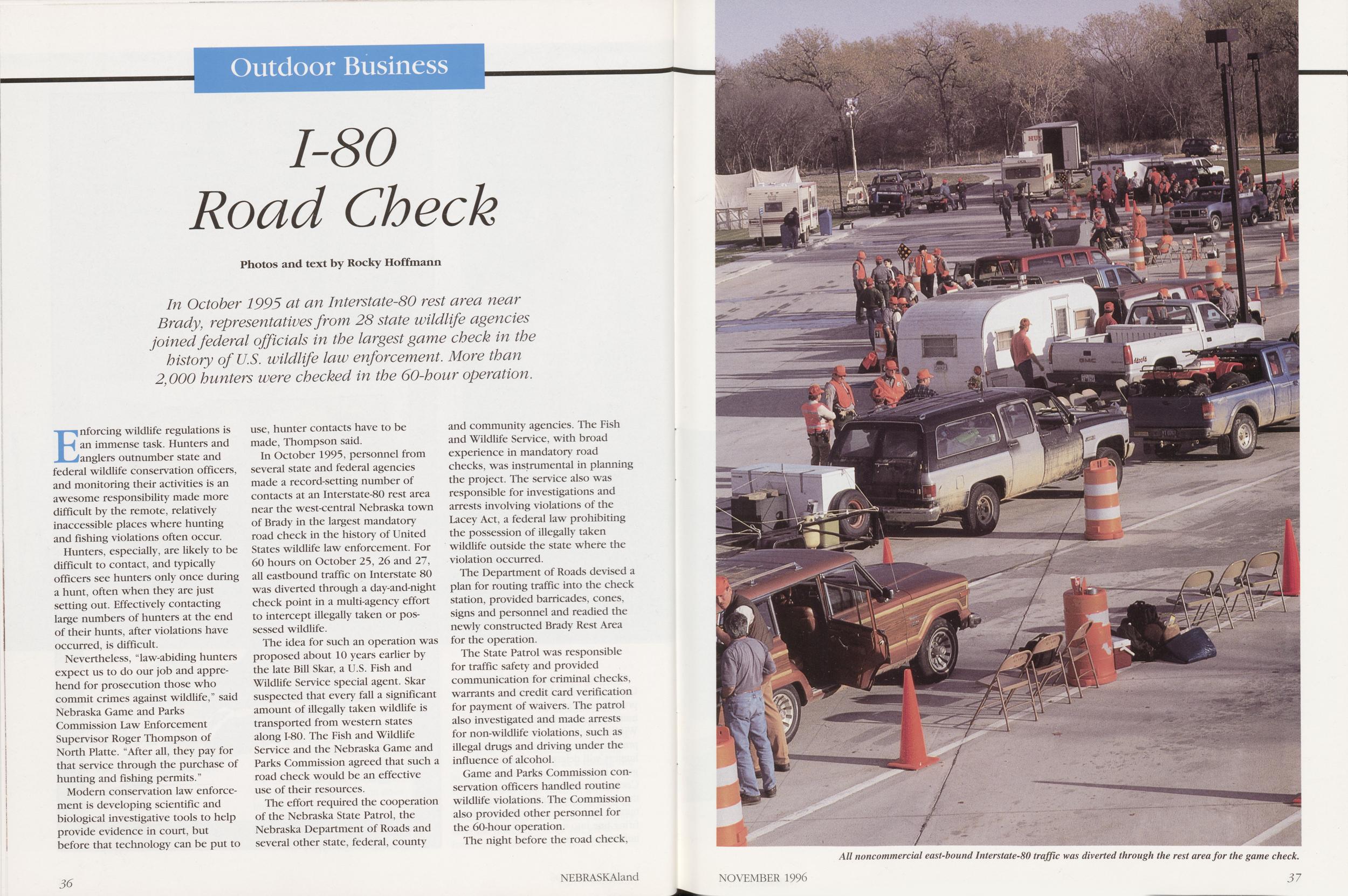
In October 1995, personnel from several state and federal agencies made a record-setting number of contacts at an Interstate-80 rest area near the west-central Nebraska town of Brady in the largest mandatory road check in the history of United States wildlife law enforcement. For 60 hours on October 25, 26 and 27, all eastbound traffic on Interstate 80 was diverted through a day-and-night check point in a multi-agency effort to intercept illegally taken or possessed wildlife.
The idea for such an operation was proposed about 10 years earlier by the late Bill Skar, a U.S. Fish and Wildlife Service special agent. Skar suspected that every fall a significant amount of illegally taken wildlife is transported from western states along 1-80. The Fish and Wildlife Service and the Nebraska Game and Parks Commission agreed that such a road check would be an effective use of their resources.
The effort required the cooperation of the Nebraska State Patrol, the Nebraska Department of Roads and several other state, federal, county and community agencies. The Fish and Wildlife Service, with broad experience in mandatory road checks, was instrumental in planning the project. The service also was responsible for investigations and arrests involving violations of the Lacey Act, a federal law prohibiting the possession of illegally taken wildlife outside the state where the violation occurred.
The Department of Roads devised a plan for routing traffic into the check station, provided barricades, cones, signs and personnel and readied the newly constructed Brady Rest Area for the operation.
The State Patrol was responsible for traffic safety and provided communication for criminal checks, warrants and credit card verification for payment of waivers. The patrol also investigated and made arrests for non-wildlife violations, such as illegal drugs and driving under the influence of alcohol.
Game and Parks Commission conservation officers handled routine wildlife violations. The Commission also provided other personnel for the 60-hour operation.
The night before the road check, 36 NEBRASKAland
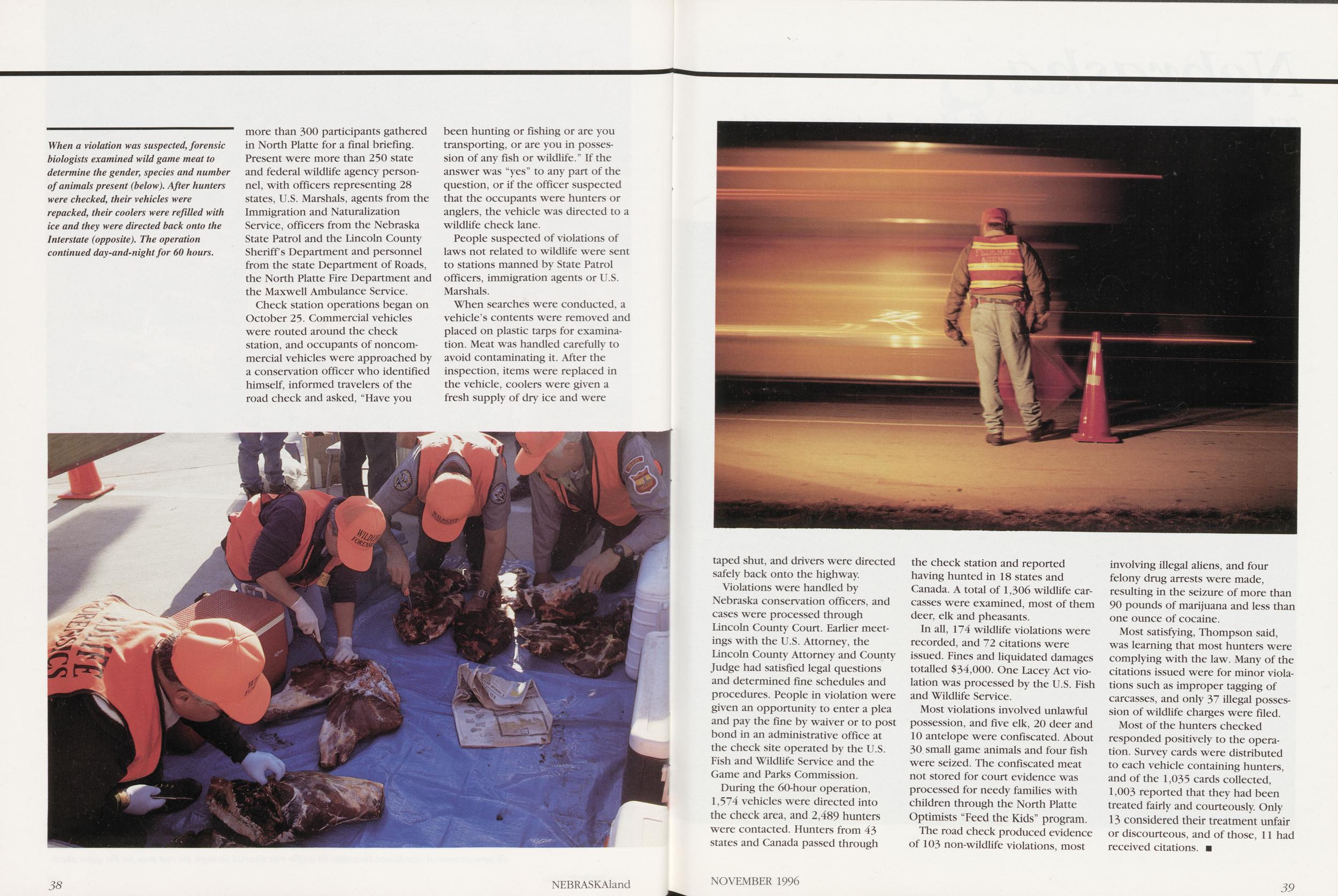
Check station operations began on October 25. Commercial vehicles were routed around the check station, and occupants of noncommercial vehicles were approached by a conservation officer who identified himself, informed travelers of the road check and asked, "Have you been hunting or fishing or are you transporting, or are you in possession of any fish or wildlife." If the answer was "yes" to any part of the question, or if the officer suspected that the occupants were hunters or anglers, the vehicle was directed to a wildlife check lane.
People suspected of violations of laws not related to wildlife were sent to stations manned by State Patrol officers, immigration agents or U.S. Marshals.
When searches were conducted, a vehicle's contents were removed and placed on plastic tarps for examination. Meat was handled carefully to avoid contaminating it. After the inspection, items were replaced in the vehicle, coolers were given a fresh supply of dry ice and were 38 NEBRASKAland
Violations were handled by Nebraska conservation officers, and cases were processed through Lincoln County Court. Earlier meetings with the U.S. Attorney, the Lincoln County Attorney and County Judge had satisfied legal questions and determined fine schedules and procedures. People in violation were given an opportunity to enter a plea and pay the fine by waiver or to post bond in an administrative office at the check site operated by the U.S. Fish and Wildlife Service and the Game and Parks Commission.
During the 60-hour operation, 1,574 vehicles were directed into the check area, and 2,489 hunters were contacted. Hunters from 43 states and Canada passed through the check station and reported having hunted in 18 states and Canada. A total of 1,306 wildlife carcasses were examined, most of them deer, elk and pheasants.
In all, 174 wildlife violations were recorded, and 72 citations were issued. Fines and liquidated damages totaled $34,000. One Lacey Act violation was processed by the U.S. Fish and Wildlife Service.
Most violations involved unlawful possession, and five elk, 20 deer and 10 antelope were confiscated. About 30 small game animals and four fish were seized. The confiscated meat not stored for court evidence was processed for needy families with children through the North Platte Optimists "Feed the Kids" program.
The road check produced evidence of 103 non-wildlife violations, most involving illegal aliens, and four felony drug arrests were made, resulting in the seizure of more than 90 pounds of marijuana and less than one ounce of cocaine.
Most satisfying, Thompson said, was learning that most hunters were complying with the law. Many of the citations issued were for minor violations such as improper tagging of carcasses, and only 37 illegal possession of wildlife charges were filed.
Most of the hunters checked responded positively to the operation. Survey cards were distributed to each vehicle containing hunters, and of the 1,035 cards collected, 1,003 reported that they had been treated fairly and courteously. Only 13 considered their treatment unfair or discourteous, and of those, 11 had received citations.
NOVEMBER 1996 39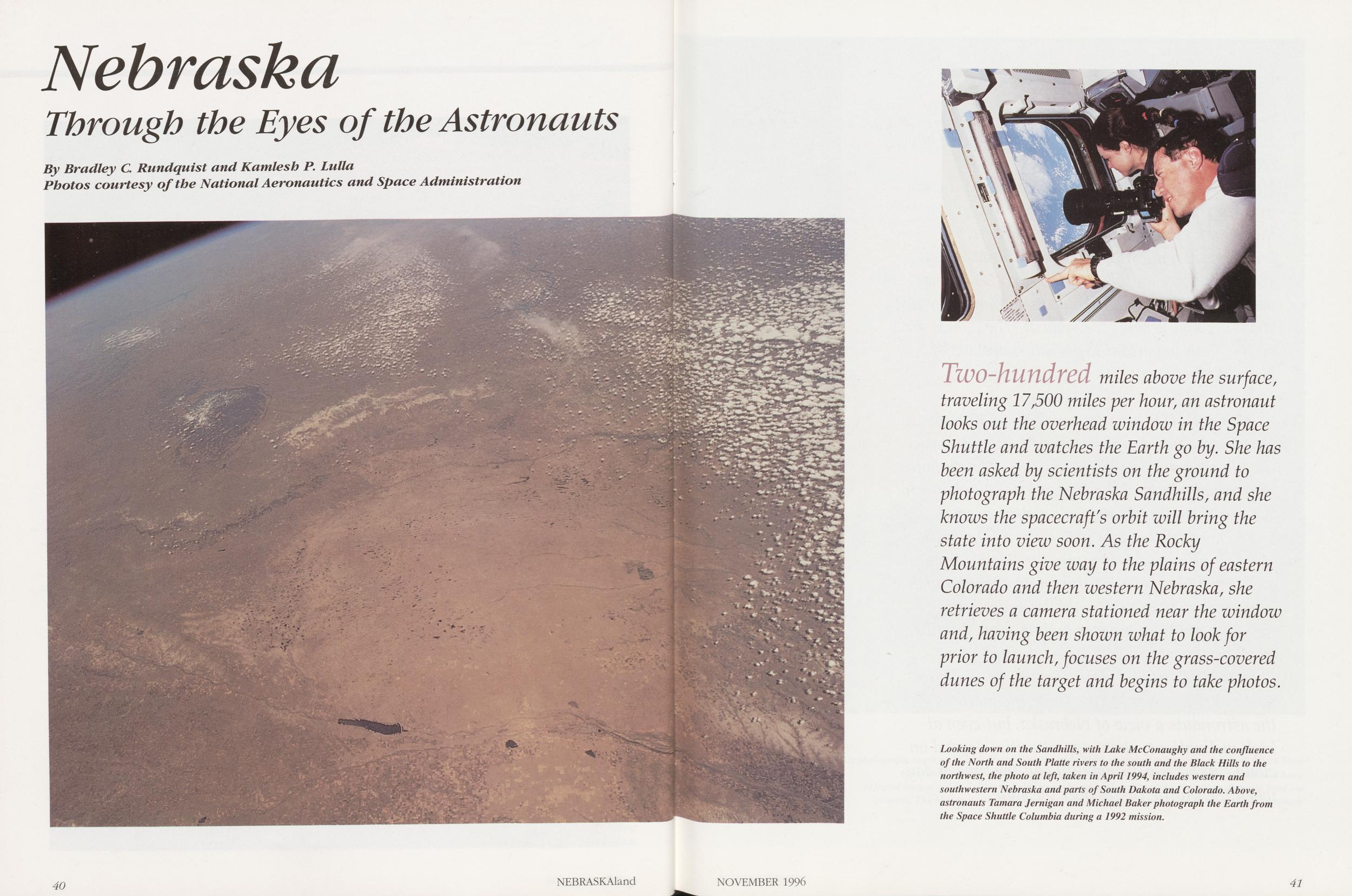
Nebraska Through the Eyes of the Astronauts
By Bradley C. Rundquist and Kamlesh P. Lulla Photos courtesy of the National Aeronautics and Space Administrationmiles above the surface, traveling 17,500 miles per hour, an astronaut looks out the overhead window in the Space Shuttle and watches the Earth go by. She has been asked by scientists on the ground to photograph the Nebraska Sandhills, and she knows the spacecraft's orbit will bring the state into view soon. As the Rocky Mountains give way to the plains of eastern Colorado and then western Nebraska, she retrieves a camera stationed near the window and, having been shown what to look for prior to launch, focuses on the grass-covered dunes of the target and begins to take photos.
NOVEMBER 1996 41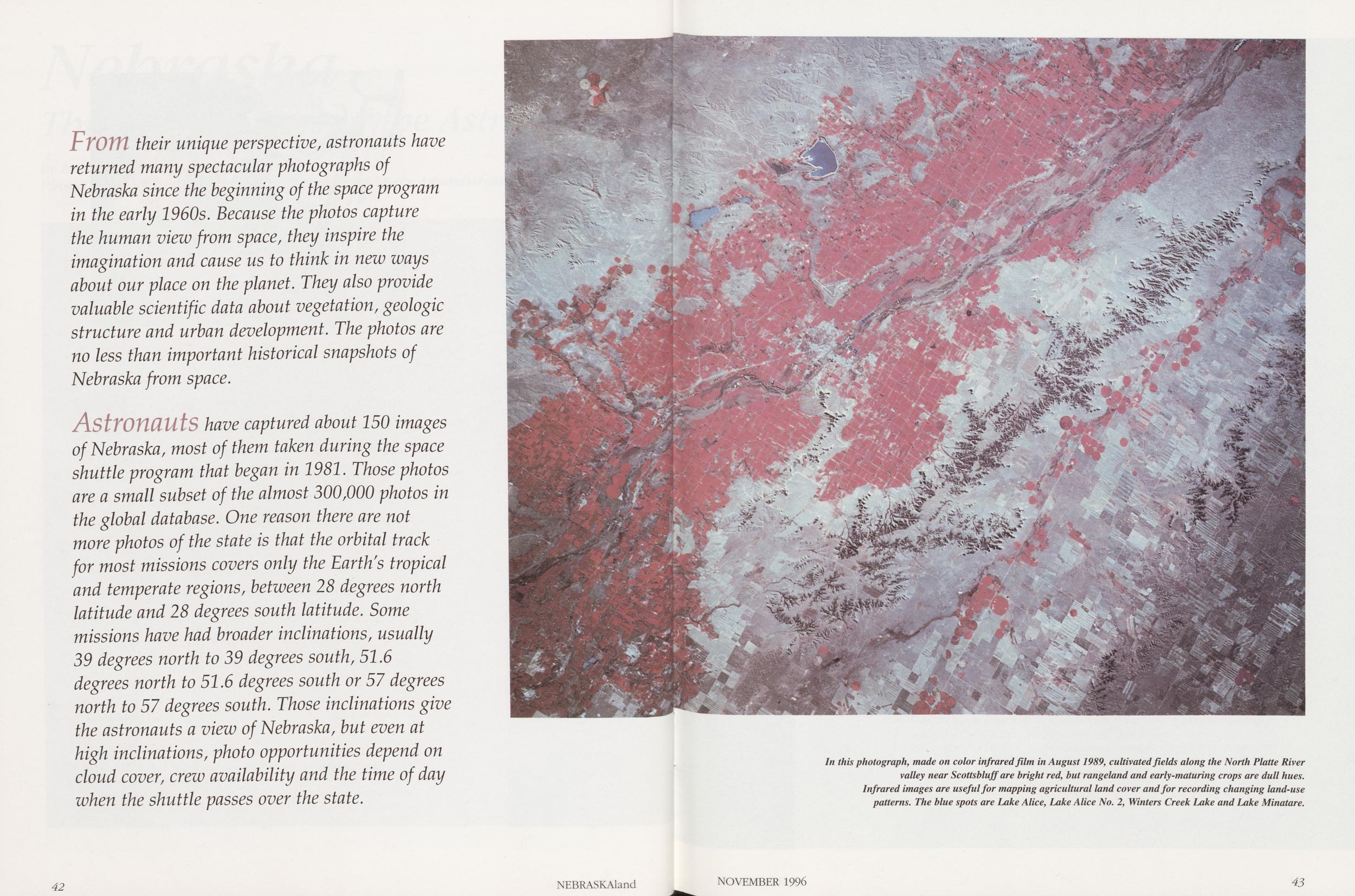
Total their unique perspective, astronauts have returned many spectacular photographs of Nebraska since the beginning of the space program in the early 1960s. Because the photos capture the human view from space, they inspire the imagination and cause us to think in new ways about our place on the planet. They also provide valuable scientific data about vegetation, geologic structure and urban development. The photos are no less than important historical snapshots of Nebraska from space.
Astroids have captured about 150 images of Nebraska, most of them taken during the space shuttle program that began in 1981. Those photos are a small subset of the almost 300,000 photos in the global database. One reason there are not more photos of the state is that the orbital track for most missions covers only the Earth's tropical and temperate regions, between 28 degrees north latitude and 28 degrees south latitude. Some missions have had broader inclinations, usually 39 degrees north to 39 degrees south, 51.6 degrees north to 51.6 degrees south or 57 degrees north to 57 degrees south. Those inclinations give the astronauts a view of Nebraska, but even at high inclinations, photo opportunities depend on cloud cover, crew availability and the time of day when the shuttle passes over the state.
42 NEBRASKAland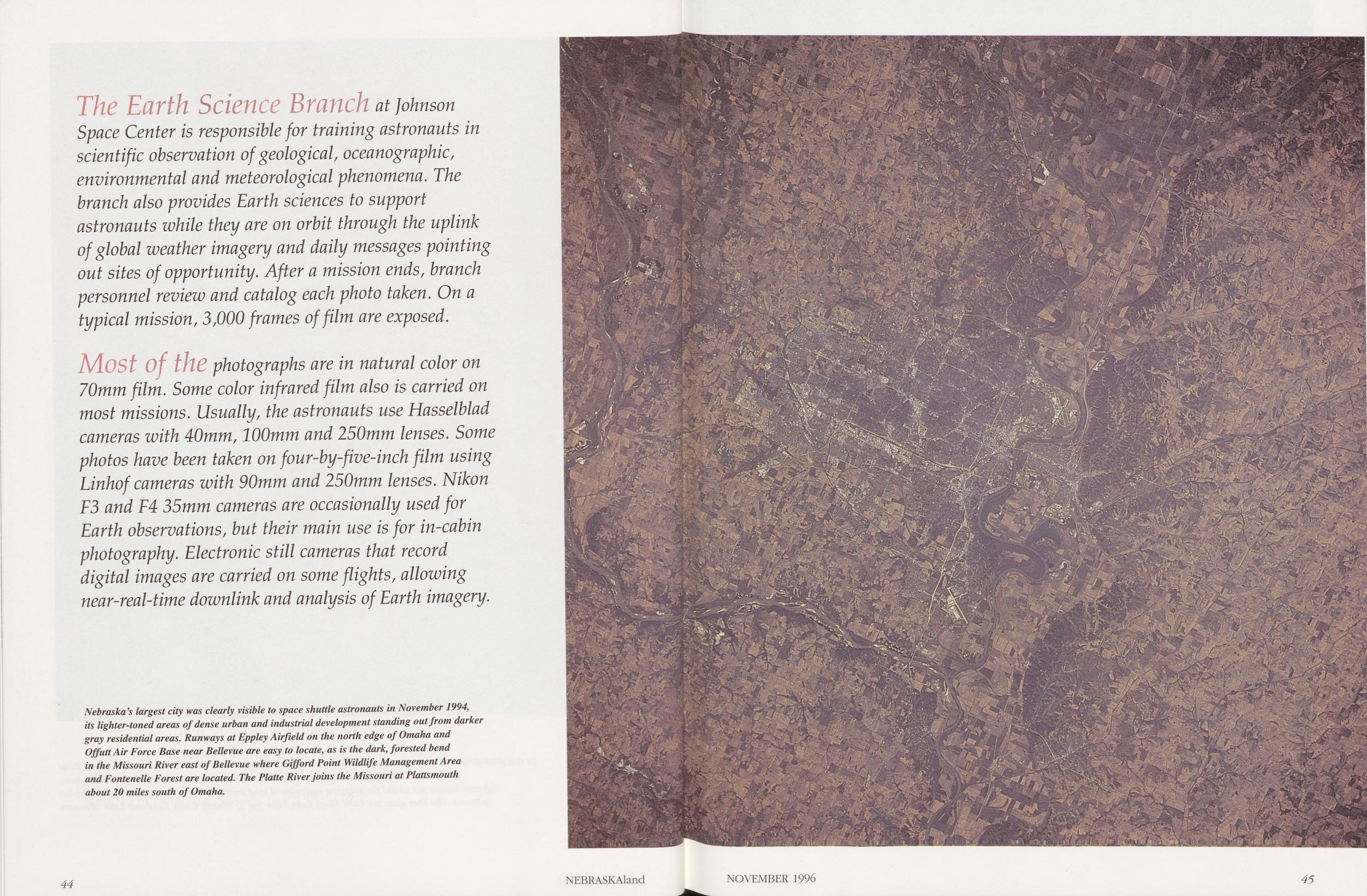
The Earth Science Branch at Johnson Space Center is responsible for training astronauts in scientific observation of geological, oceanographic, environmental and meteorological phenomena. The branch also provides Earth sciences to support astronauts while they are on orbit through the uplink of global weather imagery and daily messages pointing out sites of opportunity. After a mission ends, branch personnel review and catalog each photo taken. On a typical mission, 3,000 frames of film are exposed.
Most 0] the photographs are in natural color on 70mm film. Some color infrared film also is carried on most missions. Usually, the astronauts use Hasselblad cameras with 40mm, 100mm and 250mm lenses. Some photos have been taken on four-by-five-inch film using Einhof cameras with 90mm and 250mm lenses. Nikon F3 and F4 35mm cameras are occasionally used for Earth observations, but their main use is for in-cabin photography. Electronic still cameras that record digital images are carried on some flights, allowing near-real-time downlink and analysis of Earth imagery.
44 NEBRASKAland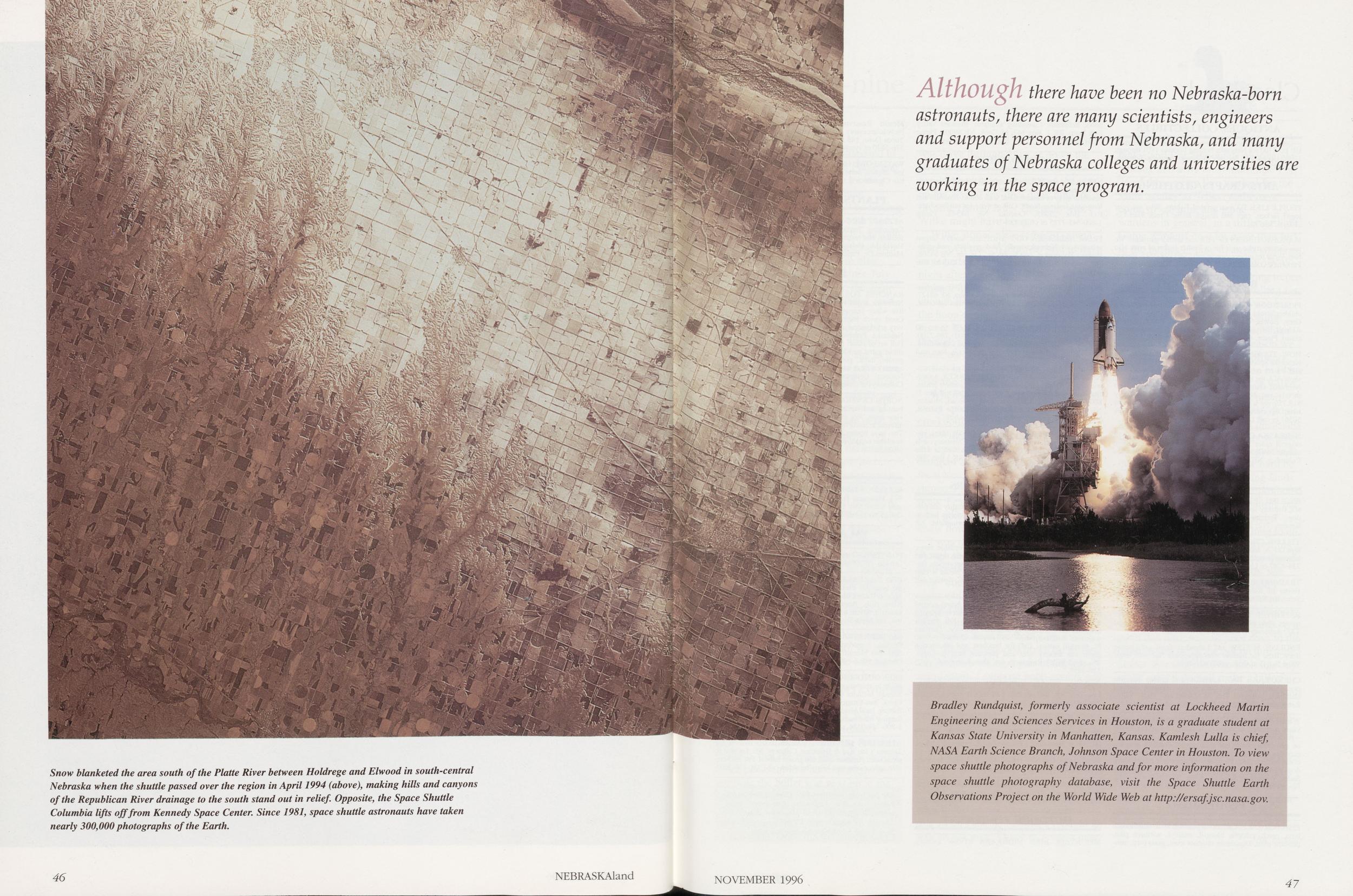
Although there have been no Nebraska-born astronauts, there are many scientists, engineers and support personnel from Nebraska, and many graduates of Nebraska colleges and universities are working in the space program.
Classified
ANTIQUES/COLLECTIBLESUP TO $100 for Nebraska hunting licenses 1901 through 1920. Up to $25 for any Nebraska trapping licenses. (402) 785-7500. Phil.
ARTS/CRAFTS/CLOTHINGPEOPLE LIKE TO wear printed T-shirts. Why not your logo? Jackets, caps and design. Battle Creek Shirt Co. (402)675-9795.
MANUFACTURERS OF FUR and leather garments. We can custom make your fur or leather jacket or coat; also hats. Write for information or call (308) 928-2515. Haeker Furriers, P.O. Box 230, 615 W. Main St., Alma, NE 68920.
BOOKS/PRINTINGFREE BOOK CATALOG. Novels, westerns, romances, children's; old out of print, found bams, attic. Authors: Grey, Bower, Condor, Fox, Curwood, Raine, Wright, Aldrige, Pollyanna, Freckles, many others. Postage appreciated. Pierce, 4400 N. Pine Cluster, Oroville, CA 95965.
HOW TO FIND MORE outdoor opportunities! The Nebraska Sportsman's Atlas. Locations of all public lands and waters on county transportation maps. These maps show ALL the roads in Nebraska. Listings include federal, Nebraska Game & Parks, NRD holdings, hotels and motels and Nebraska's endless attractions. At only $18.75/copy a true time and frustration saver. To order write: Sportsman's Atlas Co., PO Box 132, Lytton, IA 50561 or call 1-800-568-8334.
NEBRASKA COUNTRY NOSTALGIC note cards - 12 original color Nebraska photo assortment. $1.35. Free sample welcome. (402) 564-7304. 766 7th Ave., Columbus, NE 68601.
DOGSENGLISH SETTER, German shorthairs, English pointers, Brittany spaniels - stud service, puppies and started dogs. Training for all pointing breeds. Plum Creek Kennel, (712) 529-4238 or (402) 298-8153.
YELLOW-CHOCOLATE-BLACK LAB pups. Breeders hips O.F.A. and eyes c.e.r.f./ed. Excellent bloodlines and hunting potential. Call Mr. Bendler, Lexington, NE (308) 324-4247 or Lincoln (402) 477-1305.
TRAINING ALL BREEDS bird dogs - Vizslas for sale. Home of Rebel Rousers. Rozanek Kennels, RR 2, Schuyler, NE 68661. Phone (402) 352-8769.
RETRIEVER TRAINING. Area's top "retrievers only" trainer. Field trial and hunting dogs. Non-slip duck dogs! TKO Retriever Training Kennel (402) 623-4311.
ENGLISH SETTER and Labradors from outstanding lines. Bred for hunters who appreciate fine bird dogs! Wind Fall Gun Dogs, (402) 421-4693.
CHESAPEAKE BAY, Labrador and golden retriever pups, started dogs and stud service. 16-time national champion pedigree. Visa & MasterCard. Platte Valley Retrievers (308) 995-2318.
WILDERNESS KENNELS. Gun dog training - over 60 years combined experience. Training all sporting breeds - retrievers, flushing and pointing dogs. All dogs worked on pen raised birds and wild game. Training program includes obedience training - heel, sit, stay, down and come when called. Pups, started dogs and fully trained dogs for sale. Hunting dogs trained by hunters. Henry Sader, Wilderness Kennels, Roca, NE (402) 423-4212. Since 1968.
FISH/FISHINGFISH FOR SALE. Catfish, largemouth bass, smallmouth bass, perch, crappie, bluegill, walleye, northern pike, rainbow trout, Donaldson rainbow trout, grass carp, minnows, bullheads. Consulting available. Pleasant Valley Fish Farm, RR 1, Box 147, McCook, NE 69001. Phone (308) 345-6599.
FOOD/GIFTSNEBRASKA BASKETS: The original Nebraska company specializing in fine foods from Nebraska since 1984. A beautiful array of baskets filled with ethnic, healthful and long-time favorite foods. Call or write for our brochure: P.O. Box 22985, Lincoln, NE 68542. Phone 1-800-345-7725 or (402) 438-3111.
FROM NEBRASKA GIFT SHOP..the world's largest selection of Nebraska-made food products and gifts. Historic Haymarket, 140 N. 8th St., Lincoln, NE 68508; Old Market, 1030 Howard St., Omaha, NE. Call for free catalog 1-800-399-5693.
HOMEBREWING/BEER & WINEMAKING supplies. Fermenter's Supply, 8410 K Plz. #10, Omaha, NE 68127. (402) 593-9171. Open every day, mail orders welcome, low shipping.
BAKERS CANDIES FACTORY OUTLET Store, 60 North Hwy. 6, Greenwood, NE 68366. (402) 789-7200. Sinfully delicious chocolates from America's Heartland. Specializing in flavored chocolate meltaways. Free mail order brochure.
NEBRASKA GOURMET SMOKED TURKEY, award- winning BBQ sauces, gourmet seasonings, native jellies, fruit butters and more! Great gift ideas! Call toll free 1-800-926-2879, Hollman Foods, 1948 36 Road, Minden, NE 68959, or check our products out on the Internet, http://www.lopernet.net/hollmans/hollmans.htm
NEBRASKA GREETING CARDS & GIFTS, mugs, stationery, stamps, Nebraska cookie cutters. Christmas cards and more. Originally designed in Nebraska. Call or write for free brochure: Prairie Heart Greetings, RR 3 Box 200, North Platte, NE 69101. 1-800-632-7623.
GUIDES/OUTFITTERSMAD RIVER CANOES offers the finest quality and performance. For the finest canoes and accessories look to Great Plains Canoe Co., 205 Main, Springfield, NE 68059. Phone (402) 253-2001.
CANOE THE NIOBRARA...with an affordable canoe trip by Dry land Aquatics. One and two-day trips...full service, or just canoes and tubes. Transportation furnished. Your Niobrara River specialists... We do it your way! Dry land Aquatics, Dept. N, Box 33C, Sparks, NE 69220 or phone 1-800-337-3119.
NOW TAKING RESERVATIONS! North-central Nebraska's newest pheasant hunting preserve opening this fall. Three-bedroom lodge, sleeping loft, kitchen available for overnight or weekend getaways. Families welcome! 8 miles from O'Neill airport. 45 minutes from Ft. Randall casino. Call for brochure and information about our archery deer and pheasant hunt packages. Blackbird Valley Ringnecks Inc. Dennis Drayton. (402) 336-3858.
CANADA GOOSE HUNTERS. Gander Hunting. Lewellen, NE. $40 per day. Call Ivan Armstrong, (308) 284-4691 evenings.
GUNS/SHOOTING/ARCHERYGUNS - Browning, Winchester, Remington, others. Hi-powers, shotguns, new, used, antiques. Want Pre-'64 Winchesters. Buy-Sell-Trade. (402) 729-6112. Bedlan's Sporting Goods, Fairbury, NE 68352.
AIR GUNS repaired - Benjamin, Crosman, Daisy, other American made. Restoration; old guns wanted. Jack's Air Guns, 1225 No. 46th, Lincoln, NE 68503. (402) 466-9223.
OUTDOOR EQUIPMENTMOUNTAIN BIKE NIOBRARA RIVER country, Merritt Reservoir and the Cowboy Trail. For bicycle/accessory rentals, sales and service, contact Yucca Dune, 148 E. 1st St., Valentine, NE 69201. (402) 376-3330 or ryschon@ibm.net.
WATERFOWL HUNTERS. Never chop ice again. Deicer attracts more birds to your decoys. Free brochure. Ely Churchich & Associates. (402) 571-7492.
PLANTS/ANIMALS/HABITATATTRACT WILDLIFE to your acreage, preserve or club. Consulting, management plan development, planting/ seeding, and supplies for the conservationist or the hunter. David M. Nelson, Wildlife Habitat Consulting, 811 Matthies Dr., Papillion, NE 68046. Phone (402) 592-5652.
REAL ESTATERANCHES FOR SALE 2,590 acres near Crawford, Nebraska, in the Pine Ridge area. Winter protection and live water year-round with an abundance of wildlife. Good ranch improvements. Private and secluded, yet very good access. 3,500 acre ranch southeast of Alliance, Nebraska. Purebred or commercial unit for 300 cows. Full set of ranch improvements with two homes. Many subirrigated meadows. Beautiful ranch with exceptional grouse, duck, goose and pheasant hunting. Exclusive agents on these and other properties, please call Farmers National Company (formerly Northern Plains Land Company) at (308) 762-3155.
NORTH CENTRAL NE near Niobrara River. Beautiful hunting and recreational tracts. Stream frontage, ponds, view areas, lots of deer, turkey, doves & grouse. These affordable tracts range in size from 63 acres to 286 acres. Two have homes suitable for year-round use. Financing available to qualified buyers. Waldo Realty, O'Neill, NE. (402)336-4110.
TAXIDERMYALLISON'S TAXIDERMY Studio & Gift Gallery - DU, SCI, Pheasants Forever & NTA Members. Mounted 36 state record fish. 421 N. Dewey, North Platte, NE 69101. Call (308) 534-2324 or (308) 534-4267. Custom Designs.
VACATIONS/RESORTSFOR FISHING and hunting accommodations. Jefco Inn. Gordon, NE 69343. South Cornell, (308) 282-2935.
BED & BREAKFAST. Historic 1890s hotel. Located in the beautiful Pine Ridge area of Northwest Nebraska. Short drive to Chadron State Park, Fort Robinson and the Black Hills. Beautiful dining room with fireplace and fountain. Room service available. The Olde Main Street Inn, 115 Main St., Chadron, NE 69337. (308) 432-3380.
NE NEBRASKA TROUT FISHING. Mon-Thurs or Fri-Sun. 3 modern cottages, 5 spring-fed lakes. Trout, bass and bluegill. Diamond E Trout Resort, Box B, Orchard, NE 1-800-658-3244.
FREE OUTDOORS IN KANSAS' Golden Triangle, your guide to recreation in the Flint Hills region of northeast Kansas. Includes the hunting outlook for Milford, Turtle Creek, and Council Grove lakes, an overview of spring fishing, local historical sites and museums, and complete lodging information. Full-color, 24-page brochure. Call 1-800-759-0134, ext. 24.
ATTENTION HUNTERS - Reserve rooms now at the Traveler's Inn Bed & Breakfast, Callaway, NE. Located in prime deer, pheasant, quail and grouse habitat. For comfortable, quiet rooms with hearty breakfast call (308) 836-2200.
75$ per word, minimum $15. Closing: Two months before issue date. First-come, first-served, space available. NEBRASKAland Magazine, Box 30370, Lincoln, NE 68503. (402) 471-5478. Fax: (402) 471- 5528. E-mail: nebkmd@ngpsun.ngpc.state.ne.us 48 NEBRASKAlandPage forty-nine
My Game WardenHunters and anglers predisposed to bend or break game laws in Platte and Colfax counties will not be looking over their shoulders for Lyman Wilkinson this fall. He won't be lurking in plum thickets, watching with binoculars while they try to stretch a sandpit bass to 15 inches or knocking on their doors asking to see what's in their freezers. For the first time since July 27, 1958, "Wilke'' won't be the game warden. He's hung up his badge, spotting scope and two-way radio.
When Wilke was spit-and-polish new and fresh out of game warden school, I was just coming of age as a hunter and fisherman, making the transition from shooting backyard sparrows with a BB gun to shooting rabbits and squirrels with a .410 bolt action and from catching sunfish on cane poles to catching catfish on throw-lines.
I grew up believing that if I broke a game law, Wilke would know and might be there watching. In my youth, it was a justified fear, especially when I was taking a Northwestern School of Taxidermy correspondence course, and any creature wearing fur or feathers was a likely candidate for "stuffing."
It wasn't just kids who harbored a suspicion that Wilke might be behind almost any tree on the Loup River during deer season, on the muddiest of backroads during pheasant season or on patrol even in the dark of winter nights. Such thoughts regularly crossed the minds of grown-ups, too. We had a healthy respect for the game warden, if not always for the letter of the law.
A good game warden sows a crop of worries in the minds of his constituents. Early in his career, Wilke made enough arrests that violators understood they were playing Russian roulette, that the next time they stuffed a hen pheasant in a hubcap might be the time the bullet was next up in the cylinder. With Wilke, there was no mercy, no exception. "He'd arrest his own grandmother," they said in the coffee shop. Once his tough reputation was established, all Wilke had to do was drive through town or down the river road once a week, and every would-be violator would think he was on his way to spy on a duck blind or a favorite fishing hole. The truth was, Wilke might have been.
Wilke stories were rampant. Some were even true. Wilke was said to have crouched in a willow thicket rainy night after rainy night waiting for a violator to check his hoop net, long enough to catch pneumonia and catch the hoop-netter. He was known to park his car half a mile away and trudge through muddy, summer cornfields to sneak up on fishermen snagging big catfish in the Loup Power canal years after the practice was outlawed.
When the price of coon pelts soared, every spotlighter on every river and creekbottom in two counties worried that Wilke was right behind him with his lights off when they heard the drone of a "spotter plane" overhead. In local lore, Wilke was omnipresent, rumored never to sleep or take vacations. Fear of getting caught is a powerful guardian of morality, and Wilke knew how to inspire good morals.
I was never arrested by Wilke, though there were times of youthful indiscretion that warranted it. I was only "checked" by him once, late at night while parked with my girlfriend on the canal road. I suppose I was a likely candidate to be running a hoop net. Where he came from I have no idea. He just swooped down on us like a nighthawk taking a pair of hapless mosquitoes. I suppose hoop-netters pay more attention to what's going on around them than I was, but I have to believe he would have slipped up just as close to them before he turned on his five-cell flashlight. Our reaction was about the same as a hoop-netter's. I knew I should have "parked" in Hugo Fittje's alfalfa field that night.
The funny thing about growing up with Wilke as "my" game warden is that when I started hunting I thought he was an old man. Thirty-five years later he looks about the same, still tall and lanky, and I'm 20-pounds overweight, balding and achy most mornings. For 26 of those years I've worked for the same agency as Wilke, and I have come to see him, and game wardens in general, in a different light. Game wardens do a lot more than lurk in the bushes hoping to arrest someone.
In recent years, for example, Wilke has spent as much time working to preserve wetlands as he did patrolling for violators. Much of that time was his own. As much as I still like calling game wardens game wardens, Wilke and others like him are the reason we now call them conservation officers.
Most hunters and fishermen in Platte and Colfax counties thought of Wilke only as someone who would pinch them if they stretched the limit, didn't tag a deer right away or shot pheasants from the road. They didn't know how he lobbied for seasons and regulations that would benefit them, how hard he pushed for more public hunting lands and fishing waters, or that he promoted conservation activities like putting out bluebird boxes — definitely not a "tough-guy-warden" sort of thing to do.
I still think Wilke would arrest his grandmother, but I now believe that if she were over bag on mallards, she ought to be pinched. I once didn't believe a warden should arrest his grandmother, or that it was necessarily wrong to take a few extra mallards on a good day after several poor days in the blind. But it is. In the big picture, one hunter shooting over the limit one day in the season doesn't make a hill-of-beans-difference in how many mallards there will be the next year. It's when you add up all the hunters who could do it that it begins to count. And even more than that, when hunters or anglers violate one game law one particular day, they are more inclined to violate other laws as well, and more frequently. That's why there are game wardens like Wilke. I wonder if his grandmother really hunted or fished.
Jon Farrar NOVEMBER 1996 49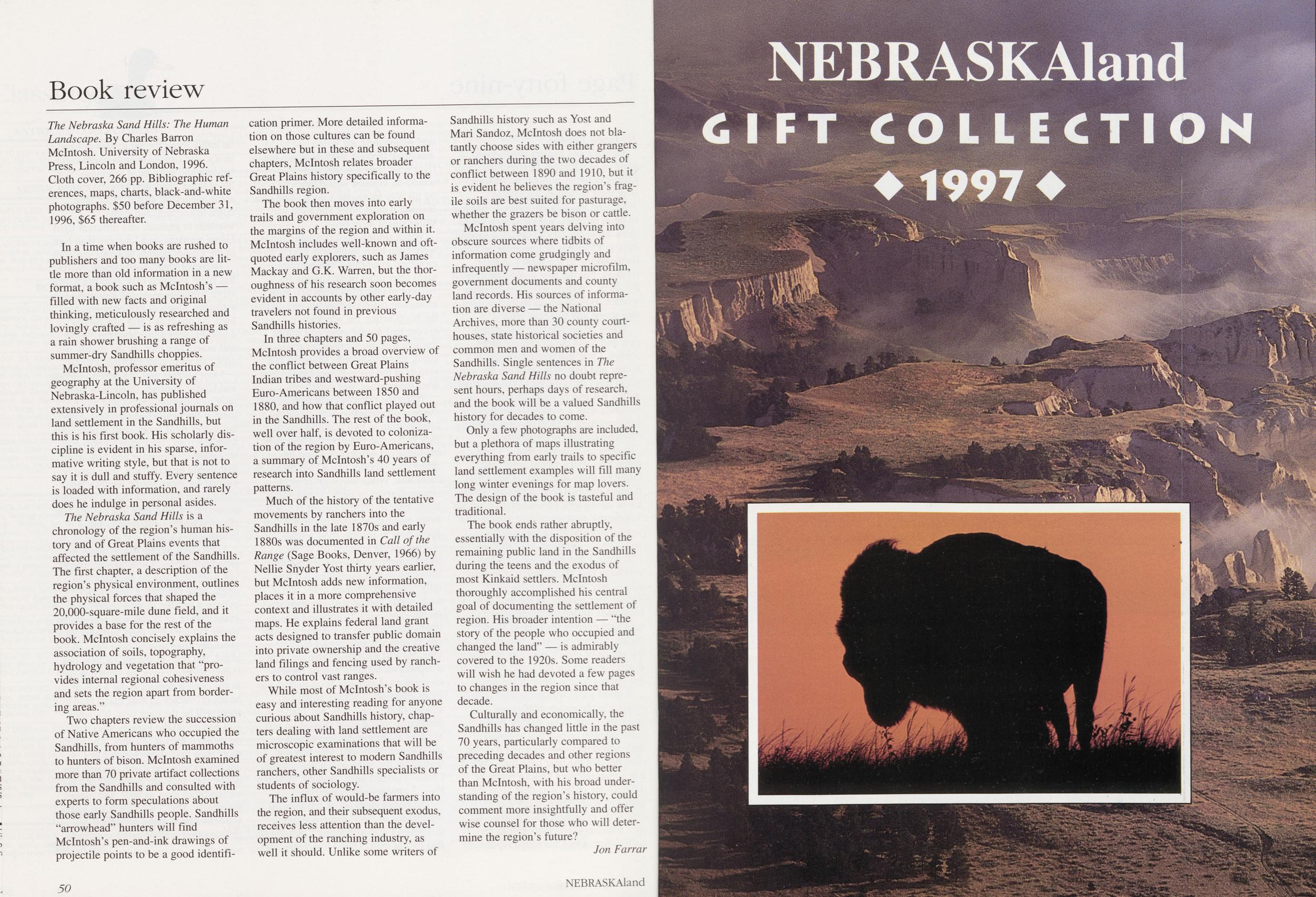
Book review
The Nebraska Sand Hills: The Human Landscape. By Charles Barron Mcintosh. University of Nebraska Press, Lincoln and London, 1996. Cloth cover, 266 pp. Bibliographic references, maps, charts, black-and-white photographs. $50 before December 31, 1996, $65 thereafter.In a time when books are rushed to publishers and too many books are little more than old information in a new format, a book such as Mcintosh's — filled with new facts and original thinking, meticulously researched and lovingly crafted — is as refreshing as a rain shower brushing a range of summer-dry Sandhills choppies.
Mcintosh, professor emeritus of geography at the University of Nebraska-Lincoln, has published extensively in professional journals on land settlement in the Sandhills, but this is his first book. His scholarly discipline is evident in his sparse, informative writing style, but that is not to say it is dull and stuffy. Every sentence is loaded with information, and rarely does he indulge in personal asides.
The Nebraska Sand Hills is a chronology of the region's human history and of Great Plains events that affected the settlement of the Sandhills. The first chapter, a description of the region's physical environment, outlines the physical forces that shaped the 20,000-square-mile dune field, and it provides a base for the rest of the book. Mcintosh concisely explains the association of soils, topography, hydrology and vegetation that "provides internal regional cohesiveness and sets the region apart from bordering areas."
Two chapters review the succession of Native Americans who occupied the Sandhills, from hunters of mammoths to hunters of bison. Mcintosh examined more than 70 private artifact collections from the Sandhills and consulted with experts to form speculations about those early Sandhills people. Sandhills "arrowhead" hunters will find Mcintosh's pen-and-ink drawings of projectile points to be a good identification primer. More detailed information on those cultures can be found elsewhere but in these and subsequent chapters, Mcintosh relates broader Great Plains history specifically to the Sandhills region.
The book then moves into early trails and government exploration on the margins of the region and within it. Mcintosh includes well-known and oftquoted early explorers, such as James Mackay and G.K. Warren, but the thoroughness of his research soon becomes evident in accounts by other early-day travelers not found in previous Sandhills histories.
In three chapters and 50 pages, Mcintosh provides a broad overview of the conflict between Great Plains Indian tribes and westward-pushing Euro-Americans between 1850 and 1880, and how that conflict played out in the Sandhills. The rest of the book, well over half, is devoted to colonization of the region by Euro-Americans, a summary of Mcintosh's 40 years of research into Sandhills land settlement patterns.
Much of the history of the tentative movements by ranchers into the Sandhills in the late 1870s and early 1880s was documented in Call of the Range (Sage Books, Denver, 1966) by Nellie Snyder Yost thirty years earlier, but Mcintosh adds new information, places it in a more comprehensive context and illustrates it with detailed maps. He explains federal land grant acts designed to transfer public domain into private ownership and the creative land filings and fencing used by ranchers to control vast ranges.
While most of Mcintosh's book is easy and interesting reading for anyone curious about Sandhills history, chapters dealing with land settlement are microscopic examinations that will be of greatest interest to modern Sandhills ranchers, other Sandhills specialists or students of sociology.
The influx of would-be farmers into the region, and their subsequent exodus, receives less attention than the development of the ranching industry, as well it should. Unlike some writers of Sandhills history such as Yost and Mari Sandoz, Mcintosh does not blatantly choose sides with either grangers or ranchers during the two decades of conflict between 1890 and 1910, but it is evident he believes the region's fragile soils are best suited for pasturage, whether the grazers be bison or cattle.
Mcintosh spent years delving into obscure sources where tidbits of information come grudgingly and infrequently — newspaper microfilm, government documents and county land records. His sources of information are diverse — the National Archives, more than 30 county court- houses, state historical societies and common men and women of the Sandhills. Single sentences in The Nebraska Sand Hills no doubt represent hours, perhaps days of research, and the book will be a valued Sandhills history for decades to come.
Only a few photographs are included, but a plethora of maps illustrating everything from early trails to specific land settlement examples will fill many long winter evenings for map lovers. The design of the book is tasteful and traditional.
The book ends rather abruptly, essentially with the disposition of the remaining public land in the Sandhills during the teens and the exodus of most Kinkaid settlers. Mcintosh thoroughly accomplished his central goal of documenting the settlement of region. His broader intention — "the story of the people who occupied and changed the land" — is admirably covered to the 1920s. Some readers will wish he had devoted a few pages to changes in the region since that decade.
Culturally and economically, the Sandhills has changed little in the past 70 years, particularly compared to preceding decades and other regions of the Great Plains, but who better than Mcintosh, with his broad understanding of the region's history, could comment more insightfully and offer wise counsel for those who will determine the region's future?
Jon Farrar 50 NEBRASKAland NEBRASKAland Gift Collection 1997
Position: 664 (17 views)