Volume 74, Issue 8, 1996
NEBRASKAland
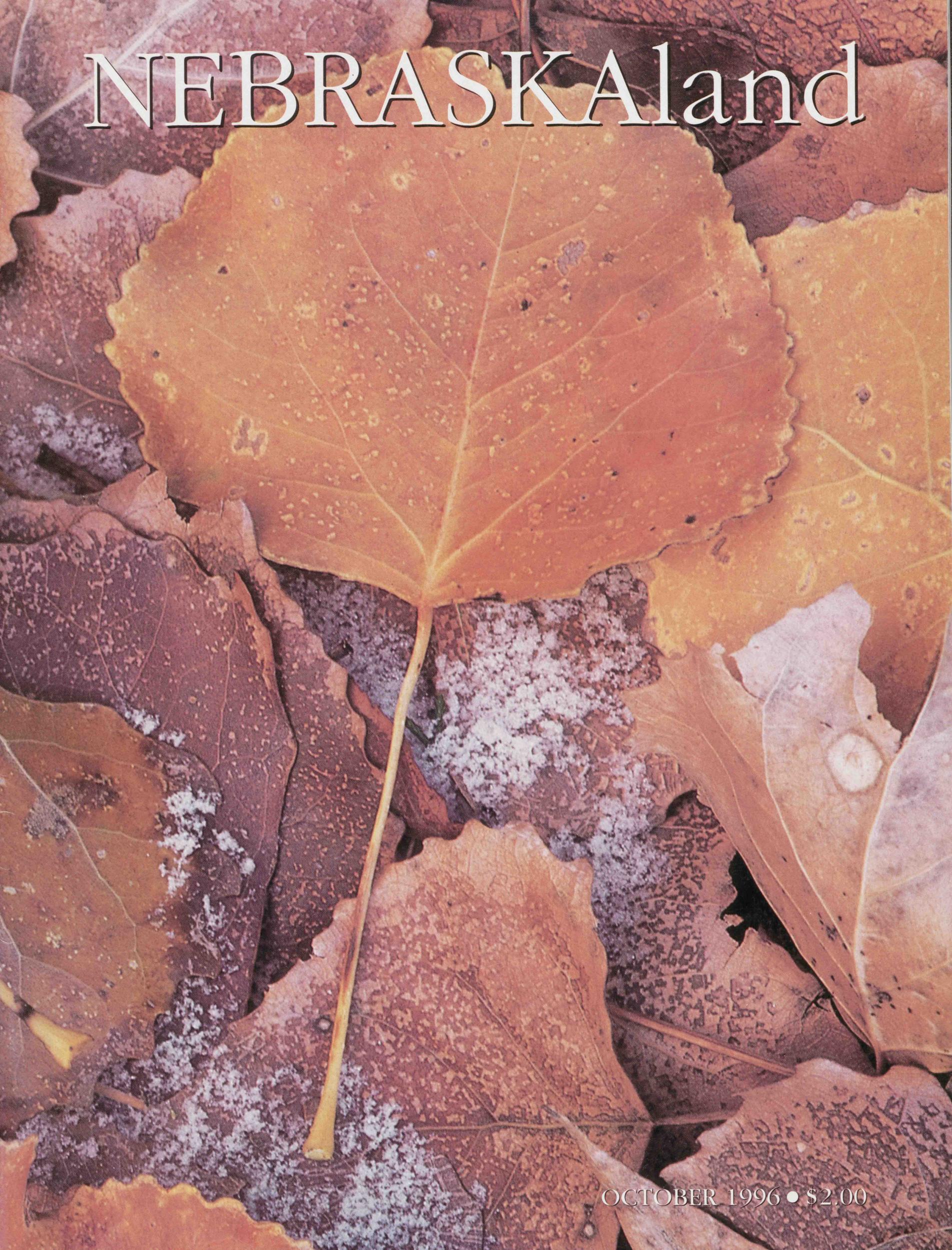
OCTOBER 1996 $2.00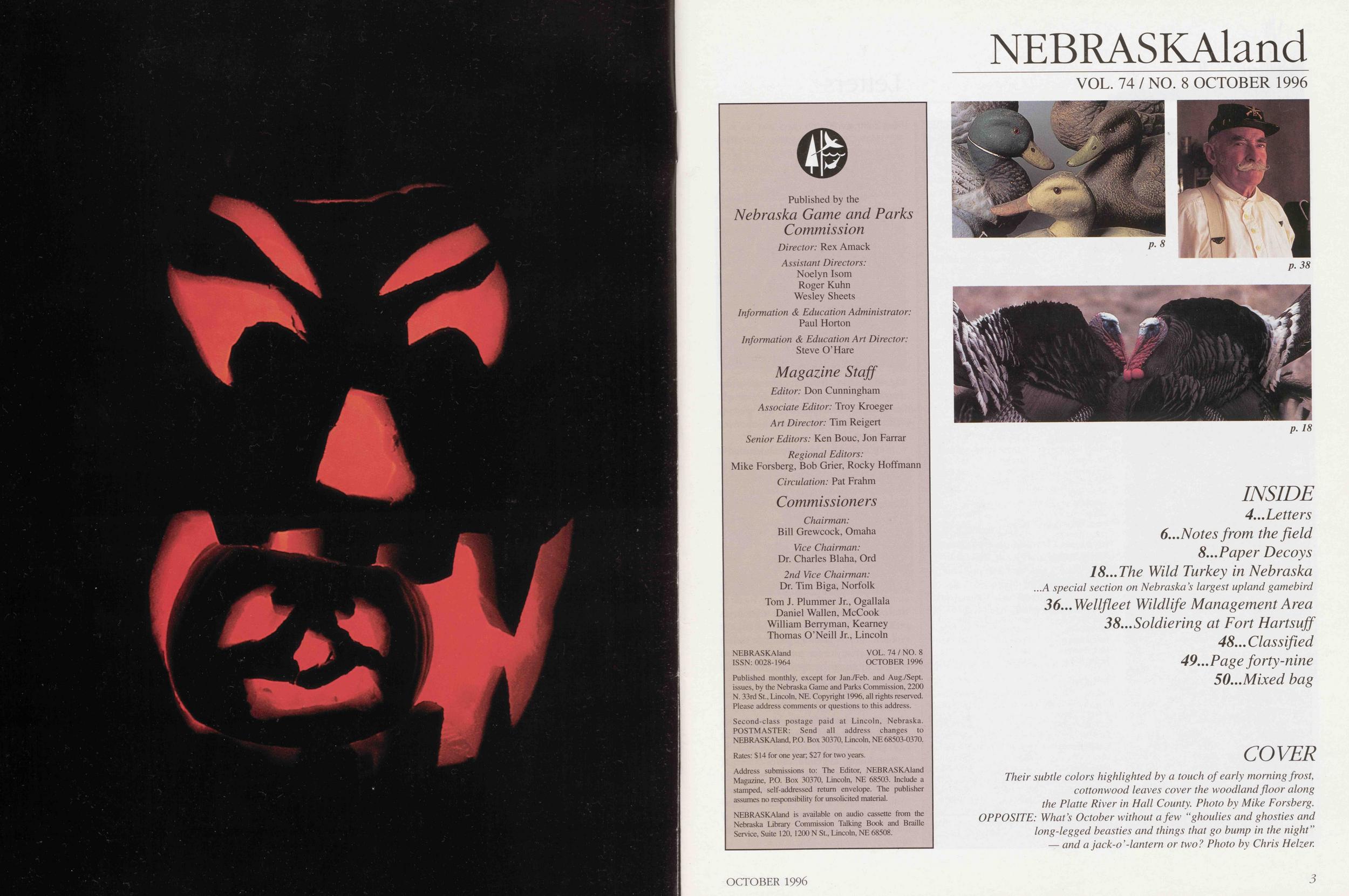
NEBRASKAland
Published by the Nebraska Game and Parks Commission Director: Rex Amack Assistant Directors: Noelyn Isom Roger Kuhn Wesley Sheets Information & Education Administrator: Paul Horton Information & Education Art Director: Steve O'Hare Magazine Staff Editor: Don Cunningham Associate Editor: Troy Kroeger Art Director: Tim Reigert Senior Editors: Ken Bouc, Jon Farrar Regional Editors: Mike Forsberg, Bob Grier, Rocky Hoffmann Circulation: Pat Frahm Commissioners Chairman: Bill Grewcock, Omaha Vice Chairman: Dr. Charles Blaha, Ord 2nd Vice Chairman: Dr. Tim Biga, Norfolk Tom J. Plummer Jr., Ogallala Daniel Wallen, McCook William Berryman, Kearney Thomas O'Neill Jr., Lincoln NEBRASKAland ISSN: 0028-1964 VOL. 74 / NO. 8 OCTOBER 1996 Published monthly, except for Jan/Feb. and Aug./Sept. issues, by the Nebraska Game and Parks Commission, 2200 N. 33rd St., Lincoln, NE. Copyright 1996, all rights reserved. Please address comments or questions to this address. Second-class postage paid at Lincoln, Nebraska. POSTMASTER: Send all address changes to NEBRASKAland, P.O. Box 30370, Lincoln, NE 68503-0370. Rates: $14 for one year, $27 for two years. Address submissions to: The Editor, NEBRASKAland Magazine, P.O. Box 30370, Lincoln, NE 68503. Include a stamped, self-addressed return envelope. The publisher assumes no responsibility for unsolicited material. NEBRASKAland is available on audio cassette from the Nebraska Library Commission Talking Book and Braille Service, Suite 120, 1200 N St., Lincoln, NE 68508. VOL. 74 / NO. 8 OCTOBER 1996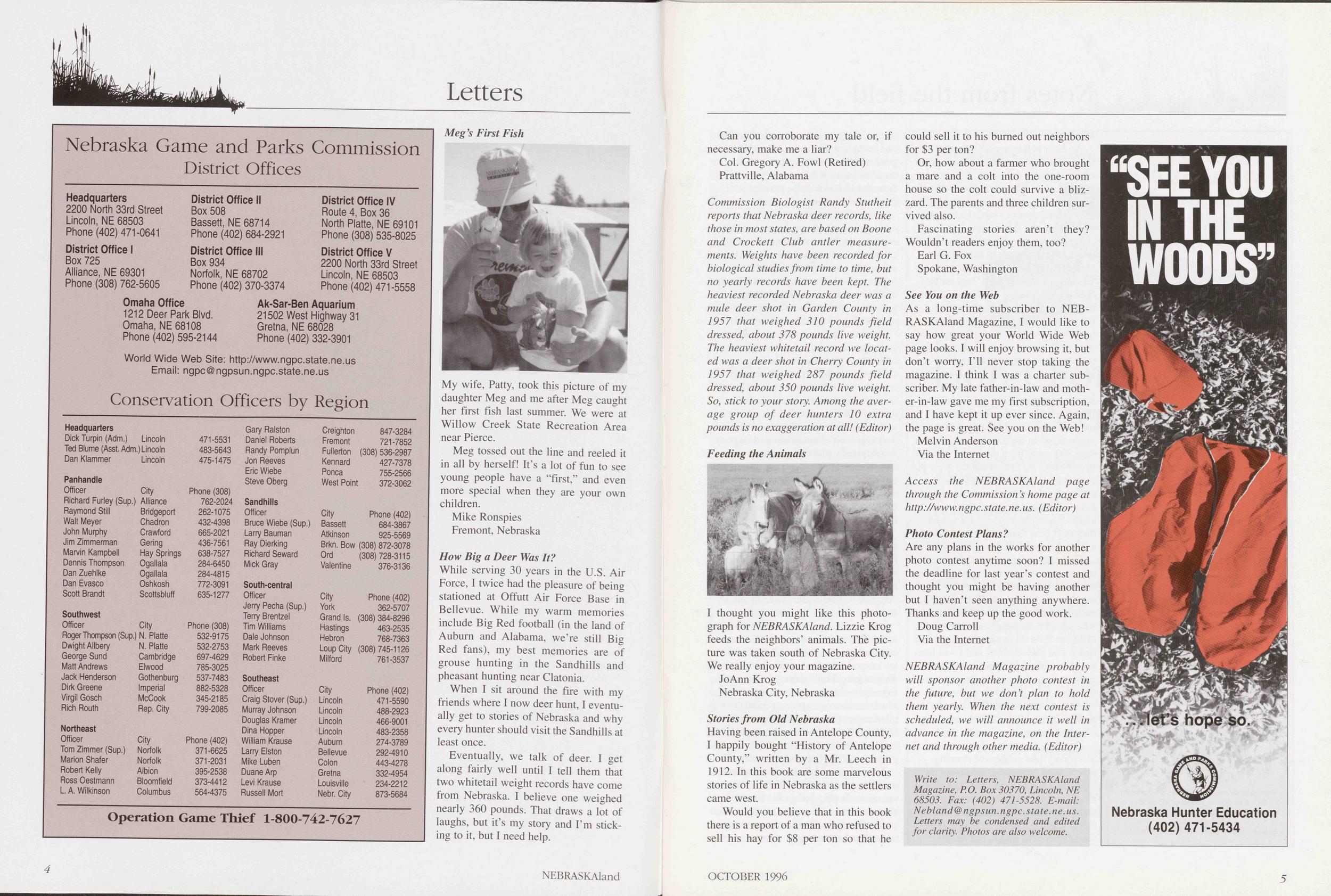
Letters
Nebraska Game and Parks Commission District Offices Headquarters 2200 North 33rd Street Lincoln, NE 68503 Phone (402) 471-0641 District Office I Box 725 Alliance, NE 69301 Phone (308) 762-5605 District Office II Box 508 Bassett, NE 68714 Phone (402) 684-2921 District Office Box 934 Norfolk, NE 68702 Phone (402) 370-3374 District Office IV Route 4, Box 36 North Platte, NE 69101 Phone (308) 535-8025 District Office V 2200 North 33rd Street Lincoln, NE 68503 Phone (402) 471-5558 Omaha Office 1212 Deer Park Blvd. Omaha, NE 68108 Phone (402) 595-2144 Ak-Sar-Ben Aquarium 21502 West Highway 31 Gretna, NE 68028 Phone (402) 332-3901 World Wide Web Site: http://www.ngpc.state.ne.us Email: ngpc@ngpsun.ngpc.state.ne.us Conservation Officers by Region Headquarters Dick Turpin (Adm.) Lincoln Ted Blume (Asst. Adm.) Lincoln Dan Klammer Lincoln Panhandle Officer Richard Furley (Sup.) Raymond Still Walt Meyer John Murphy Jim Zimmerman Marvin Kampbell Dennis Thompson Dan Zuehlke Dan Evasco Scott Brandt Southwest Officer Roger Thompson (Sup.) Dwight Allbery George Sund Matt Andrews Jack Henderson Dirk Greene Virgil Gosch Rich Routh Northeast Officer City Tom Zimmer (Sup.) Norfolk Marion Shafer Norfolk Robert Kelly Albion Ross Oestmann Bloomfield L. A. Wilkinson Columbus City Alliance Bridgeport Chadron Crawford Gering Hay Springs Ogallala Ogallala Oshkosh Scottsbluff City N. Platte N. Platte Cambridge Elwood Gothenburg Imperial McCook Rep. City 471-5531 483-5643 475-1475 Phone (308) 762-2024 262-1075 432-4398 665-2021 436-7561 638-7527 284-6450 284-4815 772-3091 635-1277 Phone (308) 532-9175 532-2753 697-4629 785-3025 537-7483 882-5328 345-2185 799-2085 Phone (402) 371-6625 371-2031 395-2538 373-4412 564-4375 Gary Ralston Daniel Roberts Randy Pomplun Jon Reeves Eric Wiebe Steve Oberg Sandhills Officer Bruce Wiebe (Sup.) Larry Bauman Ray Dierking Richard Seward Mick Gray South-central Officer Jerry Pecha (Sup.) Terry Brentzel Tim Williams Dale Johnson Mark Reeves Robert Finke Southeast Officer Craig Stover (Sup.) Murray Johnson Douglas Kramer Dina Hopper William Krause Larry Elston Mike Luben Duane Arp Levi Krause Russell Mod Creighton 847-3284 Fremont 721-7852 Fullerton (308) 536-2987 Kennard 427-7378 Ponca 755-2566 West Point 372-3062 City Phone (402) Bassett 284-3867 Atkinson 925-5569 Brkn. Bow (308) 872-3078 Ord (308)728-3115 Valentine 376-3136 City Phone (402) York 362-5707 Grand Is. (308)384-8296 Hastings 463-2535 Hebron 768-7363 Loup City (308)745-1126 Milford 761-3537 City Lincoln Lincoln Lincoln Lincoln AuDurn Bellevue Colon Gretna Louisville Nebr. City Phone (402) 471-5590 488-2923 466-9001 483-2358 274-3789 292-4910 443-4278 332-4954 234-2212 873-5684 Operation Game Thief 1-800-742-7627 Meg's First FishMy wife, Patty, took this picture of my daughter Meg and me after Meg caught her first fish last summer. We were at Willow Creek State Recreation Area near Pierce.
Meg tossed out the line and reeled it in all by herself! It's a lot of fun to see young people have a "first," and even more special when they are your own children.
Mike Ronspies Fremont, Nebraska How Big a Deer Was It?While serving 30 years in the U.S. Air Force, I twice had the pleasure of being stationed at Offutt Air Force Base in Bellevue. While my warm memories include Big Red football (in the land of Auburn and Alabama, we're still Big Red fans), my best memories are of grouse hunting in the Sandhills and pheasant hunting near Clatonia.
When I sit around the fire with my friends where I now deer hunt, I eventually get to stories of Nebraska and why every hunter should visit the Sandhills at least once.
Eventually, we talk of deer. I get along fairly well until I tell them that two whitetail weight records have come from Nebraska. I believe one weighed nearly 360 pounds. That draws a lot of laughs, but it's my story and I'm stick- ing to it, but I need help.
4 NEBRASKAlandCan you corroborate my tale or, if necessary, make me a liar?
Col. Gregory A. Fowl (Retired) Prattville, AlabamaCommission Biologist Randy Stutheit reports that Nebraska deer records, like those in most states, are based on Boone and Crockett Club antler measurements. Weights have been recorded for biological studies from time to time, but no yearly records have been kept. The heaviest recorded Nebraska deer was a mule deer shot in Garden County in 1957 that weighed 310 pounds field dressed, about 378 pounds live weight. The heaviest whitetail record we located was a deer shot in Cherry County in 1957 that weighed 287 pounds field dressed, about 350 pounds live weight. So, stick to your story. Among the average group of deer hunters 10 extra pounds is no exaggeration at all! (Editor)
Feeding the AnimalsI thought you might like this photograph for NEBRASKAland. Lizzie Krog feeds the neighbors' animals. The picture was taken south of Nebraska City. We really enjoy your magazine.
JoAnn Krog Nebraska City, Nebraska Stories from Old NebraskaHaving been raised in Antelope County, I happily bought "History of Antelope County," written by a Mr. Leech in 1912. In this book are some marvelous stories of life in Nebraska as the settlers came west.
Would you believe that in this book there is a report of a man who refused to sell his hay for $8 per ton so that he could sell it to his burned out neighbors for $3 per ton?
Or, how about a farmer who brought a mare and a colt into the one-room house so the colt could survive a blizzard. The parents and three children survived also.
Fascinating stories aren't they? Wouldn't readers enjoy them, too?
Earl G. Fox Spokane, Washington See You on the WebAs a long-time subscriber to NEBRASKAland Magazine, I would like to say how great your World Wide Web page looks. I will enjoy browsing it, but don't worry, IT1 never stop taking the magazine. I think I was a charter subscriber. My late father-in-law and mother-in-law gave me my first subscription, and I have kept it up ever since. Again, the page is great. See you on the Web!
Melvin Anderson Via the InternetAccess the NEBRASKAland page through the Commission's home page at http://www.ngpc.state,ne.us. (Editor)
Photo Contest Plans?Are any plans in the works for another photo contest anytime soon? I missed the deadline for last year's contest and thought you might be having another but I haven't seen anything anywhere. Thanks and keep up the good work.
Doug Carroll Via the InternetNEBRASKAland Magazine probably will sponsor another photo contest in the future, but we don't plan to hold them yearly. When the next contest is scheduled, we will announce it well in advance in the magazine, on the Internet and through other media. (Editor)
Write to: Letters, NEBRASKAland Magazine, P.O. Box30370, Lincoln, NE 68503. Fax: (402) 471-5528. E-mail: Nebland@ngpsun.ngpc.state,ne.us. Letters may be condensed and edited for clarity. Photos are also welcome. Nebraska Hunter Education (402)471-5434 OCTOBER 1996 5
Notes from the field
State Parks ... Nebraska's Best Outdoor Recreation Bargain for 75 Years The Good Life... Outdoors Nebraska's state parks are still your best bet for a perfect vacation or weekend break. Call or write today to request this 48-page brochure containing detailed information on lodging, camping, activities, facilities, seasons, fees and reservations at state parks, recreation areas and historic parks. Nebraska Game and Parks Commission P.O. Box 30370, Lincoln, NE 68503 Phone (402) 471-0641 or 1-800-826-PARK E-mail: ngpc@ngpsun.ngpc.state.ne.us Blind VisionsAn hour before sunset, the warbling, flute-like calls of sandhill cranes drifted across the meadow. Nearly a minute passed before 40 cranes glided over the low hills, their wings already locked as they drifted down to land. Until it was too dark to see, they continued to come — squadrons of a dozen and flocks of two hundred, always heard before seen, passing 50 yards, 30 yards, then 15 yards overhead, black legs trailing, heads turning to see if all was well on this piece of earth. Spreading their broad wings like sails, they arched back and were absorbed into the mass of gray already preening and probing the meadow for bits of greenery, insects under cow pies, frogs or mice.
Shadows from the hills crawled across the meadow. In the day's last light there were a thousand cranes, maybe more, gathered around the grassy knob in the meadow no more than 300 yards from where we watched in our blind. As their numbers grew the clamor of calls swelled, and arriving birds fell from the sky without hesitation. Where had they last touched earth? Saskatchewan? Where would they next bow their long necks to ladle a drink? New Mexico?
That evening was one of the most extraordinary times I've spent with sandhill cranes, and it came after meeting them on the central Platte River each spring for three decades. Part of what made it singularly uncommon, different from all those other days, was that it was mid-October and I was hunkered in a blind with two companions and our dogs. Leaning in the corners of the blind were loaded shotguns, and duck decoys drifted listlessly in the pond before us. It was duck season in Cherry County.
The foot-stomping, wing-rattling and turkey-like gobbles of dancing sharp-tailed grouse carried across the same meadow that evening. The day length was the same as in the spring and had convinced the cocks' pituitary that it was the mating season, and so they gathered to dance, but no hens came calling. A buck mule deer left its bed in the cattail "swamp" south of the pond and browsed snowberry on the meadow edge. A coyote crept down from the bluestem hills, perhaps to ponder bellying-up on a careless crane.
Every detail of that evening, every color and form, the mingling of wild sounds and the play of end-of-day light on the surface of the land is indelibly scribed in my mind. In the blind we pondered — how many drake mallards would have to dangle their orange webs over the decoys to induce us to shoot and put up the cranes?
I am not making the weary old argument that shooting is but a small part of hunting, that hunters venture into nature's cathedral to commune with her creatures. Those who know this to be at least part truth, know it without reading it here, and those who doubt it will probably always doubt it. Whatever one feels about hunting, though, it is unarguably true that glimpses of nature's private moments are shared by people with hunting dogs at their side, shotguns in their hands and licenses in their pockets allowing them to kill and eat certain wild animals.
Hunters, required to sit still, hidden as best they can be, often for long hours and usually at the beginning and end of the day when wildlife is more active, have the best views. Waterfowl, deer and turkey hunters have the most stories to tell.
While hunting ducks, we have been scolded by marsh wrens perched on the cattails lashed to the duck blind, and we have watched swarms of red- winged blackbirds glean the last seeds from the wild rice surrounding it. Muskrats have adopted our blinds, piled soggy cattails and rush stalks two feet high inside and have crawled in the next morning to inspect the progress on their new winter lodge.
Yellowlegs and herons have stalked mudflats past our duck blinds, and uncountable pied-bill grebes have come to the decoys and sunk away like little submarines. Nor could we count the number of mornings marsh hawks 6 NEBRASKAland brushed the heads of phragmites around our blind, so close it seemed we could reach out and touch them. But only once have we watched bald eagles tumble in aerial courtship over a North Platte River goose pit.
Because we were hunting we were there when the sky gods set a sumptuous feast. As memorable as the cranes coming to the meadow, though there was not a bird in the sky, was the morning after the night the lake froze, locking our decoys in ice. Before sunrise, when clouds on the eastern horizon were painted colors of a subtlety, intensity and depth that film cannot reproduce nor our language describe, we ran the boat through a quarter mile of half-inch thick ice that broke in sheets on either side of the keel, slid up onto the unbroken ice, shattered and skated off in all directions at all angles, each piece reflecting the sky color like facets in a kaleidoscope. That hunting companion is gone, but we shared the morning.
A worthy companion should always have time during a hunt to follow the course of a beaver canal to a new stand of willows, trace a webwork of vole paths through the grass after the snow has melted or gather a handful of rose hips. Bone piles, or a "hedge apple" disassembled by a squirrel to extract the seeds, must be examined. Even after the guns are cased there is magic in whistling wings passing unseen in the foggy darkness.
I have gone "pheasant hunting" with a companion and never taken a shot- gun out of its case. Instead, we spent an entire afternoon following the twists and turns of an isolated creek winding through a cedar canyon, pondered the intricate engineering of beaver dams and lodges, and talked privately of animal totems.
Hunting is not always like this. Sometimes we hunt hard from sunrise to sunset and do our best to shoot straight and kill cleanly, but the talk at the end of the day and the memories are just as good either way.
Jon Farrar Hunting seasons are on the way... Don't Forget Your Permit! Resident Hunt and Fish..................................$21.75 Resident Hunt....................................................$9.50 Resident Fish..................................................$12.75 Nonresident Hunt............................................$55.00 Nonresident Fish ............................................$35.00 Habitat Stamp..................................................$10.00 For a lifetime of outdoor fun, consider a lifetime permit. Lifetime Hunt and Fish..................................$448.00 Lifetime Hunt ................................................$224.00 Lifetime Fish..................................................$257.50 Hunting and fishing permits are available at all Nebraska Game and Parks Commission offices and from sporting goods stores, outfitters, bait shops and many other vendors throughout the state. For more information call (402) 471-0641. Nebraska Game and Parks Commission OCTOBER 1996 7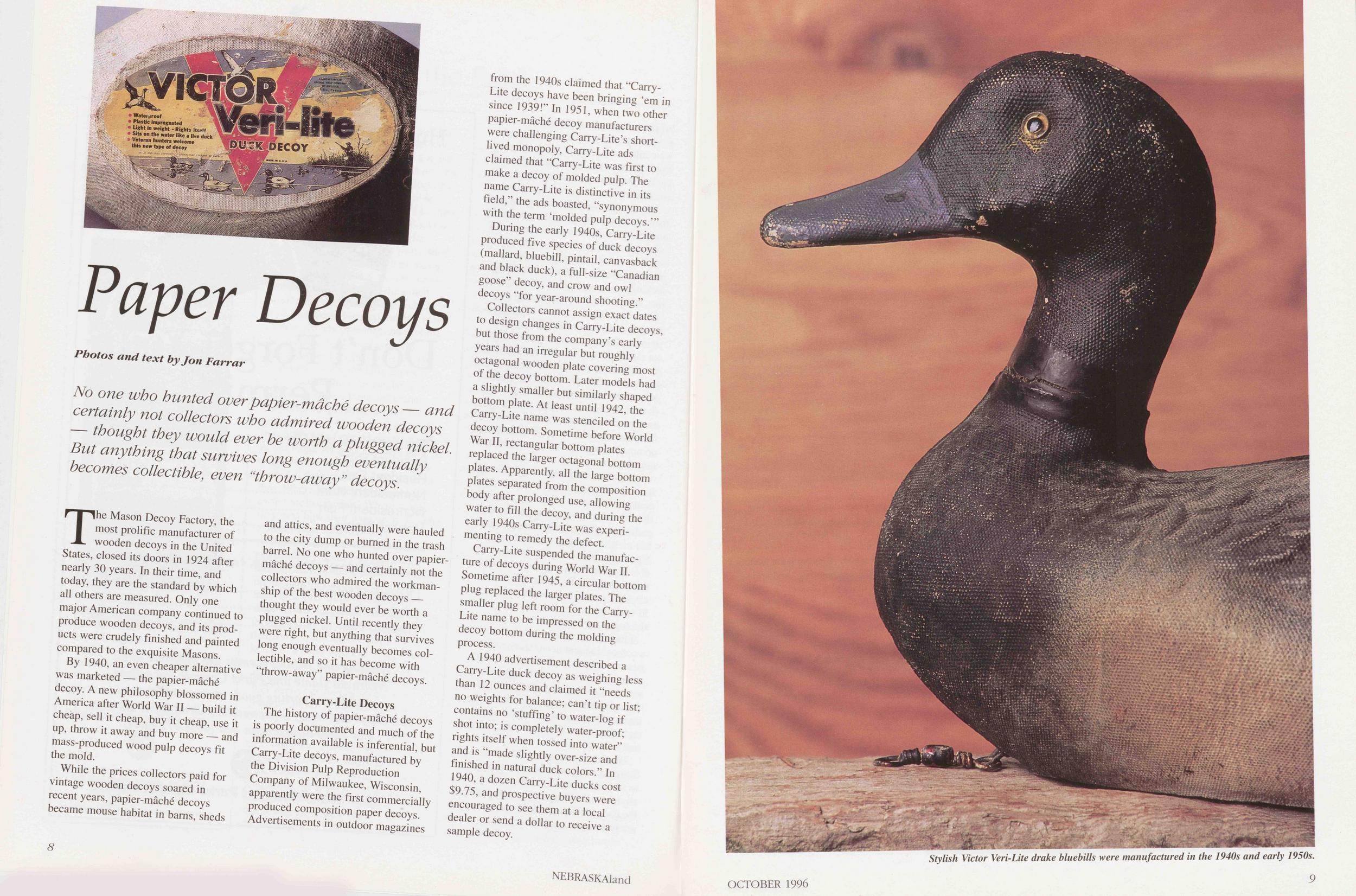
Paper Decoys
Photos and text by Jon Farrar becomes collectible, evenThe Mason Decoy Factory, the most prolific manufacturer of wooden decoys in the United States, closed its doors in 1924 after nearly 30 years. In their time, and today, they are the standard by which all others are measured. Only one major American company continued to produce wooden decoys, and its products were crudely finished and painted compared to the exquisite Masons.
By 1940, an even cheaper alternative was marketed — the papier-mache decoy. A new philosophy blossomed in America after World War II — build it cheap, sell it cheap, buy it cheap, use it up, throw it away and buy more — and mass-produced wood pulp decoys fit the mold.
While the prices collectors paid for vintage wooden decoys soared in recent years, papier-mache decoys became mouse habitat in barns, sheds and attics, and eventually were hauled to the city dump or burned in the trash barrel. No one who hunted over papier-mache decoys — and certainly not the collectors who admired the workmanship of the best wooden decoys — thought they would ever be worth a plugged nickel. Until recently they were right, but anything that survives long enough eventually becomes collectible, and so it has become with "throw-away" papier-mache decoys.
Carry-Lite DecoysThe history of papier-mache decoys is poorly documented and much of the information available is inferential, but Carry-Lite decoys, manufactured by the Division Pulp Reproduction Company of Milwaukee, Wisconsin, apparently were the first commercially produced composition paper decoys. Advertisements in outdoor magazines from the 1940s claimed that "Carry-Lite decoys have been bringing 'em in since 1939!" In 1951, when two other papier-mache decoy manufacturers were challenging Carry-Lite's short lived monopoly, Carry-Lite ads claimed that "Carry-Lite was first to make a decoy of molded pulp. The name Carry-Lite is distinctive in its field," the ads boasted, "synonymous with the term 'molded pulp decoys.'
During the early 1940s, Carry-Lite produced five species of duck decoys (mallard, bluebill, pintail, canvasback and black duck), a full-size "Canadian goose" decoy, and crow and owl decoys "for year-around shooting."
Collectors cannot assign exact dates to design changes in Carry-Lite decoys, but those from the company's early years had an irregular but roughly octagonal wooden plate covering most of the decoy bottom. Later models had a slightly smaller but similarly shaped bottom plate. At least until 1942, the Carry-Lite name was stenciled on the decoy bottom. Sometime before World War II, rectangular bottom plates replaced the larger octagonal bottom plates. Apparently, all the large bottom plates separated from the composition body after prolonged use, allowing water to fill the decoy, and during the early 1940s Carry-Lite was experimenting to remedy the defect.
Carry-Lite suspended the manufacture of decoys during World War II. Sometime after 1945, a circular bottom plug replaced the larger plates. The smaller plug left room for the Carry-Lite name to be impressed on the decoy bottom during the molding process.
A 1940 advertisement described a Carry-Lite duck decoy as weighing less than 12 ounces and claimed it "needs no weights for balance; can't tip or list; contains no 'stuffing' to water-log if shot into; is completely water-proof; rights itself when tossed into water" and is "made slightly over-size and finished in natural duck colors." In 1940, a dozen Carry-Lite ducks cost $9.75, and prospective buyers were encouraged to see them at a local dealer or send a dollar to receive a sample decoy.
8 NEBRASKAland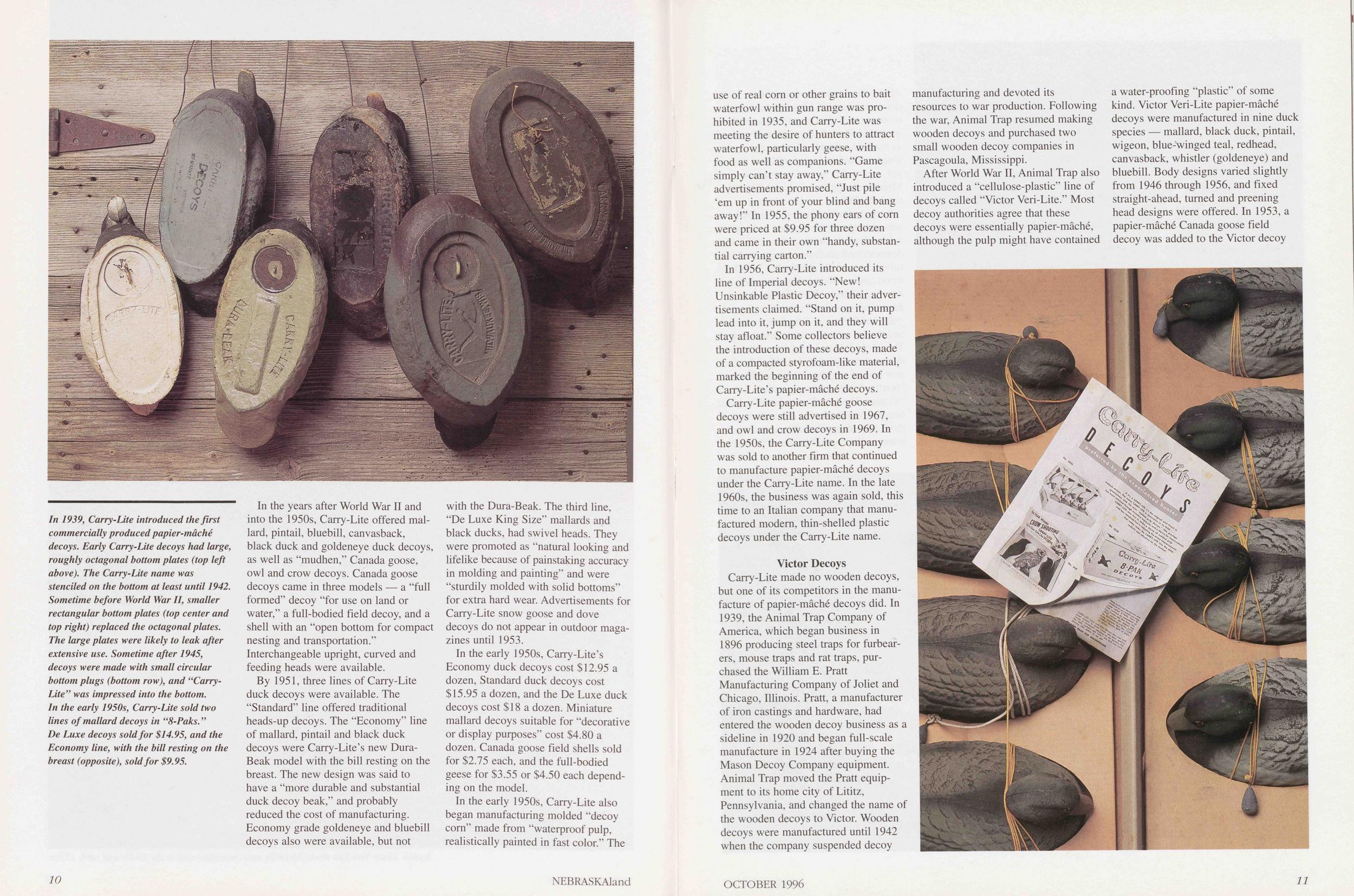
In the years after World War II and into the 1950s, Carry-Lite offered mallard, pintail, bluebill, canvasback, black duck and goldeneye duck decoys, as well as "mudhen," Canada goose, owl and crow decoys. Canada goose decoys came in three models — a "full formed" decoy "for use on land or water," a full-bodied field decoy, and a shell with an "open bottom for compact nesting and transportation." Interchangeable upright, curved and feeding heads were available.
By 1951, three lines of Carry-Lite duck decoys were available. The "Standard" line offered traditional heads-up decoys. The "Economy" line of mallard, pintail and black duck decoys were Carry-Lite's new DuraBeak model with the bill resting on the breast. The new design was said to have a "more durable and substantial duck decoy beak," and probably reduced the cost of manufacturing. Economy grade goldeneye and bluebill decoys also were available, but not with the Dura-Beak. The third line, "De Luxe King Size" mallards and black ducks, had swivel heads. They were promoted as "natural looking and lifelike because of painstaking accuracy in molding and painting" and were "sturdily molded with solid bottoms" for extra hard wear. Advertisements for Carry-Lite snow goose and dove decoys do not appear in outdoor magazines until 1953.
In the early 1950s, Carry-Lite's Economy duck decoys cost $12.95 a dozen, Standard duck decoys cost $15.95 a dozen, and the De Luxe duck decoys cost $18 a dozen. Miniature mallard decoys suitable for "decorative or display purposes" cost $4.80 a dozen. Canada goose field shells sold for $2.75 each, and the full-bodied geese for $3.55 or $4.50 each depending on the model.
In the early 1950s, Carry-Lite also began manufacturing molded "decoy corn" made from "waterproof pulp, realistically painted in fast color." The 10 NEBRASKAland use of real corn or other grains to bait waterfowl within gun range was prohibited in 1935, and Carry-Lite was meeting the desire of hunters to attract waterfowl, particularly geese, with food as well as companions. "Game simply can't stay away," Carry-Lite advertisements promised, "Just pile 'em up in front of your blind and bang away!" In 1955, the phony ears of corn were priced at $9.95 for three dozen and came in their own "handy, substantial carrying carton."
In 1956, Carry-Lite introduced its line of Imperial decoys. "New! Unsinkable Plastic Decoy," their advertisements claimed. "Stand on it, pump lead into it, jump on it, and they will stay afloat." Some collectors believe the introduction of these decoys, made of a compacted styrofoam-like material, marked the beginning of the end of Carry-Lite's papier-mache decoys.
Carry-Lite papier-mache goose decoys were still advertised in 1967, and owl and crow decoys in 1969. In the 1950s, the Carry-Lite Company was sold to another firm that continued to manufacture papier-mache decoys under the Carry-Lite name. In the late 1960s, the business was again sold, this time to an Italian company that manufactured modern, thin-shelled plastic decoys under the Carry-Lite name.
Victor DecoysCarry-Lite made no wooden decoys, but one of its competitors in the manufacture of papier-mache decoys did. In 1939, the Animal Trap Company of America, which began business in 1896 producing steel traps for furbearers, mouse traps and rat traps, purchased the William E. Pratt Manufacturing Company of Joliet and Chicago, Illinois. Pratt, a manufacturer of iron castings and hardware, had entered the wooden decoy business as a sideline in 1920 and began full-scale manufacture in 1924 after buying the Mason Decoy Company equipment. Animal Trap moved the Pratt equipment to its home city of Lititz, Pennsylvania, and changed the name of the wooden decoys to Victor. Wooden decoys were manufactured until 1942 when the company suspended decoy manufacturing and devoted its resources to war production. Following the war, Animal Trap resumed making wooden decoys and purchased two small wooden decoy companies in Pascagoula, Mississippi.
After World War II, Animal Trap also introduced a "cellulose-plastic" line of decoys called "Victor Veri-Lite." Most decoy authorities agree that these decoys were essentially papier-mache, although the pulp might have contained a water-proofing "plastic" of some kind. Victor Veri-Lite papier-mache decoys were manufactured in nine duck species — mallard, black duck, pintail, wigeon, blue-winged teal, redhead, canvasback, whistler (goldeneye) and bluebill. Body designs varied slightly from 1946 through 1956, and fixed straight-ahead, turned and preening head designs were offered. In 1953, a papier-mache Canada goose field decoy was added to the Victor decoy
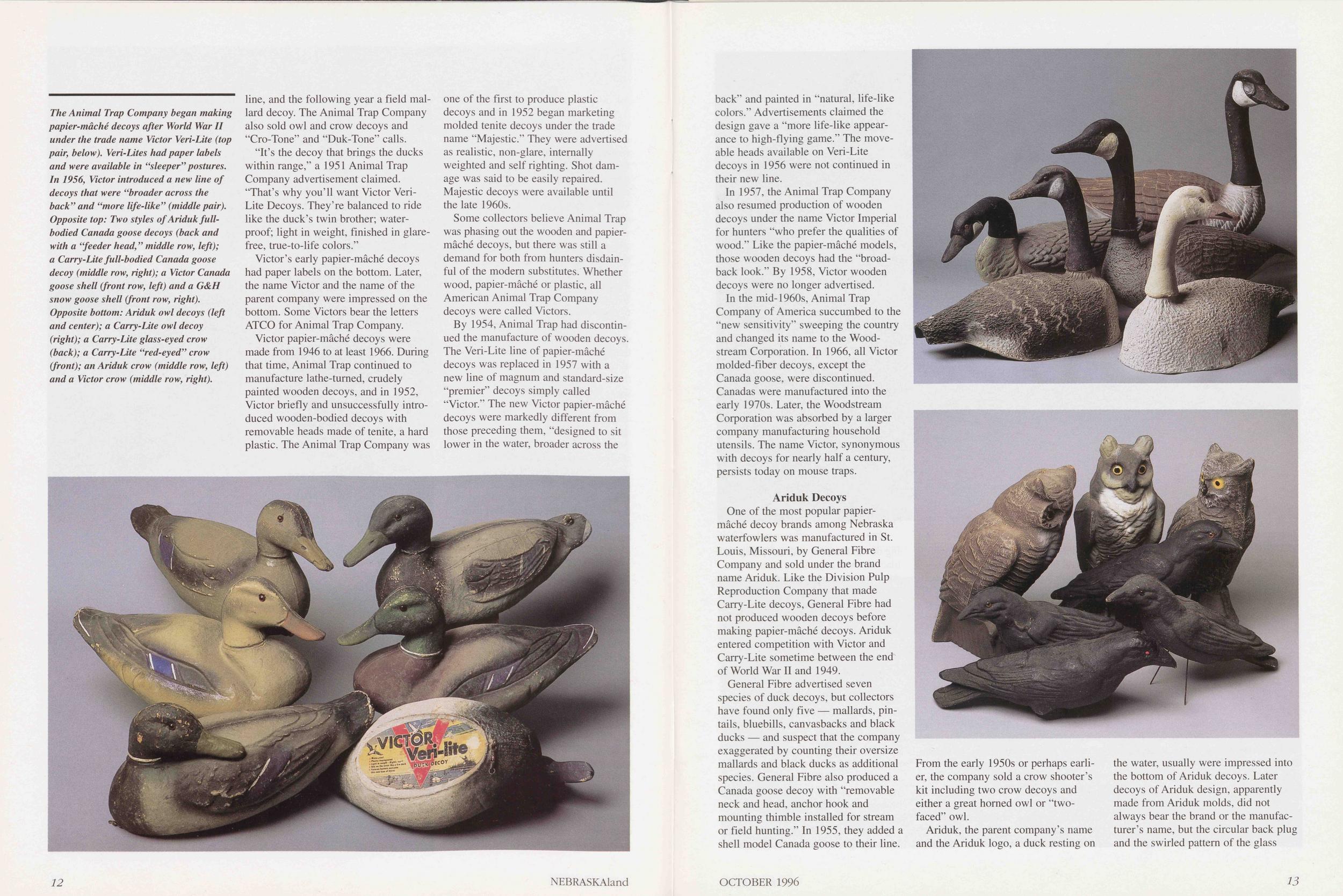
"It's the decoy that brings the ducks within range," a 1951 Animal Trap Company advertisement claimed. "That's why you'll want Victor VeriLite Decoys. They're balanced to ride like the duck's twin brother; waterproof; light in weight, finished in glare-free, true-to-life colors."
Victor's early papier-mache decoys had paper labels on the bottom. Later, the name Victor and the name of the parent company were impressed on the bottom. Some Victors bear the letters ATCO for Animal Trap Company.
Victor papier-mache decoys were made from 1946 to at least 1966. During that time, Animal Trap continued to manufacture lathe-turned, crudely painted wooden decoys, and in 1952, Victor briefly and unsuccessfully introduced wooden-bodied decoys with removable heads made of tenite, a hard plastic. The Animal Trap Company was one of the first to produce plastic decoys and in 1952 began marketing molded tenite decoys under the trade name "Majestic." They were advertised as realistic, non-glare, internally weighted and self righting. Shot damage was said to be easily repaired. Majestic decoys were available until the late 1960s.
Some collectors believe Animal Trap was phasing out the wooden and papier-mache decoys, but there was still a demand for both from hunters disdainful of the modern substitutes. Whether wood, papier-mache or plastic, all American Animal Trap Company decoys were called Victors.
By 1954, Animal Trap had discontinued the manufacture of wooden decoys. The Veri-Lite line of papier-mache decoys was replaced in 1957 with a new line of magnum and standard-size "premier" decoys simply called "Victor." The new Victor papier-mache decoys were markedly different from those preceding them, "designed to sit lower in the water, broader across the 12 NEBRASKAland
In 1957, the Animal Trap Company also resumed production of wooden decoys under the name Victor Imperial for hunters "who prefer the qualities of wood." Like the papier-mache models, those wooden decoys had the "broadback look." By 1958, Victor wooden decoys were no longer advertised.
In the mid-1960s, Animal Trap Company of America succumbed to the "new sensitivity" sweeping the country and changed its name to the Woodstream Corporation. In 1966, all Victor molded-fiber decoys, except the Canada goose, were discontinued. Canadas were manufactured into the early 1970s. Later, the Woodstream Corporation was absorbed by a larger company manufacturing household utensils. The name Victor, synonymous with decoys for nearly half a century, persists today on mouse traps.
Ariduk DecoysOne of the most popular papier-mache decoy brands among Nebraska waterfowlers was manufactured in St. Louis, Missouri, by General Fibre Company and sold under the brand name Ariduk. Like the Division Pulp Reproduction Company that made Carry-Lite decoys, General Fibre had not produced wooden decoys before making papier-mache decoys. Ariduk entered competition with Victor and Carry-Lite sometime between the end of World War II and 1949.
General Fibre advertised seven species of duck decoys, but collectors have found only five — mallards, pintails, bluebills, canvasbacks and black ducks — and suspect that the company exaggerated by counting their oversize mallards and black ducks as additional species. General Fibre also produced a Canada goose decoy with "removable neck and head, anchor hook and mounting thimble installed for stream or field hunting." In 1955, they added a shell model Canada goose to their line. From the early 1950s or perhaps earlier, the company sold a crow shooter's kit including two crow decoys and either a great horned owl or "two-faced" owl.
Ariduk, the parent company's name
and the Ariduk logo, a duck resting on
the water, usually were impressed into
the bottom of Ariduk decoys. Later
decoys of Ariduk design, apparently
made from Ariduk molds, did not
always bear the brand or the
manufacturer's name, but the circular back plug
and the swirled pattern of the glass
OCTOBER 1996
13
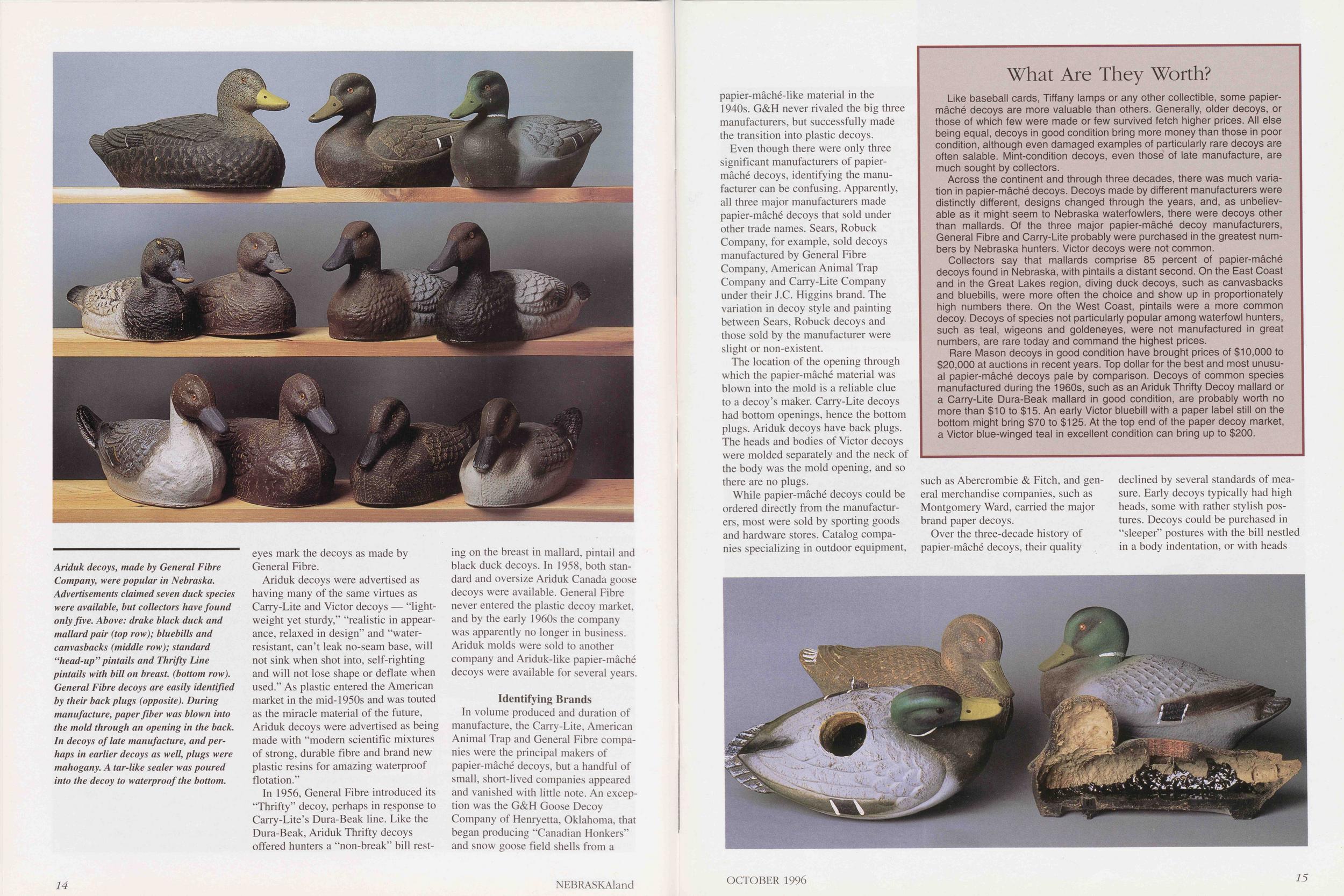
Ariduk decoys were advertised as having many of the same virtues as Carry-Lite and Victor decoys — "light-weight yet sturdy," "realistic in appearance, relaxed in design" and "water resistant, can't leak no-seam base, will not sink when shot into, self-righting and will not lose shape or deflate when used." As plastic entered the American market in the mid-1950s and was touted as the miracle material of the future, Ariduk decoys were advertised as being made with "modern scientific mixtures of strong, durable fibre and brand new plastic resins for amazing waterproof flotation."
In 1956, General Fibre introduced its "Thrifty" decoy, perhaps in response to Carry-Lite's Dura-Beak line. Like the Dura-Beak, Ariduk Thrifty decoys offered hunters a "non-break" bill resting on the breast in mallard, pintail and black duck decoys. In 1958, both standard and oversize Ariduk Canada goose decoys were available. General Fibre never entered the plastic decoy market, and by the early 1960s the company was apparently no longer in business. Ariduk molds were sold to another company and Ariduk-like papier-mache decoys were available for several years.
Identifying BrandsIn volume produced and duration of manufacture, the Carry-Lite, American Animal Trap and General Fibre companies were the principal makers of papier-mache decoys, but a handful of small, short-lived companies appeared and vanished with little note. An exception was the G&H Goose Decoy Company of Henryetta, Oklahoma, that began producing "Canadian Honkers" and snow goose field shells from a 14 NEBRASKAland papier-mache-like material in the 1940s. G&H never rivaled the big three manufacturers, but successfully made the transition into plastic decoys.
Even though there were only three significant manufacturers of papier-mache decoys, identifying the manufacturer can be confusing. Apparently, all three major manufacturers made papier-mache decoys that sold under other trade names. Sears, Robuck Company, for example, sold decoys manufactured by General Fibre Company, American Animal Trap Company and Carry-Lite Company under their J.C. Higgins brand. The variation in decoy style and painting between Sears, Robuck decoys and those sold by the manufacturer were slight or non-existent.
The location of the opening through which the papier-mache material was blown into the mold is a reliable clue to a decoy's maker. Carry-Lite decoys had bottom openings, hence the bottom plugs. Ariduk decoys have back plugs. The heads and bodies of Victor decoys were molded separately and the neck of the body was the mold opening, and so there are no plugs.
While papier-mache decoys could be ordered directly from the manufacturers, most were sold by sporting goods and hardware stores. Catalog companies specializing in outdoor equipment, such as Abercrombie & Fitch, and general merchandise companies, such as Montgomery Ward, carried the major brand paper decoys.
What Are They Worth?Like baseball cards, Tiffany lamps or any other collectible, some papiermache decoys are more valuable than others. Generally, older decoys, or those of which few were made or few survived fetch higher prices. All else being equal, decoys in good condition bring more money than those in poor condition, although even damaged examples of particularly rare decoys are often salable. Mint-condition decoys, even those of late manufacture, are much sought by collectors.
Across the continent and through three decades, there was much variation in papier-mache decoys. Decoys made by different manufacturers were distinctly different, designs changed through the years, and, as unbelievable as it might seem to Nebraska waterfowlers, there were decoys other than mallards. Of the three major papier-mache decoy manufacturers, General Fibre and Carry-Lite probably were purchased in the greatest numbers by Nebraska hunters. Victor decoys were not common.
Collectors say that mallards comprise 85 percent of papier-mache decoys found in Nebraska, with pintails a distant second. On the East Coast and in the Great Lakes region, diving duck decoys, such as canvasbacks and bluebills, were more often the choice and show up in proportionately high numbers there. On the West Coast, pintails were a more common decoy. Decoys of species not particularly popular among waterfowl hunters, such as teal, wigeons and goldeneyes, were not manufactured in great numbers, are rare today and command the highest prices.
Rare Mason decoys in good condition have brought prices of $10,000 to $20,000 at auctions in recent years. Top dollar for the best and most unusual papier-mache decoys pale by comparison. Decoys of common species manufactured during the 1960s, such as an Ariduk Thrifty Decoy mallard or a Carry-Lite Dura-Beak mallard in good condition, are probably worth no more than $10 to $15. An early Victor bluebill with a paper label still on the bottom might bring $70 to $125. At the top end of the paper decoy market, a Victor blue-winged teal in excellent condition can bring up to $200.
Over the three-decade history of papier-mache decoys, their quality declined by several standards of measure. Early decoys typically had high heads, some with rather stylish postures. Decoys could be purchased in "sleeper" postures with the bill nestled in a body indentation, or with heads
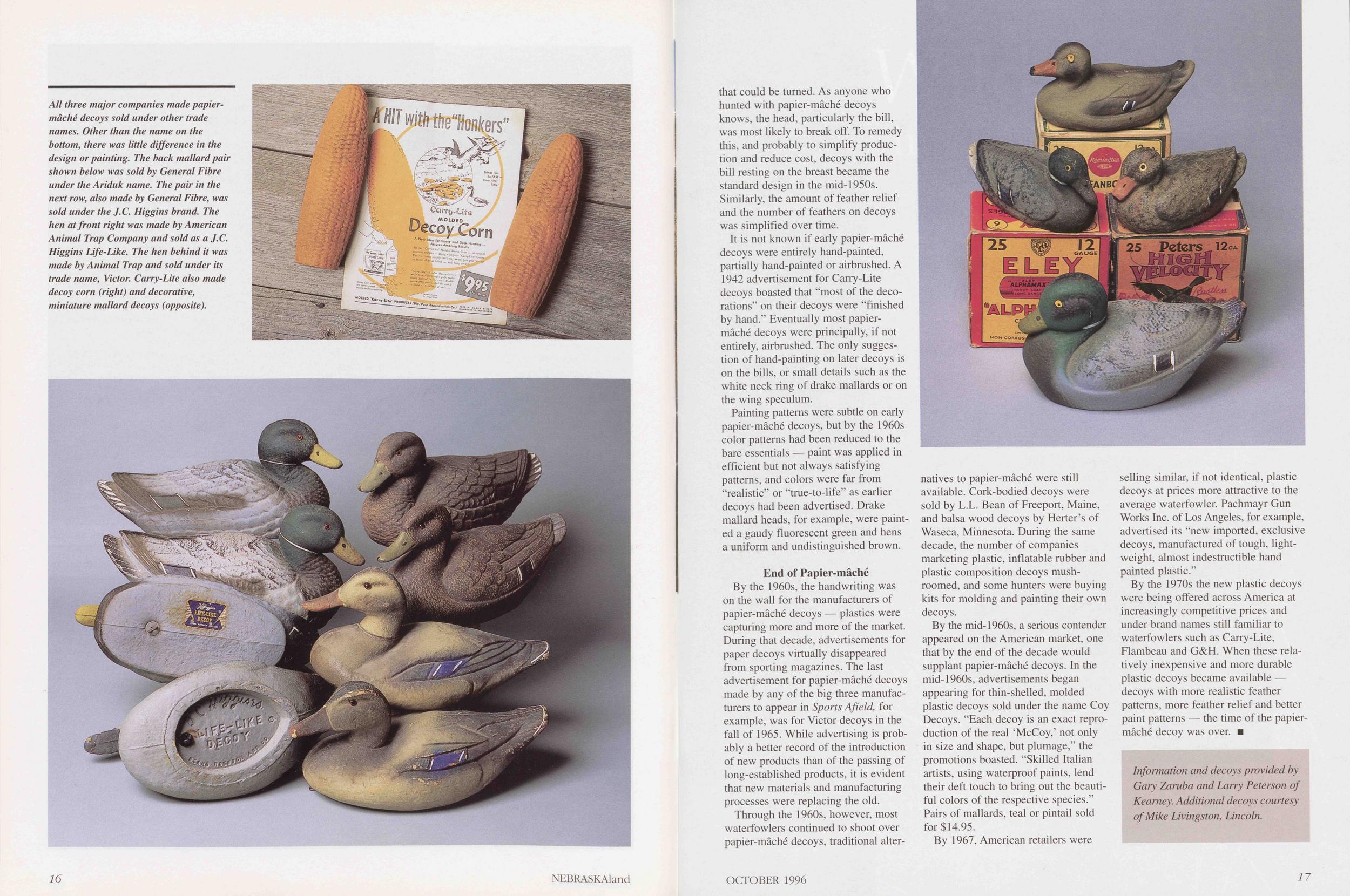
It is not known if early papier-mache decoys were entirely hand-painted, partially hand-painted or airbrushed. A 1942 advertisement for Carry-Lite decoys boasted that "most of the deco- rations" on their decoys were "finished by hand." Eventually most papier-mache decoys were principally, if not entirely, airbrushed. The only suggestion of hand-painting on later decoys is on the bills, or small details such as the white neck ring of drake mallards or on the wing speculum.
Painting patterns were subtle on early papier-mache decoys, but by the 1960s color patterns had been reduced to the bare essentials — paint was applied in efficient but not always satisfying patterns, and colors were far from "realistic" or "true-to-life" as earlier decoys had been advertised. Drake mallard heads, for example, were painted a gaudy fluorescent green and hens a uniform and undistinguished brown.
End of Papier-macheBy the 1960s, the handwriting was on the wall for the manufacturers of papier-mache decoys — plastics were capturing more and more of the market. During that decade, advertisements for paper decoys virtually disappeared from sporting magazines. The last advertisement for papier-mache decoys made by any of the big three manufacturers to appear in Sports Afield, for example, was for Victor decoys in the fall of 1965. While advertising is probably a better record of the introduction of new products than of the passing of long-established products, it is evident that new materials and manufacturing processes were replacing the old.
Through the 1960s, however, most waterfowlers continued to shoot over papier-mache decoys, traditional alternatives to papier-mache were still available. Cork-bodied decoys were sold by L.L. Bean of Freeport, Maine, and balsa wood decoys by Herter's of Waseca, Minnesota. During the same decade, the number of companies marketing plastic, inflatable rubber and plastic composition decoys mushroomed, and some hunters were buying kits for molding and painting their own decoys.
By the mid-1960s, a serious contender appeared on the American market, one that by the end of the decade would supplant papier-mache decoys. In the mid-1960s, advertisements began appearing for thin-shelled, molded plastic decoys sold under the name Coy Decoys. "Each decoy is an exact reproduction of the real 'McCoy,' not only in size and shape, but plumage," the promotions boasted. "Skilled Italian artists, using waterproof paints, lend their deft touch to bring out the beautiful colors of the respective species." Pairs of mallards, teal or pintail sold for $14.95.
By 1967, American retailers were selling similar, if not identical, plastic decoys at prices more attractive to the average waterfowler. Pachmayr Gun Works Inc. of Los Angeles, for example, advertised its "new imported, exclusive decoys, manufactured of tough, lightweight, almost indestructible hand painted plastic."
By the 1970s the new plastic decoys were being offered across America at increasingly competitive prices and under brand names still familiar to waterfowlers such as Carry-Lite, Flambeau and G&H. When these relatively inexpensive and more durable plastic decoys became available — decoys with more realistic feather patterns, more feather relief and better paint patterns — the time of the papier-mache decoy was over.
Information and decoys provided by Gary Zaruba and Larry Peterson of Kearney. Additional decoys courtesy of Mike Livingston, Lincoln. OCTOBER 1996 17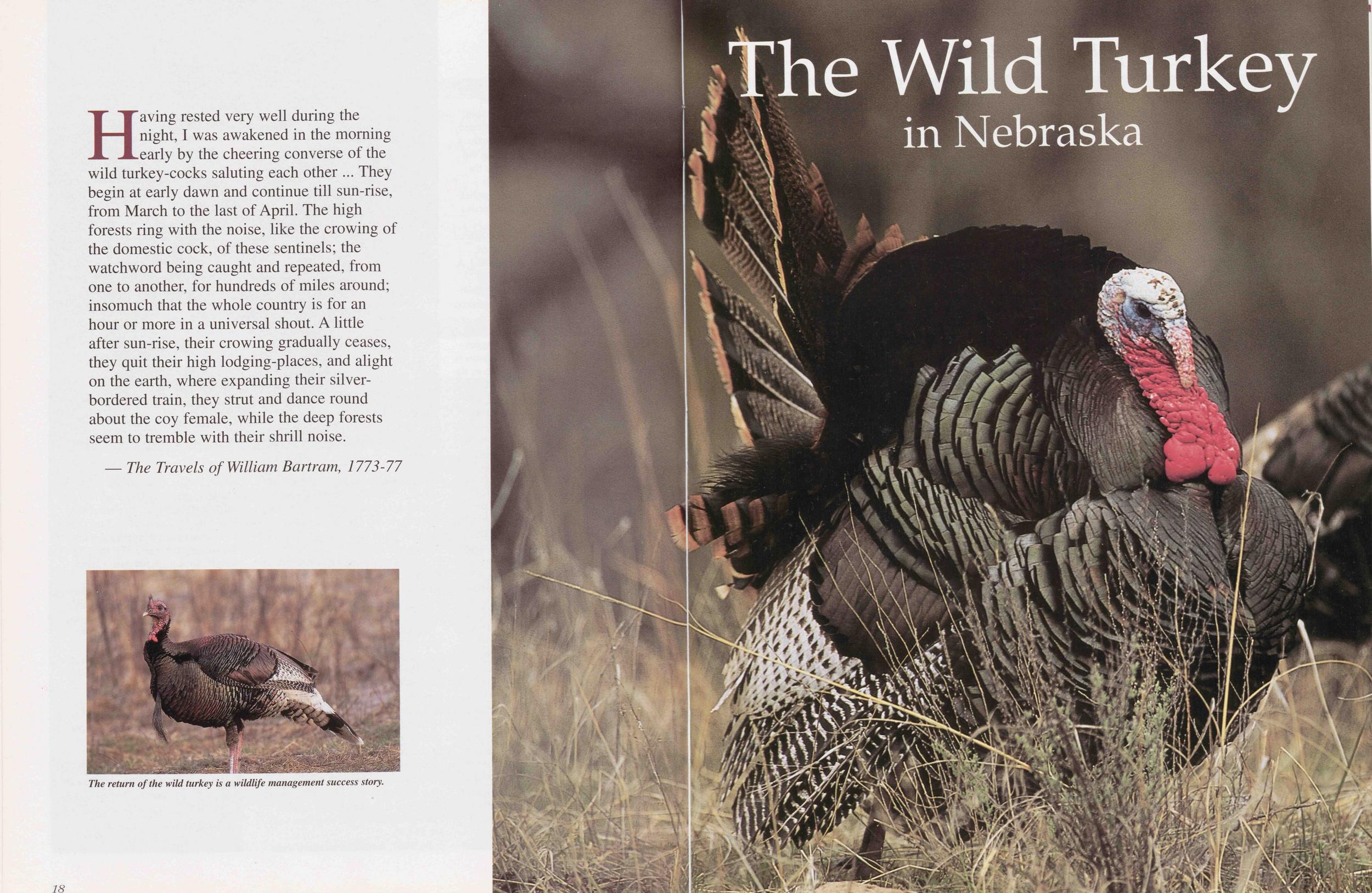
The Wild Turkey in Nebraska
Having rested very well during the night, I was awakened in the morning early by the cheering converse of the wild turkey-cocks saluting each other ... They begin at early dawn and continue till sun-rise, from March to the last of April. The high forests ring with the noise, like the crowing of the domestic cock, of these sentinels; the watchword being caught and repeated, from one to another, for hundreds of miles around; insomuch that the whole country is for an hour or more in a universal shout. A little after sun-rise, their crowing gradually ceases, they quit their high lodging-places, and alight on the earth, where expanding their silver- bordered train, they strut and dance round about the coy female, while the deep forests seem to tremble with their shrill noise.
The Travels of William Bartram, 1773-77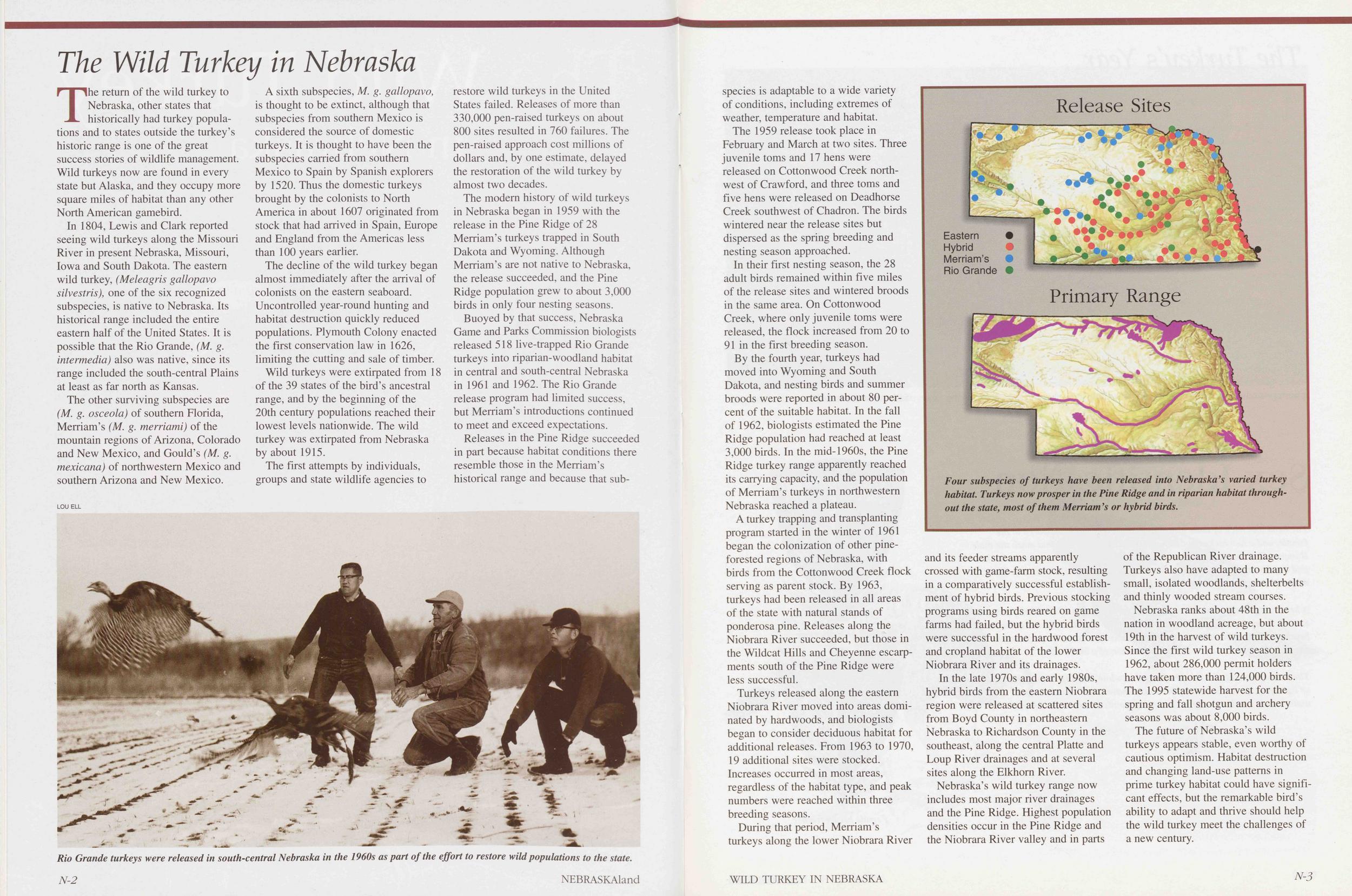 The Wild Turkey in Nebraska
The return of the wild turkey to Nebraska, other states that historically had turkey populations and to states outside the turkey's historic range is one of the great success stories of wildlife management. Wild turkeys now are found in every state but Alaska, and they occupy more square miles of habitat than any other North American game bird.
In 1804, Lewis and Clark reported seeing wild turkeys along the Missouri River in present Nebraska, Missouri, Iowa and South Dakota. The eastern wild turkey, (Meleagris gallopavo silvestris), one of the six recognized subspecies, is native to Nebraska. Its historical range included the entire eastern half of the United States. It is possible that the Rio Grande, (M. g. intermedia) also was native, since its range included the south-central Plains at least as far north as Kansas.
The other surviving subspecies are (M. g. osceola) of southern Florida, Merriam's (M. g. merriami) of the mountain regions of Arizona, Colorado and New Mexico, and Gould's (M. g. mexicana) of northwestern Mexico and southern Arizona and New Mexico.
A sixth subspecies, M. g. gallopavo, is thought to be extinct, although that subspecies from southern Mexico is considered the source of domestic turkeys. It is thought to have been the subspecies carried from southern Mexico to Spain by Spanish explorers by 1520. Thus the domestic turkeys brought by the colonists to North America in about 1607 originated from stock that had arrived in Spain, Europe and England from the Americas less than 100 years earlier.
The decline of the wild turkey began almost immediately after the arrival of colonists on the eastern seaboard. Uncontrolled year-round hunting and habitat destruction quickly reduced populations. Plymouth Colony enacted the first conservation law in 1626, limiting the cutting and sale of timber.
Wild turkeys were extirpated from 18 of the 39 states of the bird's ancestral range, and by the beginning of the 20th century populations reached their lowest levels nationwide. The wild turkey was extirpated from Nebraska by about 1915.
The first attempts by individuals, groups and state wildlife agencies to restore wild turkeys in the United States failed. Releases of more than 330,000 pen-raised turkeys on about 800 sites resulted in 760 failures. The pen-raised approach cost millions of dollars and, by one estimate, delayed the restoration of the wild turkey by almost two decades.
The modern history of wild turkeys in Nebraska began in 1959 with the release in the Pine Ridge of 28 Merriam's turkeys trapped in South Dakota and Wyoming. Although Merriam's are not native to Nebraska, the release succeeded, and the Pine Ridge population grew to about 3,000 birds in only four nesting seasons.
Buoyed by that success, Nebraska Game and Parks Commission biologists released 518 live-trapped Rio Grande turkeys into riparian-woodland habitat in central and south-central Nebraska in 1961 and 1962. The Rio Grande release program had limited success, but Merriam's introductions continued to meet and exceed expectations.
Releases in the Pine Ridge succeeded in part because habitat conditions there resemble those in the Merriam's historical range and because that subspecies
The 1959 release took place in February and March at two sites. Three juvenile toms and 17 hens were released on Cottonwood Creek northwest of Crawford, and three toms and five hens were released on Deadhorse Creek southwest of Chadron. The birds wintered near the release sites but dispersed as the spring breeding and nesting season approached.
In their first nesting season, the 28 adult birds remained within five miles of the release sites and wintered broods in the same area. On Cottonwood Creek, where only juvenile toms were released, the flock increased from 20 to 91 in the first breeding season.
By the fourth year, turkeys had moved into Wyoming and South Dakota, and nesting birds and summer broods were reported in about 80 percent of the suitable habitat. In the fall of 1962, biologists estimated the Pine Ridge population had reached at least 3,000 birds. In the mid-1960s, the Pine Ridge turkey range apparently reached its carrying capacity, and the population of Merriam's turkeys in northwestern Nebraska reached a plateau.
A turkey trapping and transplanting program started in the winter of 1961 began the colonization of other pine forested regions of Nebraska, with birds from the Cottonwood Creek flock serving as parent stock. By 1963, turkeys had been released in all areas of the state with natural stands of ponderosa pine. Releases along the Niobrara River succeeded, but those in the Wildcat Hills and Cheyenne escarpments south of the Pine Ridge were less successful.
Turkeys released along the eastern Niobrara River moved into areas dominated by hardwoods, and biologists began to consider deciduous habitat for additional releases. From 1963 to 1970, 19 additional sites were stocked. Increases occurred in most areas, regardless of the habitat type, and peak numbers were reached within three breeding seasons.
During that period, Merriam's turkeys along the lower Niobrara River
In the late 1970s and early 1980s, hybrid birds from the eastern Niobrara region were released at scattered sites from Boyd County in northeastern Nebraska to Richardson County in the southeast, along the central Platte and Loup River drainages and at several sites along the Elkhorn River.
Nebraska's wild turkey range now includes most major river drainages and the Pine Ridge. Highest population densities occur in the Pine Ridge and the Niobrara River valley and in parts of the Republican River drainage. Turkeys also have adapted to many small, isolated woodlands, shelter belts and thinly wooded stream courses.
Nebraska ranks about 48th in the nation in woodland acreage, but about 19th in the harvest of wild turkeys. Since the first wild turkey season in 1962, about 286,000 permit holders have taken more than 124,000 birds. The 1995 statewide harvest for the spring and fall shotgun and archery seasons was about 8,000 birds.
The future of Nebraska's wild turkeys appears stable, even worthy of cautious optimism. Habitat destruction and changing land-use patterns in prime turkey habitat could have significant effects, but the remarkable bird's ability to adapt and thrive should help the wild turkey meet the challenges of a new century.
WILD TURKEY IN NEBRASKA N-3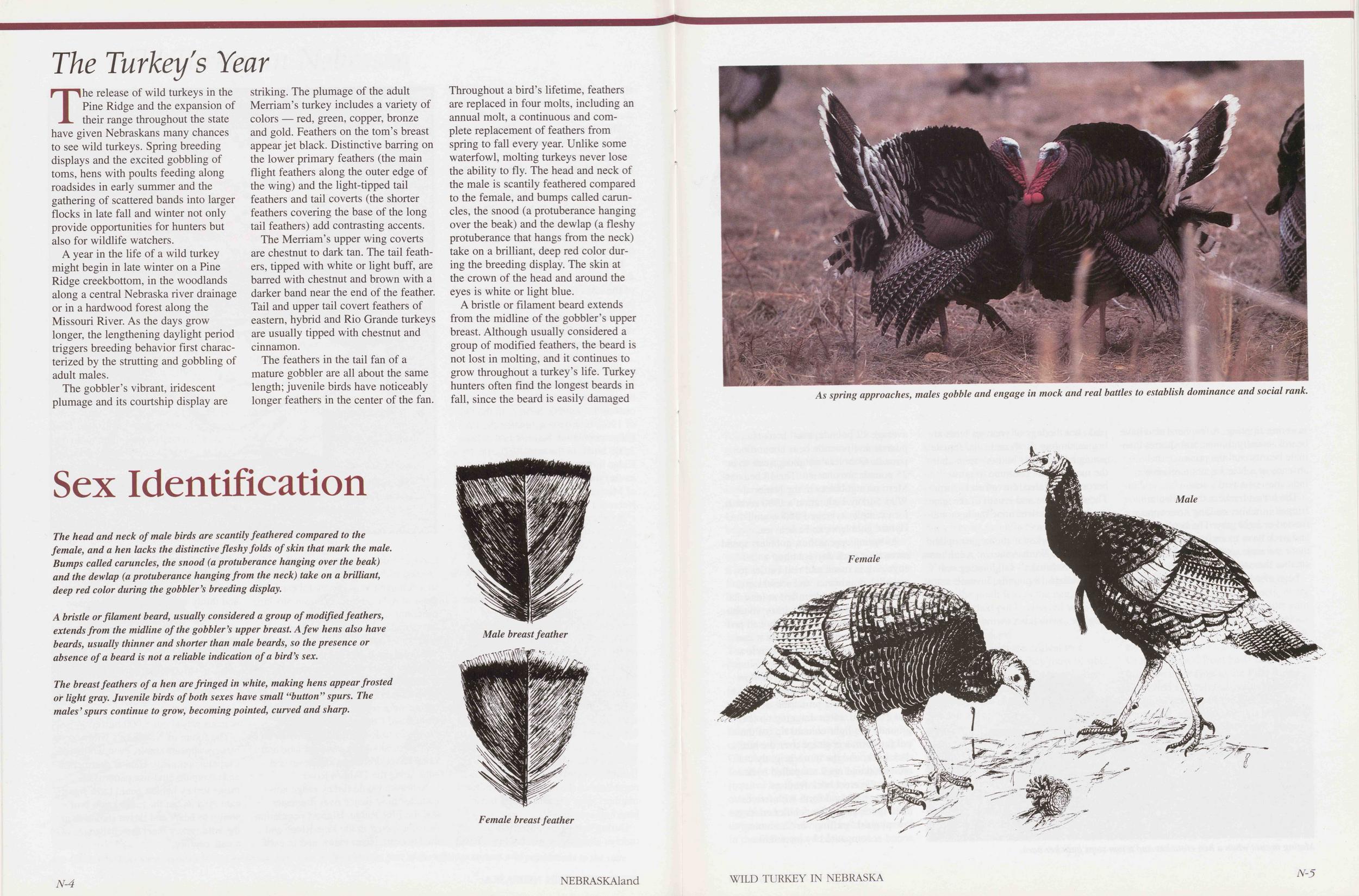 The Turkey's Year
The release of wild turkeys in the Pine Ridge and the expansion of their range throughout the state have given Nebraskans many chances to see wild turkeys. Spring breeding displays and the excited gobbling of toms, hens with poults feeding along roadsides in early summer and the gathering of scattered bands into larger flocks in late fall and winter not only provide opportunities for hunters but also for wildlife watchers.
A year in the life of a wild turkey might begin in late winter on a Pine Ridge creek bottom, in the woodlands along a central Nebraska river drainage or in a hardwood forest along the Missouri River. As the days grow longer, the lengthening daylight period triggers breeding behavior first characterized by the strutting and gobbling of adult males.
The gobbler's vibrant, iridescent plumage and its courtship display are striking. The plumage of the adult Merriam's turkey includes a variety of colors — red, green, copper, bronze and gold. Feathers on the tom's breast appear jet black. Distinctive barring on the lower primary feathers (the main flight feathers along the outer edge of the wing) and the light-tipped tail feathers and tail coverts (the shorter feathers covering the base of the long tail feathers) add contrasting accents.
The Merriam's upper wing coverts are chestnut to dark tan. The tail feathers, tipped with white or light buff, are barred with chestnut and brown with a darker band near the end of the feather. Tail and upper tail covert feathers of eastern, hybrid and Rio Grande turkeys are usually tipped with chestnut and cinnamon.
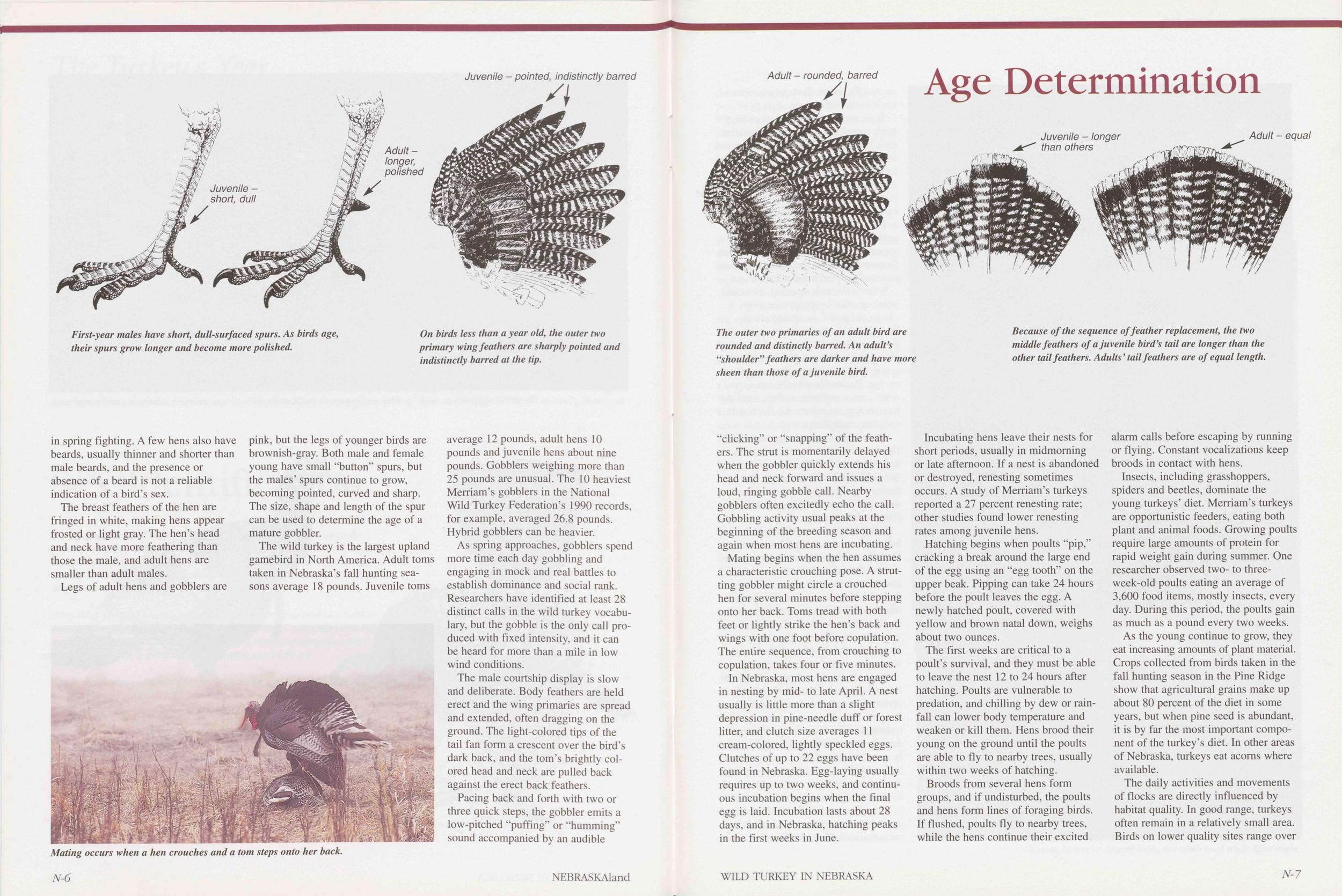
The feathers in the tail fan of a mature gobbler are all about the same length; juvenile birds have noticeably longer feathers in the center of the fan. Throughout a bird's lifetime, feathers are replaced in four molts, including an annual molt, a continuous and complete replacement of feathers from spring to fall every year. Unlike some waterfowl, molting turkeys never lose the ability to fly. The head and neck of the male is scantily feathered compared to the female, and bumps called caruncles, the snood (a protuberance hanging over the beak) and the dewlap (a fleshy protuberance that hangs from the neck) take on a brilliant, deep red color during the breeding display. The skin at the crown of the head and around the eyes is white or light blue.
A bristle or filament beard extends from the midline of the gobbler's upper breast. Although usually considered a group of modified feathers, the beard is not lost in molting, and it continues to grow throughout a turkey's life. Turkey hunters often find the longest beards in fall, since the beard is easily damaged in spring fighting. A few hens also have beards, usually thinner and shorter than male beards, and the presence or absence of a beard is not a reliable indication of a bird's sex.
Sex IdentificationThe head and neck of male birds are scantily feathered compared to the female, and a hen lacks the distinctive fleshy folds of skin that mark the male. Bumps called caruncles, the snood (a protuberance hanging over the beak) and the dewlap (a protuberance hanging from the neck) take on a brilliant, deep red color during the gobbler's breeding display.
A bristle or filament beard, usually considered a group of modified feathers, extends from the midline of the gobbler's upper breast. A few hens also have beards, usually thinner and shorter than male beards, so the presence or absence of a beard is not a reliable indication of a bird's sex.
The breast feathers of a hen are fringed in white, making hens appear frosted or light gray. Juvenile birds of both sexes have small ^button" spurs. The males' spurs continue to grow, becoming pointed, curved and sharp.
 Age Determination
The breast feathers of the hen are fringed in white, making hens appear frosted or light gray. The hen's head and neck have more feathering than those the male, and adult hens are smaller than adult males.
Legs of adult hens and gobblers are pink, but the legs of younger birds are brownish-gray. Both male and female young have small "button" spurs, but the males' spurs continue to grow, becoming pointed, curved and sharp. The size, shape and length of the spur can be used to determine the age of a mature gobbler.
The wild turkey is the largest upland game bird in North America. Adult toms taken in Nebraska's fall hunting sea- sons average 18 pounds. Juvenile toms average 12 pounds, adult hens 10 pounds and juvenile hens about nine pounds. Gobblers weighing more than 25 pounds are unusual. The 10 heaviest Merriam's gobblers in the National Wild Turkey Federation's 1990 records, for example, averaged 26.8 pounds. Hybrid gobblers can be heavier.
As spring approaches, gobblers spend more time each day gobbling and engaging in mock and real battles to establish dominance and social rank. Researchers have identified at least 28 distinct calls in the wild turkey vocabulary, but the gobble is the only call produced with fixed intensity, and it can be heard for more than a mile in low wind conditions.
The male courtship display is slow and deliberate. Body feathers are held erect and the wing primaries are spread and extended, often dragging on the ground. The light-colored tips of the tail fan form a crescent over the bird's dark back, and the tom's brightly colored head and neck are pulled back against the erect back feathers.
Pacing back and forth with two or three quick steps, the gobbler emits a low-pitched "puffing" or "humming" sound accompanied by an audible
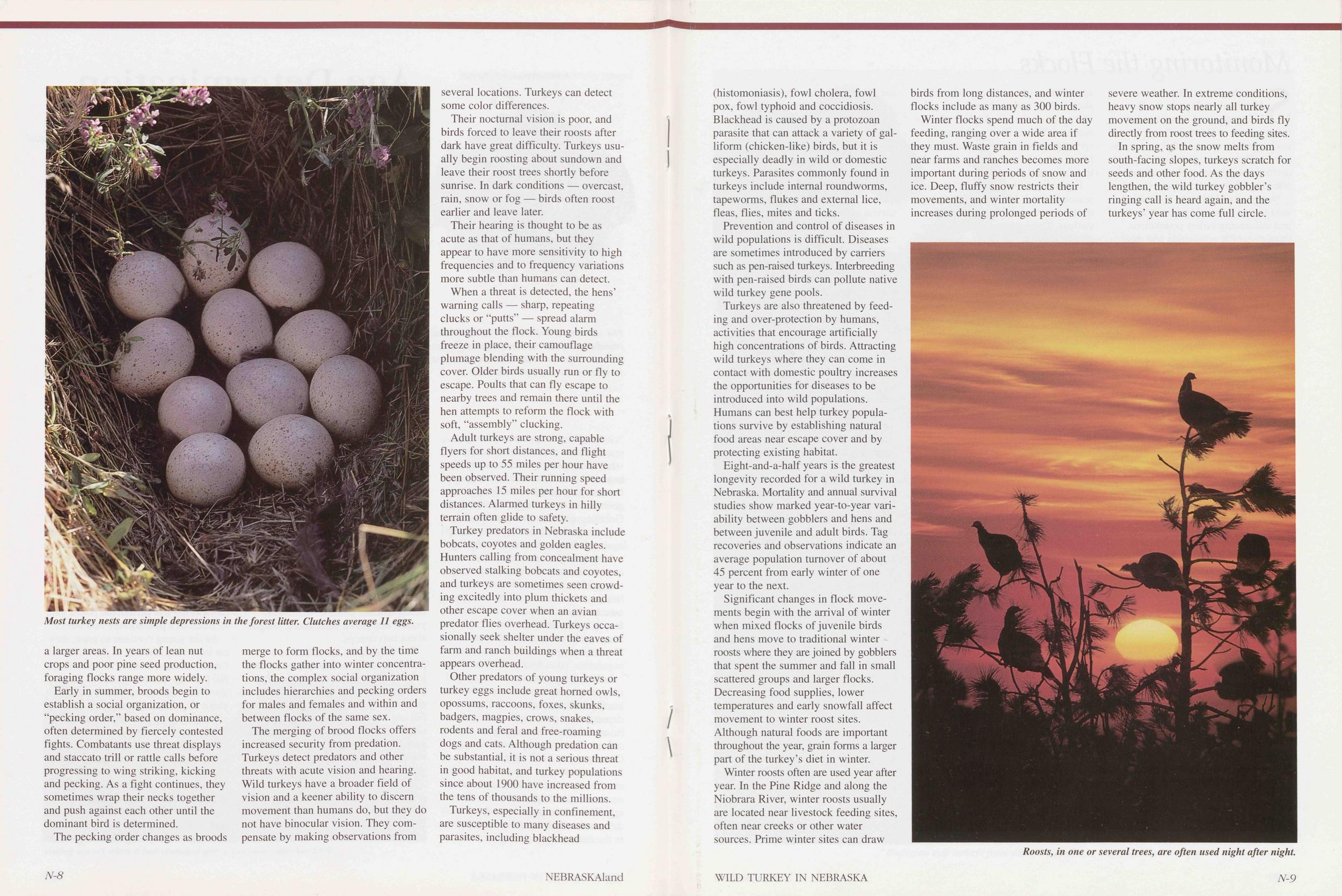
Mating begins when the hen assumes a characteristic crouching pose. A strutting gobbler might circle a crouched hen for several minutes before stepping onto her back. Toms tread with both feet or lightly strike the hen's back and wings with one foot before copulation. The entire sequence, from crouching to copulation, takes four or five minutes.
In Nebraska, most hens are engaged in nesting by mid- to late April. A nest usually is little more than a slight depression in pine-needle duff or forest litter, and clutch size averages 11 cream-colored, lightly speckled eggs. Clutches of up to 22 eggs have been found in Nebraska. Egg-laying usually requires up to two weeks, and continuous incubation begins when the final egg is laid. Incubation lasts about 28 days, and in Nebraska, hatching peaks in the first weeks in June.
Incubating hens leave their nests for short periods, usually in midmorning or late afternoon. If a nest is abandoned or destroyed, renesting sometimes occurs. A study of Merriam's turkeys reported a 27 percent renesting rate; other studies found lower renesting rates among juvenile hens.
Hatching begins when poults "pip," cracking a break around the large end of the egg using an "egg tooth" on the upper beak. Pipping can take 24 hours before the poult leaves the egg. A newly hatched poult, covered with yellow and brown natal down, weighs about two ounces.
The first weeks are critical to a poult's survival, and they must be able to leave the nest 12 to 24 hours after hatching. Poults are vulnerable to predation, and chilling by dew or rainfall can lower body temperature and weaken or kill them. Hens brood their young on the ground until the poults are able to fly to nearby trees, usually within two weeks of hatching.
Broods from several hens form groups, and if undisturbed, the poults and hens form lines of foraging birds. If flushed, poults fly to nearby trees, while the hens continue their excited alarm calls before escaping by running or flying. Constant vocalizations keep broods in contact with hens.
Insects, including grasshoppers, spiders and beetles, dominate the young turkeys' diet. Merriam's turkeys are opportunistic feeders, eating both plant and animal foods. Growing poults require large amounts of protein for rapid weight gain during summer. One researcher observed two- to three-week-old poults eating an average of 3,600 food items, mostly insects, every day. During this period, the poults gain as much as a pound every two weeks.
As the young continue to grow, they eat increasing amounts of plant material. Crops collected from birds taken in the fall hunting season in the Pine Ridge show that agricultural grains make up about 80 percent of the diet in some years, but when pine seed is abundant, it is by far the most important component of the turkey's diet. In other areas of Nebraska, turkeys eat acorns where available.
The daily activities and movements
of flocks are directly influenced by
habitat quality. In good range, turkeys
often remain in a relatively small area.
Birds on lower quality sites range over
WILD TURKEY IN NEBRASKA
N-7
Early in summer, broods begin to establish a social organization, or "pecking order," based on dominance, often determined by fiercely contested fights. Combatants use threat displays and staccato trill or rattle calls before progressing to wing striking, kicking and pecking. As a fight continues, they sometimes wrap their necks together and push against each other until the dominant bird is determined.
The pecking order changes as broods merge to form flocks, and by the time the flocks gather into winter concentrations, the complex social organization includes hierarchies and pecking orders for males and females and within and between flocks of the same sex.
The merging of brood flocks offers increased security from predation. Turkeys detect predators and other threats with acute vision and hearing. Wild turkeys have a broader field of vision and a keener ability to discern movement than humans do, but they do not have binocular vision. They compensate by making observations from several locations. Turkeys can detect some color differences.
Their nocturnal vision is poor, and birds forced to leave their roosts after dark have great difficulty. Turkeys usually begin roosting about sundown and leave their roost trees shortly before sunrise. In dark conditions — overcast, rain, snow or fog — birds often roost earlier and leave later.
Their hearing is thought to be as acute as that of humans, but they appear to have more sensitivity to high frequencies and to frequency variations more subtle than humans can detect.
When a threat is detected, the hens' warning calls — sharp, repeating clucks or "putts" — spread alarm throughout the flock. Young birds freeze in place, their camouflage plumage blending with the surrounding cover. Older birds usually run or fly to escape. Poults that can fly escape to nearby trees and remain there until the hen attempts to reform the flock with soft, "assembly" clucking.
Adult turkeys are strong, capable flyers for short distances, and flight speeds up to 55 miles per hour have been observed. Their running speed approaches 15 miles per hour for short distances. Alarmed turkeys in hilly terrain often glide to safety.
Turkey predators in Nebraska include bobcats, coyotes and golden eagles. Hunters calling from concealment have observed stalking bobcats and coyotes, and turkeys are sometimes seen crowd- ing excitedly into plum thickets and other escape cover when an avian predator flies overhead. Turkeys occasionally seek shelter under the eaves of farm and ranch buildings when a threat appears overhead.
Other predators of young turkeys or turkey eggs include great horned owls, opossums, raccoons, foxes, skunks, badgers, magpies, crows, snakes, rodents and feral and free-roaming dogs and cats. Although predation can be substantial, it is not a serious threat in good habitat, and turkey populations since about 1900 have increased from the tens of thousands to the millions.
Turkeys, especially in confinement, are susceptible to many diseases and parasites, including blackhead N-8 NEBRASKAland (histomoniasis), fowl cholera, fowl pox, fowl typhoid and coccidiosis. Blackhead is caused by a protozoan parasite that can attack a variety of galliform (chicken-like) birds, but it is especially deadly in wild or domestic turkeys. Parasites commonly found in turkeys include internal roundworms, tapeworms, flukes and external lice, fleas, flies, mites and ticks.
Prevention and control of diseases in wild populations is difficult. Diseases are sometimes introduced by carriers such as pen-raised turkeys. Interbreeding with pen-raised birds can pollute native wild turkey gene pools.
Turkeys are also threatened by feeding and over-protection by humans, activities that encourage artificially high concentrations of birds. Attracting wild turkeys where they can come in contact with domestic poultry increases the opportunities for diseases to be introduced into wild populations. Humans can best help turkey populations survive by establishing natural food areas near escape cover and by protecting existing habitat.
Eight-and-a-half years is the greatest longevity recorded for a wild turkey in Nebraska. Mortality and annual survival studies show marked year-to-year variability between gobblers and hens and between juvenile and adult birds. Tag recoveries and observations indicate an average population turnover of about 45 percent from early winter of one year to the next.
Significant changes in flock movements begin with the arrival of winter when mixed flocks of juvenile birds and hens move to traditional winter roosts where they are joined by gobblers that spent the summer and fall in small scattered groups and larger flocks. Decreasing food supplies, lower temperatures and early snowfall affect movement to winter roost sites. Although natural foods are important throughout the year, grain forms a larger part of the turkey's diet in winter.
Winter roosts often are used year after year. In the Pine Ridge and along the Niobrara River, winter roosts usually are located near livestock feeding sites, often near creeks or other water sources. Prime winter sites can draw birds from long distances, and winter flocks include as many as 300 birds.
Winter flocks spend much of the day feeding, ranging over a wide area if they must. Waste grain in fields and near farms and ranches becomes more important during periods of snow and ice. Deep, fluffy snow restricts their movements, and winter mortality increases during prolonged periods of severe weather. In extreme conditions, heavy snow stops nearly all turkey movement on the ground, and birds fly directly from roost trees to feeding sites.
In spring, as the snow melts from south-facing slopes, turkeys scratch for seeds and other food. As the days lengthen, the wild turkey gobbler's ringing call is heard again, and the turkeys' year has come full circle.
 Monitoring the Flocks
Since the first releases of Merriam's turkeys in the Pine Ridge, the goal of wild turkey management in Nebraska has remained unchanged: to maintain turkey populations sufficient to support hunting and aesthetic enjoyment without adversely affecting other public interests.
Nearly all of Nebraska's suitable wild turkey habitat is privately owned, and influencing turkey populations through habitat acquisition and manipulation on private land is difficult. The Habitat Program, funded by the sale of Nebraska Habitat Stamps to hunters and wildlife enthusiasts, has financed the purchase of several turkey habitat sites and habitat improvement projects on public land.
Introductions of live-trapped wild turkeys and capture-and-transplant operations, the dominant management activities from the 1950s through the 1980s, have given way to monitoring and inventorying turkey populations and controlling the harvest in spring and fall wild turkey hunting seasons.
Flock and population inventories and analysis of hunter harvest information play major roles in current wild turkey management, providing the basis for spring and fall hunting regulations and helping to determine how many permits will be issued, the length of the seasons and their opening dates.
Winter flock counts, primarily from cooperating private landowners, provide information about potential breeding populations and minimum population estimates. Mail-in survey cards are sent to landowners with traditional, long-utilized wintering sites, and the response rate from two mailings in January and early February is usually 70 percent or higher.
Brood surveys conducted in July and early August provide an indication of reproductive success, including poultto-hen ratios, age ratios and production information useful for predicting fall populations and adjusting harvest regulations.
To conduct brood surveys, biologists, wildlife technicians and cooperators drive established routes during the early morning hours. The number of hens and poults seen and the estimated age of the poults are recorded on data sheets. Hens without broods and gobblers seen on the brood routes also are recorded. Winter flock counts and spring poult-to-hen ratios from summer brood surveys are used to predict relative fall populations.
Beginning with the first fall hunting season in 1962, hunters were required to check in their birds at game check stations. The degree of precision provided by mandatory game checks for wild turkeys is no longer considered necessary, and turkey check stations were discontinued in 1987. Total harvest is now estimated using a questionnaire mailed to selected permit holders. Information about sex and age composition in the harvest is obtained from feather samples submitted by successful hunters. Hunter success also is a good indication of turkey population levels.
Turkeys taken during the fall hunting season reveal other characteristics of the population. In an expanding population, the ratio of young birds to old birds is greater than in a stable population, for example, and the occurrence of disease or parasite infestations in a population or flock can be discovered by inspecting harvested birds. Crop content examinations made during the hunting seasons reveal much about the birds' foraging and feeding habits.
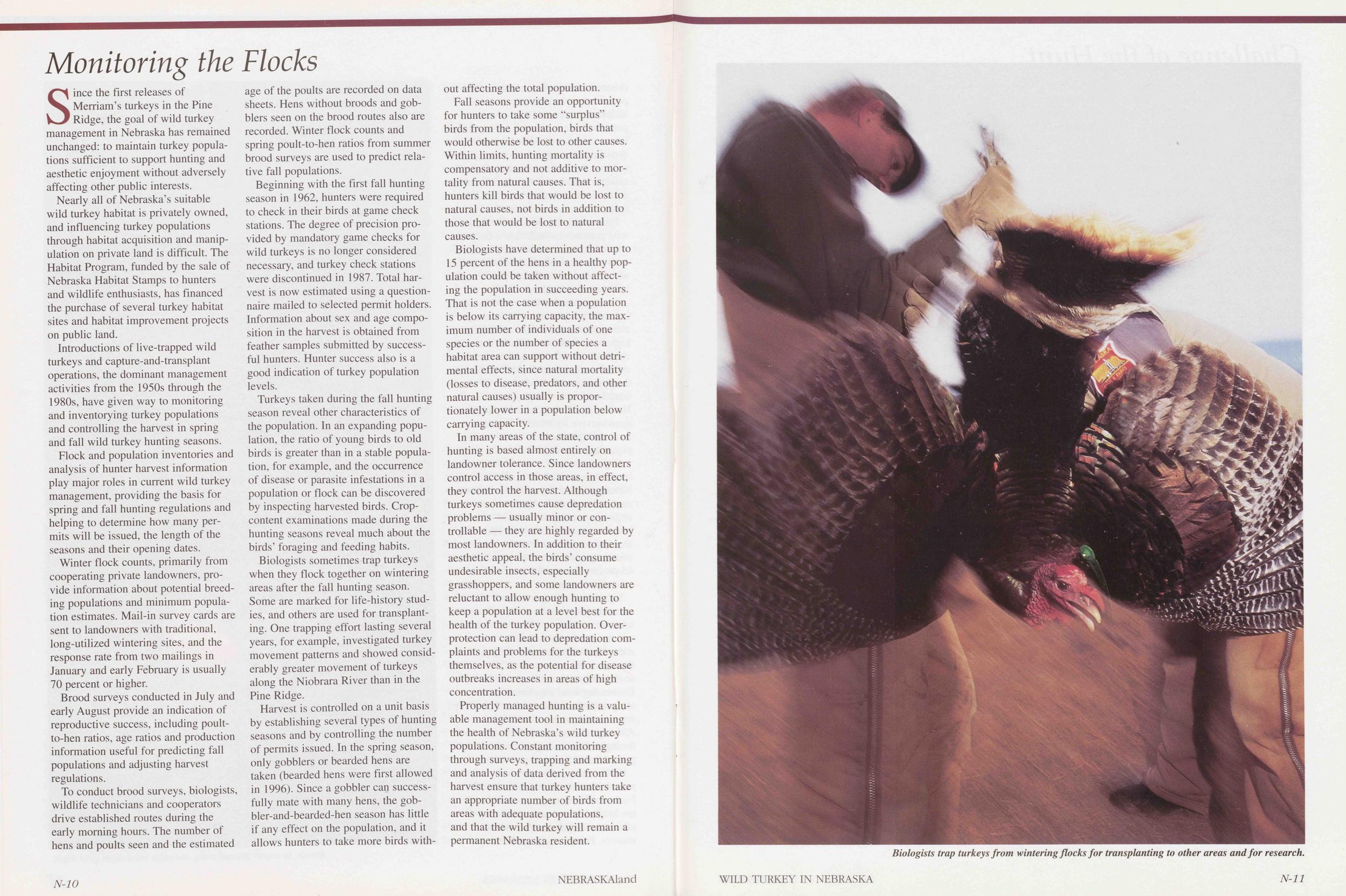
Biologists sometimes trap turkeys when they flock together on wintering areas after the fall hunting season. Some are marked for life-history studies, and others are used for transplanting. One trapping effort lasting several years, for example, investigated turkey movement patterns and showed considerably greater movement of turkeys along the Niobrara River than in the Pine Ridge.
Harvest is controlled on a unit basis by establishing several types of hunting seasons and by controlling the number of permits issued. In the spring season, only gobblers or bearded hens are taken (bearded hens were first allowed in 1996). Since a gobbler can successfully mate with many hens, the gobbler-and-bearded-hen season has little if any effect on the population, and it allows hunters to take more birds without affecting the total population.
Fall seasons provide an opportunity for hunters to take some "surplus" birds from the population, birds that would otherwise be lost to other causes. Within limits, hunting mortality is compensatory and not additive to mortality from natural causes. That is, hunters kill birds that would be lost to natural causes, not birds in addition to those that would be lost to natural causes.
Biologists have determined that up to 15 percent of the hens in a healthy population could be taken without affecting the population in succeeding years. That is not the case when a population is below its carrying capacity, the maximum number of individuals of one species or the number of species a habitat area can support without detrimental effects, since natural mortality (losses to disease, predators, and other natural causes) usually is proportionately lower in a population below carrying capacity.
In many areas of the state, control of hunting is based almost entirely on landowner tolerance. Since landowners control access in those areas, in effect, they control the harvest. Although turkeys sometimes cause depredation problems — usually minor or controllable — they are highly regarded by most landowners. In addition to their aesthetic appeal, the birds' consume undesirable insects, especially grasshoppers, and some landowners are reluctant to allow enough hunting to keep a population at a level best for the health of the turkey population. Over protection can lead to depredation complaints and problems for the turkeys themselves, as the potential for disease outbreaks increases in areas of high concentration.
Properly managed hunting is a valuable management tool in maintaining the health of Nebraska's wild turkey populations. Constant monitoring through surveys, trapping and marking and analysis of data derived from the harvest ensure that turkey hunters take an appropriate number of birds from areas with adequate populations, and that the wild turkey will remain a permanent Nebraska resident.
N-10 NEBRASKAland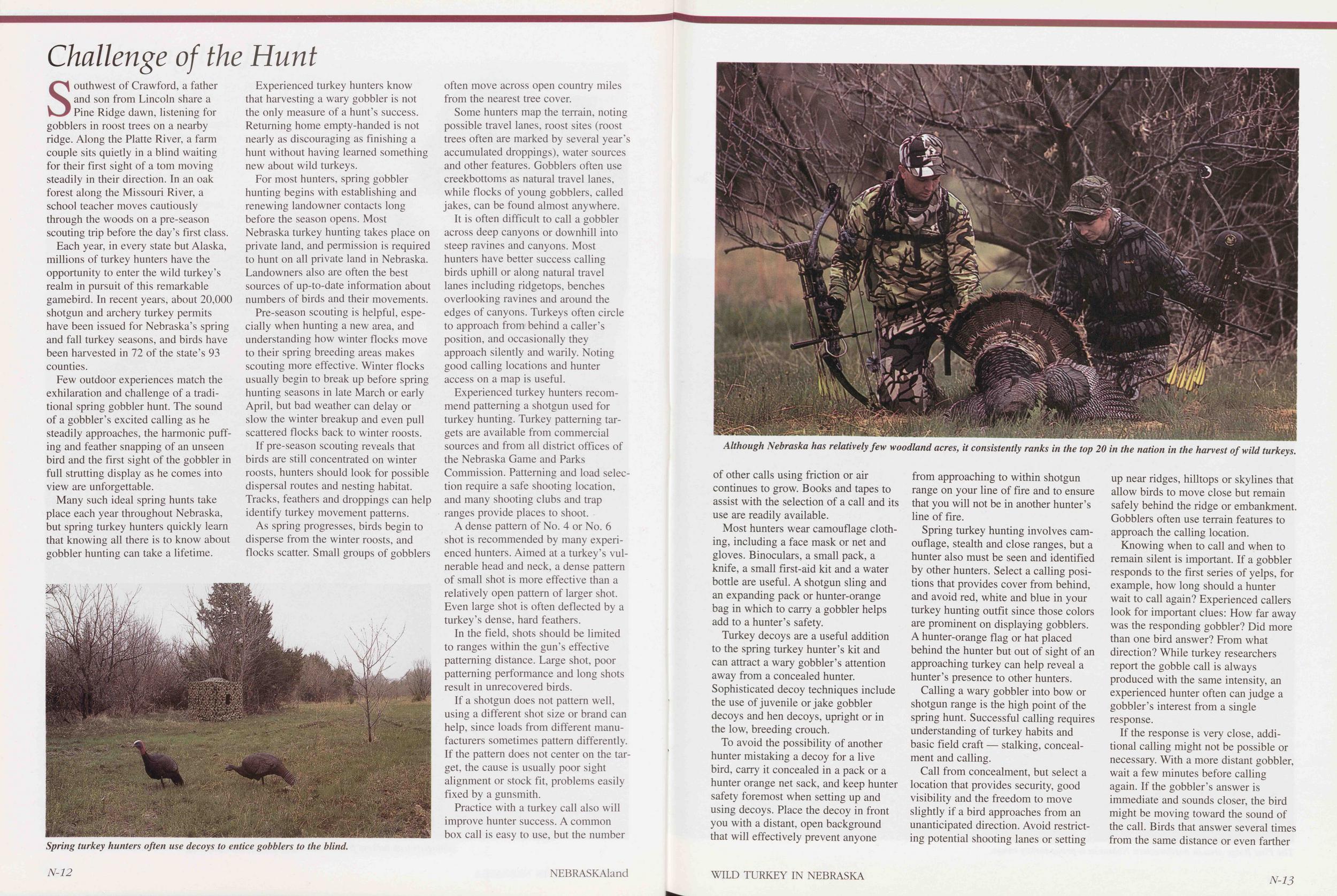 Challenge of the Hunt
Southwest of Crawford, a father and son from Lincoln share a Pine Ridge dawn, listening for gobblers in roost trees on a nearby ridge. Along the Platte River, a farm couple sits quietly in a blind waiting for their first sight of a torn moving steadily in their direction. In an oak forest along the Missouri River, a school teacher moves cautiously through the woods on a pre-season scouting trip before the day's first class.
Each year, in every state but Alaska, millions of turkey hunters have the opportunity to enter the wild turkey's realm in pursuit of this remarkable gamebird. In recent years, about 20,000 shotgun and archery turkey permits have been issued for Nebraska's spring and fall turkey seasons, and birds have been harvested in 72 of the state's 93 counties.
Few outdoor experiences match the exhilaration and challenge of a traditional spring gobbler hunt. The sound of a gobbler's excited calling as he steadily approaches, the harmonic puffing and feather snapping of an unseen bird and the first sight of the gobbler in full strutting display as he comes into view are unforgettable.
Many such ideal spring hunts take place each year throughout Nebraska, but spring turkey hunters quickly learn that knowing all there is to know about gobbler hunting can take a lifetime.
Experienced turkey hunters know that harvesting a wary gobbler is not the only measure of a hunt's success. Returning home empty-handed is not nearly as discouraging as finishing a hunt without having learned something new about wild turkeys.
For most hunters, spring gobbler hunting begins with establishing and renewing landowner contacts long before the season opens. Most Nebraska turkey hunting takes place on private land, and permission is required to hunt on all private land in Nebraska. Landowners also are often the best sources of up-to-date information about numbers of birds and their movements.
Pre-season scouting is helpful, especially when hunting a new area, and understanding how winter flocks move to their spring breeding areas makes scouting more effective. Winter flocks usually begin to break up before spring hunting seasons in late March or early April, but bad weather can delay or slow the winter breakup and even pull scattered flocks back to winter roosts.
If pre-season scouting reveals that birds are still concentrated on winter roosts, hunters should look for possible dispersal routes and nesting habitat. Tracks, feathers and droppings can help identify turkey movement patterns.
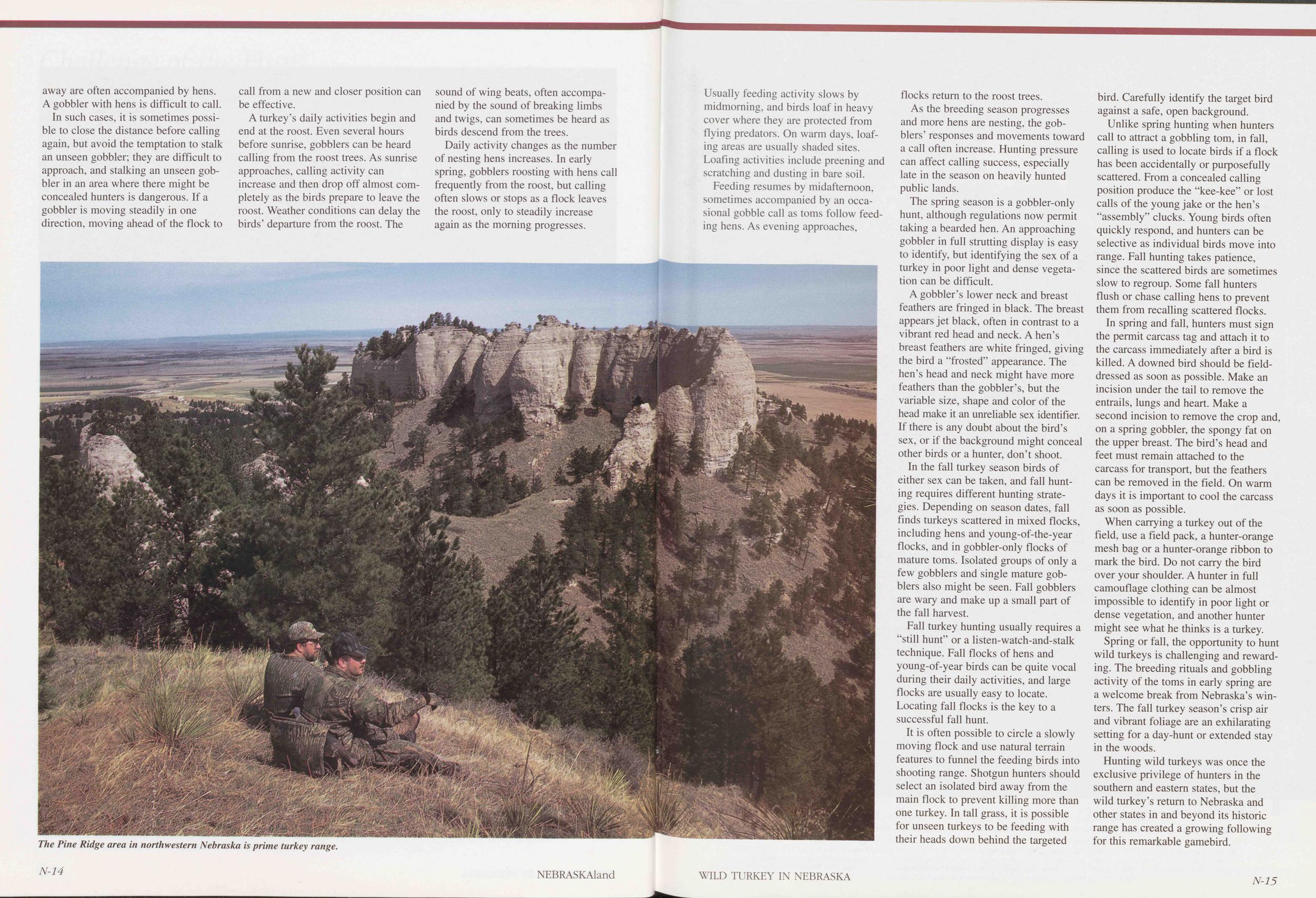
As spring progresses, birds begin to disperse from the winter roosts, and flocks scatter. Small groups of gobblers often move across open country miles from the nearest tree cover.
Some hunters map the terrain, noting possible travel lanes, roost sites (roost trees often are marked by several year's accumulated droppings), water sources and other features. Gobblers often use creek bottoms as natural travel lanes, while flocks of young gobblers, called jakes, can be found almost anywhere.
It is often difficult to call a gobbler across deep canyons or downhill into steep ravines and canyons. Most hunters have better success calling birds uphill or along natural travel lanes including ridge tops, benches overlooking ravines and around the edges of canyons. Turkeys often circle to approach from behind a caller's position, and occasionally they approach silently and warily. Noting good calling locations and hunter access on a map is useful.
Experienced turkey hunters recommend patterning a shotgun used for turkey hunting. Turkey patterning targets are available from commercial sources and from all district offices of the Nebraska Game and Parks Commission. Patterning and load selection require a safe shooting location, and many shooting clubs and trap ranges provide places to shoot.
A dense pattern of No. 4 or No. 6 shot is recommended by many experienced hunters. Aimed at a turkey's vulnerable head and neck, a dense pattern of small shot is more effective than a relatively open pattern of larger shot. Even large shot is often deflected by a turkey's dense, hard feathers.
In the field, shots should be limited to ranges within the gun's effective patterning distance. Large shot, poor patterning performance and long shots result in unrecovered birds.
If a shotgun does not pattern well, using a different shot size or brand can help, since loads from different manufacturers sometimes pattern differently. If the pattern does not center on the target, the cause is usually poor sight alignment or stock fit, problems easily fixed by a gunsmith.
Practice with a turkey call also will improve hunter success. A common box call is easy to use, but the number
Most hunters wear camouflage clothing, including a face mask or net and gloves. Binoculars, a small pack, a knife, a small first-aid kit and a water bottle are useful. A shotgun sling and an expanding pack or hunter-orange bag in which to carry a gobbler helps add to a hunter's safety.
Turkey decoys are a useful addition to the spring turkey hunter's kit and can attract a wary gobbler's attention away from a concealed hunter. Sophisticated decoy techniques include the use of juvenile or jake gobbler decoys and hen decoys, upright or in the low, breeding crouch.
To avoid the possibility of another hunter mistaking a decoy for a live bird, carry it concealed in a pack or a hunter orange net sack, and keep hunter safety foremost when setting up and using decoys. Place the decoy in front you with a distant, open background that will effectively prevent anyone from approaching to within shotgun range on your line of fire and to ensure that you will not be in another hunter's line of fire.
Spring turkey hunting involves camouflage, stealth and close ranges, but a hunter also must be seen and identified by other hunters. Select a calling positions that provides cover from behind, and avoid red, white and blue in your turkey hunting outfit since those colors are prominent on displaying gobblers. A hunter-orange flag or hat placed behind the hunter but out of sight of an approaching turkey can help reveal a hunter's presence to other hunters.
Calling a wary gobbler into bow or shotgun range is the high point of the spring hunt. Successful calling requires understanding of turkey habits and basic field craft — stalking, concealment and calling.
Call from concealment, but select a location that provides security, good visibility and the freedom to move slightly if a bird approaches from an unanticipated direction. Avoid restricting potential shooting lanes or setting up near ridges, hilltops or skylines that allow birds to move close but remain safely behind the ridge or embankment. Gobblers often use terrain features to approach the calling location.
Knowing when to call and when to remain silent is important. If a gobbler responds to the first series of yelps, for example, how long should a hunter wait to call again? Experienced callers look for important clues: How far away was the responding gobbler? Did more than one bird answer? From what direction? While turkey researchers report the gobble call is always produced with the same intensity, an experienced hunter often can judge a gobbler's interest from a single response.
If the response is very close,
additional calling might not be possible or
necessary. With a more distant gobbler,
wait a few minutes before calling
again. If the gobbler's answer is
immediate and sounds closer, the bird
might be moving toward the sound of
the call. Birds that answer several times
from the same distance or even farther
WILD TURKEY IN NEBRASKA
N-13
 away are often accompanied by hens.
A gobbler with hens is difficult to call.
away are often accompanied by hens.
A gobbler with hens is difficult to call.
In such cases, it is sometimes possible to close the distance before calling again, but avoid the temptation to stalk an unseen gobbler; they are difficult to approach, and stalking an unseen gobbler in an area where there might be concealed hunters is dangerous. If a gobbler is moving steadily in one direction, moving ahead of the flock to call from a new and closer position can be effective.
A turkey's daily activities begin and end at the roost. Even several hours before sunrise, gobblers can be heard calling from the roost trees. As sunrise approaches, calling activity can increase and then drop off almost completely as the birds prepare to leave the roost. Weather conditions can delay the birds' departure from the roost. The sound of wing beats, often accompanied by the sound of breaking limbs and twigs, can sometimes be heard as birds descend from the trees.
Daily activity changes as the number of nesting hens increases. In early spring, gobblers roosting with hens call frequently from the roost, but calling often slows or stops as a flock leaves the roost, only to steadily increase again as the morning progresses.
Feeding resumes by midafternoon, sometimes accompanied by an occasional gobble call as toms follow feeding hens. As evening approaches, flocks return to the roost trees.
As the breeding season progresses and more hens are nesting, the gobblers' responses and movements toward a call often increase. Hunting pressure can affect calling success, especially late in the season on heavily hunted public lands.
The spring season is a gobbler-only hunt, although regulations now permit taking a bearded hen. An approaching gobbler in full strutting display is easy to identify, but identifying the sex of a turkey in poor light and dense vegetation can be difficult.
A gobbler's lower neck and breast feathers are fringed in black. The breast appears jet black, often in contrast to a vibrant red head and neck. A hen's breast feathers are white fringed, giving the bird a "frosted" appearance. The hen's head and neck might have more feathers than the gobbler's, but the variable size, shape and color of the head make it an unreliable sex identifier. If there is any doubt about the bird's sex, or if the background might conceal other birds or a hunter, don't shoot.
In the fall turkey season birds of either sex can be taken, and fall hunt- ing requires different hunting strategies. Depending on season dates, fall finds turkeys scattered in mixed flocks, including hens and young-of-the-year flocks, and in gobbler-only flocks of mature toms. Isolated groups of only a few gobblers and single mature gobblers also might be seen. Fall gobblers are wary and make up a small part of the fall harvest.
Fall turkey hunting usually requires a "still hunt" or a listen-watch-and-stalk technique. Fall flocks of hens and young-of-year birds can be quite vocal during their daily activities, and large flocks are usually easy to locate. Locating fall flocks is the key to a successful fall hunt.
It is often possible to circle a slowly moving flock and use natural terrain features to funnel the feeding birds into shooting range. Shotgun hunters should select an isolated bird away from the main flock to prevent killing more than one turkey. In tall grass, it is possible for unseen turkeys to be feeding with their heads down behind the targeted bird. Carefully identify the target bird against a safe, open background.
Unlike spring hunting when hunters call to attract a gobbling torn, in fall, calling is used to locate birds if a flock has been accidentally or purposefully scattered. From a concealed calling position produce the "kee-kee" or lost calls of the young jake or the hen's "assembly" clucks. Young birds often quickly respond, and hunters can be selective as individual birds move into range. Fall hunting takes patience, since the scattered birds are sometimes slow to regroup. Some fall hunters flush or chase calling hens to prevent them from recalling scattered flocks.
In spring and fall, hunters must sign the permit carcass tag and attach it to the carcass immediately after a bird is killed. A downed bird should be field- dressed as soon as possible. Make an incision under the tail to remove the entrails, lungs and heart. Make a second incision to remove the crop and, on a spring gobbler, the spongy fat on the upper breast. The bird's head and feet must remain attached to the carcass for transport, but the feathers can be removed in the field. On warm days it is important to cool the carcass as soon as possible.
When carrying a turkey out of the field, use a field pack, a hunter-orange mesh bag or a hunter-orange ribbon to mark the bird. Do not carry the bird over your shoulder. A hunter in full camouflage clothing can be almost impossible to identify in poor light or dense vegetation, and another hunter might see what he thinks is a turkey.
Spring or fall, the opportunity to hunt wild turkeys is challenging and reward- ing. The breeding rituals and gobbling activity of the toms in early spring are a welcome break from Nebraska's winters. The fall turkey season's crisp air and vibrant foliage are an exhilarating setting for a day-hunt or extended stay in the woods.
Hunting wild turkeys was once the exclusive privilege of hunters in the southern and eastern states, but the wild turkey's return to Nebraska and other states in and beyond its historic range has created a growing following for this remarkable gamebird.
WILD TURKEY IN NEBRASKA N-15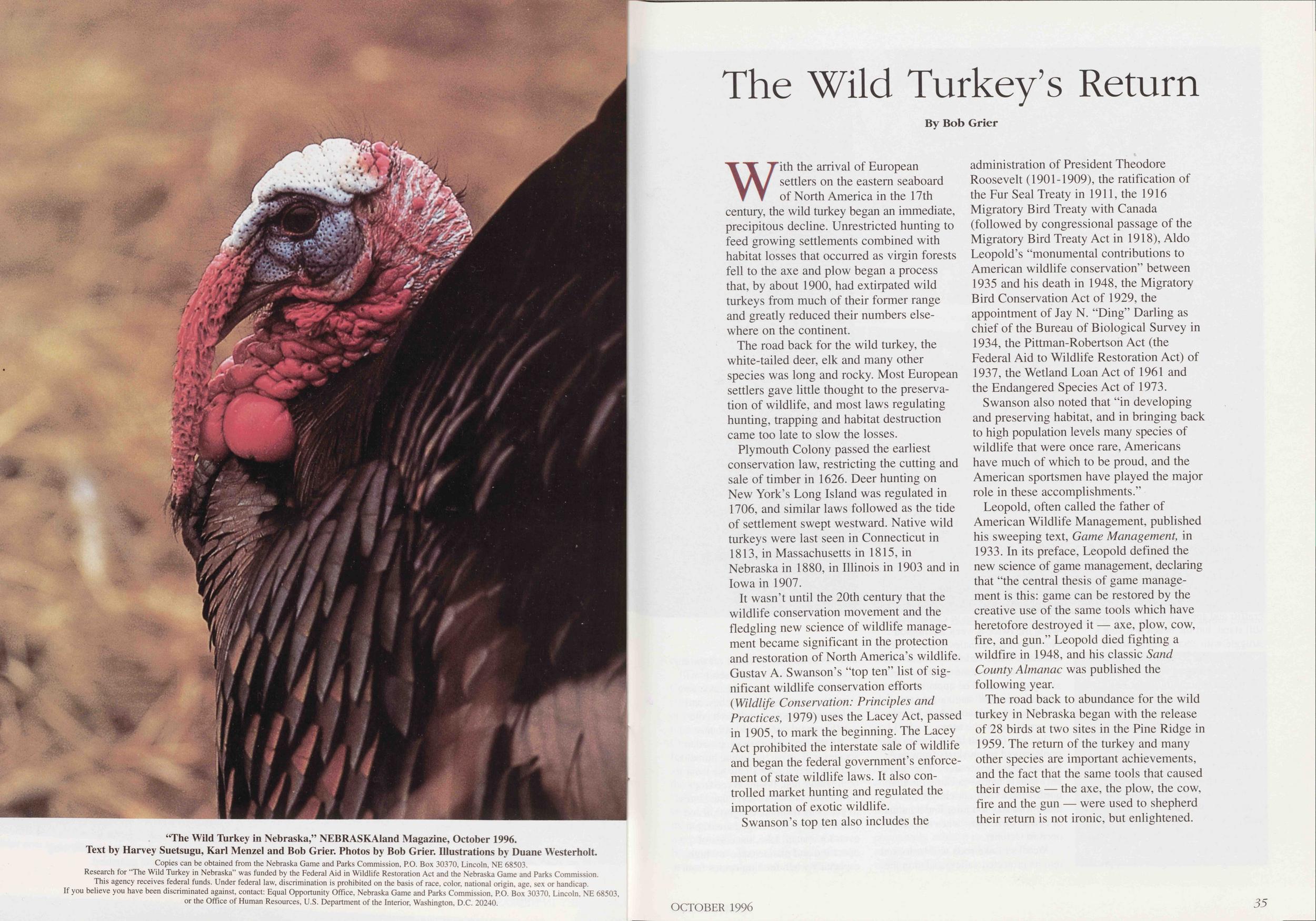
The Wild Turkey's Return
By Bob GrierWith the arrival of European settlers on the eastern seaboard of North America in the 17th century, the wild turkey began an immediate, precipitous decline. Unrestricted hunting to feed growing settlements combined with habitat losses that occurred as virgin forests fell to the axe and plow began a process that, by about 1900, had extirpated wild turkeys from much of their former range and greatly reduced their numbers elsewhere on the continent.
The road back for the wild turkey, the white-tailed deer, elk and many other species was long and rocky. Most European settlers gave little thought to the preservation of wildlife, and most laws regulating hunting, trapping and habitat destruction came too late to slow the losses.
Plymouth Colony passed the earliest conservation law, restricting the cutting and sale of timber in 1626. Deer hunting on New York's Long Island was regulated in 1706, and similar laws followed as the tide of settlement swept westward. Native wild turkeys were last seen in Connecticut in 1813, in Massachusetts in 1815, in Nebraska in 1880, in Illinois in 1903 and in Iowa in 1907.
It wasn't until the 20th century that the wildlife conservation movement and the fledgling new science of wildlife management became significant in the protection and restoration of North America's wildlife. Gustav A. Swanson's "top ten" list of significant wildlife conservation efforts (Wildlife Conservation: Principles and Practices, 1979) uses the Lacey Act, passed in 1905, to mark the beginning. The Lacey Act prohibited the interstate sale of wildlife and began the federal government's enforcement of state wildlife laws. It also controlled market hunting and regulated the importation of exotic wildlife.
Swanson's top ten also includes the administration of President Theodore Roosevelt (1901-1909), the ratification of the Fur Seal Treaty in 1911, the 1916 Migratory Bird Treaty with Canada (followed by congressional passage of the Migratory Bird Treaty Act in 1918), Aldo Leopold's "monumental contributions to American wildlife conservation" between 1935 and his death in 1948, the Migratory Bird Conservation Act of 1929, the appointment of Jay N. "Ding" Darling as chief of the Bureau of Biological Survey in 1934, the Pittman-Robertson Act (the Federal Aid to Wildlife Restoration Act) of 1937, the Wetland Loan Act of 1961 and the Endangered Species Act of 1973.
Swanson also noted that "in developing and preserving habitat, and in bringing back to high population levels many species of wildlife that were once rare, Americans have much of which to be proud, and the American sportsmen have played the major role in these accomplishments."
Leopold, often called the father of American Wildlife Management, published his sweeping text, Game Management, in 1933. In its preface, Leopold defined the new science of game management, declaring that "the central thesis of game management is this: game can be restored by the creative use of the same tools which have heretofore destroyed it — axe, plow, cow, fire, and gun." Leopold died fighting a wildfire in 1948, and his classic Sand County Almanac was published the following year.
The road back to abundance for the wild turkey in Nebraska began with the release of 28 birds at two sites in the Pine Ridge in 1959. The return of the turkey and many other species are important achievements, and the fact that the same tools that caused their demise — the axe, the plow, the cow, fire and the gun — were used to shepherd their return is not ironic, but enlightened.
OCTOBER 1996 35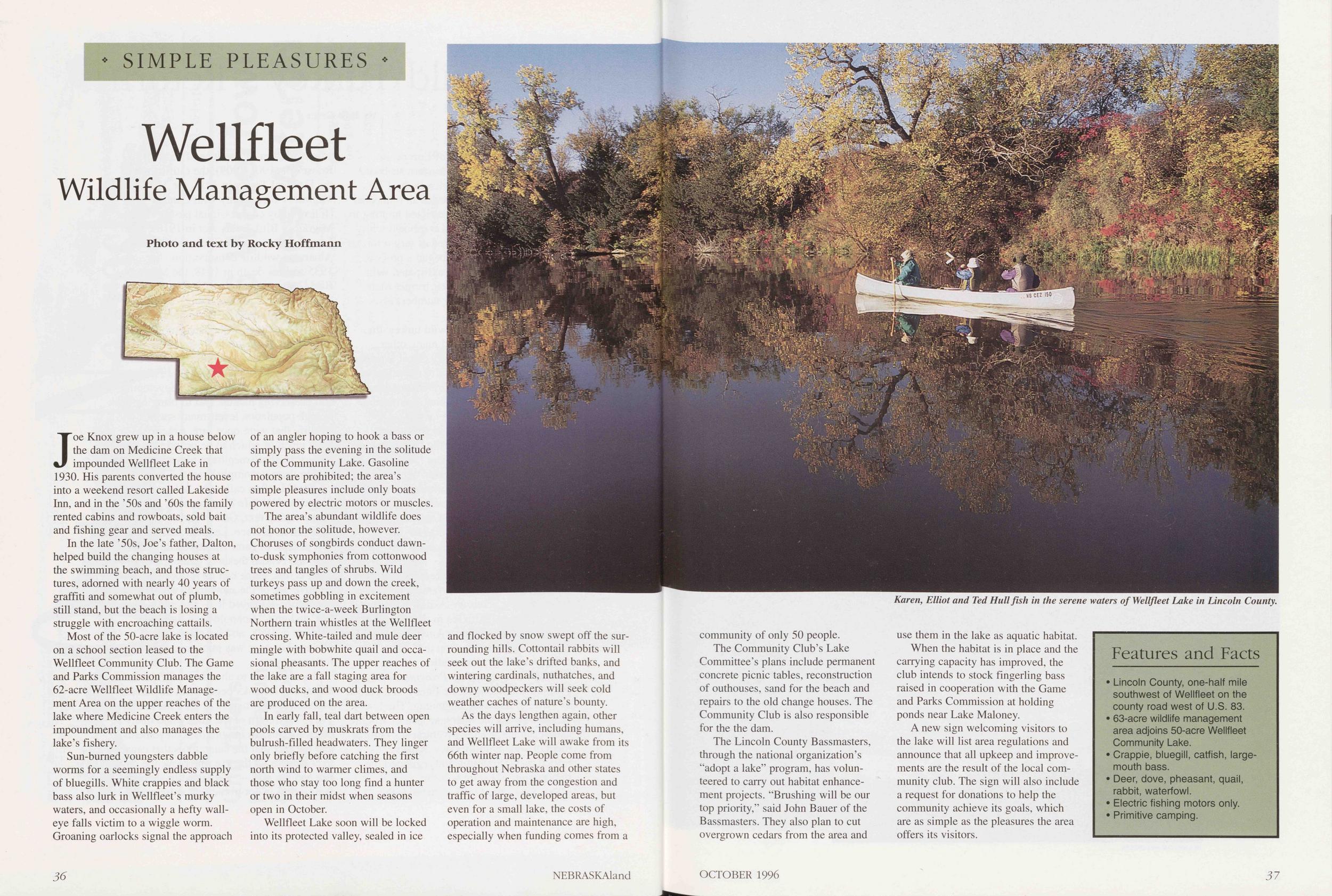
SIMPLE PLEASURES
Wellfleet Wildlife Management Area
Photo and text by Rocky HoffmannJoe Knox grew up in a house below the dam on Medicine Creek that impounded Wellfleet Lake in 1930. His parents converted the house into a weekend resort called Lakeside Inn, and in the '50s and '60s the family rented cabins and rowboats, sold bait and fishing gear and served meals.
In the late '50s, Joe's father, Dalton, helped build the changing houses at the swimming beach, and those structures, adorned with nearly 40 years of graffiti and somewhat out of plumb, still stand, but the beach is losing a struggle with encroaching cattails.
Most of the 50-acre lake is located on a school section leased to the Wellfleet Community Club. The Game and Parks Commission manages the 62-acre Wellfleet Wildlife Management Area on the upper reaches of the lake where Medicine Creek enters the impoundment and also manages the lake's fishery.
Sun-burned youngsters dabble worms for a seemingly endless supply of bluegills. White crappies and black bass also lurk in Wellfleet's murky waters, and occasionally a hefty walleye falls victim to a wiggle worm. Groaning oarlocks signal the approach of an angler hoping to hook a bass or simply pass the evening in the solitude of the Community Lake. Gasoline motors are prohibited; the area's simple pleasures include only boats powered by electric motors or muscles.
The area's abundant wildlife does not honor the solitude, however. Choruses of songbirds conduct dawnto-dusk symphonies from cottonwood trees and tangles of shrubs. Wild turkeys pass up and down the creek, sometimes gobbling in excitement when the twice-a-week Burlington Northern train whistles at the Wellfleet crossing. White-tailed and mule deer mingle with bobwhite quail and occasional pheasants. The upper reaches of the lake are a fall staging area for wood ducks, and wood duck broods are produced on the area.
In early fall, teal dart between open pools carved by muskrats from the bulrush-filled headwaters. They linger only briefly before catching the first north wind to warmer climes, and those who stay too long find a hunter or two in their midst when seasons open in October.
Wellfleet Lake soon will be locked into its protected valley, sealed in ice and flocked by snow swept off the surrounding hills. Cottontail rabbits will seek out the lake's drifted banks, and wintering cardinals, nuthatches, and downy woodpeckers will seek cold weather caches of nature's bounty.
As the days lengthen again, other species will arrive, including humans, and Wellfleet Lake will awake from its 66th winter nap. People come from throughout Nebraska and other states to get away from the congestion and traffic of large, developed areas, but even for a small lake, the costs of operation and maintenance are high, especially when funding comes from a 36 NEBRASKAland
The Community Club's Lake Committee's plans include permanent concrete picnic tables, reconstruction of outhouses, sand for the beach and repairs to the old change houses. The Community Club is also responsible for the the dam.
The Lincoln County Bassmasters, through the national organization's "adopt a lake" program, has volunteered to carry out habitat enhancement projects. "Brushing will be our top priority," said John Bauer of the Bassmasters. They also plan to cut overgrown cedars from the area and use them in the lake as aquatic habitat.
When the habitat is in place and the carrying capacity has improved, the club intends to stock fingerling bass raised in cooperation with the Game and Parks Commission at holding ponds near Lake Maloney.
A new sign welcoming visitors to the lake will list area regulations and announce that all upkeep and improvements are the result of the local community club. The sign will also include a request for donations to help the community achieve its goals, which are as simple as the pleasures the area offers its visitors.
Features and Facts • Lincoln County, one-half mile southwest of Wellfleet on the county road west of U.S. 83. • 63-acre wildlife management area adjoins 50-acre Wellfleet Community Lake. • Crappie, bluegill, catfish, largemouth bass. • Deer, dove, pheasant, quail, rabbit, waterfowl. • Electric fishing motors only. • Primitive camping. OCTOBER 1996 37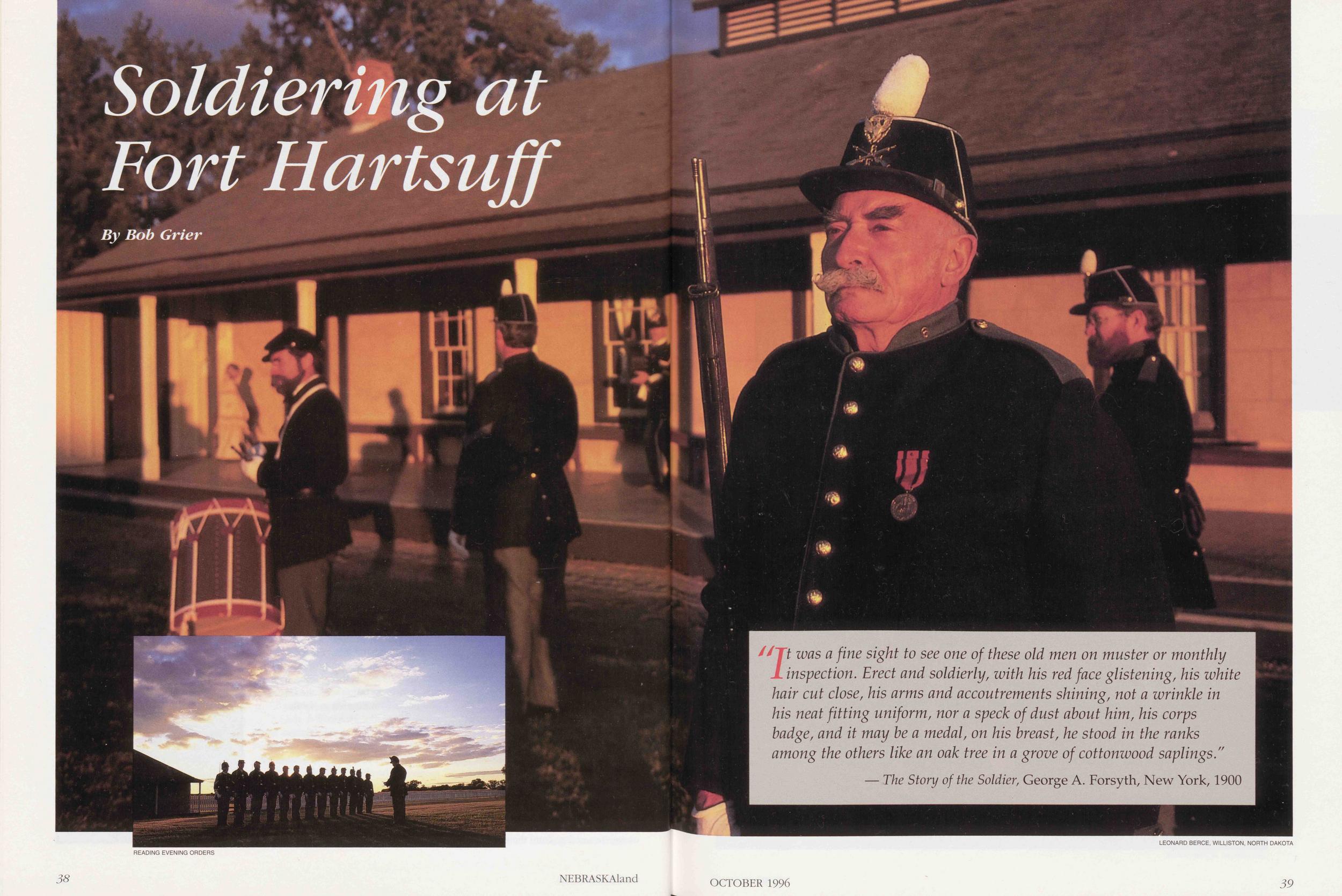
Soldiering at Fort Hartsuff
By Bob Grier**Tt was a fine sight to see one of these old men on muster or monthly JL inspection. Erect and soldierly, with his red face glistening, his white hair cut close, his arms and accoutrements shining, not a wrinkle in his neat fitting uniform, nor a speck of dust about him, his corps badge, and it may be a medal, on his breast, he stood in the ranks among the others like an oak tree in a grove of cottonwood saplings/'
— The Story of the Soldier, George A. Forsyth, New York, 1900 OCTOBER 1996 39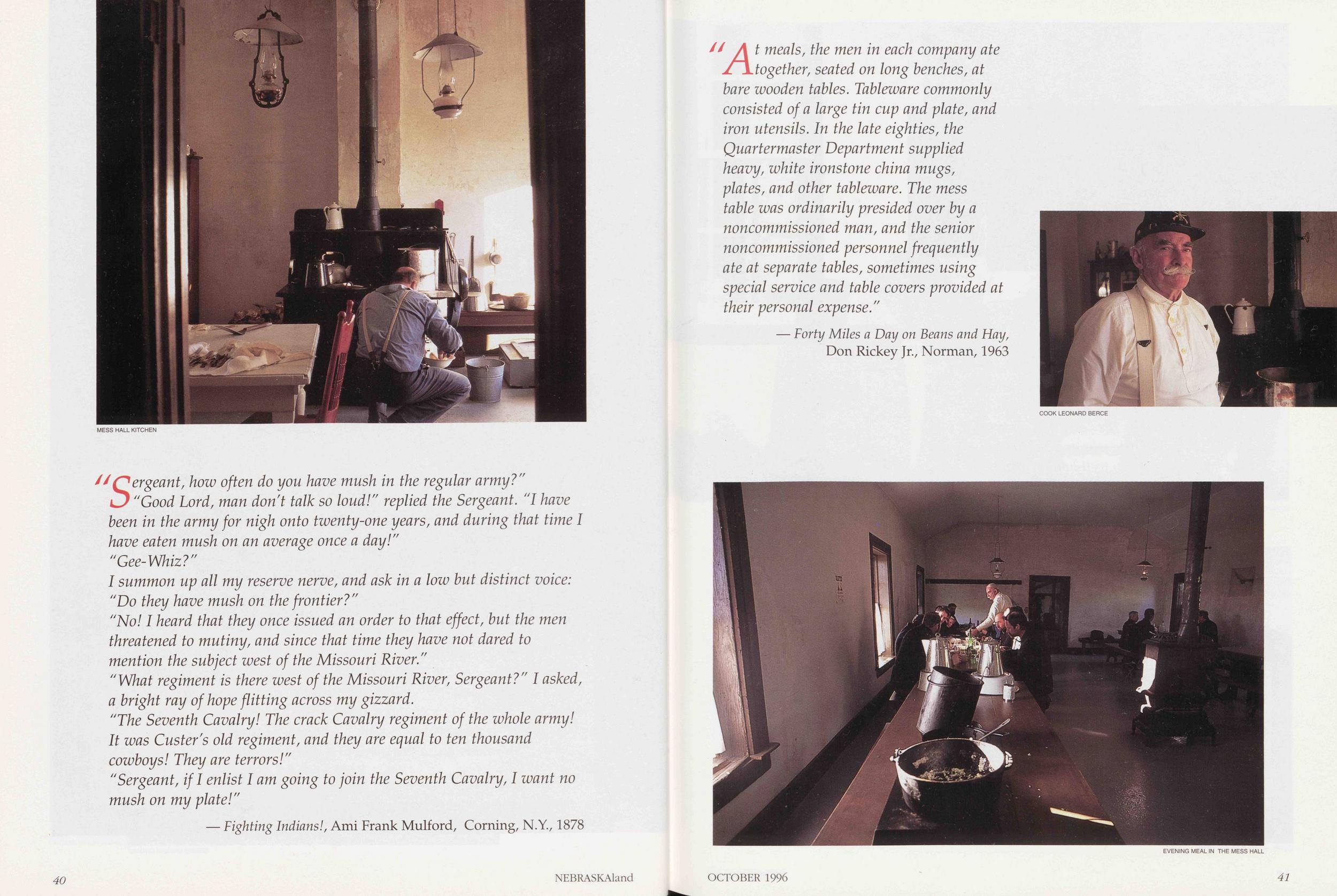
M^ergeant, how often do you have mush in the regular army?
^ "Good Lord, man don't talk so loud!" replied the Sergeant. "I have been in the army for nigh onto twenty-one years, and during that time I have eaten mush on an average once a day!"
"Gee-Whiz?"
I summon up all my reserve nerve, and ask in a low but distinct voice: Do they have mush on the frontier?"
No! I heard that they once issued an order to that effect, but the men threatened to mutiny, and since that time they have not dared to mention the subject west of the Missouri River."
"What regiment is there west of the Missouri River, Sergeant?" I asked, a bright ray of hope flitting across my gizzard.
"The Seventh Cavalry! The crack Cavalry regiment of the whole army! It was Custer's old regiment, and they are equal to ten thousand cowboys! They are terrors!"
"Sergeant, if I enlist I am going to join the Seventh Cavalry, I want no mush on my plate!"
— Fighting Indians!, Ami Frank Mulford, Corning, N.Y., 1878 40 NEBRASKAland" A t meals, the men in each company ate Altogether, seated on long benches, at bare wooden tables. Tableware commonly consisted of a large tin cup and plate, and iron utensils. In the late eighties, the Quartermaster Department supplied heavy, white ironstone china mugs, plates, and other tableware. The mess table was ordinarily presided over by a noncommissioned man, and the senior noncommissioned personnel frequently ate at separate tables, sometimes using special service and table covers provided at their personal expense."
— Forty Miles a Day on Beans and Hay, Don Rickey Jr., Norman, 1963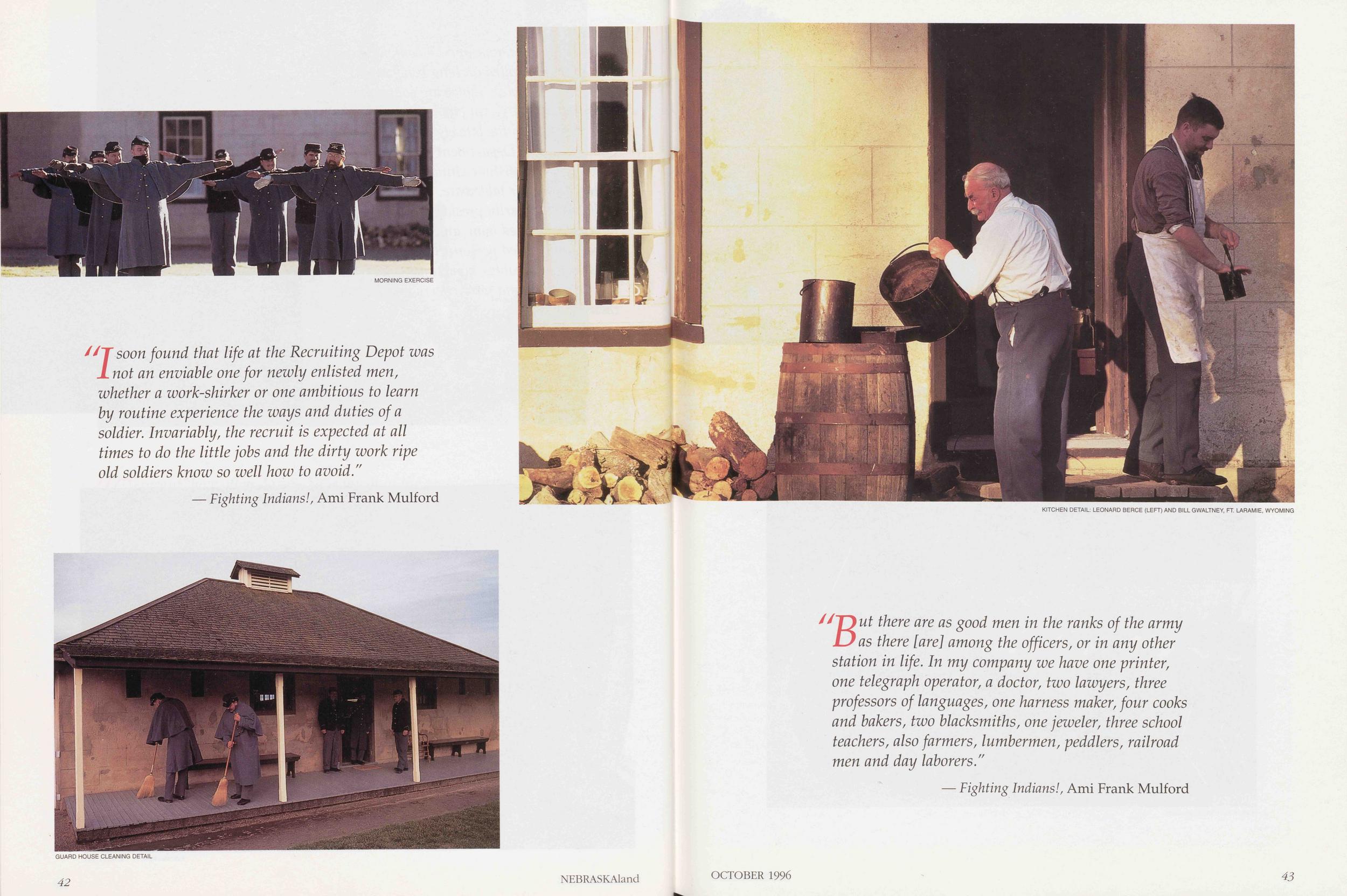
//T soon found that life at the Recruiting Depot was J. not an enviable one for newly enlisted men, whether a work-shirker or one ambitious to learn by routine experience the ways and duties of a soldier. Invariably, the recruit is expected at all times to do the little jobs and the dirty work ripe old soldiers know so well how to avoid."
Fighting Indians!, Ami Frank Mulfordr~]Dut there are as good men in the ranks of the army LJ as there [are] among the officers, or in any other station in life. In my company we have one printer, one telegraph operator, a doctor, two lawyers, three professors of languages, one harness maker, four cooks and bakers, two blacksmiths, one jeweler, three school teachers, also farmers, lumbermen, peddlers, railroad men and day laborers/'
— Fighting Indians!, Ami Frank Mulford OCTOBER 1996 43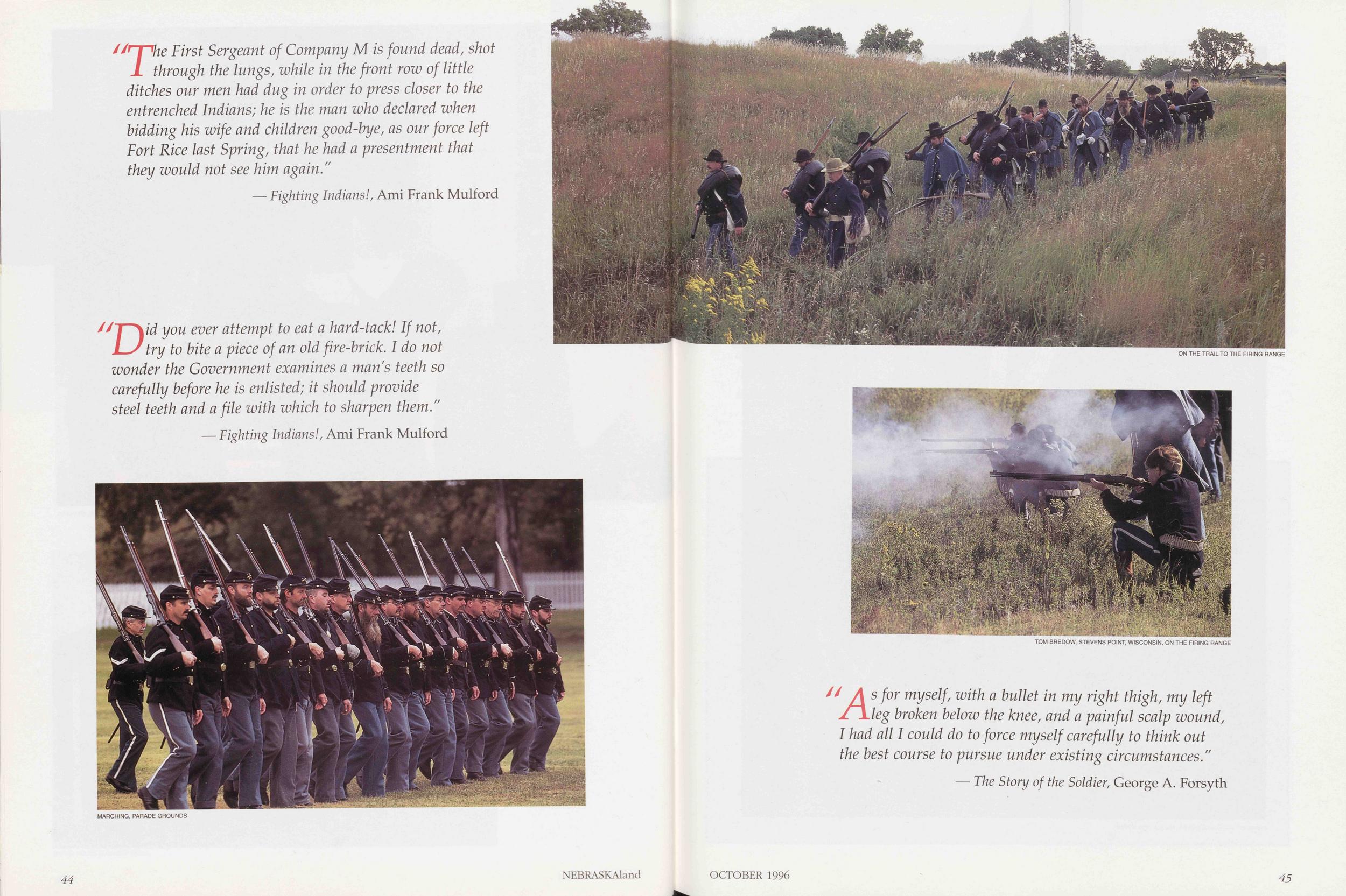
StHnhe First Sergeant of Company M is found dead, shot J. through the lungs, while in the front row of little ditches our men had dug in order to press closer to the entrenched Indians; he is the man who declared when bidding his wife and children good-bye, as our force left Fort Rice last Spring, that he had a presentment that they would not see him again."
— Fighting Indians!, Ami Frank Mulfordrl~^\id you ever attempt to eat a hard-tack! If not, l-J try to bite a piece of an old fire-brick. I do not wonder the Government examines a mans teeth so carefully before he is enlisted; it should provide steel teeth and a file with which to sharpen them."
— Fighting Indians!, Ami Frank Mulford// A s for myself, with a bullet in my right thigh, my left zLleg broken below the knee, and a painful scalp wound, I had all I could do to force myself carefully to think out the best course to pursue under existing circumstances."
— The Story of the Soldier, George A. Forsyth OCTOBER 1996 45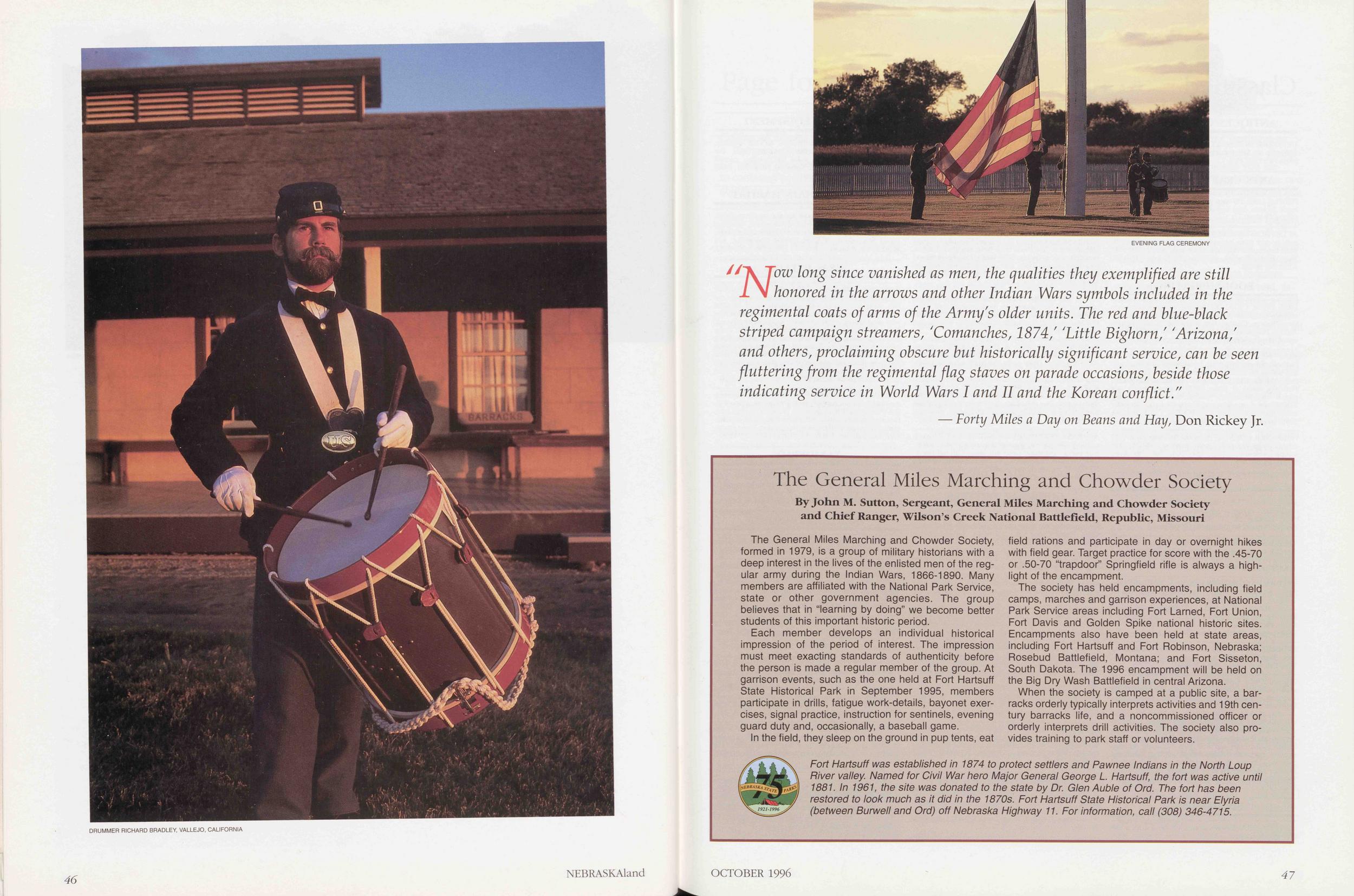
rA Tow long since vanished as men, the qualities they exemplified are still 1 \l honored in the arrows and other Indian Wars symbols included in the regimental coats of arms of the Army's older units. The red and blue-black striped campaign streamers, 'Comanches, 1874/ 'Little Bighorn/ 'Arizona/ and others, proclaiming obscure but historically significant service, can be seen fluttering from the regimental flag staves on parade occasions, beside those indicating service in World Wars I and II and the Korean conflict."
— Forty Miles a Day on Beans and Hay, Don Rickey Jr. The General Miles Marching and Chowder Society By John M. Sutton, Sergeant, General Miles Marching and Chowder Society and Chief Ranger, Wilson's Creek National Battlefield, Republic, MissouriThe General Miles Marching and Chowder Society, formed in 1979, is a group of military historians with a deep interest in the lives of the enlisted men of the regular army during the Indian Wars, 1866-1890. Many members are affiliated with the National Park Service, state or other government agencies. The group believes that in "learning by doing" we become better students of this important historic period.
Each member develops an individual historical impression of the period of interest. The impression must meet exacting standards of authenticity before the person is made a regular member of the group. At garrison events, such as the one held at Fort Hartsuff State Historical Park in September 1995, members participate in drills, fatigue work-details, bayonet exercises, signal practice, instruction for sentinels, evening guard duty and, occasionally, a baseball game.
In the field, they sleep on the ground in pup tents, eat field rations and participate in day or overnight hikes with field gear. Target practice for score with the .45-70 or .50-70 "trapdoor" Springfield rifle is always a high light of the encampment.
The society has held encampments, including field camps, marches and garrison experiences, at National Park Service areas including Fort Lamed, Fort Union, Fort Davis and Golden Spike national historic sites. Encampments also have been held at state areas, including Fort Hartsuff and Fort Robinson, Nebraska; Rosebud Battlefield, Montana; and Fort Sisseton, South Dakota. The 1996 encampment will be held on the Big Dry Wash Battlefield in central Arizona.
When the society is camped at a public site, a barracks orderly typically interprets activities and 19th century barracks life, and a noncommissioned officer or orderly interprets drill activities. The society also provides training to park staff or volunteers.
Fort Hartsuff was established in 1874 to protect settlers and Pawnee Indians in the North Loup River valley. Named for Civil War hero Major General George L. Hartsuff, the fort was active until 1881. In 1961, the site was donated to the state by Dr. Glen Auble of Ord. The fort has been restored to look much as it did in the 1870s. Fort Hartsuff State Historical Park is near Elyria (between Burwell and Ord) off Nebraska Highway 11. For information, call (308) 346-4715.
OCTOBER 1996 47
Classified
ANTIQUES/COLLECTIBLESUP TO $100 for Nebraska hunting licenses 1901 through 1920. Up to $25 for any Nebraska trapping licenses. (402) 785-7500. Phil.
ARTS/CRAFTS/CLOTHINGPEOPLE LIKE TO wear printed T-shirts. Why not your logo? Jackets, caps and design. Battle Creek Shirt Co. (402)675-9795.
ATTENTION HUNTERS: We can transform your fur pelts or deer skins into custom-made garments. Over 50 years experience. Write for information or call (308) 928- 2515. Haeker Furriers, PO Box 230, 615 W. Main St., Alma, NE 68920.
BOOKS/PRINTINGFREE BOOK CATALOG. Novels, westerns, romances, children's; old out of print, found barns, attic. Authors: Grey, Bower, Condor, Fox, Curwood, Raine, Wright, Aldrige, Pollyanna, Freckles, many others. Postage appreciated. Pierce, 4400 N. Pine Cluster, Oroville, CA 95965.
HOW TO FIND MORE outdoor opportunities! The Nebraska Sportsman's Atlas. Locations of all public lands and waters on county transportation maps. These maps show ALL the roads in Nebraska. Listings include federal, Nebraska Game & Parks, NRD holdings, hotels and motels and Nebraska's endless attractions. At only $18.75/copy a true time and frustration saver. To order write: Sportsman's Atlas Co., PO Box 132, Lytton, IA 50561 or call 1-800-568-8334.
NEBRASKA COUNTRY NOSTALGIC note cards - 12 original color Nebraska photo assortment. $1.35. Free sample welcome. (402) 564-7304. 766 7th Ave., Columbus, NE 68601.
DOGSENGLISH SETTER, German shorthairs, English pointers, Brittany spaniels - stud service, puppies and started dogs. Training for all pointing breeds. Plum Creek Kennel, (712) 529-4238 or (402) 298-8153.
YELLOW-CHOCOLATE-BLACK LAB pups. Breeders hips O.F.A. and eyes c.e.r.f./ed. Excellent bloodlines and hunting potential. Call Mr. Bendler, Lexington, NE (308) 324-4247 or Lincoln (402) 477-1305.
TRAINING ALL BREEDS bird dogs - Vizslas for sale. Home of Rebel Rousers. Rozanek Kennels, RR 2, Schuyler, NE 68661. Phone (402) 352-8769.
RETRIEVER TRAINING. Area's top "retrievers only" trainer. Field trial and hunting dogs. Non-slip duck dogs! TKO Retriever Training Kennel (402) 623-4311.
ENGLISH SETTER and Labradors from outstanding lines. Bred for hunters who appreciate fine bird dogs! Wind Fall Gun Dogs, (402) 421-4693.
CHESAPEAKE BAY, Labrador and golden retriever pups, started dogs and stud service. 16-time national champion pedigree. Visa & MasterCard. Platte Valley Retrievers (308) 995-2318.
WILDERNESS KENNELS. Gun dog training - over 60 years combined experience. Training all sporting breeds - retrievers, flushing and pointing dogs. All dogs worked on pen raised birds and wild game. Training program includes obedience training - heel, sit, stay, down and come when called. Pups, started dogs and fully trained dogs for sale. Hunting dogs trained by hunters. Henry Sader, Wilderness Kennels, Roca, NE (402) 423-4212. Since 1968.
FISH/FISHINGrainbow trout, Donaldson rainbow trout, grass carp, minnows, bullheads. Consulting available. Pleasant Valley Fish Farm, RR 1, Box 147, McCook, NE 69001. Phone (308) 345-6599.
WILLOW LAKE FISH HATCHERY. Channel cat, bluegill, hybrid bluegill, largemouth bass, crappie, triploid grass carp, walleye, perch, minnows. Gaylord Crawford, 7580 N. Highland Rd., Hastings, NE 68901 or phone (402) 463-8022 day or night. Also pond consultant. We deliver, grower price.
FOOD/GIFTSNEBRASKA BASKETS: The original Nebraska company specializing in fine foods from Nebraska since 1984. A beautiful array of baskets filled with ethnic, healthful and long-time favorite foods. Call or write for our brochure: P.O. Box 22985, Lincoln, NE 68542. Phone 1-800-345-7725 or (402) 438-3 111.
FROM NEBRASKA GIFT SHOP..the world's largest selection of Nebraska-made food products and gifts. Historic Haymarket, 140 N. 8th St., Lincoln, NE 68508; Old Market, 1030 Howard St., Omaha, NE. Call for free catalog 1-800-399-5693
HOMEBREWING/BEER & WINEMAKING supplies. Fermenter's Supply, 8410 K Plz. #10, Omaha, NE 68127. (402) 593-9171. Open every day, mail orders welcome, low shipping.
BAKERS CANDIES FACTORY OUTLET Store, 60 North Hwy. 6, Greenwood, NE 68366. (402) 789-7200. Sinfully delicious chocolates from America's Heartland. Specializing in flavored chocolate meltaways. Free mail order brochure.
NEBRASKA GOURMET SMOKED TURKEY, award- winning BBQ sauces, gourmet seasonings, native jellies, fruit butters and more! Great gift ideas! Call toll free 1-888-926-2879, Hollman Foods, 1948 36 Road, Minden, NE 68959, or check our products out on the Internet, http://www.lopernet.net/hollmans/hollmans.htm
GUIDES/OUTFITTERSMAD RIVER CANOES offers the finest quality and performance. For the finest canoes and accessories look to Great Plains Canoe Co., 205 Main, Springfield, NE 68059. Phone (402) 253-2001.
CANOE THE NIOBRARA...with an affordable canoe trip by Dry land Aquatics. One and two-day trips...full service, or just canoes and tubes. Transportation furnished. Your Niobrara River specialists... We do it your way! Dry land Aquatics, Dept. N, Box 33C, Sparks, NE 69220 or phone 1-800-337-3119.
NOW TAKING RESERVATIONS! North-central Nebraska's newest pheasant hunting preserve opening this fall. Three-bedroom lodge, sleeping loft, kitchen available for overnight or weekend getaways. Families welcome! 8 miles from O'Neill airport. 45 minutes from Ft. Randall casino. Call for brochure and information about our archery deer and pheasant hunt packages. Blackbird Valley Ringnecks Inc. Dennis Drayton. (402) 336-3858.
CANADA GOOSE HUNTERS. Gander Hunting. Lewellen, NE. $40 per day. Call Ivan Armstrong, (308) 284-4691 evenings.
EXCELLENT PHEASANT HUNTING: New area and affordable on 5,000-plus acres with only wild pheasants. For booking hunts, contact Dakota Ringneck Ranch, Roy Grismer, 12525 328th Ave., Bowdle, SD 57428. Phone (605) 283-2680.
GUNS/SHOOTING/ARCHERYFISH FOR SALE. Catfish, largemouth bass, smallmouth bass, perch, crappie, bluegill, walleye, northern pike, GUNS - Browning, Winchester, Remington, others. Hi-powers, shotguns, new, used, antiques. Want Pre-'64 Winchesters. Buy-Sell-Trade. (402) 729-6112. Bedlan's Sporting Goods, Fairbury, NE 68352.
OUTDOOR EQUIPMENTMOUNTAIN BIKE NIOBRARA RIVER country. Merritt Reservoir and the Cowboy Trail. For bicycle/accessory rentals, sales and service, contact Yucca Dune, 148 E. 1st St., Valentine, NE 69201. (402) 376-3330 or ryschon@ibm.net.
PLANTS/ANIMALS/HABITATATTRACT WILDLIFE to your acreage, preserve or club. Consulting, management plan development, planting/ seeding, and supplies for the conservationist or the hunter. David M. Nelson, Wildlife Habitat Consulting, 811 Matthies Dr., Papillion, NE 68046. Phone (402) 592-5652.
REAL ESTATERANCHES FOR SALE 2,590 acres near Crawford, Nebraska, in the Pine Ridge area. Winter protection and live water year-round with an abundance of wildlife. Good ranch improvements. Private and secluded, yet very good access. 3,500 acre ranch southeast of Alliance. Nebraska. Purebred or commercial unit for 300 cows. Full set of ranch improvements with two homes. Many subirrigated meadows. Beautiful ranch with exceptional grouse, duck, goose and pheasant hunting. Exclusive agents on these and other properties, please call Farmers National Company (formerly Northern Plains Land Company) at (308) 762-3155.
FOR SALE: Close to Long Pine, NE. 516 acre timbered- rec-ranch with one mile of creek. Development possibilities. Prospering fishing-rec-resort complete on large lake. Gun and sporting goods video store doing well in northcentral Nebraska. Call for more information. Swett Realty, Fred Swett, Broker. 1-800-585-1626 or (402) 387-1626.
TAXIDERMYALLISON'S TAXIDERMY Studio & Gift Gallery - DU, SCI Pheasants Forever & NTA Members. Mounted 36 state record fish. 421 N. Dewey, North Platte, NE 69101. Call (308) 534-2324 or (308) 534-4267. Custom Designs.
VACATIONS/RESORTSFOR FISHING and hunting accommodations. Jefco Inn, Gordon, NE 69343. South Cornell, (308) 282-2935.
BED & BREAKFAST. Historic 1890s hotel. Located in the beautiful Pine Ridge area of Northwest Nebraska. Short drive to Chadron State Park, Fort Robinson and the Black Hills. Beautiful dining room with fireplace and fountain. Room service available. The Olde Main Street Inn, 115 Main St., Chadron, NE 69337. (308) 432-3380.
NE NEBRASKA TROUT FISHING. Mon-Thurs or Fri-Sun. 3 modern cottages, 5 spring-fed lakes. Trout, bass and bluegill. Diamond E Trout Resort. Box B. Orchard, NE 1-800-658-3244.
FREE OUTDOORS IN KANSAS' Golden Triangle, your guide to recreation in the Flint Hills region of northeast Kansas. Includes the hunting outlook for Milford, Tuttle Creek, and Council Grove lakes, an overview of spring fishing, local historical sites and museums, and complete lodging information. Full-color, 24-page brochure. Call 1-800-759-0134, ext. 24.
ATTENTION HUNTERS - Reserve rooms now at the Traveler's Inn Bed & Breakfast, Callaway, NE. Located in prime deer, pheasant, quail and grouse habitat. For comfortable, quiet rooms with hearty breakfast call (308) 836-2200.
75$ per word, minimum $15. Closing: Two months before issue date. First-come, first-semed, space available. NEBRASKAland Magazine, Box 30370, Lincoln, NE 68503. (402) 471-5478. Fax: (402) 471- 5528. E-mail: neblojvi@ngpsun.ngpc.state.ne.us 48 NEBRASKAlandPage forty-nine
Calling all DucksI'm getting too old to let this go on for another duck season, and I'm going to confess: I'm insecure about my ability as a duck caller. Not just mildly insecure, but debilitatingly insecure. I know I'm not alone, so for all of us who are chronically intimidated by those who call better than we do — or intimidate us into believing they call better than we do — I'm going to bare my soul and get it over with.
This is a deep-seated psychological disfunction. It's not just duck calling I'm shy about, it's doing anything when others are watching or, in the case of duck calling, when others are listening. That's also the reason I don't dance. There might be a hundred couples on the dance floor, but I know everyone will be watching my every miss-step if I dance. This fear of humiliation started in the fourth grade. I could do my arithmetic well enough until Mrs. Morse, my teacher, paused momentarily beside my desk. Suddenly three plus three was five. I think I suffer a textbook case of rural Nebraska inferiority complex.
If someone had taught me to call ducks at an early age, I would have grown up thinking I was a competent duck caller, whether it was true or not. Actually, it's probably a blessing that no one attempted to teach me. Most of the duck callers I knew in my youth made noises with a duck call that sounded more like a whoopee cushion than a lonesome mallard.
The easy way out would be never to call ducks. That's the tack I've taken with dancing, but I've never cared much whether I danced or not. The rub is, I like duck hunting and all the adult toys that are part and parcel of it — boats, blinds, dogs, decoys and duck calls. For a few years I talked a fairly convincing line that there really was no need to call ducks if you knew how to set decoys. There is some truth in that, but it wasn't a satisfactory solution. I like to blow a duck call.
Like most duck hunters I own more calls than I will ever need, even not counting the ones without reeds or with kinky reeds. I've never liked the sound of some of my calls, but I was too shy to try them out in the sporting goods store before I bought them. I would have taken them back for a refund, but I knew the clerk or some patron lurking around the corner in the camouflage clothing section would be a world-class caller and would humiliate me by blowing a pleading hen call that would shuck the feathers off a migrating mallard, and then hand me the call and say "Here, you try it."
Besides, I didn't think you could take a call back once you had mouthed it. I figured duck calls were in the same category as underwear: Once you try them on you own them forever. So, I have an old wooden shotshell box half full of mint-condition duck calls.
Most of my duck calls cost three to five dollars, so it's not as if I've frittered away my daughter's inheritance. Most are Faulk's C-lOOs. I think they sound pretty much like a mallard, and, knowing I'm incompetent, I just can't bring myself to plunk down $200 for a custom-made, checkered cocobola call with a German silver reed and ivory inlays of flushing wigeons. I know I don't deserve one, and I know I wouldn't sound any more like a duck if I used one. I did buy a $20 call with fancy wood a few years ago, but I can't chuckle on it as well as I can on the Faulk's, at least as best I can tell.
I occasionally use my pintail wigeon-teal whistle when I'm hunting alone. I have absolutely no idea how close I come to imitating one of those ducks, because I haven't been able to hear high frequency sounds since I was in high school, I didn't pay attention to what a wigeon, pintail or teal sounded like then, I would have forgotten by now if I had, and I wouldn't know now if I made my call sound like one.
The whistle probably is the safest call for me to use around other hunters, because most of them don't know either, and I can always blame my hearing loss if they do. Furthermore, teal and wigeons will decoy no matter what kind of weird noises you are making when they fly by. They are two of my favorite species of ducks for that reason alone.
I do call ducks around other hunters occasionally, but I'm selective. For years I hunted with a brother, an uncle and a cousin, and I always did the calling. They were even more insecure about duck calling than I am, and, as they were family, I figured they would be as understanding about my calling inadequacies as they had been about all my other failings as a human being.
I call around a few close friends I've hunted with for years because they are compassionate and understanding of my plight. I never call when I hunt with someone new, at least not until I've heard them call. Sometimes I decide they aren't any better than I am and join in. If I'm with a good caller — or someone who has the confidence to convince me he is a good caller — I keep my call in my pocket and tell him I left it in the pickup.
Someone once said that if you don't know how to pronounce a word say it loudly. I've thought about applying that philosophy to duck calling, but I can't get up the nerve. Several good duck callers have offered to work with me until I was convinced I could call ducks adequately, but I'm too shy to humiliate myself in front of them. For heaven sakes, I've been blowing duck calls for more than 30 years. I should be proficient by now.
I sometimes listen to "How to Call Ducks" tapes and practice on my call while driving. After 100 miles or so, I begin feeling pretty good about my calling, but that confidence is quickly eroded when I get into the blind with a hunter who exudes confidence. I've noticed that as people get older they care less about what others think of them and what they do. I just hope I live that long, because I really like to blow duck calls.
Jon Farrar OCTOBER 1996 49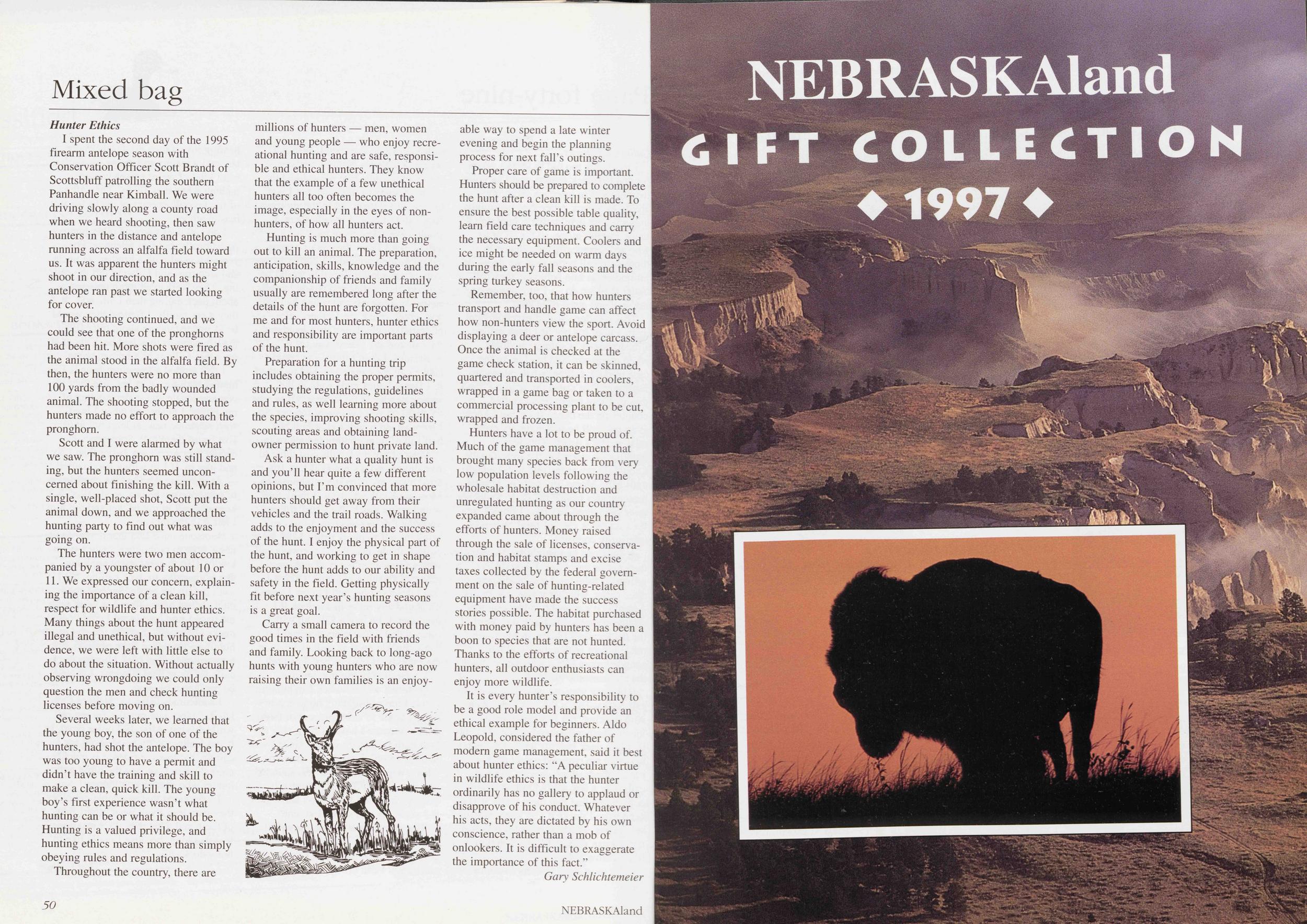
Mixed bag
Hunter EthicsI spent the second day of the 1995 firearm antelope season with Conservation Officer Scott Brandt of Scottsbluff patrolling the southern Panhandle near Kimball. We were driving slowly along a county road when we heard shooting, then saw hunters in the distance and antelope running across an alfalfa field toward us. It was apparent the hunters might shoot in our direction, and as the antelope ran past we started looking for cover.
The shooting continued, and we could see that one of the pronghorns had been hit. More shots were fired as the animal stood in the alfalfa field. By then, the hunters were no more than 100 yards from the badly wounded animal. The shooting stopped, but the hunters made no effort to approach the pronghorn.
Scott and I were alarmed by what we saw. The pronghorn was still standing, but the hunters seemed unconcerned about finishing the kill. With a single, well-placed shot, Scott put the animal down, and we approached the hunting party to find out what was going on.
The hunters were two men accompanied by a youngster of about 10 or 11. We expressed our concern, explaining the importance of a clean kill, respect for wildlife and hunter ethics. Many things about the hunt appeared illegal and unethical, but without evidence, we were left with little else to do about the situation. Without actually observing wrongdoing we could only question the men and check hunting licenses before moving on.
Several weeks later, we learned that the young boy, the son of one of the hunters, had shot the antelope. The boy was too young to have a permit and didn't have the training and skill to make a clean, quick kill. The young boy's first experience wasn't what hunting can be or what it should be. Hunting is a valued privilege, and hunting ethics means more than simply obeying rules and regulations.
Throughout the country, there are millions of hunters — men, women and young people — who enjoy recreational hunting and are safe, responsible and ethical hunters. They know that the example of a few unethical hunters all too often becomes the image, especially in the eyes of nonhunters, of how all hunters act.
Hunting is much more than going out to kill an animal. The preparation, anticipation, skills, knowledge and the companionship of friends and family usually are remembered long after the details of the hunt are forgotten. For me and for most hunters, hunter ethics and responsibility are important parts of the hunt.
Preparation for a hunting trip includes obtaining the proper permits, studying the regulations, guidelines and rules, as well learning more about the species, improving shooting skills, scouting areas and obtaining land- owner permission to hunt private land.
Ask a hunter what a quality hunt is and you'll hear quite a few different opinions, but I'm convinced that more hunters should get away from their vehicles and the trail roads. Walking adds to the enjoyment and the success of the hunt. I enjoy the physical part of the hunt, and working to get in shape before the hunt adds to our ability and safety in the field. Getting physically fit before next year's hunting seasons is a great goal.
Carry a small camera to record the good times in the field with friends and family. Looking back to long-ago hunts with young hunters who are now raising their own families is an enjoyable way to spend a late winter evening and begin the planning process for next fall's outings.
Proper care of game is important. Hunters should be prepared to complete the hunt after a clean kill is made. To ensure the best possible table quality, learn field care techniques and carry the necessary equipment. Coolers and ice might be needed on warm days during the early fall seasons and the spring turkey seasons.
Remember, too, that how hunters transport and handle game can affect how non-hunters view the sport. Avoid displaying a deer or antelope carcass. Once the animal is checked at the game check station, it can be skinned, quartered and transported in coolers, wrapped in a game bag or taken to a commercial processing plant to be cut, wrapped and frozen.
Hunters have a lot to be proud of. Much of the game management that brought many species back from very low population levels following the wholesale habitat destruction and unregulated hunting as our country expanded came about through the efforts of hunters. Money raised through the sale of licenses, conservation and habitat stamps and excise taxes collected by the federal government on the sale of hunting-related equipment have made the success stories possible. The habitat purchased with money paid by hunters has been a boon to species that are not hunted. Thanks to the efforts of recreational hunters, all outdoor enthusiasts can enjoy more wildlife.
It is every hunter's responsibility to be a good role model and provide an ethical example for beginners. Aldo Leopold, considered the father of modern game management, said it best about hunter ethics: "A peculiar virtue in wildlife ethics is that the hunter ordinarily has no gallery to applaud or disapprove of his conduct. Whatever his acts, they are dictated by his own conscience, rather than a mob of onlookers. It is difficult to exaggerate the importance of this fact."
Gary Schlichtemeier 50 NEBRASKAland NEBRASKAlanf GIFT COLLECTION 1997
Position: 286 (30 views)