Volume 74, Issue 7, 1996
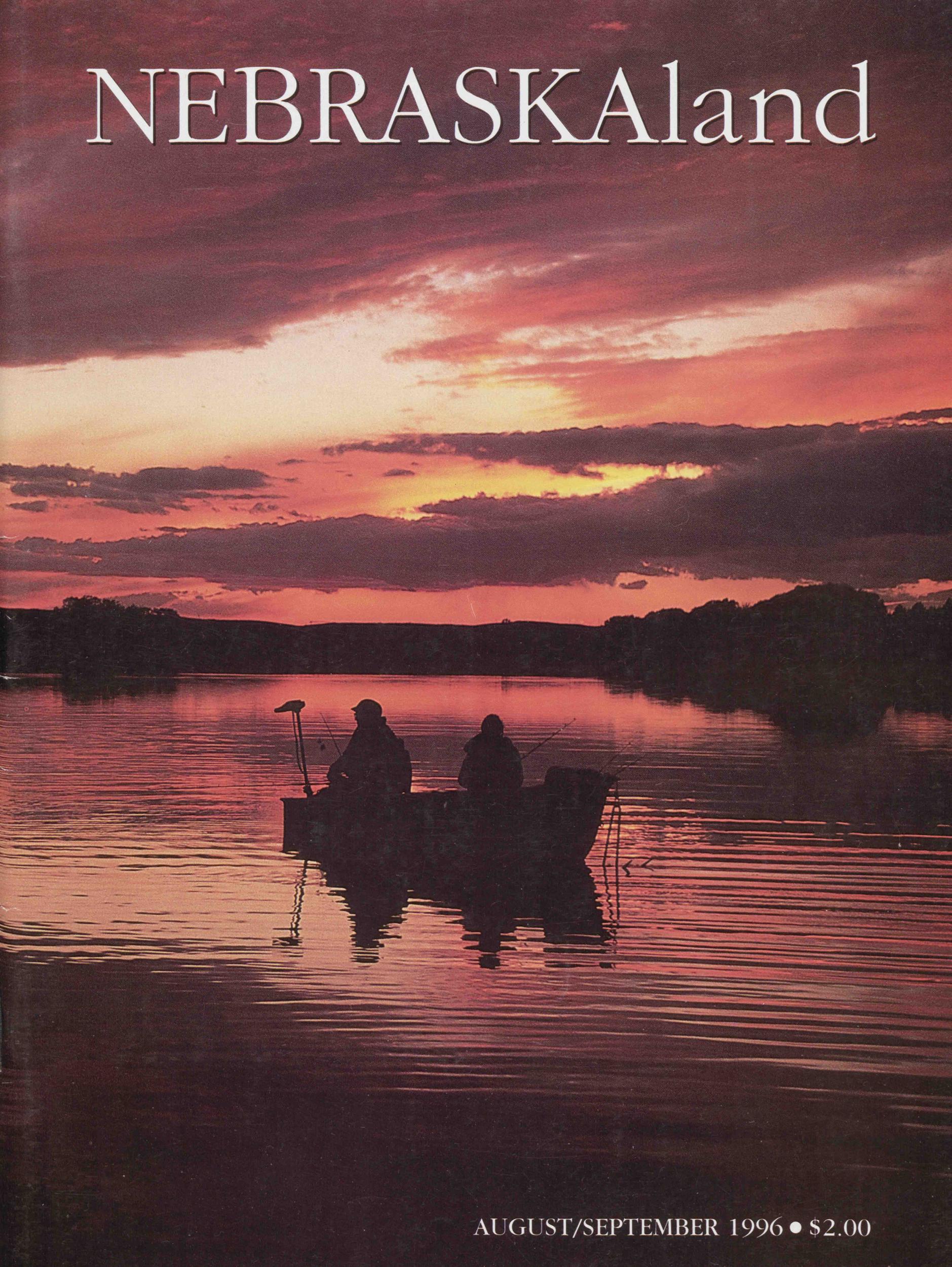
NEBRASKAland
AUGUST/SEPTEMBER 1996 • $2.00
Letters
Nebraska Game and Parks Commission District Offices Headquarters 2200 North 33rd Street Lincoln, NE 68503 Phone (402)471-0641 District Office I Box 725 Alliance, NE 69301 Phone (308)762-5605 District Office II Box 508 Bassett, NE 68714 Phone (402)684-2921 District Office III Box 934 Norfolk, NE 68702 Phone (402)370-3374 District Office IV Route 4, Box 36 North Platte, NE 69101 Phone (308)535-8025 District Office V 2200 North 33rd Street Lincoln, NE 68503 Phone (402)471-5558 Omaha Office 1212 Deer Park Blvd. Omaha, NE 68108 Phone (402) 595-2144 Ak-Sar-Ben Aquarium 21502 West Highway 31 Gretna, NE 68028 Phone (402) 332-3901 World Wide Web Site: http://www.ngpc.state.ne.us Email: ngpc@ngpsun.ngpc.state.ne.us Conservation Officers by Region Headquarters Gary Ralston Creighton 847-3284 Dick Turpin (Adm.) Lincoln 471-5531 Daniel Roberts Fremont 721-7852 Ted Blume (Asst. Adm.) Lincoln 483-5643 Randy Pomplun Fullerton (308)536-2987 Dan Klammer Lincoln 475-1475 Jon Reeves Kennard 427-7378 ric Wiebe Ponca 755-2566 Panhandle Steve Oberg West Point 372-3062 Officer City Phone (308) Richard Furley (Sup.) Alliance 762-2024 Sandhills Raymond Still Bridgeport262-1075 Officer City Phone (402) Walt Meyer Chadron 432-4398 Bruce Wiebe (Sup.)Bassett 684-3867 John Murphy Crawford 665-2021 Larry Bauman Atkinson 925-5569 Jim Zimmerman Gering 436-7561 Ray Dierking Brkn. Bow (308) 872-3078 Marvin Kampbell Hay Springs 638-7527 Richard Seward Ord (308)728-3115 Dennis Thompson Ogallala 284-6450 Mick Gray Valentine 376-3136 Dan Zuehlke Ogallala 284-4815 Dan Evasco Oshkosh 772-3091 South-central Scott Brandt Scottsbluff 635-1277 Officer City Phone (402) Jerry Pecha (Sup.) York 362-5707 Southwest Terry Brentzel Grand Is. (308)384-8296 Officer City Phone (308) Tim Williams Hastings 463-2535 Roger Thompson (Sup.) N. Platte 532-9175 Dale Johnson Hebron 768-7363 Dwight Allbery N. Platte 532-2753 Mark Reeves Loup City (308)745-1126 George Sund Cambridge 697-4629 Robert Finke Milford 761-3537 Matt Andrews Elwood 785-3025 Jack Henderson Gothenburg 537-7483 Southeast Dirk Greene Imperial 882-5328 Officer City Phone (402) Virgil Gosch McCook 345-2185 Craig Stover (Sup.) Lincoln 471-5590 Rich Routh Rep. City 799-2085 Murray Johnson Lincoln 488-2923 Douglas Kramer Lincoln 466-9001 Northeast Dina Hopper Lincoln 483-2358 Officer City Phone (402) William Krause Auburn 274-3789 Tom Zimmer (Sup.) Norfolk 371-6625 Larry Elston Bellevue 292-4910 Marion Shafer Norfolk 371-2031 Mike Luben Colon 443-4278 Robert Kelly Albion 395-2538 Duane Arp Gretna 332-4954 Ross Oestmann Bloomfield 373-4412 Levi Krause Louisville 234-2212 L A. Wilkinson Columbus 564-4375 Russell Mort Nebr. City 873-5684 Operation Game Thief 1-800-742-7627 Purple LoosestrifeAbout six months ago, an item appeared in Country Life magazine reporting on an effort to control purple loosestrife. The story said the entolomologists at the University of New Hampshire have released insects that attack the plant. One variety lays eggs in the stems, which are then eaten by the larvae. Another defoliated the plants. These insects are said to eat nothing but loosestrife and are not threats to other plants. Can you tell me whether the experiment was successful.
Laurine Blankenau Omaha, NebraskaBiological control of purple loosestrife using insects imported from Europe is being conducted along the Platte and Niobrara rivers by the Nebraska Purple Loosestrife Awareness Committee (see uThe Purple Problem," Notes from the field, June 1996).
Three insects are being used in the experiment, a leaf-eating beetle (Galerucella), a root-eating weevil (Hylobius) and seed- and flower-eating weevils (Nanophyes). Studies in other states indicate the insects are very host-specific and do not harm other plants.
An article on biological control of purple loosestrife is tentatively scheduled for the July 1997 issue of NEBRASKAland. (Ted LaGrange, Wet- land Program Manager.)
Preserving the Good LifeI just finished reading the July issue. It was outstanding. What should have been the centerpiece of the issue, though, was on Page forty-nine ["Band-Aids for Wildlife"].
Jon Farrar deftly put into words the frustration that I and many others have been trying to express. Far from placing wildlife ahead of humans in importance, many Nebraskans simply enjoy living in a state where we have unique, abundant wild things to offset our harried lives.
Habitats like the Missouri and Platte rivers, the Sandhills, prairies and forests should be proudly cared for and available to Nebraskans and those who visit 4 NFRRASKAN the state. It is not a conflict of interest or a matter of choosing wildlife rights over human rights, it is the preservation of our good life.
Chris Helzer Lincoln, Nebraska NEBRASKAland OnlineI read in the newspaper about your World Wide Web site on the Internet, and I had to check it out. Any plans to take NEBRASKAland Magazine online? I think it would be a great method to access back issues, as well as an excellent tool to promote our state.
John Dubas Omaha, Nebraska Via the InternetNEBRASKAland Magazine is now featured on the Game and Parks Commission's World Wide Web page. The NEBRASKAland home page offers a preview of upcoming articles, an article index dating back to 1970, a gift catalog, a subscription form and an e-mail link for sending letters to the editor. Additional features will be added in the future. The Game and Parks Commission homepage, offering a link to the NEBRASKAland page, can be accessed at: http://www.ngpc.state.ne.us (Editor)
Sandoz EncounterYour "Sandoz Country" in the May issue and the two letters about it in the June issue were excellent. In the 1920s, when I worked nights in the telephone office on M Street in Lincoln, I walked to and from work past the Capitol each day. Every morning on my way home I'd meet a woman with an interesting leathery face and an unforgettable look.
Then one day the newspapers burst forth with news of a new Mari Sandoz novel, Capital City, and there was a photo of the author: Mari Sandoz was the woman I met every morning. I learned that she worked in the Nebraska State Historical Society office.
I had heard of Mari Sandoz, of course. She was Nebraska's most famous writer at the time. Her novels were said to be quite racy. I became a loyal Sandoz fan after Old Jules, The Buffalo Hunters and Crazy Horse.
I well remember how Capital City threw Lincoln into a tizzy. Her story must have hit too close to home, for they bashed her and the book unmercifully.
How I wish I'd had the courage and good sense to say "good morning" to her all those mornings on 14th Street. But I was young, and you didn't go around speaking to strangers in those days — even in Lincoln, Nebraska.
So a belated "good morning," Mari and a happy 100th birthday.
Sadie J. Doyle Honolulu, Hawaii Windmill from NebraskaMy brother Marvin Hanson of Schuyler bought a used windmill. We disassembled it, and I towed it to Florida. We now have it up and pumping water.
I enjoy just sitting and watching it go round and round. The old spring buggy also came from Nebraska. You can take the boy out of Nebraska but not the Nebraska out of the boy.
Verlin Hanson Hilliard, Florida Write to: Letters, NEBRASKAland Magazine, P.O. Box 30370, Lincoln, NE 68503. Fax: (402) 471-5528. E-mail: Nebland@ngpsun.ngpc. state, ne. us. Letters may be condensed and edited for clarity. Photographs are welcome and will be returned. STAY ON TOP BOAT SMART It won! work if you don 't wear it. Drinking and boating don't mix. Know before you go — take a boat course. Never anchor from the stern. Leave a float plan with a friend. Don't overload your boat. Sit on the seat, not on the bow. Know the navigation rules. Never stand in a boat when under way. For more information, call Nebraska Boater Education (402) 471-5579 Nebraska Game and Parks Commission, National Safe Boating Council and the U.S. Coast Guard ATTCtTIST/SF.PTFMRFR 1996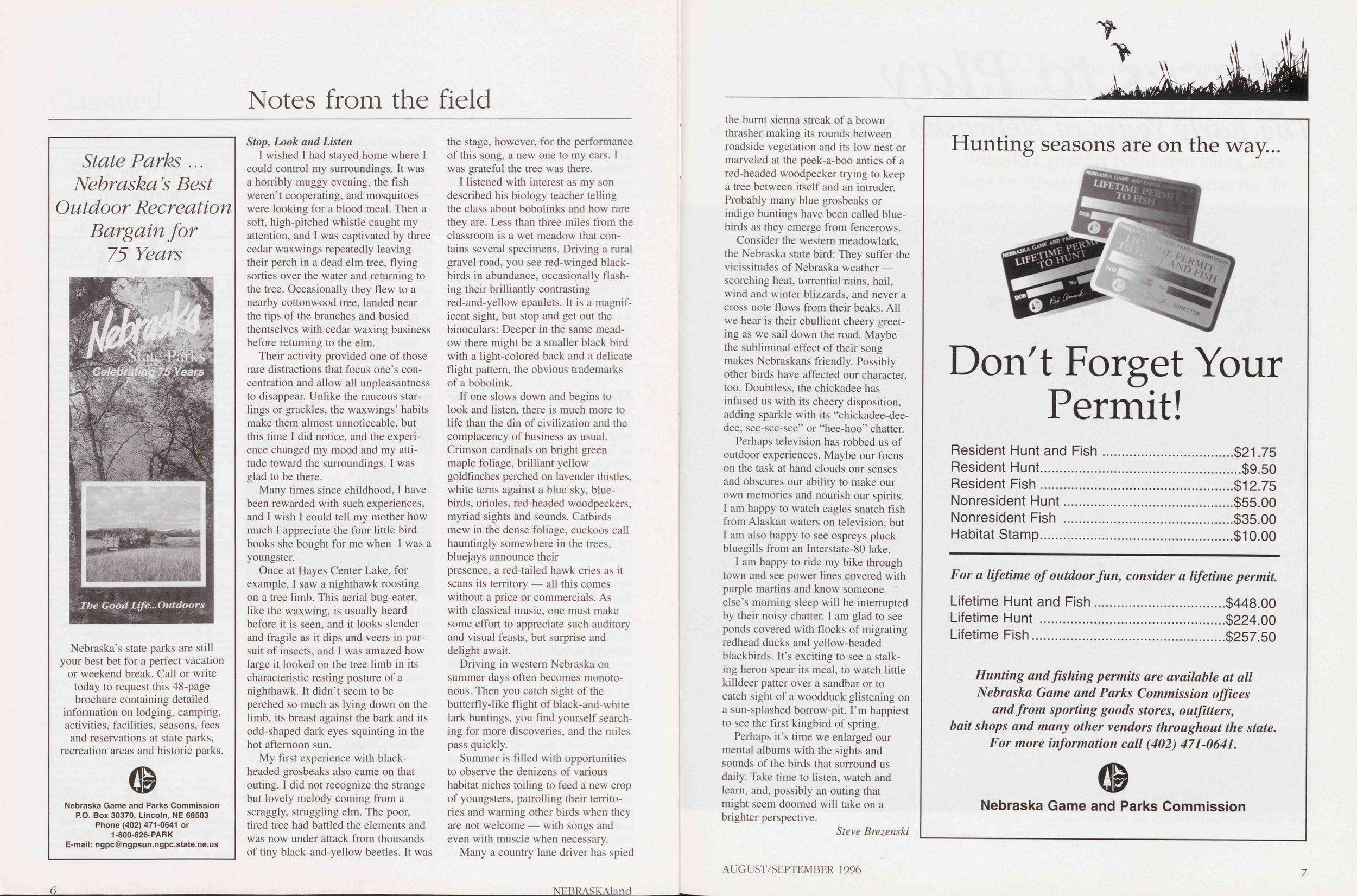
Notes from the field
State Parks ... Nebraska ys Best Outdoor Recreation Bargain for 75 Years Nebraska's state parks are still your best bet for a perfect vacation or weekend break. Call or write today to request this 48-page brochure containing detailed information on lodging, camping, activities, facilities, seasons, fees and reservations at state parks, recreation areas and historic parks. Nebraska Game and Parks Commission P.O. Box 30370, Lincoln, NE 68503 Phone (402) 471-0641 or 1-800-826-PARK E-mail: ngpc@ngpsun.ngpc.state.ne.us Stop, Look and ListenI wished I had stayed home where I could control my surroundings. It was a horribly muggy evening, the fish weren't cooperating, and mosquitoes were looking for a blood meal. Then a soft, high-pitched whistle caught my attention, and I was captivated by three cedar waxwings repeatedly leaving their perch in a dead elm tree, flying sorties over the water and returning to the tree. Occasionally they flew to a nearby cottonwood tree, landed near the tips of the branches and busied themselves with cedar waxing business before returning to the elm.
Their activity provided one of those rare distractions that focus one's concentration and allow all unpleasantness to disappear. Unlike the raucous starlings or grackles, the waxwings' habits make them almost unnoticeable, but this time I did notice, and the experience changed my mood and my attitude toward the surroundings. I was glad to be there.
Many times since childhood, I have been rewarded with such experiences, and I wish I could tell my mother how much I appreciate the four little bird books she bought for me when I was a youngster.
Once at Hayes Center Lake, for example, I saw a nighthawk roosting on a tree limb. This aerial bug-eater, like the waxwing, is usually heard before it is seen, and it looks slender and fragile as it dips and veers in pursuit of insects, and I was amazed how large it looked on the tree limb in its characteristic resting posture of a nighthawk. It didn't seem to be perched so much as lying down on the limb, its breast against the bark and its odd-shaped dark eyes squinting in the hot afternoon sun.
My first experience with black headed grosbeaks also came on that outing. I did not recognize the strange but lovely melody coming from a scraggly, struggling elm. The poor, tired tree had battled the elements and was now under attack from thousands of tiny black-and-yellow beetles. It was the stage, however, for the performance of this song, a new one to my ears. I was grateful the tree was there.
I listened with interest as my son described his biology teacher telling the class about bobolinks and how rare they are. Less than three miles from the classroom is a wet meadow that contains several specimens. Driving a rural gravel road, you see red-winged black birds in abundance, occasionally flashing their brilliantly contrasting red-and-yellow epaulets. It is a magnificent sight, but stop and get out the binoculars: Deeper in the same meadow there might be a smaller black bird with a light-colored back and a delicate flight pattern, the obvious trademarks of a bobolink.
If one slows down and begins to look and listen, there is much more to life than the din of civilization and the complacency of business as usual. Crimson cardinals on bright green maple foliage, brilliant yellow goldfinches perched on lavender thistles, white terns against a blue sky, blue- birds, orioles, red-headed woodpeckers, myriad sights and sounds. Catbirds mew in the dense foliage, cuckoos call hauntingly somewhere in the trees, bluejays announce their presence, a red-tailed hawk cries as it scans its territory — all this comes without a price or commercials. As with classical music, one must make some effort to appreciate such auditory and visual feasts, but surprise and delight await.
Driving in western Nebraska on summer days often becomes monotonous. Then you catch sight of the butterfly-like flight of black-and-white lark buntings, you find yourself searching for more discoveries, and the miles pass quickly.
Summer is filled with opportunities to observe the denizens of various habitat niches toiling to feed a new crop of youngsters, patrolling their territories and warning other birds when they are not welcome — with songs and even with muscle when necessary.
Many a country lane driver has spied 6 NEBRASKAland the burnt sienna streak of a brown thrasher making its rounds between roadside vegetation and its low nest or marveled at the peek-a-boo antics of a red-headed woodpecker trying to keep a tree between itself and an intruder. Probably many blue grosbeaks or indigo buntings have been called blue birds as they emerge from fencerows.
Consider the western meadowlark, the Nebraska state bird: They suffer the vicissitudes of Nebraska weather — scorching heat, torrential rains, hail, wind and winter blizzards, and never a cross note flows from their beaks. All we hear is their ebullient cheery greeting as we sail down the road. Maybe the subliminal effect of their song makes Nebraskans friendly. Possibly other birds have affected our character, too. Doubtless, the chickadee has infused us with its cheery disposition, adding sparkle with its "chickadee-dee-dee, see-see-see" or "hee-hoo" chatter.
Perhaps television has robbed us of outdoor experiences. Maybe our focus on the task at hand clouds our senses and obscures our ability to make our own memories and nourish our spirits. I am happy to watch eagles snatch fish from Alaskan waters on television, but I am also happy to see ospreys pluck bluegills from an Interstate-80 lake.
I am happy to ride my bike through town and see power lines covered with purple martins and know someone else's morning sleep will be interrupted by their noisy chatter. I am glad to see ponds covered with flocks of migrating redhead ducks and yellow-headed blackbirds. It's exciting to see a stalking heron spear its meal, to watch little killdeer patter over a sandbar or to catch sight of a wood duck glistening on a sun-splashed borrow-pit. I'm happiest to see the first kingbird of spring.
Perhaps it's time we enlarged our mental albums with the sights and sounds of the birds that surround us daily. Take time to listen, watch and learn, and, possibly an outing that might seem doomed will take on a brighter perspective.
Steve Brezenski Hunting seasons are on the way.. Don't Forget Your Permit! Resident Hunt and Fish$21.75 Resident Hunt$9.50 Resident Fish$12.75 Nonresident Hunt$55.00 Nonresident Fish$35.00 Habitat Stamp$10.00 For a lifetime of outdoor fun, consider a lifetime permit. Lifetime Hunt and Fish$448.00 Lifetime Hunt$224.00 Lifetime Fish$257.50 Hunting and fishing permits are available at all Nebraska Game and Parks Commission offices and from sporting goods stores, outfitters, bait shops and many other vendors throughout the state. For more information call (402) 471-0641. Nebraska Game and Parks Commission AUGUST/SEPTEMBER 1996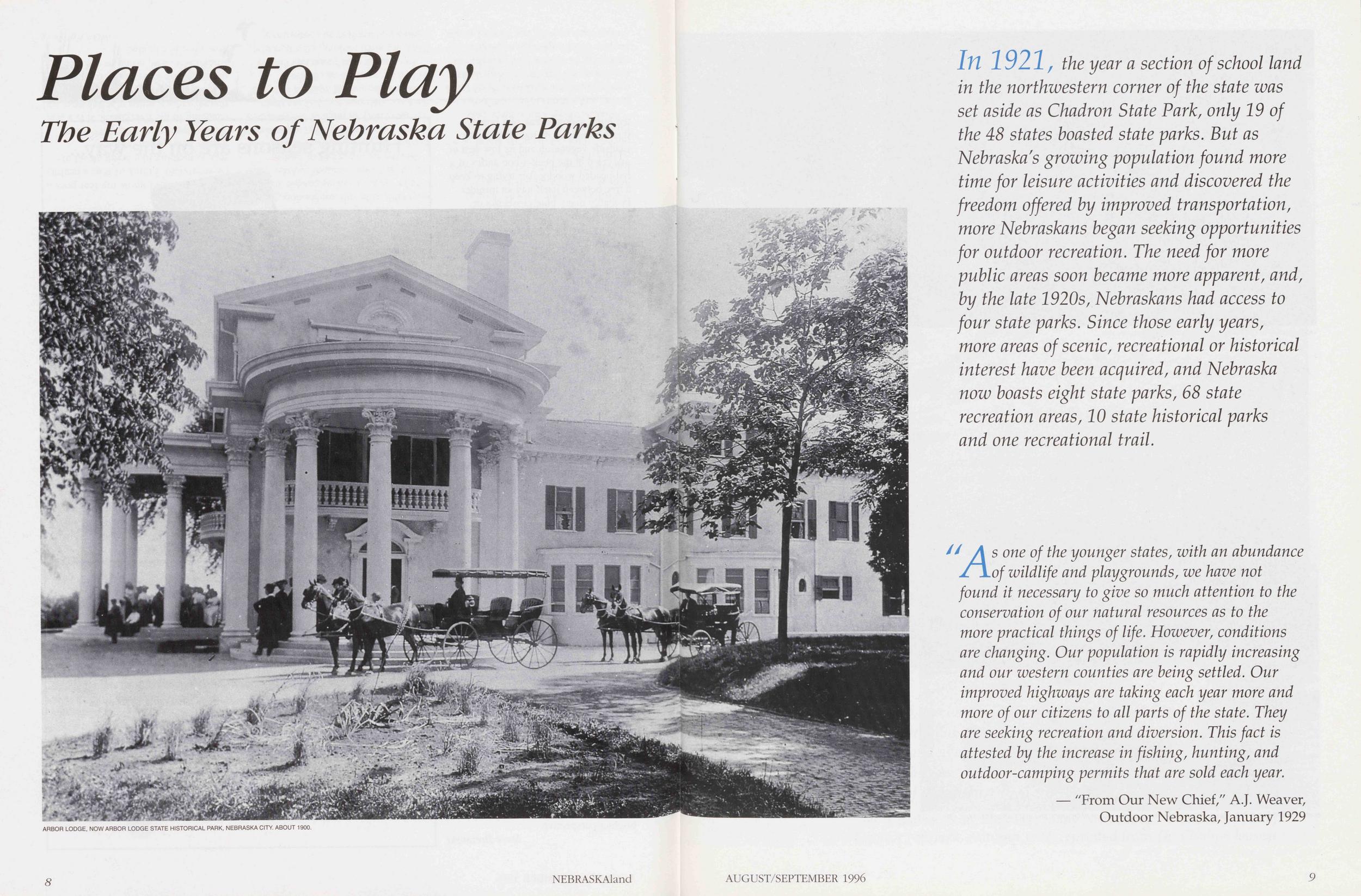
Places to Play f Nebraska
in ±921, the year a section of school land in the northwestern corner of the state was set aside as Chadron State Park, only 19 of the 48 states boasted state parks. But as Nebraska's growing population found more time for leisure activities and discovered the freedom offered by improved transportation, more Nebraskans began seeking opportunities for outdoor recreation. The need for more public areas soon became more apparent, and, by the late 1920s, Nebraskans had access to four state parks. Since those early years, more areas of scenic, recreational or historical interest have been acquired, and Nebraska now boasts eight state parks, 68 state recreation areas, 10 state historical parks and one recreational trail.
H As one of the younger states, with an abundance jLJLof wildlife and playgrounds, we have not found it necessary to give so much attention to the conservation of our natural resources as to the more practical things of life. However, conditions are changing. Our population is rapidly increasing and our western counties are being settled. Our improved highways are taking each year more and more of our citizens to all parts of the state. They are seeking recreation and diversion. This fact is attested by the increase in fishing, hunting, and outdoor-camping permits that are sold each year.
— "From Our New Chief," A.J. Weaver, Outdoor Nebraska, January 1929 AUGUST/SEPTEMBER 1996 9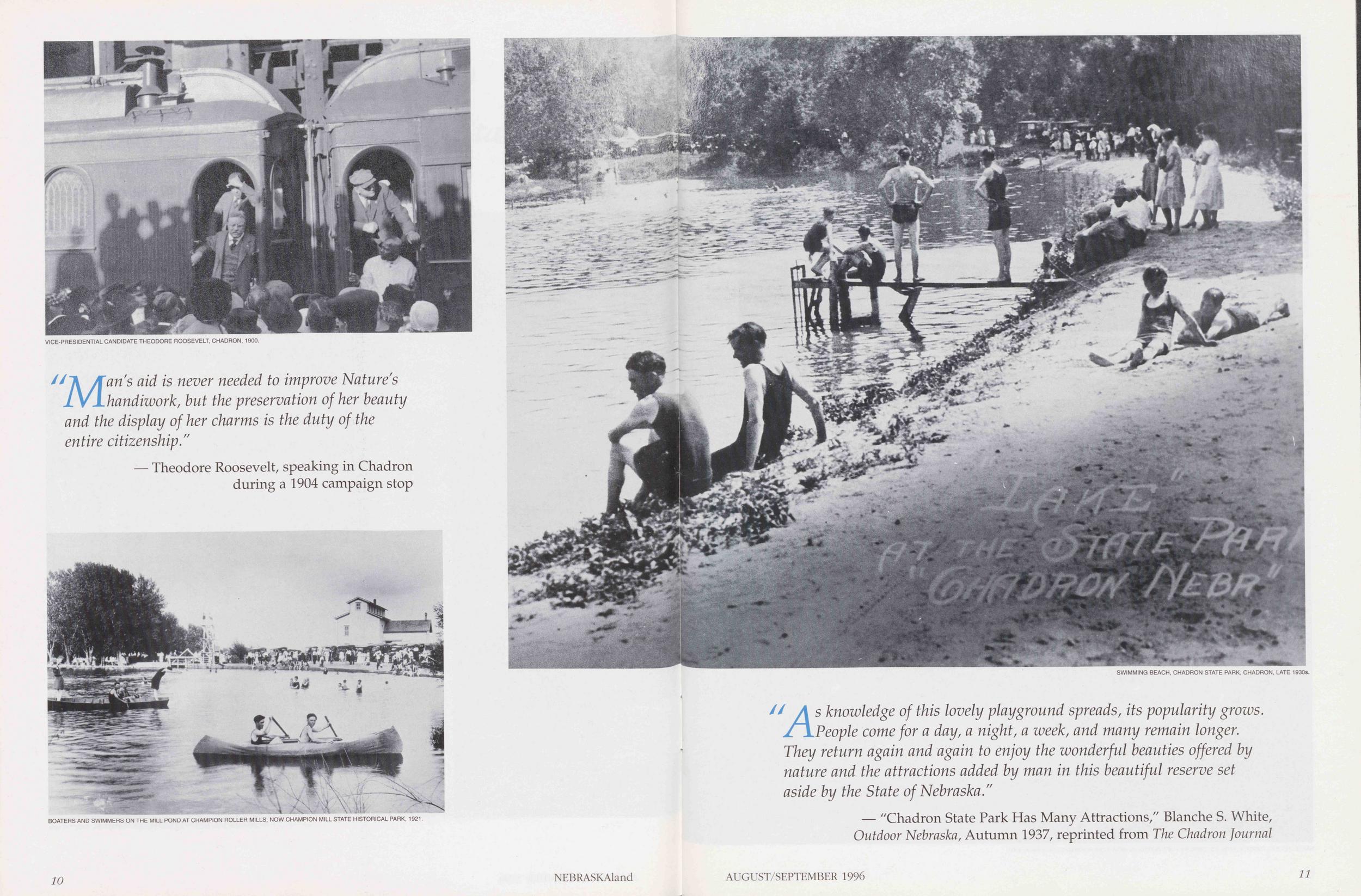
Kan's aid is never needed to improve Nature's handiwork, but the preservation of her beauty and the display of her charms is the duty of the entire citizenship."
— Theodore Roosevelt, speaking in Chadron during a 1904 campaign stop// A s knowledge of this lovely playground spreads, its popularity grows. ZLPeople come for a day, a night, a week, and many remain longer. They return again and again to enjoy the wonderful beauties offered by nature and the attractions added by man in this beautiful reserve set aside by the State of Nebraska."
— "Chadron State Park Has Many Attractions," Blanche S. White, Outdoor Nebraska, Autumn 1937, reprinted from The Chadron Journal AUGUST/SEPTEMBER 1996 11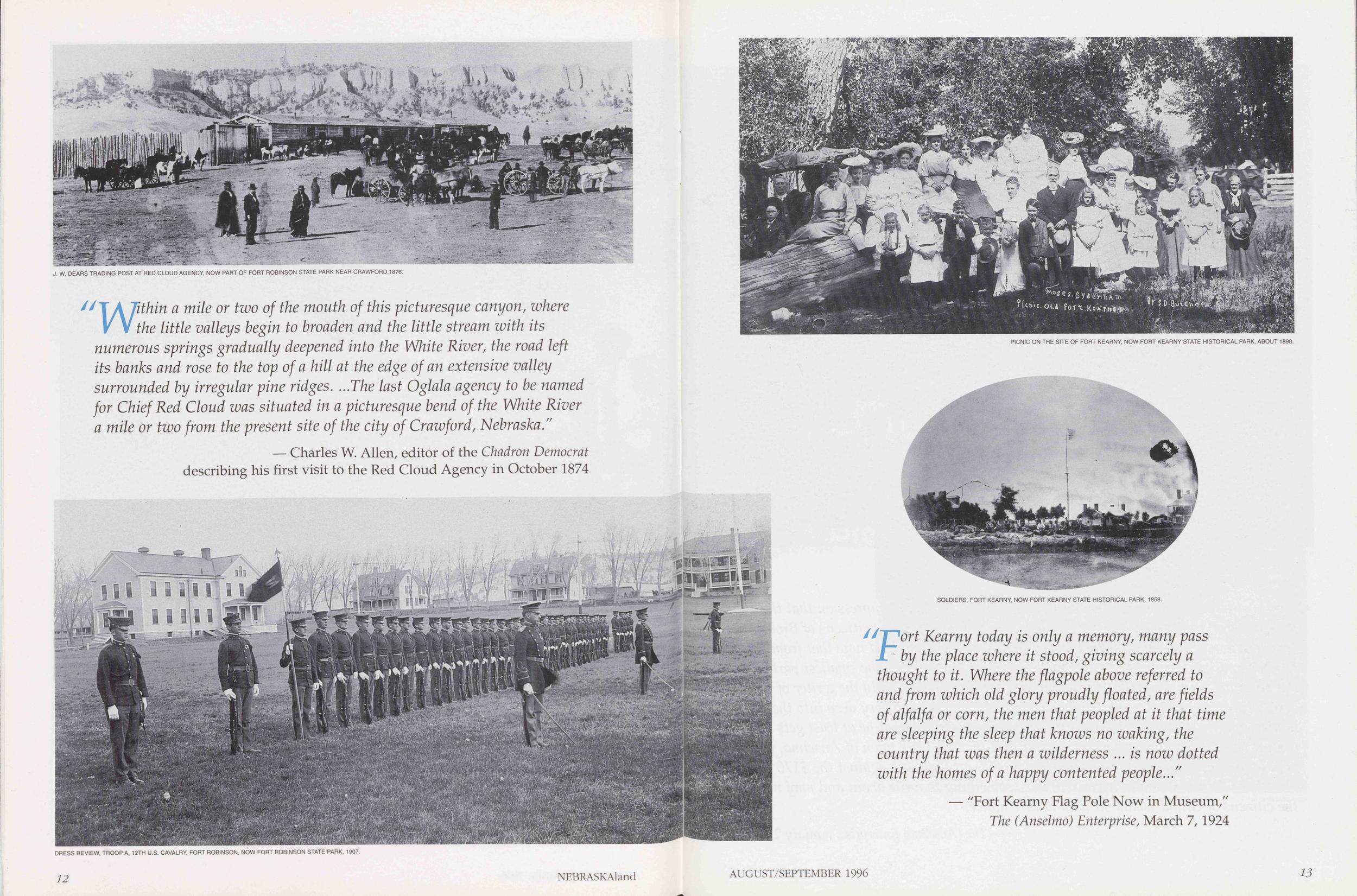
within a mile or two of the mouth of this picturesque canyon, where V V the little valleys begin to broaden and the little stream with its numerous springs gradually deepened into the White River, the road left its banks and rose to the top of a hill at the edge of an extensive valley surrounded by irregular pine ridges. ...The last Oglala agency to be named for Chief Red Cloud was situated in a picturesque bend of the White River a mile or two from the present site of the city of Crawford, Nebraska/'
— Charles W. Allen, editor of the Chadron Democrat describing his first visit to the Red Cloud Agency in October 1874S/TJort Kearny today is only a memory, many pass jl by the place where it stood, giving scarcely a thought to it. Where the flagpole above referred to and from which old glory proudly floated, are fields of alfalfa or corn, the men that peopled at it that time are sleeping the sleep that knows no waking, the country that was then a wilderness ... is now dotted with the homes of a happy contented people..."
— "Fort Kearny Flag Pole Now in Museum," The (Anselmo) Enterprise, March 7,1924 AUGUST/SEPTEMBER 1996 13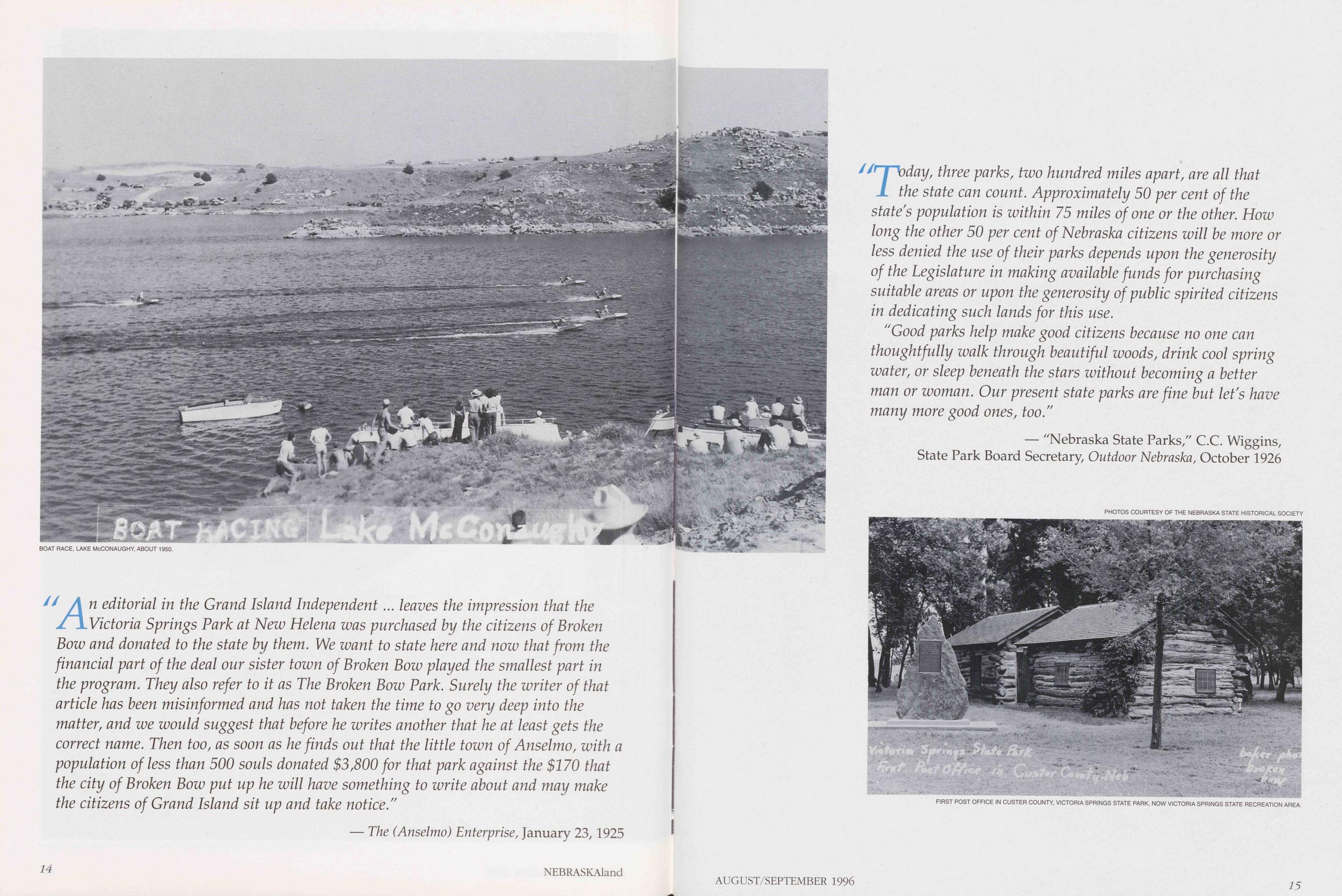
f A n editorial in the Grand Island Independent... leaves the impression that the jT\Victoria Springs Park at New Helena was purchased by the citizens of Broken Bow and donated to the state by them. We want to state here and now that from the financial part of the deal our sister town of Broken Bow played the smallest part in the program. They also refer to it as The Broken Bow Park. Surely the writer of that article has been misinformed and has not taken the time to go very deep into the matter, and we would suggest that before he writes another that he at least gets the correct name. Then too, as soon as he finds out that the little town of Anselmo, with a population of less than 500 souls donated $3,800 for that park against the $170 that the city of Broken Bow put up he will have something to write about and may make the citizens of Grand Island sit up and take notice
— The (Anselmo) Enterprise, January 23,192 14 NEBRASKAlandtoday, three parks, two hundred miles apart, are all that JL the state can count. Approximately 50 per cent of the state's population is within 75 miles of one or the other. How long the other 50 per cent of Nebraska citizens will be more or less denied the use of their parks depends upon the generosity of the Legislature in making available funds for purchasing suitable areas or upon the generosity of public spirited citizens in dedicating such lands for this use.
"Good parks help make good citizens because no one can thoughtfully walk through beautiful woods, drink cool spring water, or sleep beneath the stars without becoming a better man or woman. Our present state parks are fine but let's have many more good ones, too."
— "Nebraska State Parks," C.C. Wiggins, State Park Board Secretary, Outdoor Nebraska, October 1926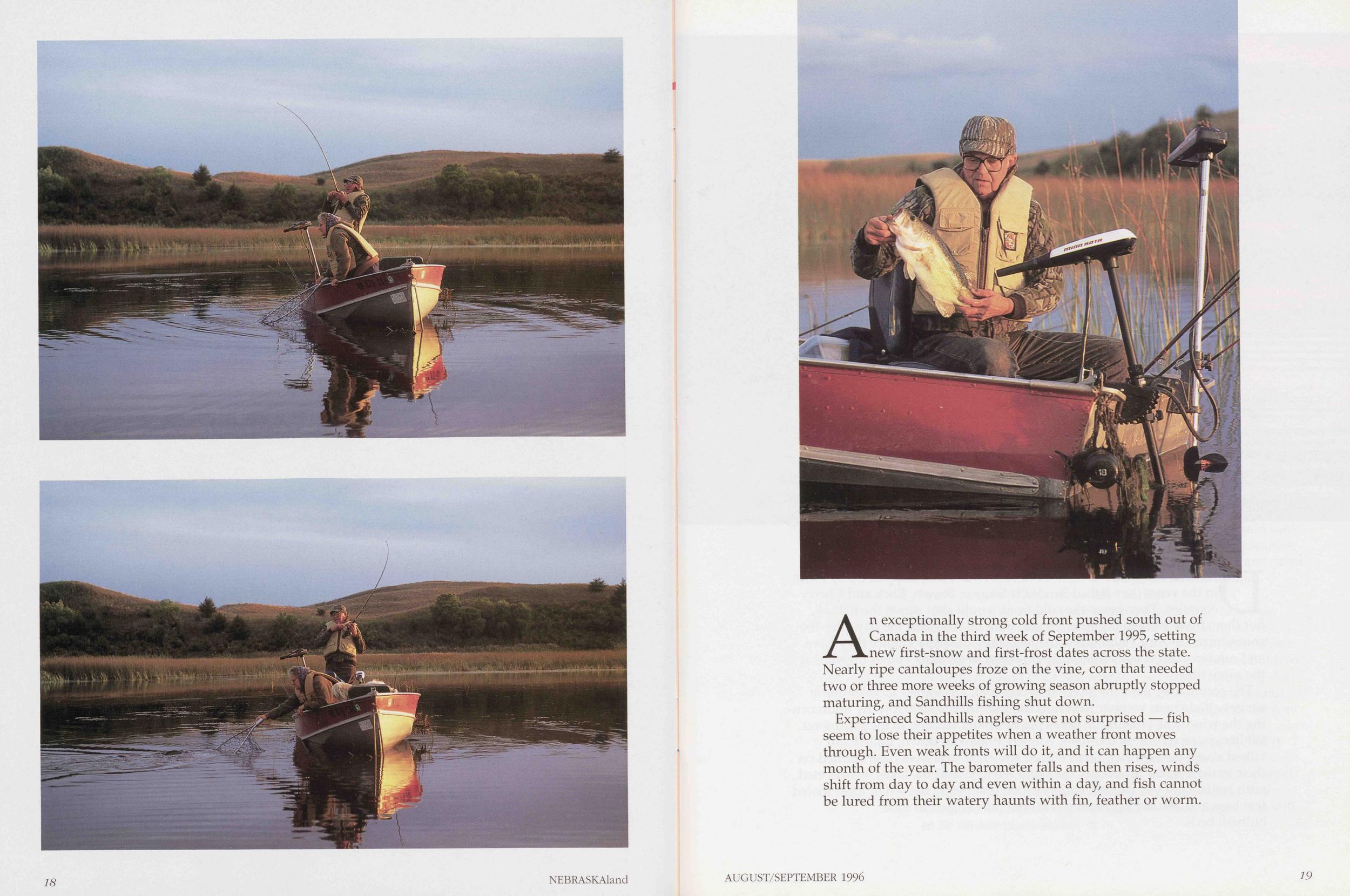
An exceptionally strong cold front pushed south out of Canada in the third week of September 1995, setting new first-snow and first-frost dates across the state. Nearly ripe cantaloupes froze on the vine, corn that needed two or three more weeks of growing season abruptly stopped maturing, and Sandhills fishing shut down.
Experienced Sandhills anglers were not surprised — fish seem to lose their appetites when a weather front moves through. Even weak fronts will do it, and it can happen any month of the year. The barometer falls and then rises, winds shift from day to day and even within a day, and fish cannot be lured from their watery haunts with fin, feather or worm.
AUGUST/SEPTEMBER 1996 19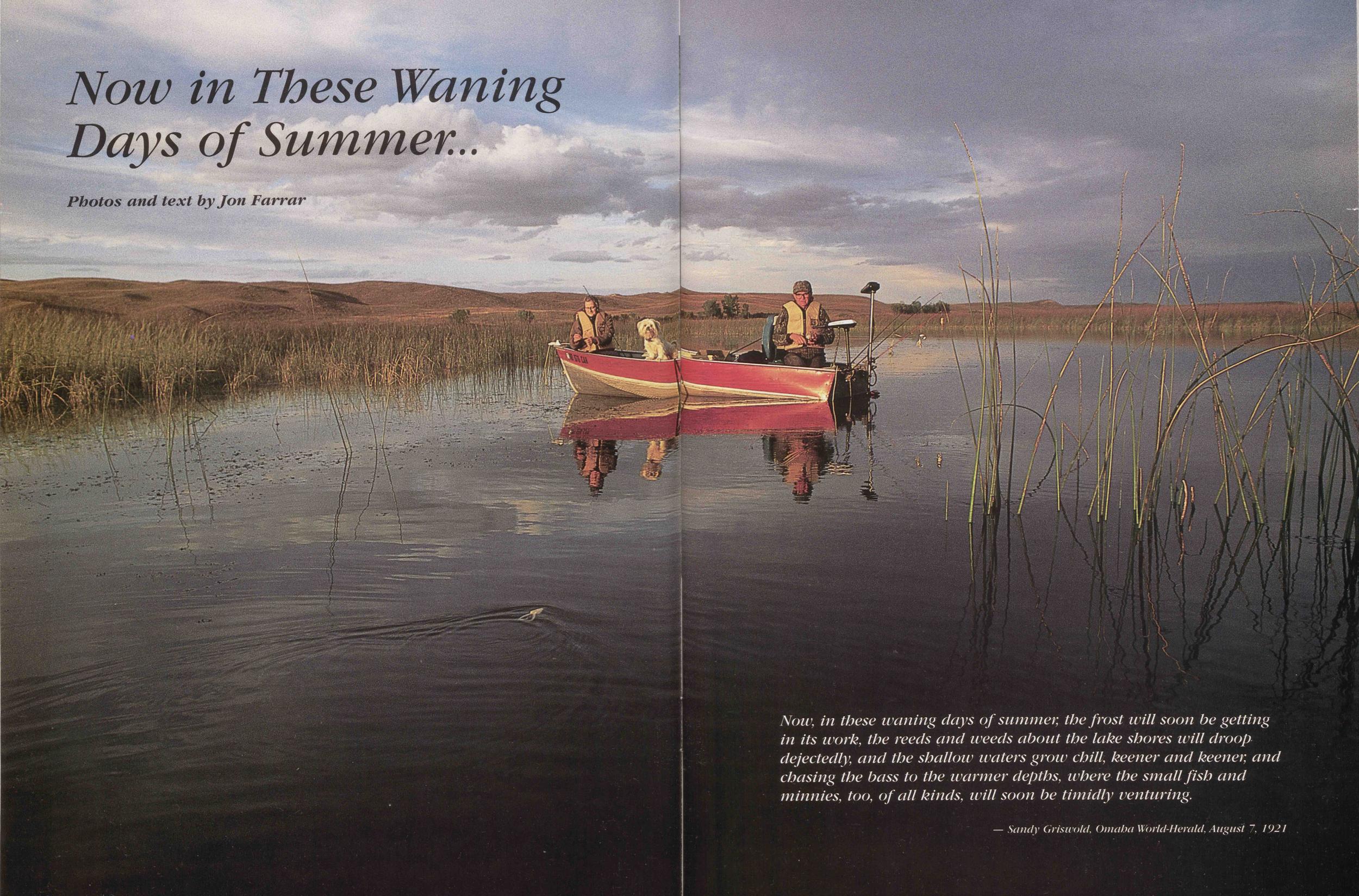
Now in These Waning Days of Summer...
Photos and text by Jon FarrariVas#, in tibese leaning days of summer, the frost will soon be getting in its work, the reeds and weeds about the lake shores will droop dejectedly, and the shallow waters grow chill, keener and keener, and chasing the bass to the warmer depths, where the small fish and minnies, too, of all kinds, will soon be timidly venturing.
— Sandy Griswo/d, Omaha World-Herald, August 7, V)2l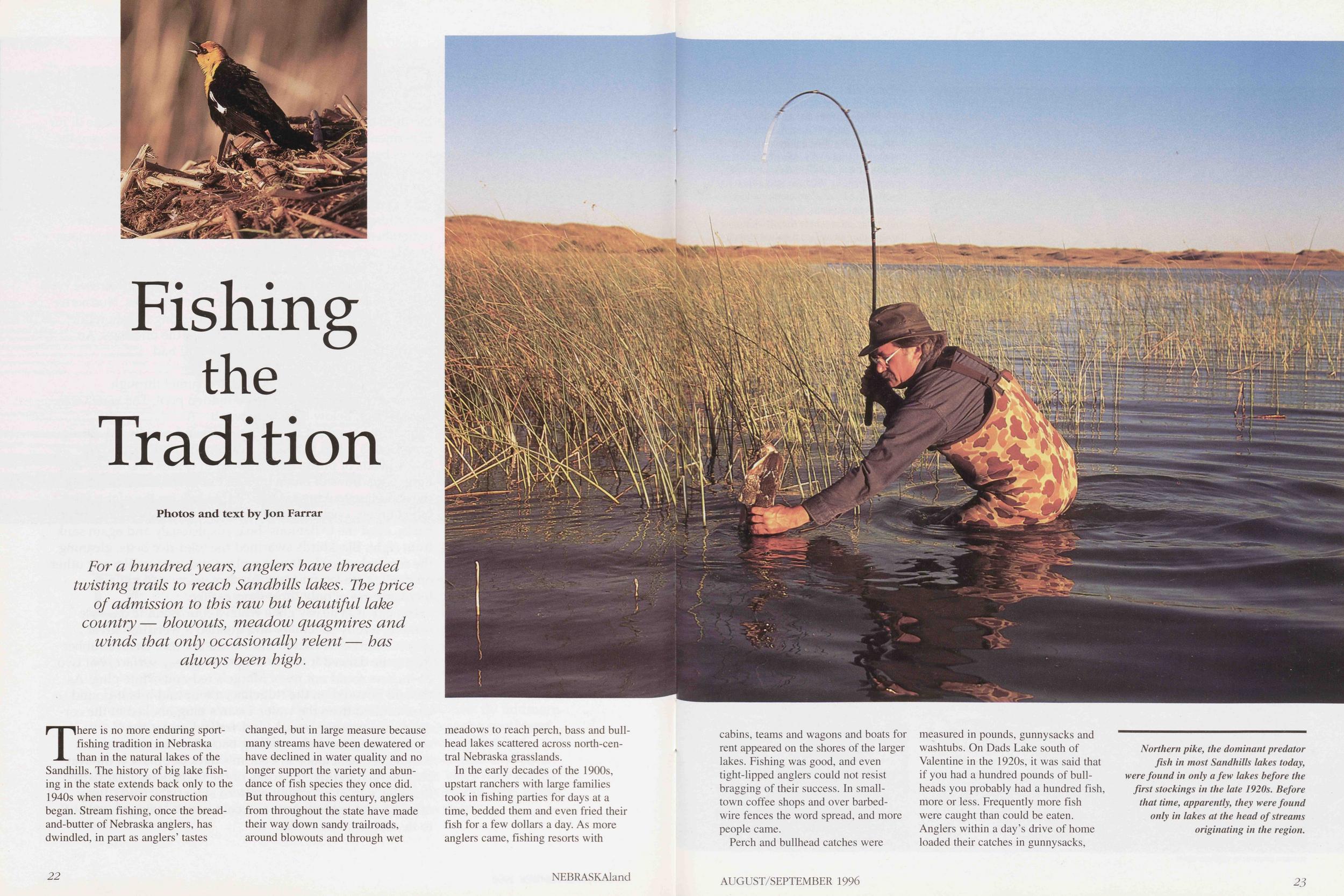
Fishing the Tradition
Photos and text by Jon Farrar For a hundred years, anglers have threaded twisting trails to reach Sandhills lakes. The price of admission to this raw but beautiful lake country — blowouts, meadow quagmires and winds that only occasionally relent — has always been high.There is no more enduring sport fishing tradition in Nebraska than in the natural lakes of the Sandhills. The history of big lake fishing in the state extends back only to the 1940s when reservoir construction began. Stream fishing, once the bread-and-butter of Nebraska anglers, has dwindled, in part as anglers' tastes changed, but in large measure because many streams have been dewatered or have declined in water quality and no longer support the variety and abundance of fish species they once did. But throughout this century, anglers from throughout the state have made their way down sandy trail roads, around blowouts and through wet meadows to reach perch, bass and bullhead lakes scattered across north-central Nebraska grasslands.
In the early decades of the 1900s, upstart ranchers with large families took in fishing parties for days at a time, bedded them and even fried their fish for a few dollars a day. As more anglers came, fishing resorts with 22 NEBRASKAland cabins, teams and wagons and boats for rent appeared on the shores of the larger lakes. Fishing was good, and even tight-lipped anglers could not resist bragging of their success. In small town coffee shops and over barbedwire fences the word spread, and more people came.
Perch and bullhead catches were measured in pounds, gunnysacks and washtubs. On Dads Lake south of Valentine in the 1920s, it was said that if you had a hundred pounds of bull heads you probably had a hundred fish, more or less. Frequently more fish were caught than could be eaten. Anglers within a day's drive of home loaded their catches in gunnysacks,
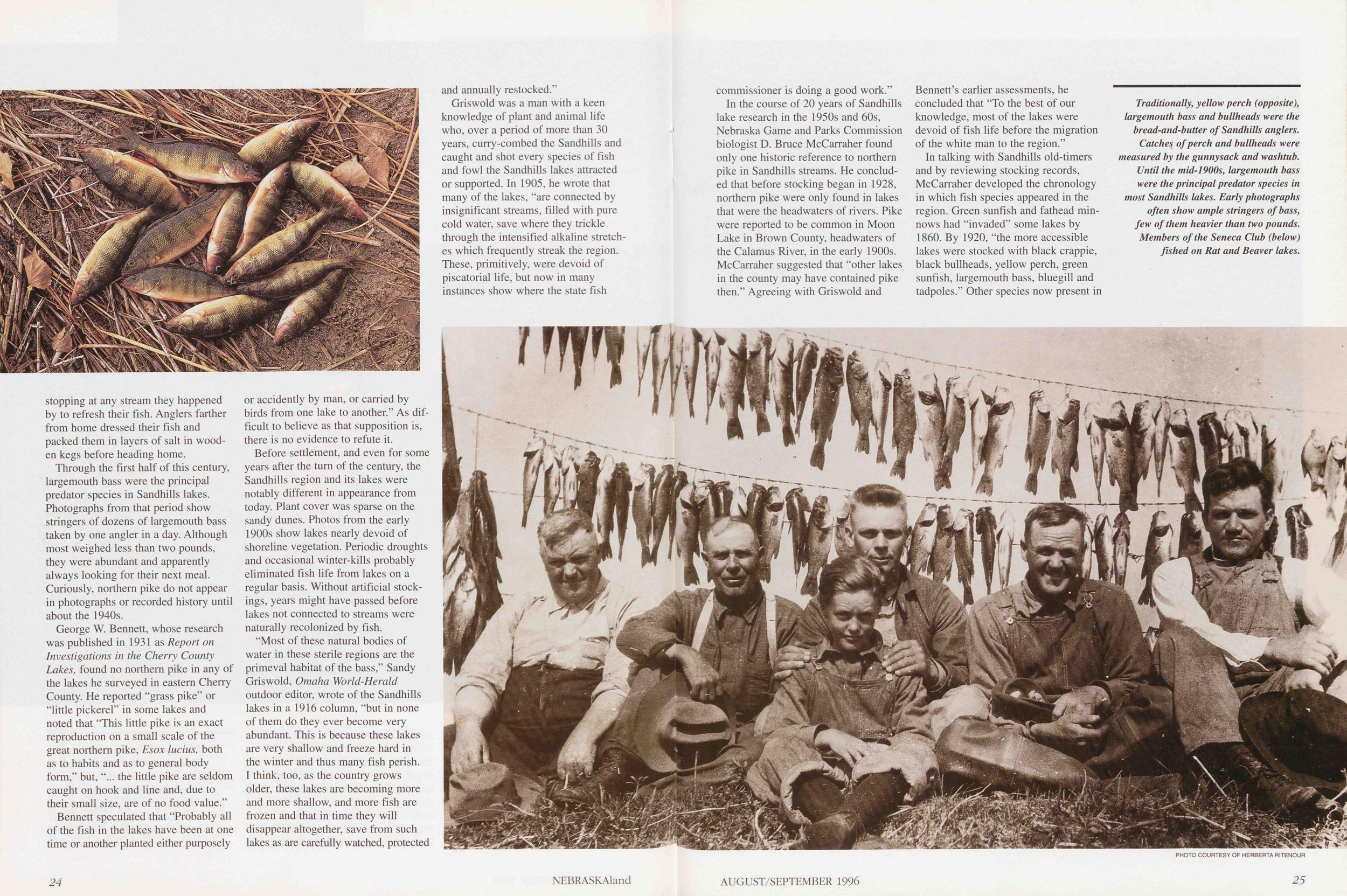
Through the first half of this century, largemouth bass were the principal predator species in Sandhills lakes. Photographs from that period show stringers of dozens of largemouth bass taken by one angler in a day. Although most weighed less than two pounds, they were abundant and apparently always looking for their next meal. Curiously, northern pike do not appear in photographs or recorded history until about the 1940s.
George W. Bennett, whose research was published in 1931 as Report on Investigations in the Cherry County Lakes, found no northern pike in any of the lakes he surveyed in eastern Cherry County. He reported "grass pike" or "little pickerel" in some lakes and noted that "This little pike is an exact reproduction on a small scale of the great northern pike, Esox lucius, both as to habits and as to general body form," but, "... the little pike are seldom caught on hook and line and, due to their small size, are of no food value."
Bennett speculated that "Probably all of the fish in the lakes have been at one time or another planted either purposely or accidentally by man, or carried by birds from one lake to another." As difficult to believe as that supposition is, there is no evidence to refute it.
Before settlement, and even for some years after the turn of the century, the Sandhills region and its lakes were notably different in appearance from today. Plant cover was sparse on the sandy dunes. Photos from the early 1900s show lakes nearly devoid of shoreline vegetation. Periodic droughts and occasional winter-kills probably eliminated fish life from lakes on a regular basis. Without artificial stockings, years might have passed before lakes not connected to streams were naturally recolonized by fish.
"Most of these natural bodies of water in these sterile regions are the primeval habitat of the bass," Sandy Griswold, Omaha World-Herald outdoor editor, wrote of the Sandhills lakes in a 1916 column, "but in none of them do they ever become very abundant. This is because these lakes are very shallow and freeze hard in the winter and thus many fish perish. I think, too, as the country grows older, these lakes are becoming more and more shallow, and more fish are frozen and that in time they will disappear altogether, save from such lakes as are carefully watched, protected and annually restocked."
Griswold was a man with a keen knowledge of plant and animal life who, over a period of more than 30 years, curry-combed the Sandhills and caught and shot every species of fish and fowl the Sandhills lakes attracted or supported. In 1905, he wrote that many of the lakes, "are connected by insignificant streams, filled with pure cold water, save where they trickle through the intensified alkaline stretches which frequently streak the region. These, primitively, were devoid of piscatorial life, but now in many instances show where the state fish 24 NEBRASKAland commissioner is doing a good work."
In the course of 20 years of Sandhills lake research in the 1950s and 60s, Nebraska Game and Parks Commission biologist D. Bruce McCarraher found only one historic reference to northern pike in Sandhills streams. He concluded that before stocking began in 1928, northern pike were only found in lakes that were the headwaters of rivers. Pike were reported to be common in Moon Lake in Brown County, headwaters of the Calamus River, in the early 1900s. McCarraher suggested that "other lakes in the county may have contained pike then." Agreeing with Griswold and Bennett's earlier assessments, he concluded that "To the best of our knowledge, most of the lakes were devoid of fish life before the migration of the white man to the region."
In talking with Sandhills old-timers and by reviewing stocking records, McCarraher developed the chronology in which fish species appeared in the region. Green sunfish and fathead minnows had "invaded" some lakes by 1860. By 1920, "the more accessible lakes were stocked with black crappie, black bullheads, yellow perch, green sunfish, largemouth bass, bluegill and tadpoles." Other species now present in
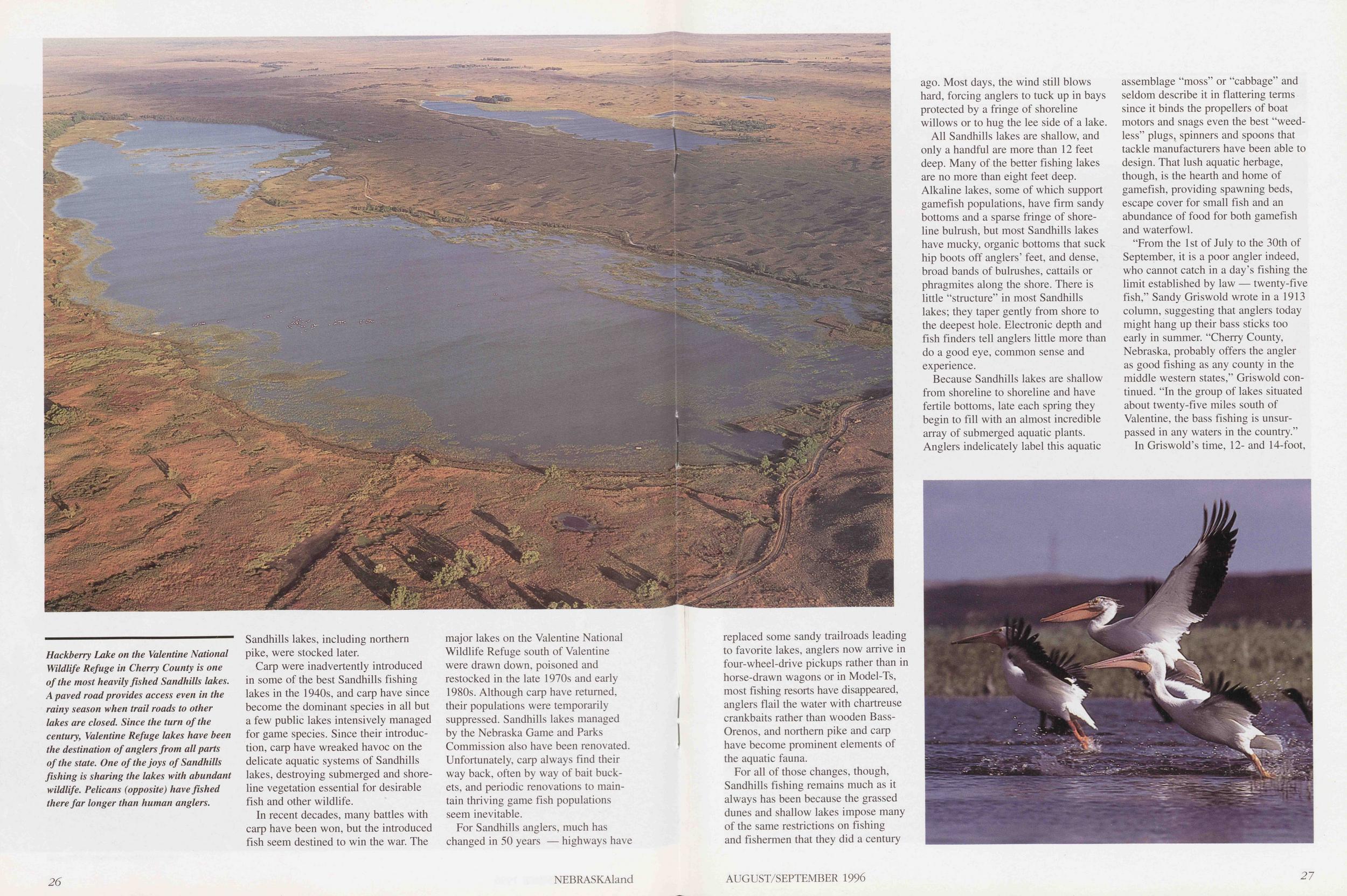
Carp were inadvertently introduced in some of the best Sandhills fishing lakes in the 1940s, and carp have since become the dominant species in all but a few public lakes intensively managed for game species. Since their introduction, carp have wreaked havoc on the delicate aquatic systems of Sandhills lakes, destroying submerged and shoreline vegetation essential for desirable fish and other wildlife.
In recent decades, many battles with carp have been won, but the introduced fish seem destined to win the war. The major lakes on the Valentine National Wildlife Refuge south of Valentine were drawn down, poisoned and restocked in the late 1970s and early 1980s. Although carp have returned, their populations were temporarily suppressed. Sandhills lakes managed by the Nebraska Game and Parks Commission also have been renovated. Unfortunately, carp always find their way back, often by way of bait buckets, and periodic renovations to maintain thriving game fish populations seem inevitable.
For Sandhills anglers, much has changed in 50 years — highways have 26 NEBRASKAland replaced some sandy trail roads leading to favorite lakes, anglers now arrive in four-wheel-drive pickups rather than in horse-drawn wagons or in Model-Ts, most fishing resorts have disappeared, anglers flail the water with chartreuse crank baits rather than wooden Bass Orenos, and northern pike and carp have become prominent elements of the aquatic fauna.
For all of those changes, though, Sandhills fishing remains much as it always has been because the grassed dunes and shallow lakes impose many of the same restrictions on fishing and fishermen that they did a century ago. Most days, the wind still blows hard, forcing anglers to tuck up in bays protected by a fringe of shoreline willows or to hug the lee side of a lake.
All Sandhills lakes are shallow, and only a handful are more than 12 feet deep. Many of the better fishing lakes are no more than eight feet deep. Alkaline lakes, some of which support gamefish populations, have firm sandy bottoms and a sparse fringe of shoreline bulrush, but most Sandhills lakes have mucky, organic bottoms that suck hip boots off anglers' feet, and dense, broad bands of bulrushes, cattails or phragmites along the shore. There is little "structure" in most Sandhills lakes; they taper gently from shore to the deepest hole. Electronic depth and fish finders tell anglers little more than do a good eye, common sense and experience.
Because Sandhills lakes are shallow from shoreline to shoreline and have fertile bottoms, late each spring they begin to fill with an almost incredible array of submerged aquatic plants. Anglers indelicately label this aquatic assemblage "moss" or "cabbage" and seldom describe it in flattering terms since it binds the propellers of boat motors and snags even the best "weedless" plugs, spinners and spoons that tackle manufacturers have been able to design. That lush aquatic herbage, though, is the hearth and home of gamefish, providing spawning beds, escape cover for small fish and an abundance of food for both gamefish and waterfowl.
"From the 1st of July to the 30th of September, it is a poor angler indeed, who cannot catch in a day's fishing the limit established by law — twenty-five fish," Sandy Griswold wrote in a 1913 column, suggesting that anglers today might hang up their bass sticks too early in summer. "Cherry County, Nebraska, probably offers the angler as good fishing as any county in the middle western states," Griswold continued. "In the group of lakes situated about twenty-five miles south of Valentine, the bass fishing is unsurpassed in any waters in the country."
In Griswold's time, 12- and 14-foot,
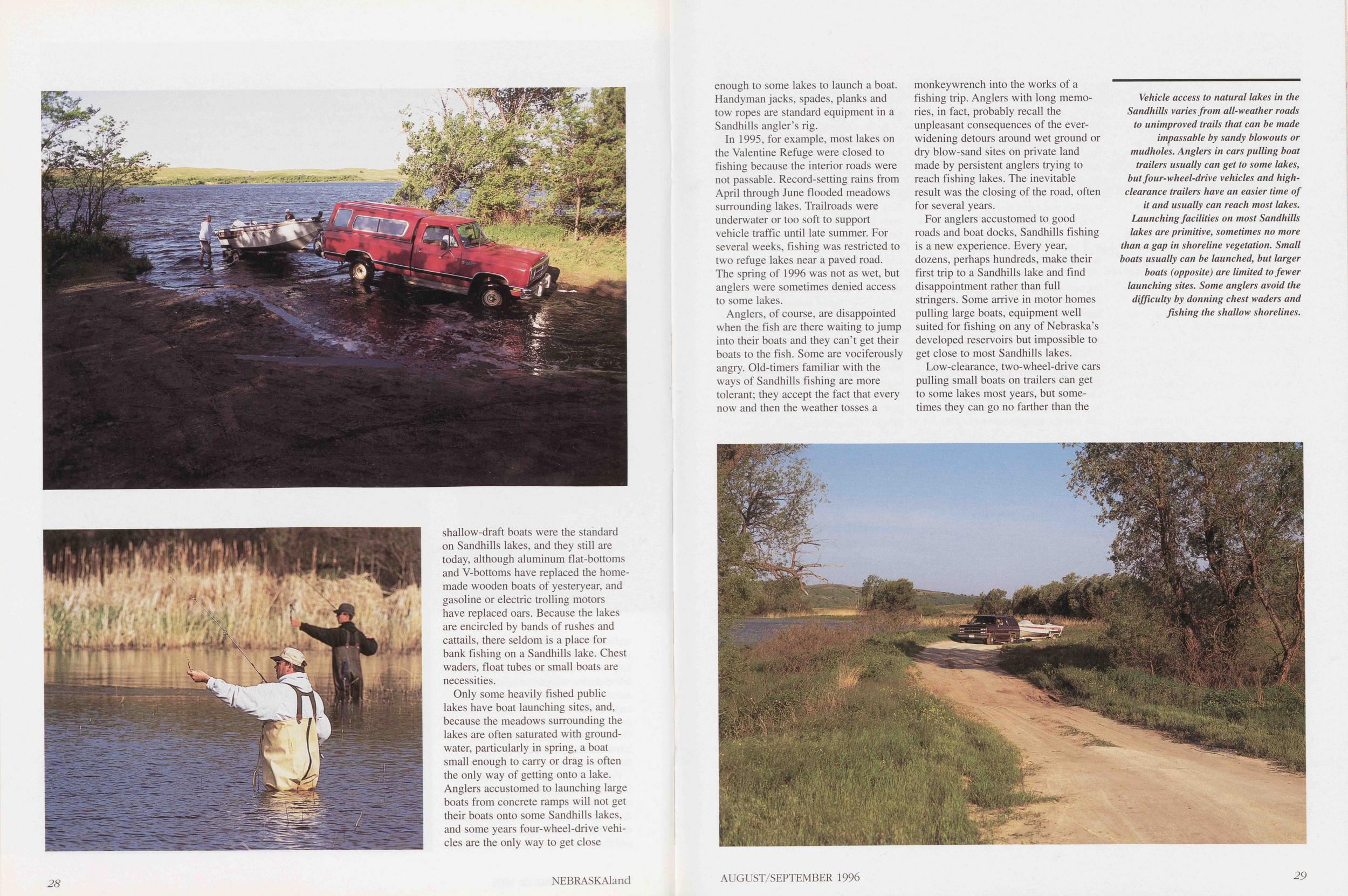
Only some heavily fished public lakes have boat launching sites, and, because the meadows surrounding the lakes are often saturated with groundwater, particularly in spring, a boat small enough to carry or drag is often the only way of getting onto a lake. Anglers accustomed to launching large boats from concrete ramps will not get their boats onto some Sandhills lakes, and some years four-wheel-drive vehicles are the only way to get close 28 NEBRASKAland enough to some lakes to launch a boat. Handyman jacks, spades, planks and tow ropes are standard equipment in a Sandhills angler's rig.
In 1995, for example, most lakes on the Valentine Refuge were closed to fishing because the interior roads were not passable. Record-setting rains from April through June flooded meadows surrounding lakes. Trail roads were underwater or too soft to support vehicle traffic until late summer. For several weeks, fishing was restricted to two refuge lakes near a paved road. The spring of 1996 was not as wet, but anglers were sometimes denied access to some lakes.
Anglers, of course, are disappointed when the fish are there waiting to jump into their boats and they can't get their boats to the fish. Some are vociferously angry. Old-timers familiar with the ways of Sandhills fishing are more tolerant; they accept the fact that every now and then the weather tosses a monkey wrench into the works of a fishing trip. Anglers with long memories, in fact, probably recall the unpleasant consequences of the everwidening detours around wet ground or dry blow-sand sites on private land made by persistent anglers trying to reach fishing lakes. The inevitable result was the closing of the road, often for several years.
For anglers accustomed to good roads and boat docks, Sandhills fishing is a new experience. Every year, dozens, perhaps hundreds, make their first trip to a Sandhills lake and find disappointment rather than full stringers. Some arrive in motor homes pulling large boats, equipment well suited for fishing on any of Nebraska's developed reservoirs but impossible to get close to most Sandhills lakes.
Low-clearance, two-wheel-drive cars pulling small boats on trailers can get to some lakes most years, but sometimes they can go no farther than the
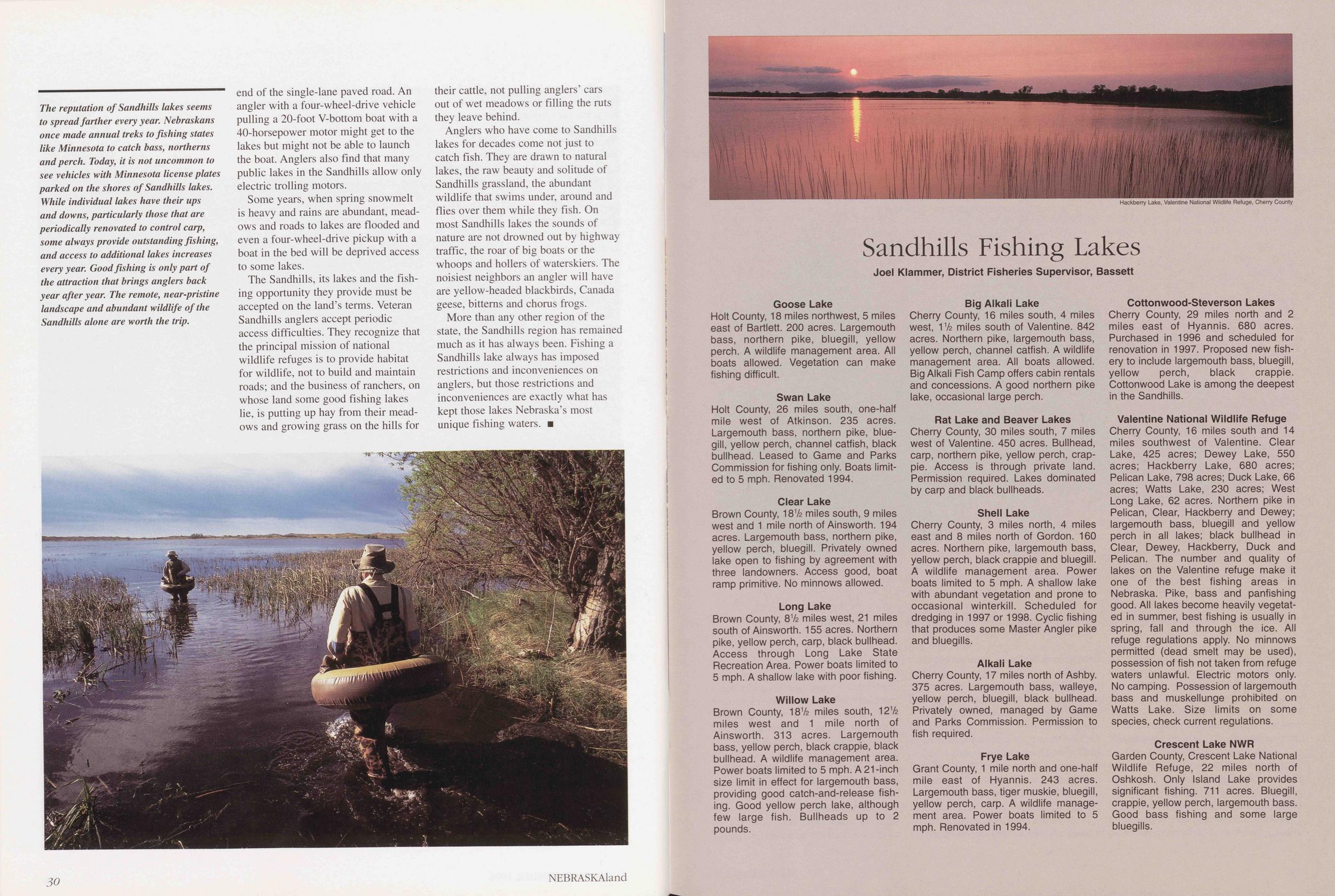
Some years, when spring snowmelt is heavy and rains are abundant, meadows and roads to lakes are flooded and even a four-wheel-drive pickup with a boat in the bed will be deprived access to some lakes.
The Sandhills, its lakes and the fishing opportunity they provide must be accepted on the land's terms. Veteran Sandhills anglers accept periodic access difficulties. They recognize that the principal mission of national wildlife refuges is to provide habitat for wildlife, not to build and maintain roads; and the business of ranchers, on whose land some good fishing lakes lie, is putting up hay from their meadows and growing grass on the hills for their cattle, not pulling anglers' cars out of wet meadows or filling the ruts they leave behind.
Anglers who have come to Sandhills lakes for decades come not just to catch fish. They are drawn to natural lakes, the raw beauty and solitude of Sandhills grassland, the abundant wildlife that swims under, around and flies over them while they fish. On most Sandhills lakes the sounds of nature are not drowned out by highway traffic, the roar of big boats or the whoops and hollers of water skiers. The noisiest neighbors an angler will have are yellow-headed blackbirds, Canada geese, bitterns and chorus frogs.
More than any other region of the state, the Sandhills region has remained much as it has always been. Fishing a Sandhills lake always has imposed restrictions and inconveniences on anglers, but those restrictions and inconveniences are exactly what has kept those lakes Nebraska's most unique fishing waters.
Sandhills Fishing Lakes
Joel Klammer, District Fisheries Supervisor, Bassett Goose LakeHolt County, 18 miles northwest, 5 miles east of Bartlett. 200 acres. Largemouth bass, northern pike, bluegill, yellow perch. A wildlife management area. All boats allowed. Vegetation can make fishing difficult.
Swan LakeHolt County, 26 miles south, one-half mile west of Atkinson. 235 acres. Largemouth bass, northern pike, bluegill, yellow perch, channel catfish, black bullhead. Leased to Game and Parks Commission for fishing only. Boats limited to 5 mph. Renovated 1994.
Clear LakeBrown County, I8V2 miles south, 9 miles west and 1 mile north of Ainsworth. 194 acres. Largemouth bass, northern pike, yellow perch, bluegill. Privately owned lake open to fishing by agreement with three landowners. Access good, boat ramp primitive. No minnows allowed.
Long LakeBrown County, 8V2 miles west, 21 miles south of Ainsworth. 155 acres. Northern pike, yellow perch, carp, black bullhead. Access through Long Lake State Recreation Area. Power boats limited to 5 mph. A shallow lake with poor fishing.
Willow LakeBrown County, I8V2 miles south, 12V2 miles west and 1 mile north of Ainsworth. 313 acres. Largemouth bass, yellow perch, black crappie, black bullhead. A wildlife management area. Power boats limited to 5 mph. A 21-inch size limit in effect for largemouth bass, providing good catch-and-release fishing. Good yellow perch lake, although few large fish. Bullheads up to 2 pounds.
Big Alkali LakeCherry County, 16 miles south, 4 miles west, 1V2 miles south of Valentine. 842 acres. Northern pike, largemouth bass, yellow perch, channel catfish. A wildlife management area. All boats allowed. Big Alkali Fish Camp offers cabin rentals and concessions. A good northern pike lake, occasional large perch.
Rat Lake and Beaver LakesCherry County, 30 miles south, 7 miles west of Valentine. 450 acres. Bullhead, carp, northern pike, yellow perch, crappie. Access is through private land. Permission required. Lakes dominated by carp and black bullheads.
Shell LakeCherry County, 3 miles north, 4 miles east and 8 miles north of Gordon. 160 acres. Northern pike, largemouth bass, yellow perch, black crappie and bluegill. A wildlife management area. Power boats limited to 5 mph. A shallow lake with abundant vegetation and prone to occasional winter kill. Scheduled for dredging in 1997 or 1998. Cyclic fishing that produces some Master Angler pike and bluegills.
Alkali LakeCherry County, 17 miles north of Ashby. 375 acres. Largemouth bass, walleye, yellow perch, bluegill, black bullhead. Privately owned, managed by Game and Parks Commission. Permission to fish required.
Frye LakeGrant County, 1 mile north and one-half mile east of Hyannis. 243 acres. Largemouth bass, tiger muskie, bluegill, yellow perch, carp. A wildlife management area. Power boats limited to 5 mph. Renovated in 1994.
Cottonwood-Steverson LakesCherry County, 29 miles north and 2 miles east of Hyannis. 680 acres. Purchased in 1996 and scheduled for renovation in 1997. Proposed new fishery to include largemouth bass, bluegill, yellow perch, black crappie. Cottonwood Lake is among the deepest in the Sandhills.
Valentine National Wildlife RefugeCherry County, 16 miles south and 14 miles southwest of Valentine. Clear Lake, 425 acres; Dewey Lake, 550 acres; Hackberry Lake, 680 acres; Pelican Lake, 798 acres; Duck Lake, 66 acres; Watts Lake, 230 acres; West Long Lake, 62 acres. Northern pike in Pelican, Clear, Hackberry and Dewey; largemouth bass, bluegill and yellow perch in all lakes; black bullhead in Clear, Dewey, Hackberry, Duck and Pelican. The number and quality of lakes on the Valentine refuge make it one of the best fishing areas in Nebraska. Pike, bass and panfishing good. All lakes become heavily vegetated in summer, best fishing is usually in spring, fall and through the ice. All refuge regulations apply. No minnows permitted (dead smelt may be used), possession of fish not taken from refuge waters unlawful. Electric motors only. No camping. Possession of largemouth bass and muskellunge prohibited on Watts Lake. Size limits on some species, check current regulations.
Crescent Lake NWRGarden County, Crescent Lake National Wildlife Refuge, 22 miles north of Oshkosh. Only Island Lake provides significant fishing. 711 acres. Bluegill, crappie, yellow perch, largemouth bass. Good bass fishing and some large bluegills.
Porky in the Pig weeds
Their tree girdling habits gnaw at some people, but porcupines and forests have co-existed for at least two million years. Photos and text by Jon FarrarThe animal world is filled with masters of disguise — walking sticks look like twigs, tree frogs change color to match their background, the plumage of American bitterns mimics stalks of cattail or rush, and the dappled pattern of fawns suggests spots of sunlight falling on the forest floor. Sometimes, though, animals blend with their surroundings by chance.
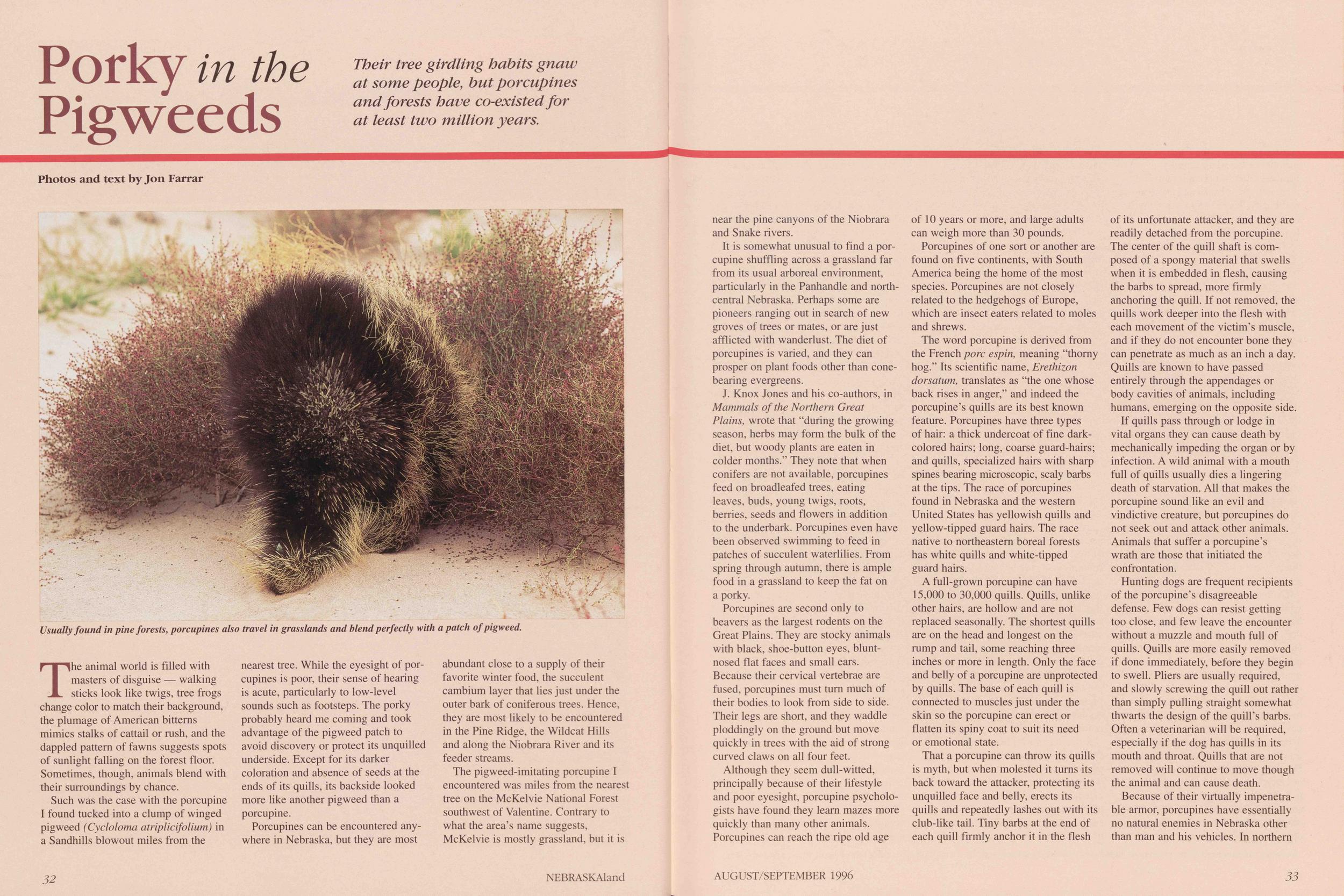
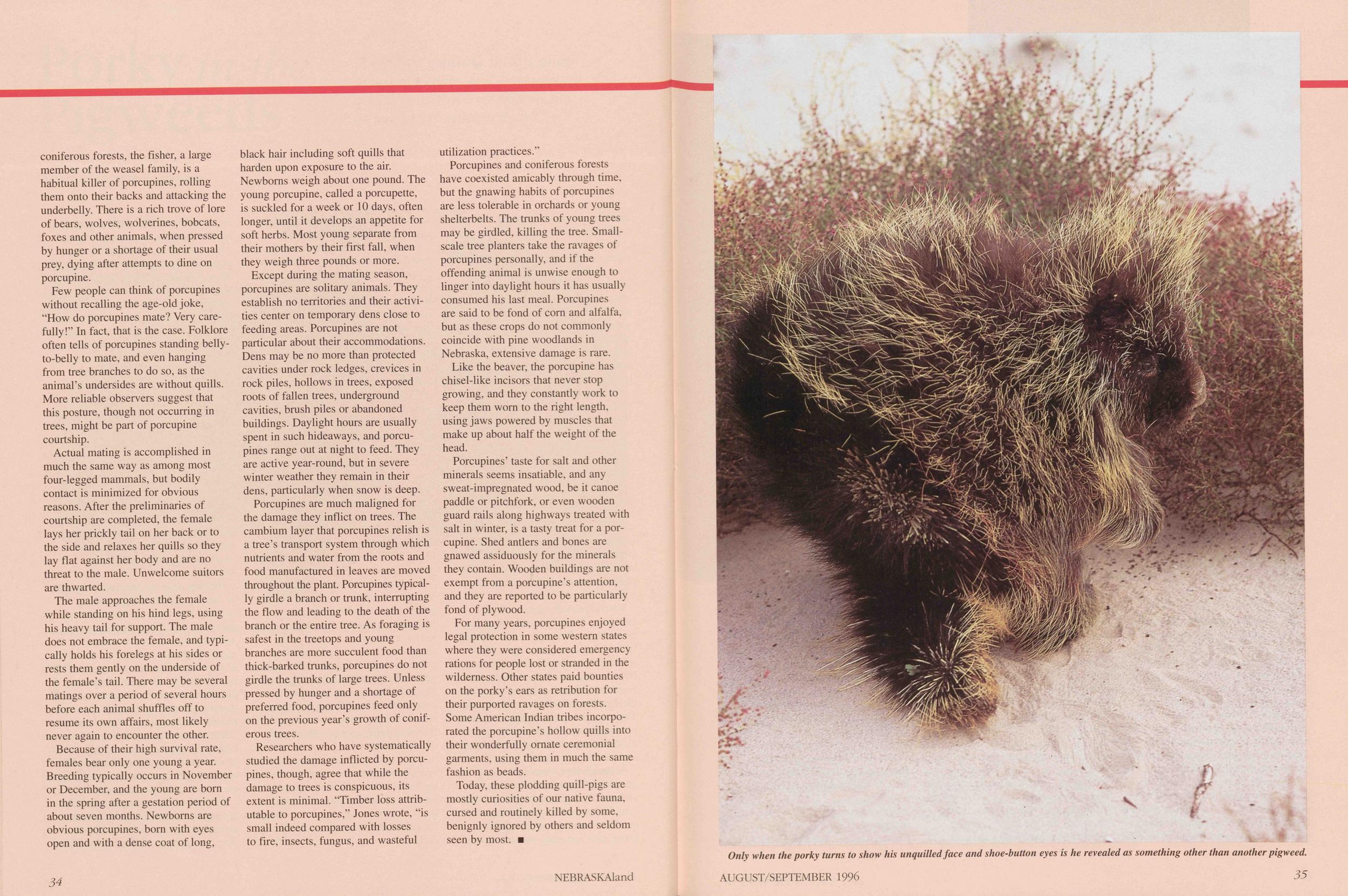
Such was the case with the porcupine I found tucked into a clump of winged pigweed (Cycloloma atriplicifolium) in a Sandhills blowout miles from the nearest tree. While the eyesight of porcupines is poor, their sense of hearing is acute, particularly to low-level sounds such as footsteps. The porky probably heard me coming and took advantage of the pigweed patch to avoid discovery or protect its unquilled underside. Except for its darker coloration and absence of seeds at the ends of its quills, its backside looked more like another pigweed than a porcupine.
Porcupines can be encountered anywhere in Nebraska, but they are most abundant close to a supply of their favorite winter food, the succulent cambium layer that lies just under the outer bark of coniferous trees. Hence, they are most likely to be encountered in the Pine Ridge, the Wildcat Hills and along the Niobrara River and its feeder streams.
The pigweed-imitating porcupine I encountered was miles from the nearest tree on the McKelvie National Forest southwest of Valentine. Contrary to what the area's name suggests, McKelvie is mostly grassland, but it is 32 NEBRASKAland near the pine canyons of the Niobrara and Snake rivers.
It is somewhat unusual to find a porcupine shuffling across a grassland far from its usual arboreal environment, particularly in the Panhandle and northcentral Nebraska. Perhaps some are pioneers ranging out in search of new groves of trees or mates, or are just afflicted with wanderlust. The diet of porcupines is varied, and they can prosper on plant foods other than conebearing evergreens.
J. Knox Jones and his co-authors, in Mammals of the Northern Great Plainsy wrote that "during the growing season, herbs may form the bulk of the diet, but woody plants are eaten in colder months." They note that when conifers are not available, porcupines feed on broad leafed trees, eating leaves, buds, young twigs, roots, berries, seeds and flowers in addition to the under bark. Porcupines even have been observed swimming to feed in patches of succulent waterlilies. From spring through autumn, there is ample food in a grassland to keep the fat on a porky.
Porcupines are second only to beavers as the largest rodents on the Great Plains. They are stocky animals with black, shoe-button eyes, bluntnosed flat faces and small ears. Because their cervical vertebrae are fused, porcupines must turn much of their bodies to look from side to side. Their legs are short, and they waddle ploddingly on the ground but move quickly in trees with the aid of strong curved claws on all four feet.
Although they seem dull-witted, principally because of their lifestyle and poor eyesight, porcupine psychologists have found they learn mazes more quickly than many other animals. Porcupines can reach the ripe old age of 10 years or more, and large adults can weigh more than 30 pounds.
Porcupines of one sort or another are found on five continents, with South America being the home of the most species. Porcupines are not closely related to the hedgehogs of Europe, which are insect eaters related to moles and shrews.
The word porcupine is derived from the French pore espin, meaning "thorny hog." Its scientific name, Erethizon dorsatum, translates as "the one whose back rises in anger," and indeed the porcupine's quills are its best known feature. Porcupines have three types of hair: a thick undercoat of fine dark colored hairs; long, coarse guard-hairs; and quills, specialized hairs with sharp spines bearing microscopic, scaly barbs at the tips. The race of porcupines found in Nebraska and the western United States has yellowish quills and yellow-tipped guard hairs. The race native to northeastern boreal forests has white quills and white-tipped guard hairs.
A full-grown porcupine can have 15,000 to 30,000 quills. Quills, unlike other hairs, are hollow and are not replaced seasonally. The shortest quills are on the head and longest on the rump and tail, some reaching three inches or more in length. Only the face and belly of a porcupine are unprotected by quills. The base of each quill is connected to muscles just under the skin so the porcupine can erect or flatten its spiny coat to suit its need or emotional state.
That a porcupine can throw its quills is myth, but when molested it turns its back toward the attacker, protecting its unquilled face and belly, erects its quills and repeatedly lashes out with its club-like tail. Tiny barbs at the end of each quill firmly anchor it in the flesh of its unfortunate attacker, and they are readily detached from the porcupine. The center of the quill shaft is composed of a spongy material that swells when it is embedded in flesh, causing the barbs to spread, more firmly anchoring the quill. If not removed, the quills work deeper into the flesh with each movement of the victim's muscle, and if they do not encounter bone they can penetrate as much as an inch a day. Quills are known to have passed entirely through the appendages or body cavities of animals, including humans, emerging on the opposite side.
If quills pass through or lodge in vital organs they can cause death by mechanically impeding the organ or by infection. A wild animal with a mouth full of quills usually dies a lingering death of starvation. All that makes the porcupine sound like an evil and vindictive creature, but porcupines do not seek out and attack other animals. Animals that suffer a porcupine's wrath are those that initiated the confrontation.
Hunting dogs are frequent recipients
of the porcupine's disagreeable
defense. Few dogs can resist getting
too close, and few leave the encounter
without a muzzle and mouth full of
quills. Quills are more easily removed
if done immediately, before they begin
to swell. Pliers are usually required,
and slowly screwing the quill out rather
than simply pulling straight somewhat
thwarts the design of the quill's barbs.
Often a veterinarian will be required,
especially if the dog has quills in its
mouth and throat. Quills that are not
removed will continue to move though
the animal and can cause death.
Because of their virtually
impenetrable armor, porcupines have essentially
no natural enemies in Nebraska other
than man and his vehicles. In northern
AUGUST/SEPTEMBER 1996
33
 coniferous forests, the fisher, a large
member of the weasel family, is a
habitual killer of porcupines, rolling
them onto their backs and attacking the
underbelly. There is a rich trove of lore
of bears, wolves, wolverines, bobcats,
foxes and other animals, when pressed
by hunger or a shortage of their usual
prey, dying after attempts to dine on
porcupine.
coniferous forests, the fisher, a large
member of the weasel family, is a
habitual killer of porcupines, rolling
them onto their backs and attacking the
underbelly. There is a rich trove of lore
of bears, wolves, wolverines, bobcats,
foxes and other animals, when pressed
by hunger or a shortage of their usual
prey, dying after attempts to dine on
porcupine.
Few people can think of porcupines without recalling the age-old joke, "How do porcupines mate? Very care- fully!" In fact, that is the case. Folklore often tells of porcupines standing belly-to-belly to mate, and even hanging from tree branches to do so, as the animal's undersides are without quills. More reliable observers suggest that this posture, though not occurring in trees, might be part of porcupine courtship.
Actual mating is accomplished in much the same way as among most four-legged mammals, but bodily contact is minimized for obvious reasons. After the preliminaries of courtship are completed, the female lays her prickly tail on her back or to the side and relaxes her quills so they lay flat against her body and are no threat to the male. Unwelcome suitors are thwarted.
The male approaches the female while standing on his hind legs, using his heavy tail for support. The male does not embrace the female, and typically holds his forelegs at his sides or rests them gently on the underside of the female's tail. There may be several matings over a period of several hours before each animal shuffles off to resume its own affairs, most likely never again to encounter the other.
Because of their high survival rate, females bear only one young a year. Breeding typically occurs in November or December, and the young are born in the spring after a gestation period of about seven months. Newborns are obvious porcupines, born with eyes open and with a dense coat of long, black hair including soft quills that harden upon exposure to the air. Newborns weigh about one pound. The young porcupine, called a porcupette, is suckled for a week or 10 days, often longer, until it develops an appetite for soft herbs. Most young separate from their mothers by their first fall, when they weigh three pounds or more.
Except during the mating season, porcupines are solitary animals. They establish no territories and their activities center on temporary dens close to feeding areas. Porcupines are not particular about their accommodations. Dens may be no more than protected cavities under rock ledges, crevices in rock piles, hollows in trees, exposed roots of fallen trees, underground cavities, brush piles or abandoned buildings. Daylight hours are usually spent in such hideaways, and porcupines range out at night to feed. They are active year-round, but in severe winter weather they remain in their dens, particularly when snow is deep.
Porcupines are much maligned for the damage they inflict on trees. The cambium layer that porcupines relish is a tree's transport system through which nutrients and water from the roots and food manufactured in leaves are moved throughout the plant. Porcupines typically girdle a branch or trunk, interrupting the flow and leading to the death of the branch or the entire tree. As foraging is safest in the treetops and young branches are more succulent food than thick-barked trunks, porcupines do not girdle the trunks of large trees. Unless pressed by hunger and a shortage of preferred food, porcupines feed only on the previous year's growth of coniferous trees.
Researchers who have systematically studied the damage inflicted by porcupines, though, agree that while the damage to trees is conspicuous, its extent is minimal. "Timber loss attributable to porcupines," Jones wrote, "is small indeed compared with losses to fire, insects, fungus, and wasteful utilization practices."
Porcupines and coniferous forests have coexisted amicably through time, but the gnawing habits of porcupines are less tolerable in orchards or young shelter belts. The trunks of young trees may be girdled, killing the tree. Small scale tree planters take the ravages of porcupines personally, and if the offending animal is unwise enough to linger into daylight hours it has usually consumed his last meal. Porcupines are said to be fond of corn and alfalfa, but as these crops do not commonly coincide with pine woodlands in Nebraska, extensive damage is rare.
Like the beaver, the porcupine has chisel-like incisors that never stop growing, and they constantly work to keep them worn to the right length, using jaws powered by muscles that make up about half the weight of the head.
Porcupines' taste for salt and other minerals seems insatiable, and any sweat-impregnated wood, be it canoe paddle or pitchfork, or even wooden guard rails along highways treated with salt in winter, is a tasty treat for a porcupine. Shed antlers and bones are gnawed assiduously for the minerals they contain. Wooden buildings are not exempt from a porcupine's attention, and they are reported to be particularly fond of plywood.
For many years, porcupines enjoyed legal protection in some western states where they were considered emergency rations for people lost or stranded in the wilderness. Other states paid bounties on the porky's ears as retribution for their purported ravages on forests. Some American Indian tribes incorporated the porcupine's hollow quills into their wonderfully ornate ceremonial garments, using them in much the same fashion as beads.
Today, these plodding quill-pigs are mostly curiosities of our native fauna, cursed and routinely killed by some, benignly ignored by others and seldom seen by most.
34 NEBRASKAland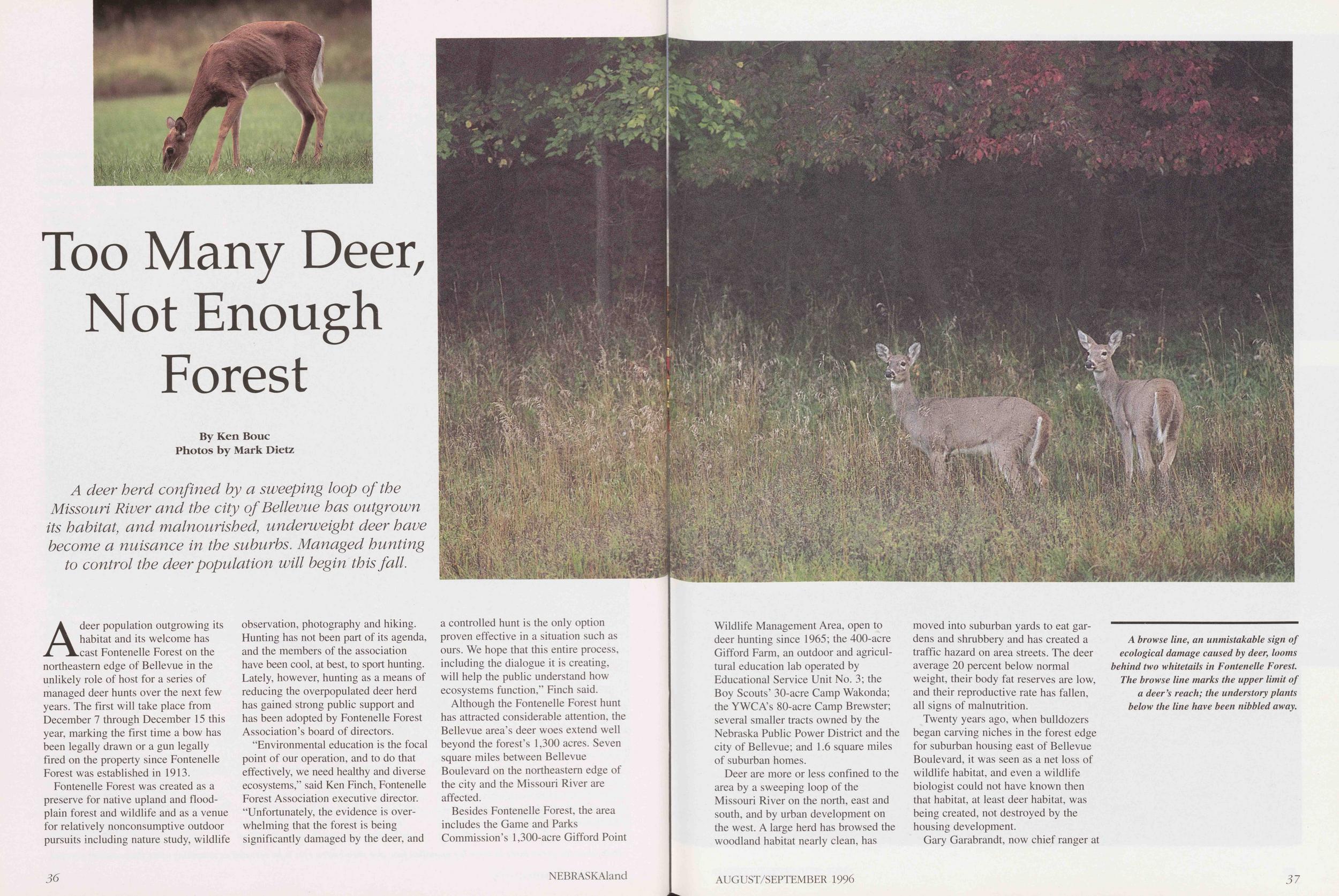
Too Many Deer, Not Enough Forest
By Ken Bouc Photos by Mark Dietz A deer herd confined by a sweeping loop of the Missouri River and the city ofBellevue has outgrown its habitat, and malnourished, underweight deer have become a nuisance in the suburbs. Managed hunting to control the deer population will begin this fall.A deer population outgrowing its habitat and its welcome has cast Fontenelle Forest on the northeastern edge of Bellevue in the unlikely role of host for a series of managed deer hunts over the next few years. The first will take place from December 7 through December 15 this year, marking the first time a bow has been legally drawn or a gun legally fired on the property since Fontenelle Forest was established in 1913.
Fontenelle Forest was created as a preserve for native upland and floodplain forest and wildlife and as a venue for relatively nonconsumptive outdoor pursuits including nature study, wildlife observation, photography and hiking. Hunting has not been part of its agenda, and the members of the association have been cool, at best, to sport hunting. Lately, however, hunting as a means of reducing the overpopulated deer herd has gained strong public support and has been adopted by Fontenelle Forest Association's board of directors.
"Environmental education is the focal point of our operation, and to do that effectively, we need healthy and diverse ecosystems," said Ken Finch, Fontenelle Forest Association executive director. "Unfortunately, the evidence is overwhelming that the forest is being significantly damaged by the deer, and a controlled hunt is the only option proven effective in a situation such as ours. We hope that this entire process, including the dialogue it is creating, will help the public understand how ecosystems function," Finch said.
Although the Fontenelle Forest hunt has attracted considerable attention, the Bellevue area's deer woes extend well beyond the forest's 1,300 acres. Seven square miles between Bellevue Boulevard on the northeastern edge of the city and the Missouri River are affected.
Besides Fontenelle Forest, the area includes the Game and Parks Commission's 1,300-acre Gifford Point 36 NEBRASKAland Wildlife Management Area, open to deer hunting since 1965; the 400-acre Gifford Farm, an outdoor and agricultural education lab operated by Educational Service Unit No. 3; the Boy Scouts' 30-acre Camp Wakonda; the YWCA's 80-acre Camp Brewster; several smaller tracts owned by the Nebraska Public Power District and the city of Bellevue; and 1.6 square miles of suburban homes.
Deer are more or less confined to the area by a sweeping loop of the Missouri River on the north, east and south, and by urban development on the west. A large herd has browsed the woodland habitat nearly clean, has moved into suburban yards to eat gardens and shrubbery and has created a traffic hazard on area streets. The deer average 20 percent below normal weight, their body fat reserves are low, and their reproductive rate has fallen, all signs of malnutrition.
Twenty years ago, when bulldozers began carving niches in the forest edge for suburban housing east of Bellevue Boulevard, it was seen as a net loss of wildlife habitat, and even a wildlife biologist could not have known then that habitat, at least deer habitat, was being created, not destroyed by the housing development.
Gary Garabrandt, now chief ranger at
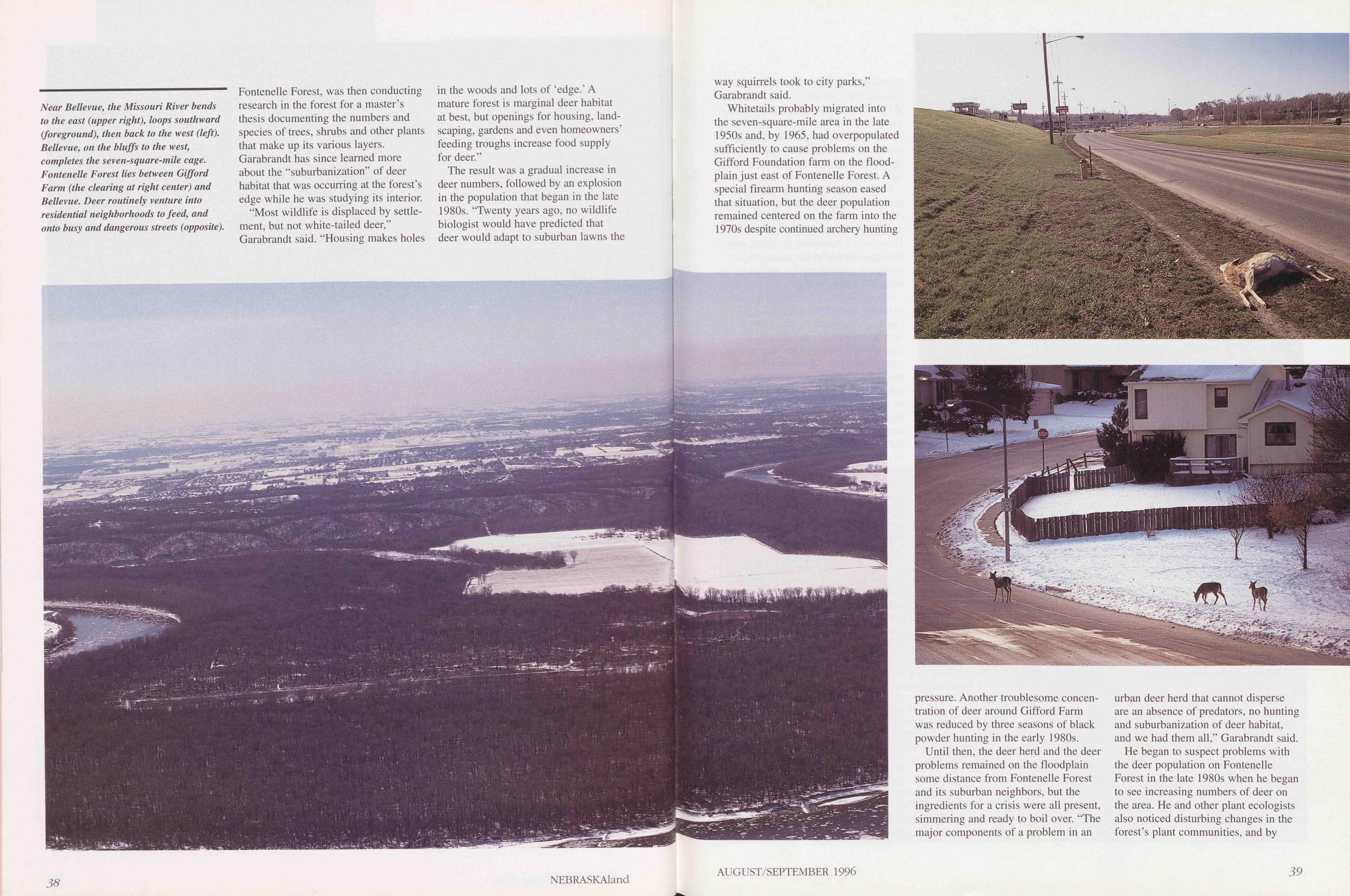
"Most wildlife is displaced by settlement, but not white-tailed deer," Garabrandt said. "Housing makes holes in the woods and lots of 'edge.' A mature forest is marginal deer habitat at best, but openings for housing, landscaping, gardens and even homeowners' feeding troughs increase food supply for deer."
The result was a gradual increase in deer numbers, followed by an explosion in the population that began in the late 1980s. "Twenty years ago, no wildlife biologist would have predicted that deer would adapt to suburban lawns the 38 NEBRASKAland
Whitetails probably migrated into the seven-square-mile area in the late 1950s and, by 1965, had overpopulated sufficiently to cause problems on the Gifford Foundation farm on the floodplain just east of Fontenelle Forest. A special firearm hunting season eased that situation, but the deer population remained centered on the farm into the 1970s despite continued archery hunting pressure. Another troublesome concentration of deer around Gifford Farm was reduced by three seasons of black powder hunting in the early 1980s.
Until then, the deer herd and the deer problems remained on the floodplain some distance from Fontenelle Forest and its suburban neighbors, but the ingredients for a crisis were all present, simmering and ready to boil over. "The major components of a problem in an urban deer herd that cannot disperse are an absence of predators, no hunting and suburbanization of deer habitat, and we had them all," Garabrandt said.
He began to suspect problems with
the deer population on Fontenelle
Forest in the late 1980s when he began
to see increasing numbers of deer on
the area. He and other plant ecologists
also noticed disturbing changes in the
forest's plant communities, and by
AUGUST/SEPTEMBER 1996
39
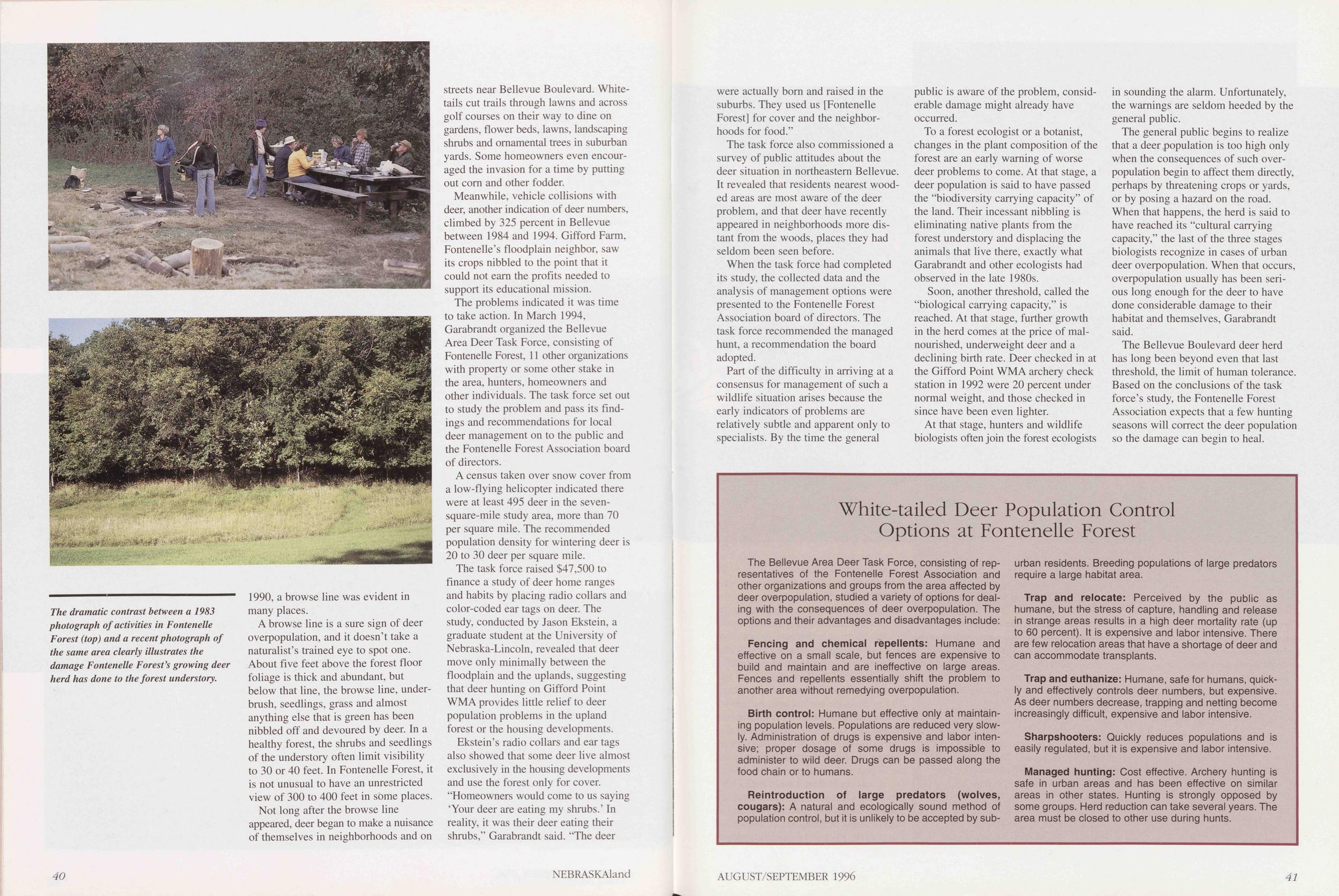
A browse line is a sure sign of deer overpopulation, and it doesn't take a naturalist's trained eye to spot one. About five feet above the forest floor foliage is thick and abundant, but below that line, the browse line, underbrush, seedlings, grass and almost anything else that is green has been nibbled off and devoured by deer. In a healthy forest, the shrubs and seedlings of the understory often limit visibility to 30 or 40 feet. In Fontenelle Forest, it is not unusual to have an unrestricted view of 300 to 400 feet in some places.
Not long after the browse line appeared, deer began to make a nuisance of themselves in neighborhoods and on streets near Bellevue Boulevard. White tails cut trails through lawns and across golf courses on their way to dine on gardens, flower beds, lawns, landscaping shrubs and ornamental trees in suburban yards. Some homeowners even encouraged the invasion for a time by putting out corn and other fodder.
Meanwhile, vehicle collisions with deer, another indication of deer numbers, climbed by 325 percent in Bellevue between 1984 and 1994. Gifford Farm, Fontenelle's floodplain neighbor, saw its crops nibbled to the point that it could not earn the profits needed to support its educational mission.
The problems indicated it was time to take action. In March 1994, Garabrandt organized the Bellevue Area Deer Task Force, consisting of Fontenelle Forest, 11 other organizations with property or some other stake in the area, hunters, homeowners and other individuals. The task force set out to study the problem and pass its find- ings and recommendations for local deer management on to the public and the Fontenelle Forest Association board of directors.
A census taken over snow cover from a low-flying helicopter indicated there were at least 495 deer in the seven-square-mile study area, more than 70 per square mile. The recommended population density for wintering deer is 20 to 30 deer per square mile.
The task force raised $47,500 to finance a study of deer home ranges and habits by placing radio collars and color-coded ear tags on deer. The study, conducted by Jason Ekstein, a graduate student at the University of Nebraska-Lincoln, revealed that deer move only minimally between the floodplain and the uplands, suggesting that deer hunting on Gifford Point WMA provides little relief to deer population problems in the upland forest or the housing developments.
Ekstein's radio collars and ear tags also showed that some deer live almost exclusively in the housing developments and use the forest only for cover. "Homeowners would come to us saying 'Your deer are eating my shrubs.' In reality, it was their deer eating their shrubs," Garabrandt said. "The deer 40 NEBRASKAland were actually born and raised in the suburbs. They used us [Fontenelle Forest] for cover and the neighborhoods for food."
The task force also commissioned a survey of public attitudes about the deer situation in northeastern Bellevue. It revealed that residents nearest wooded areas are most aware of the deer problem, and that deer have recently appeared in neighborhoods more distant from the woods, places they had seldom been seen before.
When the task force had completed its study, the collected data and the analysis of management options were presented to the Fontenelle Forest Association board of directors. The task force recommended the managed hunt, a recommendation the board adopted.
Part of the difficulty in arriving at a consensus for management of such a wildlife situation arises because the early indicators of problems are relatively subtle and apparent only to specialists. By the time the general public is aware of the problem, considerable damage might already have occurred.
To a forest ecologist or a botanist, changes in the plant composition of the forest are an early warning of worse deer problems to come. At that stage, a deer population is said to have passed the "biodiversity carrying capacity" of the land. Their incessant nibbling is eliminating native plants from the forest understory and displacing the animals that live there, exactly what Garabrandt and other ecologists had observed in the late 1980s.
Soon, another threshold, called the "biological carrying capacity," is reached. At that stage, further growth in the herd comes at the price of malnourished, underweight deer and a declining birth rate. Deer checked in at the Gifford Point WMA archery check station in 1992 were 20 percent under normal weight, and those checked in since have been even lighter.
At that stage, hunters and wildlife biologists often join the forest ecologists in sounding the alarm. Unfortunately, the warnings are seldom heeded by the general public.
The general public begins to realize that a deer population is too high only when the consequences of such overpopulation begin to affect them directly, perhaps by threatening crops or yards, or by posing a hazard on the road. When that happens, the herd is said to have reached its "cultural carrying capacity," the last of the three stages biologists recognize in cases of urban deer overpopulation. When that occurs, overpopulation usually has been serious long enough for the deer to have done considerable damage to their habitat and themselves, Garabrandt said.
The Bellevue Boulevard deer herd has long been beyond even that last threshold, the limit of human tolerance. Based on the conclusions of the task force's study, the Fontenelle Forest Association expects that a few hunting seasons will correct the deer population so the damage can begin to heal.
White-tailed Deer Population Control Options at Fontenelle ForestThe Bellevue Area Deer Task Force, consisting of representatives of the Fontenelle Forest Association and other organizations and groups from the area affected by deer overpopulation, studied a variety of options for dealing with the consequences of deer overpopulation. The options and their advantages and disadvantages include:
Fencing and chemical repellents: Humane and effective on a small scale, but fences are expensive to build and maintain and are ineffective on large areas. Fences and repellents essentially shift the problem to another area without remedying overpopulation.
Birth control: Humane but effective only at maintaining population levels. Populations are reduced very slowly. Administration of drugs is expensive and labor intensive; proper dosage of some drugs is impossible to administer to wild deer. Drugs can be passed along the food chain or to humans.
Reintroduction of large predators (wolves, cougars): A natural and ecologically sound method of population control, but it is unlikely to be accepted by suburban residents. Breeding populations of large predators require a large habitat area.
Trap and relocate: Perceived by the public as humane, but the stress of capture, handling and release in strange areas results in a high deer mortality rate (up to 60 percent). It is expensive and labor intensive. There are few relocation areas that have a shortage of deer and can accommodate transplants.
Trap and euthanize: Humane, safe for humans, quickly and effectively controls deer numbers, but expensive. As deer numbers decrease, trapping and netting become increasingly difficult, expensive and labor intensive.
Sharpshooters: Quickly reduces populations and is easily regulated, but it is expensive and labor intensive.
Managed hunting: Cost effective. Archery hunting is safe in urban areas and has been effective on similar areas in other states. Hunting is strongly opposed by some groups. Herd reduction can take several years. The area must be closed to other use during hunts.
AUGUST/SEPTEMBER 1996 41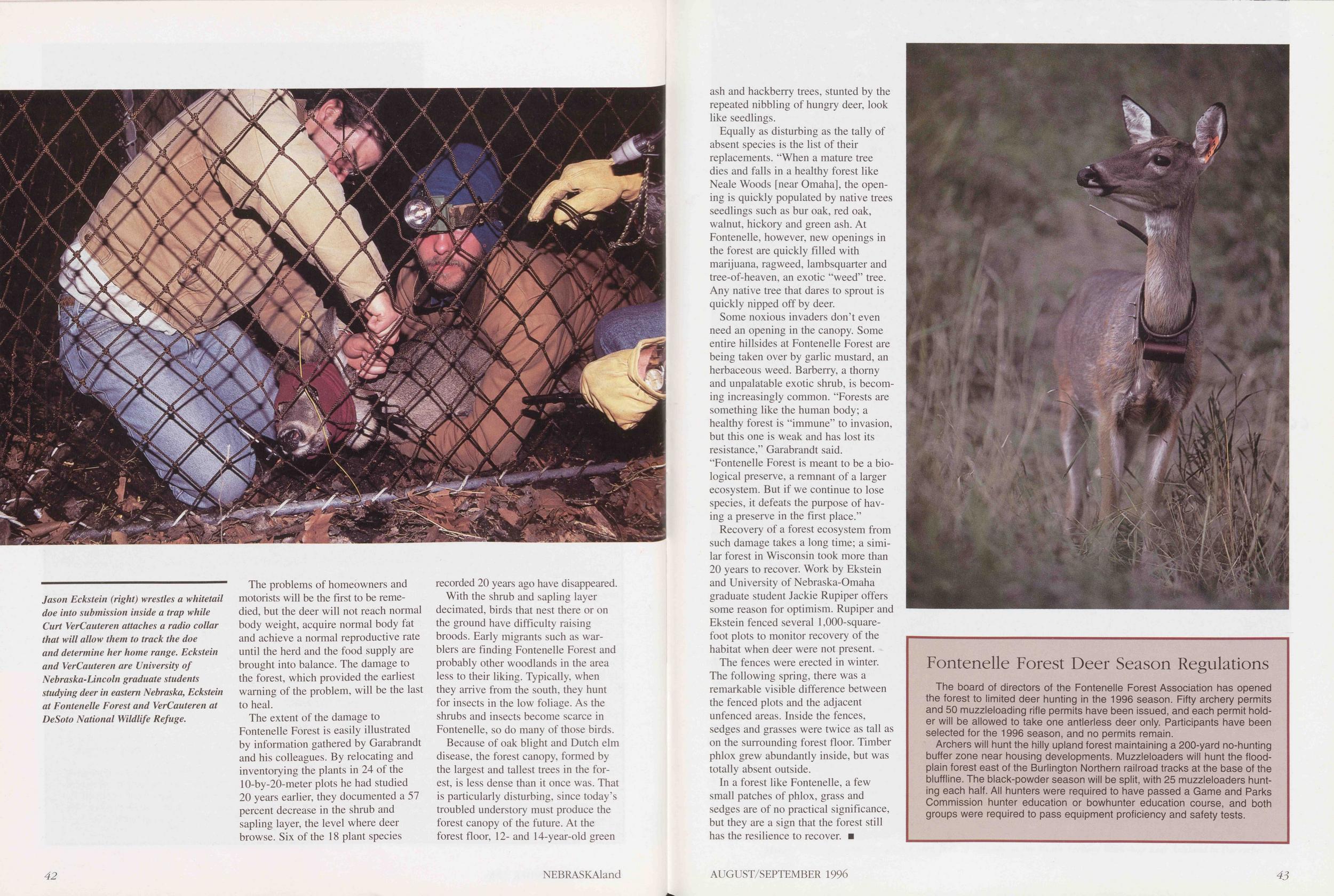
The problems of homeowners and motorists will be the first to be remedied, but the deer will not reach normal body weight, acquire normal body fat and achieve a normal reproductive rate until the herd and the food supply are brought into balance. The damage to the forest, which provided the earliest warning of the problem, will be the last to heal.
The extent of the damage to Fontenelle Forest is easily illustrated by information gathered by Garabrandt and his colleagues. By relocating and inventorying the plants in 24 of the 10-by-20-meter plots he had studied 20 years earlier, they documented a 57 percent decrease in the shrub and sapling layer, the level where deer browse. Six of the 18 plant species recorded 20 years ago have disappeared.
With the shrub and sapling layer decimated, birds that nest there or on the ground have difficulty raising broods. Early migrants such as warblers are finding Fontenelle Forest and probably other woodlands in the area less to their liking. Typically, when they arrive from the south, they hunt for insects in the low foliage. As the shrubs and insects become scarce in Fontenelle, so do many of those birds.
Because of oak blight and Dutch elm disease, the forest canopy, formed by the largest and tallest trees in the forest, is less dense than it once was. That is particularly disturbing, since today's troubled understory must produce the forest canopy of the future. At the forest floor, 12- and 14-year-old green 42 NEBRASKAland ash and hackberry trees, stunted by the repeated nibbling of hungry deer, look like seedlings.
Equally as disturbing as the tally of absent species is the list of their replacements. "When a mature tree dies and falls in a healthy forest like Neale Woods [near Omaha], the opening is quickly populated by native trees seedlings such as bur oak, red oak, walnut, hickory and green ash. At Fontenelle, however, new openings in the forest are quickly filled with marijuana, ragweed, lambsquarter and tree-of-heaven, an exotic "weed" tree. Any native tree that dares to sprout is quickly nipped off by deer.
Some noxious invaders don't even need an opening in the canopy. Some entire hillsides at Fontenelle Forest are being taken over by garlic mustard, an herbaceous weed. Barberry, a thorny and unpalatable exotic shrub, is becoming increasingly common. "Forests are something like the human body; a healthy forest is "immune" to invasion, but this one is weak and has lost its resistance," Garabrandt said. "Fontenelle Forest is meant to be a biological preserve, a remnant of a larger ecosystem. But if we continue to lose species, it defeats the purpose of having a preserve in the first place."
Recovery of a forest ecosystem from such damage takes a long time; a similar forest in Wisconsin took more than 20 years to recover. Work by Ekstein and University of Nebraska-Omaha graduate student Jackie Rupiper offers some reason for optimism. Rupiper and Ekstein fenced several 1,000-square-foot plots to monitor recovery of the habitat when deer were not present.
The fences were erected in winter. The following spring, there was a remarkable visible difference between the fenced plots and the adjacent unfenced areas. Inside the fences, sedges and grasses were twice as tall as on the surrounding forest floor. Timber phlox grew abundantly inside, but was totally absent outside.
In a forest like Fontenelle, a few small patches of phlox, grass and sedges are of no practical significance, but they are a sign that the forest still has the resilience to recover.
The board of directors of the Fontenelle Forest Association has opened the forest to limited deer hunting in the 1996 season. Fifty archery permits and 50 muzzleloading rifle permits have been issued, and each permit hold- er will be allowed to take one antlerless deer only. Participants have been selected for the 1996 season, and no permits remain.
Archers will hunt the hilly upland forest maintaining a 200-yard no-hunting buffer zone near housing developments. Muzzleloaders will hunt the floodplain forest east of the Burlington Northern railroad tracks at the base of the bluff line. The black-powder season will be split, with 25 muzzleloaders hunting each half. All hunters were required to have passed a Game and Parks Commission hunter education or bowhunter education course, and both groups were required to pass equipment proficiency and safety tests.
AUGUST/SEPTEMBER 1996 43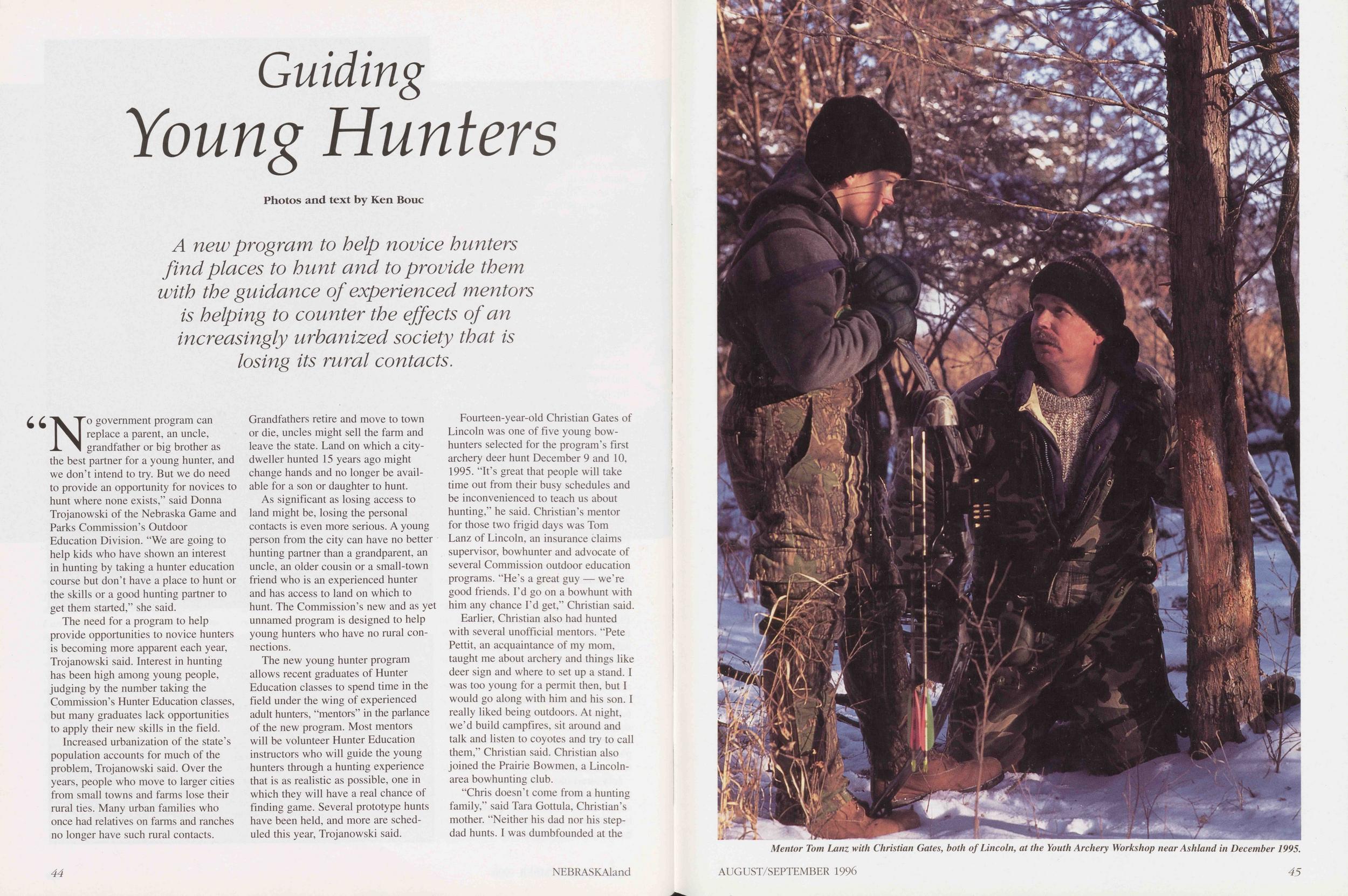
Guiding Young Hunters
Photos and text by Ken Bouc A new program to help novice hunters find places to hunt and to provide them with the guidance of experienced mentors is helping to counter the effects of an increasingly urbanized society that is losing its rural contacts.No government program can replace a parent, an uncle, grandfather or big brother as the best partner for a young hunter, and we don't intend to try. But we do need to provide an opportunity for novices to hunt where none exists," said Donna Trojanowski of the Nebraska Game and Parks Commission's Outdoor Education Division. "We are going to help kids who have shown an interest in hunting by taking a hunter education course but don't have a place to hunt or the skills or a good hunting partner to get them started," she said.
The need for a program to help provide opportunities to novice hunters is becoming more apparent each year, Trojanowski said. Interest in hunting has been high among young people, judging by the number taking the Commission's Hunter Education classes, but many graduates lack opportunities to apply their new skills in the field.
Increased urbanization of the state's population accounts for much of the problem, Trojanowski said. Over the years, people who move to larger cities from small towns and farms lose their rural ties. Many urban families who once had relatives on farms and ranches no longer have such rural contacts. Grandfathers retire and move to town or die, uncles might sell the farm and leave the state. Land on which a city dweller hunted 15 years ago might change hands and no longer be available for a son or daughter to hunt.
As significant as losing access to land might be, losing the personal contacts is even more serious. A young person from the city can have no better hunting partner than a grandparent, an uncle, an older cousin or a small-town friend who is an experienced hunter and has access to land on which to hunt. The Commission's new and as yet unnamed program is designed to help young hunters who have no rural connections.
The new young hunter program allows recent graduates of Hunter Education classes to spend time in the field under the wing of experienced adult hunters, "mentors" in the parlance of the new program. Most mentors will be volunteer Hunter Education instructors who will guide the young hunters through a hunting experience that is as realistic as possible, one in which they will have a real chance of finding game. Several prototype hunts have been held, and more are scheduled this year, Trojanowski said.
Fourteen-year-old Christian Gates of Lincoln was one of five young bowhunters selected for the program's first archery deer hunt December 9 and 10, 1995. "It's great that people will take time out from their busy schedules and be inconvenienced to teach us about hunting," he said. Christian's mentor for those two frigid days was Tom Lanz of Lincoln, an insurance claims supervisor, bowhunter and advocate of several Commission outdoor education programs. "He's a great guy — we're good friends. I'd go on a bowhunt with him any chance I'd get," Christian said.
Earlier, Christian also had hunted with several unofficial mentors. "Pete Pettit, an acquaintance of my mom, taught me about archery and things like deer sign and where to set up a stand. I was too young for a permit then, but I would go along with him and his son. I really liked being outdoors. At night, we'd build campfires, sit around and talk and listen to coyotes and try to call them," Christian said. Christian also joined the Prairie Bowmen, a Lincoln- area bowhunting club.
"Chris doesn't come from a hunting family," said Tara Gottula, Christian's mother. "Neither his dad nor his stepdad hunts. I was dumbfounded at the 44 NEBRASKAland
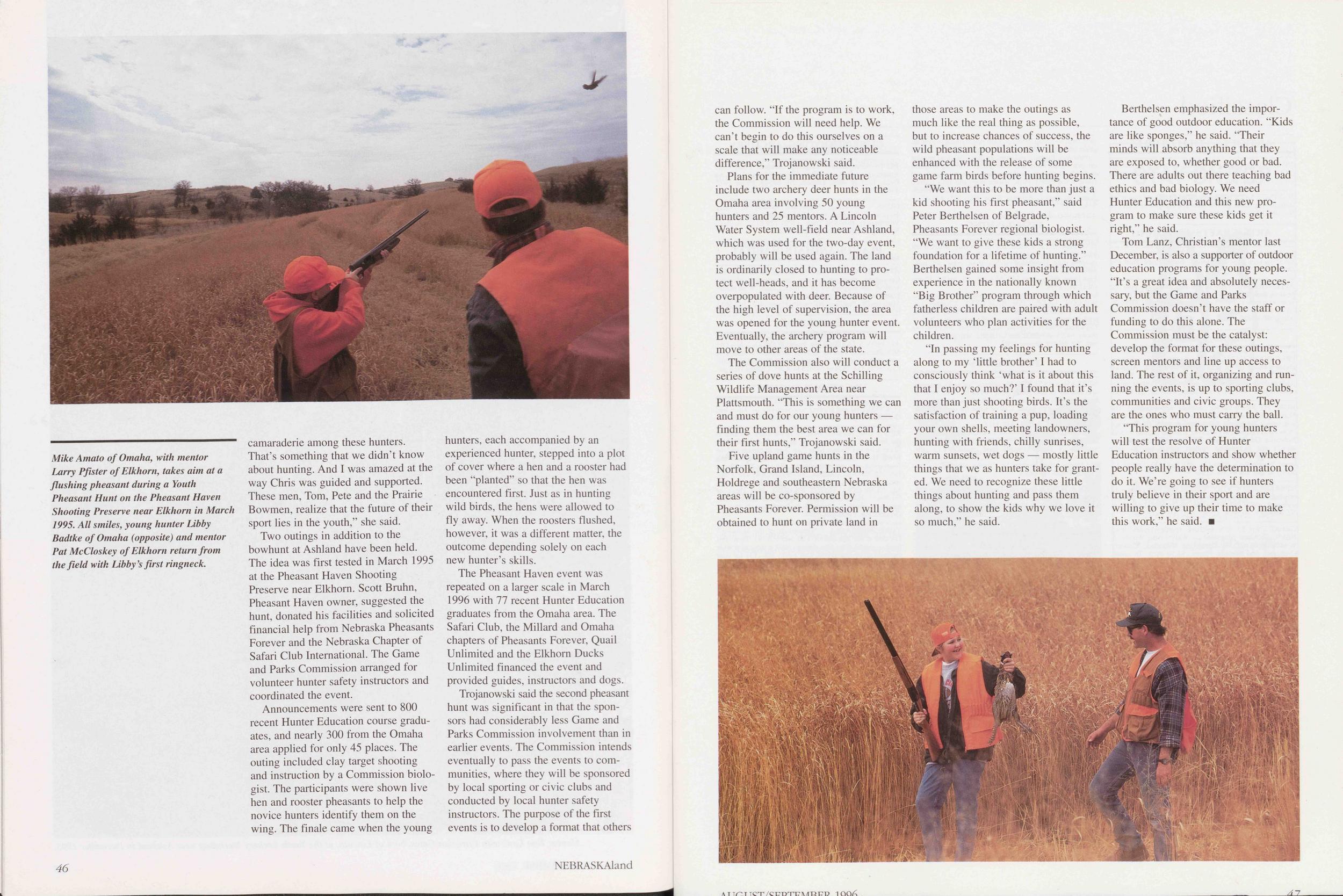
Two outings in addition to the bowhunt at Ashland have been held. The idea was first tested in March 1995 at the Pheasant Haven Shooting Preserve near Elkhorn. Scott Bruhn, Pheasant Haven owner, suggested the hunt, donated his facilities and solicited financial help from Nebraska Pheasants Forever and the Nebraska Chapter of Safari Club International. The Game and Parks Commission arranged for volunteer hunter safety instructors and coordinated the event.
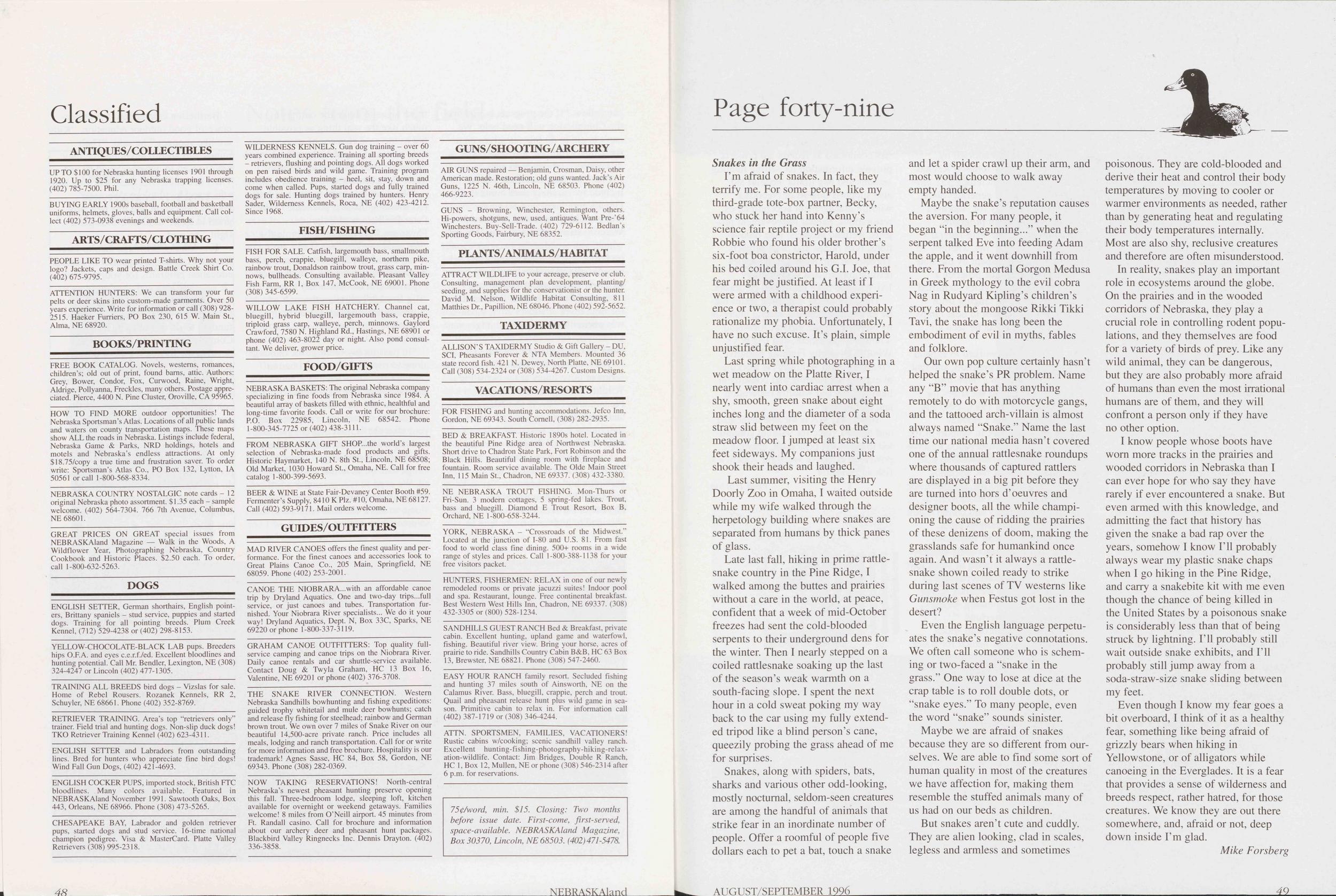
Announcements were sent to 800 recent Hunter Education course graduates, and nearly 300 from the Omaha area applied for only 45 places. The outing included clay target shooting and instruction by a Commission biologist. The participants were shown live hen and rooster pheasants to help the novice hunters identify them on the wing. The finale came when the young hunters, each accompanied by an experienced hunter, stepped into a plot of cover where a hen and a rooster had been "planted" so that the hen was encountered first. Just as in hunting wild birds, the hens were allowed to fly away. When the roosters flushed, however, it was a different matter, the outcome depending solely on each new hunter's skills.
The Pheasant Haven event was repeated on a larger scale in March 1996 with 77 recent Hunter Education graduates from the Omaha area. The Safari Club, the Millard and Omaha chapters of Pheasants Forever, Quail Unlimited and the Elkhorn Ducks Unlimited financed the event and provided guides, instructors and dogs.
Trojanowski said the second pheasant hunt was significant in that the sponsors had considerably less Game and Parks Commission involvement than in earlier events. The Commission intends eventually to pass the events to communities, where they will be sponsored by local sporting or civic clubs and conducted by local hunter safety instructors. The purpose of the first events is to develop a format that others 46 NEBRASKAland can follow. "If the program is to work, the Commission will need help. We can't begin to do this ourselves on a scale that will make any noticeable difference," Trojanowski said.
Plans for the immediate future include two archery deer hunts in the Omaha area involving 50 young hunters and 25 mentors. A Lincoln Water System well-field near Ashland, which was used for the two-day event, probably will be used again. The land is ordinarily closed to hunting to protect well-heads, and it has become overpopulated with deer. Because of the high level of supervision, the area was opened for the young hunter event. Eventually, the archery program will move to other areas of the state.
The Commission also will conduct a series of dove hunts at the Schilling Wildlife Management Area near Plattsmouth. "This is something we can and must do for our young hunters — finding them the best area we can for their first hunts," Trojanowski said.
Five upland game hunts in the Norfolk, Grand Island, Lincoln, Holdrege and southeastern Nebraska areas will be co-sponsored by Pheasants Forever. Permission will be obtained to hunt on private land in those areas to make the outings as much like the real thing as possible, but to increase chances of success, the wild pheasant populations will be enhanced with the release of some game farm birds before hunting begins.
"We want this to be more than just a kid shooting his first pheasant," said Peter Berthelsen of Belgrade, Pheasants Forever regional biologist. "We want to give these kids a strong foundation for a lifetime of hunting." Berthelsen gained some insight from experience in the nationally known "Big Brother" program through which fatherless children are paired with adult volunteers who plan activities for the children.
"In passing my feelings for hunting along to my 'little brother' I had to consciously think 'what is it about this that I enjoy so much?' I found that it's more than just shooting birds. It's the satisfaction of training a pup, loading your own shells, meeting landowners, hunting with friends, chilly sunrises, warm sunsets, wet dogs — mostly little things that we as hunters take for granted. We need to recognize these little things about hunting and pass them along, to show the kids why we love it so much," he said.
Berthelsen emphasized the importance of good outdoor education. "Kids are like sponges," he said. "Their minds will absorb anything that they are exposed to, whether good or bad. There are adults out there teaching bad ethics and bad biology. We need Hunter Education and this new pro- gram to make sure these kids get it right," he said.
Tom Lanz, Christian's mentor last December, is also a supporter of outdoor education programs for young people. "It's a great idea and absolutely necessary, but the Game and Parks Commission doesn't have the staff or funding to do this alone. The Commission must be the catalyst: develop the format for these outings, screen mentors and line up access to land. The rest of it, organizing and running the events, is up to sporting clubs, communities and civic groups. They are the ones who must carry the ball.
"This program for young hunters will test the resolve of Hunter Education instructors and show whether people really have the determination to do it. We're going to see if hunters truly believe in their sport and are willing to give up their time to make this work," he said.
Classified
ANTIQUES/COLLECTIBLESUP TO $100 for Nebraska hunting licenses 1901 through 1920. Up to $25 for any Nebraska trapping licenses. (402) 785-7500. Phil.
BUYING EARLY 1900s baseball, football and basketball uniforms, helmets, gloves, balls and equipment. Call collect (402) 573-0938 evenings and weekends.
ARTS/CRAFTS/CLOTHINGPEOPLE LIKE TO wear printed T-shirts. Why not your logo? Jackets, caps and design. Battle Creek Shirt Co. (402)675-9795.
ATTENTION HUNTERS: We can transform your fur pelts or deer skins into custom-made garments. Over 50 years experience. Write for information or call (308) 928- 2515. Haeker Furriers, PO Box 230, 615 W. Main St., Alma, NE 68920.
BOOKS/PRINTINGFREE BOOK CATALOG. Novels, westerns, romances, children's; old out of print, found barns, attic. Authors: Grey, Bower, Condor, Fox, Curwood, Raine, Wright, Aldrige, Pollyanna, Freckles, many others. Postage appreciated. Pierce, 4400 N. Pine Cluster, Oroville, CA 95965.
HOW TO FIND MORE outdoor opportunities! The Nebraska Sportsman's Atlas. Locations of all public lands and waters on county transportation maps. These maps show ALL the roads in Nebraska. Listings include federal, Nebraska Game & Parks, NRD holdings, hotels and motels and Nebraska's endless attractions. At only $18.75/copy a true time and frustration saver. To order write: Sportsman's Atlas Co., PO Box 132, Lytton, IA 50561 or call 1-800-568-8334.
NEBRASKA COUNTRY NOSTALGIC note cards - 12 original Nebraska photo assortment. $1.35 each - sample welcome. (402) 564-7304. 766 7th Avenue, Columbus, NE 68601.
GREAT PRICES ON GREAT special issues from NEBRASKAland Magazine — Walk in the Woods, A Wildflower Year, Photographing Nebraska, Country Cookbook and Historic Places. $2.50 each. To order, call 1-800-632-5263.
DOGSENGLISH SETTER, German shorthairs, English pointers, Brittany spaniels - stud service, puppies and started dogs. Training for all pointing breeds. Plum Creek Kennel, (712) 529-4238 or (402) 298-8153.
YELLOW-CHOCOLATE-BLACK LAB pups. Breeders hips O.F.A. and eyes c.e.r.f./ed. Excellent bloodlines and hunting potential. Call Mr. Bendler, Lexington, NE (308) 324-4247 or Lincoln (402) 477-1305.
TRAINING ALL BREEDS bird dogs - Vizslas for sale. Home of Rebel Rousers. Rozanek Kennels, RR 2. Schuyler, NE 68661. Phone (402) 352-8769.
RETRIEVER TRAINING. Area's top "retrievers only" trainer. Field trial and hunting dogs. Non-slip duck dogs! TKO Retriever Training Kennel (402) 623-4311. ENGLISH SETTER and Labradors from outstanding lines. Bred for hunters who appreciate fine bird dogs! Wind Fall Gun Dogs, (402) 421-4693.
ENGLISH COCKER PUPS, imported stock, British FTC bloodlines. Many colors available. Featured in NEBRASKAland November 1991. Sawtooth Oaks, Box 443, Orleans, NE 68966. Phone (308) 473-5265.
CHESAPEAKE BAY, Labrador and golden retriever pups, started dogs and stud service. 16-time national champion pedigree. Visa & MasterCard. Platte Valley Retrievers (308) 995-2318.
WILDERNESS KENNELS. Gun dog training - over 60 years combined experience. Training all sporting breeds - retrievers, flushing and pointing dogs. All dogs worked on pen raised birds and wild game. Training program includes obedience training - heel, sit, stay, down and come when called. Pups, started dogs and fully trained dogs for sale. Hunting dogs trained by hunters. Henry Sader, Wilderness Kennels, Roca, NE (402) 423-4212. Since 1968.
FISH/FISHINGFISH FOR SALE. Catfish, largemouth bass, smallmouth bass, perch, crappie, bluegill, walleye, northern pike, rainbow trout, Donaldson rainbow trout, grass carp, minnows, bullheads. Consulting available. Pleasant Valley Fish Farm, RR I. Box 147, McCook, NE 69001. Phone (308) 345-6599.
WILLOW LAKE FISH HATCHERY. Channel cat, bluegill, hybrid bluegill, largemouth bass, crappie, triploid grass carp, walleye, perch, minnows. Gaylord Crawford, 7580 N. Highland Rd., Hastings, NE 68901 or phone (402) 463-8022 day or night. Also pond consultant. We deliver, grower price.
FOOD/GIFTSNEBRASKA BASKETS: The original Nebraska company specializing in fine foods from Nebraska since 1984. A beautiful array of baskets filled with ethnic, healthful and long-time favorite foods. Call or write for our brochure: P.O. Box 22985, Lincoln, NE 68542. Phone 1-800-345-7725 or (402) 438-3111.
FROM NEBRASKA GIFT SHOP..the world's largest selection of Nebraska-made food products and gifts. Historic Haymarket, 140 N. 8th St., Lincoln, NE 68508; Old Market, 1030 Howard St., Omaha, NE. Call for free catalog 1-800-399-5693.
BEER & WINE at State Fair-Devaney Center Booth #59. Fermenter's Supply, 8410 K Plz. #10, Omaha, NE 68127. Call (402) 593-9171. Mail orders welcome.
GUIDES/OUTFITTERSMAD RIVER CANOES offers the finest quality and performance. For the finest canoes and accessories look to Great Plains Canoe Co., 205 Main, Springfield, NE 68059. Phone (402) 253-2001.
CANOE THE NIOBRARA...with an affordable canoe trip by Dry land Aquatics. One and two-day trips...full service, or just canoes and tubes. Transportation furnished. Your Niobrara River specialists... We do it your way! Dry land Aquatics, Dept. N, Box 33C, Sparks, NE 69220 or phone 1-800-337-3119.
GRAHAM CANOE OUTFITTERS: Top quality full- service camping and canoe trips on the Niobrara River. Daily canoe rentals and car shuttle-service available. Contact Doug & Twyla Graham, HC 13 Box 16, Valentine, NE 69201 or phone (402) 376-3708.
THE SNAKE RIVER CONNECTION. Western Nebraska Sandhills bowhunting and fishing expeditions: guided trophy whitetail and mule deer bowhunts; catch and release fly fishing for steelhead; rainbow and German brown trout. We own over 7 miles of Snake River on our beautiful 14,500-acre private ranch. Price includes all meals, lodging and ranch transportation. Call for or write for more information and free brochure. Hospitality is our trademark! Agnes Sasse, HC 84, Box 58, Gordon, NE 69343. Phone (308) 282-0369.
NOW TAKING RESERVATIONS! North-central Nebraska's newest pheasant hunting preserve opening this fall. Three-bedroom lodge, sleeping loft, kitchen available for overnight or weekend getaways. Families welcome! 8 miles from O'Neill airport. 45 minutes from Ft. Randall casino. Call for brochure and information about our archery deer and pheasant hunt packages. Blackbird Valley Ringnecks Inc. Dennis Drayton. (402) 336-3858.
GUNS/SHOOTING/ARCHERYAIR GUNS repaired — Benjamin, Crosman, Daisy, other American made. Restoration; old guns wanted. Jack's Air Guns, 1225 N. 46th, Lincoln, NE 68503. Phone (402) 466-9223.
GUNS - Browning, Winchester, Remington, others. Hi-powers, shotguns, new, used, antiques. Want Pre-'64 Winchesters. Buy-Sell-Trade. (402) 729-6112. Bedlan's Sporting Goods, Fairbury, NE 68352.
PLANTS/ANIMALS/HABITATATTRACT WILDLIFE to your acreage, preserve or club. Consulting, management plan development, planting/ seeding, and supplies for the conservationist or the hunter. David M. Nelson, Wildlife Habitat Consulting, 811 Matthies Dr., Papillion, NE 68046. Phone (402) 592-5652.
TAXIDERMYALLISON'S TAXIDERMY Studio & Gift Gallery - DU, SCI, Pheasants Forever & NTA Members. Mounted 36 state record fish. 421 N. Dewey, North Platte, NE 69101. Call (308) 534-2324 or (308) 534-4267. Custom Designs.
VACATIONS/RESORTSFOR FISHING and hunting accommodations. Jefco Inn. Gordon, NE 69343. South Cornell, (308) 282-2935.
BED & BREAKFAST. Historic 1890s hotel. Located in the beautiful Pine Ridge area of Northwest Nebraska. Short drive to Chadron State Park, Fort Robinson and the Black Hills. Beautiful dining room with fireplace and fountain. Room service available. The Olde Main Street Inn, 115 Main St., Chadron, NE 69337. (308) 432-3380.
NE NEBRASKA TROUT FISHING. Mon-Thurs or Fri-Sun. 3 modern cottages, 5 spring-fed lakes. Trout, bass and bluegill. Diamond E Trout Resort, Box B. Orchard, NE 1-800-658-3244.
YORK, NEBRASKA - "Crossroads of the Midwest." Located at the junction of 1-80 and U.S. 81. From fast food to world class fine dining. 500+ rooms in a wide range of styles and prices. Call 1-800-388-1138 for your free visitors packet.
HUNTERS, FISHERMEN: RELAX in one of our newly remodeled rooms or private Jacuzzi suites! Indoor pool and spa. Restaurant, lounge. Free continental breakfast. Best Western West Hills Inn, Chadron, NE 69337. (308) 432-3305 or (800) 528-1234.
SANDHILLS GUEST RANCH Bed & Breakfast, private cabin. Excellent hunting, upland game and waterfowl, fishing. Beautiful river view. Bring your horse, acres of prairie to ride. Sandhills Country Cabin B&B, HC 63 Box 13, Brewster, NE 68821. Phone (308) 547-2460.
EASY HOUR RANCH family resort. Secluded fishing and hunting 37 miles south of Ainsworth, NE on the Calamus River. Bass, bluegill, crappie, perch and trout. Quail and pheasant release hunt plus wild game in sea- son. Primitive cabin to relax in. For information call (402) 387-1719 or (308) 346-4244.
ATTN. SPORTSMEN, FAMILIES, VACATIONERS! Rustic cabins w/cooking; scenic sandhill valley ranch. Excellent hunting-fishing-photography-hiking-relax-ation-wildlife. Contact: Jim Bridges, Double R Ranch, HC 1, Box 12, Mullen, NE or phone (308) 546-2314 after 6 p.m. for reservations.
75^/word, min. $15. Closing: Two months before issue date. First-come, first-served, space-available. NEBRASKAland Magazine, Box 30370, Lincoln, NE 68503. (402)471-5478. 48 NEBRASKAlandPage forty-nine
Snakes in the GrassI'm afraid of snakes. In fact, they terrify me. For some people, like my third-grade tote-box partner, Becky, who stuck her hand into Kenny's science fair reptile project or my friend Robbie who found his older brother's six-foot boa constrictor, Harold, under his bed coiled around his G.I. Joe, that fear might be justified. At least if I were armed with a childhood experience or two, a therapist could probably rationalize my phobia. Unfortunately, I have no such excuse. It's plain, simple unjustified fear.
Last spring while photographing in a wet meadow on the Platte River, I nearly went into cardiac arrest when a shy, smooth, green snake about eight inches long and the diameter of a soda straw slid between my feet on the meadow floor. I jumped at least six feet sideways. My companions just shook their heads and laughed.
Last summer, visiting the Henry Doorly Zoo in Omaha, I waited outside while my wife walked through the herpetology building where snakes are separated from humans by thick panes of glass.
Late last fall, hiking in prime rattlesnake country in the Pine Ridge, I walked among the buttes and prairies without a care in the world, at peace, confident that a week of mid-October freezes had sent the cold-blooded serpents to their underground dens for the winter. Then I nearly stepped on a coiled rattlesnake soaking up the last of the season's weak warmth on a south-facing slope. I spent the next hour in a cold sweat poking my way back to the car using my fully extended tripod like a blind person's cane, queezily probing the grass ahead of me for surprises.
Snakes, along with spiders, bats, sharks and various other odd-looking, mostly nocturnal, seldom-seen creatures are among the handful of animals that strike fear in an inordinate number of people. Offer a roomful of people five dollars each to pet a bat, touch a snake and let a spider crawl up their arm, and most would choose to walk away empty handed.
Maybe the snake's reputation causes the aversion. For many people, it began "in the beginning..." when the serpent talked Eve into feeding Adam the apple, and it went downhill from there. From the mortal Gorgon Medusa in Greek mythology to the evil cobra Nag in Rudyard Kipling's children's story about the mongoose Rikki Tikki Tavi, the snake has long been the embodiment of evil in myths, fables and folklore.
Our own pop culture certainly hasn't helped the snake's PR problem. Name any "B" movie that has anything remotely to do with motorcycle gangs, and the tattooed arch-villain is almost always named "Snake." Name the last time our national media hasn't covered one of the annual rattlesnake roundups where thousands of captured rattlers are displayed in a big pit before they are turned into hors d'oeuvres and designer boots, all the while championing the cause of ridding the prairies of these denizens of doom, making the grasslands safe for humankind once again. And wasn't it always a rattle- snake shown coiled ready to strike during last scenes of TV westerns like Gunsmoke when Festus got lost in the desert?
Even the English language perpetuates the snake's negative connotations. We often call someone who is scheming or two-faced a "snake in the grass." One way to lose at dice at the crap table is to roll double dots, or "snake eyes." To many people, even the word "snake" sounds sinister.
Maybe we are afraid of snakes because they are so different from ourselves. We are able to find some sort of human quality in most of the creatures we have affection for, making them resemble the stuffed animals many of us had on our beds as children.
But snakes aren't cute and cuddly. They are alien looking, clad in scales, legless and armless and sometimes poisonous. They are cold-blooded and derive their heat and control their body temperatures by moving to cooler or warmer environments as needed, rather than by generating heat and regulating their body temperatures internally. Most are also shy, reclusive creatures and therefore are often misunderstood.
In reality, snakes play an important role in ecosystems around the globe. On the prairies and in the wooded corridors of Nebraska, they play a crucial role in controlling rodent populations, and they themselves are food for a variety of birds of prey. Like any wild animal, they can be dangerous, but they are also probably more afraid of humans than even the most irrational humans are of them, and they will confront a person only if they have no other option.
I know people whose boots have worn more tracks in the prairies and wooded corridors in Nebraska than I can ever hope for who say they have rarely if ever encountered a snake. But even armed with this knowledge, and admitting the fact that history has given the snake a bad rap over the years, somehow I know I'll probably always wear my plastic snake chaps when I go hiking in the Pine Ridge, and carry a snakebite kit with me even though the chance of being killed in the United States by a poisonous snake is considerably less than that of being struck by lightning. I'll probably still wait outside snake exhibits, and I'll probably still jump away from a soda-straw-size snake sliding between my feet.
Even though I know my fear goes a bit overboard, I think of it as a healthy fear, something like being afraid of grizzly bears when hiking in Yellowstone, or of alligators while canoeing in the Everglades. It is a fear that provides a sense of wilderness and breeds respect, rather hatred, for those creatures. We know they are out there somewhere, and, afraid or not, deep down inside I'm glad.
Mike Forsberg AUGUST/SEPTEMBER 1996 1FL
Mixed bag
Speaking for WildlifeThe year was 1902, and the place was Yellowstone National Park. Eight wildlife managers from six states, realizing that action was necessary if the United States was to maintain its rich fish and wildlife legacy, gathered to lay plans that would benefit America's fish and wildlife for years to come.
From that tentative beginning, the International Association of Fish and Wildlife Agencies has expanded to all 50 states, Canada and Mexico and has been instrumental in developing programs to balance human, biological and environmental factors affecting wildlife. The major voice for fish and wildlife management in North America, the association has six major objectives:
Coordinating the efforts of fish, wildlife, forest, water and soil protection agencies; creating public understanding and appreciation of the economic and aesthetic importance of forest, water and soil conservation and wise fish and wildlife management; promoting fish and wildlife management and investigating the introduction of new species and varieties of fish and wildlife; creating healthy public attitudes toward natural resource protection and assisting in the enactment and enforcement of laws; and furthering the cause of maintaining fish, wildlife and other natural resources.
In 1936, IAFWA vigorously supported a proposal to divert a federal excise tax on sporting guns and ammunition to the states for wildlife conservation, and, in 1937, the Federal Aid in Wildlife Restoration Act (Pittman-Robertson Act) was passed. Now, 11 percent of the purchase price of sporting firearms and ammunition is passed on to the states, the return rate for each state based on its land area and the number of hunting permits sold annually. The Pittman-Robertson Act has sent $3.4 billion to the states — $50.5 million to Nebraska — and provides nearly $3 million annually for Nebraska wildlife restoration projects.
In 1947, the Federal Aid in Sport Fish Restoration Act (Dingell-Johnson Act) was passed to provide similar returns of excise taxes on fishing equipment. Heavily endorsed by IAFWA, the Dingell-Johnson Act has raised $2.9 billion, including $31 million for Nebraska. It generates about $2.5 million annually for Nebraska fisheries management programs.
Both programs are state-federal matching fund programs, whereby 75 cents of each dollar spent by the state is reimbursed from the program's funds for eligible activities identified by the acts. Projects ranging from wildlife land purchases to boat ramps and fish hatcheries can be seen all across Nebraska.
In 1977, IAFWA worked to expand the Dingell-Johnson program, and that expansion resulted in a three-fold increase in funding to the states for fishery resources. In 1985, 1990 and 1995, the association's Habitat Committee was active in support of the Farm Bill and its Conservation Reserve Program (CRP). The association also supported passage of the Wetlands Reserve Program and the Swampbuster and Sodbuster provisions enacted to provide price stability and conservation stewardship of agricultural lands.
The North American Waterfowl Management Plan, vigorously supported by IAFWA, was signed in 1986, and the association supported passage of the North American Wetlands Act in 1990 that provided funding for the North American Waterfowl Management Plan, through which thousands of acres of habitat for waterfowl in the Rainwater Basin area of central Nebraska have been improved.
IAFWA is active in identifying reforms to the Clean Water Act and the Endangered Species Act while maintaining the strength of those provisions to protect fish and wildlife.
Many Nebraska fish and wildlife projects have benefited from IAFWA-supported federal aid programs, among them the Belmont diversion dam and fish ladder on the North Platte River near Bayard that allows fish to move past an irrigation structure, the Calamus Fish Hatchery near Burwell and three Missouri River access sites.
Many wildlife surveys and inventories conducted as federal aid projects provide information for setting hunting seasons and bag limits. Federal aid also supports dozens of Nebraska wildlife management area purchases, restorations, habitat improvement projects, wetland projects, lake renovations, boat ramps and dock projects. Threatened and endangered species restoration projects supported by IAFWA also have benefitted Nebraska.
The association is helping states battle misinformation and special interests by building public support for sound wildlife management, and IAFWA's Wildlife Diversity Funding Initiative, "Teaming With Wildlife," is working to expand the funding and constituent base for fish and wildlife restoration and management.
Today, IAFWA is the one dedicated and unified voice for wildlife committed to scientific principles, creating a powerful, effective voice for America's fish and wildlife.
Paul Horton I.A.F.W.A. Omaha, Nebraska IAFWA to Meet in Omaha The 86th Annual Meeting of the International Association of Fish and Wildlife Agencies will take place in Omaha September 12-17, 1996, the Nebraska Game and Parks Commission's first opportunity to be host agency for the event. Nearly 400 state fish and wildlife agency directors and wildlife managers will meet to discuss and take action on pressing wildlife issues. For information about the meeting, call (402) 471-5537 or visit the IAFWA site on the Game and Parks Commission s World Wide Web homepage at http://www. ngpc.state.ne.us/iafwa. NEBRASKAland
Position: 820 (12 views)