Volume 74, Issue 6, 1996
NEBRASKAland
JULY 1996 $2.00
NEBRASKAland
Published by the Nebraska Game and Parks Commission Director: Rex Amack Assistant Directors: Noelyn Isom Roger Kuhn Wesley Sheets Information & Education Administrator: Paul Horton Magazine Staff Editor: Don Cunningham Associate Editor: Troy Kroeger Art Director: Tim Reigert Senior Editors: Ken Bouc, Jon Farrar Regional Editors: Mike Forsberg, Bob Grier, Rocky Hoffmann, Circulation: Pat Frahm Commissioners Chairman: Bill Grewcock, Omaha Vice Chairman: Dr. Charles Blaha, Ord 2nd Vice Chairman: Dr. Tim Biga, Norfolk Tom J. Plummer Jr., Ogallala Daniel Wallen, McCook William Berryman, Kearney Thomas O'Neill Jr., Lincoln NEBRASKAland ISSN: 0028-1964 VOL. 74 / NO. 6 JULY 1996 Published monthly, except for Jan./Feb. and Aug./Sept. issues, by the Nebraska Game and Parks Commission. 2200 N. 33rd St., Lincoln, NE. Copyright 1996, all rights reserved. Please address comments or questions to this address. Second-class postage paid at Lincoln, Nebraska. POSTMASTER: Send all address changes to NEBRASKAland, P.O. Box 30370, Lincoln, NE 68503-0370. Rates: $14 for one year; $27 for two years. Address submissions to: The Editor, NEBRASKAland Magazine, P.O. Box 30370, Lincoln, NE 68503. Include a stamped, self-addressed return envelope. The publisher assumes no responsibility for unsolicited material. NEBRASKAland is available on audio cassette from the Nebraska Library Commission Talking Book and Braille Service, Suite 120, 1200 N St., Lincoln, NE 68508. VOL. 74/NO. 6 JULY 1996
Letters
Nebraska Game and Parks Commission District Offices Headquarters 2200 North 33rd Street Lincoln, NE 68503 Phone (402)471-0641 District Office I Box 725 Alliance, NE 69301 Phone (308)762-5605 District Office II Box 508 Bassett, NE 68714 Phone (402)684-2921 District Office III Box 934 Norfolk, NE 68702 Phone (402)370-3374 District Office IV Route 4, Box 36 North Platte, NE 69101 Phone (308)535-8025 District Office V 2200 North 33rd Street Lincoln, NE 68503 Phone (402)471-5558 Omaha Office 1212 Deer Park Blvd. Omaha, NE 68108 Phone (402) 595-2144 Ak-Sar-Ben Aquarium 21502 West Highway 31 Gretna, NE 68028 Phone (402) 332-3901 World Wide Web Site: http://www.ngpc.state.ne.us Email: ngpc@ngpsun.ngpc.state.ne.us Conservation Officers by Region Panhandle Sandhills Officer City Phone (308) Officer City Phone (402) Richard Furley (Sup.) Alliance 762-2024 Bruce Wiebe (Sup.)Bassett 684-3867 Walt Meyer Chadron 432-4398 Larry Bauman Atkinson 925-5569 John Murphy Crawford 665-2021 Richard Seward Ord (308) 728-3115 Jim Zimmerman Gering 436-7561 Mick Gray Valentine 376-3136 Marvin Kampbell Hay Springs 638-7527 Ray Dierking Brkn. Bow (308) 872-3078 Dennis Thompson Ogallala 284-6450 Dan Zuehlke Ogallala 284-4815 South-central Scott Brandt Scottsbluff 635-1277 Officer City Phone (402) Raymond Still Bridgeport 262-1075 Jerry Pecha (Sup.)York 362-5707 Dan Evasco Oshkosh 772-3091 Terry Brentzel Grand Is. (308) 384-8296 Dale Johnson Hebron 768-7363 Southwest Mark Reeves Loup City (308)745-1126 Officer City Phone (308) Robert Finke Milford 761-3537 Roger Thompson (Sup.) N. Platte 532-9175 Tim Williams Hastings 463-2535 George Sund Cambridge 697-4629 Craig Stover Kearney Matt Andrews El wood 785-3025 Jack Henderson Gothenburg 537-7483 Southeast Dirk Greene Imperial 882-5328 Officer City Phone (402) Virgil Gosch McCook 345-2185 Dick Turpin (Adm.)Lincoln 471-5531 Dwight Allbery N. Platte 532-2753 Ted Blume (Asst. Adm.) Lincoln 483-5643 Rich Routh Rep. City 799-2085 Dan Klammer Lincoln 475-1475 Murray Johnson Lincoln 488-2923 Northeast William Krause Auburn 274-3789 Officer City Phone (402) Dan Evasco Beatrice 228-5935 Tom Zimmer (Sup.)Norfolk 371-6625 Douglas Kramer Lincoln 466-9001 Robert Kelly Albion 395-2538 Dina Barta Lincoln 483-2358 Ross Oestmann Bloomfield 373-4412 Levi Krause Louisville 234-2212 L A. Wilkinson Columbus 564-4375 Russell Mort Nebr. City 873-5684 Gary Ralston Creighton 847-3284 Duane Arp Gretna 332-4954 Daniel Roberts Fremont 721-7852 Larry Elston Bellevue 292-4910 Randy Pomplun Fullerton (308) 536-2987 Mike Luben Colon 443-4278 Jon Reeves Kennard 427-7378 Marion Shafer Norfolk 371-2031 Eric Wiebe Ponca 755-2566 Steve Oberg West Point 372-3062 Operation Game Thief 1-800-742-7627 Last of the Great ScoutsI enjoyed reading 'The Last of the Great Scouts" in the June issue of NEBRASKAland Magazine.
It's true that Buffalo Bill received the Medal of Honor for his heroic actions, but shortly after Cody's death, the government took the medal away from him and several other civilians who had worked for the military. The reason given was that the scouts were not actually members of the military.
Steve Gibson York, NebraskaWhile it is true that Cody's Medal of Honor was rescinded in 1917, the same year he died, that is not the end of the story. In 1989 the decision to strip the medals from individuals not regularly enlisted in the military was reversed, and the medals were restored to Cody and several other scouts. (Tom Morrison, superintendent, Buffalo Bill Ranch State Historical Park)
SpatterdockThe June article on waterlilies ["Spatterdock: Lilies for Cows"] reminds me that in the 1930s, my parents rented land that had a perfectly round lily pond. It is still there today.
Being inquisitive about the bottom and whether there was quicksand, I tied a rope around my waist and ventured out to the center of the pond. I found the bottom to be solid. Now, I wonder, why haven't we ever seen cattle standing in the pond?
We enjoy the annual special issues. A book identifying and picturing edible wild plants would be a good special. Recipes could be included. My grandpa used mushrooms, sage, indian potatoes, rose hips, dandelions and others.
I have copied NEBRASKAland articles about wild edibles, but it would be nice to have them in book form.
Dorothy Barthel Amelia, NebraskaSeveral books on edible wild plants are available from other publishers. In March 1994, NEBRASKAland excerpted 4 NEBRASKAland recipes and information from "Wild Seasons: Gathering and Cooking Wild Plants of the Great Plains" by Kay Young. The book, published by the University of Nebraska Press, is available from bookstores or by calling 1-800-755-1105. Lincoln residents call 472-3584. Another useful book is "Edible Wild Plants of the Prairie" by Kelly Kindscher, University Press of Kansas, Lawrence, KS 66045. (Editor)
Locating Ball CemeteryI am sure that there are a number of souls who are disturbed that you moved their resting place to Cass County in the article, "Nebraska Cliches," in the June issue of NEBRASKAland.
Ball Cemetery is in the Southwest Quarter of Section 9, Township 12, Range 11, Platford Precinct, Sarpy County, Nebraska, about six-and-a-half miles southwest of Springfield.
I always enjoy the magazine and read it cover to cover, finding lots of interesting articles on many interesting places in our great state.
Glenn M. Adair Springfield, Nebraska Turkey TrioJust thought you would like to see this picture of turkeys taken March 14 in Chadron.
Charli Ann Sahara Chadron, Nebraska Write to Letters, NEBRASKAland Magazine, P.O. Box 30370, Lincoln, NE 68503- 0370. Fax: (402) 471-5528. E-mail: Nebland@ngpsun.ngpc. state, ne. us. Letters may be condensed and edited for clarity. Photographs are welcome and will be returned. Wear the Patch for Wildlife Wear the 1996 Habitat Donor Patch and let everyone know you've done your part to help acquire and restore wildlife habitat. All proceeds from the Nebraska Habitat Donor Program go to the Wildlife Habitat Fund. Give $5 and receive the 1996 patch. Give $12.50 and receive the patch on a green cloth cap. Wildlife Habitat Donor Program Please send me: Donor Patches Donor Caps (patch attached) Name Address City State Zip Enclose $5 for each patch (no cap) $12.50 for each cap (patch attached). Nebraska residents please add appropriate sales tax. Mail to: NEBRASKAland Magazine, P.O. Box 30370, Lincoln NE 68503 For telephone orders (Visa or MasterCard only), call 1-800-NEB-LAND (632-5263) JULY 1996 5
Notes from the field
State Parks ... Nebraska's Best Outdoor Recreation Bargain for 75 Years Nebraska's state parks are still your best bet for a perfect vacation or weekend break. Call or write today to request this 48-page brochure containing detailed information on lodging, camping, activities, facilities, seasons, fees and reservations at state parks, recreation areas and historic parks. Nebraska Game and Parks Commission P.O. Box 30370, Lincoln, NE 68503 Phone (402) 471-0641 or 1-800-826-PARK Email: ngpc@ngpsun.ngpc.state.ne.us A Place Without BoundariesSugarloaf Butte protruded like the thumb of a pale giant in the desolate vastness of the Oglala National Grasslands in Nebraska's northwestern corner. I had been pursuing this chalk white monolith for most of the morning. Far too long, I thought, now in the scorching heat of noonday sun.
Somewhere back near Whitney I had turned off the highway and headed due west until the immense grassland table came into view and the formation called Sugarloaf bubbled over the heat waves rippling on the horizon. Then I abandoned the road map and simply drove toward it.
It was midsummer and I needed solitude, the feeling of easy freedom and peaceful perspective one only gets in wilderness. It is a drug I don't think I could live without for long. Back in the city I can capture it only in small doses, standing in my backyard and closing my eyes during the rise of a sudden wind that drowns out the sirens and incessant ringing of the telephone, or driving on a county road with the windows rolled down, going over hill after hill farther into the countryside until my watch pulls me back in the opposite direction.
But out in the western prairies there is a deeper, richer freedom, a feeling perhaps truly understood only by those who grow up in the Plains.
But now I was having trouble getting there. I wanted to travel as the crow flies, but the roads took me at right angles instead, rigidly steering me left then right then left again parallel to the lone butte on the horizon that seemed to get no closer. With each turn I grew more frustrated, and I cursed each intersection signpost with its numbers that meant nothing to me, intrusive manmade symbols trying to impose order on yet another landscape. The freedom that had been building slowly slipped away.
I had nearly given up and had grudgingly stopped to pull out the map again when I noticed a homemade marker pointing the way. I drove west down a brittle, deeply rutted track and eventually arrived at a narrow strip of matted grass that served as a pull off. Beyond, a few hundred yards in the distance, rose Sugarloaf.
I wandered through a field of waxy yellow prickly pear cactus flowers surrounding its base, and the feeling of freedom returned. Sugarloaf looked just like the pictures I had seen, a huge remnant figure of stubborn sandstone carved by time, watching over a desolate kingdom of rutted badlands and shortgrass prairie. 6 NEBRASKAland Other odd-shaped sandstone forms stood far in the distance, but here, Sugarloaf was king.
Alone in this sea of grass I took off my shoes and felt the warmth of the earth, stood there facing the wind and closed my eyes, listening hard but hearing nothing but the wind itself. When I opened my eyes I looked over miles of prairie and knew it wasn't a dream. At journey's end the simple emptiness of this place was beginning to give to me that sense of solitude that I had found so hard to find back home.
Then I saw an unlikely sight and realized I wasn't alone. At the butte's highest point two figures stood silently like cairns marking the summit. A golden eagle and a prairie falcon sat perched side by side. Both noble birds, birds cherished by kings, they, too, seek the solitude of open, often arid country, shunning closed-in forests and man-inhabited landscapes. Yet in these seemingly endless spaces they chose to perch side by side, no more than a few feet between them. I wondered why.
The coexistence of the two species is ancient and unique. Fossil evidence suggests they have inhabited roughly the same habitats since their appearance in the late Pleistocene some 40,000 years ago. But like most birds of prey, they are extremely territorial and usually avoid close association with any but their own mates. Prairie falcons protect a breeding territory of about 10 square miles and have been observed driving golden eagles away from their nests. Golden eagles have home ranges more than three times as large and have been observed pursuing prairie-falcons and stealing their quarry in midair. But, oddly enough, the two species have often been found nesting on the same cliff with little observed conflict.
I watched them for a half hour before they took flight. The huge eagle with its long rounded wings pumped out a few slow powerful wingbeats and then began soaring on warm thermals rising from the earth's surface. The falcon, half the eagle's size and shaped like a boomerang in flight, followed in a series of rapid strokes and glides.
They rode the random winds, circling upward until they were black specks against the blue sky. As they ascended I tried to ride with them, visualizing what they might have seen. First, the odd color-banded moonscape of the badlands scraped out of the shortgrass prairie spreading out below them, then the sandstone buttes and ponderosa pine-studded ridges and dissected canyons of the Pine Ridge to the south and, finally, maybe the deep mauve humps of the Black Hills rising out of the haze far to the north.
When they were nearly out of sight they turned and descended together, alternately soaring and stooping, following each other in spectacular dives, then soaring again until they came to rest back on the summit of the butte. There they sat again like statues until the sun fell low in the sky.
To the scientist, there could be many behavioral explanations for this unlikely kinship. Both species often hunt from lookout perches high above the landscape where they use updrafts to gain enough altitude before diving at prey. Both species also use "beaters," that is, they sometimes follow other birds of prey, then steal their prize. Another explanation could be play. Recent studies in animal behavior suggest that animals play more often than once was thought. More skeptical scholars could write off this behavior as the anomalous behavior of two young birds who knew no better or two very old birds who had spent too much time in the sun.
But I would like to think they were lured to this rock much like I was: to recapture part of their souls. Some might chide me for this anthropomorphism, but if we were fortunate enough to have wings, I think we, too, would be inclined to seek out this high point, welcome a companion and ride the wind unbounded on a warm summer's day, relishing the freedom and peaceful solitude of this vast empty place.
Mike Forsberg outdoors Woman A three-day outdoor skills workshop designed primarily for women 18 years old or older Topics and sessions include: • Basic Fishing Skills • Game and Fish Cleaning and Care • Firearm Safety and Trapshooting • Archery • Map and Compas • Basic Camping and Survival Skills • Canoeing • Dutch Oven Cooking • Turkey and Deer Hunting • Backpacking and Day hiking • Hunting Dog Selection and Training October 4-6, 1996 Nebraska State 4-H Camp Nebraska National Forest near Halsey. Enrollment is limited, enroll early. For more information call 1-800-577-8283 and record your request Sponsored by the Nebraska Game and Parks Commission, National Shooting Sports Foundation and the National Rifle Association JULY 1996 7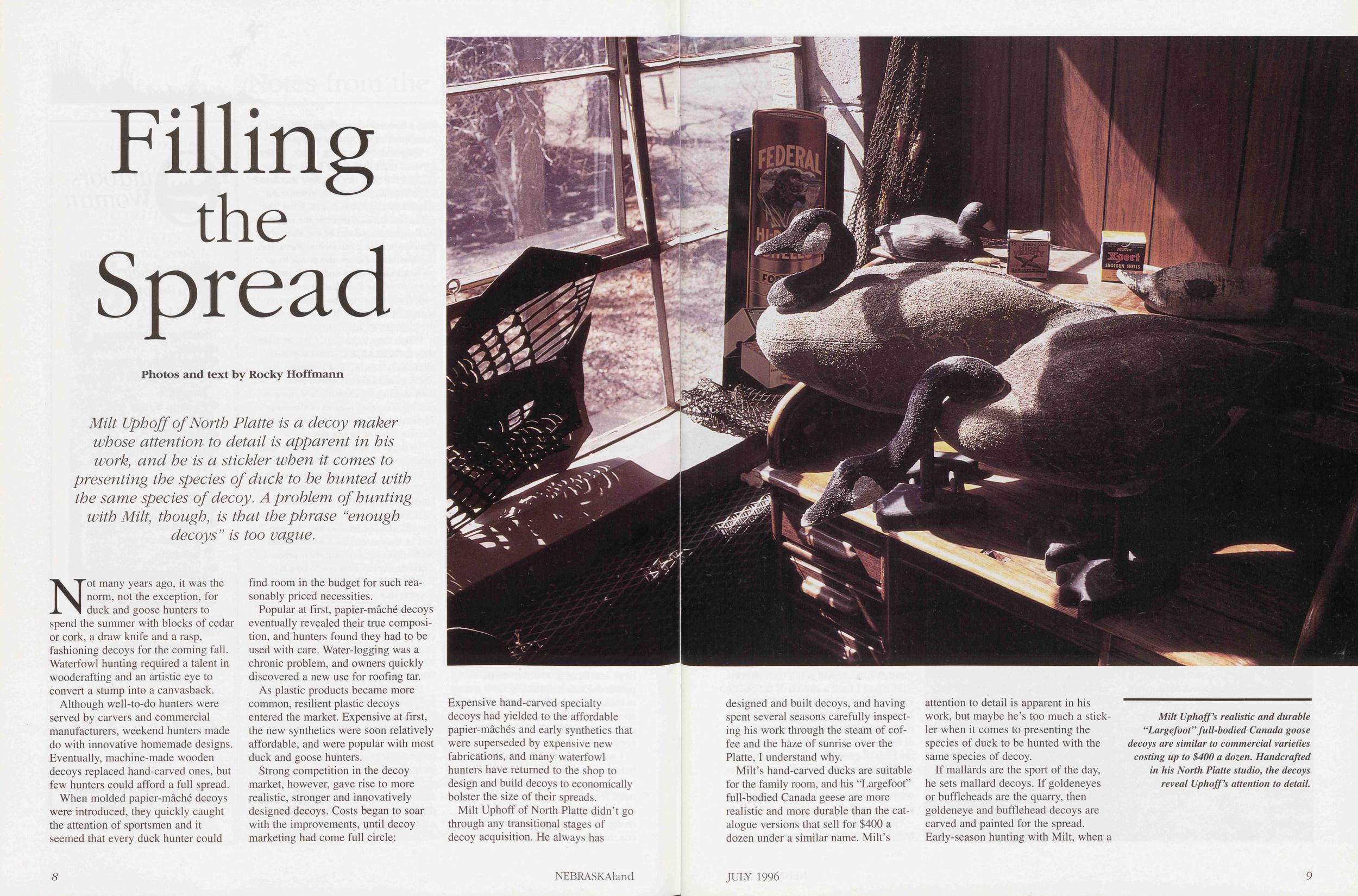
Filling the Spread
Photos and text by Rocky Hoffmann Milt Uph off of North Platte is a decoy maker whose attention to detail is apparent in his work, and he is a stickler when it comes to presenting the species of duck to be hunted with the same species of decoy. A problem of hunting with Milt, though, is that the phrase enough decoys" is too vague.Not many years ago, it was the norm, not the exception, for duck and goose hunters to spend the summer with blocks of cedar or cork, a draw knife and a rasp, fashioning decoys for the coming fall. Waterfowl hunting required a talent in woodcrafting and an artistic eye to convert a stump into a canvasback.
Although well-to-do hunters were served by carvers and commercial manufacturers, weekend hunters made do with innovative homemade designs. Eventually, machine-made wooden decoys replaced hand-carved ones, but few hunters could afford a full spread.
When molded papier-mache decoys were introduced, they quickly caught the attention of sportsmen and it seemed that every duck hunter could find room in the budget for such reasonably priced necessities.
Popular at first, papier-mache decoys eventually revealed their true composition, and hunters found they had to be used with care. Water-logging was a chronic problem, and owners quickly discovered a new use for roofing tar.
As plastic products became more common, resilient plastic decoys entered the market. Expensive at first, the new synthetics were soon relatively affordable, and were popular with most duck and goose hunters.
Strong competition in the decoy market, however, gave rise to more realistic, stronger and innovatively designed decoys. Costs began to soar with the improvements, until decoy marketing had come full circle: Expensive hand-carved specialty decoys had yielded to the affordable papier-maches and early synthetics that were superseded by expensive new fabrications, and many waterfowl hunters have returned to the shop to design and build decoys to economically bolster the size of their spreads.
Milt Uphoff of North Platte didn't go through any transitional stages of decoy acquisition. He always has 8 NEBRASKAland designed and built decoys, and having spent several seasons carefully inspecting his work through the steam of coffee and the haze of sunrise over the Platte, I understand why.
Milt's hand-carved ducks are suitable for the family room, and his "Largefoot" full-bodied Canada geese are more realistic and more durable than the catalogue versions that sell for $400 a dozen under a similar name. Milt's attention to detail is apparent in his work, but maybe he's too much a stickler when it comes to presenting the species of duck to be hunted with the same species of decoy.
If mallards are the sport of the day, he sets mallard decoys. If goldeneyes or buffleheads are the quarry, then goldeneye and bufflehead decoys are carved and painted for the spread. Early-season hunting with Milt, when a
When Milt's sons Shane and Blane were in high school, decoy making consumed most of their time, and their garage become an assembly line. Raw materials were fed into one end and painted likenesses of ducks and geese rolled out the other.
When the boys went off to college and pursued vocations, the decoy manufacturing plant didn't close, however, nor did Milt have to survive by hunting over only the several hundred decoys he had accumulated. The assembly line just got longer and more complicated, running from North Platte through Lincoln and south to Kentucky.
Milt and I hunt a stretch of the South Platte River near Sutherland. Duck hunting has been excellent, but we never considered our spot even marginal for goose hunting. The area is under the path of geese flying to and from Sutherland Reservoir, however, and Milt suggested that with enough decoys we might be able to call in a flock or two of Canadas.
"Enough decoys" is an open-ended term for Milt. It's too vague; it lacks 10 NEBRASKAland parameters and restrictions. I carefully agreed that a few goose decoys would be in order. Too open-ended again. How many are a few? I'd have to wait and see.
By the time goose season rolled around, we had set out a few hundred Canada goose decoys — about 400 was Milt's guess — and we managed to decoy a few flocks of geese. I could see that old familiar "bigger-and-better-next-year" look in my partner's eyes as we loaded the last truckload of decoys at season's end.
"What about a thousand goose decoys next year?" he asked, looking at the huge bare spot that our decoys had occupied. I thought he was joking, so I nodded and mumbled, "That ought to do it, I suppose."
As usual, Milt and I went our separate ways in the hot months, making plans to hunt again the next fall. In June, the South Platte River left its banks and carved an unrecognizable landscape through our duck and goose spot, depositing huge beds of rock, gravel and sand where water once stood and excavating ponds where cottonwoods grew. Everything was different, but one result of the flood was that a large area was opened up along a hook-shaped segment of river backwater, an area big enough to accommodate a thousand goose decoys.
In late October we set out about 1,100 Canada goose decoys. The cost of that many commercial decoys would have been phenomenal, but only a few of ours were from commercial manufacturers. The rest were handcrafted by Milt and Blane and added to past inventories.
Milt's plan was to add to the number of shell decoys and bolster the spread by filling bare spots with silhouette decoys. He already had demonstrated that silhouettes work, and at one of our distant walk-in spots where it is too difficult to haul in full-bodied, floating duck decoys, we use silhouette mallards on tall stakes. Wading into shallow water, we push the stakes in until the decoy's belly comes close to the water's surface, and we're set — no tangled decoy lines, no heavy weights and twice the number of decoys.
At first, we were worried about the lack of body mass, but even though silhouettes are difficult to see from directly above, other silhouettes in the spread remain visible. As a goose flies over a spread of decoys, there are always more visible silhouettes than there are less visible ones.
We often face the silhouettes in several directions, giving geese a side view of some of the decoys no matter what direction they approach from. Most of Milt's experimental silhouette mallard decoys are black, but his Canada silhouettes are painted more realistically. He even adds feather patterns with elaborate stencils. The decoys are remarkably lifelike, and a variety of head and body postures add authenticity. The silhouettes are made from a variety of materials, including plywood, compression board, masonite and plastic — almost anything that can be bargained for from lumberyard scrap piles.
The silhouettes are filler decoys
positioned among the full-bodies and
shells, and increasing the number of
shells was the most exhausting part of
JULY 1996
11
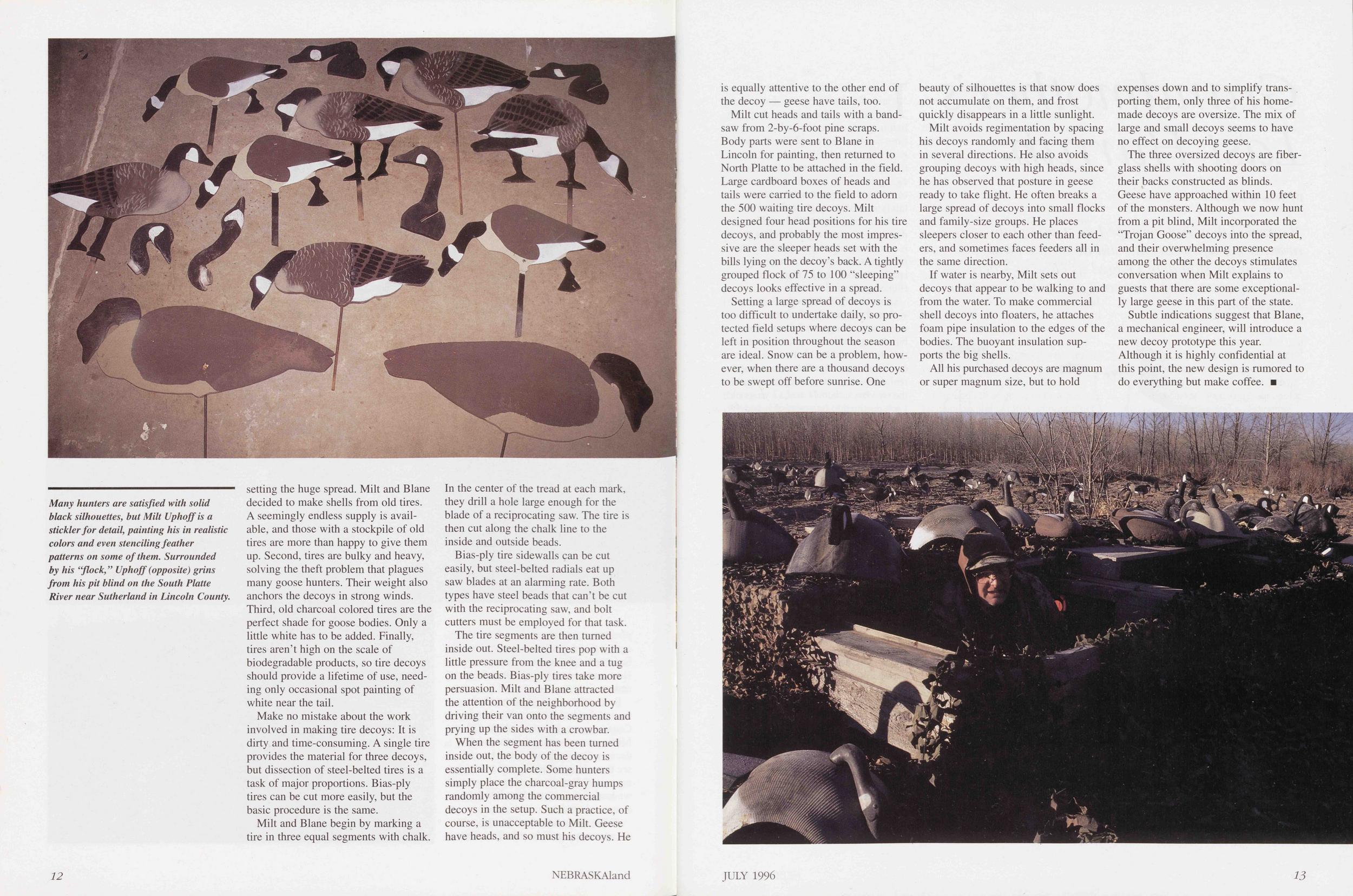
Make no mistake about the work involved in making tire decoys: It is dirty and time-consuming. A single tire provides the material for three decoys, but dissection of steel-belted tires is a task of major proportions. Bias-ply tires can be cut more easily, but the basic procedure is the same.
Milt and Blane begin by marking a tire in three equal segments with chalk. In the center of the tread at each mark, they drill a hole large enough for the blade of a reciprocating saw. The tire is then cut along the chalk line to the inside and outside beads.
Bias-ply tire sidewalls can be cut easily, but steel-belted radials eat up saw blades at an alarming rate. Both types have steel beads that can't be cut with the reciprocating saw, and bolt cutters must be employed for that task.
The tire segments are then turned inside out. Steel-belted tires pop with a little pressure from the knee and a tug on the beads. Bias-ply tires take more persuasion. Milt and Blane attracted the attention of the neighborhood by driving their van onto the segments and prying up the sides with a crowbar.
When the segment has been turned inside out, the body of the decoy is essentially complete. Some hunters simply place the charcoal-gray humps randomly among the commercial decoys in the setup. Such a practice, of course, is unacceptable to Milt. Geese have heads, and so must his decoys. He 12 NEBRASKAland is equally attentive to the other end of the decoy — geese have tails, too.
Milt cut heads and tails with a bandsaw from 2-by-6-foot pine scraps. Body parts were sent to Blane in Lincoln for painting, then returned to North Platte to be attached in the field. Large cardboard boxes of heads and tails were carried to the field to adorn the 500 waiting tire decoys. Milt designed four head positions for his tire decoys, and probably the most impressive are the sleeper heads set with the bills lying on the decoy's back. A tightly grouped flock of 75 to 100 "sleeping" decoys looks effective in a spread.
Setting a large spread of decoys is too difficult to undertake daily, so protected field setups where decoys can be left in position throughout the season are ideal. Snow can be a problem, however, when there are a thousand decoys to be swept off before sunrise. One beauty of silhouettes is that snow does not accumulate on them, and frost quickly disappears in a little sunlight.
Milt avoids regimentation by spacing his decoys randomly and facing them in several directions. He also avoids grouping decoys with high heads, since he has observed that posture in geese ready to take flight. He often breaks a large spread of decoys into small flocks and family-size groups. He places sleepers closer to each other than feeders, and sometimes faces feeders all in the same direction.
If water is nearby, Milt sets out decoys that appear to be walking to and from the water. To make commercial shell decoys into floaters, he attaches foam pipe insulation to the edges of the bodies. The buoyant insulation sup- ports the big shells.
All his purchased decoys are magnum or super magnum size, but to hold expenses down and to simplify transporting them, only three of his homemade decoys are oversize. The mix of large and small decoys seems to have no effect on decoying geese.
The three oversized decoys are fiberglass shells with shooting doors on their backs constructed as blinds. Geese have approached within 10 feet of the monsters. Although we now hunt from a pit blind, Milt incorporated the "Trojan Goose" decoys into the spread, and their overwhelming presence among the other the decoys stimulates conversation when Milt explains to guests that there are some exceptionally large geese in this part of the state.
Subtle indications suggest that Blane, a mechanical engineer, will introduce a new decoy prototype this year. Although it is highly confidential at this point, the new design is rumored to do everything but make coffee.
Grandmother's Last Hurrah
By Jean Schneider "I grasped the creel, wrapped its strap tightly around my left wrist and slid down the bank. Lying on my stomach, I edged as close as safety would allow to where the cord was caught on the woody tentacle."It had been a long time since I had gone fishing. For years, I shared my husband's enthusiasm for dropping bait in our favorite Nebraska rivers, but time had lessened my ability to navigate steep river banks, fight my way through horrendous brush, battle maneating insects or wade into the current of a fast-moving stream. And I was certainly not fool enough to think I could outdistance a range bull should he decide to become territorial. But there is something about grandchildren that manages to fan our last remaining spark of daring until a flame, however flickering, begins to burn.
Our oldest grandsons are "city kids" with no background whatsoever for the more rugged aspects of the outdoors, but their grandfather was determined that they should try his favorite sport, catching channel catfish on a rod and reel. Once an outing was planned with the two boys, then 11 and 13 years old, I felt destined to be a part of it and threw caution to the wind.
We left early on a Saturday morning, and after a considerable drive made our first attempts to lure the elusive catfish with our aromatic, home-prepared bait. We stayed within calling distance. It had been agreed that I would never stray far from the younger grandson, and their grandfather would stay near the older boy.
Our efforts proved futile, and our stomachs finally told us that it was dinnertime. We drove the short distance to our lodgings, ate and retired early.
We were up and ready to go by dawn, probably the best of all times to be on the river. The place we chose had been pastured, so the grass was short, allowing easy access to shallow, sloping banks dotted with wildflowers. The still of the cool morning air was broken only by the gentle murmur of the current and occasional chirping of birds. A great blue heron pranced on a sandbar several yards away, then, spreading his impressive wings, skimmed the water in search of breakfast. We watched the sun emerge from a streak of pink that seemed to have been painted behind the tops of distant hills.
Unfortunately, aesthetics suffice only for a limited time when the catfish 14 NEBRASKAland refuse to bite. No matter how many times we moved or what tactics we used to tempt the wary creatures, their exasperating hunger strike continued.
My husband, who does not give up easily, decided we should try a more difficult stretch of the river. I was not pleased at this news — I knew exactly what he meant by "more difficult."
We drove a while, parked the station wagon and unloaded our equipment near a remote bridge that crossed a particularly scraggy-looking part of the river. The grass was high and so were the banks, which I knew would pose a problem if we should have the good fortune to hook a fish. There were fallen trees and brush piles in the water, and, as usual, the few good holes were near these hard-to-manage areas. To find good water downstream meant an unpleasant trip through heavy brush and even the unwelcome possibility of having to wade to the other side of the river. My husband and older grandson opted for the difficult route and soon disappeared from sight. The younger boy and I each selected a spot slightly upstream from the bridge and dropped our lines over the high grassy bank.
In a matter of minutes, several hard tugs on my line told me that something sizable was showing an interest in my bait. At about the same time, my grand- son shouted that he had a fish on his line. I reeled in, laid my rod aside and hurried to watch. Despite the steepness of the bank, the youngster ably landed a nice one-and-a-half-pound catfish, and we excitedly placed it in the creel. It is no exaggeration to say that I was as pleased at my grandson's success as he was.
I returned to my spot. The water was deep and had the kind of underwater cover in which fish like to hide. It was nearly perfect except for a large cluster of submerged roots that protruded from the steep bank, making it difficult to avoid snagging the line. Nevertheless, since my grandson had no more nibbles, I suggested he try my place, while I moved a few yards upstream.
I was soon ready to move farther up the river when a loud thrashing in the water caught my attention, and I was happy to see that my companion had another good fish on his line. I ran to watch the action.
Things were going well until the fish found shelter in the nefarious root system. It soon became apparent that all the pulling and tugging in the world was worse than useless. It was time to calmly assess what, to me, seemed an impossible situation.
Looking around, I spotted a sturdy branch that had fallen from a nearby tree. It was about three inches in diameter, had a curved prong on the end and was long enough to reach down the high bank to the trouble spot below. With it, my 110 pounds gave sufficient leverage to raise the snag so we could actually see the source of our problem. The line was wrapped completely around one of the roots, and a good size catfish was moving the remaining two or three feet of line slowly back and forth beneath the surface.
I looked at my grandson's anxious face and explained that without a net I could see no way of landing the fish or even any hope of releasing it back into the current.
All four of our grandsons are, of course, extremely creative, and on this particular day one of them proved himself beyond measure. He presented a plan whereby he would crawl down the bank, lie on his stomach over the roots, somehow get the creel under the fish and cut the line. I thought about that for a while.
Our only daughter and her husband had entrusted us with the safety of their children; to me, a sacred trust. True, an 11-year-old was doubtless more agile than I, but I was taller and had longer arms so I would not have to reach so far to capture the fish or cut the line. Although he would have preferred a reversal of roles, I convinced my grandson that he should take the important responsibilities of holding the snag above the water with our makeshift lever and keeping the rod from sliding into the river when the line was finally released.
My husband believes I would do anything, not necessarily within reason, to please my grandsons. Well, I wanted this one to have his fish, and, yes, I selfishly wished to be remembered as a grandmother who was dauntless in the face of adversity. In truth, "foolhardy" would have been a more accurate word.
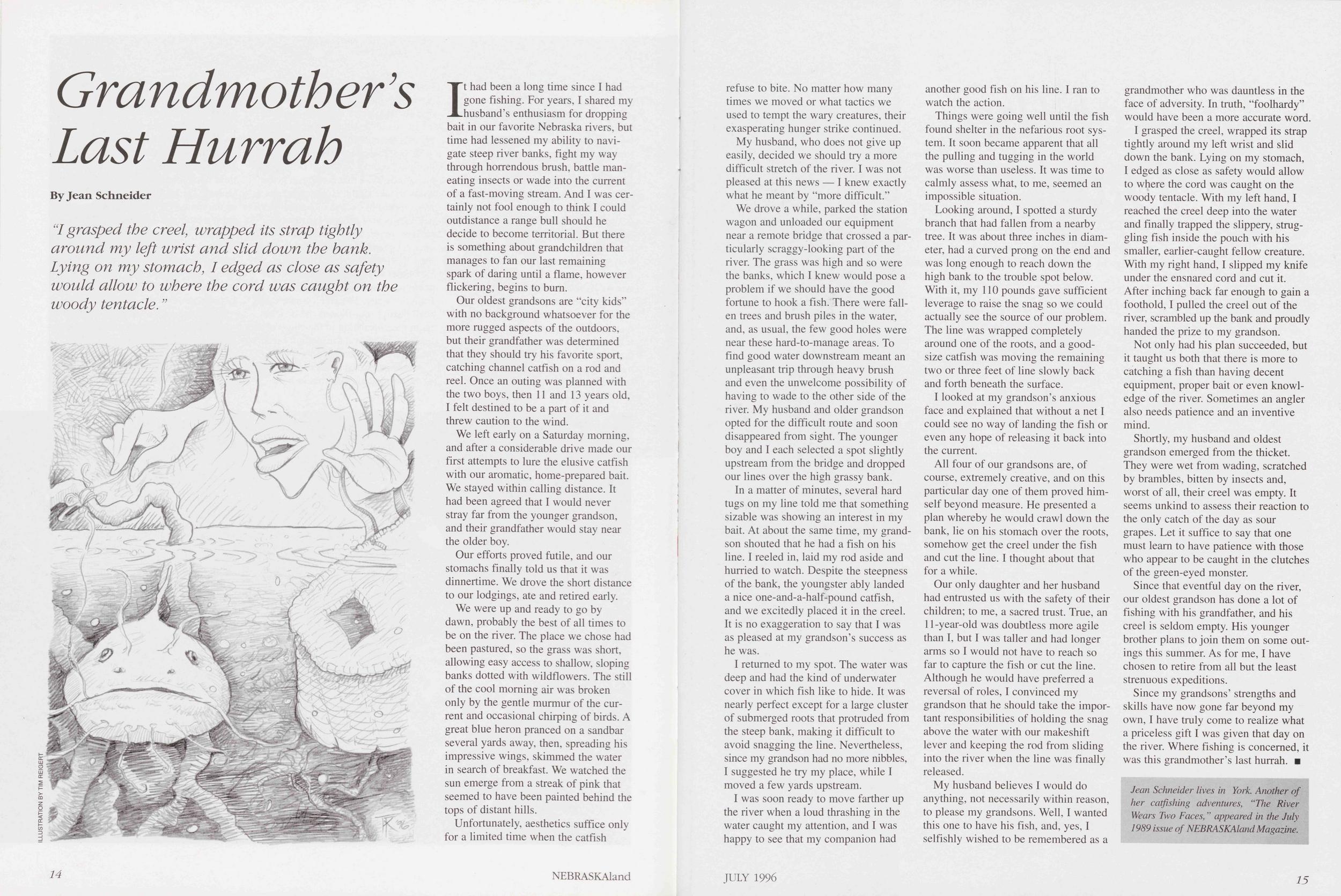
I grasped the creel, wrapped its strap tightly around my left wrist and slid down the bank. Lying on my stomach, I edged as close as safety would allow to where the cord was caught on the woody tentacle. With my left hand, I reached the creel deep into the water and finally trapped the slippery, struggling fish inside the pouch with his smaller, earlier-caught fellow creature. With my right hand, I slipped my knife under the ensnared cord and cut it. After inching back far enough to gain a foothold, I pulled the creel out of the river, scrambled up the bank and proudly handed the prize to my grandson.
Not only had his plan succeeded, but it taught us both that there is more to catching a fish than having decent equipment, proper bait or even knowledge of the river. Sometimes an angler also needs patience and an inventive mind.
Shortly, my husband and oldest grandson emerged from the thicket. They were wet from wading, scratched by brambles, bitten by insects and, worst of all, their creel was empty. It seems unkind to assess their reaction to the only catch of the day as sour grapes. Let it suffice to say that one must learn to have patience with those who appear to be caught in the clutches of the green-eyed monster.
Since that eventful day on the river, our oldest grandson has done a lot of fishing with his grandfather, and his creel is seldom empty. His younger brother plans to join them on some outings this summer. As for me, I have chosen to retire from all but the least strenuous expeditions.
Since my grandsons' strengths and skills have now gone far beyond my own, I have truly come to realize what a priceless gift I was given that day on the river. Where fishing is concerned, it was this grandmother's last hurrah.
Jean Schneider lives in York. Another of her catfishing adventures, "Tlie River Wears Two Faces," appeared in the July 1989 issue of NEBRASKAland Magazine. JULY 1996 15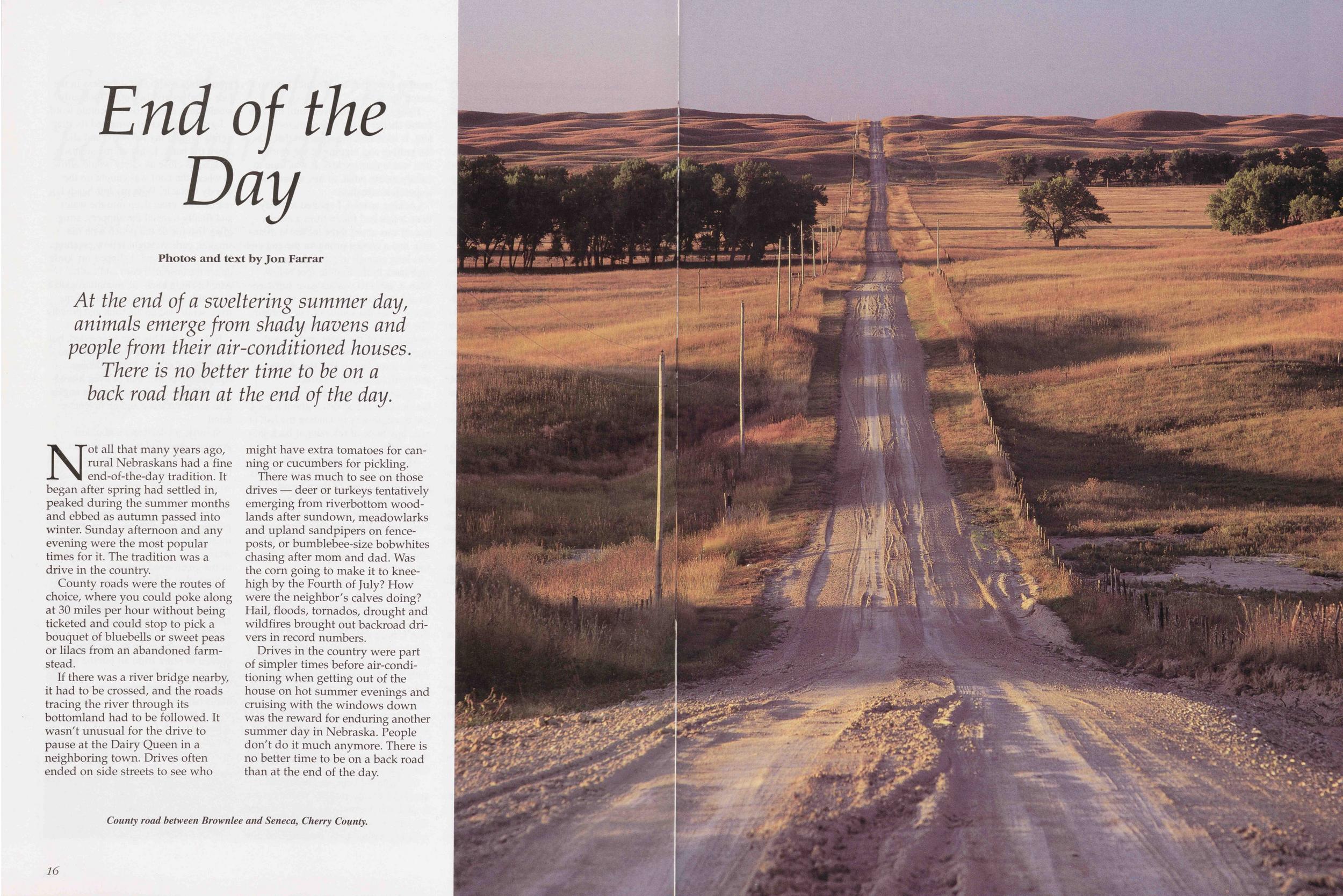
End of the Day
Photos and text by Jon Farrar At the end of a sweltering summer day, animals emerge from shady havens and people from their air-conditioned houses. There is no better time to be on a back road than at the end of the day.Not all that many years ago, rural Nebraskans had a fine end-of-the-day tradition. It began after spring had settled in, peaked during the summer months and ebbed as autumn passed into winter. Sunday afternoon and any evening were the most popular times for it. The tradition was a drive in the country.
County roads were the routes of choice, where you could poke along at 30 miles per hour without being ticketed and could stop to pick a bouquet of bluebells or sweet peas or lilacs from an abandoned farmstead.
If there was a river bridge nearby, it had to be crossed, and the roads tracing the river through its bottomland had to be followed. It wasn't unusual for the drive to pause at the Dairy Queen in a neighboring town. Drives often ended on side streets to see who might have extra tomatoes for canning or cucumbers for pickling.
There was much to see on those drives — deer or turkeys tentatively emerging from river bottom woodlands after sundown, meadowlarks and upland sandpipers on fenceposts, or bumblebee-size bobwhites chasing after mom and dad. Was the corn going to make it to knee high by the Fourth of July? How were the neighbor's calves doing? Hail, floods, tornados, drought and wildfires brought out backroad drivers in record numbers.
Drives in the country were part of simpler times before air-conditioning when getting out of the house on hot summer evenings and cruising with the windows down was the reward for enduring another summer day in Nebraska. People don't do it much anymore. There is no better time to be on a back road than at the end of the day.
16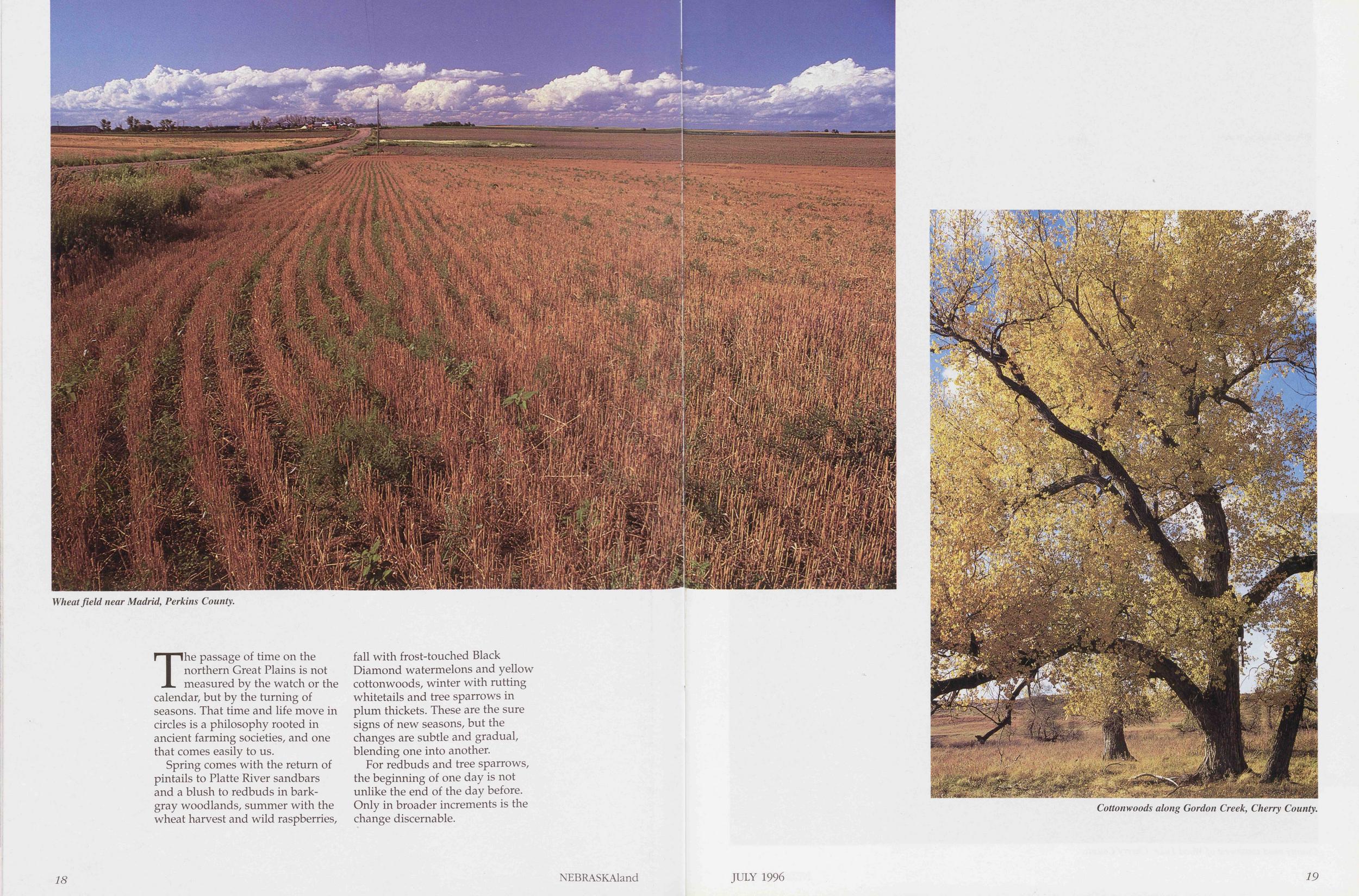
The passage of time on the northern Great Plains is not measured by the watch or the calendar, but by the turning of seasons. That time and life move in circles is a philosophy rooted in ancient farming societies, and one that comes easily to us.
Spring comes with the return of pintails to Platte River sandbars and a blush to redbuds in bark- gray woodlands, summer with the wheat harvest and wild raspberries, fall with frost-touched Black Diamond watermelons and yellow cottonwoods, winter with rutting whitetails and tree sparrows in plum thickets. These are the sure signs of new seasons, but the changes are subtle and gradual, blending one into another.
For redbuds and tree sparrows, the beginning of one day is not unlike the end of the day before. Only in broader increments is the change discernable.
18 NEBRASKAland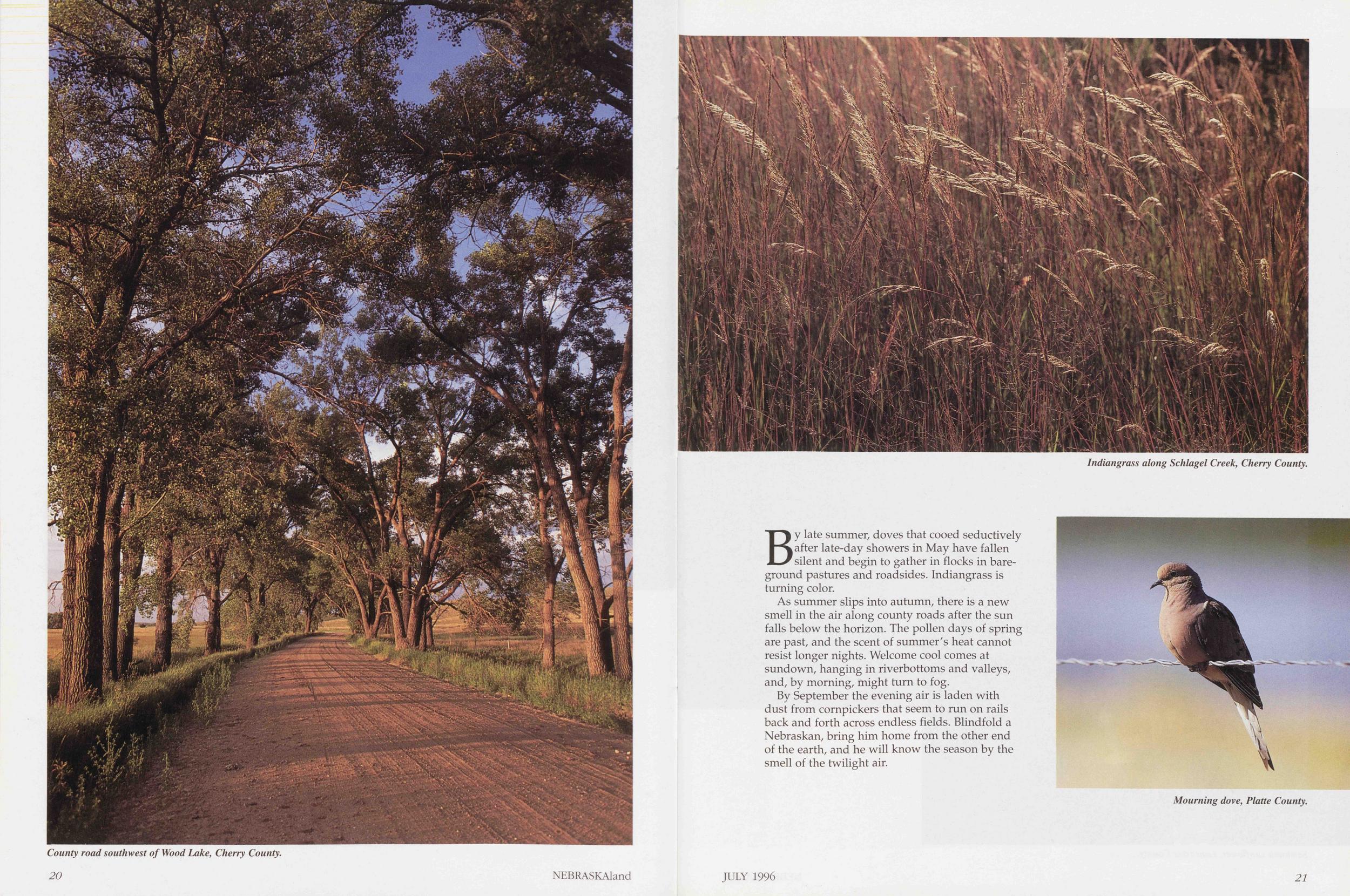
By late summer, doves that cooed seductively after late-day showers in May have fallen silent and begin to gather in flocks in bareground pastures and roadsides. Indiangrass is turning color.
As summer slips into autumn, there is a new smell in the air along county roads after the sun falls below the horizon. The pollen days of spring are past, and the scent of summer's heat cannot resist longer nights. Welcome cool comes at sundown, hanging in river bottoms and valleys, and, by morning, might turn to fog.
By September the evening air is laden with dust from corn pickers that seem to run on rails back and forth across endless fields. Blindfold a Nebraskan, bring him home from the other end of the earth, and he will know the season by the smell of the twilight air.
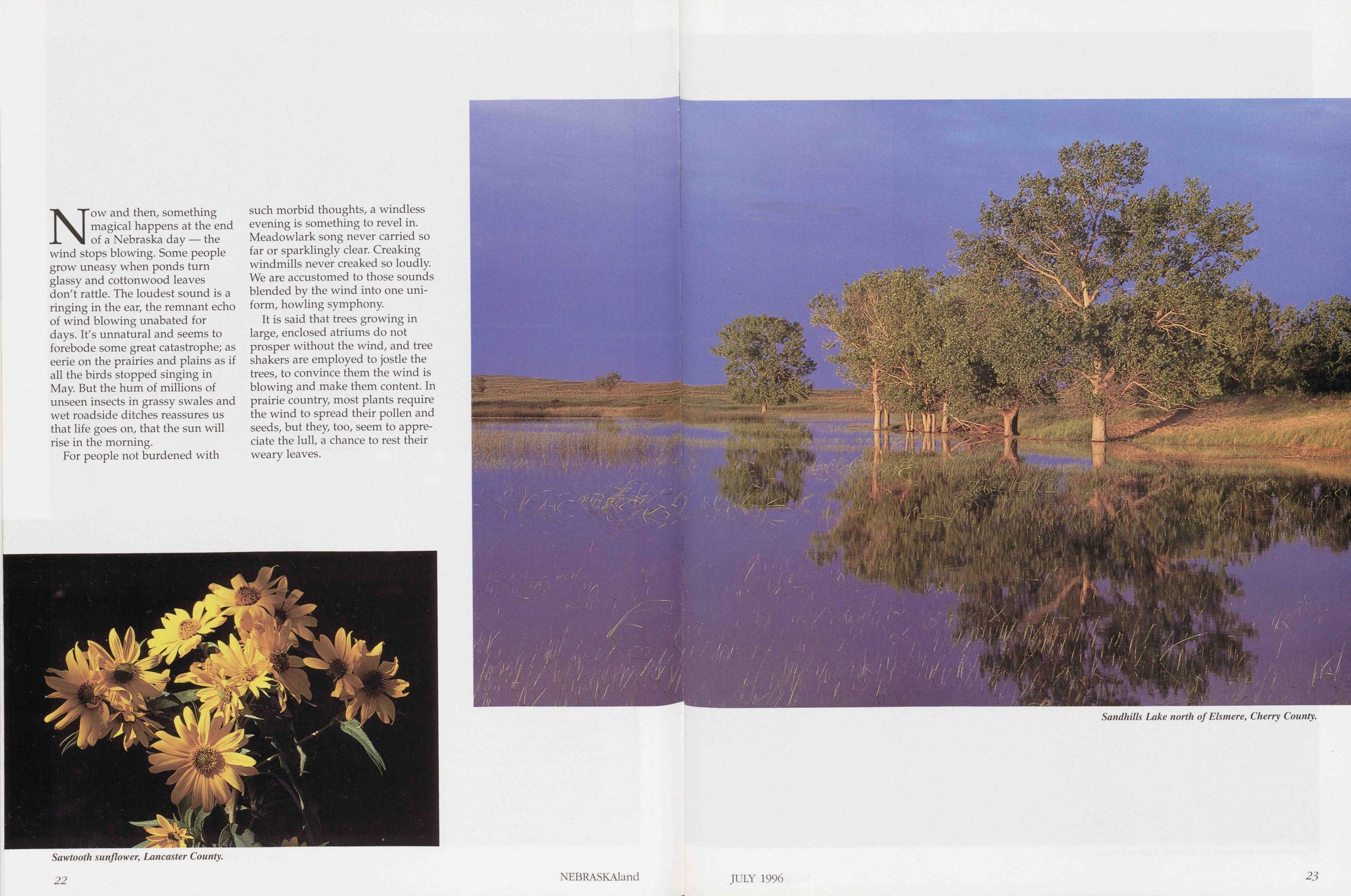
Now and then, something magical happens at the end of a Nebraska day — the wind stops blowing. Some people grow uneasy when ponds turn glassy and cottonwood leaves don't rattle. The loudest sound is a ringing in the ear, the remnant echo of wind blowing unabated for days. It's unnatural and seems to forebode some great catastrophe; as eerie on the prairies and plains as if all the birds stopped singing in May. But the hum of millions of unseen insects in grassy swales and wet roadside ditches reassures us that life goes on, that the sun will rise in the morning.
For people not burdened with such morbid thoughts, a windless evening is something to revel in. Meadowlark song never carried so far or sparklingly clear. Creaking windmills never creaked so loudly. We are accustomed to those sounds blended by the wind into one uniform, howling symphony.
It is said that trees growing in large, enclosed atriums do not prosper without the wind, and tree shakers are employed to jostle the trees, to convince them the wind is blowing and make them content. In prairie country, most plants require the wind to spread their pollen and seeds, but they, too, seem to appreciate the lull, a chance to rest their weary leaves.
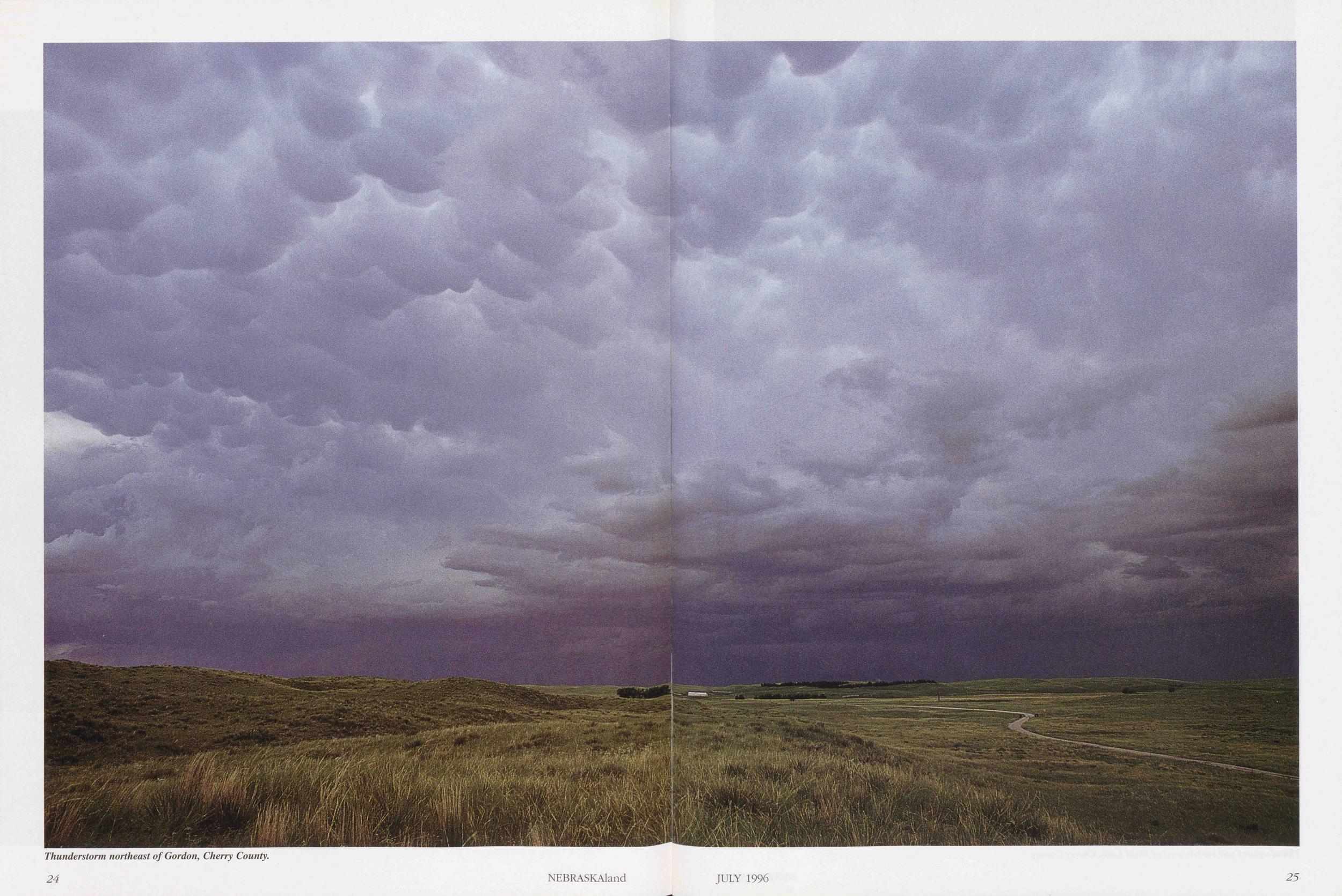
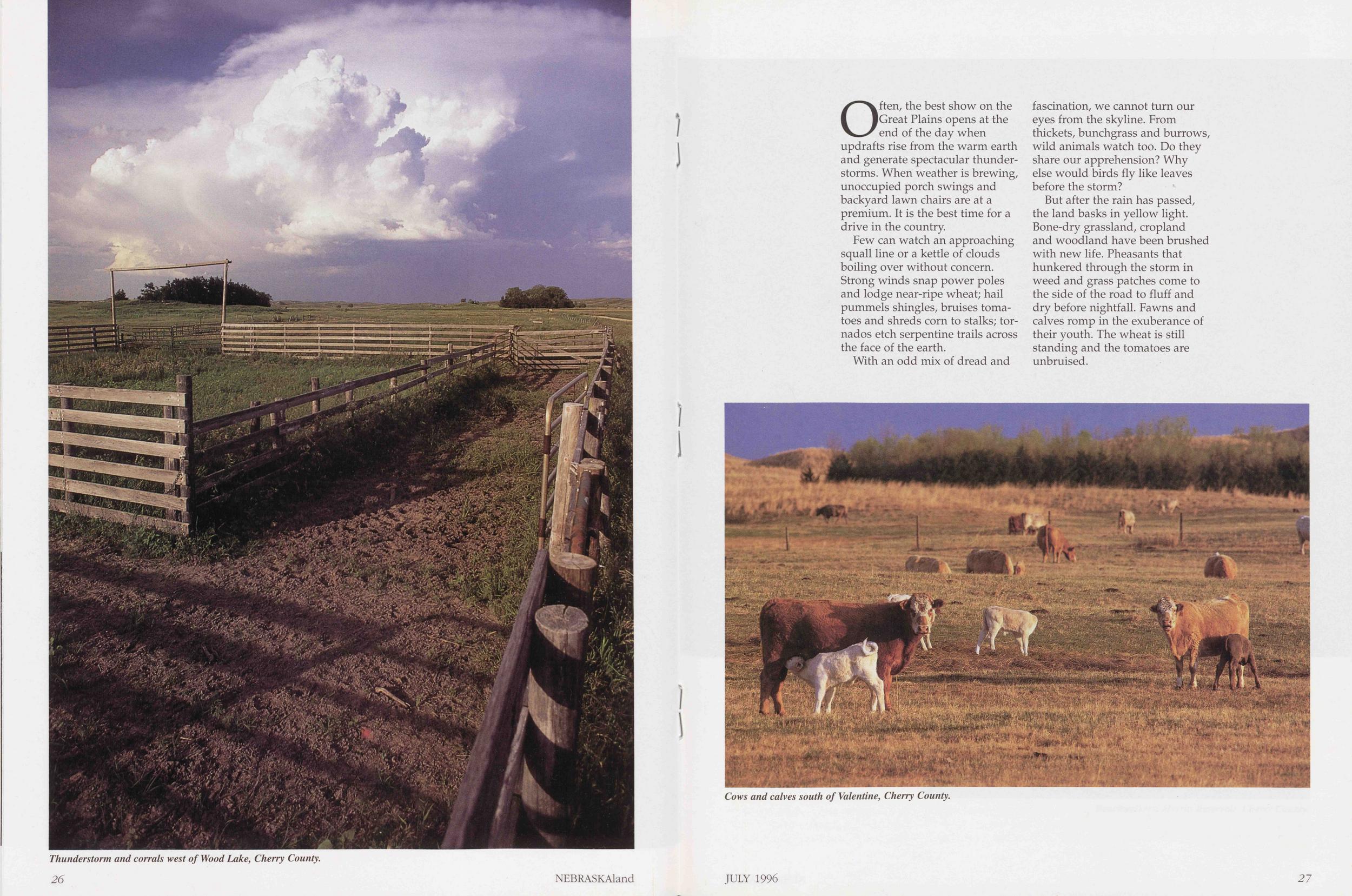
Often, the best show on the Great Plains opens at the end of the day when updrafts rise from the warm earth and generate spectacular thunderstorms. When weather is brewing, unoccupied porch swings and backyard lawn chairs are at a premium. It is the best time for a drive in the country.
Few can watch an approaching squall line or a kettle of clouds boiling over without concern. Strong winds snap power poles and lodge near-ripe wheat; hail pummels shingles, bruises tomatoes and shreds corn to stalks; tornados etch serpentine trails across the face of the earth.
With an odd mix of dread and fascination, we cannot turn our eyes from the skyline. From thickets, bunchgrass and burrows, wild animals watch too. Do they share our apprehension? Why else would birds fly like leaves before the storm?
But after the rain has passed, the land basks in yellow light. Bone-dry grassland, cropland and woodland have been brushed with new life. Pheasants that hunkered through the storm in weed and grass patches come to the side of the road to fluff and dry before nightfall. Fawns and calves romp in the exuberance of their youth. The wheat is still standing and the tomatoes are unbruised.
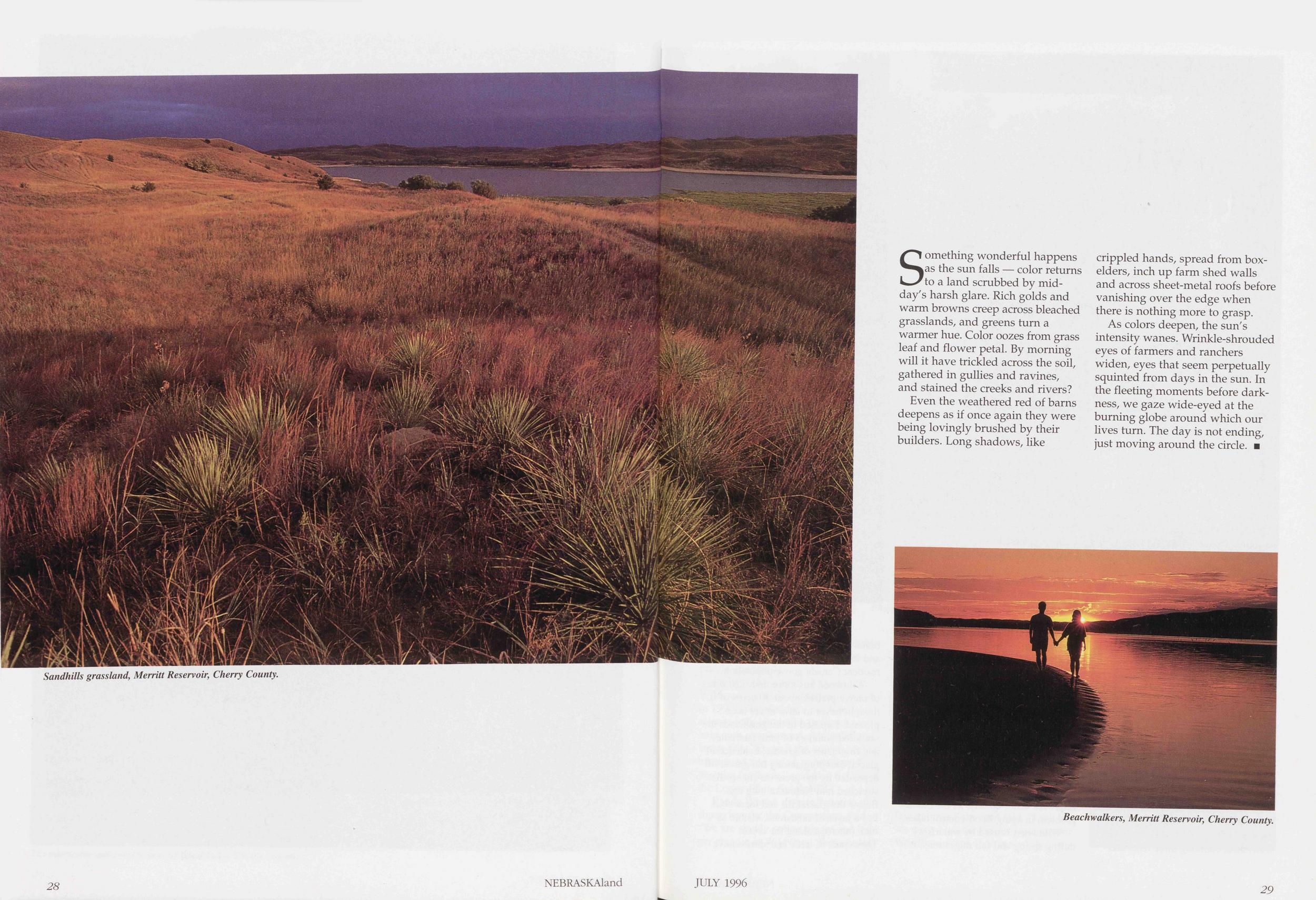
Something wonderful happens as the sun falls — color returns to a land scrubbed by mid- day's harsh glare. Rich golds and warm browns creep across bleached grasslands, and greens turn a warmer hue. Color oozes from grass leaf and flower petal. By morning will it have trickled across the soil, gathered in gullies and ravines, and stained the creeks and rivers?
Even the weathered red of barns deepens as if once again they were being lovingly brushed by their builders. Long shadows, like crippled hands, spread from boxelders, inch up farm shed walls and across sheet-metal roofs before vanishing over the edge when there is nothing more to grasp.
As colors deepen, the sun's intensity wanes. Wrinkle-shrouded eyes of farmers and ranchers widen, eyes that seem perpetually squinted from days in the sun. In the fleeting moments before darkness, we gaze wide-eyed at the burning globe around which our lives turn. The day is not ending, just moving around the circle.
IMPLE PLEASURES
Wildwood
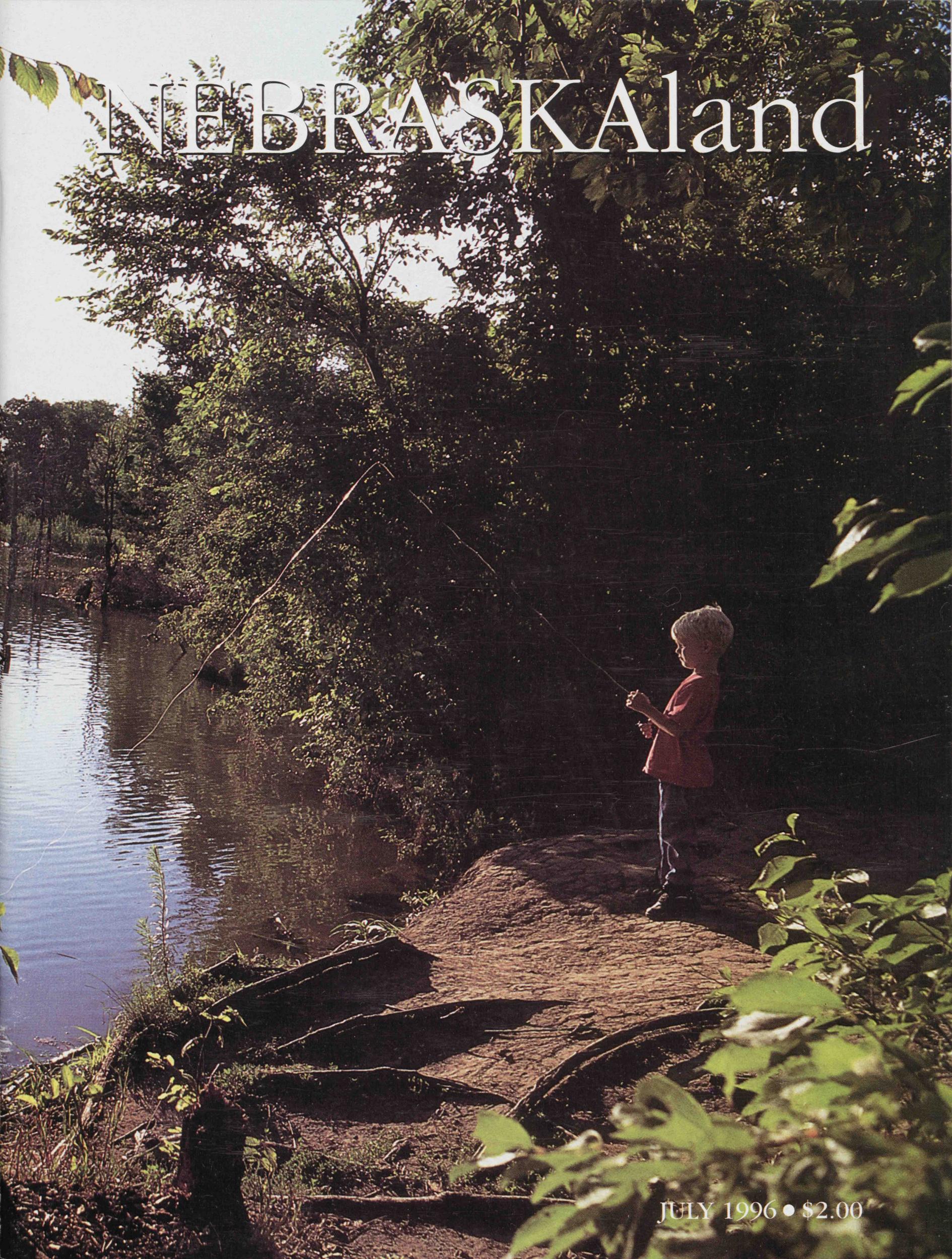
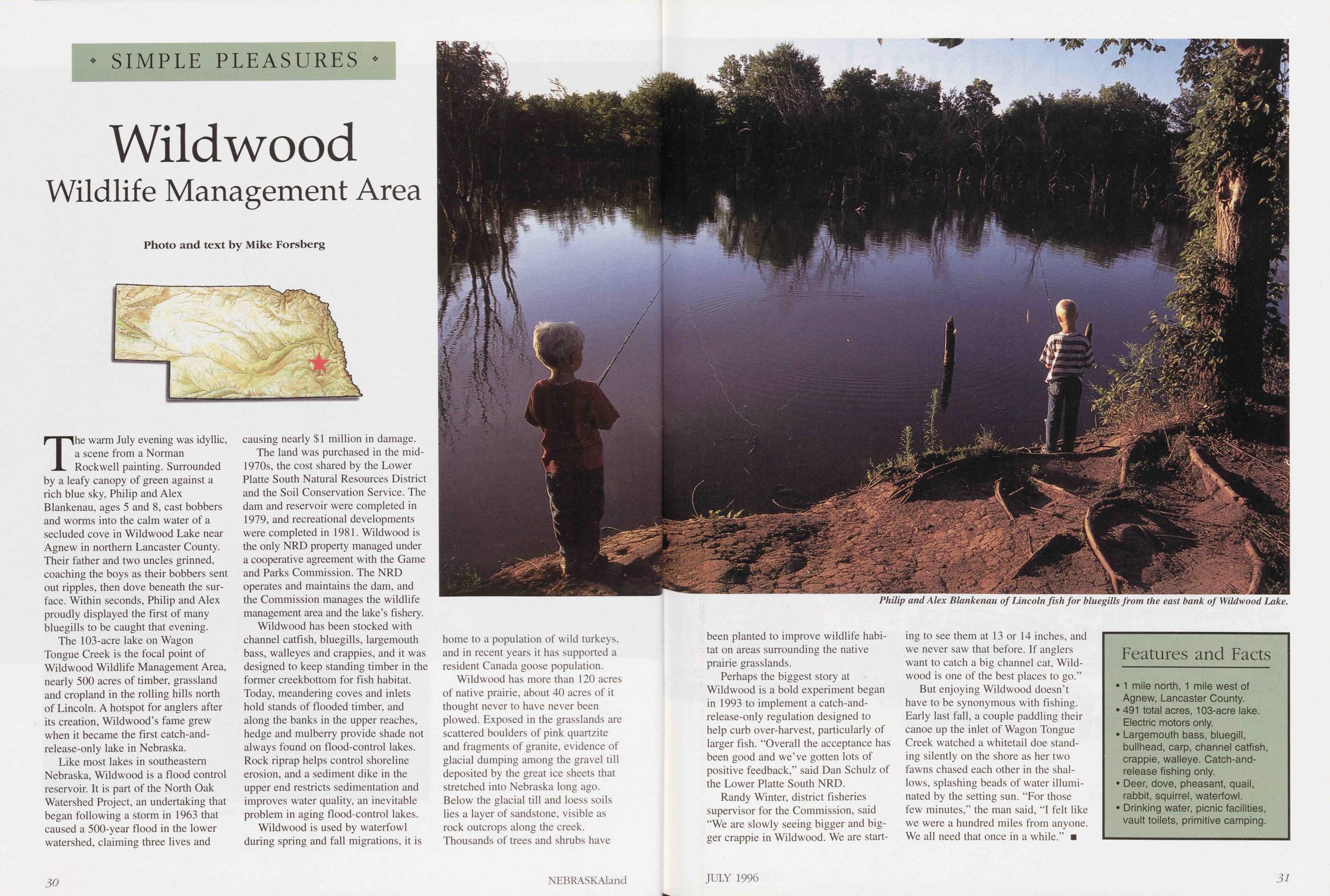
Wildlife Management Area Photo and text by Mike ForsbergThe warm July evening was idyllic, a scene from a Norman Rockwell painting. Surrounded by a leafy canopy of green against a rich blue sky, Philip and Alex Blankenau, ages 5 and 8, cast bobbers and worms into the calm water of a secluded cove in Wildwood Lake near Agnew in northern Lancaster County. Their father and two uncles grinned, coaching the boys as their bobbers sent out ripples, then dove beneath the surface. Within seconds, Philip and Alex proudly displayed the first of many bluegills to be caught that evening.
The 103-acre lake on Wagon Tongue Creek is the focal point of Wildwood Wildlife Management Area, nearly 500 acres of timber, grassland and cropland in the rolling hills north of Lincoln. A hotspot for anglers after its creation, Wildwood's fame grew when it became the first catch-and-release-only lake in Nebraska.
Like most lakes in southeastern Nebraska, Wildwood is a flood control reservoir. It is part of the North Oak Watershed Project, an undertaking that began following a storm in 1963 that caused a 500-year flood in the lower watershed, claiming three lives and causing nearly $1 million in damage.
The land was purchased in the mid-1970s, the cost shared by the Lower Platte South Natural Resources District and the Soil Conservation Service. The dam and reservoir were completed in 1979, and recreational developments were completed in 1981. Wildwood is the only NRD property managed under a cooperative agreement with the Game and Parks Commission. The NRD operates and maintains the dam, and the Commission manages the wildlife management area and the lake's fishery.
Wildwood has been stocked with channel catfish, bluegills, largemouth bass, walleyes and crappies, and it was designed to keep standing timber in the former creek bottom for fish habitat. Today, meandering coves and inlets hold stands of flooded timber, and along the banks in the upper reaches, hedge and mulberry provide shade not always found on flood-control lakes. Rock riprap helps control shoreline erosion, and a sediment dike in the upper end restricts sedimentation and improves water quality, an inevitable problem in aging flood-control lakes.
Wildwood is used by waterfowl during spring and fall migrations, it is home to a population of wild turkeys, and in recent years it has supported a resident Canada goose population.
Wildwood has more than 120 acres of native prairie, about 40 acres of it thought never to have never been plowed. Exposed in the grasslands are scattered boulders of pink quartzite and fragments of granite, evidence of glacial dumping among the gravel till deposited by the great ice sheets that stretched into Nebraska long ago. Below the glacial till and loess soils lies a layer of sandstone, visible as rock outcrops along the creek. Thousands of trees and shrubs have 30 NEBRASKAland
Perhaps the biggest story at Wildwood is a bold experiment began in 1993 to implement a catch-and-release-only regulation designed to help curb over-harvest, particularly of larger fish. "Overall the acceptance has been good and we've gotten lots of positive feedback," said Dan Schulz of the Lower Platte South NRD.
Randy Winter, district fisheries supervisor for the Commission, said "We are slowly seeing bigger and bigger crappie in Wildwood. We are starting to see them at 13 or 14 inches, and we never saw that before. If anglers want to catch a big channel cat, Wildwood is one of the best places to go."
But enjoying Wildwood doesn't have to be synonymous with fishing. Early last fall, a couple paddling their canoe up the inlet of Wagon Tongue Creek watched a whitetail doe standing silently on the shore as her two fawns chased each other in the shallows, splashing beads of water illuminated by the setting sun. "For those few minutes," the man said, "I felt like we were a hundred miles from anyone. We all need that once in a while."
Features and Facts • 1 mile north, 1 mile west of Agnew, Lancaster County. • 491 total acres, 103-acre lake. Electric motors only. • Largemouth bass, bluegill, bullhead, carp, channel catfish, crappie, walleye. Catch-and-release fishing only. • Deer, dove, pheasant, quail, rabbit, squirrel, waterfowl. • Drinking water, picnic facilities, vault toilets, primitive camping. JULY 1996 31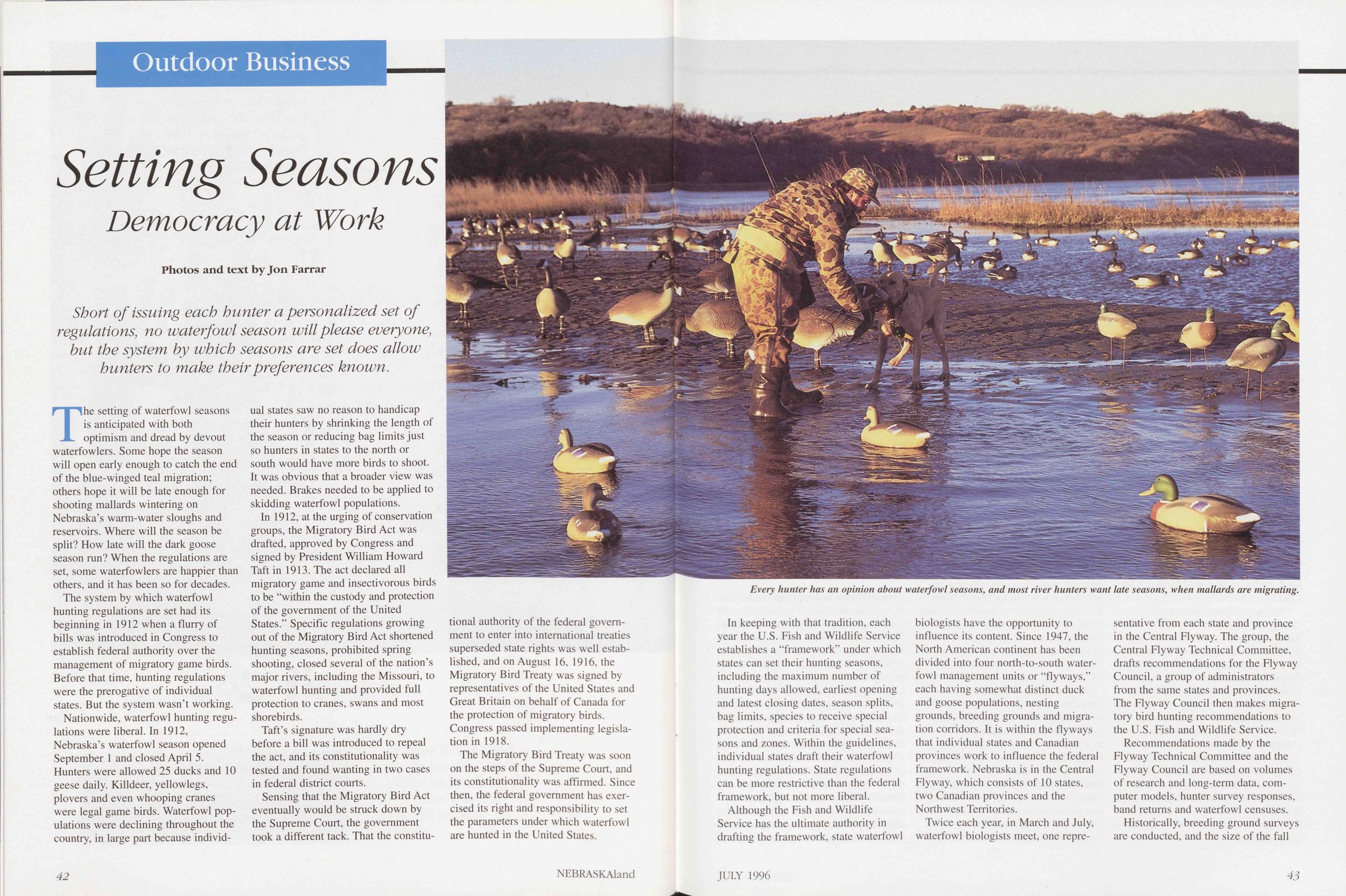
Why Nebraska?
Illustrations and text by Audrey HulburdI traveled alone through Nebraska to draw, paint and observe the small towns. My California friends asked "Why Nebraska?" I was looking for - and found - a quality of life through the people I met. As a former tour guide, Ed found the friendliest people-of all to be from Nebraska. They described the Sandhills and towns without stoplights or shopping centers in a way that made me want to see them for myself.
riving from Omaha in non-stop, drenching rain on route 275 along the flooded Elkhorn River - the radio announcer warned "there's a tornado watch and a 100-percent chance of rain."
In Fremont, I learn that the big Hormel packing plant is where Spam is made. "I like Spam," I said. "We always wondered who ate it," the grocer laughed. At a gas station near Scribner I asked, "May I use the restroom?" "Only if you promise to bring it back," a friendly man replied, adding "If you see a tornado, you be sure to call."
To take a break from the long drive, I sketched the reel sifter inside the Neligh Mill, in use from 1873 to 1969 as the largest mill in Nebraska and one of the oldest and best examples of a large water-powered mill in America. Even in the pouring rain, visitors were stopping by to have a tour.
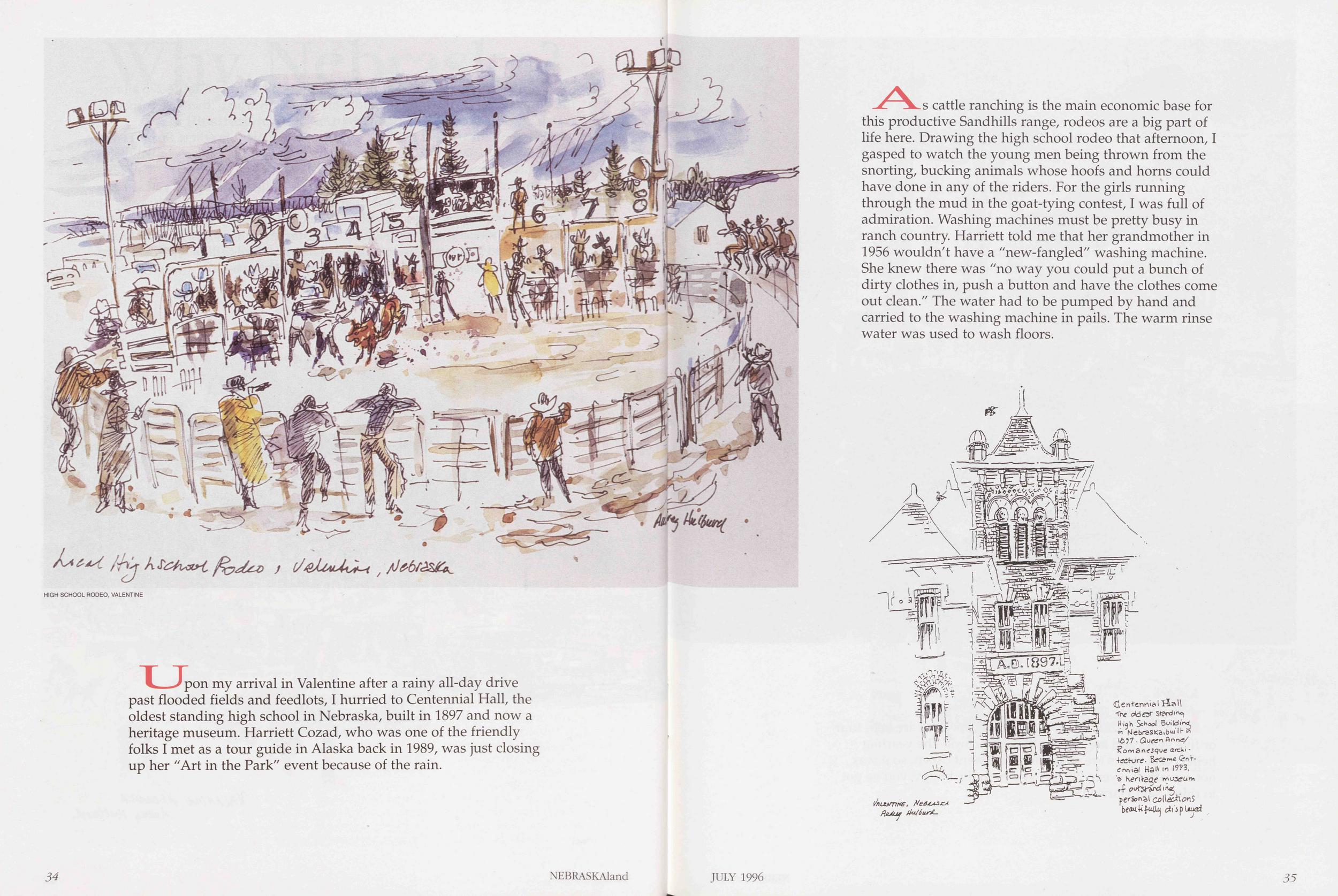
pon my arrival in Valentine after a rainy all-day drive past flooded fields and feedlots, I hurried to Centennial Hall, the oldest standing high school in Nebraska, built in 1897 and now a heritage museum. Harriett Cozad, who was one of the friendly folks I met as a tour guide in Alaska back in 1989, was just closing up her "Art in the Park" event because of the rain.
34 NEBRASKAlands cattle ranching is the main economic base for this productive Sandhills range, rodeos are a big part of life here. Drawing the high school rodeo that afternoon, I gasped to watch the young men being thrown from the snorting, bucking animals whose hoofs and horns could have done in any of the riders. For the girls running through the mud in the goat-tying contest, I was full of admiration. Washing machines must be pretty busy in ranch country. Harriett told me that her grandmother in 1956 wouldn't have a "new-fangled" washing machine. She knew there was "no way you could put a bunch of dirty clothes in, push a button and have the clothes come out clean." The water had to be pumped by hand and carried to the washing machine in pails. The warm rinse water was used to wash floors.
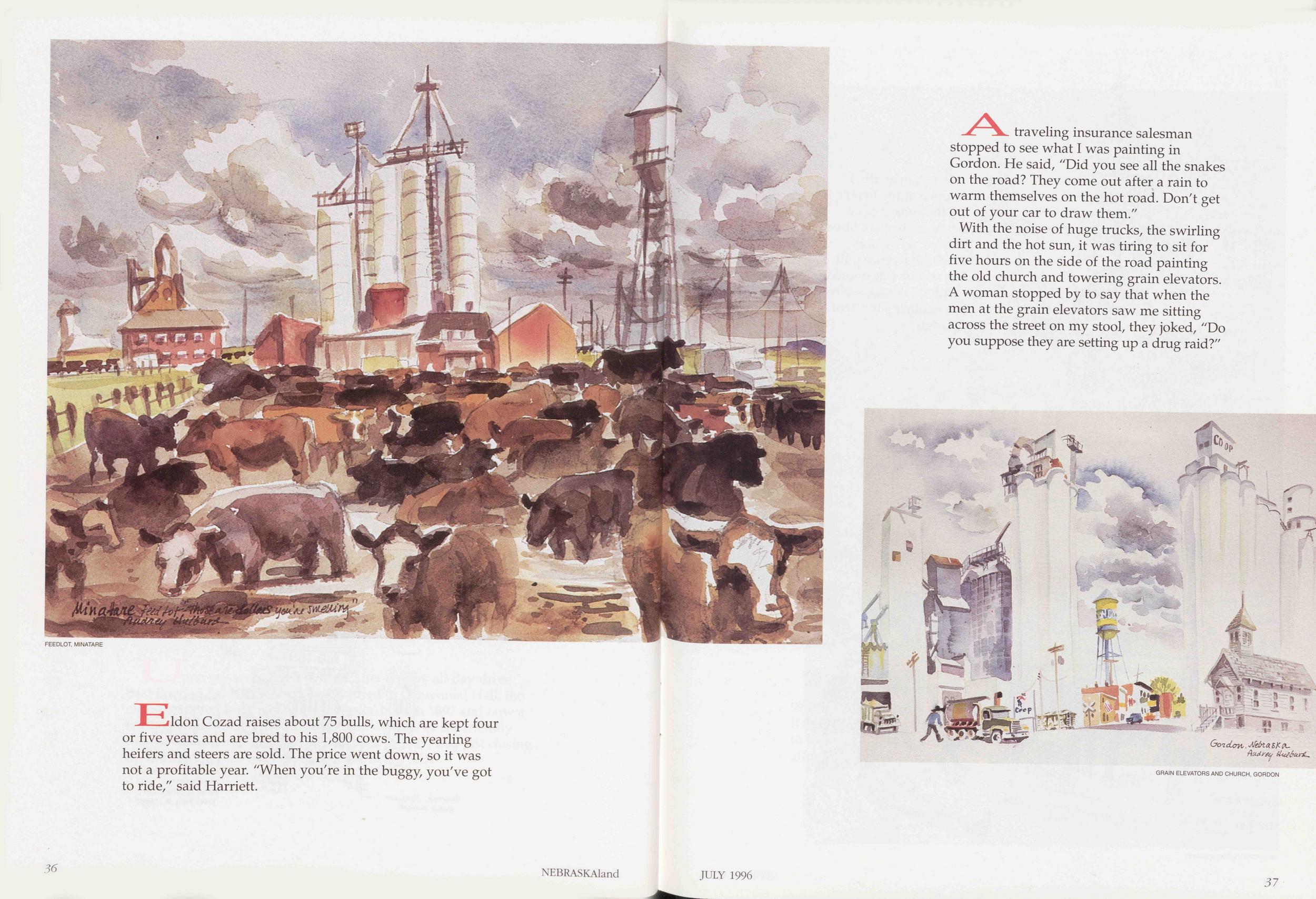
ildon Cozad raises about 75 bulls, which are kept four or five years and are bred to his 1,800 cows. The yearling heifers and steers are sold. The price went down, so it was not a profitable year. "When you're in the buggy, you've got to ride," said Harriett.
36 NEBRASKAlandtraveling insurance salesman stopped to see what I was painting in Gordon. He said, "Did you see all the snakes on the road? They come out after a rain to warm themselves on the hot road. Don't get out of your car to draw them."
With the noise of huge trucks, the swirling dirt and the hot sun, it was tiring to sit for five hours on the side of the road painting the old church and towering grain elevators. A woman stopped by to say that when the men at the grain elevators saw me sitting across the street on my stool, they joked, "Do you suppose they are setting up a drug raid?"
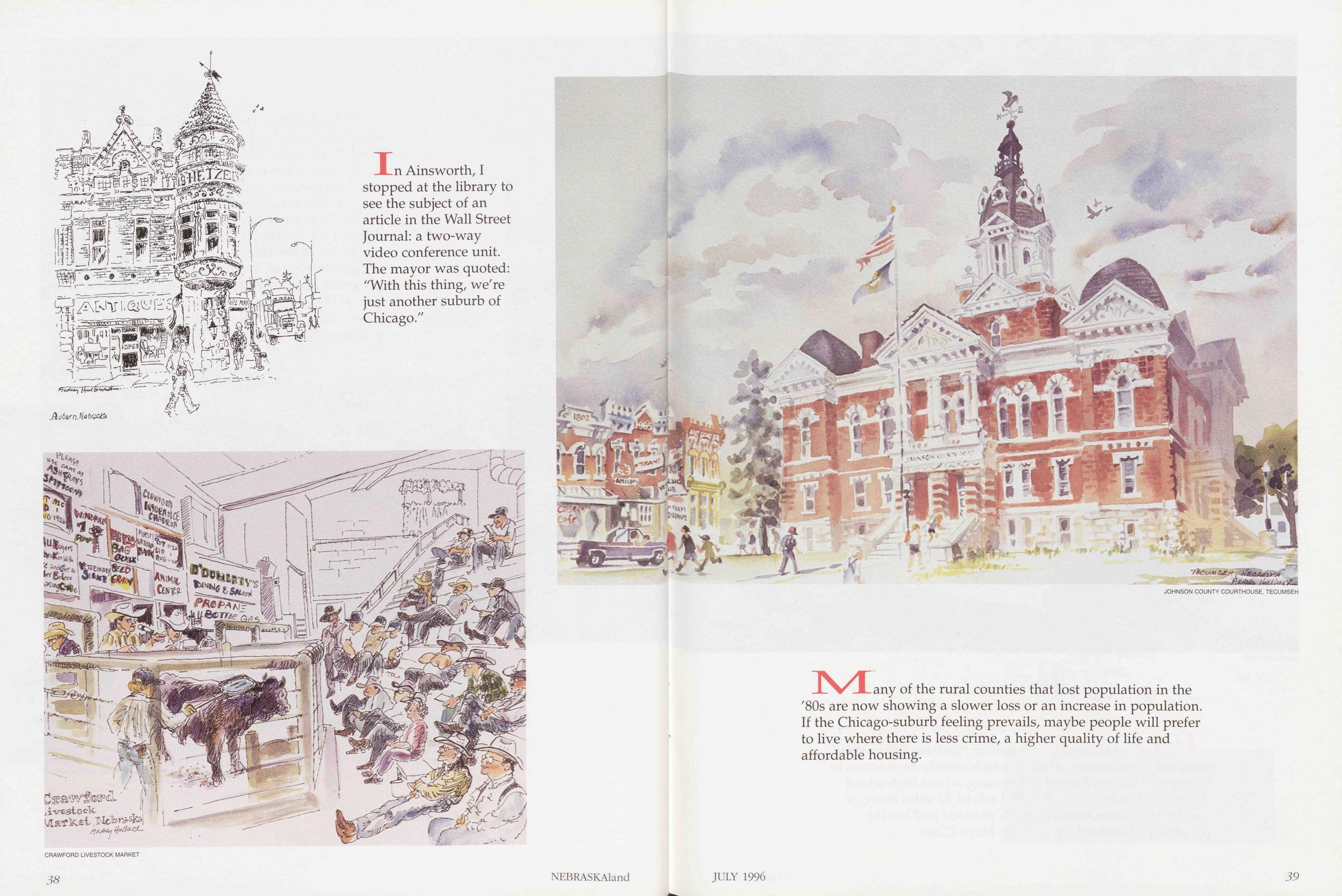
I stopped at the library to see the subject of an article in the Wall Street Journal: a two-way video conference unit. The mayor was quoted: "With this thing, we're just another suburb of Chicago."
any of the rural counties that lost population in the '80s are now showing a slower loss or an increase in population. If the Chicago-suburb feeling prevails/maybe people will prefer to live where there is less crime, a higher quality of life and affordable housing.
JULY 1996 39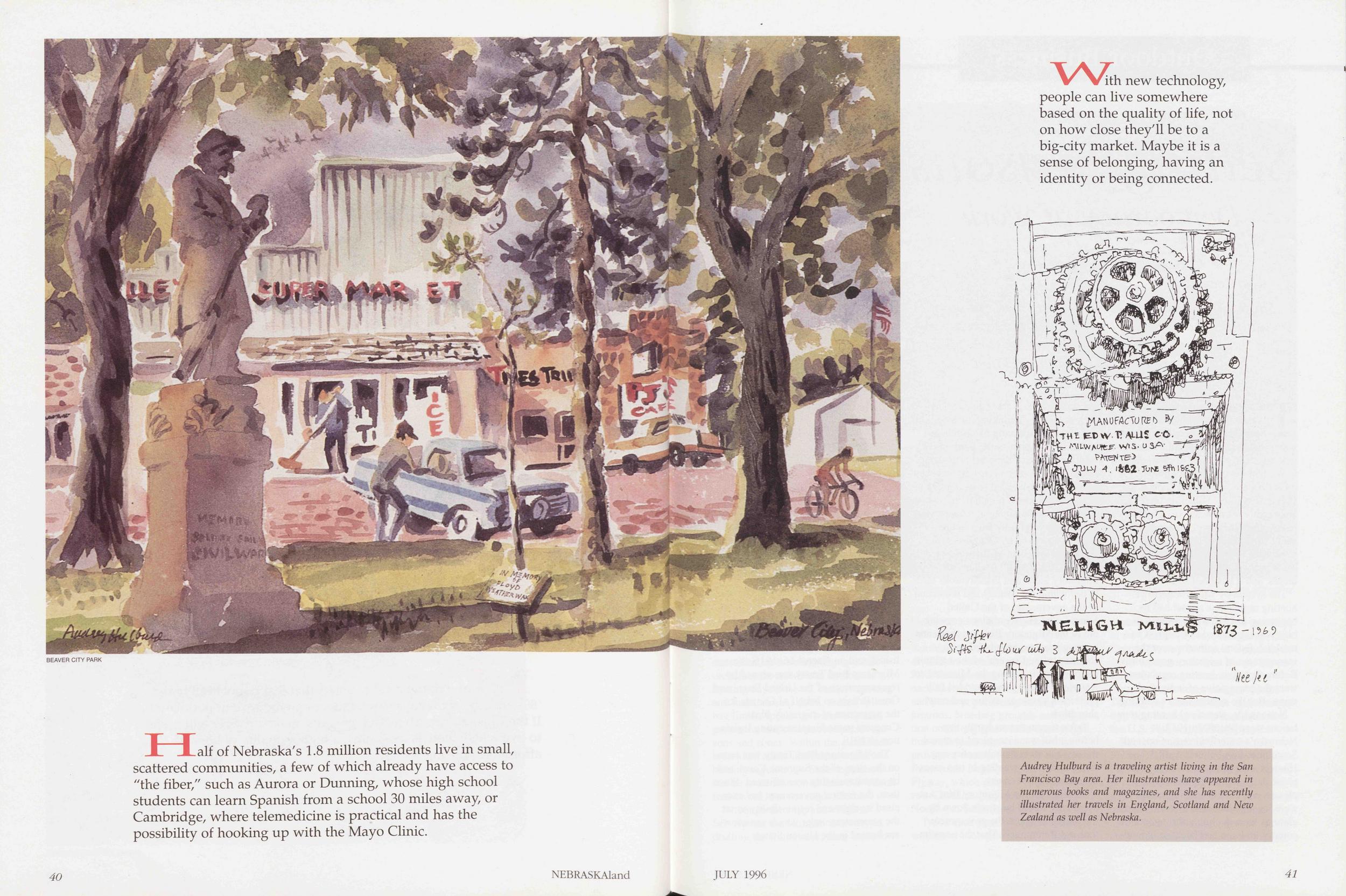
Half of Nebraska's 1.8 million residents live in small, scattered communities, a few of which already have access to "the fiber," such as Aurora or Dunning, whose high school students can learn Spanish from a school 30 miles away, or Cambridge, where telemedicine is practical and has the possibility of hooking up with the Mayo Clinic.
40 NEBRASKAlandwith new technology, people can live somewhere based on the quality of life, not on how close they'll be to a big-city market. Maybe it is a sense of belonging, having an identity or being connected.
Audrey Hulburd is a traveling artist living in the San Francisco Bay area. Her illustrations have appeared in numerous books and magazines, and she has recently illustrated her travels in England, Scotland and New Zealand as well as Nebraska. JULY 1996 41
Outdoor Business
Setting Seasons
Democracy at Work Photos and text by Jon Farrar Short of issuing each hunter a personalized set of regulations, no waterfowl season will please everyone, hut the system by which seasons are set does allow hunters to make their preferences known.The setting of waterfowl seasons is anticipated with both optimism and dread by devout waterfowlers. Some hope the season will open early enough to catch the end of the blue-winged teal migration; others hope it will be late enough for shooting mallards wintering on Nebraska's warm-water sloughs and reservoirs. Where will the season be split? How late will the dark goose season run? When the regulations are set, some waterfowlers are happier than others, and it has been so for decades.
The system by which waterfowl hunting regulations are set had its beginning in 1912 when a flurry of bills was introduced in Congress to establish federal authority over the management of migratory game birds. Before that time, hunting regulations were the prerogative of individual states. But the system wasn't working.
Nationwide, waterfowl hunting regulations were liberal. In 1912, Nebraska's waterfowl season opened September 1 and closed April 5. Hunters were allowed 25 ducks and 10 geese daily. Killdeer, yellowlegs, plovers and even whooping cranes were legal game birds. Waterfowl populations were declining throughout the country, in large part because individual states saw no reason to handicap their hunters by shrinking the length of the season or reducing bag limits just so hunters in states to the north or south would have more birds to shoot. It was obvious that a broader view was needed. Brakes needed to be applied to skidding waterfowl populations.
In 1912, at the urging of conservation groups, the Migratory Bird Act was drafted, approved by Congress and signed by President William Howard Taft in 1913. The act declared all migratory game and insectivorous birds to be "within the custody and protection of the government of the United States." Specific regulations growing out of the Migratory Bird Act shortened hunting seasons, prohibited spring shooting, closed several of the nation's major rivers, including the Missouri, to waterfowl hunting and provided full protection to cranes, swans and most shorebirds.
Taft's signature was hardly dry before a bill was introduced to repeal the act, and its constitutionality was tested and found wanting in two cases in federal district courts.
Sensing that the Migratory Bird Act eventually would be struck down by the Supreme Court, the government took a different tack. That the constitutional authority of the federal government to enter into international treaties superseded state rights was well established, and on August 16, 1916, the Migratory Bird Treaty was signed by representatives of the United States and Great Britain on behalf of Canada for the protection of migratory birds. Congress passed implementing legislation in 1918.
The Migratory Bird Treaty was soon on the steps of the Supreme Court, and its constitutionality was affirmed. Since then, the federal government has exercised its right and responsibility to set the parameters under which waterfowl are hunted in the United States.
42 NEBRASKAlandIn keeping with that tradition, each year the U.S. Fish and Wildlife Service establishes a "framework" under which states can set their hunting seasons, including the maximum number of hunting days allowed, earliest opening and latest closing dates, season splits, bag limits, species to receive special protection and criteria for special seasons and zones. Within the guidelines, individual states draft their waterfowl hunting regulations. State regulations can be more restrictive than the federal framework, but not more liberal.
Although the Fish and Wildlife Service has the ultimate authority in drafting the framework, state waterfowl biologists have the opportunity to influence its content. Since 1947, the North American continent has been divided into four north-to-south waterfowl management units or "flyways," each having somewhat distinct duck and goose populations, nesting grounds, breeding grounds and migration corridors. It is within the flyways that individual states and Canadian provinces work to influence the federal framework. Nebraska is in the Central Fly way, which consists of 10 states, two Canadian provinces and the Northwest Territories.
Twice each year, in March and July, waterfowl biologists meet, one representative from each state and province in the Central Flyway. The group, the Central Flyway Technical Committee, drafts recommendations for the Flyway Council, a group of administrators from the same states and provinces. The Flyway Council then makes migratory bird hunting recommendations to the U.S. Fish and Wildlife Service.
Recommendations made by the Flyway Technical Committee and the Flyway Council are based on volumes of research and long-term data, computer models, hunter survey responses, band returns and waterfowl censuses.
Historically, breeding ground surveys
are conducted, and the size of the fall
JULY 1996
43
 flight is estimated before the federal
framework is drafted. Its view is
continental in scope, and its ultimate goal is
to ensure the long-term well-being of
the waterfowl.
flight is estimated before the federal
framework is drafted. Its view is
continental in scope, and its ultimate goal is
to ensure the long-term well-being of
the waterfowl.
Typically, the federal framework has not been made final when the Game and Parks Commission sets waterfowl hunting regulations for Nebraska. With the early hunting seasons rapidly approaching, however, regulations must be approved and published, so in August, working with a preliminary federal framework, Game Commission biologists and administrators draft "staff recommendations" based on hunter preferences and the expected waterfowl migration.
When the Game and Parks Commission's seven-member board of commissioners meets in late August to set waterfowl hunting regulations, they weigh staff recommendations and the desires and concerns of the public.
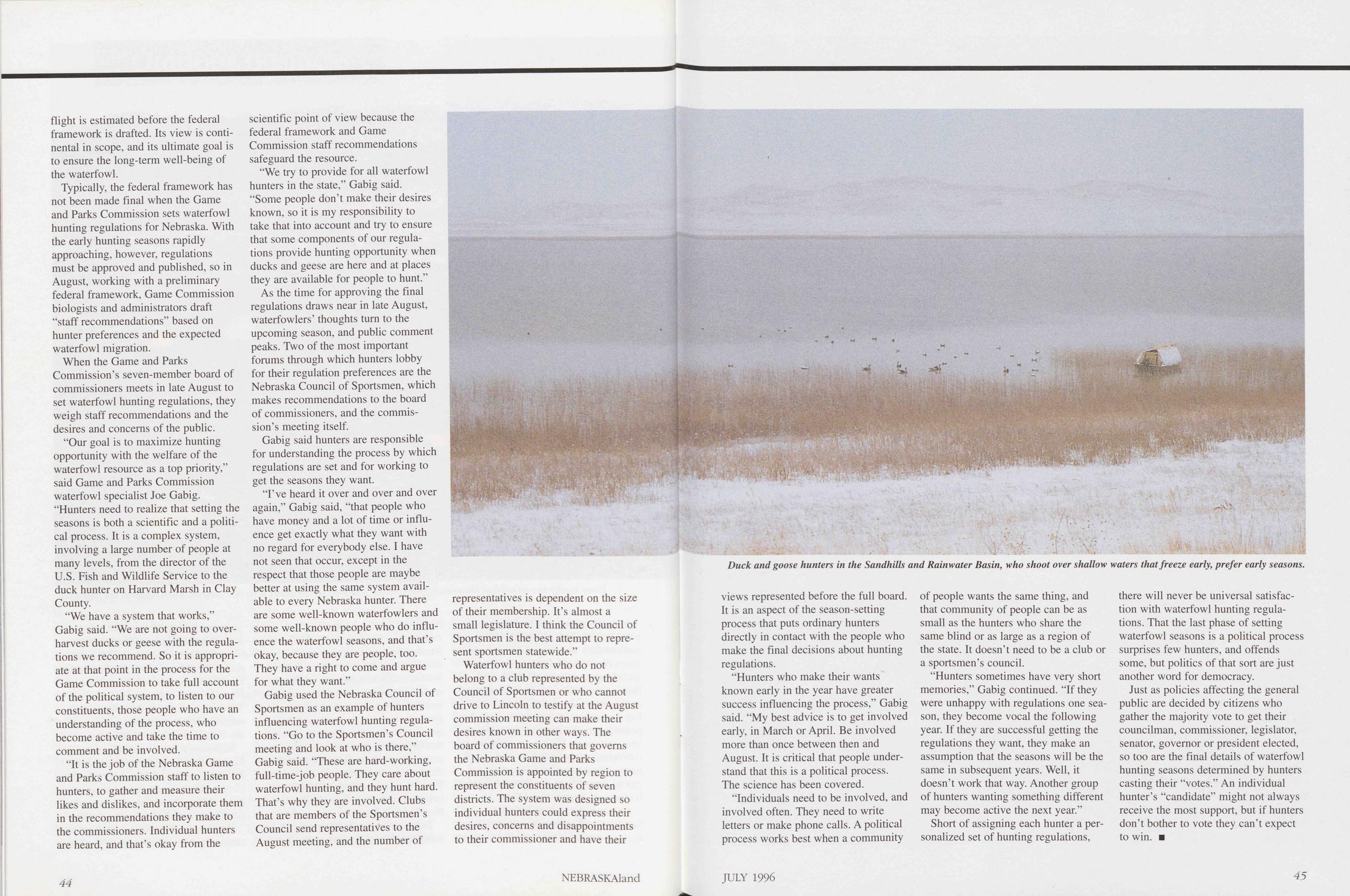
"Our goal is to maximize hunting opportunity with the welfare of the waterfowl resource as a top priority," said Game and Parks Commission waterfowl specialist Joe Gabig. "Hunters need to realize that setting the seasons is both a scientific and a political process. It is a complex system, involving a large number of people at many levels, from the director of the U.S. Fish and Wildlife Service to the duck hunter on Harvard Marsh in Clay County.
"We have a system that works," Gabig said. "We are not going to overharvest ducks or geese with the regulations we recommend. So it is appropriate at that point in the process for the Game Commission to take full account of the political system, to listen to our constituents, those people who have an understanding of the process, who become active and take the time to comment and be involved.
"It is the job of the Nebraska Game and Parks Commission staff to listen to hunters, to gather and measure their likes and dislikes, and incorporate them in the recommendations they make to the commissioners. Individual hunters are heard, and that's okay from the scientific point of view because the federal framework and Game Commission staff recommendations safeguard the resource.
"We try to provide for all waterfowl hunters in the state," Gabig said. "Some people don't make their desires known, so it is my responsibility to take that into account and try to ensure that some components of our regulations provide hunting opportunity when ducks and geese are here and at places they are available for people to hunt."
As the time for approving the final regulations draws near in late August, waterfowlers' thoughts turn to the upcoming season, and public comment peaks. Two of the most important forums through which hunters lobby for their regulation preferences are the Nebraska Council of Sportsmen, which makes recommendations to the board of commissioners, and the commission's meeting itself.
Gabig said hunters are responsible for understanding the process by which regulations are set and for working to get the seasons they want.
"I've heard it over and over and over again," Gabig said, "that people who have money and a lot of time or influence get exactly what they want with no regard for everybody else. I have not seen that occur, except in the respect that those people are maybe better at using the same system available to every Nebraska hunter. There are some well-known waterfowlers and some well-known people who do influence the waterfowl seasons, and that's okay, because they are people, too. They have a right to come and argue for what they want."
Gabig used the Nebraska Council of Sportsmen as an example of hunters influencing waterfowl hunting regulations. "Go to the Sportsmen's Council meeting and look at who is there," Gabig said. "These are hard-working, full-time-job people. They care about waterfowl hunting, and they hunt hard. That's why they are involved. Clubs that are members of the Sportsmen's Council send representatives to the August meeting, and the number of representatives is dependent on the size of their membership. It's almost a small legislature. I think the Council of Sportsmen is the best attempt to represent sportsmen statewide."
Waterfowl hunters who do not belong to a club represented by the Council of Sportsmen or who cannot drive to Lincoln to testify at the August commission meeting can make their desires known in other ways. The board of commissioners that governs the Nebraska Game and Parks Commission is appointed by region to represent the constituents of seven districts. The system was designed so individual hunters could express their desires, concerns and disappointments to their commissioner and have their 44 NEBRASKAland
"Hunters who make their wants known early in the year have greater success influencing the process," Gabig said. "My best advice is to get involved early, in March or April. Be involved more than once between then and August. It is critical that people understand that this is a political process. The science has been covered.
"Individuals need to be involved, and involved often. They need to write letters or make phone calls. A political process works best when a community of people wants the same thing, and that community of people can be as small as the hunters who share the same blind or as large as a region of the state. It doesn't need to be a club or a sportsmen's council.
"Hunters sometimes have very short memories," Gabig continued. "If they were unhappy with regulations one season, they become vocal the following year. If they are successful getting the regulations they want, they make an assumption that the seasons will be the same in subsequent years. Well, it doesn't work that way. Another group of hunters wanting something different may become active the next year."
Short of assigning each hunter a personalized set of hunting regulations, there will never be universal satisfaction with waterfowl hunting regulations. That the last phase of setting waterfowl seasons is a political process surprises few hunters, and offends some, but politics of that sort are just another word for democracy.
Just as policies affecting the general public are decided by citizens who gather the majority vote to get their councilman, commissioner, legislator, senator, governor or president elected, so too are the final details of waterfowl hunting seasons determined by hunters casting their "votes." An individual hunter's "candidate" might not always receive the most support, but if hunters don't bother to vote they can't expect to win.
JULY 1996 45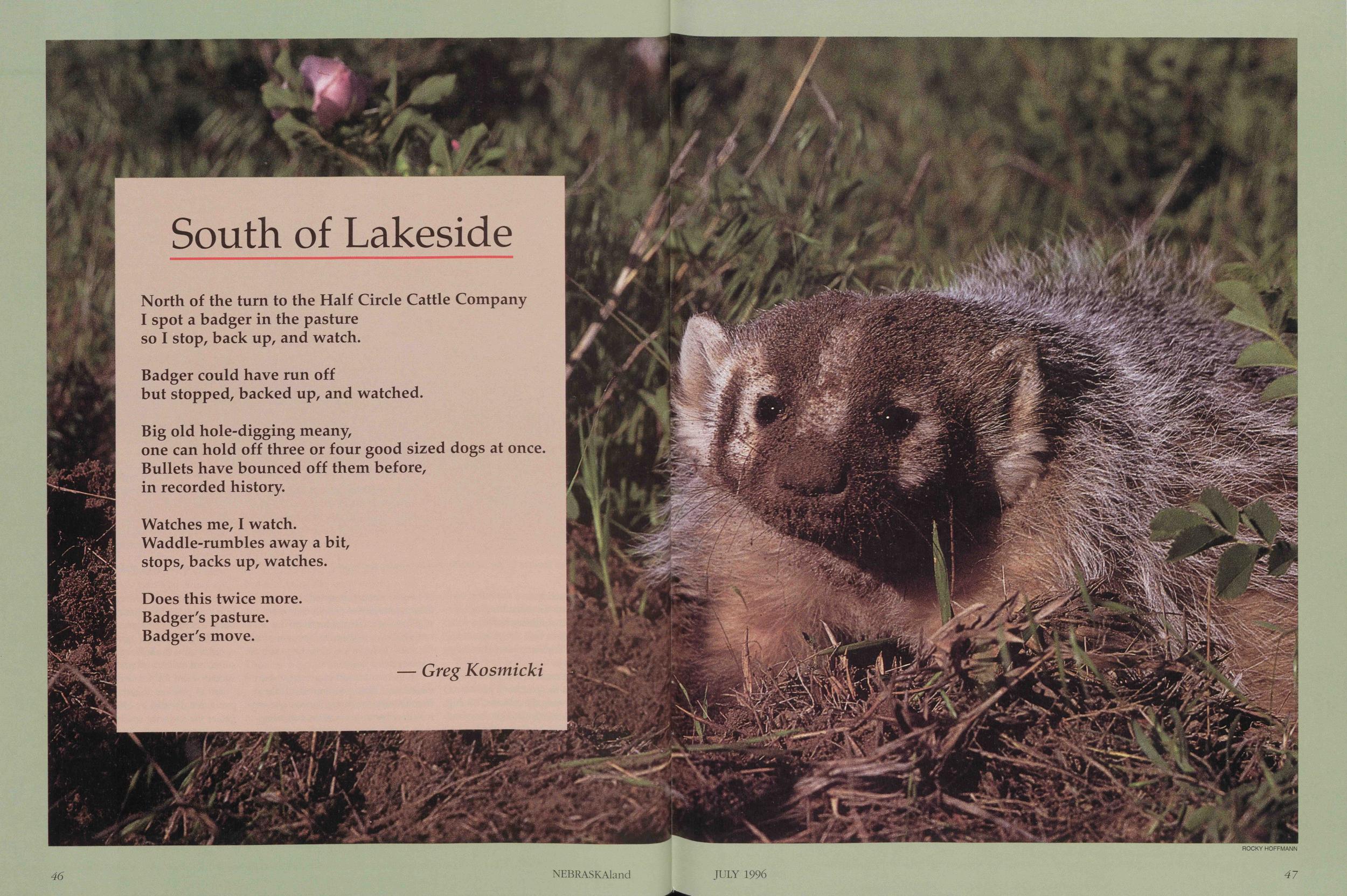
South of Lakeside
North of the turn to the Half Circle Cattle Company I spot a badger in the pasture so I stop, back up, and watch. Badger could have run off but stopped, backed up, and watched. Big old hole-digging meany, one can hold off three or four good sized dogs at once. Bullets have bounced off them before, in recorded history. Watches me, I watch. Waddle-rumbles away a bit, stops, backs up, watches. Does this twice more. Badger's pasture. Badger's move. — Greg Kosmicki 46 NEBRASKAland
Classified
ANTIQUES/COLLECTIBLESUP TO $100 for Nebraska hunting licenses 1901 through 1920. Up to $25 for any Nebraska trapping licenses. (402) 785-7500. Phil.
BUYING EARLY 1900s baseball, football and basketball uniforms, helmets, gloves, balls and equipment. Call collect (402) 573-0938 evenings and weekends.
ARTS/CRAFTS/CLQTHINGPEOPLE LIKE TO wear printed T-shirts. Why not your logo? Jackets, caps and design. Battle Creek Shirt Co. (402) 675-9795.
ATTENTION HUNTERS: We can transform your fur pelts or deer skins into custom-made garments. Over 50 years experience. Write for information or call (308) 928- 2515. Hacker Furriers, PO Box 230, 615 W. Main St., Alma, NE 68920.
BOATS/BOATINGSIT ON TOP KAYAKS: fish, float, dive; call 1-800-596- 1133 ext. 1380. Dealer inquiries welcome.
BOOKS/PRINTINGFREE BOOK CATALOG. Novels, westerns, romances, children's; old out of print, found barns, attic. Authors: Grey, Bower, Condor, Fox, Curwood, Raine, Wright, Aldrige, Pollyanna, Freckles, many others. Postage appreciated. Pierce, 4400 N. Pine Cluster, Oroville, CA 95965.
HOW TO FIND MORE outdoor opportunities! The Nebraska Sportsman's Atlas. Locations of all public lands and waters on county transportation maps. These maps show ALL the roads in Nebraska. Listings include federal, Nebraska Game & Parks, NRD holdings, hotels and motels and Nebraska's endless attractions. At only $18.75/copy a true time and frustration saver. To order write: Sportsman's Atlas Co., PO Box 132, Lytton, IA 50561 or call 1-800-568-8334.
NEBRASKA COUNTRY NOSTALGIC note cards - 12 original Nebraska photo assortment. $1.35 each - sample welcome. (402) 564-7304. 766 7th Avenue, Columbus, NE 68601.
DOGSENGLISH SETTER, German shorthairs, English point- ers, Brittany spaniels - stud service, puppies and started dogs. Training for all pointing breeds. Plum Creek Kennel, (712) 529-4238 or (402) 298-8153.
YELLOW-CHOCOLATE-BLACK LAB pups. Breeders hips O.F.A. and eyes c.e.r.f./ed. Excellent bloodlines and hunting potential. Call Mr. Bendler, Lexington, NE (308) 324-4247 or Lincoln (402) 477-1305.
TRAINING ALL BREEDS bird dogs - Vizslas for sale. Home of Rebel Rousers. Rozanek Kennels, RR 2, Schuyler, NE 68661. Phone (402) 352-8769.
RETRIEVER TRAINING. Area's top "retrievers only" trainer. Field trial and hunting dogs. Non-slip duck dogs! TKO Retriever Training Kennel (402) 623-4311.
ENGLISH SETTER and Labradors from outstanding lines. Bred for hunters who appreciate fine bird dogs! Wind Fall Gun Dogs, (402) 421-4693.
ENGLISH COCKER PUPS, imported stock, British FTC bloodlines. Many colors available. Featured in NEBRASKAland November 1991. Sawtooth Oaks, Box 443, Orleans, NE 68966. Phone (308) 473-5265.
CHESAPEAKE BAY, Labrador and golden retriever pups, started dogs and stud service. 16-time national champion pedigree. Visa & MasterCard. Platte Valley Retrievers (308) 995-2318.
WILDERNESS KENNELS. Gun dog training - over 60 years combined experience. Training all sporting breeds - retrievers, flushing and pointing dogs. All dogs worked on pen raised birds and wild game. Training program includes obedience training - heel, sit, stay, down and come when called. Pups, started dogs and fully trained dogs for sale. Hunting dogs trained by hunters. Henry Sader, Wilderness Kennels, Roca, NE (402) 423-4212. Since 1968.
FLATWATER LABRADORS - Offering AKC chocolate labs bred for exceptional temperament, confirmation and hunting ability. Litter born May 29th. See both sire and dam. Excellent references. R. D. McBride, Rt. 1 Box 134, Firth, NE 68358. Phone (402) 791-5704.
FISH/FISHINGFISH FOR SALE. Catfish, largemouth bass, smallmouth bass, perch, crappie, bluegill, walleye, northern pike, rainbow trout, Donaldson rainbow trout, grass carp, minnows, bullheads. Consulting available. Pleasant Valley Fish Farm, RR 1, Box 147, McCook, NE 69001. Phone (308) 345-6599.
WILLOW LAKE FISH HATCHERY. Channel cat, bluegill, hybrid bluegill, largemouth bass, crappie, triploid grass carp, walleye, perch, minnows. Gaylord Crawford, 7580 N. Highland Rd., Hastings, NE 68901 or phone (402) 463-8022 day or night. Also pond consultant. We deliver, grower price.
FOOD/GIFTSNEBRASKA BASKETS: The original Nebraska company specializing in fine foods from Nebraska since 1984. A beautiful array of baskets filled with ethnic, healthful and long-time favorite foods. Call or write for our brochure: P.O. Box 22985, Lincoln, NE 68542. Phone 1-800-345-7725 or (402) 438-3111.
FROM NEBRASKA GIFT SHOP...the world's largest selection of Nebraska-made food products and gifts. Historic Haymarket, 140 N. 8th St., Lincoln, NE 68508; Old Market, 1030 Howard St., Omaha, NE. Call for free catalog 1-800-399-5693.
HOMEBREWING/BEER & WINEMAKING supplies. Fermenter's Supply, 8410 K Plz. #10, Omaha, NE 68127. (402) 593-9171. Open everyday, mail orders welcome, low shipping.
GUIDES/OUTFITTERSMAD RIVER CANOES offers the finest quality and performance. For the finest canoes and accessories look to Great Plains Canoe Co., 205 Main, Springfield, NE 68059. Phone (402) 253-2001.
EXCELLENT PHEASANT HUNTING: New area and affordable on 5,000 plus acres with only wild pheasants. For booking hunts contact Dakota Ringneck Ranch, Roy Grismer, 12525 328th Ave., Bowdle, SD 57428. Phone (504) 283-2680.
CANOE THE NIOBRARA...with an affordable canoe trip by Dry land Aquatics. One and two-day trips...full service, or just canoes and tubes. Transportation furnished. Your Niobrara River specialists... We do it your way! Dry land Aquatics, Dept. N, Box 33C, Sparks, NE 69220 or phone 1-800-337-3119.
GRAHAM CANOE OUTFITTERS: Top quality full service camping and canoe trips on the Niobrara River. Daily canoe rentals and car shuttle-service available. Contact Doug & Twyla Graham, HC 13 Box 16, Valentine, NE 69201 or phone (402) 376-3708.
GUNS/SHOOTING/ARCHERYGUNS - Browning, Winchester, Remington, others. Hi-powers, shotguns, new, used, antiques. Want Pre-'64 Winchesters. Buy-Sell-Trade. (402) 729-6112. Bedlans Sporting Goods, Fairbury, NE 68352.
PLANTS/ANIMALS/HABITATATTRACT WILDLIFE to your acreage, preserve or club. Consulting, management plan development, planting/ seeding, and supplies for the conservationist or the hunter. David M. Nelson, Wildlife Habitat Consulting, 811 Matthies Dr., Papillion, NE 68046. Phone (402) 592-5652.
REAL ESTATETHREE BEDROOM TOWNHOUSE in Vail Valley, CO, on Single Tree Golf Course. Ski, golf, fish, hike, etc. Will trade time for access to quality pheasant hunting. Call Reggie Giffin (816) 691-2715.
TAXIDERMYALLISON'S TAXIDERMY Studio & Gift Gallery - DU, SCI, Pheasants Forever & NTA Members. Mounted 36 state record fish. 421 N. Dewey, North Platte, NE 69101. Call (308) 534-2324 or (308) 534-4267. Custom Designs.
VACATIONS/RESORTSFOR FISHING and hunting accommodations. Jefco Inn, Gordon, NE 69343. South Cornell, (308) 282-2935.
BED & BREAKFAST. Historic 1890s hotel. Located in the beautiful Pine Ridge area of Northwest Nebraska. Short drive to Chadron State Park, Fort Robinson and the Black Hills. Beautiful dining room with fireplace and fountain. Room service available. The Olde Main Street Inn, 115 Main St., Chadron, NE 69337. (308) 432-3380.
NE NEBRASKA TROUT FISHING. Mon-Thurs or Fri-Sun. 3 modern cottages, 5 spring-fed lakes. Trout, bass and bluegill. Diamond E Trout Resort, Box B, Orchard, NE 1-800-658-3244.
YORK, NEBRASKA - "Crossroads of the Midwest." Located at the junction of 1-80 and U.S. 81. From fast food to world class fine dining. 500+ rooms in a wide range of styles and prices. Call 1-800-388-1138 for your free visitors packet.
STAY AT THE Twisted Pine Ranch Bed & Breakfast overlooking the scenic Niobrara River. We have a modern bunkhouse and a rustic log cabin. Great view, great food. Contact: Ken and Sharon Moreland, Twisted Pine Ranch, PO Box 84, Merriman, NE 69218. (308) 684-3482.
PRIVATE JACUZZI SUITES. Free Continental break- fast. New pool, sundeck. Extra large, deluxe rooms. Short drive to Fort Robinson, Chadron State Park, Hudson- Meng paleontological site. Restaurant/lounge. Golf, horseback riding, archery, fishing close by. Best Western West Hills Inn, Chadron, NE 69337. (308) 432-3305 or (800)528-1234.
SANDHILLS GUEST RANCH Bed & Breakfast, private cabin. Excellent hunting, upland game and waterfowl, fishing. Beautiful river view. Bring your horse, acres of prairie to ride. Sandhills Country Cabin B&B, HC 63 Box 13, Brewster, NE 68821. Phone (308) 547-2460.
EASY HOUR RANCH family resort. Secluded fishing and hunting 37 miles south of Ainsworth, NE on the Calamus River. Bass, bluegill, crappie, perch and trout. Quail and pheasant release hunt plus wild game in season. Primitive cabin to relax in. For information call (402) 387-1719 or (308) 346-4244.
AIR GUNS repaired — Benjamin, Crosman, Daisy, other American made. Restoration; old guns wanted. Jack's Air Guns, 1225 N. 46th, Lincoln, NE 68503. Phone (402) 466-9223.
750/word, min. $15. Closing: Two months before issue date. First-come, first-sewed, space-available. NEBRASKAland Magazine, Box 30370, Lincoln, NE 68503. (402)471-5478. 48 NEBRASKAlandPage forty-nine
Band-Aids for WildlifeLast July, headlines like "Army Corps Saves Waterfowl from River's High Water" and "Rescue of River Birds Paying Off in Chicks" were regular fodder for newspaper readers. The gist of these articles was that the Army Corps of Engineers Gavins Point Project Office staff had removed 348 least tern and piping plover eggs from nests on sandbars about to be inundated by high Missouri River flows.
The eggs were hatched in a climate- controlled incubator in the Corps office. Plover chicks were hand fed mealworms, waxworms, bloodworms, minnows and pinhead crickets. Tern chicks were fed guppies with tweezers.
The Corps raised 148 plovers and 82 terns to flight stage, probably a higher survival rate than the birds themselves ever accomplish in the wild. Once capable of flight, the birds were released, perhaps to return another year and raise their own young.
It was a heart-warming story. It made you want to stand up and cheer for Corps of Engineers and the human species. But were the articles anything more than more examples of the "feel good stories" with varying characters that are regular components of news- papers, magazines and network and local television news broadcasts?
Americans have immense compassion for the underdog, the down trodden, oppressed, disadvantaged and suffering. But in recent decades, this sympathy has been readily satiated by superficial solutions with happy endings, Band-Aids applied to gaping, festering wounds.
The Missouri River sandbars, where terns and plovers nest, were flooded because the Corps of Engineers was compelled to release record-setting flows from upstream, mainstream reservoirs to make room for rain and snowmelt. The Corps serves many masters on the Missouri River, masters with conflicting desires for water in both the river and the river's reservoirs. Downstream barge operators want enough flow to float their barges; floodplain landowners want assurance their fields will not be flooded; anglers and resort operators want enough water in reservoirs to maintain game fish populations; farmers want ful reservoirs in spring to meet summer irrigation demands. The list of "wants" goes on and on.
The Corps of Engineers is a federal agency, a servant of the public's wishes, whose role for most of its history has been to redesign rivers so they serve the purposes of humans, usually at the expense of wild creatures and wild places. It deserves commendation for its efforts. Any number of other governmental agencies and the most private conservation organizations could provide similar examples.
At great expense, for example, trees are mechanically removed from a few Platte River sandbars to provide roosts for waterfowl, cranes, terns and plovers rather than leaving enough water in the river to scour sandbars as the river had for thousands of years. We put bluebird nest boxes on fence posts bordering overgrazed pastures, and kestrel nest boxes on interstate highway signs. We plow up a quarter section of native grassland and shallow marsh, put a center pivot irrigation system and corn where bluestem and blue-winged teal once grew, plant the field corners to two or three varieties of native grass, and nail a "Corners for Habitat" sign on the fencepost.
All those efforts to provide for wildlife are good things. They show that some people, governmental agencies and private organizations care about the plight of native wildlife. But such acts of human kindness lull us into believing that all is well with whatever species, habitat or ecosystem we are concerned with at the moment. And even such modest attempts to preserve remnants of our natural heritage are reduced by naysayers to simplistic questions like "Are whooping cranes more important than people?" and overstatements like "Farmers are an endangered species, too." This is a big country with ample resources. There is room for both people and wildlife, but at some point people must stop taking wild lands from wildlife.
Again this year the Nebraska Public Power District is offering guided tours to view piping plovers and least terns nesting on sandpit habitat the agency developed to offset the loss of natural nesting habitat on Platte River sandbars. Perhaps we are content to save only tokens of natural communities, places where by reservation someone can go to see a real bluebird, plover or white-fronted goose. Perhaps seeing a kestrel perched on an interstate sign listing human accommodations available at the next exit is good enough.
This variety of feel-good wildlife management probably does no harm. Many of the organizations that indulge in it also have significant habitat preservation programs, but we should not be mesmerized into complacency by token efforts that make good headlines in the morning paper or spots on the evening news. Programs to protect the places wildlife live come with a high price tag, and usually require butting heads with powerful political and financial forces.
In 1989, the Army Corps of Engineers initiated the Missouri River Fish and Wildlife Mitigation program to restore some of the once extensive chutes, oxbows and backwaters along the Missouri River destroyed by channelization and subsequent downcutting of the river. Once, these backwaters were fecund nurseries for wildlife of all kinds. The program would not have restored the Missouri River to the ribbon of species-rich habitat it once was, but it was much more than another Band-Aid for wildlife.
In May 1996, the Corps announced that work on some of the projects would be curtailed for lack of funding. Congressional cutbacks to balance the budget had left most human service programs untouched, but "wildlife service programs" have a small constituency and were easy prey. The Corps was forced to prioritize its Missouri River projects, and funding went to flood-control projects for people, while habitat restoration for wildlife projects were pared back. Once again we said a river is more important to people than to wildlife.
Jon Farrar JULY 1996 49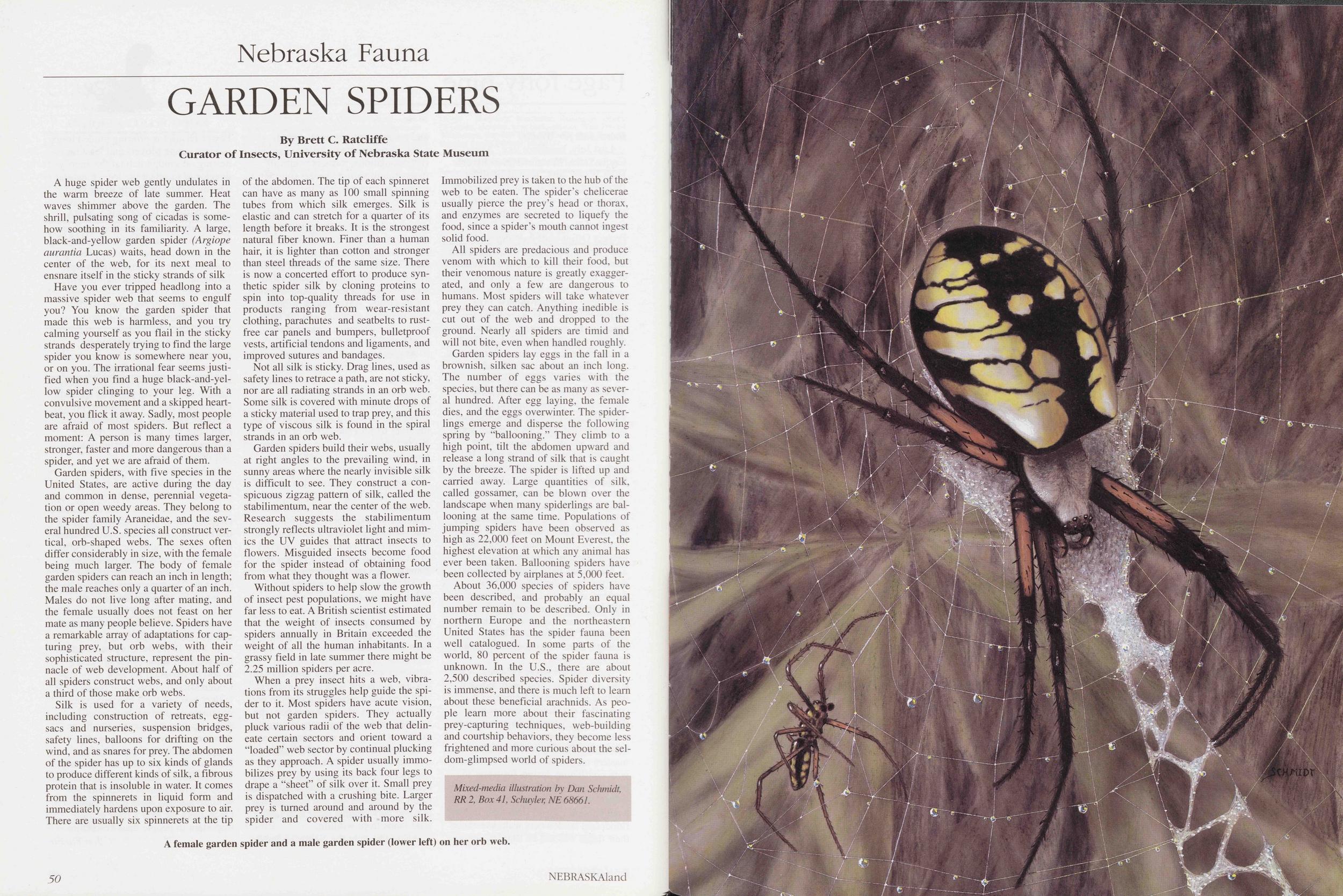
Nebraska Fauna
GARDEN SPIDERS
By Brett C. Ratcliffe Curator of Insects, University of Nebraska State MuseumA huge spider web gently undulates in the warm breeze of late summer. Heat waves shimmer above the garden. The shrill, pulsating song of cicadas is somehow soothing in its familiarity. A large, black-and-yellow garden spider (Argiope aurantia Lucas) waits, head down in the center of the web, for its next meal to ensnare itself in the sticky strands of silk
Have you ever tripped headlong into a massive spider web that seems to engulf you? You know the garden spider that made this web is harmless, and you try calming yourself as you flail in the sticky strands desperately trying to find the large spider you know is somewhere near you, or on you. The irrational fear seems justified when you find a huge black-and-yellow spider clinging to your leg. With a convulsive movement and a skipped heart- beat, you flick it away. Sadly, most people are afraid of most spiders. But reflect a moment: A person is many times larger, stronger, faster and more dangerous than a spider, and yet we are afraid of them.
Garden spiders, with five species in the United States, are active during the day and common in dense, perennial vegetation or open weedy areas. They belong to the spider family Araneidae, and the several hundred U.S. species all construct vertical, orb-shaped webs. The sexes often differ considerably in size, with the female being much larger. The body of female garden spiders can reach an inch in length; the male reaches only a quarter of an inch. Males do not live long after mating, and the female usually does not feast on her mate as many people believe. Spiders have a remarkable array of adaptations for capturing prey, but orb webs, with their sophisticated structure, represent the pinnacle of web development. About half of all spiders construct webs, and only about a third of those make orb webs.
Silk is used for a variety of needs, including construction of retreats, eggsacs and nurseries, suspension bridges, safety lines, balloons for drifting on the wind, and as snares for prey. The abdomen of the spider has up to six kinds of glands to produce different kinds of silk, a fibrous protein that is insoluble in water. It comes from the spinnerets in liquid form and immediately hardens upon exposure to air. There are usually six spinnerets at the tip of the abdomen. The tip of each spinneret can have as many as 100 small spinning tubes from which silk emerges. Silk is elastic and can stretch for a quarter of its length before it breaks. It is the strongest natural fiber known. Finer than a human hair, it is lighter than cotton and stronger than steel threads of the same size. There is now a concerted effort to produce synthetic spider silk by cloning proteins to spin into top-quality threads for use in products ranging from wear-resistant clothing, parachutes and seatbelts to rust free car panels and bumpers, bulletproof vests, artificial tendons and ligaments, and improved sutures and bandages.
Not all silk is sticky. Drag lines, used as safety lines to retrace a path, are not sticky, nor are all radiating strands in an orb web. Some silk is covered with minute drops of a sticky material used to trap prey, and this type of viscous silk is found in the spiral strands in an orb web.
Garden spiders build their webs, usually at right angles to the prevailing wind, in sunny areas where the nearly invisible silk is difficult to see. They construct a conspicuous zigzag pattern of silk, called the stabilimentum, near the center of the web. Research suggests the stabilimentum strongly reflects ultraviolet light and mimics the UV guides that attract insects to flowers. Misguided insects become food for the spider instead of obtaining food from what they thought was a flower.
Without spiders to help slow the growth of insect pest populations, we might have far less to eat. A British scientist estimated that the weight of insects consumed by spiders annually in Britain exceeded the weight of all the human inhabitants. In a grassy field in late summer there might be 2.25 million spiders per acre.
When a prey insect hits a web, vibrations from its struggles help guide the spider to it. Most spiders have acute vision, but not garden spiders. They actually pluck various radii of the web that delineate certain sectors and orient toward a "loaded" web sector by continual plucking as they approach. A spider usually immobilizes prey by using its back four legs to drape a "sheet" of silk over it. Small prey is dispatched with a crushing bite. Larger prey is turned around and around by the spider and covered with more silk. Immobilized prey is taken to the hub of the web to be eaten. The spider's chelicerae usually pierce the prey's head or thorax, and enzymes are secreted to liquefy the food, since a spider's mouth cannot ingest solid food.
All spiders are predacious and produce venom with which to kill their food, but their venomous nature is greatly exaggerated, and only a few are dangerous to humans. Most spiders will take whatever prey they can catch. Anything inedible is cut out of the web and dropped to the ground. Nearly all spiders are timid and will not bite, even when handled roughly.
Garden spiders lay eggs in the fall in a brownish, silken sac about an inch long. The number of eggs varies with the species, but there can be as many as several hundred. After egg laying, the female dies, and the eggs overwinter. The spiderlings emerge and disperse the following spring by "ballooning." They climb to a high point, tilt the abdomen upward and release a long strand of silk that is caught by the breeze. The spider is lifted up and carried away. Large quantities of silk, called gossamer, can be blown over the landscape when many spiderlings are ballooning at the same time. Populations of jumping spiders have been observed as high as 22,000 feet on Mount Everest, the highest elevation at which any animal has ever been taken. Ballooning spiders have been collected by airplanes at 5,000 feet.
About 36,000 species of spiders have been described, and probably an equal number remain to be described. Only in northern Europe and the northeastern United States has the spider fauna been well catalogued. In some parts of the world, 80 percent of the spider fauna is unknown. In the U.S., there are about 2,500 described species. Spider diversity is immense, and there is much left to learn about these beneficial arachnids. As people learn more about their fascinating prey-capturing techniques, web-building and courtship behaviors, they become less frightened and more curious about the seldom-glimpsed world of spiders.
Mixed-Media illustration by Dan Schmic RR 2, Box 41, Schuyler, NE 68661. 50 NEBRASKAland
Position: 387 (25 views)