Volume 74, Issue 5, 1996
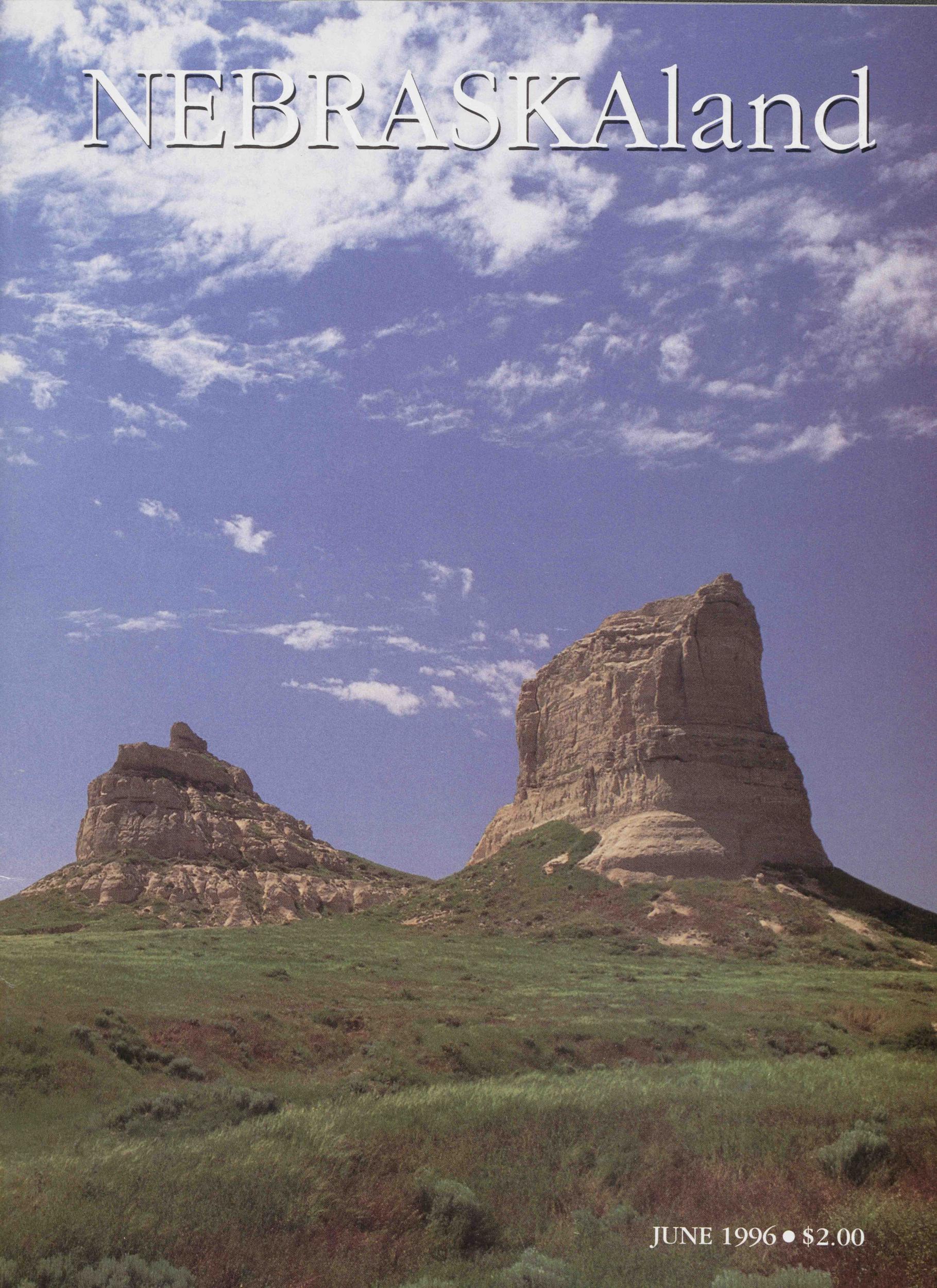
NEBRASKAland
JUNE 1996 • $2.00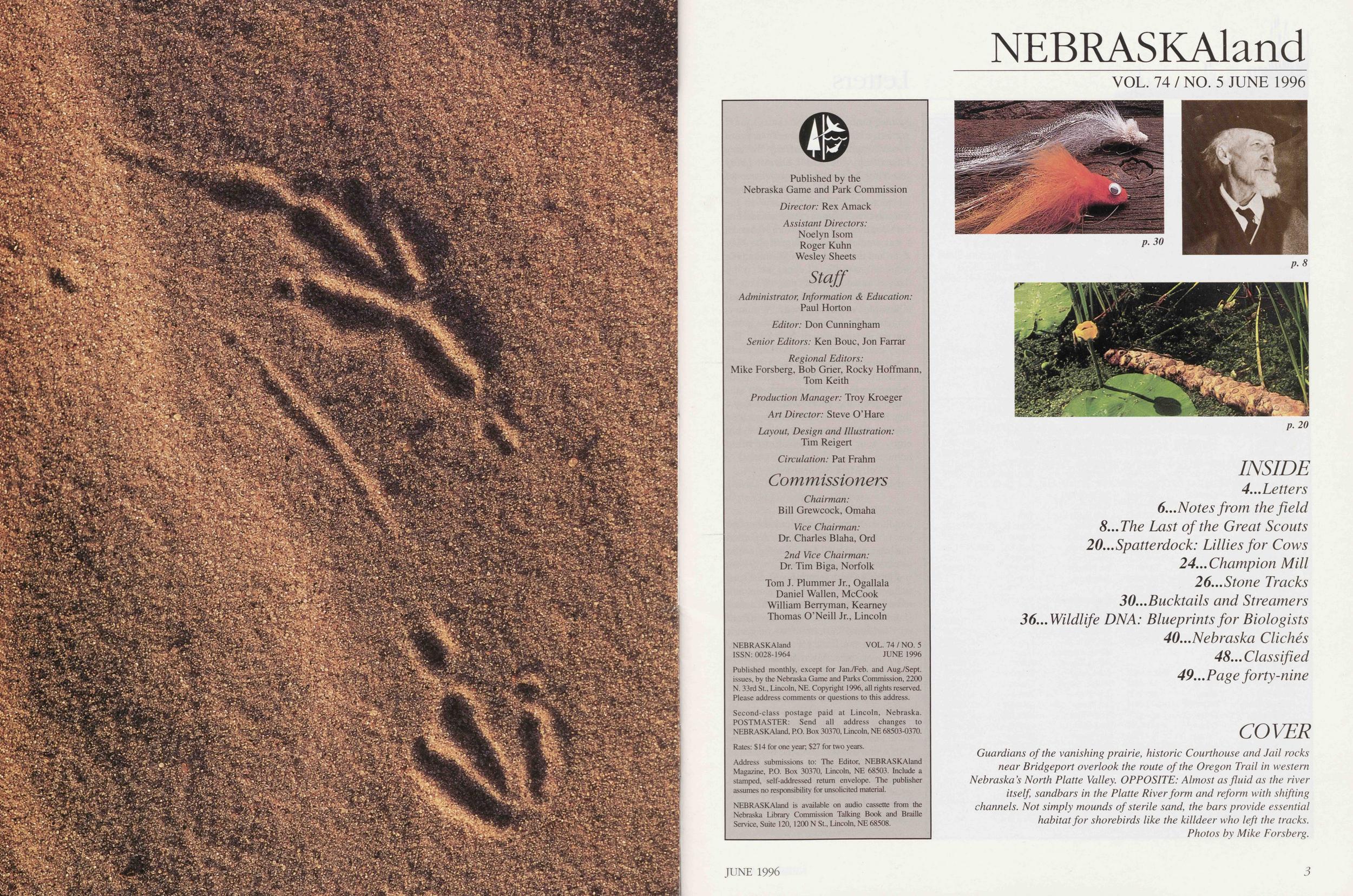
NEBRASKAland
Published by the Nebraska Game and Park Commission Director: Rex Amack Assistant Directors: Noelyn Isom Roger Kuhn Wesley Sheets Staff Administrator, Information & Education: Paul Horton Editor: Don Cunningham Senior Editors: Ken Bouc, Jon Farrar Regional Editors: Mike Forsberg, Bob Grier, Rocky Hoffmann, Tom Keith Production Manager: Troy Kroeger Art Director: Steve O'Hare Layout, Design and Illustration: Tim Reigert Circulation: Pat Frahm Commissioners Chairman: Bill Grewcock, Omaha Vice Chairman: Dr. Charles Blaha, Ord 2nd Vice Chairman: Dr. Tim Biga, Norfolk Tom J. Plummer Jr., Ogallala Daniel Wallen, McCook William Berry man, Kearney Thomas O'Neill Jr., Lincoln NEBRASKAland ISSN: 0028-1964 VOL. 74 / NO. 5 JUNE 1996 Published monthly, except for Jan./Feb. and Aug./Sept. issues, by the Nebraska Game and Parks Commission, 2200 N. 33rd St., Lincoln, NE. Copyright 1996, all rights reserved. Please address comments or questions to this address. Second-class postage paid at Lincoln, Nebraska. POSTMASTER: Send all address changes to NEBRASKAland, P.O. Box 30370, Lincoln, NE 68503-0370. Rates: $14 for one year, $27 for two years. Address submissions to: The Editor, NEBRASKAland Magazine, P.O. Box 30370, Lincoln, NE 68503. Include a stamped, self-addressed return envelope. The publisher assumes no responsibility for unsolicited material. NEBRASKAland is available on audio cassette from the Nebraska Library Commission Talking Book and Braille Service, Suite 120, 1200 N St., Lincoln, NE 68508. VOL. 74 / NO. 5 JUNE 1996
Letters
Nebraska Game and Parks Commission District Offices Headquarters 2200 North 33rd Street Lincoln, NE 68503 Phone (402)471-0641 District Office I Box 725 Alliance, NE 69301 Phone (308)762-5605 District Office II Box 508 Bassett, NE 68714 Phone (402)684-2921 District Office III Box 934 Norfolk, NE 68702 Phone (402)370-3374 District Office IV Route 4, Box 36 North Platte, NE 69101 Phone (308)535-8025 District Office V 2200 North 33rd Street Lincoln, NE 68503 Phone (402)471-5558 Omaha Office 1212 Deer Park Blvd. Omaha, NE 68108 Phone (402) 595-2144 Ak-Sar-Ben Aquarium 21502 West Highway 31 Gretna, NE 68028 Phone (402) 332-3901 World Wide Web Site: http://www.ngpc.state.ne.us Email: ngpc@ngpsun.ngpc.state.ne.us Conservation Officers by Region Panhandle Sandhills Officer City Phone (308) Officer City Phone (402) Richard Furley (Sup.) Alliance 762-2024 Bruce Wiebe (Sup.) Bassett 684-3867 Walt Meyer Chadron 432-4398 Larry Bauman Atkinson 925-5569 John Murphy Crawford 665-2021 Richard Seward Ord (308) 728-5338 Jim Zimmerman Gering 436-7561 Mick Gray Valentine 376-3136 Marvin Kampbell Hay Springs 638-7527 Ray Dierking Brkn. Bow (308) 872-3078 Dennis Thompson Ogallala 284-6450 Dan Zuehlke Ogallala 284-4815 South-central Scott Brandt Scottsbluff 635-1277 Officer City Phone (402) Raymond Still Bridgeport 262-1075 Jerry Pecha (Sup.)York 362-5707 Dan Evasco Oshkosh 772-3091 Terry Brentzel Grand Is. (308) 384-8296 Dale Johnson Hebron 768-7363 Southwest Mark Reeves Loup City (308) 745-1126 Officer City Phone (308) Robert Finke Milford 761-3537 Roger Thompson (Sup.) N. Platte 532-9175 Tim Williams Hastings 463-2535 George Sund Cambridge 697-4629 Craig Stover Kearney Matt Andrews Elwood 785-3025 Jack Henderson Gothenburg 537-7483 Southeast Dirk Greene Imperial 882-5328 Officer City Phone (402) Virgil Gosch McCook 345-2185 Dick Turpin (Adm.)Lincoln 471-5531 Dwight Allbery N. Platte 532-2753 Ted Blume (Asst. Adm.) Lincoln 483-5643 Rich Routh Rep. City 799-2085 Dan Klammer Lincoln 471-5003 Murray Johnson Lincoln 488-2923 Northeast William Krause Auburn 274-3789 Officer City Phone (402) Dan Evasco Beatrice 228-5935 Tom Zimmer (Sup.)Norfolk 371-6625 Douglas Kramer Lincoln 466-9001 Robert Kelly Albion 395-2538 Dina Barta Lincoln 483-2358 Ross Oestmann Bloomfield 373-4412 Levi Krause Louisville 234-2212 L A. Wilkinson Columbus 564-4375 Russell Mort Nebr. City 873-5684 Gary Ralston Creighton 847-3284 Duane Arp Gretna 332-4954 Daniel Roberts Fremont 721-7852 Larry Elston Bellevue 292-4910 Randy Pomplun Fullerton (308)536-2987 Mike Luben Colon 443-4278 Jon Reeves Kennard 427-7378 Marion Shafer Norfolk 371-2031 Eric Wiebe Ponca 755-2566 Steve Oberg West Point 372-3062 Operation Game Thief 1-800-742-7627 Sandoz CountryAs native Nebraskans planning to return upon the completion of my military career, my wife and I always enjoy receiving and reading every issue of NEBRASKAland. I particularly enjoyed the pictorial "Sandoz Country" in the May issue. What a stark difference between the world of western Nebraska I was immersed in as I read the May issue and the four lanes of Washington's stop-and-go traffic all about me on my daily commute to the Pentagon.
Last summer, our family spent a most enjoyable week in Sandoz country, something I never did when I was growing up in southeastern Nebraska. The story caused my mind to drift back and recall that most pleasant week spent in western Nebraska, far from the maddening world of Washington.
Keep up the good work and know that there are many of us temporarily displaced Nebraskans who thoroughly enjoy your monthly effort to bring home to us.
Lt. Col. Mark Schoenrock Via the Internet Sandhills SyndromeSandhills appreciation is something one has to be born with. Indians regarded that vast, unspoiled region as a place to be revered, a spiritual place.
I grew up on a farm near St. Edward at the eastern edge of that phenomenon of nature, and it has always held a special attraction for me. I fled Nebraska in the Dust Bowl '30s, but like a magnet it has drawn me back for a visit nearly every year since. My route has always been as varied as possible, especially through Sheridan and Cherry counties.
The photography of "Sandoz Country" in the May issue was magnificent. Thanks to Kira Gale. It left me longing for another trip, but as I am now in my 84th year I wonder about the wisdom of the long drive from Seattle. During my last trip last May, my wife and I spent some delightful hours hunting for artifacts along the Niobrara River.
Ken Matzen Seattle, Washington 4 NEBRASKAland What Cranes SayI enjoyed Paul Gruchow's story of the cranes ["What Cranes Say," March 1996]. It was so beautifully illustrated. I especially enjoy this type of story and anything about prairies.
I have read two of Gruchow's books and like them very much. Could you tell me where I can order "Grass Roots."
Phyllis Banks Oregon, Missouri"Grass Roots: The Universe of Home" is published by Milkweed Editions, 431 Avenue N, Suite 400, Minneapolis, MN 55401 or (800) 520-6455. (Editor)
Turkey Recipe PrecautionThe recipe for "Roast Wild Turkey in a Sack" sounds great, but one must be sure not to use a recycled brown paper bag. Chemicals in a recycled bag could be dangerous when heated, possibly a plastic cooking bag would work as well.
Barbara Colgan Ozawkie, KansasThe USDA recommends only using bags designed for cooking. (Editor)
Yellowbanks MemoriesI recall drives to the Yellowbanks to picnic with family and friends as a child in the 1920s. There are photos of my family, friends and the trusty Model T Ford that transported us there from Newman Grove. Now I often wonder just what the Yellowbanks was and where it is. I would be most grateful for an answer.
Lois Barrett Richard Lancaster, PennsylvaniaYellowbanks Wildlife Management Area is northwest of Battle Creek in Madison County. The 664-acre area provides access to the Elkhorn River. Its name comes from the yellow loess soil exposed in the river banks. (Editor)
Write to Tetters, NEBRASKAland Magazine, P.O. Box 30370, Lincoln, NE 68503. Tax: (402) 471-5528. E-mail: Nebland@ngpsun.ngpc.state.ne.us. Letters may be condensed or edited for clarity. Wear the Patch for Wildlife Wear the 1996 Habitat Donor Patch and let everyone know you've done your part to help acquire and restore wildlife habitat. All proceeds from the Nebraska Habitat Donor Program go to the Wildlife Habitat Fund. Give $5 and receive the 1996 patch. Give $12.50 and receive the patch on a green cloth cap. Wildlife Habitat Donor Program Please send me: Donor Patches Donor Caps (patch attached) Name Address City State Zip Enclose $5 for each patch (no cap) $12.50 for each cap (patch attached). Nebraska residents please add appropriate sales tax. Mail to: NEBRASKAland Magazine, P.O. Box 30370, Lincoln NE 68503 For telephone orders (Visa or MasterCard only), call 1-800-NEB-LAND (632-5263) JUNE 1996 5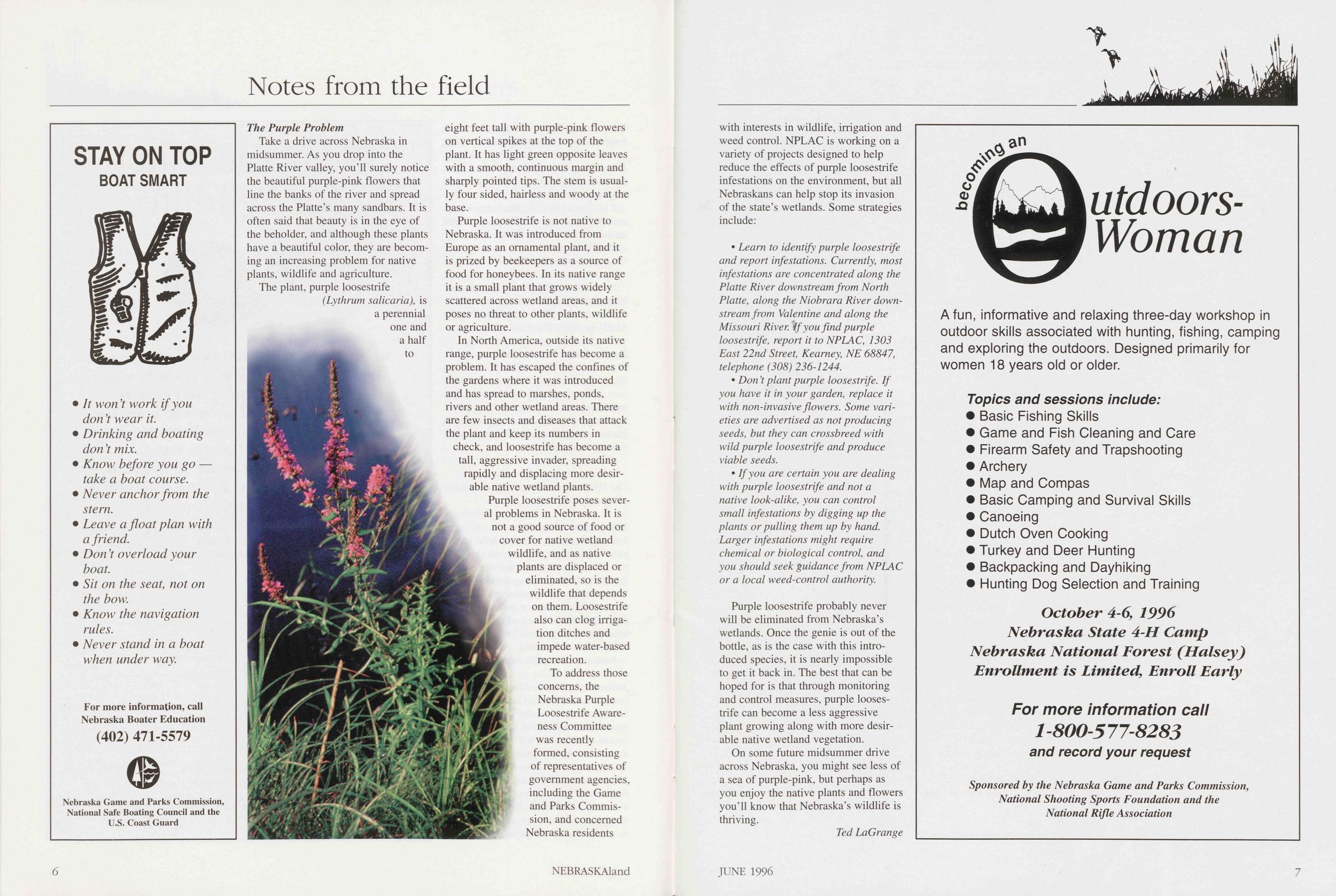
Notes from the field
STAY ON TOP BOAT SMART It won't work if you don't wear it. Drinking and boating don yt mix. Know before you go — take a boat course. Never anchor from the stern. Leave a float plan with a friend. Don yt overload your boat. Sit on the seat, not on the bow. Know the navigation rules. Never stand in a boat when under way. For more information, call Nebraska Boater Education (402) 471-5579 The Purple ProblemTake a drive across Nebraska in midsummer. As you drop into the Platte River valley, you'll surely notice the beautiful purple-pink flowers that line the banks of the river and spread across the Platte's many sandbars. It is often said that beauty is in the eye of the beholder, and although these plants have a beautiful color, they are becoming an increasing problem for native plants, wildlife and agriculture. The plant, purple loosestrife (Lythrum salicaria), is a perennial one and a half to i 4 Nebraska Game and Parks Commission, National Safe Boating Council and the U.S. Coast Guard eight feet tall with purple-pink flowers on vertical spikes at the top of the plant. It has light green opposite leaves with a smooth, continuous margin and sharply pointed tips. The stem is usually four sided, hairless and woody at the base.
Purple loosestrife is not native to Nebraska. It was introduced from Europe as an ornamental plant, and it is prized by beekeepers as a source of food for honeybees. In its native range it is a small plant that grows widely scattered across wetland areas, and it poses no threat to other plants, wildlife or agriculture.
In North America, outside its native range, purple loosestrife has become a problem. It has escaped the confines of the gardens where it was introduced and has spread to marshes, ponds, rivers and other wetland areas. There are few insects and diseases that attack the plant and keep its numbers in check, and loosestrife has become a tall, aggressive invader, spreading rapidly and displacing more desirable native wetland plants. Purple loosestrife poses several problems in Nebraska. It is not a good source of food or cover for native wetland wildlife, and as native plants are displaced or eliminated, so is the wildlife that depends on them. Loosestrife also can clog irrigation ditches and impede water-based recreation.
To address those concerns, the Nebraska Purple Loosestrife Awareness Committee was recently formed, consisting of representatives of government agencies, including the Game and Parks Commis- sion, and concerned Nebraska residents 6 NEBRASKAland with interests in wildlife, irrigation and weed control. NPLAC is working on a variety of projects designed to help reduce the effects of purple loosestrife infestations on the environment, but all Nebraskans can help stop its invasion of the state's wetlands. Some strategies include:
• Learn to identify purple loosestrife and report infestations. Currently, most infestations are concentrated along the Platte River downstream from North Platte, along the Niobrara River downstream from Valentine and along the Missouri River. If you find purple loosestrife, report it to NPLAC, 1303 East 22nd Street, Kearney, NE 68847, telephone (308) 236-1244.
• Don 1 plant purple loosestrife. If you have it in your garden, replace it with non-invasive flowers. Some varieties are advertised as not producing seeds, but they can crossbreed with wild purple loosestrife and produce viable seeds.
• If you are certain you are dealing with purple loosestrife and not a native look-alike, you can control small infestations by digging up the plants or pulling them up by hand. Larger infestations might require chemical or biological control, and you should seek guidance from NPLAC or a local weed-control authority.
Purple loosestrife probably never will be eliminated from Nebraska's wetlands. Once the genie is out of the bottle, as is the case with this introduced species, it is nearly impossible to get it back in. The best that can be hoped for is that through monitoring and control measures, purple loose strife can become a less aggressive plant growing along with more desirable native wetland vegetation.
On some future midsummer drive across Nebraska, you might see less of a sea of purple-pink, but perhaps as you enjoy the native plants and flowers you'll know that Nebraska's wildlife is thriving.
Ted LaGrange Outdoors- Woman A fun, informative and relaxing three-day workshop in outdoor skills associated with hunting, fishing, camping and exploring the outdoors. Designed primarily for women 18 years old or older. Topics and sessions include: • Basic Fishing Skills • Game and Fish Cleaning and Care • Firearm Safety and Trapshooting • Archery • Map and Compas • Basic Camping and Survival Skills • Canoeing • Dutch Oven Cooking • Turkey and Deer Hunting • Backpacking and Day hiking • Hunting Dog Selection and Training October 4-6, 1996 Nebraska State 4-H Camp Nebraska National Forest (Halsey) Enrollment is Limited, Enroll Early For more information call 1-800-577-8283 and record your request Sponsored by the Nebraska Game and Parks Commission, National Shooting Sports Foundation and the National Rifle Association JUNE 1996 7
The Last of the Great Scouts
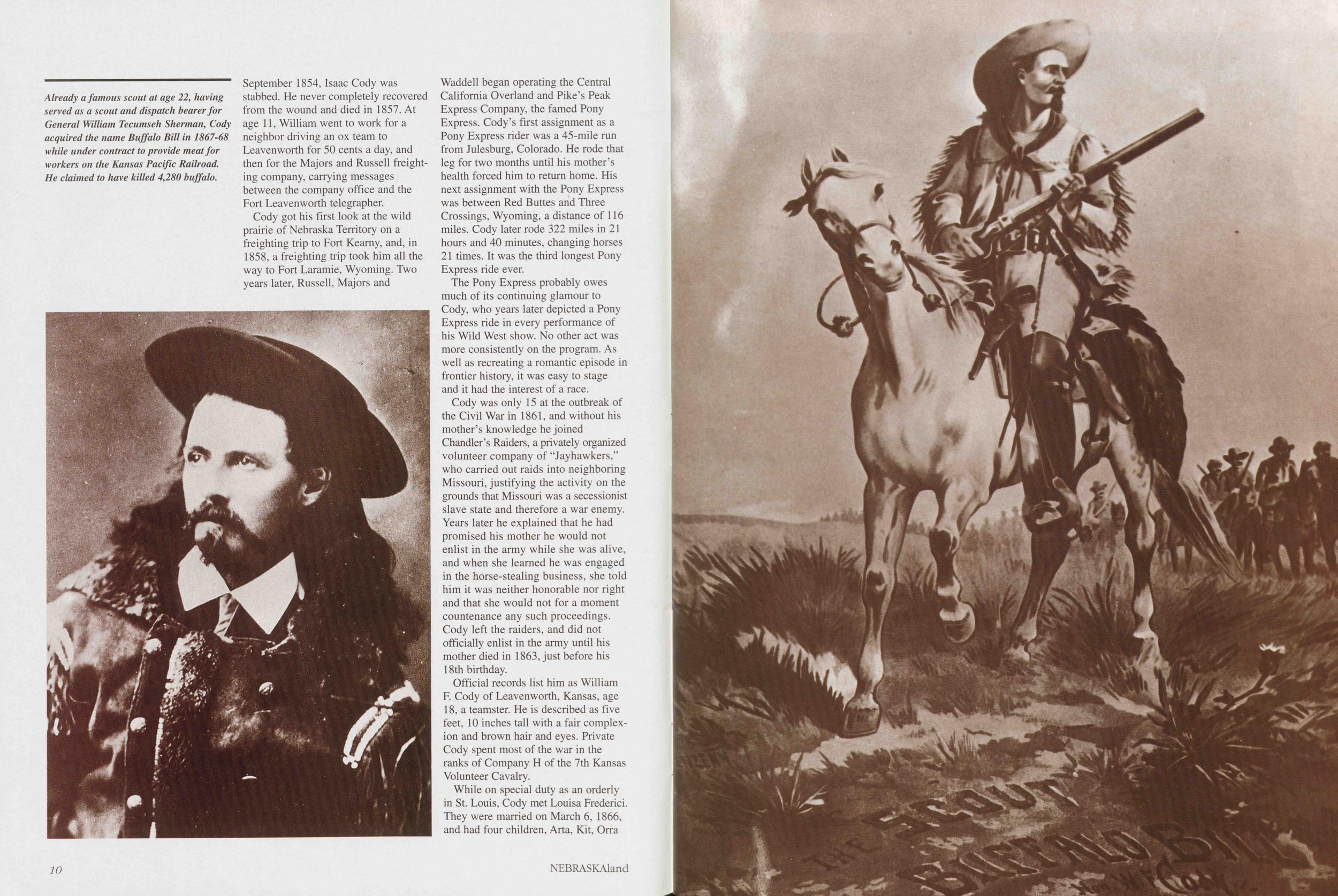
By Tom Morrison, Superintendent Buffalo Bill Ranch State Historical Park Buffalo Bill Cody is recognized throughout the world as a symbol of the Old West. Born 150 years ago, Cody's exploits as a Pony Express rider, buffalo hunter, army scout and showman have made him a larger-than-life character, but unlike many western heroes Cody's real life is as interesting as the legends.The exploits of Buffalo Bill Cody, America's most famous frontier showman-scout, have fired the imagination of generations of young buckaroos with images of the Pony Express, buffalo hunts and gunfights. Unlike many western heroes, however, William F. Cody's real life is as interesting as the legends.
Sometimes called the last of the great scouts, Cody's life spanned the turbulent period that spawned most the images that typify the Old West for most Americans and for the world. Whatever complexities and contradictions were present in his character, this frontiersman, Indian fighter, friend of the Indians, showman and legend builder is a figure of near-mythic stature in the history of the Great Plains. This year marks the 150th anniversary of his birth, and his exploits, many of them directly associated with Nebraska, are being celebrated throughout the West.
Cody was born on February 26, 1846, near LeClaire in Scott County, Iowa, to Isaac and Mary Ann Cody. His father, a restless and ambitious man like many of his generation, aspired to take his family to California. In 1854, the Cody family moved near Weston, Missouri, and from there to Grass- hopper Falls (later Valley Falls) in the newly opened Kansas Territory.
In the years before the Civil War, the political climate in Kansas was volatile, and during a political altercation in 8 NEBRASKAland
Cody got his first look at the wild prairie of Nebraska Territory on a freighting trip to Fort Kearny, and, in 1858, a freighting trip took him all the way to Fort Laramie, Wyoming. Two years later, Russell, Majors and Waddell began operating the Central California Overland and Pike's Peak Express Company, the famed Pony Express. Cody's first assignment as a Pony Express rider was a 45-mile run from Julesburg, Colorado. He rode that leg for two months until his mother's health forced him to return home. His next assignment with the Pony Express was between Red Buttes and Three Crossings, Wyoming, a distance of 116 miles. Cody later rode 322 miles in 21 hours and 40 minutes, changing horses 21 times. It was the third longest Pony Express ride ever.
The Pony Express probably owes much of its continuing glamour to Cody, who years later depicted a Pony Express ride in every performance of his Wild West show. No other act was more consistently on the program. As well as recreating a romantic episode in frontier history, it was easy to stage and it had the interest of a race.
Cody was only 15 at the outbreak of the Civil War in 1861, and without his mother's knowledge he joined Chandler's Raiders, a privately organized volunteer company of "Jayhawkers," who carried out raids into neighboring Missouri, justifying the activity on the grounds that Missouri was a secessionist slave state and therefore a war enemy. Years later he explained that he had promised his mother he would not enlist in the army while she was alive, and when she learned he was engaged in the horse-stealing business, she told him it was neither honorable nor right and that she would not for a moment countenance any such proceedings. Cody left the raiders, and did not officially enlist in the army until his mother died in 1863, just before his 18th birthday.
Official records list him as William F. Cody of Leavenworth, Kansas, age 18, a teamster. He is described as five feet, 10 inches tall with a fair complexion and brown hair and eyes. Private Cody spent most of the war in the ranks of Company H of the 7th Kansas Volunteer Cavalry.
While on special duty as an orderly in St. Louis, Cody met Louisa Frederick. They were married on March 6, 1866, and had four children, Arta, Kit, Orra 10 NEBRASKAland
 and Irma. Orra and Kit died in
childhood, and Arta preceded her father in
death. Irma Cody Garlow died in a flu
epidemic in 1918.
and Irma. Orra and Kit died in
childhood, and Arta preceded her father in
death. Irma Cody Garlow died in a flu
epidemic in 1918.
Cody tried to settle down to ordinary pursuits. He rented a house in Salt Creek Valley, Kansas, and opened it as a hotel, the Golden Rule House. After six months, he gave up and sold out, thinking he could make more money out West on the frontier. That was a turning point; had his inclinations been more domestic, there might have been no Buffalo Bill.
At Junction City, Kansas, he met James Butler "Wild Bill" Hickok, who was working as a scout at Fort Ellsworth, Kansas. Cody went to Ellsworth with Hickok and also hired on as a scout. Through 1866 and 1867, he worked as a guide and dispatch bearer riding among Forts Ellsworth, Larned, Harker, Hays and Riley.
In August 1867, Cody and once again attempted domesticity. His first daughter had been born on December 16, 1866. Cody and William Rose went into partnership to establish a town at a point near present Hays, Kansas, where they expected the railroad to cross Big Creek. Louisa joined her husband in the new vocation. Within a month, the new town, called Rome, had 200 frame and log houses, several stores and saloons and a hotel. However, when the railroad raised the approaches to the bridge, Rome was obscured by the embankments and quickly disappeared, having been moved, houses and all, to the rival town of Hays, a mile or so away.
Louisa Cody returned to St. Louis to live with her father, and Cody was employed to provide buffalo meat to workers on the Kansas Pacific Railroad. Cody was paid $500 a month to provide 12 buffalo a day to feed 1,200 track layers. He is said to have killed 4,280 buffalo in eight months, and it wasn't long before Cody was being called Buffalo Bill.
Cody's employment as an army scout resumed in August 1868, when he was paid $60 per month and given a "splendid" mule to ride. In one noteworthy exploit during that period, Cody was sent on horseback from Fort Larned to Fort Hays, 65 miles away, to inform General Philip Sheridan that the Kiowa and Comanche Indians were on the warpath. From Fort Hays, he was sent to Fort Dodge, 95 miles south of Hays. When Cody returned to Fort Larned, he was given more messages to be taken to Fort Hays, and off he went again. In all, he rode about 350 miles in less than 60 hours.
That exhibition of endurance and courage convinced Sheridan that Cody's services would be extremely valuable. Sheridan retained him at Fort Hays until the battalion of the 5th Cavalry arrived, then made Cody chief of scouts for that regiment. In 1869, the 5th Cavalry was transferred to Fort McPherson, Nebraska.
Cody had a distinguished, colorful career as an Army scout, including many expeditions against the Indians and service as a guide for hunting parties including a group of Easterners, referred to as "New Yorkers on the warpath," whom he guided from Fort McPherson to Fort Hays in 1871. After that hunt, Cody was invited to visit Chicago and New York, a trip that is said to have motivated him to organize his melodrama troupe.
In 1872, Cody served as a guide for the Grand Duke Alexis, third son of Alexander II, czar of Russia. The
After returning to Fort McPherson, Cody became a guide for Company B, 3rd Cavalry, under Captain Charles Meinhold and was awarded the Medal of Honor for action in a battle on the south fork of the Loup River. In his report, Meinhold wrote, "Mr. William Cody's reputation for bravery and skill as a guide is so well established that I need not say anything else but that he acted in his usual manner."
In the fall of 1872, Cody, a crony named Texas Jack Omohondro and dime novelist Ned Buntline organized a melodrama troupe, and for next 11 years, Cody spent winters touring with the Buffalo Bill Combination, staging "The Scouts of the Prairie" and other melodramas. Each summer, Cody returned to his life in the West.
In 1876, Cody was the guide for General George Crook's expedition into Wyoming. In July, after the Battle of the Little Bighorn in Montana, Cody, then guiding General Wesley Merritt, who was taking reinforcements to Crook by way of Fort Fetterman, Wyoming, encountered a band of Cheyenne Indians in northwestern Nebraska. In the ensuing battle, Cody is said to have killed a Cheyenne leader named Yellow Hair. A highly dramatized version of the incident became the
In August 1876, Cody was discharged as chief of scouts of the Big Horn and Yellowstone Expedition, ending his career with the U.S. Cavalry. In April, the Codys moved to North Platte, Nebraska, where he built Scout's Rest Ranch, now a Nebraska state historical park. In 1902, Cody moved to Wyoming, where he had helped to establish the town of Cody in 1896. His family stayed in Nebraska until 1913.
In 1882, Cody organized an outdoor 4th of July celebration, the Old Glory Blowout, for the town of North Platte. The celebration included riding events, contests and prize money and is sometimes considered the beginning of modern rodeo.
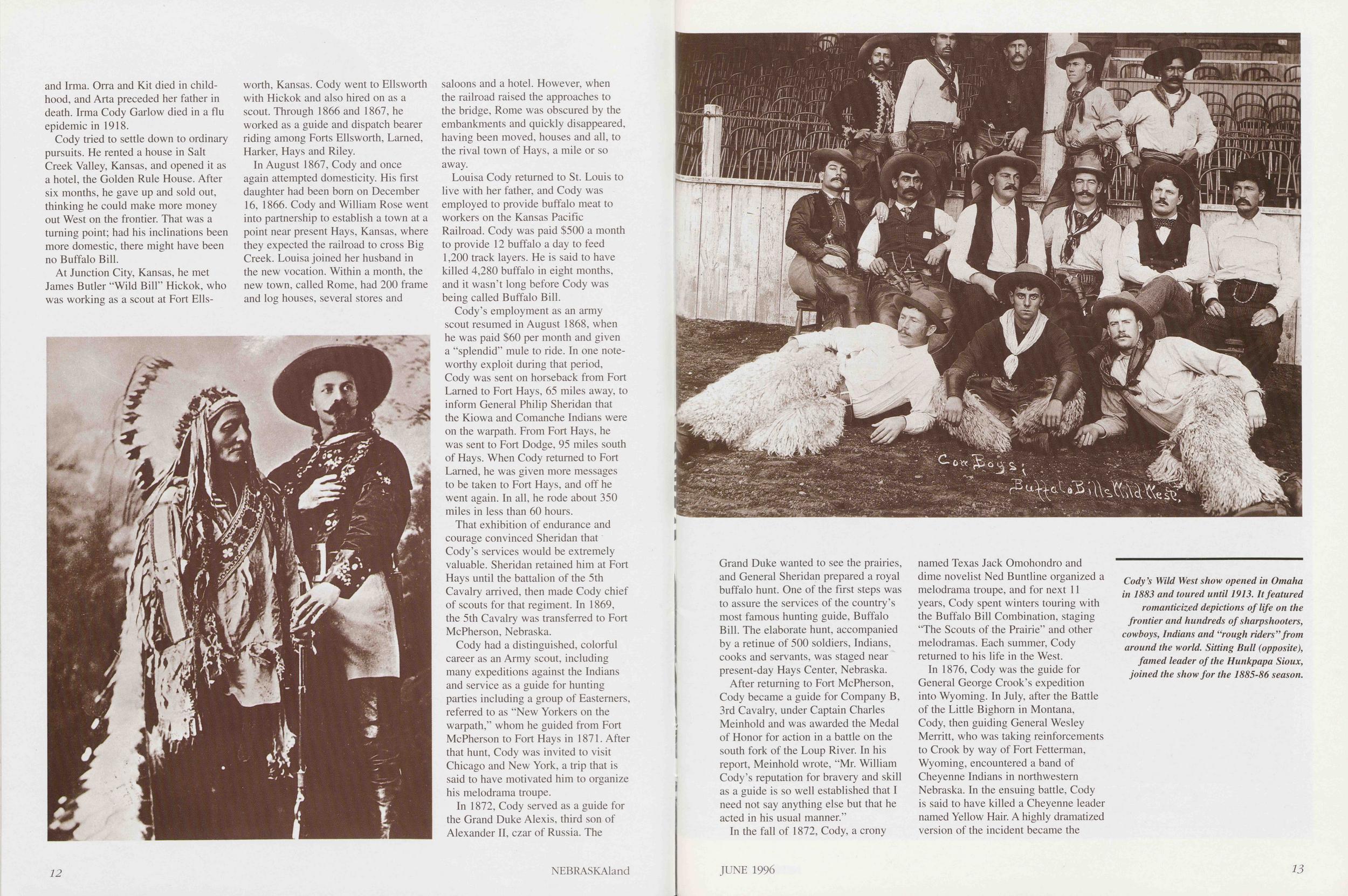
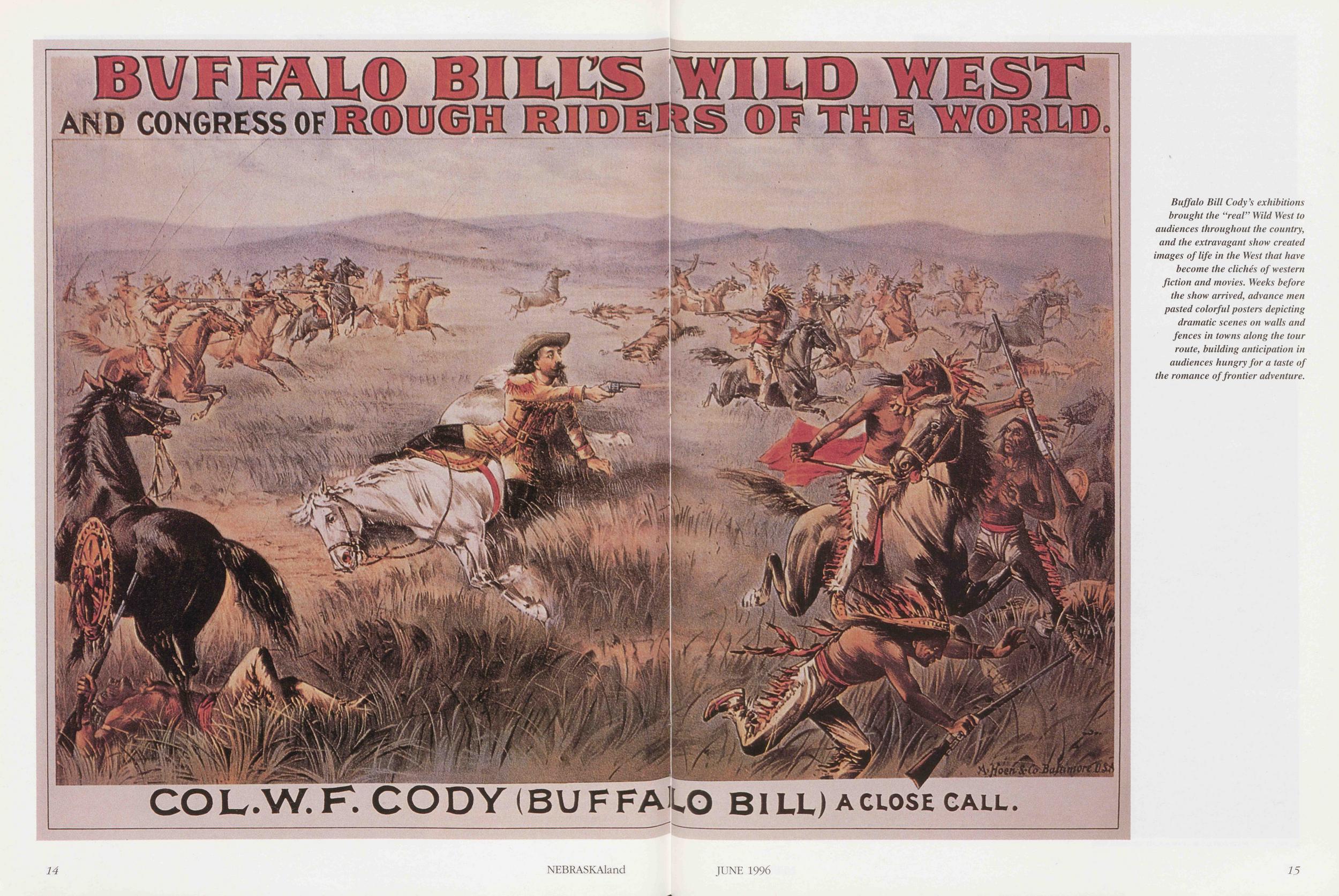
The Old Glory Blowout gave Cody a chance to see how an outdoor Wild West show would be received by the public, and in 1883, his touring Wild West show opened in Omaha. For the next 30 years, Cody traveled throughout the country with his exhibition and toured Europe three times.
Billed as "The Wild West, Hon. W.F. Cody and Dr. W.F. Carver's Rocky Mountain and Prairie Exhibition," it later became Buffalo Bill's Wild West. 16 NEBRASKAland In 1893, the Congress of Rough Riders of the World act was added to the show. In 1908, Cody and Gordon "Pawnee Bill" Lillie became partners, and the combined show was called Buffalo Bill's Wild West and Pawnee Bill's Far East. From 1883 to 1913, Cody's exhibitions played in 16 Nebraska towns, returning to several in more than one season.
Financial problems caused Cody to lose the show in 1913, and in 1914 and 1915, he traveled with the Sells-Floto Circus. In 1916, he joined the Miller Brothers and Arlington 101 Ranch Wild West show. He gave his final performance in Portsmouth, Virginia, on November 11, 1916, then traveled to his ranch south of Cody.
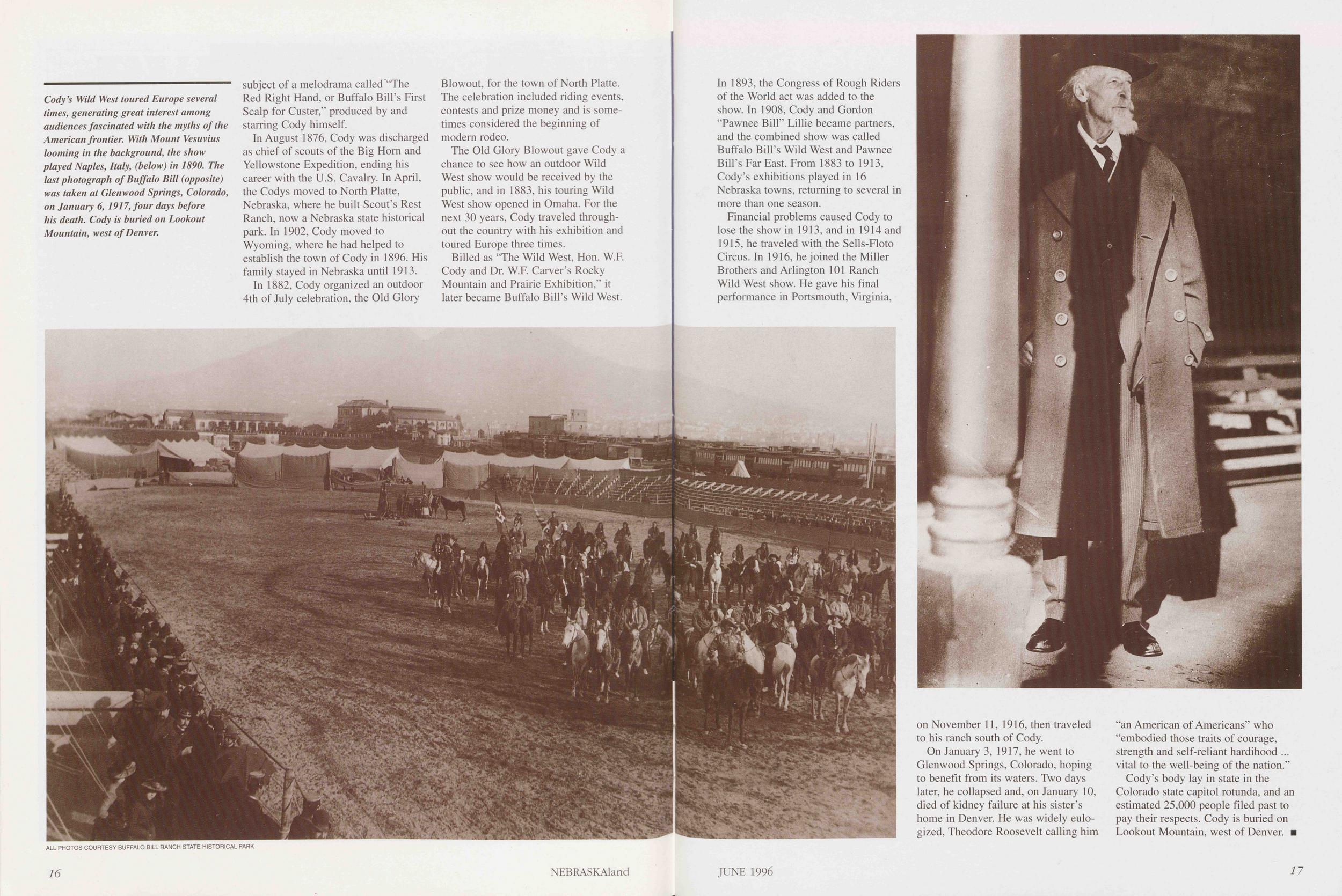
On January 3, 1917, he went to Glenwood Springs, Colorado, hoping to benefit from its waters. Two days later, he collapsed and, on January 10, died of kidney failure at his sister's home in Denver. He was widely eulogized, Theodore Roosevelt calling him "an American of Americans" who "embodied those traits of courage, strength and self-reliant hardihood ... vital to the well-being of the nation."
Cody's body lay in state in the Colorado state capitol rotunda, and an estimated 25,000 people filed past to pay their respects. Cody is buried on Lookout Mountain, west of Denver.
William F. "Buffalo Bill" Cody's association with Nebraska began in 1857 when, at age 11, he traveled from Fort Leavenworth, Kansas, to Fort Kearny as a freighting company employee. Throughout his life, Nebraska was the scene of many of his exploits with the army, as a guide and scout and eventually as a Wild West show entrepreneur, and he called North Platte his home from 1877 to 1902.
In 1877, with brothers Frank and Luther North, themselves notable frontier figures from Columbus, he started a cattle ranch near North Platte, and the next year he made North Platte his home. Cody's highly successful Wild West show opened in 1883, and he soon acquired about 4,000 acres of land near North Platte, stocking the ranch he called "Scout's Rest" with blooded stock, including shorthorn and polled-angus cattle and thoroughbred horses. As well as livestock, the ranch produced irrigated corn, alfalfa, broomcorn and oats, and an 1895 Omaha Bee article reported that the ranch employed 30 workers.
In an 1885 story on the ranch, the Omaha Herald said, "The waters of the great Platte flow through no prettier or more natural stock ranch. Nature in all her bounteous gifts never designed a place more fitting."
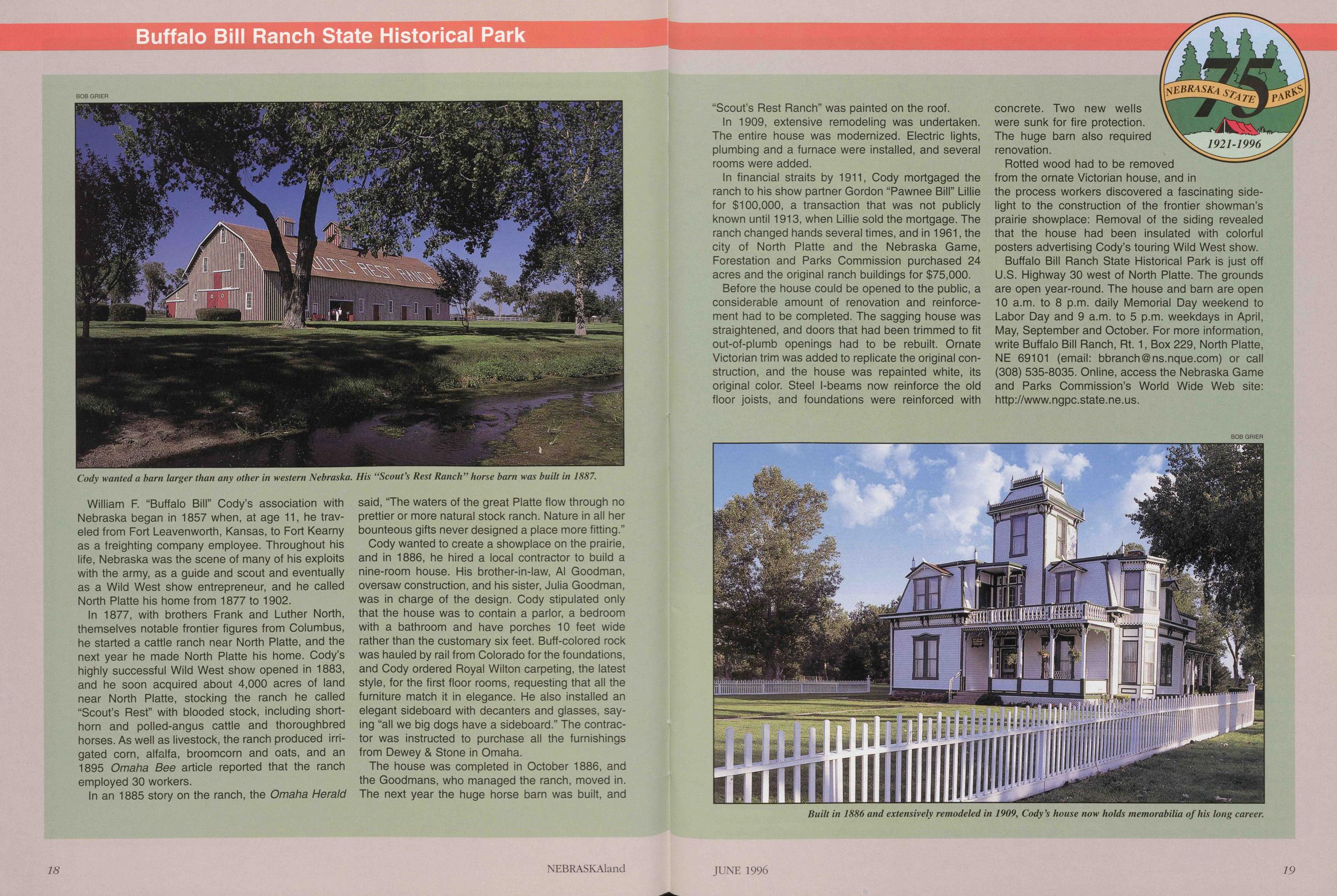
Cody wanted to create a showplace on the prairie, and in 1886, he hired a local contractor to build a nine-room house. His brother-in-law, Al Goodman, oversaw construction, and his sister, Julia Goodman, was in charge of the design. Cody stipulated only that the house was to contain a parlor, a bedroom with a bathroom and have porches 10 feet wide rather than the customary six feet. Buff-colored rock was hauled by rail from Colorado for the foundations, and Cody ordered Royal Wilton carpeting, the latest style, for the first floor rooms, requesting that all the furniture match it in elegance. He also installed an elegant sideboard with decanters and glasses, saying "all we big dogs have a sideboard." The contractor was instructed to purchase all the furnishings from Dewey & Stone in Omaha.
The house was completed in October 1886, and the Goodmans, who managed the ranch, moved in. The next year the huge horse barn was built, and 18 NEBRASKAland "Scout's Rest Ranch" was painted on the roof.
In 1909, extensive remodeling was undertaken. The entire house was modernized. Electric lights, plumbing and a furnace were installed, and several rooms were added.
In financial straits by 1911, Cody mortgaged the ranch to his show partner Gordon "Pawnee Bill" Lillie for $100,000, a transaction that was not publicly known until 1913, when Lillie sold the mortgage. The ranch changed hands several times, and in 1961, the city of North Platte and the Nebraska Game, Forestation and Parks Commission purchased 24 acres and the original ranch buildings for $75,000.
Before the house could be opened to the public, a considerable amount of renovation and reinforcement had to be completed. The sagging house was straightened, and doors that had been trimmed to fit out-of-plumb openings had to be rebuilt. Ornate Victorian trim was added to replicate the original construction, and the house was repainted white, its original color. Steel I-beams now reinforce the old floor joists, and foundations were reinforced with concrete. Two new wells were sunk for fire protection. The huge barn also required renovation.
Rotted wood had to be removed from the ornate Victorian house, and in the process workers discovered a fascinating sidelight to the construction of the frontier showman's prairie showplace: Removal of the siding revealed that the house had been insulated with colorful posters advertising Cody's touring Wild West show.
Buffalo Bill Ranch State Historical Park is just off U.S. Highway 30 west of North Platte. The grounds are open year-round. The house and barn are open 10 a.m. to 8 p.m. daily Memorial Day weekend to Labor Day and 9 a.m. to 5 p.m. weekdays in April, May, September and October. For more information, write Buffalo Bill Ranch, Rt. 1, Box 229, North Platte, NE 69101 (email: bbranch@ns.nque.com) or call (308) 535-8035. Online, access the Nebraska Game and Parks Commission's World Wide Web site: http://www.ngpc.state.ne.us.
Spatterdock Lilliesfor Cows
Photos and text by Jon Farrar Waterlilies seem more at home in the calm water of stone-lined pools in manicured gardens, hut they once were found in backwaters and marshes throughout Nebraska.Throughout human history, in culture after culture, enlarged plant roots have been assigned medicinal and spiritual powers, particularly if they resemble the human body. The root of spatterdock (Nuphar luteum), a yellow-flowered waterlily native to Nebraska, does not resemble the human form but in other ways suggests extraordinary importance. Prominent leaf scars resembling contracted water leeches ornament its surface, almost as if each root were tallying the summers it sent foliage and flowers skyward.
American Indians and early white settlers believed spatterdock roots contained healing agents. Tea made from the root was an Indian remedy for several ailments, including heart trouble, blood diseases and sexual irritability, the latter an ailment that cries out for definition. Pulverized spatterdock roots were used as poultices applied to wounds, boils, skin irritations and swellings. The root reportedly contains steroids and was used as a folk remedy for impotence, but was reputed to work equally well relieving diarrhea. Marshside doctors should be aware, though, that large doses can be toxic.
Three species of true waterlilies are native to Nebraska, and a fourth water plant would be called a waterlily by all but taxonomists. Two are white-flowered and two are yellow-flowered.
The original distribution of white waterlily (Nymphaea tuberosa) and fragrant white waterlily (Nymphaea odorata) in Nebraska was principally the eastern half of the state, although both ventured farther west in the Sandhills lake country. As wetlands where they once grew were drained or deteriorated in quality, their distribution withered to local populations. Conversely, they probably colonized new waters with the help of people who fancied the flowers as ornamentals.
Both species bear large white flowers with yellow centers during the summer months. For the layman, the common and scientific names provide the simplest clue for separating one from the other: The flower of one is noticeably fragrant, the other is not.
The American lotus (Nelumbo lutea), the sole representative of the lotus family in Nebraska, is not technically a waterlily, although it looks like one in every way, and its exclusion from the waterlily family is a matter for botanists who sort species on the basis of relatively minor characteristics.
It is native only to extreme eastern Nebraska, particularly calm backwaters along the Missouri River, but probably once was found along the lower reaches of the Platte, Elkhorn and other drainages feeding the Missouri River. It is still abundant on a floodplain marsh at Fontenelle Forest near Omaha.
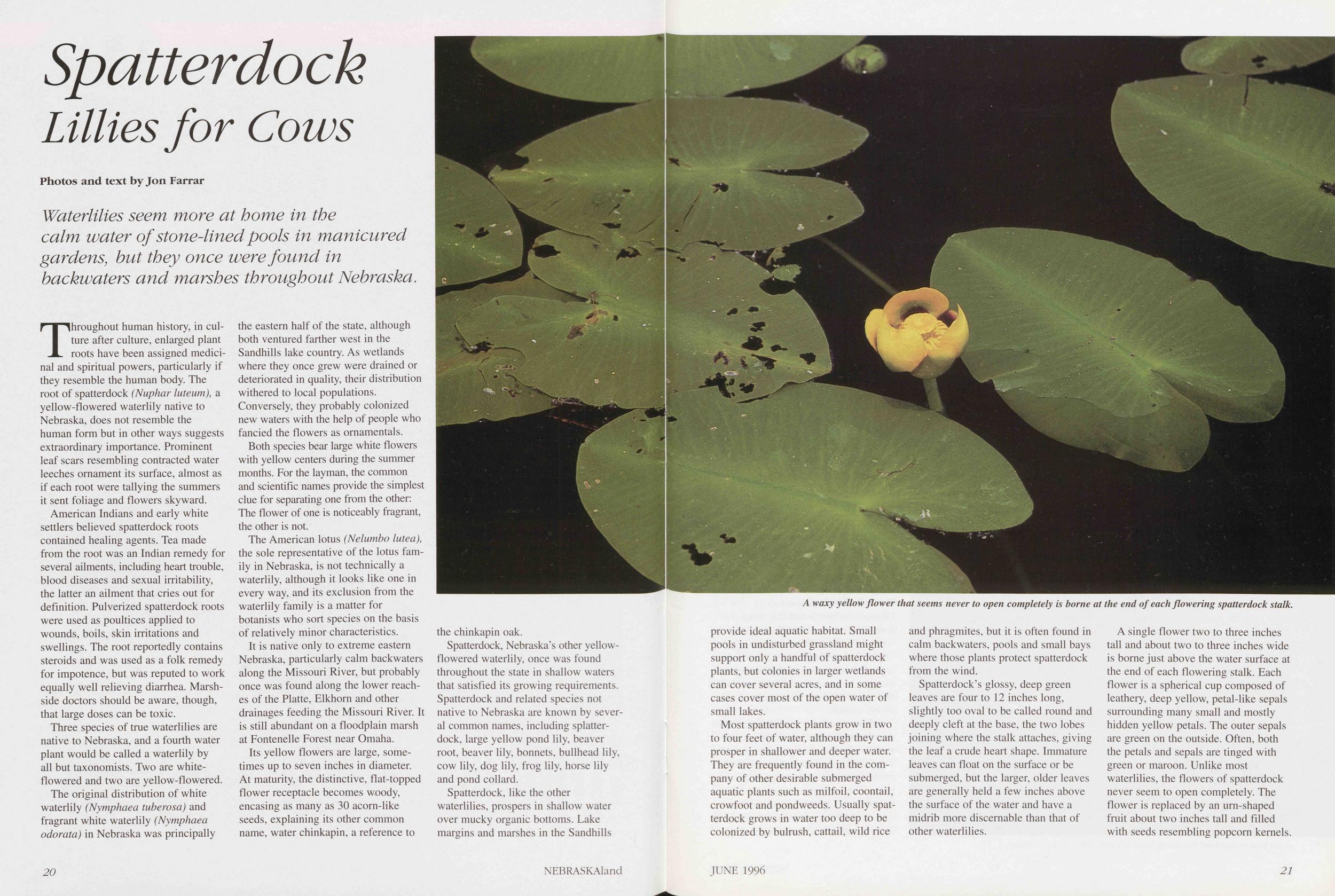
Its yellow flowers are large, sometimes up to seven inches in diameter. At maturity, the distinctive, flat-topped flower receptacle becomes woody, encasing as many as 30 acorn-like seeds, explaining its other common name, water chinkapin, a reference to A waxy yellow flower that seems never to open completely is borne at the end of each flowering spatterdock stalk. the chinkapin oak.
Spatterdock, Nebraska's other yellow flowered waterlily, once was found throughout the state in shallow waters that satisfied its growing requirements. Spatterdock and related species not native to Nebraska are known by sever- al common names, including splatter- dock, large yellow pond lily, beaver root, beaver lily, bonnets, bullhead lily, cow lily, dog lily, frog lily, horse lily and pond collard.
Spatterdock, like the other waterlilies, prospers in shallow water over mucky organic bottoms. Lake margins and marshes in the Sandhills 20 NEBRASKAland
Most spatterdock plants grow in two to four feet of water, although they can prosper in shallower and deeper water. They are frequently found in the company of other desirable submerged aquatic plants such as milfoil, coontail, crowfoot and pondweeds. Usually spatterdock grows in water too deep to be colonized by bulrush, cattail, wild rice and phragmites, but it is often found in calm backwaters, pools and small bays where those plants protect spatterdock from the wind.
Spatterdock's glossy, deep green leaves are four to 12 inches long, slightly too oval to be called round and deeply cleft at the base, the two lobes joining where the stalk attaches, giving the leaf a crude heart shape. Immature leaves can float on the surface or be submerged, but the larger, older leaves are generally held a few inches above the surface of the water and have a midrib more discernible than that of other waterlilies.
A single flower two to three inches tall and about two to three inches wide is borne just above the water surface at the end of each flowering stalk. Each flower is a spherical cup composed of leathery, deep yellow, petal-like sepals surrounding many small and mostly hidden yellow petals. The outer sepals are green on the outside. Often, both the petals and sepals are tinged with green or maroon. Unlike most waterlilies, the flowers of spatterdock never seem to open completely. The flower is replaced by an urn-shaped fruit about two inches tall and filled with seeds resembling popcorn kernels.
JUNE 1996 21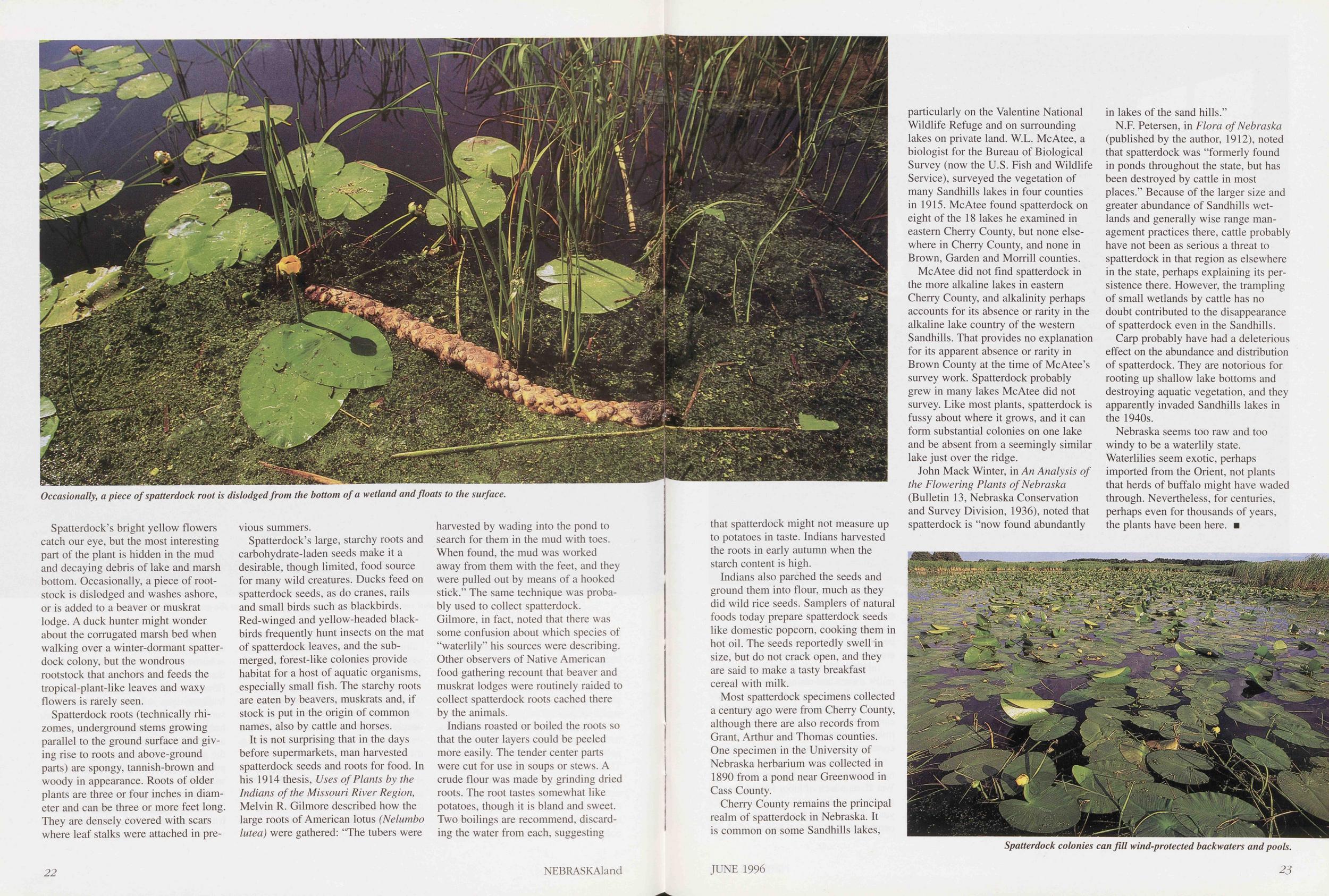
Spatterdock's bright yellow flowers catch our eye, but the most interesting part of the plant is hidden in the mud and decaying debris of lake and marsh bottom. Occasionally, a piece of rootstock is dislodged and washes ashore, or is added to a beaver or muskrat lodge. A duck hunter might wonder about the corrugated marsh bed when walking over a winter-dormant spatterdock colony, but the wondrous rootstock that anchors and feeds the tropical-plant-like leaves and waxy flowers is rarely seen.
Spatterdock roots (technically rhizomes, underground stems growing parallel to the ground surface and giving rise to roots and above-ground parts) are spongy, tannish-brown and woody in appearance. Roots of older plants are three or four inches in diameter and can be three or more feet long. They are densely covered with scars where leaf stalks were attached in previous summers.
Spatterdock's large, starchy roots and carbohydrate-laden seeds make it a desirable, though limited, food source for many wild creatures. Ducks feed on spatterdock seeds, as do cranes, rails and small birds such as blackbirds. Red-winged and yellow-headed black- birds frequently hunt insects on the mat of spatterdock leaves, and the sub- merged, forest-like colonies provide habitat for a host of aquatic organisms, especially small fish. The starchy roots are eaten by beavers, muskrats and, if stock is put in the origin of common names, also by cattle and horses.
It is not surprising that in the days before supermarkets, man harvested spatterdock seeds and roots for food. In his 1914 thesis, Uses of Plants by the Indians of the Missouri River Region, Melvin R. Gilmore described how the large roots of American lotus (Nelumbo lutea) were gathered: "The tubers were harvested by wading into the pond to search for them in the mud with toes. When found, the mud was worked away from them with the feet, and they were pulled out by means of a hooked stick." The same technique was probably used to collect spatterdock. Gilmore, in fact, noted that there was some confusion about which species of "waterlily" his sources were describing. Other observers of Native American food gathering recount that beaver and muskrat lodges were routinely raided to collect spatterdock roots cached there by the animals.
Indians roasted or boiled the roots so that the outer layers could be peeled more easily. The tender center parts were cut for use in soups or stews. A crude flour was made by grinding dried roots. The root tastes somewhat like potatoes, though it is bland and sweet. Two boilings are recommend, discarding the water from each, suggesting 22 NEBRASKAland that spatterdock might not measure up to potatoes in taste. Indians harvested the roots in early autumn when the starch content is high.
Indians also parched the seeds and ground them into flour, much as they did wild rice seeds. Samplers of natural foods today prepare spatterdock seeds like domestic popcorn, cooking them in hot oil. The seeds reportedly swell in size, but do not crack open, and they are said to make a tasty breakfast cereal with milk.
Most spatterdock specimens collected a century ago were from Cherry County, although there are also records from Grant, Arthur and Thomas counties. One specimen in the University of Nebraska herbarium was collected in 1890 from a pond near Greenwood in Cass County.
Cherry County remains the principal realm of spatterdock in Nebraska. It is common on some Sandhills lakes, particularly on the Valentine National Wildlife Refuge and on surrounding lakes on private land. W.L. McAtee, a biologist for the Bureau of Biological Survey (now the U.S. Fish and Wildlife Service), surveyed the vegetation of many Sandhills lakes in four counties in 1915. McAtee found spatterdock on eight of the 18 lakes he examined in eastern Cherry County, but none elsewhere in Cherry County, and none in Brown, Garden and Morrill counties.
McAtee did not find spatterdock in the more alkaline lakes in eastern Cherry County, and alkalinity perhaps accounts for its absence or rarity in the alkaline lake country of the western Sandhills. That provides no explanation for its apparent absence or rarity in Brown County at the time of McAtee's survey work. Spatterdock probably grew in many lakes McAtee did not survey. Like most plants, spatterdock is fussy about where it grows, and it can form substantial colonies on one lake and be absent from a seemingly similar lake just over the ridge.
John Mack Winter, in An Analysis of the Flowering Plants of Nebraska (Bulletin 13, Nebraska Conservation and Survey Division, 1936), noted that spatterdock is "now found abundantly in lakes of the sand hills."
N.F. Petersen, in Flora of Nebraska (published by the author, 1912), noted that spatterdock was "formerly found in ponds throughout the state, but has been destroyed by cattle in most places." Because of the larger size and greater abundance of Sandhills wetlands and generally wise range management practices there, cattle probably have not been as serious a threat to spatterdock in that region as elsewhere in the state, perhaps explaining its persistence there. However, the trampling of small wetlands by cattle has no doubt contributed to the disappearance of spatterdock even in the Sandhills. Carp probably have had a deleterious effect on the abundance and distribution of spatterdock. They are notorious for rooting up shallow lake bottoms and destroying aquatic vegetation, and they apparently invaded Sandhills lakes in the 1940s.
Nebraska seems too raw and too windy to be a waterlily state. Waterlilies seem exotic, perhaps imported from the Orient, not plants that herds of buffalo might have waded through. Nevertheless, for centuries, perhaps even for thousands of years, the plants have been here.
SIMPLE PLEASURES
Champion Mill State Historical Park
Photo and text by Rocky HoffmannSwimming suits can no longer be rented for 10 cents a day, nor can one take a motorboat ride around the millpond for a quarter, but Champion Mill still stands like a sentry over the headwaters of the Frenchman River, the only remaining functional water-powered flour mill in Nebraska.
Quality flours, including Home Flour, Valley Pride and Prairie Rose were among the products of the rollers that began to pulverize wheat more than a century ago, the power provided by the river. Expanding agricultural production late in the 19th century offered opportunities to quick-thinking entrepreneurs, and Thomas Scott seized one, building the Champion Roller Mills Company in T 888 at the newly named Chase County town of Champion.
Before 1888, the community was called Hamilton, but the name was changed to honor the first attorney general of Nebraska, Champion S. Chase, a strategy to win the county seat away from Imperial. The attempt failed, but the mill and its serene pond have retained the town's name for nearly 110 years, continuing to be one of Nebraska's simple pleasures.
Little is known of the original two-story mill, but in 1889, the Chase County Champion applauded its modern design and "machinery of all the latest patterns." It was equipped with a 36-inch Leffel water turbine that transferred power to the rollers through a geared iron shaft.
Scott installed steel rollers rather than the traditional burr stones that were common in Nebraska milling, and because he used a gradual reduction roller process and a newly developed sifting and regrinding system, Scott was able to offer better quality flour than most mills. He built an active business on his reputation, but in the winter of 1891-92 fire destroyed the mill.
Scott rebuilt the mill, and in 1892 sold the 25-foot by 32-foot two-story structure to R.R James, who milled grain until 1897 when he traded the operation to Thomas Jordan for a Minden area farm. After Jordan made several improvements on the facility and began milling his famous Home Flour, he sold it in 1908 to Milton Yaw and John Forester, who continued improving the system by adding an electric-arc bleaching station.
Forester died in 1912, and in 1914 Yaw became sole owner of the mill. He died later that year, and the Yaw family undertook major renovations in 1915, installing 10-ton scales and excavating a 185-bushel dump pit with a bucket-belt elevator.
By 1919, Domina Roberts and George Banks each owned a half interest in the mill through a purchase agreement with the Yaw family. Banks and his brothers acquired full ownership of the mill by 1925. The mill was by then a full three-story structure, the extra floor housing a grain auger. A midget mill and a storehouse also had been constructed, and the Banks brothers began milling Will Rise Flour.
In 1929, Glen Knotwell became the mill's owner and changed its name to Lakeside Roller Mills. He was one of the mill's longest and most progressive early owners, rebuilding the dam, installing a penstock and adding a commercial feed operation.
Fortunately, the expansion to commercial feed occurred before World War II, as a lack of labor forced the shutdown of flour milling during war years. The feed and grain business continued until 1956, when the mill 24 NEBRASKAland
Throughout Nebraska history, millponds have provided rare, valued opportunities for recreation, becoming the sites of family and community picnics, swimming, fishing, boating and relaxation. Recreation development at Champion began soon after its construction but was especially popular in the 1920s when Roberts and the Banks brothers built a bathhouse on the south shore of the lake. Rental swimming suits, a diving board, a 20-foot-tall tower and rental boats attracted people from throughout southwestern Nebraska. An icehouse supplied ice for cool drinks.
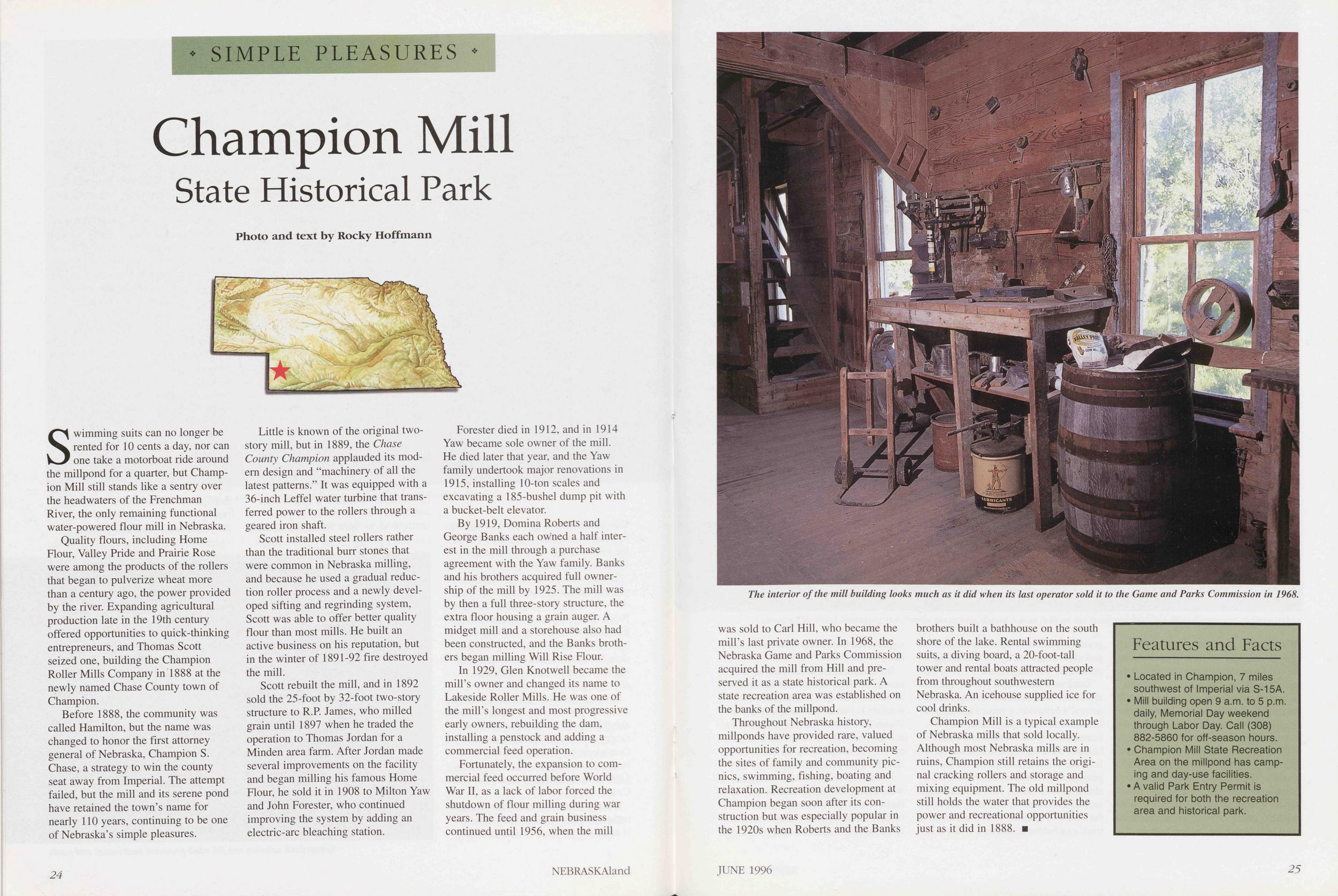
Champion Mill is a typical example of Nebraska mills that sold locally. Although most Nebraska mills are in ruins, Champion still retains the original cracking rollers and storage and mixing equipment. The old millpond still holds the water that provides the power and recreational opportunities just as it did in 1888.
Features and Facts Located in Champion, 7 miles southwest of Imperial via S-15A. Mill building open 9 a.m. to 5 p.m. daily, Memorial Day weekend through Labor Day. Call (308) 882-5860 for off-season hours. Champion Mill State Recreation Area on the millpond has camping and day-use facilities. A valid Park Entry Permit is required for both the recreation area and historical park. JUNE 1996 25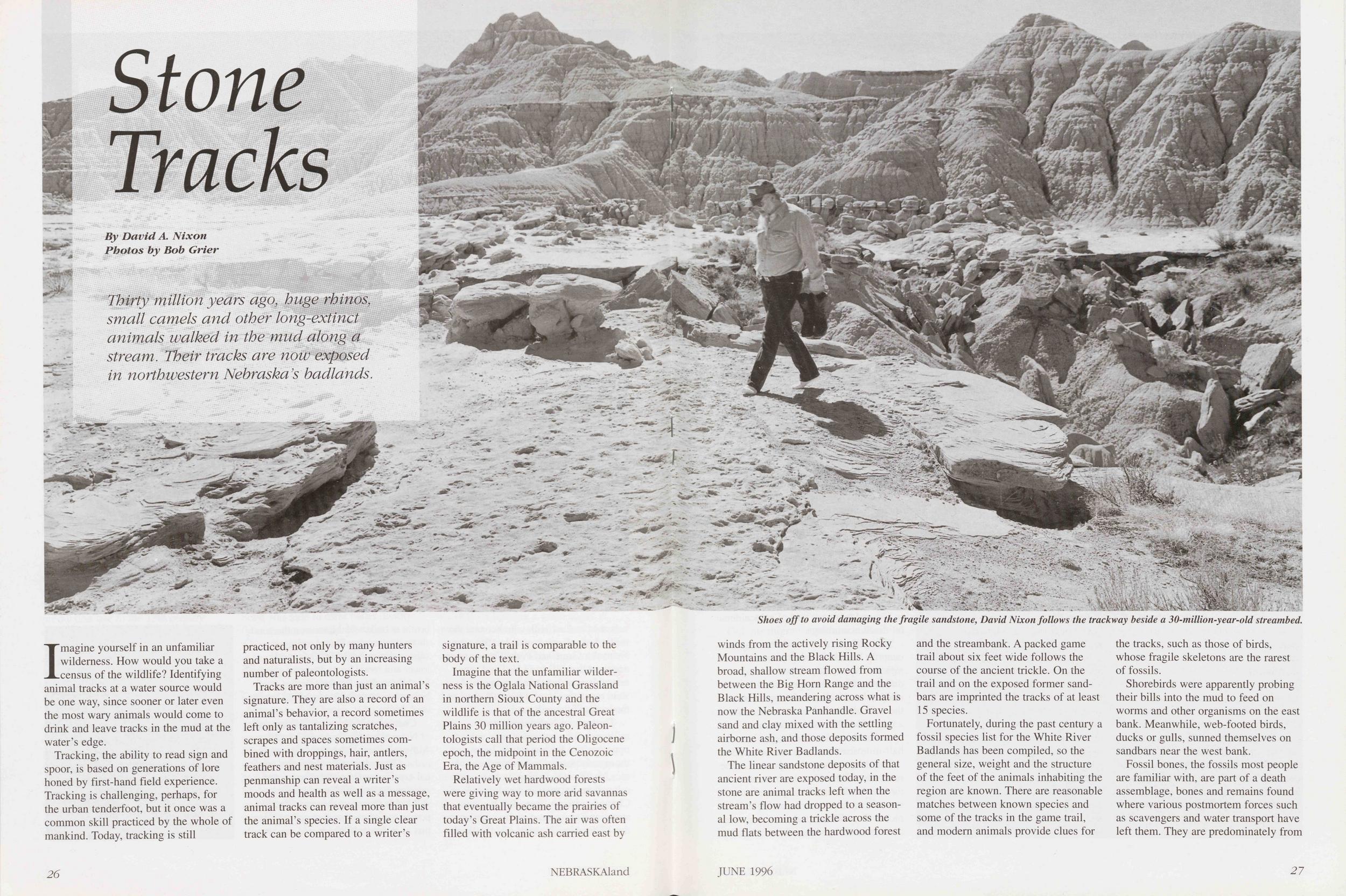
Stone Tracks
By David A. Nixon Photos by Bob Grier Thirty million years ago, huge rhinos, small camels and other long-extinct animals walked in the mud along a stream. Their tracks are now exposed in northwestern Nebraska's badlands.Imagine yourself in an unfamiliar wilderness. How would you take a census of the wildlife? Identifying animal tracks at a water source would be one way, since sooner or later even the most wary animals would come to drink and leave tracks in the mud at the water's edge.
Tracking, the ability to read sign and spoor, is based on generations of lore honed by first-hand field experience. Tracking is challenging, perhaps, for the urban tenderfoot, but it once was a common skill practiced by the whole of mankind. Today, tracking is still practiced, not only by many hunters and naturalists, but by an increasing number of paleontologists.
Tracks are more than just an animal's signature. They are also a record of an animal's behavior, a record sometimes left only as tantalizing scratches, scrapes and spaces sometimes combined with droppings, hair, antlers, feathers and nest materials. Just as penmanship can reveal a writer's moods and health as well as a message, animal tracks can reveal more than just the animal's species. If a single clear track can be compared to a writer's signature, a trail is comparable to the body of the text.
Imagine that the unfamiliar wilderness is the Oglala National Grassland in northern Sioux County and the wildlife is that of the ancestral Great Plains 30 million years ago. Paleontologists call that period the Oligocene epoch, the midpoint in the Cenozoic Era, the Age of Mammals.
Relatively wet hardwood forests were giving way to more arid savannas that eventually became the prairies of today's Great Plains. The air was often filled with volcanic ash carried east by 26 NEBRASKAland
The linear sandstone deposits of that ancient river are exposed today, in the stone are animal tracks left when the stream's flow had dropped to a seasonal low, becoming a trickle across the mud flats between the hardwood forest and the stream bank. A packed game trail about six feet wide follows the course of the ancient trickle. On the trail and on the exposed former sandbars are imprinted the tracks of at least 15 species.
Fortunately, during the past century a fossil species list for the White River Badlands has been compiled, so the general size, weight and the structure of the feet of the animals inhabiting the region are known. There are reasonable matches between known species and some of the tracks in the game trail, and modern animals provide clues for the tracks, such as those of birds, whose fragile skeletons are the rarest of fossils.
Shorebirds were apparently probing their bills into the mud to feed on worms and other organisms on the east bank. Meanwhile, web-footed birds, ducks or gulls, sunned themselves on sandbars near the west bank.
Fossil bones, the fossils most people
are familiar with, are part of a death
assemblage, bones and remains found
where various postmortem forces such
as scavengers and water transport have
left them. They are predominately from
JUNE 1996
27
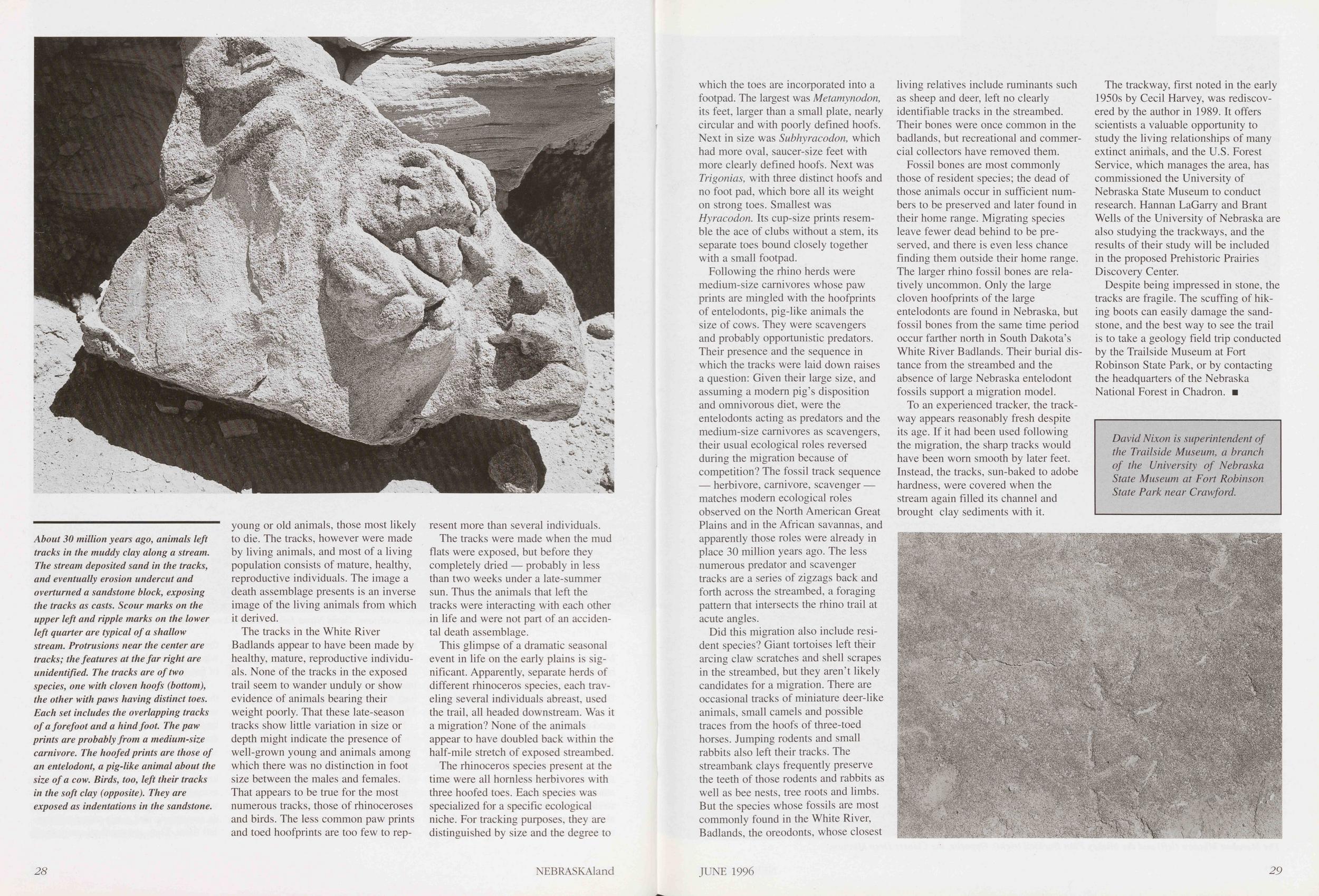
The tracks in the White River Badlands appear to have been made by healthy, mature, reproductive individuals. None of the tracks in the exposed trail seem to wander unduly or show evidence of animals bearing their weight poorly. That these late-season tracks show little variation in size or depth might indicate the presence of well-grown young and animals among which there was no distinction in foot size between the males and females. That appears to be true for the most numerous tracks, those of rhinoceroses and birds. The less common paw prints and toed hoof prints are too few to represent more than several individuals.
The tracks were made when the mud flats were exposed, but before they completely dried — probably in less than two weeks under a late-summer sun. Thus the animals that left the tracks were interacting with each other in life and were not part of an accidental death assemblage.
This glimpse of a dramatic seasonal event in life on the early plains is significant. Apparently, separate herds of different rhinoceros species, each traveling several individuals abreast, used the trail, all headed downstream. Was it a migration? None of the animals appear to have doubled back within the half-mile stretch of exposed streambed.
The rhinoceros species present at the time were all hornless herbivores with three hoofed toes. Each species was specialized for a specific ecological niche. For tracking purposes, they are distinguished by size and the degree to 28 NEBRASKAland which the toes are incorporated into a footpad. The largest was Metamynodon, its feet, larger than a small plate, nearly circular and with poorly defined hoofs. Next in size was Subhyracodon, which had more oval, saucer-size feet with more clearly defined hoofs. Next was Trigonias, with three distinct hoofs and no foot pad, which bore all its weight on strong toes. Smallest was Hyracodon. Its cup-size prints resemble the ace of clubs without a stem, its separate toes bound closely together with a small footpad.
Following the rhino herds were medium-size carnivores whose paw prints are mingled with the hoof prints of entelodonts, pig-like animals the size of cows. They were scavengers and probably opportunistic predators. Their presence and the sequence in which the tracks were laid down raises a question: Given their large size, and assuming a modern pig's disposition and omnivorous diet, were the entelodonts acting as predators and the medium-size carnivores as scavengers, their usual ecological roles reversed during the migration because of competition? The fossil track sequence — herbivore, carnivore, scavenger — matches modern ecological roles observed on the North American Great Plains and in the African savannas, and apparently those roles were already in place 30 million years ago. The less numerous predator and scavenger tracks are a series of zigzags back and forth across the streambed, a foraging pattern that intersects the rhino trail at acute angles.
Did this migration also include resident species? Giant tortoises left their arcing claw scratches and shell scrapes in the streambed, but they aren't likely candidates for a migration. There are occasional tracks of miniature deer-like animals, small camels and possible traces from the hoofs of three-toed horses. Jumping rodents and small rabbits also left their tracks. The stream bank clays frequently preserve the teeth of those rodents and rabbits as well as bee nests, tree roots and limbs. But the species whose fossils are most commonly found in the White River, Badlands, the oreodonts, whose closest living relatives include ruminants such as sheep and deer, left no clearly identifiable tracks in the streambed. Their bones were once common in the badlands, but recreational and commercial collectors have removed them.
Fossil bones are most commonly those of resident species; the dead of those animals occur in sufficient numbers to be preserved and later found in their home range. Migrating species leave fewer dead behind to be preserved, and there is even less chance finding them outside their home range. The larger rhino fossil bones are relatively uncommon. Only the large cloven hoof prints of the large entelodonts are found in Nebraska, but fossil bones from the same time period occur farther north in South Dakota's White River Badlands. Their burial distance from the streambed and the absence of large Nebraska entelodont fossils support a migration model.
To an experienced tracker, the trackway appears reasonably fresh despite its age. If it had been used following the migration, the sharp tracks would have been worn smooth by later feet. Instead, the tracks, sun-baked to adobe hardness, were covered when the stream again filled its channel and brought clay sediments with it.
The trackway, first noted in the early 1950s by Cecil Harvey, was rediscovered by the author in 1989. It offers scientists a valuable opportunity to study the living relationships of many extinct animals, and the U.S. Forest Service, which manages the area, has commissioned the University of Nebraska State Museum to conduct research. Hannan LaGarry and Brant Wells of the University of Nebraska are also studying the trackways, and the results of their study will be included in the proposed Prehistoric Prairies Discovery Center.
Despite being impressed in stone, the tracks are fragile. The scuffing of hiking boots can easily damage the sandstone, and the best way to see the trail is to take a geology field trip conducted by the Trail side Museum at Fort Robinson State Park, or by contacting the headquarters of the Nebraska National Forest in Chadron.
David Nixon is superintendent of the Trailside Museum, a branch of the University of Nebraska State Museum at Fort Robinson State Park near Crawford.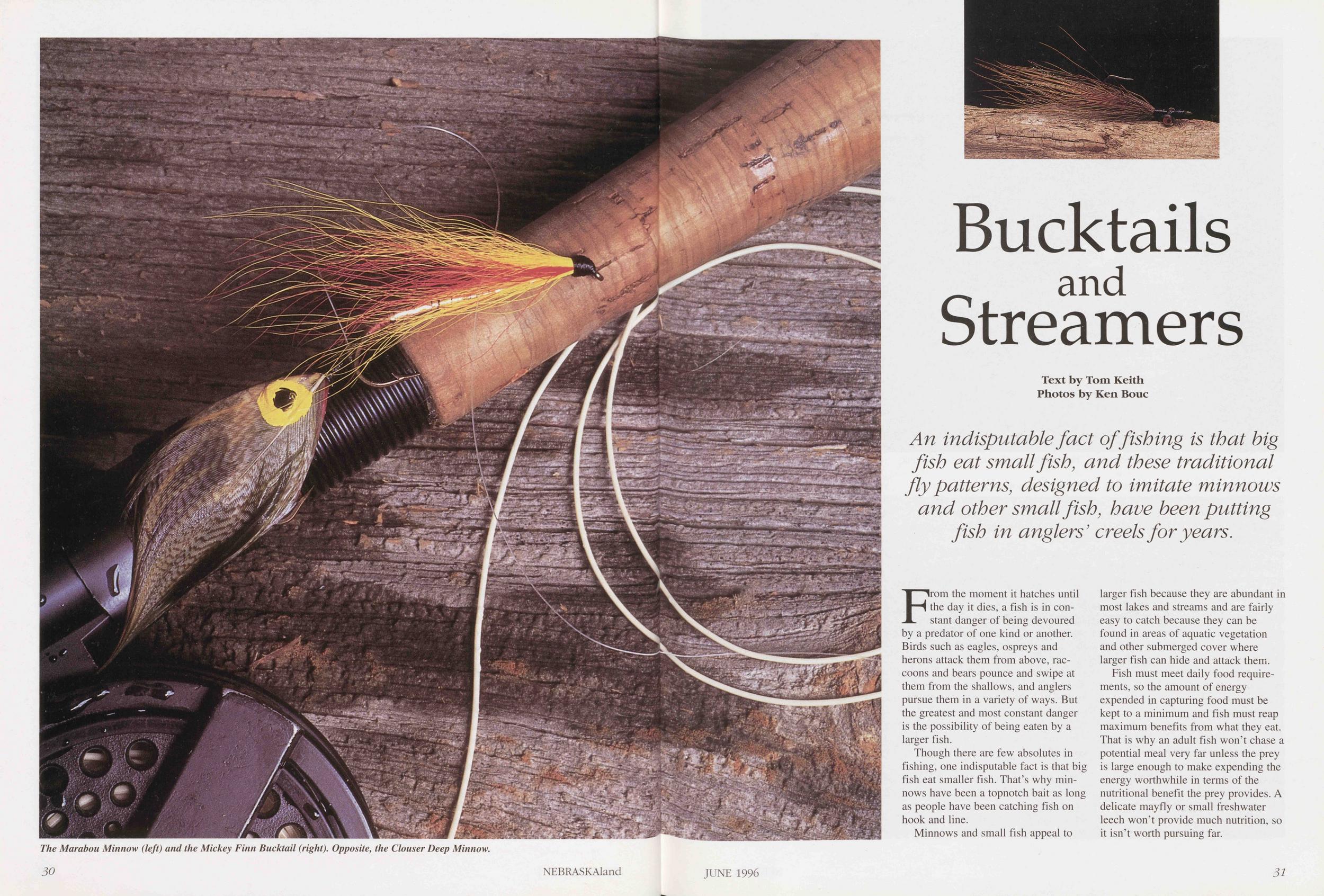
Bucktails and Streamers
Text by Tom Keith Photos by Ken Bouc An indisputable fact of fishing is that big fish eat small fish, and these traditional fly patterns, designed to imitate minnows and other small fish, have been putting fish in anglers' creels for years.From the moment it hatches until the day it dies, a fish is in constant danger of being devoured by a predator of one kind or another. Birds such as eagles, ospreys and herons attack them from above, raccoons and bears pounce and swipe at them from the shallows, and anglers pursue them in a variety of ways. But the greatest and most constant danger is the possibility of being eaten by a larger fish.
Though there are few absolutes in fishing, one indisputable fact is that big fish eat smaller fish. That's why minnows have been a topnotch bait as long as people have been catching fish on hook and line.
Minnows and small fish appeal to larger fish because they are abundant in most lakes and streams and are fairly easy to catch because they can be found in areas of aquatic vegetation and other submerged cover where larger fish can hide and attack them.
Fish must meet daily food requirements, so the amount of energy expended in capturing food must be kept to a minimum and fish must reap maximum benefits from what they eat. That is why an adult fish won't chase a potential meal very far unless the prey is large enough to make expending the energy worthwhile in terms of the nutritional benefit the prey provides. A delicate mayfly or small freshwater leech won't provide much nutrition, so it isn't worth pursuing far.
JUNE 1996 31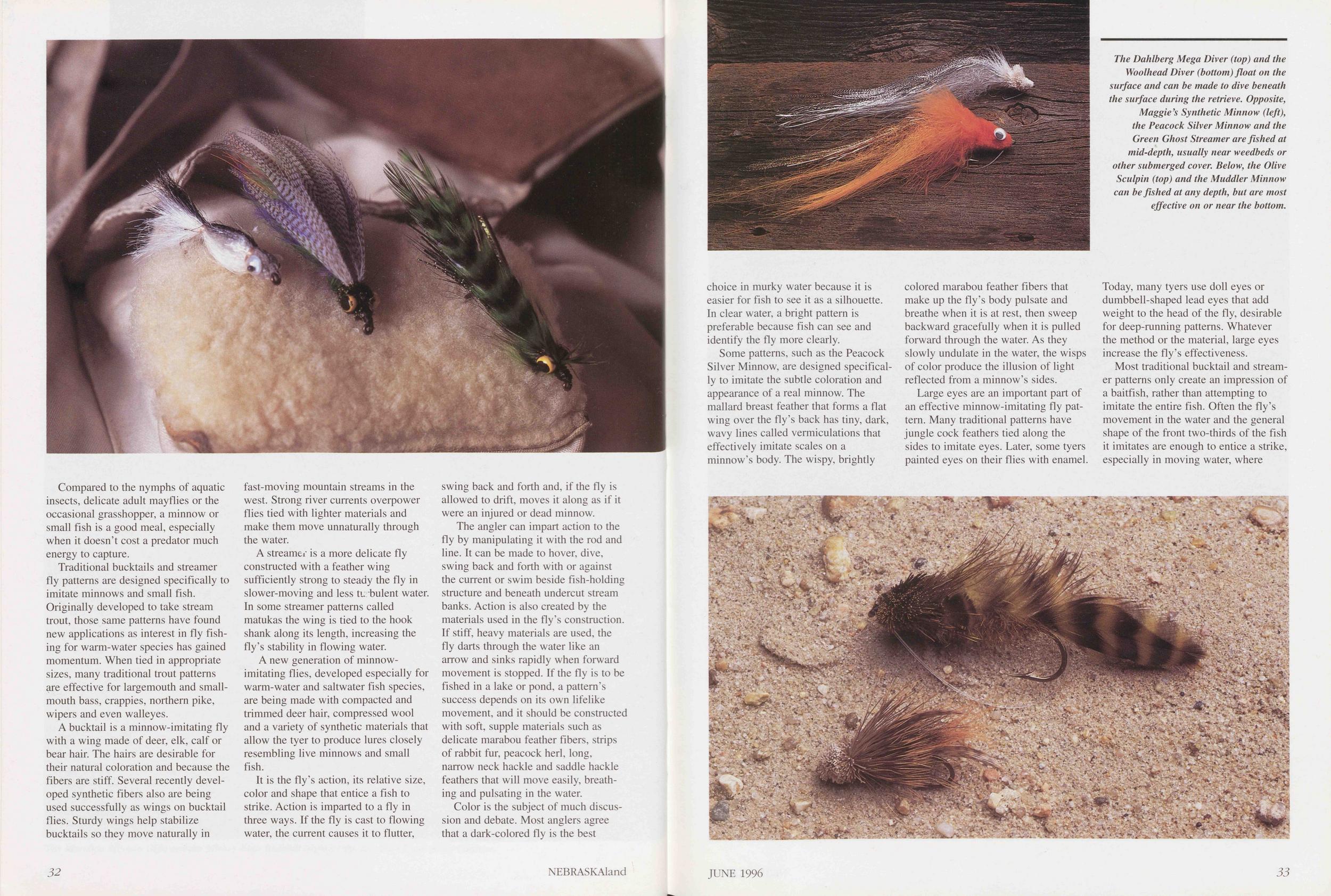
Compared to the nymphs of aquatic insects, delicate adult mayflies or the occasional grasshopper, a minnow or small fish is a good meal, especially when it doesn't cost a predator much energy to capture.
Traditional buck tails and streamer fly patterns are designed specifically to imitate minnows and small fish. Originally developed to take stream trout, those same patterns have found new applications as interest in fly fishing for warm-water species has gained momentum. When tied in appropriate sizes, many traditional trout patterns are effective for largemouth and smallmouth bass, crappies, northern pike, wipers and even walleyes.
A buck tail is a minnow-imitating fly with a wing made of deer, elk, calf or bear hair. The hairs are desirable for their natural coloration and because the fibers are stiff. Several recently developed synthetic fibers also are being used successfully as wings on buck tail flies. Sturdy wings help stabilize buck tails so they move naturally in fast-moving mountain streams in the west. Strong river currents overpower flies tied with lighter materials and make them move unnaturally through the water.
A streamer is a more delicate fly constructed with a feather wing sufficiently strong to steady the fly in slower-moving and less turbulent water. In some streamer patterns called matukas the wing is tied to the hook shank along its length, increasing the fly's stability in flowing water.
A new generation of minnow- imitating flies, developed especially for warm-water and saltwater fish species, are being made with compacted and trimmed deer hair, compressed wool and a variety of synthetic materials that allow the tyer to produce lures closely resembling live minnows and small fish.
It is the fly's action, its relative size, color and shape that entice a fish to strike. Action is imparted to a fly in three ways. If the fly is cast to flowing water, the current causes it to flutter, swing back and forth and, if the fly is allowed to drift, moves it along as if it were an injured or dead minnow.
The angler can impart action to the fly by manipulating it with the rod and line. It can be made to hover, dive, swing back and forth with or against the current or swim beside fish-holding structure and beneath undercut stream banks. Action is also created by the materials used in the fly's construction. If stiff, heavy materials are used, the fly darts through the water like an arrow and sinks rapidly when forward movement is stopped. If the fly is to be fished in a lake or pond, a pattern's success depends on its own lifelike movement, and it should be constructed with soft, supple materials such as delicate marabou feather fibers, strips of rabbit fur, peacock herl, long, narrow neck hackle and saddle hackle feathers that will move easily, breathing and pulsating in the water.
Color is the subject of much discussion and debate. Most anglers agree that a dark-colored fly is the best 32 NEBRASKAland
Some patterns, such as the Peacock Silver Minnow, are designed specifically to imitate the subtle coloration and appearance of a real minnow. The mallard breast feather that forms a flat wing over the fly's back has tiny, dark, wavy lines called vermiculations that effectively imitate scales on a minnow's body. The wispy, brightly colored marabou feather fibers that make up the fly's body pulsate and breathe when it is at rest, then sweep backward gracefully when it is pulled forward through the water. As they slowly undulate in the water, the wisps of color produce the illusion of light reflected from a minnow's sides.
Large eyes are an important part of an effective minnow-imitating fly pattern. Many traditional patterns have jungle cock feathers tied along the sides to imitate eyes. Later, some tyers painted eyes on their flies with enamel. Today, many tyers use doll eyes or dumbbell-shaped lead eyes that add weight to the head of the fly, desirable for deep-running patterns. Whatever the method or the material, large eyes increase the fly's effectiveness.
Most traditional buck tail and streamer patterns only create an impression of a baitfish, rather than attempting to imitate the entire fish. Often the fly's movement in the water and the general shape of the front two-thirds of the fish it imitates are enough to entice a strike, especially in moving water, where
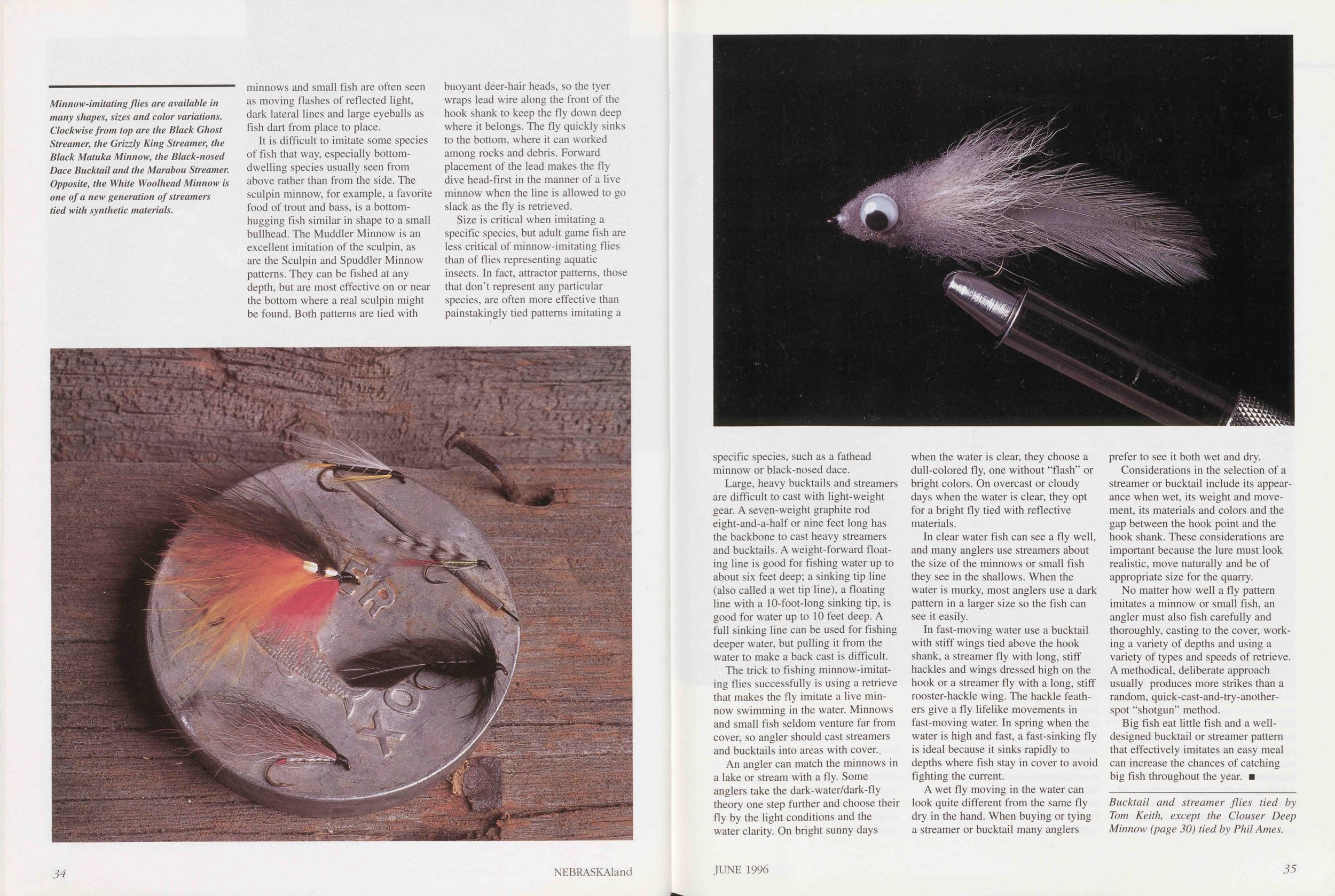
It is difficult to imitate some species of fish that way, especially bottom-dwelling species usually seen from above rather than from the side. The sculpin minnow, for example, a favorite food of trout and bass, is a bottom-hugging fish similar in shape to a small bullhead. The Muddler Minnow is an excellent imitation of the sculpin, as are the Sculpin and Spuddler Minnow patterns. They can be fished at any depth, but are most effective on or near the bottom where a real sculpin might be found. Both patterns are tied with buoyant deer-hair heads, so the tyer wraps lead wire along the front of the hook shank to keep the fly down deep where it belongs. The fly quickly sinks to the bottom, where it can worked among rocks and debris. Forward placement of the lead makes the fly dive head-first in the manner of a live minnow when the line is allowed to go slack as the fly is retrieved.
Size is critical when imitating a specific species, but adult game fish are less critical of minnow-imitating flies than of flies representing aquatic insects. In fact, attractor patterns, those that don't represent any particular species, are often more effective than painstakingly tied patterns imitating a 34 NEBRASKAland
Large, heavy bucktails and streamers are difficult to cast with light-weight gear. A seven-weight graphite rod eight-and-a-half or nine feet long has the backbone to cast heavy streamers and bucktails. A weight-forward float- ing line is good for fishing water up to about six feet deep; a sinking tip line (also called a wet tip line), a floating line with a 10-foot-long sinking tip, is good for water up to 10 feet deep. A full sinking line can be used for fishing deeper water, but pulling it from the water to make a back cast is difficult.
The trick to fishing minnow- imitating flies successfully is using a retrieve that makes the fly imitate a live minnow swimming in the water. Minnows and small fish seldom venture far from cover, so angler should cast streamers and bucktails into areas with cover..
An angler can match the minnows in a lake or stream with a fly. Some anglers take the dark-water/dark-fly theory one step further and choose their fly by the light conditions and the water clarity. On bright sunny days when the water is clear, they choose a dull-colored fly, one without "flash" or bright colors. On overcast or cloudy days when the water is clear, they opt for a bright fly tied with reflective materials.
In clear water fish can see a fly well, and many anglers use streamers about the size of the minnows or small fish they see in the shallows. When the water is murky, most anglers use a dark pattern in a larger size so the fish can see it easily.
In fast-moving water use a bucktail with stiff wings tied above the hook shank, a streamer fly with long, stiff hackles and wings dressed high on the hook or a streamer fly with a long, stiff rooster-hackle wing. The hackle feathers give a fly lifelike movements in fast-moving water. In spring when the water is high and fast, a fast-sinking fly is ideal because it sinks rapidly to depths where fish stay in cover to avoid fighting the current.
A wet fly moving in the water can look quite different from the same fly dry in the hand. When buying or tying a streamer or bucktail many anglers prefer to see it both wet and dry.
Considerations in the selection of a streamer or bucktail include its appearance when wet, its weight and movement, its materials and colors and the gap between the hook point and the hook shank. These considerations are important because the lure must look realistic, move naturally and be of appropriate size for the quarry.
No matter how well a fly pattern imitates a minnow or small fish, an angler must also fish carefully and thoroughly, casting to the cover, working a variety of depths and using a variety of types and speeds of retrieve. A methodical, deliberate approach usually produces more strikes than a random, quick-cast-and-try-another- spot "shotgun" method.
Big fish eat little fish and a well designed buck tail or streamer pattern that effectively imitates an easy meal can increase the chances of catching big fish throughout the year.
Bucktail and streamer flies tied by Tom Keith, except the Clouser Deep Minnow (page 30) tied by Phil Ames. JUNE 1996 35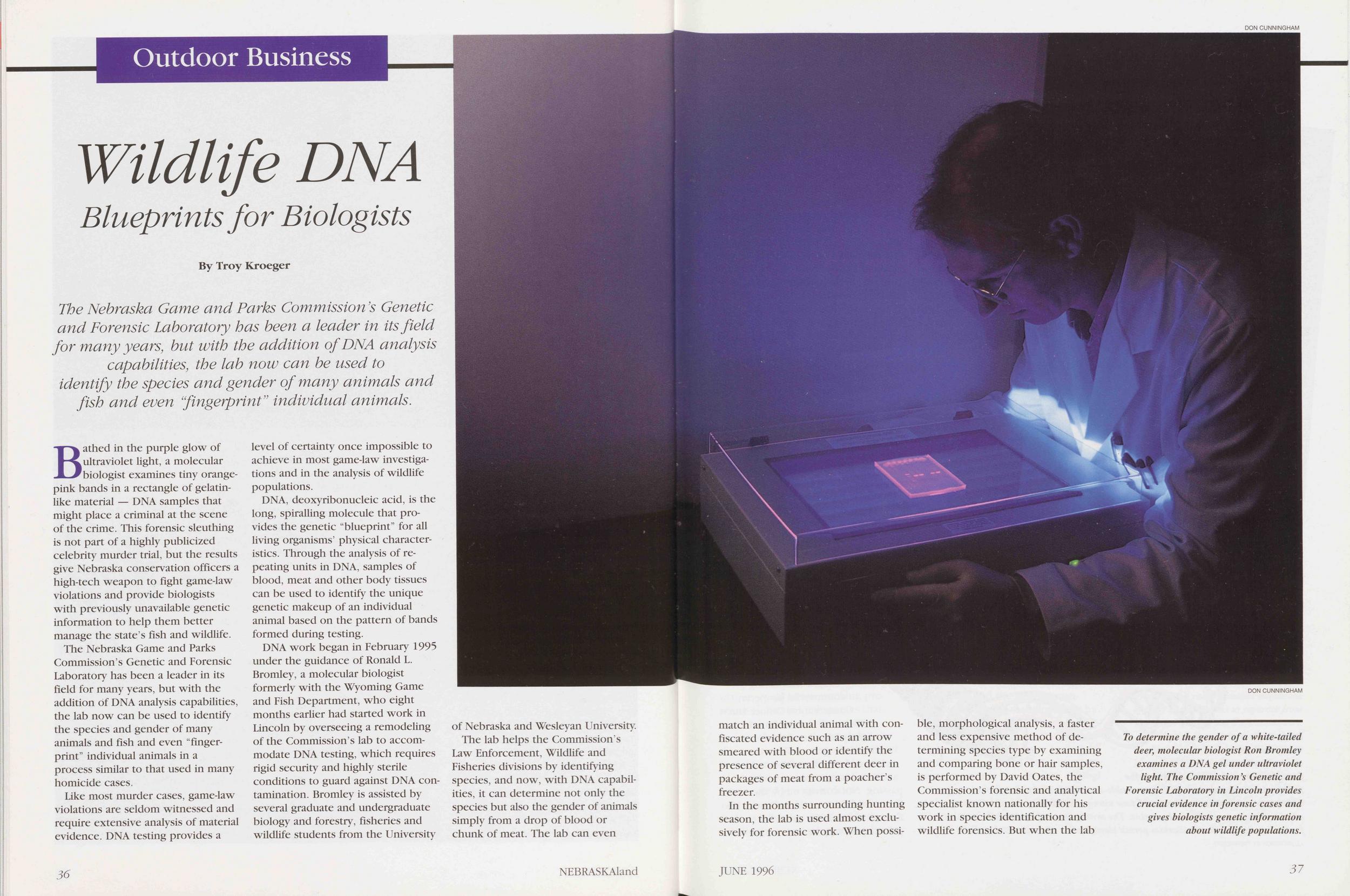
Wildlife DNA
Blueprints for Biologists The Nebraska Game and Parks Commission's Genetic and Forensic Laboratory has been a leader in its field for many years, but with the addition of DNA analysis capabilities, the lab now can be used to identify the species and gender of many animals and fish and even fingerprint" individual animals.Bathed in the purple glow of ultraviolet light, a molecular biologist examines tiny orange-pink bands in a rectangle of gelatinlike material — DNA samples that might place a criminal at the scene of the crime. This forensic sleuthing is not part of a highly publicized celebrity murder trial, but the results give Nebraska conservation officers a high-tech weapon to fight game-law violations and provide biologists with previously unavailable genetic information to help them better manage the state's fish and wildlife.
The Nebraska Game and Parks Commission's Genetic and Forensic Laboratory has been a leader in its field for many years, but with the addition of DNA analysis capabilities, the lab now can be used to identify the species and gender of many animals and fish and even "fingerprint" individual animals in a process similar to that used in many homicide cases.
Like most murder cases, game-law violations are seldom witnessed and require extensive analysis of material evidence. DNA testing provides a level of certainty once impossible to achieve in most game-law investigations and in the analysis of wildlife populations.
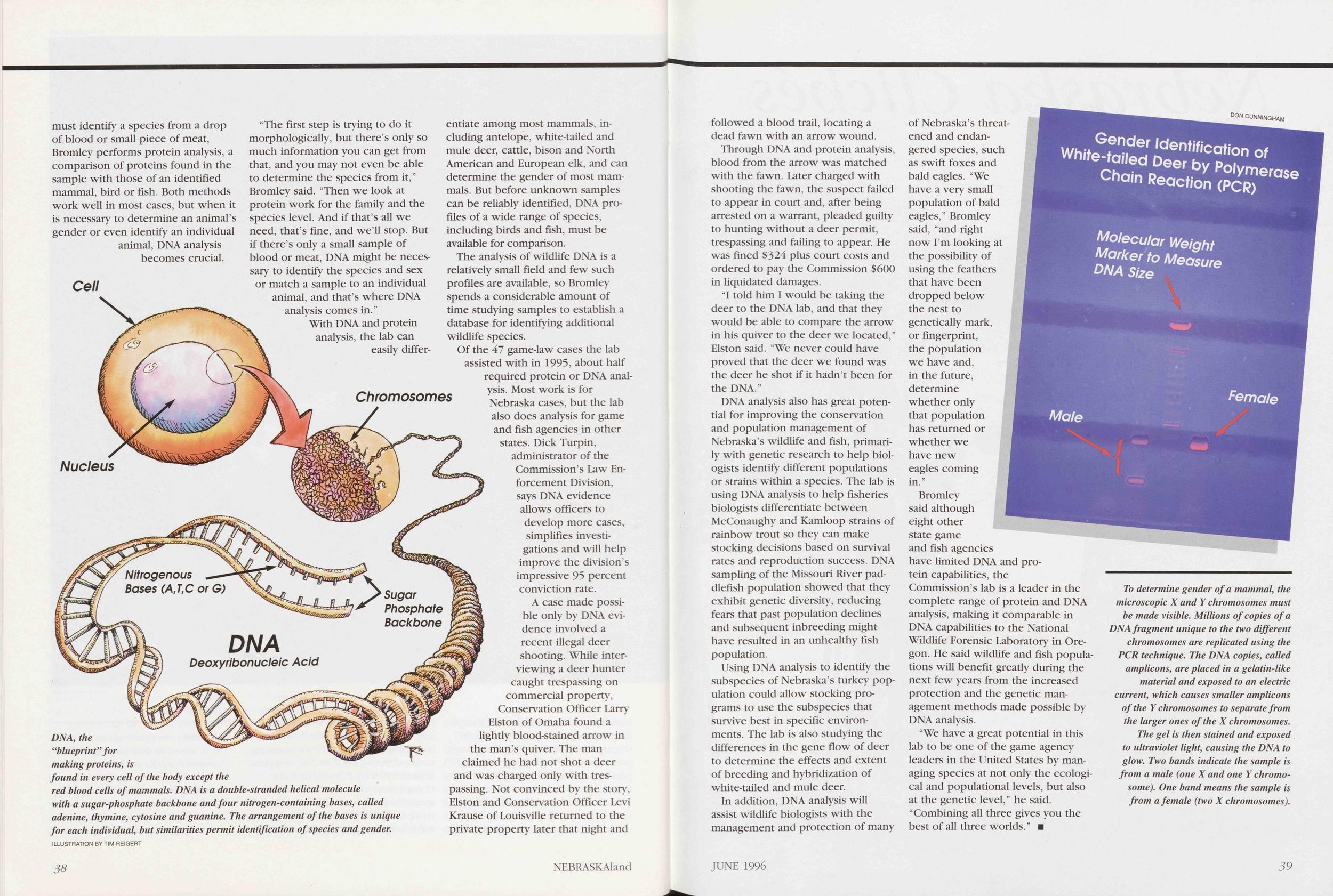
DNA, deoxyribonucleic acid, is the long, spiralling molecule that provides the genetic "blueprint" for all living organisms' physical characteristics. Through the analysis of repeating units in DNA, samples of blood, meat and other body tissues can be used to identify the unique genetic makeup of an individual animal based on the pattern of bands formed during testing.
DNA work began in February 1995 under the guidance of Ronald L. Bromley, a molecular biologist formerly with the Wyoming Game and Fish Department, who eight months earlier had started work in Lincoln by overseeing a remodeling of the Commission's lab to accommodate DNA testing, which requires rigid security and highly sterile conditions to guard against DNA contamination. Bromley is assisted by several graduate and undergraduate biology and forestry, fisheries and wildlife students from the University of Nebraska and Wesleyan University.
The lab helps the Commission's Law Enforcement, Wildlife and Fisheries divisions by identifying species, and now, with DNA capabilities, it can determine not only the species but also the gender of animals simply from a drop of blood or chunk of meat. The lab can even 36 NEBRASKAland match an individual animal with confiscated evidence such as an arrow smeared with blood or identify the presence of several different deer in packages of meat from a poacher's freezer.
In the months surrounding hunting season, the lab is used almost exclusively for forensic work. When possible, morphological analysis, a faster and less expensive method of determining species type by examining and comparing bone or hair samples, is performed by David Oates, the Commission's forensic and analytical specialist known nationally for his work in species identification and wildlife forensics. But when the lab
 must identify a species from a drop
of blood or small piece of meat,
Bromley performs protein analysis, a
comparison of proteins found in the
sample with those of an identified
mammal, bird or fish. Both methods
work well in most cases, but when it
is necessary to determine an animal's
gender or even identify an individual
animal, DNA analysis
becomes crucial.
must identify a species from a drop
of blood or small piece of meat,
Bromley performs protein analysis, a
comparison of proteins found in the
sample with those of an identified
mammal, bird or fish. Both methods
work well in most cases, but when it
is necessary to determine an animal's
gender or even identify an individual
animal, DNA analysis
becomes crucial.
"The first step is trying to do it morphologically, but there's only so much information you can get from that, and you may not even be able to determine the species from it," Bromley said. "Then we look at protein work for the family and the species level. And if that's all we need, that's fine, and we'll stop. But if there's only a small sample of blood or meat, DNA might be necessary to identify the species and sex or match a sample to an individual animal, and that's where DNA analysis comes in. With DNA and protein analysis, the lab can easily differentiate
The analysis of wildlife DNA is a relatively small field and few such profiles are available, so Bromley spends a considerable amount of time studying samples to establish a database for identifying additional wildlife species.
Of the 47 game-law cases the lab assisted with in 1995, about half required protein or DNA analysis. Most work is for Nebraska cases, but the lab also does analysis for game and fish agencies in other states. Dick Turpin, administrator of the Commission's Law Enforcement Division, says DNA evidence allows officers to develop more cases, simplifies investigations and will help improve the division's impressive 95 percent conviction rate.
A case made possible only by DNA evidence involved a recent illegal deer shooting. While interviewing a deer hunter caught trespassing on commercial property, Conservation Officer Larry Elston of Omaha found a lightly blood-stained arrow in the man's quiver. The man claimed he had not shot a deer and was charged only with trespassing. Not convinced by the story, Elston and Conservation Officer Levi Krause of Louisville returned to the private property later that night and 38 NEBRASKAland followed a blood trail, locating a dead fawn with an arrow wound.
Through DNA and protein analysis, blood from the arrow was matched with the fawn. Later charged with shooting the fawn, the suspect failed to appear in court and, after being arrested on a warrant, pleaded guilty to hunting without a deer permit, trespassing and failing to appear. He was fined $324 plus court costs and ordered to pay the Commission $600 in liquidated damages.
"I told him I would be taking the deer to the DNA lab, and that they would be able to compare the arrow in his quiver to the deer we located," Elston said. "We never could have proved that the deer we found was the deer he shot if it hadn't been for the DNA."
DNA analysis also has great potential for improving the conservation and population management of Nebraska's wildlife and fish, primarily with genetic research to help biologists identify different populations or strains within a species. The lab is using DNA analysis to help fisheries biologists differentiate between McConaughy and Kamloop strains of rainbow trout so they can make stocking decisions based on survival rates and reproduction success. DNA sampling of the Missouri River paddlefish population showed that they exhibit genetic diversity, reducing fears that past population declines and subsequent inbreeding might have resulted in an unhealthy fish population.
Using DNA analysis to identify the subspecies of Nebraska's turkey population could allow stocking programs to use the subspecies that survive best in specific environments. The lab is also studying the differences in the gene flow of deer to determine the effects and extent of breeding and hybridization of white-tailed and mule deer.
In addition, DNA analysis will assist wildlife biologists with the management and protection of many of Nebraska's threat ened and endangered species, such as swift foxes and bald eagles. "We have a very small population of bald eagles," Bromley said, "and right now I'm looking at the possibility of using the feathers that have been dropped below the nest to genetically mark, or fingerprint, the population we have and, in the future, determine whether only that population has returned or whether we have new eagles coming in."
Bromley said although eight other state game and fish agencies have limited DNA and protein capabilities, the Commission's lab is a leader in the complete range of protein and DNA analysis, making it comparable in DNA capabilities to the National Wildlife Forensic Laboratory in Oregon. He said wildlife and fish populations will benefit greatly during the next few years from the increased protection and the genetic management methods made possible by DNA analysis.
"We have a great potential in this lab to be one of the game agency leaders in the United States by managing species at not only the ecological and population levels, but also at the genetic level," he said. "Combining all three gives you the best of all three worlds."
Nebraska Cliches
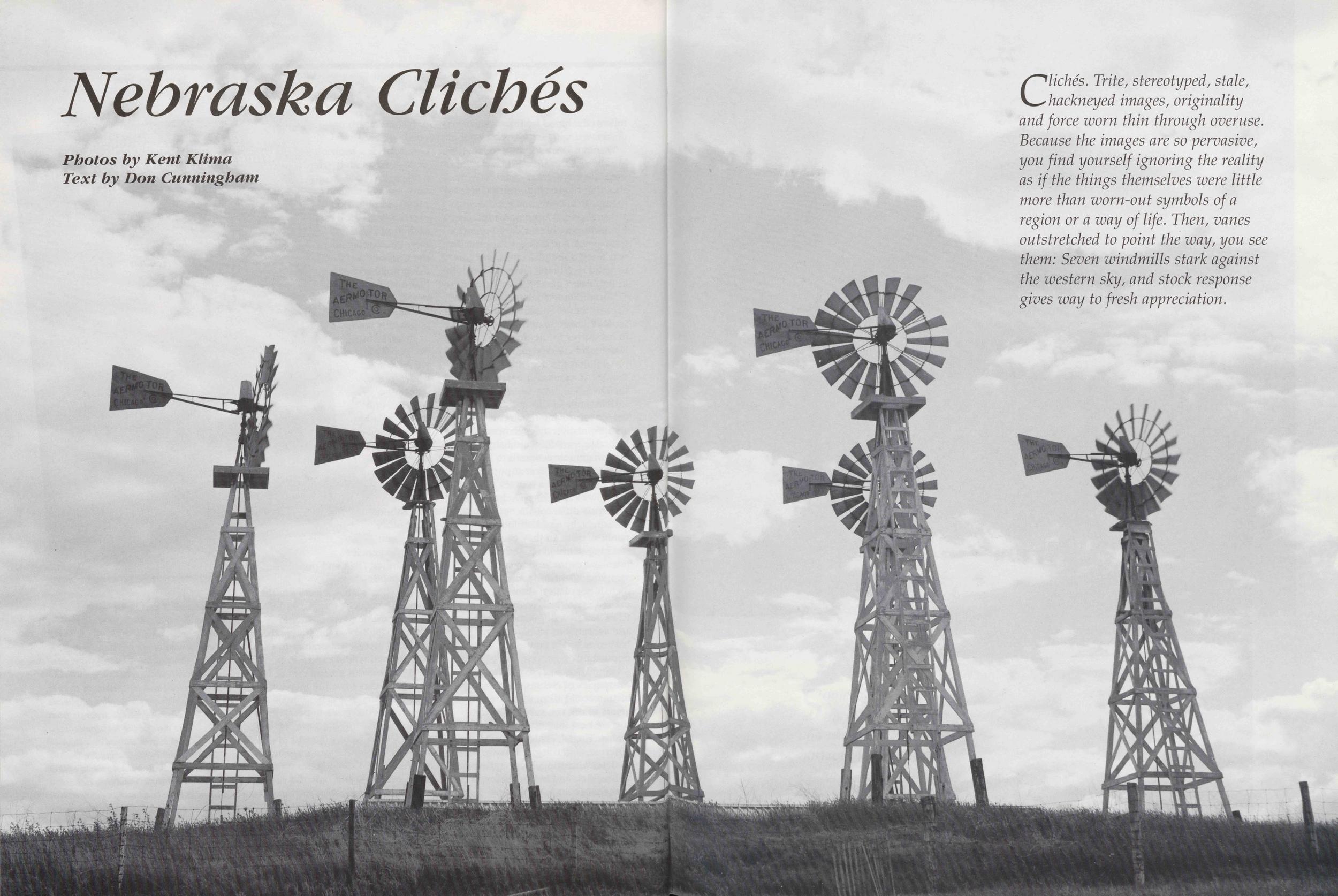
Photos by Kent Klima Text by Don CunninghamCliches. Trite, stereotyped, stale, hackneyed images, originality and force worn thin through overuse. Because the images are so pervasive, you find yourself ignoring the reality as if the things themselves were little more than worn-out symbols of a region or a way of life. Then, vanes outstretched to point the way, you see them: Seven windmills stark against the western sky, and stock response gives way to fresh appreciation.
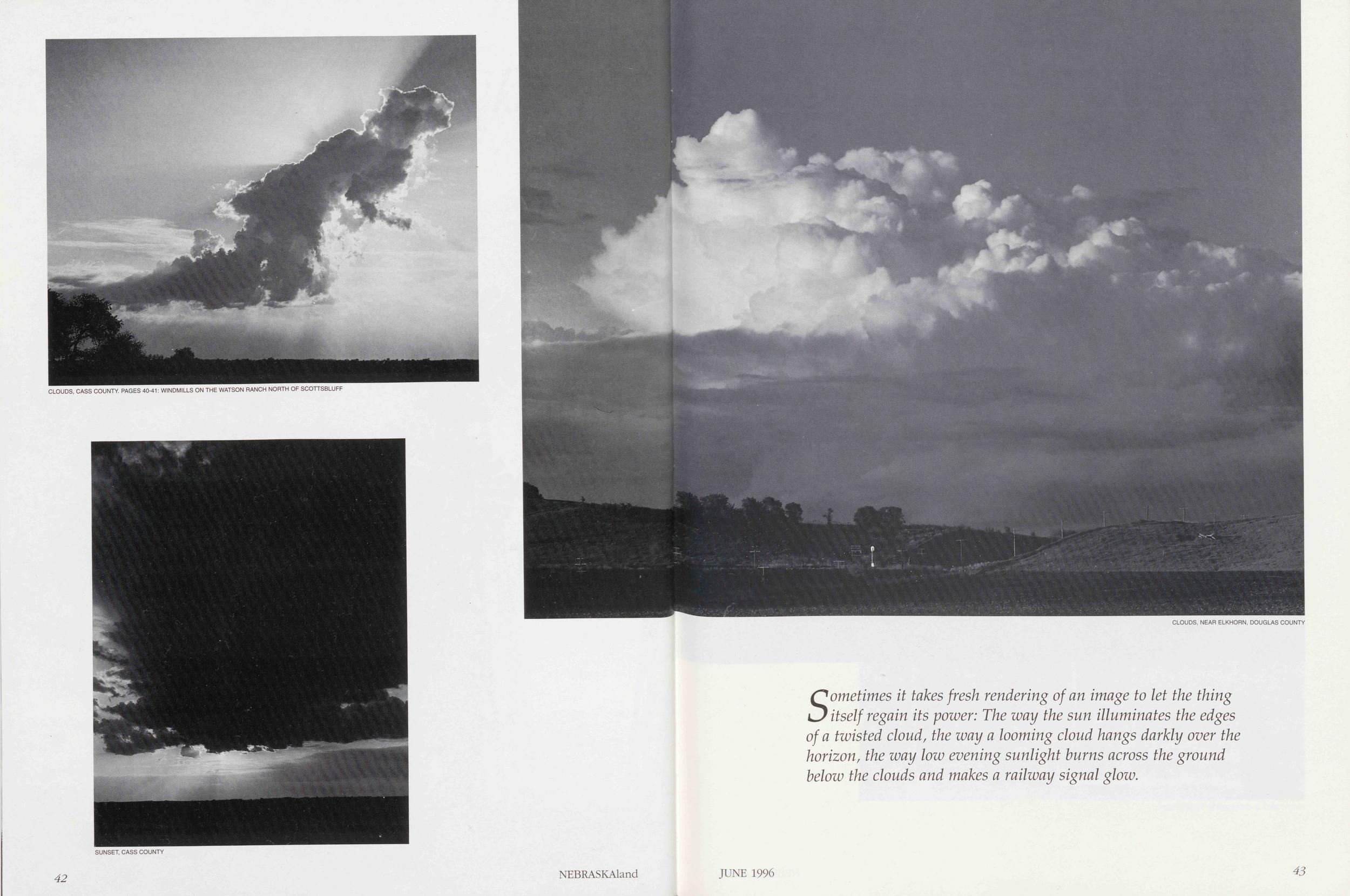
Sometimes it takes fresh rendering of an image to let the thing itself regain its power: The way the sun illuminates the edges of a twisted cloud, the way a looming cloud hangs darkly over the horizon, the way low evening sunlight burns across the ground below the clouds and makes a railway signal glow.
JUNE 1996 43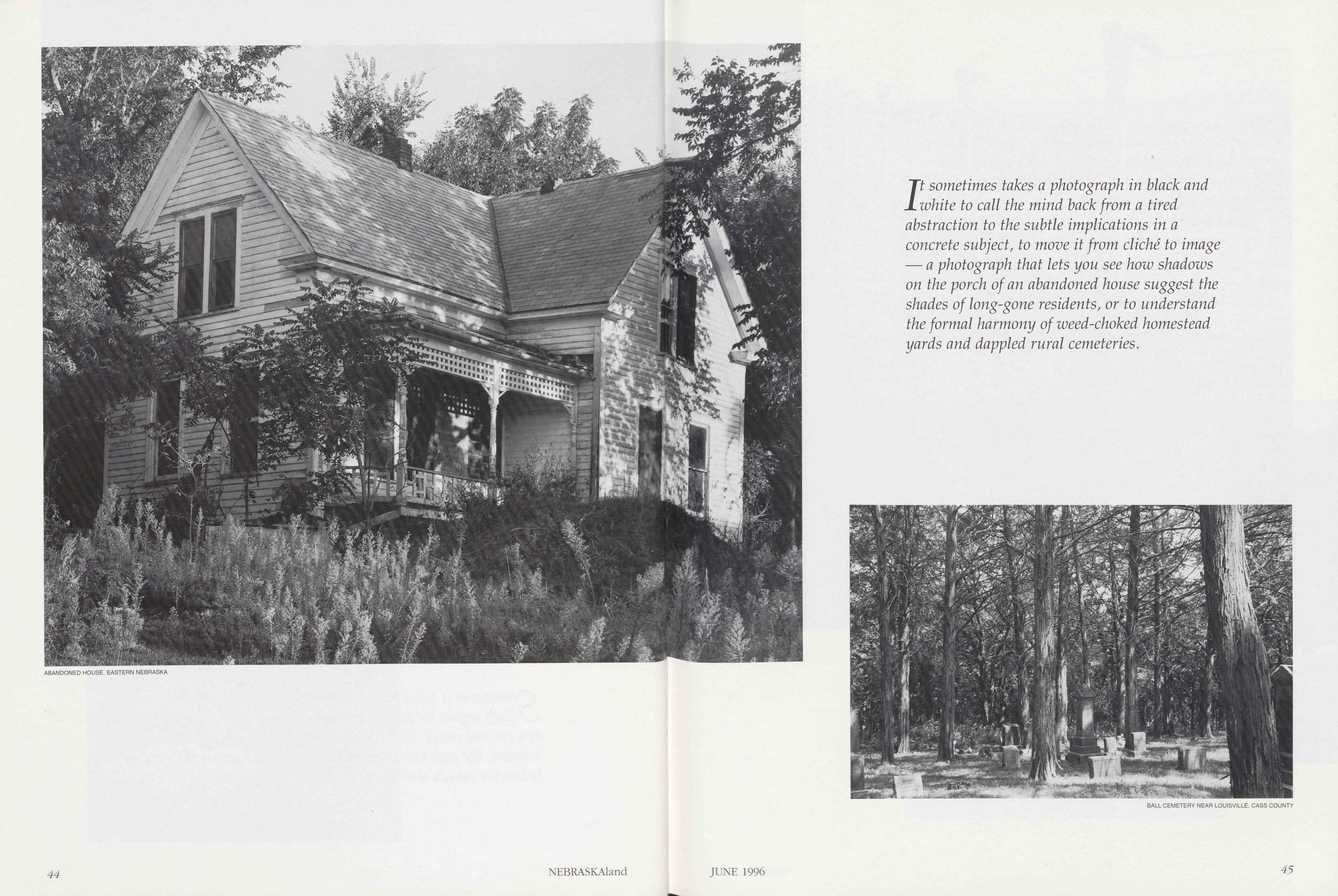
J't sometimes takes a photograph in black and white to call the mind back from a tired abstraction to the subtle implications in a concrete subject, to move it from cliche to image — a photograph that lets you see how shadows on the porch of an abandoned house suggest the shades of long-gone residents, or to understand the formal harmony of weed-choked homestead yards and dappled rural cemeteries.
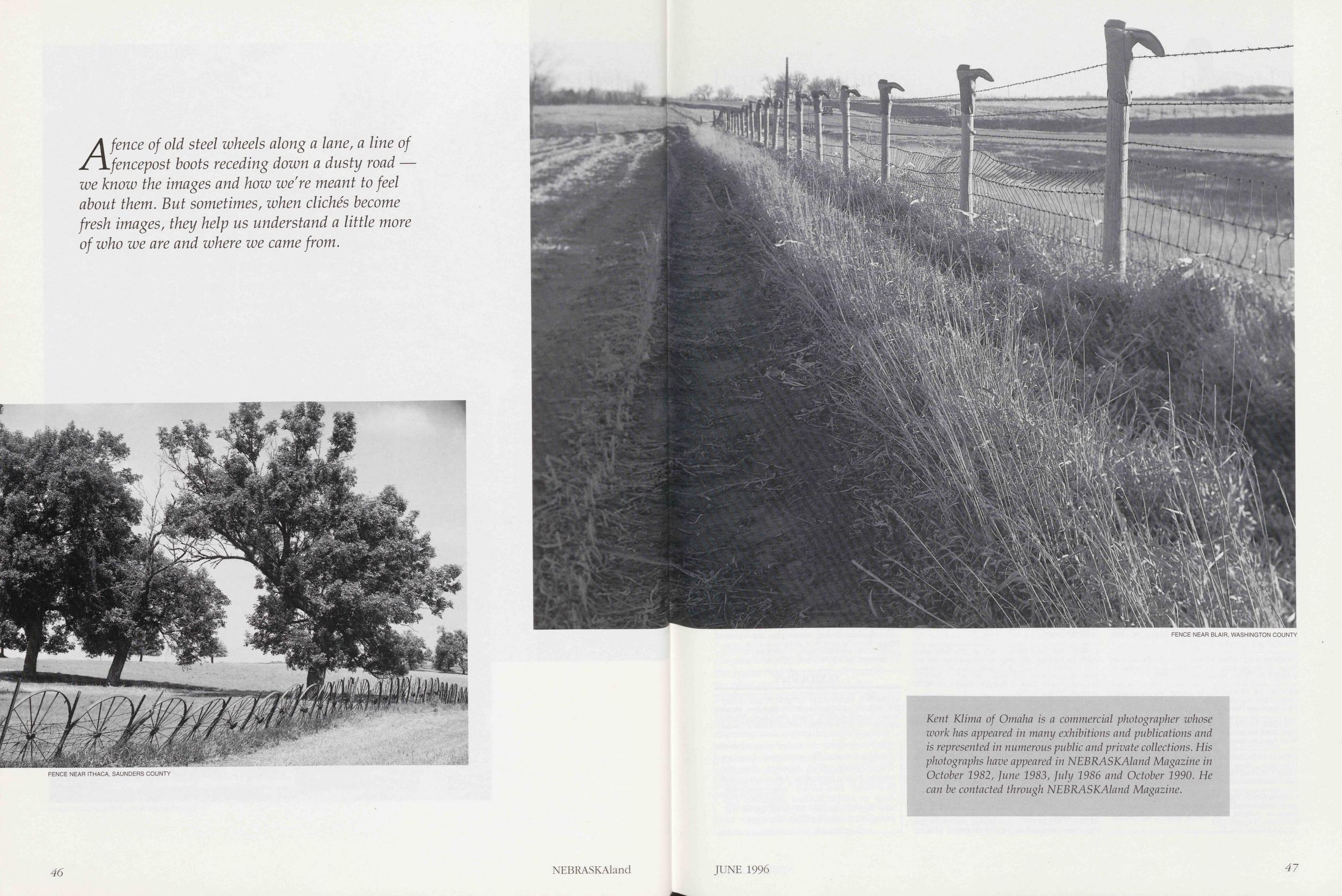
A fence of old steel wheels along a lane, a line of fencepost boots receding down a dusty road — we know the images and how were meant to feel about them. But sometimes, when cliches become fresh images, they help us understand a little more of who we are and where we came from.
Classified
ATTRACTIONS/EVENTSAIR SHOW: Fairmont Army Air Base 50th reunion - open to the public. June 15 & 16. Events include sky divers, hot air balloonists, aircraft displays, air shows. Special Smithsonian WWII Poster Display - first showing in the Midwest. Call 1-800-388-1183 for free information.
BOOKS/PRINTINGFREE BOOK CATALOG. Novels, westerns, romances, children's; old out of print, found barns, attic. Authors: Grey, Bower, Condor. Fox, Curwood, Raine, Wright, Aldrige, Pollyanna, Freckles, many others. Postage appreciated. Pierce, 4400 N. Pine Cluster, Oroville, CA 95965.
HOW TO FIND MORE outdoor opportunities! The Nebraska Sportsman's Atlas. Locations of all public lands and waters on county transportation maps. These maps show ALL the roads in Nebraska. Listings include federal, Nebraska Game & Parks, NRD holdings, hotels and motels and Nebraska's endless attractions. At only $18.75/copy a true time and frustration saver. To order write: Sportsman's Atlas Co., PO Box 132, Lytton, IA 50561 or call 1-800-568-8334.
ARTS/CRAFTS/CLOTHINGPEOPLE LIKE TO wear printed T-shirts. Why not your logo? Jackets, caps and design. Battle Creek Shirt Co. (402) 675-9795.
ATTENTION HUNTERS: We can transform your fur pelts or deer skins into custom-made garments. Over 50 years experience. Write for information or call (308) 928-2515. Hacker Furriers, PO Box 230, 615 W. Main St., Alma, NE 68920.
COLLECTIBLESWANTED: PRE-1930 Nebraska hunting and trapping licenses. Especially need prior to 1915. Paying $20- $200 each. Send licenses or photocopies to: David Torre, P.O. Box 4298, Santa Rosa, CA 95402. Phone (707) 525-8785.
UP TO $100 for Nebraska hunting licenses 1901 through 1920. Up to $25 for any Nebraska trapping licenses. (402) 785-7500. Phil.
DOGSENGLISH SETTER, German shorthairs, English pointers, Brittany spaniels - stud service, puppies and started dogs. Training for all pointing breeds. Plum Creek Kennel, (712) 529-4238 or (402) 298-8153.
YELLOW-CHOCOLATE-BLACK LAB pups. Breeders hips O.F.A. and eyes c.e.r.f./ed. Excellent bloodlines and hunting potential. Call Mr. Bendler, Lexington, NE (308) 324-4247 or Lincoln (402) 477-1305.
TRAINING ALL BREEDS bird dogs - Vizslas for sale. Home of Rebel Rousers. Rozanek Kennels, RR 2, Schuyler, NE 68661. Phone (402) 352-8769.
RETRIEVER TRAINING. Area's top "retrievers only" trainer. Field trial and hunting dogs. Non-slip duck dogs! TKO Retriever Training Kennel (402) 623-4311.
ENGLISH SETTER and Labradors from outstanding lines. Bred for hunters who appreciate fine bird dogs! Wind Fall Gun Dogs, (402) 421-4693.
ENGLISH COCKER PUPS, imported stock, British FTC bloodlines. Many colors available. Featured in NEBRASKAland November 1991. Sawtooth Oaks, Box 443, Orleans, NE 68966. Phone (308) 473-5265.
CHESAPEAKE BAY, Labrador and golden retriever pups, started dogs and stud service. 16-time national champion pedigree. Visa & MasterCard. Platte Valley Retrievers (308) 995-2318.
ENGLISH COCKER puppies born in April. Ready to go. Great hunters and companion doss. Dennis Gebers (308) 384-0409.
WILDERNESS KENNELS. Gun dog training - over 60 years combined experience. Training all sporting breeds - retrievers, flushing and pointing dogs. All dogs worked on pen raised birds and wild game. Training program includes obedience training - heel, sit, stay, down and come when called. Pups, started dogs and fully trained dogs for sale. Hunting dogs trained by hunters. Henry Sader, Wilderness Kennels, Roca, NE (402) 423-4212. Since 1968.
FISH/FISHINGFISH FOR SALE. Catfish, largemouth bass, smallmouth bass, perch, crappie, bluegill, walleye, northern pike, rainbow trout, Donaldson rainbow trout, grass carp, minnows, bullheads. Consulting available. Pleasant Valley Fish Farm, RR 1, Box 147, McCook, NE 69001. Phone (308) 345-6599.
WILLOW LAKE FISH HATCHERY. Channel cat, bluegill, hybrid bluegill, largemouth bass, crappie, triploid grass carp, walleye, perch, minnows. Gaylord Crawford, 7580 N. Highland Rd., Hastings, NE 68901 or phone (402) 463-8022 day or night. Also pond consultant. We deliver, grower price.
FOODNEBRASKA BASKETS: The original Nebraska company specializing in fine foods from Nebraska since 1984. A beautiful array of baskets filled with ethnic, healthful and long-time favorite foods. Call or write for our brochure: P.O. Box 22985, Lincoln, NE 68542. Phone 1-800-345-7725 or (402) 438-3111.
FROM NEBRASKA GIFT SHOP...the world's largest selection of Nebraska-made food products and gifts. Historic Haymarket, 140 N. 8th St., Lincoln, NE 68508; Old Market, 1030 Howard St., Omaha, NE. Call for free catalog 1-800-399-5693.
HOMEBREWING/BEER & WINEMAKING supplies. Fermenter's Supply, 8410 K Plz. #10, Omaha, NE68127. (402) 593-9171. Open everyday, mail orders welcome, low shipping.
GUIDES/OUTFITTERSMAD RIVER CANOES offers the finest quality and performance. For the finest canoes and accessories look to Great Plains Canoe Co., 205 Main, Springfield, NE 68059. Phone (402) 253-2001.
EXCELLENT PHEASANT HUNTING: New area and affordable on 5,000 plus acres with only wild pheasants. For booking hunts contact Dakota Ringneck Ranch, Roy Grismer, 12525 328th Ave., Bowdle, SD 57428. Phone (504) 283-2680.
CANOE THE NIOBRARA...with an affordable canoe trip by Dry land Aquatics. One and two-day trips...full service, or just canoes and tubes. Transportation furnished. Your Niobrara River specialists... We do it your way! Dry land Aquatics, Dept. N. Box 33C, Sparks, NE 69220 or phone 1-800-337-3119.
BICYCLE TOURS of the scenic Oregon Trail and the unique Nebraska Sandhills. Affordable and fully supported. Also, one-day large group tours of Nebraska. Historical Trails Network call (402) 477-9968.
GRAHAM CANOE OUTFITTERS: Top quality full- service camping and canoe trips on the Niobrara River. Daily canoe rentals and car shuttle-service available. Contact Dous & Twyla Graham, HC 13 Box 16, Valentine, NE 69201 or phone (402) 376-3708.
HABITAT/PLANTSATTRACT WILDLIFE to your acreage, preserve or club. Consulting, management plan development, planting/ seeding, and supplies for the conservationist or the hunter. David M. Nelson, Wildlife Habitat Consulting, 811 Matthies Dr., Papillion, NE 68046. Phone (402) 592-5652.
OUTDOOR EQUIPMENTGUNS - Browning, Winchester, Remington, others. Hi-powers, shotguns, new, used, antiques. Want Pre-*64 Winchesters. Buy-Sell-Trade. (402) 729-6112. BedlaiTs Sporting Goods, Fairbury, NE 68352.
REAL ESTATETHREE BEDROOM TOWNHOUSE in Vale Valley, CO, on Single Tree Golf Course. Ski, golf, fish, hike, etc. Will trade time for access to quality pheasant hunting. Call Reggie Giffin (816) 691-2715.
RESORTS/VACATIONFOR FISHING and hunting accommodations. Jefco Inn, Gordon, NE 69343. South Cornell, (308) 282-2935.
BED & BREAKFAST. Historic 1890s hotel. Located in the beautiful Pine Ridge area of Northwest Nebraska. Short drive to Chadron State Park, Fort Robinson and the Black Hills. Beautiful dining room with fireplace and fountain. Room service available. The Olde Main Street Inn, 115 Main St., Chadron, NE 69337. (308) 432-3380.
NE NEBRASKA TROUT FISHING. Mon-Thurs or Fri-Sun. 3 modem cottages, 5 spring-fed lakes. Trout, bass and bluegill. Diamond E Trout Resort, Box B. Orchard, NE 1-800-658-3244.
YORK, NEBRASKA - "Crossroads of the Midwest." Located at the junction of 1-80 and U.S. 81. From fast food to world class fine dining. 500+ rooms in a wide range of styles and prices. Call 1-800-388-1138 for your free visitors packet.
STAY AT THE Twisted Pine Ranch Bed & Breakfast overlooking the scenic Niobrara River. We have a modern bunkhouse and a rustic log cabin. Great view, great food. Contact: Ken and Sharon Moreland, Twisted Pine Ranch, PO Box 84, Merriman, NE 69218.(308) 684-3482.
VISIT DREAM WEAVERS CABIN nestled into the Sandhills near Burwell, NE. The log cabin offers an herb and gift shop. See the looms at work and the handwovens created there. Jo Barrett (308) 346-4383.
PRIVATE JACUZZI SUITES. Free Continental breakfast. New pool, sundeck. Extra large, deluxe rooms. Short drive to Fort Robinson, Chadron State Park, Hudson- Meng paleontological site. Restaurant/lounge. Golf, horseback riding, archery, fishing close by. Best Western West Hills Inn, Chadron, NE 69337. (308) 432-3305 or (800)528-1234.
SANDHILLS GUEST RANCH Bed & Breakfast, private cabin. Excellent hunting, upland game and waterfowl, fishing. Beautiful river view. Bring your horse, acres of prairie to ride. Sandhills Country Cabin B&B. HC 63 Box 13, Brewster, NE 68821. Phone (308) 547-2460.
TAXIDERMYALLISON'S TAXIDERMY STUDIO & Gift Gallery - DU., SCI., Pheasants Forever & NTA Members. Mounted 36 state record fish. 421 N. Dewey. North Platte, NE 69101 call (308) 534-2324 or (308) 534-4267. Custom Designs.
Classified rates: 75$ per word, minimum $15. Closing: First business day two months before issue date. Ads are accepted first-come, first-served, space-available. Send to: NEBRASKAland Magazine, RO. Box 30370, Lincoln, NE 68503-0370. Tel. (402) 471-5478. Fax (402) 471-5528. 48 NEBRASKAlandPage forty-nine
The Magic of Bamboo"May I help you?" asked the impeccably dressed clerk. He could have been the model for the type: Tweedy but not professorial, casual but not careless, reserved but not remote, deferential but not unctuous.
"Well, really I'm just...." I was about to say "browsing," but I didn't know for sure if that would be de classe, or if it would imply I actually knew something about what I was looking at, so I just gestured weakly at the long rack of whip-like fly rods receding into the spicy, cigar-scented shadows at the back of the store. As a matter of fact, I secretly liked the idea of masquerading as one of the elect, of conveying the impression that I might be an eccentrically dressed stock- broker, that the Range Rover at the curb might be mine, that I might be about to hand over my Titanium Visa card, tuck one of those seven-foot-long, three-and-a quarter-ounce, nut-brown wisps of Tonkin cane under my arm and jauntily stride off to the Battenkill.
"Yes," said the clerk, "Quite."
But I wasn't browsing, I was gawking, and I never can remember exactly where the Battenkill is. I've read The River Runs Through It, but that wouldn't carry me far in a conversation larded with phrases like "single-haul power roll cast" and "density-compensated, sinking frontloop tippet," and I didn't want to shatter the illusion of competence I was hoping to create.
"I'll let you know," I said.
"Very good."
I sauntered on down the aisle, practicing the leisurely, enlightened saunter favored by eccentrically dressed stock brokers who regularly fish the Madison.
It's the gear, I was thinking. And the gadgets. The gear and the gadgets and the jargon. And the clothes, of course. No other sport — at least none that makes so many claims of purity and simplicity — uses so much arcane terminology to describe such a complex activity requiring such expensive, highly polished, delicately balanced, seven-foot-long tools and so many intricately wrought gadgets to clip onto and stick into the pockets of such a wide range of sartorial embellishments.
Flanking the long rack of rods in the nave were shelves filled with amalgams and emoluments (line dressing, line cleaner, desiccant, floatant, sink putty, strike putty, amadou tree fungus fly dryer), accouterments (reels, creels, nets, forceps, hook sharpeners, stream thermometers, leader straighteners, knot tiers, knot nippers, fly threaders, leader wallets, tippet dispensers, loop connecters) and ancillary appliances (micrometers, scales, waterproof lights, clip-on lights, flexible-neck lights, wading staffs, bug-catching mitts and — everyone's favorite — the trout stomach pump allowing a dedicated angler to go a step beyond matching the hatch).
In the transept were the vestments and accessories: waders, wader shoes, wader shoe orthotics, wader shoe chains, mitts, mittens, gloves, sunglasses, caps, hats, vests, shirts, shorts, pants, belts, jackets, windproof lighters, pewter flasks and, of course, glassware etched with sporting scenes. Naturally, fly tiers have a side chapel of their own filled with exotic pelts, feathers, vises, bobbins and scissors, and, of special interest to commuters, a sturdy plastic fly-tying shelf that clamps securely onto the steering wheel of the car.
But the rods themselves were the altarpiece: Fiberglass, graphite and resin. Top-secret materials developed for atomic submarines. The bamboo rods, Tonkin cane imported from Southeast Asia, $1,600 each, weren't in the rack, but in glass cases. Perhaps the possibility of some jaunty stockbroker impersonator bending one over his head to test its flex, or using it to flick the little flat Ivy League cap off a paying customer in the next aisle was too great a risk. For the economically disadvantaged there were rods with minor cosmetic imperfections (in no way affecting the action) at $950. "A practical and economical way" read the tastefully lettered sign, "to enjoy the unique magic of bamboo."
The unique magic of bamboo. I first experienced it one warm spring afternoon in 1951 or '52. My father came home early, grinning. "Come on outside," he said, and tied to the top of our 13-year-old Ford were three long, slender bamboo poles. An inch thick at the base, they stretched out, joint after joint, for 15 feet. The tip was just a twig.
I knew exactly what they were. So did my brother. "Fishing poles!" we said. We're going fishing!"
My father cut each pole off at the point where the tip would be stout enough but still springy, and he wrapped black friction tape around the butt to make a handle. He brought out a spool of black, braided line and tied it to a pole tip. He held the spool, and my brother and I took turns twirling the poles, one at a time, until there was enough line wound around each tip. "That's enough," my father said. He tied a leader and a hook to each line, and showed us how to stick the hook point into the friction tape for safety.
We tied the poles to the car again and drove out to Nine-mile Creek. We walked along the bank until we found good riffles with a deep pool just below them. My father showed us how to put a little worm on the tiny gold hook, and two split shots a few feet up the line. He showed us how to make the line swing out like a pendulum and drop into the riffles. He showed us how to swing the pole to let the split shot rattle down the gravel streambed into the deeper pool, then he showed us how to pull it back upstream into the riffles again.
We tried several places, walking up and down the bank and wondering where the fish might be. My father said that we should find good spots for ourselves. I found a place where the water hit a washed-out willow tree and shot across a gravel bank toward deeper water on the other side. I swung my worm out just below the willow and let it wash across the gravel toward the quiet water.
Then the long bamboo pole came alive. It twitched in my hands, the tip bent down, and the black, braided line went taut. I swung the pole back upstream and up from the water came a fish, my first fish, a little rainbow trout. My father said it was a little small to keep. We kept it anyway. It was a good fighter, I thought, and it was big enough for the whole family to have a bite. It tasted wonderful.
That's the unique magic of bamboo, and I wonder if that's what fly fishing is really all about. Maybe it's the club you join as an adult that lets you have the things you had (or didn't have, but wanted) as a kid: initiation into special rituals, a secret language, special clothes and tools, and, if you attain the highest levels, the chance to have all that and still fish with a cane pole.
Don Cunningham JUNE 1996 49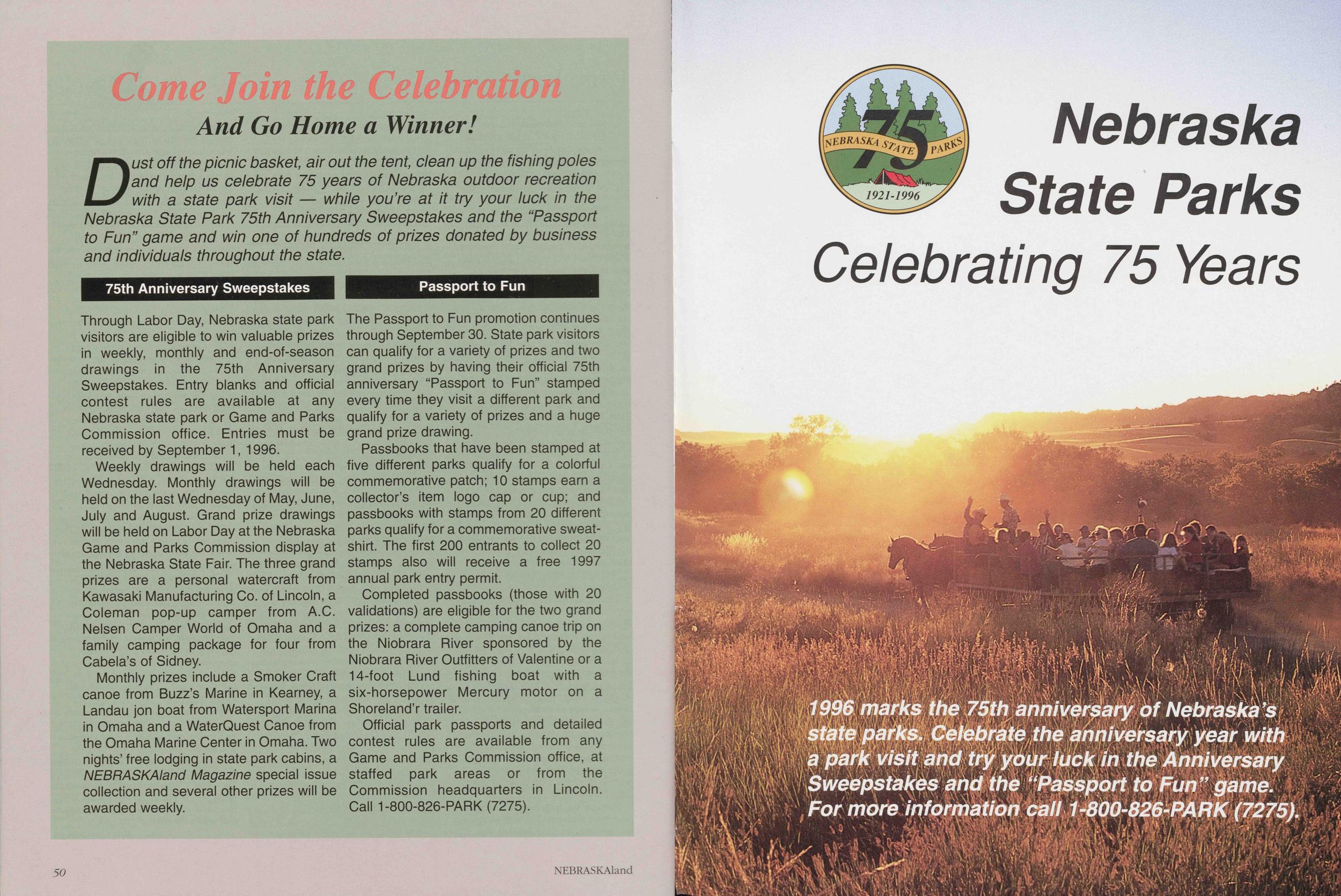
Position: 820 (12 views)