Volume 74, Issue 4, 1996
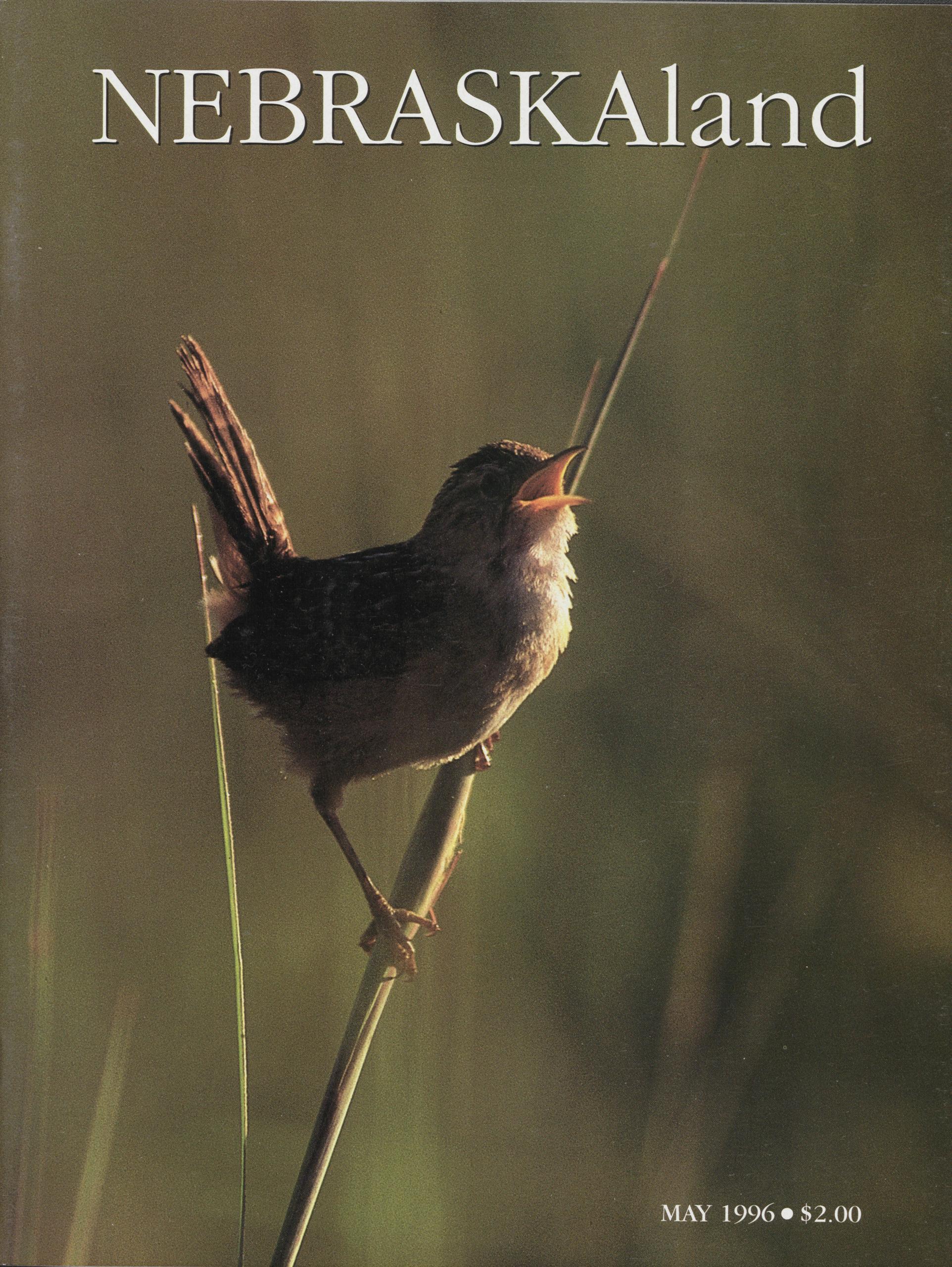
NEBRASKAland
MAY 1996 • $2.00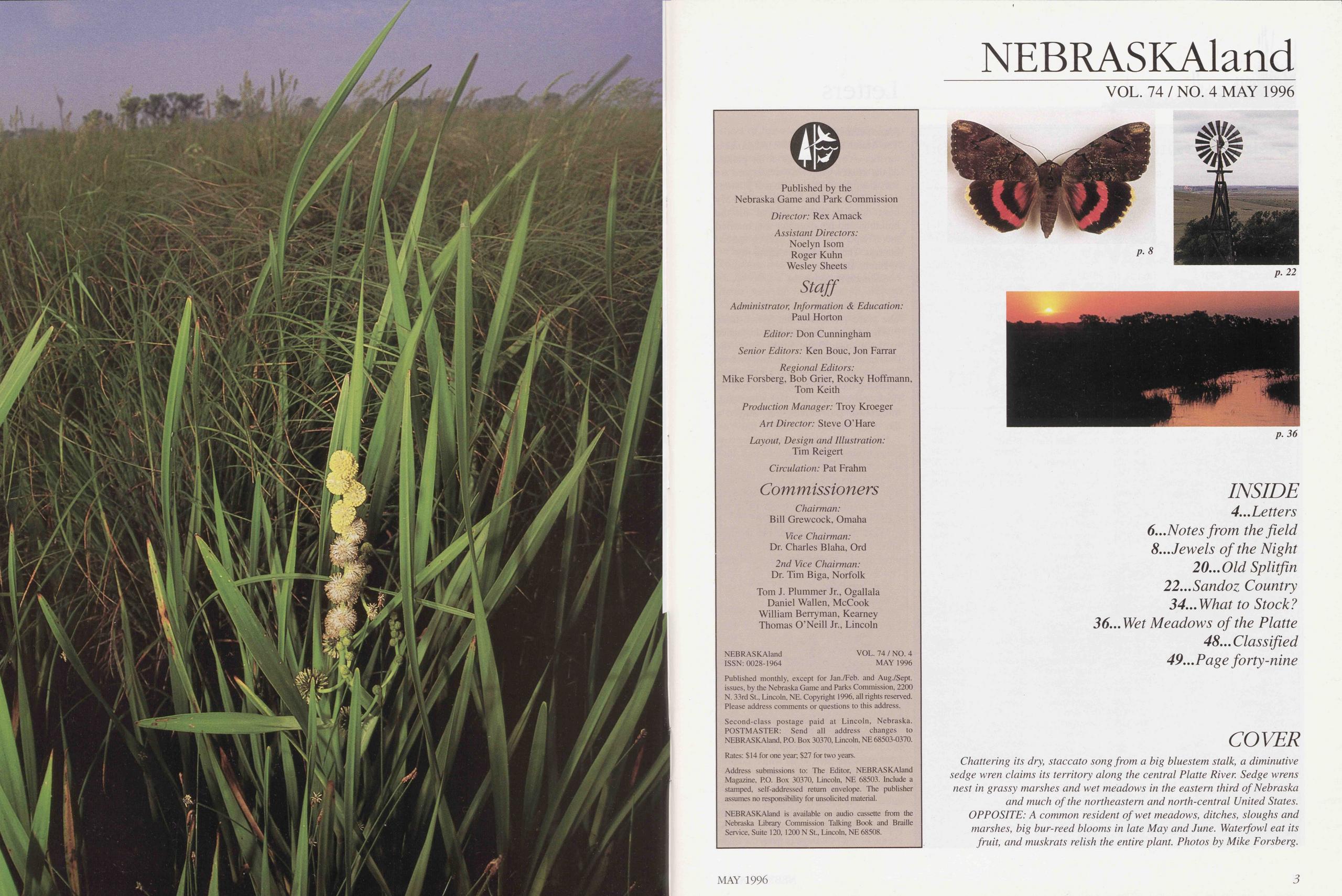
Letters
Nebraska Game and Parks Commission District Offices Headquarters District Office II District Office IV 2200 North 33rd Street Box 508 Route 4, Box 36 Lincoln, NE 68503 Bassett, NE 68714 North Platte, NE 69101 Phone (402) 471-0641 Phone (402) 684-2921 Phone (308) 535-8025 District Office I District Office III District Office V Box 725 Box 934 2200 North 33rd Street Alliance, NE 69301 Norfolk, NE 68702 Lincoln, NE 68503 Phone (308) 762-5605 Phone (402) 370-3374 Phone (402) 471-5558 Omaha Office Ak-Sar-Ben Aquarium 1212 Deer Park Blvd. 21502 West Highway 31 Omaha, NE 68108 Gretna, NE 68028 Phone (402) 595-2144 Phone (402) 332-3901 World Wide Web Site: http://www.ngpc.state.ne.us Email: ngpc@ngpsun.state.ne.us Conservation Officers by Region Panhandle Sandhills Officer City Phone (308) Officer City Phone (402) Richard Furley (Sup.) Alliance 762-2024 Bruce Wiebe (Sup.) Bassett 684-3867 Walt Meyer Chadron 432-4398 Larry Bauman Atkinson 925-5569 John Murphy Crawford 665-2021 Richard Seward Ord (308) 728-5338 Jim Zimmerman Gering 436-7561 Mick Gray Valentine 376-3136 Marvin Kampbell Hay Springs 638-7527 Ray Dierking Brkn. Bow (308) 872-3078 Dennis Thompson Ogallala 284-6450 Dan Zuehlke Ogallala 284-4815 South-central Scott Brandt Scottsbluff 635-1277 Officer City Phone (402) Raymond Still Bridgeport 262-1075 Jerry Pecha (Sup.) York 362-5707 Dan Evasco Oshkosh 772-3091 Terry Brentzel Grand Is. (308) 384-8296 Dale Johnson Hebron 768-7363 Southwest Mark Reeves Loup City (308) 745-1126 Officer City Phone (308) Robert Finke Milford 761-3537 Roger Thompson (Sup.) N. Platte 532-9175 Tim Williams Hastings 463-2535 George Sund Cambridge 697-4629 Craig Stover Kearney Matt Andrews Elwood 785-3025 Jack Henderson Gothenburg 537-7483 Southeast Dirk Greene Imperial 882-5328 Officer City Phone (402) Virgil Gosch McCook 345-2185 Dick Turpin (Adm.) Lincoln 471-5531 Dwight Allbery N. Platte 532-2753 Ted Blume (Asst. Adm.) Lincoln 483-5643 Rich Routh Rep. City 799-2085 Dan Klammer Lincoln 471-5003 Roger Guenther (Sup.) Lincoln 423-5671 Northeast Murray Johnson Lincoln 488-2923 Officer City Phone (402) William Krause Auburn 274-3789 Tom Zimmer (Sup.) Norfolk 371-6625 Dan Evasco Beatrice 228-5935 Robert Kelly Albion 395-2538 Douglas Kramer Lincoln 466-9001 Ross Oestmann Bloomfield 373-4412 Dina Barta Lincoln 483-2358 L. A. Wilkinson Columbus 564-4375 Levi Krause Louisville 234-2212 Gary Ralston Creighton 847-3284 Russell Mort Nebr. City 873-5684 Daniel Roberts Fremont 721-7852 Duane Arp Gretna 332-4954 Randy Pomplun Fullerton (308)536-2987 Larry Elston Bellevue 292-4910 Jon Reeves Kennard 427-7378 Mike Luben Colon 443-4278 Marion Shafer Norfolk 371-2031 Eric Wiebe Ponca 755-2566 Steve Oberg West Point 372-3062 Operation Game Thief 1-800-742-7627I am a former Nebraska resident, now transplanted to California. A dear friend in Lincoln sends me your NEBRASKA- land calendar each year, which contin- ues to be a real joy.
I have a question about the 1996 cal- endar — particularly January. I am fas- cinated by the small drawings on each page and want to know if the January sketch of old buildings is from the main street of Inavale, the town whose Pepsi and Coke machines were publicized nationally a few years ago.
I was bom in Inavale 72 years ago just around the comer from these buildings.
Arlene Siebold Riverside, California The January calendar drawing by staff artist Randy Bright depicts several buildings and two soft drink machines in Inavale, a town of about 100 resi- dents west of Red Cloud in Webster County. In 1992, a Pepsi machine, the town’s only soft drink machine, was stolen. Subsequently both a Pepsi machine and a Coke machine were installed, and the “soda war ” received some national publicity. Inavale resi- dent Ruth Wentworth reports that the town now has a Pepsi machine and a second Pepsi company machine dis- pensing sports drinks. (Editor) 1921-1996 Nebraska State Parks Celebrating 75 Years of Outdoor Recreation Nebraska’s state parks. *Help us celebrate this anniversary year with a park visit, and watch for special anniversary contests, promotions and events. For more information call 1-800-826-PA RK (7275). Corrections The “Spring is for Panfishing” article in the April issue incorrectly stated the price of the Nebraska Aquatic Habitat Stamp. The stamp costs $5, and, beginning January 1, 1997, it will be required for all anglers 18 years old and older, except those with Nebraska lifetime fishing permits. The “Nebraska Parklands” spe- cial section in the April issue incor- rectly implied that some state parks are closed in winter. All state parks are open year-round, but most sum- mer-season activities operate from Memorial Day weekend through Labor Day. Year-round lodging is available only at Eugene T. Mahoney State Park near Ashland and Platte River State Park near Louisville. Write to Letters, NEBRASKAland Magazine, P.O. Box 30370, Lincoln, NE 68503. Fax: (402) 471-5528. E-mail: Nebland @ngpsun.ngpc.state.ne.us. Letters may be condensed or edited for clarity. Photographs are welcome. 1996 marks the 75th anniversary of 4 NEBRASKAland MAY 1996 5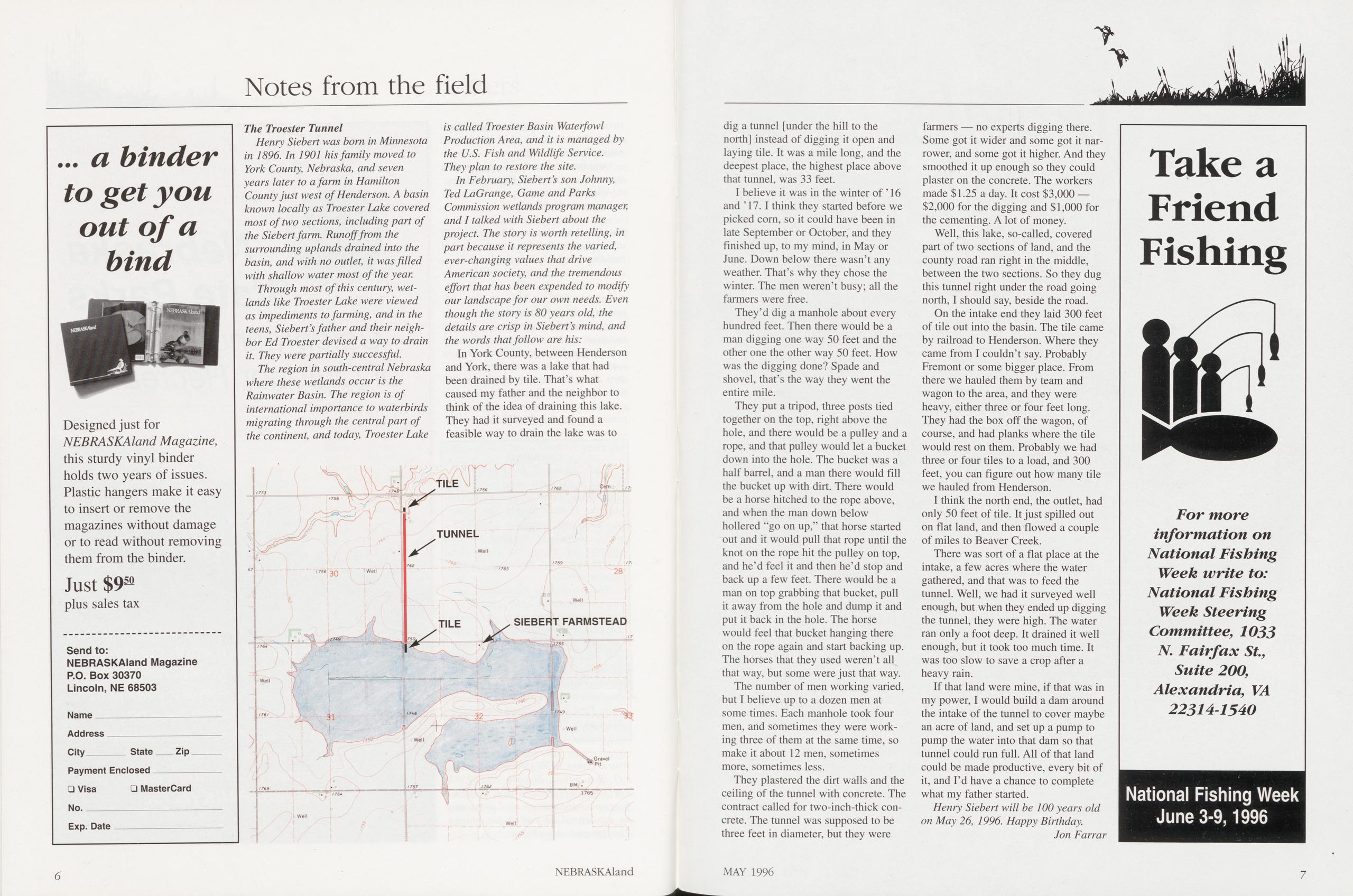
... a binder to get you out of a bind
Designed just for NEBRASKAland Magazine, this sturdy vinyl binder holds two years of issues. Plastic hangers make it easy to insert or remove the magazines without damage or to read without removing them from the binder. Just $9- plus sales tax Send to: NEBRASKAland Magazine P.O. Box 30370 Lincoln, NE 68503 Name Address City_______ State Zip Payment Enclosed Visa MasterCard No. Exp. DateHenry Siebert was born in Minnesota in 1896. In 1901 his family moved to York County, Nebraska, and seven years later to a farm in Hamilton County just west of Henderson. A basin known locally as Troester Lake covered most of two sections, including part of the Siebert farm. Runoff from the surrounding uplands drained into the basin, and with no outlet, it was fdled with shallow water most of the year.
Through most of this century, wet- lands like Troester Lake were viewed as impediments to farming, and in the teens, Siebert's father and their neigh- bor Ed Troester devised a way to drain it. They were partially successful.
The region in south-central Nebraska where these wetlands occur is the Rainwater Basin. The region is of international importance to waterbirds migrating through the central part of the continent, and today, Troester Lake is called Troester Basin Waterfowl Production Area, and it is managed by the U.S. Fish and Wildlife Service. They plan to restore the site.
In February, Siebert's son Johnny, Ted LaGrange, Game and Parks Commission wetlands program manager, and I talked with Siebert about the project. The story is worth retelling, in part because it represents the varied, ever-changing values that drive American society, and the tremendous effort that has been expended to modify our landscape for our own needs. Even though the story is 80 years old, the details are crisp in Siebert's mind, and the words that follow are his:
In York County, between Henderson and York, there was a lake that had been drained by tile. That’s what caused my father and the neighbor to think of the idea of draining this lake. They had it surveyed and found a feasible way to drain the lake was to dig a tunnel [under the hill to the north] instead of digging it open and laying tile. It was a mile long, and the deepest place, the highest place above that tunnel, was 33 feet.
I believe it was in the winter of ’ 16 and ’17.1 think they started before we picked corn, so it could have been in late September or October, and they finished up, to my mind, in May or June. Down below there wasn’t any weather. That’s why they chose the winter. The men weren’t busy; all the farmers were free.
They’d dig a manhole about every hundred feet. Then there would be a man digging one way 50 feet and the other one the other way 50 feet. How was the digging done? Spade and shovel, that’s the way they went the entire mile.
They put a tripod, three posts tied together on the top, right above the hole, and there would be a pulley and a rope, and that pulley would let a bucket down into the hole. The bucket was a half barrel, and a man there would fill the bucket up with dirt. There would be a horse hitched to the rope above, and when the man down below hollered "go on up,” that horse started out and it would pull that rope until the knot on the rope hit the pulley on top, and he’d feel it and then he’d stop and back up a few feet. There would be a man on top grabbing that bucket, pull it away from the hole and dump it and put it back in the hole. The horse would feel that bucket hanging there on the rope again and start backing up. The horses that they used weren’t all that way, but some were just that way.
The number of men working varied, but I believe up to a dozen men at some times. Each manhole took four men, and sometimes they were work- ing three of them at the same time, so make it about 12 men, sometimes more, sometimes less.
They plastered the dirt walls and the ceiling of the tunnel with concrete. The contract called for two-inch-thick con- crete. The tunnel was supposed to be three feet in diameter, but they were farmers — no experts digging there. Some got it wider and some got it nar- rower, and some got it higher. And they smoothed it up enough so they could plaster on the concrete. The workers made $1.25 a day. It cost $3,000 — $2,000 for the digging and $1,000 for the cementing. A lot of money.
Well, this lake, so-called, covered part of two sections of land, and the county road ran right in the middle, between the two sections. So they dug this tunnel right under the road going north, I should say, beside the road. On the intake end they laid 300 feet of tile out into the basin. The tile came by railroad to Henderson. Where they came from I couldn’t say. Probably Fremont or some bigger place. From there we hauled them by team and wagon to the area, and they were heavy, either three or four feet long. They had the box off the wagon, of course, and had planks where the tile would rest on them. Probably we had three or four tiles to a load, and 300 feet, you can figure out how many tile we hauled from Henderson.
I think the north end, the outlet, had only 50 feet of tile. It just spilled out on flat land, and then flowed a couple of miles to Beaver Creek.
There was sort of a flat place at the intake, a few acres where the water gathered, and that was to feed the tunnel. Well, we had it surveyed well enough, but when they ended up digging the tunnel, they were high. The water ran only a foot deep. It drained it well enough, but it took too much time. It was too slow to save a crop after a heavy rain.
If that land were mine, if that was in my power, I would build a dam around the intake of the tunnel to cover maybe an acre of land, and set up a pump to pump the water into that dam so that tunnel could run full. All of that land could be made productive, every bit of it, and I’d have a chance to complete what my father started.
Henry Siebert will be 100 years old on May 26, 1996. Happy Birthday. Jon FarrarTake a Friend Fishing
For more information on National Fishing Week write to: National Fishing Week Steering Committee, 1033 N. Fairfax St., Suite 200, Alexandria, VA 22314-1540 National Fishing Week June 3-9,1996 6 NEBRASKAland MAY 1996 7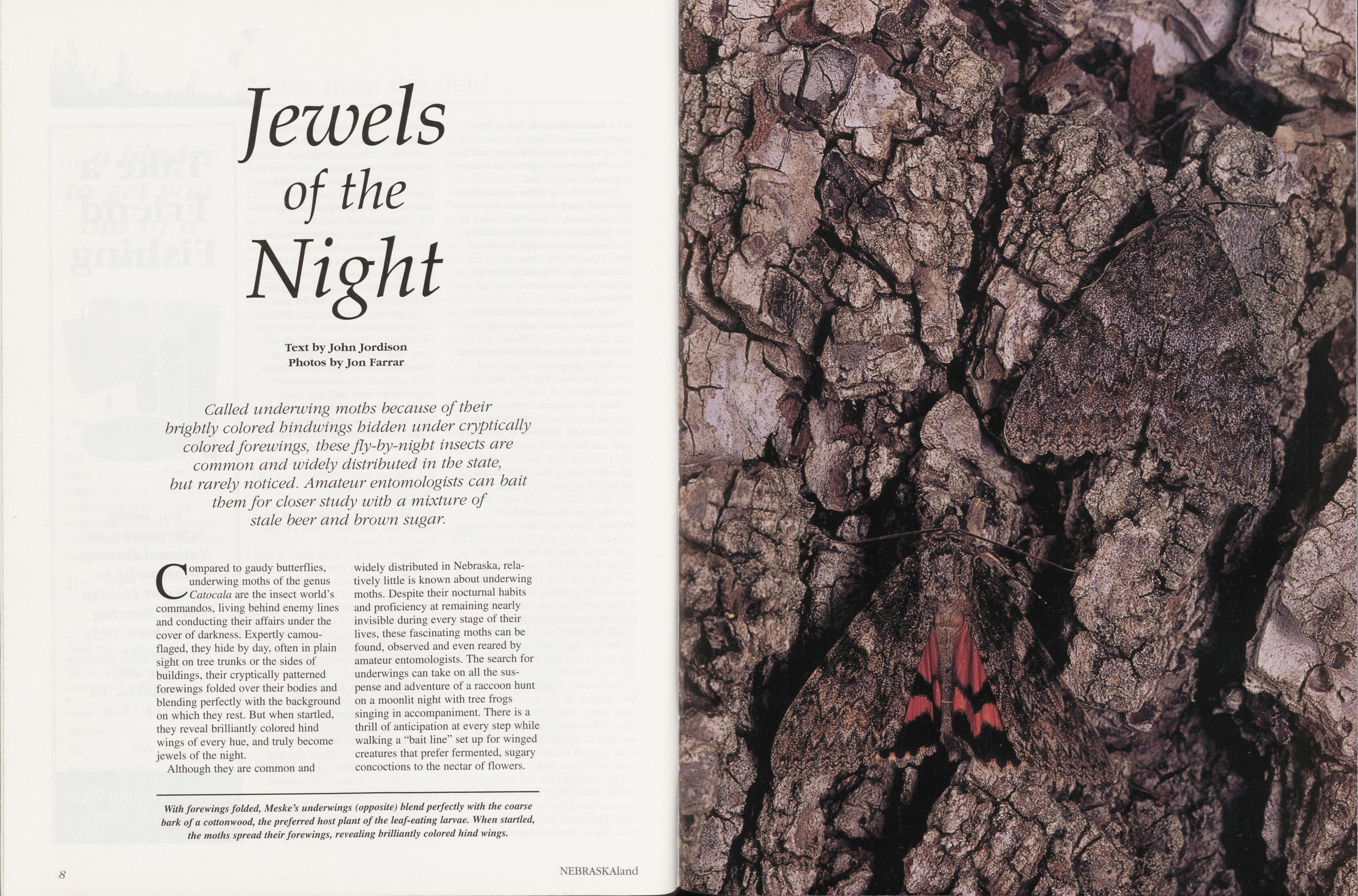
Jewels of the N igh t
Called underwing moths because of their brightly colored hindwings hidden under cryptically colored forewings, these fly-by-night insects are common and widely distributed in the state, but rarely noticed. Amateur entomologists can bait them for closer study with a mixture of stale beer and brown sugar.Compared to gaudy butterflies, underwing moths of the genus Catocala are the insect world’s commandos, living behind enemy lines and conducting their affairs under the cover of darkness. Expertly camou- flaged, they hide by day, often in plain sight on tree trunks or the sides of buildings, their cryptically patterned forewings folded over their bodies and blending perfectly with the background on which they rest. But when startled, they reveal brilliantly colored hind wings of every hue, and truly become jewels of the night.
Although they are common and widely distributed in Nebraska, rela- tively little is known about underwing moths. Despite their nocturnal habits and proficiency at remaining nearly invisible during every stage of their lives, these fascinating moths can be found, observed and even reared by amateur entomologists. The search for underwings can take on all the sus- pense and adventure of a raccoon hunt on a moonlit night with tree frogs singing in accompaniment. There is a thrill of anticipation at every step while walking a “bait line” set up for winged creatures that prefer fermented, sugary concoctions to the nectar of flowers.
 Matters of the Heart
Everything about underwing moths — their cryptic coloration, nocturnal habits and unusual food preferences — fascinated naturalists of the 19th century, but it wasn’t until the heyday of ento- mology in the years after the Civil War, long after most North American butter- flies and other diurnal insects had been identified and named, that many species of North American underwing moths were studied and described.
To entomologists in the late 1800s, it probably seemed that the world would soon run out of new species to discover. Fierce rivalries emerged as they raced to be the first to describe and name those remaining. So intense was the competition that famed collectors such as A.R. Grote and Henry Strecker stole specimens from other entomologists, dubiously based descriptions of new species on faded or rubbed specimens, libeled each other in the scientific press of the day and enlisted colleagues to support their case for precedence in naming new species.
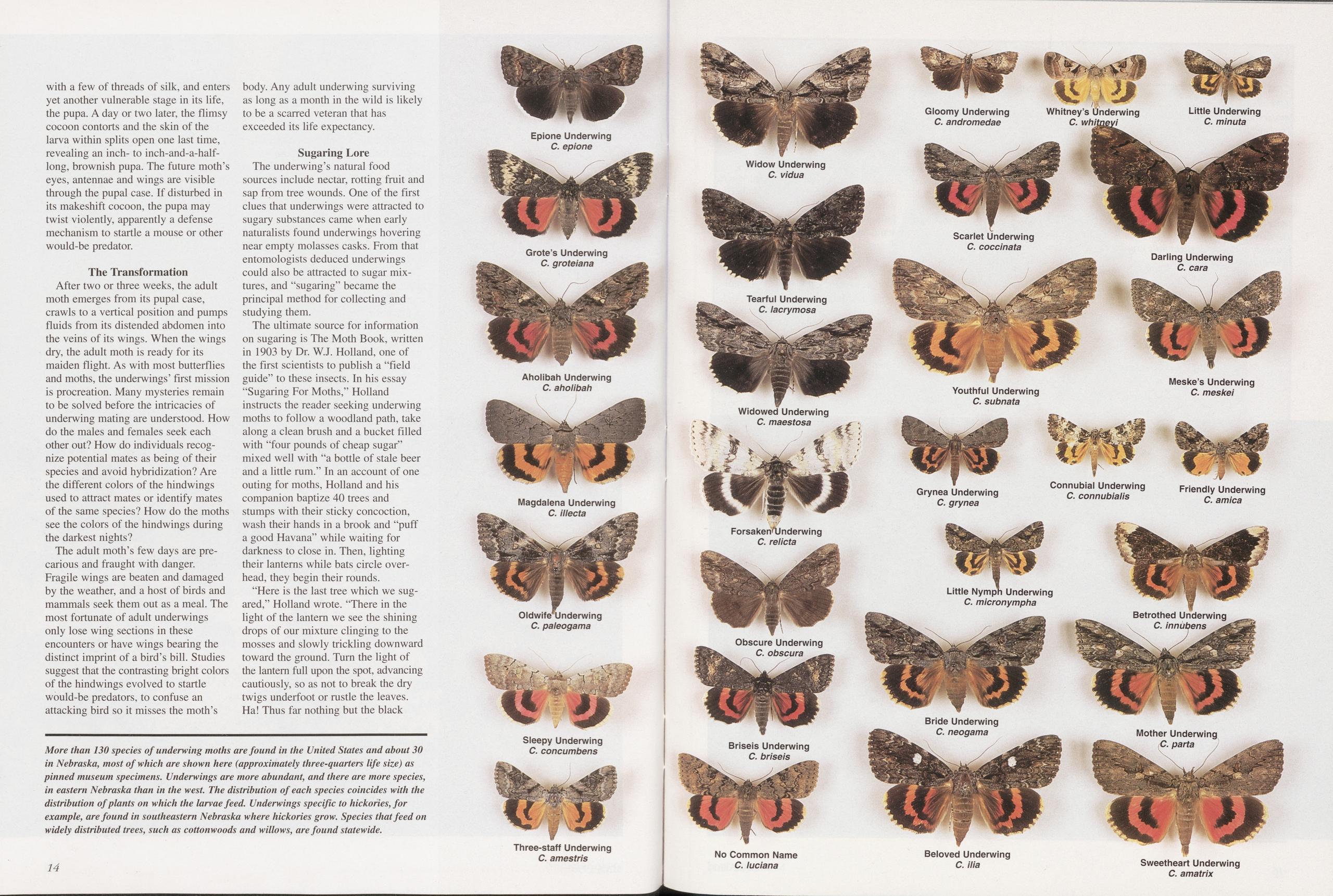
As was often the case among 19th century naturalists, new species frequently were named after colleagues, and thus today we have underwing moth species bearing the names Catocala meskei, Catocala angusi and Catocala robinsoni. Other species of underwing moths, particularly those with red-striped or pink hindwings, were named for matters of the heart: the sweetheart underwing (Catocala amatrix), darling underwing (Catocala cara) and consort underwing (Catocala consors). Some underwings were named after Shakespearean characters, including Catocala titania, and some names come from Greek mythology, such as Catocala andromedae. There are the new bride (Catocala neogama) and old wife (Catocala pale- ogama) underwings. Those with black hindwings were assigned mournful names: dejected (Catocala dejecta), unconsolable (Catocala insolabilis) and tearful (Catocala lacrymosa).
Nebraska UnderwingsThere are more than 130 species of underwing moths in the United States and Canada. About 30 species are com- monly found in Nebraska. Underwing moths are more abundant, and there are more species, in eastern Nebraska than in the west. As with birds, the 100th meridian, bisecting Nebraska roughly along a line from Ainsworth to Cozad, separates eastern and western species.
Within Nebraska, the distribution of individual species of underwing moths coincides with the distribution of spe- cific plants on which the larvae feed. Species whose larvae feed on the foliage of hickories, for example, are found in southeastern Nebraska but not elsewhere in the state. Several species feed on willows and cottonwoods found along Nebraska streams, and consequently are found statewide. The larvae of some underwing species feed only on leadplant (Amorpha canescens), a small, woody grassland shrub, and are common on Nebraska prairies but rare in other parts of the country. Plums, apples, oaks, walnut, butternut, honey locust and basswood (linden) are the specific host plants of other species of underwing moth larvae.
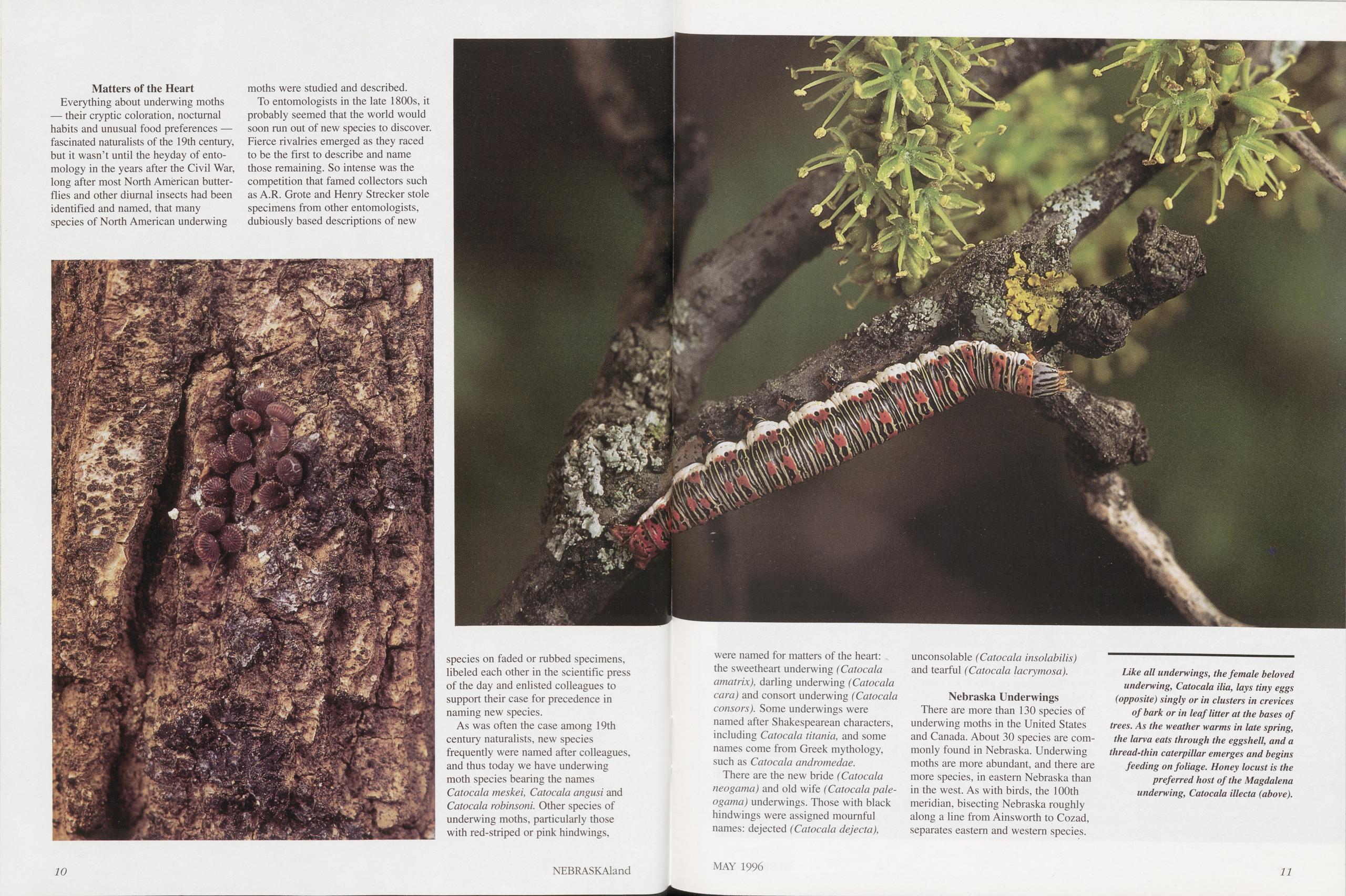
Life in the LeavesAdult underwing moths emerge in late spring and early summer and immediately begin seeking mates. After the eggs have been fertilized, the female seeks out the host tree or shrub specific for her species and secretes the ova, either singly or in clusters, into crevices in the bark or in the leaf litter at the base of the plant. The ova are tiny, no bigger than the period at the end of this sentence. Spherical in shape and gray or brown in color, they are fascinating miniature sculptures.
Experienced entomologists can identify the species of underwing moth from the eggs alone, as those of each species are different from all others. An under- wing’s adult life can be brief. Some die before mating, and most female moths do not live long after laying eggs. A lucky few can survive for several weeks, laying eggs all the time.
The exposed ova must survive the heat and drought of August and the bit- ter cold of winter unprotected from the elements, and escape the intense searches for food by woodpeckers, nuthatches and other birds.
Occasionally, the eggs of underwings can be found by carefully examining the bark of appropriate trees, but their size, coloration and camouflage make them virtually undetectable to the human eye.
In late spring, as the weather warms and trees and shrubs begin to bud, the larvae eat their way through the egg shell, emerging as a thread-thin, two- millimeter-long caterpillar. Immediately they are as active as racehorses, search- ing for the most succulent parts of their host plant and their first meal.
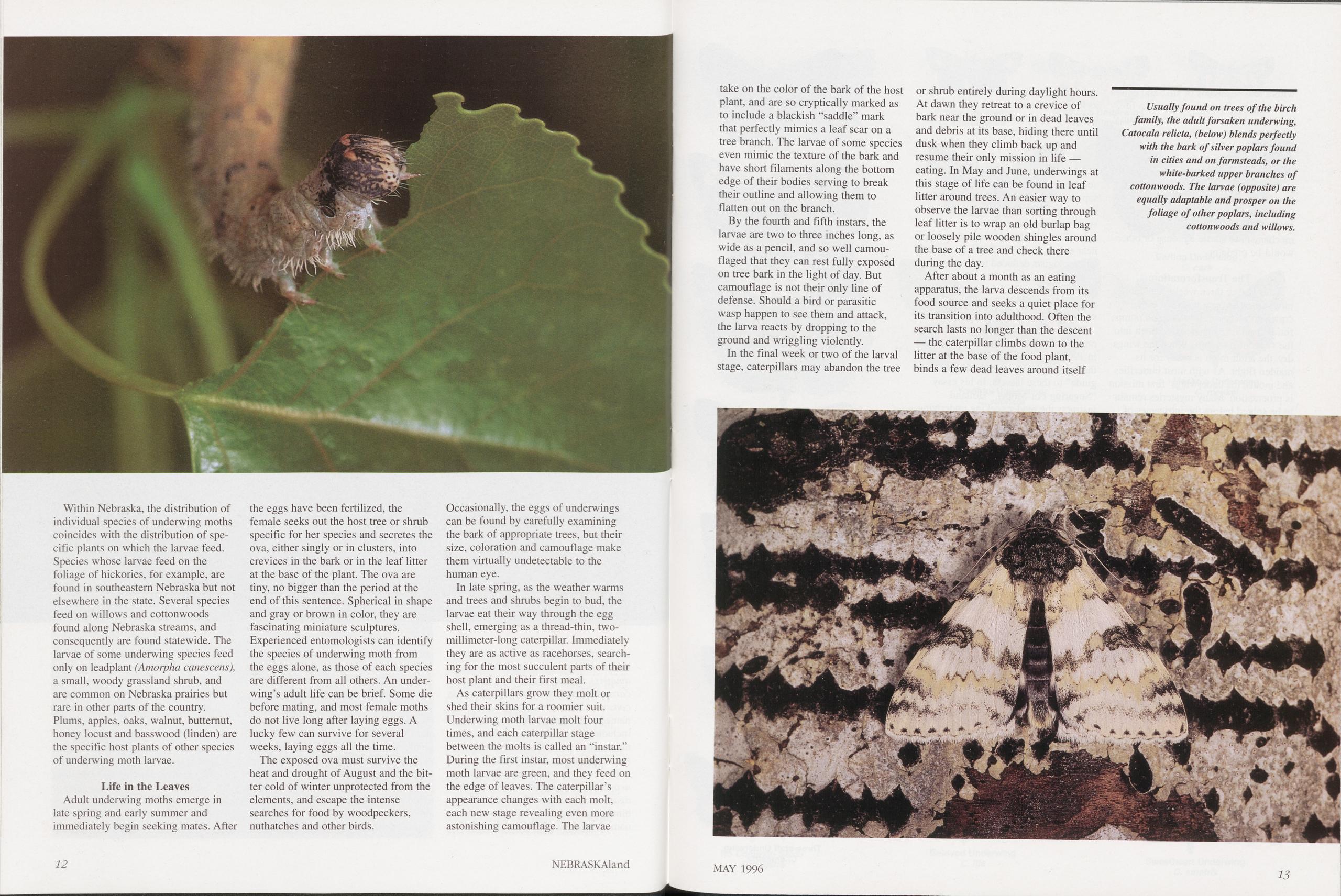
As caterpillars grow they molt or shed their skins for a roomier suit. Underwing moth larvae molt four times, and each caterpillar stage between the molts is called an “instar.” During the first instar, most underwing moth larvae are green, and they feed on the edge of leaves. The caterpillar’s appearance changes with each molt, each new stage revealing even more astonishing camouflage. The larvae take on the color of the bark of the host plant, and are so cryptically marked as to include a blackish “saddle” mark that perfectly mimics a leaf scar on a tree branch. The larvae of some species even mimic the texture of the bark and have short filaments along the bottom edge of their bodies serving to break their outline and allowing them to flatten out on the branch.
By the fourth and fifth instars, the larvae are two to three inches long, as wide as a pencil, and so well camou- flaged that they can rest fully exposed on tree bark in the light of day. But camouflage is not their only line of defense. Should a bird or parasitic wasp happen to see them and attack, the larva reacts by dropping to the ground and wriggling violently.
In the final week or two of the larval stage, caterpillars may abandon the tree or shrub entirely during daylight hours. At dawn they retreat to a crevice of bark near the ground or in dead leaves and debris at its base, hiding there until dusk when they climb back up and resume their only mission in life — eating. In May and June, underwings at this stage of life can be found in leaf litter around trees. An easier way to observe the larvae than sorting through leaf litter is to wrap an old burlap bag or loosely pile wooden shingles around the base of a tree and check there during the day.
After about a month as an eating apparatus, the larva descends from its food source and seeks a quiet place for its transition into adulthood. Often the search lasts no longer than the descent — the caterpillar climbs down to the litter at the base of the food plant, binds a few dead leaves around itself
with a few of threads of silk, and enters yet another vulnerable stage in its life, the pupa. A day or two later, the flimsy cocoon contorts and the skin of the larva within splits open one last time, revealing an inch- to inch-and-a-half- long, brownish pupa. The future moth’s eyes, antennae and wings are visible through the pupal case. If disturbed in its makeshift cocoon, the pupa may twist violently, apparently a defense mechanism to startle a mouse or other would-be predator.
The TransformationAfter two or three weeks, the adult moth emerges from its pupal case, crawls to a vertical position and pumps fluids from its distended abdomen into the veins of its wings. When the wings dry, the adult moth is ready for its maiden flight. As with most butterflies and moths, the underwings’ first mission is procreation. Many mysteries remain to be solved before the intricacies of underwing mating are understood. How do the males and females seek each other out? How do individuals recog- nize potential mates as being of their species and avoid hybridization? Are the different colors of the hindwings used to attract mates or identify mates of the same species? How do the moths see the colors of the hindwings during the darkest nights?
The adult moth’s few days are pre- carious and fraught with danger. Fragile wings are beaten and damaged by the weather, and a host of birds and mammals seek them out as a meal. The most fortunate of adult underwings only lose wing sections in these encounters or have wings bearing the distinct imprint of a bird’s bill. Studies suggest that the contrasting bright colors of the hindwings evolved to startle would-be predators, to confuse an attacking bird so it misses the moth’s body. Any adult underwing surviving as long as a month in the wild is likely to be a scarred veteran that has exceeded its life expectancy.
Sugaring LoreThe underwing’s natural food sources include nectar, rotting fruit and sap from tree wounds. One of the first clues that underwings were attracted to sugary substances came when early naturalists found underwings hovering near empty molasses casks. From that entomologists deduced underwings could also be attracted to sugar mix- tures, and “sugaring” became the principal method for collecting and studying them.
The ultimate source for information on sugaring is The Moth Book, written in 1903 by Dr. W.J. Holland, one of the first scientists to publish a “field guide” to these insects. In his essay “Sugaring For Moths,” Holland instructs the reader seeking underwing moths to follow a woodland path, take along a clean brush and a bucket filled with “four pounds of cheap sugar” mixed well with “a bottle of stale beer and a little rum.” In an account of one outing for moths, Holland and his companion baptize 40 trees and stumps with their sticky concoction, wash their hands in a brook and “puff a good Havana” while waiting for darkness to close in. Then, lighting their lanterns while bats circle over- head, they begin their rounds.
“Here is the last tree which we sug- ared,” Holland wrote. “There in the light of the lantern we see the shining drops of our mixture clinging to the mosses and slowly trickling downward toward the ground. Turn the light of the lantern full upon the spot, advancing cautiously, so as not to break the dry twigs underfoot or rustle the leaves. Ha! Thus far nothing but the black
Epione Underwing Grote’s Underwing Aholibah Underwing C. aholibah C. paleogama Sleepy Underwing C. concumbens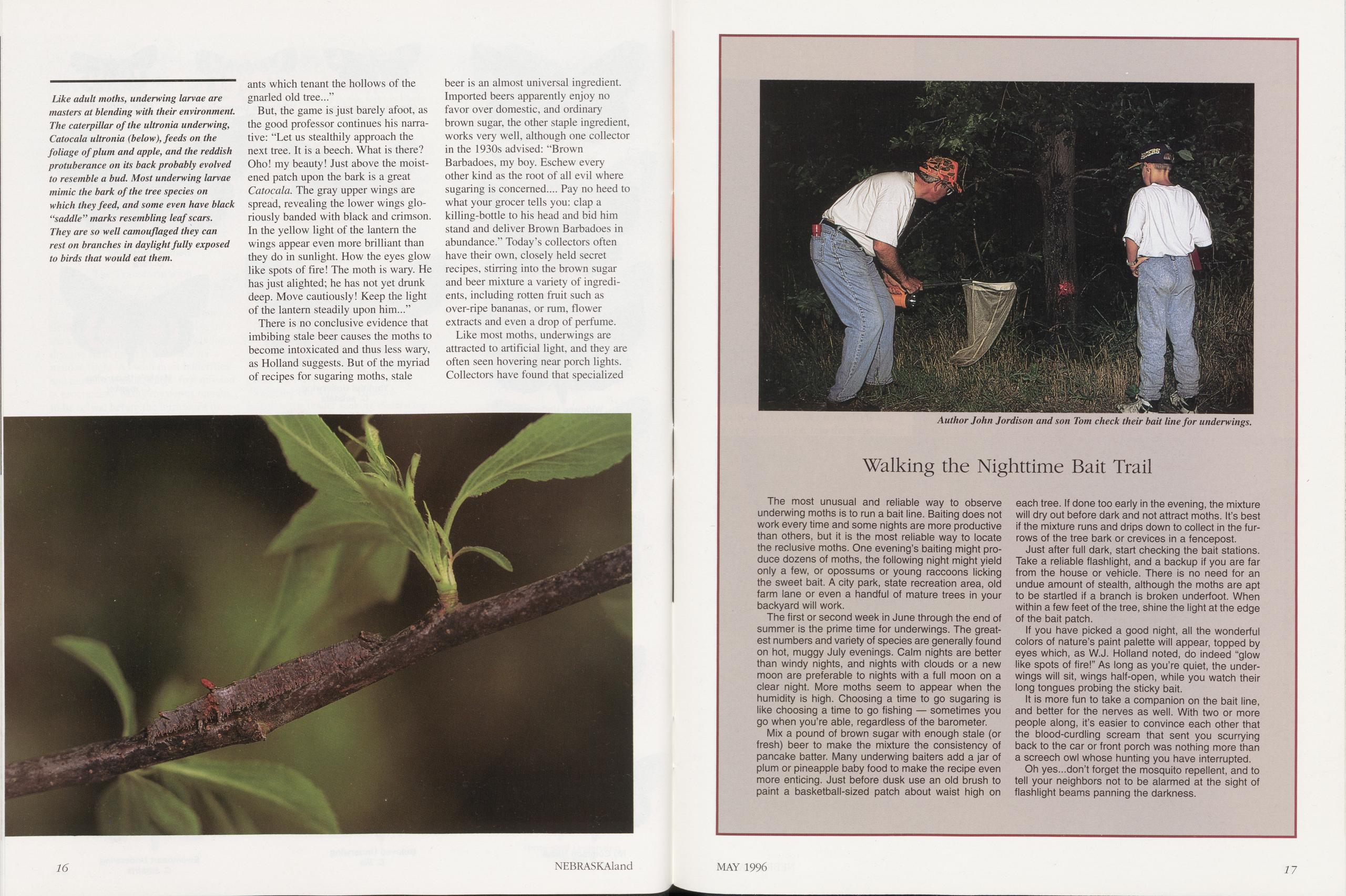
ants which tenant the hollows of the gnarled old tree...”
But, the game is just barely afoot, as the good professor continues his narra- tive: “Let us stealthily approach the next tree. It is a beech. What is there? Oho! my beauty! Just above the moist- ened patch upon the bark is a great Catocala. The gray upper wings are spread, revealing the lower wings glo- riously banded with black and crimson. In the yellow light of the lantern the wings appear even more brilliant than they do in sunlight. How the eyes glow like spots of fire! The moth is wary. He has just alighted; he has not yet drunk deep. Move cautiously! Keep the light of the lantern steadily upon him...”
There is no conclusive evidence that imbibing stale beer causes the moths to become intoxicated and thus less wary, as Holland suggests. But of the myriad of recipes for sugaring moths, stale beer is an almost universal ingredient. Imported beers apparently enjoy no favor over domestic, and ordinary brown sugar, the other staple ingredient, works very well, although one collector in the 1930s advised: “Brown Barbadoes, my boy. Eschew every other kind as the root of all evil where sugaring is concerned.... Pay no heed to what your grocer tells you: clap a killing-bottle to his head and bid him stand and deliver Brown Barbadoes in abundance.” Today’s collectors often have their own, closely held secret recipes, stirring into the brown sugar and beer mixture a variety of ingredi- ents, including rotten fruit such as over-ripe bananas, or rum, flower extracts and even a drop of perfume.
Like most moths, underwings are attracted to artificial light, and they are often seen hovering near porch lights. Collectors have found that specialized
The most unusual and reliable way to observe underwing moths is to run a bait line. Baiting does not work every time and some nights are more productive than others, but it is the most reliable way to locate the reclusive moths. One evening’s baiting might pro- duce dozens of moths, the following night might yield only a few, or opossums or young raccoons licking the sweet bait. A city park, state recreation area, old farm lane or even a handful of mature trees in your backyard will work.
The first or second week in June through the end of summer is the prime time for underwings. The great- est numbers and variety of species are generally found on hot, muggy July evenings. Calm nights are better than windy nights, and nights with clouds or a new moon are preferable to nights with a full moon on a clear night. More moths seem to appear when the humidity is high. Choosing a time to go sugaring is like choosing a time to go fishing — sometimes you go when you’re able, regardless of the barometer.
Mix a pound of brown sugar with enough stale (or fresh) beer to make the mixture the consistency of pancake batter. Many underwing baiters add a jar of plum or pineapple baby food to make the recipe even more enticing. Just before dusk use an old brush to paint a basketball-sized patch about waist high on each tree. If done too early in the evening, the mixture will dry out before dark and not attract moths. It’s best if the mixture runs and drips down to collect in the fur- rows of the tree bark or crevices in a fencepost.
Just after full dark, start checking the bait stations. Take a reliable flashlight, and a backup if you are far from the house or vehicle. There is no need for an undue amount of stealth, although the moths are apt to be startled if a branch is broken underfoot. When within a few feet of the tree, shine the light at the edge of the bait patch.
If you have picked a good night, all the wonderful colors of nature’s paint palette will appear, topped by eyes which, as W.J. Holland noted, do indeed “glow like spots of fire!” As long as you’re quiet, the under- wings will sit, wings half-open, while you watch their long tongues probing the sticky bait.
It is more fun to take a companion on the bait line, and better for the nerves as well. With two or more people along, it’s easier to convince each other that the blood-curdling scream that sent you scurrying back to the car or front porch was nothing more than a screech owl whose hunting you have interrupted.
Oh yes...don’t forget the mosquito repellent, and to tell your neighbors not to be alarmed at the sight of flashlight beams panning the darkness.
16 NEBRASKAland MAY 1996 17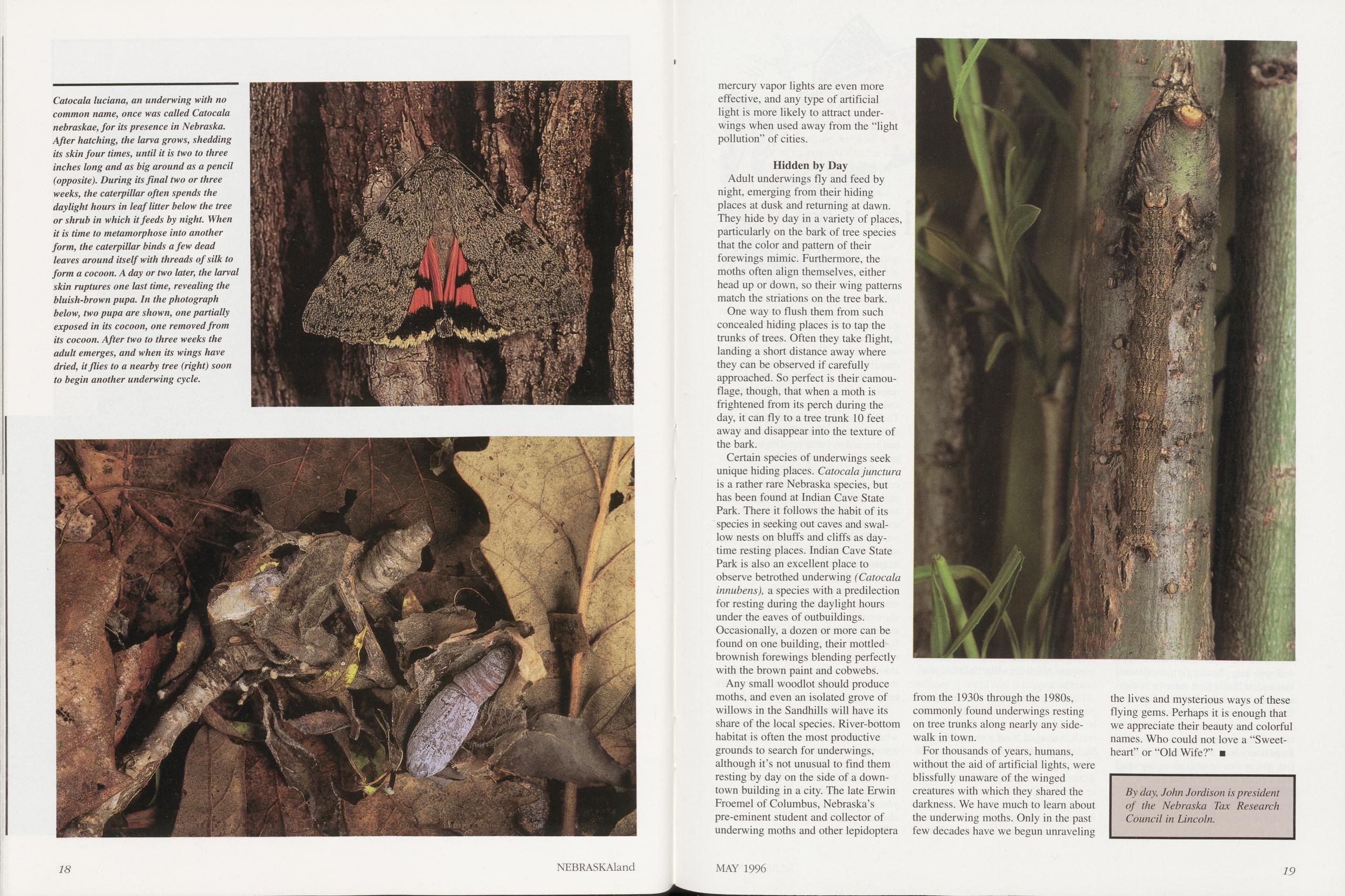
mercury vapor lights are even more effective, and any type of artificial light is more likely to attract under- wings when used away from the "light pollution” of cities.
Hidden by DayAdult underwings fly and feed by night, emerging from their hiding places at dusk and returning at dawn. They hide by day in a variety of places, particularly on the bark of tree species that the color and pattern of their fore wings mimic. Furthermore, the moths often align themselves, either head up or down, so their wing patterns match the striations on the tree bark. One way to flush them from such concealed hiding places is to tap the trunks of trees. Often they take flight, landing a short distance away where they can be observed if carefully approached. So perfect is their camou- flage, though, that when a moth is frightened from its perch during the day, it can fly to a tree trunk 10 feet away and disappear into the texture of the bark.
Certain species of underwings seek unique hiding places. Catocala junctura is a rather rare Nebraska species, but has been found at Indian Cave State Park. There it follows the habit of its species in seeking out caves and swal- low nests on bluffs and cliffs as day- time resting places. Indian Cave State Park is also an excellent place to observe betrothed underwing (Catocala innubens), a species with a predilection for resting during the daylight hours under the eaves of outbuildings. Occasionally, a dozen or more can be found on one building, their mottled brownish forewings blending perfectly with the brown paint and cobwebs.
Any small woodlot should produce moths, and even an isolated grove of willows in the Sandhills will have its share of the local species. River-bottom habitat is often the most productive grounds to search for underwings, although it’s not unusual to find them resting by day on the side of a down- town building in a city. The late Erwin Froemel of Columbus, Nebraska’s pre-eminent student and collector of underwing moths and other lepidoptera
MAY 1996from the 1930s through the 1980s, commonly found underwings resting on tree trunks along nearly any side- walk in town.
For thousands of years, humans, without the aid of artificial lights, were blissfully unaware of the winged creatures with which they shared the darkness. We have much to learn about the underwing moths. Only in the past few decades have we begun unraveling the lives and mysterious ways of these flying gems. Perhaps it is enough that we appreciate their beauty and colorful names. Who could not love a "Sweet- heart” or "Old Wife?”
By day, John Jordison is president of the Nebraska Tax Research Council in Lincoln. 19 18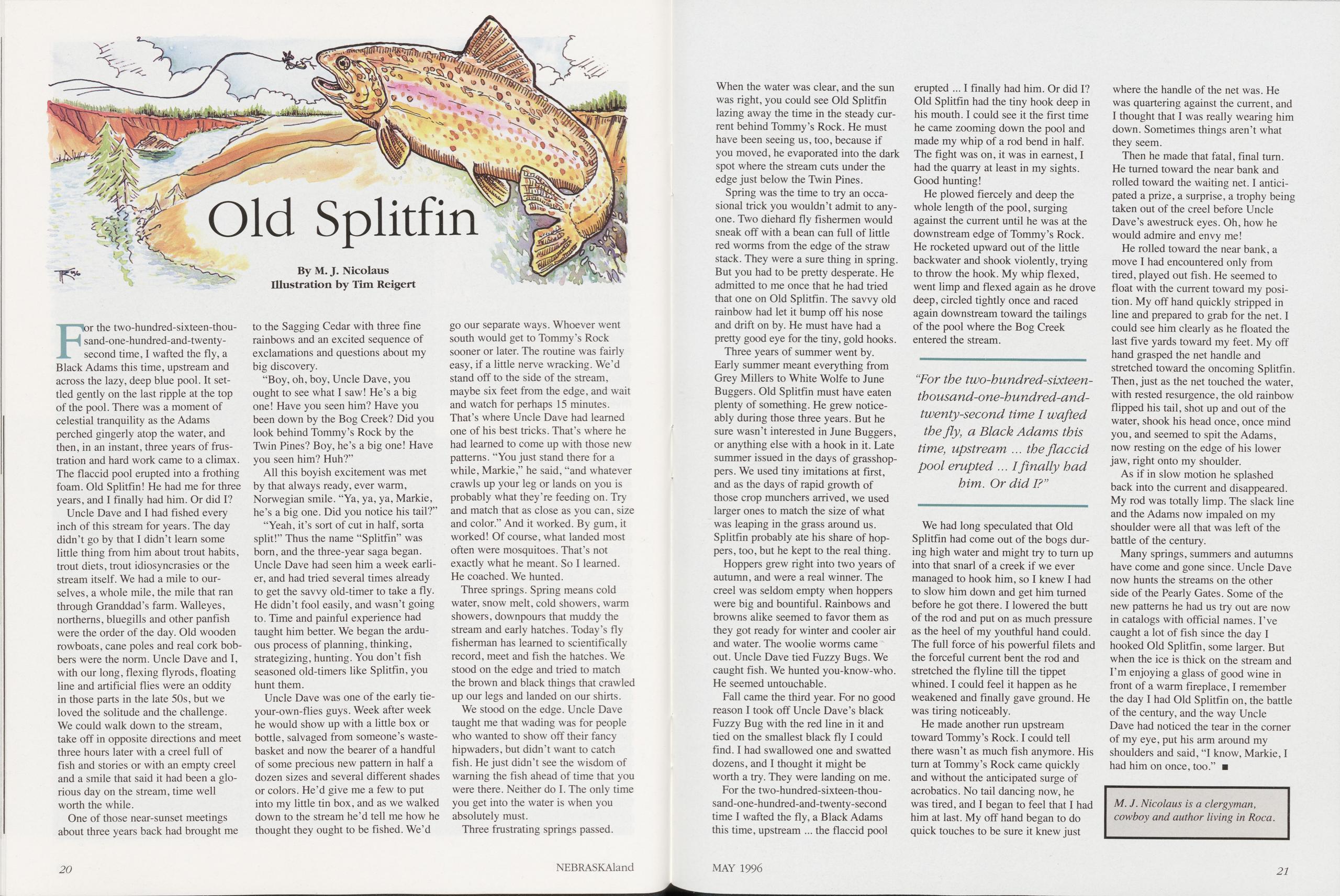
Old Splitfin
By M.J. Nicolaus Illustration by Tim ReigertFor the two-hundred-sixteen-thou- sand-one-hundred-and-twenty- second time, I wafted the fly, a Black Adams this time, upstream and across the lazy, deep blue pool. It set- tled gently on the last ripple at the top of the pool. There was a moment of celestial tranquility as the Adams perched gingerly atop the water, and then, in an instant, three years of frus- tration and hard work came to a climax. The flaccid pool erupted into a frothing foam. Old Splitfin! He had me for three years, and I finally had him. Or did I?
Uncle Dave and I had fished every inch of this stream for years. The day didn’t go by that I didn’t learn some little thing from him about trout habits, trout diets, trout idiosyncrasies or the stream itself. We had a mile to our- selves, a whole mile, the mile that ran through Granddad’s farm. Walleyes, northerns, bluegills and other panfish were the order of the day. Old wooden rowboats, cane poles and real cork bob- bers were the norm. Uncle Dave and I, with our long, flexing flyrods, floating line and artificial flies were an oddity in those parts in the late 50s, but we loved the solitude and the challenge.
We could walk down to the stream, take off in opposite directions and meet three hours later with a creel full of fish and stories or with an empty creel and a smile that said it had been a glo- rious day on the stream, time well worth the while.
One of those near-sunset meetings about three years back had brought me to the Sagging Cedar with three fine rainbows and an excited sequence of exclamations and questions about my big discovery.
"Boy, oh, boy, Uncle Dave, you ought to see what I saw! He’s a big one! Have you seen him? Have you been down by the Bog Creek? Did you look behind Tommy’s Rock by the Twin Pines? Boy, he’s a big one! Have you seen him? Huh?”
All this boyish excitement was met by that always ready, ever warm, Norwegian smile. “Ya, ya, ya, Markie, he’s a big one. Did you notice his tail?”
“Yeah, it’s sort of cut in half, sorta split!” Thus the name “Splitfin” was born, and the three-year saga began. Uncle Dave had seen him a week earli- er, and had tried several times already to get the savvy old-timer to take a fly. He didn’t fool easily, and wasn’t going to. Time and painful experience had taught him better. We began the ardu- ous process of planning, thinking, strategizing, hunting. You don’t fish seasoned old-timers like Splitfin, you hunt them.
Uncle Dave was one of the early tie- your-own-flies guys. Week after week he would show up with a little box or bottle, salvaged from someone’s waste- basket and now the bearer of a handful of some precious new pattern in half a dozen sizes and several different shades or colors. He’d give me a few to put into my little tin box, and as we walked down to the stream he’d tell me how he thought they ought to be fished. We’d go our separate ways. Whoever went south would get to Tommy’s Rock sooner or later. The routine was fairly easy, if a little nerve wracking. We’d stand off to the side of the stream, maybe six feet from the edge, and wait and watch for perhaps 15 minutes. That’s where Uncle Dave had learned one of his best tricks. That’s where he had learned to come up with those new patterns. “You just stand there for a while, Markie,” he said, “and whatever crawls up your leg or lands on you is probably what they’re feeding on. Try and match that as close as you can, size and color.” And it worked. By gum, it worked! Of course, what landed most often were mosquitoes. That’s not exactly what he meant. So I learned. He coached. We hunted.
Three springs. Spring means cold water, snow melt, cold showers, warm showers, downpours that muddy the stream and early hatches. Today’s fly fisherman has learned to scientifically record, meet and fish the hatches. We stood on the edge and tried to match the brown and black things that crawled up our legs and landed on our shirts. We stood on the edge. Uncle Dave taught me that wading was for people who wanted to show off their fancy hip waders, but didn’t want to catch fish. He just didn’t see the wisdom of warning the fish ahead of time that you were there. Neither do I. The only time you get into the water is when you absolutely must.
Three frustrating springs passed. When the water was clear, and the sun was right, you could see Old Splitfin lazing away the time in the steady cur- rent behind Tommy’s Rock. He must have been seeing us, too, because if you moved, he evaporated into the dark spot where the stream cuts under the edge just below the Twin Pines.
Spring was the time to try an occa- sional trick you wouldn’t admit to any- one. Two diehard fly fishermen would sneak off with a bean can full of little red worms from the edge of the straw stack. They were a sure thing in spring. But you had to be pretty desperate. He admitted to me once that he had tried that one on Old Splitfin. The savvy old rainbow had let it bump off his nose and drift on by. He must have had a pretty good eye for the tiny, gold hooks.
Three years of summer went by. Early summer meant everything from Grey Millers to White Wolfe to June Buggers. Old Splitfin must have eaten plenty of something. He grew notice- ably during those three years. But he sure wasn’t interested in June Buggers, or anything else with a hook in it. Late summer issued in the days of grasshop- pers. We used tiny imitations at first, and as the days of rapid growth of those crop munchers arrived, we used larger ones to match the size of what was leaping in the grass around us. Splitfin probably ate his share of hop- pers, too, but he kept to the real thing.
Hoppers grew right into two years of autumn, and were a real winner. The creel was seldom empty when hoppers were big and bountiful. Rainbows and browns alike seemed to favor them as they got ready for winter and cooler air and water. The woolie worms came out. Uncle Dave tied Fuzzy Bugs. We caught fish. We hunted you-know-who. He seemed untouchable.
Fall came the third year. For no good reason I took off Uncle Dave’s black Fuzzy Bug with the red line in it and tied on the smallest black fly I could find. I had swallowed one and swatted dozens, and I thought it might be worth a try. They were landing on me.
For the two-hundred-sixteen-thou- sand-one-hundred-and-twenty-second time I wafted the fly, a Black Adams this time, upstream ... the flaccid pool erupted ... I finally had him. Or did I?Old Splitfin had the tiny hook deep in his mouth. I could see it the first time he came zooming down the pool and made my whip of a rod bend in half. The fight was on, it was in earnest, I had the quarry at least in my sights. Good hunting!
He plowed fiercely and deep the whole length of the pool, surging against the current until he was at the downstream edge of Tommy’s Rock. He rocketed upward out of the little backwater and shook violently, trying to throw the hook. My whip flexed, went limp and flexed again as he drove deep, circled tightly once and raced again downstream toward the tailings of the pool where the Bog Creek entered the stream.
“For the two-hundred-sixteen- thousand-one-hundred-and- twenty-second time I wafted the fly, a Black Adams this time, upstream ... the flaccid pool erupted ... /finally had him. Or did I?”We had long speculated that Old Splitfin had come out of the bogs dur- ing high water and might try to turn up into that snarl of a creek if we ever managed to hook him, so I knew I had to slow him down and get him turned before he got there. I lowered the butt of the rod and put on as much pressure as the heel of my youthful hand could. The full force of his powerful filets and the forceful current bent the rod and stretched the flyline till the tippet whined. I could feel it happen as he weakened and finally gave ground. He was tiring noticeably.
He made another run upstream toward Tommy’s Rock. I could tell there wasn’t as much fish anymore. His turn at Tommy’s Rock came quickly and without the anticipated surge of acrobatics. No tail dancing now, he was tired, and I began to feel that I had him at last. My off hand began to do quick touches to be sure it knew just where the handle of the net was. He was quartering against the current, and I thought that I was really wearing him down. Sometimes things aren’t what they seem.
Then he made that fatal, final turn. He turned toward the near bank and rolled toward the waiting net. I antici- pated a prize, a surprise, a trophy being taken out of the creel before Uncle Dave’s awestruck eyes. Oh, how he would admire and envy me!
He rolled toward the near bank, a move I had encountered only from tired, played out fish. He seemed to float with the current toward my posi- tion. My off hand quickly stripped in line and prepared to grab for the net. I could see him clearly as he floated the last five yards toward my feet. My off hand grasped the net handle and stretched toward the oncoming Splitfin. Then, just as the net touched the water, with rested resurgence, the old rainbow flipped his tail, shot up and out of the water, shook his head once, once mind you, and seemed to spit the Adams, now resting on the edge of his lower jaw, right onto my shoulder.
As if in slow motion he splashed back into the current and disappeared. My rod was totally limp. The slack line and the Adams now impaled on my shoulder were all that was left of the battle of the century.
Many springs, summers and autumns have come and gone since. Uncle Dave now hunts the streams on the other side of the Pearly Gates. Some of the new patterns he had us try out are now in catalogs with official names. I’ve caught a lot of fish since the day I hooked Old Splitfin, some larger. But when the ice is thick on the stream and I’m enjoying a glass of good wine in front of a warm fireplace, I remember the day I had Old Splitfin on, the battle of the century, and the way Uncle Dave had noticed the tear in the corner of my eye, put his arm around my shoulders and said, “I know, Markie, I had him on once, too.”
M. J. Nicolaus is a clergyman, cowboy and author living in Roca. 20 NEBRASKAland MAY 1996 21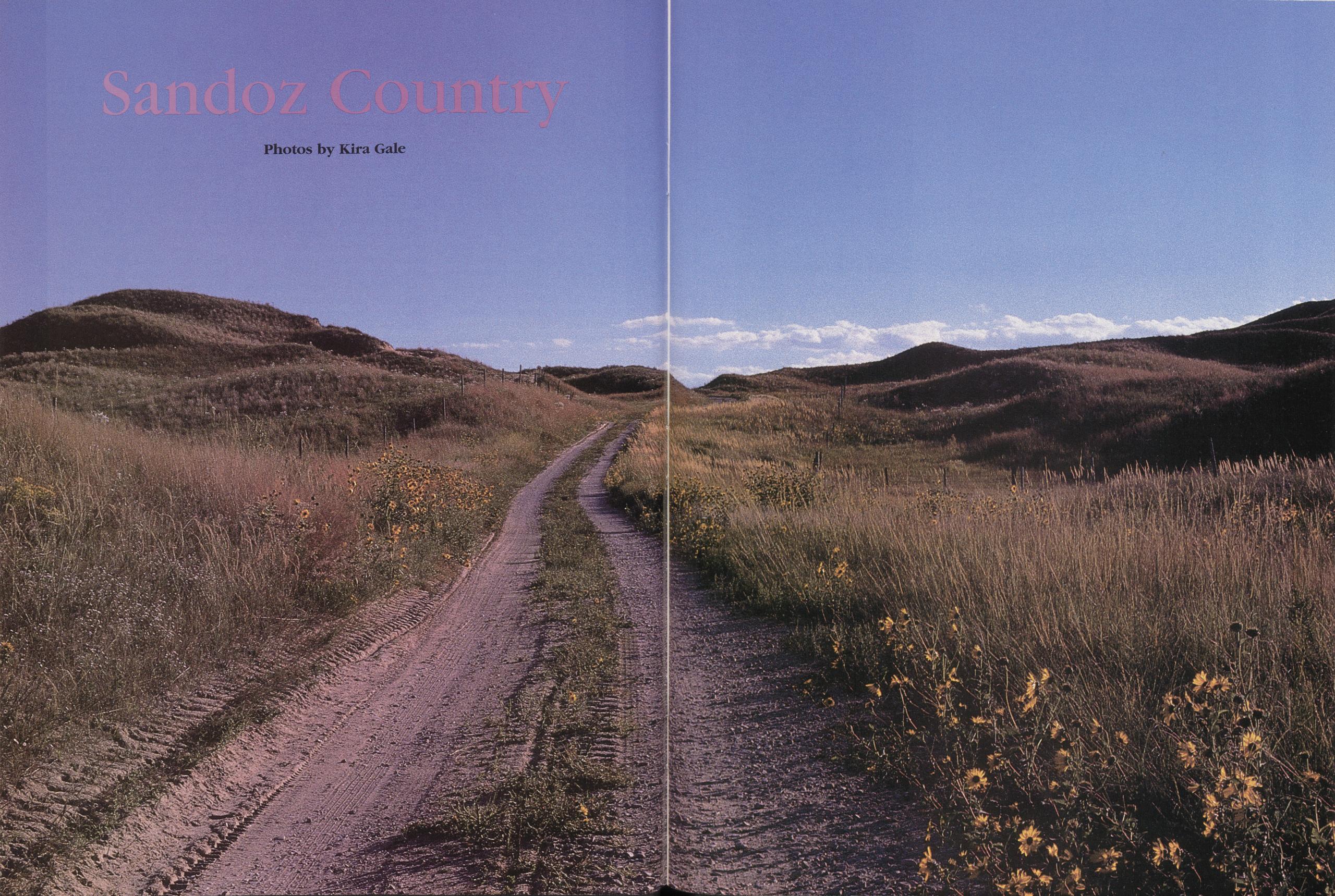
Sandoz Country
Photos by Kira Gale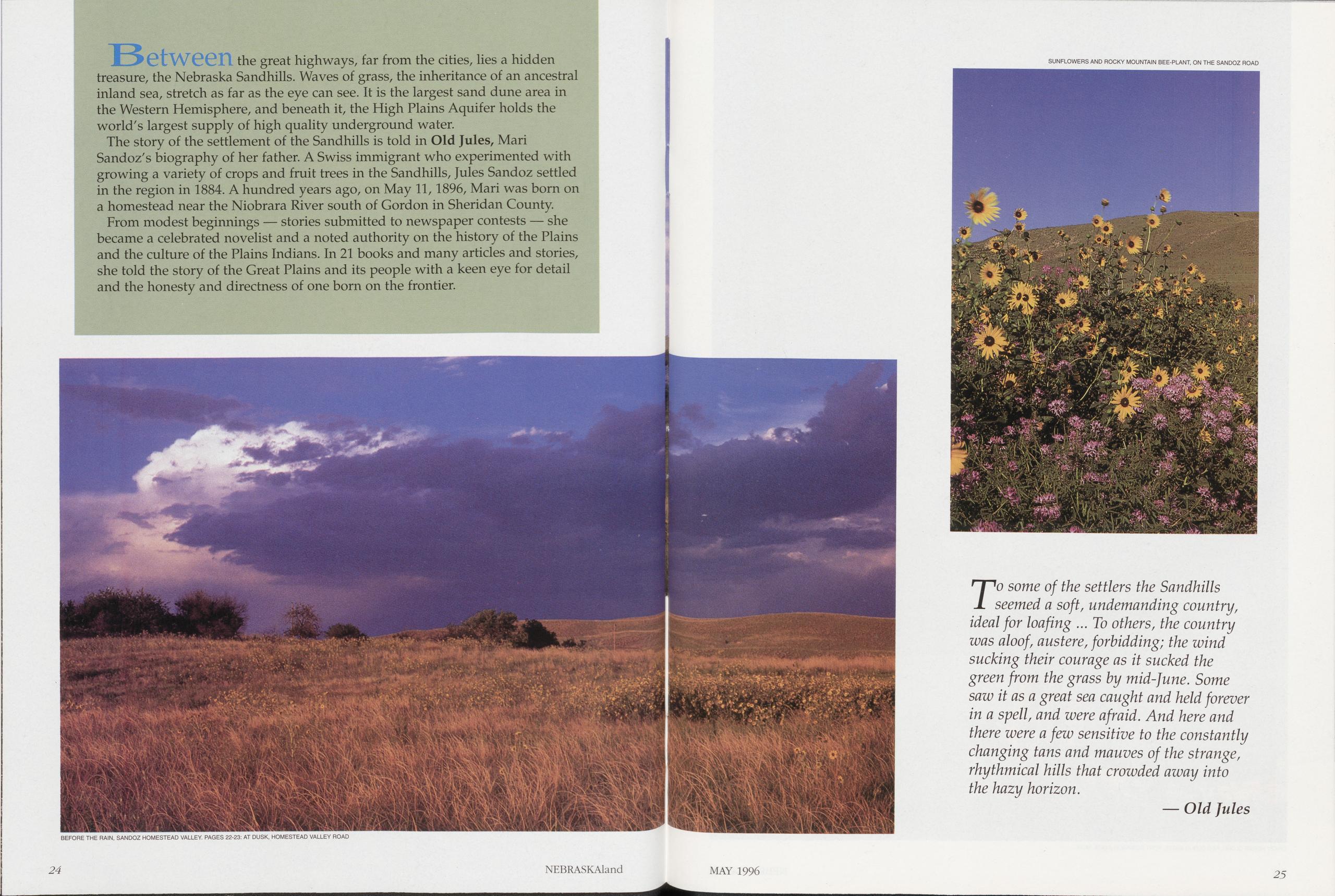
Between the great highways, far from the cities, lies a hidden treasure, the Nebraska Sandhills. Waves of grass, the inheritance of an ancestral inland sea, stretch as far as the eye can see. It is the largest sand dune area in the Western Hemisphere, and beneath it, the High Plains Aquifer holds the world's largest supply of high quality underground water.
The story of the settlement of the Sandhills is told in Old Jules, Mari Sandoz's biography of her father. A Swiss immigrant who experimented with growing a variety of crops and fruit trees in the Sandhills, Jules Sandoz settled in the region in 1884. A hundred years ago, on May 11, 1896, Mari was born on a homestead near the Niobrara River south of Gordon in Sheridan County. From modest beginnings — stories submitted to newspaper contests — she became a celebrated novelist and a noted authority on the history of the Plains and the culture of the Plains Indians. In 21 books and many articles and stories, she told the story of the Great Plains and its people with a keen eye for detail and the honesty and directness of one born on the frontier.
To some of the settlers the Sandhills seemed a soft, undemanding country, ideal for loafing ... To others, the country was aloof, austere, forbidding; the wind sucking their courage as it sucked the green from the grass by mid-June. Some saw it as a great sea caught and held forever in a spell, and were afraid. And here and there were a few sensitive to the constantly changing tans and mauves of the strange, rhythmical hills that crowded away into the hazy horizon.
— Old Jules 24 NEBRASKAland MAY 1996 25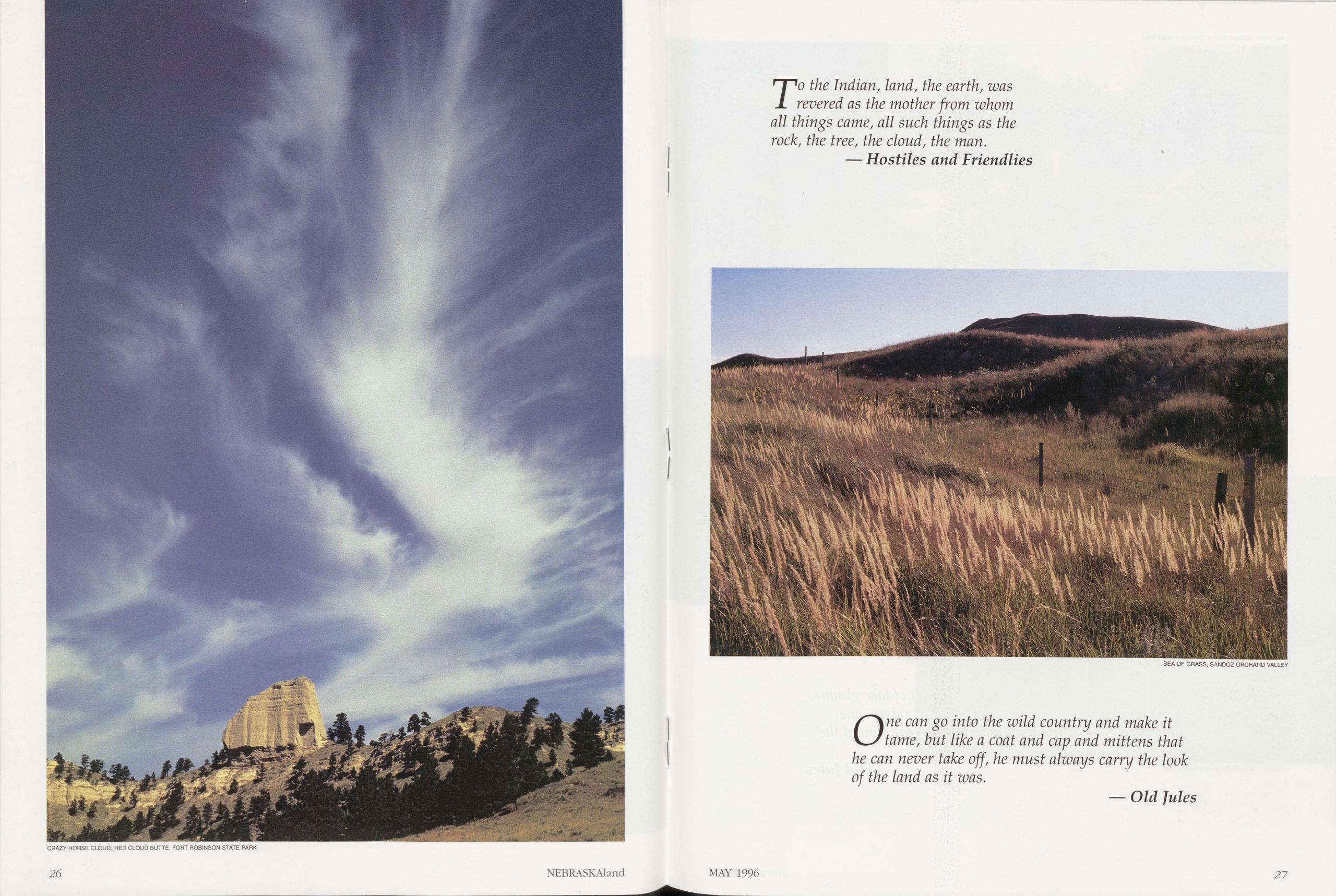
To the Indian, land, the earth, was revered as the mother from whom all things came, all such things as the rock, the tree, the cloud, the man.
— Hostiles and FriendliesOne can go into the wild country and make it tame, but like a coat and cap and mittens that he can never take off, he must always carry the look of the land as it was.
— Old Jules 26 NEBRASKAland MAY 1996 27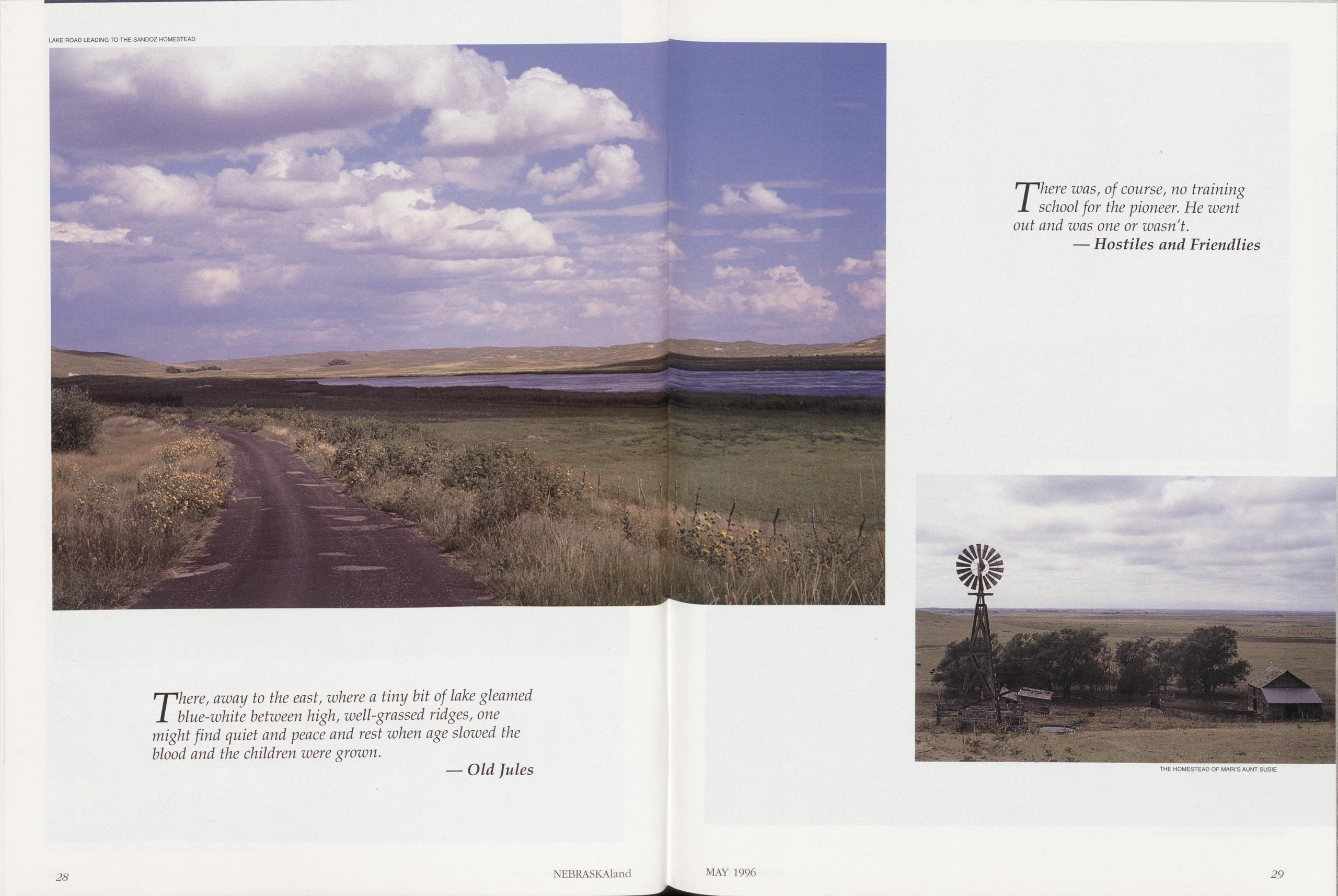
There was, of course, no training school for the pioneer. He went out and was one or wasn't. Hostiles and Friendlies There, away to the east, where a tiny bit of lake gleamed blue-white between high, well-grassed ridges, one might find quiet and peace and rest when age slowed the blood and the children were grown.
— Old Jules 29 NEBRASKAland MAY 1996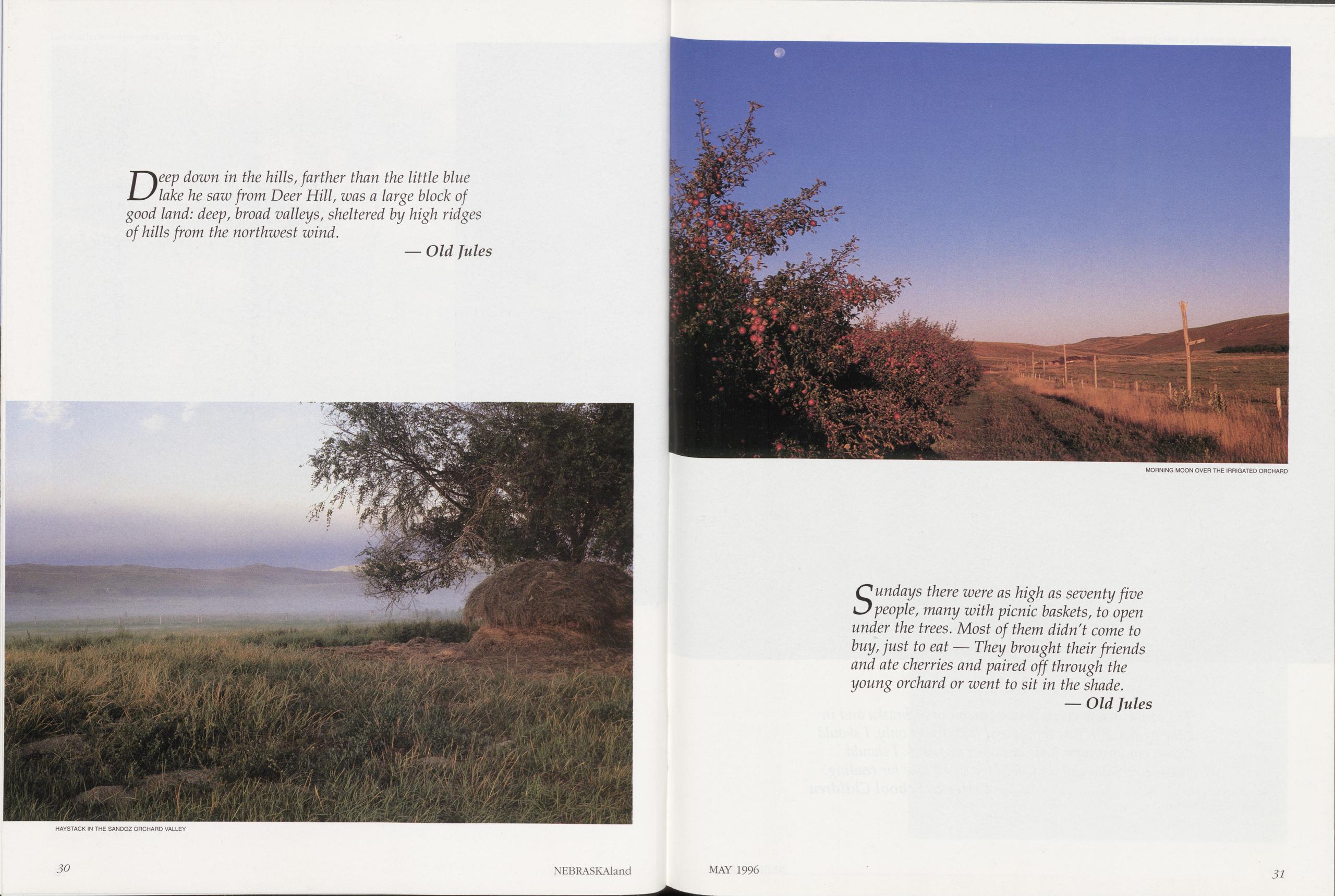
Deep down in the hills, farther than the little blue lake he saw from Deer Hill, was a large block of good land: deep, broad valleys, sheltered by high ridges of hills from the northwest wind.
— Old JulesSundays there were as high as seventy five people, many with picnic baskets, to open under the trees. Most of them didn't come to buy, just to eat — They brought their friends and ate cherries and paired off through the young orchard or went to sit in the shade.
— Old Jules 30 NEBRASKAland MAY 1996 31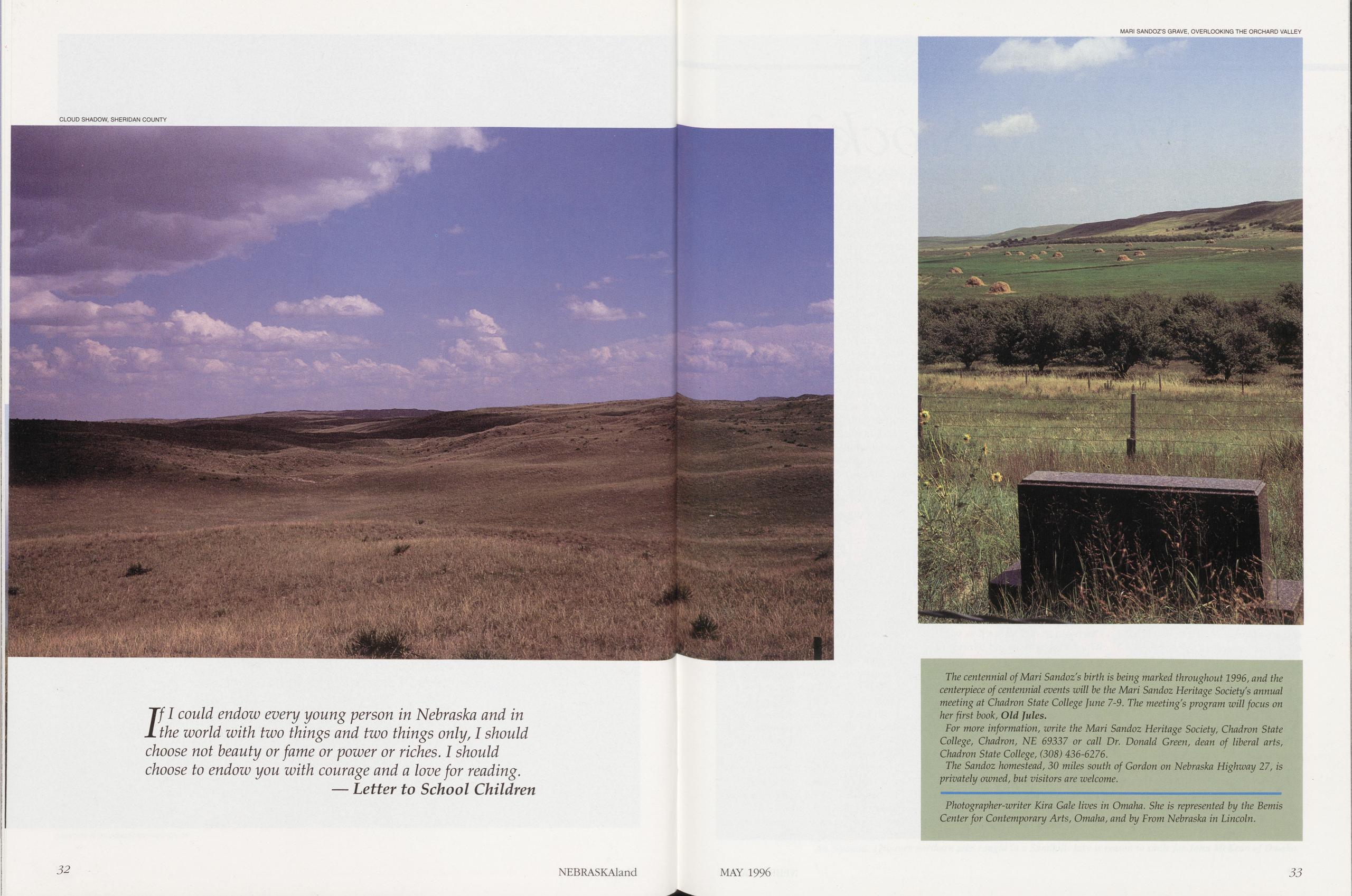
If could endow every young person in Nebraska and in the world with two things and two things only, I should choose not beauty or fame or power or riches. I should choose to endow you with courage and a love for reading.
— Letter to School Children The centennial of Mari Sandoz's birth is being marked throughout 1996, and the centerpiece of centennial events will be the Mari Sandoz Heritage Society's annual meeting at Chadron State College June 7-9. The meeting's program will focus on her first book, Old Jules. For more information, write the Mari Sandoz Heritage Society, Chadron State College, Chadron, NE 69337 or call Dr. Donald Green, dean of liberal arts, Chadron State College, (308) 436-6276. The Sandoz homestead, 30 miles south of Gordon on Nebraska Highway 27, is privately owned, but visitors are welcome. Photographer-writer Kira Gale lives in Omaha. She is represented by the Bemis Center for Contemporary Arts, Omaha, and by From Nebraska in Lincoln. 32 NEBRASKAland MAY 1996 33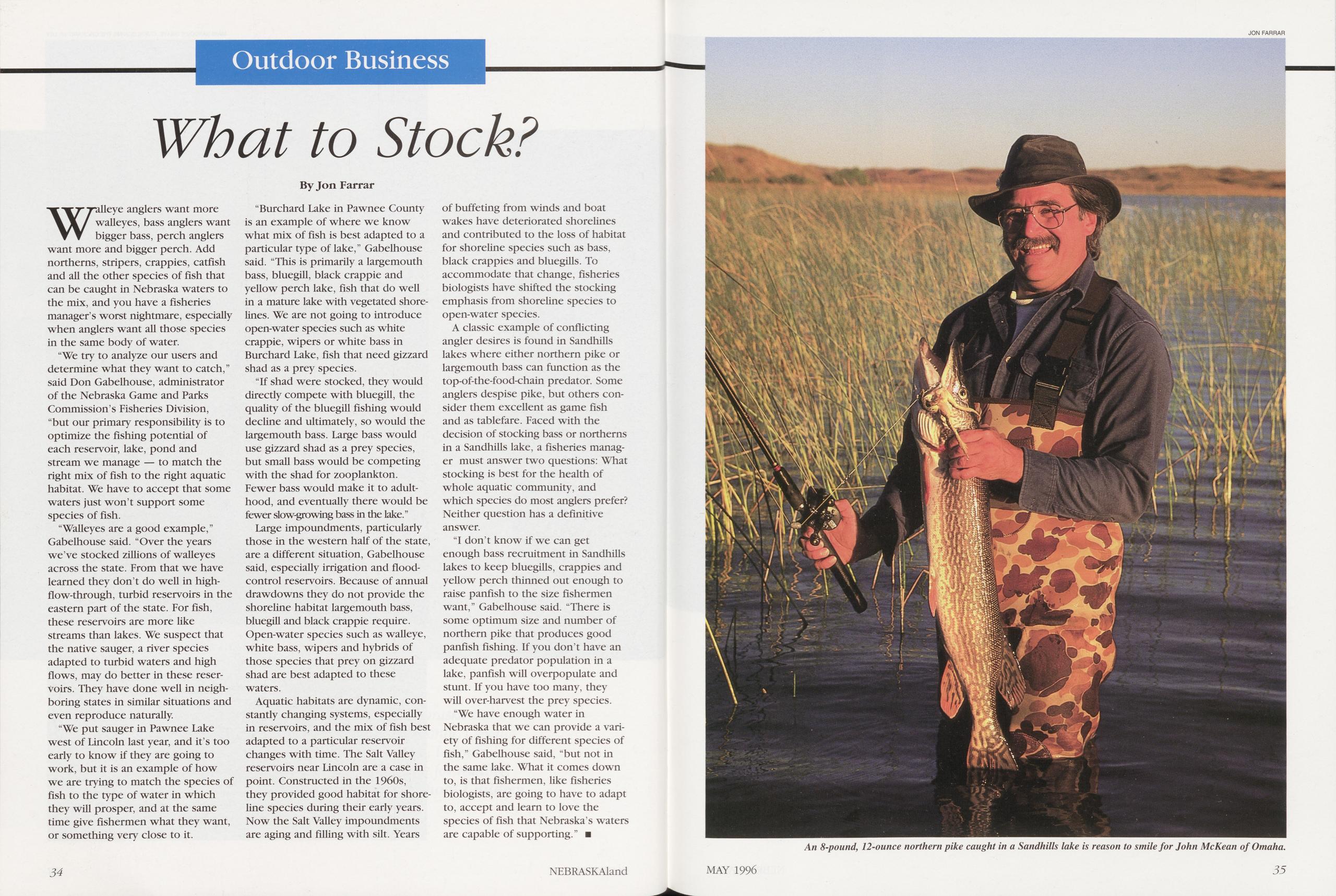
Outdoor Business
What to Stock?
Walleye anglers want more walleyes, bass anglers want bigger bass, perch anglers want more and bigger perch. Add northerns, stripers, crappies, catfish and all the other species of fish that can be caught in Nebraska waters to the mix, and you have a fisheries manager’s worst nightmare, especially when anglers want all those species in the same body of water.
“We try to analyze our users and determine what they want to catch,” said Don Gabelhouse, administrator of the Nebraska Game and Parks Commission’s Fisheries Division, “but our primary responsibility is to optimize the fishing potential of each reservoir, lake, pond and stream we manage — to match the right mix of fish to the right aquatic habitat. We have to accept that some waters just won’t support some species of fish.
“Walleyes are a good example,” Gabelhouse said. “Over the years we’ve stocked zillions of walleyes across the state. From that we have learned they don’t do well in high- flow-through, turbid reservoirs in the eastern part of the state. For fish, these reservoirs are more like streams than lakes. We suspect that the native sauger, a river species adapted to turbid waters and high flows, may do better in these reser- voirs. They have done well in neigh- boring states in similar situations and even reproduce naturally.
“We put sauger in Pawnee Lake west of Lincoln last year, and it’s too early to know if they are going to work, but it is an example of how we are trying to match the species of fish to the type of water in which they will prosper, and at the same time give fishermen what they want, or something very close to it.
“Burchard Lake in Pawnee County is an example of where we know what mix of fish is best adapted to a particular type of lake,” Gabelhouse said. “This is primarily a largemouth bass, bluegill, black crappie and yellow perch lake, fish that do well in a mature lake with vegetated shore- lines. We are not going to introduce open-water species such as white crappie, wipers or white bass in Burchard Lake, fish that need gizzard shad as a prey species.
“If shad were stocked, they would directly compete with bluegill, the quality of the bluegill fishing would decline and ultimately, so would the largemouth bass. Large bass would use gizzard shad as a prey species, but small bass would be competing with the shad for zooplankton. Fewer bass would make it to adult- hood, and eventually there would be fewer slow-growing bass in the lake.”
Large impoundments, particularly those in the western half of the state, are a different situation, Gabelhouse said, especially irrigation and flood- control reservoirs. Because of annual drawdowns they do not provide the shoreline habitat largemouth bass, bluegill and black crappie require. Open-water species such as walleye, white bass, wipers and hybrids of those species that prey on gizzard shad are best adapted to these waters.
Aquatic habitats are dynamic, con- stantly changing systems, especially in reservoirs, and the mix of fish best adapted to a particular reservoir changes with time. The Salt Valley reservoirs near Lincoln are a case in point. Constructed in the 1960s, they provided good habitat for shore- line species during their early years. Now the Salt Valley impoundments are aging and filling with silt. Years of buffeting from winds and boat wakes have deteriorated shorelines and contributed to the loss of habitat for shoreline species such as bass, black crappies and bluegills. To accommodate that change, fisheries biologists have shifted the stocking emphasis from shoreline species to open-water species.
A classic example of conflicting angler desires is found in Sandhills lakes where either northern pike or largemouth bass can function as the top-of-the-food-chain predator. Some anglers despise pike, but others con- sider them excellent as game fish and as tablefare. Faced with the decision of stocking bass or northerns in a Sandhills lake, a fisheries manag- er must answer two questions: What stocking is best for the health of whole aquatic community, and which species do most anglers prefer? Neither question has a definitive answer.
“I don’t know if we can get enough bass recruitment in Sandhills lakes to keep bluegills, crappies and yellow perch thinned out enough to raise panfish to the size fishermen want,” Gabelhouse said. “There is some optimum size and number of northern pike that produces good panfish fishing. If you don’t have an adequate predator population in a lake, panfish will overpopulate and stunt. If you have too many, they will over-harvest the prey species.
“We have enough water in Nebraska that we can provide a vari- ety of fishing for different species of fish,” Gabelhouse said, “but not in the same lake. What it comes down to, is that fishermen, like fisheries biologists, are going to have to adapt to, accept and learn to love the species of fish that Nebraska’s waters are capable of supporting.”
JON FARRAR An 8-pound, 12-ounce northern pike caught in a Sandhills lake is reason to smile for John McKean of Omaha. 34 NEBRASKAland MAY 1996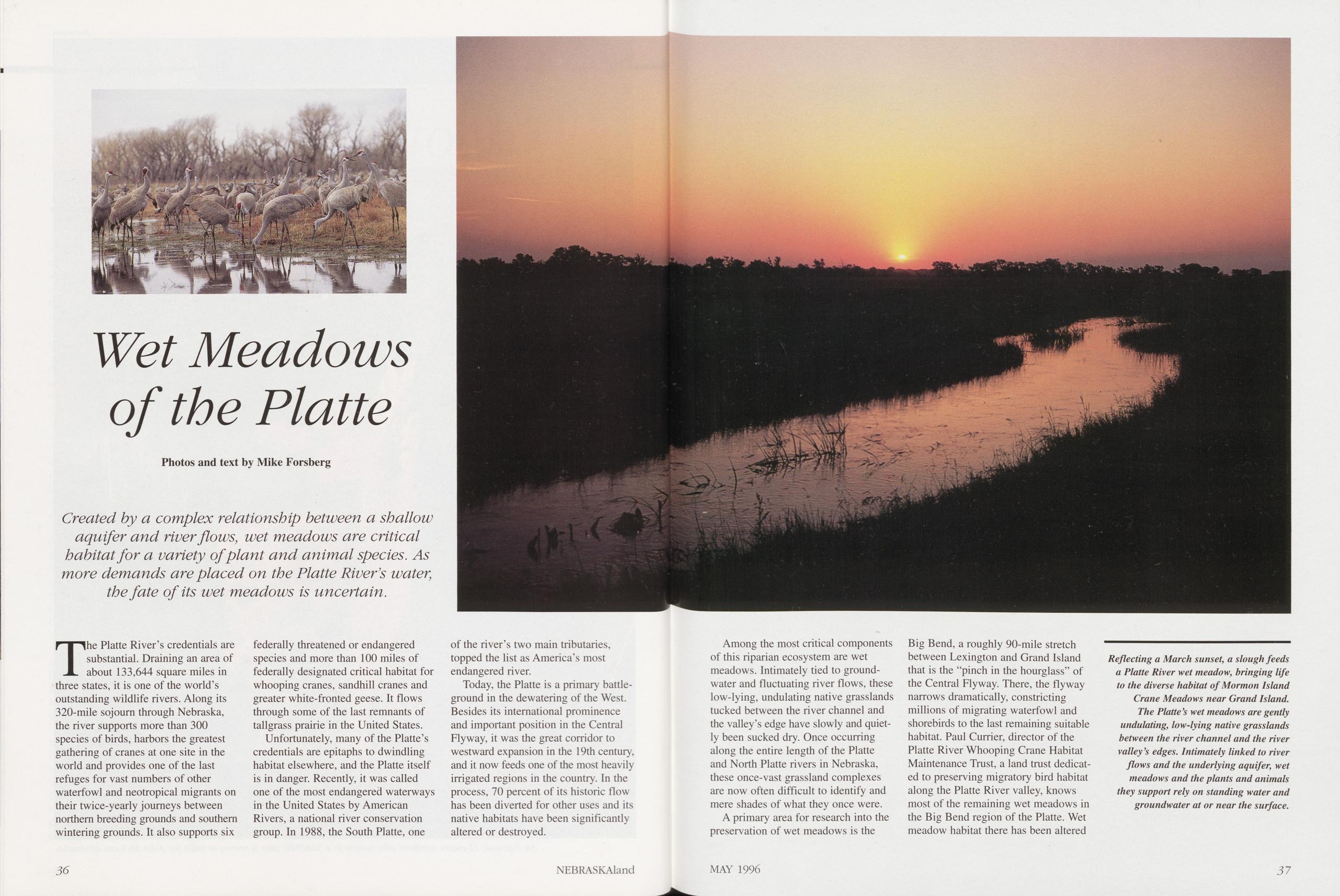
Wet Meadows of the Platte
Photos and text by Mike Forsberg Created by a complex relationship between a shallow aquifer and river flows, wet meadows are critical habitat for a variety ofplant and animal species. As more demands are placed on the Platte River’s water, the fate of its wet meadows is uncertain.The Platte River’s credentials are substantial. Draining an area of about 133,644 square miles in three states, it is one of the world’s outstanding wildlife rivers. Along its 320-mile sojourn through Nebraska, the river supports more than 300 species of birds, harbors the greatest gathering of cranes at one site in the world and provides one of the last refuges for vast numbers of other waterfowl and neotropical migrants on their twice-yearly journeys between northern breeding grounds and southern wintering grounds. It also supports six federally threatened or endangered species and more than 100 miles of federally designated critical habitat for whooping cranes, sandhill cranes and greater white-fronted geese. It flows through some of the last remnants of tailgrass prairie in the United States.
Unfortunately, many of the Platte’s credentials are epitaphs to dwindling habitat elsewhere, and the Platte itself is in danger. Recently, it was called one of the most endangered waterways in the United States by American Rivers, a national river conservation group. In 1988, the South Platte, one of the river’s two main tributaries, topped the list as America’s most endangered river
Today, the Platte is a primary battle- ground in the dewatering of the West. Besides its international prominence and important position in the Central Flyway, it was the great corridor to westward expansion in the 19th century, and it now feeds one of the most heavily irrigated regions in the country. In the process, 70 percent of its historic flow has been diverted for other uses and its native habitats have been significantly altered or destroyed.
Among the most critical components of this riparian ecosystem are wet meadows. Intimately tied to ground- water and fluctuating river flows, these low-lying, undulating native grasslands tucked between the river channel and the valley’s edge have slowly and quiet- ly been sucked dry. Once occurring along the entire length of the Platte and North Platte rivers in Nebraska, these once-vast grassland complexes are now often difficult to identify and mere shades of what they once were.
A primary area for research into the preservation of wet meadows is the Big Bend, a roughly 90-mile stretch between Lexington and Grand Island that is the "pinch in the hourglass” of the Central Flyway. There, the flyway narrows dramatically, constricting millions of migrating waterfowl and shorebirds to the last remaining suitable habitat. Paul Currier, director of the Platte River Whooping Crane Habitat Maintenance Trust, a land trust dedicat- ed to preserving migratory bird habitat along the Platte River valley, knows most of the remaining wet meadows in the Big Bend region of the Platte. Wet meadow habitat there has been altered
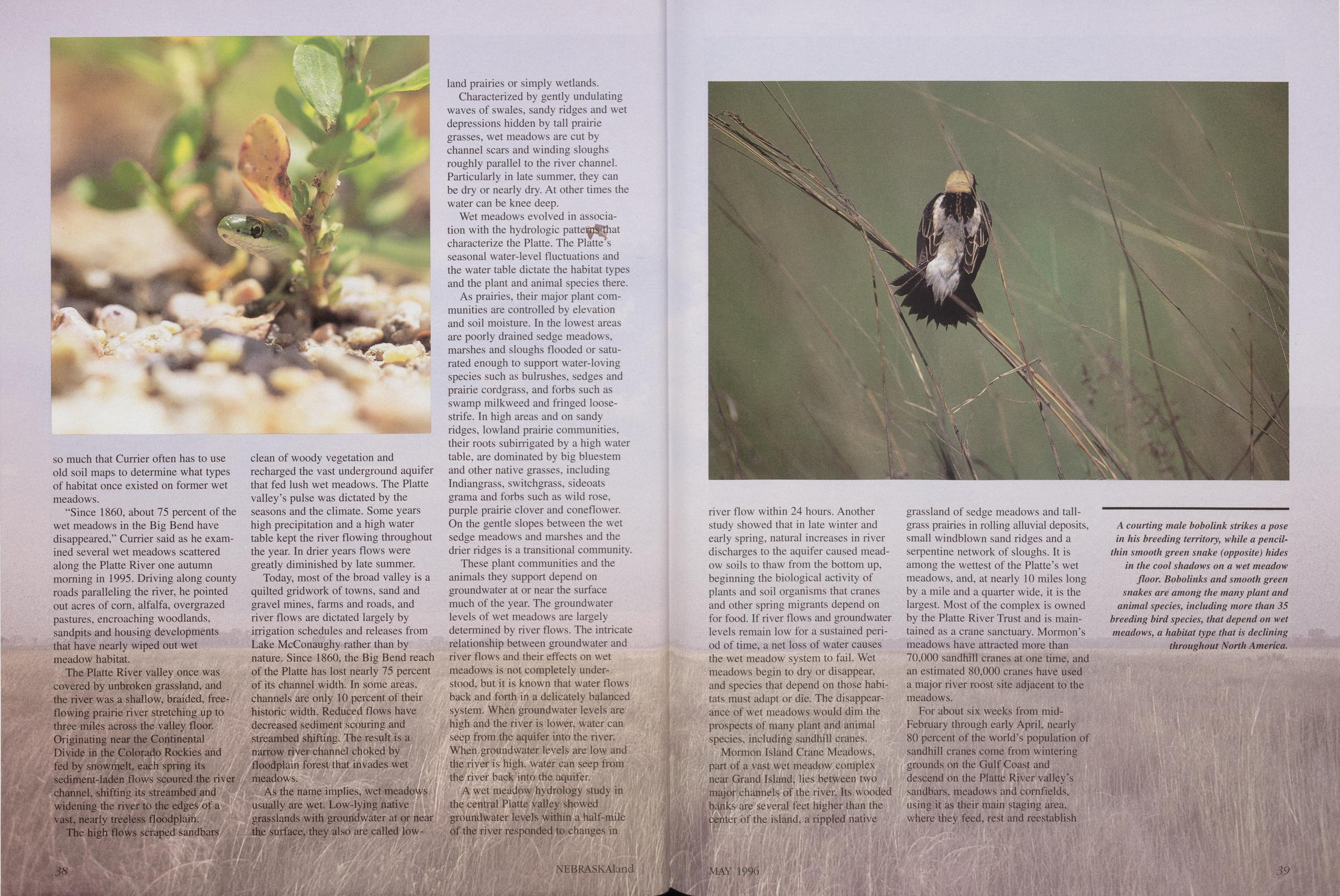
so much that Currier often has to use old soil maps to determine what types of habitat once existed on former wet meadows.
“Since 1860, about 75 percent of the wet meadows in the Big Bend have disappeared,” Currier said as he exam- ined several wet meadows scattered along the Platte River one autumn morning in 1995. Driving along county roads paralleling the river, he pointed out acres of com, alfalfa, overgrazed pastures, encroaching woodlands, sandpits and housing developments that have nearly wiped out wet meadow habitat.
The Platte River valley once was covered by unbroken grassland, and the river was a shallow, braided, free- flowing prairie river stretching up to three miles across the valley floor. Originating near the Continental Divide in the Colorado Rockies and fed by snowmelt, each spring its sediment-laden flows scoured the river channel, shifting its streambed and widening the river to the edges of a vast, nearly treeless floodplain. The high flows scraped sandbars clean of woody vegetation and recharged the vast underground aquifer that fed lush wet meadows. The Platte valley’s pulse was dictated by the seasons and the climate. Some years high precipitation and a high water table kept the river flowing throughout the year. In drier years flows were greatly diminished by late summer. Today, most of the broad valley is a quilted gridwork of towns, sand and gravel mines, farms and roads, and river flows are dictated largely by irrigation schedules and releases from Lake McConaughy rather than by nature. Since 1860, the Big Bend reach of the Platte has lost nearly 75 percent of its channel width. In some areas, channels are only 10 percent of their historic width. Reduced flows have decreased sediment scouring and streambed shifting. The result is a narrow river channel choked by floodplain forest that invades wet meadows.
As the name implies, wet meadows usually are wet. Low-lying native grasslands with groundwater at or near the surface, they also are called low- land prairies or simply wetlands.
Characterized by gently undulating waves of swales, sandy ridges and wet depressions hidden by tall prairie grasses, wet meadows are cut by channel scars and winding sloughs roughly parallel to the river channel. Particularly in late summer, they can be dry or nearly dry. At other times the water can be knee deep.
Wet meadows evolved in associa- tion with the hydrologic patte^^iat characterize the Platte. The Platte’s seasonal water-level fluctuations and the water table dictate the habitat types and the plant and animal species there.
As prairies, their major plant com- munities are controlled by elevation and soil moisture. In the lowest areas are poorly drained sedge meadows, marshes and sloughs flooded or satu- rated enough to support water-loving species such as bulrushes, sedges and prairie cordgrass, and forbs such as swamp milkweed and fringed loose- strife. In high areas and on sandy ridges, lowland prairie communities, their roots subirrigated by a high water table, are dominated by big bluestem and other native grasses, including Indiangrass, switchgrass, sideoats grama and forbs such as wild rose, purple prairie clover and coneflower. On the gentle slopes between the wet sedge meadows and marshes and the drier ridges is a transitional community.
These plant communities and the animals they support depend on groundwater at or near the surface much of the year. The groundwater levels of wet meadows are largely determined by river flows. The intricate relationship between groundwater and river flows and their effects on wet meadows is not completely under- stood, but it is known that water flows back and forth in a delicately balanced system. When groundwater levels are high and the river is lower, water can seep from the aquifer into the river. When groundwater levels are low and the river is high, water can seep from the river back into the aquifer.
A wet meadow hydrology study in the central Platte valley showed groundwater levels within a half-mile of the river responded to changes in river flow within 24 hours. Another study showed that in late winter and early spring, natural increases in river discharges to the aquifer caused mead- ow soils to thaw from the bottom up, beginning the biological activity of plants and soil organisms that cranes and other spring migrants depend on for food. If river flows and groundwater levels remain low for a sustained peri- od of time, a net loss of water causes the wet meadow system to fail. Wet meadows begin to dry or disappear, and species that depend on those habi- tats must adapt or die. The disappear- ance of wet meadows would dim the prospects of many plant and animal species, including sandhill cranes.
Mormon Island Crane Meadows, part of a vast wet meadow complex near Grand Island, lies between two major channels of the river. Its wooded banks are several feet higher than the center of the island, a rippled native
MAY 1996grassland of sedge meadows and tail- grass prairies in rolling alluvial deposits, small windblown sand ridges and a serpentine network of sloughs. It is among the wettest of the Platte’s wet meadows, and, at nearly 10 miles long by a mile and a quarter wide, it is the largest. Most of the complex is owned by the Platte River Trust and is main- tained as a crane sanctuary. Mormon’s meadows have attracted more than 70,000 sandhill cranes at one time, and an estimated 80,000 cranes have used a major river roost site adjacent to the meadows.
For about six weeks from mid- February through early April, nearly 80 percent of the world’s population of sandhill cranes come from wintering grounds on the Gulf Coast and descend on the Platte River valley’s sandbars, meadows and cornfields, using it as their main staging area, where they feed, rest and reestablish
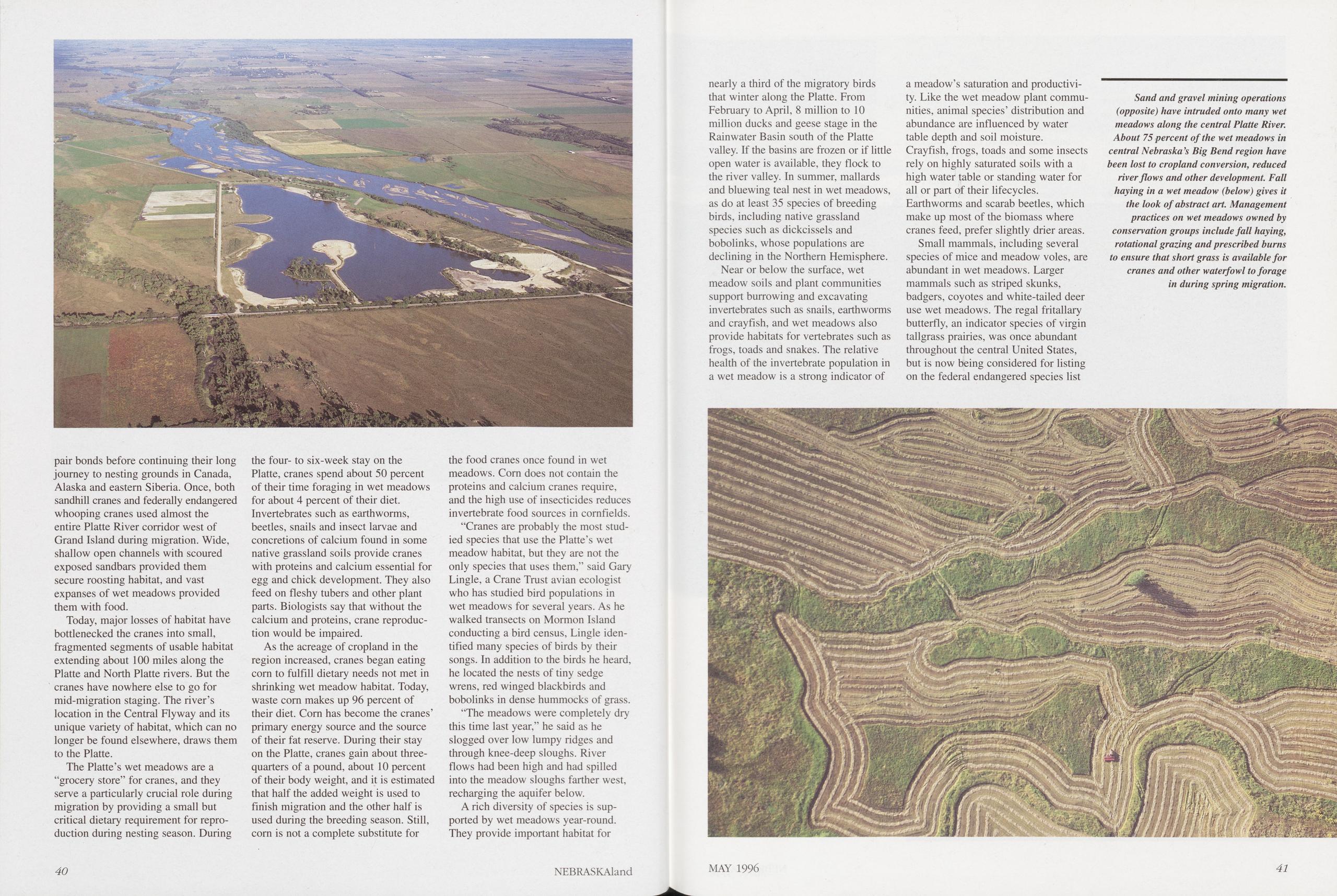
pair bonds before continuing their long journey to nesting grounds in Canada, Alaska and eastern Siberia. Once, both sandhill cranes and federally endangered whooping cranes used almost the entire Platte River corridor west of Grand Island during migration. Wide, shallow open channels with scoured exposed sandbars provided them secure roosting habitat, and vast expanses of wet meadows provided them with food.
Today, major losses of habitat have bottlenecked the cranes into small, fragmented segments of usable habitat extending about 100 miles along the Platte and North Platte rivers. But the cranes have nowhere else to go for mid-migration staging. The river’s location in the Central Flyway and its unique variety of habitat, which can no longer be found elsewhere, draws them to the Platte.
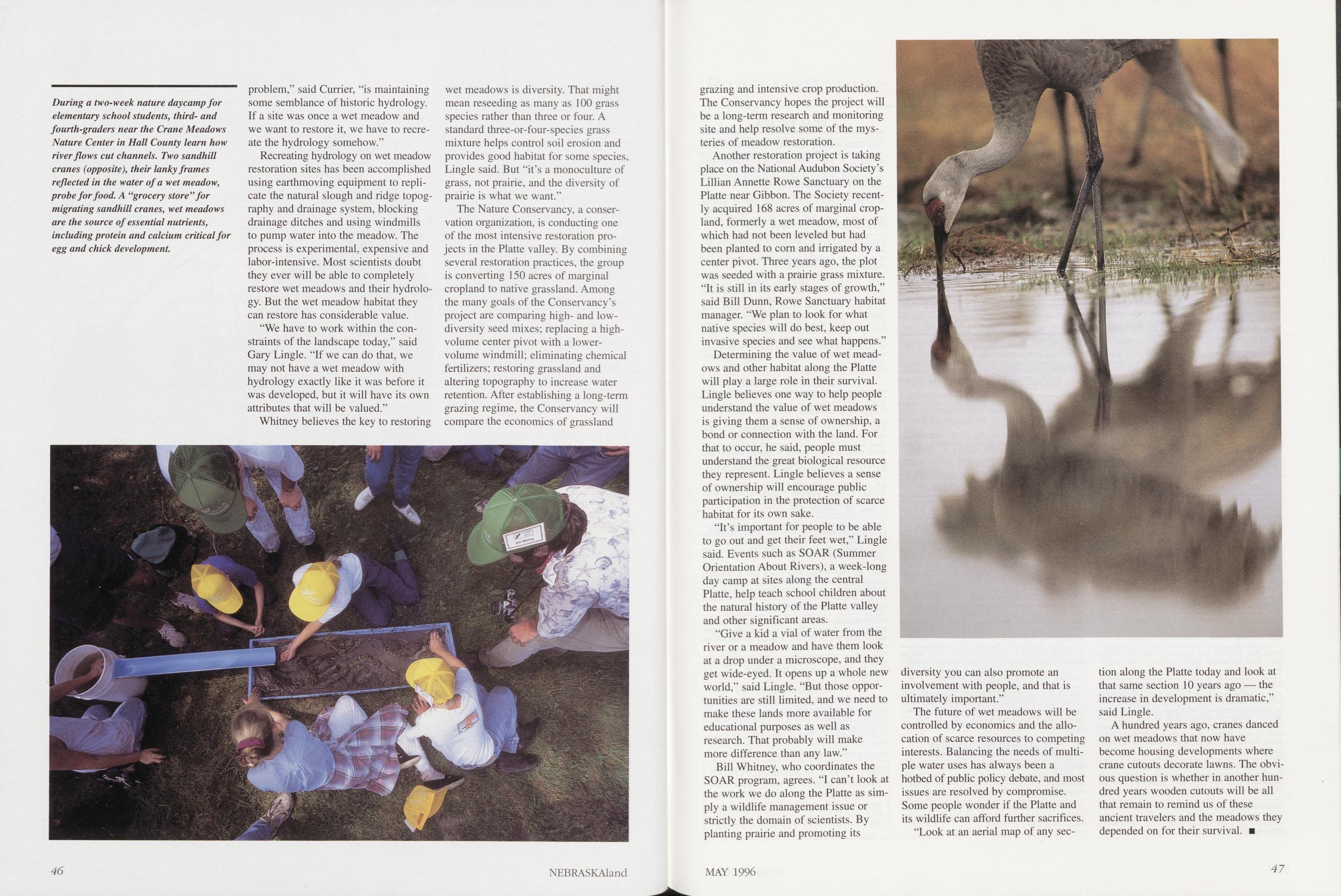
The Platte’s wet meadows are a "grocery store” for cranes, and they serve a particularly crucial role during migration by providing a small but critical dietary requirement for repro- duction during nesting season. During the four- to six-week stay on the Platte, cranes spend about 50 percent of their time foraging in wet meadows for about 4 percent of their diet. Invertebrates such as earthworms, beetles, snails and insect larvae and concretions of calcium found in some native grassland soils provide cranes with proteins and calcium essential for egg and chick development. They also feed on fleshy tubers and other plant parts. Biologists say that without the calcium and proteins, crane reproduc- tion would be impaired.
As the acreage of cropland in the region increased, cranes began eating corn to fulfill dietary needs not met in shrinking wet meadow habitat. Today, waste corn makes up 96 percent of their diet. Corn has become the cranes’ primary energy source and the source of their fat reserve. During their stay on the Platte, cranes gain about three- quarters of a pound, about 10 percent of their body weight, and it is estimated that half the added weight is used to finish migration and the other half is used during the breeding season. Still, com is not a complete substitute for the food cranes once found in wet meadows. Com does not contain the proteins and calcium cranes require, and the high use of insecticides reduces invertebrate food sources in cornfields.
"Cranes are probably the most stud- ied species that use the Platte’s wet meadow habitat, but they are not the only species that uses them,” said Gary Lingle, a Crane Trust avian ecologist who has studied bird populations in wet meadows for several years. As he walked transects on Mormon Island conducting a bird census, Lingle iden- tified many species of birds by their songs. In addition to the birds he heard, he located the nests of tiny sedge wrens, red winged blackbirds and bobolinks in dense hummocks of grass.
"The meadows were completely dry this time last year,” he said as he slogged over low lumpy ridges and through knee-deep sloughs. River flows had been high and had spilled into the meadow sloughs farther west, recharging the aquifer below.
A rich diversity of species is sup- ported by wet meadows year-round. They provide important habitat for nearly a third of the migratory birds that winter along the Platte. From February to April, 8 million to 10 million ducks and geese stage in the Rainwater Basin south of the Platte valley. If the basins are frozen or if little open water is available, they flock to the river valley. In summer, mallards and bluewing teal nest in wet meadows, as do at least 35 species of breeding birds, including native grassland species such as dickcissels and bobolinks, whose populations are declining in the Northern Hemisphere.
Near or below the surface, wet meadow soils and plant communities support burrowing and excavating invertebrates such as snails, earthworms and crayfish, and wet meadows also provide habitats for vertebrates such as frogs, toads and snakes. The relative health of the invertebrate population in a wet meadow is a strong indicator of a meadow’s saturation and productivi- ty. Like the wet meadow plant commu- nities, animal species’ distribution and abundance are influenced by water table depth and soil moisture.
Crayfish, frogs, toads and some insects rely on highly saturated soils with a high water table or standing water for all or part of their lifecycles. Earthworms and scarab beetles, which make up most of the biomass where cranes feed, prefer slightly drier areas.
Small mammals, including several species of mice and meadow voles, are abundant in wet meadows. Larger mammals such as striped skunks, badgers, coyotes and white-tailed deer use wet meadows. The regal fritallary butterfly, an indicator species of virgin tailgrass prairies, was once abundant throughout the central United States, but is now being considered for listing on the federal endangered species list
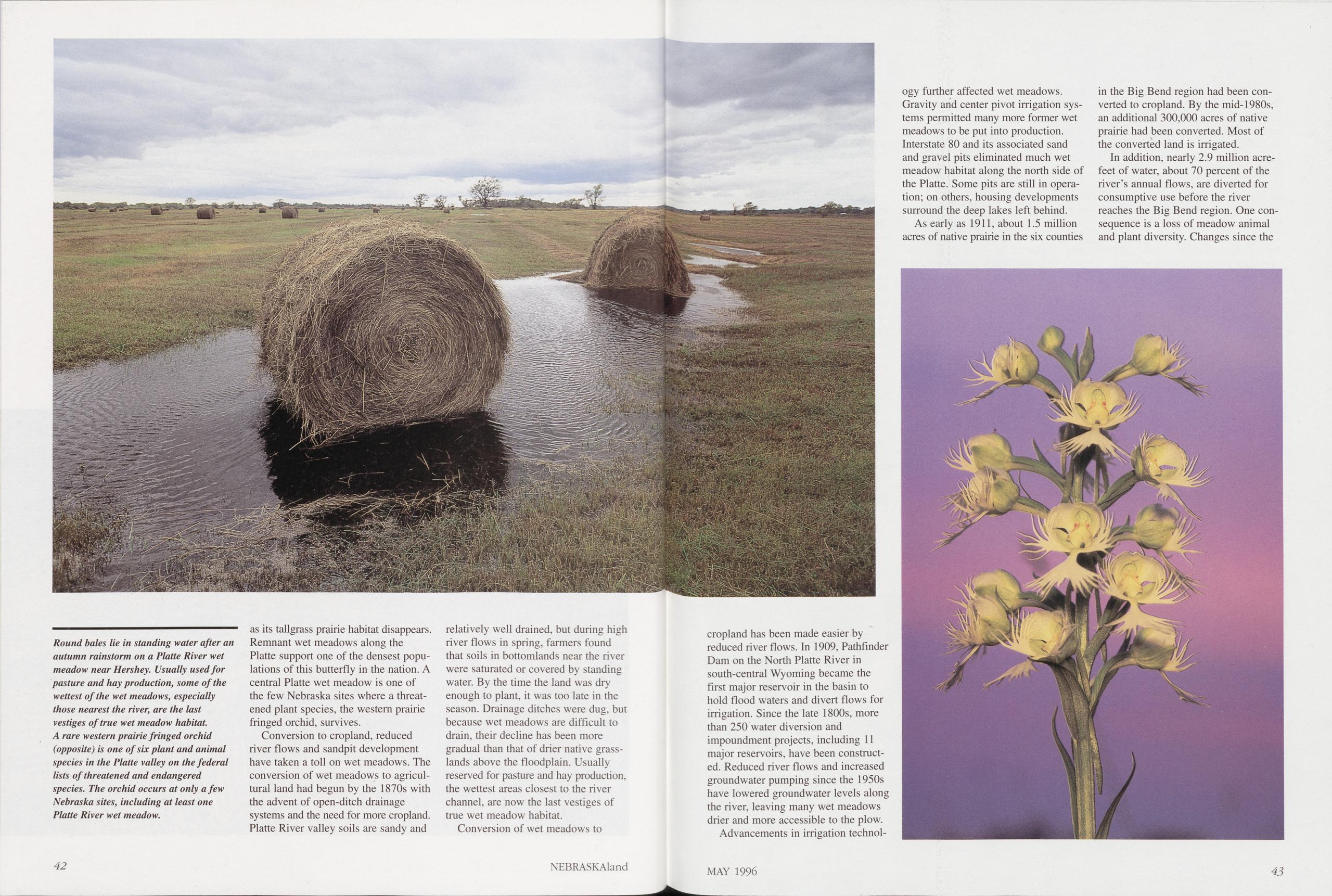
as its tailgrass prairie habitat disappears. Remnant wet meadows along the Platte support one of the densest popu- lations of this butterfly in the nation. A central Platte wet meadow is one of the few Nebraska sites where a threat- ened plant species, the western prairie fringed orchid, survives.
Conversion to cropland, reduced river flows and sandpit development have taken a toll on wet meadows. The conversion of wet meadows to agricul- tural land had begun by the 1870s with the advent of open-ditch drainage systems and the need for more cropland. Platte River valley soils are sandy and relatively well drained, but during high river flows in spring, farmers found that soils in bottomlands near the river were saturated or covered by standing water. By the time the land was dry enough to plant, it was too late in the season. Drainage ditches were dug, but because wet meadows are difficult to drain, their decline has been more gradual than that of drier native grass- lands above the floodplain. Usually reserved for pasture and hay production, the wettest areas closest to the river channel, are now the last vestiges of true wet meadow habitat.
Conversion of wet meadows to cropland has been made easier by reduced river flows. In 1909, Pathfinder Dam on the North Platte River in south-central Wyoming became the first major reservoir in the basin to hold flood waters and divert flows for irrigation. Since the late 1800s, more than 250 water diversion and impoundment projects, including 11 major reservoirs, have been construct- ed. Reduced river flows and increased groundwater pumping since the 1950s have lowered groundwater levels along the river, leaving many wet meadows drier and more accessible to the plow.
Advancements in irrigation technol- ogy further affected wet meadows. Gravity and center pivot irrigation sys- tems permitted many more former wet meadows to be put into production. Interstate 80 and its associated sand and gravel pits eliminated much wet meadow habitat along the north side of the Platte. Some pits are still in opera- tion; on others, housing developments surround the deep lakes left behind.
As early as 1911, about 1.5 million acres of native prairie in the six counties in the Big Bend region had been con- verted to cropland. By the mid-1980s, an additional 300,000 acres of native prairie had been converted. Most of the converted land is irrigated. In addition, nearly 2.9 million acre- feet of water, about 70 percent of the river’s annual flows, are diverted for consumptive use before the river reaches the Big Bend region. One con- sequence is a loss of meadow animal and plant diversity. Changes since the
42 NEBRASKAland MAY 1996 43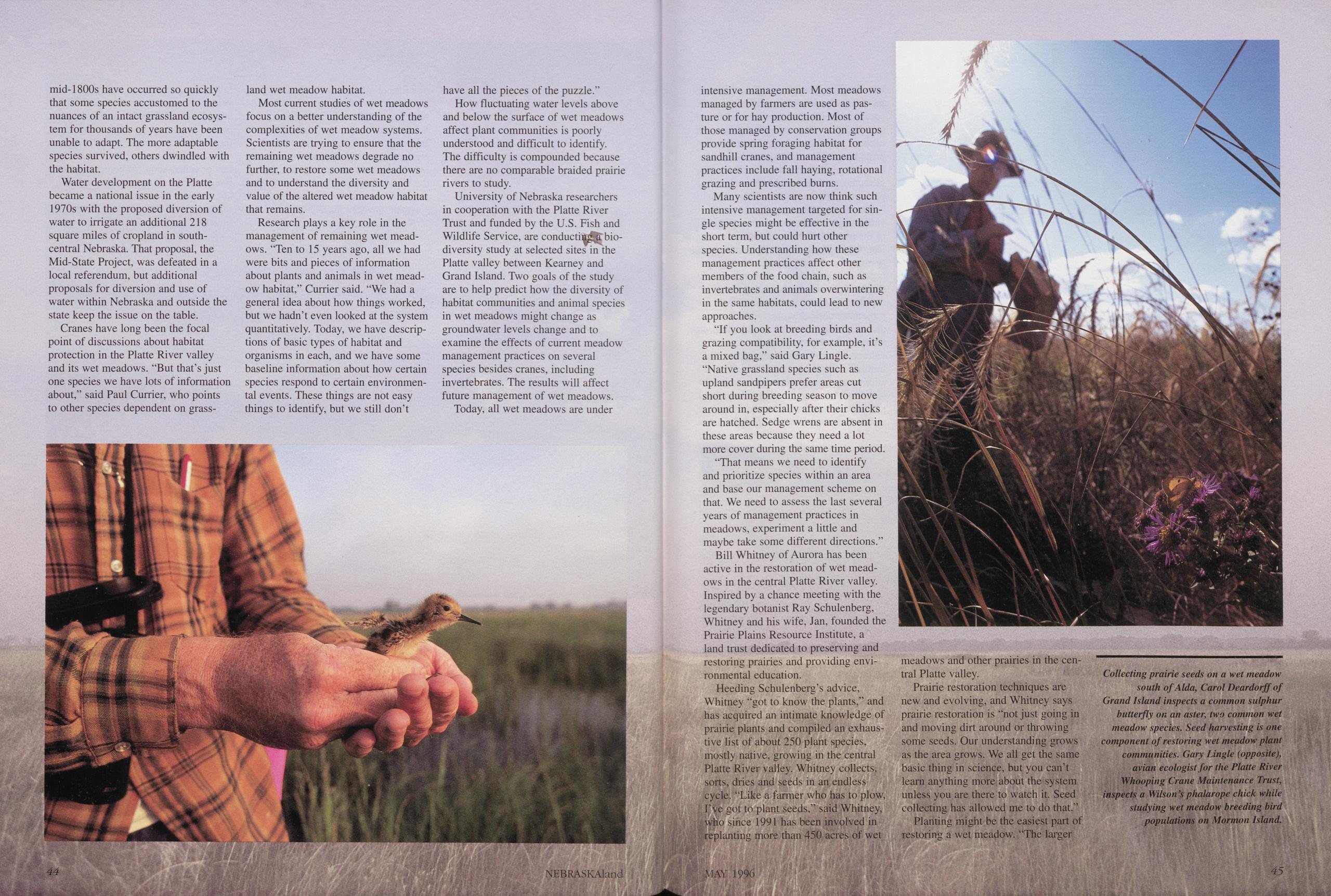
mid-1800s have occurred so quickly that some species accustomed to the nuances of an intact grassland ecosys- tem for thousands of years have been unable to adapt. The more adaptable species survived, others dwindled with the habitat.
Water development on the Platte became a national issue in the early 1970s with the proposed diversion of water to irrigate an additional 218 square miles of cropland in south- central Nebraska. That proposal, the Mid-State Project, was defeated in a local referendum, but additional proposals for diversion and use of water within Nebraska and outside the state keep the issue on the table.
Cranes have long been the focal point of discussions about habitat protection in the Platte River valley and its wet meadows. “But that’s just one species we have lots of information about,” said Paul Currier, who points to other species dependent on grass- land wet meadow habitat.
Most current studies of wet meadows focus on a better understanding of the complexities of wet meadow systems. Scientists are trying to ensure that the remaining wet meadows degrade no further, to restore some wet meadows and to understand the diversity and value of the altered wet meadow habitat that remains.
Research plays a key role in the management of remaining wet mead- ows. “Ten to 15 years ago, all we had were bits and pieces of information about plants and animals in wet mead- ow habitat,” Currier said. “We had a general idea about how things worked, but we hadn’t even looked at the system quantitatively. Today, we have descrip- tions of basic types of habitat and organisms in each, and we have some baseline information about how certain species respond to certain environmen- tal events. These things are not easy things to identify, but we still don’t have all the pieces of the puzzle.”
How fluctuating water levels above and below the surface of wet meadows affect plant communities is poorly understood and difficult to identify. The difficulty is compounded because there are no comparable braided prairie rivers to study.
University of Nebraska researchers in cooperation with the Platte River Trust and funded by the U.S. Fish and Wildlife Service, are conducti^^a bio- diversity study at selected sites in the Platte valley between Kearney and Grand Island. Two goals of the study are to help predict how the diversity of habitat communities and animal species in wet meadows might change as groundwater levels change and to examine the effects of current meadow management practices on several species besides cranes, including invertebrates. The results will affect future management of wet meadows.
Today, all wet meadows are under intensive management. Most meadows managed by farmers are used as pas- ture or for hay production. Most of those managed by conservation groups provide spring foraging habitat for sandhill cranes, and management practices include fall haying, rotational grazing and prescribed burns.
Many scientists are now think such intensive management targeted for sin- gle species might be effective in the short term, but could hurt other species. Understanding how these management practices affect other members of the food chain, such as invertebrates and animals overwintering in the same habitats, could lead to new approaches.
“If you look at breeding birds and grazing compatibility, for example, it’s a mixed bag,” said Gary Lingle. “Native grassland species such as upland sandpipers prefer areas cut short during breeding season to move around in, especially after their chicks are hatched. Sedge wrens are absent in these areas because they need a lot more cover during the same time period.
“That means we need to identify and prioritize species within an area and base our management scheme on that. We need to assess the last several years of management practices in meadows, experiment a little and maybe take some different directions.”
Bill Whitney of Aurora has been active in the restoration of wet mead- ows in the central Platte River valley. Inspired by a chance meeting with the legendary botanist Ray Schulenberg, Whitney and his wife, Jan, founded the Prairie Plains Resource Institute, a land trust dedicated to preserving and restoring prairies and providing envi- ronmental education.
Heeding Schulenberg’s advice, Whitney “got to know the plants,” and has acquired an intimate knowledge of prairie plants and compiled an exhaus- tive list of about 250 plant species, mostly native, growing in the central Platte River valley. Whitney collects, sorts, dries and seeds in an endless cycle. “Like a farmer who has to plow, I've got to plant seeds,” said Whitney, who since 1991 has been involved in replanting more than 450 acres of wet meadows and other prairies in the cen- tral Platte valley.
Prairie restoration techniques are new and evolving, and Whitney says prairie restoration is “not just going in and moving dirt around or throwing some seeds. Our understanding grows as the area grows. We all get the same basic thing in science, but you can’t learn anything more about the system unless you are there to watch it. Seed collecting has allowed me to do that.” Planting might be the easiest part of restoring a wet meadow. “The larger
problem,” said Currier, "is maintaining some semblance of historic hydrology. If a site was once a wet meadow and we want to restore it, we have to recre- ate the hydrology somehow.”
Recreating hydrology on wet meadow restoration sites has been accomplished using earthmoving equipment to repli- cate the natural slough and ridge topog- raphy and drainage system, blocking drainage ditches and using windmills to pump water into the meadow. The process is experimental, expensive and labor-intensive. Most scientists doubt they ever will be able to completely restore wet meadows and their hydrolo- gy. But the wet meadow habitat they can restore has considerable value.
"We have to work within the con- straints of the landscape today,” said Gary Lingle. "If we can do that, we may not have a wet meadow with hydrology exactly like it was before it was developed, but it will have its own attributes that will be valued.”
Whitney believes the key to restoring wet meadows is diversity. That might mean reseeding as many as 100 grass species rather than three or four. A standard three-or-four-species grass mixture helps control soil erosion and provides good habitat for some species, Lingle said. But "it’s a monoculture of grass, not prairie, and the diversity of prairie is what we want.”
The Nature Conservancy, a conser- vation organization, is conducting one of the most intensive restoration pro- jects in the Platte valley. By combining several restoration practices, the group is converting 150 acres of marginal cropland to native grassland. Among the many goals of the Conservancy’s project are comparing high- and low- diversity seed mixes; replacing a high- volume center pivot with a lower- volume windmill; eliminating chemical fertilizers; restoring grassland and altering topography to increase water retention. After establishing a long-term grazing regime, the Conservancy will compare the economics of grassland grazing and intensive crop production. The Conservancy hopes the project will be a long-term research and monitoring site and help resolve some of the mys- teries of meadow restoration.
Another restoration project is taking place on the National Audubon Society’s Lillian Annette Rowe Sanctuary on the Platte near Gibbon. The Society recent- ly acquired 168 acres of marginal crop- land, formerly a wet meadow, most of which had not been leveled but had been planted to com and irrigated by a center pivot. Three years ago, the plot was seeded with a prairie grass mixture. "It is still in its early stages of growth,” said Bill Dunn, Rowe Sanctuary habitat manager. "We plan to look for what native species will do best, keep out invasive species and see what happens.”
Determining the value of wet mead- ows and other habitat along the Platte will play a large role in their survival. Lingle believes one way to help people understand the value of wet meadows is giving them a sense of ownership, a bond or connection with the land. For that to occur, he said, people must understand the great biological resource they represent. Lingle believes a sense of ownership will encourage public participation in the protection of scarce habitat for its own sake.
"It’s important for people to be able to go out and get their feet wet,” Lingle said. Events such as SOAR (Summer Orientation About Rivers), a week-long day camp at sites along the central Platte, help teach school children about the natural history of the Platte valley and other significant areas.
"Give a kid a vial of water from the river or a meadow and have them look at a drop under a microscope, and they get wide-eyed. It opens up a whole new world,” said Lingle. “But those oppor- tunities are still limited, and we need to make these lands more available for educational purposes as well as research. That probably will make more difference than any law.”
Bill Whitney, who coordinates the SOAR program, agrees. "I can’t look at the work we do along the Platte as sim- ply a wildlife management issue or strictly the domain of scientists. By planting prairie and promoting its diversity you can also promote an involvement with people, and that is ultimately important.”
The future of wet meadows will be controlled by economics and the allo- cation of scarce resources to competing interests. Balancing the needs of multi- ple water uses has always been a hotbed of public policy debate, and most issues are resolved by compromise. Some people wonder if the Platte and its wildlife can afford further sacrifices. “Look at an aerial map of any sec- tion along the Platte today and look at that same section 10 years ago — the increase in development is dramatic,” said Lingle.
A hundred years ago, cranes danced on wet meadows that now have become housing developments where crane cutouts decorate lawns. The obvi- ous question is whether in another hun- dred years wooden cutouts will be all that remain to remind us of these ancient travelers and the meadows they depended on for their survival.
46 NEBRASKAland MAY 1996 47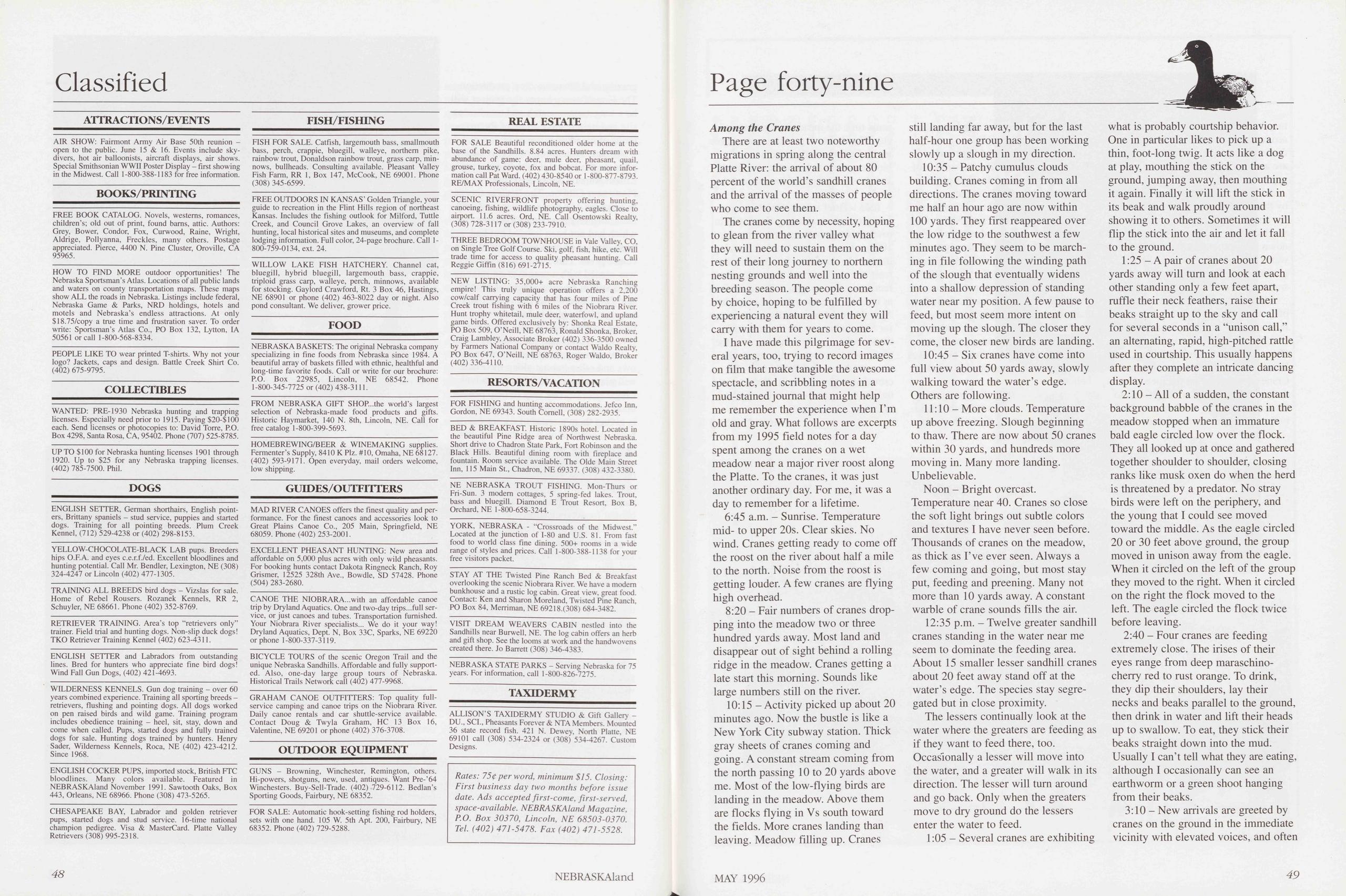
Classified
Page forty-nine
ATTRACTIONS/EVENTSAIR SHOW: Fairmont Army Air Base 50th reunion - open to the public. June 15 & 16. Events include sky- divers, hot air balloonists, aircraft displays, air shows. Special Smithsonian WWII Poster Display - first showing in the Midwest. Call 1-800-388-1183 for free information.
BOOKS/PRINTINGFREE BOOK CATALOG. Novels, westerns, romances, children’s; old out of print, found bams, attic. Authors: Grey, Bower, Condor, Fox, Curwood, Raine, Wright, Aldrige, Pollyanna, Freckles, many others. Postage appreciated. Pierce, 4400 N. Pine Cluster, Oroville, CA 95965.
HOW TO FIND MORE outdoor opportunities! The Nebraska Sportsman’s Atlas. Locations of all public lands and waters on county transportation maps. These maps show ALL the roads in Nebraska. Listings include federal, Nebraska Game & Parks, NRD holdings, hotels and motels and Nebraska’s endless attractions. At only $18.75/copy a true time and frustration saver. To order write: Sportsman’s Atlas Co., PO Box 132, Lytton, IA 50561 or call 1-800-568-8334.
PEOPLE LIKE TO wear printed T-shirts. Why not your logo? Jackets, caps and design. Battle Creek Shirt Co. (402) 675-9795.
COLLECTIBLESWANTED: PRE-1930 Nebraska hunting and trapping licenses. Especially need prior to 1915. Paying $20-$ 100 each. Send licenses or photocopies to: David Torre, P.O. Box 4298, Santa Rosa, CA, 95402. Phone (707) 525-8785. UPTO $100 for Nebraska hunting licenses 1901 through 1920. Up to $25 for any Nebraska trapping licenses. (402) 785-7500. Phil.
DOGSENGLISH SETTER, German shorthairs, English point- ers, Brittany spaniels - stud service, puppies and started dogs. Training for all pointing breeds. Plum Creek Kennel, (712) 529-4238 or (402) 298-8153.
YELLOW-CHOCOLATE-BLACK LAB pups. Breeders hips O.F.A. and eyes c.e.r.f./ed. Excellent bloodlines and hunting potential. Call Mr. Bendler, Lexington, NE (308) 324-4247 or Lincoln (402) 477-1305.
TRAINING ALL BREEDS bird dogs - Vizslas for sale. Home of Rebel Rousers. Rozanek Kennels, RR 2, Schuyler, NE 68661. Phone (402) 352-8769.
RETRIEVER TRAINING. Area’s top “retrievers only” trainer. Field trial and hunting dogs. Non-slip duck dogs! TKO Retriever Training Kennel (402) 623-4311.
ENGLISH SETTER and Labradors from outstanding lines. Bred for hunters who appreciate fine bird dogs! Wind Fall Gun Dogs, (402) 421-4693.
WILDERNESS KENNELS. Gun dog training - over 60 years combined experience. Training all sporting breeds - retrievers, flushing and pointing dogs. All dogs worked on pen raised birds and wild game. Training program includes obedience training - heel, sit, stay, down and come when called. Pups, started dogs and fully trained dogs for sale. Hunting dogs trained by hunters. Henry Sader, Wilderness Kennels, Roca, NE (402) 423-4212. Since 1968.
ENGLISH COCKER PUPS, imported stock, British FTC bloodlines. Many colors available. Featured in NEBRASKAland November 1991. Sawtooth Oaks, Box 443, Orleans, NE 68966. Phone (308) 473-5265.
CHESAPEAKE BAY, Labrador and golden retriever pups, started dogs and stud service. 16-time national champion pedigree. Visa & MasterCard. Platte Valley Retrievers (308) 995-2318.
FISH/FISHINGFISH FOR SALE. Catfish, largemouth bass, smallmouth bass, perch, crappie, bluegill, walleye, northern pike, rainbow trout, Donaldson rainbow trout, grass carp, min- nows, bullheads. Consulting available. Pleasant Valley Fish Farm, RR 1, Box 147, McCook, NE 69001. Phone (308) 345-6599.
FREE OUTDOORS IN KANSAS’ Golden Triangle, your guide to recreation in the Flint Hills region of northeast Kansas. Includes the fishing outlook for Milford, Tuttle Creek, and Council Grove Lakes, an overview of fall hunting, local historical sites and museums, and complete lodging information. Full color, 24-page brochure. Call 1- 800-759-0134, ext. 24.
WILLOW LAKE FISH HATCHERY. Channel cat, bluegill, hybrid bluegill, largemouth bass, crappie, triploid grass carp, walleye, perch, minnows, available for stocking. Gaylord Crawford, Rt. 3 Box 46, Hastings, NE 68901 or phone (402) 463-8022 day or night. Also pond consultant. We deliver, grower price.
FOODNEBRASKA BASKETS: The original Nebraska company specializing in fine foods from Nebraska since 1984. A beautiful array of baskets filled with ethnic, healthful and long-time favorite foods. Call or write for our brochure: P.O. Box 22985, Lincoln, NE 68542. Phone 1-800-345-7725 or (402) 438-3111.
FROM NEBRASKA GIFT SHOP .the world’s largest selection of Nebraska-made food products and gifts. Historic Haymarket, 140 N. 8th, Lincoln, NE. Call for free catalog 1-800-399-5693.
HOMEBREWING/BEER & WINEMAKING supplies. Fermenter’s Supply, 8410 K Plz. #10, Omaha, NE 68127. (402) 593-9171. Open everyday, mail orders welcome, low shipping.
GUIDES/OUTFITTERSMAD RIVER CANOES offers the finest quality and per- formance. For the finest canoes and accessories look to Great Plains Canoe Co., 205 Main, Springfield, NE 68059. Phone (402) 253-2001.
EXCELLENT PHEASANT HUNTING: New area and affordable on 5,000 plus acres with only wild pheasants. For booking hunts contact Dakota Ringneck Ranch, Roy Grismer, 12525 328th Ave., Bowdle, SD 57428. Phone (504) 283-2680.
CANOE THE NIOBRARA...with an affordable canoe trip by Dryland Aquatics. One and two-day trips...full ser- vice, or just canoes and tubes. Transportation furnished. Your Niobrara River specialists... We do it your way! Dryland Aquatics, Dept. N, Box 33C, Sparks, NE 69220 or phone 1-800-337-3119.
>BICYCLE TOURS of the scenic Oregon Trail and the unique Nebraska Sandhills. Affordable and fully support- ed. Also, one-day large group tours of Nebraska. Historical Trails Network call (402) 477-9968
GRAHAM CANOE OUTFITTERS: Top quality full- service camping and canoe trips on the Niobrara River. Daily canoe rentals and car shuttle-service available. Contact Doug & Twyla Graham, HC 13 Box 16, Valentine, NE 69201 or phone (402) 376-3708.
OUTDOOR EQUIPMENTGUNS - Browning, Winchester, Remington, others. Hi-powers, shotguns, new, used, antiques. Want Pre-’64 Winchesters. Buy-Sell-Trade. (402) 729-6112. Bedlan’s Sporting Goods, Fairbury, NE 68352.
FOR SALE: Automatic hook-setting fishing rod holders, sets with one hand. 105 W. 5th Apt. 200, Fairbury, NE 68352. Phone (402) 729-5288.
REAL ESTATEFOR SALE Beautiful reconditioned older home at the base of the Sandhills. 8.84 acres. Hunters dream with abundance of game: deer, mule deer, pheasant, quail, grouse, turkey, coyote, fox and bobcat. For more infor- mation call Pat Ward. (402) 430-8540 or 1-800-877-8793. RE/MAX Professionals, Lincoln, NE.
SCENIC RIVERFRONT property offering hunting, canoeing, fishing, wildlife photography, eagles. Close to airport. 11.6 acres. Ord, NE. Call Osentowski Realty, (308) 728-3117 or (308) 233-7910.
THREE BEDROOM TOWNHOUSE in Vale Valley, CO, on Single Tree Golf Course. Ski, golf, fish, hike, etc. Will trade time for access to quality pheasant hunting. Call Reggie Giffin (816) 691-2715.
NEW LISTING: 35,000+ acre Nebraska Ranching empire! This truly unique operation offers a 2,200 cow/calf carrying capacity that has four miles of Pine Creek trout fishing with 6 miles of the Niobrara River. Hunt trophy whitetail, mule deer, waterfowl, and upland game birds. Offered exclusively by: Shonka Real Estate, PO Box 509, O’Neill, NE 68763, Ronald Shonka, Broker, Craig Lambley, Associate Broker (402) 336-3500 owned by Farmers National Company or contact Waldo Realty, PO Box 647, O’Neill, NE 68763, Roger Waldo, Broker (402) 336-4110.
RESORTS/VACATIONFOR FISHING and hunting accommodations. Jefco Inn, Gordon, NE 69343. South Cornell, (308) 282-2935. BED & BREAKFAST. Historic 1890s hotel. Located in the beautiful Pine Ridge area of Northwest Nebraska. Short drive to Chadron State Park, Fort Robinson and the Black Hills. Beautiful dining room with fireplace and fountain. Room service available. The Olde Main Street Inn, 115 Main St., Chadron, NE 69337. (308) 432-3380.
NE NEBRASKA TROUT FISHING. Mon-Thurs or Fri-Sun. 3 modem cottages, 5 spring-fed lakes. Trout, bass and bluegill. Diamond E Trout Resort, Box B, Orchard, NE 1-800-658-3244.
YORK, NEBRASKA - “Crossroads of the Midwest.” Located at the junction of 1-80 and U.S. 81. From fast food to world class fine dining. 500+ rooms in a wide range of styles and prices. Call 1-800-388-1138 for your free visitors packet.
STAY AT THE Twisted Pine Ranch Bed & Breakfast overlooking the scenic Niobrara River. We have a modem bunkhouse and a rustic log cabin. Great view, great food. Contact: Ken and Sharon Moreland, Twisted Pine Ranch, PO Box 84, Merriman, NE 69218.(308) 684-3482.
VISIT DREAM WEAVERS CABIN nestled into the Sandhills near Burwell, NE. The log cabin offers an herb and gift shop. See the looms at work and the handwovens created there. Jo Barrett (308) 346-4383.
NEBRASKA STATE PARKS - Serving Nebraska for 75 years. For information, call 1-800-826-7275.
TAXIDERMYALLISON’S TAXIDERMY STUDIO & Gift Gallery - DU., SCI., Pheasants Forever & NTA Members. Mounted 36 state record fish. 421 N. Dewey, North Platte, NE 69101 call (308) 534-2324 or (308) 534-4267. Custom Designs.
Rates: 75$ per word, minimum $15. Closing: First business day two months before issue date. Ads accepted first-come, first-served, space-available. NEBRASKAland Magazine, P.O. Box 30370, Lincoln, NE 68503-0370. Tel. (402) 471-5478. Fax (402) 471-5528.There are at least two noteworthy migrations in spring along the central Platte River: the arrival of about 80 percent of the world’s sandhill cranes and the arrival of the masses of people who come to see them.
The cranes come by necessity, hoping to glean from the river valley what they will need to sustain them on the rest of their long journey to northern nesting grounds and well into the breeding season. The people come by choice, hoping to be fulfilled by experiencing a natural event they will carry with them for years to come.
I have made this pilgrimage for sev- eral years, too, trying to record images on film that make tangible the awesome spectacle, and scribbling notes in a mud-stained journal that might help me remember the experience when I’m old and gray. What follows are excerpts from my 1995 field notes for a day spent among the cranes on a wet meadow near a major river roost along the Platte. To the cranes, it was just another ordinary day. For me, it was a day to remember for a lifetime.
6:45 a.m. - Sunrise. Temperature mid- to upper 20s. Clear skies. No wind. Cranes getting ready to come off the roost on the river about half a mile to the north. Noise from the roost is getting louder. A few cranes are flying high overhead.
8:20 - Fair numbers of cranes drop- ping into the meadow two or three hundred yards away. Most land and disappear out of sight behind a rolling ridge in the meadow. Cranes getting a late start this morning. Sounds like large numbers still on the river.
10:15 - Activity picked up about 20 minutes ago. Now the bustle is like a New York City subway station. Thick gray sheets of cranes coming and going. A constant stream coming from the north passing 10 to 20 yards above me. Most of the low-flying birds are landing in the meadow. Above them are flocks flying in Vs south toward the fields. More cranes landing than leaving. Meadow filling up. Cranes still landing far away, but for the last half-hour one group has been working slowly up a slough in my direction.
10:35 - Patchy cumulus clouds building. Cranes coming in from all directions. The cranes moving toward me half an hour ago are now within 100 yards. They first reappeared over the low ridge to the southwest a few minutes ago. They seem to be march- ing in file following the winding path of the slough that eventually widens into a shallow depression of standing water near my position. A few pause to feed, but most seem more intent on moving up the slough. The closer they come, the closer new birds are landing.
10:45 - Six cranes have come into full view about 50 yards away, slowly walking toward the water’s edge. Others are following.
11:10- More clouds. Temperature up above freezing. Slough beginning to thaw. There are now about 50 cranes within 30 yards, and hundreds more moving in. Many more landing. Unbelievable.
Noon - Bright overcast. Temperature near 40. Cranes so close the soft light brings out subtle colors and textures I have never seen before. Thousands of cranes on the meadow, as thick as I’ve ever seen. Always a few coming and going, but most stay put, feeding and preening. Many not more than 10 yards away. A constant warble of crane sounds fills the air.
12:35 p.m. - Twelve greater sandhill cranes standing in the water near me seem to dominate the feeding area. About 15 smaller lesser sandhill cranes about 20 feet away stand off at the water’s edge. The species stay segre- gated but in close proximity.
The lessors continually look at the water where the greaters are feeding as if they want to feed there, too. Occasionally a lesser will move into the water, and a greater will walk in its direction. The lesser will turn around and go back. Only when the greaters move to dry ground do the lessers enter the water to feed.
1:05- Several cranes are exhibiting what is probably courtship behavior. One in particular likes to pick up a thin, foot-long twig. It acts like a dog at play, mouthing the stick on the ground, jumping away, then mouthing it again. Finally it will lift the stick in its beak and walk proudly around showing it to others. Sometimes it will flip the stick into the air and let it fall to the ground.
1:25 -A pair of cranes about 20 yards away will turn and look at each other standing only a few feet apart, ruffle their neck feathers, raise their beaks straight up to the sky and call for several seconds in a “unison call,” an alternating, rapid, high-pitched rattle used in courtship. This usually happens after they complete an intricate dancing display.
2:10 - All of a sudden, the constant background babble of the cranes in the meadow stopped when an immature bald eagle circled low over the flock. They all looked up at once and gathered together shoulder to shoulder, closing ranks like musk oxen do when the herd is threatened by a predator. No stray birds were left on the periphery, and the young that I could see moved toward the middle. As the eagle circled 20 or 30 feet above ground, the group moved in unison away from the eagle. When it circled on the left of the group they moved to the right. When it circled on the right the flock moved to the left. The eagle circled the flock twice before leaving.
2:40 - Four cranes are feeding extremely close. The irises of their eyes range from deep maraschino- cherry red to rust orange. To drink, they dip their shoulders, lay their necks and beaks parallel to the ground, then drink in water and lift their heads up to swallow. To eat, they stick their beaks straight down into the mud. Usually I can’t tell what they are eating, although I occasionally can see an earthworm or a green shoot hanging from their beaks. 3:10- New arrivals are greeted by cranes on the ground in the immediate vicinity with elevated voices, and often
48 NEBRASKAland MAY 1996 49
they begin dancing until the new arrivals are settled. Birds seem to dance before flight, when other cranes are arriving and sometimes for no apparent reason.
3:45 - A few cranes seem fascinated by their own down feathers floating in the air after they preen. Some look startled when they notice a fluff of down hanging in the air and usually watch it float all the way to the ground, sometimes biting at it on the way down.
4:00 - Several hundred cranes took off south for the cornfields. Little feeding going on now.
5:35 - Sky in west purple. Occasional flakes of sleet falling. Wind from the north increasing. Cranes descending on the meadows in droves, all coming from cornfields to the south, stopping on their way back to the river roost. Some already begin- ning to leave from the meadows back to the river for the night.
6:00 - Few flakes of light snow. Wet meadow looks like the surface of an aircraft carrier with all its planes poised to take off. The cranes mingle in groups of about 10 to several hun- dred. Most face north toward the river. The groups ready to take flight begin to dance, and they walk slowly to the north as a group like a marching band in horizontal lines to the north. When a group is close, I can barely hear a low rumbling purr immediately before they take off. Then they fly. When small groups leave it doesn’t seem to affect other groups, but when a large group of a hundred or more birds takes off, many smaller groups follow close behind.
6:05 - Noise from the river getting louder as more cranes leave the mead- ow and head toward the roost. At the same time the meadow is getting qui- eter. The darker it gets the more cranes leave. Farther south, huge lines of birds continue to leave the cornfields and pass over the meadow toward the river.
6:45 - Brief sunset. One last large group of cranes standing single file in rows about eight deep stretching about 100 yards across just took off, leaving in turn like dominoes in a wave from west to east. The flock picked up the remaining few stragglers like a vacuum as it passed over the rest of the meadow. Now the meadow is oddly quiet except for a slight breeze. On the ground in the twilight, downy feathers cover the meadow like snow. A mile away, the river roost sounds like the roar of a crowded stadium. It will all start again tomorrow at sunrise. It is the rhythm of cranes. Good night.
Mike Forsberg
Position: 584 (19 views)