Volume 74, Issue 3, 1996
NEBRASKAland
MARCH 1996 • $2.00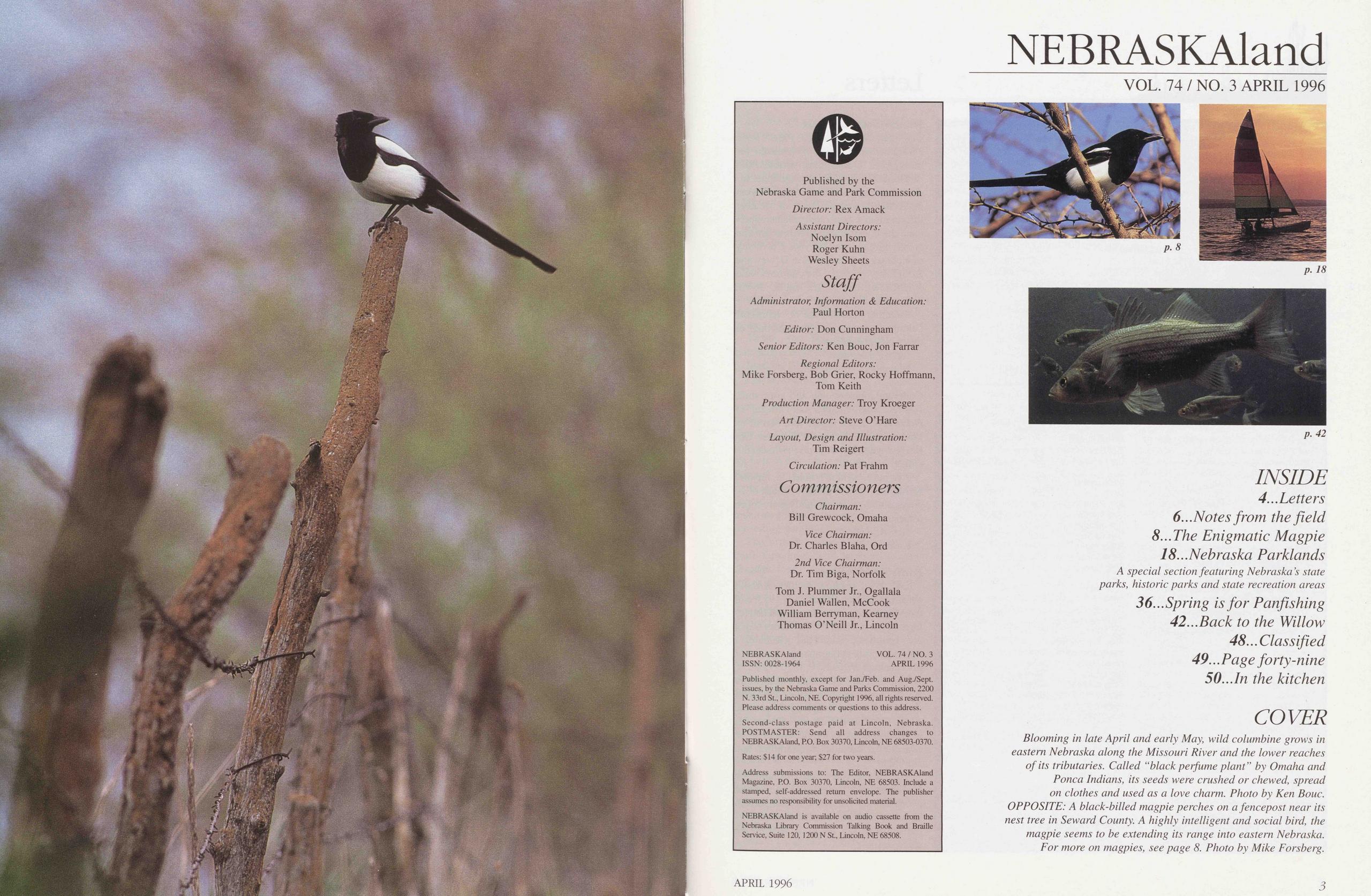
NEBRASKAland
APRIL 1996 • $2.00 NEBRASKAland Published by the Nebraska Game and Park Commission Director: Rex Amack Assistant Directors: Noelyn Isom Roger Kuhn Wesley Sheets Administrator, Infomation & Education: Paul Horton Editor: Don Cunningham Senior Editors: Ken Roue, Jon Farrar Regional Editors: Mike Forsberg, Bob Grier, Rocky Hoffmann, Tom Keith Production Manager: Troy Kroeger Art Director: Steve O’Hare Layout, Design and Illustration: Tim Reigert Circulation: Pat Frahm Commissioners Chairman: Bill Grewcock, Omaha Vice Chairman: Dr. Charles Blaha, Ord 2nd Vice Chairman: Dr. Tim Biga, Norfolk Tom J. Plummer Jr., Ogallala Daniel Wallen, McCook William Berryman, Kearney Thomas O’Neill Jr., Lincoln NEBRASKAland VOL. 74 / NO. 3 ISSN: 0028-1964 APRIL 1996 Published monthly, except for Jan./Feb. and Aug./Sept. issues, by the Nebraska Game and Parks Commission, 2200 N. 33rd St., Lincoln, NE. Copyright 1996, all rights reserved. Please address comments or questions to this address. Second-class postage paid at Lincoln, Nebraska. POSTMASTER: Send all address changes to NEBRASKAland, P.O. Box 30370, Lincoln, NE 68503-0370. Rates: $14 for one year; $27 for two years. Address submissions to: The Editor, NEBRASKAland Magazine, P.O. Box 30370, Lincoln, NE 68503. Include a stamped, self-addressed return envelope. The publisher assumes no responsibility for unsolicited material. NEBRASKAland is available on audio cassette from the Nebraska Library Commission Talking Book and Braille Service, Suite 120, 1200 N St., Lincoln, NE 68508. VOL. 74 / NO. 3 APRIL 1996
Letters
Weather Issue AccoladesThe January-February 1996 issue [“Weather and Climate of Nebraska”] is marvelous. Outstanding articles and illustrations, beautiful photographs, literate explanations and excellent layout make this a tour de force of weather information. I hope Nebraskans appreciate the considerable time, energy and creativity expended by you, University of Nebraska professors Ken Dewey and Douglas Amedeo, the authors and NEBRASKAland staff. Hands down, this is your finest issue ever. “Weather and Climate of Nebraska” belongs in the geography classroom of every Nebraska school.
Jerry P. LightnerBluemont, Virginia
Congratulations to you and your staff. Just received “Weather and Climate of Nebraska.” It is a superb job, best of its kind. A special doff of the fedora to Tim Reigert, your layout expert. Wonderful, simply wonderful. I’ve never written a note like this my whole life, which, come of think of it, covers many moons and even more semesters.
Ken R. KellerLincoln, Nebraska Praise for March Issue
I have been reading NEBRASKAland since we came to Nebraska in 1953, and the March issue is outstanding. The pictures of the cranes [“What Cranes Say”] are beautiful, and Paul Gruchow’s accompanying paragraphs are typical of his excellent writing. The article, “Nebraska’s Rainwater Basin,” is comprehensive and well done, and I was delighted to see the story, “Wildcat Hills Nature Center.” It is good to witness the development of educational facilities for families and children.
The “Page forty-nine” column on bird courting is delightful. I once wrote a column on the obvious comparison between bird and human courting — did someone say we all came from the same stardust?
Let me tell you how very much I am enjoying the special issue on weather. I have kept all the volumes and consider them important additions to my library. Incidentally, I appreciate your policy of keeping ads at a minimum because it adds to the usefulness and enjoyment of the magazine.
Naomi BrillLincoln, Nebraska
“What Cranes Say” is a most beautiful and moving tribute to the magnificent creatures that momentarily grace our landscape each spring. It is truly a gift to the soul.
Thank you Paul Gruchow, Mike Forsberg and NEBRASKAland.
Marilyn WilsonClarks, Nebraska
Last year, my brother had a serious stroke and was at a Kearney hospital. I flew to Nebraska to be with him and was so afraid of what I could say or do for him. When driving from the Lincoln Airport to Kearney we took a rural route instead of Interstate 80 and lo and behold I saw the sandhill cranes. With much awe I looked up and thanked God for telling me things would be OK.
The article “What Cranes Say” by Paul Gruchow was wonderful. His description of the sounds were great and with the soothing thought, “In the fields ... they danced,” I knew things would be OK.
Doris CastelliNarberth, Pennsylvania No Gamebirds Were Wasted
I was surprised to see the picture of my dad and his 1909 Overland in the March issue [“Nebraska’s Rainwater Basin.”] Those five men were all farmers from Jefferson County who just liked to hunt. None of the game they ever got was wasted. If it could not be used before spoilage, it was cut up and canned in fruit jars for later use. You must remember at that time there were no refrigerators, and I’m not sure if there were any ice boxes.
When I was old enough to hunt with Dad, there was never a time any ducks, geese, pheasants or prairie chickens ever went to waste at our place. I do know none of these five men would ever think about hunting with a market hunter.
Dad and I hunted for a lot of years and never at any time did we ever violate any game laws. Dad did teach a lot of young men how to hunt and also gun safety.
John A. SchoenGurley, Nebraska We apologize to Mr. Schoen. Our intent was not to imply that his father and fellow hunters took more game than they could use or violated regulations of the time. The caption's intent was to explain the transition in wetland waterbird abundance that has occurred in the Rainwater Basin wetlands in the past century. The first sentence referred to the late 1800s when waterfowl was abundant, there were essentially no game laws and shooting for the market was still legal. The second sentence (“ Waterfowl seemed limitless, and hunters could return to town with their 1909 Overland draped with mallards and sandhill cranes shot from the basins northwest of Bruning in Thayer County ”) referred to the photo of Mr. Schoen’s father and friends, and a time when waterfowl was still abundant and game laws liberal. In 1909, about the time the photo was taken, hunters were allowed 25 ducks per day and sandhill cranes were still legal gamebirds, so by the standards of the time, the hunters in the photo actually had a rather modest bag of birds. The rest of the caption referred to modern waterfowl hunting with carefully controlled regulations to ensure the future of waterfowl populations. Write to Letters, NEBRASKAland Magazine, P.O. Box 30370, Lincoln, NE 68503. Fax: (402) 471-5528. E-mail: Nebland @ngpsun.ngpc.state.ne.us. Letters may be condensed or edited for clarity. Photographs are welcome.
Wear the Patch for Wildlife?
Wear the 1996 Habitat Donor Patch and let everyone know you’ve done your part to help acquire and restore wildlife habitat. All proceeds from the Nebraska Habitat Donor Program go to the Wildlife Habitat Fund. Give $5 and receive the 1996 patch. Give $12.50 and receive the patch on a green cloth cap. Wildlife Habitat Donor Program Please send me: Donor Patches Donor Caps (patch attached) Address City State Zip ’ Enclose $5 for each patch (no cap) $12.50 for each cap (patch attached). Nebraska residents please add appropriate sales tax. Mail to: NEBRASKAland Magazine, P.O. Box 30370, Lincoln NE 68503 For telephone orders (Visa or MasterCard only), call 1-800-NEB-LAND (632-5263) APRIL 1996 5 4 NEBRASKAland
... a binder to get you out of a bind
Designed just for NEBRASKAland Magazine, this sturdy vinyl binder holds two years of issues. Plastic hangers make it easy to insert or remove the magazines without damage or to read without removing them from the binder. Just $9-'" plus sales tax Send to: NEBRASKAIand Magazine P.O. Box 30370 Lincoln, NE 68503 Name Address City State Zip Payment Enclosed Visa MasterCard No Exp. DateNotes from the field
Just a Sunday DriveEvery now and then. Mother Nature reminds us how insignificant we are. I always get that feeling when standing on a 10,000-foot Rocky Mountain ridge looking for an unseen elk calling me from the timber below. Scanning the horizon and absorbing the sheer magnitude of the mountains. I can’t help but wonder if anyone would find me if I had a heart attack or fell and broke my leg. At those times, it really hits home that I'm just a small part of the bigger whole we call nature. To nature, it doesn't matter whether the fallen animal is man or deer; it's simply part of another day in the w ild. I also get that feeling when sudden spring storms catch me off-guard and unprepared. In these days of global communication, cellular phones and superhighways. it's easy to forget that a sudden spring storm can be life-threatening, even on a busy, well-maintained road. That same old feeling hit home just a few weeks ago in late March, and I shudder to think how close we came to becoming victims of nature s power.
It was a typical early spring morning in southeastern Nebraska; the temperature was about 50. the sky was cloudy, and the pungent smell of spring was in the air. Although our planned daylong trip northwest to Broken Bow and back would take us a total of about 350 miles, my wife. Tammy, and 1 paid little attention to the forecast: cloudy with a chance of rain or snow flurries and a high of about 65 before turning colder.
The drive to Broken Bow was uneventful — nothing more than occasional light showers with a few flurries. The wind picked up and was blowing with it's usual force. We saw remnants of the spring snow goose migration west of York as we passed on Interstate 80. Near Grand Island we saw sandhill cranes, apparently as oblivious as we were to the deadly spring snowstorm that loomed just beyond the horizon. When we reached Broken Bow. the wind was howling. Elurries continued, but we stayed warm and cozy at our family gathering, paying no attention to the accumulating snow.
By late afternoon, the party was winding down, and we decided to head home. Leaving Broken Bow, we were greeted with a bone-chilling north wind gusting to 60 miles per hour. The small spring inconvenience had become a full-blown snowstorm.
Having spent a great deal of time outdoors. I should have been prepared for such a situation. A similar spring storm several years ago forced me to spend the night in my truck, but I was prepared and had the proper equipment and clothing. 1 wasn't ready this day. not for this storm.
We were wearing light dress clothes — not one winter boot or heavy coat in the car. We each had gloves, but only one pair of earmuffs between us. As I drove east along Nebraska Highway 2, visibility was 40 yards at best and four inches at worst. At times, we could not see the front end of the car. I had never experienced anything like it before.
“Closets full of outdoor clothes, boots and camping equipment at home.” I thought to myself, “and I’d give anything to have it here now.” The road was invisible. The best we could do was drive in first and second gear, watching for glimpses of the yellow center line and the while line that marked the shoulder of the road. We passed through Berwyn and Mason City without realizing it.
We knew we passed through Litchfield only because when we pulled over to clear ice from the windshield wipers 1 recognized a self-service gas pump. I knew that from Litchfield the turnoff for the road to Kearney was six miles. Switching driving duties, we used the odometer's trip meter to help us find the turnoff.
By then, we weren’t concerned about getting home, but to a town with a motel or to a friend’s house. The last 27 miles to Kearney were the hardest; what little light penetrated the blinding snow was fading fast, and the cellular phone didn’t hold a signal long enough for us to make a call.
After several more slops lo clean the wipers, 1 was soaking wet and cold. That feeling of insignificance came over me again, and I knew that if we went off the road, we had little chance of surviving the night without proper equipment and even less of a chance of finding help in zero visibility.
Tammy was doing a great job of driving despite fighting nausea. Il was difficult to maintain our equilibrium in the while-out. The feeling is similar to looking down from a small plane and losing your sense of the horizon. Tammy compared the experience to driving through an endless cloud.
After three hours of driving the 63-mile stretch from Broken Bow to Kearney, we learned that the Interstate was closed and. even if we’d wanted to, we could go no farther. We found a motel and spent a restless night wondering “what if."
Looking back on what should have been just another Sunday drive, it’s easy to see where we went wrong. Common in Nebraska, spring snow- storms are often the most severe of the year. Being prepared for severe weather is not just a good idea — it can be the difference between life and death.
We should have paid more attention to the forecast and planned accordingly. We should have been carrying our winter storm survival kit in the car. Spending the night in your car during a winter storm can be made safer and more comfortable relatively easily. Insulated coveralls, snow boots, heavy socks, stocking caps, a change of clothes and a good sleeping bag or emergency space-blanket will get you safely through most nights. Carry water, candy bars, granola or trail mix. jerky, a portable radio, candles to melt snow and a lighter or matches.
Storing the items in coffee cans is convenient and also provides a container for melting snow for additional water. Use a three-pound size and a one-pound coffee can. Punch holes in the bottom of the larger can and along the bottom edge for ventilation. Mell some candle wax in the bottom of the smaller coffee can and stand a candle in the wax. Invert the larger can for use as a stove top. A tin camp cup can serve as a pot to melt snow.
Another method is to keep a small camp box in your vehicle w ith a one-person backpacking stove, fuel and canned or dried food. A snow shovel is a useful addition to the kit and can be used to dig your car out of a drift.
Staying with the vehicle is essential because it offers protection and is more easily seen by rescuers. In the storm we were in. it is unlikely anyone stranded outside would have survived exposure to the wind, ice and zero visibility for more than a few minutes. Even in your home state, a road map is helpful since it shows the distance between towns and will help you find the safest, most-traveled route.
From now on, our winter survival kit will stay in the car year-round. The calendar might say it's spring, but we've learned that nature keeps her own calender. While 1 don’t mind that feeling of insignificance on a ridge in the Rocky Mountains, I don’t much care for the feeling when we’re just out for a Sunday drive.
Mark Nelsen Nature and the National CharacterOn April 22, 23 and 24, Richard While, environmental historian and professor of history at the University of Washington, will present the annual Abraham Lincoln Lectures sponsored by the University of Nebraska Press and other UNL departments.
The series, titled “Nature’s Nation." will examine the way Americans’ ideas about nature have affected the national identity. While will discuss Jefferson and Emerson's views of nature and the national character and examples from American popular culture, particularly Walt Disney and the Disney Studios. The free lectures will be held at 7:30 p.m. at the Lied Center for the Performing Arts on the UNL campus. For information, contact the University of Nebraska Press at (402) 472-3581.
Where can you get a tray for a week or weekend, and still not spend a bundle?
Nebraska’s slate parks are still your best bet for a perfect vacation or weekend break. Gel the new 48-page, color brochure highlighting state parks, recreation areas and historic parks. You’ll get detailed information on lodging, camping, activities, facilities, seasons, fees and reservation policies. Write or call today! Nebraska Gama and Parka Commission RO Box 30370. Lincoln. NE. 68503 Phone (402)471-0641 or 1 -800-826-PARK 6 NEBRASKAIand APRIL 1996 7
The Enigmatic Magpie
Sometimes reviled, sometimes admired, the inquisitive, intelligent magpie seems to have extended its breeding range eastward in Nebraska. Its odd dome-shaped nests have been discovered as far east as Lancaster County.In the heart of their domain, along ' cool streams in the burnt-sienna -canyons of Utah and among the ged sandstone outcrops of the Pine ge in western Nebraska they can be ous, bold creatures, but on the Eastern edge of their range they are sive, shy birds. Watching from hillside perch, we considered ourselves lucky to see them.
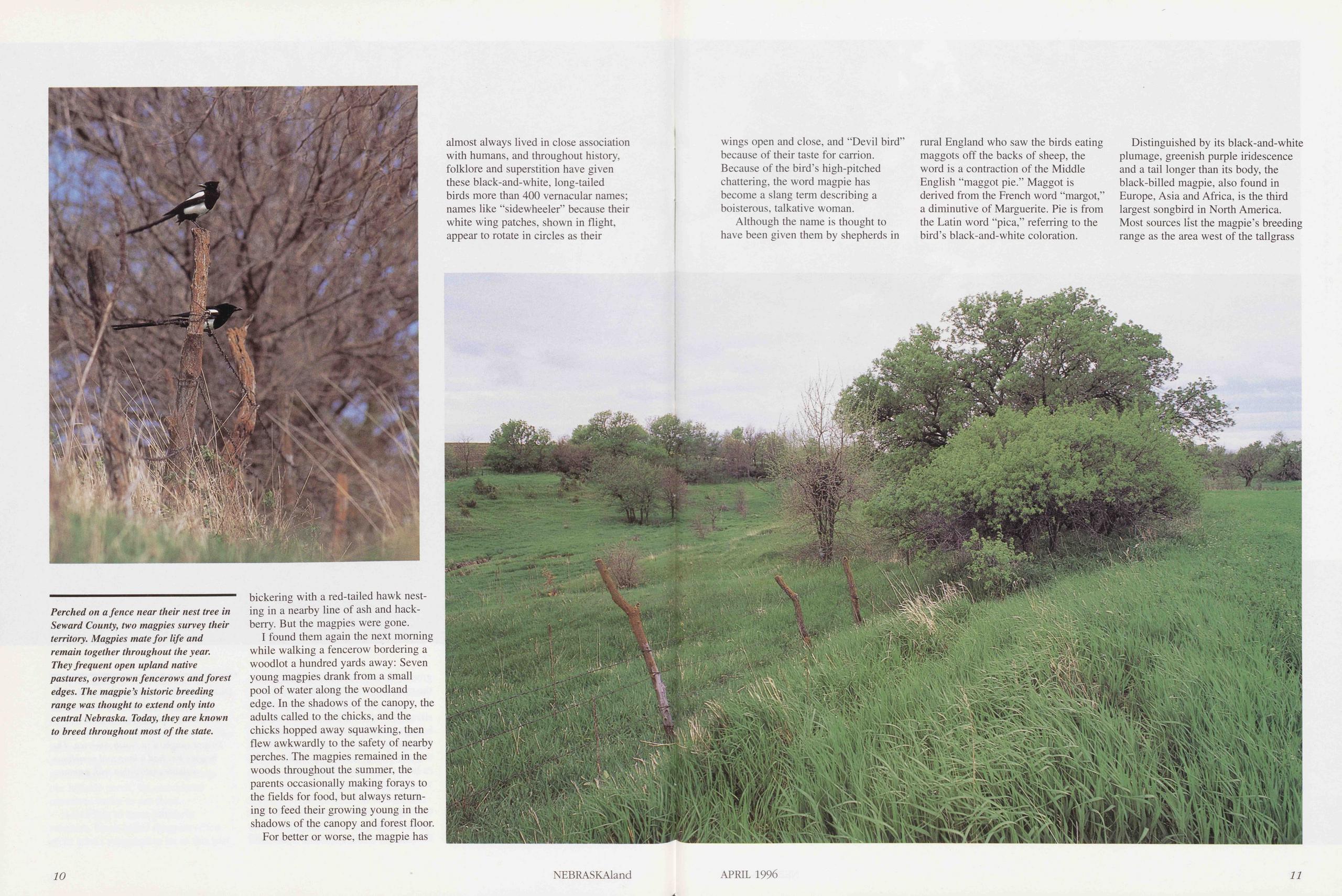
Acording to most scholarly research, black-billed magpies (Pica aren ’t supposed to be in this part of the country, but there they were, their nest built in an unassuming honey locust tree along an Osage orange fencerow in southeastern Nebraska. Quietly we watched the tireless birds as they took turns, one hunting insects in the pasture and fields nearby while the other remained in the nest.
In April and May, a landowner, her son and I had often sat on this hillside to watch the diligent pair fly with metronome-like regularity hundreds of times back and forth across the bow-shaped draw, first preparing the nest, then incubating the eggs and finally feeding the hungry chicks hidden deep within the odd dome-shaped nest.
Earlier that winter, we had walked the crooked draws and pastures of bluestem, switchgrass and drome in this square mile of Seward County near the Big Blue River inspecting old nests entangled in short stocky trees like balls of bailing wire silhouetted against slate-gray February skies.
Some nests were little more than masses of dilapidated branches from seasons gone by, relics abandoned to the wind. Others were rounded fortresses, reinforced and probably used for many years. Magpies have been seen on this property for 50 years or more. Nest sites were visible intermittently for miles along the undulating patchwork of fields and thin shelterbelts that ran parallel to a creek emptying into the river.
In early June, I returned to the familiar draw, now waxed in the bright greens of early summer, hoping to see the magpie chicks leave the nest for the first time. But the nest tree stood silent. No longer did the adults’ chess-board colors flash across the pasture. Peering through binoculars, 1 could see that the thorny spines of locust branches held only a few white feather tufts waving in the breeze.
As daylight slipped away, the reliable evening ensemble of wren and bobwhite music began to play from the plum thicket, and crows performed their ritual
bickering with a red-tailed hawk nesting in a nearby line of ash and hackberry. But the magpies were gone. I found them again the next morning while walking a fencerow bordering a woodlot a hundred yards away: Seven young magpies drank from a small pool of water along the woodland edge. In the shadows of the canopy, the adults called to the chicks, and the chicks hopped away squawking, then flew awkwardly to the safety of nearby perches. The magpies remained in the woods throughout the summer, the parents occasionally making forays to the fields for food, but always returning to feed their growing young in the shadows of the canopy and forest floor.
For better or worse, the magpie has almost always lived in close association with humans, and throughout history, folklore and superstition have given these black-and-white, long-tailed birds more than 400 vernacular names; names like “sidewheeler” because their white wing patches, shown in flight, appear to rotate in circles as their wings open and close, and “Devil bird” because of their taste for carrion. Because of the bird’s high-pitched chattering, the word magpie has become a slang term describing a boisterous, talkative woman.
Although the name is thought to have been given them by shepherds in rural England who saw the birds eating maggots off the backs of sheep, the word is a contraction of the Middle English “maggot pie.” Maggot is derived from the French word “margot,” a diminutive of Marguerite. Pie is from the Latin word “pica,” referring to the bird’s black-and-white coloration.
Distinguished by its black-and-white plumage, greenish purple iridescence and a tail longer than its body, the black-billed magpie, also found in Europe, Asia and Africa, is the third largest songbird in North America. Most sources list the magpie’s breeding range as the area west of the tailgrass
10 11 NEBRASKAland APRIL 1996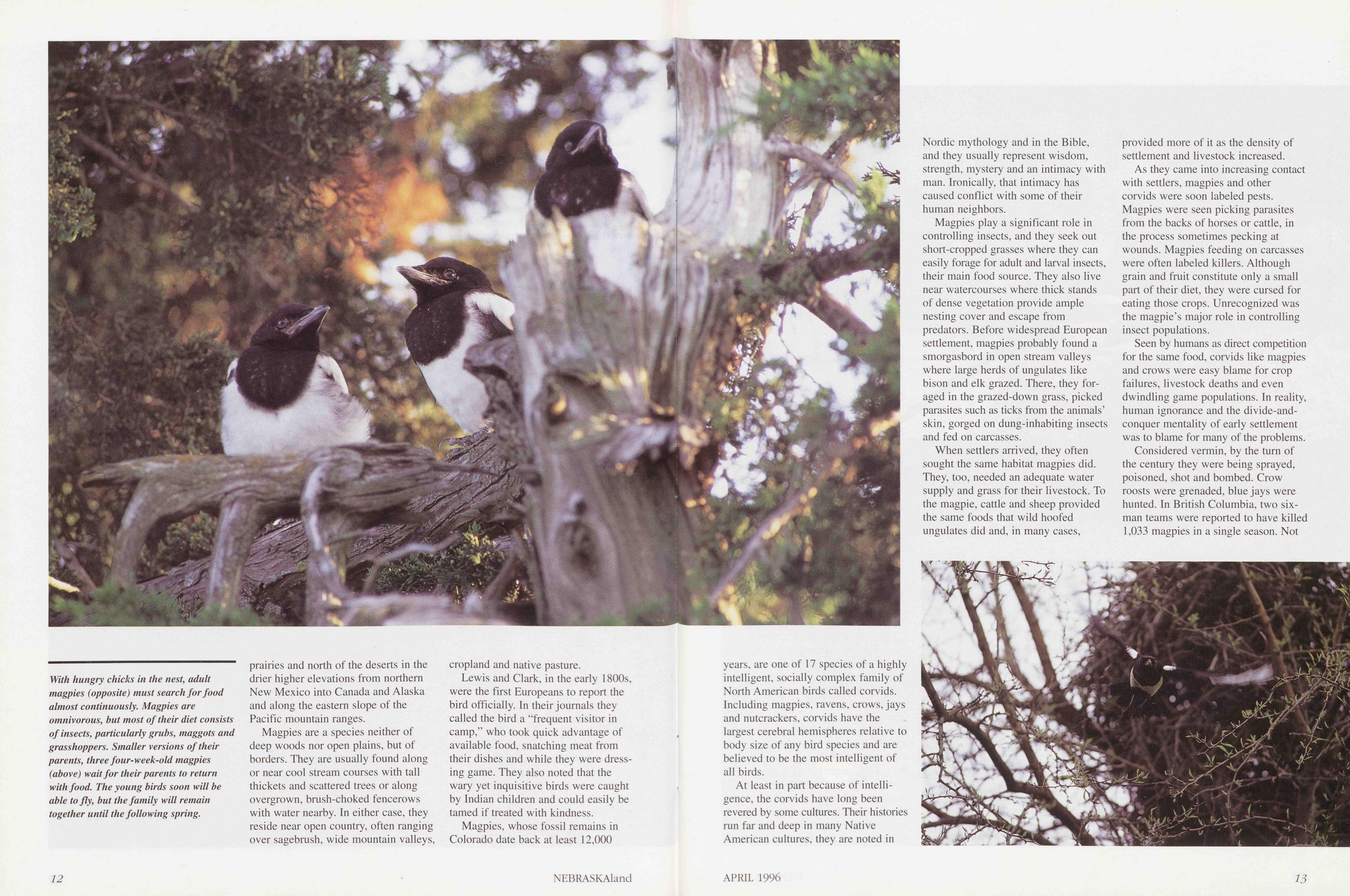
prairies and north of the deserts in the drier higher elevations from northern New Mexico into Canada and Alaska and along the eastern slope of the Pacific mountain ranges.
Magpies are a species neither of deep woods nor open plains, but of borders. They are usually found along or near cool stream courses with tall thickets and scattered trees or along overgrown, brush-choked fencerows with water nearby. In either case, they reside near open country, often ranging over sagebrush, wide mountain valleys, cropland and native pasture.
Lewis and Clark, in the early 1800s, were the first Europeans to report the bird officially. In their journals they called the bird a “frequent visitor in camp,” who took quick advantage of available food, snatching meat from their dishes and while they were dressing game. They also noted that the wary yet inquisitive birds were caught by Indian children and could easily be tamed if treated with kindness.
Magpies, whose fossil remains in Colorado date back at least 12,000 years, are one of 17 species of a highly intelligent, socially complex family of North American birds called corvids. Including magpies, ravens, crows, jays and nutcrackers, corvids have the largest cerebral hemispheres relative to body size of any bird species and are believed to be the most intelligent of all birds.
At least in part because of intelligence, the corvids have long been revered by some cultures. Their histories run far and deep in many Native American cultures, they are noted in Nordic mythology and in the Bible, and they usually represent wisdom, strength, mystery and an intimacy with man. Ironically, that intimacy has caused conflict with some of their human neighbors.
Magpies play a significant role in controlling insects, and they seek out short-cropped grasses where they can easily forage for adult and larval insects, their main food source. They also live near watercourses where thick stands of dense vegetation provide ample nesting cover and escape from predators. Before widespread European settlement, magpies probably found a smorgasbord in open stream valleys where large herds of ungulates like bison and elk grazed. There, they foraged in the grazed-down grass, picked parasites such as ticks from the animals’ skin, gorged on dung-inhabiting insects and fed on carcasses.
When settlers arrived, they often sought the same habitat magpies did. They, too, needed an adequate water supply and grass for their livestock. To the magpie, cattle and sheep provided the same foods that wild hoofed ungulates did and, in many cases, provided more of it as the density of settlement and livestock increased.
As they came into increasing contact with settlers, magpies and other corvids were soon labeled pests. Magpies were seen picking parasites from the backs of horses or cattle, in the process sometimes pecking at wounds. Magpies feeding on carcasses were often labeled killers. Although grain and fruit constitute only a small part of their diet, they were cursed for eating those crops. Unrecognized was the magpie’s major role in controlling insect populations.
Seen by humans as direct competition for the same food, corvids like magpies and crows were easy blame for crop failures, livestock deaths and even dwindling game populations. In reality, human ignorance and the divide-and- conquer mentality of early settlement was to blame for many of the problems.
Considered vermin, by the turn of the century they were being sprayed, poisoned, shot and bombed. Crow roosts were grenaded, blue jays were hunted. In British Columbia, two six- man teams were reported to have killed 1,033 magpies in a single season. Not
until 1972 was the Migratory Bird Treaty Act amended to offer corvids protection from unregulated hunting. Through it all, their cunning has kept them alive, and magpies have survived. One reason might be that magpies, like all corvids, are generalists, adapting quickly to changing conditions and disturbed native habitat that might not be attractive to other birds.
In Nebraska, as in much of the West, most land has been altered since settlement. Forests have been cleared, native grasslands have been plowed, wetlands drained, and urban development has sprawled. Many regions of the West now have little of the native flora and fauna that was present before settlement. The corvids have adapted, however, and some scientists have suggested that human “improvements”
14to the land have been beneficial, increasing the available food supply.
Corvids also have many cooperative social strategies that help them survive. Both parents take an active part in nesting and rearing young. Family groups are close-knit and stay together through winter, occasionally joining other families to form larger flocks that rely on their strength in numbers to drive off predators and find food.
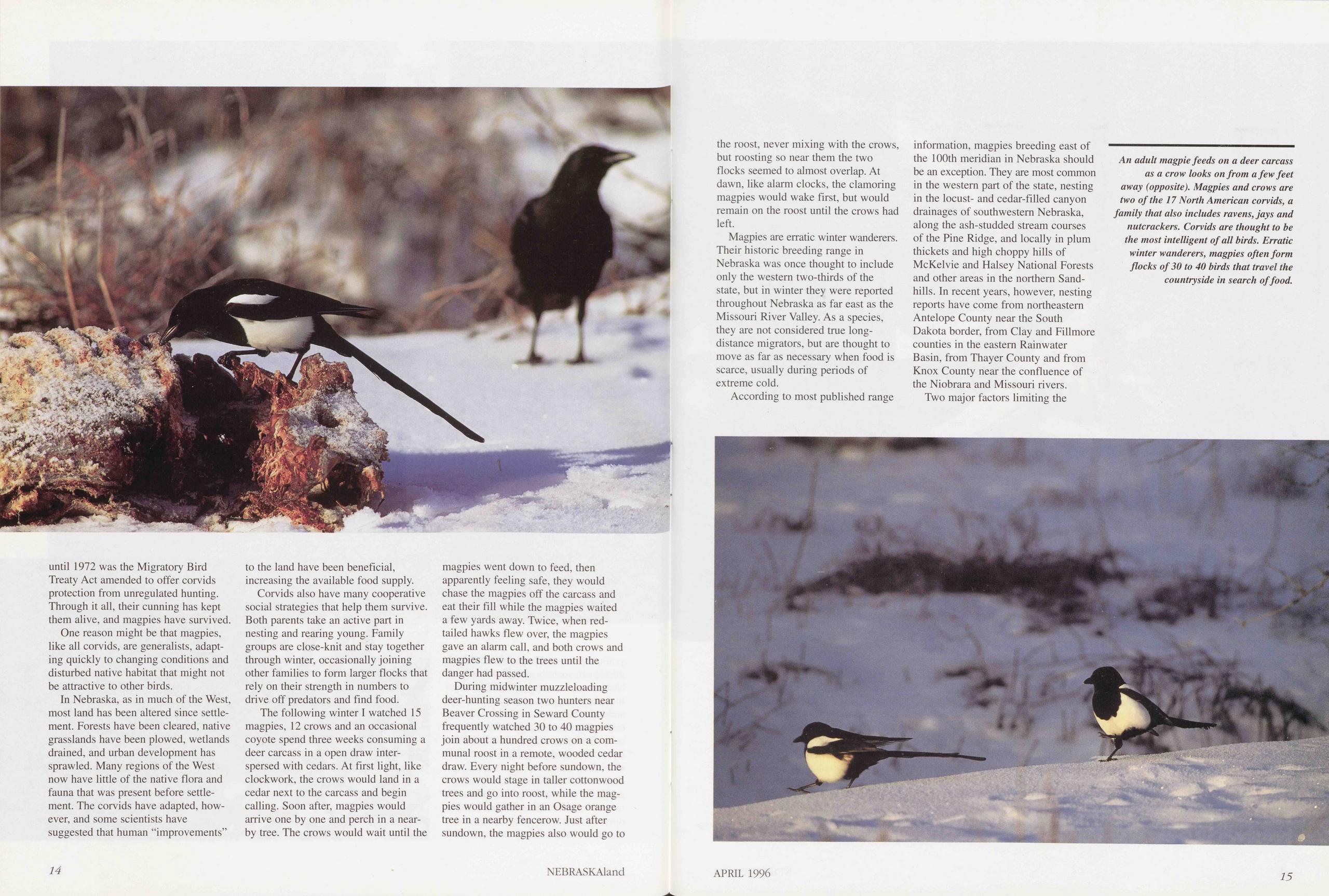
The following winter I watched 15 magpies, 12 crows and an occasional coyote spend three weeks consuming a deer carcass in a open draw inter- spersed with cedars. At first light, like clockwork, the crows would land in a cedar next to the carcass and begin calling. Soon after, magpies would arrive one by one and perch in a nearby tree. The crows would wait until the magpies went down to feed, then apparently feeling safe, they would chase the magpies off the carcass and eat their fill while the magpies waited a few yards away. Twice, when red-tailed hawks flew over, the magpies gave an alarm call, and both crows and magpies flew to the trees until the danger had passed.
During midwinter muzzleloading deer-hunting season two hunters near Beaver Crossing in Seward County frequently watched 30 to 40 magpies join about a hundred crows on a com- munal roost in a remote, wooded cedar draw. Every night before sundown, the crows would stage in taller cottonwood trees and go into roost, while the magpies would gather in an Osage orange tree in a nearby fencerow. Just after sundown, the magpies also would go to
NEBRASKAlandthe roost, never mixing with the crows, but roosting so near them the two flocks seemed to almost overlap. At dawn, like alarm clocks, the clamoring magpies would wake first, but would remain on the roost until the crows had left.
Magpies are erratic winter wanderers. Their historic breeding range in Nebraska was once thought to include only the western two-thirds of the state, but in winter they were reported throughout Nebraska as far east as the Missouri River Valley. As a species, they are not considered true long- distance migrators, but are thought to move as far as necessary when food is scarce, usually during periods of extreme cold.
According to most published range
APRIL 1996information, magpies breeding east of the 100th meridian in Nebraska should be an exception. They are most common in the western part of the state, nesting in the locust- and cedar-filled canyon drainages of southwestern Nebraska, along the ash-studded stream courses of the Pine Ridge, and locally in plum thickets and high choppy hills of McKelvie and Halsey National Forests and other areas in the northern Sand- hills. In recent years, however, nesting reports have come from northeastern Antelope County near the South Dakota border, from Clay and Fillmore counties in the eastern Rainwater Basin, from Thayer County and from Knox County near the confluence of the Niobrara and Missouri rivers.
Two major factors limiting the
ranges of all birds are climate and the availability of food. Black-billed magpies are thought to have relatively low heat tolerance, and a 1984 study by Anita Hayworth and Wesley Weathers suggests that magpies are limited to the High Plains and dry intermountain West because they find it hard to respire efficiently in more humid environments. Thus, they avoid the hot, humid Midwest in summer, even though plenty of habitat and food are available.
If that is the case, the magnet that seems to be drawing them eastward remains an enigma. Wayne Mollhoff, coordinator of the Nebraska Breeding Bird Atlas Project, thinks magpies have extended their breeding range eastward as much as 100 miles and now breed throughout Nebraska except in the tier of counties along the Missouri River and in much of southeastern Nebraska.
In June 1995, near Ceresco in northern Lancaster County, John Dinan, a Nebraska Game and Parks Commission nongame biologist, found six healthy magpie chicks that had just emerged from their dome-shaped nest in a small clump of cedar trees. Like the nests in Seward County, it was one of several in the patchwork of undulating, open pastures and edge habitat north of Lincoln, placing the magpies even farther east than indicated by Mollhoff’s 1989 range map.
Magpies build their domed nests, often in loose colonies, in short bushy trees, high enough or sufficiently tangled with thorns to persuade most predators to think twice before attempting to rob the nest from above or below. In Nebraska, nest building usually begins in early March and lasts about six weeks.
The male brings most of the sticks, and the female does most of the nest construction. The base of the nest is made of mud or dung anchored to a main branch near the center of the tree. Heavy sticks are inserted upright into the mud base before it hardens, and sticks of various sizes are woven together upward until a dome is formed. A completed nest usually is one foot wide by two feet high, with at least one lateral entrance just large enough for an adult magpie to squeeze through.
The nest dome, unique in the bird world, is thought to serve as protection from weather and from predators, particularly owls and hawks. Because they provide an ample supply of food scraps below their nests, magpies often nest near those birds of prey.
Inside the nest, the egg chamber is a mud bowl lined with bark, feathers, animal hair, grasses or almost anything that will provide insulation. Usually seven to 13 greenish-grey and brown eggs are laid, then incubated by the female for 16 to 18 days until the chicks hatch. Unlike most hatchlings, magpie chicks have no down, perhaps an adaptation in response to the insulating value of the enclosed nest. They remain in the nest for about four weeks before they begin to explore new territory.
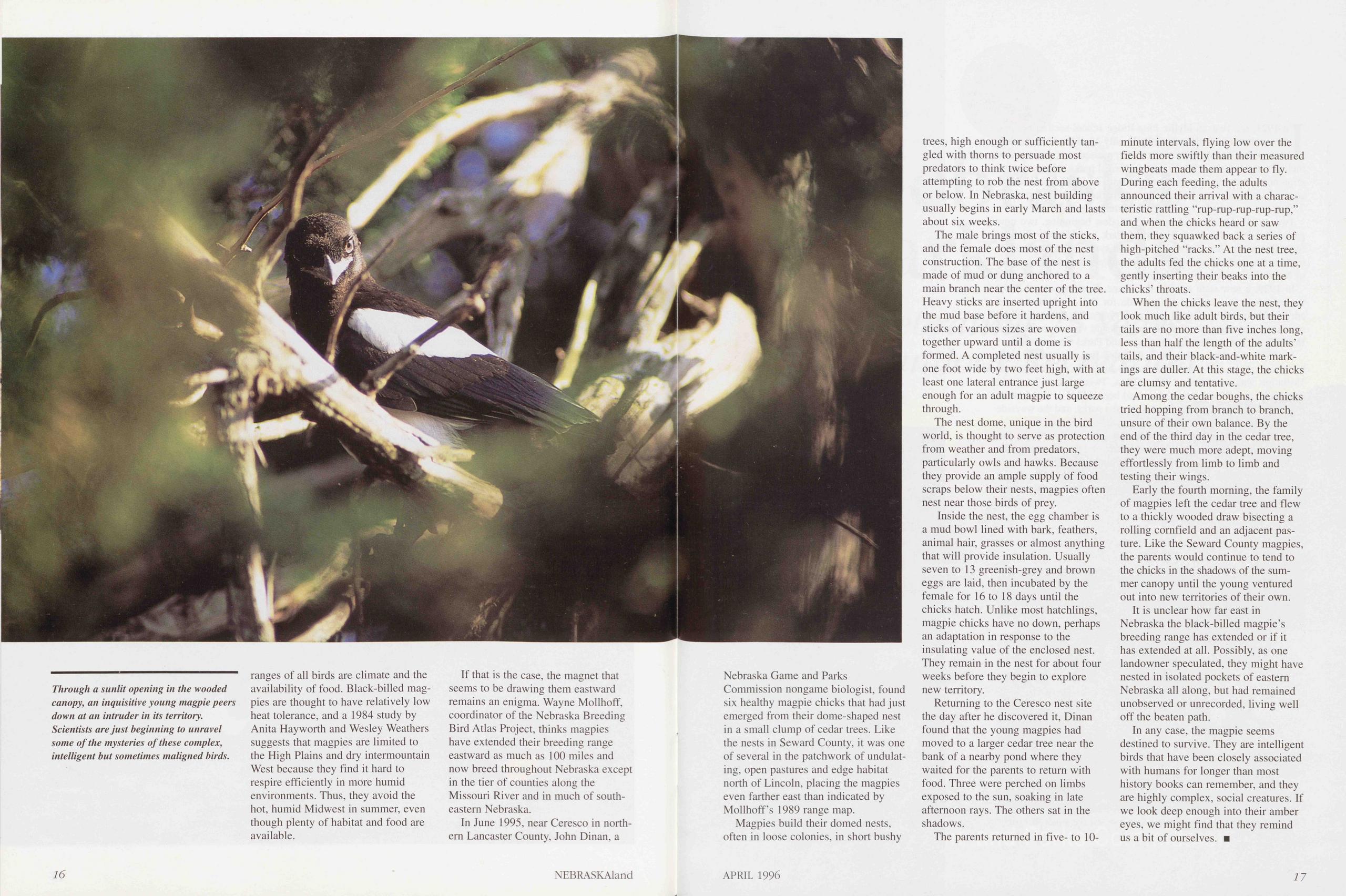
Returning to the Ceresco nest site the day after he discovered it, Dinan found that the young magpies had moved to a larger cedar tree near the bank of a nearby pond where they waited for the parents to return with food. Three were perched on limbs exposed to the sun, soaking in late afternoon rays. The others sat in the shadows.
The parents returned in five- to 10- minute intervals, flying low over the fields more swiftly than their measured wingbeats made them appear to fly. During each feeding, the adults announced their arrival with a characteristic rattling “rup-rup-rup-rup-rup,” and when the chicks heard or saw them, they squawked back a series of high-pitched “racks.” At the nest tree, the adults fed the chicks one at a time, gently inserting their beaks into the chicks’ throats.
When the chicks leave the nest, they look much like adult birds, but their tails are no more than five inches long, less than half the length of the adults’ tails, and their black-and-white markings are duller. At this stage, the chicks are clumsy and tentative. Among the cedar boughs, the chicks tried hopping from branch to branch, unsure of their own balance. By the end of the third day in the cedar tree, they were much more adept, moving effortlessly from limb to limb and testing their wings.
Early the fourth morning, the family of magpies left the cedar tree and flew to a thickly wooded draw bisecting a rolling cornfield and an adjacent pas-ure. Like the Seward County magpies, the parents would continue to tend to the chicks in the shadows of the summer canopy until the young ventured out into new territories of their own.
It is unclear how far east in Nebraska the black-billed magpie’s breeding range has extended or if it has extended at all. Possibly, as one landowner speculated, they might have nested in isolated pockets of eastern Nebraska all along, but had remained unobserved or unrecorded, living well off the beaten path.
In any case, the magpie seems destined to survive. They are intelligent birds that have been closely associated with humans for longer than most history books can remember, and they are highly complex, social creatures. If we look deep enough into their amber eyes, we might find that they remind us a bit of ourselves.
16 NEBRASKAland APRIL 1996 17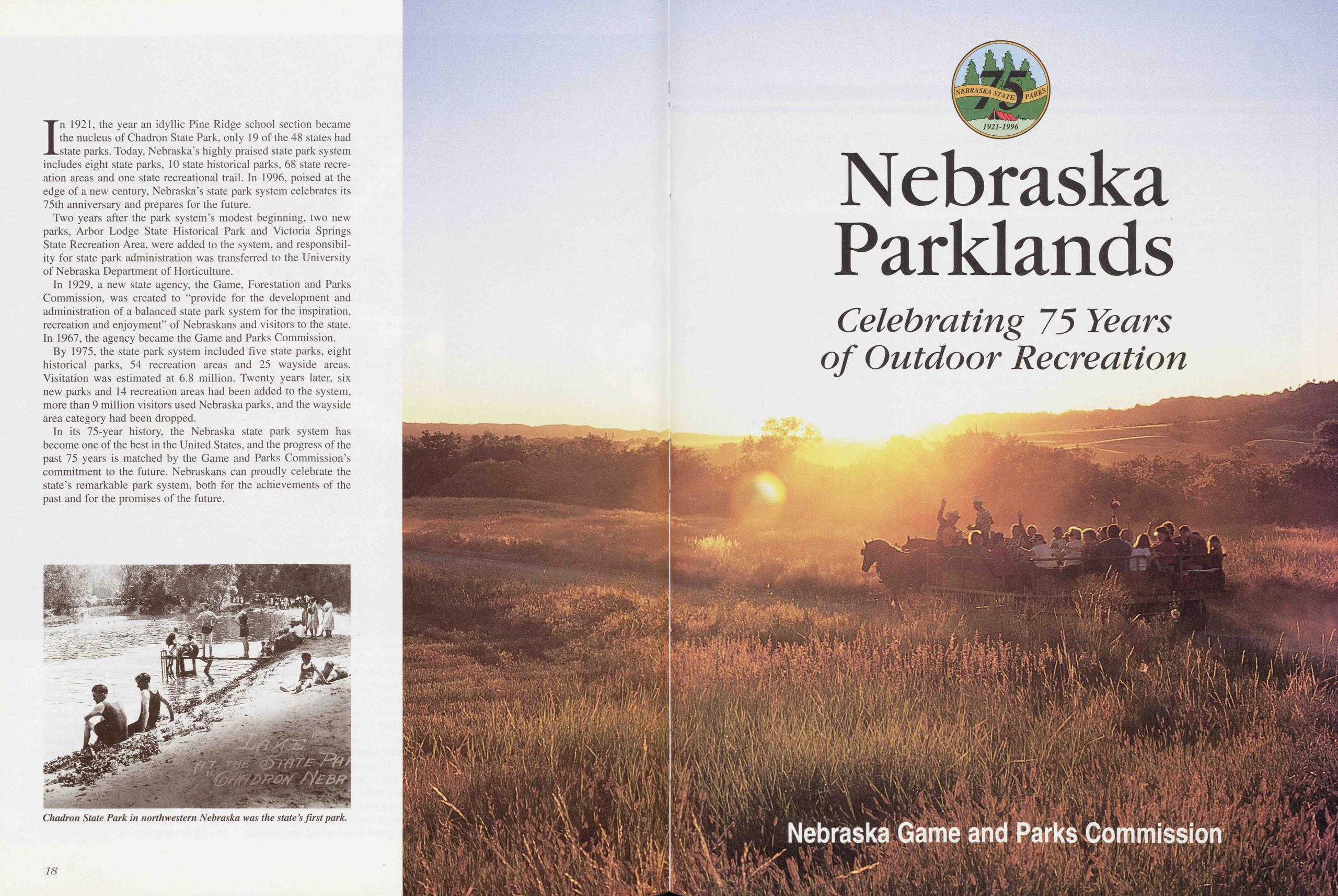
In 1921, the year an idyllic Pine Ridge school section became the nucleus of Chadron State Park, only 19 of the 48 states had state parks. Today, Nebraska’s highly praised state park system includes eight state parks, 10 state historical parks, 68 state recre- ation areas and one state recreational trail. In 1996, poised at the edge of a new century, Nebraska’s state park system celebrates its 75th anniversary and prepares for the future.
Two years after the park system’s modest beginning, two new parks, Arbor Lodge State Historical Park and Victoria Springs State Recreation Area, were added to the system, and responsibil- ity for state park administration was transferred to the University of Nebraska Department of Horticulture.
In 1929, a new state agency, the Game, Forestation and Parks Commission, was created to "provide for the development and administration of a balanced state park system for the inspiration, recreation and enjoyment” of Nebraskans and visitors to the state. In 1967, the agency became the Game and Parks Commission. By 1975, the state park system included five state parks, eight historical parks, 54 recreation areas and 25 wayside areas. Visitation was estimated at 6.8 million. Twenty years later, six new parks and 14 recreation areas had been added to the system, more than 9 million visitors used Nebraska parks, and the wayside area category had been dropped.
In its 75-year history, the Nebraska state park system has become one of the best in the United States, and the progress of the past 75 years is matched by the Game and Parks Commission’s commitment to the future. Nebraskans can proudly celebrate the state’s remarkable park system, both for the achievements of the past and for the promises of the future.
Chadron State Park in northwestern Nebraska was the state's first park.
The Major State Parks
From Indian Cave State Park in the forested Missouri River bluffs to Fort Robinson State Park in the shadows of the Red Cloud and Cheyenne buttes, Nebraska’s eight state parks offer a wide variety of facilities and outdoor recreation opportunities in settings that represent the best of the state’s scenic and natural beauty. State parks are the ideal spot for a memorable family vacation or a relaxing weekend getaway.
Many state parks provide modern housekeeping cabins, some with fire- places and decks, as well as more rustic lodging, restaurants, swimming pools, interpretive displays, theater and playhouse productions and full-service campgrounds.
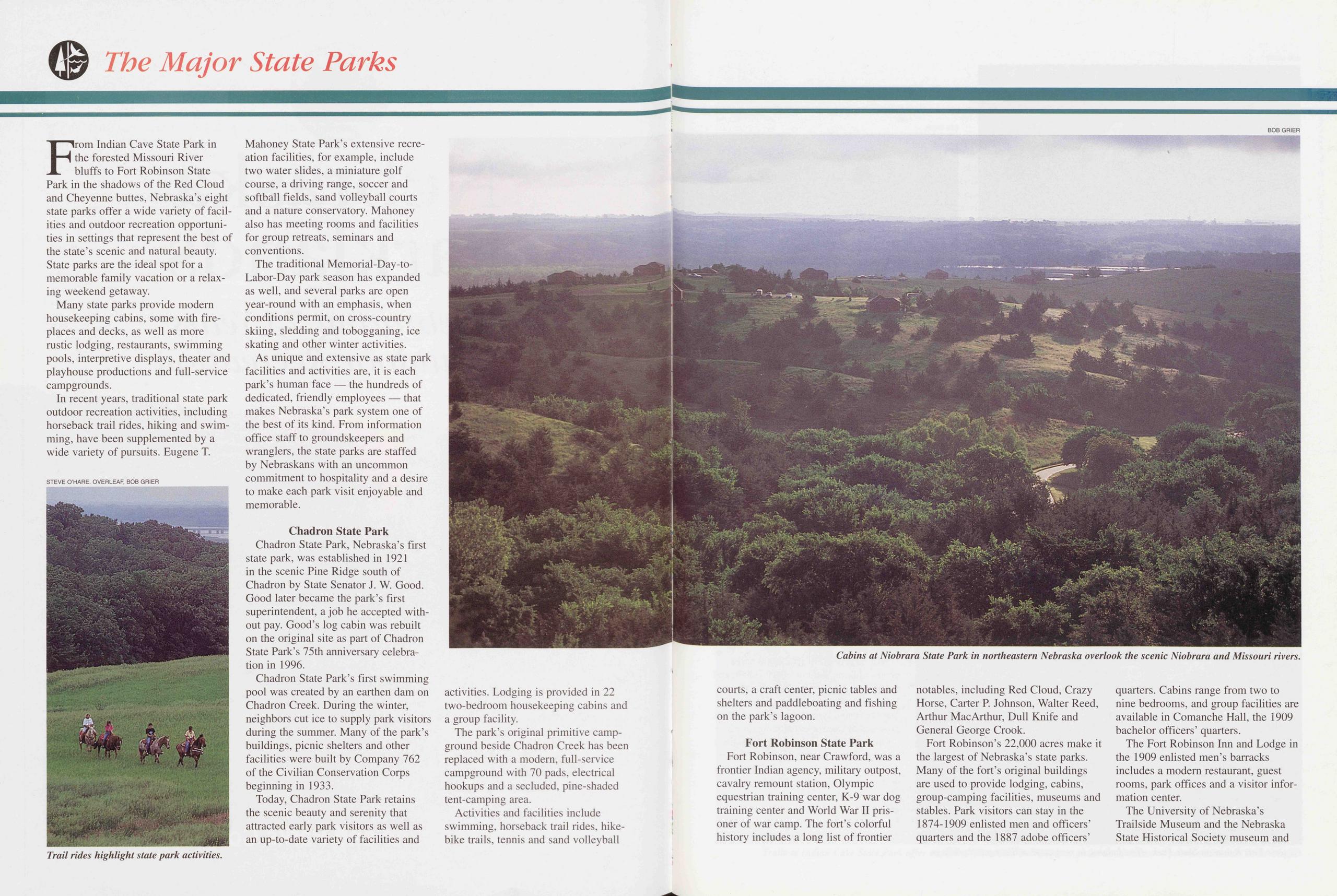
Trail rides highlight state park activities.
The traditional Memorial-Day-to- Labor-Day park season has expanded as well, and several parks are open year-round with an emphasis, when conditions permit, on cross-country skiing, sledding and tobogganing, ice skating and other winter activities. As unique and extensive as state park facilities and activities are, it is each park’s human face — the hundreds of dedicated, friendly employees — that makes Nebraska’s park system one of the best of its kind. From information office staff to groundskeepers and wranglers, the state parks are staffed by Nebraskans with an uncommon commitment to hospitality and a desire to make each park visit enjoyable and memorable.
Chadron State ParkChadron State Park, Nebraska’s first state park, was established in 1921 in the scenic Pine Ridge south of Chadron by State Senator J. W. Good. Good later became the park’s first superintendent, a job he accepted without pay. Good’s log cabin was rebuilt on the original site as part of Chadron State Park’s 75th anniversary celebration in 1996.
Chadron State Park’s first swimming pool was created by an earthen dam on Chadron Creek. During the winter, neighbors cut ice to supply park visitors during the summer. Many of the park’s buildings, picnic shelters and other facilities were built by Company 762 of the Civilian Conservation Corps beginning in 1933.
Today, Chadron State Park retains the scenic beauty and serenity that attracted early park visitors as well as an up-to-date variety of facilities and
activities. Lodging is provided in 22 two-bedroom housekeeping cabins and a group facility.
The park’s original primitive campground beside Chadron Creek has been replaced with a modern, full-service campground with 70 pads, electrical hookups and a secluded, pine-shaded tent-camping area.
Activities and facilities include swimming, horseback trail rides, hike-bike trails, tennis and sand volleyball courts, a craft center, picnic tables and shelters and paddleboating and fishing on the park’s lagoon.
Fort Robinson State ParkFort Robinson, near Crawford, was a frontier Indian agency, military outpost, cavalry remount station, Olympic equestrian training center, K-9 war dog training center and World War II prisoner of war camp. The fort’s colorful history includes a long list of frontier notables, including Red Cloud, Crazy Horse, Carter P. Johnson, Walter Reed, Arthur MacArthur, Dull Knife and General George Crook.
Fort Robinson’s 22,000 acres make it the largest of Nebraska’s state parks. Many of the fort’s original buildings are used to provide lodging, cabins, group-camping facilities, museums and stables. Park visitors can stay in the 1874-1909 enlisted men and officers’ quarters and the 1887 adobe officers’ quarters. Cabins range from two to nine bedrooms, and group facilities are available in Comanche Hall, the 1909 bachelor officers’ quarters.
The Fort Robinson Inn and Lodge in the 1909 enlisted men’s barracks includes a modern restaurant, guest rooms, park offices and a visitor infor- mation center.
The University of Nebraska’s Trailside Museum and the Nebraska State Historical Society museum and
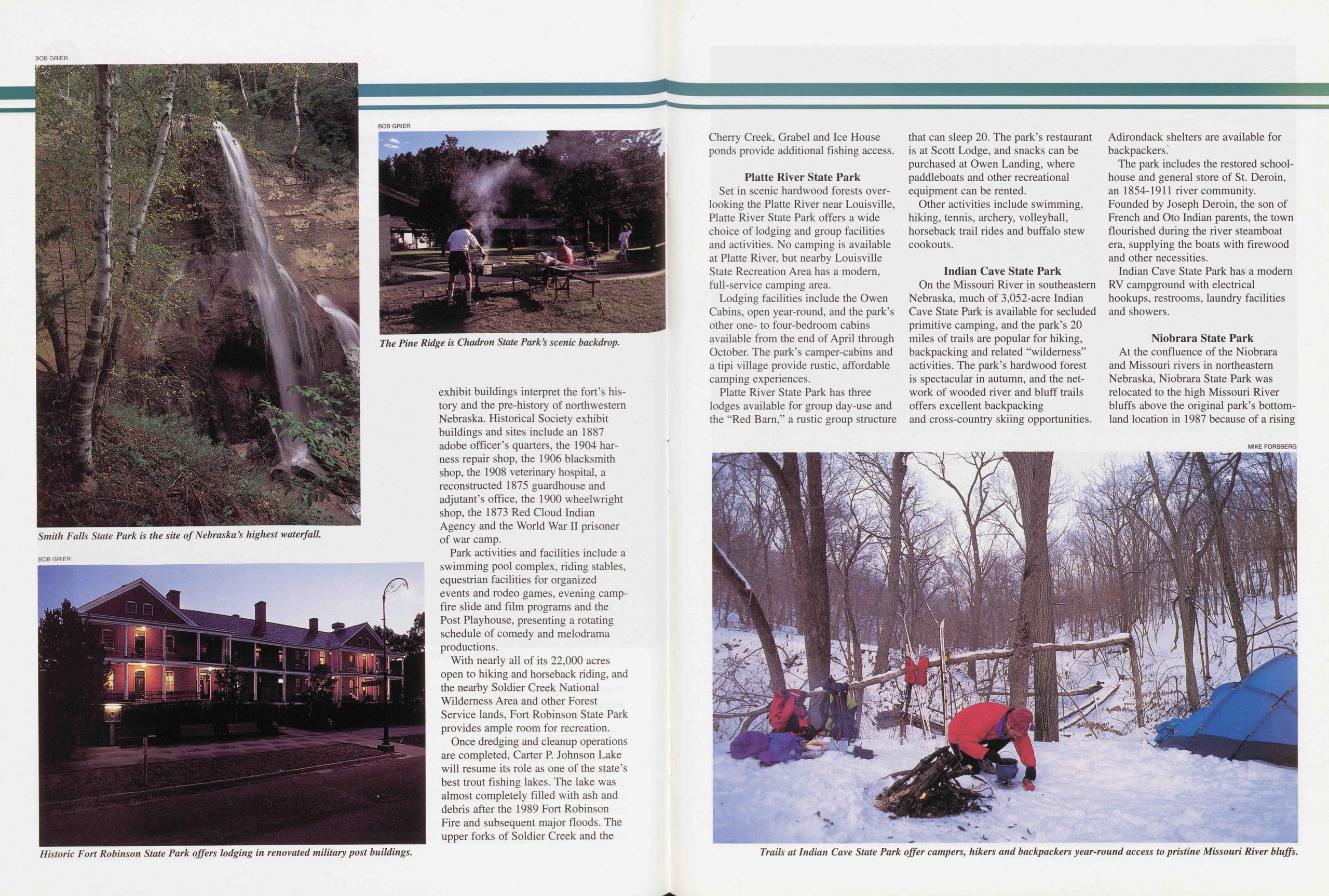
exhibit buildings interpret the fort’s history and the pre-history of northwestern Nebraska. Historical Society exhibit buildings and sites include an 1887 adobe officer’s quarters, the 1904 harness repair shop, the 1906 blacksmith shop, the 1908 veterinary hospital, a reconstructed 1875 guardhouse and adjutant’s office, the 1900 wheelwright shop, the 1873 Red Cloud Indian Agency and the World War II prisoner of war camp.
Park activities and facilities include a swimming pool complex, riding stables, equestrian facilities for organized events and rodeo games, evening campfire slide and film programs and the Post Playhouse, presenting a rotating schedule of comedy and melodrama productions.
With nearly all of its 22,000 acres open to hiking and horseback riding, and the nearby Soldier Creek National Wilderness Area and other Forest Service lands, Fort Robinson State Park provides ample room for recreation.
Once dredging and cleanup operations are completed, Carter P. Johnson Lake will resume its role as one of the state’s best trout fishing lakes. The lake was almost completely filled with ash and debris after the 1989 Fort Robinson Fire and subsequent major floods. The upper forks of Soldier Creek and the Cherry Creek, Grabel and Ice House ponds provide additional fishing access.
Platte River State ParkSet in scenic hardwood forests overlooking the Platte River near Louisville, Platte River State Park offers a wide choice of lodging and group facilities and activities. No camping is available at Platte River, but nearby Louisville State Recreation Area has a modem, full-service camping area.
Lodging facilities include the Owen Cabins, open year-round, and the park’s other one- to four-bedroom cabins available from the end of April through October. The park’s camper-cabins and a tipi village provide rustic, affordable camping experiences.
Platte River State Park has three lodges available for group day-use and the "Red Bam,” a rustic group structure
that can sleep 20. The park’s restaurant is at Scott Lodge, and snacks can be purchased at Owen Landing, where paddleboats and other recreational equipment can be rented. Other activities include swimming, hiking, tennis, archery, volleyball, horseback trail rides and buffalo stew cookouts.
Indian Cave State ParkOn the Missouri River in southeastern Nebraska, much of 3,052-acre Indian Cave State Park is available for secluded primitive camping, and the park’s 20 miles of trails are popular for hiking, backpacking and related "wilderness” activities. The park’s hardwood forest is spectacular in autumn, and the network of wooded river and bluff trails offers excellent backpacking and cross-country skiing opportunities. Adirondack shelters are available for backpackers.
The park includes the restored schoolhouse and general store of St. Deroin, an 1854-1911 river community.
Founded by Joseph Deroin, the son of French and Oto Indian parents, the town flourished during the river steamboat era, supplying the boats with firewood and other necessities.
Indian Cave State Park has a modem RV campground with electrical hookups, restrooms, laundry facilities and showers.
Niobrara State ParkAt the confluence of the Niobrara and Missouri rivers in northeastern Nebraska, Niobrara State Park was relocated to the high Missouri River bluffs above the original park’s bottomland location in 1987 because of a rising
water table and flooding. The new park offers 15 two- and three-bedroom housekeeping cabins, a group conference facility and a full-service campground. Tent camp sites and Adirondack shelters also are available.
Activities and facilities include horseback trail rides, a swimming pool, picnic shelters, hiking trails and an interpretive shelter on the Lewis and Clark National Historical Trail. The park’s hiking trail network includes a two-mile, wheelchair-accessible hike- bike trail that crosses a fishing bridge over the Niobrara River.
Fishing and boat ramp access to the Missouri River and a nine-hole golf course are near the hike-bike trail’s eastern trailhead at the old Niobrara townsite.
Smith Falls State ParkNebraska’s newest state park, Smith Falls is east of Valentine on the Niobrara National Scenic River. Established in 1992, Smith Falls State Park is managed to help protect the unique biological and scenic diversity of the central Niobrara River valley and the highest waterfall in Nebraska.
The Niobrara River valley east of Valentine preserves a rare overlap of prairie and forest plant and animal communities, including remnant stands of northern birch, ponderosa pine forest, eastern deciduous forest, mixed grass prairie and Sandhills prairie.
Smith Falls on the south side of the Niobrara is now accessible by canoe. A footbridge soon will be in place. The falls are formed where a small, spring- fed creek drops about 75 feet into the Niobrara valley. A boardwalk has been built to provide access to the falls while minimizing damage to the fragile creekbottom.
Smith Falls State Park primarily serves day-use visitors, including canoeists and canoe campers. Picnic areas, tent camping, toilets, a concession store and pay showers are available on the north side of the river. No RV facilities are available.
Ponca State ParkIn the Missouri River bluffs of northeastern Nebraska, Ponca State Park was created in 1934 with a gift of 200 acres from area residents. Ponca State Park includes 14 two-bedroom housekeeping cabins, full-service campground facilities, primitive camping sites, rock picnic shelters and about 20 miles of hiking trails.
Fishing and boating access to the Missouri River is available from the park. Park activities include swimming, hiking and horseback trail rides.
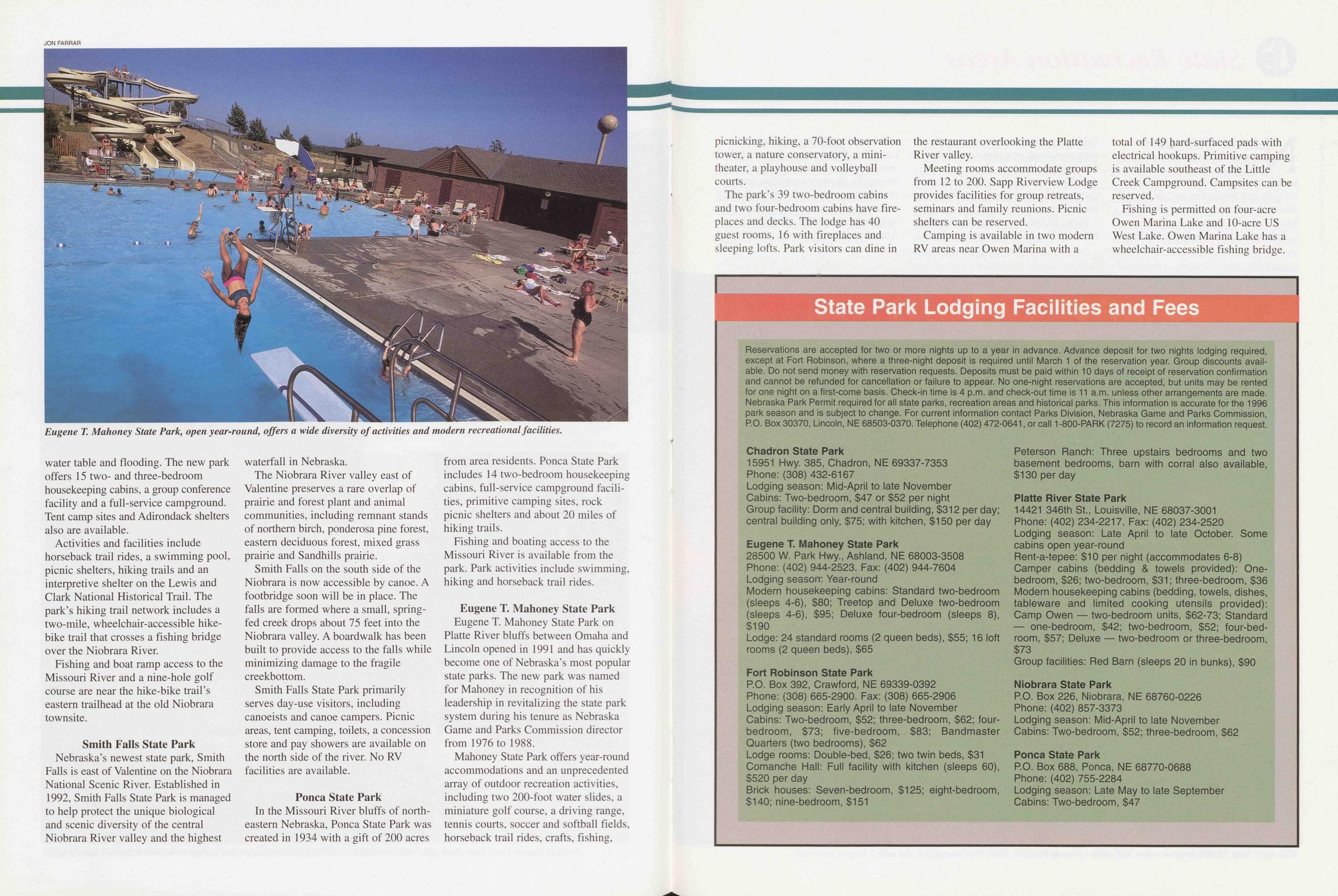
Eugene T. Mahoney State ParkEugene T. Mahoney State Park on Platte River bluffs between Omaha and Lincoln opened in 1991 and has quickly become one of Nebraska’s most popular state parks. The new park was named for Mahoney in recognition of his leadership in revitalizing the state park system during his tenure as Nebraska Game and Parks Commission director from 1976 to 1988.
Mahoney State Park offers year-round accommodations and an unprecedented array of outdoor recreation activities, including two 200-foot water slides, a miniature golf course, a driving range, tennis courts, soccer and softball fields, horseback trail rides, crafts, fishing, picnicking, hiking, a 70-foot observation tower, a nature conservatory, a mini- theater, a playhouse and volleyball courts.
The park’s 39 two-bedroom cabins and two four-bedroom cabins have fireplaces and decks. The lodge has 40 guest rooms, 16 with fireplaces and sleeping lofts. Park visitors can dine in the restaurant overlooking the Platte River valley.
Meeting rooms accommodate groups from 12 to 200. Sapp Riverview Lodge provides facilities for group retreats, seminars and family reunions. Picnic shelters can be reserved. Camping is available in two modern RV areas near Owen Marina with a total of 149 hard-surfaced pads with electrical hookups. Primitive camping is available southeast of the Little Creek Campground. Campsites can be reserved.
Fishing is permitted on four-acre Owen Marina Lake and 10-acre US West Lake. Owen Marina Lake has a wheelchair-accessible fishing bridge.
State Park Lodging Facilities and Fees Reservations are accepted for two or more nights up to a year in advance. Advance deposit for two nights lodging required, except at Fort Robinson, where a three-night deposit is required until March 1 of the reservation year. Group discounts avail- able. Do not send money with reservation requests. Deposits must be paid within 10 days of receipt of reservation confirmation and cannot be refunded for cancellation or failure to appear. No one-night reservations are accepted, but units may be rented for one night on a first-come basis. Check-in time is 4 p.m. and check-out time is 11 a.m. unless other arrangements are made. Nebraska Park Permit required for all state parks, recreation areas and historical parks. This information is accurate for the 1996 park season and is subject to change. For current information contact Parks Division, Nebraska Game and Parks Commission, P.O. Box 30370, Lincoln, NE 68503-0370. Telephone (402) 472-0641, or call 1-800-PARK (7275) to record an information request. Chadron State Park 15951 Hwy. 385, Chadron, NE 69337-7353 Phone: (308) 432-6167 Lodging season: Mid-April to late November Cabins: Two-bedroom, $47 or $52 per night Group facility: Dorm and central building, $312 per day; central building only, $75; with kitchen, $150 per day Eugene T. Mahoney State Park 28500 W. Park Hwy., Ashland, NE 68003-3508 Phone: (402) 944-2523. Fax: (402) 944-7604 Lodging season: Year-round Modern housekeeping cabins: Standard two-bedroom (sleeps 4-6), $80; Treetop and Deluxe two-bedroom (sleeps 4-6), $95; Deluxe four-bedroom (sleeps 8), $190 Lodge: 24 standard rooms (2 queen beds), $55; 16 loft rooms (2 queen beds), $65 Fort Robinson State Park P.O. Box 392, Crawford, NE 69339-0392 Phone: (308) 665-2900. Fax: (308) 665-2906 Lodging season: Early April to late November Cabins: Two-bedroom, $52; three-bedroom, $62; four- bedroom, $73; five-bedroom, $83; Bandmaster Quarters (two bedrooms), $62 Lodge rooms: Double-bed, $26; two twin beds, $31 Comanche Hall: Full facility with kitchen (sleeps 60), $520 per day Brick houses: Seven-bedroom, $125; eight-bedroom, $140; nine-bedroom, $151 Peterson Ranch: Three upstairs bedrooms and two basement bedrooms, barn with corral also available, $130 per day Platte River State Park14421 346th St., Louisville, NE 68037-3001 Phone: (402) 234-2217. Fax: (402) 234-2520 Lodging season: Late April to late October. Some cabins open year-round Rent-a-tepee: $10 per night (accommodates 6-8) Camper cabins (bedding & towels provided): One- bedroom, $26; two-bedroom, $31; three-bedroom, $36 Modern housekeeping cabins (bedding, towels, dishes, tableware and limited cooking utensils provided): Camp Owen — two-bedroom units, $62-73; Standard — one-bedroom, $42; two-bedroom, $52; four-bed- room, $57; Deluxe — two-bedroom or three-bedroom, $73 Group facilities: Red Barn (sleeps 20 in bunks), $90
Niobrara State Park P.O. Box 226, Niobrara, NE 68760-0226 Phone: (402) 857-3373 Lodging season: Mid-April to late November Cabins: Two-bedroom, $52; three-bedroom, $62 Ponca State Park P.O. Box 688, Ponca, NE 68770-0688 Phone: (402) 755-2284 Lodging season: Late May to late September Cabins: Two-bedroom, $47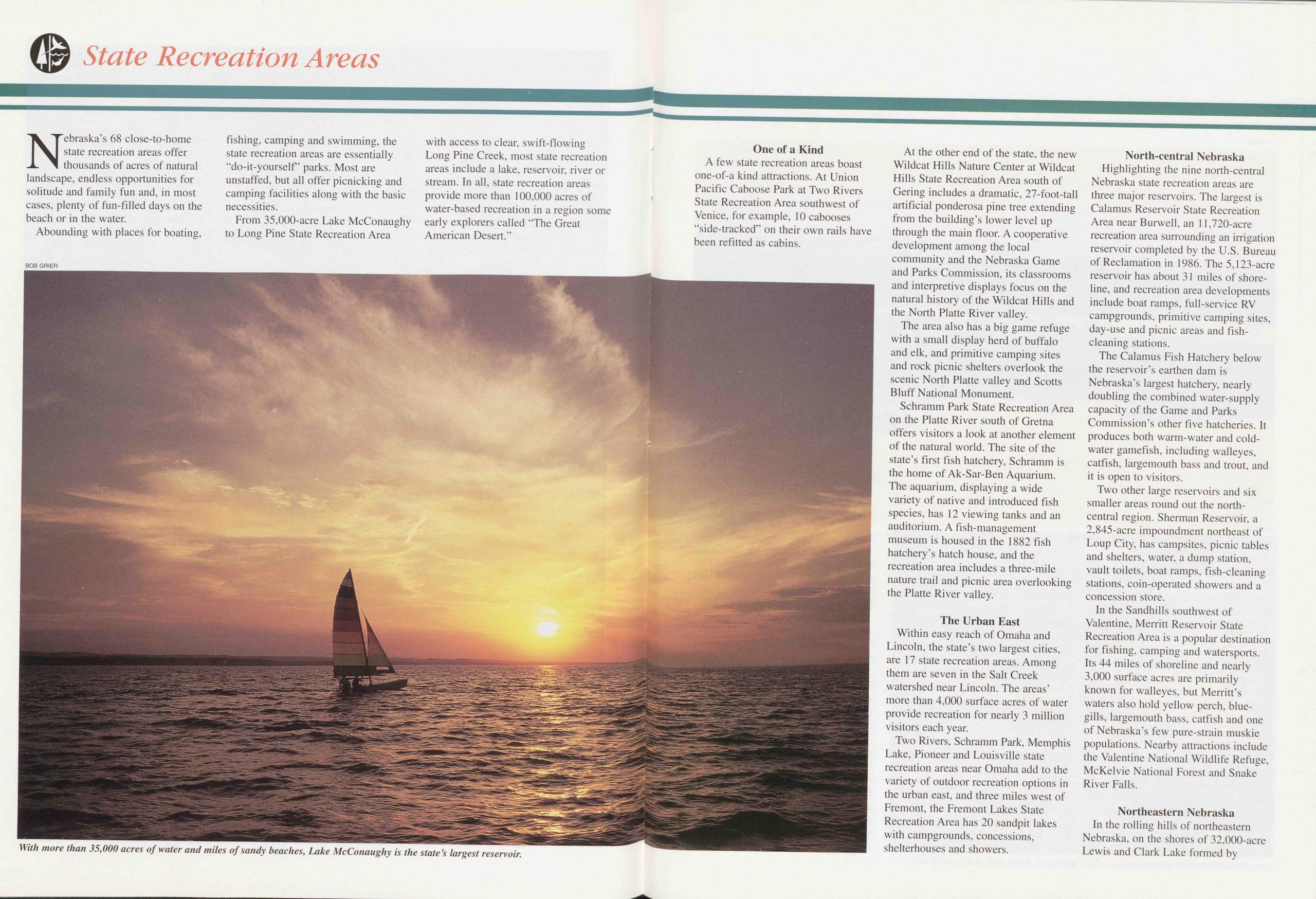
State Recreation Areas
Nebraska’s 68 close-to-home state recreation areas offer thousands of acres of natural landscape, endless opportunities for solitude and family fun and, in most cases, plenty of fun-filled days on the beach or in the water. Abounding with places for boating,
BOB GRIERWith more than 35,000 acres of water and miles of sandy beaches, Lake McConaughy is the state's largest reservoir. fishing, camping and swimming, the state recreation areas are essentially “do-it-yourself’ parks. Most are unstaffed, but all offer picnicking and camping facilities along with the basic necessities.
From 35,000-acre Lake McConaughy to Long Pine State Recreation Area with access to clear, swift-flowing Long Pine Creek, most state recreation areas include a lake, reservoir, river or stream. In all, state recreation areas provide more than 100,000 acres of water-based recreation in a region some early explorers called “The Great American Desert.”
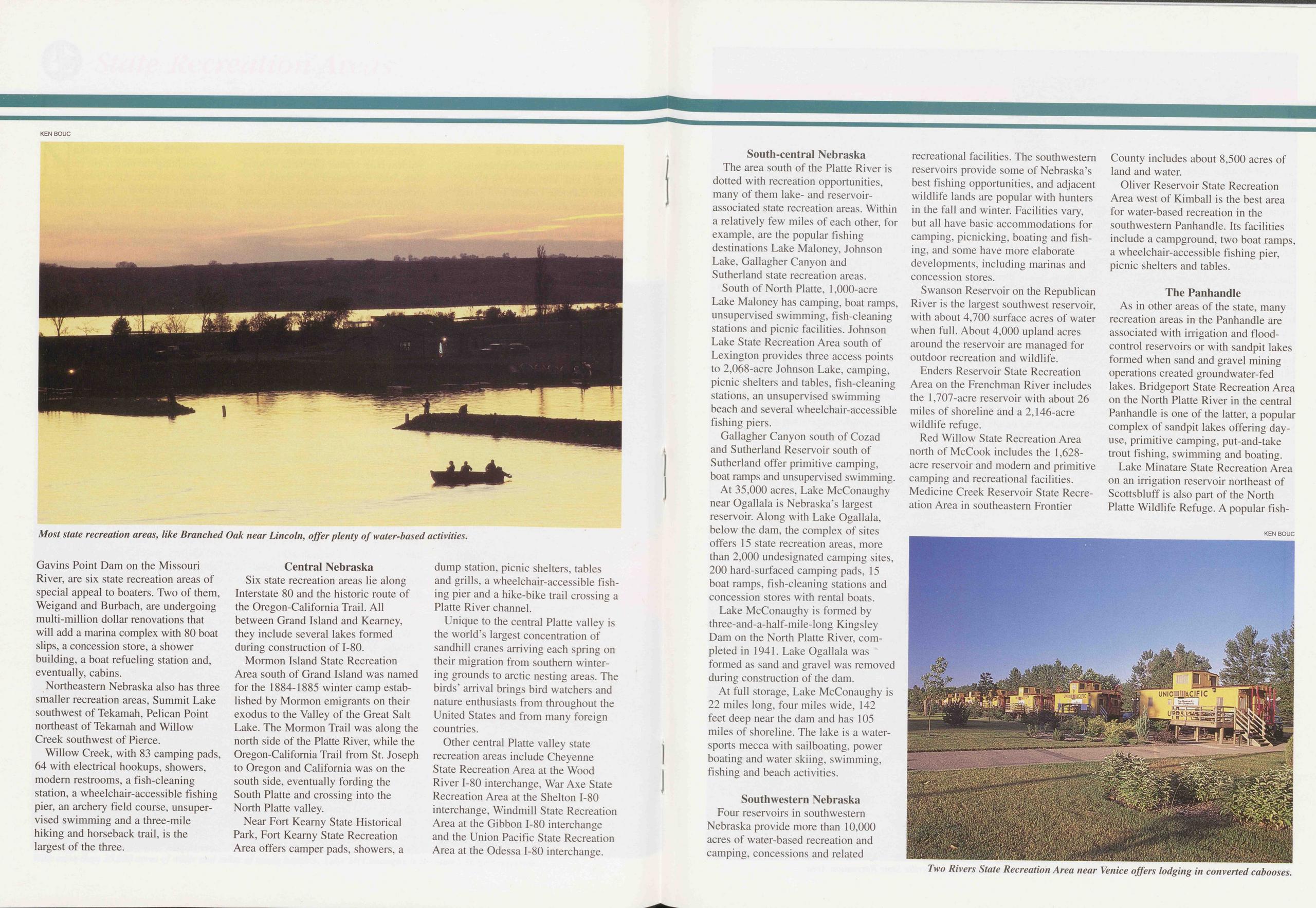
One of a KindA few state recreation areas boast one-of-a kind attractions. At Union Pacific Caboose Park at Two Rivers State Recreation Area southwest of Venice, for example, 10 cabooses “side-tracked” on their own rails have been refitted as cabins.
At the other end of the state, the new Wildcat Hills Nature Center at Wildcat Hills State Recreation Area south of Gering includes a dramatic, 27-foot-tall artificial ponderosa pine tree extending from the building’s lower level up through the main floor. A cooperative development among the local community and the Nebraska Game and Parks Commission, its classrooms and interpretive displays focus on the natural history of the Wildcat Hills and the North Platte River valley.
The area also has a big game refuge with a small display herd of buffalo and elk, and primitive camping sites and rock picnic shelters overlook the scenic North Platte valley and Scotts Bluff National Monument.
Schramm Park State Recreation Area on the Platte River south of Gretna offers visitors a look at another element of the natural world. The site of the state’s first fish hatchery, Schramm is the home of Ak-Sar-Ben Aquarium. The aquarium, displaying a wide variety of native and introduced fish species, has 12 viewing tanks and an auditorium. A fish-management museum is housed in the 1882 fish hatchery’s hatch house, and the recreation area includes a three-mile nature trail and picnic area overlooking the Platte River valley.
The Urban EastWithin easy reach of Omaha and Lincoln, the state’s two largest cities, are 17 state recreation areas. Among them are seven in the Salt Creek watershed near Lincoln. The areas’ more than 4,000 surface acres of water provide recreation for nearly 3 million visitors each year.
Two Rivers, Schramm Park, Memphis Lake, Pioneer and Louisville state recreation areas near Omaha add to the variety of outdoor recreation options in the urban east, and three miles west of Fremont, the Fremont Lakes State Recreation Area has 20 sandpit lakes with campgrounds, concessions, shelterhouses and showers.
North-central NebraskaHighlighting the nine north-central Nebraska state recreation areas are three major reservoirs. The largest is Calamus Reservoir State Recreation Area near Burwell, an 11,720-acre recreation area surrounding an irrigation reservoir completed by the U.S. Bureau of Reclamation in 1986. The 5,123-acre reservoir has about 31 miles of shore- line, and recreation area developments include boat ramps, full-service RV campgrounds, primitive camping sites, day-use and picnic areas and fish- cleaning stations.
The Calamus Fish Hatchery below the reservoir’s earthen dam is Nebraska’s largest hatchery, nearly doubling the combined water-supply capacity of the Game and Parks Commission’s other five hatcheries. It produces both warm-water and cold- water gamefish, including walleyes, catfish, largemouth bass and trout, and it is open to visitors.
Two other large reservoirs and six smaller areas round out the north- central region. Sherman Reservoir, a 2,845-acre impoundment northeast of Loup City, has campsites, picnic tables and shelters, water, a dump station, vault toilets, boat ramps, fish-cleaning stations, coin-operated showers and a concession store.
In the Sandhills southwest of Valentine, Merritt Reservoir State Recreation Area is a popular destination for fishing, camping and watersports. Its 44 miles of shoreline and nearly 3,000 surface acres are primarily known for walleyes, but Merritt’s waters also hold yellow perch, bluegills, largemouth bass, catfish and one of Nebraska’s few pure-strain muskie populations. Nearby attractions include the Valentine National Wildlife Refuge, McKelvie National Forest and Snake River Falls.
Northeastern NebraskaIn the rolling hills of northeastern Nebraska, on the shores of 32,000-acre Lewis and Clark Lake formed by
Gavins Point Dam on the Missouri River, are six state recreation areas of special appeal to boaters. Two of them, Weigand and Burbach, are undergoing multi-million dollar renovations that will add a marina complex with 80 boat slips, a concession store, a shower building, a boat refueling station and, eventually, cabins.
Northeastern Nebraska also has three smaller recreation areas, Summit Lake southwest of Tekamah, Pelican Point northeast of Tekamah and Willow Creek southwest of Pierce.
Willow Creek, with 83 camping pads, 64 with electrical hookups, showers, modern restrooms, a fish-cleaning station, a wheelchair-accessible fishing pier, an archery field course, unsupervised swimming and a three-mile hiking and horseback trail, is the largest of the three.
Central NebraskaSix state recreation areas lie along Interstate 80 and the historic route of the Oregon-California Trail. All between Grand Island and Kearney, they include several lakes formed during construction of 1-80.
Mormon Island State Recreation Area south of Grand Island was named for the 1884-1885 winter camp established by Mormon emigrants on their exodus to the Valley of the Great Salt Lake. The Mormon Trail was along the north side of the Platte River, while the Oregon-California Trail from St. Joseph to Oregon and California was on the south side, eventually fording the South Platte and crossing into the North Platte valley.
Near Fort Kearny State Historical Park, Fort Kearny State Recreation Area offers camper pads, showers, a dump station, picnic shelters, tables and grills, a wheelchair-accessible fishing pier and a hike-bike trail crossing a Platte River channel.
Unique to the central Platte valley is the world’s largest concentration of sandhill cranes arriving each spring on their migration from southern winter- ing grounds to arctic nesting areas. The birds’ arrival brings bird watchers and nature enthusiasts from throughout the United States and from many foreign countries.
Other central Platte valley state recreation areas include Cheyenne State Recreation Area at the Wood River 1-80 interchange, War Axe State Recreation Area at the Shelton 1-80 interchange, Windmill State Recreation Area at the Gibbon 1-80 interchange and the Union Pacific State Recreation Area at the Odessa 1-80 interchange.
South-central NebraskaThe area south of the Platte River is dotted with recreation opportunities, many of them lake- and reservoir- associated state recreation areas. Within a relatively few miles of each other, for example, are the popular fishing destinations Lake Maloney, Johnson Lake, Gallagher Canyon and Sutherland state recreation areas.
South of North Platte, 1,000-acre Lake Maloney has camping, boat ramps, unsupervised swimming, fish-cleaning stations and picnic facilities. Johnson Lake State Recreation Area south of Lexington provides three access points to 2,068-acre Johnson Lake, camping, picnic shelters and tables, fish-cleaning stations, an unsupervised swimming beach and several wheelchair-accessible fishing piers.
Gallagher Canyon south of Cozad and Sutherland Reservoir south of Sutherland offer primitive camping, boat ramps and unsupervised swimming.
At 35,000 acres, Lake McConaughy near Ogallala is Nebraska’s largest reservoir. Along with Lake Ogallala, below the dam, the complex of sites offers 15 state recreation areas, more than 2,000 undesignated camping sites, 200 hard-surfaced camping pads, 15 boat ramps, fish-cleaning stations and concession stores with rental boats.
Lake McConaughy is formed by three-and-a-half-mile-long Kingsley Dam on the North Platte River, com- pleted in 1941. Lake Ogallala was formed as sand and gravel was removed during construction of the dam. At full storage, Lake McConaughy is 22 miles long, four miles wide, 142 feet deep near the dam and has 105 miles of shoreline. The lake is a water- sports mecca with sailboating, power boating and water skiing, swimming, fishing and beach activities.
Southwestern NebraskaFour reservoirs in southwestern Nebraska provide more than 10,000 acres of water-based recreation and camping, concessions and related recreational facilities. The southwestern reservoirs provide some of Nebraska’s best fishing opportunities, and adjacent wildlife lands are popular with hunters in the fall and winter. Facilities vary, but all have basic accommodations for camping, picnicking, boating and fishing, and some have more elaborate developments, including marinas and concession stores.
Swanson Reservoir on the Republican River is the largest southwest reservoir, with about 4,700 surface acres of water when full. About 4,000 upland acres around the reservoir are managed for outdoor recreation and wildlife. Enders Reservoir State Recreation Area on the Frenchman River includes the 1,707-acre reservoir with about 26 miles of shoreline and a 2,146-acre wildlife refuge.
Red Willow State Recreation Area north of McCook includes the 1,628- acre reservoir and modern and primitive camping and recreational facilities. Medicine Creek Reservoir State Recreation Area in southeastern Frontier
County includes about 8,500 acres of land and water.
Oliver Reservoir State Recreation Area west of Kimball is the best area for water-based recreation in the southwestern Panhandle. Its facilities include a campground, two boat ramps, a wheelchair-accessible fishing pier, picnic shelters and tables.
The PanhandleAs in other areas of the state, many recreation areas in the Panhandle are associated with irrigation and flood- control reservoirs or with sandpit lakes formed when sand and gravel mining operations created groundwater-fed lakes. Bridgeport State Recreation Area on the North Platte River in the central Panhandle is one of the latter, a popular complex of sandpit lakes offering day- use, primitive camping, put-and-take trout fishing, swimming and boating.
Lake Minatare State Recreation Area on an irrigation reservoir northeast of Scottsbluff is also part of the North Platte Wildlife Refuge. A popular fishing,
camping and day-use area, the lake is closed to public use from October 1 through January 15 when it is crowded with migrating waterfowl. Like many irrigation reservoirs, it is heavily drawn down in the growing season.
Box Butte Reservoir State Recreation Area in the central Panhandle is the site of a cooperative project between the Game and Parks Commission and irrigators to reduce heavy irrigation drawdowns that plagued the reservoir’s fishery. The benefits of increased water levels began almost immediately, and Box Butte Reservoir is a popular fishery for walleyes, bluegills, yellow perch, northern pike and largemouth bass.
>Off the Beaten PathAmong Nebraska’s state recreation areas are several small off-the-beaten-path areas offering excellent outdoor recreational opportunities and scenic beauty. Many include primitive camping and basic facilities while others have camping pads and electrical hookups. Scenic and secluded, Victoria Springs State Recreation Area east of Anselmo has two housekeeping cabins, 100 undesignated campsites, showers, restrooms, water, picnic tables, shelters, paddleboats and a fishing lagoon. Keller Park State Recreation Area, 436 acres in the scenic tree-covered bluffs along Bone Creek northeast of Ainsworth, has 10 acres of water in five fishing ponds, 25 camper pads with electrical hookups and water, vault toilets, a dump station, picnic tables and shelters.
The 200-acre Dead Timber State Recreation Area on the Elkhorn River near Scribner includes 51 camping pads with 17 electrical hookups, drinking water, vault toilets, a dump station and primitive camping. Dead Timber’s 50-acre lake makes it a good place for camping, picnicking, fishing and unpowered or electric-motor boating.
Pibel Lake State Recreation Area southeast of Bartlett includes a small 24-acre lake and primitive camping, boat ramps and unpowered or electric- motor boating.
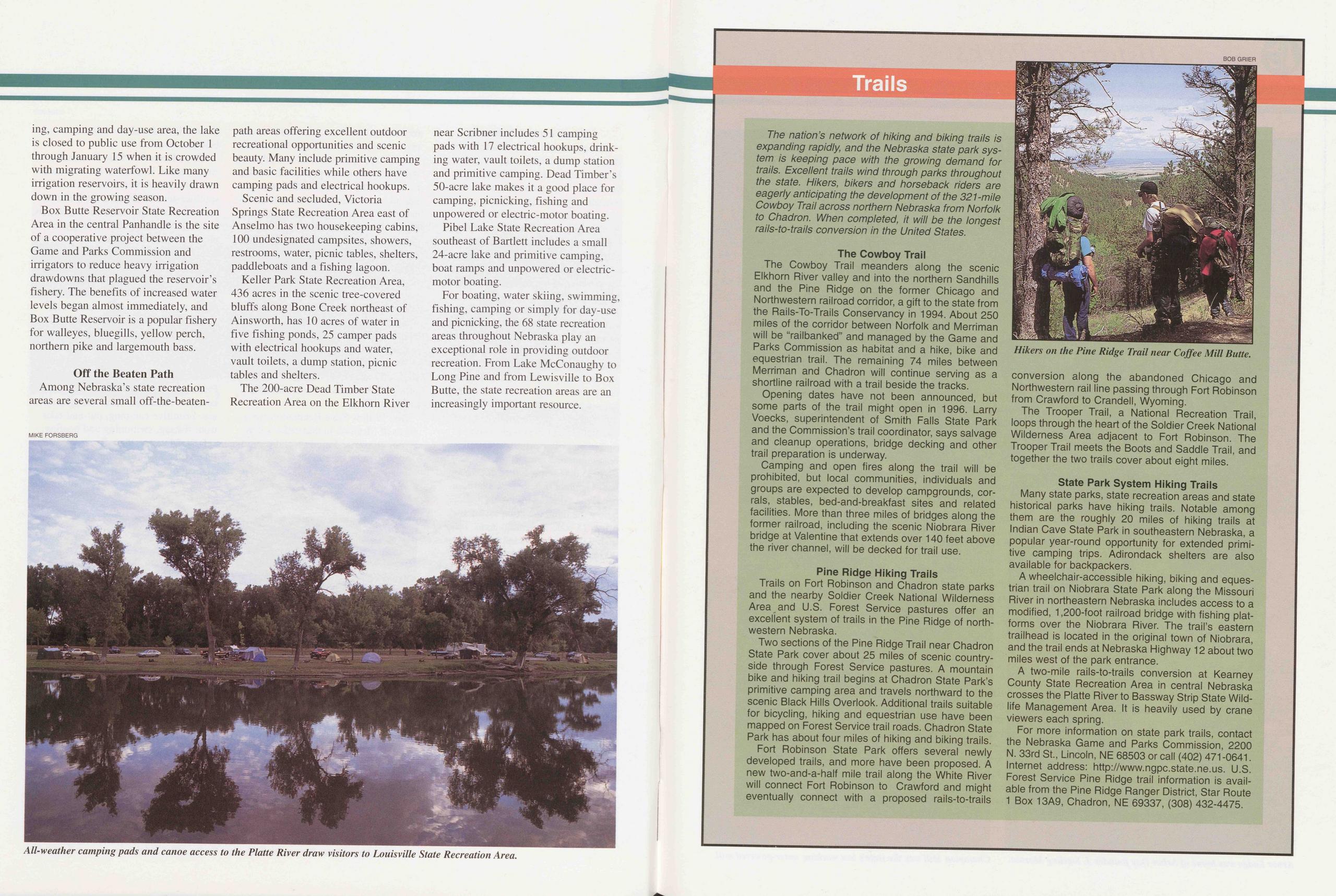
For boating, water skiing, swimming, fishing, camping or simply for day-use and picnicking, the 68 state recreation areas throughout Nebraska play an exceptional role in providing outdoor recreation. From Lake McConaughy to Long Pine and from Lewisville to Box Butte, the state recreation areas are an increasingly important resource.
State Historical Parks
From the fateful gathering of prehistoric rhinos, horses and 80 other species at a busy savanna waterhole near present-day Orchard in Antelope County to the water-powered flour mill in use until 1968 in Champion in Dundy County, Nebraska’s 10 state historical parks preserve and interpret a 1-million-year span of history.
Along the way are frontier forts, including the first military post west of the Missouri, Oregon Trail landmarks named in pioneer dairies, the homes of frontier legend William F. “Buffalo Bill” Cody and Arbor Day founder J. Sterling Morton and a working Sandhills cattle ranch established in 1894.
Arbor LodgeJ. Sterling Morton’s mansion in Nebraska City began as a four-room frame house in 1855 and was expanded during the next 48 years into a stately,
52-room neocolonial mansion completed in 1903 by Morton’s son.
In 1872, Morton, as president of the State Board of Agriculture, introduced a resolution calling for a treeplanting day to be known as Arbor Day. In 1885, the Legislature made Arbor Day a legal holiday in Nebraska. The holiday is now observed nationally and internationally. Morton served as territorial representative, secretary and acting governor of the territory and as U.S. secretary of agriculture.
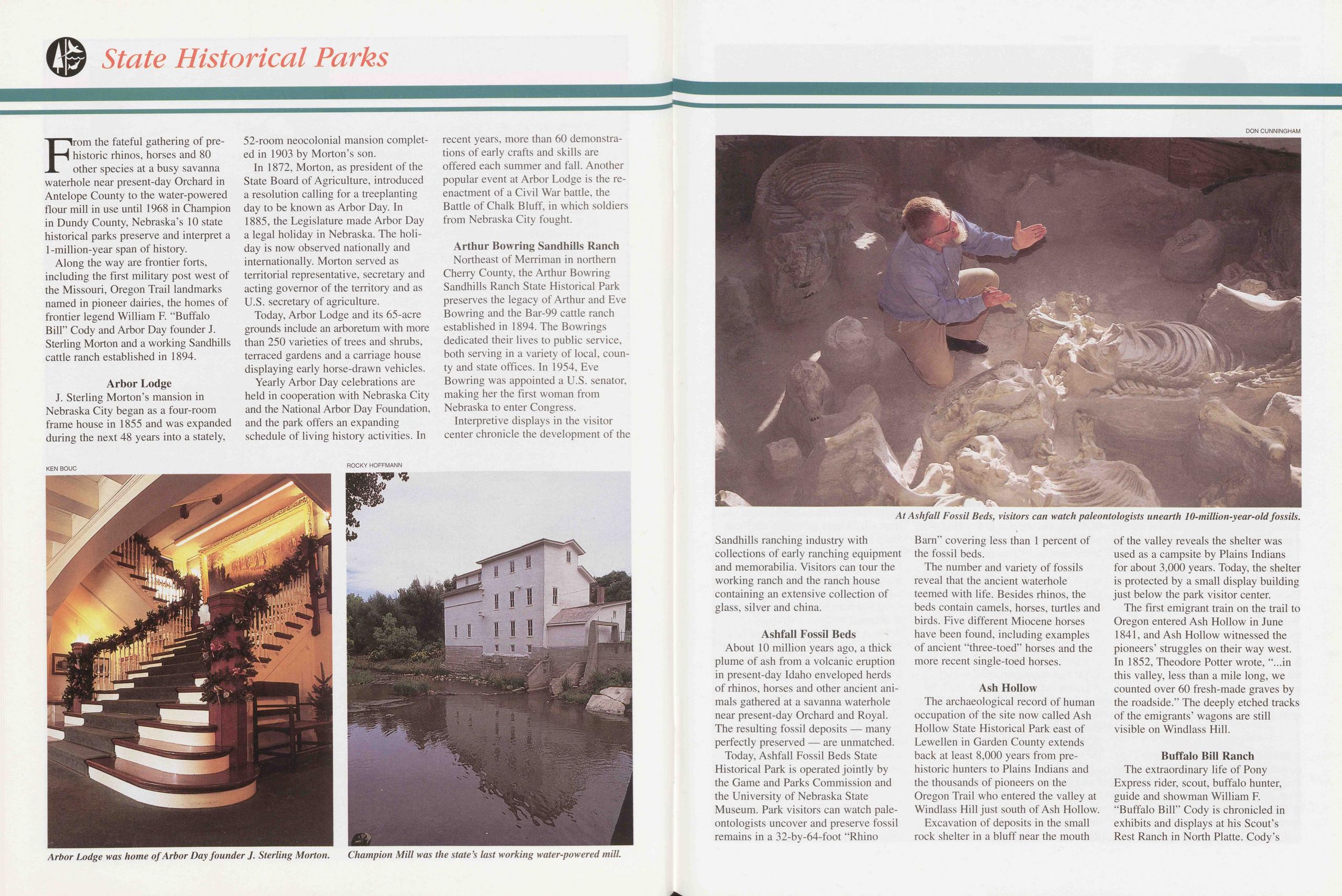
Today, Arbor Lodge and its 65-acre grounds include an arboretum with more than 250 varieties of trees and shrubs, terraced gardens and a carriage house displaying early horse-drawn vehicles.
Yearly Arbor Day celebrations are held in cooperation with Nebraska City and the National Arbor Day Foundation, and the park offers an expanding schedule of living history activities. In recent years, more than 60 demonstrations of early crafts and skills are offered each summer and fall. Another popular event at Arbor Lodge is the reenactment of a Civil War battle, the Battle of Chalk Bluff, in which soldiers from Nebraska City fought.
Arthur Bowring Sandhills RanchNortheast of Merriman in northern Cherry County, the Arthur Bowring Sandhills Ranch State Historical Park preserves the legacy of Arthur and Eve Bowring and the Bar-99 cattle ranch established in 1894. The Bowrings dedicated their lives to public service, both serving in a variety of local, county and state offices. In 1954, Eve Bowring was appointed a U.S. senator, making her the first woman from Nebraska to enter Congress.
Interpretive displays in the visitor center chronicle the development of the
At Ashfall Fossil Beds, visitors can watch paleontologists unearth 10-million-year-old fossils.
Sandhills ranching industry with collections of early ranching equipment and memorabilia. Visitors can tour the working ranch and the ranch house containing an extensive collection of glass, silver and china.
Ashfall Fossil BedsAbout 10 million years ago, a thick plume of ash from a volcanic eruption in present-day Idaho enveloped herds of rhinos, horses and other ancient animals gathered at a savanna waterhole near present-day Orchard and Royal. The resulting fossil deposits — many perfectly preserved — are unmatched.
Today, Ashfall Fossil Beds State Historical Park is operated jointly by the Game and Parks Commission and the University of Nebraska State Museum. Park visitors can watch paleontologists uncover and preserve fossil remains in a 32-by-64-foot “Rhino Barn” covering less than 1 percent of the fossil beds.
The number and variety of fossils reveal that the ancient waterhole teemed with life. Besides rhinos, the beds contain camels, horses, turtles and birds. Five different Miocene horses have been found, including examples of ancient “three-toed” horses and the more recent single-toed horses.
Ash HollowThe archaeological record of human occupation of the site now called Ash Hollow State Historical Park east of Lewellen in Garden County extends back at least 8,000 years from prehistoric hunters to Plains Indians and the thousands of pioneers on the Oregon Trail who entered the valley at Windlass Hill just south of Ash Hollow.
Excavation of deposits in the small rock shelter in a bluff near the mouth of the valley reveals the shelter was used as a campsite by Plains Indians for about 3,000 years. Today, the shelter is protected by a small display building just below the park visitor center.
The first emigrant train on the trail to Oregon entered Ash Hollow in June 1841, and Ash Hollow witnessed the pioneers’ struggles on their way west. In 1852, Theodore Potter wrote, “...in this valley, less than a mile long, we counted over 60 fresh-made graves by the roadside.” The deeply etched tracks of the emigrants’ wagons are still visible on Windlass Hill.
Buffalo Bill RanchThe extraordinary life of Pony Express rider, scout, buffalo hunter, guide and showman William F. “Buffalo Bill” Cody is chronicled in exhibits and displays at his Scout’s Rest Ranch in North Platte. Cody’s
colorful career began in 1857 when, at the age of 11, he signed on as an ox- team driver for a freighting company. At 14 he became one of the youngest riders for the Pony Express.
Too young to enlist in the Army at the outbreak of the Civil War, Cody served as a ranger, dispatch bearer and scout in Missouri, Kansas and along the Santa Fe Trail. After the war, he supplied buffalo meat to workers on the Kansas Pacific Railroad then served as a government scout with the 5th Cavalry.
Cody’s widely known Wild West Show began with the production of a Fourth of July “Blowout” in North Platte in 1882. From 1883 to 1886 Cody toured the United States with his Wild West Show and took it to England in 1887 and to Europe in 1889. In 1911, Cody sold Scout’s Rest Ranch and about 3,000 acres. Today, the house, barn and original outbuildings contain interpretative displays and exhibits telling the story of America’s most famous showman-scout.
Champion MillNebraska’s last surviving water- powered mill was built in 1888 on the Frenchman River in Champion and produced flour, meal and feed for nearly 100 years. The mill’s succession of operators sold “Champion Patented” and “Will Rise” flour, “Dwarfies” breakfast cereal, “Brownie” pancake mix, “Valley Pride” white and yellow cornmeal and an assortment of feed and other products. The millpond is now a state recreation area with primitive camping and day-use facilities, and visitors can tour the restored mill.
Fort AtkinsonFort Atkinson, about 10 miles north of Omaha near the town of Fort Calhoun, was the first U.S. military post west of the Missouri River. It was established in 1820 to protect the western fur trade and control access to the upper Missouri River. The Lewis and Clark Expedition had camped nearby in 1804 and met with the Oto and Missouri Indians at a site they called Council Bluffs. Clark recommended the site as the location of a fort.
A large outpost for its day, more than 1,000 men were garrisoned at Fort Atkinson between 1820 and 1827. Its exterior walls enclosed an area 455 feet by 468 feet, with many buildings outside the walls. The fort was abandoned in 1827 and gradually disappeared as the land was farmed.
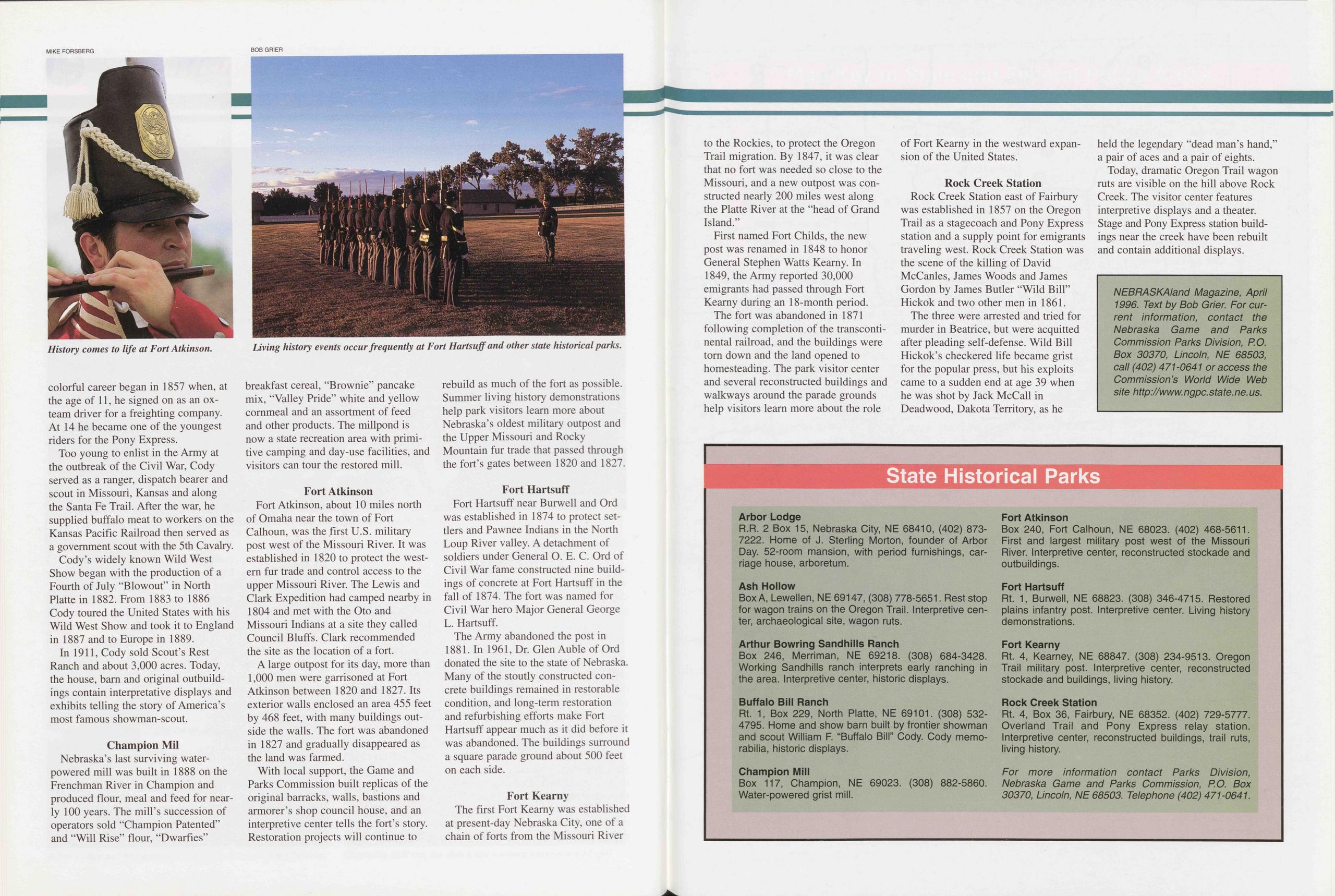
With local support, the Game and Parks Commission built replicas of the original barracks, walls, bastions and armorer’s shop council house, and an interpretive center tells the fort’s story. Restoration projects will continue to rebuild as much of the fort as possible. Summer living history demonstrations help park visitors learn more about Nebraska’s oldest military outpost and the Upper Missouri and Rocky Mountain fur trade that passed through the fort’s gates between 1820 and 1827.
Fort HartsuffFort Hartsuff near Burwell and Ord was established in 1874 to protect set- tlers and Pawnee Indians in the North Loup River valley. A detachment of soldiers under General O. E. C. Ord of Civil War fame constructed nine build- ings of concrete at Fort Hartsuff in the fall of 1874. The fort was named for Civil War hero Major General George L. Hartsuff.
The Army abandoned the post in 1881. In 1961, Dr. Glen Auble of Ord donated the site to the state of Nebraska. Many of the stoutly constructed concrete buildings remained in restorable condition, and long-term restoration and refurbishing efforts make Fort Hartsuff appear much as it did before it was abandoned. The buildings surround a square parade ground about 500 feet on each side.
Fort KearnyThe first Fort Kearny was established at present-day Nebraska City, one of a chain of forts from the Missouri River to the Rockies, to protect the Oregon Trail migration. By 1847, it was clear that no fort was needed so close to the Missouri, and a new outpost was constructed nearly 200 miles west along the Platte River at the “head of Grand Island.”
First named Fort Childs, the new post was renamed in 1848 to honor General Stephen Watts Kearny. In 1849, the Army reported 30,000 emigrants had passed through Fort Kearny during an 18-month period.
The fort was abandoned in 1871 following completion of the transcontinental railroad, and the buildings were tom down and the land opened to homesteading. The park visitor center and several reconstructed buildings and walkways around the parade grounds help visitors learn more about the role of Fort Kearny in the westward expansion of the United States.
Rock Creek StationRock Creek Station east of Fairbury was established in 1857 on the Oregon Trail as a stagecoach and Pony Express station and a supply point for emigrants traveling west. Rock Creek Station was the scene of the killing of David McCanles, James Woods and James Gordon by James Butler “Wild Bill” Hickok and two other men in 1861. The three were arrested and tried for murder in Beatrice, but were acquitted after pleading self-defense. Wild Bill Hickok’s checkered life became grist for the popular press, but his exploits came to a sudden end at age 39 when he was shot by Jack McCall in Deadwood, Dakota Territory, as he held the legendary “dead man’s hand,” a pair of aces and a pair of eights.
Today, dramatic Oregon Trail wagon ruts are visible on the hill above Rock Creek. The visitor center features interpretive displays and a theater.
Stage and Pony Express station build- ings near the creek have been rebuilt and contain additional displays.
NEBPASKAIand Magazine, April 1996. Text by Bob Grier. For cur- rent information, contact the Nebraska Game and Parks Commission Parks Division, P.O. Box 30370, Lincoln, NE 68503, call (402) 471-0641 or access the Commission’s World Wide Web site http://www.ngpc.state.ne.us.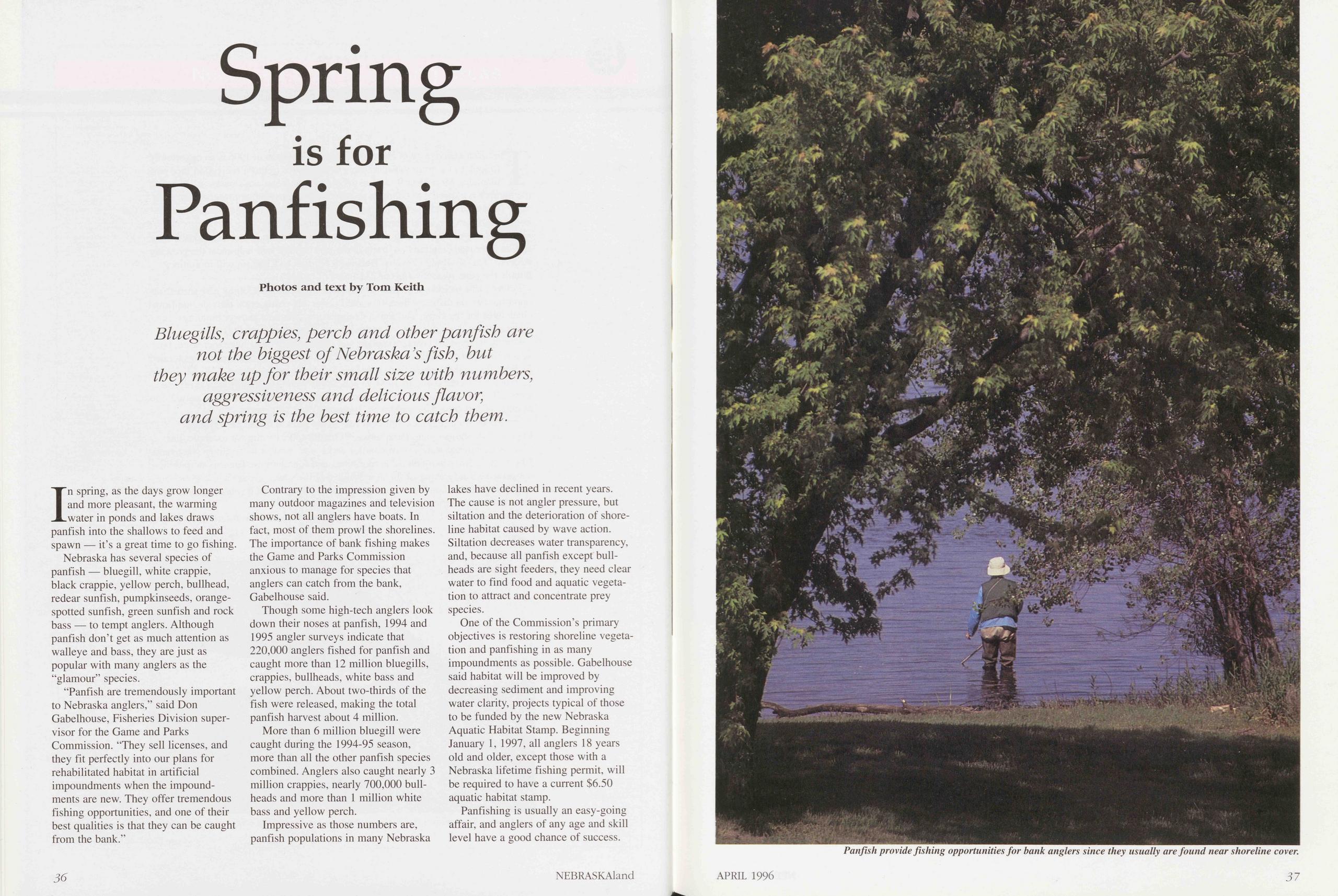
Spring is for Panfishing
Bluegills, crappies, perch and other panfish are not the biggest of Nebraska’s fish, but they make up for their small size with numbers, aggressiveness and delicious flavor, and spring is the best time to catch them.In spring, as the days grow longer and more pleasant, the warming water in ponds and lakes draws panfish into the shallows to feed and spawn — it’s a great time to go fishing.
Nebraska has several species of panfish — bluegill, white crappie, black crappie, yellow perch, bullhead, redear sunfish, pumpkinseeds, orange- spotted sunfish, green sunfish and rock bass — to tempt anglers. Although panfish don’t get as much attention as walleye and bass, they are just as popular with many anglers as the “glamour” species.
“Panfish are tremendously important to Nebraska anglers,” said Don Gabelhouse, Fisheries Division supervisor for the Game and Parks Commission. “They sell licenses, and they fit perfectly into our plans for rehabilitated habitat in artificial impoundments when the impoundments are new. They offer tremendous fishing opportunities, and one of their best qualities is that they can be caught from the bank.”
Contrary to the impression given by many outdoor magazines and television shows, not all anglers have boats. In fact, most of them prowl the shorelines. The importance of bank fishing makes the Game and Parks Commission anxious to manage for species that anglers can catch from the bank, Gabelhouse said.
Though some high-tech anglers look down their noses at panfish, 1994 and 1995 angler surveys indicate that 220,000 anglers fished for panfish and caught more than 12 million bluegills, crappies, bullheads, white bass and yellow perch. About two-thirds of the fish were released, making the total panfish harvest about 4 million.
More than 6 million bluegill were caught during the 1994-95 season, more than all the other panfish species combined. Anglers also caught nearly 3 million crappies, nearly 700,000 bullheads and more than 1 million white bass and yellow perch.
Impressive as those numbers are, panfish populations in many Nebraska lakes have declined in recent years. The cause is not angler pressure, but siltation and the deterioration of shoreline habitat caused by wave action. Siltation decreases water transparency, and, because all panfish except bullheads are sight feeders, they need clear water to find food and aquatic vegetation to attract and concentrate prey species.
One of the Commission’s primary objectives is restoring shoreline vegetation and panfishing in as many impoundments as possible. Gabelhouse said habitat will be improved by decreasing sediment and improving water clarity, projects typical of those to be funded by the new Nebraska Aquatic Habitat Stamp. Beginning January 1, 1997, all anglers 18 years old and older, except those with a Nebraska lifetime fishing permit, will be required to have a current $6.50 aquatic habitat stamp.
Panfishing is usually an easy-going affair, and anglers of any age and skill level have a good chance of success.
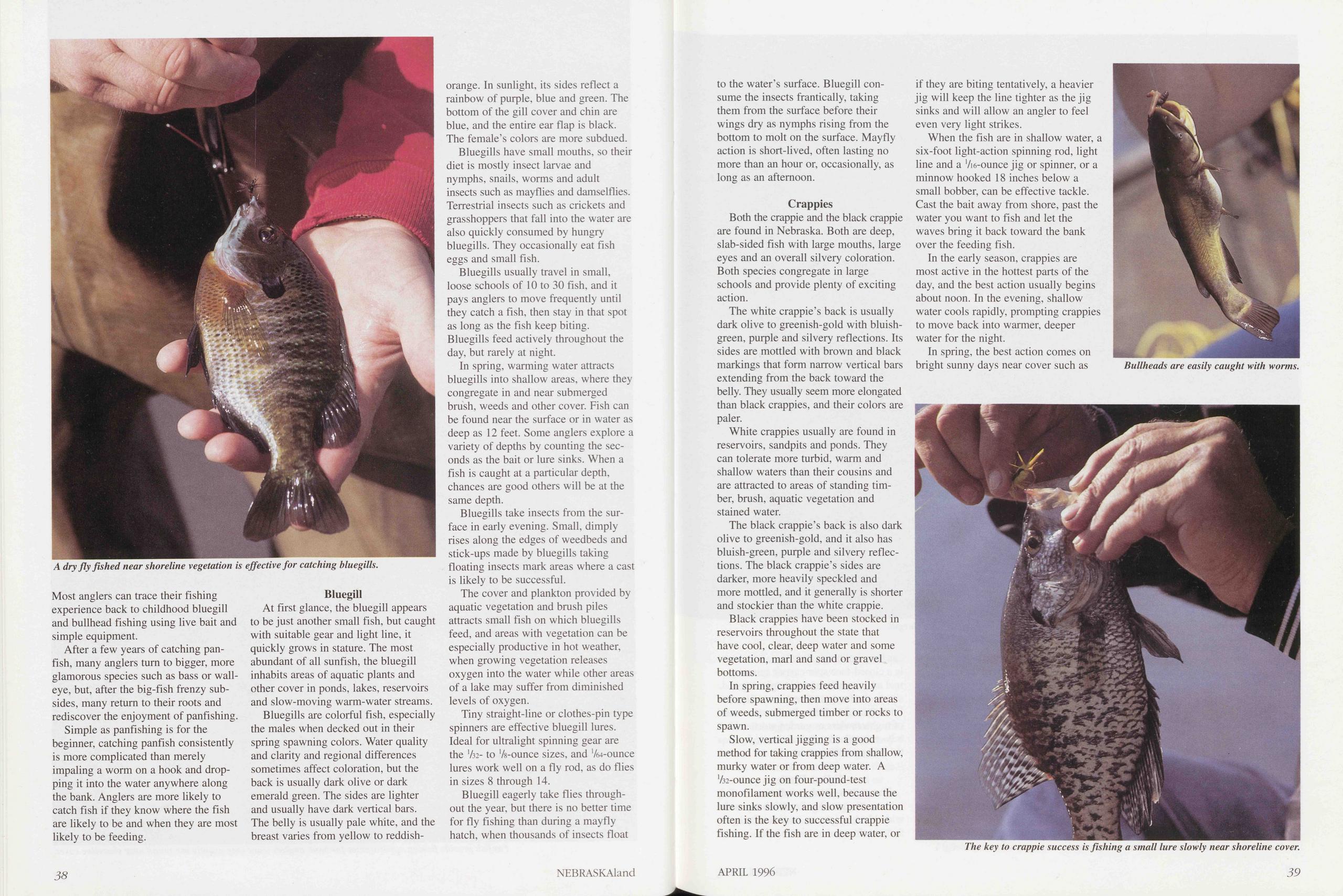
Most anglers can trace their fishing experience back to childhood bluegill and bullhead fishing using live bait and simple equipment.
After a few years of catching panfish, many anglers turn to bigger, more glamorous species such as bass or walleye, but, after the big-fish frenzy subsides, many return to their roots and rediscover the enjoyment of panfishing.
Simple as panfishing is for the beginner, catching panfish consistently is more complicated than merely impaling a worm on a hook and dropping it into the water anywhere along the bank. Anglers are more likely to catch fish if they know where the fish are likely to be and when they are most likely to be feeding.
BluegillAt first glance, the bluegill appears to be just another small fish, but caught with suitable gear and light line, it quickly grows in stature. The most abundant of all sunfish, the bluegill inhabits areas of aquatic plants and other cover in ponds, lakes, reservoirs and slow-moving warm-water streams.
Bluegills are colorful fish, especially the males when decked out in their spring spawning colors. Water quality and clarity and regional differences sometimes affect coloration, but the back is usually dark olive or dark emerald green. The sides are lighter and usually have dark vertical bars. The belly is usually pale white, and the breast varies from yellow to reddish- orange. In sunlight, its sides reflect a rainbow of purple, blue and green. The bottom of the gill cover and chin are blue, and the entire ear flap is black. The female’s colors are more subdued.
Bluegills have small mouths, so their diet is mostly insect larvae and nymphs, snails, worms and adult insects such as mayflies and damselflies. Terrestrial insects such as crickets and grasshoppers that fall into the water are also quickly consumed by hungry bluegills. They occasionally eat fish eggs and small fish.
Bluegills usually travel in small, loose schools of 10 to 30 fish, and it pays anglers to move frequently until they catch a fish, then stay in that spot as long as the fish keep biting. Bluegills feed actively throughout the day, but rarely at night.
In spring, warming water attracts bluegills into shallow areas, where they congregate in and near submerged brush, weeds and other cover. Fish can be found near the surface or in water as deep as 12 feet. Some anglers explore a variety of depths by counting the seconds as the bait or lure sinks. When a fish is caught at a particular depth, chances are good others will be at the same depth.
Bluegills take insects from the surface in early evening. Small, dimply rises along the edges of weedbeds and stick-ups made by bluegills taking floating insects mark areas where a cast is likely to be successful.
The cover and plankton provided by aquatic vegetation and brush piles attracts small fish on which bluegills feed, and areas with vegetation can be especially productive in hot weather, when growing vegetation releases oxygen into the water while other areas of a lake may suffer from diminished levels of oxygen.
Tiny straight-line or clothes-pin type spinners are effective bluegill lures. Ideal for ultralight spinning gear are the 732- to 78-ounce sizes, and 764-ounce lures work well on a fly rod, as do flies in sizes 8 through 14.
Bluegill eagerly take flies throughout the year, but there is no better time for fly fishing than during a mayfly hatch, when thousands of insects float to the water’s surface. Bluegill consume the insects frantically, taking them from the surface before their wings dry as nymphs rising from the bottom to molt on the surface. Mayfly action is short-lived, often lasting no more than an hour or, occasionally, as long as an afternoon.
CrappiesBoth the crappie and the black crappie are found in Nebraska. Both are deep, slab-sided fish with large mouths, large eyes and an overall silvery coloration. Both species congregate in large schools and provide plenty of exciting action.
The white crappie’s back is usually dark olive to greenish-gold with bluish- green, purple and silvery reflections. Its sides are mottled with brown and black markings that form narrow vertical bars extending from the back toward the belly. They usually seem more elongated than black crappies, and their colors are paler.
White crappies usually are found in reservoirs, sandpits and ponds. They can tolerate more turbid, warm and shallow waters than their cousins and are attracted to areas of standing timber, brush, aquatic vegetation and stained water.
The black crappie’s back is also dark olive to greenish-gold, and it also has bluish-green, purple and silvery reflections. The black crappie’s sides are darker, more heavily speckled and more mottled, and it generally is shorter and stockier than the white crappie. Black crappies have been stocked in reservoirs throughout the state that have cool, clear, deep water and some vegetation, marl and sand or gravel bottoms.
In spring, crappies feed heavily before spawning, then move into areas of weeds, submerged timber or rocks to spawn.
Slow, vertical jigging is a good method for taking crappies from shallow, murky water or from deep water. A 732-ounce jig on four-pound-test monofilament works well, because the lure sinks slowly, and slow presentation often is the key to successful crappie fishing. If the fish are in deep water, or if they are biting tentatively, a heavier jig will keep the line tighter as the jig sinks and will allow an angler to feel even very light strikes.
When the fish are in shallow water, a six-foot light-action spinning rod, light line and a 7i6-ounce jig or spinner, or a minnow hooked 18 inches below a small bobber, can be effective tackle. Cast the bait away from shore, past the water you want to fish and let the waves bring it back toward the bank over the feeding fish.
In the early season, crappies are most active in the hottest parts of the day, and the best action usually begins about noon. In the evening, shallow water cools rapidly, prompting crappies to move back into warmer, deeper water for the night.
In spring, the best action comes on bright sunny days near cover such as
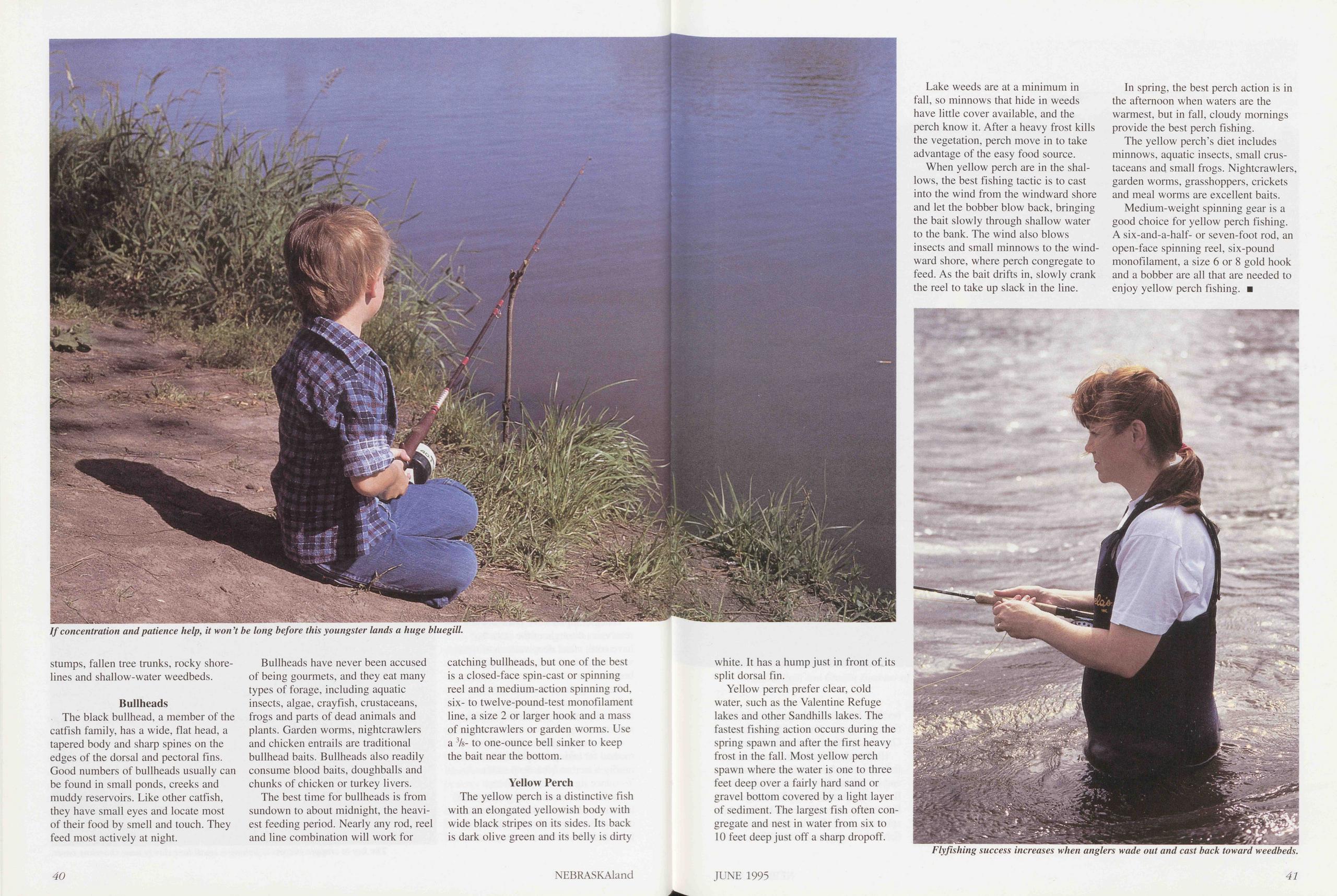
stumps, fallen tree trunks, rocky shorelines and shallow-water weedbeds.
BullheadsThe black bullhead, a member of the catfish family, has a wide, flat head, a tapered body and sharp spines on the edges of the dorsal and pectoral fins. Good numbers of bullheads usually can be found in small ponds, creeks and muddy reservoirs. Like other catfish, they have small eyes and locate most of their food by smell and touch. They feed most actively at night.
Bullheads have never been accused of being gourmets, and they eat many types of forage, including aquatic insects, algae, crayfish, crustaceans, frogs and parts of dead animals and plants. Garden worms, nightcrawlers and chicken entrails are traditional bullhead baits. Bullheads also readily consume blood baits, doughballs and chunks of chicken or turkey livers.
The best time for bullheads is from sundown to about midnight, the heaviest feeding period. Nearly any rod, reel and line combination will work for catching bullheads, but one of the best is a closed-face spin-cast or spinning reel and a medium-action spinning rod, six- to twelve-pound-test monofilament line, a size 2 or larger hook and a mass of nightcrawlers or garden worms. Use a 3/s- to one-ounce bell sinker to keep the bait near the bottom.
Yellow PerchThe yellow perch is a distinctive fish with an elongated yellowish body with wide black stripes on its sides. Its back is dark olive green and its belly is dirty white. It has a hump just in front of its split dorsal fin.
Yellow perch prefer clear, cold water, such as the Valentine Refuge lakes and other Sandhills lakes. The fastest fishing action occurs during the spring spawn and after the first heavy frost in the fall. Most yellow perch spawn where the water is one to three feet deep over a fairly hard sand or gravel bottom covered by a light layer of sediment. The largest fish often congregate and nest in water from six to 10 feet deep just off a sharp dropoff.
Lake weeds are at a minimum in fall, so minnows that hide in weeds have little cover available, and the perch know it. After a heavy frost kills the vegetation, perch move in to take advantage of the easy food source.
When yellow perch are in the shallows, the best fishing tactic is to cast into the wind from the windward shore and let the bobber blow back, bringing the bait slowly through shallow water to the bank. The wind also blows insects and small minnows to the windward shore, where perch congregate to feed. As the bait drifts in, slowly crank the reel to take up slack in the line.
In spring, the best perch action is in the afternoon when waters are the warmest, but in fall, cloudy mornings provide the best perch fishing.
The yellow perch’s diet includes minnows, aquatic insects, small crus- taceans and small frogs. Nightcrawlers, garden worms, grasshoppers, crickets and meal worms are excellent baits.
Medium-weight spinning gear is a good choice for yellow perch fishing. A six-and-a-half- or seven-foot rod, an open-face spinning reel, six-pound monofilament, a size 6 or 8 gold hook and a bobber are all that are needed to enjoy yellow perch fishing. ■
40 NEBRASKAland JUNE 1995 41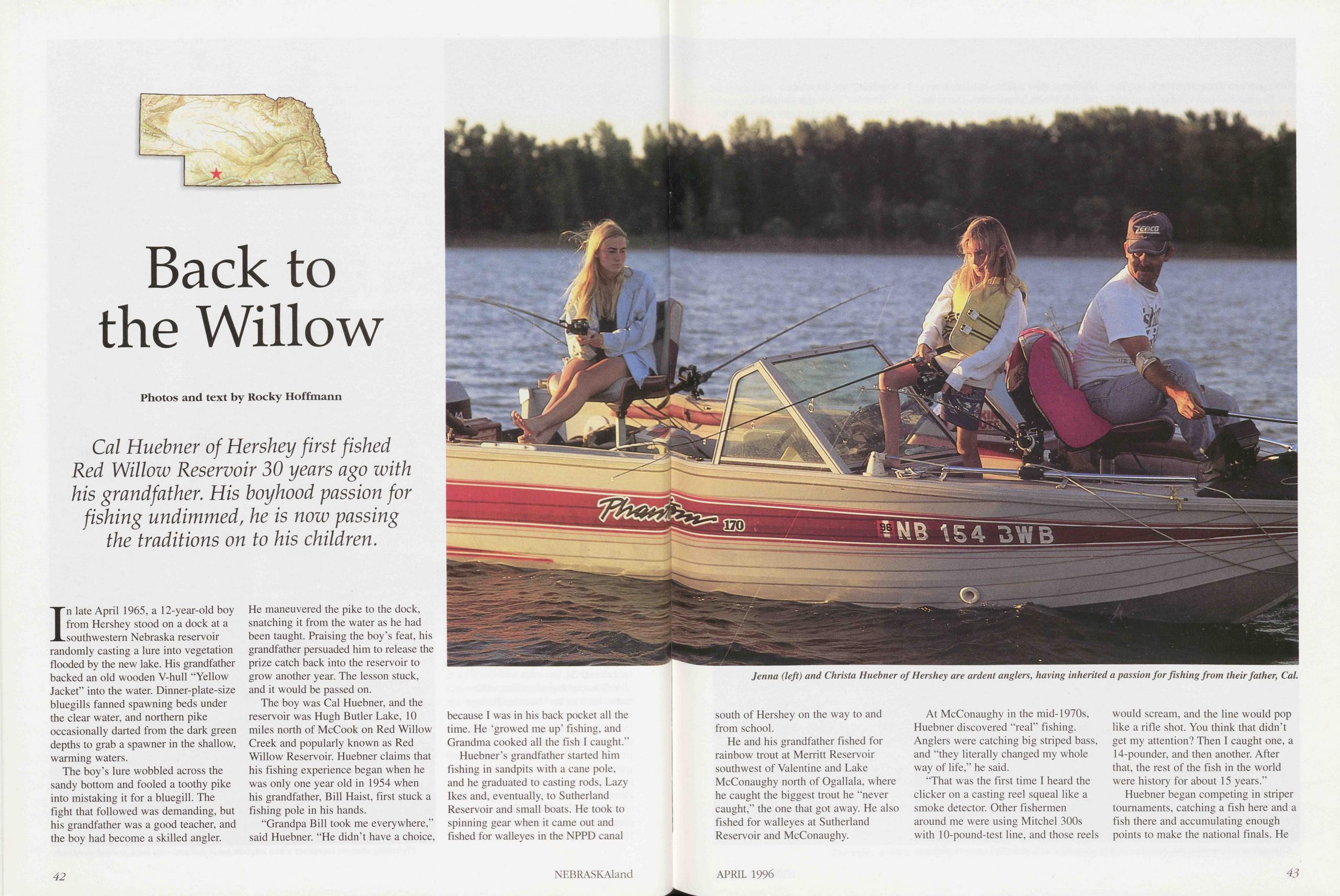
Back to the Willow
Cal Huebner of Hershey first fished Red Willow Reservoir 30 years ago with his grandfather. His boyhood passion for fishing undimmed, he is now passing the traditions on to his children.In late April 1965, a 12-year-old boy from Hershey stood on a dock at a southwestern Nebraska reservoir randomly casting a lure into vegetation flooded by the new lake. His grandfather backed an old wooden V-hull “Yellow Jacket” into the water. Dinner-plate-size bluegills fanned spawning beds under the clear water, and northern pike occasionally darted from the dark green depths to grab a spawner in the shallow, warming waters.
The boy’s lure wobbled across the sandy bottom and fooled a toothy pike into mistaking it for a bluegill. The fight that followed was demanding, but his grandfather was a good teacher, and the boy had become a skilled angler. He maneuvered the pike to the dock, snatching it from the water as he had been taught. Praising the boy’s feat, his grandfather persuaded him to release the prize catch back into the reservoir to grow another year. The lesson stuck, and it would be passed on.
The boy was Cal Huebner, and the reservoir was Hugh Butler Lake, 10 miles north of McCook on Red Willow Creek and popularly known as Red Willow Reservoir. Huebner claims that his fishing experience began when he was only one year old in 1954 when his grandfather, Bill Haist, first stuck a fishing pole in his hands.
“Grandpa Bill took me everywhere,” said Huebner. “He didn’t have a choice,
because I was in his back pocket all the time. He ‘growed me up’ fishing, and Grandma cooked all the fish I caught.”
Huebner’s grandfather started him fishing in sandpits with a cane pole, and he graduated to casting rods, Lazy Ikes and, eventually, to Sutherland Reservoir and small boats. He took to spinning gear when it came out and fished for walleyes in the NPPD canal south of Hershey on the way to and from school.
He and his grandfather fished for rainbow trout at Merritt Reservoir southwest of Valentine and Lake McConaughy north of Ogallala, where he caught the biggest trout he “never caught,” the one that got away. He also fished for walleyes at Sutherland Reservoir and McConaughy.
At McConaughy in the mid-1970s, Huebner discovered “real” fishing. Anglers were catching big striped bass, and “they literally changed my whole way of life,” he said.
“That was the first time I heard the clicker on a casting reel squeal like a smoke detector. Other fishermen around me were using Mitchel 300s with 10-pound-test line, and those reels would scream, and the line would pop like a rifle shot. You think that didn’t get my attention? Then I caught one, a 14-pounder, and then another. After that, the rest of the fish in the world were history for about 15 years.”
Huebner began competing in striper tournaments, catching a fish here and a fish there and accumulating enough points to make the national finals. He
42 NEBRASKAland APRIL 1996 43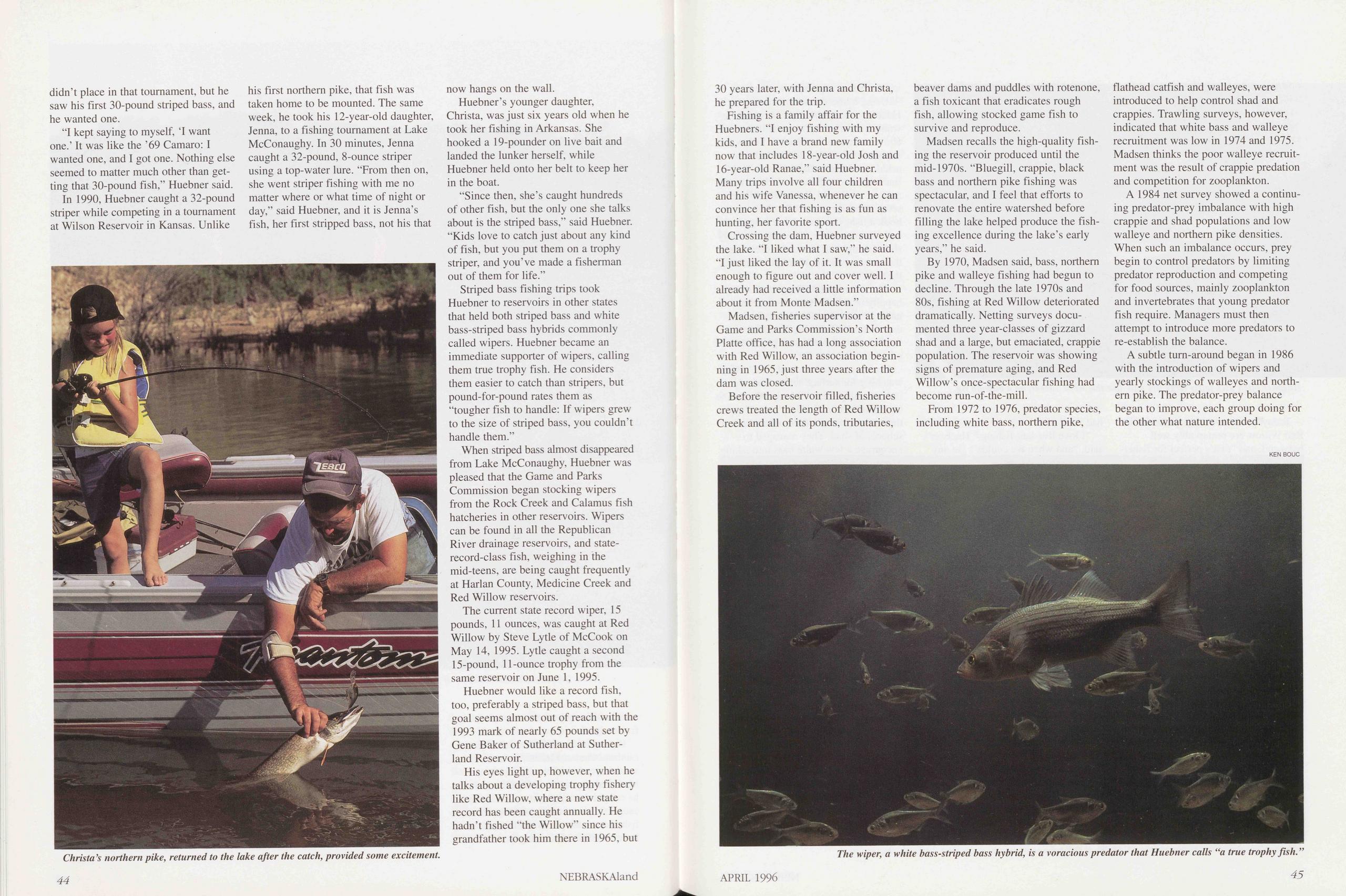
didn’t place in that tournament, but he saw his first 30-pound striped bass, and he wanted one.
"I kept saying to myself, ‘I want one.’ It was like the ’69 Camaro: I wanted one, and I got one. Nothing else seemed to matter much other than getting that 30-pound fish,” Huebner said.
In 1990, Huebner caught a 32-pound striper while competing in a tournament at Wilson Reservoir in Kansas. Unlike
Huebner’s younger daughter, Christa, was just six years old when he took her fishing in Arkansas. She hooked a 19-pounder on live bait and landed the lunker herself, while Huebner held onto her belt to keep her in the boat.
“Since then, she’s caught hundreds of other fish, but the only one she talks about is the striped bass,” said Huebner. “Kids love to catch just about any kind of fish, but you put them on a trophy striper, and you’ve made a fisherman out of them for life.”
Striped bass fishing trips took Huebner to reservoirs in other states that held both striped bass and white bass-striped bass hybrids commonly called wipers. Huebner became an immediate supporter of wipers, calling them true trophy fish. He considers them easier to catch than stripers, but pound-for-pound rates them as “tougher fish to handle: If wipers grew to the size of striped bass, you couldn’t handle them.”
When striped bass almost disappeared from Lake McConaughy, Huebner was pleased that the Game and Parks Commission began stocking wipers from the Rock Creek and Calamus fish hatcheries in other reservoirs. Wipers can be found in all the Republican River drainage reservoirs, and state- record-class fish, weighing in the mid-teens, are being caught frequently at Harlan County, Medicine Creek and Red Willow reservoirs.
The current state record wiper, 15 pounds, 11 ounces, was caught at Red Willow by Steve Lytle of McCook on May 14, 1995. Lytle caught a second 15-pound, 11-ounce trophy from the same reservoir on June 1, 1995. Huebner would like a record fish, too, preferably a striped bass, but that goal seems almost out of reach with the 1993 mark of nearly 65 pounds set by Gene Baker of Sutherland at Sutherland Reservoir.
His eyes light up, however, when he talks about a developing trophy fishery like Red Willow, where a new state record has been caught annually. He hadn’t fished “the Willow” since his grandfather took him there in 1965, but 30 years later, with Jenna and Christa, he prepared for the trip.
Fishing is a family affair for the Huebners. “I enjoy fishing with my kids, and I have a brand new family now that includes 18-year-old Josh and 16-year-old Ranae,” said Huebner. Many trips involve all four children and his wife Vanessa, whenever he can convince her that fishing is as fun as hunting, her favorite sport.
Crossing the dam, Huebner surveyed the lake. “I liked what I saw,” he said. “I just liked the lay of it. It was small enough to figure out and cover well. I already had received a little information about it from Monte Madsen.”
Madsen, fisheries supervisor at the Game and Parks Commission’s North Platte office, has had a long association with Red Willow, an association begin- ning in 1965, just three years after the dam was closed.
Before the reservoir filled, fisheries crews treated the length of Red Willow Creek and all of its ponds, tributaries,
beaver dams and puddles with rotenone, a fish toxicant that eradicates rough fish, allowing stocked game fish to survive and reproduce.
Madsen recalls the high-quality fishing the reservoir produced until the mid-1970s. “Bluegill, crappie, black bass and northern pike fishing was spectacular, and I feel that efforts to renovate the entire watershed before filling the lake helped produce the fishing excellence during the lake’s early years,” he said.
By 1970, Madsen said, bass, northern pike and walleye fishing had begun to decline. Through the late 1970s and 80s, fishing at Red Willow deteriorated dramatically. Netting surveys documented three year-classes of gizzard shad and a large, but emaciated, crappie population. The reservoir was showing signs of premature aging, and Red Willow’s once-spectacular fishing had become run-of-the-mill.
From 1972 to 1976, predator species, including white bass, northern pike, flathead catfish and walleyes, were introduced to help control shad and crappies. Trawling surveys, however, indicated that white bass and walleye recruitment was low in 1974 and 1975. Madsen thinks the poor walleye recruitment was the result of crappie predation and competition for zooplankton.
A 1984 net survey showed a continuing predator-prey imbalance with high crappie and shad populations and low walleye and northern pike densities. When such an imbalance occurs, prey begin to control predators by limiting predator reproduction and competing for food sources, mainly zooplankton and invertebrates that young predator fish require. Managers must then attempt to introduce more predators to re-establish the balance.
A subtle turn-around began in 1986 with the introduction of wipers and yearly stockings of walleyes and northern pike. The predator-prey balance began to improve, each group doing for the other what nature intended.
44 NEBRASKAland APRIL 1996 45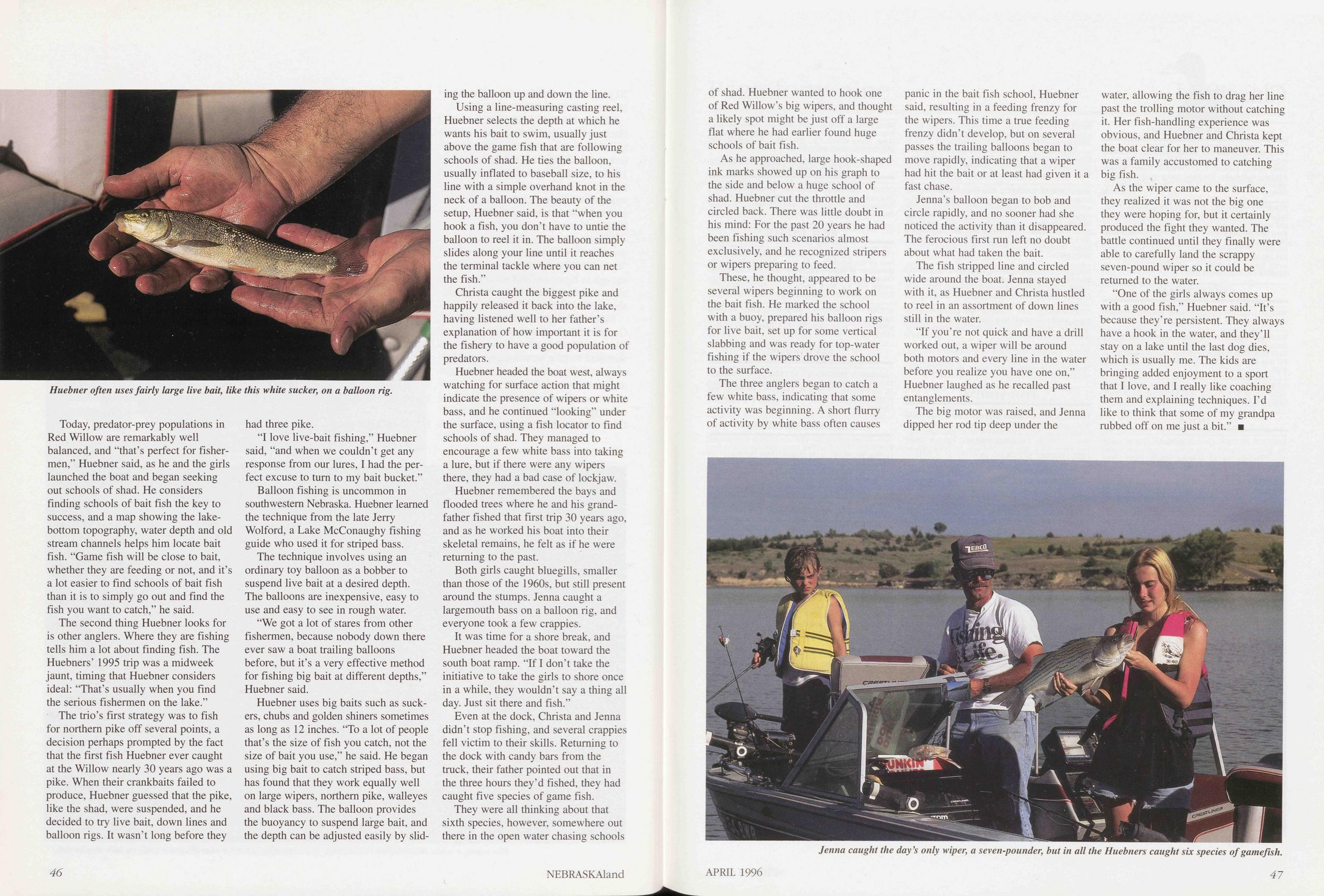
Today, predator-prey populations in Red Willow are remarkably well balanced, and “that’s perfect for fishermen,” Huebner said, as he and the girls launched the boat and began seeking out schools of shad. He considers finding schools of bait fish the key to success, and a map showing the lake-bottom topography, water depth and old stream channels helps him locate bait fish. “Game fish will be close to bait, whether they are feeding or not, and it’s a lot easier to find schools of bait fish than it is to simply go out and find the fish you want to catch,” he said.
The second thing Huebner looks for is other anglers. Where they are fishing tells him a lot about finding fish. The Huebners’ 1995 trip was a midweek jaunt, timing that Huebner considers ideal: “That’s usually when you find the serious fishermen on the lake.” The trio’s first strategy was to fish for northern pike off several points, a decision perhaps prompted by the fact that the first fish Huebner ever caught at the Willow nearly 30 years ago was a pike. When their crankbaits failed to produce, Huebner guessed that the pike, like the shad, were suspended, and he decided to try live bait, down lines and balloon rigs. It wasn’t long before they had three pike.
“I love live-bait fishing,” Huebner said, “and when we couldn’t get any response from our lures, I had the perfect excuse to turn to my bait bucket.” Balloon fishing is uncommon in southwestern Nebraska. Huebner learned the technique from the late Jerry Wolford, a Lake McConaughy fishing guide who used it for striped bass.
The technique involves using an ordinary toy balloon as a bobber to suspend live bait at a desired depth. The balloons are inexpensive, easy to use and easy to see in rough water.
“We got a lot of stares from other fishermen, because nobody down there ever saw a boat trailing balloons before, but it’s a very effective method for fishing big bait at different depths,” Huebner said.
Huebner uses big baits such as suckers, chubs and golden shiners sometimes as long as 12 inches. “To a lot of people that’s the size of fish you catch, not the size of bait you use,” he said. He began using big bait to catch striped bass, but has found that they work equally well on large wipers, northern pike, walleyes and black bass. The balloon provides the buoyancy to suspend large bait, and the depth can be adjusted easily by sliding the balloon up and down the line.
Using a line-measuring casting reel, Huebner selects the depth at which he wants his bait to swim, usually just above the game fish that are following schools of shad. He ties the balloon, usually inflated to baseball size, to his line with a simple overhand knot in the neck of a balloon. The beauty of the setup, Huebner said, is that “when you hook a fish, you don’t have to untie the balloon to reel it in. The balloon simply slides along your line until it reaches the terminal tackle where you can net the fish.”
Christa caught the biggest pike and happily released it back into the lake, having listened well to her father’s explanation of how important it is for the fishery to have a good population of predators.
Huebner headed the boat west, always watching for surface action that might indicate the presence of wipers or white bass, and he continued “looking” under the surface, using a fish locator to find schools of shad. They managed to encourage a few white bass into taking a lure, but if there were any wipers there, they had a bad case of lockjaw.
Huebner remembered the bays and flooded trees where he and his grand- father fished that first trip 30 years ago, and as he worked his boat into their skeletal remains, he felt as if he were returning to the past.
Both girls caught bluegills, smaller than those of the 1960s, but still present around the stumps. Jenna caught a largemouth bass on a balloon rig, and everyone took a few crappies.
It was time for a shore break, and Huebner headed the boat toward the south boat ramp. “If I don’t take the initiative to take the girls to shore once in a while, they wouldn’t say a thing all day. Just sit there and fish.”
Even at the dock, Christa and Jenna didn’t stop fishing, and several crappies fell victim to their skills. Returning to the dock with candy bars from the truck, their father pointed out that in the three hours they’d fished, they had caught five species of game fish.
They were all thinking about that sixth species, however, somewhere out there in the open water chasing schools of shad. Huebner wanted to hook one of Red Willow’s big wipers, and thought a likely spot might be just off a large flat where he had earlier found huge schools of bait fish.
As he approached, large hook-shaped ink marks showed up on his graph to the side and below a huge school of shad. Huebner cut the throttle and circled back. There was little doubt in his mind: For the past 20 years he had been fishing such scenarios almost exclusively, and he recognized stripers or wipers preparing to feed.
These, he thought, appeared to be several wipers beginning to work on the bait fish. He marked the school with a buoy, prepared his balloon rigs for live bait, set up for some vertical slabbing and was ready for top-water fishing if the wipers drove the school to the surface.
The three anglers began to catch a few white bass, indicating that some activity was beginning. A short flurry of activity by white bass often causes
panic in the bait fish school, Huebner said, resulting in a feeding frenzy for the wipers. This time a true feeding frenzy didn’t develop, but on several passes the trailing balloons began to move rapidly, indicating that a wiper had hit the bait or at least had given it a fast chase.
Jenna’s balloon began to bob and circle rapidly, and no sooner had she noticed the activity than it disappeared. The ferocious first run left no doubt about what had taken the bait.
The fish stripped line and circled wide around the boat. Jenna stayed with it, as Huebner and Christa hustled to reel in an assortment of down lines still in the water.
“If you’re not quick and have a drill worked out, a wiper will be around both motors and every line in the water before you realize you have one on,” Huebner laughed as he recalled past entanglements.
The big motor was raised, and Jenna dipped her rod tip deep under the water, allowing the fish to drag her line past the trolling motor without catching it. Her fish-handling experience was obvious, and Huebner and Christa kept the boat clear for her to maneuver. This was a family accustomed to catching big fish.
As the wiper came to the surface, they realized it was not the big one they were hoping for, but it certainly produced the fight they wanted. The battle continued until they finally were able to carefully land the scrappy seven-pound wiper so it could be returned to the water.
“One of the girls always comes up with a good fish,” Huebner said. “It’s because they’re persistent. They always have a hook in the water, and they’ll stay on a lake until the last dog dies, which is usually me. The kids are bringing added enjoyment to a sport that I love, and I really like coaching them and explaining techniques. I’d like to think that some of my grandpa rubbed off on me just a bit.”
46 NEBRASKAland APRIL 1996 47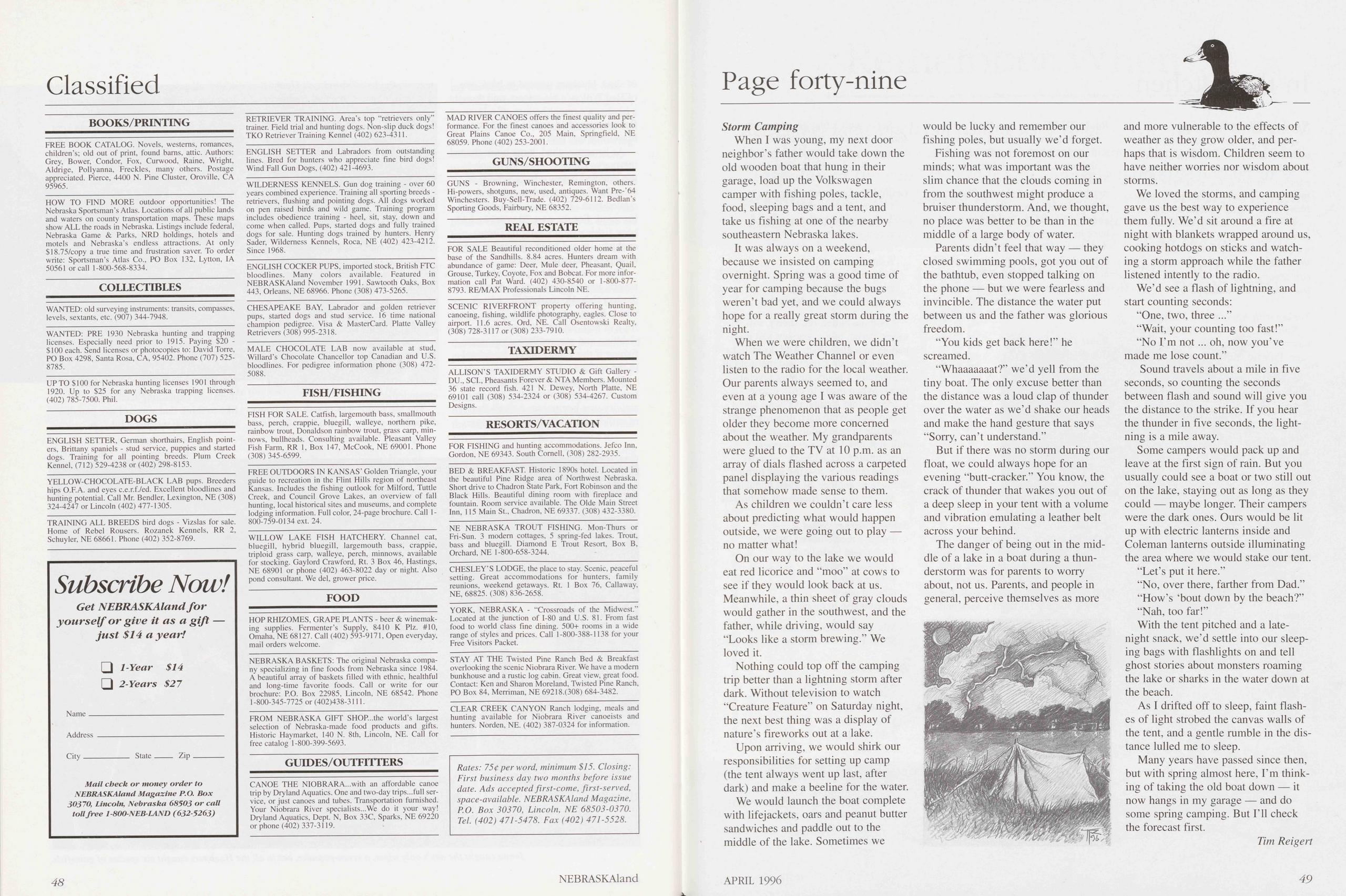
Classified
BOOKS/PRINTINGFREE BOOK CATALOG. Novels, westerns, romances, children’s; old out of print, found bams, attic. Authors: Grey, Bower, Condor, Fox, Curwood, Raine, Wright, Aldrige, Pollyanna, Freckles, many others. Postage appreciated. Pierce, 4400 N. Pine Cluster, Oroville, CA 95965.
HOW TO FIND MORE outdoor opportunities! The Nebraska Sportsman’s Atlas. Locations of all public lands and waters on county transportation maps. These maps show ALL the roads in Nebraska. Listings include federal, Nebraska Game & Parks, NRD holdings, hotels and motels and Nebraska’s endless attractions. At only $18.75/copy a true time and frustration saver. To order write: Sportsman’s Atlas Co., PO Box 132, Lytton, IA 50561 or call 1-800-568-8334.
COLLECTIBLESWANTED: old surveying instruments: transits, compasses, levels, sextants, etc. (907) 344-7948.
WANTED: PRE 1930 Nebraska hunting and trapping licenses. Especially need prior to 1915. Paying $20 - $100 each. Send licenses or photocopies to: David Torre, PO Box 4298, Santa Rosa, CA, 95402. Phone (707) 525- 8785.
UPTO $100 for Nebraska hunting licenses 1901 through 1920. Up to $25 for any Nebraska trapping licenses. (402) 785-7500. Phil.
DOGSENGLISH SETTER, German shorthairs, English point- ers, Brittany spaniels - stud service, puppies and started dogs. Training for all pointing breeds. Plum Creek Kennel, (712) 529-4238 or (402) 298-8153.
YELLOW-CHOCOLATE-BLACK LAB pups. Breeders hips O.F.A. and eyes c.e.r.f./ed. Excellent bloodlines and hunting potential. Call Mr. Bendler, Lexington, NE (308) 324-4247 or Lincoln (402) 477-1305.
TRAINING ALL BREEDS bird dogs - Vizslas for sale. Home of Rebel Rousers. Rozanek Kennels, RR 2, Schuyler, NE 68661. Phone (402) 352-8769.
Subscribe Now! Get NEBRASKAland for yourself or give it as a gift — just $14 a year! 1-Year $14 2-Years $27 Name Address- City State Zip Mail check or money order to NEBRASKAland Magazine P.O. Box 30370, Lincoln, Nebraska 68503 or call toll free 1-800-NEB-LAND (632-5263)RETRIEVER TRAINING. Area’s top “retrievers only” trainer. Field trial and hunting dogs. Non-slip duck dogs! TKO Retriever Training Kennel (402) 623-4311. ENGLISH SETTER and Labradors from outstanding lines. Bred for hunters who appreciate Fine bird dogs! Wind Fall Gun Dogs, (402) 421-4693.
WILDERNESS KENNELS. Gun dog training - over 60 years combined experience. Training all sporting breeds - retrievers, flushing and pointing dogs. All dogs worked on pen raised birds and wild game. Training program includes obedience training - heel, sit, stay, down and come when called. Pups, started dogs and fully trained dogs for sale. Hunting dogs trained by hunters. Henry Sader, Wilderness Kennels, Roca, NE (402) 423-4212. Since 1968.
ENGLISH COCKER PUPS, imported stock, British FTC bloodlines. Many colors available. Featured in NEBRASKAland November 1991. Sawtooth Oaks, Box 443, Orleans, NE 68966. Phone (308) 473-5265. CHESAPEAKE BAY, Labrador and golden retriever pups, started dogs and stud service. 16 time national champion pedigree. Visa & MasterCard. Platte Valley Retrievers (308) 995-2318.
MALE CHOCOLATE LAB now available at stud, Willard’s Chocolate Chancellor top Canadian and U.S. bloodlines. For pedigree information phone (308) 472- 5088.
FISH/FISHINGFISH FOR SALE. Catfish, largemouth bass, smallmouth bass, perch, crappie, bluegill, walleye, northern pike, rainbow trout, Donaldson rainbow trout, grass carp, min- nows, bullheads. Consulting available. Pleasant Valley Fish Farm, RR 1, Box 147, McCook, NE 69001. Phone (308) 345-6599.
FREE OUTDOORS IN KANSAS' Golden Triangle, your guide to recreation in the Flint Hills region of northeast Kansas. Includes the fishing outlook for Milford, Tuttle Creek, and Council Grove Lakes, an overview of fall hunting, local historical sites and museums, and complete lodging information. Full color, 24-page brochure. Call 1- 800-759-0134 ext. 24.
WILLOW LAKE FISH HATCHERY. Channel cat, bluegill, hybrid bluegill, largemouth bass, crappie, triploid grass carp, walleye, perch, minnows, available for stocking. Gaylord Crawford, Rt. 3 Box 46, Hastings, NE 68901 or phone (402) 463-8022 day or night. Also pond consultant. We del, grower price.
FOODHOP RHIZOMES, GRAPE PLANTS - beer & winemak- ing supplies. Fermenter’s Supply, 8410 K Plz. #10, Omaha, NE 68127. Call (402) 593-9171, Open everyday, mail orders welcome.
NEBRASKA BASKETS: The original Nebraska compa- ny specializing in fine foods from Nebraska since 1984. A beautiful array of baskets filled with ethnic, healthful and long-time favorite foods. Call or write for our brochure: P.O. Box 22985, Lincoln, NE 68542. Phone 1-800-345-7725 or (402)438-3111.
FROM NEBRASKA GIFT SHOP .the world’s largest selection of Nebraska-made food products and gifts. Historic Haymarket, 140 N. 8th, Lincoln, NE. Call for free catalog 1-800-399-5693.
GUIDES/OUTFITTERSCANOE THE NIOBRARA...with an affordable canoe trip by Dryland Aquatics. One and two-day trips...full ser- vice, or just canoes and tubes. Transportation furnished. Your Niobrara River specialists...We do it your way! Dryland Aquatics, Dept. N, Box 33C, Sparks, NE 69220 or phone (402) 337-3119.
MAD RIVER CANOES offers the finest quality and per- formance. For the finest canoes and accessories look to Great Plains Canoe Co., 205 Main, Springfield, NE 68059. Phone (402) 253-2001.
GUNS/SHOOTING GUNS - Browning, Winchester, Remington, others. Hi-powers, shotguns, new, used, antiques. Want Pre-'64 Winchesters. Buy-Sell-Trade. (402) 729-6112. Bedlan's Sporting Goods, Fairbury, NE 68352.
REAL ESTATEFOR SALE Beautiful reconditioned older home at the base of the Sandhills. 8.84 acres. Hunters dream with abundance of game: Deer, Mule deer, Pheasant, Quail, Grouse, Turkey, Coyote, Fox and Bobcat. For more infor- mation call Pat Ward. (402) 430-8540 or 1-800-877- 8793. RE/MAX Professionals Lincoln NE.
SCENIC RIVERFRONT property offering hunting, canoeing, fishing, wildlife photography, eagles. Close to airport. 11.6 acres. Ord, NE. Call Osentowski Realty, (308) 728-3117 or (308) 233-7910.
TAXIDERMYALLISON’S TAXIDERMY STUDIO & Gift Gallery - DU., SCI., Pheasants Forever & NTA Members. Mounted 36 state record fish. 421 N. Dewey, North Platte, NE 69101 call (308) 534-2324 or (308) 534-4267. Custom Designs.
RESORTS/VACATIONFOR FISHING and hunting accommodations. Jefco Inn, Gordon, NE 69343. South Cornell, (308) 282-2935. BED & BREAKFAST Historic 1890s hotel. Located in the beautiful Pine Ridge area of Northwest Nebraska. Short drive to Chadron State Park, Fort Robinson and the Black Hills. Beautiful dining room with fireplace and fountain. Room service available. The Olde Main Street Inn, 115 Main St., Chadron, NE 69337. (308) 432-3380.
NE NEBRASKA TROUT FISHING. Mon-Thurs or Fri-Sun. 3 modem cottages, 5 spring-fed lakes. Trout, bass and bluegill. Diamond E Trout Resort, Box B. Orchard, NE 1-800-658-3244.
CHESLEY’S LODGE, the place to stay. Scenic, peaceful setting. Great accommodations for hunters, family reunions, weekend getaways. Rt. 1 Box 76, Callaway, NE, 68825. (308) 836-2658.
YORK, NEBRASKA - “Crossroads of the Midwest.” Located at the junction of 1-80 and U.S. 81. From fast food to world class fine dining. 500+ rooms in a wide range of styles and prices. Call 1-800-388-1138 for your Free Visitors Packet.
STAY AT THE Twisted Pine Ranch Bed & Breakfast overlooking the scenic Niobrara River. We have a modem bunkhouse and a rustic log cabin. Great view, great food. Contact: Ken and Sharon Moreland, Twisted Pine Ranch, PO Box 84, Merriman, NE 69218.(308) 684-3482.
CLEAR CREEK CANYON Ranch lodging, meals and hunting available for Niobrara River canoeists and hunters. Norden, NE. (402) 387-0324 for information.
Rates: 75(1 per word, minimum $15. Closing: First business day two months before issue date. Ads accepted first-come, first-served, space-available. NEBRASKAland Magazine, P.O. Box 30370, Lincoln, NE 68503-0370. Tel. (402) 471-5478. Fax (402) 471-5528.Page forty-nine
Storm CampingWhen I was young, my next door neighbor’s father would take down the old wooden boat that hung in their garage, load up the Volkswagen camper with fishing poles, tackle, food, sleeping bags and a tent, and take us fishing at one of the nearby southeastern Nebraska lakes.
It was always on a weekend, because we insisted on camping overnight. Spring was a good time of year for camping because the bugs weren’t bad yet, and we could always hope for a really great storm during the night.
When we were children, we didn’t watch The Weather Channel or even listen to the radio for the local weather. Our parents always seemed to, and even at a young age I was aware of the strange phenomenon that as people get older they become more concerned about the weather. My grandparents were glued to the TV at 10 p.m. as an array of dials flashed across a carpeted panel displaying the various readings that somehow made sense to them. As children we couldn’t care less about predicting what would happen outside, we were going out to play — no matter what!
On our way to the lake we would eat red licorice and “moo” at cows to see if they would look back at us. Meanwhile, a thin sheet of gray clouds would gather in the southwest, and the father, while driving, would say “Looks like a storm brewing.” We loved it.
Nothing could top off the camping trip better than a lightning storm after dark. Without television to watch “Creature Feature” on Saturday night, the next best thing was a display of nature’s fireworks out at a lake.
Upon arriving, we would shirk our responsibilities for setting up camp (the tent always went up last, after dark) and make a beeline for the water.
We would launch the boat complete with lifejackets, oars and peanut butter sandwiches and paddle out to the middle of the lake. Sometimes we would be lucky and remember our fishing poles, but usually we’d forget.
Fishing was not foremost on our minds; what was important was the slim chance that the clouds coming in from the southwest might produce a bruiser thunderstorm. And, we thought, no place was better to be than in the middle of a large body of water.
Parents didn’t feel that way — they closed swimming pools, got you out of the bathtub, even stopped talking on the phone — but we were fearless and invincible. The distance the water put between us and the father was glorious freedom.
“You kids get back here!” he screamed.
“Whaaaaaaat?” we’d yell from the tiny boat. The only excuse better than the distance was a loud clap of thunder over the water as we’d shake our heads and make the hand gesture that says “Sorry, can’t understand.”
But if there was no storm during our float, we could always hope for an evening “butt-cracker.” You know, the crack of thunder that wakes you out of a deep sleep in your tent with a volume and vibration emulating a leather belt across your behind.
The danger of being out in the middle of a lake in a boat during a thun- derstorm was for parents to worry about, not us. Parents, and people in general, perceive themselves as more and more vulnerable to the effects of weather as they grow older, and perhaps that is wisdom. Children seem to have neither worries nor wisdom about storms.
We loved the storms, and camping gave us the best way to experience them fully. We’d sit around a fire at night with blankets wrapped around us, cooking hotdogs on sticks and watching a storm approach while the father listened intently to the radio.
We’d see a flash of lightning, and start counting seconds: “One, two, three ...” “Wait, your counting too fast!” “No I’m not ... oh, now you’ve made me lose count.”
Sound travels about a mile in five seconds, so counting the seconds between flash and sound will give you the distance to the strike. If you hear the thunder in five seconds, the lightning is a mile away.
Some campers would pack up and leave at the first sign of rain. But you usually could see a boat or two still out on the lake, staying out as long as they could — maybe longer. Their campers were the dark ones. Ours would be lit up with electric lanterns inside and Coleman lanterns outside illuminating the area where we would stake our tent.
“Let’s put it here.”
“No, over there, farther from Dad.”
“How’s ‘bout down by the beach?”
“Nah, too far!”
With the tent pitched and a latenight snack, we’d settle into our sleep- ing bags with flashlights on and tell ghost stories about monsters roaming the lake or sharks in the water down at the beach.
As I drifted off to sleep, faint flashes of light strobed the canvas walls of the tent, and a gentle rumble in the dis- tance lulled me to sleep.
Many years have passed since then, but with spring almost here, I’m thinking of taking the old boat down — it now hangs in my garage — and do some spring camping. But I’ll check the forecast first.
48 NEBRASKAland APRIL 1996 49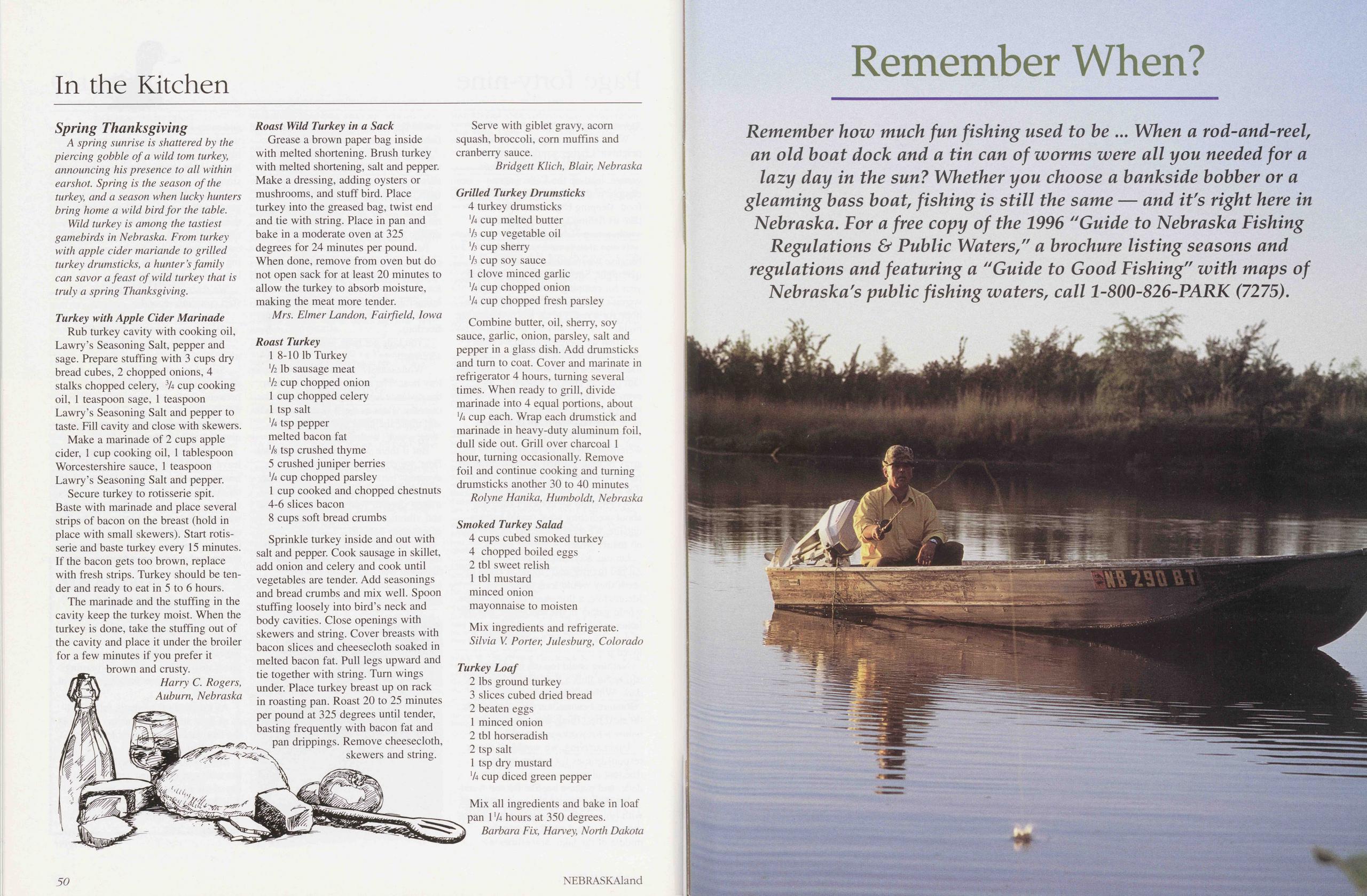
In the Kitchen
Spring ThanksgivingA spring sunrise is shattered by the piercing gobble of a wild tom turkey, announcing his presence to all within earshot. Spring is the season of the turkey, and a season when lucky hunters bring home a wild bird for the table. Wild turkey is among the tastiest gamebirds in Nebraska. From turkey with apple cider mariande to grilled turkey drumsticks, a hunter's family can savor a feast of wild turkey that is truly a spring Thanksgiving.
Turkey with Apple Cider MarinadeRub turkey cavity with cooking oil, Lawry’s Seasoning Salt, pepper and sage. Prepare stuffing with 3 cups dry bread cubes, 2 chopped onions, 4 stalks chopped celery, 3A cup cooking oil, 1 teaspoon sage, 1 teaspoon Lawry’s Seasoning Salt and pepper to taste. Fill cavity and close with skewers.
Make a marinade of 2 cups apple cider, 1 cup cooking oil, 1 tablespoon Worcestershire sauce, 1 teaspoon Lawry’s Seasoning Salt and pepper.
Secure turkey to rotisserie spit. Baste with marinade and place several strips of bacon on the breast (hold in place with small skewers). Start rotis- serie and baste turkey every 15 minutes. If the bacon gets too brown, replace with fresh strips. Turkey should be ten- der and ready to eat in 5 to 6 hours.
The marinade and the stuffing in the cavity keep the turkey moist. When the turkey is done, take the stuffing out of the cavity and place it under the broiler for a few minutes if you prefer it brown and crusty.
Harry C. Rogers, Auburn, Nebraska Roast Wild Turkey in a SackGrease a brown paper bag inside with melted shortening. Brush turkey with melted shortening, salt and pepper. Make a dressing, adding oysters or mushrooms, and stuff bird. Place turkey into the greased bag, twist end and tie with string. Place in pan and bake in a moderate oven at 325 degrees for 24 minutes per pound. When done, remove from oven but do not open sack for at least 20 minutes to allow the turkey to absorb moisture, making the meat more tender.
Mrs. Elmer Landon, Fairfield, Iowa Roast Turkey 1 8-10 lb TurkeyV2 lb sausage meat
V2 cup chopped onion
1 cup chopped celery
1 tsp salt
1/4 tsp pepper
melted bacon fat
1/8 tsp crushed thyme
5 crushed juniper berries
1/4 cup chopped parsley
1 cup cooked and chopped chestnuts
4-6 slices bacon
8 cups soft bread crumbs
Sprinkle turkey inside and out with salt and pepper. Cook sausage in skillet, add onion and celery and cook until vegetables are tender. Add seasonings and bread crumbs and mix well. Spoon stuffing loosely into bird’s neck and body cavities. Close openings with skewers and string. Cover breasts with bacon slices and cheesecloth soaked in melted bacon fat. Pull legs upward and tie together with string. Turn wings under. Place turkey breast up on rack in roasting pan. Roast 20 to 25 minutes per pound at 325 degrees until tender, basting frequently with bacon fat and pan drippings. Remove cheesecloth, skewers and string.
Serve with giblet gravy, acorn squash, broccoli, corn muffins and cranberry sauce.
Bridgett Klich, Blair, Nebraska Grilled Turkey Drumsticks 4 turkey drumsticks1/4 cup melted butter
1/2 cup vegetable oil
1/2 cup sherry
1/2 cup soy sauce
1 clove minced garlic
1/4 cup chopped onion
1/4 cup chopped fresh parsley
Combine butter, oil, sherry, soy sauce, garlic, onion, parsley, salt and pepper in a glass dish. Add drumsticks and turn to coat. Cover and marinate in refrigerator 4 hours, turning several times. When ready to grill, divide marinade into 4 equal portions, about 1/4 cup each. Wrap each drumstick and marinade in heavy-duty aluminum foil, dull side out. Grill over charcoal 1 hour, turning occasionally. Remove foil and continue cooking and turning drumsticks another 30 to 40 minutes
Rolyne Hanika, Humboldt, Nebraska Smoked Turkey Salad 4 cups cubed smoked turkey4 chopped boiled eggs
2 tbl sweet relish
1 tbl mustard
minced onion
mayonnaise to moisten
Mix ingredients and refrigerate. Silvia V. Porter, Julesburg, Colorado Turkey Loaf 2 lbs ground turkey
3 slices cubed dried bread
2 beaten eggs
1 minced onion
2 tbl horseradish
2 tsp salt
1 tsp dry mustard
1/4 cup diced green pepper
Mix all ingredients and bake in loaf
pan 1V4 hours at 350 degrees. Barbara Fix, Harvey, North Dakota 50 NEBRASKAland
Remember When?
Remember how much fun fishing used to be ... When a rod-and-reel, an old boat dock and a tin can of worms were all you needed for a lazy day in the sun? Whether you choose a bankside bobber or a gleaming bass boat, fishing is still the same — and it's right here in Nebraska. For a free copy of the 1996 "Guide to Nebraska Fishing Regulations & Public Waters," a brochure listing seasons and regulations and featuring a "Guide to Good Fishing" with maps of Nebraska's public fishing waters, call 1-800-826-PARK (7275).
Position: 626 (18 views)