Volume 74, Issue 2, 1996
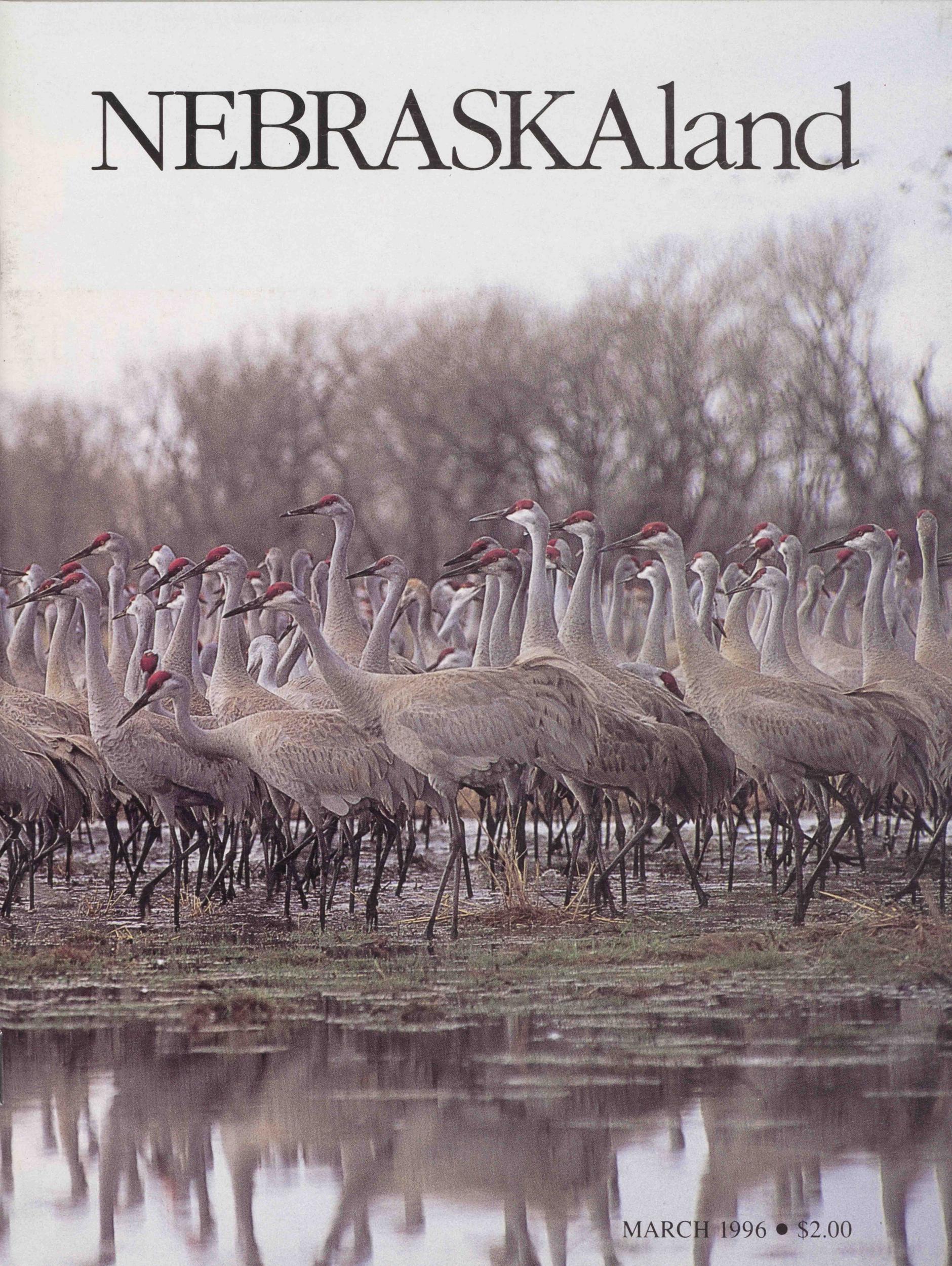
NEBRASKAland
MARCH 1996 • $2.00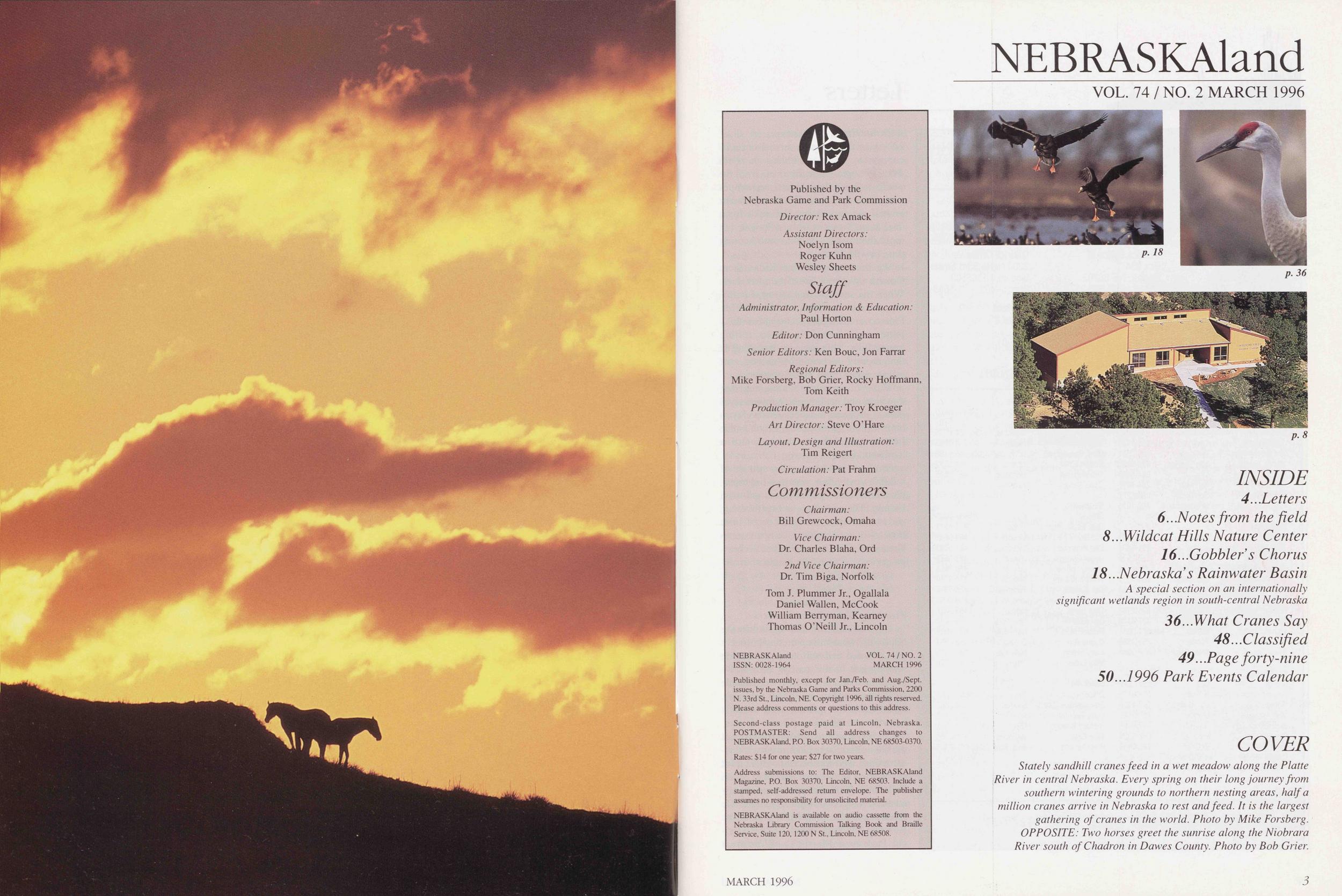
NEBRASKAland
Published by the Nebraska Game and Park Commission Director: Rex Amack Assistant Directors: Noelyn Isom Roger Kuhn Wesley Sheets Staff Administrator, Information & Education: Paul Horton Editor: Don Cunningham Senior Editors: Ken Bouc, Jon Farrar Regional Editors: Mike Forsberg, Bob Grier, Rocky Hoffmann, Tom Keith Production Manager: Troy Kroeger Art Director: Steve O'Hare Layout, Design and Illustration: Tim Reigert Circulation: Pat Frahm Commissioners Chairman: Bill Grewcock. Omaha Vice Chairman: Dr. Charles Blaha, Ord 2nd Vice Chairman: Dr. Tim Biga, Norfolk Tom J. Plummer Jr., Ogallala Daniel Wallen, McCook William Berryman, Kearney Thomas O'Neill Jr., Lincoln NEBRASKAland ISSN: 0028-1964 VOL. 74 / NO. 2 MARCH 1996 Published monthly, except for Jan./Feb. and Aug./Sept. issues, by the Nebraska Game and Parks Commission, 2200 N. 33rd St., Lincoln, NE. Copyright 1996, all rights reserved. Please address comments or questions to this address. Second-class postage paid at Lincoln, Nebraska. POSTMASTER: Send all address changes to NEBRASKAland, P.O. Box 30370, Lincoln, NE 68503-0370. Rates: $14 for one year; $27 for two years. Address submissions to: The Editor, NEBRASKAland Magazine, P.O. Box 30370, Lincoln, NE 68503. Include a stamped, self-addressed return envelope. The publisher assumes no responsibility for unsolicited material. NEBRASKAland is available on audio cassette from the Nebraska Library Commission Talking Book and Braille Service. Suite 120, 1200 N St.. Lincoln, NE 68508. VOL. 74 / NO. 2 MARCH 1996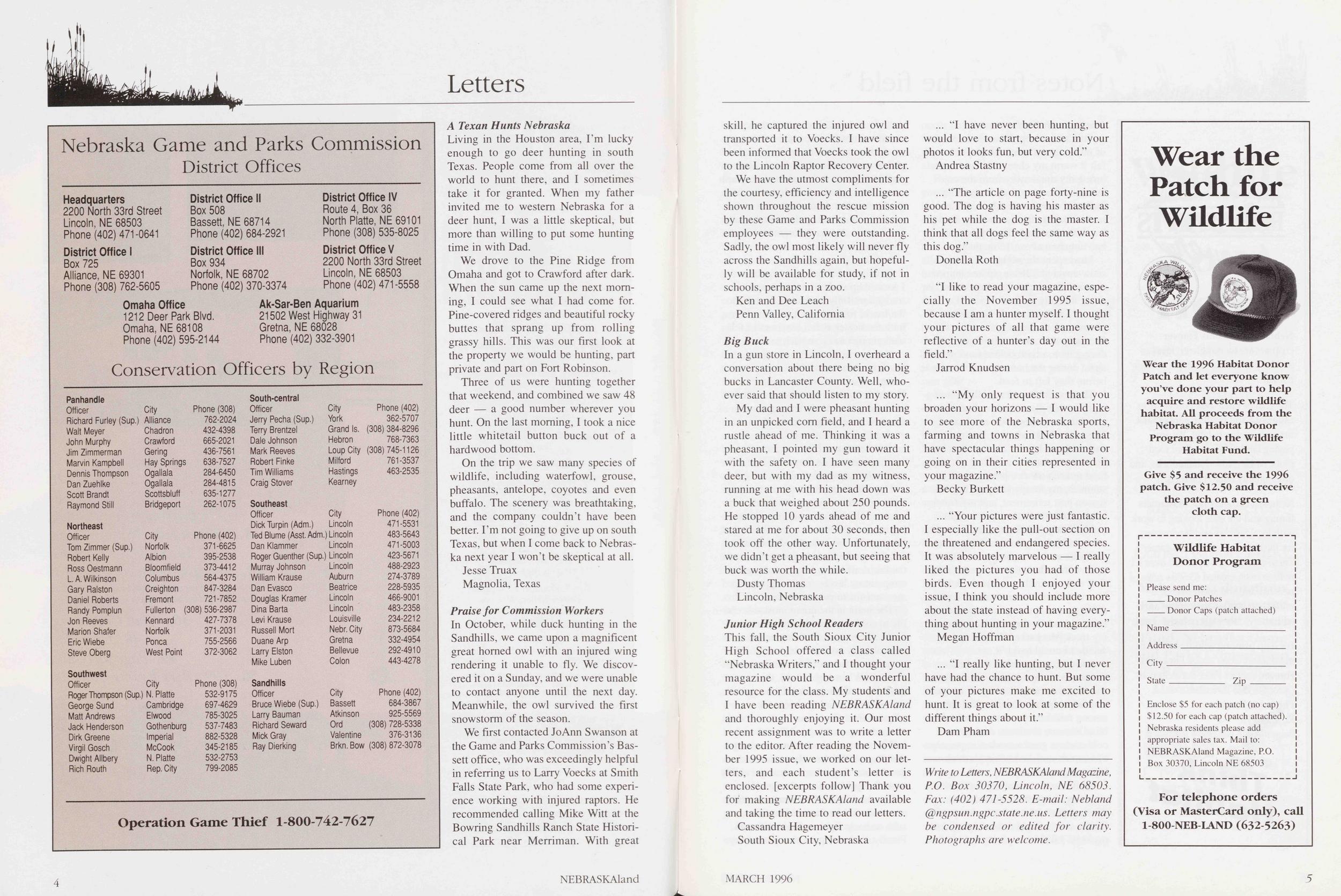
Letters
Nebraska Game and Parks Commission District Offices Headquarters 2200 North 33rd Street Lincoln, NE 68503 Phone (402)471-0641 District Office I Box 725 Alliance, NE 69301 Phone (308)762-5605 District Office II Box 508 Bassett, NE 68714 Phone (402)684-2921 District Office III Box 934 Norfolk, NE 68702 Phone (402)370-3374 District Office IV Route 4, Box 36 North Platte, NE 69101 Phone (308)535-8025 District Office V 2200 North 33rd Street Lincoln, NE 68503 Phone (402)471-5558 Omaha Office 1212 Deer Park Blvd. Omaha, NE 68108 Phone (402) 595-2144 Ak-Sar-Ben Aquarium 21502 West Highway 31 Gretna, NE 68028 Phone (402) 332-3901 Conservation Officers by Region Panhandle South-central Officer City Phone (308) Officer City Phone (402) Richard Furley (Sup.) Alliance 762-2024 Jerry Pecha (Sup.) York 362-5707 Walt Meyer Chadron 432-4398 Terry Brentzel Grand Is. (308) 384-8296 John Murphy Crawford 665-2021 Dale Johnson Hebron 768-7363 Jim Zimmerman Gering 436-7561 Mark Reeves Loup City (308)745-1126 Marvin Kampbell Hay Springs 638-7527 Robert Finke Milford 761-3537 Dennis Thompson Ogallala 284-6450 Tim Williams Hastings 463-2535 Dan Zuehlke Ogallala 284-4815 Craig Stover Kearney Scott Brandt Scottsbluff 635-1277 Raymond Still Bridgeport 262-1075 Southeast Officer City Phone (402) Northeast Dick Turpin (Adm.) Lincoln 471-5531 Officer City Phone (402) Ted Blume (Asst. Adm.) Lincoln 483-5643 Tom Zimmer (Sup.) Norfolk 371-6625 Dan Klammer Lincoln 471-5003 Robert Kelly Albion 395-2538 Roger Guenther (Sup.) Lincoln 423-5671 Ross Oestmann Bloomfield 373-4412 Murray Johnson Lincoln 488-2923 LA. Wilkinson Columbus 564-4375 William Krause Auburn 274-3789 Gary Ralston Creighton 847-3284 Dan Evasco Beatrice 228-5935 Daniel Roberts Fremont 721-7852 Douglas Kramer Lincoln 466-9001 Randy Pomplun Fullerton (308) 536-2987 Dina Barta Lincoln 483-2358 Jon Reeves Kennard 427-7378 Levi Krause Louisville 234-2212 Marion Shafer Norfolk 371-2031 Russell Mort Nebr. City 873-5684 Eric Wiebe Ponca 755-2566 Duane Arp Gretna 332-4954 Steve Oberg West Point 372-3062 Larry Elston Bellevue 292-4910 Mike Luben Colon 443-4278 Southwest Officer City Phone (308) Sandhills Roger Thompson (Sup.) N. Platte 532-9175 Officer City Phone (402) George Sund Cambridge 697-4629 Bruce Wiebe (Sup.)Bassett 684-3867 Matt Andrews Elwood 785-3025 Larry Bauman Atkinson 925-5569 Jack Henderson Gothenburg 537-7483 Richard Seward Ord (308) 728-5338 Dirk Greene Imperial 882-5328 Mick Gray Valentine 376-3136 Virgil Gosch McCook 345-2185 Ray Dierking Brkn. Bow (308) 872-3078 Dwight Allbery N. Platte 532-2753 Rich Routh Rep. City 799-2085 Operation Game Thief 1-800-742-7627 A Texan Hunts NebraskaLiving in the Houston area, I'm lucky enough to go deer hunting in south Texas. People come from all over the world to hunt there, and I sometimes take it for granted. When my father invited me to western Nebraska for a deer hunt, I was a little skeptical, but more than willing to put some hunting time in with Dad.
We drove to the Pine Ridge from Omaha and got to Crawford after dark. When the sun came up the next morning, I could see what I had come for. Pine-covered ridges and beautiful rocky buttes that sprang up from rolling grassy hills. This was our first look at the property we would be hunting, part private and part on Fort Robinson.
Three of us were hunting together that weekend, and combined we saw 48 deer — a good number wherever you hunt. On the last morning, I took a nice little whitetail button buck out of a hardwood bottom.
On the trip we saw many species of wildlife, including waterfowl, grouse, pheasants, antelope, coyotes and even buffalo. The scenery was breathtaking, and the company couldn't have been better. I'm not going to give up on south Texas, but when I come back to Nebraska next year I won't be skeptical at all.
Jesse Truax Magnolia, Texas Praise for Commission WorkersIn October, while duck hunting in the Sandhills, we came upon a magnificent great horned owl with an injured wing rendering it unable to fly. We discovered it on a Sunday, and we were unable to contact anyone until the next day. Meanwhile, the owl survived the first snowstorm of the season.
We first contacted Jo Ann Swanson at the Game and Parks Commission's Bassett office, who was exceedingly helpful in referring us to Larry Voecks at Smith Falls State Park, who had some experience working with injured raptors. He recommended calling Mike Witt at the Bowring Sandhills Ranch State Historical Park near Merriman. With great 4 NEBRASKAland skill, he captured the injured owl and transported it to Voecks. I have since been informed that Voecks took the owl to the Lincoln Raptor Recovery Center.
We have the utmost compliments for the courtesy, efficiency and intelligence shown throughout the rescue mission by these Game and Parks Commission employees — they were outstanding. Sadly, the owl most likely will never fly across the Sandhills again, but hopefully will be available for study, if not in schools, perhaps in a zoo.
Ken and Dee Leach Penn Valley, California Big BuckIn a gun store in Lincoln, I overheard a conversation about there being no big bucks in Lancaster County. Well, whoever said that should listen to my story.
My dad and I were pheasant hunting in an unpicked corn field, and I heard a rustle ahead of me. Thinking it was a pheasant, I pointed my gun toward it with the safety on. I have seen many deer, but with my dad as my witness, running at me with his head down was a buck that weighed about 250 pounds. He stopped 10 yards ahead of me and stared at me for about 30 seconds, then took off the other way. Unfortunately, we didn't get a pheasant, but seeing that buck was worth the while.
Dusty Thomas Lincoln, Nebraska Junior High School ReadersThis fall, the South Sioux City Junior High School offered a class called ''Nebraska Writers," and I thought your magazine would be a wonderful resource for the class. My students and I have been reading NEBRASKAland and thoroughly enjoying it. Our most recent assignment was to write a letter to the editor. After reading the November 1995 issue, we worked on our letters, and each student's letter is enclosed, [excerpts follow] Thank you for making NEBRASKAland available and taking the time to read our letters.
Cassandra Hagemeyer South Sioux City, Nebraska... "I have never been hunting, but would love to start, because in your photos it looks fun, but very cold."
Andrea Stastny... "The article on page forty-nine is good. The dog is having his master as his pet while the dog is the master. I think that all dogs feel the same way as this dog."
Donella Roth"I like to read your magazine, especially the November 1995 issue, because I am a hunter myself. I thought your pictures of all that game were reflective of a hunter's day out in the field."
Jarrod Knudsen... "My only request is that you broaden your horizons — I would like to see more of the Nebraska sports, farming and towns in Nebraska that have spectacular things happening or going on in their cities represented in your magazine."
Becky Burkett... "Your pictures were just fantastic. I especially like the pull-out section on the threatened and endangered species. It was absolutely marvelous — I really liked the pictures you had of those birds. Even though I enjoyed your issue, I think you should include more about the state instead of having everything about hunting in your magazine."
Megan Hoffman... "I really like hunting, but I never have had the chance to hunt. But some of your pictures make me excited to hunt. It is great to look at some of the different things about it."
Dam Pham Write to Letters, NEBRASKAland Magazine, P.O. Box 30370, Lincoln, NE 68503. Fax: (402) 471-5528. E-mail: Nebland@ngpsun.ngpc.state.ne.us. Letters may be condensed or edited for clarity. Photographs are welcome. Wear the Patch for Wildlife Wear the 1996 Habitat Donor Patch and let everyone know you've done your part to help acquire and restore wildlife habitat. All proceeds from the Nebraska Habitat Donor Program go to the Wildlife Habitat Fund. Give $5 and receive the 1996 patch. Give $12.50 and receive the patch on a green cloth cap. Wildlife Habitat Donor Program Please send me: Donor Patches Donor Caps (patch attached) Name Address City State Zip Enclose $5 for each patch (no cap) $12.50 for each cap (patch attached). Nebraska residents please add appropriate sales tax. Mail to: NEBRASKAland Magazine, P.O. Box 30370, Lincoln NE 68503 For telephone orders (Visa or MasterCard only), call 1-800-NEB-LAND (632-5263) MARCH 1996 5
Notes from the field
PHEASANTS Nebraska Pheasants Forever chapters are working with farmers and landowners to establish wildlife habitat. The goal of Pheasants Forever is to restore upland wildlife populations through quality habitat. We are paying landowners to plant food plots, nesting cover, shelter belts, and other quality habitat projects. Nebraska currently has 46 chapters throughout the state looking to work with local farmers and landowners for the benefit of all upland game. These chapters have planted over 1.1 million trees, created 63,500+ acres of new habitat, and spent over $1.2 million on habitat and conservation education in the state in eight years! For help planting wildlife habitat or more information about Pheasants Forever, contact Peter Berthelsen at (308) 357-1335 or write to: Pheasants Forever Rt. 1, Box 76 Belgrade, NE 68623 Dealing with ColdStill half-asleep, I watched a sliver of morning sun creep into my tent and felt it warm my cheek for a moment, luring my mind away from the cold numbing the rest of my body. Four inches of snow during the night added to the blanket already covering the treeless hills. For three days, temperatures had not risen above 15 degrees.
I had spent the night tucked into a snow-covered hillside, spike-camped near a trumpeter swan winter roost site along the gray sinuous bends of a remote Sandhills creek, hoping to photograph the swans during the few fleeting golden moments of sunlight during their arrival before sundown and again during the hour or so after sunrise before they left to feed.
The one constant in wildlife photography is that plans made are rarely executed the way they were envisioned. The swans had arrived at the roost after dark and had left well before first light. To make matters worse I had too little food to keep the fire burning in my stomach, my lumpy sleeping bag was a season past retirement, and my water bottles had frozen during the night.
My hands and feet tingled from the cold, and I decided to pack my gear and walk an hour upstream to a cove of open water where the trumpeters often feed and rest in the afternoon. A windblown crust on the snow made walking difficult, and at one point I considered heading back to the trail road where my truck was parked. Foolishly I decided I could tough it out.
Arriving at the cove I was beat. Sweat ran down my face but my feet and hands were still cold and my toes and fingertips were numb. As I sat among fallen timber that served as a blind, the sun that even during the coldest days gave a modest impression of warmth vanished behind a thick layer of gray clouds.
Each hour I sat waiting for the swans my body felt colder. I was thirsty, but the water bottles were still frozen and too cold to heat up against my skin. I had been plenty cold before, though, so I paid little attention to my condition until I dropped a camera on my foot and felt nothing, then tried to pick it up and found my hands almost unable to grasp it. I tried to photograph some diving ducks that alighted a few yards away, but I was shivering so much I couldn't keep the tripod steady, and I seemed to have forgotten how to load film in my camera, something I usually can do in my sleep.
Finally realizing I was hypothermic, I packed up most of my gear and trudged pitifully back over the hills to the truck, where I spent the next hour with the heater at full blast until I felt well enough to drive back to town.
Nearly everyone who has spent much time in the cold has experienced some sort of cold-related injury. Humans, by nature, are not as efficient at keeping their body temperature up as they are at keeping it down. Humans evolved in warm climates, and our bodies developed efficient protective mechanisms for dealing with heat, but we are less adept at dealing with cold.
Hypothermia occurs when the body loses heat faster than it can produce heat and the body's core temperature begins to fall below normal. When that happens, the brain and body begin to fail. When the body begins to feel cold, the brain, which monitors and regulates temperature levels, triggers protective mechanisms to prevent further heat loss.
The brain is the organ most susceptible to cold. Designed to function at peak efficiency at 98.6 degrees, the normal body core temperature, it will begin to malfunction if its temperature deviates. When it gets cold, the outermost layer of the brain, which controls the most advanced functions, is affected first. Cognitive functions, such as reasoning, making judgments and self-protection, become impaired. At this stage, cold also affects fine and gross motor functions, such as the ability to walk, speak and use the hands.
The next layer of the brain controls emotions and instinctive functions, such as basic fight-or-flight defenses. Finally, the most primitive part of the 6 NEBRASKAland brain at the innermost layer, the brain stem, controls the most basic functions: breathing, the heart rate, core temperature and the level of consciousness. If that part of the brain ceases to function, death is inevitable.
When the brain detects that the body is losing more heat than it can generate, it begins to shut off peripheral circulation. Vasoconstriction, the contraction of tiny blood vessels near the skin, prevents heat loss to the surrounding environment. The skin turns pale and cool. Vasoconstriction is the body's primary defense against heat loss. As circulation to the extremities is shut off by vasoconstriction, warmth is concentrated in the body's core. Because vasoconstriction decreases blood circulation in the extremities, most people first feel cold in their hands and feet.
If vasoconstriction doesn't curb heat loss and the core temperature continues to fall, shivering starts. To generate heat, the brain stimulates the body's muscles to contract and relax rapidly, or "shiver," an involuntary action that warms the body without requiring work. In simple terms, shivering can be considered a symptom of mild hypothermia. As body temperature falls below 98 degrees, hypothermia victims also might begin to experience confusion and apathy, and their skin becomes pale and cool.
If the core temperature continues to fall, shivering increases in intensity. By 94 degrees, fine shivering becomes a more pronounced shaking tremor. Walking becomes difficult, and victims make little effort to protect themselves. By 90 degrees, shivering, shaking and tremors come in convulsive waves, the skin is gray and cold and speech is thick and slurred. Walking is impossible. Shivering stops at about 86 degrees when the body runs out of fuel or cannot keep up with heat loss. When shivering stops, the body is considered severely hypothermic and has lost the ability to warm itself. Without help, a person too cold to shiver will die.
Hypothermia is a leading cause of injury and death in winter, but it can occur any time of year, particularly in Nebraska, where the weather is so unpredictable. Luckily, hypothermia is also preventable.
Pay attention to the weather before you go out and always take a warm hat, mittens and boots. Dress in layers of clothing made of materials like wool or polypropylene that don't absorb much moisture. Layering allows you to regulate your temperature by removing or adding layers as you warm up or cool down. Staying dry is critical in fending off cold. Moisture carries heat away rapidly, and the more heat that escapes, the more the body has to generate to stay warm. If there is a chance of rain or snow, or if you are going to be near water, take rain gear.
Eat and drink often. Bodies need food as fuel to keep the fire burning, particularly in cold weather. Dehydration increases the risk in all health emergencies. Even though you might not notice it as much in cold weather, you perspire whenever you work, and your body needs a continuous supply of water.
Finally, know your limitations and use common sense. Pushing the limits to get one more photograph, ski one more trail or wait for one more flight of ducks rarely is worth the price of hypothermia.
Hypothermia occurs with little warning. Watch for symptoms in your companions. Get a hypothermia victim out of the cold, keep them dry and warm them up. If a hypothermia victim is conscious and alert, give them a warm sweet liquid to replace sugars the body burned when shivering. If they are unconscious, evacuate them gently but as soon as possible.
Even people who have years of experience in the outdoors are not immune to hypothermia, but it shouldn't keep you from going outdoors in cold weather. Rather, put on a warm hat, pay attention to your body's signals, understand your limits and enjoy nature's cold-weather gifts.
Mike Forsberg Wildlife Needs Your Help! Check the box on your Nebraska State Tax form to designate a part of your state tax refund for the Nebraska Nongame and Endangered Wildlife Conservation Fund. Make direct donations to Nebraska Nongame and Endangered Species Fund, Nebraska Game and Parks Commission, P.O. Box 30370, Lincoln, NE 68503 A CHECK FOR WILDLIFE AND PARIS
Wildcat Hills Nature Center
Photos and text by Bob Grier Cooperatively developed, funded and operated, the Wildcat Hills Nature Center south of Gering in Scotts Bluff County is a unique addition to the Nebraska state park system. Not simply a museum or an interpretive center, it is an educational facility as well.The dream began six years ago when a group of civic and educational leaders from western Nebraska met with the Nebraska Game and Parks Commissioners on a windy hilltop in the scenic Wildcat Hills south of Gering in Scotts Bluff County.
A member of the group pointed out the dramatic view of the North Platte River Valley and Scotts Bluff National Monument to the north. Another pointed out a site where a building could be built to take advantage of the view. In a small notebook, a third began listing the steps necessary to bring the dream to life. Funds would be needed, and legislation would have to be introduced and passed. Once land was purchased, volunteers would have to be organized and architectural drawings rendered.
On October 11, 1995, speaking from almost the exact spot where that first meeting took place, Rex Amack, director of the Nebraska Game and Parks Commission and a participant in the initial meeting, spoke at the dedication of the new Wildcat Hills Nature Center. The audience included dignitaries, school children who had helped raise money, volunteers who had worked countless hours and others who came to participate in the center's formal dedication.
"The Wildcat Hills Nature Center is for future generations," Amack told them, "and for those interested in the beauty of this area and the diverse variety of wildlife that can be found here."
Cooperatively developed, funded, constructed and operated, the Wildcat Hills Nature Center is an educational facility as well as a museum and interpretive center. It is a unique addition to the Nebraska state park system.
8 NEBRASKAlandThe center is 10 miles south of Gering on the 784-acre Wildcat Hills State Recreation Area adjacent to a 310-acre game reserve with a small display herd of buffalo and elk.
Like nearby Scotts Bluff and Chimney Rock, the Wildcat Hills were formed from ancient river deposits of rock, sand and silt carried from the Rocky Mountains following their uplift about 60 million years ago. Wind- borne layers of ash and dust from volcanoes to the west were added between 30 million and 40 million years ago. Once the period of deposition slowed, erosion began cutting and
The Wildcat Hills escarpment, carved from the valley's southern rim, is an ideal location for a learning center devoted to diverse natural communities. The exposed layers of the ancient deposits visible on the vertical bluffs help explain the region's geologic history. The escarpments, bluffs and nearby river valley have yielded significant discoveries to paleontologists and archaeologists and help tell the region's story.
Finds at Signal Butte near Chimney Rock and at Ash Hollow Cave on the grounds of Ash Hollow State Historical Park about 100 miles to the east tell of the earliest human presence in the North Platte Valley and the Wildcat Hills. Big game hunters pursuing mammoths and bison and the hunting and primitive farming cultures that followed have left evidence of their lives throughout the region. Ruts of the Oregon-California Trail at nearby Mitchell Pass and Robidoux Pass are vivid reminders of the expansion of more recent cultures and the demise of the Plains Indians.
The ponderosa pine and juniper forest of the heights, the cottonwood, box elder and willows in the ravines and the diversity of plant life and wildlife — representing a crossroads of both mountain and plains as well as eastern and western varieties — are a textbook and a classroom for naturalists of all interests and ages, and the center is designed to supplement the natural classroom.
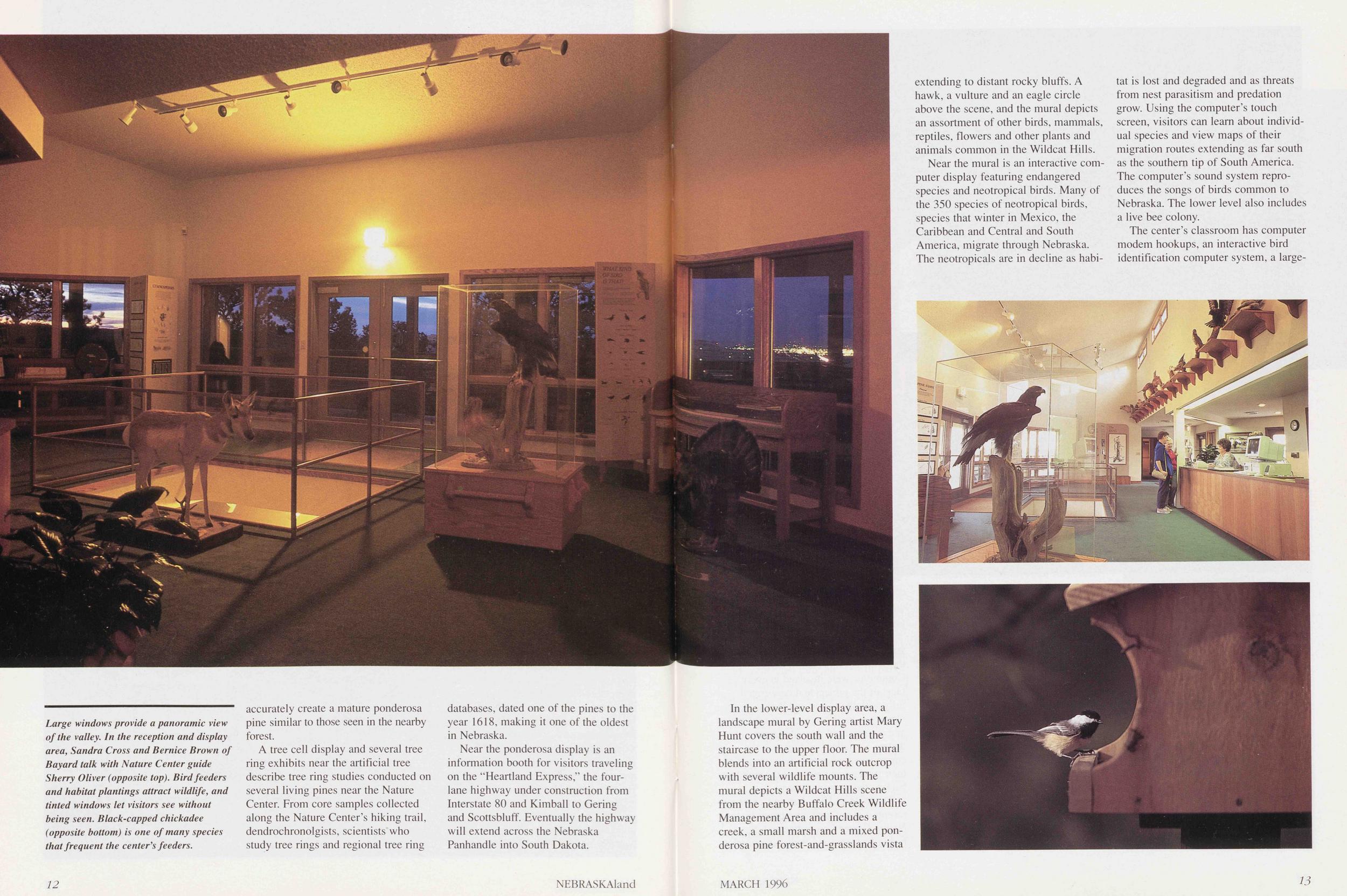
The center's split-level design takes advantage of the hilltop location with little intrusion on the scenic site, and the building's windows are deeply tinted so visitors can closely observe birds and other wildlife coming from the forest to use feeders and plantings along the building's north side. Windows and observation decks extending along the building's north and east sides overlook the pine forest and the North Platte Valley and Scotts Bluff National Monument.
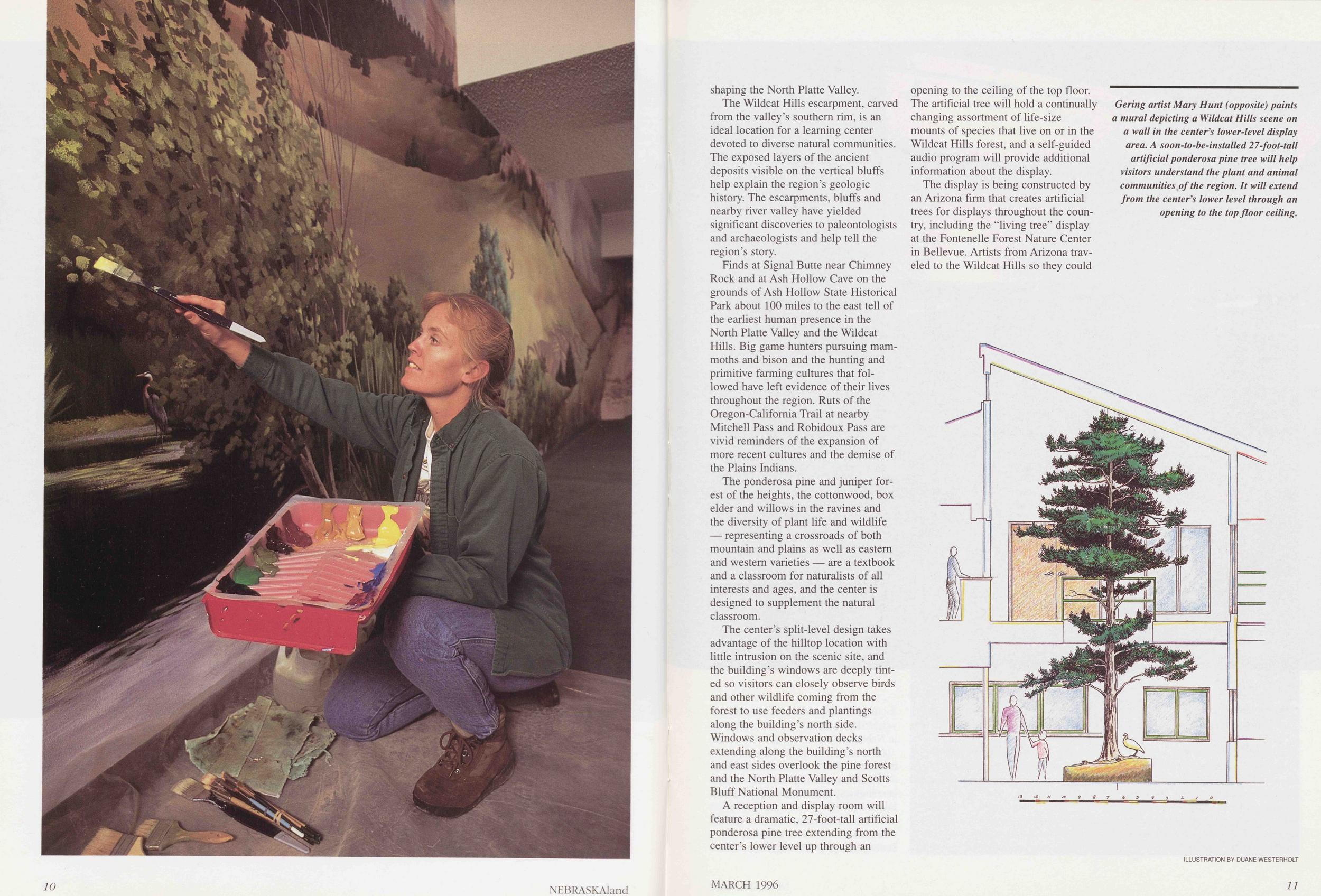
A reception and display room will feature a dramatic, 27-foot-tall artificial ponderosa pine tree extending from the center's lower level up through an opening to the ceiling of the top floor. The artificial tree will hold a continually changing assortment of life-size mounts of species that live on or in the Wildcat Hills forest, and a self-guided audio program will provide additional information about the display.
The display is being constructed by an Arizona firm that creates artificial trees for displays throughout the country, including the "living tree" display at the Fontenelle Forest Nature Center in Bellevue. Artists from Arizona traveled to the Wildcat Hills so they could
A tree cell display and several tree ring exhibits near the artificial tree describe tree ring studies conducted on several living pines near the Nature Center. From core samples collected along the Nature Center's hiking trail, dendrochronologists, scientists who study tree rings and regional tree ring databases, dated one of the pines to the year 1618, making it one of the oldest in Nebraska.
Near the ponderosa display is an information booth for visitors traveling on the "Heartland Express," the four lane highway under construction from Interstate 80 and Kimball to Gering and Scottsbluff. Eventually the highway will extend across the Nebraska Panhandle into South Dakota.
12 NEBRASKAlandIn the lower-level display area, a landscape mural by Gering artist Mary Hunt covers the south wall and the staircase to the upper floor. The mural blends into an artificial rock outcrop with several wildlife mounts. The mural depicts a Wildcat Hills scene from the nearby Buffalo Creek Wildlife Management Area and includes a creek, a small marsh and a mixed ponderosa pine forest-and-grasslands vista extending to distant rocky bluffs. A hawk, a vulture and an eagle circle above the scene, and the mural depicts an assortment of other birds, mammals, reptiles, flowers and other plants and animals common in the Wildcat Hills.
Near the mural is an interactive computer display featuring endangered species and neotropical birds. Many of the 350 species of neotropical birds, species that winter in Mexico, the Caribbean and Central and South America, migrate through Nebraska. The neotropicals are in decline as habitat is lost and degraded and as threats from nest parasitism and predation grow. Using the computer's touch screen, visitors can learn about individual species and view maps of their migration routes extending as far south as the southern tip of South America. The computer's sound system reproduces the songs of birds common to Nebraska. The lower level also includes a live bee colony.
The center's classroom has computer modem hookups, an interactive bird identification computer system, a large-
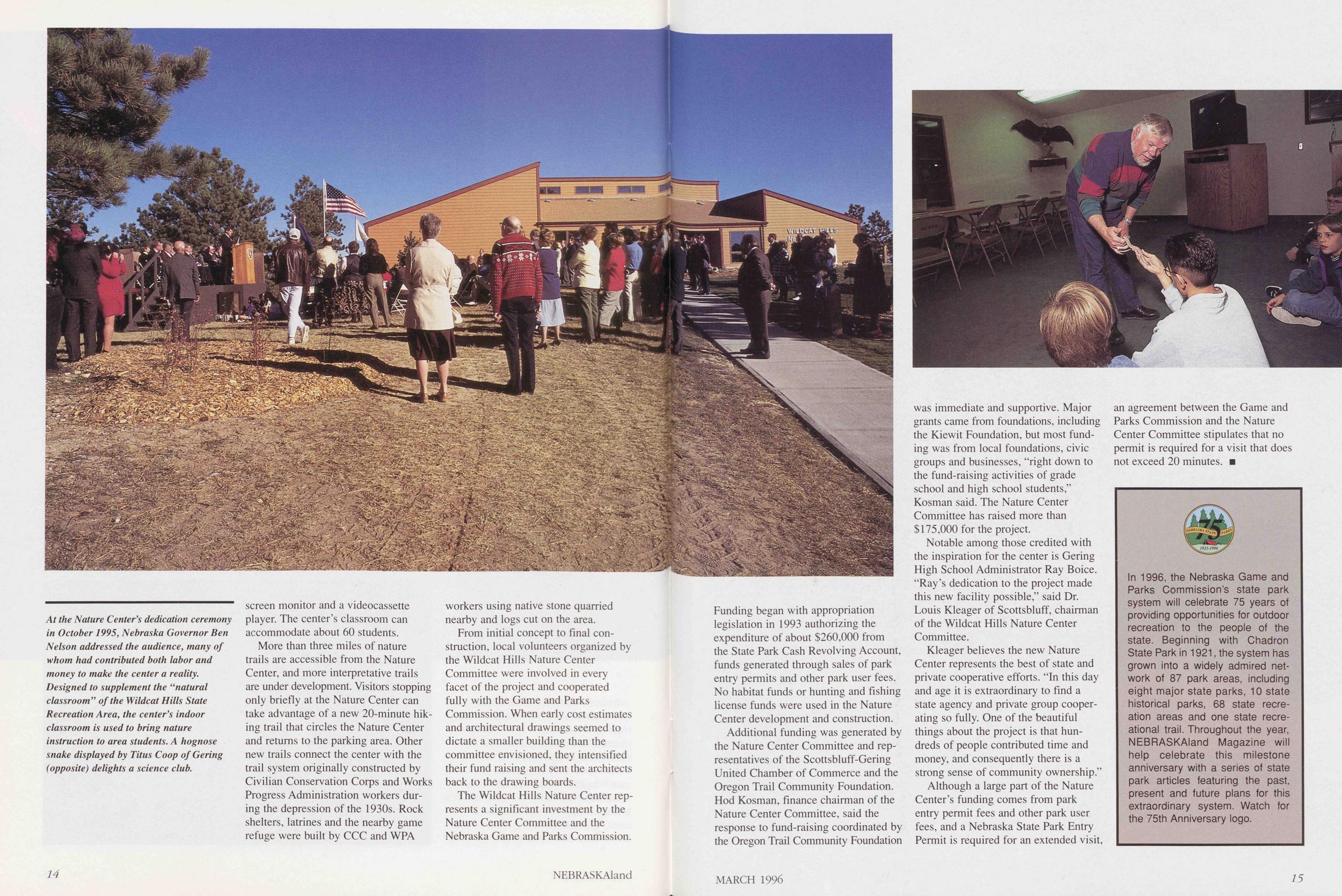
More than three miles of nature trails are accessible from the Nature Center, and more interpretative trails are under development. Visitors stopping only briefly at the Nature Center can take advantage of a new 20-minute hiking trail that circles the Nature Center and returns to the parking area. Other new trails connect the center with the trail system originally constructed by Civilian Conservation Corps and Works Progress Administration workers during the depression of the 1930s. Rock shelters, latrines and the nearby game refuge were built by CCC and WPA workers using native stone quarried nearby and logs cut on the area.
From initial concept to final construction, local volunteers organized by the Wildcat Hills Nature Center Committee were involved in every facet of the project and cooperated fully with the Game and Parks Commission. When early cost estimates and architectural drawings seemed to dictate a smaller building than the committee envisioned, they intensified their fund raising and sent the architects back to the drawing boards.
The Wildcat Hills Nature Center represents a significant investment by the Nature Center Committee and the Nebraska Game and Parks Commission. 14 NEBRASKAland
Additional funding was generated by the Nature Center Committee and representatives of the Scottsbluff-Gering United Chamber of Commerce and the Oregon Trail Community Foundation. Hod Kosman, finance chairman of the Nature Center Committee, said the response to fund-raising coordinated by the Oregon Trail Community Foundation was immediate and supportive. Major grants came from foundations, including the Kiewit Foundation, but most funding was from local foundations, civic groups and businesses, "right down to the fund-raising activities of grade school and high school students," Kosman said. The Nature Center Committee has raised more than $175,000 for the project.
Notable among those credited with the inspiration for the center is Gering High School Administrator Ray Boice. "Ray's dedication to the project made this new facility possible," said Dr. Louis Kleager of Scottsbluff, chairman of the Wildcat Hills Nature Center Committee.
Kleager believes the new Nature Center represents the best of state and private cooperative efforts. "In this day and age it is extraordinary to find a state agency and private group cooperating so fully. One of the beautiful things about the project is that hundreds of people contributed time and money, and consequently there is a strong sense of community ownership."
Although a large part of the Nature Center's funding comes from park entry permit fees and other park user fees, and a Nebraska State Park Entry Permit is required for an extended visit, an agreement between the Game and Parks Commission and the Nature Center Committee stipulates that no permit is required for a visit that does not exceed 20 minutes.
In 1996, the Nebraska Game and Parks Commission's state park system will celebrate 75 years of providing opportunities for outdoor recreation to the people of the state. Beginning with Chadron State Park in 1921, the system has grown into a widely admired network of 87 park areas, including eight major state parks, 10 state historical parks, 68 state recreation areas and one state recreational trail. Throughout the year, NEBRASKAland Magazine will help celebrate this milestone anniversary with a series of state park articles featuring the past, present and future plans for this extraordinary system. Watch for the 75th Anniversary logo. MARCH 1996 15
Gobbler's Chorus
By Bob Grier Hearing the bizarre gobble of the wild turkey was once a rare experience in Nebraska, but the birds have dramatically extended their range, and spring display rituals now occur throughout the state.Imagine a windless, quiet dawn, nearby trees all but obscured in the velvet darkness smothering all the landscape but the eastern horizon. Suddenly, without warning, the silence is split by a wild turkey's brash, piercing gobble from a nearby roost tree. The unseen landscape comes to life as other gobblers declare their presence from their scattered roosts.
Like waves beating against a rocky coast, the sound reverberates and echoes. The first call is soon forgotten, distant calls fade and silence falls over the scene. Minutes later, the plaintive call of a great horned owl initiates another rousing chorus.
Scattered gobbling continues, but new calls sound as sunrise approaches. An assortment of yelps, clucks, putts and purrs signals the birds readiness to leave their roosts. The woods become silent again, except for the sound of labored wing beats as a nearby bird drops from a roost tree to the ground.
A few hens become visible in the gathering light, scratching in the leaves and duff as they move purposefully along the crest of the hill. Behind them, several gobblers in full strutting display appear, tails fanned, wings dragging, their bright blue and red heads and necks pulled back tightly against erect chest and back feathers.
One of nature's most dramatic rituals takes place each spring in Nebraska, the strutting display of the wild turkey gobbler. Late winter's lengthening days trigger breeding activity, but it is not uncommon to see males displaying and gobbling in their winter flocks as early as January or February. Through March and April the activity intensifies, wanes and builds, often in response to weather patterns.
Wild turkeys have dramatically extended their range in Nebraska. Once thought to require hundreds or thousands of contiguous forested acres, flocks can be found in scattered shelter belts in croplands, in the Sandhills and in stream and river bottoms almost everywhere throughout the state.
A complex social organization controls wild turkey behavior. Winter concentrations are built around flocks of adult males, adult and juvenile females and juvenile males, each group with a fiercely contested hierarchy and pecking order. Breeding behavior usually begins among adult males who strut and gobble, often for only brief periods each day, in late winter and early spring. Fierce winter storms rule the roost then, and the early breakup of large flocks and the normal scattering of smaller groups is often halted and reversed, pulling the birds back to their winter routine.
Much like the bull elk's bugle that contains a rising series of high-pitched notes that can be heard at a distance and more guttural low-pitched frequencies that biologists believe are used to reassure nearby cows, the male turkey's gobble can be heard at a great distance and is accompanied by lower frequency calls that probably serve a similar purpose at short distances. Biologists believe the strutting and low-pitched "hum" or "drumming" is the short-range signal usually directed at a nearby hen.
The appearance of an adult gobbler in full display is startling. The bird's head and neck take on extravagant colors — a bright royal blue that can appear to change almost instantly to dull purple. Vibrant red fleshy lobes — caruncles and wattles — hang from the chin and throat. The peduncle, or snood, hangs down from the forehead over the bill. Wings are rigidly spread, the outer primary feathers dragging on the ground. With a low puffing sound, the bird's entire body appears to tremble.
In the flat cross-lighting of early morning, the bird's plumage takes on a rich iridescent sheen of gilded bronze edged in black with metallic highlights of burnt gold, green and cinnamon. The stiff filament-and-bristle beard hangs from the upper chest or breast. The breast feathers, tipped in black, add depth and contrast to the display. The fanned tail feathers can tilt and turn in different directions.
As a gobbler follows a group of hens, his choreographed movements include a quick two- or three-step shuffle, perhaps followed by a momentary static pose before the cycle continues. For added emphasis, the wings are pulled back, the head and neck are stretched forward and the excited gobble call punctuates the silence. Several other gobblers in a tight group at the edge of the flock might pick up the dominant gobbler's call, gobbling excitedly in unison.
Gobbling activity usually includes two distinct peaks, one at the beginning of breeding and another when most of the hens are on the nest. Of the wild turkey's vocabulary of at least 28 distinct calls, only the gobble is produced with a fixed intensity.
As spring becomes summer, the growing flocks scatter to take advantage of summer's bounty, and one of nature's most dramatic displays of color and sound closes for the year.
MARCH 1996 17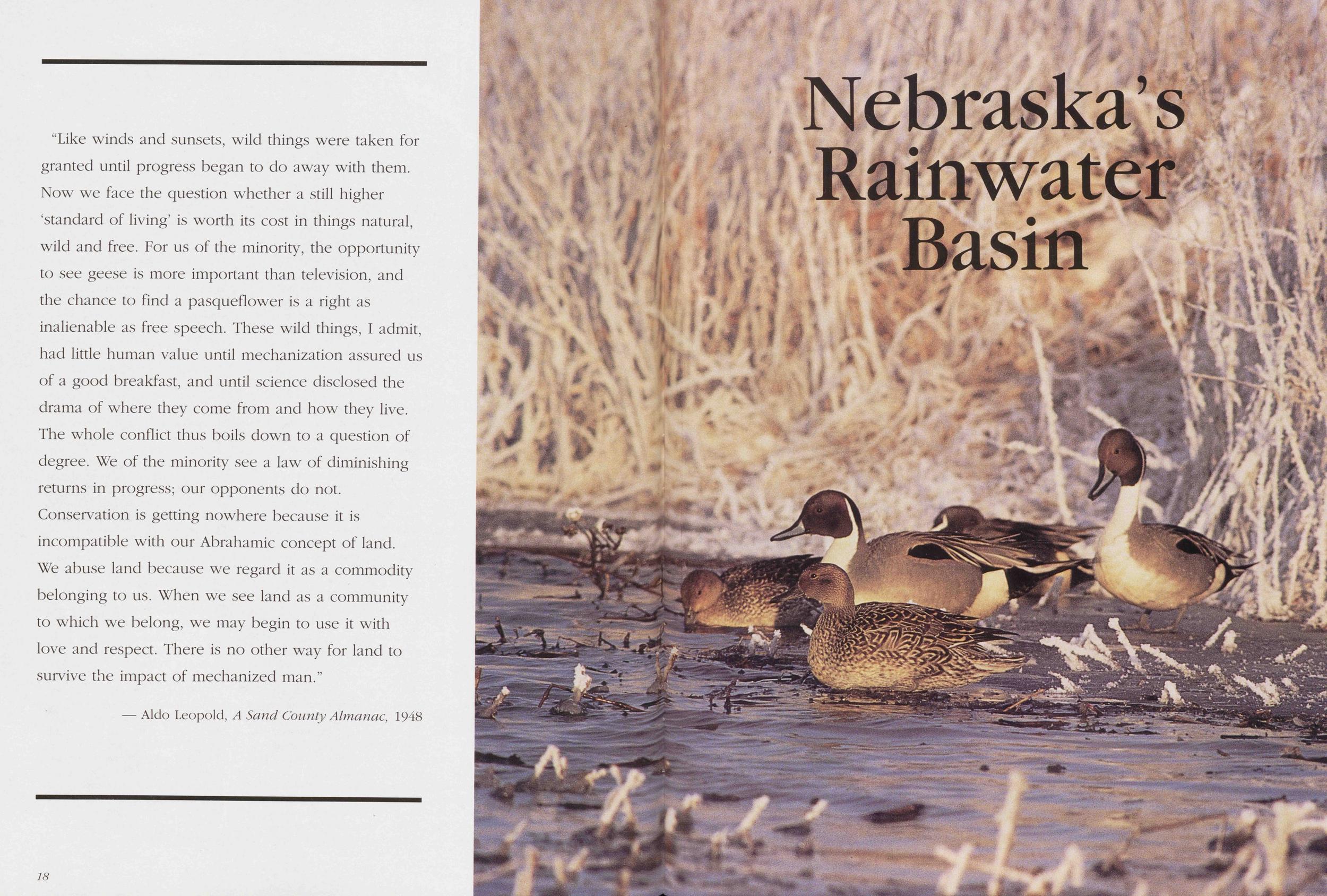
Like winds and sunsets, wild things were taken for granted until progress began to do away with them. Now we face the question whether a still higher 'standard of living' is worth its cost in things natural, wild and free. For us of the minority, the opportunity to see geese is more important than television, and the chance to find a pasqueflower is a right as inalienable as free speech. These wild things, I admit, had little human value until mechanization assured us of a good breakfast, and until science disclosed the drama of where they come from and how they live. The whole conflict thus boils down to a question of degree. We of the minority see a law of diminishing returns in progress; our opponents do not. Conservation is getting nowhere because it is incompatible with our Abrahamic concept of land. We abuse land because we regard it as a commodity belonging to us. When we see land as a community to which we belong, we may begin to use it with love and respect. There is no other way for land to survive the impact of mechanized man."
Aldo Leopold, A Sand County Almanac, 1948 18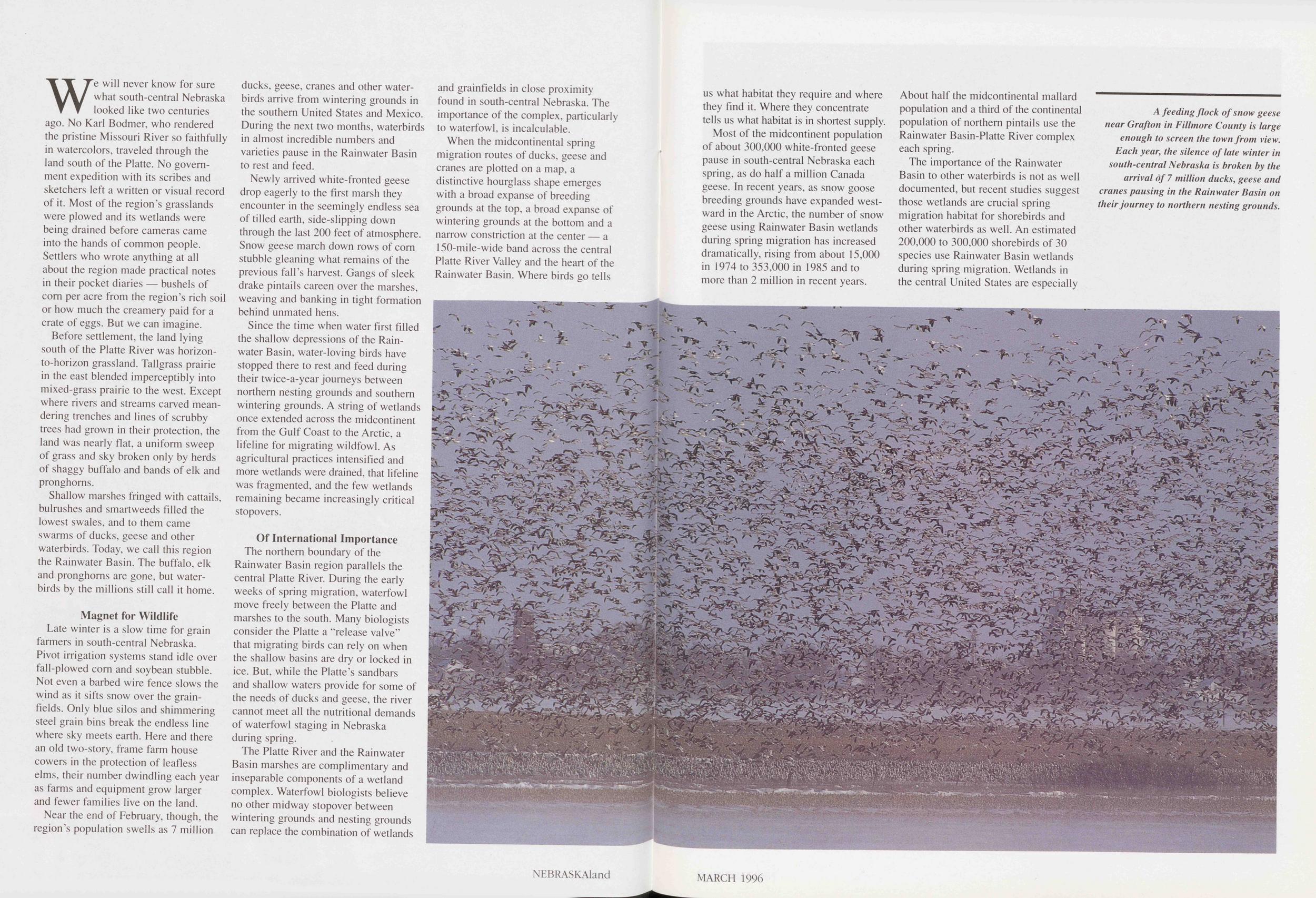
We will never know for sure what south-central Nebraska looked like two centuries ago. No Karl Bodmer, who rendered the pristine Missouri River so faithfully in watercolors, traveled through the land south of the Platte. No government expedition with its scribes and sketchers left a written or visual record of it. Most of the region's grasslands were plowed and its wetlands were being drained before cameras came into the hands of common people. Settlers who wrote anything at all about the region made practical notes in their pocket diaries — bushels of corn per acre from the region's rich soil or how much the creamery paid for a crate of eggs. But we can imagine.
Before settlement, the land lying south of the Platte River was horizon-to-horizon grassland. Tallgrass prairie in the east blended imperceptibly into mixed-grass prairie to the west. Except where rivers and streams carved meandering trenches and lines of scrubby trees had grown in their protection, the land was nearly flat, a uniform sweep of grass and sky broken only by herds of shaggy buffalo and bands of elk and pronghorns.
Shallow marshes fringed with cattails, bulrushes and smart weeds filled the lowest swales, and to them came swarms of ducks, geese and other waterbirds. Today, we call this region the Rainwater Basin. The buffalo, elk and pronghorns are gone, but water birds by the millions still call it home.
Magnet for WildlifeLate winter is a slow time for grain farmers in south-central Nebraska. Pivot irrigation systems stand idle over fall-plowed corn and soybean stubble. Not even a barbed wire fence slows the wind as it sifts snow over the grain fields. Only blue silos and shimmering steel grain bins break the endless line where sky meets earth. Here and there an old two-story, frame farm house cowers in the protection of leafless elms, their number dwindling each year as farms and equipment grow larger and fewer families live on the land.
Near the end of February, though, the region's population swells as 7 million ducks, geese, cranes and other water birds arrive from wintering grounds in the southern United States and Mexico. During the next two months, waterbirds in almost incredible numbers and varieties pause in the Rainwater Basin to rest and feed.
Newly arrived white-fronted geese drop eagerly to the first marsh they encounter in the seemingly endless sea of tilled earth, side-slipping down through the last 200 feet of atmosphere. Snow geese march down rows of corn stubble gleaning what remains of the previous fall's harvest. Gangs of sleek drake pintails careen over the marshes, weaving and banking in tight formation behind unmated hens.
Since the time when water first filled the shallow depressions of the Rainwater Basin, water-loving birds have stopped there to rest and feed during their twice-a-year journeys between northern nesting grounds and southern wintering grounds. A string of wetlands once extended across the midcontinent from the Gulf Coast to the Arctic, a lifeline for migrating wildfowl. As agricultural practices intensified and more wetlands were drained, that lifeline was fragmented, and the few wetlands remaining became increasingly critical stopovers.
Of International ImportanceThe northern boundary of the Rainwater Basin region parallels the central Platte River. During the early weeks of spring migration, waterfowl move freely between the Platte and marshes to the south. Many biologists consider the Platte a "release valve" that migrating birds can rely on when the shallow basins are dry or locked in ice. But, while the Platte's sandbars and shallow waters provide for some of the needs of ducks and geese, the river cannot meet all the nutritional demands of waterfowl staging in Nebraska during spring.
The Platte River and the Rainwater Basin marshes are complimentary and inseparable components of a wetland complex. Waterfowl biologists believe no other midway stopover between wintering grounds and nesting grounds can replace the combination of wetlands and grainfields in close proximity found in south-central Nebraska. The importance of the complex, particularly to waterfowl, is incalculable.
When the midcontinental spring migration routes of ducks, geese and cranes are plotted on a map, a distinctive hourglass shape emerges with a broad expanse of breeding grounds at the top, a broad expanse of wintering grounds at the bottom and a narrow constriction at the center — a 150-mile-wide band across the central Platte River Valley and the heart of the Rainwater Basin. Where birds go tells NEBRASKAland us what habitat they require and where they find it. Where they concentrate tells us what habitat is in shortest supply.
Most of the midcontinent population of about 300,000 white-fronted geese pause in south-central Nebraska each spring, as do half a million Canada geese. In recent years, as snow goose breeding grounds have expanded westward in the Arctic, the number of snow geese using Rainwater Basin wetlands during spring migration has increased dramatically, rising from about 15,000 in 1974 to 353,000 in 1985 and to more than 2 million in recent years. About half the midcontinental mallard population and a third of the continental population of northern pintails use the Rainwater Basin-Platte River complex each spring.
The importance of the Rainwater Basin to other waterbirds is not as well documented, but recent studies suggest those wetlands are crucial spring migration habitat for shorebirds and other waterbirds as well. An estimated 200,000 to 300,000 shorebirds of 30 species use Rainwater Basin wetlands during spring migration. Wetlands in the central United States are especially
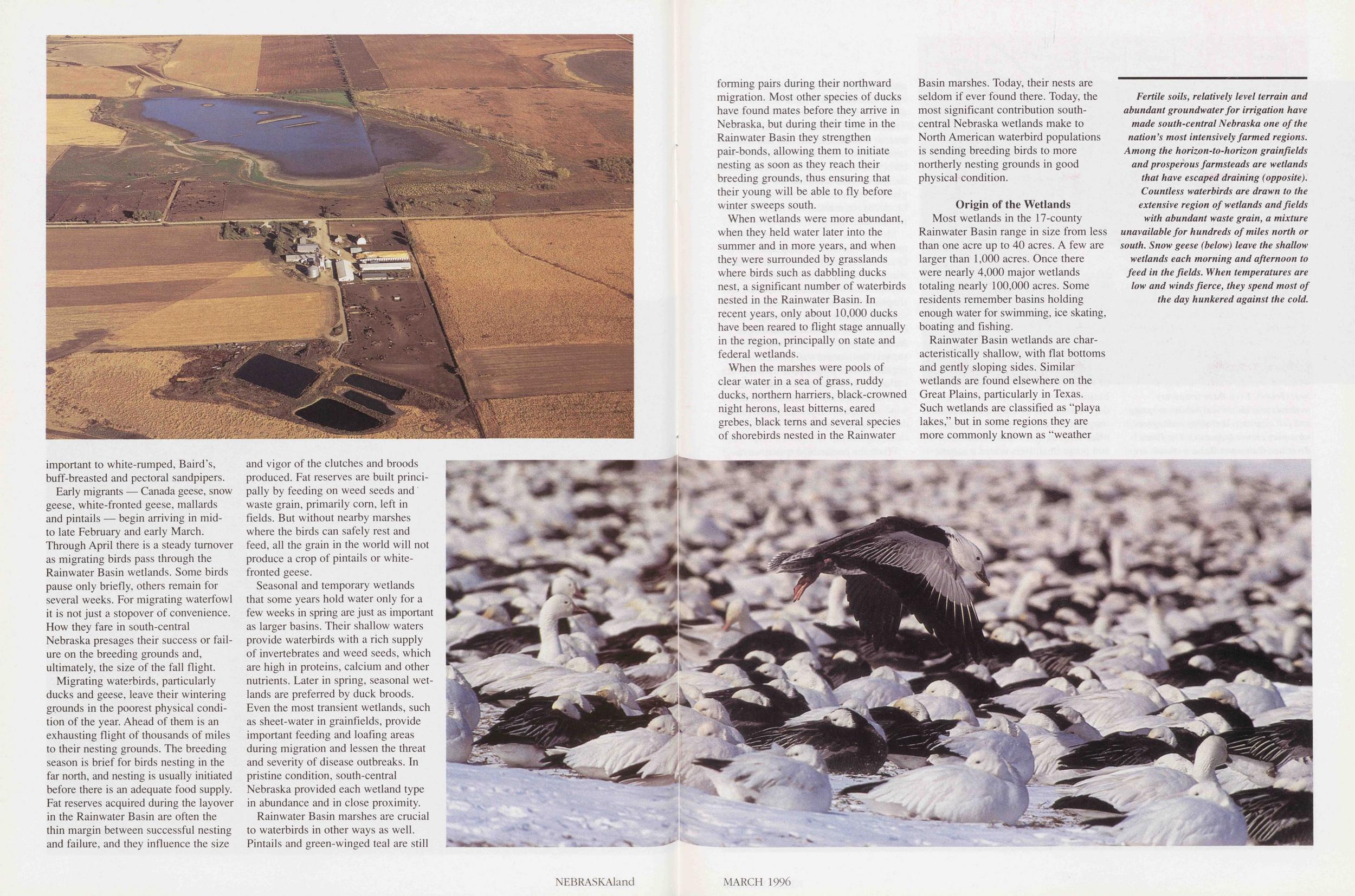
Early migrants — Canada geese, snow geese, white-fronted geese, mallards and pintails — begin arriving in mid- to late February and early March. Through April there is a steady turnover as migrating birds pass through the Rainwater Basin wetlands. Some birds pause only briefly, others remain for several weeks. For migrating waterfowl it is not just a stopover of convenience. How they fare in south-central Nebraska presages their success or failure on the breeding grounds and, ultimately, the size of the fall flight.
Migrating waterbirds, particularly ducks and geese, leave their wintering grounds in the poorest physical condition of the year. Ahead of them is an exhausting flight of thousands of miles to their nesting grounds. The breeding season is brief for birds nesting in the far north, and nesting is usually initiated before there is an adequate food supply. Fat reserves acquired during the layover in the Rainwater Basin are often the thin margin between successful nesting and failure, and they influence the size and vigor of the clutches and broods produced. Fat reserves are built principally by feeding on weed seeds and waste grain, primarily corn, left in fields. But without nearby marshes where the birds can safely rest and feed, all the grain in the world will not produce a crop of pintails or white- fronted geese.
Seasonal and temporary wetlands that some years hold water only for a few weeks in spring are just as important as larger basins. Their shallow waters provide waterbirds with a rich supply of invertebrates and weed seeds, which are high in proteins, calcium and other nutrients. Later in spring, seasonal wetlands are preferred by duck broods. Even the most transient wetlands, such as sheet-water in grain fields, provide important feeding and loafing areas during migration and lessen the threat and severity of disease outbreaks. In pristine condition, south-central Nebraska provided each wetland type in abundance and in close proximity.
Rainwater Basin marshes are crucial to waterbirds in other ways as well. Pintails and green-winged teal are still NEBRASKAland forming pairs during their northward migration. Most other species of ducks have found mates before they arrive in Nebraska, but during their time in the Rainwater Basin they strengthen pair-bonds, allowing them to initiate nesting as soon as they reach their breeding grounds, thus ensuring that their young will be able to fly before winter sweeps south.
When wetlands were more abundant, when they held water later into the summer and in more years, and when they were surrounded by grasslands where birds such as dabbling ducks nest, a significant number of waterbirds nested in the Rainwater Basin. In recent years, only about 10,000 ducks have been reared to flight stage annually in the region, principally on state and federal wetlands.
When the marshes were pools of clear water in a sea of grass, ruddy ducks, northern harriers, black-crowned night herons, least bitterns, eared grebes, black terns and several species of shorebirds nested in the Rainwater Basin marshes. Today, their nests are seldom if ever found there. Today, the most significant contribution southcentral Nebraska wetlands make to North American waterbird populations is sending breeding birds to more northerly nesting grounds in good physical condition.
Origin of the WetlandsMost wetlands in the 17-county Rainwater Basin range in size from less than one acre up to 40 acres. A few are larger than 1,000 acres. Once there were nearly 4,000 major wetlands totaling nearly 100,000 acres. Some residents remember basins holding enough water for swimming, ice skating, boating and fishing.
Rainwater Basin wetlands are characteristically shallow, with flat bottoms and gently sloping sides. Similar wetlands are found elsewhere on the Great Plains, particularly in Texas. Such wetlands are classified as "playa lakes," but in some regions they are more commonly known as "weather
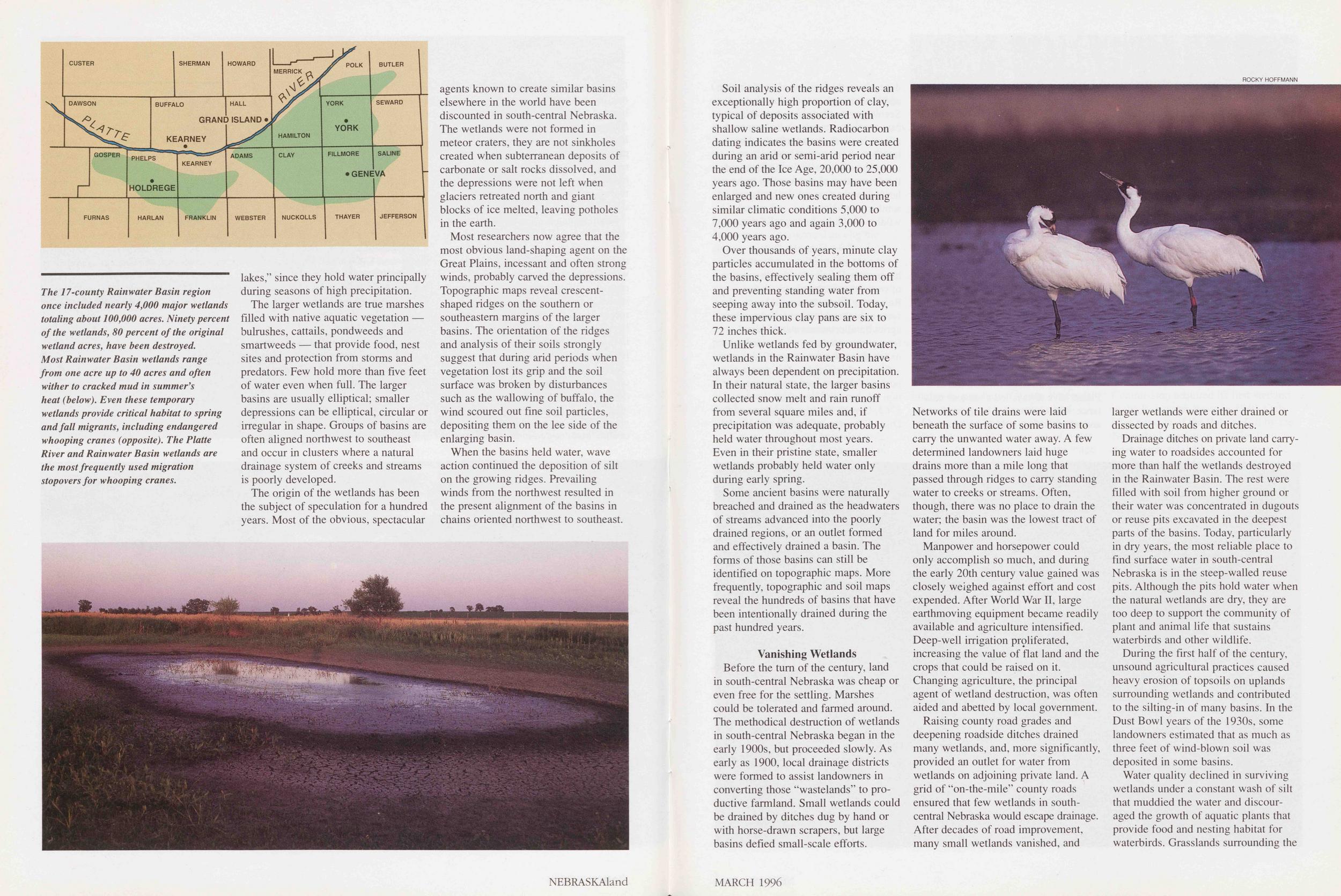
The larger wetlands are true marshes filled with native aquatic vegetation — bulrushes, cattails, pondweeds and smart weeds — that provide food, nest sites and protection from storms and predators. Few hold more than five feet of water even when full. The larger basins are usually elliptical; smaller depressions can be elliptical, circular or irregular in shape. Groups of basins are often aligned northwest to southeast and occur in clusters where a natural drainage system of creeks and streams is poorly developed.
The origin of the wetlands has been the subject of speculation for a hundred years. Most of the obvious, spectacular agents known to create similar basins elsewhere in the world have been discounted in south-central Nebraska. The wetlands were not formed in meteor craters, they are not sinkholes created when subterranean deposits of carbonate or salt rocks dissolved, and the depressions were not left when glaciers retreated north and giant blocks of ice melted, leaving potholes in the earth.
Most researchers now agree that the most obvious land-shaping agent on the Great Plains, incessant and often strong winds, probably carved the depressions. Topographic maps reveal crescent shaped ridges on the southern or southeastern margins of the larger basins. The orientation of the ridges and analysis of their soils strongly suggest that during arid periods when vegetation lost its grip and the soil surface was broken by disturbances such as the wallowing of buffalo, the wind scoured out fine soil particles, depositing them on the lee side of the enlarging basin.
When the basins held water, wave action continued the deposition of silt on the growing ridges. Prevailing winds from the northwest resulted in the present alignment of the basins in chains oriented northwest to southeast.
Soil analysis of the ridges reveals an exceptionally high proportion of clay, typical of deposits associated with shallow saline wetlands. Radiocarbon dating indicates the basins were created during an arid or semi-arid period near the end of the Ice Age, 20,000 to 25,000 years ago. Those basins may have been enlarged and new ones created during similar climatic conditions 5,000 to 7,000 years ago and again 3,000 to 4,000 years ago.
Over thousands of years, minute clay particles accumulated in the bottoms of the basins, effectively sealing them off and preventing standing water from seeping away into the subsoil. Today, these impervious clay pans are six to 72 inches thick.
Unlike wetlands fed by groundwater, wetlands in the Rainwater Basin have always been dependent on precipitation. In their natural state, the larger basins collected snow melt and rain runoff from several square miles and, if precipitation was adequate, probably held water throughout most years. Even in their pristine state, smaller wetlands probably held water only during early spring.
Some ancient basins were naturally breached and drained as the headwaters of streams advanced into the poorly drained regions, or an outlet formed and effectively drained a basin. The forms of those basins can still be identified on topographic maps. More frequently, topographic and soil maps reveal the hundreds of basins that have been intentionally drained during the past hundred years.
Vanishing WetlandsBefore the turn of the century, land in south-central Nebraska was cheap or even free for the settling. Marshes could be tolerated and farmed around. The methodical destruction of wetlands in south-central Nebraska began in the early 1900s, but proceeded slowly. As early as 1900, local drainage districts were formed to assist landowners in converting those "wastelands" to productive farmland. Small wetlands could be drained by ditches dug by hand or with horse-drawn scrapers, but large basins defied small-scale efforts. Networks of tile drains were laid beneath the surface of some basins to carry the unwanted water away. A few determined landowners laid huge drains more than a mile long that passed through ridges to carry standing water to creeks or streams. Often, though, there was no place to drain the water; the basin was the lowest tract of land for miles around.
Manpower and horsepower could only accomplish so much, and during the early 20th century value gained was closely weighed against effort and cost expended. After World War II, large earthmoving equipment became readily available and agriculture intensified. Deep-well irrigation proliferated, increasing the value of flat land and the crops that could be raised on it. Changing agriculture, the principal agent of wetland destruction, was often aided and abetted by local government.
Raising county road grades and deepening roadside ditches drained many wetlands, and, more significantly, provided an outlet for water from wetlands on adjoining private land. A grid of "on-the-mile" county roads ensured that few wetlands in southcentral Nebraska would escape drainage. After decades of road improvement, many small wetlands vanished, and larger wetlands were either drained or dissected by roads and ditches.
Drainage ditches on private land carrying water to roadsides accounted for more than half the wetlands destroyed in the Rainwater Basin. The rest were filled with soil from higher ground or their water was concentrated in dugouts or reuse pits excavated in the deepest parts of the basins. Today, particularly in dry years, the most reliable place to find surface water in south-central Nebraska is in the steep-walled reuse pits. Although the pits hold water when the natural wetlands are dry, they are too deep to support the community of plant and animal life that sustains waterbirds and other wildlife.
During the first half of the century, unsound agricultural practices caused heavy erosion of topsoils on uplands surrounding wetlands and contributed to the silting-in of many basins. In the Dust Bowl years of the 1930s, some landowners estimated that as much as three feet of wind-blown soil was deposited in some basins.
Water quality declined in surviving
wetlands under a constant wash of silt
that muddied the water and
discouraged the growth of aquatic plants that
provide food and nesting habitat for
waterbirds. Grasslands surrounding the
MARCH 1996
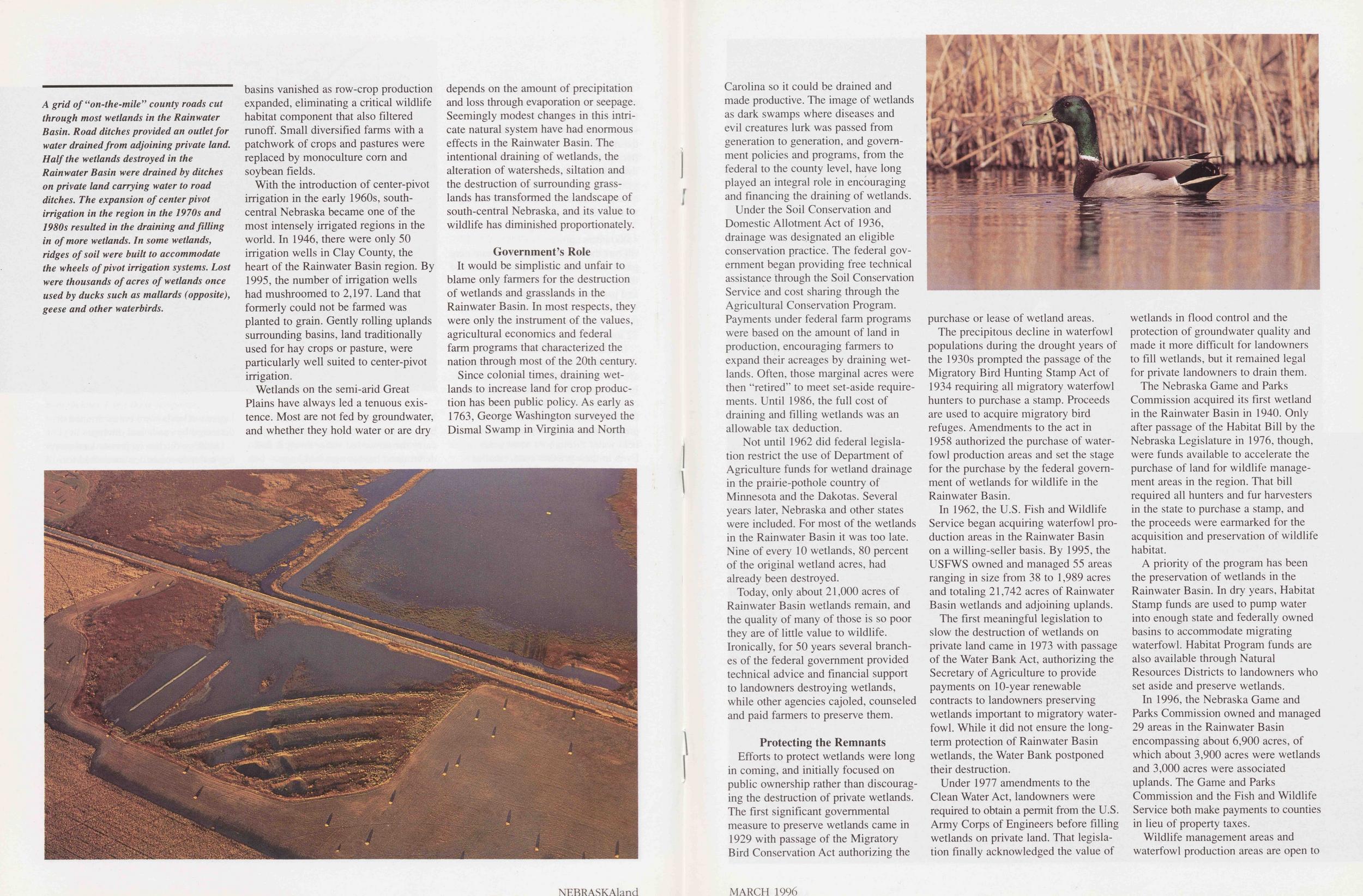
With the introduction of center-pivot irrigation in the early 1960s, southcentral Nebraska became one of the most intensely irrigated regions in the world. In 1946, there were only 50 irrigation wells in Clay County, the heart of the Rainwater Basin region. By 1995, the number of irrigation wells had mushroomed to 2,197. Land that formerly could not be farmed was planted to grain. Gently rolling uplands surrounding basins, land traditionally used for hay crops or pasture, were particularly well suited to center-pivot irrigation.
Wetlands on the semi-arid Great Plains have always led a tenuous existence. Most are not fed by groundwater, and whether they hold water or are dry depends on the amount of precipitation and loss through evaporation or seepage. Seemingly modest changes in this intricate natural system have had enormous effects in the Rainwater Basin. The intentional draining of wetlands, the alteration of watersheds, siltation and the destruction of surrounding grass lands has transformed the landscape of south-central Nebraska, and its value to wildlife has diminished proportionately.
Government's RoleIt would be simplistic and unfair to blame only farmers for the destruction of wetlands and grasslands in the Rainwater Basin. In most respects, they were only the instrument of the values, agricultural economics and federal farm programs that characterized the nation through most of the 20th century.
Since colonial times, draining wetlands to increase land for crop production has been public policy. As early as 1763, George Washington surveyed the Dismal Swamp in Virginia and North NEBRASKAland
Under the Soil Conservation and Domestic Allotment Act of 1936, drainage was designated an eligible conservation practice. The federal government began providing free technical assistance through the Soil Conservation Service and cost sharing through the Agricultural Conservation Program. Payments under federal farm programs were based on the amount of land in production, encouraging farmers to expand their acreages by draining wetlands. Often, those marginal acres were then "retired" to meet set-aside requirements. Until 1986, the full cost of draining and filling wetlands was an allowable tax deduction.
Not until 1962 did federal legislation restrict the use of Department of Agriculture funds for wetland drainage in the prairie-pothole country of Minnesota and the Dakotas. Several years later, Nebraska and other states were included. For most of the wetlands in the Rainwater Basin it was too late. Nine of every 10 wetlands, 80 percent of the original wetland acres, had already been destroyed.
Today, only about 21,000 acres of Rainwater Basin wetlands remain, and the quality of many of those is so poor they are of little value to wildlife. Ironically, for 50 years several branches of the federal government provided technical advice and financial support to landowners destroying wetlands, while other agencies cajoled, counseled and paid farmers to preserve them.
Protecting the RemnantsEfforts to protect wetlands were long in coming, and initially focused on public ownership rather than discouraging the destruction of private wetlands. The first significant governmental measure to preserve wetlands came in 1929 with passage of the Migratory Bird Conservation Act authorizing the purchase or lease of wetland areas.
The precipitous decline in waterfowl populations during the drought years of the 1930s prompted the passage of the Migratory Bird Hunting Stamp Act of 1934 requiring all migratory waterfowl hunters to purchase a stamp. Proceeds are used to acquire migratory bird refuges. Amendments to the act in 1958 authorized the purchase of waterfowl production areas and set the stage for the purchase by the federal government of wetlands for wildlife in the Rainwater Basin.
In 1962, the U.S. Fish and Wildlife Service began acquiring waterfowl production areas in the Rainwater Basin on a willing-seller basis. By 1995, the USFWS owned and managed 55 areas ranging in size from 38 to 1,989 acres and totaling 21,742 acres of Rainwater Basin wetlands and adjoining uplands.
The first meaningful legislation to slow the destruction of wetlands on private land came in 1973 with passage of the Water Bank Act, authorizing the Secretary of Agriculture to provide payments on 10-year renewable contracts to landowners preserving wetlands important to migratory waterfowl. While it did not ensure the long term protection of Rainwater Basin wetlands, the Water Bank postponed their destruction.
Under 1977 amendments to the Clean Water Act, landowners were required to obtain a permit from the U.S. Army Corps of Engineers before filling wetlands on private land. That legislation finally acknowledged the value of wetlands in flood control and the protection of groundwater quality and made it more difficult for landowners to fill wetlands, but it remained legal for private landowners to drain them.
The Nebraska Game and Parks Commission acquired its first wetland in the Rainwater Basin in 1940. Only after passage of the Habitat Bill by the Nebraska Legislature in 1976, though, were funds available to accelerate the purchase of land for wildlife management areas in the region. That bill required all hunters and fur harvesters in the state to purchase a stamp, and the proceeds were earmarked for the acquisition and preservation of wildlife habitat.
A priority of the program has been the preservation of wetlands in the Rainwater Basin. In dry years, Habitat Stamp funds are used to pump water into enough state and federally owned basins to accommodate migrating waterfowl. Habitat Program funds are also available through Natural Resources Districts to landowners who set aside and preserve wetlands.
In 1996, the Nebraska Game and Parks Commission owned and managed 29 areas in the Rainwater Basin encompassing about 6,900 acres, of which about 3,900 acres were wetlands and 3,000 acres were associated uplands. The Game and Parks Commission and the Fish and Wildlife Service both make payments to counties in lieu of property taxes.
Wildlife management areas and
waterfowl production areas are open to
MARCH 1996
Acquisition and easement programs protect wetlands in perpetuity. Other programs are designed to preserve and enhance wetlands on private land, at least for the short term. Both the Game and Parks Commission's Wetland Initiative Program and the U.S. Fish and Wildlife Service's Partners for Wildlife program provide technical and financial assistance to landowners who want to manage or restore wetlands for wildlife.
Because south-central Nebraska is so intensively farmed, it is not surprising that the fate of wetlands there is closely linked to federal farm programs, and one of the most significant wetland protection measures in recent years was a side benefit of federal farm policy. Changes in the 1985 farm program recognized the many valuable functions wetlands provide and the role that conversion of wetlands to croplands had played in generating chronic and expensive crop commodity surpluses.
Popularly known as "Swampbuster," a 1985 provision of the Food Security Act required the Agricultural Stabilization and Conservation Service, the Federal Crop Insurance Corporation and other related federal agencies to withhold subsidy payments, loans and insurance from landowners who drain wetlands to plant crops.
Although the legislation was designed principally to reduce crop surpluses, it has accomplished much in slowing the destruction of the remaining wetlands in areas like the Rainwater Basin. As with all farm programs, the longevity NEBRASKAland
The benefits of wetlands were further recognized in the 1990 Farm Bill which authorized the USDA to protect wetlands by paying landowners for permanent easements and the cost of restoring wetlands that had been converted to cropland. This Wetland Reserve Program is administered by the Natural Resources Conservation Service (formerly the Soil Conservation Service) and emphasizes the restoration of wetlands in the Rainwater Basin.
The Cost of ProgressThe arrival of white-fronted geese marked winter's passing in the usual way in the Rainwater Basin in 1975. The summer of 1974 had been abnormally dry, and winter snows were inadequate to refill the wetlands. Most marshes were dry. Others had only small pools surrounded by mudflats, and there was no sheet-water standing in the fields.
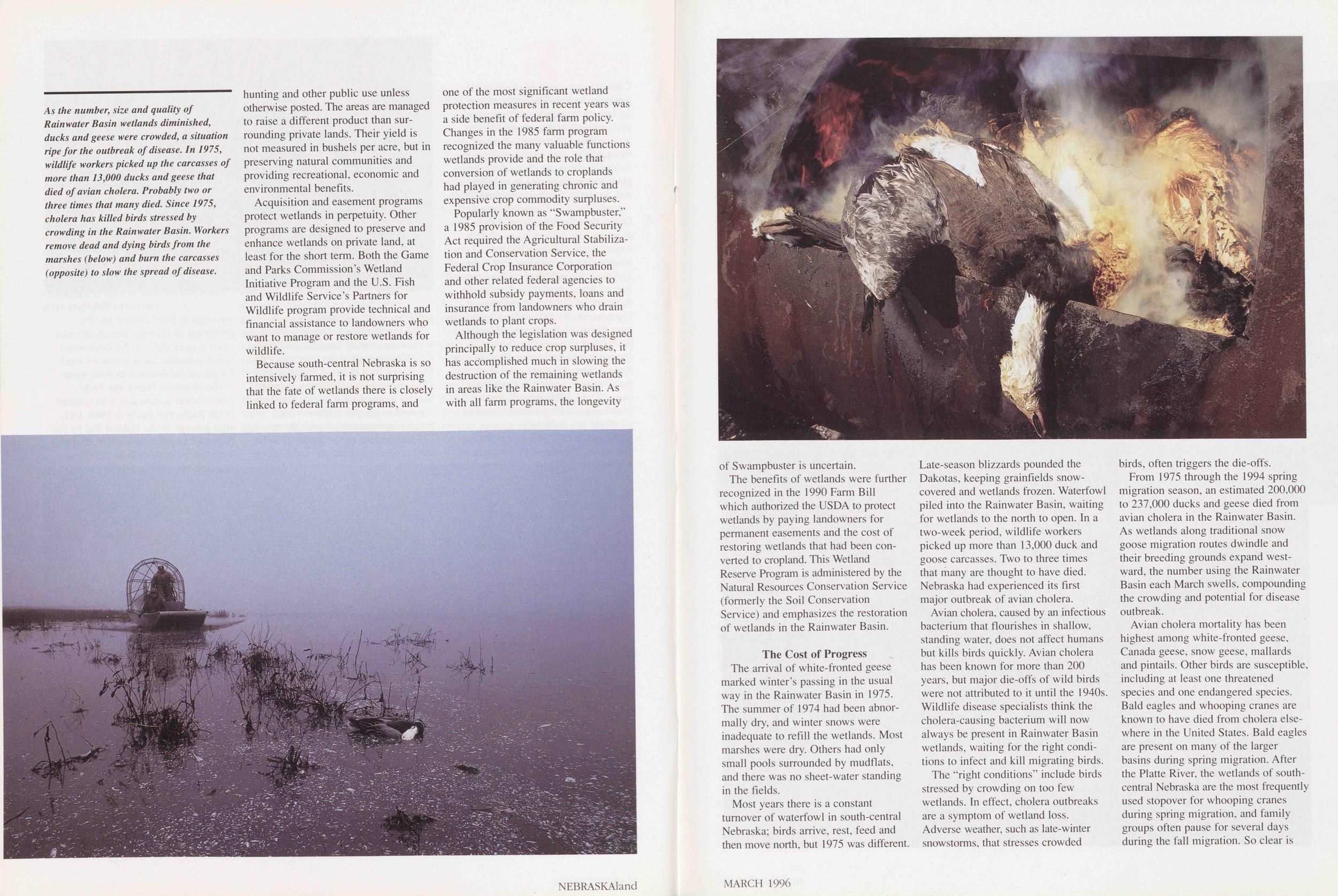
Most years there is a constant turnover of waterfowl in south-central Nebraska; birds arrive, rest, feed and then move north, but 1975 was different. Late-season blizzards pounded the Dakotas, keeping grain fields snow covered and wetlands frozen. Waterfowl piled into the Rainwater Basin, waiting for wetlands to the north to open. In a two-week period, wildlife workers picked up more than 13,000 duck and goose carcasses. Two to three times that many are thought to have died. Nebraska had experienced its first major outbreak of avian cholera.
Avian cholera, caused by an infectious bacterium that flourishes in shallow, standing water, does not affect humans but kills birds quickly. Avian cholera has been known for more than 200 years, but major die-offs of wild birds were not attributed to it until the 1940s. Wildlife disease specialists think the cholera-causing bacterium will now always be present in Rainwater Basin wetlands, waiting for the right conditions to infect and kill migrating birds.
The "right conditions" include birds stressed by crowding on too few wetlands. In effect, cholera outbreaks are a symptom of wetland loss. Adverse weather, such as late-winter snowstorms, that stresses crowded birds, often triggers the die-offs.
From 1975 through the 1994 spring migration season, an estimated 200,000 to 237,000 ducks and geese died from avian cholera in the Rainwater Basin. As wetlands along traditional snow goose migration routes dwindle and their breeding grounds expand westward, the number using the Rainwater Basin each March swells, compounding the crowding and potential for disease outbreak.
Avian cholera mortality has been
highest among white-fronted geese,
Canada geese, snow geese, mallards
and pintails. Other birds are susceptible,
including at least one threatened
species and one endangered species.
Bald eagles and whooping cranes are
known to have died from cholera
elsewhere in the United States. Bald eagles
are present on many of the larger
basins during spring migration. After
the Platte River, the wetlands of
southcentral Nebraska are the most frequently
used stopover for whooping cranes
during spring migration, and family
groups often pause for several days
during the fall migration. So clear is
MARCH 1996
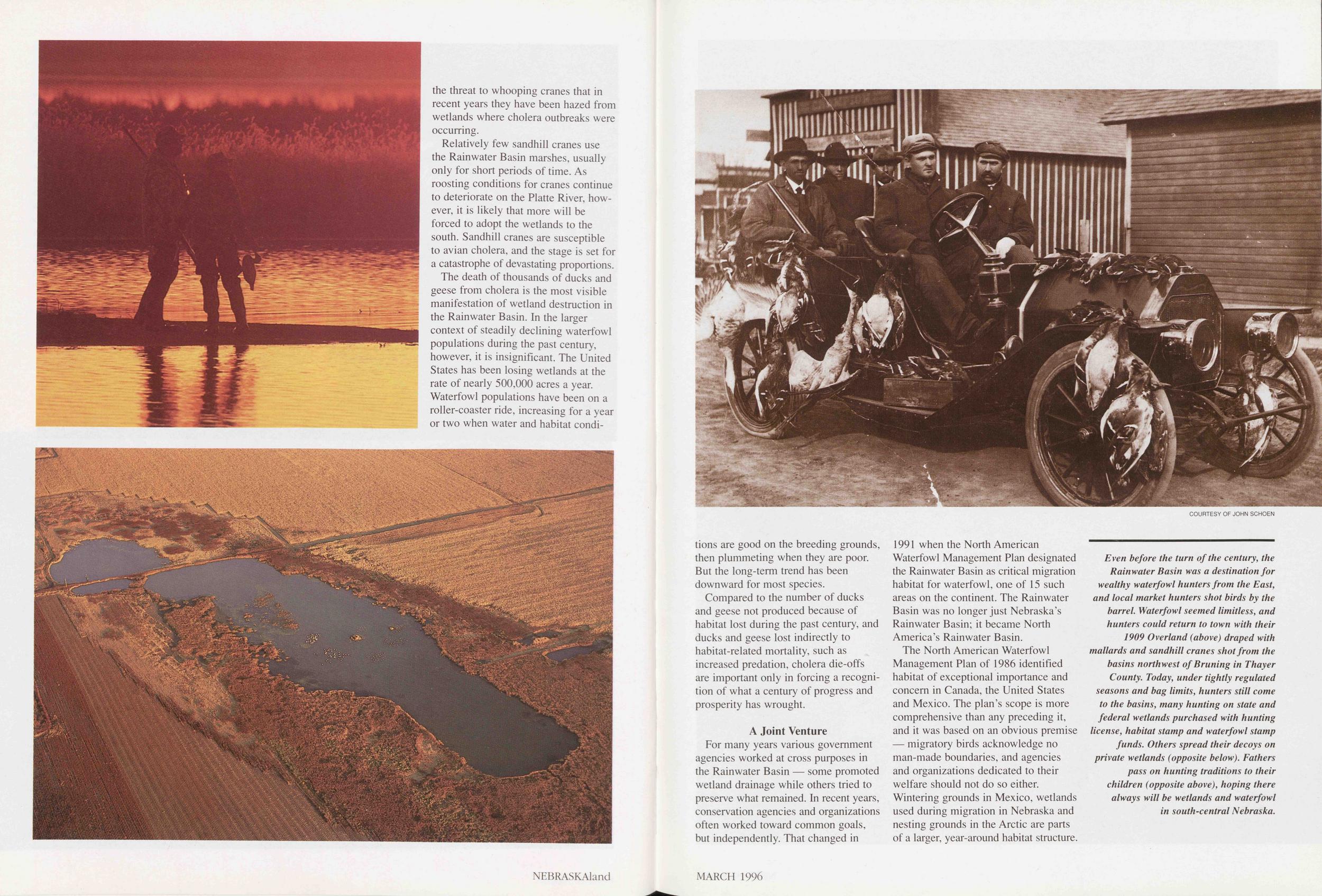
Relatively few sandhill cranes use the Rainwater Basin marshes, usually only for short periods of time. As roosting conditions for cranes continue to deteriorate on the Platte River, however, it is likely that more will be forced to adopt the wetlands to the south. Sandhill cranes are susceptible to avian cholera, and the stage is set for a catastrophe of devastating proportions.
The death of thousands of ducks and geese from cholera is the most visible manifestation of wetland destruction in the Rainwater Basin. In the larger context of steadily declining waterfowl populations during the past century, however, it is insignificant. The United States has been losing wetlands at the rate of nearly 500,000 acres a year. Waterfowl populations have been on a roller-coaster ride, increasing for a year or two when water and habitat conditions NEBRASKAland are good on the breeding grounds, then plummeting when they are poor. But the long-term trend has been downward for most species.
Compared to the number of ducks and geese not produced because of habitat lost during the past century, and ducks and geese lost indirectly to habitat-related mortality, such as increased predation, cholera die-offs are important only in forcing a recognition of what a century of progress and prosperity has wrought.
A Joint VentureFor many years various government agencies worked at cross purposes in the Rainwater Basin — some promoted wetland drainage while others tried to preserve what remained. In recent years, conservation agencies and organizations often worked toward common goals, but independently. That changed in 1991 when the North American Waterfowl Management Plan designated the Rainwater Basin as critical migration habitat for waterfowl, one of 15 such areas on the continent. The Rainwater Basin was no longer just Nebraska's Rainwater Basin; it became North America's Rainwater Basin.
The North American Waterfowl Management Plan of 1986 identified habitat of exceptional importance and concern in Canada, the United States and Mexico. The plan's scope is more comprehensive than any preceding it, and it was based on an obvious premise — migratory birds acknowledge no man-made boundaries, and agencies and organizations dedicated to their welfare should not do so either. Wintering grounds in Mexico, wetlands used during migration in Nebraska and nesting grounds in the Arctic are parts of a larger, year-around habitat structure.
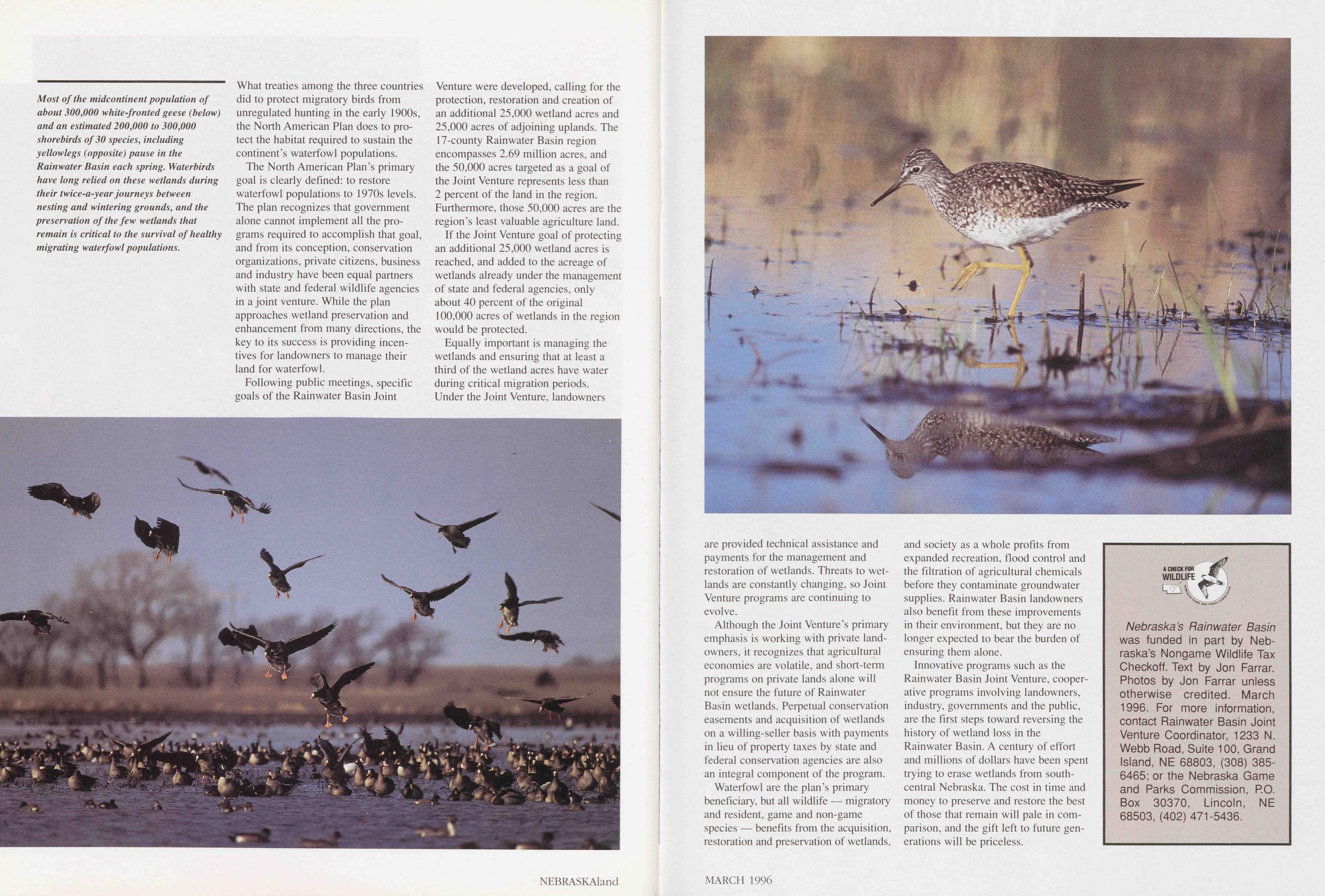
The North American Plan's primary goal is clearly defined: to restore waterfowl populations to 1970s levels. The plan recognizes that government alone cannot implement all the programs required to accomplish that goal, and from its conception, conservation organizations, private citizens, business and industry have been equal partners with state and federal wildlife agencies in a joint venture. While the plan approaches wetland preservation and enhancement from many directions, the key to its success is providing incentives for landowners to manage their land for waterfowl.
Following public meetings, specific goals of the Rainwater Basin Joint Venture were developed, calling for the protection, restoration and creation of an additional 25,000 wetland acres and 25,000 acres of adjoining uplands. The 17-county Rainwater Basin region encompasses 2.69 million acres, and the 50,000 acres targeted as a goal of the Joint Venture represents less than 2 percent of the land in the region. Furthermore, those 50,000 acres are the region's least valuable agriculture land.
If the Joint Venture goal of protecting an additional 25,000 wetland acres is reached, and added to the acreage of wetlands already under the management of state and federal agencies, only about 40 percent of the original 100,000 acres of wetlands in the region would be protected.
Equally important is managing the wetlands and ensuring that at least a third of the wetland acres have water during critical migration periods. Under the Joint Venture, landowners NEBRASKAland
Although the Joint Venture's primary emphasis is working with private landowners, it recognizes that agricultural economies are volatile, and short-term programs on private lands alone will not ensure the future of Rainwater Basin wetlands. Perpetual conservation easements and acquisition of wetlands on a willing-seller basis with payments in lieu of property taxes by state and federal conservation agencies are also an integral component of the program.
Waterfowl are the plan's primary beneficiary, but all wildlife — migratory and resident, game and non-game species — benefits from the acquisition, restoration and preservation of wetlands, and society as a whole profits from expanded recreation, flood control and the filtration of agricultural chemicals before they contaminate groundwater supplies. Rainwater Basin landowners also benefit from these improvements in their environment, but they are no longer expected to bear the burden of ensuring them alone.
Innovative programs such as the Rainwater Basin Joint Venture, cooperative programs involving landowners, industry, governments and the public, are the first steps toward reversing the history of wetland loss in the Rainwater Basin. A century of effort and millions of dollars have been spent trying to erase wetlands from southcentral Nebraska. The cost in time and money to preserve and restore the best of those that remain will pale in comparison, and the gift left to future generations will be priceless.
A CHECK FOR WILDLIFE Nebraska's Rainwater Basin was funded in part by Nebraska's Nongame Wildlife Tax Checkoff. Text by Jon Farrar. Photos by Jon Farrar unless otherwise credited. March 1996. For more information, contact Rainwater Basin Joint Venture Coordinator, 1233 N. Webb Road, Suite 100, Grand Island, NE 68803, (308) 385-6465; or the Nebraska Game and Parks Commission, P.O. Box 30370, Lincoln, NE 68503, (402)471-5436. MARCH 1996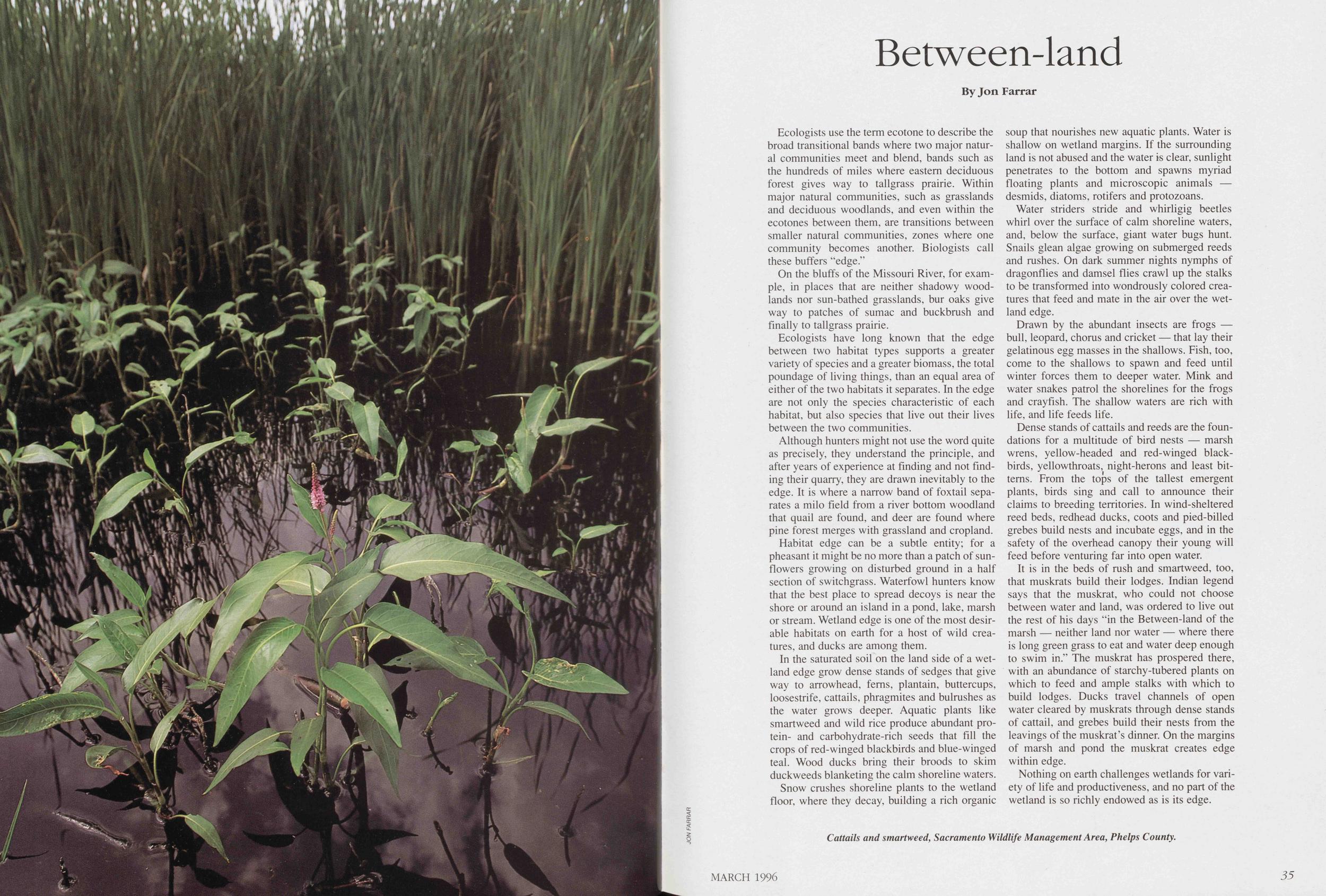
Between-land
By Jon FarrarEcologists use the term ecotone to describe the broad transitional bands where two major natural communities meet and blend, bands such as the hundreds of miles where eastern deciduous forest gives way to tallgrass prairie. Within major natural communities, such as grasslands and deciduous woodlands, and even within the ecotones between them, are transitions between smaller natural communities, zones where one community becomes another. Biologists call these buffers "edge."
On the bluffs of the Missouri River, for example, in places that are neither shadowy wood lands nor sun-bathed grasslands, bur oaks give way to patches of sumac and buckbrush and finally to tallgrass prairie.
Ecologists have long known that the edge between two habitat types supports a greater variety of species and a greater biomass, the total poundage of living things, than an equal area of either of the two habitats it separates. In the edge are not only the species characteristic of each habitat, but also species that live out their lives between the two communities.
Although hunters might not use the word quite as precisely, they understand the principle, and after years of experience at finding and not finding their quarry, they are drawn inevitably to the edge. It is where a narrow band of foxtail separates a milo field from a river bottom woodland that quail are found, and deer are found where pine forest merges with grassland and cropland.
Habitat edge can be a subtle entity; for a pheasant it might be no more than a patch of sunflowers growing on disturbed ground in a half section of switchgrass. Waterfowl hunters know that the best place to spread decoys is near the shore or around an island in a pond, lake, marsh or stream. Wetland edge is one of the most desirable habitats on earth for a host of wild creatures, and ducks are among them.
In the saturated soil on the land side of a wetland edge grow dense stands of sedges that give way to arrowhead, ferns, plantain, buttercups, loosestrife, cattails, phragmites and bulrushes as the water grows deeper. Aquatic plants like smartweed and wild rice produce abundant protein- and carbohydrate-rich seeds that fill the crops of red-winged blackbirds and blue-winged teal. Wood ducks bring their broods to skim duckweeds blanketing the calm shoreline waters.
Snow crushes shoreline plants to the wetland floor, where they decay, building a rich organic soup that nourishes new aquatic plants. Water is shallow on wetland margins. If the surrounding land is not abused and the water is clear, sunlight penetrates to the bottom and spawns myriad floating plants and microscopic animals — desmids, diatoms, rotifers and protozoans.
Water striders stride and whirligig beetles whirl over the surface of calm shoreline waters, and, below the surface, giant water bugs hunt. Snails glean algae growing on submerged reeds and rushes. On dark summer nights nymphs of dragonflies and damsel flies crawl up the stalks to be transformed into wondrously colored creatures that feed and mate in the air over the wetland edge.
Drawn by the abundant insects are frogs — bull, leopard, chorus and cricket — that lay their gelatinous egg masses in the shallows. Fish, too, come to the shallows to spawn and feed until winter forces them to deeper water. Mink and water snakes patrol the shorelines for the frogs and crayfish. The shallow waters are rich with life, and life feeds life.
Dense stands of cattails and reeds are the foundations for a multitude of bird nests — marsh wrens, yellow-headed and red-winged blackbirds, yellowthroats, night-herons and least bitterns. From the tops of the tallest emergent plants, birds sing and call to announce their claims to breeding territories. In wind-sheltered reed beds, redhead ducks, coots and pied-billed grebes build nests and incubate eggs, and in the safety of the overhead canopy their young will feed before venturing far into open water.
It is in the beds of rush and smartweed, too, that muskrats build their lodges. Indian legend says that the muskrat, who could not choose between water and land, was ordered to live out the rest of his days "in the Between-land of the marsh — neither land nor water — where there is long green grass to eat and water deep enough to swim in." The muskrat has prospered there, with an abundance of starchy-tubered plants on which to feed and ample stalks with which to build lodges. Ducks travel channels of open water cleared by muskrats through dense stands of cattail, and grebes build their nests from the leavings of the muskraf s dinner. On the margins of marsh and pond the muskrat creates edge within edge.
Nothing on earth challenges wetlands for variety of life and productiveness, and no part of the wetland is so richly endowed as is its edge.
MARCH 1996 35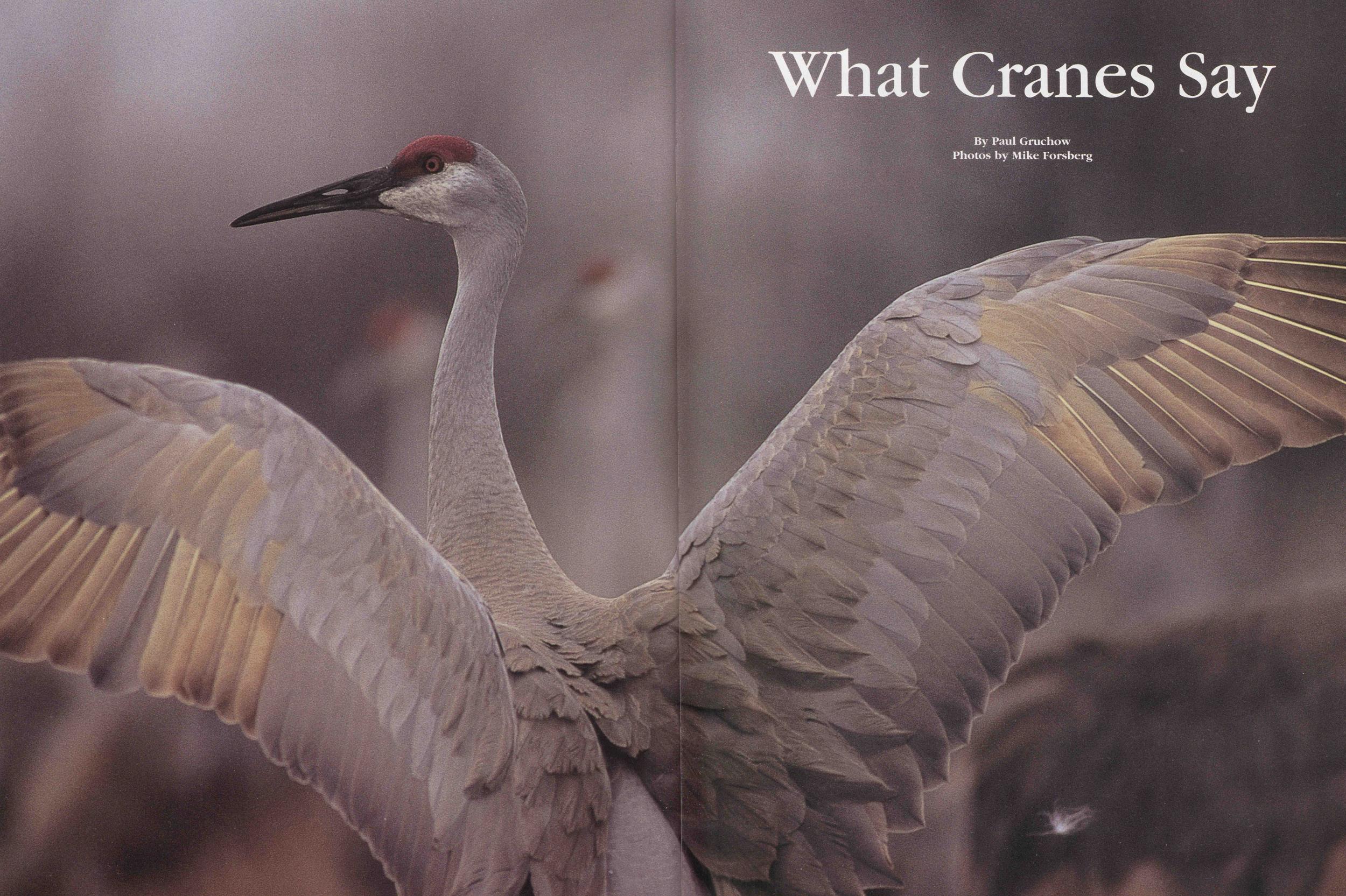
What Cranes Say
By Paul Gruchow Photos by Mike Forsberg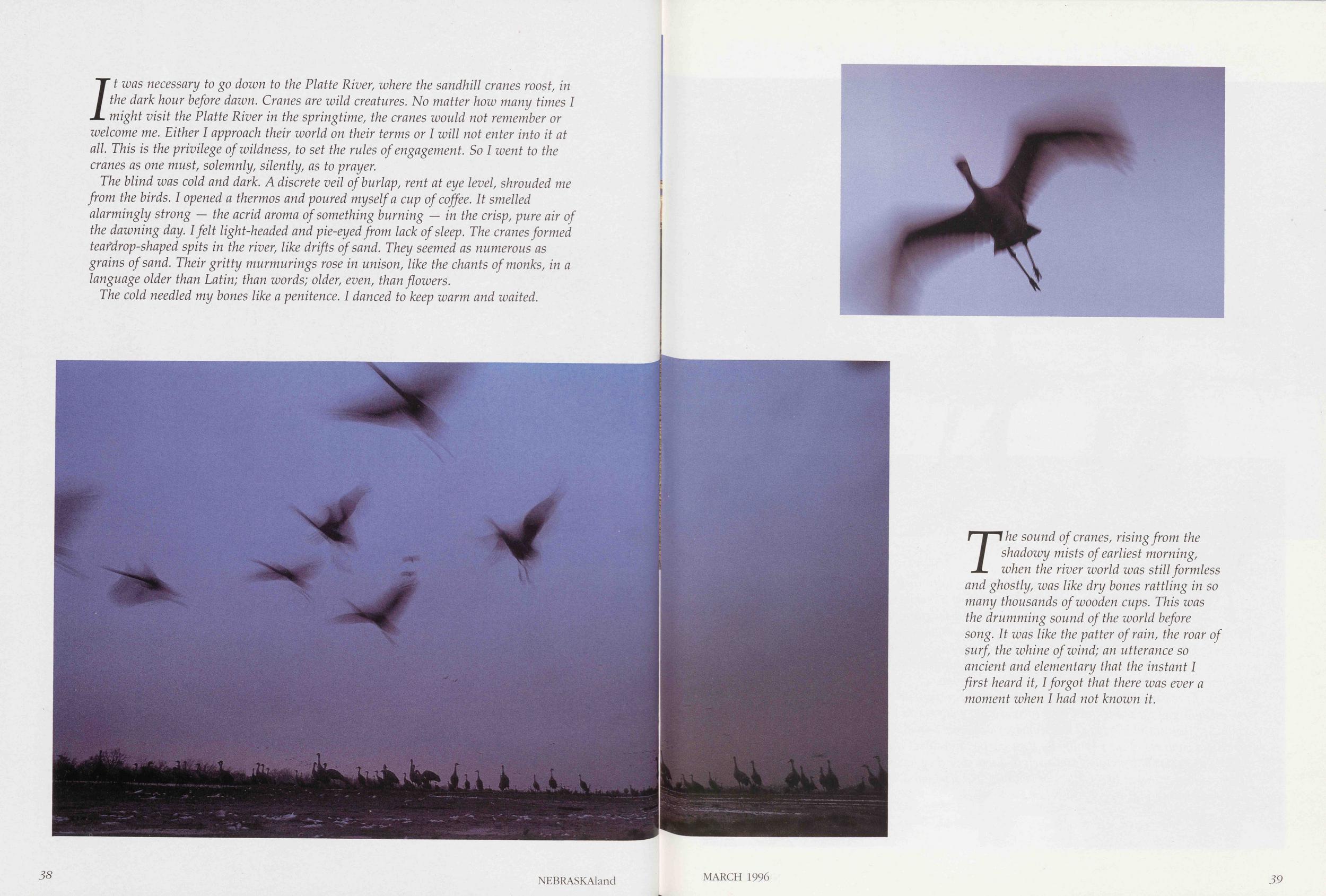
was necessary to go down to the Platte River, where the sandhill cranes roost, in the dark hour before dawn. Cranes are wild creatures. No matter how many times I might visit the Platte River in the springtime, the cranes would not remember or welcome me. Either I approach their world on their terms or I will not enter into it at all. This is the privilege of wildness, to set the rules of engagement. So I went to the cranes as one must, solemnly, silently, as to prayer.
The blind was cold and dark. A discrete veil of burlap, rent at eye level, shrouded me from the birds. I opened a thermos and poured myself a cup of coffee. It smelled alarmingly strong — the acrid aroma of something burning — in the crisp, pure air of the dawning day. I felt light-headed and pie-eyed from lack of sleep. The cranes formed teardrop-shaped spits in the river, like drifts of sand. They seemed as numerous as grains of sand. Their gritty murmurings rose in unison, like the chants of monks, in a language older than Eatin; than words; older, even, than flowers.
The cold needled my bones like a penitence. I danced to keep warm and waited.
TJhe sound of cranes, rising from the shadowy mists of earliest morning, when the river world was still formless and ghostly, was like dry bones rattling in so many thousands of wooden cups. This was the drumming sound of the world before song. It was like the patter of rain, the roar of surf, the whine of wind; an utterance so ancient and elementary that the instant I first heard it, I forgot that there was ever a moment when I had not known it.
MARCH 1996 39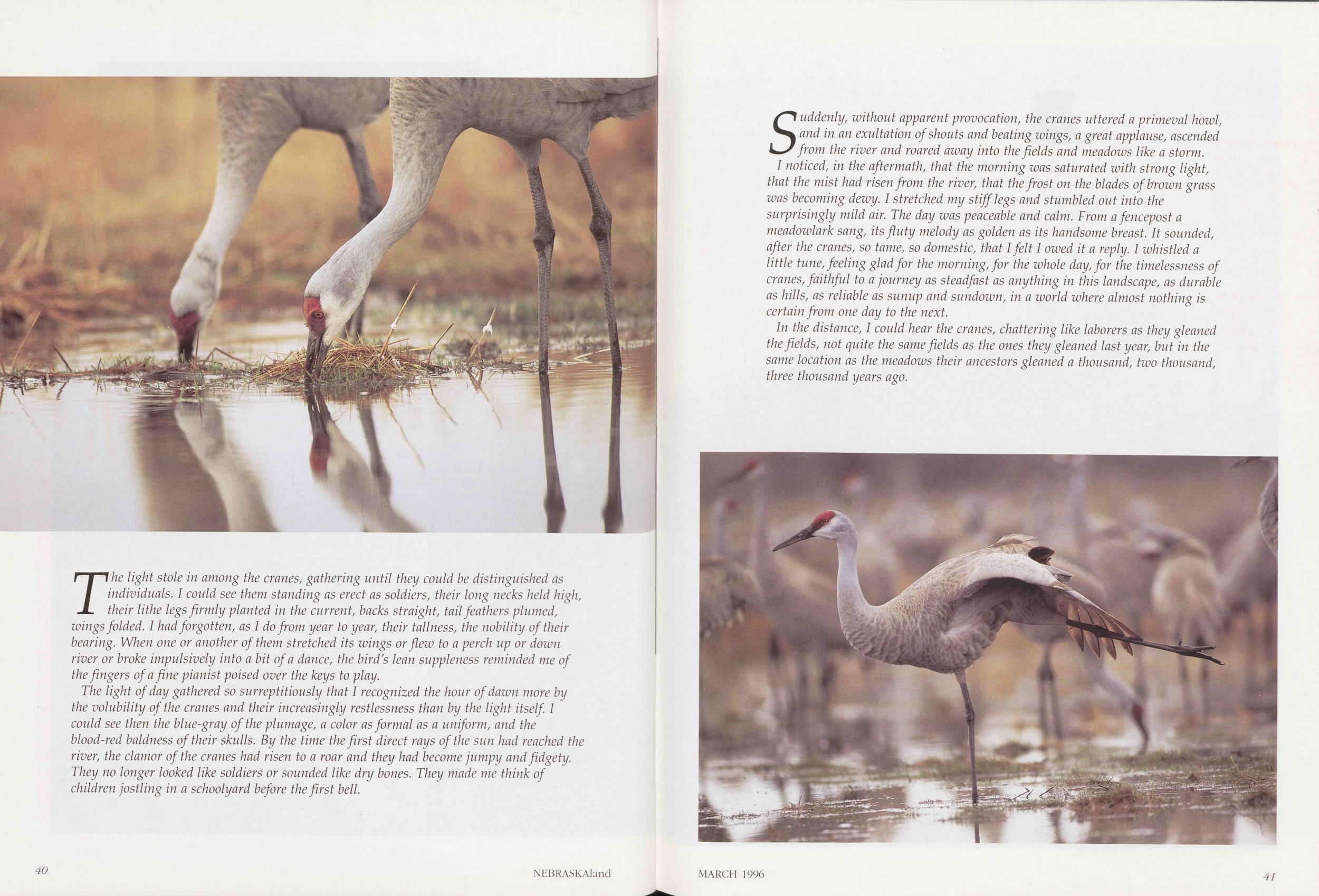
r]he light stole in among the cranes, gathering until they could be distinguished as individuals. I could see them standing as erect as soldiers, their long necks held high, their lithe legs firmly planted in the current, backs straight, tail feathers plumed, wings folded. I had forgotten, as I do from year to year, their tallness, the nobility of their bearing. When one or another of them stretched its wings or flew to a perch up or down river or broke impulsively into a bit of a dance, the bird's lean suppleness reminded me of the fingers of a fine pianist poised over the keys to play.
The light of day gathered so surreptitiously that I recognized the hour of dawn more by the volubility of the cranes and their increasingly restlessness than by the light itself. I could see then the blue-gray of the plumage, a color as formal as a uniform, and the blood-red baldness of their skulls. By the time the first direct rays of the sun had reached the river, the clamor of the cranes had risen to a roar and they had become jumpy and fidgety. They no longer looked like soldiers or sounded like dry bones. They made me think of children jostling in a schoolyard before the first bell.
40 NEBRASKAlandSuddenly, without apparent provocation, the cranes uttered a primeval howl, and in an exultation of shouts and beating wings, a great applause, ascended from the river and roared away into the fields and meadows like a storm. I noticed, in the aftermath, that the morning was saturated with strong light, that the mist had risen from the river, that the frost on the blades of brown grass was becoming dewy. I stretched my stiff legs and stumbled out into the surprisingly mild air. The day was peaceable and calm. From a fencepost a meadowlark sang, its fluty melody as golden as its handsome breast. It sounded, after the cranes, so tame, so domestic, that I felt I owed it a reply. I whistled a little tune, feeling glad for the morning, for the whole day, for the timelessness of cranes, faithful to a journey as steadfast as anything in this landscape, as durable as hills, as reliable as sunup and sundown, in a world where almost nothing is certain from one day to the next.
In the distance, I could hear the cranes, chattering like laborers as they gleaned the fields, not quite the same fields as the ones they gleaned last year, but in the same location as the meadows their ancestors gleaned a thousand, two thousand, three thousand years ago.
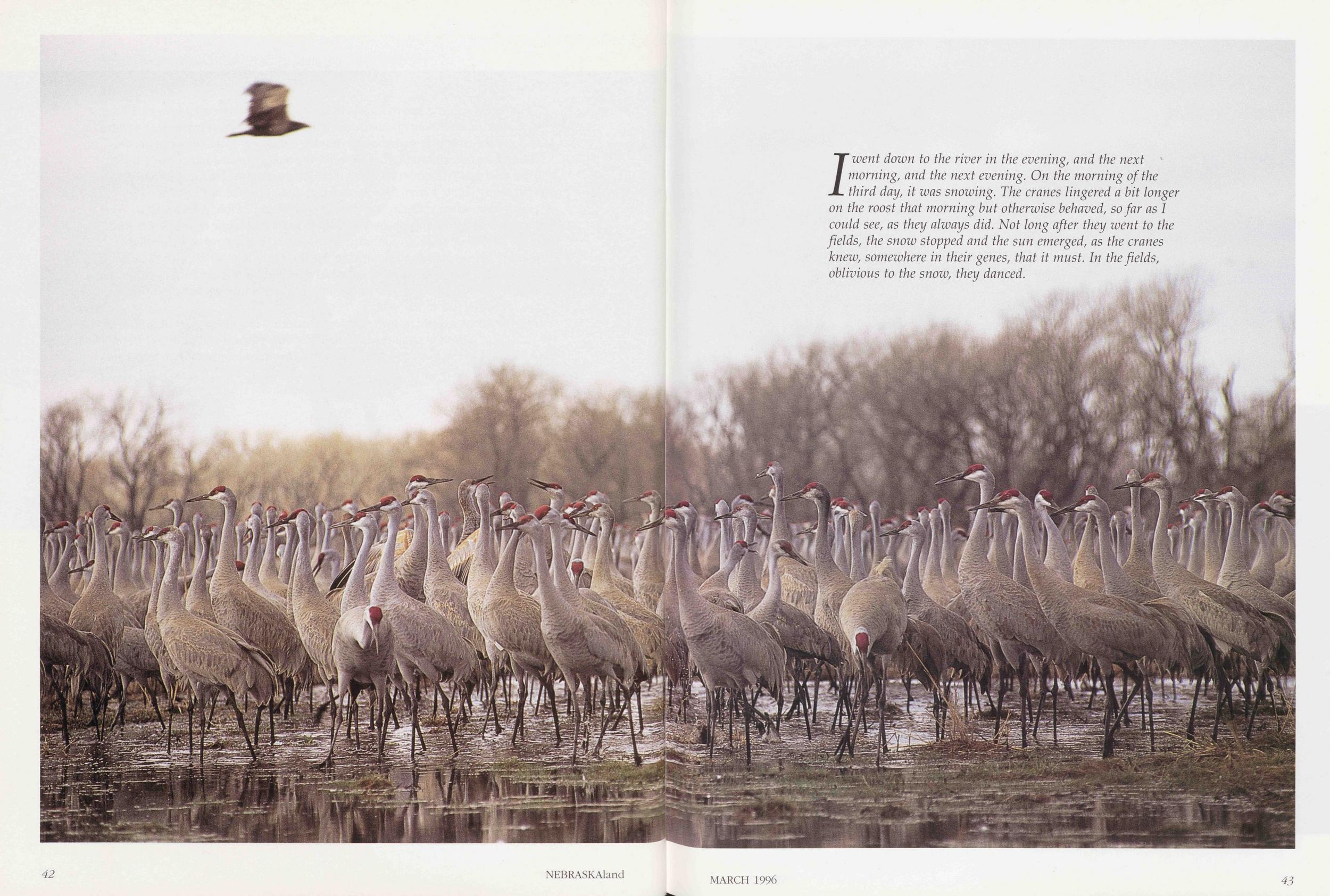
/'went down to the river in the evening, and the next morning, and the next evening. On the morning of the third day, it was snowing. The cranes lingered a hit longer on the roost that morning hut otherwise behaved, so far as I could see, as they always did. Not long after they went to the fields, the snow stopped and the sun emerged, as the cranes knew, somewhere in their genes, that it must. In the fields, oblivious to the snow, they danced.
MARCH 1996 43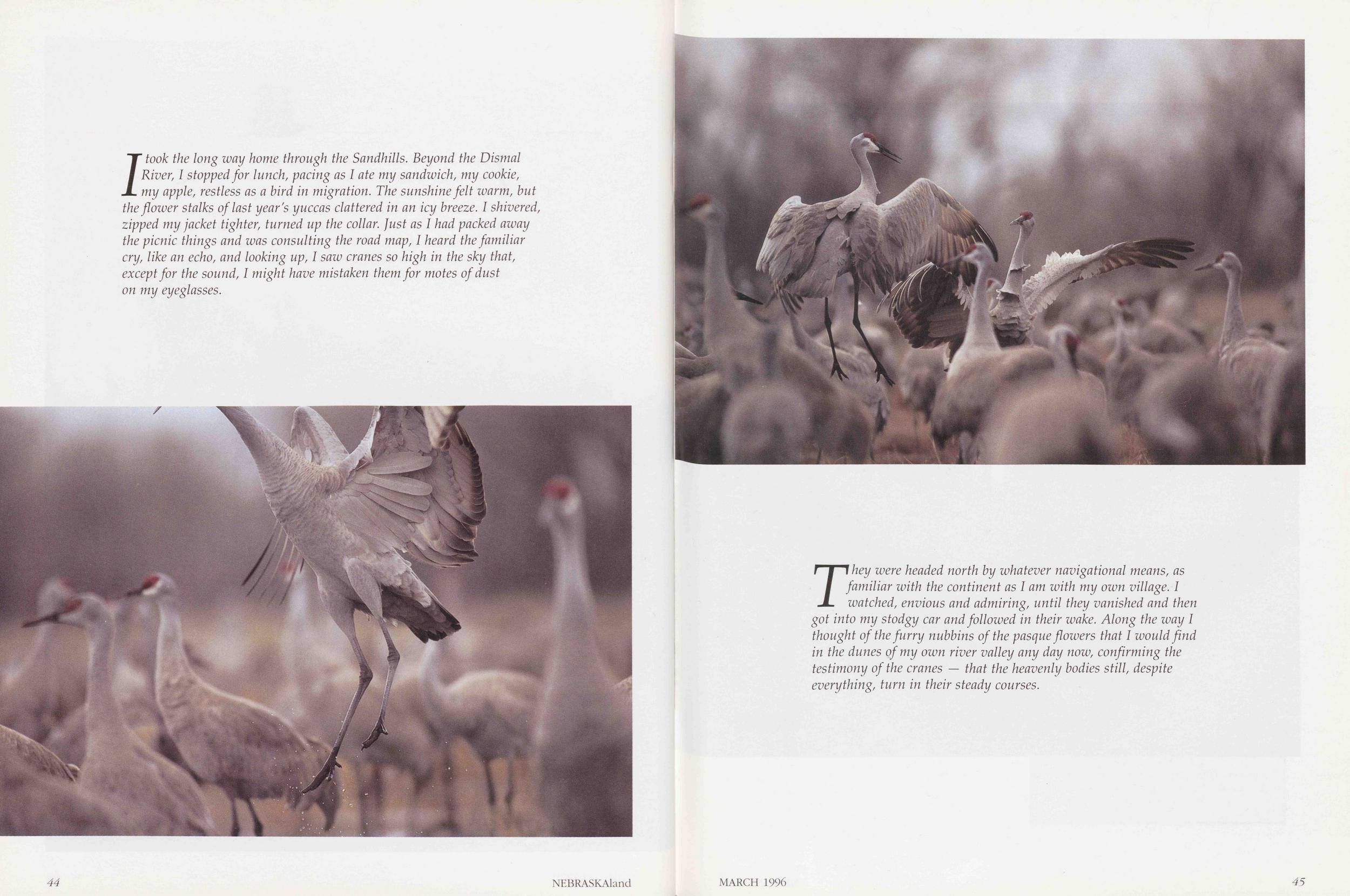
7' took the long way home through the Sandhills. Beyond the Dismal River, I stopped for lunch, I ate my sandwich, my cookie, restless as a bird in migration. The sunshine felt warm, but the flower stalks of last year's yuccas clattered in an icy breeze. I shivered, zipped my jacket tighter, turned up the collar. Just as I had yacked away the picnic things and was consulting the road may, I heard the familiar cry, like an echo, and looking up, I saw cranes so high in the sky that, excpect for the sound, I might have mistaken them for motes of dust on my eyeglasses.
They were headed north by whatever navigational means, as familiar with the continent as I am with my own village. I watched, envious and admiring, until they vanished and then got into my stodgy car and followed in their wake. Along the way I thought of the furry nubbins of the yasque flowers that I would find in the dunes of my own river valley any day now, confirming the testimony of the cranes — that the heavenly bodies still, despite everything, turn in their steady courses.
MARCH 1996 45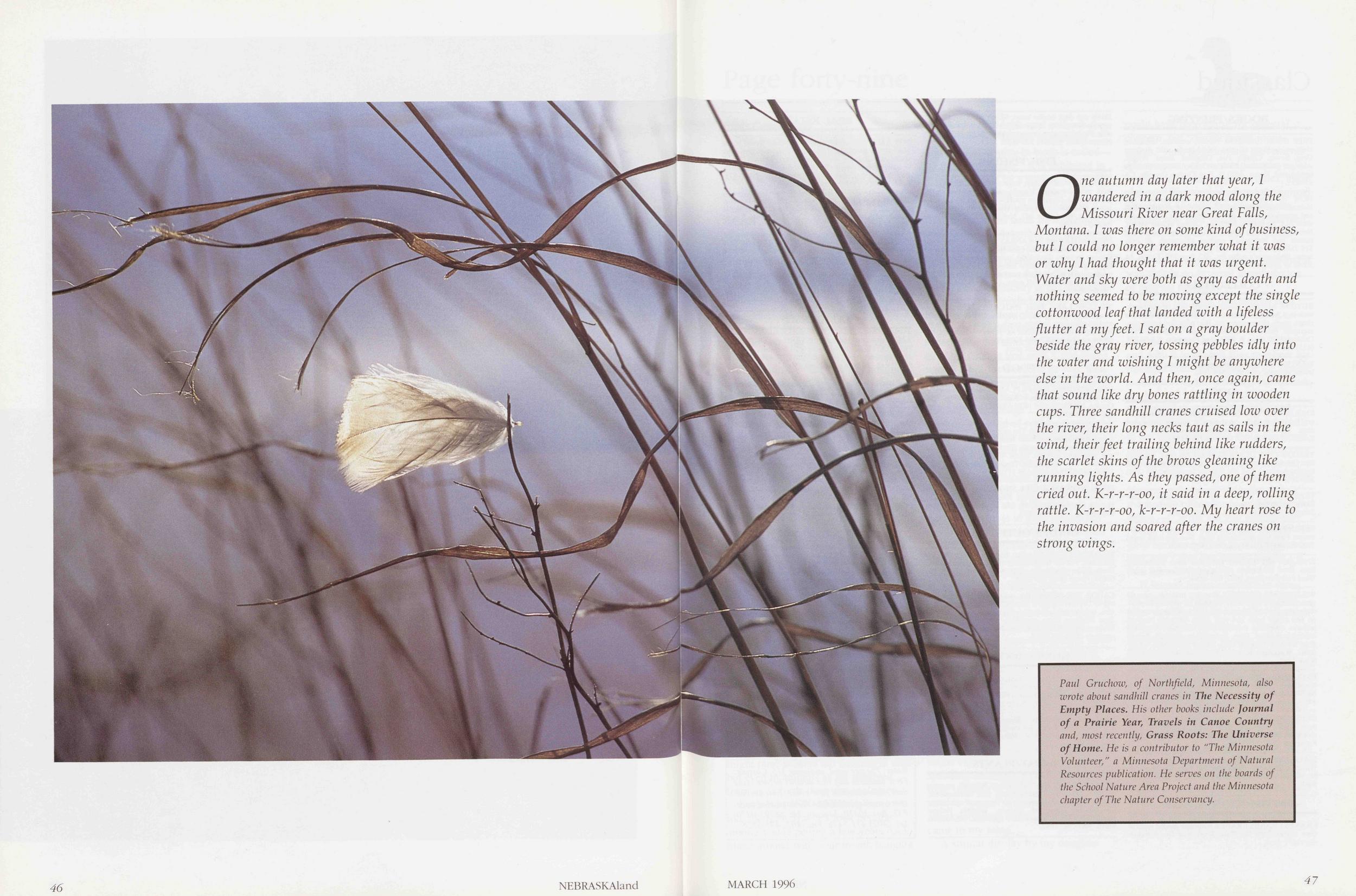
One autumn day later that year, I wandered in a dark mood along the Missouri River near Great Falls, Montana. I was there on some kind of business, but I could no longer remember what it was or why I had thought that it was urgent. Water and sky were both as gray as death and nothing seemed to be moving except the single cottonwood leaf that landed with a lifeless flutter at my feet. I sat on a gray boulder beside the gray river, tossing pebbles idly into the water and wishing I might be anywhere else in the world. And then, once again, came that sound like dry bones rattling in wooden cups. Three sandhill cranes cruised low over the river, their long necks taut as sails in the wind, their feet trailing behind like rudders, the scarlet skins of the brows gleaning like running lights. As they passed, one of them cried out. K-r-r-r-oo, it said in a deep, rolling rattle. K-r-r-r-oo, k-r-r-r-oo. My heart rose to the invasion and soared after the cranes on strong wings.
Paul Gruchow, of Northfield, Minnesota, also wrote about sandhill cranes in Tile Necessity of Empty Places. His other books include Journal of a Prairie Year, Travels in Canoe Country and, most recently, Grass Roots: The Universe of Home. He is a contributor to ''The Minnesota Volunteer/' a Minnesota Department of Natural Resources publication. He serves on the boards of the School Nature Area Project and the Minnesota chapter of The Nature Conservancy. MARCH 1996 47
Classified
BOOKS/PRINTINGFREE BOOK CATALOG. Novels, westerns, romances, children's; old out of print, found bams, attic. Authors: Grey, Bower, Condor, Fox, Curwood, Raine, Wright, Aldrige, Pollyanna, Freckles, many others. Postage appreciated. Pierce, 4400 N. Pine Cluster, Oroville, CA 95965.
HOW TO FIND MORE outdoor opportunities! The Nebraska Sportsman's Atlas. Locations of all public lands and waters on county transportation maps. These maps show ALL the roads in Nebraska. Listings include federal, Nebraska Game & Parks, NRD holdings, hotels and motels and Nebraska's endless attractions. At only $18.75/copy a true time and frustration saver. To order write: Sportsman's Atlas Co., PO Box 132, Lytton. IA 50561 or call 1-800-568-8334.
COLLECTIBLESBUYING: American Indian artifacts such as beadwork, weavings. baskets, etc.; also cowboy memorabilia such as chaps, spurs, photographs, etc. Best price first letter; photographs promptly returned. Jack Ringwalt, 1550 California St., Suite 6, #211, San Francisco, CA 94109. (415)388-5174.
WANTED: old surveying instruments: transits, compasses, levels, sextants, etc. (907) 344-7948.
DOGSENGLISH SETTER, German shorthairs, English pointers, Brittany spaniels - stud service, puppies and started dogs. Training for all pointing breeds. Plum Creek Kennel, (712) 529-4238 or (402) 298-8153.
YELLOW-CHOCOLATE-BLACK LAB pups. Breeders hips O.F.A. and eyes c.e.r.f./ed. Excellent bloodlines and hunting potential. Call Mr. Bendler, Lexington, NE (308) 324-4247 or Lincoln (402) 477-1305.
TRAINING ALL BREEDS bird dogs - Vizslas for sale. Home of Rebel Rousers. Rozanek Kennels, RR 2, Schuyler, NE 68661. Phone (402) 352-8769.
RETRIEVER TRAINING. Area's top "retrievers only" trainer. Field trial and hunting dogs. Non-slip duck dogs! TKO Retriever Training Kennel (402) 623-4311.
ENGLISH SETTER and Labradors from outstanding lines. Bred for hunters who appreciate fine bird dogs! Wind Fall Gun Dogs, (402) 421-4693.
WILDERNESS KENNELS. Gun dog training - over 60 years combined experience. Training all sporting breeds - retrievers, flushing and pointing dogs. All dogs worked on pen raised birds and wild game. Training program includes obedience training - heel, sit, stay, down and come when called. Pups, started dogs and fully trained dogs for sale. Hunting dogs trained by hunters. Henry Sader, Wilderness Kennels, Roca, NE (402) 423-4212. Since 1968.
ENGLISH COCKER PUPS, imported stock, British FTC bloodlines. Many colors available. Featured in NEBRASKAland November 1991. Sawtooth Oaks, Box 443, Orleans, NE 68966. Phone (308) 473-5265.
CHESAPEAKE BAY, Labrador and golden retriever pups, started dogs and stud service. 16 time national champion pedigree. Visa & MasterCard. Platte Valley Retrievers (308) 995-2318.
MALE CHOCOLATE LAB now available at stud, Willard's Chocolate Chancellor top Canadian and U.S. bloodlines. For pedigree information phone (308) 472-5088.
ATTRACTIONS/EVENTSCRANES CRANES CRANES Naturalist-guided tours to view cranes along the Platte River near Grand Island. Dawn and dusk bunker tours, March 8 - April 13. Also step-on bus guides or specialty wildlife programs available. For information or reservations call Crane Meadows Nature Center at (308) 382-1820.
FISH/FISHINGFISH FOR SALE. Catfish, largemouth bass, smallmouth bass, perch, crappie, bluegill, walleye, northern pike, rainbow trout, Donaldson rainbow trout, grass carp, minnows, bullheads. Consulting available. Pleasant Valley Fish Farm, RR 1, Box 147, McCook, NE 69001. Phone (308) 345-6599.
FREE OUTDOORS IN KANSAS'Golden Triangle, your guide to recreation in the Flint Hills region of northeast Kansas. Includes the fishing outlook for Milford, Tuttle Creek, and Council Grove Lakes, an overview of fall hunting, local historical sites and museums, and complete lodging information. Full color, 24-page brochure. Call 1-800-759-0134 ext. 24.
WILLOW LAKE FISH HATCHERY. Channel cat, bluegill, hybrid bluegill, largemouth bass, crappie, triploid grass carp, walleye, perch, minnows, available for stocking. Gaylord Crawford, Rt. 3 Box 46, Hastings, NE 68901 or phone (402) 463-8022 day or night. Also pond consultant. We del, grower price.
FOODHOP RHIZOMES, GRAPE PLANTS - beer & winemaking supplies. Fermenter's Supply, 8410 K Plz. #10, Omaha, NE 68127. Call (402) 593-9171, Open everyday, mail orders welcome.
NEBRASKA BASKETS: The original Nebraska company specializing in fine foods from Nebraska since 1984. A beautiful array of baskets filled with ethnic, healthful and long-time favorite foods. Call or write for our brochure: P.O. Box 22985, Lincoln, NE 68542. Phone 1-800-345-7725 or (402)438-3111.
FROM NEBRASKA GIFT SHOP..the world's largest selection of Nebraska-made food products and gifts. Historic Haymarket, 140 N. 8th, Lincoln, NE. Call for free catalog 1-800-399-5693.
GUIDES/OUTFITTERSMAD RIVER CANOES offers the finest quality and performance. For the finest canoes and accessories look to Great Plains Canoe Co., 205 Main, Springfield, NE 68059. Phone (402) 253-2001.
CANOE THE NIOBRARA...with an affordable canoe trip by Dry land Aquatics. One and two-day trips...full service, or just canoes and tubes. Transportation furnished. Your Niobrara River specialists...We do it your way! Dry land Aquatics, Dept. N, Box 33C, Sparks, NE 69220 or phone (402) 337-3119.
GUNS/SHOOTINGGUNS - Browning, Winchester, Remington, others. Hi-powers, shotguns, new, used, antiques. Want Pre-'64 Winchesters. Buy-Sell-Trade. (402) 729-6112. Bedlan's Sporting Goods, Fairbury, NE 68352.
AIR GUNS REPAIRED - Benjamin, Crosman. Daisy, other American made. Restoration; old guns wanted. Jack's Air Guns, 1225 N. 46th, Lincoln, NE 68503. Phone (402) 466-9223.
HABITAT/PLANTSATTRACT WILDLIFE TO YOUR ACREAGE, preserve or club. Consulting, management plan development, planting/seeding, and supplies for the conservationist or the hunter. David M. Nelson, Wildlife Habitat Consulting, 811 Matthies Dr., Papillion, NE 68046. Phone (402) 592-5652.
REAL ESTATEFOR SALE Beautiful reconditioned older home at the base of the Sandhills. 8.84 acres. Hunters dream with abundance of game: Deer, Mule deer, Pheasant, Quail, Grouse, Turkey, Coyote, Fox and Bobcat. For more information call Pat Ward. (402) 430-8540 or 1-800-877- 8793. RE/MAX Professionals Lincoln NE.
SCENIC RIVERFRONT property offering hunting, canoeing, fishing, wildlife photography, eagles. Close to airport. 11.6 acres. Ord, NE. Call Osentowski Realty. (308) 728-3117 or (308) 233-7910.
SOUTH DAKOTA DUCK COUNTRY: 2000 acre farm with 80 wetlands needing financing. Investment secured at 9% with CRP payments. Hunting privileges. (605) 493-6513.
LOCATED ON LAKE HARLAN, Alma, NE. 3 bedroom. 2 bath, family room, fireplace, detached garage. Lake ront adjacent to boat ramp. 30s. Phone 715-399-0182.
TAXIDERMYALLISON'S TAXIDERMY STUDIO & Gift Gallery - DU., SCI., Pheasants Forever & NTA Members. Mounted 36 state record fish. 421 N. Dewey, North Platte. NE 69101 call (308) 534-2324 or (308) 534-4267. Custom Designs.
RESORTS/VACATIONFOR FISHING and hunting accommodations. Jefco Inn, Gordon, NE 69343. South Cornell. (308) 282-2935.
BED & BREAKFAST. Historic 1890s hotel. Located in the beautiful Pine Ridge area of Northwest Nebraska. Short drive to Chadron State Park. Fort Robinson and the Black Hills. Beautiful dining room with fireplace and fountain. Room service available. The Olde Main Street Inn, 115 Main St., Chadron, NE 69337. (308) 432-3380.
NE NEBRASKA TROUT FISHING. Mon-Thurs or Fri-Sun. 3 modern cottages, 5 spring-fed lakes. Trout, bass and bluegill. Diamond E Trout Resort, Box B, Orchard, NE 1-800-658-3244.
BICYCLE TOURS of the scenic Oregon Trail and the unique Nebraska Sandhills. Affordable and fully supported. Also, one-day large group tours of Nebraska. Historical Trails Network (402) 477-9968.
YEAR-ROUND Vacation retreat, private two-bedroom cottage overlooks scenic Niobrara canyons, abundant wildlife and 900 acres of adventure. Larrington's Guest Cottage, Springview, NE 68778. (402) 497-2261.
CHESLEY'S LODGE, the place to stay. Scenic, peaceful setting. Great accommodations for hunters, family reunions, weekend getaways. Rt. 1 Box 76, Callaway, NE, 68825. (308) 836-2658.
YORK, NEBRASKA - "Crossroads of the Midwest." Located at the junction of 1-80 and U.S. 81. From fast food to world class fine dining. 500+ rooms in a wide range of styles and prices. Call 1-800-388-1138 for your Free Visitors Packet.
BICYCLE TOURS of the scenic Oregon Trail and the unique Nebraska Sandhills. Affordable and fully supported. Also, one-day large group tours of Nebraska. Historical Trails Network call (402) 477-9968.
Rates: 75 e per word, minimum $15. Closing: First business day two months before issue date. Ads accepted first-come, first-served, space-available. NEBRASKAland Magazine, P.O. Box 30370, Lincoln, NE 68503-0370. Tel. (402) 471-5478. Fax (402) 471-5528. 48 NEBRASKAlandPage forty-nine
Birds Court Better"We humans, in comparison, are sloppy, imperfect creatures," wrote Katharine Scherman in "Spring on an Arctic Island," an essay in the book A Gathering of Shore Birds. "Nothing of us works quite right. Our instincts, though strong, are few, misty and vague, and our physical structure leaves a great deal to be desired. The human brain, developed to a remarkable extent, has apparently grown at the expense of other functions, which have been retarded and in some cases have deteriorated."
I thought I had found a kindred spirit in Scherman, but in the following sentences she tossed her flash of insight out the window: "This dulling instinct, however, has resulted in an extraordinary freedom of action and thought, exclusively human. We cannot envy the birds the set and narrow paths of their uncompromisingly efficient lives."
If by "set and narrow paths" Scherman means rules of conduct, it seems to me she has underestimated the enormous advantages of simplicity and consistency that birds have in conducting their affairs, particularly that most important aspect of existence, procreation. Each species has its own set of displays by which they communicate with one another, and in the courtship season, these displays must be executed in the proper context and even the proper sequence. If the rules of display are followed to the letter, pairing and mating is accomplished. Compared to the courtship confusion of our own species, particularly in recent decades, the "narrow paths" of birds seem preferable.
There are, I surmise, remnant stirrings of formalized courtship behavior still pulsating through our strands of DNA. Comparisons to other mammals might raise matters too delicate to cite, but even in animals as far removed from us as birds there are analogies.
Let's start with something basic, like the John Travolta look popular among young people a few years back: Stand around with your mouth hanging open and you'll look cool and win the attention of any female in eyesight. The parallel display in birds is called "ceremonial gaping." It is exhibited in several contexts by a number of species and is frequently used by courting male cormorants. Edward A. Armstrong, in his book Bird Display and Behaviour, describes the display of the shag, the British counterpart of the North American cormorant.
"He approaches a female with just such a trace of alacrity in his step as to suggest that he might begin to dance if he were a little less clumsy. He gives an unexpected and unwonted hop, stretches up his sinuous neck, throws back his head in line with it and opens wide his bill for a second or two; then closes it, and opens and closes it several times in succession. He now sinks forward on the ledge ... and thus he remains in a kind of ecstatic posture." That's pretty much how I remember Travolta displaying for Olivia Newton-John in the movie "Grease."
Birds communicate not just by gesture, but also with vocalizations. Bird calls and songs are difficult for us to interpret, and it is in their formalized posturing that we recognize analogies with our own primitive displays. Courtship and pair-maintenance displays of ducks, for example, include: Head-up-tail-up, chest-lifting, head-shaking, introductory shake, preening-behind-the-wing, grunt-whistle, burb-drink, chin-lifting, cooing, display shake, mock-preening, mutual preening, strutting and gesture of repulsion. You'll find counterparts in your own home, at work and especially in social situations.
Animal display is complex, though, and the message being conveyed is not always what it might seem. When my daughter was in junior high, I often saw her and her friends bobbing their heads vigorously up and down when speaking excitedly. The "head bobbing" display of some female ducks, used to "incite" a chosen drake to attack intruding drakes, immediately came to my mind.
A similar display by my daughter could have been cause for parental concern, but "displacement movements," such as grooming movements or even parts of courtship displays conducted at inappropriate times, are also well known throughout the animal kingdom. Avocets, for example, frequently bob their heads when alarmed and preparing to flee. As my daughter's head bobbing was done in the company of female friends, I assume it was simply an external manifestation of internal agitation.
One of the most touching of bird courtship displays occurs among Forster's terns. The male tern dives into the water, captures a small fish, and with it in his bill flies to where his intended mate is perched. If the female is receptive to the offering, she spreads her bill and issues several loving screams at the approach of the giftbearing male. She turns with her back to the wind so that the male can hover, bill-to-bill with her and she can accept the offering. Mating usually follows.
I am writing this on Valentine's Day. Yesterday the usual Valentine Day's eve huddle of husbands gathered at the office — "What are you getting her?" "I don't know, you got any ideas?" "I gave her flowers last year." "She's on a diet, can't give her candy. Maybe I'll take her out to eat."
If human males courted like terns, we wouldn't face this dilemma year after year. Rather, it would be a tension free, ritualized display — put a fish/equivalent gift in your bill/hand, hover attentively over/around your mate, and if she screams/coos lovingly and accepts your offering you stay mated for another season.
This year I gave my wife an amber pendant with a small, unidentifiable bug that had been trapped inside thou- sands of years ago. She loved it. We're still a pair, at least until her birthday in May. Now, I ask you, if a long dead bug in a hunk of petrified tree sap will work, why wouldn't a fathead minnow? It just proves my hypothesis — birds court better than humans.
Jon Farrar MARCH 1996 49
75 Years of Outdoor Recreation 1996 Park Events Calendar
MARCH Mahoney State Park Horse-drawn sleigh/wagon rides. Winter theater productions, dinner/theater packages. Craft Center open weekends. Fort Kearny State Historical Park March 2-April 14: Sandhill crane viewing information. Visitors can watch cranes from the hike/bike bridge. Visitor Center open 9 a.m.-5 p.m. APRIL Mahoney State Park Winter theater productions, dinner/theater packages. Craft Center open weekends. Arbor Lodge State Historical Park April 26: Arbor Day tree planting and activities. Fort Kearny State Historical Park Through April 14: Sandhill crane viewing information. Visitors can watch cranes from the hike/bike bridge. Visitor Center open 9 a.m.-5 p.m. Fort Robinson State Park April 12-13: Boy Scouts tree planting weekend. April 19-20: College Rodeo. MAY Mahoney State Park Summer melodramas at Kountze Theater. May 24: Public star gazing. May 27: Trail rides, waterslide, miniature golf, paddle boat activities begin. Buffalo Bill Ranch State Historical Park May 14: Olympic torch arrives on horseback. Fort Kearny State Historical Park May 14: Olympic torch arrives on horseback. Fort Robinson State Park May 25: Stagecoach rides, tours, cookouts, other activities begin. Rock Creek Station State Historical Park May 15: Olympic torch arrives on horseback. Pony Express re-ride, Julesburg to St. Joseph. Smith Falls State Park May 18-19: Niobrara River Run Triathlon and Canoe Races. Indian Cave State Park Weekends, Memorial Day - October and Labor Day: Living history. Volunteers in period costumes demonstrate traditional crafts. Bowring Sandhills Ranch State Historical Park Weekends, Memorial Day-Labor Day: Living history. 1900s Sandhills ranch life. Fort Hartsuff State Historical Park Weekends, Memorial Day - Labor Day: Living history. Volunteers in period costumes depict 1870s military and civilian life. Fort Atkinson State Historical Park May 25-26: Living history. Volunteers in period costumes depict 1820s military and civilian life. Fort Kearny State Historical Park Memorial Day weekend: Living history. Volunteers in period costumes depict 1860s military and civilian life. Buffalo Bill Ranch State Historical Park Memorial Day - Labor Day: Trail Rides (No rides on Monday and Tuesday except Memorial Day and Labor Day.) Saturdays, Memorial Day - Labor Day: Buffalo Bill's 150th birthday cake to first 20 visitors. JUNE Mahoney State Park June 16: Father's Day buffet, Kiewit Lodge. Summer melodramas, Kountze Theater. June 21: Public star gazing. Platte River State Park June 1: National Trails Day. Volunteers maintain hiking/nature trails. Niobrara State Park June 1: National Trails Day and 75th Anniversary Celebration. Interpretation of trails, plants, animals, wetlands, prairie, geology and paleontology. Fishing instruction. Rock Creek Station State Historical Park June 1-2: Trail Days. Oregon Trail and Pony Express Celebration. Living history. Volunteers in period costumes demonstrate crafts. June 1: Buffalo stew cookout, 6:30 p.m. June 19: Pony Express re-ride, Sacramento to St. Joseph. Bowring Sandhills Ranch State Historical Park June 30: Sod House Sunday. Early-day country celebration, rodeo. Living history. 1900s Sandhills ranch life. Ash Hollow State Historical Park June 14-15: Oregon Trail celebration and barbeques at 5 p.m., California Goldrush show at 7 p.m. Fort Robinson State Park June 6-7: 4-H Horse Camp. June 20-23: Quarter horse Show, 4-H Horse Show. June 29-30: Foxy Trotters performance. Fremont State Lakes June 9: Nebraska Jet Ski Boating Assoc, races. 10:30 a.m.-3:30 p.m., Lake No. 20. Chadron State Park June 23: 75th Anniversary park re-dedication. Mountain man skills, period clothing at the Trading Post. JULY Mahoney State Park July 19: Public star gazing. Fort Kearny State Historical Park July 6: Stampede. Volunteers in period costumes depict 1860s military and civilian life. Fort Atkinson State Historical Park July 6-7: Living History. Volunteers in period costumes depict military and civilian life of the 1820s. Fort Robinson State Park July 2-4: Western Art Show. June 3-6: Old West Trails Celebration. July 20: Ride the Ridge trail ride. 9 a.m.-5:30 p.m. Buffalo Bill Ranch State Historical Park Wednesday-Friday, 6 p.m.: Buffalo stew cookout. Chadron State Park July 12-14: Fur Trade Days. Weekend Festival. Paddle boats and canoe races. July 14: Regatta at Lagoon Shelter. AUGUST Fort Atkinson State Historical Park August 3, 4 and 31: Living History. Volunteers in period dress depict 1820s military and civilian life. Fremont State Recreation Area August 11: Jet Ski Contest. Buffalo Bill Ranch State Historical Park August 1-2: Buffalo Stew Cookout, 6 p.m. Merritt Reservoir State Recreation Area August 10 and August 18: Public star gazing. SEPTEMBER Mahoney State Park Big Red "Husker" pre-game breakfasts, post-game dinners, Kiewit Lodge. September 20: Public star gazing. Arbor Lodge State Historical Park September 21-22: Living History. Apple Jack Festival. Fort Atkinson State Historical Park September 1: Living History. Volunteers in period costumes depict military and civilian life of the 1820s. Fort Robinson State Park September 31 and October 1: Jordan horse sale. Fort Kearny State Historical Park Labor Day weekend: Living history demonstration. Lake McConaughy State Recreation Area Labor Day weekend: Governor's Cup Regatta. September 14-15: Toucan Open Windsurfing Regatta. September 21-22: Big Mac Rod and Custom Run, Martin Bay parking lot. OCTOBER Mahoney State Park Big Red "Husker" pre-game breakfasts and post game dinners, Kiewit Lodge. Arbor Lodge State Historical Park October 5-6: Civil War re-enactment. Sunday afternoons: Living history. Fort Atkinson State Historical Park October 5-6: Living History. Volunteers in period costumes depict 1820s military and civilian life. NOVEMBER Mahoney State Park Big Red "Husker" Pre-game breakfasts and post game dinners, Kiewit Lodge. Horse drawn sleigh/wagon rides, sledding, tobogganing, cross country skiing when conditions permit. Winter theater productions - dinner/theater packages. All State Parks & Recreation Areas Cross-country skiing, weather permitting. DECEMBER Mahoney State Park Big Red "Husker" pre-game breakfasts and post game dinners, Kiewit Lodge. Horse-drawn sleigh/wagon rides, sledding, tobogganing, cross country skiing when conditions permit. Winter theater productions, dinner/theater packages. Christmas lights through New Year's night. Arbor Lodge State Historical Park Daily, 1-4 p.m.: Christmas in December. Mansion decorated in 1900s Christmas decor. Fort Robinson State Park December 7: Christmas dinner (by reservation). All State Parks and Recreation Areas Cross-country skiing, weather permitting. Park Restaurant Opening Dates Mahoney State Park Year-round. Peter Kiewit Lodge Restaurant. Daily buffet and menu items. Sunday breakfast and dinner buffets. Fort Robinson State Park May 25-September 2. Platte River State Park May 24-September 2. Weekends only, September 13-October 27. 50 NEBRASKAland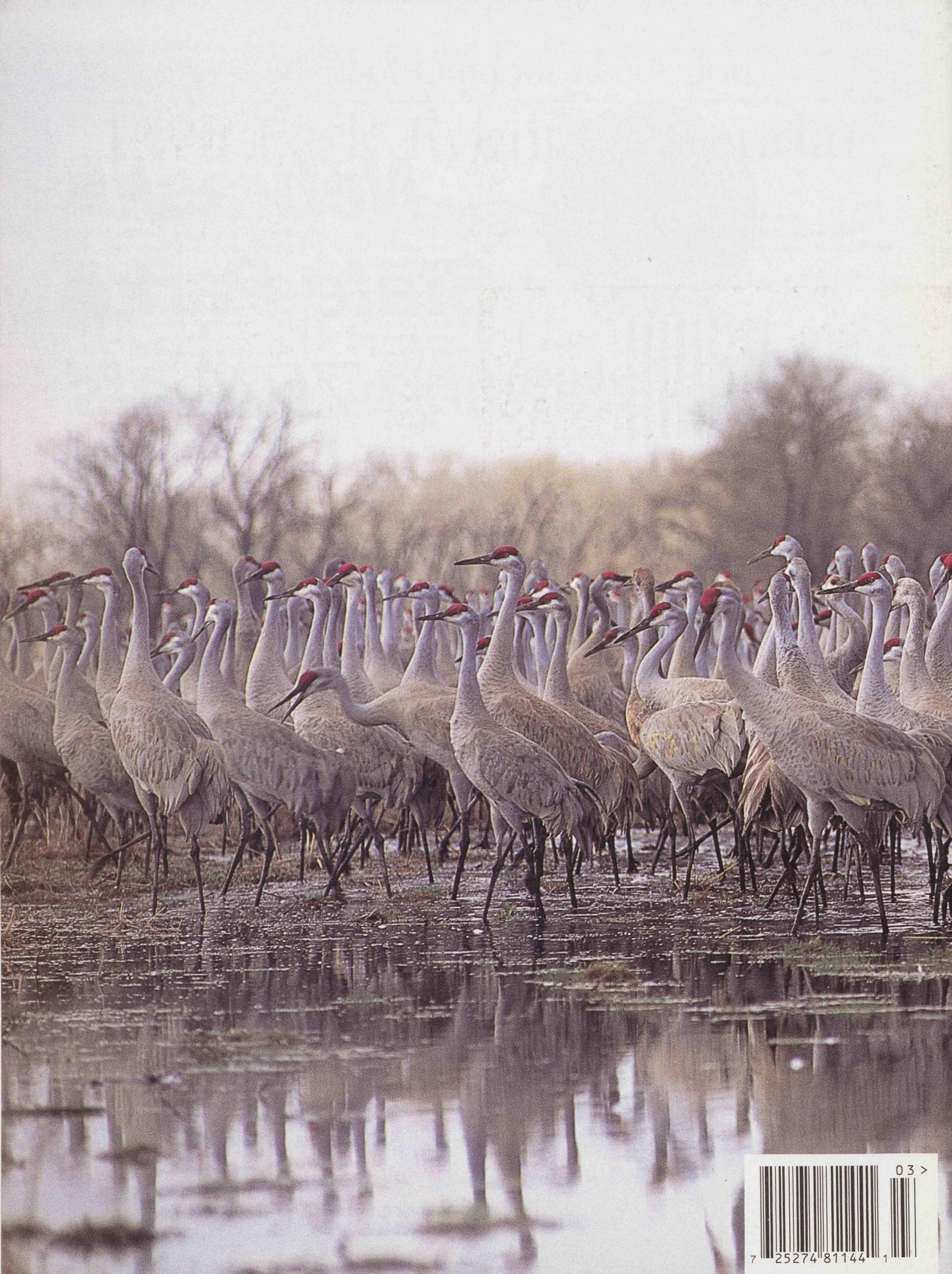
Position: 626 (18 views)