Volume 73, Issue 10, 1995
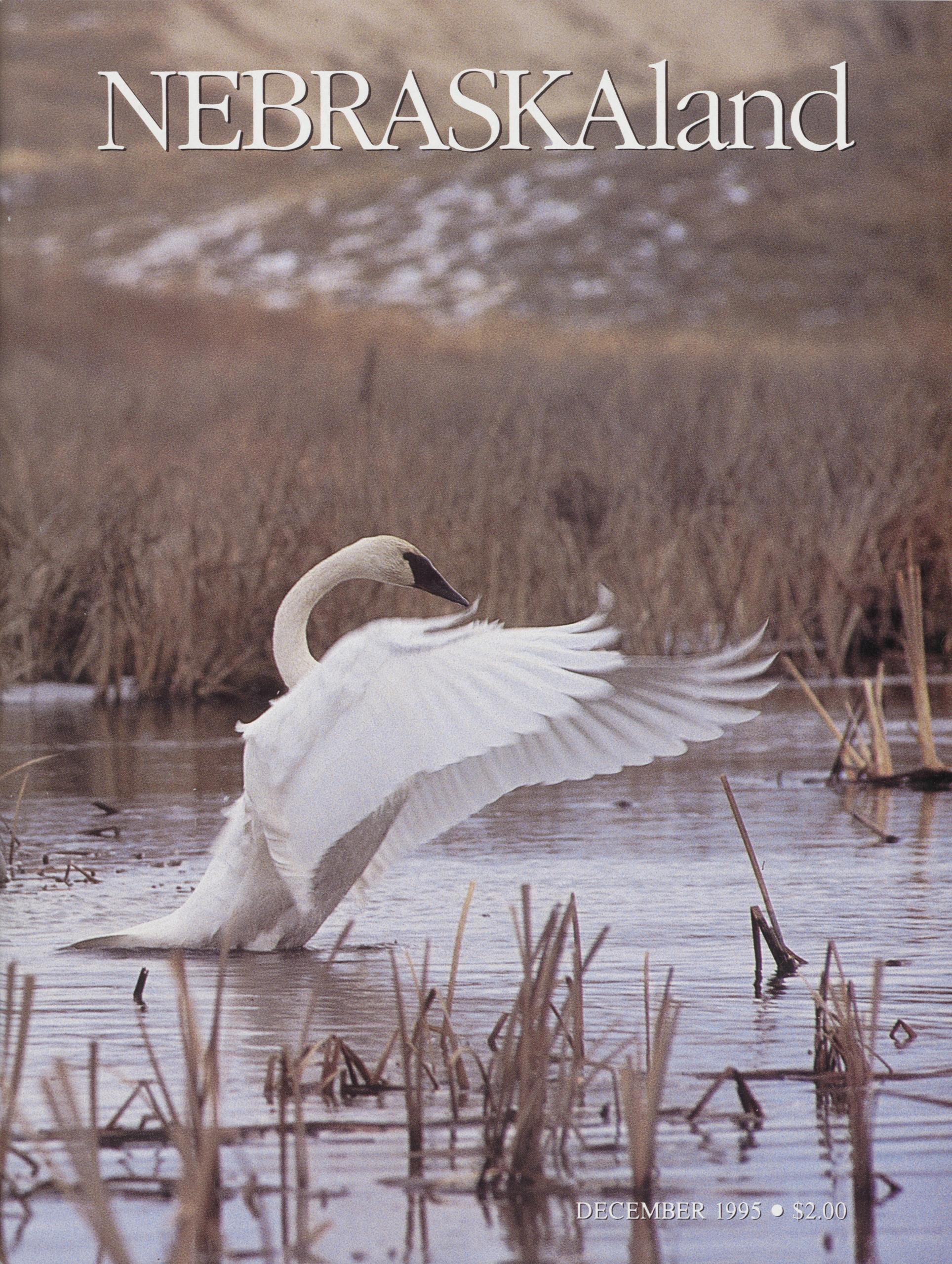
NEBRASKAland Magazine
December 1995 $2.00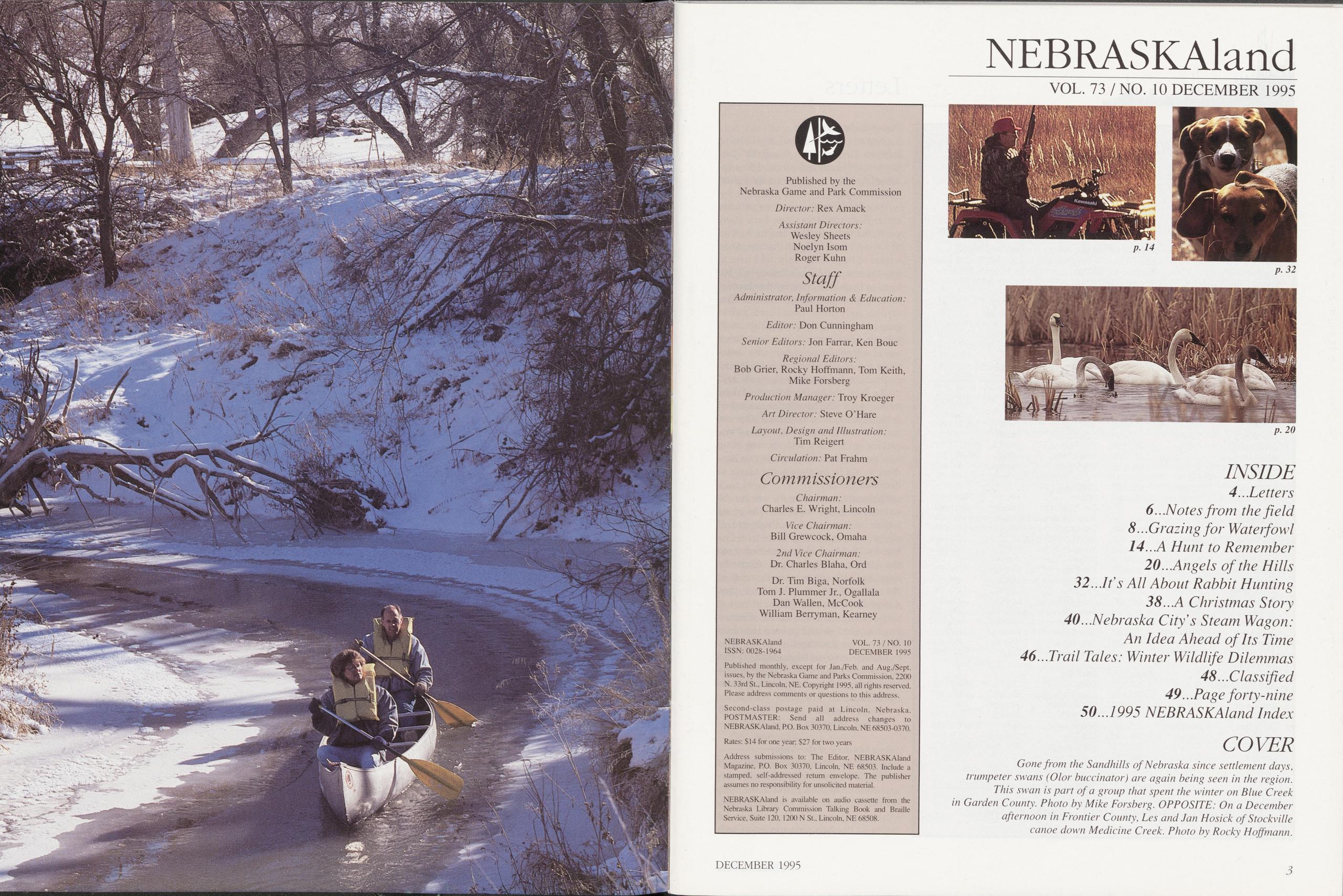
p. 14
p. 32
p. 20
I enjoyed "Dump Rake" by Carolyn Johnsen [“Notes from the field,” November 1995]. She gave a good description of the rake, and the artist did a good job drawing it.
I would like to add a postscript to her letter. Her experiences date back many years, but mine go back farther. Instead of having a tractor to pull the rake, I had a team of horses. Not only did I have to grip the iron seat to stabilize myself, but I had to keep hold of the leather harness lines to guide the horses. And, as Carolyn so aptly put it, I tried hard, too, to keep the windrows straight, so as to achieve passing marks from my father and also from the neighbors who sometimes turned out to help at haying time. Once the field was raked, in my days on the farm, the hay loader proved to be a back saver. The hay loader was towed behind the hay wagon, pulled by horses, and it would go up and down the rows, picking up the hay and shoving it up into the wagon, where one or two handlers would be ready with pitchforks to distribute the hay.
Depending on how it was to be unloaded, there might be slings on which the hay would be distributed. If slings were used, they would be fastened to tackles and then hoisted up to the steel track protruding from the opening to the loft by rope that carried the sling inside the loft and then dumped it. If the sliding door to the loft was not large enough for the slings, a large hay fork would be used to unload the hay from the wagon. I always enjoyed haying time. To this day, when I get a whiff of newly mown hay it brings to mind my happy days on the farm.
Martin DunklauOmaha, Nebraska Silent Masters of the Night
I enjoyed the article “Silent Masters of the Night” in the October issue. However, I must point out an error in the number of owl species that occur in Nebraska, which happens twice on page 16. Nebraska has only nine species of owls that can be considered as regularly occurring in the state, not 19. There are only 19 species of owls in all of North America. Those that occur regularly in Nebraska are the bam, eastern screech, great homed, snowy, burrowing, barred, long-eared, short-eared and saw-whet owls.
Paul BedellRichmond, Virginia
Reader Bedell is correct, and the original manuscript was accurate. The error was introduced in editing. (Editor) The caption on page 20 of the October issue [“Silent Masters of the Night”] states there are two owls in the photo, but if you look closely there are seven feet. That means there are at least four owls in the picture.
I am sure other people have noticed the error since four of the five people in my family noticed it.
Ryan MyersKimball, Nebraska Lost Dogs
I work for a small radio station in the midst of prime hunting country, and we are beginning to receive our annual round of phone calls regarding missing (or found) hunting dogs. We do our best to reunite dog and master, but the sad truth is that most of the time it doesn’t happen. Not surprisingly, lost dogs frequently make their way to a farmhouse, but most farmers have as many dogs as they can handle, and the newcomer is often run off to fend for itself.
I urge you and others with influence with hunters to promote emphasis on training the dog to return to its master, particularly those who train their dogs themselves.
Kaye FullerOrd, Nebraska
Entries may be protected by a covering but will not be accepted in frames, under glass or in plastic kitchen wrap. Wrap securely and send to: Habitat Stamp Contest, Game and Parks Commission, 2200 N. 33rd Street, P.O. Box 30370, Lincoln, NE 68503-0370. A completed entry form and reproduction agreement, or a facsimile thereof, must be attached to the back of the entry. Name and address of the artist must appear only on the reverse side of the entry. The Game and Parks Commission is not responsible for any entry lost or damaged in transit. ENTRIES WILL NOT BE RETURNED UNLESS SPECIFICALLY REQUESTED AND A SELF-ADDRESSED MAILER WITH PROPER RETURN POSTAGE IS INCLUDED.
PrizesAdult division first-place winner receives $200 from the Omaha Fish and Wildlife Club. Youth division first-place winners in each section receive $50 from the Omaha Fish and Wildlife Club. Runners-up and honorable mentions in all divisions receive a subscription to NEBRASKAland Magazine.
Technical RequirementsDesign must be 7‘/2 inches by 4"/i6 inches. It may be matted, but mats may not exceed 10 inches by 7 inches. Any medium is acceptable, but no scrollwork or lettering may appear on the design. Color is preferred.
Subject MatterAny Nebraska wildlife species in an appropriate habitat setting, except raccoon, fox squirrel, Hungarian partridge, prong-homed antelope and ring-necked pheasant, which are ineligible this year.
EligibilityContest is open to Nebraska residents only, and winning entry in the adult division will appear on the 1997 Nebraska Habitat Stamp. Employees of the Game and Parks Commission and their immediate families are not eligible to enter the adult division of the contest. Only one entry allowed per person.
DivisionsAdult: Amateur or professional artists. Youth: Senior Section - Grades 9-12; Junior Section - Grades 5-8; Primary Section - Grades K-4.
Entry Deadline March 1, 1996. Write to Letters, NEBRASKAland Magazine, P.O. Box 30370, Lincoln, NE 68503. Fax: (402) 471-5528. E-mail: Nehland @ngpsun.ngpc.state.ne.us. Letters may he condensed or edited for clarity. Photographs are welcome. Entry Form Please accept my entry in the 1996 Habitat Stamp Art Contest. I hereby certify that I have com- plied with all the rules governing this competition and that the work submitted is my own creation. Further, the Nebraska Game and Parks Commission is hereby authorized to reproduce my design on the 1997 Habitat Stamp or in any other fashion it may deem appropriate. Division/Section Grade in School Title of Entry Medium Name Age (if under 19) Address City, State, Zip Home Phone School Phone Name of School School Address City, State, Zip Please return my entry. I have included the appropriate postage. Artist’s Signature
Notes from the field
Encounters with EaglesFor two long mornings in March, I hunkered in a grass-covered photo blind on a Rainwater Basin wetland in Kearney County. Each morning I had stumbled along a circuitous route in moonless darkness to reach my blind without alarming the white-fronted geese, sandhill cranes and a smattering of mallards and pintails that had rested there overnight. Each morning the birds left the wetland before it was light enough to photograph them, and when they returned to loaf away the midday hours, none ventured within a hundred yards of my blind. As frustrating — and common — as that scenario was, it had its reward, a memorable encounter with eagles.
At midmorning on the second day, there were about three thousand white- fronts within 300 yards of the blind. A murmur of gurgling, contented calls, the sounds of well-fed, well-watered geese, hung over the basin. Then, the silence deafening as a sonic boom, the geese fell still. Drinking geese stopped drinking, dozing geese withdrew their bills from under their wings, and the necks of all the geese stretched upward. Every whitefront on the basin turned into the wind and walked en masse through the shallow water, "goose stepping” in perfect unison like soldiers at a Nazi military rally.
Then a bald eagle came into view high overhead, folded its wings and plunged down from the sky in a mock stoop. Instantly the air over the basin was filled with a confusion of goose wings and alarm calls. Seconds later it was over. The eagle circled, dipped low over a dead whitefront floating in the water then climbed higher and drifted off to the west. The geese milled over the grainfields, then returned to the basin, not one violating the invisible 100-yard perimeter around my blind.
I’ve watched our nation’s symbol waddle awkwardly on the ice around an open pool of water filled with unalarmed ducks on Harlan County Reservoir. From my blind I’ve watched gangs of crows steal the shad I’d spread on the ice to entice eagles into camera range. When the crows had dragged the shad beyond camera range, eagles stole them away. I once saw a bald eagle haze mallards off a reservoir spillway, single out a slow-flying drake, fold its wings in a power dive and, in an incomprehensible maneuver, reach under the duck and clasp its belly in its talons. In March, I’ve wondered at the bald eagles’ incredible tumbling courtship flights. I’ve seen hundreds of eagles at dozens of places across the state over the years, including the first documented chick to hatch in Nebraska in this century, but of all of those encounters with eagles, two remain etched in my memory.
Near the end of winter in 1982,I was driving back roads in the Niobrara River Valley north of Johnstown. Snow still covered the ground in shaded areas. As I rounded a bend, my attention was drawn to an immature bald eagle hovering only a few feet above the ground in a bottomland pasture. Then I saw a full-grown badger running ahead of it. A real-life version of the "arranged encounters” all too often seen on television nature documentaries was unfolding before my eyes.
Each time the eagle drew too close, the badger rolled over and reared up to face the attack. Twice the eagle landed within 10 feet of the badger, and once, for a fleeting moment, they stood toe to talon, each poised to strike, but each time the eagle fell back and climbed into the air when the badger turned to run. The badger’s body language clearly said it perceived the threat as real. It did not shuffle along in typical badger fashion when retreating, but trotted briskly, its tail erect and its body held as high as its short legs would allow. Confrontation by confrontation, the badger inched toward a wooded draw, and in a final dash, escaped to safety. What drove the eagle to challenge so formidable an adversary? Youth and inexperience? Hunger? Whatever its motivation, the young eagle probably had come within a breath of becoming a badger’s lunch.
Even more memorable was an encounter that occurred many years and two bird dogs ago. Again it was midwinter. I had slept in a bitterly cold pickup camper along the Snake River southwest of Valentine to be in position to photograph warm-water mist rising over the waterfalls at daybreak. My companion was a six-year-old German shorthair, a tough-dispositioned dog convinced that if a creature had feathers and flew, it was his mission in life to hunt it.
At the first hint of light I was making ready for the photos. Nature also makes its first call at such an hour, and I found myself on the rim of the Snake River canyon, backside bared.
Mallards overwinter on the Snake’s open water, and where there are mallards there are bald eagles to reap the harvest. As I contemplated life, a mature bald eagle glided past at eye level, no more than 30 yards from me. At the same moment, my shorthair made a pass to see what was delaying me. The eagle, perhaps weary of duck dinners, cocked its head at the prospect of furred game and banked sharply to land on a horizontal pine tree clinging by a few roots to the canyon wall.
The eagle and the dog were both sure the other was fair game. The dog ran to the lip of the canyon only 15 feet from the perched eagle, his body taut as stretched wire. The eagle jerked its head from side to side, gauging the distance and the vulnerability of the dog. Seconds that seemed like minutes passed, more than enough time to consider the likely outcome of the encounter: my dog springing out to grasp the eagle in its teeth, the eagle sinking his talons deeply into my dog, and both tumbling to their death on the rocks below.
But I had underestimated my shorthair’s wisdom. He barked. The eagle cocked its head in disbelief, dropped into the canyon and disappeared downstream. Eagles, in my experience, are far more interesting morning reading than the local newspaper.
Jon FarrarCheck the box on your Nebraska State Tax form to designate a part of your state tax refund for the Nebraska Nongame and Endangered Wildlife Conservation Fund.
Make direct donations to Nebraska Nongame and Endangered Species Fund, Nebraska Game and Parks Commission, P.O. Box 30370, Lincoln, NE 68503
Grazing for Waterfowl
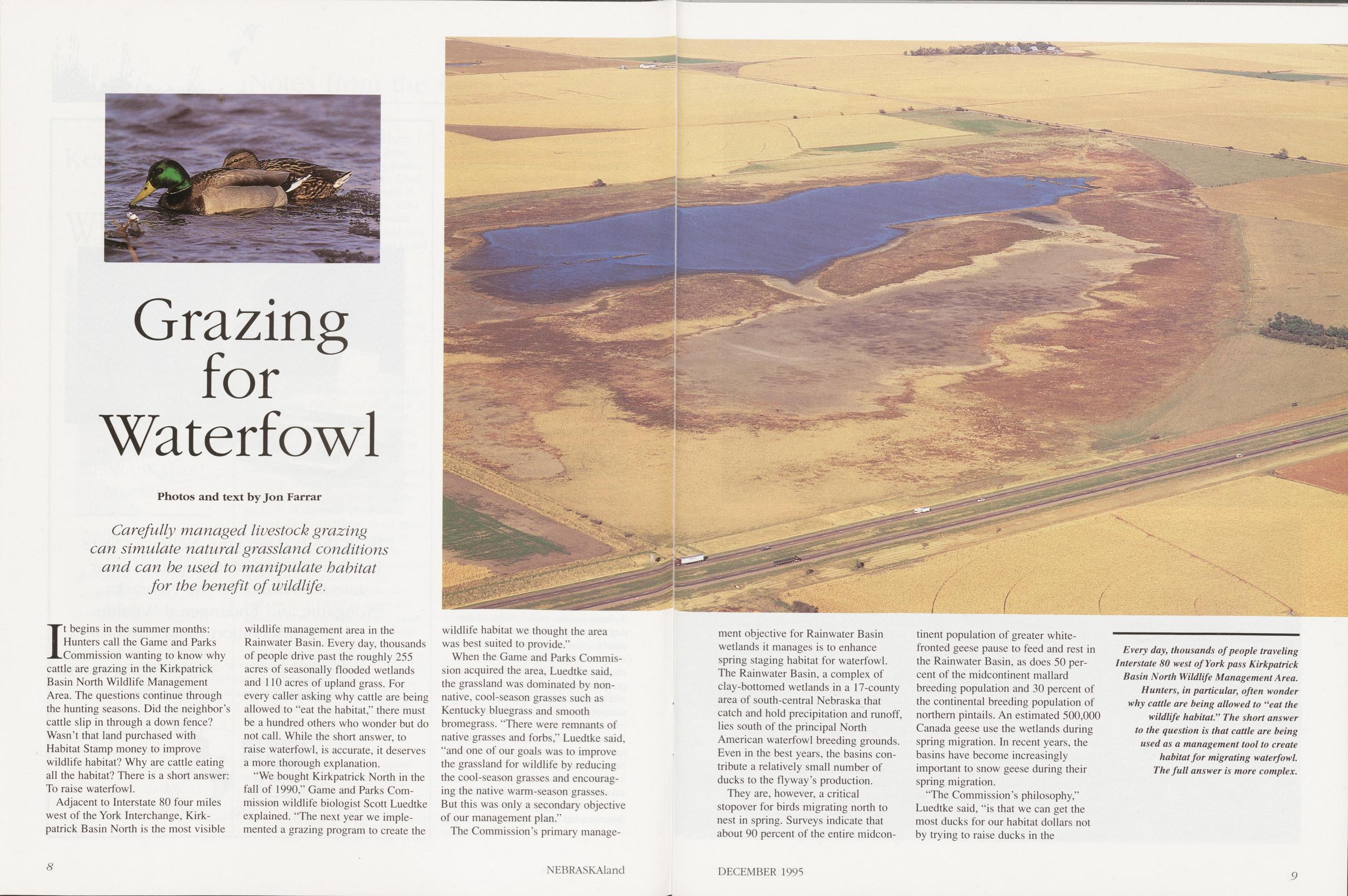
Photos and text by Jon Farrar Carefully managed livestock grazing can simulate natural grassland conditions and can be used to manipulate habitat for the benefit of wildlife.It begins in the summer months: Hunters call the Game and Parks Commission wanting to know why cattle are grazing in the Kirkpatrick Basin North Wildlife Management Area. The questions continue through the hunting seasons. Did the neighbor’s cattle slip in through a down fence? Wasn’t that land purchased with Habitat Stamp money to improve wildlife habitat? Why are cattle eating all the habitat? There is a short answer: To raise waterfowl.
Adjacent to Interstate 80 four miles west of the York Interchange, Kirkpatrick Basin North is the most visible wildlife management area in the Rainwater Basin. Every day, thousands of people drive past the roughly 255 acres of seasonally flooded wetlands and 110 acres of upland grass. For every caller asking why cattle are being allowed to "eat the habitat,” there must be a hundred others who wonder but do not call. While the short answer, to raise waterfowl, is accurate, it deserves a more thorough explanation.
"We bought Kirkpatrick North in the fall of 1990,” Game and Parks Commission wildlife biologist Scott Luedtke explained. "The next year we implemented a grazing program to create the wildlife habitat we thought the area was best suited to provide.”
When the Game and Parks Commission acquired the area, Luedtke said, the grassland was dominated by non-native, cool-season grasses such as Kentucky bluegrass and smooth bromegrass. "There were remnants of native grasses and forbs,” Luedtke said, "and one of our goals was to improve the grassland for wildlife by reducing the cool-season grasses and encouraging the native warm-season grasses. But this was only a secondary objective of our management plan.”
The Commission’s primary management objective for Rainwater Basin wetlands it manages is to enhance spring staging habitat for waterfowl. The Rainwater Basin, a complex of clay-bottomed wetlands in a 17-county area of south-central Nebraska that catch and hold precipitation and runoff, lies south of the principal North American waterfowl breeding grounds. Even in the best years, the basins contribute a relatively small number of ducks to the flyway’s production.
They are, however, a critical stopover for birds migrating north to nest in spring. Surveys indicate that about 90 percent of the entire midcontinent population of greater white-fronted geese pause to feed and rest in the Rainwater Basin, as does 50 percent of the midcontinent mallard breeding population and 30 percent of the continental breeding population of northern pintails. An estimated 500,000 Canada geese use the wetlands during spring migration. In recent years, the basins have become increasingly important to snow geese during their spring migration.
"The Commission’s philosophy,” Luedtke said, "is that we can get the most ducks for our habitat dollars not by trying to raise ducks in the
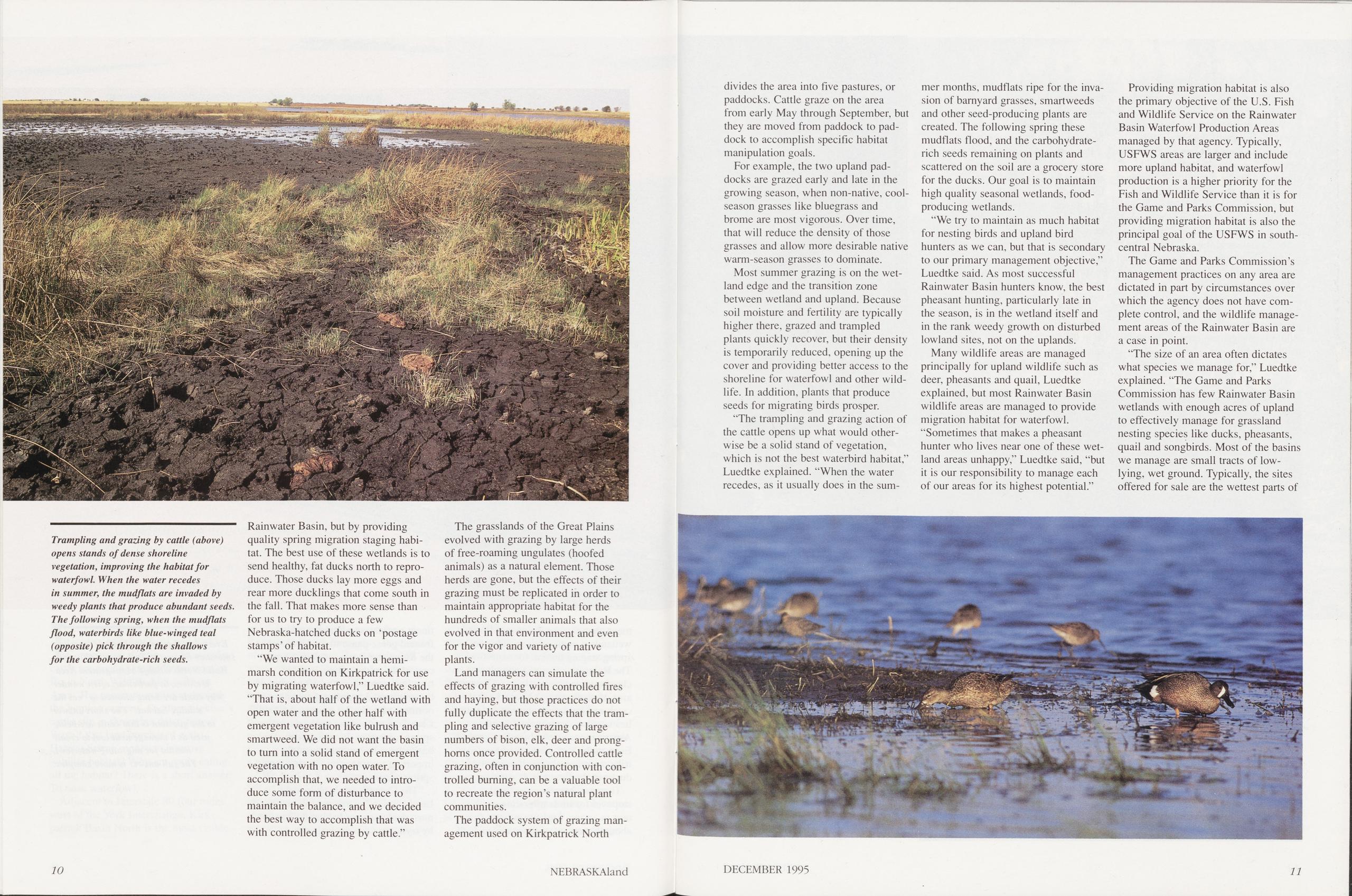
Trampling and grazing by cattle (above) opens stands of dense shoreline vegetation, improving the habitat for waterfowl. When the water recedes in summer, the mudflats are invaded by weedy plants that produce abundant seeds. The following spring, when the mudflats flood, waterbirds like blue-winged teal (opposite) pick through the shallows for the carbohydrate-rich seeds.
Rainwater Basin, but by providing quality spring migration staging habitat. The best use of these wetlands is to send healthy, fat ducks north to reproduce. Those ducks lay more eggs and rear more ducklings that come south in the fall. That makes more sense than for us to try to produce a few Nebraska-hatched ducks on ‘postage stamps’ of habitat.
“We wanted to maintain a hemi-marsh condition on Kirkpatrick for use by migrating waterfowl,” Luedtke said. “That is, about half of the wetland with open water and the other half with emergent vegetation like bulrush and smartweed. We did not want the basin to turn into a solid stand of emergent vegetation with no open water. To accomplish that, we needed to introduce some form of disturbance to maintain the balance, and we decided the best way to accomplish that was with controlled grazing by cattle.”
The grasslands of the Great Plains evolved with grazing by large herds of free-roaming ungulates (hoofed animals) as a natural element. Those herds are gone, but the effects of their grazing must be replicated in order to maintain appropriate habitat for the hundreds of smaller animals that also evolved in that environment and even for the vigor and variety of native plants.
Land managers can simulate the effects of grazing with controlled fires and haying, but those practices do not fully duplicate the effects that the trampling and selective grazing of large numbers of bison, elk, deer and pronghorns once provided. Controlled cattle grazing, often in conjunction with con- trolled burning, can be a valuable tool to recreate the region’s natural plant communities.
The paddock system of grazing management used on Kirkpatrick North divides the area into five pastures, or paddocks. Cattle graze on the area from early May through September, but they are moved from paddock to pad- dock to accomplish specific habitat manipulation goals.
For example, the two upland paddocks are grazed early and late in the growing season, when non-native, cool-season grasses like bluegrass and brome are most vigorous. Over time, that will reduce the density of those grasses and allow more desirable native warm-season grasses to dominate.
Most summer grazing is on the wetland edge and the transition zone between wetland and upland. Because soil moisture and fertility are typically higher there, grazed and trampled plants quickly recover, but their density is temporarily reduced, opening up the cover and providing better access to the shoreline for waterfowl and other wildlife. In addition, plants that produce seeds for migrating birds prosper.
“The trampling and grazing action of the cattle opens up what would otherwise be a solid stand of vegetation, which is not the best waterbird habitat,” Luedtke explained. “When the water recedes, as it usually does in the summer months, mudflats ripe for the invasion of barnyard grasses, smartweeds and other seed-producing plants are created. The following spring these mudflats flood, and the carbohydrate- rich seeds remaining on plants and scattered on the soil are a grocery store for the ducks. Our goal is to maintain high quality seasonal wetlands, food- producing wetlands.
“We try to maintain as much habitat for nesting birds and upland bird hunters as we can, but that is secondary to our primary management objective,” Luedtke said. As most successful Rainwater Basin hunters know, the best pheasant hunting, particularly late in the season, is in the wetland itself and in the rank weedy growth on disturbed lowland sites, not on the uplands.
Many wildlife areas are managed principally for upland wildlife such as deer, pheasants and quail, Luedtke explained, but most Rainwater Basin wildlife areas are managed to provide migration habitat for waterfowl.
“Sometimes that makes a pheasant hunter who lives near one of these wet- land areas unhappy,” Luedtke said, “but it is our responsibility to manage each of our areas for its highest potential.”
Providing migration habitat is also the primary objective of the U.S. Fish and Wildlife Service on the Rainwater Basin Waterfowl Production Areas managed by that agency. Typically, USFWS areas are larger and include more upland habitat, and waterfowl production is a higher priority for the Fish and Wildlife Service than it is for the Game and Parks Commission, but providing migration habitat is also the principal goal of the USFWS in south- central Nebraska.
The Game and Parks Commission’s management practices on any area are dictated in part by circumstances over which the agency does not have complete control, and the wildlife management areas of the Rainwater Basin are a case in point.
“The size of an area often dictates what species we manage for,” Luedtke explained. “The Game and Parks Commission has few Rainwater Basin wetlands with enough acres of upland to effectively manage for grassland nesting species like ducks, pheasants, quail and songbirds. Most of the basins we manage are small tracts of low-lying, wet ground. Typically, the sites offered for sale are the wettest parts of
a basin, parts that cannot be farmed profitably, so management options are limited.
“We work with what we have, manage it for its most valuable wildlife benefit, and hope that one day we will be able to acquire adjacent ground, allowing us more flexibility to manage for additional species,” Luedtke said.
Grazing management is often used on large refuges and wildlife management areas in range country, but is not used as often as biologists would like in eastern and central Nebraska. There, intensive grain crop production, principally irrigated com farming, has replaced diversified farming that included small cattle herds. Rarely are private cattle herds available near wildlife management areas to assist in habitat modification, and when they are, the needs of the cattle owner must be accommodated. To induce a landowner to pasture cattle in wetlands, which may offer marginal grazing values, some upland pasture usually must be included in the agreement.
Properly used, grazing is a beneficial management tool. Improperly used, it can be wildlife’s worst enemy. Cattle left on small pastures year-round, an all-too-common practice in farm country, results in chronically overgrazed pastures dominated by bluegrass and undesirable weeds that provide habitat for cowbirds and little else.
However, the type of grazing management practiced on Kirkpatrick would not be the best choice for a wildlife area where waterfowl nesting is the primary management goal, such as in the Sandhills. There, residual standing grass cover from the previous growing season is essential to achieve high duck nesting densities the following spring.
The hunter who scratches his head in disbelief when he sees cattle grazing “his” wildlife habitat must recognize that any single area is but one small cog in a larger and infinitely more complex natural machine that produces and maintains wildlife populations. That is especially true in maintaining migratory bird populations. Wintering grounds on the Gulf Coast, spring resting and feeding areas like the Rainwater Basin, and prairie pothole and Arctic nesting grounds are equally important components in sustaining duck and goose populations.
Because migratory waterfowl cannot be managed piecemeal, conservation groups and government agencies are increasingly coordinating their efforts, often international in scope, in projects like the Rainwater Basin Joint Venture, one component of the North American Waterfowl Management Plan. The acquisition of Kirkpatrick Basin North, for example, was made possible through funding provided by the Nebraska Game and Parks Commission’s Habitat Fund, contributions from Ducks Unlimited and Federal Aid in Wildlife Restoration funds.
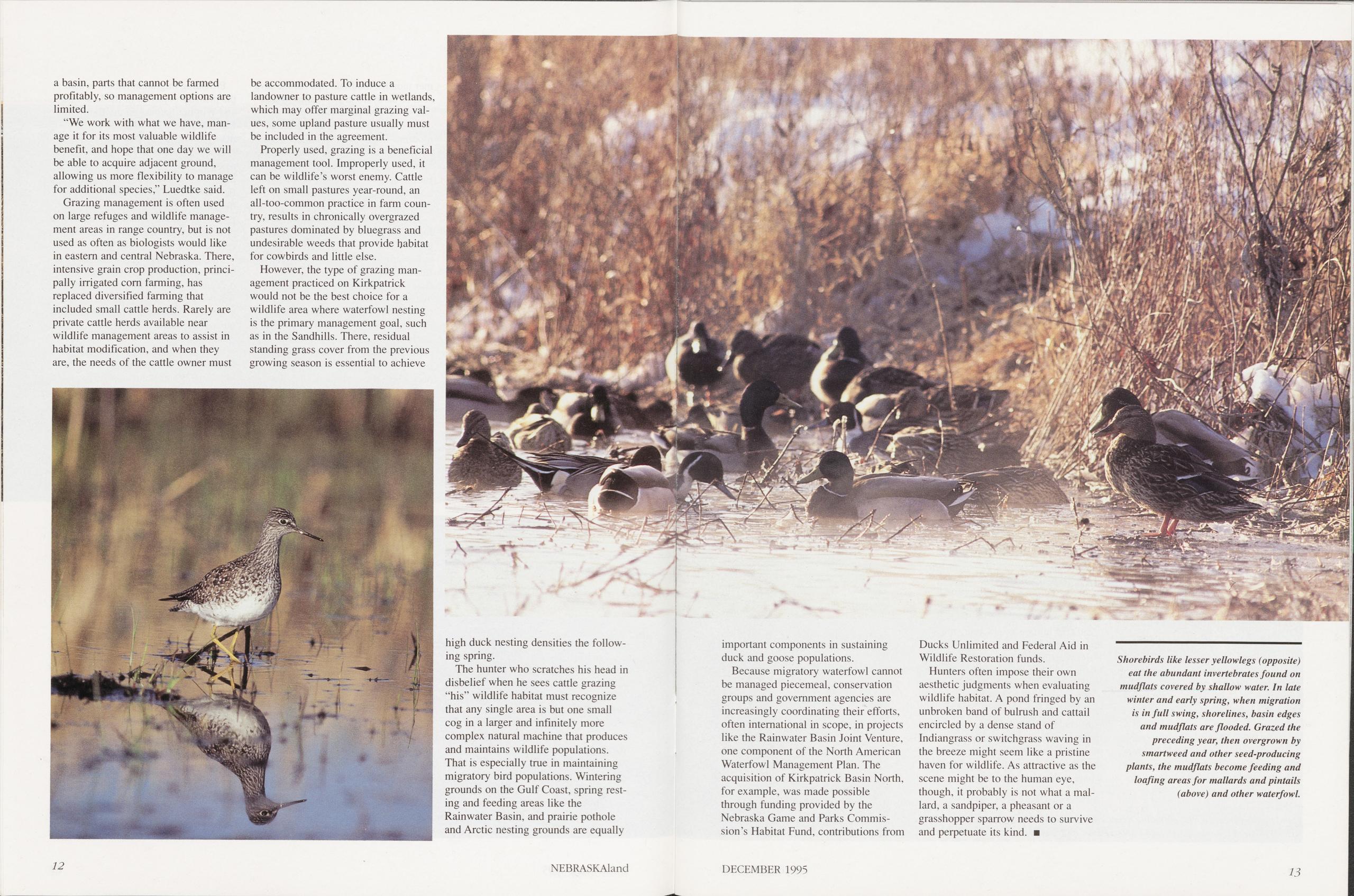
Hunters often impose their own aesthetic judgments when evaluating wildlife habitat. A pond fringed by an unbroken band of bulrush and cattail encircled by a dense stand of Indiangrass or switchgrass waving in the breeze might seem like a pristine haven for wildlife. As attractive as the scene might be to the human eye, though, it probably is not what a mallard, a sandpiper, a pheasant or a grasshopper sparrow needs to survive and perpetuate its kind. ■
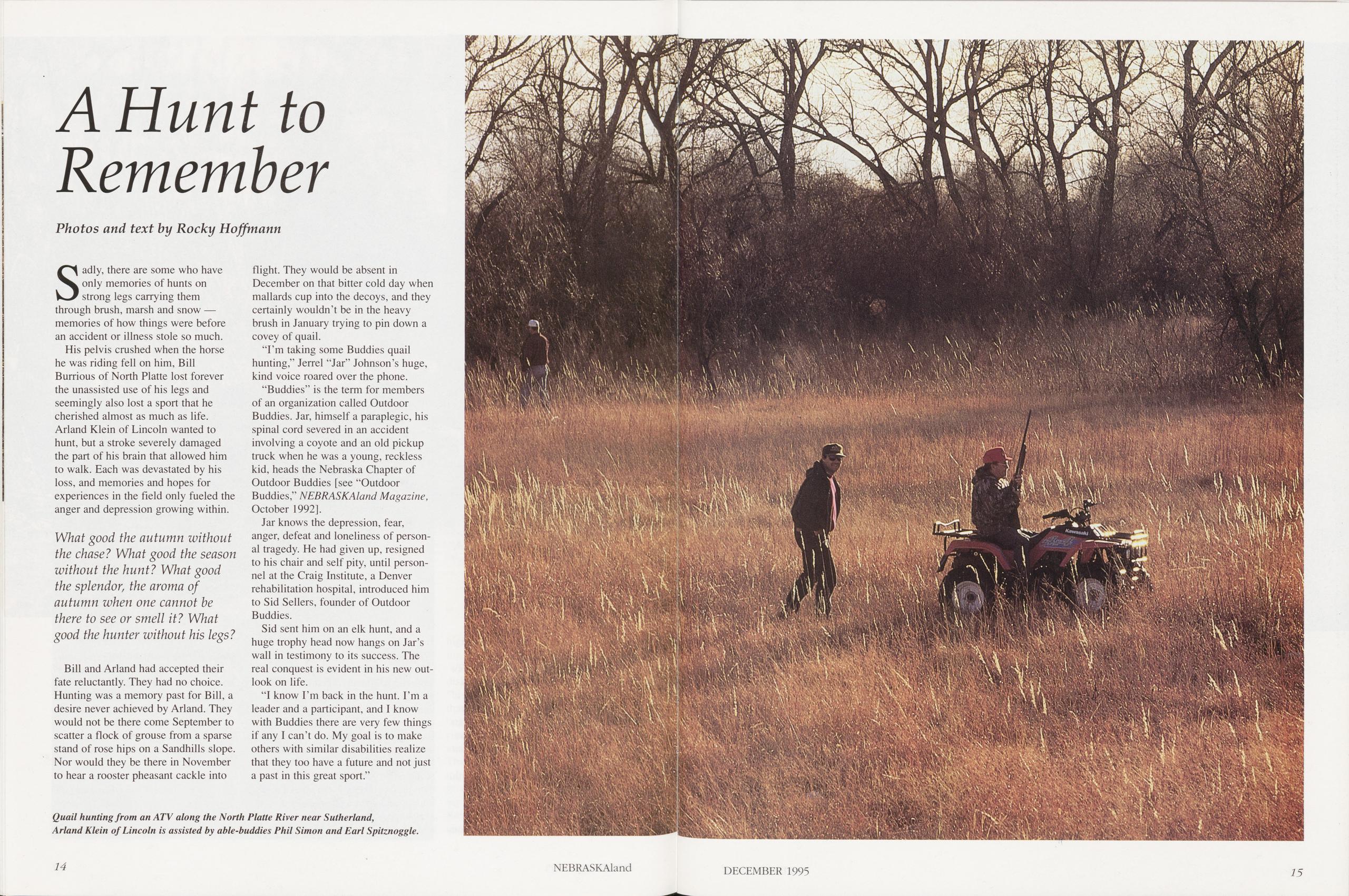
A Hunt to Remember
Photos and text by Rocky HoffmannSadly, there are some who have only memories of hunts on strong legs carrying them through brush, marsh and snow — memories of how things were before an accident or illness stole so much.
His pelvis crushed when the horse he was riding fell on him, Bill Burrious of North Platte lost forever the unassisted use of his legs and seemingly also lost a sport that he cherished almost as much as life. Arland Klein of Lincoln wanted to hunt, but a stroke severely damaged the part of his brain that allowed him to walk. Each was devastated by his loss, and memories and hopes for experiences in the field only fueled the anger and depression growing within.
What good the autumn without the chase? What good the season without the hunt? What good the splendor; the aroma of autumn when one cannot be there to see or smell it? What good the hunter without his legs?Bill and Arland had accepted their fate reluctantly. They had no choice. Hunting was a memory past for Bill, a desire never achieved by Arland. They would not be there come September to scatter a flock of grouse from a sparse stand of rose hips on a Sandhills slope. Nor would they be there in November to hear a rooster pheasant cackle into flight. They would be absent in December on that bitter cold day when mallards cup into the decoys, and they certainly wouldn’t be in the heavy brush in January trying to pin down a covey of quail.
“I’m taking some Buddies quail hunting,” Jerrel “Jar” Johnson’s huge, kind voice roared over the phone. “Buddies” is the term for members of an organization called Outdoor Buddies. Jar, himself a paraplegic, his spinal cord severed in an accident involving a coyote and an old pickup truck when he was a young, reckless kid, heads the Nebraska Chapter of Outdoor Buddies [see “Outdoor Buddies,” NEBRASKAland Magazine, October 1992].
Jar knows the depression, fear, anger, defeat and loneliness of personal tragedy. He had given up, resigned to his chair and self pity, until personnel at the Craig Institute, a Denver rehabilitation hospital, introduced him to Sid Sellers, founder of Outdoor Buddies.
Sid sent him on an elk hunt, and a huge trophy head now hangs on Jar’s wall in testimony to its success. The real conquest is evident in his new outlook on life.
“I know I’m back in the hunt. I’m a leader and a participant, and I know with Buddies there are very few things if any I can’t do. My goal is to make others with similar disabilities realize that they too have a future and not just a past in this great sport.”
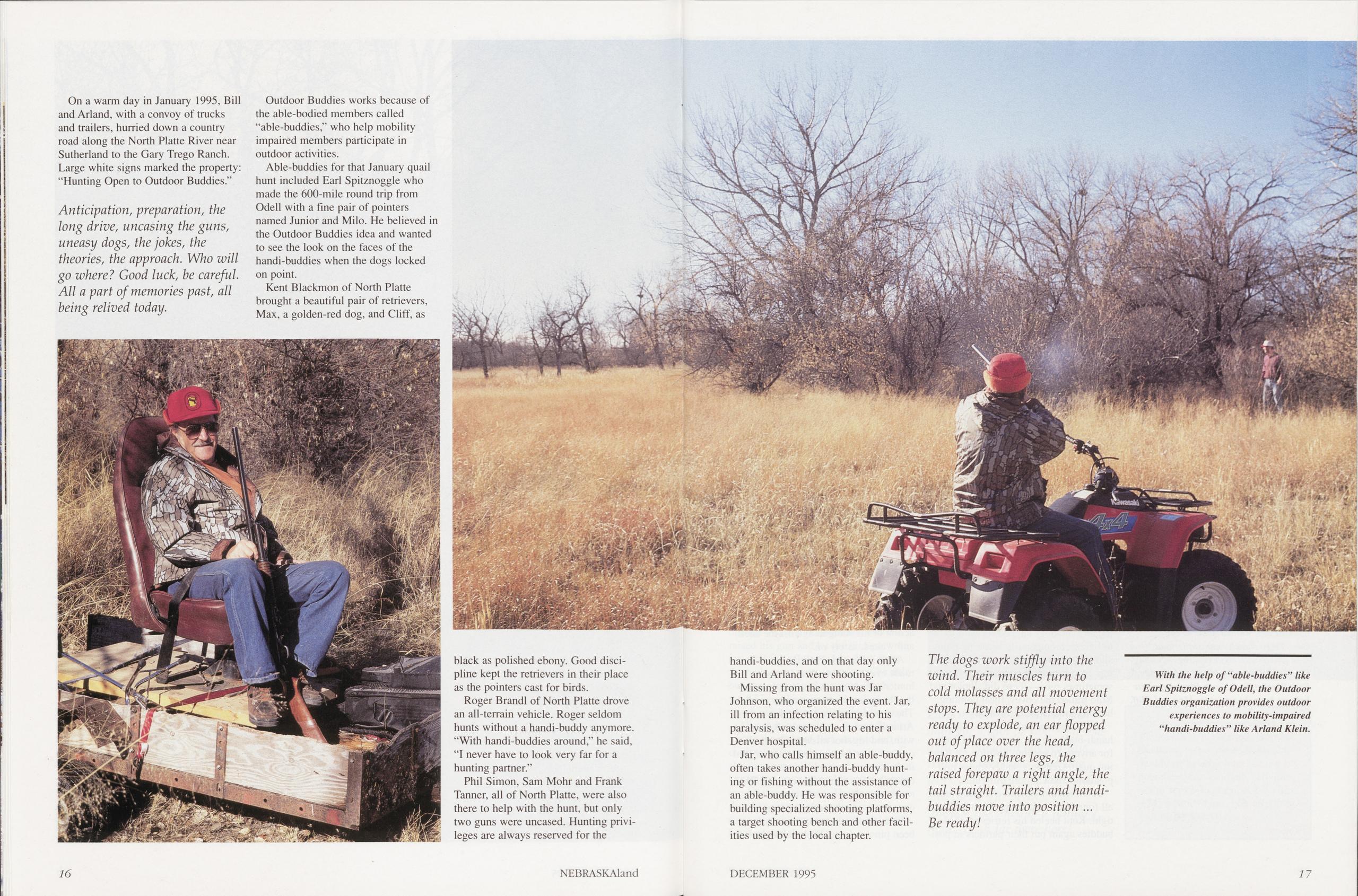
On a warm day in January 1995, Bill and Arland, with a convoy of trucks and trailers, hurried down a country road along the North Platte River near Sutherland to the Gary Trego Ranch. Large white signs marked the property: “Hunting Open to Outdoor Buddies.”
Anticipation, preparation, the long drive, uncasing the guns, uneasy dogs, the jokes, the theories, the approach. Who will go where? Good luck, be careful. All a part of memories past, all being relived today.Outdoor Buddies works because of the able-bodied members called “able-buddieswho help mobility impaired members participate in outdoor activities.
Able-buddies for that January quail hunt included Earl Spitznoggle who made the 600-mile round trip from Odell with a fine pair of pointers named Junior and Milo. He believed in the Outdoor Buddies idea and wanted to see the look on the faces of the handi-buddies when the dogs locked on point.
Kent Blackmon of North Platte brought a beautiful pair of retrievers, Max, a golden-red dog, and Cliff, as black as polished ebony. Good discipline kept the retrievers in their place as the pointers cast for birds.
Roger Brandl of North Platte drove an all-terrain vehicle. Roger seldom hunts without a handi-buddy anymore. “With handi-buddies around,” he said, “I never have to look very far for a hunting partner.”
Phil Simon, Sam Mohr and Frank Tanner, all of North Platte, were also there to help with the hunt, but only two guns were uncased. Hunting privileges are always reserved for the handi-buddies, and on that day only Bill and Arland were shooting.
Missing from the hunt was Jar Johnson, who organized the event. Jar, ill from an infection relating to his paralysis, was scheduled to enter a Denver hospital.
Jar, who calls himself an able-buddy, often takes another handi-buddy hunt- ing or fishing without the assistance of an able-buddy. He was responsible for building specialized shooting platforms, a target shooting bench and other facil- ities used by the local chapter.
The dogs work stiffly into the wind. Their muscles turn to cold molasses and all movement stops. They are potential energy ready to explode, an ear flopped out of place over the head, balanced on three legs, the raised forepaw a right angle, the tail straight. Trailers and handi-buddies move into position ... Be ready!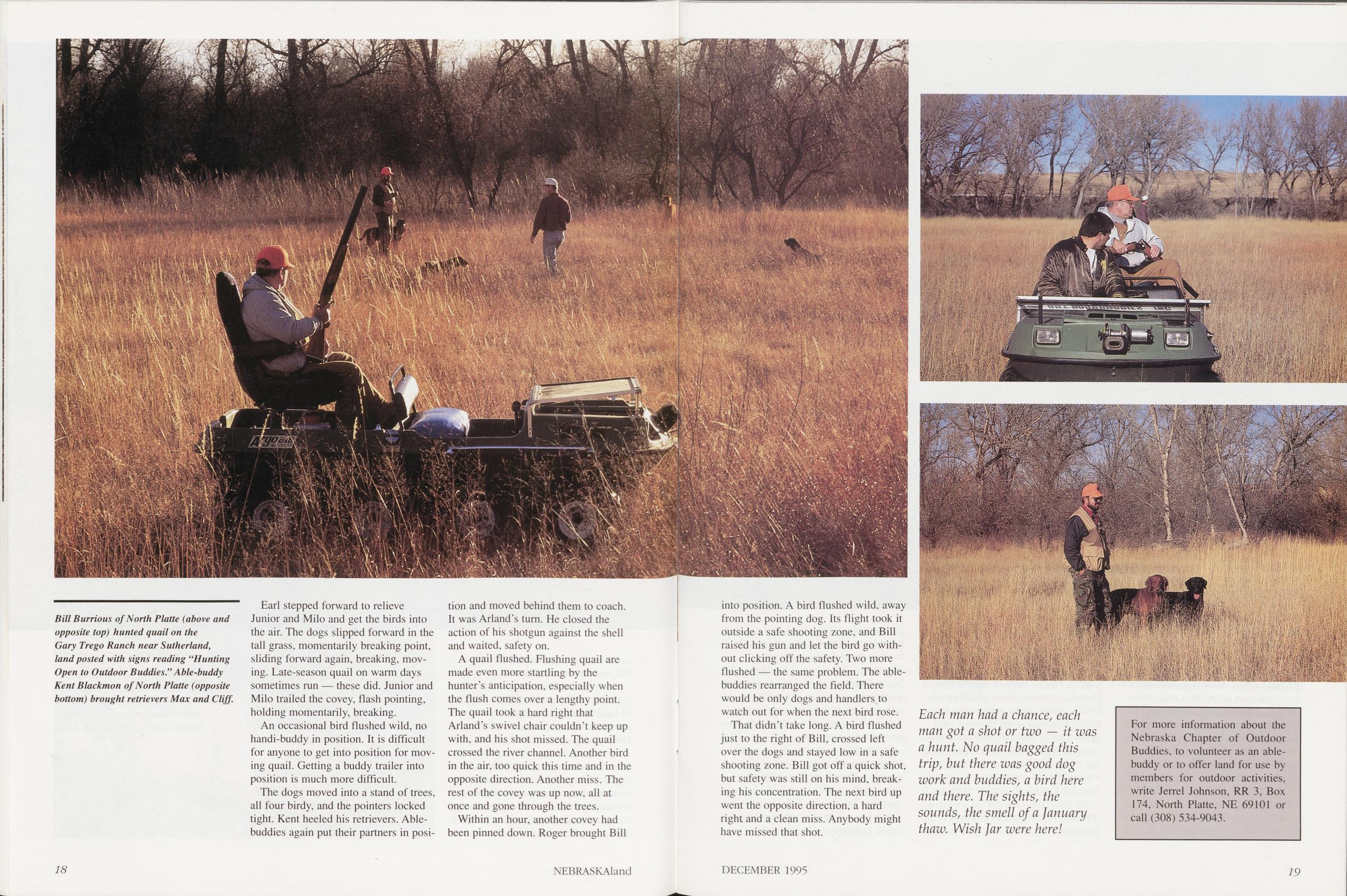
Earl stepped forward to relieve Junior and Milo and get the birds into the air. The dogs slipped forward in the tall grass, momentarily breaking point, sliding forward again, breaking, moving. Late-season quail on warm days sometimes run — these did. Junior and Milo trailed the covey, flash pointing, holding momentarily, breaking.
An occasional bird flushed wild, no handi-buddy in position. It is difficult for anyone to get into position for moving quail. Getting a buddy trailer into position is much more difficult.
The dogs moved into a stand of trees, all four birdy, and the pointers locked tight. Kent heeled his retrievers. Able-buddies again put their partners in position and moved behind them to coach. It was Ari and's turn. He closed the action of his shotgun against the shell and waited, safety on.
A quail flushed. Flushing quail are made even more startling by the hunter’s anticipation, especially when the flush comes over a lengthy point.
The quail took a hard right that Arland’s swivel chair couldn’t keep up with, and his shot missed. The quail crossed the river channel. Another bird in the air, too quick this time and in the opposite direction. Another miss. The rest of the covey was up now, all at once and gone through the trees.
Within an hour, another covey had been pinned down. Roger brought Bill into position. A bird flushed wild, away from the pointing dog. Its flight took it outside a safe shooting zone, and Bill raised his gun and let the bird go without clicking off the safety. Two more flushed — the same problem. The able-buddies rearranged the field. There would be only dogs and handlers to watch out for when the next bird rose.
That didn’t take long. A bird flushed just to the right of Bill, crossed left over the dogs and stayed low in a safe shooting zone. Bill got off a quick shot, but safety was still on his mind, breaking his concentration. The next bird up went the opposite direction, a hard right and a clean miss. Anybody might have missed that shot.
Each man had a chance, each man got a shot or two — it was a hunt. No quail bagged this trip, but there was good dog work and buddies, a bird here and there. The sights, the sounds, the smell of a January thaw. Wish Jar were here!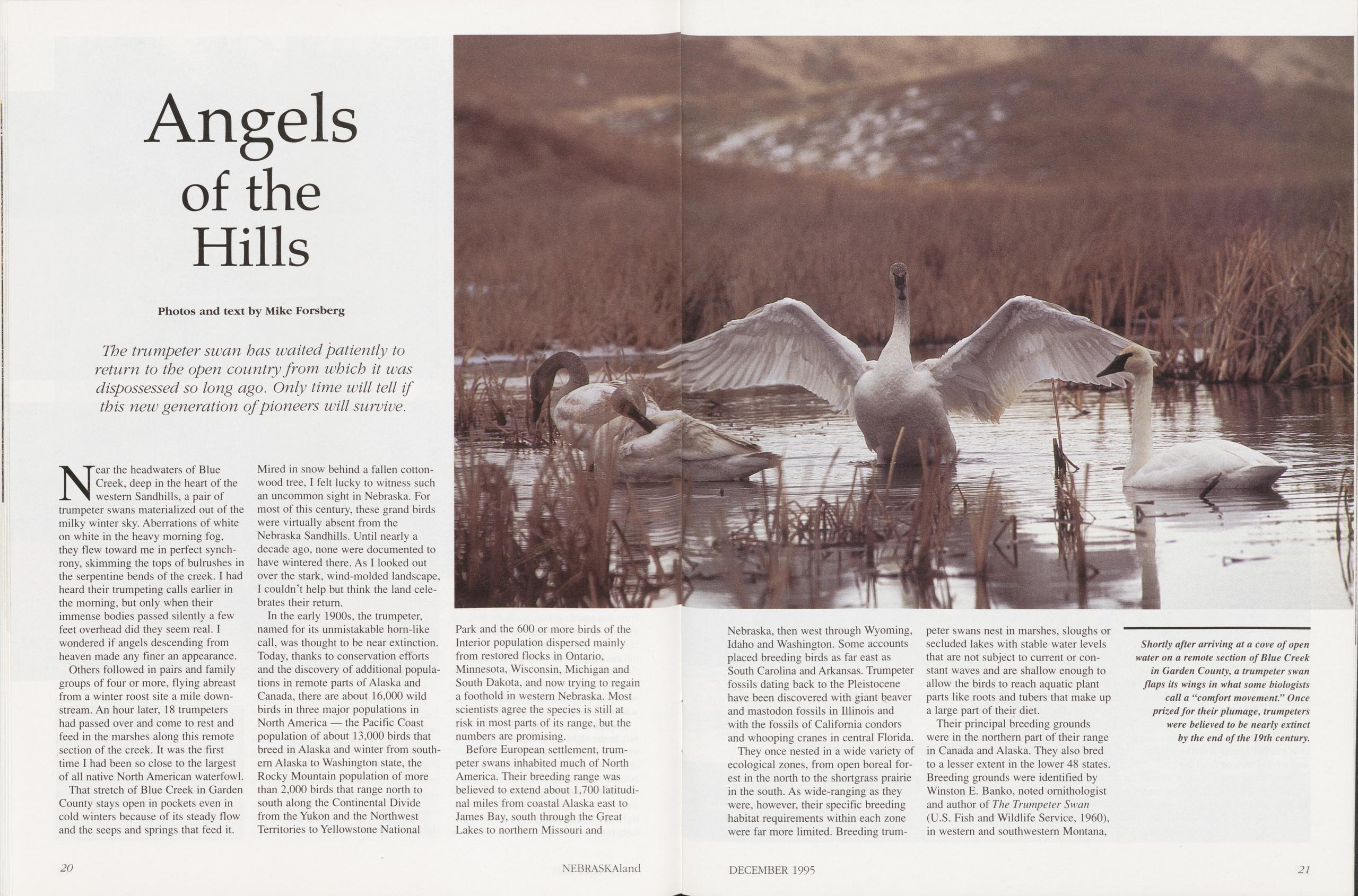
Angels of the Hills
Photos and text by Mike Forsberg The trumpeter swan has waited patiently to return to the open country from which it was dispossessed so long ago. Only time will tell if this new generation of pioneers will survive. Near the headwaters of Blue Creek, deep in the heart of the western Sandhills, a pair of trumpeter swans materialized out of the milky winter sky. Aberrations of white on white in the heavy morning fog, they flew toward me in perfect synchrony, skimming the tops of bulrushes in the serpentine bends of the creek. I had heard their trumpeting calls earlier in the morning, but only when their immense bodies passed silently a few feet overhead did they seem real. I wondered if angels descending from heaven made any finer an appearance.Others followed in pairs and family groups of four or more, flying abreast from a winter roost site a mile downstream. An hour later, 18 trumpeters had passed over and come to rest and feed in the marshes along this remote section of the creek. It was the first time I had been so close to the largest of all native North American waterfowl.
That stretch of Blue Creek in Garden County stays open in pockets even in cold winters because of its steady flow and the seeps and springs that feed it. Mired in snow behind a fallen cottonwood tree, I felt lucky to witness such an uncommon sight in Nebraska. For most of this century, these grand birds were virtually absent from the Nebraska Sandhills. Until nearly a decade ago, none were documented to have wintered there. As I looked out over the stark, wind-molded landscape, I couldn’t help but think the land cele- brates their return.
In the early 1900s, the trumpeter, named for its unmistakable horn-like call, was thought to be near extinction. Today, thanks to conservation efforts and the discovery of additional populations in remote parts of Alaska and Canada, there are about 16,000 wild birds in three major populations in North America — the Pacific Coast population of about 13,000 birds that breed in Alaska and winter from southern Alaska to Washington state, the Rocky Mountain population of more than 2,000 birds that range north to south along the Continental Divide from the Yukon and the Northwest Territories to Yellowstone National Park and the 600 or more birds of the Interior population dispersed mainly from restored flocks in Ontario, Minnesota, Wisconsin, Michigan and South Dakota, and now trying to regain a foothold in western Nebraska. Most scientists agree the species is still at risk in most parts of its range, but the numbers are promising.
Before European settlement, trumpeter swans inhabited much of North America. Their breeding range was believed to extend about 1,700 latitudinal miles from coastal Alaska east to James Bay, south through the Great Lakes to northern Missouri and Nebraska, then west through Wyoming, Idaho and Washington. Some accounts placed breeding birds as far east as South Carolina and Arkansas. Trumpeter fossils dating back to the Pleistocene have been discovered with giant beaver and mastodon fossils in Illinois and with the fossils of California condors and whooping cranes in central Florida.
They once nested in a wide variety of ecological zones, from open boreal forest in the north to the shortgrass prairie in the south. As wide-ranging as they were, however, their specific breeding habitat requirements within each zone were far more limited. Breeding trumpeter swans nest in marshes, sloughs or secluded lakes with stable water levels that are not subject to current or constant waves and are shallow enough to allow the birds to reach aquatic plant parts like roots and tubers that make up a large part of their diet.
Their principal breeding grounds were in the northern part of their range in Canada and Alaska. They also bred to a lesser extent in the lower 48 states. Breeding grounds were identified by Winston E. Banko, noted ornithologist and author of The Trumpeter Swan (U.S. Fish and Wildlife Service, 1960), in western and southwestern Montana,
eastern Idaho, northwestern Wyoming, southern Minnesota, northern Iowa, North Dakota, South Dakota and the Nebraska Sandhills.
Although the continental United States is not considered the primary historic breeding ground for trum- peters, it is extremely important to wintering flocks. Trumpeters were migrants and winter residents in all four flyways until the last half of the 1800s. Their reported wintering range extended on long, thin fingers of open water from the confluence of the Ohio and lower Mississippi river valleys to the Gulf Coast. The range continued along the Gulf Coast from eastern Texas to central Florida and up the Atlantic as far as ice-free waters existed. In the west, trumpeters were reported wintering in pockets in and around Yellowstone, in the Sacramento valleys of California and along the Pacific Coast from the Columbia River north to southeast Alaska.
John James Audubon observed trumpeters for several winters along the Mississippi and western Ohio river valleys. He watched migrating flocks move with the weather as far south as necessary to find open water, one winter seeing them as far south as Texas.
“Imagine, reader, that a flock of fifty swans are ... sporting before you, as they have more than once been in my sight, and you will feel, as I have felt, more happy and void of care than I can describe,” Audubon wrote in an 1830s essay on the trumpeter. As I watched the swans feed, preen and rest in a marshy cove in Garden County, I wholeheartedly agreed.
Swans have long made a powerful impression on humans and were strong symbolic elements in the myths and religious ceremonies of many early cultures. They were symbolic for the Egyptians and in the canons of early Christianity and entered into religious ceremonies of Eastern shamans, medicine men of Native American tribes and wizard men of Lapland.
There are seven species of swans worldwide. The two North American species, the trumpeter (Olor buccinator) and the tundra (Olor columbianus), formerly known as the whistler, are white and have nearly identical features. Tundra swans breed in the arctic and along the Alaskan coast, migrating through the central states in the fall. They are rarely seen in Nebraska, but most reports are from the eastern part of the state, where they pause to rest along a migratory corridor along the Missouri River Valley.
It is nearly impossible to distinguish trumpeter swans from tundra swans, which in the past has caused conflict in states frequented by both species and where the more populous tundra is hunted. The trumpeter is somewhat larger, averaging 60 inches long from bill to tail, has an 88-inch wingspread and a weight of 27 pounds. The tundra, with a shorter wingspread and length, rarely exceeds 18 pounds. Fortunately, their calls are as different as those of a wolf and a coyote, laying any ambiguity to rest once they announce their presence. The trumpeter swan’s trachea has an extra loop in its sternum, causing its call to sound like a curled horn instrument. It is an unforgettable deep and resonant two-syllable call, “oh-OH,” most often heard in flight. The tundra’s is a high-pitched barking “wow wow wow.”,
It was that deep resonant sound that turned my gaze downstream from the small marshy cove to see five trumpeters, two adults and three juveniles, bending around a lone cottonwood tree, flying low over the creek and landing in the main channel about 20 yards away. Stepping over a thin line of bulrushes bordering the channel, they entered the cove. Rimmed with ice, the small cove was one of three the wintering trumpeters commonly used as a feeding station.
The juveniles (or cygnets), identifiable by their gray appearance, began feeding immediately. The adults were more cautious, one usually leading the group around the cove and the other bringing up the rear, always with a cautious eye to the sky and a small stand of willows that could conceal predators on the south bank.
Once, an adult swan spotted two coyotes hunting along the cattails at the far end of the creek. The swan stretched its neck straight up and gave an alarm call, prompting the family to gather in a tight group in deeper water until the coyotes disappeared over the hill. Because of their size, older cygnets and adult trumpeters have few natural predators, although coyotes, golden eagles, red foxes and bobcats occasionally prey on trumpeters, especially sick or injured birds.
When the coyotes left, the swans began feeding again. Built with necks as long or longer than their bodies, large torsos, short strong legs and large webbed feet with prominent nails, swans are adapted for a specialized shallow water existence, consuming large quantities of leafy aquatic plants. Cygnets feed primarily on animal matter such as insects and crustaceans, but by their first winter shift to a mainly vegetarian diet.
Trumpeters feed by sight and feel. In shallow water they often stand shuffling their feet, slowly rocking from side to side, then stepping back and dipping their long necks into the water to feed on what they have churned up. In that way, they dig up the sometimes stubborn roots and tubers of aquatic plants. Underwater holes a foot or more deep and several feet in diameter have been found by biologists in Montana studying this feeding behav- ior. Along Blue Creek, several mallards followed close behind the feeding trumpeters, cleaning up a smorgasbord of morsels left in their wake.
Later, a pair of trumpeters joined the group at the feeding area. Their huge feet were tucked into the down of their breasts in flight, minimizing their exposure to the cold weather. Thrusting their feet forward, cupped like wing flaps on an aircraft to break speed, they landed gracefully in the water.
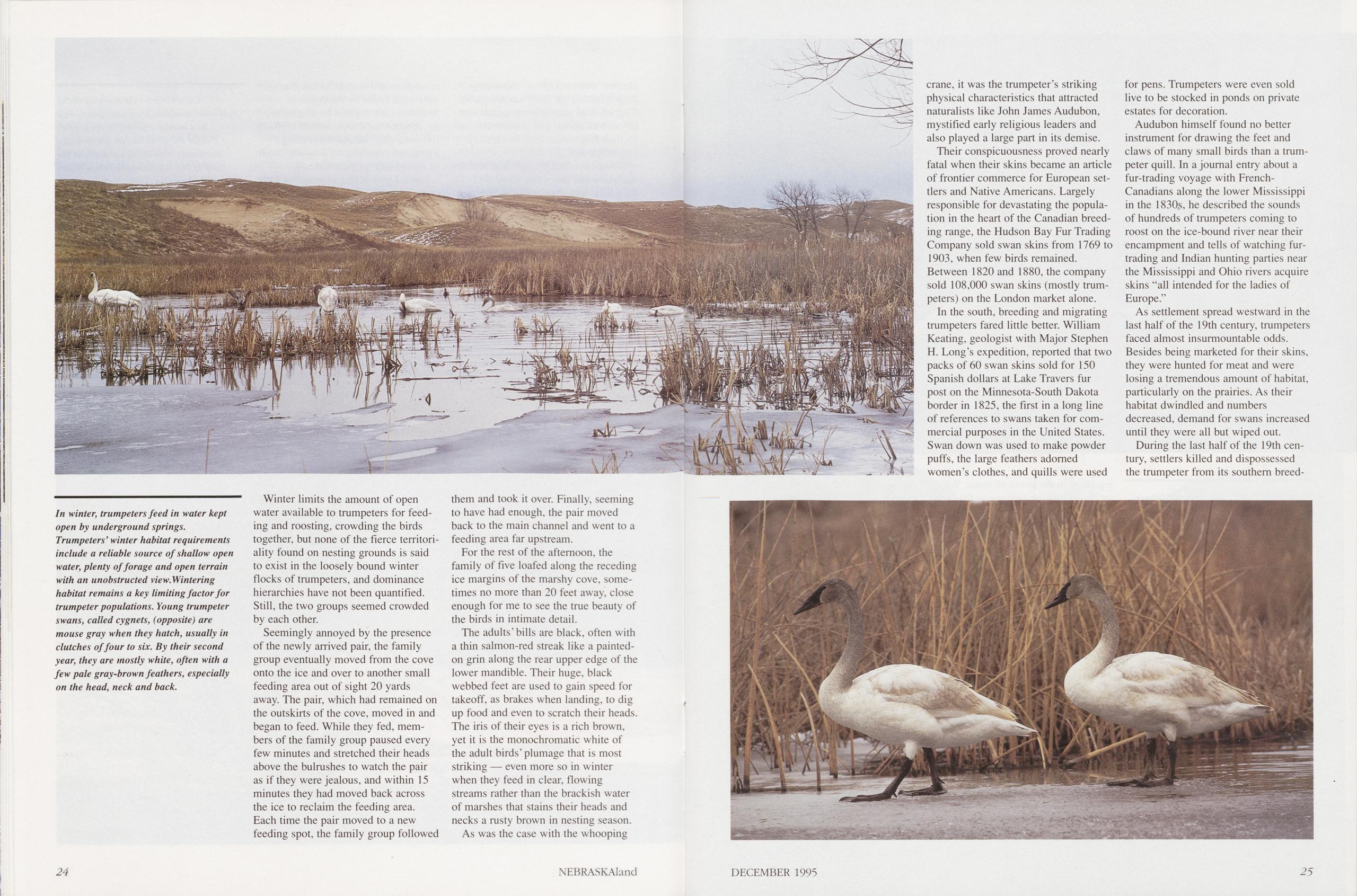
Winter limits the amount of open water available to trumpeters for feeding and roosting, crowding the birds together, but none of the fierce territoriality found on nesting grounds is said to exist in the loosely bound winter flocks of trumpeters, and dominance hierarchies have not been quantified. Still, the two groups seemed crowded by each other.
Seemingly annoyed by the presence of the newly arrived pair, the family group eventually moved from the cove onto the ice and over to another small feeding area out of sight 20 yards away. The pair, which had remained on the outskirts of the cove, moved in and began to feed. While they fed, members of the family group paused every few minutes and stretched their heads above the bulrushes to watch the pair as if they were jealous, and within 15 minutes they had moved back across the ice to reclaim the feeding area. Each time the pair moved to a new feeding spot, the family group followed them and took it over. Finally, seeming to have had enough, the pair moved back to the main channel and went to a feeding area far upstream.
For the rest of the afternoon, the family of five loafed along the receding ice margins of the marshy cove, sometimes no more than 20 feet away, close enough for me to see the true beauty of the birds in intimate detail.
The adults’bills are black, often with a thin salmon-red streak like a painted- on grin along the rear upper edge of the lower mandible. Their huge, black webbed feet are used to gain speed for takeoff, as brakes when landing, to dig up food and even to scratch their heads. The iris of their eyes is a rich brown, yet it is the monochromatic white of the adult birds’ plumage that is most striking — even more so in winter when they feed in clear, flowing streams rather than the brackish water of marshes that stains their heads and necks a rusty brown in nesting season.
As was the case with the whooping crane, it was the trumpeter’s striking physical characteristics that attracted naturalists like John James Audubon, mystified early religious leaders and also played a large part in its demise.
Their conspicuousness proved nearly fatal when their skins became an article of frontier commerce for European settlers and Native Americans. Largely responsible for devastating the population in the heart of the Canadian breeding range, the Hudson Bay Fur Trading Company sold swan skins from 1769 to 1903, when few birds remained. Between 1820 and 1880, the company sold 108,000 swan skins (mostly trumpeters) on the London market alone.
In the south, breeding and migrating trumpeters fared little better. William Keating, geologist with Major Stephen H. Long’s expedition, reported that two packs of 60 swan skins sold for 150 Spanish dollars at Lake Travers fur post on the Minnesota-South Dakota border in 1825, the first in a long line of references to swans taken for commercial purposes in the United States. Swan down was used to make powder puffs, the large feathers adorned women’s clothes, and quills were used for pens. Trumpeters were even sold live to be stocked in ponds on private estates for decoration.
Audubon himself found no better instrument for drawing the feet and claws of many small birds than a trumpeter quill. In a journal entry about a fur-trading voyage with French- Canadians along the lower Mississippi in the 1830s, he described the sounds of hundreds of trumpeters coming to roost on the ice-bound river near their encampment and tells of watching fur-trading and Indian hunting parties near the Mississippi and Ohio rivers acquire skins "all intended for the ladies of Europe.”
As settlement spread westward in the last half of the 19th century, trumpeters faced almost insurmountable odds. Besides being marketed for their skins, they were hunted for meat and were losing a tremendous amount of habitat, particularly on the prairies. As their habitat dwindled and numbers decreased, demand for swans increased until they were all but wiped out.
During the last half of the 19th century, settlers killed and dispossessed the trumpeter from its southern breeding
24 NEBRASKAland DECEMBER 1995 25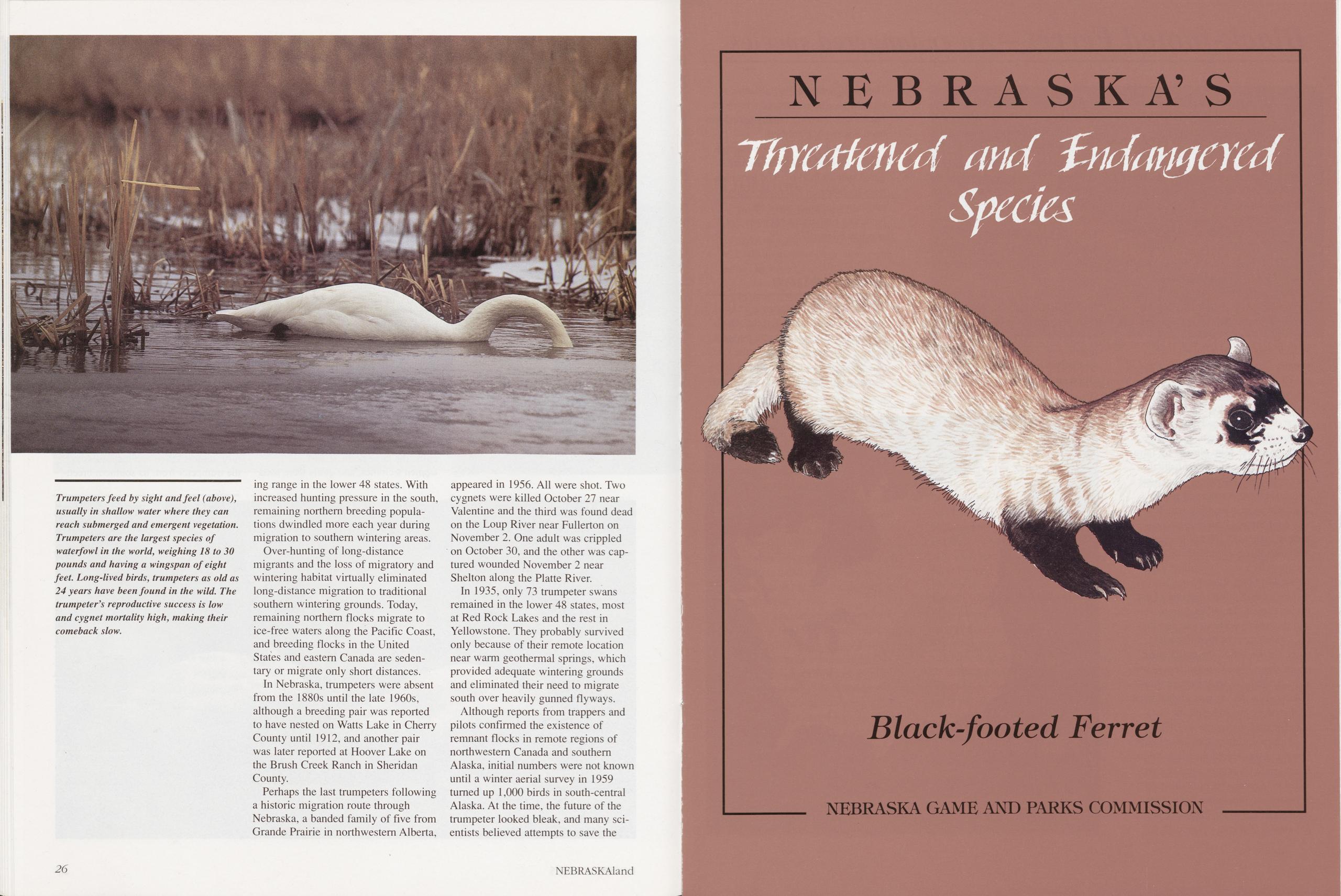
range in the lower 48 states. With increased hunting pressure in the south, remaining northern breeding populations dwindled more each year during migration to southern wintering areas. Over-hunting of long-distance migrants and the loss of migratory and wintering habitat virtually eliminated long-distance migration to traditional southern wintering grounds. Today, remaining northern flocks migrate to ice-free waters along the Pacific Coast, and breeding flocks in the United States and eastern Canada are sedentary or migrate only short distances. In Nebraska, trumpeters were absent from the 1880s until the late 1960s, although a breeding pair was reported to have nested on Watts Lake in Cherry County until 1912, and another pair was later reported at Hoover Lake on the Brush Creek Ranch in Sheridan County.
Perhaps the last trumpeters following a historic migration route through Nebraska, a banded family of five from Grande Prairie in northwestern Alberta, appeared in 1956. All were shot. Two cygnets were killed October 27 near Valentine and the third was found dead on the Loup River near Fullerton on November 2. One adult was crippled on October 30, and the other was cap- tured wounded November 2 near Shelton along the Platte River.
In 1935, only 73 trumpeter swans remained in the lower 48 states, most at Red Rock Lakes and the rest in Yellowstone. They probably survived only because of their remote location near warm geothermal springs, which provided adequate wintering grounds and eliminated their need to migrate south over heavily gunned flyways.
Although reports from trappers and pilots confirmed the existence of remnant flocks in remote regions of northwestern Canada and southern Alaska, initial numbers were not known until a winter aerial survey in 1959 turned up 1,000 birds in south-central Alaska. At the time, the future of the trumpeter looked bleak, and many scientists believed attempts to save the
Nebraska's Theatened and Endangered Species Black-footed Ferret NEBRASKA GAME AND PARKS COMMISSION 26 NEBRASKAland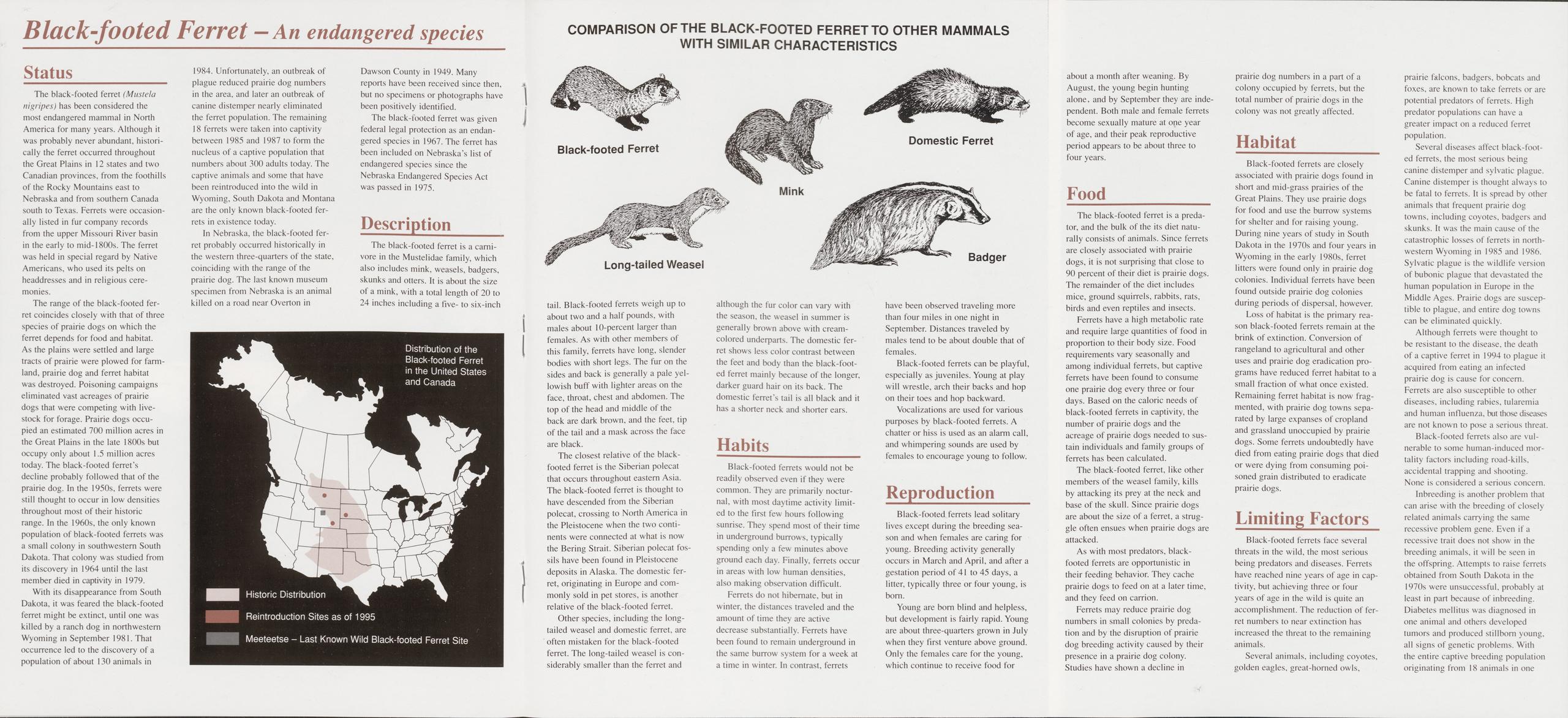 Black-footed Ferret — An endangered species
COMPARISON OF THE BLACK-FOOTED FERRET TO OTHER MAMMALS WITH SIMILAR CHARACTERISTICS
The black-footed ferret (Mustela nigripes) has been considered the most endangered mammal in North America for many years. Although it was probably never abundant, historically the ferret occurred throughout the Great Plains in 12 states and two Canadian provinces, from the foothills of the Rocky Mountains east to Nebraska and from southern Canada south to Texas. Ferrets were occasionally listed in fur company records from the upper Missouri River basin in the early to mid-1800s. The ferret was held in special regard by Native Americans, who used its pelts on headdresses and in religious ceremonies.
The range of the black-footed ferret coincides closely with that of three species of prairie dogs on which the ferret depends for food and habitat. As the plains were settled and large tracts of prairie were plowed for farmland, prairie dog and ferret habitat was destroyed. Poisoning campaigns eliminated vast acreages of prairie dogs that were competing with livestock for forage. Prairie dogs occupied an estimated 700 million acres in the Great Plains in the late 1800s but occupy only about 1.5 million acres today. The black-footed ferret’s decline probably followed that of the prairie dog. In the 1950s, ferrets were still thought to occur in low densities throughout most of their historic range. In the 1960s, the only known population of black-footed ferrets was a small colony in southwestern South Dakota. That colony was studied from its discovery in 1964 until the last member died in captivity in 1979.
With its disappearance from South Dakota, it was feared the black-footed ferret might be extinct, until one was killed by a ranch dog in northwestern Wyoming in September 1981. That occurrence led to the discovery of a population of about 130 animals in 1984. Unfortunately, an outbreak of plague reduced prairie dog numbers in the area, and later an outbreak of canine distemper nearly eliminated the ferret population. The remaining 18 ferrets were taken into captivity between 1985 and 1987 to form the nucleus of a captive population that numbers about 300 adults today. The captive animals and some that have been reintroduced into the wild in Wyoming, South Dakota and Montana are the only known black-footed ferrets in existence today.
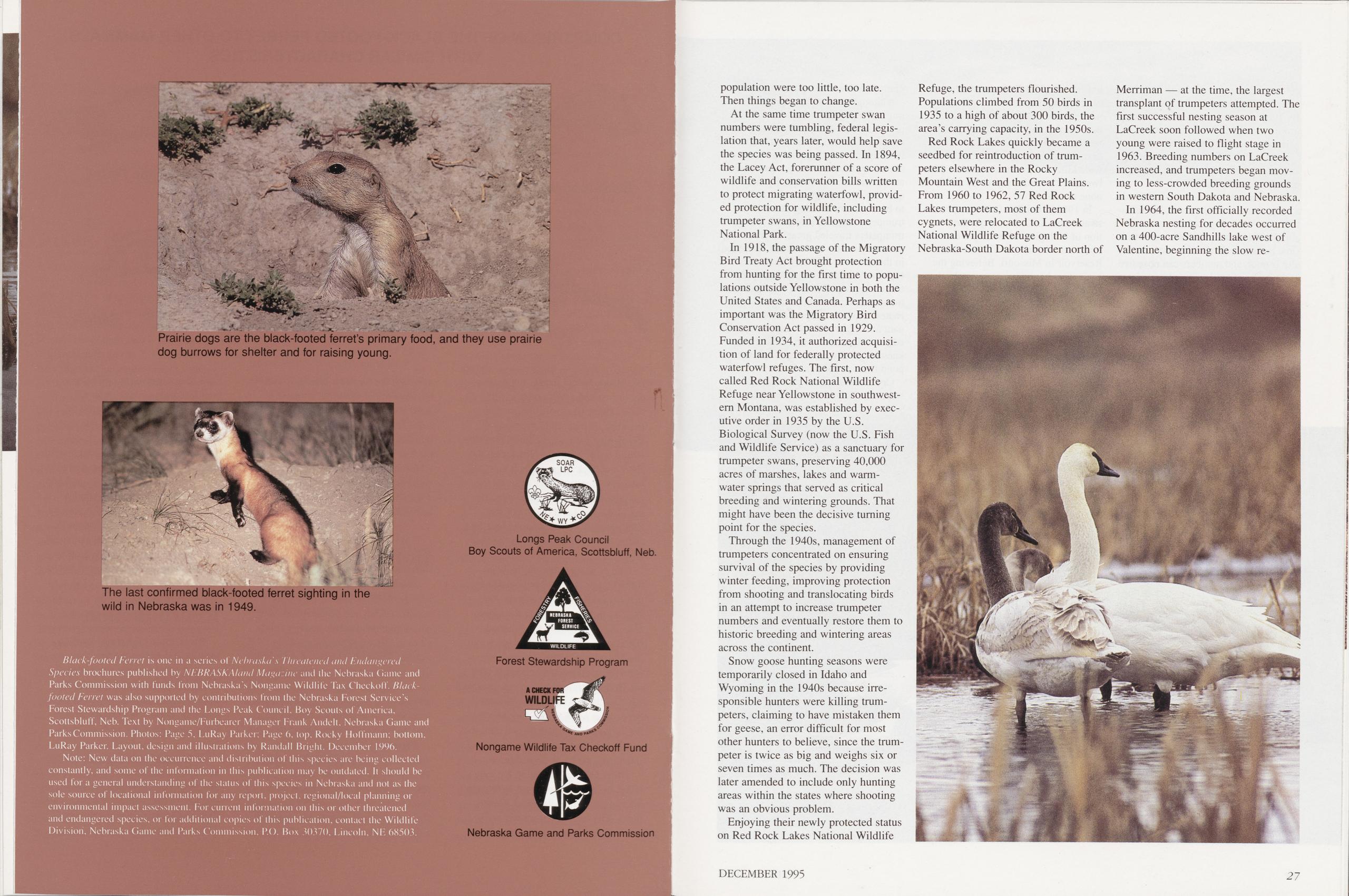
In Nebraska, the black-footed ferret probably occurred historically in the western three-quarters of the state, coinciding with the range of the prairie dog. The last known museum specimen from Nebraska is an animal killed on a road near Overton in Dawson County in 1949. Many reports have been received since then, but no specimens or photographs have been positively identified.
The black-footed ferret was given federal legal protection as an endangered species in 1967. The ferret has been included on Nebraska’s list of endangered species since the Nebraska Endangered Species Act was passed in 1975.
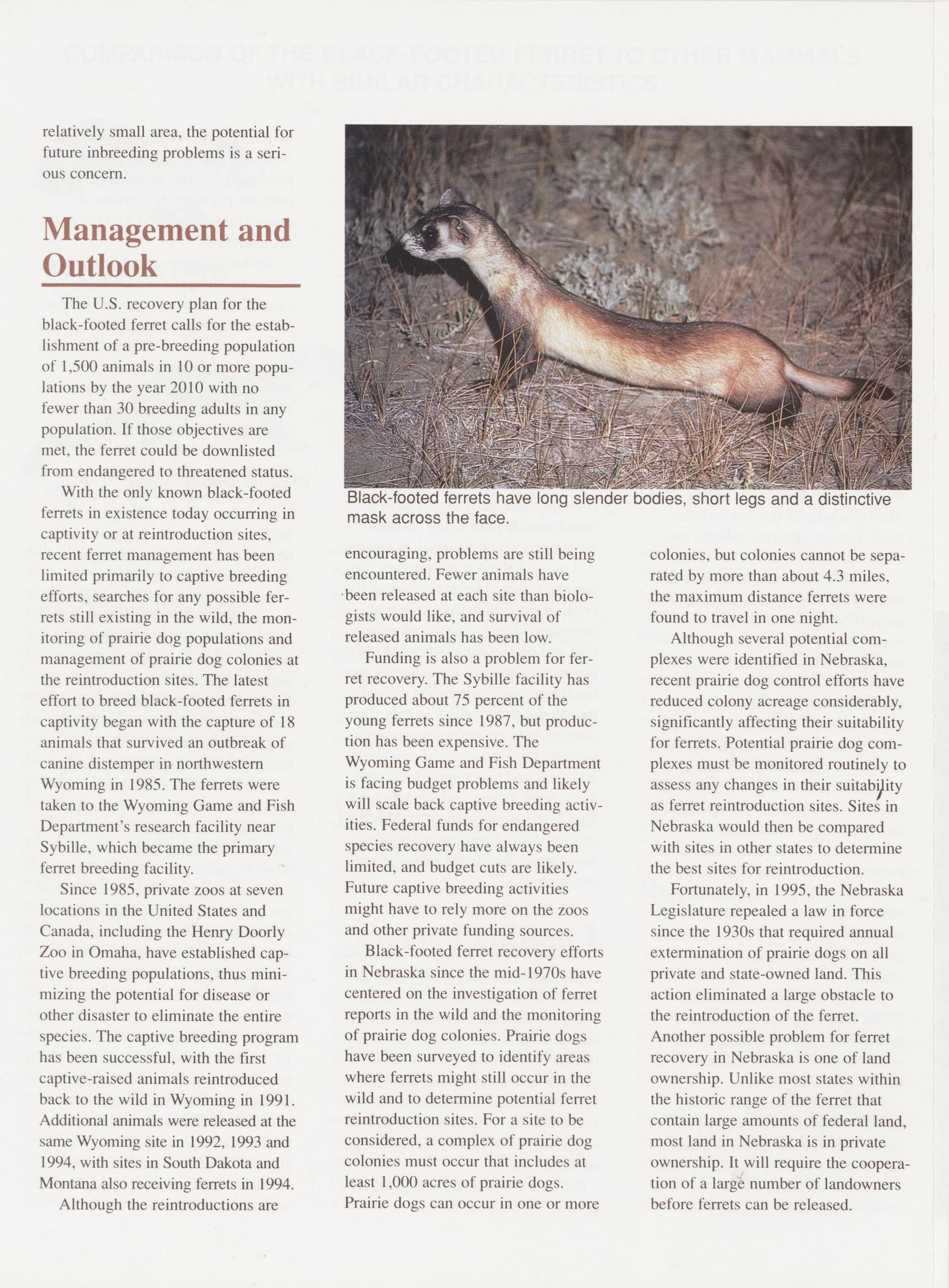
DescriptionThe black-footed ferret is a carnivore in the Mustelidae family, which also includes mink, weasels, badgers, skunks and otters. It is about the size of a mink, with a total length of 20 to 24 inches including a five- to six-inch tail. Black-footed ferrets weigh up to about two and a half pounds, with males about 10-percent larger than females. As with other members of this family, ferrets have long, slender bodies with short legs. The fur on the sides and back is generally a pale yellowish buff with lighter areas on the face, throat, chest and abdomen. The top of the head and middle of the back are dark brown, and the feet, tip of the tail and a mask across the face are black.
The closest relative of the black-footed ferret is the Siberian polecat that occurs throughout eastern Asia. The black-footed ferret is thought to have descended from the Siberian polecat, crossing to North America in the Pleistocene when the two continents were connected at what is now the Bering Strait. Siberian polecat fossils have been found in Pleistocene deposits in Alaska. The domestic ferret, originating in Europe and commonly sold in pet stores, is another relative of the black-footed ferret. Other species, including the long-tailed weasel and domestic ferret, are often mistaken for the black-footed ferret. The long-tailed weasel is considerably smaller than the ferret and although the fur color can vary with the season, the weasel in summer is generally brown above with cream-colored underparts. The domestic ferret shows less color contrast between the feet and body than the black-footed ferret mainly because of the longer, darker guard hair on its back. The domestic ferret’s tail is all black and it has a shorter neck and shorter ears.
HabitsBlack-footed ferrets would not be readily observed even if they were common. They are primarily nocturnal, with most daytime activity limit- ed to the first few hours following sunrise. They spend most of their time in underground burrows, typically spending only a few minutes above ground each day. Finally, ferrets occur in areas with low human densities, also making observation difficult. Ferrets do not hibernate, but in winter, the distances traveled and the amount of time they are active decrease substantially. Ferrets have been found to remain underground in the same burrow system for a week at a time in winter. In contrast, ferrets have been observed traveling more than four miles in one night in September. Distances traveled by males tend to be about double that of females.
Black-footed ferrets can be playful, especially as juveniles. Young at play will wrestle, arch their backs and hop on their toes and hop backward. Vocalizations are used for various purposes by black-footed ferrets. A chatter or hiss is used as an alarm call, and whimpering sounds are used by females to encourage young to follow.
ReproductionBlack-footed ferrets lead solitary lives except during the breeding season and when females are caring for young. Breeding activity generally occurs in March and April, and after a gestation period of 41 to 45 days, a litter, typically three or four young, is Young are bom blind and helpless, but development is fairly rapid. Young are about three-quarters grown in July when they first venture above ground. Only the females care for the young, which continue to receive food for about a month after weaning. By August, the young begin hunting alone, and by September they are independent. Both male and female ferrets become sexually mature at ope year of age, and their peak reproductive period appears to be about three to four years.
Food The black-footed ferret is a predator, and the bulk of the its diet naturally consists of animals. Since ferrets are closely associated with prairie dogs, it is not surprising that close to 90 percent of their diet is prairie dogs. The remainder of the diet includes mice, ground squirrels, rabbits, rats, birds and even reptiles and insects. Ferrets have a high metabolic rate and require large quantities of food in proportion to their body size. Food requirements vary seasonally and among individual ferrets, but captive ferrets have been found to consume one prairie dog every three or four days. Based on the caloric needs of black-footed ferrets in captivity, the number of prairie dogs and the acreage of prairie dogs needed to sustain individuals and family groups of ferrets has been calculated. The black-footed ferret, like other members of the weasel family, kills by attacking its prey at the neck and base of the skull. Since prairie dogs are about the size of a ferret, a struggle often ensues when prairie dogs are attacked. As with most predators, black- footed ferrets are opportunistic in their feeding behavior. They cache prairie dogs to feed on at a later time, and they feed on carrion. Ferrets may reduce prairie dog numbers in small colonies by predation and by the disruption of prairie dog breeding activity caused by their presence in a prairie dog colony. Studies have shown a decline in prairie dog numbers in a part of a colony occupied by ferrets, but the total number of prairie dogs in the colony was not greatly affected. Habitat Black-footed ferrets are closely associated with prairie dogs found in short and mid-grass prairies of the Great Plains. They use prairie dogs for food and use the burrow systems for shelter and for raising young. During nine years of study in South Dakota in the 1970s and four years in Wyoming in the early 1980s, ferret litters were found only in prairie dog colonies. Individual ferrets have been found outside prairie dog colonies during periods of dispersal, however. Loss of habitat is the primary rea- son black-footed ferrets remain at the brink of extinction. Conversion of rangeland to agricultural and other uses and prairie dog eradication programs have reduced ferret habitat to a small fraction of what once existed. Remaining ferret habitat is now fragmented, with prairie dog towns separated by large expanses of cropland and grassland unoccupied by prairie dogs. Some ferrets undoubtedly have died from eating prairie dogs that died or were dying from consuming poisoned grain distributed to eradicate prairie dogs. Limiting Factors Black-footed ferrets face several threats in the wild, the most serious being predators and diseases. Ferrets have reached nine years of age in captivity, but achieving three or four years of age in the wild is quite an accomplishment. The reduction of ferret numbers to near extinction has increased the threat to the remaining animals. Several animals, including coyotes, golden eagles, great-homed owls, prairie falcons, badgers, bobcats and foxes, are known to take ferrets or are potential predators of ferrets. High predator populations can have a greater impact on a reduced ferret population. Several diseases affect black-footed ferrets, the most serious being canine distemper and sylvatic plague. Canine distemper is thought always to be fatal to ferrets. It is spread by other animals that frequent prairie dog towns, including coyotes, badgers and skunks. It was the main cause of the catastrophic losses of ferrets in northwestern Wyoming in 1985 and 1986. Sylvatic plague is the wildlife version of bubonic plague that devastated the human population in Europe in the Middle Ages. Prairie dogs are susceptible to plague, and entire dog towns can be eliminated quickly. Although ferrets were thought to be resistant to the disease, the death of a captive ferret in 1994 to plague it acquired from eating an infected prairie dog is cause for concern. Ferrets are also susceptible to other diseases, including rabies, tularemia and human influenza, but those diseases are not known to pose a serious threat.Black-footed ferrets also are vulnerable to some human-induced mortality factors including road-kills, accidental trapping and shooting. None is considered a serious concern.
Inbreeding is another problem that can arise with the breeding of closely related animals carrying the same recessive problem gene. Even if a recessive trait does not show in the breeding animals, it will be seen in the offspring. Attempts to raise ferrets obtained from South Dakota in the 1970s were unsuccessful, probably at least in part because of inbreeding. Diabetes mellitus was diagnosed in one animal and others developed tumors and produced stillborn young, all signs of genetic problems. With the entire captive breeding population originating from 18 animals in one
relatively small area, the potential for future inbreeding problems is a serious concern.
Management and OutlookThe U.S. recovery plan for the black-footed ferret calls for the establishment of a pre-breeding population of 1,500 animals in 10 or more populations by the year 2010 with no fewer than 30 breeding adults in any population. If those objectives are met, the ferret could be downlisted from endangered to threatened status.
With the only known black-footed ferrets in existence today occurring in captivity or at reintroduction sites, recent ferret management has been limited primarily to captive breeding efforts, searches for any possible ferrets still existing in the wild, the monitoring of prairie dog populations and management of prairie dog colonies at the reintroduction sites. The latest effort to breed black-footed ferrets in captivity began with the capture of 18 animals that survived an outbreak of canine distemper in northwestern Wyoming in 1985. The ferrets were taken to the Wyoming Game and Fish Department’s research facility near Sybille, which became the primary ferret breeding facility.
Since 1985, private zoos at seven locations in the United States and Canada, including the Henry Doorly Zoo in Omaha, have established captive breeding populations, thus minimizing the potential for disease or other disaster to eliminate the entire species. The captive breeding program has been successful, with the first captive-raised animals reintroduced back to the wild in Wyoming in 1991. Additional animals were released at the same Wyoming site in 1992, 1993 and 1994, with sites in South Dakota and Montana also receiving ferrets in 1994.
Although the reintroductions are
Black-footed ferrets have long slender bodies, short legs and a distinctive mask across the face.encouraging, problems are still being encountered. Fewer animals have been released at each site than biologists would like, and survival of released animals has been low.
Funding is also a problem for ferret recovery. The Sybille facility has produced about 75 percent of the young ferrets since 1987, but production has been expensive. The Wyoming Game and Fish Department is facing budget problems and likely will scale back captive breeding activities. Federal funds for endangered species recovery have always been limited, and budget cuts are likely. Future captive breeding activities might have to rely more on the zoos and other private funding sources.
Black-footed ferret recovery efforts in Nebraska since the mid-1970s have centered on the investigation of ferret reports in the wild and the monitoring of prairie dog colonies. Prairie dogs have been surveyed to identify areas where ferrets might still occur in the wild and to determine potential ferret reintroduction sites. For a site to be considered, a complex of prairie dog colonies must occur that includes at least 1,000 acres of prairie dogs. Prairie dogs can occur in one or more colonies, but colonies cannot be separated by more than about 4.3 miles, the maximum distance ferrets were found to travel in one night.
Although several potential complexes were identified in Nebraska, recent prairie dog control efforts have reduced colony acreage considerably, significantly affecting their suitability for ferrets. Potential prairie dog complexes must be monitored routinely to assess any changes in their suitability as ferret reintroduction sites. Sites in Nebraska would then be compared with sites in other states to determine the best sites for reintroduction.
Fortunately, in 1995, the Nebraska Legislature repealed a law in force since the 1930s that required annual extermination of prairie dogs on all private and state-owned land. This action eliminated a large obstacle to the reintroduction of the ferret. Another possible problem for ferret recovery in Nebraska is one of land ownership. Unlike most states within the historic range of the ferret that contain large amounts of federal land, most land in Nebraska is in private ownership. It will require the cooperation of a large number of landowners before ferrets can be released.
population were too little, too late. Then things began to change.
At the same time trumpeter swan numbers were tumbling, federal legislation that, years later, would help save the species was being passed. In 1894, the Lacey Act, forerunner of a score of wildlife and conservation bills written to protect migrating waterfowl, provided protection for wildlife, including trumpeter swans, in Yellowstone National Park.
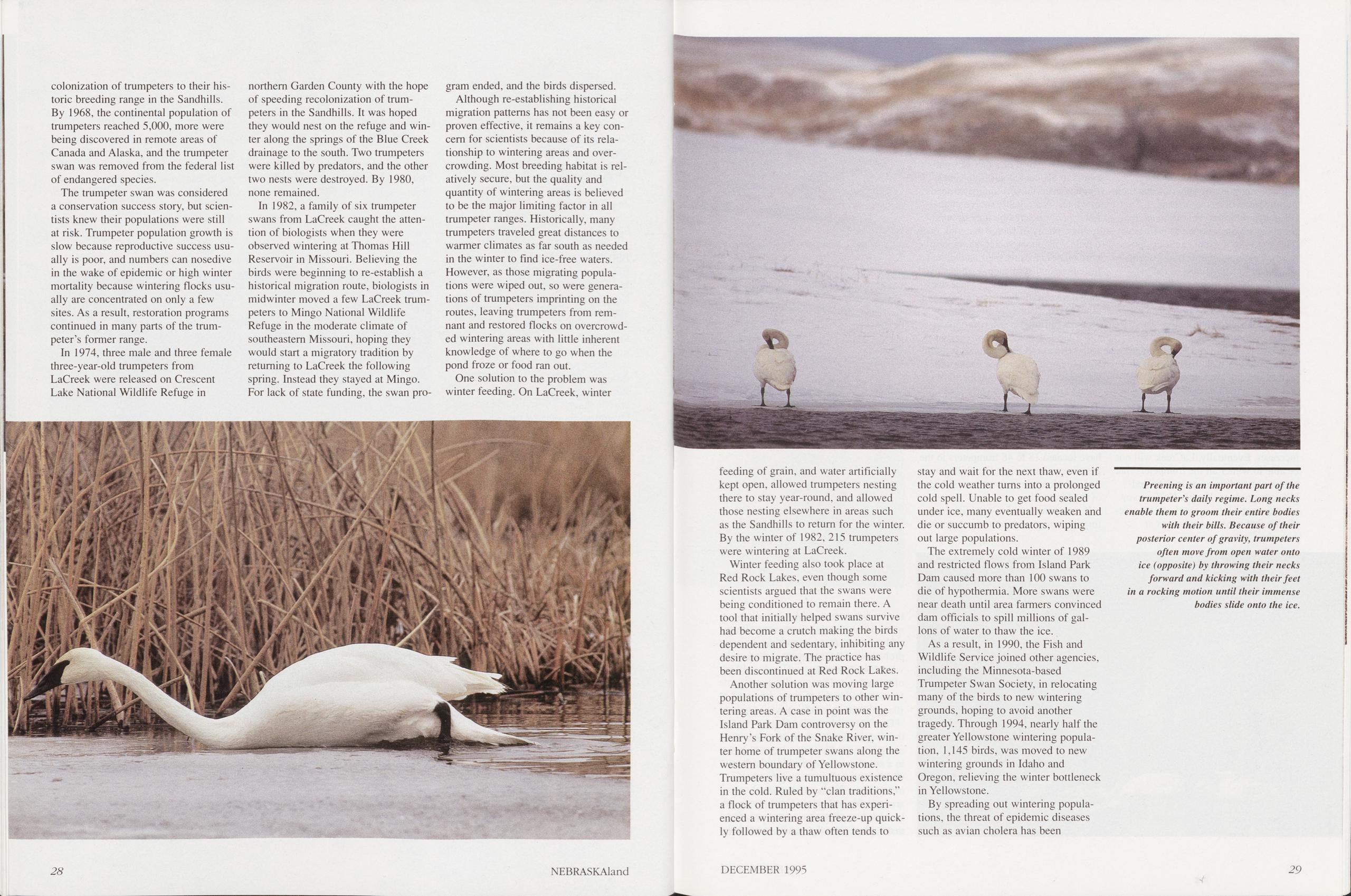
In 1918, the passage of the Migratory Bird Treaty Act brought protection from hunting for the first time to populations outside Yellowstone in both the United States and Canada. Perhaps as important was the Migratory Bird Conservation Act passed in 1929. Funded in 1934, it authorized acquisition of land for federally protected waterfowl refuges. The first, now called Red Rock National Wildlife Refuge near Yellowstone in southwestern Montana, was established by executive order in 1935 by the U.S. Biological Survey (now the U.S. Fish and Wildlife Service) as a sanctuary for trumpeter swans, preserving 40,000 acres of marshes, lakes and warm- water springs that served as critical breeding and wintering grounds. That might have been the decisive turning point for the species.
Through the 1940s, management of trumpeters concentrated on ensuring survival of the species by providing winter feeding, improving protection from shooting and translocating birds in an attempt to increase trumpeter numbers and eventually restore them to historic breeding and wintering areas across the continent.
Snow goose hunting seasons were temporarily closed in Idaho and Wyoming in the 1940s because irresponsible hunters were killing trumpeters, claiming to have mistaken them for geese, an error difficult for most other hunters to believe, since the trumpeter is twice as big and weighs six or seven times as much. The decision was later amended to include only hunting areas within the states where shooting was an obvious problem.
Enjoying their newly protected status on Red Rock Lakes National Wildlife Refuge, the trumpeters flourished. Populations climbed from 50 birds in 1935 to a high of about 300 birds, the area’s carrying capacity, in the 1950s.
Red Rock Lakes quickly became a seedbed for reintroduction of trum- peters elsewhere in the Rocky Mountain West and the Great Plains. From 1960 to 1962, 57 Red Rock Lakes trumpeters, most of them cygnets, were relocated to LaCreek National Wildlife Refuge on the Nebraska-South Dakota border north of Merriman — at the time, the largest transplant of trumpeters attempted. The first successful nesting season at LaCreek soon followed when two young were raised to flight stage in 1963. Breeding numbers on LaCreek increased, and trumpeters began mov- ing to less-crowded breeding grounds in western South Dakota and Nebraska.
In 1964, the first officially recorded Nebraska nesting for decades occurred on a 400-acre Sandhills lake west of Valentine, beginning the slow recolonization
of trumpeters to their historic breeding range in the Sandhills. By 1968, the continental population of trumpeters reached 5,000, more were being discovered in remote areas of Canada and Alaska, and the trumpeter swan was removed from the federal list of endangered species.
The trumpeter swan was considered a conservation success story, but scientists knew their populations were still at risk. Trumpeter population growth is slow because reproductive success usually is poor, and numbers can nosedive in the wake of epidemic or high winter mortality because wintering flocks usually are concentrated on only a few sites. As a result, restoration programs continued in many parts of the trumpeter’s former range.
In 1974, three male and three female three-year-old trumpeters from LaCreek were released on Crescent Lake National Wildlife Refuge in northern Garden County with the hope of speeding recolonization of trumpeters in the Sandhills. It was hoped they would nest on the refuge and winter along the springs of the Blue Creek drainage to the south. Two trumpeters were killed by predators, and the other two nests were destroyed. By 1980, none remained.
In 1982, a family of six trumpeter swans from LaCreek caught the attention of biologists when they were observed wintering at Thomas Hill Reservoir in Missouri. Believing the birds were beginning to re-establish a historical migration route, biologists in midwinter moved a few LaCreek trumpeters to Mingo National Wildlife Refuge in the moderate climate of southeastern Missouri, hoping they would start a migratory tradition by returning to LaCreek the following spring. Instead they stayed at Mingo. For lack of state funding, the swan program ended, and the birds dispersed.
Although re-establishing historical migration patterns has not been easy or proven effective, it remains a key concern for scientists because of its rela- tionship to wintering areas and over-crowding. Most breeding habitat is relatively secure, but the quality and quantity of wintering areas is believed to be the major limiting factor in all trumpeter ranges. Historically, many trumpeters traveled great distances to warmer climates as far south as needed in the winter to find ice-free waters. However, as those migrating populations were wiped out, so were generations of trumpeters imprinting on the routes, leaving trumpeters from remnant and restored flocks on overcrowded wintering areas with little inherent knowledge of where to go when the pond froze or food ran out.
One solution to the problem was winter feeding. On LaCreek, winter feeding of grain, and water artificially kept open, allowed trumpeters nesting there to stay year-round, and allowed those nesting elsewhere in areas such as the Sandhills to return for the winter. By the winter of 1982, 215 trumpeters were wintering at LaCreek.
Winter feeding also took place at Red Rock Lakes, even though some scientists argued that the swans were being conditioned to remain there. A tool that initially helped swans survive had become a crutch making the birds dependent and sedentary, inhibiting any desire to migrate. The practice has been discontinued at Red Rock Lakes.
Another solution was moving large populations of trumpeters to other wintering areas. A case in point was the Island Park Dam controversy on the Henry’s Fork of the Snake River, winter home of trumpeter swans along the western boundary of Yellowstone.
Trumpeters live a tumultuous existence in the cold. Ruled by “clan traditions,” a flock of trumpeters that has experienced a wintering area freeze-up quickly followed by a thaw often tends to stay and wait for the next thaw, even if the cold weather turns into a prolonged cold spell. Unable to get food sealed under ice, many eventually weaken and die or succumb to predators, wiping out large populations.
The extremely cold winter of 1989 and restricted flows from Island Park Dam caused more than 100 swans to die of hypothermia. More swans were near death until area farmers convinced dam officials to spill millions of gallons of water to thaw the ice.
As a result, in 1990, the Fish and Wildlife Service joined other agencies, including the Minnesota-based Trumpeter Swan Society, in relocating many of the birds to new wintering grounds, hoping to avoid another tragedy. Through 1994, nearly half the greater Yellowstone wintering population, 1,145 birds, was moved to new wintering grounds in Idaho and Oregon, relieving the winter bottleneck in Yellowstone.
By spreading out wintering populations, the threat of epidemic diseases such as avian cholera has been
reduced, and the “ripple effect” of extremely long, cold winters on the following year’s shortened breeding season has been decreased. Trumpeters lay their eggs, which must be incubated for more than a month, about May 1.
Cygnets cannot fly for 13 to 15 weeks, so late winter weather means the cygnets might not be able to leave their nesting grounds before ice-up.
Enough relocated Yellowstone-area trumpeters have returned to their new winter sites to warrant cautious optimism. Cautious optimism also seems warranted for trumpeters in the Sandhills. Since the relocation of trumpeters to LaCreek in the early 1960s, they have slowly but surely been making a comeback in the region.
Recent annual aerial breeding surveys compiled by Rolf Kraft, refuge manager at LaCreek, have shown a shift of nesting away from the refuge and increasing numbers of breeding birds in the Sandhills. Yet, Kraft says, as in the rest of the trumpeter’s territory, wintering habitat is believed to be the factor limiting further population increases. Eventually, LaCreek will not be able to winter all the trumpeters that potential breeding areas in the Sandhills can produce. Kraft’s 1995 survey numbers appear to support earlier speculation that winter populations at LaCreek are declining and summer populations in the region are growing, perhaps indicating that migration to new wintering grounds is occurring.
It might have begun in November 1986 when a Garden County rancher noticed the arrival of a pair of trumpeters to his land along Blue Creek. Finding everything a trumpeter needs in winter — a reliable source of shallow, open water fed by underground springs, plenty of forage material, open terrain with unobstructed views, few wire fences crossing their habitat and little human disturbance — they stayed until the following spring. Since then they have returned every winter and the rancher has reported seeing as many as 30 birds during the past two winters. For the last several years, personnel at the Crescent Lake National Wildlife Refuge north of the Blue Creek site have seen trumpeters moving through in late fall and again in early spring, occasionally appearing on the ice during warmer periods in winters.
Midwinter surveys conducted by the Nebraska Game and Parks Commission have located 18 to 48 trumpeters in the past five years in eight Sandhills counties and along the warm-water sloughs of the Platte River.
If trumpeters ever re-establish long forgotten migratory routes and reassert themselves as permanent fixtures in more parts of their historic range, they will no doubt face some of the same problems in the flyways that most waterfowl face today — continued loss of wintering habitat, lead poisoning from lead shot and fishing sinkers, illegal shooting and human ignorance.
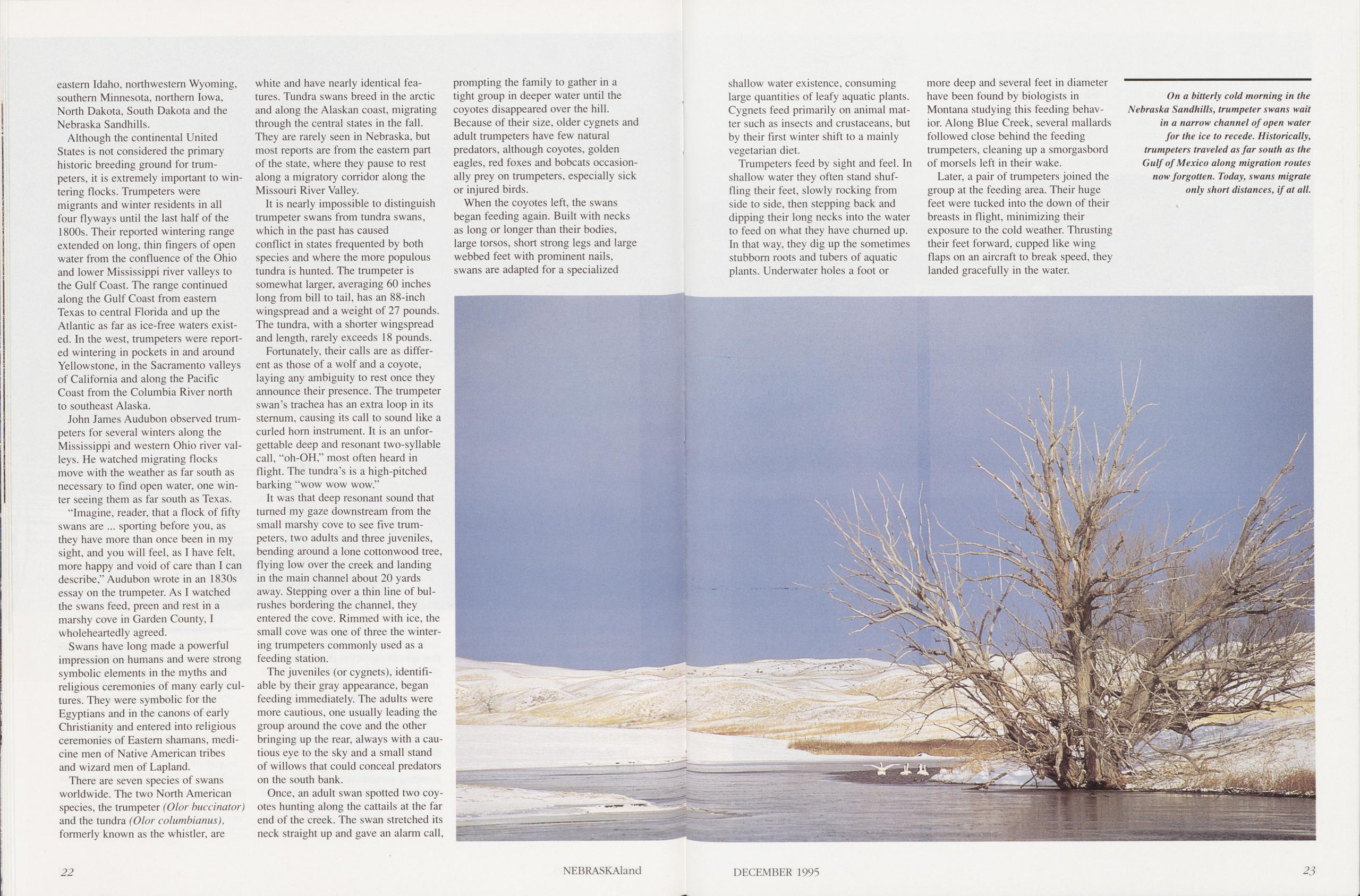
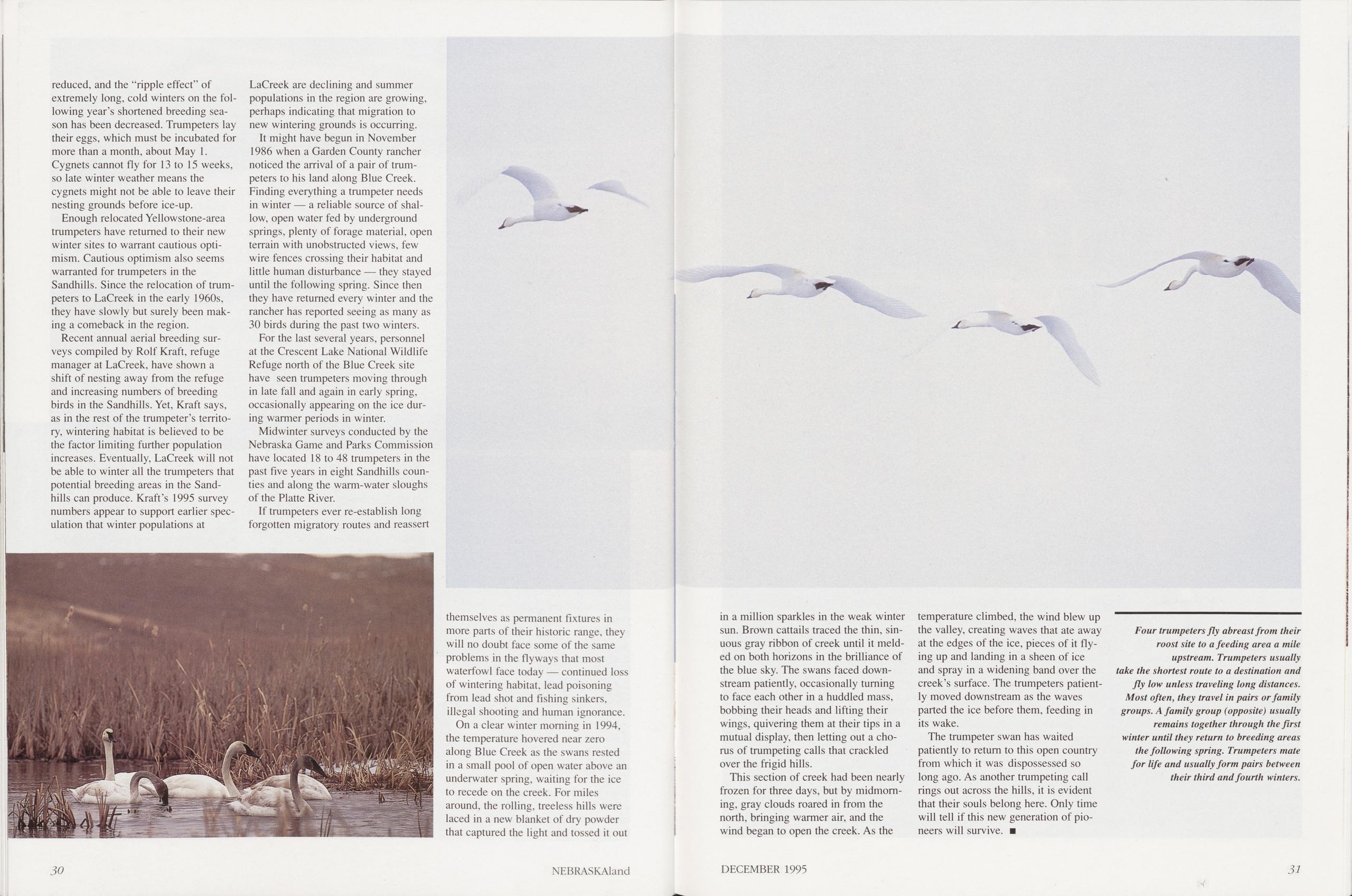
On a clear winter morning in 1994, the temperature hovered near zero along Blue Creek as the swans rested in a small pool of open water above an underwater spring, waiting for the ice to recede on the creek. For miles around, the rolling, treeless hills were laced in a new blanket of dry powder that captured the light and tossed it out in a million sparkles in the weak winter sun. Brown cattails traced the thin, sinuous gray ribbon of creek until it melded on both horizons in the brilliance of the blue sky. The swans faced down-stream patiently, occasionally turning to face each other in a huddled mass, bobbing their heads and lifting their wings, quivering them at their tips in a mutual display, then letting out a chorus of trumpeting calls that crackled over the frigid hills.
This section of creek had been nearly frozen for three days, but by midmoming, gray clouds roared in from the north, bringing warmer air, and the wind began to open the creek. As the temperature climbed, the wind blew up the valley, creating waves that ate away at the edges of the ice, pieces of it fly- ing up and landing in a sheen of ice and spray in a widening band over the creek’s surface. The trumpeters patient- ly moved downstream as the waves parted the ice before them, feeding in its wake.
The trumpeter swan has waited patiently to return to this open country from which it was dispossessed so long ago. As another trumpeting call rings out across the hills, it is evident that their souls belong here. Only time will tell if this new generation of pio- neers will survive. ■
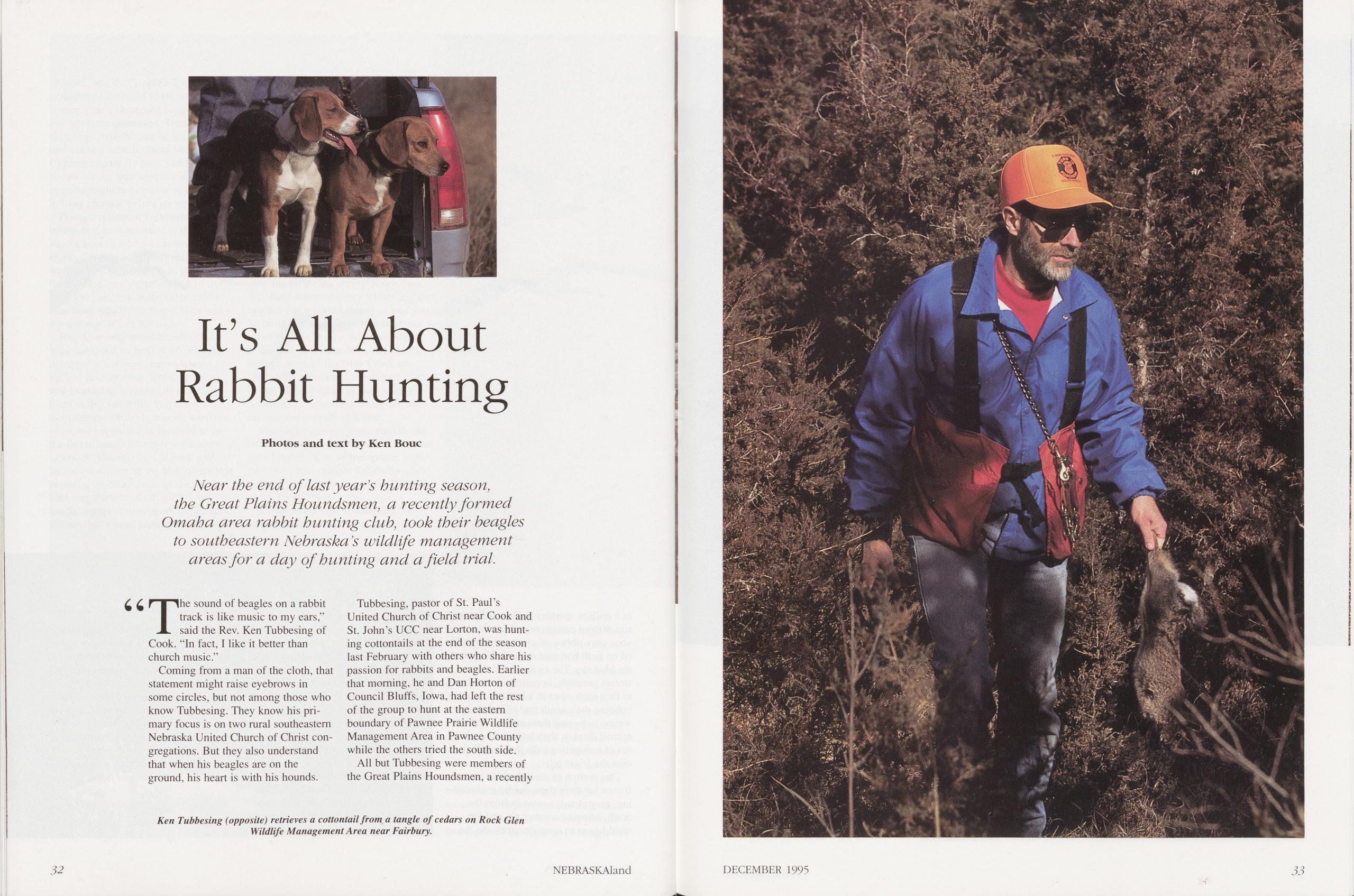
It’s All About Rabbit Hunting
Photos and text by Ken Bouc Near the end of last year’s hunting season, the Great Plains Houndsmen, a recently formed Omaha area rabhit hunting club, took their beagles to southeastern Nebraska s wildlife management areas for a day of hunting and afield trial.The sound of beagles on a rabbit track is like music to my ears,” said the Rev. Ken Tubbesing of Cook. “In fact, I like it better than church music.”
Coming from a man of the cloth, that statement might raise eyebrows in some circles, but not among those who know Tubbesing. They know his primary focus is on two rural southeastern Nebraska United Church of Christ congregations. But they also understand that when his beagles are on the ground, his heart is with his hounds.
Tubbesing, pastor of St. Paul’s United Church of Christ near Cook and St. John’s UCC near Lorton, was hunting cottontails at the end of the season last February with others who share his passion for rabbits and beagles. Earlier that morning, he and Dan Horton of Council Bluffs, Iowa, had left the rest of the group to hunt at the eastern boundary of Pawnee Prairie Wildlife Management Area in Pawnee County while the others tried the south side.
All but Tubbesing were members of the Great Plains Houndsmen, a recently
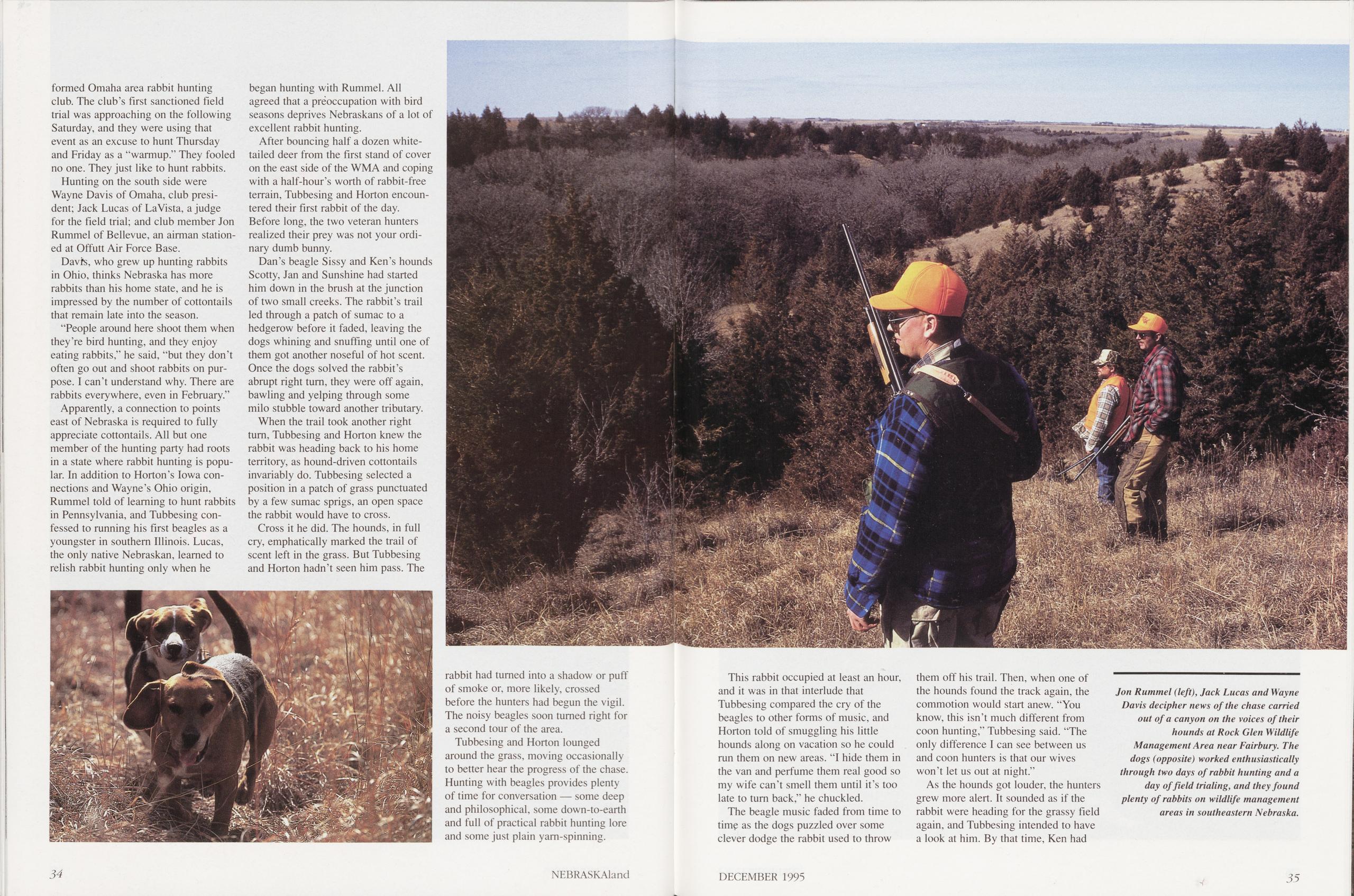
formed Omaha area rabbit hunting club. The club’s first sanctioned field trial was approaching on the following Saturday, and they were using that event as an excuse to hunt Thursday and Friday as a “warmup.” They fooled no one. They just like to hunt rabbits.
Hunting on the south side were Wayne Davis of Omaha, club president; Jack Lucas of La Vista, a judge for the field trial; and club member Jon Rummel of Bellevue, an airman stationed at Offutt Air Force Base.
Davis, who grew up hunting rabbits in Ohio, thinks Nebraska has more rabbits than his home state, and he is impressed by the number of cottontails that remain late into the season.
“People around here shoot them when they’re bird hunting, and they enjoy eating rabbits,” he said, “but they don’t often go out and shoot rabbits on purpose. I can’t understand why. There are rabbits everywhere, even in February.”
Apparently, a connection to points east of Nebraska is required to fully appreciate cottontails. All but one member of the hunting party had roots in a state where rabbit hunting is popular. In addition to Horton’s Iowa connections and Wayne’s Ohio origin, Rummel told of learning to hunt rabbits in Pennsylvania, and Tubbesing confessed to running his first beagles as a youngster in southern Illinois. Lucas, the only native Nebraskan, learned to relish rabbit hunting only when he began hunting with Rummel. All agreed that a preoccupation with bird seasons deprives Nebraskans of a lot of excellent rabbit hunting.
After bouncing half a dozen white- tailed deer from the first stand of cover on the east side of the WMA and coping with a half-hour’s worth of rabbit-free terrain, Tubbesing and Horton encountered their first rabbit of the day. Before long, the two veteran hunters realized their prey was not your ordinary dumb bunny.
Dan’s beagle Sissy and Ken’s hounds Scotty, Jan and Sunshine had started him down in the brush at the junction of two small creeks. The rabbit’s trail led through a patch of sumac to a hedgerow before it faded, leaving the dogs whining and snuffing until one of them got another noseful of hot scent. Once the dogs solved the rabbit’s abrupt right turn, they were off again, bawling and yelping through some milo stubble toward another tributary.
When the trail took another right turn, Tubbesing and Horton knew the rabbit was heading back to his home territory, as hound-driven cottontails invariably do. Tubbesing selected a position in a patch of grass punctuated by a few sumac sprigs, an open space the rabbit would have to cross.
Cross it he did. The hounds, in full cry, emphatically marked the trail of scent left in the grass. But Tubbesing and Horton hadn’t seen him pass. The rabbit had turned into a shadow or puff of smoke or, more likely, crossed before the hunters had begun the vigil. The noisy beagles soon turned right for a second tour of the area.
Tubbesing and Horton lounged around the grass, moving occasionally to better hear the progress of the chase. Hunting with beagles provides plenty of time for conversation — some deep and philosophical, some down-to-earth and full of practical rabbit hunting lore and some just plain yam-spinning.
This rabbit occupied at least an hour, and it was in that interlude that Tubbesing compared the cry of the beagles to other forms of music, and Horton told of smuggling his little hounds along on vacation so he could run them on new areas. “I hide them in the van and perfume them real good so my wife can’t smell them until it’s too late to turn back,” he chuckled.
The beagle music faded from time to time as the dogs puzzled over some clever dodge the rabbit used to throw them off his trail. Then, when one of the hounds found the track again, the commotion would start anew. “You know, this isn’t much different from coon hunting,” Tubbesing said. “The only difference I can see between us and coon hunters is that our wives won’t let us out at night.”
As the hounds got louder, the hunters grew more alert. It sounded as if the rabbit were heading for the grassy field again, and Tubbesing intended to have a look at him. By that time, Ken had
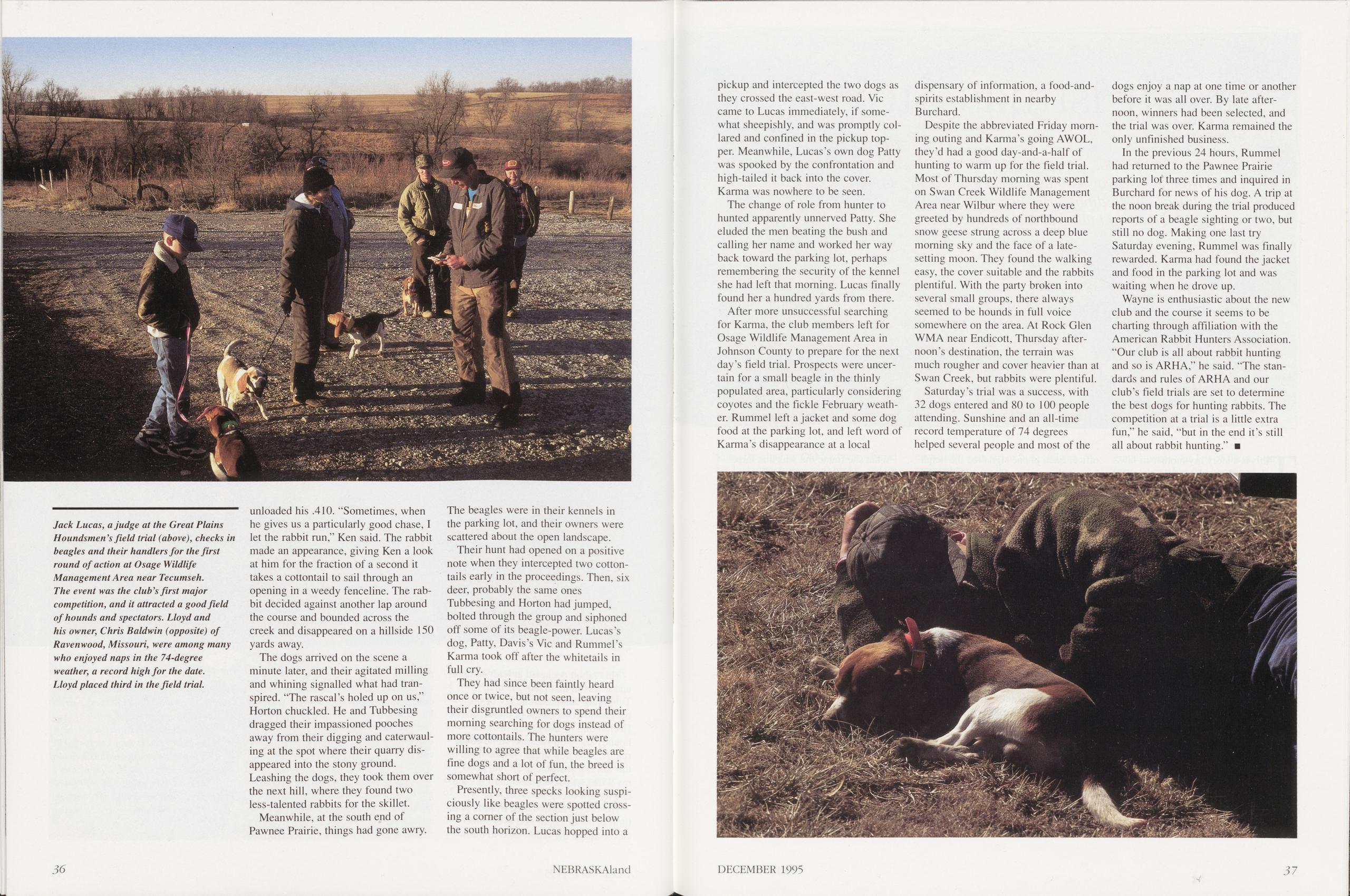
unloaded his .410. “Sometimes, when he gives us a particularly good chase, I let the rabbit run,” Ken said. The rabbit made an appearance, giving Ken a look at him for the fraction of a second it takes a cottontail to sail through an opening in a weedy fenceline. The rabbit decided against another lap around the course and bounded across the creek and disappeared on a hillside 150 yards away.
The dogs arrived on the scene a minute later, and their agitated milling and whining signalled what had transpired. “The rascal’s holed up on us,” Horton chuckled. He and Tubbesing dragged their impassioned pooches away from their digging and caterwauling at the spot where their quarry disappeared into the stony ground. Leashing the dogs, they took them over the next hill, where they found two less-talented rabbits for the skillet.
Meanwhile, at the south end of Pawnee Prairie, things had gone awry. The beagles were in their kennels in the parking lot, and their owners were scattered about the open landscape. Their hunt had opened on a positive note when they intercepted two cottontails early in the proceedings. Then, six deer, probably the same ones Tubbesing and Horton had jumped, bolted through the group and siphoned off some of its beagle-power. Lucas’s dog, Patty, Davis’s Vic and Rummel’s Karma took off after the whitetails in full cry.
They had since been faintly heard once or twice, but not seen, leaving their disgruntled owners to spend their morning searching for dogs instead of more cottontails. The hunters were willing to agree that while beagles are fine dogs and a lot of fun, the breed is somewhat short of perfect.
Presently, three specks looking suspiciously like beagles were spotted crossing a comer of the section just below the south horizon. Lucas hopped into a pickup and intercepted the two dogs as they crossed the east-west road. Vic came to Lucas immediately, if somewhat sheepishly, and was promptly collared and confined in the pickup topper. Meanwhile, Lucas’s own dog Patty was spooked by the confrontation and high-tailed it back into the cover. Karma was nowhere to be seen.
The change of role from hunter to hunted apparently unnerved Patty. She eluded the men beating the bush and calling her name and worked her way back toward the parking lot, perhaps remembering the security of the kennel she had left that morning. Lucas finally found her a hundred yards from there.
After more unsuccessful searching for Karma, the club members left for Osage Wildlife Management Area in Johnson County to prepare for the next day’s field trial. Prospects were uncertain for a small beagle in the thinly populated area, particularly considering coyotes and the fickle February weather. Rummel left a jacket and some dog food at the parking lot, and left word of Karma’s disappearance at a local dispensary of information, a food-and- spirits establishment in nearby Burchard.
Despite the abbreviated Friday morning outing and Karma’s going AWOL, they’d had a good day-and-a-half of hunting to warm up for the field trial. Most of Thursday morning was spent on Swan Creek Wildlife Management Area near Wilbur where they were greeted by hundreds of northbound snow geese strung across a deep blue morning sky and the face of a late- setting moon. They found the walking easy, the cover suitable and the rabbits plentiful. With the party broken into several small groups, there always seemed to be hounds in full voice somewhere on the area. At Rock Glen WMA near Endicott, Thursday afternoon’s destination, the terrain was much rougher and cover heavier than at Swan Creek, but rabbits were plentiful.
Saturday’s trial was a success, with 32 dogs entered and 80 to 100 people attending. Sunshine and an all-time record temperature of 74 degrees helped several people and most of the dogs enjoy a nap at one time or another before it was all over. By late afternoon, winners had been selected, and the trial was over. Karma remained the only unfinished business.
In the previous 24 hours, Rummel had returned to the Pawnee Prairie parking lot three times and inquired in Burchard for news of his dog. A trip at the noon break during the trial produced reports of a beagle sighting or two, but still no dog. Making one last try Saturday evening, Rummel was finally rewarded. Karma had found the jacket and food in the parking lot and was waiting when he drove up.
Wayne is enthusiastic about the new club and the course it seems to be charting through affiliation with the American Rabbit Hunters Association. “Our club is all about rabbit hunting and so is ARHA,” he said. “The standards and rules of ARHA and our club’s field trials are set to determine the best dogs for hunting rabbits. The competition at a trial is a little extra fun,” he said, “but in the end it’s still all about rabbit hunting.” ■
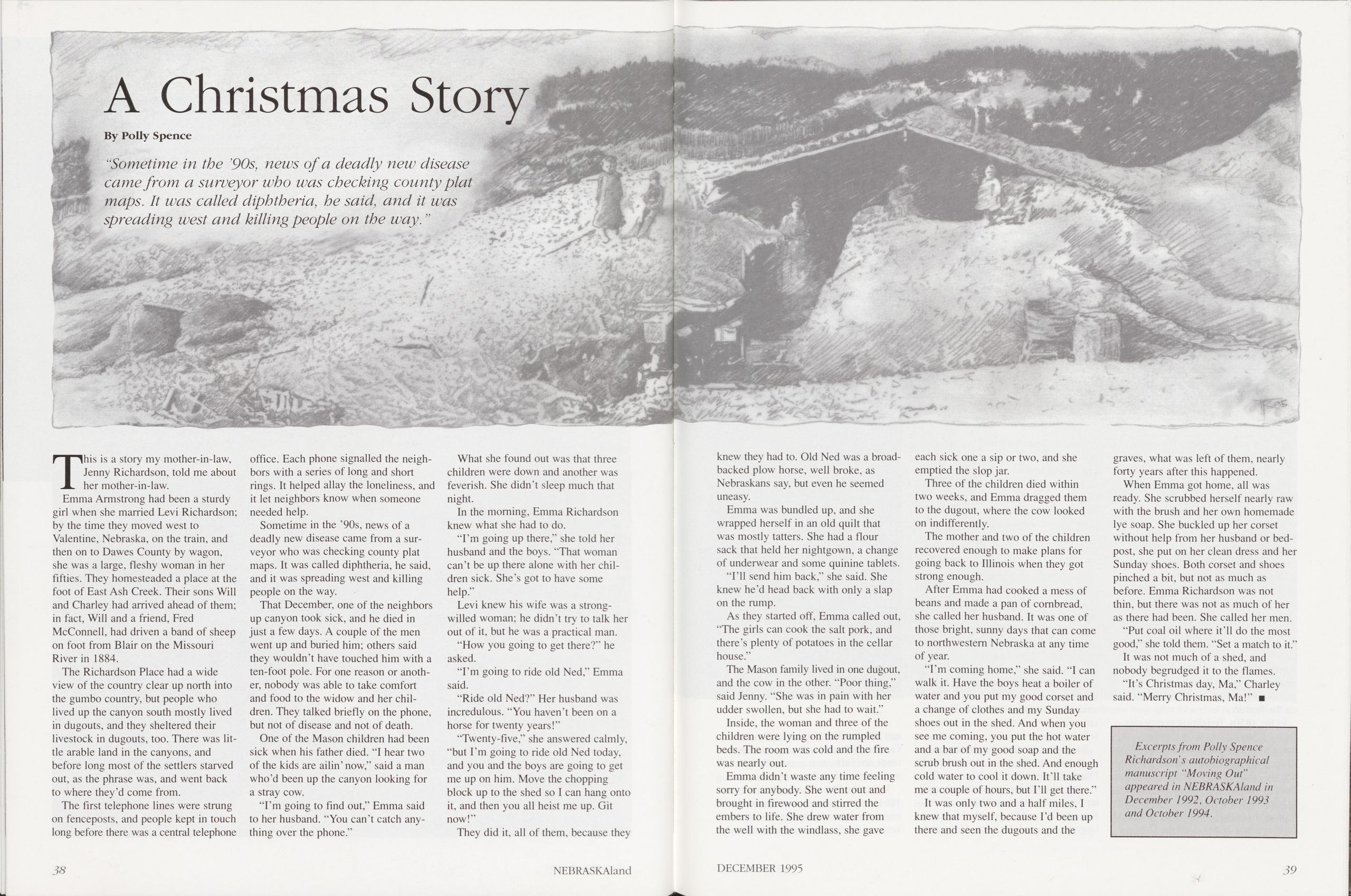
A Christmas Story
By Polly Spence “Sometime in the ’90s, news of a deadly new disease came from a surveyor who was checking county plat maps. It was called diphtheria, he said, and it was spreading west and killing people on the way.This is a story my mother-in-law, Jenny Richardson, told me about her mother-in-law.
Emma Armstrong had been a sturdy girl when she married Levi Richardson; by the time they moved west to Valentine, Nebraska, on the train, and then on to Dawes County by wagon, she was a large, fleshy woman in her fifties. They homesteaded a place at the foot of East Ash Creek. Their sons Will and Charley had arrived ahead of them; in fact, Will and a friend, Fred McConnell, had driven a band of sheep on foot from Blair on the Missouri River in 1884.
The Richardson Place had a wide view of the country clear up north into the gumbo country, but people who lived up the canyon south mostly lived in dugouts, and they sheltered their livestock in dugouts, too. There was little arable land in the canyons, and before long most of the settlers starved out, as the phrase was, and went back to where they’d come from.
The first telephone lines were strung on fenceposts, and people kept in touch long before there was a central telephone office. Each phone signalled the neighbors with a series of long and short rings. It helped allay the loneliness, and it let neighbors know when someone needed help.
Sometime in the ’90s, news of a deadly new disease came from a surveyor who was checking county plat maps. It was called diphtheria, he said, and it was spreading west and killing people on the way.
That December, one of the neighbors up canyon took sick, and he died in just a few days. A couple of the men went up and buried him; others said they wouldn’t have touched him with a ten-foot pole. For one reason or another, nobody was able to take comfort and food to the widow and her children. They talked briefly on the phone, but not of disease and not of death. One of the Mason children had been sick when his father died. “I hear two of the kids are ailin’ now,” said a man who’d been up the canyon looking for a stray cow.
“I’m going to find out,” Emma said to her husband. “You can’t catch anything over the phone.”
What she found out was that three children were down and another was feverish. She didn't sleep much that night.
In the morning, Emma Richardson knew what she had to do.
“I’m going up there,” she told her husband and the boys. “That woman can’t be up there alone with her children sick. She’s got to have some help.”
Levi knew his wife was a strong-willed woman; he didn’t try to talk her out of it, but he was a practical man. “How you going to get there?” he asked.
“I’m going to ride old Ned,” Emma said.
“Ride old Ned?” Her husband was incredulous. “You haven’t been on a horse for twenty years!”
“Twenty-five,” she answered calmly, “but I’m going to ride old Ned today, and you and the boys are going to get me up on him. Move the chopping block up to the shed so I can hang onto it, and then you all heist me up. Git now!”
They did it, all of them, because they knew they had to. Old Ned was a broad-backed plow horse, well broke, as Nebraskans say, but even he seemed uneasy.
Emma was bundled up, and she wrapped herself in an old quilt that was mostly tatters. She had a flour sack that held her nightgown, a change of underwear and some quinine tablets. “I’ll send him back,” she said. She knew he’d head back with only a slap on the rump.
As they started off, Emma called out, “The girls can cook the salt pork, and there’s plenty of potatoes in the cellar house.”
The Mason family lived in one dugout, and the cow in the other. “Poor thing,” said Jenny. “She was in pain with her udder swollen, but she had to wait.” Inside, the woman and three of the children were lying on the rumpled beds. The room was cold and the fire was nearly out.
Emma didn’t waste any time feeling sorry for anybody. She went out and brought in firewood and stirred the embers to life. She drew water from the well with the windlass, she gave each sick one a sip or two, and she emptied the slop jar.
Three of the children died within two weeks, and Emma dragged them to the dug out, where the cow looked on indifferently.
The mother and two of the children recovered enough to make plans for going back to Illinois when they got strong enough.
After Emma had cooked a mess of beans and made a pan of combread, she called her husband. It was one of those bright, sunny days that can come to northwestern Nebraska at any time of year.
“I’m coming home,” she said. “I can walk it. Have the boys heat a boiler of water and you put my good corset and a change of clothes and my Sunday shoes out in the shed. And when you see me coming, you put the hot water and a bar of my good soap and the scrub brush out in the shed. And enough cold water to cool it down. It’ll take me a couple of hours, but I’ll get there.”
It was only two and a half miles, I knew that myself, because I’d been up there and seen the dugouts and the graves, what was left of them, nearly forty years after this happened.
When Emma got home, all was ready. She scrubbed herself nearly raw with the brush and her own homemade lye soap. She buckled up her corset without help from her husband or bedpost, she put on her clean dress and her Sunday shoes. Both corset and shoes pinched a bit, but not as much as before. Emma Richardson was not thin, but there was not as much of her as there had been. She called her men.
“Put coal oil where it’ll do the most good,” she told them. “Set a match to it.” It was not much of a shed, and nobody begrudged it to the flames.
“It’s Christmas day, Ma,” Charley said. “Merry Christmas, Ma!”
Excerpts from Polly Spence Richardson's autobiographical manuscript “Moving Out" appeared in NEBRASKAland in December 1992, October 1993 and October 1994. 38 NEBRASKAland DECEMBER 1995 39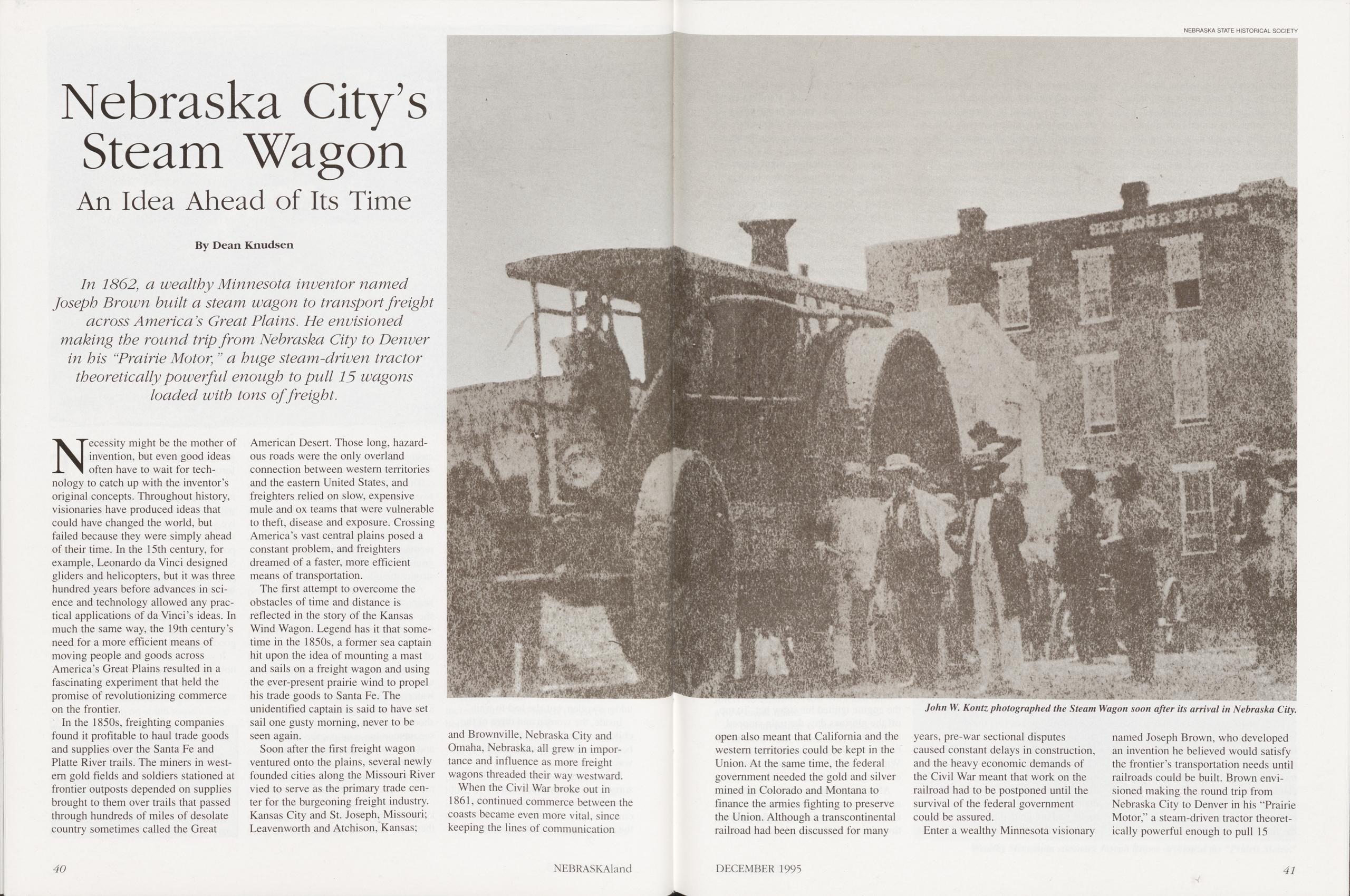
Nebraska City’s Steam Wagon
An Idea Ahead of Its Time
By Dean Knudsen In 1862, a wealthy Minnesota inventor named Joseph Brown built a steam wagon to transport freight across America’s Great Plains. He envisioned making the round trip from Nebraska City to Denver in his ‘Prairie Motor, ” a huge steam-driven tractor theoretically powerful enough to pull 15 wagons loaded with tons of freight.Necessity might be the mother of invention, but even good ideas often have to wait for technology to catch up with the inventor’s original concepts. Throughout history, visionaries have produced ideas that could have changed the world, but failed because they were simply ahead of their time. In the 15th century, for example, Leonardo da Vinci designed gliders and helicopters, but it was three hundred years before advances in science and technology allowed any practical applications of da Vinci’s ideas. In much the same way, the 19th century’s need for a more efficient means of moving people and goods across America’s Great Plains resulted in a fascinating experiment that held the promise of revolutionizing commerce on the frontier.
In the 1850s, freighting companies found it profitable to haul trade goods and supplies over the Santa Fe and Platte River trails. The miners in western gold fields and soldiers stationed at frontier outposts depended on supplies brought to them over trails that passed through hundreds of miles of desolate country sometimes called the Great American Desert. Those long, hazardous roads were the only overland connection between western territories and the eastern United States, and freighters relied on slow, expensive mule and ox teams that were vulnerable to theft, disease and exposure. Crossing America’s vast central plains posed a constant problem, and freighters dreamed of a faster, more efficient means of transportation.
The first attempt to overcome the obstacles of time and distance is reflected in the story of the Kansas Wind Wagon. Legend has it that sometime in the 1850s, a former sea captain hit upon the idea of mounting a mast and sails on a freight wagon and using the ever-present prairie wind to propel his trade goods to Santa Fe. The unidentified captain is said to have set sail one gusty morning, never to be seen again.
Soon after the first freight wagon ventured onto the plains, several newly founded cities along the Missouri River vied to serve as the primary trade center for the burgeoning freight industry. Kansas City and St. Joseph, Missouri; Leavenworth and Atchison, Kansas;
When the Civil War broke out in 1861, continued commerce between the coasts became even more vital, since keeping the lines of communication open also meant that California and the western territories could be kept in the Union. At the same time, the federal government needed the gold and silver mined in Colorado and Montana to finance the armies fighting to preserve the Union. Although a transcontinental railroad had been discussed for many years, pre-war sectional disputes caused constant delays in construction, and the heavy economic demands of the Civil War meant that work on the railroad had to be postponed until the survival of the federal government could be assured.
Enter a wealthy Minnesota visionary named Joseph Brown, who developed an invention he believed would satisfy the frontier’s transportation needs until railroads could be built. Brown envisioned making the round trip from Nebraska City to Denver in his “Prairie Motor,” a steam-driven tractor theoretically powerful enough to pull 15
40 NEBRASKAland DECEMBER 1995 41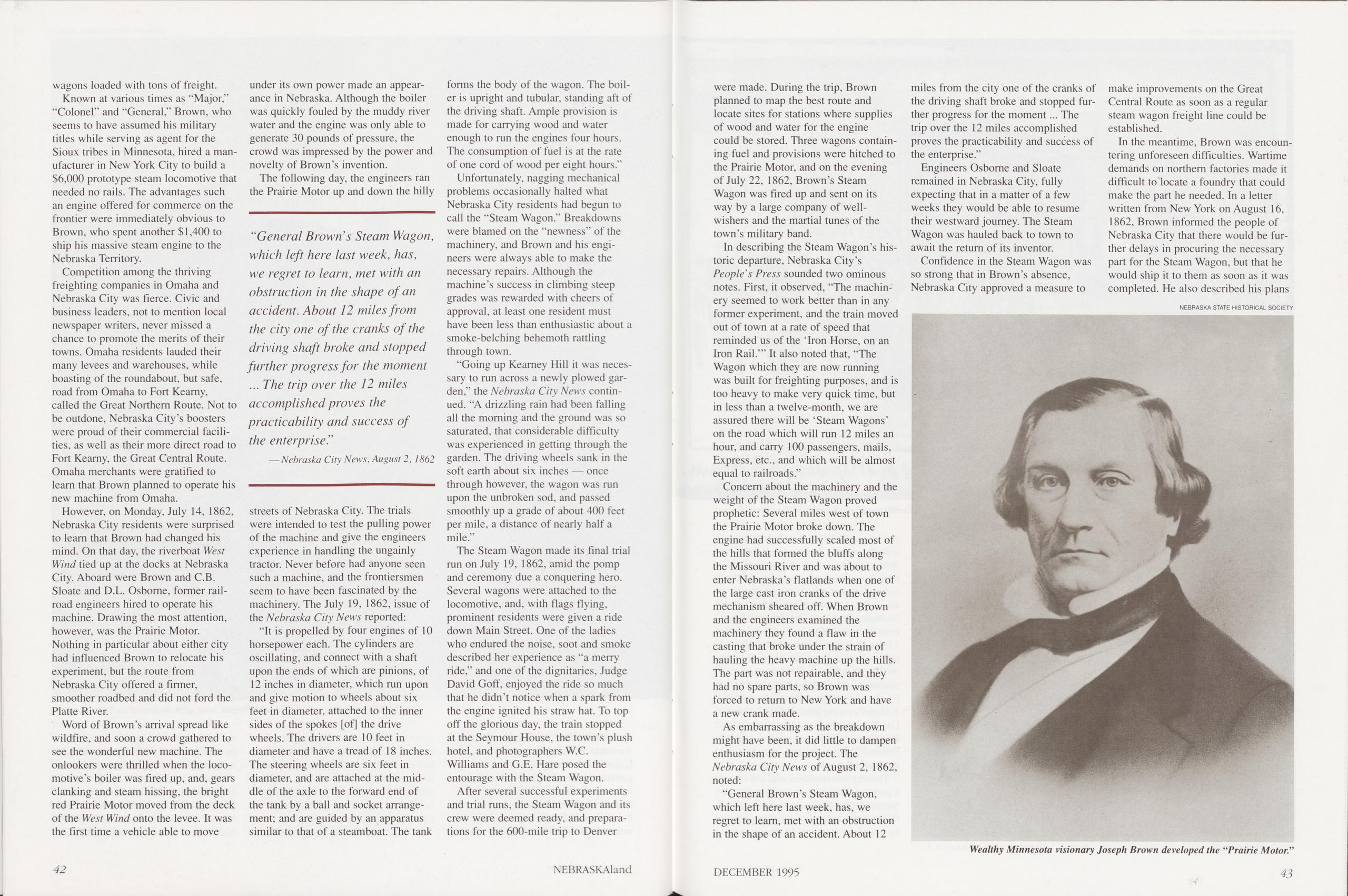
wagons loaded with tons of freight. Known at various times as “Major,” “Colonel” and “General,” Brown, who seems to have assumed his military titles while serving as agent for the Sioux tribes in Minnesota, hired a manufacturer in New York City to build a $6,000 prototype steam locomotive that needed no rails. The advantages such an engine offered for commerce on the frontier were immediately obvious to Brown, who spent another $1,400 to ship his massive steam engine to the Nebraska Territory.
Competition among the thriving freighting companies in Omaha and Nebraska City was fierce. Civic and business leaders, not to mention local newspaper writers, never missed a chance to promote the merits of their towns. Omaha residents lauded their many levees and warehouses, while boasting of the roundabout, but safe, road from Omaha to Fort Kearny, called the Great Northern Route. Not to be outdone, Nebraska City’s boosters were proud of their commercial facili- ties, as well as their more direct road to Fort Kearny, the Great Central Route. Omaha merchants were gratified to learn that Brown planned to operate his new machine from Omaha.
However, on Monday, July 14, 1862, Nebraska City residents were surprised to learn that Brown had changed his mind. On that day, the riverboat West Wind tied up at the docks at Nebraska City. Aboard were Brown and C.B. Sloate and D.L. Osborne, former rail- road engineers hired to operate his machine. Drawing the most attention, however, was the Prairie Motor.
Nothing in particular about either city had influenced Brown to relocate his experiment, but the route from Nebraska City offered a firmer, smoother roadbed and did not ford the Platte River.
Word of Brown’s arrival spread like wildfire, and soon a crowd gathered to see the wonderful new machine. The onlookers were thrilled when the locomotive’s boiler was fired up, and, gears clanking and steam hissing, the bright red Prairie Motor moved from the deck of the West Wind onto the levee. It was the first time a vehicle able to move under its own power made an appearance in Nebraska. Although the boiler was quickly fouled by the muddy river water and the engine was only able to generate 30 pounds of pressure, the crowd was impressed by the power and novelty of Brown’s invention.
The following day, the engineers ran the Prairie Motor up and down the hilly
“General Brown s Steam Wagon, which left here last week, has, we regret to learn, met with an obstruction in the shape of an accident. About 12 miles from the city one of the cranks of the driving shaft broke and stopped further progress for the moment ... The trip over the 12 miles accomplished proves the practicability and success of the enterprise — Nebraska City News, August 2, 1862streets of Nebraska City. The trials were intended to test the pulling power of the machine and give the engineers experience in handling the ungainly tractor. Never before had anyone seen such a machine, and the frontiersmen seem to have been fascinated by the machinery. The July 19, 1862, issue of the Nebraska City News reported:
“It is propelled by four engines of 10 horsepower each. The cylinders are oscillating, and connect with a shaft upon the ends of which are pinions, of 12 inches in diameter, which run upon and give motion to wheels about six feet in diameter, attached to the inner sides of the spokes [of] the drive wheels. The drivers are 10 feet in diameter and have a tread of 18 inches. The steering wheels are six feet in diameter, and are attached at the middle of the axle to the forward end of the tank by a ball and socket arrange- ment; and are guided by an apparatus similar to that of a steamboat. The tank forms the body of the wagon. The boiler is upright and tubular, standing aft of the driving shaft. Ample provision is made for carrying wood and water enough to run the engines four hours. The consumption of fuel is at the rate of one cord of wood per eight hours.”
Unfortunately, nagging mechanical problems occasionally halted what Nebraska City residents had begun to call the “Steam Wagon.” Breakdowns were blamed on the “newness” of the machinery, and Brown and his engineers were always able to make the necessary repairs. Although the machine’s success in climbing steep grades was rewarded with cheers of approval, at least one resident must have been less than enthusiastic about a smoke-belching behemoth rattling through town.
“Going up Kearney Hill it was necessary to run across a newly plowed garden,” the Nebraska City News contin- ued. “A drizzling rain had been falling all the morning and the ground was so saturated, that considerable difficulty was experienced in getting through the garden. The driving wheels sank in the soft earth about six inches — once through however, the wagon was run upon the unbroken sod, and passed smoothly up a grade of about 400 feet per mile, a distance of nearly half a mile.”
The Steam Wagon made its final trial run on July 19, 1862, amid the pomp and ceremony due a conquering hero. Several wagons were attached to the locomotive, and, with flags flying, prominent residents were given a ride down Main Street. One of the ladies who endured the noise, soot and smoke described her experience as “a merry ride,” and one of the dignitaries, Judge David Goff, enjoyed the ride so much that he didn’t notice when a spark from the engine ignited his straw hat. To top off the glorious day, the train stopped at the Seymour House, the town’s plush hotel, and photographers W.C. Williams and G.E. Hare posed the entourage with the Steam Wagon.
After several successful experiments and trial runs, the Steam Wagon and its crew were deemed ready, and preparations for the 600-mile trip to Denver were made. During the trip, Brown planned to map the best route and locate sites for stations where supplies of wood and water for the engine could be stored. Three wagons containing fuel and provisions were hitched to the Prairie Motor, and on the evening of July 22, 1862, Brown’s Steam Wagon was fired up and sent on its way by a large company of well-wishers and the martial tunes of the town’s military band.
In describing the Steam Wagon’s historic departure, Nebraska City’s People's Press sounded two ominous notes. First, it observed, “The machinery seemed to work better than in any former experiment, and the train moved out of town at a rate of speed that reminded us of the ‘Iron Horse, on an Iron Rail.’” It also noted that, “The Wagon which they are now running was built for freighting purposes, and is too heavy to make very quick time, but in less than a twelve-month, we are assured there will be ‘Steam Wagons’ on the road which will run 12 miles an hour, and carry 100 passengers, mails, Express, etc., and which will be almost equal to railroads.”
Concern about the machinery and the weight of the Steam Wagon proved prophetic: Several miles west of town the Prairie Motor broke down. The engine had successfully scaled most of the hills that formed the bluffs along the Missouri River and was about to enter Nebraska’s flatlands when one of the large cast iron cranks of the drive mechanism sheared off. When Brown and the engineers examined the machinery they found a flaw in the casting that broke under the strain of hauling the heavy machine up the hills. The part was not repairable, and they had no spare parts, so Brown was forced to return to New York and have a new crank made.
As embarrassing as the breakdown might have been, it did little to dampen enthusiasm for the project. The Nebraska City News of August 2, 1862, noted:
“General Brown’s Steam Wagon, which left here last week, has, we regret to learn, met with an obstruction in the shape of an accident. About 12 miles from the city one of the cranks of the driving shaft broke and stopped further progress for the moment ... The trip over the 12 miles accomplished proves the practicability and success of the enterprise.”
Engineers Osborne and Sloate remained in Nebraska City, fully expecting that in a matter of a few weeks they would be able to resume their westward journey. The Steam Wagon was hauled back to town to await the return of its inventor.
Confidence in the Steam Wagon was so strong that in Brown’s absence, Nebraska City approved a measure to
make improvements on the Great Central Route as soon as a regular steam wagon freight line could be established.
In the meantime, Brown was encountering unforeseen difficulties. Wartime demands on northern factories made it difficult to locate a foundry that could make the part he needed. In a letter written from New York on August 16, 1862, Brown informed the people of Nebraska City that there would be further delays in procuring the necessary part for the Steam Wagon, but that he would ship it to them as soon as it was completed. He also described his plans
42 NEBRASKAland DECEMBER 1995 43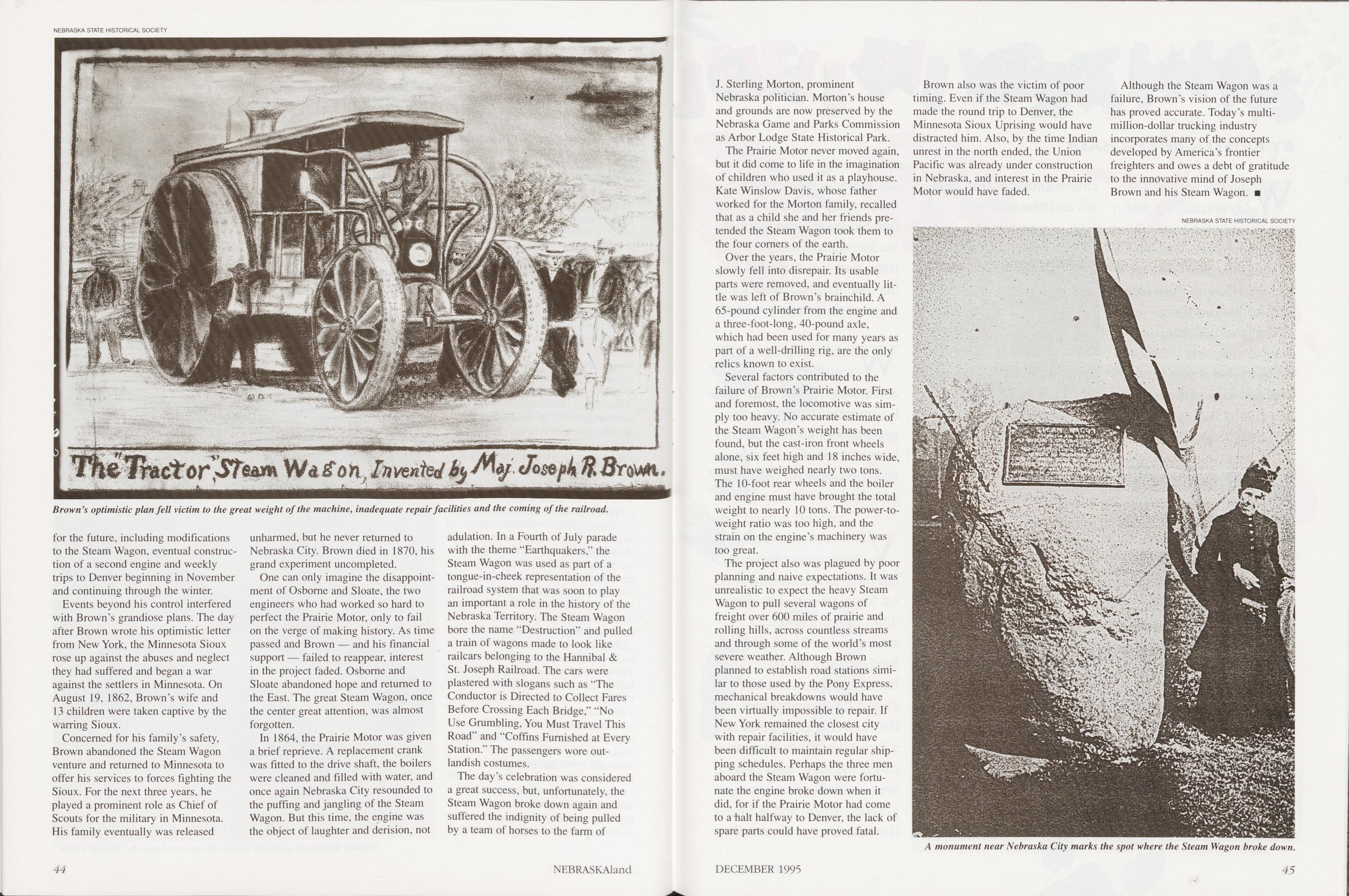
for the future, including modifications to the Steam Wagon, eventual construction of a second engine and weekly trips to Denver beginning in November and continuing through the winter. Events beyond his control interfered with Brown’s grandiose plans. The day after Brown wrote his optimistic letter from New York, the Minnesota Sioux rose up against the abuses and neglect they had suffered and began a war against the settlers in Minnesota. On August 19, 1862, Brown’s wife and 13 children were taken captive by the warring Sioux.
Concerned for his family’s safety, Brown abandoned the Steam Wagon venture and returned to Minnesota to offer his services to forces fighting the Sioux. For the next three years, he played a prominent role as Chief of Scouts for the military in Minnesota. His family eventually was released unharmed, but he never returned to Nebraska City. Brown died in 1870, his grand experiment uncompleted.
One can only imagine the disappointment of Osborne and Sloate, the two engineers who had worked so hard to perfect the Prairie Motor, only to fail on the verge of making history. As time passed and Brown — and his financial support — failed to reappear, interest in the project faded. Osborne and Sloate abandoned hope and returned to the East. The great Steam Wagon, once the center great attention, was almost forgotten.
In 1864, the Prairie Motor was given a brief reprieve. A replacement crank was fitted to the drive shaft, the boilers were cleaned and filled with water, and once again Nebraska City resounded to the puffing and jangling of the Steam Wagon. But this time, the engine was the object of laughter and derision, not adulation. In a Fourth of July parade with the theme “Earthquakers ” the Steam Wagon was used as part of a tongue-in-cheek representation of the railroad system that was soon to play an important a role in the history of the Nebraska Territory. The Steam Wagon bore the name “Destruction” and pulled a train of wagons made to look like railcars belonging to the Hannibal & St. Joseph Railroad. The cars were plastered with slogans such as “The Conductor is Directed to Collect Fares Before Crossing Each Bridge,” “No Use Grumbling, You Must Travel This Road” and “Coffins Furnished at Every Station.” The passengers wore outlandish costumes.
The day’s celebration was considered a great success, but, unfortunately, the Steam Wagon broke down again and suffered the indignity of being pulled by a team of horses to the farm of J. Sterling Morton, prominent Nebraska politician. Morton’s house and grounds are now preserved by the Nebraska Game and Parks Commission as Arbor Lodge State Historical Park.
The Prairie Motor never moved again, but it did come to life in the imagination of children who used it as a playhouse. Kate Winslow Davis, whose father worked for the Morton family, recalled that as a child she and her friends pretended the Steam Wagon took them to the four comers of the earth.
Over the years, the Prairie Motor slowly fell into disrepair. Its usable parts were removed, and eventually little was left of Brown’s brainchild. A 65-pound cylinder from the engine and a three-foot-long, 40-pound axle, which had been used for many years as part of a well-drilling rig, are the only relics known to exist.
Several factors contributed to the failure of Brown’s Prairie Motor. First and foremost, the locomotive was simply too heavy. No accurate estimate of the Steam Wagon’s weight has been found, but the cast-iron front wheels alone, six feet high and 18 inches wide, must have weighed nearly two tons. The 10-foot rear wheels and the boiler and engine must have brought the total weight to nearly 10 tons. The power-to- weight ratio was too high, and the strain on the engine’s machinery was too great.
The project also was plagued by poor planning and naive expectations. It was unrealistic to expect the heavy Steam Wagon to pull several wagons of freight over 600 miles of prairie and rolling hills, across countless streams and through some of the world’s most severe weather. Although Brown planned to establish road stations similar to those used by the Pony Express, mechanical breakdowns would have been virtually impossible to repair. If New York remained the closest city with repair facilities, it would have been difficult to maintain regular shipping schedules. Perhaps the three men aboard the Steam Wagon were fortunate the engine broke down when it did, for if the Prairie Motor had come to a halt halfway to Denver, the lack of spare parts could have proved fatal.
Brown also was the victim of poor timing. Even if the Steam Wagon had made the round trip to Denver, the Minnesota Sioux Uprising would have distracted him. Also, by the time Indian unrest in the north ended, the Union Pacific was already under construction in Nebraska, and interest in the Prairie Motor would have faded.
Although the Steam Wagon was a failure, Brown’s vision of the future has proved accurate. Today’s multi- million-dollar trucking industry incorporates many of the concepts developed by America’s frontier freighters and owes a debt of gratitude to the innovative mind of Joseph Brown and his Steam Wagon.
44 NEBRASKAland DECEMBER 1995 45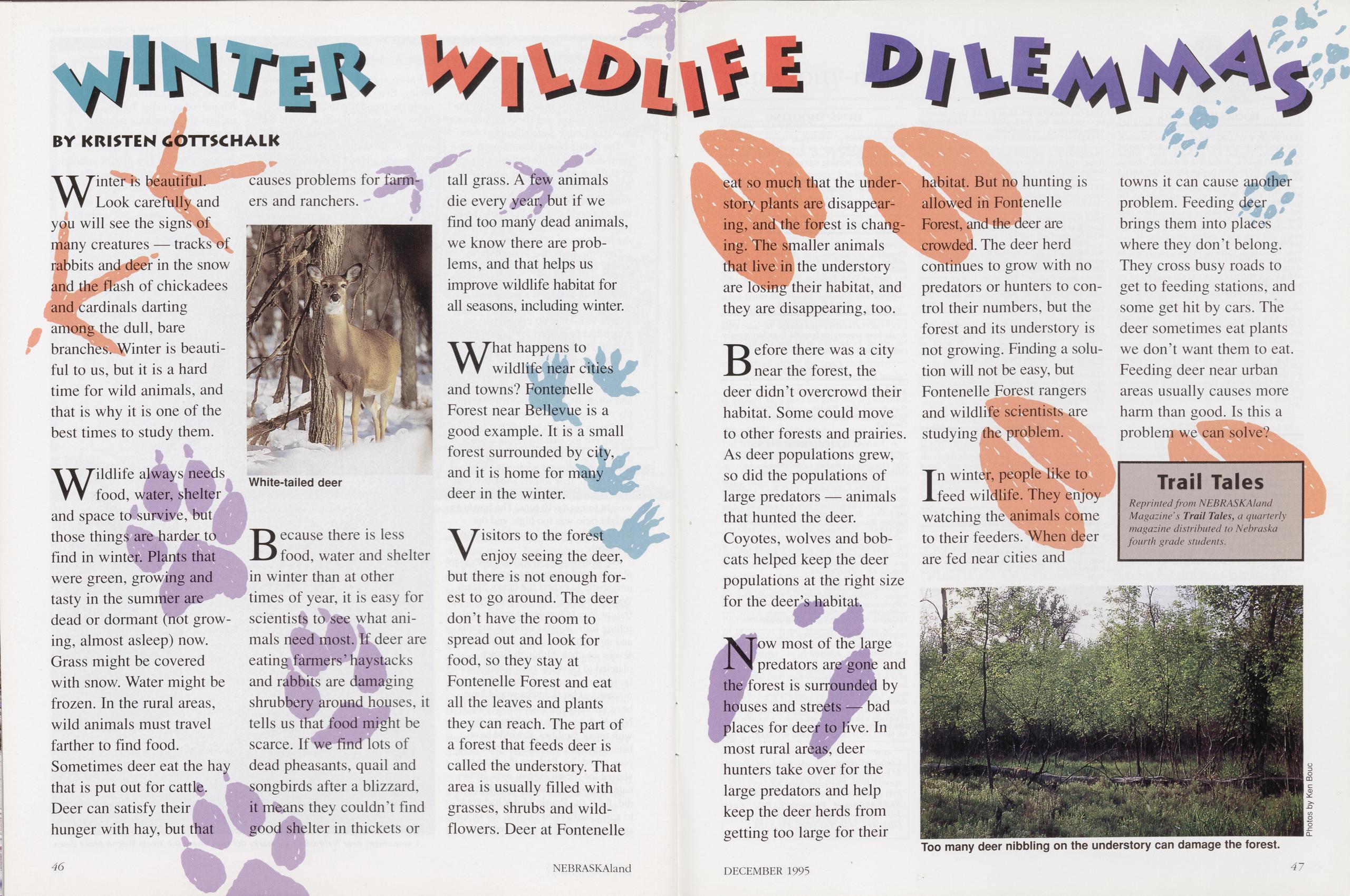
Winter Wildlife Dilemmas
Winter is beautiful. Look carefully and you will see the signs of many creatures - tracks of rabbits and deer in the snow and the flash of chickadees and cardinals darting among the dull, bare branches. Winter is beautiful to us. but it is a hard time for wild animals, and that is why it is one of the best times to study them.
Widlife always needs food, water, shelter and space to survive, but those things are harder to find in winter. Plants that were green, growing and tasty in the summer are dead or dormant (not grow-ing, almost asleep) now. Grass might be covered with snow. Water might be frozen. In the rural areas, wild animals must travel farther to find food Sometimes deer eat the hay that is put out for cattle, Deer can satisfy their hunger with hay, but that causes problems for farmers and ranchers.
White-tailed deer
Because there is les food, water and shelter in winter than at other times of year, it is easy for scientists to see what animals need most. If deer are eating farmers haystacks and rabbits are damaging shrubbery around houses, it tells us that food might be scarce. If we find lots of dead pheasants, quail and songbirds after a blizzard, it means they couldn't find good shelter in thickets or tall grass. A tew animals die every year, but if we find too many dead animals, we know there are prob-lems, and that helps us improve wildlife habitat for all seasons, including winter.
What happens to wildlife near cities and towns? Fontenelle Forest near Bellevue is a good example. It is a small forest surrounded by city and it is home for many deer in the winter.
Visitors to the fores enjoy seeing the deer but there is not enough forest to go around. The deer don't have the room to spread out and look for food, so they stay at Fontenelle Forest and eat all the leaves and plants they can reach. The part of a forest that feeds deer is called the understory. That area is usually filled with grasses, shrubs and wild-flowers. Deer at Fontenelle eat so much that the under-story plants are disappearing, and the forest is changing. The smaller animals that live in the understory are losing their habitat, and they are disappearing, too.
efore there was a city near the forest, the deer didn't overcrowd their habitat. Some could move to other forests and prairies. As deer populations grew, so did the populations of large predators - animals that hunted the deer. Coyotes, wolves and bobcats helped keep the deer populations at the right size for the deer habitat
Now most of the large predators are gone and the forest is surrounded by houses and streets - bad places for deef to live. In most rural areas, deer hunters take over for the large predators and help keep the deer herds from getting too large for their habitat. But no hunting is allowed in Fontenelle Forest, and the deer are crowded. The deer herd continues to grow with no predators or hunters to control their numbers, but the forest and its understory is not growing. Finding a solution will not be easy, but Fontenelle Forest rangers and wildlife scientists are studying the problem.
In winter, people like to feed wildlife. They enjoy watching the animals come to their feeders. When deer are fed near cities and towns it can cause another problem. Feeding deer brings them into places where they don't belong They cross busy roads to get to feeding stations, and some get hit by cars. The deer sometimes eat plants we don't want them to eat. Feeding deer near urban areas usually causes more harm than good. Is this a problem we can solve?
Trail TalesReprinted from NEBRASKAland Magazine's Trail Tales, a quarterly magazine distributed to Nebraska fourth grade students.
Too many deer nibbling on the understory can damage the forest.
FREE BOOK CATALOG. Novels, westerns, romances, children’s; old out of print, found bams, attic. Authors: Grey. Bower, Condor, Fox, Curwood. Raine, Wright, Aldrige, Pollyanna, Freckles, many others. Postage appreciated. Pierce, 4400 N. Pine Cluster, Oroville, CA 95965.
HOW TO FIND MORE outdoor opportunities! The Nebraska Sportsman’s Atlas. Locations of all public lands and waters on county transportation maps. These maps show all the roads in Nebraska. Listings include federal, Nebraska Game & Parks, NRD holdings, hotels and motels and Nebraska’s endless attractions. At only 518.75/copy a true time and frustration saver. To order write: Sportsman's Atlas Co., P.O. Box 132, Lytton, 1A 50561 or call 1-800-568-8334.
NEBRASKA PHOTO CELEBRATION available for the holidays, this hardcover coffee table book captures all that is best about Nebraska in over 120 full-color pho- tographs. Deluxe presentation of the seasons, landscape, people and events that will be cherished for years to come. Call toll-free 1-800-654-1105 for credit card orders or write: American & World Geographic Publishing, P.O. Box 5630, Helena, MT 59604. $29.95 plus $2.50 shipping.
“BORN TO HUNT” by Ralph Kohler. Perfect Christmas Gift. Limited Edition signed by the author. Every hunter will treasure this book. Hardbound $27.95 - Hand Bound. Genuine Leather $69.95. Please add $4.50 to cover tax and shipping. K & K Publications, 820 “Q” Street, Tekamah, NE 68061. Visa, MasterCard. Call (402) 339- 0771.
COLLECTIBLESBUYING PRE-1950s baseball, football and basketball uniforms, leather helmets and other related equipment. Especially early 1900s items. Call collect (402) 573-0938 evenings or weekends.
1996 NEBRASKA HABITAT STAMP Limited Edition Art Print “December Morning” Pheasant now available. Write to John R. Mayer, P.O. Box 1704, Grand Island, NE 68802 for a free brochure.
BUYING: American Indian artifacts such as beadwork, weavings, baskets, etc.; also cowboy memorabilia such as chaps, spurs, photographs, etc. Best price first letter; pho- tographs promptly returned. Jack Ringwait, 1550 California St., Suite 6, #211, San Francisco, CA 94109. (415) 388-5174.
DOGSENGLISH SETTER, German shorthairs, English point- ers, Brittany spaniels - stud service, puppies and started dogs. Training for all pointing breeds. Plum Creek Kennel, (712) 529-4238 or (402) 298-8153.
ENGLISH SETTER puppies out of Midwest shooting dog champion the last four years. Other gun dogs are also available. Phone (402) 862-2168 or (402) 862-2886.
YELLOW-CHOCOLATE-BLACK LAB pups. Breeders hips O.F.A. and eyes c.e.r.f./ed. Excellent bloodlines and hunting potential. Call Mr. Bendler, Lexington, NE (308) 324-4247 or Lincoln (402) 477-1305.
TRAINING ALL BREEDS bird dogs - Vizslas for sale. Home of Rebel Rousers. Rozanek Kennels, RR 2, Schuyler, NE 68661. Phone (402) 352-8769.
RETRIEVER TRAINING. Area’s top “retrievers only” trainer. Field trial and hunting dogs. Non-slip duck dogs! TKO Retriever Training Kennel (402) 623-4311.
ENGLISH SETTER and Labradors from outstanding lines. Bred for hunters who appreciate fine bird dogs! Wind Fall Gun Dogs, (402) 421-4693.
WILDERNESS KENNELS. Gun dog training - over 60 years combined experience. Training all sporting breeds - retrievers, flushing and pointing dogs. All dogs worked on pen raised birds and wild game. Training program includes obedience training - heel, sit, stay, down and come when called. Pups, started dogs and fully trained dogs for sale. Hunting dogs trained by hunters. Henry Sader, Wilderness Kennels, Roca, NE (402) 423-4212. Since 1968.
ENGLISH COCKER pups, imported stock. British FTC bloodlines. Many colors available. Featured in NEBRASKAland November 1991. Sawtooth Oaks, Box 443, Orleans, NE 68966. Phone (308) 473-5265.
CHESAPEAKE BAY, Labrador and golden retriever pups, started dogs and stud service. 16-time national champion pedigree. Visa & MasterCard. Platte Valley Retrievers (308) 995-2318.
EVENTS/ATTRACTIONSBIRDWATCHING. World's Largest Migration of Sandhill Cranes. Each Spring some 500,000 sandhill cranes (80 percent of the world’s population of this species) gather on the Platte River “staging area” during their northward migration. If you would like more infor- mation about sandhill crane viewing spots, tours or spe- cific species viewing contact the Kearney Visitors Bureau at 1-800-227-8340.
FISH/FISHINGFISH FOR SALE. Catfish, largemouth bass, smallmouth bass, perch, crappie, bluegill, walleye, northern pike, rainbow trout, Donaldson rainbow trout, grass carp, min- nows, bullheads. Consulting available. Pleasant Valley Fish Farm. RR 1, Box 147, McCook, NE 69001. Phone (308) 345-6599.
FOODNEBRASKA BASKETS: The original Nebraska compa- ny specializing in fine foods from Nebraska since 1984. A beautiful array of baskets filled with ethnic, healthful and long-time favorite foods. Call or write for our brochure: P.O. Box 22985, Lincoln, NE 68542. Phone 1 -800-345-7725 or (402) 438-3 111.
HOMEBREWING/BEER & WINEMAKING - New 1995 catalog. Fermenter’s Supply, 8410 K Plz. #10, Omaha, NE 68127. (402) 593-9171. Mail order welcome. FROM NEBRASKA GIFT SHOP...the worlds largest selection of Nebraska-made food products and gifts. Historic Haymarket, 140 N. 8th, Lincoln, NE. Call for free catalog 1-800-399-5693.
COUNTRY COOKBOOK from NEBRASKAland Magazine at a special closeout price. Great fish and game recipes. See Gift Collection opposite page 50.
GUIDES/OUTFITTERSMAD RIVER CANOES offers the finest quality and per- formance. For the finest canoes and accessories look to Great Plains Canoe Co., 205 Main, Springfield, NE 68059. Phone (402) 253-2001.
GUNS/SHOOTINGGUNS - Browning, Winchester. Remington, others. Hi-powers, shotguns, new, used, antiques. Want Pre-'64 Winchesters. Buy-Sell-Trade. (402) 729-6112. Bedlan’s Sporting Goods, Fairbury, NE 68352.
AIR GUNS repaired — Benjamin, Crosman, Daisy, other American made. Restoration; old guns wanted. Jack’s Air Guns, 1225 N. 46th, Lincoln, NE 68503. Phone (402) 466-9223.
PLANTS/HABITATATTRACT WILDLIFE to your acreage, preserve or club. Consulting, management plan development, planting/ seeding, and supplies for the conservationist or the hunter. David M. Nelson, Wildlife Habitat Consulting, 811 Matthies Drive, Papillion, NE 68046. Phone (402) 592-5652.
REAL ESTATELAKE McCONAUGHY development for sale. Class development property on beautiful Lake McConaughy, NE. 140 lots for $297,000 on the lake. Call Bill Hines, (308) 284-6701.
TAXIDERMYALLISON'S TAXIDERMY STUDIO & Gift Gallery. Specializing in fish, birds and small game. Mounted 35 State Record Fish. Pheasant mounts for sale. 421 N. Dewey, North Platte, NE 69101. (308) 534-2324 or (308) 534-4267.
VACATION/RESORTSFOR FISHING and hunting accommodations. Jefco Inn. Gordon, NE 69343. South Cornell, (308) 282-2935.
BED & BREAKFAST. Historic 1890s hotel. Located in the beautiful Pine Ridge area of Northwest Nebraska. Short drive to Chadron State Park, Fort Robinson and the Black Hills. Beautiful dining room with fireplace and fountain. Room service available. The Olde Main Street Inn, 115 Main St., Chadron, NE 69337. (308) 432-3380.
NE NEBRASKA TROUT FISHING. Mon-Thurs or Fri-Sun. 3 modem cottages, 5 spring-fed lakes. Trout, bass and bluegill. Diamond E Trout Resort, Box B, Orchard, NE 1-800-658-3244.
HUNTER QUARTERS in Milligan, NE. Welcome hunters. Excellent hunting territory. Quarters sleep 5-6 with cooking and refrigeration facilities. Very clean and comfortable. $20/person five or more. Under five $25/person. For arrangements call (402) 629-4501.
BUFFALO HUNTS in scenic Pine Ridge country. Mature bulls with fine head and robe. Rustic log home bed-and-breakfast accommodations available. (402) 643-2574.
BED & BREAKFAST. Historic Argo Hotel built in 1912. Just minutes from hunting, fishing and golf. Ten miles south of Lewis & Clark Lake and Yankton. Full service steakhouse, cocktail lounge. Brass chandeliers, tin ceil- ings. 20 rooms includes cable TV, phone and AC. Honey- moon suite with poster bed and Jacuzzi. Affordable rates. Historic Argo Hotel, 211 W. Kansas St., Box 260, Crofton, NE 68730. (402) 388-2400 or (800) 607-ARGO (2746).
Classified rates: .75$ per word, minimum $15. Closing date: First business day two months preceding issue date. Ads accepted first-come, first-served, space-available. NEBRASKAland Magazine, P.O. Box 30370, Lincoln, NE 68503-0370. Telephone (402) 471-5478. Fax (402) 471-5528.Page forty-nine
Holidays OutdoorsIt was the day before Christmas, it was snowing, and my son Jim, then about 14, and I were starting to feel cooped-up in the house. Christmas Eve festivities weren’t scheduled to begin until about 4 o’clock, and it was only midmoming, so we had plenty of time for a few hours of pheasant hunting.
One of our favorite spots for a quick pheasant hunting trip was a state recreation area about 20 minutes from home. A creek meanders through the area from the north, feeding the large reservoir. Along the creek is a stand of timber, and large expanses of uncultivated, weed-heavy fields surround the timber. Food plots were planted at several places along the trees to benefit wildlife, and the spot we liked to hunt was far enough from the road that few hunters used it.
We parked the truck and walked into the woods. It was snowing and cold, but trees blocked most of the wind. A hundred yards or so into the woods we crossed the creek and scrambled up the bank onto the far side a few yards from a small clearing where we had hunted squirrels in the fall.
As we entered the clearing we came upon an unexpected sight: Someone had pitched a small wall tent at the edge of the trees. It stood beside a medium-sized cedar tree, and the tree was decorated with a dozen or so brightly-colored Christmas tree ornaments and looped with several chains of pop-tabs from aluminum cans. A simple wreath hung by a string from the ridgepole. The snowy woods back-ground, the decorated tree and the tent made a beautiful picture that could have been a Christmas card. There was no one around, but someone must have planned to spend Christmas camped in the woods.
Another holiday-season hunt was memorable for an entirely different reason. It was shortly after sunrise, when the horizon was just starting to glow. The air was still, and light snowflakes drifted lazily to earth around us. Heavy, dark-gray clouds hung low overhead, and the dog’s breath puffed out in thick clouds as he inspected — and marked — several leaf-bare saplings near the pickup. Nothing moved along the edge of the stubble field.
It was the day before New Year’s Day, and Jim and I were hoping to kill a pheasant or two for New Year’s dinner. This was back in the days when frigid temperatures and snow were commonplace during December in Nebraska. A cold, light rain began to fall, then rapidly turned to snow as the temperature dropped. Every branch and twig, every weed stalk, fence wire and fencepost was encased in a glistening skin of ice. My fingers, protected only by a thin, worn pair of gloves, felt swollen, and my ears had a sharp numb sensation that made me wish I’d worn a stocking cap rather than my old billed hunting cap.
The snow crunched and slivers of ice tinkled and shattered as we walked through the knee-deep weed strip between stubble field and treeline. Kelly was quartering 10 yards ahead of us near the edge of the stubble field when a hen pheasant leaped into the air and showered him with snow as its stubby wings fought for altitude.
An instant later and a half-dozen feet away, a rooster sprang skyward, cackling in protest at being rousted from its roost and a second hen that had been snuggled down in the weeds another few feet away followed him into the air. The rooster climbed for a second then leveled off to sail toward the tree line when Jim let him down with a load of No. 6 shot from the 16- gauge double-barrel. The hens flew straight away, then turned and sailed into the stubble. Kelly, his muzzle covered with snow, bounded lightly through the weeds and delivered the limp rooster to Jim.
We continued to hunt the weed strip, and after half mile or so, Jim shot another rooster that got up from a small swale that cut through the com field. The snow was beginning to come down harder, and with two birds bulging Jim’s game pouch, we decided to call it a day. I was walking at the edge of the windbreak and Jim had moved out into the com. The weed strip was now between us. We were almost back to the truck when another rooster flushed several yards ahead of Jim, who took a quick shot and missed. The bird glided toward the trees, and I scored with an easy crossing shot from about 25 yards.
We hadn’t walked much more than a dozen steps farther when a covey of quail burst into the air with a heart- stopping clatter just ahead of the dog and buzzed toward the woods. I picked out a bird, fired and watched it drop like a stone. Kelly retrieved the quail and I put it in the game pouch of my hunting coat, removed the spent hull from the shotgun and replaced it with new shell.
Seconds later Kelly trotted back with another quail. I was surprised at the second bird, but even more sur- prised when the dog brought a third quail back from the same area. Each of the birds was warm and obviously freshly killed, and I was amazed to have taken three with one shot. If it hadn’t been for the dog, I probably would have looked only until I found the first bird and then moved on, unaware that other birds were down. I look on that shot as a Christmas gift from somewhere, something that will probably never happen to me again.
Back in the days when Nebraska had real winter weather in late December, New Year’s Day was reserved for ice fishing. Usually we were up and out on the ice shortly after sunrise, an appropriate way to begin a new year. Those New Year’s Days were some of the coldest days of the season, and we often built a fire on the ice to keep warm. The fishing was usually good, and a bucketful of crappies and bluegills was a more than enough reward for braving the icy conditions.
Some of my best Christmas memories, those that remain most vivid, are holiday seasons spent outdoors.
Tom Keith 48 NEBRASKAland DECEMBER 1995 49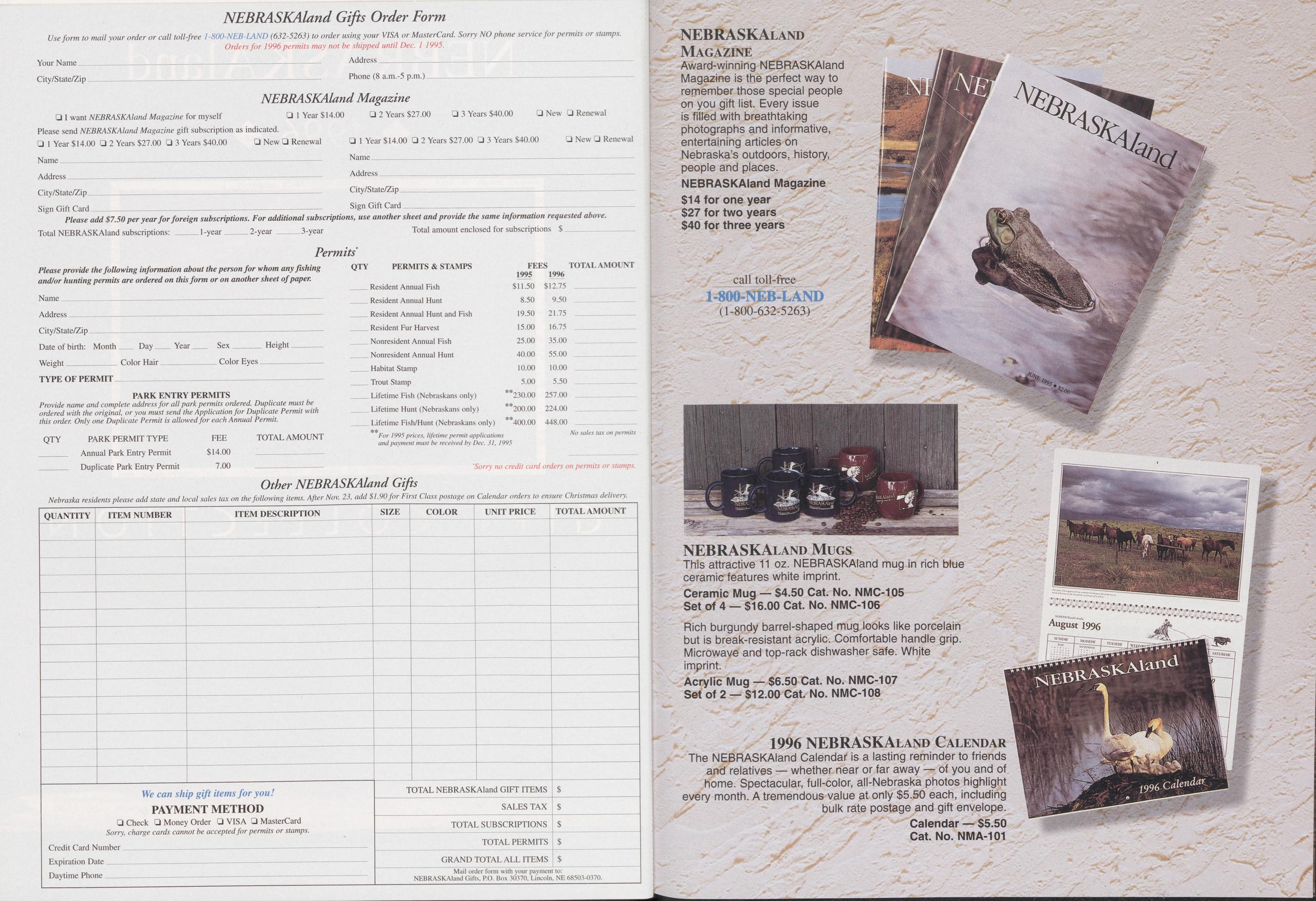
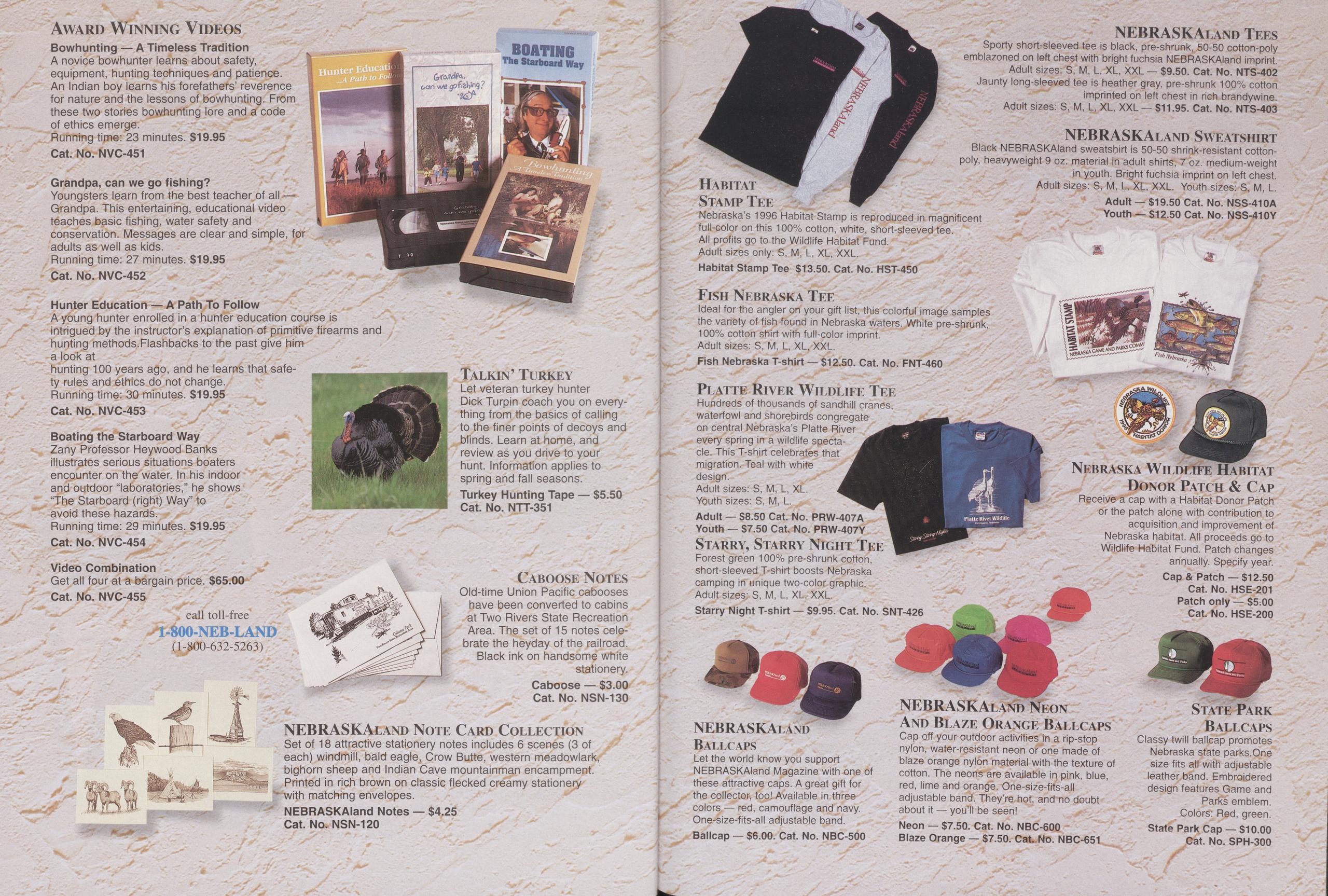 Award Winning Videos
Bowhunting — A Timeless Tradition
A novice bowhunter learns about safety,
equipment, hunting techniques and patience.
An Indian boy learns his forefathers’ reverence
for nature and the lessons of bowhunting. From
these two stories bowhunting lore and a code
of ethics emerge.
Running time: 23 minutes. $19.95
Cat. No. NVC-451
Grandpa, can we go fishing?
Youngsters learn from the best teacher of all —
Grandpa. This entertaining, educational video
teaches basic fishing, water safety and
conservation. Messages are clear and simple, for
adults as well as kids.
Running time: 27 minutes. $19.95
Cat. No. NVC-452
Hunter Education — A Path To Follow
BOATING
The Starboard Way
NEBRASKAland Tees
Sporty short-sleeved tee is black, pre-shrunk, 50-50 cotton-poly
emblazoned on left chest with bright fuchsia NEBRASKAland imprint.
Adult sizes: S, M, L, XL, XXL — $9.50. Cat. No. NTS-402
Jaunty long-sleeved tee is heather gray, pre-shrunk 100% cotton
imprinted on left chest in rich brandywine.
Adult sizes: S, M, L, XL, XXL— $11.95. Cat. No. NTS-403
NEBRASKAland Sweatshirt
Black NEBRASKAland sweatshirt is 50-50 shrink-resistant cotton-
poly, heavyweight 9 oz. material in adult shirts, 7 oz. medium-weight
in youth. Bright fuchsia imprint on left chest.
Adult sizes: S, M, L, XL, XXL. Youth sizes: S, M, L.
Nebraska’s 1996 Habitat Stamp is reproduced in magnificent
full-color on this 100% cotton, white, short-sleeved tee.
All profits go to the Wildlife Habitat Fund.
Adult sizes only: S, M, L, XL, XXL.
Habitat Stamp Tee $13.50. Cat. No. HST-450
Adult — $19.50 Cat. No. NSS-410A
Youth —- $12.50 Cat. No. NSS-410Y
Award Winning Videos
Bowhunting — A Timeless Tradition
A novice bowhunter learns about safety,
equipment, hunting techniques and patience.
An Indian boy learns his forefathers’ reverence
for nature and the lessons of bowhunting. From
these two stories bowhunting lore and a code
of ethics emerge.
Running time: 23 minutes. $19.95
Cat. No. NVC-451
Grandpa, can we go fishing?
Youngsters learn from the best teacher of all —
Grandpa. This entertaining, educational video
teaches basic fishing, water safety and
conservation. Messages are clear and simple, for
adults as well as kids.
Running time: 27 minutes. $19.95
Cat. No. NVC-452
Hunter Education — A Path To Follow
BOATING
The Starboard Way
NEBRASKAland Tees
Sporty short-sleeved tee is black, pre-shrunk, 50-50 cotton-poly
emblazoned on left chest with bright fuchsia NEBRASKAland imprint.
Adult sizes: S, M, L, XL, XXL — $9.50. Cat. No. NTS-402
Jaunty long-sleeved tee is heather gray, pre-shrunk 100% cotton
imprinted on left chest in rich brandywine.
Adult sizes: S, M, L, XL, XXL— $11.95. Cat. No. NTS-403
NEBRASKAland Sweatshirt
Black NEBRASKAland sweatshirt is 50-50 shrink-resistant cotton-
poly, heavyweight 9 oz. material in adult shirts, 7 oz. medium-weight
in youth. Bright fuchsia imprint on left chest.
Adult sizes: S, M, L, XL, XXL. Youth sizes: S, M, L.
Nebraska’s 1996 Habitat Stamp is reproduced in magnificent
full-color on this 100% cotton, white, short-sleeved tee.
All profits go to the Wildlife Habitat Fund.
Adult sizes only: S, M, L, XL, XXL.
Habitat Stamp Tee $13.50. Cat. No. HST-450
Adult — $19.50 Cat. No. NSS-410A
Youth —- $12.50 Cat. No. NSS-410Y
A young hunter enrolled in a hunter education course is intrigued by the instructor’s explanation of primitive firearms and hunting methods.Flashbacks to the past give him a look at hunting 100 years ago, and he learns that safe- ty rules and ethics do not change.
Running time: 30 minutes. $19.95 Cat. No. NVC-453 Boating the Starboard Way Zany Professor Heywood Banks illustrates serious situations boaters encounter on the water. In his indoor and outdoor “laboratories,” he shows “The Starboard (right) Way” to avoid these hazards. Running time: 29 minutes. $19.95 Cat. No. NVC-454 Talkin’ TurkeyLet veteran turkey hunter Dick Turpin coach you on every- thing from the basics of calling to the finer points of decoys and blinds. Learn at home, and review as you drive to your hunt. Information applies to spring and fall seasons. Turkey Hunting Tape — $5.50 Cat. No. NTT-351
Video Combination Get all four at a bargain price. $65.00 Cat. No. NVC-455 call toll-free >t-$00-NEB-LAND (1-800-632-5263) Caboose Notes Old-time Union Pacific cabooses have been converted to cabins at Two Rivers State Recreation Area. The set of 15 notes cele- brate the heyday of the railroad. Black ink on handsome white stationery. Caboose — $3.00 Cat. No. NSN-130 NEBRASKAland Note Card Collection Set of 18 attractive stationery notes includes 6 scenes (3 of each) windmill, bald eagle, Crow Butte, western meadowlark, bighorn sheep and Indian Cave mountainman encampment. Printed in rich brown on classic flecked creamy stationery with matching envelopes. NEBRASKAland Notes — $4.25 Cat. No. NSN-120 Fish Nebraska TeeIdeal for the angler on your gift list, this colorful image samples the variety of fish found in Nebraska waters. White pre-shrunk, 100% cotton shirt with full-color imprint. Adult sizes: S, M, L, XL, XXL. Fish Nebraska T-shirt — $12.50. Cat. No. FNT-460 Platte River Wildlife Tee Hundreds of thousands of sandhill cranes, waterfowl and shorebirds congregate on central Nebraska’s Platte River every spring in a wildlife specta- cle. This T-shirt celebrates that migration. Teal with white design.
Adult sizes: S, M, L, XL. Youth sizes: S, M, L. Adult — $8.50 Cat. No. PRW-407A Youth — $7.50 Cat. No. PRW-407Y Starry, Starry Night Tee Forest green 100% pre-shrunk cotton, short-sleeved T-shirt boosts Nebraska camping in unique two-color graphic. Adult sizes: 8, M, L, XL, XXL Starry Night T-shirt — $9.95. Cat. No. SNT-426 Nebraska Wildlife Habitat Donor Patch & Cap Receive a cap with a Habitat Donor Patch or the patch alone with contribution to acquisition and improvement of Nebraska habitat. All proceeds go to Wildlife Habitat Fund. Patch changes annually. Specify year. Cap & Patch — $12.50 Cat. No. HSE-201 Patch only — $5.00 Cat. No. HSE-200 NEBRASKAland BALLCAPSLet the world know you support NEBRASKAland Magazine with one of these attractive caps. A great gift for the collector, too! Available in three colors — red, camouflage and navy. One-size-fits-all adjustable band.
Ballcap — $6.00. Cat. No. NBC-500
NEBRASKAland Neon And Blaze Orange BallcapsCap off your outdoor activities in a rip-stop nylon, water-resistant neon or one made of blaze orange nylon material with the texture of cotton. The neons are available in pink, blue, red, lime and orange. One-size-fits-all adjustable band. They’re hot, and no doubt about it — you’ll be seen!
Neon — $7.50. Cat. No. NBC-600 Blaze Orange — $7.50. Cat. No. NBC-651 State Park BallcapsClassy twill ballcap promotes Nebraska state parks.One size fits all with adjustable leather band. Embroidered design features Game and Parks emblem. Colors: Red, green. State Park Cap — $10.00 Cat. No. SPH-300
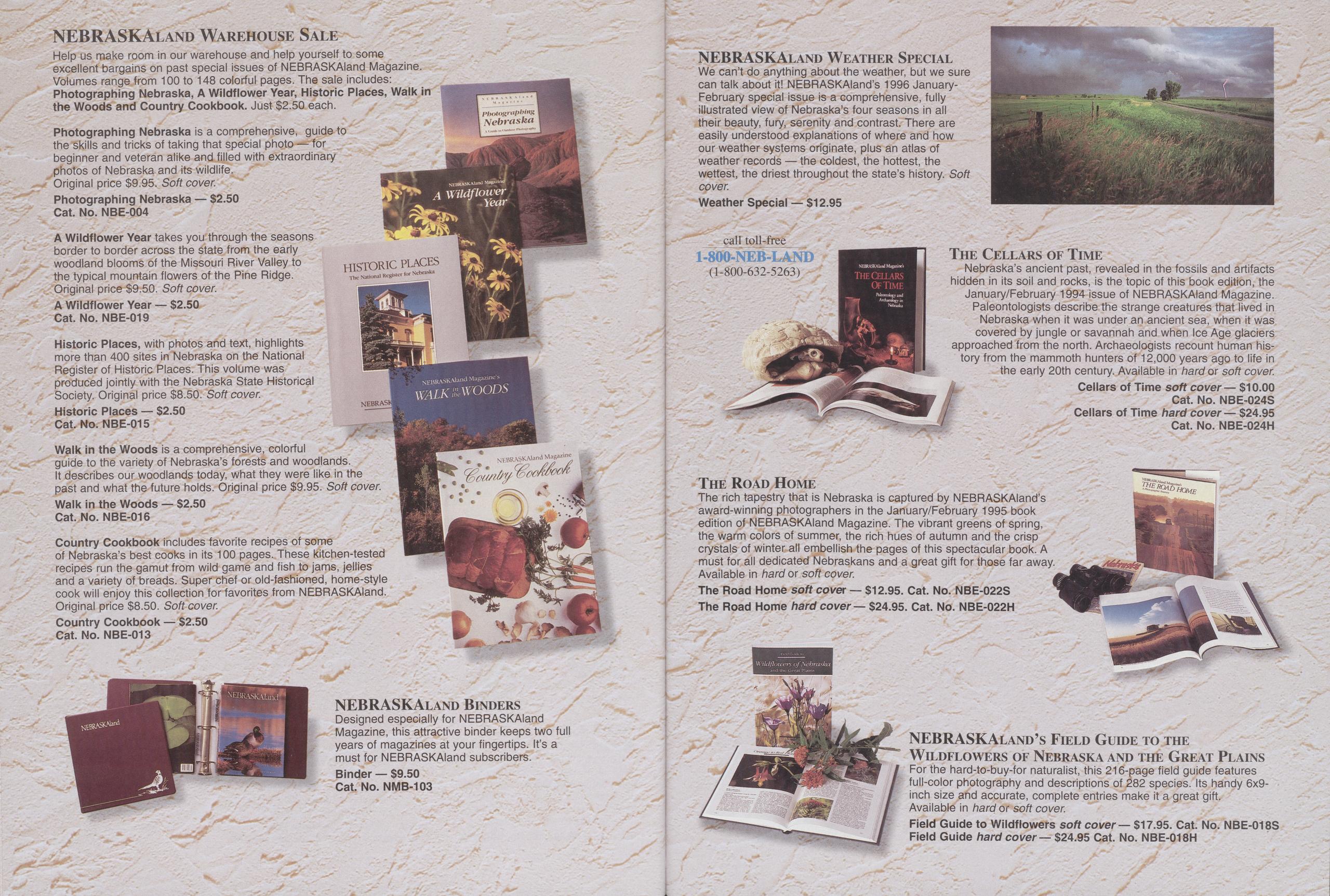
NEBRASKAland Warehouse Sale Help us make room in our warehouse and help yourself to some excellent bargains on past special issues of NEBRASKAland Magazine. Volumes range from 100 to 148 colorful pages. The sale includes: Photographing Nebraska, A Wildflower Year, Historic Places, Walk in the Woods and Country Cookbook. Just $2.50 each.
Photographing Nebraska is a comprehensive, guide to the skills and tricks of taking that special photo — for beginner and veteran alike and filled with extraordinary photos of Nebraska and its wildlife.
Original price $9.95. Soft cover. Photographing Nebraska — $2.50 Cat. No. NBE-004 Photographing Nebraska NEWUSKAhna A Wildflower Year NEBRASKAland Weather SpecialWe can’t do anything about the weather, but we sure can talk about it! NEBRASKAIand’s 1996 January- February special issue is a comprehensive, fully illustrated view of Nebraska’s four seasons in all their beauty, fury, serenity and contrast. There are easily understood explanations of where and how our weather systems originate, plus an atlas of weather records — the coldest, the hottest, the wettest, the driest throughout the state’s history. Soft cover.
Weather Special — $12.95
A Wildflower Year takes you through the seasons border to border across the state from the early woodland blooms of the Missouri River Valley to the typical mountain flowers of the Pine Ridge. Original price $9.50. Soft cover.
A Wildflower Year — $2.50 Cat. No. NBE-019Historic Places, with photos and text, highlights more than 400 sites in Nebraska on the National Register of Historic Places. This volume was produced jointly with the Nebraska State Historical Society. Original price $8.50. Soft cover.
Historic Places — $2.50 Cat. No. NBE-015 PLACES National Register for Nebraska NEBRASI NEBRASKAland Magazine s WALK&WOODS call toll-free 1-800-NEB-LAND (1-800-632-5263) The Cellars of TimeNebraska’s ancient past, revealed in the fossils and artifacts hidden in its soil and rocks, is the topic of this book edition, the January/February 1994 issue of NEBRASKAland Magazine. Paleontologists describe the strange creatures that lived in Nebraska when it was under an ancient sea, when it was covered by jungle or savannah and when Ice Age glaciers approached from the north. Archaeologists recount human his- tory from the mammoth hunters of 12,000 years ago to life in the early 20th century. Available in hard or soft cover.
Cellars of Time soft cover— $10.00 Cat. No. NBE-024S Cellars of Time hard cover— $24.95 Cat. No. NBE-024H Walk in the Woods is a comprehensive, colorful guide to the variety of Nebraska’s forests and woodlands. It describes our woodlands today, what they were like in the past and what the future holds. Original price $9.95. Soft cover. Walk in the Woods — $2.50 Cat. No. NBE-016Country Cookbook includes favorite recipes of some of Nebraska’s best cooks in its 100 pages. These kitchen-tested recipes run the gamut from wild game and fish to jams, jellies and a variety of breads. Super chef or old-fashioned, home-style cook will enjoy this collection for favorites from NEBRASKAland. Original price $8.50. Soft cover.
Country Cookbook — $2.50 Cat. No. NBE-013 NEBRASKAland Magazine The Road HomeThe rich tapestry that is Nebraska is captured by NEBRASKAIand’s award-winning photographers in the January/February 1995 book edition of NEBRASKAland Magazine. The vibrant greens of spring, the warm colors of summer, the rich hues of autumn and the crisp crystals of winter all embellish the pages of this spectacular book. A must for all dedicated Nebraskans and a great gift for those far away. Available in hard or soft cover.
The Road Home soft cover — $12.95. Cat. No. NBE-022S The Road Home hard cover— $24.95. Cat. No. NBE-022H NEBRASKAland Binders Designed especially for NEBRASKAland Magazine, this attractive binder keeps two full years of magazines at your fingertips. It’s a must for NEBRASKAland subscribers. Binder — $9.50 Cat. No. NMB-103 Wildflowers of NebraskaNEBRASKAland’s Field Guide to the Wildflowers of Nebraska and the Great Plains For the hard-to-buy-for naturalist, this 216-page field guide features full-color photography and descriptions of 282 species. Its handy 6x9- inch size and accurate, complete entries make it a great gift. Available in hard or soft cover.
Field Guide to Wildflowers soft cover $17.95. Cat. No. NBE-018S Field Guide hard cover—$24.95 Cat. No. NBE-018H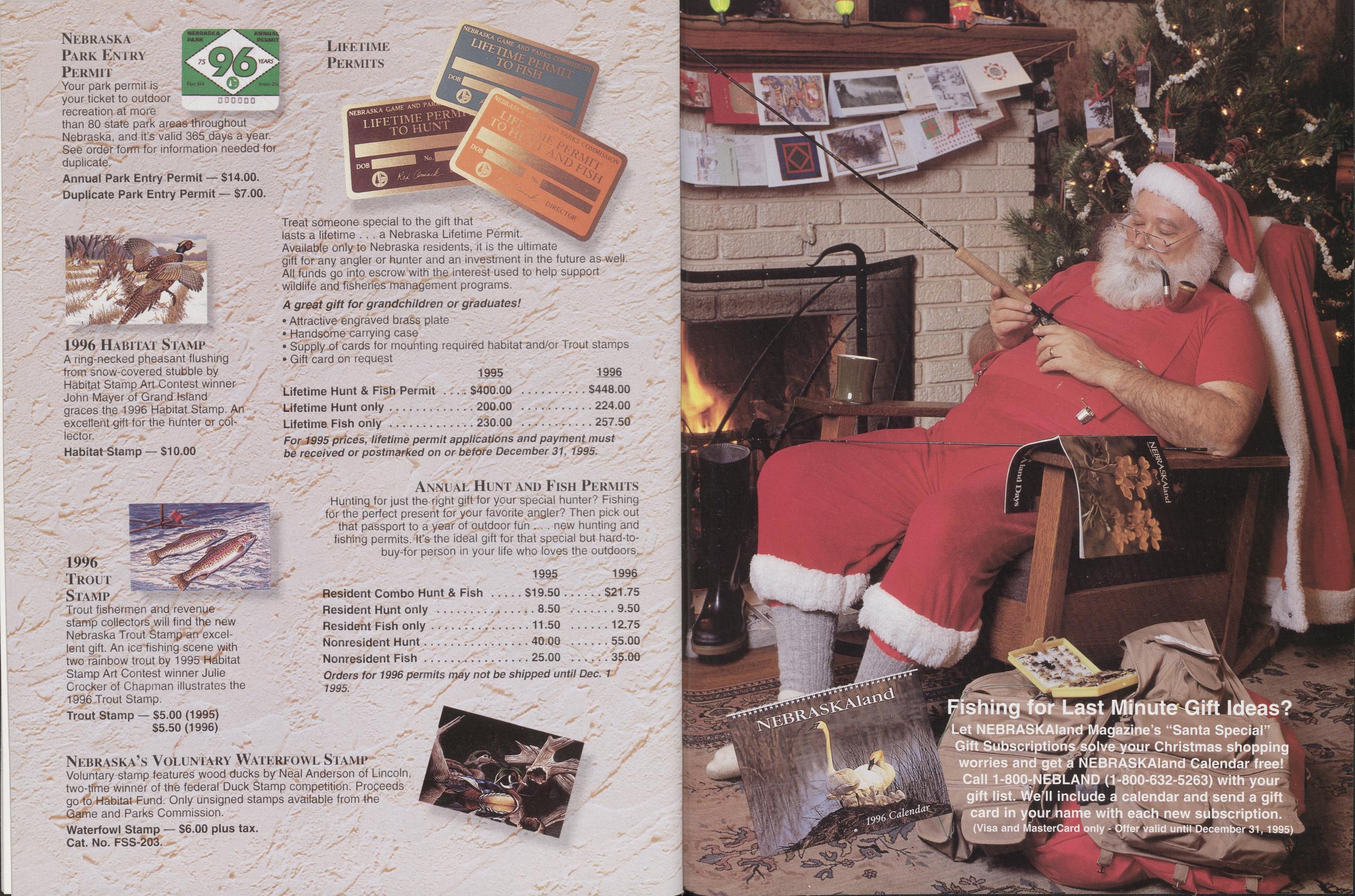 Lifetime
Permits
Nebraska
Park Entry
Permit
Lifetime
Permits
Nebraska
Park Entry
Permit
Your park permit is your ticket to outdoor recreation at more than 80 state park areas Nebraska, and it’s valid 365 days a year. See order form for information needed for duplicate.
Annual Park Entry Permit $14.00. Duplicate Park Entry Permit $7.00.1996 Habitat Stamp A ring-necked pheasant flushing Treat someone special to the gift that lasts a lifetime ... a Nebraska Lifetime Permit. Available only to Nebraska residents, it is the ultimate gift for any angler or hunter and an investment in the future as well. All funds go into escrow with the interest used to help support wildlife and fisheries management programs. A great gift for grandchildren or graduates!
Attractive engraved brass plate Handsome carrying case Supply of cards for mounting required habitat and/or Trout stamps Gift card on request from snow-covered stubble by Habitat Stamp Art Contest winner John Mayer of Grand Island graces the 1996 Habitat Stamp. An Lifetime Hunt & Fish Permit Lifetime Hunt only 1995 1996 $400.00 $448.00 200.00 224.00 excellent gift for the hunter or col- lector. Habitat Stamp — $10.00 Lifetime Fish only 230.00 257.50 For 1995 prices, lifetime permit applications and payment must be received or postmarked on or before December 31, 1995. 1996 Trout Stamp Annual Hunt and Fish Permits Hunting for just the right gift for your special hunter? Fishing for the perfect present for your favorite angler? Then pick out that passport to a year of outdoor fun . . . new hunting and fishing permits. It’s the ideal gift for that special but hard-to- buy-for person in your life who loves the outdoors. 1995 Resident Combo Hunt & Fish $19.50 1996 $21.75 Trout fishermen and revenue stamp collectors will find the new Nebraska Trout Stamp an excel- lent gift. An ice fishing scene with two rainbow trout by 1995 Habitat Resident Hunt only Resident Fish only Nonresident Hunt. Nonresident Fish . 8.50 9.50 11.50 12.75 40.00 55.00 25.00 35.00 Stamp Art Contest winner Julie Crocker of Chapman illustrates the 1996 Trout Stamp. Trout Stamp — $5.00 (1995) $5.50 (1996) Nebraska’s Voluntary Waterfowl Stamp Voluntary stamp features wood ducks by Neal Anderson of Lincoln, two-time winner of the federal Duck Stamp competition. Proceeds go to Habitat Fund. Only unsigned stamps available from the Game and Parks Commission. Waterfowl Stamp — $6.00 plus tax. Cat. No. FSS-203. Orders for 1996 permits may not be shipped until Dec. 1 1995. Calett Fishing for Last Minute^Gift Ideas? Let NEBRASKA land Magazine’s “Santa Special” Gift Subscriptions solve your Christmas shopping worries and get a NEBRASKAIand Calendar free! Call 1-800-NEBLAND (1 -800-632-5263) with your gift list. We'll include a calendar and send a gift card in your name with each new subscription. (Visa and MasterCard only - Offer valid until December 31, 1995)
Position: 737 (15 views)