Volume 73, Issue 8, 1995
NEBRASKAland
OCTOBER 1995 $2.00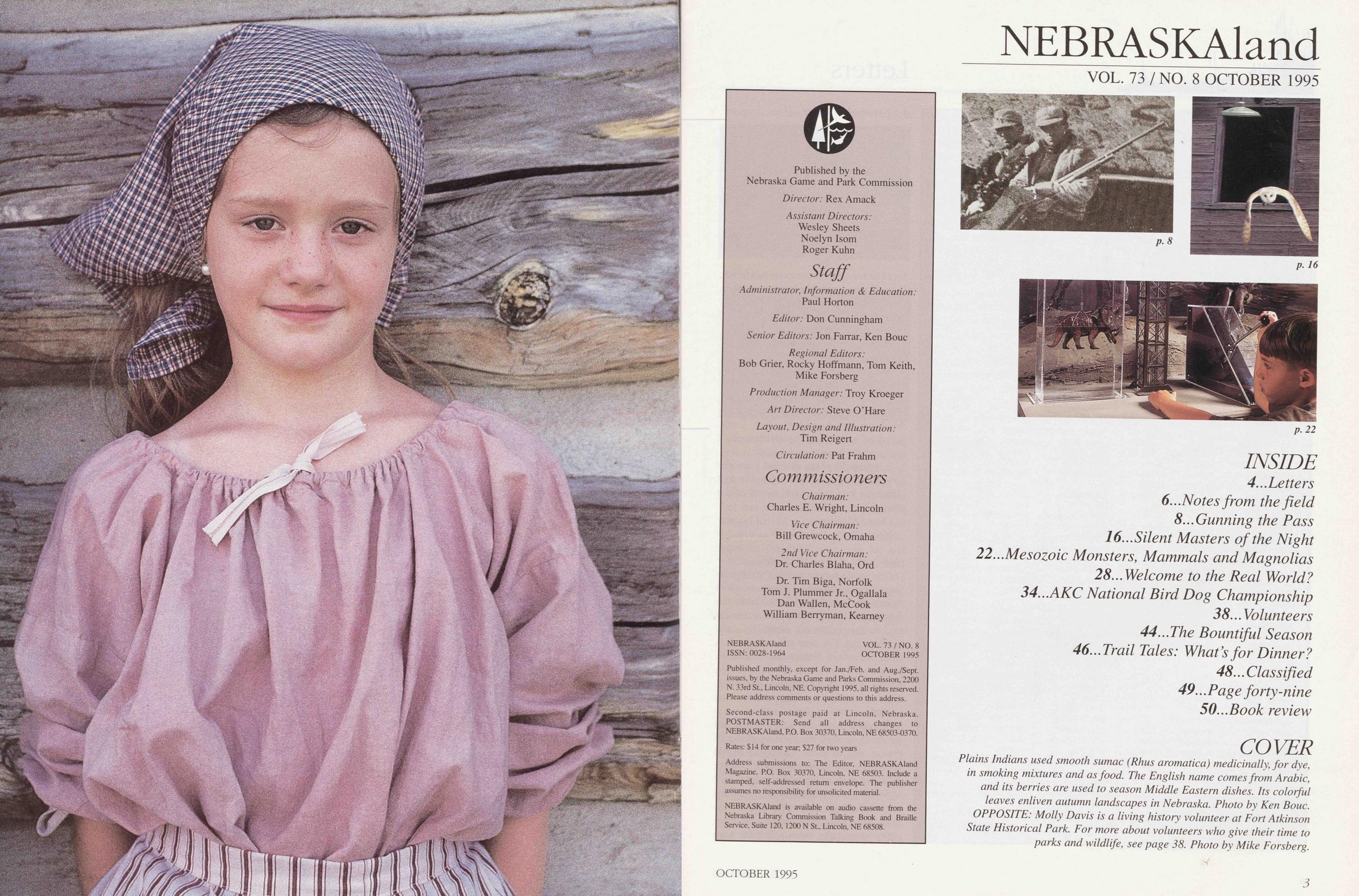
NEBRASKAland
VOL. 73 / NO. 8 OCTOBER 1995 Published by the Nebraska Game and Park Commission Director: Rex Amack Assistant Directors: Wesley Sheets Noelyn Isom Roger Kuhn Staff Administrator, Information & Education: Paul Horton Editor: Don Cunningham Senior Editors: Jon Farrar, Ken Bouc Regional Editors: Bob Grier, Rocky Hoffmann, Tom Keith, Mike Forsberg Production Manager: Troy Kroeger Art Director: Steve O'Hare Layout, Design and Illustration: Tim Reigert Circulation: Pat Frahm Commissioners Chairman: Charles E. Wright, Lincoln Vice Chairman: Bill Grewcock, Omaha 2nd Vice Chairman: Dr. Charles Blaha, Ord Dr. Tim Biga, Norfolk Tom J. Plummer Jr., Ogallala Dan Wallen, McCook William Berryman, Kearney NEBRASKAIand ISSN: 0028-1964 VOL. 73 / NO. 8 OCTOBER 1995 Published monthly, except for Jan./Feb. and Aug./Sept. issues, by the Nebraska Game and Parks Commission, 2200 N. 33rd St. Lincoln, NE. Copyright 1995, all rights reserved. Please address comments or questions to this address. Second-class postage paid at Lincoln, Nebraska. POSTMASTER: Send all address changes to NEBRASKAIand, P.O. Box 30370, Lincoln, NE 68503-0370. Rates: $14 for one year; $27 for two years Address submissions to: The Editor, NEBRASKAIand Magazine, P.O. Box 30370, Lincoln, NE 68503. Include a stamped, self-addressed return envelope. The publisher assumes no responsibility for unsolicited material. NEBRASKAIand is available on audio cassette from the Nebraska Library Commission Talking Book and Braille Service. Suite 120. 1200 N St., Lincoln, NE 68508.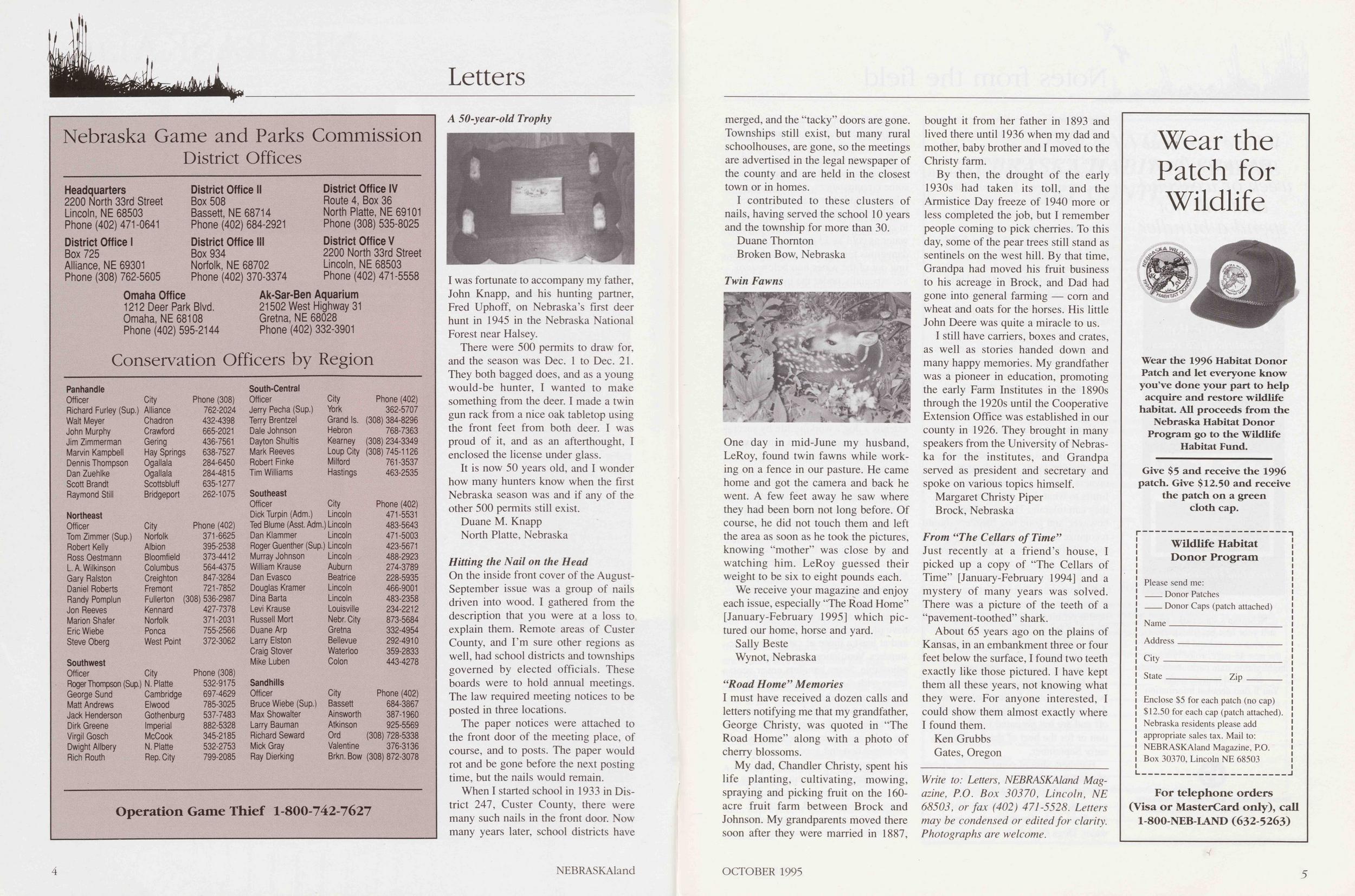
Letters
Nebraska Game and Parks Commission District Offices Headquarters 2200 North 33rd Street Lincoln, NE 68503 Phone (402)471-0641 District Office I Box 725 Alliance, NE 69301 Phone (308)762-5605 District Office II Box 508 Bassett, NE 68714 Phone (402)684-2921 District Office III Box 934 Norfolk, NE 68702 Phone (402)370-3374 District Office IV Route 4, Box 36 North Platte, NE 69101 Phone (308)535-8025 District Office V 2200 North 33rd Street Lincoln, NE 68503 Phone (402)471-5558 Omaha Office 1212 Deer Park Blvd. Omaha, NE 68108 Phone (402) 595-2144 Ak-Sar-Ben Aquarium 21502 West Highway 31 Gretna, NE 68028 Phone (402) 332-3901 Conservation Officers by Region Panhandle Officer Richard Furley (Sup.) Walt Meyer John Murphy Jim Zimmerman Marvin Kampbell Dennis Thompson Dan Zuehlke Scott Brandt Raymond Still Northeast Officer Tom Zimmer (Sup.) Robert Kelly Ross Oestmann L.A.Wilkinson Gary Ralston Daniel Roberts Randy Pomplun Jon Reeves Marion Shafer Eric Wiebe Steve Oberg Southwest Officer Roger Thompson (Sup.) George Sund Matt Andrews Jack Henderson Dirk Greene Virgil Gosch Dwight Allbery Rich Routh City Alliance Chadron Crawford Gering Hay Springs Ogallala Ogallala Scottsbluff Bridgeport Phone (308) 762-2024 432-4398 665-2021 436-7561 638-7527 284-6450 284-4815 635-1277 262-1075 City Norfolk Albion Bloomfield Columbus Creighton Fremont Fullerton Kennard Norfolk Ponca West Point Phone (402) 371-6625 395-2538 373-4412 564-4375 847-3284 721-7852 (308) 536-2987 427-7378 371-2031 755-2566 372-3062 City N. Platte Cambridge Elwood Gothenburg Imperial McCook N. Platte Rep. City Phone (308) 532-9175 697-4629 785-3025 537-7483 882-5328 345-2185 532-2753 799-2085 South-Central Officer City Jerry Pecha (Sup.) York Terry Brentzel Grand Is. Dale Johnson Hebron Dayton Shultis Kearney Mark Reeves Loup City Robert Finke Milford Tim Williams Hastings Southeast Officer City Dick Turpin (Adm.) Lincoln Ted Blume (Asst. Adm.) Lincoln Dan Klammer Lincoln Roger Guenther (Sup.) Lincoln Murray Johnson Lincoln William Krause Auburn Dan Evasco Beatrice Douglas Kramer Lincoln Dina Barta Lincoln Levi Krause Louisville Russell Mort Nebr. City Duane Arp Gretna Larry Elston Bellevue Craig Stover Waterloo Mike Luben Colon Sandhills Officer City Bruce Wiebe (Sup.) Bassett Max Showalter Ainsworth Larry Bauman Atkinson Richard Seward Ord Mick Gray Valentine Ray Dierking Brkn. Bow Phone (402) 362-5707 (308) 384-8296 768-7363 (308) 234-3349 (308)745-1126 761-3537 463-2535 Phone (402) 471-5531 483-5643 471-5003 423-5671 488-2923 274-3789 228-5935 466-9001 483-2358 234-2212 873-5684 332-4954 292-4910 359-2833 443-4278 Phone (402) 684-3867 387-1960 925-5569 (308) 728-5338 376-3136 (308) 872-3078 Operation Game Thief 1-800-742-7627 A 50-year-old TrophyI was fortunate to accompany my father, John Knapp, and his hunting partner, Fred Uphoff, on Nebraska's first deer hunt in 1945 in the Nebraska National Forest near Halsey.
There were 500 permits to draw for, and the season was Dec. 1 to Dec. 21. They both bagged does, and as a young would-be hunter, I wanted to make something from the deer. I made a twin gun rack from a nice oak tabletop using the front feet from both deer. I was proud of it, and as an afterthought, I enclosed the license under glass.
It is now 50 years old, and I wonder how many hunters know when the first Nebraska season was and if any of the other 500 permits still exist.
Duane M. Knapp North Platte, Nebraska Hitting the Nail on the HeadOn the inside front cover of the August-September issue was a group of nails driven into wood. I gathered from the description that you were at a loss to explain them. Remote areas of Custer County, and I'm sure other regions as well, had school districts and townships governed by elected officials. These boards were to hold annual meetings. The law required meeting notices to be posted in three locations.
The paper notices were attached to the front door of the meeting place, of course, and to posts. The paper would rot and be gone before the next posting time, but the nails would remain.
When I started school in 1933 in District 247, Custer County, there were many such nails in the front door. Now many years later, school districts have 4 NEBRASKAland merged, and the "tacky" doors are gone. Townships still exist, but many rural schoolhouses, are gone, so the meetings are advertised in the legal newspaper of the county and are held in the closest town or in homes.
I contributed to these clusters of nails, having served the school 10 years and the township for more than 30.
Duane Thornton Broken Bow, Nebraska Twin FawnsOne day in mid-June my husband, LeRoy, found twin fawns while working on a fence in our pasture. He came home and got the camera and back he went. A few feet away he saw where they had been born not long before. Of course, he did not touch them and left the area as soon as he took the pictures, knowing "mother" was close by and watching him. LeRoy guessed their weight to be six to eight pounds each.
We receive your magazine and enjoy each issue, especially "The Road Home" [January-February 1995] which pictured our home, horse and yard.
Sally Beste Wynot, Nebraska "Road Home99 MemoriesI must have received a dozen calls and letters notifying me that my grandfather, George Christy, was quoted in "The Road Home" along with a photo of cherry blossoms.
My dad, Chandler Christy, spent his life planting, cultivating, mowing, spraying and picking fruit on the 160-acre fruit farm between Brock and Johnson. My grandparents moved there soon after they were married in 1887, bought it from her father in 1893 and lived there until 1936 when my dad and mother, baby brother and I moved to the Christy farm.
By then, the drought of the early 1930s had taken its toll, and the Armistice Day freeze of 1940 more or less completed the job, but I remember people coming to pick cherries. To this day, some of the pear trees still stand as sentinels on the west hill. By that time, Grandpa had moved his fruit business to his acreage in Brock, and Dad had gone into general farming — corn and wheat and oats for the horses. His little John Deere was quite a miracle to us.
I still have carriers, boxes and crates, as well as stories handed down and many happy memories. My grandfather was a pioneer in education, promoting the early Farm Institutes in the 1890s through the 1920s until the Cooperative Extension Office was established in our county in 1926. They brought in many speakers from the University of Nebraska for the institutes, and Grandpa served as president and secretary and spoke on various topics himself.
Margaret Christy Piper Brock, Nebraska From "The Cellars of Time99Just recently at a friend's house, I picked up a copy of "The Cellars of Time" [January-February 1994] and a mystery of many years was solved. There was a picture of the teeth of a "pavement-toothed" shark.
About 65 years ago on the plains of Kansas, in an embankment three or four feet below the surface, I found two teeth exactly like those pictured. I have kept them all these years, not knowing what they were. For anyone interested, I could show them almost exactly where I found them.
Ken Grubbs Gates, Oregon Write to: Letters, NEBRASKAland Magazine, P.O. Box 30370, Lincoln, NE 68503, or fax (402) 471-5528. Letters may he condensed or edited for clarity. Photographs are welcome. Wear the Patch for Wildlife Wear the 1996 Habitat Donor Patch and let everyone know you've done your part to help acquire and restore wildlife habitat. All proceeds from the Nebraska Habitat Donor Program go to the Wildlife Habitat Fund. Give $5 and receive the 1996 patch. Give $12.50 and receive the patch on a green cloth cap. Wildlife Habitat Donor Program Please send me: Donor Patches Donor Caps (patch attached) Name Address City State Zip Enclose $5 for each patch (no cap) $12.50 for each cap (patch attached). Nebraska residents please add appropriate sales tax. Mail to: NEBRASKAland Magazine, RO. " Box 30370, Lincoln NE 68503 For telephone orders (Visa or MasterCard only), call 1-800-NEB-IAND (632-5263) OCTOBER 1995 5
Notes from the field
get away for a week or weekend, and still not spend a bundle? Nebraska's state parks are still your best bet for a perfect vacation or weekend break. Get the new 48-page, color brochure highlighting state parks, recreation areas and historic parks. You'll find detailed information on lodging, camping, activities, facilities, seasons, fees and reservation policies. Write or call today. Notes from the field Nebraska Game and Parks Commission P.O. Box 30370, Lincoln, NE, 68503 Phone (402-471-0641) Dog LimitsToday's well-bred hunting dogs don't come cheap, and once past the initial investment in a puppy, the real cost of dog ownership begins. Kennels, runs, vaccinations, food, portable boxes, veterinary expenses and training can cost thousands of dollars. Why, then, do so many dog owners abuse, overwork and demand so much from their dogs that physical or even fatal consequences result?
The rationalization often heard is, "I have so much invested in that animal that he had better be able to perform under the conditions I ask him to, or else!" That reasoning is foolish, even irresponsible. Common sense tells us that if we make a major investment, we want to get as much return from that investment as possible. That means preventative maintenance, good conditioning and responsible actions.
Hunting dogs are incredible athletes with remarkable capacity to endure. Possibly because of the abilities dogs demonstrate in the field, some dog owners seem to believe there are no limits to what dogs can do and what they can tolerate. There are limits, however, and good dog handlers should recognize them. A "go-gef em" pooch most likely won't recognize his own limits, and instincts and training can drive him dangerously close to death.
Overworking dogs in hot weather is responsible for most exertion-related health problems. Every year in the first weeks of the prairie grouse season, hard working pointers die in the field from overheating. September can be quite warm, even hot, and a dog anxious for the hunt may not quit until his body shuts down. In September, most dogs are kennel-soft from summer layoff and are not prepared for the exertion or for the heat of the Sandhills in early September.
Handlers should constantly be aware of conditions and force their dogs to take a break, providing them with water as needed. Don't depend on windmill tanks for their sole supply of water. Dogs cool their bodies primarily through the evaporation of saliva, a function that displaces a considerable amount of body fluid.
Temperature conditions at the other extreme can be just as dangerous under some circumstances. Although dogs tolerate cold better than heat, a good handler will provide for a dog working in cold weather, too. Short periods in water as cold as 33 degrees are not dangerous for most retrievers, but getting out of the water into below-zero air, especially under the influence of a strong north wind, can produce hypothermia even in the best of breeds.
Although no dog should be fat, retrievers should never be too skinny. A hunting blind should have a dry bed for the pooch when he returns with the duck, and don't feel foolish about fitting him with a neoprene vest for added insulation. Some retriever handlers claim that a well-fitted vest extends a dog's working life by several years. Vests even come in camouflage patterns, and they are relatively inexpensive.
Great care should be taken when transporting a dog in fall or winter. Transporting an unkenneled dog in an open pickup is never a good idea, and it can be cruel — even deadly — in certain conditions. Even on a comfortably cool day, the windchill factor at 55 mph is significant. Couple that with evaporation if the dog is wet, and the overcooling risk can be critical. Dog crates used in open pickups should have plenty of bedding in the winter and at least a piece of carpeting in the summer. Ventilation should be adjustable. Some handlers cover ventilators with duct tape in winter and pull the tape off for the warmer months.
An active hunting dog might need time to recuperate after several days in the field, and to do so, he needs a well-protected bed and good nourishment. A dog exhausted from several days of hunting has a difficult time keeping warm, and a home kennel should be properly designed and maintained.
The most common mistake dog owners make when designing and 6 NEBRASKAland building a kennel is that, with good intentions, they want to provide Fido with a large, roomy box. He loves his roomy apartment in the summer, where he can lie on his back and let the cool wind blow gently across his belly.
In winter, however, that big box is not as appealing. The only furnace in most doghouses is the dog itself, and one of the functions of the doghouse is to hold the heat in. The more cubic feet a dog has to heat, the less effective the doghouse. Provide insulated walls, plenty of clean, fresh hay and an opening just large enough for the dog to squeeze through, and you have the recipe for an efficiently built doghouse.
Proper nutrition is especially important in winter and summer, so let the professionals who have made a study and a business of feeding dogs do it for you. Select reputable commercial dog food and consult your veterinarian. Whatever your choice of chow, volume should be increased during the hunting season and decreased in the off-time. A good diet is the cornerstone on which you build your hunting dog, starting from a puppy. The better the foundation you build, the greater the capacity your finished dog will have, but remember, there are limits to a dog's endurance.
Rocky Hoffmann Human LimitsHumans, too, are vulnerable to the effects of cold weather and exertion, and as hunting seasons approach, it might be a good idea to give some thought to the limits of your own endurance and the various ills that hunters are heir to. Pre-season exercise can prevent some sore muscles, and now is the time to put together a simple field first-aid kit.
Cool weather also can bring an unwelcome visitor, influenza. According to the Immunization Practices Advisory Committee of the Centers for Disease Control and Prevention, the best defense against the flu is an annual shot, and the best time for the vaccination is October or November, before flu season hits.
19th ANNUAL NEBRASKA HABITAT STAMP ART CONTEST Submission Entries may be protected by a covering but will not be accepted in frames, under glass or in plastic kitchen wrap. Wrap securely and send to: Habitat Stamp Contest, Game and Parks Commission, 2200 N. 33rd Street, P.O. Box 30370, Lincoln, NE 68503-0370. A completed entry form and reproduction agreement, or a facsimile thereof, must be attached to the back of the entry. Name and address of the artist must appear only on the reverse side of the entry. The Game and Parks Commission is not responsible for any entry lost or damaged in transit. ENTRIES WILL NOT BE RETURNED UNLESS SPECIFICALLY REQUESTED AND A SELF-ADDRESSED MAILER WITH PROPER RETURN POSTAGE IS INCLUDED. Prizes Adult division first-place winner receives $200 from the Omaha Fish and Wildlife Club. Youth division first-place winners in each section receive $50 from the Omaha Fish and Wildlife Club. Runners-up and honorable mentions in all divisions receive a subscription to NEBRASKAland Magazine. Technical Requirements Design must be 7'/2 inches by 4"/,6 inches. It may be matted, but mats may not exceed 10 inches by 7 inches. Any medium is acceptable, but no scrollwork or lettering may appear on the design. Color is preferred. Subject Matter Any Nebraska wildlife species in an appropriate habitat setting, except raccoon, fox squirrel, Hungarian partridge, prong-horned antelope and ring-necked pheasant, which are ineligible this year. Eligibility Contest is open to Nebraska residents only, and winning entry in the adult division will appear on the 1997 Nebraska Habitat Stamp. Employees of the Game and Parks Commission and their immediate families are not eligible to enter the adult division of the contest. Only one entry allowed per person. Divisions Adult: Amateur or professional artists. Youth: Senior Section - Grades 9-12; Junior Section Grades 5-8; Primary Section - Grades K-4. Entry Deadline March 1, 1996. Entry Form Please accept my entry in the 1996 Habitat Stamp Art Contest. I hereby certify that I have com- plied with all the rules governing this competition and that the work submitted is my own creation. Further, the Nebraska Game and Parks Commission is hereby authorized to reproduce my design on the 1997 Habitat Stamp or in any other fashion it may deem appropriate. Division/Section Title of Entry Name Grade in School Medium Age (if under 19) Address City, State, Zip Home Phone School Phone Name of School School Address City, State, Zip Please return my entry. I have included the appropriate postage. Artist's Signature OCTOBER 1995 7
Gltnmng THE Pass
By Jon Farrar In the first half of this century, pass shooting was an honored, ethical and effective way to kill ducks and geese. It was preferred hy the most apt observers of waterfowl behavior and the most skilled gunners.Waterfowl hunting probably has changed less than most things during the past hundred years. What once separated good, average and unsuccessful waterfowl hunters still separates them — how wisely they select their decoy waters, how convincingly they call and how expertly they employ their shotguns. Certainly there now are fewer birds and smaller bag limits. Shotshells, boats, motors and duck calls are probably better. Shotguns and decoys, at least aesthetically, are much diminished from the days when craftsmanship was affordable. Some hunting techniques, such as the use of call ducks, are now illegal; others are legal, but seldom, if ever, employed by today's waterfowl hunters. One of the most interesting of these is pass shooting.
In its coarsest form, shooting at any passing duck is pass shooting. In its more "proper" form, a hunter positions himself where game birds will, in the course of their daily routine, pass within shotgun range. Such pass shooting is still done today, mostly at geese, usually as they move between refuges and nearby grainfields to feed. Pass shooters of this ilk are often held in disrepute by hunters who labor to bring birds to the decoys.
In the first half of this century, though, pass shooting was an honored, ethical and effective way to kill waterfowl. Hunters of old recognized that even ducks pausing during migration established regular and predictable daily patterns, patterns a hunter could exploit. Hunters more interested in birds for the table than in the amenities 8 NEBRASKAland
"As early as 5 o'clock the birds began to come, whence we could not tell, nor did not even try to guess," wrote Sandy Griswold, Omaha WorldHerald outdoor writer, in a 1913 column describing a March 1896 hunt in the Sandhills northwest of Cody in Cherry County.
"But they were coming in to roost and seemed to spring from a thousand points near the level of the horizon. For an hour the flight was ragged and spasmodic, but after the sun had hidden his fiery face behind the western rim of sandy plain they came in, it seemed, in countless thousands. The canvasbacks and redheads came with that rushing, tearing sound that always distinguishes them, as if rending with their speed the canopy of heaven. Down they came, flock after flock, out of the face of the night. Dense masses, with wings set in rigid curves, would come glancing swiftly down, while long lines of mallards and bluebills, with stiffened pinions, made the keen and sensuous spring air hiss beneath them. The stupendous spectacle was sufficient to have made an inexperienced sportsman gasp with wonder and while I, myself, OCTOBER 1995 9 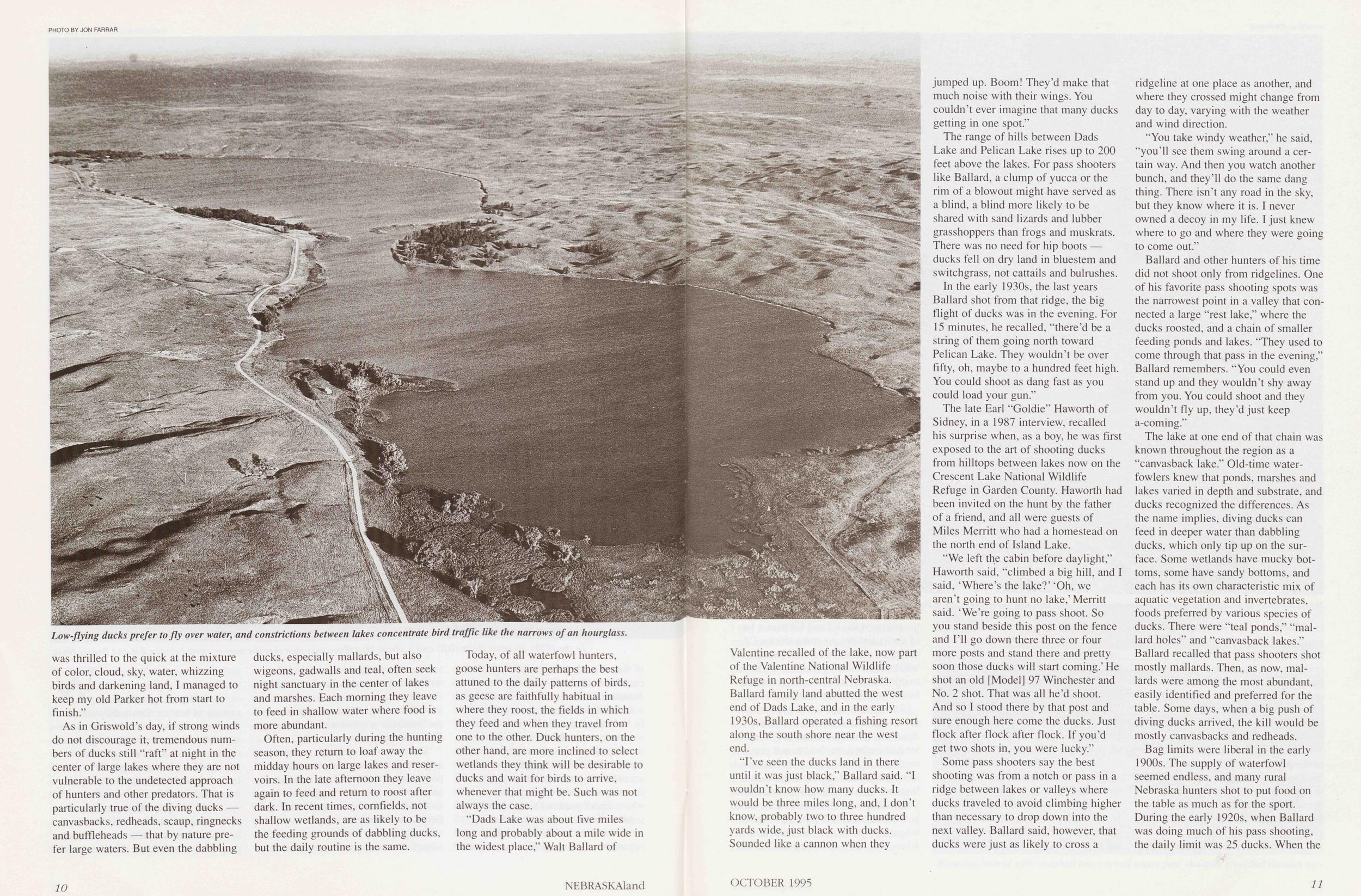
As in Griswold's day, if strong winds do not discourage it, tremendous numbers of ducks still "raft" at night in the center of large lakes where they are not vulnerable to the undetected approach of hunters and other predators. That is particularly true of the diving ducks canvasbacks, redheads, scaup, ringnecks and buffleheads — that by nature prefer large waters. But even the dabbling ducks, especially mallards, but also wigeons, gadwalls and teal, often seek night sanctuary in the center of lakes and marshes. Each morning they leave to feed in shallow water where food is more abundant.
Often, particularly during the hunting season, they return to loaf away the midday hours on large lakes and reservoirs. In the late afternoon they leave again to feed and return to roost after dark. In recent times, cornfields, not shallow wetlands, are as likely to be the feeding grounds of dabbling ducks, but the daily routine is the same.
Today, of all waterfowl hunters, goose hunters are perhaps the best attuned to the daily patterns of birds, as geese are faithfully habitual in where they roost, the fields in which they feed and when they travel from one to the other. Duck hunters, on the other hand, are more inclined to select wetlands they think will be desirable to ducks and wait for birds to arrive, whenever that might be. Such was not always the case.
"Dads Lake was about five miles long and probably about a mile wide in the widest place," Walt Ballard of 10 NEBRASKAland Valentine recalled of the lake, now part of the Valentine National Wildlife Refuge in north-central Nebraska. Ballard family land abutted the west end of Dads Lake, and in the early 1930s, Ballard operated a fishing resort along the south shore near the west end.
"I've seen the ducks land in there until it was just black," Ballard said. "I wouldn't know how many ducks. It would be three miles long, and, I don't know, probably two to three hundred yards wide, just black with ducks. Sounded like a cannon when they jumped up. Boom! They'd make that much noise with their wings. You couldn't ever imagine that many ducks getting in one spot."
The range of hills between Dads Lake and Pelican Lake rises up to 200 feet above the lakes. For pass shooters like Ballard, a clump of yucca or the rim of a blowout might have served as a blind, a blind more likely to be shared with sand lizards and lubber grasshoppers than frogs and muskrats. There was no need for hip boots ducks fell on dry land in bluestem and switchgrass, not cattails and bulrushes.
In the early 1930s, the last years Ballard shot from that ridge, the big flight of ducks was in the evening. For 15 minutes, he recalled, "there'd be a string of them going north toward Pelican Lake. They wouldn't be over fifty, oh, maybe to a hundred feet high. You could shoot as dang fast as you could load your gun."
The late Earl "Goldie" Haworth of Sidney, in a 1987 interview, recalled his surprise when, as a boy, he was first exposed to the art of shooting ducks from hilltops between lakes now on the Crescent Lake National Wildlife Refuge in Garden County. Haworth had been invited on the hunt by the father of a friend, and all were guests of Miles Merritt who had a homestead on the north end of Island Lake.
"We left the cabin before daylight," Haworth said, "climbed a big hill, and I said, 'Where's the lake?' 'Oh, we aren't going to hunt no lake,' Merritt said. 'We're going to pass shoot. So you stand beside this post on the fence and I'll go down there three or four more posts and stand there and pretty soon those ducks will start coming.' He shot an old [Model] 97 Winchester and No. 2 shot. That was all he'd shoot. And so I stood there by that post and sure enough here come the ducks. Just flock after flock after flock. If you'd get two shots in, you were lucky."
Some pass shooters say the best shooting was from a notch or pass in a ridge between lakes or valleys where ducks traveled to avoid climbing higher than necessary to drop down into the next valley. Ballard said, however, that ducks were just as likely to cross a ridgeline at one place as another, and where they crossed might change from day to day, varying with the weather and wind direction.
"You take windy weather," he said, "you'll see them swing around a certain way. And then you watch another bunch, and they'll do the same dang thing. There isn't any road in the sky, but they know where it is. I never owned a decoy in my life. I just knew where to go and where they were going to come out."
Ballard and other hunters of his time did not shoot only from ridgelines. One of his favorite pass shooting spots was the narrowest point in a valley that connected a large "rest lake," where the ducks roosted, and a chain of smaller feeding ponds and lakes. "They used to come through that pass in the evening," Ballard remembers. "You could even stand up and they wouldn't shy away from you. You could shoot and they wouldn't fly up, they'd just keep a-coming."
The lake at one end of that chain was known throughout the region as a "canvasback lake." Old-time waterfowlers knew that ponds, marshes and lakes varied in depth and substrate, and ducks recognized the differences. As the name implies, diving ducks can feed in deeper water than dabbling ducks, which only tip up on the surface. Some wetlands have mucky bottoms, some have sandy bottoms, and each has its own characteristic mix of aquatic vegetation and invertebrates, foods preferred by various species of ducks. There were "teal ponds," "mallard holes" and "canvasback lakes." Ballard recalled that pass shooters shot mostly mallards. Then, as now, mallards were among the most abundant, easily identified and preferred for the table. Some days, when a big push of diving ducks arrived, the kill would be mostly canvasbacks and redheads.
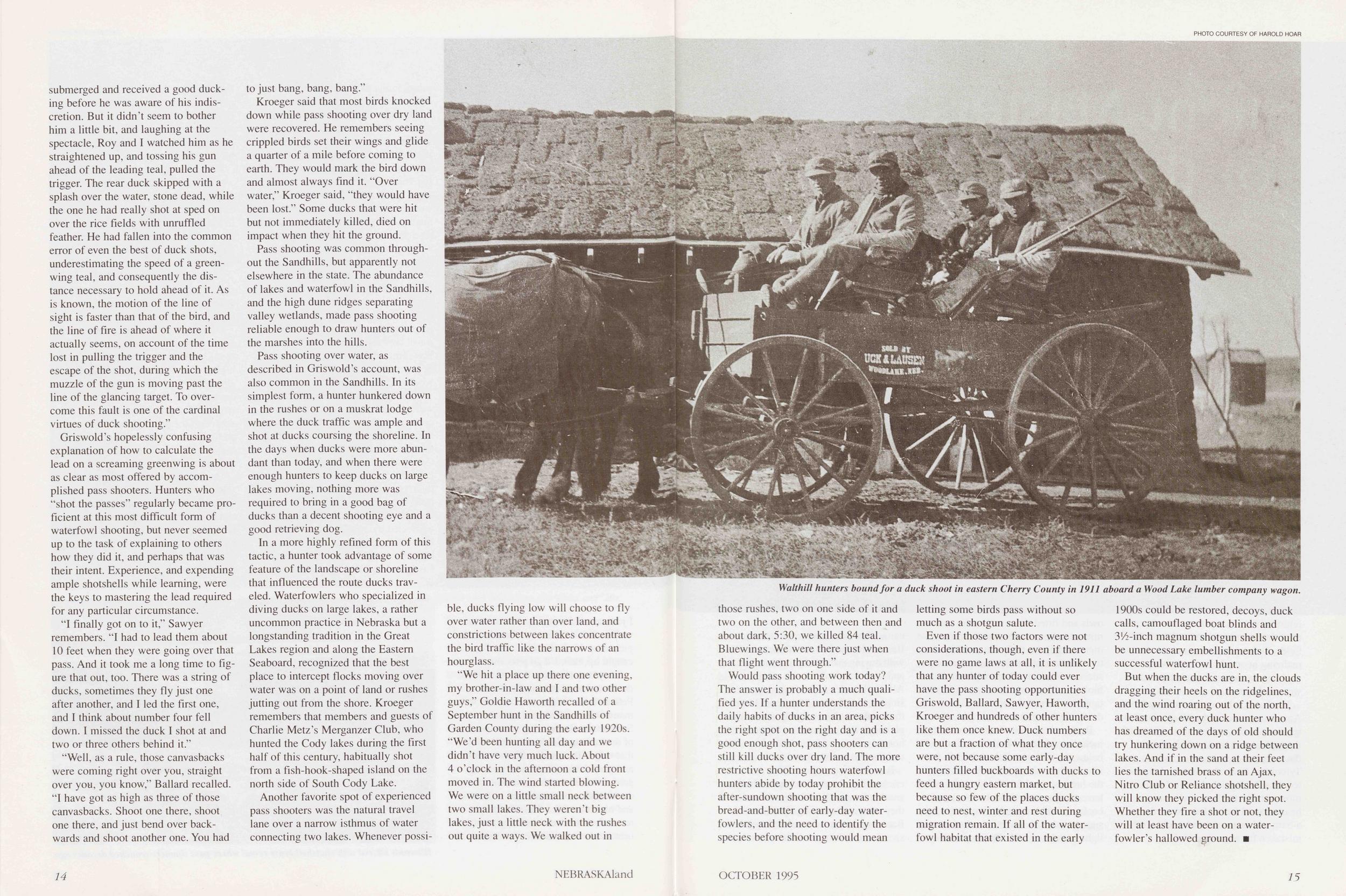
Bag limits were liberal in the early 1900s. The supply of waterfowl seemed endless, and many rural Nebraska hunters shot to put food on the table as much as for the sport. During the early 1920s, when Ballard was doing much of his pass shooting, the daily limit was 25 ducks. When the OCTOBER 1995 11 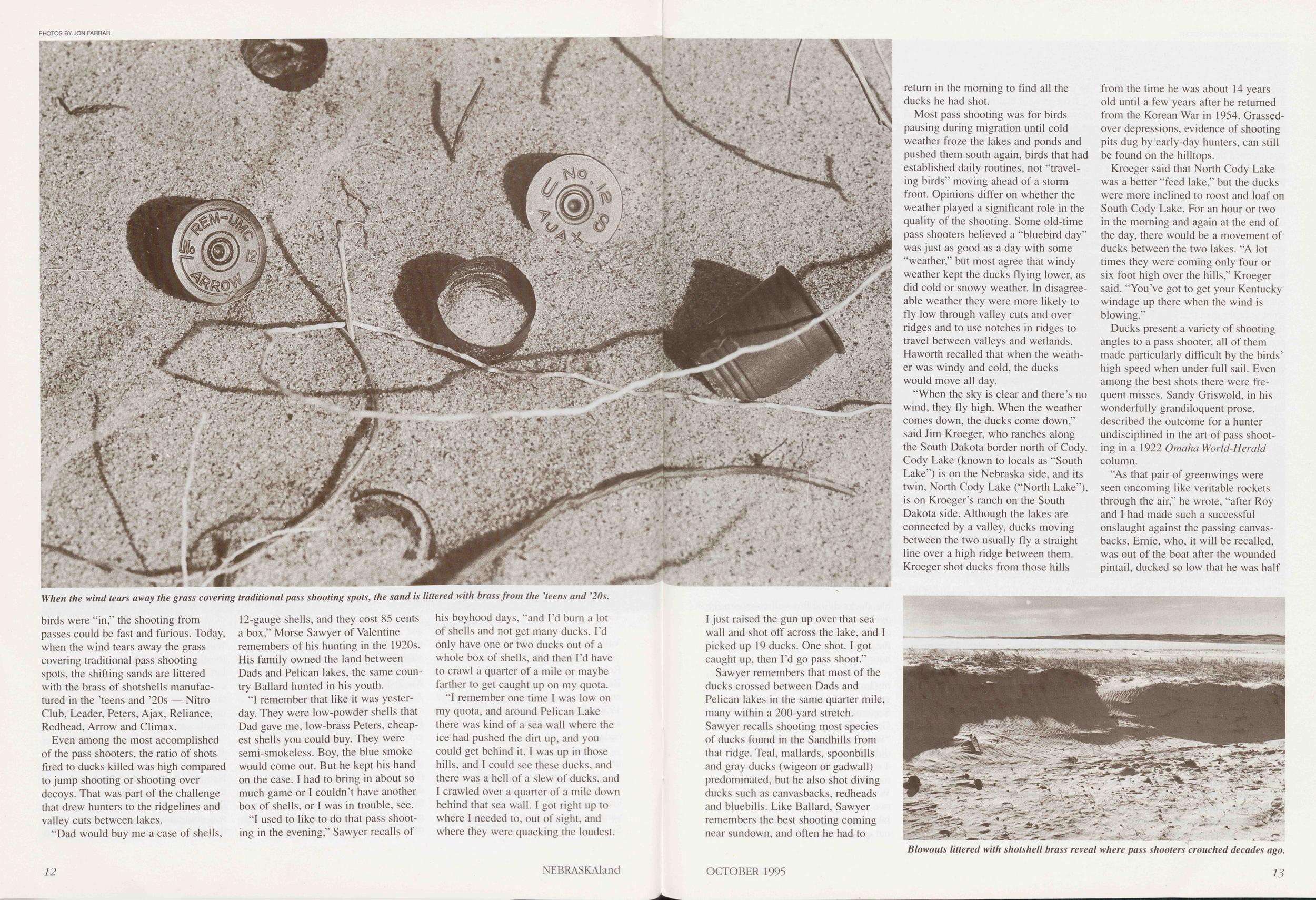
Even among the most accomplished of the pass shooters, the ratio of shots fired to ducks killed was high compared to jump shooting or shooting over decoys. That was part of the challenge that drew hunters to the ridgelines and valley cuts between lakes.
"Dad would buy me a case of shells, 12-gauge shells, and they cost 85 cents a box," Morse Sawyer of Valentine remembers of his hunting in the 1920s. His family owned the land between Dads and Pelican lakes, the same country Ballard hunted in his youth.
"I remember that like it was yesterday. They were low-powder shells that Dad gave me, low-brass Peters, cheapest shells you could buy. They were semi-smokeless. Boy, the blue smoke would come out. But he kept his hand on the case. I had to bring in about so much game or I couldn't have another box of shells, or I was in trouble, see.
"I used to like to do that pass shooting in the evening," Sawyer recalls of his boyhood days, "and I'd burn a lot of shells and not get many ducks. Ed only have one or two ducks out of a whole box of shells, and then I'd have to crawl a quarter of a mile or maybe farther to get caught up on my quota.
"I remember one time I was low on my quota, and around Pelican Lake there was kind of a sea wall where the ice had pushed the dirt up, and you could get behind it. I was up in those hills, and I could see these ducks, and there was a hell of a slew of ducks, and I crawled over a quarter of a mile down behind that sea wall. I got right up to where I needed to, out of sight, and where they were quacking the loudest. 12 NEBRASKAland I just raised the gun up over that sea wall and shot off across the lake, and I picked up 19 ducks. One shot. I got caught up, then I'd go pass shoot."
Sawyer remembers that most of the ducks crossed between Dads and Pelican lakes in the same quarter mile, many within a 200-yard stretch. Sawyer recalls shooting most species of ducks found in the Sandhills from that ridge. Teal, mallards, spoonbills and gray ducks (wigeon or gadwall) predominated, but he also shot diving ducks such as canvasbacks, redheads and bluebills. Like Ballard, Sawyer remembers the best shooting coming near sundown, and often he had to return in the morning to find all the ducks he had shot.
Most pass shooting was for birds pausing during migration until cold weather froze the lakes and ponds and pushed them south again, birds that had established daily routines, not "traveling birds" moving ahead of a storm front. Opinions differ on whether the weather played a significant role in the quality of the shooting. Some old-time pass shooters believed a "bluebird day" was just as good as a day with some "weather," but most agree that windy weather kept the ducks flying lower, as did cold or snowy weather. In disagreeable weather they were more likely to fly low through valley cuts and over ridges and to use notches in ridges to travel between valleys and wetlands. Haworth recalled that when the weather was windy and cold, the ducks would move all day.
"When the sky is clear and there's no wind, they fly high. When the weather comes down, the ducks come down," said Jim Kroeger, who ranches along the South Dakota border north of Cody. Cody Lake (known to locals as "South Lake") is on the Nebraska side, and its twin, North Cody Lake ("North Lake"), is on Kroeger's ranch on the South Dakota side. Although the lakes are connected by a valley, ducks moving between the two usually fly a straight line over a high ridge between them. Kroeger shot ducks from those hills from the time he was about 14 years old until a few years after he returned from the Korean War in 1954. Grassed-over depressions, evidence of shooting pits dug by early-day hunters, can still be found on the hilltops.
Kroeger said that North Cody Lake was a better "feed lake," but the ducks were more inclined to roost and loaf on South Cody Lake. For an hour or two in the morning and again at the end of the day, there would be a movement of ducks between the two lakes. "A lot times they were coming only four or six foot high over the hills," Kroeger said. "You've got to get your Kentucky windage up there when the wind is blowing."
Ducks present a variety of shooting angles to a pass shooter, all of them made particularly difficult by the birds' high speed when under full sail. Even among the best shots there were frequent misses. Sandy Griswold, in his wonderfully grandiloquent prose, described the outcome for a hunter undisciplined in the art of pass shooting in a 1922 Omaha World-Herald column.
"As that pair of greenwings were seen oncoming like veritable rockets through the air," he wrote, "after Roy and I had made such a successful onslaught against the passing canvasbacks, Ernie, who, it will be recalled, was out of the boat after the wounded pintail, ducked so low that he was half
 submerged and received a good ducking before he was aware of his indiscretion. But it didn't seem to bother him a little bit, and laughing at the spectacle, Roy and I watched him as he straightened up, and tossing his gun ahead of the leading teal, pulled the trigger. The rear duck skipped with a splash over the water, stone dead, while the one he had really shot at sped on over the rice fields with unruffled feather. He had fallen into the common error of even the best of duck shots, underestimating the speed of a greenwing teal, and consequently the distance necessary to hold ahead of it. As is known, the motion of the line of sight is faster than that of the bird, and the line of fire is ahead of where it actually seems, on account of the time lost in pulling the trigger and the escape of the shot, during which the muzzle of the gun is moving past the line of the glancing target. To overcome this fault is one of the cardinal virtues of duck shooting."
Griswold's hopelessly confusing explanation of how to calculate the lead on a screaming greenwing is about as clear as most offered by accomplished pass shooters. Hunters who "shot the passes" regularly became proficient at this most difficult form of waterfowl shooting, but never seemed up to the task of explaining to others how they did it, and perhaps that was their intent. Experience, and expending ample shotshells while learning, were the keys to mastering the lead required for any particular circumstance.
"I finally got on to it," Sawyer remembers. "I had to lead them about 10 feet when they were going over that pass. And it took me a long time to figure that out, too. There was a string of ducks, sometimes they fly just one after another, and I led the first one, and I think about number four fell down. I missed the duck I shot at and two or three others behind it."
"Well, as a rule, those canvasbacks were coming right over you, straight over you, you know," Ballard recalled. "I have got as high as three of those canvasbacks. Shoot one there, shoot one there, and just bend over backwards and shoot another one. You had to just bang, bang, bang."
Kroeger said that most birds knocked down while pass shooting over dry land were recovered. He remembers seeing crippled birds set their wings and glide a quarter of a mile before coming to earth. They would mark the bird down and almost always find it. "Over water," Kroeger said, "they would have been lost." Some ducks that were hit but not immediately killed, died on impact when they hit the ground.
Pass shooting was common throughout the Sandhills, but apparently not elsewhere in the state. The abundance of lakes and waterfowl in the Sandhills, and the high dune ridges separating valley wetlands, made pass shooting reliable enough to draw hunters out of the marshes into the hills.
Pass shooting over water, as described in Griswold's account, was also common in the Sandhills. In its simplest form, a hunter hunkered down in the rushes or on a muskrat lodge where the duck traffic was ample and shot at ducks coursing the shoreline. In the days when ducks were more abundant than today, and when there were enough hunters to keep ducks on large lakes moving, nothing more was required to bring in a good bag of ducks than a decent shooting eye and a good retrieving dog.
In a more highly refined form of this tactic, a hunter took advantage of some feature of the landscape or shoreline that influenced the route ducks traveled. Waterfowlers who specialized in diving ducks on large lakes, a rather uncommon practice in Nebraska but a longstanding tradition in the Great Lakes region and along the Eastern Seaboard, recognized that the best place to intercept flocks moving over water was on a point of land or rushes jutting out from the shore. Kroeger remembers that members and guests of Charlie Metz's Merganzer Club, who hunted the Cody lakes during the first half of this century, habitually shot from a fish-hook-shaped island on the north side of South Cody Lake.
Another favorite spot of experienced pass shooters was the natural travel lane over a narrow isthmus of water connecting two lakes. Whenever possible, ducks flying low will choose to fly over water rather than over land, and constrictions between lakes concentrate the bird traffic like the narrows of an hourglass.
"We hit a place up there one evening, my brother-in-law and I and two other guys," Goldie Haworth recalled of a September hunt in the Sandhills of Garden County during the early 1920s. "We'd been hunting all day and we didn't have very much luck. About 4 o'clock in the afternoon a cold front moved in. The wind started blowing. We were on a little small neck between two small lakes. They weren't big lakes, just a little neck with the rushes out quite a ways. We walked out in 14 NEBRASKAland
Would pass shooting work today? The answer is probably a much qualified yes. If a hunter understands the daily habits of ducks in an area, picks the right spot on the right day and is a good enough shot, pass shooters can still kill ducks over dry land. The more restrictive shooting hours waterfowl hunters abide by today prohibit the after-sundown shooting that was the bread-and-butter of early-day waterfowlers, and the need to identify the species before shooting would mean letting some birds pass without so much as a shotgun salute.
Even if those two factors were not considerations, though, even if there were no game laws at all, it is unlikely that any hunter of today could ever have the pass shooting opportunities Griswold, Ballard, Sawyer, Haworth, Kroeger and hundreds of other hunters like them once knew. Duck numbers are but a fraction of what they once were, not because some early-day hunters filled buckboards with ducks to feed a hungry eastern market, but because so few of the places ducks need to nest, winter and rest during migration remain. If all of the waterfowl habitat that existed in the early 1900s could be restored, decoys, duck calls, camouflaged boat blinds and 3/2-inch magnum shotgun shells would be unnecessary embellishments to a successful waterfowl hunt.
But when the ducks are in, the clouds dragging their heels on the ridgelines, and the wind roaring out of the north, at least once, every duck hunter who has dreamed of the days of old should try hunkering down on a ridge between lakes. And if in the sand at their feet lies the tarnished brass of an Ajax, Nitro Club or Reliance shotshell, they will know they picked the right spot. Whether they fire a shot or not, they will at least have been on a waterfowler's hallowed ground.
OCTOBER 1995 15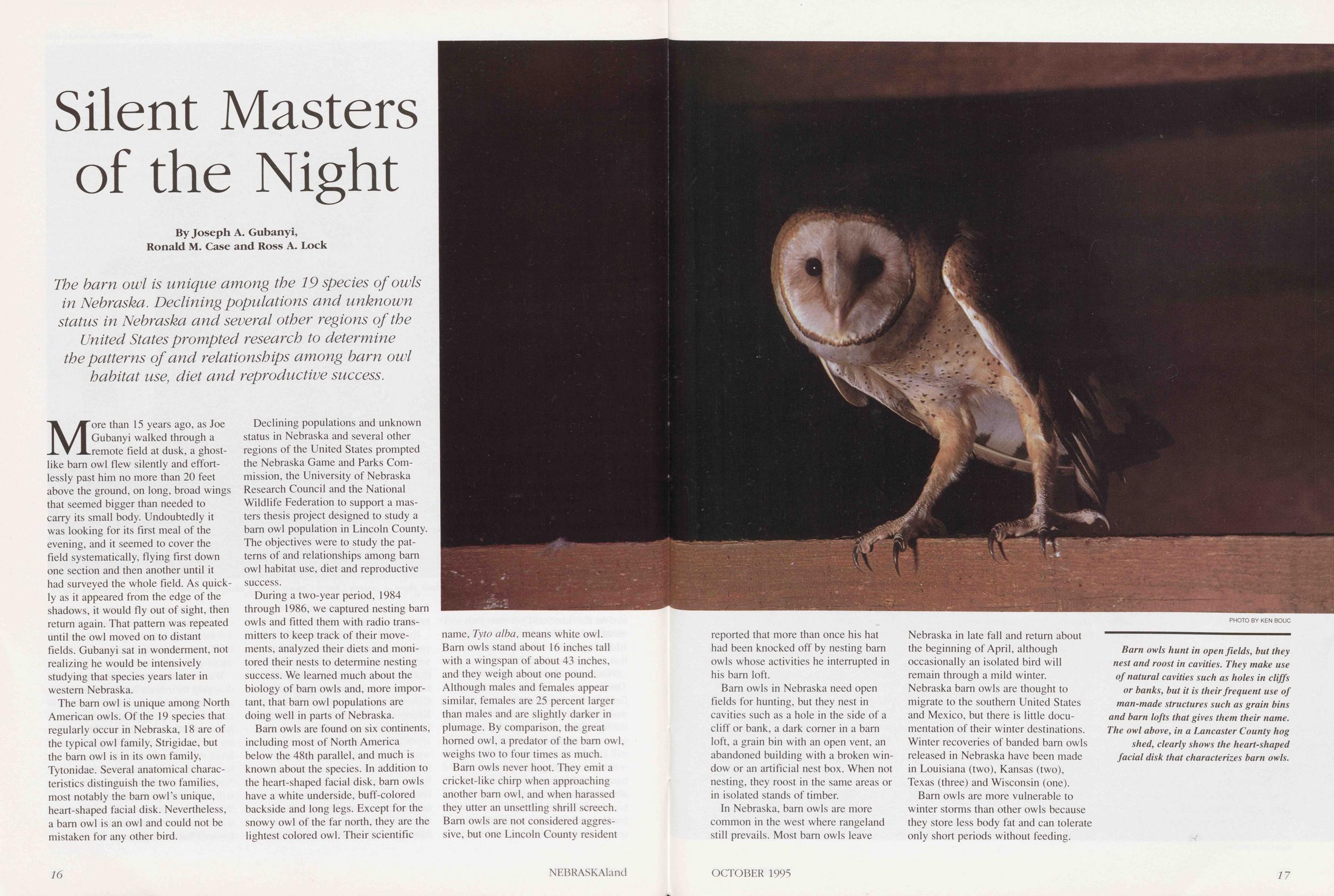
Silent Masters of the Night
By Joseph A. Gubanyi, Ronald M. Case and Ross A. Lock The barn owl is unique among the 19 species of owls in Nebraska. Declining populations and unknown status in Nebraska and several other regions of the United States prompted research to determine the patterns of and relationships among barn owl habitat use, diet and reproductive success.More than 15 years ago, as Joe Gubanyi walked through a remote field at dusk, a ghostlike bam owl flew silently and effortlessly past him no more than 20 feet above the ground, on long, broad wings that seemed bigger than needed to carry its small body. Undoubtedly it was looking for its first meal of the evening, and it seemed to cover the field systematically, flying first down one section and then another until it had surveyed the whole field. As quickly as it appeared from the edge of the shadows, it would fly out of sight, then return again. That pattern was repeated until the owl moved on to distant fields. Gubanyi sat in wonderment, not realizing he would be intensively studying that species years later in western Nebraska.
The bam owl is unique among North American owls. Of the 19 species that regularly occur in Nebraska, 18 are of the typical owl family, Strigidae, but the bam owl is in its own family, Tytonidae. Several anatomical characteristics distinguish the two families, most notably the bam owl's unique, heart-shaped facial disk. Nevertheless, a bam owl is an owl and could not be mistaken for any other bird.
Declining populations and unknown status in Nebraska and several other regions of the United States prompted the Nebraska Game and Parks Commission, the University of Nebraska Research Council and the National Wildlife Federation to support a masters thesis project designed to study a bam owl population in Lincoln County. The objectives were to study the patterns of and relationships among bam owl habitat use, diet and reproductive success.
During a two-year period, 1984 through 1986, we captured nesting bam owls and fitted them with radio transmitters to keep track of their movements, analyzed their diets and monitored their nests to determine nesting success. We learned much about the biology of bam owls and, more important, that barn owl populations are doing well in parts of Nebraska.
Bam owls are found on six continents, including most of North America below the 48th parallel, and much is known about the species. In addition to the heart-shaped facial disk, bam owls have a white underside, buff-colored backside and long legs. Except for the snowy owl of the far north, they are the lightest colored owl. Their scientific name, Tyto alba, means white owl. Bam owls stand about 16 inches tall with a wingspan of about 43 inches, and they weigh about one pound. Although males and females appear similar, females are 25 percent larger than males and are slightly darker in plumage. By comparison, the great homed owl, a predator of the bam owl, weighs two to four times as much.
Bam owls never hoot. They emit a cricket-like chirp when approaching another bam owl, and when harassed they utter an unsettling shrill screech. Bam owls are not considered aggressive, but one Lincoln County resident 16 NEBRASKAland reported that more than once his hat had been knocked off by nesting bam owls whose activities he interrupted in his bam loft.
Bam owls in Nebraska need open fields for hunting, but they nest in cavities such as a hole in the side of a cliff or bank, a dark comer in a bam loft, a grain bin with an open vent, an abandoned building with a broken window or an artificial nest box. When not nesting, they roost in the same areas or in isolated stands of timber.
In Nebraska, barn owls are more common in the west where rangeland still prevails. Most bam owls leave Nebraska in late fall and return about the beginning of April, although occasionally an isolated bird will remain through a mild winter. Nebraska bam owls are thought to migrate to the southern United States and Mexico, but there is little documentation of their winter destinations. Winter recoveries of banded bam owls released in Nebraska have been made in Louisiana (two), Kansas (two), Texas (three) and Wisconsin (one).
Bam owls are more vulnerable to winter storms than other owls because they store less body fat and can tolerate only short periods without feeding.
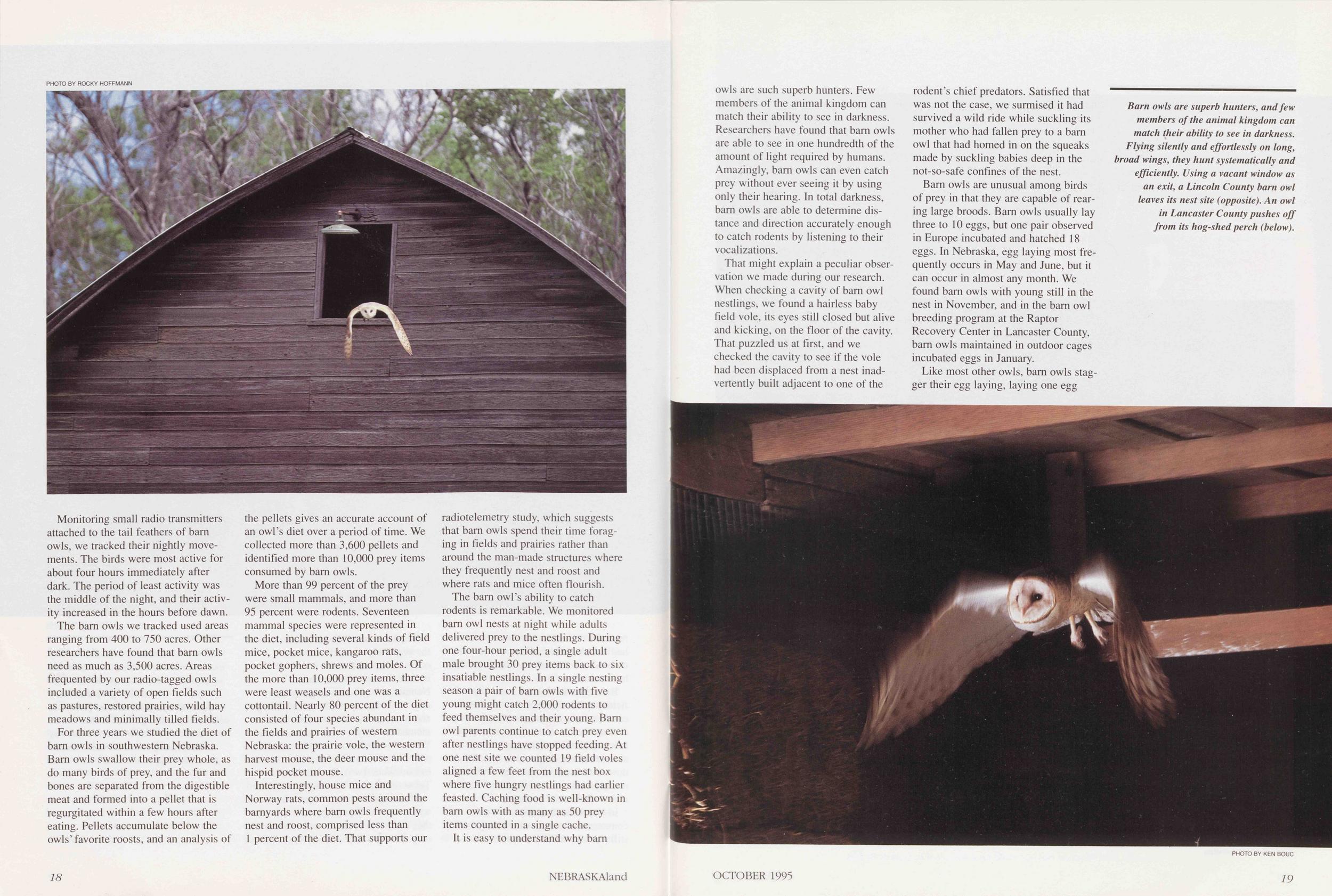
Monitoring small radio transmitters attached to the tail feathers of bam owls, we tracked their nightly movements. The birds were most active for about four hours immediately after dark. The period of least activity was the middle of the night, and their activity increased in the hours before dawn.
The bam owls we tracked used areas ranging from 400 to 750 acres. Other researchers have found that bam owls need as much as 3,500 acres. Areas frequented by our radio-tagged owls included a variety of open fields such as pastures, restored prairies, wild hay meadows and minimally tilled fields.
For three years we studied the diet of bam owls in southwestern Nebraska. Bam owls swallow their prey whole, as do many birds of prey, and the fur and bones are separated from the digestible meat and formed into a pellet that is regurgitated within a few hours after eating. Pellets accumulate below the owls' favorite roosts, and an analysis of the pellets gives an accurate account of an owl's diet over a period of time. We collected more than 3,600 pellets and identified more than 10,000 prey items consumed by bam owls.
More than 99 percent of the prey were small mammals, and more than 95 percent were rodents. Seventeen mammal species were represented in the diet, including several kinds of field mice, pocket mice, kangaroo rats, pocket gophers, shrews and moles. Of the more than 10,000 prey items, three were least weasels and one was a cottontail. Nearly 80 percent of the diet consisted of four species abundant in the fields and prairies of western Nebraska: the prairie vole, the western harvest mouse, the deer mouse and the hispid pocket mouse.
Interestingly, house mice and Norway rats, common pests around the barnyards where bam owls frequently nest and roost, comprised less than 1 percent of the diet. That supports our radiotelemetry study, which suggests that bam owls spend their time foraging in fields and prairies rather than around the man-made structures where they frequently nest and roost and where rats and mice often flourish.
The bam owl's ability to catch rodents is remarkable. We monitored bam owl nests at night while adults delivered prey to the nestlings. During one four-hour period, a single adult male brought 30 prey items back to six insatiable nestlings. In a single nesting season a pair of bam owls with five young might catch 2,000 rodents to feed themselves and their young. Bam owl parents continue to catch prey even after nestlings have stopped feeding. At one nest site we counted 19 field voles aligned a few feet from the nest box where five hungry nestlings had earlier feasted. Caching food is well-known in bam owls with as many as 50 prey items counted in a single cache.
It is easy to understand why barn 18 NEBRASKAland owls are such superb hunters. Few members of the animal kingdom can match their ability to see in darkness. Researchers have found that bam owls are able to see in one hundredth of the amount of light required by humans. Amazingly, bam owls can even catch prey without ever seeing it by using only their hearing. In total darkness, bam owls are able to determine distance and direction accurately enough to catch rodents by listening to their vocalizations.
That might explain a peculiar observation we made during our research. When checking a cavity of bam owl nestlings, we found a hairless baby field vole, its eyes still closed but alive and kicking, on the floor of the cavity. That puzzled us at first, and we checked the cavity to see if the vole had been displaced from a nest inadvertently built adjacent to one of the rodent's chief predators. Satisfied that was not the case, we surmised it had survived a wild ride while suckling its mother who had fallen prey to a bam owl that had homed in on the squeaks made by suckling babies deep in the not-so-safe confines of the nest.
Bam owls are unusual among birds of prey in that they are capable of rearing large broods. Bam owls usually lay three to 10 eggs, but one pair observed in Europe incubated and hatched 18 eggs. In Nebraska, egg laying most frequently occurs in May and June, but it can occur in almost any month. We found bam owls with young still in the nest in November, and in the bam owl breeding program at the Raptor Recovery Center in Lancaster County, bam owls maintained in outdoor cages incubated eggs in January.
Like most other owls, bam owls stagger their egg laying, laying one egg
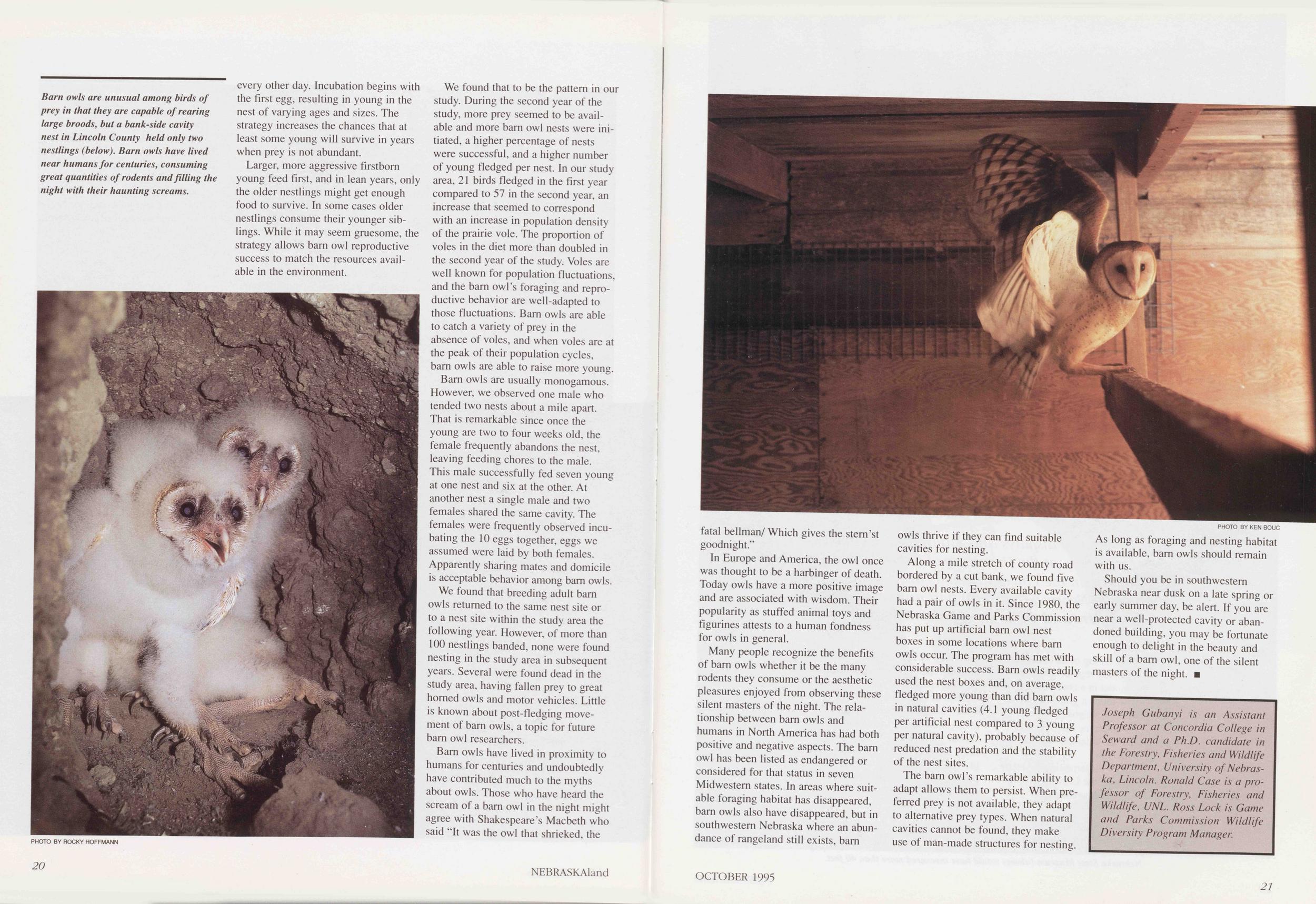
Larger, more aggressive firstborn young feed first, and in lean years, only the older nestlings might get enough food to survive. In some cases older nestlings consume their younger siblings. While it may seem gruesome, the strategy allows bam owl reproductive success to match the resources available in the environment.
We found that to be the pattern in our study. During the second year of the study, more prey seemed to be available and more bam owl nests were initiated, a higher percentage of nests were successful, and a higher number of young fledged per nest. In our study area, 21 birds fledged in the first year compared to 57 in the second year, an increase that seemed to correspond with an increase in population density of the prairie vole. The proportion of voles in the diet more than doubled in the second year of the study. Voles are well known for population fluctuations, and the bam owl's foraging and reproductive behavior are well-adapted to those fluctuations. Bam owls are able to catch a variety of prey in the absence of voles, and when voles are at the peak of their population cycles, bam owls are able to raise more young.
Bam owls are usually monogamous. However, we observed one male who tended two nests about a mile apart. That is remarkable since once the young are two to four weeks old, the female frequently abandons the nest, leaving feeding chores to the male. This male successfully fed seven young at one nest and six at the other. At another nest a single male and two females shared the same cavity. The females were frequently observed incubating the 10 eggs together, eggs we assumed were laid by both females. Apparently sharing mates and domicile is acceptable behavior among bam owls.
We found that breeding adult bam owls returned to the same nest site or to a nest site within the study area the following year. However, of more than 100 nestlings banded, none were found nesting in the study area in subsequent years. Several were found dead in the study area, having fallen prey to great homed owls and motor vehicles. Little is known about post-fledging movement of bam owls, a topic for future bam owl researchers.
Bam owls have lived in proximity to humans for centuries and undoubtedly have contributed much to the myths about owls. Those who have heard the scream of a bam owl in the night might agree with Shakespeare's Macbeth who said "It was the owl that shrieked, the 20 NEBRASKAland
In Europe and America, the owl once was thought to be a harbinger of death. Today owls have a more positive image and are associated with wisdom. Their popularity as stuffed animal toys and figurines attests to a human fondness for owls in general.
Many people recognize the benefits of bam owls whether it be the many rodents they consume or the aesthetic pleasures enjoyed from observing these silent masters of the night. The relationship between bam owls and humans in North America has had both positive and negative aspects. The bam owl has been listed as endangered or considered for that status in seven Midwestern states. In areas where suitable foraging habitat has disappeared, bam owls also have disappeared, but in southwestern Nebraska where an abundance of rangeland still exists, bam owls thrive if they can find suitable cavities for nesting.
Along a mile stretch of county road bordered by a cut bank, we found five bam owl nests. Every available cavity had a pair of owls in it. Since 1980, the Nebraska Game and Parks Commission has put up artificial bam owl nest boxes in some locations where bam owls occur. The program has met with considerable success. Bam owls readily used the nest boxes and, on average, fledged more young than did bam owls in natural cavities (4.1 young fledged per artificial nest compared to 3 young per natural cavity), probably because of reduced nest predation and the stability of the nest sites.
The bam owl's remarkable ability to adapt allows them to persist. When preferred prey is not available, they adapt to alternative prey types. When natural cavities cannot be found, they make use of man-made structures for nesting. As long as foraging and nesting habitat is available, bam owls should remain with us.
Should you be in southwestern Nebraska near dusk on a late spring or early summer day, be alert. If you are near a well-protected cavity or abandoned building, you may be fortunate enough to delight in the beauty and skill of a bam owl, one of the silent masters of the night.
foseph Guhanyi is an Assistant Professor at Concordia College in Seward and a Ph.D. candidate in the Forestry, Fisheries and Wildlife Department, University of Nebraska, Lincoln. Ronald Case is a professor of Forestry, Fisheries and Wildlife, UNL. Ross Lock is Game and Parks Commission Wildlife Diversity Program Manager. OCTOBER 1995 21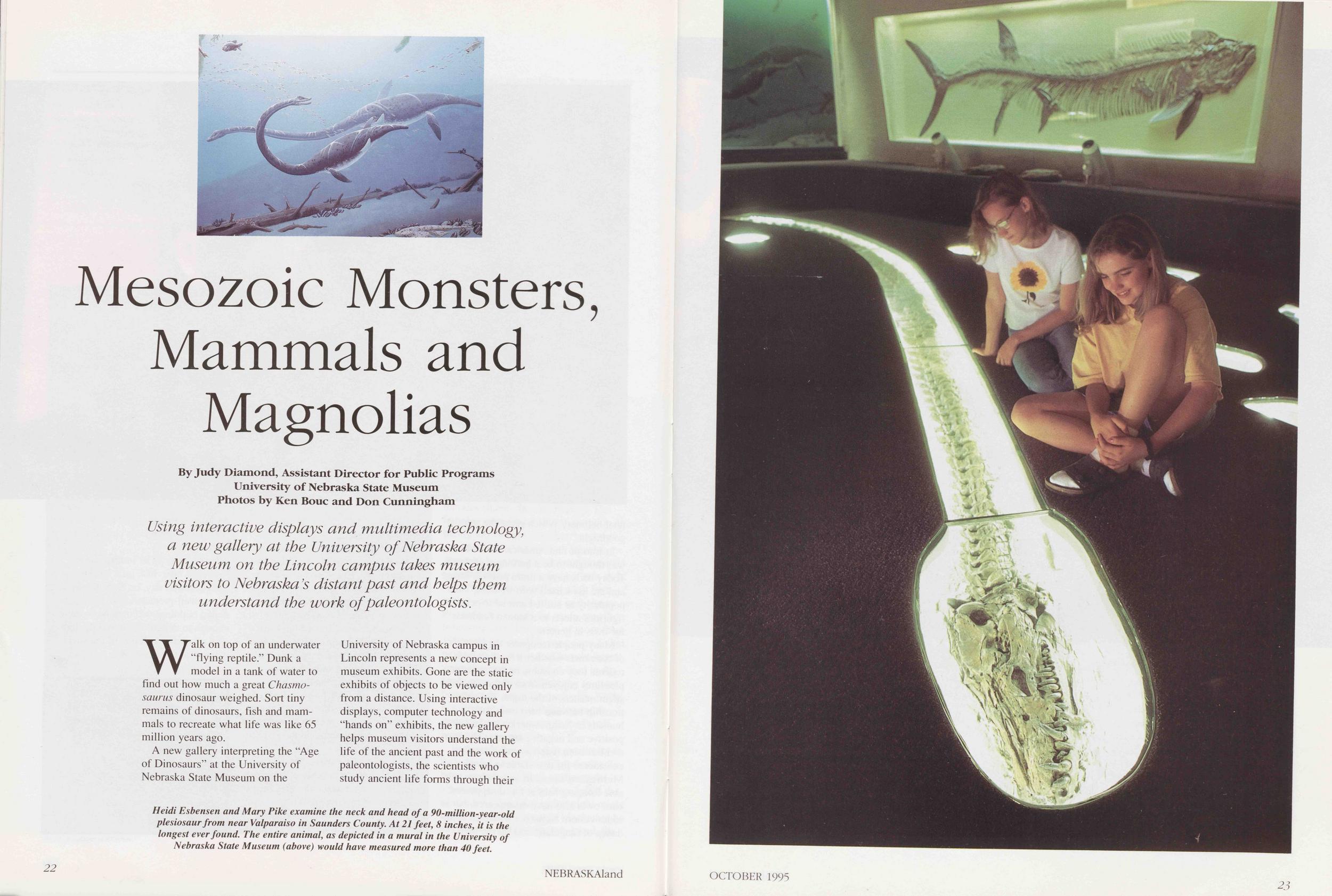
Mesozoic Monsters, Mammals and Magnolias
By Judy Diamond, Assistant Director for Public Programs University of Nebraska State Museum Photos by Ken Bouc and Don Cunningham Using interactive displays and multimedia technology, a new gallery at the University of Nebraska State Museum on the Lincoln campus takes museum visitors to Nebraska's distant past and helps them understand the work of paleontologists.Walk on top of an underwater "flying reptile:, Dunk a model in a tank of water to find out how much a great Chasmosaurus dinosaur weighed. Sort tiny remains of dinosaurs, fish and mammals to recreate what life was like 65 million years ago.
A new gallery interpreting the "Age of Dinosaurs" at the University of Nebraska State Museum on the University of Nebraska campus in Lincoln represents a new concept in museum exhibits. Gone are the static exhibits of objects to be viewed only from a distance. Using interactive displays, computer technology and "hands on" exhibits, the new gallery helps museum visitors understand the life of the ancient past and the work of paleontologists, the scientists who study ancient life forms through their 22 NEBRASKAland
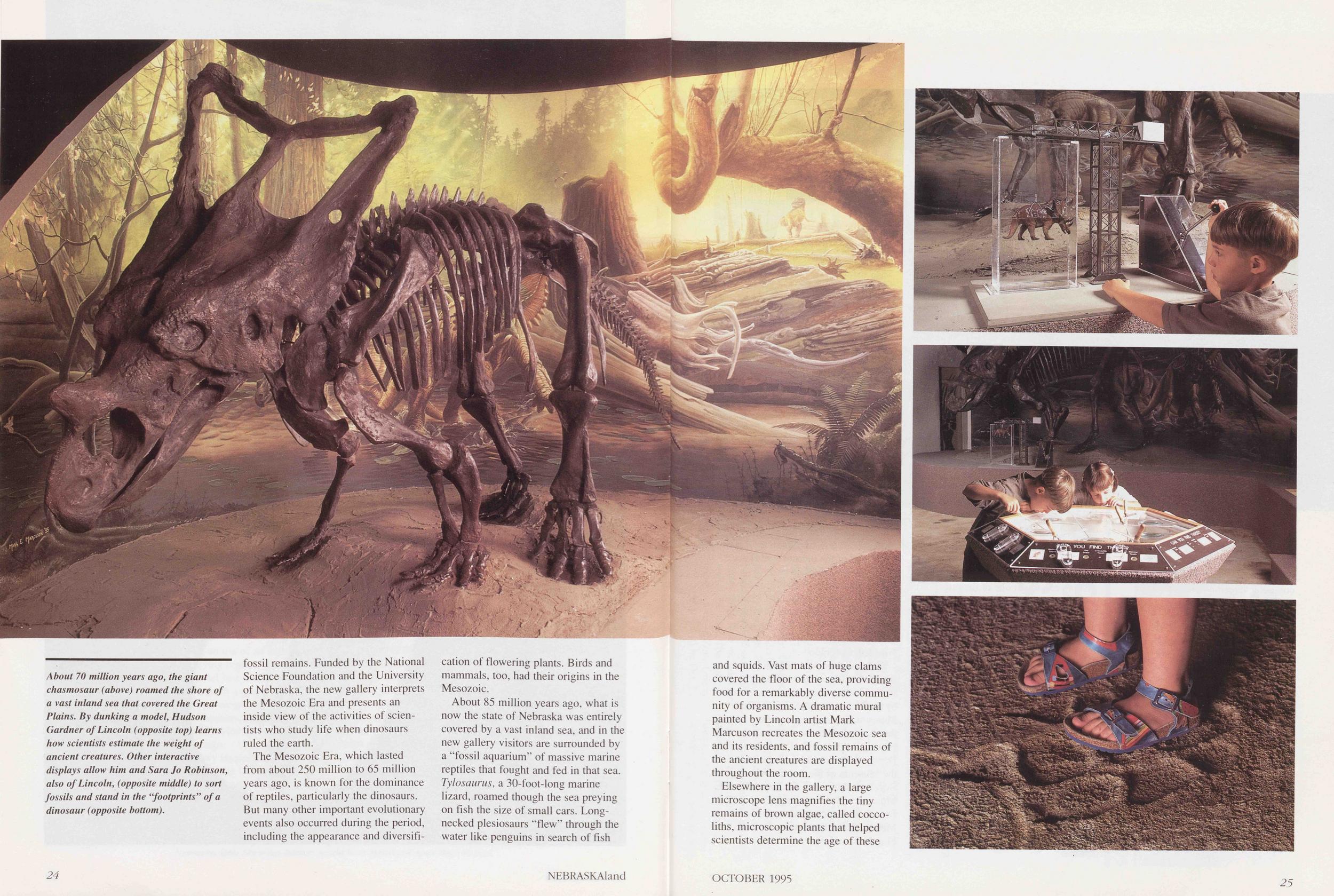
The Mesozoic Era, which lasted from about 250 million to 65 million years ago, is known for the dominance of reptiles, particularly the dinosaurs. But many other important evolutionary events also occurred during the period, including the appearance and diversification of flowering plants. Birds and mammals, too, had their origins in the Mesozoic.
About 85 million years ago, what is now the state of Nebraska was entirely covered by a vast inland sea, and in the new gallery visitors are surrounded by a "fossil aquarium'1 of massive marine reptiles that fought and fed in that sea. Tylosaurus, a 30-foot-long marine lizard, roamed though the sea preying on fish the size of small cars. Longnecked plesiosaurs "flew" through the water like penguins in search of fish 24 NEBRASKAland and squids. Vast mats of huge clams covered the floor of the sea, providing food for a remarkably diverse community of organisms. A dramatic mural painted by Lincoln artist Mark Marcuson recreates the Mesozoic sea and its residents, and fossil remains of the ancient creatures are displayed throughout the room.
Elsewhere in the gallery, a large microscope lens magnifies the tiny remains of brown algae, called coccoliths, microscopic plants that helped scientists determine the age of these
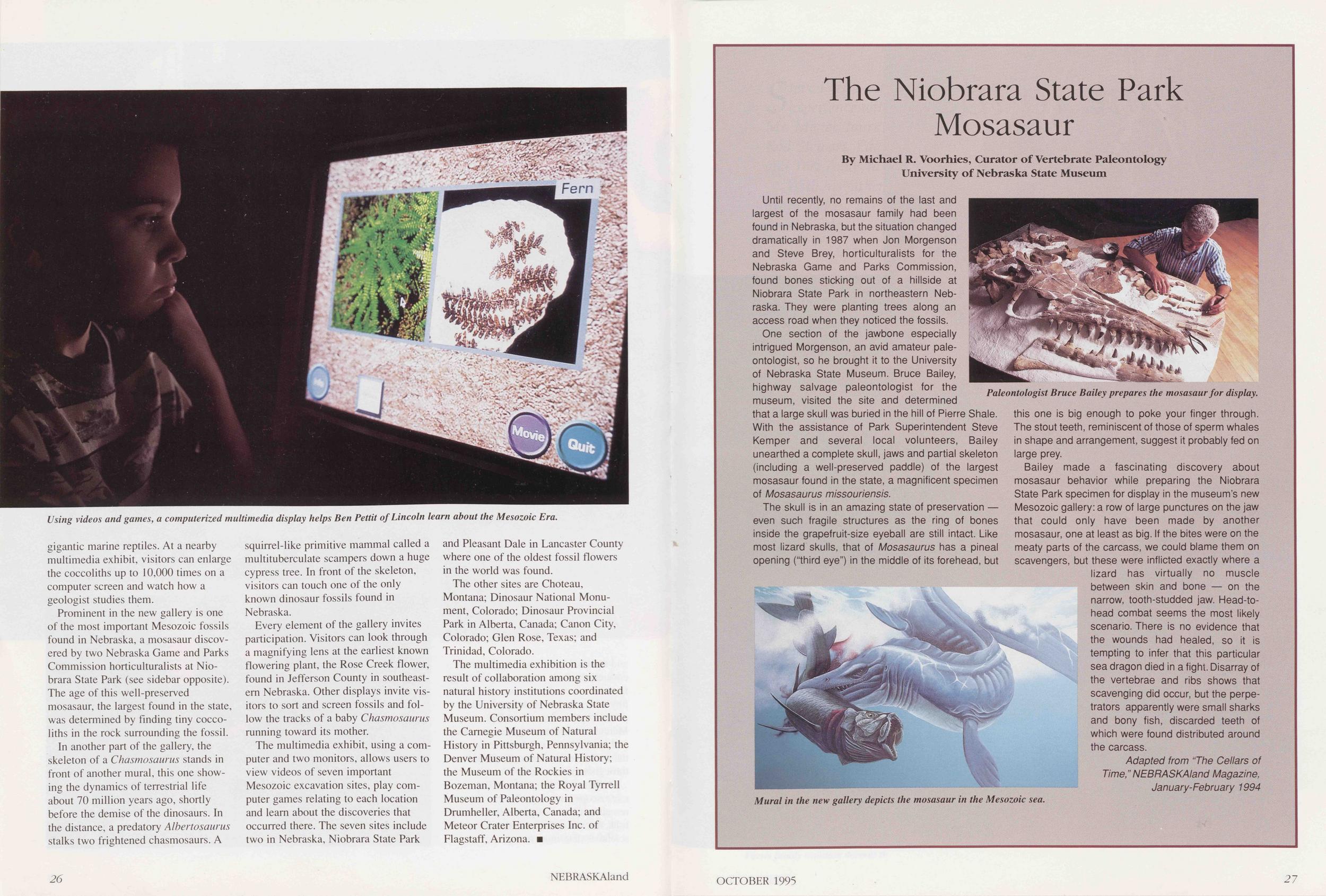
Prominent in the new gallery is one of the most important Mesozoic fossils found in Nebraska, a mosasaur discovered by two Nebraska Game and Parks Commission horticulturalists at Niobrara State Park (see sidebar opposite). The age of this well-preserved mosasaur, the largest found in the state, was determined by finding tiny coccoliths in the rock surrounding the fossil.
In another part of the gallery, the skeleton of a Chasmosaurus stands in front of another mural, this one showing the dynamics of terrestrial life about 70 million years ago, shortly before the demise of the dinosaurs. In the distance, a predatory Alhertosaurus stalks two frightened chasmosaurs. A squirrel-like primitive mammal called a multituberculate scampers down a huge cypress tree. In front of the skeleton, visitors can touch one of the only known dinosaur fossils found in Nebraska.
Every element of the gallery invites participation. Visitors can look through a magnifying lens at the earliest known flowering plant, the Rose Creek flower, found in Jefferson County in southeastern Nebraska. Other displays invite visitors to sort and screen fossils and follow the tracks of a baby Chasmosaurus running toward its mother.
The multimedia exhibit, using a computer and two monitors, allows users to view videos of seven important Mesozoic excavation sites, play computer games relating to each location and learn about the discoveries that occurred there. The seven sites include two in Nebraska, Niobrara State Park and Pleasant Dale in Lancaster County where one of the oldest fossil flowers in the world was found.
The other sites are Choteau, Montana; Dinosaur National Monument, Colorado; Dinosaur Provincial Park in Alberta, Canada; Canon City, Colorado; Glen Rose, Texas; and Trinidad, Colorado.
The multimedia exhibition is the result of collaboration among six natural history institutions coordinated by the University of Nebraska State Museum. Consortium members include the Carnegie Museum of Natural History in Pittsburgh, Pennsylvania; the Denver Museum of Natural History; the Museum of the Rockies in Bozeman, Montana; the Royal Tyrrell Museum of Paleontology in Drumheller, Alberta, Canada; and Meteor Crater Enterprises Inc. of Flagstaff, Arizona.
26 NEBRASKAIandThe Niobrara State Park Mosasaur
By Michael R. Voorhies, Curator of Vertebrate Paleontology University of Nebraska State MuseumUntil recently, no remains of the last and largest of the mosasaur family had been found in Nebraska, but the situation changed dramatically in 1987 when Jon Morgenson and Steve Brey, horticulturalists for the Nebraska Game and Parks Commission, found bones sticking out of a hillside at Niobrara State Park in northeastern Nebraska. They were planting trees along an access road when they noticed the fossils.
One section of the jawbone especially intrigued Morgenson, an avid amateur paleontologist, so he brought it to the University of Nebraska State Museum. Bruce Bailey, highway salvage paleontologist for the museum, visited the site and determined that a large skull was buried in the hill of Pierre Shale. With the assistance of Park Superintendent Steve Kemper and several local volunteers, Bailey unearthed a complete skull, jaws and partial skeleton (including a well-preserved paddle) of the largest mosasaur found in the state, a magnificent specimen of Mosasaurus missouriensis.
The skull is in an amazing state of preservation even such fragile structures as the ring of bones inside the grapefruit-size eyeball are still intact. Like most lizard skulls, that of Mosasaurus has a pineal opening ("third eye") in the middle of its forehead, but this one is big enough to poke your finger through. The stout teeth, reminiscent of those of sperm whales in shape and arrangement, suggest it probably fed on large prey.
Bailey made a fascinating discovery about mosasaur behavior while preparing the Niobrara State Park specimen for display in the museum's new Mesozoic gallery: a row of large punctures on the jaw that could only have been made by another mosasaur, one at least as big. If the bites were on the meaty parts of the carcass, we could blame them on scavengers, but these were inflicted exactly where a lizard has virtually no muscle between skin and bone — on the narrow, tooth-studded jaw. Head-to-head combat seems the most likely scenario. There is no evidence that the wounds had healed, so it is tempting to infer that this particular sea dragon died in a fight. Disarray of the vertebrae and ribs shows that scavenging did occur, but the perpetrators apparently were small sharks and bony fish, discarded teeth of which were found distributed around the carcass.
Adapted from "The Cellars of Time," NEBRASKAIand Magazine, January-February 1994
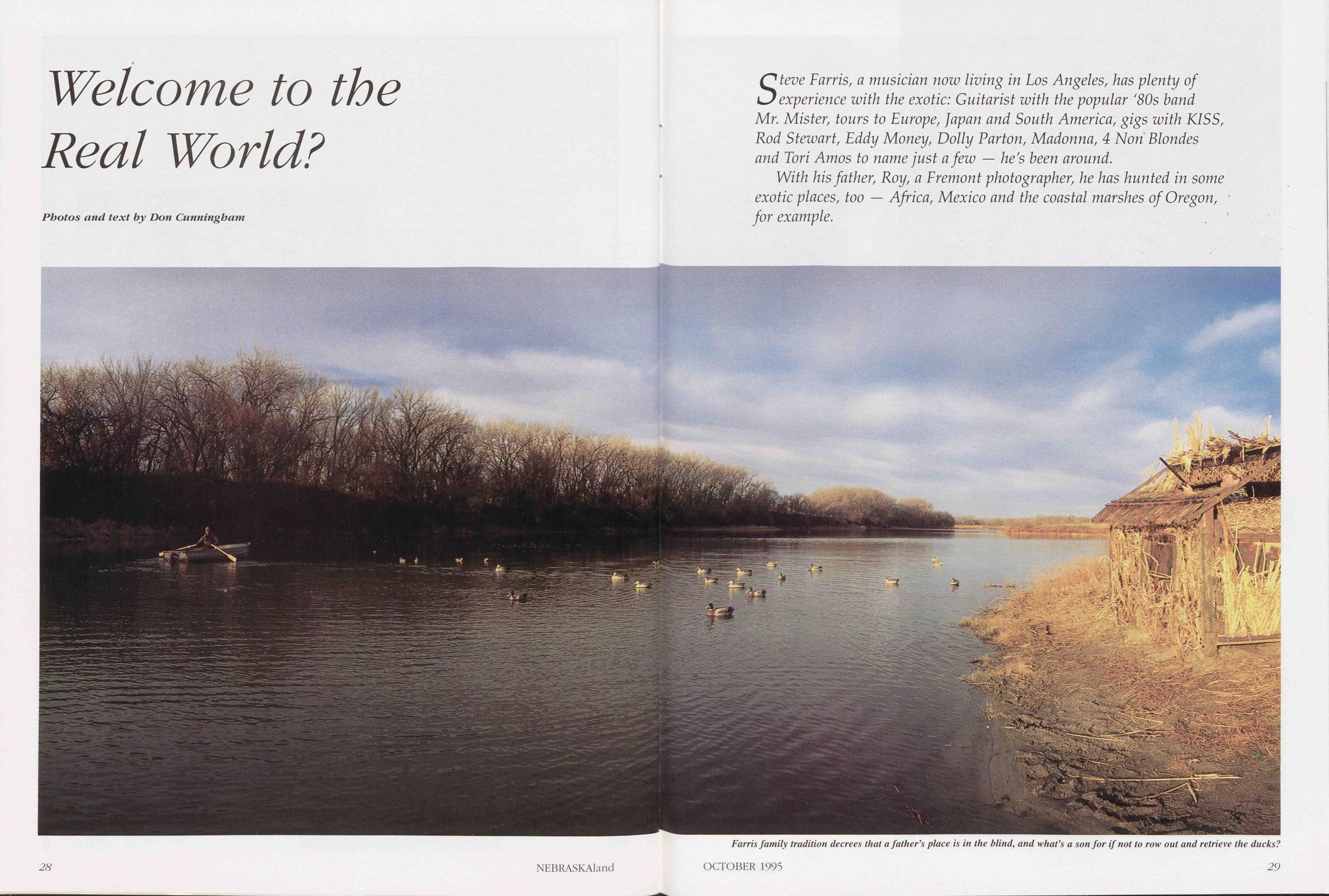
BsnraffiH Wfe/come to toto
Photos and text by Don CunninghamSteve Farris, a musician now living in Los Angeles, has plenty of experience with the exotic: Guitarist with the popular '80s band Mr. Mister, tours to Europe, Japan and South America, gigs with KISS, Rod Stewart, Eddy Money, Dolly Parton, Madonna, 4 Non Blondes and Tori Amos to name just a few — he's been around.
With his father, Roy, a Fremont photographer, he has hunted in some exotic places, too — Africa, Mexico and the coastal marshes of Oregon, for example.
28 NEBRASKAland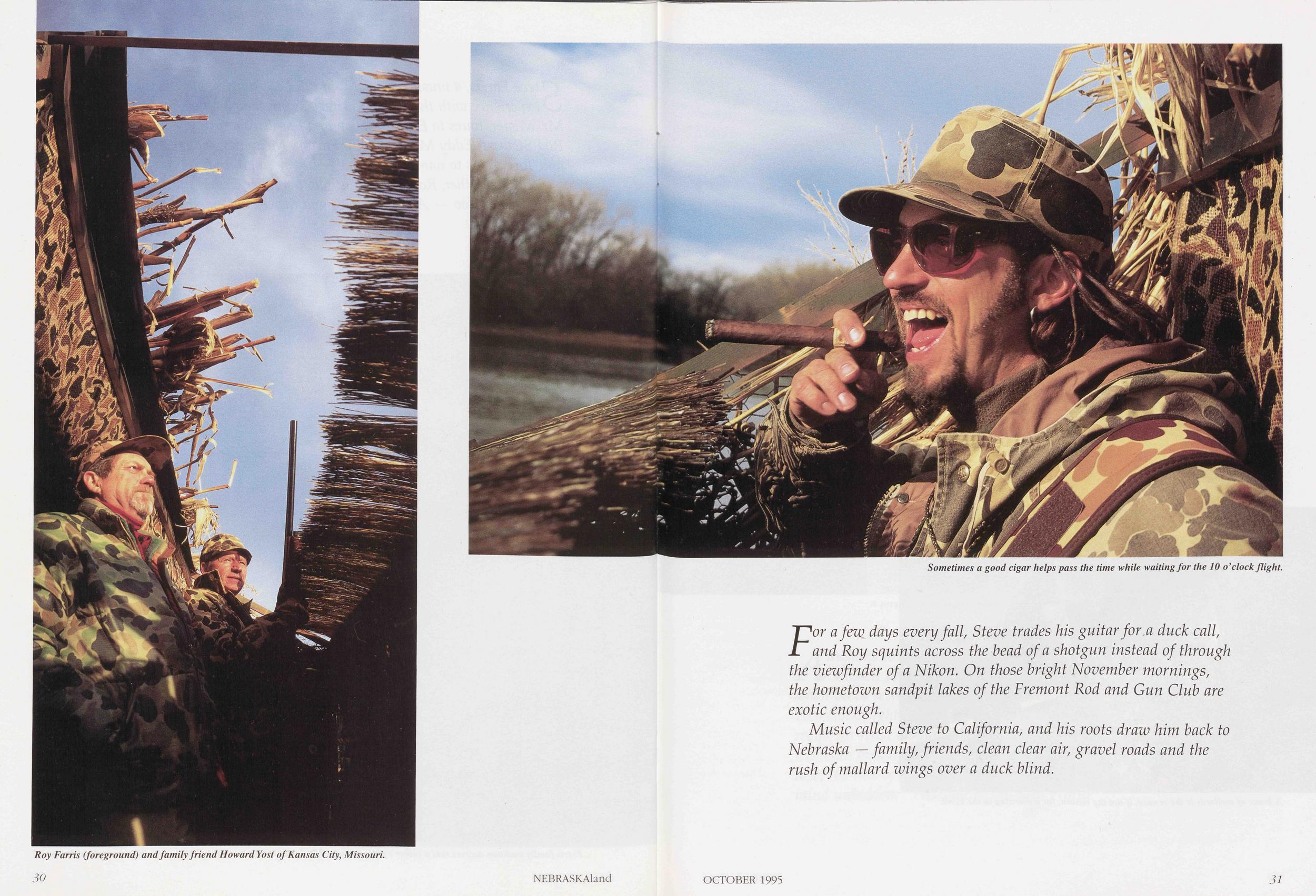
For a few days every fall Steve trades his guitar for a duck call and Roy squints across the bead of a shotgun instead of through the viewfinder of a Nikon. On those bright November mornings, the hometown sandpit lakes of the Fremont Rod and Gun Club are exotic enough.
Music called Steve to California, and his roots draw him back to Nebraska — family, friends, clean clear air, gravel roads and the rush of mallard wings over a duck blind.
OCTOBER 1995 31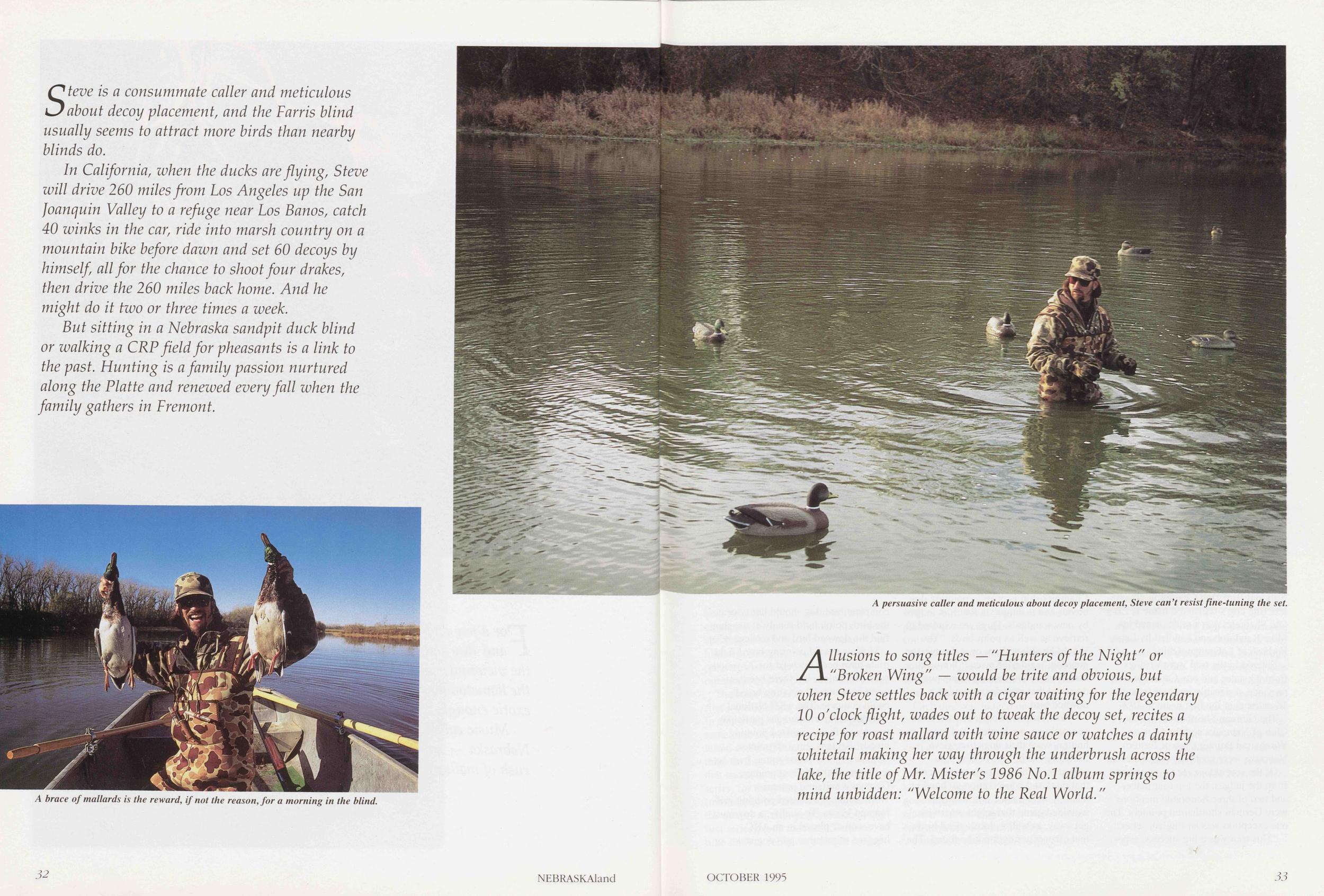
Steve is a consummate caller and meticulous about decoy placement, and the F arris blind usually seems to attract more birds than nearby blinds do.
In California, when the ducks are flying, Steve will drive 260 miles from Los Angeles up the San Joanquin Valley to a refuge near Los Banos, catch 40 winks in the car, ride into marsh country on a mountain bike before dawn and set 60 decoys by himself, all for the chance to shoot four drakes, then drive the 260 miles back home. And he might do it two or three times a week.
But sitting in a Nebraska sandpit duck blind or walking a CRP field for pheasants is a link to the past. Hunting is a family passion nurtured along the Platte and renewed every fall when the family gathers in Fremont.
Allusions to song titles —"Hunters of the Night" or "Broken Wing" — would be trite and obvious, but when Steve settles back with a cigar waiting for the legendary 10 o'clock flight, wades out to tweak the decoy set, recites a recipe for roast mallard with wine sauce or watches a dainty whitetail making her way through the underbrush across the lake, the title of Mr. Mister's 1986 No.l album springs to mind unbidden: "Welcome to the Real World."
OCTOBER 1995 33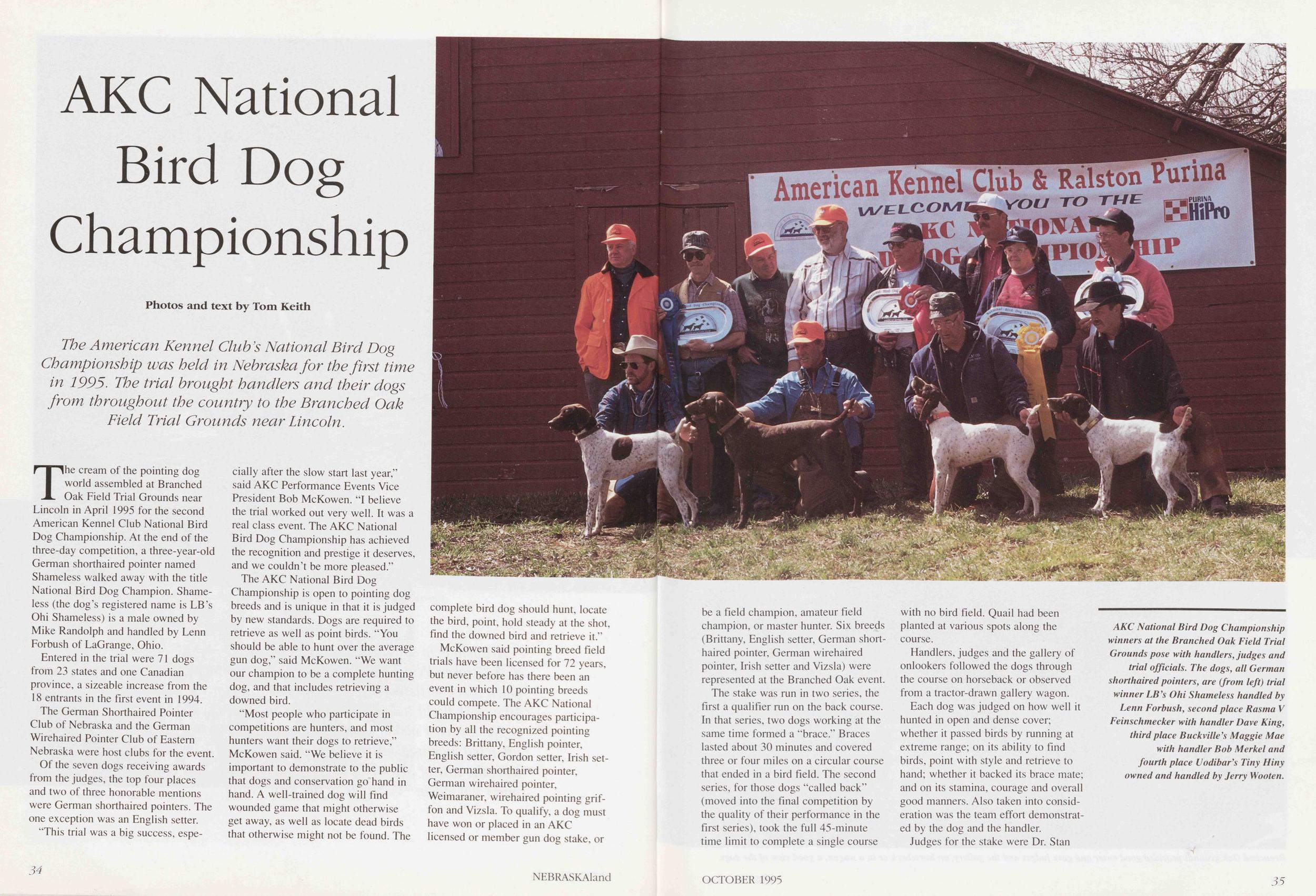
AKC National Bird Dog Championship
Photos and text by Tom Keith The American Kennel Club's National Bird Dog Championship was held in Nebraska for the first time in 1995. The trial brought handlers and their dogs from throughout the country to the Branched Oak Field Trial Grounds near Lincoln.The cream of the pointing dog world assembled at Branched Oak Field Trial Grounds near Lincoln in April 1995 for the second American Kennel Club National Bird Dog Championship. At the end of the three-day competition, a three-year-old German shorthaired pointer named Shameless walked away with the title National Bird Dog Champion. Shameless (the dog's registered name is LB's Ohi Shameless) is a male owned by Mike Randolph and handled by Lenn Forbush of LaGrange, Ohio.
Entered in the trial were 71 dogs from 23 states and one Canadian province, a sizeable increase from the 18 entrants in the first event in 1994.
The German Shorthaired Pointer Club of Nebraska and the German Wirehaired Pointer Club of Eastern Nebraska were host clubs for the event.
Of the seven dogs receiving awards from the judges, the top four places and two of three honorable mentions were German shorthaired pointers. The one exception was an English setter.
"This trial was a big success, especially after the slow start last year," said AKC Performance Events Vice President Bob McKowen. "I believe the trial worked out very well. It was a real class event. The AKC National Bird Dog Championship has achieved the recognition and prestige it deserves, and we couldn't be more pleased."
The AKC National Bird Dog Championship is open to pointing dog breeds and is unique in that it is judged by new standards. Dogs are required to retrieve as well as point birds. "You should be able to hunt over the average gun dog," said McKowen. "We want our champion to be a complete hunting dog, and that includes retrieving a downed bird.
"Most people who participate in competitions are hunters, and most hunters want their dogs to retrieve," McKowen said. "We believe it is important to demonstrate to the public that dogs and conservation go hand in hand. A well-trained dog will find wounded game that might otherwise get away, as well as locate dead birds that otherwise might not be found. The complete bird dog should hunt, locate the bird, point, hold steady at the shot, find the downed bird and retrieve it."
McKowen said pointing breed field trials have been licensed for 72 years, but never before has there been an event in which 10 pointing breeds could compete. The AKC National Championship encourages participation by all the recognized pointing breeds: Brittany, English pointer, English setter, Gordon setter, Irish setter, German shorthaired pointer, German wirehaired pointer, Weimaraner, wirehaired pointing griffon and Vizsla. To qualify, a dog must have won or placed in an AKC licensed or member gun dog stake, or 34 NEBRASKAland be a field champion, amateur field champion, or master hunter. Six breeds (Brittany, English setter, German shorthaired pointer, German wirehaired pointer, Irish setter and Vizsla) were represented at the Branched Oak event.
The stake was run in two series, the first a qualifier run on the back course. In that series, two dogs working at the same time formed a "brace." Braces lasted about 30 minutes and covered three or four miles on a circular course that ended in a bird field. The second series, for those dogs "called back" (moved into the final competition by the quality of their performance in the first series), took the full 45-minute time limit to complete a single course with no bird field. Quail had been planted at various spots along the course.
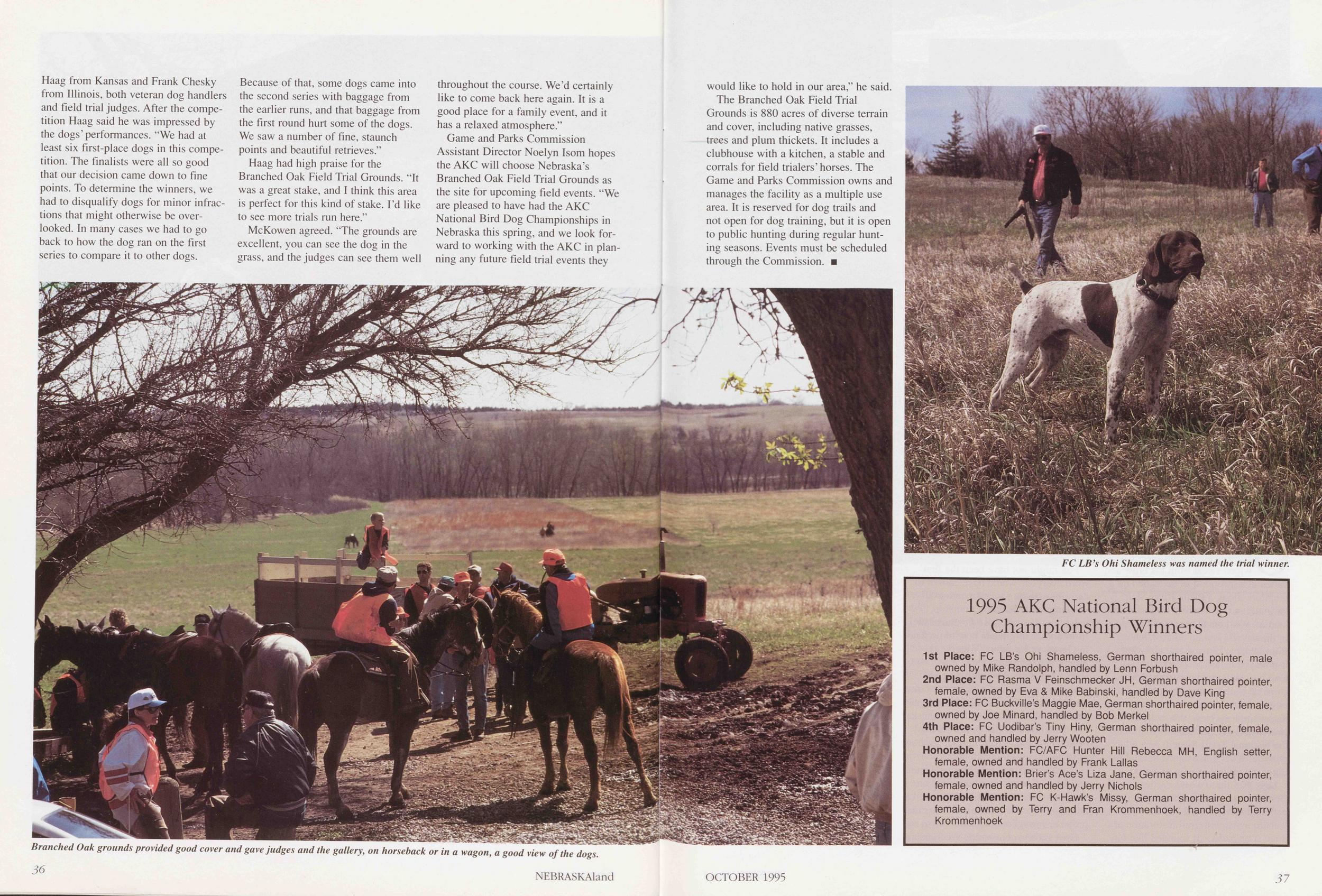
Handlers, judges and the gallery of onlookers followed the dogs through the course on horseback or observed from a tractor-drawn gallery wagon. Each dog was judged on how well it hunted in open and dense cover; whether it passed birds by running at extreme range; on its ability to find birds, point with style and retrieve to hand; whether it backed its brace mate; and on its stamina, courage and overall good manners. Also taken into consideration was the team effort demonstrated by the dog and the handler.
Judges for the stake were Dr. Stan
 Haag from Kansas and Frank Chesky from Illinois, both veteran dog handlers and field trial judges. After the competition Haag said he was impressed by the dogs'performances. "We had at least six first-place dogs in this competition. The finalists were all so good that our decision came down to fine points. To determine the winners, we had to disqualify dogs for minor infractions that might otherwise be overlooked. In many cases we had to go back to how the dog ran on the first series to compare it to other dogs. Because of that, some dogs came into the second series with baggage from the earlier runs, and that baggage from the first round hurt some of the dogs. We saw a number of fine, staunch points and beautiful retrieves."
Haag had high praise for the Branched Oak Field Trial Grounds. "It was a great stake, and I think this area is perfect for this kind of stake. I'd like to see more trials run here."
McKowen agreed. "The grounds are excellent, you can see the dog in the grass, and the judges can see them well throughout the course. We'd certainly like to come back here again. It is a good place for a family event, and it has a relaxed atmosphere."
Game and Parks Commission Assistant Director Noelyn Isom hopes the AKC will choose Nebraska's Branched Oak Field Trial Grounds as the site for upcoming field events. "We are pleased to have had the AKC National Bird Dog Championships in Nebraska this spring, and we look forward to working with the AKC in planning any future field trial events they
The Branched Oak Field Trial Grounds is 880 acres of diverse terrain and cover, including native grasses, 4rees and plum thickets. It includes a clubhouse with a kitchen, a stable and corrals for field trialers' horses. The Game and Parks Commission owns and manages the facility as a multiple use area. It is reserved for dog trails and not open for dog training, but it is open to public hunting during regular hunting seasons. Events must be scheduled through the Commission.
1st Place: FC LB's Ohi Shameless, German shorthaired pointer, male owned by Mike Randolph, handled by Lenn Forbush
2nd Place: FC Rasma V Feinschmecker JH, German shorthaired pointer, female, owned by Eva & Mike Babinski, handled by Dave King
3rd Place: FC Buckville's Maggie Mae, German shorthaired pointer, female, owned by Joe Minard, handled by Bob Merkel
4th Place: FC Uodibar's Tiny Hiny, German shorthaired pointer, female, owned and handled by Jerry Wooten
Honorable Mention: FC/AFC Hunter Hill Rebecca MH, English setter, female, owned and handled by Frank Lallas
Honorable Mention: Brier's Ace's Liza Jane, German shorthaired pointer, female, owned and handled by Jerry Nichols
Honorable Mention: FC K-Hawk's Missy, German shorthaired pointer, female, owned by Terry and Fran Krommenhoek, handled by Terry Krommenhoek
OCTOBER 1995 37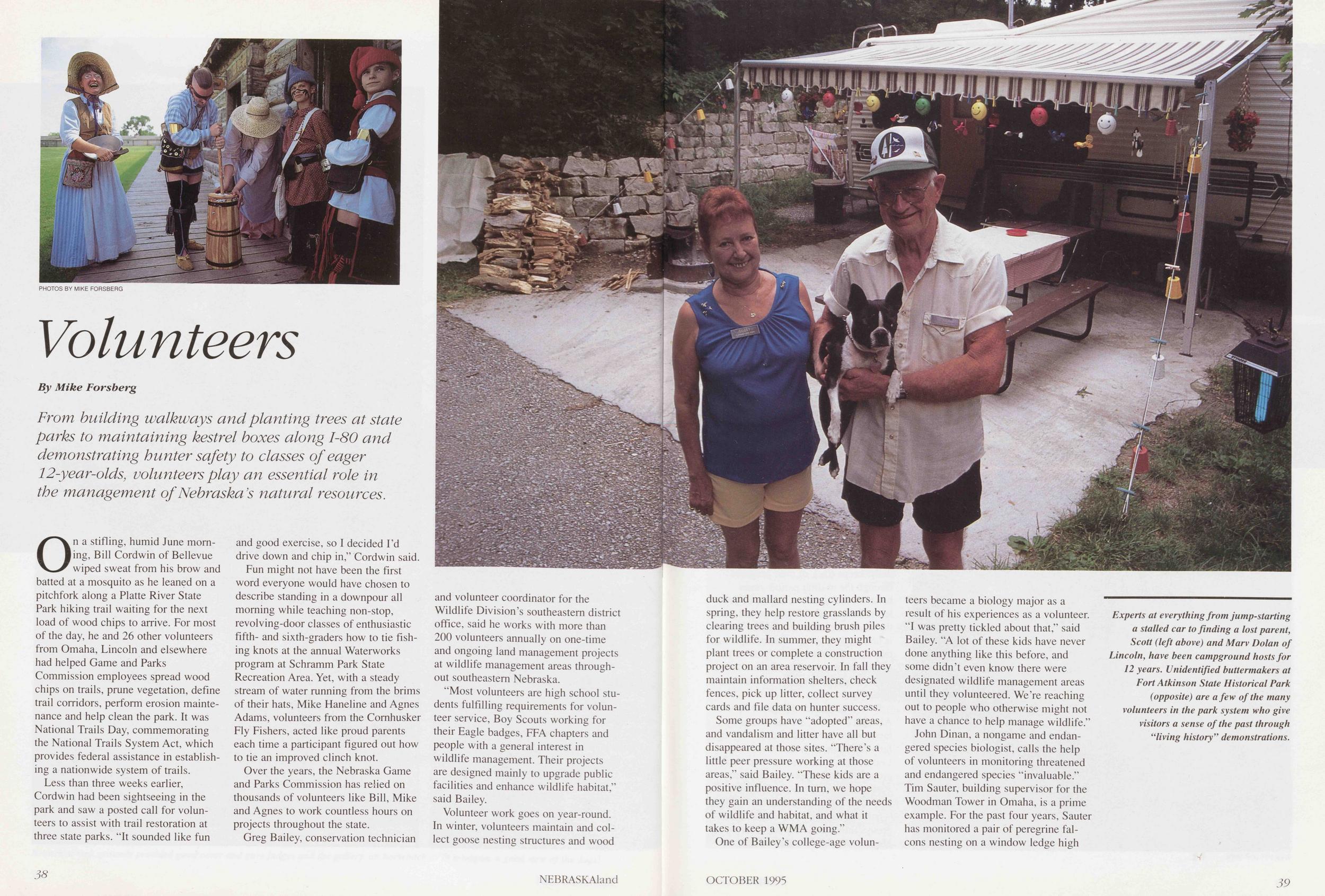
Volunteers
By Mike Forsberg From building walkways and planting trees at state parks to maintaining kestrel boxes along 1-80 and demonstrating hunter safety to classes of eager 12-year-olds, volunteers play an essential role in the management of Nebraska's natural resources.On a stifling, humid June morning, Bill Cordwin of Bellevue wiped sweat from his brow and batted at a mosquito as he leaned on a pitchfork along a Platte River State Park hiking trail waiting for the next load of wood chips to arrive. For most of the day, he and 26 other volunteers from Omaha, Lincoln and elsewhere had helped Game and Parks Commission employees spread wood chips on trails, prune vegetation, define trail corridors, perform erosion maintenance and help clean the park. It was National Trails Day, commemorating the National Trails System Act, which provides federal assistance in establishing a nationwide system of trails.
Less than three weeks earlier, Cordwin had been sightseeing in the park and saw a posted call for volunteers to assist with trail restoration at three state parks. "It sounded like fun and good exercise, so I decided I'd drive down and chip in," Cordwin said.
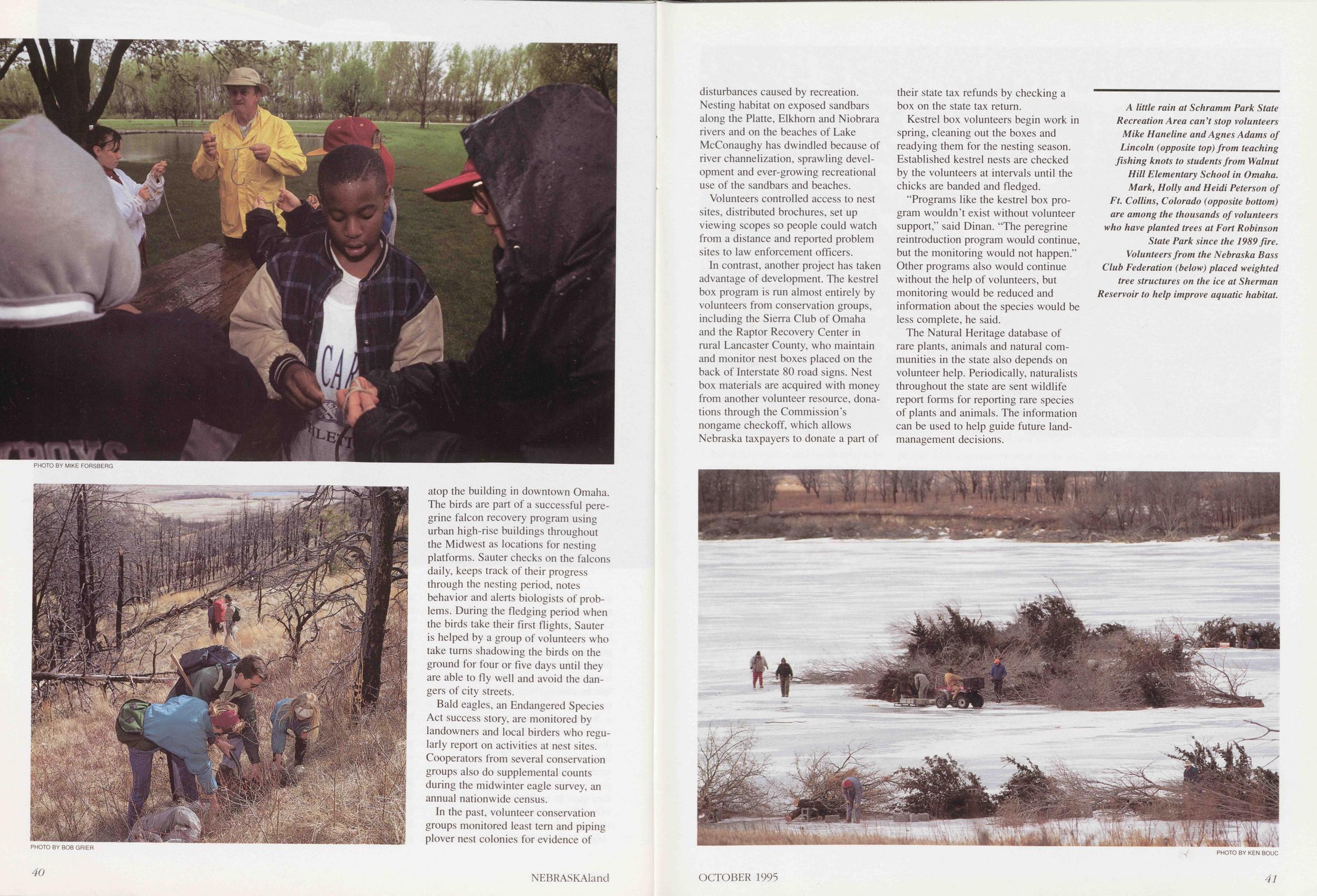
Fun might not have been the first word everyone would have chosen to describe standing in a downpour all morning while teaching non-stop, revolving-door classes of enthusiastic fifth- and sixth-graders how to tie fishing knots at the annual Waterworks program at Schramm Park State Recreation Area. Yet, with a steady stream of water running from the brims of their hats, Mike Haneline and Agnes Adams, volunteers from the Cornhusker Fly Fishers, acted like proud parents each time a participant figured out how to tie an improved clinch knot.
Over the years, the Nebraska Game and Parks Commission has relied on thousands of volunteers like Bill, Mike and Agnes to work countless hours on projects throughout the state.
Greg Bailey, conservation technician and volunteer coordinator for the Wildlife Division's southeastern district office, said he works with more than 200 volunteers annually on one-time and ongoing land management projects at wildlife management areas throughout southeastern Nebraska.
"Most volunteers are high school students fulfilling requirements for volunteer service, Boy Scouts working for their Eagle badges, FFA chapters and people with a general interest in wildlife management. Their projects are designed mainly to upgrade public facilities and enhance wildlife habitat," said Bailey.
Volunteer work goes on year-round. In winter, volunteers maintain and collect goose nesting structures and wood 38 NEBRASKAland duck and mallard nesting cylinders. In spring, they help restore grasslands by clearing trees and building brush piles for wildlife. In summer, they might plant trees or complete a construction project on an area reservoir. In fall they maintain information shelters, check fences, pick up litter, collect survey cards and file data on hunter success.
Some groups have "adopted" areas, and vandalism and litter have all but disappeared at those sites. "There's a little peer pressure working at those areas," said Bailey. "These kids are a positive influence. In turn, we hope they gain an understanding of the needs of wildlife and habitat, and what it takes to keep a WMA going."
One of Bailey's college-age volunteers became a biology major as a result of his experiences as a volunteer. "I was pretty tickled about that," said Bailey. "A lot of these kids have never done anything like this before, and some didn't even know there were designated wildlife management areas until they volunteered. We're reaching out to people who otherwise might not have a chance to help manage wildlife."
John Dinan, a nongame and endangered species biologist, calls the help of volunteers in monitoring threatened and endangered species "invaluable." Tim Sauter, building supervisor for the Woodman Tower in Omaha, is a prime example. For the past four years, Sauter has monitored a pair of peregrine falcons nesting on a window ledge high
Bald eagles, an Endangered Species Act success story, are monitored by landowners and local birders who regularly report on activities at nest sites. Cooperators from several conservation groups also do supplemental counts during the midwinter eagle survey, an annual nationwide census.
In the past, volunteer conservation groups monitored least tern and piping plover nest colonies for evidence of 40 NEBRASKAland disturbances caused by recreation. Nesting habitat on exposed sandbars along the Platte, Elkhorn and Niobrara rivers and on the beaches of Lake McConaughy has dwindled because of river channelization, sprawling development and ever-growing recreational use of the sandbars and beaches.
Volunteers controlled access to nest sites, distributed brochures, set up viewing scopes so people could watch from a distance and reported problem sites to law enforcement officers.
In contrast, another project has taken advantage of development. The kestrel box program is run almost entirely by volunteers from conservation groups, including the Sierra Club of Omaha and the Raptor Recovery Center in rural Lancaster County, who maintain and monitor nest boxes placed on the back of Interstate 80 road signs. Nest box materials are acquired with money from another volunteer resource, donations through the Commission's nongame checkoff, which allows Nebraska taxpayers to donate a part of their state tax refunds by checking a box on the state tax return.
Kestrel box volunteers begin work in spring, cleaning out the boxes and readying them for the nesting season. Established kestrel nests are checked by the volunteers at intervals until the chicks are banded and fledged.
"Programs like the kestrel box program wouldn't exist without volunteer support," said Dinan. "The peregrine reintroduction program would continue, but the monitoring would not happen." Other programs also would continue without the help of volunteers, but monitoring would be reduced and information about the species would be less complete, he said.
The Natural Heritage database of rare plants, animals and natural communities in the state also depends on volunteer help. Periodically, naturalists throughout the state are sent wildlife report forms for reporting rare species of plants and animals. The information can be used to help guide future landmanagement decisions.
In February 1995, the Nebraska Bass Federation, a state coalition of bass fishing clubs, initiated a habitat project that brought 42 volunteers from bass clubs around the state to Sherman Reservoir in Loup County. On a bitterly cold Saturday morning, bass club members and Commission personnel converged with four-wheel-drive pickups, ATVs, tow ropes, chainsaws, log chains, 360 concrete blocks, a half-mile of wire and 300 selectively cut cedar and elm trees. They spent the day placing weighted tree structures at strategic locations in coves around the lake. Although enormous efforts like that don't occur every year, volunteer groups have long donated time and money to help improve and restore aquatic habitat throughout the state.
'The main things we have done in the past have been to work with fishing clubs and Scout groups constructing tire reefs and cedar-tree brush piles that provide cover in the lakes," said Dave Tunink, fisheries assistant administrator.
"We've also had volunteers help us reestablish shoreline habitat by transplanting cattails and bulrushes to prevent erosion and provide fish cover." Tunink said the Sherman volunteers provided more than 120 man-hours of work. In the future Tunink hopes to use volunteers to help improve stream habitat and to assist in constructing spawning structures for catfish. "Around here, volunteers are indispensable," he said.
Teaching young people and adults how to hunt and fish safely and ethically and to appreciate the natural world around them is an important goal in conservation education, and volunteer instructors are vital to that effort.
In 1976, a Nebraska law mandated that hunters 12 to 15 years old must pass a certified hunter education course before they go afield. Each year, rising to crescendo in early fall, certified volunteer instructors throughout the state lead 10-hour courses for new hunters covering wildlife management and identification, hunter ethics and firearm safety. As of June 1995, there were 42 NEBRASKAland
The Aquatic Education program, headquartered at Ak-Sar-Ben Aquarium near Gretna, matches young people who want to learn how to fish with volunteer fishing instructors. Daryl Feit, aquarium director, said about 450 instructors in the state, most of them from local fishing clubs, will conduct programs by request.
Project Wild, an interdisciplinary conservation and environmental education program emphasizing wildlife and wildlife habitats, came to Nebraska in 1985. An international program, its curriculum is designed for kindergarten through 12th grade students with hands-on activities that teach students how to think about the environment, and direct them toward informed, responsible action. Overseen by Carl Wolfe, state coordinator of Project Wild and outdoor education specialist for the Commission, 80 volunteer facilitators in Nebraska teach Project Wild workshops to other teachers who then use the curriculum in the classroom.
Perhaps most visible to the largest number of people are the nearly 4,000 people who volunteer in state parks and recreation areas each year. Among them are campground hosts who camp in designated campgrounds and do everything from welcoming visitors and providing information, to becoming experts with jumper cables and in finding lost parents. At state historical parks, living history volunteers dressed in period costumes demonstrate activities and crafts from Nebraska's past.
Now in its sixth year, a volunteer tree planting program at Fort Robinson State Park is part of a 10-year recovery plan to restore losses from the 1989 fire that burned 89,000 acres of woodland. Up to 1,700 volunteers per year, many of them school science classes and Scout troops, have planted more than 200,000 new trees.
Park volunteers also help develop and maintain trails, staff information booths, lead nature hikes, conduct litter patrols, trim trees, install and remove signs and tend flower gardens.
The variety of jobs seems endless, and to list the accomplishments all of the groups and individuals who have participated as volunteers over the years would take many pages. Three qualities are always named by Commission employees who work with volunteers: The work that they do is first rate, their enthusiasm is contagious, and their help is indispensable.
A new program called "Volunteers In the Parks," or VIP, formally recognizes volunteers with signs erected near projects they have worked on. Beyond the formal recognition and thanks, the value of their work goes far beyond their physical efforts.
"There's a benefit from working with volunteers that we can't measure," said Joe Gabig, waterfowl biologist. "By sharing experiences, we learn from each other, and we can take those experiences and share them and what we've learned with someone else. It pays dividends in understanding and opens up communication lines that may have not existed before."
Next time you walk a tree-lined trail through a maze of fall color, watch a least tern carry a minnow to its mate, catch a bucket-size bass over a submerged cedar brush pile or see your child grinning from ear to ear carrying his or her first pheasant, stop for a moment and thank a volunteer.
OCTOBER 1995 43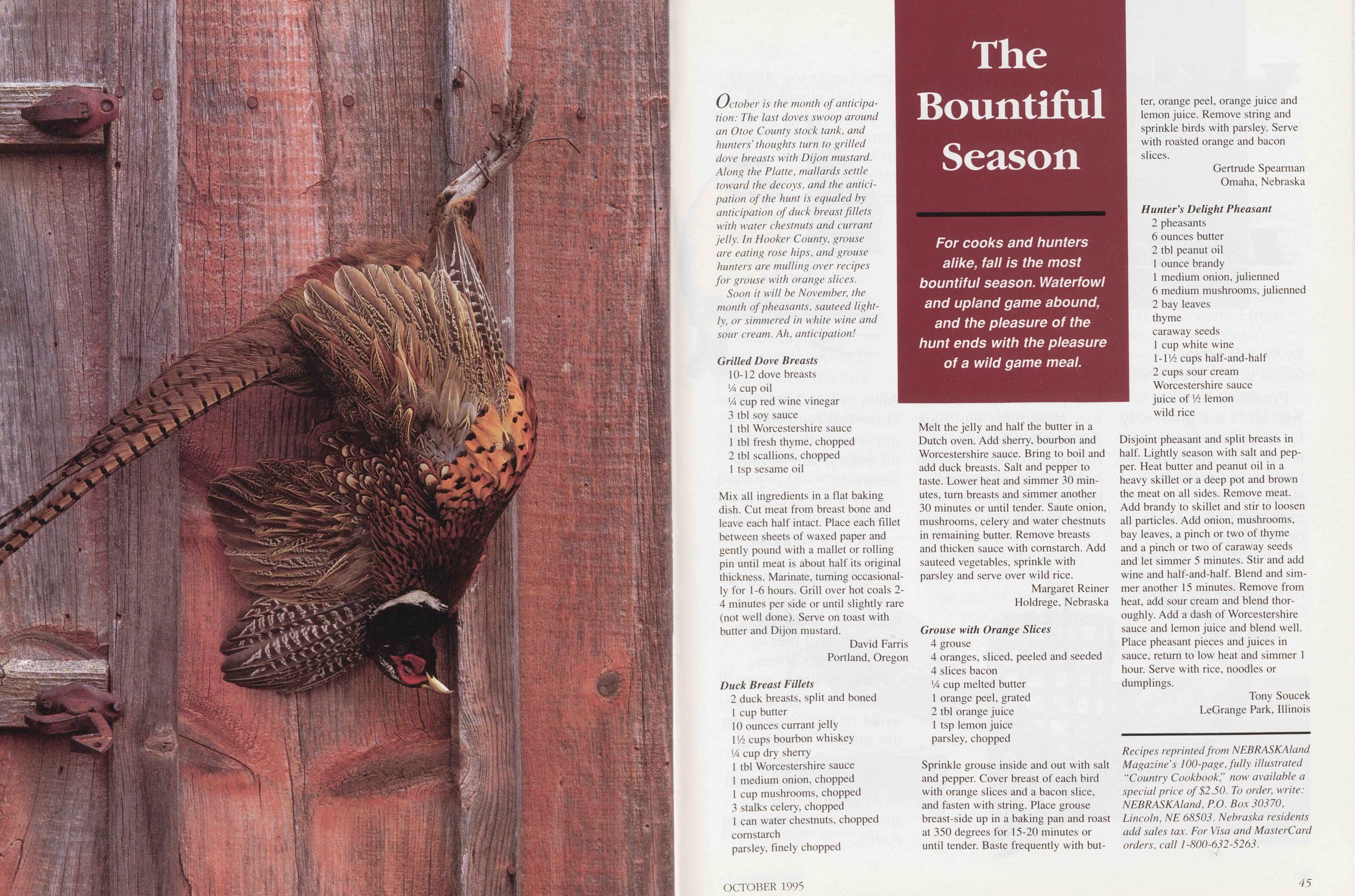
Bounti Season
ooks and hunters alike, fall is the most bountiful season. Waterfowl and upland game abound, and the pleasure of the hunt ends with the pleasure of a wild game meal.october is the month of anticipation: The last doves swoop around an Otoe County stock tank, and hunters' thoughts turn to grilled dove breasts with Dijon mustard. Along the Platte, mallards settle toward the decoys, and the anticipation of the hunt is equaled by anticipation of duck breast fdlets with water chestnuts and currant jelly. In Hooker County, grouse are eating rose hips, and grouse hunters are mulling over recipes for grouse with orange slices.
Soon it will be November, the month of pheasants, sauteed lightly, or simmered in white wine and sour cream. Ah, anticipation!
Grilled Dove Breasts 10-12 dove breasts Va cup oil Va cup red wine vinegar 3 tbl soy sauce 1 tbl Worcestershire sauce 1 tbl fresh thyme, chopped 2 tbl scallions, chopped 1 tsp sesame oil Mix all ingredients in a flat baking dish. Cut meat from breast bone and leave each half intact. Place each fillet between sheets of waxed paper and gently pound with a mallet or rolling pin until meat is about half its original thickness. Marinate, turning occasionally for 1-6 hours. Grill over hot coals 24 minutes per side or until slightly rare (not well done). Serve on toast with butter and Dijon mustard. David Farris Portland, Oregon Duck Breast Fillets 2 duck breasts, split and boned 1 cup butter 10 ounces currant jelly 1 Vi cups bourbon whiskey Va cup dry sherry 1 tbl Worcestershire sauce 1 medium onion, chopped 1 cup mushrooms, chopped 3 stalks celery, chopped 1 can water chestnuts, chopped cornstarch parsley, finely chopped Melt the jelly and half the butter in a Dutch oven. Add sherry, bourbon and Worcestershire sauce. Bring to boil and add duck breasts. Salt and pepper to taste. Lower heat and simmer 30 minutes, turn breasts and simmer another 30 minutes or until tender. Saute onion, mushrooms, celery and water chestnuts in remaining butter. Remove breasts and thicken sauce with cornstarch. Add sauteed vegetables, sprinkle with parsley and serve over wild rice. Margaret Reiner Holdrege, Nebraska Grouse with Orange Slices 4 grouse 4 oranges, sliced, peeled and seeded 4 slices bacon Va cup melted butter 1 orange peel, grated 2 tbl orange juice 1 tsp lemon juice parsley, chopped Sprinkle grouse inside and out with salt and pepper. Cover breast of each bird with orange slices and a bacon slice, and fasten with string. Place grouse breast-side up in a baking pan and roast at 350 degrees for 15-20 minutes or until tender. Baste frequently with butter, orange peel, orange juice and lemon juice. Remove string and sprinkle birds with parsley. Serve with roasted orange and bacon slices. Gertrude Spearman Omaha, Nebraska Hunter's Delight Pheasant 2 pheasants 6 ounces butter 2 tbl peanut oil 1 ounce brandy 1 medium onion, julienned 6 medium mushrooms, julienned 2 bay leaves thyme caraway seeds 1 cup white wine 1-11/2 cups half-and-half 2 cups sour cream Worcestershire sauce juice of Vi lemon wild rice Disjoint pheasant and split breasts in half. Lightly season with salt and pepper. Heat butter and peanut oil in a heavy skillet or a deep pot and brown the meat on all sides. Remove meat. Add brandy to skillet and stir to loosen all particles. Add onion, mushrooms, bay leaves, a pinch or two of thyme and a pinch or two of caraway seeds and let simmer 5 minutes. Stir and add wine and half-and-half. Blend and simmer another 15 minutes. Remove from heat, add sour cream and blend thoroughly. Add a dash of Worcestershire sauce and lemon juice and blend well. Place pheasant pieces and juices in sauce, return to low heat and simmer hour. Serve with rice, noodles or dumplings. Tony Soucek LeGrange Park, Illinois Recipes reprinted from NEBRASKAland Magazine's 100-page, fully illustrated ''Country Cookbook',' now available a special price of $2.50. To order, write: NEBRASKAland, P.O. Box 30370, Lincoln, NE 68503. Nebraska residents add sales tax. For Visa and MasterCard orders, call 1-800-632-5263. OCTOBER 1995 45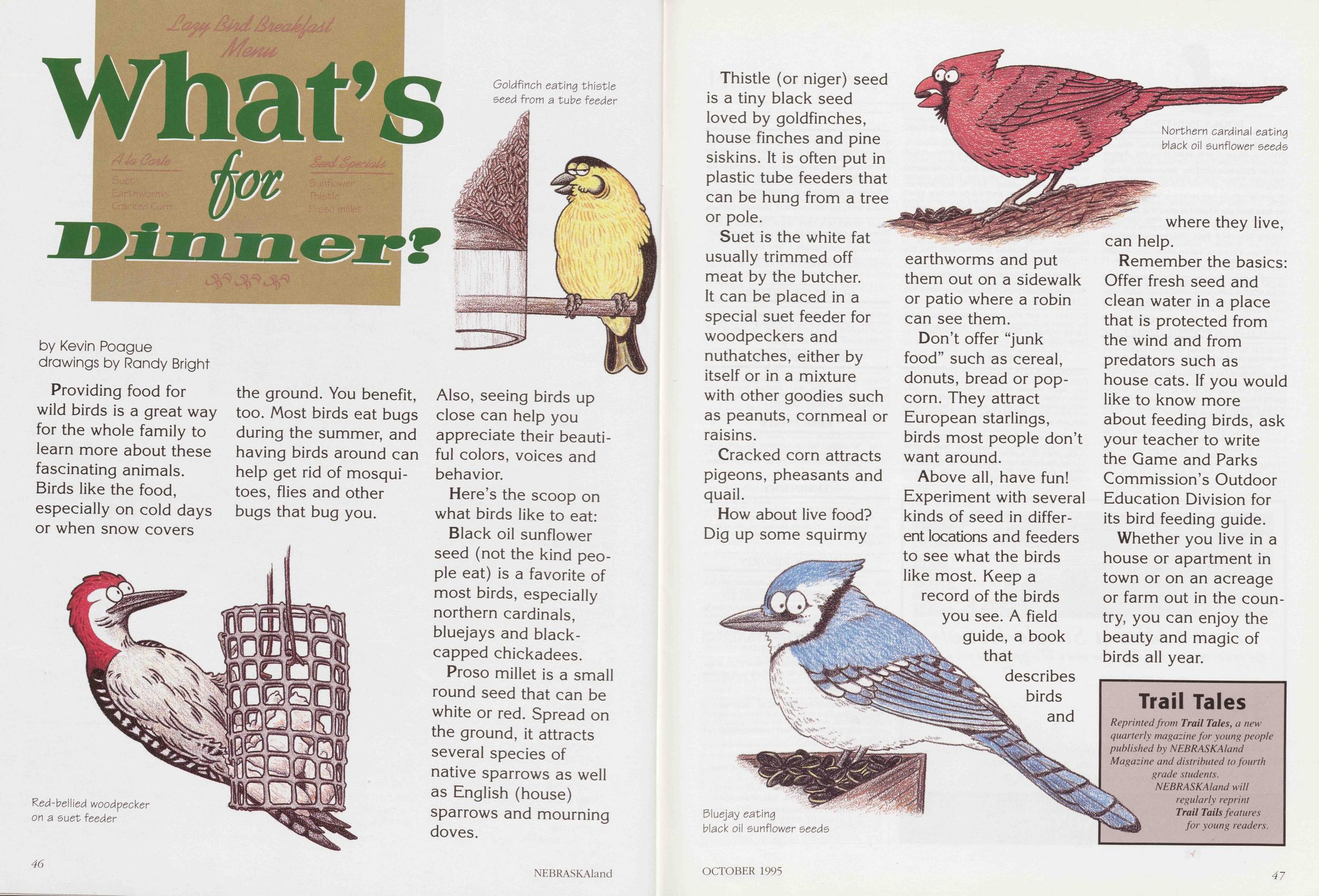
What's for Dinner?
Providing food for wild birds is a great way for the whole family to learn more about these fascinating animals. Birds like the food, especially on cold days or when snow covers the ground. You benefit, too. Most birds eat bugs during the summer, and having birds around can help get rid of mosquitoes, flies and other bugs that bug you. Also, seeing birds up close can help you appreciate their beautiful colors, voices and behavior.
Here's the scoop on what birds like to eat:
Black oil sunflower seed (not the kind people eat) is a favorite of most birds, especially northern cardinals, bluejays and blackcapped chickadees.
Proso millet is a small round seed that can be white or red. Spread on the ground, it attracts several species of native sparrows as well as English (house) sparrows and mourning doves.
Thistle (or niger) seed is a tiny black seed loved by goldfinches, house finches and pine siskins. It is often put in plastic tube feeders that can be hung from a tree or pole.
Suet is the white fat usually trimmed off meat by the butcher. It can be placed in a special suet feeder for woodpeckers and nuthatches, either by itself or in a mixture with other goodies such as peanuts, cornmeal or raisins.
Cracked corn attracts pigeons, pheasants and quail.
How about live food? Dig up some squirmy earthworms and put them out on a sidewalk or patio where a robin can see them.
Don't offer "junk food" such as cereal, donuts, bread or popcorn. They attract European starlings, birds most people don't want around.
Above all, have fun! Experiment with several kinds of seed in different locations and feeders to see what the birds like most. Keep a record of the birds you see. A field guide, a book that describes birds and where they live, can help.
Remember the basics: Offer fresh seed and clean water in a place that is protected from the wind and from predators such as house cats. If you would like to know more about feeding birds, ask your teacher to write the Game and Parks Commission's Outdoor Education Division for its bird feeding guide.
Whether you live in a house or apartment in town or on an acreage or farm out in the country, you can enjoy the beauty and magic of birds all year.
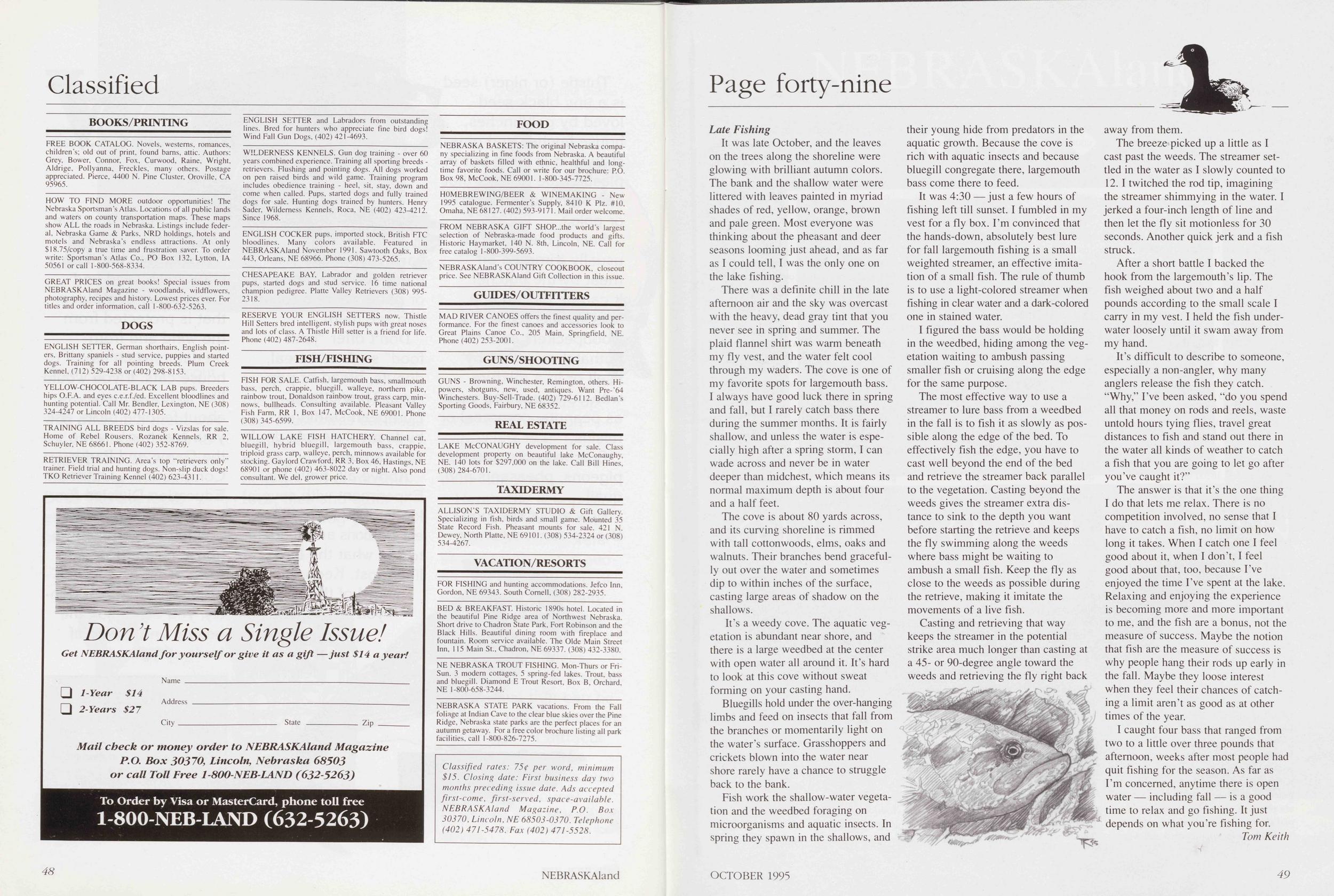
Classified
BOOKS/PRINTINGFREE BOOK CATALOG. Novels, westerns, romances, children's; old out of print, found barns, attic. Authors: Grey, Bower, Connor, Fox. Curwood, Raine. Wright. Aldrige, Pollyanna, Freckles, many others. Postage appreciated. Pierce, 4400 N. Pine Cluster, Oroville, CA 95965.
HOW TO FIND MORE outdoor opportunities! The Nebraska Sportsman's Atlas. Locations of all public lands and waters on county transportation maps. These maps show ALL the roads in Nebraska. Listings include federal. Nebraska Game & Parks, NRD holdings, hotels and motels and Nebraska's endless attractions. At only $18.75/copy a true time and frustration saver. To order write: Sportsman's Atlas Co.. PO Box 132, Lytton, IA 50561 or call 1-800-568-8334.
GREAT PRICES on great books! Special issues from NEBRASKAland Magazine - woodlands, wildflowers. photography, recipes and history. Lowest prices ever. For titles and order information, call 1-800-632-5263.
DOGSENGLISH SETTER, German shorthairs, English pointers. Brittany spaniels - stud service, puppies and started dogs. Training for all pointing breeds. Plum Creek Kennel, (712) 529-4238 or (402) 298-8153.
YELLOW-CHOCOLATE-BLACK LAB pups. Breeders hips O.F.A. and eyes c.e.r.f./ed. Excellent bloodlines and hunting potential. Call Mr. Bendler, Lexington. NE (308) 324-4247 or Lincoln (402) 477-1305.
TRAINING ALL BREEDS bird dogs - Vizslas for sale. Home of Rebel Rousers. Rozanek Kennels, RR 2, Schuyler, NE 68661. Phone (402) 352-8769.
RETRIEVER TRAINING. Area's top -'retrievers only" trainer. Field trial and hunting dogs. Non-slip duck dogs! TKO Retriever Training Kennel (402) 623-4311.
ENGLISH SETTER and Labradors from outstanding lines. Bred for hunters who appreciate fine bird dogs! Wind Fall Gun Dogs, (402) 421-4693.
WILDERNESS KENNELS. Gun dog training - over 60 years combined experience. Training all sporting breeds retrievers. Flushing and pointing dogs. All dogs worked on pen raised birds and wild game. Training program includes obedience training - heel, sit, stay, down and come when called. Pups, started dogs and fully trained dogs for sale. Hunting dogs trained by hunters. Henry Sader. Wilderness Kennels, Roca, NE (402) 423-4212. Since 1968.
ENGLISH COCKER pups, imported stock, British FTC bloodlines. Many colors available. Featured in NEBRASKAland November 1991. Sawtooth Oaks, Box 443, Orleans, NE 68966. Phone (308) 473-5265.
CHESAPEAKE BAY, Labrador and golden retriever pups, started dogs and stud service. 16 time national champion pedigree. Platte Valley Retrievers (308) 995-2318.
RESERVE YOUR ENGLISH SETTERS now. Thistle Hill Setters bred intelligent, stylish pups with great noses and lots of class. A Thistle Hill setter is a friend for life. Phone (402) 487-2648.
FISH/FISHINGFISH FOR SALE. Catfish, largemouth bass, smallmouth bass, perch, crappie, bluegill, walleye, northern pike, rainbow trout, Donaldson rainbow trout, grass carp, minnows, bullheads. Consulting available. Pleasant Valley Fish Farm. RR 1, Box 147, McCook, NE 69001. Phone (308) 345-6599.
WILLOW LAKE FISH HATCHERY. Channel cat, bluegill, hybrid bluegill, largemouth bass, crappie, triploid grass carp, walleye, perch, minnows available for stocking. Gaylord Crawford, RR 3, Box 46, Hastings, NE 68901 or phone (402) 463-8022 day or night. Also pond consultant. We del, grower price.
Don't Miss a Single Issue! Get NEBRASKAland for yourself or give it as a gift —just $14 a year! Name 1-Year $14 2-Years $27 Address City State Zip Mail check or money order to NEBRASKAland Magazine P.O. Box 30370, Lincoln, Nebraska 68503 or call Toll Free 1-800-NEB-LAND (632-5263) To Order by Visa or MasterCard, phone toll free 1-800-NEB-LAND (632-5263) FOODNEBRASKA BASKETS: The original Nebraska company specializing in fine foods from Nebraska. A beautiful array of baskets filled with ethnic, healthful and longtime favorite foods. Call or write for our brochure: P.O. Box 98, McCook, NE 69001. 1-800-345-7725.
HOMEBREWING/BEER & WINEMAKING - New 1995 catalogue. Fermenter's Supply, 8410 K Plz. #10, Omaha, NE 68127. (402) 593-9171. Mail order welcome.
FROM NEBRASKA GIFT SHOP..the world's largest selection of Nebraska-made food products and gifts. Historic Haymarket. 140 N. 8th, Lincoln, NE. Call for free catalog 1-800-399-5693.
NEBRASKAland's COUNTRY COOKBOOK, closeout price. See NEBRASKAland Gift Collection in this issue.
GUIDES/OUTFITTERSMAD RIVER CANOES offers the finest quality and performance. For the finest canoes and accessories look to Great Plains Canoe Co., 205 Main, Springfield, NE. Phone (402) 253-2001.
GUNS/SHOOTINGGUNS - Browning. Winchester. Remington, others. Hipowers, shotguns, new, used, antiques. Want Pre-'64 Winchesters. Buy-Sell-Trade. (402) 729-6112. Bedlan's Sporting Goods, Fairbury, NE 68352.
REAL ESTATELAKE McCONAUGHY development for sale. Class development property on beautiful lake McConaughv, NE. 140 lots for $297,000 on the lake. Call Bill Hines, (308)284-6701.
TAXIDERMYALLISON'S TAXIDERMY STUDIO & Gift Gallery. Specializing in fish, birds and small game. Mounted 35 State Record Fish. Pheasant mounts for sale. 421 N. Dewey, North Platte. NE 69101. (308) 534-2324 or (308) 534-4267.
VACATION/RESORTSFOR FISHING and hunting accommodations. Jefco Inn, Gordon, NE 69343. South Cornell. (308) 282-2935.
BED & BREAKFAST. Historic 1890s hotel. Located in the beautiful Pine Ridge area of Northwest Nebraska. Short drive to Chadron State Park, Fort Robinson and the Black Hills. Beautiful dining room with fireplace and fountain. Room service available. The Olde Main Street Inn, 115 Main St., Chadron, NE 69337. (308) 432-3380.
NE NEBRASKA TROUT FISHING. Mon-Thurs or Fri-Sun. 3 modem cottages, 5 spring-fed lakes. Trout, bass and bluegill. Diamond E Trout Resort, Box B, Orchard, NE 1-800-658-3244.
NEBRASKA STATE PARK vacations. From the Fall foliage at Indian Cave to the clear blue skies over the Pine Ridge, Nebraska state parks are the perfect places for an autumn getaway. For a free color brochure listing all park facilities, call 1-800-826-7275.
Classified rates: 75ct per word, minimum $15. Closing date: First business day two months preceding issue date. Ads accepted first-come, first-served, space-available. NEBRASKAland Magazine, P.O. Box 30370, Lincoln, NE 68503-0370. Telephone (402) 471-5478. Fax (402) 471-5528. 48 NEBRASKAlandPage forty-nine
Late FishingIt was late October, and the leaves on the trees along the shoreline were glowing with brilliant autumn colors. The bank and the shallow water were littered with leaves painted in myriad shades of red, yellow, orange, brown and pale green. Most everyone was thinking about the pheasant and deer seasons looming just ahead, and as far as I could tell, I was the only one on the lake fishing.
There was a definite chill in the late afternoon air and the sky was overcast with the heavy, dead gray tint that you never see in spring and summer. The plaid flannel shirt was warm beneath my fly vest, and the water felt cool through my waders. The cove is one of my favorite spots for largemouth bass. I always have good luck there in spring and fall, but I rarely catch bass there during the summer months. It is fairly shallow, and unless the water is especially high after a spring storm, I can wade across and never be in water deeper than midchest, which means its normal maximum depth is about four and a half feet.
The cove is about 80 yards across, and its curving shoreline is rimmed with tall cottonwoods, elms, oaks and walnuts. Their branches bend gracefully out over the water and sometimes dip to within inches of the surface, casting large areas of shadow on the shallows.
It's a weedy cove. The aquatic vegetation is abundant near shore, and there is a large weedbed at the center with open water all around it. It's hard to look at this cove without sweat forming on your casting hand.
Bluegills hold under the over-hanging limbs and feed on insects that fall from the branches or momentarily light on the water's surface. Grasshoppers and crickets blown into the water near shore rarely have a chance to struggle back to the bank.
Fish work the shallow-water vegetation and the weedbed foraging on microorganisms and aquatic insects. In spring they spawn in the shallows, and their young hide from predators in the aquatic growth. Because the cove is rich with aquatic insects and because bluegill congregate there, largemouth bass come there to feed.
It was 4:30 —just a few hours of fishing left till sunset. I fumbled in my vest for a fly box. I'm convinced that the hands-down, absolutely best lure for fall largemouth fishing is a small weighted streamer, an effective imitation of a small fish. The rule of thumb is to use a light-colored streamer when fishing in clear water and a dark-colored one in stained water.
I figured the bass would be holding in the weedbed, hiding among the vegetation waiting to ambush passing smaller fish or cruising along the edge for the same purpose.
The most effective way to use a streamer to lure bass from a weedbed in the fall is to fish it as slowly as possible along the edge of the bed. To effectively fish the edge, you have to cast well beyond the end of the bed and retrieve the streamer back parallel to the vegetation. Casting beyond the weeds gives the streamer extra distance to sink to the depth you want before starting the retrieve and keeps the fly swimming along the weeds where bass might be waiting to ambush a small fish. Keep the fly as close to the weeds as possible during the retrieve, making it imitate the movements of a live fish.
Casting and retrieving that way keeps the streamer in the potential strike area much longer than casting at a 45- or 90-degree angle toward the weeds and retrieving the fly right back
The breeze picked up a little as I cast past the weeds. The streamer settled in the water as I slowly counted to 12. I twitched the rod tip, imagining the streamer shimmying in the water. I jerked a four-inch length of line and then let the fly sit motionless for 30 seconds. Another quick jerk and a fish struck.
After a short battle I backed the hook from the largemouth's lip. The fish weighed about two and a half pounds according to the small scale I carry in my vest. I held the fish underwater loosely until it swam away from my hand.
It's difficult to describe to someone, especially a non-angler, why many anglers release the fish they catch. "Why," I've been asked, "do you spend all that money on rods and reels, waste untold hours tying flies, travel great distances to fish and stand out there in the water all kinds of weather to catch a fish that you are going to let go after you've caught it?"
The answer is that it's the one thing I do that lets me relax. There is no competition involved, no sense that I have to catch a fish, no limit on how long it takes. When I catch one I feel good about it, when I don't, I feel good about that, too, because I've enjoyed the time I've spent at the lake. Relaxing and enjoying the experience is becoming more and more important to me, and the fish are a bonus, not the measure of success. Maybe the notion that fish are the measure of success is why people hang their rods up early in the fall. Maybe they loose interest when they feel their chances of catching a limit aren't as good as at other times of the year.
I caught four bass that ranged from two to a little over three pounds that afternoon, weeks after most people had quit fishing for the season. As far as I'm concerned, anytime there is open water — including fall — is a good time to relax and go fishing. It just depends on what you're fishing for.
Tom Keith OCTOBER 1995 49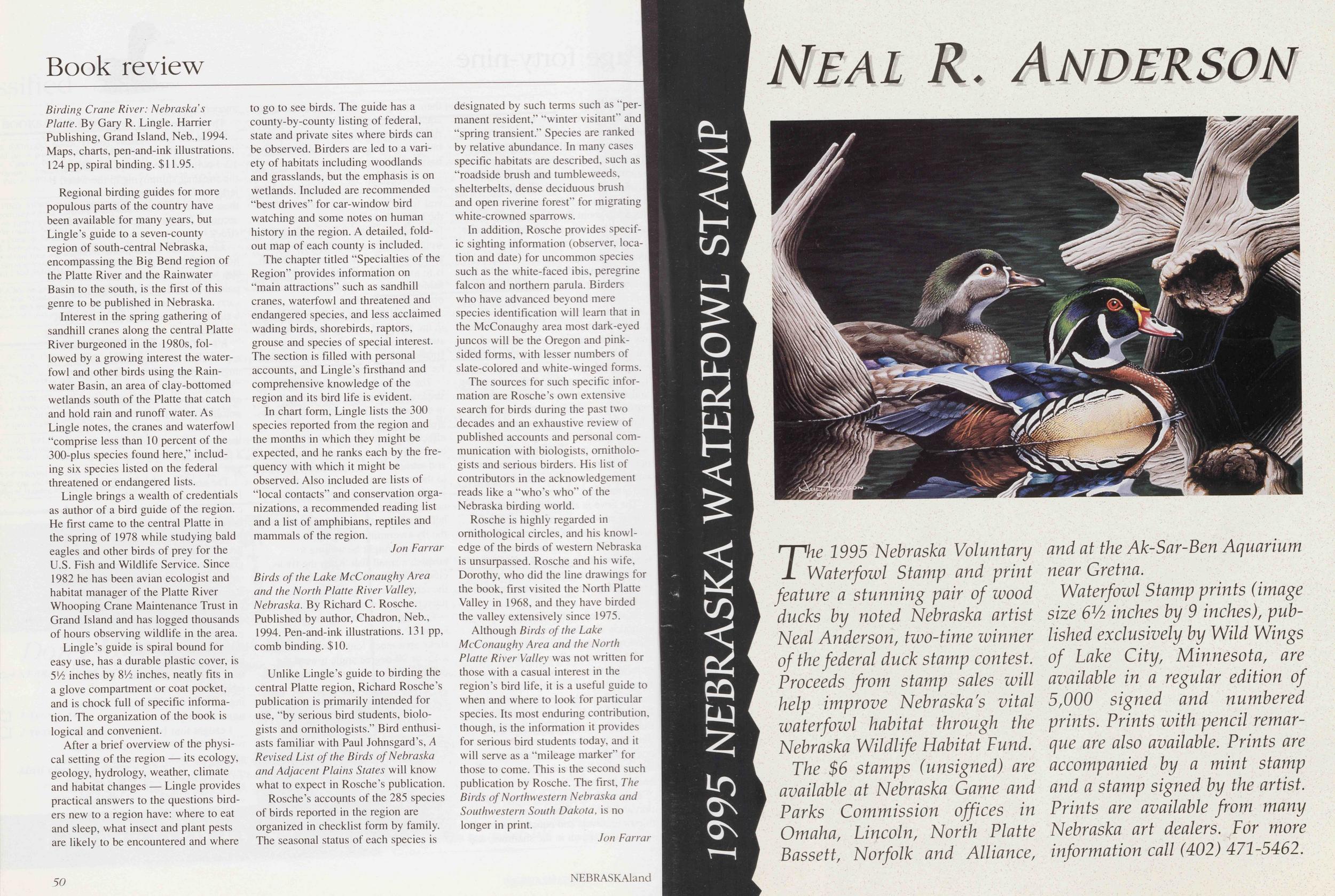
Book review
Birding Crane River: Nebraska s Platte. By Gary R. Lingle. Harrier Publishing, Grand Island, Neb., 1994. Maps, charts, pen-and-ink illustrations. 124 pp, spiral binding. $11.95.Regional birding guides for more populous parts of the country have been available for many years, but Lingle's guide to a seven-county region of south-central Nebraska, encompassing the Big Bend region of the Platte River and the Rainwater Basin to the south, is the first of this genre to be published in Nebraska.
Interest in the spring gathering of sandhill cranes along the central Platte River burgeoned in the 1980s, followed by a growing interest the waterfowl and other birds using the Rainwater Basin, an area of clay-bottomed wetlands south of the Platte that catch and hold rain and runoff water. As
Lingle notes, the cranes and waterfowl "comprise less than 10 percent of the 300-plus species found here," including six species listed on the federal threatened or endangered lists. Lingle brings a wealth of credentials as author of a bird guide of the region. He first came to the central Platte in the spring of 1978 while studying bald eagles and other birds of prey for the U.S. Fish and Wildlife Service. Since 1982 he has been avian ecologist and habitat manager of the Platte River Whooping Crane Maintenance Trust in Grand Island and has logged thousands of hours observing wildlife in the area.
Lingle's guide is spiral bound for easy use, has a durable plastic cover, is 5Vi inches by 8'/2 inches, neatly fits in a glove compartment or coat pocket, and is chock full of specific information. The organization of the book is logical and convenient.
After a brief overview of the physical setting of the region — its ecology, geology, hydrology, weather, climate and habitat changes — Lingle provides practical answers to the questions birders new to a region have: where to eat and sleep, what insect and plant pests are likely to be encountered and where to go to see birds. The guide has a county-by-county listing of federal, state and private sites where birds can be observed. Birders are led to a variety of habitats including woodlands and grasslands, but the emphasis is on wetlands. Included are recommended "best drives" for car-window bird watching and some notes on human history in the region. A detailed, foldout map of each county is included.
The chapter titled "Specialties of the Region" provides information on "main attractions" such as sandhill cranes, waterfowl and threatened and endangered species, and less acclaimed wading birds, shorebirds, raptors, grouse and species of special interest. The section is filled with personal accounts, and Lingle's firsthand and comprehensive knowledge of the region and its bird life is evident.
In chart form, Lingle lists the 300 species reported from the region and the months in which they might be expected, and he ranks each by the frequency with which it might be observed. Also included are lists of "local contacts" and conservation organizations, a recommended reading list and a list of amphibians, reptiles and mammals of the region.
Jon Farrar Birds of the Lake McConaughy Area and the North Platte River Valley, Nebraska. By Richard C. Rosche. Published by author, Chadron, Neb., 1994. Pen-and-ink illustrations. 131 pp, comb binding. $10.Unlike Lingle's guide to birding the central Platte region, Richard Rosche's publication is primarily intended for use, "by serious bird students, biologists and ornithologists." Bird enthusiasts familiar with Paul Johnsgard's, A Revised List of the Birds of Nebraska and Adjacent Plains States will know what to expect in Rosche's publication.
Rosche's accounts of the 285 species of birds reported in the region are organized in checklist form by family. The seasonal status of each species is designated by such terms such as "permanent resident," "winter visitant" and "spring transient." Species are ranked by relative abundance. In many cases specific habitats are described, such as "roadside brush and tumbleweeds, shelterbelts, dense deciduous brush and open riverine forest" for migrating white-crowned sparrows.
In addition, Rosche provides specific sighting information (observer, location and date) for uncommon species such as the white-faced ibis, peregrine falcon and northern parula. Birders who have advanced beyond mere species identification will learn that in the McConaughy area most dark-eyed juncos will be the Oregon and pinksided forms, with lesser numbers of slate-colored and white-winged forms.
The sources for such specific information are Rosche's own extensive search for birds during the past two decades and an exhaustive review of published accounts and personal communication with biologists, ornithologists and serious birders. His list of contributors in the acknowledgement reads like a "who's who" of the Nebraska birding world.
Rosche is highly regarded in ornithological circles, and his knowledge of the birds of western Nebraska is unsurpassed. Rosche and his wife, Dorothy, who did the line drawings for the book, first visited the North Platte Valley in 1968, and they have birded the valley extensively since 1975.
Although Birds of the Lake McConaughy Area and the North Platte River Valley was not written for those with a casual interest in the region's bird life, it is a useful guide to when and where to look for particular species. Its most enduring contribution, though, is the information it provides for serious bird students today, and it will serve as a "mileage marker" for those to come. This is the second such publication by Rosche. The first, The Birds of Northwestern Nebraska and Southwestern South Dakota, is no longer in print.
Jon Farrar 50 NEBRASKAland 1995 Nebraska Waterfowl Stamp Neal R. Anderson
Position: 541 (20 views)