Volume 73, Issue 7, 1995
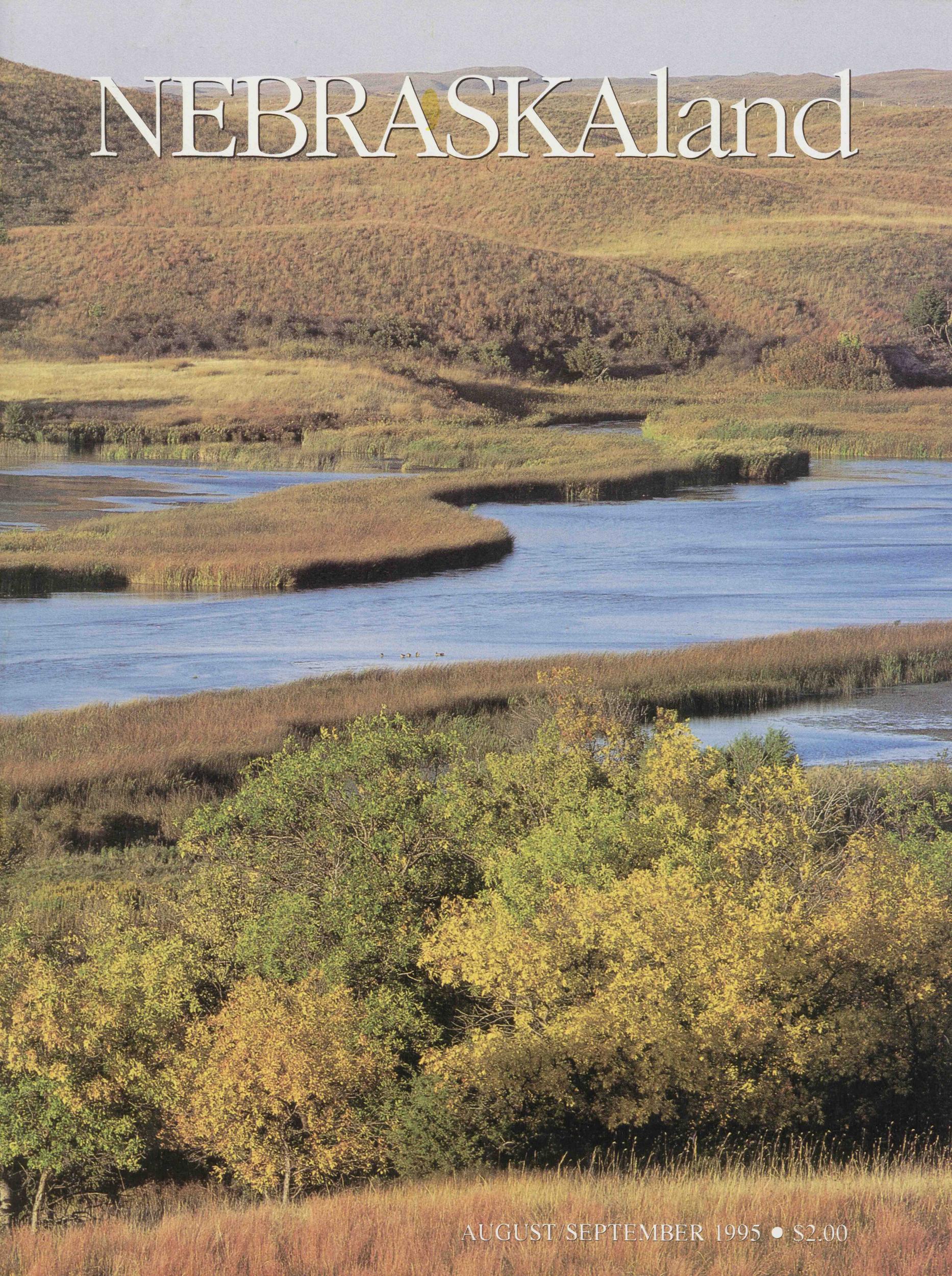
NEBRASKAland
AUGUST SEPTEMBER 1995 $2.00
NEBRASKAland
VOL. 73 / NO. 7 AUGUST/SEPTEMBER 1995 Published by the Nebraska Game and Park Commission Director: Rex Amack Assistant Directors: Wesley Sheets Noelyn Isom Roger Kuhn Staff Administrator, Information & Education: Paul Horton Editor: Don Cunningham Senior Editors: Jon Farrar, Ken Bouc Regional Editors: Bob Grier, Rocky Hoffmann, Tom Keith, Mike Forsberg Production Manager: Troy Kroeger Art Director: Steve O'Hare Layout, Design and Illustration: Tim Reigert Circulation: Pat Frahm Commissioners Chairman: Charles E. Wright, Lincoln Vice Chairman: Bill Grewcock, Omaha 2nd Vice Chairman: Dr. Charles Blaha, Ord Dr. Tim Biga, Norfolk Tom J. Plummer Jr., Ogallala Dan Wallen, McCook William Berryman, Kearney NEBRASKAland ISSN: 0028-1964 VOL. 73 / NO. 7 AUGUST/SEPTEMBER 1995 Published monthly, except for Jan./Feb. and Aug./Sept. issues, by the Nebraska Game and Parks Commission, 2200 N. 33rd St., Lincoln, NE. Copyright 1995, all rights reserved. Please address comments or questions to this address. Second-class postage paid at Lincoln, Nebraska. POSTMASTER: Send all address changes to NEBRASKAland, P.O. Box 30370. Lincoln, NE 68503-0370. Rates: $14 for one year; $27 for two years Address submissions to: The Editor, NEBRASKAland Magazine, P.O. Box 30370, Lincoln, NE 68503. Include a stamped, self-addressed return envelope. The publisher assumes no responsibility for unsolicited material. NEBRASKAland is available on audio cassette from the Nebraska Library Commission Talking Book and Braille Service, Suite 120, 1200 N St.. Lincoln, NE 68508.
Letters
Nebraska Game and Parks Commission District Offices Headquarters 2200 North 33rd Street Lincoln, NE 68503 Phone (402)471-0641 District Office I Box 725 Alliance, NE 69301 Phone (308)762-5605 District Office II Box 508 Bassett, NE 68714 Phone (402)684-2921 District Office III Box 934 Norfolk, NE 68702 Phone (402)370-3374 District Office IV Route 4, Box 36 North Platte, NE 69101 Phone (308)535-8025 District Office V 2200 North 33rd Street Lincoln, NE 68503 Phone (402)471-5558 Omaha Office 1212 Deer Park Blvd. Omaha, NE 68108 Phone (402) 595-2144 Ak-Sar-Ben Aquarium 21502 West Highway 31 Gretna, NE 68028 Phone (402) 332-3901 Conservation Officers by Region Panhandle Southeast Officer City Phone (308) Officer City Phone (402) Richard Furley (Sup. I Alliance 762-2024 Dick Turpin (Adm.) Lincoln 471-5531 Walt Meyer Chadron 432-4398 Ted Blume (Asst. Adm.) Lincoln 483-5643 John Murphy Crawford 665-2021 Dan Klammer Lincoln 471-5003 Jim Zimmerman Gering 436-7561 Roger Guenther (Sup.) Lincoln 423-5671 Marvin Kampbell Hay Springs 638-7527 Murray Johnson Lincoln 488-2923 Dennis Thompson Ogallala 284-6450 William Krause Auburn 274-3789 Dan Zuehlke Ogallala 284-4815 Dan Evasco Beatrice 228-5935 Don Hunt Oshkosh 772-3697 Douglas Kramer Lincoln 466-9001 Scott Brandt Scottsbluff 635-1277 Dina Barta Lincoln 483-2358 Raymond Still Bridgeport 262-1075 Levi Krause Louisville 234-2212 Russell Mort Nebr. City 873-5684 Northeast Duane Arp Gretna 332-4954 Officer City Phone (402) Larry Elston Bellevue 292-4910 Tom Zimmer (Sup.) Norfolk 371-6625 Craig Stover Waterloo 359-2833 Robert Kelly Albion 395-2538 Mike Luben Colon 443-4278 Ross Oestmann Bloomfield 373-4412 L. A. Wilkinson Columbus 564-4375 Sandhills Gary Ralston Creighton 847-3284 Officer City Phone (402) Daniel Roberts Fremont 721-7852 Bruce Wiebe (Sup.) Bassett 684-3867 Randy Pomplun Fullerton (308) 536-2987 Max Showalter Ainsworth 387-1960 Jon Reeves Kennard 427-7378 Larry Bauman Atkinson 925-5569 Marion Shafer Norfolk 371-2031 Richard Seward Ord (308) 728-5338 Eric Wiebe Ponca 755-2566 Mick Gray Valentine 376-3136 Steve Oberg West Point 372-3062 Ray Dierking Brkn. Bow (308) 872-3078 South-Central Southwest Officer City Phone (402) Officer City Phone (308) Jerry Pecha (Sup.) York 362-5707 Roger Thompson (Sup.) N. Platte 532-9175 Terry Brentzel Grand Is. (308) 384-8296 George Sund Cambridge 697-4629 Dale Johnson Hebron 768-7363 Matt Andrews Elwood 785-3025 Dayton Shultis Kearney (308) 234-3349 Jack Henderson Gothenburg 537-7483 Mark Reeves Loup City (308)745-1126 Dirk Greene Imperial 882-5328 Robert Finke Milford 761-3537 Virgil Gosch McCook 345-2185 Tim Williams Hastings 463-2535 Dwight Allbery N. Platte 532-2753 Rich Routh Rep. City 799-2085 Operation Game Thief 1-800-742-7627 The Road HomeSome time has passed since the publishing of "The Road Home," [January-February 1995] but these thoughts come back each time I look at the collection. A former Otoe County resident, I see that area was not left out.
I felt the piece was wonderfully done and shows many facets of Nebraska that most visitors don't see as they travel through the state on 1-80. Perhaps, because I am no longer a resident of the state of my childhood and youth, I find greater significance in the title "The Road Home." My appreciation of the contents is evident as I proudly share with friends the many sights and personalities of my home state, and prove that Nebraska is not flat. This collection is indeed a piece of art.
My new home, Wisconsin, is a beautiful state. But for all we have to offer, we don't have a great magazine like NEBRASKAland. We look forward to every issue. Keep up the good work.
Al Minderman West Bend, Wisconsin Curious Park TreeWhile camping with friends at Platte River State Park recently, an employee of the park pointed out a hole in a tree just outside the cabin we were staying in. The hole is formed by one branch growing into another.
We have camped in this area many times, but had not noticed the hole before. Maybe we were having too much fun eating and enjoying the park. Keep up the good work on NEBRASKAland Magazine.
Ed Higgins Omaha, Nebraska 4 NEBRASKAland Know NebraskaWe recently took a "Know Nebraska Tour" for our family vacation. In previous years vacation meant driving from our state with the promise to someday visit all those places featured in NEBRASKAland and on the little green Game and Parks Commission highway signs. This was finally the year to visit many of them. Our trip was great.
Anyone would enjoy the state's historical parks, lakes, camping facilities, museums and community attractions. Our compliments and thanks to the Commission, NEBRASKAland and all the people of our state.
Steve Shadle South Sioux City, Nebraska NEBRASKAland Online?When are you going to get NEBRASKAland Magazine online?
jann@nando.net Raleigh, North CarolinaSubscription information is available on the Nebraska Game and Parks Commission's World Wide Web home page, which includes information on hunting, fishing, parks, boating and outdoor recreation in Nebraska. Eventually we hope to include magazine highlights. Internet users can find us at http.Ungp. ngpc.state.ne.uslgp.html. (Editor)
A Nebraskan at HeartI enjoyed the rattlesnake article in the July 1995 issue ["Serpents of the Sandhills"]. We left Nebraska 41 years ago, but have returned often. We will be making our fourth trip this year, for a family reunion, having just been to Hordville for my 50th class reunion.
"You can take the boy out of the country, but you can't take the country out of the boy." I remain a Nebraskan at heart. Again, I enjoy the magazine.
Vincent E. Stranberg Dolton, Illinois Write to: Letters, NEBRASKAland Magazine, P.O. Box 30370, Lincoln, NE 68503, or fax (402) 471-5528. Letters may be condensed or edited for clarity. Spend a Week or a Weekend at Nebraska's State Parks You're invited to every one of Nebraska's 87 pristine state parks and recreation areas! To make your visit even more enjoyable, you might like to know that 1. Alcoholic beverages are no longer permitted at Nebraska state parks and recreation areas. 2. Park entry permits are required on all motor vehicles entering park areas. Permit fees remain at $14 for the year or $2.50 for a day. 3. Camping fees are being charged for the first time at many areas. Fees vary, so check for posted information or with area personnel on arrival. For details about all of Nebraska s state park areas, call our toll-free number, 1 -800-826-PARK (7275) to leave your name and address for a free 48-page color brochure highlighting facilities, activities, reservations, regulations and more. Or visit us on the World Wide Web. Our address is httpdlngp. ngpc. state, ne. us/gp. html Nebraska Game and Parks Commission P.O. Box 30370, Lincoln, NE 68503 Phone (402) 471-0641 AUGUST/SEPTEMBER 1995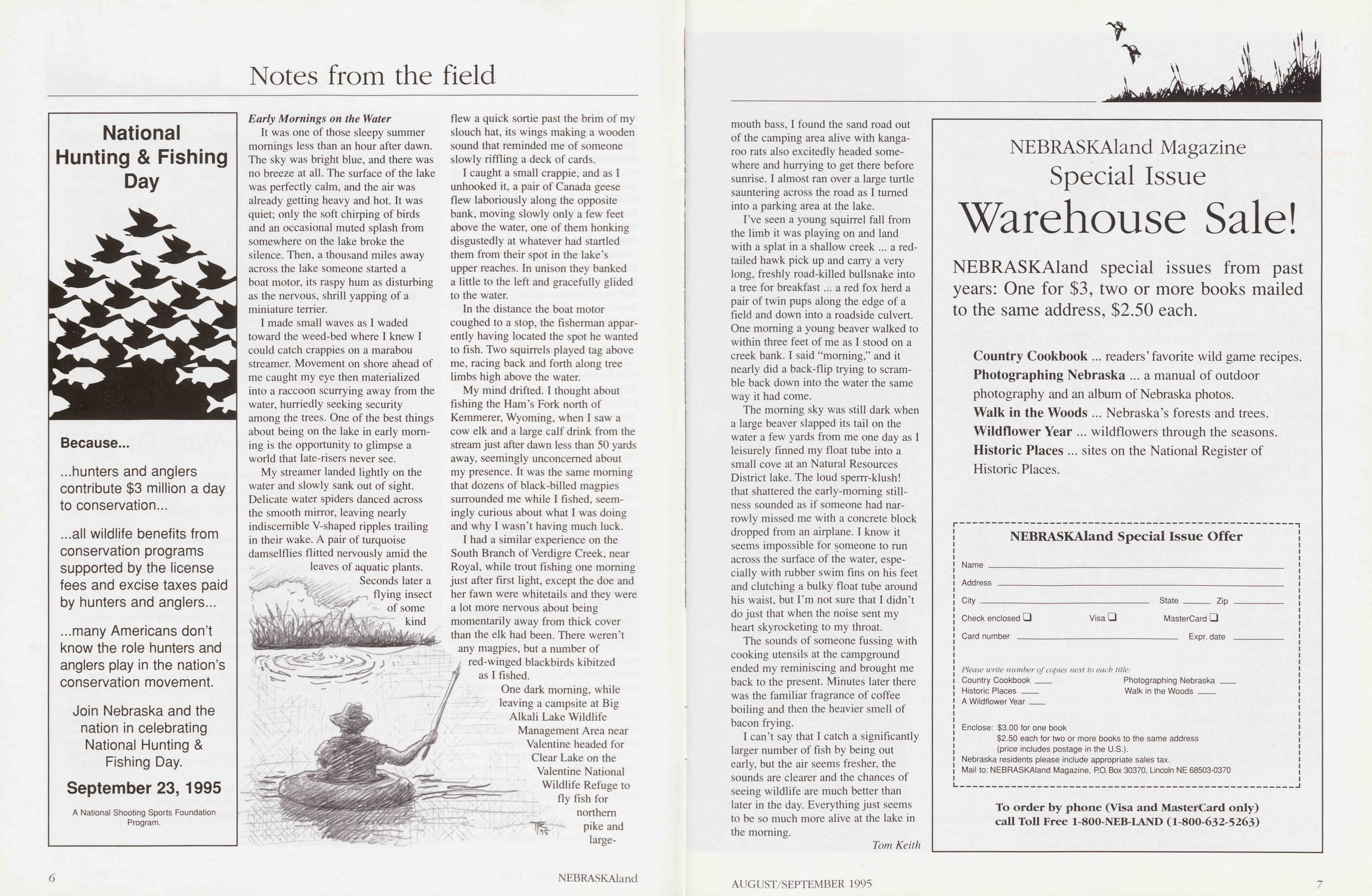
Notes from the field
National Hunting & Fishing Day Because hunters and anglers contribute $3 million a day to conservation all wildlife benefits from conservation programs supported by the license fees and excise taxes paid by hunters and anglers many Americans don't know the role hunters and anglers play in the nation's conservation movement. Join Nebraska and the nation in celebrating National Hunting & Fishing Day. September 23,1995 A National Shooting Sports Foundation Program. Early Mornings on the WaterIt was one of those sleepy summer mornings less than an hour after dawn. The sky was bright blue, and there was no breeze at all. The surface of the lake was perfectly calm, and the air was already getting heavy and hot. It was quiet; only the soft chirping of birds and an occasional muted splash from somewhere on the lake broke the silence. Then, a thousand miles away across the lake someone started a boat motor, its raspy hum as disturbing as the nervous, shrill yapping of a miniature terrier.
I made small waves as I waded toward the weed-bed where I knew I could catch crappies on a marabou streamer. Movement on shore ahead of me caught my eye then materialized into a raccoon scurrying away from the water, hurriedly seeking security among the trees. One of the best things about being on the lake in early morning is the opportunity to glimpse a world that late-risers never see.
My streamer landed lightly on the water and slowly sank out of sight. Delicate water spiders danced across the smooth mirror, leaving nearly indiscernible V-shaped ripples trailing in their wake. A pair of turquoise damselflies flitted nervously amid the leaves of aquatic plants. Seconds later a flying insect of some kind flew a quick sortie past the brim of my slouch hat, its wings making a wooden sound that reminded me of someone slowly riffling a deck of cards.
I caught a small crappie, and as I unhooked it, a pair of Canada geese flew laboriously along the opposite bank, moving slowly only a few feet above the water, one of them honking disgustedly at whatever had startled them from their spot in the lake's upper reaches. In unison they banked a little to the left and gracefully glided to the water.
In the distance the boat motor coughed to a stop, the fisherman apparently having located the spot he wanted to fish. Two squirrels played tag above me, racing back and forth along tree limbs high above the water.
My mind drifted. I thought about fishing the Ham's Fork north of Kemmerer, Wyoming, when I saw a cow elk and a large calf drink from the stream just after dawn less than 50 yards away, seemingly unconcerned about my presence. It was the same morning that dozens of black-billed magpies surrounded me while I fished, seemingly curious about what I was doing and why I wasn't having much luck.
I had a similar experience on the South Branch of Verdigre Creek, near Royal, while trout fishing one morning just after first light, except the doe and her fawn were whitetails and they were a lot more nervous about being momentarily away from thick cover than the elk had been. There weren't any magpies, but a number of red-winged blackbirds kibitzed as I fished.
One dark morning, while leaving a campsite at Big Alkali Lake Wildlife Management Area near Valentine headed for Clear Lake on the Valentine National Wildlife Refuge to fly fish for northern pike and large
I've seen a young squirrel fall from the limb it was playing on and land with a splat in a shallow creek a redtailed hawk pick up and carry a very long, freshly road-killed bullsnake into a tree for breakfast a red fox herd a pair of twin pups along the edge of a field and down into a roadside culvert. One morning a young beaver walked to within three feet of me as I stood on a creek bank. I said "morning," and it nearly did a back-flip trying to scramble back down into the water the same way it had come.
The morning sky was still dark when a large beaver slapped its tail on the water a few yards from me one day as I leisurely finned my float tube into a small cove at an Natural Resources District lake. The loud sperrr-klush! that shattered the early-morning stillness sounded as if someone had narrowly missed me with a concrete block dropped from an airplane. I know it seems impossible for someone to run across the surface of the water, especially with rubber swim fins on his feet and clutching a bulky float tube around his waist, but I'm not sure that I didn't do just that when the noise sent my heart skyrocketing to my throat.
The sounds of someone fussing with cooking utensils at the campground ended my reminiscing and brought me back to the present. Minutes later there was the familiar fragrance of coffee boiling and then the heavier smell of bacon frying.
I can't say that I catch a significantly larger number of fish by being out early, but the air seems fresher, the sounds are clearer and the chances of seeing wildlife are much better than later in the day. Everything just seems to be so much more alive at the lake in the morning.
Tom Keith NEBRASKAland Magazine Special Issue Warehouse Sale! NEBRASKAland special issues from past years: One for $3, two or more books mailed to the same address, $2.50 each. Country Cookbook readers' favorite wild game recipes. Photographing Nebraska a manual of outdoor photography and an album of Nebraska photos. Walk in the Woods Nebraska's forests and trees. Wildflower Year wildflowers through the seasons. Historic Places sites on the National Register of Historic Places. NEBRASKAland Special Issue Offer Name Address City State Zip Check enclosed Card number VisaG MasterCard G Expr. date Please write number of copies next to each title: Country Cookbook Historic Places A Wildflower Year Photographing Nebraska Walk in the Woods Enclose: $3.00 for one book $2.50 each for two or more books to the same address (price includes postage in the U.S.). Nebraska residents please include appropriate sales tax. Mail to: NEBRASKAland Magazine, P.O.Box 30370, Lincoln NE 68503-0370 To order by phone (Visa and MasterCard only) call Toll Free 1-800-NEB-LAND (1-800-632-5263) AUGUST/SEPTEMBER 1995 7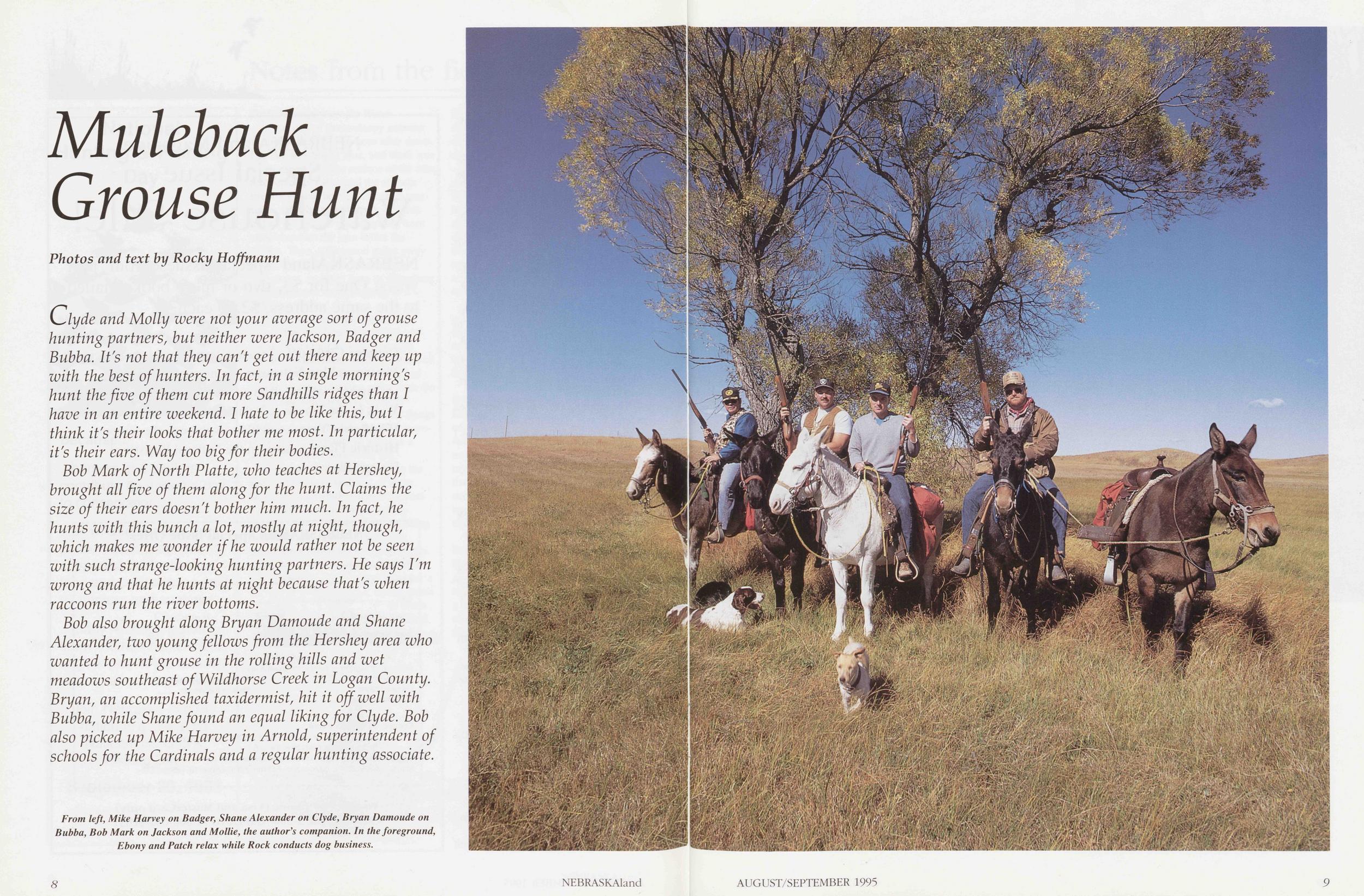
Muleback Grouse Hunt
Photos and text by Rocky Hoffmanny^lyde and Molly were not your average sort of grouse hunting partners, hut neither were Jackson, Badger and Bubba. It's not that they can't get out there and keep up with the best of hunters. In fact, in a single morning's hunt the five of them cut more Sandhills ridges than I have in an entire weekend. I hate to be like this, but I think it's their looks that bother me most. In particular, it's their ears. Way too big for their bodies.
Bob Mark of North Platte, who teaches at Hershey, brought all five of them along for the hunt. Claims the size of their ears doesn't bother him much. In fact, he hunts with this bunch a lot, mostly at night, though, which makes me wonder if he would rather not be seen with such strange-looking hunting partners. He says I'm wrong and that he hunts at night because that's when raccoons run the river bottoms.
Bob also brought along Bryan Damoude and Shane Alexander, two young fellows from the Hershey area who wanted to hunt grouse in the rolling hills and wet meadows southeast ofWildhorse Creek in Logan County. Bryan, an accomplished taxidermist, hit it off well with Bubba, while Shane found an equal liking for Clyde. Bob also picked up Mike Harvey in Arnold, superintendent of schools for the Cardinals and a regular hunting associate.
8 NEBRASKAland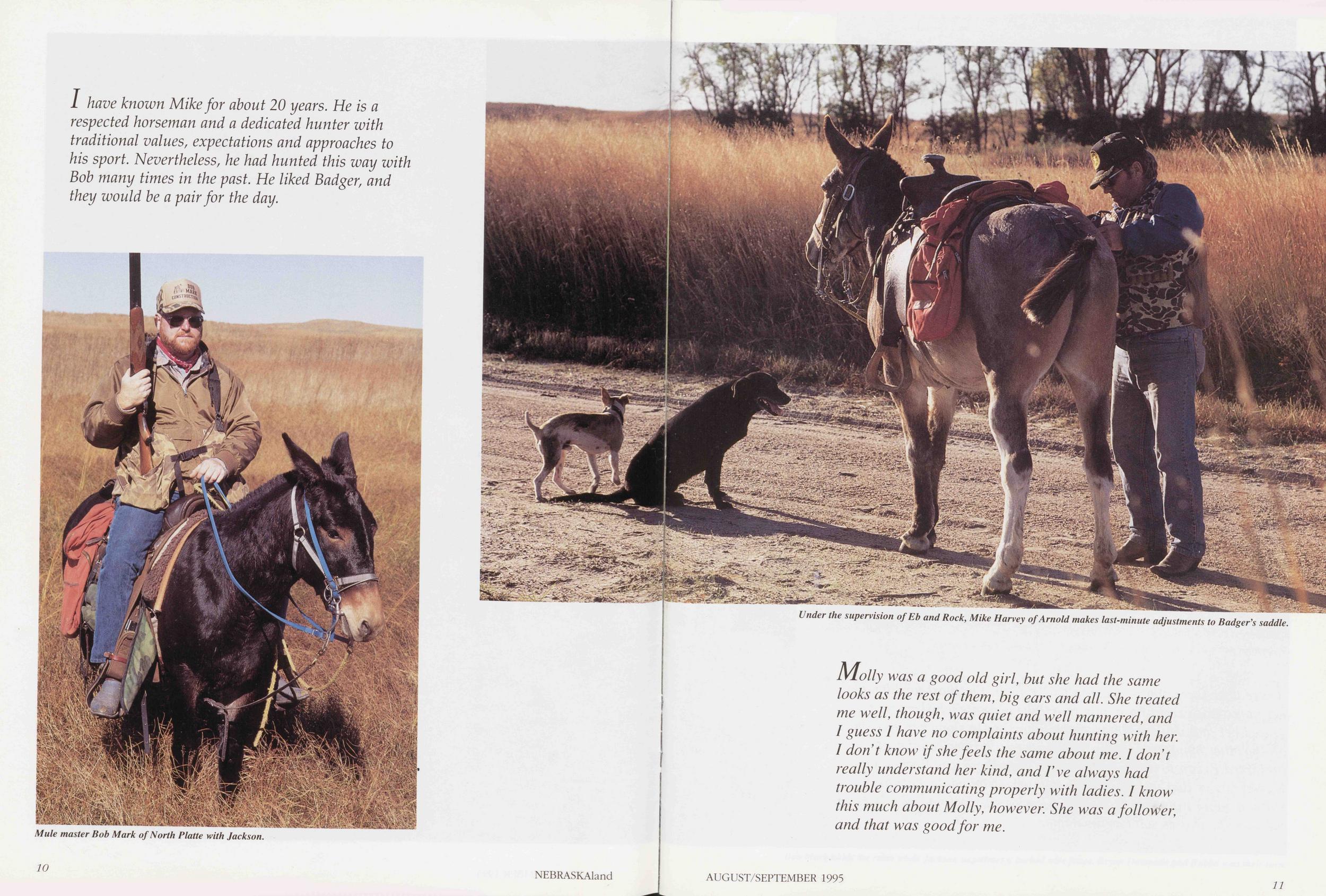
1 have known Mike for about 20 years. He is a respected horseman and a dedicated hunter with traditional values, expectations and approaches to his sport. Nevertheless, he had hunted this way with Bob many times in the past. He liked Badger, and they would be a pair for the day.
Lolly was a good old girl, but she had the same looks as the rest of them, big ears and all. She treated me well, though, was quiet and well mannered, and I guess I have no complaints about hunting with her. I dont know if she feels the same about me. I don't really understand her kind, and V ve always had trouble communicating properly with ladies. I know this much about Molly, however. She was a follower, and that was good for me.
AUGUST/SEPTEMBER 1995 11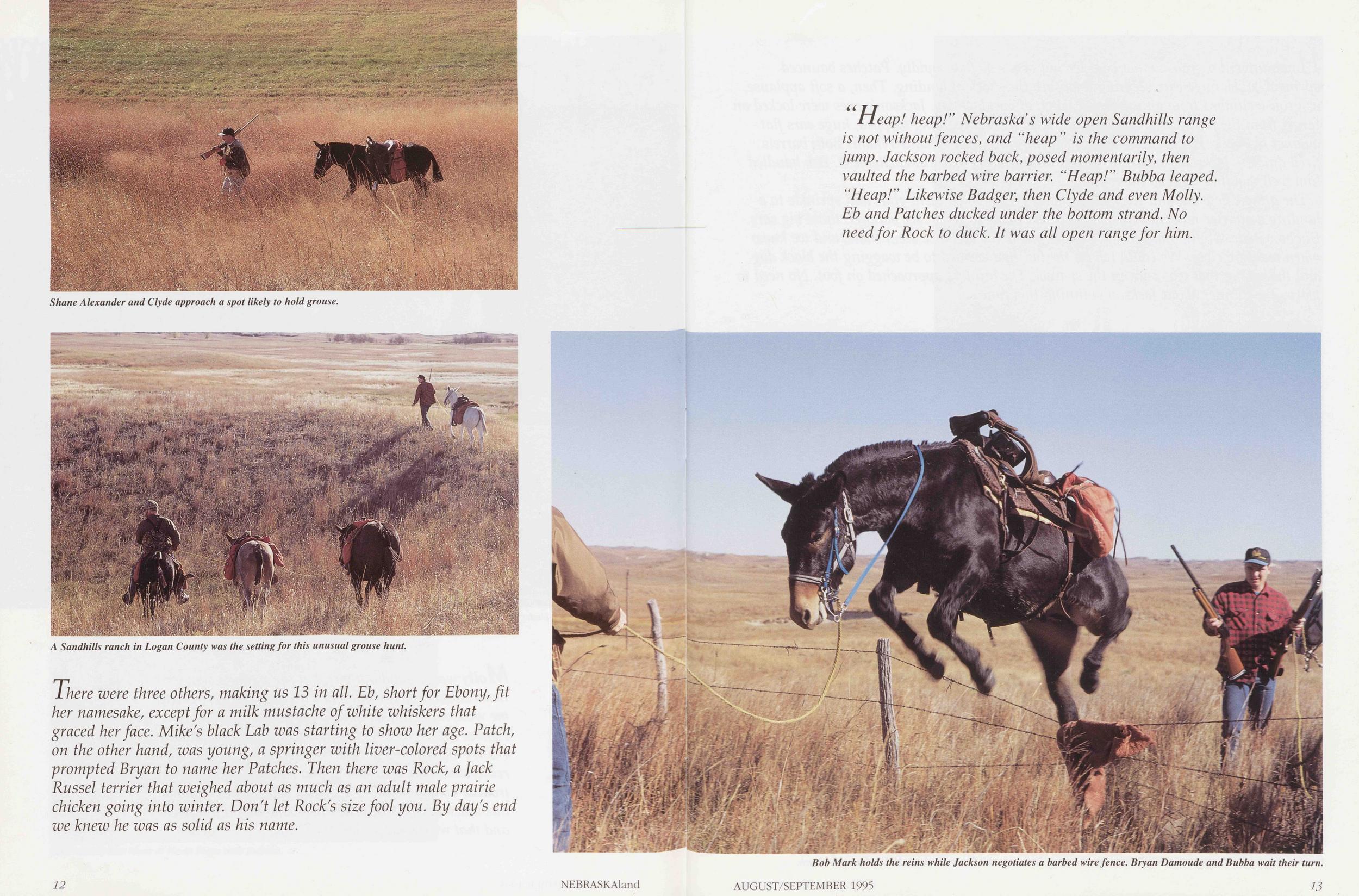
lhere were three others, making us 13 in all. Eb, short for Ebony, fit her namesake, except for a milk mustache of white whiskers that graced her face. Mike's black Lab was starting to show her age. Patch, on the other hand, was young, a springer with liver-colored spots that prompted Bryan to name her Patches. Then there was Rock, a jack Russel terrier that weighed about as much as an adult male prairie chicken going into winter. Don't let Rock's size fool you. By day's end we knew he was as solid as his name.
12 NEBRASKAlandheap! heap!" Nebraska's wide open Sandhills range is not without fences, and "heap" is the command to jump. Jackson rocked back, posed momentarily, then vaulted the barbed wire barrier. "Heap!" Bubba leaped. "Heap!" Likewise Badger, then Clyde and even Molly. Eb and Patches ducked under the bottom strand. No need for Rock to duck. It was all open range for him.
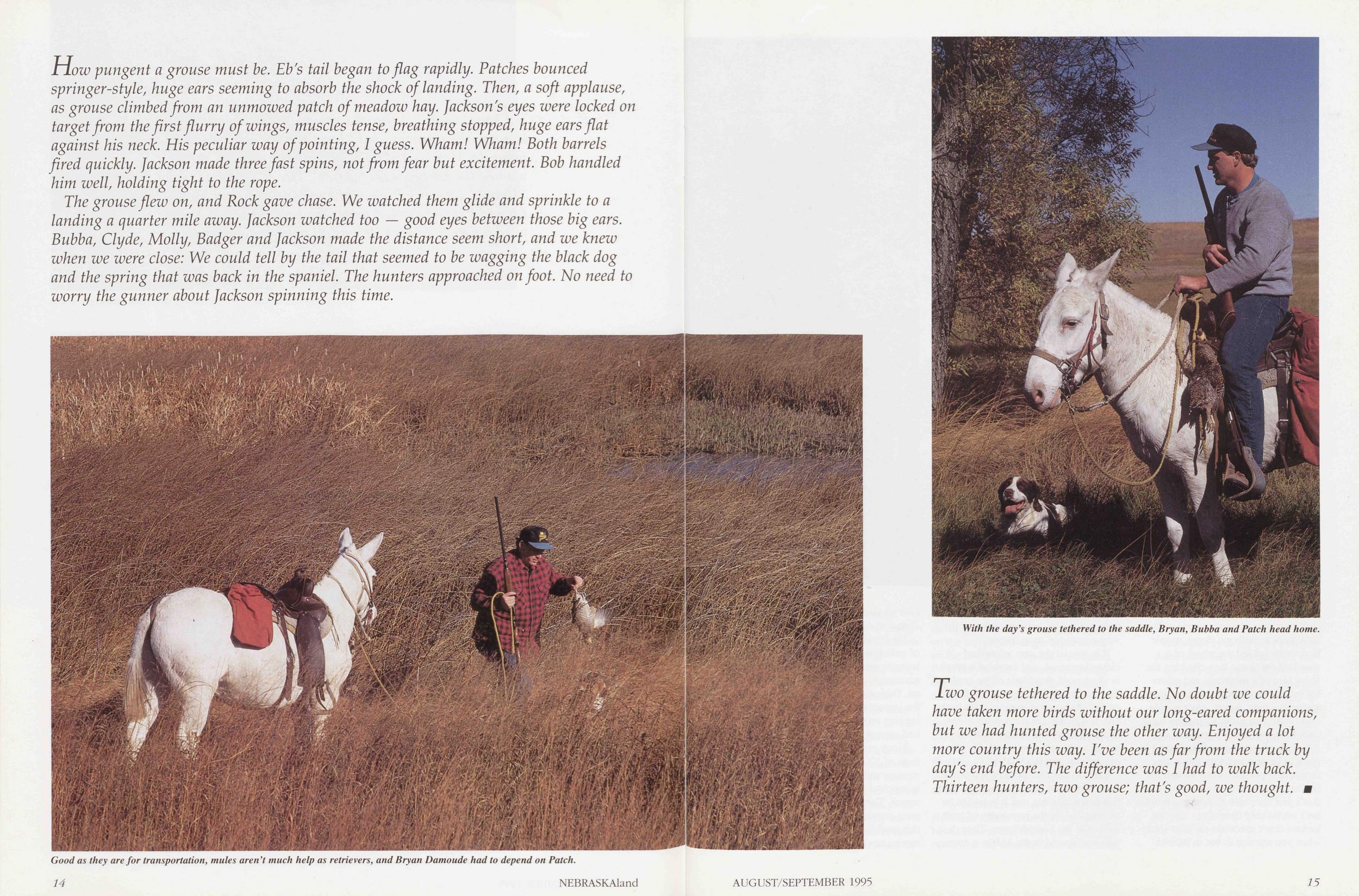
blow pungent a grouse must be. Eb's tail began to flag rapidly. Patches bounced springer-style, huge ears seeming to absorb the shock of landing. Then, a soft applause, as grouse climbed from an unmowed patch of meadow hay. Jackson's eyes were locked on target from the first flurry of wings, muscles tense, breathing stopped, huge ears flat against his neck. His peculiar way of pointing, I guess. Wham! Wham! Both barrels fired quickly. Jackson made three fast spins, not from fear but excitement. Bob handled him well, holding tight to the rope.
The grouse flew on, and Rock gave chase. We watched them glide and sprinkle to a landing a quarter mile away. Jackson watched too — good eyes between those big ears. Bubba, Clyde, Molly, Badger and Jackson made the distance seem short, and we knew when we were close: We could tell by the tail that seemed to be wagging the black dog and the spring that was back in the spaniel. The hunters approached on foot. No need to worry the gunner about Jackson spinning this time.
Iwo grouse tethered to the saddle. No doubt we could have taken more birds without our long-eared companions, but we had hunted grouse the other way. Enjoyed a lot more country this way. I've been as far from the truck by day's end before. The difference was I had to walk back. Thirteen hunters, two grouse; that's good, we thought, m
AUGUST/SEPTEMBER 1995 15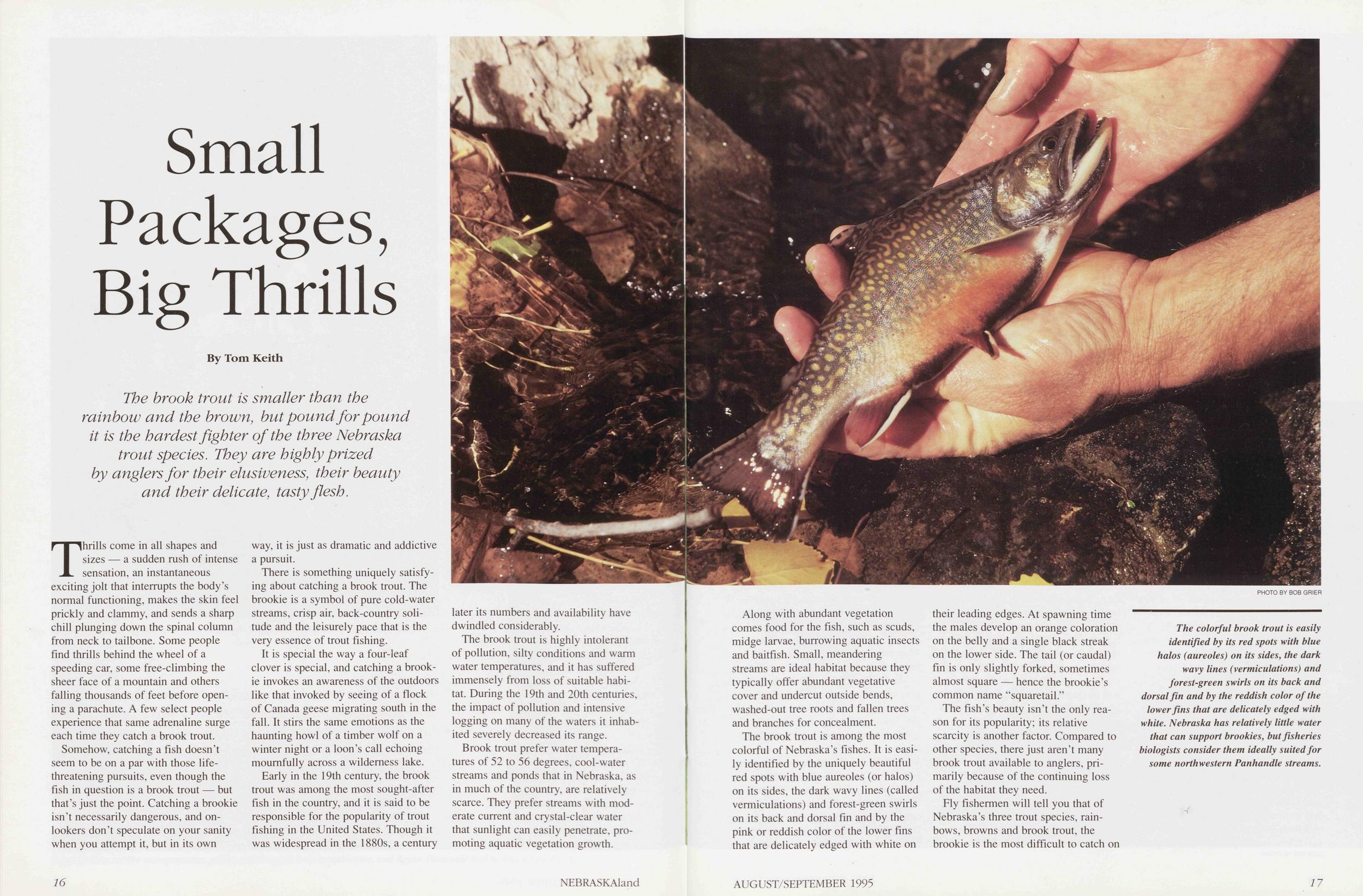
Small Packages, Big Thrills
By Tom Keith The brook trout is smaller than the rainbow and the brown, but pound for pound it is the hardest fighter of the three Nebraska trout species. They are highly prized by anglers for their elusiveness, their beauty and their delicate, tasty flesh.hrills come in all shapes and sizes — a sudden rush of intense sensation, an instantaneous exciting jolt that interrupts the body's normal functioning, makes the skin feel prickly and clammy, and sends a sharp chill plunging down the spinal column from neck to tailbone. Some people find thrills behind the wheel of a speeding car, some free-climbing the sheer face of a mountain and others falling thousands of feet before opening a parachute. A few select people experience that same adrenaline surge each time they catch a brook trout.
Somehow, catching a fish doesn't seem to be on a par with those life threatening pursuits, even though the fish in question is a brook trout but that's just the point. Catching a brookie isn't necessarily dangerous, and onlookers don't speculate on your sanity when you attempt it, but in its own way, it is just as dramatic and addictive a pursuit.
There is something uniquely satisfying about catching a brook trout. The brookie is a symbol of pure cold-water streams, crisp air, back-country solitude and the leisurely pace that is the very essence of trout fishing.
It is special the way a four-leaf clover is special, and catching a brookie invokes an awareness of the outdoors like that invoked by seeing of a flock of Canada geese migrating south in the fall. It stirs the same emotions as the haunting howl of a timber wolf on a winter night or a loon's call echoing mournfully across a wilderness lake.
Early in the 19th century, the brook trout was among the most sought-after fish in the country, and it is said to be responsible for the popularity of trout fishing in the United States. Though it was widespread in the 1880s, a century later its numbers and availability have dwindled considerably.
The brook trout is highly intolerant of pollution, silty conditions and warm water temperatures, and it has suffered immensely from loss of suitable habitat. During the 19th and 20th centuries, the impact of pollution and intensive logging on many of the waters it inhabited severely decreased its range. Brook trout prefer water temperatures of 52 to 56 degrees, cool-water streams and ponds that in Nebraska, as in much of the country, are relatively scarce. They prefer streams with moderate current and crystal-clear water that sunlight can easily penetrate, promoting aquatic vegetation growth.
16 NEBRASKAlandAlong with abundant vegetation comes food for the fish, such as scuds, midge larvae, burrowing aquatic insects and baitfish. Small, meandering streams are ideal habitat because they typically offer abundant vegetative cover and undercut outside bends, washed-out tree roots and fallen trees and branches for concealment.
The brook trout is among the most colorful of Nebraska's fishes. It is easily identified by the uniquely beautiful red spots with blue aureoles (or halos) on its sides, the dark wavy lines (called vermiculations) and forest-green swirls on its back and dorsal fin and by the pink or reddish color of the lower fins that are delicately edged with white on their leading edges. At spawning time the males develop an orange coloration on the belly and a single black streak on the lower side. The tail (or caudal) fin is only slightly forked, sometimes almost square — hence the brookie's common name "squaretail."
The fish's beauty isn't the only reason for its popularity; its relative scarcity is another factor. Compared to other species, there just aren't many brook trout available to anglers, primarily because of the continuing loss of the habitat they need.
Fly fishermen will tell you that of Nebraska's three trout species, rainbows, browns and brook trout, the brookie is the most difficult to catch on
Brook trout are the smallest of Nebraska's trout, and the state record brook trout tips the scales at only five pounds, one ounce, a record set in 1965 with a fish taken from Pawnee Springs near North Platte. By comparison, the state record rainbow weighs 14 pounds, two ounces, and the state record brown weighs a whopping 20 pounds, one ounce.
To be eligible for a Master Angler Award, a brook trout must weigh at least one pound or be at least 14 inches long. A rainbow must weigh at least five pounds or be 23 inches long, and a brown must weigh at least four pounds or be at least 22 inches long.
The brookie's small size is actually part of its appeal. It is so challenging and so much a prize that anglers look at it with a kind of inverse snobbery and take as much pride in catching an eight-inch brook trout as they do in catching an 18-inch brown trout.
Anglers take pride in different kinds of achievements. A bass or walleye fisherman may strive to catch a limit of fish in a single trip, while a flathead catfisherman may set his sights on landing a 40-pounder. Many fly fishermen are interested in catching a rainbow, a brown and a brookie on dry flies all in one season, a heady goal similar to a big-game fisherman wanting to a catch a huge marlin or tuna that will qualify him for membership in the International Game Fish Association's exclusive 1,000 Pound Club.
In Nebraska, at least, part of the brookie's appeal is the difficulty in finding and getting access to the small streams where they are stocked. Most such streams flow through private land, and landowner permission is required to fish them. Brook trout can be exceptionally wary, especially in shallow water, and anglers must take great care not to spook them.
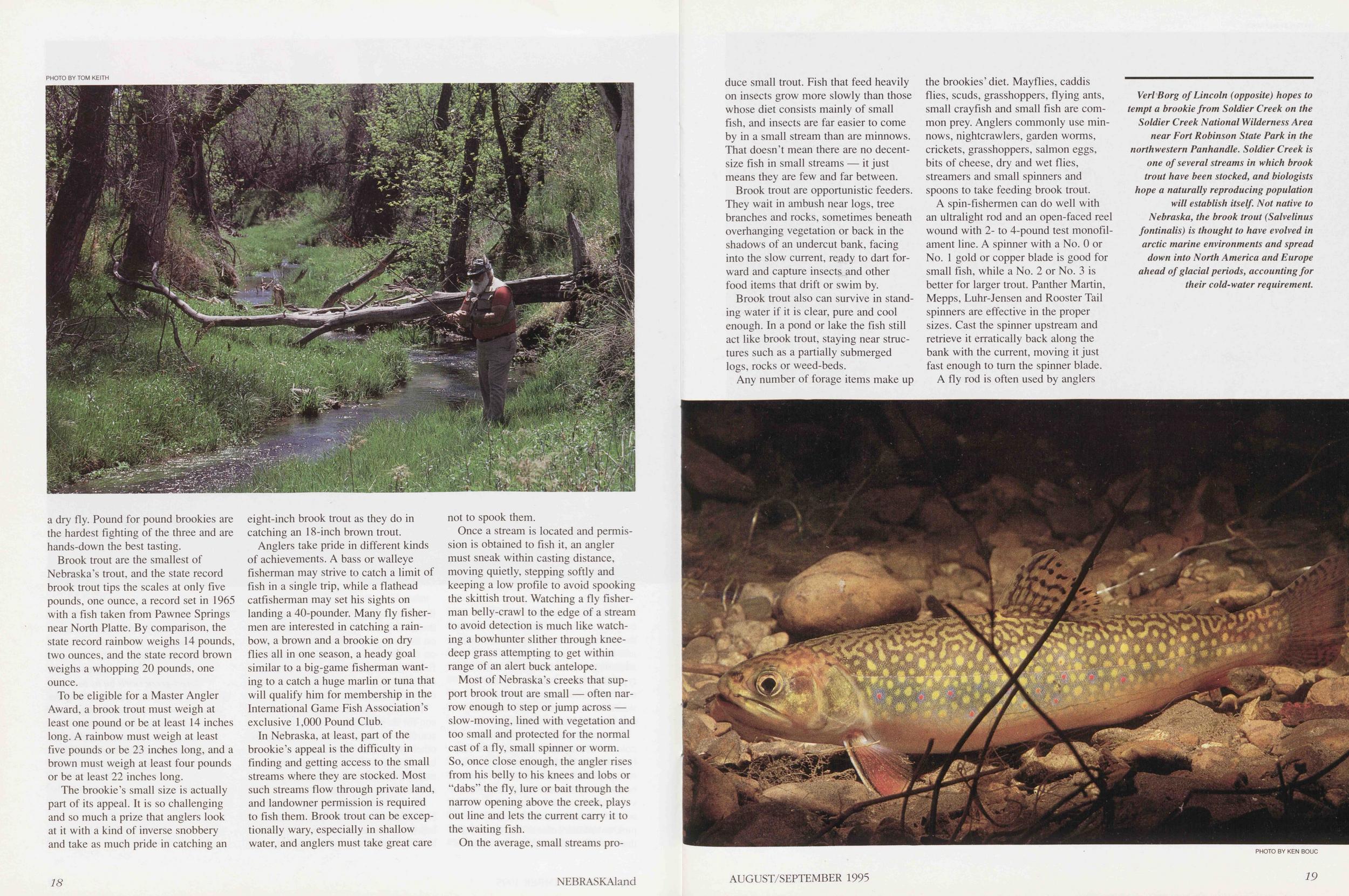
Once a stream is located and permission is obtained to fish it, an angler must sneak within casting distance, moving quietly, stepping softly and keeping a low profile to avoid spooking the skittish trout. Watching a fly fisherman belly-crawl to the edge of a stream to avoid detection is much like watching a bowhunter slither through kneedeep grass attempting to get within range of an alert buck antelope.
Most of Nebraska's creeks that support brook trout are small — often narrow enough to step or jump across — slow-moving, lined with vegetation and too small and protected for the normal cast of a fly, small spinner or worm. So, once close enough, the angler rises from his belly to his knees and lobs or "dabs" the fly, lure or bait through the narrow opening above the creek, plays out line and lets the current carry it to the waiting fish.
On the average, small streams produce small trout. Fish that feed heavily 18 NEBRASKAland on insects grow more slowly than those whose diet consists mainly of small fish, and insects are far easier to come by in a small stream than are minnows. That doesn't mean there are no decentsize fish in small streams — it just means they are few and far between.
Brook trout are opportunistic feeders. They wait in ambush near logs, tree branches and rocks, sometimes beneath overhanging vegetation or back in the shadows of an undercut bank, facing into the slow current, ready to dart forward and capture insects and other food items that drift or swim by.
Brook trout also can survive in standing water if it is clear, pure and cool enough. In a pond or lake the fish still act like brook trout, staying near strutures such as a partially submerged logs, rocks or weed-beds.
Any number of forage items make up the brookies'diet. Mayflies, caddis flies, scuds, grasshoppers, flying ants, small crayfish and small fish are common prey. Anglers commonly use minnows, nightcrawlers, garden worms, crickets, grasshoppers, salmon eggs, bits of cheese, dry and wet flies, streamers and small spinners and spoons to take feeding brook trout.
A spin-fishermen can do well with an ultralight rod and an open-faced reel wound with 2- to 4-pound test monofilament line. A spinner with a No. 0 or No. 1 gold or copper blade is good for small fish, while a No. 2 or No. 3 is better for larger trout. Panther Martin, Mepps, Luhr-Jensen and Rooster Tail spinners are effective in the proper sizes. Cast the spinner upstream and retrieve it erratically back along the bank with the current, moving it just fast enough to turn the spinner blade.
A fly rod is often used by anglers
A minnow, on the other hand, shouldn't bounce on the bottom, and to imitate a free-swimming minnow more realistically, anglers often hook the minnow through its nose and attach a small bobber to the line the proper distance ahead of the bait to keep it a few inches above the creek bottom as it is carried along by the current.
A properly presented dry fly will often take a feeding brookie, but because the fish are so wary, a sloppy presentation can make them stop feeding for a time. The Hendrickson, Adams, Gray Wulff, Humpy and Goof us Bug in sizes 14 to 20 often are productive on small streams. Experienced anglers use a long nine-to 12-foot leader with a slender 8X (1-pound) or 7X (2-pound) tippet.
Wet flies are usually more effective than dries for small stream brookies and patterns such as the Mickey Finn, Parmachene Belle, Black Gnat and Royal Coachman in sizes 12 to 20 are traditional favorites.
Because brookies also feed on small fish and minnows, there are several effective streamer patterns from which to choose. Some of the best are the Supervisor, Gray Ghost, Nine-Three and Black Ghost.
Trout feed extensively on mayfly and caddis fly nymphs. Some of the best nymph patterns for catching brook trout are the Gold-Ribbed Hare's Ear, Partridge and Orange Soft Hackle, Hendrickson, Squirrel Tail Nymph, Flick March Brown and the Zug Bug, all in sizes 12 to 20.
Thrills are thrills, and for many Nebraska anglers, one of the most satisfying is catching a beautiful brook trout, whatever its size.
1994-95 Brook Trout Master Angler Awards18 inches. 2 pounds, 2 ounces. Private pond in Dawes County. Panther Martin Spinner. Shane Merritt, Chadron.
1 pound, 14 ounces. Plum Creek in Brown County. Mepps Spinner. Brian Wysocki, Ainsworth.
16 inches. 1 pound, 1 ounce. Squaw Creek in Dawes County. Worm. Chris Nelson, Alliance.
16 inches. 1 pound, 9 ounces. West Ash Creek. Nightcrawler. Roger A. Rohrbouck, Alliance.
14 inches. 1 pound, 2 ounces. West Ash Creek. Worm. Mark Schafer, Alliance.
To qualify for a Nebraska Master Angler Award, a brook trout must weigh at least one pound or be 14 inches long. 20 NEBRASKAlandWilderness Brookies
The colorful brook trout was extensively stocked in Nebraska streams before 1900, but the first stocking on record occurred accidentally in 1873 when a train carrying fish for stocking in various locations went off a bridge and dumped the entire load — tautog, striped bass, American shad, brook trout, channel catfish, American eel, yellow perch, walleye, largemouth bass, minnows, lobsters and oysters into the Elkhorn River. Intentional brook trout stockings were made in 1882 in streams near South Bend, North Platte and Sutton and in a pond north of Omaha.
Brook trout can reproduce in small, cold-water streams with limited spawning habitat, and they can survive floods like those on Pine Ridge creeks and streams that can eliminate rainbow and brown trout from the drainages.
In 1993, the Game and Parks Commission began stocking brook trout in a few Pine Ridge streams hoping to establish naturally reproducing populations. Rainbow and brown trout had been stocked in many of the streams, said Jack Peterson, the Commission's district fisheries supervisor for the Panhandle, and the Commission will continue to stock those fish.
"Nebraska has a limited amount of trout-supporting water," Peterson said, "and I feel the brook trout fills an important niche in maximizing our trout fishBy Bob Grier ery. Their requirements for reproduction are not as strict as those of rainbow and brown trout. The brookie is an ideal choice for stocking in some of the very small creeks and streams in our area."
Parts of the former Wood Reserve near Fort Robinson State Park west of Crawford are designated as National Wilderness Area, and that designation was a factor in Peterson's decision to stock brook trout there. In the past, Soldier Creek had been stocked by truck with trout from the Crawford Fish Hatchery, but wilderness area designation means motorized vehicles are no longer allowed there, and that prompted the Commission to work with the U.S. Forest Service in establishing a naturally reproducing population of brook trout.
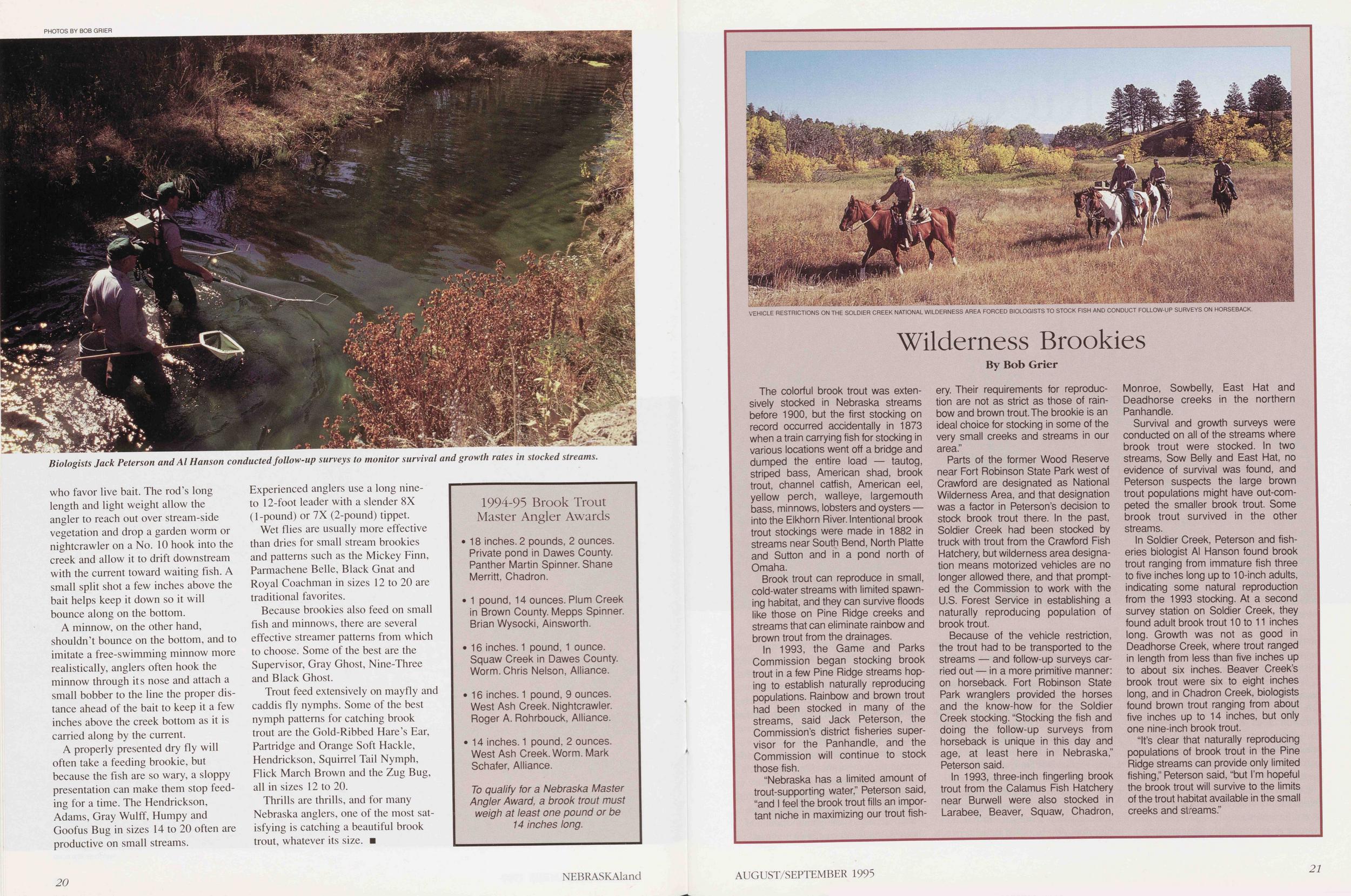
Because of the vehicle restriction, the trout had to be transported to the streams — and follow-up surveys carried out — in a more primitive manner: on horseback. Fort Robinson State Park wranglers provided the horses and the know-how for the Soldier Creek stocking. "Stocking the fish and doing the follow-up surveys from horseback is unique in this day and age, at least here in Nebraska," Peterson said.
In 1993, three-inch fingerling brook trout from the Calamus Fish Hatchery near Burwell were also stocked in Larabee, Beaver, Squaw, Chadron, Monroe, Sowbelly, East Hat and Deadhorse creeks in the northern Panhandle.
Survival and growth surveys were conducted on all of the streams where brook trout were stocked. In two streams, Sow Belly and East Hat, no evidence of survival was found, and Peterson suspects the large brown trout populations might have out-competed the smaller brook trout. Some brook trout survived in the other streams.
In Soldier Creek, Peterson and fisheries biologist Al Hanson found brook trout ranging from immature fish three to five inches long up to 10-inch adults, indicating some natural reproduction from the 1993 stocking. At a second survey station on Soldier Creek, they found adult brook trout 10 to 11 inches long. Growth was not as good in Deadhorse Creek, where trout ranged in length from less than five inches up to about six inches. Beaver Creek's brook trout were six to eight inches long, and in Chadron Creek, biologists found brown trout ranging from about five inches up to 14 inches, but only one nine-inch brook trout.
"It's clear that naturally reproducing populations of brook trout in the Pine Ridge streams can provide only limited fishing," Peterson said, "but I'm hopeful the brook trout will survive to the limits of the trout habitat available in the small creeks and streams."
AUGUST/SEPTEMBER 1995 21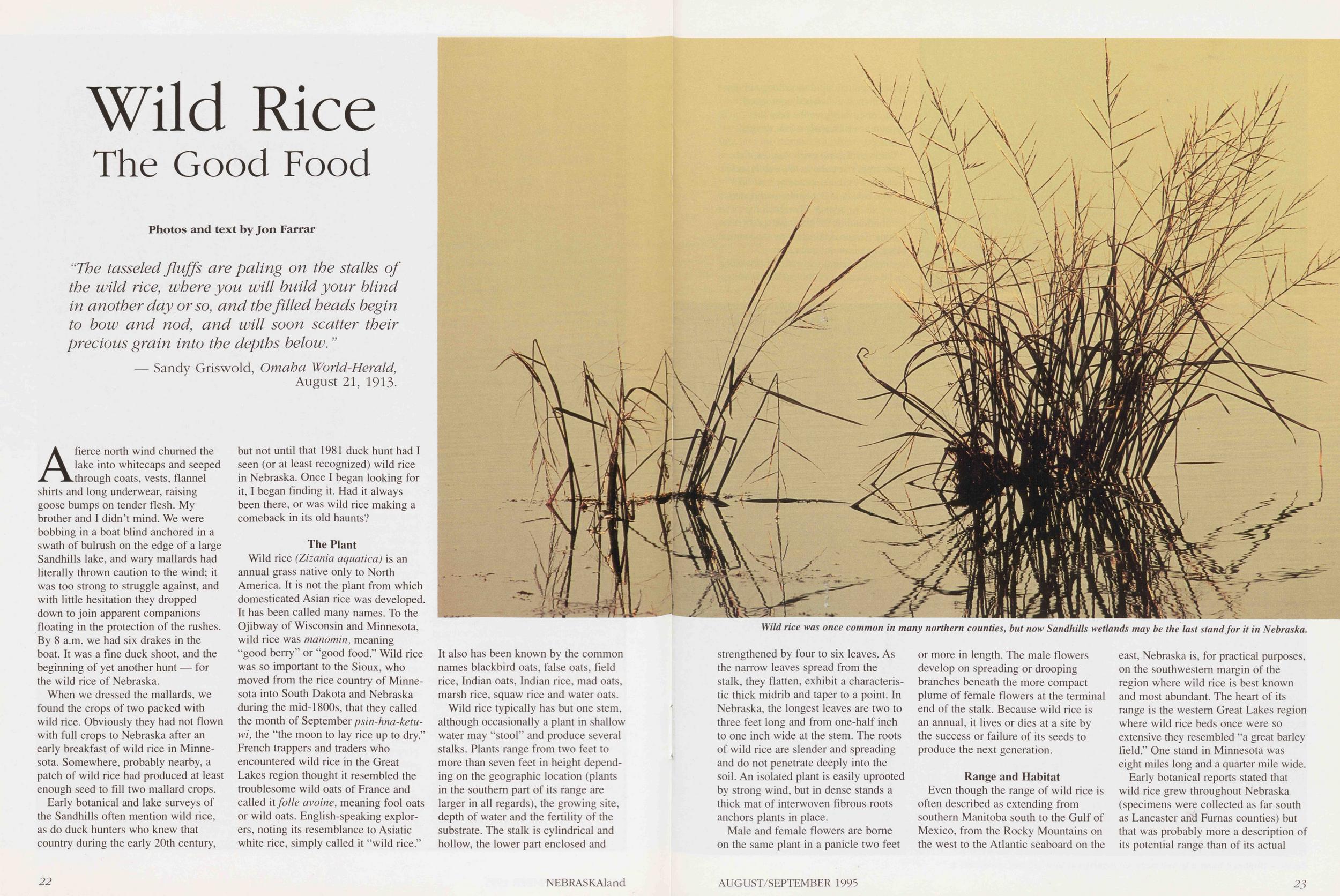
Wild Rice
The Good Food Photos and text by Jon Farrar "The tasseled fluffs are paling on the stalks of the wild rice, where you will build your blind in another day or so, and the filled heads begin to bow and nod, and will soon scatter their precious grain into the depths below." — Sandy Griswold, Omaha World-Herald, August 21, 1913.A fierce north wind churned the lake into whitecaps and seeped through coats, vests, flannel shirts and long underwear, raising goose bumps on tender flesh. My brother and I didn't mind. We were bobbing in a boat blind anchored in a swath of bulrush on the edge of a large Sandhills lake, and wary mallards had literally thrown caution to the wind; it was too strong to struggle against, and with little hesitation they dropped down to join apparent companions floating in the protection of the rushes. By 8 a.m. we had six drakes in the boat. It was a fine duck shoot, and the beginning of yet another hunt — for the wild rice of Nebraska.
When we dressed the mallards, we found the crops of two packed with wild rice. Obviously they had not flown with full crops to Nebraska after an early breakfast of wild rice in Minnesota. Somewhere, probably nearby, a patch of wild rice had produced at least enough seed to fill two mallard crops.
Early botanical and lake surveys of the Sandhills often mention wild rice, as do duck hunters who knew that country during the early 20th century, but not until that 1981 duck hunt had I seen (or at least recognized) wild rice in Nebraska. Once I began looking for it, I began finding it. Had it always been there, or was wild rice making a comeback in its old haunts?
The PlantWild rice (Zizania aquatica) is an annual grass native only to North America. It is not the plant from which domesticated Asian rice was developed. It has been called many names. To the Ojibway of Wisconsin and Minnesota, wild rice was manomin, meaning "good berry" or "good food." Wild rice was so important to the Sioux, who moved from the rice country of Minnesota into South Dakota and Nebraska during the mid-1800s, that they called the month of September psin-hna-ketu-wi, the "the moon to lay rice up to dry." French trappers and traders who encountered wild rice in the Great Lakes region thought it resembled the troublesome wild oats of France and called it folle avoine, meaning fool oats or wild oats. English-speaking explorers, noting its resemblance to Asiatic white rice, simply called it "wild rice."
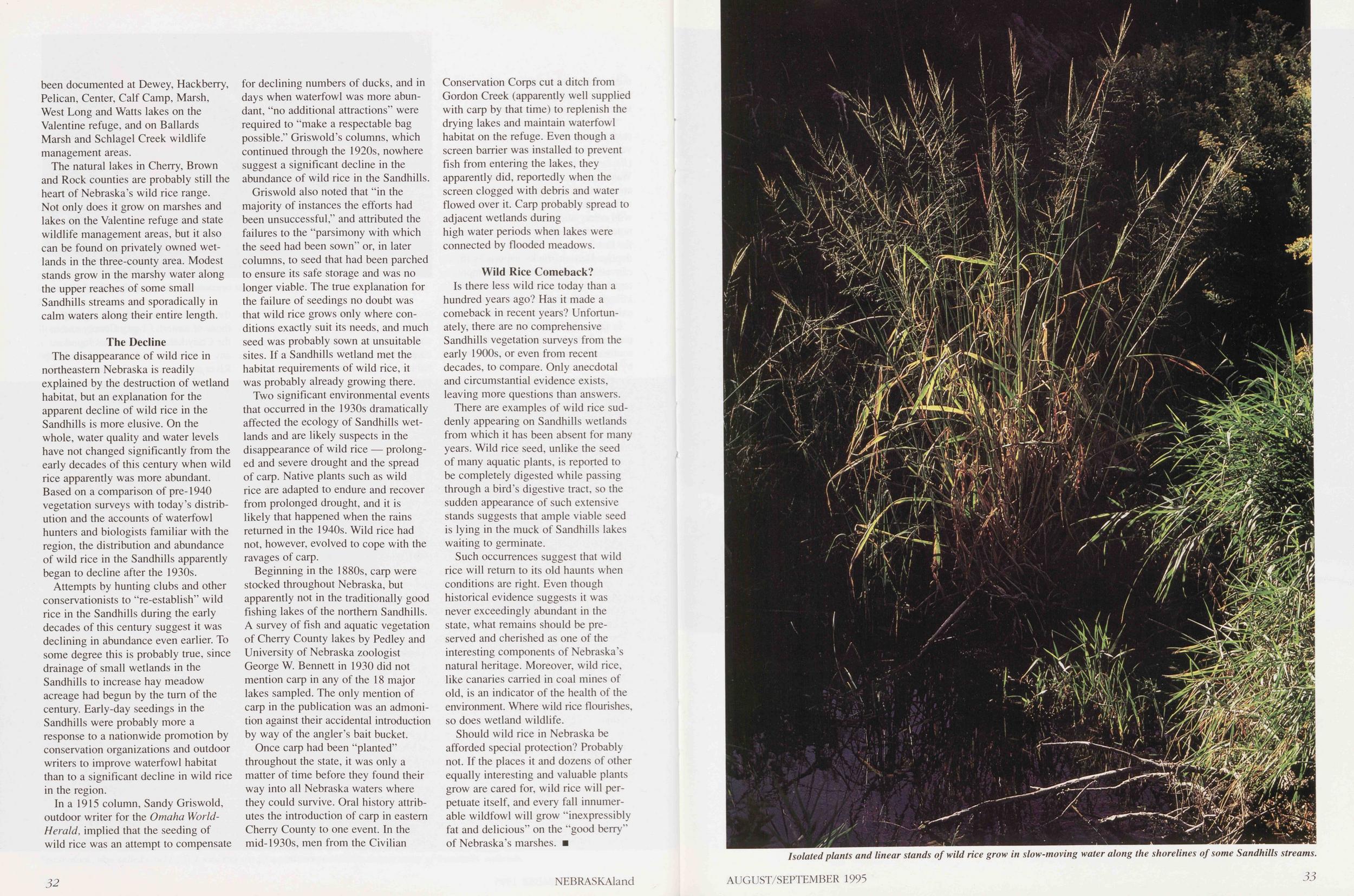
It also has been known by the common names blackbird oats, false oats, field rice, Indian oats, Indian rice, mad oats, marsh rice, squaw rice and water oats. Wild rice typically has but one stem, although occasionally a plant in shallow water may "stool" and produce several stalks. Plants range from two feet to more than seven feet in height depending on the geographic location (plants in the southern part of its range are larger in all regards), the growing site, depth of water and the fertility of the substrate. The stalk is cylindrical and hollow, the lower part enclosed and 22 NEBRASKAland
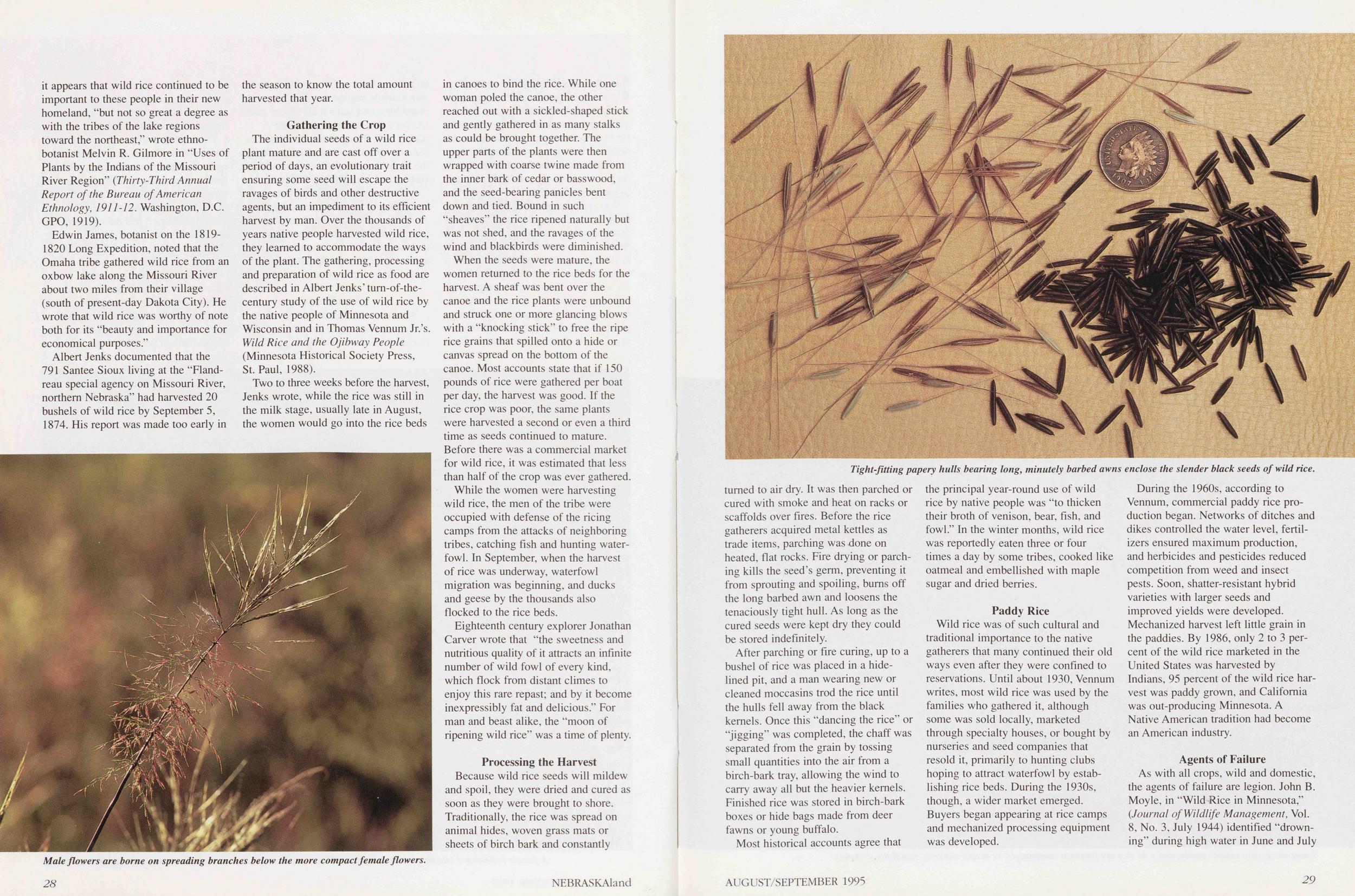
Male and female flowers are borne on the same plant in a panicle two feet or more in length. The male flowers develop on spreading or drooping branches beneath the more compact plume of female flowers at the terminal end of the stalk. Because wild rice is an annual, it lives or dies at a site by the success or failure of its seeds to produce the next generation.
Range and HabitatEven though the range of wild rice is often described as extending from southern Manitoba south to the Gulf of Mexico, from the Rocky Mountains on the west to the Atlantic seaboard on the east, Nebraska is, for practical purposes, on the southwestern margin of the region where wild rice is best known and most abundant. The heart of its range is the western Great Lakes region where wild rice beds once were so extensive they resembled "a great barley field." One stand in Minnesota was eight miles long and a quarter mile wide.
Early botanical reports stated that
wild rice grew throughout Nebraska
(specimens were collected as far south
as Lancaster and Furnas counties) but
that was probably more a description of
its potential range than of its actual
AUGUST/SEPTEMBER 1995
23
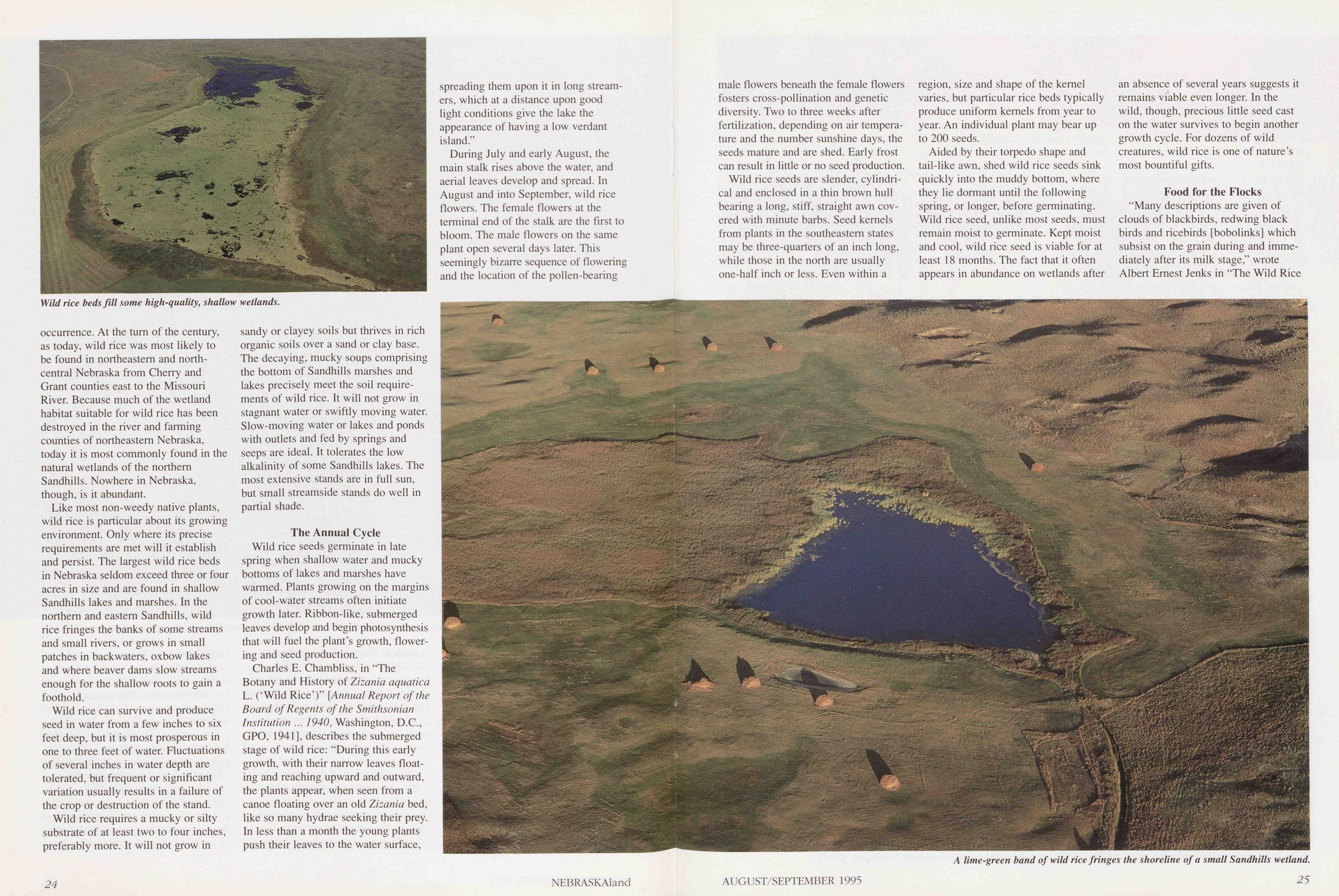
Like most non-weedy native plants, wild rice is particular about its growing environment. Only where its precise requirements are met will it establish and persist. The largest wild rice beds in Nebraska seldom exceed three or four acres in size and are found in shallow Sandhills lakes and marshes. In the northern and eastern Sandhills, wild rice fringes the banks of some streams and small rivers, or grows in small patches in backwaters, oxbow lakes and where beaver dams slow streams enough for the shallow roots to gain a foothold.
Wild rice can survive and produce seed in water from a few inches to six feet deep, but it is most prosperous in one to three feet of water. Fluctuations of several inches in water depth are tolerated, but frequent or significant variation usually results in a failure of the crop or destruction of the stand.
Wild rice requires a mucky or silty substrate of at least two to four inches, preferably more. It will not grow in sandy or clayey soils but thrives in rich organic soils over a sand or clay base. The decaying, mucky soups comprising the bottom of Sandhills marshes and lakes precisely meet the soil requirements of wild rice. It will not grow in stagnant water or swiftly moving water. Slow-moving water or lakes and ponds with outlets and fed by springs and seeps are ideal. It tolerates the low alkalinity of some Sandhills lakes. The most extensive stands are in full sun, but small streamside stands do well in partial shade.
The Annual CycleWild rice seeds germinate in late spring when shallow water and mucky bottoms of lakes and marshes have warmed. Plants growing on the margins of cool-water streams often initiate growth later. Ribbon-like, submerged leaves develop and begin photosynthesis that will fuel the plant's growth, flowering and seed production.
Charles E. Chambliss, in "The Botany and History of Zizania aquatica L. ('Wild Rice')" [Annual Report of the Board of Regents of the Smithsonian Institution ... 1940, Washington, D.C., GPO, 1941], describes the submerged stage of wild rice: "During this early growth, with their narrow leaves floating and reaching upward and outward, the plants appear, when seen from a canoe floating over an old Zizania bed, like so many hydrae seeking their prey. In less than a month the young plants push their leaves to the water surface, spreading them upon it in long streamers, which at a distance upon good light conditions give the lake the appearance of having a low verdant island."
During July and early August, the main stalk rises above the water, and aerial leaves develop and spread. In August and into September, wild rice flowers. The female flowers at the terminal end of the stalk are the first to bloom. The male flowers on the same plant open several days later. This seemingly bizarre sequence of flowering and the location of the pollen-bearing 24 NEBRASKAland male flowers beneath the female flowers fosters cross-pollination and genetic diversity. Two to three weeks after fertilization, depending on air temperature and the number sunshine days, the seeds mature and are shed. Early frost can result in little or no seed production.
Wild rice seeds are slender, cylindrical and enclosed in a thin brown hull bearing a long, stiff, straight awn covered with minute barbs. Seed kernels from plants in the southeastern states may be three-quarters of an inch long, while those in the north are usually one-half inch or less. Even within a region, size and shape of the kernel varies, but particular rice beds typically produce uniform kernels from year to year. An individual plant may bear up to 200 seeds.
Aided by their torpedo shape and tail-like awn, shed wild rice seeds sink quickly into the muddy bottom, where they lie dormant until the following spring, or longer, before germinating. Wild rice seed, unlike most seeds, must remain moist to germinate. Kept moist and cool, wild rice seed is viable for at least 18 months. The fact that it often appears in abundance on wetlands after an absence of several years suggests it remains viable even longer. In the wild, though, precious little seed cast on the water survives to begin another growth cycle. For dozens of wild creatures, wild rice is one of nature's most bountiful gifts.
Food for the Flocks"Many descriptions are given of clouds of blackbirds, redwing black birds and ricebirds [bobolinks] which subsist on the grain during and immediately after its milk stage," wrote Albert Ernest Jenks in "The Wild Rice
W.L. McAtee, in Propagation of Wild-Duck Foods (U.S. Department of Agriculture, Bulletin No. 465, Washington, D.C. GPO, 1917), wrote that "wild rice in every stage of its growth is eaten by one or another of the North American ducks and geese, and practically all of them feed on its ripened grain." He noted that young shoots and germinating seeds of wild rice are found in duck stomachs at "practically all seasons." More than 17 percent of the food in 209 mallards he examined was wild rice. In 75 wood ducks, 11 percent of the food was wild rice. He listed Canada geese, snow geese, pintails, wigeons, lesser scaups, canvasbacks, redheads, green-winged and blue-winged teal, buffleheads and ruddy ducks as species that regularly feed on wild rice when it is available. Other researchers have found that wild rice comprised more than 50 percent of the food for wild ducks on some Minnesota lakes in autumn.
In late August and September, a procession of birds gathers for the harvest. Mallards, wood ducks, wigeons, blue-winged teal and other duck species present in the Sandhills can be seen tipping up to glean kernels of wild rice
Waves of red-winged and yellow-headed blackbirds sweep into rice beds from adjoining pastures. Landing midway up a wild rice stalk, where it is stout enough to support the bird's weight, a blackbird sidesteps toward the seedhead, fluttering its wings to maintain its balance, the rice stalk bending until it lodges in neighboring plants. Methodically, the blackbird plucks a single wild rice seed, manipulates it deftly in its bill until only the awn extends beyond the tip of the mandibles, and snips it off before swallowing the kernel enclosed in its papery hull. Through trial and error, or genetically transmitted racial memory, the birds know the inch-or-more-long barbed awn is not to be swallowed.
After several days of such thorough harvesting by flocks of blackbirds, few seeds can be found even in several acres of wild rice. It is little wonder that the human wild rice gatherers of yesteryear learned to thwart the birds to ensure their own harvest.
Rice WarsNowhere was wild rice more essential to a native people than in the "wild rice district," described by Albert Jenks as most of Wisconsin and the northern half of Minnesota, a region of glacial ponds and lakes where wild rice was widespread and abundant.
The importance of wild rice to the people of the district is clearly illustrated by the centuries of fierce and bloody battles waged among tribes for its control. Much of our knowledge of the use of wild rice by native people comes from that district, and the nature of its use in northeastern and north-central Nebraska must be inferred from its use there.
Several tribes that occupied Nebraska's "wild-rice district" in the 19th century came from regions to the northeast and east, where the harvest of wild rice was a deeply ingrained tradition. Although documentation is scanty,
 it appears that wild rice continued to be
important to these people in their new
homeland, "but not so great a degree as
with the tribes of the lake regions
toward the northeast," wrote ethnobotanist Melvin R. Gilmore in "Uses of
Plants by the Indians of the Missouri
River Region" (Thirty-Third Annual
Report of the Bureau of American
Ethnology, 1911-12. Washington, D.C.
GPO, 1919).
it appears that wild rice continued to be
important to these people in their new
homeland, "but not so great a degree as
with the tribes of the lake regions
toward the northeast," wrote ethnobotanist Melvin R. Gilmore in "Uses of
Plants by the Indians of the Missouri
River Region" (Thirty-Third Annual
Report of the Bureau of American
Ethnology, 1911-12. Washington, D.C.
GPO, 1919).
Edwin James, botanist on the 1819-1820 Long Expedition, noted that the Omaha tribe gathered wild rice from an oxbow lake along the Missouri River about two miles from their village (south of present-day Dakota City). He wrote that wild rice was worthy of note both for its "beauty and importance for economical purposes."
Albert Jenks documented that the 791 Santee Sioux living at the "Flandreau special agency on Missouri River, northern Nebraska" had harvested 20 bushels of wild rice by September 5, 1874. His report was made too early in the season to know the total amount harvested that year.
Gathering the CropThe individual seeds of a wild rice plant mature and are cast off over a period of days, an evolutionary trait ensuring some seed will escape the ravages of birds and other destructive agents, but an impediment to its efficient harvest by man. Over the thousands of years native people harvested wild rice, they learned to accommodate the ways of the plant. The gathering, processing and preparation of wild rice as food are described in Albert Jenks' turn-of-the-century study of the use of wild rice by the native people of Minnesota and Wisconsin and in Thomas Vennum Jr.'s. Wild Rice and the Ojihway People (Minnesota Historical Society Press, St. Paul, 1988).
Two to three weeks before the harvest, Jenks wrote, while the rice was still in the milk stage, usually late in August, the women would go into the rice beds in canoes to bind the rice. While one woman poled the canoe, the other reached out with a sickled-shaped stick and gently gathered in as many stalks as could be brought together. The upper parts of the plants were then wrapped with coarse twine made from the inner bark of cedar or basswood, and the seed-bearing panicles bent down and tied. Bound in such "sheaves" the rice ripened naturally but was not shed, and the ravages of the wind and blackbirds were diminished.
When the seeds were mature, the women returned to the rice beds for the harvest. A sheaf was bent over the canoe and the rice plants were unbound and struck one or more glancing blows with a "knocking stick" to free the ripe rice grains that spilled onto a hide or canvas spread on the bottom of the canoe. Most accounts state that if 150 pounds of rice were gathered per boat per day, the harvest was good. If the rice crop was poor, the same plants were harvested a second or even a third time as seeds continued to mature. Before there was a commercial market for wild rice, it was estimated that less than half of the crop was ever gathered.
While the women were harvesting wild rice, the men of the tribe were occupied with defense of the ricing camps from the attacks of neighboring tribes, catching fish and hunting waterfowl. In September, when the harvest of rice was underway, waterfowl migration was beginning, and ducks and geese by the thousands also flocked to the rice beds.
Eighteenth century explorer Jonathan Carver wrote that "the sweetness and nutritious quality of it attracts an infinite number of wild fowl of every kind, which flock from distant climes to enjoy this rare repast; and by it become inexpressibly fat and delicious." For man and beast alike, the "moon of ripening wild rice" was a time of plenty.
Processing the HarvestBecause wild rice seeds will mildew and spoil, they were dried and cured as soon as they were brought to shore. Traditionally, the rice was spread on animal hides, woven grass mats or sheets of birch bark and constantly
After parching or fire curing, up to a bushel of rice was placed in a hidelined pit, and a man wearing new or cleaned moccasins trod the rice until the hulls fell away from the black kernels. Once this "dancing the rice" or "jigging" was completed, the chaff was separated from the grain by tossing small quantities into the air from a birch-bark tray, allowing the wind to carry away all but the heavier kernels. Finished rice was stored in birch-bark boxes or hide bags made from deer fawns or young buffalo.
Most historical accounts agree that the principal year-round use of wild rice by native people was "to thicken their broth of venison, bear, fish, and fowl." In the winter months, wild rice was reportedly eaten three or four times a day by some tribes, cooked like oatmeal and embellished with maple sugar and dried berries.
Paddy RiceWild rice was of such cultural and traditional importance to the native gatherers that many continued their old ways even after they were confined to reservations. Until about 1930, Vennum writes, most wild rice was used by the families who gathered it, although some was sold locally, marketed through specialty houses, or bought by nurseries and seed companies that resold it, primarily to hunting clubs hoping to attract waterfowl by establishing rice beds. During the 1930s, though, a wider market emerged. Buyers began appearing at rice camps and mechanized processing equipment was developed.
During the 1960s, according to Vennum, commercial paddy rice production began. Networks of ditches and dikes controlled the water level, fertilizers ensured maximum production, and herbicides and pesticides reduced competition from weed and insect pests. Soon, shatter-resistant hybrid varieties with larger seeds and improved yields were developed. Mechanized harvest left little grain in the paddies. By 1986, only 2 to 3 percent of the wild rice marketed in the United States was harvested by Indians, 95 percent of the wild rice harvest was paddy grown, and California was out-producing Minnesota. A Native American tradition had become an American industry.
Agents of FailureAs with all crops, wild and domestic,
the agents of failure are legion. John B.
Moyle, in "Wild Rice in Minnesota,"
(journal of Wildlife Management, Vol.
8, No. 3, July 1944) identified "drowning" during high water in June and July
AUGUST/SEPTEMBER 1995
29
 (when the plants have only submerged
leaves and are vulnerable to wave
action) as a principal contributor to
crop failure. Moyle also observed that
hot, dry weather when the rice plants
are in flower can result in poor seed
setting. Moyle noted that "the harvest
during any four years is likely to fail
once, and to produce one bumper and
two fair crops."
(when the plants have only submerged
leaves and are vulnerable to wave
action) as a principal contributor to
crop failure. Moyle also observed that
hot, dry weather when the rice plants
are in flower can result in poor seed
setting. Moyle noted that "the harvest
during any four years is likely to fail
once, and to produce one bumper and
two fair crops."
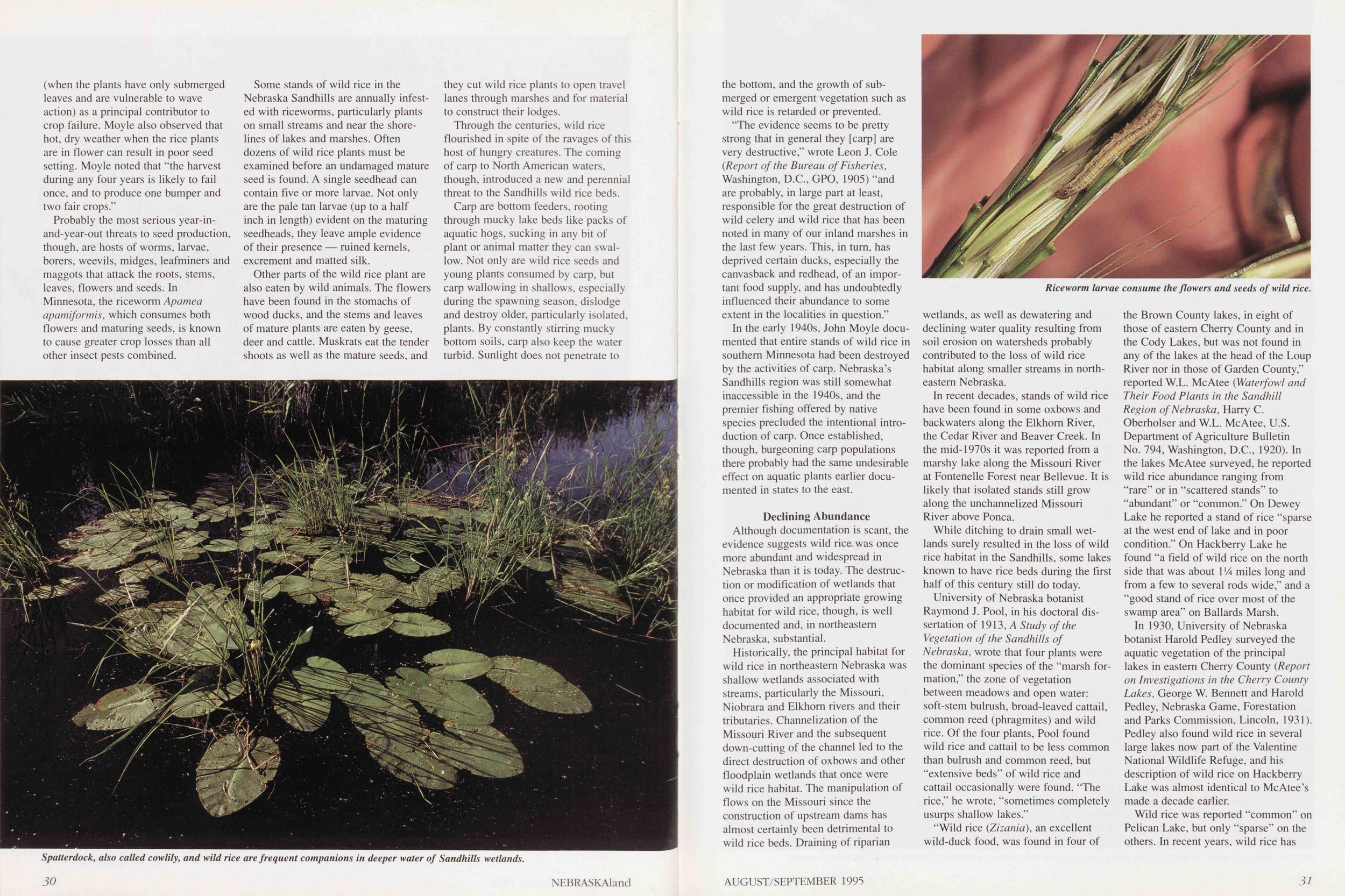
Probably the most serious year-in-and-year-out threats to seed production, though, are hosts of worms, larvae, borers, weevils, midges, leafminers and maggots that attack the roots, stems, leaves, flowers and seeds. In Minnesota, the riceworm Apamea apamiformis, which consumes both flowers and maturing seeds, is known to cause greater crop losses than all other insect pests combined.
Some stands of wild rice in the Nebraska Sandhills are annually infested with riceworms, particularly plants on small streams and near the shorelines of lakes and marshes. Often dozens of wild rice plants must be examined before an undamaged mature seed is found. A single seedhead can contain five or more larvae. Not only are the pale tan larvae (up to a half inch in length) evident on the maturing seedheads, they leave ample evidence of their presence — ruined kernels, excrement and matted silk.
Other parts of the wild rice plant are also eaten by wild animals. The flowers have been found in the stomachs of wood ducks, and the stems and leaves of mature plants are eaten by geese, deer and cattle. Muskrats eat the tender shoots as well as the mature seeds, and they cut wild rice plants to open travel lanes through marshes and for material to construct their lodges.
Through the centuries, wild rice flourished in spite of the ravages of this host of hungry creatures. The coming of carp to North American waters, though, introduced a new and perennial threat to the Sandhills wild rice beds.
Carp are bottom feeders, rooting through mucky lake beds like packs of aquatic hogs, sucking in any bit of plant or animal matter they can swallow. Not only are wild rice seeds and young plants consumed by carp, but carp wallowing in shallows, especially during the spawning season, dislodge and destroy older, particularly isolated, plants. By constantly stirring mucky bottom soils, carp also keep the water turbid. Sunlight does not penetrate to
"The evidence seems to be pretty strong that in general they [carp] are very destructive," wrote Leon J. Cole {Report of the Bureau of Fisheries, Washington, D.C., GPO, 1905) "and are probably, in large part at least, responsible for the great destruction of wild celery and wild rice that has been noted in many of our inland marshes in the last few years. This, in turn, has deprived certain ducks, especially the canvasback and redhead, of an important food supply, and has undoubtedly influenced their abundance to some extent in the localities in question."
In the early 1940s, John Moyle documented that entire stands of wild rice in southern Minnesota had been destroyed by the activities of carp. Nebraska's Sandhills region was still somewhat inaccessible in the 1940s, and the premier fishing offered by native species precluded the intentional introduction of carp. Once established, though, burgeoning carp populations there probably had the same undesirable effect on aquatic plants earlier documented in states to the east.
Declining AbundanceAlthough documentation is scant, the evidence suggests wild rice, was once more abundant and widespread in Nebraska than it is today. The destruction or modification of wetlands that once provided an appropriate growing habitat for wild rice, though, is well documented and, in northeastern Nebraska, substantial.
Historically, the principal habitat for wild rice in northeastern Nebraska was shallow wetlands associated with streams, particularly the Missouri, Niobrara and Elkhorn rivers and their tributaries. Channelization of the Missouri River and the subsequent down-cutting of the channel led to the direct destruction of oxbows and other floodplain wetlands that once were wild rice habitat. The manipulation of flows on the Missouri since the construction of upstream dams has almost certainly been detrimental to wild rice beds. Draining of riparian wetlands, as well as dewatering and declining water quality resulting from soil erosion on watersheds probably contributed to the loss of wild rice habitat along smaller streams in northeastern Nebraska.
In recent decades, stands of wild rice have been found in some oxbows and backwaters along the Elkhorn River, the Cedar River and Beaver Creek. In the mid-1970s it was reported from a marshy lake along the Missouri River at Fontenelle Forest near Bellevue. It is likely that isolated stands still grow along the unchannelized Missouri River above Ponca.
While ditching to drain small wetlands surely resulted in the loss of wild rice habitat in the Sandhills, some lakes known to have rice beds during the first half of this century still do today.
University of Nebraska botanist Raymond J. Pool, in his doctoral dissertation of 1913, A Study of the Vegetation of the Sandhills of Nebraska, wrote that four plants were the dominant species of the "marsh formation," the zone of vegetation between meadows and open water: soft-stem bulrush, broad-leaved cattail, common reed (phragmites) and wild rice. Of the four plants, Pool found wild rice and cattail to be less common than bulrush and common reed, but "extensive beds" of wild rice and cattail occasionally were found. "The rice," he wrote, "sometimes completely usurps shallow lakes."
"Wild rice {Zizania), an excellent wild-duck food, was found in four of the Brown County lakes, in eight of those of eastern Cherry County and in the Cody Lakes, but was not found in any of the lakes at the head of the Loup River nor in those of Garden County," reported W.L. McAtee {Waterfowl and Their Food Plants in the Sandhill Region of Nebraska, Harry C. Oberholser and W.L. McAtee, U.S. Department of Agriculture Bulletin No. 794, Washington, D.C., 1920). In the lakes McAtee surveyed, he reported wild rice abundance ranging from "rare" or in "scattered stands" to "abundant" or "common." On Dewey Lake he reported a stand of rice "sparse at the west end of lake and in poor condition." On Hackberry Lake he found "a field of wild rice on the north side that was about 1XA miles long and from a few to several rods wide," and a "good stand of rice over most of the swamp area" on Ballards Marsh.
In 1930, University of Nebraska botanist Harold Pedley surveyed the aquatic vegetation of the principal lakes in eastern Cherry County {Report on Investigations in the Cherry County Lakes, George W. Bennett and Harold Pedley, Nebraska Game, Forestation and Parks Commission, Lincoln, 1931). Pedley also found wild rice in several large lakes now part of the Valentine National Wildlife Refuge, and his description of wild rice on Hackberry Lake was almost identical to McAtee's made a decade earlier.
Wild rice was reported "common" on
Pelican Lake, but only "sparse" on the
others. In recent years, wild rice has
AUGUST/SEPTEMBER 1995
31
 been documented at Dewey, Hackberry,
Pelican, Center, Calf Camp, Marsh,
West Long and Watts lakes on the
Valentine refuge, and on Ballards
Marsh and Schlagel Creek wildlife
management areas.
been documented at Dewey, Hackberry,
Pelican, Center, Calf Camp, Marsh,
West Long and Watts lakes on the
Valentine refuge, and on Ballards
Marsh and Schlagel Creek wildlife
management areas.
The natural lakes in Cherry, Brown and Rock counties are probably still the heart of Nebraska's wild rice range. Not only does it grow on marshes and lakes on the Valentine refuge and state wildlife management areas, but it also can be found on privately owned wetlands in the three-county area. Modest stands grow in the marshy water along the upper reaches of some small Sandhills streams and sporadically in calm waters along their entire length.
The DeclineThe disappearance of wild rice in northeastern Nebraska is readily explained by the destruction of wetland habitat, but an explanation for the apparent decline of wild rice in the Sandhills is more elusive. On the whole, water quality and water levels have not changed significantly from the early decades of this century when wild rice apparently was more abundant. Based on a comparison of pre-1940 vegetation surveys with today's distribution and the accounts of waterfowl hunters and biologists familiar with the region, the distribution and abundance of wild rice in the Sandhills apparently began to decline after the 1930s.
Attempts by hunting clubs and other conservationists to "re-establish" wild rice in the Sandhills during the early decades of this century suggest it was declining in abundance even earlier. To some degree this is probably true, since drainage of small wetlands in the Sandhills to increase hay meadow acreage had begun by the turn of the century. Early-day seedings in the Sandhills were probably more a response to a nationwide promotion by conservation organizations and outdoor writers to improve waterfowl habitat than to a significant decline in wild rice in the region.
In a 1915 column, Sandy Griswold, outdoor writer for the Omaha World-Herald, implied that the seeding of wild rice was an attempt to compensate for declining numbers of ducks, and in days when waterfowl was more abundant, "no additional attractions" were required to "make a respectable bag possible." Griswold's columns, which continued through the 1920s, nowhere suggest a significant decline in the abundance of wild rice in the Sandhills.
Griswold also noted that "in the majority of instances the efforts had been unsuccessful," and attributed the failures to the "parsimony with which the seed had been sown" or, in later columns, to seed that had been parched to ensure its safe storage and was no longer viable. The true explanation for the failure of seedings no doubt was that wild rice grows only where conditions exactly suit its needs, and much seed was probably sown at unsuitable sites. If a Sandhills wetland met the habitat requirements of wild rice, it was probably already growing there.
Two significant environmental events that occurred in the 1930s dramatically affected the ecology of Sandhills wetlands and are likely suspects in the disappearance of wild rice — prolonged and severe drought and the spread of carp. Native plants such as wild rice are adapted to endure and recover from prolonged drought, and it is likely that happened when the rains returned in the 1940s. Wild rice had not, however, evolved to cope with the ravages of carp.
Beginning in the 1880s, carp were stocked throughout Nebraska, but apparently not in the traditionally good fishing lakes of the northern Sandhills. A survey of fish and aquatic vegetation of Cherry County lakes by Pedley and University of Nebraska zoologist George W. Bennett in 1930 did not mention carp in any of the 18 major lakes sampled. The only mention of carp in the publication was an admonition against their accidental introduction by way of the angler's bait bucket.
Once carp had been "planted" throughout the state, it was only a matter of time before they found their way into all Nebraska waters where they could survive. Oral history attributes the introduction of carp in eastern Cherry County to one event. In the mid-1930s, men from the Civilian Conservation Corps cut a ditch from Gordon Creek (apparently well supplied with carp by that time) to replenish the drying lakes and maintain waterfowl habitat on the refuge. Even though a screen barrier was installed to prevent fish from entering the lakes, they apparently did, reportedly when the screen clogged with debris and water flowed over it. Carp probably spread to adjacent wetlands during high water periods when lakes were connected by flooded meadows.
Wild Rice Comeback?Is there less wild rice today than a hundred years ago? Has it made a comeback in recent years? Unfortunately, there are no comprehensive Sandhills vegetation surveys from the early 1900s, or even from recent decades, to compare. Only anecdotal and circumstantial evidence exists, leaving more questions than answers.
There are examples of wild rice suddenly appearing on Sandhills wetlands from which it has been absent for many years. Wild rice seed, unlike the seed of many aquatic plants, is reported to be completely digested while passing through a bird's digestive tract, so the sudden appearance of such extensive stands suggests that ample viable seed is lying in the muck of Sandhills lakes waiting to germinate.
Such occurrences suggest that wild rice will return to its old haunts when conditions are right. Even though historical evidence suggests it was never exceedingly abundant in the state, what remains should be preserved and cherished as one of the interesting components of Nebraska's natural heritage. Moreover, wild rice, like canaries carried in coal mines of old, is an indicator of the health of the environment. Where wild rice flourishes, so does wetland wildlife.
Should wild rice in Nebraska be afforded special protection? Probably not. If the places it and dozens of other equally interesting and valuable plants grow are cared for, wild rice will perpetuate itself, and every fall innumerable wildfowl will grow "inexpressibly fat and delicious" on the "good berry" of Nebraska's marshes.
32 NEBRASKAland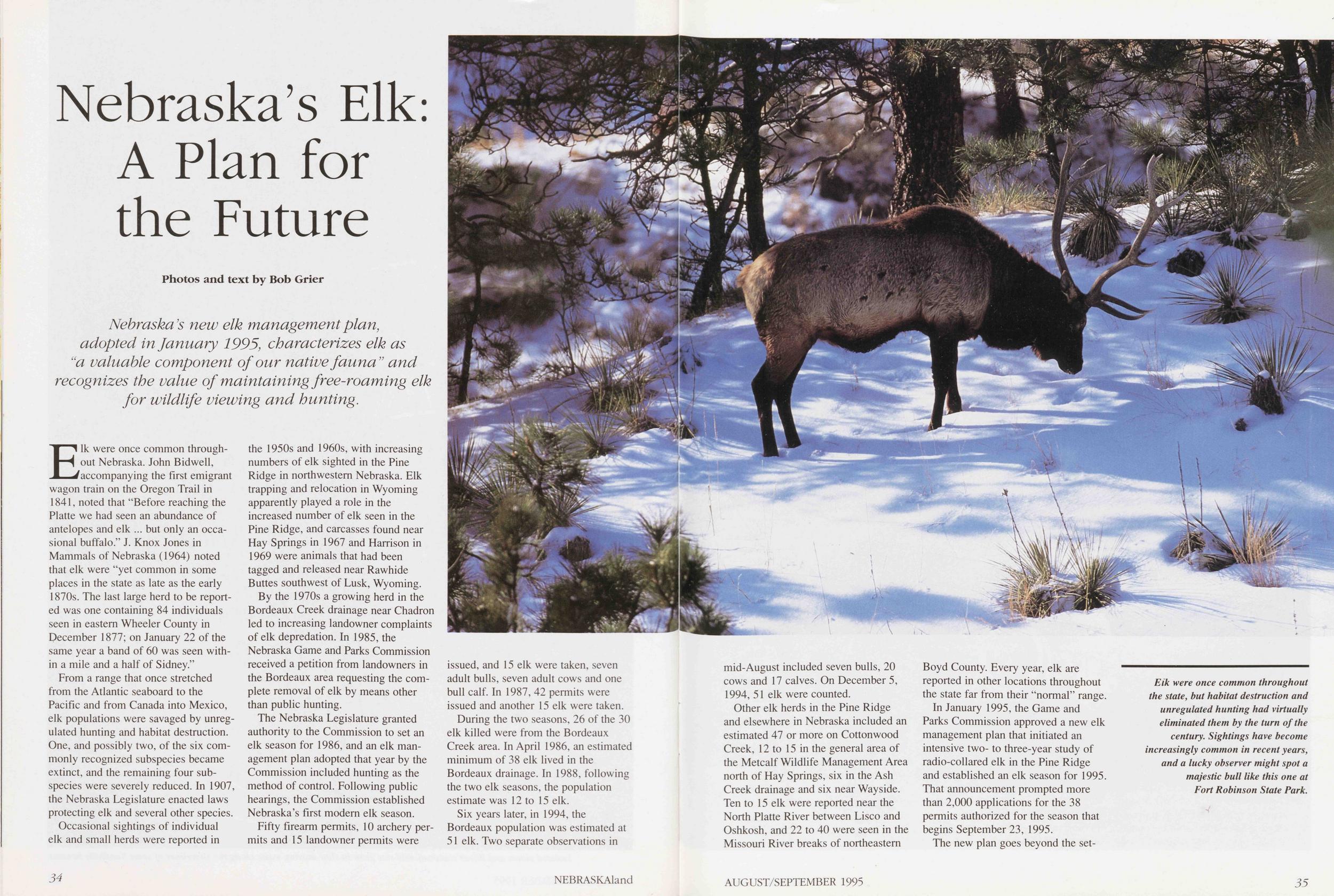
Nebraska's Elk A Plan for the Future
Photos and text by Bob Grier Nebraska's new elk management plan, adopted in January 1995, characterizes elk as "a valuable component of our native fauna" and recognizes the value of maintaining free-roaming elk for wildlife viewing and hunting.Elk were once common throughout Nebraska. John Bidwell, accompanying the first emigrant wagon train on the Oregon Trail in 1841, noted that "Before reaching the Platte we had seen an abundance of antelopes and elk but only an occasional buffalo." J. Knox Jones in Mammals of Nebraska (1964) noted that elk were "yet common in some places in the state as late as the early 1870s. The last large herd to be reported was one containing 84 individuals seen in eastern Wheeler County in December 1877; on January 22 of the same year a band of 60 was seen within a mile and a half of Sidney."
From a range that once stretched from the Atlantic seaboard to the Pacific and from Canada into Mexico, elk populations were savaged by unregulated hunting and habitat destruction. One, and possibly two, of the six commonly recognized subspecies became extinct, and the remaining four subspecies were severely reduced. In 1907, the Nebraska Legislature enacted laws protecting elk and several other species.
Occasional sightings of individual elk and small herds were reported in the 1950s and 1960s, with increasing numbers of elk sighted in the Pine Ridge in northwestern Nebraska. Elk trapping and relocation in Wyoming apparently played a role in the increased number of elk seen in the Pine Ridge, and carcasses found near Hay Springs in 1967 and Harrison in 1969 were animals that had been tagged and released near Rawhide Buttes southwest of Lusk, Wyoming.
By the 1970s a growing herd in the Bordeaux Creek drainage near Chadron led to increasing landowner complaints of elk depredation. In 1985, the Nebraska Game and Parks Commission received a petition from landowners in the Bordeaux area requesting the complete removal of elk by means other than public hunting.
The Nebraska Legislature granted authority to the Commission to set an elk season for 1986, and an elk management plan adopted that year by the Commission included hunting as the method of control. Following public hearings, the Commission established Nebraska's first modern elk season.
Fifty firearm permits, 10 archery permits and 15 landowner permits were issued, and 15 elk were taken, seven adult bulls, seven adult cows and one bull calf. In 1987, 42 permits were issued and another 15 elk were taken.
During the two seasons, 26 of the 30 elk killed were from the Bordeaux Creek area. In April 1986, an estimated minimum of 38 elk lived in the Bordeaux drainage. In 1988, following the two elk seasons, the population estimate was 12 to 15 elk.
Six years later, in 1994, the Bordeaux population was estimated at 51 elk. Two separate observations in 34 NEBRASKAland mid-August included seven bulls, 20 cows and 17 calves. On December 5, 1994, 51 elk were counted.
Other elk herds in the Pine Ridge and elsewhere in Nebraska included an estimated 47 or more on Cottonwood Creek, 12 to 15 in the general area of the Metcalf Wildlife Management Area north of Hay Springs, six in the Ash Creek drainage and six near Wayside. Ten to 15 elk were reported near the North Platte River between Lisco and Oshkosh, and 22 to 40 were seen in the Missouri River breaks of northeastern Boyd County. Every year, elk are reported in other locations throughout the state far from their "normal" range.
In January 1995, the Game and Parks Commission approved a new elk management plan that initiated an intensive two- to three-year study of radio-collared elk in the Pine Ridge and established an elk season for 1995. That announcement prompted more than 2,000 applications for the 38 permits authorized for the season that begins September 23, 1995.
The new plan goes beyond the set
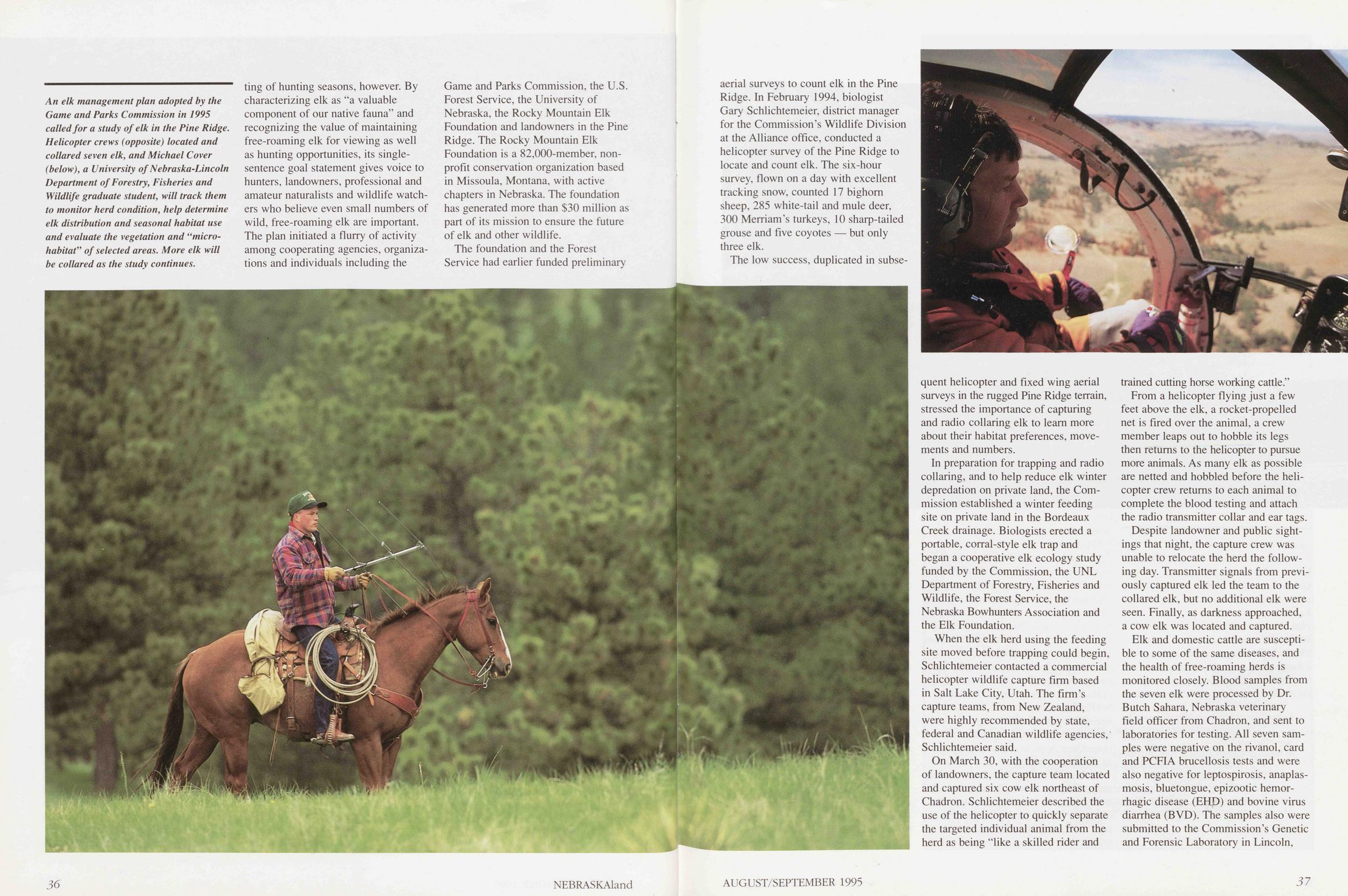
The low success, duplicated in subsequent helicopter and fixed wing aerial surveys in the rugged Pine Ridge terrain, stressed the importance of capturing and radio collaring elk to learn more about their habitat preferences, movements and numbers.
In preparation for trapping and radio collaring, and to help reduce elk winter depredation on private land, the Commission established a winter feeding site on private land in the Bordeaux Creek drainage. Biologists erected a portable, corral-style elk trap and began a cooperative elk ecology study funded by the Commission, the UNL Department of Forestry, Fisheries and Wildlife, the Forest Service, the Nebraska Bowhunters Association and the Elk Foundation.
When the elk herd using the feeding site moved before trapping could begin, Schlichtemeier contacted a commercial helicopter wildlife capture firm based in Salt Lake City, Utah. The firm's capture teams, from New Zealand, were highly recommended by state, federal and Canadian wildlife agencies, Schlichtemeier said.
On March 30, with the cooperation of landowners, the capture team located and captured six cow elk northeast of Chadron. Schlichtemeier described the use of the helicopter to quickly separate the targeted individual animal from the herd as being "like a skilled rider and trained cutting horse working cattle."
From a helicopter flying just a few feet above the elk, a rocket-propelled net is fired over the animal, a crew member leaps out to hobble its legs then returns to the helicopter to pursue more animals. As many elk as possible are netted and hobbled before the helicopter crew returns to each animal to complete the blood testing and attach the radio transmitter collar and ear tags.
Despite landowner and public sightings that night, the capture crew was unable to relocate the herd the following day. Transmitter signals from previously captured elk led the team to the collared elk, but no additional elk were seen. Finally, as darkness approached, a cow elk was located and captured.
Elk and domestic cattle are susceptible to some of the same diseases, and the health of free-roaming herds is monitored closely. Blood samples from the seven elk were processed by Dr. Butch Sahara, Nebraska veterinary field officer from Chadron, and sent to laboratories for testing. All seven samples were negative on the rivanol, card and PCFIA brucellosis tests and were also negative for leptospirosis, anaplasmosis, bluetongue, epizootic hemorrhagic disease (EHD) and bovine virus diarrhea (BVD). The samples also were submitted to the Commission's Genetic and Forensic Laboratory in Lincoln, AUGUST/SEPTEMBER 1995 37
Michael Cover, a UNL Department of Forestry, Fisheries and Wildlife graduate student living in Chadron, is tracking the seven collared elk as part of the cooperative study. Its first objective is to estimate the size, sex and age structure of the population of elk in the Pine Ridge. Radiotelemetry data will be used to help determine elk distribution and seasonal habitat use and to evaluate the vegetation and "microhabitat" of selected areas. Herd condition will be monitored using the seven elk collared in March and others the researchers hope to capture and collar as the study continues.
Each collar's signal can be identified, and a compass bearing is used to mark the location on a large field map. "The objective is to acquire multiple readings or bearings to get a 90 degree angle on the elk within a brief window of 15 minutes," Cover explained. "For the study, we've classified elk habitat into 4macro-habitats,'including deciduous and pine forest and cropland and pasture. The brief, 15-minute window for the readings is important to reduce the chance the elk can move from one macro type to another between readings. If the readings are within two macro habitat types, it is important to move in and make actual observations."
Transmitter batteries last for about two years, and before the batteries fail, study participants hope to recapture the collared elk to remove the collar or replace the batteries. Because the transmitter's signal changes if an animal is immobilized or dies, the carcass can be located so the collar can be recovered.
Cover plans to locate and observe radio-collared elk several times a week by vehicle or on horseback for at least two years. Global Positioning System (GPS) receivers and Geographic 38 NEBRASKAland Information System (GIS) computers will help generate landscape maps and plot elk location data.
The elk management plan includes hunting seasons to provide recreation and to keep the elk populations at levels landowners will tolerate. Two elk management units were established for the 1995 elk hunt. Sixteen permits and four limited landowner permits were authorized for the Bordeaux Unit, and 14 permits and four landowner permits were authorized for the Hat Creek Unit. The 38 permits include both either-sex and antlerless permits. The season runs from September 23 through October 22.
An elk permit is essentially a once-in-a-lifetime privilege. Hunters who received a permit for the 1986, 1987 or 1995 seasons will be ineligible to apply for future elk hunts. Limited landowner permit holders are ineligible to apply again for five years.
Besides establishing a 1995 hunting season, the management plan includes improved techniques for responding to depredation complaints and, to meet the concerns of landowners, the number of deer permits in the elk units will be increased. In the Bordeaux Unit, 100 antlerless-only deer permits will be issued, and 50 antlerless-only deer permits will be issued in the Hat Creek elk unit. In the "open-house" public meetings held in Chadron, Kearney, Lincoln and O'Neill and in informal conversation between landowners and biologists it became clear that some landowners believe that deer populations in those areas should be reduced if an elk herd is to be maintained in the Bordeaux and Hat Creek elk units.
The Game and Parks Commission is convinced that the success of the elk management plan depends on an exchange of ideas and understanding with landowners, hunters and the general public. The success of the plan rests with an ambitious, long-term process involving many people, and if even small herds of elk are to survive as Nebraska enters the 21 st century, it will require an effective partnership among landowners, resource managers and biologists, hunters and residents from all walks of life.
Nebraska Elk Management PlanThe Nebraska Elk Management Plan adopted by the Game and Parks Commission in 1995 recognizes elk as a component of Nebraska's native fauna. It initiates cooperation among the Game and Parks Commission, the U.S. Forest Service, the University of Nebraska, the Rocky Mountain Elk Foundation and landowners. It calls for hunting seasons to provide recreation and to keep the elk populations at levels landowners will tolerate, and includes improved techniques for responding to depredation complaints.
Goal To recognize elk as a valuable component of our native fauna, to perpetuate free-roaming elk, within suitable habitat, for viewing and unique hunting opportunities, and to maintain elk population levels within the limits that most affected landowners will accept.
Objectives 1. Determine elk population status in Nebraska, by area, and document expansion into adjacent or new range. A. Maintain a minimum population of 100 elk, with at least six mature (six-plus points) bulls, in the Pine Ridge escarpment and determine the upper limits of elk which will be tolerated. B. Obtain population information for herds in other parts of the state and develop clearly defined objectives for these populations. 2. Respond to all elk depredation complaints. Through a survey, show that 90-plus percent of landowners with elk on their property feel damage is negligible or tolerable. 3. Utilize prescribed hunting seasons, starting in 1995, to provide recreation and to control elk populations within landowner tolerance limits. 4. Monitor the overall health of elk populations and prevent contamination of domestic livestock through removal or treatment of infected elk. 5. Provide informational and educational materials to the public, which recognize free-ranging elk as a valuable component of our native fauna. Facilitate public viewing of elk. Respond to community suggestions for informational and educational material.
AUGUST/SEPTEMBER 1995 39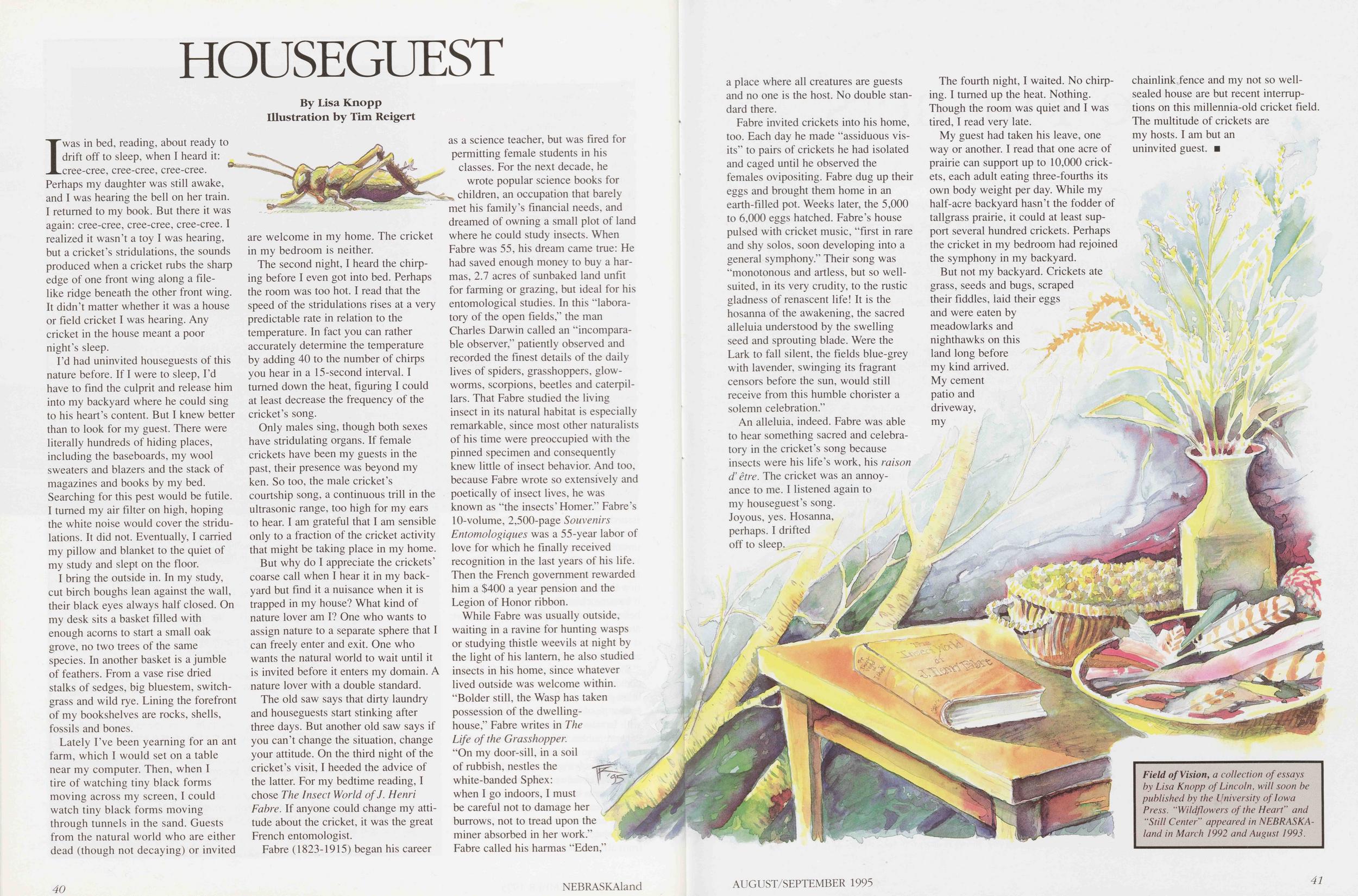
HOUSEGUEST
By Lisa Knopp Illustration by Tim ReigertI was in bed, reading, about ready to drift off to sleep, when I heard it: cree-cree, cree-cree, cree-cree. Perhaps my daughter was still awake, and I was hearing the bell on her train. I returned to my book. But there it was again: cree-cree, cree-cree, cree-cree. I realized it wasn't a toy I was hearing, but a cricket's stridulations, the sounds produced when a cricket rubs the sharp edge of one front wing along a file-like ridge beneath the other front wing. It didn't matter whether it was a house or field cricket I was hearing. Any cricket in the house meant a poor night's sleep.
I'd had uninvited houseguests of this nature before. If I were to sleep, I'd have to find the culprit and release him into my backyard where he could sing to his heart's content. But I knew better than to look for my guest. There were literally hundreds of hiding places, including the baseboards, my wool sweaters and blazers and the stack of magazines and books by my bed. Searching for this pest would be futile. I turned my air filter on high, hoping the white noise would cover the stridulations. It did not. Eventually, I carried my pillow and blanket to the quiet of my study and slept on the floor.
I bring the outside in. In my study, cut birch boughs lean against the wall, their black eyes always half closed. On my desk sits a basket filled with enough acorns to start a small oak grove, no two trees of the same species. In another basket is a jumble of feathers. From a vase rise dried stalks of sedges, big bluestem, switchgrass and wild rye. Lining the forefront of my bookshelves are rocks, shells, fossils and bones.
Lately I've been yearning for an ant farm, which I would set on a table near my computer. Then, when I tire of watching tiny black forms moving across my screen, I could watch tiny black forms moving through tunnels in the sand. Guests from the natural world who are either dead (though not decaying) or invited are welcome in my home. The cricket in my bedroom is neither.
The second night, I heard the chirping before I even got into bed. Perhaps the room was too hot. I read that the speed of the stridulations rises at a very predictable rate in relation to the temperature. In fact you can rather accurately determine the temperature by adding 40 to the number of chirps you hear in a 15-second interval. I turned down the heat, figuring I could at least decrease the frequency of the cricket's song.
Only males sing, though both sexes have stridulating organs. If female crickets have been my guests in the past, their presence was beyond my ken. So too, the male cricket's courtship song, a continuous trill in the ultrasonic range, too high for my ears to hear. I am grateful that I am sensible only to a fraction of the cricket activity that might be taking place in my home.
But why do I appreciate the crickets' coarse call when I hear it in my backyard but find it a nuisance when it is trapped in my house? What kind of nature lover am I? One who wants to assign nature to a separate sphere that I can freely enter and exit. One who wants the natural world to wait until it is invited before it enters my domain. A nature lover with a double standard.
The old saw says that dirty laundry and houseguests start stinking after three days. But another old saw says if you can't change the situation, change your attitude. On the third night of the cricket's visit, I heeded the advice of the latter. For my bedtime reading, I chose The Insect World of J. Henri Fahre. If anyone could change my attitude about the cricket, it was the great French entomologist.
Fabre (1823-1915) began his career as a science teacher, but was fired for permitting female students in his classes. For the next decade, he wrote popular science books for children, an occupation that barely met his family's financial needs, and dreamed of owning a small plot of land where he could study insects. When Fabre was 55, his dream came true: He had saved enough money to buy a harmas, 2.7 acres of sunbaked land unfit for farming or grazing, but ideal for his entomological studies. In this "laboratory of the open fields," the man Charles Darwin called an "incomparable observer," patiently observed and recorded the finest details of the daily lives of spiders, grasshoppers, glowworms, scorpions, beetles and caterpillars. That Fabre studied the living insect in its natural habitat is especially remarkable, since most other naturalists of his time were preoccupied with the pinned specimen and consequently knew little of insect behavior. And too, because Fabre wrote so extensively and poetically of insect lives, he was known as "the insects'Homer." Fabre's 10-volume, 2,500-page Souvenirs Entomologiques was a 55-year labor of love for which he finally received recognition in the last years of his life. Then the French government rewarded him a $400 a year pension and the Legion of Honor ribbon.
While Fabre was usually outside, waiting in a ravine for hunting wasps or studying thistle weevils at night by the light of his lantern, he also studied insects in his home, since whatever lived outside was welcome within. "Bolder still, the Wasp has taken possession of the dwellinghouse," Fabre writes in The Life of the Grasshopper. "On my door-sill, in a soil of rubbish, nestles the white-banded Sphex: when I go indoors, I must be careful not to damage her burrows, not to tread upon the miner absorbed in her work." Fabre called his harmas "Eden," 40 NEBRASKAland a place where all creatures are guests and no one is the host. No double standard there.
Fabre invited crickets into his home, too. Each day he made "assiduous visits" to pairs of crickets he had isolated and caged until he observed the females ovipositing. Fabre dug up their eggs and brought them home in an earth-filled pot. Weeks later, the 5,000 to 6,000 eggs hatched. Fabre's house pulsed with cricket music, "first in rare and shy solos, soon developing into a general symphony." Their song was "monotonous and artless, but so wellsuited, in its very crudity, to the rustic gladness of renascent life! It is the hosanna of the awakening, the sacred alleluia understood by the swelling seed and sprouting blade. Were the Lark to fall silent, the fields blue-grey with lavender, swinging its fragrant censors before the sun, would still receive from this humble chorister a solemn celebration."
An alleluia, indeed. Fabre was able to hear something sacred and celebratory in the cricket's song because insects were his life's work, his raison d etre. The cricket was an annoyance to me. I listened again to my houseguest's song. Joyous, yes. Hosanna, perhaps. I drifted off to sleep.
The fourth night, I waited. No chirping. I turned up the heat. Nothing. Though the room was quiet and I was tired, I read very late.
My guest had taken his leave, one way or another. I read that one acre of prairie can support up to 10,000 crickets, each adult eating three-fourths its own body weight per day. While my half-acre backyard hasn't the fodder of tallgrass prairie, it could at least support several hundred crickets. Perhaps the cricket in my bedroom had rejoined the symphony in my backyard.
But not my backyard. Crickets ate grass, seeds and bugs, scraped their fiddles, laid their eggs and were eaten by meadowlarks and nighthawks on this land long before my kind arrived. My cement patio and driveway, my chainlink fence and my not so wellsealed house are but recent interruptions on this millennia-old cricket field. The multitude of crickets are my hosts. I am but an uninvited guest.
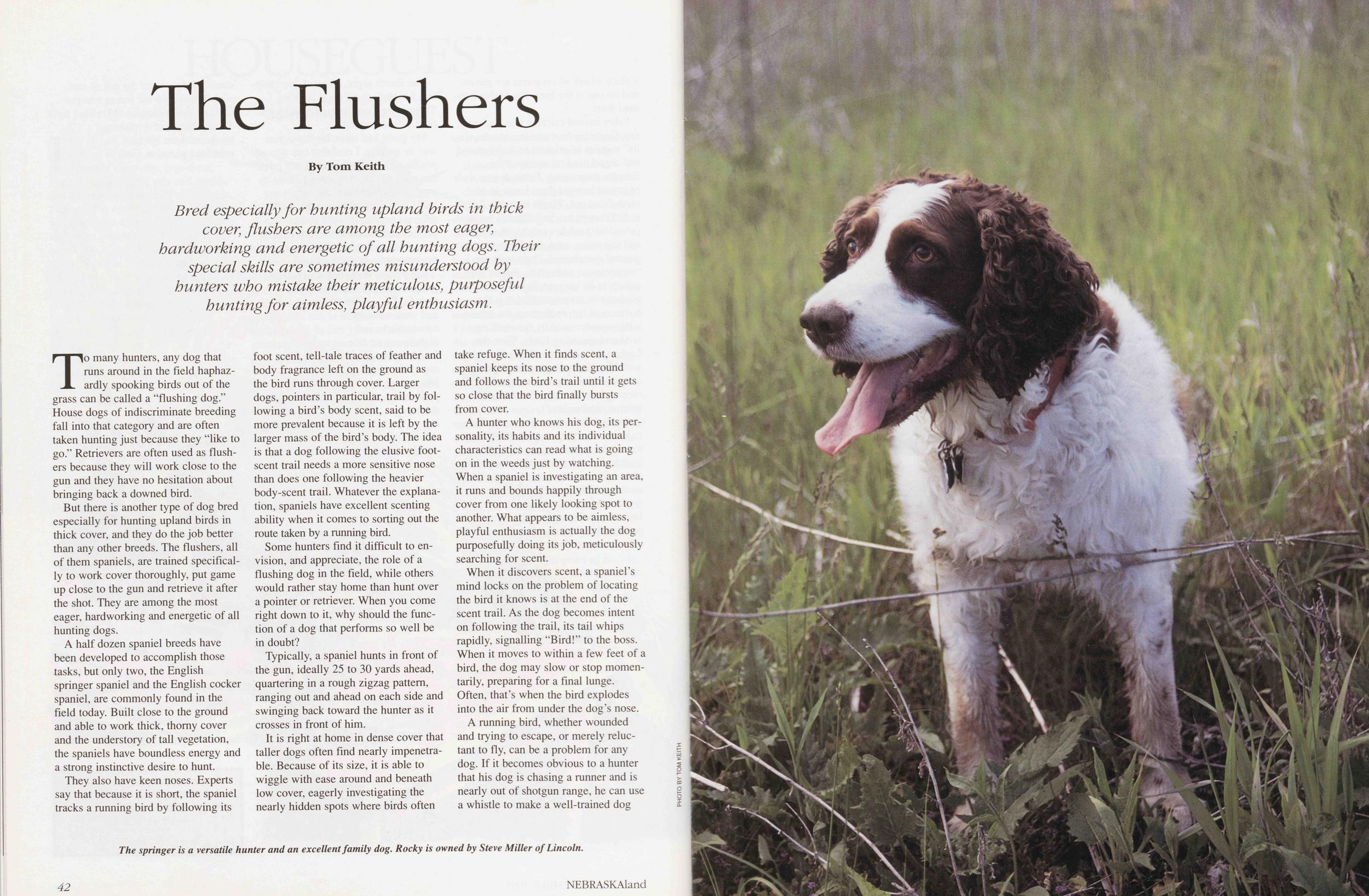
The Flushers
By Tom Keith Bred especially for hunting upland birds in thick cover, flushers are among the most eager, hardworking and energetic of all hunting dogs. Their special skills are sometimes misunderstood by hunters who mistake their meticulous, purposeful hunting for aimless, playful enthusiasm.To many hunters, any dog that runs around in the field haphazardly spooking birds out of the grass can be called a "flushing dog." House dogs of indiscriminate breeding fall into that category and are often taken hunting just because they "like to go." Retrievers are often used as flushers because they will work close to the gun and they have no hesitation about bringing back a downed bird.
But there is another type of dog bred especially for hunting upland birds in thick cover, and they do the job better than any other breeds. The flushers, all of them spaniels, are trained specifically to work cover thoroughly, put game up close to the gun and retrieve it after the shot. They are among the most eager, hardworking and energetic of all hunting dogs.
A half dozen spaniel breeds have been developed to accomplish those tasks, but only two, the English springer spaniel and the English cocker spaniel, are commonly found in the field today. Built close to the ground and able to work thick, thorny cover and the understory of tall vegetation, the spaniels have boundless energy and a strong instinctive desire to hunt.
They also have keen noses. Experts say that because it is short, the spaniel tracks a running bird by following its foot scent, tell-tale traces of feather and body fragrance left on the ground as the bird runs through cover. Larger dogs, pointers in particular, trail by following a bird's body scent, said to be more prevalent because it is left by the larger mass of the bird's body. The idea is that a dog following the elusive footscent trail needs a more sensitive nose than does one following the heavier body-scent trail. Whatever the explanation, spaniels have excellent scenting ability when it comes to sorting out the route taken by a running bird.
Some hunters find it difficult to envision, and appreciate, the role of a flushing dog in the field, while others would rather stay home than hunt over a pointer or retriever. When you come right down to it, why should the function of a dog that performs so well be in doubt?
Typically, a spaniel hunts in front of the gun, ideally 25 to 30 yards ahead, quartering in a rough zigzag pattern, ranging out and ahead on each side and swinging back toward the hunter as it crosses in front of him.
It is right at home in dense cover that taller dogs often find nearly impenetrable. Because of its size, it is able to wiggle with ease around and beneath low cover, eagerly investigating the nearly hidden spots where birds often take refuge. When it finds scent, a spaniel keeps its nose to the ground and follows the bird's trail until it gets so close that the bird finally bursts from cover.
A hunter who knows his dog, its personality, its habits and its individual characteristics can read what is going on in the weeds just by watching. When a spaniel is investigating an area, it runs and bounds happily through cover from one likely looking spot to another. What appears to be aimless, playful enthusiasm is actually the dog purposefully doing its job, meticulously searching for scent.
When it discovers scent, a spaniel's mind locks on the problem of locating the bird it knows is at the end of the scent trail. As the dog becomes intent on following the trail, its tail whips rapidly, signalling "Bird!" to the boss. When it moves to within a few feet of a bird, the dog may slow or stop momentarily, preparing for a final lunge. Often, that's when the bird explodes into the air from under the dog's nose.
A running bird, whether wounded and trying to escape, or merely reluctant to fly, can be a problem for any dog. If it becomes obvious to a hunter that his dog is chasing a runner and is nearly out of shotgun range, he can use a whistle to make a well-trained dog 42 NEBRASKAland
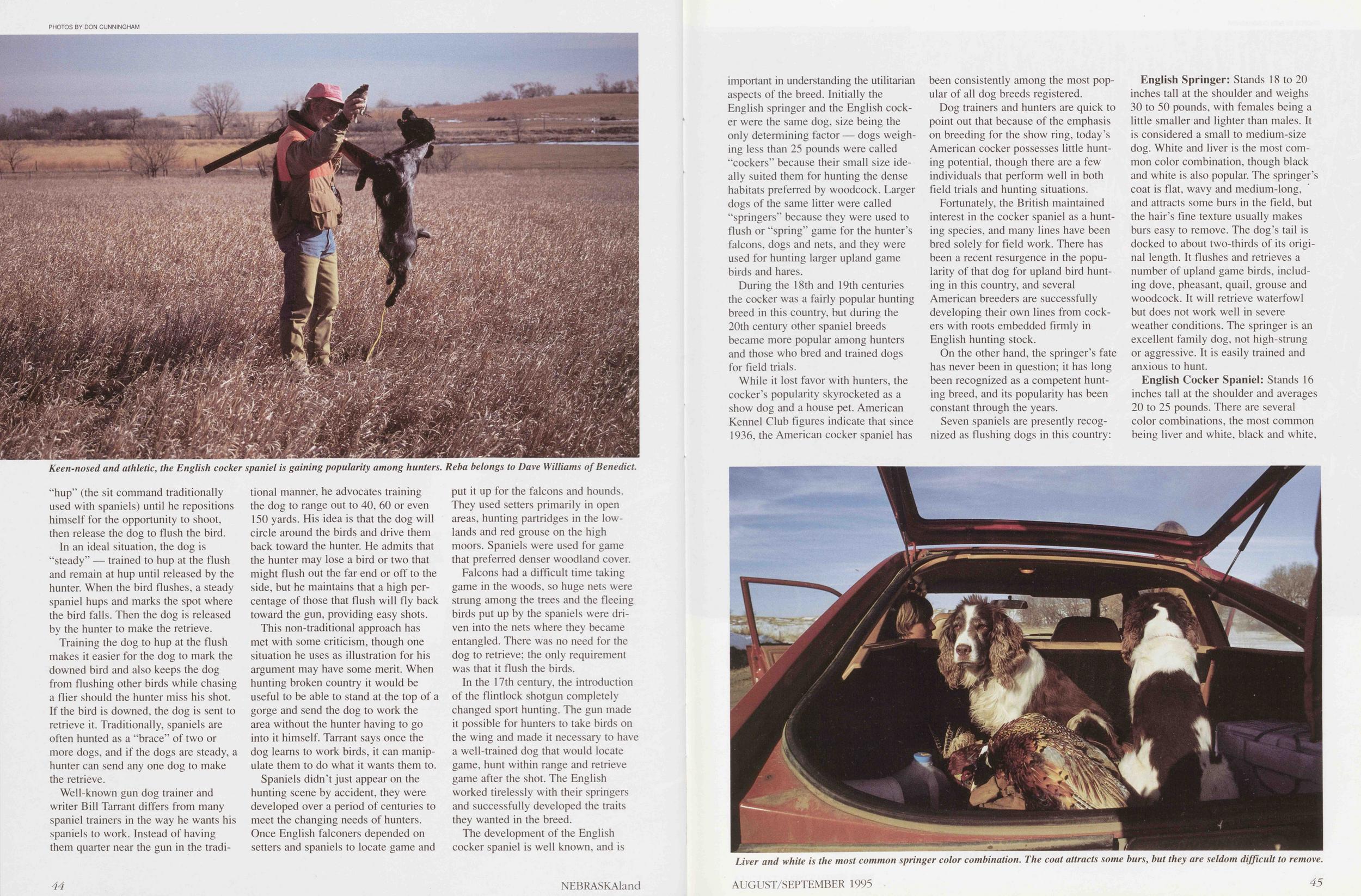
In an ideal situation, the dog is "steady" — trained to hup at the flush and remain at hup until released by the hunter. When the bird flushes, a steady spaniel hups and marks the spot where the bird falls. Then the dog is released by the hunter to make the retrieve.
Training the dog to hup at the flush makes it easier for the dog to mark the downed bird and also keeps the dog from flushing other birds while chasing a flier should the hunter miss his shot. If the bird is downed, the dog is sent to retrieve it. Traditionally, spaniels are often hunted as a "brace" of two or more dogs, and if the dogs are steady, a hunter can send any one dog to make the retrieve.
Well-known gun dog trainer and writer Bill Tarrant differs from many spaniel trainers in the way he wants his spaniels to work. Instead of having them quarter near the gun in the traditional manner, he advocates training the dog to range out to 40, 60 or even 150 yards. His idea is that the dog will circle around the birds and drive them back toward the hunter. He admits that the hunter may lose a bird or two that might flush out the far end or off to the side, but he maintains that a high percentage of those that flush will fly back toward the gun, providing easy shots.
This non-traditional approach has met with some criticism, though one situation he uses as illustration for his argument may have some merit. When hunting broken country it would be useful to be able to stand at the top of a gorge and send the dog to work the area without the hunter having to go into it himself. Tarrant says once the dog learns to work birds, it can manipulate them to do what it wants them to.
Spaniels didn't just appear on the hunting scene by accident, they were developed over a period of centuries to meet the changing needs of hunters. Once English falconers depended on setters and spaniels to locate game and put it up for the falcons and hounds. They used setters primarily in open areas, hunting partridges in the lowlands and red grouse on the high moors. Spaniels were used for game that preferred denser woodland cover.
Falcons had a difficult time taking game in the woods, so huge nets were strung among the trees and the fleeing birds put up by the spaniels were driven into the nets where they became entangled. There was no need for the dog to retrieve; the only requirement was that it flush the birds.
In the 17th century, the introduction of the flintlock shotgun completely changed sport hunting. The gun made it possible for hunters to take birds on the wing and made it necessary to have a well-trained dog that would locate game, hunt within range and retrieve game after the shot. The English worked tirelessly with their springers and successfully developed the traits they wanted in the breed.
The development of the English cocker spaniel is well known, and is 44 NEBRASKAland important in understanding the utilitarian aspects of the breed. Initially the English springer and the English cocker were the same dog, size being the only determining factor — dogs weighing less than 25 pounds were called "cockers" because their small size ideally suited them for hunting the dense habitats preferred by woodcock. Larger dogs of the same litter were called "springers" because they were used to flush or "spring" game for the hunter's falcons, dogs and nets, and they were used for hunting larger upland game birds and hares.
During the 18th and 19th centuries the cocker was a fairly popular hunting breed in this country, but during the 20th century other spaniel breeds became more popular among hunters and those who bred and trained dogs for field trials.
While it lost favor with hunters, the cocker's popularity skyrocketed as a show dog and a house pet. American Kennel Club figures indicate that since 1936, the American cocker spaniel has been consistently among the most popular of all dog breeds registered.
Dog trainers and hunters are quick to point out that because of the emphasis on breeding for the show ring, today's American cocker possesses little hunting potential, though there are a few individuals that perform well in both field trials and hunting situations.
Fortunately, the British maintained interest in the cocker spaniel as a hunting species, and many lines have been bred solely for field work. There has been a recent resurgence in the popularity of that dog for upland bird hunting in this country, and several American breeders are successfully developing their own lines from cockers with roots embedded firmly in English hunting stock.
On the other hand, the springer's fate has never been in question; it has long been recognized as a competent hunting breed, and its popularity has been constant through the years.
Seven spaniels are presently recognized as flushing dogs in this country:
English Springer: Stands 18 to 20 inches tall at the shoulder and weighs 30 to 50 pounds, with females being a little smaller and lighter than males. It is considered a small to medium-size dog. White and liver is the most common color combination, though black and white is also popular. The springer's coat is flat, wavy and medium-long, and attracts some burs in the field, but the hair's fine texture usually makes burs easy to remove. The dog's tail is docked to about two-thirds of its original length. It flushes and retrieves a number of upland game birds, including dove, pheasant, quail, grouse and woodcock. It will retrieve waterfowl but does not work well in severe weather conditions. The springer is an excellent family dog, not high-strung or aggressive. It is easily trained and anxious to hunt.
English Cocker Spaniel: Stands 16 inches tall at the shoulder and averages 20 to 25 pounds. There are several color combinations, the most common being liver and white, black and white,
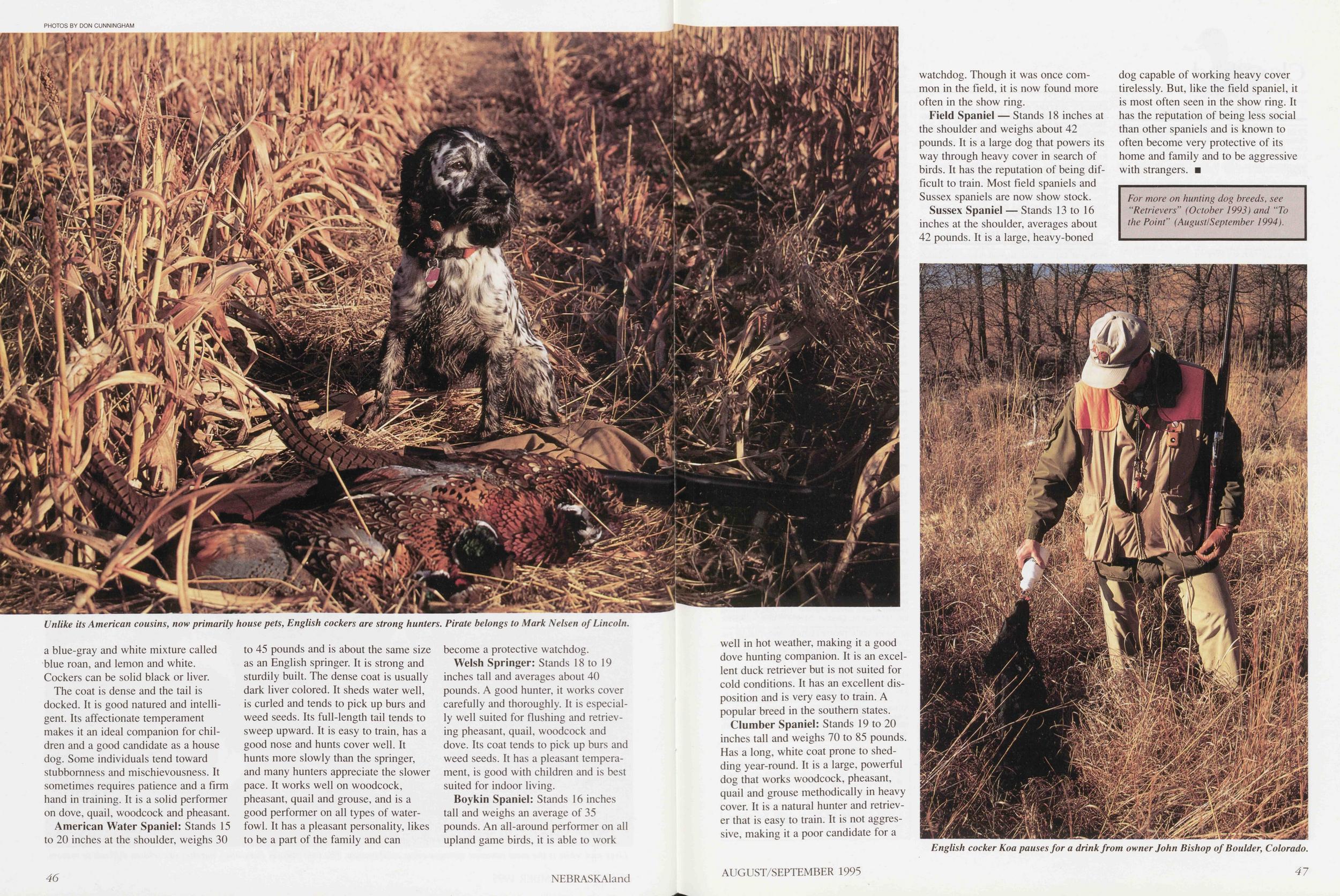
The coat is dense and the tail is docked. It is good natured and intelligent. Its affectionate temperament makes it an ideal companion for children and a good candidate as a house dog. Some individuals tend toward stubbornness and mischievousness. It sometimes requires patience and a firm hand in training. It is a solid performer on dove, quail, woodcock and pheasant.
American Water Spaniel: Stands 15 to 20 inches at the shoulder, weighs 30 to 45 pounds and is about the same size as an English springer. It is strong and sturdily built. The dense coat is usually dark liver colored. It sheds water well, is curled and tends to pick up burs and weed seeds. Its full-length tail tends to sweep upward. It is easy to train, has a good nose and hunts cover well. It hunts more slowly than the springer, and many hunters appreciate the slower pace. It works well on woodcock, pheasant, quail and grouse, and is a good performer on all types of waterfowl. It has a pleasant personality, likes to be a part of the family and can become a protective watchdog.
Welsh Springer: Stands 18 to 19 inches tall and averages about 40 pounds. A good hunter, it works cover carefully and thoroughly. It is especially well suited for flushing and retrieving pheasant, quail, woodcock and dove. Its coat tends to pick up burs and weed seeds. It has a pleasant temperament, is good with children and is best suited for indoor living.
Boykin Spaniel: Stands 16 inches tall and weighs an average of 35 pounds. An all-around performer on all upland game birds, it is able to work 46 NEBRASKAland well in hot weather, making it a good dove hunting companion. It is an excellent duck retriever but is not suited for cold conditions. It has an excellent disposition and is very easy to train. A popular breed in the southern states.
Clumber Spaniel: Stands 19 to 20 inches tall and weighs 70 to 85 pounds. Has a long, white coat prone to shedding year-round. It is a large, powerful dog that works woodcock, pheasant, quail and grouse methodically in heavy cover. It is a natural hunter and retriever that is easy to train. It is not aggressive, making it a poor candidate for a watchdog. Though it was once common in the field, it is now found more often in the show ring.
Field Spaniel — Stands 18 inches at the shoulder and weighs about 42 pounds. It is a large dog that powers its way through heavy cover in search of birds. It has the reputation of being difficult to train. Most field spaniels and Sussex spaniels are now show stock.
Sussex Spaniel — Stands 13 to 16 inches at the shoulder, averages about 42 pounds. It is a large, heavy-boned dog capable of working heavy cover tirelessly. But, like the field spaniel, it is most often seen in the show ring. It has the reputation of being less social than other spaniels and is known to often become very protective of its home and family and to be aggressive with strangers.
For more on hunting dog breeds, see "Retrievers" (October J993) and "To the Point" (August/September 1994).
Classified
BOOKS/PRINTINGFREE BOOK CATALOG. Novels, westerns, romances, children's; old out of print, found barns, attic. Authors: Grey, Bower, Connor, Fox, Curwood, Raine, Wright, Aldrige, Pollyanna, Freckles, many others. Postage appreciated. Pierce, 4400 N. Pine Cluster, Oroville, CA 95965.
HOW TO FIND MORE outdoor opportunities!! The Nebraska Sportsman's Atlas. Locations of all public lands and waters on county transportation maps. These maps show ALL the roads in Nebraska. Listings include federal, Nebraska Game & Parks, NRD holdings, hotels and motels and Nebraska's endless attractions. At only $18.75/copy a true time and frustration saver. To order write: Sportsman's Atlas Co., PO Box 132, Lytton, IA 50561 or call 1-800-568-8334.
GREAT PRICES on great books! Special issues from NEBRASKAland Magazine - woodlands, wildflowers, photography, recipes and history. Lowest prices ever. For titles and order information, call 1-800-632-5263.
DOGSENGLISH SETTER. German shorthairs, English pointers, brittany spaniels - stud service, puppies and started dogs. Training for all pointing breeds. Plum Creek Kennel 712-529-4238 or 402-298-8153.
YELLOW-CHOCOLATE-BLACK LAB pups. Breeders hips O.F.A. and eyes c.e.r.f./ed. Excellent bloodlines and hunting potential. Call Mr. Bendler, Lexington, NE (308) 324-4247 or Lincoln (402) 477-1305.
RETRIEVER TRAINING. Area's top "retrievers only" trainer. Field trial and hunting dogs. Non-slip duck dogs! TKO Retriever Training Kennel (402) 623-4311.
WILDERNESS KENNELS. Gun dog training - over 60 years combined experience. Training all sporting breeds Retrievers. Flushing and pointing dogs. All dogs worked on pen raised birds and wild game. Training program includes obedience training - heel, sit, stay, down and come when called. Pups, started dogs and fully trained dogs for sale. Hunting dogs trained by hunters. Henry Sader, Wilderness Kennels, (402) 423-4212. Since 1968.
ENGLISH SETTER AND LABRADORS from outstanding lines. Bred for hunters who appreciate Fine bird dogs! Wind Fall Gun Dogs, (402) 421-4693.
TRAINING ALL BREEDS bird dogs - Vizslas for sale. Home of Rebel Rousers. Rozanek Kennels, RR 2, Schuyler, NE 68661. Phone (402) 352-8769.
THISTLE SETTERS HAVE INTELLIGENT English setter pups with great noses and excellent bloodlines. They were bred by hunters for hunters. (402) 487-2648 after 6 p.m.
CHESAPEAKE BAY, LABRADOR and GOLDEN RETRIEVER pups, started dogs and stud service. 16 time national champion pedigree. Platte Valley Retrievers (308)995-2318.
ENGLISH COCKER pups, imported stock, British FTC bloodlines. Many colors available. Featured in NEBRASKAland November 1991. Sawtooth Oaks, Box 443, Orleans, NE 68966. Phone (308) 473-5265.
FISH/FISHINGFISH FOR SALE. Catfish, largemouth bass, smallmouth bass, perch, crappie, bluegill, walleye, northern pike, rainbow trout, Donaldson rainbow trout, grass carp, minnows, bullheads. Consulting available. Pleasant Valley Fish Farm, RR 1, Box 147, McCook, NE 69001. Phone (308) 345-6599.
WILLOW LAKE FISH HATCHERY. Channel cat, bluegill, hybrid bluegill, largemouth bass, crappie, triploid grass carp, walleye, perch, minnows available for stocking. Gaylord Crawford, RR 3, Box 46, Hastings, NE 68901 or phone (402) 463-8022 day or night. Also pond consultant. We del, grower price.
FOODNEBRASKA BASKETS: The original Nebraska company specializing in fine foods from Nebraska. A beautiful array of baskets filled with ethnic, healthful and longtime favorite foods. Call or write for our brochure: P.O. Box 98, McCook, NE 69001. 1-800-345-7725.
HOMEBREWING/BEER & WINEMAKING - New 1995 catalogue. Fermenter's Supply, 8410 K Plz. #10, Omaha, NE 68127. (402) 593-9171. Mail order welcome.
FROM NEBRASKA GIFT SHOP...the world's largest selection of Nebraska-made food products and gifts. Historic Haymarket, 140 N. 8th, Lincoln, NE. Call for free catalog 1-800-399-5693.
GMDES/OUTFITTERSGRAHAM CANOE OUTFITTERS: Top quality full-service camping and canoe trips on the Niobrara River. Daily canoe rentals and car shuttle-service available. Contact Doug & Twyla Graham, HC 13 Box 16, Valentine, NE 69201 or phone (402) 376-3708.
DonI Miss a Single Issue! Get NEBRASKAland for yourself or give it as a gift —just $14 a year! Name 1-Year $14 2-Years $27 Address City State Zip Mail check or money order to NEBRASKAland Magazine P.O. Box 30370, Lincoln, Nebraska 68503 or call Toll Free 1-800 NEB-LAND (632-5263) To Order by Visa or MasterCard, phone toll free 1-800-NEB-LAND (632-5263)MAD RIVER CANOES offers the finest quality and performance. For the finest canoes and accessories look to Great Plains Canoe Co., 205 Main. Sprimzfield, NE. Phone (402) 253-2001.
DISMAL RIVER/MIDDLE LOUP RIVER canoe/kayak trips. Powderhorn Outfitters - Thedford, NE 69166 - 1-800-Dismal6.
CANOE THE NIOBRARA...with an affordable canoe trip by Dryland Aquatics. One and two-day trips full service, or just canoes and tubes. Transportation furnished. Your Niobrara River specialists We do it your way! Dryland Aquatics, Dept. N, Box 33C. Sparks, NE 69220 or phone (800) 337-3119.
CANOE RENTALS: Kamp Kaleo, Burwell. NE. 17 ft. aluminum canoes, $15 per day. Call (308) 346-5083 for information and reservations.
GUNS/SHOOTINGGUNS - Browning, Winchester, Remington, others. Hi powers, shotguns, new, used, antiques. Want Pre-'64 Winchesters. Buy-Sell-Trade. (402) 729-6112. Bedlan's Sporting Goods, Fairbury, NE 68352.
AIR GUNS repaired - Benjamin, Crosman, Daisy, other American made. Restoration; old guns wanted. Jack's Air Guns, 1225 N. 46th, Lincoln, NE 68503. Phone (402) 466-9223.
REAL ESTATENEBRASKA RECREATIONAL LAND - 650 acres prime hunting and fishing - Wi mile Niobrara River frontage - offered at auction on 09/17/95 in four tracts or its entirety. Waldo Realty, O'Neill, NE (402) 336-4110 or Bassett, NE (402) 684-2711.
TAXIDERMYALLISON'S TAXIDERMY STUDIO & GIFT GALLERY. Specializing in fish, birds and small game. Mounted 35 State Record Fish. Pheasant mounts for sale. 421 N. Dewey, North Platte, NE 69101. (308) 534-2324 or (308) 534-4267.
VACATION/RESORTSFOR FISHING and hunting accommodations. Jefco Inn, Gordon, NE 69343. South Cornell, (308) 282-2935.
BED & BREAKFAST. Historic 1890's hotel. Located in the beautiful Pine Ridge area of Northwest Nebraska. Short drive to Chadron State Park, Fort Robinson and the Black Hills. Beautiful dining room with fireplace and fountain. Room service available. The Olde Main Street Inn, 115 Main St., Chadron, NE 69337. (308) 432-3380.
NE NEBRASKA TROUT FISHING. Mon-Thurs or Fri-Sun. 3 modem cottages, 5 spring-fed lakes. Trout, bass and biuegill. Diamond E. Trout Resort, Box B. Orchard, NE 1-800-658-3244.
FISH CANADA. Very, very remote fly-in. Tazin Lake, Saskatchewan. Excellent lake trout, fantastic northern pike. Moose and bear hunting. 1-800-9TROUT9.
NEBRASKA STATE PARK vacations. Spend a week or a weekend, but don't spend a bundle! For a free color brochure listing all park facilities or for information on a specific park, call 1-800-826-7275.
Classified rates: 75c per word, minimum $15. Closing date: First business day two months preceding issue date. Ads accepted first-come, first-served, space-available. NEBRASKAland Magazine, P.O. Box 30370, Lincoln, NE 68503-0370. Telephone (402) 471-5478. Fax (402) 471-5528. 48 NEBRASKAlandPage forty-nine
The Shell GameOne of those mornings when the ducks weren't flying, I sat starring at an open box of shotgun shells on the two-by-four shelf nailed to the front wall of the blind. It was an ugly box, I thought. The brand doesn't matter because all brands have ugly boxes these days. Anyone past 40 years of hunting remembers better times.
I'm talking about times when shotshell boxes were graced with color artwork of the animals the buyer hoped to find on the far side of the shotgun bead. The classic of the 1950s was the Peters High Velocity 12-gauge box with a drake mallard flushing from a cattail marsh. I suspect that mallard, primitive by today's wildlife art standards, sold a heap of shotshells.
Peters target loads had the memorable "dying quail" art. Montgomery Wards "Red Head" shotshell box had two flying Canada geese. Federal "Monarch" trap loads featured a yellow and black bluerock being shattered by pellets. Winchester "Ranger" boxes had a setter, and Peters 20-gauge High Velocity boxes had a blue-winged teal in flight that today soaks the shirtfronts of collectors with drool.
Shotshells used to have better names, too, like Nitro Club, Reliance, Arrow and Climax. The labels claimed the shells were "Long Range," "Hard Hitting" and "Wetproof." Now it's Hi-Power, Magnum and Double Whammy Super Magnum.
In this age of slick advertising, when packaging sells as many products as the contents, and when interest in collecting old shotshell boxes is at an all-time high, it is flabbergasting that ammunition manufacturers have not come out with limited edition replicas of old-time shotshell boxes, or at least boxes with modern wildlife art.
The morning wore on and still no ducks came to the decoys. It's times like those when I do my best thinking. The alternative was listening to my hunting partner tell the same jokes he told last hunting season. The logical step after ruminating on the declining aesthetics of shotshell boxes was pondering the imponderable — how do hunters decide which shotshell they will shoot? It seems that most are unfalteringly faithful to a particular brand. How did they arrive at that decision? Here are my conclusions.
Tradition and Romance. Some hunters cut their teeth on one brand, initially probably a totally random decision, and stay with that brand the rest of their lives. I admit to a proclivity in that direction. Early on I decided that Winchester made the best shells. I think I'd watched too many television westerns in which Winchester leveraction rifles were the guns of choice.
Color. This is a shotshell selection consideration that most male hunters will not admit to, what psychologists recognize as denial of the feminineself. I'll 'fess up in public: I like red, an odd thing since I own nothing red for fear of being mistaken for a Nebraska football fan. Specifically, I like the bright red of Winchester shotshells, although I prefer the more conservative deep burgundy red of old paper shells. At least one manufacturer makes a burgundy red plastic shell, but it just doesn't have the subtlety of the old paper shells.
A 20-gauge shooter has no choice. Those shells are all bright, primary yellow — easy to find in the grass but visually alarming. In other gauges you can find shades of red, green and even black. Most 16-gauge shells are purple. What do ammunition manufactures have against 16-gauge shooters anyway?
Faithfulness to Firearm. Obviously this rule will not hold true across the board, but I suspect many hunters subconsciously buy shotshells bearing the same name as the guns they shoot. Undoubtedly this is most true for Winchester shooters. Winchester lovers will buy anything stamped "Winchester." It doesn't seem to matter to them that Winchester firearms and Winchester ammunition are no longer made by the same company.
Remington gun owners are probably inclined to shoot Remington shotshells, but are not as faithful as the Winchester shooters. There is no Federal shotgun, and there are no Browning or Weatherby shotshells, so those folks must buy their ammunition based on other criteria.
Logic and Practicality. No doubt some hunters select their ammunition based on ballistics, patterning tests, price, quality of the cases for reloading and other such pragmatic considerations. A significant percentage of the people who claim to be of that group, I suspect, also maintain they buy Playboy to read the articles.
Foot-pounds-of-thrust charts dilate the pupils of some shooters, but most of us have no concept of what a dram of powder really is. For years I believed it was the unit of measure used by pirates to ration out rum, and a dram equivalent was a measure for non-rum beverages. The only practical reason for buying a particular brand of shotshells I admit to is to match what my hunting partners are using. That way, when they're out of the blind on vital missions, I can dip into their shell boxes with impunity.
Aesthetics. Here we are dealing with psychological minutiae. It is not my intention to denigrate any particular manufacturer, but I prefer a smooth plastic shotshell body to one a ribbed one. I can't say why I prefer smooth hulls. It's probably a holdover from the paper shells of my youth, so I'm among an declining customer base and of little consequence to manufacturers.
Another thing I don't like is orangy-colored brass. I'm told that by mixing in a higher percentage of copper the cost of the shotshell bases is reduced, but I want my brass to be "brassy."
Actually, I don't like anything made of plastic. Plastic represents everything that has deteriorated in our society in recent decades. It's no coincidence, I maintain, that attractive shotshell boxes vanished when plastic shells replaced paper. Plastic-everything and Pop Art arrived hand-in-hand in the early 1960s. I think it's a conspiracy.
Jon Farrar AUGUST/SEPTEMBER 1995 49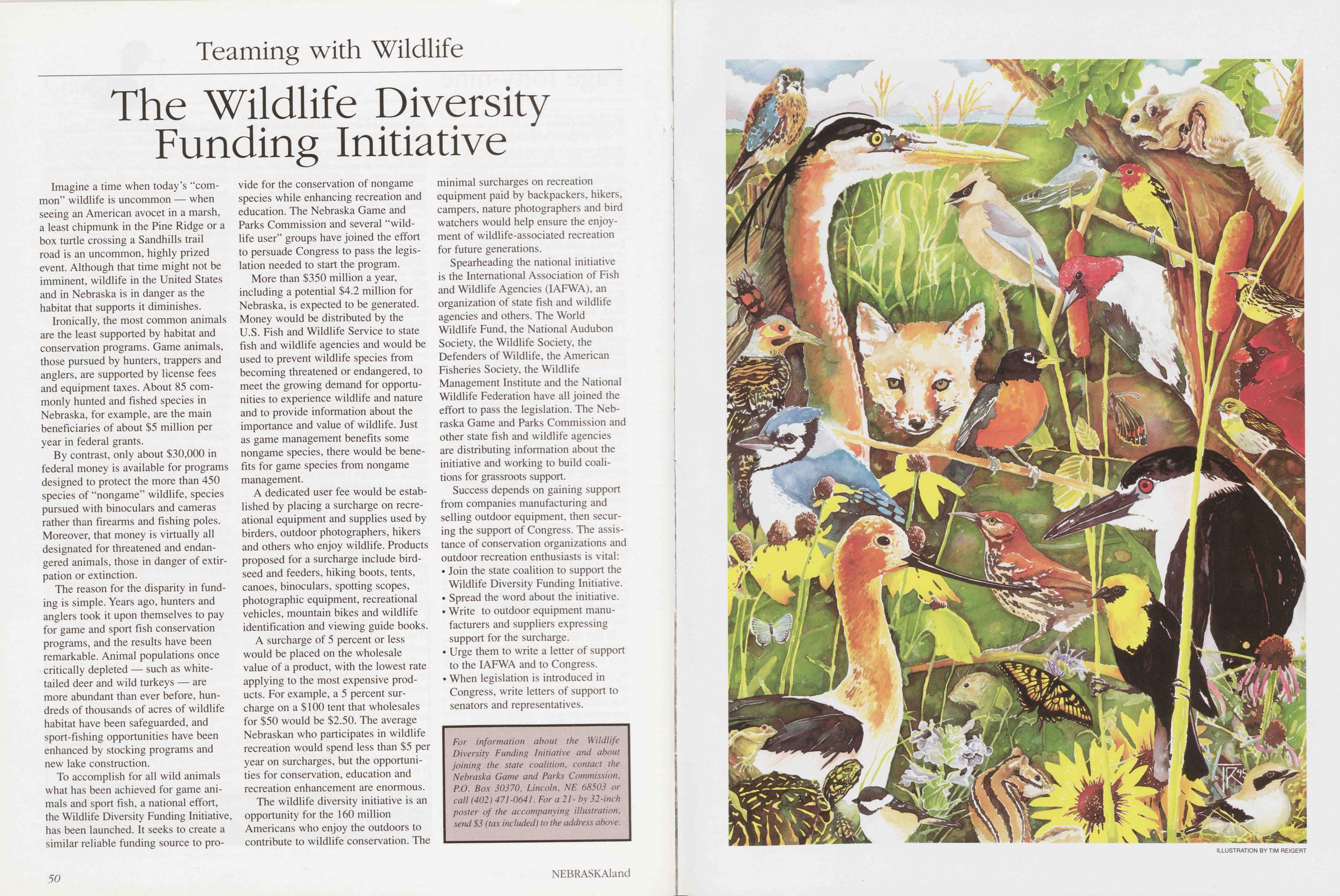
Teaming with Wildlife
The Wildlife Diversity Funding Initiative
Imagine a time when today's "common" wildlife is uncommon — when seeing an American avocet in a marsh, a least chipmunk in the Pine Ridge or a box turtle crossing a Sandhills trail road is an uncommon, highly prized event. Although that time might not be imminent, wildlife in the United States and in Nebraska is in danger as the habitat that supports it diminishes.
Ironically, the most common animals are the least supported by habitat and conservation programs. Game animals, those pursued by hunters, trappers and anglers, are supported by license fees and equipment taxes. About 85 commonly hunted and fished species in Nebraska, for example, are the main beneficiaries of about $5 million per year in federal grants.
By contrast, only about $30,000 in federal money is available for programs designed to protect the more than 450 species of "nongame" wildlife, species pursued with binoculars and cameras rather than firearms and fishing poles. Moreover, that money is virtually all designated for threatened and endangered animals, those in danger of extirpation or extinction.
The reason for the disparity in funding is simple. Years ago, hunters and anglers took it upon themselves to pay for game and sport fish conservation programs, and the results have been remarkable. Animal populations once critically depleted — such as white-tailed deer and wild turkeys — are more abundant than ever before, hundreds of thousands of acres of wildlife habitat have been safeguarded, and sport-fishing opportunities have been enhanced by stocking programs and new lake construction.
To accomplish for all wild animals what has been achieved for game animals and sport fish, a national effort, the Wildlife Diversity Funding Initiative, has been launched. It seeks to create a similar reliable funding source to provide for the conservation of nongame species while enhancing recreation and education. The Nebraska Game and Parks Commission and several "wildlife user" groups have joined the effort to persuade Congress to pass the legislation needed to start the program.
More than $350 million a year, including a potential $4.2 million for Nebraska, is expected to be generated. Money would be distributed by the U.S. Fish and Wildlife Service to state fish and wildlife agencies and would be used to prevent wildlife species from becoming threatened or endangered, to meet the growing demand for opportunities to experience wildlife and nature and to provide information about the importance and value of wildlife. Just as game management benefits some nongame species, there would be benefits for game species from nongame management.
A dedicated user fee would be established by placing a surcharge on recreational equipment and supplies used by birders, outdoor photographers, hikers and others who enjoy wildlife. Products proposed for a surcharge include birdseed and feeders, hiking boots, tents, canoes, binoculars, spotting scopes, photographic equipment, recreational vehicles, mountain bikes and wildlife identification and viewing guide books.
A surcharge of 5 percent or less would be placed on the wholesale value of a product, with the lowest rate applying to the most expensive products. For example, a 5 percent surcharge on a $100 tent that wholesales for $50 would be $2.50. The average Nebraskan who participates in wildlife recreation would spend less than $5 per year on surcharges, but the opportunities for conservation, education and recreation enhancement are enormous.
The wildlife diversity initiative is an opportunity for the 160 million Americans who enjoy the outdoors to contribute to wildlife conservation. The minimal surcharges on recreation equipment paid by backpackers, hikers, campers, nature photographers and bird watchers would help ensure the enjoyment of wildlife-associated recreation for future generations.
Spearheading the national initiative is the International Association of Fish and Wildlife Agencies (IAFWA), an organization of state fish and wildlife agencies and others. The World Wildlife Fund, the National Audubon Society, the Wildlife Society, the Defenders of Wildlife, the American Fisheries Society, the Wildlife Management Institute and the National Wildlife Federation have all joined the effort to pass the legislation. The Nebraska Game and Parks Commission and other state fish and wildlife agencies are distributing information about the initiative and working to build coalitions for grassroots support.
Success depends on gaining support from companies manufacturing and selling outdoor equipment, then securing the support of Congress. The assistance of conservation organizations and outdoor recreation enthusiasts is vital: Join the state coalition to support the Wildlife Diversity Funding Initiative. Spread the word about the initiative. Write to outdoor equipment manufacturers and suppliers expressing support for the surcharge. Urge them to write a letter of support to the IAFWA and to Congress. When legislation is introduced in Congress, write letters of support to senators and representatives.
For information about the Wildlife Diversity Funding Initiative and about joining the state coalition, contact the Nebraska Game and Parks Commission, P.O. Box 30370, Lincoln, NE 68503 or call (402) 471-0641. For a 21- by 32-inch poster of the accompanying illustration, send $3 (tax included) to the address above. 50 NEBRASKAland
Position: 29 (280 views)