Volume 73, Issue 6, 1995
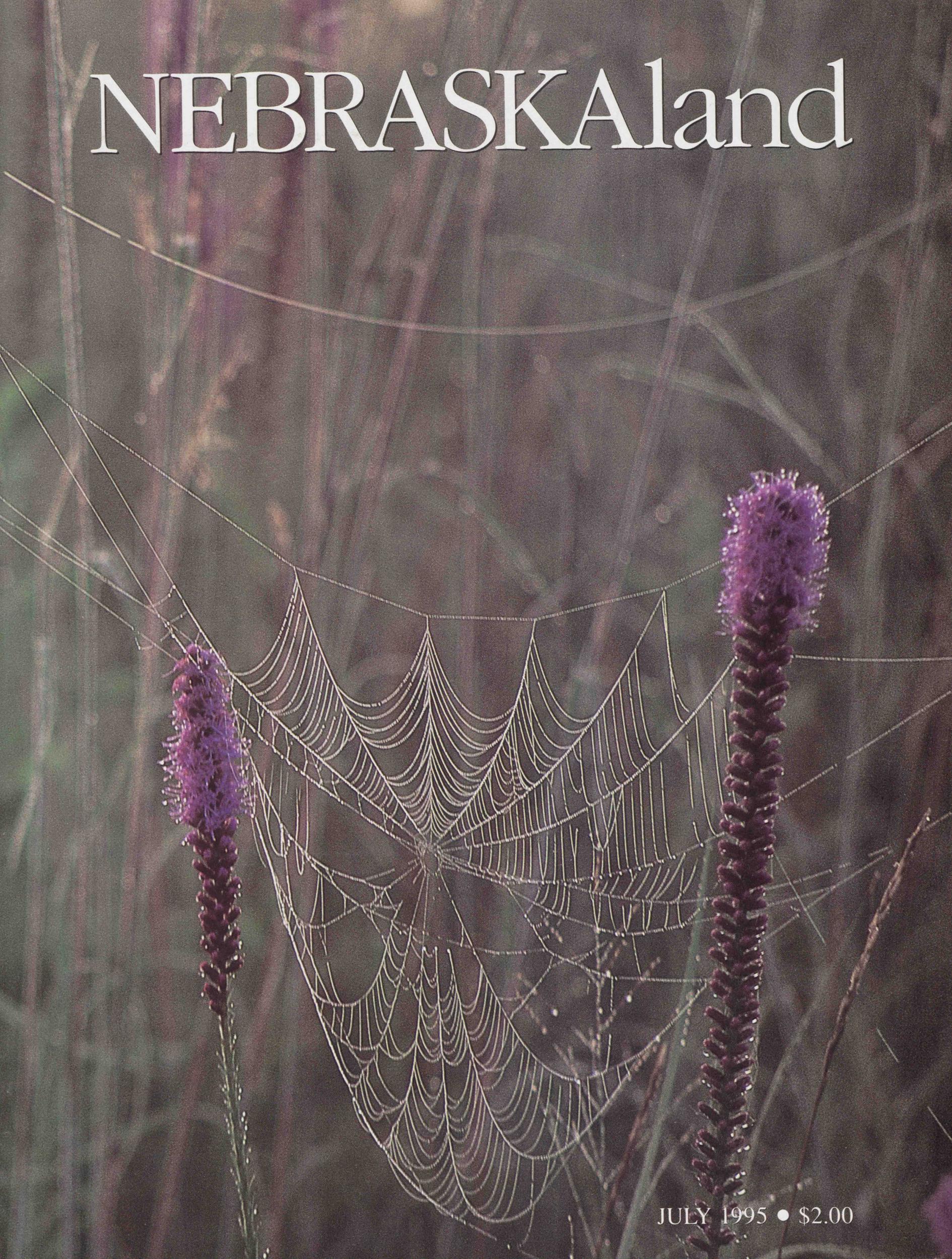
NEBRASKAland
JULY 1995 $2.00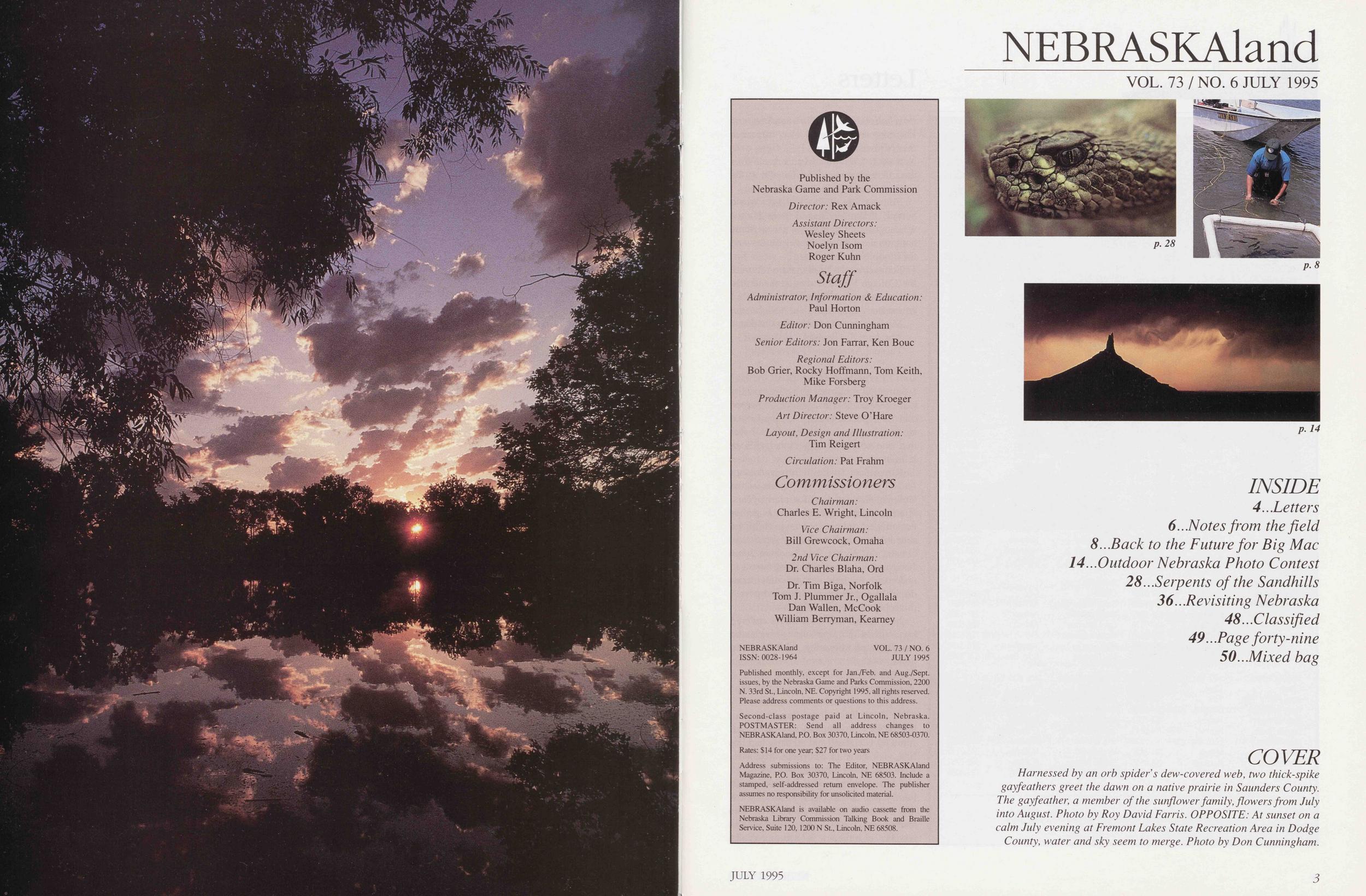
NEBRASKAland
VOL. 73 / NO. 6 JULY 1995 Published by the Nebraska Game and Park Commission Director: Rex Amack Assistant Directors: Wesley Sheets Noelyn Isom Roger Kuhn Staff Administrator, Information & Education: Paul Horton Editor: Don Cunningham Senior Editors: Jon Farrar, Ken Bouc Regional Editors: Bob Grier, Rocky Hoffmann, Tom Keith, Mike Forsberg Production Manager: Troy Kroeger Art Director: Steve O'Hare Layout, Design and Illustration: Tim Reigert Circulation: Pat Frahm Commissioners Chairman: Charles E. Wright, Lincoln Vice Chairman: Bill Grewcock, Omaha 2nd Vice Chairman: Dr. Charles Blaha, Ord Dr. Tim Biga, Norfolk Tom J. Plummer Jr., Ogallala Dan Wallen, McCook William Berryman, Kearney NEBRASKAland ISSN: 0028-1964 VOL. 73 / NO. 6 JULY 1995 Published monthly, except for Jan ./Feb. and Aug./Sept. issues, by the Nebraska Game and Parks Commission, 2200 N. 33rd St., Lincoln, NE. Copyright 1995, all rights reserved. Please address comments or questions to this address. Second-class postage paid at Lincoln, Nebraska. POSTMASTER: Send all address changes to NEBRASKAland, P.O. Box 30370, Lincoln, NE 68503-0370. Rates: $14 for one year; $27 for two years Address submissions to: The Editor, NEBRASKAland Magazine, P.O. Box 30370, Lincoln, NE 68503. Include a stamped, self-addressed return envelope. The publisher assumes no responsibility for unsolicited material. NEBRASKAland is available on audio cassette from the Nebraska Library Commission Talking Book and Braille Service, Suite 120, 1200 N St., Lincoln, NE 68508.
Letters
Nebraska Game and Parks Commission District Offices Headquarters 2200 North 33rd Street Lincoln, NE 68503 Phone (402)471-0641 District Office I Box 725 Alliance, NE 69301 Phone (308)762-5605 District Office II Box 508 Bassett, NE 68714 Phone (402)684-2921 District Office III Box 934 Norfolk, NE 68702 Phone (402)370-3374 District Office IV Route 4, Box 36 North Platte, NE 69101 Phone (308)535-8025 District Office V 2200 North 33rd Street Lincoln, NE 68503 Phone (402)471-5558 Omaha Office 1212 Deer Park Blvd. Omaha, NE 68108 Phone (402) 595-2144 Ak-Sar-Ben Aquarium 21502 West Highway 31 Gretna, NE 68028 Phone (402) 332-3901 Conservation Officers by Region Panhandle Southeast Officer City Phone (308) Officer City Phone (402) Richard Furiey (Sup. ) Alliance 762-2024 Dick Turpin (Adm.) Lincoln 471-5531 Walt Meyer Chadron 432-4398 Ted Blume (Asst. Adm.) Lincoln 483-5643 John Murphy Crawford 665-2021 Dan Klammer Lincoln 471-5003 Jim Zimmerman Gering 436-7561 Roger Guenther (Sup.) Lincoln 423-5671 Marvin Kampbell Hay Springs 638-7527 Murray Johnson Lincoln 488-2923 Dennis Thompson Ogallala 284-6450 William Krause Auburn 274-3789 Dan Zuehlke Ogallala 284-4815 Dan Evasco Beatrice 228-5935 Don Hunt Oshkosh 772-3697 Douglas Kramer Lincoln 466-9001 Scott Brandt Scottsbluff 635-1277 Dina Barta Lincoln 483-2358 Raymond Still Bridgeport 262-1075 Levi Krause Louisville 234-2212 Russell Mort Nebr. City 873-5684 Northeast Duane Arp Gretna 332-4954 Officer City Phone (402) Larry Elston Bellevue 292-4910 Tom Zimmer (Sup.) Norfolk 371-6625 Craig Stover Waterloo 359-2833 Robert Kelly Albion 395-2538 Mike Luben Colon 443-4278 Ross Oestmann Bloomfield 373-4412 L A. Wilkinson Columbus 564-4375 Sandhills Gary Ralston Creighton 847-3284 Officer City Phone (402) Daniel Roberts Fremont 721-7852 Bruce Wiebe (Sup.) Bassett 684-3867 Randy Pomplun Fullerton (308) 536-2987 Max Showalter Ainsworth 387-1960 Jon Reeves Kennard 427-7378 Larry Bauman Atkinson 925-5569 Marion Shafer Norfolk 371-2031 Richard Seward Ord (308) 728-5338 Eric Wiebe Ponca 755-2566 Mick Gray Valentine 376-3136 Steve Oberg West Point 372-3062 Ray Dierking Brkn. Bow (308) 872-3078 South-Central Southwest Officer City Phone (402) Officer City Phone (308) Jerry Pecha (Sup.) York 362-5707 Roger Thompson (Sup.) N. Platte 532-9175 Terry Brentzel Grand Is. (308) 384-8296 George Sund Cambridge 697-4629 Dale Johnson Hebron 768-7363 Matt Andrews Elwood 785-3025 Dayton Shultis Kearney (308) 234-3349 Jack Henderson Gothenburg 537-7483 Mark Reeves Loup City (308)745-1126 Dirk Greene Imperial 882-5328 Robert Finke Milford 761-3537 Virgil Gosch McCook 345-2185 Tim Williams Hastings 463-2535 Dwight Allbery N. Platte 532-2753 Rich Routh Rep. City 799-2085 Operation Game Thief 1-800-742-7627 Baseball Article was OutstandingI have been traveling on a lecture tour in the Midwest, and as we flew over Nebraska, I reminisced to myself over the many great times in Omaha at the College World Series.
Your article ["The College World Series," May 1995] and your photos were outstanding. It was a great tribute both to the College World Series and the city of Omaha.
Some summer I will make a return to the College World Series. It is hard to believe that it is almost 40 years since I covered my first series.
My best regards and many thanks.
Abraham S. Chanin Tucson, Arizona Don't Forget Jesse CuevasI thoroughly enjoyed the story on the College World Series. And while I agree that this special event is characterized by the players, coaches and fans, I feel that one very crucial person has been left out.
Rosenblatt Stadium Superintendent Jesse Cuevas has been a fixture at the College World Series for many years. His hard work ensures that the games get played (almost always right on schedule) no matter what the weather in Omaha during the first week in June. Jesse and his crew work long hours to make sure the field is in top-notch condition, the stadium is clean and everything is perfect.
I enjoy the variety of topics covered by NEBRASKAland along with the excellent photography. Keep up the good work.
Gary Groff Bellevue, Nebraska "The Road Home" was SuperbI was born in southeastern Nebraska some 60 years ago and recently had my first visit back in 10 years. My wife, who had never been to the Midwest, and I thoroughly enjoyed the visit with family and old friends. It was almost like being a tourist in a new area after having been gone so long. The Memorial Day observance in Bruning really 4 NEBRASKAland brought back a lot of old memories. The community is keeping the tradition alive and well. I hope they always do.
We subscribed to NEBRASKAland Magazine about two years ago. At first I was somewhat disappointed. After all, I was comparing it to Arizona Highways, long an industry standard. Subsequent issues seemed to improve, and I grew to appreciate the magazine more and more. That culminated in "The Road Home" [January-February 1995] which was superb.
We look forward to continuing our subscription and hope you continue to improve and enhance the publication.
Bernard H. Ortgies Tallahassee, Florida Seeking Frisbee InformationI am conducting research for a new book on the origins and history of Frisbee playing. For many years it was believed that Frisbee playing started on a college campus. However, my research has uncovered evidence that it could have originated at a recreational area or camp.
When mom sent a tin of cookies to her child at camp, the cover became a toy to be tossed for amusement. A metal Frisbee pie pan was also used for this early "Frisbee" type activity.
I want to be able to credit the appropriate recreational area or camp for starting what has become a worldwide phenomenon originating in America. I am looking for published or personal written accounts of "metal Frisbee" activities, rules for games, photographs or contests from before 1960.
Thank you for your consideration. I hope that you will be able to contribute to this history of Frisbee playing. Please send your information to me at P.O. Box 4020-022, Alameda, CA 94501, or call me at (510) 814-9639.
Victor Malafronte Alameda, California Write to: Letters, NEBRASKAland Magazine, P.O. Box 30370, Lincoln, NE 68503, or fax (402) 471-5528. Letters may be condensed or edited for clarity.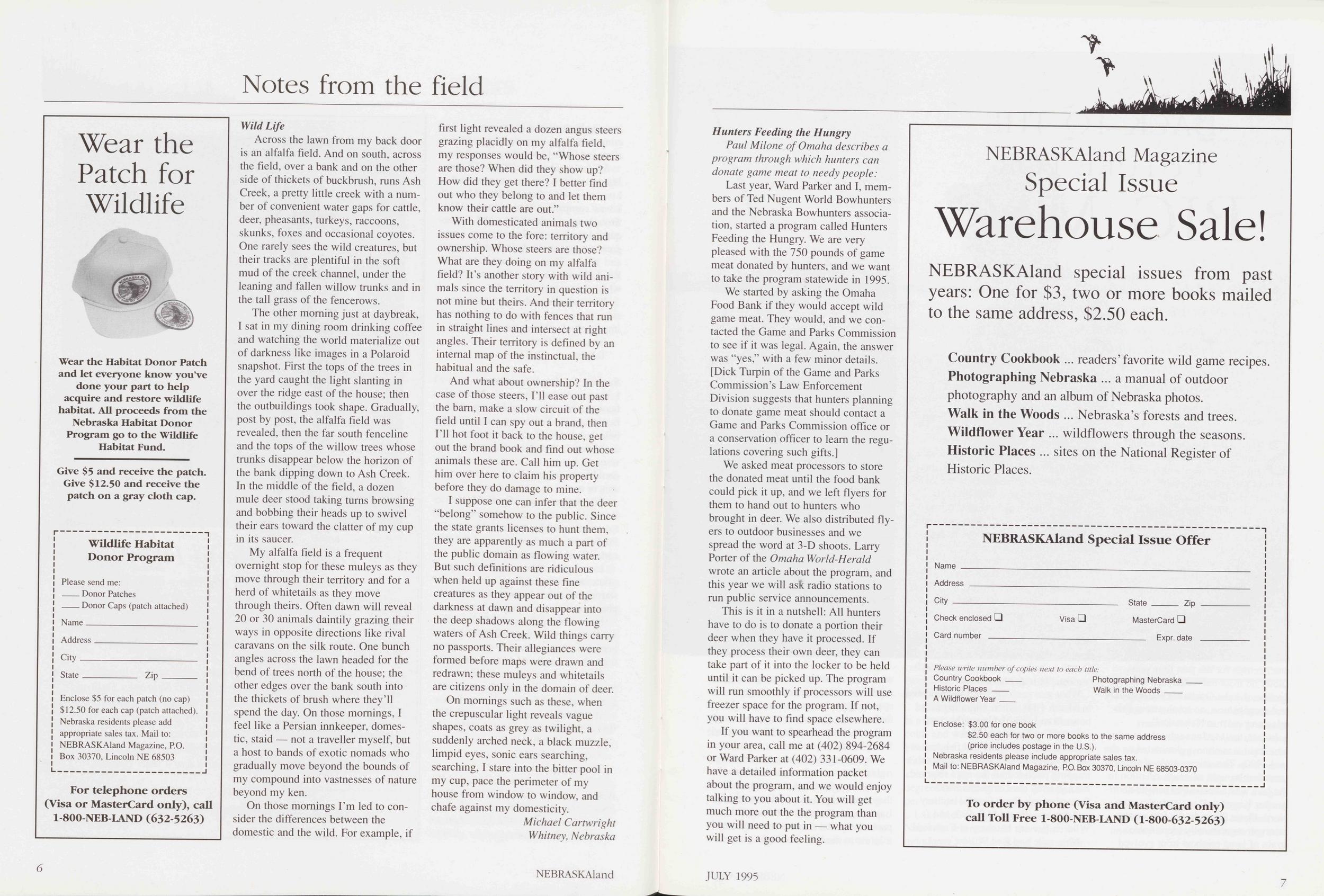
Notes from the field
Wear the Patch for Wildlife Wear the Habitat Donor Patch and let everyone know you've done your part to help acquire and restore wildlife habitat. All proceeds from the Nebraska Habitat Donor Program go to the Wildlife Habitat Fund. Give $5 and receive the patch. Give $12.50 and receive the patch on a gray cloth cap. Wildlife Habitat Donor Program Please send me: Donor Patches Donor Caps (patch attached) Name Address City State Zip Enclose $5 for each patch (no cap) $12.50 for each cap (patch attached). Nebraska residents please add appropriate sales tax. Mail to: NEBRASKAland Magazine, P.O. Box 30370, Lincoln NE 68503 For telephone orders (Visa or MasterCard only), call 1-800-NEB-LAND (632-5263) Wild LifeAcross the lawn from my back door is an alfalfa field. And on south, across the field, over a bank and on the other side of thickets of buckbrush, runs Ash Creek, a pretty little creek with a number of convenient water gaps for cattle, deer, pheasants, turkeys, raccoons, skunks, foxes and occasional coyotes. One rarely sees the wild creatures, but their tracks are plentiful in the soft mud of the creek channel, under the leaning and fallen willow trunks and in the tall grass of the fencerows.
The other morning just at daybreak, I sat in my dining room drinking coffee and watching the world materialize out of darkness like images in a Polaroid snapshot. First the tops of the trees in the yard caught the light slanting in over the ridge east of the house; then the outbuildings took shape. Gradually, post by post, the alfalfa field was revealed, then the far south fenceline and the tops of the willow trees whose trunks disappear below the horizon of the bank dipping down to Ash Creek. In the middle of the field, a dozen mule deer stood taking turns browsing and bobbing their heads up to swivel their ears toward the clatter of my cup in its saucer.
My alfalfa field is a frequent overnight stop for these muleys as they move through their territory and for a herd of whitetails as they move through theirs. Often dawn will reveal 20 or 30 animals daintily grazing their ways in opposite directions like rival caravans on the silk route. One bunch angles across the lawn headed for the bend of trees north of the house; the other edges over the bank south into the thickets of brush where they'll spend the day. On those mornings, I feel like a Persian innkeeper, domestic, staid — not a traveller myself, but a host to bands of exotic nomads who gradually move beyond the bounds of my compound into vastnesses of nature beyond my ken.
On those mornings I'm led to consider the differences between the domestic and the wild. For example, if first light revealed a dozen angus steers grazing placidly on my alfalfa field, my responses would be, "Whose steers are those? When did they show up? How did they get there? I better find out who they belong to and let them know their cattle are out."
With domesticated animals two issues come to the fore: territory and ownership. Whose steers are those? What are they doing on my alfalfa field? It's another story with wild animals since the territory in question is not mine but theirs. And their territory has nothing to do with fences that run in straight lines and intersect at right angles. Their territory is defined by an internal map of the instinctual the habitual and the safe.
And what about ownership? In the case of those steers, I'll ease out past the barn, make a slow circuit of the field until I can spy out a brand, then I'll hot foot it back to the house, get out the brand book and find out whose animals these are. Call him up. Get him over here to claim his property before they do damage to mine.
I suppose one can infer that the deer "belong" somehow to the public. Since the state grants licenses to hunt them, they are apparently as much a part of the public domain as flowing water. But such definitions are ridiculous when held up against these fine creatures as they appear out of the darkness at dawn and disappear into the deep shadows along the flowing waters of Ash Creek. Wild things carry no passports. Their allegiances were formed before maps were drawn and redrawn; these muleys and whitetails are citizens only in the domain of deer.
On mornings such as these, when the crepuscular light reveals vague shapes, coats as grey as twilight, a suddenly arched neck, a black muzzle, limpid eyes, sonic ears searching, searching, I stare into the bitter pool in my cup, pace the perimeter of my house from window to window, and chafe against my domesticity.
Michael Cartwright Whitney, Nebraska 6 NEBRASKAland Hunters Feeding the HungryPaul Mi lone of Omaha describes a program through which hunters can donate game meat to needy people:
Last year, Ward Parker and I, members of Ted Nugent World Bowhunters and the Nebraska Bowhunters association, started a program called Hunters Feeding the Hungry. We are very pleased with the 750 pounds of game meat donated by hunters, and we want to take the program statewide in 1995.
We started by asking the Omaha Food Bank if they would accept wild game meat. They would, and we contacted the Game and Parks Commission to see if it was legal. Again, the answer was "yes," with a few minor details. [Dick Turpin of the Game and Parks Commission's Law Enforcement Division suggests that hunters planning to donate game meat should contact a Game and Parks Commission office or a conservation officer to learn the regulations covering such gifts.]
We asked meat processors to store the donated meat until the food bank could pick it up, and we left flyers for them to hand out to hunters who brought in deer. We also distributed flyers to outdoor businesses and we spread the word at 3-D shoots. Larry Porter of the Omaha World-Herald wrote an article about the program, and this year we will ask radio stations to run public service announcements.
This is it in a nutshell: All hunters have to do is to donate a portion their deer when they have it processed. If they process their own deer, they can take part of it into the locker to be held until it can be picked up. The program will run smoothly if processors will use freezer space for the program. If not, you will have to find space elsewhere.
If you want to spearhead the program in your area, call me at (402) 894-2684 or Ward Parker at (402) 331-0609. We have a detailed information packet about the program, and we would enjoy talking to you about it. You will get much more out the the program than you will need to put in — what you will get is a good feeling.
NEBRASKAland Magazine Special Issue Warehouse Sale! NEBRASKAland special issues from past years: One for $3, two or more books mailed to the same address, $2.50 each. Country Cookbook readers' favorite wild game recipes. Photographing Nebraska a manual of outdoor photography and an album of Nebraska photos. Walk in the Woods Nebraska's forests and trees. Wildflower Year wildflowers through the seasons. Historic Places sites on the National Register of Historic Places. NEBRASKAland Special Issue Offer Name Address City State Zip Check enclosed Q Card number VisaQ MasterCard Expr. date Please write number of copies next to each title. Country Cookbook Historic Places A Wildflower Year Photographing Nebraska Walk in the Woods Enclose: $3.00 for one book $2.50 each for two or more books to the same address (price includes postage in the U.S.). Nebraska residents please include appropriate sales tax. Mail to: NEBRASKAland Magazine, P.O. Box 30370, Lincoln NE 68503-0370 To order by phone (Visa and MasterCard only) call Toll Free 1-800-NEB-LAND (1-800-632-5263) JULY 1995 7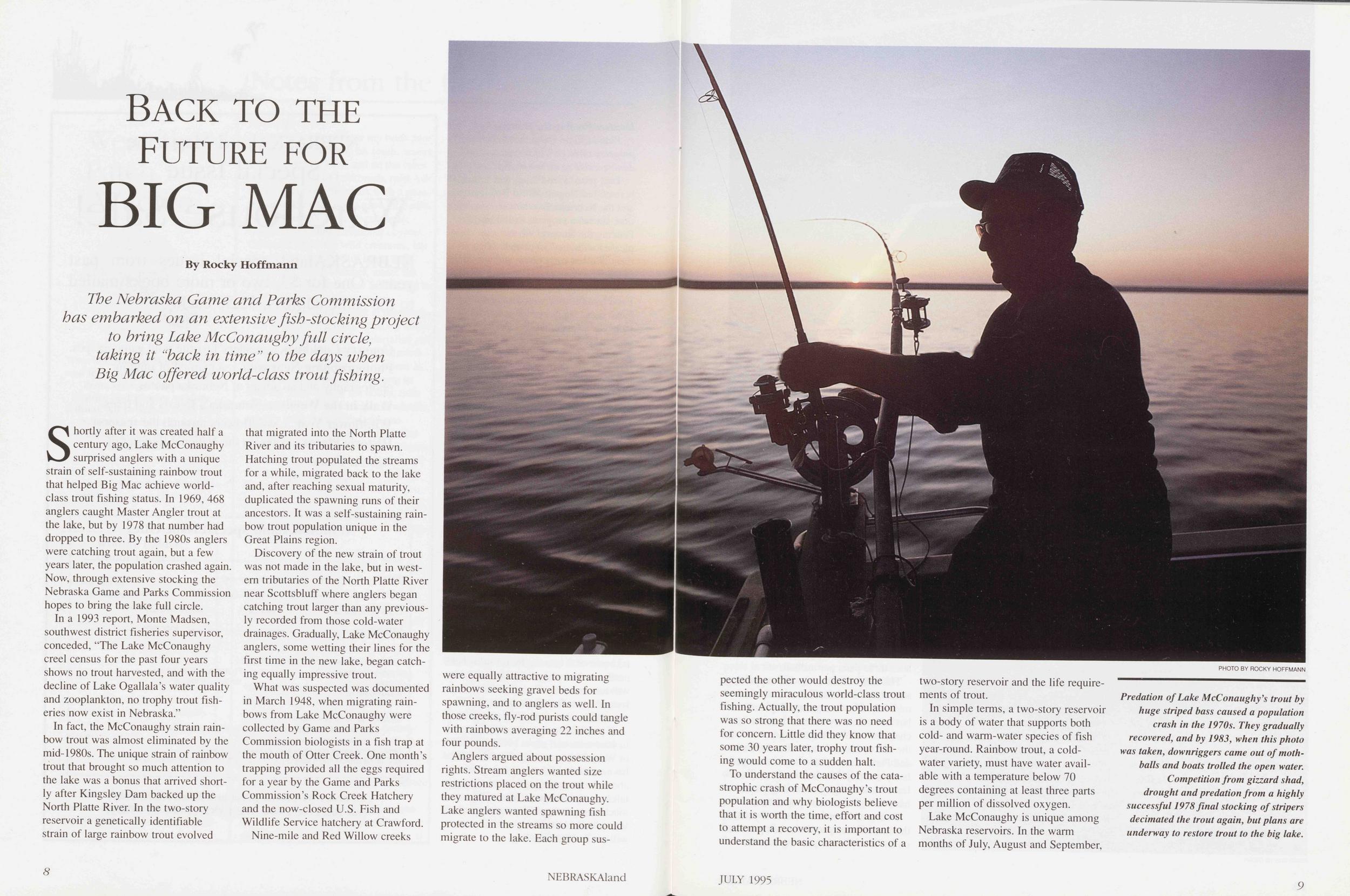
Back to the Future for big MAC
By Rocky Hoffmann The Nebraska Game and Parks Commission has embarked on an extensive fish-stocking project to bring Lake McConaughy full circle, taking it uback in time" to the days when Big Mac offered world-class trout fishing.Shortly after it was created half a century ago, Lake McConaughy surprised anglers with a unique strain of self-sustaining rainbow trout that helped Big Mac achieve worldclass trout fishing status. In 1969, 468 anglers caught Master Angler trout at the lake, but by 1978 that number had dropped to three. By the 1980s anglers were catching trout again, but a few years later, the population crashed again. Now, through extensive stocking the Nebraska Game and Parks Commission hopes to bring the lake full circle.
In a 1993 report, Monte Madsen, southwest district fisheries supervisor, conceded, "The Lake McConaughy creel census for the past four years shows no trout harvested, and with the decline of Lake Ogallala's water quality and zooplankton, no trophy trout fisheries now exist in Nebraska."
In fact, the McConaughy strain rainbow trout was almost eliminated by the mid-1980s. The unique strain of rainbow trout that brought so much attention to the lake was a bonus that arrived shortly after Kingsley Dam backed up the North Platte River. In the two-story reservoir a genetically identifiable strain of large rainbow trout evolved that migrated into the North Platte River and its tributaries to spawn. Hatching trout populated the streams for a while, migrated back to the lake and, after reaching sexual maturity, duplicated the spawning runs of their ancestors. It was a self-sustaining rainbow trout population unique in the Great Plains region.
Discovery of the new strain of trout was not made in the lake, but in western tributaries of the North Platte River near Scottsbluff where anglers began catching trout larger than any previously recorded from those cold-water drainages. Gradually, Lake McConaughy anglers, some wetting their lines for the first time in the new lake, began catching equally impressive trout.
What was suspected was documented in March 1948, when migrating rainbows from Lake McConaughy were collected by Game and Parks Commission biologists in a fish trap at the mouth of Otter Creek. One month's trapping provided all the eggs required for a year by the Game and Parks Commission's Rock Creek Hatchery and the now-closed U.S. Fish and Wildlife Service hatchery at Crawford.
Nine-mile and Red Willow creeks were equally attractive to migrating rainbows seeking gravel beds for spawning, and to anglers as well. In those creeks, fly-rod purists could tangle with rainbows averaging 22 inches and four pounds.
Anglers argued about possession rights. Stream anglers wanted size restrictions placed on the trout while they matured at Lake McConaughy. Lake anglers wanted spawning fish protected in the streams so more could migrate to the lake. Each group suspected 8 NEBRASKAland the other would destroy the seemingly miraculous world-class trout fishing. Actually, the trout population was so strong that there was no need for concern. Little did they know that some 30 years later, trophy trout fishing would come to a sudden halt.
To understand the causes of the catastrophic crash of McConaughy's trout population and why biologists believe that it is worth the time, effort and cost to attempt a recovery, it is important to understand the basic characteristics of a two-story reservoir and the life requirements of trout.
In simple terms, a two-story reservoir is a body of water that supports both cold- and warm-water species of fish year-round. Rainbow trout, a coldwater variety, must have water available with a temperature below 70 degrees containing at least three parts per million of dissolved oxygen.
Lake McConaughy is unique among Nebraska reservoirs. In the warm months of July, August and September,
When Lake McConaughy stratifies, two distinct water layers form, the upper layer (the epilimnion) composed of well-oxygenated warmer water and the lower layer (the hypolimnion) composed of cold water sometimes devoid of oxygen. The key to a lake's capacity to maintain a rainbow trout population in a warm climate rests with neither layer, but with the transition water, called the thermocline, that separates the two. In Lake McConaughy, the thermocline remains below 70 degrees with a dissolved oxygen content of at least three parts per million.
The thermocline is the life-supporting sanctuary for trout from as early as mid-July to as late as mid-September, but that sanctuary became a death chamber for trout beginning in 1974. In the late 1960s and early 70s, the Game and Parks Commission stocked striped bass, a trophy fish that would prey on Lake McConaughy's seemingly inexhaustible gizzard shad population.
Both goals were successful. By 1975, the striped bass record was being broken on an hourly basis, proving that the 10 NEBRASKAland exotic lunker was feeding well on the masses of gizzard shad. Biologists hadn't counted on discovering that 10-pound and larger striped bass preferred, and possibly depended on, the lake's thermocline as much as the trout did. In 1975, more than 5,000 lunker striped bass with voracious appetites were confined to the same small thermocline occupied by the lake's entire rainbow trout population. It was a bed-and-breakfast situation.
A research biologist computed staggering statistics that indicated the effect striped bass had on rainbow trout during July, August and September. The computer model indicated that an estimated 5,000 stripers weighing more than 10 pounds occupying the thermocline in August consumed a minimum of 22,500 trout weighing a pound and a half. The model was based on the conservative premise that the diet of striped bass was 50 percent trout, although it was suspected that trout made up a larger portion of the predator's diet while in the thermocline. The predation estimate was for a 30-day period, not the 60 days that trout usually depend on the thermocline. If the striped bass ate only trout for a 60-day period, 90,000 trout were lost.
Master Angler reports lent credibility to the hypothesis, as huge striped bass were caught each fall when the lake was no longer stratified. But Master Angler records for rainbow trout plummeted from the 1969 high of 468 to 26 by the end of 1975. In 1978, only three Master Angler trout were recorded. That year the biomass of striped bass had peaked again.
Striped bass were not the only suspects in the dismantling of the trout population. The gizzard shad population also crashed. Shad were the prey fish on which trout grew to Master Angler size. Nebraska is on the northern extreme of the gizzard shad range, and with two successive bitter cold winters and low lake levels, a near total die-off occurred. Lake McConaughy was in miserable shape. With the lake's primary prey species nearly decimated, large predators turned to other species for survival, and other game fish suffered from the lack of available food.
Lake McConaughy recovered slowly, as more moderate winters and more stable lake levels nurtured a gradual, slight recovery of the shad population into the early 1980s. The catch rate of striped bass fell considerably. The Commission had ceased stocking them in 1978, and biologists concluded that few large stripers remained in the lake.
As part of a research project to evaluate various strains of trout in Lake McConaughy and to re-establish trout there, the Commission began stocking rainbows in 1980. By 1983, anglers were discovering that the effort was working. In July and August 1982, three- to four-pound trout were being caught regularly. Downriggers were taken out of mothballs, and on most days a steady procession of boats was trolling the open waters for trout.
Everything seemed to be falling into place. The number of 11-pound and larger striped bass was at a 10-year low; the gizzard shad population was thriving again, and researchers documented a zooplankton population of exceptional density and size. Large zooplankton are required by fingerling trout before they make the transition to a diet of fish.
A problem remained, however, as biologists realized that the lake's final 1978 stocking of striped bass would be reaching trophy size soon. That occurred in 1983. What hadn't been realized was the success of the final striped bass stocking effort. Survival rates were high, and a strong 1978 year class of striped bass had crossed the 10-pound threshold and entered the thermocline to summer with the trout. The effects were immediate and lasting. A long run of trophy striped bass fishing signalled an end to the trout recovery even with the continued stocking of rainbows through 1987.
A severe drought in the North Platte River drainage began in 1988, lowering water levels at Lake McConaughy. There was no trout-supporting thermocline during the summers of 1990 and 1991, and, as Madsen said, there is now no trophy trout fishing in Nebraska.
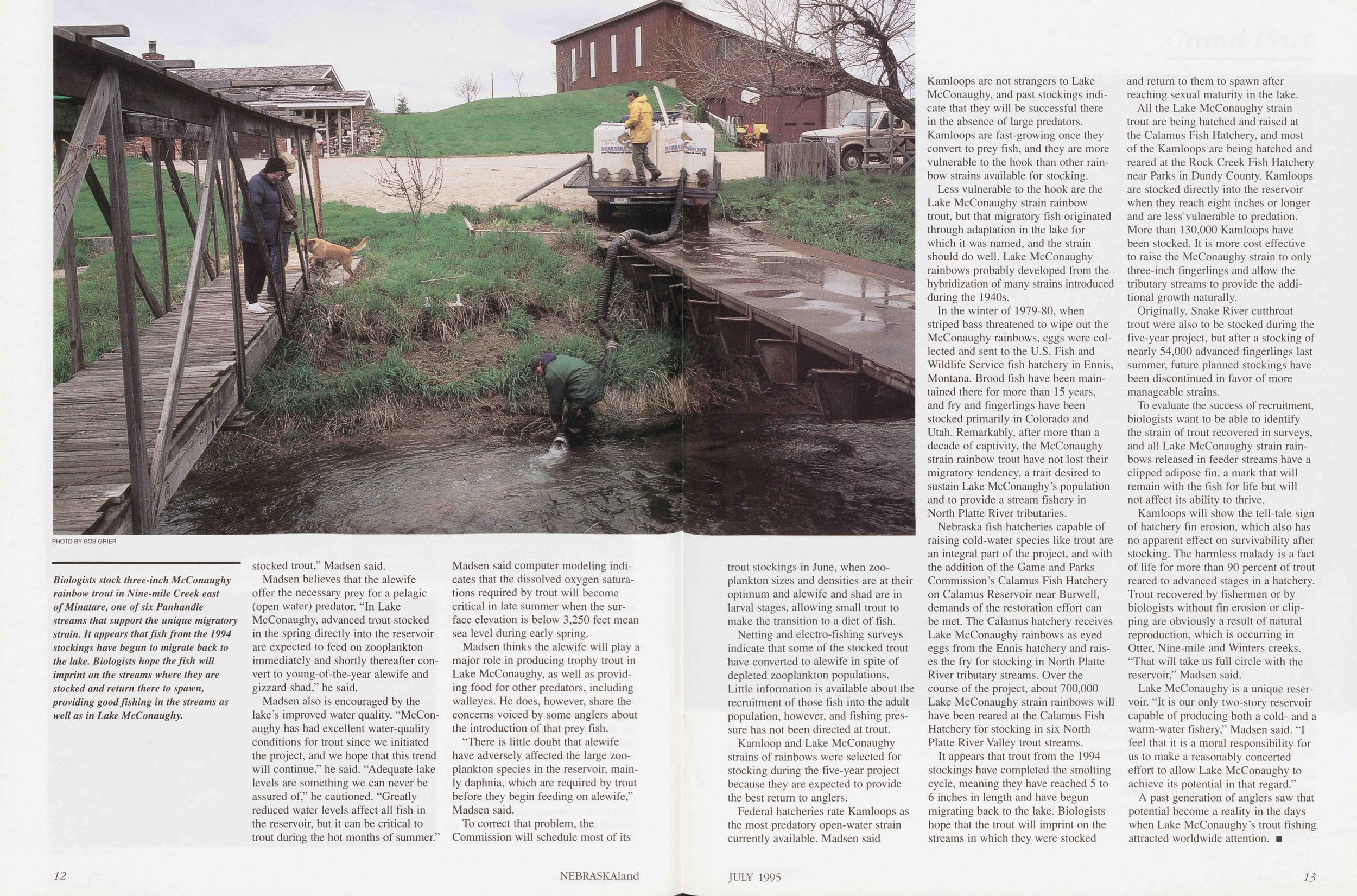
The current five-year plan to restore the trout fishery in Lake McConaughy began in late summer 1993 with the stocking of 95,075 Kamloop strain rainbow trout from Montana directly into the reservoir.
"Striped bass predation is no longer considered a major factor in stocked trout survival, although some predation on small trout by walleyes will always be present," Madsen said.
He thinks, however, that walleye predation can be minimized by stocking trout longer than eight inches. Also abundant are "buffer prey" that walleyes and other predators will eat.
"Densities of alewife, gizzard shad and lake emerald shiners are much higher than in the 1980s and should help offset direct walleye predation on
Madsen believes that the alewife offer the necessary prey for a pelagic (open water) predator. "In Lake McConaughy, advanced trout stocked in the spring directly into the reservoir are expected to feed on zooplankton immediately and shortly thereafter convert to young-of-the-year alewife and gizzard shad," he said. Madsen also is encouraged by the lake's improved water quality. "McConaughy has had excellent water-quality conditions for trout since we initiated the project, and we hope that this trend will continue," he said. "Adequate lake levels are something we can never be assured of," he cautioned. "Greatly reduced water levels affect all fish in the reservoir, but it can be critical to trout during the hot months of summer." Madsen said computer modeling indicates that the dissolved oxygen saturations required by trout will become critical in late summer when the surface elevation is below 3,250 feet mean sea level during early spring.
Madsen thinks the alewife will play a major role in producing trophy trout in Lake McConaughy, as well as providing food for other predators, including walleyes. He does, however, share the concerns voiced by some anglers about the introduction of that prey fish.
"There is little doubt that alewife have adversely affected the large zooplankton species in the reservoir, mainly daphnia, which are required by trout before they begin feeding on alewife," Madsen said.
To correct that problem, the Commission will schedule most of its 12 NEBRASKAland trout stockings in June, when zooplankton sizes and densities are at their optimum and alewife and shad are in larval stages, allowing small trout to make the transition to a diet of fish.
Netting and electro-fishing surveys indicate that some of the stocked trout have converted to alewife in spite of depleted zooplankton populations. Little information is available about the recruitment of those fish into the adult population, however, and fishing pressure has not been directed at trout.
Kamloop and Lake McConaughy strains of rainbows were selected for stocking during the five-year project because they are expected to provide the best return to anglers.
Federal hatcheries rate Kamloops as the most predatory open-water strain currently available. Madsen said Kamloops are not strangers to Lake McConaughy, and past stockings indicate that they will be successful there in the absence of large predators. Kamloops are fast-growing once they convert to prey fish, and they are more vulnerable to the hook than other rainbow strains available for stocking.
Less vulnerable to the hook are the Lake McConaughy strain rainbow trout, but that migratory fish originated through adaptation in the lake for which it was named, and the strain should do well. Lake McConaughy rainbows probably developed from the hybridization of many strains introduced during the 1940s.
In the winter of 1979-80, when striped bass threatened to wipe out the McConaughy rainbows, eggs were collected and sent to the U.S. Fish and Wildlife Service fish hatchery in Ennis, Montana. Brood fish have been maintained there for more than 15 years, and fry and fingerlings have been stocked primarily in Colorado and Utah. Remarkably, after more than a decade of captivity, the McConaughy strain rainbow trout have not lost their migratory tendency, a trait desired to sustain Lake McConaughy's population and to provide a stream fishery in North Platte River tributaries.
Nebraska fish hatcheries capable of raising cold-water species like trout are an integral part of the project, and with the addition of the Game and Parks Commission's Calamus Fish Hatchery on Calamus Reservoir near Burwell, demands of the restoration effort can be met. The Calamus hatchery receives Lake McConaughy rainbows as eyed eggs from the Ennis hatchery and raises the fry for stocking in North Platte River tributary streams. Over the course of the project, about 700,000 Lake McConaughy strain rainbows will have been reared at the Calamus Fish Hatchery for stocking in six North Platte River Valley trout streams.
It appears that trout from the 1994 stockings have completed the smolting cycle, meaning they have reached 5 to 6 inches in length and have begun migrating back to the lake. Biologists hope that the trout will imprint on the streams in which they were stocked and return to them to spawn after reaching sexual maturity in the lake.
All the Lake McConaughy strain trout are being hatched and raised at the Calamus Fish Hatchery, and most of the Kamloops are being hatched and reared at the Rock Creek Fish Hatchery near Parks in Dundy County. Kamloops are stocked directly into the reservoir when they reach eight inches or longer and are less vulnerable to predation. More than 130,000 Kamloops have been stocked. It is more cost effective to raise the McConaughy strain to only three-inch fingerlings and allow the tributary streams to provide the additional growth naturally.
Originally, Snake River cutthroat trout were also to be stocked during the five-year project, but after a stocking of nearly 54,000 advanced fingerlings last summer, future planned stockings have been discontinued in favor of more manageable strains.
To evaluate the success of recruitment, biologists want to be able to identify the strain of trout recovered in surveys, and all Lake McConaughy strain rainbows released in feeder streams have a clipped adipose fin, a mark that will remain with the fish for life but will not affect its ability to thrive.
Kamloops will show the tell-tale sign of hatchery fin erosion, which also has no apparent effect on survivability after stocking. The harmless malady is a fact of life for more than 90 percent of trout reared to advanced stages in a hatchery. Trout recovered by fishermen or by biologists without fin erosion or clipping are obviously a result of natural reproduction, which is occurring in Otter, Nine-mile and Winters creeks. "That will take us full circle with the reservoir," Madsen said.
Lake McConaughy is a unique reservoir. "It is our only two-story reservoir capable of producing both a cold- and a warm-water fishery," Madsen said. "I feel that it is a moral responsibility for us to make a reasonably concerted effort to allow Lake McConaughy to achieve its potential in that regard."
A past generation of anglers saw that potential become a reality in the days when Lake McConaughy's trout fishing attracted worldwide attention.
JULY 1995 13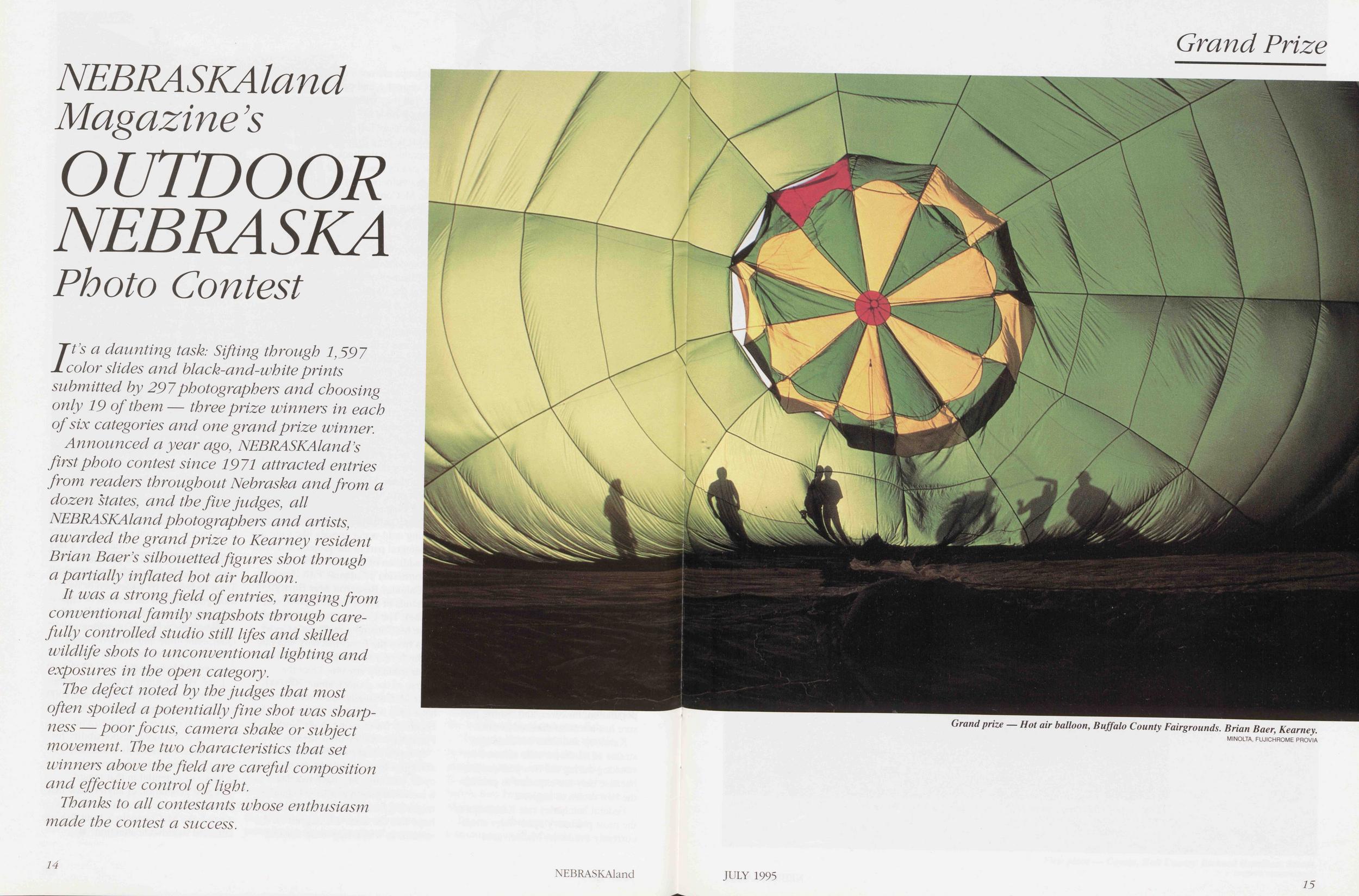
NEBRASKAland Magazine's OUTDOOR Photo Contest
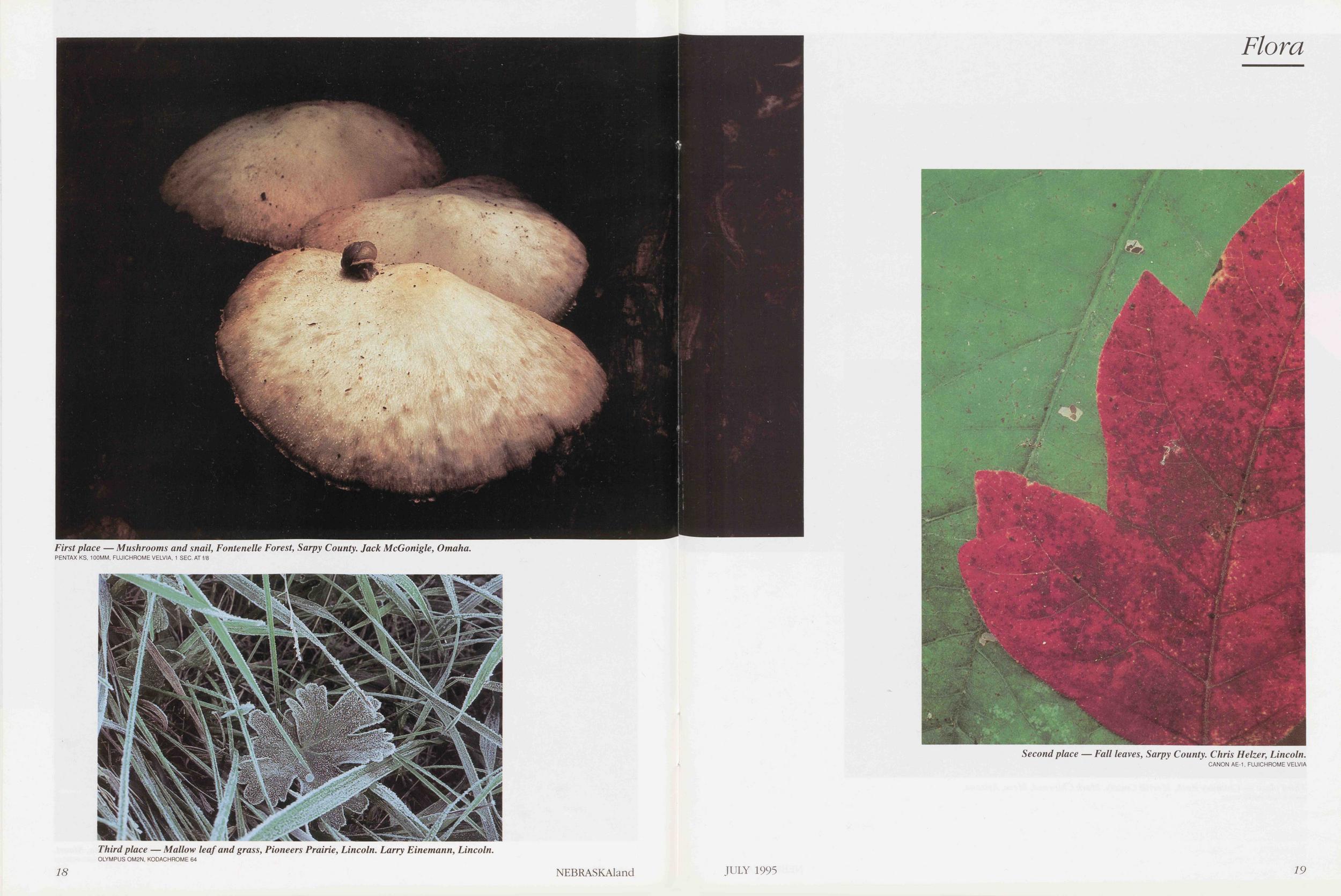
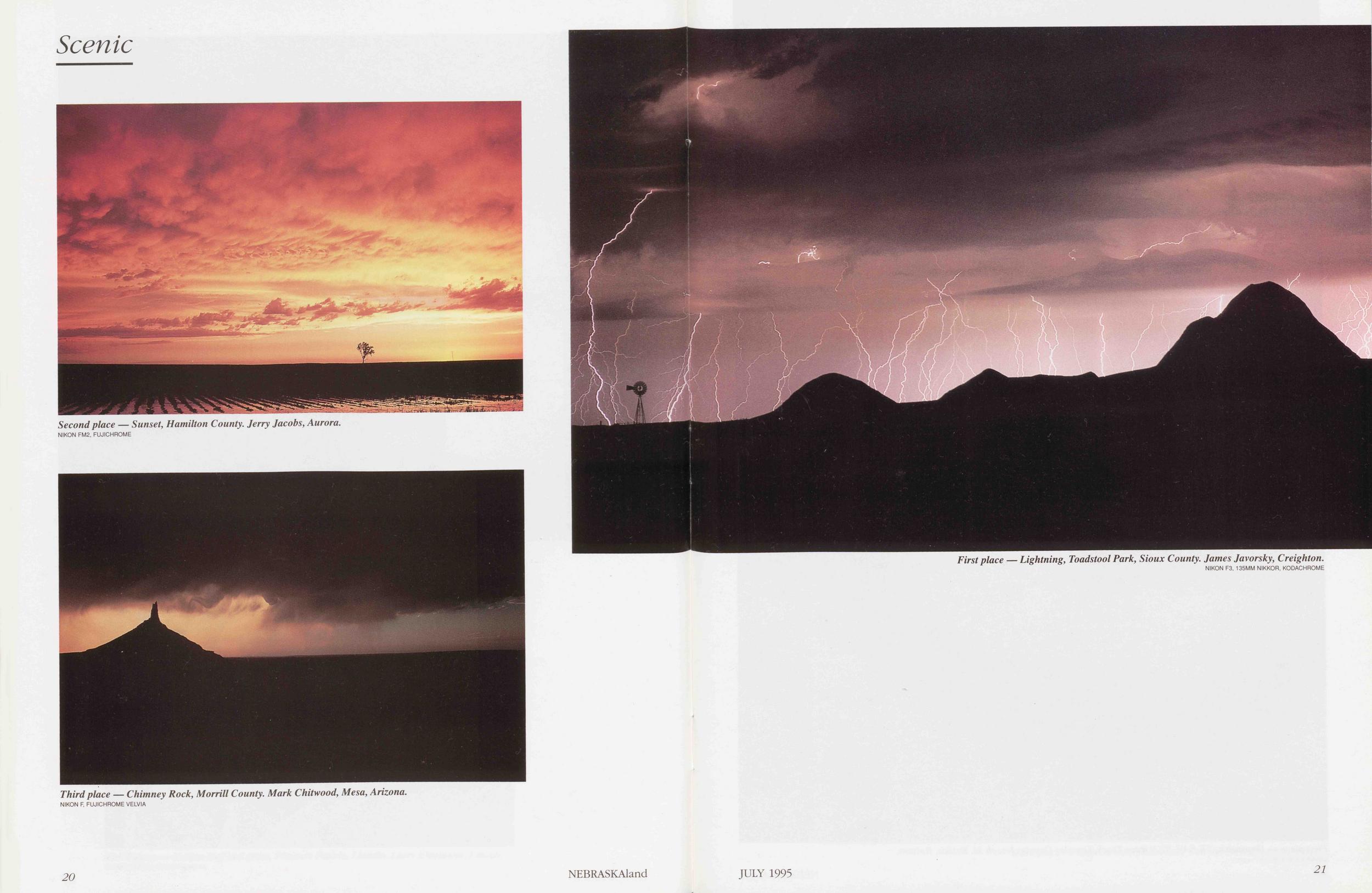
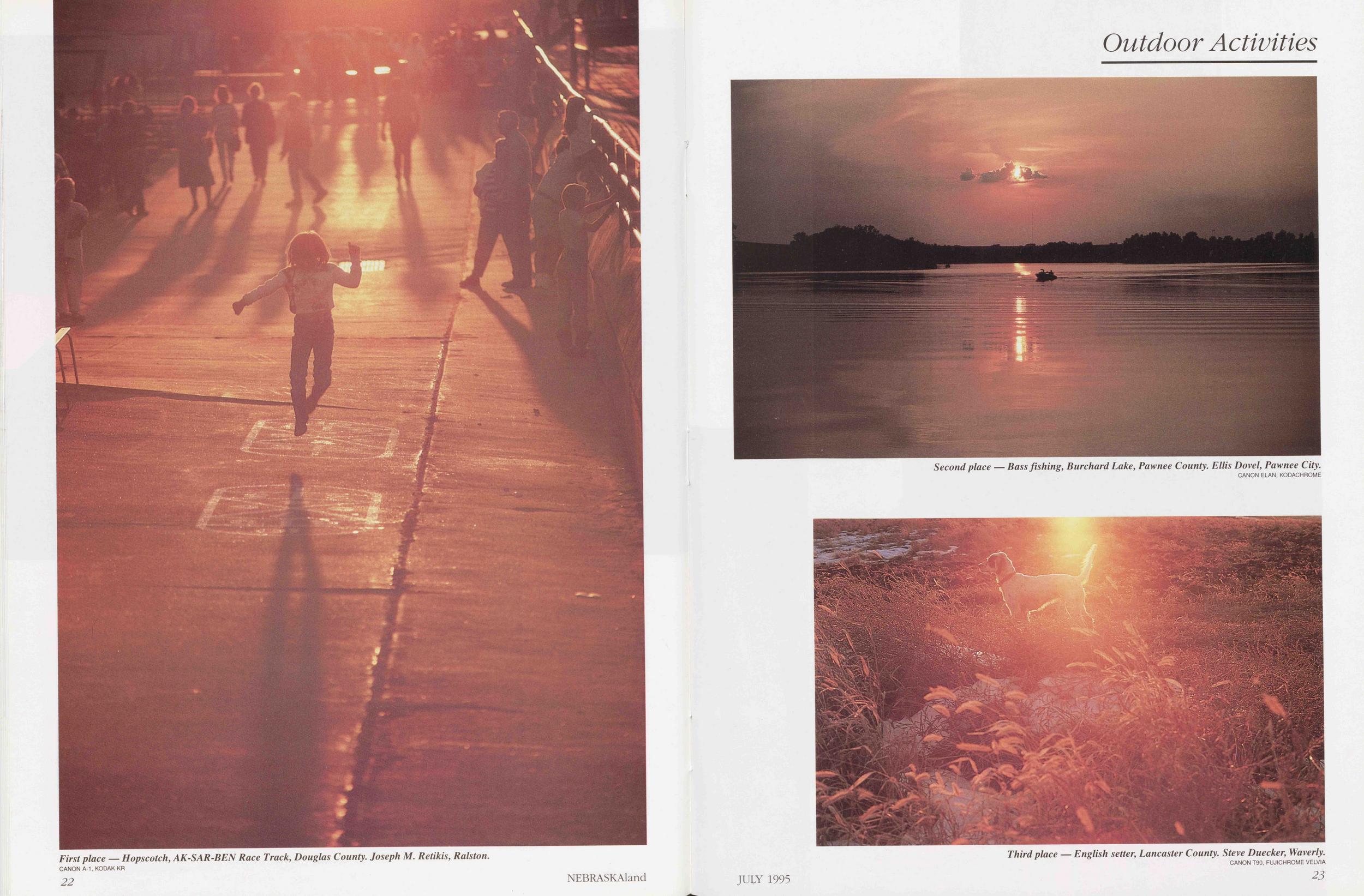
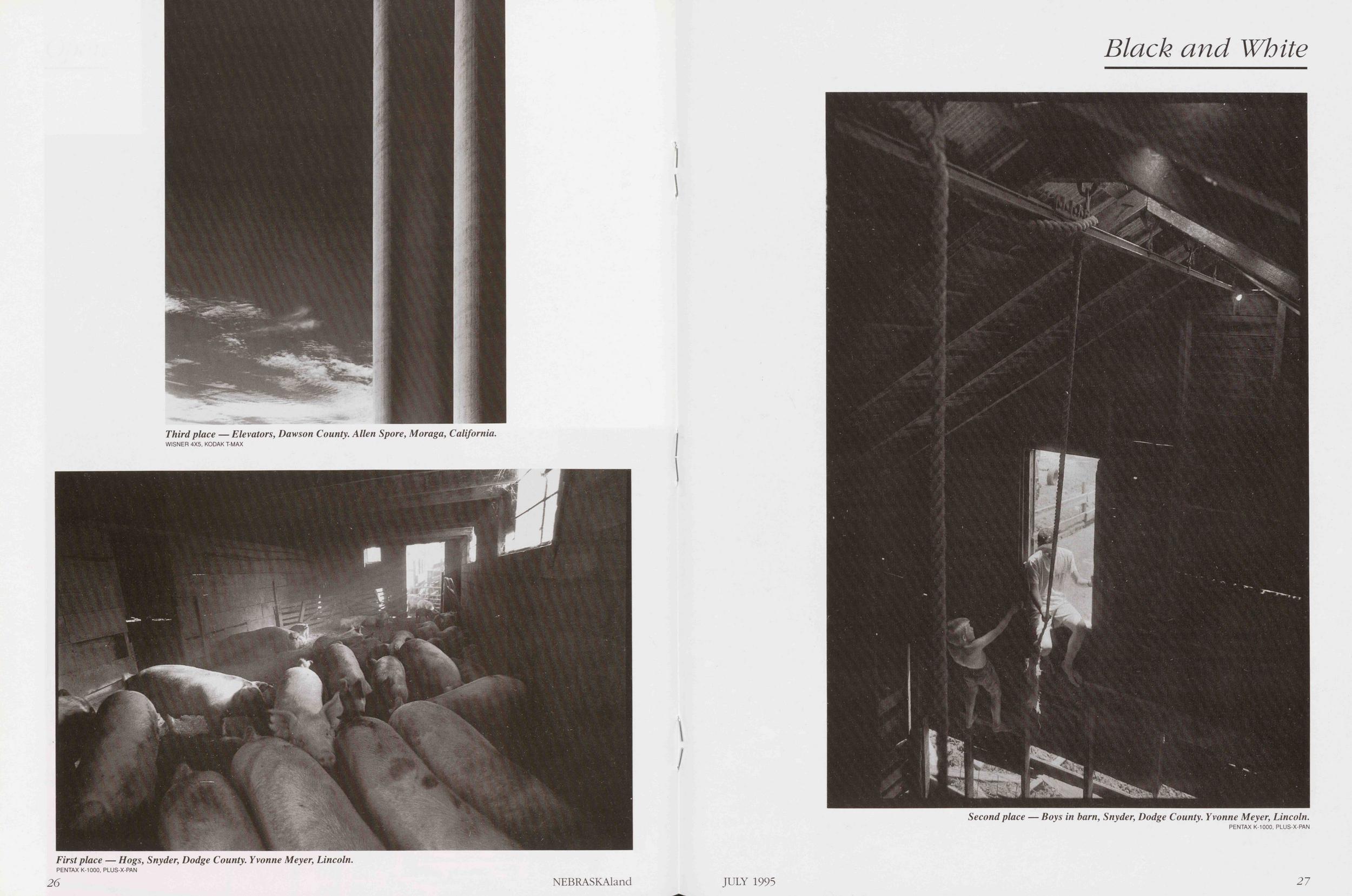
7Ts a daunting task: Sifting through 1,597 color slides and black-and-white prints submitted by 297photographers and choosing only 19 of them — three prize winners in each of six categories and one grand prize winner.
Announced a year ago, NEBRASKAland's first photo contest since 1971 attracted entries from readers throughout Nebraska and from a dozen states, and the five judges, all NEBRASKAland photographers and artists, awarded the grand prize to Kearney resident Brian Baer's silhouetted figures shot through a partially inflated hot air balloon.
It was a strong field of entries, ranging from conventional family snapshots through carefully controlled studio still lifes and skilled wildlife shots to unconventional lighting and exposures in the open category.
The defect noted by the judges that most often spoiled a potentially fine shot was sharpness — poor focus, camera shake or subject movement. The two characteristics that set winners above the field are careful composition and effective control of light.
Thanks to all contestants whose enthusiasm made the contest a success.
14 NEBRASKAland Grand Prize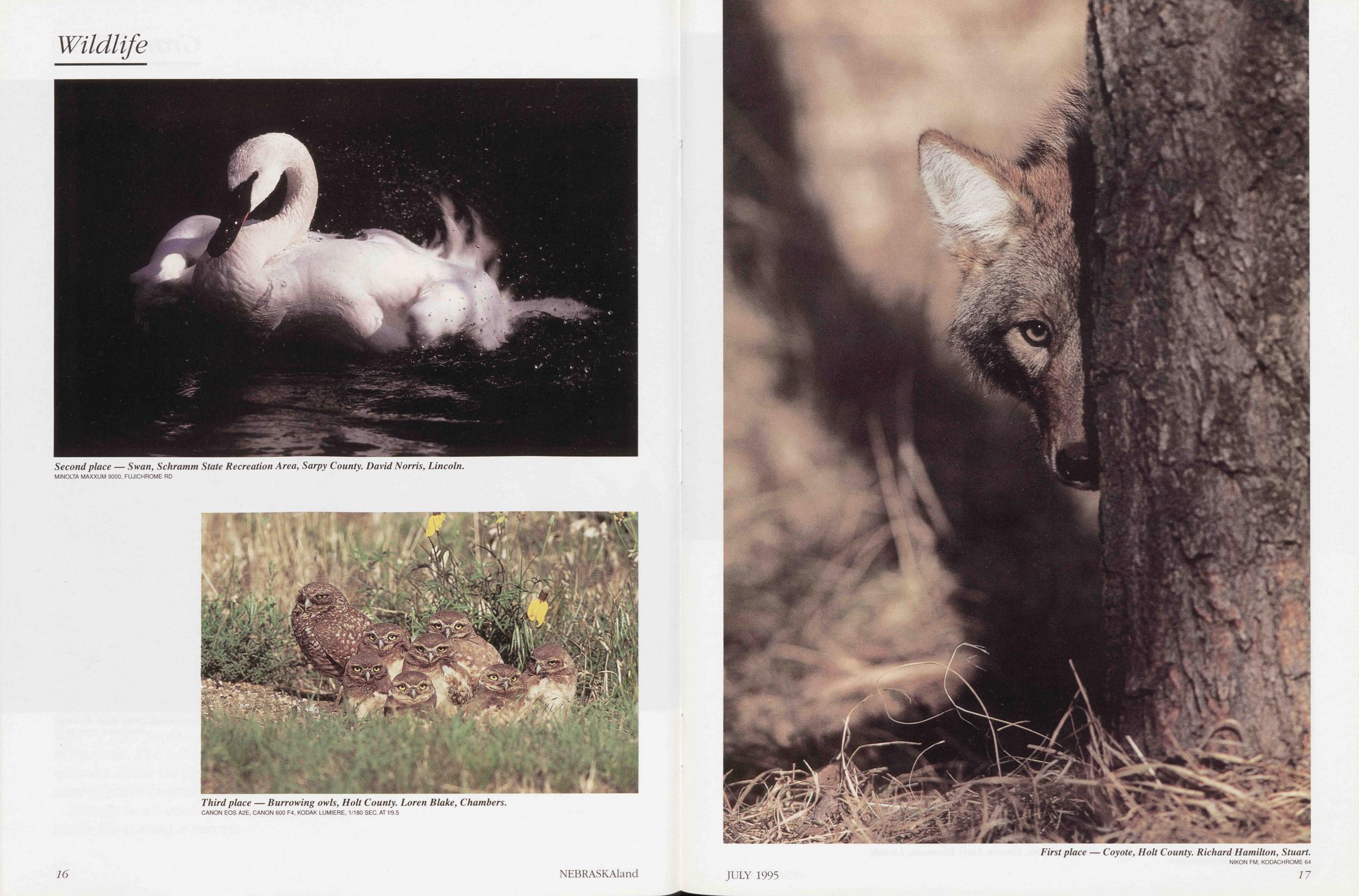 Wildlife
 Scenic
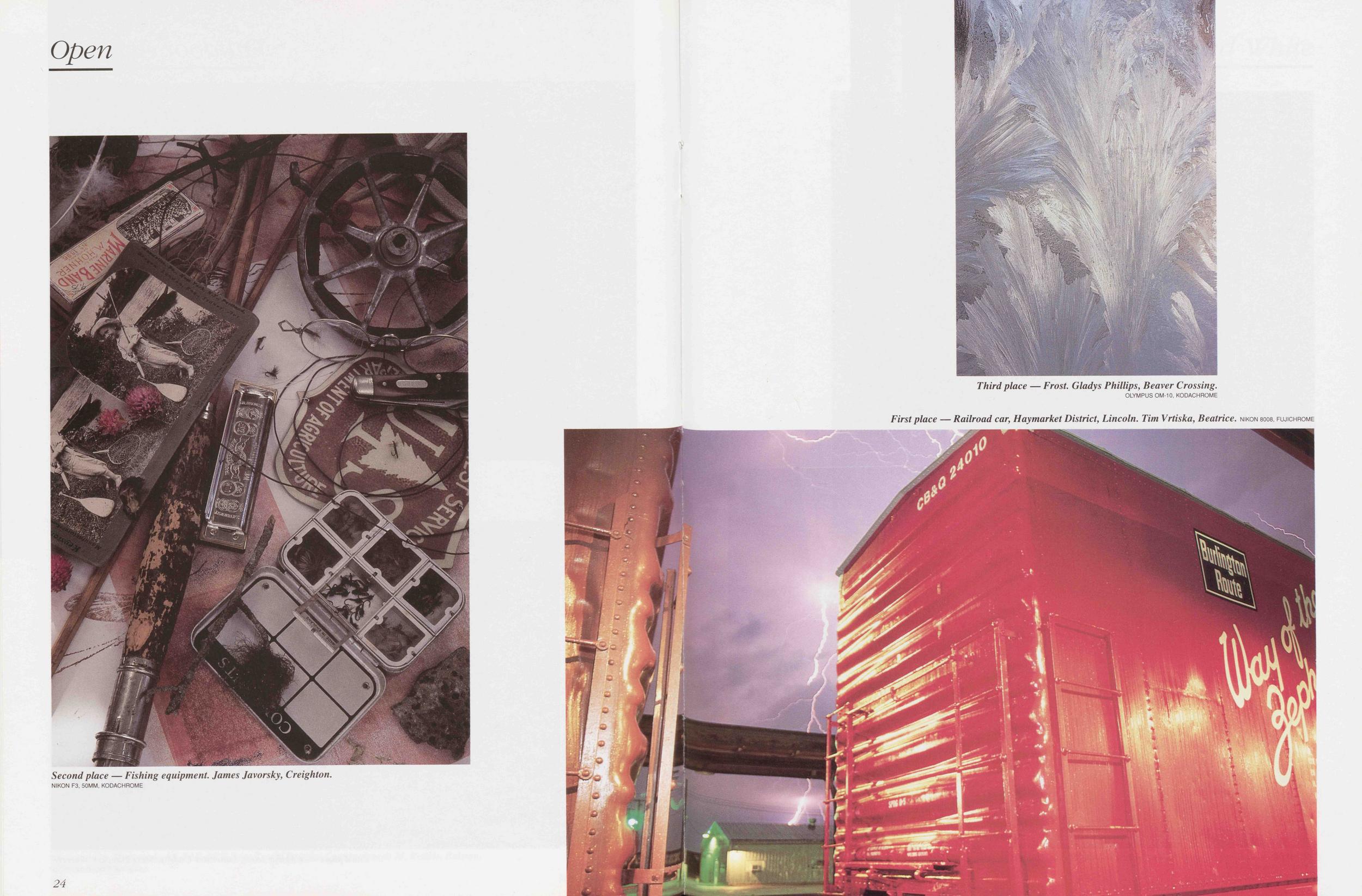 Open
Open
Serpents of the Sandhills
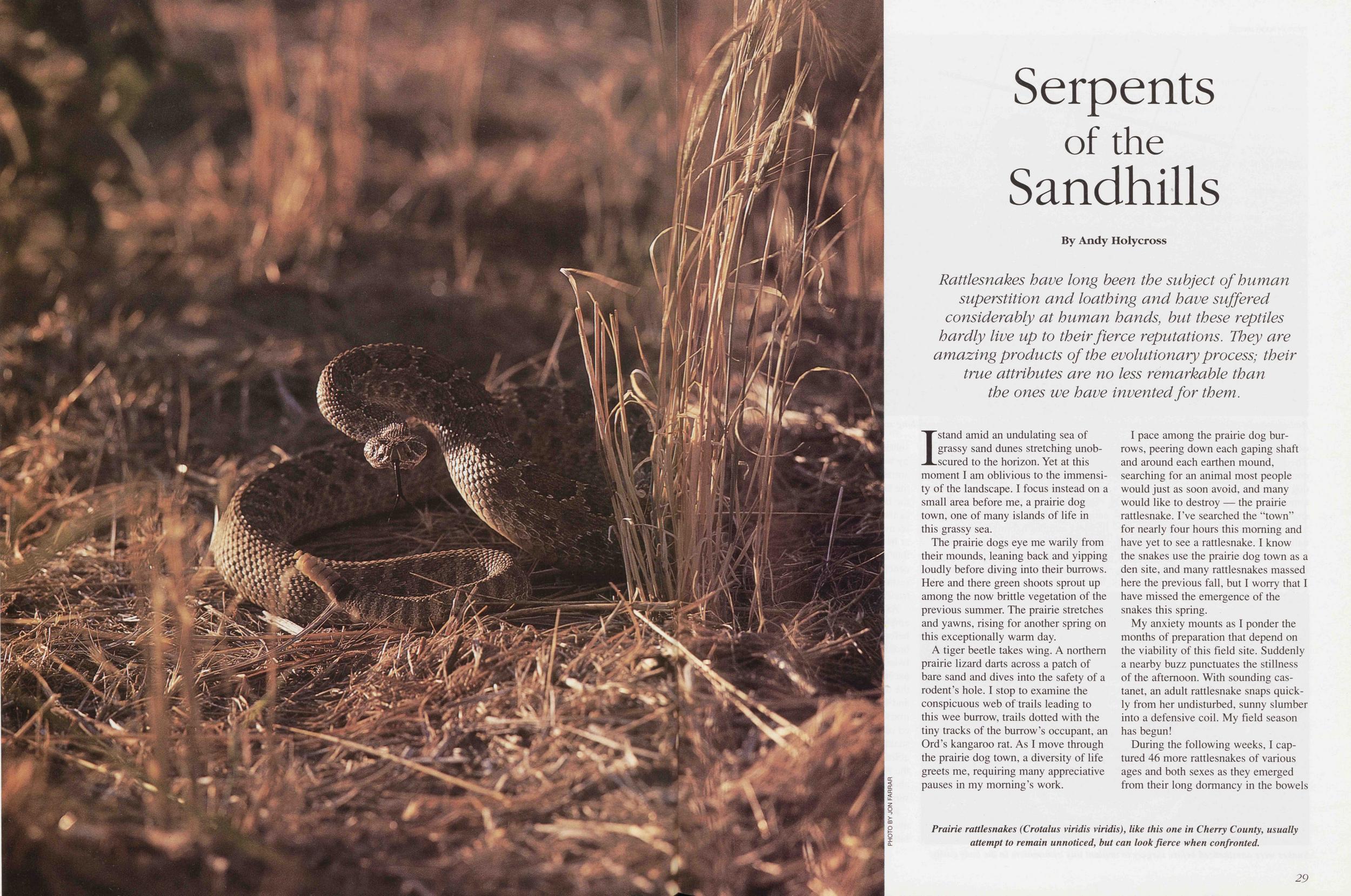
By Andy Holycross Rattlesnakes have long been the subject of human superstition and loathing and have suffered considerably at human hands, but these reptiles hardly live up to their fierce reputations. They are amazing products of the evolutionary process; their true attributes are no less remarkable than the ones we have invented for them.I stand amid an undulating sea of grassy sand dunes stretching unobscured to the horizon. Yet at this moment I am oblivious to the immensity of the landscape. I focus instead on a small area before me, a prairie dog town, one of many islands of life in this grassy sea.
The prairie dogs eye me warily from their mounds, leaning back and yipping loudly before diving into their burrows. Here and there green shoots sprout up among the now brittle vegetation of the previous summer. The prairie stretches and yawns, rising for another spring on this exceptionally warm day.
A tiger beetle takes wing. A northern prairie lizard darts across a patch of bare sand and dives into the safety of a rodent's hole. I stop to examine the conspicuous web of trails leading to this wee burrow, trails dotted with the tiny tracks of the burrow's occupant, an Ord's kangaroo rat. As I move through the prairie dog town, a diversity of life greets me, requiring many appreciative pauses in my morning's work.
I pace among the prairie dog burrows, peering down each gaping shaft and around each earthen mound, searching for an animal most people would just as soon avoid, and many would like to destroy — the prairie rattlesnake. I've searched the "town" for nearly four hours this morning and have yet to see a rattlesnake. I know the snakes use the prairie dog town as a den site, and many rattlesnakes massed here the previous fall, but I worry that I have missed the emergence of the snakes this spring.
My anxiety mounts as I ponder the months of preparation that depend on the viability of this field site. Suddenly a nearby buzz punctuates the stillness of the afternoon. With sounding Castanet, an adult rattlesnake snaps quickly from her undisturbed, sunny slumber into a defensive coil. My field season has begun!
During the following weeks, I captured 46 more rattlesnakes of various
ages and both sexes as they emerged
from their long dormancy in the bowels
29
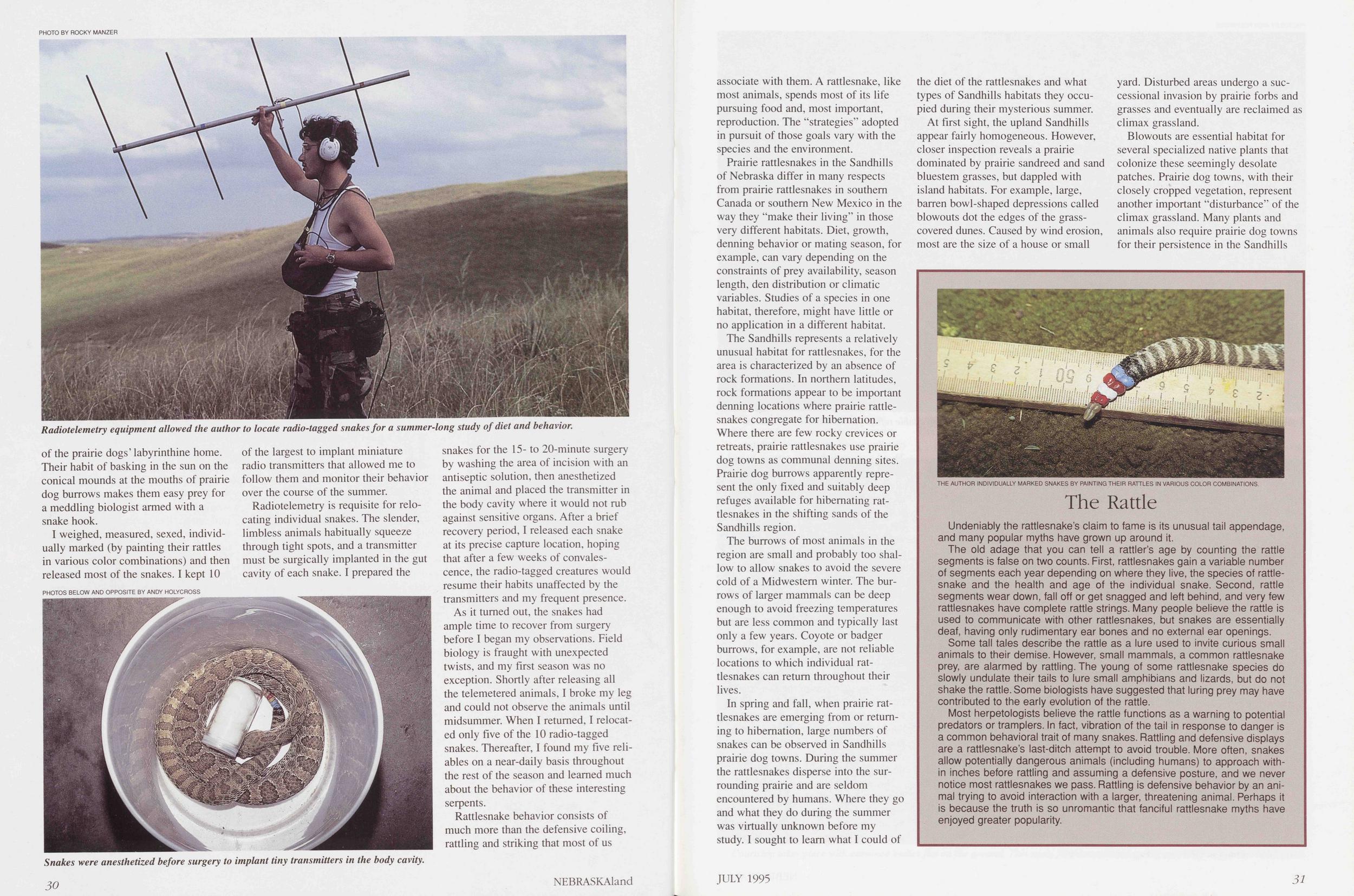
I weighed, measured, sexed, individually marked (by painting their rattles in various color combinations) and then released most of the snakes. I kept 10 of the largest to implant miniature radio transmitters that allowed me to follow them and monitor their behavior over the course of the summer.
Radiotelemetry is requisite for relocating individual snakes. The slender, limbless animals habitually squeeze through tight spots, and a transmitter must be surgically implanted in the gut cavity of each snake. I prepared the snakes for the 15- to 20-minute surgery by washing the area of incision with an antiseptic solution, then anesthetized the animal and placed the transmitter in the body cavity where it would not rub against sensitive organs. After a brief recovery period, I released each snake at its precise capture location, hoping that after a few weeks of convalescence, the radio-tagged creatures would resume their habits unaffected by the transmitters and my frequent presence.
As it turned out, the snakes had ample time to recover from surgery before I began my observations. Field biology is fraught with unexpected twists, and my first season was no exception. Shortly after releasing all the telemetered animals, I broke my leg and could not observe the animals until midsummer. When I returned, I relocated only five of the 10 radio-tagged snakes. Thereafter, I found my five reliables on a near-daily basis throughout the rest of the season and learned much about the behavior of these interesting serpents.
Rattlesnake behavior consists of much more than the defensive coiling, rattling and striking that most of us
Prairie rattlesnakes in the Sandhills of Nebraska differ in many respects from prairie rattlesnakes in southern Canada or southern New Mexico in the way they "make their living" in those very different habitats. Diet, growth, denning behavior or mating season, for example, can vary depending on the constraints of prey availability, season length, den distribution or climatic variables. Studies of a species in one habitat, therefore, might have little or no application in a different habitat.
The Sandhills represents a relatively unusual habitat for rattlesnakes, for the area is characterized by an absence of rock formations. In northern latitudes, rock formations appear to be important denning locations where prairie rattlesnakes congregate for hibernation. Where there are few rocky crevices or retreats, prairie rattlesnakes use prairie dog towns as communal denning sites. Prairie dog burrows apparently represent the only fixed and suitably deep refuges available for hibernating rattlesnakes in the shifting sands of the Sandhills region.
The burrows of most animals in the region are small and probably too shallow to allow snakes to avoid the severe cold of a Midwestern winter. The burrows of larger mammals can be deep enough to avoid freezing temperatures but are less common and typically last only a few years. Coyote or badger burrows, for example, are not reliable locations to which individual rattlesnakes can return throughout their lives.
In spring and fall, when prairie rattlesnakes are emerging from or returning to hibernation, large numbers of snakes can be observed in Sandhills prairie dog towns. During the summer the rattlesnakes disperse into the surrounding prairie and are seldom encountered by humans. Where they go and what they do during the summer was virtually unknown before my study. I sought to learn what I could of the diet of the rattlesnakes and what types of Sandhills habitats they occupied during their mysterious summer.
At first sight, the upland Sandhills appear fairly homogeneous. However, closer inspection reveals a prairie dominated by prairie sandreed and sand bluestem grasses, but dappled with island habitats. For example, large, barren bowl-shaped depressions called blowouts dot the edges of the grasscovered dunes. Caused by wind erosion, most are the size of a house or small yard. Disturbed areas undergo a successional invasion by prairie forbs and grasses and eventually are reclaimed as climax grassland.
Blowouts are essential habitat for several specialized native plants that colonize these seemingly desolate patches. Prairie dog towns, with their closely cropped vegetation, represent another important "disturbance" of the climax grassland. Many plants and animals also require prairie dog towns for their persistence in the Sandhills [see "Little Dogs of the Prairie," NEBRASKAIand, June 1991].
Undeniably the rattlesnake's claim to fame is its unusual tail appendage, and many popular myths have grown up around it.
The old adage that you can tell a rattler's age by counting the rattle segments is false on two counts. First, rattlesnakes gain a variable number of segments each year depending on where they live, the species of rattlesnake and the health and age of the individual snake. Second, rattle segments wear down, fall off or get snagged and left behind, and very few rattlesnakes have complete rattle strings. Many people believe the rattle is used to communicate with other rattlesnakes, but snakes are essentially deaf, having only rudimentary ear bones and no external ear openings.
Some tall tales describe the rattle as a lure used to invite curious small animals to their demise. However, small mammals, a common rattlesnake prey, are alarmed by rattling. The young of some rattlesnake species do slowly undulate their tails to lure small amphibians and lizards, but do not shake the rattle. Some biologists have suggested that luring prey may have contributed to the early evolution of the rattle.
Most herpetologists believe the rattle functions as a warning to potential predators or tramplers. In fact, vibration of the tail in response to danger is a common behavioral trait of many snakes. Rattling and defensive displays are a rattlesnake's last-ditch attempt to avoid trouble. More often, snakes allow potentially dangerous animals (including humans) to approach within inches before rattling and assuming a defensive posture, and we never notice most rattlesnakes we pass. Rattling is defensive behavior by an animal trying to avoid interaction with a larger, threatening animal. Perhaps it is because the truth is so unromantic that fanciful rattlesnake myths have enjoyed greater popularity.
JULY 1995 31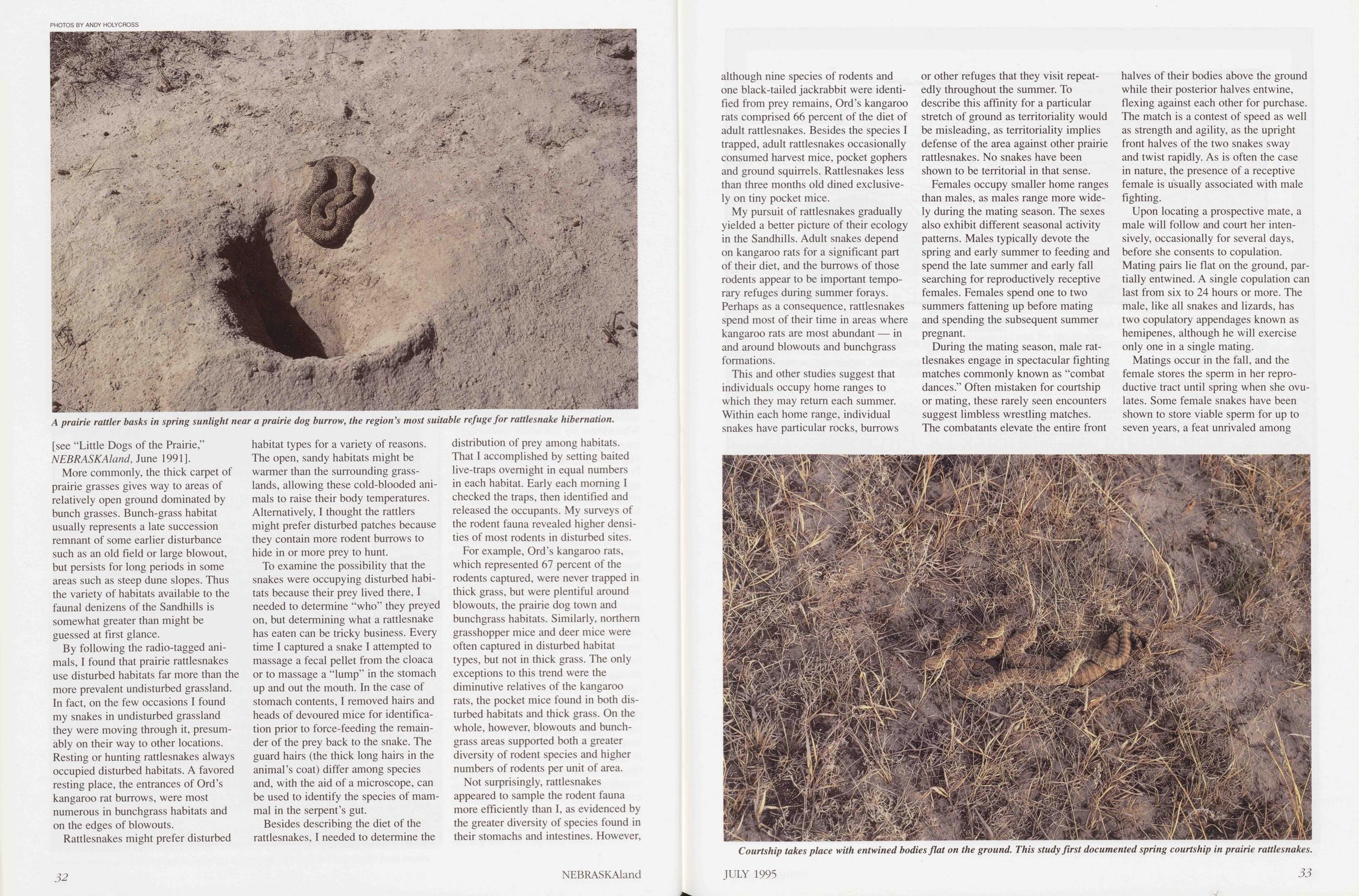
More commonly, the thick carpet of prairie grasses gives way to areas of relatively open ground dominated by bunch grasses. Bunch-grass habitat usually represents a late succession remnant of some earlier disturbance such as an old field or large blowout, but persists for long periods in some areas such as steep dune slopes. Thus the variety of habitats available to the faunal denizens of the Sandhills is somewhat greater than might be guessed at first glance.
By following the radio-tagged animals, I found that prairie rattlesnakes use disturbed habitats far more than the more prevalent undisturbed grassland. In fact, on the few occasions I found my snakes in undisturbed grassland they were moving through it, presumably on their way to other locations. Resting or hunting rattlesnakes always occupied disturbed habitats. A favored resting place, the entrances of Ord's kangaroo rat burrows, were most numerous in bunchgrass habitats and on the edges of blowouts.
Rattlesnakes might prefer disturbed habitat types for a variety of reasons. The open, sandy habitats might be warmer than the surrounding grasslands, allowing these cold-blooded animals to raise their body temperatures. Alternatively, I thought the rattlers might prefer disturbed patches because they contain more rodent burrows to hide in or more prey to hunt.
To examine the possibility that the snakes were occupying disturbed habitats because their prey lived there, I needed to determine "who" they preyed on, but determining what a rattlesnake has eaten can be tricky business. Every time I captured a snake I attempted to massage a fecal pellet from the cloaca or to massage a "lump" in the stomach up and out the mouth. In the case of stomach contents, I removed hairs and heads of devoured mice for identification prior to force-feeding the remainder of the prey back to the snake. The guard hairs (the thick long hairs in the animal's coat) differ among species and, with the aid of a microscope, can be used to identify the species of mammal in the serpent's gut.
Besides describing the diet of the rattlesnakes, I needed to determine the distribution of prey among habitats. That I accomplished by setting baited live-traps overnight in equal numbers in each habitat. Early each morning I checked the traps, then identified and released the occupants. My surveys of the rodent fauna revealed higher densities of most rodents in disturbed sites.
For example, Ord's kangaroo rats, which represented 67 percent of the rodents captured, were never trapped in thick grass, but were plentiful around blowouts, the prairie dog town and bunchgrass habitats. Similarly, northern grasshopper mice and deer mice were often captured in disturbed habitat types, but not in thick grass. The only exceptions to this trend were the diminutive relatives of the kangaroo rats, the pocket mice found in both disturbed habitats and thick grass. On the whole, however, blowouts and bunchgrass areas supported both a greater diversity of rodent species and higher numbers of rodents per unit of area.
Not surprisingly, rattlesnakes appeared to sample the rodent fauna more efficiently than I, as evidenced by the greater diversity of species found in their stomachs and intestines. However, 32 NEBRASKAIand although nine species of rodents and one black-tailed jackrabbit were identified from prey remains, Ord's kangaroo rats comprised 66 percent of the diet of adult rattlesnakes. Besides the species I trapped, adult rattlesnakes occasionally consumed harvest mice, pocket gophers and ground squirrels. Rattlesnakes less than three months old dined exclusively on tiny pocket mice.
My pursuit of rattlesnakes gradually yielded a better picture of their ecology in the Sandhills. Adult snakes depend on kangaroo rats for a significant part of their diet, and the burrows of those rodents appear to be important temporary refuges during summer forays. Perhaps as a consequence, rattlesnakes spend most of their time in areas where kangaroo rats are most abundant — in and around blowouts and bunchgrass formations.
This and other studies suggest that individuals occupy home ranges to which they may return each summer. Within each home range, individual snakes have particular rocks, burrows or other refuges that they visit repeatedly throughout the summer. To describe this affinity for a particular stretch of ground as territoriality would be misleading, as territoriality implies defense of the area against other prairie rattlesnakes. No snakes have been shown to be territorial in that sense.
Females occupy smaller home ranges than males, as males range more widely during the mating season. The sexes also exhibit different seasonal activity patterns. Males typically devote the spring and early summer to feeding and spend the late summer and early fall searching for reproductively receptive females. Females spend one to two summers fattening up before mating and spending the subsequent summer pregnant.
During the mating season, male rattlesnakes engage in spectacular fighting matches commonly known as "combat dances." Often mistaken for courtship or mating, these rarely seen encounters suggest limbless wrestling matches. The combatants elevate the entire front halves of their bodies above the ground while their posterior halves entwine, flexing against each other for purchase. The match is a contest of speed as well as strength and agility, as the upright front halves of the two snakes sway and twist rapidly. As is often the case in nature, the presence of a receptive female is usually associated with male fighting.
Upon locating a prospective mate, a male will follow and court her intensively, occasionally for several days, before she consents to copulation. Mating pairs lie flat on the ground, partially entwined. A single copulation can last from six to 24 hours or more. The male, like all snakes and lizards, has two copulatory appendages known as hemipenes, although he will exercise only one in a single mating.
Matings occur in the fall, and the female stores the sperm in her reproductive tract until spring when she ovulates. Some female snakes have been shown to store viable sperm for up to seven years, a feat unrivaled among vertebrates. The sperm fertilize the ova, and a gestation period lasting most of the summer begins. For four to five months, pregnant females apparently do not eat, move only short distances and spend most of their time keeping warm to facilitate development of the embryos in their swollen bodies.
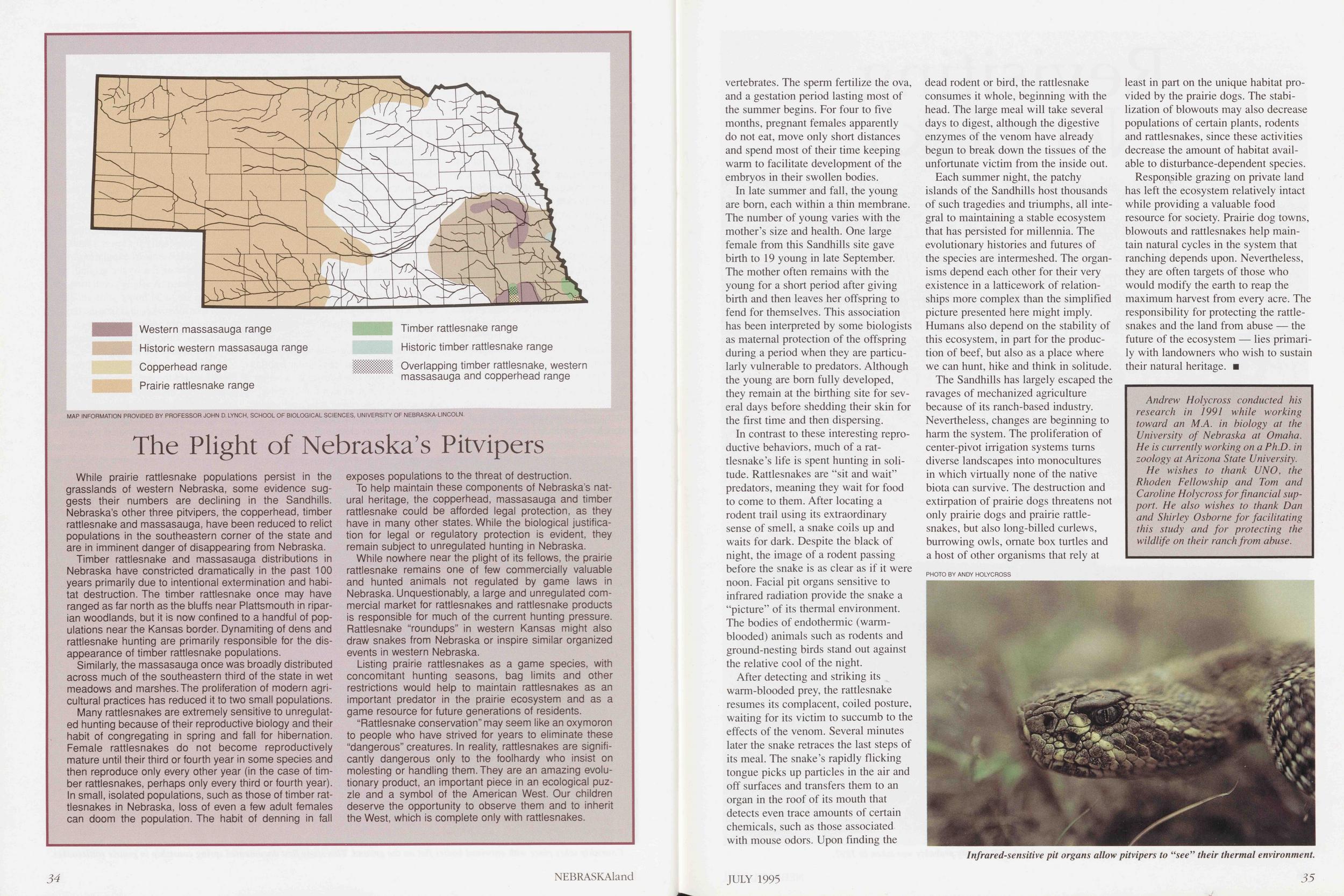
While prairie rattlesnake populations persist in the grasslands of western Nebraska, some evidence suggests their numbers are declining in the Sandhills. Nebraska's other three pitvipers, the copperhead, timber rattlesnake and massasauga, have been reduced to relict populations in the southeastern corner of the state and are in imminent danger of disappearing from Nebraska.
Timber rattlesnake and massasauga distributions in Nebraska have constricted dramatically in the past 100 years primarily due to intentional extermination and habitat destruction. The timber rattlesnake once may have ranged as far north as the bluffs near Plattsmouth in riparian woodlands, but it is now confined to a handful of populations near the Kansas border. Dynamiting of dens and rattlesnake hunting are primarily responsible for the disappearance of timber rattlesnake populations.
Similarly, the massasauga once was broadly distributed across much of the southeastern third of the state in wet meadows and marshes. The proliferation of modern agricultural practices has reduced it to two small populations.
Many rattlesnakes are extremely sensitive to unregulated hunting because of their reproductive biology and their habit of congregating in spring and fall for hibernation. Female rattlesnakes do not become reproductively mature until their third or fourth year in some species and then reproduce only every other year (in the case of timber rattlesnakes, perhaps only every third or fourth year). In small, isolated populations, such as those of timber rattlesnakes in Nebraska, loss of even a few adult females can doom the population. The habit of denning in fall exposes populations to the threat of destruction.
To help maintain these components of Nebraska's natural heritage, the copperhead, massasauga and timber rattlesnake could be afforded legal protection, as they have in many other states. While the biological justification for legal or regulatory protection is evident, they remain subject to unregulated hunting in Nebraska.
While nowhere near the plight of its fellows, the prairie rattlesnake remains one of few commercially valuable and hunted animals not regulated by game laws in Nebraska. Unquestionably, a large and unregulated commercial market for rattlesnakes and rattlesnake products is responsible for much of the current hunting pressure. Rattlesnake "roundups" in western Kansas might also draw snakes from Nebraska or inspire similar organized events in western Nebraska.
Listing prairie rattlesnakes as a game species, with concomitant hunting seasons, bag limits and other restrictions would help to maintain rattlesnakes as an important predator in the prairie ecosystem and as a game resource for future generations of residents.
"Rattlesnake conservation" may seem like an oxymoron to people who have strived for years to eliminate these "dangerous" creatures. In reality, rattlesnakes are significantly dangerous only to the foolhardy who insist on molesting or handling them. They are an amazing evolutionary product, an important piece in an ecological puzzle and a symbol of the American West. Our children deserve the opportunity to observe them and to inherit the West, which is complete only with rattlesnakes.
34 NEBRASKAlandIn late summer and fall, the young are born, each within a thin membrane. The number of young varies with the mother's size and health. One large female from this Sandhills site gave birth to 19 young in late September. The mother often remains with the young for a short period after giving birth and then leaves her offspring to fend for themselves. This association has been interpreted by some biologists as maternal protection of the offspring during a period when they are particularly vulnerable to predators. Although the young are born fully developed, they remain at the birthing site for several days before shedding their skin for the first time and then dispersing.
In contrast to these interesting reproductive behaviors, much of a rattlesnake's life is spent hunting in solitude. Rattlesnakes are "sit and wait" predators, meaning they wait for food to come to them. After locating a rodent trail using its extraordinary sense of smell, a snake coils up and waits for dark. Despite the black of night, the image of a rodent passing before the snake is as clear as if it were noon. Facial pit organs sensitive to infrared radiation provide the snake a "picture" of its thermal environment. The bodies of endothermic (warmblooded) animals such as rodents and ground-nesting birds stand out against the relative cool of the night.
After detecting and striking its warm-blooded prey, the rattlesnake resumes its complacent, coiled posture, waiting for its victim to succumb to the effects of the venom. Several minutes later the snake retraces the last steps of its meal. The snake's rapidly flicking tongue picks up particles in the air and off surfaces and transfers them to an organ in the roof of its mouth that detects even trace amounts of certain chemicals, such as those associated with mouse odors. Upon finding the dead rodent or bird, the rattlesnake consumes it whole, beginning with the head. The large meal will take several days to digest, although the digestive enzymes of the venom have already begun to break down the tissues of the unfortunate victim from the inside out.
Each summer night, the patchy islands of the Sandhills host thousands of such tragedies and triumphs, all integral to maintaining a stable ecosystem that has persisted for millennia. The evolutionary histories and futures of the species are intermeshed. The organisms depend each other for their very existence in a latticework of relationships more complex than the simplified picture presented here might imply. Humans also depend on the stability of this ecosystem, in part for the production of beef, but also as a place where we can hunt, hike and think in solitude.
The Sandhills has largely escaped the ravages of mechanized agriculture because of its ranch-based industry. Nevertheless, changes are beginning to harm the system. The proliferation of center-pivot irrigation systems turns diverse landscapes into monocultures in which virtually none of the native biota can survive. The destruction and extirpation of prairie dogs threatens not only prairie dogs and prairie rattlesnakes, but also long-billed curlews, burrowing owls, ornate box turtles and a host of other organisms that rely at least in part on the unique habitat provided by the prairie dogs. The stabilization of blowouts may also decrease populations of certain plants, rodents and rattlesnakes, since these activities decrease the amount of habitat available to disturbance-dependent species.
Responsible grazing on private land has left the ecosystem relatively intact while providing a valuable food resource for society. Prairie dog towns, blowouts and rattlesnakes help maintain natural cycles in the system that ranching depends upon. Nevertheless, they are often targets of those who would modify the earth to reap the maximum harvest from every acre. The responsibility for protecting the rattlesnakes and the land from abuse — the future of the ecosystem — lies primarily with landowners who wish to sustain their natural heritage.
Andrew Holy cross conducted his research in 1991 while working toward an M.A. in biology at the University of Nebraska at Omaha. He is currently working on a Ph.D. in zoology at Arizona State University. He wishes to thank UNO, the Rhoden Fellowship and Tom and Caroline Holy cross for financial support. He also wishes to thank Dan and Shirley Osborne for facilitating this study and for protecting the wildlife on their ranch from abuse.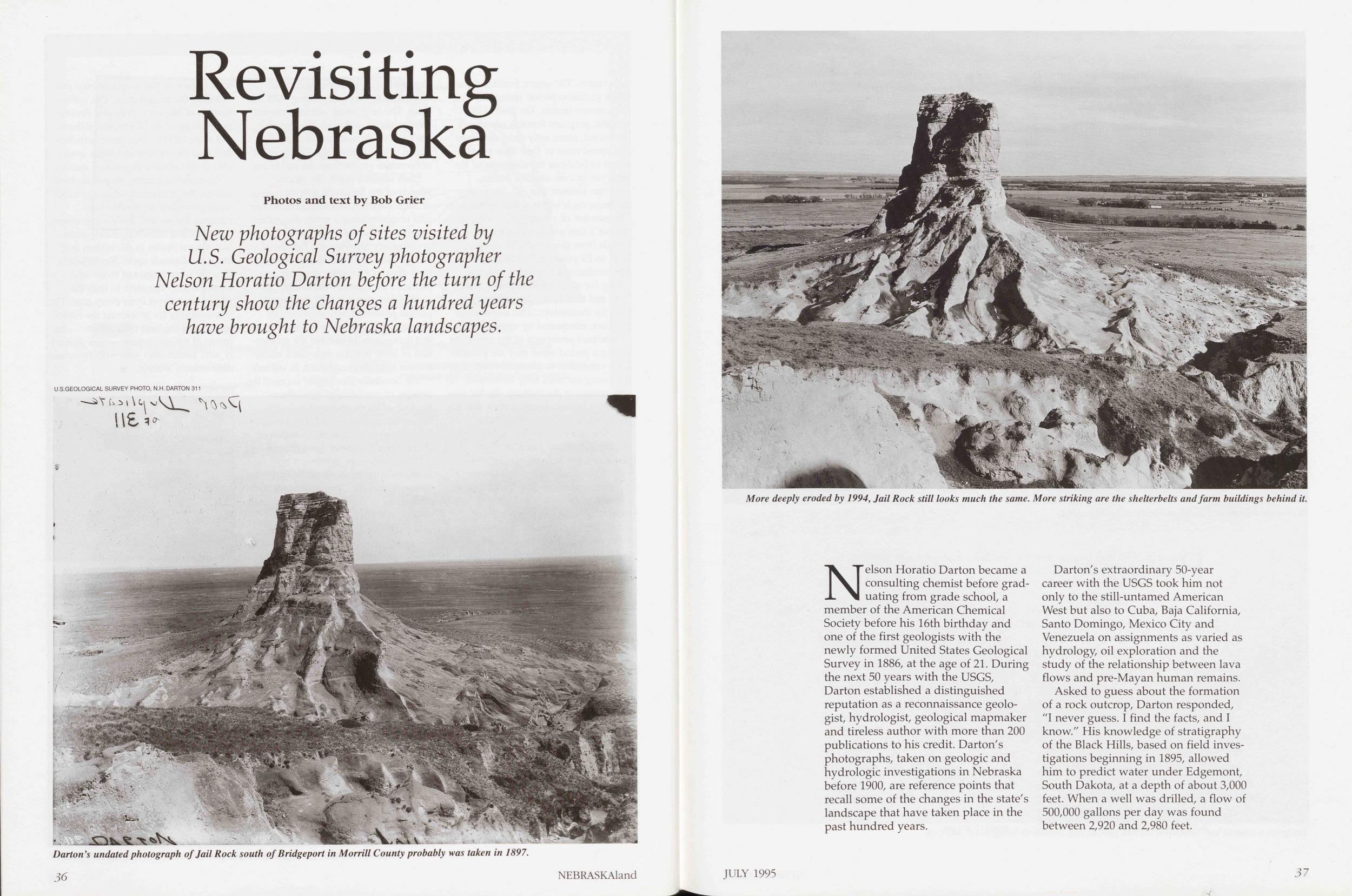
Revisiting Nebraska
Photos and text by Bob Grier New photographs of sites visited by U.S. Geological Survey photographer Nelson Horatio Barton before the turn of the century show the changes a hundred years have brought to Nebraska landscapes.Nelson Horatio Darton became a consulting chemist before graduating from grade school, a member of the American Chemical Society before his 16th birthday and one of the first geologists with the newly formed United States Geological Survey in 1886, at the age of 21. During the next 50 years with the USGS, Darton established a distinguished reputation as a reconnaissance geologist, hydrologist, geological mapmaker and tireless author with more than 200 publications to his credit. Darton's photographs, taken on geologic and hydrologic investigations in Nebraska before 1900, are reference points that recall some of the changes in the state's landscape that have taken place in the past hundred years.
Darton's extraordinary 50-year career with the USGS took him not only to the still-untamed American West but also to Cuba, Baja California, Santo Domingo, Mexico City and Venezuela on assignments as varied as hydrology, oil exploration and the study of the relationship between lava flows and pre-Mayan human remains.
Asked to guess about the formation of a rock outcrop, Darton responded, "I never guess. I find the facts, and I know." His knowledge of stratigraphy of the Black Hills, based on field investigations beginning in 1895, allowed him to predict water under Edgemont, South Dakota, at a depth of about 3,000 feet. When a well was drilled, a flow of 500,000 gallons per day was found between 2,920 and 2,980 feet.
JULY 1995 37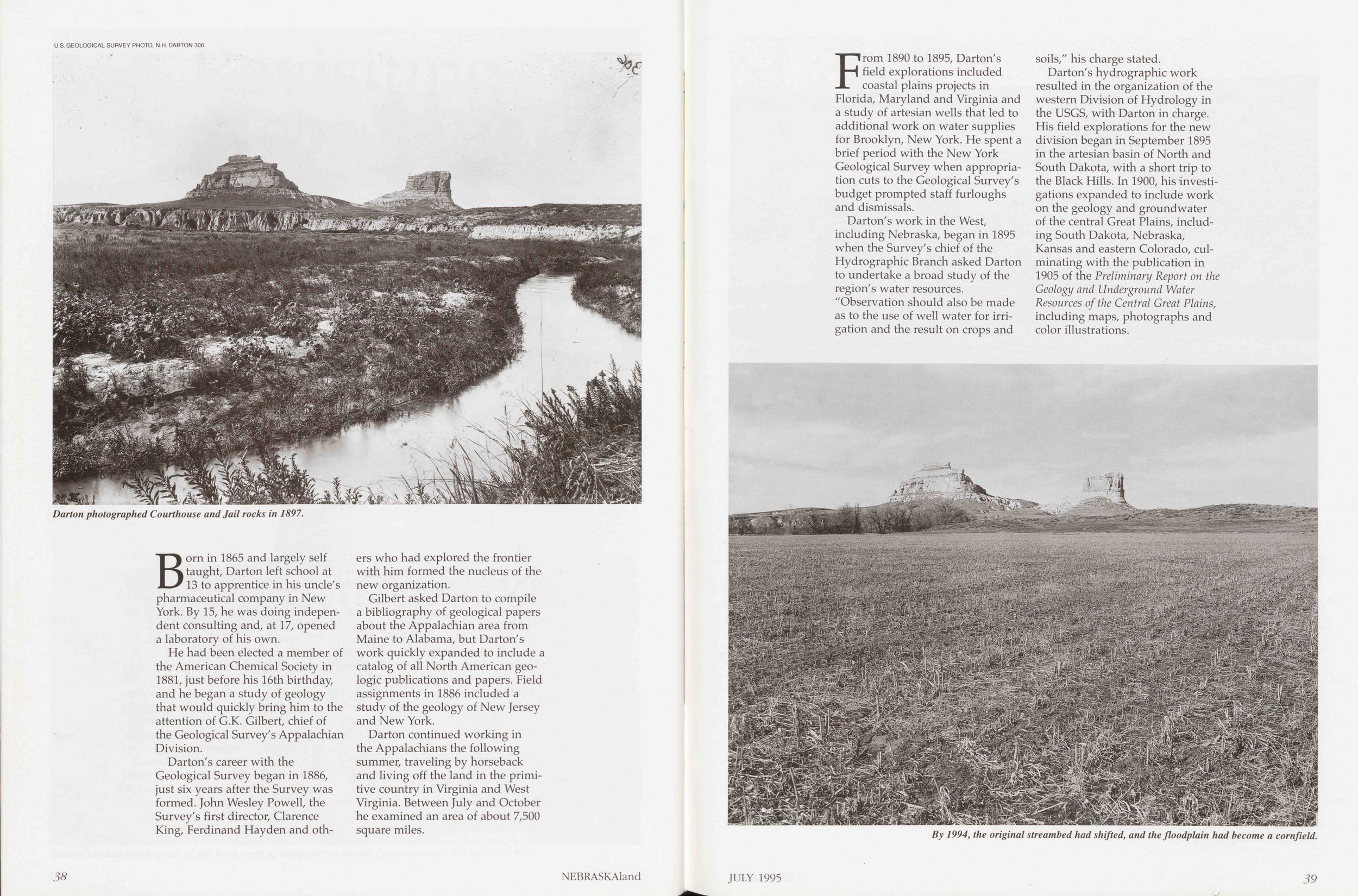
Born in 1865 and largely self taught, Darton left school at 13 to apprentice in his uncle's pharmaceutical company in New York. By 15, he was doing independent consulting and, at 17, opened a laboratory of his own.
He had been elected a member of the American Chemical Society in 1881, just before his 16th birthday, and he began a study of geology that would quickly bring him to the attention of G.K. Gilbert, chief of the Geological Survey's Appalachian Division.
Darton's career with the Geological Survey began in 1886, just six years after the Survey was formed. John Wesley Powell, the Survey's first director, Clarence King, Ferdinand Hayden and others who had explored the frontier with him formed the nucleus of the new organization.
Gilbert asked Darton to compile a bibliography of geological papers about the Appalachian area from Maine to Alabama, but Darton's work quickly expanded to include a catalog of all North American geologic publications and papers. Field assignments in 1886 included a study of the geology of New Jersey and New York.
Darton continued working in the Appalachians the following summer, traveling by horseback and living off the land in the primitive country in Virginia and West Virginia. Between July and October he examined an area of about 7,500 square miles.
38 NEBRASKAlandFrom 1890 to 1895, Darton's field explorations included coastal plains projects in Florida, Maryland and Virginia and a study of artesian wells that led to additional work on water supplies for Brooklyn, New York. He spent a brief period with the New York Geological Survey when appropriation cuts to the Geological Survey's budget prompted staff furloughs and dismissals.
Darton's work in the West, including Nebraska, began in 1895 when the Survey's chief of the Hydrographic Branch asked Darton to undertake a broad study of the region's water resources. "Observation should also be made as to the use of well water for irrigation and the result on crops and soils," his charge stated.
Darton's hydrographic work resulted in the organization of the western Division of Hydrology in the USGS, with Darton in charge. His field explorations for the new division began in September 1895 in the artesian basin of North and South Dakota, with a short trip to the Black Hills. In 1900, his investigations expanded to include work on the geology and groundwater of the central Great Plains, including South Dakota, Nebraska, Kansas and eastern Colorado, culminating with the publication in 1905 of the Preliminary Report on the Geology and Underground Water Resources of the Central Great Plains, including maps, photographs and color illustrations.
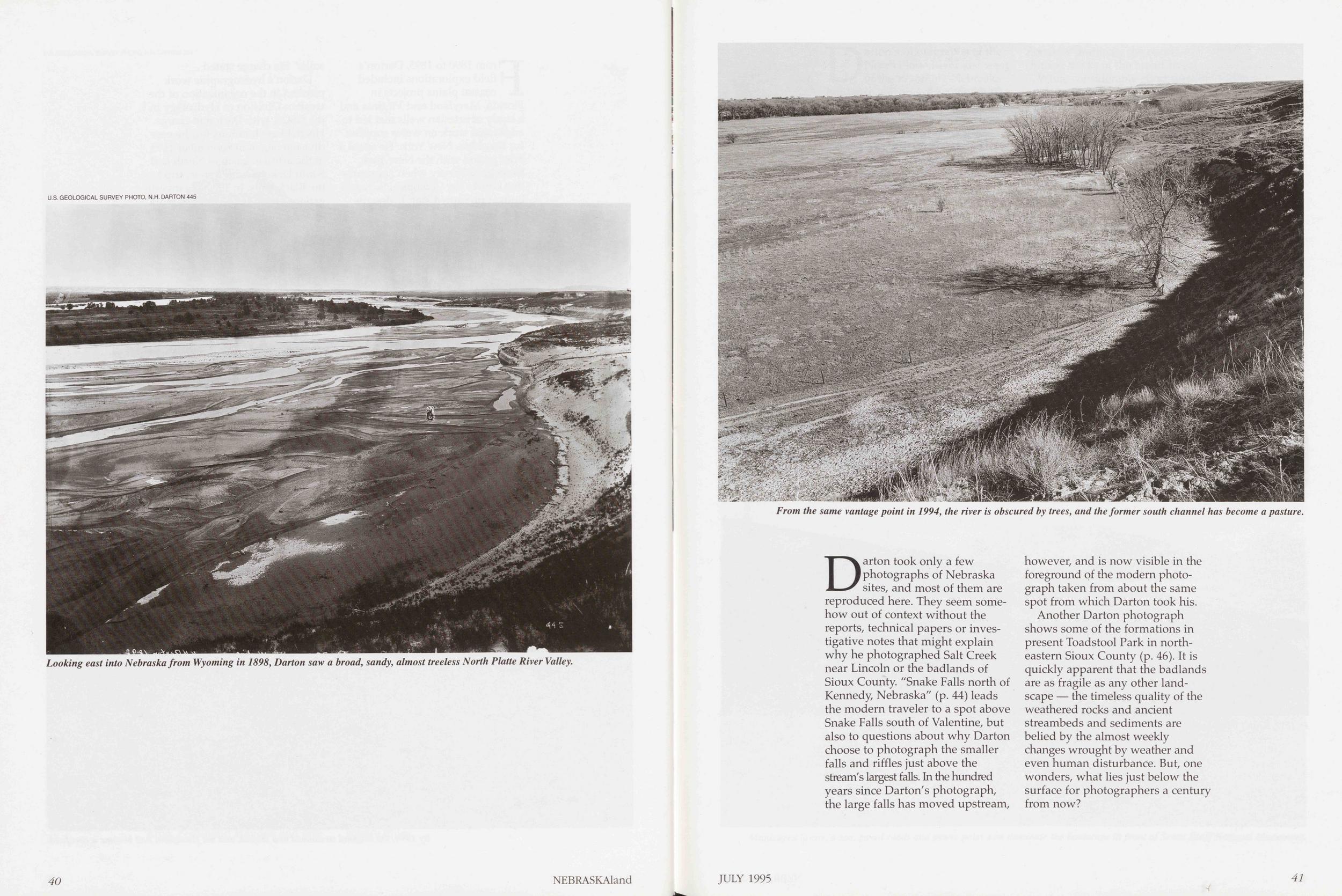
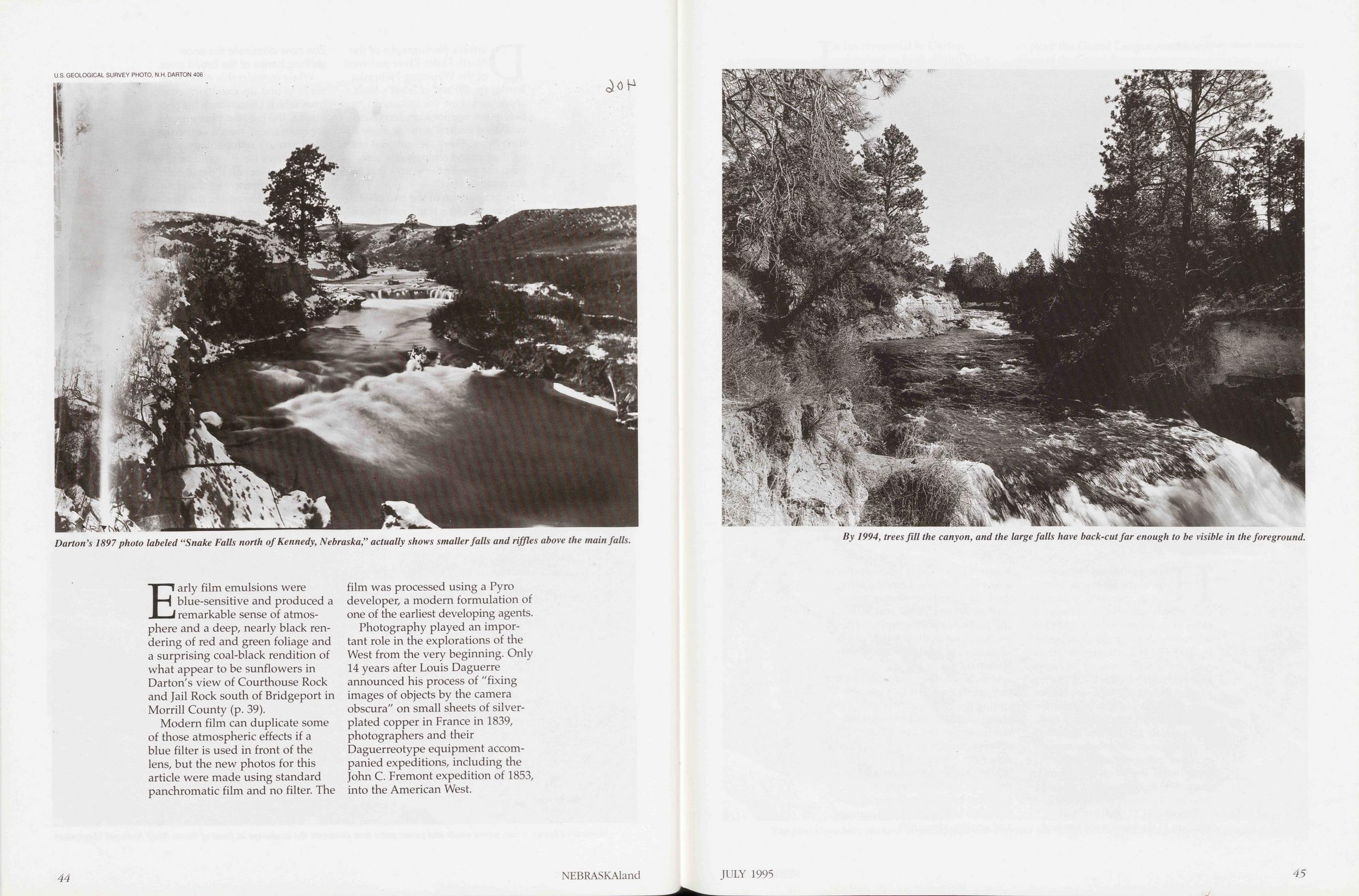
Darton took only a few photographs of Nebraska sites, and most of them are reproduced here. They seem somehow out of context without the reports, technical papers or investigative notes that might explain why he photographed Salt Creek near Lincoln or the badlands of Sioux County. "Snake Falls north of Kennedy, Nebraska" (p. 44) leads the modern traveler to a spot above Snake Falls south of Valentine, but also to questions about why Darton choose to photograph the smaller falls and riffles just above the stream's largest falls. In the hundred years since Darton's photograph, the large falls has moved upstream, however, and is now visible in the foreground of the modern photograph taken from about the same spot from which Darton took his.
Another Darton photograph shows some of the formations in present Toadstool Park in northeastern Sioux County (p. 46). It is quickly apparent that the badlands are as fragile as any other landscape — the timeless quality of the weathered rocks and ancient streambeds and sediments are belied by the almost weekly changes wrought by weather and even human disturbance. But, one wonders, what lies just below the surface for photographers a century from now?
JULY 1995 41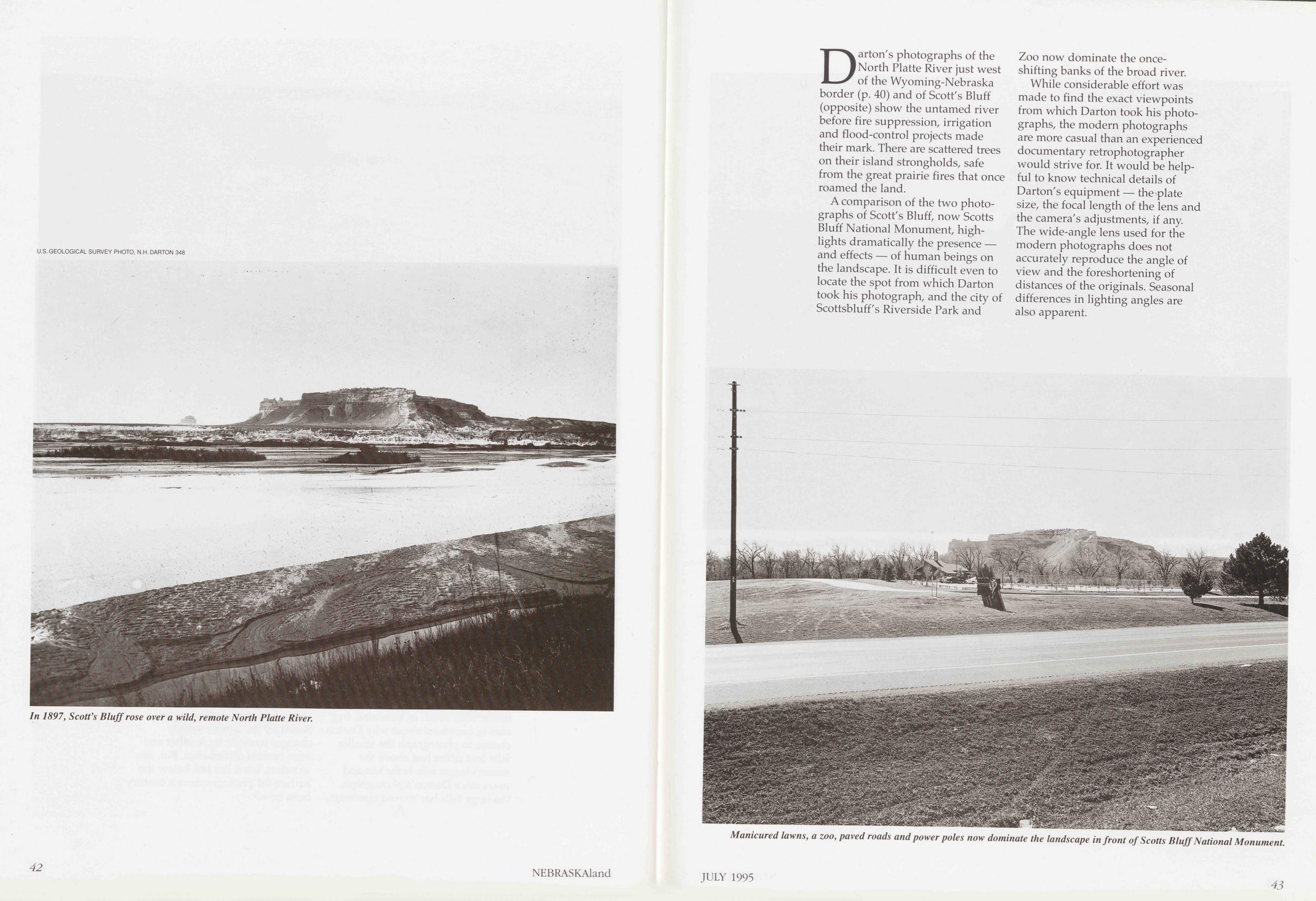
Darton's photographs of the North Platte River just west of the Wyoming-Nebraska border (p. 40) and of Scott's Bluff (opposite) show the untamed river before fire suppression, irrigation and flood-control projects made their mark. There are scattered trees on their island strongholds, safe from the great prairie fires that once roamed the land.
A comparison of the two photographs of Scott's Bluff, now Scotts Bluff National Monument, highlights dramatically the presence and effects — of human beings on the landscape. It is difficult even to locate the spot from which Darton took his photograph, and the city of Scottsbluff's Riverside Park and Zoo now dominate the onceshifting banks of the broad river.
While considerable effort was made to find the exact viewpoints from which Darton took his photographs, the modern photographs are more casual than an experienced documentary retrophotographer would strive for. It would be helpful to know technical details of Darton's equipment — the plate size, the focal length of the lens and the camera's adjustments, if any. The wide-angle lens used for the modern photographs does not accurately reproduce the angle of view and the foreshortening of distances of the originals. Seasonal differences in lighting angles are also apparent.
Early film emulsions were blue-sensitive and produced a remarkable sense of atmosphere and a deep, nearly black rendering of red and green foliage and a surprising coal-black rendition of what appear to be sunflowers in Darton's view of Courthouse Rock and Jail Rock south of Bridgeport in Morrill County (p. 39).
Modern film can duplicate some of those atmospheric effects if a blue filter is used in front of the lens, but the new photos for this article were made using standard panchromatic film and no filter. The film was processed using a Pyro developer, a modern formulation of one of the earliest developing agents.
Photography played an important role in the explorations of the West from the very beginning. Only 14 years after Louis Daguerre announced his process of "fixing images of objects by the camera obscura" on small sheets of silver-plated copper in France in 1839, photographers and their Daguerreotype equipment accompanied expeditions, including the John C Fremont expedition of 1853, into the American West.
44 NEBRASKAland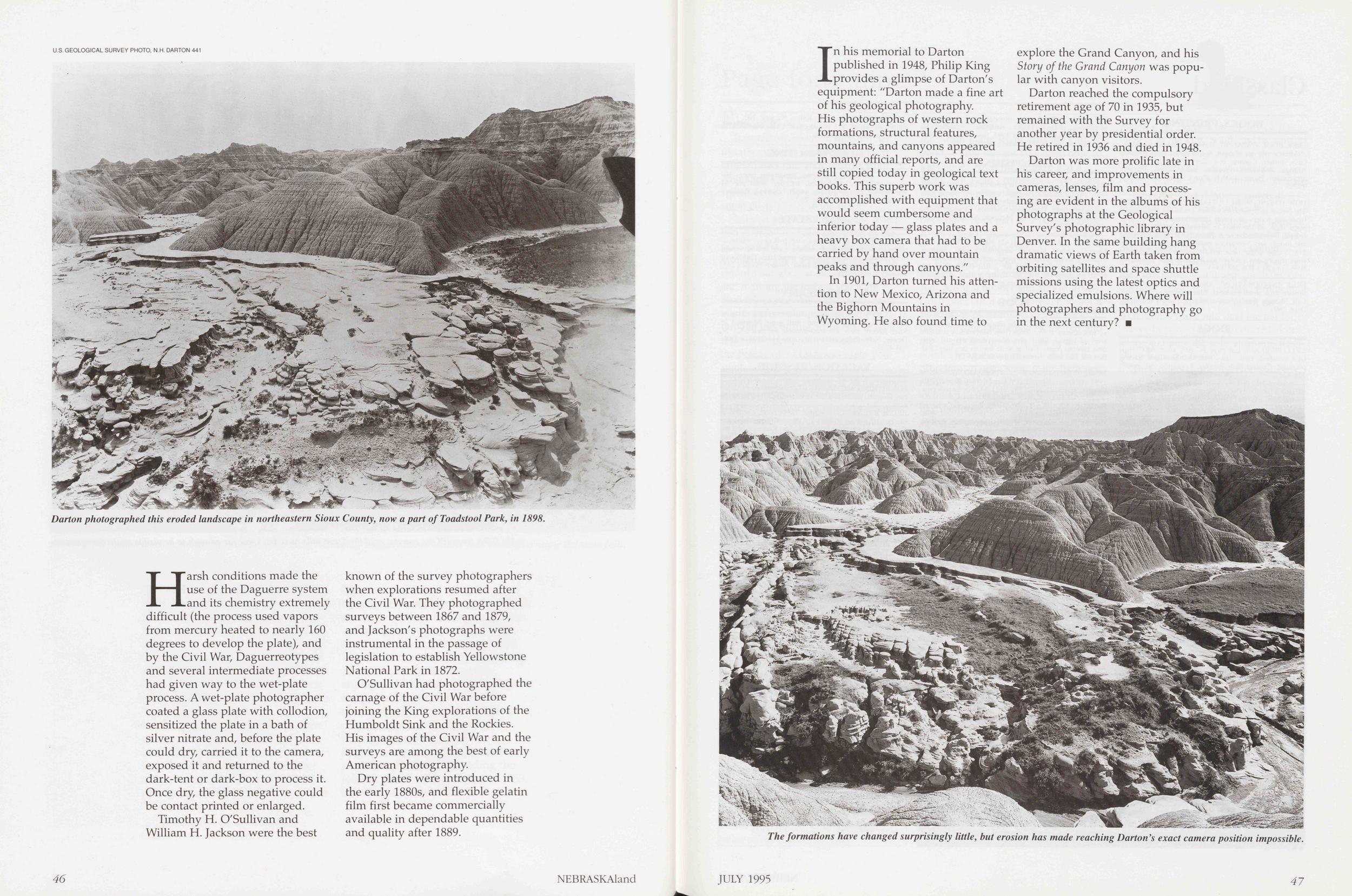
Harsh conditions made the use of the Daguerre system and its chemistry extremely difficult (the process used vapors from mercury heated to nearly 160 degrees to develop the plate), and by the Civil War, Daguerreotypes and several intermediate processes had given way to the wet-plate process. A wet-plate photographer coated a glass plate with collodion, sensitized the plate in a bath of silver nitrate and, before the plate could dry, carried it to the camera, exposed it and returned to the dark-tent or dark-box to process it. Once dry, the glass negative could be contact printed or enlarged.
Timothy H. O'Sullivan and William H. Jackson were the best known of the survey photographers when explorations resumed after the Civil War. They photographed surveys between 1867 and 1879, and Jackson's photographs were instrumental in the passage of legislation to establish Yellowstone National Park in 1872.
O'Sullivan had photographed the carnage of the Civil War before joining the King explorations of the Humboldt Sink and the Rockies. His images of the Civil War and the surveys are among the best of early American photography.
Dry plates were introduced in the early 1880s, and flexible gelatin film first became commercially available in dependable quantities and quality after 1889.
46 NEBRASKAlandIn his memorial to Darton published in 1948, Philip King provides a glimpse of Darton's equipment: "Darton made a fine art of his geological photography. His photographs of western rock formations, structural features, mountains, and canyons appeared in many official reports, and are still copied today in geological text books. This superb work was accomplished with equipment that would seem cumbersome and inferior today — glass plates and a heavy box camera that had to be carried by hand over mountain peaks and through canyons."
In 1901, Darton turned his attention to New Mexico, Arizona and the Bighorn Mountains in Wyoming. He also found time to explore the Grand Canyon, and his Story of the Grand Canyon was popular with canyon visitors.
Darton reached the compulsory retirement age of 70 in 1935, but remained with the Survey for another year by presidential order. He retired in 1936 and died in 1948.
Darton was more prolific late in his career, and improvements in cameras, lenses, film and processing are evident in the albums of his photographs at the Geological Survey's photographic library in Denver. In the same building hang dramatic views of Earth taken from orbiting satellites and space shuttle missions using the latest optics and specialized emulsions. Where will photographers and photography go in the next century?
Classified
BOOKS/PRINTINGFREE BOOK CATALOG. Novels, westerns, romances, children's; old out of print, found barns, attic. Authors: Grey, Bower, Connor, Fox, Curwood, Raine, Wright, Aldrige, Pollyanna, Freckles, many others. Postage appreciated. Pierce, 4400 N. Pine Cluster, Oroville, CA 95965.
HOW TO FIND MORE OUTDOOR OPPORTUNITIES!! The Nebraska Sportsman's Atlas. Locations of all public lands and waters on county transportation maps. These maps show all the roads in Nebraska. Listings include federal, Nebraska Game & Parks, NRD holdings, hotels and motels and Nebraska's endless attractions. At only $18.75/copy a true time and frustration saver. To order write: Sportsman's Atlas Co., PO Box 132, Lytton, IA 50561 or call 1-800-568-8334.
FREE INFORMATION! Allow the government to finance your small business. Loans/grants to $687,900. Call 24-hour, free recorded message: (810) 825-6700, Dept. 1691.
DOGSYELLOW-BLACK Lab pups. FC-AFC sired. AKC. Hips OFA certified. Dew claws removed. Excellent hunting potential. Contact Bob Bendler, Lexington, NE. (308) 324-4247.
RETRIEVER TRAINING. Area's top "retrievers only" trainer. Field trial and hunting dogs. Non-slip duck dogs! TKO RETRIEVER TRAINING KENNEL (402) 623-4311. CHESAPEAKE BAY, LABRADOR and GOLDEN RETRIEVER pups, started dogs and stud service. 16 time national champion pedigree. Platte Valley Retrievers (308)995-2318.
ENGLISH SETTER AND LABRADORS from outstanding lines. Bred for hunters who appreciate fine bird dogs! Wind Fall Gun Dogs, (402) 421-4693.
WILDERNESS KENNELS. Gun dog training — over 60 years combined experience. Training all sporting breeds — Retrievers. Flushing and pointing dogs. All dogs worked on pen raised birds and wild game. Training program includes obedience training — heel, sit, stay, down and come when called. Pups, started dogs and fully trained dogs for sale. Hunting dogs trained by hunters. Henry Sader, Wilderness Kennels, (402) 423-4212. Since 1968.
TRAINING ALL BREEDS bird dogs - Vizslas for sale. Home of Rebel Rousers. Rozanek Kennels, RR 2, Schuyler, NE 68661. Phone (402) 352-8769.
RESERVE YOUR ENGLISH SETTERS now. Thistle Hill Setters bred intelligent, stylish pups with great noses and lots of class. A Thistle Hill setter is a friend for life. Phone (402) 487-2648.
ENGLISH COCKER pups, imported stock, British FTC bloodlines. Many colors available. Featured in NEBRASKAland November 1991. Sawtooth Oaks, Box 443, Orleans, NE 68966. Phone (308) 473-5265.
FISH/FISHINGFISH FOR SALE. Catfish, largemouth bass, smallmouth bass, perch, crappie, bluegill, walleye, northern pike, rainbow trout, Donaldson rainbow trout, grass carp, minnows, bullheads. Consulting available. Pleasant Valley Fish Farm, RR 1, Box 147, McCook, NE 69001. Phone (308) 345-6599.
WILLOW LAKE FISH HATCHERY. Channel cat, bluegill, hybrid bluegill, largemouth bass, crappie, triploid grass carp, walleye, perch, minnows available for stocking. Gaylord Crawford, RR 3, Box 46, Hastings, NE 68901 or phone (402) 463-8022 day or night. Also pond consultant. We del, grower price.
FOODNEBRASKA BASKETS: The original Nebraska company specializing in fine foods from Nebraska. A beautiful array of baskets filled with ethnic, healthful and longtime favorite foods. Call or write for our brochure: P.O. Box 98, McCook, NE 69001. 1-800-345-7725.
HOMEBREWING/BEER & WINEMAKING — New 1995 catalogue. Fermenter's Supply, 8410 K Plz., #10, Omaha, NE 68127. (402) 593-9171. Mail order welcome.
FROM NEBRASKA GIFT SHOP..the world's largest selection of Nebraska-made food products and gifts. Historic Haymarket, 140 N. 8th, Lincoln, NE. Call for free catalog (800) 399-5693.
GUIDES/OUTFITTERSMAD RIVER CANOES offers the finest quality and performance. For the finest canoes and accessories look to Great Plains Canoe Co., 205 Main, Springfield, NE. Phone (402) 253-2001.
DISMAL RIVER/MIDDLE LOUP RIVER canoe/kayak trips. Powderhom Outfitters — Thedford, NE 69166 l-800-Dismal6.
CANOE THE NIOBRARA with an affordable canoe trip by Dryland Aquatics. One- and two-day trips full service, or just canoes and tubes. Transportation furnished. Your Niobrara River specialists...We do it your way! Drvland Aquatics, Dept. N, Box 33C, Sparks. NE 69220 or phone (800) 337-3119.
GRAHAM CANOE OUTFITTERS: Top quality fullservice camping and canoe trips on the Niobrara River. Daily canoe rentals and car shuttle-service available. Contact Doug & Twyla Graham, HC 13 Box 16, Valentine, NE 69201 or phone (402) 376-3708.
Don't Miss a Single Issue! Get NEBRASKAland for yourself or give it as a gift —just $14 a year! Name 1-Year $14 2-Years $27 Address City State Zip Mail check or money order to NEBRASKAland Magazine P.O. Box 30370, Lincoln, Nebraska 68503 or caU Toll Free 1-800-NEB-LAND (632-5263) To Order by Visa or MasterCard, phone toll free 1-800-NEB-LAND (632-5263)CANOE RENTALS: Kamp Kaleo, Burwell, NE. 17-ft. aluminum canoes, $15 per day. Call (308) 346-5083 for information and reservations.
GUNS/SHOOTINGGUNS — Browning, Winchester, Remington, others. Hi-powers, shotguns, new, used, antiques. Want pre-'64 Winchesters. Buy-Sell-Trade. (402) 729-6112. Bedlan's Sporting Goods, Fairbury, NE 68352.
REAL ESTATEFOR SALE: One of Nebraska's top fishing-recreationalhunting resorts with home, cabins, store and all equipment needed goes. Set on very large lake. Call Swett Realty, (402) 387-1626, Fred Swett, Broker, PO Box 265, Ainsworth, NE 69210.
TAXIDERMYALLISON'S TAXIDERMY Studio & Gift Gallery. Specializing in fish, birds and small game. Mounted 35 State Record Fish. Pheasant mounts for sale. 421 N. Dewey, North Platte, NE 69101. (308) 534-2324 or (308) 534-4267.
VACATION/RESORTSFOR FISHING AND HUNTING accommodations. Jefco Inn, Gordon, NE 69343. South Cornell, (308) 282-2935.
BED & BREAKFAST. Historic 1890s hotel. Located in the beautiful Pine Ridge area of northwest Nebraska. Short drive to Chadron State Park, Fort Robinson and the Black Hills. Beautiful dining room with fireplace and fountain. Room service available. The Olde Main Street Inn, 115 Main St., Chadron, NE 69337. (308) 432-3380.
NE NEBRASKA TROUT FISHING. Mon-Thurs or Fri-Sun. 3 modem cottages, 5 spring-fed lakes. Trout, bass and bluegill. Diamond E. Trout Resort, Box B, Orchard, NE 1-800-658-3244.
EASY HOUR RESORT. Cabin with electricity along Calamus River. Four private ponds with bass, bluegill, perch, crappie, trout. Water recreation, resident wildlife in relaxed setting. Release hunts arranged. 22 miles west of Calamus Lake. Special rates for families. For more info: Dale Phillipps, HC 65 Box 324, Ainsworth, NE 69210. (402) 387-1719 or (308) 346-4244.
STAY AT THE Twisted Pine Ranch Bed & Breakfast overlooking the scenic Niobrara River. We have a modem bunkhouse or a rustic log cabin. Great view, great food. Contact: Ken and Sharon Moreland, Twisted Pine Ranch, Box 84, Merriman, NE 69218. (308) 684-3482.
FISH CANADA. Very, very remote fly-in. Tazin Lake, Saskatchewan. Excellent lake trout, fantastic northern pike. Moose and bear hunting. 1-800-9TROUT9.
GREAT VACATION GET-AWAY for those seeking privacy. Very nice two bedroom guesthouse on 50 acres. Private hunting, fishing and hiking in beautiful Pine Canyon. Contact Gary or Joyce Hutchison, Long Pine, NE. (402)273-4125.
ASH CREEK Guest Ranch and Bed & Breakfast in the scenic Pine Ridge of northwest Nebraska. Hunting, fishing, hiking, camping away from the crowds. Gary & Nancy Fisher, 617 W. Ash Creek Rd., Crawford, NE 69339.(308)665-1580.
Classified rates: 75c per word, minimum $15. Closing date: First business day 2 months preceding issue date. Ads accepted first-come-first-served, space-available. NEBRASKAland Magazine, P.O. Box 30370, Lincoln, NE 68503-0370. Telephone (402) 471-5478. Fax (402) 471-5528. 48 NEBRASKAlandPage forty-nine
Bullhead ReverieIt usually happens in midsummer, usually at night: An unexpected old aroma flows into your nostrils from who knows where, strikes a nerve, sparks across the ganglia and opens some dusty closet in the brain.
Late on a hot July night, say, when you're creaking back and forth in the porch swing, tracing a 90-degree arc of sweltering air, ice clinking against the rim of your glass at the end of each arc, marking the instant you hang motionless in a stasis of gravity and inertia before plunging back down through the stifling air to evaporate a little more perspiration. Suddenly, on the breeze of a breezeless night you smell it: Bullheads.
July being the season of fermenting compost heaps, lovelorn cats and the sweet evening stench of castor beans and moonflowers, it takes a minute to sort it out, but there's no doubt, it's bullheads. With it comes a catalog of other scents: Solvent-and-wax-impregnated canvas tents. Wet Keds. Blowdown cottonwood campfires, a sour, dusty, gray-blue scent.
The toast-and-hot-peaches smell of toast and hot peaches — peach pies, actually, made in a special campfire pie maker: Two shallow, interlocking aluminum cups on two long rods hinged together at the end. You put a slice of white bread into one cup and carefully push it down against the bottom. Fill the cavity with canned peaches. Add sugar. Cover with another slice of white bread and close the pie maker. The top cup cuts through the bread, pinching the edges of the bread circles together and sealing in the peaches. Pull off the crusts around the edges and eat them. Hold the maker over the fire, turning frequently.
When it's done, open the pie maker and pry out the pie. It will be a chubby, golden brown, flying-saucer-like oval, steaming and delicious, probably the only really good thing that can be made from American white bread.
But what about bullheads? Two miles south of town — easy walking distance — about a quarter-mile from the North Platte River, was the kids' pond, a little sandpit lake open only to kids under 16. It might have had a name, but I can't remember ever hearing it. It had hundreds (thousands? millions?) of little bluegills that might once have been part of a bluegill-bass fishery, but if there ever were bass in it, they were long gone.
The bluegills were plenty of fun, though. You could dangle a worm a foot below a bobber and almost always catch one, but it was more fun to put a little piece of worm on the smallest hook in your tackle box, wade out into the weeds on the north side of the pond, swing the worm out and let it drop into an open spot. If the light was right you could watch the bluegills swim up to the bait, and if you didn't like the looks of the one eyeing your worm, you could jerk it away before he had a chance at it. Later on we graduated to popper bugs on long, light spinning rods, but by then we were 16, or close enough to it to feel out of place at the kids' pond.
But if you wanted to eat fish and you didn't want to clean about a billion bluegills, you caught bullheads. Some hot July afternoon, say, you and your brother might call Hugh and Charley, check out a Scout tent, pack your stuff and hike out to the kid's pond (stopping at the grocery store for bread and canned peaches). You could walk along the highway looking at roadside artifacts in the barrow pits, or you could follow the drainage ditch cross-country to the river.
First, you'd throw out a line. A big gob of worms on a number six hook about two feet from a good-size sinker was best. Cast out to the middle of the pond, set the click stop and wedge the rod so a big catfish couldn't pull it in (that never happened).
Then you'd set up the tent, roll out your sleeping bags and gather a pile of firewood. By then you might have a bullhead. You'd see the tension of the line when you went to check your pole and feel the sleepy resistance as you reeled it in. There were plenty of 10-inchers in the kids'pond, and by sunset you could easily have two or three apiece, slate-gray and whiskered, bellies yellow as a fall cottonwood leaf.
By sunset you'd have wandered miles up the river and miles back down, and you'd be hungry. At home, you'd skin bullheads on a board with two nails pounded just far enough apart to catch behind the spines, but at the kids' pond, you'd just gut them, cut off their heads, roll them in cornmeal and fry them in Crisco. When they were done, you could peel the hard, glassy-brown, cornmeal-covered skin away, and pick the soft, steaming flesh away from the bones.
They're good. Really. Not walleyes, maybe, but good, and just right when you're 13 years old and you've hiked out to the kid's pond with your friends and caught them and cleaned them and cooked them yourself as the sun went down. They're still good after midnight when you hear something and wake up huddled in your sleeping bag then figure out it's only cows grazing past.
You'd become aware of the taste of bullhead still lingering, because with all the really important things you had to bring there wasn't room for a toothbrush, and the aura of bullhead, along with the other tastes and smells, makes you glad you're where you are doing what you're doing — falling back to sleep in a canvas tent at the kid's pond.
They're still good 40 years later when you know about more complicated fishing and complicated eating. There may be good reasons to worry about them overpopulating some lakes, and there are fish more challenging to catch and more delicate on the table. But there aren't any good reasons to scorn bullheads, and if you are one of the people for whom fishing — and camping and cooking — began with bullheads, there are plenty of reasons to remember them fondly and to hope future generations of kids will have the chance for a two-mile hike to a kids' pond full of bullheads.
Don Cunningham JULY 1995 49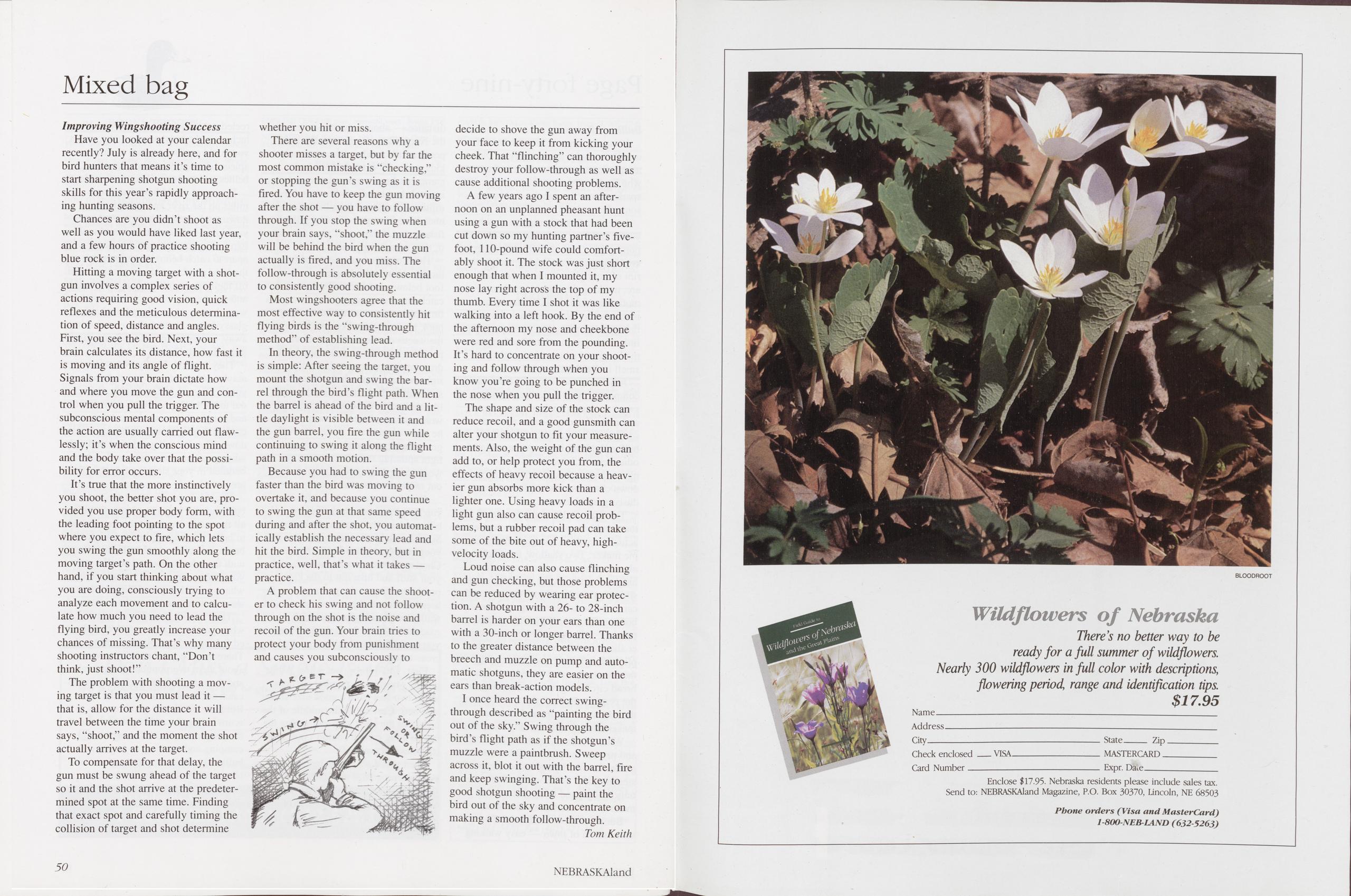
Mixed bag
Improving Wingshooting Success
Have you looked at your calendar recently? July is already here, and for bird hunters that means it's time to start sharpening shotgun shooting skills for this year's rapidly approaching hunting seasons.
Chances are you didn't shoot as well as you would have liked last year, and a few hours of practice shooting blue rock is in order.
Hitting a moving target with a shot- gun involves a complex series of actions requiring good vision, quick reflexes and the meticulous determination of speed, distance and angles. First, you see the bird. Next, your brain calculates its distance, how fast it is moving and its angle of flight. Signals from your brain dictate how and where you move the gun and control when you pull the trigger. The subconscious mental components of the action are usually carried out flaw-lessly; it's when the conscious mind and the body take over that the possi bility for error occurs.
It's true that the more instinctively you shoot, the better shot you are, provided you use proper body form, with the leading foot pointing to the spot where you expect to fire, which lets you swing the gun smoothly along the moving target's path. On the other hand, if you start thinking about what you are doing, consciously trying to analyze each movement and to calculate how much you need to lead the flying bird, you greatly increase your chances of missing. That's why many shooting instructors chant, "Don't think, just shoot!"
The problem with shooting a moving target is that you must lead it— that is, allow for the distance it will travel between the time your brain says, "shoot," and the moment the shot actually arrives at the target.
To compensate for that delay, the gun must be swung ahead of the target so it and the shot arrive at the predetermined spot at the same time. Finding that exact spot and carefully timing the collision of target and shot determine whether you hit or miss.
There are several reasons why a shooter misses a target, but by far the most common mistake is "checking," or stopping the gun's swing as it is fired. You have to keep the gun moving after the shot — you have to follow through. If you stop the swing when your brain says, "shoot," the muzzle will be behind the bird when the gun actually is fired, and you miss. The follow-through is absolutely essential to consistently good shooting.
Most wingshooters agree that the most effective way to consistently hit flying birds is the "swing-through method" of establishing lead.
In theory, the swing-through method is simple: After seeing the target, you mount the shotgun and swing the barrel through the bird's flight path. When the barrel is ahead of the bird and a little daylight is visible between it and the gun barrel, you fire the gun while continuing to swing it along the flight path in a smooth motion.
Because you had to swing the gun faster than the bird was moving to overtake it, and because you continue to swing the gun at that same speed during and after the shot, you automatically establish the necessary lead and hit the bird. Simple in theory, but in practice, well, that's what it takes - practice.
TARGET SWING SWING OR FOLLOW THROUGH
A few years ago I spent an afternoon on an unplanned pheasant hunt using a gun with a stock that had been cut down so my hunting partner's five-foot, 110-pound wife could comfortably shoot it. The stock was just short enough that when I mounted it, my nose lay right across the top of my thumb. Every time I shot it was like walking into a left hook. By the end of the afternoon my nose and checkbone were red and sore from the pounding. It's hard to concentrate on your shooting and follow through when you know you're going to be punched in the nose when you pull the trigger.
The shape and size of the stock can reduce recoil, and a good gunsmith can alter your shotgun to fit your measure-ments. Also, the weight of the gun can add to, or help protect you from, the effects of heavy recoil because a heavier gun absorbs more kick than a lighter one. Using heavy loads in a light gun also can cause recoil prob-lems, but a rubber recoil pad can take some of the bite out of heavy, high-velocity loads.
Loud noise can also cause flinching and gun checking, but those problems can be reduced by wearing ear protec-tion. A shotgun with a 26- to 28-inch barrel is harder on your ears than one with a 30-inch or longer barrel. Thanks to the greater distance between the breech and muzzle on pump and automatic shotguns, they are easier on the ears than break-action models.
I once heard the correct swing-through described as "painting the bird out of the sky." Swing through the bird's flight path as if the shotgun's muzzle were a paintbrush. Sweep across it, blot it out with the barrel, fire and keep swinging. That's the key to good shotgun shooting — paint the bird out of the sky and concentrate on making a smooth follow-through.
50 NEBRASKAlandBloodroot
Wildflowers of Nebraska
There's no better way to be ready for a full summer of wildflowers. Nearly 300 wildflowers in full color with descriptions, flowering period, range and identification tips. $17.95. Name Address City State Zip Check enclosed VISA MASTERCARD Card Number Expr. Date Enclose $17.95. Nebraska residents please also include sales tax. Send to: NEBRASKAland Magazine, PO Box 30370, Lincoln, NE 58503 Phone orders (visa and mastercard) 1-800-Neb-Land (632-5263)
Position: 31 (266 views)