Volume 73, Issue 5, 1995
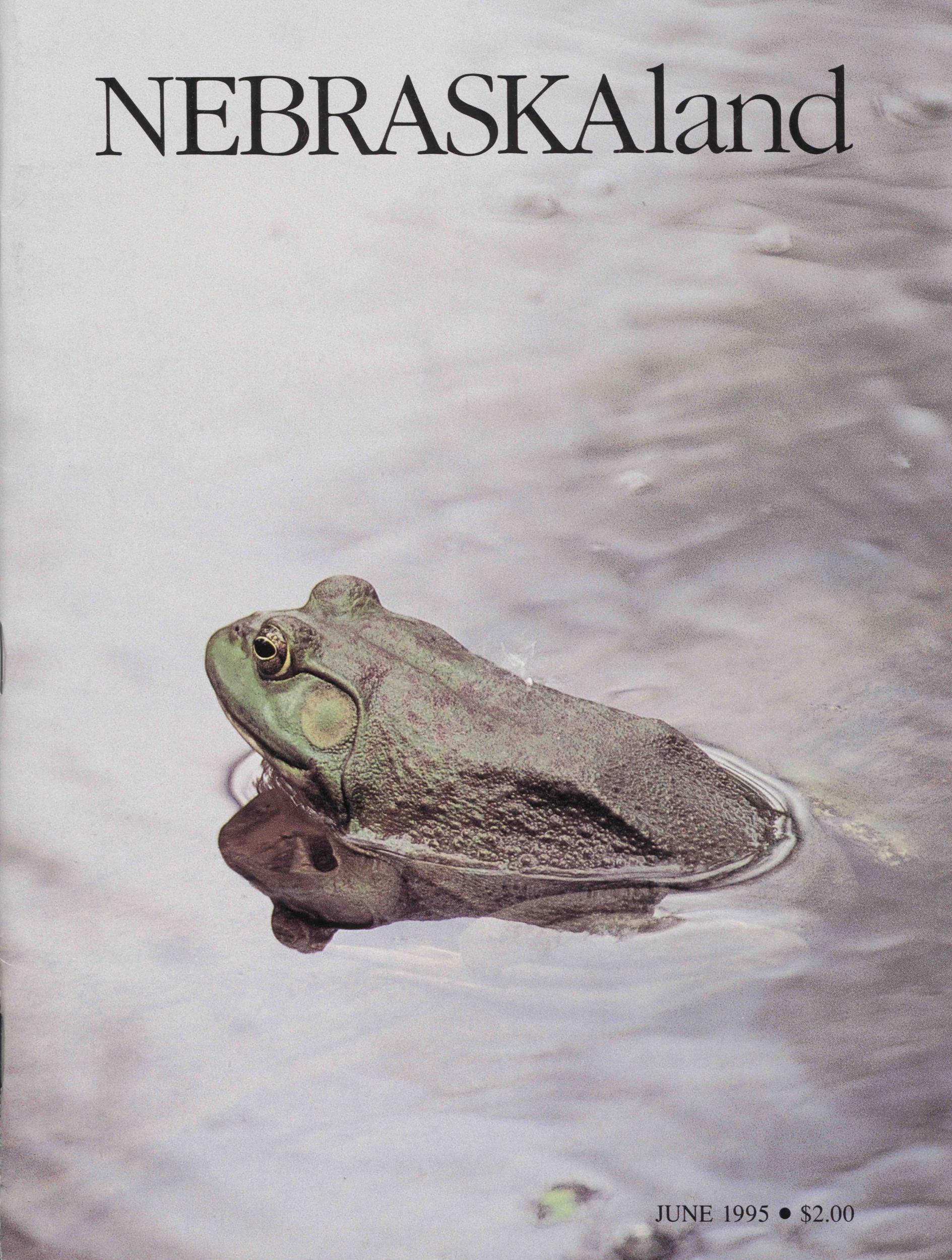
NEBRASKAland
JUNE 1995 $2.00
NEBRASKAland
VOL. 73 / NO. 5 JUNE 1995 Published by the Nebraska Game and Park Commission Director: Rex Amack Assistant Directors: Wesley Sheets Noelyn Isom Roger Kuhn Staff Administrator, Information & Education: Paul Horton Editor: Don Cunningham Senior Editors: Jon Farrar, Ken Bouc Regional Editors: Bob Grier, Rocky Hoffmann, Tom Keith, Mike Forsberg Production Manager: Troy Kroeger Art Director: Steve O'Hare Layout, Design and Illustration: Tim Reigert Circulation: Pat Frahm Commissioners Chairman: Charles E. Wright, Lincoln Vice Chairman: Bill Grewcock, Omaha 2nd Vice Chairman: Dr. Charles Blaha, Ord Dr. Tim Biga, Norfolk Tom J. Plummer Jr., Ogallala Dan Wallen, McCook William Berryman, Kearney NEBRASKAland ISSN: 0028-1964 VOL. 73 / NO. 5 JUNE 1995 Published monthly, except for Jan./Feb. and Aug./Sept. issues, by the Nebraska Game and Parks Commission, 2200 N. 33rd St., Lincoln, NE. Copyright 1995, all rights reserved. Please address comments or questions to this address. Second-class postage paid at Lincoln, Nebraska. POSTMASTER: Send all address changes to NEBRASKAland, P.O. Box 30370, Lincoln, NE 68503-0370. Rates: $14 for one year; $27 for two years Address submissions to: The Editor, NEBRASKAland Magazine, P.O. Box 30370, Lincoln, NE 68503. Include a stamped, self-addressed return envelope. The publisher assumes no responsibility for unsolicited material. NEBRASKAland is available on audio cassette from the Nebraska Library Commission Talking Book and Braille Service. Call (402) 471-4038, or toll-free (800) 742-7691.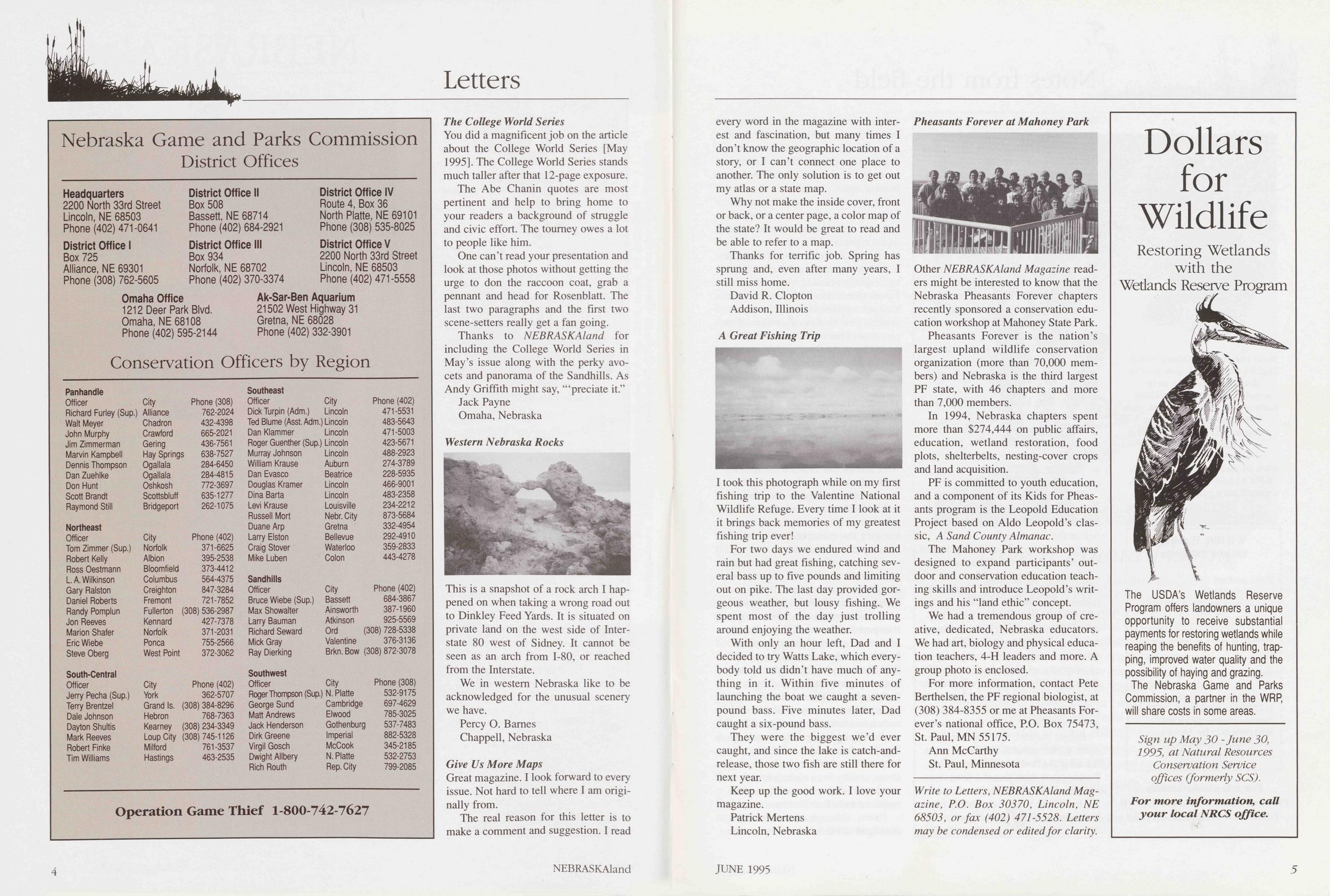
Letters
Nebraska Game and Parks Commission District Offices Headquarters 2200 North 33rd Street Lincoln, NE 68503 Phone (402)471-0641 District Office I Box 725 Alliance, NE 69301 Phone (308)762-5605 District Office II Box 508 Bassett, NE 68714 Phone (402)684-2921 District Office III Box 934 Norfolk, NE 68702 Phone (402)370-3374 District Office IV Route 4, Box 36 North Platte, NE 69101 Phone (308)535-8025 District Office V 2200 North 33rd Street Lincoln, NE 68503 Phone (402)471-5558 Omaha Office 1212 Deer Park Blvd. Omaha, NE 68108 Phone (402) 595-2144 Ak-Sar-Ben Aquarium 21502 West Highway 31 Gretna, NE 68028 Phone (402) 332-3901 Conservation Officers by Region Panhandle Southeast Officer City Phone (308) Officer City Phone (402) Richard Furley (Sup. ) Alliance 762-2024 Dick Turpin (Adm.) Lincoln 471-5531 Walt Meyer Chadron 432-4398 Ted Blume (Asst. Adm.) Lincoln 483-5643 John Murphy Crawford 665-2021 Dan Klammer Lincoln 471-5003 Jim Zimmerman Gering 436-7561 Roger Guenther (Sup.) Lincoln 423-5671 Marvin Kampbell Hay Springs 638-7527 Murray Johnson Lincoln 488-2923 Dennis Thompson Ogallala 284-6450 William Krause Auburn 274-3789 Dan Zuehlke Ogallala 284-4815 Dan Evasco Beatrice 228-5935 Don Hunt Oshkosh 772-3697 Douglas Kramer Lincoln 466-9001 Scott Brandt Scottsbluff 635-1277 Dina Barta Lincoln 483-2358 Raymond Still Bridgeport 262-1075 Levi Krause Louisville 234-2212 Russell Mort Nebr.City 873-5684 Northeast Duane Arp Gretna 332-4954 Officer City Phone (402) Larry Elston Bellevue 292-4910 Tom Zimmer (Sup.) Norfolk 371-6625 Craig Stover Waterloo 359-2833 Robert Kelly Albion 395-2538 Mike Luben Colon 443-4278 Ross Oestmann Bloomfield 373-4412 L. A. Wilkinson Columbus 564-4375 Sandhills Gary Ralston Creighton 847-3284 Officer City Phone (402) Daniel Roberts Fremont 721-7852 Bruce Wiebe (Sup.; Bassett 684-3867 Randy Pomplun Fullerton (308) 536-2987 Max Showalter Ainsworth 387-1960 Jon Reeves Kennard 427-7378 Larry Bauman Atkinson 925-5569 Marion Shafer Norfolk 371-2031 Richard Seward Ord (308) 728-5338 Eric Wiebe Ponca 755-2566 Mick Gray Valentine 376-3136 Steve Oberg West Point 372-3062 Ray Dierking Brkn. Bow (308) 872-3078 South-Central Southwest Officer City Phone (402) Officer City Phone (308) Jerry Pecha (Sup.) York 362-5707 Roger Thompson (Sup.) N. Platte 532-9175 Terry Brentzel Grand Is. (308) 384-8296 George Sund Cambridge 697-4629 Dale Johnson Hebron 768-7363 Matt Andrews Elwood 785-3025 Dayton Shultis Kearney (308) 234-3349 Jack Henderson Gothenburg 537-7483 Mark Reeves Loup City (308)745-1126 Dirk Greene Imperial 882-5328 Robert Finke Milford 761-3537 Virgil Gosch McCook 345-2185 Tim Williams Hastings 463-2535 Dwight Allbery N. Platte 532-2753 Rich Routh Rep. City 799-2085 Operation Game Thief 1-800-742-7627 The College World SeriesYou did a magnificent job on the article about the College World Series [May 1995]. The College World Series stands much taller after that 12-page exposure.
The Abe Chanin quotes are most pertinent and help to bring home to your readers a background of struggle and civic effort. The tourney owes a lot to people like him.
One can't read your presentation and look at those photos without getting the urge to don the raccoon coat, grab a pennant and head for Rosenblatt. The last two paragraphs and the first two scene-setters really get a fan going.
Thanks to NEBRASKAland for including the College World Series in May's issue along with the perky avocets and panorama of the Sandhills. As Andy Griffith might say, "'predate it."
Jack Payne Omaha, Nebraska Western Nebraska RocksThis is a snapshot of a rock arch I happened on when taking a wrong road out to Dinkley Feed Yards. It is situated on private land on the west side of Interstate 80 west of Sidney. It cannot be seen as an arch from 1-80, or reached from the Interstate.
We in western Nebraska like to be acknowledged for the unusual scenery we have.
Percy O. Barnes Chappell, Nebraska Give Us More MapsGreat magazine. I look forward to every issue. Not hard to tell where I am originally from.
The real reason for this letter is to make a comment and suggestion. I read 4 NEBRASKAland every word in the magazine with interest and fascination, but many times I don't know the geographic location of a story, or I can't connect one place to another. The only solution is to get out my atlas or a state map.
Why not make the inside cover, front or back, or a center page, a color map of the state? It would be great to read and be able to refer to a map.
Thanks for terrific job. Spring has sprung and, even after many years, I still miss home.
David R. Clopton Addison, Illinois A Great Fishing TripI took this photograph while on my first fishing trip to the Valentine National Wildlife Refuge. Every time I look at it it brings back memories of my greatest fishing trip ever!
For two days we endured wind and rain but had great fishing, catching several bass up to five pounds and limiting out on pike. The last day provided gorgeous weather, but lousy fishing. We spent most of the day just trolling around enjoying the weather.
With only an hour left, Dad and I decided to try Watts Lake, which everybody told us didn't have much of anything in it. Within five minutes of launching the boat we caught a sevenpound bass. Five minutes later, Dad caught a six-pound bass.
They were the biggest we'd ever caught, and since the lake is catch-and-release, those two fish are still there for next year.
Keep up the good work. I love your magazine.
Patrick Mertens Lincoln, Nebraska Pheasants Forever at Mahoney ParkOther NEBRASKAland Magazine readers might be interested to know that the Nebraska Pheasants Forever chapters recently sponsored a conservation education workshop at Mahoney State Park.
Pheasants Forever is the nation's largest upland wildlife conservation organization (more than 70,000 members) and Nebraska is the third largest PF state, with 46 chapters and more than 7,000 members.
In 1994, Nebraska chapters spent more than $274,444 on public affairs, education, wetland restoration, food plots, shelterbelts, nesting-cover crops and land acquisition.
PF is committed to youth education, and a component of its Kids for Pheasants program is the Leopold Education Project based on Aldo Leopold's classic, A Sand County Almanac.
The Mahoney Park workshop was designed to expand participants' outdoor and conservation education teaching skills and introduce Leopold's writings and his "land ethic" concept.
We had a tremendous group of creative, dedicated, Nebraska educators. We had art, biology and physical education teachers, 4-H leaders and more. A group photo is enclosed.
For more information, contact Pete Berthelsen, the PF regional biologist, at (308) 384-8355 or me at Pheasants Forever's national office, P.O. Box 75473, St. Paul, MN 55175.
Ann McCarthy St. Paul, Minnesota Write to Letters, NEBRASKAland Magazine, P.O. Box 30370, Lincoln, NE 68503, or fax (402) 471-5528. Letters may be condensed or edited for clarity. Dollars for Wildlife Restoring Wetlands with the Wetlands Reserve Program The USDA's Wetlands Reserve Program offers landowners a unique opportunity to receive substantial payments for restoring wetlands while reaping the benefits of hunting, trapping, improved water quality and the possibility of haying and grazing. The Nebraska Game and Parks Commission, a partner in the WRP, will share costs in some areas. Sign up May 30 -June 30, 1995, at Natural Resources Conservation Service offices (formerly SCS). For more information, call your local NRCS office. JUNE 1995 5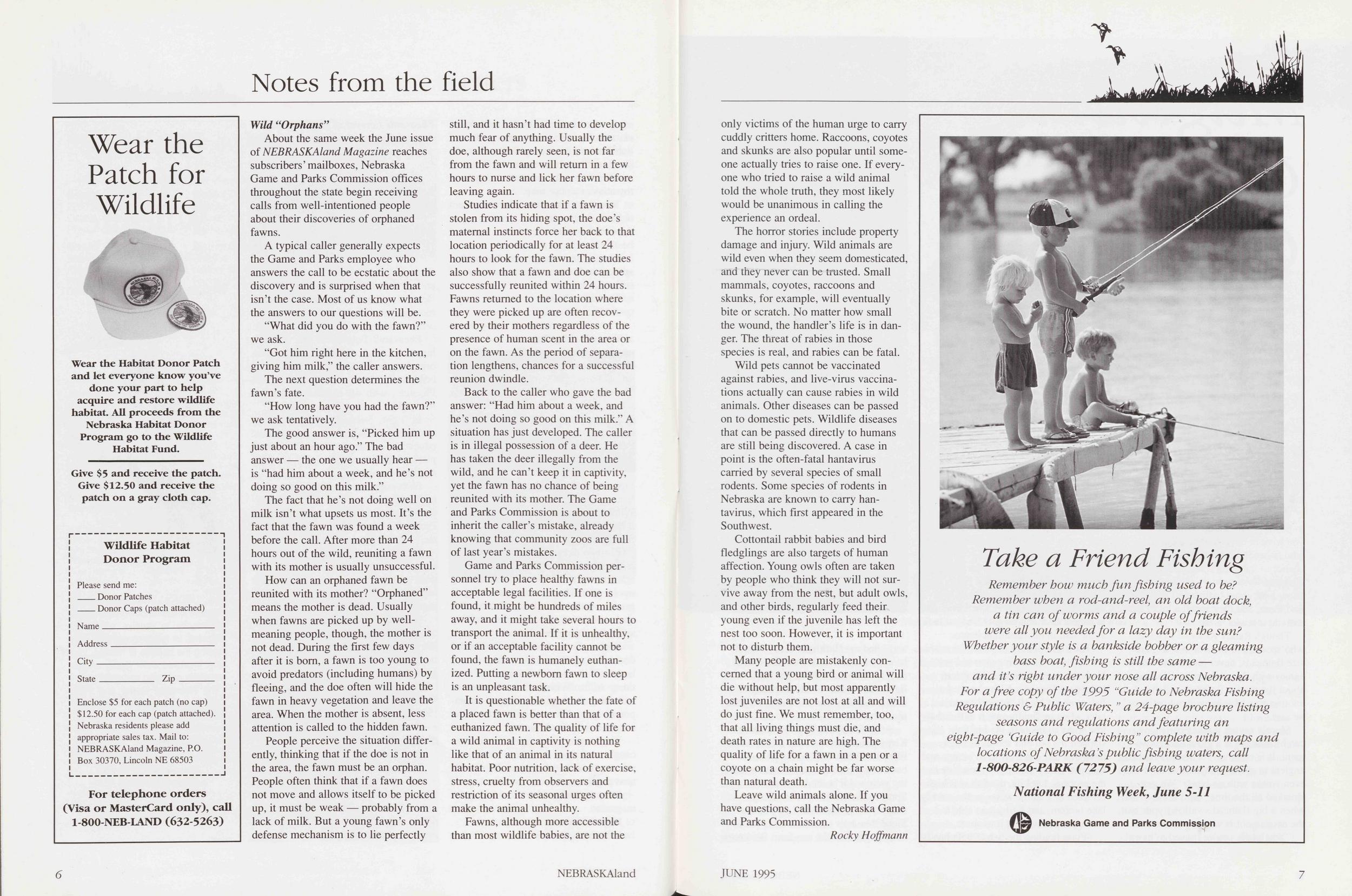
Notes from the field
Wear the Patch for Wildlife Wear the Habitat Donor Patch and let everyone know you've done your part to help acquire and restore wildlife habitat. All proceeds from the Nebraska Habitat Donor Program go to the Wildlife Habitat Fund. Give $5 and receive the patch. Give $12.50 and receive the patch on a gray cloth cap. ,y> Wildlife Habitat Donor Program Please send me: Donor Patches Donor Caps (patch attached) Name Address City State Zip Enclose $5 for each patch (no cap) $12.50 for each cap (patch attached). Nebraska residents please add appropriate sales tax. Mail to: NEBRASKAland Magazine, P.O. Box 30370, Lincoln NE 68503 For telephone orders (Visa or MasterCard only), call 1-800-NEB-LAND (632-5263) Wild "OrphansAbout the same week the June issue of NEBRASKAland Magazine reaches subscribers'mailboxes, Nebraska Game and Parks Commission offices throughout the state begin receiving calls from well-intentioned people about their discoveries of orphaned fawns.
A typical caller generally expects the Game and Parks employee who answers the call to be ecstatic about the discovery and is surprised when that isn't the case. Most of us know what the answers to our questions will be.
"What did you do with the fawn?" we ask.
"Got him right here in the kitchen, giving him milk," the caller answers.
The next question determines the fawn's fate.
"How long have you had the fawn?" we ask tentatively.
The good answer is, "Picked him up just about an hour ago." The bad answer — the one we usually hear is "had him about a week, and he's not doing so good on this milk."
The fact that he's not doing well on milk isn't what upsets us most. It's the fact that the fawn was found a week before the call. After more than 24 hours out of the wild, reuniting a fawn with its mother is usually unsuccessful.
How can an orphaned fawn be reunited with its mother? "Orphaned" means the mother is dead. Usually when fawns are picked up by well-meaning people, though, the mother is not dead. During the first few days after it is born, a fawn is too young to avoid predators (including humans) by fleeing, and the doe often will hide the fawn in heavy vegetation and leave the area. When the mother is absent, less attention is called to the hidden fawn.
People perceive the situation differently, thinking that if the doe is not in the area, the fawn must be an orphan. People often think that if a fawn does not move and allows itself to be picked up, it must be weak — probably from a lack of milk. But a young fawn's only defense mechanism is to lie perfectly still, and it hasn't had time to develop much fear of anything. Usually the doe, although rarely seen, is not far from the fawn and will return in a few hours to nurse and lick her fawn before leaving again.
Studies indicate that if a fawn is stolen from its hiding spot, the doe's maternal instincts force her back to that location periodically for at least 24 hours to look for the fawn. The studies also show that a fawn and doe can be successfully reunited within 24 hours. Fawns returned to the location where they were picked up are often recovered by their mothers regardless of the presence of human scent in the area or on the fawn. As the period of separation lengthens, chances for a successful reunion dwindle.
Back to the caller who gave the bad answer: "Had him about a week, and he's not doing so good on this milk." A situation has just developed. The caller is in illegal possession of a deer. He has taken the deer illegally from the wild, and he can't keep it in captivity, yet the fawn has no chance of being reunited with its mother. The Game and Parks Commission is about to inherit the caller's mistake, already knowing that community zoos are full of last year's mistakes.
Game and Parks Commission personnel try to place healthy fawns in acceptable legal facilities. If one is found, it might be hundreds of miles away, and it might take several hours to transport the animal. If it is unhealthy, or if an acceptable facility cannot be found, the fawn is humanely euthanized. Putting a newborn fawn to sleep is an unpleasant task.
It is questionable whether the fate of a placed fawn is better than that of a euthanized fawn. The quality of life for a wild animal in captivity is nothing like that of an animal in its natural habitat. Poor nutrition, lack of exercise, stress, cruelty from observers and restriction of its seasonal urges often make the animal unhealthy.
Fawns, although more accessible than most wildlife babies, are not the 6 NEBRASKAland only victims of the human urge to carry cuddly critters home. Raccoons, coyotes and skunks are also popular until someone actually tries to raise one. If everyone who tried to raise a wild animal told the whole truth, they most likely would be unanimous in calling the experience an ordeal.
The horror stories include property damage and injury. Wild animals are wild even when they seem domesticated, and they never can be trusted. Small mammals, coyotes, raccoons and skunks, for example, will eventually bite or scratch. No matter how small the wound, the handler's life is in danger. The threat of rabies in those species is real, and rabies can be fatal.
Wild pets cannot be vaccinated against rabies, and live-virus vaccinations actually can cause rabies in wild animals. Other diseases can be passed on to domestic pets. Wildlife diseases that can be passed directly to humans are still being discovered. A case in point is the often-fatal hantavirus carried by several species of small rodents. Some species of rodents in Nebraska are known to carry hantavirus, which first appeared in the Southwest.
Cottontail rabbit babies and bird fledglings are also targets of human affection. Young owls often are taken by people who think they will not survive away from the nest, but adult owls, and other birds, regularly feed their young even if the juvenile has left the nest too soon. However, it is important not to disturb them.
Many people are mistakenly concerned that a young bird or animal will die without help, but most apparently lost juveniles are not lost at all and will do just fine. We must remember, too, that all living things must die, and death rates in nature are high. The quality of life for a fawn in a pen or a coyote on a chain might be far worse than natural death.
Leave wild animals alone. If you have questions, call the Nebraska Game and Parks Commission.
Rocky Hoffmann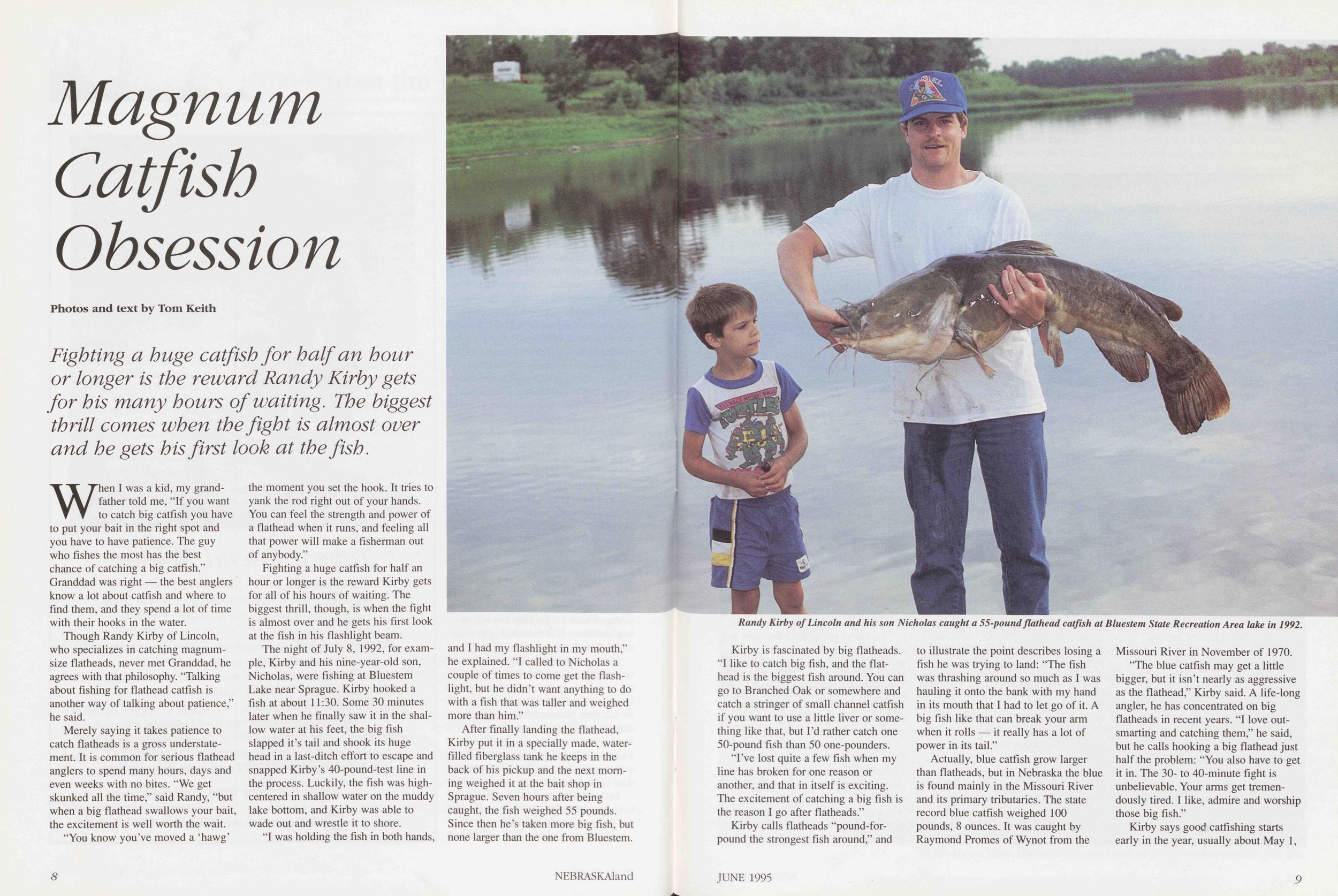
Magnum Ca tfish Obsession
Photos and text by Tom Keith Fighting a huge catfish for half an hour or longer is the reward Randy Kirby gets for his many hours of waiting. The biggest thrill comes when the fight is almost over and he gets his first look at the fish.When I was a kid, my grandfather told me, "If you want to catch big catfish you have to put your bait in the right spot and you have to have patience. The guy who fishes the most has the best chance of catching a big catfish." Granddad was right — the best anglers know a lot about catfish and where to find them, and they spend a lot of time with their hooks in the water.
Though Randy Kirby of Lincoln, who specializes in catching magnumsize flatheads, never met Granddad, he agrees with that philosophy. "Talking about fishing for flathead catfish is another way of talking about patience," he said.
Merely saying it takes patience to catch flatheads is a gross understatement. It is common for serious flathead anglers to spend many hours, days and even weeks with no bites. "We get skunked all the time," said Randy, "but when a big flathead swallows your bait, the excitement is well worth the wait.
"You know you've moved a 'hawg' the moment you set the hook. It tries to yank the rod right out of your hands. You can feel the strength and power of a flathead when it runs, and feeling all that power will make a fisherman out of anybody."
Fighting a huge catfish for half an hour or longer is the reward Kirby gets for all of his hours of waiting. The biggest thrill, though, is when the fight is almost over and he gets his first look at the fish in his flashlight beam.
The night of July 8, 1992, for example, Kirby and his nine-year-old son, Nicholas, were fishing at Bluestem Lake near Sprague. Kirby hooked a fish at about 11:30. Some 30 minutes later when he finally saw it in the shallow water at his feet, the big fish slapped it's tail and shook its huge head in a last-ditch effort to escape and snapped Kirby's 40-pound-test line in the process. Luckily, the fish was highcentered in shallow water on the muddy lake bottom, and Kirby was able to wade out and wrestle it to shore.
"I was holding the fish in both hands, and I had my flashlight in my mouth," he explained. "I called to Nicholas a couple of times to come get the flashlight, but he didn't want anything to do with a fish that was taller and weighed more than him."
After finally landing the flathead, Kirby put it in a specially made, waterfilled fiberglass tank he keeps in the back of his pickup and the next morning weighed it at the bait shop in Sprague. Seven hours after being caught, the fish weighed 55 pounds. Since then he's taken more big fish, but none larger than the one from Bluestem.
8 NEBRASKAlandKirby is fascinated by big flatheads. "I like to catch big fish, and the flathead is the biggest fish around. You can go to Branched Oak or somewhere and catch a stringer of small channel catfish if you want to use a little liver or something like that, but I'd rather catch one 50-pound fish than 50 one-pounders.
"I've lost quite a few fish when my line has broken for one reason or another, and that in itself is exciting. The excitement of catching a big fish is the reason I go after flatheads."
Kirby calls flatheads "pound-for-pound the strongest fish around," and to illustrate the point describes losing a fish he was trying to land: "The fish was thrashing around so much as I was hauling it onto the bank with my hand in its mouth that I had to let go of it. A big fish like that can break your arm when it rolls — it really has a lot of power in its tail."
Actually, blue catfish grow larger than flatheads, but in Nebraska the blue is found mainly in the Missouri River and its primary tributaries. The state record blue catfish weighed 100 pounds, 8 ounces. It was caught by Raymond Promes of Wynot from the Missouri River in November of 1970.
"The blue catfish may get a little bigger, but it isn't nearly as aggressive as the flathead," Kirby said. A life-long angler, he has concentrated on big flatheads in recent years. "I love outsmarting and catching them," he said, but he calls hooking a big flathead just half the problem: "You also have to get it in. The 30- to 40-minute fight is unbelievable. Your arms get tremendously tired. I like, admire and worship those big fish."
Kirby says good catfishing starts
early in the year, usually about May 1,
JUNE 1995
7
Experience has taught him that June, July and August are the best months for catching the biggest flatheads. "I usually start fishing as soon as the bluegills start biting. Night hours are always best, and it seems like the later it is, the better flatheads bite. 'Hawgin'hours are usually 11:30 p.m. to 3:30 a.m."
Kirby spends most of this time fishing lakes, and although he owns a boat, he prefers to fish from the bank — "for practical reasons: You have to fish for so long you may be sitting cramped-up in a boat for seven or eight hours at a time. It's just much more comfortable on the bank with a small fire, a cot and a lawn chair.
"It can be a lot colder on the water, a lot windier, and you can't hold your position as well when you're fishing from a boat. I carry my gear in the back of my truck and in five minutes I can have a miniature camp set up that lets me be completely comfortable all night long, regardless of the weather. When the weather is nice, I sleep in my sleeping bag or blanket on a cot or a lawn chair. I have a shell on my pickup, so if it's windy or raining I can back the truck to edge of the lake, put down the tailgate, and sleep comfortably on a mattress in the truck."
Kirby keeps his fire small and uses as little light as possible, since he believes light scares the fish — and attracts mosquitoes. He avoids using insect repellent before baiting his hooks and even then tries to keep it off his hands to avoid contaminating his bait.
"I'd rather put up with the bites and the aggravation than get repellent on my bait," he said. He is careful to keep gasoline, oil, lantern fuel and other odors from his hands while fishing. "I also try to be as quiet as possible. Running around on the bank and making noise bothers the fish."
How does an expert decide where to fish? Kirby does his homework. He looks for lakes old enough to have good-size catfish, studies topographical maps, looks at lake contours when water levels are low, wades in the water to find holes and drop-offs, and talks to people who know the lakes. He gets 10 NEBRASKAland information from other anglers and from bait shops and fishing tackle stores. He reads magazine catfishing articles and newspaper reports about fishing activity throughout the state.
"I'm always exploring, looking for new waters that might hold big fish. Anywhere within a two- to three-hour drive of Lincoln is good enough. I'm not opposed to driving three hours to be able to spend eight hours fishing."
He likes the Salt Valley lakes near Lincoln. Bluestem, Yankee Hill, Conestoga and Branched Oak all produce a few big flatheads, he says.
In 1994, Kirby's biggest fish was a 28-pound flathead from a small southeastern Nebraska lake. He also caught two 17-pounders from the Loup Power Canal system.
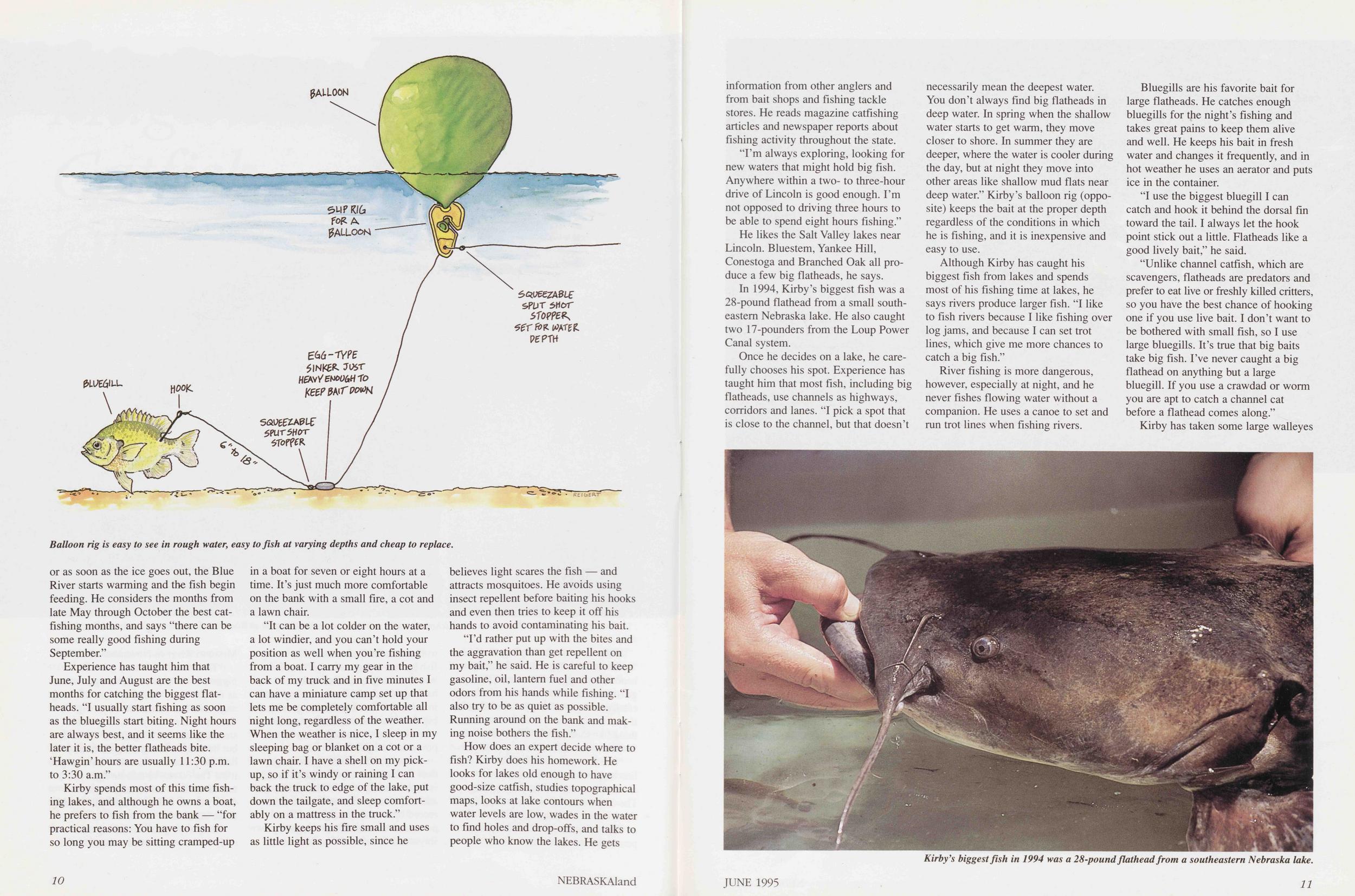
Once he decides on a lake, he carefully chooses his spot. Experience has taught him that most fish, including big flatheads, use channels as highways, corridors and lanes. "I pick a spot that is close to the channel, but that doesn't necessarily mean the deepest water. You don't always find big flatheads in deep water. In spring when the shallow water starts to get warm, they move closer to shore. In summer they are deeper, where the water is cooler during the day, but at night they move into other areas like shallow mud flats near deep water." Kirby's balloon rig (opposite) keeps the bait at the proper depth regardless of the conditions in which he is fishing, and it is inexpensive and easy to use.
Although Kirby has caught his biggest fish from lakes and spends most of his fishing time at lakes, he says rivers produce larger fish. "I like to fish rivers because I like fishing over log jams, and because I can set trot lines, which give me more chances to catch a big fish."
River fishing is more dangerous, however, especially at night, and he never fishes flowing water without a companion. He uses a canoe to set and run trot lines when fishing rivers.
Bluegills are his favorite bait for large flatheads. He catches enough bluegills for the night's fishing and takes great pains to keep them alive and well. He keeps his bait in fresh water and changes it frequently, and in hot weather he uses an aerator and puts ice in the container.
"I use the biggest bluegill I can catch and hook it behind the dorsal fin toward the tail. I always let the hook point stick out a little. Flatheads like a good lively bait," he said.
"Unlike channel catfish, which are scavengers, flatheads are predators and prefer to eat live or freshly killed critters, so you have the best chance of hooking one if you use live bait. I don't want to be bothered with small fish, so I use large bluegills. It's true that big baits take big fish. I've never caught a big flathead on anything but a large bluegill. If you use a crawdad or worm you are apt to catch a channel cat before a flathead comes along."
Kirby has taken some large walleyes
Serious flathead fishing isn't for everyone. The angler who can squeeze in an afternoon of fishing only every few weeks isn't going to catch many flatheads. It takes time, persistence and determination to catch the big fish.
"I started fishing at night because I had to work during the day and flatheads move and feed mostly at night. Now that I'm working second shift, I get off at 11 p.m. and I don't have to be back until 2 p.m. the next afternoon. I can go out to the lake or river after work, throw my lines in and go to sleep. When I wake up in the morning I still have time to go home, get cleaned up and get to work."
Fishing at night doesn't guarantee success: "When they're not biting I'll sit out there in the dark for two or three weeks without anything happening — except I might catch some two- to 10-pound channel cats or something, which are nice fish. But I'm after the big flatheads. Good weather, bad weather, you've got to stay out there through it all. Sometimes I just get lucky. One year I went through a period of a few days when they were hitting real well and I was getting a bite about every night. I didn't land all of them, but I was getting bites."
Kirby's best year was 1989, when he caught six flatheads totaling 160 pounds. All were taken from eastern Nebraska rivers and the heavily fished Salt Valley lakes. "The best single day of fishing I ever had was when I caught a flathead that weighed 50 pounds, one that weighed 35 pounds, a 25-pounder, two 10-pounders and some smaller fish, all in one 24-hour period."
But, says Kirby, most people don't have the patience for his kind of catfishing. He spent a year and a half at it before catching his first Master Angler Award fish — one weighing at least 15 pounds or at least 32 inches long.
Kirby fishes two or three nights a week except during his three weeks of vacation when he fishes five nights a week. That much time spent catfishing at night requires a lot of time away from his family, but Kirby says his wife, Cindy, understands how much he enjoys fishing, and sometimes goes along. "This year she's decided she wants to try her luck fishing, so I bought her a good rod and reel."
Brandy, their 12-year-old daughter, and Nicholas also are frequent companions. "The dogs go too. At one time or another everybody goes but the cat."
It's demanding fishing, but to Kirby it's worth the effort. "If I caught a big one every time I went out, the excitement wouldn't be nearly as great as it is when I go out there a lot and get a good fish only once or twice a year.
"When I catch a big one, it makes 12 NEBRASKAland all the preparation and all the times I've been rained on and come home with nothing but wet shoes worthwhile."
He is a firm believer in releasing big fish. "A 45-pound fish is 25 to 30 years old. That's almost as old as I am. It takes a long time to grow a huge flathead."
Kirby's goal is to catch a fish that will topple the current Nebraska state record of 80 pounds, a fish caught from the Loup Power Canal near Genoa in 1988 by William Swanson of Silver Creek. "I've paid my dues," Kirby said. "I've spent a lot of hours out there. I've been out there in good weather and bad weather, and I've been skunked more often than not. I'm confident that some night I'll catch the new state record."
Larry Zadina, assistant administrator of the Game and Parks Commission's Fisheries Division, says the Commission doesn't raise flathead catfish to stock in Nebraska waters because they are difficult to culture. Instead, they are salvaged from rivers and canal systems and stocked in various lakes.
Zadina says the Missouri, Platte, Republican and Nemaha rivers all have some flatheads. There are a few in the Salt Valley lakes as well, where he suspects there is some natural reproduction. "There aren't great numbers of flatheads in any of the lakes," he said.
Zadina says flatheads prefer deep water and downed-timber habitat. He says they seem to like areas with sharp drop-offs and spots where there are brush piles and trees in the water. "The flathead provides the opportunity for anglers to catch a real trophy-size fish," Zadina said.
Landing a trophy-size fish puts fishing tackle to the test, however, and Kirby offers several suggestions for would-be flathead anglers. He uses stout equipment for flathead catfish. He chooses medium-heavy to heavy-action river rods or snagging rods with the backbone it takes to set the hook in a big flathead's jaw. "One of the rods I'm using is a 7/2-footer that is thick from the butt to the tip. The other is a 10-foot graphite rod that has more flex than any other rod I use, but I like the extra length because I can cast a tremendous distance with it," he said.
To handle huge fish, anglers need strong terminal tackle. Kirby prefers 6/0 to 10/0 hooks. "Always sharpen your hooks before using them, even those fresh out of the box. Use a hook sharpener. It makes a huge difference when you try to drive the hook into a big flathead's jaw. It only takes 10 to 15 seconds to sharpen the hook, and it is well worth the time and effort."
He uses 70-pound Kevlar line on one rod because that material is exceptionally strong for its diameter. On the other rod he uses 48-pound braided nylon line.
Level-wind reels are essential for landing big fish, but they don't have to be fancy or expensive. "I use Penn and Ocean City level-wind reels. I bought the Penn at a garage sale for $10. It casts like a dream, though it doesn't look like a whole lot. My Grandpa gave me the Ocean City. It was the reel he used for big catfish. It still works great."
Sinkers are important for keeping the bait near the bottom where big flatheads feed. Kirby uses slip sinkers weighing an ounce or an ounce and a half to anchor the bluegill to the bottom, and he warns against using a tight line for big fish: "You have to either leave the bail open or set the reverse lever so the fish can take the line it wants. I use the slip sinkers so the fish doesn't feel any resistance when it takes the bait."
Because he knows he will lose some tackle in this kind of fishing, he carries plenty of spare equipment.
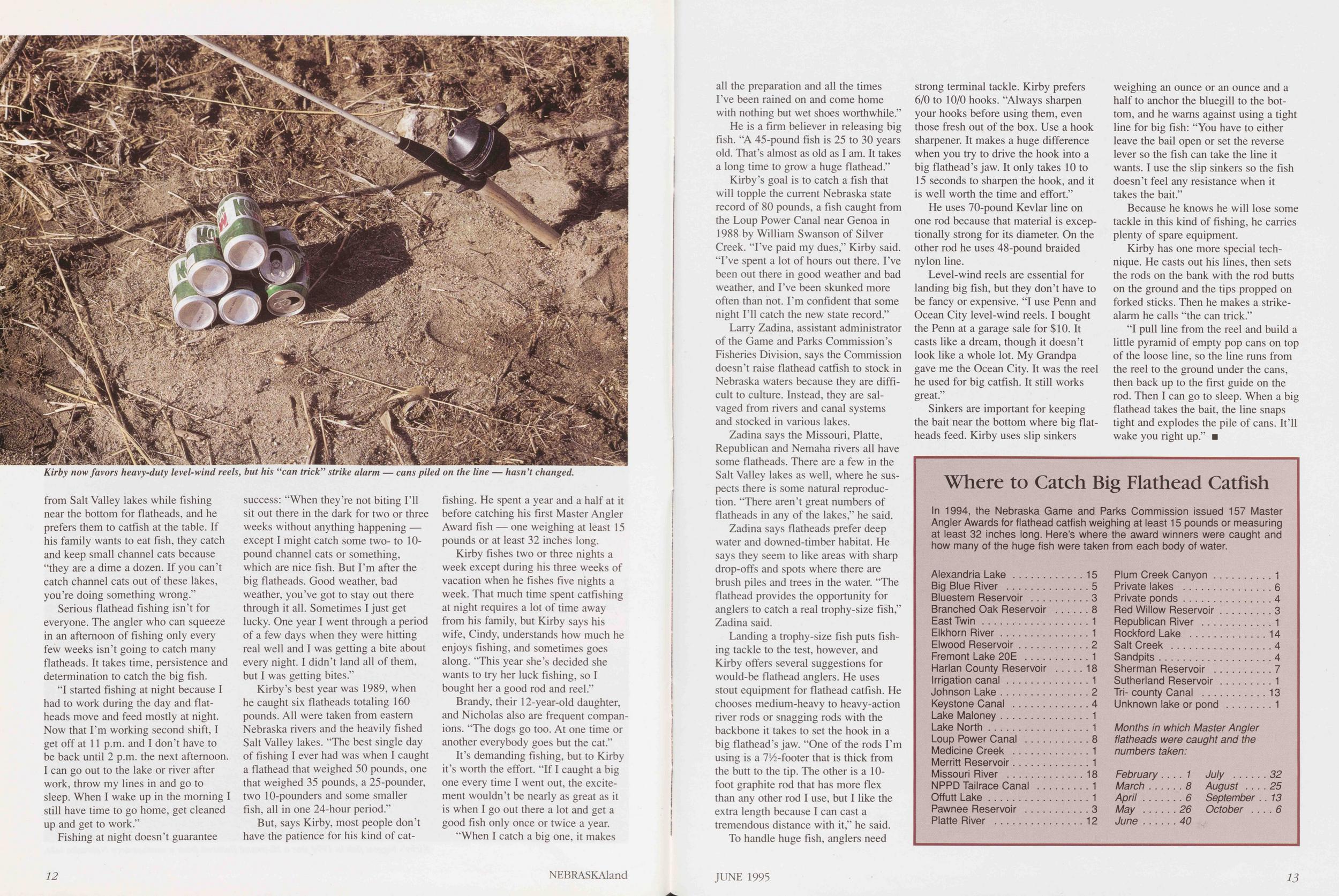
Kirby has one more special technique. He casts out his lines, then sets the rods on the bank with the rod butts on the ground and the tips propped on forked sticks. Then he makes a strike-alarm he calls "the can trick."
"I pull line from the reel and build a little pyramid of empty pop cans on top of the loose line, so the line runs from the reel to the ground under the cans, then back up to the first guide on the rod. Then I can go to sleep. When a big flathead takes the bait, the line snaps tight and explodes the pile of cans. It'll wake you right up."
Where to Catch Big Flathead CatfishIn 1994, the Nebraska Game and Parks Commission issued 157 Master Angler Awards for flathead catfish weighing at least 15 pounds or measuring at least 32 inches long. Here's where the award winners were caught and how many of the huge fish were taken from each body of water.
Alexandria Lake 15 Big Blue River 5 Bluestem Reservoir 3 Branched Oak Reservoir 8 East Twin 1 Elkhorn River 1 Elwood Reservoir 2 Fremont Lake 20E 1 Harlan County Reservoir 18 Irrigation canal 1 Johnson Lake 2 Keystone Canal 4 Lake Maloney 1 Lake North 1 Loup Power Canal 8 Medicine Creek 1 Merritt Reservoir 1 Missouri River 18 NPPD Tailrace Canal 1 Offutt Lake 1 Pawnee Reservoir 3 Platte River 12 Plum Creek Canyon 1 Private lakes 6 Private ponds 4 Red Willow Reservoir 3 Republican River 1 Rockford Lake 14 Salt Creek 4 Sandpits. 4 Sherman Reservoir 7 Sutherland Reservoir 1 Tri- county Canal 13 Unknown lake or pond 1 Months in which Master Angler flatheads were caught and the numbers taken: February 1 March 8 April 6 May 26 June 40 July 32 August 25 September 13 October 6 JUNE 1995 13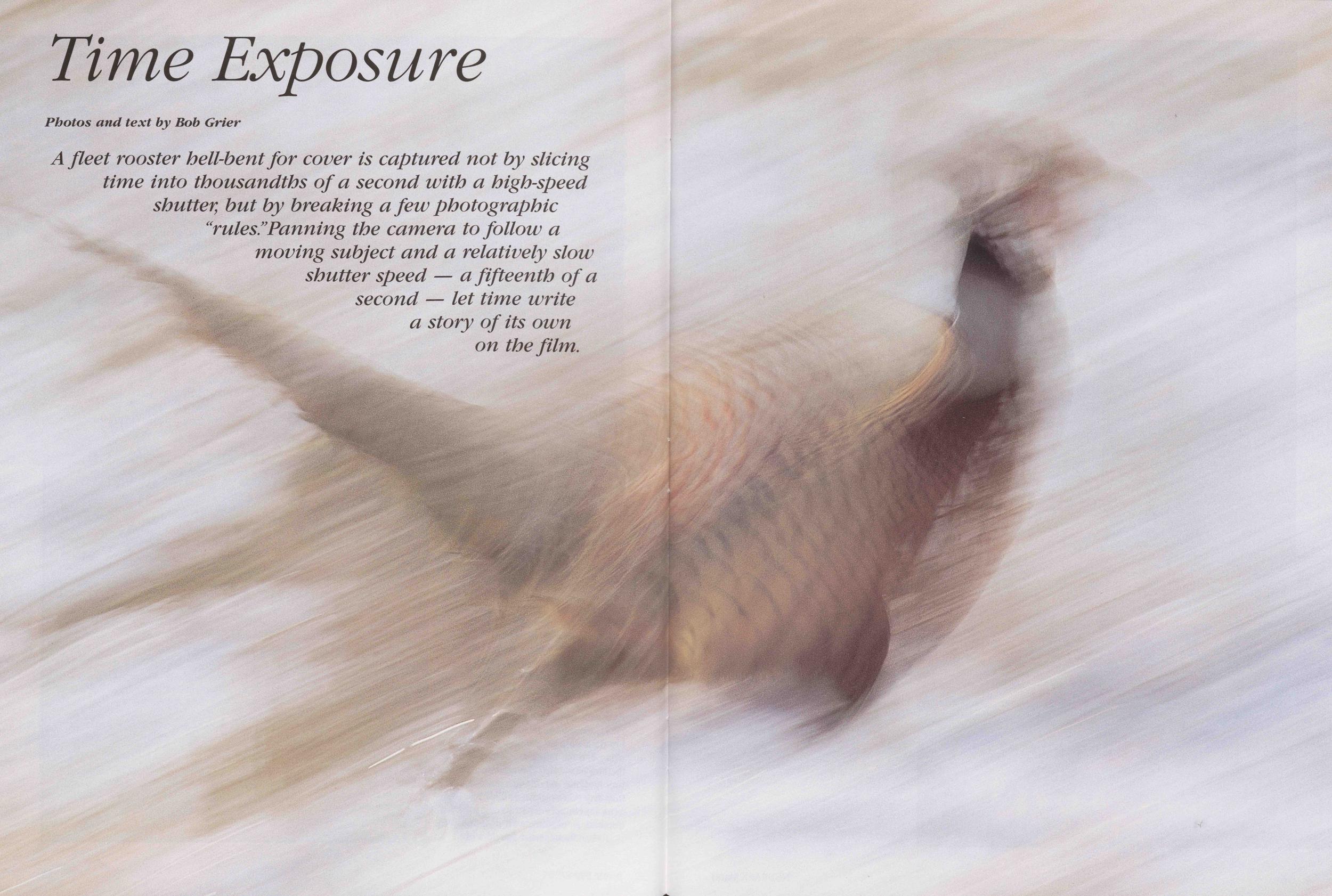
Time Exposure
Photos and text by Bob Grier A fleet rooster hell-bent for cover is captured not by slicing time into thousandths of a second with a high-speed shutter, but by breaking a few photographic rules."Panning the camera to follow a moving subject and a relatively slow shutter speed — a fifteenth of a second — let time write a story of its own on the film.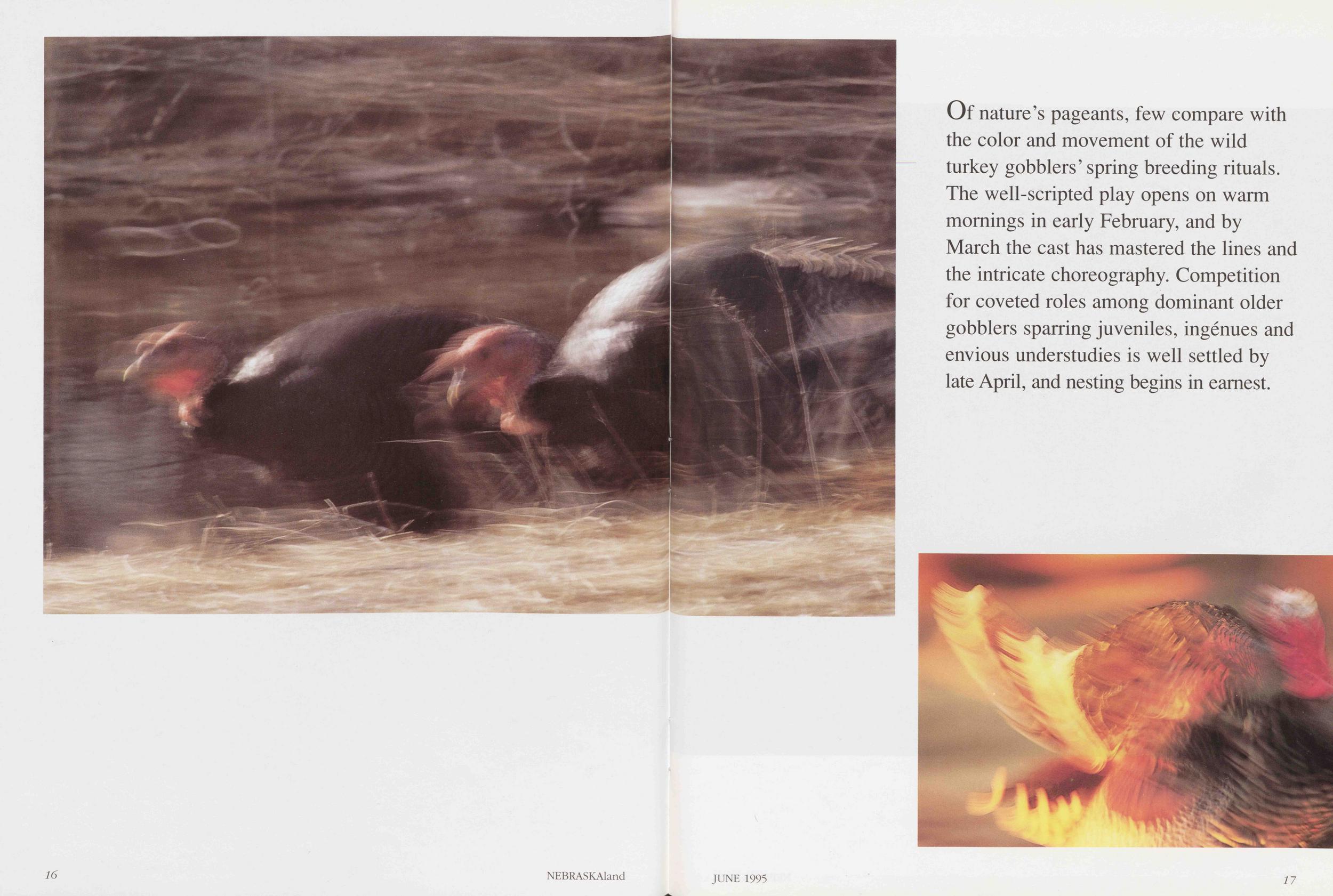
Of nature's pageants, few compare with the color and movement of the wild turkey gobblers' spring breeding rituals. The well-scripted play opens on warm mornings in early February, and by March the cast has mastered the lines and the intricate choreography. Competition for coveted roles among dominant older gobblers sparring juveniles, ingenues and envious understudies is well settled by late April, and nesting begins in earnest.
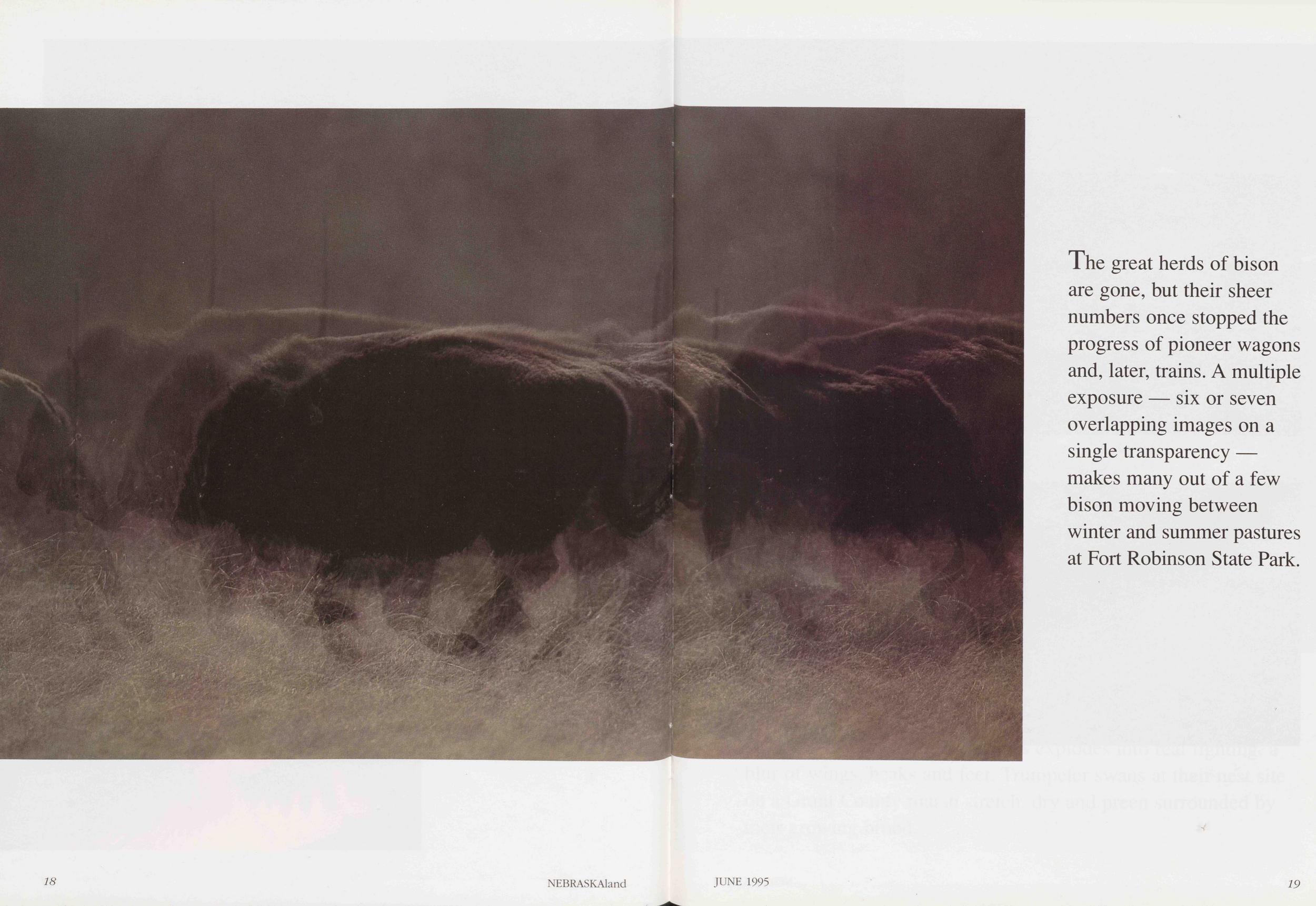
The great herds of bison are gone, but their sheer numbers once stopped the progress of pioneer wagons and, later, trains. A multiple exposure — six or seven overlapping images on a single transparency — makes many out of a few bison moving between winter and summer pastures at Fort Robinson State Park.
JUNE 1995 19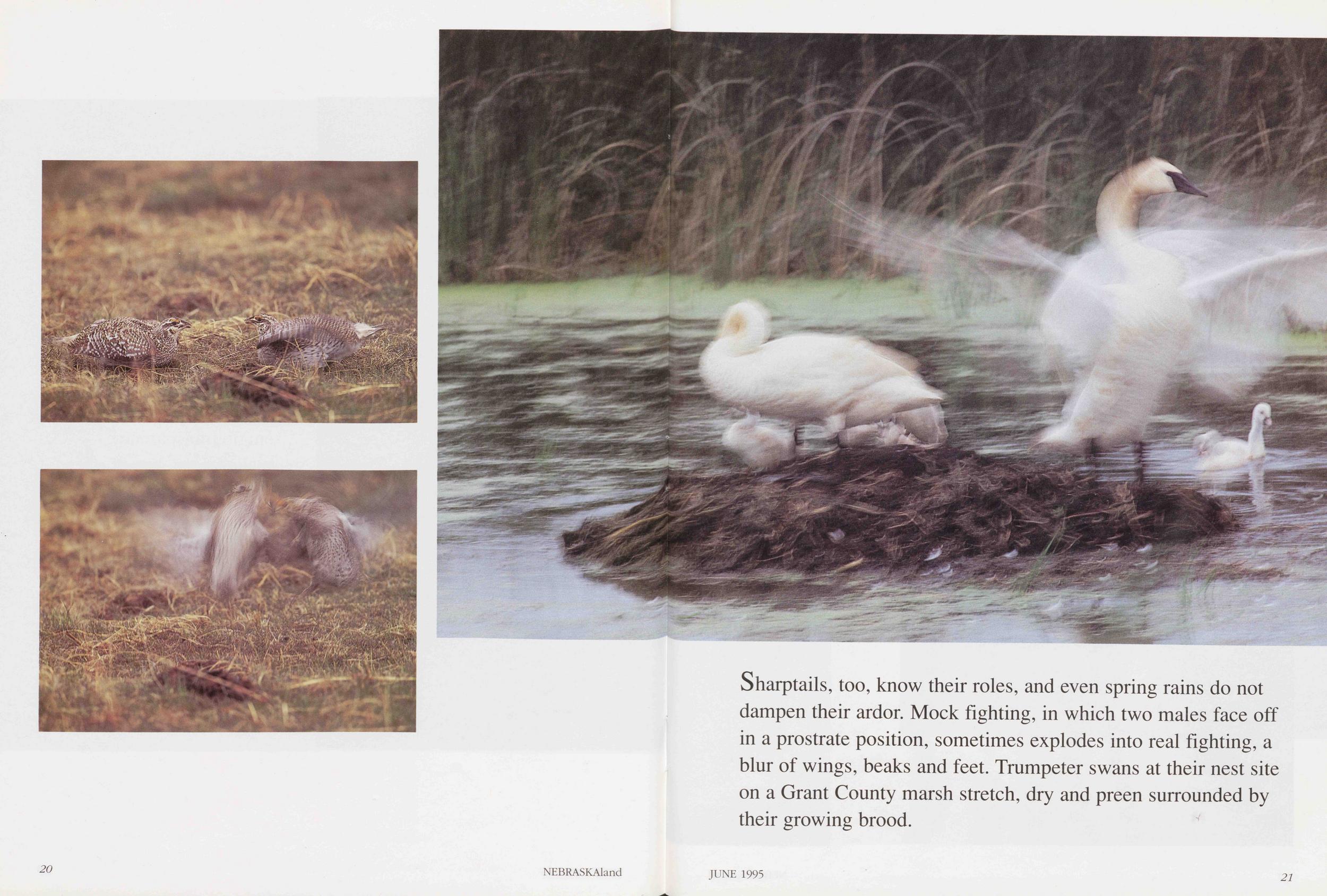
Sharptails, too, know their roles, and even spring rains do not dampen their ardor. Mock fighting, in which two males face off in a prostrate position, sometimes explodes into real fighting, a blur of wings, beaks and feet. Trumpeter swans at their nest site on a Grant County marsh stretch, dry and preen surrounded by their growing brood.
JUNE 1995 21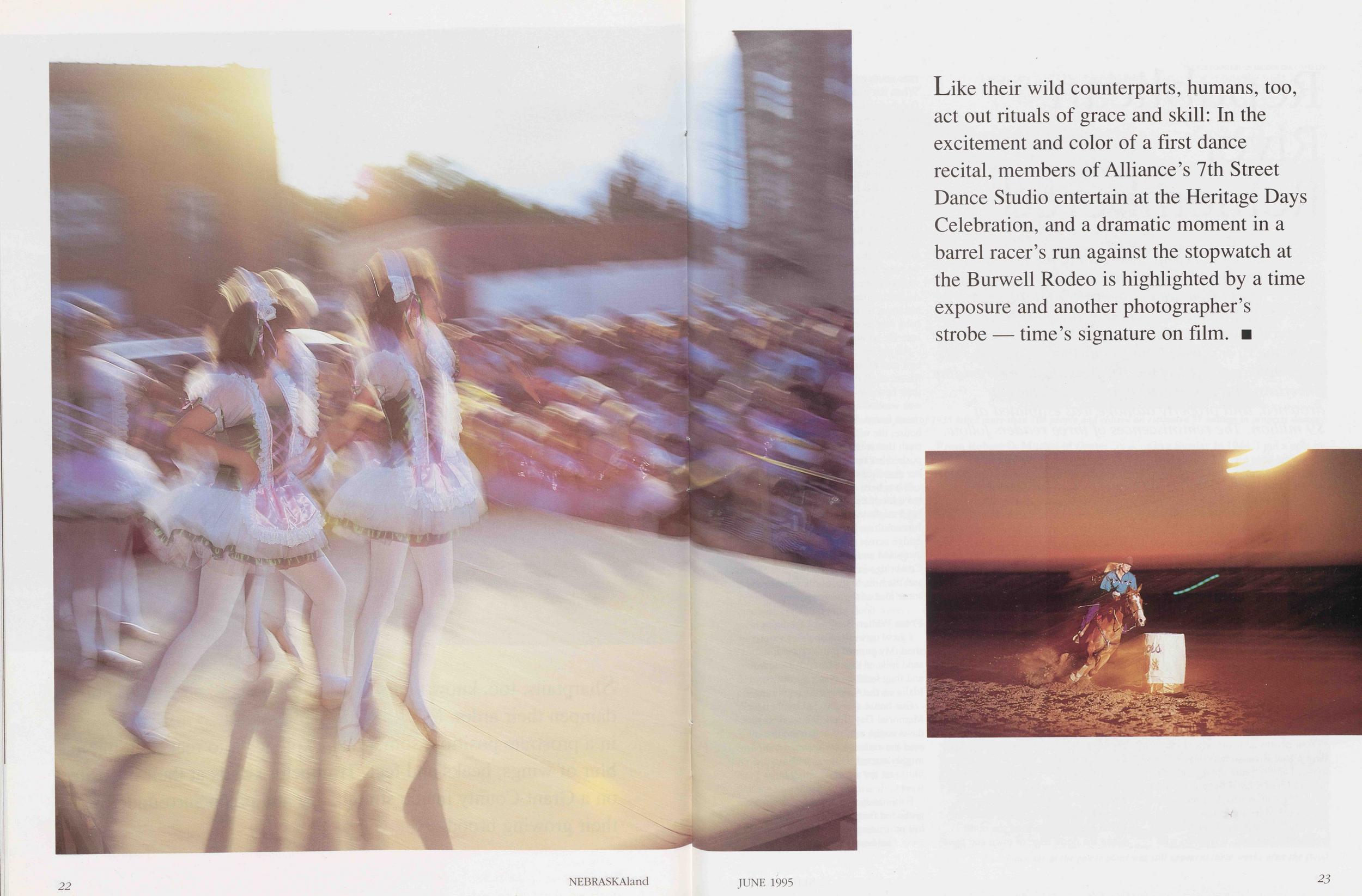
Like their wild counterparts, humans, too, act out rituals of grace and skill: In the excitement and color of a first dance recital, members of Alliance's 7th Street Dance Studio entertain at the Heritage Days Celebration, and a dramatic moment in a barrel racer's run against the stopwatch at the Burwell Rodeo is highlighted by a time exposure and another photographer's strobe — time's signature on film.
JUNE 1995 23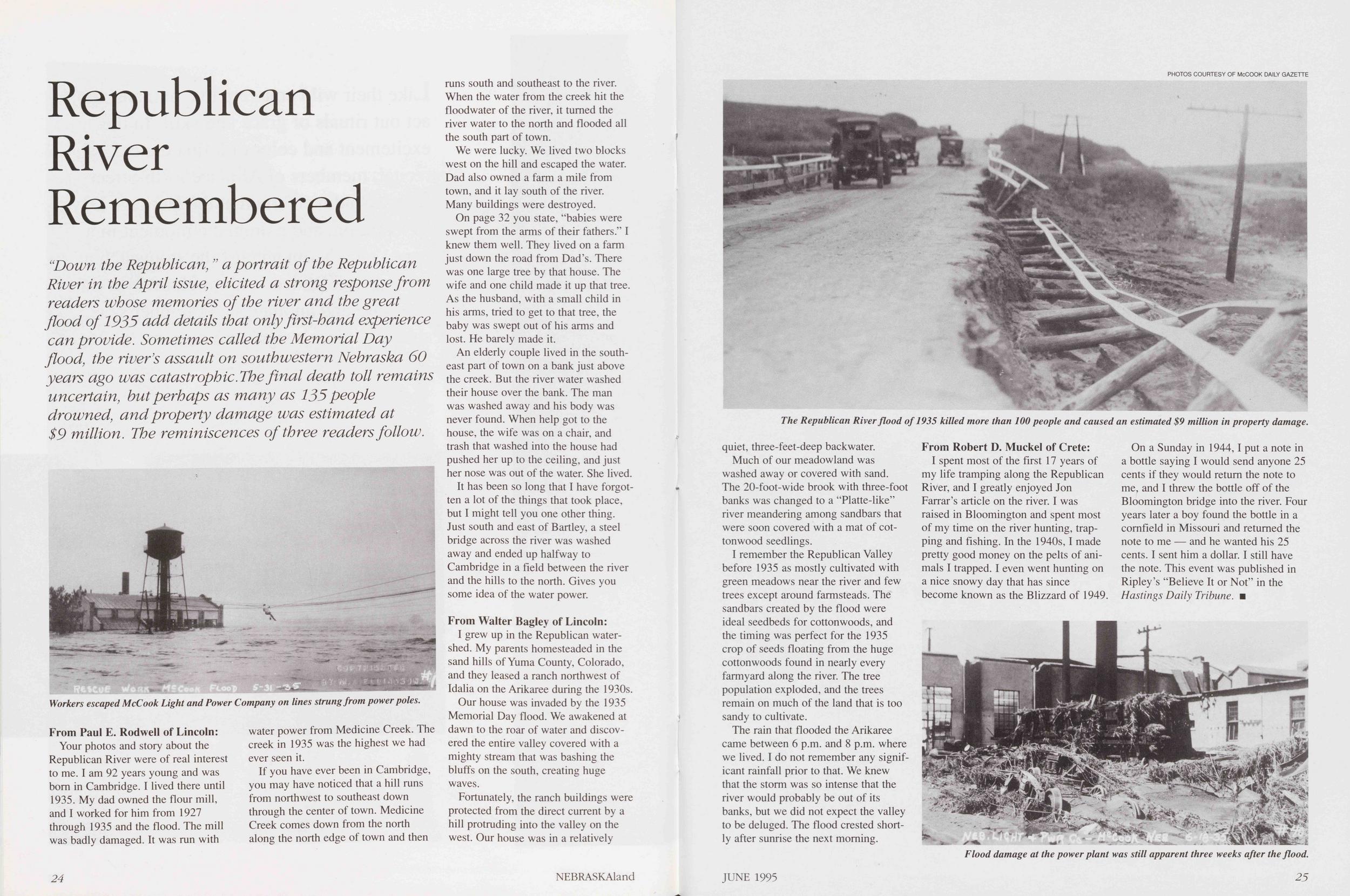
Republican River Remembered
"Down the Republican, " a portrait of the Republican River in the April issue, elicited a strong response from readers whose memories of the river and the great flood of 1935 add details that only first-hand experience can provide. Sometimes called the Memorial Day flood, the river's assault on southwestern Nebraska 60 years ago was catastrophic.The final death toll remains uncertain, hut perhaps as many as 135 people drowned, and property damage was estimated at $9 million. The reminiscences of three readers follow.Your photos and story about the Republican River were of real interest to me. I am 92 years young and was born in Cambridge. I lived there until 1935. My dad owned the flour mill, and I worked for him from 1927 through 1935 and the flood. The mill was badly damaged. It was run with water power from Medicine Creek. The creek in 1935 was the highest we had ever seen it.
If you have ever been in Cambridge, you may have noticed that a hill runs from northwest to southeast down through the center of town. Medicine Creek comes down from the north along the north edge of town and then runs south and southeast to the river. When the water from the creek hit the floodwater of the river, it turned the river water to the north and flooded all the south part of town.
We were lucky. We lived two blocks west on the hill and escaped the water. Dad also owned a farm a mile from town, and it lay south of the river. Many buildings were destroyed.
On page 32 you state, "babies were swept from the arms of their fathers." I knew them well. They lived on a farm just down the road from Dad's. There was one large tree by that house. The wife and one child made it up that tree. As the husband, with a small child in his arms, tried to get to that tree, the baby was swept out of his arms and lost. He barely made it.
An elderly couple lived in the southeast part of town on a bank just above the creek. But the river water washed their house over the bank. The man was washed away and his body was never found. When help got to the house, the wife was on a chair, and trash that washed into the house had pushed her up to the ceiling, and just her nose was out of the water. She lived.
It has been so long that I have forgotten a lot of the things that took place, but I might tell you one other thing. Just south and east of Bartley, a steel bridge across the river was washed away and ended up halfway to Cambridge in a field between the river and the hills to the north. Gives you some idea of the water power.
From Walter Bagley of Lincoln:I grew up in the Republican watershed. My parents homesteaded in the sand hills of Yuma County, Colorado, and they leased a ranch northwest of Idalia on the Arikaree during the 1930s.
Our house was invaded by the 1935 Memorial Day flood. We awakened at dawn to the roar of water and discovered the entire valley covered with a mighty stream that was bashing the bluffs on the south, creating huge waves.
Fortunately, the ranch buildings were protected from the direct current by a hill protruding into the valley on the west. Our house was in a relatively 24 NEBRASKAland
Much of our meadowland was washed away or covered with sand. The 20-foot-wide brook with three-foot banks was changed to a "Platte-like" river meandering among sandbars that were soon covered with a mat of Cottonwood seedlings.
I remember the Republican Valley before 1935 as mostly cultivated with green meadows near the river and few trees except around farmsteads. The sandbars created by the flood were ideal seedbeds for cotton woods, and the timing was perfect for the 1935 crop of seeds floating from the huge cottonwoods found in nearly every farmyard along the river. The tree population exploded, and the trees remain on much of the land that is too sandy to cultivate.
The rain that flooded the Arikaree came between 6 p.m. and 8 p.m. where we lived. I do not remember any significant rainfall prior to that. We knew that the storm was so intense that the river would probably be out of its banks, but we did not expect the valley to be deluged. The flood crested shortly after sunrise the next morning.
From Robert D. Muckel of Crete:I spent most of the first 17 years of my life tramping along the Republican River, and I greatly enjoyed Jon Farrar's article on the river. I was raised in Bloomington and spent most of my time on the river hunting, trapping and fishing. In the 1940s, I made pretty good money on the pelts of animals I trapped. I even went hunting on a nice snowy day that has since become known as the Blizzard of 1949.
On a Sunday in 1944,1 put a note in a bottle saying I would send anyone 25 cents if they would return the note to me, and I threw the bottle off of the Bloomington bridge into the river. Four years later a boy found the bottle in a cornfield in Missouri and returned the note to me — and he wanted his 25 cents. I sent him a dollar. I still have the note. This event was published in Ripley's "Believe It or Not" in the Hastings Daily Tribune.
The Closer View
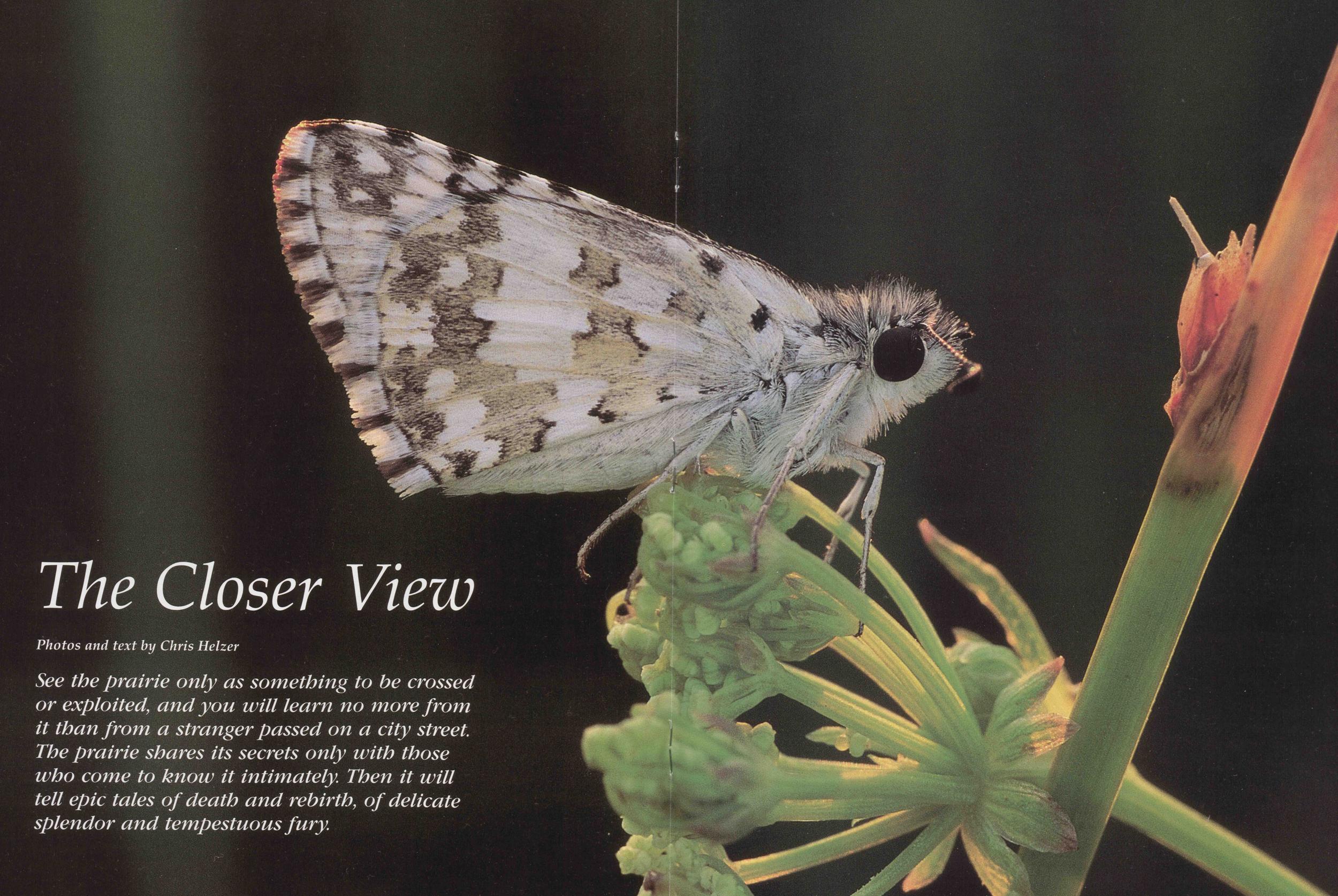
Photos and text by Chris Helzer See the prairie only as something to be crossed or exploited, and you will learn no more from it than from a stranger passed on a city street. The prairie shares its secrets only with those who come to know it intimately Then it will tell epic tales of death and rebirth, of delicate splendor and tempestuous fury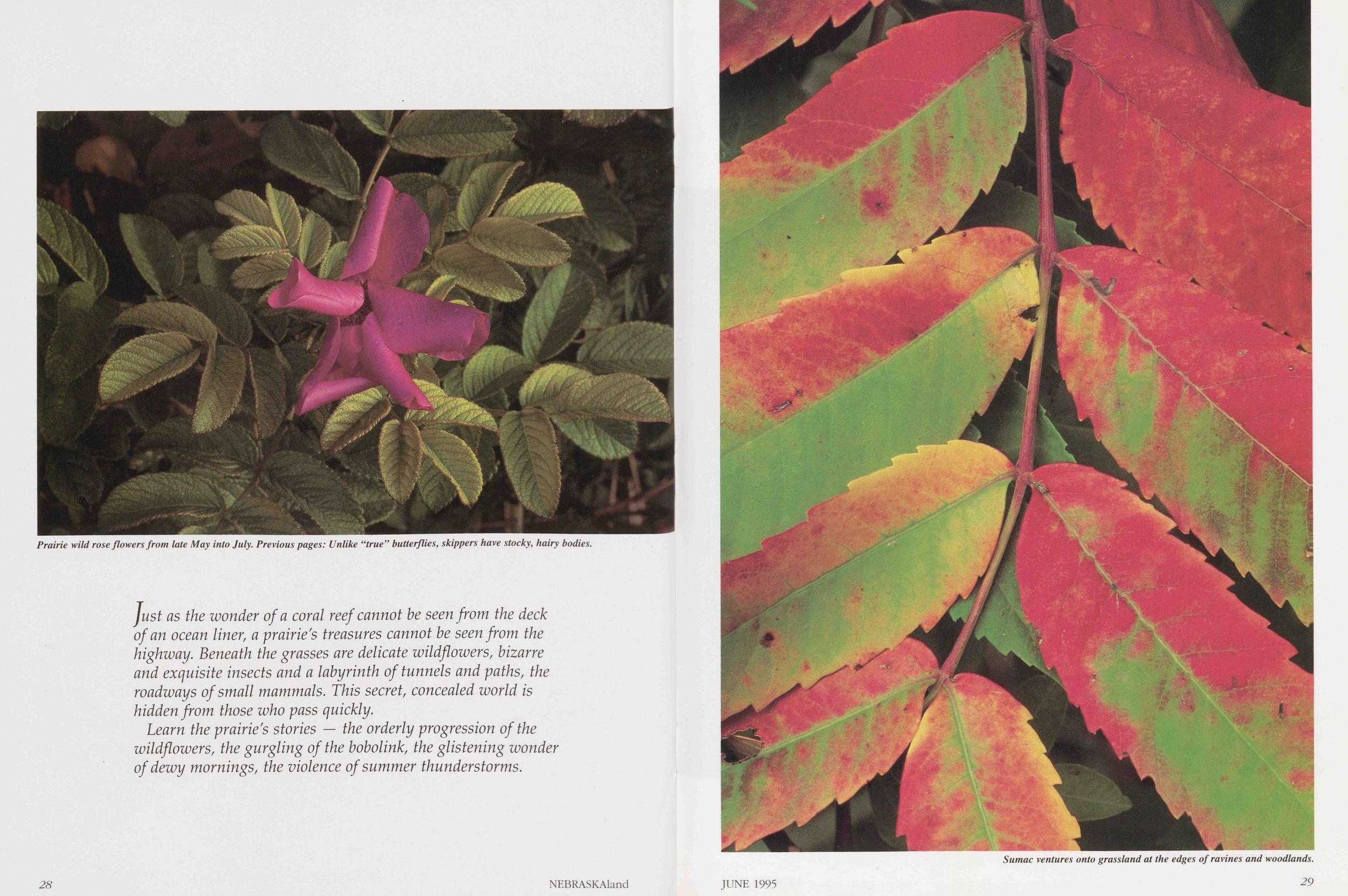
just as the wonder of a coral reef cannot be seen from the deck of an ocean liner, a prairie's treasures cannot be seen from the highway. Beneath the grasses are delicate wildflowers, bizarre and exquisite insects and a labyrinth of tunnels and paths, the roadways of small mammals. This secret, concealed world is hidden from those who pass quickly.
Learn the prairie's stories — the orderly progression of the wildflowers, the gurgling of the bobolink, the glistening wonder of dewy mornings, the violence of summer thunderstorms.
28 NEBRASKAland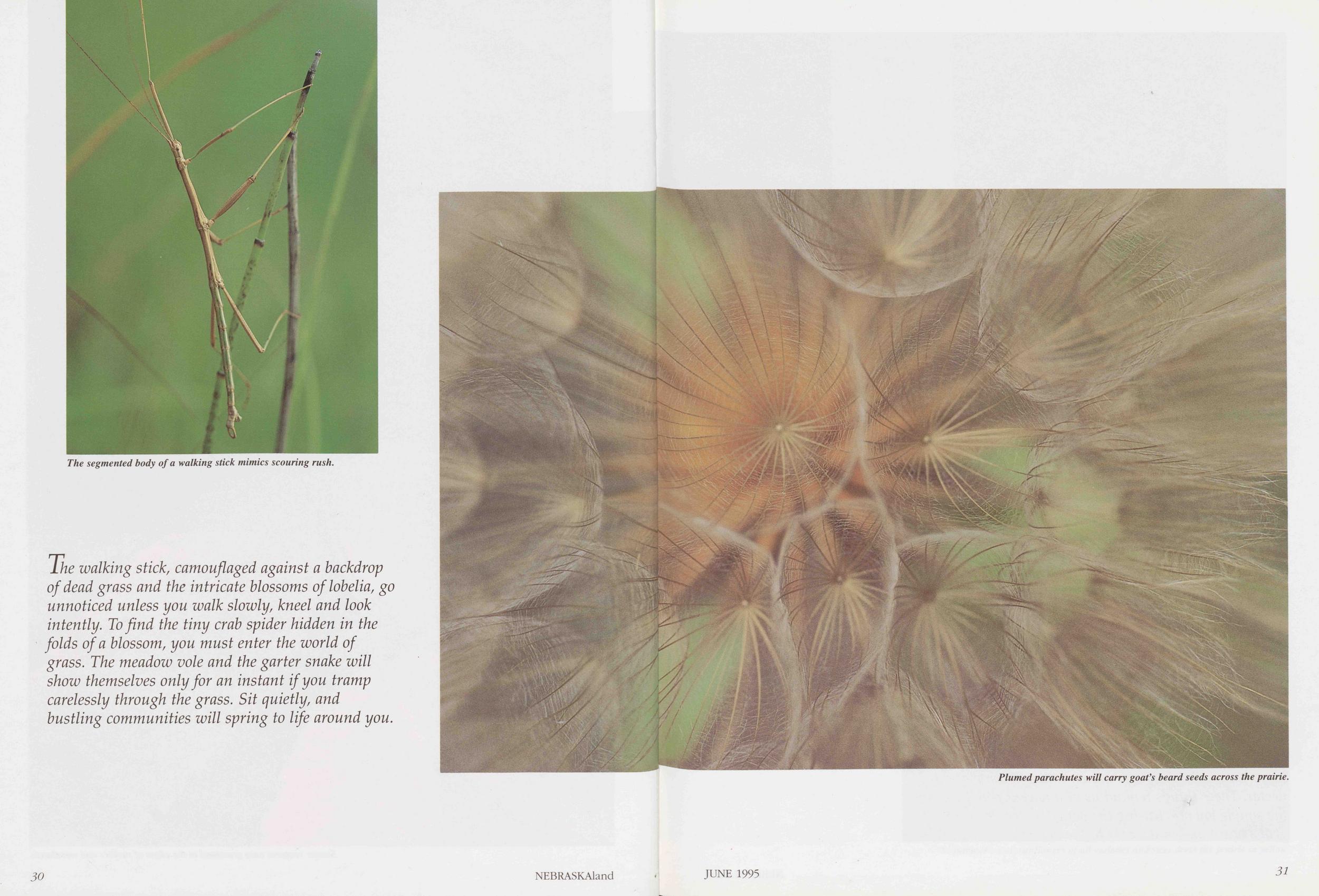
Ihe walking stick, camouflaged against a backdrop of dead grass and the intricate blossoms of lobelia, go unnoticed unless you walk slowly, kneel and look intently. To find the tiny crab spider hidden in the folds of a blossom, you must enter the world of grass. The meadow vole and the garter snake will show themselves only for an instant if you tramp carelessly through the grass. Sit quietly, and bustling communities will spring to life around you.
30 NEBRASKAland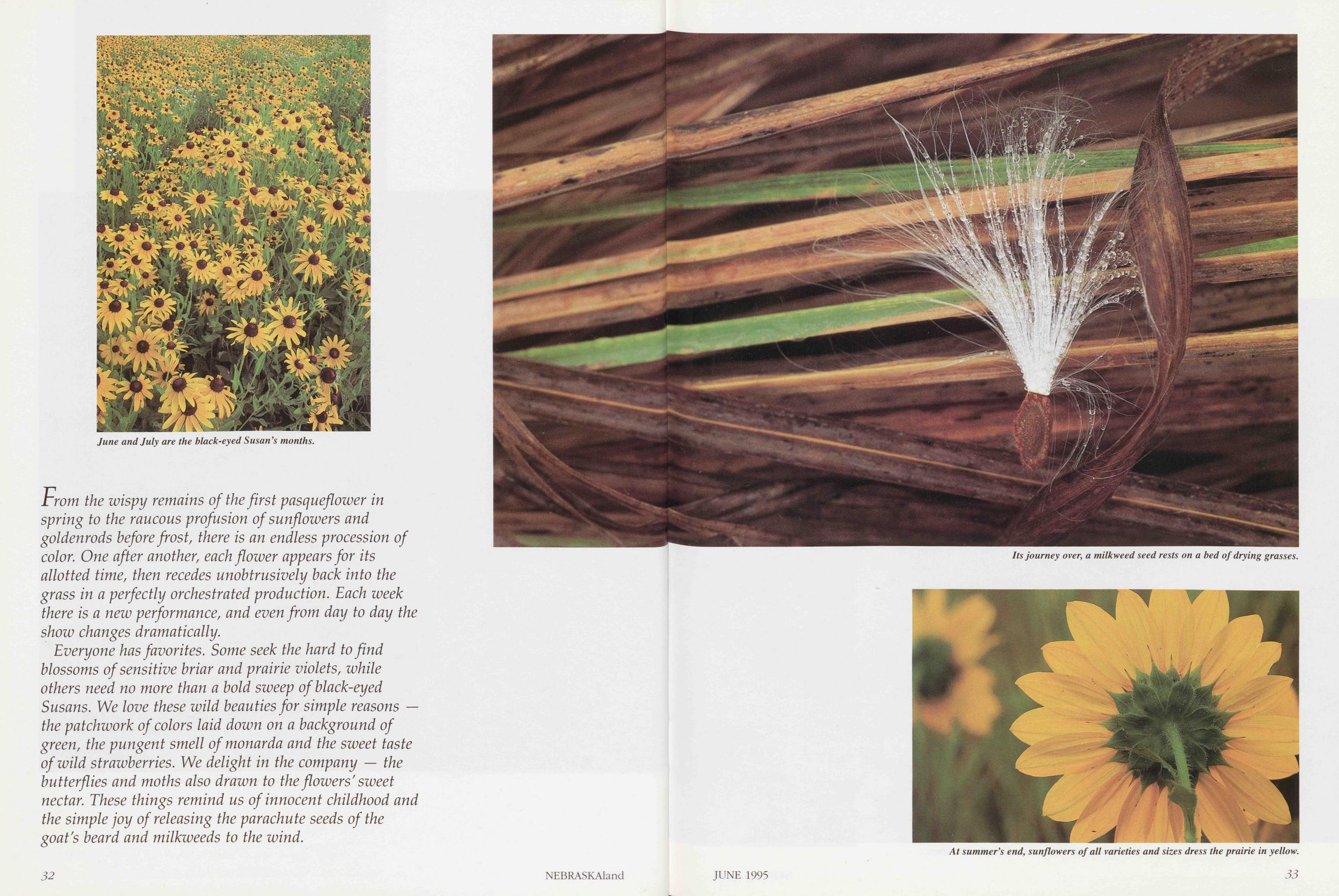
rrom the wispy remains of the first pasqueflower in spring to the raucous profusion of sunflowers and goldenrods before frost, there is an endless procession of color. One after another, each flower appears for its allotted time, then recedes unobtrusively back into the grass in a perfectly orchestrated production. Each week there is a new performance, and even from day to day the show changes dramatically.
Everyone has favorites. Some seek the hard to find blossoms of sensitive briar and prairie violets, while others need no more than a bold sweep of black-eyed Susans. We love these wild beauties for simple reasons the patchwork of colors laid down on a background of green, the pungent smell ofmonarda and the sweet taste of wild strawberries. We delight in the company the butterflies and moths also drawn to the flowers' sweet nectar. These things remind us of innocent childhood and the simple joy of releasing the parachute seeds of the goat's beard and milkweeds to the wind.
32 NEBRASKAland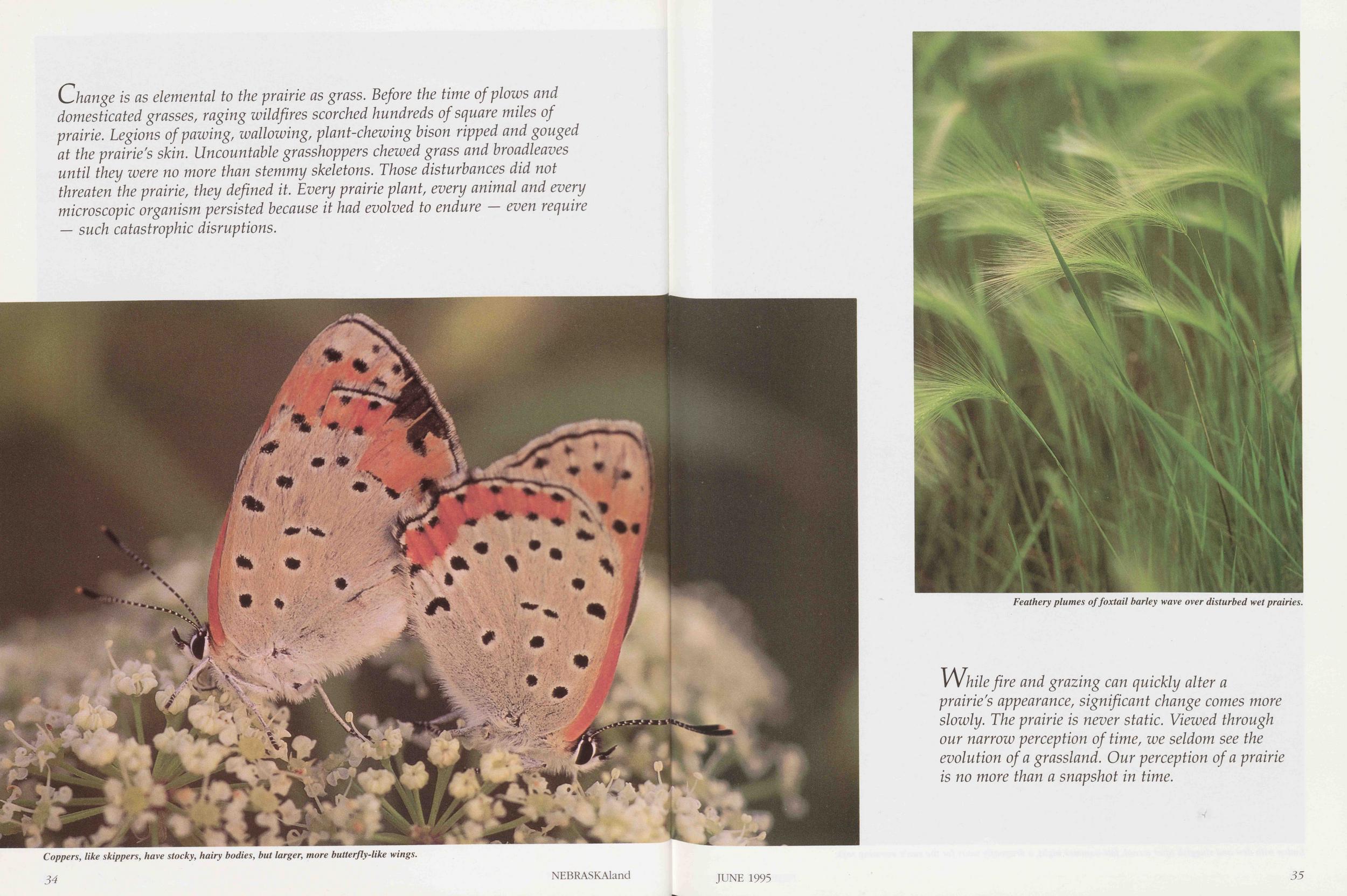
Change is as elemental to the prairie as grass. Before the time of plows and domesticated grasses, raging wildfires scorched hundreds of square miles of prairie. Legions of pawing, wallowing, plant-chewing bison ripped and gouged at the prairie's skin. Uncountable grasshoppers chewed grass and broadleaves until they were no more than stemmy skeletons. Those disturbances did not threaten the prairie, they defined it. Every prairie plant, every animal and every microscopic organism persisted because it had evolved to endure — even require — such catastrophic disruptions.
While fire and grazing can quickly alter a prairie's appearance, significant change comes more slowly. The prairie is never static. Viewed through our narrow perception of time, we seldom see the evolution of a grassland. Our perception of a prairie is no more than a snapshot in time.
JUNE 1995 35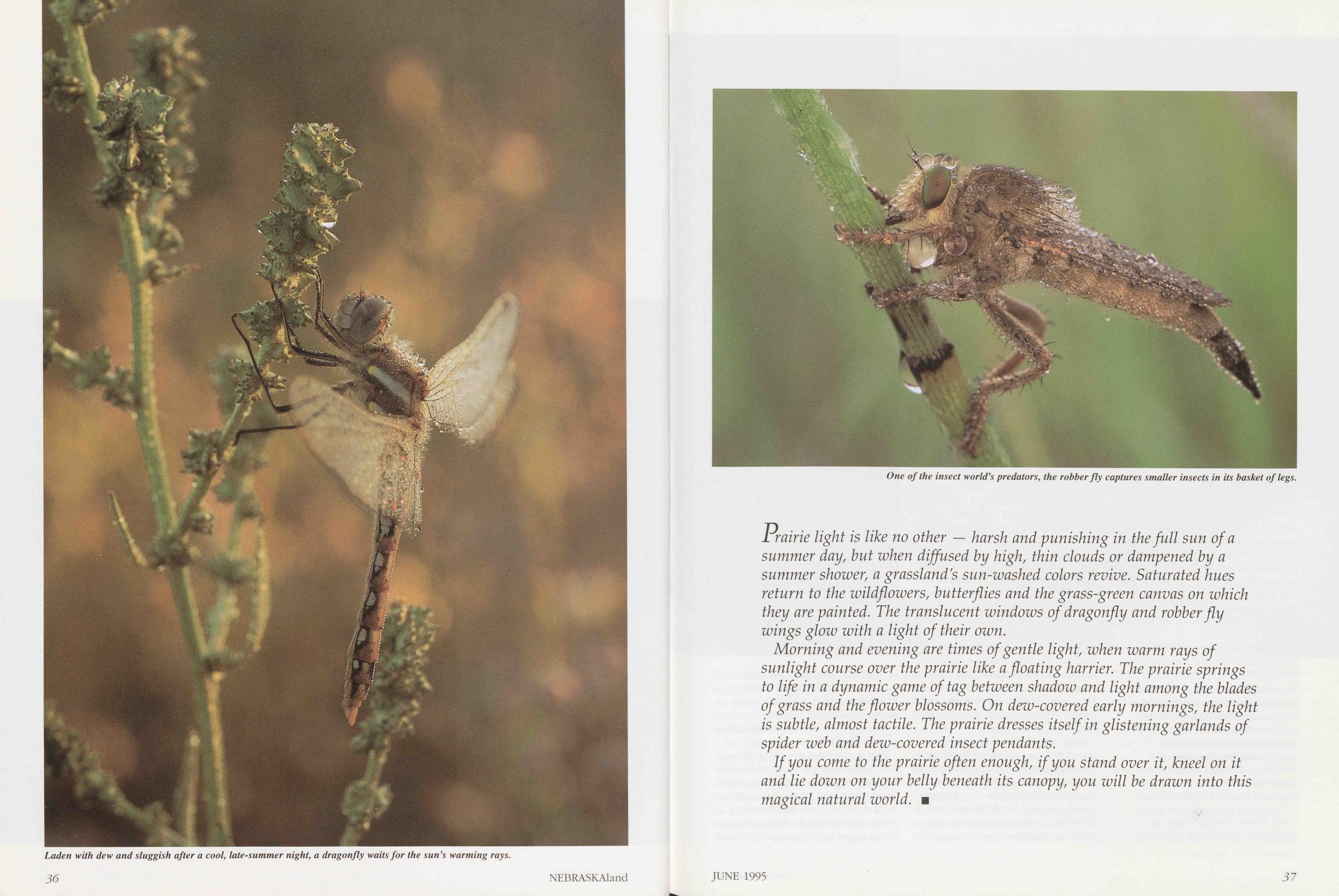
1 rairie light is like no other — harsh and punishing in the full sun of a summer day, but when diffused by high, thin clouds or dampened by a summer shower, a grassland's sun-washed colors revive. Saturated hues return to the wildflowers, butterflies and the grass-green canvas on which they are painted. The translucent windows of dragonfly and robber fly wings glow with a light of their own.
Morning and evening are times of gentle light, when warm rays of sunlight course over the prairie like a floating harrier. The prairie springs to life in a dynamic game of tag between shadow and light among the blades of grass and the flower blossoms. On dew-covered early mornings, the light is subtle, almost tactile. The prairie dresses itself in glistening garlands of spider web and dew-covered insect pendants.
If you come to the prairie often enough, if you stand over it, kneel on it and lie down on your belly beneath its canopy, you will be drawn into this magical natural world.
JUNE 1995 37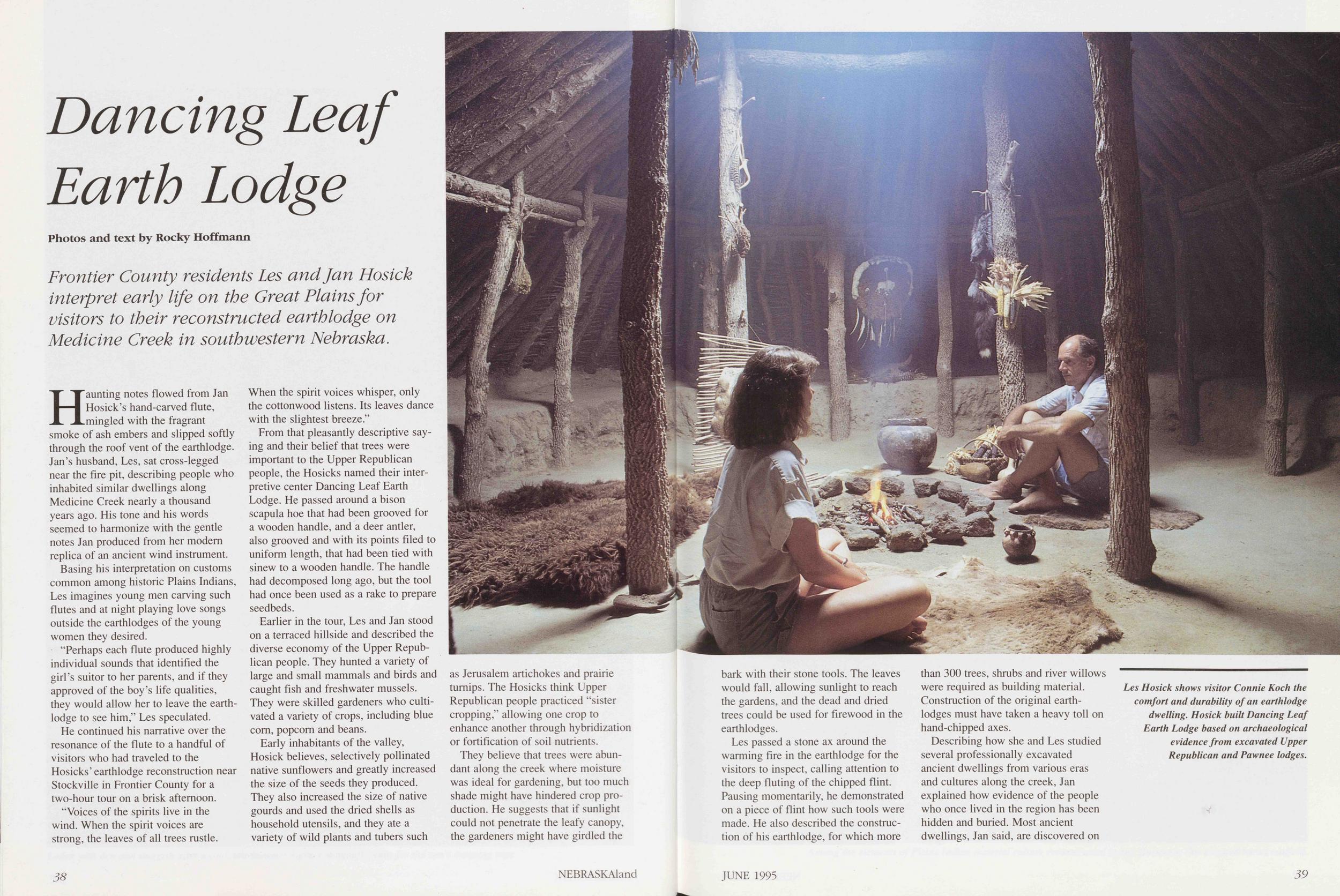
Dancing Leaf Earth Lodge
Photos and text by Rocky Hoffmann Frontier County residents Les and Jan Hosick interpret early life on the Great Plains for visitors to their reconstructed earthlodge on Medicine Creek in southwestern Nebraska.Haunting notes flowed from Jan Hosick's hand-carved flute, mingled with the fragrant smoke of ash embers and slipped softly through the roof vent of the earthlodge. Jan's husband, Les, sat cross-legged near the fire pit, describing people who inhabited similar dwellings along Medicine Creek nearly a thousand years ago. His tone and his words seemed to harmonize with the gentle notes Jan produced from her modern replica of an ancient wind instrument.
Basing his interpretation on customs common among historic Plains Indians, Les imagines young men carving such flutes and at night playing love songs outside the earthlodges of the young women they desired.
"Perhaps each flute produced highly individual sounds that identified the girl's suitor to her parents, and if they approved of the boy's life qualities, they would allow her to leave the earthlodge to see him," Les speculated.
He continued his narrative over the resonance of the flute to a handful of visitors who had traveled to the Hosicks'earthlodge reconstruction near Stockville in Frontier County for a two-hour tour on a brisk afternoon.
'Voices of the spirits live in the wind. When the spirit voices are strong, the leaves of all trees rustle. When the spirit voices whisper, only the cottonwood listens. Its leaves dance with the slightest breeze."
From that pleasantly descriptive saying and their belief that trees were important to the Upper Republican people, the Hosicks named their interpretive center Dancing Leaf Earth Lodge. He passed around a bison scapula hoe that had been grooved for a wooden handle, and a deer antler, also grooved and with its points filed to uniform length, that had been tied with sinew to a wooden handle. The handle had decomposed long ago, but the tool had once been used as a rake to prepare seedbeds.
Earlier in the tour, Les and Jan stood on a terraced hillside and described the diverse economy of the Upper Republican people. They hunted a variety of large and small mammals and birds and caught fish and freshwater mussels. They were skilled gardeners who cultivated a variety of crops, including blue corn, popcorn and beans.
Early inhabitants of the valley, Hosick believes, selectively pollinated native sunflowers and greatly increased the size of the seeds they produced. They also increased the size of native gourds and used the dried shells as household utensils, and they ate a variety of wild plants and tubers such as Jerusalem artichokes and prairie turnips. The Hosicks think Upper Republican people practiced "sister cropping," allowing one crop to enhance another through hybridization or fortification of soil nutrients.
They believe that trees were abundant along the creek where moisture was ideal for gardening, but too much shade might have hindered crop production. He suggests that if sunlight could not penetrate the leafy canopy, the gardeners might have girdled the 38 NEBRASKAland bark with their stone tools. The leaves would fall, allowing sunlight to reach the gardens, and the dead and dried trees could be used for firewood in the earthlodges.
Les passed a stone ax around the warming fire in the earthlodge for the visitors to inspect, calling attention to the deep fluting of the chipped flint. Pausing momentarily, he demonstrated on a piece of flint how such tools were made. He also described the construction of his earthlodge, for which more than 300 trees, shrubs and river willows were required as building material. Construction of the original earthlodges must have taken a heavy toll on hand-chipped axes.
Describing how she and Les studied several professionally excavated ancient dwellings from various eras and cultures along the creek, Jan explained how evidence of the people who once lived in the region has been hidden and buried. Most ancient dwellings, Jan said, are discovered on
 flat areas high above the waterways.
Unlike the European culture that
followed them, Jan says, early people
were too wise to build permanent
homes on floodplains.
flat areas high above the waterways.
Unlike the European culture that
followed them, Jan says, early people
were too wise to build permanent
homes on floodplains.
Jan said that pocket gophers in the area continue to produce evidence of buried dwellings. "As gophers push up mounds of earth from deep underground, they often push up artifacts like chunks of pottery or bone tools. Sometimes the clue is no more than a color change in the earth that may indicate the presence of a prehistoric fire ring," Jan explained.
She described professional excavation as a painstaking and time-consuming process. Taking a metal scraping tool in hand, Jan leaned forward and briefly demonstrated the slow, calculated process archaeologists use to remove soil inch by inch.
"An archaeologist listens to the sound of the scraping tool. When the tool produces a high-pitched note, it is extremely exciting to those who dig. Such a sound may indicate the presence of stone artifacts or even the floor of the lodge, which is harder than the soil that has covered it. If the floor has been discovered, the scrape is expanded until soft dirt that has been discolored by fire is located."
The fire pit marks the center of the lodge, she explained, and the scrape is expanded outward in all directions. Sometimes four black circular blemishes are discovered around the fire pit, where wooden support posts have decomposed. Other features are cache pits where dried garden crops and dried meat were stored, earthen bunks around the lodge perimeter and an entrance. Eventually, a detailed blueprint lies before the archaeologist.
The Hosicks inspected excavated earthlodges in the area for more than 20 years before building their first replica, blending the styles of Upper Republican and historic Pawnee cultures. From clues left by the native architects, they are confident that their reproductions accurately represent features of lodge construction from both cultures. Les describes the structure as an "earthen igloo with an elongated entrance passage." The entry way, he said, works like "a chimney operating in reverse," creating a draft that sends smoke out through the roof hole.
Les produced a long-stemmed pipe of the type often called a peace pipe. "It is my belief that it could be more accurately described as a spiritual pipe," said Les, who interprets the clay bowl as representing Mother Earth, connected to man by the stem. The rising smoke, he says, provided the pathway to the spirits above. Although Les rejects the term peace pipe, he does agree that the Upper Republicans were peaceful people.
"Because many of the lodges were scattered along the creek individually, like farm sites today, they did not fear attack either from within or from distant neighbors. Remember, these were permanent dwellings for year-round living. Earthlodges could not be gathered and communitized like tipis when group protection was necessary. Such a social structure indicates long periods of peace."
Jan believes that large lodges housed extended families of 10 to 12 people. She suggests that dwellings might have been managed by the elder female members of the family. Although archaeologists estimate the life of a lodge to have been about 15 years, she thinks they might have been handed down from mother to daughter.
Hosick's first attempt to build an earthlodge failed because of his choice of wood for the frame. That prototype, on Medicine Creek several miles south of Dancing Leaf Earth Lodge, was built of box elder, which could not support the weight of soil and sod covering the roof and walls.
"I learned a lot from that episode, and have constructed the two lodges at Dancing Leaf from harder, more permanent native trees," he said.
Intertwined river willows span the timbers and support the excavated soil and natural sod that form the roof. The lodges are solid and dry because the native grass growing on the roof and walls use moisture just as if they were 40 NEBRASKAland
Visitors who stay overnight in the earthlodge appreciate the comfort and solid construction of the dwelling. If it rains or snows, occupants stay dry and warm simply by moving to the windward side of the smoke hole.
"Even modern, non-native people from the city can figure that out," Jan joked to the visitors around the fire.
Leaving the comfort of the warm lodge, Les led the group up a hill to a calendar pole. Although there is no evidence of their use among Upper Republican people, some North American Indians used such poles to determine dates by the length and direction of the shadow they cast.
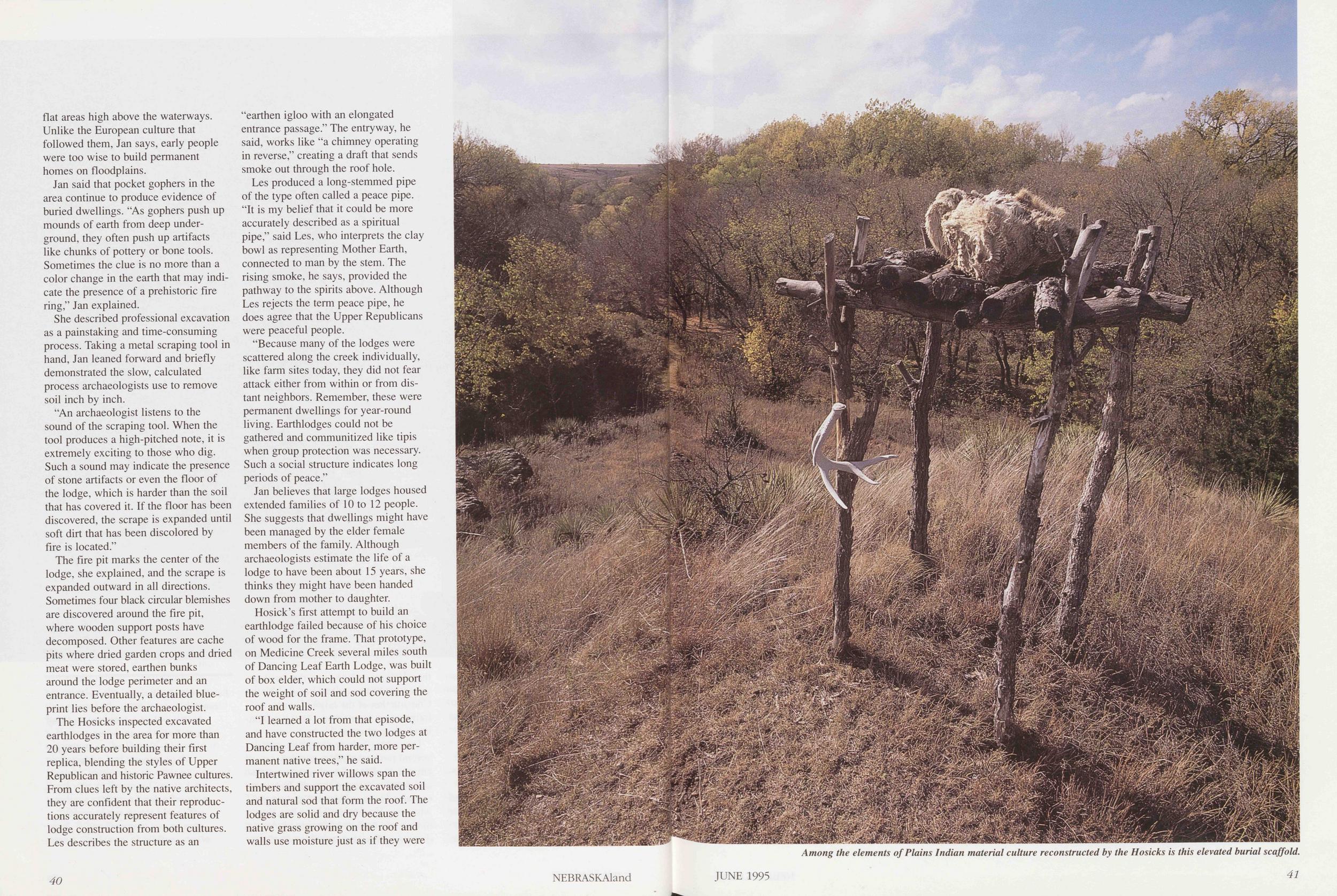
Farther up the slope, the group visited a new earthlodge of cedar construction, and a "grandmother" tree where visitors can offer gifts to the spirits. Also on the hill is an elevated burial scaffold based on those used by historic Plains Indians to help transfer the soul of the deceased directly to the spirits before eventual earth burial.
Pausing at a yucca plant beside the trail, Les reflected on the resourcefulness of early Plains inhabitants.
42 NEBRASKAland"The yucca plant (soap weed) gives its whole self to man. In spring, the blossoms are palatable and so are the nutty seeds. Later these seeds, found in a pod, were used to produce a form of porridge. Stalks were dried for kindling, and the fibrous leaves were shredded and braided for ropes and cords. The roots were used for soap."
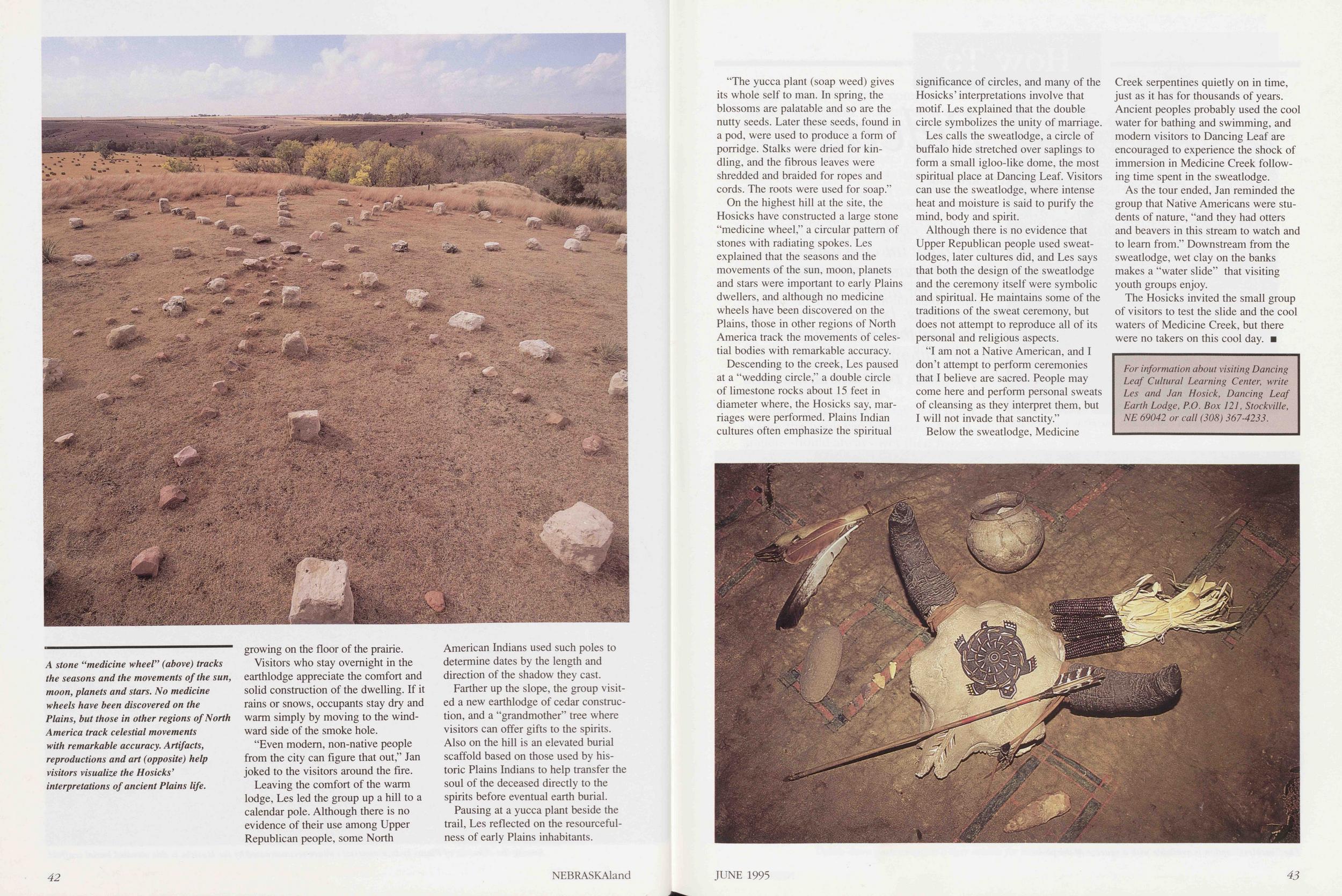
On the highest hill at the site, the Hosicks have constructed a large stone "medicine wheel," a circular pattern of stones with radiating spokes. Les explained that the seasons and the movements of the sun, moon, planets and stars were important to early Plains dwellers, and although no medicine wheels have been discovered on the Plains, those in other regions of North America track the movements of celestial bodies with remarkable accuracy.
Descending to the creek, Les paused at a "wedding circle," a double circle of limestone rocks about 15 feet in diameter where, the Hosicks say, marriages were performed. Plains Indian cultures often emphasize the spiritual significance of circles, and many of the Hosicks'interpretations involve that motif. Les explained that the double circle symbolizes the unity of marriage.
Les calls the sweatlodge, a circle of buffalo hide stretched over saplings to form a small igloo-like dome, the most spiritual place at Dancing Leaf. Visitors can use the sweatlodge, where intense heat and moisture is said to purify the mind, body and spirit.
Although there is no evidence that Upper Republican people used sweatlodges, later cultures did, and Les says that both the design of the sweatlodge and the ceremony itself were symbolic and spiritual. He maintains some of the traditions of the sweat ceremony, but does not attempt to reproduce all of its personal and religious aspects. "I am not a Native American, and I don't attempt to perform ceremonies that I believe are sacred. People may come here and perform personal sweats of cleansing as they interpret them, but I will not invade that sanctity."
Below the sweatlodge, Medicine Creek serpentines quietly on in time, just as it has for thousands of years. Ancient peoples probably used the cool water for bathing and swimming, and modern visitors to Dancing Leaf are encouraged to experience the shock of immersion in Medicine Creek following time spent in the sweatlodge.
As the tour ended, Jan reminded the group that Native Americans were students of nature, "and they had otters and beavers in this stream to watch and to learn from." Downstream from the sweatlodge, wet clay on the banks makes a "water slide" that visiting youth groups enjoy.
The Hosicks invited the small group of visitors to test the slide and the cool waters of Medicine Creek, but there were no takers on this cool day.
For information about visiting Dancing Leaf Cultural Learning Center, write Les and Jan Hosick, Dancing Leaf Earth Lodge, P.O. Box 121, Stockville, NE 69042 or call (308) 367-4233.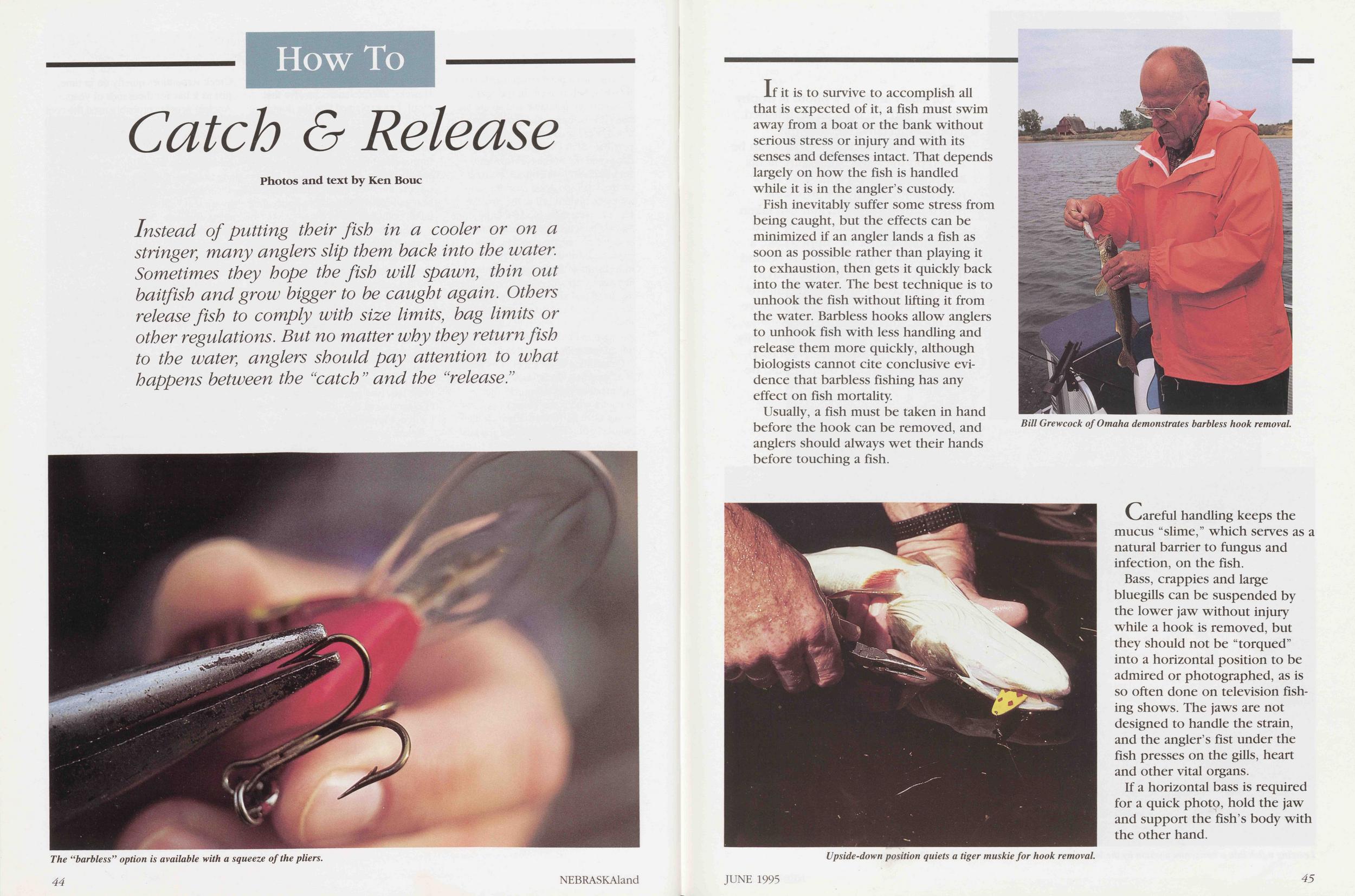
How To Ca tch & Release
Photos and text by Ken Bouc Instead of putting their fish in a cooler or on a stringer, many anglers slip them back into the water. Sometimes they hope the fish will spawn, thin out baitfish and grow bigger to be caught again. Others release fish to comply with size limits, bag limits or other regulations. But no matter why they return fish to the water, anglers should pay attention to what happens between the Patch " and the "release!"If it is to survive to accomplish all that is expected of it, a fish must swim away from a boat or the bank without serious stress or injury and with its senses and defenses intact. That depends largely on how the fish is handled while it is in the angler's custody.
Fish inevitably suffer some stress from being caught, but the effects can be minimized if an angler lands a fish as soon as possible rather than playing it to exhaustion, then gets it quickly back into the water. The best technique is to unhook the fish without lifting it from the water. Barbless hooks allow anglers to unhook fish with less handling and release them more quickly, although biologists cannot cite conclusive evidence that barbless fishing has any effect on fish mortality.
Usually, a fish must be taken in hand before the hook can be removed, and anglers should always wet their hands before touching a fish.
v^areful handling keeps the mucus "slime," which serves as a natural barrier to fungus and infection, on the fish.
Bass, crappies and large bluegills can be suspended by the lower jaw without injury while a hook is removed, but they should not be "torqued" into a horizontal position to be admired or photographed, as is so often done on television fishing shows. The jaws are not designed to handle the strain, and the angler's fist under the fish presses on the gills, heart and other vital organs.
If a horizontal bass is required for a quick photo, hold the jaw and support the fish's body with the other hand.
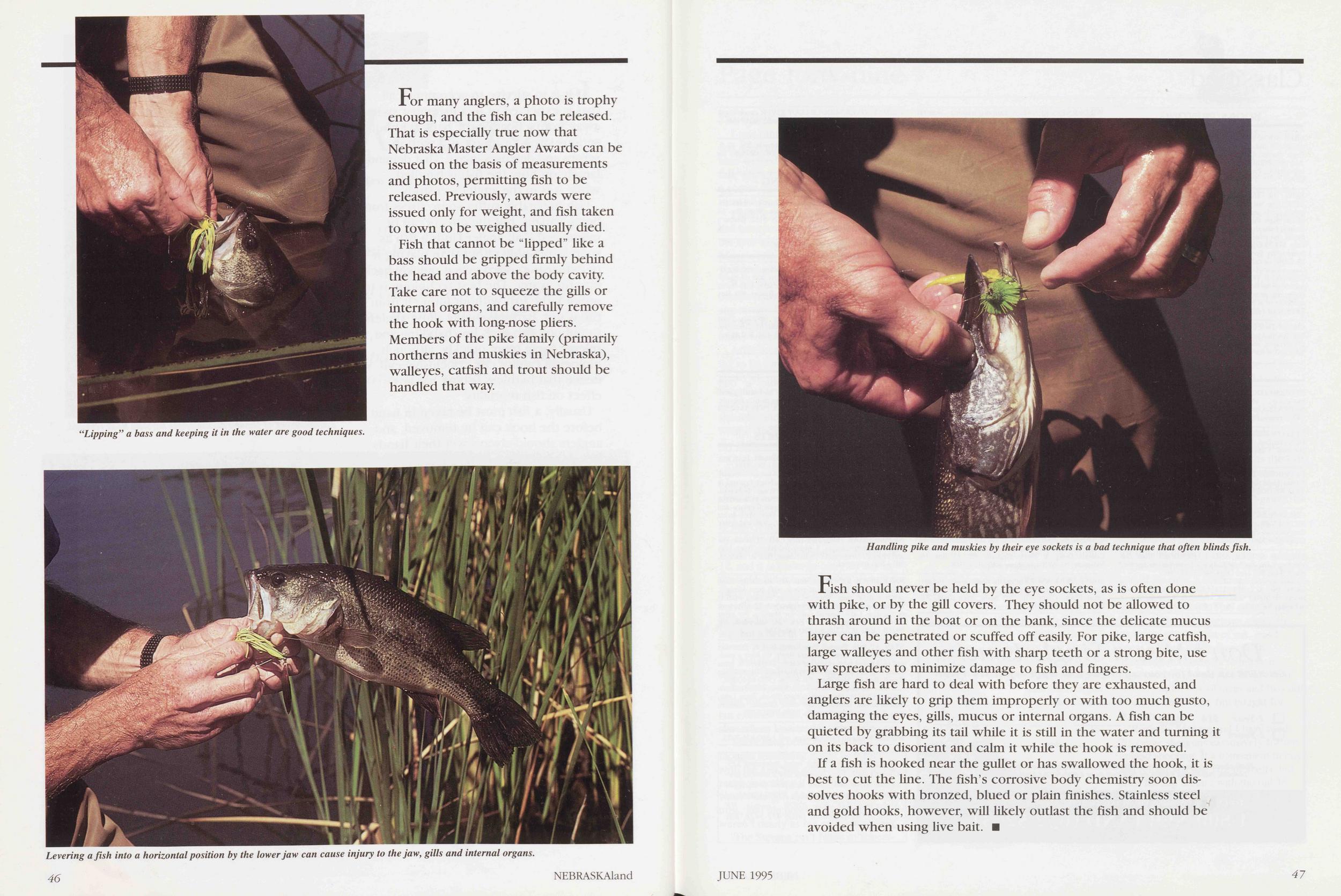
many anglers, a photo is trophy enough, and the fish can be released. That is especially true now that Nebraska Master Angler Awards can be issued on the basis of measurements and photos, permitting fish to be released. Previously, awards were issued only for weight, and fish taken to town to be weighed usually died.
Fish that cannot be "lipped" like a bass should be gripped firmly behind the head and above the body cavity. Take care not to squeeze the gills or internal organs, and carefully remove the hook with long-nose pliers. Members of the pike family (primarily northerns and muskies in Nebraska), walleyes, catfish and trout should be handled that way.
-Tish should never be held by the eye sockets, as is often done with pike, or by the gill covers. They should not be allowed to thrash around in the boat or on the bank, since the delicate mucus layer can be penetrated or scuffed off easily For pike, large catfish, large walleyes and other fish with sharp teeth or a strong bite, use jaw spreaders to minimize damage to fish and fingers.
Large fish are hard to deal with before they are exhausted, and anglers are likely to grip them improperly or with too much gusto, damaging the eyes, gills, mucus or internal organs. A fish can be quieted by grabbing its tail while it is still in the water and turning it on its back to disorient and calm it while the hook is removed.
If a fish is hooked near the gullet or has swallowed the hook, it is best to cut the line. The fish's corrosive body chemistry soon dissolves hooks with bronzed, blued or plain finishes. Stainless steel and gold hooks, however, will likely outlast the fish and should be avoided when using live bait.
JUNE 1995 47
Classified
BOOKS/PRINTINGFREE BOOK CATALOG. Novels, westerns, romances, children's; old out of print, found barns, attic. Authors: Grey, Bower, Connor, Fox, Curwood, Raine, Wright, Aldrige, Pollyanna, Freckles, many others. Postage appreciated. Pierce, 4400 N. Pine Cluster, Oroville, CA 95965.
HOW TO FIND MORE OUTDOOR OPPORTUNI- TIES!! The Nebraska Sportsman's Atlas. Locations of all public lands and waters on county transportation maps. These maps show ALL the roads in Nebraska. Listings include federal, Nebraska Game & Parks, NRD holdings, hotels and motels and Nebraska's endless attractions. At only $18.75/copy a true time and frustration saver. To order write: Sportsman's Atlas Co., PO Box 132, Lytton, IA 50561 or call 1-800-568-8334.
DISCOVER The Western Pocket, an unusual quarterly journal of the West, its people, humor and history. A welcome outpost where folk wisdom and contemporary perspectives sit at the same table. One-year: $12.95, Singles: $3.95. Call 1-800-259-WEST.
GREAT PRICES on great books! Special issues from NEBRASKAland Magazine — woodlands, wildflowers, photography, recipes and history. Lowest prices ever. For titles and order information, call 1-800-632-5263.
DOGSENGLISH COCKER pups, imported stock, British FTC bloodlines. Many colors available. Featured in NEBRASKAland November 1991. Sawtooth Oaks, Box 443, Orleans, NE 68966. Phone 308-473-5265.
YELLOW-BLACK Lab pups. FC-AFC sired. AKC. Hips OFA certified. Dew claws removed. Excellent hunting potential. Contact Bob Bendler, Lexington, NE. (308) 324-4247.
RETRIEVER TRAINING. Area's top "retrievers only" trainer. Field trial and hunting dogs. Non-slip duck dogs! TKO RETRIEVER TRAINING KENNEL (402) 623- 4311.
CHESAPEAKE BAY, LABRADOR and GOLDEN RETRIEVER pups, started dogs and stud service. 16 time national champion pedigre. Platte Valley Retrievers (308)995-2318.
ENGLISH SETTER AND LABRADORS from outstanding lines. Bred for hunters who appreciate fine bird dogs! Wind Fall Gun Dogs, (402) 421-4693.
TRAINING ALL BREEDS bird dogs — Vizslas for sale. Home of Rebel Rousers. Rozanek Kennels, RR 2, Schuyler, NE 68661. Phone (402) 352-8769.
WILDERNESS KENNELS. Gun dog training - over 60 years combined experience. Training all sporting breeds — Retrievers. Flushing and pointing dogs. All dogs worked on pen raised birds and wild game. Training program includes obedience training — heel, sit, stay, down and come when called. Pups, started dogs and fully trained dogs for sale. HUNTING DOGS TRAINED BY HUNTERS. Henry Sader. Wilderness Kennels, (402) 423-4212. Since 1968.
FISH/FISHINGFISH FOR SALE. Catfish, largemouth bass, smallmouth bass, perch, crappie, bluegill, walleye, northern pike, rainbow trout, Donaldson rainbow trout, grass carp, minnows, bullheads. Consulting available. Pleasant Valley Fish Farm, RR 1, Box 147, McCook, NE 69001. Phone (308) 345-6599.
WILLOW LAKE FISH HATCHERY. Channel cat, bluegill, hybrid bluegill, largemouth bass, crappie, triploid grass carp, walleye, perch, minnows available for stocking. Gaylord Crawford, RR 3, Box 46, Hastings, NE 68901 or phone (402) 463-8022 day or night. Also pond consultant. We del, grower price.
DISMAL RIVER/MIDDLE LOUP RIVER canoe/kayak trips. Powderhorn Outfitters — Thedford, NE 69166 l-800-Disma!6.
FOODNEBRASKA BASKETS: The original Nebraska company specializing in fine foods from Nebraska. A beautiful array of baskets filled with ethnic, healthful and longtime favorite foods. Call or write for our brochure: P.O. Box 98, McCook, NE 69001. 1-800-345-7725.
HOMEBREWING/BEER & WINEMAKING — New 1995 catalogue. Fermenter's Supply, 8410 K Plz. #10, Omaha, NE 68127. (402) 593-9171. Mail order welcome.
GUIDES/OUTFITTERSCANOE THE NIOBRARA with an affordable canoe trip by Dryland Aquatics. One and two-day tripsfull service, or just canoes and tubes. Transportation furnished. Your Niobrara River specialists We do it your way! Dryland Aquatics, Dept. N, Box 33C, Sparks, NE 69220 or phone (800) 337-3119.
GRAHAM CANOE OUTFITTERS: Top quality full-service camping and canoe trips on the Niobrara River. Daily canoe rentals and car shuttle-service available. Contact Doug & Twyla Graham, HC 13 Box 16, Valentine, NE 69201 or phone (402) 376-3708.
MAD RIVER CANOES offers the finest quality and performance. For the finest canoes and accessories look to Great Plains Canoe Co., 205 Main, Springfield, NE. Phone (402) 253-2001.
Don't Miss a Single Issue! Get NEBRASKAland for yourself or give it as a gift —just $14 a year! Name 1-Year $14 2-Years $27 Address City State Zip Mail check or money order to NEBRASKAland Magazine P.O. Box 30370, Lincoln, Nebraska 68503 or call ToU Free 1-800-NEB-LAND (632-5263) To Order by Visa or MasterCard, phone toll free 1-800-NEB-LAND (632-5263)CANOE RENTALS: Kamp Kaleo, Burwell, NE. 17 ft. aluminum canoes, $15 per day. Call (308) 346-5083 for information and reservations.
GUNS/SHOOTINGGUNS — Browning, Winchester, Remington, others. Hi-powers, shotguns, new, used, antiques. Want Pre-'64 Winchesters. Buy-Sell-Trade. (402) 729-6112. Bedlan's Sporting Goods, Fairbury, NE 68352.
REAL ESTATEFOR SALE: One of Nebraska's top fishing-recreationalhunting resorts with home, cabins, store and all equipment needed goes. Set on very large lake. Call Swett Realty, (402) 387-1626, Fred Swett, Broker, PO Box 265, Ainsworth, NE 69210.
LAKE McCONAUGHY development for sale. Class development property on beautiful Lake McConaughy, NE. 140 lots on the lake for $297,000. Call Bill Hines, (308)284-6701.
TAXIDERMYALLISON'S TAXIDERMY STUDIO & GIFT GALLERY. Specializing in fish, birds and small game. Mounted 35 State Record Fish. Pheasant mounts for sale. 421 N. Dewey, North Platte, NE 69101. (308) 534-2324 or (308) 534-4267.
VACATION/RESORTSFOR FISHING and hunting accommodations. Jefco Inn, Gordon, NE 69343. South Cornell, (308) 282-2935.
BED & BREAKFAST. Historic 1890's hotel. Located in the beautiful Pine Ridge area of Northwest Nebraska. Short drive to Chadron State Park, Fort Robinson and the Black Hills. Beautiful dining room with fireplace and fountain. Room service available. The Olde Main Street Inn, 115 Main St., Chadron, NE 69337. (308) 432-3380.
NE NEBRASKA TROUT FISHING. Mon-Thurs or Fri-Sun. 3 modern cottages, 5 spring-fed lakes. Trout, bass and bluegill. Diamond E. Trout Resort, Box B, Orchard, NE 1-800-658-3244.
EASY HOUR RESORT. Cabin with electricity along Calamus River. Four private ponds with bass, bluegill, perch, crappie, trout. Water recreation, resident wildlife in relaxed setting. Release hunts arranged. 22 miles west of Calamus Lake. Special rates for families. For more info: Dale Phillipps, HC 65 Box 324, Ainsworth, NE 69210. (402) 387-1719 or (308) 346-4244.
STAY AT THE Twisted Pine Ranch Bed & Breakfast overlooking the scenic Niobrara River. We have a modern bunkhouse or a rustic log cabin. Great view, great food. Contact: Ken and Sharon Moreland, Twisted Pine Ranch, Box 84, Merriman, NE 69218. (308) 684-3482.
FISH CANADA. Very, very remote fly-in. Tazin Lake, Saskatchewan. Excellent lake trout, fantastic northern pike. Moose and bear hunting. 1-800-9TROUT9.
NEBRASKA STATE PARK vacations. For a free color brochure listing all park facilities, call 1-800-826-7275.
Classified rates: 75( per word, minimum $15. Closing date: First business day 2 months preceding issue date. Ads accepted first-come-first-served, space-available. NEBRASKAland Magazine, P.O. Box 30370, Lincoln, NE 68503-0370. Telephone (402) 471-5478. Fax (402)471-5528. 48 NEBRASKAlandPage forty-nine
The Old 16-GaugeI was rummaging around the other day, searching for a box of size-14 blue-winged olive dry flies I tied last fall, when I found a shotgun leaning in a corner of the closet behind an assortment of fly rod cases.
I didn't "find" it in the sense that it had been lost, I just stumbled across the spot where I'd hastily put it when Maggie and I moved to the acreage a year and a half ago.
It's a Stevens model 311, 16-gauge double-barrel, not an expensive gun by any means, but a dependable firearm that I've found to be suitable for most of the wingshooting I do.
After breaking the gun open, checking to be sure it was unloaded and gently closing the action, I mounted the gun a few times because I like the way it swings smoothly up to my shoulder and the feel of the polished walnut stock against my cheek. Of all my shotguns, I like the way this one swings the best. Its length and balance allow an easy motion that settles the butt of the gun in position against my shoulder every time I mount it.
Though it is a double, the 16 is fairly light compared to the 12-gauge side-by-side in the gun cabinet. Its lighter weight means it swings faster than the 12, and it is easier to carry all day in the field, but it is still heavy enough to absorb some recoil when I shoot. The barrels are choked modified and full, a little tight for short-range quail shooting, but a decent combination for doves, pheasants and decoying ducks.
I bought it more than 30 years ago, and I've seen a lot of upland birds and waterfowl over its front bead. Many of them fell — and many more didn't but excuses aside, the 16-gauge always shot where I pointed it.
There have been times when I thought something might be wrong with the gun, but a few minutes at the range patterning it convinced me it wasn't the gun that was causing me to miss, and the holes in the shot pattern weren't nearly as big as I'd imagined.
The Stevens isn't fancy in appearance, but I like its lines and proportions. There is no delicate scrollwork, no hunting dogs or game birds etched in the metal, no gold triggers or ventilated rib. This is a working shotgun. It does a good job in the field and blind, and I'm not afraid to take it where it might get dirty or scratched. In fact, it has been used hard enough that I've had to refinish the stock a few times over the years.
Rubbing my hands over the stock brought back a flood of memories of hunting trips shared with relatives and friends, some now gone. I remembered the time spent reloading and hunting with my son Jim and the dogs who made our hunting trips that much more enjoyable.
The 16 is the gun Jim used when I taught him to shoot, and he grew up carrying it. He shot his first rabbit, quail, pheasant, dove and duck with that gun, and I was with him for all those events.
We spent endless hours at the heavy wooden workbench reloading shells with Lee hand tools, re-priming each used case, carefully measuring powder and shot and inserting fiber wads by hand and carefully seating them before forming the crimp. A drop of candle wax sealed the crimp and prevented shot from escaping into the box. We shot bluerocks and hunted a lot then, and reloading was a midweek ritual. There is no doubt that more reloads than factory loads have been fired through that shotgun. The old shotgun has been exposed to heat and rain, snow and freezing temperatures and even a thorough soaking in icy water before dawn one December morning when I stepped into a deep hole while wading to a duck blind hidden on a sandbar in the Platte River.
The worn checkering on the foregrip makes me wonder how many pounds of lead have been fired though this gun, how much Hoppe's No. 9 I've used to clean the barrels and how much oil I've rubbed into its stock.
Though you don't hear much about the 16-gauge shotgun these days, there was a time when it was the perfect choice for most upland bird hunters. In those days the light-weight, softerkicking 20-gauge was considered the ideal shotgun for women and young hunters, while "serious" waterfowlers favored the more powerful 12-gauge. The 16's popularity declined when 20-gauge, 3-inch magnum loads became available, giving a shooter about the same performance as the 16-gauge, but in a lighter firearm.
When Jim was using the 16,1 got tired of lugging my heavy 12-gauge double-barrel around, so I bought a little Italian-made, 20-gauge side-by-side and got into the habit of using it for upland birds.
Later, when Jim finally bought a gun of his own, I continued using the 20, and the 16 was put on the rack, unofficially retired. This spring, after handling the old 16-gauge again, my curiosity got the best of me, and I spent an hour going through the ammunition cabinet. I found four boxes of 16s — one box of size four shot, a partial box of sixes and two full boxes of eights that Jim bought for dove shooting.
Recently Maggie and I have used 20-gauge shotguns exclusively for our upland shooting. It's convenient to buy and reload just one size of shells, but after fooling around with the old 16 the other night, I think I'll take it hunting again this year. It's an old friend and it has been with me a long time.
Tom Keith JUNE 1995 49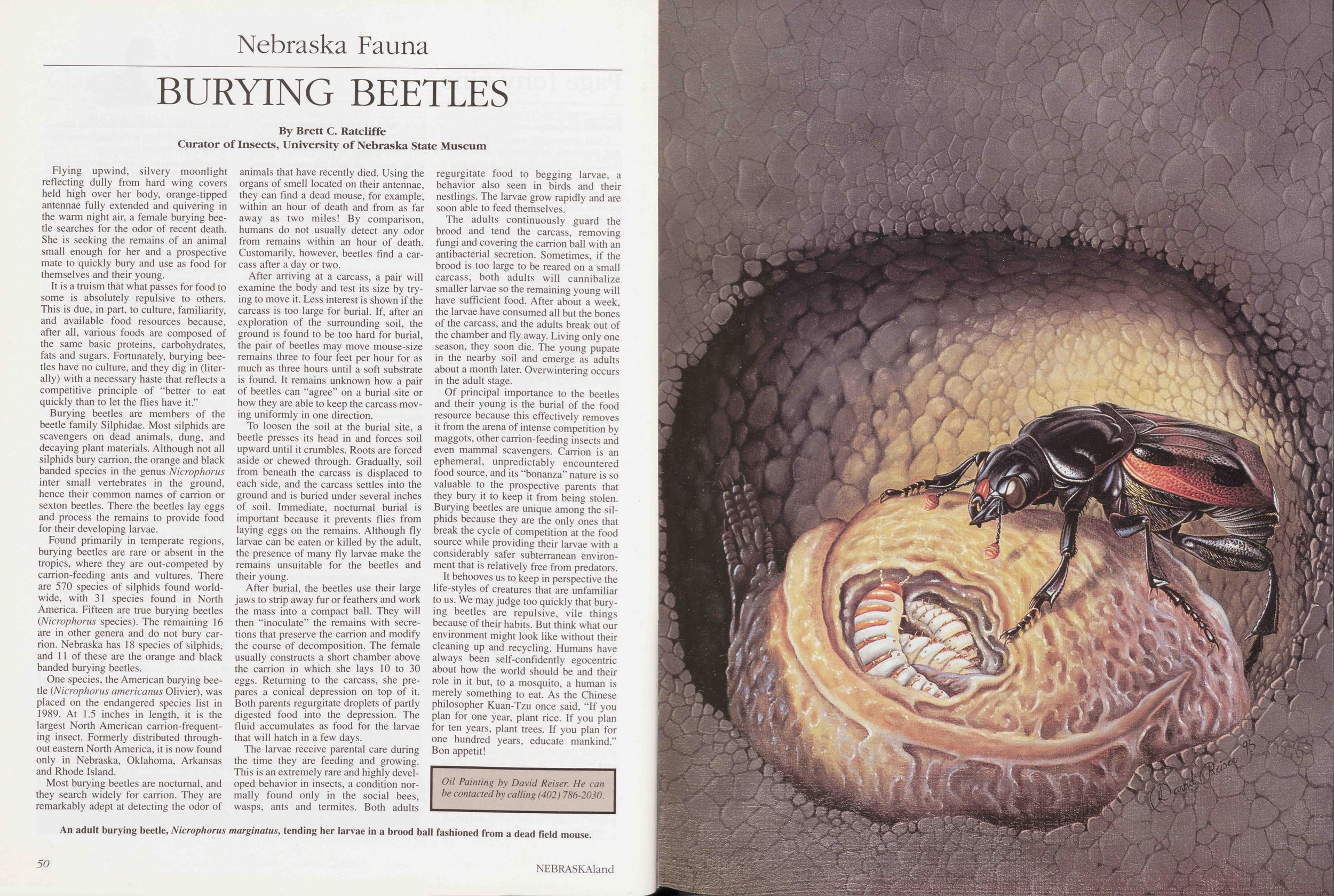
Nebraska Fauna
BURYING BEETLES
By Brett C. Ratcliffe Curator of Insects, University of Nebraska State MuseumFlying upwind, silvery moonlight reflecting dully from hard wing covers held high over her body, orange-tipped antennae fully extended and quivering in the warm night air, a female burying beetle searches for the odor of recent death. She is seeking the remains of an animal small enough for her and a prospective mate to quickly bury and use as food for themselves and their young.
It is a truism that what passes for food to some is absolutely repulsive to others. This is due, in part, to culture, familiarity, and available food resources because, after all, various foods are composed of the same basic proteins, carbohydrates, fats and sugars. Fortunately, burying beetles have no culture, and they dig in (literally) with a necessary haste that reflects a competitive principle of "better to eat quickly than to let the flies have it."
Burying beetles are members of the beetle family Silphidae. Most silphids are scavengers on dead animals, dung, and decaying plant materials. Although not all silphids bury carrion, the orange and black banded species in the genus Nicrophorus inter small vertebrates in the ground, hence their common names of carrion or sexton beetles. There the beetles lay eggs and process the remains to provide food for their developing larvae.
Found primarily in temperate regions, burying beetles are rare or absent in the tropics, where they are out-competed by carrion-feeding ants and vultures. There are 570 species of silphids found worldwide, with 31 species found in North America. Fifteen are true burying beetles {Nicrophorus species). The remaining 16 are in other genera and do not bury carrion. Nebraska has 18 species of silphids, and 11 of these are the orange and black banded burying beetles.
One species, the American burying beetle {Nicrophorus americanus Olivier), was placed on the endangered species list in 1989. At 1.5 inches in length, it is the largest North American carrion-frequenting insect. Formerly distributed throughout eastern North America, it is now found only in Nebraska, Oklahoma, Arkansas and Rhode Island.
Most burying beetles are nocturnal, and they search widely for carrion. They are remarkably adept at detecting the odor of animals that have recently died. Using the organs of smell located on their antennae, they can find a dead mouse, for example, within an hour of death and from as far away as two miles! By comparison, humans do not usually detect any odor from remains within an hour of death. Customarily, however, beetles find a carcass after a day or two.
After arriving at a carcass, a pair will examine the body and test its size by trying to move it. Less interest is shown if the carcass is too large for burial. If, after an exploration of the surrounding soil, the ground is found to be too hard for burial, the pair of beetles may move mouse-size remains three to four feet per hour for as much as three hours until a soft substrate is found. It remains unknown how a pair of beetles can "agree" on a burial site or how they are able to keep the carcass moving uniformly in one direction.
To loosen the soil at the burial site, a beetle presses its head in and forces soil upward until it crumbles. Roots are forced aside or chewed through. Gradually, soil from beneath the carcass is displaced to each side, and the carcass settles into the ground and is buried under several inches of soil. Immediate, nocturnal burial is important because it prevents flies from laying eggs on the remains. Although fly larvae can be eaten or killed by the adult, the presence of many fly larvae make the remains unsuitable for the beetles and their young.
After burial, the beetles use their large jaws to strip away fur or feathers and work the mass into a compact ball. They will then "inoculate" the remains with secretions that preserve the carrion and modify the course of decomposition. The female usually constructs a short chamber above the carrion in which she lays 10 to 30 eggs. Returning to the carcass, she prepares a conical depression on top of it. Both parents regurgitate droplets of partly digested food into the depression. The fluid accumulates as food for the larvae that will hatch in a few days.
The larvae receive parental care during the time they are feeding and growing. This is an extremely rare and highly developed behavior in insects, a condition normally found only in the social bees, wasps, ants and termites. Both adults regurgitate food to begging larvae, a behavior also seen in birds and their nestlings. The larvae grow rapidly and are soon able to feed themselves.
The adults continuously guard the brood and tend the carcass, removing fungi and covering the carrion ball with an antibacterial secretion. Sometimes, if the brood is too large to be reared on a small carcass, both adults will cannibalize smaller larvae so the remaining young will have sufficient food. After about a week, the larvae have consumed all but the bones of the carcass, and the adults break out of the chamber and fly away. Living only one season, they soon die. The young pupate in the nearby soil and emerge as adults about a month later. Overwintering occurs in the adult stage.
Of principal importance to the beetles and their young is the burial of the food resource because this effectively removes it from the arena of intense competition by maggots, other carrion-feeding insects and even mammal scavengers. Carrion is an ephemeral, unpredictably encountered food source, and its "bonanza" nature is so valuable to the prospective parents that they bury it to keep it from being stolen. Burying beetles are unique among the silphids because they are the only ones that break the cycle of competition at the food source while providing their larvae with a considerably safer subterranean environment that is relatively free from predators.
It behooves us to keep in perspective the life-styles of creatures that are unfamiliar to us. We may judge too quickly that burying beetles are repulsive, vile things because of their habits. But think what our environment might look like without their cleaning up and recycling. Humans have always been self-confidently egocentric about how the world should be and their role in it but, to a mosquito, a human is merely something to eat. As the Chinese philosopher Kuan-Tzu once said, "If you plan for one year, plant rice. If you plan for ten years, plant trees. If you plan for one hundred years, educate mankind." Bon appetit!
50 NEBRASKAland
Position: 584 (19 views)