Volume 73, Issue 4, 1995
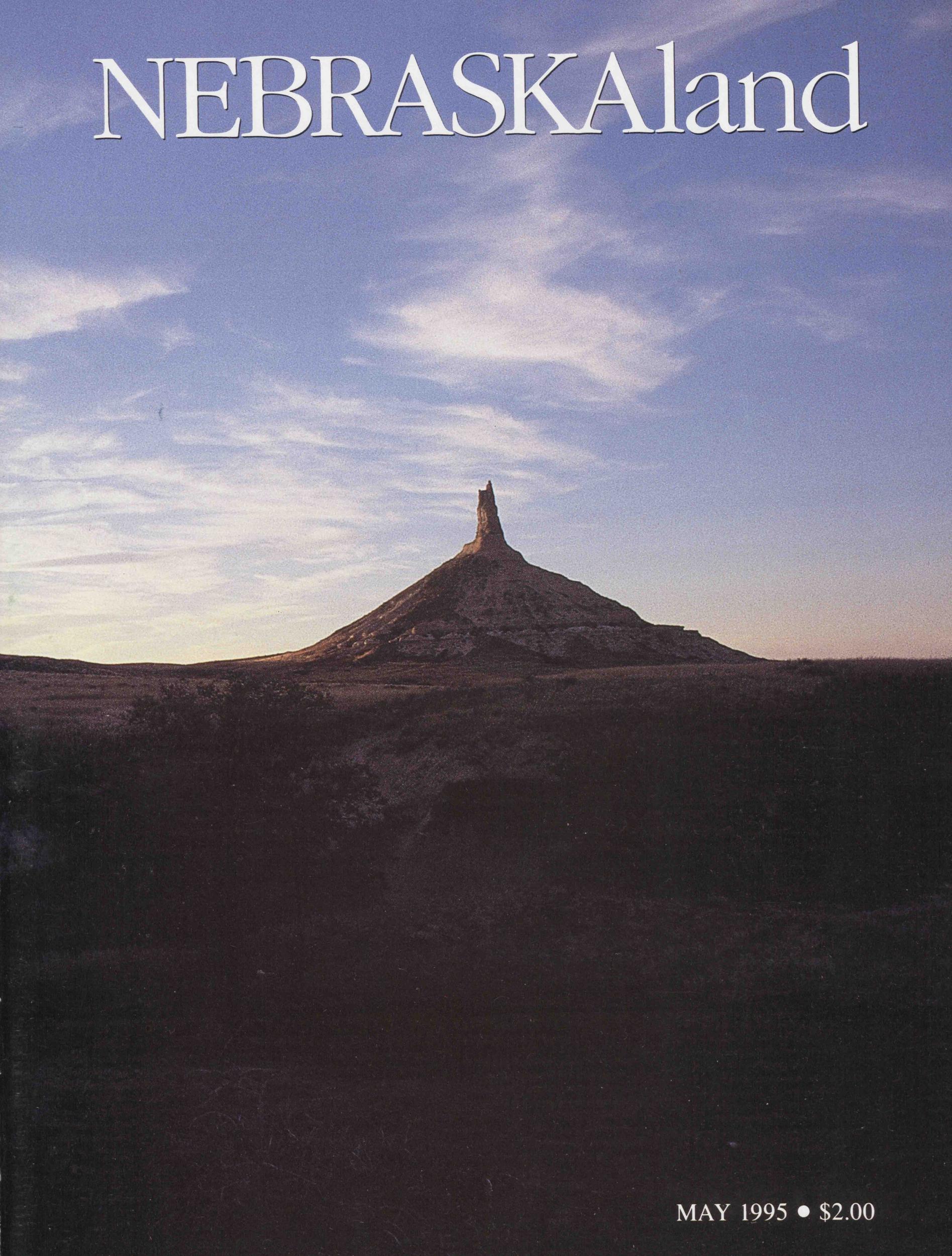
NEBRASKAland
MAY 1995 $2.00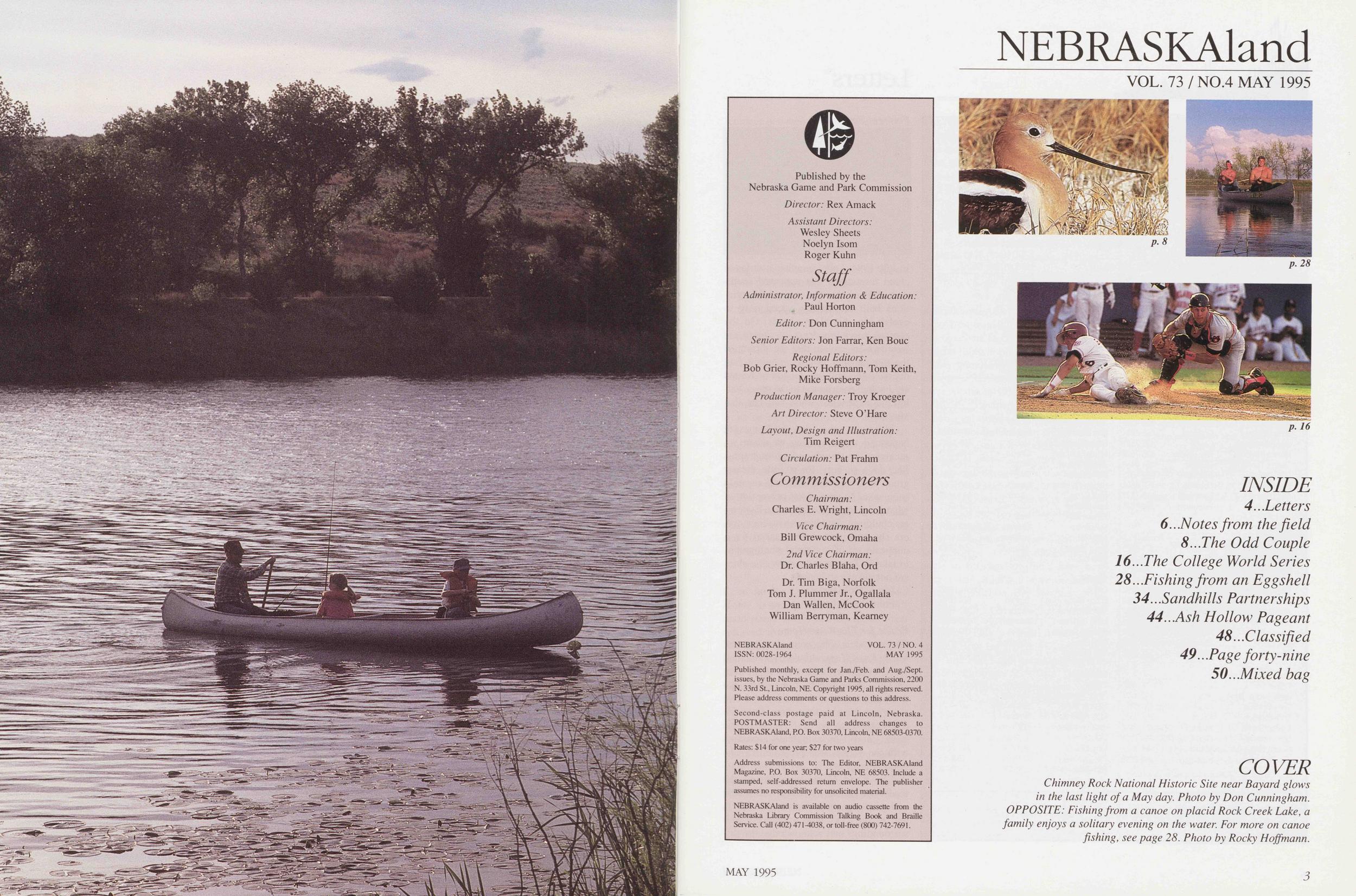
NEBRASKAland
VOL. 73 / NO.4 MAY 1995 Published by the Nebraska Game and Park Commission Director: Rex Amack Assistant Directors: Wesley Sheets Noelyn Isom Roger Kuhn Staff Administrator, Information & Education: Paul Horton Editor: Don Cunningham Senior Editors: Jon Farrar, Ken Bouc Regional Editors: Bob Grier, Rocky Hoffmann, Tom Keith, Mike Forsberg Production Manager: Troy Kroeger Art Director: Steve O'Hare Layout, Design and Illustration: Tim Reigert Circulation: Pat Frahm Commissioners Chairman: Charles E. Wright, Lincoln Vice Chairman: Bill Grewcock, Omaha 2nd Vice Chairman: Dr. Charles Blaha, Ord Dr. Tim Biga, Norfolk Tom J. Plummer Jr., Ogallala Dan Wallen, McCook William Berryman, Kearney NEBRASKAland ISSN: 0028-1964 VOL. 73 / NO. 4 MAY 1995 Published monthly, except for Jan./Feb. and Aug./Sept. issues, by the Nebraska Game and Parks Commission, 2200 N. 33rd St., Lincoln, NE. Copyright 1995, all rights reserved. Please address comments or questions to this address. Second-class postage paid at Lincoln, Nebraska. POSTMASTER: Send all address changes to NEBRASKAland, P.O. Box 30370, Lincoln, NE 68503-0370. Rates: $14 for one year, $27 for two years Address submissions to: The Editor, NEBRASKAland Magazine, P.O. Box 30370, Lincoln, NE 68503. Include a stamped, self-addressed return envelope. The publisher assumes no responsibility for unsolicited material. NEBRASKAland is available on audio cassette from the Nebraska Library Commission Talking Book and Braille Service. Call (402) 471-4038, or toll-free (800) 742-7691.
Letters
Nebraska Game and Parks Commission District Offices Headquarters 2200 North 33rd Street Lincoln, NE 68503 Phone (402)471-0641 District Office I Box 725 Alliance, NE 69301 Phone (308)762-5605 District Office II Box 508 Bassett, NE 68714 Phone (402)684-2921 District Office III Box 934 Norfolk, NE 68702 Phone (402)370-3374 District Office IV Route 4, Box 36 North Platte, NE 69101 Phone (308)535-8025 District Office V 2200 North 33rd Street Lincoln, NE 68503 Phone (402)471-5558 Omaha Office 1212 Deer Park Blvd. Omaha, NE 68108 Phone (402) 595-2144 Ak-Sar-Ben Aquarium 21502 West Highway 31 Gretna, NE 68028 Phone (402) 332-3901 Conservation Officers by Region Panhandle Southeast Officer City Phone (308) Officer City Phone (402) Richard Furiey (Sup. ) Alliance 762-2024 Dick Turpin (Adm.) Lincoln 471-5531 Walt Meyer Chadron 432-4398 Ted Blume (Asst. Adm.) Lincoln 483-5643 John Murphy Crawford 665-2021 Dan Klammer Lincoln 471-5003 Jim Zimmerman Gering 436-7561 Roger Guenther (Sup.) Lincoln 423-5671 Marvin Kampbell Hay Springs 638-7527 Murray Johnson Lincoln 488-2923 Dennis Thompson Ogallala 284-6450 William Krause Auburn 274-3789 Dan Zuehlke Ogallala 284-4815 Dan Evasco Beatrice 228-5935 Don Hunt Oshkosh 772-3697 Douglas Kramer Lincoln 466-9001 Scott Brandt Scottsbluff 635-1277 Dina Barta Lincoln 483-2358 Raymond Still Bridgeport 262-1075 Levi Krause Louisville 234-2212 Russell Mort Nebr. City 873-5684 Northeast Duane Arp Gretna 332-4954 Officer City Phone (402) Larry Elston Bellevue 292-4910 Tom Zimmer (Sup.) Norfolk 371-6625 Craig Stover Waterloo 359-2833 Robert Kelly Albion 395-2538 Mike Luben Colon 443-4278 Ross Oestmann Bloomfield 373-4412 L. A. Wilkinson Columbus 564-4375 Sandhills Gary Ralston Creighton 847-3284 Officer City Phone (402) Daniel Roberts Fremont 721-7852 Bruce Wiebe (Sup.) Bassett 684-3867 Randy Pomplun Fullerton (308) 536-2987 Max Showalter Ainsworth 387-1960 Jon Reeves Kennard 427-7378 Larry Bauman Atkinson 925-5569 Marion Shafer Norfolk 371-2031 Richard Seward Ord (308) 728-5338 Eric Wiebe Ponca 755-2566 Mick Gray Valentine 376-3136 Steve Oberg West Point 372-3062 Ray Dierking Brkn.Bow (308)872-3078 South-Central Southwest Officer City Phone (402) Officer City Phone (308) Jerry Pecha (Sup.) York 362-5707 Roger Thompson (Sup.) N. Platte 532-9175 Terry Brentzel Grand Is. (308) 384-8296 George Sund Cambridge 697-4629 Dale Johnson Hebron 768-7363 Matt Andrews Elwood 785-3025 Dayton Shultis Kearney (308) 234-3349 Jack Henderson Gothenburg 537-7483 Mark Reeves Loup City (308)745-1126 Dirk Greene Imperial 882-5328 Robert Finke Milford 761-3537 Virgil Gosch McCook 345-2185 Tim Williams Hastings 463-2535 Dwight Allbery N. Platte 532-2753 Rich Routh Rep. City 799-2085 Operation Game Thief 1-800-742-7627 Fremont FormationsIn July 1994,1 photographed a series of cloud formations that appeared southeast of Fremont. The series of formations built at stunning speed only to evolve into harmless clouds. On the evening news broadcast, we heard the weatherman explain that the setting of the sun at that crucial moment had deprived the building clouds of heated air that had contributed to the mass. Valley did experience some hail late that afternoon.
My sister who lives in Tennessee happened to be visiting us when we received the developed photographs. She does scenery for a little theater group in Greenville. She had recently been asked to repaint her perception of what a sky looks like, since the Easterners could not visualize the brilliant colors she had used. Eileen asked for a duplicate set of my cloud photographs to take to Tennessee to show that skies are not always so benign.
Iris A. Doksansky Fremont, Nebraska Praise for The Road HomeThose readers who were disappointed in The Road Home should take a second look. I was born and raised in western Oregon. My parents came from the northeast corner of Nebraska, and I've spent considerable time there. I consider Nebraska to be my "second home state," and I'm completely satisfied with the way it was presented in The Road Home.
The Road Home puts before the reader an attitude. It talks with words and pictures about farmers, ranchers and urban folks who appreciate their surroundings and acknowledge the differences 4 NEBRASKAland between the various areas of a very large state. Chimney Rock was not included and there was little from the southeast and northeast, but there is no picture in The Road Home that should have been left out to make room for Chimney Rock or downtown Obert.
In all my visits to your state I've been impressed with the quality of your people. They seem to go about their lives at a pace that allows time to enjoy being Nebraskans. The Road Home seems to validate that opinion.
Lyelle Hathaway Cottage Grove, OregonI must take time to congratulate you and your staff for the marvelous work you do for us Nebraskans. I will go along with Tom Lanz — "it is the best yet."
Sure there were some who are disappointed because they were not up in the front or on the "honorable mention" list, but as long as you are over 51 percent, I would not let it bother me. Every one I have shown The Road Home to has asked to take it with them, so I do have a waiting list.
There is nothing to equal your work for approximately $1.17 per month and delivered to the door. I am proud of you and your staff.
Stanley W. Nabb Omaha, NebraskaKeep up the good work! The Road Home issue was excellent. I don't understand some of the letters you received from people stating it was a bad issue. Some may have been disappointed that their favorite place may not have made the issue, but they need to realize that if all of Nebraska's wonderful sites were in The Road Home, it would be a several-volume set and not very practical. It is understandable and commendable that people are proud of where they are from, but let's be open to other parts of our wonderful state that we may otherwise not see and be thankful that we have a great magazine such as NEBRASKAland to bring it to us.
Rod Geist Portland, OregonThe NEBRASKAland special issue, The Road Home, is outstanding. I was born and raised in Platte County, moving from the state over 20 years ago. The Road Home brings back fond memories of a beautiful state that I proudly claim as "home."
Regarding disappointed readers who didn't have their area photographed in The Road Home issue: To please everyone would require a volume of books.
E. Bud Baumgart Sioux Center, Iowa Remembering Victoria SpringsHow I enjoyed the article on Victoria Springs State Recreation Area, i.e New Helena [March 1995].
My grandparents located in Broken Bow in 1932. I was 1 year old, my sister was born in 1933 and my brother in 1940. My grandparents built the Broken Bow Floral Company.
As our birthdays were only five days apart in July, they were always celebrated with a picnic at Victoria Springs. Grandpa Lindgren would always rent a rowboat and take us all for a boat ride. Also, I remember, there were big goldfish swimming in the little stream that runs through the park.
In the last several years I have had a niece, sister-in-law and all their families settle in Broken Bow, so I have been back to my childhood home. In fact, my second grandchild, Ben Hawkins of Ft. Collins, Colorado, caught his first fish at Victoria Springs, and during the Memorial Day weekend I will be in Broken Bow for a wedding, and I will take my two little granddaughters to Victoria Springs
NEBRASKAland Magazine is my favorite Christmas gift to many people, both family and friends. Thank you.
Janice Mayberry Stiles Omaha, Nebraska Write to Letters, NEBRASKAland Magazine, P.O. Box 30370, Lincoln, NE 68503-0370, or fax (402) 471-5528. Photos are also welcome and will be returned. Letters may be condensed or edited for clarity. Wear the Patch for Wildlife Wear the Habitat Donor Patch and let everyone know you've done your part to help acquire and restore wildlife habitat. All proceeds from the Nebraska Habitat Donor Program go to the Wildlife Habitat Fund. Give $5 and receive the patch. Give $12.50 and receive the patch on a gray cloth cap. Wildlife Habitat Donor Program Please send me: Donor Patches Donor Caps (patch attached) Name Address City State Zip Enclose $5 for each patch (no cap) $12.50 for each cap (patch attached). Nebraska residents please add appropriate sales tax. Mail to: NEBRASKAland Magazine, P.O. Box 30370, Lincoln NE 68503 For telephone orders (Visa or MasterCard only), call 1-800-NEB-LAND (632-5263) MAY 1995 5
Notes from the field
NEBRASKAland Magazine Special Issue Warehouse Sale! NEBRASKAland special issues from past years: One for $3.50, two or more to the same address, $3 each. Country Cookbook readers' favorite wild game recipes. Photographing Nebraska a manual of outdoor photography and an album of Nebraska photos. Walk in the Woods Nebraska's forests and trees. Wildflower Year wildflowers through the seasons. Historic Places sites on the National Register of Historic Places. Special Issue Offer Name Address City State Zip Check Visa MasterCard Card number Expr. date Nu m ber of copies: Country Cookbook A Wildflower Year Photographing Nebraska Historic Places Walk in the Woods Enclose $3.50 for one book, $3 each for two or more books to the same address (price includes postage in the U.S.). Nebraska residents please include appropriate sales tax. Mail to: NEBRASKAland Magazine, P.O. Box 30370, Lincoln NE 68503-0370 Phone orders (Visa and MasterCard) 1-800-NEB-LAND (632-5263) Republican River PowerA note from David Budka of Lincoln adds details to "Down the Republican' in the April Issue:
I enjoyed the story in your April 1995 issue outlining the history of the Republican River Valley. However, little is mentioned of early waterpower developments along this and other streams. Of interest to me are the small hydroelectric powerplants that were built during the late 19th century and early 20th century.
I have been able to confirm the existence of at least seven hydroelectric installations in the Republican River basin. These primitive powerplants were located at Imperial, Wauneta, Palisade, Arapahoe, Bloomington, Maywood and Superior, Nebraska. Those at Wauneta, Arapahoe, Bloomington, Maywood and Superior were originally operated as parts of flouring mills. The one at Imperial was erected by the city to provide electricity for power and lights. The EC. Krotter powerplant near Palisade was part of a small irrigation project.
I have found little information about the Imperial, Maywood and Bloomington installations. In 1936, the Imperial powerplant was rated at 245 kilowatts (kw) and was appropriated for 55 second-feet of water from the Frenchman River. By that year, the Maywood and Bloomington mills had ceased operation. Electrical operations at Bloomington began in 1913.
However, in a 1931 special report of the Nebraska Department of Public Works, those two plants were represented on a map showing the state's electrical transmission lines. The Bloomington mill was appropriated 6.00 second-feet of water from Big Cottonwood Creek, while the Maywood mill received 11.88 second-feet from Medicine Creek.
Appropriation 1021 was filed August 17, 1910, for the Krotter powerplant near Palisade. Its dam was located on the Frenchman River, and it was allotted 55 second-feet of water. In 1936, the station was rated at 210 kw. I don't know how long it operated.
The Arapahoe Star Mills was built around 1881. The 1935 Republican River flood wrecked both the mill and the powerhouse. Nevertheless, in 1936, the station was rated at 75 kw, and listed as owned by the Western Public Service Company.
In 1907, G.G. Athey, a son-in-law to owner George Theobald, installed a hydroelectric powerplant at the Wauneta Mills. In 1911, Appropriation 1136 was filed to increase flows through the mill and powerplant by 75 second-feet. The original docket allowed the use of 35 second-feet.
The mill burned in 1921, but hydroelectric operations continued for many years. The capacity of the Wauneta powerplant was 125 kw in 1936. Just when electrical generation ceased is not presently known, but in 1951, the dam was dynamited by the Army Corp of Engineers because it was considered a hindrance to flood releases from the new Enders Dam upstream.
The most significant hydroelectric station in the Republican Valley was that of the Southern Nebraska Power Company at Superior. In 1894, Rufus and Sam Lee contracted with the Guthrie brothers to install and operate a hydroelectric powerplant at the Guthrie Mills. In 1914, David Guthrie bought out the Lee brothers and incorporated the Southern Nebraska Power Company. Two years later fire destroyed the mill and powerhouse, leaving the town without electricity for nine days and necessitating the installation of a 300 horsepower BuschSulzer diesel generator.
In 1919, the dam washed out, forcing David Guthrie to sell his interest in the pioneer utility so that a new impoundment could be built. The 1920s and 1930s were a time of expansion for the Southern Nebraska Power Company and the Superior powerplant. During the 1920s, the Southern Nebraska Power Company added many communities to its service area.
Mergers with other small utilities added three other hydroelectric 6 NEBRASKAland powerplants to Southern Nebraska's properties. These were on the Little Blue River at Oak, Hebron and Deweese. By 1930, the system needed to be upgraded. 33,000 volt transmission lines were strung to replace the older 13,200 volt lines. Also, a 62 horsepower water wheel generator replaced the original 300 horsepower unit at Superior. Four years later, a still larger water wheel generator was installed. In 1936, the Superior hydroelectric powerplant was rated at 670 kw.
On October 18, 1940, the properties of the Southern Nebraska Power Company were sold to the Consumer's Public Power District. For a time, they were leased to the Central Nebraska Public Power and Irrigation District. Meanwhile, the distribution system in Superior was sold to the city. Sometime later, but before 1960, the hydroelectric plant at Superior was shut down and abandoned.
During the late 19th and early 20th centuries, many small hydroelectric powerplants were built in the eastern two-thirds of Nebraska. Many of them were the first to bring electricity to the towns they served, and the Republican River played a role in Nebraska's early electrical development.
Sources Buecker, Thomas R. Water Powered Flour Mills in Nebraska. Lincoln, 1983. Chase County Historical Society. Chase County History. 1971. Firth, Robert E. Public Power in Nebraska. Lincoln, 1962. Furnas Co. Genealogical Society. Furnas County: Past and Present. 1987. Mackel, Florence. Early History of Bloomington, Nebraska. 1971. Nebraska Dept. of Public Works, Special Swvey Report. 1931. Nebraska Dept. of Public Works. 18th Biennial Report. Nebraska State Planning Board. Water Resources of Nebraska. 1936. Rushmore, David B., and Eric A. Lof. Hydro-electric Power Stations. New York, 1923. Smith, Marjorie. Superior Centurama. 1967. Wilcox, V.R. History of Nuckolls County, Nebraska. 1935.
The Odd Couple
Photos and text by Jon Farrar After peering at a bird for hours through a telephoto lens, you come to know it on intimate terms — one avocet no longer looks or behaves like all other avocets. Birds, like people, have quirks and distinct personalities.Wildlife photography demands long hours in cramped blinds, too often with nothing at all to observe. More often it involves prolonged periods of waiting at close range for a photo subject to do something out of the ordinary, for clouds to move out or the quality of light to improve. Under such circumstances, I spent two days watching a pair of American avocets at their nest on a salt-encrusted flat in the North Platte Valley. It was the third week of May, and they were there right on schedule for their annual, 24-hour-a-day, 24-day (or longer) stint of producing a new crop of avocets.
Avocets are a common nesting species in the western Sandhills. Why this pair stopped in the North Platte Valley and selected a nest site so near a busy highway, when thousands of isolated, sandhill wetlands were little more than an hour's flying time to the northeast baffled me, but the site obviously offered the avocets all they required.
Avocets prefer alkaline pools with shorelines free of vegetation, and they had found that in the North Platte Valley. Such pools typically have an abundant supply of brine fly larvae, brine shrimp and other invertebrates on which avocets feed. Each year, migrating avocets pause on the best of the North Platte Valley's alkaline wetlands, but few remain to nest.
Compared to most drab and cryptically colored ground-nesting birds, avocets are strikingly marked with contrasting black and white body plumage, a warm, reddish-brown head and neck during the breeding season (gray from late summer through the winter) and long blue legs, hence the vernacular names "longshank" and "blue-stocking."
As if their large size and striking coloration did not attract enough attention, avocets exhibit an ample repertoire of displays designed to protect their eggs and young, making them even more conspicuous during the nesting season. The most heartrending display is the "injury-feigning" or "broken-wing" act, in which a quivering wing (or two) is extended as if injured, a ploy designed to convince predators the adult bird would be an easier and larger meal than the nearby eggs or chicks. Or, an adult may squat on the ground away from the nest as if incubating eggs to lure the intruder away from the real nest site.
If those tactics fail, avocets attack with aerial strafing. Avocets often nest in loosely organized colonies, and a threat to one nest is also a threat to 8
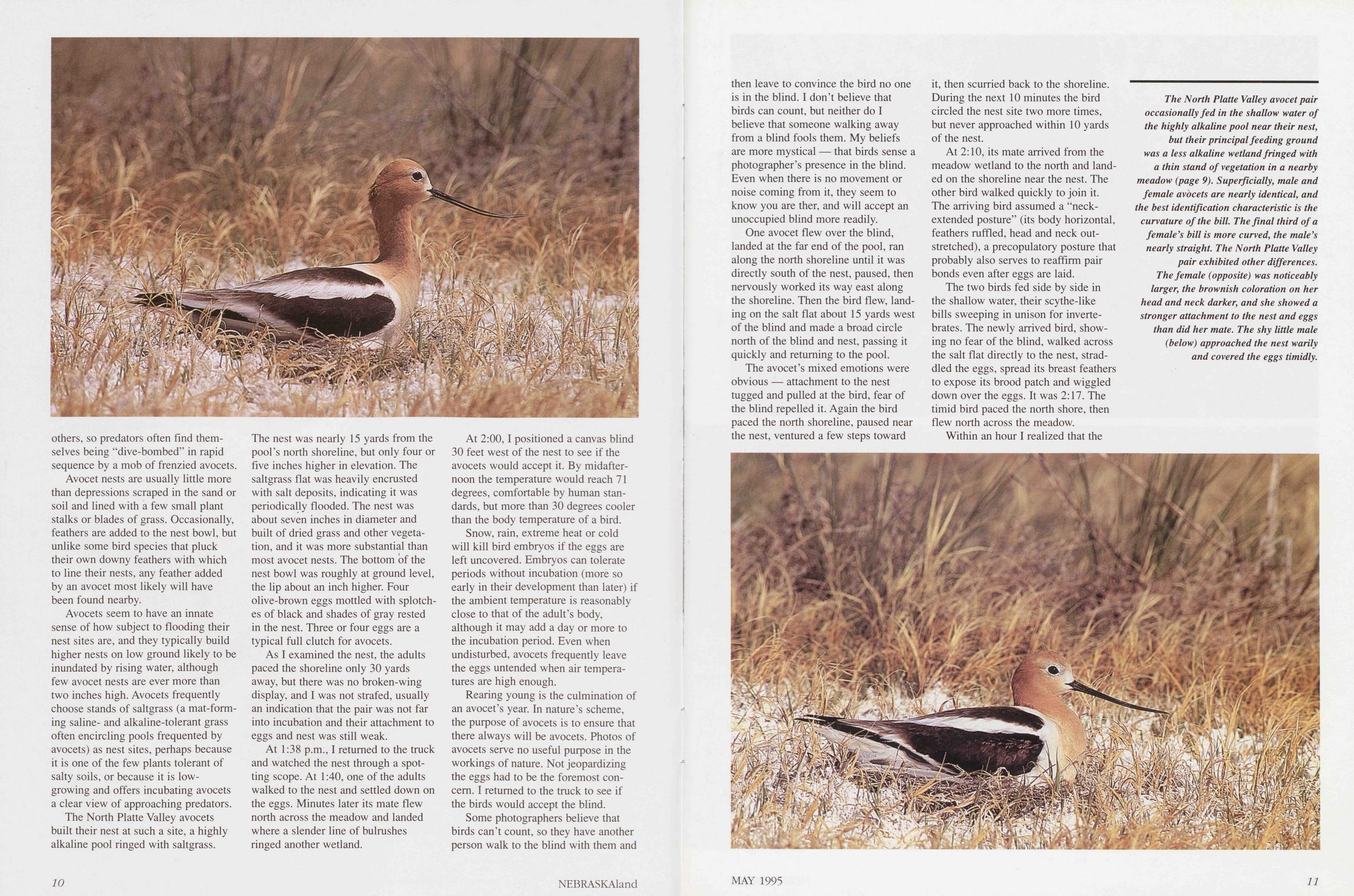
Avocet nests are usually little more than depressions scraped in the sand or soil and lined with a few small plant stalks or blades of grass. Occasionally, feathers are added to the nest bowl, but unlike some bird species that pluck their own downy feathers with which to line their nests, any feather added by an avocet most likely will have been found nearby.
Avocets seem to have an innate sense of how subject to flooding their nest sites are, and they typically build higher nests on low ground likely to be inundated by rising water, although few avocet nests are ever more than two inches high. Avocets frequently choose stands of saltgrass (a mat-forming saline- and alkaline-tolerant grass often encircling pools frequented by avocets) as nest sites, perhaps because it is one of the few plants tolerant of salty soils, or because it is lowgrowing and offers incubating avocets a clear view of approaching predators.
The North Platte Valley avocets built their nest at such a site, a highly alkaline pool ringed with saltgrass. The nest was nearly 15 yards from the pool's north shoreline, but only four or five inches higher in elevation. The saltgrass flat was heavily encrusted with salt deposits, indicating it was periodically flooded. The nest was about seven inches in diameter and built of dried grass and other vegetation, and it was more substantial than most avocet nests. The bottom of the nest bowl was roughly at ground level, the lip about an inch higher. Four olive-brown eggs mottled with splotches of black and shades of gray rested in the nest. Three or four eggs are a typical full clutch for avocets.
As I examined the nest, the adults paced the shoreline only 30 yards away, but there was no broken-wing display, and I was not strafed, usually an indication that the pair was not far into incubation and their attachment to eggs and nest was still weak.
At 1:38 p.m., I returned to the truck and watched the nest through a spotting scope. At 1:40, one of the adults walked to the nest and settled down on the eggs. Minutes later its mate flew north across the meadow and landed where a slender line of bulrushes ringed another wetland.
At 2:00,1 positioned a canvas blind 30 feet west of the nest to see if the avocets would accept it. By midafternoon the temperature would reach 71 degrees, comfortable by human standards, but more than 30 degrees cooler than the body temperature of a bird.
Snow, rain, extreme heat or cold will kill bird embryos if the eggs are left uncovered. Embryos can tolerate periods without incubation (more so early in their development than later) if the ambient temperature is reasonably close to that of the adult's body, although it may add a day or more to the incubation period. Even when undisturbed, avocets frequently leave the eggs untended when air temperatures are high enough.
Rearing young is the culmination of an avocet's year. In nature's scheme, the purpose of avocets is to ensure that there always will be avocets. Photos of avocets serve no useful purpose in the workings of nature. Not jeopardizing the eggs had to be the foremost concern. I returned to the truck to see if the birds would accept the blind.
Some photographers believe that birds can't count, so they have another person walk to the blind with them and 10 NEBRASKAland then leave to convince the bird no one is in the blind. I don't believe that birds can count, but neither do I believe that someone walking away from a blind fools them. My beliefs are more mystical — that birds sense a photographer's presence in the blind. Even when there is no movement or noise coming from it, they seem to know you are ther, and will accept an unoccupied blind more readily.
One avocet flew over the blind, landed at the far end of the pool, ran along the north shoreline until it was directly south of the nest, paused, then nervously worked its way east along the shoreline. Then the bird flew, landing on the salt flat about 15 yards west of the blind and made a broad circle north of the blind and nest, passing it quickly and returning to the pool.
The avocet's mixed emotions were obvious — attachment to the nest tugged and pulled at the bird, fear of the blind repelled it. Again the bird paced the north shoreline, paused near the nest, ventured a few steps toward it, then scurried back to the shoreline. During the next 10 minutes the bird circled the nest site two more times, but never approached within 10 yards of the nest.
At 2:10, its mate arrived from the meadow wetland to the north and landed on the shoreline near the nest. The other bird walked quickly to join it. The arriving bird assumed a "neckextended posture" (its body horizontal, feathers ruffled, head and neck outstretched), a precopulatory posture that probably also serves to reaffirm pair bonds even after eggs are laid.
The two birds fed side by side in the shallow water, their scythe-like bills sweeping in unison for invertebrates. The newly arrived bird, showing no fear of the blind, walked across the salt flat directly to the nest, straddled the eggs, spread its breast feathers to expose its brood patch and wiggled down over the eggs. It was 2:17. The timid bird paced the north shore, then flew north across the meadow.
Within an hour I realized that the
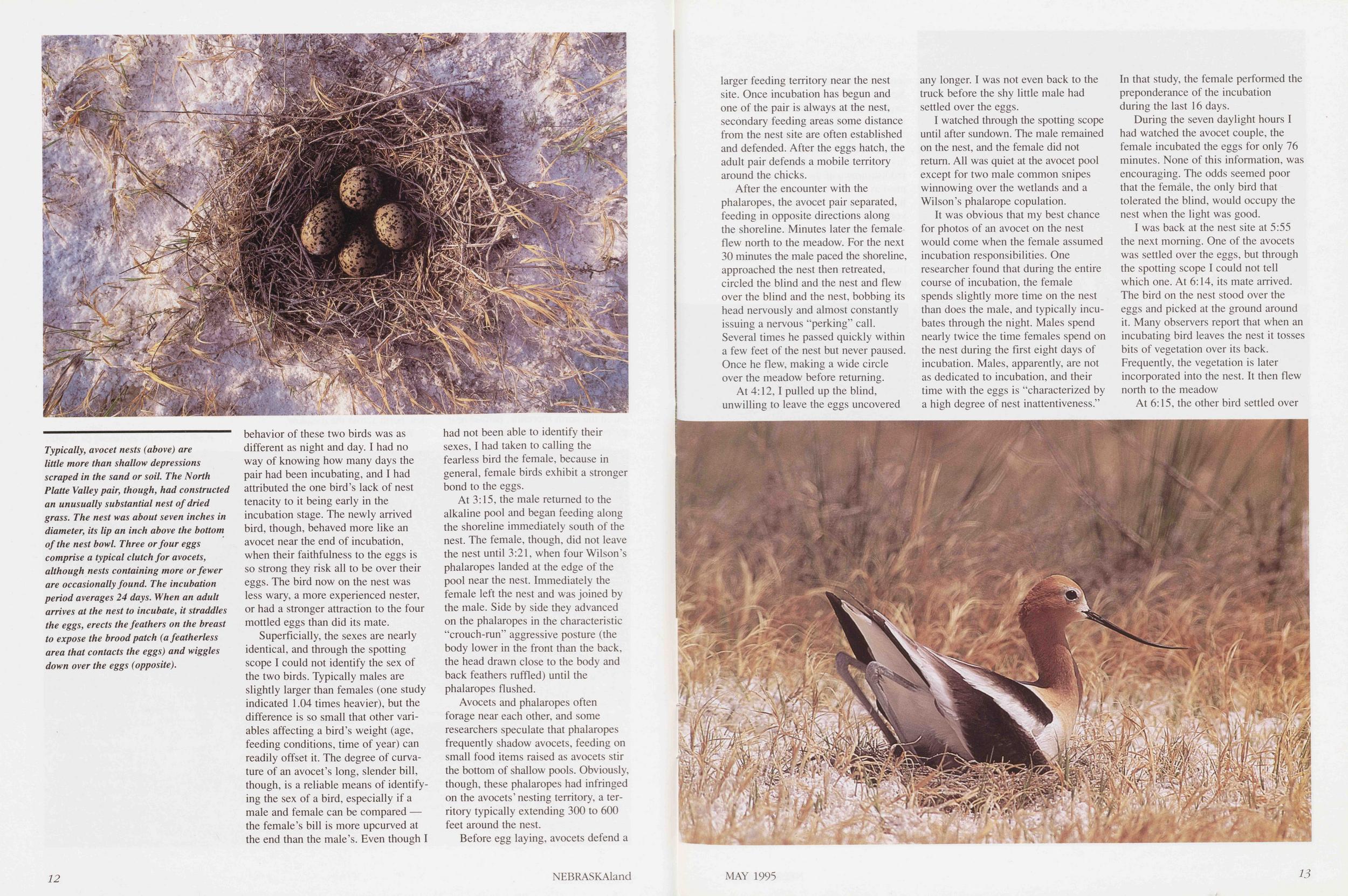
Superficially, the sexes are nearly identical, and through the spotting scope I could not identify the sex of the two birds. Typically males are slightly larger than females (one study indicated 1.04 times heavier), but the difference is so small that other variables affecting a bird's weight (age, feeding conditions, time of year) can readily offset it. The degree of curvature of an avocet's long, slender bill, though, is a reliable means of identifying the sex of a bird, especially if a male and female can be compared the female's bill is more upcurved at the end than the male's. Even though I had not been able to identify their sexes, I had taken to calling the fearless bird the female, because in general, female birds exhibit a stronger bond to the eggs.
At 3:15, the male returned to the alkaline pool and began feeding along the shoreline immediately south of the nest. The female, though, did not leave the nest until 3:21, when four Wilson's phalaropes landed at the edge of the pool near the nest. Immediately the female left the nest and was joined by the male. Side by side they advanced on the phalaropes in the characteristic "crouch-run" aggressive posture (the body lower in the front than the back, the head drawn close to the body and back feathers ruffled) until the phalaropes flushed.
Avocets and phalaropes often forage near each other, and some researchers speculate that phalaropes frequently shadow avocets, feeding on small food items raised as avocets stir the bottom of shallow pools. Obviously, though, these phalaropes had infringed on the avocets' nesting territory, a territory typically extending 300 to 600 feet around the nest.
Before egg laying, avocets defend a 12 NEBRASKAland larger feeding territory near the nest site. Once incubation has begun and one of the pair is always at the nest, secondary feeding areas some distance from the nest site are often established and defended. After the eggs hatch, the adult pair defends a mobile territory around the chicks.
After the encounter with the phalaropes, the avocet pair separated, feeding in opposite directions along the shoreline. Minutes later the female flew north to the meadow. For the next 30 minutes the male paced the shoreline, approached the nest then retreated, circled the blind and the nest and flew over the blind and the nest, bobbing its head nervously and almost constantly issuing a nervous "perking" call. Several times he passed quickly within a few feet of the nest but never paused. Once he flew, making a wide circle over the meadow before returning.
At 4:12,1 pulled up the blind, unwilling to leave the eggs uncovered any longer. I was not even back to the truck before the shy little male had settled over the eggs.
I watched through the spotting scope until after sundown. The male remained on the nest, and the female did not return. All was quiet at the avocet pool except for two male common snipes winnowing over the wetlands and a Wilson's phalarope copulation.
It was obvious that my best chance for photos of an avocet on the nest would come when the female assumed incubation responsibilities. One researcher found that during the entire course of incubation, the female spends slightly more time on the nest than does the male, and typically incubates through the night. Males spend nearly twice the time females spend on the nest during the first eight days of incubation. Males, apparently, are not as dedicated to incubation, and their time with the eggs is "characterized by a high degree of nest inattentiveness." In that study, the female performed the preponderance of the incubation during the last 16 days.
During the seven daylight hours I had watched the avocet couple, the female incubated the eggs for only 76 minutes. None of this information, was encouraging. The odds seemed poor that the female, the only bird that tolerated the blind, would occupy the nest when the light was good.
I was back at the nest site at 5:55 the next morning. One of the avocets was settled over the eggs, but through the spotting scope I could not tell which one. At 6:14, its mate arrived. The bird on the nest stood over the eggs and picked at the ground around it. Many observers report that when an incubating bird leaves the nest it tosses bits of vegetation over its back. Frequently, the vegetation is later incorporated into the nest. It then flew north to the meadow
At 6:15, the other bird settled over
MAY 1995
13
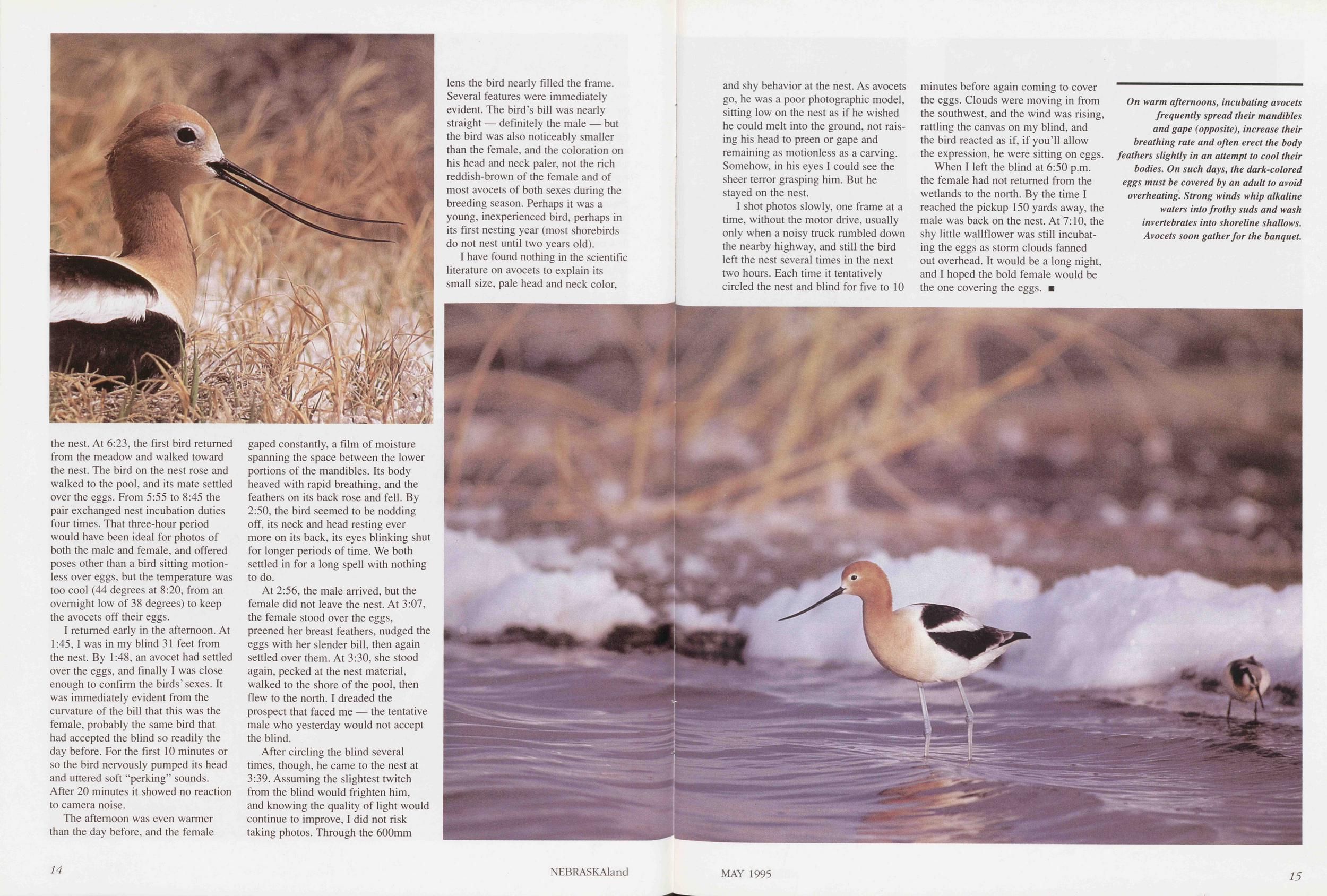
I returned early in the afternoon. At 1:45,1 was in my blind 31 feet from the nest. By 1:48, an avocet had settled over the eggs, and finally I was close enough to confirm the birds' sexes. It was immediately evident from the curvature of the bill that this was the female, probably the same bird that had accepted the blind so readily the day before. For the first 10 minutes or so the bird nervously pumped its head and uttered soft "perking" sounds. After 20 minutes it showed no reaction to camera noise.
The afternoon was even warmer than the day before, and the female gaped constantly, a film of moisture spanning the space between the lower portions of the mandibles. Its body heaved with rapid breathing, and the feathers on its back rose and fell. By 2:50, the bird seemed to be nodding off, its neck and head resting ever more on its back, its eyes blinking shut for longer periods of time. We both settled in for a long spell with nothing to do.
At 2:56, the male arrived, but the female did not leave the nest. At 3:07, the female stood over the eggs, preened her breast feathers, nudged the eggs with her slender bill, then again settled over them. At 3:30, she stood again, pecked at the nest material, walked to the shore of the pool, then flew to the north. I dreaded the prospect that faced me — the tentative male who yesterday would not accept the blind.
After circling the blind several times, though, he came to the nest at 3:39. Assuming the slightest twitch from the blind would frighten him, and knowing the quality of light would continue to improve, I did not risk taking photos. Through the 600mm lens the bird nearly filled the frame. Several features were immediately evident. The bird's bill was nearly straight — definitely the male — but the bird was also noticeably smaller than the female, and the coloration on his head and neck paler, not the rich reddish-brown of the female and of most avocets of both sexes during the breeding season. Perhaps it was a young, inexperienced bird, perhaps in its first nesting year (most shorebirds do not nest until two years old).
I have found nothing in the scientific literature on avocets to explain its small size, pale head and neck color, 14 NEBRASKAland and shy behavior at the nest. As avocets go, he was a poor photographic model, sitting low on the nest as if he wished he could melt into the ground, not raising his head to preen or gape and remaining as motionless as a carving. Somehow, in his eyes I could see the sheer terror grasping him. But he stayed on the nest.
I shot photos slowly, one frame at a time, without the motor drive, usually only when a noisy truck rumbled down the nearby highway, and still the bird left the nest several times in the next two hours. Each time it tentatively circled the nest and blind for five to 10 minutes before again coming to cover the eggs. Clouds were moving in from the southwest, and the wind was rising, rattling the canvas on my blind, and the bird reacted as if, if you'll allow the expression, he were sitting on eggs.
When I left the blind at 6:50 p.m. the female had not returned from the wetlands to the north. By the time I reached the pickup 150 yards away, the male was back on the nest. At 7:10, the shy little wallflower was still incubating the eggs as storm clouds fanned out overhead. It would be a long night, and I hoped the bold female would be the one covering the eggs.
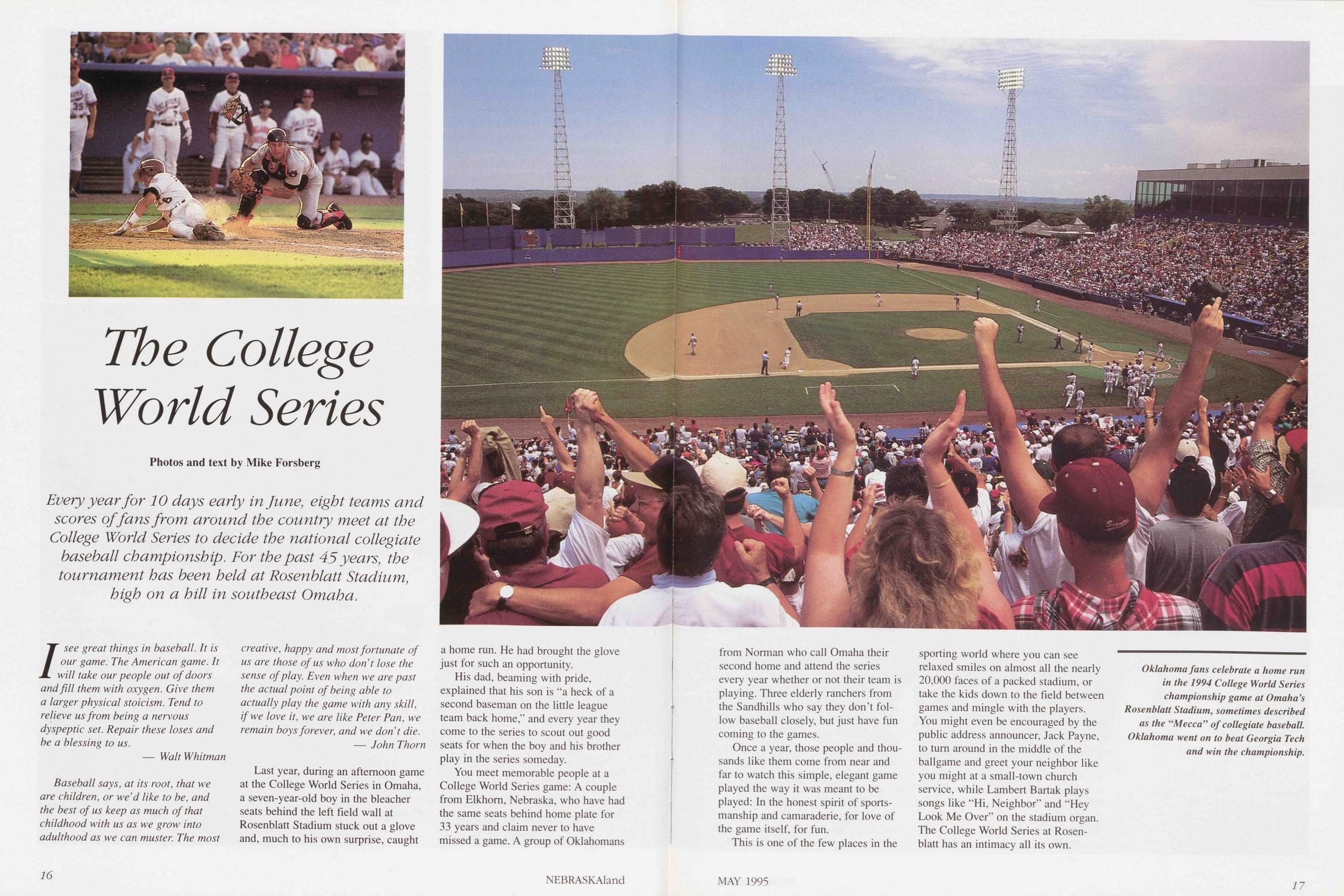
The College World Series
Photos and text by Mike Forsberg Every year for 10 days early in June, eight teams and scores of fans from around the country meet at the College World Series to decide the national collegiate baseball championship. For the past 45 years, the tournament has been held at Rosenblatt Stadium, high on a hill in southeast Omaha.see great things in baseball. It is our game. The American game. It will take our people out of doors andfdl them with oxygen. Give them a larger physical stoicism. Tend to relieve us from being a nervous dyspeptic set. Repair these loses and be a blessing to us.
— Walt WhitmanBaseball says, at its root, that we are children, or wed like to be, and the best of us keep as much of that childhood with us as we grow into adulthood as we can muster. The most creative, happy and most fortunate of us are those of us who don't lose the sense of play. Even when we are past the actual point of being able to actually play the game with any skill, if we love it, we are like Peter Pan, we remain boys forever, and we don't die.
— John ThornLast year, during an afternoon game at the College World Series in Omaha, a seven-year-old boy in the bleacher seats behind the left field wall at Rosenblatt Stadium stuck out a glove and, much to his own surprise, caught a home run. He had brought the glove just for such an opportunity.
His dad, beaming with pride, explained that his son is "a heck of a second baseman on the little league team back home," and every year they come to the series to scout out good seats for when the boy and his brother play in the series someday.
You meet memorable people at a College World Series game: A couple from Elkhorn, Nebraska, who have had the same seats behind home plate for 33 years and claim never to have missed a game. A group of Oklahomans 16 NEBRASKAland from Norman who call Omaha their second home and attend the series every year whether or not their team is playing. Three elderly ranchers from the Sandhills who say they don't follow baseball closely, but just have fun coming to the games.
Once a year, those people and thousands like them come from near and far to watch this simple, elegant game played the way it was meant to be played: In the honest spirit of sportsmanship and camaraderie, for love of the game itself, for fun.
This is one of the few places in the sporting world where you can see relaxed smiles on almost all the nearly 20,000 faces of a packed stadium, or take the kids down to the field between games and mingle with the players. You might even be encouraged by the public address announcer, Jack Payne, to turn around in the middle of the ballgame and greet your neighbor like you might at a small-town church service, while Lambert Bartak plays songs like "Hi, Neighbor" and "Hey Look Me Over" on the stadium organ. The College World Series at Rosenblatt has an intimacy all its own.
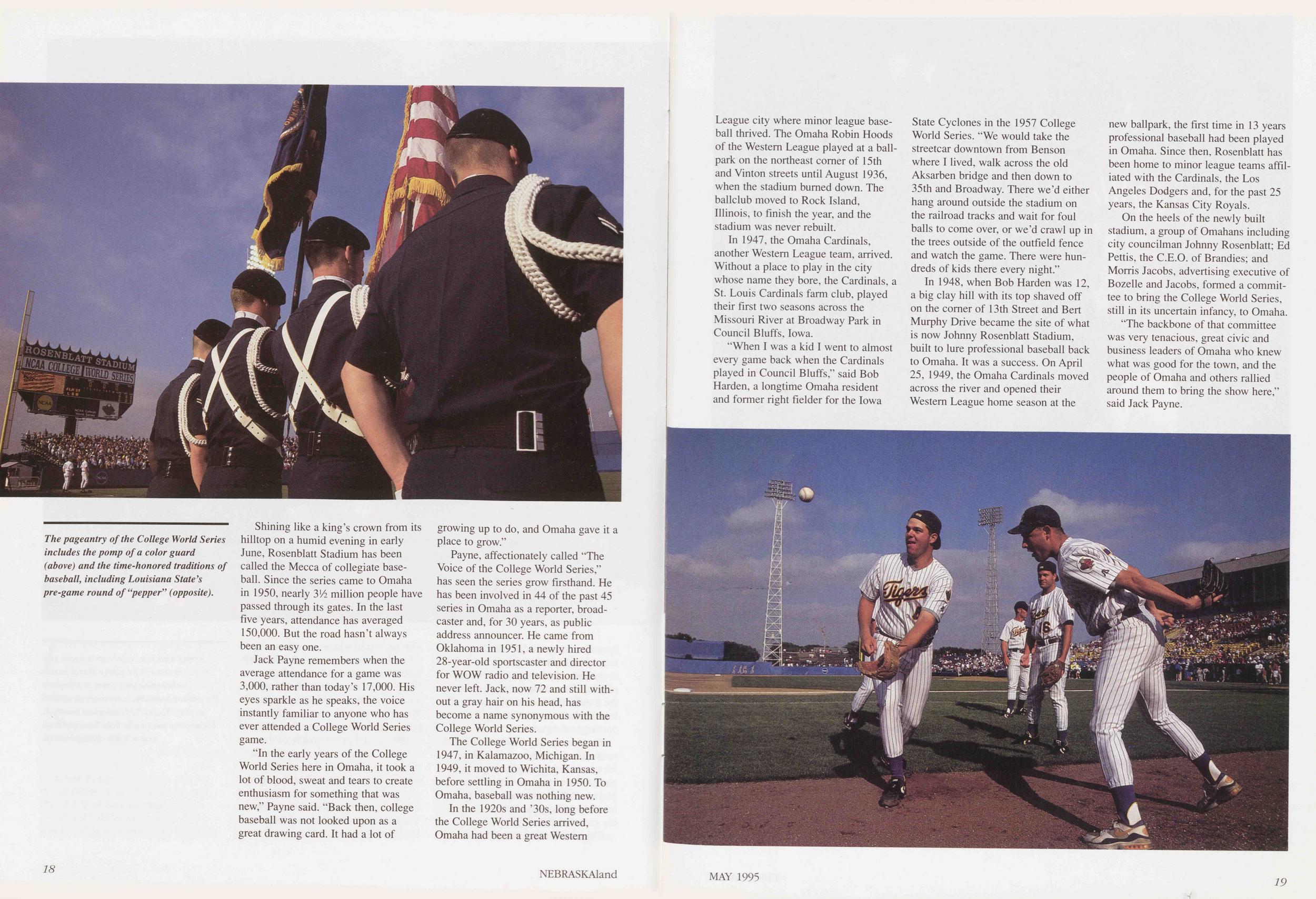
Shining like a king's crown from its hilltop on a humid evening in early June, Rosenblatt Stadium has been called the Mecca of collegiate baseball. Since the series came to Omaha in 1950, nearly 314 million people have passed through its gates. In the last five years, attendance has averaged 150,000. But the road hasn't always been an easy one.
Jack Payne remembers when the average attendance for a game was 3,000, rather than today's 17,000. His eyes sparkle as he speaks, the voice instantly familiar to anyone who has ever attended a College World Series game.
"In the early years of the College World Series here in Omaha, it took a lot of blood, sweat and tears to create enthusiasm for something that was new," Payne said. "Back then, college baseball was not looked upon as a great drawing card. It had a lot of growing up to do, and Omaha gave it a place to grow."
Payne, affectionately called "The Voice of the College World Series," has seen the series grow firsthand. He has been involved in 44 of the past 45 series in Omaha as a reporter, broadcaster and, for 30 years, as public address announcer. He came from Oklahoma in 1951, a newly hired 28-year-old sportscaster and director for WOW radio and television. He never left. Jack, now 72 and still without a gray hair on his head, has become a name synonymous with the College World Series.
The College World Series began in 1947, in Kalamazoo, Michigan. In 1949, it moved to Wichita, Kansas, before settling in Omaha in 1950. To Omaha, baseball was nothing new.
In the 1920s and '30s, long before the College World Series arrived, Omaha had been a great Western 18 NEBRASKAland League city where minor league baseball thrived. The Omaha Robin Hoods of the Western League played at a ballpark on the northeast corner of 15th and Vinton streets until August 1936, when the stadium burned down. The ballclub moved to Rock Island, Illinois, to finish the year, and the stadium was never rebuilt.
In 1947, the Omaha Cardinals, another Western League team, arrived. Without a place to play in the city whose name they bore, the Cardinals, a St. Louis Cardinals farm club, played their first two seasons across the Missouri River at Broadway Park in Council Bluffs, Iowa.
"When I was a kid I went to almost every game back when the Cardinals played in Council Bluffs," said Bob Harden, a longtime Omaha resident and former right fielder for the Iowa State Cyclones in the 1957 College World Series. "We would take the streetcar downtown from Benson where I lived, walk across the old Aksarben bridge and then down to 35th and Broadway. There we'd either hang around outside the stadium on the railroad tracks and wait for foul balls to come over, or we'd crawl up in the trees outside of the outfield fence and watch the game. There were hundreds of kids there every night."
In 1948, when Bob Harden was 12, a big clay hill with its top shaved off on the corner of 13th Street and Bert Murphy Drive became the site of what is now Johnny Rosenblatt Stadium, built to lure professional baseball back to Omaha. It was a success. On April 25, 1949, the Omaha Cardinals moved across the river and opened their Western League home season at the new ballpark, the first time in 13 years professional baseball had been played in Omaha. Since then, Rosenblatt has been home to minor league teams affiliated with the Cardinals, the Los Angeles Dodgers and, for the past 25 years, the Kansas City Royals.
On the heels of the newly built stadium, a group of Omahans including city councilman Johnny Rosenblatt; Ed Pettis, the C.E.O. of Brandies; and Morris Jacobs, advertising executive of Bozelle and Jacobs, formed a committee to bring the College World Series, still in its uncertain infancy, to Omaha.
"The backbone of that committee was very tenacious, great civic and business leaders of Omaha who knew what was good for the town, and the people of Omaha and others rallied around them to bring the show here," said Jack Payne.
MAY 1995 19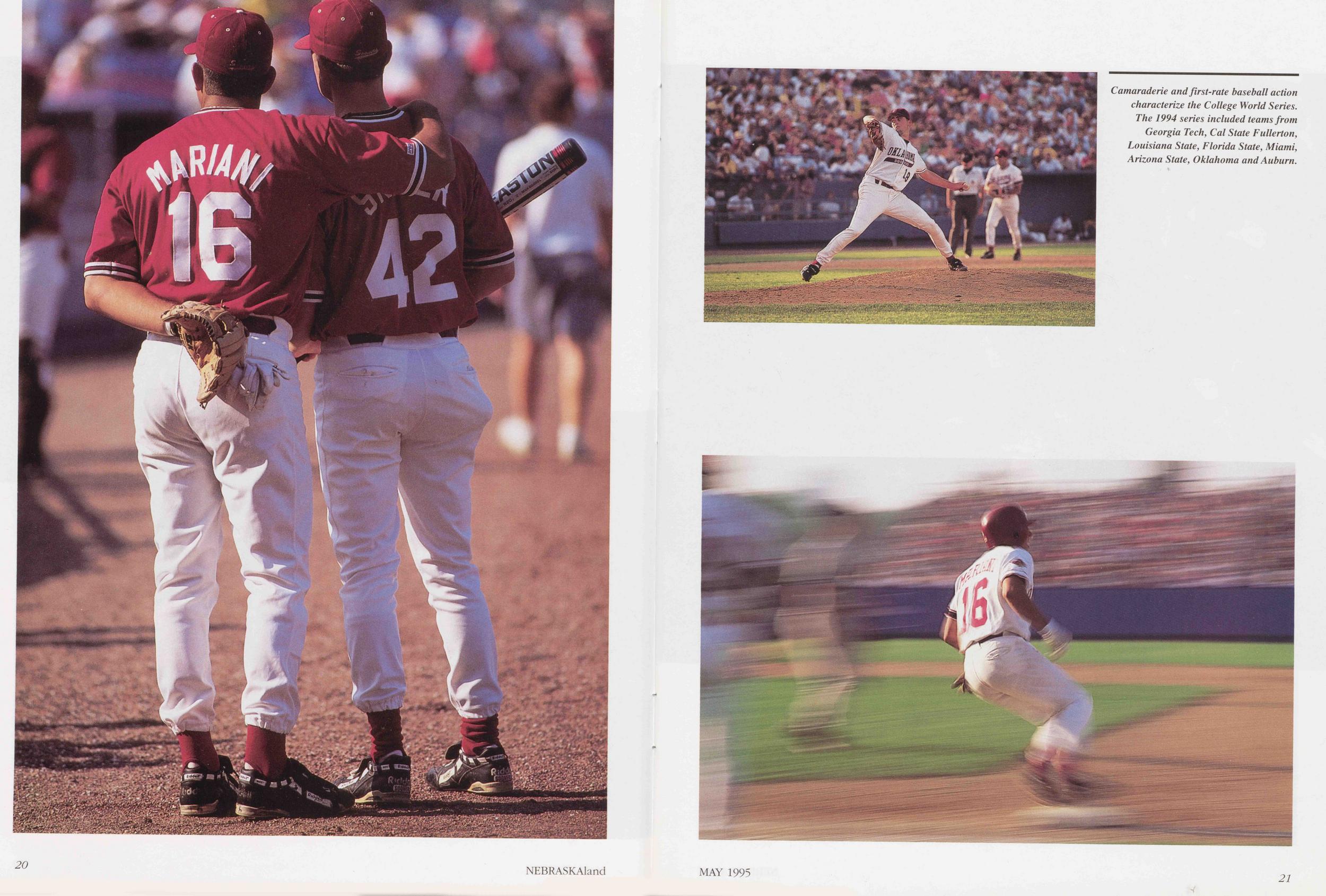
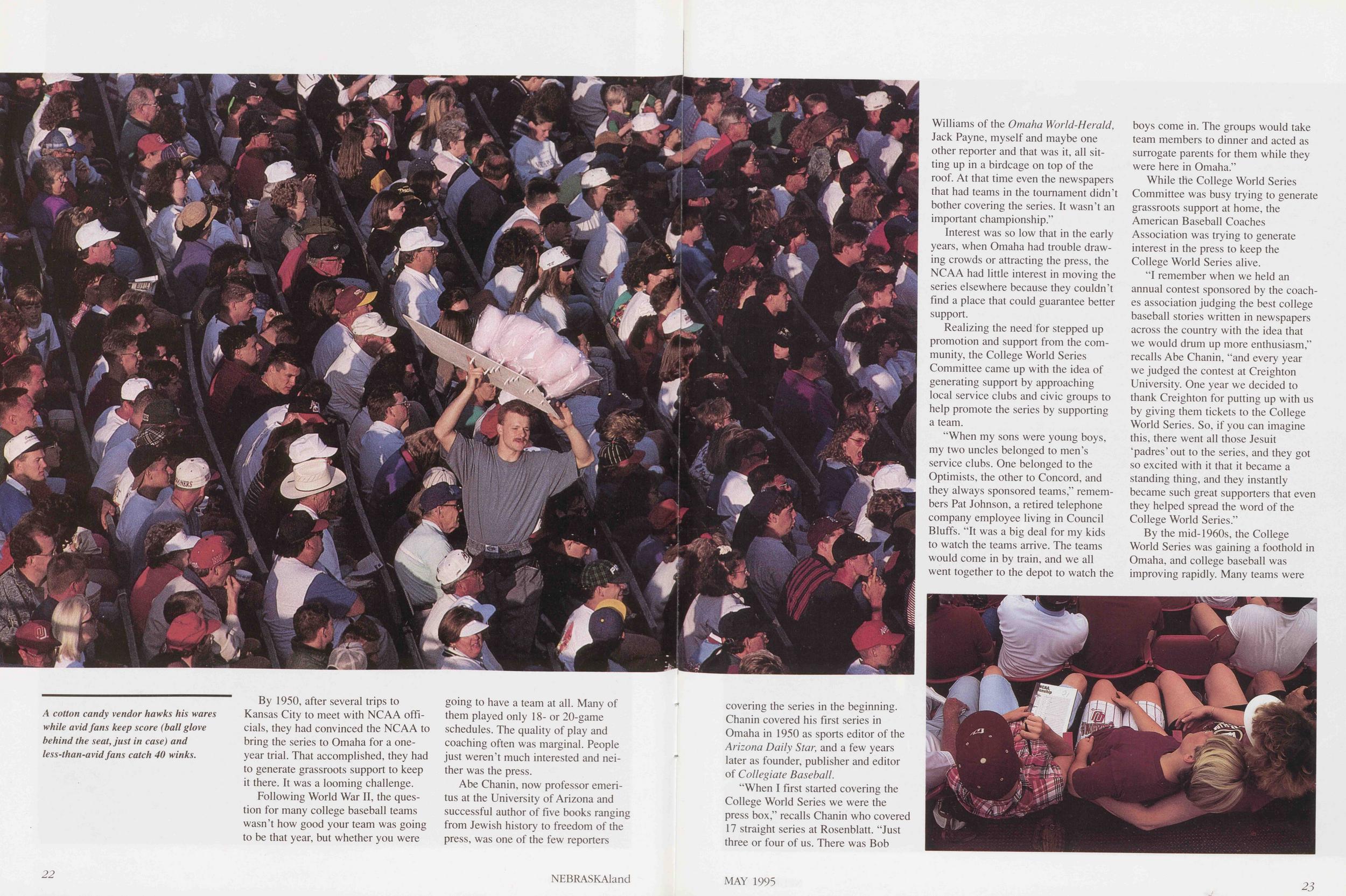
By 1950, after several trips to Kansas City to meet with NCAA officials, they had convinced the NCAA to bring the series to Omaha for a one-year trial. That accomplished, they had to generate grassroots support to keep it there. It was a looming challenge.
Following World War II, the question for many college baseball teams wasn't how good your team was going to be that year, but whether you were going to have a team at all. Many of them played only 18- or 20-game schedules. The quality of play and coaching often was marginal. People just weren't much interested and neither was the press.
Abe Chanin, now professor emeritus at the University of Arizona and successful author of five books ranging from Jewish history to freedom of the press, was one of the few reporters 22 NEBRASKAland covering the series in the beginning. Chanin covered his first series in Omaha in 1950 as sports editor of the Arizona Daily Star, and a few years later as founder, publisher and editor of Collegiate Baseball.
"When I first started covering the College World Series we were the press box," recalls Chanin who covered 17 straight series at Rosenblatt. "Just three or four of us. There was Bob Williams of the Omaha World-Herald, Jack Payne, myself and maybe one other reporter and that was it, all sitting up in a birdcage on top of the roof. At that time even the newspapers that had teams in the tournament didn't bother covering the series. It wasn't an important championship."
Interest was so low that in the early years, when Omaha had trouble drawing crowds or attracting the press, the NCAA had little interest in moving the series elsewhere because they couldn't find a place that could guarantee better support.
Realizing the need for stepped up promotion and support from the community, the College World Series Committee came up with the idea of generating support by approaching local service clubs and civic groups to help promote the series by supporting a team.
"When my sons were young boys, my two uncles belonged to men's service clubs. One belonged to the Optimists, the other to Concord, and they always sponsored teams," remembers Pat Johnson, a retired telephone company employee living in Council Bluffs. "It was a big deal for my kids to watch the teams arrive. The teams would come in by train, and we all went together to the depot to watch the boys come in. The groups would take team members to dinner and acted as surrogate parents for them while they were here in Omaha."
While the College World Series Committee was busy trying to generate grassroots support at home, the American Baseball Coaches Association was trying to generate interest in the press to keep the College World Series alive.
"I remember when we held an annual contest sponsored by the coaches association judging the best college baseball stories written in newspapers across the country with the idea that we would drum up more enthusiasm," recalls Abe Chanin, "and every year we judged the contest at Creighton University. One year we decided to thank Creighton for putting up with us by giving them tickets to the College World Series. So, if you can imagine this, there went all those Jesuit 'padres'out to the series, and they got so excited with it that it became a standing thing, and they instantly became such great supporters that even they helped spread the word of the College World Series."
By the mid-1960s, the College
World Series was gaining a foothold in
Omaha, and college baseball was
improving rapidly. Many teams were
MAY 1995
23
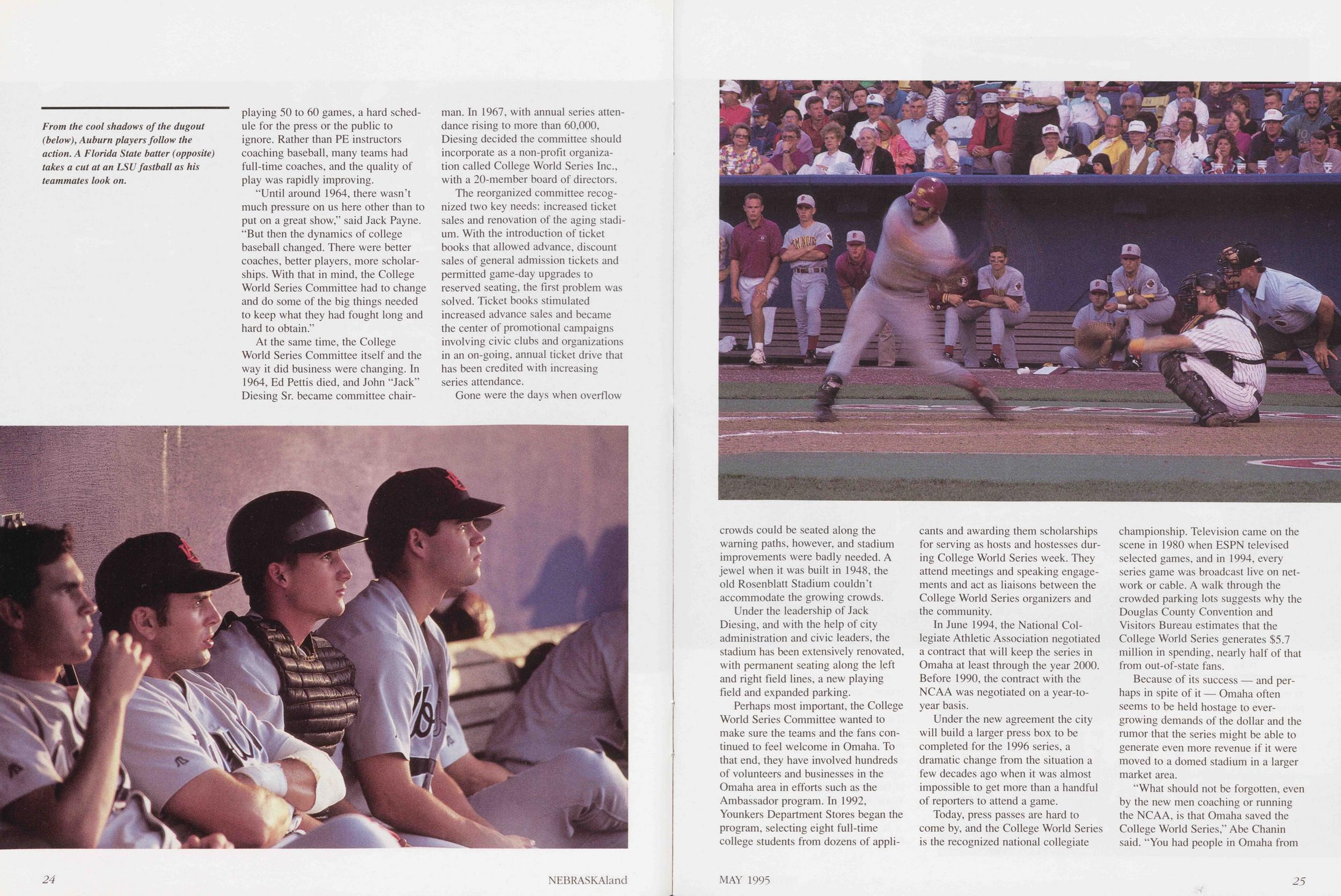
"Until around 1964, there wasn't much pressure on us here other than to put on a great show," said Jack Payne. "But then the dynamics of college baseball changed. There were better coaches, better players, more scholarships. With that in mind, the College World Series Committee had to change and do some of the big things needed to keep what they had fought long and hard to obtain."
At the same time, the College World Series Committee itself and the way it did business were changing. In 1964, Ed Pettis died, and John "Jack" Diesing Sr. became committee chairman. In 1967, with annual series attendance rising to more than 60,000, Diesing decided the committee should incorporate as a non-profit organization called College World Series Inc., with a 20-member board of directors.
The reorganized committee recognized two key needs: increased ticket sales and renovation of the aging stadium. With the introduction of ticket books that allowed advance, discount sales of general admission tickets and permitted game-day upgrades to reserved seating, the first problem was solved. Ticket books stimulated increased advance sales and became the center of promotional campaigns involving civic clubs and organizations in an on-going, annual ticket drive that has been credited with increasing series attendance.
Gone were the days when overflow
Under the leadership of Jack Diesing, and with the help of city administration and civic leaders, the stadium has been extensively renovated, with permanent seating along the left and right field lines, a new playing field and expanded parking.
Perhaps most important, the College World Series Committee wanted to make sure the teams and the fans continued to feel welcome in Omaha. To that end, they have involved hundreds of volunteers and businesses in the Omaha area in efforts such as the Ambassador program. In 1992, Younkers Department Stores began the program, selecting eight full-time college students from dozens of applicants and awarding them scholarships for serving as hosts and hostesses during College World Series week. They attend meetings and speaking engagements and act as liaisons between the College World Series organizers and the community.
In June 1994, the National Collegiate Athletic Association negotiated a contract that will keep the series in Omaha at least through the year 2000. Before 1990, the contract with the NCAA was negotiated on a year-to-year basis.
Under the new agreement the city will build a larger press box to be completed for the 1996 series, a dramatic change from the situation a few decades ago when it was almost impossible to get more than a handful of reporters to attend a game.
Today, press passes are hard to come by, and the College World Series is the recognized national collegiate championship. Television came on the scene in 1980 when ESPN televised selected games, and in 1994, every series game was broadcast live on network or cable. A walk through the crowded parking lots suggests why the Douglas County Convention and Visitors Bureau estimates that the College World Series generates $5.7 million in spending, nearly half of that from out-of-state fans.
Because of its success — and perhaps in spite of it — Omaha often seems to be held hostage to evergrowing demands of the dollar and the rumor that the series might be able to generate even more revenue if it were moved to a domed stadium in a larger market area.
'What should not be forgotten, even
by the new men coaching or running
the NCAA, is that Omaha saved the
College World Series," Abe Chanin
said. "You had people in Omaha from
MAY 1995
25
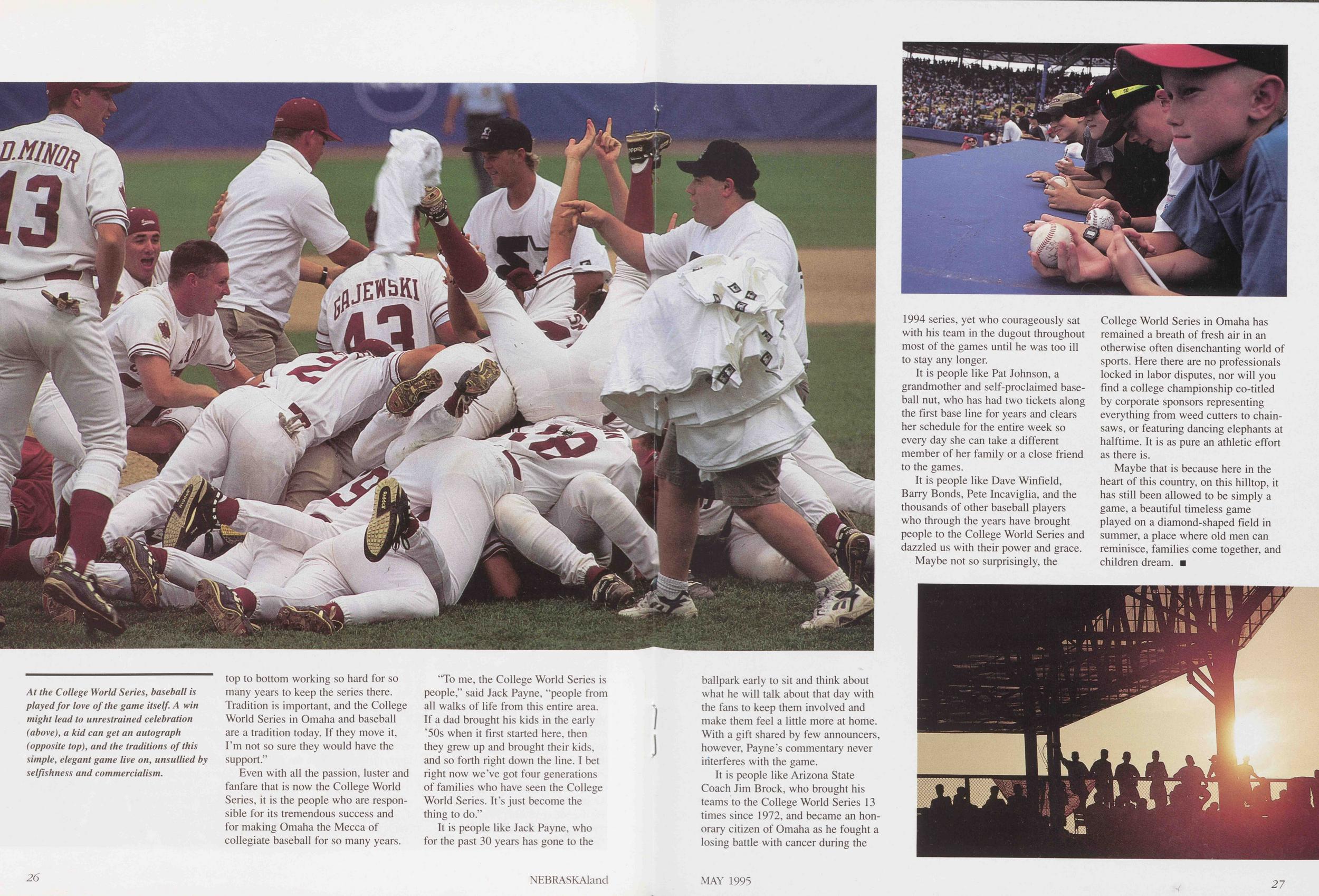
Even with all the passion, luster and fanfare that is now the College World Series, it is the people who are responsible for its tremendous success and for making Omaha the Mecca of collegiate baseball for so many years.
'To me, the College World Series is people," said Jack Payne, "people from all walks of life from this entire area. If a dad brought his kids in the early '50s when it first started here, then they grew up and brought their kids, and so forth right down the line. I bet right now we've got four generations of families who have seen the College World Series. It's just become the thing to do."
It is people like Jack Payne, who for the past 30 years has gone to the 26 NEBRASKAland ballpark early to sit and think about what he will talk about that day with the fans to keep them involved and make them feel a little more at home. With a gift shared by few announcers, however, Payne's commentary never interferes with the game.
It is people like Arizona State Coach Jim Brock, who brought his teams to the College World Series 13 times since 1972, and became an honorary citizen of Omaha as he fought a losing battle with cancer during the 1994 series, yet who courageously sat with his team in the dugout throughout most of the games until he was too ill to stay any longer.
It is people like Pat Johnson, a grandmother and self-proclaimed baseball nut, who has had two tickets along the first base line for years and clears her schedule for the entire week so every day she can take a different member of her family or a close friend to the games.
It is people like Dave Winfield, Barry Bonds, Pete Incaviglia, and the thousands of other baseball players who through the years have brought people to the College World Series and dazzled us with their power and grace.
Maybe not so surprisingly, the College World Series in Omaha has remained a breath of fresh air in an otherwise often disenchanting world of sports. Here there are no professionals locked in labor disputes, nor will you find a college championship co-titled by corporate sponsors representing everything from weed cutters to chainsaws, or featuring dancing elephants at half time. It is as pure an athletic effort as there is.
Maybe that is because here in the heart of this country, on this hilltop, it has still been allowed to be simply a game, a beautiful timeless game played on a diamond-shaped field in summer, a place where old men can reminisce, families come together, and children dream.
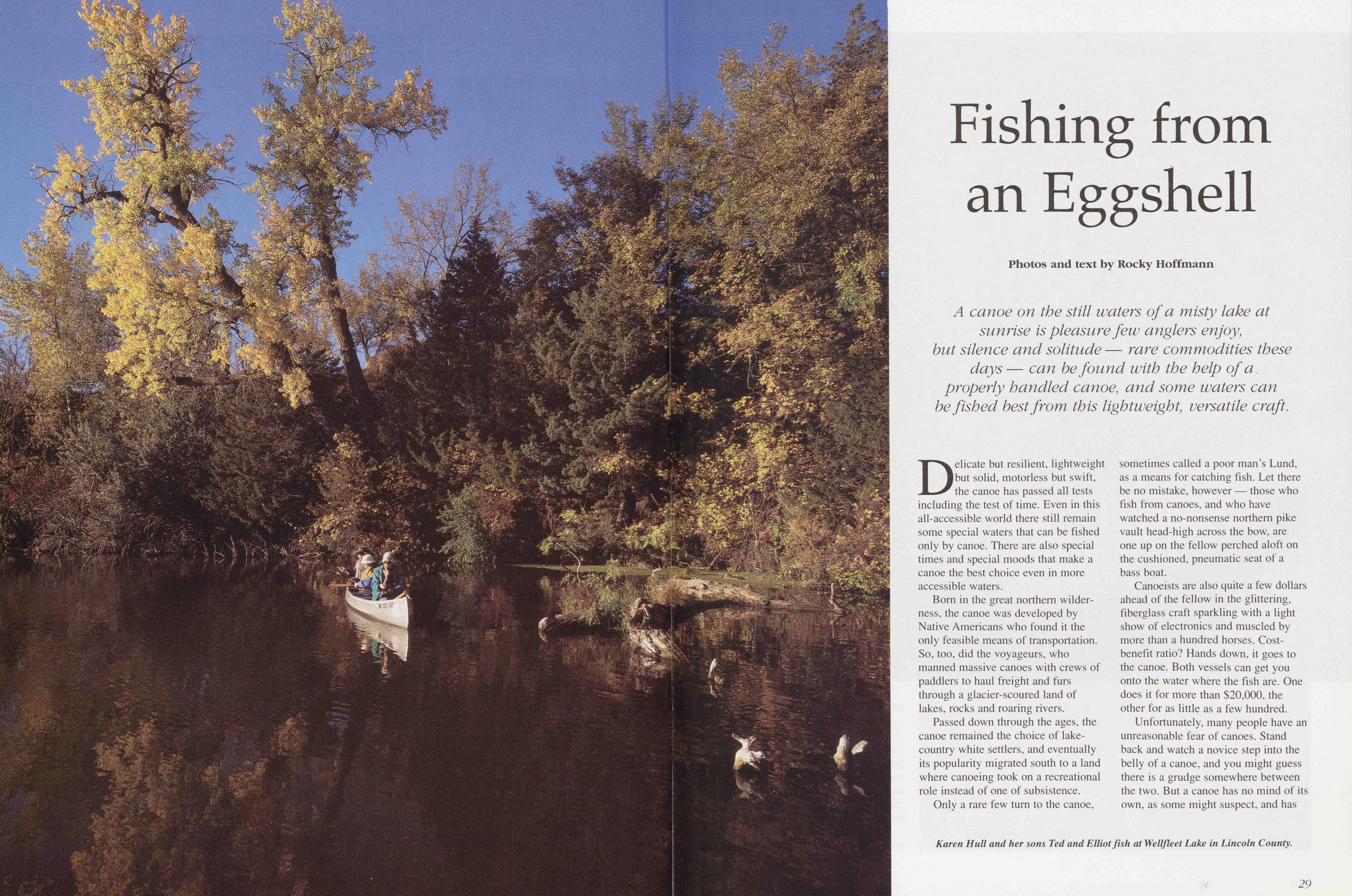
Fishing from an Eggshell
Photos and text by Rocky Hoffmann A canoe on the still waters of a misty lake at sunrise is pleasure few anglers enjoy, but silence and solitude — rare commodities these days— can be found with the help of a. properly handled canoe, and some waters can be fished best from this lightweight, versatile craft.Delicate but resilient, lightweight but solid, motorless but swift, the canoe has passed all tests including the test of time. Even in this all-accessible world there still remain some special waters that can be fished only by canoe. There are also special times and special moods that make a canoe the best choice even in more accessible waters.
Born in the great northern wilderness, the canoe was developed by Native Americans who found it the only feasible means of transportation. So, too, did the voyageurs, who manned massive canoes with crews of paddlers to haul freight and furs through a glacier-scoured land of lakes, rocks and roaring rivers.
Passed down through the ages, the canoe remained the choice of lakecountry white settlers, and eventually its popularity migrated south to a land where canoeing took on a recreational role instead of one of subsistence.
Only a rare few turn to the canoe, sometimes called a poor man's Lund, as a means for catching fish. Let there be no mistake, however — those who fish from canoes, and who have watched a no-nonsense northern pike vault head-high across the bow, are one up on the fellow perched aloft on the cushioned, pneumatic seat of a bass boat.
Canoeists are also quite a few dollars ahead of the fellow in the glittering, fiberglass craft sparkling with a light show of electronics and muscled by more than a hundred horses. Cost benefit ratio? Hands down, it goes to the canoe. Both vessels can get you onto the water where the fish are. One does it for more than $20,000, the other for as little as a few hundred.
Unfortunately, many people have an
unreasonable fear of canoes. Stand
back and watch a novice step into the
belly of a canoe, and you might guess
there is a grudge somewhere between
the two. But a canoe has no mind of its
own, as some might suspect, and has
29
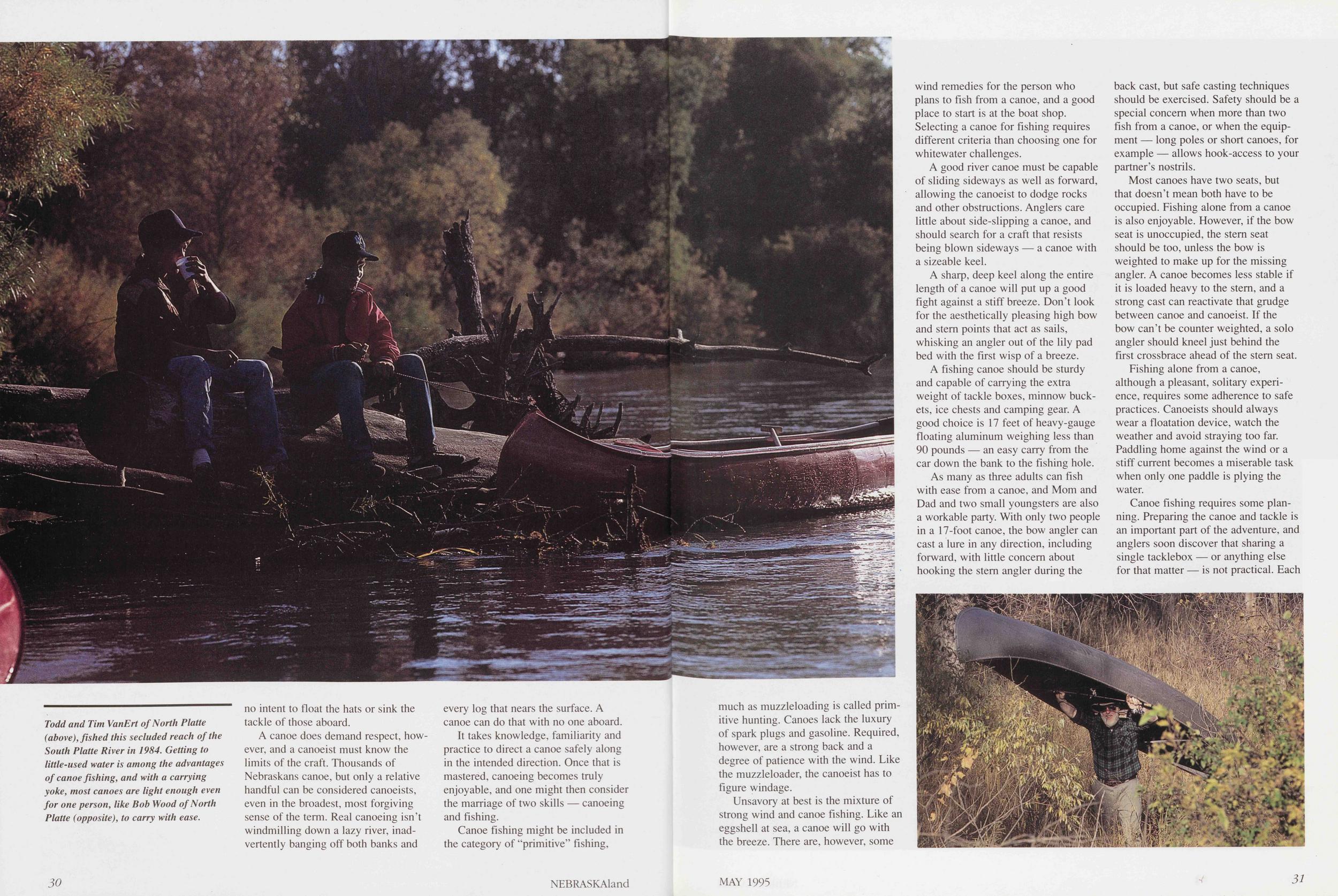
A canoe does demand respect, however, and a canoeist must know the limits of the craft. Thousands of Nebraskans canoe, but only a relative handful can be considered canoeists, even in the broadest, most forgiving sense of the term. Real canoeing isn't windmilling down a lazy river, inadvertently banging off both banks and every log that nears the surface. A canoe can do that with no one aboard.
It takes knowledge, familiarity and practice to direct a canoe safely along in the intended direction. Once that is mastered, canoeing becomes truly enjoyable, and one might then consider the marriage of two skills — canoeing and fishing.
Canoe fishing might be included in the category of "primitive" fishing, 30 NEBRASKAland much as muzzleloading is called primitive hunting. Canoes lack the luxury of spark plugs and gasoline. Required, however, are a strong back and a degree of patience with the wind. Like the muzzleloader, the canoeist has to figure windage.
Unsavory at best is the mixture of strong wind and canoe fishing. Like an eggshell at sea, a canoe will go with the breeze. There are, however, some wind remedies for the person who plans to fish from a canoe, and a good place to start is at the boat shop. Selecting a canoe for fishing requires different criteria than choosing one for Whitewater challenges.
A good river canoe must be capable of sliding sideways as well as forward, allowing the canoeist to dodge rocks and other obstructions. Anglers care little about side-slipping a canoe, and should search for a craft that resists being blown sideways — a canoe with a sizeable keel.
A sharp, deep keel along the entire length of a canoe will put up a good fight against a stiff breeze. Don't look for the aesthetically pleasing high bow and stern points that act as sails, whisking an angler out of the lily pad bed with the first wisp of a breeze.
A fishing canoe should be sturdy and capable of carrying the extra weight of tackle boxes, minnow buckets, ice chests and camping gear. A good choice is 17 feet of heavy-gauge floating aluminum weighing less than 90 pounds — an easy carry from the car down the bank to the fishing hole.
As many as three adults can fish with ease from a canoe, and Mom and Dad and two small youngsters are also a workable party. With only two people in a 17-foot canoe, the bow angler can cast a lure in any direction, including forward, with little concern about hooking the stern angler during the back cast, but safe casting techniques should be exercised. Safety should be a special concern when more than two fish from a canoe, or when the equipment — long poles or short canoes, for example — allows hook-access to your partner's nostrils.
Most canoes have two seats, but that doesn't mean both have to be occupied. Fishing alone from a canoe is also enjoyable. However, if the bow seat is unoccupied, the stern seat should be too, unless the bow is weighted to make up for the missing angler. A canoe becomes less stable if it is loaded heavy to the stern, and a strong cast can reactivate that grudge between canoe and canoeist. If the bow can't be counter weighted, a solo angler should kneel just behind the first crossbrace ahead of the stern seat.
Fishing alone from a canoe, although a pleasant, solitary experience, requires some adherence to safe practices. Canoeists should always wear a floatation device, watch the weather and avoid straying too far. Paddling home against the wind or a stiff current becomes a miserable task when only one paddle is plying the water.
Canoe fishing requires some planning. Preparing the canoe and tackle is an important part of the adventure, and anglers soon discover that sharing a single tacklebox — or anything else for that matter — is not practical. Each
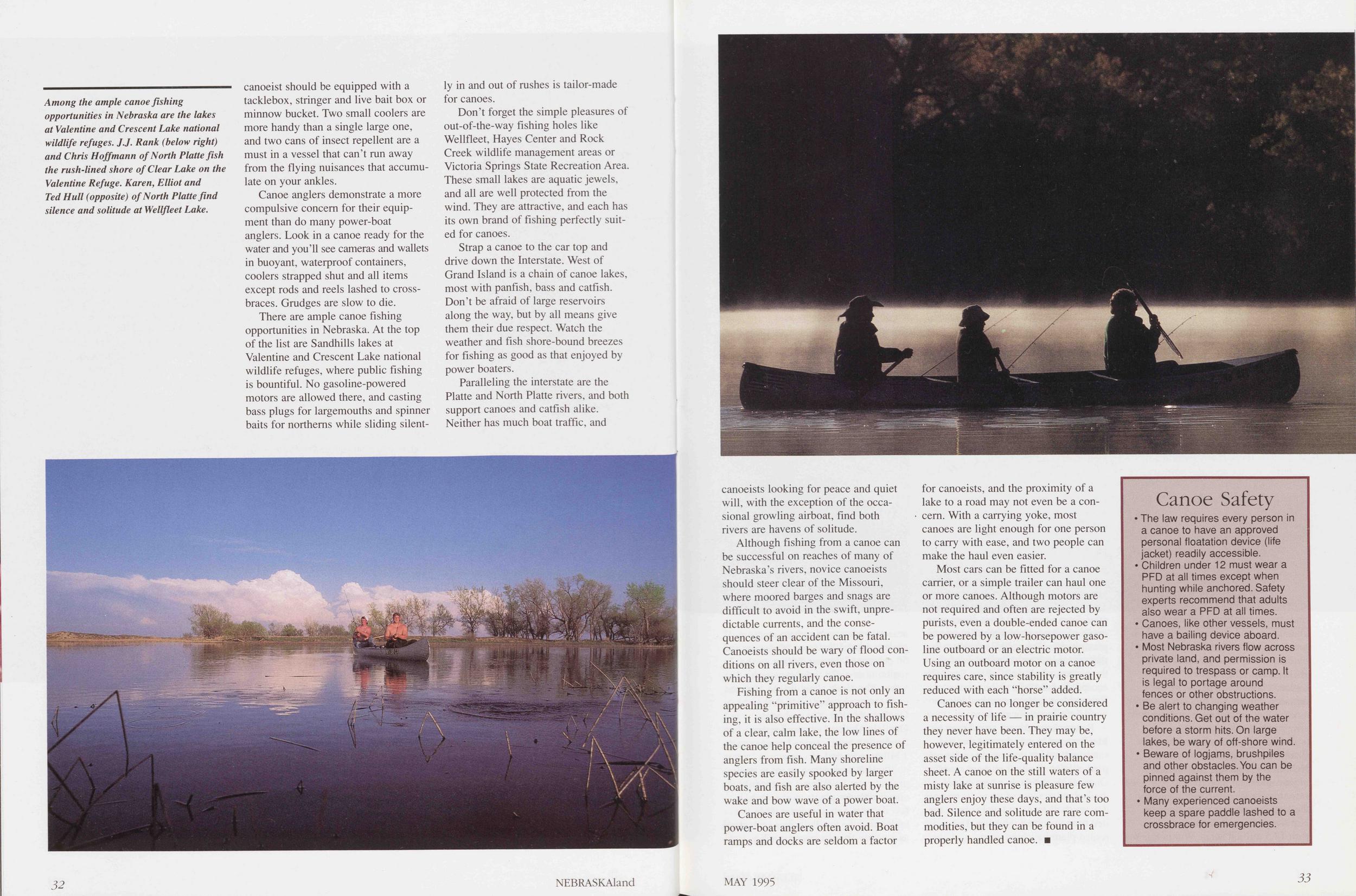
Canoe anglers demonstrate a more compulsive concern for their equipment than do many power-boat anglers. Look in a canoe ready for the water and you'll see cameras and wallets in buoyant, waterproof containers, coolers strapped shut and all items except rods and reels lashed to crossbraces. Grudges are slow to die.
There are ample canoe fishing opportunities in Nebraska. At the top of the list are Sandhills lakes at Valentine and Crescent Lake national wildlife refuges, where public fishing is bountiful. No gasoline-powered motors are allowed there, and casting bass plugs for largemouths and spinner baits for northerns while sliding silently in and out of rushes is tailor-made for canoes.
Don't forget the simple pleasures of out-of-the-way fishing holes like Wellfleet, Hayes Center and Rock Creek wildlife management areas or Victoria Springs State Recreation Area. These small lakes are aquatic jewels, and all are well protected from the wind. They are attractive, and each has its own brand of fishing perfectly suited for canoes.
Strap a canoe to the car top and drive down the Interstate. West of Grand Island is a chain of canoe lakes, most with panfish, bass and catfish. Don't be afraid of large reservoirs along the way, but by all means give them their due respect. Watch the weather and fish shore-bound breezes for fishing as good as that enjoyed by power boaters.
Paralleling the interstate are the Platte and North Platte rivers, and both support canoes and catfish alike. Neither has much boat traffic, and 32 NEBRASKAland
Although fishing from a canoe can be successful on reaches of many of Nebraska's rivers, novice canoeists should steer clear of the Missouri, where moored barges and snags are difficult to avoid in the swift, unpredictable currents, and the consequences of an accident can be fatal. Canoeists should be wary of flood conditions on all rivers, even those on which they regularly canoe.
Fishing from a canoe is not only an appealing "primitive" approach to fishing, it is also effective. In the shallows of a clear, calm lake, the low lines of the canoe help conceal the presence of anglers from fish. Many shoreline species are easily spooked by larger boats, and fish are also alerted by the wake and bow wave of a power boat.
Canoes are useful in water that power-boat anglers often avoid. Boat ramps and docks are seldom a factor for canoeists, and the proximity of a lake to a road may not even be a concern. With a carrying yoke, most canoes are light enough for one person to carry with ease, and two people can make the haul even easier.
Most cars can be fitted for a canoe carrier, or a simple trailer can haul one or more canoes. Although motors are not required and often are rejected by purists, even a double-ended canoe can be powered by a low-horsepower gasoline outboard or an electric motor. Using an outboard motor on a canoe requires care, since stability is greatly reduced with each "horse" added.
Canoes can no longer be considered a necessity of life — in prairie country they never have been. They may be, however, legitimately entered on the asset side of the life-quality balance sheet. A canoe on the still waters of a misty lake at sunrise is pleasure few anglers enjoy these days, and that's too bad. Silence and solitude are rare commodities, but they can be found in a properly handled canoe.
Canoe SafetyThe law requires every person in a canoe to have an approved personal floatation device (life jacket) readily accessible.
Children under 12 must wear a PFD at all times except when hunting while anchored. Safety experts recommend that adults also wear a PFD at all times.
Canoes, like other vessels, must have a bailing device aboard.
Most Nebraska rivers flow across private land, and permission is required to trespass or camp, it is legal to portage around fences or other obstructions.
Be alert to changing weather conditions. Get out of the water before a storm hits. On large lakes, be wary of off-shore wind.
Beware of logjams, brushpiles and other obstacles. You can be pinned against them by the force of the current.
Many experienced canoeists keep a spare paddle lashed to a crossbrace for emergencies.
MAY 1995 33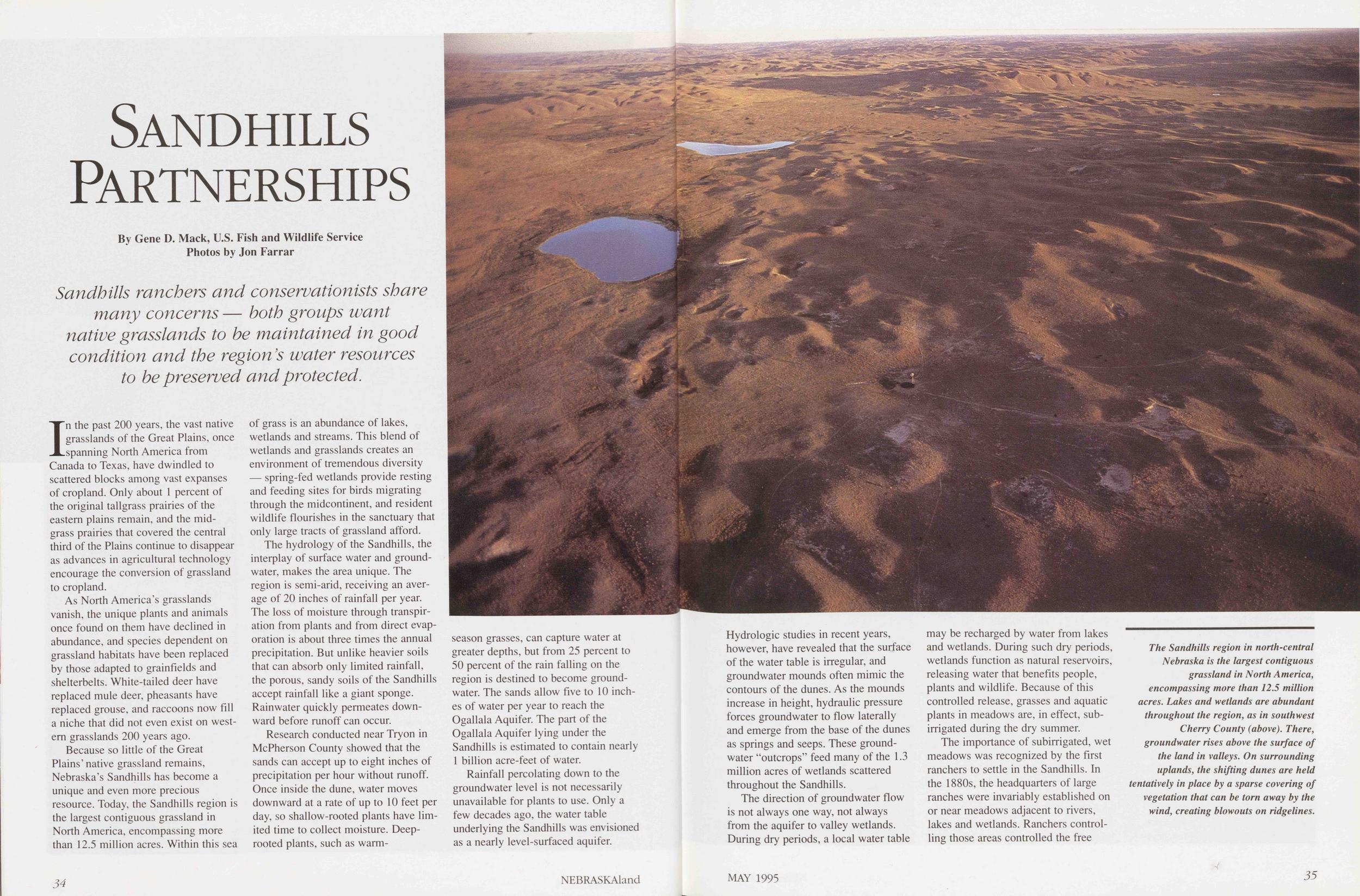
Sandhills Partnerships
By Gene D. Mack, U.S. Fish and Wildlife Service Photos by Jon Farrar Sandhills ranchers and conservationists share many concerns — both groups want native grasslands to be maintained in good condition and the region's water resources to be preserved and protected.In the past 200 years, the vast native grasslands of the Great Plains, once spanning North America from Canada to Texas, have dwindled to scattered blocks among vast expanses of cropland. Only about 1 percent of the original tallgrass prairies of the eastern plains remain, and the midgrass prairies that covered the central third of the Plains continue to disappear as advances in agricultural technology encourage the conversion of grassland to cropland.
As North America's grasslands vanish, the unique plants and animals once found on them have declined in abundance, and species dependent on grassland habitats have been replaced by those adapted to grainfields and shelterbelts. White-tailed deer have replaced mule deer, pheasants have replaced grouse, and raccoons now fill a niche that did not even exist on western grasslands 200 years ago.
Because so little of the Great Plains'native grassland remains, Nebraska's Sandhills has become a unique and even more precious resource. Today, the Sandhills region is the largest contiguous grassland in North America, encompassing more than 12.5 million acres. Within this sea of grass is an abundance of lakes, wetlands and streams. This blend of wetlands and grasslands creates an environment of tremendous diversity — spring-fed wetlands provide resting and feeding sites for birds migrating through the midcontinent, and resident wildlife flourishes in the sanctuary that only large tracts of grassland afford.
The hydrology of the Sandhills, the interplay of surface water and groundwater, makes the area unique. The region is semi-arid, receiving an average of 20 inches of rainfall per year. The loss of moisture through transpiration from plants and from direct evaporation is about three times the annual precipitation. But unlike heavier soils that can absorb only limited rainfall, the porous, sandy soils of the Sandhills accept rainfall like a giant sponge. Rainwater quickly permeates downward before runoff can occur.
Research conducted near Tryon in McPherson County showed that the sands can accept up to eight inches of precipitation per hour without runoff. Once inside the dune, water moves downward at a rate of up to 10 feet per day, so shallow-rooted plants have limited time to collect moisture. Deeprooted plants, such as warmseason grasses, can capture water at greater depths, but from 25 percent to 50 percent of the rain falling on the region is destined to become groundwater. The sands allow five to 10 inches of water per year to reach the Ogallala Aquifer. The part of the Ogallala Aquifer lying under the Sandhills is estimated to contain nearly 1 billion acre-feet of water.
Rainfall percolating down to the groundwater level is not necessarily unavailable for plants to use. Only a few decades ago, the water table underlying the Sandhills was envisioned as a nearly level-surfaced aquifer. 34 NEBRASKAland Hydrologic studies in recent years, however, have revealed that the surface of the water table is irregular, and groundwater mounds often mimic the contours of the dunes. As the mounds increase in height, hydraulic pressure forces groundwater to flow laterally and emerge from the base of the dunes as springs and seeps. These groundwater "outcrops" feed many of the 1.3 million acres of wetlands scattered throughout the Sandhills.
The direction of groundwater flow is not always one way, not always from the aquifer to valley wetlands. During dry periods, a local water table may be recharged by water from lakes and wetlands. During such dry periods, wetlands function as natural reservoirs, releasing water that benefits people, plants and wildlife. Because of this controlled release, grasses and aquatic plants in meadows are, in effect, subirrigated during the dry summer.
The importance of subirrigated, wet meadows was recognized by the first ranchers to settle in the Sandhills. In the 1880s, the headquarters of large ranches were invariably established on or near meadows adjacent to rivers, lakes and wetlands. Ranchers controlling those areas controlled the free
Not only did the region's natural wetlands serve as watering holes for livestock, but the valleys were cloaked with lush grasses providing excellent grazing and hay for winter feed. Because water for livestock was not available except in rivers and lakes until the introduction of windmills, the fragile hills adjacent to rivers and lakes were frequently overgrazed and exposed to erosion. In the early decades of this century, blowouts of bare sand were still common on the tops of dunes. Today, except following periods of drought, or on isolated, overgrazed pastures, blowouts are few and far between in the region.
When the Kinkaid Act granting settlers a full section of land was passed by Congress in 1904, a new wave of settlers moved to the region. Like the Homesteaders before them, they dreamed of making a living on the 640 acres deeded to them by the government. Those who tried farming watched their crops wither in the dry sands. Those who tried ranching discovered that 640 acres of sparsely vegetated dunes could not support much livestock. As the Kinkaiders "went busted," established ranchers who owned the valleys bought the Kinkaiders'land. Kinkaiders who could afford to acquired additional land and became successful ranchers themselves.
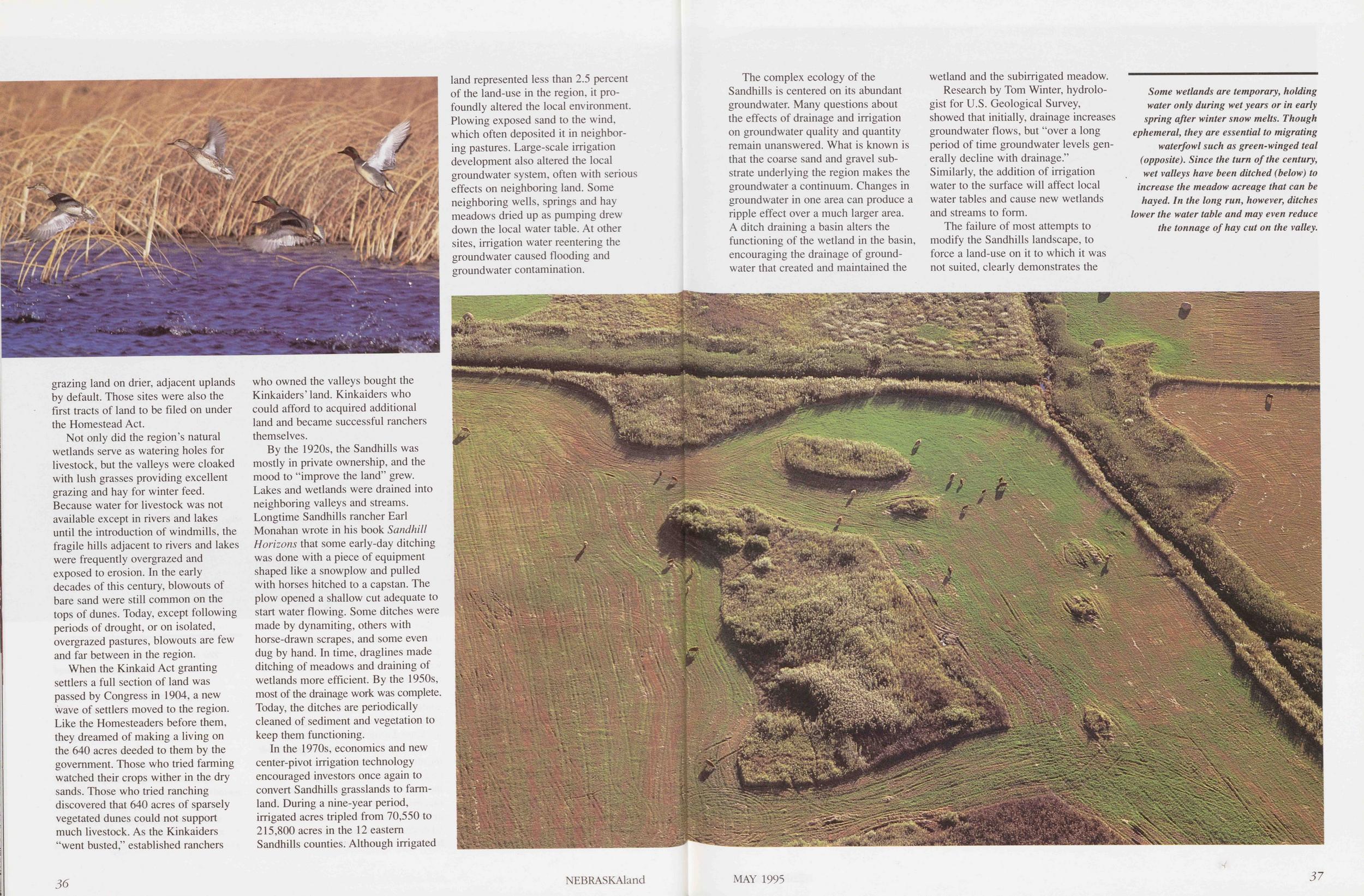
By the 1920s, the Sandhills was mostly in private ownership, and the mood to "improve the land" grew. Lakes and wetlands were drained into neighboring valleys and streams. Longtime Sandhills rancher Earl Monahan wrote in his book Sandhill Horizons that some early-day ditching was done with a piece of equipment shaped like a snowplow and pulled with horses hitched to a capstan. The plow opened a shallow cut adequate to start water flowing. Some ditches were made by dynamiting, others with horse-drawn scrapes, and some even dug by hand. In time, draglines made ditching of meadows and draining of wetlands more efficient. By the 1950s, most of the drainage work was complete. Today, the ditches are periodically cleaned of sediment and vegetation to keep them functioning.
In the 1970s, economics and new center-pivot irrigation technology encouraged investors once again to convert Sandhills grasslands to farmland. During a nine-year period, irrigated acres tripled from 70,550 to 215,800 acres in the 12 eastern Sandhills counties. Although irrigated land represented less than 2.5 percent of the land-use in the region, it profoundly altered the local environment. Plowing exposed sand to the wind, which often deposited it in neighboring pastures. Large-scale irrigation development also altered the local groundwater system, often with serious effects on neighboring land. Some neighboring wells, springs and hay meadows dried up as pumping drew down the local water table. At other sites, irrigation water reentering the groundwater caused flooding and groundwater contamination.
36 NEBRASKAlandThe complex ecology of the Sandhills is centered on its abundant groundwater. Many questions about the effects of drainage and irrigation on groundwater quality and quantity remain unanswered. What is known is that the coarse sand and gravel substrate underlying the region makes the groundwater a continuum. Changes in groundwater in one area can produce a ripple effect over a much larger area. A ditch draining a basin alters the functioning of the wetland in the basin, encouraging the drainage of groundwater that created and maintained the wetland and the subirrigated meadow.
Research by Tom Winter, hydrologist for U.S. Geological Survey, showed that initially, drainage increases groundwater flows, but "over a long period of time groundwater levels generally decline with drainage." Similarly, the addition of irrigation water to the surface will affect local water tables and cause new wetlands and streams to form.
The failure of most attempts to modify the Sandhills landscape, to force a land-use on it to which it was not suited, clearly demonstrates the
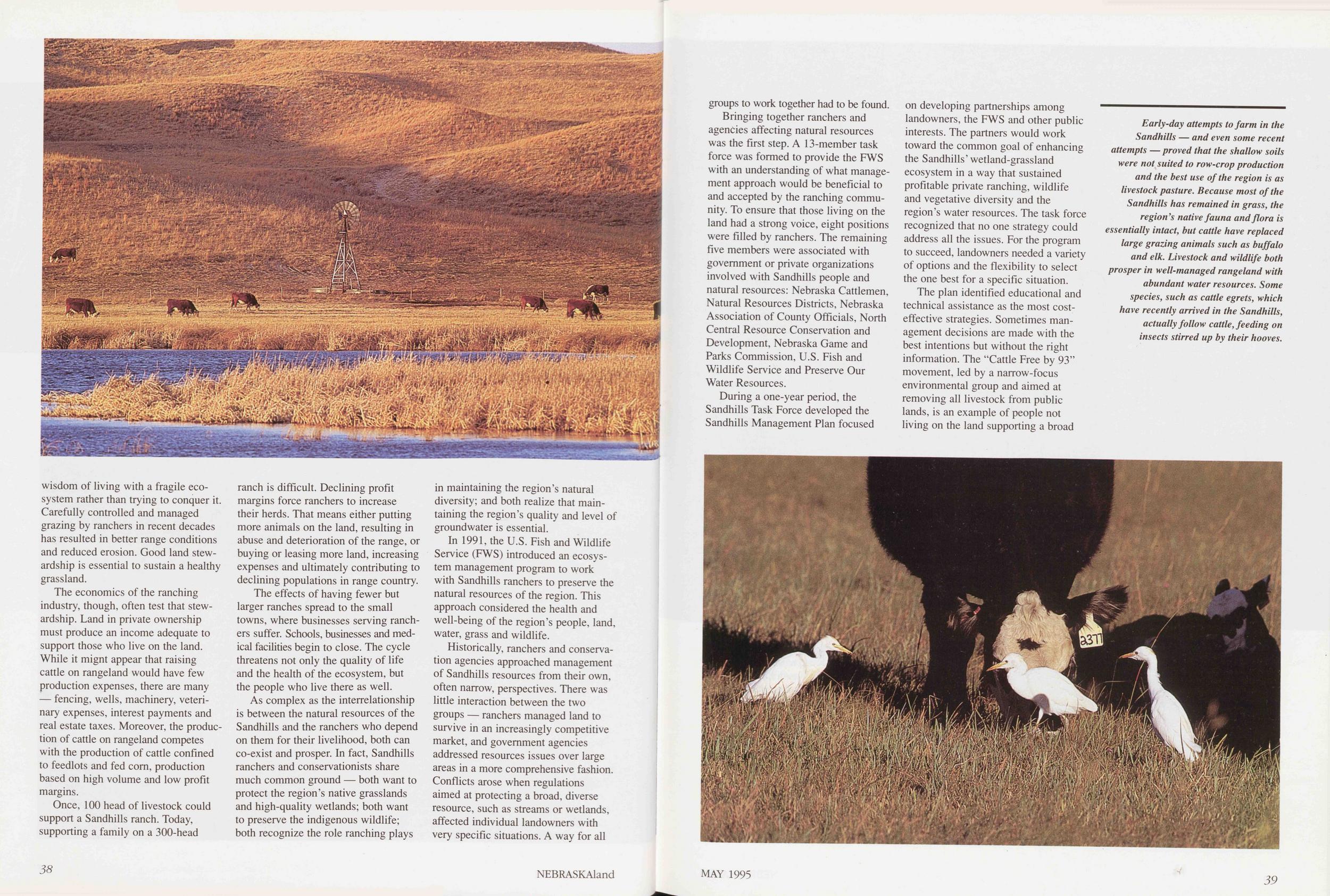
The economics of the ranching industry, though, often test that stewardship. Land in private ownership must produce an income adequate to support those who live on the land. While it mignt appear that raising cattle on rangeland would have few production expenses, there are many — fencing, wells, machinery, veterinary expenses, interest payments and real estate taxes. Moreover, the production of cattle on rangeland competes with the production of cattle confined to feedlots and fed corn, production based on high volume and low profit margins.
Once, 100 head of livestock could support a Sandhills ranch. Today, supporting a family on a 300-head ranch is difficult. Declining profit margins force ranchers to increase their herds. That means either putting more animals on the land, resulting in abuse and deterioration of the range, or buying or leasing more land, increasing expenses and ultimately contributing to declining populations in range country.
The effects of having fewer but larger ranches spread to the small towns, where businesses serving ranchers suffer. Schools, businesses and medical facilities begin to close. The cycle threatens not only the quality of life and the health of the ecosystem, but the people who live there as well.
As complex as the interrelationship is between the natural resources of the Sandhills and the ranchers who depend on them for their livelihood, both can co-exist and prosper. In fact, Sandhills ranchers and conservationists share much common ground — both want to protect the region's native grasslands and high-quality wetlands; both want to preserve the indigenous wildlife; both recognize the role ranching plays in maintaining the region's natural diversity; and both realize that maintaining the region's quality and level of groundwater is essential.
In 1991, the U.S. Fish and Wildlife Service (FWS) introduced an ecosystem management program to work with Sandhills ranchers to preserve the natural resources of the region. This approach considered the health and well-being of the region's people, land, water, grass and wildlife.
Historically, ranchers and conservation agencies approached management of Sandhills resources from their own, often narrow, perspectives. There was little interaction between the two groups — ranchers managed land to survive in an increasingly competitive market, and government agencies addressed resources issues over large areas in a more comprehensive fashion. Conflicts arose when regulations aimed at protecting a broad, diverse resource, such as streams or wetlands, affected individual landowners with very specific situations. A way for all 38 NEBRASKAland groups to work together had to be found.
Bringing together ranchers and agencies affecting natural resources was the first step. A 13-member task force was formed to provide the FWS with an understanding of what management approach would be beneficial to and accepted by the ranching community. To ensure that those living on the land had a strong voice, eight positions were filled by ranchers. The remaining five members were associated with government or private organizations involved with Sandhills people and natural resources: Nebraska Cattlemen, Natural Resources Districts, Nebraska Association of County Officials, North Central Resource Conservation and Development, Nebraska Game and Parks Commission, U.S. Fish and Wildlife Service and Preserve Our Water Resources.
During a one-year period, the Sandhills Task Force developed the Sandhills Management Plan focused on developing partnerships among landowners, the FWS and other public interests. The partners would work toward the common goal of enhancing the Sandhills'wetland-grassland ecosystem in a way that sustained profitable private ranching, wildlife and vegetative diversity and the region's water resources. The task force recognized that no one strategy could address all the issues. For the program to succeed, landowners needed a variety of options and the flexibility to select the one best for a specific situation.
The plan identified educational and technical assistance as the most costeffective strategies. Sometimes management decisions are made with the best intentions but without the right information. The "Cattle Free by 93" movement, led by a narrow-focus environmental group and aimed at removing all livestock from public lands, is an example of people not living on the land supporting a broad
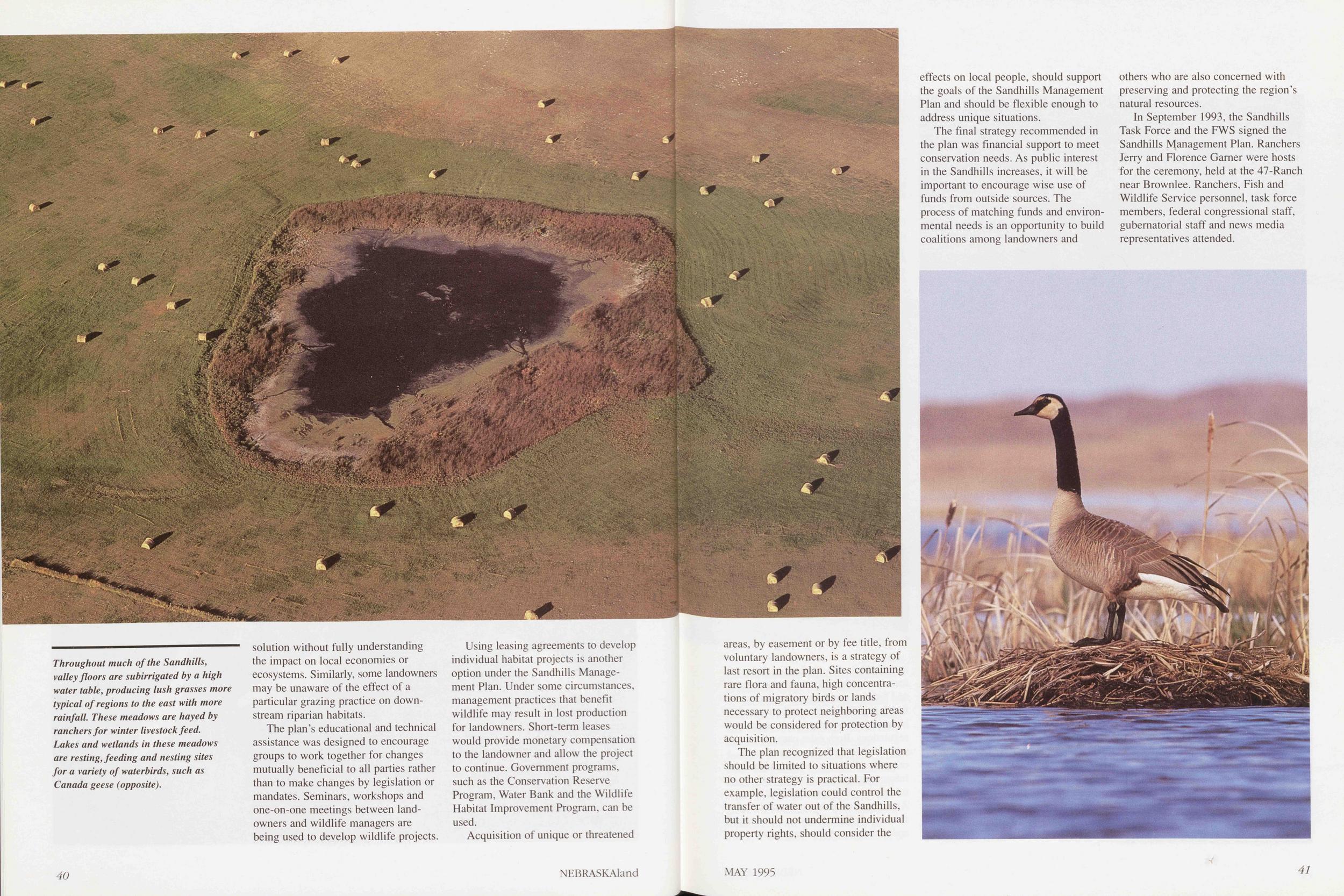
The plan's educational and technical assistance was designed to encourage groups to work together for changes mutually beneficial to all parties rather than to make changes by legislation or mandates. Seminars, workshops and one-on-one meetings between landowners and wildlife managers are being used to develop wildlife projects.
Using leasing agreements to develop individual habitat projects is another option under the Sandhills Management Plan. Under some circumstances, management practices that benefit wildlife may result in lost production for landowners. Short-term leases would provide monetary compensation to the landowner and allow the project to continue. Government programs, such as the Conservation Reserve Program, Water Bank and the Wildlife Habitat Improvement Program, can be used.
Acquisition of unique or threatened 40 NEBRASKAland areas, by easement or by fee title, from voluntary landowners, is a strategy of last resort in the plan. Sites containing rare flora and fauna, high concentrations of migratory birds or lands necessary to protect neighboring areas would be considered for protection by acquisition.
The plan recognized that legislation should be limited to situations where no other strategy is practical. For example, legislation could control the transfer of water out of the Sandhills, but it should not undermine individual property rights, should consider the effects on local people, should support the goals of the Sandhills Management Plan and should be flexible enough to address unique situations.
The final strategy recommended in the plan was financial support to meet conservation needs. As public interest in the Sandhills increases, it will be important to encourage wise use of funds from outside sources. The process of matching funds and environmental needs is an opportunity to build coalitions among landowners and others who are also concerned with preserving and protecting the region's natural resources.
In September 1993, the Sandhills Task Force and the FWS signed the Sandhills Management Plan. Ranchers Jerry and Florence Garner were hosts for the ceremony, held at the 47-Ranch near Brownlee. Ranchers, Fish and Wildlife Service personnel, task force members, federal congressional staff, gubernatorial staff and news media representatives attended.
MAY 1995 41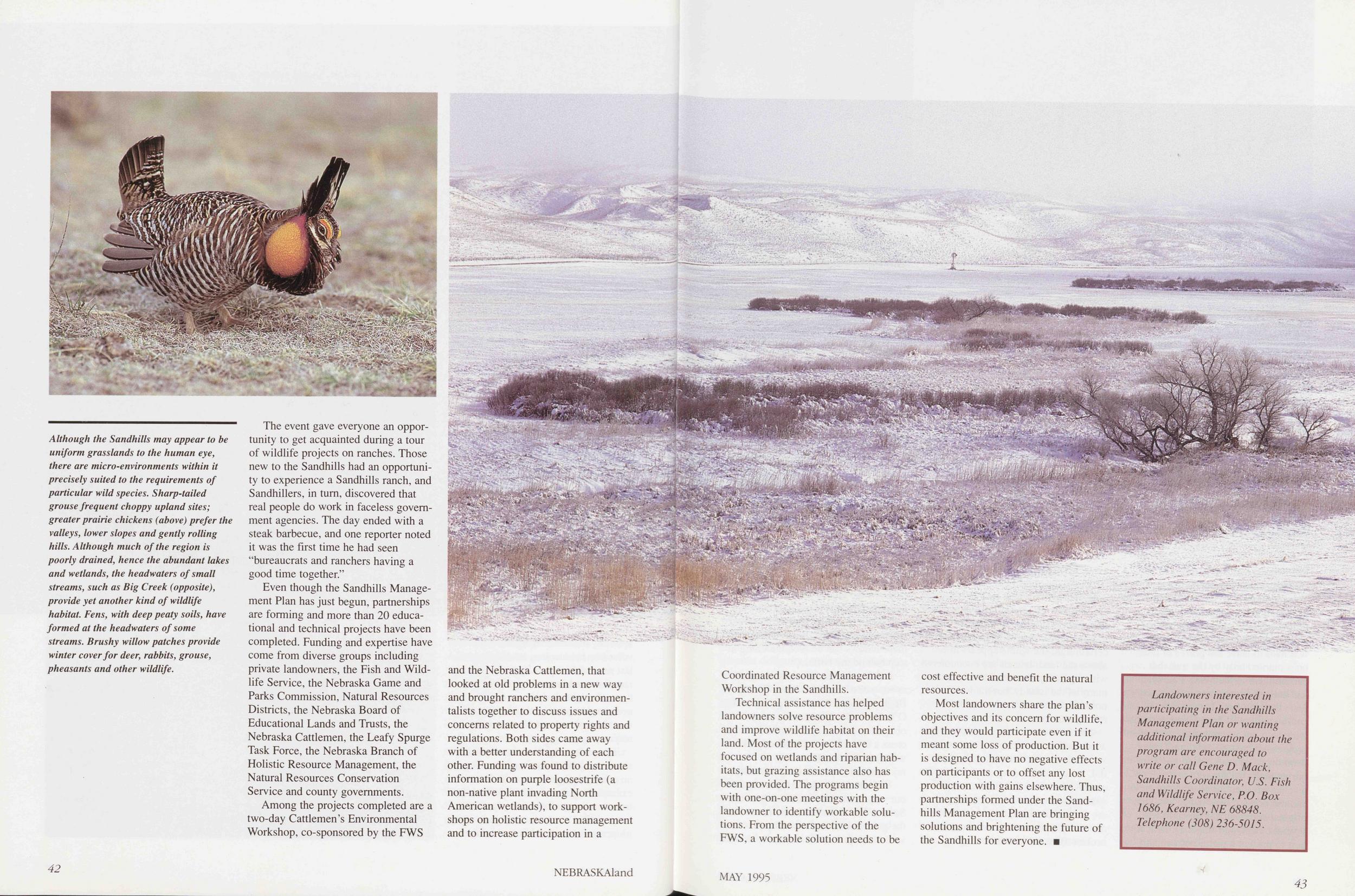
The event gave everyone an opportunity to get acquainted during a tour of wildlife projects on ranches. Those new to the Sandhills had an opportunity to experience a Sandhills ranch, and Sandhillers, in turn, discovered that real people do work in faceless government agencies. The day ended with a steak barbecue, and one reporter noted it was the first time he had seen "bureaucrats and ranchers having a good time together."
Even though the Sandhills Management Plan has just begun, partnerships are forming and more than 20 educational and technical projects have been completed. Funding and expertise have come from diverse groups including private landowners, the Fish and Wildlife Service, the Nebraska Game and Parks Commission, Natural Resources Districts, the Nebraska Board of Educational Lands and Trusts, the Nebraska Cattlemen, the Leafy Spurge Task Force, the Nebraska Branch of Holistic Resource Management, the Natural Resources Conservation Service and county governments.
Among the projects completed are a two-day Cattlemen's Environmental Workshop, co-sponsored by the FWS and the Nebraska Cattlemen, that looked at old problems in a new way and brought ranchers and environmentalists together to discuss issues and concerns related to property rights and regulations. Both sides came away with a better understanding of each other. Funding was found to distribute information on purple loosestrife (a non-native plant invading North American wetlands), to support workshops on holistic resource management and to increase participation in a 42 NEBRASKAland
Technical assistance has helped landowners solve resource problems and improve wildlife habitat on their land. Most of the projects have focused on wetlands and riparian habitats, but grazing assistance also has been provided. The programs begin with one-on-one meetings with the landowner to identify workable solutions. From the perspective of the FWS, a workable solution needs to be cost effective and benefit the natural resources.
Most landowners share the plan's objectives and its concern for wildlife, and they would participate even if it meant some loss of production. But it is designed to have no negative effects on participants or to offset any lost production with gains elsewhere. Thus, partnerships formed under the Sandhills Management Plan are bringing solutions and brightening the future of the Sandhills for everyone.
Landowners interested in participating in the Sandhills Management Plan or wanting additional information about the program are encouraged to write or call Gene D. Mack, Sandhills Coordinator, U.S. Fish and Wildlife Service, P.O. Box 1686, Kearney, NE 68848. Telephone (308) 236-5015.
MAY 1995 43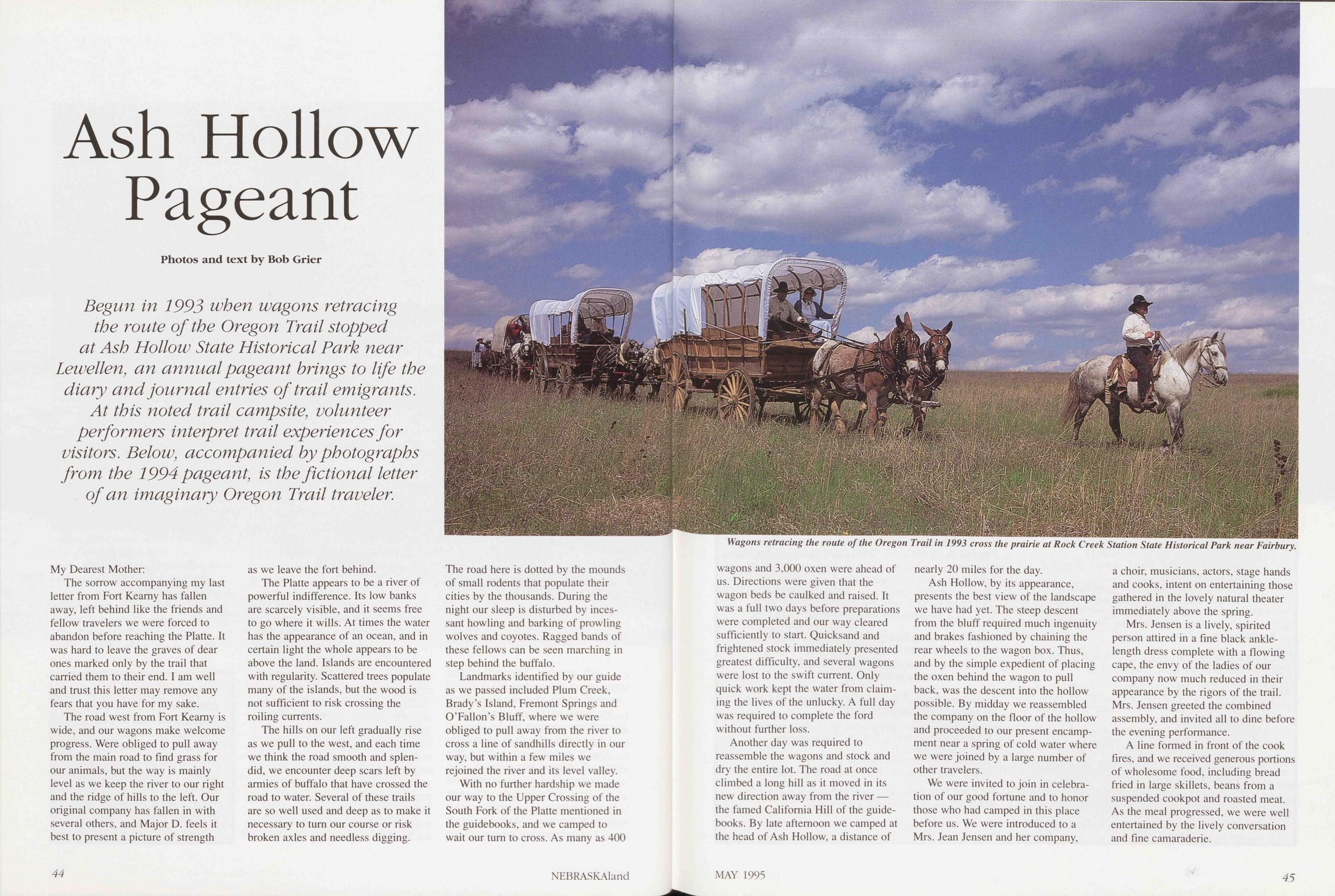
Ash Hollow Pageant
Photos and text by Bob Grier Begun in 1993 when wagons retracing the route of the Oregon Trail stopped at Ash Hollow State Historical Park near Lewellen, an annual pageant brings to life the diary and journal entries of trail emigrants. At this noted trail campsite, volunteer performers interpret trail experiences for visitors. Below, accompanied by photographs from the 1994 pageant, is the fictional letter of an imaginary Oregon Trail traveler.My Dearest Mother:
The sorrow accompanying my last letter from Fort Kearny has fallen away, left behind like the friends and fellow travelers we were forced to abandon before reaching the Platte. It was hard to leave the graves of dear ones marked only by the trail that carried them to their end. I am well and trust this letter may remove any fears that you have for my sake.
The road west from Fort Kearny is wide, and our wagons make welcome progress. Were obliged to pull away from the main road to find grass for our animals, but the way is mainly level as we keep the river to our right and the ridge of hills to the left. Our original company has fallen in with several others, and Major D. feels it best to present a picture of strength as we leave the fort behind.
The Platte appears to be a river of powerful indifference. Its low banks are scarcely visible, and it seems free to go where it wills. At times the water has the appearance of an ocean, and in certain light the whole appears to be above the land. Islands are encountered with regularity. Scattered trees populate many of the islands, but the wood is not sufficient to risk crossing the roiling currents.
The hills on our left gradually rise as we pull to the west, and each time we think the road smooth and splendid, we encounter deep scars left by armies of buffalo that have crossed the road to water. Several of these trails are so well used and deep as to make it necessary to turn our course or risk broken axles and needless digging. The road here is dotted by the mounds of small rodents that populate their cities by the thousands. During the night our sleep is disturbed by incessant howling and barking of prowling wolves and coyotes. Ragged bands of these fellows can be seen marching in step behind the buffalo.
Landmarks identified by our guide as we passed included Plum Creek, Brady's Island, Fremont Springs and O'Fallon's Bluff, where we were obliged to pull away from the river to cross a line of sandhills directly in our way, but within a few miles we rejoined the river and its level valley.
With no further hardship we made our way to the Upper Crossing of the South Fork of the Platte mentioned in the guidebooks, and we camped to wait our turn to cross. As many as 400 44 NEBRASKAland
Another day was required to reassemble the wagons and stock and dry the entire lot. The road at once climbed a long hill as it moved in its new direction away from the river the famed California Hill of the guidebooks. By late afternoon we camped at the head of Ash Hollow, a distance of nearly 20 miles for the day.
Ash Hollow, by its appearance, presents the best view of the landscape we have had yet. The steep descent from the bluff required much ingenuity and brakes fashioned by chaining the rear wheels to the wagon box. Thus, and by the simple expedient of placing the oxen behind the wagon to pull back, was the descent into the hollow possible. By midday we reassembled the company on the floor of the hollow and proceeded to our present encampment near a spring of cold water where we were joined by a large number of other travelers.
We were invited to join in celebration of our good fortune and to honor those who had camped in this place before us. We were introduced to a Mrs. Jean Jensen and her company, a choir, musicians, actors, stage hands and cooks, intent on entertaining those gathered in the lovely natural theater immediately above the spring.
Mrs. Jensen is a lively, spirited person attired in a fine black anklelength dress complete with a flowing cape, the envy of the ladies of our company now much reduced in their appearance by the rigors of the trail. Mrs. Jensen greeted the combined assembly, and invited all to dine before the evening performance.
A line formed in front of the cook fires, and we received generous portions of wholesome food, including bread fried in large skillets, beans from a suspended cookpot and roasted meat. As the meal progressed, we were well entertained by the lively conversation and fine camaraderie.
MAY 1995 45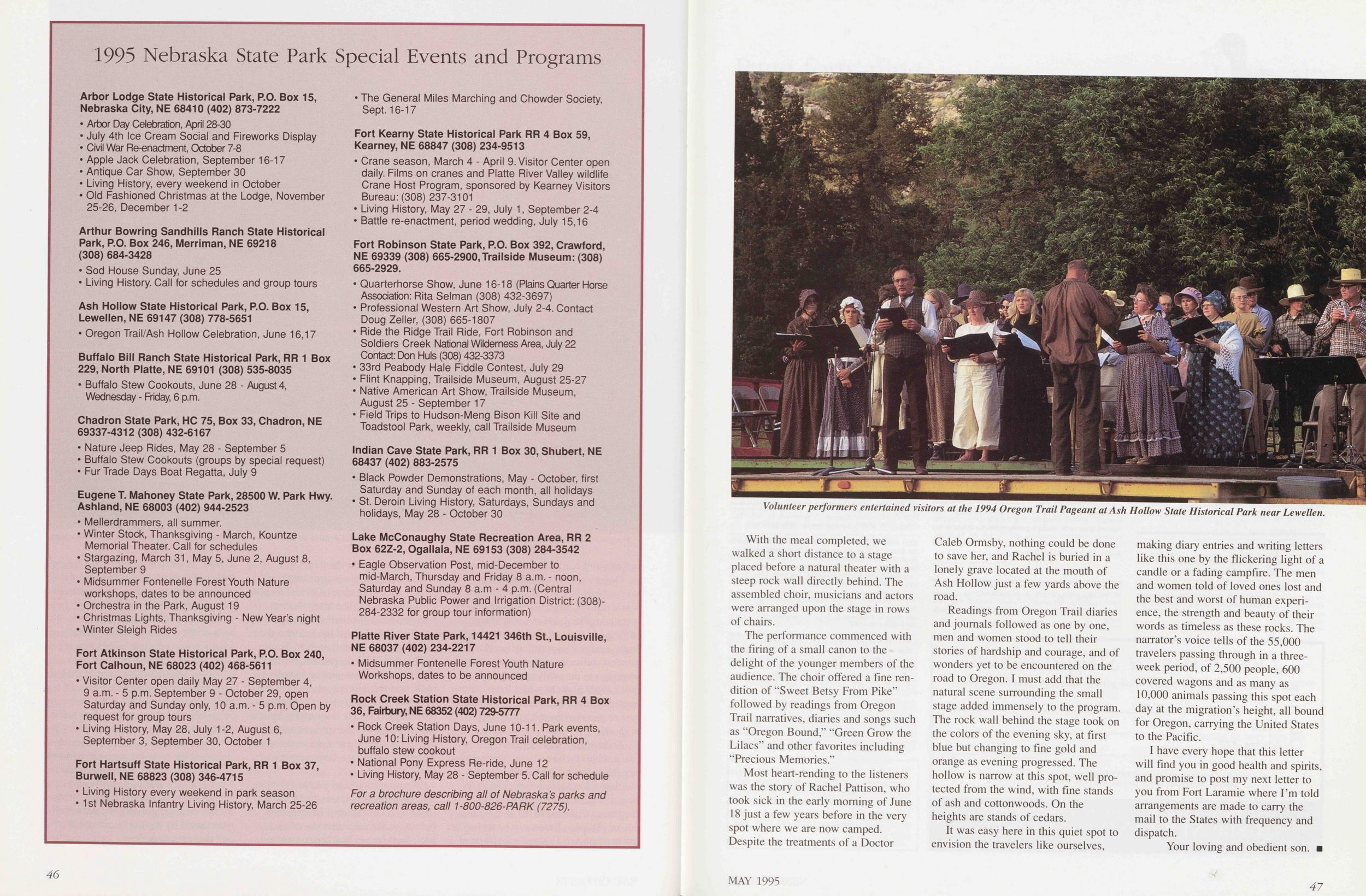 1995 Nebraska State Park Special Events and Programs
Arbor Lodge State Historical Park, P.O. Box 15,
Nebraska City, NE 68410 (402) 873-7222
Arbor Day Celebration, April 28-30
July 4th Ice Cream Social and Fireworks Display
Civil War Re-enactment, October 7-8
Apple Jack Celebration, September 16-17
Antique Car Show, September 30
Living History, every weekend in October
Old Fashioned Christmas at the Lodge, November
25-26, December 1 -2
Arthur Bowring Sandhills Ranch State Historical
Park, P.O. Box 246, Merriman, NE 69218
(308)684-3428
Sod House Sunday, June 25
Living History. Call for schedules and group tours
Ash Hollow State Historical Park, P.O. Box 15,
Lewellen, NE 69147 (308) 778-5651
Oregon Trail/Ash Hollow Celebration, June 16,17
Buffalo Bill Ranch State Historical Park, RR 1 Box
229, North Platte, NE 69101 (308) 535-8035
Buffalo Stew Cookouts, June 28 - August 4,
Wednesday - Friday, 6 p.m.
Chadron State Park, HC 75, Box 33, Chadron, NE
69337-4312 (308) 432-6167
Nature Jeep Rides, May 28 - September 5
Buffalo Stew Cookouts (groups by special request)
Fur Trade Days Boat Regatta, July 9
Eugene T. Mahoney State Park, 28500 W. Park Hwy.
Ashland, NE 68003 (402) 944-2523
Mellerdrammers, all summer.
Winter Stock, Thanksgiving - March, Kountze
Memorial Theater. Call for schedules
Stargazing, March 31, May 5, June 2, August 8,
September 9
Midsummer Fontenelle Forest Youth Nature
workshops, dates to be announced
Orchestra in the Park, August 19
Christmas Lights, Thanksgiving - New Year's night
Winter Sleigh Rides
Fort Atkinson State Historical Park, P.O. Box 240,
Fort Calhoun, NE 68023 (402) 468-5611
Visitor Center open daily May 27 - September 4,
9 a.m. - 5 p.m. September 9 - October 29, open
Saturday and Sunday only, 10 a.m. - 5 p.m. Open by
request for group tours
Living History, May 28, July 1-2, August 6,
September 3, September 30, October 1
Fort Hartsuff State Historical Park, RR 1 Box 37,
Burwell, NE 68823 (308) 346-4715
Living History every weekend in park season
1st Nebraska Infantry Living History, March 25-26
The General Miles Marching and Chowder Society,
Sept. 16-17
Fort Kearny State Historical Park RR 4 Box 59,
Kearney, NE 68847 (308) 234-9513
Crane season, March 4 - April 9. Visitor Center open
daily. Films on cranes and Platte River Valley wildlife
Crane Host Program, sponsored by Kearney Visitors
Bureau: (308) 237-3101
Living History, May 27 - 29, July 1, September 2-4
Battle re-enactment, period wedding, July 15,16
Fort Robinson State Park, P.O. Box 392, Crawford,
NE 69339 (308) 665-2900,Trailside Museum: (308)
665-2929.
Quarterhorse Show, June 16-18 (Plains Quarter Horse
Association: Rita Selman (308) 432-3697)
Professional Western Art Show, July 2-4. Contact
DougZeller, (308)665-1807
Ride the Ridge Trail Ride, Fort Robinson and
Soldiers Creek National Wilderness Area, July 22
Contact: Don Huls (308) 432-3373
33rd Peabody Hale Fiddle Contest, July 29
Flint Knapping, Trailside Museum, August 25-27
Native American Art Show, Trailside Museum,
August 25 - September 17
Field Trips to Hudson-Meng Bison Kill Site and
Toadstool Park, weekly, call Trailside Museum
Indian Cave State Park, RR 1 Box 30, Shubert, NE
68437 (402) 883-2575
Black Powder Demonstrations, May - October, first
Saturday and Sunday of each month, all holidays
St. Deroin Living History, Saturdays, Sundays and
holidays, May 28 - October 30
Lake McConaughy State Recreation Area, RR 2
Box 62Z-2, Ogallala, NE 69153 (308) 284-3542
Eagle Observation Post, mid-December to
mid-March, Thursday and Friday 8 a.m. - noon,
Saturday and Sunday 8 a.m - 4 p.m. (Central
Nebraska Public Power and Irrigation District: (308)-284-2332 for group tour information)
Platte River State Park, 14421 346th St., Louisville,
NE 68037 (402) 234-2217
Midsummer Fontenelle Forest Youth Nature
Workshops, dates to be announced
Rock Creek Station State Historical Park, RR 4 Box
36, Fairbury, NE 68352 (402) 729-5777
Rock Creek Station Days, June 10-11. Park events,
June 10: Living History, Oregon Trail celebration,
buffalo stew cookout
National Pony Express Re-ride, June 12
Living History, May 28 - September 5. Call for schedule
For a brochure describing all of Nebraska's parks and
recreation areas, call 1-800-826-PARK (7275).
46
1995 Nebraska State Park Special Events and Programs
Arbor Lodge State Historical Park, P.O. Box 15,
Nebraska City, NE 68410 (402) 873-7222
Arbor Day Celebration, April 28-30
July 4th Ice Cream Social and Fireworks Display
Civil War Re-enactment, October 7-8
Apple Jack Celebration, September 16-17
Antique Car Show, September 30
Living History, every weekend in October
Old Fashioned Christmas at the Lodge, November
25-26, December 1 -2
Arthur Bowring Sandhills Ranch State Historical
Park, P.O. Box 246, Merriman, NE 69218
(308)684-3428
Sod House Sunday, June 25
Living History. Call for schedules and group tours
Ash Hollow State Historical Park, P.O. Box 15,
Lewellen, NE 69147 (308) 778-5651
Oregon Trail/Ash Hollow Celebration, June 16,17
Buffalo Bill Ranch State Historical Park, RR 1 Box
229, North Platte, NE 69101 (308) 535-8035
Buffalo Stew Cookouts, June 28 - August 4,
Wednesday - Friday, 6 p.m.
Chadron State Park, HC 75, Box 33, Chadron, NE
69337-4312 (308) 432-6167
Nature Jeep Rides, May 28 - September 5
Buffalo Stew Cookouts (groups by special request)
Fur Trade Days Boat Regatta, July 9
Eugene T. Mahoney State Park, 28500 W. Park Hwy.
Ashland, NE 68003 (402) 944-2523
Mellerdrammers, all summer.
Winter Stock, Thanksgiving - March, Kountze
Memorial Theater. Call for schedules
Stargazing, March 31, May 5, June 2, August 8,
September 9
Midsummer Fontenelle Forest Youth Nature
workshops, dates to be announced
Orchestra in the Park, August 19
Christmas Lights, Thanksgiving - New Year's night
Winter Sleigh Rides
Fort Atkinson State Historical Park, P.O. Box 240,
Fort Calhoun, NE 68023 (402) 468-5611
Visitor Center open daily May 27 - September 4,
9 a.m. - 5 p.m. September 9 - October 29, open
Saturday and Sunday only, 10 a.m. - 5 p.m. Open by
request for group tours
Living History, May 28, July 1-2, August 6,
September 3, September 30, October 1
Fort Hartsuff State Historical Park, RR 1 Box 37,
Burwell, NE 68823 (308) 346-4715
Living History every weekend in park season
1st Nebraska Infantry Living History, March 25-26
The General Miles Marching and Chowder Society,
Sept. 16-17
Fort Kearny State Historical Park RR 4 Box 59,
Kearney, NE 68847 (308) 234-9513
Crane season, March 4 - April 9. Visitor Center open
daily. Films on cranes and Platte River Valley wildlife
Crane Host Program, sponsored by Kearney Visitors
Bureau: (308) 237-3101
Living History, May 27 - 29, July 1, September 2-4
Battle re-enactment, period wedding, July 15,16
Fort Robinson State Park, P.O. Box 392, Crawford,
NE 69339 (308) 665-2900,Trailside Museum: (308)
665-2929.
Quarterhorse Show, June 16-18 (Plains Quarter Horse
Association: Rita Selman (308) 432-3697)
Professional Western Art Show, July 2-4. Contact
DougZeller, (308)665-1807
Ride the Ridge Trail Ride, Fort Robinson and
Soldiers Creek National Wilderness Area, July 22
Contact: Don Huls (308) 432-3373
33rd Peabody Hale Fiddle Contest, July 29
Flint Knapping, Trailside Museum, August 25-27
Native American Art Show, Trailside Museum,
August 25 - September 17
Field Trips to Hudson-Meng Bison Kill Site and
Toadstool Park, weekly, call Trailside Museum
Indian Cave State Park, RR 1 Box 30, Shubert, NE
68437 (402) 883-2575
Black Powder Demonstrations, May - October, first
Saturday and Sunday of each month, all holidays
St. Deroin Living History, Saturdays, Sundays and
holidays, May 28 - October 30
Lake McConaughy State Recreation Area, RR 2
Box 62Z-2, Ogallala, NE 69153 (308) 284-3542
Eagle Observation Post, mid-December to
mid-March, Thursday and Friday 8 a.m. - noon,
Saturday and Sunday 8 a.m - 4 p.m. (Central
Nebraska Public Power and Irrigation District: (308)-284-2332 for group tour information)
Platte River State Park, 14421 346th St., Louisville,
NE 68037 (402) 234-2217
Midsummer Fontenelle Forest Youth Nature
Workshops, dates to be announced
Rock Creek Station State Historical Park, RR 4 Box
36, Fairbury, NE 68352 (402) 729-5777
Rock Creek Station Days, June 10-11. Park events,
June 10: Living History, Oregon Trail celebration,
buffalo stew cookout
National Pony Express Re-ride, June 12
Living History, May 28 - September 5. Call for schedule
For a brochure describing all of Nebraska's parks and
recreation areas, call 1-800-826-PARK (7275).
46
With the meal completed, we walked a short distance to a stage placed before a natural theater with a steep rock wall directly behind. The assembled choir, musicians and actors were arranged upon the stage in rows of chairs.
The performance commenced with the firing of a small canon to the delight of the younger members of the audience. The choir offered a fine rendition of "Sweet Betsy From Pike" followed by readings from Oregon Trail narratives, diaries and songs such as "Oregon Bound," "Green Grow the Lilacs" and other favorites including "Precious Memories."
Most heart-rending to the listeners was the story of Rachel Pattison, who took sick in the early morning of June 18 just a few years before in the very spot where we are now camped. Despite the treatments of a Doctor Caleb Ormsby, nothing could be done to save her, and Rachel is buried in a lonely grave located at the mouth of Ash Hollow just a few yards above the road.
Readings from Oregon Trail diaries and journals followed as one by one, men and women stood to tell their stories of hardship and courage, and of wonders yet to be encountered on the road to Oregon. I must add that the natural scene surrounding the small stage added immensely to the program. The rock wall behind the stage took on the colors of the evening sky, at first blue but changing to fine gold and orange as evening progressed. The hollow is narrow at this spot, well protected from the wind, with fine stands of ash and cottonwoods. On the heights are stands of cedars.
It was easy here in this quiet spot to envision the travelers like ourselves, making diary entries and writing letters like this one by the flickering light of a candle or a fading campfire. The men and women told of loved ones lost and the best and worst of human experience, the strength and beauty of their words as timeless as these rocks. The narrator's voice tells of the 55,000 travelers passing through in a three-week period, of 2,500 people, 600 covered wagons and as many as 10,000 animals passing this spot each day at the migration's height, all bound for Oregon, carrying the United States to the Pacific.
I have every hope that this letter will find you in good health and spirits, and promise to post my next letter to you from Fort Laramie where I'm told arrangements are made to carry the mail to the States with frequency and dispatch.
Your loving and obedient son.
MAY 1995 47
Classified
ANIMALS/BIRDSLLAMAS — Affectionate, gentle animal for any animal lover. Easy keepers. Contact Oak Ridge Llamas, Box 665, Fullerton, NE 68638. (308) 536-3203.
BOOKS/PRINTINGFREE BOOK CATALOG. Novels, westerns, romances, children's; old out of print, found barns, attic. Authors: Grey, Bower, Connor, Fox, Curwood, Raine, Wright, Aldrige, Pollyanna, Freckles, many others. Postage appreciated. Pierce, 4400 N. Pine Cluster, Oroville, CA 95965.
HOW TO FIND MORE OUTDOOR OPPORTUNI- TIES!! The Nebraska Sportsman's Atlas. Locations of all public lands and waters on county transportation maps. These maps show ALL the roads in Nebraska. Listings include federal, Nebraska Game & Parks, NRD holdings, hotels and motels and Nebraska's endless attractions. At only $18.75/copy a true time and frustration saver. To order write: Sportsman's Atlas Co., PO Box 132, Lytton, IA 50561 or call 1-800-568-8334.
ACREAGE ADVISOR — Nebraska's how-to magazine for creating your ideal acreage will entertain and inspire you. 15400 N. 56th, Lincoln, NE 68514. Free sample issue (send 75tf postage). One year — $9.95.
ALPHA * OMEGA PUBLISHERS OF LINCOLN: Consultants in support of self-publishing. Experienced advice and support to writers who wish to publish their own works. For brochure write to 811 Mulder Dr., Lincoln, NE 68510.
ECHO FROM THE HILLS - By Nebraska author Maude Galusha. Previously published as weekly newspaper columns and brought to book form by demand of the fans who raced to the mailbox weekly to be first to read "Maude" who wrote about ranch life in the Sandhills 1955-62. Maude writes in a heart warming, optimistic, upbeat way and you'll treasurer her philosophy of life and the memories this book captures. Limited edition as they last. Send $19.95 + $2.50 shipping to: Echo From the Hills, PO Box 3041, Kearney, NE 68848.
DOGSENGLISH COCKER pups, imported stock. British FTC bloodlines. Many colors available. Featured in NEBRASKAland November 1991. Sawtooth Oaks, Box 443, Orleans, NE 68966. Phone (308) 473-5265.
FLATWATER LABRADORS AKC chocolate Labs bred for exceptional temperament, conformation and hunting ability. Litter due approximately April 23. See both sire and dam. Excellent references. R.D. McBride, (402) 791 - 5704. Firth, NE.
YELLOW-BLACK Lab pups. FC-AFC sired. AKC. Hips OFA certified. Dew claws removed. Excellent hunting potential. Contact Bob Bendler, Lexington, NE. (308) 324-4247.
RETRIEVER TRAINING. Area's top "retrievers only" trainer. Field trial and hunting dogs. Non-slip duck dogs! TKO RETRIEVER TRAINING KENNEL (402) 623-4311.
CHESAPEAKE BAY, LABRADOR and GOLDEN RETRIEVER pups, started dogs and stud service. 16 time national champion pedigree. Platte Valley Retrievers (308)995-2318.
ENGLISH SETTER AND LABRADORS from outstanding lines. Bred for hunters who appreciate fine bird dogs! Wind Fall Gun Dogs, (402) 421-4693.
WILDERNESS KENNELS. Gun dog training - over 60 years combined experience. Training all sporting breeds — Retrievers. Flushing and pointing dogs. All dogs worked on pen raised birds and wild game. Training program includes obedience training — heel, sit, stay, down and come when called. Pups, started dogs and fully trained dogs for sale. HUNTING DOGS TRAINED BY HUNTERS. Henry Sader, Wilderness Kennels, (402) 423-4212. Since 1968.
TRAINING ALL BREEDS bird dogs — Vizslas for sale. Home of Rebel Rousers. Rozanek Kennels, RR 2, Schuyler, NE 68661. Phone (402) 352-8769.
AKC GERMAN WIREHAIRED pointer puppies. Sired by son of Rawhide's Hay Windy. Female is an excellent, hard-hunting family dog with champion bloodlines. (402) 467-3434.
FISH/FISHINGFISH FOR SALE. Catfish, largemouth bass, smallmouth bass, perch, crappie, bluegill, walleye, northern pike, rainbow trout, Donaldson rainbow trout, grass carp, minnows, bullheads. Consulting available. Pleasant Valley Fish Farm, RR 1, Box 147, McCook, NE 69001. Phone (308) 345-6599.
WILLOW LAKE FISH HATCHERY. Channel cat, bluegill, hybrid bluegill, largemouth bass, crappie, triploid grass carp, walleye, perch, minnows available for stocking. Gaylord Crawford, RR 3, Box 46, Hastings, NE 68901 or phone (402) 463-8022 day or night. Also pond consultant. We del, grower price.
FOODHOMEBREWING/BEER & WINEMAKING — New 1995 catalogue. Fermenter's Supply, 8410 K Plz. #10, Omaha, NE 68127. (402) 593-9171. Mail order welcome.
Don't Miss a Single Issue! Get NEBRASKAland for yourself or give it as a gift just $14 a year! Name 1-Year $14 2-Years $21 Address City State Zip Mail check or money order to NEBRASKAland Magazine P.O. Box 30370, Lincoln, Nebraska 68503 or caU Toll Free 1-800-632-5263 To Order by Visa or MasterCard, phone toll free 1-800-NEB-LAND (632-5263)NEBRASKA BASKETS: The original Nebraska company specializing in fine foods from Nebraska. A beautiful array of baskets filled with ethnic, healthful and longtime favorite foods. Call or write for our brochure: P.O. Box 98, McCook, NE 69001. 1-800-345-7725.
GUIDES/OUTFITTERSMAD RIVER CANOES offers the finest quality and performance. For the finest canoes and accessories look to Great Plains Canoe Co., 205 Main, Springfield, NE. Phone (402) 253-2001.
DISMAL RIVER/MIDDLE LOUP RIVER canoe/kayak trips. Powderhorn Outfitters — Thedford, NE 69166 l-800-Dismal6.
CANOE THE NIOBRARA...with an affordable canoe trip by Dryland Aquatics. One and two-day trips full service, or just canoes and tubes. Transportation furnished. Your Niobrara River specialists...We do it your way! Dryland Aquatics, Dept. N. Box 33C, Sparks, NE 69220 or phone (800) 337-3119.
CANOE RENTALS: Kamp Kaleo, Burwell, NE. 17 ft. aluminum canoes, $15 per day. Call (308) 346-5083 for information and reservations.
GUNS/SHOOTING_GUNS — Browning, Winchester, Remington, others. Hi-powers, shotguns, new, used, antiques. Want Pre-'64 Winchesters. Buy-Sell-Trade. (402) 729-6112. Bedlans Sporting Goods, Fairbury, NE 68352.
TAXIDERMYALLISON'S TAXIDERMY STUDIO & GIFT GALLERY. Specializing in fish, birds and small game. Mounted 35 State Record Fish. Pheasant mounts for sale. 421 N. Dewey, North Platte, NE 69101. (308) 534-2324 or (308) 534-4267.
VACATION/RESORTSFOR FISHING and hunting accommodations. Jefco Inn. Gordon, NE 69343. South Cornell, (308) 282-2935.
BED & BREAKFAST. Historic 1890's hotel. Located in the beautiful Pine Ridge area of Northwest Nebraska. Short drive to Chadron State Park, Fort Robinson and the Black Hills. Beautiful dining room with fireplace and fountain. Room service available. The Olde Main Street Inn, 115 Main St., Chadron, NE 69337. (308) 432-3380.
NE NEBRASKA TROUT FISHING. Mon-Thurs or Fri-Sun. 3 modern cottages, 5 spring-fed lakes. Trout, bass and bluegill. Diamond E. Trout Resort, Box B, Orchard, NE 1-800-658-3244.
EASY HOUR RESORT. Cabin with electricity along Calamus River. Four private ponds with bass, bluegill, perch, crappie, trout. Water recreation, resident wildlife in relaxed setting. Release hunts arranged. 22 miles west of Calamus Lake. Special rates for families. For more info: Dale Phillipps, HC 65 Box 324, Ainsworth, NE 69210. (402) 387-1719 or (308) 346-4244.
STAY AT THE Twisted Pine Ranch Bed & Breakfast overlooking the scenic Niobrara River. We have a modern bunkhouse or a rustic log cabin. Great view, great food. Contact: Ken and Sharon Moreland, Twisted Pine Ranch, Box 84, Merriman, NE 69218. (308) 684-3482.
Classified rates: 7511 word, minimum $15. Closing date: First business day 2 months preceding issue date. Ads accepted first-come-first-served, space-available. NEBRASKAland Magazine, P.O. Box 30370, Lincoln, NE 68503-0370. Telephone (402) 471-5478. Eax (402)471-5528. 48 NEBRASKAlandPage forty-nine
Big Bass CoveAlmost every angler has a secret fishing hole, and if they are smart, they'll be as tight-lipped about it as a largemouth bass after an August thunderstorm. When I was in college, I had a place I kept a secret until two friends, reluctant if not skeptical anglers, asked me to take them fishing.
I could count on one hand the times these two had gone fishing. It's not that they didn't have the opportunities, they just thought fishing was boring. What inspired them this time, I don't know, but tired of fishing alone and presented with this golden opportunity, I led them to the promised land.
Back then, I was a true disciple of fishing gurus like Babe Winkleman and Al Linder. I had fished since I was old enough to hold a pole. At age seven, on Saturday mornings, I wasn't watching Scooby Doo or the "Shazam and O' Mighty Isis" hour — I was watching the "World of Virgil Ward." For a fourth-grade project, I had filled a three-ring notebook describing all the Nebraska fish species, their seasonal patterns and techniques for catching them. For sixth grade graduation, when all my friends were hoping for Adidas Superstar basketball shoes, my sole request was for a subscription to In-Fisherman magazine.
I was confident I could delight my friends with the true rewards of good fishing, and off we went. Hitting the highway at breakaway speed, I began an oration about my scientific angling knowledge and experience. Words like "post-spawn," "thermoclines," "suspended schools" and "rising barometer" rolled effortlessly off my tongue.
"Yeah, that's great, but aren't we going to get bait?" they asked as we whizzed by a bait shop. "Bait?" I exclaimed. "We don't need no stinking bait." I pointed to my model 9930, triple-decker, two-sided Piano tackle box with see-through plastic panels piled high with a plethora of artificial lures arranged by color from chartreuse to cobalt. I picked out a six-inch, electric-blue, curly tailed worm. "Boys," I said, "we're going to rig this plastic worm Texas style — worm hook, sliding bullet sinker, the whole bit. Slide it through the aquatic vegetation and we'll knock 'em dead."
'Wouldn't the fish like real worms instead?" one of them asked flatly. "No way," I boasted. "Besides, with these babies you can work more water and they'll never get snagged. Just listen to me and you'll be fine." There was an uneasy silence in the back seat.
After briefly backtracking to the bait shop for pop and Slim Jims (and a few worms), we arrived at our destination, 40 acres of pristine farm pond shimmering like a freshly cut diamond in the morning sun and chock full of bass and bluegills. I grabbed the gear and charged ahead, leading them half a mile back through dew-covered fields to a cove of flooded timber near the inlet of a creek, a sure bet for hungry bass after the spawning season.
"Here's how you do it," I said, rigging their lines. "Flip these babies into the stumps on that point, let 'em sink, then wind 'em in with a steady retrieve. If you don't get something in the first couple casts, vary your depth or speed of retrieve and move around a bit. Just stay around the stumps."
One friend grabbed for a bobber. "No bobbers," I huffed. "Cast the line the way it is." So he did, hucking the line at least three stories high and wrapping it tightly around a branch of a flooded tree. Not to be outdone, my other friend released his thumb from the bail of the reel on his backcast and sailed his worm rig into a tangled plum thicket behind us.
"I thought you said they don't snag on anything," he said. "Yeah, this sucks," the other snorted.
The next two hours passed in slow silence, and then the inevitable question came: "Git anything yet?" one of my friends asked as he wandered around the bend, rod and reel in hand. I gave him the obligatory "No, but had a few good ones get away" line. Really, I hadn't had a nibble.
Halfheartedly I asked about his luck, trying to formulate an excuse. Then I noticed his lure. The plastic worm rig was gone. In its place was a monstrosity: a hot pink crappie jig tipped with a mass of live worms dangling about a foot below a bobber the size of a tennis ball.
"We thought we'd experiment," he said grinning. My other friend appeared, his line adorned with a huge minnow imitation I use for pike, live worms piled on two of its three treble hooks, a plastic worm on the back, and a bobber as well. It looked like something out of a horror movie.
'You'll never catch anything on those," I said. "You might as well cast into the middle of the pond."
"We are," they said, and disappeared back around the corner.
Soon, I heard the water explode. "Bass, big and tasty!" echoed over the pond. I ran over to watch each of them haul in a huge largemouth. It defied all logic. My two naive friends, ballcaps on backwards, were crouched on the bank like lions on a hunt, casting baited lures suspended from bobbers as far as their old Zebcos could muster into the open water I'd told them to avoid, and they were catching fish almost every cast.
"Bass, big and tasty!" I heard it in my sleep all that night. By the end of the day they had caught and released 33 bass, most over two pounds, some heavier. I, the self-proclaimed fishing guru, too proud to give in to their technique, caught two palm-sized bluegills.
They dubbed the spot "Big Bass Cove" and swore to keep it a secret forever. Today Big Bass Cove is mostly silted in and holds only a few bullheads, but the memories remain. Now, when I see my two friends, Big Bass Cove usually works its way into the conversation, and they smirk with delight. This year they want me to take them fly fishing for trout.
"Hey, I've got this great little spot that no one knows about," I told them. "Just leave it to me, and I'll teach you everything you need to know"
Mike Forsberg MAY 1995 49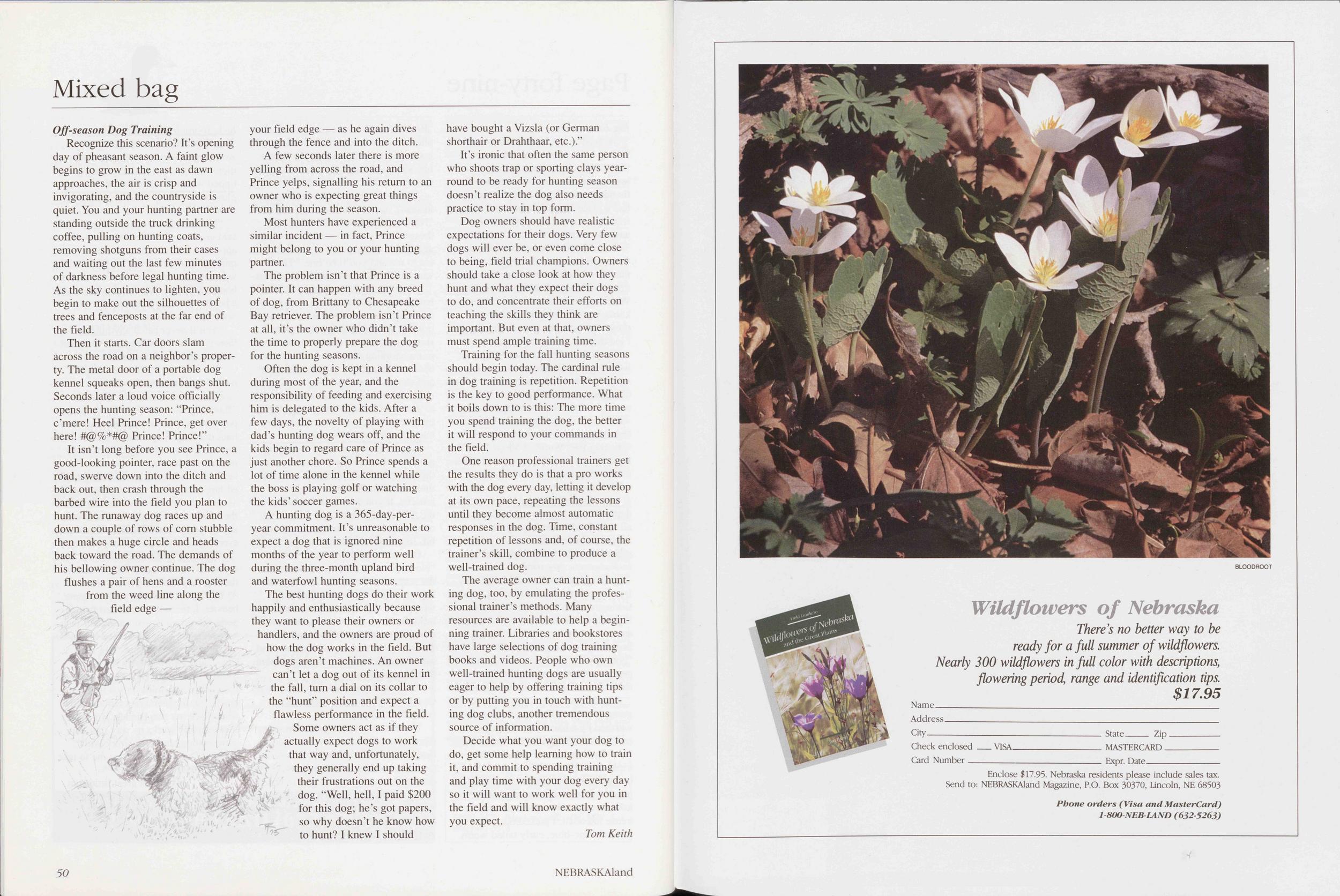
Mixed bag
Off-season Dog TrainingRecognize this scenario? It's opening day of pheasant season. A faint glow begins to grow in the east as dawn approaches, the air is crisp and invigorating, and the countryside is quiet. You and your hunting partner are standing outside the truck drinking coffee, pulling on hunting coats, removing shotguns from their cases and waiting out the last few minutes of darkness before legal hunting time. As the sky continues to lighten, you begin to make out the silhouettes of trees and fenceposts at the far end of the field.
Then it starts. Car doors slam across the road on a neighbor's property. The metal door of a portable dog kennel squeaks open, then bangs shut. Seconds later a loud voice officially opens the hunting season: "Prince, c'mere! Heel Prince! Prince, get over here! #@%*#@ Prince! Prince!"
It isn't long before you see Prince, a good-looking pointer, race past on the road, swerve down into the ditch and back out, then crash through the barbed wire into the field you plan to hunt. The runaway dog races up and down a couple of rows of com stubble then makes a huge circle and heads back toward the road. The demands of his bellowing owner continue. The dog flushes a pair of hens and a rooster from the weed line along the field edge your field edge as he again dives through the fence and into the ditch.
A few seconds later there is more yelling from across the road, and Prince yelps, signalling his return to an owner who is expecting great things from him during the season.
Most hunters have experienced a similar incident in fact, Prince might belong to you or your hunting partner.
The problem isn't that Prince is a pointer. It can happen with any breed of dog, from Brittany to Chesapeake Bay retriever. The problem isn't Prince at all, it's the owner who didn't take the time to properly prepare the dog for the hunting seasons.
Often the dog is kept in a kennel during most of the year, and the responsibility of feeding and exercising him is delegated to the kids. After a few days, the novelty of playing with dad's hunting dog wears off, and the kids begin to regard care of Prince as just another chore. So Prince spends a lot of time alone in the kennel while the boss is playing golf or watching the kids' soccer games.
A hunting dog is a 365-day-per-year commitment. It's unreasonable to expect a dog that is ignored nine months of the year to perform well during the three-month upland bird and waterfowl hunting seasons.
The best hunting dogs do their work happily and enthusiastically because they want to please their owners or handlers, and the owners are proud of how the dog works in the field. But dogs aren't machines. An owner can't let a dog out of its kennel in the fall, turn a dial on its collar to the "hunt" position and expect a flawless performance in the field.
Some owners act as if they actually expect dogs to work that way and, unfortunately, they generally end up taking their frustrations out on the dog. "Well, hell, I paid $200 for this dog; he's got papers, so why doesn't he know how to hunt? I knew I should have bought a Vizsla (or German shorthair or Drahthaar, etc.)."
It's ironic that often the same person who shoots trap or sporting clays year-round to be ready for hunting season doesn't realize the dog also needs practice to stay in top form.
Dog owners should have realistic expectations for their dogs. Very few dogs will ever be, or even come close to being, field trial champions. Owners should take a close look at how they hunt and what they expect their dogs to do, and concentrate their efforts on teaching the skills they think are important. But even at that, owners must spend ample training time.
Training for the fall hunting seasons should begin today. The cardinal rule in dog training is repetition. Repetition is the key to good performance. What it boils down to is this: The more time you spend training the dog, the better it will respond to your commands in the field.
One reason professional trainers get the results they do is that a pro works with the dog every day, letting it develop at its own pace, repeating the lessons until they become almost automatic responses in the dog. Time, constant repetition of lessons and, of course, the trainer's skill, combine to produce a well-trained dog.
The average owner can train a hunting dog, too, by emulating the professional trainer's methods. Many resources are available to help a beginning trainer. Libraries and bookstores have large selections of dog training books and videos. People who own well-trained hunting dogs are usually eager to help by offering training tips or by putting you in touch with hunting dog clubs, another tremendous source of information.
Decide what you want your dog to do, get some help learning how to train it, and commit to spending training and play time with your dog every day so it will want to work well for you in the field and will know exactly what you expect.
Tom Keith 50 NEBRASKAland
Position: 626 (18 views)