Volume 73, Issue 2, 1995
NEBRASKAland
MARCH 1995 $2.00
NEBRASKAland
VOL. 73 / NO. 2 MARCH 1995 Published by the Nebraska Game and Parks Commission Director: Rex Amack Assistant Directors: Wesley Sheets Noelyn Isom Roger Kuhn Staff Administrator, Information & Education: Paul Horton Editor: Don Cunningham Senior Editors: Jon Farrar, Ken Bouc Regional Editors: Bob Grier, Rocky Hoffmann, Tom Keith, Mike Forsberg Production Manager: Troy Kroeger Art Director: Steve O'Hare Layout, Design and Illustration: Tim Reigert Circulation: Pat Frahm Commissioners Chairman: Charles E. Wright, Lincoln Vice Chairman: Bill Grewcock, Omaha 2nd Vice Chairman: Dr. Charles Blaha, Ord Dr. Tim Biga, Norfolk Thomas J. Plummer, Brule Gloria Erickson, Holdrege Randall K. Stinnette, Inland NEBRASKAland 1SSN:0028-1964 VOL. 73 / NO. 2 MARCH 1995 Published monthly, except for Jan./Feb. and Aug./Sept. issues, by the Nebraska Game and Parks Commission, 2200 N. 33rd St., Lincoln, NE. Copyright 1995, all rights reserved. Please address comments or questions to this address. Second-class postage paid at Lincoln, Nebraska. POSTMASTER: Send all address changes to NEBRASKAland, P.O. Box 30370, Lincoln, NE 68503-0370. Rates: $ 14 for one year, $27 for two years. Address submissions to: The Editor, NEBRASKAland Magazine, P.O. Box 30370, Lincoln, NE 68503. Include a stamped, self-addressed return envelope. The publisher assumes no responsibility for unsolicited material. NEBRASKAland is available on audio cassette from the Nebraska Library Commission Talking Book and Braille Service. Call (402) 471-4038, or toll-free (800) 742-7691.
Letters
Nebraska Game and Parks Commission District Offices Headquarters 2200 North 33rd Street Lincoln, NE 68503 Phone (402)471-0641 District Office I Box 725 Alliance, NE 69301 Phone (308)762-5605 District Office II Box 508 Bassett, NE 68714 Phone (402)684-2921 District Office III Box 934 Norfolk, NE 68702 Phone (402)370-3374 District Office IV Route 4, Box 36 North Platte, NE 69101 Phone (308)535-8025 District Office V 2200 North 33rd Street Lincoln, NE 68503 Phone (402)471-5558 Omaha Office 1212 Deer Park Blvd. Omaha, NE 68108 Phone (402) 595-2144 Ak-Sar-Ben Aquarium 21502 West Highway 31 Gretna, NE 68028 Phone (402) 332-3901 Conservation Officers by Region Panhandle Southeast Officer City Phone (308) Officer City Phone (402) Richard Furiey (Supv) Alliance 762-2024 Dick Turpin (Adrr i) Lincoln 471-5531 Walt Meyer Chadron 432-4398 Ted Blume (Asst Adm) Lincoln 483-5643 John Murphy Crawford 665-2021 Dan Klammer Lincoln 471-5003 Jim Zimmerman Gering 436-7561 Roger Guenther (Supv) Lincoln 423-5671 Marvin Kampbell Hay Springs 638-7527 Murray Johnson Lincoln 488-2923 Dennis Thompson Ogallala 284-6450 William Krause Auburn 274-3789 Dan Zuehlke Ogallala 284-4815 Dan Evasco Beatrice 228-5935 Don Hunt Oshkosh 772-3697 Douglas Kramer Lincoln 466-9001 Scott Brandt Scottsbluff 635-1277 Dina Barta Lincoln 483-2358 Raymond Still Bridgeport 262-1075 Levi Krause Louisville 234-2212 Russell Mort Nebr. City 873-5684 Northeast Duane Arp Gretna 332-4954 Officer City Phone (402) Larry Elston Omaha 292-4910 Tom Zimmer (Supv) Norfolk 371-6625 Craig Stover Waterlou 359-2833 Robert Kelly Albion 395-2538 Mike Luben Colon 443-4278 Ross Oestmann Bloomfield 373-4412 L.A. Wilkinson Columbus 564-4375 Sandhills Gary Ralston Creighton 847-3284 Officer City Phone (402) Daniel Roberts Fremont 721-7852 Bruce Wiebe (Supv) Bassett 684-3867 Randy Pomplun Fullerton (308) 536-2987 Max Showalter Ainsworth 387-1960 Jon Reeves Kennard 427-7378 Larry Bauman Atkinson 925-5569 Marion Shafer Norfolk 371-2031 Richard Seward Ord (308) 728-5338 Eric Wiebe Ponca 755-2566 Mick Gray Valentine 376-3136 Steve Oberg West Point 372-3062 Ray Dierking Brkn. Bow (308) 872-3078 South-Central Southwest Officer City Phone (402) Officer City Phone (308) Jerry Pecha (Supv) York 362-5707 George Sund Cambridge 697-4629 Terry Brentzel Grand Isl. (308) 384-8296 Matt Andrews Elwood 785-3025 Dale Johnson Hebron 768-7363 Jack Henderson Gothenburg 537-7483 Dayton Shultis Kearney (308) 234-3349 Dirk Greene Imperial 882-5328 Mark Reeves Loup City (308)745-1126 Virgil Gosch McCook 345-2185 Robert Finke Milford 761-3537 Dwight Allbery N. Platte 532-2753 Tim Williams Hastings 463-2535 Roger Thompson(Sup) N. Platte 532-9175 Rich Routh Republican City 799-2085 Operation Game Thief (800) 742-7627 The Road HomeI received my copy of The Road Home [January-February 1995] yesterday and read it from cover to cover before I went to bed last night. The pictures are wonderful and show Nebraska as it really is. I have lived in Iowa most of my life, but my daughter married a Nebraskan and lives at Culbertson. I have learned to like Nebraska, and when I am in conversation with those who think Nebraska does not have much to offer, I tell them to get off 1-80, and they too would appreciate the good things in Nebraska.
Sheryl J. Bobst Earlham, IowaThe Road Home, is an outstanding production. I would like to congratulate all of your staff who produced it. For several years I have purchased subscriptions for several friends and relatives — Nebraska natives now scattered across the country. Also, a gift goes to a longtime friend in Australia. It is certain that the next letter I receive from them will comment on this great pictorial issue. This issue will spread the fine things about our state. I value this issue and will keep it on my coffee table for all visitors to pick up and look at.
Vern Scofield Lincoln, Nebraska Woody Corridors and Rails to TrailsHaving spent most of the past year doing field work in Missouri, it has been a pleasure for me to return to Nebraska for a short time and read back issues of NEBRASKAland that I missed while I was away. I read with interest "Rails to Trails" in the June issue and would like to address the issue of trails as potential wildlife habitat.
I fear that most people believe that a corridor of woody vegetation is the ideal type of wildlife habitat a trail can provide and that the difficulties inherent in management of these lands will result in corridors of woody vegetation, whether that is desirable or not.
Woody corridors provide ideal habitat for many species, such as the birds mentioned 4 NEBRASKAland in the article. But grasshopper sparrows do not nest in cedar trees, meadowlarks will not forage in plumthickets, and purple prairie clover cannot survive under a canopy of Siberian elms. It is disappointing to see people welcome fauna and flora that is invading the Great Plains from other ecoregions, when indigenous species are being replaced.
In the June 1994 issue of Bioscience, an article titled "Prairie Conservation in North America" states that recent, nonhistoric woody corridors and forests in Great Plains grasslands have contributed to the loss of six subspecies of birds by facilitating the hybridization of eastern and western races that were historically isolated from one another. The authors discourage the establishment of woody plants and woody corridors within current prairie-dominated ecoregions because of the threat they pose to genetic diversity in North America.
I would go one step farther and recommend that in ecoregions that were historically prairie-dominated, corridors should be composed of prairie species. That would facilitate the movement of genes, individuals and populations between restored and protected areas. It would also impede the movement of non-indigenous species into ecoregions that are still prairie dominated.
Most people probably realize that conservation of Great Plains grassland communities is not an appropriate strategy in the ecoregion defined as the eastern deciduous forest, yet many are apparently quite comfortable with directing conservation efforts in the Great Plains toward species that are invaders from the eastern deciduous forest. Conservation corridors should be composed of indigenous species, and for most of Nebraska that does not include woody vegetation and its associated fauna.
Steve Winter Lincoln, Nebraska From a Real WeimaranerIn your November letters column, a letter from Arthur C. Garwood, Jr., from Omaha, refers to the spelling of the word Weimaraner. I lived from 1919 to 1941 in Weimar in the state of Thuringen [Germany], and Mr. Garwood is completely correct in spelling the inhabitants of Weimar as "Weimaraner."
Weimar is an old town and known after the first world war as the place at which the new constitution of the First Republic was founded in 1919. It is also well known as the site of the National Theatre and home of the well-known poets Goethe and Shiller. Goethe, for most of his life in Weimar, was minister of the Duke of Sachsen-Weimar-Eisnach, and Schiller was his friend.
You may wonder that I have this edition. For more than two years I was a German prisoner of war at Fort Robinson, Nebraska. After the war, with other former POWs, I have visited Fort Robinson several times.
I am cooperating on the history of the time with the curator of the Fort Robinson Museum, Thomas Buecker, who, just a few months ago, edited the book The Crazy Horse Surrender Ledger
I hope you will feel free to call on me for more information about Weimar.
Wolfgang Dorschel Bad Griesbach, Germany Snow Goose Recipes WantedP. Joe Gahig, Nebraska Game and Parks Commission waterfowl specialist, is compiling a collection of recipes for preparing snow geese. Readers are requested to send their favorite recipes (please include original source if known) to Snow Goose Recipes, NEBRASKAland Magazine, P.O. Box 30370, Lincoln, NE 68502-0370. When the collection is complete, details will he announced in NEBRASKAland Magazine.
Write to Letters, NEBRASKAland Magazine, P.O. Box 30370, Lincoln, NE 68503-0370, or fax (402) 471-5528. Photos are also welcome and will he returned. Letters are subject to condensation or editing for clarity.
Now Available in Hardcover The Road Home THE ROAD HOME Now in hardcover NEBRASKAland Magazine's The Road Home: A Photographic Journey. A nostalgic trip along the back roads and byways of Nebraska, The Road Home is a unique "family album" for the state. Hardcover edition only $24.95 Name Address City State Zip Method of payment: Cheek Q Visa EH MasterCardtZ Card No. Expr. Date Enclose $24.95 - Nebraska residents please include sales tax. Send to: NEBRASKAland Magazine, P.O. Box 30370, Lincoln, NE 68503 To order by phone (Visa/MasterCard only) call-1-800-NEB-LAND (1-800-632-5263) MARCH 1995 5
Notes from the field
NEBRASKAland Magazine Special Issue Warehouse Sale! NEBRASKAland special issues from past years: One for $3.50, two or more to the same address, $3 each. Country Cookbook readers' favorite wild game recipes. Photographing Nebraska a manual of outdoor photography and an album of Nebraska photos. Walk in the Woods Nebraska's forests and trees. Wildflower Year wildflowers through the seasons. Historic Places sites on the National Register of Historic Places. Special Issue Offer Name Address City State Zip Check Visa MasterCard Card number Expr. date Sum her of copies: Country Cookbook A Wildflower Year. Photographing Nebraska Historic Places Walk in the Woods Enclose $3.50 for one book, $3.00 each for two or more books to the same address (price includes postage in the U.S.). Nebraska residents please include appropriate sales tax. Mail to: NEBRASKAland Magazine, P.O. Box 30370, Lincoln NE 68503-0370 Phone orders (Visa and MasterCard) 1-800-NEB-LAND (632-5263) Cleaning and Storing FishOK, you had a great day at the lake. The fish were biting, your casting was impeccable, the weather was perfect, there were no problems with the boat and there were few other fishermen on the water to distract you. Now it's 9:30 p.m., you're tired, and you need a bath and a good night's sleep. And there are about five dozen fish in the live well to be cleaned.
Wait — don't throw them away to avoid fooling with them. Nebraska's "wanton waste" law prohibits taking fish or game and not using the edible parts. Besides that, fish are too valuable and taste too good to be wasted. Clean them right, preserve them correctly and enjoy them later at the table.
My granddad lived to fish, ate nearly everything he caught and was a stickler about taking proper care of his catch. "It's a sin to waste a fish or treat it so badly that even the cat will turn up her nose at it," he told me when I was a kid. We ate a whole lot of fish, and I can't remember even one that wasn't rich and flavorful.
He was convinced that a fish must be handled correctly from the moment you remove the hook if you are to enjoy the best tasting meat possible.
Because fish flesh deteriorates rapidly, it is important to kill and clean them immediately after they are caught and keep them cold until they are used. If you don't clean the fish immediately, keep them alive and in good condition in cool, well-oxygenated water in a live well or in a fish basket. Check them often. Dead fish should be placed on ice immediately.
My granddad believed the absolute best method was to immediately kill the fish, dress it and put it in a cooler on a bed of crushed or shaved ice He was careful to periodically drain water from melting ice in the bottom of the cooler. One of Granddad's secrets was to keep the meat as dry as possible. "You let a dead fish or even fish fillets soak in water and you ruin the meat," he'd say. "Water's fine for live fish, but once they're dead, you have to keep them cold and dry." He never put fish in plastic bags or other non-breathable containers because he said air circulation, like cold temperature, is important to keep the meat fresh.
His rule was to field-dress fish immediately, remove the parts that deteriorate most rapidly — gills, internal organs and kidneys (the bloodline located under the white leathery membrane below the fish's backbone).
An artist with a fillet knife. Granddad could fillet a cooler of fish faster than anyone I've ever known, and he left precious little usable flesh on the carcasses. He favored the thinnest knife blade he could find, and he kept it razor sharp.
When he was finished, and the catch was reduced to a pile of neat fillets, he'd wash each one for a second or two in cold, running water and quickly pat it dry. If the fillets were to be used that day, he'd put them on a few layers of paper towels on a plate, cover them with waxed paper and put them in the refrigerator.
He filleted largemouth and smallmouth bass, large bluegills, crappies, white bass, yellow perch and walleyes. "The skin on a big bass is so strong tasting you have to take it off or it will taint the flavor of the meat while it's cooking," he said. The fillets of big fish were cut
Small bluegills and crappies were scaled and gutted, and the heads, fins and tails removed. Catfish, bullheads and carp were gutted and the skin peeled away. Carp were skinned and scored so the meat would cook evenly and the bones would soften. Trout were gutted, but the skin was left on.
Granddad left the skin on fillets only if he planned to grill them. He said the skin served a dual purpose — it helped hold the meat together on the rack and kept its juices from dripping onto the coals. He grilled the fish skin-side down first, so the juice would settle through the meat toward the skin. Then when he flipped it over, the juices would work their way back through the meat, keeping it moist and flavorful.
He always froze fish in a block of ice, because he believed that method best preserved the flesh and locked in its flavor. Usually he filled a waxed milk carton about three-fourths full of water, put in enough fish for one meal, and stored the container in the freezer. I recently read that you can accomplish the same thing by freezing fish in a metal baking pan, then knocking the block of ice (and fish) out of the pan and wrapping it a layer of plastic wrap and a covering of freezer wrap before storing it in the freezer.
For Granddad, there also was only one right way to thaw fish. He insisted that the ice be washed away from frozen fillets under cold, running water. As soon as the ice was gone, the fillets were patted dry and refrigerated until they were cooked.
He was a real fisherman, my granddad, and he knew the right way to make the most of what he caught. Today people keep fewer fish, but it is just as important that they be well cared for so they will provide the best quality meat possible for the table.
Tom Keith Wild Nebraska Needs Your Help and the simplest way to help is to share your Nebraska state tax refund with the state's non-game and endangered plants and animals. Just check the box on line 33 of your Nebraska State Income Tax form to designate a part of your state tax refund for the Nebraska Non-game and Endangered Wildlife Conservation Fund. Make direct donations to Nebraska Non-game and Endangered Species Fund, Nebraska Game and Parks Commission, P.O. Box 30370, Lincoln, NE 68503 A CHECK FOR WILDLIFE MARCH 1995 7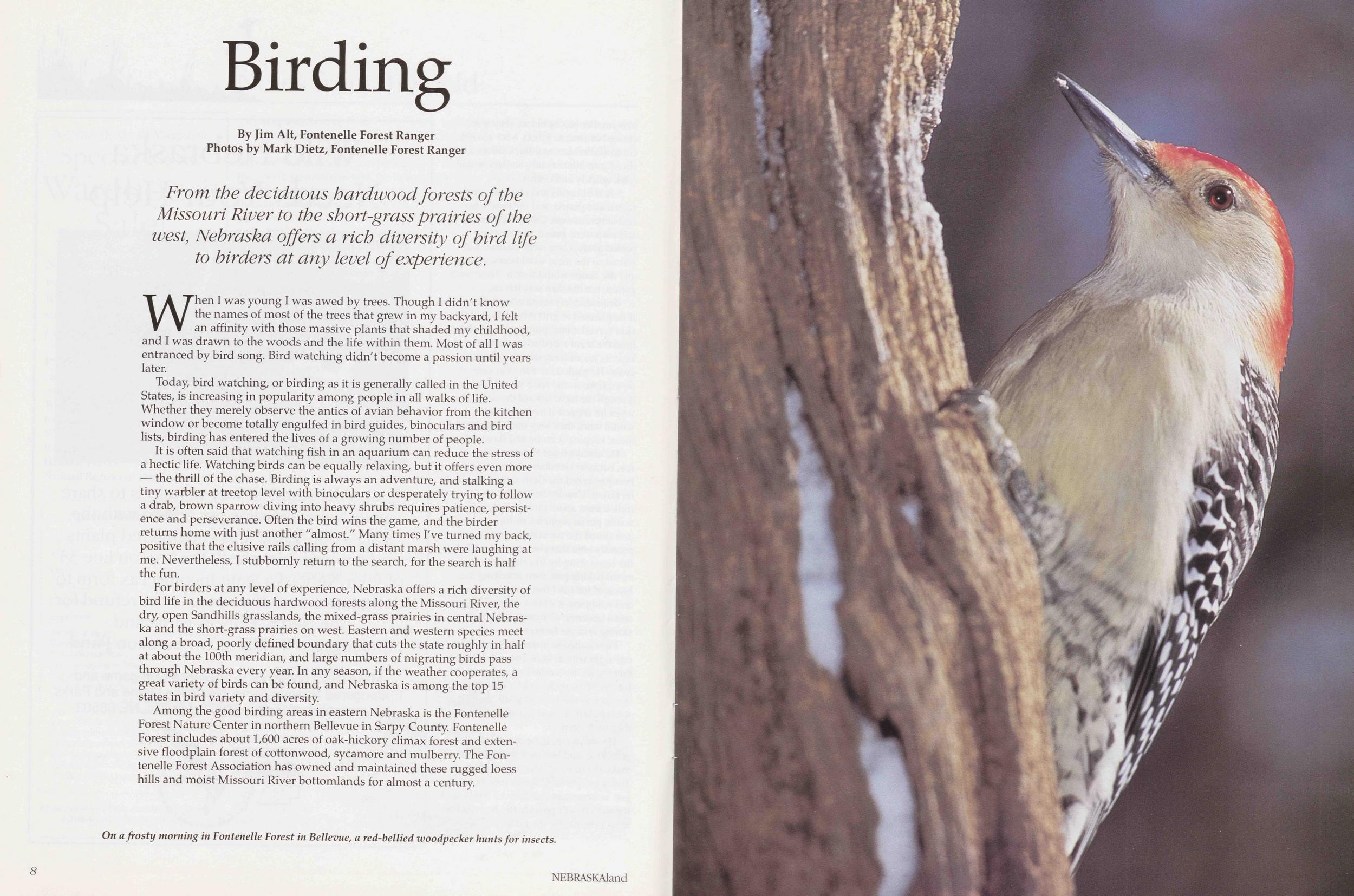
Birding
By Jim Alt, Fontenelle Forest Ranger Photos by Mark Dietz, Fontenelle Forest Ranger From the deciduous hardwood forests of the Missouri River to the short-grass prairies of the west, Nebraska offers a rich diversity of bird life to birders at any level of experience.When I was young I was awed by trees. Though I didn't know the names of most of the trees that grew in my backyard, I felt an affinity with those massive plants that shaded my childhood, and I was drawn to the woods and the life within them. Most of all I was entranced by bird song. Bird watching didn't become a passion until years later.
Today, bird watching, or birding as it is generally called in the United States, is increasing in popularity among people in all walks of life. Whether they merely observe the antics of avian behavior from the kitchen window or become totally engulfed in bird guides, binoculars and bird lists, birding has entered the lives of a growing number of people.
It is often said that watching fish in an aquarium can reduce the stress of a hectic life. Watching birds can be equally relaxing, but it offers even more — the thrill of the chase. Birding is always an adventure, and stalking a tiny warbler at treetop level with binoculars or desperately trying to follow a drab, brown sparrow diving into heavy shrubs requires patience, persistence and perseverance. Often the bird wins the game, and the birder returns home with just another "almost." Many times I've turned my back, positive that the elusive rails calling from a distant marsh were laughing at me. Nevertheless, I stubbornly return to the search, for the search is half the fun.
For birders at any level of experience, Nebraska offers a rich diversity of bird life in the deciduous hardwood forests along the Missouri River, the dry, open Sandhills grasslands, the mixed-grass prairies in central Nebraska and the short-grass prairies on west. Eastern and western species meet along a broad, poorly defined boundary that cuts the state roughly in half at about the 100th meridian, and large numbers of migrating birds pass through Nebraska every year. In any season, if the weather cooperates, a great variety of birds can be found, and Nebraska is among the top 15 states in bird variety and diversity.
Among the good birding areas in eastern Nebraska is the Fontenelle Forest Nature Center in northern Bellevue in Sarpy County. Fontenelle Forest includes about 1,600 acres of oak-hickory climax forest and extensive floodplain forest of cottonwood, sycamore and mulberry. The Fontenelle Forest Association has owned and maintained these rugged loess hills and moist Missouri River bottomlands for almost a century.
8 NEBRASKAland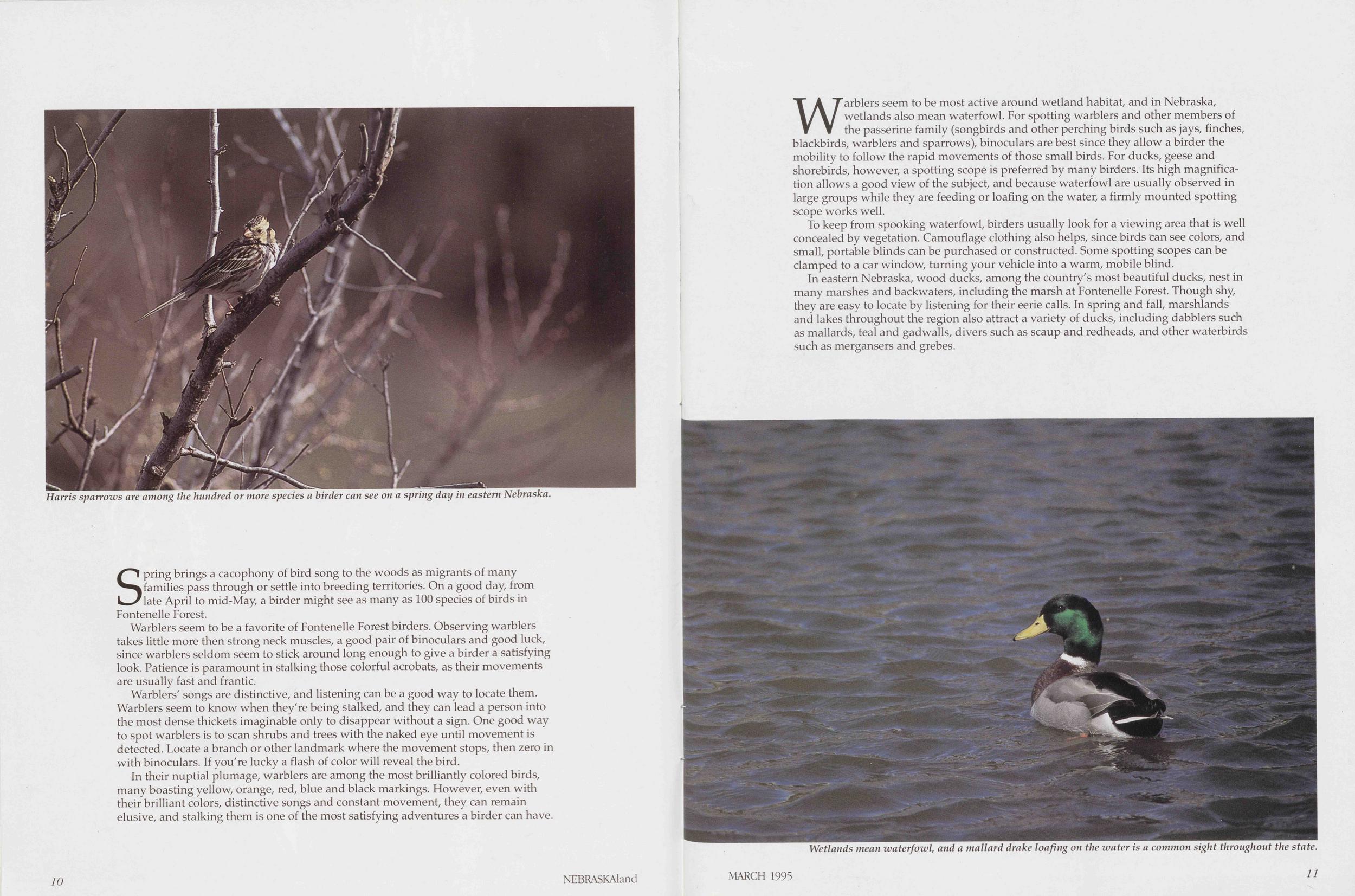
Spring brings a cacophony of bird song to the woods as migrants of many families pass through or settle into breeding territories. On a good day, from late April to mid-May, a birder might see as many as 100 species of birds in Fontenelle Forest.
Warblers seem to be a favorite of Fontenelle Forest birders. Observing warblers takes little more then strong neck muscles, a good pair of binoculars and good luck, since warblers seldom seem to stick around long enough to give a birder a satisfying look. Patience is paramount in stalking those colorful acrobats, as their movements are usually fast and frantic.
Warblers' songs are distinctive, and listening can be a good way to locate them. Warblers seem to know when they're being stalked, and they can lead a person into the most dense thickets imaginable only to disappear without a sign. One good way to spot warblers is to scan shrubs and trees with the naked eye until movement is detected. Locate a branch or other landmark where the movement stops, then zero in with binoculars. If you're lucky a flash of color will reveal the bird.
In their nuptial plumage, warblers are among the most brilliantly colored birds, many boasting yellow, orange, red, blue and black markings. However, even with their brilliant colors, distinctive songs and constant movement, they can remain elusive, and stalking them is one of the most satisfying adventures a birder can have.
10 NEBRASKAlandWarblers seem to be most active around wetland habitat, and in Nebraska, wetlands also mean waterfowl. For spotting warblers and other members of the passerine family (songbirds and other perching birds such as jays, finches, blackbirds, warblers and sparrows), binoculars are best since they allow a birder the mobility to follow the rapid movements of those small birds. For ducks, geese and shorebirds, however, a spotting scope is preferred by many birders. Its high magnification allows a good view of the subject, and because waterfowl are usually observed in large groups while they are feeding or loafing on the water, a firmly mounted spotting scope works well.
To keep from spooking waterfowl, birders usually look for a viewing area that is well concealed by vegetation. Camouflage clothing also helps, since birds can see colors, and small, portable blinds can be purchased or constructed. Some spotting scopes can be clamped to a car window, turning your vehicle into a warm, mobile blind.
In eastern Nebraska, wood ducks, among the country's most beautiful ducks, nest in many marshes and backwaters, including the marsh at Fontenelle Forest. Though shy, they are easy to locate by listening for their eerie calls. In spring and fall, marshlands and lakes throughout the region also attract a variety of ducks, including dabblers such as mallards, teal and gadwalls, divers such as scaup and redheads, and other waterbirds such as mergansers and grebes.
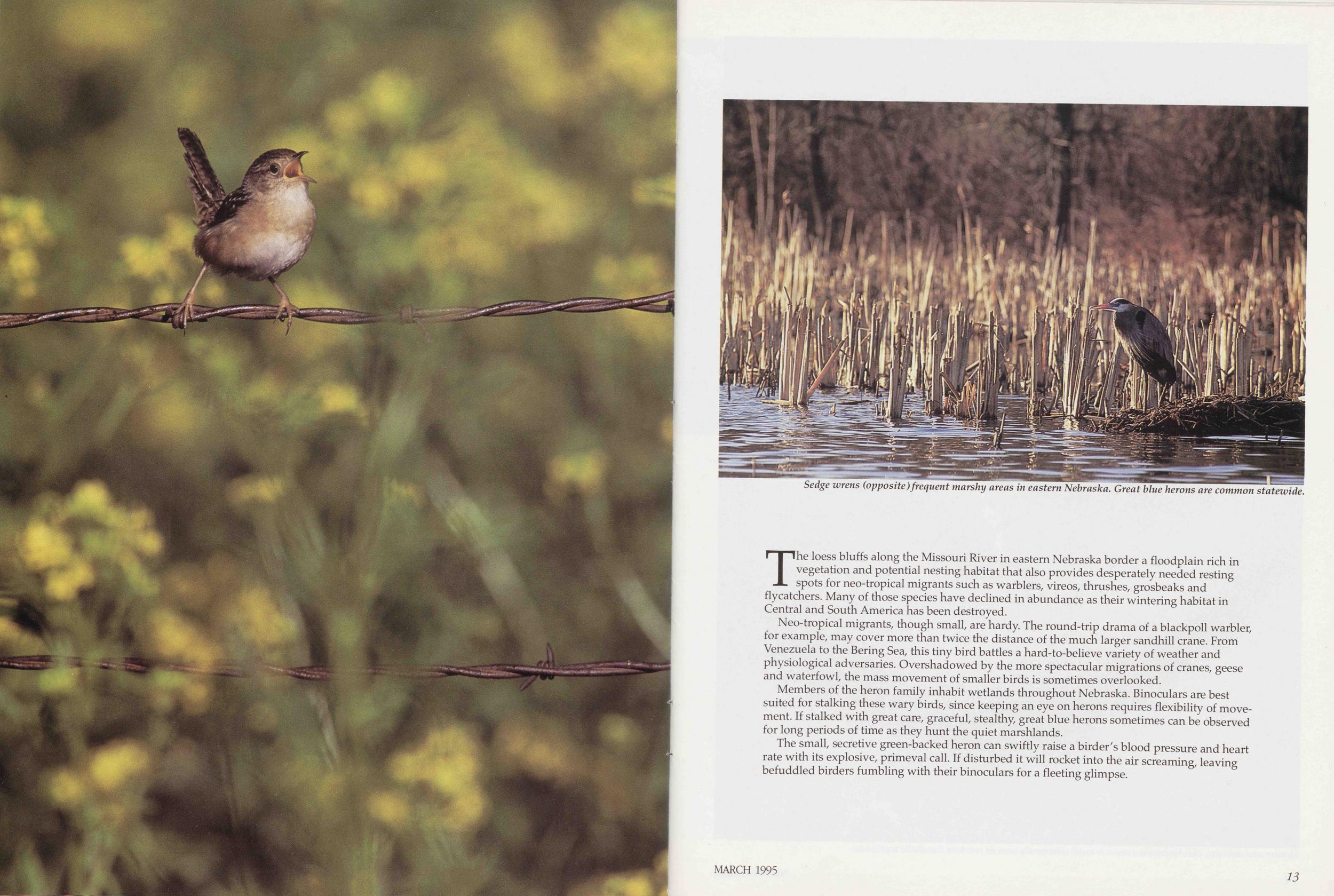
The loess bluffs along the Missouri River in eastern Nebraska border a floodplain rich in vegetation and potential nesting habitat that also provides desperately needed resting spots for neo-tropical migrants such as warblers, vireos, thrushes, grosbeaks and flycatchers. Many of those species have declined in abundance as their wintering habitat in Central and South America has been destroyed.
Neo-tropical migrants, though small, are hardy. The round-trip drama of a blackpoll warbler, for example, may cover more than twice the distance of the much larger sandhill crane. From Venezuela to the Bering Sea, this tiny bird battles a hard-to-believe variety of weather and physiological adversaries. Overshadowed by the more spectacular migrations of cranes, geese and waterfowl, the mass movement of smaller birds is sometimes overlooked.
Members of the heron family inhabit wetlands throughout Nebraska. Binoculars are best suited for stalking these wary birds, since keeping an eye on herons requires flexibility of movement. If stalked with great care, graceful, stealthy, great blue herons sometimes can be observed for long periods of time as they hunt the quiet marshlands.
The small, secretive green-backed heron can swiftly raise a birder's blood pressure and heart rate with its explosive, primeval call. If disturbed it will rocket into the air screaming, leaving befuddled birders fumbling with their binoculars for a fleeting glimpse.
MARCH 1995 13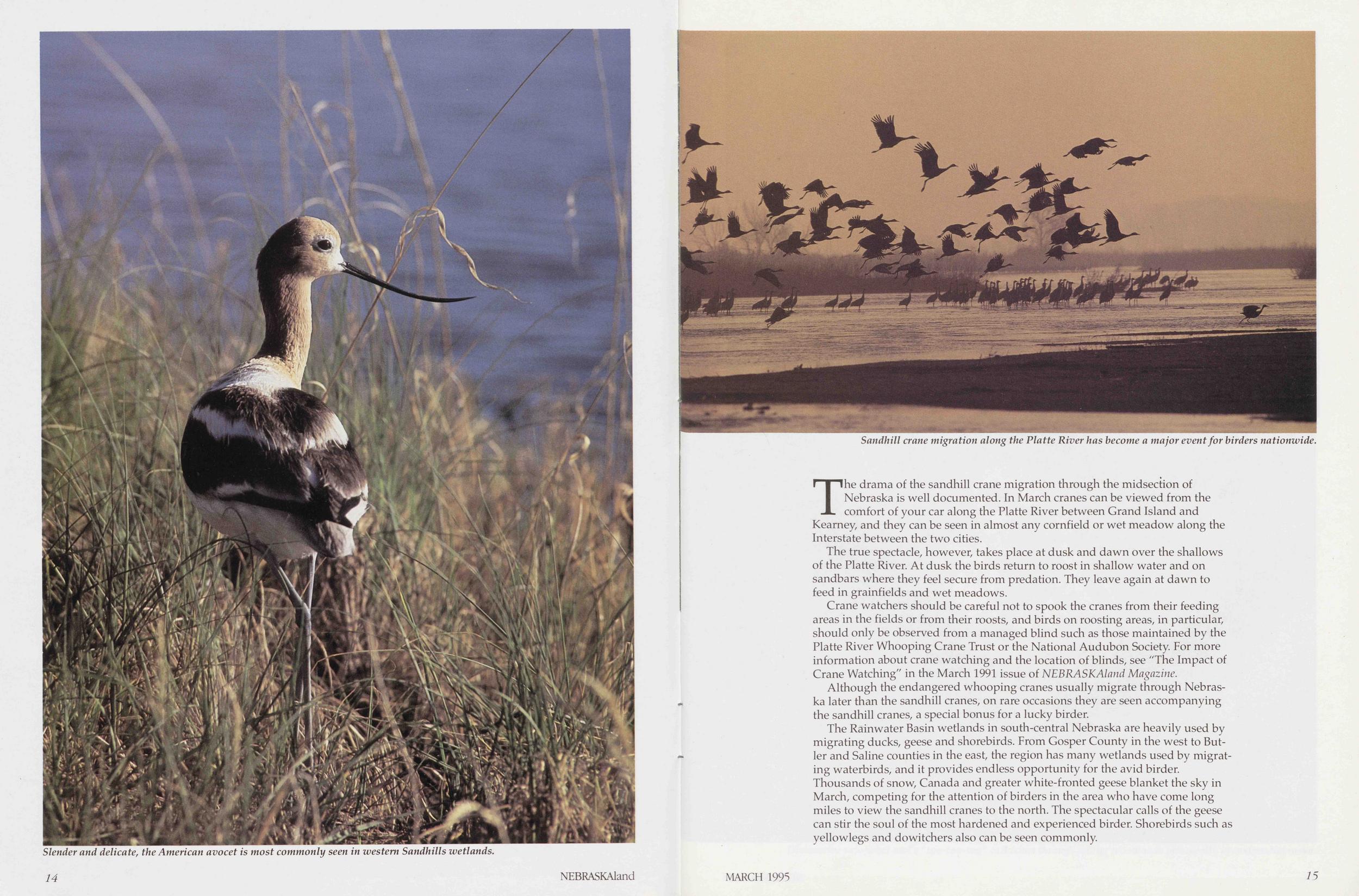
The drama of the sandhill crane migration through the midsection of Nebraska is well documented. In March cranes can be viewed from the comfort of your car along the Platte River between Grand Island and Kearney, and they can be seen in almost any cornfield or wet meadow along the Interstate between the two cities.
The true spectacle, however, takes place at dusk and dawn over the shallows of the Platte River. At dusk the birds return to roost in shallow water and on sandbars where they feel secure from predation. They leave again at dawn to feed in grainfields and wet meadows.
Crane watchers should be careful not to spook the cranes from their feeding areas in the fields or from their roosts, and birds on roosting areas, in particular, should only be observed from a managed blind such as those maintained by the Platte River Whooping Crane Trust or the National Audubon Society. For more information about crane watching and the location of blinds, see 'The Impact of Crane Watching" in the March 1991 issue of NEBRASKAland Magazine.
Although the endangered whooping cranes usually migrate through Nebraska later than the sandhill cranes, on rare occasions they are seen accompanying the sandhill cranes, a special bonus for a lucky birder.
The Rainwater Basin wetlands in south-central Nebraska are heavily used by migrating ducks, geese and shorebirds. From Gosper County in the west to Butler and Saline counties in the east, the region has many wetlands used by migrating waterbirds, and it provides endless opportunity for the avid birder. Thousands of snow, Canada and greater white-fronted geese blanket the sky in March, competing for the attention of birders in the area who have come long miles to view the sandhill cranes to the north. The spectacular calls of the geese can stir the soul of the most hardened and experienced birder. Shorebirds such as yellowlegs and dowitchers also can be seen commonly.
MARCH 1995 15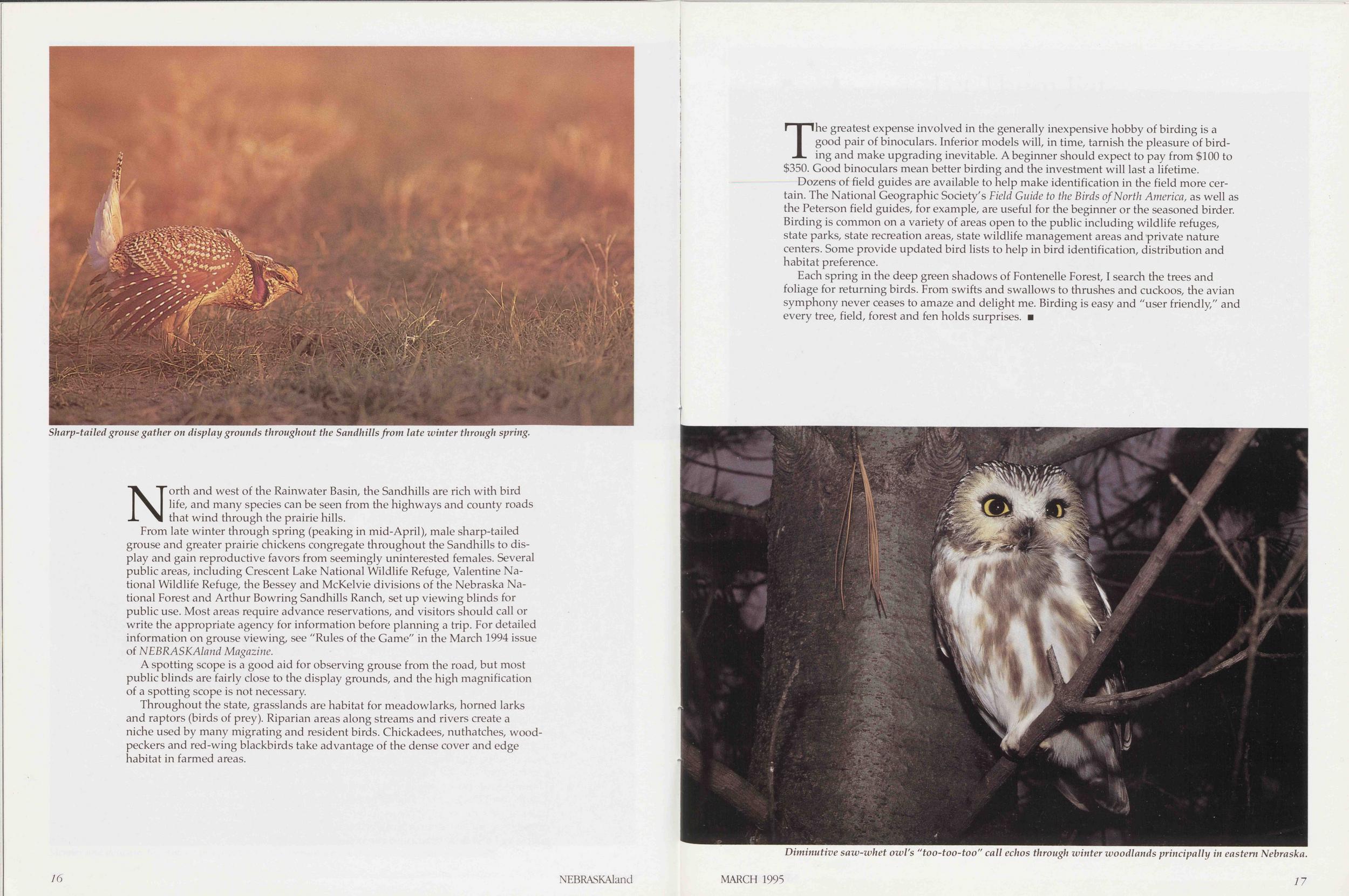
North and west of the Rainwater Basin, the Sandhills are rich with bird life, and many species can be seen from the highways and county roads that wind through the prairie hills.
From late winter through spring (peaking in mid-April), male sharp-tailed grouse and greater prairie chickens congregate throughout the Sandhills to display and gain reproductive favors from seemingly uninterested females. Several public areas, including Crescent Lake National Wildlife Refuge, Valentine National Wildlife Refuge, the Bessey and McKelvie divisions of the Nebraska National Forest and Arthur Bowring Sandhills Ranch, set up viewing blinds for public use. Most areas require advance reservations, and visitors should call or write the appropriate agency for information before planning a trip. For detailed information on grouse viewing, see "Rules of the Game" in the March 1994 issue of NEBRASKAland Magazine.
A spotting scope is a good aid for observing grouse from the road, but most public blinds are fairly close to the display grounds, and the high magnification of a spotting scope is not necessary.
Throughout the state, grasslands are habitat for meadowlarks, horned larks and raptors (birds of prey). Riparian areas along streams and rivers create a niche used by many migrating and resident birds. Chickadees, nuthatches, woodpeckers and red-wing blackbirds take advantage of the dense cover and edge habitat in farmed areas.
16 NEBRASKAlandThe greatest expense involved in the generally inexpensive hobby of birding is a good pair of binoculars. Inferior models will, in time, tarnish the pleasure of birding and make upgrading inevitable. A beginner should expect to pay from $100 to $350. Good binoculars mean better birding and the investment will last a lifetime.
Dozens ofTield guides are available to help make identification in the field more certain. The National Geographic Society's Field Guide to the Birds of North America, as well as the Peterson field guides, for example, are useful for the beginner or the seasoned birder. Birding is common on a variety of areas open to the public including wildlife refuges, state parks, state recreation areas, state wildlife management areas and private nature centers. Some provide updated bird lists to help in bird identification, distribution and habitat preference.
Each spring in the deep green shadows of Fontenelle Forest, I search the trees and foliage for returning birds. From swifts and swallows to thrushes and cuckoos, the avian symphony never ceases to amaze and delight me. Birding is easy and "user friendly," and every tree, field, forest and fen holds surprises.
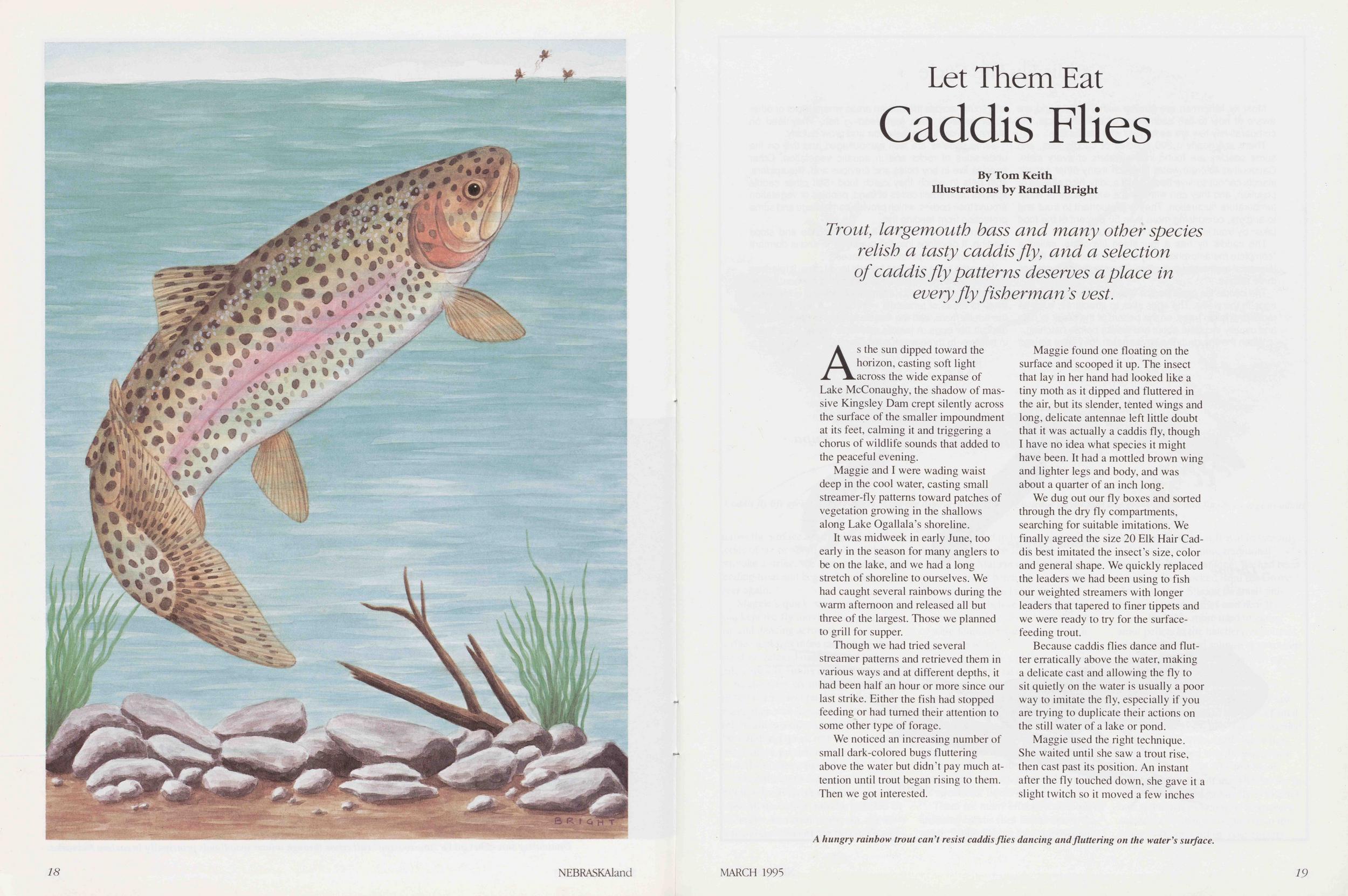
Let Them Eat Caddis Flies
By Tom Keith Illustrations by Randall Bright Trout, largemouth bass and many other species relish a tasty caddis fly, and a selection of caddis fly patterns deserves a place in every fly fisherman's vest.As the sun dipped toward the horizon, casting soft light across the wide expanse of Lake McConaughy, the shadow of massive Kingsley Dam crept silently across the surface of the smaller impoundment at its feet, calming it and triggering a chorus of wildlife sounds that added to the peaceful evening.
Maggie and I were wading waist deep in the cool water, casting small streamer-fly patterns toward patches of vegetation growing in the shallows along Lake Ogallala's shoreline.
It was midweek in early June, too early in the season for many anglers to be on the lake, and we had a long stretch of shoreline to ourselves. We had caught several rainbows during the warm afternoon and released all but three of the largest. Those we planned to grill for supper.
Though we had tried several streamer patterns and retrieved them in various ways and at different depths, it had been half an hour or more since our last strike. Either the fish had stopped feeding or had turned their attention to some other type of forage.
We noticed an increasing number of small dark-colored bugs fluttering above the water but didn't pay much attention until trout began rising to them. Then we got interested.
Maggie found one floating on the surface and scooped it up. The insect that lay in her hand had looked like a tiny moth as it dipped and fluttered in the air, but its slender, tented wings and long, delicate antennae left little doubt that it was actually a caddis fly, though I have no idea what species it might have been. It had a mottled brown wing and lighter legs and body, and was about a quarter of an inch long.
We dug out our fly boxes and sorted through the dry fly compartments, searching for suitable imitations. We finally agreed the size 20 Elk Hair Caddis best imitated the insect's size, color and general shape. We quickly replaced the leaders we had been using to fish our weighted streamers with longer leaders that tapered to finer tippets and we were ready to try for the surfacefeeding trout.
Because caddis flies dance and flutter erratically above the water, making a delicate cast and allowing the fly to sit quietly on the water is usually a poor way to imitate the fly, especially if you are trying to duplicate their actions on the still water of a lake or pond.
Maggie used the right technique. She waited until she saw a trout rise, then cast past its position. An instant after the fly touched down, she gave it a slight twitch so it moved a few inches across the surface toward the fish. If a series of six or seven twitches didn't provoke a strike, she cast to another feeding trout and began the process over again.
MARCH 1995 19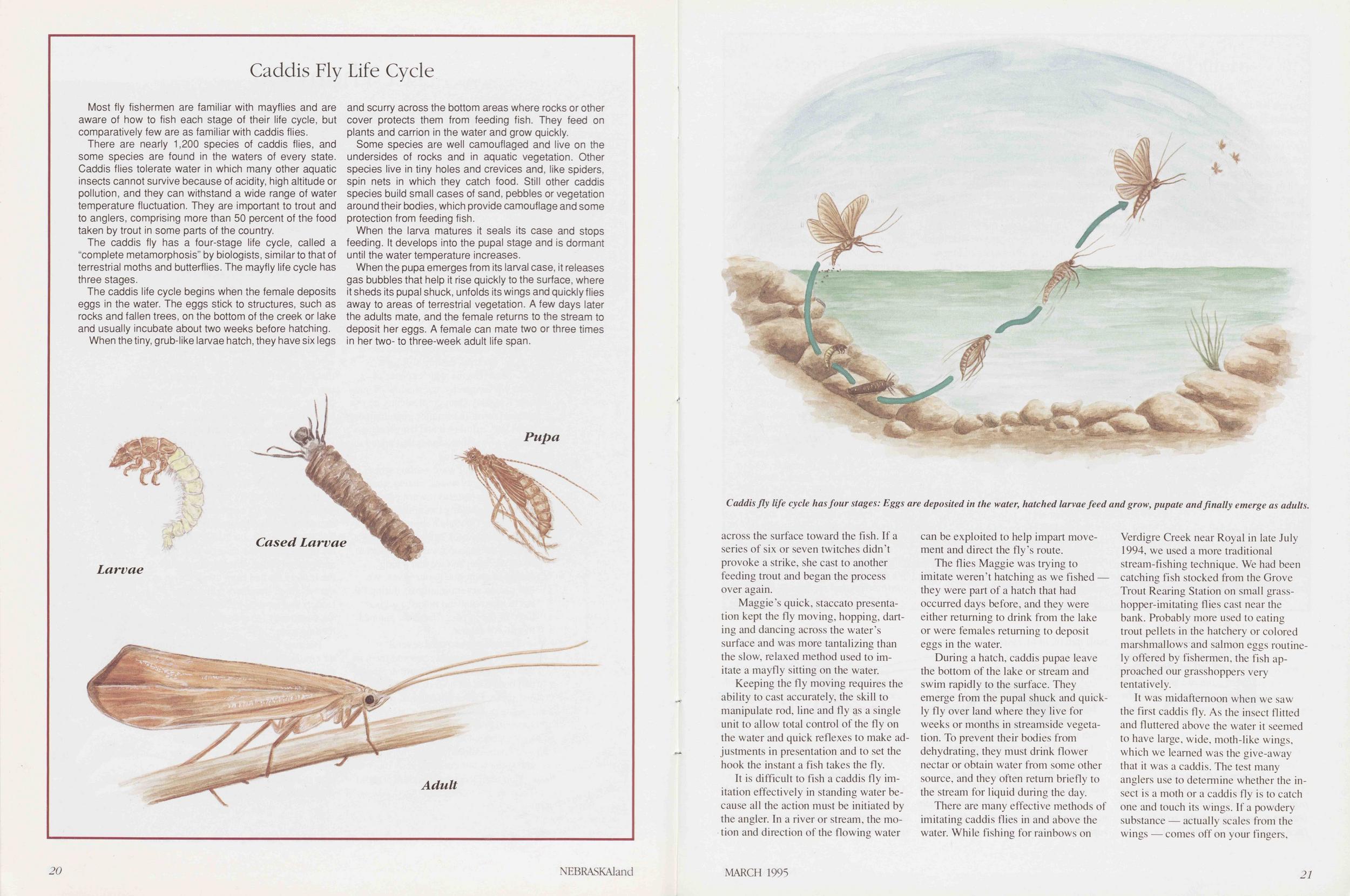 Caddis Fly Life Cycle
Most fly fishermen are familiar with mayflies and are aware of how to fish each stage of their life cycle, but comparatively few are as familiar with caddis flies.
There are nearly 1,200 species of caddis flies, and some species are found in the waters of every state. Caddis flies tolerate water in which many other aquatic insects cannot survive because of acidity, high altitude or pollution, and they can withstand a wide range of water temperature fluctuation. They are important to trout and to anglers, comprising more than 50 percent of the food taken by trout in some parts of the country.
The caddis fly has a four-stage life cycle, called a "complete metamorphosis" by biologists, similar to that of terrestrial moths and butterflies. The mayfly life cycle has three stages.
The caddis life cycle begins when the female deposits eggs in the water. The eggs stick to structures, such as rocks and fallen trees, on the bottom of the creek or lake and usually incubate about two weeks before hatching.
When the tiny, grub-like larvae hatch, they have six legs and scurry across the bottom areas where rocks or other cover protects them from feeding fish. They feed on plants and carrion in the water and grow quickly.
Some species are well camouflaged and live on the undersides of rocks and in aquatic vegetation. Other species live in tiny holes and crevices and, like spiders, spin nets in which they catch food. Still other caddis species build small cases of sand, pebbles or vegetation around their bodies, which provide camouflage and some protection from feeding fish.
When the larva matures it seals its case and stops feeding. It develops into the pupal stage and is dormant until the water temperature increases.
When the pupa emerges from its larval case, it releases gas bubbles that help it rise quickly to the surface, where it sheds its pupal shuck, unfolds its wings and quickly flies away to areas of terrestrial vegetation. A few days later the adults mate, and the female returns to the stream to deposit her eggs. A female can mate two or three times in her two- to three-week adult life span.
Maggie's quick, staccato presentation kept the fly moving, hopping, darting and dancing across the water's surface and was more tantalizing than the slow, relaxed method used to imitate a mayfly sitting on the water.
Keeping the fly moving requires the ability to cast accurately, the skill to manipulate rod, line and fly as a single unit to allow total control of the fly on the water and quick reflexes to make adjustments in presentation and to set the hook the instant a fish takes the fly.
It is difficult to fish a caddis fly imitation effectively in standing water because all the action must be initiated by the angler. In a river or stream, the motion and direction of the flowing water can be exploited to help impart movement and direct the fly's route.
The flies Maggie was trying to imitate weren't hatching as we fished they were part of a hatch that had occurred days before, and they were either returning to drink from the lake or were females returning to deposit eggs in the water.
During a hatch, caddis pupae leave the bottom of the lake or stream and swim rapidly to the surface. They emerge from the pupal shuck and quickly fly over land where they live for weeks or months in streamside vegetation. To prevent their bodies from dehydrating, they must drink flower nectar or obtain water from some other source, and they often return briefly to the stream for liquid during the day.
There are many effective methods of imitating caddis flies in and above the water. While fishing for rainbows on Verdigre Creek near Royal in late July 1994, we used a more traditional stream-fishing technique. We had been catching fish stocked from the Grove Trout Rearing Station on small grasshopper-imitating flies cast near the bank. Probably more used to eating trout pellets in the hatchery or colored marshmallows and salmon eggs routinely offered by fishermen, the fish approached our grasshoppers very tentatively.
It was midafternoon when we saw
the first caddis fly. As the insect flitted
and fluttered above the water it seemed
to have large, wide, moth-like wings,
which we learned was the give-away
that it was a caddis. The test many
anglers use to determine whether the insect is a moth or a caddis fly is to catch
one and touch its wings. If a powdery
substance — actually scales from the
wings — comes off on your fingers,
MARCH 1995
21
 you are holding a moth. If your fingers
remain clean, it is a caddis fly. Further
confirmation comes from the caddis
fly's two long, delicate antennae, which
are absent in moths.
you are holding a moth. If your fingers
remain clean, it is a caddis fly. Further
confirmation comes from the caddis
fly's two long, delicate antennae, which
are absent in moths.
When you see a caddis fly, you'd do well to start digging for your fly boxes, because there will be hundreds if not thousands — of others arriving soon, and when caddis are available, the fish invariably go after them.
This species of caddis was a little larger and lighter in color than the one we had found at Lake Ogallala several weeks before. This fly had light brownish-grey wings, a grayish-olive body and light brown legs. We chose the LaFontaine Dancing Caddis pattern in size 16 to imitate it.
Although there were a few caddis fluttering above most parts of the stream, the largest concentrations seemed to be where tree limbs hung low over the water in spots where the current had undercut the banks.
The water of Verdigre Creek is typically crystal clear, and you can often see the fish lying along the bank or darting from hiding places as you fish. It is also very narrow as it twists and turns through the public land of Grove Lake Wildlife Management Area, making short casts the rule.
In such a situation it is effective to cast down- and across-stream and let the current carry the fly until slack is gone from the fly line. Then, rather than giving more line to increase the length of the float, let the line and leader tighten and rapidly strip the fly back, making it move upstream against the current, bouncing lightly across the moving water during the retrieve. This makes the fly look like a caddis fly fluttering above the water. Using this method makes it possible to control the path of the retrieve and to skip the fly very close to the bank and under overhanging tree limbs where trout are accustomed to finding caddis flies.
Quick, splashy rises usually indicate trout taking adults from the surface. When a fish takes the fly, an angler must react instantly to set the hook.
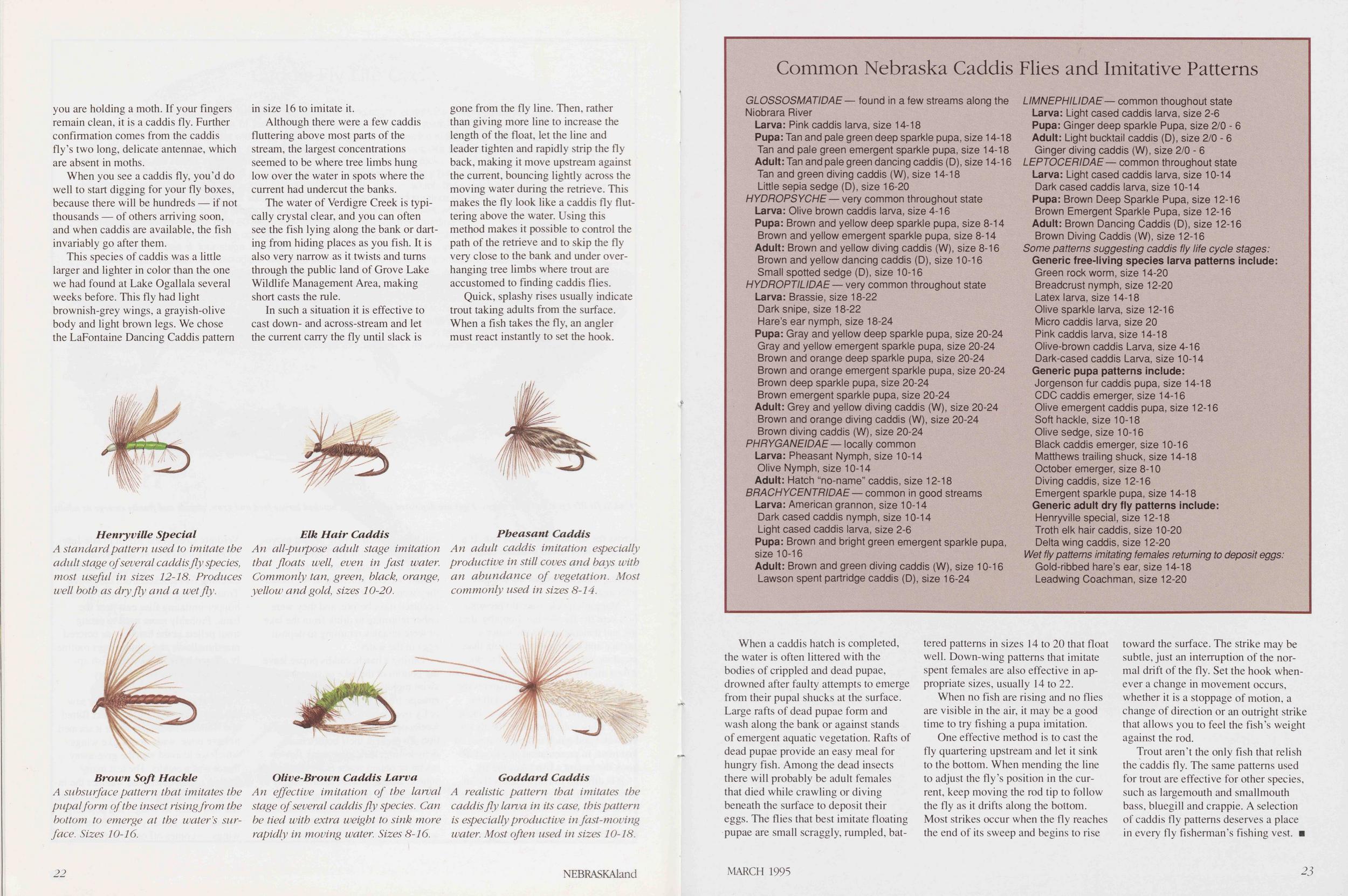
GLOSSOSMATIDAE —- found in a few streams along the Niobrara River Larva: Pink caddis larva, size 14-18 Pupa: Tan and pale green deep sparkle pupa, size 14-18 Tan and pale green emergent sparkle pupa, size 14-18 Adult: Tan and pale green dancing caddis (D), size 14-16 Tan and green diving caddis (W), size 14-18 Little sepia sedge (D), size 16-20
HYDROPSYCHE— very common throughout state Larva: Olive brown caddis larva, size 4-16 Pupa: Brown and yellow deep sparkle pupa, size 8-14 Brown and yellow emergent sparkle pupa, size 8-14 Adult: Brown and yellow diving caddis (W), size 8-16 Brown and yellow dancing caddis (D), size 10-16 Small spotted sedge (D), size 10-16
HYDROPTIUDAE — very common throughout state Larva: Brassie, size 18-22 Dark snipe, size 18-22 Hare's ear nymph, size 18-24 Pupa: Gray and yellow deep sparkle pupa, size 20-24 Gray and yellow emergent sparkle pupa, size 20-24 Brown and orange deep sparkle pupa, size 20-24 Brown and orange emergent sparkle pupa, size 20-24 Brown deep sparkle pupa, size 20-24 Brown emergent sparkle pupa, size 20-24 Adult: Grey and yellow diving caddis (W), size 20-24 Brown and orange diving caddis (W), size 20-24 Brown diving caddis (W), size 20-24
PHRYGANEIDAE — locally common Larva: Pheasant Nymph, size 10-14 Olive Nymph, size 10-14 Adult: Hatch "no-name" caddis, size 12-18
BRACHYCENTRIDAE— common in good streams Larva: American grannon, size 10-14 Dark cased caddis nymph, size 10-14 Light cased caddis larva, size 2-6 Pupa: Brown and bright green emergent sparkle pupa, size 10-16 Adult: Brown and green diving caddis (W), size 10-16 Lawson spent partridge caddis (D), size 16-24
LIMNEPHILIDAE— common thoughout state Larva: Light cased caddis larva, size 2-6 Pupa: Ginger deep sparkle Pupa, size 2/0 - 6 Adult: Light bucktail caddis (D), size 2/0 - 6 Ginger diving caddis (W), size 2/0-6
LEPTOCERIDAE— common throughout state Larva: Light cased caddis larva, size 10-14 Dark cased caddis larva, size 10-14 Pupa: Brown Deep Sparkle Pupa, size 12-16 Brown Emergent Sparkle Pupa, size 12-16 Adult: Brown Dancing Caddis (D), size 12-16 Brown Diving Caddis (W), size 12-16 Some patterns suggesting caddis fly life cycle stages: Generic free-living species larva patterns include: Green rock worm, size 14-20 Breadcrust nymph, size 12-20 Latex larva, size 14-18 Olive sparkle larva, size 12-16 Micro caddis larva, size 20 Pink caddis larva, size 14-18 Olive-brown caddis Larva, size 4-16 Dark-cased caddis Larva, size 10-14 Generic pupa patterns include: Jorgenson fur caddis pupa, size 14-18 CDC caddis emerger, size 14-16 Olive emergent caddis pupa, size 12-16 Soft hackle, size 10-18 Olive sedge, size 10-16 Black caddis emerger, size 10-16 Matthews trailing shuck, size 14-18 October emerger, size 8-10 Diving caddis, size 12-16 Emergent sparkle pupa, size 14-18 Generic adult dry fly patterns include: Henryville special, size 12-18 Troth elk hair caddis, size 10-20 Delta wing caddis, size 12-20 Wet fly patterns imitating females returning to deposit eggs. Gold-ribbed hare's ear, size 14-18 Leadwing Coachman, size 12-20
When a caddis hatch is completed, the water is often littered with the bodies of crippled and dead pupae, drowned after faulty attempts to emerge from their pupal shucks at the surface. Large rafts of dead pupae form and wash along the bank or against stands of emergent aquatic vegetation. Rafts of dead pupae provide an easy meal for hungry fish. Among the dead insects there will probably be adult females that died while crawling or diving beneath the surface to deposit their eggs. The flies that best imitate floating pupae are small scraggly, rumpled, battered patterns in sizes 14 to 20 that float well. Down-wing patterns that imitate spent females are also effective in appropriate sizes, usually 14 to 22.
When no fish are rising and no flies are visible in the air, it may be a good time to try fishing a pupa imitation.
One effective method is to cast the fly quartering upstream and let it sink to the bottom. When mending the line to adjust the fly's position in the current, keep moving the rod tip to follow the fly as it drifts along the bottom. Most strikes occur when the fly reaches the end of its sweep and begins to rise toward the surface. The strike may be subtle, just an interruption of the normal drift of the fly. Set the hook whenever a change in movement occurs, whether it is a stoppage of motion, a change of direction or an outright strike that allows you to feel the fish's weight against the rod.
Trout aren't the only fish that relish the caddis fly. The same patterns used for trout are effective for other species, such as largemouth and smallmouth bass, bluegill and crappie. A selection of caddis fly patterns deserves a place in every fly fisherman's fishing vest.
MARCH 1995 23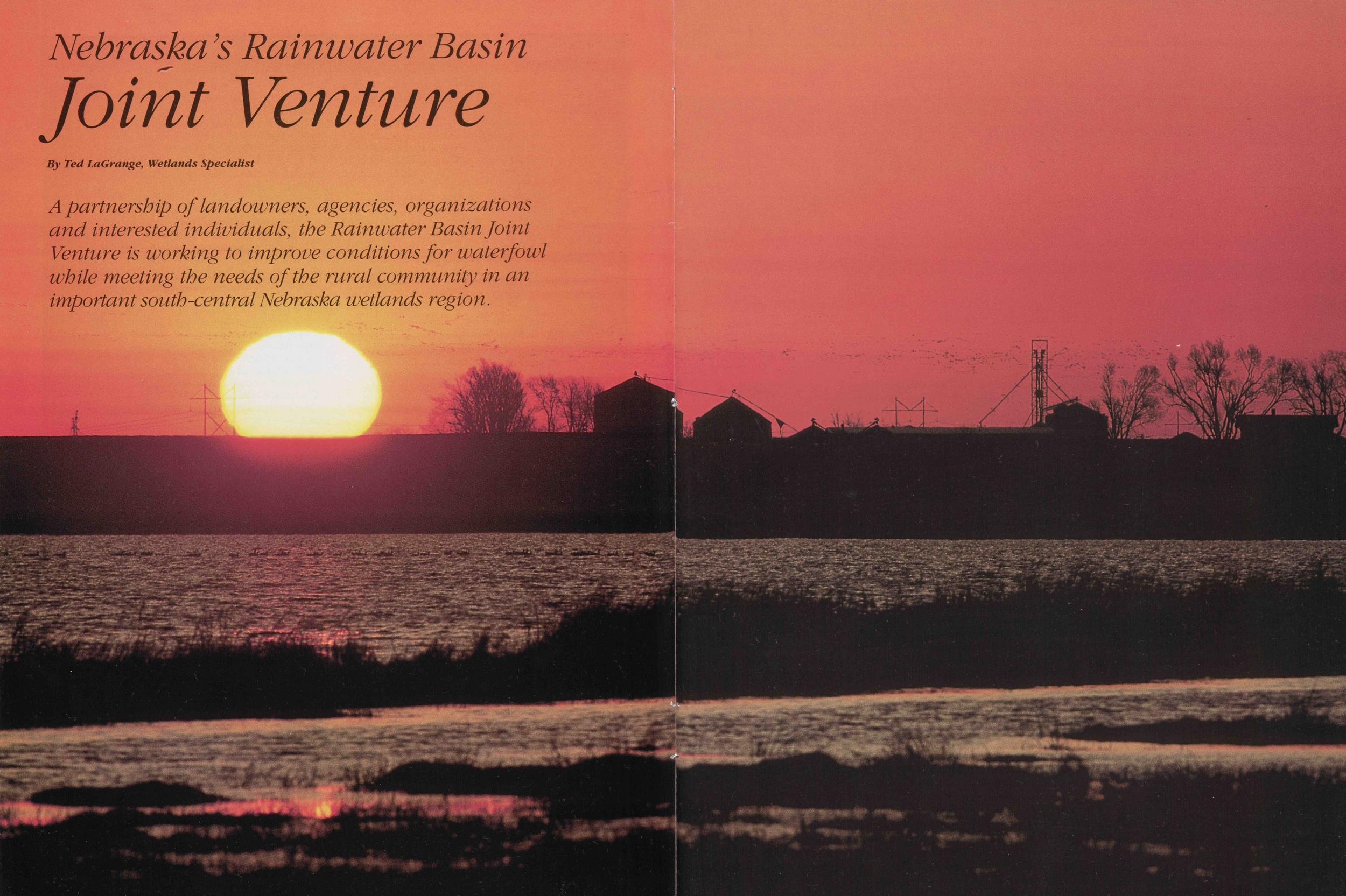
Nebraska's Rainwater Basin Joint Venture
By Ted LaGrange, Wetlands Specialist A partnership of landowners, agencies, organizations and interested individuals, the Rainwater Basin Joint Venture is working to improve conditions for waterfowl while meeting the needs of the rural community in an important south-central Nebraska wetlands region.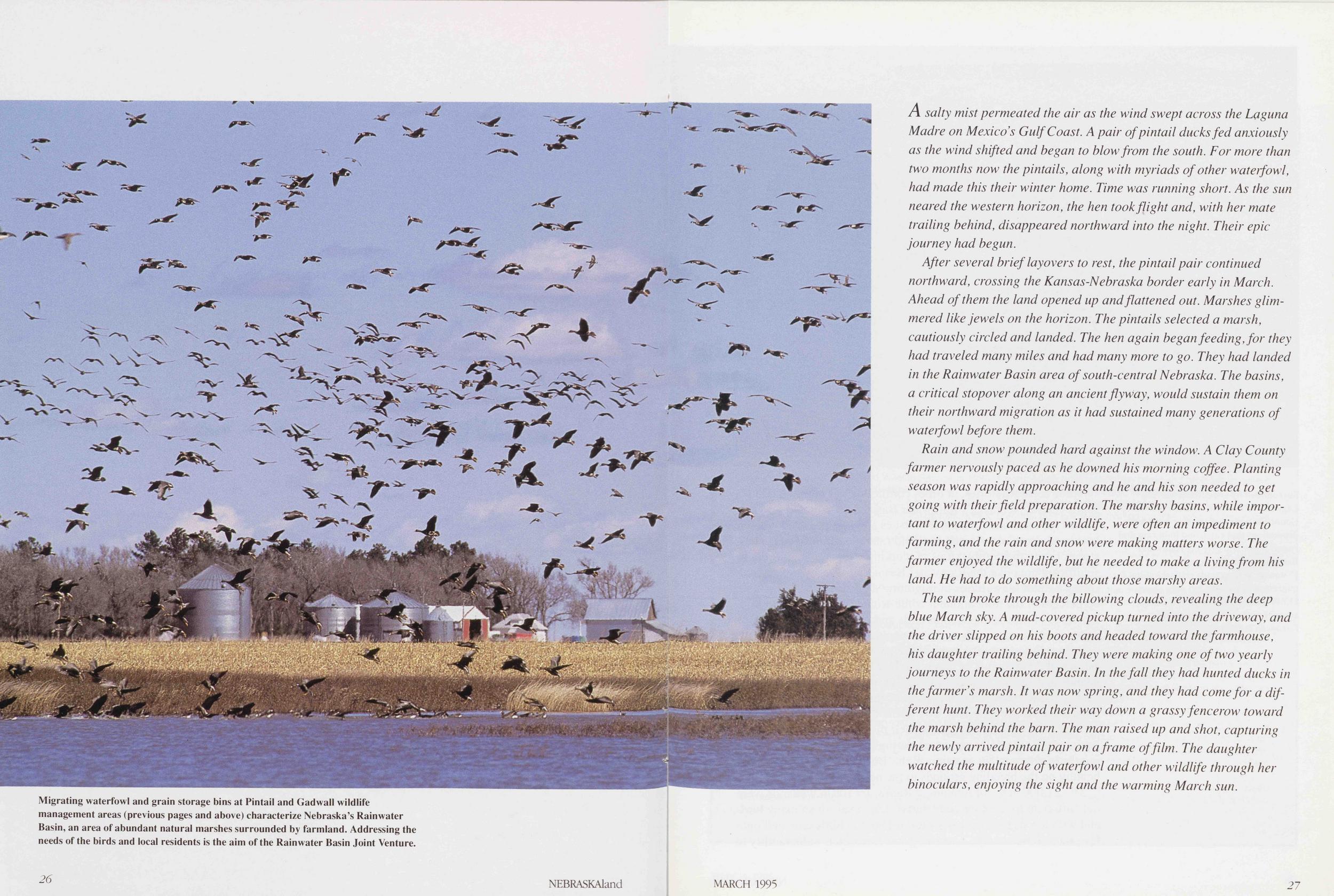
A salty mist permeated the air as the wind swept across the Laguna Madre on Mexico's Gulf Coast. A pair of pintail ducks fed anxiously as the wind shifted and began to blow from the south. For more than two months now the pintails, along with myriads of other waterfowl, had made this their winter home. Time was running short. As the sun neared the western horizon, the hen took flight and, with her mate trailing behind, disappeared northward into the night. Their epic journey had begun.
After several brief layovers to rest, the pintail pair continued northward, crossing the Kansas-Nebraska border early in March. Ahead of them the land opened up and flattened out. Marshes glimmered like jewels on the horizon. The pintails selected a marsh, cautiously circled and landed. The hen again began feeding, for they had traveled many miles and had many more to go. They had landed in the Rainwater Basin area of south-central Nebraska. The basins, a critical stopover along an ancient fly way, would sustain them on their northward migration as it had sustained many generations of waterfowl before them.
Rain and snow pounded hard against the window. A Clay County farmer nervously paced as he downed his morning coffee. Planting season was rapidly approaching and he and his son needed to get going with their field preparation. The marshy basins, while important to waterfowl and other wildlife, were often an impediment to farming, and the rain and snow were making matters worse. The farmer enjoyed the wildlife, but he needed to make a living from his land. He had to do something about those marshy areas.
The sun broke through the billowing clouds, revealing the deep blue March sky. A mud-covered pickup turned into the driveway, and the driver slipped on his boots and headed toward the farmhouse, his daughter trailing behind. They were making one of Wo yearly journeys to the Rainwater Basin. In the fall they had hunted ducks in the farmers marsh. It was now spring, and they had come for a different hunt. They worked their way down a grassy fencerow toward the marsh behind the barn. The man raised up and shot, capturing the newly arrived pintail pair on a frame of film. The daughter watched the multitude of waterfowl and other wildlife through her binoculars, enjoying the sight and the warming March sun.
MARCH 1995 27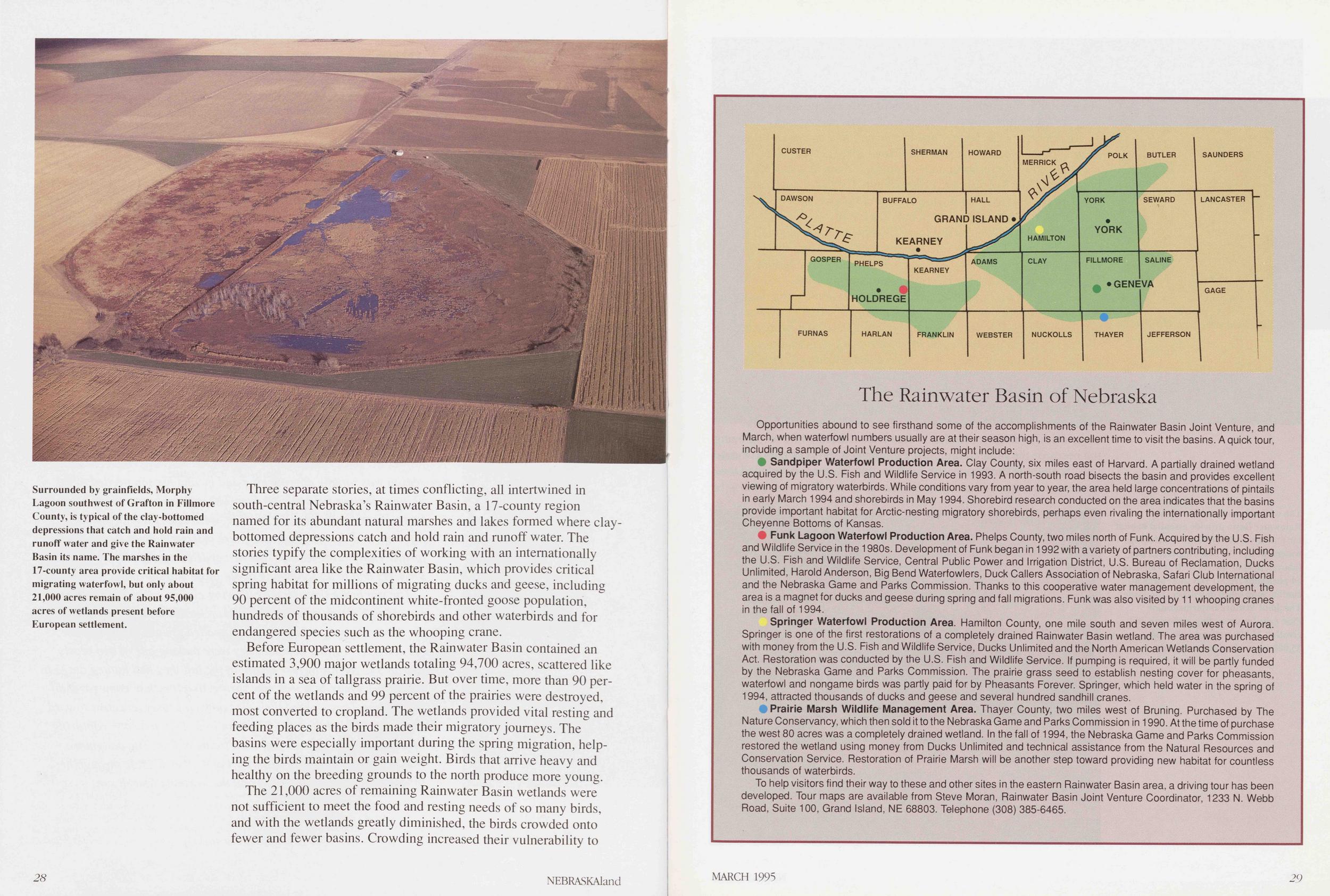
Three separate stories, at times conflicting, all intertwined in south-central Nebraska's Rainwater Basin, a 17-county region named for its abundant natural marshes and lakes formed where clay-bottomed depressions catch and hold rain and runoff water. The stories typify the complexities of working with an internationally significant area like the Rainwater Basin, which provides critical spring habitat for millions of migrating ducks and geese, including 90 percent of the midcontinent white-fronted goose population, hundreds of thousands of shorebirds and other waterbirds and for endangered species such as the whooping crane.
Before European settlement, the Rainwater Basin contained an estimated 3,900 major wetlands totaling 94,700 acres, scattered like islands in a sea of tallgrass prairie. But over time, more than 90 percent of the wetlands and 99 percent of the prairies were destroyed, most converted to cropland. The wetlands provided vital resting and feeding places as the birds made their migratory journeys. The basins were especially important during the spring migration, helping the birds maintain or gain weight. Birds that arrive heavy and healthy on the breeding grounds to the north produce more young.
The 21,000 acres of remaining Rainwater Basin wetlands were not sufficient to meet the food and resting needs of so many birds, and with the wetlands greatly diminished, the birds crowded onto fewer and fewer basins. Crowding increased their vulnerability to disease and reduced their opportunity to gain weight. Major die-offs began to occur, primarily from avian cholera. Something had to be done.
28 NEBRASKAlandOpportunities abound to see firsthand some of the accomplishments of the Rainwater Basin Joint Venture, and March, when waterfowl numbers usually are at their season high, is an excellent time to visit the basins. A quick tour, including a sample of Joint Venture projects, might include:
Sandpiper Waterfowl Production Area. Clay County, six miles east of Harvard. A partially drained wetland acquired by the U.S. Fish and Wildlife Service in 1993. A north-south road bisects the basin and provides excellent viewing of migratory waterbirds. While conditions vary from year to year, the area held large concentrations of pintails in early March 1994 and shorebirds in May 1994. Shorebird research conducted on the area indicates that the basins provide important habitat for Arctic-nesting migratory shorebirds, perhaps even rivaling the internationally important Cheyenne Bottoms of Kansas.
Funk Lagoon Waterfowl Production Area. Phelps County, two miles north of Funk. Acquired by the U.S. Fish and Wildlife Service in the 1980s. Development of Funk began in 1992 with a variety of partners contributing, including the U.S. Fish and Wildlife Service, Central Public Power and Irrigation District, U.S. Bureau of Reclamation, Ducks Unlimited, Harold Anderson, Big Bend Waterfowlers, Duck Callers Association of Nebraska, Safari Club International and the Nebraska Game and Parks Commission. Thanks to this cooperative water management development, the area is a magnet for ducks and geese during spring and fall migrations. Funk was also visited by 11 whooping cranes in the fall of 1994.
Springer Waterfowl Production Area. Hamilton County, one mile south and seven miles west of Aurora. Springer is one of the first restorations of a completely drained Rainwater Basin wetland. The area was purchased with money from the U.S. Fish and Wildlife Service, Ducks Unlimited and the North American Wetlands Conservation Act. Restoration was conducted by the U.S. Fish and Wildlife Service. If pumping is required, it will be partly funded by the Nebraska Game and Parks Commission. The prairie grass seed to establish nesting cover for pheasants, waterfowl and nongame birds was partly paid for by Pheasants Forever. Springer, which held water in the spring of 1994, attracted thousands of ducks and geese and several hundred sandhill cranes.
Prairie Marsh Wildlife Management Area. Thayer County, two miles west of Bruning. Purchased by The Nature Conservancy, which then sold it to the Nebraska Game and Parks Commission in 1990. At the time of purchase the west 80 acres was a completely drained wetland. In the fall of 1994, the Nebraska Game and Parks Commission restored the wetland using money from Ducks Unlimited and technical assistance from the Natural Resources and Conservation Service. Restoration of Prairie Marsh will be another step toward providing new habitat for countless thousands of waterbirds.
To help visitors find their way to these and other sites in the eastern Rainwater Basin area, a driving tour has been developed. Tour maps are available from Steve Moran, Rainwater Basin Joint Venture Coordinator, 1233 N. Webb Road, Suite 100, Grand Island, NE 68803. Telephone (308) 385-6465.
MARCH 1995 29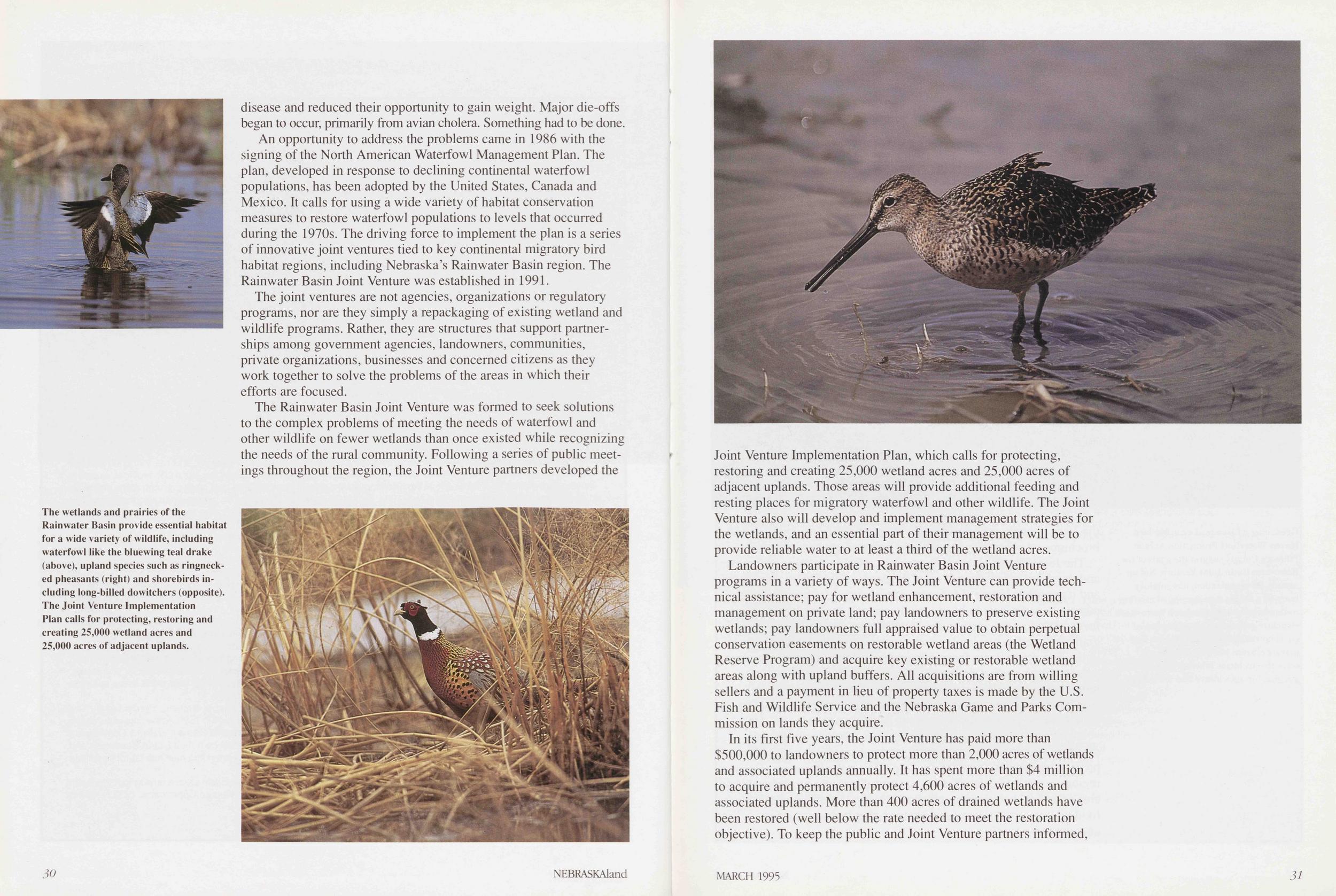
An opportunity to address the problems came in 1986 with the signing of the North American Waterfowl Management Plan. The plan, developed in response to declining continental waterfowl populations, has been adopted by the United States, Canada and Mexico. It calls for using a wide variety of habitat conservation measures to restore waterfowl populations to levels that occurred during the 1970s. The driving force to implement the plan is a series of innovative joint ventures tied to key continental migratory bird habitat regions, including Nebraska's Rainwater Basin region. The Rainwater Basin Joint Venture was established in 1991.
The joint ventures are not agencies, organizations or regulatory programs, nor are they simply a repackaging of existing wetland and wildlife programs. Rather, they are structures that support partnerships among government agencies, landowners, communities, private organizations, businesses and concerned citizens as they work together to solve the problems of the areas in which their efforts are focused.
The Rainwater Basin Joint Venture was formed to seek solutions to the complex problems of meeting the needs of waterfowl and other wildlife on fewer wetlands than once existed while recognizing the needs of the rural community. Following a series of public meetings throughout the region, the Joint Venture partners developed the 30 NEBRASKAland
Landowners participate in Rainwater Basin Joint Venture programs in a variety of ways. The Joint Venture can provide technical assistance; pay for wetland enhancement, restoration and management on private land; pay landowners to preserve existing wetlands; pay landowners full appraised value to obtain perpetual conservation easements on restorable wetland areas (the Wetland Reserve Program) and acquire key existing or restorable wetland areas along with upland buffers. All acquisitions are from willing sellers and a payment in lieu of property taxes is made by the U.S. Fish and Wildlife Service and the Nebraska Game and Parks Commission on lands they acquire.
In its first five years, the Joint Venture has paid more than
$500,000 to landowners to protect more than 2,000 acres of wetlands
and associated uplands annually. It has spent more than $4 million
to acquire and permanently protect 4,600 acres of wetlands and
associated uplands. More than 400 acres of drained wetlands have
been restored (well below the rate needed to meet the restoration
objective). To keep the public and Joint Venture partners informed,
MARCH 1995
31
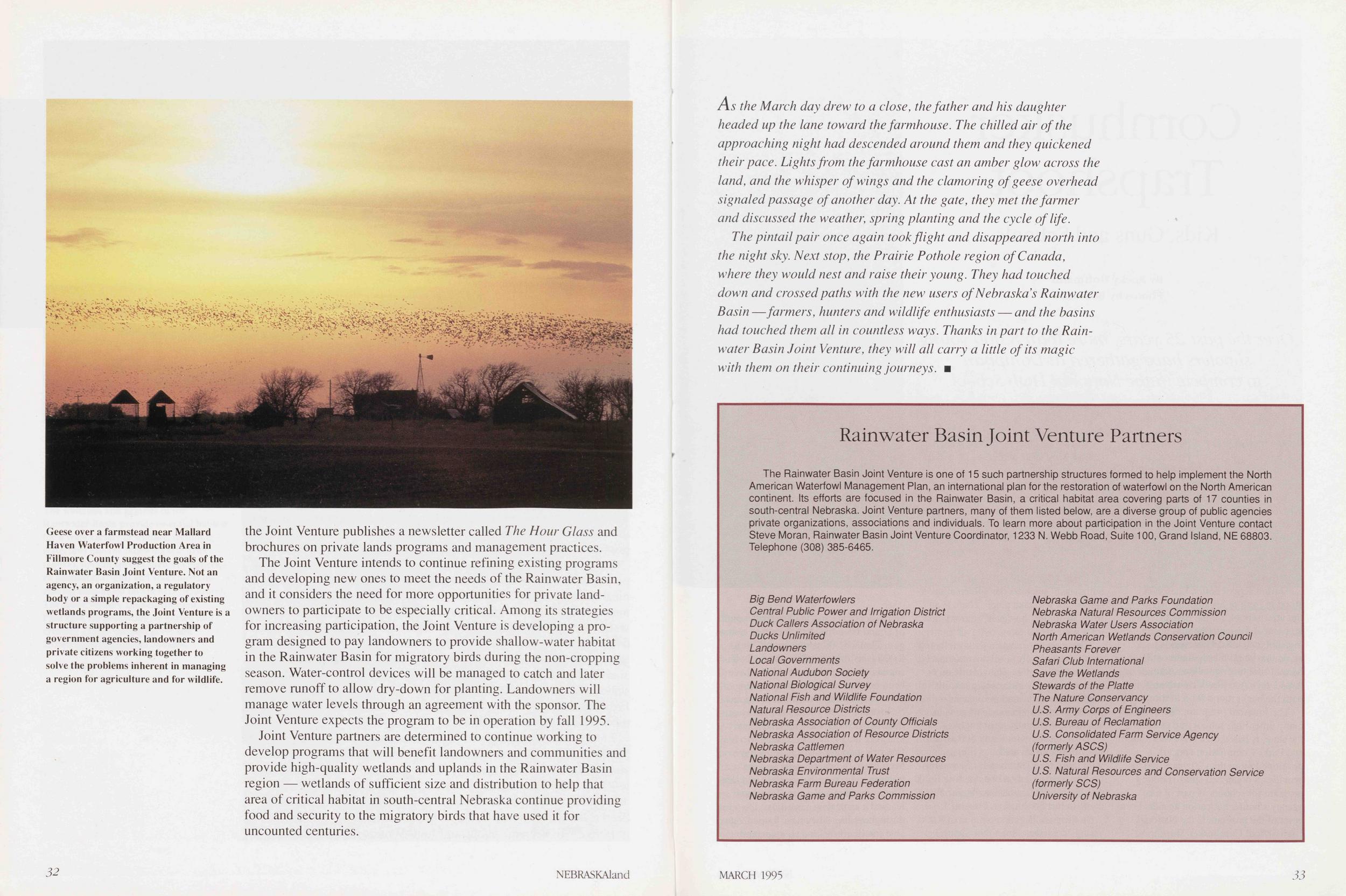
The Joint Venture intends to continue refining existing programs and developing new ones to meet the needs of the Rainwater Basin, and it considers the need for more opportunities for private landowners to participate to be especially critical. Among its strategies for increasing participation, the Joint Venture is developing a program designed to pay landowners to provide shallow-water habitat in the Rainwater Basin for migratory birds during the non-cropping season. Water-control devices will be managed to catch and later remove runoff to allow dry-down for planting. Landowners will manage water levels through an agreement with the sponsor. The Joint Venture expects the program to be in operation by fall 1995.
Joint Venture partners are determined to continue working to develop programs that will benefit landowners and communities and provide high-quality wetlands and uplands in the Rainwater Basin region — wetlands of sufficient size and distribution to help that area of critical habitat in south-central Nebraska continue providing food and security to the migratory birds that have used it for uncounted centuries.
32 NEBRASKAlandAs the March day drew to a close, the father and his daughter headed up the lane toward the farmhouse. The chilled air of the approaching night had descended around them and they quickened their pace. Lights from the farmhouse cast an amber glow across the land, and the whisper of wings and the clamoring of geese overhead signaled passage of another day. At the gate, they met the farmer and discussed the weather, spring planting and the cycle of life.
The pintail pair once again took flight and disappeared north into the night sky. Next stop, the Prairie Pothole region of Canada, where they would nest and raise their young. They had touched down and crossed paths with the new users of Nebraska's Rainwater Basin —farmers, hunters and wildlife enthusiasts — and the basins had touched them all in countless ways. Thanks in part to the Rainwater Basin Joint Venture, they will all cany a little of its magic with them on their continuing journeys,
Rainwater Basin Joint Venture PartnersThe Rainwater Basin Joint Venture is one of 15 such partnership structures formed to help implement the North American Waterfowl Management Plan, an international plan for the restoration of waterfowl on the North American continent. Its efforts are focused in the Rainwater Basin, a critical habitat area covering parts of 17 counties in south-central Nebraska. Joint Venture partners, many of them listed below, are a diverse group of public agencies private organizations, associations and individuals. To learn more about participation in the Joint Venture contact Steve Moran, Rainwater Basin Joint Venture Coordinator, 1233 N. Webb Road, Suite 100, Grand Island, NE 68803. Telephone (308) 385-6465.
Big Bend Waterfowlers Central Public Power and Irrigation District Duck Callers Association of Nebraska Ducks Unlimited Landowners Local Governments National Audubon Society National Biological Survey National Fish and Wildlife Foundation Natural Resource Districts Nebraska Association of County Officials Nebraska Association of Resource Districts Nebraska Cattlemen Nebraska Department of Water Resources Nebraska Environmental Trust Nebraska Farm Bureau Federation Nebraska Game and Parks Commission Nebraska Game and Parks Foundation Nebraska Natural Resources Commission Nebraska Water Users Association North American Wetlands Conservation Council Pheasants Forever Safari Club International Save the Wetlands Stewards of the Platte The Nature Conservancy U.S. Army Corps of Engineers U.S. Bureau of Reclamation U.S. Consolidated Farm Service Agency (formerly ASCS) U.S. Fish and Wildlife Service U.S. Natural Resources and Conservation Service (formerly SCS) University of Nebraska
MARCH 1995 33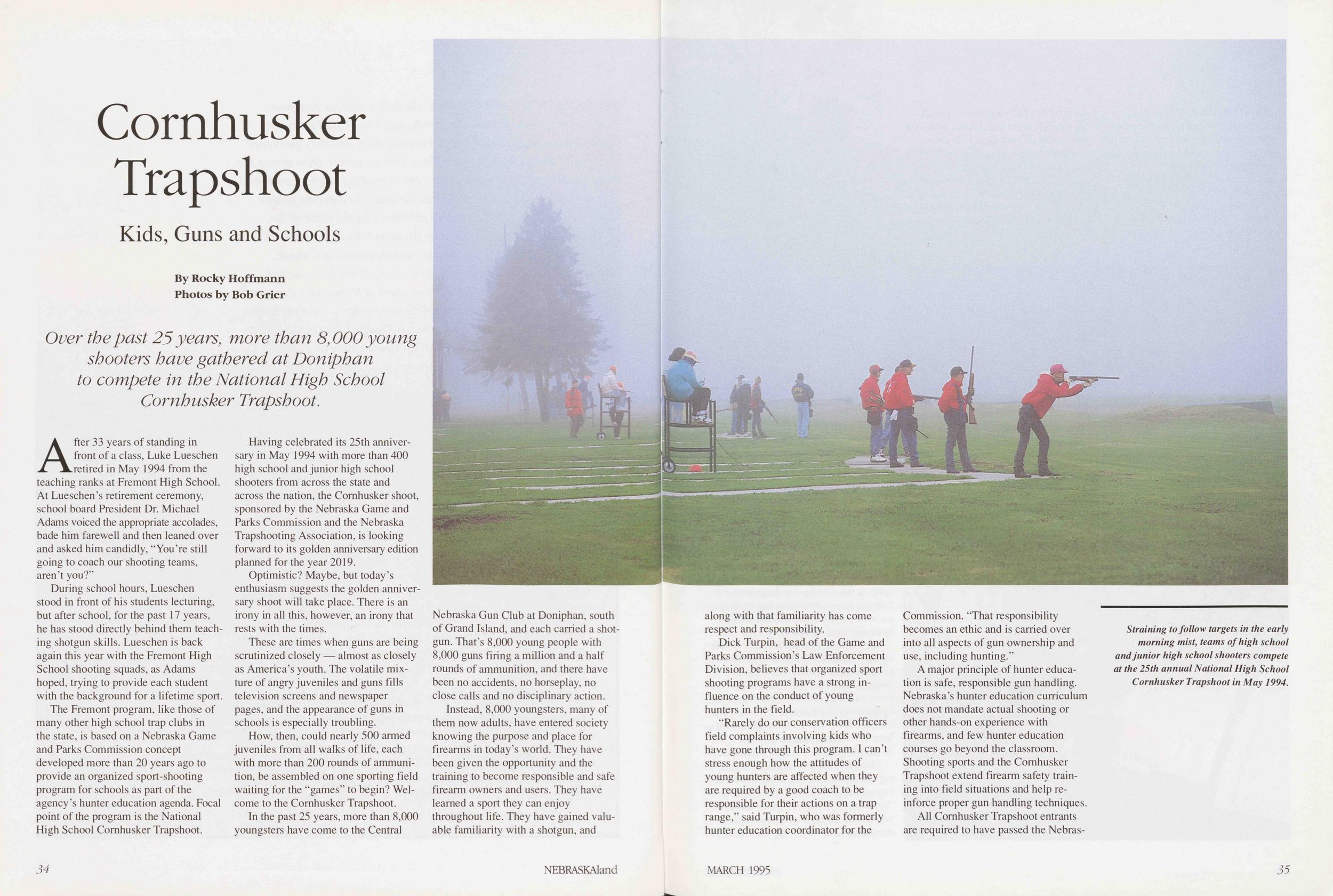
Cornhusker Trapshoot
Kids, Guns and Schools By Rocky Hoffmann Photos by Bob Grier Over the past 25 years, more than 8,000 young shooters have gathered at Doniphan to compete in the National High School Cornhusker Trapshoot.After 33 years of standing in front of a class, Luke Lueschen retired in May 1994 from the teaching ranks at Fremont High School. At Lueschen's retirement ceremony, school board President Dr. Michael Adams voiced the appropriate accolades, bade him farewell and then leaned over and asked him candidly, "You're still going to coach our shooting teams, aren't you?"
During school hours, Lueschen stood in front of his students lecturing, but after school, for the past 17 years, he has stood directly behind them teaching shotgun skills. Lueschen is back again this year with the Fremont High School shooting squads, as Adams hoped, trying to provide each student with the background for a lifetime sport.
The Fremont program, like those of many other high school trap clubs in the state, is based on a Nebraska Game and Parks Commission concept developed more than 20 years ago to provide an organized sport-shooting program for schools as part of the agency's hunter education agenda. Focal point of the program is the National High School Cornhusker Trapshoot.
Having celebrated its 25th anniversary in May 1994 with more than 400 high school and junior high school shooters from across the state and across the nation, the Cornhusker shoot, sponsored by the Nebraska Game and Parks Commission and the Nebraska Trapshooting Association, is looking forward to its golden anniversary edition planned for the year 2019.
Optimistic? Maybe, but today's enthusiasm suggests the golden anniversary shoot will take place. There is an irony in all this, however, an irony that rests with the times.
These are times when guns are being scrutinized closely — almost as closely as America's youth. The volatile mixture of angry juveniles and guns fills television screens and newspaper pages, and the appearance of guns in schools is especially troubling.
How, then, could nearly 500 armed juveniles from all walks of life, each with more than 200 rounds of ammunition, be assembled on one sporting field waiting for the "games" to begin? Welcome to the Cornhusker Trapshoot.
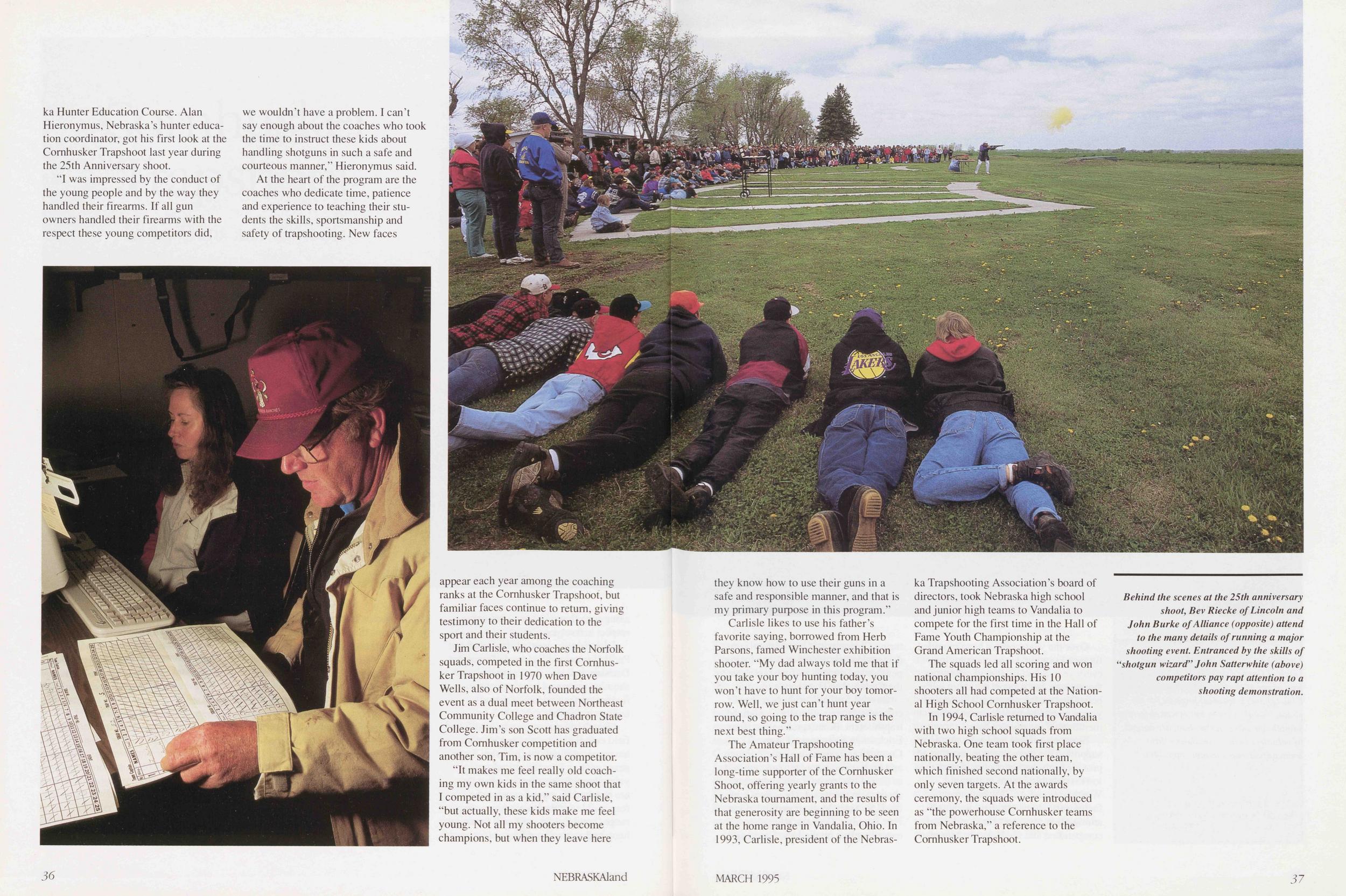
In the past 25 years, more than 8,000 youngsters have come to the Central Nebraska Gun Club at Doniphan, south of Grand Island, and each carried a shotgun. That's 8,000 young people with 8,000 guns firing a million and a half rounds of ammunition, and there have been no accidents, no horseplay, no close calls and no disciplinary action.
Instead, 8,000 youngsters, many of them now adults, have entered society knowing the purpose and place for firearms in today's world. They have been given the opportunity and the training to become responsible and safe firearm owners and users. They have learned a sport they can enjoy throughout life. They have gained valuable familiarity with a shotgun, and 34 NEBRASKAland along with that familiarity has come respect and responsibility.
Dick Turpin, head of the Game and Parks Commission's Law Enforcement Division, believes that organized sport shooting programs have a strong influence on the conduct of young hunters in the field.
"Rarely do our conservation officers field complaints involving kids who have gone through this program. I can't stress enough how the attitudes of young hunters are affected when they are required by a good coach to be responsible for their actions on a trap range," said Turpin, who was formerly hunter education coordinator for the Commission. "That responsibility becomes an ethic and is carried over into all aspects of gun ownership and use, including hunting."
A major principle of hunter education is safe, responsible gun handling. Nebraska's hunter education curriculum does not mandate actual shooting or other hands-on experience with firearms, and few hunter education courses go beyond the classroom. Shooting sports and the Cornhusker Trapshoot extend firearm safety training into field situations and help reinforce proper gun handling techniques.
All Cornhusker Trapshoot entrants are required to have passed the Nebraska
 Hunter Education Course. Alan
Hieronymus, Nebraska's hunter education coordinator, got his first look at the
Cornhusker Trapshoot last year during
the 25th Anniversary shoot.
Hunter Education Course. Alan
Hieronymus, Nebraska's hunter education coordinator, got his first look at the
Cornhusker Trapshoot last year during
the 25th Anniversary shoot.
"I was impressed by the conduct of the young people and by the way they handled their firearms. If all gun owners handled their firearms with the respect these young competitors did, we wouldn't have a problem. I can't say enough about the coaches who took the time to instruct these kids about handling shotguns in such a safe and courteous manner," Hieronymus said.
At the heart of the program are the coaches who dedicate time, patience and experience to teaching their students the skills, sportsmanship and safety of trapshooting. New faces appear each year among the coaching ranks at the Cornhusker Trapshoot, but familiar faces continue to return, giving testimony to their dedication to the sport and their students.
Jim Carlisle, who coaches the Norfolk squads, competed in the first Cornhusker Trapshoot in 1970 when Dave Wells, also of Norfolk, founded the event as a dual meet between Northeast Community College and Chadron State College. Jim's son Scott has graduated from Cornhusker competition and another son, Tim, is now a competitor.
"It makes me feel really old coaching my own kids in the same shoot that I competed in as a kid," said Carlisle, "but actually, these kids make me feel young. Not all my shooters become champions, but when they leave here
Carlisle likes to use his father's favorite saying, borrowed from Herb Parsons, famed Winchester exhibition shooter. "My dad always told me that if you take your boy hunting today, you won't have to hunt for your boy tomorrow. Well, we just can't hunt year round, so going to the trap range is the next best thing."
The Amateur Trapshooting Association's Hall of Fame has been a long-time supporter of the Cornhusker Shoot, offering yearly grants to the Nebraska tournament, and the results of that generosity are beginning to be seen at the home range in Vandalia, Ohio. In 1993, Carlisle, president of the Nebraska Trapshooting Association's board of directors, took Nebraska high school and junior high teams to Vandalia to compete for the first time in the Hall of Fame Youth Championship at the Grand American Trapshoot.
The squads led all scoring and won national championships. His 10 shooters all had competed at the National High School Cornhusker Trapshoot. In 1994, Carlisle returned to Vandalia with two high school squads from Nebraska. One team took first place nationally, beating the other team, which finished second nationally, by only seven targets. At the awards ceremony, the squads were introduced as "the powerhouse Cornhusker teams from Nebraska," a reference to the Cornhusker Trapshoot.
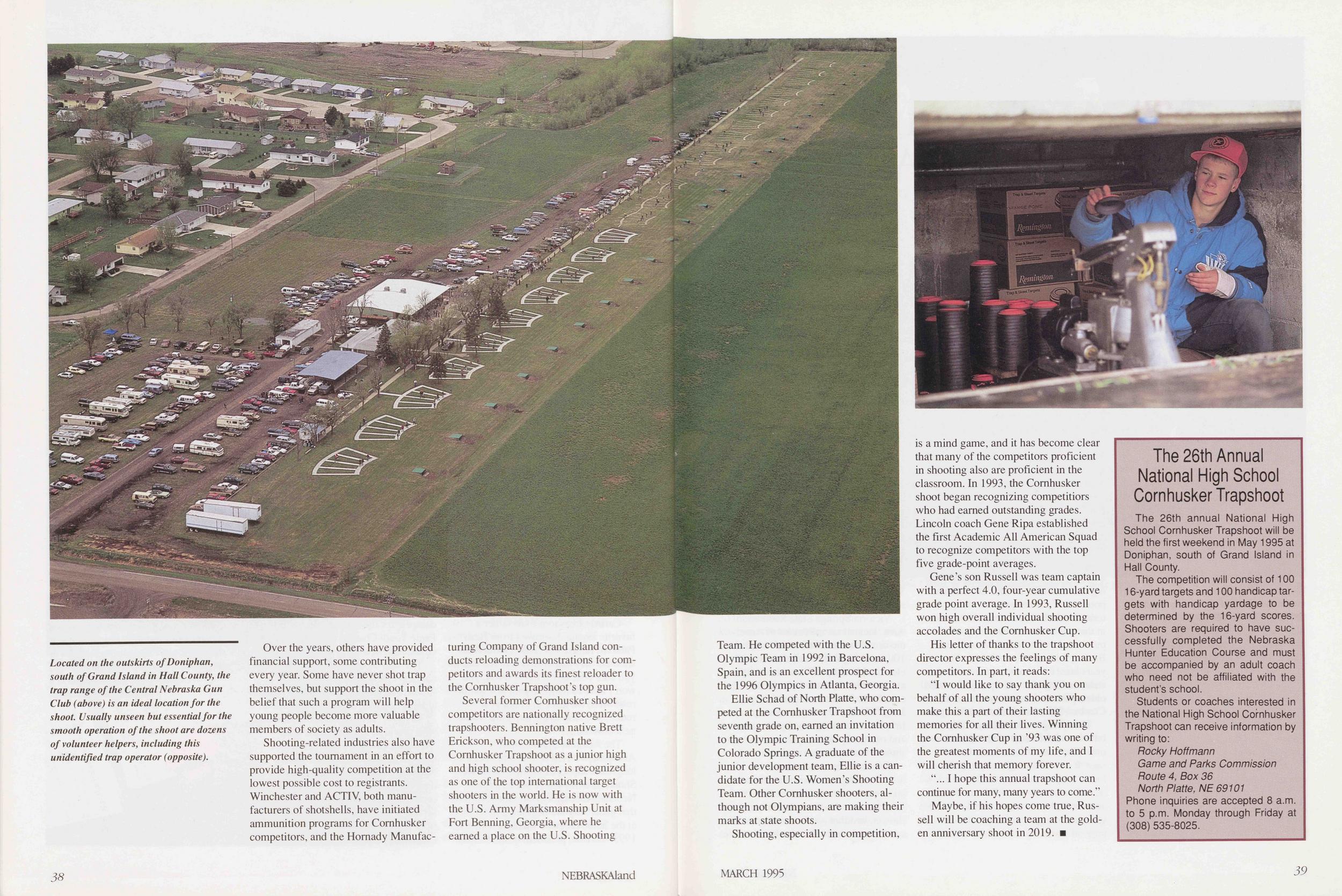
Over the years, others have provided financial support, some contributing every year. Some have never shot trap themselves, but support the shoot in the belief that such a program will help young people become more valuable members of society as adults.
Shooting-related industries also have supported the tournament in an effort to provide high-quality competition at the lowest possible cost to registrants. Winchester and ACTIV, both manufacturers of shotshells, have initiated ammunition programs for Cornhusker competitors, and the Hornady Manufacturing Company of Grand Island conducts reloading demonstrations for competitors and awards its finest reloader to the Cornhusker Trapshoot's top gun.
Several former Cornhusker shoot competitors are nationally recognized trapshooters. Bennington native Brett Erickson, who competed at the Cornhusker Trapshoot as a junior high and high school shooter, is recognized as one of the top international target shooters in the world. He is now with the U.S. Army Marksmanship Unit at Fort Benning, Georgia, where he earned a place on the U.S. Shooting 38 NEBRASKAland Team. He competed with the U.S. Olympic Team in 1992 in Barcelona, Spain, and is an excellent prospect for the 1996 Olympics in Atlanta, Georgia.
Ellie Schad of North Platte, who competed at the Cornhusker Trapshoot from seventh grade on, earned an invitation to the Olympic Training School in Colorado Springs. A graduate of the junior development team, Ellie is a candidate for the U.S. Women's Shooting Team. Other Cornhusker shooters, although not Olympians, are making their marks at state shoots.
Shooting, especially in competition, is a mind game, and it has become clear that many of the competitors proficient in shooting also are proficient in the classroom. In 1993, the Cornhusker shoot began recognizing competitiors who had earned outstanding grades. Lincoln coach Gene Ripa established the first Academic All American Squad to recognize competitors with the top five grade-point averages.
Gene's son Russell was team captain with a perfect 4.0, four-year cumulative grade point average. In 1993, Russell won high overall individual shooting accolades and the Cornhusker Cup.
His letter of thanks to the trapshoot director expresses the feelings of many competitors. In part, it reads:
"I would like to say thank you on behalf of all the young shooters who make this a part of their lasting memories for all their lives. Winning the Cornhusker Cup in '93 was one of the greatest moments of my life, and I will cherish that memory forever.
" I hope this annual trapshoot can continue for many, many years to come."
Maybe, if his hopes come true, Russell will be coaching a team at the golden anniversary shoot in 2019.
The 26th annual National High School Cornhusker Trapshoot will be held the first weekend in May 1995 at Doniphan, south of Grand Island in Hall County.
The competition will consist of 100 16-yard targets and 100 handicap targets with handicap yardage to be determined by the 16-yard scores. Shooters are required to have successfully completed the Nebraska Hunter Education Course and must be accompanied by an adult coach who need not be affiliated with the student's school.
Students or coaches interested in the National High School Cornhusker Trapshoot can receive information by writing to: Rocky Hoffmann Game and Parks Commission Route 4, Box 36 North Platte, NE 69101 Phone inquiries are accepted 8 a.m. to 5 p.m. Monday through Friday at (308) 535-8025.
MARCH 1995 39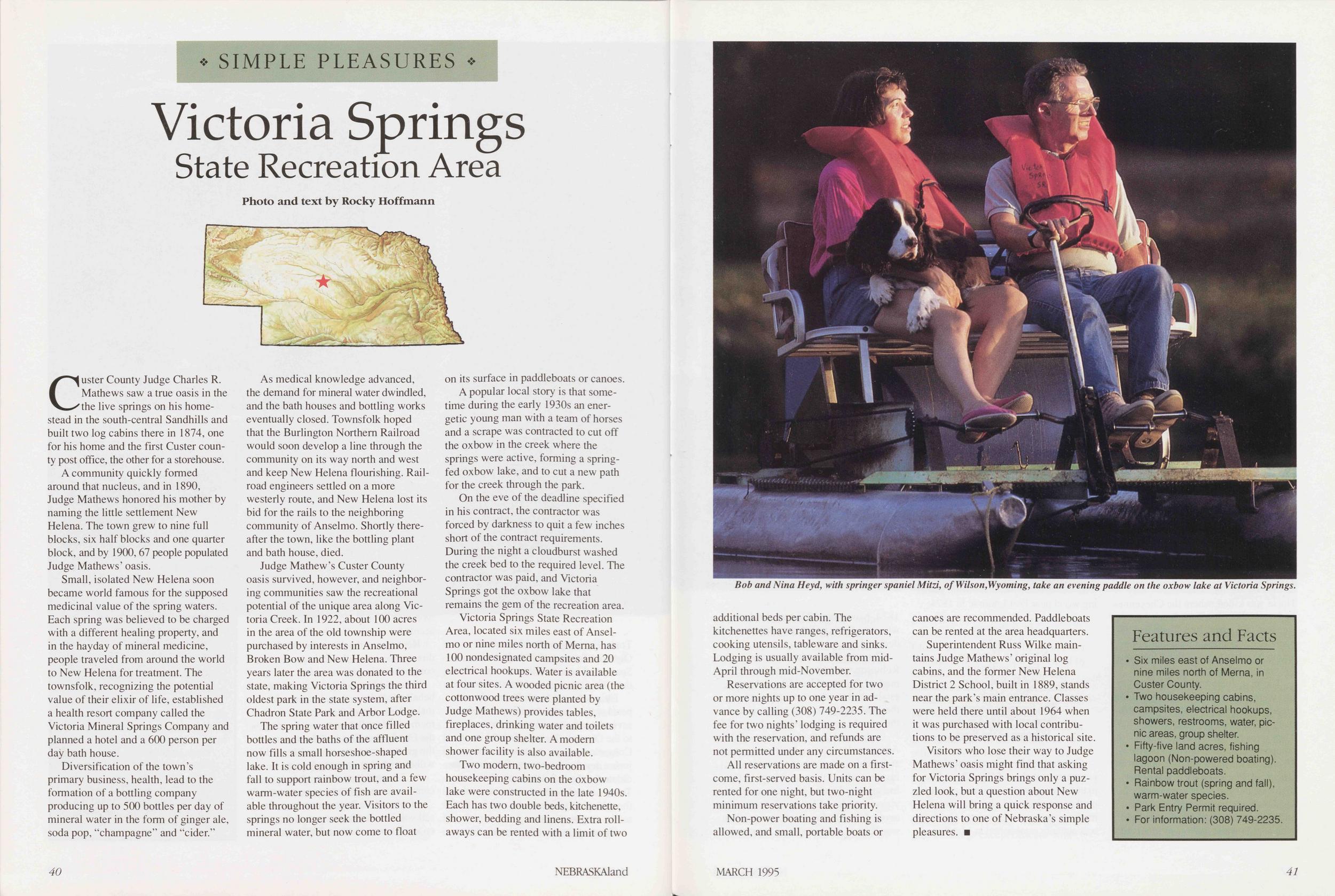
Victoria Springs State Recreation Area
Photo and text by Rocky HoffmannCuster County Judge Charles R. Mathews saw a true oasis in the the live springs on his homestead in the south-central Sandhills and built two log cabins there in 1874, one for his home and the first Custer county post office, the other for a storehouse.
A community quickly formed around that nucleus, and in 1890, Judge Mathews honored his mother by naming the little settlement New Helena. The town grew to nine full blocks, six half blocks and one quarter block, and by 1900, 67 people populated Judge Mathews' oasis.
Small, isolated New Helena soon became world famous for the supposed medicinal value of the spring waters. Each spring was believed to be charged with a different healing property, and in the hayday of mineral medicine, people traveled from around the world to New Helena for treatment. The townsfolk, recognizing the potential value of their elixir of life, established a health resort company called the Victoria Mineral Springs Company and planned a hotel and a 600 person per day bath house.
Diversification of the town's primary business, health, lead to the formation of a bottling company producing up to 500 bottles per day of mineral water in the form of ginger ale, soda pop, "champagne" and "cider."
As medical knowledge advanced, the demand for mineral water dwindled, and the bath houses and bottling works eventually closed. Townsfolk hoped that the Burlington Northern Railroad would soon develop a line through the community on its way north and west and keep New Helena flourishing. Railroad engineers settled on a more westerly route, and New Helena lost its bid for the rails to the neighboring community of Anselmo. Shortly there-after the town, like the bottling plant and bath house, died.
Judge Mathew's Custer County oasis survived, however, and neighboring communities saw the recreational potential of the unique area along Victoria Creek. In 1922, about 100 acres in the area of the old township were purchased by interests in Anselmo, Broken Bow and New Helena. Three years later the area was donated to the state, making Victoria Springs the third oldest park in the state system, after Chadron State Park and Arbor Lodge.
The spring water that once filled bottles and the baths of the affluent now fills a small horseshoe-shaped lake. It is cold enough in spring and fall to support rainbow trout, and a few warm-water species of fish are available throughout the year. Visitors to the springs no longer seek the bottled mineral water, but now come to float on its surface in paddleboats or canoes.
A popular local story is that sometime during the early 1930s an energetic young man with a team of horses and a scrape was contracted to cut off the oxbow in the creek where the springs were active, forming a springfed oxbow lake, and to cut a new path for the creek through the park.
On the eve of the deadline specified in his contract, the contractor was forced by darkness to quit a few inches short of the contract requirements. During the night a cloudburst washed the creek bed to the required level. The contractor was paid, and Victoria Springs got the oxbow lake that remains the gem of the recreation area.
Victoria Springs State Recreation Area, located six miles east of Anselmo or nine miles north of Merna, has 100 nondesignated campsites and 20 electrical hookups. Water is available at four sites. A wooded picnic area (the cottonwood trees were planted by Judge Mathews) provides tables, fireplaces, drinking water and toilets and one group shelter. A modern shower facility is also available.
Two modern, two-bedroom housekeeping cabins on the oxbow lake were constructed in the late 1940s. Each has two double beds, kitchenette, shower, bedding and linens. Extra rollaways can be rented with a limit of two 40 NEBRASKAland
Reservations are accepted for two or more nights up to one year in advance by calling (308) 749-2235. The fee for two nights' lodging is required with the reservation, and refunds are not permitted under any circumstances.
All reservations are made on a firstcome, first-served basis. Units can be rented for one night, but two-night minimum reservations take priority.
Non-power boating and fishing is allowed, and small, portable boats or canoes are recommended. Paddleboats can be rented at the area headquarters.
Superintendent Russ Wilke maintains Judge Mathews' original log cabins, and the former New Helena District 2 School, built in 1889, stands near the park's main entrance. Classes were held there until about 1964 when it was purchased with local contributions to be preserved as a historical site.
Visitors who lose their way to Judge Mathews' oasis might find that asking for Victoria Springs brings only a puzzled look, but a question about New Helena will bring a quick response and directions to one of Nebraska's simple pleasures.
Features and FactsSix miles east of Anselmo or nine miles north of Merna, in Custer County.
Two housekeeping cabins, campsites, electrical hookups, showers, restrooms, water, picnic areas, group shelter.
Fifty-five land acres, fishing lagoon (Non-powered boating). Rental paddleboats.
Rainbow trout (spring and fall), warm-water species.
Park Entry Permit required.
For information: (308) 749-2235,
MARCH 1995 41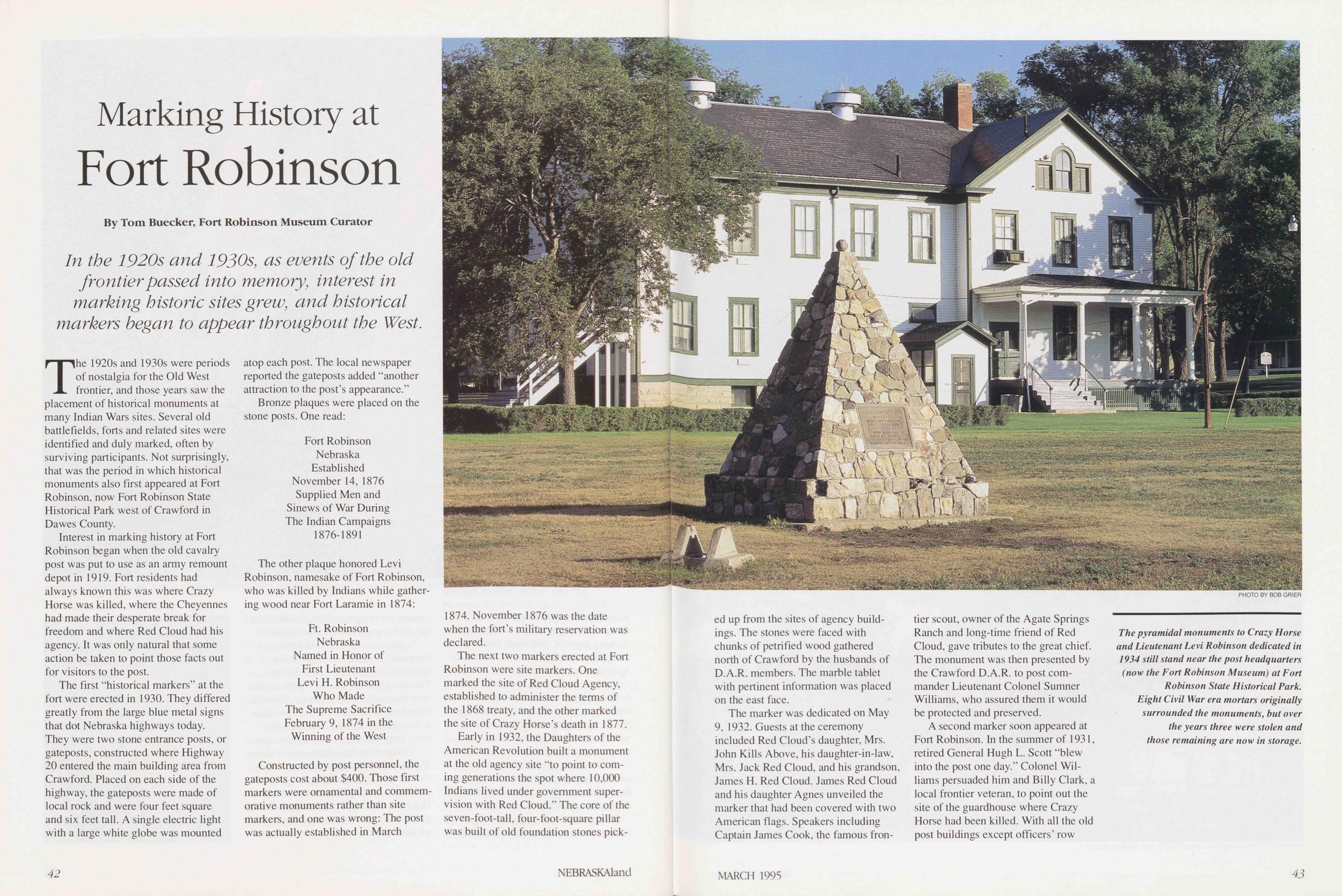
Marking History at Fort Robinson
By Tom Buecker, Fort Robinson Museum Curator In the 1920s and 1930s, as events of the old frontier passed into memory, interest in marking historic sites grew, and historical markers began to appear throughout the West.The 1920s and 1930s were periods of nostalgia for the Old West frontier, and those years saw the placement of historical monuments at many Indian Wars sites. Several old battlefields, forts and related sites were identified and duly marked, often by surviving participants. Not surprisingly, that was the period in which historical monuments also first appeared at Fort Robinson, now Fort Robinson State Historical Park west of Crawford in Dawes County.
Interest in marking history at Fort Robinson began when the old cavalry post was put to use as an army remount depot in 1919. Fort residents had always known this was where Crazy Horse was killed, where the Cheyennes had made their desperate break for freedom and where Red Cloud had his agency. It was only natural that some action be taken to point those facts out for visitors to the post.
The first "historical markers" at the fort were erected in 1930. They differed greatly from the large blue metal signs that dot Nebraska highways today. They were two stone entrance posts, or gateposts, constructed where Highway 20 entered the main building area from Crawford. Placed on each side of the highway, the gateposts were made of local rock and were four feet square and six feet tall. A single electric light with a large white globe was mounted atop each post. The local newspaper reported the gateposts added "another attraction to the post's appearance."
Bronze plaques were placed on the stone posts. One read: Fort Robinson Nebraska Established November 14, 1876 Supplied Men and Sinews of War During The Indian Campaigns 1876-1891
The other plaque honored Levi Robinson, namesake of Fort Robinson, who was killed by Indians while gathering wood near Fort Laramie in 1874: Ft. Robinson Nebraska Named in Honor of First Lieutenant Levi H. Robinson Who Made The Supreme Sacrifice February 9, 1874 in the Winning of the West
Constructed by post personnel, the gateposts cost about $400. Those first markers were ornamental and commemorative monuments rather than site markers, and one was wrong: The post was actually established in March 1874. November 1876 was the date when the fort's military reservation was declared.
The next two markers erected at Fort Robinson were site markers. One marked the site of Red Cloud Agency, established to administer the terms of the 1868 treaty, and the other marked the site of Crazy Horse's death in 1877.
Early in 1932, the Daughters of the American Revolution built a monument at the old agency site "to point to coming generations the spot where 10,000 Indians lived under government supervision with Red Cloud." The core of the seven-foot-tall, four-foot-square pillar was built of old foundation stones picked 42 NEBRASKAland up from the sites of agency buildings. The stones were faced with chunks of petrified wood gathered north of Crawford by the husbands of D.A.R. members. The marble tablet with pertinent information was placed on the east face.
The marker was dedicated on May 9, 1932. Guests at the ceremony included Red Cloud's daughter, Mrs. John Kills Above, his daughter-in-law, Mrs. Jack Red Cloud, and his grandson, James H. Red Cloud. James Red Cloud and his daughter Agnes unveiled the marker that had been covered with two American flags. Speakers including Captain James Cook, the famous frontier scout, owner of the Agate Springs Ranch and long-time friend of Red Cloud, gave tributes to the great chief. The monument was then presented by the Crawford D.A.R. to post commander Lieutenant Colonel Sumner Williams, who assured them it would be protected and preserved.
A second marker soon appeared at Fort Robinson. In the summer of 1931, retired General Hugh L. Scott "blew into the post one day." Colonel Williams persuaded him and Billy Clark, a local frontier veteran, to point out the site of the guardhouse where Crazy Horse had been killed. With all the old post buildings except officers' row
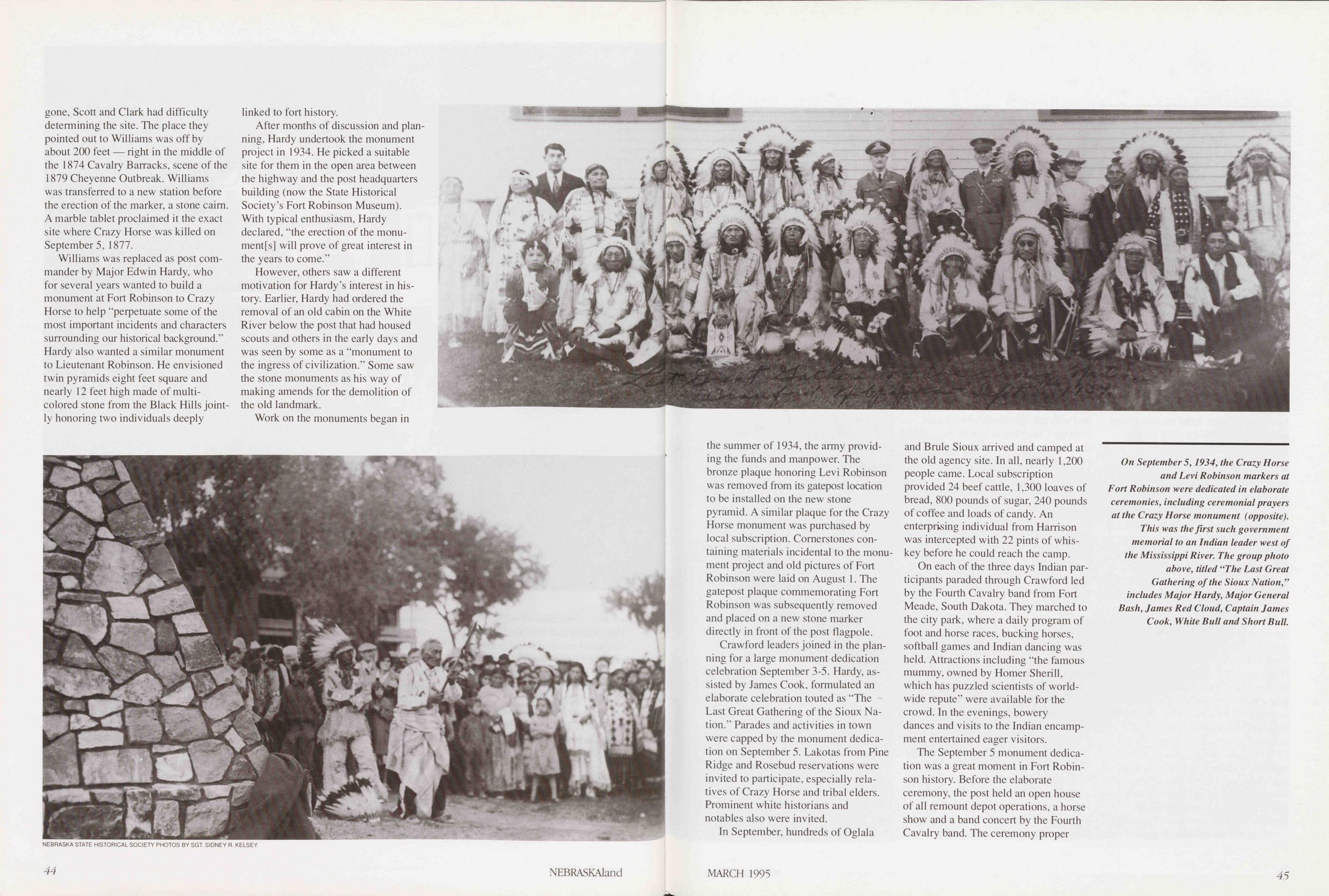 gone, Scott and Clark had difficulty
determining the site. The place they
pointed out to Williams was off by
about 200 feet — right in the middle of
the 1874 Cavalry Barracks, scene of the
1879 Cheyenne Outbreak. Williams
was transferred to a new station before
the erection of the marker, a stone cairn.
A marble tablet proclaimed it the exact
site where Crazy Horse was killed on
September 5, 1877.
gone, Scott and Clark had difficulty
determining the site. The place they
pointed out to Williams was off by
about 200 feet — right in the middle of
the 1874 Cavalry Barracks, scene of the
1879 Cheyenne Outbreak. Williams
was transferred to a new station before
the erection of the marker, a stone cairn.
A marble tablet proclaimed it the exact
site where Crazy Horse was killed on
September 5, 1877.
Williams was replaced as post commander by Major Edwin Hardy, who for several years wanted to build a monument at Fort Robinson to Crazy Horse to help "perpetuate some of the most important incidents and characters surrounding our historical background." Hardy also wanted a similar monument to Lieutenant Robinson. He envisioned twin pyramids eight feet square and nearly 12 feet high made of multicolored stone from the Black Hills jointly honoring two individuals deeply linked to fort history.
After months of discussion and planning, Hardy undertook the monument project in 1934. He picked a suitable site for them in the open area between the highway and the post headquarters building (now the State Historical Society's Fort Robinson Museum). With typical enthusiasm, Hardy declared, "the erection of the monuments] will prove of great interest in the years to come."
However, others saw a different motivation for Hardy's interest in history. Earlier, Hardy had ordered the removal of an old cabin on the White River below the post that had housed scouts and others in the early days and was seen by some as a "monument to the ingress of civilization." Some saw the stone monuments as his way of making amends for the demolition of the old landmark.
Work on the monuments began in
Crawford leaders joined in the planning for a large monument dedication celebration September 3-5. Hardy, assisted by James Cook, formulated an elaborate celebration touted as "The Last Great Gathering of the Sioux Nation." Parades and activities in town were capped by the monument dedication on September 5. Lakotas from Pine Ridge and Rosebud reservations were invited to participate, especially relatives of Crazy Horse and tribal elders. Prominent white historians and notables also were invited.
In September, hundreds of Oglala and Brule Sioux arrived and camped at the old agency site. In all, nearly 1,200 people came. Local subscription provided 24 beef cattle, 1,300 loaves of bread, 800 pounds of sugar, 240 pounds of coffee and loads of candy. An enterprising individual from Harrison was intercepted with 22 pints of whiskey before he could reach the camp.
On each of the three days Indian participants paraded through Crawford led by the Fourth Cavalry band from Fort Meade, South Dakota. They marched to the city park, where a daily program of foot and horse races, bucking horses, Softball games and Indian dancing was held. Attractions including "the famous mummy, owned by Homer Sherill, which has puzzled scientists of worldwide repute" were available for the crowd. In the evenings, bowery dances and visits to the Indian encampment entertained eager visitors.
The September 5 monument dedication was a great moment in Fort Robinson history. Before the elaborate ceremony, the post held an open house of all remount depot operations, a horse show and a band concert by the Fourth Cavalry band. The ceremony proper
The back porch of the post headquarters served as the speaker's stand. Featured orators were Bad Wound and the Reverend George Beecher. Beecher told the crowd the markers were "not erected so much to two great characters as to the principle of sacrifice which they represented." The main speaker was General L.H. Bash, the quarter-master general of the U.S. Army, who declared that Crazy Horse had been one of the greatest soldiers of his time.
After the Robinson monument was unveiled by Miss Marian Wenzlaff, daughter of remount Lieutenant Ted Wenzlaff, attention turned to the Crazy Horse marker. Covered with a red blanket, the marker was unveiled by Black Medicine, a nephew of the famed warrior. After the unveiling, the Indians held an Omaha dance followed by a salute of 11 guns, the salute rendered for a brigadier general. It was pointed out that "It is the first time in history that an Indian warrior west of the Mississippi River has been honored by the erection of a monument to his memory through government agencies."
All in all, the monument dedication and celebration was a great success, though marked by some controversy. A few Indian participants were dissatisfied with the representatives selected from the Crazy Horse family. Individuals believed to have a closer relationship to the famed warrior were not invited to speak, prompting some to walk out during Bad Wound's oration. Henry Standing Bear later remarked that "It [the ceremony] was considered by many Indians to be a failure, I am sorry to note." To others, however, the fact remained that "the Indian killed by his one-time enemy the white man was honored, just as the white man who was killed by his red enemy was honored."
The following year, additional plans were made to commemorate history at Fort Robinson. A group of Crawford residents conferred with Major Hardy about the possibility of moving Red Cloud's remains from Pine Ridge for reburial on the bluffs above the fort. Hardy thought the plan impractical, but suggested an alternative, that the chief be reburied at Red Cloud Agency.
In March he wrote General Bash suggesting a pyramid monument for the famous chief at the agency site. His proposed Red Cloud pyramid would be more than twice the size of the Crazy Horse and Robinson monuments. He also thought the chief's remains could then be reinterred in a concrete sarcophagus built near the monument. Later the site could be set aside as a national park, and eventually a museum built to house Captain Cook's valuable collection of Red Cloud artifacts.
General Bash was less than enthusiastic. He told Hardy it had been difficult to cover the erection costs of the two pyramid monuments, stating his hope that "nothing further will be heard of it." Creation of national parks and monuments was no longer under war department control, and Bash said there was little he could do to help. No more monuments or markers were built by the army at Fort Robinson.
Hardy had always planned to add 46 NEBRASKAland some sort of martial ornamentation around his pyramid monuments. He envisioned mounting old cannon barrels at the corners of each monument, to be joined with chains. Instead, short, Civil War era Coehorn mortars were received and set at each corner in 1935. One of the eight mortars mysteriously disappeared just before World War II. During the war those remaining were removed to save them from brass salvage drives.
When the Fort Robinson Museum was established in 1956, the seven mortars were returned to their corner mountings. In the late 1970s, three were stolen. For safe keeping, the remaining mortars were placed in storage.
Historians had long known that the monument for the Crazy Horse killing was misplaced. In 1988, the marker was removed to allow archaeological excavation of the 1874 Cavalry Barracks site, and recently the marker was relocated in front of the reconstructed guardhouse where the warrior was bayonetted. For the first time in 60 years the marker is correctly placed.
In recent years the Nebraska State Historical Society has placed more historical markers around the old post, con tinuing the practice of marking history at Fort Robinson and helping today's visitors understand and appreciate its colorful past.
Classified
ANIMALS/BIRDSLLAMAS - Affectionate, gentle animal for any animal lover. Easy keepers. Contact Oak Ridce Llamas, Box 665, Fullerton, NE 68638. (308) 536-3203.
BOOKS/PMNTINGFREE BOOK CATALOG. Novels, westerns, romances, children's; old out of print, found barns, attic. Authors: Grey. Bower. Connor, Fox, Curwood, Raine, Wright, Aldriee, Pollyanna, Freckles, many others. Postage appreciated. Pierce, 4400 N. Pine Cluster. Oroville.CA 95965.
HOW TO FIND MORE OUTDOOR OPPORTUNITIES!! The Nebraska Sportsman's Atlas. Locations of all public lands and waters on county transportation maps. These maps show ALL the roads in Nebraska. Listings include federal, Nebraska Game & Parks, NRD holdings, hotels and motels and Nebraska's endless attractions. At only $18.75/copy a true time and frustration saver. To order write: Sportsman's Atlas Co., PO Box 132, Lytton, IA 50561 or call 1-800-568-8334.
ACREAGE ADVISOR — Nebraska's how-to magazine for creating your ideal acreage will entertain and inspire you. 15400 N. 56th, Lincoln. NE 68514. Free sample issue (send 75tf postage). One year—$9.95.
COLLECTIBLESBUYING: American Indian artifacts such as beadwork, weavings, baskets, etc.; also cowboy memorabilia such as chaps, spurs, photographs, etc. Best price first letter; photographs promptly returned. Jack Rinswalt, 1550 California St., Suite 6, #211. San Francisco. CA 94109. (415)388-5174.
DOGSENGLISH COCKER pups, imported stock, British FTC bloodlines. Many colors available. Featured in NEBR ASK Aland November 1991. Sawtooth Oaks, Box 443, Orleans. NE 68966. Phone (308) 473-5265.
YELLOW-BLACK Lab pups. FC-AFC sired. AKC. Hips OFA certified. Dew claws removed. Excellent hunting potential. Contact Bob Bendler, Lexington, NE (308) 324-4247.
TRAINING ALL BREEDS bird dogs — Vizslas and English Pointers for sale. Rozanek Kennels, RR2,Schuvler. NE 68661. Phone (402) 352-8769.
RETRIEVER TRAINING. Area's top "retrievers only" trainer. Field trial and huntine dogs. Non-slip duck dogs! TKO RETRIEVER TRAINING KENNEL (402) 623-4311.
CHESAPEAKE BAY, LABRADOR and GOLDEN RETRIEVER pups, started dogs and stud service. 16 time national champion pedigre. Platte Valley Retrievers (308) 995-2318.
ENGLISH SETTER AND LABRADORS from outstanding lines. Bred for hunters who appreciate fine bird dogs! Wind Fall Gun Dogs, (402)421-4693.
AKC WEIMARANER PUPS. Whelped 1/11/95. Both parents are excellent hunters/family dogs. (402) 467-2290.
WILDERNESS KENNELS. Gun dog training - over 60 years combined experience. Training all sporting breeds Retrievers. Flushing and pointing dogs. All dogs worked on pen raised birds and wild game. Training program includes obedience training — heel, sit, stay, down and come when called. Pups, started dogs and fully trained doss for sale. HUNTING DOGS TRAINED BY HUNTERS. Henry Sader, Wilderness Kennels, Roca, NE (402) 423-4212. Since 1968.
FISH/FISHINGFISH FOR SALE. Catfish, largemouth bass, smallmouth bass, perch, crappie, bluegill, walleye, northern pike, rainbow trout, Donaldson rainbow trout, grass carp, minnows, bullheads. Consulting available. Pleasant Valley Fish Farm, RR 1. Box 147, McCook, NE 69001. Phone (308) 345-6599.
WILLOW LAKE FISH HATCHERY. Channel cat, bluegill, hybrid, bluegill, largemouth bass, crappie, triploid grass carp, walleye, perch, minnows available for stocking. Gaylord Crawford, Rt. 3 Box 46, Hastings, NE 68901 or phone (402) 463-8022 day or night. Also pond consultant. We del, grower price.
FOODNEBRASKA BASKETS: The original Nebraska company specializing in tine foods from Nebraska. A beautiful array of baskets filled with ethnic, healthful and long-time favorite foods. Call or write for our brochure: P.O. Box 98, McCook. NE 69001. 1-800-345-7725.
SUBSCRIBE NOW! Get NEBRASKAland Magazine For Yourself or Send it as a Gift For Just $14 a Year! 1-Year $14 2-Year $27 Name Address City State Zip Mail check or money order to NEBRASKAland Magazine P.O. Box 30370, Lincoln, Nebraska 68503-0370 To Place Credit Card Orders by Phone Call Toll Free 1-800-NEB-LAND (632-5263)BEER & WINEMAKING SUPPLIES Fermenter's Supply & Equipment. 4472 S. 84th St., Omaha, NE 68127. (402) 593-9171. Mail order or visit our store.
GIFTSFREE 200-PAGE GIFT catalog. Same gifts as in shopping malls but half the price. Check it out. Write to Kinsi's Quality Products, Box 491. Alliance, NE 69301.
GREAT GIFT IDEA. Special issue warehouse sale from NEBRASKAland Magazine — from woodlands to wildflowers, photography, recipes and history, get past specials at lowest prices ever. For titles available and order information, see the ad and coupon on page 6 of this issue.
GWDES/OUTFITTERSMAD RIVER CANOES offers the finest quality and performance. For the finest canoes and accessories look to Great Plains Canoe Co., 205 Main. Springfield. NE Phone (402)253-2001.
GUNS/SHOOTING/ARCHERYGUNS — Browning, Winchester, Remington, others. Hi-powers, shotguns, new. used, antiques. Want Pre-'64 Winchesters. Buy-Sell-Trade. (402) 729-6112. Bedlan's Sporting Goods, Fairbury, NE 68352.
TAXIDERMYALLISON'S TAXIDERMY STUDIO & GIFTGALLERY. Specializing in fish, birds and small game. Mounted 35 State Record Fish. Pheasant mounts for sale. 421 N. Dewey, North Platte, NE 69101. (308) 534-2324 or (308) 534-4267.
VACATION/RESORTSFOR FISHING and hunting accommodations. Jefco Inn, Gordon, NE 69343. South Cornell, (308) 282-2935.
BED & BREAKFAST. Historic 1890s hotel. Located in the beautiful Pine Ridge area of Northwest Nebraska. Short drive to Chadron State Park, Fort Robinson and the Black Hills. Beautiful dining room with fireplace and fountain. Room service available. The Olde Main Street Inn. 115 Main St., Chadron. NE 69337 (308) 432-3380.
NE NEBRASKA TROUT FISHING. Mon-Thurs or Fri-Sun. 3 modem cottages, 5 spring fed lakes. Trout, bass and bluegill. Diamond E. Trout Resort, Box B, Orchard, NE 1-800-658-3244.
MY BLUE HEAVEN BED AND BREAKFAST. 1920s house with antiques and quilts located at 1041 5th Street. Pawnee City, NE 68420. Located within 15 minutes of Burchard Lake and Ironhorse Lake. Call (402) 852-313 1 for reservations.
SANDHILL CRANE TOURS. Naturalist-guided tours to view cranes congregating along the Platte River near Grand Island. Also eagles, prairie chickens, and an abundance of waterfowl. Dawn and dusk bunker tours March 10 through April 9. For information or reservations call Crane Meadows Nature Center at (308) 382-1820.
Classified ad rates: 75ct per word, minimum $15. Closing date is the first business day 2 months preceding date of issue. Ads are accepted on a first-come-first-served', space-available basis. To place ads or for more information write NEBRASKAland Magazine, P.O. Box 30370. Lincoln, NE 68503-0370, or call (402) 471-5478. Fax (402) 471 -5528. 48 NEBRASKAlandPage forty-nine
The PassingThe old man lies sleeping in the bed, his withered body frail and broken beneath the sheet and blanket. His white hair is mussed, and stubble on his slack cheeks and narrow chin makes the wrinkles and crevices of his face more pronounced, almost as prominent as his high cheek bones and deep-set eyes.
The room is dim, and a faint glow from the curtained window provides the only illumination. Sadie, the graymuzzled black Lab who has been sleeping on a throw rug beside the bed, slowly gets to her feet when I enter the room and escorts me to a chair near the foot of the bed.
When I sit, the aging dog puts her head on my knee and wags her tail slowly as I rub her neck and ears. She looks up at me with sad, golden-brown eyes, as if asking the question that is on my mind too: "Will this be the day?" After a few moments Sadie turns and walks back to the rug to lie down near her friend and master of more than a decade.
"Warren Jensen." I repeat his name mentally I look at my old friend. He seems much smaller now, much more vulnerable than I've ever seen him. I can see the outlines of his skinny legs beneath the covers. "How many miles of cornfield have you walked in your 82 years how many pheasants did you shoot?"
In the corner near the window is an old, ornate walnut-and-glass gun cabinet. I can barely make out the guns standing inside, but I know his scarred Winchester Model 12, the gun he carried when he hunted pheasants and quail, is there, along with the Remington Model 870 Magnum he used for duck hunting, and the 20-gauge Stevens-Savage doublebarrel he favored for dove shooting.
Atop the cabinet is a mounted pair of bobwhite quail and an assortment of duck calls, goose calls and dog whistles.
Hanging on the wall beside the bureau mirror is a picture of "Gyp" (short for Gypsy) a German shorthair pointer, posing proudly with a limp pheasant in his mouth. That's the dog Warren had when I met him in 1960, the year I graduated from high school. On the other side of the mirror is a framed photograph of Warren's daughter, Nadine, when she was three or four years old, standing next to a sitting golden retriever. The girl and dog were almost exactly the same height. "How many hunting dogs shared your life, Warren?"
"We'll have to put the dog down," Nadine had said about Sadie when I first talked to her at the hospital after Warren's operation. The doctors had hoped the old man's stomach problems could be corrected, but they found the cancer was much more advanced than they'd thought and had already damaged his liver and pancreas. "When Dad goes, we won't have a place for her. She's a nice dog, but we just can't have an animal that size in our apartment. If she were younger I'd try to sell her, but nobody wants an old dog."
My mind wanders as I watch Warren's labored breathing. I can see him standing on the riverbank, casting a chunk of turkey liver into the current, then carefully putting the rod down at an angle to the river and propping the tip section in the fork of a stick stuck into the ground. He sets the line tension so there is just a hint of a bend in the rod to keep the line tight and so he can see the tip bounce as a catfish mouths the bait.
Catfishing and bird hunting have been Warren's passions for as long as I've known him. He once told me he'd started hunting and fishing during the Depression as a way of putting food on the table and never got tired of being outdoors. Since retiring from the railroad and loosing Marie the same year, he's had little else to fill his time.
Four months after the operation, he looks pale and emaciated. Though I don't want to admit it, it is obvious that he is slipping rapidly. I can see a change just since a few days ago. The nurse tells me he has drifted in and out of consciousness for the past few days, probably partly because of the heavy pain medication.
I wonder what he sees in his mind does he dream? Does he see memories of the gray, cold dawn with flocks of mallards rocking into the decoy spread in front of his blind, their wings cupped against the wind, feet and legs stretching for the water? Can he feel the wet retriever sitting at his side, trembling in anticipation as the ducks approach? Does he remember his toes numb in the feet of the rubber waders? Can he hear the shots and the splash as the dog dives into the water to retrieve the birds? Warren shifts position slightly and the movement jars my attention. I watch for a moment he's OK. I wonder if, though the body is old and looks a bit crumpled, his spirit is still strong. Is he fighting, trying to hang on, hoping to recover enough to fish another season or enjoy one last dove hunt? Or has he accepted his condition, content to leave these experiences and move on, his memories intact, to whatever lies ahead. "What's happening Warren?" I wish he could tell me.
I look at his hand. Once thick and strong, it's thin now, the fingers gnarled and slack. I think of all the times I saw him clean fish, his hands moving fluidly. I remember him using those hands to signal the dogs, to carve duck decoys and hold a week-old pup.
I stand to leave. "Warren, do you know I'm here?" I gently squeeze one of his hands. What had once been the hands of a hard-working man now lie limp at his side. "Good bye."
Sadie lifts her head and watches as I step away from the bed and walk to the door. I nod at the old dog and know in a few days, when Warren has gone, I'll return for her, to take her home to the farm where she'll live with Maggie and me and our Chesapeake pup. It won't be the same without Warren for any of us, but I think he'll approve of Sadie's new home.
Tom Keith MARCH 1995 49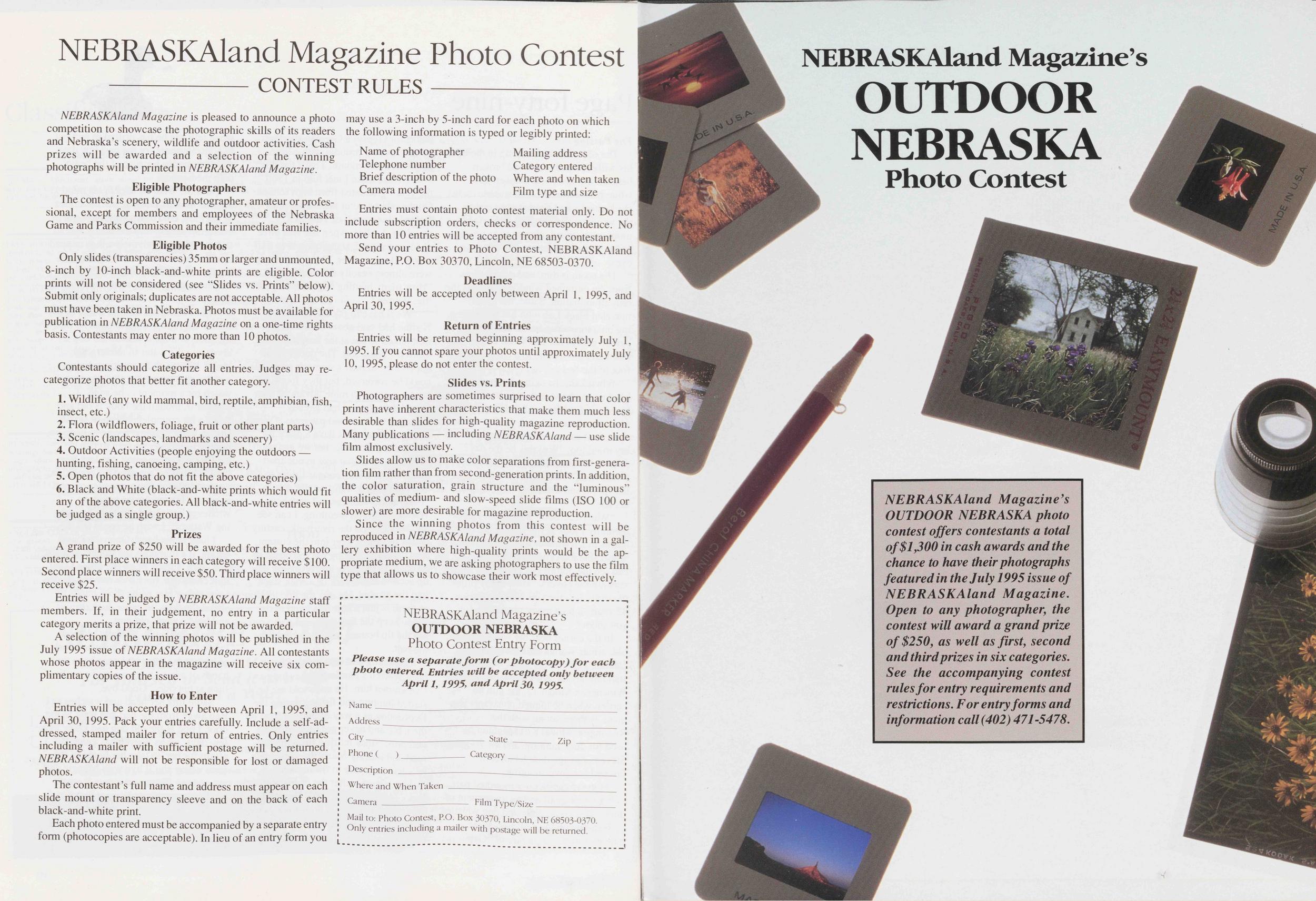
NEBRASKAland Magazine Photo Contest
CONTEST RULESNEBRASKAland Magazine is pleased to announce a photo competition to showcase the photographic skills of its readers and Nebraska's scenery, wildlife and outdoor activities. Cash prizes will be awarded and a selection of the winning photographs will be printed in NEBRASKAland Magazine.
Eligible PhotographersThe contest is open to any photographer, amateur or professional, except for members and employees of the Nebraska Game and Parks Commission and their immediate families.
Eligible PhotosOnly slides (transparencies) 35mm or larger and unmounted, 8-inch by 10-inch black-and-white prints are eligible. Color prints will not be considered (see "Slides vs. Prints" below). Submit only originals; duplicates are not acceptable. All photos must have been taken in Nebraska. Photos must be available for publication in NEBRASKAland Magazine on a one-time rights basis. Contestants may enter no more than 10 photos.
CategoriesContestants should categorize all entries. Judges may recategorize photos that better fit another category. 1. Wildlife (any wild mammal, bird, reptile, amphibian, fish, insect, etc.) 2. Flora (wildflowers, foliage, fruit or other plant parts) 3. Scenic (landscapes, landmarks and scenery) 4. Outdoor Activities (people enjoying the outdoors hunting, fishing, canoeing, camping, etc.) 5. Open (photos that do not fit the above categories) 6. Black and White (black-and-white prints which would fit any of the above categories. All black-and-white entries will be judged as a single group.)
PrizesA grand prize of $250 will be awarded for the best photo entered. First place winners in each category will receive $ 100. Second place winners will receive $50. Third place winners will receive $25.
Entries will bed juged by NEBRASKAland Magazine staff members. If, in their judgement, no entry in a particular category merits a prize, that prize will not be awarded.
A selection of the winning photos will be published in the July 1995 issue of NEBRASKAland Magazine. All contestants whose photos appear in the magazine will receive six complimentary copies of the issue.
How to EnterEntries will be accepted only between April 1, 1995, and April 30, 1995. Pack your entries carefully. Include a self-addressed, stamped mailer for return of entries. Only entries including a mailer with sufficient postage will be returned. NEBRASKAland will not be responsible for lost or damaged photos.
The contestant's full name and address must appear on each slide mount or transparency sleeve and on the back of each black-and-white print.
Each photo entered must be accompanied by a separate entry form (photocopies are acceptable). In lieu of an entry form you may use a 3-inch by 5-inch card for each photo on which the following information is typed or legibly printed:
Name of photographer Telephone number Brief description of the photo Camera model Mailing address Category entered Where and when taken Film type and sizeEntries must contain photo contest material only. Do not include subscription orders, checks or correspondence. No more than 10 entries will be accepted from any contestant.
Send your entries to Photo Contest, NEBRASKAland Magazine, P.O. Box 30370, Lincoln, NE 68503-0370.
DeadlinesEntries will be accepted only between April 1, 1995 and April 30, 1995.
Return of EntriesEntries will be returned beginning approximately July 1, 1995. If you cannot spare your photos until approximately July 10, 1995, please do not enter the contest.
Slides vs. PrintsPhotographers are sometimes surprised to learn that color prints have inherent characteristics that make them much less desirable than slides for high-quality magazine reproduction. Many publications — including NEBRASKAland — use slide film almost exclusively.
Slides allow us to make color separations from first-generation film rather than from second-generation prints. In addition, the color saturation, grain structure and the "luminous" qualities of medium- and slow-speed slide films (ISO 100 or slower) are more desirable for magazine reproduction.
Since the winning photos from this contest will be reproduced in NEBRASKAland Magazine, not shown in a gallery exhibition where high-quality prints would be the appropriate medium, we are asking photographers to use the film type that allows us to showcase their work most effectively.
NEBRASKAland Magazine's OUTDOOR NEBRASKA Photo Contest Entry Form Please use a separate form (or photocopy) for each photo entered. Entries will he accepted only between April 1, 1995, and April 30, 1995. Name Address City Phone( ) Description State Zip Category Where and When Taken Camera Film Type/Size Mail to: Photo Contest, P.O. Box 30370, Lincoln, NE 68503-0370. Only entries including a mailer with postage will be returned.NEBRASKAland Magazine's OUTDOOR NEBRASKA photo contest offers contestants a total of $1,300 in cash awards and the chance to have their photographs featured in the July 1995 issue of NEBRASKAland Magazine. Open to any photographer, the contest will award a grand prize of $250, as well as first, second and third prizes in six categories. See the accompanying contest rules for entry requirements and restrictions. For entry forms and information call (402) 471-5478.
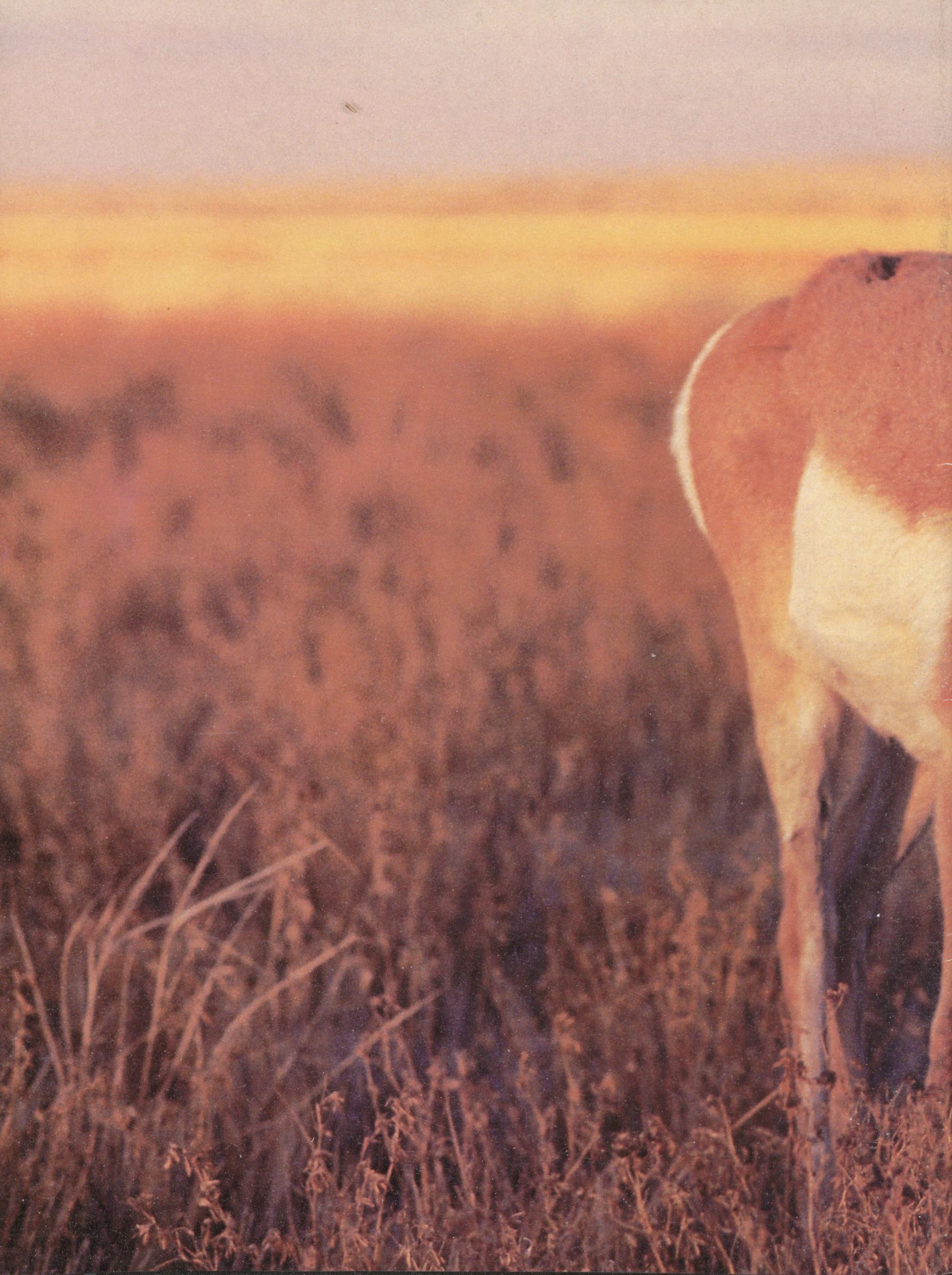
Position: 468 (22 views)