Volume 72, Issue 10, 1994
NEBRASKAland
DECEMBER 1994 • $2.00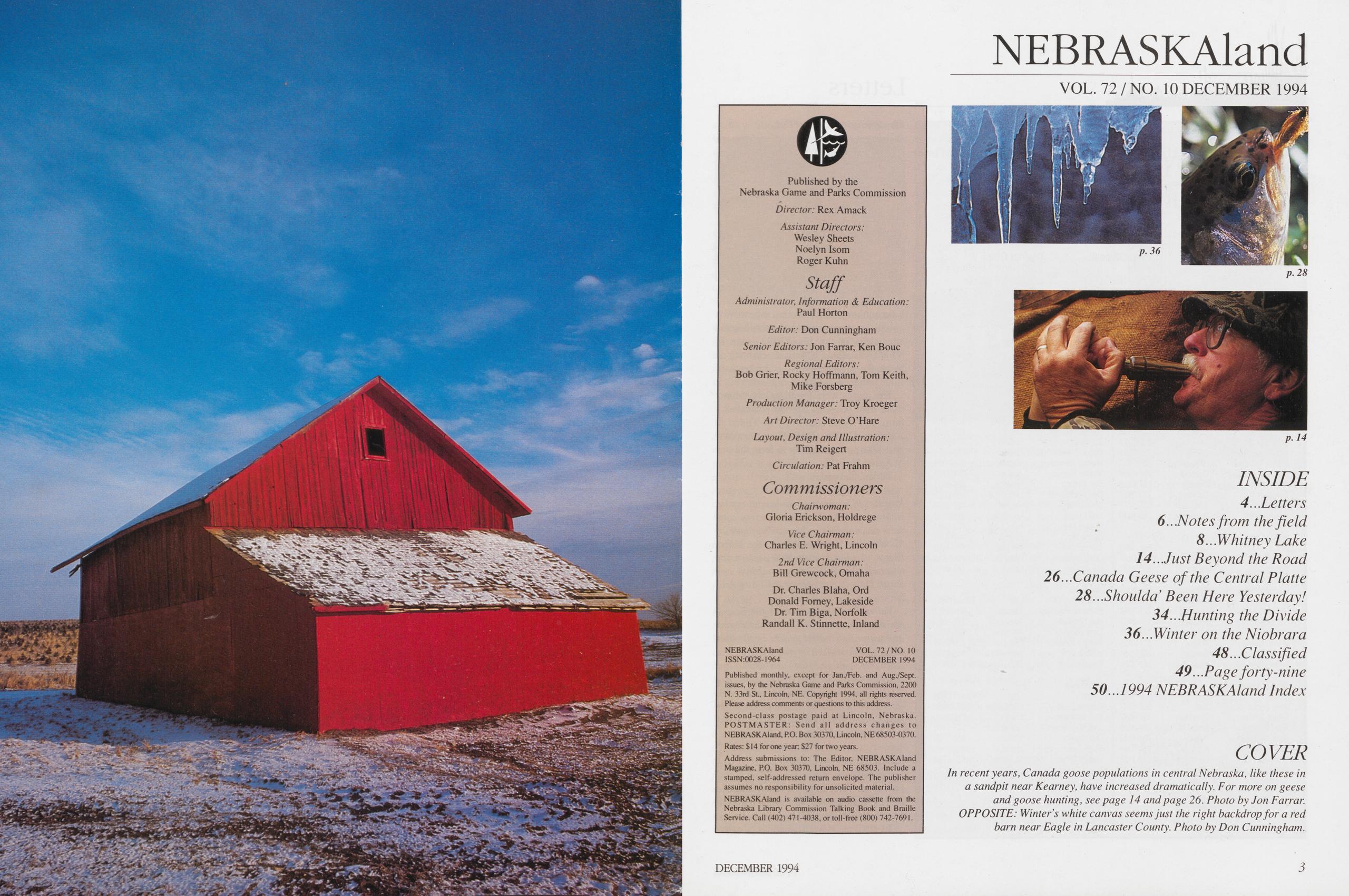
NEBRASKAland
VOL. 72 / NO. 10 DECEMBER 1994 Published by the Nebraska Game and Parks Commission Director: Rex Amack Assistant Directors: Wesley Sheets Noelyn Isom Roger Kuhn Staff Administrator Information & Education: Paul Horton Editor: Don Cunningham Senior Editors: Jon Farrar, Ken Bouc Regional Editors: Bob Grier, Rocky Hoffmann, Tom Keith, Mike Forsberg Production Manager: Troy Kroeger Art Director: Steve O’Hare Layout, Design and Illustration: Tim Reigert Circulation: Pat Frahm Commissioners Chairwoman: Gloria Erickson, Holdrege Vice Chairman: Charles E. Wright, Lincoln 2nd Vice Chairman: Bill Grewcock, Omaha Dr. Charles Blaha, Ord Donald Forney, Lakeside Dr. Tim Biga, Norfolk Randall K. Stinnette, Inland NEBRASKAland VOL. 72 / NO. 10 ISSN:0028-1964 DECEMBER 1994 Published monthly, except for Jan./Feb. and Aug./Sept. issues, by the Nebraska Game and Parks Commission, 2200 N. 33rd St., Lincoln, NE. Copyright 1994, all rights reserved. Please address comments or questions to this address. Second-class postage paid at Lincoln. Nebraska. POSTMASTER: Send all address changes to NEBRASK Aland, P.O. Box 30370, Lincoln, NE 68503-0370. Rates: $14 for one year, $27 for two years. Address submissions to: The Editor, NEBRASKAland Magazine. P.O. Box 30370, Lincoln. NE 68503. Include a stamped, self-addressed return envelope. The publisher assumes no responsibility for unsolicited material. NEBRASKAland is available on audio cassette from the Nebraska Library Commission Talking Book and Braille Service. Call (402) 471-4038. or toll-free (800) 742-7691.p.36
p. 28
p. 14
4...Letters
6...Notes from the field
8...Whitney Lake
14...Just Beyond the Road
26...Canada Geese of the Central Platte
28...Shoulda Been Here Yesterday!
34...Hunting the Divide
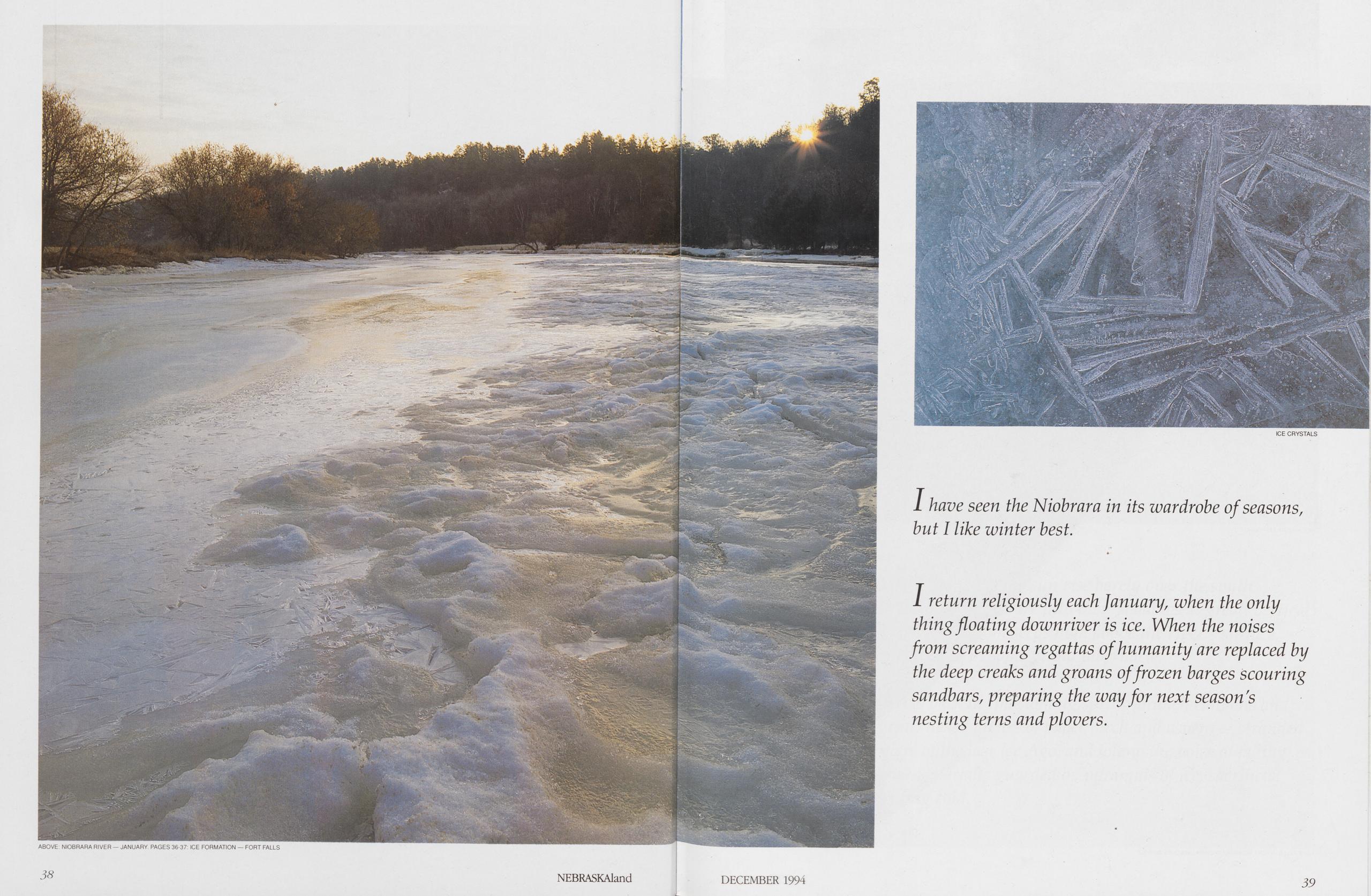
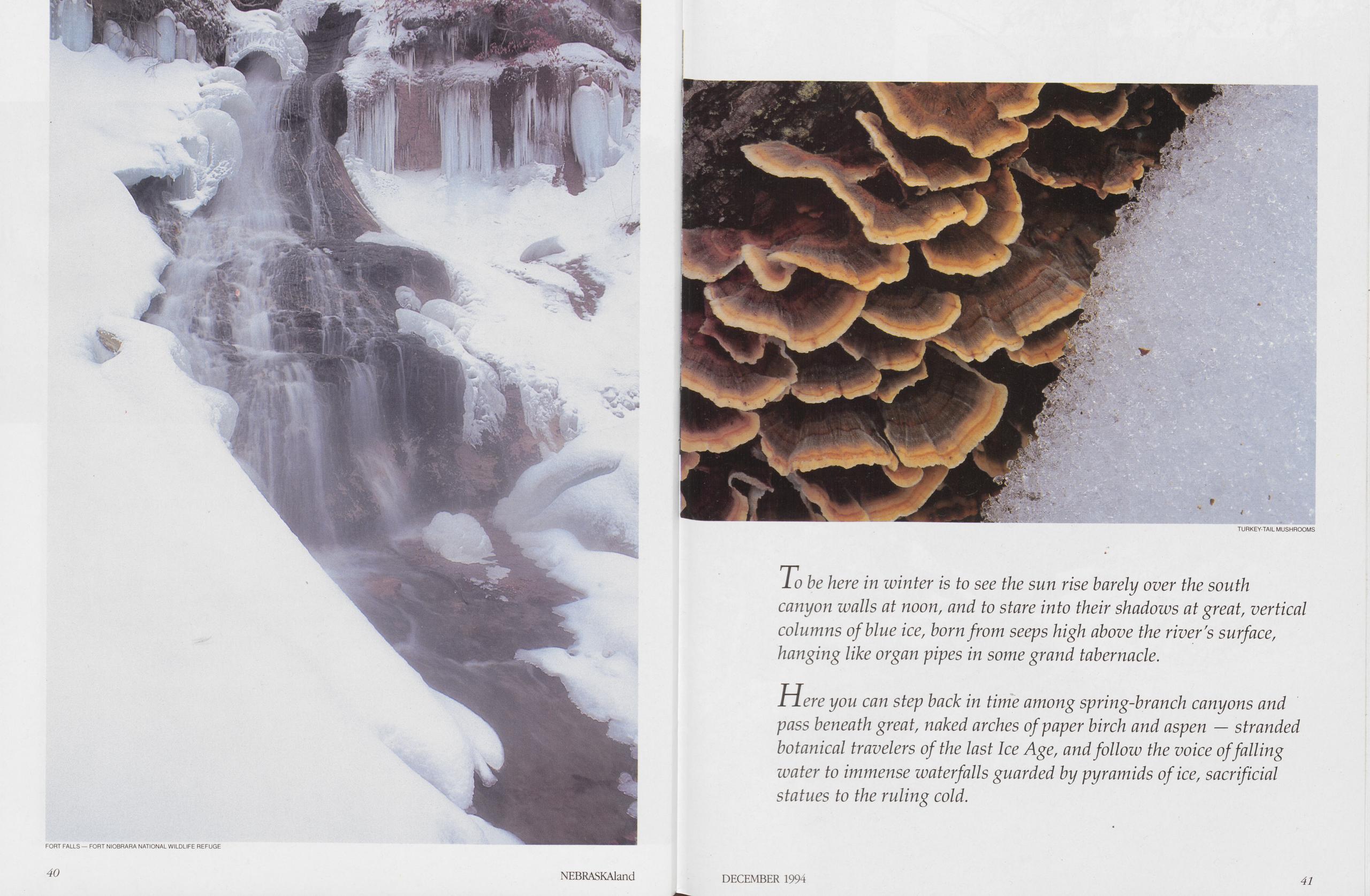
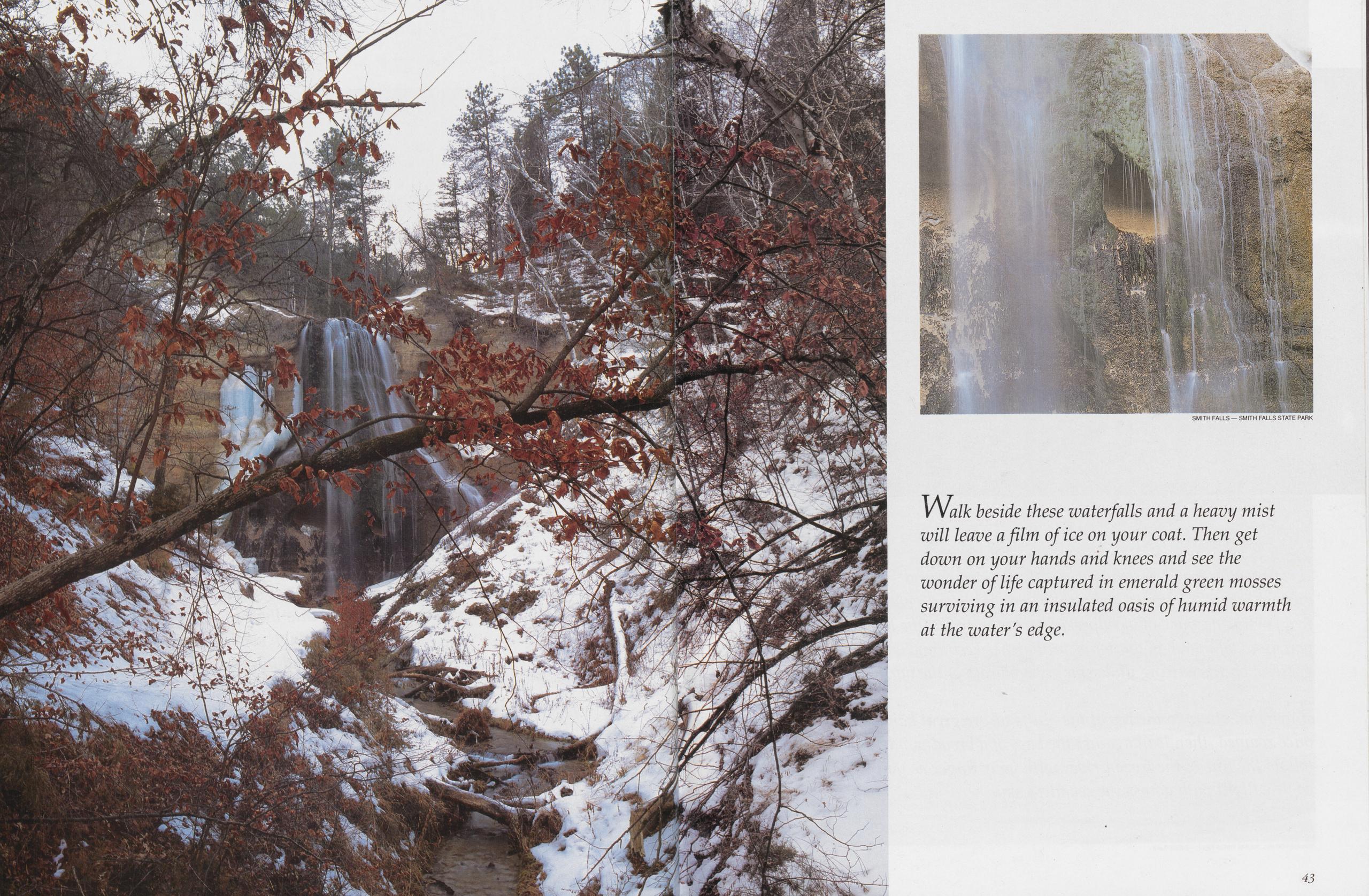
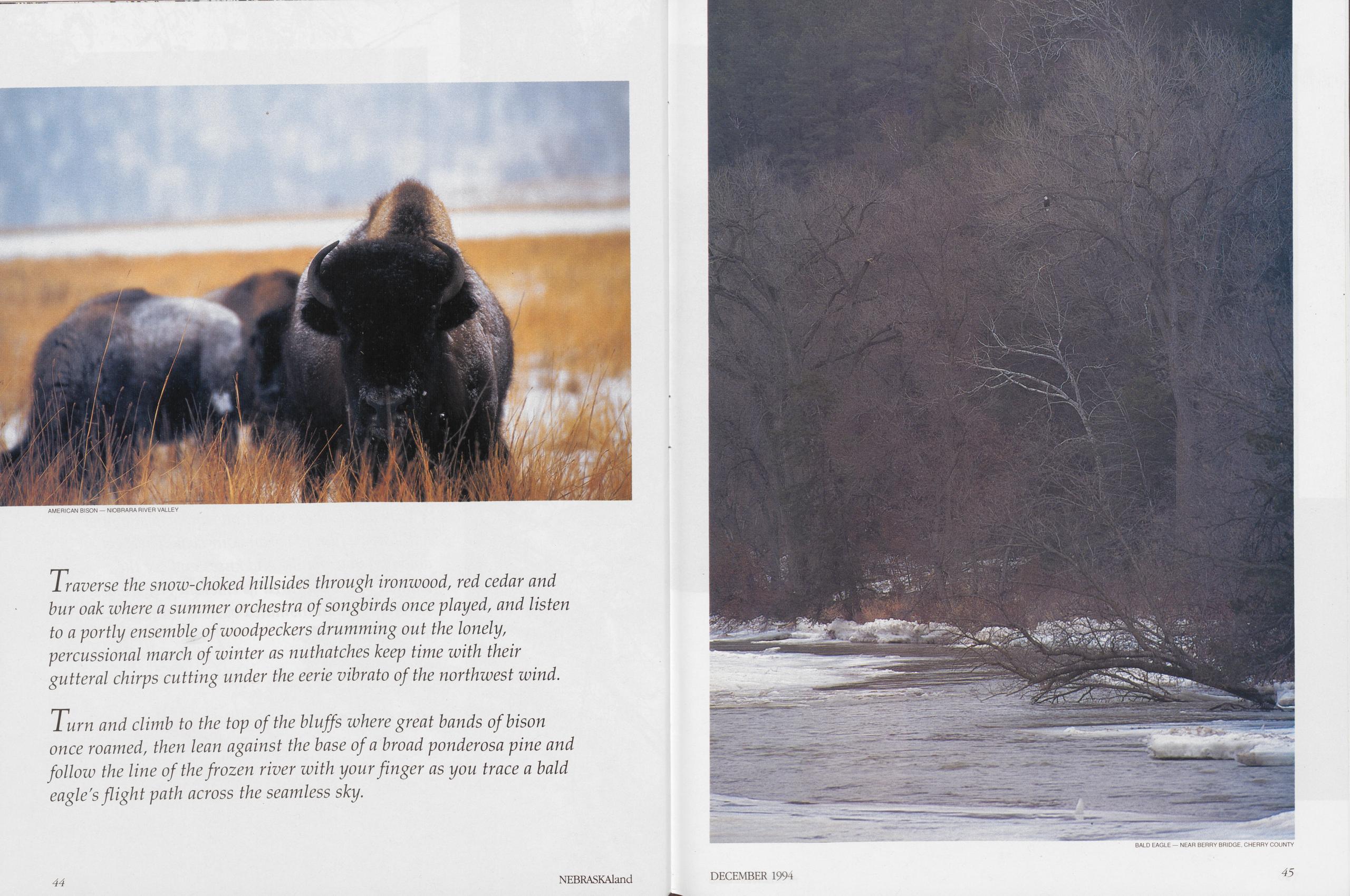
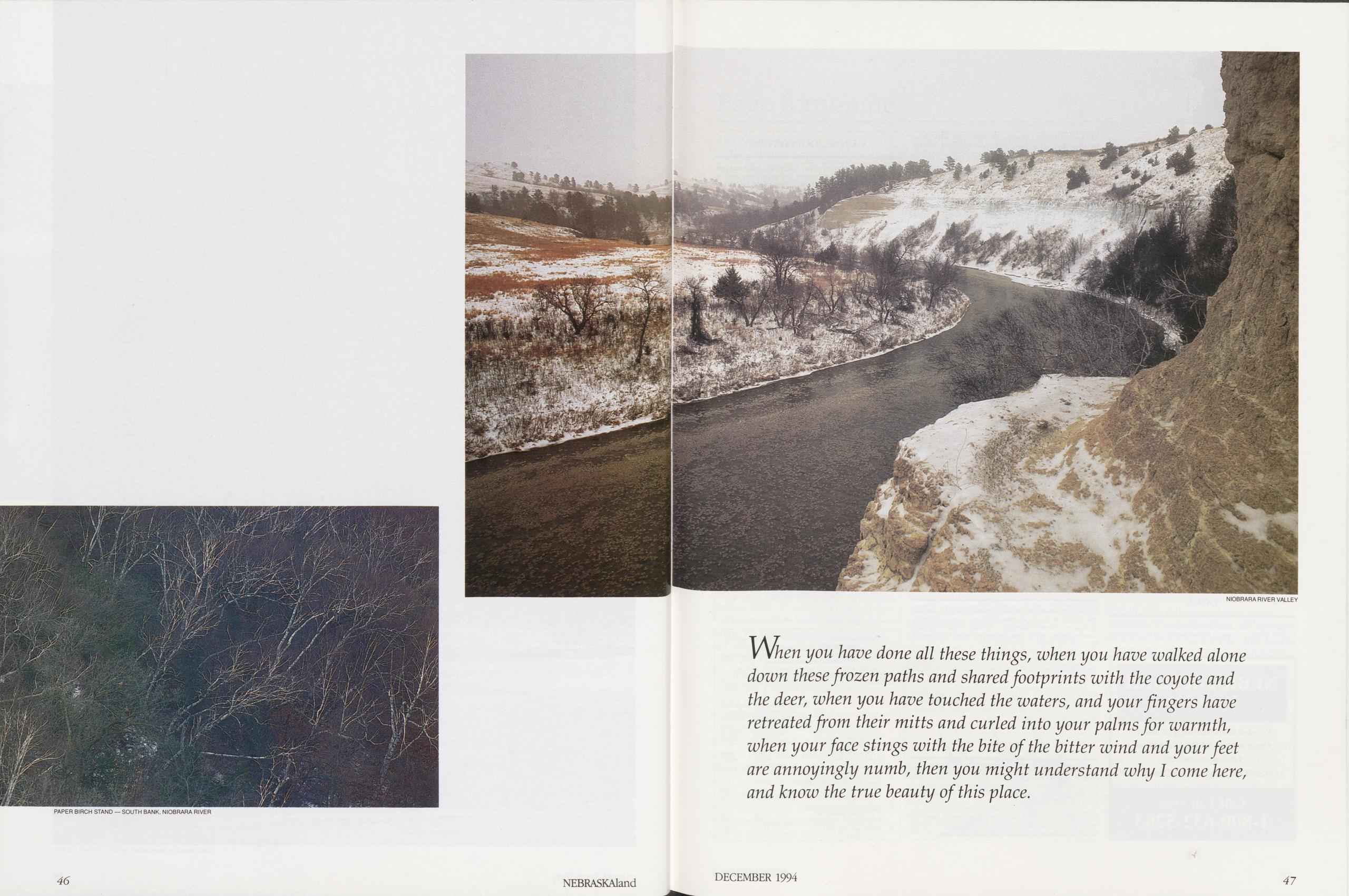
36...Winter on the Niobrara
48...Classified
49 ...Page forty-nine
50. ..1994 NEBRASKAland Index
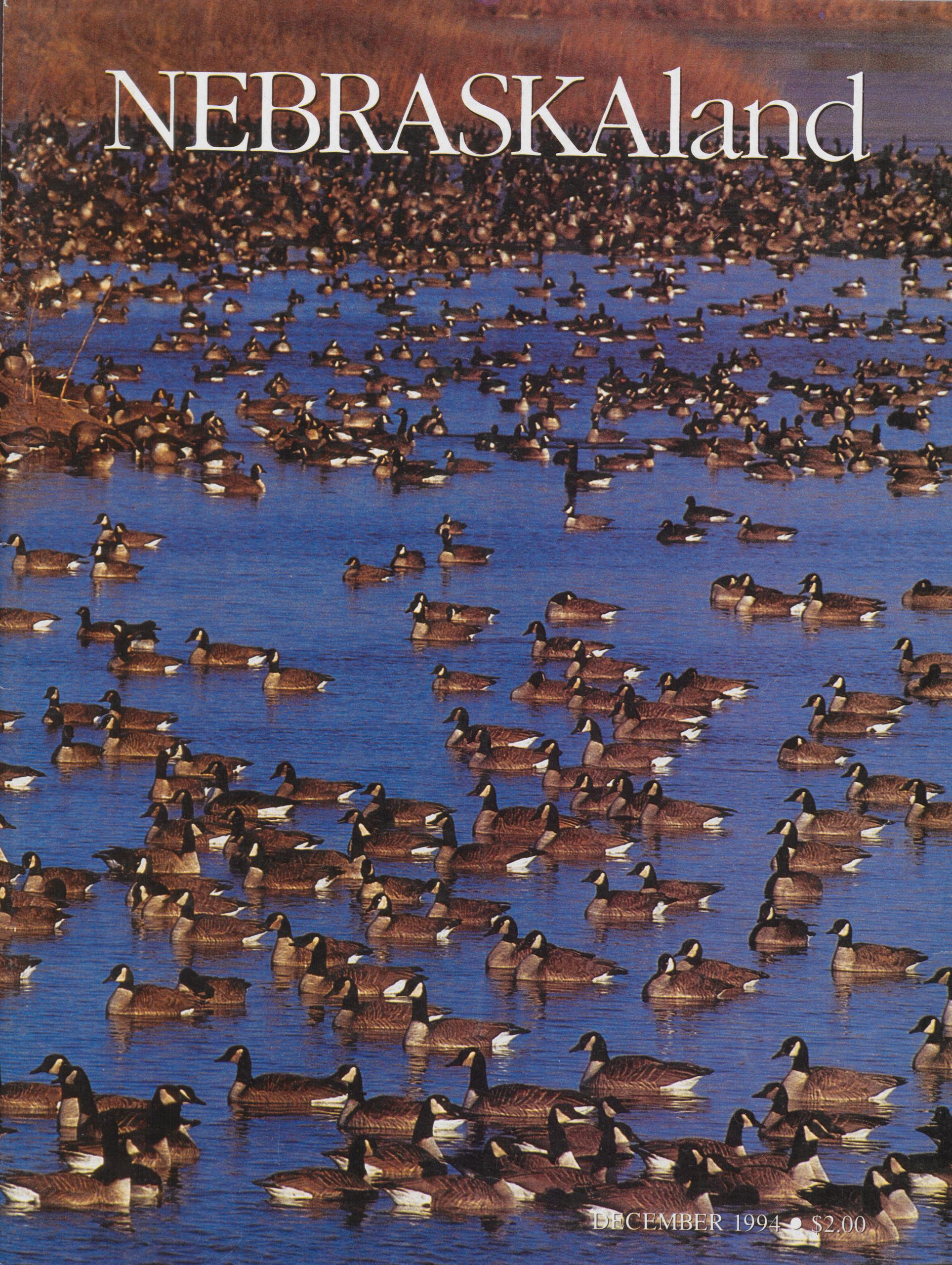
COVER In recent years, Canada goose populations in central Nebraska, like these in a sandpit near Kearney, have increased dramatically. For more on geese and goose hunting, see page 14 and page 26. Photo by Jon Farrar. OPPOSITE: Winter s white canvas seems just the right backdrop for a red barn near Eagle in Lancaster County. Photo by Don Cunningham.
Letters
Identifying an Ancient PotI did not know where to find information on a piece of pottery we have until I found an article in the May 1992 issue of NEBRASKAland [“Artifact Hunting in Nebraska”]. On page 41 is a sketch of some pottery resembling ours. The pieces were found by my brother more than 40 years ago on our father’s farm 3 1/2 miles southwest of Tilden in Antelope County. In 1990, my nephew glued the pieces together to form the pot.
Agnes HouseTilden, Nebraska Rob Bozell, curator of anthropology for Nebraska State Historical Society, says your pot appears to have been made by Middle Woodland people of the Valley Phase who lived throughout eastern and central Nebraska, western Iowa and South Dakota from about A.D. 1 to A.D. 500. Valley Phase people were the first to build permanent villages in the region and were the earliest people in the area to experiment with growing corn. For more information on the Valley Phase and other ancient cultures in the state, see “The Cellars of Time,” NEBRASKAland's 1994 January-February special issue devoted to the archaeology and paleontology of Nebraska. (Editor) Nebraska’s Silent Guns
James Potter’s “Nebraska’s Silent Guns” [October 1994] and the photograph of a seacoast cannon gracing the Gage County courthouse evoke this account: In 1942 (as a Beatrice editor), I wrote a story titled “Ferdinand the Cannon Goes to War” describing the donation of the cannon to the war-materials drive. That cannon was mounted ground-level and was carted off to the local junkyard as a symbolic, if not real, contribution to the World War II program.
I can only conjecture whether the current cannon might be the original. It may have been returned from Joe Goldberg’s junkyard after World War II, or the columbiad may be a replacement acquired later. Possibly it is the original somehow stored in government caverns. Whatever the case, the current cannon was remounted on the concrete pedestal sometime after World War II. Very likely the Beatrice historical establishment or newspaper files will disclose a dedication of the current memento, as pictured.
Allen V. DowlingSoquel, California James Potter replies: Mr. Dowling's recollection is correct that Beatrice provided a cannon to the World War II scrap drive. The cannon that was scrapped, however, was not the Civil War cannon mounted in front of the courthouse. The Civil War columbiad was received in Beatrice in 1898 and mounted on its pedestal in 1904, where it remains to this day. It honors Civil War and Spanish American War veterans. About 1926, the Beatrice American Legion received a large howitzer captured from the German Army during World War I. The howitzer, on its wheeled carriage, was placed in Beatrice s Chautaqua Park. In 1942 there was sentiment in Beatrice to donate both cannons to the scrap drive. “The Beatrice Daily Sun” editorialized to that effect. On September 10, 1942, the 11-ton German howitzer was towed from Chautaqua Park to a vacant lot at 7th and Court streets, where it became the focal point for the scrap pile. It seemed fitting, somehow, that a former German war machine might be transformed into new weapons to be used against Hitler s army. Exactly why the Civil War cannon escaped the scrap pile is not known. Perhaps the notion of leaving a truncated monument in front of the courthouse caused second thoughts, or perhaps someone just decided the daunting task of removing the 4Vl-ton cannon from its lofty perch and hauling it to the the scrap pile was not worth the effort.
Enclosed are pictures of some flathead catfish caught this year on the Missouri River. My regular fishing partner is Susan Wilder of Hamburg, Iowa. Like others I have talked to, I cannot remember flathead fishing like this year’s. During June and early July we caught a lot of one- to three-pound flatheads. Later the small ones tapered off and we caught fish of five pounds plus. Some really big fish — 20 pounds to 40 pounds — also were taken. We fished until mid-October. We use heavy tackle, stiff rods and big hooks.
The baits used were goldfish, carp and bullheads. Lots of smaller fish were caught on nightcrawlers. Susan and I like bullheads for bigger fish. We fish along the rocks early and move to the holes as the water warms.
Les MainsOmaha, Nebraska Write to Letters, NEBRASKAland Magazine, P.O. Box 30370, Lincoln, NE 68503-0370, or fax (402) 471-5528. Photos are also welcome and will be. returned. Letters are subject to condensation or editing for clarity.
We Need Your Help!
A Great Year for Flatheads Check the box on line 33 of your Nebraska State Income Tax form to designate a part of your state tax refund for the Nebraska Non-game and Endangered Wildlife Conservation Fund. Make direct donations to Nebraska Non-game and Endangered Species Fund, Nebraska Game and Parks Commission, P.O. Box 30370, Lincoln, NE 68503 4 NEBRASKAland DECEMBER 1994 5
Notes from the field
Winter ObservationsWatching wildlife in winter is a window on the natural world that hasn’t been smudged by the noseprints of too many academics, naturalists or photographers. Even familiar territories are transformed into frontiers open for exploration and new observation. Winter is more poignant than the gentler seasons; it can be a time of hardship when the key to survival is efficiency, and there is one simple rule: Find enough food to live another day.
Sharptails: One frozen January morning in a remote creek valley in the western Sandhills, I sat huddled in a stand of cottonwoods desperately waiting for sunrise to cast its faint pink light over the snow-covered hills. On most days, sunrise brought assorted waterfowl to that part of the creek to feed, but that morning they did not come. The valley felt empty and I began to think I might be the only living thing present that day. Then across the creek a lone sharptail appeared.
The sharp-tailed grouse stood on the crest of a bluff blown free of snow. Its head flicked back and forth nervously as it scouted the territory, no doubt aware it was vulnerable to any predator that happened to gaze toward it. Too far away to accomplish anything with my camera, I reached for my binoculars as two more grouse appeared over the rise and joined the first. Then two more came. In a few minutes 18 sharptails had gathered shoulder to shoulder across the windblown crest, standing like soldiers ready to charge down the hillside into battle.
I continued to watch concealed under a deadfall as the first bird, the obvious leader of this platoon, called out a series of “tuk tuk tuks” and launched itself into the air. Flying across the creek in a burst of rapid wingbeats and rocking glides, it crashed into the cottonwood directly above me, sending a shower of snow and broken twigs down on my head.
Once upright, its feathered feet firmly grasping a branch, the sharptail gave the “all clear” signal. One by one, like planes off an aircraft carrier, the others launched themselves, and soon the entire flock was in the tree above me feasting on cottonwood buds, an important food in times of heavy snow cover. I no longer felt alone in the valley as they gabbled raucously back and forth like obnoxious relatives at a holiday dinner, moving noisily from one perch to another with the same awkward grace they exhibited in their arrival.
Suddenly the noise stopped. Except for an occasional soft “yur,” there was an eerie silence in the tree. Some of the grouse stood bolt upright, feathers slicked back and crests raised. Others crouched frozen. Then, all at once, they took off back across the creek and over the hill out of my sight. Seconds later a golden eagle, also in pursuit of food, flew low over the cottonwoods, hovered briefly, headed downstream along the creek, turned in a big looping arc and disappeared.
In a few minutes the brave sharptail scout again appeared on the crest of the windswept hill, and again the others joined him. Soon the squadron came crashing into the cottonwoods, sending twigs and snow onto my head. Again they ate, again grew silent and left, and again the eagle came down the valley, paused, then disappeared over the hill. The same scene occurred again and again throughout the day.
Juncos: During a December snowstorm at Bur Oak Wildlife Management Area in southeastern Nebraska I watched a flock of about 30 juncos feeding in a food plot of millet and milo at the edge of a large woodlot.
The flock fed on seedheads until gusts from the north sent them scattering into the shelter of the woods. Once the gusts subsided, they fed again. They played the wind that way until it shifted or they exhausted the food supply.
I thought I had figured out their pattern when they suddenly flew into the the woods during a period of relative calm. Seconds later a hawk, a northern harrier, flew over a hill, hovered for a moment over the feeding ground, then continued around the bend. As soon as the hawk was gone, the juncos flew back out to feed. For the next hour, the hawk appeared at 20-minute intervals flying the same route, and each time the juncos would disappear into the woods long before the hawk came in sight.
Tree Sparrows: At Indian Cave State Park, on the edge of a sliver of snow-covered bluff-top prairie, a dozen tree sparrows huddled against the cold in the lower boughs of a small cedar. I was tired, and tree sparrows are fairly common, so I didn’t pay much attention until I noticed one of them fly out of the tree and land on the seedhead of a little bluestem plant only a few feet away. I laughed as the flimsy stem drooped under the bird’s weight, expecting the bird to realize its error in judgement and fly off. Instead the sparrow rode the drooping plant like an elevator down to the ground.
Holding the stem to the ground, the sparrow began to eat the seeds, joined by others from the tree. Once the seed- head was picked clean, the bird hopped away, letting the bluestem spring back up. The sparrows retreated to the cedar tree waiting while one flew to another bluestem and rode it to the ground. While I watched they picked clean a small patch of little bluestem heads.
The grouse, juncos and sparrows met the winter challenges with team- work, ingenuity and common sense. Our own species could become a little wiser by watching these birds.
18th ANNUAL NEBRASKA HABITAT STAMP ART CONTEST
SubmissionEntries may be protected by a covering but will not be accepted in frames, under glass or in plastic food wrap. Send to: Habitat Stamp Contest, Nebraska Game and Parks Commission, 2200 N. 33rd St., P.O. Box 30370, Lincoln, NE 68503. A completed entry form and reproduction agreement or facsimile must accompany the entry. The Game and Parks Commission is not responsible for any entry lost or damaged in transit. Entries will not be returned unless specifically requested and a self-addressed mailer with proper postage is included.
PrizesAdult division first place winner receives $200 from the Omaha Fish and Wildlife Club. Runners-up all receive subscriptions to NEBRASKAland Magazine. Youth division first place winners in each section receive $50 from the Omaha Fish and Wildlife Club. Runners-up all receive subscriptions to NEBRASKAland Magazine. Selected entries will be included in a traveling exhibit.
DivisionsAdult: Amateur or professional artists. Youth: Senior Section - Grades 9-12; Junior Section - Grades 5-8; Primary Section - Grades K-4.
Technical requirements:Design must be IVz inches by 41 V\e inches. It may be matted but mat may not exceed 10 inches by 7 inches. Any medium, color preferred. No scrollwork or lettering may appear on the design. One entry per person.
Subject matterAny Nebraska wildlife species in an appropriate habitat setting, except Canada goose, raccoon, fox squirrel, gray (Hungarian) partridge and pronghorn antelope.
Entry deadlineMarch 1, 1995 Contest is open to Nebraska residents only. Winning entry in the Adult Division will appear on the 1996 Nebraska Habitat Stamp.
ENTRY FORM ]Please accept my entry in the design contest for the 1996 Nebraska Habitat Stamp. I hereby certify that I have \ complied with all of the rules governing this competition and that the work submitted is my own original creation. > Further, the Nebraska Game and Parks Commission is hereby authorized to reproduce the design on the 1996 Habitat Stamp or in any other fashion it may deem appropriate.
J Division/Section Grade in School Title of Entry Medium Name Age (if under 19) Name of Parent of Guardian Address City, State, Zip Home Phone School Phone Name of School School Address City, State, Zip m Please return my entry. I have included the appropriate postage. Signature of Artist 6 NEBRASKAland DECEMBER 1994 7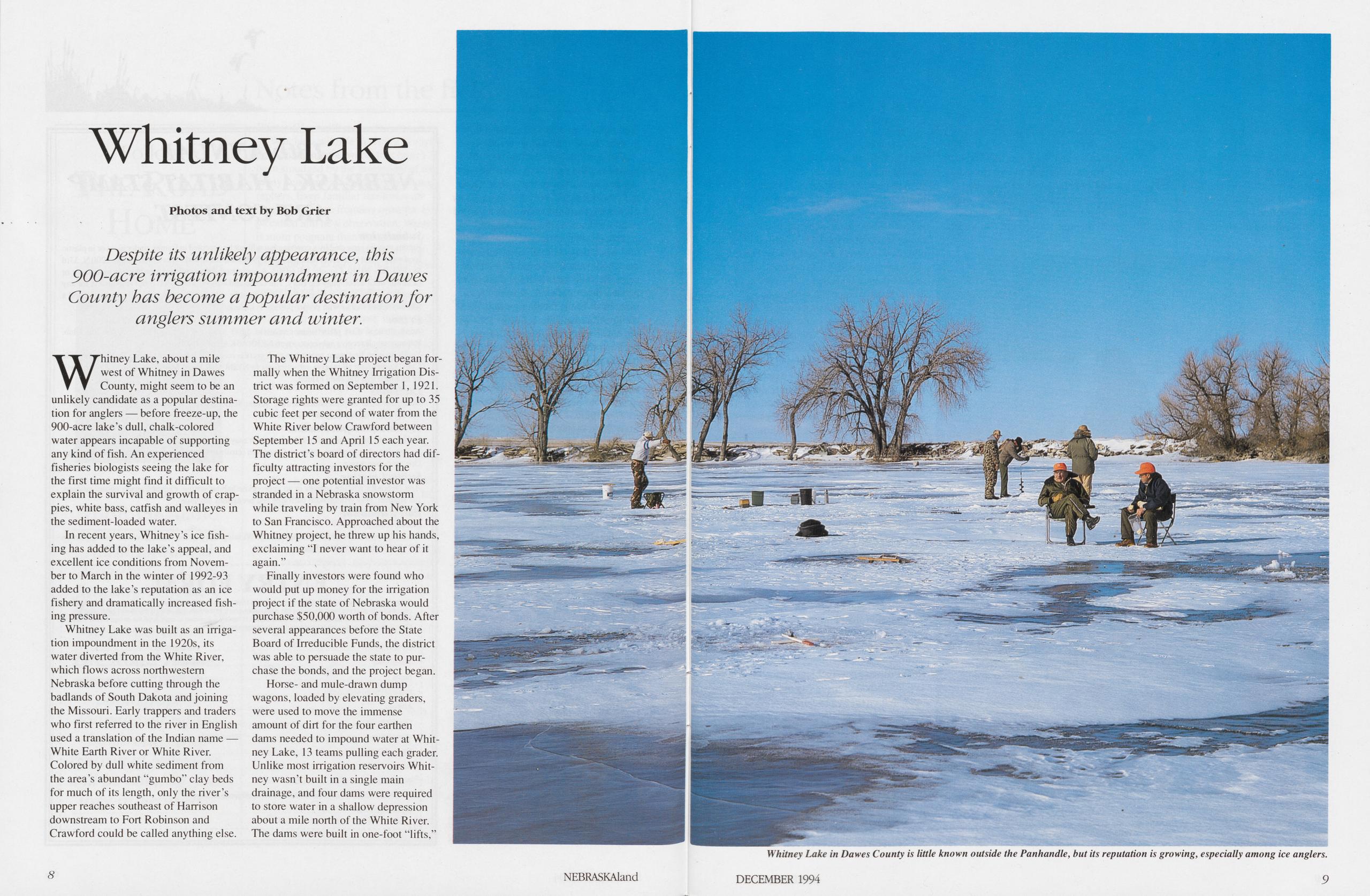
Whitney Lake
Despite its unlikely appearance, this 900-acre irrigation impoundment in Dawes Cou nty has become a popular destination for anglers summer and winter.Whitney Lake, about a mile west of Whitney in Dawes County, might seem to be an unlikely candidate as a popular destination for anglers — before freeze-up, the 900-acre lake’s dull, chalk-colored water appears incapable of supporting any kind of fish. An experienced fisheries biologists seeing the lake for the first time might find it difficult to explain the survival and growth of crappies, white bass, catfish and walleyes in the sediment-loaded water.
In recent years, Whitney’s ice fishing has added to the lake’s appeal, and excellent ice conditions from November to March in the winter of 1992-93 added to the lake’s reputation as an ice fishery and dramatically increased fishing pressure.
Whitney Lake was built as an irrigation impoundment in the 1920s, its water diverted from the White River, which flows across northwestern Nebraska before cutting through the badlands of South Dakota and joining the Missouri. Early trappers and traders who first referred to the river in English used a translation of the Indian name — White Earth River or White River. Colored by dull white sediment from the area’s abundant “gumbo” clay beds for much of its length, only the river’s upper reaches southeast of Harrison downstream to Fort Robinson and Crawford could be called anything else.
The Whitney Lake project began formally when the Whitney Irrigation District was formed on September 1, 1921. Storage rights were granted for up to 35 cubic feet per second of water from the White River below Crawford between September 15 and April 15 each year. The district’s board of directors had difficulty attracting investors for the project — one potential investor was stranded in a Nebraska snowstorm while traveling by train from New York to San Francisco. Approached about the Whitney project, he threw up his hands, exclaiming "I never want to hear of it again.”
Finally investors were found who would put up money for the irrigation project if the state of Nebraska would purchase $50,000 worth of bonds. After several appearances before the State Board of Irreducible Funds, the district was able to persuade the state to purchase the bonds, and the project began.
Horse- and mule-drawn dump wagons, loaded by elevating graders, were used to move the immense amount of dirt for the four earthen dams needed to impound water at Whitney Lake, 13 teams pulling each grader. Unlike most irrigation reservoirs Whitney wasn’t built in a single main drainage, and four dams were required to store water in a shallow depression about a mile north of the White River. The dams were built in one-foot “lifts,”
or layers, each lift watered and rolled with a 15-ton roller before the next layer of dirt was added.
The irrigation project was designed to irrigate about 3,500 acres of cropland. The first water deliveries from the reservoir began in June 1924, although it took nearly four more years of construction before the entire project, with all its pipelines, canals and laterals, was completed.
The lake was nearly destroyed in 1942 when 12 inches of rain fell in seven days. Despite repeated warnings, the lake’s water level was allowed to rise dangerously high even before the storms and high northwest winds pushed waves up to six feet high onto and over the south dam. Flooding on nearby streams washed out roads and bridges, making it almost impossible for workers to fight the severe erosion. A plan to use explosives to breach the north dam and quickly lower the lake’s water level was considered but never carried out.
A request for emergency aid was made to the U.S. Army at nearby Fort Robinson, and a fleet of eight trucks loaded with soldiers, equipment and mules was sent to the lake, followed by additional soldiers and equipment. Four shifts of workers filled and placed several thousand sandbags and hundreds of cut trees on the eroding dam.
Gratitude for the Army’s role in saving Whitney Lake came in the form of a letter to Col. Paul Kendall, commanding officer at Fort Robinson, from the irrigation district’s chairman following the emergency. The letter expresses gratitude for the prompt response and initiative and for the efficiency and cooperation of the officers and men. “Our local folks decided at that time that if all of our officers and men in the Armed Forces were as willing and efficient as these had proven to be, that the outcome of the present world war couldn’t remain in doubt,” the chairman wrote.
The first recorded fish stocking in Whitney Lake occurred in 1928 when 900 crappies, 1,000 striped perch, 2,500 bullheads, 1,000 bullfrogs, 1,100 sunfish, 400 channel catfish and 3,600 black bass were stocked from federal sources. Nebraska Game and Parks Commission stockings began in 1935 when 12,000 bullheads and 7,200 black bass were introduced. Walleyes and white bass were first stocked in 1952, and northern pike stockings began in 1962. Survival of the northerns was poor, and no more northern pike were stocked after 1969.
Throughout the 1980s, the Game and Parks Commission continued to stock channel catfish and walleyes. Gizzard shad were stocked in 1988 to provide additional prey for the lake’s white bass and black crappies, and 34,000 saugeye fingerlings — a hybrid cross of walleye and sauger — were were stocked in the lake in 1989.
Biologists believe the hybrid strain is more suited to conditions in Whitney Lake than either sauger or walleye. Pure-strain sauger tolerate turbid water conditions better than walleyes, but walleyes grow bigger and faster. The hybrid fish should thrive in Whitney’s turbid water, yet grow bigger and at a faster rate than pure-strain sauger. Annual sampling will evaluate the saugeye population. Yellow perch were stocked 1988 and 1989.
Today, Whitney Lake offers good fishing for black crappies, white bass, channel catfish and walleyes. Productivity probably begins with the shallow lake’s smartweed beds. Periphyton — algae, protozoans, microcrustaceans and other organisms — and associated tiny animals form a slimy coating on the plants’ stems and leaves, providing prey for small fish that are eaten by larger predators.
While growth rates for walleye and the lake’s other species usually are slower than in clear-water reservoirs in the Panhandle, including Lake Minatare near Scottsbluff, Whitney ranked third in the state for trophy walleyes in 1993. Minatare’s walleyes reach 15 inches in two and a half years, while Whitney’s require an additional year to reach that size.
Whitney’s walleye population includes older, larger fish than those in Lake Minatare and many other walleye lakes. In 1993, Whitney produced 25 Master Angler walleyes, compared to 40 from Sherman Reservoir and 30 from Merritt Reservoir. All but one were taken through the ice.
Sampling also reveals that the average size of the lake’s black crappies and white bass has increased substantially since the introduction of gizzard shad in 1988. Before then, 65 percent of the black crappies were six to seven inches long. By 1992, 65 percent were longer than nine inches and weighed nearly half a pound.
Although Whitney Lake has fewer white bass, the average size has increased. Sampling in 1994 indicated a good population longer than 12 inches and weighing about 12 ounces. The 1994 sample also produced evidence of good natural reproduction in both gizzard shad and white bass.
Whitney Lake’s small but growing reputation among anglers, especially for its walleye ice fishing but also for fine spring and summer crappie, white bass and catfish fishing, has attracted increasing numbers of anglers to the lake.
Ice fishing, primarily for crappies and walleyes, is enhanced by water clarity that shows a dramatic improvement after freeze-up. Stirring action by ' carp also decreases during cold-water periods. Biologists speculate that improved
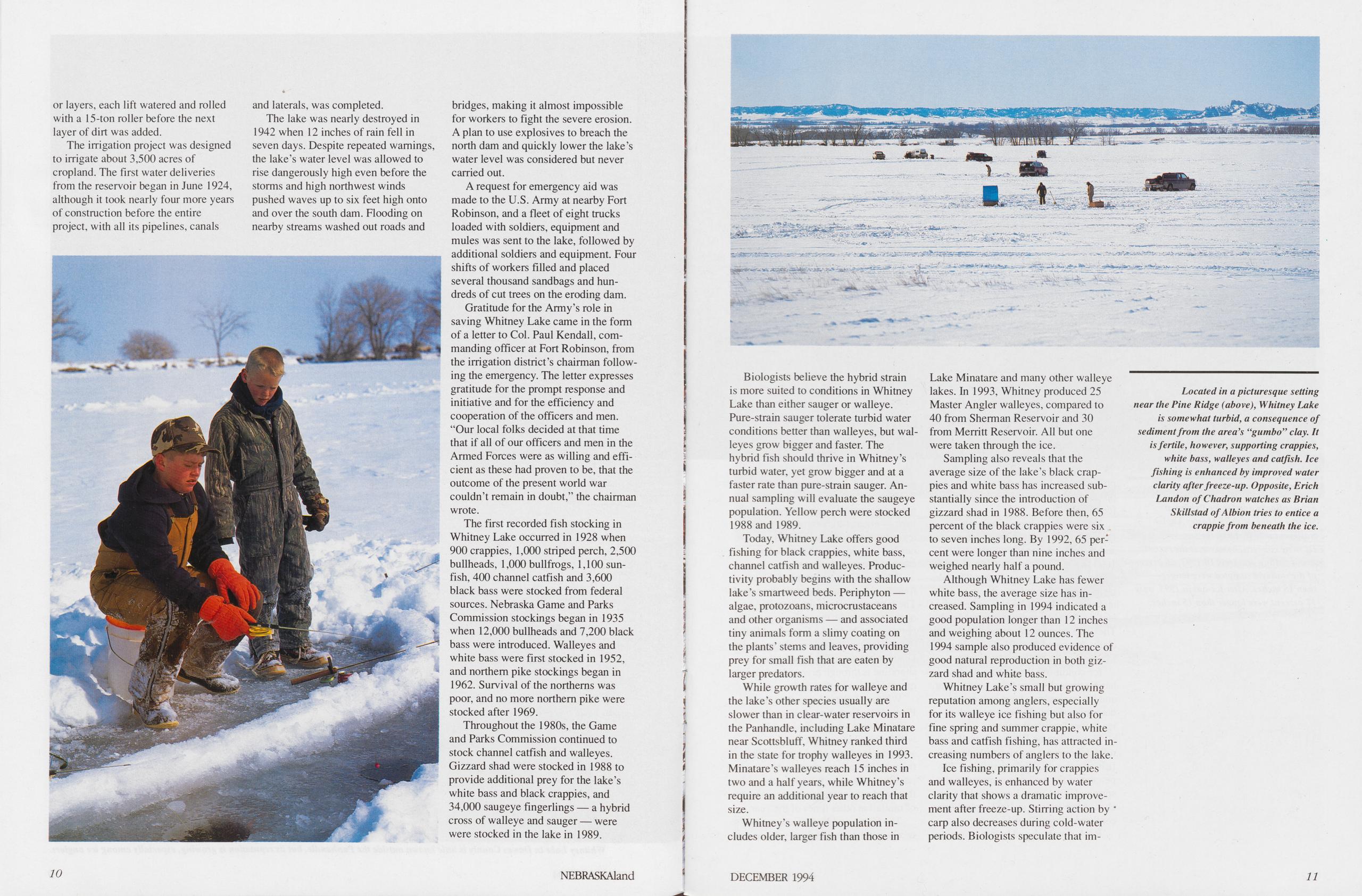
Located in a picturesque setting near the Pine Ridge (above), Whitney Lake is somewhat turbid, a consequence of sediment from the area's “gumbo” clay. It is fertile, however, supporting crappies, white bass, walleyes and catfish. Ice fishing is enhanced by improved water clarity after freeze-up. Opposite, Erich Landon of Chadron watches as Brian Skillstad of Albion tries to entice a crappie from beneath the ice.
proved water clarity after ice-up provides better conditions for sight- feeding predators.
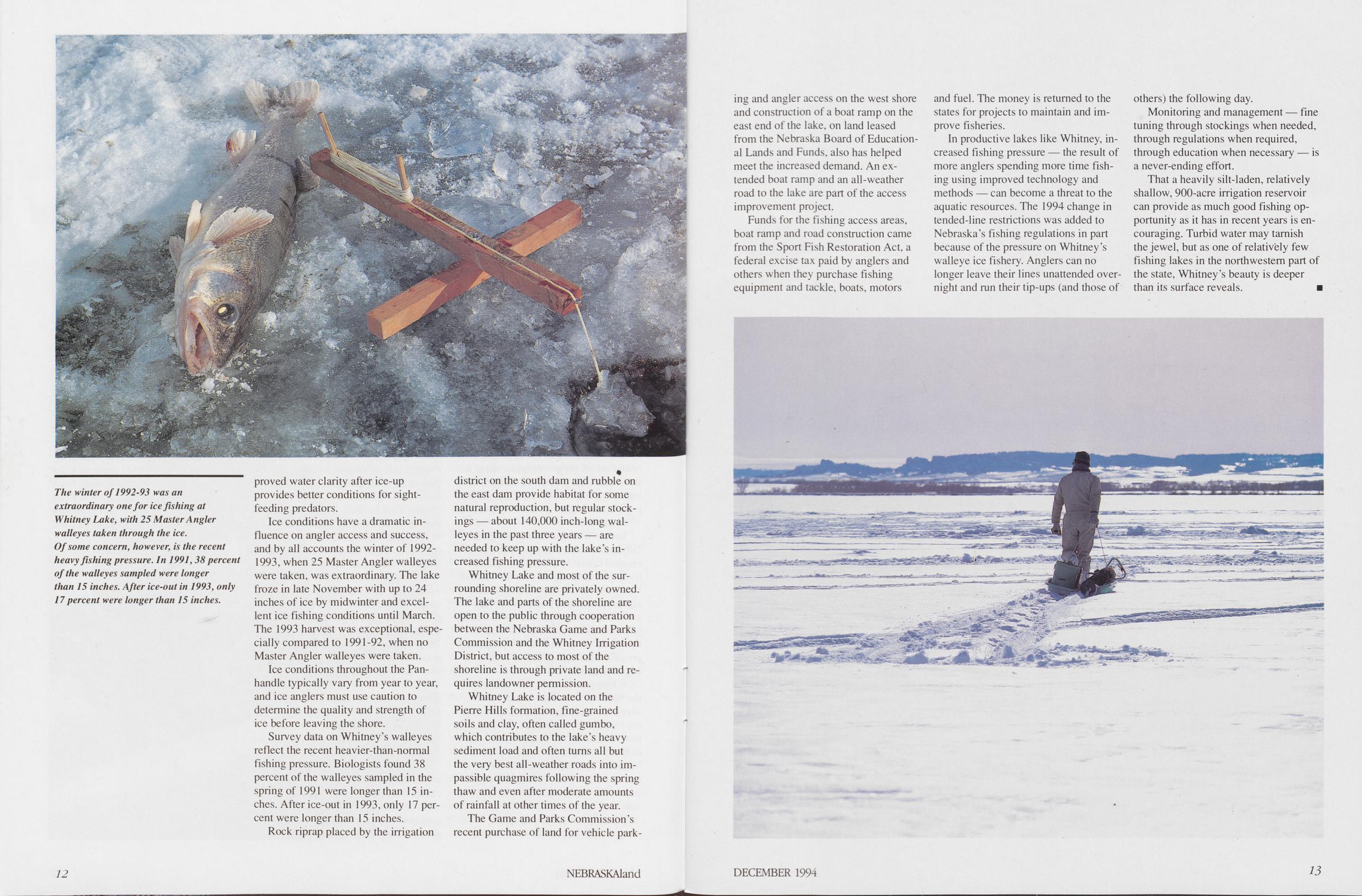
Ice conditions have a dramatic influence on angler access and success, and by all accounts the winter of 1992- 1993, when 25 Master Angler walleyes were taken, was extraordinary. The lake froze in late November with up to 24 inches of ice by midwinter and excel- lent ice fishing conditions until March. The 1993 harvest was exceptional, especially compared to 1991-92, when no Master Angler walleyes were taken. Ice conditions throughout the Panhandle typically vary from year to year, and ice anglers must use caution to determine the quality and strength of ice before leaving the shore.
Survey data on Whitney’s walleyes reflect the recent heavier-than-normal fishing pressure. Biologists found 38 percent of the walleyes sampled in the spring of 1991 were longer than 15 inches. After ice-out in 1993, only 17 percent were longer than 15 inches.
Rock riprap placed by the irrigation district on the south dam and rubble on the east dam provide habitat for some natural reproduction, but regular stockings — about 140,000 inch-long walleyes in the past three years — are needed to keep up with the lake’s increased fishing pressure.
Whitney Lake and most of the surrounding shoreline are privately owned. The lake and parts of the shoreline are open to the public through cooperation between the Nebraska Game and Parks Commission and the Whitney Irrigation District, but access to most of the shoreline is through private land and requires landowner permission.
Whitney Lake is located on the Pierre Hills formation, fine-grained soils and clay, often called gumbo, which contributes to the lake’s heavy sediment load and often turns all but the very best all-weather roads into impassible quagmires following the spring thaw and even after moderate amounts of rainfall at other times of the year. The Game and Parks Commission’s recent purchase of land for vehicle parking and angler access on the west shore and construction of a boat ramp on the east end of the lake, on land leased from the Nebraska Board of Educational Lands and Funds, also has helped meet the increased demand. An extended boat ramp and an all-weather road to the lake are part of the access improvement project.
Funds for the fishing access areas, boat ramp and road construction came from the Sport Fish Restoration Act, a federal excise tax paid by anglers and others when they purchase fishing equipment and tackle, boats, motors and fuel. The money is returned to the states for projects to maintain and improve fisheries.
In productive lakes like Whitney, increased fishing pressure — the result of more anglers spending more time fishing using improved technology and methods — can become a threat to the aquatic resources. The 1994 change in tended-line restrictions was added to Nebraska’s fishing regulations in part because of the pressure on Whitney’s walleye ice fishery. Anglers can no longer leave their lines unattended over-night and run their tip-ups (and those of others) the following day.
Monitoring and management — fine tuning through stockings when needed, through regulations when required, through education when necessary — is a never-ending effort.
That a heavily silt-laden, relatively shallow, 900-acre irrigation reservoir can provide as much good fishing opportunity as it has in recent years is encouraging. Turbid water may tarnish the jewel, but as one of relatively few fishing lakes in the northwestern part of the state, Whitney’s beauty is deeper than its surface reveals.
12 NEBRASKAland DECEMBER 1994 13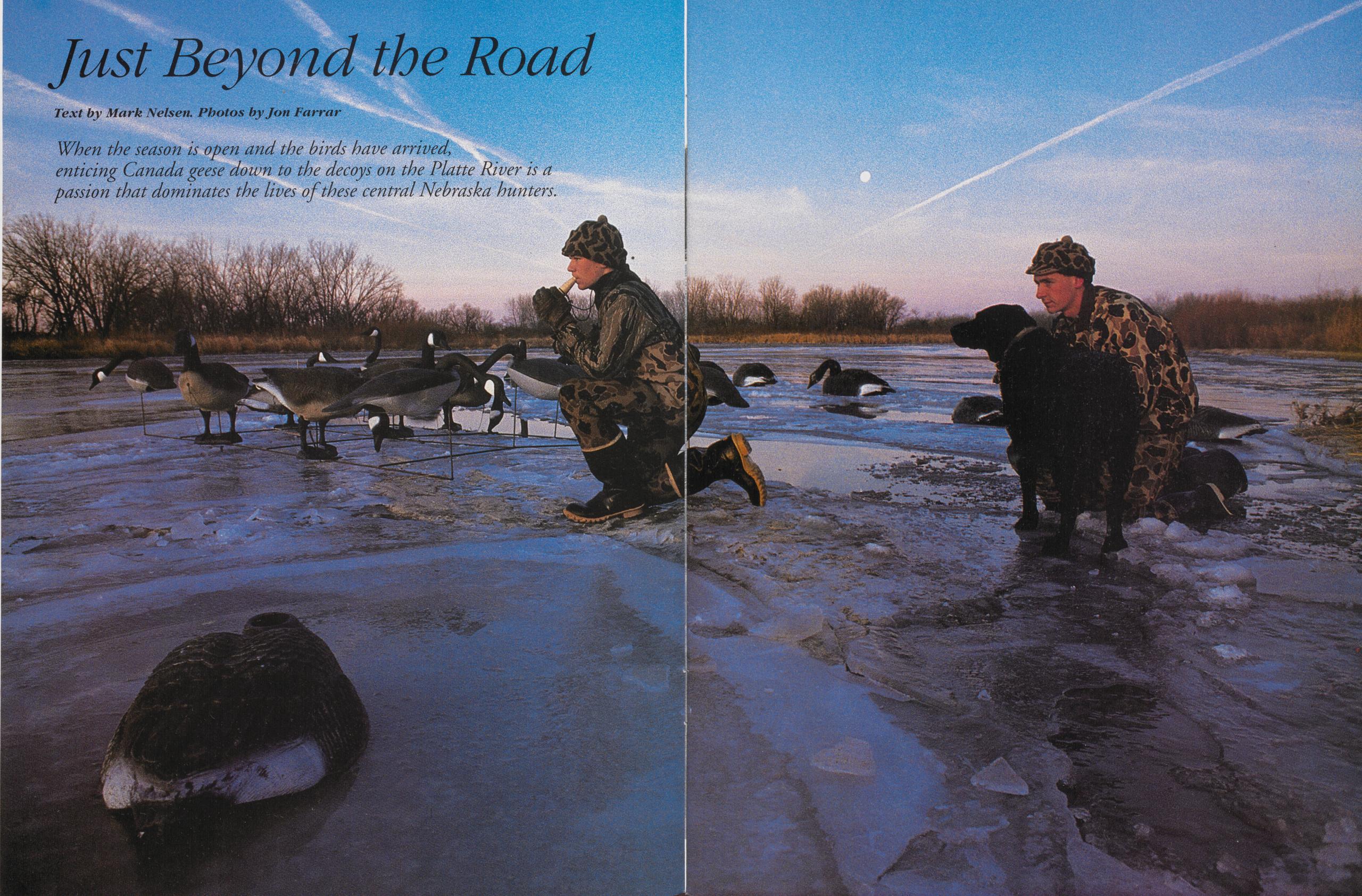
Just Beyond the Road
When the season is open and the birds have arrived, enticing Canada geese down to the decoys on the Platte River is a passion that dominates the lives of these central Nebraska hunters.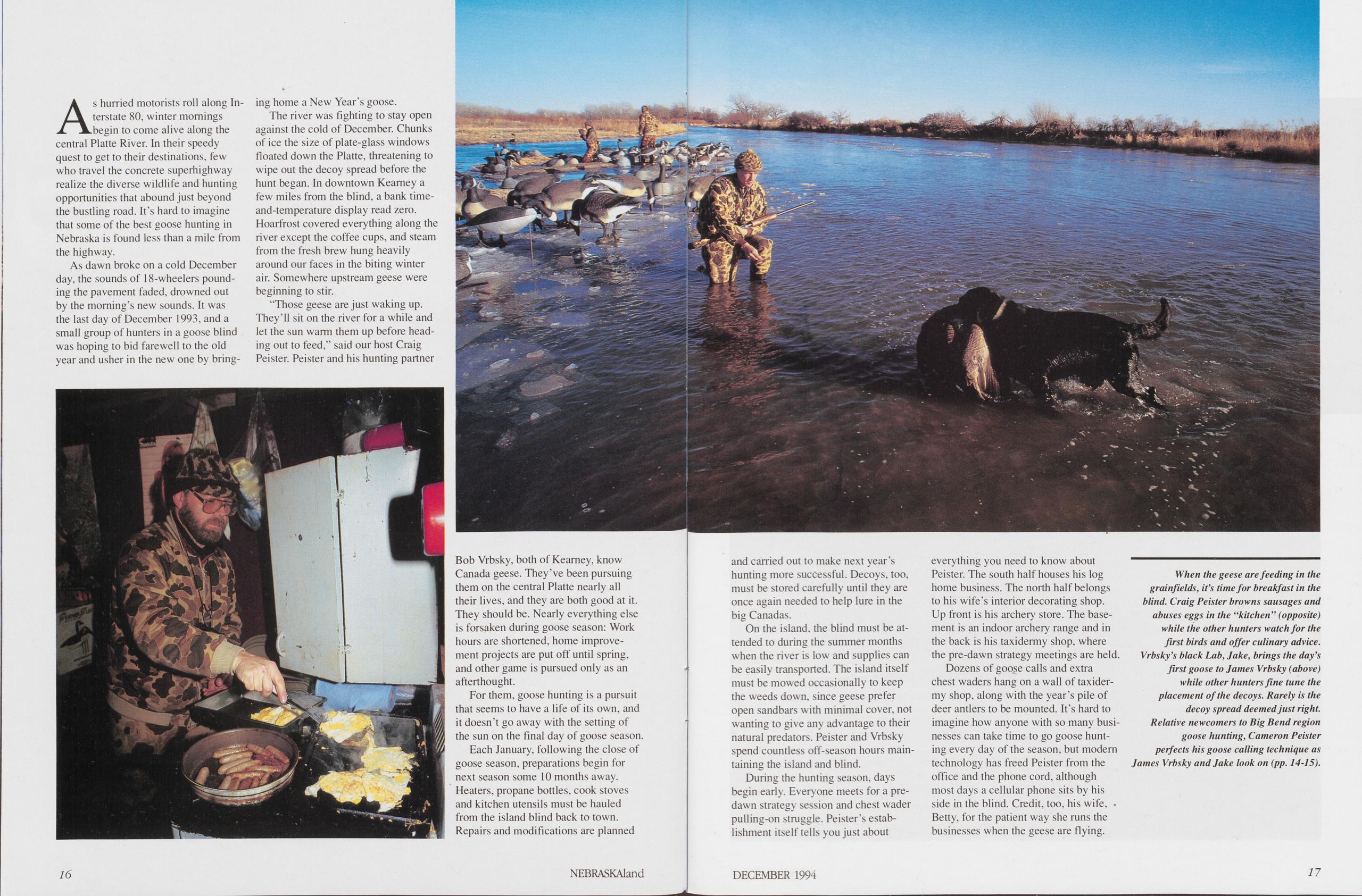
As hurried motorists roll along Interstate 80, winter mornings begin to come alive along the central Platte River. In their speedy quest to get to their destinations, few who travel the concrete superhighway realize the diverse wildlife and hunting opportunities that abound just beyond the bustling road. It’s hard to imagine that some of the best goose hunting in Nebraska is found less than a mile from the highway.
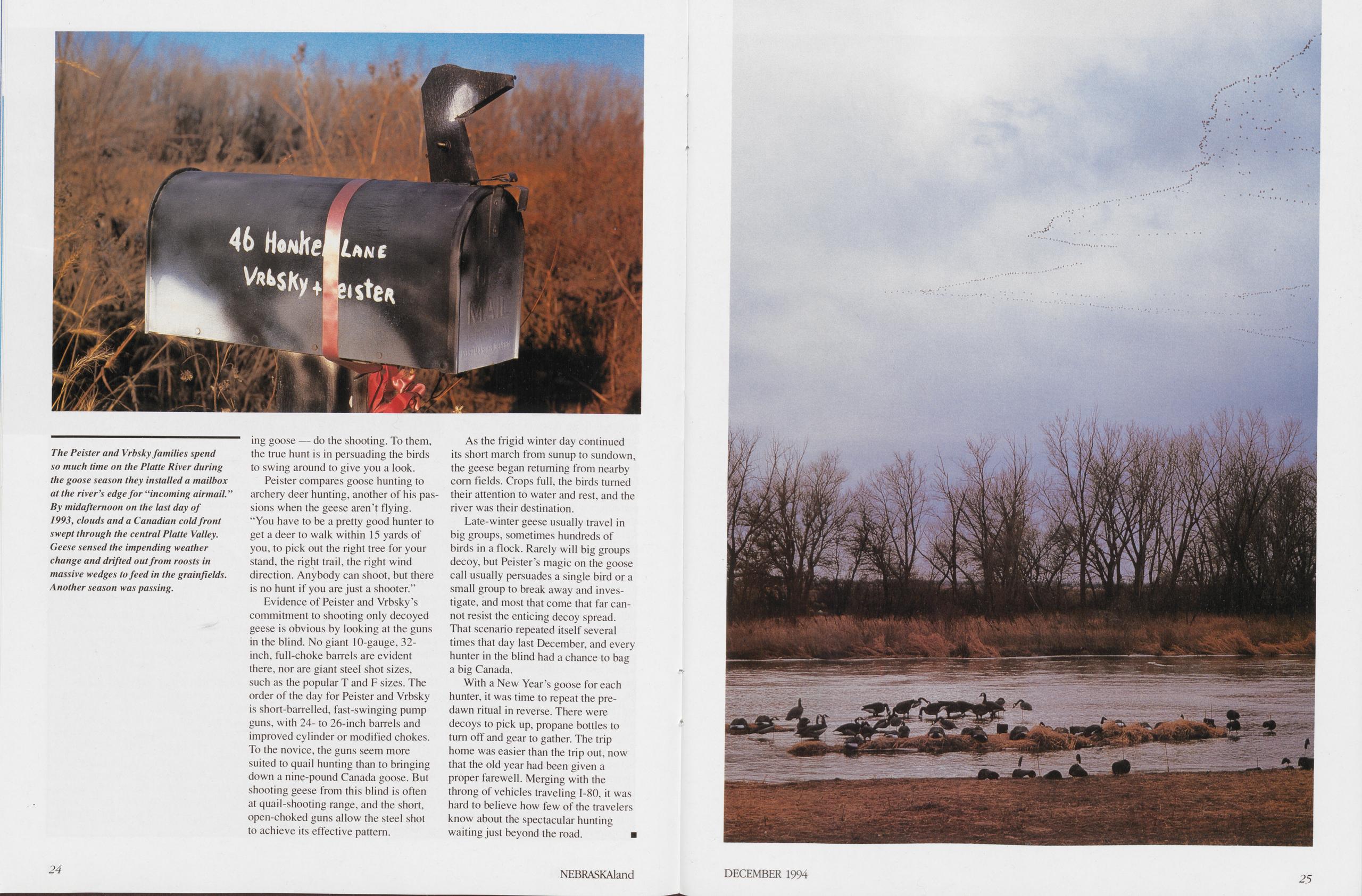
As dawn broke on a cold December day, the sounds of 18-wheelers pounding the pavement faded, drowned out by the morning’s new sounds. It was the last day of December 1993, and a small group of hunters in a goose blind was hoping to bid farewell to the old year and usher in the new one by bringing home a New Year’s goose.
The river was fighting to stay open against the cold of December. Chunks of ice the size of plate-glass windows floated down the Platte, threatening to wipe out the decoy spread before the hunt began. In downtown Kearney a few miles from the blind, a bank time- and-temperature display read zero. Hoarfrost covered everything along the river except the coffee cups, and steam from the fresh brew hung heavily around our faces in the biting winter air. Somewhere upstream geese were beginning to stir.
"Those geese are just waking up. They'll sit on the river for a while and let the sun warm them up before head- ing out to feed,” said our host Craig Peister. Peister and his hunting partner Bob Vrbsky, both of Kearney, know Canada geese. They’ve been pursuing them on the central Platte nearly all their lives, and they are both good at it. They should be. Nearly everything else is forsaken during goose season: Work hours are shortened, home improvement projects are put off until spring, and other game is pursued only as an afterthought.
For them, goose hunting is a pursuit that seems to have a life of its own, and it doesn’t go away with the setting of the sun on the final day of goose season. Each January, following the close of goose season, preparations begin for next season some 10 months away. Heaters, propane bottles, cook stoves and kitchen utensils must be hauled from the island blind back to town. Repairs and modifications are planned and carried out to make next year’s hunting more successful. Decoys, too, must be stored carefully until they are once again needed to help lure in the big Canadas.
On the island, the blind must be attended to during the summer months when the river is low and supplies can be easily transported. The island itself must be mowed occasionally to keep the weeds down, since geese prefer open sandbars with minimal cover, not wanting to give any advantage to their natural predators. Peister and Vrbsky spend countless off-season hours maintaining the island and blind.
During the hunting season, days begin early. Everyone meets for a pre-dawn strategy session and chest wader pulling-on struggle. Peister’s establishment itself tells you just about everything you need to know about Peister. The south half houses his log home business. The north half belongs to his wife’s interior decorating shop. Up front is his archery store. The basement is an indoor archery range and in the back is his taxidermy shop, where the pre-dawn strategy meetings are held.
Dozens of goose calls and extra chest waders hang on a wall of taxidermy shop, along with the year’s pile of deer antlers to be mounted. It’s hard to imagine how anyone with so many businesses can take time to go goose hunting every day of the season, but modern technology has freed Peister from the office and the phone cord, although most days a cellular phone sits by his side in the blind. Credit, too, his wife, Betty, for the patient way she runs the businesses when the geese are flying.
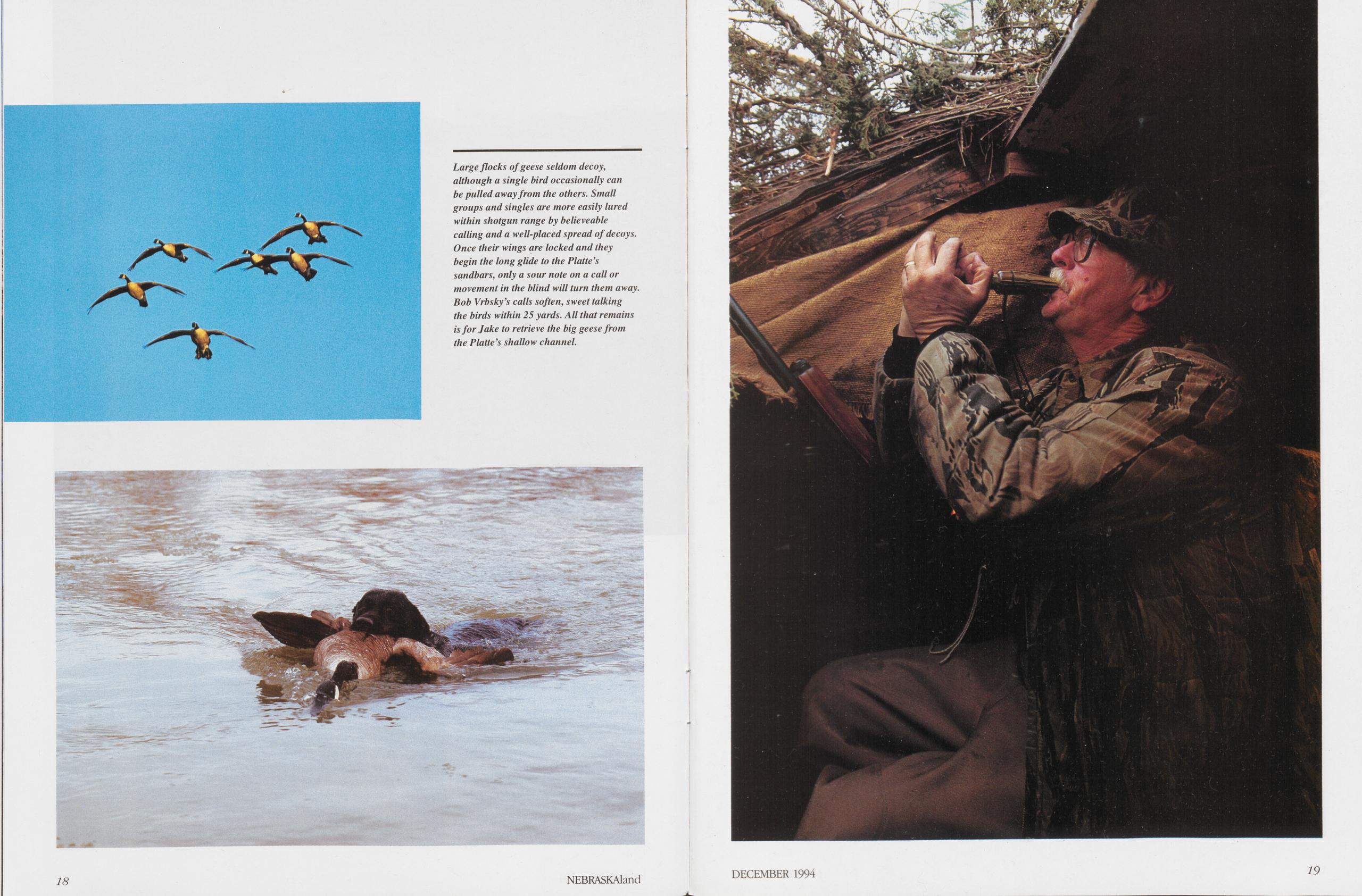
Bob Vrbsky’s life seems less complicated, but he is no less a goose-hunting fanatic. When he’s not in the blind, Vrbsky spends his time as a butcher, a profession that serves him well in hunting camp, but can cause him some ribbing in the goose blind. Most days Vrbsky goes to work early in order to get off early and catch the late afternoon hunt. A dedicated goose hunter, Vrbsky often arrives at the goose blind in chest waders and work clothes — complete with a dress shirt and a tie.
Perhaps it’s the way geese fly in that almost perfect V formation, perhaps it’s the stark appearance of the black and white birds setting their wings over decoys or perhaps it’s the vocalizations of the geese — whatever it is, goose hunting is like a fever to Peister and Vrbsky, and it is catching.
Leaving Peister’s shop in the inky- black December chill, anticipation was high. The geese were along the river there in large numbers, as they have been most winters for the past seven or eight years. Goose hunting along the Platte River in central Nebraska was good at the turn of the century, but declined for many years. Vrbsky’s family has been hunting this stretch of the river since the late 1950s, and they have seen the changes in central Platte hunting. “We had good duck hunting back then, but you never saw a goose,” Vrbsky said. Until recent times, he had shot only one Canada goose on the river — in 1961.
What is commonplace today was for many years a novelty. When he was younger, Peister recalled, it was big news to shoot a goose in central Nebraska. “It was the talk of the town. If you saw a flock of Canadas you told everyone about it. If you shot a goose you’d get your picture in the paper.”
Now the situation is different, and goose hunting has returned to the central Platte. Goose populations are high, and as the geese have begun to return, public agencies and private individuals have worked to improve habitat conditions and help bring dark geese back to huntable numbers.
As we turned off the gravel onto the field road leading to the blind, the full moon cast a warm glow over the stark December scene. Deer scurried from the harvested com field to the sanctuary of timber along the river. A few high clouds dotted the pre-dawn sky, marking the arrival of a clear, cold day.
The blind sat invitingly on an island in one of the river’s larger channels. Staring at the structure in the full moon, it was difficult to believe that the little wooden building was once a farmyard chicken coop. How many cold mornings at this hour did someone venture out to gather the day’s eggs?
Chickens and nests long removed, the coop makes an ideal blind. A section of the pitched roof was removed to accommodate hunters, and six or seven can fit comfortably on the bench seats. Moving the blind to the island required a crawler tractor. A new addition, holding the decoys and serving as the kitchen, gives it an L shape. A full-size stove occupies a corner of the kitchen, and propane stoves and heaters strategically placed near the benches provide warmth and extra cooking options.
Comfort is a key when you spend a day from before sunrise to sunset in a hunting blind, and this blind is comfortable. Even the two black Labrador retrievers, constant companions during goose season, have their own heater in the lower level of the blind.
The blind, sunk several inches into the sand, is covered with cedar trees and hardwood branches. Discarded Christmas trees provide camouflage for the hunters and winter cover for the songbirds, mice and occasional pheasants and quail that venture onto the island. The island itself is about 200 yards long and 45 yards wide. Apart from the remnants of an old hunting blind on the west end, it is relatively free of tall or heavy vegetation, a key in attracting geese.
Lanterns and heaters lit, the precise art of decoy placement began as a full moon gave way to the rising sun. Peister and Vrbsky consider wind direction most important in decoy placement. Geese land into the wind, and wind direction determines where the decoys are set. On a day with a south wind — into the hunters’ faces — the decoys have to be closer to the blind or the geese most likely will land out of shotgun range. Peister and Vrbsky also pay attention to the temperature. The colder it gets, the tighter the geese bunch up, and the decoy spread must take that behavior into account.
It takes time to set a spread of 200 decoys, and the sun had climbed well above the horizon before the last of them were in place. Full-bodied goose shells, floating decoys and shells on stakes in the flowing water combined to give overhead geese the impression that this island was the place to land. A new system for the season, Peister and Vrbsky had welded re-bar grids with vertical stakes that would hold about 10 decoys per grid. A simple way for two hunters to carry and set a decoy spread in the river or on the island, the grid system saves time and energy.
Other ingenuities were evident as
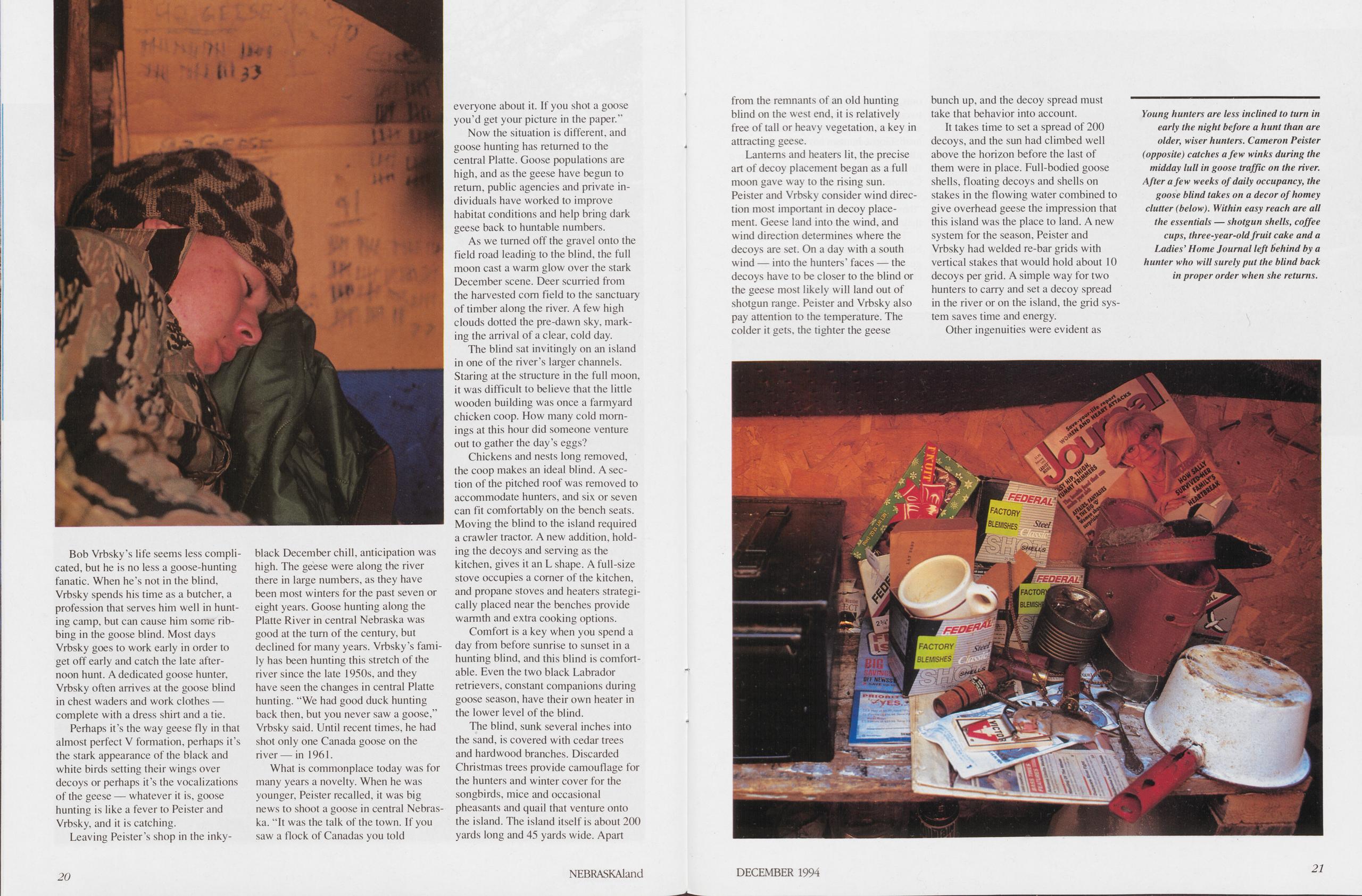
Young hunters are less inclined to turn in early the night before a hunt than are older, wiser hunters. Cameron Peister (opposite) catches a few winks during the midday lull in goose traffic on the river. After a few weeks of daily occupancy, the goose blind takes on a decor of homey clutter (below). Within easy reach are all the essentials — shotgun shells, coffee cups, three-year-old fruit cake and a Ladies’ Home Journal left behind by a hunter who will surely put the blind back in proper order when she returns.
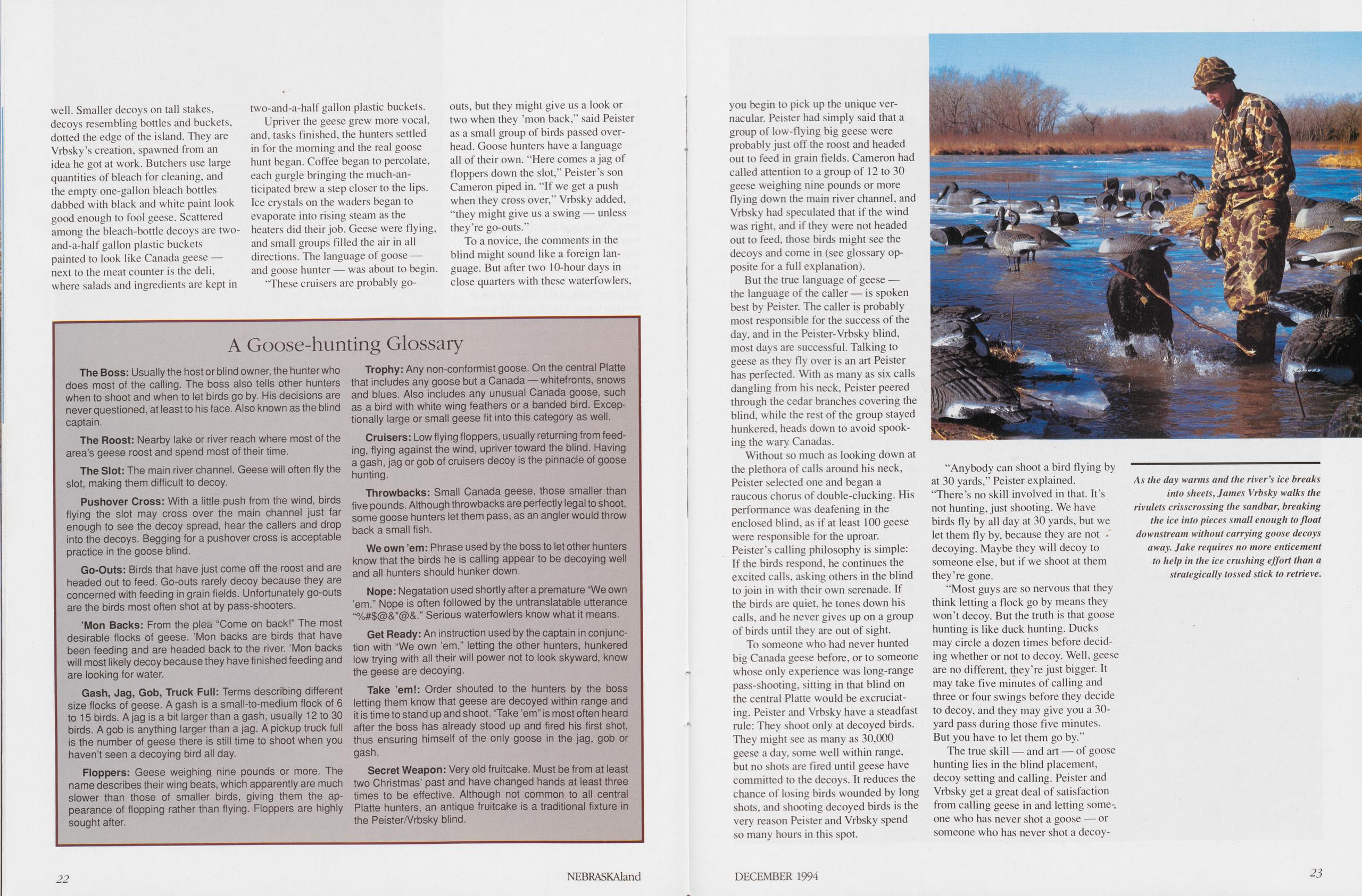
well. Smaller decoys on tall stakes, decoys resembling bottles and buckets, dotted the edge of the island. They are Vrbsky’s creation, spawned from an idea he got at work. Butchers use large quantities of bleach for cleaning, and the empty one-gallon bleach bottles dabbed with black and white paint look good enough to fool geese. Scattered among the bleach-bottle decoys are two- and-a-half gallon plastic buckets painted to look like Canada geese — next to the meat counter is the deli, where salads and ingredients are kept in
A Goose-hunting GlossaryThe Boss: Usually the host or blind owner, the hunter who does most of the calling. The boss also tells other hunters when to shoot and when to let birds go by. His decisions are never questioned, at least to his face. Also known as the blind captain.
The Roost: Nearby lake or river reach where most of the area’s geese roost and spend most of their time. The Slot: The main river channel. Geese will often fly the slot, making them difficult to decoy.
Pushover Cross: With a little push from the wind, birds flying the slot may cross over the main channel just far enough to see the decoy spread, hear the callers and drop into the decoys. Begging for a pushover cross is acceptable practice in the goose blind.
Go-Outs: Birds that have just come off the roost and are headed out to feed. Go-outs rarely decoy because they are concerned with feeding in grain fields. Unfortunately go-outs are the birds most often shot at by pass-shooters. ’Mon Backs: From the plea “Come on back!” The most desirable flocks of geese. ’Mon backs are birds that have been feeding and are headed back to the river. ’Mon backs will most likely decoy because they have finished feeding and are looking for water.
Gash, Jag, Gob, Truck Full: Terms describing different size flocks of geese. A gash is a small-to-medium flock of 6 to 15 birds. A jag is a bit larger than a gash, usually 12 to 30 birds. A gob is anything larger than a jag. A pickup truck full is the number of geese there is still time to shoot when you haven’t seen a decoying bird all day. Floppers: Geese weighing nine pounds or more. The name describes their wing beats, which apparently are much slower than those of smaller birds, giving them the ap- pearance of flopping rather than flying. Floppers are highly sought after.
Trophy: Any non-conformist goose. On the central Platte that includes any goose but a Canada — whitefronts, snows and blues. Also includes any unusual Canada goose, such as a bird with white wing feathers or a banded bird. Excep- tionally large or small geese fit into this category as well. Cruisers: Low flying floppers, usually returning from feed- ing, flying against the wind, upriver toward the blind. Having a gash, jag or gob of cruisers decoy is the pinnacle of goose hunting.
Throwbacks: Small Canada geese, those smaller than five pounds. Although throwbacks are perfectly legal to shoot, some goose hunters let them pass, as an angler would throw back a small fish.
We own ’em: Phrase used by the boss to let other hunters know that the birds he is calling appear to be decoying well and all hunters should hunker down.
Nope: Negatation used shortly after a premature “We own ’em.” Nope is often followed by the untranslatable utterance Serious waterfowlers know what it means. Get Ready: An instruction used by the captain in conjunc- tion with “We own ’em,” letting the other hunters, hunkered low trying with all their will power not to look skyward, know the geese are decoying.
Take ’em!: Order shouted to the hunters by the boss letting them know that geese are decoyed within range and it is time to stand up and shoot. “Take ’em” is most often heard after the boss has already stood up and fired his first shot, thus ensuring himself of the only goose in the jag, gob or gash.
Secret Weapon: Very old fruitcake. Must be from at least two Christmas’ past and have changed hands at least three times to be effective. Although not common to all central Platte hunters, an antique fruitcake is a traditional fixture in the Peister/Vrbsky blind.
two-and-a-half gallon plastic buckets. Upriver the geese grew more vocal, and, tasks finished, the hunters settled in for the morning and the real goose hunt began. Coffee began to percolate, each gurgle bringing the much-anticipated brew a step closer to the lips. Ice crystals on the waders began to evaporate into rising steam as the heaters did their job. Geese were flying, and small groups filled the air in all directions. The language of goose — and goose hunter — was about to begin.
“These cruisers are probably go- outs, but they might give us a look or two when they ’mon back,” said Peister as a small group of birds passed overhead. Goose hunters have a language all of their own. “Here comes a jag of floppers down the slot,” Peister’s son Cameron piped in. “If we get a push when they cross over,” Vrbsky added, “they might give us a swing — unless they’re go-outs.”
To a novice, the comments in the blind might sound like a foreign language. But after two 10-hour days in close quarters with these waterfowlers, you begin to pick up the unique vernacular. Peister had simply said that a group of low-flying big geese were probably just off the roost and headed out to feed in grain fields. Cameron had called attention to a group of 12 to 30 geese weighing nine pounds or more flying down the main river channel, and Vrbsky had speculated that if the wind was right, and if they were not headed out to feed, those birds might see the decoys and come in (see glossary op- posite for a full explanation).
But the true language of geese — the language of the caller — is spoken best by Peister. The caller is probably most responsible for the success of the day, and in the Peister-Vrbsky blind, most days are successful. Talking to geese as they fly over is an art Peister has perfected. With as many as six calls dangling from his neck, Peister peered through the cedar branches covering the blind, while the rest of the group stayed hunkered, heads down to avoid spooking the wary Canadas.
Without so much as looking down at the plethora of calls around his neck, Peister selected one and began a raucous chorus of double-clucking. His performance was deafening in the enclosed blind, as if at least 100 geese were responsible for the uproar. Peister’s calling philosophy is simple: If the birds respond, he continues the excited calls, asking others in the blind to join in with their own serenade. If the birds are quiet, he tones down his calls, and he never gives up on a group of birds until they are out of sight.
To someone who had never hunted big Canada geese before, or to someone whose only experience was long-range pass-shooting, sitting in that blind on the central Platte would be excruciating. Peister and Vrbsky have a steadfast rule: They shoot only at decoyed birds. They might see as many as 30,000 geese a day, some well within range, but no shots are fired until geese have committed to the decoys. It reduces the chance of losing birds wounded by long shots, and shooting decoyed birds is the very reason Peister and Vrbsky spend so many hours in this spot.
“Anybody can shoot a bird flying by at 30 yards,” Peister explained. “There’s no skill involved in that. It’s not hunting, just shooting. We have birds fly by all day at 30 yards, but we let them fly by, because they are not . decoying. Maybe they will decoy to someone else, but if we shoot at them they’re gone.
“Most guys are so nervous that they think letting a flock go by means they won’t decoy. But the truth is that goose hunting is like duck hunting. Ducks may circle a dozen times before deciding whether or not to decoy. Well, geese are no different, they’re just bigger. It may take five minutes of calling and three or four swings before they decide to decoy, and they may give you a 30- yard pass during those five minutes. But you have to let them go by.”
The true skill — and art — of goose hunting lies in the blind placement, decoy setting and calling. Peister and Vrbsky get a great deal of satisfaction from calling geese in and letting some- one who has never shot a goose — or someone who has never shot a decoying
goose — do the shooting. To them, the true hunt is in persuading the birds to swing around to give you a look.
Peister compares goose hunting to archery deer hunting, another of his passions when the geese aren’t flying. “You have to be a pretty good hunter to get a deer to walk within 15 yards of you, to pick out the right tree for your stand, the right trail, the right wind direction. Anybody can shoot, but there is no hunt if you are just a shooter.”
Evidence of Peister and Vrbsky’s commitment to shooting only decoyed geese is obvious by looking at the guns in the blind. No giant 10-gauge, 32- inch, full-choke barrels are evident there, nor are giant steel shot sizes, such as the popular T and F sizes. The order of the day for Peister and Vrbsky is short-barrelled, fast-swinging pump guns, with 24- to 26-inch barrels and improved cylinder or modified chokes. To the novice, the guns seem more suited to quail hunting than to bringing down a nine-pound Canada goose. But shooting geese from this blind is often at quail-shooting range, and the short, open-choked guns allow the steel shot to achieve its effective pattern.
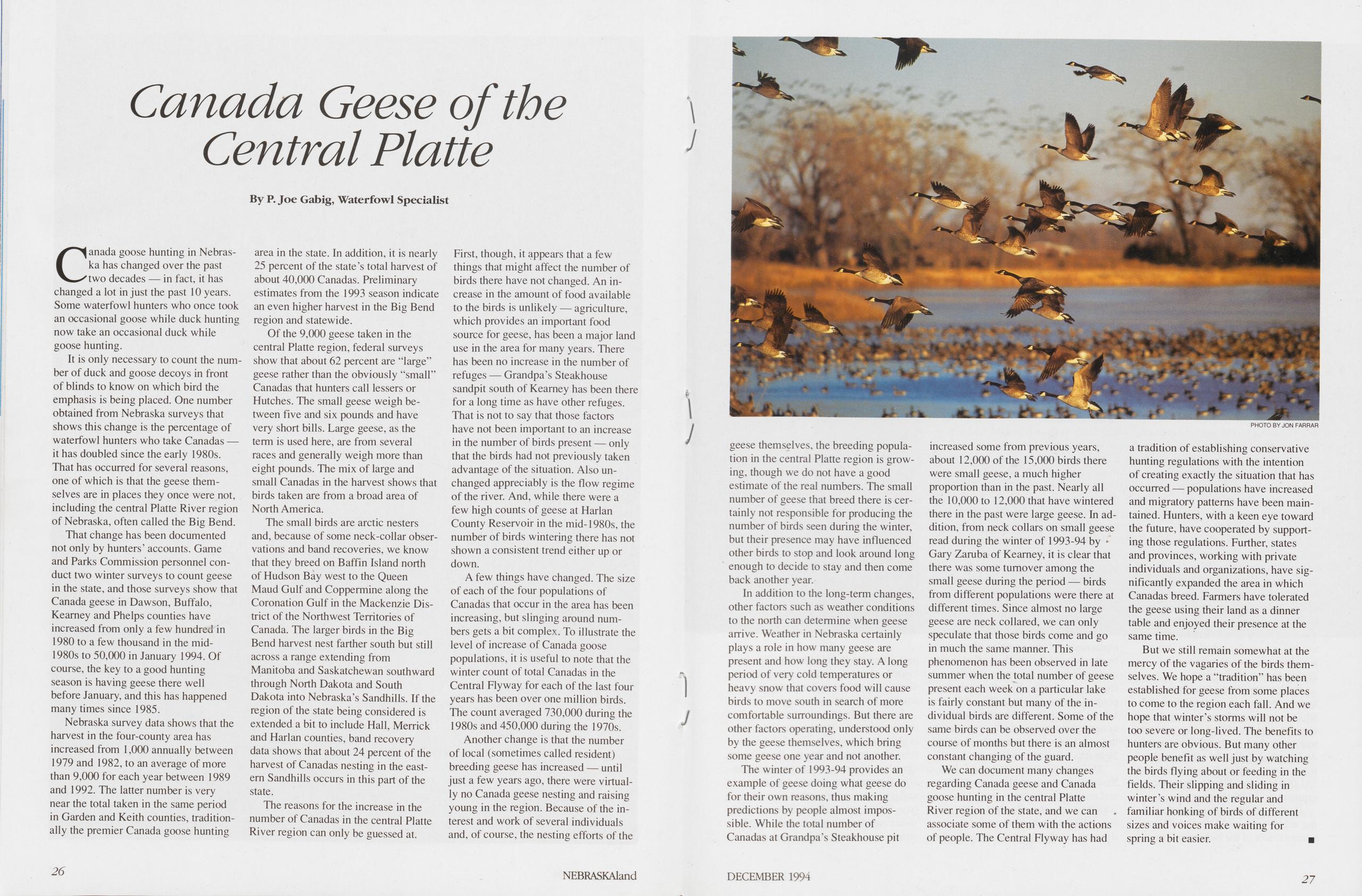
As the frigid winter day continued its short march from sunup to sundown, the geese began returning from nearby corn fields. Crops full, the birds turned their attention to water and rest, and the river was their destination.
Late-winter geese usually travel in big groups, sometimes hundreds of birds in a flock. Rarely will big groups decoy, but Peister’s magic on the goose call usually persuades a single bird or a small group to break away and inves- tigate, and most that come that far cannot resist the enticing decoy spread. That scenario repeated itself several times that day last December, and every hunter in the blind had a chance to bag a big Canada.
With a New Year’s goose for each hunter, it was time to repeat the predawn ritual in reverse. There were decoys to pick up, propane bottles to turn off and gear to gather. The trip home was easier than the trip out, now that the old year had been given a proper farewell. Merging with the throng of vehicles traveling 1-80, it was hard to believe how few of the travelers know about the spectacular hunting waiting just beyond the road.
Canada Geese of the Central Platte
Canada goose hunting in Nebraska has changed over the past two decades — in fact, it has changed a lot in just the past 10 years. Some waterfowl hunters who once took an occasional goose while duck hunting now take an occasional duck while goose hunting.
It is only necessary to count the number of duck and goose decoys in front of blinds to know on which bird the emphasis is being placed. One number obtained from Nebraska surveys that shows this change is the percentage of waterfowl hunters who take Canadas — it has doubled since the early 1980s.
one of which is that the geese them- selves are in places they once were not, including the central Platte River region of Nebraska, often called the Big Bend.
That change has been documented not only by hunters’ accounts. Game and Parks Commission personnel conduct two winter surveys to count geese in the state, and those surveys show that Canada geese in Dawson, Buffalo, Kearney and Phelps counties have increased from only a few hundred in 1980 to a few thousand in the mid- 1980s to 50,000 in January 1994. Of course, the key to a good hunting season is having geese there well before January, and this has happened many times since 1985.
Nebraska survey data shows that the harvest in the four-county area has increased from 1,000 annually between 1979 and 1982, to an average of more than 9,000 for each year between 1989 and 1992. The latter number is very near the total taken in the same period in Garden and Keith counties, traditionally the premier Canada goose hunting area in the state. In addition, it is nearly 25 percent of the state’s total harvest of about 40,000 Canadas. Preliminary estimates from the 1993 season indicate an even higher harvest in the Big Bend region and statewide.
Of the 9,000 geese taken in the central Platte region, federal surveys show that about 62 percent are “large” geese rather than the obviously “small” Canadas that hunters call lessers or Hutches. The small geese weigh between five and six pounds and have very short bills. Large geese, as the term is used here, are from several races and generally weigh more than eight pounds. The mix of large and small Canadas in the harvest shows that birds taken are from a broad area of North America.
The small birds are arctic nesters and, because of some neck-collar observations and band recoveries, we know that they breed on Baffin Island north of Hudson Bay west to the Queen Maud Gulf and Coppermine along the Coronation Gulf in the Mackenzie District of the Northwest Territories of Canada. The larger birds in the Big Bend harvest nest farther south but still across a range extending from Manitoba and Saskatchewan southward through North Dakota and South Dakota into Nebraska’s Sandhills. If the region of the state being considered is extended a bit to include Hall, Merrick and Harlan counties, band recovery data shows that about 24 percent of the harvest of Canadas nesting in the eastern Sandhills occurs in this part of the state.
The reasons for the increase in the number of Canadas in the central Platte River region can only be guessed at. First, though, it appears that a few things that might affect the number of birds there have not changed. An increase in the amount of food available to the birds is unlikely — agriculture, which provides an important food source for geese, has been a major land use in the area for many years. There has been no increase in the number of refuges — Grandpa’s Steakhouse sandpit south of Kearney has been there for a long time as have other refuges. That is not to say that those factors have not been important to an increase in the number of birds present — only that the birds had not previously taken advantage of the situation. Also unchanged appreciably is the flow regime of the river. And, while there were a few high counts of geese at Harlan County Reservoir in the mid-1980s, the number of birds wintering there has not shown a consistent trend either up or down.
A few things have changed. The size of each of the four populations of Canadas that occur in the area has been increasing, but slinging around numbers gets a bit complex. To illustrate the level of increase of Canada goose populations, it is useful to note that the winter count of total Canadas in the Central Flyway for each of the last four years has been over one million birds. The count averaged 730,000 during the 1980s and 450,000 during the 1970s.
Another change is that the number of local (sometimes called resident) breeding geese has increased — until just a few years ago, there were virtually no Canada geese nesting and raising young in the region. Because of the interest and work of several individuals and, of course, the nesting efforts of the
geese themselves, the breeding population in the central Platte region is growing, though we do not have a good estimate of the real numbers. The small number of geese that breed there is certainly not responsible for producing the number of birds seen during the winter, but their presence may have influenced other birds to stop and look around long enough to decide to stay and then come back another year.
In addition to the long-term changes, other factors such as weather conditions to the north can determine when geese arrive. Weather in Nebraska certainly plays a role in how many geese are present and how long they stay. A long period of very cold temperatures or heavy snow that covers food will cause birds to move south in search of more comfortable surroundings. But there are other factors operating, understood only by the geese themselves, which bring some geese one year and not another.
The winter of 1993-94 provides an example of geese doing what geese do for their own reasons, thus making predictions by people almost impossible. While the total number of Canadas at Grandpa’s Steakhouse pit increased some from previous years, about 12,000 of the 15,000 birds there were small geese, a much higher proportion than in the past. Nearly all the 10,000 to 12,000 that have wintered there in the past were large geese. In addition, from neck collars on small geese read during the winter of 1993-94 by Gary Zaruba of Kearney, it is clear that there was some turnover among the small geese during the period — birds from different populations were there at different times. Since almost no large geese are neck collared, we can only speculate that those birds come and go in much the same manner. This phenomenon has been observed in late summer when the total number of geese present each week on a particular lake is fairly constant but many of the individual birds are different. Some of the same birds can be observed over the course of months but there is an almost constant changing of the guard.
We can document many changes regarding Canada geese and Canada goose hunting in the central Platte River region of the state, and we can associate some of them with the actions of people. The Central Flyway has had a tradition of establishing conservative hunting regulations with the intention of creating exactly the situation that has occurred — populations have increased and migratory patterns have been maintained. Hunters, with a keen eye toward the future, have cooperated by supporting those regulations. Further, states and provinces, working with private individuals and organizations, have significantly expanded the area in which Canadas breed. Farmers have tolerated the geese using their land as a dinner table and enjoyed their presence at the same time.
But we still remain somewhat at the mercy of the vagaries of the birds themselves. We hope a “tradition” has been established for geese from some places to come to the region each fall. And we hope that winter’s storms will not be too severe or long-lived. The benefits to hunters are obvious. But many other people benefit as well just by watching the birds flying about or feeding in the fields. Their slipping and sliding in winter’s wind and the regular and familiar honking of birds of different sizes and voices make waiting for spring a bit easier.
26 NEBRASKAland DECEMBER 1994 27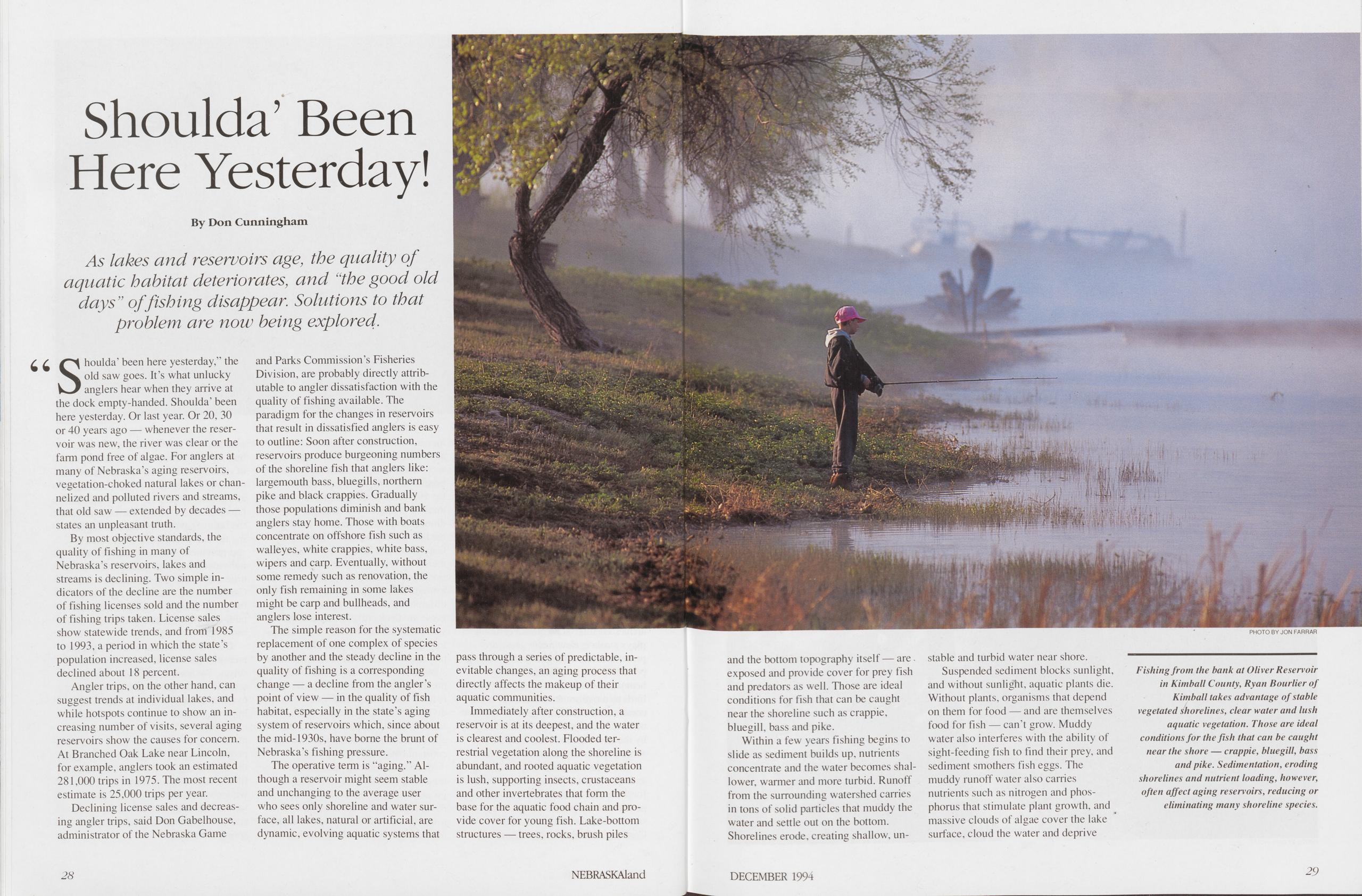
Shoulda’ Been Here Yesterday!
As lakes and reservoirs age, the quality of aquatic habitat deteriorates, and “the good old days” of fishing disappear. Solutions to that problem are now being explored.
"Shoulda’ been here yesterday,” the old saw goes. It’s what unlucky anglers hear when they arrive at the dock empty-handed. Shoulda’ been here yesterday. Or last year. Or 20, 30 or 40 years ago — whenever the reservoir was new, the river was clear or the farm pond free of algae. For anglers at many of Nebraska’s aging reservoirs, vegetation-choked natural lakes or channelized and polluted rivers and streams, that old saw — extended by decades — states an unpleasant truth.
By most objective standards, the quality of fishing in many of Nebraska’s reservoirs, lakes and streams is declining. Two simple indicators of the decline are the number of fishing licenses sold and the number of fishing trips taken. License sales show statewide trends, and from 1985 to 1993, a period in which the state’s population increased, license sales declined about 18 percent.
Angler trips, on the other hand, can suggest trends at individual lakes, and while hotspots continue to show an increasing number of visits, several aging reservoirs show the causes for concern. At Branched Oak Lake near Lincoln, for example, anglers took an estimated 281,000 trips in 1975. The most recent estimate is 25,000 trips per year.
Declining license sales and decreasing angler trips, said Don Gabelhouse, administrator of the Nebraska Game and Parks Commission’s Fisheries Division, are probably directly attributable to angler dissatisfaction with the quality of fishing available. The paradigm for the changes in reservoirs that result in dissatisfied anglers is easy to outline: Soon after construction, reservoirs produce burgeoning numbers of the shoreline fish that anglers like: largemouth bass, bluegills, northern pike and black crappies. Gradually those populations diminish and bank anglers stay home. Those with boats concentrate on offshore fish such as walleyes, white crappies, white bass, wipers and carp. Eventually, without some remedy such as renovation, the only fish remaining in some lakes might be carp and bullheads, and anglers lose interest.
The simple reason for the systematic replacement of one complex of species by another and the steady decline in the quality of fishing is a corresponding change — a decline from the angler’s point of view — in the quality of fish habitat, especially in the state’s aging system of reservoirs which, since about the mid-1930s, have borne the brunt of Nebraska’s fishing pressure.
The operative term is “aging.” Although a reservoir might seem stable and unchanging to the average user who sees only shoreline and water surface, all lakes, natural or artificial, are dynamic, evolving aquatic systems that pass through a series of predictable, inevitable changes, an aging process that directly affects the makeup of their aquatic communities.
Immediately after construction, a reservoir is at its deepest, and the water is clearest and coolest. Flooded terrestrial vegetation along the shoreline is abundant, and rooted aquatic vegetation is lush, supporting insects, crustaceans and other invertebrates that form the base for the aquatic food chain and provide cover for young fish. Lake-bottom structures — trees, rocks, brush piles and the bottom topography itself — are exposed and provide cover for prey fish and predators as well. Those are ideal conditions for fish that can be caught near the shoreline such as crappie, bluegill, bass and pike.
Within a few years fishing begins to slide as sediment builds up, nutrients concentrate and the water becomes shallower, warmer and more turbid. Runoff from the surrounding watershed carries in tons of solid particles that muddy the water and settle out on the bottom. Shorelines erode, creating shallow, unstable and turbid water near shore.
Suspended sediment blocks sunlight, and without sunlight, aquatic plants die. Without plants, organisms that depend on them for food — and are themselves food for fish — can’t grow. Muddy water also interferes with the ability of sight-feeding fish to find their prey, and sediment smothers fish eggs. The muddy runoff water also carries nutrients such as nitrogen and phos- phorus that stimulate plant growth, and massive clouds of algae cover the lake surface, cloud the water and deprive
fish of oxygen as the algae dies and decomposes.
Species composition changes as fish more tolerant of the new conditions prosper and those dependent on clear water and shoreline habitat decline. How long the good fishing lasts depends on the size of the impoundment and where it is located.
Other problems plague irrigation reservoirs. Most significant is the inevitable drawdown that occurs when irrigation water is released for downstream users. Large numbers of fish may be flushed out of the reservoir and die in downstream canals and irrigation laterals. In the lowered reservoir pool, conditions for reproduction are often inadequate, and fish numbers decline.
As dismal a scenario as all that may be for anglers, however, it is not a description of the failure of a reservoir to carry out its intended purpose or an indictment of those who planned, built and managed a reservoir. Flood control
reservoirs are built expressly for the purpose of catching and controlling excess runoff, and where excess runoff occurs, silt will inevitably enter a reservoir. The recreation benefits and the consequences of siltation on fish habitat in a lake like Branched Oak are often secondary — or lower — considerations in its planning and construction. Similarly, the water-level fluctuations of an irrigation reservoir are an inevitable consequence of the storage and release of irrigation water.
Even a natural lake is bound to follow the same inevitable process of aging, though usually much more slowly. The life span of a natural, pristine northern lake, where the watershed is relatively undeveloped and of relatively low fertility, might be measured in thousands of years. In farm-country reservoirs, where fertile watersheds are heavily farmed, the life of a reservoir might only be decades.
The aging of natural lakes also affects fishing. Because they are very old, natural lakes are usually shallow. Most of Nebraska’s natural lakes are in sandy soils, so they usually do not become muddy. Instead, vegetation prospers in the clear, shallow water. When the lakes freeze, snow cover prevents photosynthesis. Vegetation dies, and fish suffocate when the bacteria responsible for decomposition deplete the dissolved oxygen.
Rivers and streams have suffered, too. The Missouri River, for example, has lost 45 percent of its surface area to channelization and streambed cutting. Meanders were straightened and riffles, snags, backwaters and sloughs eliminated. With those features gone, microorganisms no longer proliferate, nor can young fish find refuge from swift currents and large predators. Concentrated in narrow channels, water flows more rapidly, cutting down through its own bed. Held behind dams, the sediment load settles out, and
released water is "hungry,” cutting anew on its downstream course and depositing sediment on gravel beds and sandbars where fish formerly spawned. Smaller rivers and streams have suffered a similar fate.
But the focal point of Nebraska’s fishing decline is reservoirs. By the mid 1930s, several reservoirs had been constructed, and more were added throughout the next decades — Lake McConaughy in the 1940s, Harlan County Reservoir and Lewis and Clark Lake in the 1950s, the Salt Valley reservoirs in the 1960s and ’70s and so on. Fishing interest in the state began to shift rapidly from rivers and streams to the new reservoirs, and as older reservoirs began to show the effects of age, newer ones attracted the anglers.
"The good old days,” the days when reservoir fishing was at its best, migrated from lake to lake — a kind of "slash and burn” fishing that left old reservoirs behind as anglers were beckoned on by the good fishing in new ones. Today, more than 70 percent of all fishing in Nebraska takes place on lakes and reservoirs totaling more than 145,000 surface acres.
But the old pattern of peak-and- decline followed by new peaks on new lakes is unlikely to continue. The days of intensive reservoir construction appear to be over, and at the present rate fewer new acres of reservoirs will be added in the 1990s than in any decade since the early 20th century. The good fishing of the future will depend on maintaining, improving and enhancing existing habitat.
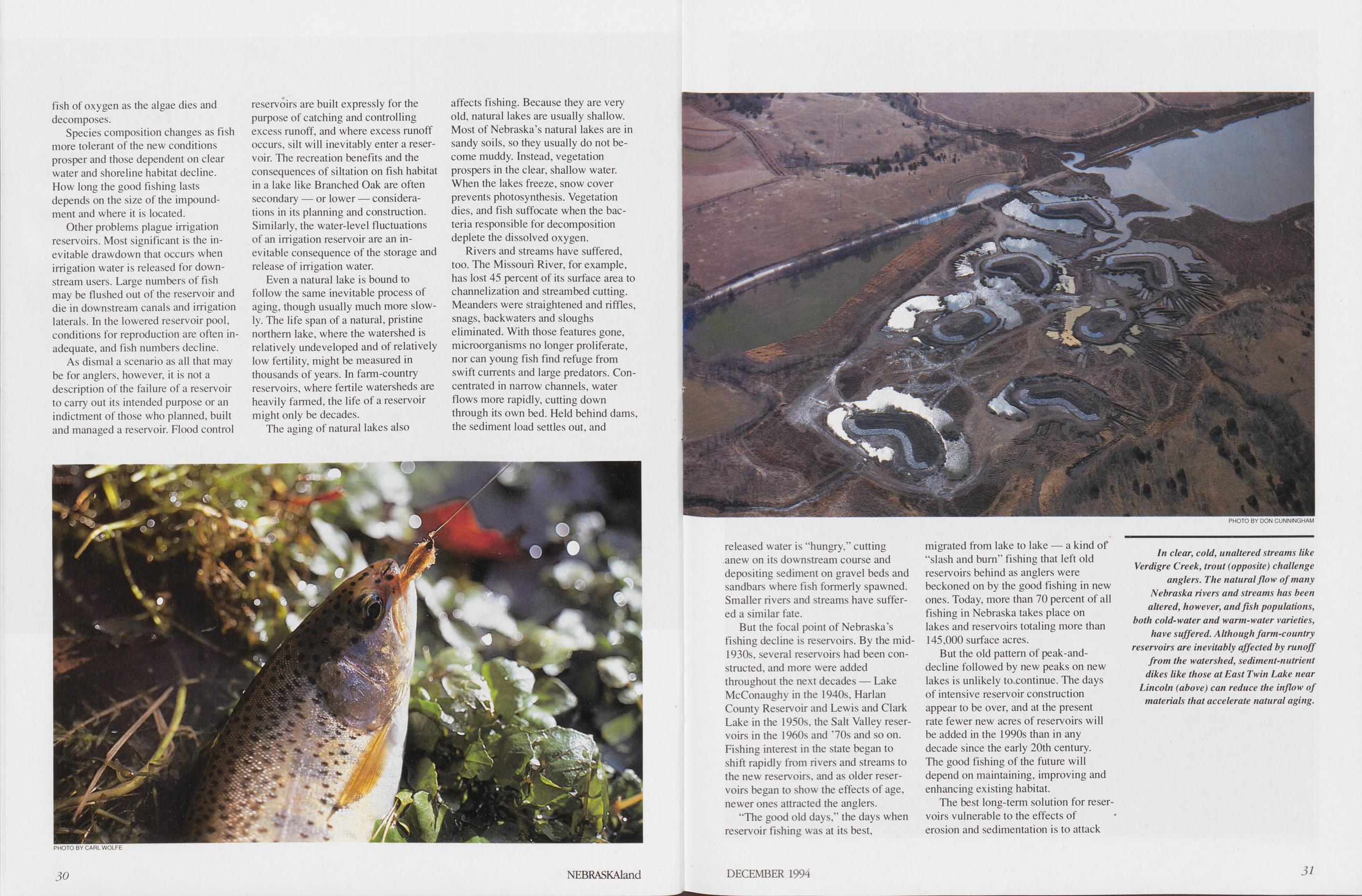
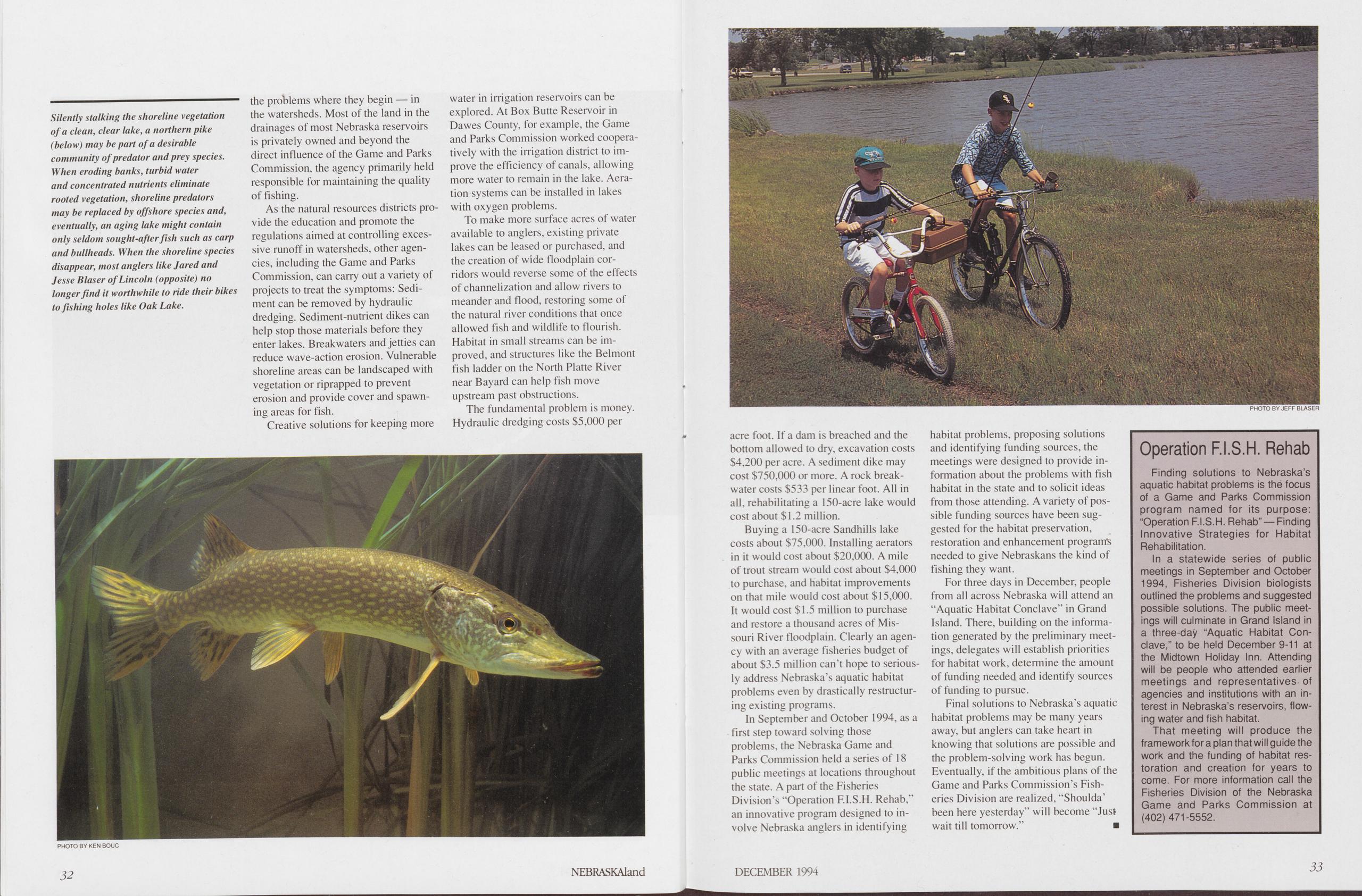
In clear, cold, unaltered streams like Verdigre Creek, trout (opposite) challenge anglers. The natural flow of many Nebraska rivers and streams has been altered, however, and fish populations, both cold-water and warm-water varieties, have suffered. Although farm-country reservoirs are inevitably affected by runoff from the watershed, sediment-nutrient dikes like those at East Twin Lake near Lincoln (above) can reduce the inflow of materials that accelerate natural aging.
As the natural resources districts provide the education and promote the regulations aimed at controlling excessive runoff in watersheds, other agencies, including the Game and Parks Commission, can carry out a variety of projects to treat the symptoms: Sediment can be removed by hydraulic dredging. Sediment-nutrient dikes can help stop those materials before they enter lakes. Breakwaters and jetties can reduce wave-action erosion. Vulnerable shoreline areas can be landscaped with vegetation or riprapped to prevent erosion and provide cover and spawning areas for fish.
Creative solutions for keeping more water in irrigation reservoirs can be explored. At Box Butte Reservoir in Dawes County, for example, the Game and Parks Commission worked cooperatively with the irrigation district to improve the efficiency of canals, allowing more water to remain in the lake. Aeration systems can be installed in lakes with oxygen problems.
To make more surface acres of water available to anglers, existing private lakes can be leased or purchased, and the creation of wide floodplain corridors would reverse some of the effects of channelization and allow rivers to meander and flood, restoring some of the natural river conditions that once allowed fish and wildlife to flourish. Habitat in small streams can be improved, and structures like the Belmont fish ladder on the North Platte River near Bayard can help fish move upstream past obstructions.
The fundamental problem is money. Hydraulic dredging costs $5,000 per acre foot. If a dam is breached and the bottom allowed to dry, excavation costs $4,200 per acre. A sediment dike may cost $750,000 or more. A rock break- water costs $533 per linear foot. All in all, rehabilitating a 150-acre lake would cost about $1.2 million.
Buying a 150-acre Sandhills lake costs about $75,000. Installing aerators in it would cost about $20,000. A mile of trout stream would cost about $4,000 to purchase, and habitat improvements on that mile would cost about $15,000. It would cost $1.5 million to purchase and restore a thousand acres of Missouri River floodplain. Clearly an agency with an average fisheries budget of about $3.5 million can’t hope to seriously address Nebraska’s aquatic habitat problems even by drastically restructuring existing programs.
In September and October 1994, as a first step toward solving those problems, the Nebraska Game and Parks Commission held a series of 18 public meetings at locations throughout the state. A part of the Fisheries Division’s “Operation F.I.S.H. Rehab,” an innovative program designed to involve Nebraska anglers in identifying habitat problems, proposing solutions and identifying funding sources, the meetings were designed to provide information about the problems with fish habitat in the state and to solicit ideas from those attending. A variety of possible funding sources have been sug- gested for the habitat preservation, restoration and enhancement program's needed to give Nebraskans the kind of fishing they want.
For three days in December, people from all across Nebraska will attend an “Aquatic Habitat Conclave” in Grand Island. There, building on the information generated by the preliminary meetings, delegates will establish priorities for habitat work, determine the amount of funding needed and identify sources of funding to pursue.
Final solutions to Nebraska’s aquatic habitat problems may be many years away, but anglers can take heart in knowing that solutions are possible and the problem-solving work has begun. Eventually, if the ambitious plans of the Game and Parks Commission’s Fish- eries Division are realized, “Shoulda’ been here yesterday” will become “Just wait till tomorrow.”
Operation F.I.S.H. Rehab Finding solutions to Nebraska’s aquatic habitat problems is the focus of a Game and Parks Commission program named for its purpose: “Operation F.I.S.H. Rehab” — Finding Innovative Strategies for Habitat Rehabilitation. In a statewide series of public meetings in September and October 1994, Fisheries Division biologists outlined the problems and suggested possible solutions. The public meet- ings will culminate in Grand Island in a three-day “Aquatic Habitat Con- clave,” to be held December 9-11 at the Midtown Holiday Inn. Attending will be people who attended earlier meetings and representatives of agencies and institutions with an in- terest in Nebraska’s reservoirs, flow- ing water and fish habitat. That meeting will produce the framework for a plan that will guide the work and the funding of habitat res- toration and creation for years to come. For more information call the Fisheries Division of the Nebraska Game and Parks Commission at (402) 471-5552. 32 NEBRASKAland DECEMBER 1994 33
Hunting the Divide
(for George Hollenbeck)
This, old partner, is real:You hunched over the wheel
eyes telescoped,
stocking cap cocked
for fencerow pheasants.
I, clutching my gun
with prophet’s fervor,
seeing our future
as stubble fields
loaded with birds.
We gaze plum thickets,
the birds in our eyes
only thistles;
we check ditches,
we cruise backroads,
we talk crops
till weeds speak pheasants,
then punctuate cocks
with 12-gauge shot.
We eat what we drop.
We wonder how we dreamed
our regular lives up. Ted Florea of North Platte calls himself a hunter-poet. 35
Winter on the Niobrara
Classified
Page forty-nine
BOOKS/PRINTINGFREE BOOK CATALOG. Novels, westerns, romances, children's; old out of print, found barns, attic. Authors: Grey. Bower. Connor, Fox. Curwood. Raine. Wright. Aldrige. Pollyanna. Freckles, many others. Postage ap- preciated. Pierce. 4400 N. Pine Cluster, Oroville. CA95965.
A WARM. TENDER tale of a Nebraska lad during the 1930s. A deep heartfelt story where hard work, neighborli- ness and drought were overcome with homemade humor. Great era pictures. Critiqued “Best since LITTLE HOUSE ON THE PRAIRIE." H. C. Lorenz’ literary gem. “DAM- FINO" is a must read. $17.50 first class. Prairie House Publishing. 240 Carol Lane. Oakley. CA 94561.
HOW TO FIND MORE OUTDOOR OPPORTUNITIES!! The Nebraska Sportsman’s Atlas. Locations of all public lands and waters on county transportation maps. These maps show ALL the roads in Nebraska. Listings include federal. Nebraska Game & Parks, NRD holdings, hotels and motels and Nebraska's endless attractions. At only $18.75/copy a true time and frustration saver. To order write: Sportsman's Atlas Co.. PO Box 132, Lytton. IA 50561 or call 1-800-568-8334.
ACREAGE ADVISOR MAGAZINE writes about: horses, wood stoves, bluebird trails, growing black walnuts, pecans, chestnuts, hazelnuts, hickories, apples. Wildlife habitat, farm ponds, tree planting, native grasses, buffalo grass lawns, wildflowers. Mowing, weed control, snow removal, wells, septic systems, outbuildings. Featured acreage ““tours." Acreage home businesses, financing your dream acreage, purchase agreements. Children’s games, recipes, gardening, livestock, humor, much more. Written and published in Nebraska. Phone/FAX (402) 785-2220. Write: 15400 N. 56th. Lincoln. NE 68514. Free sample issue (send 75? postage). One year-$9.95, two-$ 17.90, three-$24. Gift subscriptions for Christmas available.
WILD GAME COOKBOOK. Recipes for phantastic pheasant, delicious dove, great goose and many more. Send $6.95 + $ 1 shipping & handling to Wildgame, 509 Morton, Holdrege, NE 68949.
COLLECTIBLES FISH/FISHINGFISH FOR SALE. Catfish, largemouth bass, smallmouth bass, perch, crappie, bluegill, walleye, northern pike, rain- bow trout, Donaldson rainbow trout, grass carp, minnows, bullheads. Consulting available. Pleasant Valley Fish Farm, RR 1. Box 147. McCook, NE 69001. Phone (308) 345- 6599.
BUYING: American Indian artifacts such as beadwork, weavings, baskets, etc.; also cowboy memorabilia such as chaps, spurs, photographs, etc. Best price first letter; photographs promptly returned. Jack Ringwait, 1550 California St.. Suite 6. #211. San Francisco, CA 94109. (415)759-6343.
FOOD DOGSTRAINING ALL BREEDS bird dogs — Vizslas and English Pointers for sale. Rozanek Kennels. RR 2, Schuyler, NE 68661. Phone (402) 352-8769.
NEBRASKAland Magazine Need a last-minute gift idea? How about NEBRASKAland, 10 times a year? As a gift or for yourself only $14! Can Ton Free 1-800-632-5263YELLOW-BLACK Lab pups. FC AFC sired. AKC. Hips OFA certified. Dew claws removed. Excellent hunting potential. Contact Bob Bendler, Lexington. NE. (308) 324- 4247.
WILDERNESS KENNELS. Gun dog training - over 60 years combined experience. Training all sporting breeds — Retrievers. Flushing and pointing dogs. All dogs worked on pen raised birds and wild game. Training program includes obedience training — heel, sit, stay, down and come when called. Pups, started dogs and fully trained dogs for sale. HUNTING DOGS TRAINED BY HUNTERS. Henry Sader, Wilderness Kennels, Roca, NE. (402) 423-4212. Since 1968.
ENGLISH COCKER pups, imported stock. British FTC bloodlines. Many colors available. Featured in NEBRASKAland November 1991. Sawtooth Oaks, Box 443. Orleans, NE 68966. Phone (308) 473-5265.
EXCEPTIONAL ENGLISH SETTER pups. Tomoka iinebred! Sire has 30 shooting dog wins and counting. Reserve yours! (402) 421-4693.
RETRIEVER TRAINING. Area’s top “retrievers only" trainer. Field trial and hunting dogs. Non-slip duck dogs! TKO RETRIEVER TRAINING KENNEL(402) 623-4311.
CHESAPEAKE BAY, LABRADOR and GOLDEN RETRIEVER pups, started dogs and stud service. 16 time national champion pedigre. Platte Valley Retrievers (308) 995-2318.
SCHOOL CREEK KENNELS. AKC chocolate lab pups. Ready November 22. Stud service and boarding. Richard Chandler. 303 N. James, Sutton, NE 68979, (402) 773- 4166.
GERMAN SHORTHAIRS. English pointers and English setters. Pups, started and trained dogs available. Pups are guaranteed. Training of pointing breeds during spring and early fall. Wayne Clark. Percival, IA51648, (712) 529-4238 or (402) 298-8153.
NEBRASKA BASKETS: The original Nebraska company specializing in fine foods from Nebraska. A beautiful array of baskets filled with ethnic, healthful and long-time favorite foods. Call or write for our brochure: P.O. Box 98, McCook, NE 69001. 1-800-345-7725.
BEER & WINEMAKING SUPPLIES — Fermenter’s Supply & Equipment. 4472 S. 84th St., Omaha, NE 68127. (402) 593-9171. Mail order or visit our store.
AMAZING BLACK WALNUT CRACKER. Cracks black walnuts perfectly. Controls shells. No more smashed fingers. $21.75 plus $4.00 postage. Stephen Robinson. Stewartsville, MO 64490.
GIFTSNEBRASKA CHRISTMAS CARDS, stationery, mugs, cookie cutters, rubber stamps, gift baskets and more! Originally designed and elegantly packaged from Nebras- ka. FREE catalog: MJP. HC 37 Box 43C. Valentine. NE 69201. 1-800-632-7623.
FREE 200-PAGE GIFT catalog. Same gifts as in shopping malls but half the price. Check it out. Write to King's Quality Products, Box 491, Alliance, NE 69301.
GUIDES/OUTFITTERSMAD RIVER CANOES offers the finest quality and per- formance. For the finest canoes and accessories look to Great Plains Canoe Co., 205 Main, Springfield, NE. Phone (402) 253-2001.
GUNS/SHOOTING/ARCHERY GUNS — Browning, Winchester, Remington, others. Hi- powers; shotguns, new, used, antiques. Want Pre-64 Winchesters. Buy-Sell-Trade. (402) 729-6112. Bedlan’s Sporting Goods. Fairbury, NE 68352. TAXIDERMY ALLISON'S TAXIDERMY STUDIO & GIFT GALLERY. Specializing in fish, birds and small game. Mounted 35 State Record Fish. Pheasant mounts for sale. 421 N. Dewey, North Platte, NE 69101. (308) 534-2324or (308) 534-4267. VACATION/RESORTSFOR FISHING and hunting accommodations. Jefco Inn, Gordon, NE 69343. South Cornell, (308) 282-2935.
PINE CONE LODGE - Bed & Breakfast. Country atmos- phere, western hospitality. Close to hunting, fishing, his- toric interests. Broken Bow, NE (308) 872-6407.
BED & BREAKFAST. Historic 1890s hotel. Located in the beautiful Pine Ridge area of Northwest Nebraska. Short drive to Chadron State Park, Fort Robinson and the Black Hills. Beautiful dining room with fireplace and fountain. Room service available. The Olde Main Street Inn, 115 Main St., Chadron. NE 69337 (308) 432-3380.
NE NEBRASKA TROUT FISHING. Mon-Thurs or Fri- Sun. 3 modem cottages, 5 spring fed lakes. Trout, bass and bluegill. Diamond E. Trout Resort, Box B, Orchard, NE 1-800-658-3244.
Classified ad rates: 75c per word, minimum $15. Closing date is the first business day 2 months preceding date of issue. Ads are accepted on a fir st-come-first-served, space-available basis. To place ads or for more information write NEBRASKAland Magazine, P.O. Box 30370, Lincoln, NE 68503-0370, or call (402) 471- 5478. Fax (402) 471-5528. Statement of ownership, management and monthly circulation of NEBRASKAland Magazine OWNER AND PUBLISHER: Nebraska Game and Parks Commission EDITOR: Donald B. Cunningham HEADQUARTERS OF PUBLISHER AND PUBLICATION: 2200 North 33rd Street, Lincoln, NE 68503 STOCKHOLDERS, BONDHOLDERS, MORTGAGE AND SECURITY HOLDERS: None Average No. of copies Single issue each issue during nearest to preceding 12 months filing date A. TOTAL COPIES PRINTED (net press run) Oct 93- Aug/Sept.’94 54,225 Aug/ Sept 94 51,500 B. PAID CIRCULATION 1. Single-copy sales 2. Mail Subscriptions 3,925 43,050 3,534 40,987 C. TOTAL PAID CIRCULATION 46,975 44,521 D. FREE DISTRIBUTION (INCL. SAMPLES) BY MAIL OR OTHER MEANS (no news agency) 3,650 2,628 E. TOTAL DISTRIBUTION 50,625 47,149 F. COPIES NOT DISTRIBUTED 1. Office use, leftovers, etc. 2. Returns from news agents 2,795 805 2,910 1,441 G. TOTAL (sum of E and F) 54,225 51,500Forgetting to buy milk or bread is a forgivable offense in most marriages, but forgetting important dates is not. Fortunately, my wife’s birthday falls on the first of the month, so that’s easy to remember. Unfortunately, I can barely remember my own birthday, let alone other important dates in the lives of my family. That’s why, when I got married, I did so on a date I’d never forget. Our anniversary falls on New Year’s Eve. That is not by accident, but the result of precise marital engineering. Even I can’t forget our anniversary.
The one wrinkle in this plan is that in Nebraska, New Year’s Eve has other meanings besides the arrival of my anniversary and the end of another year: It is also the final day of archery deer season, a day that, for me, is often spent sitting in a tree stand from before dawn until the last legal second of shooting time trying (usually in vain) to fill my archery tag. Needless to say, after 12 hours or so on the deer stand, my fervor for New Year’s Eve and anniversary celebrations wanes. My wife says the solution is simple: “Why don’t you become a better bowhunter and kill your deer earlier in the season, instead of bundling up like Nanuck of the North for the final day of frostbite and hypothermia?” Some people just don’t understand why hunters hunt. But that’s another story.
This past New Year’s Eve was different. We had reservations for dinner and dancing at a swanky new place in town, and I would not spend the final day of the year shivering in a tree stand. Instead, I would be in a spacious heated goose blind on the Platte River. In my hunter’s mind, there was a big difference. To my wife there was ab- solutely no difference at all. "Don’t worry,” I told her. "The geese have been flying early the past few days. We'll be done by midmorning.”
As midmorning rolled around on New Year’s Eve, I remember thinking: "It’s a two-hour drive home. Half an hour to shower and shave, 15 minutes to the restaurant. They’re holding our reservation until 8 p.m. No problem!” Everyone in the blind said the geese would come soon. There was still plenty of time to celebrate my anniversary. After all, they said, it only takes one good bunch and we’d be done. Now, I’ve hunted with these guys a long time, and I’m pretty familiar with how they shoot. There were five of us in the blind, and the limit is one Canada goose apiece. Reflecting on past experience, by my calculations we needed at least five good bunches.
As midaftemoon rolled around, I began biting my fingernails and staring at my watch. In the middle of calculating the absolute latest time I could leave the blind and still file my 1993 tax return jointly, the geese started coming. Just as I suspected, the first good bunch came in perfectly. Six birds decoyed, five flew away. I didn’t relish the thought of dating again.
It was late midafternoon when our host’s hunting logic took over. Handing me his cellular phone, he instructed me to call my wife and tell her I might be a little late, and I would meet her at the designated New Year’s Eve rendezvous. That seemed like a good idea, but of course another good bunch of geese started looking over our decoy spread during my phone call. I could barely hear our answering machine over the sound of pleading goose calls emanating from the blind. "Oh great,” I thought, "she’s not home. The goose calling in the background will sound real convincing when she hears this message.”
Late afternoon and still three geese short. I debated whether my soon-to-be- ex-inlaws would still let me hunt on their property. Again our host’s hunting logic kicked in. "Wait a minute," he said. "You and your wife got married in front of the justice of the peace at my house, right?” "You know we did,” I replied, "what does that have to do with anything?” He explained how I wouldn't even be married if it weren't for his house and our friendship. He concluded that our friendship, based mostly on our mutual love of hunting, led to my marriage at his house, so he must have a stake in our anniversary. At that point I was willing to believe anything, and his reasoning started to make sense. "One hour until sundown,” I thought. "We have to quit hunting at sundown, it’s the law.”
Three more bunches and three birds later, I was on the Interstate headed east toward divorce court. I pulled into the driveway at 8:01, happy that my wife’s car was gone. She’d either gone to the restaurant to keep our reservation, or she’d gone for good. A quick check of the house while I was dashing for the shower indicated most of her belongings were still there and none of mine were thrown out.
I hit the door of our rendezvous spot at 8:45, hair still wet and shirt barely tucked in. The maitre d’ asked, "do you have a reservation?” I replied that I was running late and my wife was probably already here. "Oh, you're the guy who went hunting on his anniversary. You must have an awfully understanding wife.” "We’ll find out soon," I replied. Anniversaries, birthdays and forgiv- ing go hand in hand at our house, and my wife just looked at me, smiling, and said “Next year, we’re going to Hawaii for our anniversary. That way I know you can’t forget." I agreed, making a mental note to write to the Hawaii Land and Natural Resources Department to check on hunting season dates.
48 NEBRASKAland DECEMBER 1994 49
1994 NEBRASKAland Index
Stories are listed chronologically under broad subject headings. Entries include month of publication, pages, title, author and keywords suggesting content. Arachnids/Insects: May. 36-37. The Allure of Manure. Jon Farrar. Insects. Dung Beetles. June. 58. Bumblebees. Brett C. Ratcliff. “Fauna Notes.” Bumblebees. July. 6-7. Spiders and Their Webs. Rob Simbeck. “Notes from the field.” Spiders. Archaeology/Paleontology: Jan/Feb. 10-17. Shark-infested Coral Seas. Michael R. Vbor- hies. Paleontology; Fossils; Paleozoic; Per- mian; Pennsylvanian. Jan/Feb. 18-29. Sea Monsters and Dinosaurs. Michael R. Voorhies. Paleontology; Fossils; Mesozoic; Cretaceous. Jan/Feb. 21. First Flowers. Margaret R. Bolick. Paleontology; Botany; Dakota Formation; Fossils; Jefferson County. Jan/Feb. 32-41. Our Oldest Mammals. Michael R. Voorhies. Paleontology; Fossils; Age of Mammals; Cenozoic. Jan/Feb. 36. Ancient Climatic Trends. Michael R. Voorhies. Paleontology; Fossils; Climate. Jan/Feb. 42-55. Camels, Rhinos and Four- tuskers. Michael R. Voorhies. Paleontology; Fossils; Miocene. Jan/Feb. 55. Giants of Nebraska Paleontology. Michael R. Voorhies. Paleontology; Fossils; E.H. Barbour; M.F. Skinner; Devil’s Gulch; Morrill Hall. Jan/Feb. 58-65. Zebras and Giant Camels. Michael R. Voorhies. Paleontology; Fossils; Pliocene. Jan/Feb. 61. Glacial Calling Cards. Michael R. Voorhies. Paleontology; Fossils; Ice Age. Jan/Feb. 66-73. Mammoths and Muskoxen. Michael R. Voorhies. Paleontology; Fossils; Ice Age; Pleistocene. Jan/Feb. 70. Small Clues, Big Payoffs. Michael R. Voorhies. Paleontology; Fossils; Screen- ing Sediment. Jan/Feb. 74-81. Hooves and Horns. Michael R. Voorhies. Paleontology; Fossils; Rancho- labrean. Jan/Feb. 77. Entangled Giants. Michael R. Voor- hies. Paleontology; Fossils; Crawford Mam- moths; Ice Age. Jan/Feb. 80-81. Slices of Time. Michael R. Voor- hies. Paleontology; Fossils; Bedrock; Fossil Beds; Pennsylvanian Limestone; Greenhorn Limestone; Rosebud Formation; Valentine Formation; Ice Age Loess. Jan/Feb. 84-93. Big Game Hunters. John R. Bozell. Archaeology; Artifacts; Clovis People; Paleoindians; Ice Age; La Sena Mammoth. Jan/Feb. 88. Did Someone Eat the La Sena Mam- moth? Steven R. Holen. Archaeology; Ar- tifacts; La Sena Mammoth; Medicine Creek Reservoir. Jan/Feb. 93. How Old Is It? John R. Bozell and Michael R. Voorhies. Archaeology; Artifacts. Jan/Feb. 94-107. Foragers. Gayle F. Carlson. Archaeology; Artifacts; Archaic; Foragers. Jan/Feb. 98. Long-distance Trade. Gayle F. Carlson. Archaeology; Artifacts; Archaic; Foragers; Trade. Jan/Feb. 107. Projectile Point Research. Peter Bleed. Archaeology; Artifacts; Arrowheads; Points; Weapons. Jan/Feb. 110-119. Early Potters. John Ludwick- son and John R. Bozell. Archaeology; Ar- tifacts; Woodland. Jan/Feb. 114. Learning Without Digging. John Weymouth. Archaeology; Artifacts; Geophysical Exploration; Radar; Geo- physics. Jan/Feb. 120-131. Late Precontact Village Farmers. John R. Bozell. Archaeology; Ar- tifacts; Village Farmers; Agriculture. Jan/Feb. 124. Chipped Stone Tools. Steven R. Holen. Archaeology; Artifacts; Weapons; Stone Tools; Flintknapping; Paleoindian. Jan/Feb. 130. Seasonal Round. Robert Biasing. Archaeology; Artifacts; Indians; Pawnee; Kansa; Omaha; Bison Hunting. Jan/Feb. 134-145. Historic Indian Tribes. John Ludwickson. Archaeology; Artifacts; In- dians; Ethnohistory; Protohistoric; Euro- peans; Historic. Jan/Feb. 138. Working Together. Roger C. Echo- Hawk. Archaeology; Artifacts; Indians; An- cient Worlds; Human Remains; Oral Traditions. Jan/Feb. 146-157. Europeans and Americans. Gayle F. Carlson. Archaeology; Artifacts; Exploration; Settlement; Fort Atkinson; Bertrand; Lincoln Pottery Works; Rock Creek Station. Jan/Feb. 158-161. Interpreting and Preserving the Past. John R. Bozell and Michael R. Voorhies. Archaeology; Paleontology; Ar- tifacts; Fossils; UNL State Museum; Morrill Hall; Museum of Nebraska History. Artists: July. 36-43. Nebraska Portfolio. Robert Hanna. Watercolors; Nebraska Scenes. October. 50. 60 Years of Duck Stamps. Ken Bouc. “Mixed bag.” Federal Duck Stamp; Diamond Jubilee; Neal Anderson. Birds: March. 22-29. Iridescent Woodie. Jo Anne Rogers Luebbert. Wood Ducks. March. 30-39. Rules of the Game. Rocky Hoff- mann. Sharp-tailed Grouse; Prairie Chickens; Courtship Displays; Paul Johnsgard. March. 38-39. Courtship Game. Sharp-tailed Grouse; Prairie Chickens; Courtship Dis- plays; Bird Watching; Paul Johnsgard. July. 30-35. Buzzards. Ken Bouc. Buzzards; Vultures; Turkey Vultures. December. 6-7. Winter Observations. Mike Forsberg. “Notes from the field.” Bird Be- havior; Sharp-tailed Grouse; Juncos; Tree Sparrows. Book Review: March. 50. Young Peoples Hunt- ing Book. Bob Grier. “A Family Goes Hunt- ing.” Dorothy Hinshaw Patent; Hunting; Education. Aug/Sept. 50. Strange Angels. Jon Farrar. Jonis Agee; Fiction; Sandhills. Conservation: March. 8-15. Childrens Groundwater Festival. Mike Forsberg. Con- servation; Groundwater Foundation; Groundwater; Susan Seacrest; Education; Natural Resources; Grand Island. Aug/Sept. 14-27. Habitat, Weevils and Jim Holmes. Jon Farrar. Jim Holmes; Aldo Leopold; Arcadia; Agriculture; Habitat. November. 22-29. Last Gasp for the CRP? Jon Farrar. Conservation Reserve Program; CRP; Habitat; Hunting. Cooking: July. 50. Canning Basics. Connie Francis. “In the kitchen.” Canning. November. 50. Home Remedies. Don Cunning- ham. “In the Kitchen.” Recipes; Goose; Grouse; Rabbit; Duck; Dove. Dogs: Aug/Sept. 30-37. To the Point. Tom Keith. Pointers; Vizsla; English Pointer; Brittany Spaniel; English Setter; Gordon Setter; Deutsche Drahthaar; Irish Setter; German Shorthaired Pointer; Munsterland Pointer. Fishing-Bass: March. 40-47. Little Lures for Big Bass. Tom Keith. Fly Tying; Flies; Fly Fishing; Bass; Bass Bugs. Fishing-Misc: April. 42-47. Fishing Simple in the Salt Valley. Dan Crockett. Salt Valley; Wipers; Frank Conde Ho; Bruce Condello; Craig Condello; Branched Oak Lake. April. 50. Never Enough. Tom Keith. “Mixed bag.” Fly Fishing; Flies; Lures; Fly Tying. May. 22-25. Bigger Fish and More of’em! Tom Keith. Catch and Release; Fishing; Selective Harvest; Fisheries Management; Size Limits. May. 28-35. Belly Boats. Rocky Hoffmann. Belly Boats; Float Tubes; Fishing; Marty Petersen. July. 44-47. Catch-and-Release Trophies. Ken Bouc. Trophy Replica; Muskellunge; Ed Fer- guson. December. 8-13. Whitney Lake. Bob Grier. Whitney Lake; Fishing; Dawes County; Walleyes; Crappies; White Bass; Catfish; Ice Fishing. Fishing-Walleye: July. 8-13. Walleyes and Ale- wives. Rocky Hoffmann. Walleyes; Ale- wives; Elwood Reservoir; Lake McConaughy; Dan Ferguson. History: April. 26-29. Pictures from the Past. Bob Grier. Battle of the Little Bighorn; James Cook; Hide Painting; Agate Fossil Beds Na- tional Monument; Cook Collection. April. 6-7. Allure of Research. Bob Grier. “Notes from the field.” White Bull. Aug/Sept. 6-7. Crazy Horse Surrender Ledger. Don Cunningham. “Notes from the field.” Nebraska State Historical Society; Thomas R. Buecker; R. Eli Paul; Indians; Books. Aug/Sept. 6-7. Platte River Pleasures. Don Cun- ningham. “Notes from the field.” Platte River. October. 14-25. Merganzer Club: Afield with Charlie Metz. Jon Farrar. Hunting; Charles Metz; Metz Brewing Company; Merganzer Club; Sandy Griswold; Lake Creek; Cody Lake. October. 42-47. Nebraska’s Silent Guns. James Potter. Civil War; Cannons; Memorials. November. 14-21. Merganzer Club: Times at the Metz Ranch. Jon Farrar. Merganzer Club; Charles Metz; Sandy Griswold; Sandhills; Waterfowl Hunting; Grouse Hunting; Cody Lake; Metz Ranch; Lacreek National Wildlife Refuge. Aug/Sept. 42-47. Practice is for the Birds. Rocky Hoffmann. Pheasant Hunting; Target Shooting. Hunting Ethics: October. 49. Respecting Feel- ings. Don Cunningham. “Page forty-nine.” Hunting. Hunting-Misc: November. 6-7. Saving Stamps. Don Cunningham. “Notes from the field.” Telephone Pioneers of America; Duck Stamp; Habitat Stamp; Trout Stamp; South Dakota School for the Visually Handicapped. November. 49. Hunting in the Snow. Tom Keith. “Page forty-nine.” Hunting; Winter; Snow. Hunting-Upland: Aug/Sept. 8-13. Father- Daughter Grouse Hunt. Bob Grier. Dan Smaha; Marcia Smaha; Dawes County; Muz- zleloading. November. 8-13. Increasing Pheasant Hunting Success. Tom Keith. Pheasant Hunting; Tech- niques; Habitat. November. 10. Group Hunting. Tom Keith. Pheasant Hunting; Safety; Group Hunting. Hunting-Waterfowl: December. 14-25. Just Beyond the Road. Mark Nelsen. Goose Hunt- ing; Platte River; Big Bend; Craig Peister; Bob Vrbsky; Cameron Peister; James Vrbsky; Canada Geese. December. 22. Goose-Hunting Glossary. Mark Nelsen. Terminology; Goose Hunting. December. 49. Anniversary Goose. Mark Nel- sen. “Page forty-nine.” Hunting; Geese. Lakes: May. 38-47. Oliver Reservoir : Last Stop for Water. Jon Farrar. Oliver Reservoir; Kim- ball County; Panhandle; Lodgepole Creek. Mammals: May. 6-7. Attack Rabbit. Jon Farrar. “Notes from the field.” Animal behavior; Rabbits; Squirrels. Management-Aquatic: October. 8-13. New Life for Old Lakes. Bob Grier. Sandhills; Frye Lake; Swan Lake; Willow Lake; Shell Lake; Twin Lakes; Fishing; Renovation. December. 28-33. Shoulda’ Been Here Yester- day! Don Cunningham. Lakes; Aquatic Habitat; Fishing; Management; Renovation; Operation FI S H. Rehab. December. 33. Operation F.I.S.H. Rehab. Don Cunningham. Operation F.I.S.H. Rehab. June. 14-17. Nebraska’s First Fish Ladder. Bob Grier. North Platte River; Fishing; Belmont Irrigation Diversion Dam. Management-Land: June. 18-43. AIkaline Wet- lands of the North Platte River Valley. Gerry Steinauer. Alkaline Wetlands; North Platte Valley; Facus Springs; Plants; Habitat; Sandhills; Kiowa Basin. June. 16-17. Sandhills Alkaline Wetlands. Gerry Steinauer. Alkaline Wetlands; Plants; Habitat; Sandhills; Soil; Garden County; Lakeside. June. 42-43. Range Management of Alkaline Meadows. Gerry Steinauer. Alkaline Wet- lands; Plants; Habitat; Sandhills; Soil; Gar- den County; Lakeside; Meadows; Grazing. Management-Wildlife: November. 6-7. Snow Goose Recipes. P. Joe Gabig. “Notes from the field.” Snow Geese; Recipes; Management. November. 42-47. Bringing Back the Prong- horns. Bob Grier. Pronghorns; Antelope; Restoration; Pronghorn Antelope Manage- ment Plan. December. 26-27. Canada Geese of the Central Platte. P. Joe Gabig. Canada Goose popula- tions; Hunting; Platte River; Big Bend; Management. Outdoor Experience: April. 49. Lost in Nebras- ka? Jon Farrar. “Page forty-nine.” Getting Lost. May. 20-21. All or Nothing. Mark Nelsen. Sandhills; Pine Ridge; Turkey Hunting; Golf- ing; Photography. June. 6-7. More Maps. Don Cunningham. “Notes from the field.” Sportsman’s Atlas. November. 6-7. Habiliments of Horripilation. Don Cunningham. “Notes from the field.” Winter; Clothing. Outdoor Recreation: April. 8-13. Horses and Hounds. Bob Grier. Fox Hunting; Burwell; North Hills Hunt; Dogs; Horses. May. 8-19. Dismal Journey. Mike Forsberg. Dis- mal River; Canoeing; Sandhills; Camping. June. 44-55. Rails to Trails. Mike Forsberg. Trails; Rail Corridors; Rails-to-Trails Con- servancy; Hiking; Biking. Parks: May. 26-27. Rock Creek Station State Recreation Area. Rocky Hoffmann. “Simple Pleasures.” Camping; Fishing; Rock Creek State Fish Hatchery. Aug/Sept. 28-29. Lake Ogallala State Recreation Area. Rocky Hoffmann. “Simple Pleasures.” Kingsley Dam; Lake McConaughy; Lake Ogallala. Photo Essay: April. 30-41. High Plains Gallery. Tom Downey. North Platte Valley Forma- tions; Toadstool Park; Wildcat Hills; Fort Falls. June. 8-13. Canyon Lake. Rocky Hoffmann. Lakes; Elwood Reservoir; Tom Koenig. July. 14-29. Life on the Rocks. Jon Farrar. Kim- ball County; Garden County; Pine Ridge; Wildcat Hills; Flora; Rock Outcrops. October. 28-41. Meandering the Meridian. Monte Hartman. 100th Meridian; Dismal River; Custer County; Cherry County; Daw- son County; Logan County. November. 32-41. Autumn Forest. Mike Forsberg. Trees; Indian Cave State Park; Missouri River. December. 36-47. Winter on the Niobrara. Mike Forsberg. Niobrara River; Winter. Plants-General. March. 16-21. Wild Seasons. Kay Young. Edible Wild Plants; Stinging Nettle; Wild Violet; Sandcherry; Botany; Recipes. Plants-Flowers: Aug/Sept. 38-41. Bush Morn- ing-Glory: Man-of-the-Earth. Jon Farrar. J.E. Weaver; Bush Morning-Glory. Poetry: December. 34-35. Hunting the Divide. Ted Florea. Pheasant Hunting; George Hol- lenbeck. Reminiscence: March. 49. Getting Stuck. Jon Farrar. “Page forty-nine.” Getting Stuck. May. 49. May Nights and Legends. Don Cunningham. “Page forty-nine.” Folklore. July. 49. Counties by the Numbers. Jon Farrar. “Page forty-nine.” License Plate Numbers. Aug/Sept. 49. Septephobia. Rocky Hoffmann. “Page forty-nine.” Phobias; Winemaking. October. 26-21. Party Line. Polly Spence. Telephones; Party Line; Crawford. October. 6-7. Different Hunter Safety Lesson. Ken Bouc. “Notes from the field.” Camping; Heaters. November. 30-31. Old Men, Old Guns and Bird Hunters. Larry Holland. Hunting; Guns Thanksgiving. Reptiles-Amphibians: June. 6-7. Sitting Still. Jon Farrar. “Notes from the field.” Wildlife Behavior; Turtles. Special Issue: Jan/Feb. 164 pps. Cellars of Time. Various. Archaeology; Paleontology; Fossils; Artifacts; History. Travel: June. 57. Farmer Wave. Mike Forsberg. “Page forty-nine.” One-finger Wave. Wildlife-Misc: March. 6-7. Trouble with Taxonomy or The Boy Who Cried 'Canis Lupus.’ Rob Simbeck. “Notes from the field.” Taxonomy. April. 14-25. Water-Nymphs of the Platte. Patricia Freeman and Keith Perkins. Mussels; Clams; Platte River. 50 NEBRASKAland DECEMBER 1994 51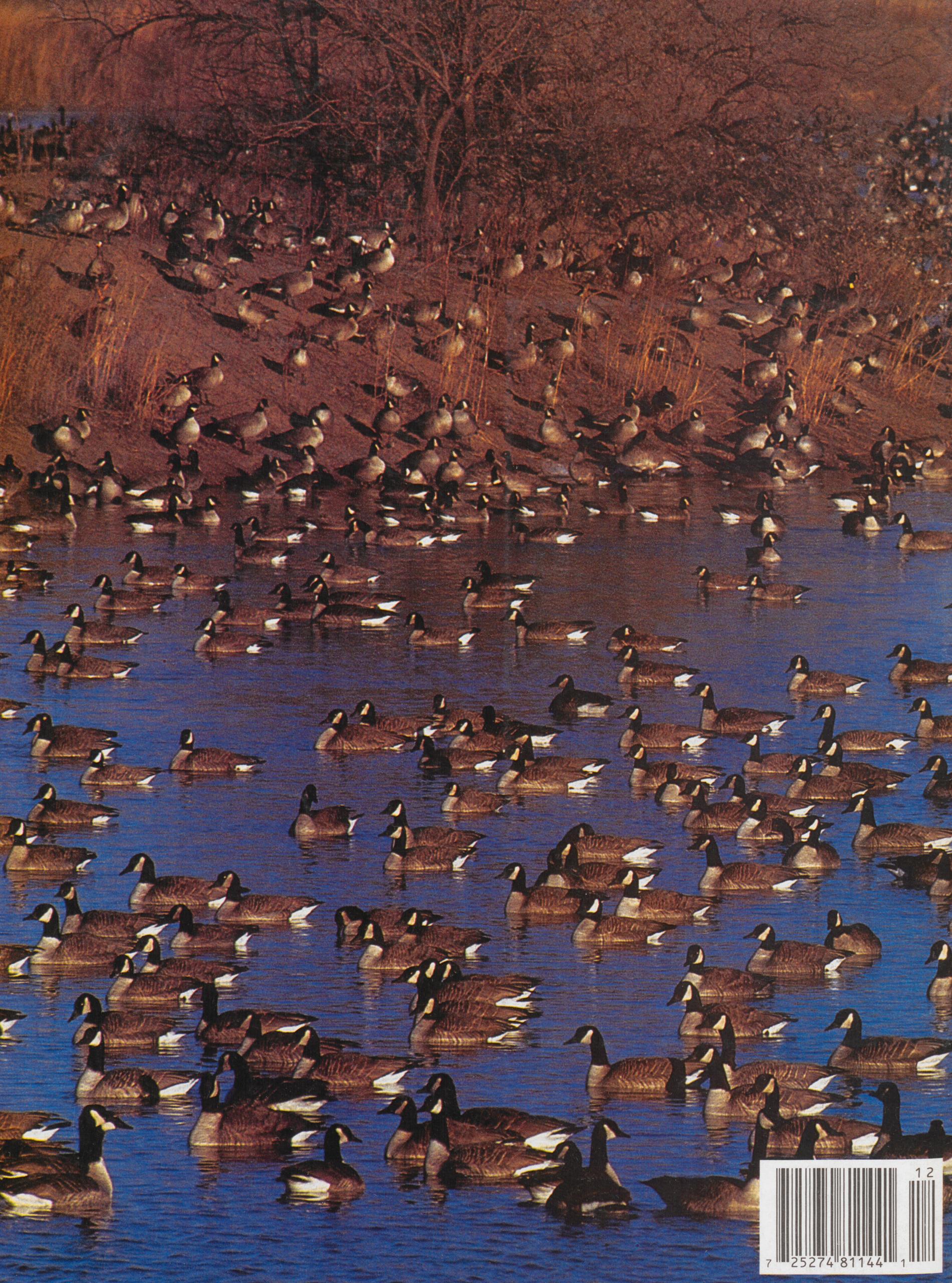
Position: 265 (31 views)