Volume 72, Issue 9, 1994
NEBRASKAland
JULY 1994 • $2.00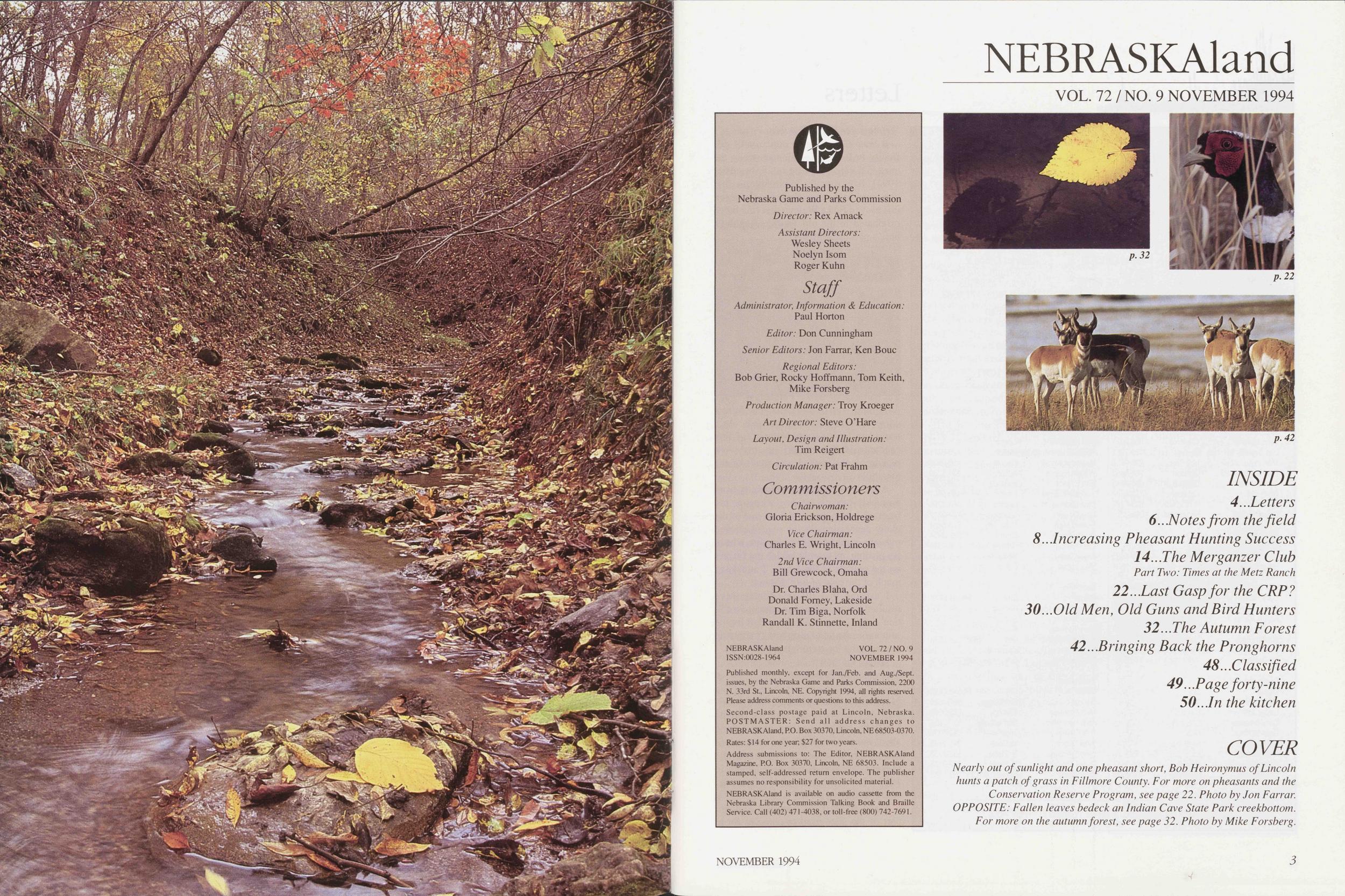
p. 32
p. 42
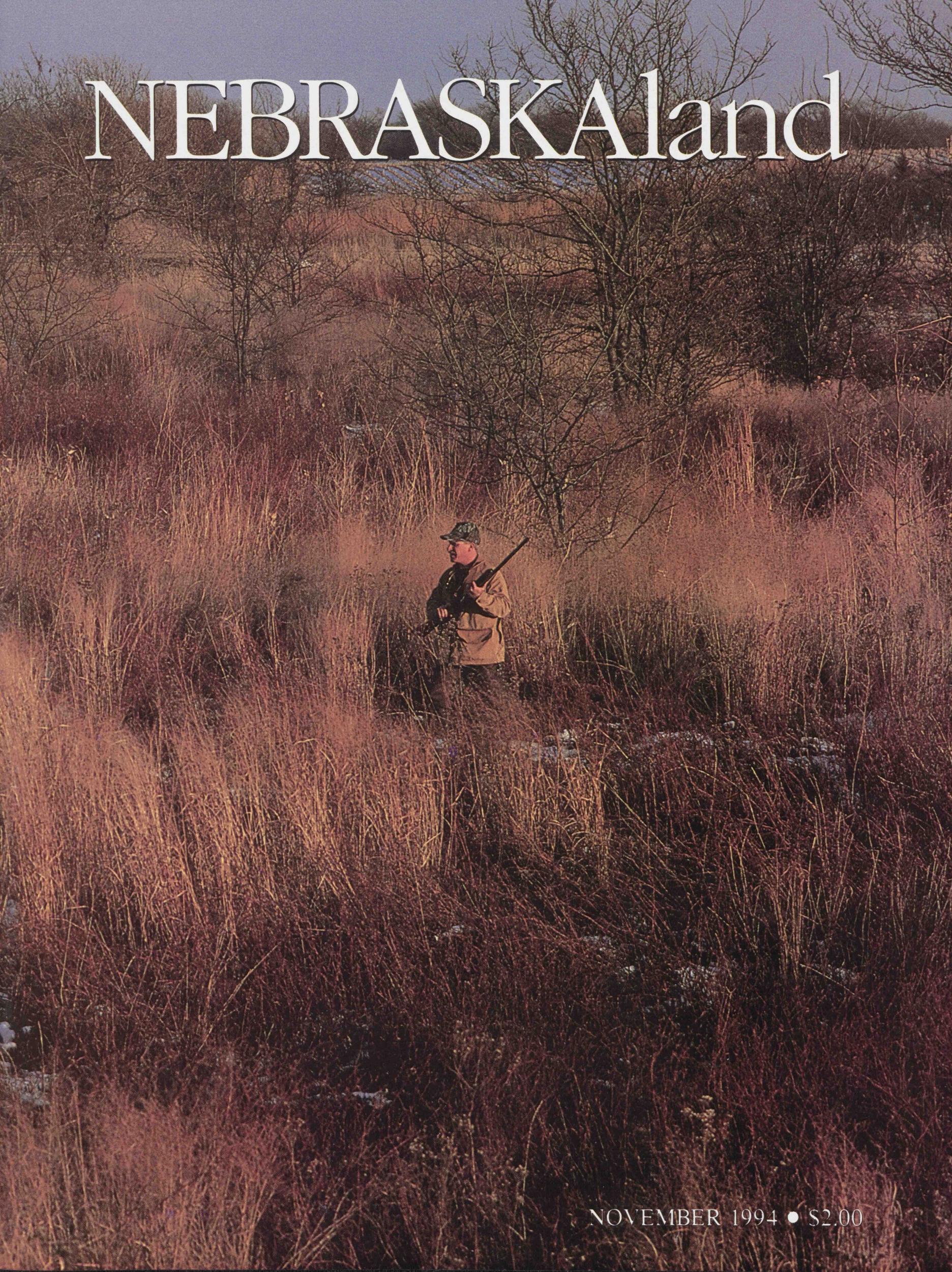
COVER Nearly out of sunlight and one pheasant short, Bob Heironymus of Lincoln hunts a patch of grass in Fillmore County. For more on pheasants and the Conservation Reserve Program, see page 22. Photo by Jon Farrar. OPPOSITE: Fallen leaves bedeck an Indian Cave State Park creekbottom. For more on the autumn forest, see page 32. Photo by Mike Forsberg.
Letters
Weimaraner Spells TroubleIt was interesting to notice your difficulty in locating a Wiemaraner in the area ["Letters," August-September 1994]. It is actually impossible to find one, even in the encyclopedia. However, it is easy to find a Weimaraner (the breed originated in the old Weimar Republic, now a part of Germany). Well, the temptation was too great to let this go unmentioned. However, we truly do look forward to NEBRASKAland month after month. We have subscribed continuously ever since moving to this state. We hope the magazine is around for many years to come.
Arthur C. Garwood Jr.Omaha, Nebraska The Farmer Wave
The subject of Mike Forsberg's "Page forty nine" in the June issue, the "farmer wave" has intrigued me for years. As a transplant from eastern Nebraska, I first encountered it while driving my work pickup on the rugged trail roads of the Sandhills. After my first thumb-wrenching from a quickly turning steering wheel as my front wheels re-emerged from one of the many depressions in the road, I created my own method of gripping the wheel. By placing my thumbs beside my fingers on the outside of the wheel, I alleviated much of the pain of trail driving. I assume that the one-finger wave resulted from a willing but reserved tradition — having only one finger left for the salutation, the other nine being caught up in managing the torturous wheel.
Dallas VirchowScottsbluff, Nebraska More on the Eastern Sandhills, Please
I have enjoyed your articles on the Sandhills, but I have never seen anything about the eastern Sandhills. I was raised near Swan Lake between Atkinson and O'Neill. My dad homesteaded there in 1910.1 have been back several times and enjoyed each visit. Many Nebraskans from the southern part of the state used to come to Swan
NEBRASKAlandLake to try their luck at hunting and fishing. Many times they would get stuck in the meadows, and my dad would have to hitch up a team of horses to pull them out.
Frank SmithMontrose, California Sign of the Times
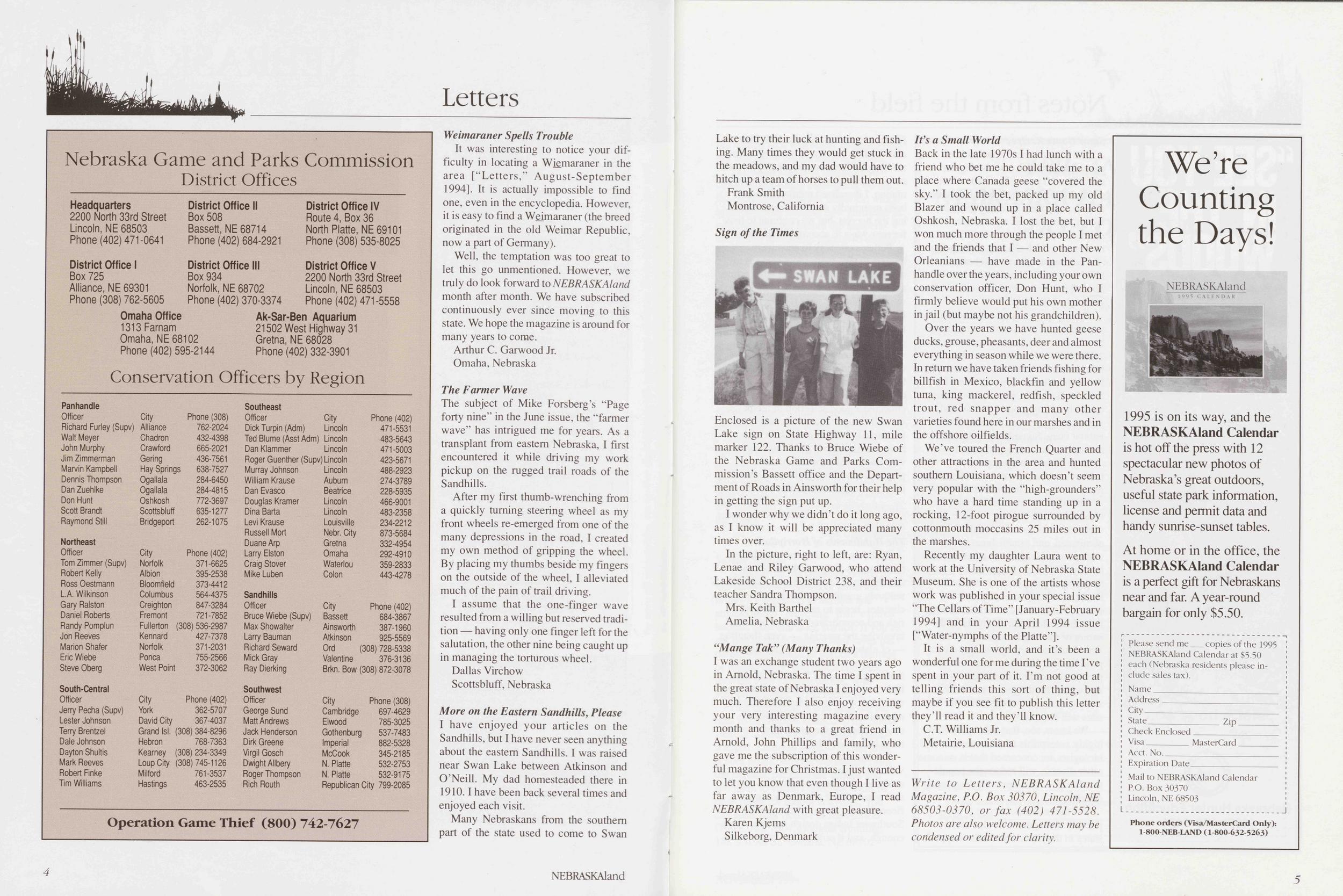
Enclosed is a picture of the new Swan Lake sign on State Highway 11, mile marker 122. Thanks to Bruce Wiebe of the Nebraska Game and Parks Com- mission's Bassett office and the Department of Roads in Ainsworth for their help in getting the sign put up.
I wonder why we didn't do it long ago, as I know it will be appreciated many times over.
In the picture, right to left, are: Ryan, Lenae and Riley Garwood, who attend Lakeside School District 238, and their teacher Sandra Thompson.
Mrs. Keith BarthelAmelia, Nebraska "Mange Tak" (Many Thanks)
I was an exchange student two years ago in Arnold, Nebraska. The time I spent in the great state of Nebraska I enjoyed very much. Therefore I also enjoy receiving your very interesting magazine every month and thanks to a great friend in Arnold, John Phillips and family, who gave me the subscription of this wonderful magazine for Christmas. I just wanted to let you know that even though I live as far away as Denmark, Europe, I read NEBRASKAland with great pleasure.
Karen KjemsSilkeborg, Denmark IPs a Small World
Back in the late 1970s I had lunch with a friend who bet me he could take me to a place where Canada geese "covered the sky." I took the bet, packed up my old Blazer and wound up in a place called Oshkosh, Nebraska. I lost the bet, but I won much more through the people I met and the friends that I — and other New Orleanians — have made in the Panhandle over the years, including your own conservation officer, Don Hunt, who I firmly believe would put his own mother in jail (but maybe not his grandchildren). Over the years we have hunted geese ducks, grouse, pheasants, deer and almost everything in season while we were there. In return we have taken friends fishing for billfish in Mexico, blackfin and yellow tuna, king mackerel, redfish, speckled trout, red snapper and many other varieties found here in our marshes and in the offshore oilfields.
We've toured the French Quarter and other attractions in the area and hunted southern Louisiana, which doesn't seem very popular with the "high-grounders" who have a hard time standing up in a rocking, 12-foot pirogue surrounded by cottonmouth moccasins 25 miles out in the marshes.
Recently my daughter Laura went to work at the University of Nebraska State Museum. She is one of the artists whose work was published in your special issue The Cellars of Time" [January-February 1994] and in your April 1994 issue ["Water-nymphs of the Platte"]. It is a small world, and it's been a wonderful one for me during the time I've spent in your part of it. I'm not good at telling friends this sort of thing, but maybe if you see fit to publish this letter they'll read it and they'll know.
C.T. Williams Jr.Metairie, Louisiana Write to Letters, NEBRASKAland Magazine, P.O. Bo.x 30370, Lincoln, NE 68503-0370, or fax (402) 471-5528. Photos are also welcome. Letters may be condensed or edited for clarity.
We're Counting the Days!
NEBRASKAland 1995 is on its way, and the NEBRASKAland Calendar is hot off the press with 12 spectacular new photos of Nebraska's great outdoors, useful state park information, license and permit data and handy sunrise-sunset tables. At home or in the office, the NEBRASKAland Calendar is a perfect gift for Nebraskans near and far. A year-round bargain for only $5.50. Please send me___copies of the 1995 NEBRASKAland Calendar at $5.50 each (Nebraska residents please in- clude sales tax). Name Address City State Check Enclosed Visa Zip MasterCard Acct. No. Expiration Date Mail to NEBRASKAland Calendar P.O. Box 30370 Lincoln, NE 68503 Phone orders (Visa/MasterCard Only): 1-800-NEB-LAND (1-800-632-5263) 5
Notes from the field
Snow Goose RecipesThe Midcontinent population of snow geese has been increasing for more than 20 years. The birds winter on the Gulf Coast of Texas and Louisiana after leaving their breeding grounds, which stretch across a broad area of the Arctic coast and Hudson Bay. Some of them stop in Nebraska on their spring and fall migrations, and Nebraska hunters, as well as biologists, have noticed the increasing numbers of these graceful white birds.
Counts in the winter indicate that the population includes more than two million birds — that's a two with six zeros: 2,000,000 — well above the objective level identified in the management plan for the population. Researchers who have studied snow goose populations on the breeding grounds for several years have expressed concern for the habitat there. Some believe the birds themselves are doing permanent damage to the breeding grounds habitat, and there is sound evidence that reproduction has suffered as a result.
The word "permanent" is used to characterize the damage because the vegetation has been essentially eliminated, and establishment of new vegetation, if it occurs at all, may take hundreds of years. It may be a bit hard for Nebraskans, used to fertile soils, abundant rainfall and long growing seasons, to conceive of habitat damage in such absolute terms, but that is the nature of the fragile vegetation of the Arctic tundra. Snow geese also are expanding their breeding range into areas previously used by small Canada geese and white-fronted geese, and there is some concern that competition for nest sites will increase.
We know, too, that snow geese are highly susceptible to avian cholera, and biologists are concerned that it, or some other disease, will reduce the population for us — perhaps with devastating effects.
For the moment, harvest is our primary management tool, and the states in the Central and Mississippi fly ways, working with the U.S. Fish and Wildlife Service, have adopted increasingly liberal hunting regulations to assist in reducing the snow goose population. Liberalized regulations have been marginally successful in increasing the harvest, but we continue to look for new ways to accomplish the task.
Perhaps one way to encourage hunters to take more snow geese is to make people more aware of what prime tablefare these birds can be. Therefore, we are requesting your recipes for cooking or preparing snow geese — the recipes that you have found keep people coming back for more. Please send your favorite snow goose recipes to: Snow Goose Recipes, NEBRASKAland Magazine, P.O. Box 30370, Lincoln, NE 68503. When we have collected a good selection of recipes, we will compile them and make them available to readers and others who have not tried snow goose hunting or who have tried it, but found their preparation techniques lacking. Watch for an announcement in this column.
P. Joe Gabig,Waterfowl Specialist The Habiliments of Horripilation
Probably it is compensation for a fundamental design problem. About this time every year humans, a species uniquely unsuited for life in cold climates, begin to exhibit a uniquely rich and complicated display behavior involving the wearing — even flaunting — of elaborate protective clothing. It begins with the arrival of ostentatious catalogs, the Protocols of the Elders of Raiment, profusely illustrated with photographs of idealized humans, adorned with the latest designs and colors, enacting the ritual display postures and smiling hugely.
We humans pore over these volumes, absorbing their revelations, re-evaluating our own accustomed motifs and wondering if a jacket lacking a fleece lining printed with a pseudo-Southwest Indian design is really warm enough, and if nine billion micro-pores
NEBRASKAlandper square inch will really keep our feet dry and allow perspiration to escape. The ritual nature of this attire becomes increasingly clear when we see the preliminary display behavior, which often involves wearing new garments in odd contexts and before the temperature really justifies it: minus-40-degree expedition pac boots for the perilous expedition between parking lot and church door, and goose-down parkas with fur-trimmed hoods over polyester-fleece sweaters over dog-and-pheasant-motif chamois shirts over military-weight polypropylene underwear for the hazardous journey to the ATM.
Vast scholarly studies and entire galleries in major museums are devoted to study of the history of such issues. Probably there are studies even about the contrarians whose pretensions run toward wool, canvas and leather. Perhaps it might be inferred that those of us who lean in that direction think the turn-of-the-century Sandhills duck-hunter look somehow confers an aura of age and wisdom. I don't know if it does, but I know we're cold a lot of the time.
Don Cunningham Saving StampsA note from the Omaha Council of the Telephone Pioneers of America brings a suggestion to hunters and anglers about "recycling" their expired habitat, trout and duck stamps. If you're not one of those hunters who saves old permits and stamps as part of a hunting or fishing diary, you might consider sending your expired permit, with stamps attached, to the Pioneers.
That organization will send the permits to the student council of the South Dakota School for the Visually Handicapped. Students there, working after school hours, remove the stamps from the permits, package the stamps and sell them to stamp collecting firms to raise funds for school activities. You can send your license to the Pioneer Office, Rm 1504, Douglas Building, 188 S. 19th St., Omaha, NE 68102.
18th ANNUAL NEBRASKA HABITAT STAMP ART CONTEST
SubmissionEntries may be protected by a covering but will not be accepted in frames, under glass or in plastic food wrap. Send to: Habitat Stamp Contest, Nebraska Game and Parks Commission, 2200 N. 33rd St. P.O. Box 30370, Lincoln, NE 68503. A completed entry form and reproduction agreement or facsimile must accompany the entry. The Game and Parks Commission is not responsible for any entry lost or damaged in transit. Entries will not be returned unless specifically requested and a self-addressed mailer with proper postage is included.
PrizesAdult division first place winner receives $200 from the Omaha Fish and Wildlife Club. Runners-up all receive subscriptions to NEBRASKAland Magazine. Youth division first place winners in each section receive $50 from the Omaha Fish and Wildlife Club. Runners-up all receive subscriptions to NEBRASKAland Magazine. Selected entries will be included in a traveling exhibit.
DivisionsAdult: Amateur or professional artists. Youth: Senior Section - Grades 9-12; Junior Section - Grades 5-8; Primary Section - Grades K-4.
Technical requirements:Design must be IVi inches by 41 V\e inches. It may be matted but mat may not exceed 10 inches by 7 inches. Any medium, color preferred. No scrollwork or lettering may appear on the design. One entry per person.
Subject matterAny Nebraska wildlife species in an appropriate habitat setting, except Canada goose, raccoon, fox squirrel, gray (Hungarian) partridge and pronghorn antelope.
Entry deadlineMarch 1, 1995 Contest is open to Nebraska residents only. Winning entry in the Adult Division will appear on the 1996 Nebraska Habitat Stamp.
ENTRY FORM Please accept my entry in the design contest for the 1996 Nebraska Habitat Stamp. I hereby certify that I have complied with all of the rules governing this competition and that the work submitted is my own original creation. Further, the Nebraska Game and Parks Commission is hereby authorized to reproduce the design on the 1996 Habitat Stamp or in any other fashion it may deem appropriate. Division/Section Title of Entry Name Grade in School Medium Age (if under 19) Name of Parent of Guardian Address City, State, Zip Home Phone School Phone Name of School School Address City, State, Zip Please return my entry. I have included the appropriate postage. Signature of Artist NOVEMBER 1994 7
Increasing Pheasant Hunting Success
Some hunters seem to bring home birds from nearly every hunt. Others have a tough time locating birds and getting them into the game pouch. The difference is often a matter of knowledge, technique and timing.If you are having a tough time locating pheasants and even more problems getting them into your game pouch, chances are you can increase your success simply by altering your hunting technique. The key is gaining a better understanding of the bird, adjusting your game plan so you can identify and hunt the cover it uses at the time it is there and learning to work the cover slower and more efficiently.
Most hunters actually pursue pheasants only a few hours a year, usually during the first two weekends of the season. Nebraska's pheasant season usually opens the first weekend in November and continues through the end of January, a period of about three months. That means a serious pheasant hunter who hunts throughout the entire season has plenty of opportunities to pursue roosters with little competition from other hunters.
Hunting later in the season can increase your chances of putting birds in the freezer. By mid-November most crops have been harvested, giving birds fewer places to hide and concentrating them in more easily recognizable pheasant-holding cover.
Some problems are early season problems and seldom affect hunters after the first week or two of the season. Many landowners are understandably reluctant to allow hunters on their land until harvest is finished. Others reserve their land for family and friends to hunt during the first few weeks of the season, but allow others access later in the year, so the chances of receiving permission to hunt private lands are better after the season is a few weeks old. Hunting pressure is even more intense on public lands, especially in eastern Nebraska, but even that pressure is substantially reduced by mid-November.
The masses of hunters who tromp through the fields in the first week of the season disrupt the pheasants' routine daily schedule, but after the onslaught of early activity wanes, the birds settle down and return to their normal routine. Hunters who take roosters every time they hunt understand the pheasant's daily movements. They hunt the cover the birds use during the time of day they are hunting.
An undisturbed pheasant begins its day in roosting cover. At first light it heads for a roadside or some other open area where it fills its crop with gravel or grit, then goes about the business of satisfying its appetite. In late morning
and early afternoon it moves to loafing cover to rest, dust and digest its morning meal, often making a stop at a nearby stream or pond for a quick drink enroute. In mid- to late afternoon it returns to the feeding area for its evening meal, then returns to the roost area at dusk.
That daily schedule is the key to consistent hunting success. You have to hunt the cover the birds are using at the time they are there, or all you are doing is taking a long walk with a shotgun in the crook of your arm. If you anticipate the birds' location, move quietly and deliberately, hunt an area thoroughly and make the shots when the birds flush, the chances are you will go home with the makings for a pheasant dinner every time you hunt.
Your attitude is also a factor in the pheasant hunting success equation. Hunting should be savored and enjoyed slowly, not approached like a competitive sport. If you want competition, run, play softball or shoot in a trap league. Leave your ego and competitive drive in the truck with your Thermos of coffee. Don't feel that you have to shoot a bird or get a limit. Relax, move slowly, enjoy being outdoors and it's a sure bet that when the rooster gets up in front of you, you'll shoot better and be more satisified with your performance.
Use your knowledge of the pheasant's daily movements when you plan your hunt. Start at legal shooting time — in Nebraska 30 minutes before sunrise — and hunt roost sites for about an hour. Fields or smaller areas of short to intermediate-height grasses, growths of relatively short weeds and wheat stubble fields are ideal roost sites. Pay close attention to wheat stubble. Many hunters ignore stubble fields, probably because they appear to be so barren it seems as if nothing could hide there, but stubble is prime pheasant roost cover. Wheat stubble fields can provide excellent hunting especially on overcast, chilly, wet days when
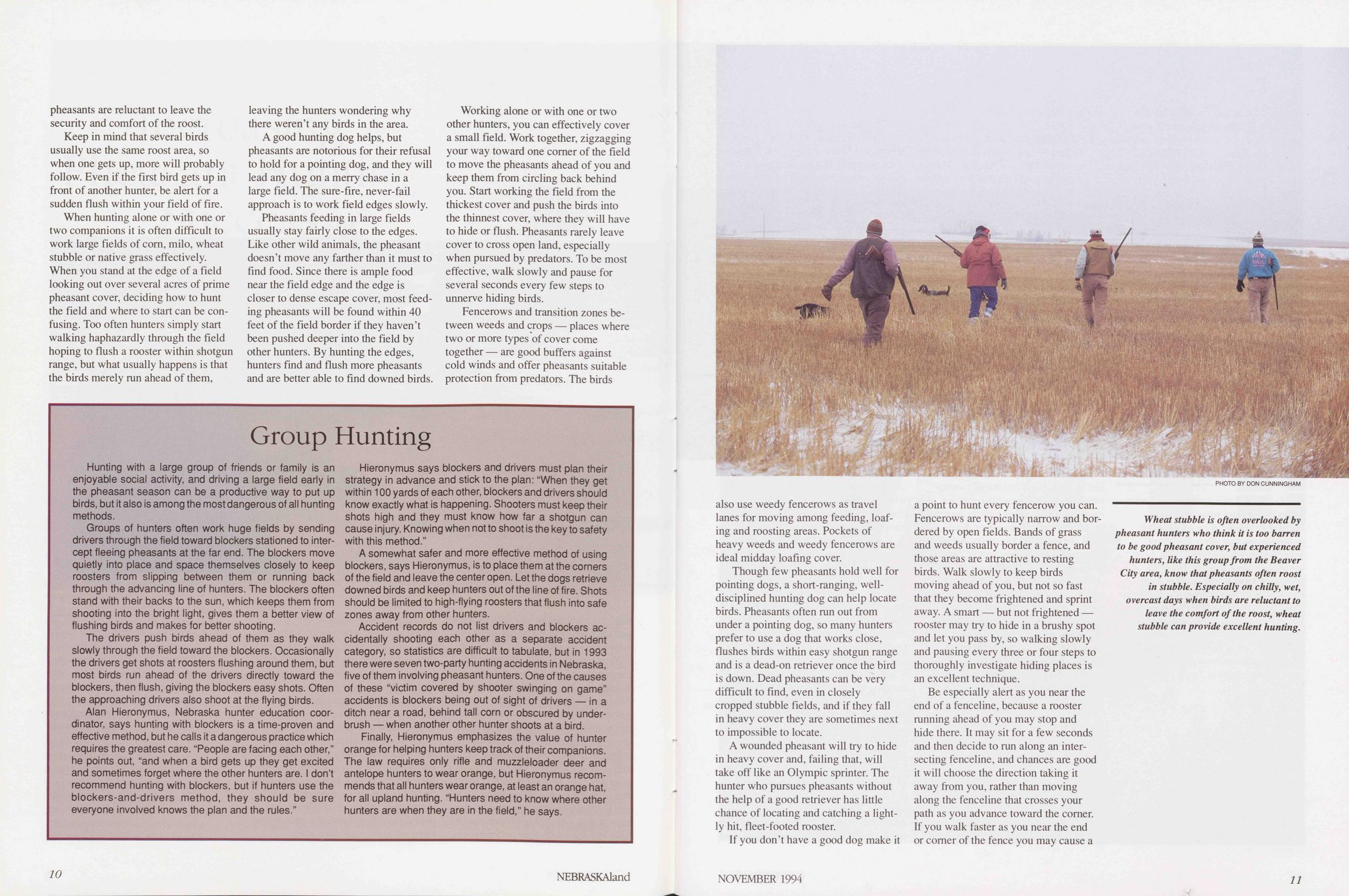
pheasants are reluctant to leave the security and comfort of the roost.
Keep in mind that several birds usually use the same roost area, so when one gets up, more will probably follow. Even if the first bird gets up in front of another hunter, be alert for a sudden flush within your field of fire.
When hunting alone or with one or two companions it is often difficult to work large fields of corn, milo, wheat stubble or native grass effectively. When you stand at the edge of a field looking out over several acres of prime pheasant cover, deciding how to hunt the field and where to start can be confusing. Too often hunters simply start walking haphazardly through the field hoping to flush a rooster within shotgun range, but what usually happens is that the birds merely run ahead of them, leaving the hunters wondering why there weren't any birds in the area.
A good hunting dog helps, but pheasants are notorious for their refusal to hold for a pointing dog, and they will lead any dog on a merry chase in a large field. The sure-fire, never-fail approach is to work field edges slowly.
Pheasants feeding in large fields usually stay fairly close to the edges. Like other wild animals, the pheasant doesn't move any farther than it must to find food. Since there is ample food near the field edge and the edge is closer to dense escape cover, most feeding pheasants will be found within 40 feet of the field border if they haven't been pushed deeper into the field by other hunters. By hunting the edges, hunters find and flush more pheasants and are better able to find downed birds.
Working alone or with one or two other hunters, you can effectively cover a small field. Work together, zigzagging your way toward one corner of the field to move the pheasants ahead of you and keep them from circling back behind you. Start working the field from the thickest cover and push the birds into the thinnest cover, where they will have to hide or flush. Pheasants rarely leave cover to cross open land, especially when pursued by predators. To be most effective, walk slowly and pause for several seconds every few steps to unnerve hiding birds.
Fencerows and transition zones between weeds and crops — places where two or more types of cover come together — are good buffers against cold winds and offer pheasants suitable protection from predators. The birds
Group HuntingHunting with a large group of friends or family is an enjoyable social activity, and driving a large field early in the pheasant season can be a productive way to put up birds, but it also is among the most dangerous of all hunting methods.
Groups of hunters often work huge fields by sending drivers through the field toward blockers stationed to intercept fleeing pheasants at the far end. The blockers move quietly into place and space themselves closely to keep roosters from slipping between them or running back through the advancing line of hunters. The blockers often stand with their backs to the sun, which keeps them from shooting into the bright light, gives them a better view of flushing birds and makes for better shooting.
The drivers push birds ahead of them as they walk slowly through the field toward the blockers. Occasionally the drivers get shots at roosters flushing around them, but most birds run ahead of the drivers directly toward the blockers, then flush, giving the blockers easy shots. Often the approaching drivers also shoot at the flying birds.
Alan Hieronymus, Nebraska hunter education coordinator, says hunting with blockers is a time-proven and effective method, but he calls it a dangerous practice which requires the greatest care. "People are facing each other," he points out, "and when a bird gets up they get excited and sometimes forget where the other hunters are. I don't recommend hunting with blockers, but if hunters use the blockers-and-drivers method, they should be sure everyone involved knows the plan and the rules."
Hieronymus says blockers and drivers must plan their strategy in advance and stick to the plan: "When they get within 100 yards of each other, blockers and drivers should know exactly what is happening. Shooters must keep their shots high and they must know how far a shotgun can cause injury. Knowing when not to shoot is the key to safety with this method."
A somewhat safer and more effective method of using blockers, says Hieronymus, is to place them at the corners of the field and leave the center open. Let the dogs retrieve downed birds and keep hunters out of the line of fire. Shots should be limited to high-flying roosters that flush into safe zones away from other hunters.
Accident records do not list drivers and blockers accidentally shooting each other as a separate accident category, so statistics are difficult to tabulate, but in 1993 there were seven two-party hunting accidents in Nebraska, five of them involving pheasant hunters. One of the causes of these "victim covered by shooter swinging on game" accidents is blockers being out of sight of drivers — in a ditch near a road, behind tall corn or obscured by under- brush — when another other hunter shoots at a bird.
Finally, Hieronymus emphasizes the value of hunter orange for helping hunters keep track of their companions. The law requires only rifle and muzzleloader deer and antelope hunters to wear orange, but Hieronymus recommends that all hunters wear orange, at least an orange hat, for all upland hunting. "Hunters need to know where other hunters are when they are in the field," he says.
10 NEBRASKAlandalso use weedy fencerows as travel lanes for moving among feeding, loafing and roosting areas. Pockets of heavy weeds and weedy fencerows are ideal midday loafing cover.
Though few pheasants hold well for pointing dogs, a short-ranging, well-disciplined hunting dog can help locate birds. Pheasants often run out from under a pointing dog, so many hunters prefer to use a dog that works close, flushes birds within easy shotgun range and is a dead-on retriever once the bird is down. Dead pheasants can be very difficult to find, even in closely cropped stubble fields, and if they fall in heavy cover they are sometimes next to impossible to locate.
A wounded pheasant will try to hide in heavy cover and, failing that, will take off like an Olympic sprinter. The hunter who pursues pheasants without the help of a good retriever has little chance of locating and catching a lightly hit, fleet-footed rooster.
If you don't have a good dog make it a point to hunt every fencerow you can. Fencerows are typically narrow and bordered by open fields. Bands of grass and weeds usually border a fence, and those areas are attractive to resting birds. Walk slowly to keep birds moving ahead of you, but not so fast that they become frightened and sprint away. A smart — but not frightened — rooster may try to hide in a brushy spot and let you pass by, so walking slowly and pausing every three or four steps to thoroughly investigate hiding places is an excellent technique.
Be especially alert as you near the end of a fenceline, because a rooster running ahead of you may stop and hide there. It may sit for a few seconds and then decide to run along an intersecting fenceline, and chances are good it will choose the direction taking it away from you, rather than moving along the fenceline that crosses your path as you advance toward the corner. If you walk faster as you near the end or comer of the fence you may cause a
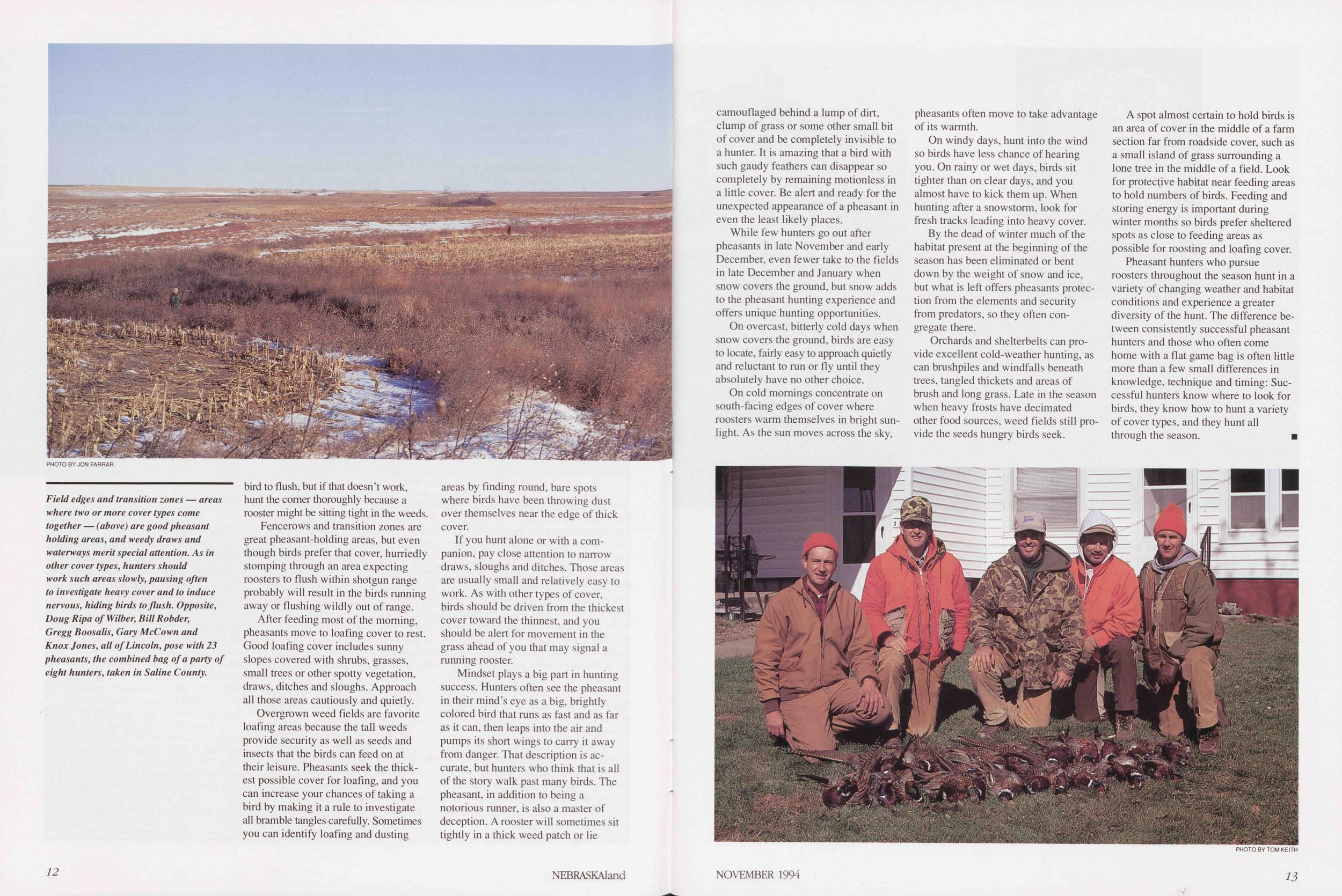
bird to flush, but if that doesn't work, hunt the comer thoroughly because a rooster might be sitting tight in the weeds.
Fencerows and transition zones are great pheasant-holding areas, but even though birds prefer that cover, hurriedly stomping through an area expecting roosters to flush within shotgun range probably will result in the birds running away or flushing wildly out of range.
After feeding most of the morning, pheasants move to loafing cover to rest. Good loafing cover includes sunny slopes covered with shrubs, grasses, small trees or other spotty vegetation, draws, ditches and sloughs. Approach all those areas cautiously and quietly.
Overgrown weed fields are favorite loafing areas because the tall weeds provide security as well as seeds and insects that the birds can feed on at their leisure. Pheasants seek the thickest possible cover for loafing, and you can increase your chances of taking a bird by making it a rule to investigate all bramble tangles carefully. Sometimes you can identify loafing and dusting areas by finding round, bare spots where birds have been throwing dust over themselves near the edge of thick cover.
If you hunt alone or with a companion, pay close attention to narrow draws, sloughs and ditches. Those areas are usually small and relatively easy to work. As with other types of cover, birds should be driven from the thickest cover toward the thinnest, and you should be alert for movement in the grass ahead of you that may signal a running rooster.
Mindset plays a big part in hunting success. Hunters often see the pheasant in their mind's eye as a big, brightly colored bird that runs as fast and as far as it can, then leaps into the air and pumps its short wings to carry it away from danger. That description is accurate, but hunters who think that is all of the story walk past many birds. The pheasant, in addition to being a notorious runner, is also a master of deception. A rooster will sometimes sit tightly in a thick weed patch or lie camouflaged behind a lump of dirt, clump of grass or some other small bit of cover and be completely invisible to a hunter. It is amazing that a bird with such gaudy feathers can disappear so completely by remaining motionless in a little cover. Be alert and ready for the unexpected appearance of a pheasant in even the least likely places.
While few hunters go out after pheasants in late November and early December, even fewer take to the fields in late December and January when snow covers the ground, but snow adds to the pheasant hunting experience and offers unique hunting opportunities. On overcast, bitterly cold days when snow covers the ground, birds are easy to locate, fairly easy to approach quietly and reluctant to run or fly until they absolutely have no other choice. On cold mornings concentrate on south-facing edges of cover where roosters warm themselves in bright sunlight. As the sun moves across the sky, pheasants often move to take advantage of its warmth.
On windy days, hunt into the wind so birds have less chance of hearing you. On rainy or wet days, birds sit tighter than on clear days, and you almost have to kick them up. When hunting after a snowstorm, look for fresh tracks leading into heavy cover. By the dead of winter much of the habitat present at the beginning of the season has been eliminated or bent down by the weight of snow and ice, but what is left offers pheasants protection from the elements and security from predators, so they often congregate there.
Orchards and shelterbelts can provide excellent cold-weather hunting, as can brushpiles and windfalls beneath trees, tangled thickets and areas of brush and long grass. Late in the season when heavy frosts have decimated other food sources, weed fields still provide the seeds hungry birds seek. A spot almost certain to hold birds is an area of cover in the middle of a farm section far from roadside cover, such as a small island of grass surrounding a lone tree in the middle of a field. Look for protective habitat near feeding areas to hold numbers of birds. Feeding and storing energy is important during winter months so birds prefer sheltered spots as close to feeding areas as possible for roosting and loafing cover.
Pheasant hunters who pursue roosters throughout the season hunt in a variety of changing weather and habitat conditions and experience a greater diversity of the hunt. The difference between consistently successful pheasant hunters and those who often come home with a flat game bag is often little more than a few small differences in knowledge, technique and timing: Successful hunters know where to look for birds, they know how to hunt a variety of cover types, and they hunt all through the season.
PHOTO BY TOM KEITH 12 NEBRASKAland NOVEMBER 1994 13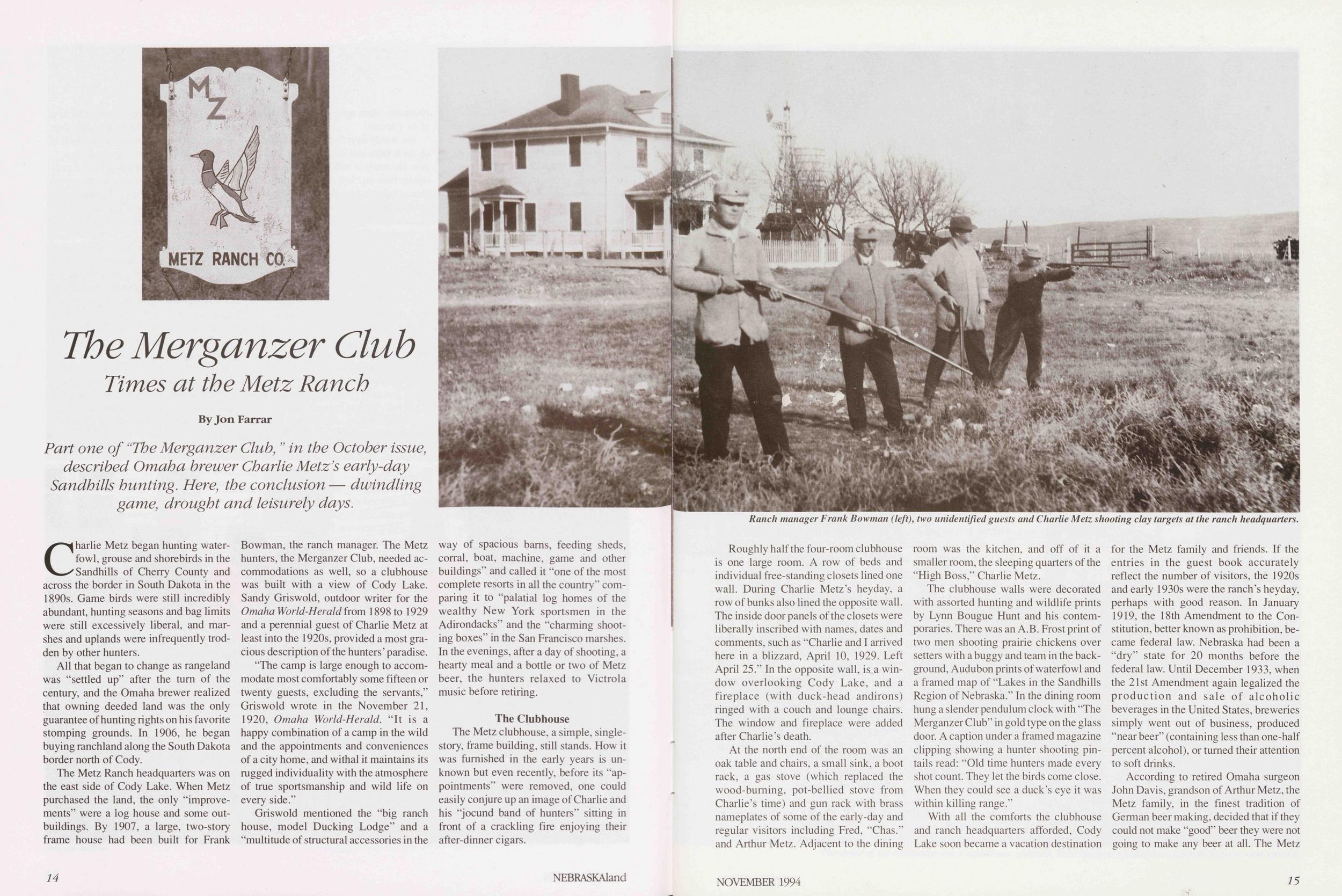
The Merganzer Club
Times at the Metz Ranch
Part one of "The Merganzer Club," in the October issue, described Omaha brewer Charlie Metz's early-day Sandhills hunting. Here, the conclusion — dwindling game, drought and leisurely days.Charlie Metz began hunting waterfowl, grouse and shorebirds in the Sandhills of Cherry County and across the border in South Dakota in the 1890s. Game birds were still incredibly abundant, hunting seasons and bag limits were still excessively liberal, and marshes and uplands were infrequently trodden by other hunters.
All that began to change as rangeland was "settled up" after the turn of the century, and the Omaha brewer realized that owning deeded land was the only guarantee of hunting rights on his favorite stomping grounds. In 1906, he began buying ranchland along the South Dakota border north of Cody.
The Metz Ranch headquarters was on the east side of Cody Lake. When Metz purchased the land, the only "improvements" were a log house and some out-buildings. By 1907, a large, two-story frame house had been built for Frank Bowman, the ranch manager. The Metz hunters, the Merganzer Club, needed accommodations as well, so a clubhouse was built with a view of Cody Lake. Sandy Griswold, outdoor writer for the Omaha World-HeraldTrom 1898 to 1929 and a perennial guest of Charlie Metz at least into the 1920s, provided a most gracious description of the hunters' paradise.
"The camp is large enough to accommodate most comfortably some fifteen or twenty guests, excluding the servants," Griswold wrote in the November 21, 1920, Omaha World-Herald. "It is a happy combination of a camp in the wild and the appointments and conveniences of a city home, and withal it maintains its rugged individuality with the atmosphere of true sportsmanship and wild life on every side."
Griswold mentioned the "big ranch house, model Ducking Lodge" and a "multitude of structural accessories in the way of spacious barns, feeding sheds, corral, boat, machine, game and other buildings" and called it "one of the most complete resorts in all the country" comparing it to "palatial log homes of the wealthy New York sportsmen in the Adirondacks" and the "charming shooting boxes" in the San Francisco marshes. In the evenings, after a day of shooting, a hearty meal and a bottle or two of Metz beer, the hunters relaxed to Victrola music before retiring.
The ClubhouseThe Metz clubhouse, a simple, single- story, frame building, still stands. How it was furnished in the early years is un- known but even recently, before its "ap- pointments" were removed, one could easily conjure up an image of Charlie and his "jocund band of hunters" sitting in front of a crackling fire enjoying their after-dinner cigars.
Ranch manager Frank Bowman (left), two unidentified guests and Charlie Metz shooting clay targets at the ranch headquarters.
Roughly half the four-room clubhouse is one large room. A row of beds and individual free-standing closets lined one wall. During Charlie Metz's heyday, a row of bunks also lined the opposite wall. The inside door panels of the closets were liberally inscribed with names, dates and comments, such as "Charlie and I arrived here in a blizzard, April 10, 1929. Left April 25." In the opposite wall, is a win- dow overlooking Cody Lake, and a fireplace (with duck-head andirons) ringed with a couch and lounge chairs. The window and fireplace were added after Charlie's death.
At the north end of the room was an oak table and chairs, a small sink, a boot rack, a gas stove (which replaced the wood-burning, pot-bellied stove from Charlie's time) and gun rack with brass nameplates of some of the early-day and regular visitors including Fred, "Chas." and Arthur Metz. Adjacent to the dining room was the kitchen, and off of it a smaller room, the sleeping quarters of the "High Boss," Charlie Metz.
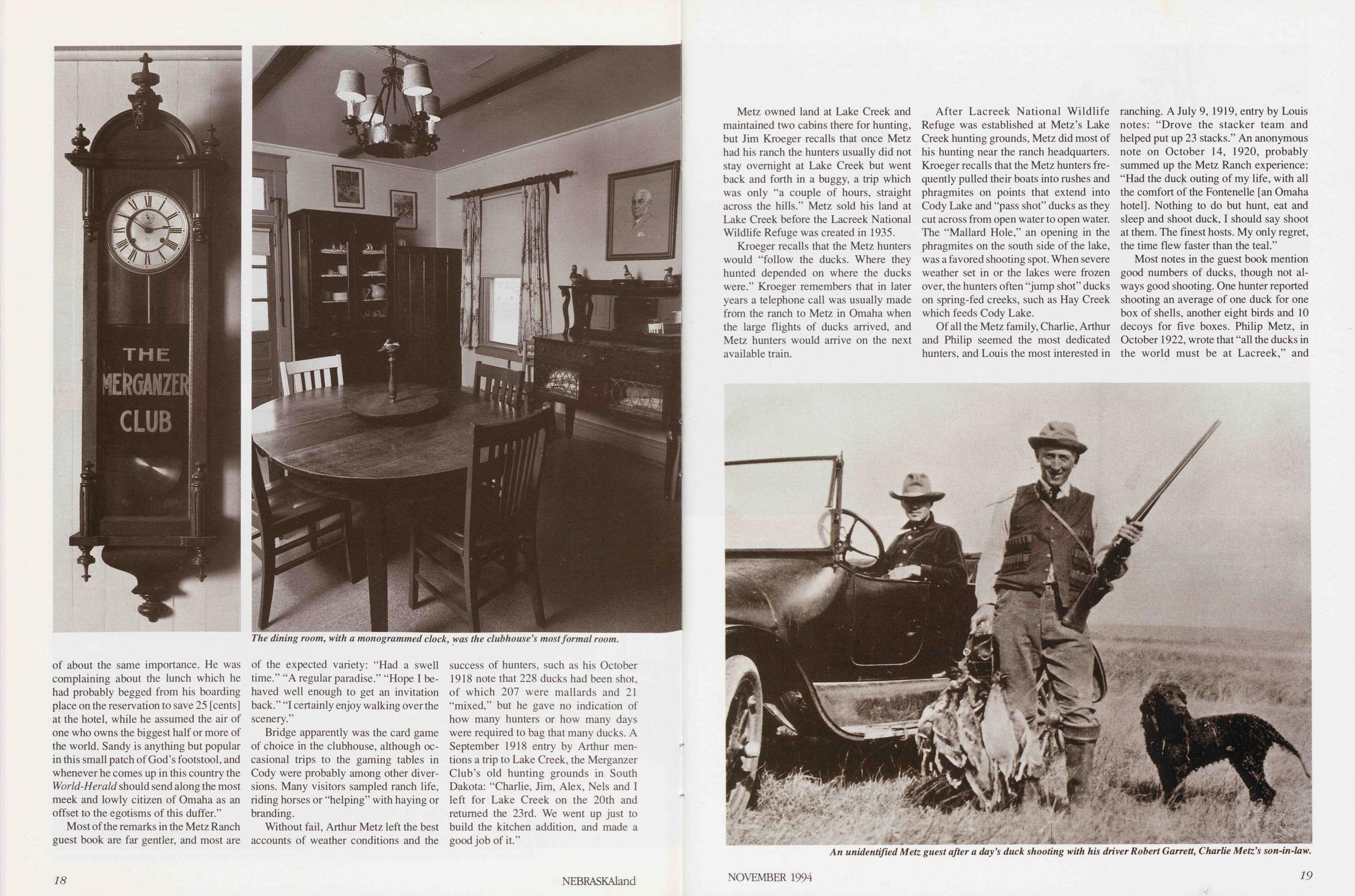
The clubhouse walls were decorated with assorted hunting and wildlife prints by Lynn Bougue Hunt and his contemporaries. There was an A.B. Frost print of two men shooting prairie chickens over setters with a buggy and team in the background, Audubon prints of waterfowl and a framed map of "Lakes in the Sandhills Region of Nebraska." In the dining room hung a slender pendulum clock with "The Merganzer Club" in gold type on the glass door. A caption under a framed magazine clipping showing a hunter shooting pintails read: "Old time hunters made every shot count. They let the birds come close. When they could see a duck's eye it was within killing range."
With all the comforts the clubhouse and ranch headquarters afforded, Cody Lake soon became a vacation destination for the Metz family and friends. If the entries in the guest book accurately reflect the number of visitors, the 1920s and early 1930s were the ranch's heyday, perhaps with good reason. In January 1919, the 18th Amendment to the Constitution, better known as prohibition, became federal law. Nebraska had been a "dry" state for 20 months before the federal law. Until December 1933, when the 21st Amendment again legalized the production and sale of alcoholic beverages in the United States, breweries simply went out of business, produced "near beer" (containing less than one-half percent alcohol), or turned their attention to soft drinks.
According to retired Omaha surgeon John Davis, grandson of Arthur Metz, the Metz family, in the finest tradition of German beer making, decided that if they could not make "good" beer they were not going to make any beer at all. The Metz
14 NEBRASKAland NOVEMBER 1994 15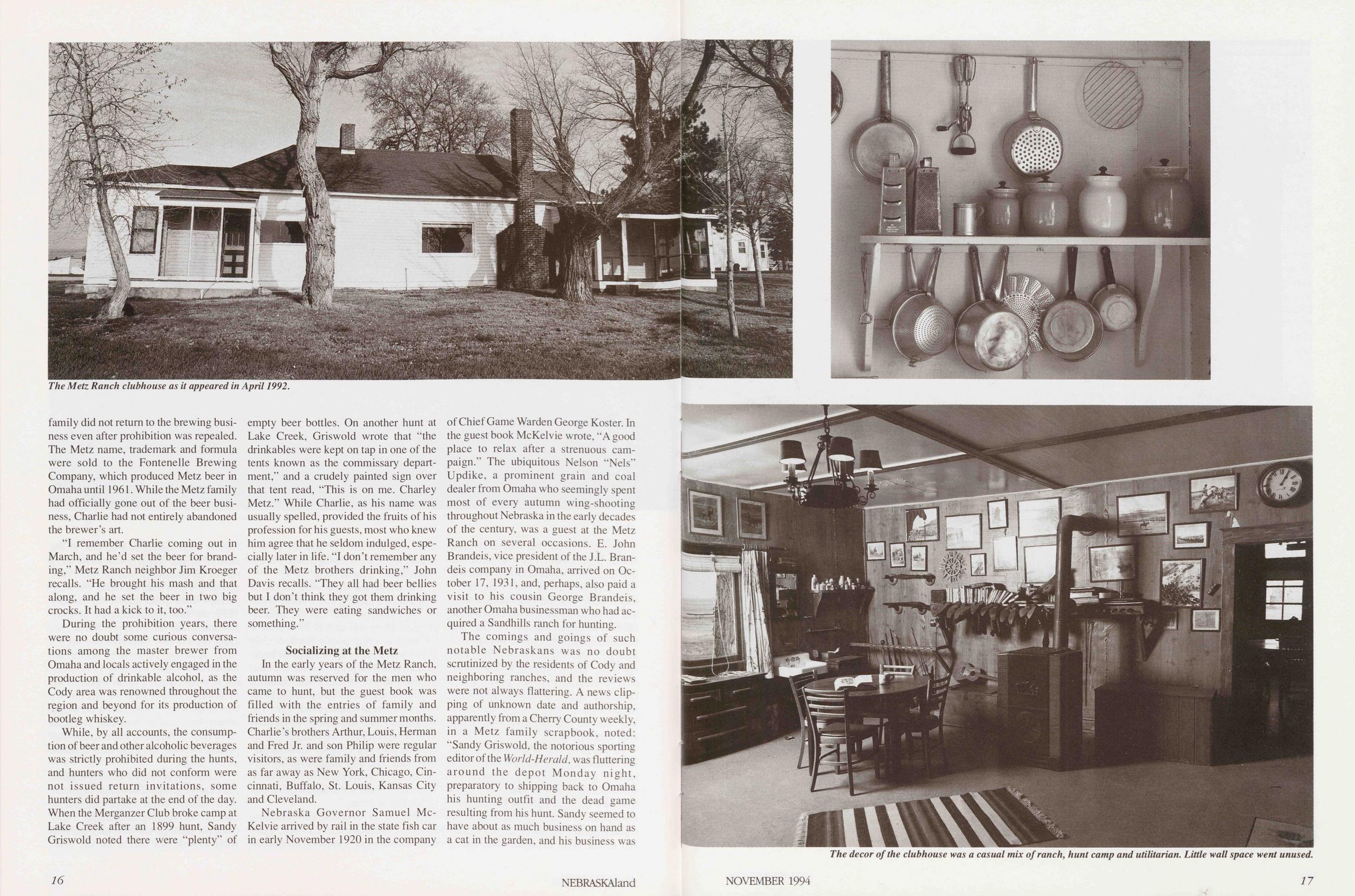
family did not return to the brewing business even after prohibition was repealed. The Metz name, trademark and formula were sold to the Fontenelle Brewing Company, which produced Metz beer in Omaha until 1961. While the Metz family had officially gone out of the beer business, Charlie had not entirely abandoned the brewer's art.
"I remember Charlie coming out in March, and he'd set the beer for branding," Metz Ranch neighbor Jim Kroeger recalls. "He brought his mash and that along, and he set the beer in two big crocks. It had a kick to it, too."
During the prohibition years, there were no doubt some curious conversations among the master brewer from Omaha and locals actively engaged in the production of drinkable alcohol, as the Cody area was renowned throughout the region and beyond for its production of bootleg whiskey.
While, by all accounts, the consumption of beer and other alcoholic beverages was strictly prohibited during the hunts, and hunters who did not conform were not issued return invitations, some hunters did partake at the end of the day. When the Merganzer Club broke camp at Lake Creek after an 1899 hunt, Sandy Griswold noted there were "plenty" of empty beer bottles. On another hunt at Lake Creek, Griswold wrote that "the drinkables were kept on tap in one of the tents known as the commissary department," and a crudely painted sign over that tent read, "This is on me. Charley Metz." While Charlie, as his name was usually spelled, provided the fruits of his profession for his guests, most who knew him agree that he seldom indulged, especially later in life. "I don't remember any of the Metz brothers drinking," John Davis recalls. "They all had beer bellies but I don't think they got them drinking beer. They were eating sandwiches or something."
Socializing at the MetzIn the early years of the Metz Ranch, autumn was reserved for the men who came to hunt, but the guest book was filled with the entries of family and friends in the spring and summer months. Charlie's brothers Arthur, Louis, Herman and Fred Jr. and son Philip were regular visitors, as were family and friends from as far away as New York, Chicago, Cincinnati, Buffalo, St. Louis, Kansas City and Cleveland.
Nebraska Governor Samuel McKelvie arrived by rail in the state fish car in early November 1920 in the company of Chief Game Warden George Koster. In the guest book McKelvie wrote, "A good place to relax after a strenuous campaign." The ubiquitous Nelson "Nels" Updike, a prominent grain and coal dealer from Omaha who seemingly spent most of every autumn wing-shooting throughout Nebraska in the early decades of the century, was a guest at the Metz Ranch on several occasions. E. John Brandeis, vice president of the J.L. Brandeis company in Omaha, arrived on October 17, 1931, and, perhaps, also paid a visit to his cousin George Brandeis, another Omaha businessman who had acquired a Sandhills ranch for hunting.
The comings and goings of such notable Nebraskans was no doubt scrutinized by the residents of Cody and neighboring ranches, and the reviews were not always flattering. A news clipping of unknown date and authorship, apparently from a Cherry County weekly, in a Metz family scrapbook, noted: "Sandy Griswold, the notorious sporting editor of the World-Herald, was fluttering around the depot Monday night, preparatory to shipping back to Omaha his hunting outfit and the dead game resulting from his hunt. Sandy seemed to have about as much business on hand as a cat in the garden, and his business was
of about the same importance. He was complaining about the lunch which he had probably begged from his boarding place on the reservation to save 25 [cents] at the hotel, while he assumed the air of one who owns the biggest half or more of the world. Sandy is anything but popular in this small patch of God's footstool, and whenever he comes up in this country the World-Herald should send along the most meek and lowly citizen of Omaha as an offset to the egotisms of this duffer."
Most of the remarks in the Metz Ranch guest book are far gentler, and most are of the expected variety: "Had a swell time." "A regular paradise." "Hope I behaved well enough to get an invitation back." "I certainly enjoy walking over the scenery."
Bridge apparently was the card game of choice in the clubhouse, although occasional trips to the gaming tables in Cody were probably among other diver- sions. Many visitors sampled ranch life, riding horses or "helping" with haying or branding.
Without fail, Arthur Metz left the best accounts of weather conditions and the success of hunters, such as his October 1918 note that 228 ducks had been shot, of which 207 were mallards and 21 "mixed," but he gave no indication of how many hunters or how many days were required to bag that many ducks. A September 1918 entry by Arthur mentions a trip to Lake Creek, the Merganzer Club's old hunting grounds in South Dakota: "Charlie, Jim, Alex, Nels and I left for Lake Creek on the 20th and returned the 23rd. We went up just to build the kitchen addition, and made a good job of it."
18NEBRASKAlandMetz owned land at Lake Creek and maintained two cabins there for hunting, but Jim Kroeger recalls that once Metz had his ranch the hunters usually did not stay overnight at Lake Creek but went back and forth in a buggy, a trip which was only "a couple of hours, straight across the hills." Metz sold his land at Lake Creek before the Lacreek National Wildlife Refuge was created in 1935.
Kroeger recalls that the Metz hunters would "follow the ducks. Where they hunted depended on where the ducks were." Kroeger remembers that in later years a telephone call was usually made from the ranch to Metz in Omaha when the large flights of ducks arrived, and Metz hunters would arrive on the next available train.
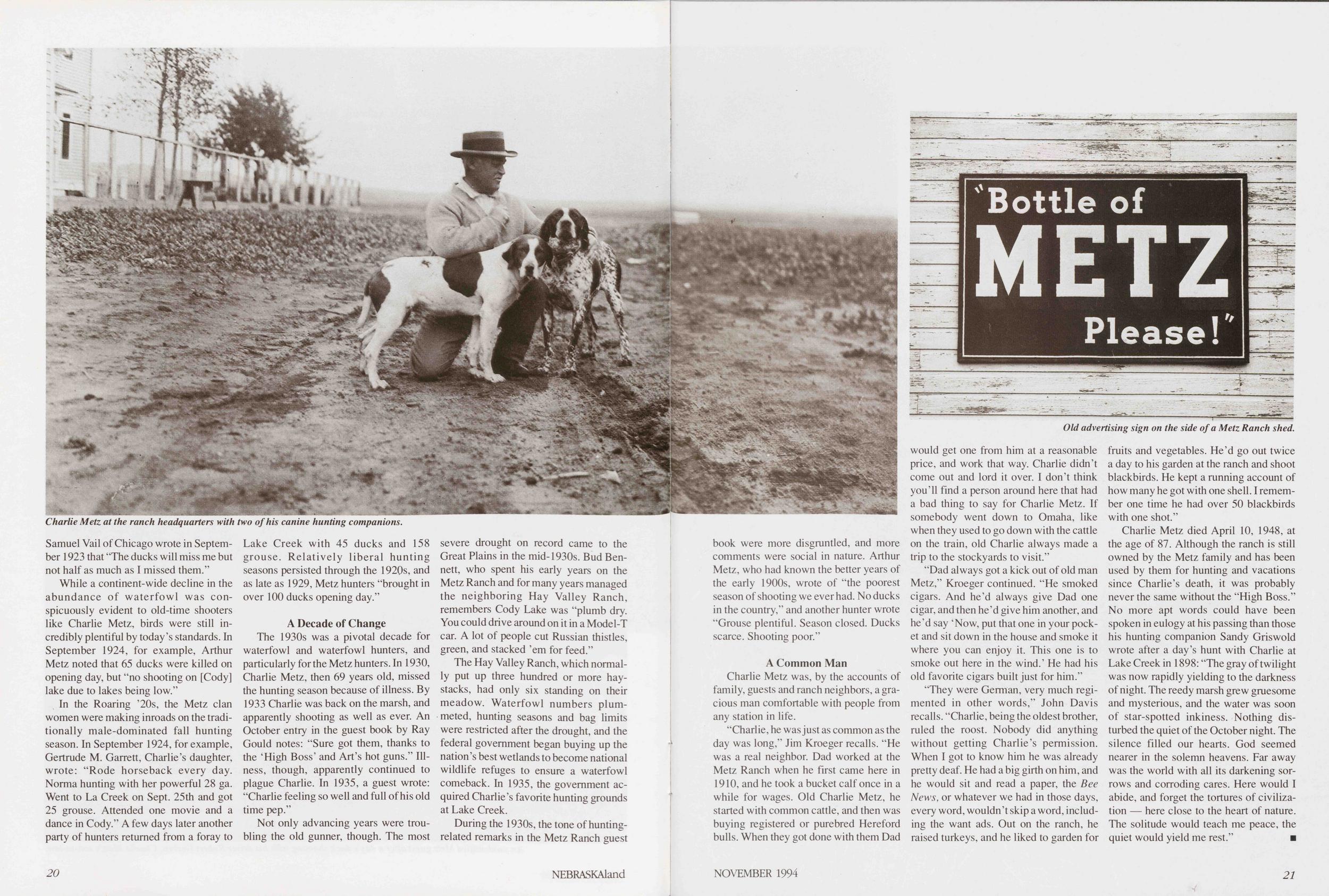
After Lacreek National Wildlife Refuge was established at Metz's Lake Creek hunting grounds, Metz did most of his hunting near the ranch headquarters. Kroeger recalls that the Metz hunters frequently pulled their boats into rushes and phragmites on points that extend into Cody Lake and "pass shot" ducks as they cut across from open water to open water. The "Mallard Hole," an opening in the phragmites on the south side of the lake, was a favored shooting spot. When severe weather set in or the lakes were frozen over, the hunters often "jump shot" ducks on spring-fed creeks, such as Hay Creek which feeds Cody Lake.
Of all the Metz family, Charlie, Arthur and Philip seemed the most dedicated hunters, and Louis the most interested in ranching. A July 9, 1919, entry by Louis notes: "Drove the stacker team and helped put up 23 stacks." An anonymous note on October 14, 1920, probably summed up the Metz Ranch experience: "Had the duck outing of my life, with all the comfort of the Fontenelle [an Omaha hotel]. Nothing to do but hunt, eat and sleep and shoot duck, I should say shoot at them. The finest hosts. My only regret, the time flew faster than the teal."
Most notes in the guest book mention good numbers of ducks, though not always good shooting. One hunter reported shooting an average of one duck for one box of shells, another eight birds and 10 decoys for five boxes. Philip Metz, in October 1922, wrote that "all the ducks in the world must be at Lacreek," and
Samuel Vail of Chicago wrote in September 1923 that "The ducks will miss me but not half as much as I missed them."
While a continent-wide decline in the abundance of waterfowl was conspicuously evident to old-time shooters like Charlie Metz, birds were still incredibly plentiful by today's standards. In September 1924, for example, Arthur Metz noted that 65 ducks were killed on opening day, but "no shooting on [Cody] lake due to lakes being low."
In the Roaring '20s, the Metz clan women were making inroads on the traditionally male-dominated fall hunting season. In September 1924, for example, Gertrude M. Garrett, Charlie's daughter, wrote: "Rode horseback every day. Norma hunting with her powerful 28 ga. Went to La Creek on Sept. 25th and got 25 grouse. Attended one movie and a dance in Cody." A few days later another party of hunters returned from a foray to
20Lake Creek with 45 ducks and 158 grouse. Relatively liberal hunting seasons persisted through the 1920s, and as late as 1929, Metz hunters "brought in over 100 ducks opening day."
A Decade of ChangeThe 1930s was a pivotal decade for waterfowl and waterfowl hunters, and particularly for the Metz hunters. In 1930, Charlie Metz, then 69 years old, missed the hunting season because of illness. By 1933 Charlie was back on the marsh, and apparently shooting as well as ever. An October entry in the guest book by Ray Gould notes: "Sure got them, thanks to the 'High Boss' and Art's hot guns." Ill- ness, though, apparently continued to plague Charlie. In 1935, a guest wrote: "Charlie feeling so well and full of his old time pep."
Not only advancing years were troubling the old gunner, though. The most severe drought on record came to the Great Plains in the mid-1930s. Bud Bennett, who spent his early years on the Metz Ranch and for many years managed the neighboring Hay Valley Ranch, remembers Cody Lake was "plumb dry. You could drive around on it in a Model-T car. A lot of people cut Russian thistles, green, and stacked 'em for feed."
The Hay Valley Ranch, which normally put up three hundred or more haystacks, had only six standing on their meadow. Waterfowl numbers plummeted, hunting seasons and bag limits were restricted after the drought, and the federal government began buying up the nation's best wetlands to become national wildlife refuges to ensure a waterfowl comeback. In 1935, the government acquired Charlie's favorite hunting grounds at Lake Creek.
During the 1930s, the tone of hunting- related remarks in the Metz Ranch guest
NEBRASKAlandbook were more disgruntled, and more comments were social in nature. Arthur Metz, who had known the better years of the early 1900s, wrote of "the poorest season of shooting we ever had. No ducks in the country," and another hunter wrote "Grouse plentiful. Season closed. Ducks scarce. Shooting poor."
A Common ManCharlie Metz was, by the accounts of family, guests and ranch neighbors, a gra- cious man comfortable with people from any station in life.
"Charlie, he was just as common as the day was long," Jim Kroeger recalls. "He was a real neighbor. Dad worked at the Metz Ranch when he first came here in 1910, and he took a bucket calf once in a while for wages. Old Charlie Metz, he started with common cattle, and then was buying registered or purebred Hereford bulls. When they got done with them Dad
would get one from him at a reasonable price, and work that way. Charlie didn't come out and lord it over. I don't think you'll find a person around here that had a bad thing to say for Charlie Metz. If somebody went down to Omaha, like when they used to go down with the cattle on the train, old Charlie always made a trip to the stockyards to visit."
"Dad always got a kick out of old man Metz," Kroeger continued. "He smoked cigars. And he'd always give Dad one cigar, and then he'd give him another, and he'd say 'Now, put that one in your pocket and sit down in the house and smoke it where you can enjoy it. This one is to smoke out here in the wind.' He had his old favorite cigars built just for him."
"They were German, very much regimented in other words," John Davis recalls. "Charlie, being the oldest brother, ruled the roost. Nobody did anything without getting Charlie's permission. When I got to know him he was already pretty deaf. He had a big girth on him, and he would sit and read a paper, the Bee News, or whatever we had in those days, every word, wouldn't skip a word, including the want ads. Out on the ranch, he raised turkeys, and he liked to garden for fruits and vegetables. He'd go out twice a day to his garden at the ranch and shoot blackbirds. He kept a running account of how many he got with one shell. I remember one time he had over 50 blackbirds with one shot."
Charlie Metz died April 10, 1948, at the age of 87. Although the ranch is still owned by the Metz family and has been used by them for hunting and vacations since Charlie's death, it was probably never the same without the "High Boss." No more apt words could have been spoken in eulogy at his passing than those his hunting companion Sandy Griswold wrote after a day's hunt with Charlie at Lake Creek in 1898: "The gray of twilight was now rapidly yielding to the darkness of night. The reedy marsh grew gruesome and mysterious, and the water was soon of star-spotted inkiness. Nothing disturbed the quiet of the October night. The silence filled our hearts. God seemed nearer in the solemn heavens. Far away was the world with all its darkening sorrows and corroding cares. Here would I abide, and forget the tortures of civilization — here close to the heart of nature. The solitude would teach me peace, the quiet would yield me rest."
NOVEMBER 199421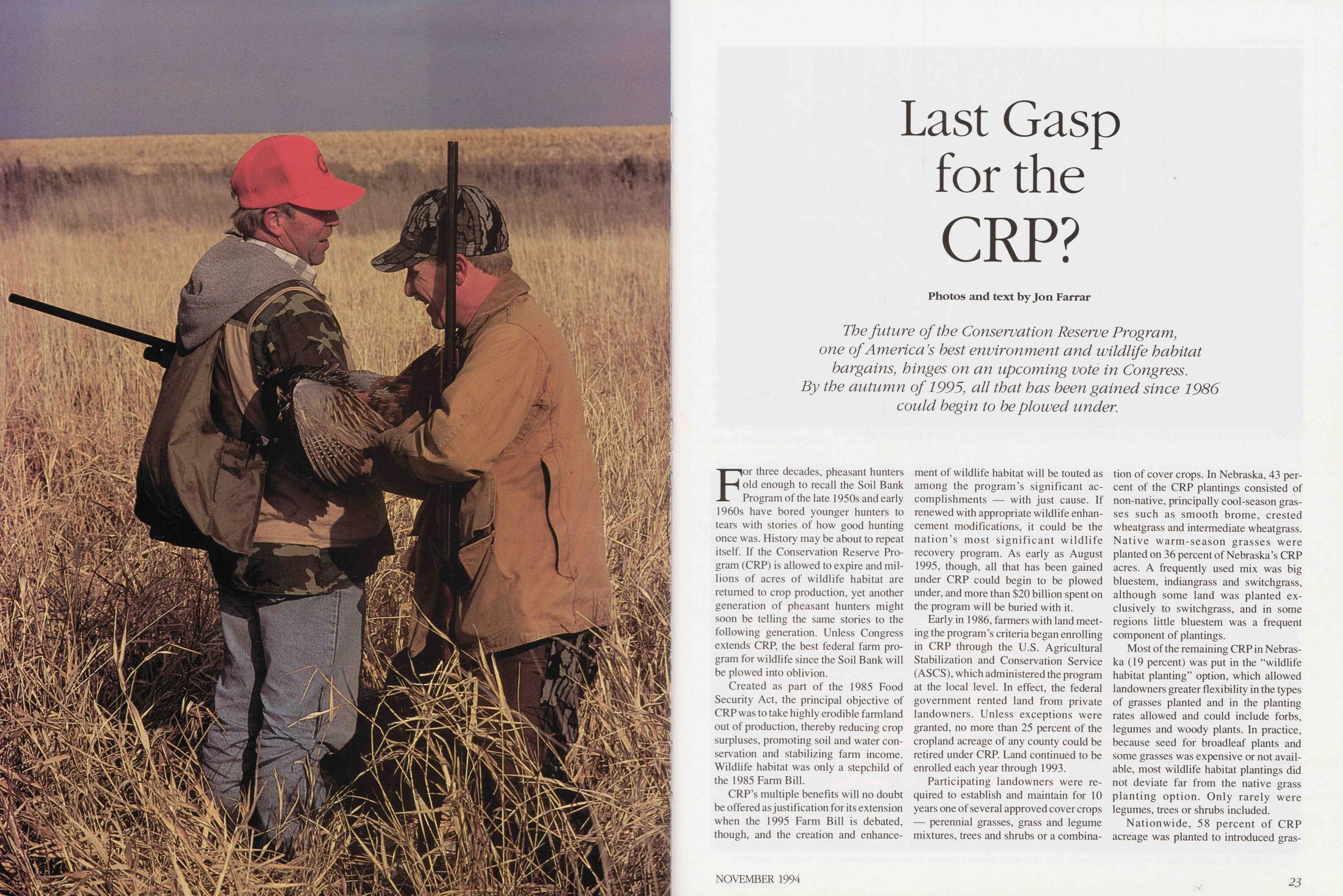
Last Gasp for the CRP?
The future of the Conservation Reserve Program, one of America's best environment and wildlife habitat bargains, hinges on an upcoming vote in Congress. By the autumn of 1995, all that has been gained since 1986 could begin to be plowed under.For three decades, pheasant hunters old enough to recall the Soil Bank Program of the late 1950s and early 1960s have bored younger hunters to tears with stories of how good hunting once was. History may be about to repeat itself. If the Conservation Reserve Program (CRP) is allowed to expire and millions of acres of wildlife habitat are returned to crop production, yet another generation of pheasant hunters might soon be telling the same stories to the following generation. Unless Congress extends CRP, the best federal farm program for wildlife since the Soil Bank will be plowed into oblivion.
Created as part of the 1985 Food Security Act, the principal objective of CRP was to take highly erodible farmland out of production, thereby reducing crop surpluses, promoting soil and water conservation and stabilizing farm income. Wildlife habitat was only a stepchild of the 1985 Farm Bill.
CRP's multiple benefits will no doubt be offered as justification for its extension when the 1995 Farm Bill is debated, though, and the creation and enhancement of wildlife habitat will be touted as among the program's significant ac- complishments — with just cause. If renewed with appropriate wildlife enhancement modifications, it could be the nation's most significant wildlife recovery program. As early as August 1995, though, all that has been gained under CRP could begin to be plowed under, and more than $20 billion spent on the program will be buried with it. Early in 1986, farmers with land meeting the program's criteria began enrolling in CRP through the U.S. Agricultural Stabilization and Conservation Service (ASCS), which administered the program at the local level. In effect, the federal government rented land from private landowners. Unless exceptions were granted, no more than 25 percent of the cropland acreage of any county could be retired under CRP. Land continued to be enrolled each year through 1993.
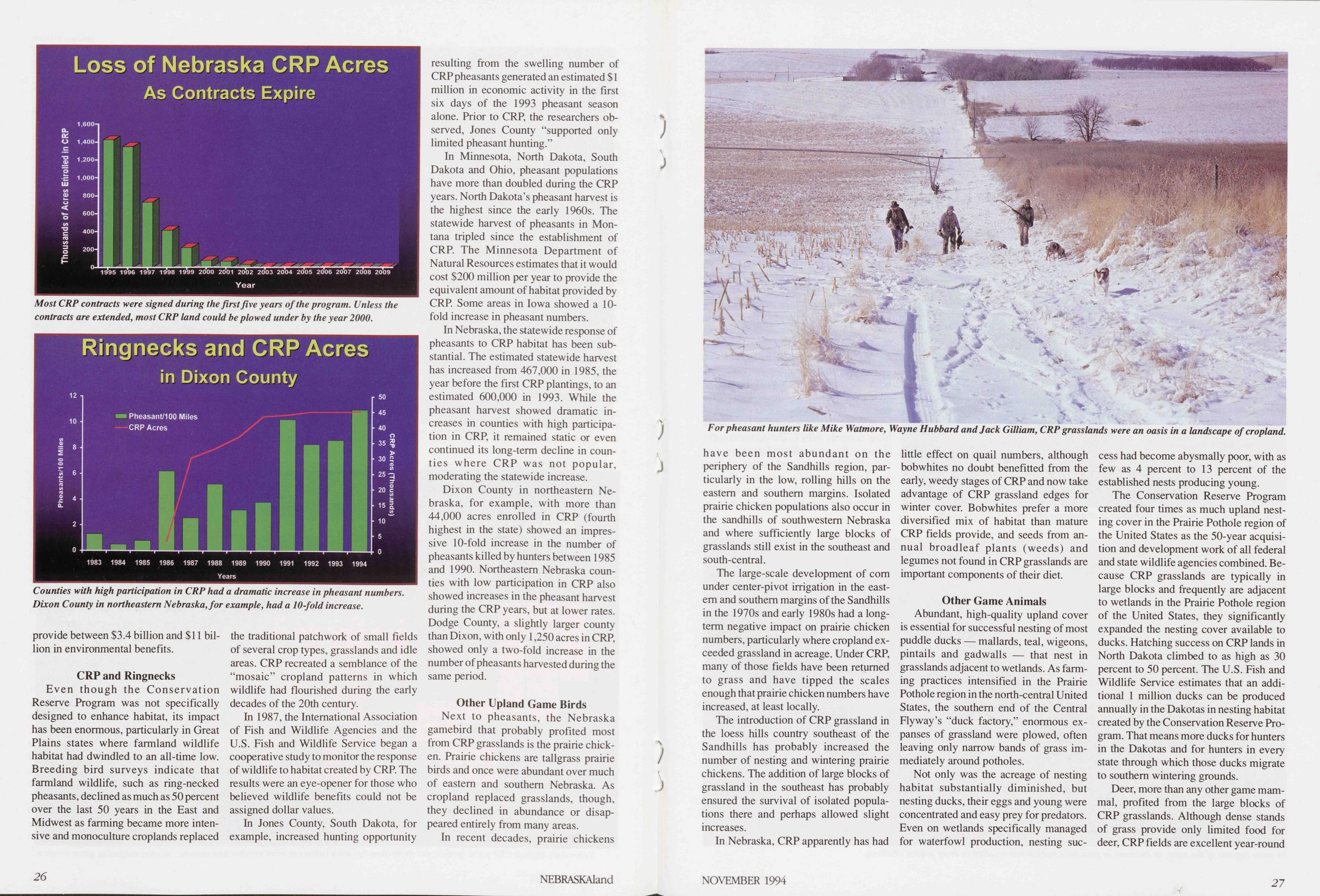
Participating landowners were required to establish and maintain for 10 years one of several approved cover crops — perennial grasses, grass and legume mixtures, trees and shrubs or a combination of cover crops. In Nebraska, 43 percent of the CRP plantings consisted of non-native, principally cool-season grasses such as smooth brome, crested wheatgrass and intermediate wheatgrass. Native warm-season grasses were planted on 36 percent of Nebraska's CRP acres. A frequently used mix was big bluestem, indiangrass and switchgrass, although some land was planted exclusively to switchgrass, and in some regions little bluestem was a frequent component of plantings.
Most of the remaining CRP in Nebraska (19 percent) was put in the "wildlife habitat planting" option, which allowed landowners greater flexibility in the types of grasses planted and in the planting rates allowed and could include forbs, legumes and woody plants. In practice, because seed for broadleaf plants and some grasses was expensive or not available, most wildlife habitat plantings did not deviate far from the native grass planting option. Only rarely were legumes, trees or shrubs included.
Nationwide, 58 percent of CRP acreage was planted to introduced grasses,
NOVEMBER 1994 23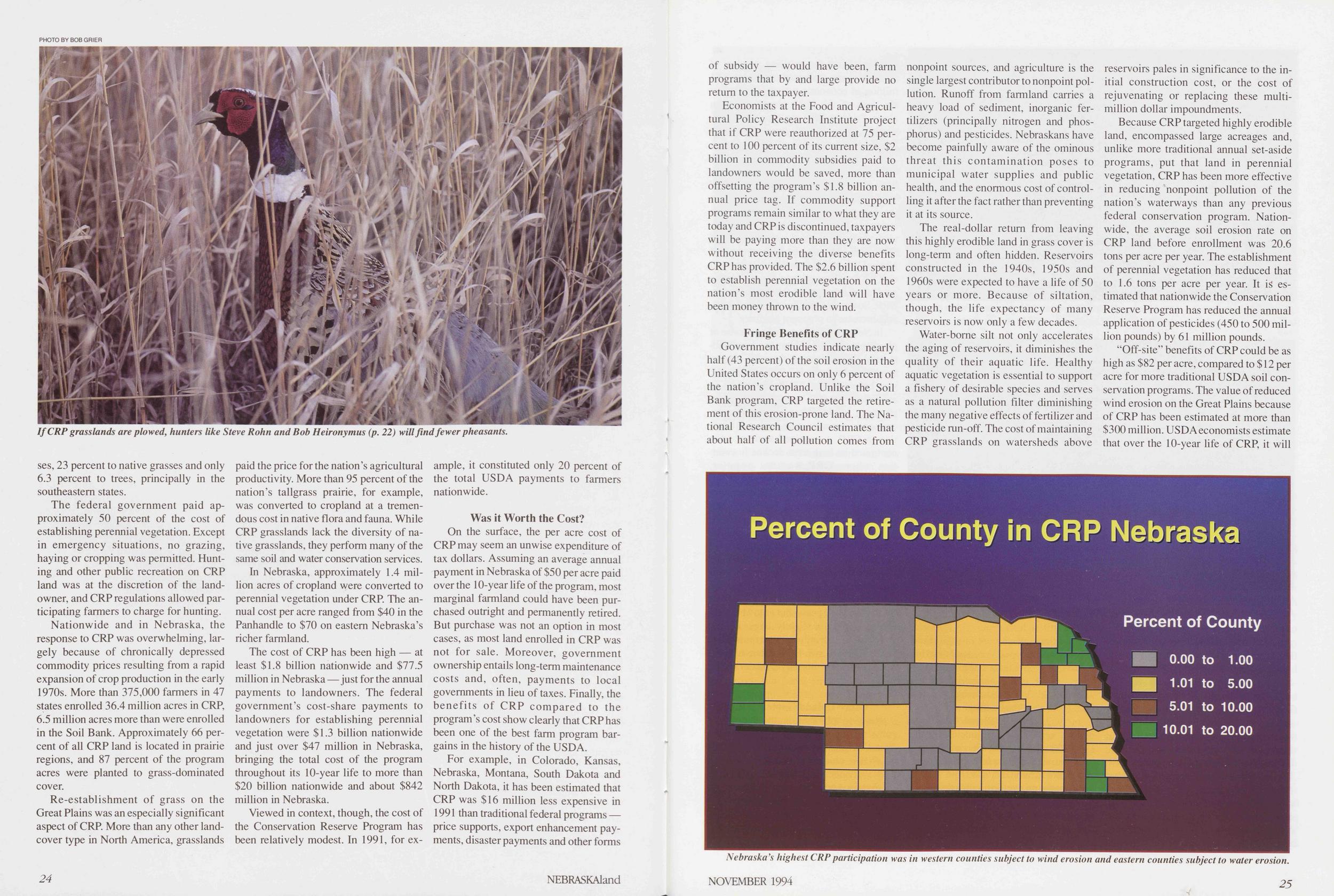 PHOTO BY BOB GRIER
23 percent to native grasses and only 6.3 percent to trees, principally in the southeastern states.
The federal government paid approximately 50 percent of the cost of establishing perennial vegetation. Except in emergency situations, no grazing, haying or cropping was permitted. Hunting and other public recreation on CRP land was at the discretion of the land-owner, and CRP regulations allowed participating farmers to charge for hunting.
Nationwide and in Nebraska, the response to CRP was overwhelming, largely because of chronically depressed commodity prices resulting from a rapid expansion of crop production in the early 1970s. More than 375,000 farmers in 47 states enrolled 36.4 million acres in CRP, 6.5 million acres more than were enrolled in the Soil Bank. Approximately 66 percent of all CRP land is located in prairie regions, and 87 percent of the program acres were planted to grass-dominated cover.
Re-establishment of grass on the Great Plains was an especially significant aspect of CRP. More than any other land-cover type in North America, grasslands paid the price for the nation's agricultural productivity. More than 95 percent of the nation's tallgrass prairie, for example, was converted to cropland at a tremendous cost in native flora and fauna. While CRP grasslands lack the diversity of native grasslands, they perform many of the same soil and water conservation services. In Nebraska, approximately 1.4 million acres of cropland were converted to perennial vegetation under CRP. The annual cost per acre ranged from $40 in the Panhandle to $70 on eastern Nebraska's richer farmland.
The cost of CRP has been high — at least $1.8 billion nationwide and $77.5 million in Nebraska—just for the annual payments to landowners. The federal government's cost-share payments to landowners for establishing perennial vegetation were $1.3 billion nationwide and just over $47 million in Nebraska, bringing the total cost of the program throughout its 10-year life to more than $20 billion nationwide and about $842 million in Nebraska.
Viewed in context, though, the cost of the Conservation Reserve Program has been relatively modest. In 1991, for example, it constituted only 20 percent of the total USDA payments to farmers nationwide.
Was it Worth the Cost?On the surface, the per acre cost of CRP may seem an unwise expenditure of tax dollars. Assuming an average annual payment in Nebraska of $50 per acre paid over the 10-year life of the program, most marginal farmland could have been purchased outright and permanently retired. But purchase was not an option in most cases, as most land enrolled in CRP was not for sale. Moreover, government ownership entails long-term maintenance costs and, often, payments to local governments in lieu of taxes. Finally, the benefits of CRP compared to the program's cost show clearly that CRP has been one of the best farm program bargains in the history of the USDA. For example, in Colorado, Kansas, Nebraska, Montana, South Dakota and North Dakota, it has been estimated that CRP was $16 million less expensive in 1991 than traditional federal programs — price supports, export enhancement payments, disaster payments and other forms of subsidy — would have been, farm programs that by and large provide no return to the taxpayer.
Economists at the Food and Agricultural Policy Research Institute project that if CRP were reauthorized at 75 percent to 100 percent of its current size, $2 billion in commodity subsidies paid to landowners would be saved, more than offsetting the program's $1.8 billion annual price tag. If commodity support programs remain similar to what they are today and CRP is discontinued, taxpayers will be paying more than they are now without receiving the diverse benefits CRP has provided. The $2.6 billion spent to establish perennial vegetation on the nation's most erodible land will have been money thrown to the wind.
Fringe Benefits of CRPGovernment studies indicate nearly half (43 percent) of the soil erosion in the United States occurs on only 6 percent of the nation's cropland. Unlike the Soil Bank program, CRP targeted the retire- ment of this erosion-prone land. The National Research Council estimates that about half of all pollution comes from nonpoint sources, and agriculture is the single largest contributor to nonpoint pollution. Runoff from farmland carries a heavy load of sediment, inorganic fertilizers (principally nitrogen and phosphorus) and pesticides. Nebraskans have become painfully aware of the ominous threat this contamination poses to municipal water supplies and public health, and the enormous cost of controlling it after the fact rather than preventing it at its source.
The real-dollar return from leaving this highly erodible land in grass cover is long-term and often hidden. Reservoirs constructed in the 1940s, 1950s and 1960s were expected to have a life of 50 years or more. Because of siltation, though, the life expectancy of many reservoirs is now only a few decades.
Water-borne silt not only accelerates the aging of reservoirs, it diminishes the quality of their aquatic life. Healthy aquatic vegetation is essential to support a fishery of desirable species and serves as a natural pollution filter diminishing the many negative effects of fertilizer and pesticide run-off. The cost of maintaining CRP grasslands on watersheds above reservoirs pales in significance to the initial construction cost, or the cost of rejuvenating or replacing these multi-million dollar impoundments.
Because CRP targeted highly erodible land, encompassed large acreages and, unlike more traditional annual set-aside programs, put that land in perennial vegetation, CRP has been more effective in reducing nonpoint pollution of the nation's waterways than any previous federal conservation program. Nationwide, the average soil erosion rate on CRP land before enrollment was 20.6 tons per acre per year. The establishment of perennial vegetation has reduced that to 1.6 tons per acre per year. It is" estimated that nationwide the Conservation Reserve Program has reduced the annual application of pesticides (450 to 500 million pounds) by 61 million pounds.
"Off-site" benefits of CRP could be as high as $82 per acre, compared to $ 12 per acre for more traditional USDA soil conservation programs. The value of reduced wind erosion on the Great Plains because of CRP has been estimated at more than $300 million. USDA economists estimate that over the 10-year life of CRP, it will
provide between $3.4 billion and $11 billion in environmental benefits.
CRP and RingnecksEven though the Conservation Reserve Program was not specifically designed to enhance habitat, its impact has been enormous, particularly in Great Plains states where farmland wildlife habitat had dwindled to an all-time low. Breeding bird surveys indicate that farmland wildlife, such as ring-necked pheasants, declined as much as 50 percent over the last 50 years in the East and Midwest as farming became more intensive and monoculture croplands replaced the traditional patchwork of small fields of several crop types, grasslands and idle areas. CRP recreated a semblance of the "mosaic" cropland patterns in which wildlife had flourished during the early decades of the 20th century.
In 1987, the International Association of Fish and Wildlife Agencies and the U.S. Fish and Wildlife Service began a cooperative study to monitor the response of wildlife to habitat created by CRP. The results were an eye-opener for those who believed wildlife benefits could not be assigned dollar values.
In Jones County, South Dakota, for example, increased hunting opportunity resulting from the swelling number of CRP pheasants generated an estimated $1 million in economic activity in the first six days of the 1993 pheasant season alone. Prior to CRP, the researchers ob- served, Jones County "supported only limited pheasant hunting."
In Minnesota, North Dakota, South Dakota and Ohio, pheasant populations have more than doubled during the CRP years. North Dakota's pheasant harvest is the highest since the early 1960s. The statewide harvest of pheasants in Montana tripled since the establishment of CRP. The Minnesota Department of Natural Resources estimates that it would cost $200 million per year to provide the equivalent amount of habitat provided by CRP. Some areas in Iowa showed a 10- fold increase in pheasant numbers.
In Nebraska, the statewide response of pheasants to CRP habitat has been sub- stantial. The estimated statewide harvest has increased from 467,000 in 1985, the year before the first CRP plantings, to an estimated 600,000 in 1993. While the pheasant harvest showed dramatic increases in counties with high participation in CRP, it remained static or even continued its long-term decline in counties where CRP was not popular, moderating the statewide increase.
Dixon County in northeastern Nebraska, for example, with more than 44,000 acres enrolled in CRP (fourth highest in the state) showed an impressive 10-fold increase in the number of pheasants killed by hunters between 1985 and 1990. Northeastern Nebraska counties with low participation in CRP also showed increases in the pheasant harvest during the CRP years, but at lower rates. Dodge County, a slightly larger county than Dixon, with only 1,250 acres in CRP, showed only a two-fold increase in the number of pheasants harvested during the same period.
Other Upland Game BirdsNext to pheasants, the Nebraska gamebird that probably profited most from CRP grasslands is the prairie chicken. Prairie chickens are tallgrass prairie birds and once were abundant over much of eastern and southern Nebraska. As cropland replaced grasslands, though, they declined in abundance or disappeared entirely from many areas.
In recent decades, prairie chickens
have been most abundant on the periphery of the Sandhills region, particularly in the low, rolling hills on the eastern and southern margins. Isolated prairie chicken populations also occur in the sandhills of southwestern Nebraska and where sufficiently large blocks of grasslands still exist in the southeast and south-central.
The large-scale development of com under center-pivot irrigation in the eastem and southern margins of the Sandhills in the 1970s and early 1980s had a long-term negative impact on prairie chicken numbers, particularly where cropland exceeded grassland in acreage. Under CRP, many of those fields have been returned to grass and have tipped the scales enough that prairie chicken numbers have increased, at least locally.
The introduction of CRP grassland in the loess hills country southeast of the Sandhills has probably increased the number of nesting and wintering prairie chickens. The addition of large blocks of grassland in the southeast has probably ensured the survival of isolated populations there and perhaps allowed slight increases.
In Nebraska, CRP apparently has had little effect on quail numbers, although bobwhites no doubt benefitted from the early, weedy stages of CRP and now take advantage of CRP grassland edges for winter cover. Bobwhites prefer a more diversified mix of habitat than mature CRP fields provide, and seeds from annual broadleaf plants (weeds) and legumes not found in CRP grasslands are important components of their diet.
Other Game AnimalsAbundant, high-quality upland cover is essential for successful nesting of most puddle ducks — mallards, teal, wigeons, pintails and gadwalls — that nest in grasslands adjacent to wetlands. As farming practices intensified in the Prairie Pothole region in the north-central United States, the southern end of the Central Fly way's "duck factory," enormous expanses of grassland were plowed, often leaving only narrow bands of grass immediately around potholes.
Not only was the acreage of nesting habitat substantially diminished, but nesting ducks, their eggs and young were concentrated and easy prey for predators. Even on wetlands specifically managed for waterfowl production, nesting success had become abysmally poor, with as few as 4 percent to 13 percent of the established nests producing young.
The Conservation Reserve Program created four times as much upland nesting cover in the Prairie Pothole region of the United States as the 50-year acquisition and development work of all federal and state wildlife agencies combined. Because CRP grasslands are typically in large blocks and frequently are adjacent to wetlands in the Prairie Pothole region of the United States, they significantly expanded the nesting cover available to ducks. Hatching success on CRP lands in North Dakota climbed to as high as 30 percent to 50 percent. The U.S. Fish and Wildlife Service estimates that an additional 1 million ducks can be produced annually in the Dakotas in nesting habitat created by the Conservation Reserve Program. That means more ducks for hunters in the Dakotas and for hunters in every state through which those ducks migrate to southern wintering grounds.
Deer, more than any other game mammal, profited from the large blocks of CRP grasslands. Although dense stands of grass provide only limited food for deer, CRP fields are excellent year-round
26 NEBRASKAland NOVEMBER 1994 27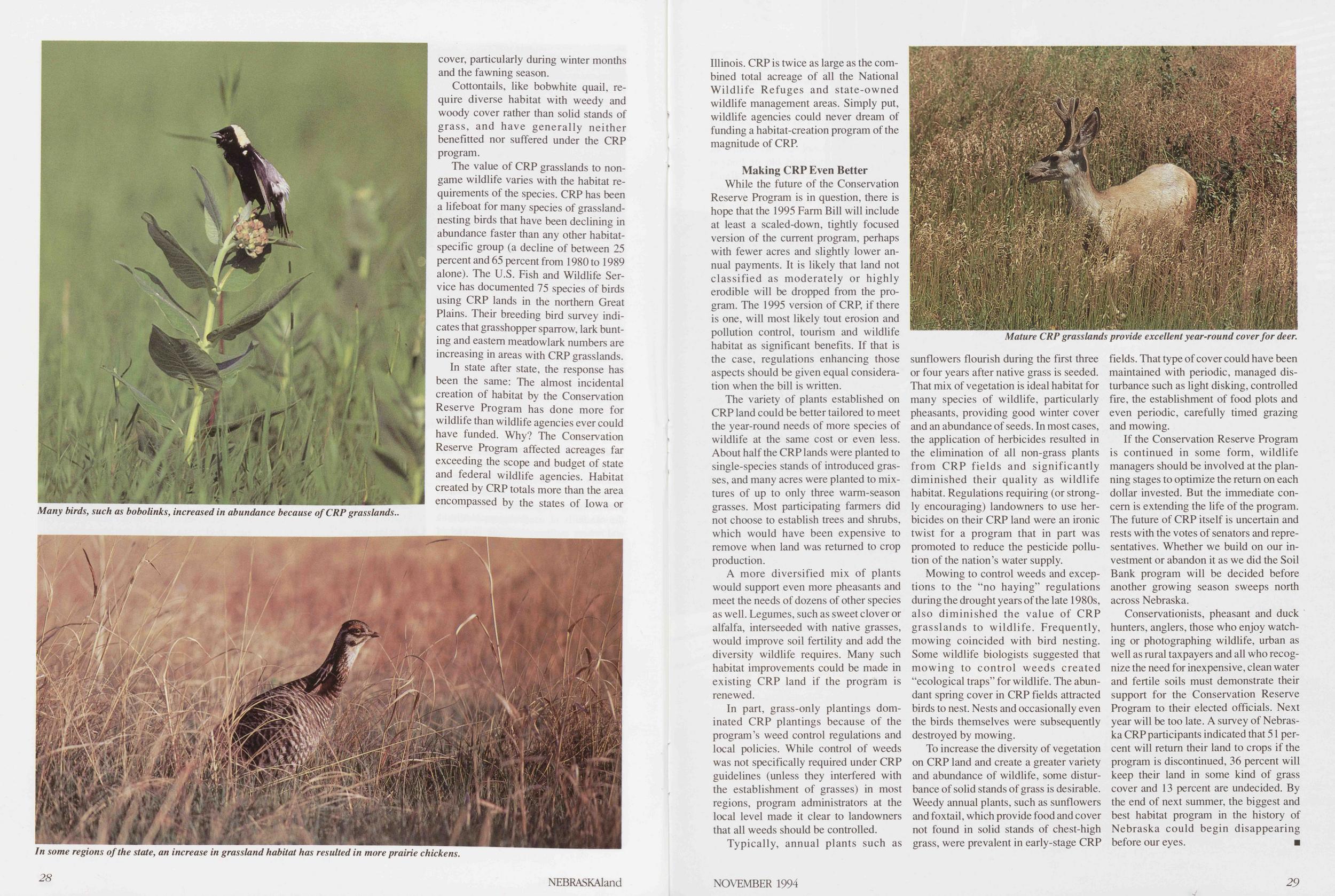
Many birds, suchas bobolinks, increased in abundance because of CRP grasslands.
cover, particularly during winter months and the fawning season.
Cottontails, like bob white quail, require diverse habitat with weedy and woody cover rather than solid stands of grass, and have generally neither benefitted nor suffered under the CRP program.
The value of CRP grasslands to non-game wildlife varies with the habitat requirements of the species. CRP has been a lifeboat for many species of grassland-nesting birds that have been declining in abundance faster than any other habitat-specific group (a decline of between 25 percent and 65 percent from 1980 to 1989 alone). The U.S. Fish and Wildlife Service has documented 75 species of birds using CRP lands in the northern Great Plains. Their breeding bird survey indicates that grasshopper sparrow, lark bunting and eastern meadowlark numbers are increasing in areas with CRP grasslands.
In state after state, the response has been the same: The almost incidental creation of habitat by the Conservation Reserve Program has done more for wildlife than wildlife agencies ever could have funded. Why? The Conservation Reserve Program affected acreages far exceeding the scope and budget of state and federal wildlife agencies. Habitat created by CRP totals more than the area encompassed by the states of Iowa or
Illinois. CRP is twice as large as the combined total acreage of all the National Wildlife Refuges and state-owned wildlife management areas. Simply put, wildlife agencies could never dream of funding a habitat-creation program of the magnitude of CRP.
Making CRP Even BetterWhile the future of the Conservation Reserve Program is in question, there is hope that the 1995 Farm Bill will include at least a scaled-down, tightly focused version of the current program, perhaps with fewer acres and slightly lower annual payments. It is likely that land not classified as moderately or highly erodible will be dropped from the program. The 1995 version of CRP, if there is one, will most likely tout erosion and pollution control, tourism and wildlife habitat as significant benefits. If that is the case, regulations enhancing those aspects should be given equal consideration when the bill is written.
The variety of plants established on CRP land could be better tailored to meet the year-round needs of more species of wildlife at the same cost or even less. About half the CRP lands were planted to single-species stands of introduced grasses, and many acres were planted to mixtures of up to only three warm-season grasses. Most participating farmers did not choose to establish trees and shrubs, which would have been expensive to remove when land was returned to crop production.
A more diversified mix of plants would support even more pheasants and meet the needs of dozens of other species as well. Legumes, such as sweet clover or alfalfa, interseeded with native grasses, would improve soil fertility and add the diversity wildlife requires. Many such habitat improvements could be made in existing CRP land if the program is renewed.
In part, grass-only plantings dominated CRP plantings because of the program's weed control regulations and local policies. While control of weeds was not specifically required under CRP guidelines (unless they interfered with the establishment of grasses) in most regions, program administrators at the local level made it clear to landowners that all weeds should be controlled.
Mature CRP grasslands provide excellent year-round cover for deer.
Mowing to control weeds and exceptions to the "no haying" regulations during the drought years of the late 1980s, also diminished the value of CRP grasslands to wildlife. Frequently, mowing coincided with bird nesting. Some wildlife biologists suggested that mowing to control weeds created "ecological traps" for wildlife. The abundant spring cover in CRP fields attracted birds to nest. Nests and occasionally even the birds themselves were subsequently destroyed by mowing.
To increase the diversity of vegetation on CRP land and create a greater variety and abundance of wildlife, some disturbance of solid stands ofgrass is desirable. Weedy annual plants, such as sunflowers and foxtail, which provide food and cover not found in solid stands of chest-high grass, were prevalent in early-stage CRP fields. That type of cover could have been maintained with periodic, managed disturbance such as light disking, controlled fire, the establishment of food plots and even periodic, carefully timed grazing and mowing.
If the Conservation Reserve Program is continued in some form, wildlife managers should be involved at the planning stages to optimize the return on each dollar invested. But the immediate concern is extending the life of the program. The future of CRP itself is uncertain and rests with the votes of senators and representatives. Whether we build on our investment or abandon it as we did the Soil Bank program will be decided before another growing season sweeps north across Nebraska.
Conservationists, pheasant and duck hunters, anglers, those who enjoy watching or photographing wildlife, urban as well as rural taxpayers and all who recognize the need for inexpensive, clean water and fertile soils must demonstrate their support for the Conservation Reserve Program to their elected officials. Next year will be too late. A survey of Nebraska CRP participants indicated that 51 percent will return their land to crops if the program is discontinued, 36 percent will keep their land in some kind of grass cover and 13 percent are undecided. By the end of next summer, the biggest and best habitat program in the history of Nebraska could begin disappearing before our eyes.
NOVEMBER 1994 29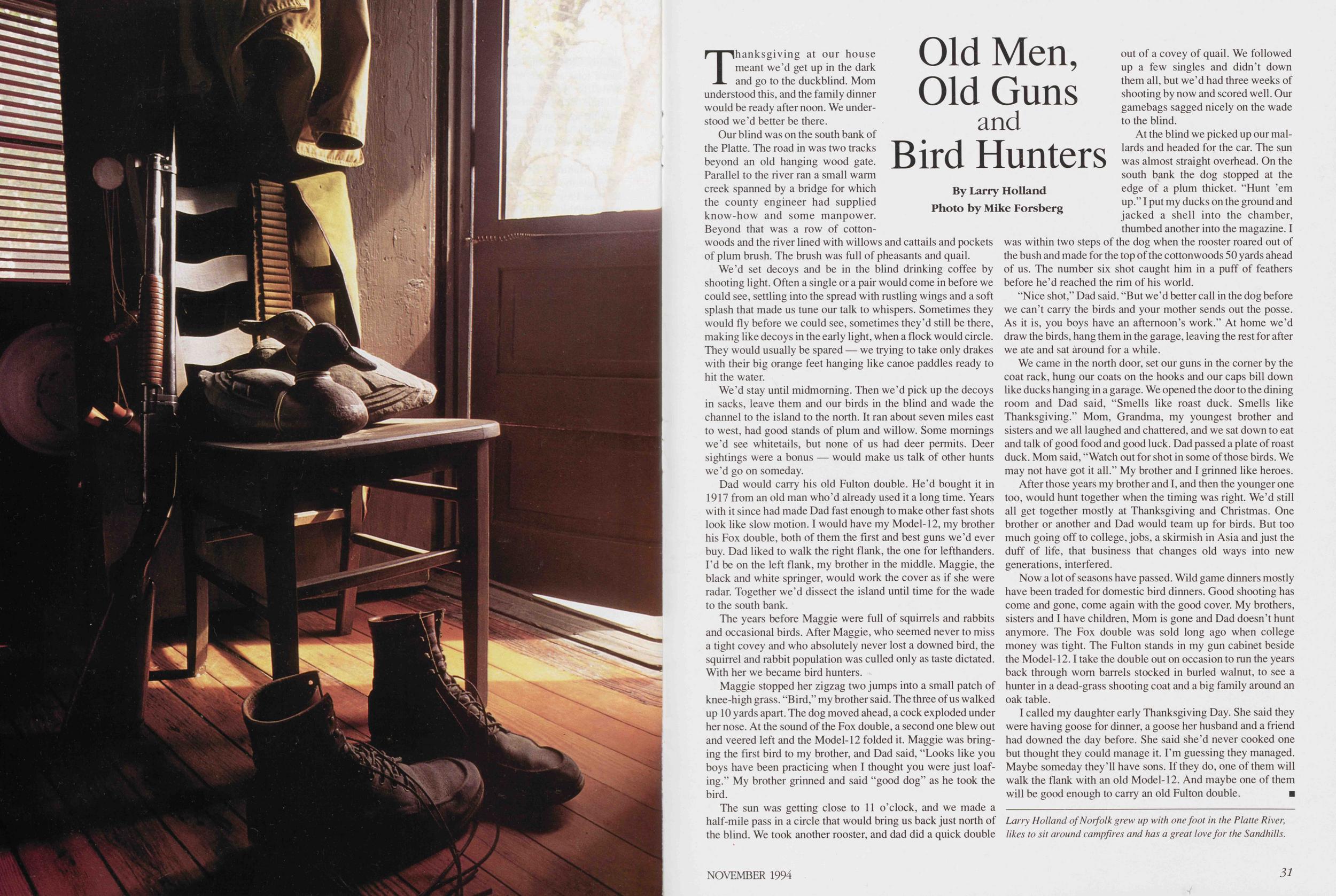
Old Men, Old Guns and Bird Hunters
Thanksgiving at our house meant we'd get up in the dark and go to the duckblind. Mom understood this, and the family dinner would be ready after noon. We understood we'd better be there. Our blind was on the south bank of the Platte. The road in was two tracks beyond an old hanging wood gate. Parallel to the river ran a small warm creek spanned by a bridge for which the county engineer had supplied know-how and some manpower. Beyond that was a row of cottonwoods and the river lined with willows and cattails and pockets of plum brush. The brush was full of pheasants and quail.
We'd set decoys and be in the blind drinking coffee by shooting light. Often a single or a pair would come in before we could see, settling into the spread with rustling wings and a soft splash that made us tune our talk to whispers. Sometimes they would fly before we could see, sometimes they'd still be there, making like decoys in the early light, when a flock would circle. They would usually be spared — we trying to take only drakes with their big orange feet hanging like canoe paddles ready to hit the water.
We'd stay until midmorning. Then we'd pick up the decoys in sacks, leave them and our birds in the blind and wade the channel to the island to the north. It ran about seven miles east to west, had good stands of plum and willow. Some mornings we'd see whitetails, but none of us had deer permits. Deer sightings were a bonus — would make us talk of other hunts we'd go on someday.
Dad would carry his old Fulton double. He'd bought it in 1917 from an old man who'd already used it a long time. Years with it since had made Dad fast enough to make other fast shots look like slow motion. I would have my Model-12, my brother his Fox double, both of them the first and best guns we'd ever buy. Dad liked to walk the right flank, the one for lefthanders. I'd be on the left flank, my brother in the middle. Maggie, the black and white springer, would work the cover as if she were radar. Together we'd dissect the island until time for the wade to the south bank.
The years before Maggie were full of squirrels and rabbits and occasional birds. After Maggie, who seemed never to miss a tight covey and who absolutely never lost a downed bird, the squirrel and rabbit population was culled only as taste dictated. With her we became bird hunters.
Maggie stopped her zigzag two jumps into a small patch of knee high grrass. "Bird," my brother said. The three of us walked up 10 yards apart. The dog moved ahead, a cock exploded under her nose. At the sound of the Fox double, a second one blew out and veered left and the Model-12 folded it. Maggie was bringing the first bird to my brother, and Dad said, "Looks like you boys have been practicing when I thought you were just loafing." My brother grinned and said "good dog" as he took the bird.
The sun was getting close to 11 o'clock, and we made a half-mile pass in a circle that would bring us back just north of the blind. We took another rooster, and dad did a quick double out of a covey of quail. We followed up a few singles and didn't down them all, but we'd had three weeks of shooting by now and scored well. Our gamebags sagged nicely on the wade to the blind.
At the blind we picked up our mallards and headed for the car. The sun was almost straight overhead. On the south bank the dog stopped at the edge of a plum thicket. "Hunt 'em up." I put my ducks on the ground and jacked a shell into the chamber, thumbed another into the magazine. I was within two steps of the dog when the rooster roared out of the bush and made for the top of the cottonwoods 50 yards ahead of us. The number six shot caught him in a puff of feathers before he'd reached the rim of his world.
"Nice shot," Dad said. "But we'd better call in the dog before we can't carry the birds and your mother sends out the posse. As it is, you boys have an afternoon's work." At home we'd draw the birds, hang them in the garage, leaving the rest for after we ate and sat around for a while.
We came in the north door, set our guns in the corner by the coat rack, hung our coats on the hooks and our caps bill down like ducks hanging in a garage. We opened the door to the dining room and Dad said, "Smells like roast duck. Smells like Thanksgiving." Mom, Grandma, my youngest brother and sisters and we all laughed and chattered, and we sat down to eat and talk of good food and good luck. Dad passed a plate of roast duck. Mom said, "Watch out for shot in some of those birds. We may not have got it all." My brother and I grinned like heroes.
After those years my brother and I, and then the younger one too, would hunt together when the timing was right. We'd still all get together mostly at Thanksgiving and Christmas. One brother or another and Dad would team up for birds. But too much going off to college, jobs, a skirmish in Asia and just the duff of life, that business that changes old ways into new generations, interfered.
Now a lot of seasons have passed. Wild game dinners mostly have been traded for domestic bird dinners. Good shooting has come and gone, come again with the good cover. My brothers, sisters and I have children, Mom is gone and Dad doesn't hunt anymore. The Fox double was sold long ago when college money was tight. The Fulton stands in my gun cabinet beside the Model-12.1 take the double out on occasion to run the years back through worn barrels stocked in burled walnut, to see a hunter in a dead-grass shooting coat and a big family around an oak table.
I called my daughter early Thanksgiving Day. She said they were having goose for dinner, a goose her husband and a friend had downed the day before. She said she'd never cooked one but thought they could manage it. I'm guessing they managed. Maybe someday they'll have sons. If they do, one of them will walk the flank with an old Model-12. And maybe one of them will be good enough to carry an old Fulton double.
NOVEMBER 1994 31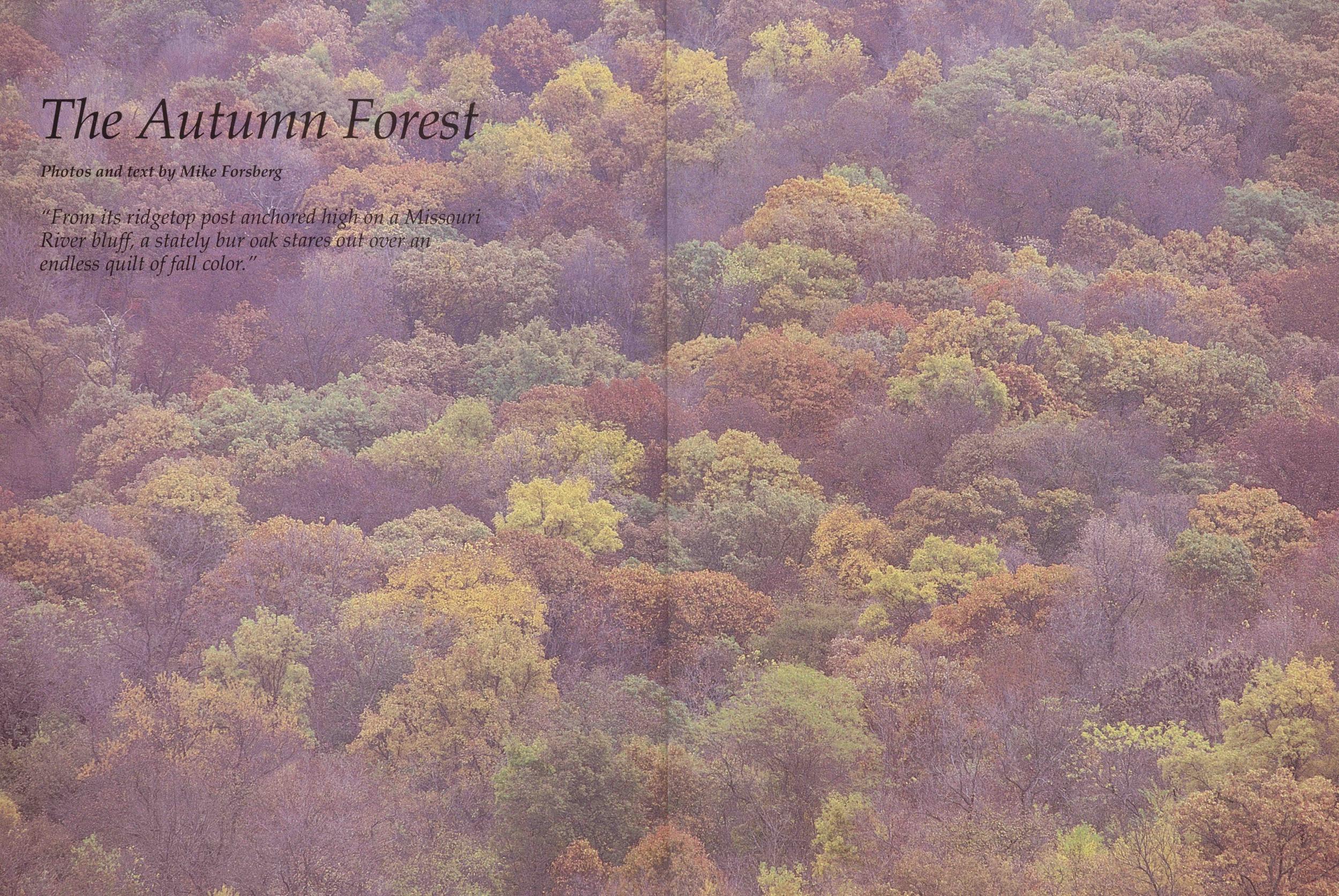
The Autumn Forest
"From its ridgetop post anchored high on a Missouri River bluff, a stately bur oak stares out over an endless quilt of fall color."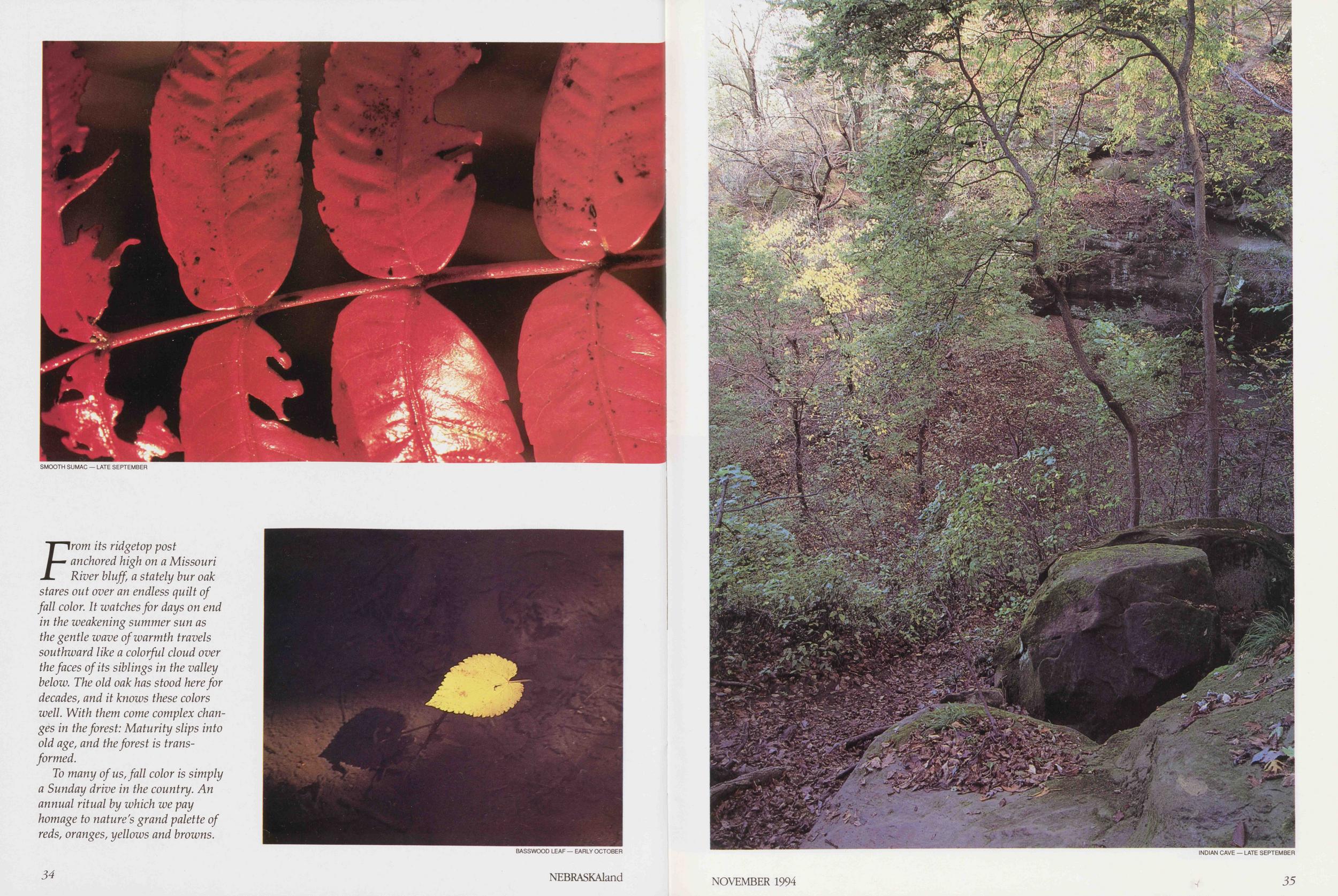
From its ridgetop post anchored high on a Missouri River bluff a stately bur oak stares out over an endless quilt of fall color. It watches for days on end in the weakening summer sun as the gentle wave of warmth travels southward like a colorful cloud over the faces of its siblings in the valley below. The old oak has stood here for decades, and it knows these colors well. With them come complex changes in the forest: Maturity slips into old age, and the forest is transformed.
To many of us, fall color is simply a Sunday drive in the country. An annual ritual by which we pay homage to nature's grand palette of reds, oranges, yellows and browns.
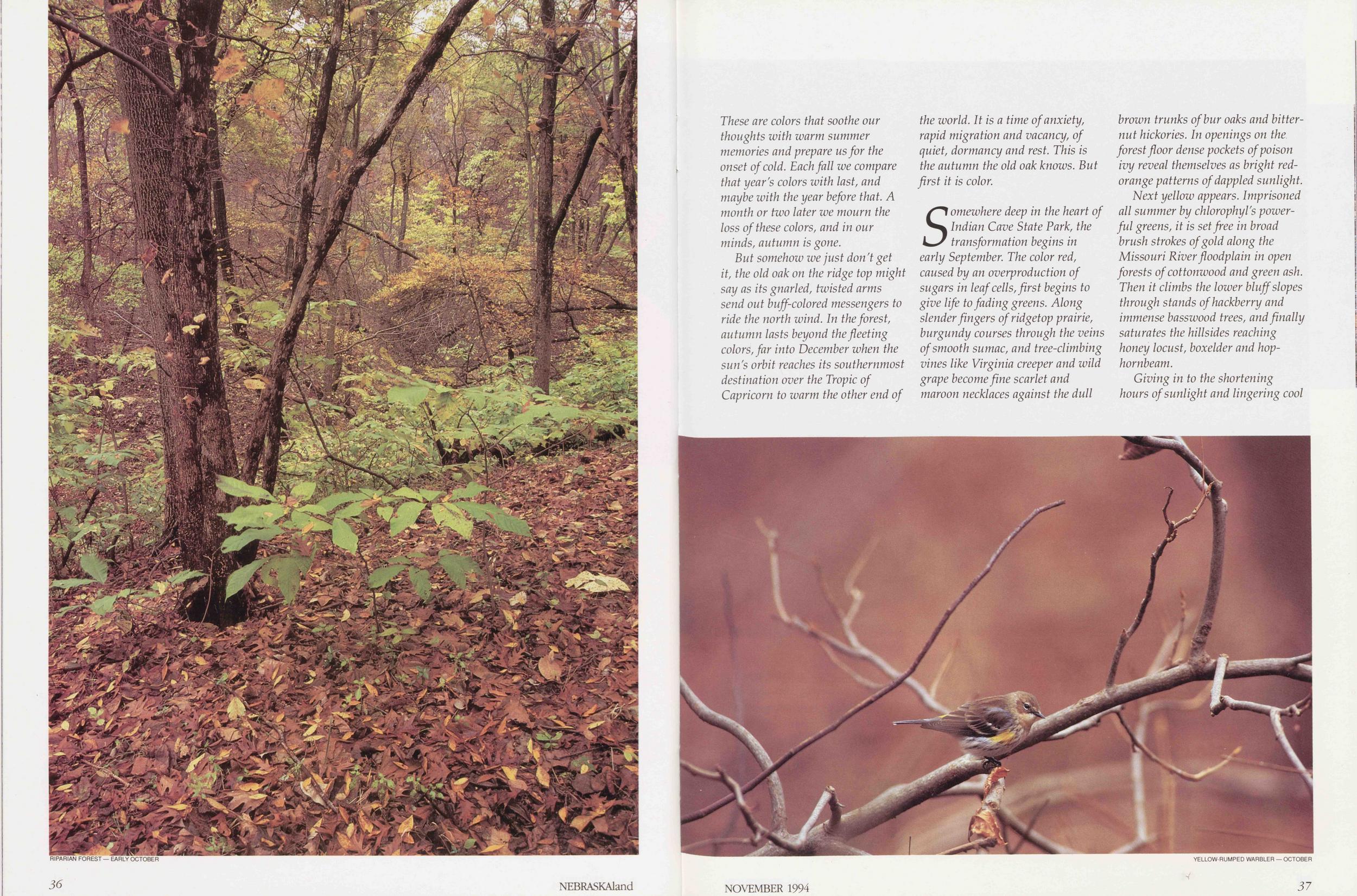
These are colors that soothe our thoughts with warm summer memories and prepare us for the onset of cold. Each fall we compare that year's colors with last, and maybe with the year before that. A month or two later we mourn the loss of these colors, and in our minds, autumn is gone.
But somehow we just don't get it, the old oak on the ridge top might say as its gnarled, twisted arms send out buff-colored messengers to ride the north wind. In the forest, autumn lasts beyond the fleeting colors, far into December when the sun's orbit reaches its southernmost destination over the Tropic of Capricorn to warm the other end of the world. It is a time of anxiety, rapid migration and vacancy, of quiet, dormancy and rest. This is the autumn the old oak knows. But first it is color.
Somewhere deep in the heart of Indian Cave State Park, the transformation begins in early September. The color red, caused by an overproduction of sugars in leaf cells, first begins to give life to fading greens. Along slender fingers ofridgetop prairie, burgundy courses through the veins of smooth sumac, and tree-climbing vines like Virginia creeper and wild grape become fine scarlet and maroon necklaces against the dull brown trunks of bur oaks and bitternut hickories. In openings on the forest floor dense pockets of poison ivy reveal themselves as bright red-orange patterns of dappled sunlight.
Next yellow appears. Imprisoned all summer by chlorophyl's powerful greens, it is set free in broad brush strokes of gold along the Missouri River floodplain in open forests of Cottonwood and green ash. Then it climbs the lower bluff slopes through stands ofhackberry and immense basswood trees, and finally saturates the hillsides reaching honey locust, boxelder and hop- hornbeam.
Giving in to the shortening hours of sunlight and lingering cool
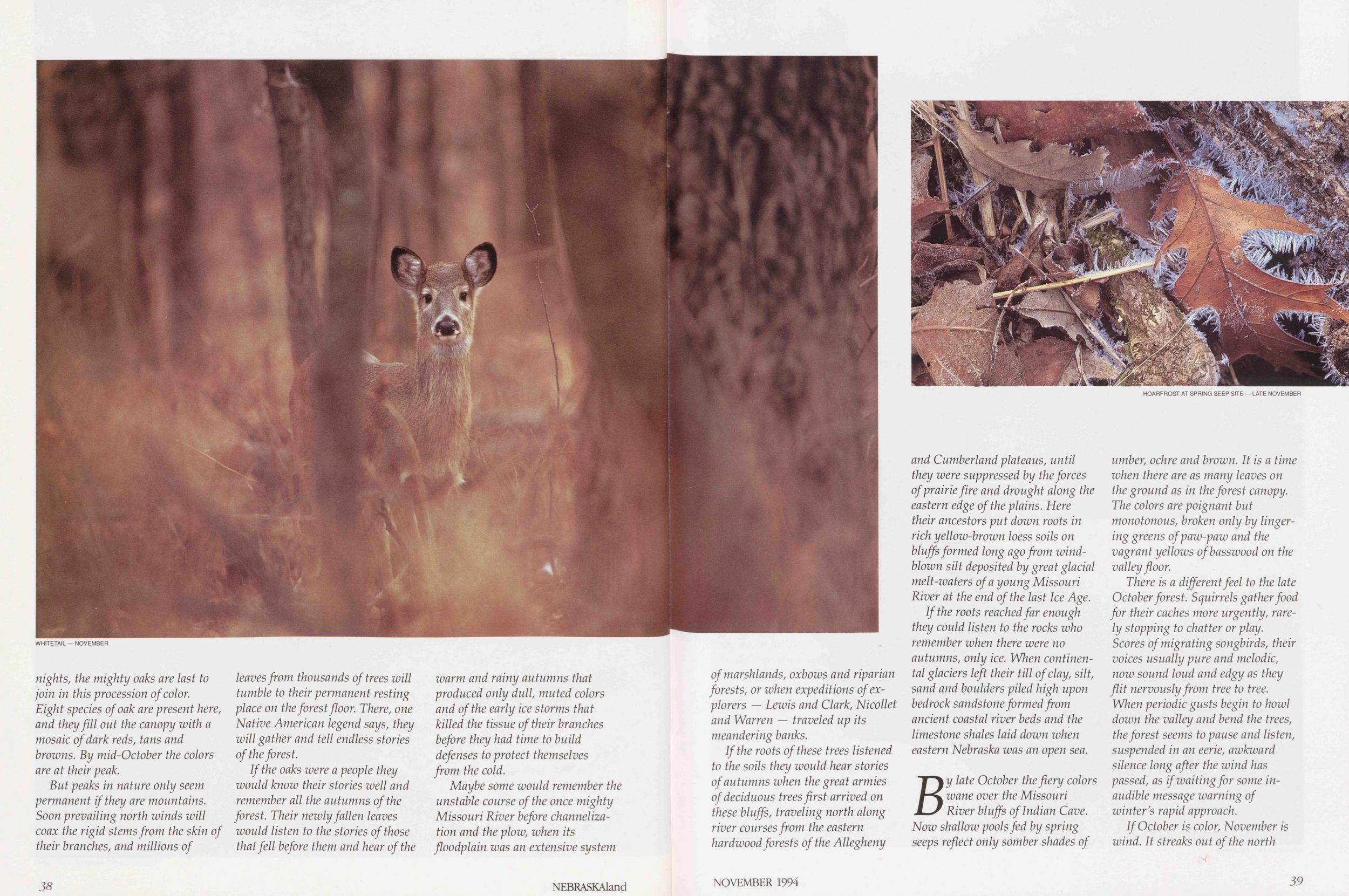
nights, the mighty oaks are last to join in this procession of color. Eight species of oak are present here, and they fill out the canopy with a mosaic of dark reds, tans and browns. By mid-October the colors are at their peak.
But peaks in nature only seem permanent if they are mountains. Soon prevailing north winds will coax the rigid stems from the skin of their branches, and millions of leaves from thousands of trees will tumble to their permanent resting place on the forest floor. There, one Native American legend says, they will gather and tell endless stories of the forest.
If the oaks were a people they would know their stories well and remember all the autumns of the forest. Their newly fallen leaves would listen to the stories of those that fell before them and hear of the warm and rainy autumns that produced only dull, muted colors and of the early ice storms that killed the tissue of their branches before they had time to build defenses to protect themselves from the cold.
Maybe some would remember the unstable course of the once mighty Missouri River before channelization and the plow, when its floodplain was an extensive system of marshlands, oxbows and riparian forests, or when expeditions of explorers — Lewis and Clark, Nicollet and Warren — traveled up its meandering banks.
If the roots of these trees listened to the soils they would hear stories of autumns when the great armies of deciduous trees first arrived on these bluffs, traveling north along river courses from the eastern hardwood forests of the Allegheny
and Cumberland plateaus, until they were suppressed by the forces of prairie fire and drought along the eastern edge of the plains. Here their ancestors put down roots in rich yellow-brown loess soils on bluffs formed long ago from wind-blown silt deposited by great glacial melt-waters of a young Missouri River at the end of the last Ice Age.
If the roots reached far enough they could listen to the rocks who remember when there were no autumns, only ice. When continental glaciers left their till of clay, silt, sand and boulders piled high upon bedrock sandstone formed from ancient coastal river beds and the limestone shales laid down when eastern Nebraska was an open sea.
By late October the fiery colors wane over the Missouri River bluffs of Indian Cave. Now shallow pools fed by spring seeps reflect only somber shades of umber, ochre and brown. It is a time when there are as many leaves on the ground as in the forest canopy. The colors are poignant but monotonous, broken only by lingering greens of paw-paw and the vagrant yellows ofbasswood on the valley floor.
There is a different feel to the late October forest. Squirrels gather food for their caches more urgently, rarely stopping to chatter or play. Scores of migrating songbirds, their voices usually pure and melodic, now sound loud and edgy as they flit nervously from tree to tree. When periodic gusts begin to howl down the valley and bend the trees, the forest seems to pause and listen, suspended in an eerie, awkward silence long after the wind has passed, as if waiting for some inaudible message warning of winter's rapid approach.
If October is color, November is wind. It streaks out of the north
38 NEBRASKAland NOVEMBER 1994 39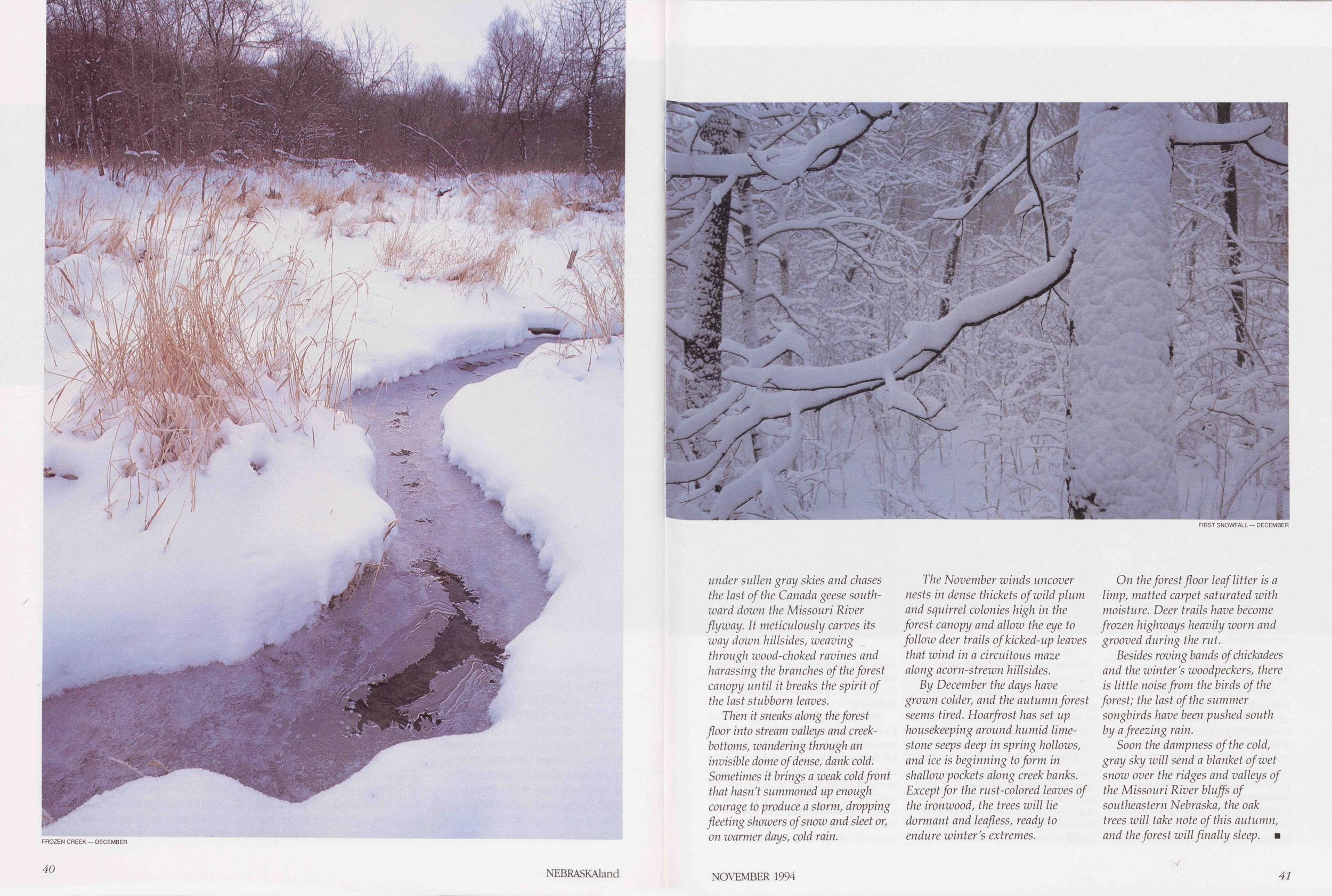
under sullen gray skies and chases the last of the Canada geese southward down the Missouri River flyway. It meticulously carves its way down hillsides, weaving through wood-choked ravines and harassing the branches of the forest canopy until it breaks the spirit of the last stubborn leaves.
Then it sneaks along the forest floor into stream valleys and creek-bottoms, wandering through an invisible dome of dense, dank cold. Sometimes it brings a weak cold front that hasn't summoned up enough courage to produce a storm, dropping fleeting showers of snow and sleet or, on warmer days, cold rain.
The November winds uncover nests in dense thickets of wild plum and squirrel colonies high in the forest canopy and allow the eye to follow deer trails ofkicked-up leaves that wind in a circuitous maze along acorn-strewn hillsides.
By December the days have grown colder, and the autumn forest seems tired. Hoarfrost has set up housekeeping around humid limestone seeps deep in spring hollows, and ice is beginning to form in shallow pockets along creek banks. Except for the rust-colored leaves of the ironwood, the trees will lie dormant and leafless, ready to endure winter's extremes.
On the forest floor leaf litter is a limp, matted carpet saturated with moisture. Deer trails have become frozen highways heavily worn and grooved during the rut.
Besides roving bands of chickadees and the winter's woodpeckers, there is little noise from the birds of the forest; the last of the summer songbirds have been pushed south by a freezing rain.
Soon the dampness of the cold, gray sky will send a blanket of wet snow over the ridges and valleys of the Missouri River bluffs of southeastern Nebraska, the oak trees will take note of this autumn, and the forest will finally sleep.
40 NEBRASKAland NOVEMBER 1994 41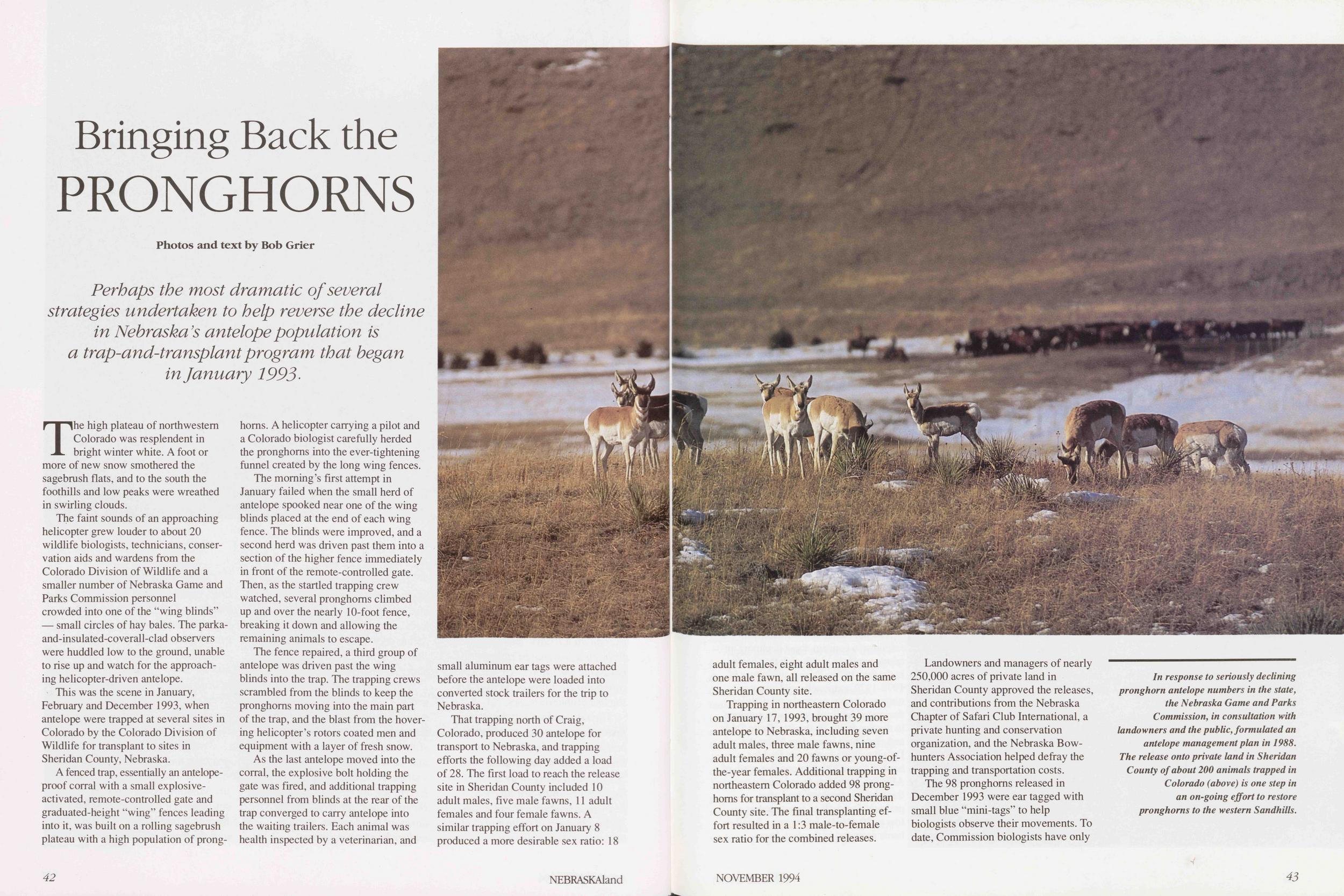
Bringing Back the PRONGHORNS
Perhaps the most dramatic of several strategies undertaken to help reverse the decline in Nebraska's antelope population is a trap-and-transplantprogram that began in January 1993.The high plateau of northwestern Colorado was resplendent in bright winter white. A foot or more of new snow smothered the sagebrush flats, and to the south the foothills and low peaks were wreathed in swirling clouds.
The faint sounds of an approaching helicopter grew louder to about 20 wildlife biologists, technicians, conservation aids and wardens from the Colorado Division of Wildlife and a smaller number of Nebraska Game and Parks Commission personnel crowded into one of the "wing blinds" — small circles of hay bales. The parka-and-insulated-coverall-clad observers were huddled low to the ground, unable to rise up and watch for the approaching helicopter-driven antelope.
This was the scene in January, February and December 1993, when antelope were trapped at several sites in Colorado by the Colorado Division of Wildlife for transplant to sites in Sheridan County, Nebraska.
A fenced trap, essentially an antelope-proof corral with a small explosive- activated, remote-controlled gate and graduated-height "wing" fences leading into it, was built on a rolling sagebrush plateau with a high population of pronghorns. A helicopter carrying a pilot and a Colorado biologist carefully herded the pronghorns into the ever-tightening funnel created by the long wing fences.
The morning's first attempt in January failed when the small herd of antelope spooked near one of the wing blinds placed at the end of each wing fence. The blinds were improved, and a second herd was driven past them into a section of the higher fence immediately in front of the remote-controlled gate. Then, as the startled trapping crew watched, several pronghorns climbed up and over the nearly 10-foot fence, breaking it down and allowing the remaining animals to escape.
The fence repaired, a third group of antelope was driven past the wing blinds into the trap. The trapping crews scrambled from the blinds to keep the pronghorns moving into the main part of the trap, and the blast from the hover- ing helicopter's rotors coated men and equipment with a layer of fresh snow.
As the last antelope moved into the corral, the explosive bolt holding the gate was fired, and additional trapping personnel from blinds at the rear of the trap converged to carry antelope into the waiting trailers. Each animal was health inspected by a veterinarian, and small aluminum ear tags were attached before the antelope were loaded into converted stock trailers for the trip to Nebraska.
That trapping north of Craig, Colorado, produced 30 antelope for transport to Nebraska, and trapping efforts the following day added a load of 28. The first load to reach the release site in Sheridan County included 10 adult males, five male fawns, 11 adult females and four female fawns. A similar trapping effort on January 8 produced a more desirable sex ratio: 18 adult females, eight adult males and one male fawn, all released on the same Sheridan County site.
Trapping in northeastern Colorado on January 17, 1993, brought 39 more antelope to Nebraska, including seven adult males, three male fawns, nine adult females and 20 fawns or young-of- the-year females. Additional trapping in northeastern Colorado added 98 pronghorns for transplant to a second Sheridan County site. The final transplanting effort resulted in a 1:3 male-to-female sex ratio for the combined releases. Landowners and managers of nearly 250,000 acres of private land in Sheridan County approved the releases, and contributions from the Nebraska Chapter of Safari Club International, a private hunting and conservation organization, and the Nebraska Bow-hunters Association helped defray the trapping and transportation costs.
The 98 pronghorns released in December 1993 were ear tagged with small blue "mini-tags" to help biologists observe their movements. To date, Commission biologists have only
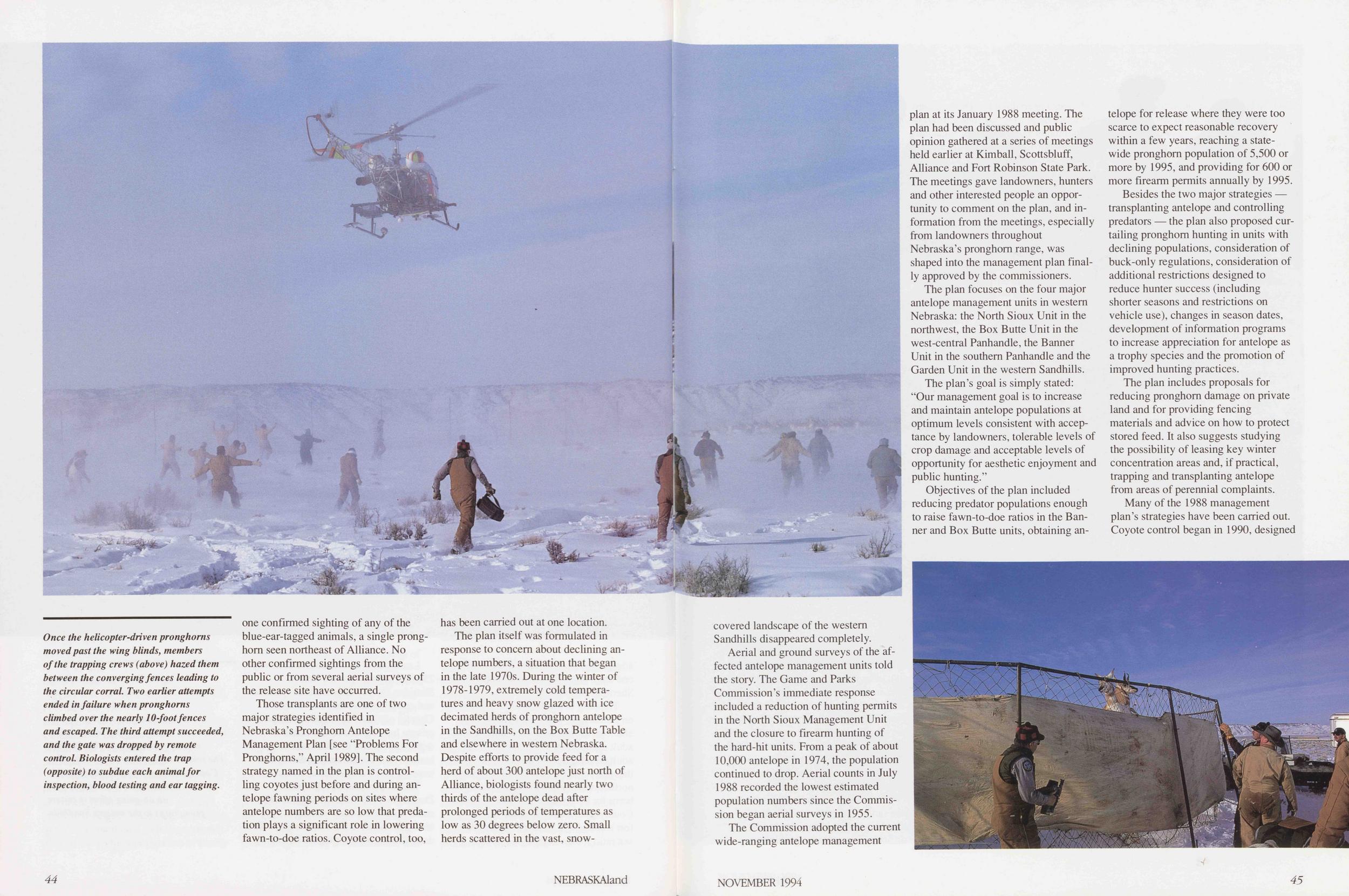
one confirmed sighting of any of the blue-ear-tagged animals, a single pronghorn seen northeast of Alliance. No other confirmed sightings from the public or from several aerial surveys of the release site have occurred.
Those transplants are one of two major strategies identified in Nebraska's Pronghom Antelope Management Plan [see "Problems For Pronghorns," April 1989]. The second strategy named in the plan is controlling coyotes just before and during antelope fawning periods on sites where antelope numbers are so low that predation plays a significant role in lowering fawn-to-doe ratios. Coyote control, too, has been carried out at one location.
The plan itself was formulated in response to concern about declining antelope numbers, a situation that began in the late 1970s. During the winter of 1978-1979, extremely cold temperatures and heavy snow glazed with ice decimated herds of pronghorn antelope in the Sandhills, on the Box Butte Table and elsewhere in western Nebraska. Despite efforts to provide feed for a herd of about 300 antelope just north of Alliance, biologists found nearly two thirds of the antelope dead after prolonged periods of temperatures as low as 30 degrees below zero. Small herds scattered in the vast, snow-
44 NEBRASKAlandcovered landscape of the western Sandhills disappeared completely.
Aerial and ground surveys of the affected antelope management units told the story. The Game and Parks Commission's immediate response included a reduction of hunting permits in the North Sioux Management Unit and the closure to firearm hunting of the hard-hit units. From a peak of about 10,000 antelope in 1974, the population continued to drop. Aerial counts in July 1988 recorded the lowest estimated population numbers since the Commission began aerial surveys in 1955. The Commission adopted the current wide-ranging antelope management plan at its January 1988 meeting. The plan had been discussed and public opinion gathered at a series of meetings held earlier at Kimball, Scottsbluff, Alliance and Fort Robinson State Park. The meetings gave landowners, hunters and other interested people an opportunity to comment on the plan, and information from the meetings, especially from landowners throughout Nebraska's pronghorn range, was shaped into the management plan finally approved by the commissioners.
The plan focuses on the four major antelope management units in western Nebraska: the North Sioux Unit in the northwest, the Box Butte Unit in the west-central Panhandle, the Banner Unit in the southern Panhandle and the Garden Unit in the western Sandhills. The plan's goal is simply stated: "Our management goal is to increase and maintain antelope populations at optimum levels consistent with accep- tance by landowners, tolerable levels of crop damage and acceptable levels of opportunity for aesthetic enjoyment and public hunting."
Objectives of the plan included reducing predator populations enough to raise fawn-to-doe ratios in the Banner and Box Butte units, obtaining antelope for release where they were too scarce to expect reasonable recovery within a few years, reaching a statewide pronghorn population of 5,500 or more by 1995, and providing for 600 or more firearm permits annually by 1995.
Besides the two major strategies — transplanting antelope and controlling predators — the plan also proposed curtailing pronghorn hunting in units with declining populations, consideration of buck-only regulations, consideration of additional restrictions designed to reduce hunter success (including shorter seasons and restrictions on vehicle use), changes in season dates, development of information programs to increase appreciation for antelope as a trophy species and the promotion of improved hunting practices.
The plan includes proposals for reducing pronghorn damage on private land and for providing fencing materials and advice on how to protect stored feed. It also suggests studying the possibility of leasing key winter concentration areas and, if practical, trapping and transplanting antelope from areas of perennial complaints.
Many of the 1988 management plan's strategies have been carried out. Coyote control began in 1990, designed
NOVEMBER 1994 45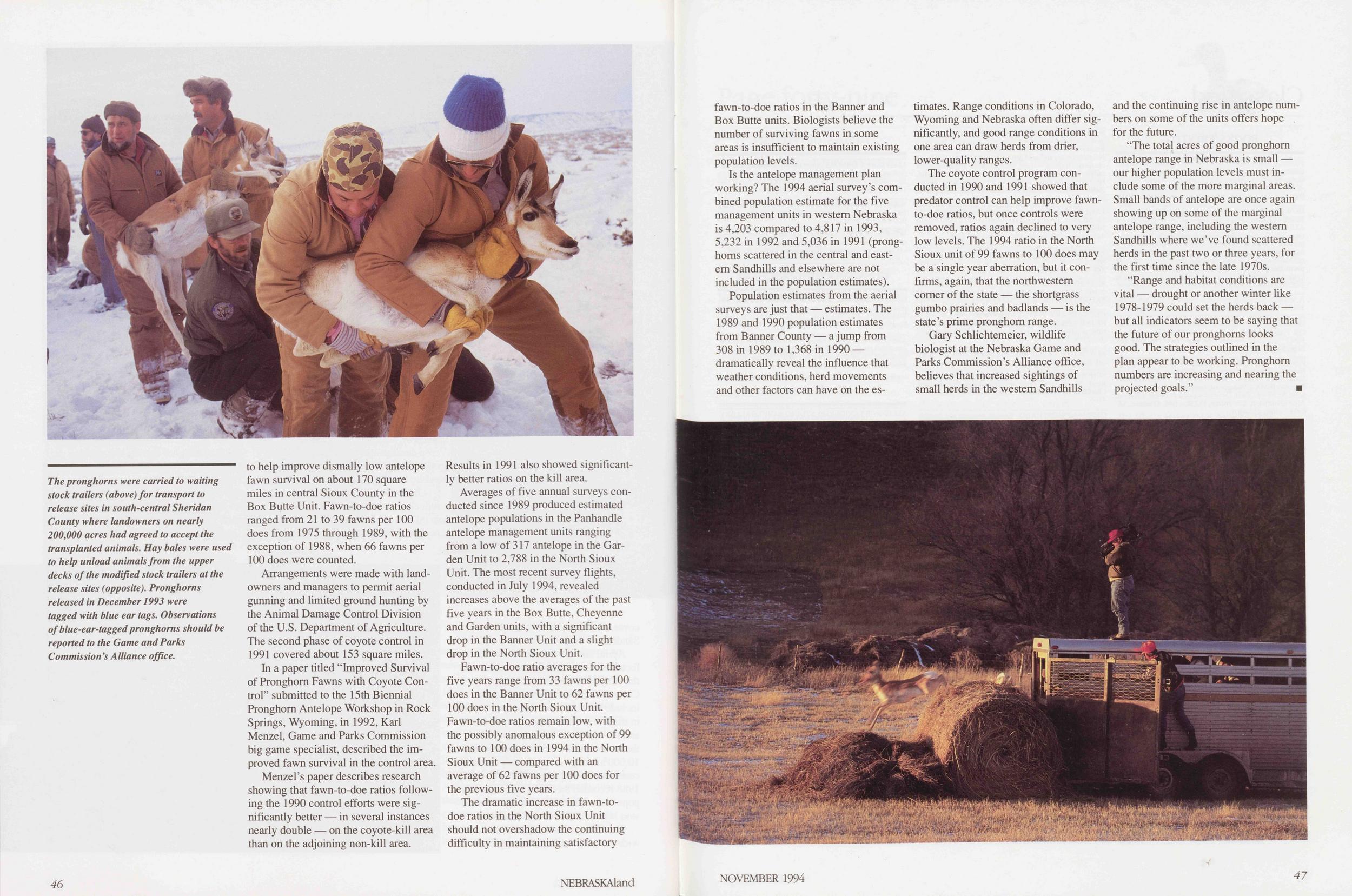
to help improve dismally low antelope fawn survival on about 170 square miles in central Sioux County in the Box Butte Unit. Fawn-to-doe ratios ranged from 21 to 39 fawns per 100 does from 1975 through 1989, with the exception of 1988, when 66 fawns per 100 does were counted.
Arrangements were made with land- owners and managers to permit aerial gunning and limited ground hunting by the Animal Damage Control Division of the U.S. Department of Agriculture. The second phase of coyote control in 1991 covered about 153 square miles.
In a paper titled "Improved Survival of Pronghorn Fawns with Coyote Control" submitted to the 15th Biennial Pronghorn Antelope Workshop in Rock Springs, Wyoming, in 1992, Karl Menzel, Game and Parks Commission big game specialist, described the improved fawn survival in the control area.
Menzel's paper describes research showing that fawn-to-doe ratios following the 1990 control efforts were sig- nificantly better — in several instances nearly double — on the coyote-kill area than on the adjoining non-kill area.
46Results in 1991 also showed significantly better ratios on the kill area.
Averages of five annual surveys conducted since 1989 produced estimated antelope populations in the Panhandle antelope management units ranging from a low of 317 antelope in the Garden Unit to 2,788 in the North Sioux Unit. The most recent survey flights, conducted in July 1994, revealed increases above the averages of the past five years in the Box Butte, Cheyenne and Garden units, with a significant drop in the Banner Unit and a slight drop in the North Sioux Unit. Fawn-to-doe ratio averages for the five years range from 33 fawns per 100 does in the Banner Unit to 62 fawns per 100 does in the North Sioux Unit.
Fawn-to-doe ratios remain low, with the possibly anomalous exception of 99 fawns to 100 does in 1994 in the North Sioux Unit — compared with an average of 62 fawns per 100 does for the previous five years.
The dramatic increase in fawn-to- doe ratios in the North Sioux Unit should not overshadow the continuing difficulty in maintaining satisfactory
NEBRASKAlandfawn-to-doe ratios in the Banner and Box Butte units. Biologists believe the number of surviving fawns in some areas is insufficient to maintain existing population levels.
Is the antelope management plan working? The 1994 aerial survey's combined population estimate for the five management units in western Nebraska is 4,203 compared to 4,817 in 1993, 5,232 in 1992 and 5,036 in 1991 (prong-horns scattered in the central and east- em Sandhills and elsewhere are not included in the population estimates).
Population estimates from the aerial surveys are just that — estimates. The 1989 and 1990 population estimates from Banner County — a jump from 308 in 1989 to 1,368 in 1990 — dramatically reveal the influence that weather conditions, herd movements and other factors can have on the estimates. Range conditions in Colorado, Wyoming and Nebraska often differ significantly, and good range conditions in one area can draw herds from drier, lower-quality ranges.
The coyote control program conducted in 1990 and 1991 showed that predator control can help improve fawn- to-doe ratios, but once controls were removed, ratios again declined to very low levels. The 1994 ratio in the North Sioux unit of 99 fawns to 100 does may be a single year aberration, but it confirms, again, that the northwestern comer of the state — the shortgrass gumbo prairies and badlands — is the state's prime pronghorn range.
Gary Schlichtemeier, wildlife biologist at the Nebraska Game and Parks Commission's Alliance office, believes that increased sightings of small herds in the western Sandhills and the continuing rise in antelope numbers on some of the units offers hope for the future.
"The total acres of good pronghorn antelope range in Nebraska is small — our higher population levels must in- clude some of the more marginal areas. Small bands of antelope are once again showing up on some of the marginal antelope range, including the western Sandhills where we've found scattered herds in the past two or three years, for the first time since the late 1970s.
"Range and habitat conditions are vital — drought or another winter like 1978-1979 could set the herds back — but all indicators seem to be saying that the future of our pronghorns looks good. The strategies outlined in the plan appear to be working. Pronghorn numbers are increasing and nearing the projected goals."
NOVEMBER 1994 47
Classified
BOOKS/PRINTINGFREE BOOK CATALOG. Novels, westerns, romances, children's; old out of print, found barns, attic. Authors: Grey, Bower, Connor, Fox, Curwood, Raine, Wright, Aldrige, Pollyanna, Freckles, many others. Postage ap- preciated. Pierce, 4400 N. Pine Cluster, Oroville,CA 95965.
HOW TO FIND the public lands that you read about in NEBRASKAland Magazine. Locations & descriptions for ALL federal, state & NRD, parks, lakes, forests, wildlife areas, river access, trout streams & bike trails! These areas are clearly marked on county, D.O.T. transportation maps and show ALL hard surface, gravel & dirt roads, bridges, railroads, rivers & creeks, farm and ranch homes, cities & towns. Send $ 18.75 to: Sportsman's Atlas Co., PO Box 132, Lytton, IA 50561-0132, or call 1-800-568-8334 ORDER TODAY. Your most important piece of outdoor equipment.
A WARM, TENDER tale of a Nebraska lad during the 1930s. A deep heartfelt story where hard work, neighborli- ness and drought were overcome with homemade humor. Great era pictures. Critiqued "Best since LITTLE HOUSE ON THE PRAIRIE." H. C. Lorenz' literary gem, "DAM- FINO" is a must read. $17.50 first class. Prairie House Publishing, 240 Carol Lane, Oakley, CA 94561.
PINE RIDGE TRAILS topo map now available. Includes Nebraska National Forest, Fort Robinson and Chadron State Parks, Soldier Creek Wilderness, Ponderosa and Peterson WMA's. Waterproof, tearproof, 1 1/4" to the mile scale. $5.95 + $ 1 S&H. Dealer discounts available. Chadron Area Chamber of Commerce, PO Box 646, Chadron, NE 69337,(308)432-4401.
COLLECTIBLESWANTED: old survey instruments; transits, compasses, levels, sextants, etc. (907) 344-7948.
DOGSTRAINING ALL BREEDS bird dogs — Vizslas and English Pointers for sale. Rozanek Kennels, RR 2, Schuyler, NE 68661. Phone (402) 352-8769. YELLOW-BLACK Lab pups. FC-AFC sired. AKC. Hips OFA certified. Dew claws removed. Excellent hunting potential. Contact Bob Bendler, Lexington, NE. (308) 324- 4247.
NEBRASKAland... Hunting, fishing, parks, wildlife, natural history, hiking, canoeing, cross-country skiing, flora, award-winning photography, history, life in Nebraska... 1 year, $14 - 2 years, $27 Use the postage-paid card inside the cover, mail check or money order with your name and address to: NEBRASKAland Magazine P.O. Box 30370, Lincoln, Nebraska 68503 or call 1-800-632-5263WILDERNESS KENNELS. Gun dog training - over 60 years combined experience. Training all sporting breeds — Retrievers. Flushing and pointing dogs. All dogs worked on pen raised birds and wild game. Training program includes obedience training — heel, sit, stay, down and come when called. Pups, started dogs and fully trained dogs for sale. HUNTING DOGS TRAINED BY HUNTERS. Henry Sader, Wilderness Kennels, Roca, NE. (402) 423-4212. Since 1968.
ENGLISH COCKER pups, imported stock, British FTC bloodlines. Many colors available. Featured in NEBRASKAland November 1991. Sawtooth Oaks, Box 443, Orleans, NE 68966. Phone (308) 473-5265.
EXCEPTIONAL ENGLISH SETTER pups. Tomoka linebred! Sire has 30 shooting dog wins and counting. Reserve yours! (402) 421-4693.
RETRIEVER TRAINING. Area's top "retrievers only" trainer. Field trial and hunting dogs. Non-slip duck dogs! TKO RETRIEVER TRAINING KENNEL (402) 623-4311. CHESAPEAKE BAY, LABRADOR and GOLDEN RETRIEVER pups, started dogs and stud service. 16 time national champion pedigre. Platte Valley Retrievers (308) 995-2318.
BLACK LAB for stud. AKC. Hips OFA certified. 3 years old. Call (402) 496-7886.
SCHOOL CREEK KENNELS. AKC chocolate lab pups. Ready November 22. Stud service and boarding. Richard Chandler, 303 N. James, Sutton, NE 68979, (402) 773- 4166.
GERMAN SHORTHAIRS, English pointers and English setters. Pups, started and trained dogs available. Pups are guaranteed. Training of pointing breeds during spring and early fall. Wayne Clark, Percival, IA 51648, (712) 529-4238 or (402) 298-8153.
AKC CERTIFIED chocolate lab for stud service. OFA certified hips excellent. Mild temperament, good hunter. Call (402) 787-2289 or write RR 1 Box 153D, Martell, NE 68404.
FISH/FISHINGFISH FOR SALE. Catfish, largemouth bass, smallmouth bass, perch, crappie, bluegill, walleye, northern pike, rain- bow trout, Donaldson rainbow trout, grass carp, minnows, bullheads. Consulting available. Pleasant Valley Fish Farm, RR 1, Box 147, McCook, NE 69001. Phone (308) 345- 6599.
FOODNEBRASKA BASKETS: The original Nebraska company specializing in fine foods from Nebraska. A beautiful array of baskets filled with ethnic, healthful and long-time favorite foods. Call or write for our brochure: P.O. Box 98, McCook, NE 69001. 1-800-345-7725.
BEER & WINEMAKING SUPPLIES — Fermenter's Supply & Equipment, 4472 S. 84th St., Omaha, NE 68127. (402) 593-9171. Mail order or visit our store.
AMAZING BLACK WALNUT CRACKER. Cracks black walnuts perfectly. Controls shells. No more smashed fingers. $21.75 plus $4.00 postage. Stephen Robinson. Stewartsville, MO 64490.
GIFTSNEBRASKA CHRISTMAS CARDS, stationery, mugs, cookie cutters, rubber stamps, gift baskets and more! Originally designed and elegantly packaged from Nebras- ka. FREE catalog: MJP, HC 37 Box 43C, Valentine, NE 69201. 1-800-632-7623.
FREE 200-PAGE GIFT catalog. Same gifts as in shopping malls but half the price. Check it out. Write to King's Quality Products, Box 491, Alliance, NE 69301.
GUIDES/OUTFITTERSMAD RIVER CANOES offers the finest quality and per- formance. For the finest canoes and accessories look to Great Plains Canoe Co., 205 Main, Springfield, NE. Phone (402)253-2001.
WANTED hunting guides with dogs. Write Hunt Nebraska Inc., PO Box 328, Arapahoe, NE 68922 or phone (308) 962-8469.
WE KILL GEESE! We don't just hunt geese! Offering season memberships for guided corporate/individual hunts - Gander Pass Outfitters - Reservations (308) 799-2115.
GUNS/SHOOTING/ARCHERYGUNS — Browning, Winchester, Remington, others. Hi- powers: shotguns, new, used, antiques. Want Pre-'64 Winchesters. Buy-Sell-Trade. (402) 729-6112. Bedlan's Sporting Goods, Fairbury, NE 68352.
AIR GUNS repaired — Benjamin, Crosman, Daisy, other American made. Restoration; old guns wanted. Jack's Air Guns, 1225 N. 46th, Lincoln, NE 68503. Phone (402) 466-9223.
TAXIDERMYALLISON'S TAXIDERMY STUDIO & GIFT GALLERY. Specializing in fish, birds and small game. Mounted 35 State Record Fish. Pheasant mounts for sale. 421 N. Dewey. North Platte, NE 69101.(308) 534-2324or (308) 534-4267.
WILLOW CREEK TAXIDERMY AND ARCHERY. For your taxidermy and archery needs. PO Box 262 or 741 Walnut St., Sutherland, NE 69165. (308) 386-4711.
VACATION/RESORTSFOR FISHING and hunting accommodations. Jefco Inn. Gordon, NE 69343. South Cornell. (308) 282-2935.
PINE CONE LODGE - Bed & Breakfast. Country atmos- phere, western hospitality. Close to hunting, fishing, his- toric interests. Broken Bow, NE (308) 872-6407.
BED & BREAKFAST. Historic 1890s hotel. Located in the beautiful Pine Ridge area of Northwest Nebraska. Short drive to Chadron State Park, Fort Robinson and the Black Hills. Beautiful dining room with fireplace and fountain. Room service available. The Olde Main Street Inn, 115 Main St., Chadron, NE 69337 (308) 432-3380.
AUNT BETTYS BED & BREAKFAST. Peaceful atmos- phere. Victorian home decorated in antiques. Special ac- commodations for sportsmen. Close to Sherman Dam. Full breakfast. Ravenna, NE (308) 452-3739.
NE NEBRASKA TROUT FISHING. Mon-Thurs or Fri- Sun. 3 modem cottages. 5 spring fed lakes. Trout, bass and bluegill. Diamond E. Trout Resort, Box B, Orchard, NE 1-800-658-3244.
HUNTERS, FISHERMEN (and their families) welcome! 7 new cabins along Lone Pine Creek. Open year round. Pine Valley Resort, Jim, Nancy and Seth Carley, your hosts. (402)273-4351.
Classified ad rates: 75c per word, minimum $15. Closing date is the first business day 2 months preceding date of issue. Ads are accepted on a first-come-first-served, space-available basis. To place ads or for more information write NEBRASKAland Magazine, P.O. Box 30370, Lincoln, NE 68503-0370, or call (402) 471- 5478. Eax (402)471-5528.Page forty-nine
Hunting in the SnowWhen the alarm clock woke me at six, I quickly dressed, built up the fire in the woodstove and put coffee on to perk. Misty, the big black Lab, sat yawning at the door, and when I let her out we were greeted by the season's first snow, falling steadily, an inch or so already on the ground.
If you are an upland bird hunter or a waterfowler, the first snow is an event to be celebrated as vigorously as any holiday of the year. I like to hunt in new-fallen snow, and if snow is still falling, so much the better.
By the time I arrived at my uncle's land, the wind was blowing out of the north, it felt colder than when I'd left home, and it was still snowing. The sky was the heavy, deep lead-gray color that means more snow. All-in-all it was a great day for hunting pheasants.
I pulled a knit stocking cap over my ears and dropped a pair of bright green shells into the shotgun. Misty squinted through the falling snow and began working her way through the dense weeds along the field edge. Sparkling fresh snow seemed even whiter where it fell onto her jet-black hair. Snow crunched softly beneath my boots and puffed from each weed stalk as I walked behind the dog.
Pheasants tend to hold tighter in the snow, reluctant to leave the warmth and security of the heavy weeds. But when Misty trotted too close to a crouching rooster, his nerve broke and he burst straight up into the air, cackling and sending snow flying. The double-barrel came up quickly, and when the rooster reached the top of its rise, the load of sixes brought it back down to the snow- covered weeds. The black dog found the bird easily and pranced proudly as she brought it to me.
Admiring the colorful rooster, I slipped it into the game pouch in my hunting coat and walked on through the weeds. Sixty yards later Misty put up a hen, and 10 yards farther found another. Convinced there was at least one more bird around, she searched for several seconds, then burrowed her head in the snow at the base of a clump of weeds. A hen burst out literally from under Misty's nose. We watched the hen sail away into the trees lining the creek, and the dog looked back at me, her face covered with snow, obviously wonder- ing why I wasn't shooting at the birds she was flushing.
As I followed the dog along the field edge, I was captivated by the experience. When the first flakes of a storm begin drifting to the ground a deep-seated need to feel the heft and balance of a shotgun surfaces, and I have an overwhelming desire for the quiet solitude and freedom of a snow- covered landscape. I want to be outside enjoying the cold and to share the day with an enthusiastic hunting dog. I like the warmth and weight of winter clothes, the tingle of cold skin after the frigid air has slapped my cheeks and the way my breath hangs in front of my face when I breathe or talk to the dog.
Falling snow dramatically changes the everyday world. A retriever pup seeing its first snow tentatively tests the white stuff with a hesitant paw, then something seems to click in its mind and it bounds ahead, running and burrowing, jumping and frolicking as it attacks unseen adversaries beneath the snow. Snow seems to trigger some instinctive mechanism in a hunting dog born to retrieve ducks from cold water, a mechanism that says "This is it. Find the bird and take it to the boss."
Even an old retriever gains new enthusiasm in snow. Its spirits soar, and I think the cold must just make it feel good. You can see a light gleam in the eyes of an old, arthritic dog, and memories of days afield must flash through its mind when the weather turns cold. I'm a lot like that.
I like to hunt in snow. I can move through cover more quietly, and see more wildlife than when I blunder like a bull through fields and brush. When I shoot I am usually closer to the bird and have a better chance of taking it cleanly. Snow clings to my legs as I walk through knee-deep, snow-covered weeds then melts, leaving my jeans wet and stiff in the cold. It is uncomfort- able, to say the least, but a reoccurring and acceptable part of winter hunting.
I like to hunt ducks in snow, though the visibility must be good enough to see them moving. I grew up hunting on the Platte River near Silver Creek watching mallards, teal and gadwalls moving low upriver through the snow.
Sometimes they seemed to magically materialize out of the falling snow, swooping low over the decoys. Teal would flash over the blind, making a "faaa-whoosh" sound like arrows shot overhead, only to disappear into the snow 40 yards downstream. Then, seconds later, they would reappear with their wings spread, feet stretching for the open water among the decoys.
When my son was growing up I always saved some vacation time so we could hunt the river. The best hunting came when a low-pressure system moved in, the temperature dropped and the wind picked up, forcing the wind- chill down. Early snows usually started with brisk winds as a front moved in, and cold drizzle began when the wind died. Sometimes, when the temperature dropped too far, a thin layer of ice would cover everything.
Some of my best hunting memories involve snow — sitting against a tree or in a duck blind, sharing a sandwich with a hunting dog, discussing the morning's hunt with the dog and planning our next snowy hunt.
48 NOVEMBER 1994 49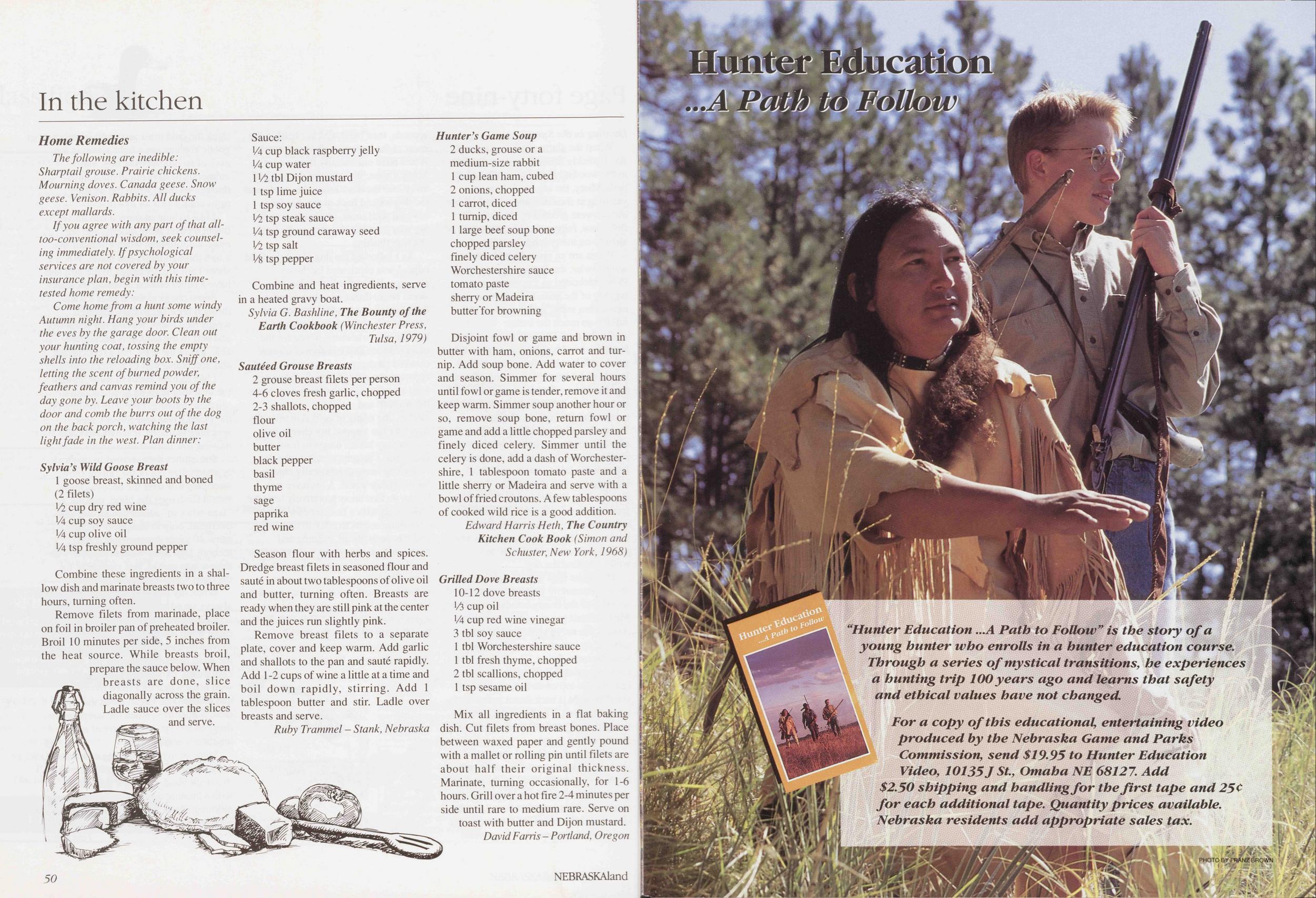
In the kitchen
Home RemediesThe following are inedible: Sharptail grouse. Prairie chickens. Mourning doves. Canada geese. Snow geese. Venison. Rabbits. All ducks except mallards.
If you agree with any part of that all- too-conventional wisdom, seek counseling immediately. If psychological seiwices are not covered by your insurance plan, begin with this time- tested home remedy:
Come home from a hunt some windy Autumn night. Hang your birds under the eves by the garage door. Clean out your hunting coat, tossing the empty shells into the reloading box. Sniff one, letting the scent of burned powder, feathers and canvas remind you of the day gone by. Leave your boots by the door and comb the burrs out of the dog on the back porch, watching the last light fade in the west. Plan dinner:
Sylvia's Wild Goose Breast1 goose breast, skinned and boned
(2 filets)
1/2 cup dry red wine
1/4 cup soy sauce
1/4 cup olive oil
1/4 tsp freshly ground pepper
Combine these ingredients in a shal- low dish and marinate breasts two to three hours, turning often.
Remove filets from marinade, place on foil in broiler pan of preheated broiler. Broil 10 minutes per side, 5 inches from the heat source. While breasts broil, prepare the sauce below. When breasts are done, slice diagonally across the grain. Ladle sauce over the slices and serve.
Sauce:
1/4 cup black raspberry jelly
1/4 cup water
1 1/2 tbl Dijon mustard
1 tsp lime juice
1 tsp soy sauce
1/2 tsp steak sauce
1/4 tsp ground caraway seed
1/2 tsp salt
1/8 tsp pepper
Combine and heat ingredients, serve in a heated gravy boat.
Sylvia G. Bashline, The Bounty of the Earth Cookbook (Winchester Press, Tulsa, 1979) Sauteed Grouse Breasts2 grouse breast filets per person
4-6 cloves fresh garlic, chopped
2-3 shallots, chopped
flour
olive oil
butter
black pepper
basil
thyme
sage
paprika
red wine
Season flour with herbs and spices. Dredge breast filets in seasoned flour and saute in about two tablespoons of olive oil and butter, turning often. Breasts are ready when they are still pink at the center and the juices run slightly pink. Remove breast filets to a separate plate, cover and keep warm. Add garlic and shallots to the pan and saute rapidly. Add 1 -2 cups of wine a little at a time and boil down rapidly, stirring. Add 1 tablespoon butter and stir. Ladle over breasts and serve.
Ruby Trammel - Stank, Nebraska Hunter's Game Soup2 ducks, grouse or a
medium-size rabbit
1 cup lean ham, cubed
2 onions, chopped
1 carrot, diced
1 turnip, diced
1 large beef soup bone
chopped parsley
finely diced celery
Worchestershire sauce
tomato paste
sherry or Madeira
butter Tor browning
Disjoint fowl or game and brown in butter with ham, onions, carrot and turnip. Add soup bone. Add water to cover and season. Simmer for several hours until fowl or game is tender, remove it and keep warm. Simmer soup another hour or so, remove soup bone, return fowl or game and add a little chopped parsley and finely diced celery. Simmer until the celery is done, add a dash of Worchestershire, 1 tablespoon tomato paste and a little sherry or Madeira and serve with a bowl of fried croutons. A few tablespoons of cooked wild rice is a good addition.
Edward Harris Heth, The Country Kitchen Cook Book (Simon and Schuster, New York, 1968) Grilled Dove Breasts10-12 dove breasts
1/3 cup oil
1/4 cup red wine vinegar
3 tbl soy sauce
1 tbl Worchestershire sauce
1 tbl fresh thyme, chopped
2 tbl scallions, chopped
1 tsp sesame oil
Mix all ingredients in a flat baking dish. Cut filets from breast bones. Place between waxed paper and gently pound with a mallet or rolling pin until filets are about half their original thickness. Marinate, turning occasionally, for 1-6 hours. Grill over a hot fire 2-4 minutes per side until rare to medium rare. Serve on toast with butter and Dijon mustard.
David Farris - Portland, Oregon 50 NEBRASKAlandHunter Education ... A Path to Follow
'Hunter Education ...A Path to Follow" is the story of a young hunter who enrolls in a hunter education course. Through a series of mystical transitions, he experiences a hunting trip 100 years ago and learns that safety and ethical values have not changed. For a copy of this educational, entertaining video produced by the Nebraska Game and Parks Commission, send $19.95 to Hunter Education Video, 10135 J St., Omaha NF 68127. Add $2.50 shipping and handling for the first tape and 25C for each additional tape. Quantity prices available. Nebraska residents add appropriate sales tax.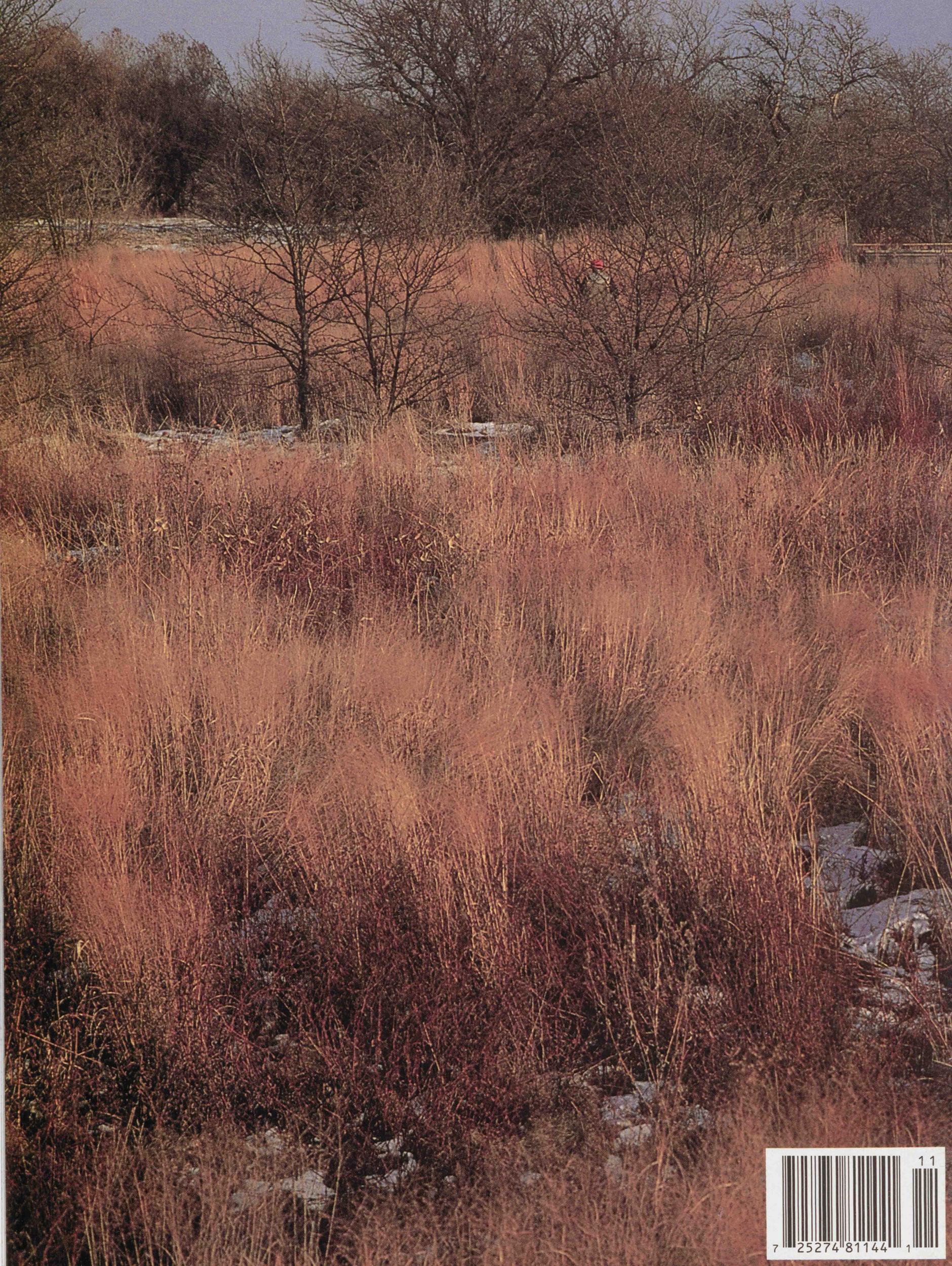
Position: 467 (22 views)