Volume 72, Issue 8, 1994
NEBRASKAland
OCTOBER 1994 • $2.00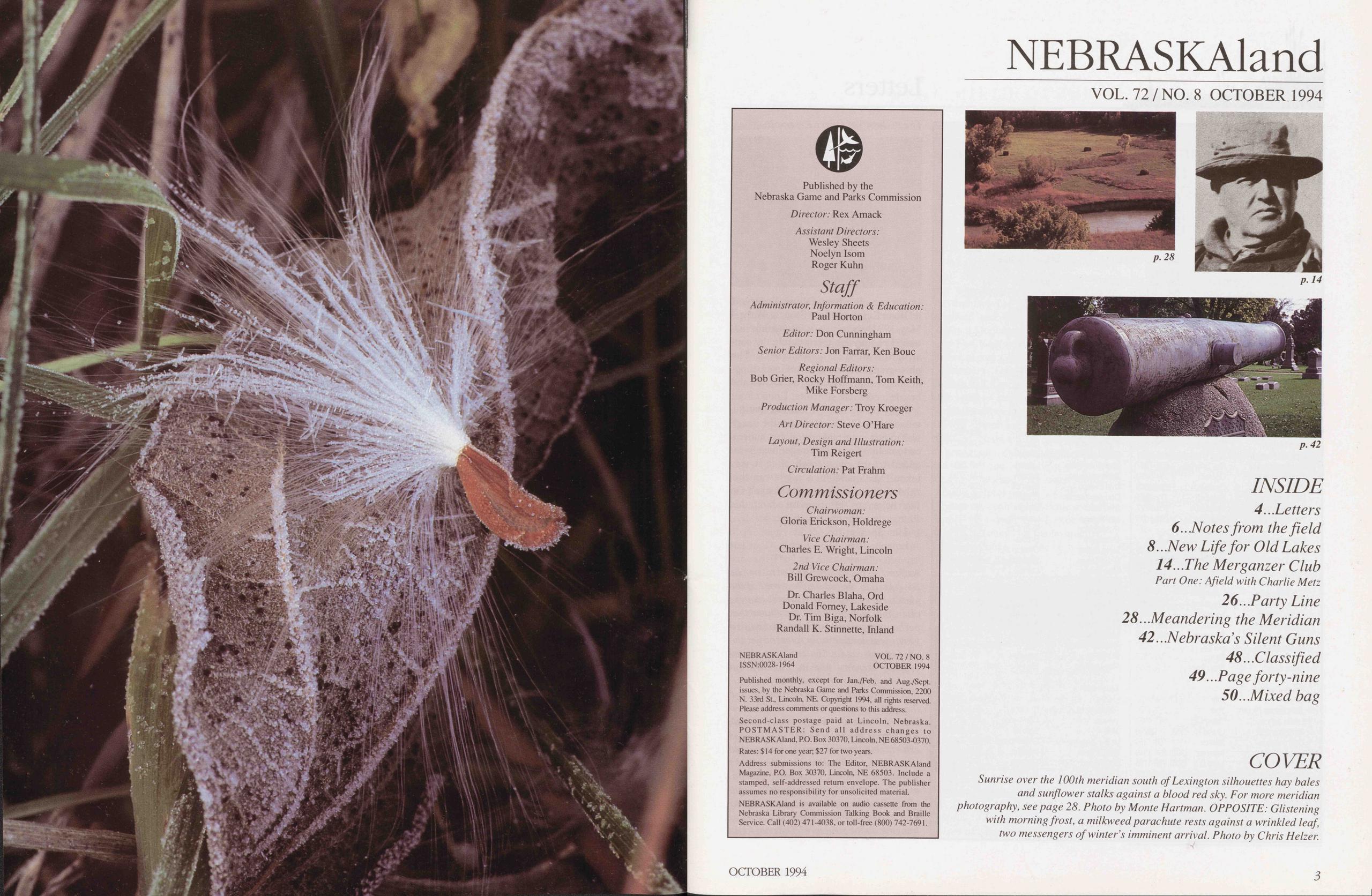
p. 28
p. 14
p.42
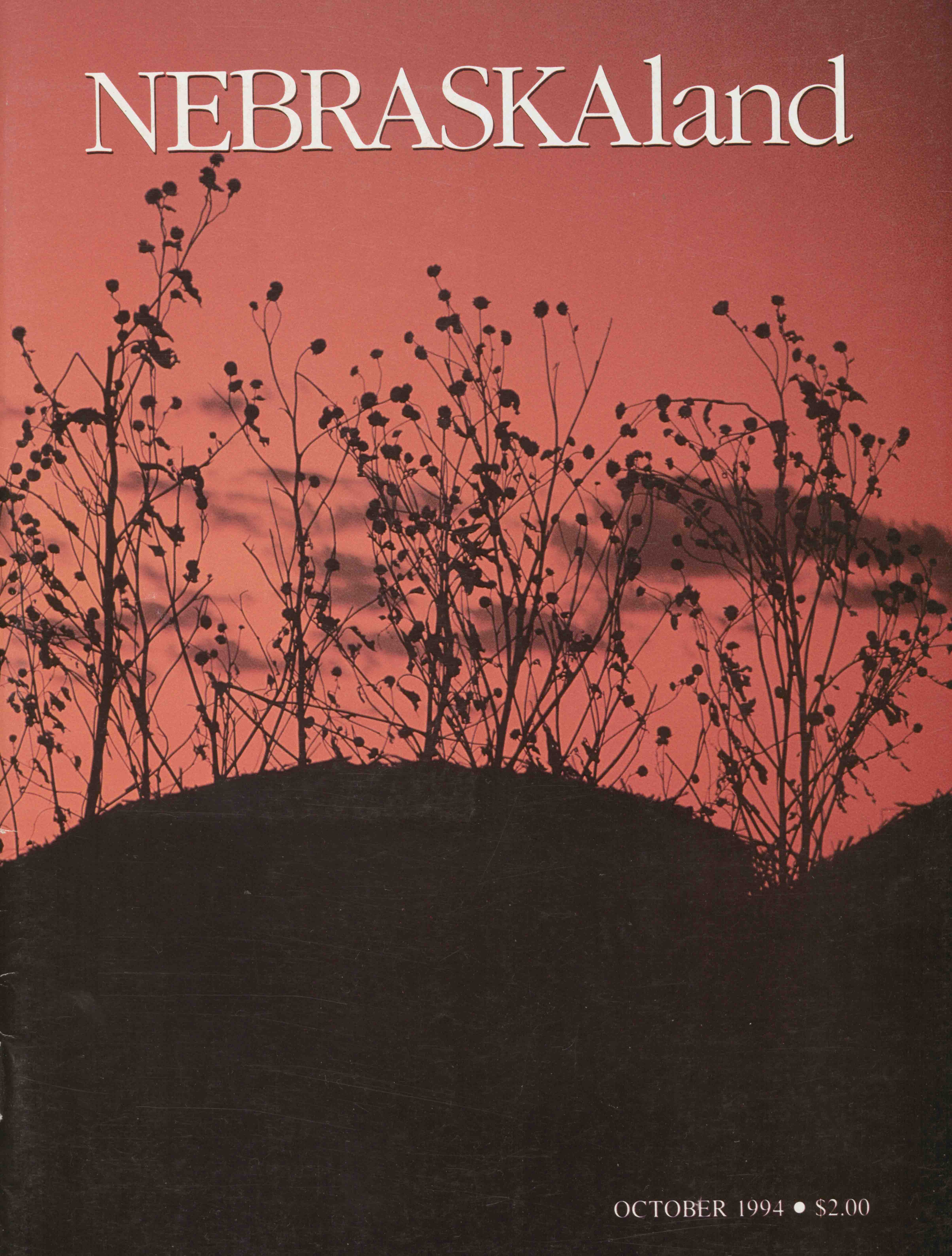
COVER Sunrise over the 100th meridian south of Lexington silhouettes hay bales and sunflower stalks against a blood red sky. For more meridian photography, see page 28. Photo by Monte Hartman. OPPOSITE: Glistening with morning frost, a milkweed parachute rests against a wrinkled leaf two messengers of winter s imminent arrival. Photo by Chris Helzer.
Letters
The “Ghost” of Oliver ReservoirIn the article about Oliver Reservoir [“Oliver Reservoir: Last Stop for Water,” May 1994] there was a fascinating historical photograph taken during the construction of the impoundment. The photograph shows a group of interesting- looking people standing on top of and beside a concrete structure. Upon closer scrutiny of the faces, I realized that the individual at the bottom left of the image was in fact not a real person, but rather a cartoon-like figure that might have been added to the photograph after it was taken. My question is why was this “ghost” figure added to the image? Do you have any information about this strange apparition?
John Spence Lincoln, Neb. Author Jon Farrar reports that no one he has talked to, including the owner of the photo, Larry Stahla of Kimball, can explain the “ghost.” We ve speculated that perhaps a member of the unidentified group was unable to be present for the photograph, and an enterprising photographer sketched him in. Possibly, but less likely, a person standing in that position moved during a long exposure, and the photographer tried to improve a blurred image by sketching in features. No trace of an image below the sketch is evident, but the elbow of the man next to him seems solidly planted on the ghost's shoulder. If not a retouched person, maybe the figure is a cutout, brought along as a joke or to stand in for a missing person. By the way, whose overcoat is hanging on the structure? The coat looks decidedly real, but only the ghost is not wearing one. (Editor) Where's the Wiemaraner?I am disappointed in your article about pointing dogs [“To the Point,” August/ September 1994]. You omitted the Wiemaraner breed — my favorite dog. Please make your research more complete in the future.
Gerald VapMcCook, Neb. The Wiemaraner is one of several pointing breeds mentioned but not pictured or described in detail in the article. Author Tom Keith says the breed apparently has declined in popularity in this area, and he could not find a fully trained working Wiemaraner to photograph. (Editor) A Setter Letter
Thank you for including the Irish setters in your article on pointing breeds. This breed has been given a bad rap over the years for its supposed lack of hunting instinct. Might I mention that Bonnie (pictured in the article) was No. 1 Irish setter in the nation in 1992 in junior field trial stakes, defeating more than 150 dogs, many in the all-pointing breed stakes. They are wonderful hunting companions. They are also natural retrievers and will retrieve from water as well as land. They are intelligent and easy to train, and there is nothing more breathtaking than that flowing red coat in the sun with the dog standing a classic point. Maybe with your article, an avid hunter out there will come to realize the joy of owning an Irish setter.
Debbie EastbumElmwood, Neb. Just Brittany, Please
I enjoy your magazine every month and have a collection dating back to the 1960s. I don’t mean to nit-pick but in the August/September issue on pages 32-33 you refer to the Brittany as a Brittany spaniel. I’m not certain if you are aware that several years ago the AKC officially changed the breed’s name and dropped “spaniel.” The breed is now the Brittany.
Bob ZimmermanLincoln, Neb. Praise for Nebraska's Parks
My children and I traveled across Nebraska this summer and had a wonderful time. We used your brochures to plan our route and to follow part of the Oregon Trail. My nine- and 10-year-olds studied a “wagons west” unit extensively in third grade, and they were interested to see the territory for themselves. We found ourselves surprised and fascinated at Homestead National Monument and Rock Creek Station, Fort Kearny and Ash Hollow state historical parks. We also enjoyed stops at Gothenberg, Ogallala and Bill Cody’s Buffalo Bill Ranch State Historical Park. The scenery near Chimney Rock and Scott’s Bluff was spectacular. Most important, we found the state parks to be beautiful and clean. The visitors-center exhibits were well done and interesting, including audiovisual presentations, and they were staffed by friendly, helpful people. Since my return I have enjoyed telling people about our great experience in Nebraska. Thanks for the hospitality.
Wendy CookeKirksville, Missouri Correction
Because of a printer's error, a line was dropped from the August/September story “Habitat, Weevils and Jim Holmes.” Five words are missing from the last sentence of the third paragraph of column three, page 24. The sentence should read “The thistles will return unless brought into balance with the entire plant community by good range management practices and the presence of their natural enemies.” Write to Letters, NEBRASKAland, P.O. Box 30370, Lincoln, NE 68503-0370, or fax (402) 471-5528. Letters may be condensed or edited for clarity.
We’re Counting the Days!
NEBRASKAland 1995 is on its way, and the NEBRASKAland Calendar is hot off the press with 12 spectacular new photos of Nebraska’s great outdoors, useful state park information, license and permit data and handy sunrise-sunset tables. At home or in the office, the NEBRASKAland Calendar is a perfect gift for Nebraskans near and far. A year-round bargain for only $5.50. Please send me copies of the 1995 NEBRASKAland Calendar at $5.50 each (Nebraska residents please Include sales tax). Name Address City StateZip Check Enclosed Visa MasterCard Acct. No. Expiration Date Mail to NEBRASKAland Calendar P.O. Box 30370 Lincoln, NE 68503 Phone orders (Visa/MasterCard Only): 1-800 NEB-LAND (1-800-632-5263) 4 NEBRASKAland OCTOBER 1994 5
Notes from the field
A Different Hunter Safety LessonIt was the kind of fall scene that should have been at least comforting, if not downright soothing. Birds sang and fluttered around our little clearing, and a rancher on a noisy old John Deere hauled hay out of a meadow a quarter- mile beyond the edge of the woods. Normally, I might have smiled at this pleasant view then slipped back into sleep, but something about it was disturbing. With some difficulty, I blinked and shook and willed myself awake. It was late September and we were camping and bowhunting for deer — we should have been in our tree stands hours ago.
I stuck a leg out of the sleeping bag and poked at the shapeless lump lying where Lowell had fallen asleep the night before. "No sweat” he had said as we turned in. "I can wake up any time I want to. I’ll get us up at 4:30.”
It took several good boots to get him to respond. When he finally mumbled into action, he struck a match to look at his watch. The match — and another — flickered then sputtered to smoky darkness. Only when he cracked the camper door did a match flare to life. Lowell’s watch showed we had missed our wakeup by a good four hours.
Our two companions stirred only after we nudged them awake. The four of us stumbled into the bright, cool morning, which soon cleared the night’s fog from our heads and set us to wondering what had happened. A sobering picture was soon apparent.
We had spent the night in Lowell’s friend’s pop-up camper, so brand new it smelled like a Buick fresh from the showroom floor. It was so nearly air-tight that the sides ballooned out when someone slammed the door.
Without much doubt, a shortage of oxygen was part of what had dulled and stupefied us. The matches’ reluctance to bum suggests that it was pretty stuffy in there, which should surprise absolutely no one. When you bunk four big galoots in the equivalent of a giant ziplock sandwich bag, they’re bound to snore up most of the oxygen.
We also wondered about carbon monoxide from the heater. Carbon monoxide is insidious, an odorless and colorless gas that is impossible to detect. And the befuddlement it causes in its victims means that they are often unable to identify the problem even if they realize something is wrong.
There was a headache or two and a queasy stomach in the party that morning which, recalling the festivities of the night before, did not seem all that inappropriate. But carbon monoxide produces those symptoms as well and might also have been involved. Luckily, the heater had run out of fuel sometime during the night and was stone cold when we woke up. Besides, we had been told it was a "safe” heater.
My basic mistrust of any kind of combustion, plus a metabolism that always makes me feel too warm when others are comfortable, might have saved us from something much worse than headaches. When we turned in the previous night I zipped open a comer of the window flap opposite my face for ventilation and cooling. It was through the little triangular gap in the canvas that I saw the morning scene that awakened me, and through which a little fresh air flowed all night long.
Since that episode 20 years ago, I’ve learned some things about heat sources for cold weather camping. The essence of the matter is this: There is no such thing as safe unvented combustion in campers, tents or other enclosed areas.
The catalytic heater we and many others thought "safe” at the time of that long-ago deer hunt is not recommended for use in any enclosure.
Manufacturers’ warnings in those days were low key and inconspicuous but are now printed all over the packaging and the equipment. But there are other dangerous ways of heating.
Charcoal briquettes are particularly insidious, because of the amount of carbon monoxide they produce, and because they are likely to be on hand at almost any campsite. It’s easy to imagine rookie campers dragging a smoldering hibachi into a tent or pickup shell to warm up and dry out after an unex- pected cold front or thunderstorm. Statistics on carbon monoxide fatalities kept by poison control centers and epidemiologist document a wide variety of situations in which people are overcome by this deadly gas. There is one cluster of cases that stands out from all the rest, however — deaths from charcoal fires in enclosed spaces — and its lesson is clear: Heating with charcoal kills.
Using a cookstove in an RV, a tent or other enclosure is another very bad idea. So is using a kerosene-fired heater. The problem with all of them is the same — they consume oxygen and produce carbon monoxide. Compounding the problem is the quality of today’s camping shelters. Drips and drafts are things of the past. So is the built-in ventilation they would provide.
That does not mean that we must risk hypothermia in our hunting camps, however. Professionally installed furnaces in RV campers are safe because they consume outside air and the gasses generated by combustion are carried away through a flue.
Hunters in big wall-tents like those used by high-country outfitters are probably pretty safe from carbon monoxide when they fire up their sheet- metal wood-burning stoves. Good chimneys carry the fumes away, and those big canvas goliaths are drafty enough to provide a good supply of fresh air. Buckskinners in tipis are OK, too, if they manipulate the smokehole flap and install the tipi cover and dew cloth correctly. Properly set up, the entire tipi acts as a chimney, drawing in fresh air as long as heat is generated.
The best solution is to use no heater at all while sleeping. Retaining the sleeping camper’s own body heat with the right sleeping bag, mattress and night clothes makes a lot more sense than the risks posed by some jury- rigged heater.
Ken Bouc NEBRASKAland Magazine
New Life for Old Lakes
More anglers, hunters, campers and hikers mean heavy pressure on limited natural resources, but six new Sandhills acquisitions will increase recreation opportunities in north-central Nebraska.In the past two years, through trade, purchase and lease, the Nebraska Game and Parks Commission has acquired six Sandhills lakes that promise to offer Nebraska anglers significant new fishing opportunities in the north-central part of the state. From Frye Lake near Hyannis to Swan Lake north of Burwell, the newly acquired lakes are among the state’s most productive bodies of water, and they share a long history of excellent fishing. The six lakes are Willow Lake in Brown County, Shell Lake in Cherry County, Swan Lake in Holt County, Frye Lake in Grant County and parts of two adjacent lakes in Rock County jointly called Twin Lakes.
The acquisitions are the result of an on-going effort by the Commission to provide more fishing and other recreation opportunities to meet the demands of an increasing number of anglers, hunters, campers, hikers and others, said Don Gabelhouse, administrator of the Game and Parks Commission’s Fisheries Division, and he pointed out that Sandhills lakes also provide excellent habitat for waterfowl and other species of wildlife.
“Sandhills lakes are a top priority in terms of acquisition for new public fishing water,” Gabelhouse said, pointing to the long distances anglers are willing to drive to fish productive lakes in that sparsely populated region. “The fact that Sandhills lakes are shallow and vegetated is somewhat of a two-edged sword, but they are usually highly productive,” he said, adding that he considers the new lakes to be among the best in the region. Gabelhouse says the key to their high productivity is that all areas of the lakes produce fish throughout the year.
Of some concern to fisheries managers, says Gabelhouse, is the possibility of fish die-offs, especially in winter. Fish in shallow, highly vegetated lakes are vulnerable when dissolved oxygen decreases to a critical level, a consequence of low penetration of sunlight into the water. Plants that formerly produced oxygen through photosynthesis die and begin to decay, a process that consumes oxygen. Because accumulations of ice and snow on a lake surface greatly inhibit the penetration of sunlight, most die-offs occur in winter, but they also can occur on cloudy days in fall.
The threat can be substantially mitigated by aeration systems, says Gabelhouse. The Commission is considering that option for several of the new lakes. Dredging, to deepen the lakes, is also a means for reducing possible winter-kill problems.
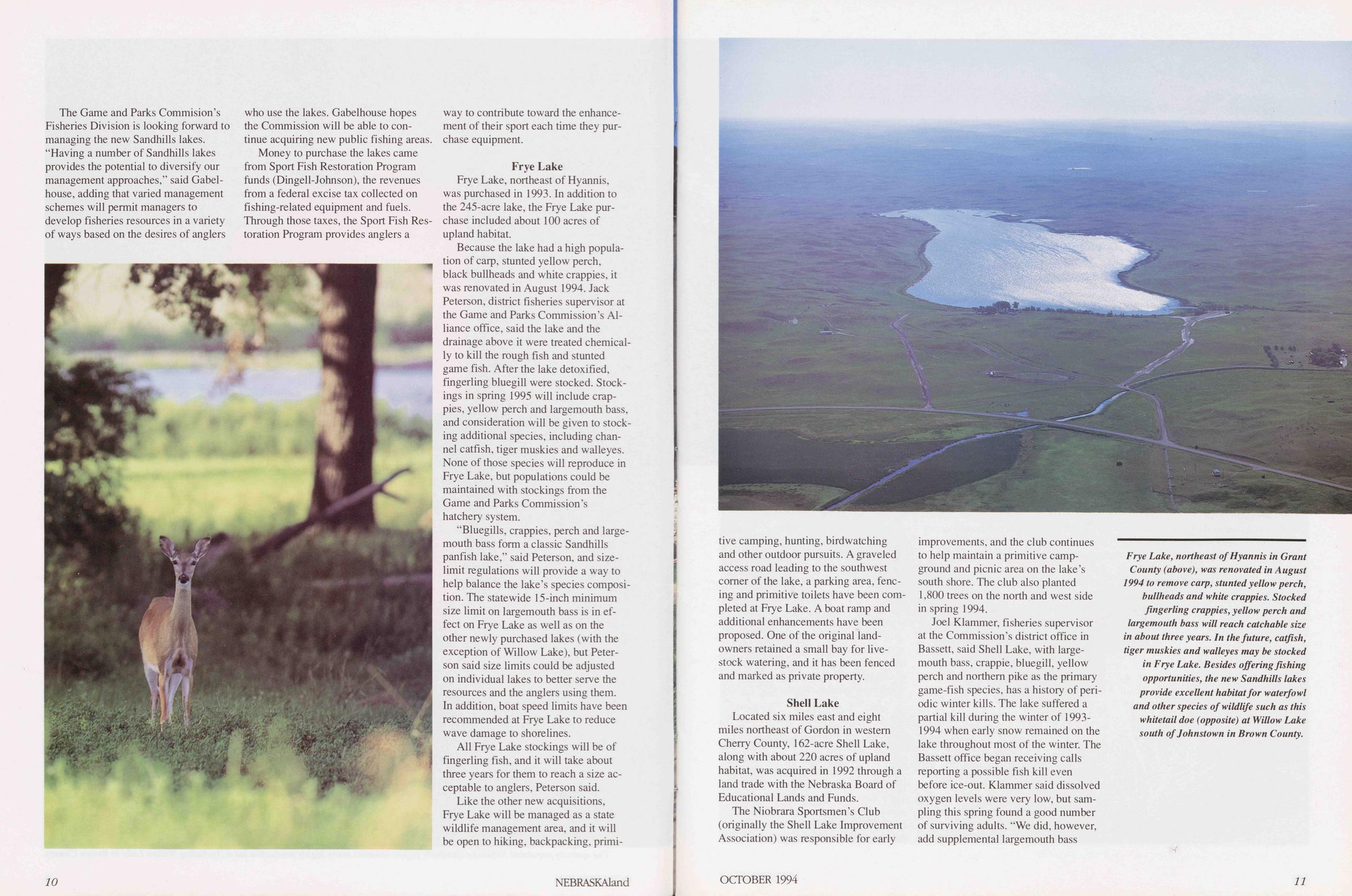
The Game and Parks Commision’s Fisheries Division is looking forward to managing the new Sandhills lakes. “Having a number of Sandhills lakes provides the potential to diversify our management approaches,” said Gabelhouse, adding that varied management schemes will permit managers to develop fisheries resources in a variety of ways based on the desires of anglers who use the lakes. Gabelhouse hopes the Commission will be able to continue acquiring new public fishing areas. Money to purchase the lakes came from Sport Fish Restoration Program funds (Dingell-Johnson), the revenues from a federal excise tax collected on fishing-related equipment and fuels. Through those taxes, the Sport Fish Restoration Program provides anglers a way to contribute toward the enhancement of their sport each time they pur- chase equipment.
Frye LakeFrye Lake, northeast of Hyannis, was purchased in 1993. In addition to the 245-acre lake, the Frye Lake purchase included about 100 acres of upland habitat.
Because the lake had a high population of carp, stunted yellow perch, black bullheads and white crappies, it was renovated in August 1994. Jack Peterson, district fisheries supervisor at the Game and Parks Commission’s Alliance office, said the lake and the drainage above it were treated chemically to kill the rough fish and stunted game fish. After the lake detoxified, fingerling bluegill were stocked. Stockings in spring 1995 will include crappies, yellow perch and largemouth bass, and consideration will be given to stocking additional species, including channel catfish, tiger muskies and walleyes. None of those species will reproduce in Frye Lake, but populations could be maintained with stockings from the Game and Parks Commission’s hatchery system.
“Bluegills, crappies, perch and large-mouth bass form a classic Sandhills panfish lake,” said Peterson, and size-limit regulations will provide a way to help balance the lake’s species composition. The statewide 15-inch minimum size limit on largemouth bass is in effect on Frye Lake as well as on the other newly purchased lakes (with the exception of Willow Lake), but Peterson said size limits could be adjusted on individual lakes to better serve the resources and the anglers using them. In addition, boat speed limits have been recommended at Frye Lake to reduce wave damage to shorelines.
All Frye Lake stockings will be of fingerling fish, and it will take about three years for them to reach a size acceptable to anglers, Peterson said.
Like the other new acquisitions, Frye Lake will be managed as a state wildlife management area, and it will be open to hiking, backpacking, primitive camping, hunting, birdwatching and other outdoor pursuits. A graveled access road leading to the southwest comer of the lake, a parking area, fencing and primitive toilets have been completed at Frye Lake. A boat ramp and additional enhancements have been proposed. One of the original land-owners retained a small bay for livestock watering, and it has been fenced and marked as private property.
Shell LakeLocated six miles east and eight miles northeast of Gordon in western Cherry County, 162-acre Shell Lake, along with about 220 acres of upland habitat, was acquired in 1992 through a land trade with the Nebraska Board of Educational Lands and Funds.
The Niobrara Sportsmen’s Club (originally the Shell Lake Improvement Association) was responsible for early improvements, and the club continues to help maintain a primitive campground and picnic area on the lake’s south shore. The club also planted 1,800 trees on the north and west side in spring 1994.
Joel Klammer, fisheries supervisor at the Commission’s district office in Bassett, said Shell Lake, with large- mouth bass, crappie, bluegill, yellow perch and northern pike as the primary game-fish species, has a history of periodic winter kills. The lake suffered a partial kill during the winter of 1993-1994 when early snow remained on the lake throughout most of the winter. The Bassett office began receiving calls reporting a possible fish kill even before ice-out. Klammer said dissolved oxygen levels were very low, but sampling this spring found a good number of surviving adults. “We did, however, add supplemental largemouth bass
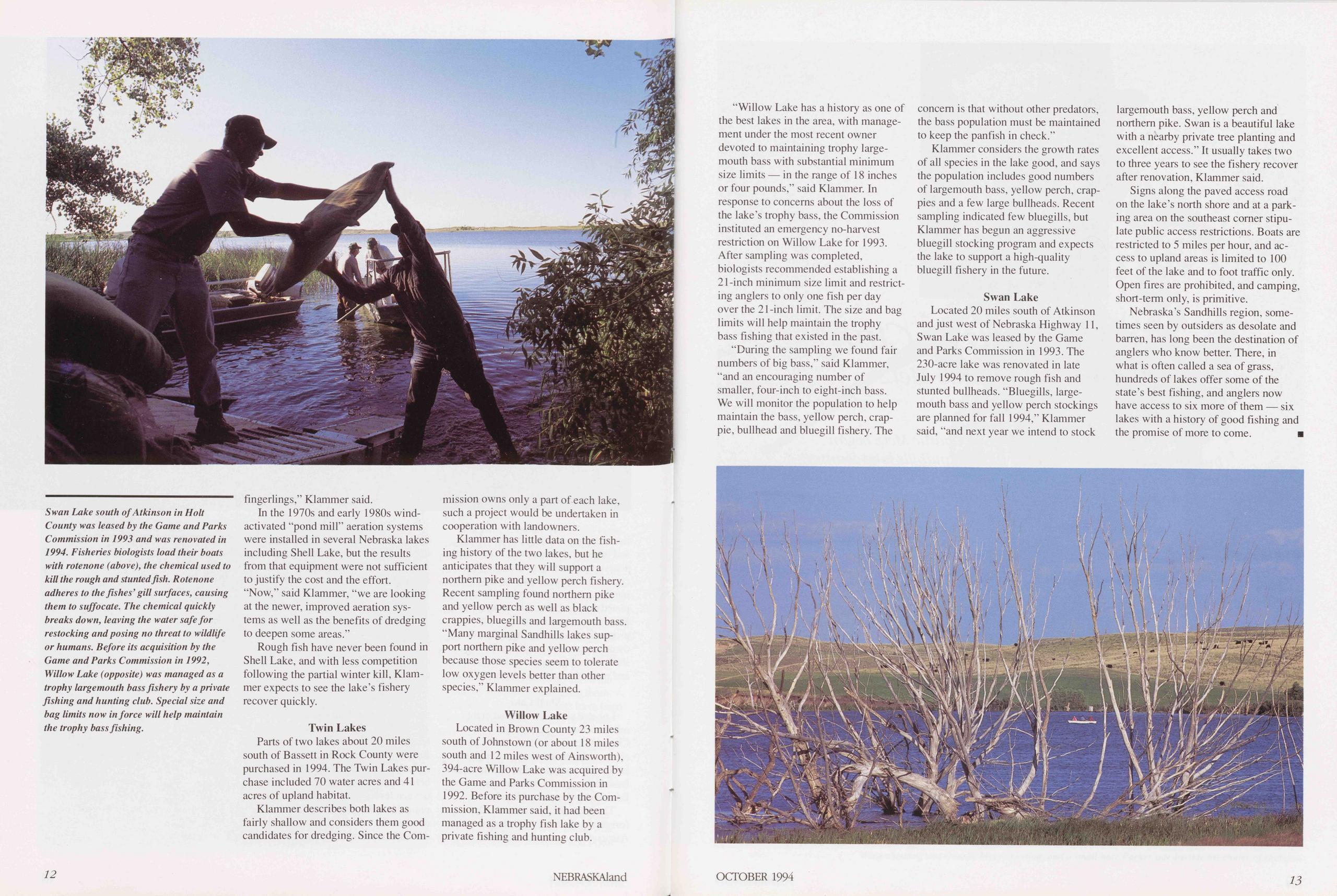
fingerlings,” Klammer said. In the 1970s and early 1980s wind- activated “pond mill” aeration systems were installed in several Nebraska lakes including Shell Lake, but the results from that equipment were not sufficient to justify the cost and the effort. “Now,” said Klammer, “we are looking at the newer, improved aeration systems as well as the benefits of dredging to deepen some areas.”
Rough fish have never been found in Shell Lake, and with less competition following the partial winter kill, Klammer expects to see the lake’s fishery recover quickly.
Twin LakesParts of two lakes about 20 miles south of Bassett in Rock County were purchased in 1994. The Twin Lakes purchase included 70 water acres and 41 acres of upland habitat.
Klammer describes both lakes as fairly shallow and considers them good candidates for dredging. Since the Commission owns only a part of each lake, such a project would be undertaken in cooperation with landowners.
Klammer has little data on the fishing history of the two lakes, but he anticipates that they will support a northern pike and yellow perch fishery. Recent sampling found northern pike and yellow perch as well as black crappies, bluegills and largemouth bass. “Many marginal Sandhills lakes support northern pike and yellow perch because those species seem to tolerate low oxygen levels better than other species,” Klammer explained.
Willow LakeLocated in Brown County 23 miles south of Johnstown (or about 18 miles south and 12 miles west of Ainsworth), 394-acre Willow Lake was acquired by the Game and Parks Commission in 1992. Before its purchase by the Commission, Klammer said, it had been managed as a trophy fish lake by a private fishing and hunting club.
“Willow Lake has a history as one of the best lakes in the area, with management under the most recent owner devoted to maintaining trophy large- mouth bass with substantial minimum size limits — in the range of 18 inches or four pounds,” said Klammer. In response to concerns about the loss of the lake’s trophy bass, the Commission instituted an emergency no-harvest restriction on Willow Lake for 1993. After sampling was completed, biologists recommended establishing a 21-inch minimum size limit and restrict- ing anglers to only one fish per day over the 21-inch limit. The size and bag limits will help maintain the trophy bass fishing that existed in the past.
“During the sampling we found fair numbers of big bass,” said Klammer, “and an encouraging number of smaller, four-inch to eight-inch bass. We will monitor the population to help maintain the bass, yellow perch, crappie, bullhead and bluegill fishery. The concern is that without other predators, the bass population must be maintained to keep the panfish in check.”
Klammer considers the growth rates of all species in the lake good, and says the population includes good numbers of largemouth bass, yellow perch, crappies and a few large bullheads. Recent sampling indicated few bluegills, but Klammer has begun an aggressive bluegill stocking program and expects the lake to support a high-quality bluegill fishery in the future.
Swan LakeLocated 20 miles south of Atkinson and just west of Nebraska Highway 11, Swan Lake was leased by the Game and Parks Commission in 1993. The 230-acre lake was renovated in late July 1994 to remove rough fish and stunted bullheads. “Bluegills, large- mouth bass and yellow perch stockings are planned for fall 1994,” Klammer said, “and next year we intend to stock largemouth bass, yellow perch and northern pike. Swan is a beautiful lake with a nearby private tree planting and excellent access.” It usually takes two to three years to see the fishery recover after renovation, Klammer said.
Signs along the paved access road on the lake’s north shore and at a parking area on the southeast corner stipulate public access restrictions. Boats are restricted to 5 miles per hour, and access to upland areas is limited to 100 feet of the lake and to foot traffic only. Open fires are prohibited, and camping, short-term only, is primitive.
Nebraska’s Sandhills region, sometimes seen by outsiders as desolate and barren, has long been the destination of anglers who know better. There, in what is often called a sea of grass, hundreds of lakes offer some of the state’s best fishing, and anglers now have access to six more of them — six lakes with a history of good fishing and the promise of more to come.
12 NEBRASKAland OCTOBER 1994 13
The Merganzer Club Afield with Charlie Metz
In the late 1800s, Omaha brewer Charlie Metz began hunting waterfowl and grouse in the Sandhills lake country. After the turn of the century, he bought his own ranch along the South Dakota border north of Cody.Hunting clubs dotted the shores of Sandhills lakes during the early decades of the 20th century. Some lasted only as long as the youth of their members. Many were displaced when the Valentine National Wildlife Refuge encompassed the cluster of lakes in eastern Cherry County in the 1930s. Only two have endured — Red Deer Hunting Club on Red Deer Lake and the Wood Lake Club on Ballards Marsh, both south of Valentine. A third, the Merganzer Club (with a “z” not an “s”), had its beginnings in the 1890s in South Dakota a few miles north of the Nebraska border and found a permanent home on Cody Lake in northwestern Cherry County in 1906. It survives in spirit and deeded land only.
Unlike most hunting clubs of the time, the Merganzer Club had at its core one man, Omaha brewer Charles Metz, an enthusiastic wing-shooter, who, often in the company of Omaha World-Herald outdoor writer Sandy Griswold, returned to the Sandhills year after year to hunt waterfowl and grouse.
"We were sportsmen — the Merganzer Club — and the whistle of the mallard’s wing and the yellowleg’s tinkling call was melody to our souls,” Griswold wrote on November 20, 1898. "We needed no stupendous Niagara, with its reverberating thunders, no Yosemite with its beetling crags, inaccessible peaks and yawning canyons, to stir the warm blood in our veins. We were outdoors in the freshening winds and soothing sunshine, and that was plenty.”
The Merganzer Club’s early hunting grounds were in sandhill wetlands along Lake Creek (now Lacreek National Wildlife Refuge) in South Dakota northwest of Cody, Nebraska. In the 1890s, they camped in wall tents. Later, Lacreek NWR records indicate, Metz purchased land on Lake Creek and "built temporary living quarters for his hunting parties.” Griswold described their camp as "the exact spot where for three seasons the Merganzer Club has pitched its canvas home.”
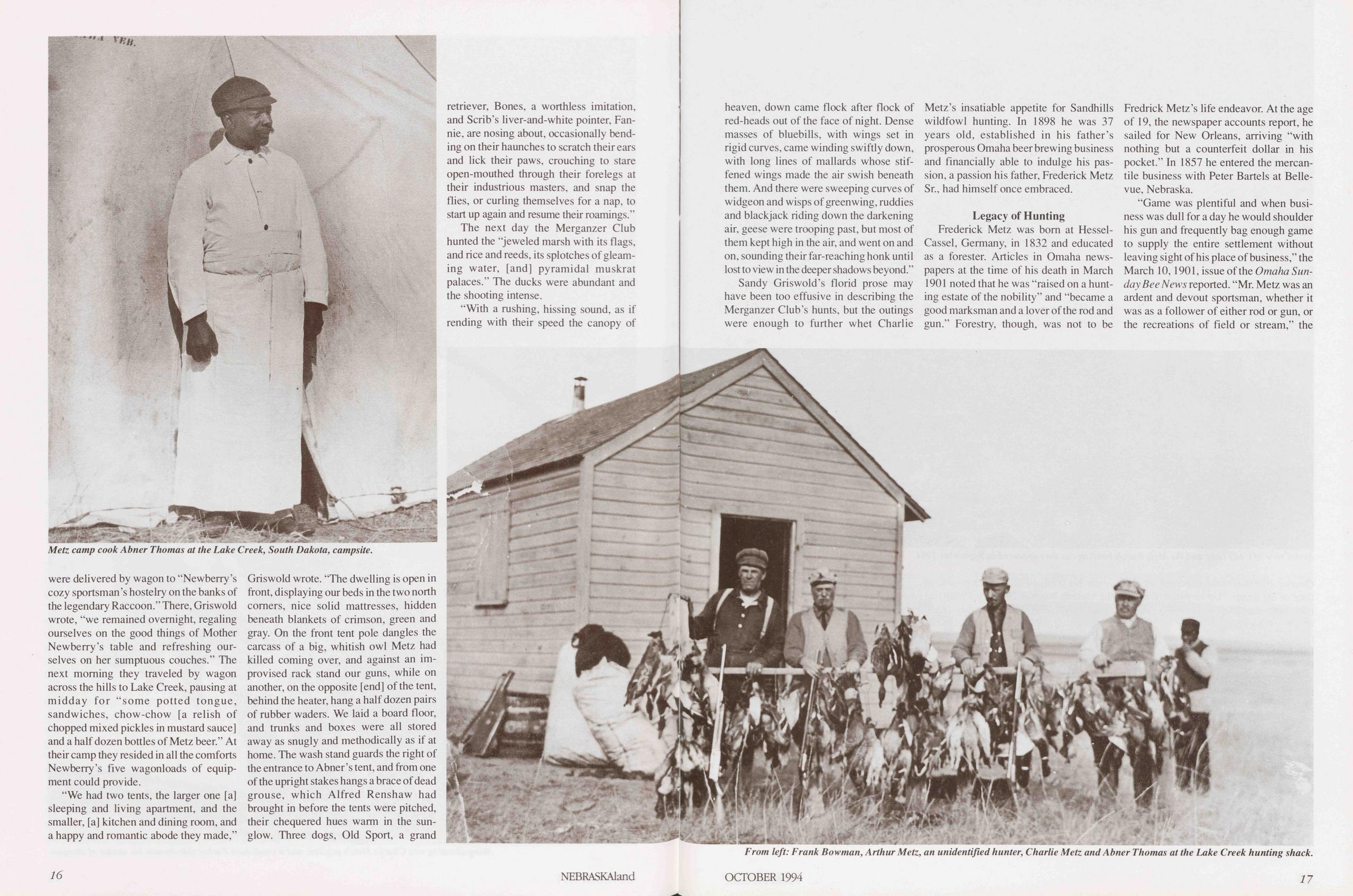
According to Griswold, there were only four Merganzer Club members at the time — Charlie Metz, Sandy Griswold, George Scribner and Tom Foley, a number and membership that certainly changed with the years. Foley was absent from the 1898 hunt, and two guests, Charlie Rogers and Billy Marsh, accompanied the others, as did Abner Thomas, the Metz camp’s perennial cook, until he was killed in the Omaha tornado of 1913.
Together, they had taken the Fremont, Elkhorn and Missouri Valley Railroad (later to become the Chicago and Northwestern) from Omaha to Cody where they were met by Anson "Anse” Newberry, northwestern Cherry County rancher and outfitter. From Cody they
were delivered by wagon to “Newberry’s cozy sportsman’s hostelry on the banks of the legendary Raccoon.” There, Griswold wrote, “we remained overnight, regaling ourselves on the good things of Mother Newberry’s table and refreshing ourselves on her sumptuous couches.” The next morning they traveled by wagon across the hills to Lake Creek, pausing at midday for “some potted tongue, sandwiches, chow-chow [a relish of chopped mixed pickles in mustard sauce] and a half dozen bottles of Metz beer.” At their camp they resided in all the comforts Newberry’s five wagonloads of equipment could provide.
“We had two tents, the larger one [a] sleeping and living apartment, and the smaller, [a] kitchen and dining room, and a happy and romantic abode they made,” Griswold wrote. “The dwelling is open in front, displaying our beds in the two north corners, nice solid mattresses, hidden beneath blankets of crimson, green and gray. On the front tent pole dangles the carcass of a big, whitish owl Metz had killed coming over, and against an improvised rack stand our guns, while on another, on the opposite [end] of the tent, behind the heater, hang a half dozen pairs of rubber waders. We laid a board floor, and trunks and boxes were all stored away as snugly and methodically as if at home. The wash stand guards the right of the entrance to Abner’s tent, and from one of the upright stakes hangs a brace of dead grouse, which Alfred Renshaw had brought in before the tents were pitched, their chequered hues warm in the sunglow. Three dogs, Old Sport, a grand retriever, Bones, a worthless imitation, and Scrib’s liver-and-white pointer, Fannie, are nosing about, occasionally bending on their haunches to scratch their ears and lick their paws, crouching to stare open-mouthed through their forelegs at their industrious masters, and snap the flies, or curling themselves for a nap, to start up again and resume their roamings.”
The next day the Merganzer Club hunted the “jeweled marsh with its flags, and rice and reeds, its splotches of gleaming water, [and] pyramidal muskrat palaces.” The ducks were abundant and the shooting intense.
“With a rushing, hissing sound, as if rending with their speed the canopy of
16 NEBRASKAlandheaven, down came flock after flock of red-heads out of the face of night. Dense masses of bluebills, with wings set in rigid curves, came winding swiftly down, with long lines of mallards whose stiffened wings made the air swish beneath them. And there were sweeping curves of widgeon and wisps of green wing, ruddies and blackjack riding down the darkening air, geese were trooping past, but most of them kept high in the air, and went on and on, sounding their far-reaching honk until lost to view in the deeper shadows beyond.” Sandy Griswold’s florid prose may have been too effusive in describing the Merganzer Club’s hunts, but the outings were enough to further whet Charlie Metz’s insatiable appetite for Sandhills wildfowl hunting. In 1898 he was 37 years old, established in his father’s prosperous Omaha beer brewing business and financially able to indulge his passion, a passion his father, Frederick Metz Sr., had himself once embraced.
Legacy of HuntingFrederick Metz was bom at Hessel- Cassel, Germany, in 1832 and educated as a forester. Articles in Omaha newspapers at the time of his death in March 1901 noted that he was “raised on a hunting estate of the nobility” and “became a good marksman and a lover of the rod and gun.” Forestry, though, was not to be Fredrick Metz’s life endeavor. At the age of 19, the newspaper accounts report, he sailed for New Orleans, arriving “with nothing but a counterfeit dollar in his pocket.” In 1857 he entered the mercantile business with Peter Bartels at Bellevue, Nebraska.
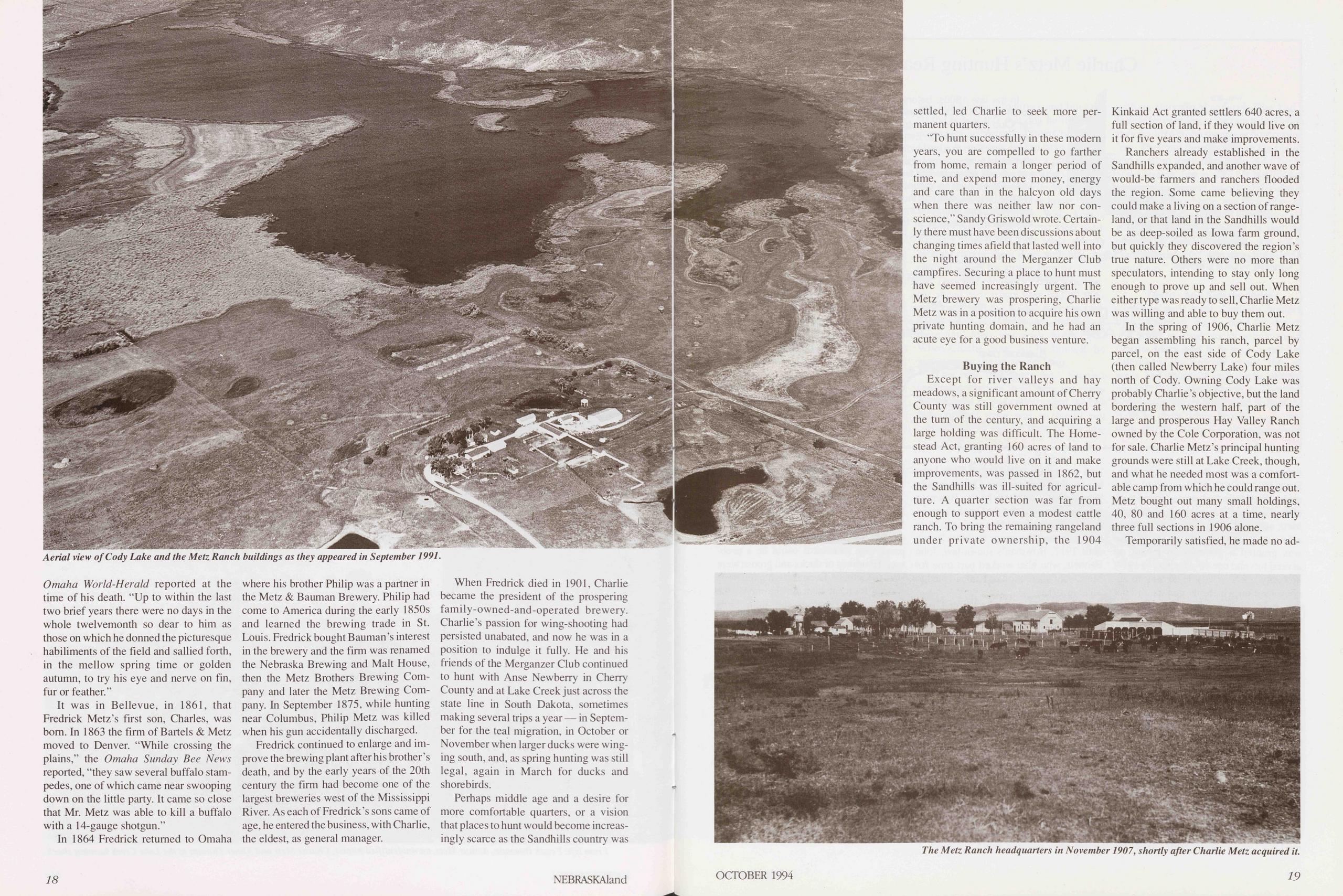
Aerial view of Cody Lake and the Metz Ranch buildings as they appeared in September 1991.
It was in Bellevue, in 1861, that Fredrick Metz’s first son, Charles, was bom. In 1863 the firm of Bartels & Metz moved to Denver. “While crossing the plains,” the Omaha Sunday Bee News reported, “they saw several buffalo stampedes, one of which came near swooping down on the little party. It came so close that Mr. Metz was able to kill a buffalo with a 14-gauge shotgun.”
In 1864 Fredrick returned to Omaha where his brother Philip was a partner in the Metz & Bauman Brewery. Philip had come to America during the early 1850s and learned the brewing trade in St. Louis. Fredrick bought Bauman’s interest in the brewery and the firm was renamed the Nebraska Brewing and Malt House, then the Metz Brothers Brewing Company and later the Metz Brewing Company. In September 1875, while hunting near Columbus, Philip Metz was killed when his gun accidentally discharged. Fredrick continued to enlarge and improve the brewing plant after his brother’s death, and by the early years of the 20th century the firm had become one of the largest breweries west of the Mississippi River. As each of Fredrick’s sons came of age, he entered the business, with Charlie, the eldest, as general manager.
When Fredrick died in 1901, Charlie became the president of the prospering family-owned-and-operated brewery. Charlie’s passion for wing-shooting had persisted unabated, and now he was in a position to indulge it fully. He and his friends of the Merganzer Club continued to hunt with Anse Newberry in Cherry County and at Lake Creek just across the state line in South Dakota, sometimes making several trips a year — in September for the teal migration, in October or November when larger ducks were winging south, and, as spring hunting was still legal, again in March for ducks and shorebirds.
Perhaps middle age and a desire for more comfortable quarters, or a vision that places to hunt would become increasingly scarce as the Sandhills country was settled, led Charlie to seek more permanent quarters.
“To hunt successfully in these modem years, you are compelled to go farther from home, remain a longer period of time, and expend more money, energy and care than in the halcyon old days when there was neither law nor conscience,” Sandy Griswold wrote. Certainly there must have been discussions about changing times afield that lasted well into the night around the Merganzer Club campfires. Securing a place to hunt must have seemed increasingly urgent. The Metz brewery was prospering, Charlie Metz was in a position to acquire his own private hunting domain, and he had an acute eye for a good business venture.
Buying the RanchExcept for river valleys and hay meadows, a significant amount of Cherry County was still government owned at the turn of the century, and acquiring a large holding was difficult. The Homestead Act, granting 160 acres of land to anyone who would live on it and make improvements, was passed in 1862, but the Sandhills was ill-suited for agriculture. A quarter section was far from enough to support even a modest cattle ranch. To bring the remaining rangeland under private ownership, the 1904 Kinkaid Act granted settlers 640 acres, a full section of land, if they would live on it for five years and make improvements. Ranchers already established in the Sandhills expanded, and another wave of would-be farmers and ranchers flooded the region. Some came believing they could make a living on a section of rangeland, or that land in the Sandhills would be as deep-soiled as Iowa farm ground, but quickly they discovered the region’s true nature. Others were no more than speculators, intending to stay only long enough to prove up and sell out. When either type was ready to sell, Charlie Metz was willing and able to buy them out.
In the spring of 1906, Charlie Metz began assembling his ranch, parcel by parcel, on the east side of Cody Lake (then called Newberry Lake) four miles north of Cody. Owning Cody Lake was probably Charlie’s objective, but the land bordering the western half, part of the large and prosperous Hay Valley Ranch owned by the Cole Corporation, was not for sale. Charlie Metz’s principal hunting grounds were still at Lake Creek, though, and what he needed most was a comfortable camp from which he could range out. Metz bought out many small holdings, 40, 80 and 160 acres at a time, nearly three full sections in 1906 alone.
Temporarily satisfied, he made no ad-
and fill those icehouses. Some of Metz’s birds got a little ripe, it looked like to me, and then they’d pick them. They had double-walled canvas cases, probably packed with wool for insulation. They’d pack their birds in those cases in ice to take back to Omaha. Everything they shot was cleaned and taken back.”
Charlie Metz apparently had a special fondness for dogs and from the beginning, Griswold’s columns report, dogs were integral members of the hunting parties. Some dogs made the trip from Omaha by rail with the hunters, but local hunting dogs also were recruited.
“My mother had a Chesapeake, one of those rat-tailed Chesapeake dogs,” Bud Bennett recalled, “and old Charlie Metz always came and got old Dandy to hunt with. Charlie’s cook, Jim Heironymus [Jim and his wife became regulars at the ranch after Abner Thomas died], just hated that dog, and that dog hated him. I remember one time Metz sent him to get the dog, and of course, when old Dandy saw him he began to growl, and Jim said, ‘if the boss wants that dog he’ll have to come get him himself.’ When Charlie had Dandy, he not only had to have a bed to sleep on, he had to have a pillow, and Charlie would fix the best steaks for him. But you know, when Charlie Metz would leave, that dog would come home.”
Jim Kroeger’s father, Walt, kept a retriever named Scrappy that Metz used. Kroeger remembers that Metz usually brought two or three dogs with him, including setters for grouse hunting.
“They had a Pullman car and one box-car ahead of it where they had all their equipment and the dogs,” Kroeger said. “They sidetracked those cars, and they sat there until Metz was ready to go back. When Charlie came out by himself, he just came on the passenger train.
“One time they came out,” Kroeger continued, “before there were too many automobiles in this country, and the hill just north of town was so sandy you couldn’t get in and out most of the time with an automobile anyway. They had a little team of mules at the ranch, and when they decided to run there was no stopping ’em. They put those mules on the buggy and went to town to pick up old Charlie at the station. Just as they got him loaded up the old engineer let off a little steam and tooted the whistle, and they were out of town and across the hill before they got stopped. Old Charlie says, ‘is that the only damn team on the place you got to come get me with?’ Oh, them little devils could run.”
Decoys and Side-by-SidesWhile most local Sandhills hunters, then and today, see no need for decoys and prefer to sneak ducks or pass shoot, Charlie Metz used both decoys and live call ducks. Jim Kroeger recalls “they always had about 25 call ducks running around” at the Metz Ranch, and remembers seeing the rig Metz used to hold the birds in place while hunting — a rope with strings attached at three-foot interditional purchases the next four years. From 1912 through 1915, a period when many Kinkaiders had proved up on their claims and could legally sell their land, Metz acquired more than eight sections adjoining what he already owned. He also was granted a government patent on several lots and one 40-acre tract in 1914, probably not a strictly legal way to acquire land on which the grantee did not live, but a fairly common occurrence in the Sandhills in the late 19th and early 20th centuries. Several 40-acre tracts, the last land to be added to the ranch, were acquired in 1930, bringing the ranch to more than 7,000 acres.
Much of the land Charlie Metz first acquired was purchased from Charles Chase, an investor from Stanton, who only two years earlier had acquired it from Charlie’s old hunting host Anse Newberry. Two sections of land were acquired from Kinkaiders who worked for him in one capacity or another. Frank Bowman, for example, came to Cherry County in 1902 and managed Charles Chase’s ranch. After the Kinkaid Act be- came law in 1904, he filed on a section of land about three miles east of Cody Lake but continued to manage Chase’s ranch. When Chase sold to Metz, Bowman managed the ranch for the Omaha brewer. In 1911, Bowman sold his section to Metz and continued to manage the Metz Ranch until 1917. Bowman’s son-in-law, John Bennett, who also worked part time for Metz, sold his section of Kinkaid land to Metz in 1913.
"My granddad always hunted with them,” Frank “Bud” Bennett, John Bennett’s son, said in a 1991 interview (a year before he died). Until the age of six, Bud lived on the Metz ranch his grandfather Frank Bowman had managed. From 1945 to 1970, Bud managed the Hay Valley Ranch immediately west of the Metz Ranch and came to know Charlie Metz, his family and hunting companions, and to learn of the Old World custom of aging wild game.
“One of the first things I remember about them,” Bud recalled, “when I was a kid, they had their little screened-in building with a roof on it, and they’d hang their grouse and ducks in there and let them get ripe. They wouldn’t eat ’em until they were ripe, green around the bung hole. Too ripe for me.”
The Metz Ranch clubhouse was usually filled with grouse and teal hunters in September when midday temperatures in the 80s and even 90s are common, and preserving gamebirds could be a problem. Hundreds of ducks and grouse were shot in October. Even though gamebirds were a frequent item on the menu, the Metz hunters regularly shot more birds than they could eat, although their appetites were prodigious according to Sandy Griswold, who noted that on one outing the Merganzer Club consumed 20 “fried, broiled and braised” ducks a day.
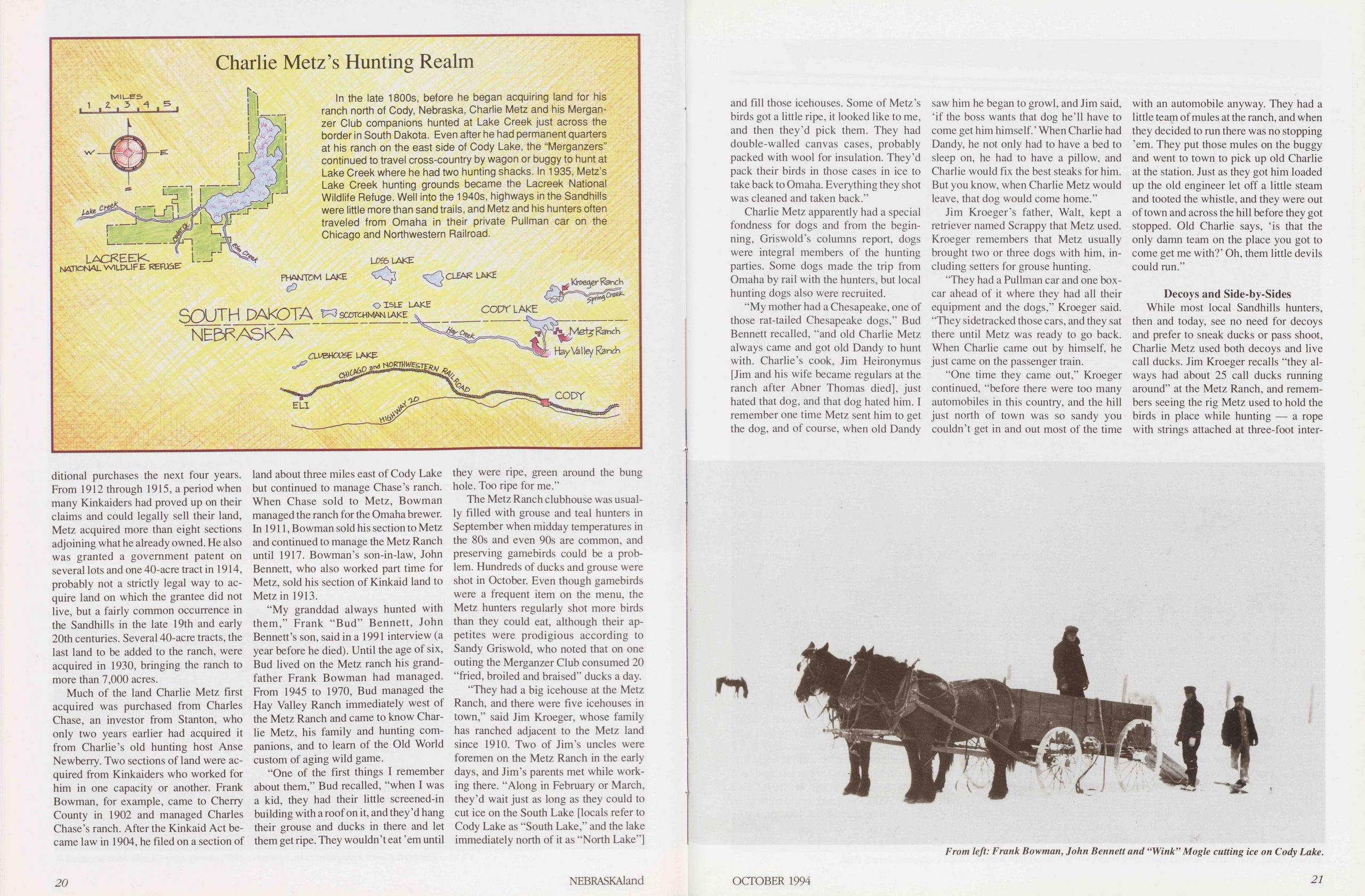
“They had a big icehouse at the Metz Ranch, and there were five icehouses in town,” said Jim Kroeger, whose family has ranched adjacent to the Metz land since 1910. Two of Jim’s uncles were foremen on the Metz Ranch in the early days, and Jim’s parents met while working there. “Along in February or March, they’d wait just as long as they could to cut ice on the South Lake [locals refer to Cody Lake as “South Lake,” and the lake immediately north of it as “North Lake”]
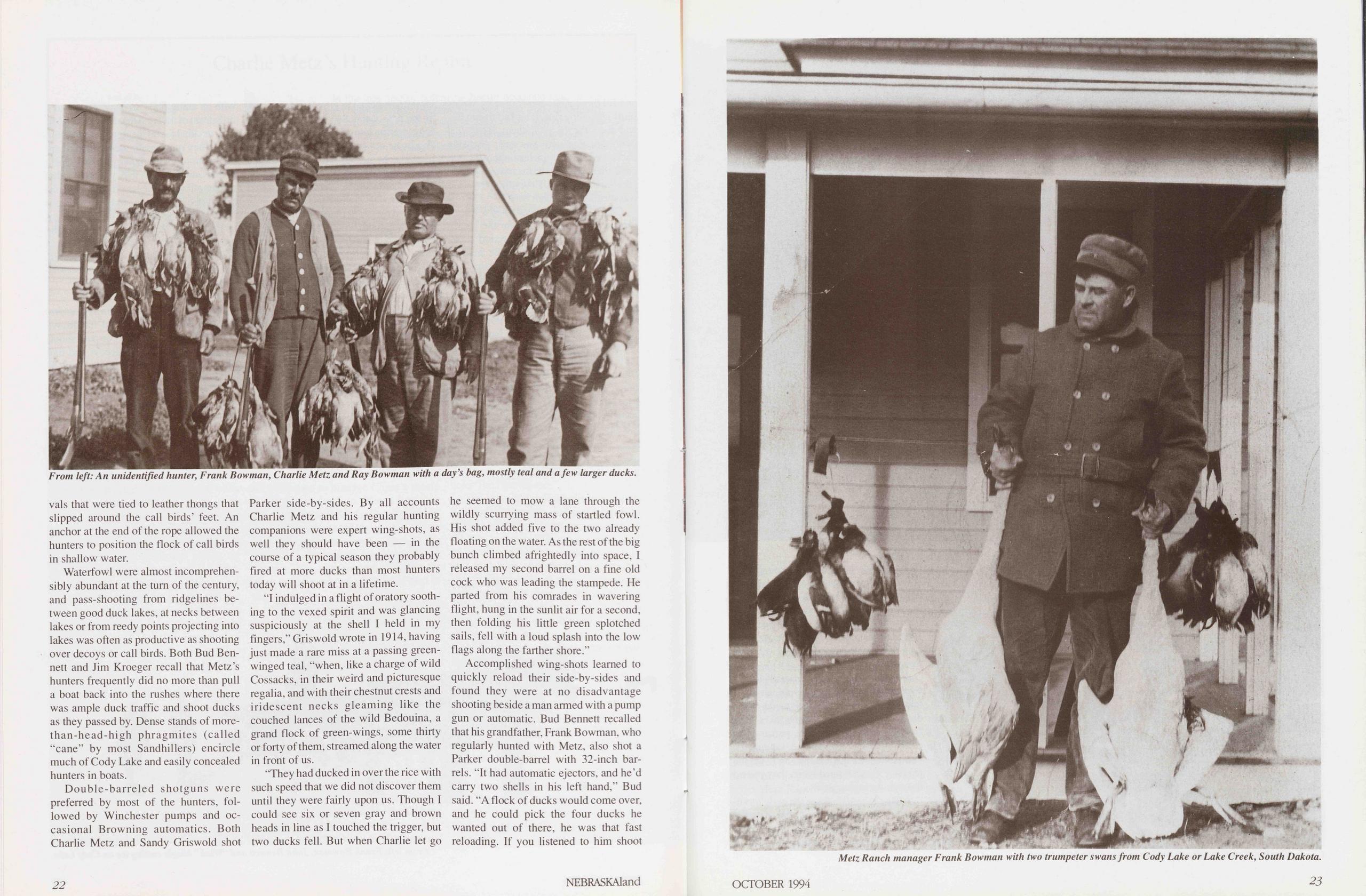
vals that were tied to leather thongs that slipped around the call birds’ feet. An anchor at the end of the rope allowed the hunters to position the flock of call birds in shallow water.
Waterfowl were almost incomprehensibly abundant at the turn of the century, and pass-shooting from ridgelines between good duck lakes, at necks between lakes or from reedy points projecting into lakes was often as productive as shooting over decoys or call birds. Both Bud Bennett and Jim Kroeger recall that Metz’s hunters frequently did no more than pull a boat back into the rushes where there was ample duck traffic and shoot ducks as they passed by. Dense stands of more- than-head-high phragmites (called “cane” by most Sandhillers) encircle much of Cody Lake and easily concealed hunters in boats.
Double-barreled shotguns were preferred by most of the hunters, followed by Winchester pumps and occasional Browning automatics. Both Charlie Metz and Sandy Griswold shot Parker side-by-sides. By all accounts Charlie Metz and his regular hunting companions were expert wing-shots, as well they should have been — in the course of a typical season they probably fired at more ducks than most hunters today will shoot at in a lifetime.
“I indulged in a flight of oratory soothing to the vexed spirit and was glancing suspiciously at the shell I held in my fingers,” Griswold wrote in 1914, having just made a rare miss at a passing green-winged teal, “when, like a charge of wild Cossacks, in their weird and picturesque regalia, and with their chestnut crests and iridescent necks gleaming like the couched lances of the wild Bedouina, a grand flock of green-wings, some thirty or forty of them, streamed along the water in front of us.
“They had ducked in over the rice with such speed that we did not discover them until they were fairly upon us. Though I could see six or seven gray and brown heads in line as I touched the trigger, but two ducks fell. But when Charlie let go he seemed to mow a lane through the wildly scurrying mass of startled fowl. His shot added five to the two already floating on the water. As the rest of the big bunch climbed afrightedly into space, I released my second barrel on a fine old cock who was leading the stampede. He parted from his comrades in wavering flight, hung in the sunlit air for a second, then folding his little green splotched sails, fell with a loud splash into the low flags along the farther shore.”
Accomplished wing-shots learned to quickly reload their side-by-sides and found they were at no disadvantage shooting beside a man armed with a pump gun or automatic. Bud Bennett recalled that his grandfather, Frank Bowman, who regularly hunted with Metz, also shot a Parker double-barrel with 32-inch barrels. “It had automatic ejectors, and he’d carry two shells in his left hand,” Bud said. “A flock of ducks would come over, and he could pick the four ducks he wanted out of there, he was that fast reloading. If you listened to him shoot
Metz Ranch manager Frank Bowman with two trumpeter swans from Cody Lake or Lake Creek, South Dakota.
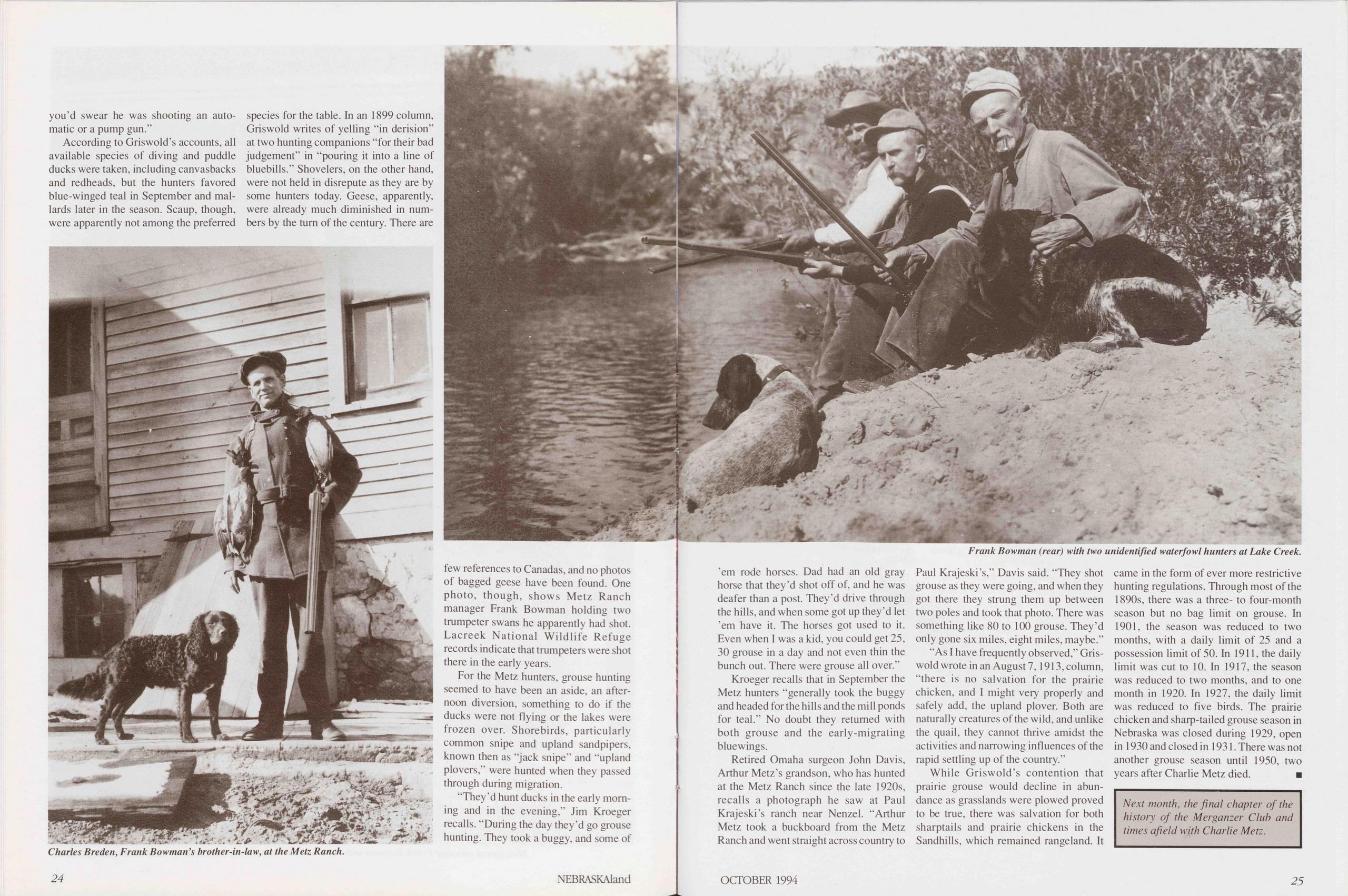
you’d swear he was shooting an automatic or a pump gun.”
Charles Breden, Frank Bowman's brother-in-law, at the Metz Ranch.
Frank Bowman (rear) with two unidentified waterfowl hunters at Lake Creek.
For the Metz hunters, grouse hunting seemed to have been an aside, an afternoon diversion, something to do if the ducks were not flying or the lakes were frozen over. Shorebirds, particularly common snipe and upland sandpipers, known then as "jack snipe” and "upland plovers,” were hunted when they passed through during migration.
"They’d hunt ducks in the early morning and in the evening,” Jim Kroeger recalls. "During the day they’d go grouse hunting. They took a buggy, and some of ’em rode horses. Dad had an old gray horse that they’d shot off of, and he was deafer than a post. They'd drive through the hills, and when some got up they’d let ’em have it. The horses got used to it. Even when I was a kid, you could get 25, 30 grouse in a day and not even thin the bunch out. There were grouse all over.”
Kroeger recalls that in September the Metz hunters "generally took the buggy and headed for the hills and the mill ponds for teal.” No doubt they returned with both grouse and the early-migrating bluewings.
Retired Omaha surgeon John Davis, Arthur Metz’s grandson, who has hunted at the Metz Ranch since the late 1920s, recalls a photograph he saw at Paul Krajeski’s ranch near Nenzel. "Arthur Metz took a buckboard from the Metz Ranch and went straight across country to Paul Krajeski’s,” Davis said. "They shot grouse as they were going, and when they got there they strung them up between two poles and took that photo. There was something like 80 to 100 grouse. They’d only gone six miles, eight miles, maybe.”
"As I have frequently observed,” Griswold wrote in an August?, 1913,column, "there is no salvation for the prairie chicken, and I might very properly and safely add, the upland plover. Both are naturally creatures of the wild, and unlike the quail, they cannot thrive amidst the activities and narrowing influences of the rapid settling up of the country.”
While Griswold’s contention that prairie grouse would decline in abun- dance as grasslands were plowed proved to be true, there was salvation for both sharptails and prairie chickens in the Sandhills, which remained rangeland. It came in the form of ever more restrictive hunting regulations. Through most of the 1890s, there was a three- to four-month season but no bag limit on grouse. In 1901, the season was reduced to two months, with a daily limit of 25 and a possession limit of 50. In 1911, the daily limit was cut to 10. In 1917, the season was reduced to two months, and to one month in 1920. In 1927, the daily limit was reduced to five birds. The prairie chicken and sharp-tailed grouse season in Nebraska was closed during 1929, open in 1930 and closed in 1931. There was not another grouse season until 1950, two years after Charlie Metz died.
Next month, the final chapter of the history of the Merganzer Club and times afield with Charlie Metz. 24 NEBRASKAland OCTOBER 1994 25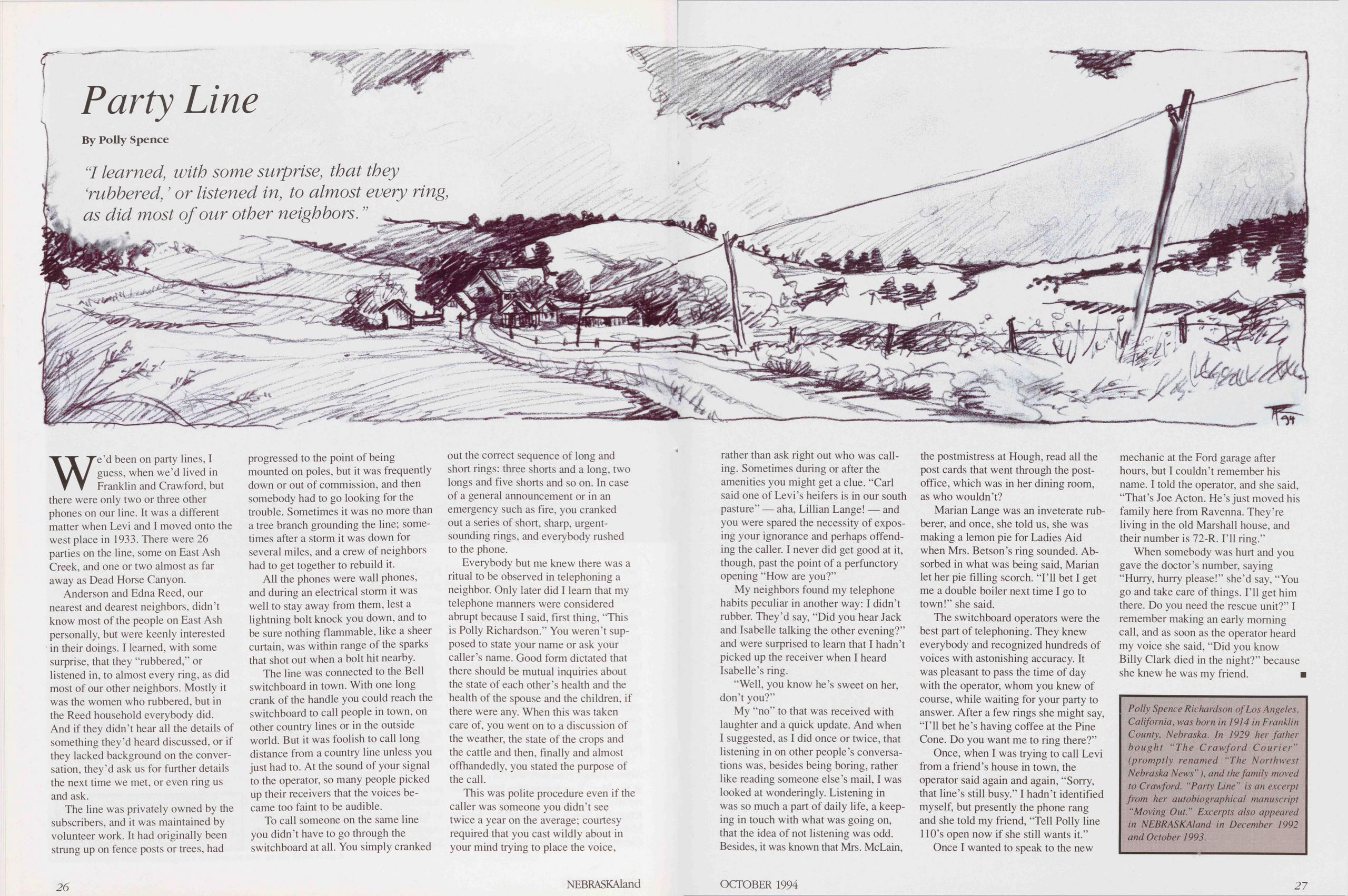
Party Line
By Polly Spence “I learned, with some surprise, that they ‘rubbered, ’ or listened in, to almost every ring, as did most of our other neighbors.We’d been on party lines, I guess, when we’d lived in Franklin and Crawford, but there were only two or three other phones on our line. It was a different matter when Levi and I moved onto the west place in 1933. There were 26 parties on the line, some on East Ash Creek, and one or two almost as far away as Dead Horse Canyon.
Anderson and Edna Reed, our nearest and dearest neighbors, didn’t know most of the people on East Ash personally, but were keenly interested in their doings. I learned, with some surprise, that they “rubbered,” or listened in, to almost every ring, as did most of our other neighbors. Mostly it was the women who rubbered, but in the Reed household everybody did. And if they didn’t hear all the details of something they’d heard discussed, or if they lacked background on the conver- sation, they’d ask us for further details the next time we met, or even ring us and ask.
The line was privately owned by the subscribers, and it was maintained by volunteer work. It had originally been strung up on fence posts or trees, had progressed to the point of being mounted on poles, but it was frequently down or out of commission, and then somebody had to go looking for the trouble. Sometimes it was no more than a tree branch grounding the line; some- times after a storm it was down for several miles, and a crew of neighbors had to get together to rebuild it.
All the phones were wall phones, and during an electrical storm it was well to stay away from them, lest a lightning bolt knock you down, and to be sure nothing flammable, like a sheer curtain, was within range of the sparks that shot out when a bolt hit nearby. The line was connected to the Bell switchboard in town. With one long crank of the handle you could reach the switchboard to call people in town, on other country lines or in the outside world. But it was foolish to call long distance from a country line unless you just had to. At the sound of your signal to the operator, so many people picked up their receivers that the voices be- came too faint to be audible.
To call someone on the same line you didn’t have to go through the switchboard at all. You simply cranked out the correct sequence of long and short rings: three shorts and a long, two longs and five shorts and so on. In case of a general announcement or in an emergency such as fire, you cranked out a series of short, sharp, urgent- sounding rings, and everybody rushed to the phone.
Everybody but me knew there was a ritual to be observed in telephoning a neighbor. Only later did I learn that my telephone manners were considered abrupt because I said, first thing, “This is Polly Richardson.” You weren’t sup- posed to state your name or ask your caller’s name. Good form dictated that there should be mutual inquiries about the state of each other’s health and the health of the spouse and the children, if there were any. When this was taken care of, you went on to a discussion of the weather, the state of the crops and the cattle and then, finally and almost offhandedly, you stated the purpose of the call.
This was polite procedure even if the caller was someone you didn’t see twice a year on the average; courtesy required that you cast wildly about in your mind trying to place the voice, rather than ask right out who was call- ing. Sometimes during or after the amenities you might get a clue. “Carl said one of Levi’s heifers is in our south pasture” — aha, Lillian Lange! — and you were spared the necessity of expos- ing your ignorance and perhaps offend- ing the caller. I never did get good at it, though, past the point of a perfunctory opening “How are you?”
My neighbors found my telephone habits peculiar in another way: I didn’t rubber. They’d say, “Did you hear Jack and Isabelle talking the other evening?” and were surprised to learn that I hadn’t picked up the receiver when I heard Isabelle’s ring.
“Well, you know he’s sweet on her, don’t you?”
My “no” to that was received with laughter and a quick update. And when I suggested, as I did once or twice, that listening in on other people’s conversa- tions was, besides being boring, rather like reading someone else’s mail, I was looked at wonderingly. Listening in was so much a part of daily life, a keeping in touch with what was going on, that the idea of not listening was odd. Besides, it was known that Mrs. McLain, the postmistress at Hough, read all the post cards that went through the postoffice, which was in her dining room, as who wouldn’t?
Marian Lange was an inveterate rubbered and once, she told us, she was making a lemon pie for Ladies Aid when Mrs. Betson’s ring sounded. Absorbed in what was being said, Marian let her pie filling scorch. “I’ll bet I get me a double boiler next time I go to town!” she said.
The switchboard operators were the best part of telephoning. They knew everybody and recognized hundreds of voices with astonishing accuracy. It was pleasant to pass the time of day with the operator, whom you knew of course, while waiting for your party to answer. After a few rings she might say, “I’ll bet he’s having coffee at the Pine Cone. Do you want me to ring there?”
Once, when I was trying to call Levi from a friend’s house in town, the operator said again and again, “Sorry, that line’s still busy.” I hadn’t identified myself, but presently the phone rang and she told my friend, “Tell Polly line 110’s open now if she still wants it.”
Once I wanted to speak to the new mechanic at the Ford garage after hours, but I couldn’t remember his name. I told the operator, and she said, “That’s Joe Acton. He’s just moved his family here from Ravenna. They’re living in the old Marshall house, and their number is 72-R. I’ll ring.”
When somebody was hurt and you gave the doctor’s number, saying “Hurry, hurry please!” she’d say, “You go and take care of things. I’ll get him there. Do you need the rescue unit?” I remember making an early morning call, and as soon as the operator heard my voice she said, “Did you know Billy Clark died in the night?” because she knew he was my friend.
Polly Spence Richardson of Los Angeles, California, was born in 1914 in Franklin County, Nebraska. In 1929 her father bought “The Crawford Courier” (promptly renamed “The Northwest Nebraska News”), and the family moved to Crawford. ‘ Party Line” is an excerpt from her autobiographical manuscript “Moving Out.” Excerpts also appeared in NEBRASKAland in December 1992 and October 1993. 26 NEBRASKAland OCTOBER 1994 27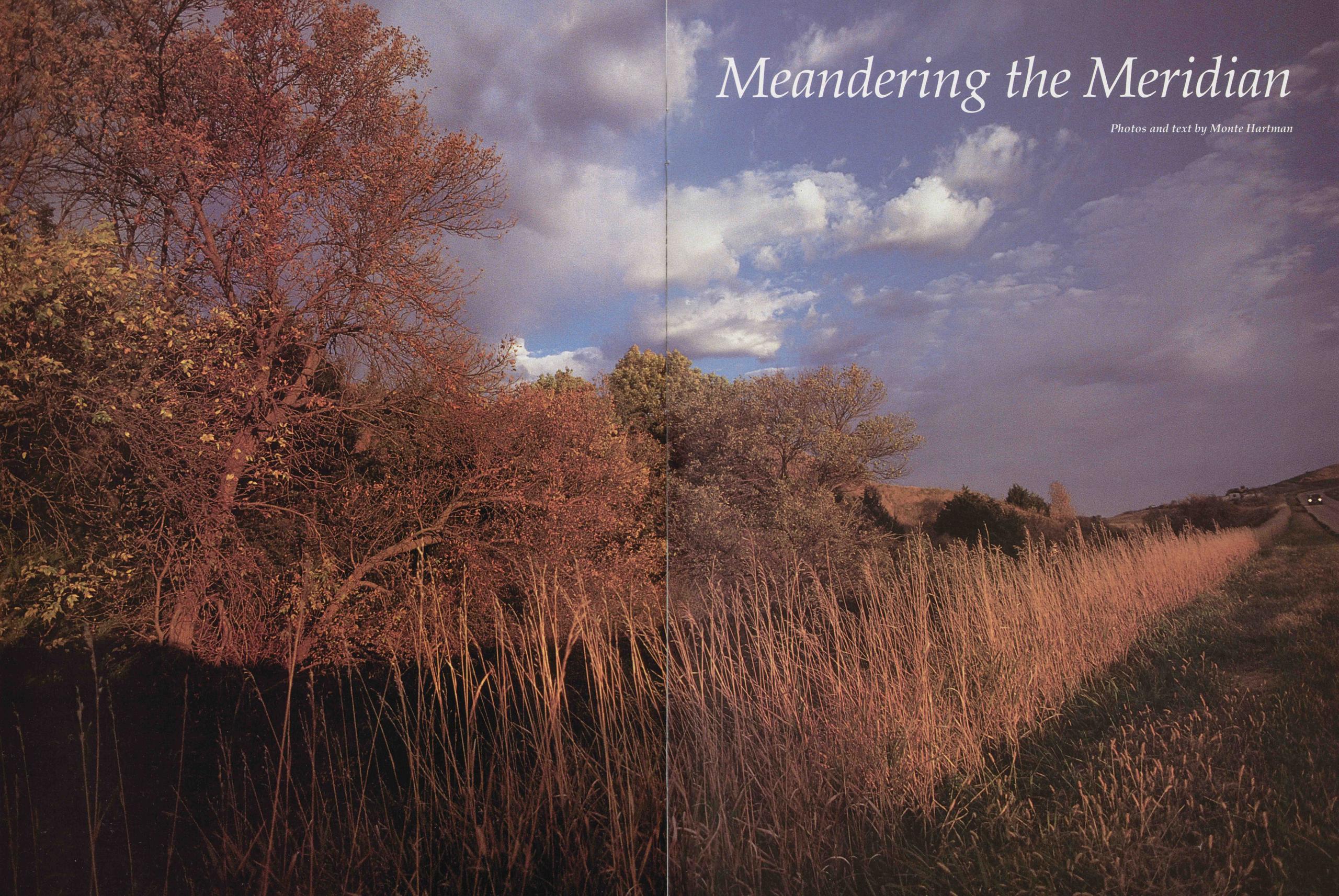
Meandering the Meridian
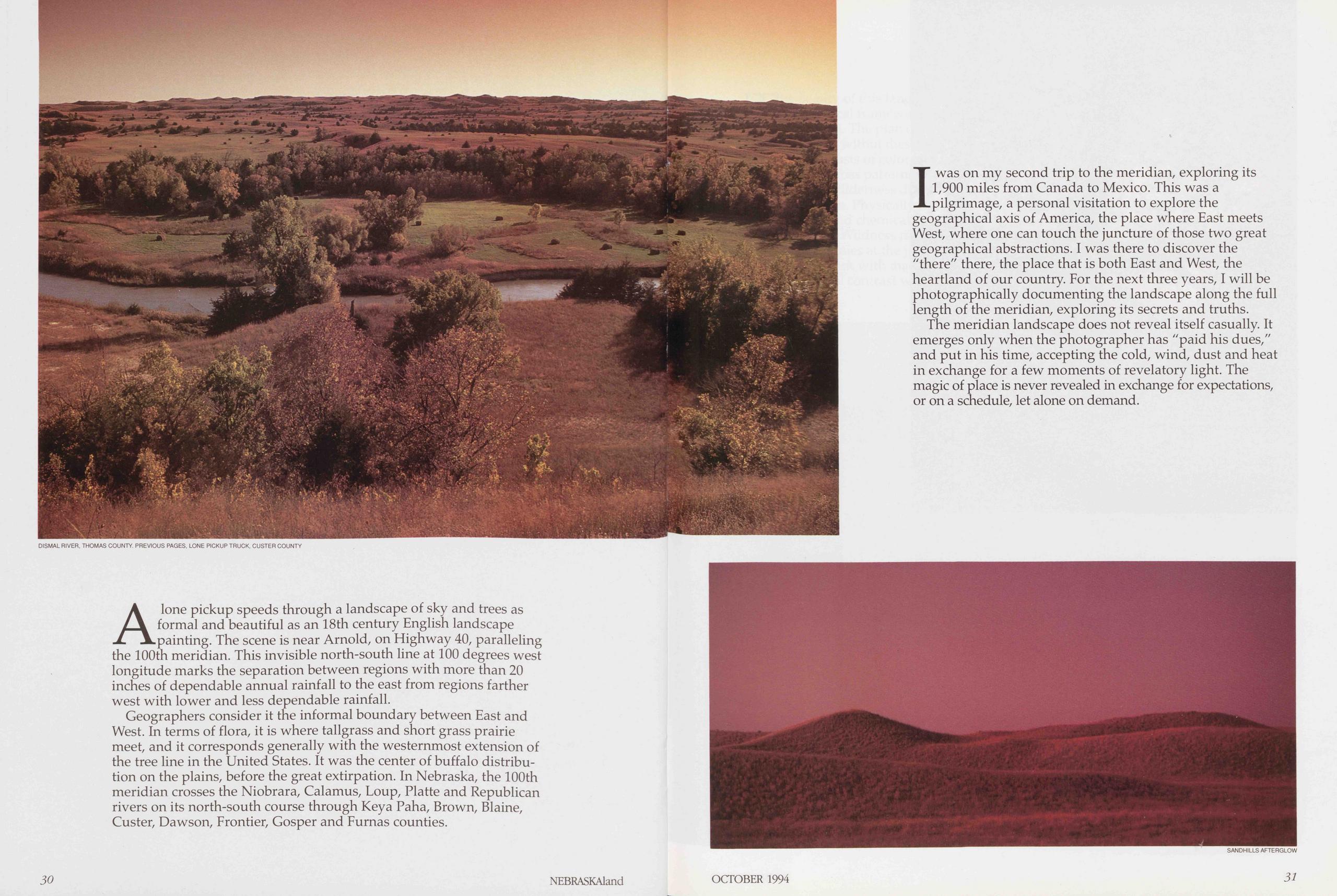
Alone pickup speeds through a landscape of sky and trees as formal and beautiful as an 18th century English landscape painting. The scene is near Arnold, on Highway 40, paralleling the 100th meridian. This invisible north-south line at 100 degrees west longitude marks the separation between regions with more than 20 inches of dependable annual rainfall to the east from regions farther west with lower and less dependable rainfall. Geographers consider it the informal boundary between East and West. In terms of flora, it is where tailgrass and short grass prairie meet, and it corresponds generally with the westernmost extension of the tree line in the United States. It was the center of buffalo distribution on the plains, before the great extirpation. In Nebraska, the 100th meridian crosses the Niobrara, Calamus, Loup, Platte and Republican rivers on its north-south course through Keya Paha, Brown, Blaine, Custer, Dawson, Frontier, Gosper and Furnas counties.
I was on my second trip to the meridian, exploring its 1,900 miles from Canada to Mexico. This was a pilgrimage, a personal visitation to explore the geographical axis of America, the place where East meets West, where one can touch the juncture of those two great geographical abstractions. I was there to discover the "there" there, the place that is both East and West, the heartland of our country. For the next three years, I will be photographically documenting the landscape along the full length of the meridian, exploring its secrets and truths.
The meridian landscape does not reveal itself casually. It emerges only when the photographer has "paid his dues," and put in his time, accepting the cold, wind, dust and heat in exchange for a few moments of revelatory light. The magic of place is never revealed in exchange for expectations, or on a schedule, let alone on demand.
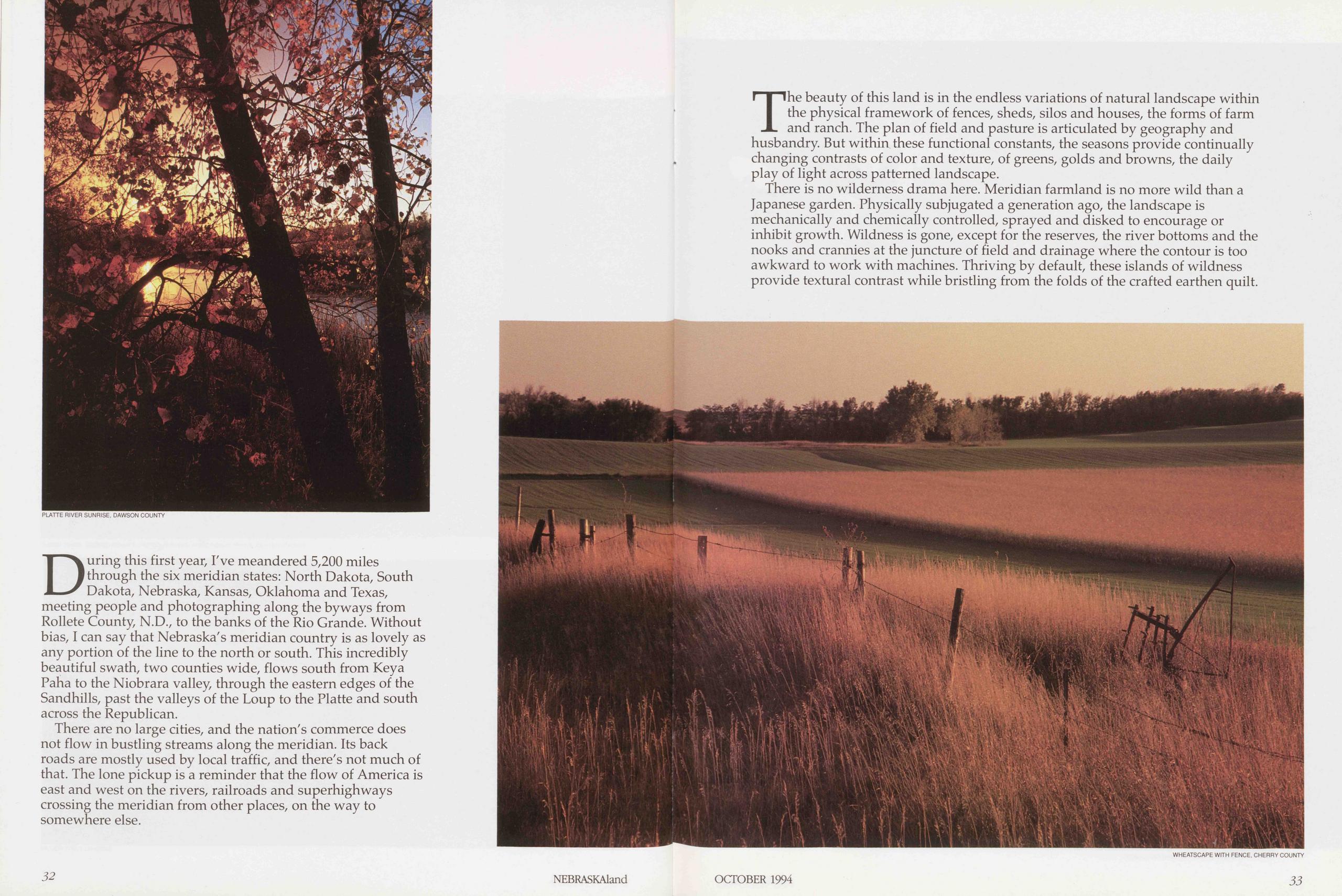
During this first year, I've meandered 5,200 miles through the six meridian states: North Dakota, South Dakota, Nebraska, Kansas, Oklahoma and Texas, meeting people and photographing along the byways from Rollete County, N.D., to the banks of the Rio Grande. Without bias, I can say that Nebraska's meridian country is as lovely as any portion of the line to the north or south. This incredibly beautiful swath, two counties wide, flows south from Key a Paha to the Niobrara valley, through the eastern edges of the Sandhills, past the valleys of the Loup to the Platte and south across the Republican.
There are no large cities, and the nation's commerce does not flow in bustling streams along the meridian. Its back roads are mostly used by local traffic, and there's not much of that. The lone pickup is a reminder that the flow of America is east and west on the rivers, railroads and superhighways crossing the meridian from other places, on the way to somewhere else.
The beauty of this land is in the endless variations of natural landscape within the physical framework of fences, sheds, silos and houses, the forms of farm and ranch. The plan of field and pasture is articulated by geography and husbandry. But within these functional constants, the seasons provide continually changing contrasts of color and texture, of greens, golds and browns, the daily play of light across patterned landscape.
There is no wilderness drama here. Meridian farmland is no more wild than a Japanese garden. Physically subjugated a generation ago, the landscape is mechanically and chemically controlled, sprayed and disked to encourage or inhibit growth. Wildness is gone, except for the reserves, the river bottoms and the nooks and crannies at the juncture of field and drainage where the contour is too awkward to work with machines. Thriving by default, these islands of wildness provide textural contrast while bristling from the folds of the crafted earthen quilt.
WHEATSCAPE WITH FENCE. CHERRY COUNTY
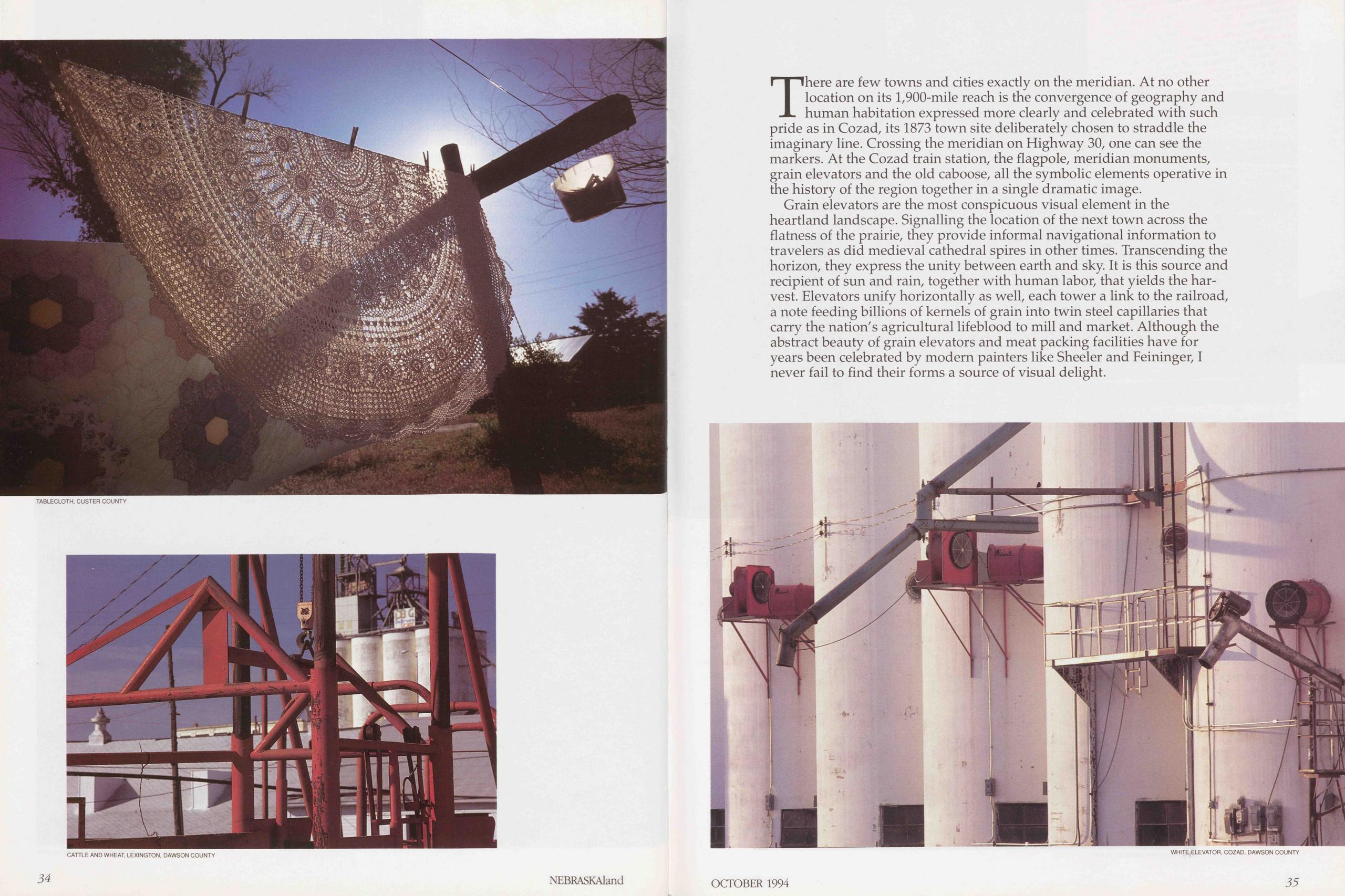
There are few towns and cities exactly on the meridian. At no other location on its 1,900-mile reach is the convergence of geography and human habitation expressed more clearly and celebrated with such pride as in Cozad, its 1873 town site deliberately chosen to straddle the imaginary line. Crossing the meridian on Highway 30, one can see the markers. At the Cozad train station, the flagpole, meridian monuments, grain elevators and the old caboose, all the symbolic elements operative in the history of the region together in a single dramatic image.
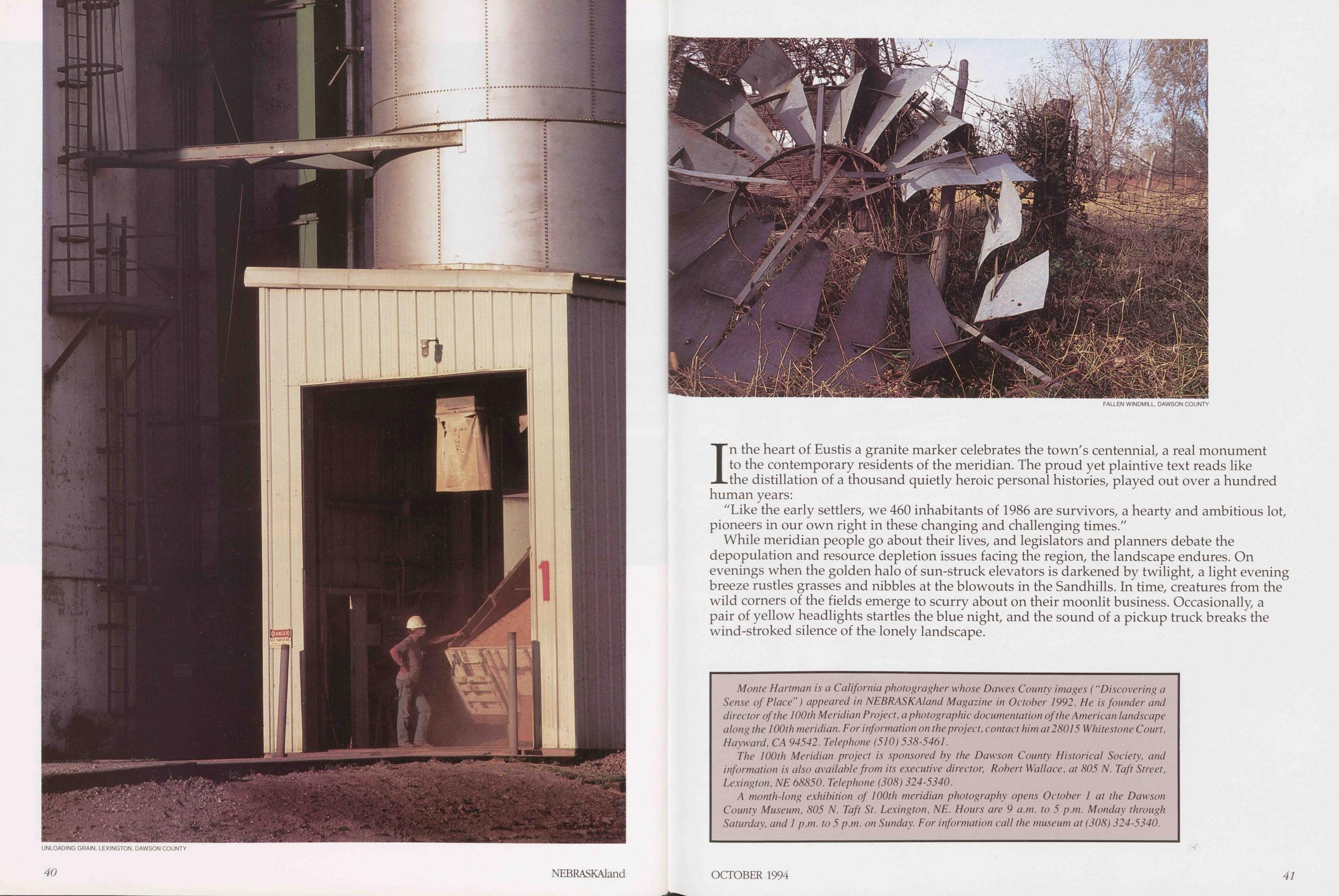
Grain elevators are the most conspicuous visual element in the heartland landscape. Signalling the location of the next town across the flatness of the prairie, they provide informal navigational information to travelers as did medieval cathedral spires in other times. Transcending the horizon, they express the unity between earth and sky. It is this source and recipient of sun and rain, together with human labor, that yields the harvest. Elevators unify horizontally as well, each tower a link to the railroad, a note feeding billions of kernels of grain into twin steel capillaries that carry the nation's agricultural lifeblood to mill and market. Although the abstract beauty of grain elevators and meat packing facilities have for years been celebrated by modern painters like Sheeler and Feininger, I never fail to find their forms a source of visual delight.
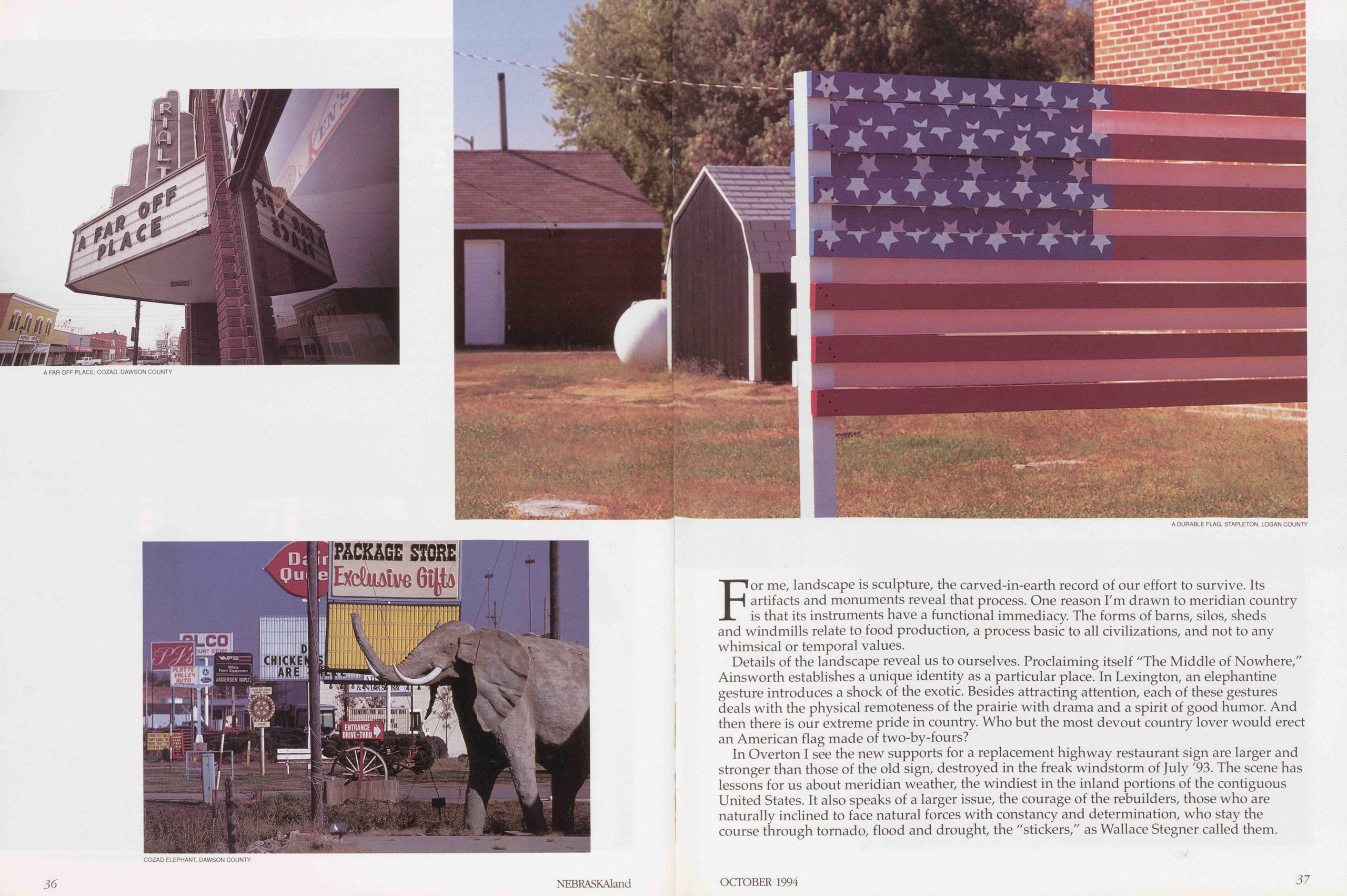
For me, landscape is sculpture, the carved-in-earth record of our effort to survive. Its artifacts and monuments reveal that process. One reason I'm drawn to meridian country is that its instruments have a functional immediacy. The forms of barns, silos, sheds and windmills relate to food production, a process basic to all civilizations, and not to any whimsical or temporal values.
Details of the landscape reveal us to ourselves. Proclaiming itself "The Middle of Nowhere," Ainsworth establishes a unique identity as a particular place. In Lexington, an elephantine gesture introduces a shock of the exotic. Besides attracting attention, each of these gestures deals with the physical remoteness of the prairie with drama and a spirit of good humor. And then there is our extreme pride in country. Who but the most devout country lover would erect an American flag made of two-by-fours?
In Overton I see the new supports for a replacement highway restaurant sign are larger and stronger than those of the old sign, destroyed in the freak windstorm of July '93. The scene has lessons for us about meridian weather, the windiest in the inland portions of the contiguous United States. It also speaks of a larger issue, the courage of the rebuilders, those who are naturally inclined to face natural forces with constancy and determination, who stay the course through tornado, flood and drought, the "stickers," as Wallace Stegner called them.
36 NEBRASKAland OCTOBER 1994 37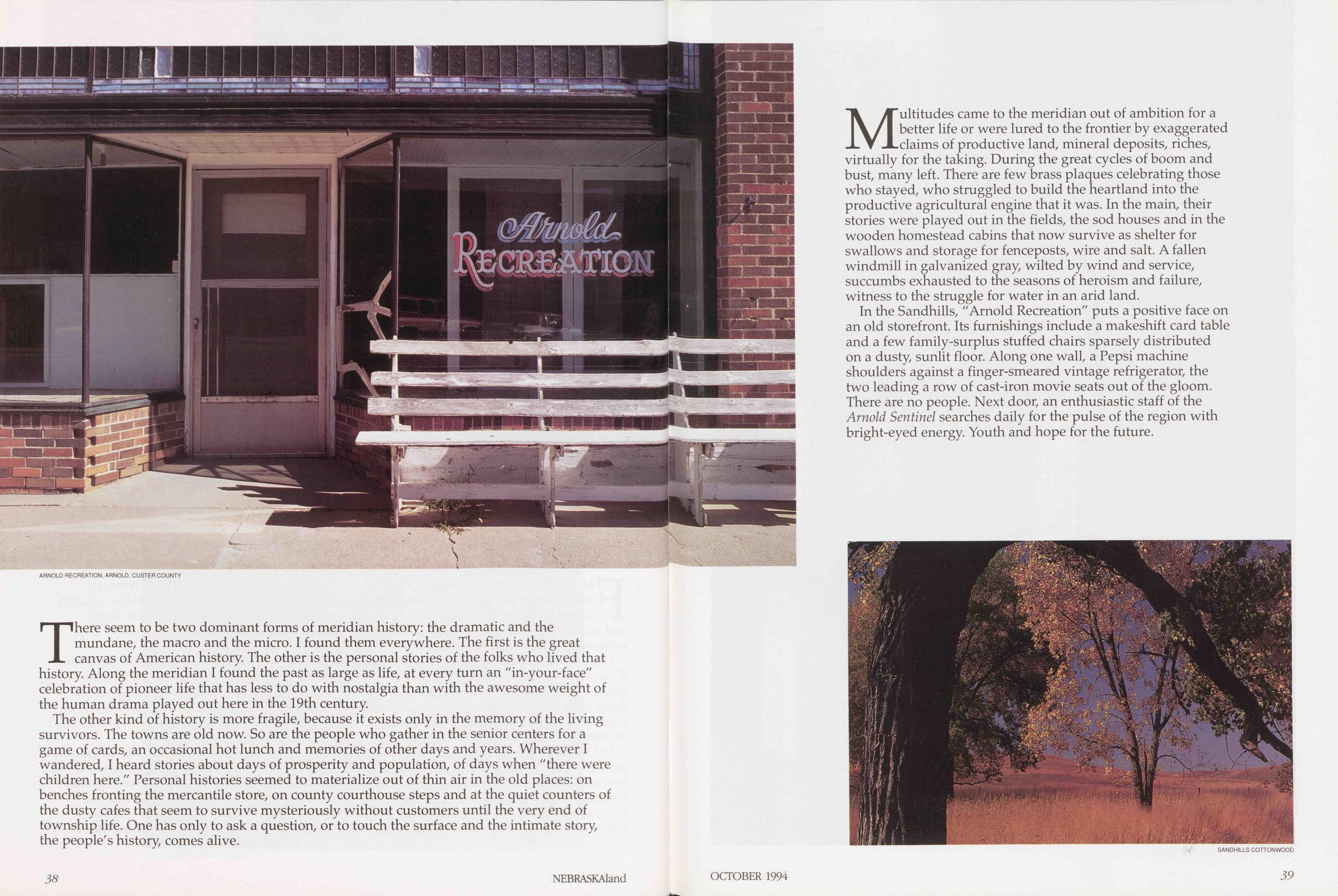
There seem to be two dominant forms of meridian history: the dramatic and the mundane, the macro and the micro. I found them everywhere. The first is the great canvas of American history. The other is the personal stories of the folks who lived that history. Along the meridian I found the past as large as life, at every turn an "in-your-face" celebration of pioneer life that has less to do with nostalgia than with the awesome weight of the human drama played out here in the 19th century. The other kind of history is more fragile, because it exists only in the memory of the living survivors. The towns are old now. So are the people who gather in the senior centers for a game of cards, an occasional hot lunch and memories of other days and years. Wherever I wandered, I heard stories about days of prosperity and population, of days when "there were children here." Personal histories seemed to materialize out of thin air in the old places: on benches fronting the mercantile store, on county courthouse steps and at the quiet counters of the dusty cafes that seem to survive mysteriously without customers until the very end of township life. One has only to ask a question, or to touch the surface and the intimate story, the people's history, comes alive.
Multitudes came to the meridian out of ambition for a better life or were lured to the frontier by exaggerated claims of productive land, mineral deposits, riches, virtually for the taking. During the great cycles of boom and bust, many left. There are few brass plaques celebrating those who stayed, who struggled to build the heartland into the productive agricultural engine that it was. In the main, their stories were played out in the fields, the sod houses and in the wooden homestead cabins that now survive as shelter for swallows and storage for fenceposts, wire and salt. A fallen windmill in galvanized gray, wilted by wind and service, succumbs exhausted to the seasons of heroism and failure, witness to the struggle for water in an arid land.
In the Sandhills, "Arnold Recreation" puts a positive face on an old storefront. Its furnishings include a makeshift card table and a few family-surplus stuffed chairs sparsely distributed on a dusty, sunlit floor. Along one wall, a Pepsi machine shoulders against a finger-smeared vintage refrigerator, the two leading a row of cast-iron movie seats out of the gloom. There are no people. Next door, an enthusiastic staff of the Arnold Sentinel searches daily for the pulse of the region with bright-eyed energy. Youth and hope for the future.
In the heart of Eustis a granite marker celebrates the town's centennial, a real monument to the contemporary residents of the meridian. The proud yet plaintive text reads like the distillation of a thousand quietly heroic personal histories, played out over a hundred human years:
"Like the early settlers, we 460 inhabitants of 1986 are survivors, a hearty and ambitious lot, pioneers in our own right in these changing and challenging times." While meridian people go about their lives, and legislators and planners debate the depopulation and resource depletion issues facing the region, the landscape endures. On evenings when the golden halo of sun-struck elevators is darkened by twilight, a light evening breeze rustles grasses and nibbles at the blowouts in the Sandhills. In time, creatures from the wild corners of the fields emerge to scurry about on their moonlit business. Occasionally, a pair of yellow headlights startles the blue night, and the sound of a pickup truck breaks the wind-stroked silence of the lonely landscape.
Monte Hartman is a California photogragher whose Dawes County images (“Discovering a Sense of Place”) appeared in NEBRASKAland Magazine in October 1992. He is founder and director of the 100th Meridian Project, a photographic documentation of the American landscape along the 100th meridian. For information on the project, contact him at 28015 Whitestone Court, Hayward, CA 94542. Telephone (510) 538-5461. The 100th Meridian project is sponsored by the Dawson County Historical Society, and information is also available from its executive director, Robert Wallace, at 805 N. Taft Street, Lexington, NE 68850. Telephone (308) 324-5340. A month-long exhibition of 100th meridian photography opens October 1 at the Dawson County Museum, 805 N. Taft St. Lexington, NE. Hours are 9 a.m. to 5 p.m. Monday through Saturday, and 1 p.m. to 5 p.m. on Sunday. For information call the museum at (308) 324-5340. 40 NEBRASKAland OCTOBER 1994 41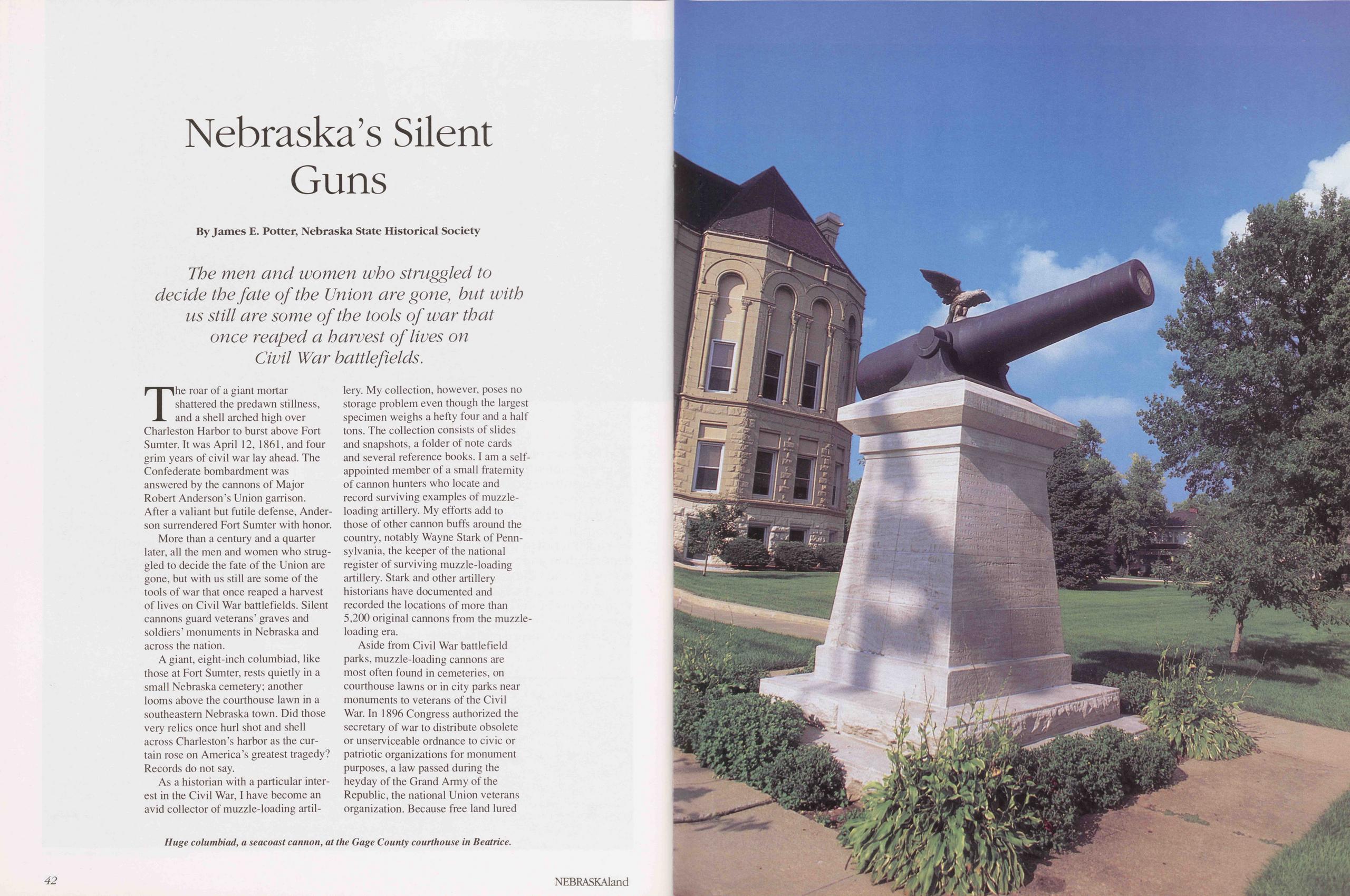
Nebraska’s Silent Guns
The men and women who struggled to decide the fate of the Union are gone, hut with us still are some of the tools of war that once reaped a harvest of lives on Civil War battlefields.The roar of a giant mortar shattered the predawn stillness, and a shell arched high over Charleston Harbor to burst above Fort Sumter. It was April 12, 1861, and four grim years of civil war lay ahead. The Confederate bombardment was answered by the cannons of Major Robert Anderson’s Union garrison. After a valiant but futile defense, Anderson surrendered Fort Sumter with honor.
More than a century and a quarter later, all the men and women who struggled to decide the fate of the Union are gone, but with us still are some of the tools of war that once reaped a harvest of lives on Civil War battlefields. Silent cannons guard veterans’ graves and soldiers’ monuments in Nebraska and across the nation.
A giant, eight-inch columbiad, like those at Fort Sumter, rests quietly in a small Nebraska cemetery; another looms above the courthouse lawn in a southeastern Nebraska town. Did those very relics once hurl shot and shell across Charleston’s harbor as the curtain rose on America’s greatest tragedy? Records do not say.
As a historian with a particular interest in the Civil War, I have become an avid collector of muzzle-loading artillery. My collection, however, poses no storage problem even though the largest specimen weighs a hefty four and a half tons. The collection consists of slides and snapshots, a folder of note cards and several reference books. I am a self-appointed member of a small fraternity of cannon hunters who locate and record surviving examples of muzzle- loading artillery. My efforts add to those of other cannon buffs around the country, notably Wayne Stark of Pennsylvania, the keeper of the national register of surviving muzzle-loading artillery. Stark and other artillery historians have documented and recorded the locations of more than 5,200 original cannons from the muzzle- loading era.
Aside from Civil War battlefield parks, muzzle-loading cannons are most often found in cemeteries, on courthouse lawns or in city parks near monuments to veterans of the Civil War. In 1896 Congress authorized the secretary of war to distribute obsolete or unserviceable ordnance to civic or patriotic organizations for monument purposes, a law passed during the heyday of the Grand Army of the Republic, the national Union veterans organization. Because free land lured
thousands of Union veterans to Nebraska after 1865, the GAR had posts in most Nebraska communities.
As the ranks of the “boys in blue” began to dwindle in the late 19th century, GAR members sought to erect permanent memorials to honor departed comrades. This wellspring of patriotism coincided with the Victorian era, characterized by extensive monumentation in many aspects of American life. Though initiated by veterans, the Civil War monuments also reflected public sentiment, a desire to give tangible expres- sion to feelings of gratitude toward those who had sacrificed to save the Union. When Civil War cannons became available, it seemed appropriate to place them next to a soldiers’ monument or on guard over the “bivouacs of the dead” in local cemeteries.
From an unknown number of cannons originally acquired by Nebraska organizations, at least 31 remain in the state today. They range in size from small field guns to ponderous iron seacoast cannons designed to sink wooden ships or destroy masonry forts. Although light field artillery was used to some extent in Nebraska during the Indian Wars, the giant coastal guns seem out of place overlooking the shimmering waves of a Nebraska cornfield, the Nebraska Navy notwithstanding.
Unfortunately there are no records telling the service history of individual guns, so one can only speculate whether any of the Nebraska cannons were ever fired in anger. Nevertheless, each cannon tells a bit of its own history through inscriptions on all but the most corroded specimens. Each gun purchased by the federal government was marked with the “U.S.” stamp, a government registry number, the initials of the inspecting ordnance officer, the year of manufacture and the name of the foundry. Most also include the weight of the tube and a foundry number. Some marks have been obliterated by service, weathering or vandalism. Perhaps as many as two dozen cannons formerly displayed in Nebraska are gone forever, donated to scrap drives during World War II. In the wake of Pearl Harbor, patriotism invigorated by the immediate crisis spelled doom for relics of an earlier one. Only photographs recall some of the lost cannons that may have seen battlefield service again, reincarnated as bombs, shells or tanks.
A few have direct links to Nebraska’s early history. During the Indian War of 1864, General Samuel R. Curtis left a bronze six-pounder with the settlers of Hall County. Fortunately for the settlers, the extra firepower was never needed, and the cannon was quietly forgotten by the government. More than 30 years later, William Stolley, the last survivor of the group that had received the cannon in 1864, sought to confirm its permanent display in Grand Island as a memorial to Hall County pioneers. When Stolley notified the War Department of the gun’s existence, the secretary of war ordered that its transfer
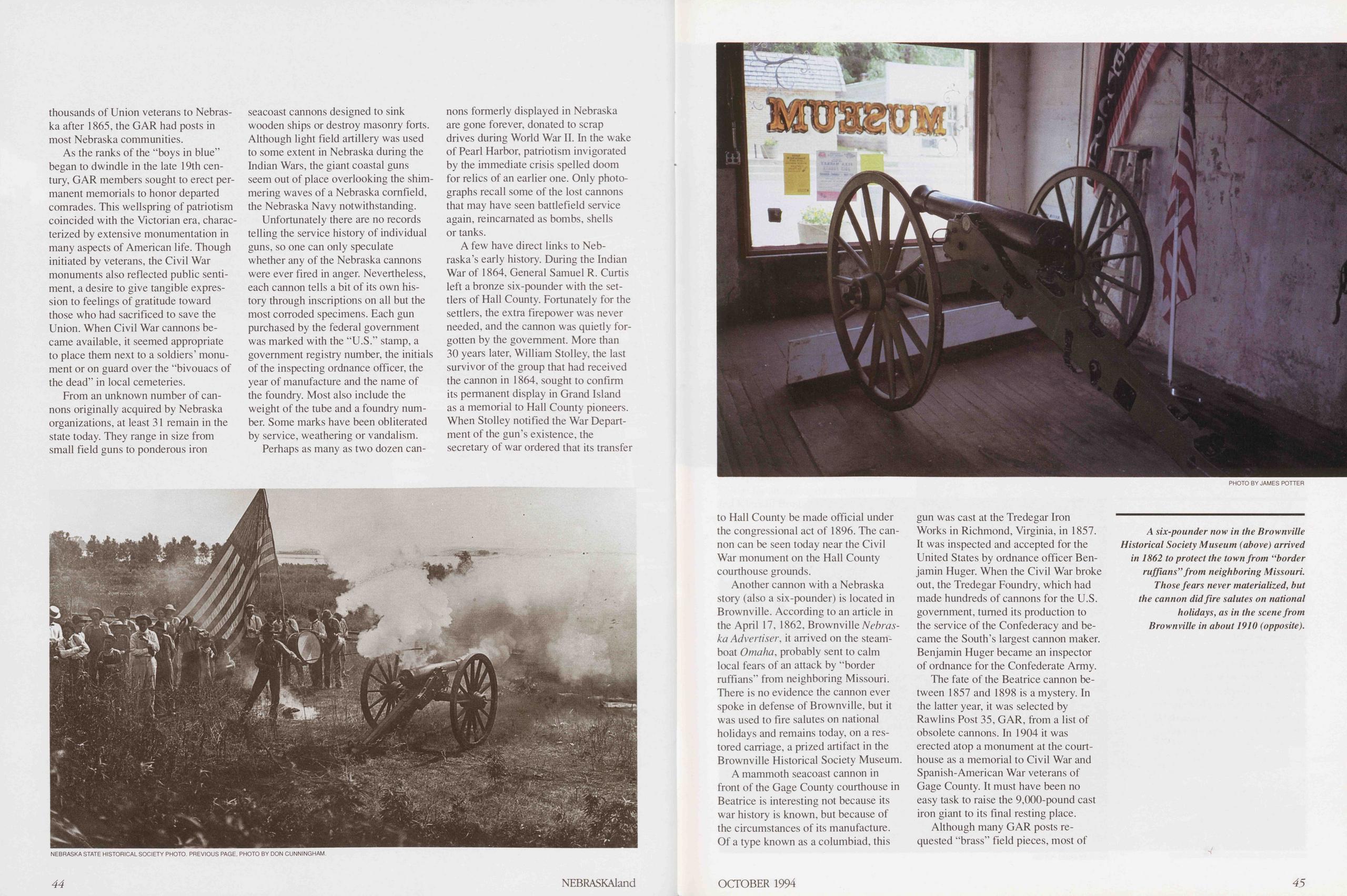
Another cannon with a Nebraska story (also a six-pounder) is located in Brownville. According to an article in the April 17, 1862, Brownville Nebraska Advertiser, it arrived on the steamboat Omaha, probably sent to calm local fears of an attack by “border ruffians” from neighboring Missouri. There is no evidence the cannon ever spoke in defense of Brownville, but it was used to fire salutes on national holidays and remains today, on a restored carriage, a prized artifact in the Brownville Historical Society Museum. A mammoth seacoast cannon in front of the Gage County courthouse in Beatrice is interesting not because its war history is known, but because of the circumstances of its manufacture. Of a type known as a columbiad, this gun was cast at the Tredegar Iron Works in Richmond, Virginia, in 1857. It was inspected and accepted for the United States by ordnance officer Benjamin Huger. When the Civil War broke out, the Tredegar Foundry, which had made hundreds of cannons for the U.S. government, turned its production to the service of the Confederacy and became the South’s largest cannon maker. Benjamin Huger became an inspector of ordnance for the Confederate Army.
The fate of the Beatrice cannon between 1857 and 1898 is a mystery. In the latter year, it was selected by Rawlins Post 35, GAR, from a list of obsolete cannons. In 1904 it was erected atop a monument at the courthouse as a memorial to Civil War and Spanish-American War veterans of Gage County. It must have been no easy task to raise the 9,000-pound cast iron giant to its final resting place. Although many GAR posts requested “brass” field pieces, most of
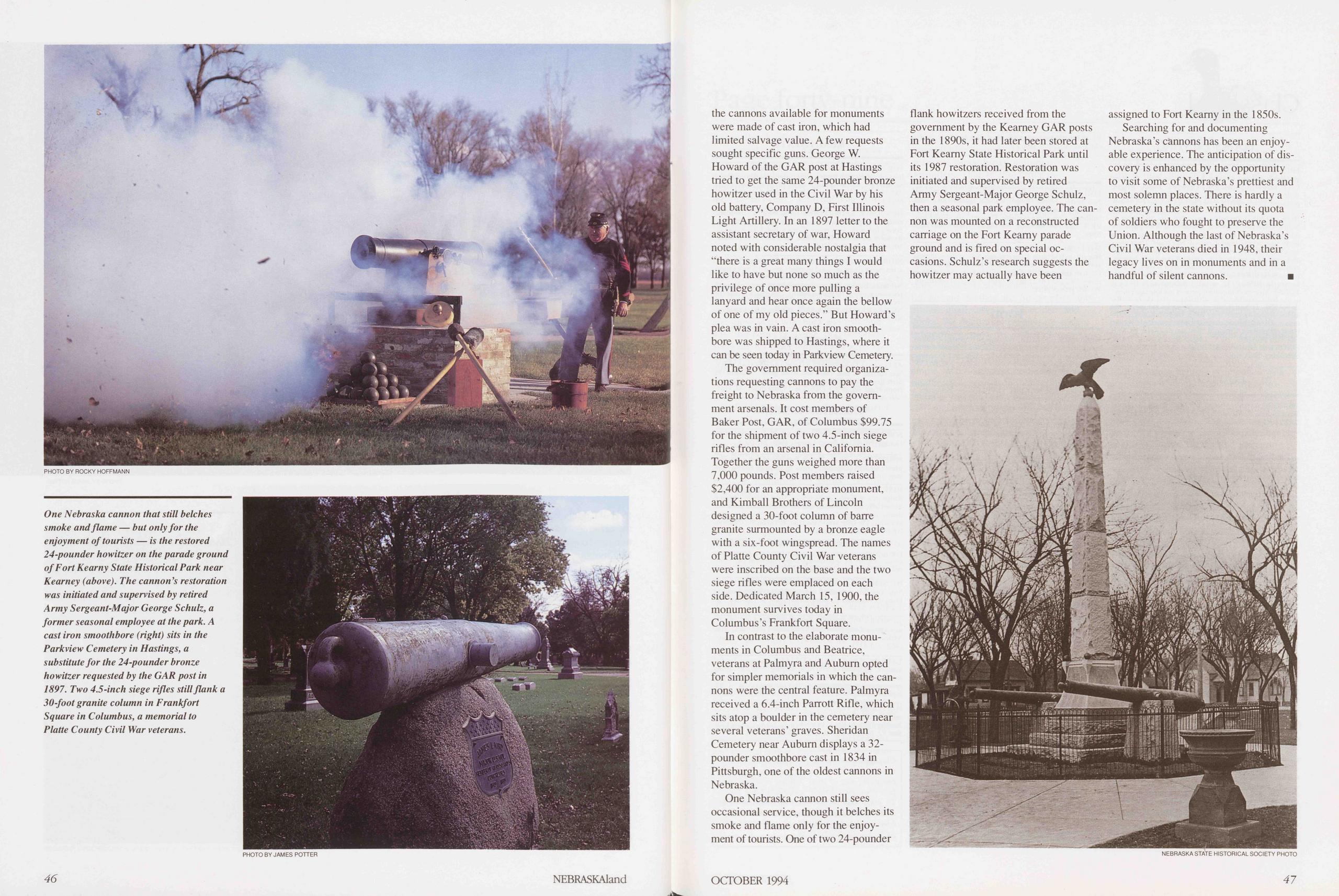 PHOTO BY ROCKY HOFFMANN
the cannons available for monuments were made of cast iron, which had limited salvage value. A few requests sought specific guns. George W. Howard of the GAR post at Hastings tried to get the same 24-pounder bronze howitzer used in the Civil War by his old battery, Company D, First Illinois Light Artillery. In an 1897 letter to the assistant secretary of war, Howard noted with considerable nostalgia that ' there is a great many things I would like to have but none so much as the privilege of once more pulling a lanyard and hear once again the bellow of one of my old pieces.” But Howard’s plea was in vain. A cast iron smooth- bore was shipped to Hastings, where it can be seen today in Parkview Cemetery.
The government required organizations requesting cannons to pay the freight to Nebraska from the government arsenals. It cost members of Baker Post, GAR, of Columbus $99.75 for the shipment of two 4.5-inch siege rifles from an arsenal in California. Together the guns weighed more than 7,000 pounds. Post members raised $2,400 for an appropriate monument, and Kimball Brothers of Lincoln designed a 30-foot column of barre granite surmounted by a bronze eagle with a six-foot wingspread. The names of Platte County Civil War veterans were inscribed on the base and the two siege rifles were emplaced on each side. Dedicated March 15, 1900, the monument survives today in Columbus’s Frankfort Square.
In contrast to the elaborate monuments in Columbus and Beatrice, veterans at Palmyra and Auburn opted for simpler memorials in which the cannons were the central feature. Palmyra received a 6.4-inch Parrott Rifle, which sits atop a boulder in the cemetery near several veterans’ graves. Sheridan Cemetery near Auburn displays a 32-pounder smoothbore cast in 1834 in Pittsburgh, one of the oldest cannons in Nebraska.
One Nebraska cannon still sees occasional service, though it belches its smoke and flame only for the enjoyment of tourists. One of two 24-pounder flank howitzers received from the government by the Kearney GAR posts in the 1890s, it had later been stored at Fort Kearny State Historical Park until its 1987 restoration. Restoration was initiated and supervised by retired Army Sergeant-Major George Schulz, then a seasonal park employee. The cannon was mounted on a reconstructed carriage on the Fort Kearny parade ground and is fired on special occasions. Schulz’s research suggests the howitzer may actually have been assigned to Fort Kearny in the 1850s.
Searching for and documenting Nebraska’s cannons has been an enjoyable experience. The anticipation of discovery is enhanced by the opportunity to visit some of Nebraska’s prettiest and most solemn places. There is hardly a cemetery in the state without its quota of soldiers who fought to preserve the Union. Although the last of Nebraska’s Civil War veterans died in 1948, their legacy lives on in monuments and in a handful of silent cannons.
Classified
BOOKS/PRINTINGFREE BOOK CATALOG. Novels, westerns, romances, children’s; old out of print, found bams, attic. Authors: Grey, Bower, Connor, Fox, Curwood, Raine, Wright, Aldrige, Pollyanna, Freckles, many others. Postage ap- preciated. Pierce, 4400 N. Pine Cluster, Oroville, CA 95965.
HOW TO FIND the public lands that you read about in NEBRASKAland Magazine. Locations & descriptions for ALL federal, state & NRD, parks, lakes, forests, wildlife areas, river access, trout streams & bike trails! These areas are clearly marked on county. D O T transportation maps and show ALL hard surface, gravel & dirt roads, bridges, railroads, rivers & creeks, farm and ranch homes, cities & towns. Send $18.75 to: Sportsman’s Atlas Co., PO Box 132, Lytton, IA 50561-0132, or call 1-800-568-8334 ORDER TODAY. Your most important piece of outdoor equipment.
A WARM, TENDER tale of a Nebraska lad during the 1930s. A deep heartfelt story where hard work, neighborli- ness and drought were overcome with homemade humor. Great era pictures. Critiqued “Best since LITTLE HOUSE ON THE PRAIRIE.” H. C. Lorenz’ literary gem, “DAM- FINO” is a must read. $17.50 first class. Prairie House Publishing, 240 Carol Lane, Oakley, CA 94561.
COLLECTIBLES1994 NEBRASKA HABITAT STAMP print now available. Write to John R. Mayer, PO Box 1704, Grand Island, NE 68802 for FREE brochure.
DOGSTRAINING ALL BREEDS bird dogs — Vizslas and English Pointers for sale. Rozanek Kennels, RR 2, Schuyler, NE 68661. Phone (402) 352-8769.
YELLOW-BLACK Lab pups. FC-AFC sired. AKC. Hips OFA certified. Dew claws removed. Excellent hunting potential. Contact Bob Bendler, Lexington, NE. (308) 324- 4247
WILDERNESS KENNELS. Gun dog training - over 60 years combined experience. Training all sporting breeds — Retrievers. Flushing and pointing dogs. All dogs worked on pen raised birds and wild game. Training program includes obedience training — heel, sit, stay, down and come when called. Pups, started dogs and fully trained dogs for sale.
HUNTING DOGS TRAINED BY HUNTERS. Henry Sader, Wilderness Kennels, Roca, NE. (402) 423-4212. Since 1968
ENGLISH COCKER pups, imported stock, British FTC bloodlines. Many colors available. Featured in NEBRASKAland November 1991. Sawtooth Oaks, Box 443, Orleans, NE 68966. Phone (308) 473-5265.
EXCEPTIONAL ENGLISH SETTER pups. Tomoka 1 inebred! Sire has 30 shooting dog wins and counting. Reserve yours! (402) 421-4693.
RETRIEVER TRAINING. Area’s top “retrievers only” trainer. Field trial and hunting dogs. Non-slip duck dogs! TKO RETRIEVER TRAINING KENNEL(402)623-4311.
CHESAPEAKE BAY, LABRADOR and GOLDEN RETRIEVER pups, started dogs and stud service. 16 time national champion pedigre. Platte Valley Retrievers (308) 995-2318.
DEUTSCH DRAHTHAARS - Line-bred litters due to whelp in September. Puppies expected to have great poten- tial. Parents are proven hunters. Bred by strict VDD stand- ards in a German registered kennel. Versatile hunting drahthaars for fur and feathered game. Wildflugel Kennel. RR 2, Box 24A, Ravenna, NE 68869 (308) 452-4333. AKC Brittany pups sired by Imported French Brittany. Close hunters that point and retrieve naturally. House pet temperaments. Bob Allen, Broken Bow, NE (308)872-6929 work (308) 872-2497.
BLACK LAB for stud. AKC. Hips OFA certified. 3 years old. Call (402)496-7886.
FISH/FISHINGFISH FOR SALE. Catfish, largemouth bass, smallmouth bass, perch, crappie, bluegill, walleye, northern pike, rain- bow trout, Donaldson rainbow trout, grass carp, minnows, bullheads. Consulting available. Pleasant Valley Fish Farm, RR 1, Box 147. McCook, NE 69001. Phone (308) 345- 6599.
WILLOW LAKE FISH HATCHERY. Channel cat, bluegill, hybrid bluegill, largemouth bass, crappie, triploid grass carp, walleye, perch, minnows available for stocking. Gaylord Crawford, RR 3, Box 46, Hastings, NE 68901 or phone (402) 463-8022 day or night. Also pond consultant. We del, grower price.
FOODNEBRASKA BASKETS: The original Nebraska company specializing in fine foods from Nebraska. A beautiful array of baskets filled with ethnic, healthful and long-time favorite foods. Call or write for our brochure: P.O. Box 98, McCook, NE 69001. 1-800-345-7725.
BEER & WINEMAKING SUPPLIES — Fermenter’s Supply & Equipment, 4472 S. 84th St., Omaha, NE 68127. (402) 593-9171. Mail order or visit our store.
AMAZING BLACK WALNUT CRACKER. Cracks black walnuts perfectly. Controls shells. No more smashed fingers. $21.75 plus $4.00 postage. Stephen Robinson. Stewartsville, MO 64490.
GIFTSNEBRASKA CHRISTMAS CARDS, stationery, mugs, cookie cutters, rubber stamps, gift baskets and more! Originally designed and elegantly packaged from Nebras- ka. FREE catalog: MJP. HC 37 Box 43C, Valentine, NE 69201. 1-800-632-7623.
FREE 200-PAGE GIFT catalog. Same gifts as in shopping malls but half the price. Check it out. Write to King's Quality Products, Box 491, Alliance, NE 69301.
GUIDES/OUTFITTERSMAD RIVER CANOES offers the finest quality and per- formance. For the finest canoes and accessories look to Great Plains Canoe Co., 205 Main, Springfield, NE. Phone (402)253-2001.
WANTED hunting guides with dogs. Write Hunt Nebraska Inc., PO Box 328, Arapahoe, NE 68922 or phone (308) 962-8469.
GRAHAM CANOE OUTFITTERS: Top quality full-ser- vice camping and canoe trips on the Niobrara River. Daily canoe rentals and car shuttle-service available. Contact Doug & Twyla Graham, HC 13 Box 16, Valentine, NE 69201 or phone (402) 376-3708.
WE KILL GEESE! We don’t just hunt geese! Offering season memberships for guided corporate/individual hunts - Gander Pass Outfitters - Reservations (308) 799-2115.
GUNS/SHOOTING/ARCHERY
GUNS — Browning, Winchester, Remington, others. Em- powers; shotguns, new, used, antiques. Want Pre-’64 Winchesters. Buy-Sell-Trade. (402) 729-6112. Bedlan’s Spotting Goods, Fairbury, NE 68352.
REAL ESTATE
FOR SALE: One of Nebraska’s top fishing-recreational- hunting resorts with home, cabins, store, and all equipment needed goes. Set on very large lake. Call Swett Realty (402) 387-1626, Fred Swett, Broker, PO Box 265, Ainsworth, NE 69210.
HUNTING & RECREATIONAL PROPERTY. 250 acres, unimproved pasture and woods. Niobrara River frontage. Spring fed creek. Very pretty. Contact: Bob Litz, Associate Broker with Shonka Real Estate, Inc., Box 509, O’Neill. NE 68763; (402) 336-3500.
NIOBRARA CANYON COUNTRY. Privately offered 55 acres. Sandhills pasture and wooded canyon 3.5 miles north of scenic Niobrara River. Two miles south of Norden. Nebraska. Bordered by county road. Prime deer, turkey and pheasant hunting. Near trout fishing, canoeing and outdoor recreation. Send $5.00 for packet of information to: NIOBRARA CANYON LAND, PO Box 150, Valentine. NE 69201-0150.
TAXIDERMYALLISON S TAXIDERMYSTUDIO & GIFTGALLERY. Specializing in fish, birds and small game. Mounted 35 State Record Fish. Pheasant mounts for sale. 421 N. Dewey. North Platte. NE 69101. (308) 534-2324 or (308)534-4267.
VACATION/RESORTSFOR FISHING and hunting accommodations. Jefco Inn, Gordon, NE 69343. South Cornell, (308) 282-2935. PINE CONE LODGE - Bed & Breakfast. Country atmos- phere, western hospitality. Close to hunting, fishing, his- toric interests. Broken Bow, NE (308) 872-6407.
HISTORIC 1890s HOTEL. Located in the beautiful Pine Ridge area of Northwest Nebraska. Short drive to Chadron State Park, Fort Robinson and the Black Hills. Beautiful dining room with fireplace and fountain. Room service available. The Olde Main Street Inn, 115 Main St., Chadron. NE 69337 (308) 432-3380.
AUNT BETTY'S BED & BREAKFAST. Peaceful atmos- phere. Victorian home decorated in antiques. Special ac- commodations for sportsmen. Close to Sherman Dam. Full breakfast. Ravenna, NE (308) 452-3739.
NE NEBRASKA TROUT FISHING. Mon-Thurs or Fri- Sun. 3 modem cottages, 5 spring fed lakes. Trout, bass and bluegill. Diamond E. Trout Resort, Box B, Orchard, NE 1-800-658-3244.
HUNTERS, FISHERMEN (and their families) welcome! 7 new cabins along Lone Pine Creek. Open year round. Pine Valley Resort, Jim, Nancy and Seth Carley, your hosts. (402) 273-4351.
LARRINGTON’S GUEST COTTAGE now open for fall hunters, vacations or overnight lodging. Tranquil setting overlooking Niobrara River canyons near Springview. For reservations or information contact Larrington's at HC 82, Box 28, Springview, NE 68778 or phone (402) 497-2261.
NATIVE NEW ZEALANDER, Paul Dravitzki. invites you on a unique. 16-day luxury tour of his beautiful homeland! January 1995, $3400. Contact: New Zealand’s Calling Tour, Box 82, Stromsburg, NE 68666. (402) 764-7211.
Classified ad rates: 75c per word, minimum $15. Closing date is the first business day 2 months preceding date of issue. Ads are accepted on a first-come-first-served, space-available basis. To place ads or for more information write NEBRASKAland Magazine, P.O. Box 30370, Lincoln, NE 68503-0370, or call (402) 471- 5478. Fax (402) 471-5528.
Page forty-nine
Respecting FeelingsSeveral times a year — often about now — we hear from a reader who wishes we didn’t write about hunting as much as we do. Often we’re tempted by the easy answers: “Who publishes this magazine?” we ask rhetorically. “The Game and Parks Commission.” Much of our support comes from hunters, anglers and parks users whose fees help finance the agency and its work, including this publication. “Do you buy a habitat stamp?” we’re tempted to ask. “Hunters do. They buy most of the public land.”
But most of the letters are deeply felt, and those of us who hunt and fish, and who, for better or worse, find ourselves speaking for other hunters and anglers, should try to provide equally deeply felt defenses.
Not long ago, for example, we got a letter from a long-time reader objecting to a NEBRASKAland story about a squirrel hunter. He didn’t oppose hunting in general, and as a long-time subscriber he has seen lots of hunting stories. But this one bothered him enough to write to us. It disturbed him that someone might take pleasure in hunting the animals he enjoys watching cavort in his backyard.
The letter is obviously sincere, and it expresses feelings I wouldn’t begin to deny. It doesn’t even pretend to address the difficult issues of why people hunt, why some people hunt some animals but not others, why some people don’t hunt at all but don’t oppose hunting, and why some people oppose all hunting. Those attitudes are based on complex, often unarticulated premises, and it isn’t surprising that the letter didn’t try to intellectualize them, but simply expressed the writer’s strong feelings.
NEBRASKAland writers write about hunting for a livelihood, yet we, too, seldom deal with those difficult abstract issues. Instead we prefer to make hunting look attractive — to make it look the way it feels when we do it. Of course we talk about biology and wildlife management and natural history too, but like the letter writer, our most fundamental premises are probably feelings.
We want readers to know facts, and we want them to understand the rudiments of the science that guides the work of biologists and wildlife managers. But beyond that we want to make readers feel what we feel — that one can be a hunter and still love animals. That hunters are not cruel, bloodthirsty, unthinking despoilers. That, in Jose Ortega y Gasset’s often-quoted description, “When one is hunting, the air has another, more exquisite feel... the rocks acquire a more expressive physiognomy, and the vegetation becomes loaded with meaning.”
But maybe, from time to time, we should speak more directly. Why did that reader so dislike the squirrel hunting story? Squirrels are harmless and beautiful, he said. So they are. So are pheasants, grouse, quail, turkeys, doves, deer and ducks. We don’t hunt because the quarry is harmful or ugly. We justify killing some animals because we consider them harmful — rats in the corncrib, for example, or round worms in the dog’s intestinal tract — but we don’t call that hunting, and we’re on thin ice when we start making judgements about relative ugliness. The beauty and innocence of the squirrels isn’t really the issue.
What about the unnecessary infliction of pain? That is an issue hunters must confront, and hunters who don’t acknowledge that they cause pain are willfully deceiving themselves. But most people who oppose hunting on that grounds also lie to themselves about their own culpability. They, too are responsible for the infliction of pain, even if they avoid inflicting it directly, in circumstances ranging from the slaughter of meat animals (let’s be honest about this: most porkchops and porterhouses are sacrificed to “sport” or “recreational” eating — nutrition and “need” have little to do with it) to the animal testing of medications and cosmetics, to the wholesale carnage of vast numbers of small animals whose presence threatens nothing more than a luxurious bluegrass lawn, and whose behavior is as curious and instructive as that of backyard squirrels. I don’t want to trivialize the idea with speculation about the surface galvanic responses of injured plants, but it is worthwhile to acknowledge the almost endless variety of living things that die for our use and pleasure.
What that letter — and my own response to it — make clear is that most opposition to hunting and most defenses of hunting are based on feelings, not on logic and reason. I hunt, so I know the feeling of hunting. I regularly hunt pheasants, quail, grouse, doves, turkeys and waterfowl. Most years I shoot a rab- bit or two. I used to hunt squirrels from time to time, though I haven’t done so in recent years. I relish venison, but I don’t hunt deer — I’m not sure why: I just don’t feel like it.
One of my pheasant and quail hunting partners won’t hunt ducks — they’re too cute, he says. In several states sandhill cranes are legal game, but they aren’t in Nebraska, and proposals to establish a season are met by waves of opposition — some of it from people who know that from a biological standpoint the crane population is healthy and could easily tolerate a fall hunting season in Nebraska, but for whom the idea of sandhill crane hunting just doesn’t feel right.
Sometimes hunting is defended with arguments based on management principles. Having lost their natural controls — predators, for example — or having prospered in an area, a species is in danger of overpopulation, threatening the health of its own habitat and increasing its vulnerability to disease and the other effects of overcrowding. The deer population in Fontenelle Forest near Bellevue and snow geese on Canadian nesting grounds, for example, are thought to be in that predicament. Hunting can be a valuable tool in controlling such populations.
But “management” doesn’t explain why we hunt. It has never occurred to me to get up early on a crisp fall morning, whistle up the dog and take the 12-gauge out to manage some pheasants. The real reasons have more to do with feelings: The feeling of the crisp fall morning, the dog’s joy in his work, anticipation of the meal to come and, yes, the blood ritual of the hunt itself.
The issue is one of feelings, emotions — almost of faith — not of food, management, tradition, beauty or innocence. Those who hunt do so with an almost inexpressible depth of feeling that hunting is justified. Those who object to hunting — or just to some hunting — feel it just as deeply. Logic and reason have so little to do with it that we are left with few alternatives: We need to respect each other’s feelings. NEBRASKAland Magazine won’t try to make you hunt, but it will continue trying to make you understand how hunters feel.
48 NEBRASKAland OCTOBER 1994 49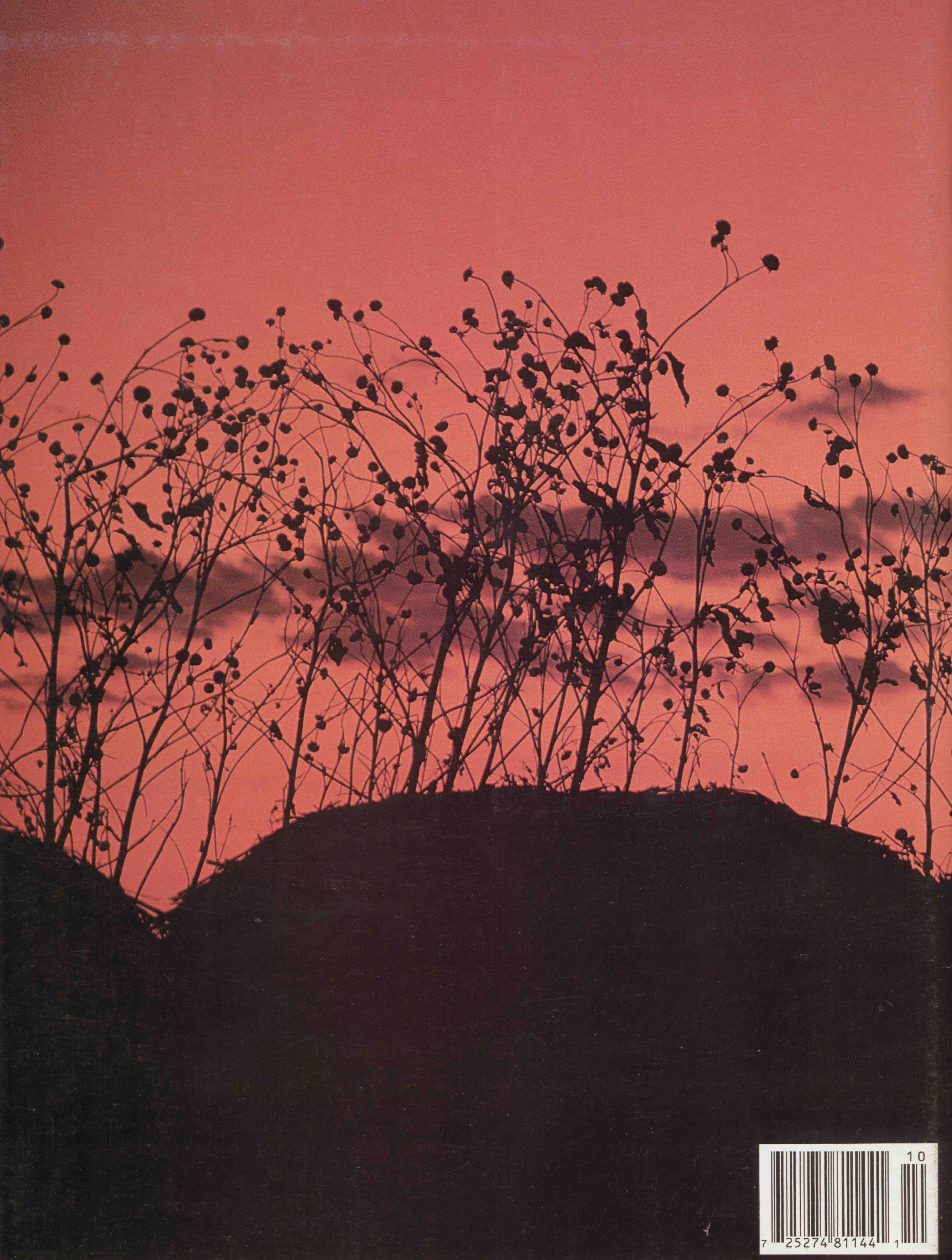
Position: 16 (398 views)