Volume 72, Issue 7, 1994
NEBRASKAland
AUGUST/SEPTEMBER 1994 • $2.00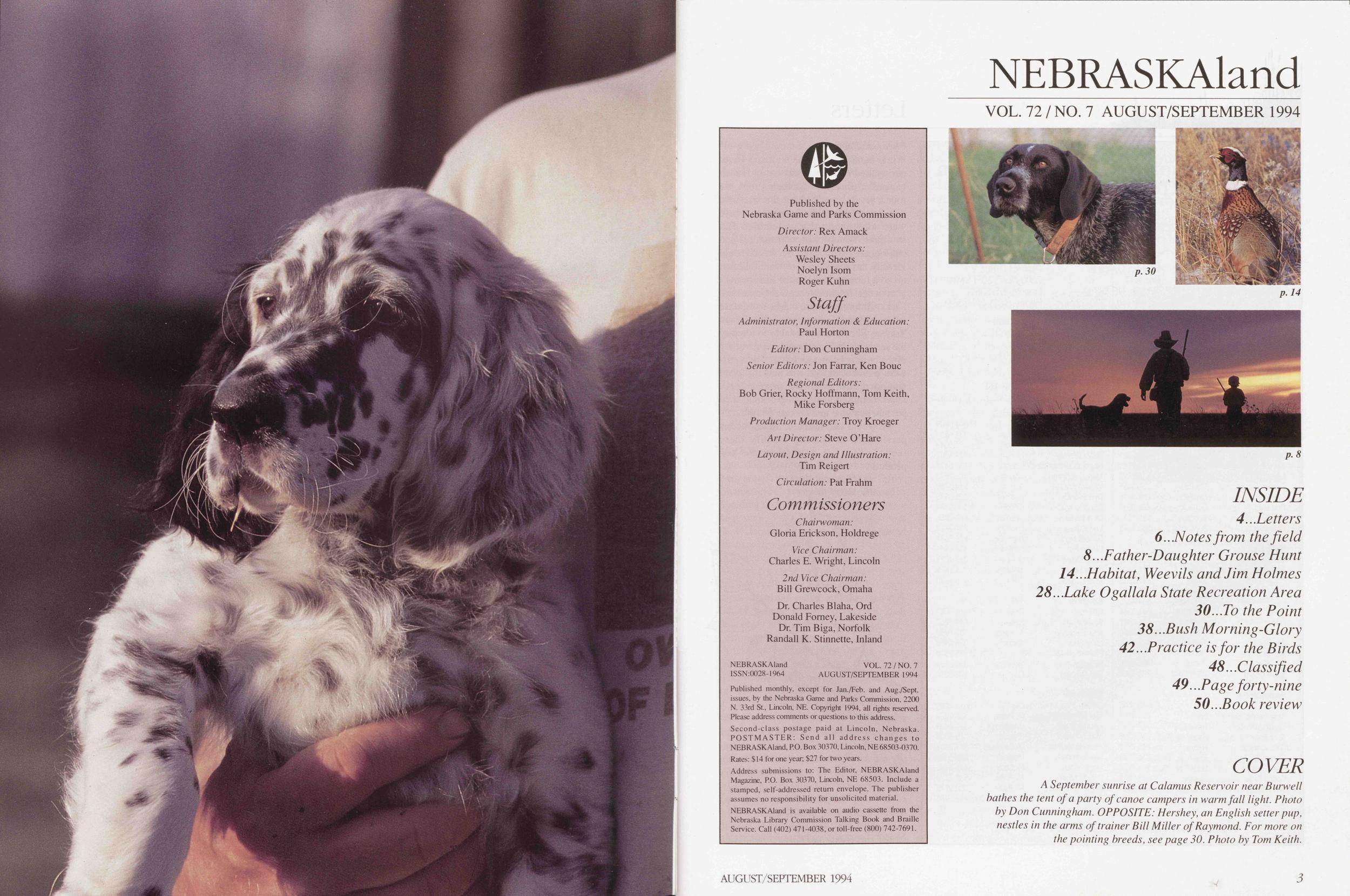
p. 30
p. 14
p. 8
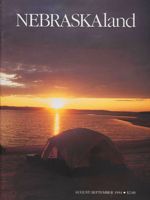
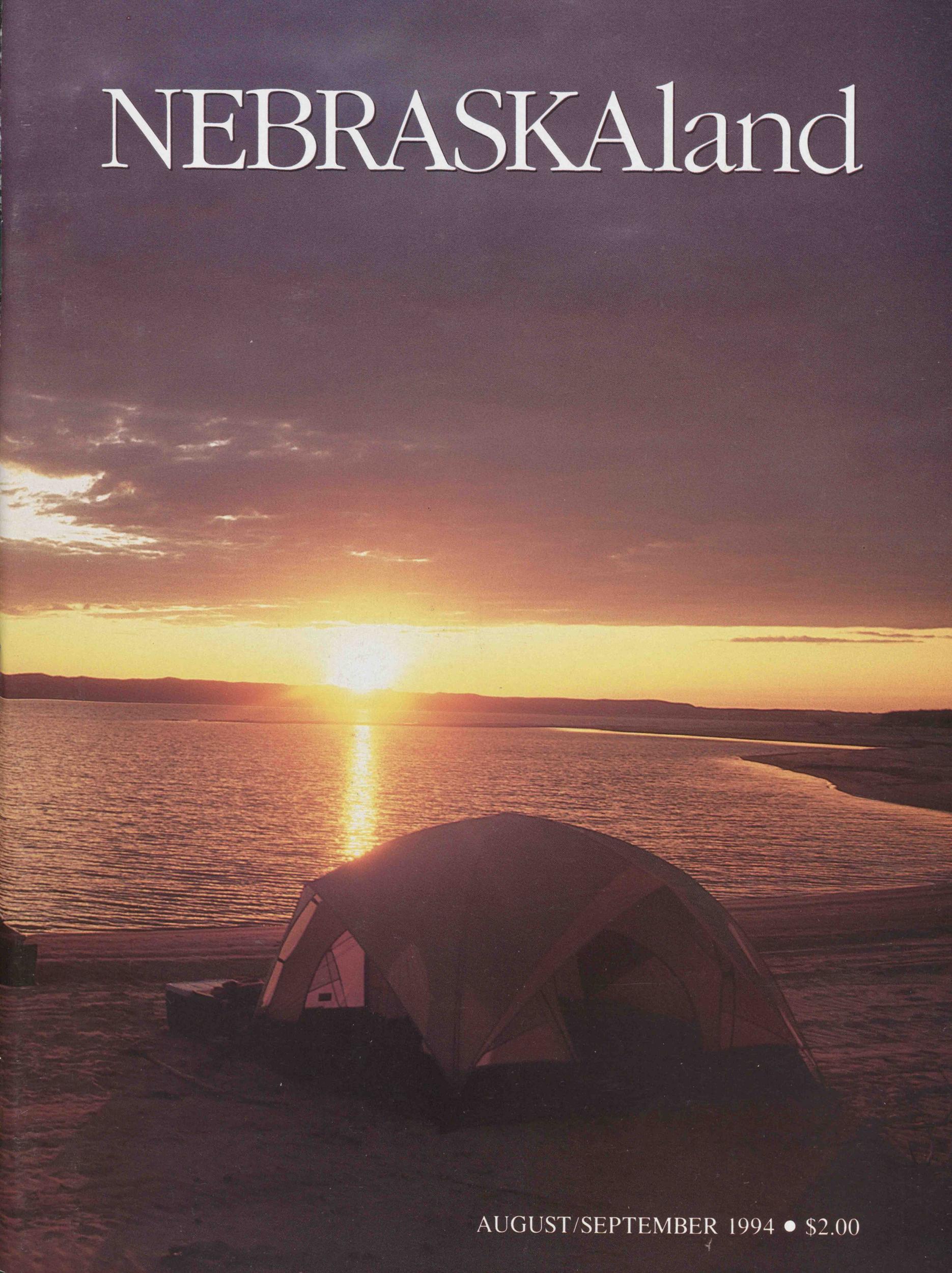
COVER A September sunrise at Calamus Reservoir near Burwell bathes the tent of a party of canoe campers in warm fall light. Photo by Don Cunningham. OPPOSITE: Hershey, an English setter pup, nestles in the arms of trainer Bill Miller of Raymond. For more on the pointing breeds, see page 30. Photo by Tom Keith.
Letters
Pheasant Food
While hunting along the Niobrara River during the 1993 season, my son and I each bagged a pheasant. In their crops we found several seeds about the size of a nickel that looked like lima beans. There were also seeds that resembled flat soybeans. We checked with farmers and outdoorsmen in the area, but no one could identify the seeds, and we were told that no area farmers had planted lima beans.
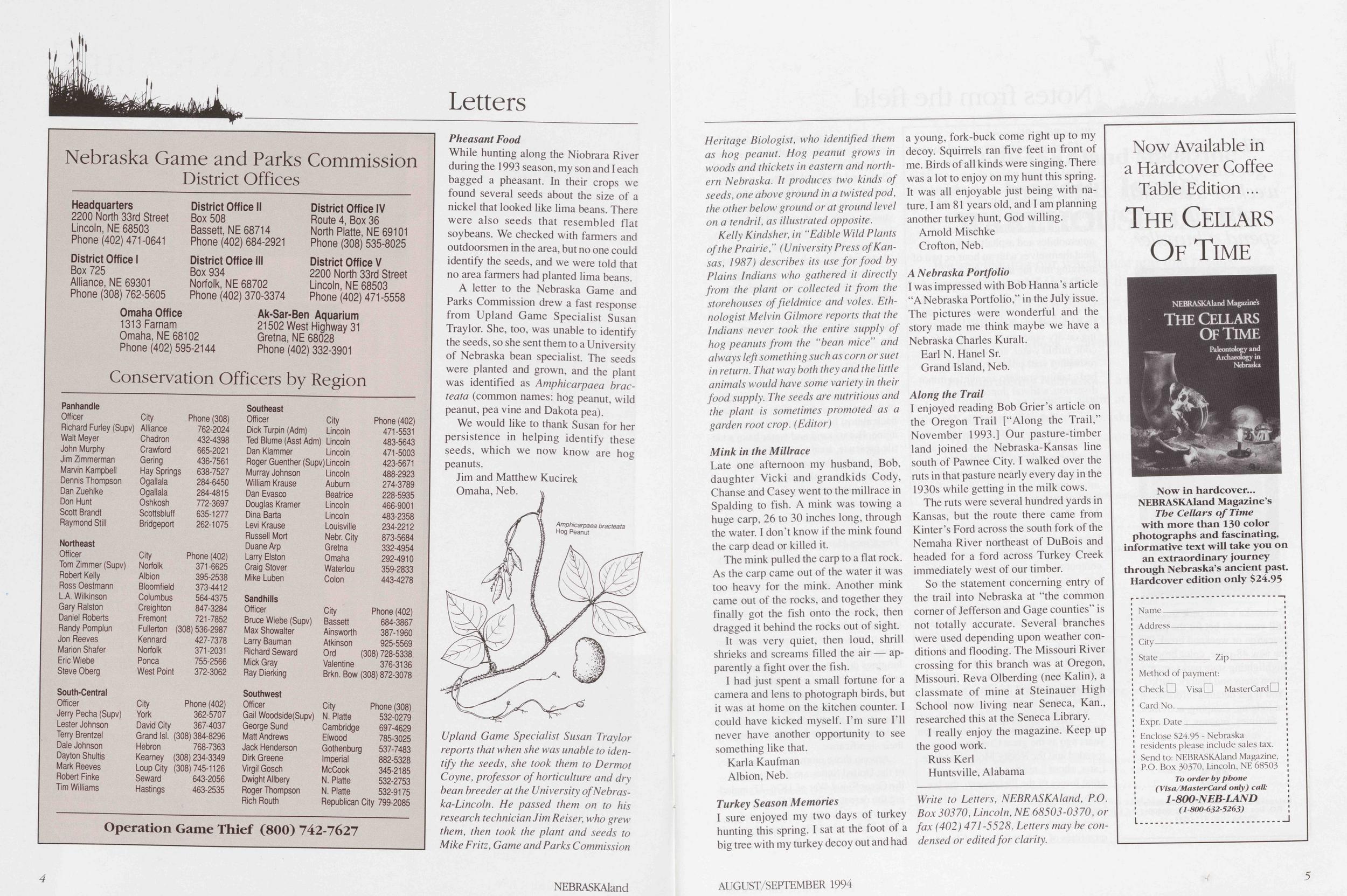
A letter to the Nebraska Game and Parks Commission drew a fast response from Upland Game Specialist Susan Traylor. She, too, was unable to identify the seeds, so she sent them to a University of Nebraska bean specialist. The seeds were planted and grown, and the plant was identified as Amphicarpaea bracteata (common names: hog peanut, wild peanut, pea vine and Dakota pea). We would like to thank Susan for her persistence in helping identify these seeds, which we now know are hog peanuts.
Jim and Matthew Kucirek Omaha, Neb.Late one afternoon my husband, Bob, daughter Vicki and grandkids Cody, Chanse and Casey went to the millrace in Spalding to fish. A mink was towing a huge carp, 26 to 30 inches long, through the water. I don't know if the mink found the carp dead or killed it.
The mink pulled the carp to a flat rock. As the carp came out of the water it was too heavy for the mink. Another mink came out of the rocks, and together they finally got the fish onto the rock, then dragged it behind the rocks out of sight. It was very quiet, then loud, shrill shrieks and screams filled the air — apparently a fight over the fish.
I had just spent a small fortune for a camera and lens to photograph birds, but it was at home on the kitchen counter. I could have kicked myself. I'm sure I'll never have another opportunity to see something like that.
Karla KaufmanAlbion, Neb. Turkey Season Memories
I sure enjoyed my two days of turkey hunting this spring. I sat at the foot of a big tree when my turkey decoy a young, fork-buck come right up to my decoy. Squirrels ran five feet in front of me. Birds of all kinds were singing. There was a lot to enjoy on my hunt this spring. It was all enjoyable just being with na- ture. I am 81 years old, and I am planning another turkey hunt, God willing.
Arnold MischkeCrofton, Neb. A Nebraska Portfolio
I was impressed with Bob Hanna's article "A Nebraska Portfolio," in the July issue. The pictures were wonderful and the story made me think maybe we have a Nebraska Charles Kuralt.
Earl N. Hanel Sr.Grand Island, Neb. Along the Trail
I enjoyed reading Bob Grier's article on the Oregon Trail ["Along the Trail," November 1993.] Our pasture-timber land joined the Nebraska-Kansas line south of Pawnee City. I walked over the ruts in that pasture nearly every day in the 1930s while getting in the milk cows. The ruts were several hundred yards in Kansas, but the route there came from Kinter's Ford across the south fork of the Nemaha River northeast of DuBois and headed for a ford across Turkey Creek immediately west of our timber.
So the statement concerning entry of the trail into Nebraska at "the common corner of Jefferson and Gage counties" is not totally accurate. Several branches were used depending upon weather con- ditions and flooding. The Missouri River crossing for this branch was at Oregon, Missouri. Reva Olberding (nee Kalin), a classmate of mine at Steinauer High School now living near Seneca, Kan., researched this at the Seneca Library. I really enjoy the magazine. Keep up the good work.
Russ KerlHuntsville, Alabama
Write to Letters, NEBRASKAland, P.O. Box 30370, Lincoln, NE 68503-0370, or fax (402) 471-5528. Letters may be con- densed or edited for clarity.
Notes from the field
Platte River PleasuresChief among the summer pleasures of the Platte is sitting in it, a luxury denied to those whose rivers — wild or merely treacherous — cascade and roar or swirl ominously all year round. Sitting in the Platte in summer is a sovereign remedy for those sick of automobiles and asphalt who want to heal themselves with an hour or two of merging into the landscape.
The sandy-bottomed Platte is perfect for such exercise. At the downstream tip of a side-channel sandbar you can lie back and watch the clouds, head resting on dry sand, up to your shoulders in cool, turbid water, and feel the river reshaping your pillow (and its own bed), taking you into account, a minor diversion, a trivial impediment to its flow, an object about the size and color of a smallish cottonwood log, but softer.
Against your skin you feel the constant pecking of sand grains, the water-borne abrasive that scoured out the valley. It scours the skin as well, but more important is the psychic buffing that comes with sitting in a river. An hour or two up to your neck in the Platte, and you go home as smooth and lustrous as a cedar knot from the Rockies 800 miles upstream, as calm and contoured as a mammoth tooth, a million-year-old Ice Age relic rolled and polished by the flowing sand and water.
When you get home, though, you find the sand is everywhere. It works its way into each crease of skin, each fold of cloth. It penetrates the seams of clothing. You find it in your wallet — left in the glove box of the car. Between your teeth you feel its subtle grinding.
Where did all that sand come from? Water-borne sediment from the west began coming our way about 60 million years ago as the great Cretaceous sea receded and the Rocky Mountains rose. Later, about 2 million years ago, the great forces of the Pleistocene, the Ice Age, were at work upon the land. In at least six cycles, massive ice sheets crept from the north, bulldozing vast quantities of rock and debris. Glaciers in the western mountains sent tons of material east onto the plains.
A million years or so ago, the North Platte and the South Platte rivers carried sand and gravel from the mountains and High Plains, depositing great sheets of it in south-central Nebraska. For the most part, that is our sand. We still mine it from sandpits along the Platte today — and sit on it some lazy summer afternoons — even though the river then was not yet quite today's Platte River. The Platte's predecessor was grinding its way westward from the east, headcutting, finally capturing the ancestral Platte drainage and completing its statewide flow some 50,000 to 100,000 years ago.
The modern Platte has a complex history, its valley combining segments of the valleys of older rivers stretching back almost beyond our capacity to imagine. But its sand and water have a tactile presence, a calming, shifting, scouring link that carries us back through the meanders of time to ages past, to calm and quiet. You owe it to yourself to go sit in the Platte.
Don Cunningham The Crazy Horse Surrender LedgerSome moments in a people's history seem to resonate more strongly than others in the collective consciousness. Stories from those moments become grist for the mills of the popular-culture myth-makers, stories told and retold, each movie, romance novel or mini-series colored by whatever fears or longings drive that generation's need to redefine itself and find connections with the past. Serious historians return to these moments as well, unearthing new details, reanalyzing causes, effects and connections, and reinterpreting their significance.
Among those moments in the history of the United States are the events of the Great Sioux War of 1876-77, including the defeat of General George Armstrong Custer at the Battle of the Little Bighorn in 1876 and the death of Crazy Horse at Camp Robinson (now Fort Robinson State Historical Park) in northwestern Nebraska in 1877. Of great interest to anyone who reenacted those events on playgrounds, who saw the Saturday matinees, and who finally began to learn how much more complex than playground games and movies is the history of the West, is The Crazy Horse Surrender Ledger, a new book from the Nebraska State Historical Society.
The book is co-edited by Thomas R. Buecker, curator of the Fort Robinson Museum, and R. Eli Paul, senior research historian for the State Historical Society, both past contributors to NEBRASKAland Magazine. It reproduces in its original form the Red Cloud military census, an administrative, statistical record of the Indian tribes living at Red Cloud Agency located near Fort Robinson in 1877.
A unique artifact acquired by the Historical Society in 1990, the ledger was prepared under the supervision of two army lieutenants. It contains census information on the Oglala Sioux, Cheyennes and Arapahos at the agency, and it registers the surrender of in- dividuals and whole groups at the war's end, including the Crazy Horse band, which arrived on May 6, 1877.
The ledger is considered the most extensive list yet discovered of the Indian participants in the events of the Sioux Wars. In the Summer 1994 issue of Nebraska History — an issue containing six arresting articles concerning the history and ethnology of the Lakota Sioux people — Buecker calls it "an extraordinary relic of the Great Sioux War and an important social document of the prereservation period of Plains Indian history. ... Its details about one key group, the Crazy Horse band, are unparalleled."
The Crazy Horse Surrender Ledger is available at $44.95 from the Book Order Department, Nebraska State Historical Society, P.O. Box 82554, Lincoln, NE 68501-2554. For credit card orders call 1-800-833-6747.
Father-Daughter Grouse Hunt
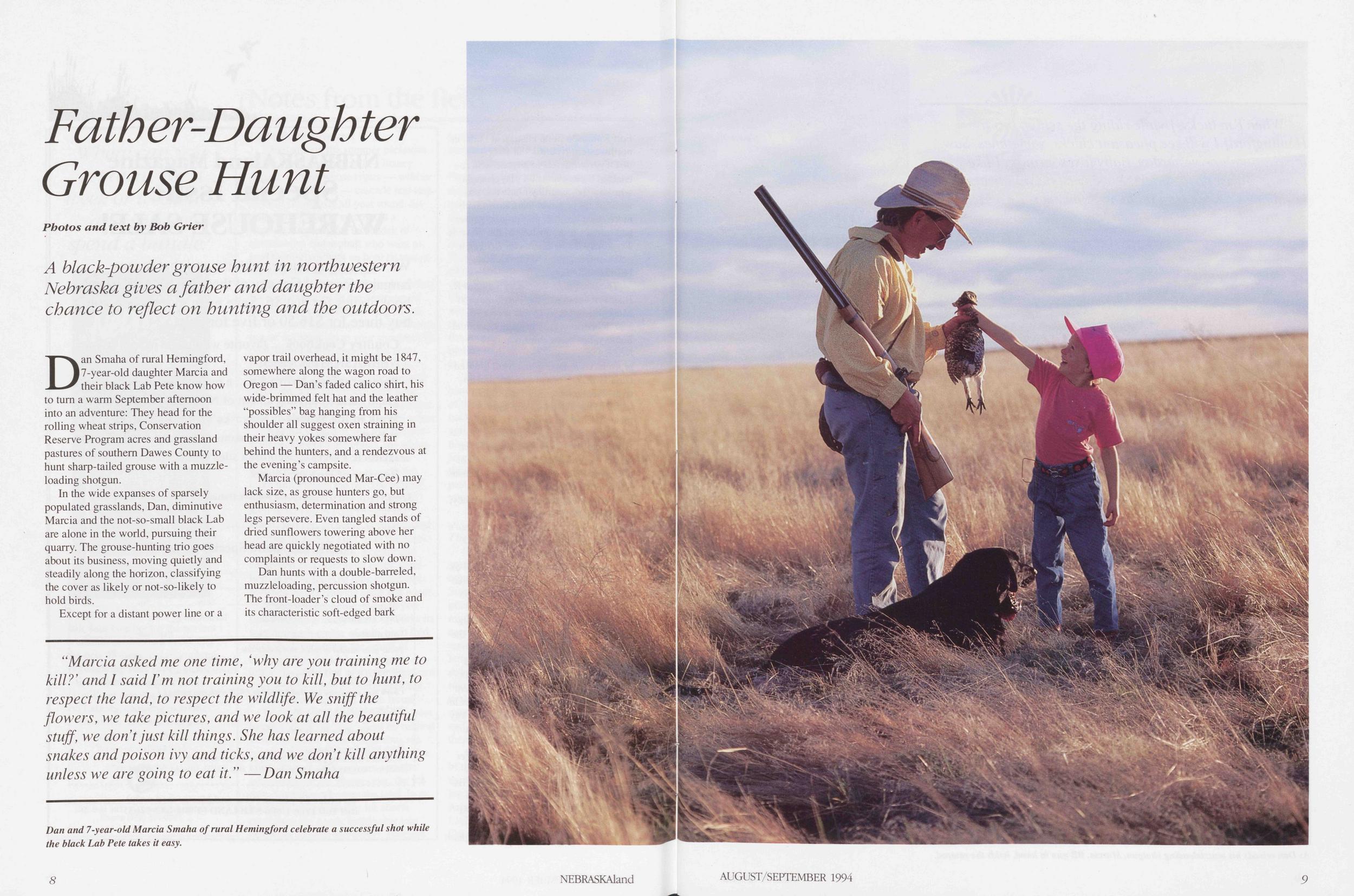
A black-powder grouse hunt in northwestern Nebraska gives a father and daughter the chance to reflect on hunting and the outdoors.Dan Smaha of rural Hemingford, 7-year-old daughter Marcia and their black Lab Pete know how to turn a warm September afternoon into an adventure: They head for the rolling wheat strips, Conservation Reserve Program acres and grassland pastures of southern Dawes County to hunt sharp-tailed grouse with a muzzle- loading shotgun.
In the wide expanses of sparsely populated grasslands, Dan, diminutive Marcia and the not-so-small black Lab are alone in the world, pursuing their quarry. The grouse-hunting trio goes about its business, moving quietly and steadily along the horizon, classifying the cover as likely or not-so-likely to hold birds.
Except for a distant power line or a vapor trail overhead, it might be 1847, somewhere along the wagon road to Oregon — Dan's faded calico shirt, his wide-brimmed felt hat and the leather "possibles" bag hanging from his shoulder all suggest oxen straining in their heavy yokes somewhere far behind the hunters, and a rendezvous at the evening's campsite.
Marcia (pronounced Mar-Cee) may lack size, as grouse hunters go, but enthusiasm, determination and strong legs persevere. Even tangled stands of dried sunflowers towering above her head are quickly negotiated with no complaints or requests to slow down.
Dan hunts with a double-barreled, muzzleloading, percussion shotgun. The front-loader's cloud of smoke and its characteristic soft-edged bark
"Marcia asked me one time, 'why are you training me to kill?1 and I said Ym not training you to kill, but to hunt, to respect the land, to respect the wildlife. We sniff the flowers, we take pictures, and we look at all the beautiful stuff, we don t just kill things. She has learned about snakes and poison ivy and ticks, and we dont kill anything unless we are going to eat it." —Dan Smaha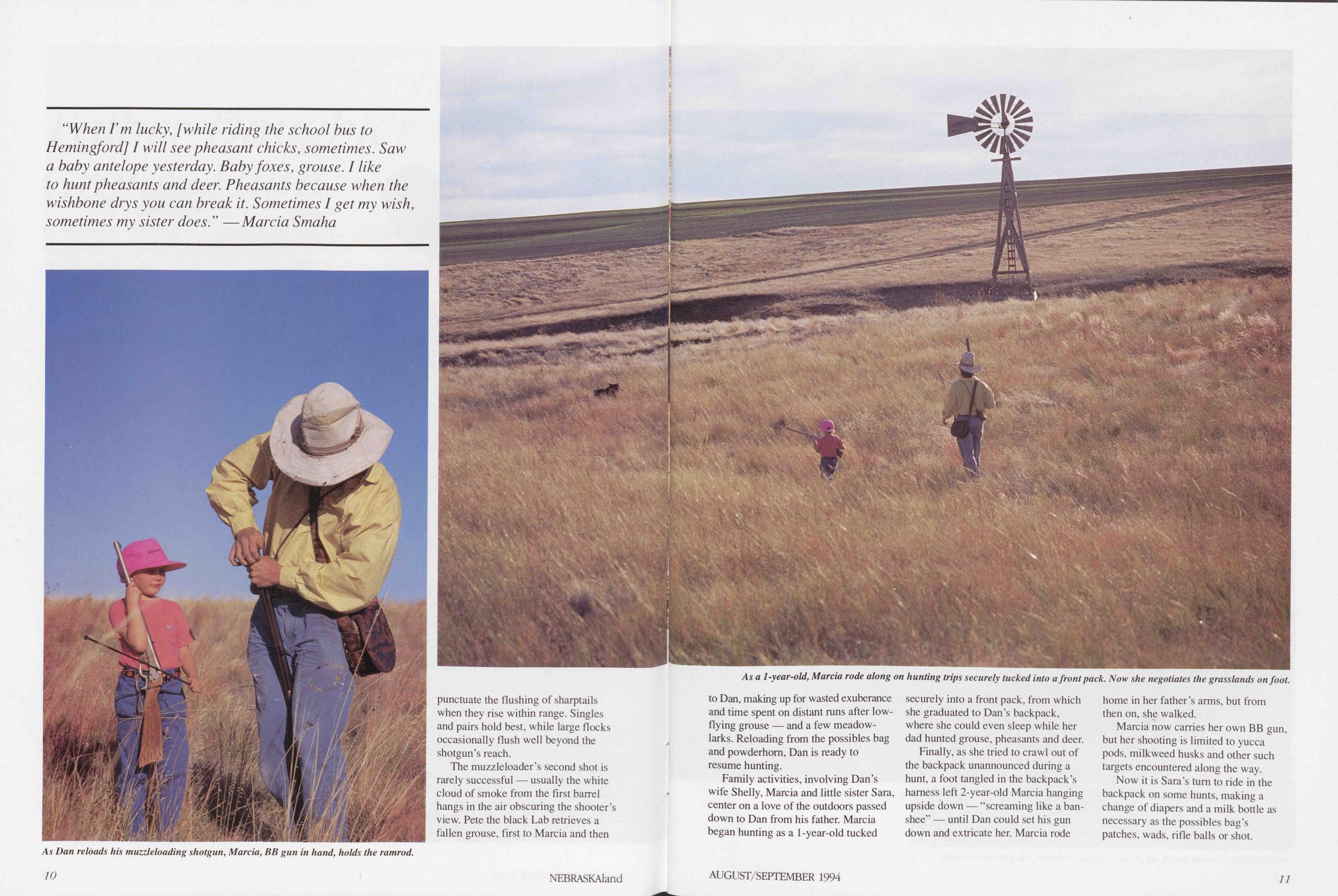
Punctuate the flushing of sharptails when they rise within range. Singles and pairs hold best, while large flocks occasionally flush well beyond the shotgun's reach.
The muzzleloader's second shot is rarely successful — usually the white cloud of smoke from the first barrel hangs in the air obscuring the shooter's view. Pete the black Lab retrieves a fallen grouse, first to Marcia and then to Dan, making up for wasted exuberance and time spent on distant runs after low- flying grouse — and a few meadow- larks. Reloading from the possibles bag and powderhorn, Dan is ready to resume hunting.
Family activities, involving Dan's wife Shelly, Marcia and little sister Sara, center on a love of the outdoors passed down to Dan from his father. Marcia began hunting as a 1-year-old tucked securely into a front pack, from which she graduated to Dan's backpack, where she could even sleep while her dad hunted grouse, pheasants and deer.
Finally, as she tried to crawl out of the backpack unannounced during a hunt, a foot tangled in the backpack's harness left 2-year-old Marcia hanging upside down — "screaming like a ban- shee" — until Dan could set his gun down and extricate her. Marcia rode home in her father's arms, but from then on, she walked.
Marcia now carries her own BB gun, but her shooting is limited to yucca pods, milkweed husks and other such targets encountered along the way.
Now it is Sara's turn to ride in the backpack on some hunts, making a change of diapers and a milk bottle as necessary as the possibles bag's patches, wads, rifle balls or shot.
10 NEBRASKAland AUGUST/SEPTEMBER 1994 11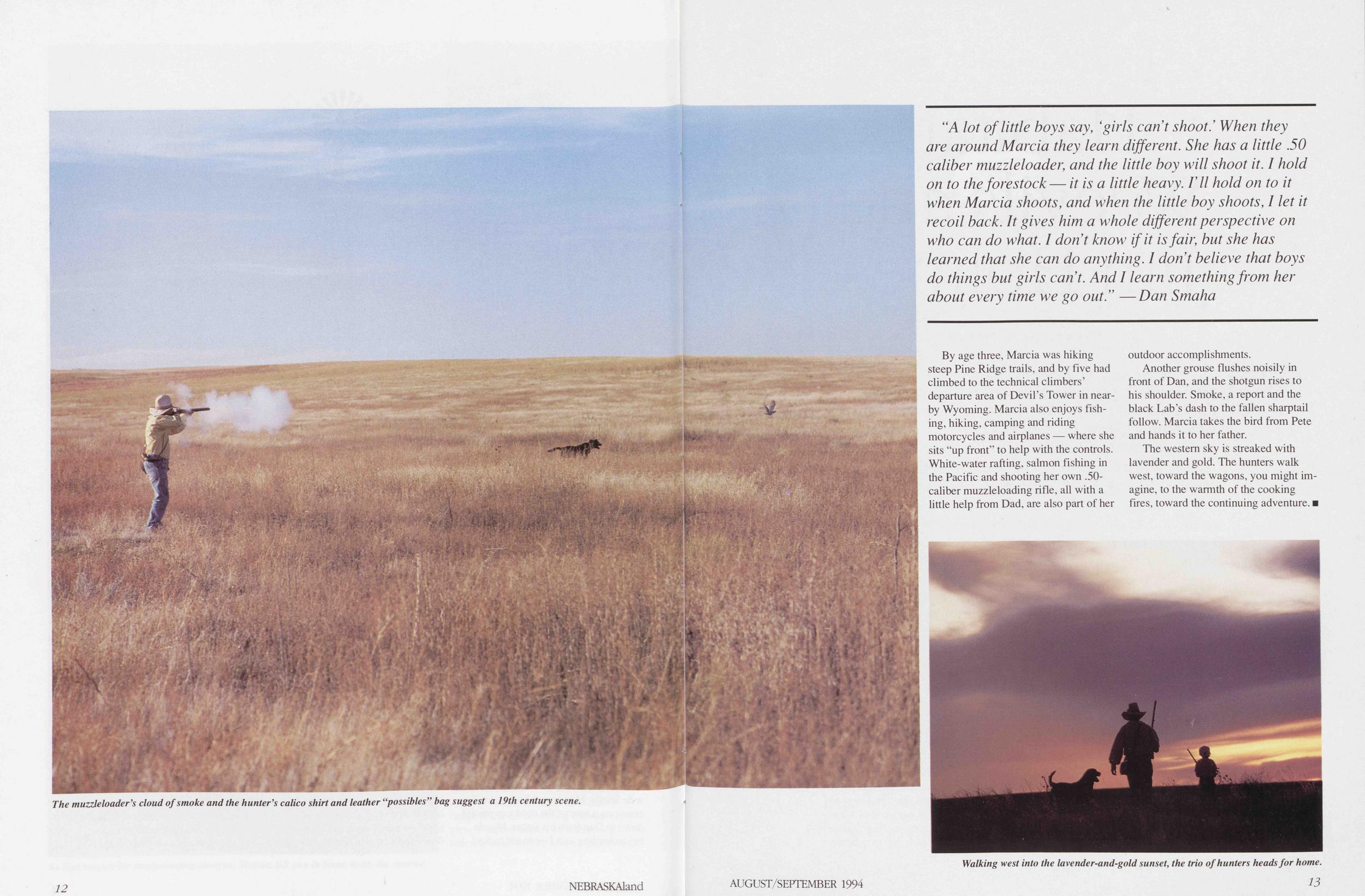
By age three, Marcia was hiking steep Pine Ridge trails, and by five had climbed to the technical climbers' departure area of Devil's Tower in near- by Wyoming. Marcia also enjoys fish- ing, hiking, camping and riding motorcycles and airplanes — where she sits "up front" to help with the controls. White-water rafting, salmon fishing in the Pacific and shooting her own .50- caliber muzzleloading rifle, all with a little help from Dad, are also part of her outdoor accomplishments.
Another grouse flushes noisily in front of Dan, and the shotgun rises to his shoulder. Smoke, a report and the black Lab's dash to the fallen sharptail follow. Marcia takes the bird from Pete and hands it to her father.
The western sky is streaked with lavender and gold. The hunters walk west, toward the wagons, you might im- agine, to the warmth of the cooking fires, toward the continuing adventure.
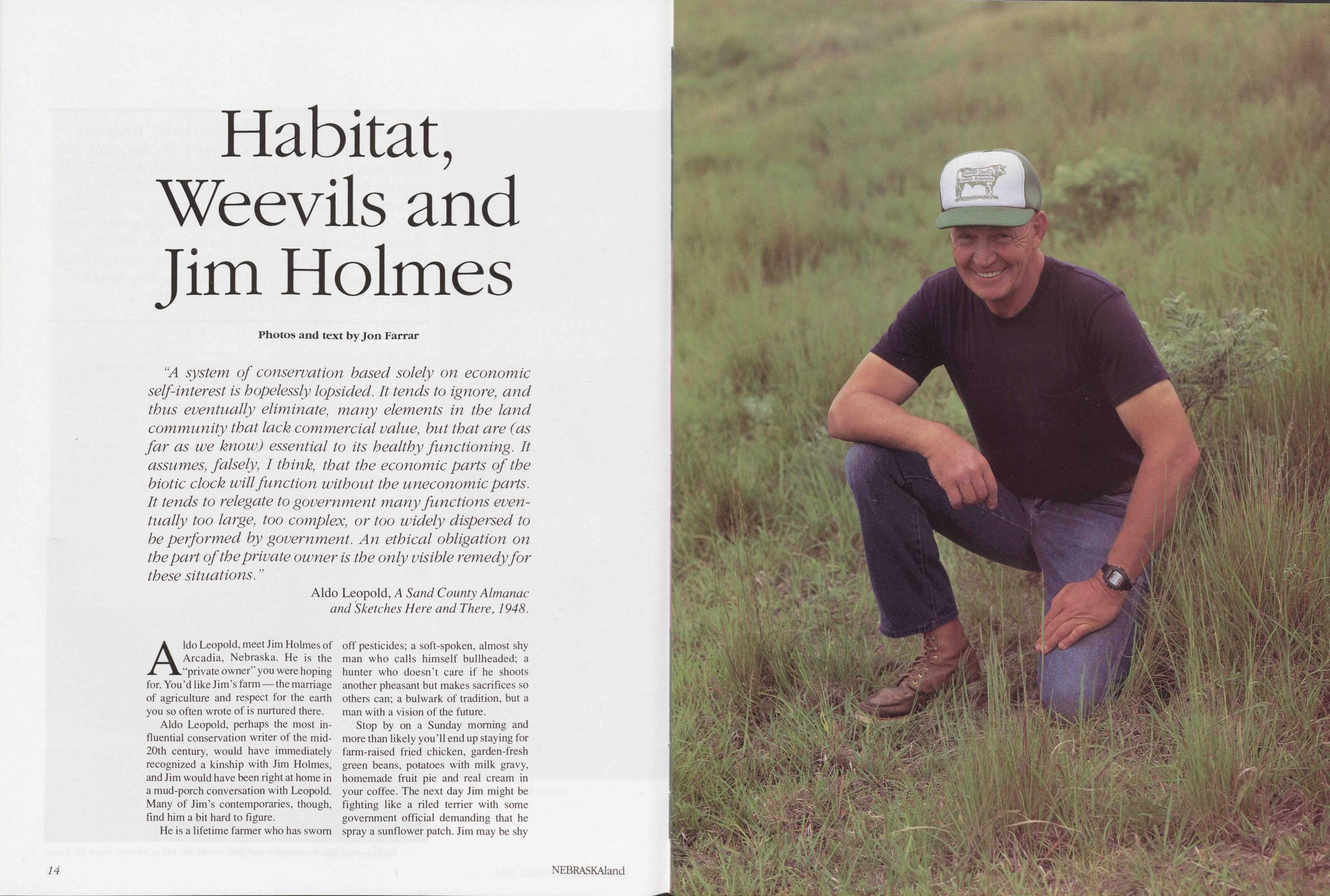
Habitat Weevils and Jim Holmes
"A system of conservation based solely on economic self-interest is hopelessly lopsided. It tends to ignore, and thus eventually eliminate, many elements in the land community that lack commercial value, but that are (as far as we know) essential to its healthy functioning. It assumes, falsely, I think, that the economic parts of the biotic clock will function without the uneconomic parts. It tends to relegate to government many functions even- tually too large, too complex, or too widely dispersed to be performed by government. An ethical obligation on the part of the private owner is the only visible remedy for these situations." Aldo Leopold, A Sand County Almanac and Sketches Here and There, 1948.Aldo Leopold, meet Jim Holmes of Arcadia, Nebraska. He is the "private owner" you were hoping for. You'd like Jim's farm — the marriage of agriculture and respect for the earth you so often wrote of is nurtured there. Aldo Leopold, perhaps the most influential conservation writer of the mid- 20th century, would have immediately recognized a kinship with Jim Holmes, and Jim would have been right at home in a mud-porch conversation with Leopold. Many of Jim's contemporaries, though, find him a bit hard to figure.
He is a lifetime farmer who has sworn off pesticides; a soft-spoken, almost shy man who calls himself bullheaded; a hunter who doesn't care if he shoots another pheasant but makes sacrifices so others can; a bulwark of tradition, but a man with a vision of the future.
Stop by on a Sunday morning and more than likely you'll end up staying for farm-raised fried chicken, garden-fresh green beans, potatoes with milk gravy, homemade fruit pie and real cream in your coffee. The next day Jim might be fighting like a riled terrier with some government official demanding that he spray a sunflower patch. Jim may be shy 14 NEBRASKAland
 on college degrees, but he's long on wisdom. He speaks with a slow, almost
southern drawl, the kind that invites listeners to finish his sentences. Resist. Jim
Holmes is a man worth hearing out.
The Family Tree
on college degrees, but he's long on wisdom. He speaks with a slow, almost
southern drawl, the kind that invites listeners to finish his sentences. Resist. Jim
Holmes is a man worth hearing out.
The Family Tree
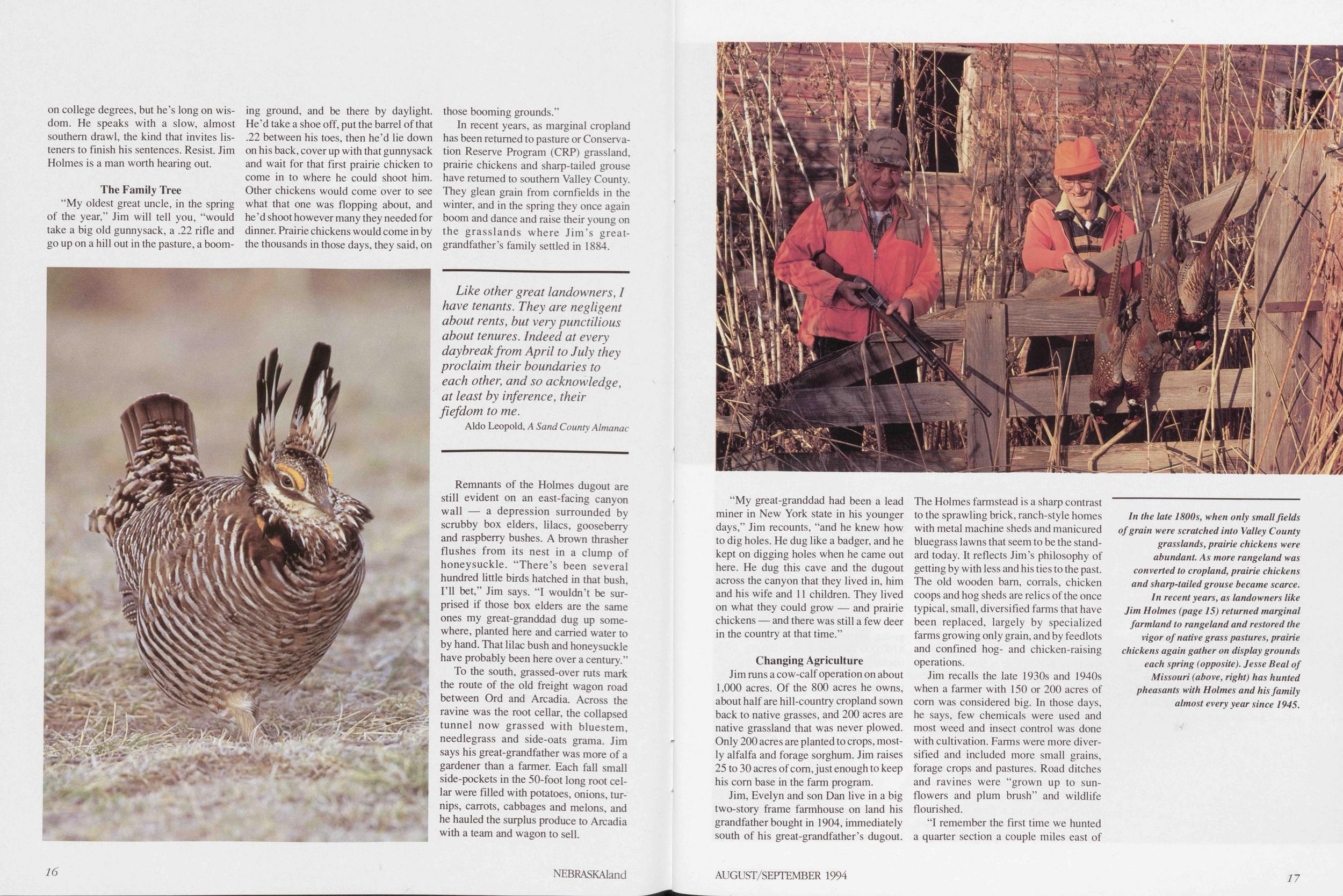
"My oldest great uncle, in the spring of the year," Jim will tell you, "would take a big old gunnysack, a .22 rifle and go up on a hill out in the pasture, a booming ground, and be there by daylight. He'd take a shoe off, put the barrel of that .22 between his toes, then he'd lie down on his back, cover up with that gunnysack and wait for that first prairie chicken to come in to where he could shoot him. Other chickens would come over to see what that one was flopping about, and he'd shoot however many they needed for dinner. Prairie chickens would come in by the thousands in those days, they said, on those booming grounds."
In recent years, as marginal cropland has been returned to pasture or Conservation Reserve Program (CRP) grassland, prairie chickens and sharp-tailed grouse have returned to southern Valley County. They glean grain from cornfields in the winter, and in the spring they once again boom and dance and raise their young on the grasslands where Jim's great- grandfather's family settled in 1884.
Like other great landowners, I have tenants. They are negligent about rents, but very punctilious about tenures. Indeed at every daybreak from April to July they proclaim their boundaries to each other, and so acknowledge, at least by inference, their fiefdom to me.Aldo Leopold, A Sand County Almanac
Remnants of the Holmes dugout are still evident on an east-facing canyon wall — a depression surrounded by scrubby box elders, lilacs, gooseberry and raspberry bushes. A brown thrasher flushes from its nest in a clump of honeysuckle. "There's been several hundred little birds hatched in that bush, I'll bet," Jim says. "I wouldn't be surprised if those box elders are the same ones my great-granddad dug up somewhere, planted here and carried water to by hand. That lilac bush and honeysuckle have probably been here over a century."
To the south, grassed-over ruts mark the route of the old freight wagon road between Ord and Arcadia. Across the ravine was the root cellar, the collapsed tunnel now grassed with bluestem, needlegrass and side-oats grama. Jim says his great-grandfather was more of a gardener than a farmer. Each fall small side-pockets in the 50-foot long root cellar were filled with potatoes, onions, turnips, carrots, cabbages and melons, and he hauled the surplus produce to Arcadia with a team and wagon to sell.
"My great-granddad had been a lead miner in New York state in his younger days," Jim recounts, "and he knew how to dig holes. He dug like a badger, and he kept on digging holes when he came out here. He dug this cave and the dugout across the canyon that they lived in, him and his wife and 11 children. They lived on what they could grow — and prairie chickens — and there was still a few deer in the country at that time."
Changing AgricultureJim runs a cow-calf operation on about 1,000 acres. Of the 800 acres he owns, about half are hill-country cropland sown back to native grasses, and 200 acres are native grassland that was never plowed. Only 200 acres are planted to crops, mostly alfalfa and forage sorghum. Jim raises 25 to 30 acres of com, just enough to keep his com base in the farm program.
Jim, Evelyn and son Dan live in a big two-story frame farmhouse on land his grandfather bought in 1904, immediately south of his great-grandfather's dugout. The Holmes farmstead is a sharp contrast to the sprawling brick, ranch-style homes with metal machine sheds and manicured bluegrass lawns that seem to be the standard today. It reflects Jim's philosophy of getting by with less and his ties to the past. The old wooden bam, corrals, chicken coops and hog sheds are relics of the once typical, small, diversified farms that have been replaced, largely by specialized farms growing only grain, and by feedlots and confined hog- and chicken-raising operations.
Jim recalls the late 1930s and 1940s when a farmer with 150 or 200 acres of com was considered big. In those days, he says, few chemicals were used and most weed and insect control was done with cultivation. Farms were more diversified and included more small grains, forage crops and pastures. Road ditches and ravines were "grown up to sunflowers and plum brush" and wildlife flourished.
"I remember the first time we hunted a quarter section a couple miles east of
In the late 1800s, when only small fields of grain were scratched into Valley County grasslands, prairie chickens were abundant. As more rangeland was converted to cropland, prairie chickens and sharp-tailed grouse became scarce. In recent years, as landowners like Jim Holmes (page 15) returned marginal farmland to rangeland and restored the vigor of native grass pastures, prairie chickens again gather on display grounds each spring (opposite). Jesse Beal of Missouri (above, right) has hunted pheasants with Holmes and his family almost every year since 1945.
here," recalls Jesse Beal of New London, Missouri, who has hunted pheasants with the Holmes family nearly every year since 1945. "There was a man and a woman up there shucking com by hand. About 15 years ago we hunted the same place. They had picked that quarter section in two days, and it made 158 bushels to the acre. That's the difference of irrigation, and maybe a little fertilizer on it. That man and woman took all winter to shuck that com, and now they pick it in two days and get four or five times more com. The whole country has gone the same way."
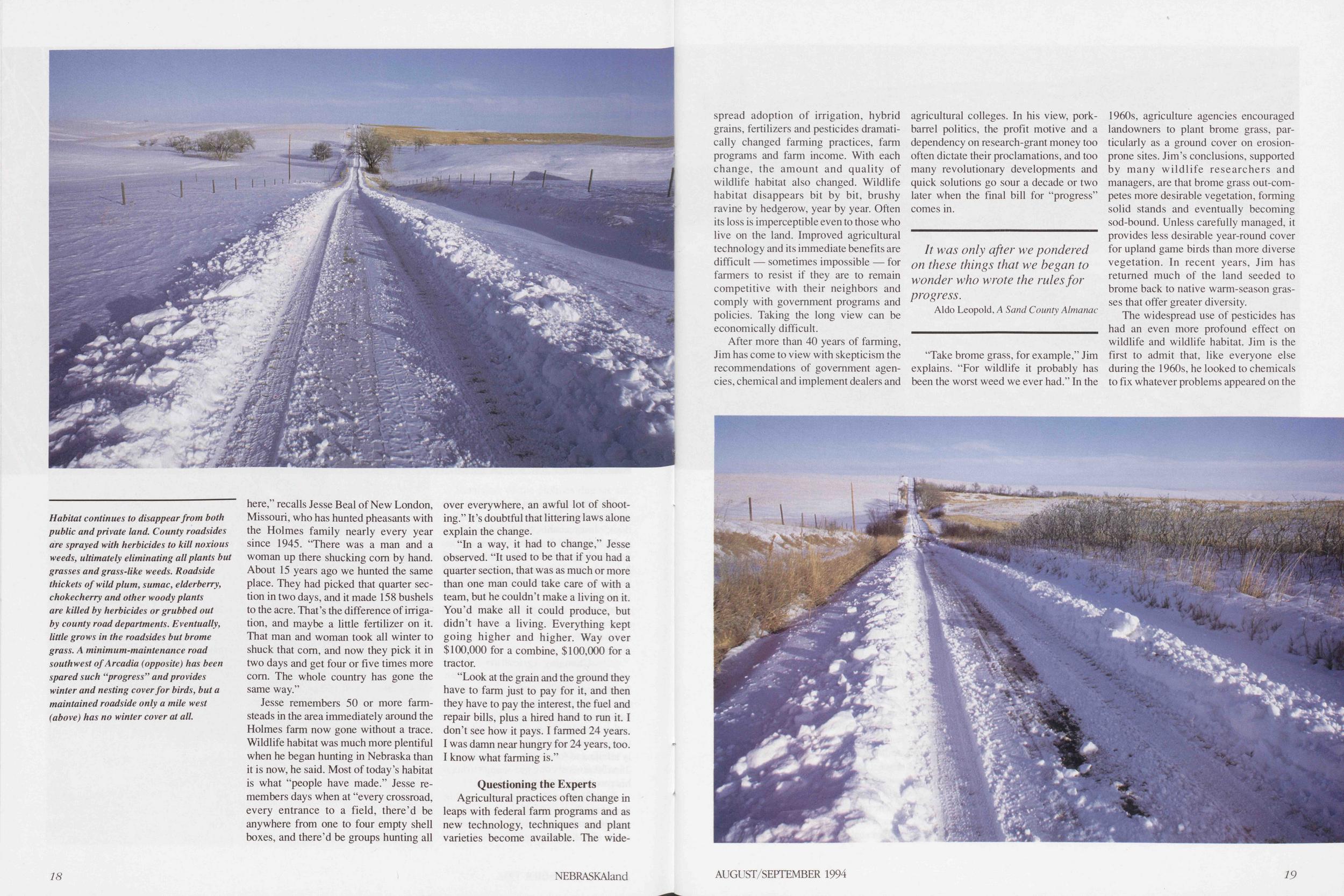
Jesse remembers 50 or more farmsteads in the area immediately around the Holmes farm now gone without a trace. Wildlife habitat was much more plentiful when he began hunting in Nebraska than it is now, he said. Most of today's habitat is what "people have made." Jesse remembers days when at "every crossroad, every entrance to a field, there'd be anywhere from one to four empty shell boxes, and there'd be groups hunting all over everywhere, an awful lot of shooting." It's doubtful that littering laws alone explain the change.
"In a way, it had to change," Jesse observed. "It used to be that if you had a quarter section, that was as much or more than one man could take care of with a team, but he couldn't make a living on it. You'd make all it could produce, but didn't have a living. Everything kept going higher and higher. Way over $100,000 for a combine, $100,000 for a tractor.
"Look at the grain and the ground they have to farm just to pay for it, and then they have to pay the interest, the fuel and repair bills, plus a hired hand to run it. I don't see how it pays. I farmed 24 years. I was damn near hungry for 24 years, too. I know what farming is."
Questioning the ExpertsAgricultural practices often change in leaps with federal farm programs and as new technology, techniques and plant varieties become available. The widespread adoption of irrigation, hybrid grains, fertilizers and pesticides dramatically changed farming practices, farm programs and farm income. With each change, the amount and quality of wildlife habitat also changed. Wildlife habitat disappears bit by bit, brushy ravine by hedgerow, year by year. Often its loss is imperceptible even to those who live on the land. Improved agricultural technology and its immediate benefits are difficult — sometimes impossible — for farmers to resist if they are to remain competitive with their neighbors and comply with government programs and policies. Taking the long view can be economically difficult.
After more than 40 years of farming, Jim has come to view with skepticism the recommendations of government agencies, chemical and implement dealers and agricultural colleges. In his view, pork-barrel politics, the profit motive and a dependency on research-grant money too often dictate their proclamations, and too many revolutionary developments and quick solutions go sour a decade or two later when the final bill for "progress" comes in.
It was only after we pondered on these things that we began to wonder who wrote the rules for progress.Aldo Leopold, A Sand County Almanac
"Take brome grass, for example," Jim explains. "For wildlife it probably has been the worst weed we ever had." In the 1960s, agriculture agencies encouraged landowners to plant brome grass, particularly as a ground cover on erosion-prone sites. Jim's conclusions, supported by many wildlife researchers and managers, are that brome grass out-competes more desirable vegetation, forming solid stands and eventually becoming sod-bound. Unless carefully managed, it provides less desirable year-round cover for upland game birds than more diverse vegetation. In recent years, Jim has returned much of the land seeded to brome back to native warm-season grasses that offer greater diversity.
The widespread use of pesticides has
had an even more profound effect on
wildlife and wildlife habitat. Jim is the
first to admit that, like everyone else
during the 1960s, he looked to chemicals
to fix whatever problems appeared on the
18
NEBRASKAland
AUGUST/SEPTEMBER 1994
19
 farm. At that time, 2,4-D, a herbicide
designed to damage or kill broadleaf
plants but not grasses, was used exten-
sively on agricultural land.
farm. At that time, 2,4-D, a herbicide
designed to damage or kill broadleaf
plants but not grasses, was used exten-
sively on agricultural land.
"We went through 60 to 90 gallons of 2,4-D for several years. Just the drift off of that killed sunflowers half a mile away. It killed the blossom on the clover, just a whiff of it, so the clover didn't seed. A bee man will tell you that. And we killed all the plum thickets and trees and brush in our rangeland, and then the road ditches. There is no doubt in my mind that the big turn-around in habitat came when 2,4-D and related herbicides came out. Ever since the Second World War, whenever we had a problem, we wanted a chemical to deal with it."
Jim used pesticides for six years, until 1969 when a rash appeared on his right hand and eventually crept up his entire arm. Doctors confirmed it was a reaction to 2,4-D and related chemicals. Antibiotic creams provided little relief, and the doc- tors said, in effect, "get used to it, you'll have a reaction the rest of your life."
I sit in happy meditation on my rock, pondering, while my line dries again, upon the ways of trout and men. How like fish we are: ready, nay eager, to seize upon whatever new thing some wind of circumstance shakes down upon the river of time! And how we rue our haste, find- ing the gilded morsel to contain a hook.Aldo Leopold, A Sand County Almanac
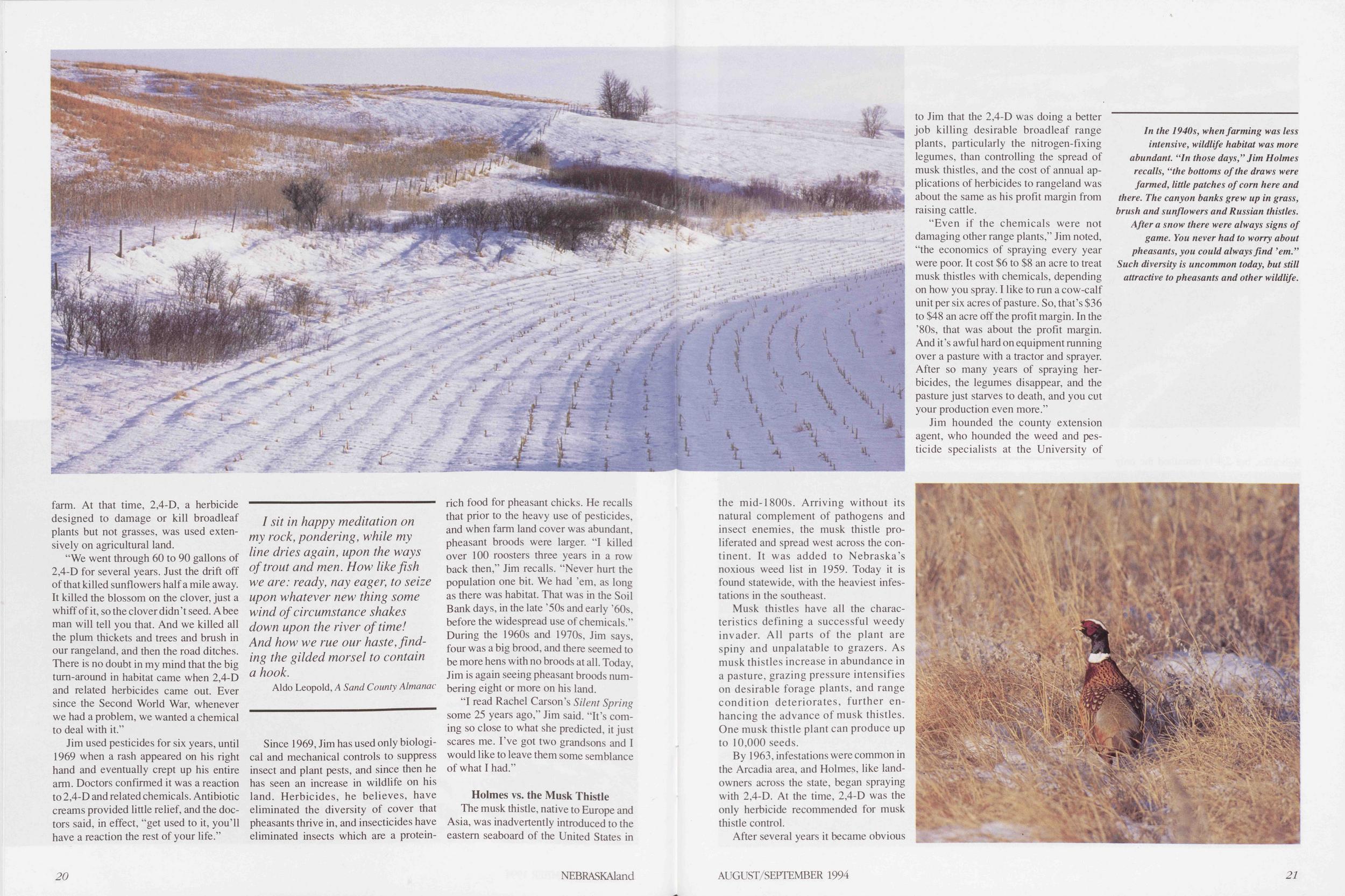
Since 1969, Jim has used only biological and mechanical controls to suppress insect and plant pests, and since then he has seen an increase in wildlife on his land. Herbicides, he believes, have eliminated the diversity of cover that pheasants thrive in, and insecticides have eliminated insects which are a protein- rich food for pheasant chicks. He recalls that prior to the heavy use of pesticides, and when farm land cover was abundant, pheasant broods were larger. "I killed over 100 roosters three years in a row back then," Jim recalls. "Never hurt the population one bit. We had 'em, as long as there was habitat. That was in the Soil Bank days, in the late '50s and early '60s, before the widespread use of chemicals." During the 1960s and 1970s, Jim says, four was a big brood, and there seemed to be more hens with no broods at all. Today, Jim is again seeing pheasant broods numbering eight or more on his land.
"I read Rachel Carson's Silent Spring some 25 years ago," Jim said. "It's coming so close to what she predicted, it just scares me. I've got two grandsons and I would like to leave them some semblance of what I had."
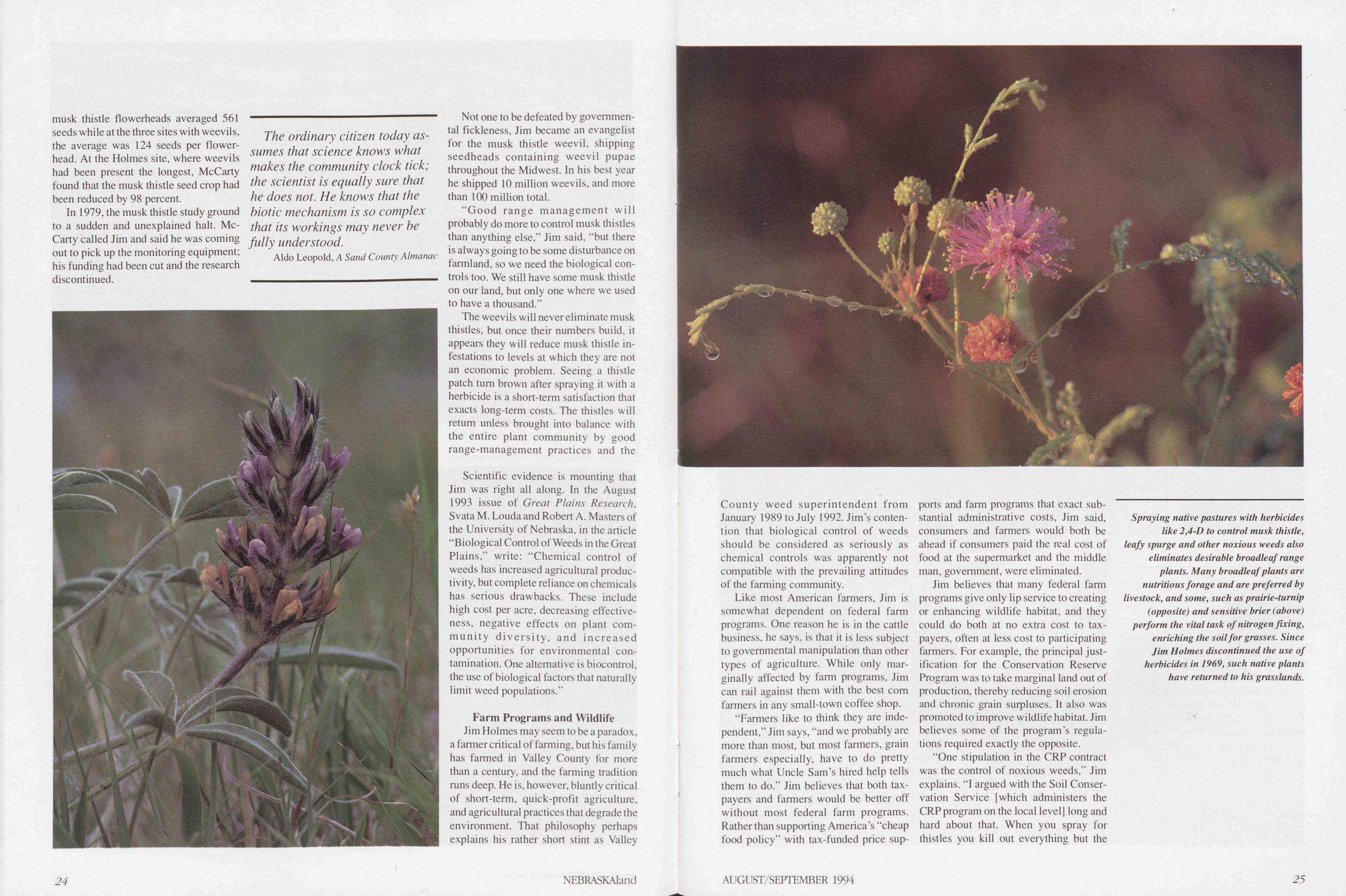
Holmes vs. the Musk ThistleThe musk thistle, native to Europe and Asia, was inadvertently introduced to the eastern seaboard of the United States in the mid-1800s. Arriving without its natural complement of pathogens and insect enemies, the musk thistle proliferated and spread west across the continent. It was added to Nebraska's noxious weed list in 1959. Today it is found statewide, with the heaviest infes- tations in the southeast.
Musk thistles have all the charac- teristics defining a successful weedy invader. All parts of the plant are spiny and unpalatable to grazers. As musk thistles increase in abundance in a pasture, grazing pressure intensifies on desirable forage plants, and range condition deteriorates, further en- hancing the advance of musk thistles. One musk thistle plant can produce up to 10,000 seeds.
By 1963, infestations were common in the Arcadia area, and Holmes, like land- owners across the state, began spraying with 2,4-D. At the time, 2,4-D was the only herbicide recommended for musk thistle control.
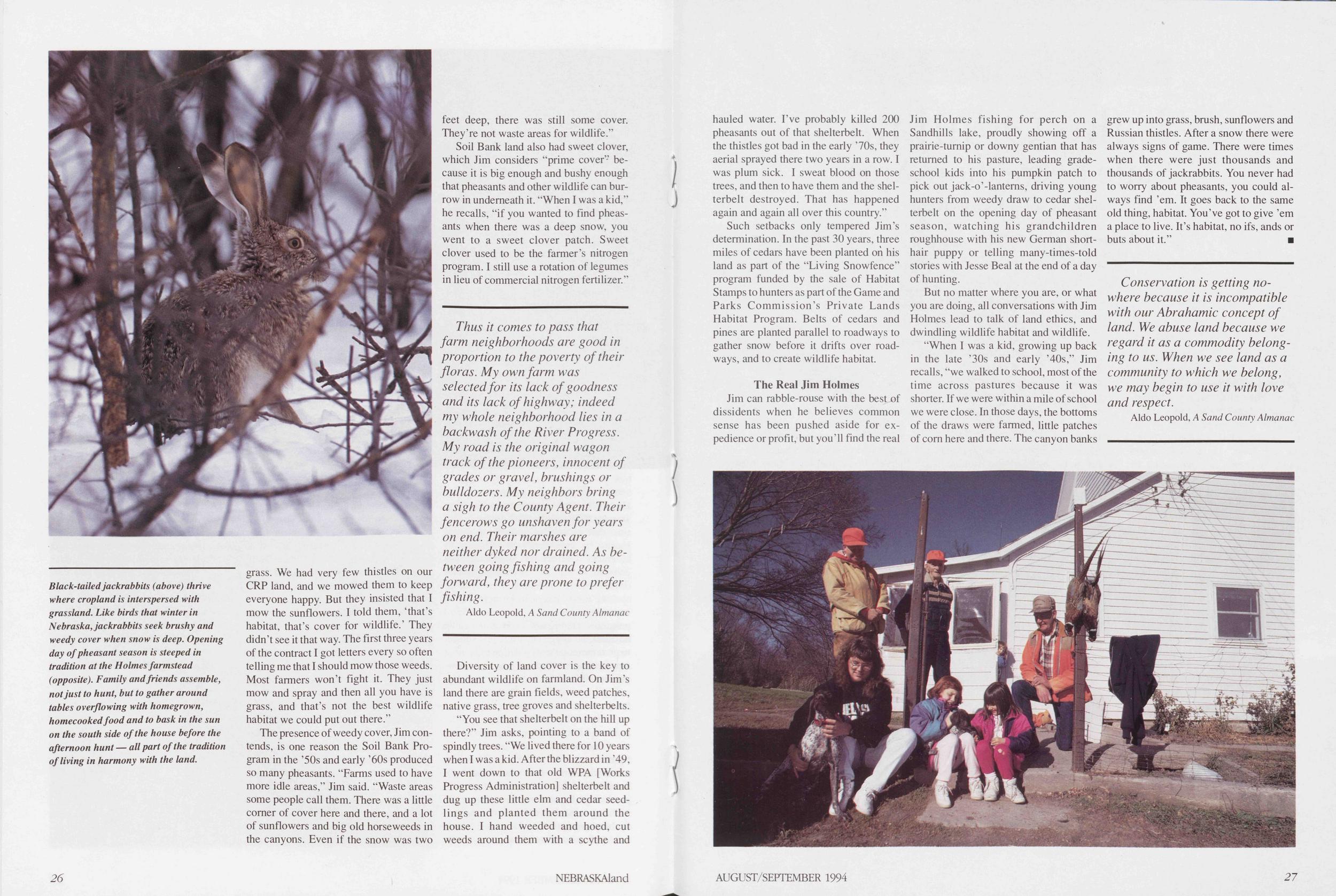
After several years it became obvious to Jim that the 2,4-D was doing a better job killing desirable broadleaf range plants, particularly the nitrogen-fixing legumes, than controlling the spread of musk thistles, and the cost of annual applications of herbicides to rangeland was about the same as his profit margin from raising cattle.
"Even if the chemicals were not damaging other range plants," Jim noted, "the economics of spraying every year were poor. It cost $6 to $8 an acre to treat musk thistles with chemicals, depending on how you spray. I like to run a cow-calf unit per six acres of pasture. So, that's $36 to $48 an acre off the profit margin. In the '80s, that was about the profit margin. And it's awful hard on equipment running over a pasture with a tractor and sprayer. After so many years of spraying herbicides, the legumes disappear, and the pasture just starves to death, and you cut your production even more."
In the 1940s, when farming was less intensive, wildlife habitat was more abundant. "In those days," Jim Holmes recalls, "the bottoms of the draws were farmed, little patches of corn here and there. The canyon banks grew up in grass, brush and sunflowers and Russian thistles. After a snow there were always signs of game. You never had to worry about pheasants, you could always find 'em." Such diversity is uncommon today, but still attractive to pheasants and other wildlife.
 Nebraska, but 2,4-D remained the only
herbicide recommended to control musk
thistle.
Nebraska, but 2,4-D remained the only
herbicide recommended to control musk
thistle.In 1971 and 1972, the university established test plots on Holmes' land to develop recommendations for 2,4-D applications on musk thistles. They confirmed what Jim had suspected: Applied at the rate recommended for southeastern Nebraska, 2,4-D was damaging or even eliminating desirable range plants from pastures in the Arcadia area.
"People underestimate the role legumes play in enriching rangeland," Jim said. "When I first started using commercial fertilizer, 30 years ago, my neighbor and I had some dry fertilizer left over, nitrogen and some phosphorous and potash. We applied it to some native grass to see what it would do. Six months later you still couldn't see where we put that fertilizer, it didn't do our grass one bit of good. That told me our native pastures were balanced on their own. Today, because applications of herbicides have eliminated most of the native legumes, probably 90 percent of the native grass pastures would show improvement with that same application of fertilizer."
A worried farmer, his fertilizer hill projecting from his shirt pocket, looks blankly at the lupines, lespedezas, or Baptisms that originally pumped nitrogen out of the prairie air and into his black loamy acres. He does not distinguish them from the parvenu quack-grass in which they grow. Were I to ask him why his corn makes a hundred bushels, while that of non- prairie states does well to make thirty he would probably answer that Illinois soil is better. Were I to ask him the name of that white spike of pea-like flowers hugging the fence, he would shake his head. A weed, likely.Aldo Leopold, A Sand County Almanac
In 1972, Dr. M.K. McCarty, a U.S. Department of Agriculture researcher working at the University of Nebraska, obtained weevils native to Europe that are a natural enemy of musk thistle. The weevils, Rhinocyllus conicus, were released at several sites in Nebraska including a musk thistle patch on Jim's neighbor's land. It appeared that the weevils failed to establish at all the release sites. Some had apparently been killed by insecticides and others dispersed or just failed to adapt and died.
The idea of using natural enemies to control musk thistles caught Jim's fancy. He returned several times to his neighbor's field and eventually found weevils in two flowerheads. "We started cutting whole plants," Jim recounts. "Loaded up a pickup. I can still remember my neighbor saying, T sure hope nobody sees what we're doing out here because they're going to call for the guys in the white jackets.' We unloaded half of them on my home pasture and half on my rental pasture, and they both took.
"By 1974," Jim continued, "the release I'd made on the home pasture had just exploded." The success of the weevil on Jim's land made the local paper, and within two days McCarty was on the phone. From 1974 until 1979, McCarty and his colleagues monitored the weevil's success at four sites in the Arcadia area — the site where Jim introduced weevils in 1972, a nearby site the weevils had colonized, a site where weevils were released in 1975 and a control site near Scotia where there were no weevils.
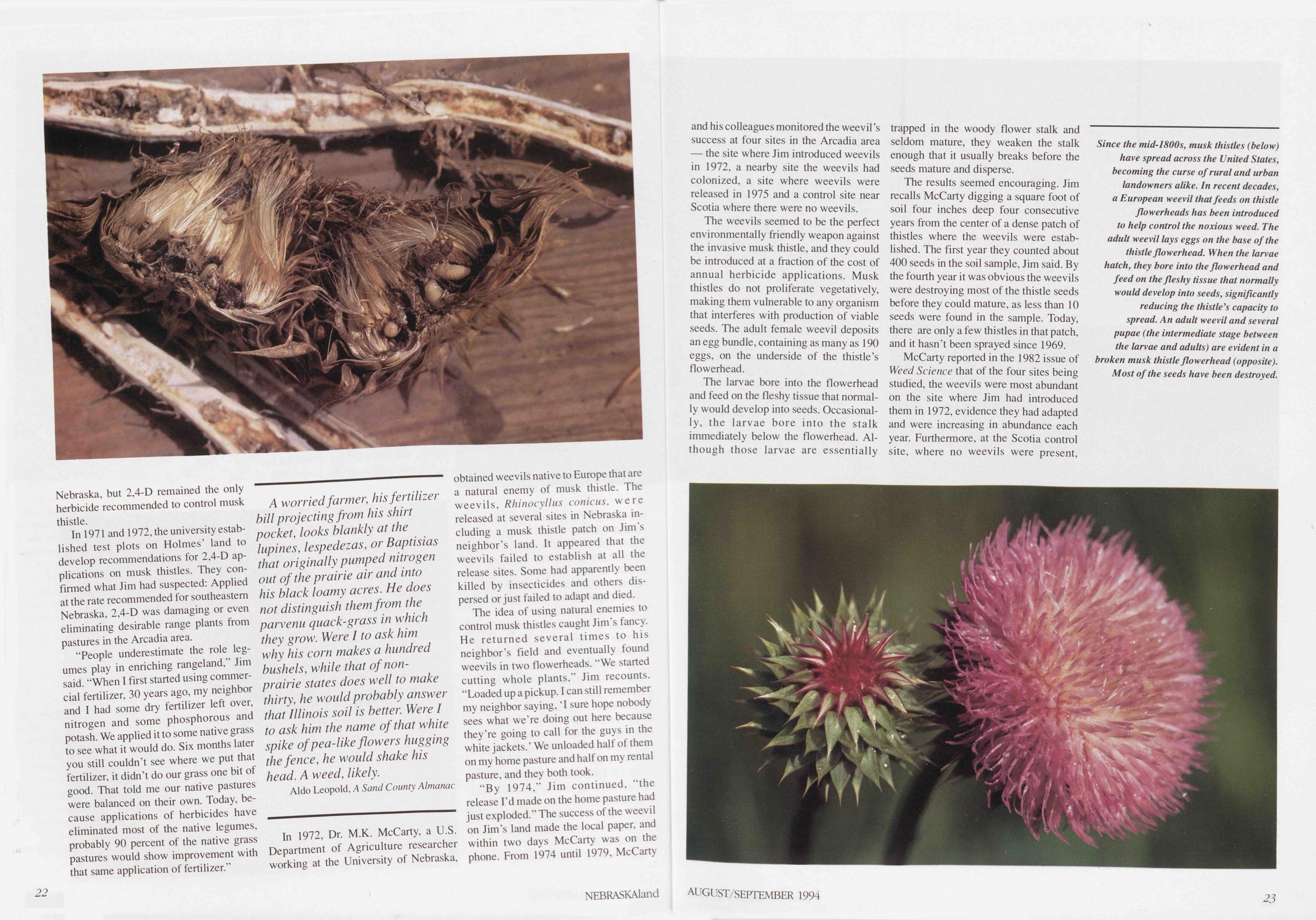
The weevils seemed to be the perfect environmentally friendly weapon against the invasive musk thistle, and they could be introduced at a fraction of the cost of annual herbicide applications. Musk thistles do not proliferate vegetatively, making them vulnerable to any organism that interferes with production of viable seeds. The adult female weevil deposits an egg bundle, containing as many as 190 eggs, on the underside of the thistle's flowerhead.
The larvae bore into the flowerhead and feed on the fleshy tissue that normally would develop into seeds. Occasionally, the larvae bore into the stalk immediately below the flowerhead. Although those larvae are essentially trapped in the woody flower stalk and seldom mature, they weaken the stalk enough that it usually breaks before the seeds mature and disperse.
The results seemed encouraging. Jim recalls McCarty digging a square foot of soil four inches deep four consecutive years from the center of a dense patch of thistles where the weevils were established. The first year they counted about 400 seeds in the soil sample, Jim said. By the fourth year it was obvious the weevils were destroying most of the thistle seeds before they could mature, as less than 10 seeds were found in the sample. Today, there are only a few thistles in that patch, and it hasn't been sprayed since 1969.
McCarty reported in the 1982 issue of Weed Science that of the four sites being studied, the weevils were most abundant on the site where Jim had introduced them in 1972, evidence they had adapted and were increasing in abundance each year. Furthermore, at the Scotia control site, where no weevils were present,
musk thistle flowerheads averaged 561 seeds while at the three sites with weevils, the average was 124 seeds per flower- head. At the Holmes site, where weevils had been present the longest, McCarty found that the musk thistle seed crop had been reduced by 98 percent. In 1979, the musk thistle study ground to a sudden and unexplained halt. Mc- Carty called Jim and said he was coming out to pick up the monitoring equipment; his funding had been cut and the research discontinued.
The ordinary citizen today as- sumes that science knows what makes the community clock tick; the scientist is equally sure that he does not. He knows that the hiotic mechanism is so complex that its workings may never he fully understood.Aldo Leopold, A Sand County Almanac
Not one to be defeated by governmental fickleness, Jim became an evangelist for the musk thistle weevil, shipping seedheads containing weevil pupae throughout the Midwest. In his best year he shipped 10 million weevils, and more than 100 million total.
"Good range management will probably do more to control musk thistles than anything else," Jim said, "but there is always going to be some disturbance on farmland, so we need the biological controls too. We still have some musk thistle on our land, but only one where we used to have a thousand."
The weevils will never eliminate musk thistles, but once their numbers build, it appears they will reduce musk thistle infestations to levels at which they are not an economic problem. Seeing a thistle patch turn brown after spraying it with a herbicide is a short-term satisfaction that exacts long-term costs. The thistles will return unless brought into balance with the entire plant community by good range-management practices and the Scientific evidence is mounting that Jim was right all along. In the August 1993 issue of Great Plains Research, Svata M. Louda and Robert A. Masters of the University of Nebraska, in the article "Biological Control of Weeds in the Great Plains," write: "Chemical control of weeds has increased agricultural productivity, but complete reliance on chemicals has serious drawbacks. These include high cost per acre, decreasing effectiveness, negative effects on plant community diversity, and increased opportunities for environmental contamination. One alternative is biocontrol, the use of biological factors that naturally limit weed populations."
Farm Programs and WildlifeJim Holmes may seem to be a paradox, a farmer critical of farming, but his family has farmed in Valley County for more than a century, and the farming tradition runs deep. He is, however, bluntly critical of short-term, quick-profit agriculture, and agricultural practices that degrade the environment. That philosophy perhaps explains his rather short stint as Valley 24NEBRASKAland County weed superintendent from January 1989 to July 1992. Jim's contention that biological control of weeds should be considered as seriously as chemical controls was apparently not compatible with the prevailing attitudes of the farming community.
Like most American farmers, Jim is somewhat dependent on federal farm programs. One reason he is in the cattle business, he says, is that it is less subject to governmental manipulation than other types of agriculture. While only marginally affected by farm programs, Jim can rail against them with the best com farmers in any small-town coffee shop. "Farmers like to think they are independent," Jim says, "and we probably are more than most, but most farmers, grain farmers especially, have to do pretty much what Uncle Sam's hired help tells them to do." Jim believes that both taxpayers and farmers would be better off without most federal farm programs.
Rather than supporting America's "cheap food policy" with tax-funded price sup-ports and farm programs that exact substantial administrative costs, Jim said, consumers and farmers would both be ahead if consumers paid the real cost of food at the supermarket and the middle man, government, were eliminated.
Jim believes that many federal farm programs give only lip service to creating or enhancing wildlife habitat, and they could do both at no extra cost to taxpayers, often at less cost to participating farmers. For example, the principal justification for the Conservation Reserve Program was to take marginal land out of production, thereby reducing soil erosion and chronic grain surpluses. It also was promoted to improve wildlife habitat. Jim believes some of the program's regulations required exactly the opposite.
"One stipulation in the CRP contract was the control of noxious weeds," Jim explains. "I argued with the Soil Conservation Service [which administers the CRP program on the local level] long and hard about that. When you spray for thistles you kill out everything but the
grass. We had very few thistles on our CRP land, and we mowed them to keep everyone happy. But they insisted that I mow the sunflowers. I told them, 'that's habitat, that's cover for wildlife.' They didn't see it that way. The first three years of the contract I got letters every so often telling me that I should mow those weeds. Most farmers won't fight it. They just mow and spray and then all you have is grass, and that's not the best wildlife habitat we could put out there."
The presence of weedy cover, Jim contends, is one reason the Soil Bank Program in the '50s and early '60s produced so many pheasants. "Farms used to have more idle areas," Jim said. "Waste areas some people call them. There was a little corner of cover here and there, and a lot of sunflowers and big old horseweeds in the canyons. Even if the snow was two feet deep, there was still some cover. They're not waste areas for wildlife." Soil Bank land also had sweet clover, which Jim considers "prime cover'" because it is big enough and bushy enough that pheasants and other wildlife can burrow in underneath it. "When I was a kid," he recalls, "if you wanted to find pheasants when there was a deep snow, you went to a sweet clover patch. Sweet clover used to be the farmer's nitrogen program. I still use a rotation of legumes in lieu of commercial nitrogen fertilizer."
Thus it comes to pass that farm neighborhoods are good in proportion to the poverty of their floras. My own farm was selected for its lack of goodness and its lack of highway; indeed my whole neighborhood lies in a backwash of the River Progress. My road is the original wagon track of the pioneers, innocent of grades or gravel, brushings or bulldozers. My neighbors bring a sigh to the County Agent. Their fencerows go unshaven for years on end. Their marshes are neither dyked nor drained. As between going fishing and going forward, they are prone to prefer fishing.Aldo Leopold, A Sand County Almanac
Diversity of land cover is the key to abundant wildlife on farmland. On Jim's land there are grain fields, weed patches, native grass, tree groves and shelterbelts. "You see that shelterbelt on the hill up there?" Jim asks, pointing to a band of spindly trees. "We lived there for 10 years when I was a kid. After the blizzard in '49, I went down to that old WPA [Works Progress Administration] shelterbelt and dug up these little elm and cedar seed- lings and planted them around the house. I hand weeded and hoed, cut weeds around them with a scythe and 26 NEBRASKAland hauled water. I've probably killed 200 pheasants out of that shelterbelt. When the thistles got bad in the early '70s, they aerial sprayed there two years in a row. I was plum sick. I sweat blood on those trees, and then to have them and the shelterbelt destroyed. That has happened again and again all over this country."
Such setbacks only tempered Jim's determination. In the past 30 years, three miles of cedars have been planted on his land as part of the "Living Snowfence" program funded by the sale of Habitat Stamps to hunters as part of the Game and Parks Commission's Private Lands Habitat Program. Belts of cedars and pines are planted parallel to roadways to gather snow before it drifts over roadways, and to create wildlife habitat.
The Real Jim HolmesJim can rabble-rouse with the best of dissidents when he believes common sense has been pushed aside for expedience or profit, but you'll find the real Jim Holmes fishing for perch on a Sandhills lake, proudly showing off a prairie-turnip or downy gentian that has returned to his pasture, leading grade- school kids into his pumpkin patch to pick out jack-o'-lanterns, driving young hunters from weedy draw to cedar shelterbelt on the opening day of pheasant season, watching his grandchildren roughhouse with his new German short-hair puppy or telling many-times-told stories with Jesse Beal at the end of a day of hunting.
But no matter where you are, or what you are doing, all conversations with Jim Holmes lead to talk of land ethics, and dwindling wildlife habitat and wildlife.
'When I was a kid, growing up back in the late '30s and early '40s," Jim recalls, "we walked to school, most of the time across pastures because it was shorter. If we were within a mile of school we were close. In those days, the bottoms of the draws were farmed, little patches of corn here and there. The canyon banks grew up into grass, brush, sunflowers and Russian thistles. After a snow there were always signs of game. There were times when there were just thousands and thousands of jackrabbits. You never had to worry about pheasants, you could always find 'em. It goes back to the same old thing, habitat. You've got to give 'em a place to live. It's habitat, no ifs, ands or buts about it."
Conservation is getting nowhere because it is incompatible with our Abrahamic concept of land. We abuse land because we regard it as a commodity belonging to us. When we see land as a community to which we belong, we may begin to use it with love and respect.Aldo Leopold, A Sand County Almanac AUGUST/SEPTEMBER 1994 27
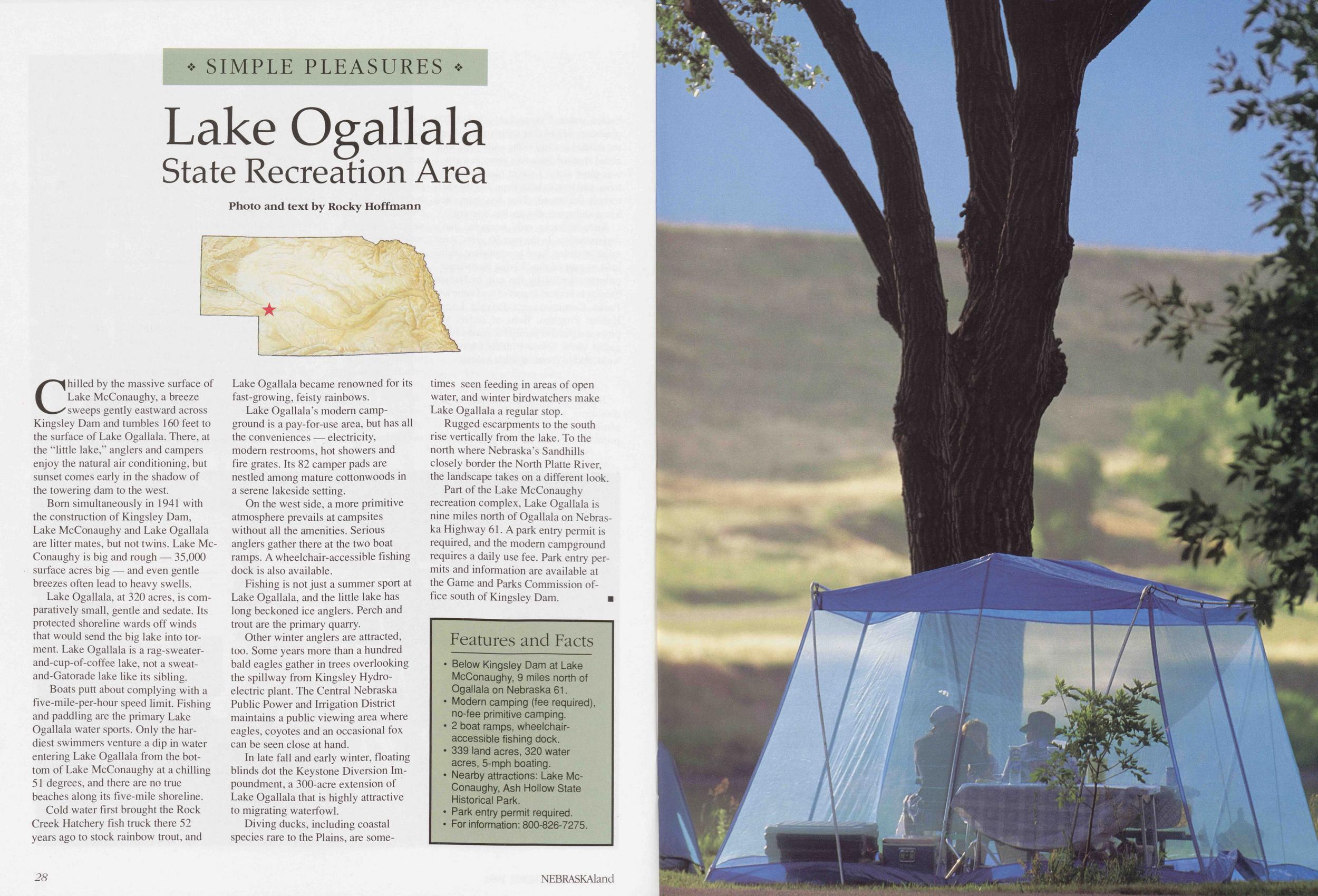
Lake Ogallala State Recreation Area
Chilled by the massive surface of Lake McConaughy, a breeze sweeps gently eastward across Kingsley Dam and tumbles 160 feet to the surface of Lake Ogallala. There, at the "little lake," anglers and campers enjoy the natural air conditioning, but sunset comes early in the shadow of the towering dam to the west.
Born simultaneously in 1941 with the construction of Kingsley Dam, Lake McConaughy and Lake Ogallala are litter mates, but not twins. Lake McConaughy is big and rough — 35,000 surface acres big — and even gentle breezes often lead to heavy swells.
Lake Ogallala, at 320 acres, is comparatively small, gentle and sedate. Its protected shoreline wards off winds that would send the big lake into torment. Lake Ogallala is a rag-sweater- and-cup-of-coffee lake, not a sweat- and-Gatorade lake like its sibling.
Boats putt about complying with a five-mile-per-hour speed limit. Fishing and paddling are the primary Lake Ogallala water sports. Only the hardiest swimmers venture a dip in water entering Lake Ogallala from the bottom of Lake McConaughy at a chilling 51 degrees, and there are no true beaches along its five-mile shoreline.
Cold water first brought the Rock Creek Hatchery fish truck there 52 years ago to stock rainbow trout, and Lake Ogallala became renowned for its fast-growing, feisty rainbows.
Lake Ogallala's modem camp- ground is a pay-for-use area, but has all the conveniences — electricity, modem restrooms, hot showers and fire grates. Its 82 camper pads are nestled among mature cottonwoods in a serene lakeside setting.
On the west side, a more primitive atmosphere prevails at campsites without all the amenities. Serious anglers gather there at the two boat ramps. A wheelchair-accessible fishing dock is also available.
Fishing is not just a summer sport at Lake Ogallala, and the little lake has long beckoned ice anglers. Perch and trout are the primary quarry.
Other winter anglers are attracted, too. Some years more than a hundred bald eagles gather in trees overlooking the spillway from Kingsley Hydro-electric plant. The Central Nebraska Public Power and Irrigation District maintains a public viewing area where eagles, coyotes and an occasional fox can be seen close at hand.
In late fall and early winter, floating blinds dot the Keystone Diversion Impoundment, a 300-acre extension of Lake Ogallala that is highly attractive to migrating waterfowl.
Diving ducks, including coastal species rare to the Plains, are sometimes seen feeding in areas of open water, and winter birdwatchers make Lake Ogallala a regular stop.
Rugged escarpments to the south rise vertically from the lake. To the north where Nebraska's Sandhills closely border the North Platte River, the landscape takes on a different look.
Part of the Lake McConaughy recreation complex, Lake Ogallala is nine miles north of Ogallala on Nebraska Highway 61. A park entry permit is required, and the modern campground requires a daily use fee. Park entry permits and information are available at the Game and Parks Commission office south of Kingsley Dam.
Features and Facts Below Kingsley Dam at Lake McConaughy, 9 miles north of Ogallala on Nebraska 61. Modern camping (fee required), no-fee primitive camping. 2 boat ramps, wheelchair- accessible fishing dock. 339 land acres, 320 water acres, 5-mph boating. Nearby attractions: Lake McConaughy, Ash Hollow State Historical Park. Park entry permit required. For information: 800-826-7275. 28 NEBRASKAland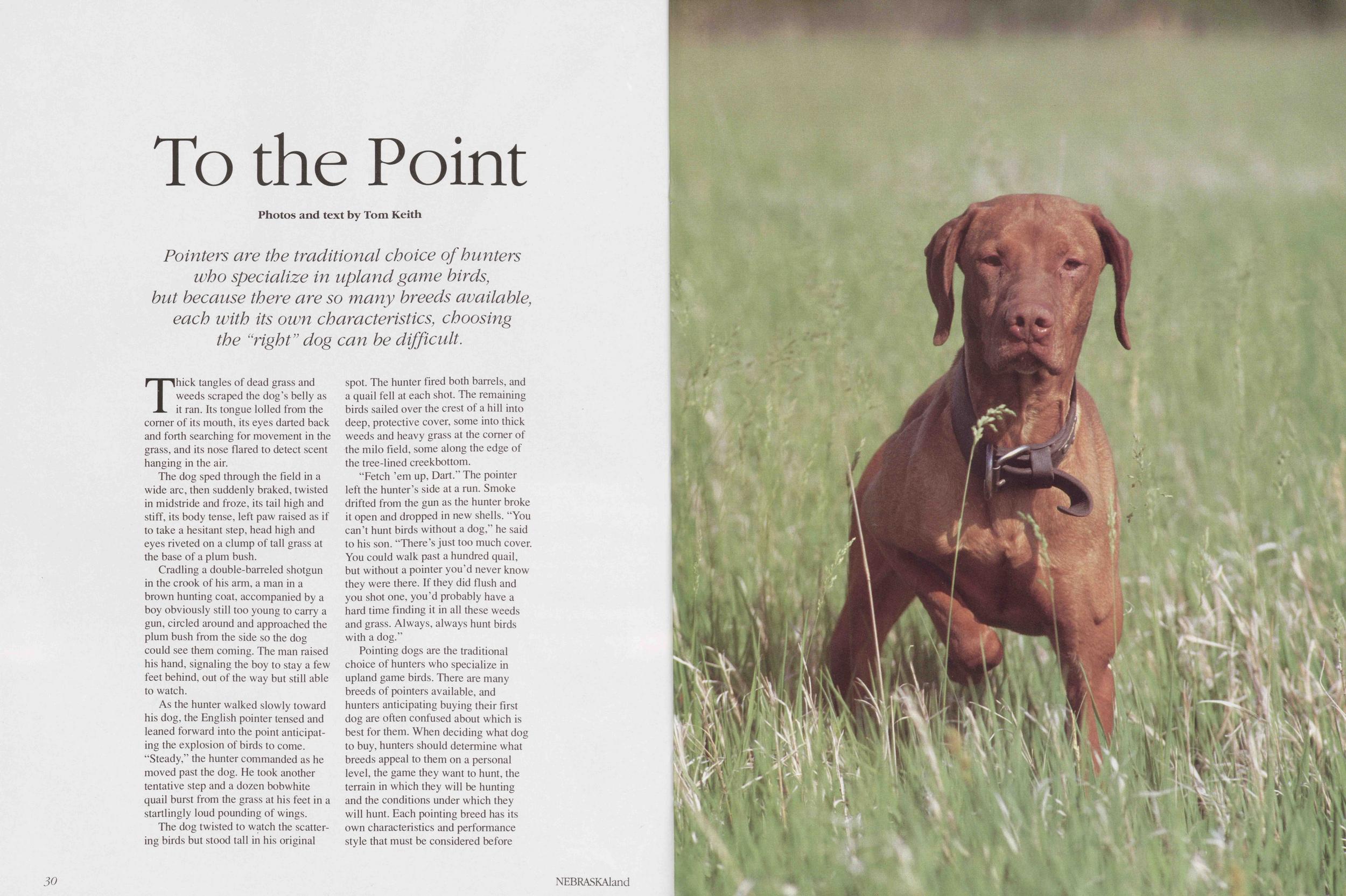
To the Point
Pointers are the traditional choice of hunters who specialize in upland game birds, but because there are so many breeds available, each with its own characteristics, choosing the "right" dog can be difficult.Thick tangles of dead grass and weeds scraped the dog's belly as it ran. Its tongue lolled from the corner of its mouth, its eyes darted back and forth searching for movement in the grass, and its nose flared to detect scent hanging in the air.
The dog sped through the field in a wide arc, then suddenly braked, twisted in midstride and froze, its tail high and stiff, its body tense, left paw raised as if to take a hesitant step, head high and eyes riveted on a clump of tall grass at the base of a plum bush.
Cradling a double-barreled shotgun in the crook of his arm, a man in a brown hunting coat, accompanied by a boy obviously still too young to carry a gun, circled around and approached the plum bush from the side so the dog could see them coming. The man raised his hand, signaling the boy to stay a few feet behind, out of the way but still able to watch.
As the hunter walked slowly toward his dog, the English pointer tensed and leaned forward into the point anticipating the explosion of birds to come. "Steady," the hunter commanded as he moved past the dog. He took another tentative step and a dozen bobwhite quail burst from the grass at his feet in a startlingly loud pounding of wings.
The dog twisted to watch the scattering birds but stood tall in his original spot. The hunter fired both barrels, and a quail fell at each shot. The remaining birds sailed over the crest of a hill into deep, protective cover, some into thick weeds and heavy grass at the corner of the milo field, some along the edge of the tree-lined creekbottom.
"Fetch 'em up, Dart." The pointer left the hunter's side at a run. Smoke drifted from the gun as the hunter broke it open and dropped in new shells. "You can't hunt birds without a dog," he said to his son. "There's just too much cover. You could walk past a hundred quail, but without a pointer you'd never know they were there. If they did flush and you shot one, you'd probably have a hard time finding it in all these weeds and grass. Always, always hunt birds with a dog."
Pointing dogs are the traditional choice of hunters who specialize in upland game birds. There are many breeds of pointers available, and hunters anticipating buying their first dog are often confused about which is best for them. When deciding what dog to buy, hunters should determine what breeds appeal to them on a personal level, the game they want to hunt, the terrain in which they will be hunting and the conditions under which they will hunt. Each pointing breed has its own characteristics and performance style that must be considered before 30 NEBRASKAland
 making a decision, and a thumbnail
sketch of some of the most common
pointing breeds might help.
Vizsla
making a decision, and a thumbnail
sketch of some of the most common
pointing breeds might help.
Vizsla
The Vizsla is a sleek, short-haired, rusty-gold pointer that is excellent for Midwestern hunting. It has a good nose and is capable of picking up the light traces of scent from scattered grouse, woodcocks, pheasants and quail. The Vizsla has a short, clean coat, stands 23 to 24 inches tall and weighs 45 to 55 pounds. It is eager to please, sensitive and responsive, intelligent, stylish and requires no heavy-handed discipline. The friendly Vizsla is a good family dog.
Much of the Vizsla's appeal is in its sleek, distinctive appearance. While it is capable of covering ground rapidly, it is not a wide-ranger. It adjusts its pace well and ranges according to cover conditions. It is a good selection for the Midwestern quail hunter. The Vizsla commonly matures slowly and often does not reach its full potential until its second or third hunting season.
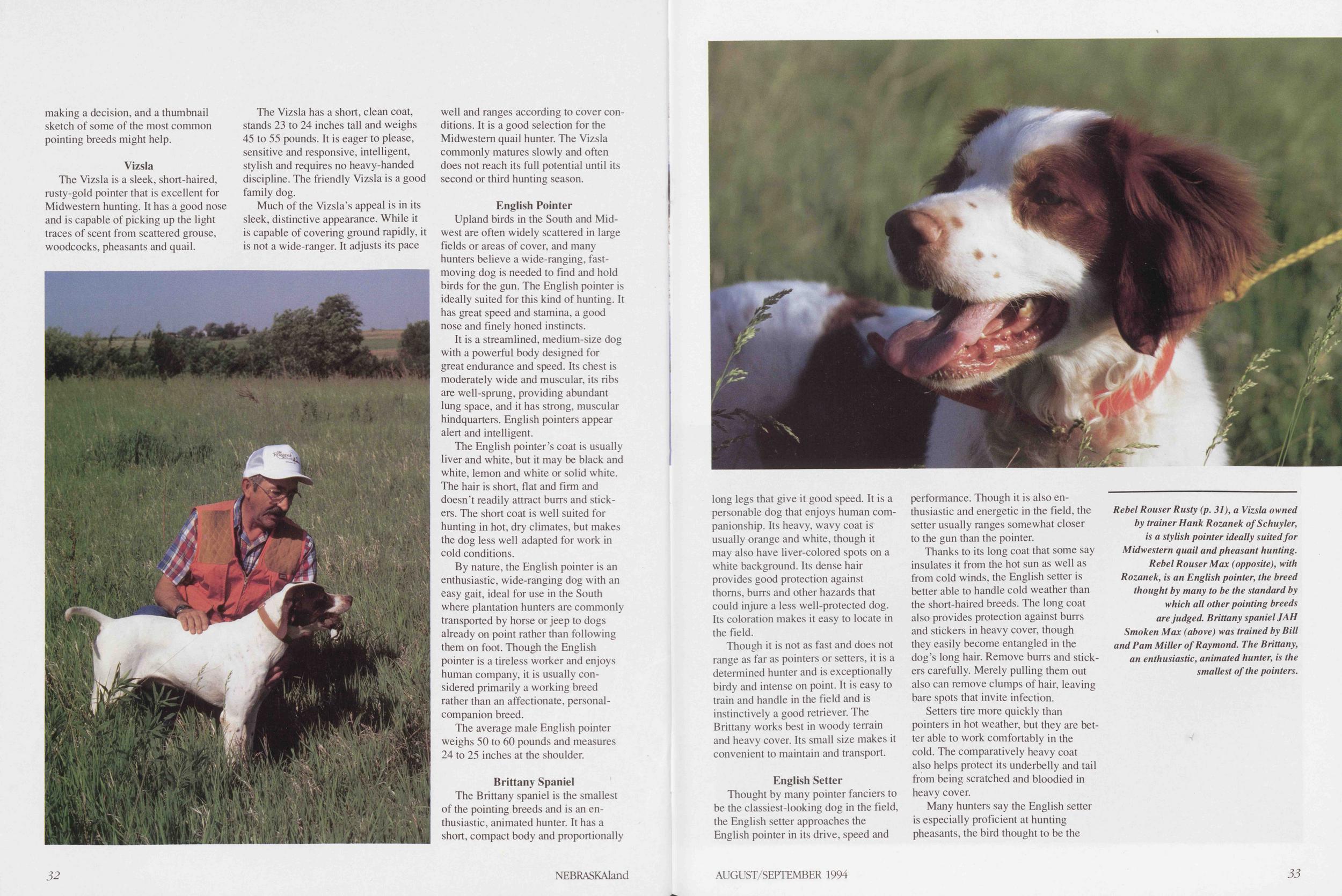
English PointerUpland birds in the South and Midwest are often widely scattered in large fields or areas of cover, and many hunters believe a wide-ranging, fast-moving dog is needed to find and hold birds for the gun. The English pointer is ideally suited for this kind of hunting. It has great speed and stamina, a good nose and finely honed instincts.
It is a streamlined, medium-size dog with a powerful body designed for great endurance and speed. Its chest is moderately wide and muscular, its ribs are well-sprung, providing abundant lung space, and it has strong, muscular hindquarters. English pointers appear alert and intelligent.
The English pointer's coat is usually liver and white, but it may be black and white, lemon and white or solid white. The hair is short, flat and firm and doesn't readily attract burrs and stickers. The short coat is well suited for hunting in hot, dry climates, but makes the dog less well adapted for work in cold conditions.
By nature, the English pointer is an enthusiastic, wide-ranging dog with an easy gait, ideal for use in the South where plantation hunters are commonly transported by horse or jeep to dogs already on point rather than following them on foot. Though the English pointer is a tireless worker and enjoys human company, it is usually considered primarily a working breed rather than an affectionate, personal-companion breed.
The average male English pointer weighs 50 to 60 pounds and measures 24 to 25 inches at the shoulder.
Brittany SpanielThe Brittany spaniel is the smallest of the pointing breeds and is an enthusiastic, animated hunter. It has a short, compact body and proportionally
Though it is not as fast and does not range as far as pointers or setters, it is a determined hunter and is exceptionally birdy and intense on point. It is easy to train and handle in the field and is instinctively a good retriever. The Brittany works best in woody terrain and heavy cover. Its small size makes it convenient to maintain and transport.
English SetterThought by many pointer fanciers to be the classiest-looking dog in the field, the English setter approaches the English pointer in its drive, speed and performance. Though it is also enthusiastic and energetic in the field, the setter usually ranges somewhat closer to the gun than the pointer.
Thanks to its long coat that some say insulates it from the hot sun as well as from cold winds, the English setter is better able to handle cold weather than the short-haired breeds. The long coat also provides protection against burrs and stickers in heavy cover, though they easily become entangled in the dog's long hair. Remove burrs and stickers carefully. Merely pulling them out also can remove clumps of hair, leaving bare spots that invite infection. Setters tire more quickly than pointers in hot weather, but they are better able to work comfortably in the cold. The comparatively heavy coat also helps protect its underbelly and tail from being scratched and bloodied in heavy cover.
Many hunters say the English setter is especially proficient at hunting pheasants, the bird thought to be the
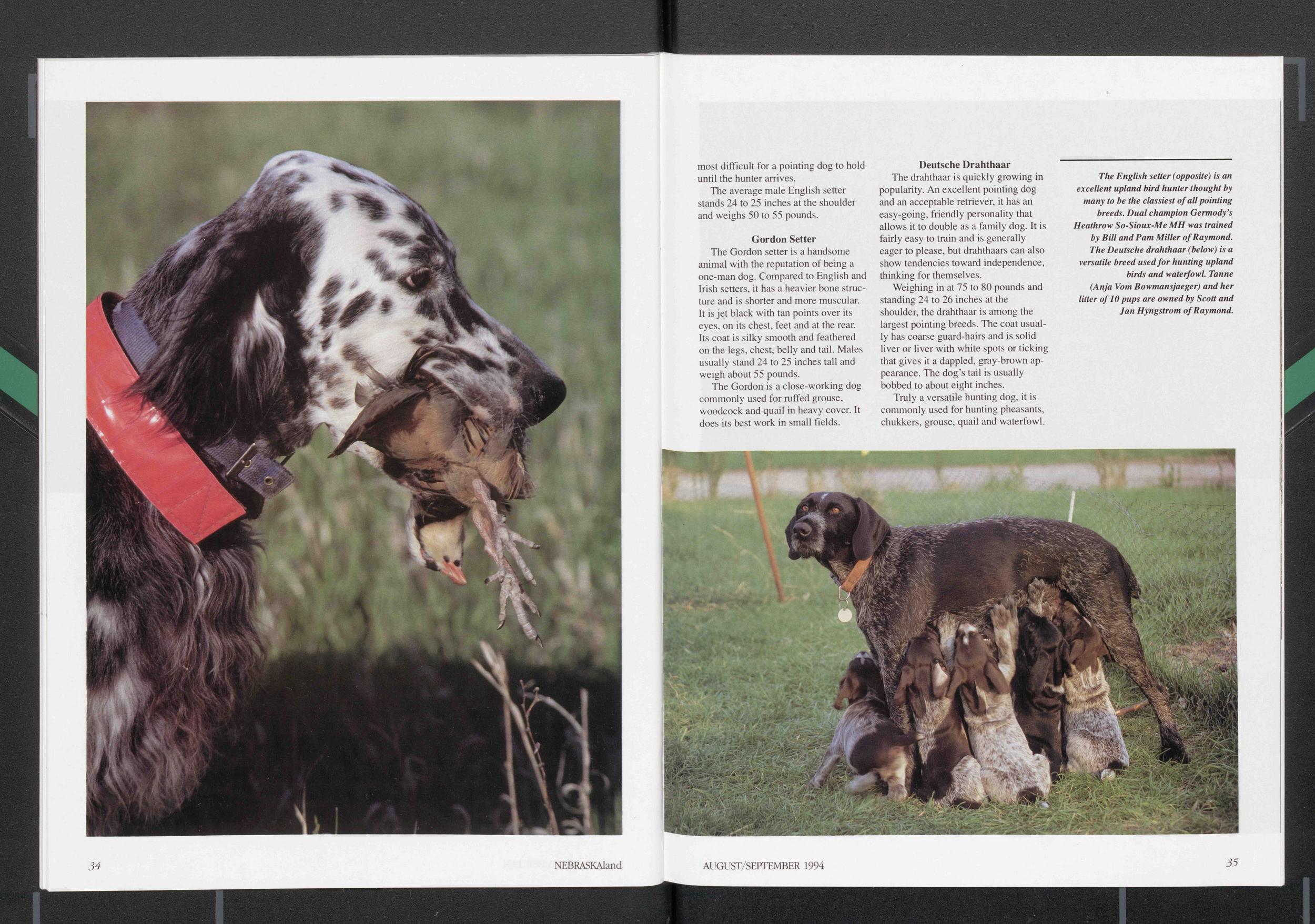
Rebel Rouser Rusty (p. 31), a Vizsla owned by trainer Hank Rozanek of Schuyler, is a stylish pointer ideally suited for Midwestern quail and pheasant hunting. Rebel Rouser Max (opposite), with Rozanek, is an English pointer, the breed thought by many to be the standard by which all other pointing breeds are judged. Brittany spaniel J AH Smoken Max (above) was trained by Bill and Pam Miller of Raymond. The Brittany, an enthusiastic, animated hunter, is the smallest of the pointers.
most difficult for a pointing dog to hold until the hunter arrives.
The average male English setter stands 24 to 25 inches at the shoulder and weighs 50 to 55 pounds.
Gordon SetterThe Gordon setter is a handsome animal with the reputation of being a one-man dog. Compared to English and Irish setters, it has a heavier bone structure and is shorter and more muscular. It is jet black with tan points over its eyes, on its chest, feet and at the rear. Its coat is silky smooth and feathered on the legs, chest, belly and tail. Males usually stand 24 to 25 inches tall and weigh about 55 pounds.
The Gordon is a close-working dog commonly used for ruffed grouse, woodcock and quail in heavy cover. It does its best work in small fields.
Deutsche DrahthaarThe drahthaar is quickly growing in popularity. An excellent pointing dog and an acceptable retriever, it has an easy-going, friendly personality that allows it to double as a family dog. It is fairly easy to train and is generally eager to please, but drahthaars can also show tendencies toward independence, thinking for themselves.
Weighing in at 75 to 80 pounds and standing 24 to 26 inches at the shoulder, the drahthaar is among the largest pointing breeds. The coat usually has coarse guard-hairs and is solid liver or liver with white spots or ticking that gives it a dappled, gray-brown appearance. The dog's tail is usually bobbed to about eight inches.
Truly a versatile hunting dog, it is commonly used for hunting pheasants, chukkers, grouse, quail and waterfowl.
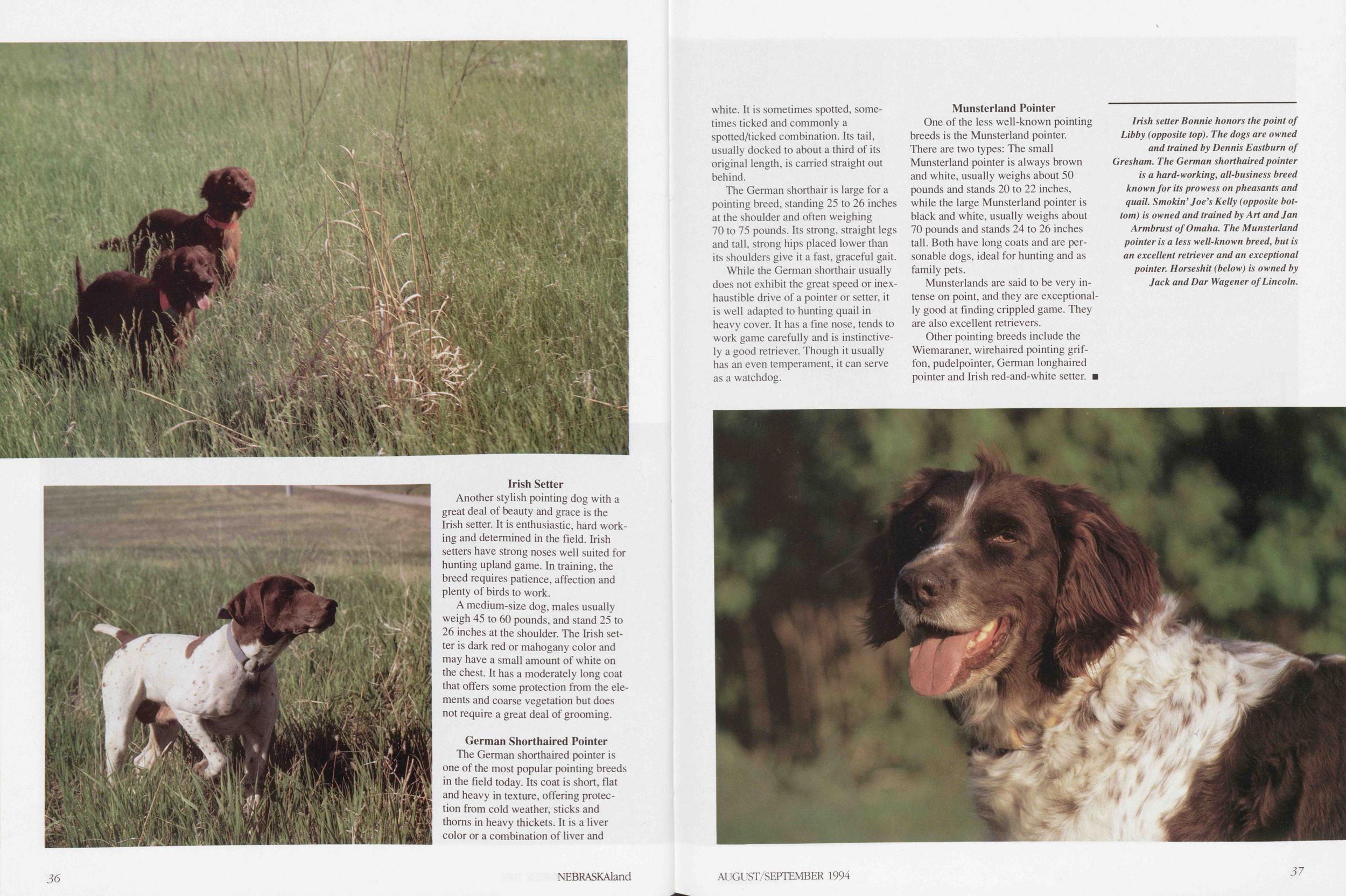
Another stylish pointing dog with a great deal of beauty and grace is the Irish setter. It is enthusiastic, hard working and determined in the field. Irish setters have strong noses well suited for hunting upland game. In training, the breed requires patience, affection and plenty of birds to work.
A medium-size dog, males usually weigh 45 to 60 pounds, and stand 25 to 26 inches at the shoulder. The Irish setter is dark red or mahogany color and may have a small amount of white on the chest. It has a moderately long coat that offers some protection from the elements and coarse vegetation but does not require a great deal of grooming.
German Shorthaired PointerThe German shorthaired pointer is one of the most popular pointing breeds in the field today. Its coat is short, flat and heavy in texture, offering protection from cold weather, sticks and thorns in heavy thickets. It is a liver color or a combination of liver and white. It is sometimes spotted, sometimes ticked and commonly a spotted/ticked combination. Its tail, usually docked to about a third of its original length, is carried straight out behind.
The German shorthair is large for a pointing breed, standing 25 to 26 inches at the shoulder and often weighing 70 to 75 pounds. Its strong, straight legs and tall, strong hips placed lower than its shoulders give it a fast, graceful gait. While the German shorthair usually does not exhibit the great speed or inexhaustible drive of a pointer or setter, it is well adapted to hunting quail in heavy cover. It has a fine nose, tends to work game carefully and is instinctively a good retriever. Though it usually has an even temperament, it can serve as a watchdog.
Munsterland PointerOne of the less well-known pointing breeds is the Munsterland pointer. There are two types: The small Munsterland pointer is always brown and white, usually weighs about 50 pounds and stands 20 to 22 inches, while the large Munsterland pointer is black and white, usually weighs about 70 pounds and stands 24 to 26 inches tall. Both have long coats and are per- sonable dogs, ideal for hunting and as family pets.
Munsterlands are said to be very intense on point, and they are exceptionally good at finding crippled game. They are also excellent retrievers. Other pointing breeds include the Wiemaraner, wirehaired pointing grif- fon, pudelpointer, German longhaired pointer and Irish red-and-white setter.
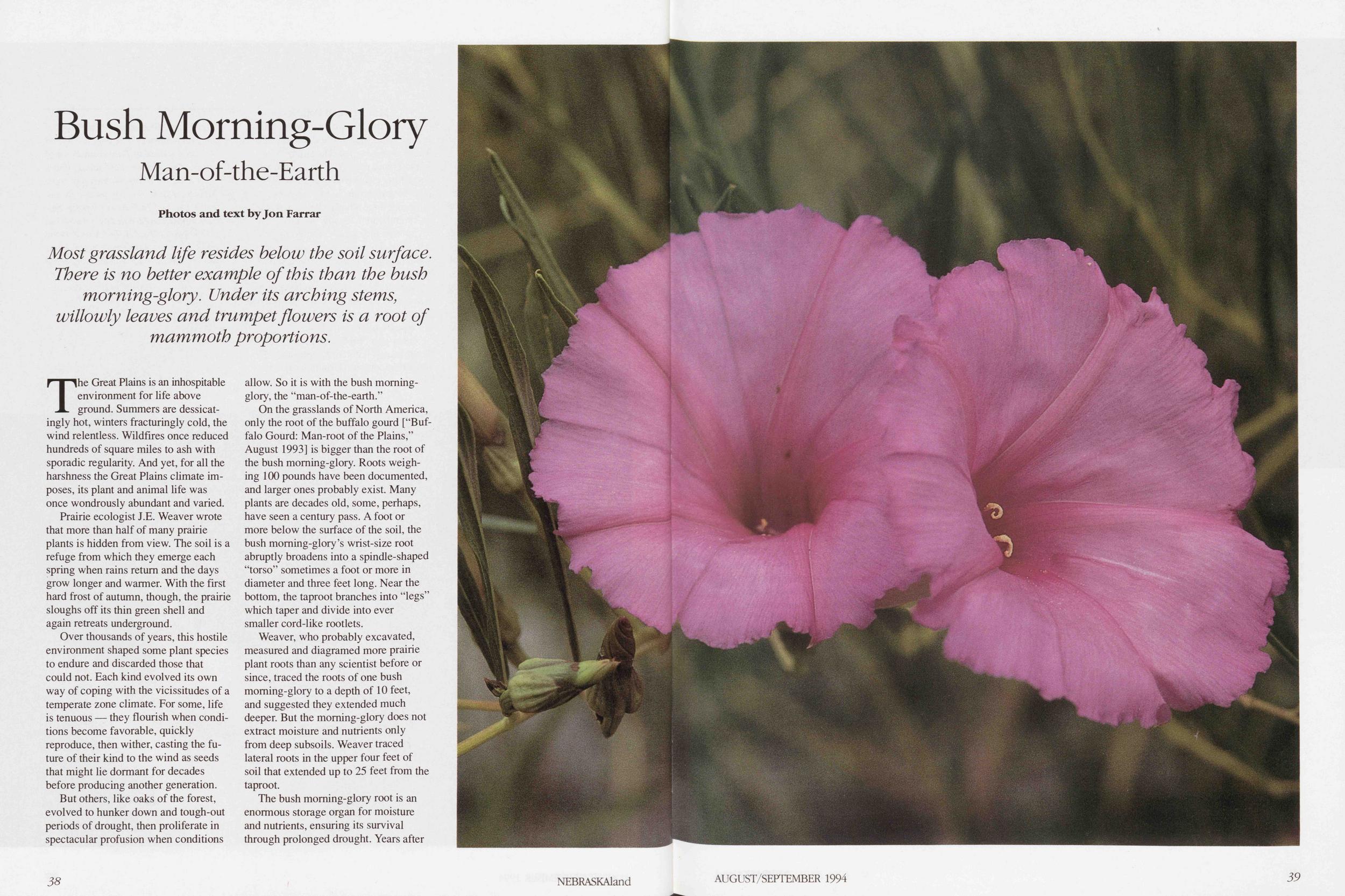
Bush Morning-Glory Man-of-the-Earth
Most grassland life resides below the soil surface. There is no better example of this than the bush morning-glory. Under its arching stems, willowly leaves and trumpet flowers is a root of mammoth proportions.The Great Plains is an inhospitable environment for life above ground. Summers are dessicatingly hot, winters fracturingly cold, the wind relentless. Wildfires once reduced hundreds of square miles to ash with sporadic regularity. And yet, for all the harshness the Great Plains climate imposes, its plant and animal life was once wondrously abundant and varied. Prairie ecologist J.E. Weaver wrote that more than half of many prairie plants is hidden from view. The soil is a refuge from which they emerge each spring when rains return and the days grow longer and warmer. With the first hard frost of autumn, though, the prairie sloughs off its thin green shell and again retreats underground.
Over thousands of years, this hostile environment shaped some plant species to endure and discarded those that could not. Each kind evolved its own way of coping with the vicissitudes of a temperate zone climate. For some, life is tenuous — they flourish when conditions become favorable, quickly reproduce, then wither, casting the future of their kind to the wind as seeds that might lie dormant for decades before producing another generation.
But others, like oaks of the forest, evolved to hunker down and tough-out periods of drought, then proliferate in spectacular profusion when conditions allow. So it is with the bush morning-glory, the "man-of-the-earth."
On the grasslands of North America, only the root of the buffalo gourd ["Buffalo Gourd: Man-root of the Plains," August 1993] is bigger than the root of the bush morning-glory. Roots weighing 100 pounds have been documented, and larger ones probably exist. Many plants are decades old, some, perhaps, have seen a century pass. A foot or more below the surface of the soil, the bush morning-glory's wrist-size root abruptly broadens into a spindle-shaped "torso" sometimes a foot or more in diameter and three feet long. Near the bottom, the taproot branches into "legs" which taper and divide into ever smaller cord-like rootlets.
Weaver, who probably excavated, measured and diagramed more prairie plant roots than any scientist before or since, traced the roots of one bush morning-glory to a depth of 10 feet, and suggested they extended much deeper. But the morning-glory does not extract moisture and nutrients only from deep subsoils. Weaver traced lateral roots in the upper four feet of soil that extended up to 25 feet from the taproot.
The bush morning-glory root is an
enormous storage organ for moisture
and nutrients, ensuring its survival
through prolonged drought. Years after
38
NEBRASKAland
AUGUST/SEPTEMBER 1994
39
 wind or water has carried away the soil
from around the upper portions of the
woody root, a plant may continue to
send up arching stems and to flower.
Unlike the smooth-surfaced root of the
buffalo gourd, which shrivels as it
dries, the cratered root of the morning-
glory changes little from its original ap-
pearance even after years of drying.
Were it not for the great effort required
to extract the root from its earthy cir-
cumstances, it would be the best source
of "firewood" on the treeless grasslands.
wind or water has carried away the soil
from around the upper portions of the
woody root, a plant may continue to
send up arching stems and to flower.
Unlike the smooth-surfaced root of the
buffalo gourd, which shrivels as it
dries, the cratered root of the morning-
glory changes little from its original ap-
pearance even after years of drying.
Were it not for the great effort required
to extract the root from its earthy cir-
cumstances, it would be the best source
of "firewood" on the treeless grasslands.
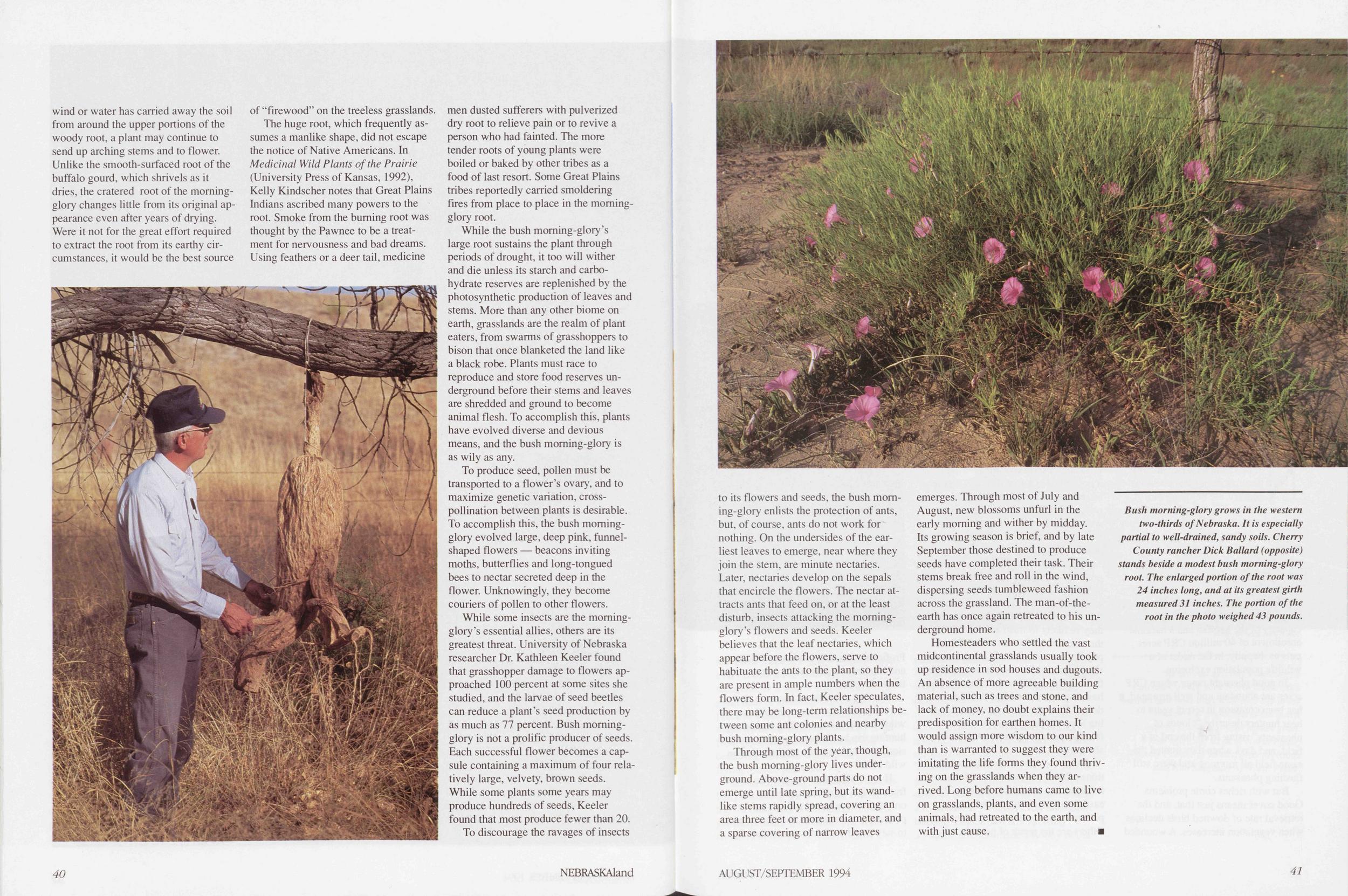
The huge root, which frequently as- sumes a manlike shape, did not escape the notice of Native Americans. In Medicinal Wild Plants of the Prairie (University Press of Kansas, 1992), Kelly Kindscher notes that Great Plains Indians ascribed many powers to the root. Smoke from the burning root was thought by the Pawnee to be a treat- ment for nervousness and bad dreams. Using feathers or a deer tail, medicine men dusted sufferers with pulverized dry root to relieve pain or to revive a person who had fainted. The more tender roots of young plants were boiled or baked by other tribes as a food of last resort. Some Great Plains tribes reportedly carried smoldering fires from place to place in the morning- glory root.
While the bush morning-glory's large root sustains the plant through periods of drought, it too will wither and die unless its starch and carbohydrate reserves are replenished by the photosynthetic production of leaves and stems. More than any other biome on earth, grasslands are the realm of plant eaters, from swarms of grasshoppers to bison that once blanketed the land like a black robe. Plants must race to reproduce and store food reserves underground before their stems and leaves are shredded and ground to become animal flesh. To accomplish this, plants have evolved diverse and devious means, and the bush morning-glory is as wily as any.
To produce seed, pollen must be transported to a flower's ovary, and to maximize genetic variation, cross- pollination between plants is desirable. To accomplish this, the bush morning- glory evolved large, deep pink, funnel- shaped flowers — beacons inviting moths, butterflies and long-tongued bees to nectar secreted deep in the flower. Unknowingly, they become couriers of pollen to other flowers.
While some insects are the morning- glory's essential allies, others are its greatest threat. University of Nebraska researcher Dr. Kathleen Keeler found that grasshopper damage to flowers approached 100 percent at some sites she studied, and the larvae of seed beetles can reduce a plant's seed production by as much as 77 percent. Bush morning- glory is not a prolific producer of seeds. Each successful flower becomes a capsule containing a maximum of four relatively large, velvety, brown seeds. While some plants some years may produce hundreds of seeds, Keeler found that most produce fewer than 20.
To discourage the ravages of insects
Through most of the year, though, the bush morning-glory lives underground. Above-ground parts do not emerge until late spring, but its wand- like stems rapidly spread, covering an area three feet or more in diameter, and a sparse covering of narrow leaves emerges. Through most of July and August, new blossoms unfurl in the early morning and wither by midday. Its growing season is brief, and by late September those destined to produce seeds have completed their task. Their stems break free and roll in the wind, dispersing seeds tumbleweed fashion across the grassland. The man-of-the- earth has once again retreated to his underground home.
Homesteaders who settled the vast midcontinental grasslands usually took up residence in sod houses and dugouts. An absence of more agreeable building material, such as trees and stone, and lack of money, no doubt explains their predisposition for earthen homes. It would assign more wisdom to our kind than is warranted to suggest they were imitating the life forms they found thriving on the grasslands when they arrived. Long before humans came to live on grasslands, plants, and even some animals, had retreated to the earth, and with just cause.
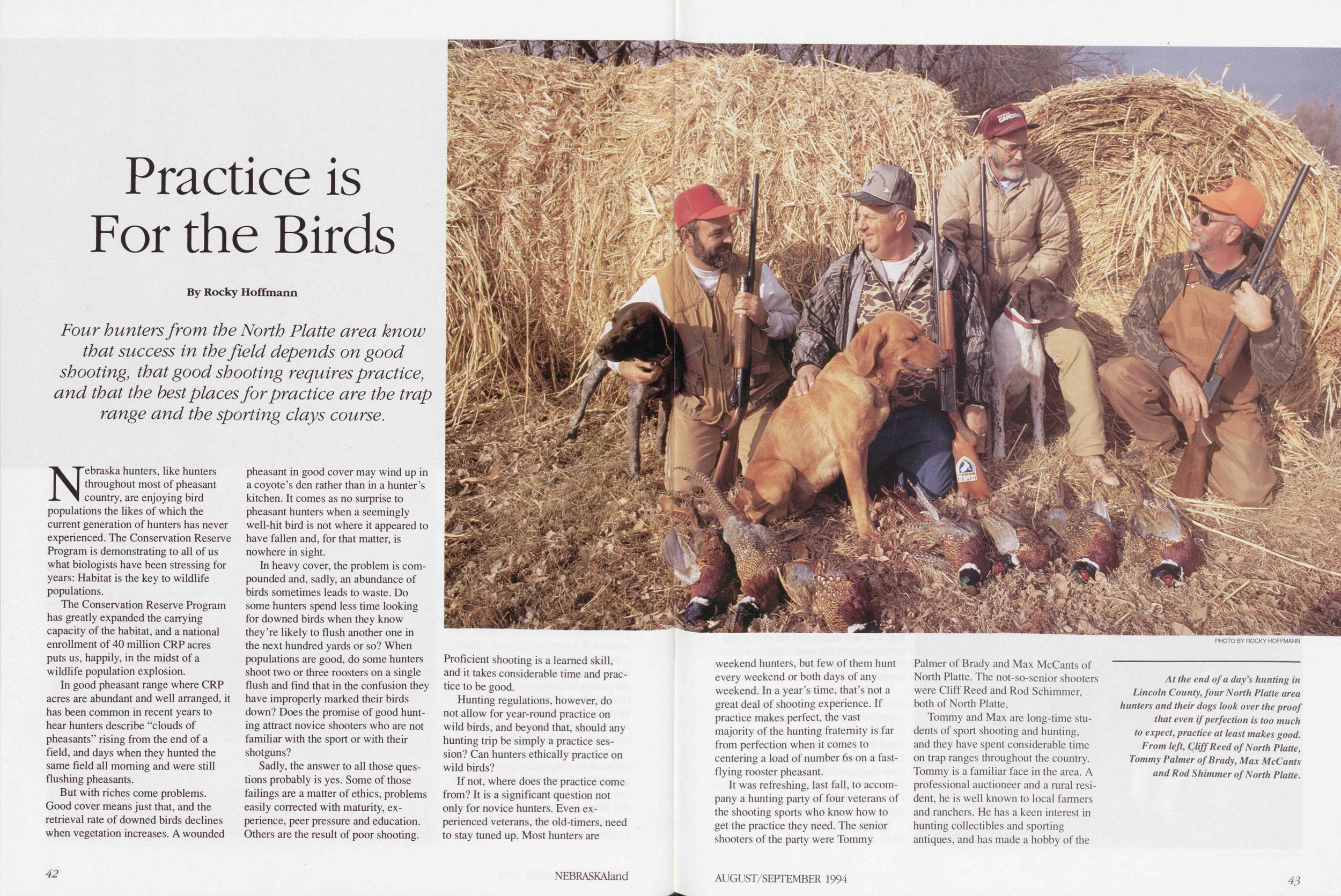
Practice is For the Birds
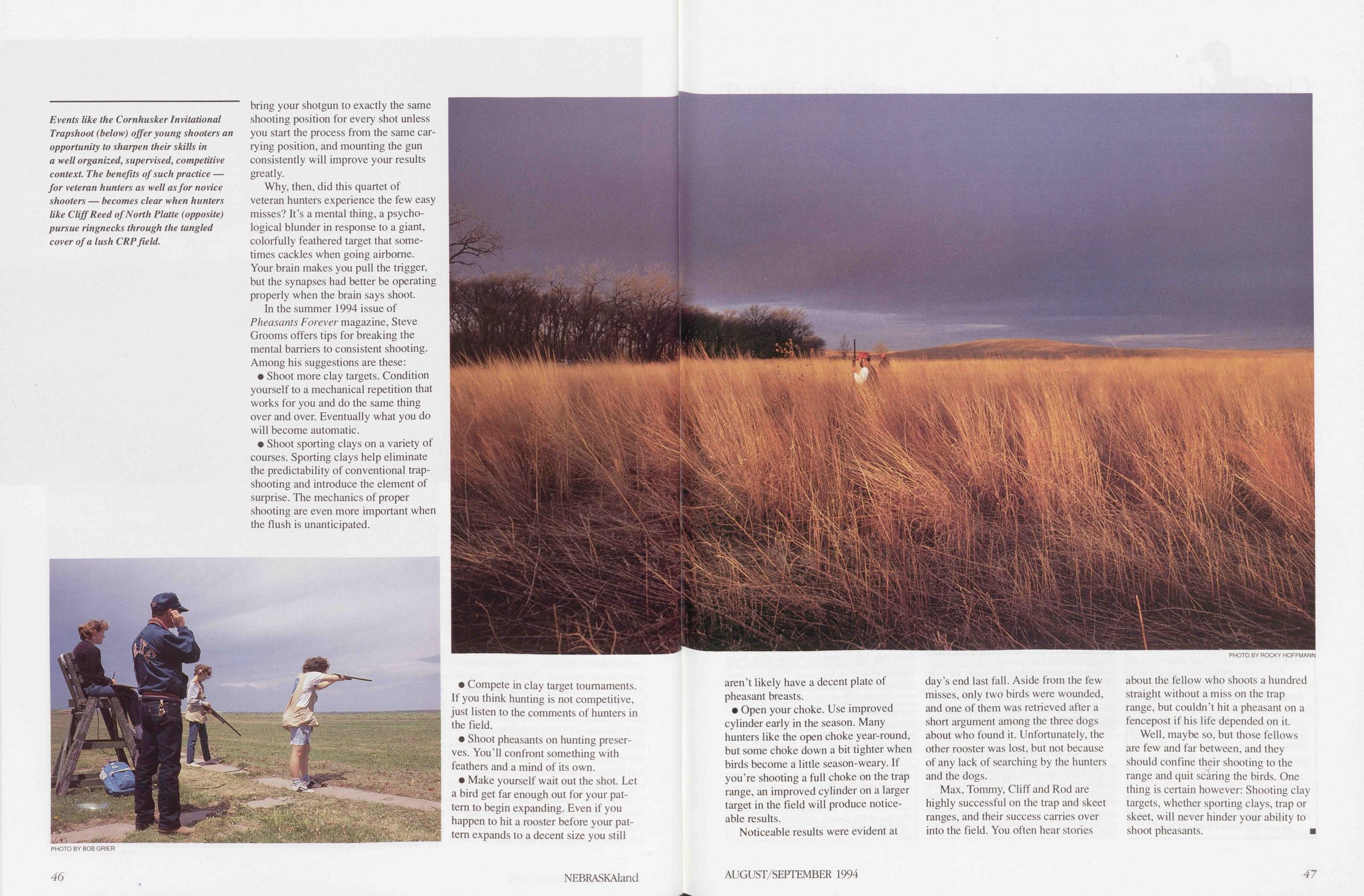
Four hunters from the North Platte area know that success in the field depends on good shooting, that good shooting requires practice, and that the best places for practice are the trap range and the sporting clays course.Nebraska hunters, like hunters throughout most of pheasant country, are enjoying bird populations the likes of which the current generation of hunters has never experienced. The Conservation Reserve Program is demonstrating to all of us what biologists have been stressing for years: Habitat is the key to wildlife populations.
The Conservation Reserve Program has greatly expanded the carrying capacity of the habitat, and a national enrollment of 40 million CRP acres puts us, happily, in the midst of a wildlife population explosion.
In good pheasant range where CRP acres are abundant and well arranged, it has been common in recent years to hear hunters describe "clouds of pheasants" rising from the end of a field, and days when they hunted the same field all morning and were still flushing pheasants.
But with riches come problems. Good cover means just that, and the retrieval rate of downed birds declines when vegetation increases. A wounded pheasant in good cover may wind up in a coyote's den rather than in a hunter's kitchen. It comes as no surprise to pheasant hunters when a seemingly well-hit bird is not where it appeared to have fallen and, for that matter, is nowhere in sight.
In heavy cover, the problem is compounded and, sadly, an abundance of birds sometimes leads to waste. Do some hunters spend less time looking for downed birds when they know they're likely to flush another one in the next hundred yards or so? When populations are good, do some hunters shoot two or three roosters on a single flush and find that in the confusion they have improperly marked their birds down? Does the promise of good hunting attract novice shooters who are not familiar with the sport or with their shotguns?
Sadly, the answer to all those questions probably is yes. Some of those failings are a matter of ethics, problems easily corrected with maturity, experience, peer pressure and education. Others are the result of poor shooting. Proficient shooting is a learned skill, and it takes considerable time and practice to be good.
Hunting regulations, however, do not allow for year-round practice on wild birds, and beyond that, should any hunting trip be simply a practice session? Can hunters ethically practice on wild birds?
If not, where does the practice come from? It is a significant question not only for novice hunters. Even experienced veterans, the old-timers, need to stay tuned up. Most hunters are weekend hunters, but few of them hunt every weekend or both days of any weekend. In a year's time, that's not a great deal of shooting experience. If practice makes perfect, the vast majority of the hunting fraternity is far from perfection when it comes to centering a load of number 6s on a fast- flying rooster pheasant.
It was refreshing, last fall, to accompany a hunting party of four veterans of the shooting sports who know how to get the practice they need. The senior shooters of the party were Tommy Palmer of Brady and Max McCants of North Platte. The not-so-senior shooters were Cliff Reed and Rod Schimmer, both of North Platte.
Tommy and Max are long-time students of sport shooting and hunting, and they have spent considerable time on trap ranges throughout the country. Tommy is a familiar face in the area. A professional auctioneer and a rural resident, he is well known to local farmers and ranchers. He has a keen interest in hunting collectibles and sporting antiques, and has made a hobby of the
 shooting sports and hunting. He spends
a good deal of time with a shotgun in
hand, even when the seasons are
closed, practicing on clay targets.
Max is an old-time trapshooter and a
long-time member of the Lincoln County Wildlife Gun Club in North Platte.
Be it a registered shoot, league night or
a turkey shoot, you can count on Max
being there and you can count on a
good score from his old Model 12
Winchester as well.
shooting sports and hunting. He spends
a good deal of time with a shotgun in
hand, even when the seasons are
closed, practicing on clay targets.
Max is an old-time trapshooter and a
long-time member of the Lincoln County Wildlife Gun Club in North Platte.
Be it a registered shoot, league night or
a turkey shoot, you can count on Max
being there and you can count on a
good score from his old Model 12
Winchester as well.
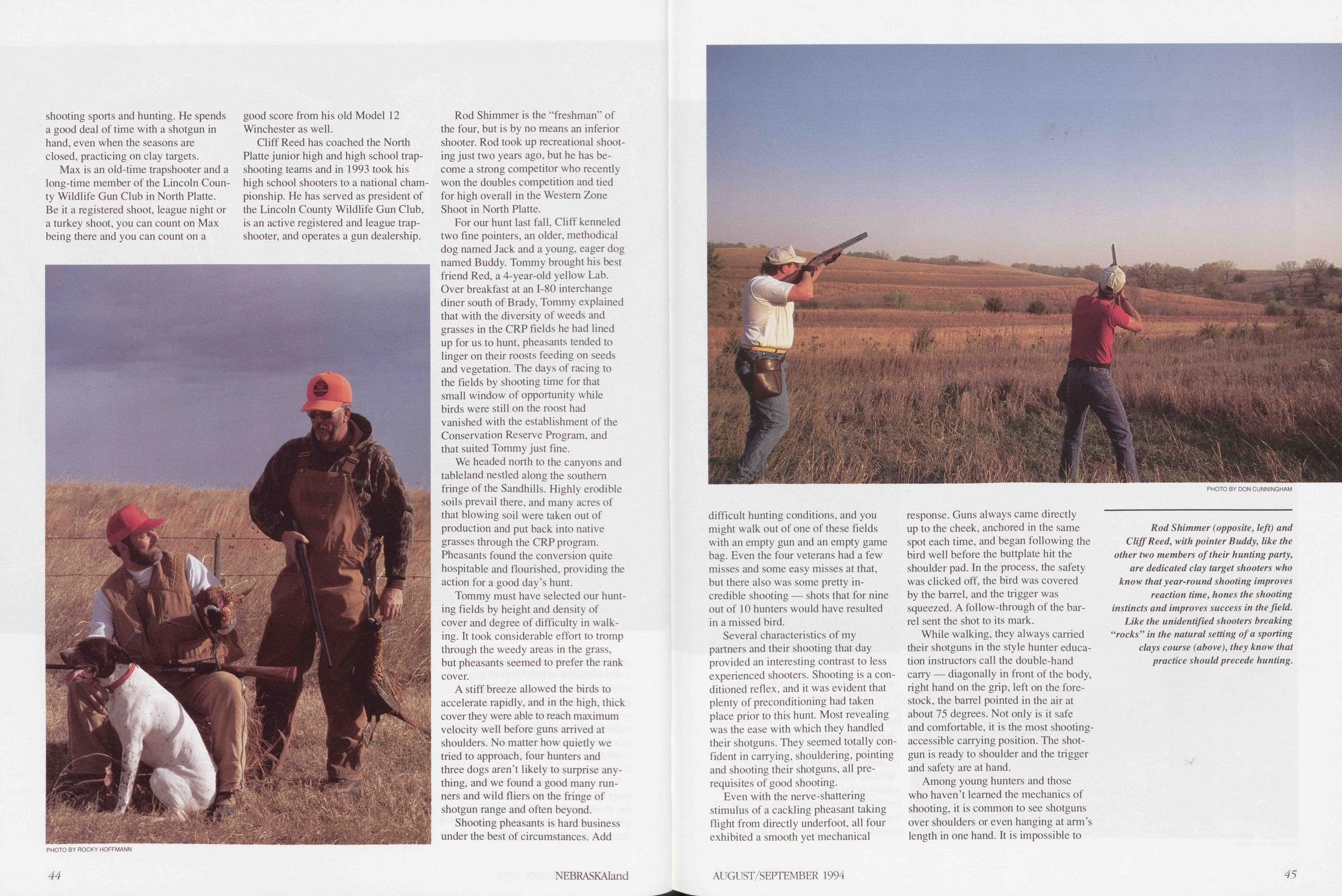
Cliff Reed has coached the North Platte junior high and high school trap- shooting teams and in 1993 took his high school shooters to a national championship. He has served as president of the Lincoln County Wildlife Gun Club, is an active registered and league trap- shooter, and operates a gun dealership. Rod Shimmer is the "freshman" of the four, but is by no means an inferior shooter. Rod took up recreational shooting just two years ago, but he has become a strong competitor who recently won the doubles competition and tied for high overall in the Western Zone Shoot in North Platte.
For our hunt last fall, Cliff kenneled two fine pointers, an older, methodical dog named Jack and a young, eager dog named Buddy. Tommy brought his best friend Red, a 4-year-old yellow Lab. Over breakfast at an 1-80 interchange diner south of Brady, Tommy explained that with the diversity of weeds and grasses in the CRP fields he had lined up for us to hunt, pheasants tended to linger on their roosts feeding on seeds and vegetation. The days of racing to the fields by shooting time for that small window of opportunity while birds were still on the roost had vanished with the establishment of the Conservation Reserve Program, and that suited Tommy just fine.
We headed north to the canyons and tableland nestled along the southern fringe of the Sandhills. Highly erodible soils prevail there, and many acres of that blowing soil were taken out of production and put back into native grasses through the CRP program. Pheasants found the conversion quite hospitable and flourished, providing the action for a good day's hunt.
Tommy must have selected our hunting fields by height and density of cover and degree of difficulty in walking. It took considerable effort to tromp through the weedy areas in the grass, but pheasants seemed to prefer the rank cover.
A stiff breeze allowed the birds to accelerate rapidly, and in the high, thick cover they were able to reach maximum velocity well before guns arrived at shoulders. No matter how quietly we tried to approach, four hunters and three dogs aren't likely to surprise anything, and we found a good many runners and wild fliers on the fringe of shotgun range and often beyond.
Shooting pheasants is hard business under the best of circumstances. Add
difficult hunting conditions, and you might walk out of one of these fields with an empty gun and an empty game bag. Even the four veterans had a few misses and some easy misses at that, but there also was some pretty incredible shooting — shots that for nine out of 10 hunters would have resulted in a missed bird.
Several characteristics of my partners and their shooting that day provided an interesting contrast to less experienced shooters. Shooting is a conditioned reflex, and it was evident that plenty of preconditioning had taken place prior to this hunt. Most revealing was the ease with which they handled their shotguns. They seemed totally confident in carrying, shouldering, pointing and shooting their shotguns, all prerequisites of good shooting.
Even with the nerve-shattering stimulus of a cackling pheasant taking flight from directly underfoot, all four exhibited a smooth yet mechanical response. Guns always came directly up to the cheek, anchored in the same spot each time, and began following the bird well before the buttplate hit the shoulder pad. In the process, the safety was clicked off, the bird was covered by the barrel, and the trigger was squeezed. A follow-through of the barrel sent the shot to its mark.
While walking, they always carried their shotguns in the style hunter education instructors call the double-hand carry — diagonally in front of the body, right hand on the grip, left on the fore-stock, the barrel pointed in the air at about 75 degrees. Not only is it safe and comfortable, it is the most shooting- accessible carrying position. The shotgun is ready to shoulder and the trigger and safety are at hand.
Among young hunters and those who haven't learned the mechanics of shooting, it is common to see shotguns over shoulders or even hanging at arm's length in one hand. It is impossible to
bring your shotgun to exactly the same shooting position for every shot unless you start the process from the same carrying position, and mounting the gun consistently will improve your results greatly.
Why, then, did this quartet of veteran hunters experience the few easy misses? It's a mental thing, a psychological blunder in response to a giant, colorfully feathered target that sometimes cackles when going airborne. Your brain makes you pull the trigger, but the synapses had better be operating properly when the brain says shoot.
In the summer 1994 issue of Pheasants Forever magazine, Steve Grooms offers tips for breaking the mental barriers to consistent shooting. Among his suggestions are these:
• Shoot more clay targets. Condition yourself to a mechanical repetition that works for you and do the same thing over and over. Eventually what you do will become automatic.
• Shoot sporting clays on a variety of courses. Sporting clays help eliminate the predictability of conventional trap- shooting and introduce the element of surprise. The mechanics of proper shooting are even more important when the flush is unanticipated.
PHOTO BY ROCKY HOFFMANN• Compete in clay target tournaments. If you think hunting is not competitive, just listen to the comments of hunters in the field.
• Shoot pheasants on hunting preser- ves. You'll confront something with feathers and a mind of its own.
• Make yourself wait out the shot. Let a bird get far enough out for your pattern to begin expanding. Even if you happen to hit a rooster before your pattern expands to a decent size you still aren't likely have a decent plate of pheasant breasts.
• Open your choke. Use improved cylinder early in the season. Many hunters like the open choke year-round, but some choke down a bit tighter when birds become a little season-weary. If you're shooting a full choke on the trap range, an improved cylinder on a larger target in the field will produce noticeable results.
Noticeable results were evident at day's end last fall. Aside from the few misses, only two birds were wounded, and one of them was retrieved after a short argument among the three dogs about who found it. Unfortunately, the other rooster was lost, but not because of any lack of searching by the hunters and the dogs.
Max, Tommy, Cliff and Rod are highly successful on the trap and skeet ranges, and their success carries over into the field. You often hear stories about the fellow who shoots a hundred straight without a miss on the trap range, but couldn't hit a pheasant on a fencepost if his life depended on it. Well, maybe so, but those fellows are few and far between, and they should confine their shooting to the range and quit scaring the birds. One thing is certain however: Shooting clay targets, whether sporting clays, trap or skeet, will never hinder your ability to shoot pheasants.
46 NEBRASKAland AUGUST/SEPTEMBER 1994 47
Classified
BOOKS/PRINTINGFREE BOOK CATALOG. Novels, westerns, romances, children's; old out of print, found barns, attic. Authors: Grey. Bower, Connor, Fox, Curwood, Raine, Wright, Aldrige, Pollyanna, Freckles, many others. Postage ap- preciated. Pierce, 4400 N. Pine Cluster, Oroville.CA95965.
HOW TO FIND the public lands that you read about in NEBRASKAland Magazine. Locations & descriptions for ALL federal, state & NRD, parks, lakes, forests, wildlife areas, river access, trout streams & bike trails! These areas are clearly marked on county, D.O.T. transportation maps and show ALL hard surface, gravel & dirt roads, bridges, railroads, rivers & creeks, farm and ranch homes, cities & towns. Send $18.75 to: Sportsman's Atlas Co., PO Box 132, Lytton, IA 50561-0132, or call 1-800-568-8334 ORDER TODAY. Your most important piece of outdoor equipment.
COLLECTIBLES1994 NEBRASKA HABITAT STAMP print now available. Write to John R. Mayer, PO Box 1704, Grand Island, NE 68802 for FREE brochure.
DOGSTRAINING ALL BREEDS bird dogs — Vizslas and English Pointers for sale. Rozanek Kennels, RR 2, Schuyler, NE 68661. Phone (402) 352-8769.
YELLOW-BLACK Lab pups. FC-AFC sired. AKC. Hips OFA certified. Dew claws removed. Excellent hunting potential. Contact Bob Bendler, Lexington, NE. (308) 324- 4247.
WILDERNESS KENNELS. Gun dog training - over 60 years combined experience. Training all sporting breeds — Retrievers. Flushing and pointing dogs. All dogs worked on pen raised birds and wild game. Training program includes obedience training — heel, sit, stay, down and come when called. Pups, started dogs and fully trained dogs for sale. HUNTING DOGS TRAINED BY HUNTERS. Henry Sader, Wilderness Kennels. Roca, NE. (402) 423-4212. Since 1968.
ENGLISH COCKER pups, imported stock. British FTC bloodlines. Many colors available. Featured in NEBRASKAland November 1991. Sawtooth Oaks, Box 443, Orleans, NE 68966. Phone (308) 473-5265.
YES! I WOULD LIKE TO SUBSCRIBE TO NEBRASKALAND l-Year$14D2-Years$27 Name Address City State Zip Mail check or money order to NEBRASKAland Magazine P.O. Box 30370, Lincoln, Nebraska 68503 or call Toll Free 1-800-632-5263EXCEPTIONAL ENGLISH SETTER pups. Tomoka linebred! Sire has 30 shooting dog wins and counting. Reserve yours! (402) 421-4693.
RETRIEVER TRAINING. Area's top "retrievers only" trainer. Field trial and hunting dogs. Non-slip duck dogs! TKO RETRIEVER TRAINING KENNEL(402) 623-4311. CHESAPEAKE BAY, LABRADOR and GOLDEN RETRIEVER pups, started dogs and stud service. 16 time national champion pedigre. Platte Valley Retrievers (308) 995-2318.
DEUTSCH DRAHTHAARS - Line-bred litters due to whelp in September. Puppies expected to have great poten- tial. Parents are proven hunters. Bred by strict VDD stand- ards in a German registered kennel. Versatile hunting drahthaars for fur and feathered game. Wildflugel Kennel, RR 2, Box 24A, Ravenna, NE 68869 (308) 452-4333.
BRITTANY PUPS 7/22/94 sire and dam excellent hunters. BanDee and Scipio bloodlines. Intelligent, stylish, natural retrievers. Both colors O.A.F. (303) 364-6770. AKC Brittany pups sired by Imported French Brittany. Close hunters that point and retrieve naturally. House pet temperaments. Bob Allen. Broken Bow, NE(308) 872-6929 work (308) 872-2497.
FISH/FISHINGFISH FOR SALE. Catfish, largemouth bass, smallmouth bass, perch, crappie, bluegill, walleye, northern pike, rain- bow trout, Donaldson rainbow trout, grass carp, minnows, bullheads. Consulting available. Pleasant Valley Fish Farm, RR 1, Box 147, McCook, NE 69001. Phone (308) 345- 6599.
WILLOW LAKE FISH HATCHERY. Channel cat, bluegill, hybrid bluegill. largemouth bass, crappie, triploid grass carp, walleye, perch, minnows available for stocking. Gaylord Crawford, RR 3, Box 46, Hastings, NE 68901 or phone (402) 463-8022 day or night. Also pond consultant. We del, grower price.
FOODNEBRASKA BASKETS: The original Nebraska company specializing in fine foods from Nebraska. A beautiful array of baskets filled with ethnic, healthful and long-time favorite foods. Call or write for our brochure: P.O. Box 98, McCook, NE 69001. 1-800-345-7725.
BEER & WINEMAKING SUPPLIES Fermenter's Supply & Equipment, 4472 S. 84th St.. Omaha, NE 68127. (402) 593-9171. Mail order or visit our store. THE BEST SPICY BURGER topping + 14 more unique recipes using your garden produce $3. Sheryl, POB 67281, Lincoln. NE 68506.
GIFTSNEBRASKA CHRISTMAS CARDS, stationery, mugs, cookie cutters, rubber stamps, gift baskets and more! Originally designed and elegantly packaged from Nebras- ka. FREE catalog: MJP, HC 37 Box 43C, Valentine, NE 69201. 1-800-632-7623.
WORLD GIFTS, 225 color pages of wonderful gifts. 14K jewelry catalog included. Send $5 plus $3 amp; to: KING'S Quality Products, Box 49IN, Alliance, NE 69301.
GUIDES/OUTFITTERSMAD RIVER CANOES offers the finest quality and per- formance. For the finest canoes and accessories look to Great Plains Canoe Co., 205 Main, Springfield, NE. Phone (402)253-2001.
WANTED hunting guides with dogs. Write Hunt Nebraska Inc., PO Box 328, Arapahoe. NE 68922 or phone (308) 962-8469.
GRAHAM CANOE OUTFITTERS: Top quality full-ser- vice camping and canoe trips on the Niobrara River. Daily canoe rentals and car shuttle-service available. Contact Doug & Twyla Graham, HC 13 Box 16, Valentine, NE 69201 or phone (402) 376-3708.
GUNS/SHOOTING/ARCHERYGUNS — Browning, Winchester, Remington, others. Hi- powers; shotguns, new, used, antiques. Want Pre-'64 Winchesters. Buy-Sell-Trade. (402) 729-6112. Bedlans Sporting Goods, Fairbury, NE 68352.
AIR GUNS repaired — Benjamin, Crosman, Daisy, other American made. Restoration; old guns wanted. Jack's Air Guns, 1225 No. 46th, Lincoln, NE 68503. Phone (402) 466-9223.
OUTDOOR EQUIPMENTWHITES METAL DETECTORS help you discover treasure. Write or call for free information. Research Un- limited, Box 448-N, Fremont, NE 68025. Phone (402) 721-8588.
REAL ESTATEFOR SALE: One of Nebraska's top fishing-recreational- hunting resorts with home, cabins, store, and all equipment needed goes. Set on very large lake. Call Swett Realty (402) 387-1626, Fred Swett. Broker. PO Box 265, Ainsworth, NE 69210.
TAXIDERMYALLISON'S TAXIDERMY STUDIO & GIFT GALLERY. Specializing in fish, birds and small game. Mounted 35 State Record Fish. Pheasant mounts for sale. 421 N. Dewey, North Platte, NE69101. (308)534-2324or(308)534-4267.
VACATION/RESORTSFOR FISHING and hunting accommodations. Jefco Inn. Gordon, NE 69343. South Cornell. (308) 282-2935. PINE CONE LODGE - Bed & Breakfast. Country atmos- phere, western hospitality. Close to hunting, fishing, his- toric interests. Broken Bow, NE (308) 872-6407. GOLF: Legend Buttes Golf Course. Located in Nebraska Pine Ridge Country between Crawford and Fort Robinson. Enjoy playing on one of the top four Municipal nine hole courses as rated by the Omaha World-Herald. (308) 665- 2431.
HISTORIC 1890s HOTEL. Located in the beautiful Pine Ridge area of Northwest Nebraska. Short drive to Chadron State Park, Fort Robinson and the Black Hills. Beautiful dining room with fireplace and fountain. Room service available. The Olde Main Street Inn, 115 Main St., Chadron, NE 69337 (308) 432-3380.
AUNT BETTY'S BED & BREAKFAST. Peaceful atmos- phere. Victorian home decorated in antiques. Special ac- commodations for sportsmen. Close to Sherman Dam. Full breakfast. Ravenna. NE (308) 452-3739
NE NEBRASKA TROUT FISHING. Mon-Thurs or Fri- Sun. 3 modem cottages. 5 spring fed lakes. Trout, bass and bluegill. Diamond E. Trout Resort, Box B, Orchard. NE 1 -800-658-3244.
Classified ad rates: 75c per word, minimum $ 15. Closing date is the first business day 2 months preceding date of issue. To place ads or for more information write NEBRASKAland Magazine, P.O. Box 30370, Lincoln, NE 68503-0370, or call (402) 471-5478. Eax (402) 471-5528.Page forty-nine
SeptephobiaI've suffered from Septephobia for more than 25 years now. It hasn't been a panic-level neurosis, but instead an uneasiness, as if something bad were about to happen. Medical types might not know the condition, but it's easy to explain. It's fear of the ninth month — September.
No other month particularly bothers me except April, when my taxes are due. (Apriphobia, however, qualifies as a full neurosis.) August might also qualify. That's our anniversary month. The fear is not of the month, it's fear of forgetting why the month is important. That should frighten anyone who has had at least 25 opportunities to remember.
I've played with this Septephobia thing off and on for several years trying to come up with the connection. For a while I thought it might stem from my childhood dislike for school, but I discounted that idea. School really wasn't that much of a bother. When I had something better to do — fishing, say — that's what I did. School gave me something to do on days I wasn't fishing or hunting.
Then a few years ago my wife was trashing through my parents' basement and uncovered the old wine press. What a magnificent antique, thought she, and with the right plant in it she had "just the right place" for it. The Old Man's wine press isn't one of those dinky little hobbyist's devices for squeezing a cup and a half of Concords on Sunday morning. The Old Man's press stands five feet tall and is constructed of forged steel and oak timbers.
One July afternoon when four or five of the biggest guys I could find, guys with lots of hair on their backs, were muscling my wife's new "accent piece" into the family room, the old anxiety took hold. At first I shrugged it off as nothing more than a heart attack, but when I didn't immediately die or fall unconscious, I recognized it as Septephobia.
Septephobia had never before throttled me in any month but September, and here it was only July. Not even close. The connection was here, entangled in the muscle, sweat and hairy backs. The wine press! How could I have failed to discover it sooner? It's so clear now — my Septembers in the 1950s.
It usually began on a Friday night in mid- or late September, after the Old Man had checked the thermometer on the porch and listened to the radio for the latest forecast: Frost tonight... warm tomorrow. The key weather ingredients for concentrating the glucose in wild grapes.
"We go tomorrow!" he would command, as if he were coordinating the assault on an enemy emplacement. A quick call to Ed, the only neighbor with a pick-up truck, ensured that the plan was in motion. About 5 a.m. I'd hear the old pickup down the road grinding up a start, and I'd roll out of bed and tumble down the stairs to prepare for the assault on the wild grapes of the Missouri River.
It was a 50-mile trip, usually with car-loads of immediate and distant family and Ed in his pickup truck filled with empty bushel baskets. We'd rattle past the old schoolhouse and out across the sand onto the island. It used to be an island, anyway, when the river ran where we crossed the sand. Now it was a jungle of willows, cottonwoods and grapevines. Frost usually had formed the previous night, as predicted, but the warm day also predicted usually turned hot — scorching hot and humid. The frost, though it slightly wrinkled the skins of the wild grapes (perfect for wine), had no mortal effect on the wasps and mosquitos.
Picking grapes was an art form, usually practiced by a two-person team. The most prolific grapevines always grew in open areas where young cottonwoods reached 10 to 12 feet and served as natural arbors for the climbing vines. Usually one team member would shinny up a sapling and pull the crown down within reach of the picker, who would strip grapes with each hand from the exposed vine.
Neither job was a piece of cake. The climber always disturbed a thick cloud of mosquitos that would pounce on his back, somehow knowing that he needed both hands to hold on with and could not swat back. The picker, although able to protect himself somewhat from mosquitos, usually grabbed a wasp every three or four handfuls of grapes. You see, the frost would split some of the grape skins, and wasps spent the heat of the day nestled in the clusters of grapes sucking nectar from the split skins.
Sometimes it was double jeopardy for the climber and the picker when a paper- celled wasp's nest was tucked neatly into the foliage. Picking grapes was not a silent art, though it never did much good to holler cuss words at mosquitos or scream out in pain from wasp stings.
By noon, as many as six heaping bushel baskets of wild grapes would have been loaded into the pickup parked in the shade to protect the harvest. The grapes got better care than the picking crew, but the Old Man did give us a break for lunch, so we could eat our warm bologna and mayonnaise sandwiches with wilted lettuce. Fritos had just been invented, I think, and we ate bags of the new fad food. Although the Fritos helped grind up our sandwiches, they did nothing to relieve our thirst during the hottest part of the day that was just ahead.
The goal was 13 bushels, not 10 or an even dozen. The Old Man needed 13 for the oak barrels he had soaking. Usually that goal was reached — and so was everyone's tolerance level for just about everything, including each other.
We were marked for weeks with purple-stained hands, accented by mosquito welts on the back and wasp stings on the palms. Mothers wouldn't let their children play with me, not knowing what rare skin disease had afflicted me. My mother came to my defense, but with her own purple hands, she wasn't very convincing.
Whatever it was, obviously it was catching. Not only had my mother caught it, it also had spread to my lips. After the Frito lunch, every other handful of grapes went into my mouth to help offset the thirst caused by the salt overdose. Oc- casionally, a yellow jacket or a wasp was still enjoying his nectar when the clump of grapes hit my lips. Swollen and en- larged purple lips look a whole lot worse than regular-size purple lips.
After a week or so, the swelling would disappear, and a few months later so would the purple. I could rejoin my neigh- borhood chums, because their mothers felt that I was no longer contagious. But about the first of September, veteran neighborhood mothers stopped allowing me to play with their kids again. They saw from my weird Septephobic behavior that my chronic condition was returning, and was certain to result in dangerously swollen purple hands and lips.
AUGUST/SEPTEMBER 1994 49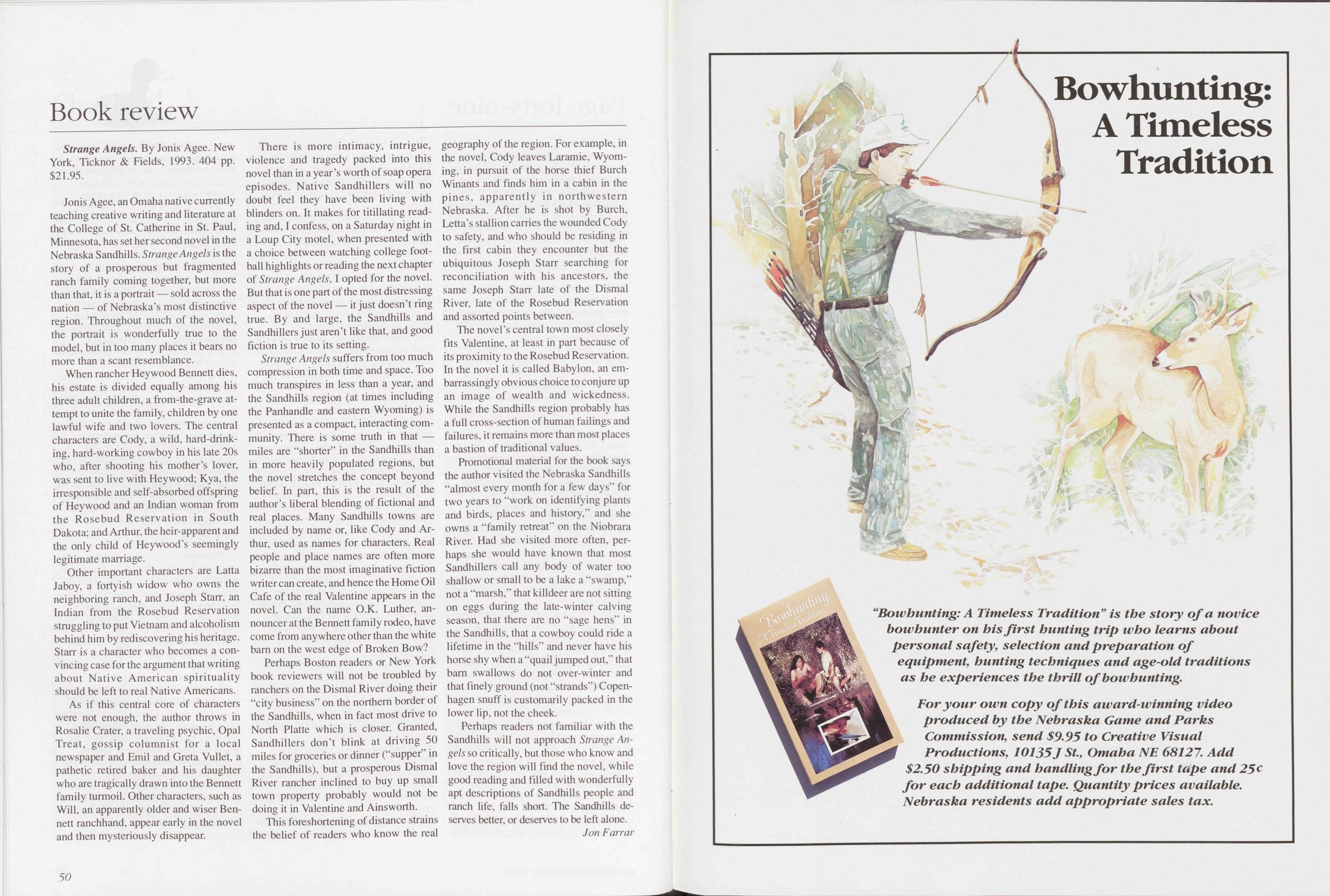
Book review
Strange Angels, By Jonis Agee. New York, Ticknor & Fields, 1993. 404 pp. $21.95.
Jonis Agee, an Omaha native currently teaching creative writing and literature at the College of St. Catherine in St. Paul, Minnesota, has set her second novel in the Nebraska Sandhills. Strange Angels is the story of a prosperous but fragmented ranch family coming together, but more than that, it is a portrait — sold across the nation — of Nebraska's most distinctive region. Throughout much of the novel, the portrait is wonderfully true to the model, but in too many places it bears no more than a scant resemblance.
When rancher Hey wood Bennett dies, his estate is divided equally among his three adult children, a from-the-grave attempt to unite the family, children by one lawful wife and two lovers. The central characters are Cody, a wild, hard-drinking, hard-working cowboy in his late 20s who, after shooting his mother's lover, was sent to live with Heywood; Kya, the irresponsible and self-absorbed offspring of Heywood and an Indian woman from the Rosebud Reservation in South Dakota; and Arthur, the heir-apparent and the only child of Heywood's seemingly legitimate marriage.
Other important characters are Latta Jaboy, a fortyish widow who owns the neighboring ranch, and Joseph Starr, an Indian from the Rosebud Reservation struggling to put Vietnam and alcoholism behind him by rediscovering his heritage. Starr is a character who becomes a convincing case for the argument that writing about Native American spirituality should be left to real Native Americans.
As if this central core of characters were not enough, the author throws in Rosalie Crater, a traveling psychic, Opal Treat, gossip columnist for a local newspaper and Emil and Greta Vullet, a pathetic retired baker and his daughter who are tragically drawn into the Bennett family turmoil. Other characters, such as Will, an apparently older and wiser Bennett ranchhand, appear early in the novel and then mysteriously disappear.
There is more intimacy, intrigue, violence and tragedy packed into this novel than in a year's worth of soap opera episodes. Native Sandhillers will no doubt feel they have been living with blinders on. It makes for titillating reading and, I confess, on a Saturday night in a Loup City motel, when presented with a choice between watching college football highlights or reading the next chapter of Strange Angels, I opted for the novel. But that is one part of the most distressing aspect of the novel — it just doesn't ring true. By and large, the Sandhills and Sandhillers just aren't like that, and good fiction is true to its setting.
Strange Angels suffers from too much compression in both time and space. Too much transpires in less than a year, and the Sandhills region (at times including the Panhandle and eastern Wyoming) is presented as a compact, interacting community. There is some truth in that — miles are "shorter" in the Sandhills than in more heavily populated regions, but the novel stretches the concept beyond belief. In part, this is the result of the author's liberal blending of fictional and real places. Many Sandhills towns are included by name or, like Cody and Arthur, used as names for characters. Real people and place names are often more bizarre than the most imaginative fiction writer can create, and hence the Home Oil Cafe of the real Valentine appears in the novel. Can the name O.K. Luther, announcer at the Bennett family rodeo, have come from anywhere other than the white barn on the west edge of Broken Bow?
Perhaps Boston readers or New York book reviewers will not be troubled by ranchers on the Dismal River doing their "city business" on the northern border of the Sandhills, when in fact most drive to North Platte which is closer. Granted, Sandhillers don't blink at driving 50 miles for groceries or dinner ("supper" in the Sandhills), but a prosperous Dismal River rancher inclined to buy up small town property probably would not be doing it in Valentine and Ainsworth.
This foreshortening of distance strains the belief of readers who know the real geography of the region. For example, in the novel, Cody leaves Laramie, Wyoming, in pursuit of the horse thief Burch Winants and finds him in a cabin in the pines, apparently in northwestern Nebraska. After he is shot by Burch, Letta's stallion carries the wounded Cody to safety, and who should be residing in the first cabin they encounter but the ubiquitous Joseph Starr searching for reconciliation with his ancestors, the same Joseph Starr late of the Dismal River, late of the Rosebud Reservation and assorted points between.
The novel's central town most closely fits Valentine, at least in part because of its proximity to the Rosebud Reservation. In the novel it is called Babylon, an embarrassingly obvious choice to conjure up an image of wealth and wickedness. While the Sandhills region probably has a full cross-section of human failings and failures, it remains more than most places a bastion of traditional values.
Promotional material for the book says the author visited the Nebraska Sandhills "almost every month for a few days" for two years to "work on identifying plants and birds, places and history," and she owns a "family retreat" on the Niobrara River. Had she visited more often, per- haps she would have known that most Sandhillers call any body of water too shallow or small to be a lake a "swamp," not a "marsh," that killdeer are not sitting on eggs during the late-winter calving season, that there are no "sage hens" in the Sandhills, that a cowboy could ride a lifetime in the "hills" and never have his horse shy when a "quail jumped out," that barn swallows do not over-winter and that finely ground (not "strands") Copenhagen snuff is customarily packed in the lower lip, not the cheek.
Perhaps readers not familiar with the Sandhills will not approach Strange Angels so critically, but those who know and love the region will find the novel, while good reading and filled with wonderfully apt descriptions of Sandhills people and ranch life, falls short. The Sandhills deserves better, or deserves to be left alone.
Bowhunting: A Timeless Tradition
Bowhunting: A Timeless Tradition" is the story of a novice bow hunter on his first hunting trip who learns about personal safety, selection and preparation of equipment, hunting techniques and age-old traditions as he experiences the thrill of bowhunting. For your own copy of this award-winning video produced by the Nebraska Game and Parks Commission, send $9.95 to Creative Visual Productions, 10135 J St., Omaha NE 68127. Add $2.50 shipping and handling for the first tape and 25C for each additional tape. Quantity prices available. Nebraska residents add appropriate sales tax. 50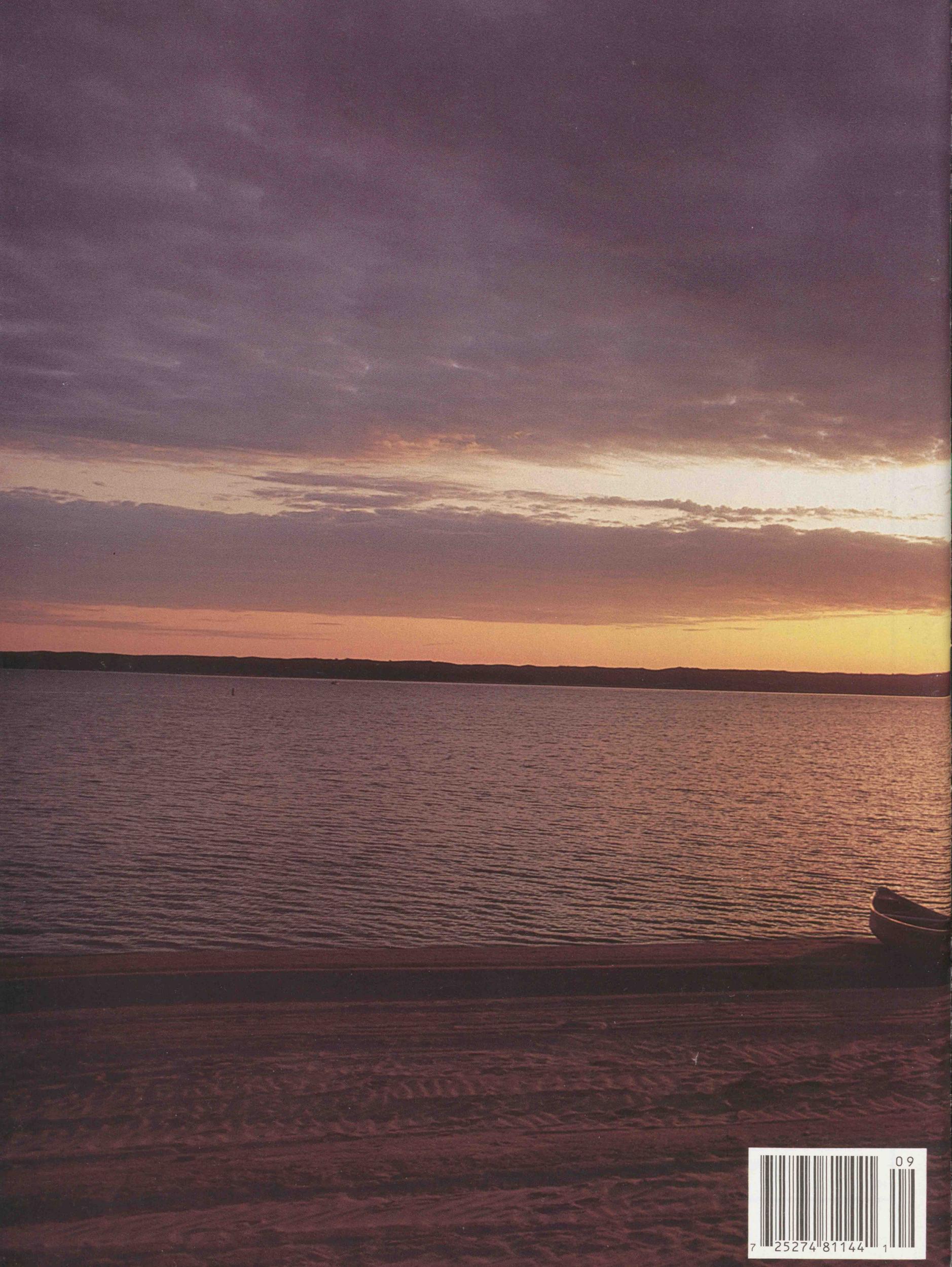
Position: 541 (20 views)