Volume 72, Issue 6, 1994
NEBRASKAland
JULY 1994 • $2.00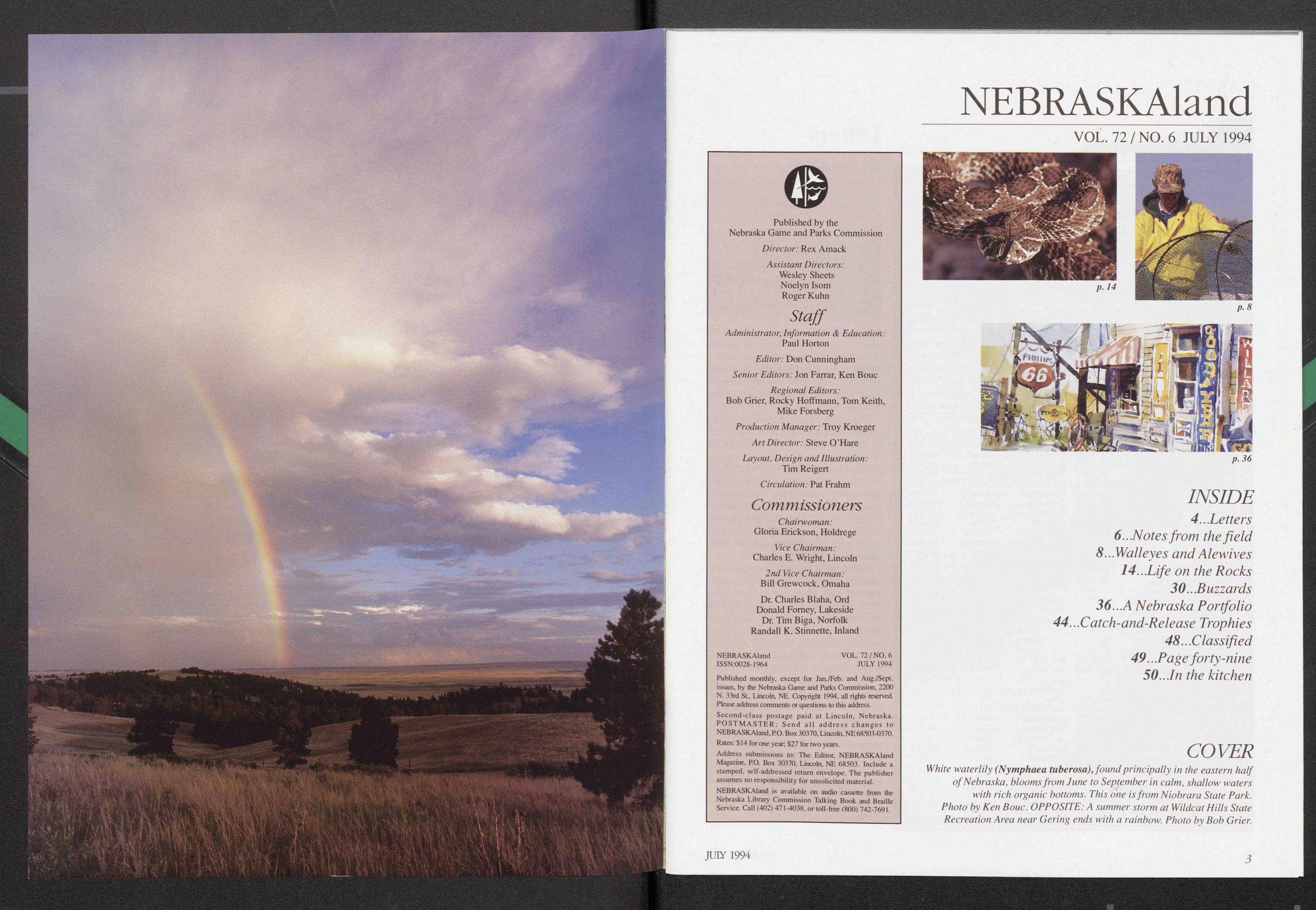
p. 14
p. 8
p.36
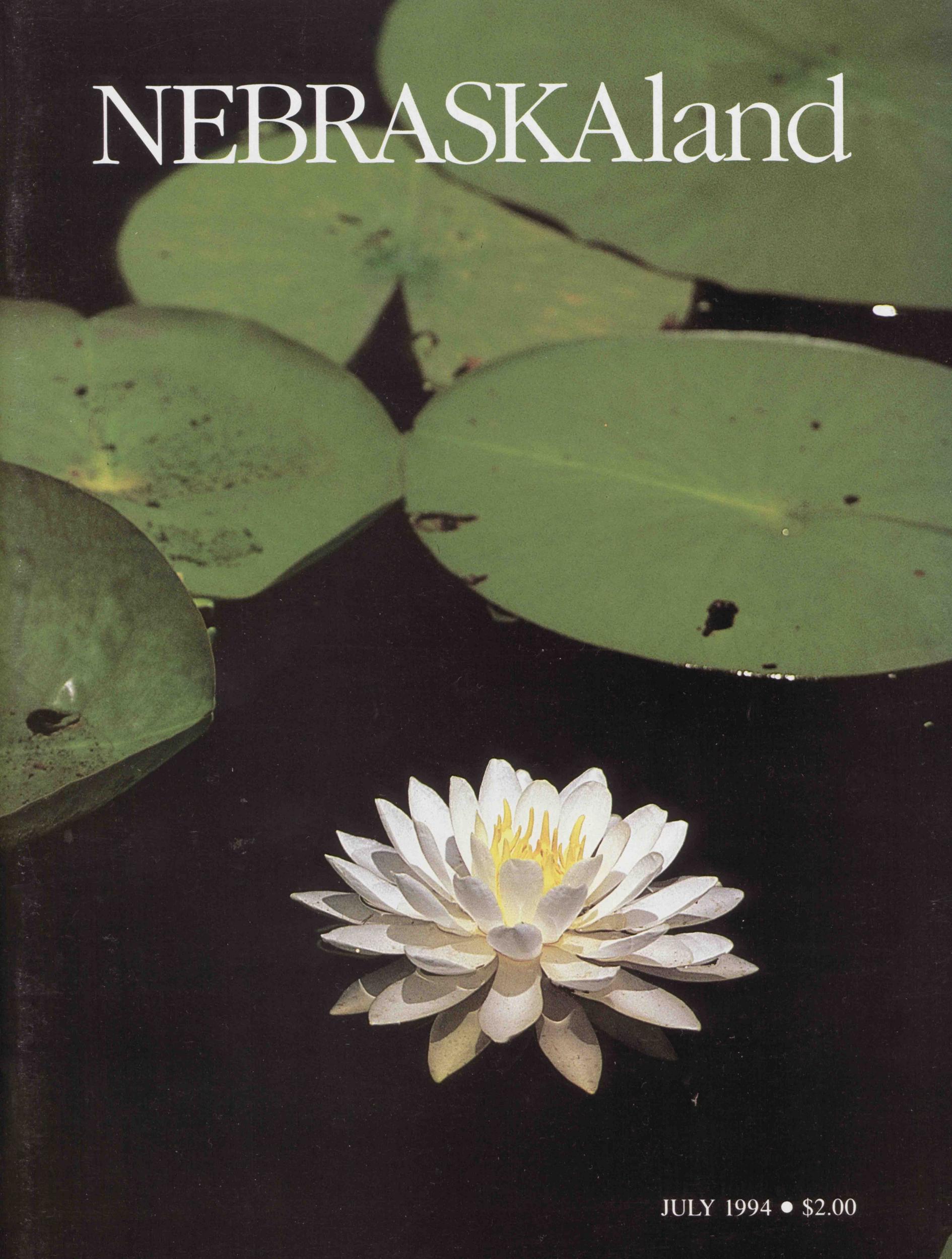
COVER White waterlily (Nymphaea tuberosa), found principally in the eastern half of Nebraska, blooms from June to September in calm, shallow waters with rich organic bottoms. This one is from Niobrara State Park. Photo by Ken Bouc. OPPOSITE: A summer storm at Wildcat Hills State Recreation Area near Gering ends with a rainbow. Photo by Bob Grier.
Letters
FYI: VCC not WPA
I read with a great deal of interest the article "Rock Creek State Recreation Area" in the May 1994 issue of NEBRASKAland Magazine. The well- written article attracted my attention since I was on the site during the dam construction.
The fourth paragraph credits the WPA with the dam construction. In fact no part of it was done by the WPA, but by the Veterans Conservation Corps, Camp No. 1782, encamped in a tent city on a hillside near the dam. This tent city had been put in place by a unit of the Fifth Army of Omaha. It included a horse bam, latrines, kitchen, electric generator building and storage warehouses. The buildings were of standard wood construction of Army design.
World War I veterans, unemployed at the time of the Great Depression, formed the VCC unit, which was similar to other CCC units in that members were paid $30 per month with tent housing, food, cloth- ing and medical care. Some recreation was also provided, including some ath- letic facilities and Army truck trips to nearby towns.
I was hired by the Nebraska State Game, Forestation and Parks Commis- sion, as it was then known, and reported to Camp Superintendent L.O. Trexler, a civil engineer from the Nebraska Depart- ment of Roads. Included in my duties was the preparation of contracts for the hiring of horses from the surrounding area. The enclosed photograph from my scrapbook shows horses at work on the dam.
R.T. AbemethyLincoln, Neb. 4 NEBRASKAland Thanks to Fort Robinson Staff On April 26 the Outdoor Education class of Gothenburg High School was camping in the Wood Reserve west of Fort Robinson State Park when a spring storm hit. A foot of snow fell overnight, and we awoke to blizzard conditions. Upon breaking camp and packing out, we met Park Superintendent Jim MacAllister and other staff members on their way to help us. They helped us haul our 15 high school students to the fort, helped us get to our vans, which were stranded in the snow in Smiley Canyon, and provided us with a place to stay that night. We would like to thank Jim and his staff for the help, courtesy and hospitality they showed us during our short stay. Fort Robinson is a wonderful place manned by an outstanding staff. Mike McVay, Terry McVay, Mark Peyton
Gothenburg, Neb. Sgt. Ben Parker and Chief
When I came home for the holidays, I made a point to see my friends at the Ak-Sar-Ben Aquarium near Gretna. Visiting with Darrell Feit, aquarium director, I mentioned an old cowboy friend, retired U.S. Army Sgt. Ben Parker.
Ben served many years in the U.S. Army, but one of his favorite assignments was as full-time caretaker for Chief, the U.S. Army's last cavalry mount. According to Ben, Chief was purchased from L.A. Parker (no relation to Ben) in 1940 for $163, and was sent to Fort Robinson, Nebraska, for use by the 10th Cavalry. Chief was officially retired in 1953 at Fort Riley, Kansas, on orders not to be ridden (it would have meant a court-martial for the offender). Ben was serving at Fort Riley and was the Army's last horse- handler/veterinarian technician. A photograph of Chief and Ben was hung in the Cavalry Museum at Fort Riley.
Chief died at the age of 36 on May 24, 1968, and was buried near the Old Trooper Monument at Fort Riley.
Darrell gave me a copy of NEB- RASKAland's Fort Robinson Illustrated [January-February 1986] to take to Ben. He was delighted and shared with me many interesting details regarding his early Army days.
Thanks, Darrell, for the gift of Fort Robinson Illustrated, and thanks, NEBRASKAland, for sharing information on Nebraska history by printing such special issues.
Ann Marie RichardsonSunnyvale, Calif. Comments and Compliments
Month after month I'm amazed at the creativity of "Page forty-nine." After the last two issues I had to compliment you on a job well done. Jon Farrar's article on being lost and using a compass ["Lost in Nebraska?" April 1994] came at the exact time I was trying to teach a group of Boy Scouts the hows and whys of map and compass. Jon's experiences, along with my own, added credibility to the task.
Don Cunningham's "May Nights and Legends" [May 1994] brought back many memories, especially as my own teenager prepares for prom night. (And, no, I wasn't one of the fence jumpers, but if I had been, what stories I could tell.) I have one grievance with your fine magazine, and that is the exposure of Nebraska's treasures. Mike Forsberg's excellent article and photos on canoeing the Dismal ["A Dismal Journey," May 1994] has already prompted people here into wanting to "check it out."
I've been canoeing the Dismal for many years and have always relished it's solitude and wildness. I apologize for being so selfish as to deny the beauty of the Dismal to all, but after all, isn't that what attracted Mike to it? Let's hope that those who discover the Dismal's beauty will adhere to Mike's last two lines: "The Dismal is a wild, remote and beautiful river. And for all of us who live near it or visit this river, let it remain so forever."
Tom WickhamHastings, Neb.
Write to Letters, NEBRASKAland, P.O. Box 30370, Lincoln, NE 68503-0370, or fax (402) 471-5528. Letters may be con- densed or edited for clarity.
A three-day workshop devoted to instruction in a variety of skills associated with hunting, fishing, camping and exploring the outdoors. Plan to join us for this fun, informative and relaxing outdoor experience. Designed primarily for women 18 years old or older.
Topics and sessions include: • Basic Fishing Skills • Game and Fish Care and Cleaning • Firearm Safety and Trapshooting • Map and Compass • Basic Camping and Survival Skills • Canoeing • Dutch Oven Cooking • Turkey and Deer Hunting • Backpacking and Dayhiking m Hunting Dog Selection and Training • Boating Basics and Boat Trailering. Sept. 30 - Oct. 2,1994 Nebraska State 4-H Camp Nebraska National Forest (near Halsey) Enrollment limit 100 Register early For more information call: 1-800-577-8283 and record your request. JULY 1994 5
Notes from the field
Spiders and Their WebsThe producers of horror films spend millions of dollars on aliens and poltergeists and creatures from radiation- poisoned swamps in their attempts to frighten us. As any child can tell you, though, if you want to scare somebody, a spider will do just fine.
Spiders are all the worse because of the way they pop up so unexpectedly where we live and work and play. Miss Muffett was neither the first nor the last to have lunch ruined by the appearance of an uninvited envoy from the family arachnid.
Arachnid ... The very word has a harsh other-worldliness to it, a grating quality that suggests mandibles tearing at flesh. What better word for the group that includes my personal favorite, the brown recluse spider? Spurred on by a recent drought, many of these normally shy creatures took to searching homes, including mine, for water. Since three of my friends had lost generous pieces of flesh to these tiny scourges, I greeted their arrival with somewhat less enthusiasm than I might have under more felicitous circumstances.
At least we're lucky that spiders aren't larger. In fact, there ought to be a law against people in their tender, impressionable years (I consider myself, at 40, to be in that category) gaining access to hand-held lenses or to books which feature close-up photography involving spiders. If hell has monsters to unleash, surely they can be no more gruesome than spiders.
But when you turn from the creature to its handiwork, the picture changes; you are entering the world of the angelic. A spider weaving its web in the slowly progressing twilight looks like it is building and plucking a delicately intricate harp. The web is a masterpiece of instinctual engineering, blending strength, utility and beauty.
All spiders spin silk, but only some spin webs. The most familiar and impressive are the orb webs, those flat, round, dinner-catching doilies of the dusk. With the exception of the caddis fly larva, the spider is the only animal to set a physical trap for other animals, and the web is a marvelously effective trap. Once the web is spun, a spider doesn't have to go through all the hard work normally involved with predation. It merely has to go to the pick-up window and sack it up.
The process starts with selection of a site. Let's assume that Argiiope aurantia, a black-and-yellow garden spider, has decided to build a web between two of the vertical boards that form part of my porch railing. It will attach a thread to one of the boards and crawl 6 NEBRASKAland around the frame, holding the thread away from itself with one leg so it won't get tangled. When it reaches the other side, it attaches the thread, forming a bridge from which it can begin its work. If the two supports were trees with a creek between them, the spider would raise its abdomen and spin the thread into the wind, which would carry it to the other tree, where it would stick. By attaching the other end to the tree it's on, it would form the bridge.
The spider crosses this strand a few times, adding a strengthening line with each trip. This bridge and another above or below it form the outer frame. Then it attaches a line to a bridge and carries it to a spot on the other or to one of the porch rails. Repeating this processes gives it an inner frame.
Once the center of that frame is es- tablished, spokes are placed from there to the outer frame, and a central hub is added to strengthen the structure. Then, starting near the center, the spider places a loose spiral that winds around and around the web. This spiral, made from the outside in and using the loose spiral (which is torn down) as a guide, is attached with a little slack so that any insect that hits one will, by jerking, catch itself in others nearby.
The web completed, the spider has merely to wait, either at the center of the orb or in a concealed spot near the outer edge. From there, it maintains contact with one or more of the "spokes" and can feel the vibrations caused by a struggling victim.
The insect's struggle stimulates the spider to go to it and inflict a long bite. Taste then stimulates the enshrouding process, wherein the spider wraps the prey in silk, and this is followed by a series of fatal short bites.
It is all gruesomely efficient, with beauty and symmetry leading directly to death. "'Come into my parlor,' said the spider to the fly." Silent, still, un- seen, the spider waits, lurking, nature's real beauty-and-the-beast show. Movie producers, eat your hearts out.
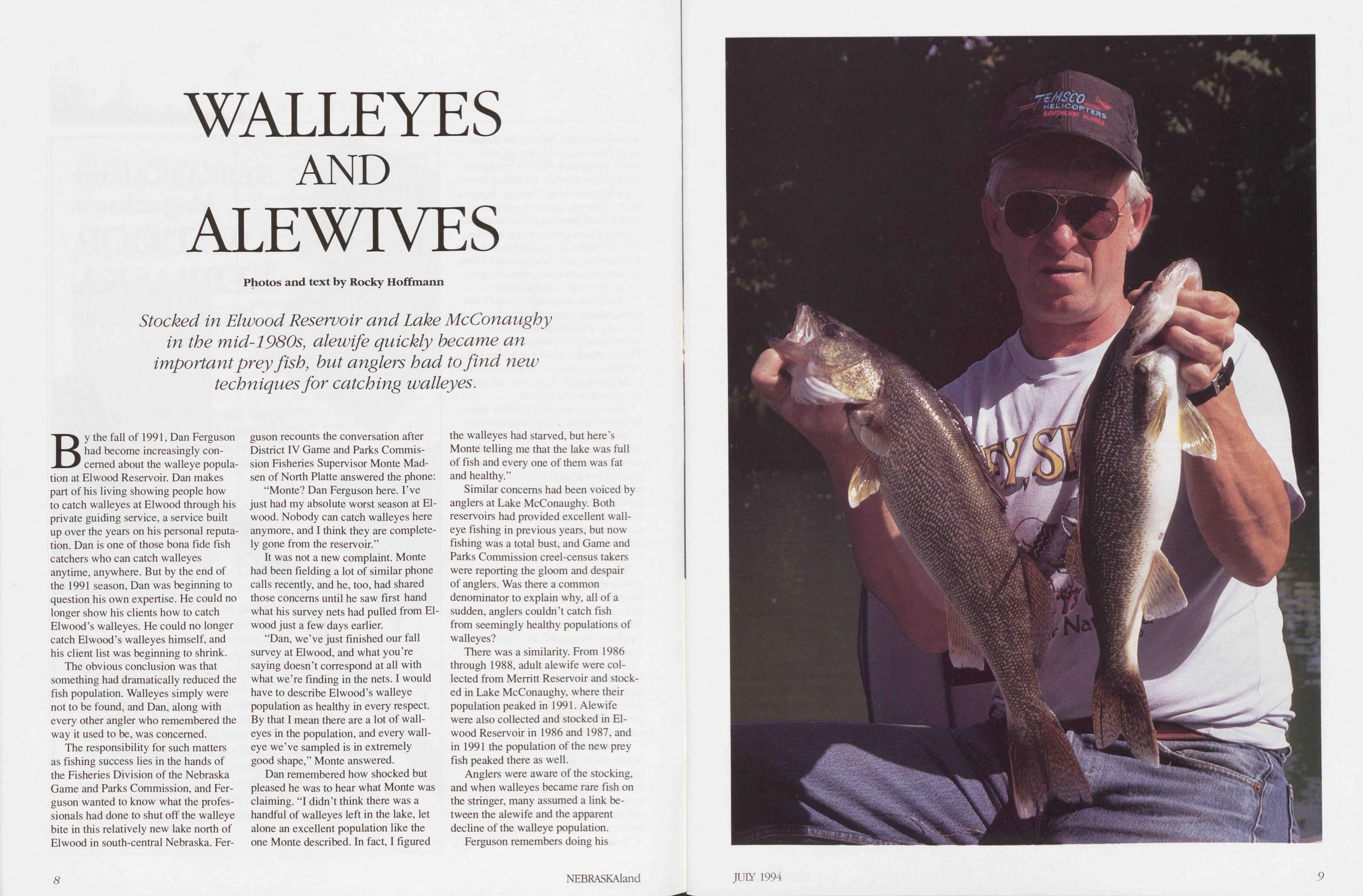
WALLEYES AND ALEWIVES
Stocked in Elwood Reservoir and Lake McConaughy in the mid-1980s, alewife quickly became an important prey fish, but anglers had to find new techniques for catching walleyes.
By the fall of 1991, Dan Ferguson had become increasingly concerned about the walleye population at Elwood Reservoir. Dan makes part of his living showing people how to catch walleyes at Elwood through his private guiding service, a service built up over the years on his personal reputation. Dan is one of those bona fide fish catchers who can catch walleyes anytime, anywhere. But by the end of the 1991 season, Dan was beginning to question his own expertise. He could no longer show his clients how to catch Elwood's walleyes. He could no longer catch Elwood's walleyes himself, and his client list was beginning to shrink.
The obvious conclusion was that something had dramatically reduced the fish population. Walleyes simply were not to be found, and Dan, along with every other angler who remembered the way it used to be, was concerned.
The responsibility for such matters as fishing success lies in the hands of the Fisheries Division of the Nebraska Game and Parks Commission, and Ferguson wanted to know what the profes- sionals had done to shut off the walleye bite in this relatively new lake north of Elwood in south-central Nebraska. Ferguson recounts the conversation after District IV Game and Parks Commission Fisheries Supervisor Monte Madsen of North Platte answered the phone:
"Monte? Dan Ferguson here. I've just had my absolute worst season at Elwood. Nobody can catch walleyes here anymore, and I think they are completely gone from the reservoir."
It was not a new complaint. Monte had been fielding a lot of similar phone calls recently, and he, too, had shared those concerns until he saw first hand what his survey nets had pulled from Elwood just a few days earlier.
"Dan, we've just finished our fall survey at Elwood, and what you're saying doesn't correspond at all with what we're finding in the nets. I would have to describe Elwood's walleye population as healthy in every respect. By that I mean there are a lot of wall- eyes in the population, and every walleye we've sampled is in extremely good shape," Monte answered.
Dan remembered how shocked but pleased he was to hear what Monte was claiming. "I didn't think there was a handful of walleyes left in the lake, let alone an excellent population like the one Monte described. In fact, I figured the walleyes had starved, but here's Monte telling me that the lake was full of fish and every one of them was fat and healthy."
Similar concerns had been voiced by anglers at Lake McConaughy. Both reservoirs had provided excellent walleye fishing in previous years, but now fishing was a total bust, and Game and Parks Commission creel-census takers were reporting the gloom and despair of anglers. Was there a common denominator to explain why, all of a sudden, anglers couldn't catch fish from seemingly healthy populations of walleyes?
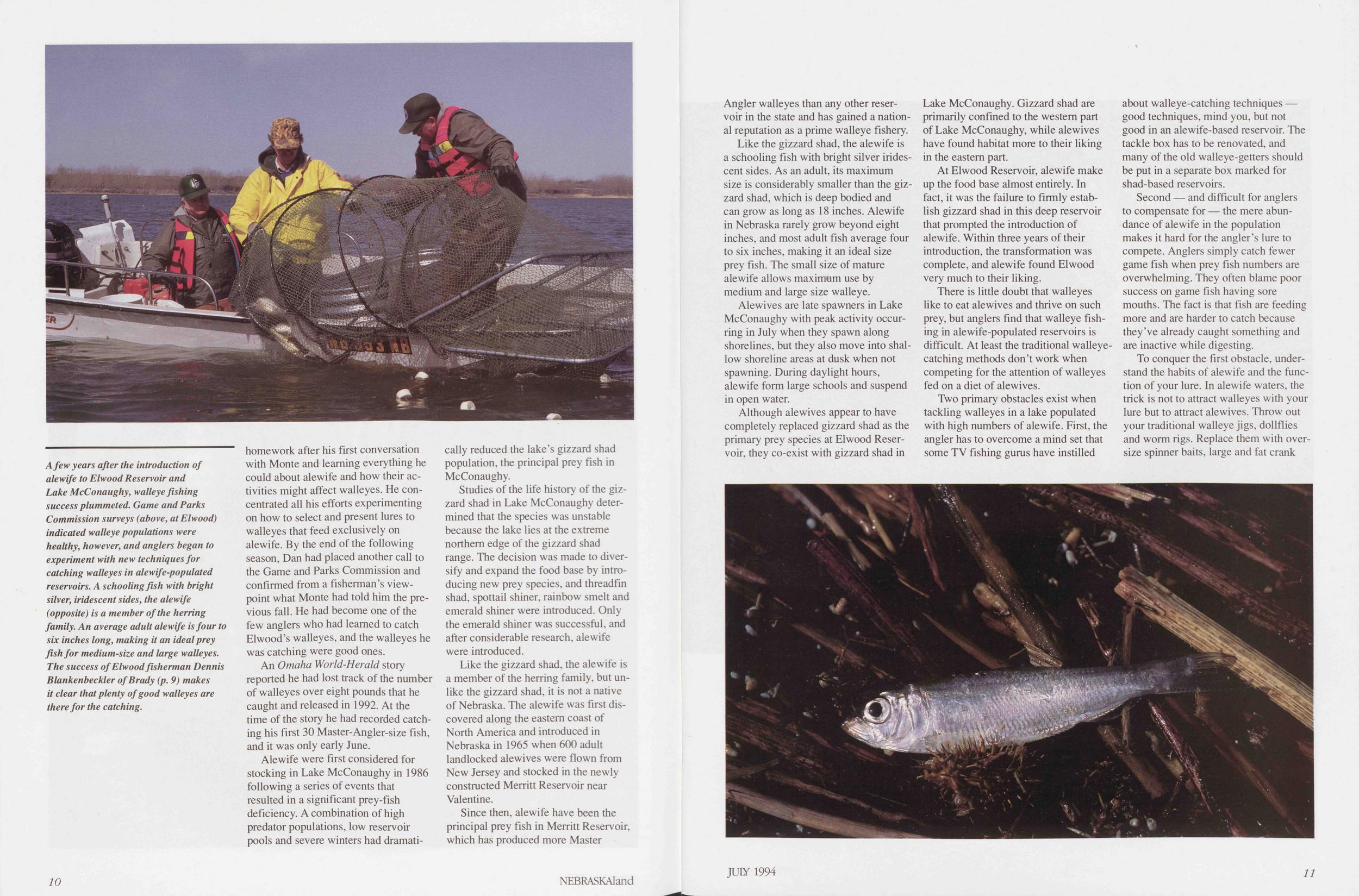
A few years after the introduction of alewife to Elwood Reservoir and Lake McConaughy, walleye fishing success plummeted. Game and Parks Commission surveys (above, at Elwood) indicated walleye populations were healthy, however, and anglers began to experiment with new techniques for catching walleyes in alewife-populated reservoirs. A schooling fish with bright silver, iridescent sides, the alewife (opposite) is a member of the herring family. An average adult alewife is four to six inches long, making it an ideal prey fish for medium-size and large walleyes. The success of Elwood fisherman Dennis Blankenbeckler of Brady (p. 9) makes it clear that plenty of good walleyes are therefor the catching.
An Omaha World-Herald story reported he had lost track of the number of walleyes over eight pounds that he caught and released in 1992. At the time of the story he had recorded catching his first 30 Master-Angler-size fish, and it was only early June.
Alewife were first considered for stocking in Lake McConaughy in 1986 following a series of events that resulted in a significant prey-fish deficiency. A combination of high predator populations, low reservoir pools and severe winters had dramatically 10 reduced the lake's gizzard shad population, the principal prey fish in McConaughy.
Studies of the life history of the gizzard shad in Lake McConaughy determined that the species was unstable because the lake lies at the extreme northern edge of the gizzard shad range. The decision was made to diversify and expand the food base by introducing new prey species, and threadfin shad, spottail shiner, rainbow smelt and emerald shiner were introduced. Only the emerald shiner was successful, and after considerable research, alewife were introduced.
Like the gizzard shad, the alewife is a member of the herring family, but unlike the gizzard shad, it is not a native of Nebraska. The alewife was first discovered along the eastern coast of North America and introduced in Nebraska in 1965 when 600 adult landlocked alewives were flown from New Jersey and stocked in the newly constructed Merritt Reservoir near Valentine.
Since then, alewife have been the principal prey fish in Merritt Reservoir, which has produced more Master NEBRASKAland Angler walleyes than any other reservoir in the state and has gained a national reputation as a prime walleye fishery.
Like the gizzard shad, the alewife is a schooling fish with bright silver iridescent sides. As an adult, its maximum size is considerably smaller than the gizzard shad, which is deep bodied and can grow as long as 18 inches. Alewife in Nebraska rarely grow beyond eight inches, and most adult fish average four to six inches, making it an ideal size prey fish. The small size of mature alewife allows maximum use by medium and large size walleye.
Alewives are late spawners in Lake McConaughy with peak activity occurring in July when they spawn along shorelines, but they also move into shallow shoreline areas at dusk when not spawning. During daylight hours, alewife form large schools and suspend in open water.
Although alewives appear to have completely replaced gizzard shad as the primary prey species at Elwood Reservoir, they co-exist with gizzard shad in Lake McConaughy. Gizzard shad are primarily confined to the western part of Lake McConaughy, while alewives have found habitat more to their liking in the eastern part.
At Elwood Reservoir, alewife make up the food base almost entirely. In fact, it was the failure to firmly establish gizzard shad in this deep reservoir that prompted the introduction of alewife. Within three years of their introduction, the transformation was complete, and alewife found Elwood very much to their liking.
There is little doubt that walleyes like to eat alewives and thrive on such prey, but anglers find that walleye fishing in alewife-populated reservoirs is difficult. At least the traditional walleye- catching methods don't work when competing for the attention of walleyes fed on a diet of alewives.
Two primary obstacles exist when tackling walleyes in a lake populated with high numbers of alewife. First, the angler has to overcome a mind set that some TV fishing gurus have instilled about walleye-catching techniques — good techniques, mind you, but not good in an alewife-based reservoir. The tackle box has to be renovated, and many of the old walleye-getters should be put in a separate box marked for shad-based reservoirs.
Second — and difficult for anglers to compensate for — the mere abundance of alewife in the population makes it hard for the angler's lure to compete. Anglers simply catch fewer game fish when prey fish numbers are overwhelming. They often blame poor success on game fish having sore mouths. The fact is that fish are feeding more and are harder to catch because they've already caught something and are inactive while digesting.
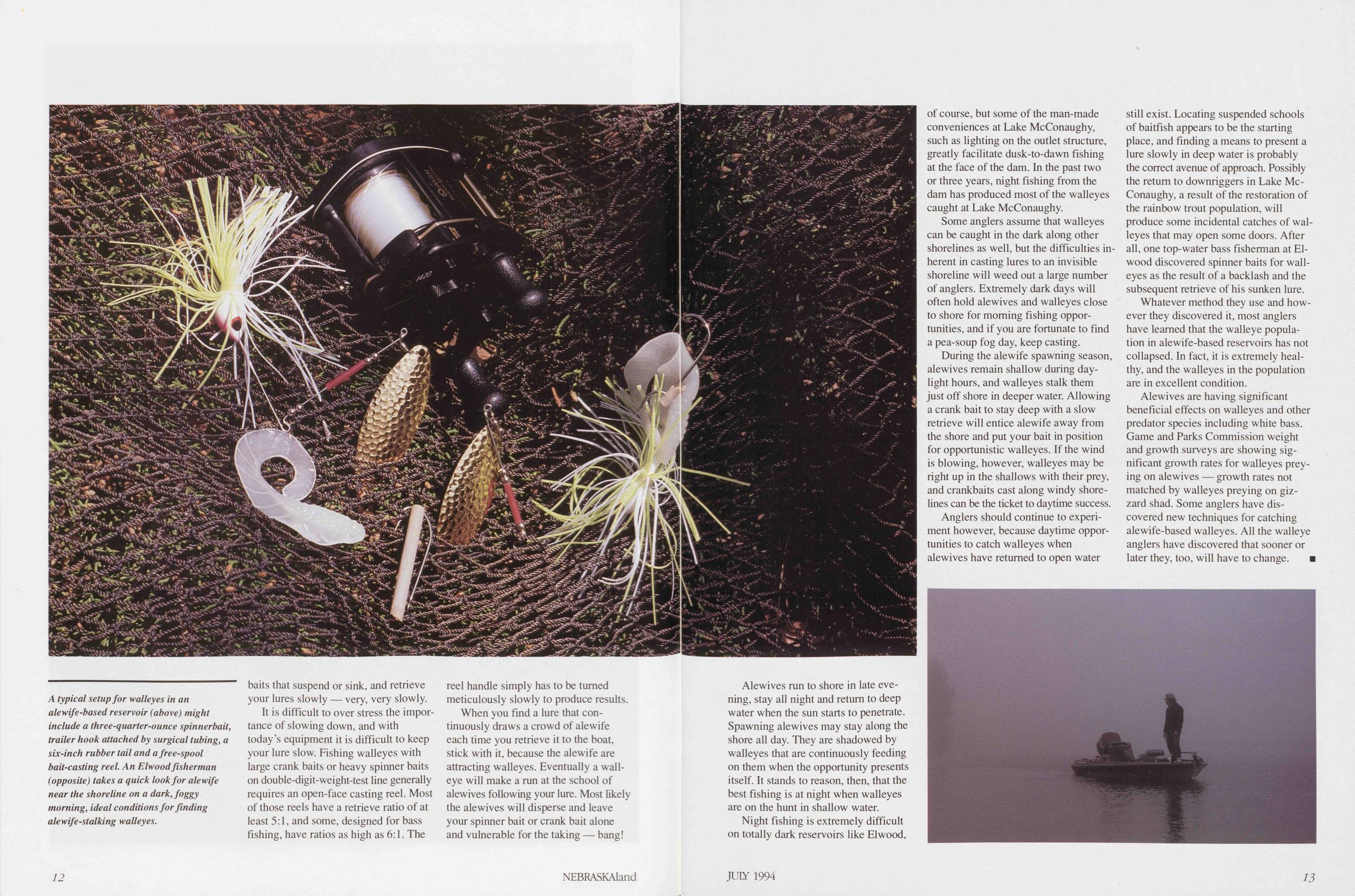
A typical setup for walleyes in an alewife-based reservoir (above) might include a three-quarter-ounce spinnerbait, trailer hook attached by surgical tubing, a six-inch rubber tail and a free-spool bait-casting reel. An Elwoodfisherman (opposite) takes a quick look for alewife near the shoreline on a dark, foggy morning, ideal conditions for finding ale wife-stalking walleyes.
It is difficult to over stress the importance of slowing down, and with today's equipment it is difficult to keep your lure slow. Fishing walleyes with large crank baits or heavy spinner baits on double-digit-weight-test line generally requires an open-face casting reel. Most of those reels have a retrieve ratio of at least 5:1, and some, designed for bass fishing, have ratios as high as 6:1. The reel handle simply has to be turned meticulously slowly to produce results.
When you find a lure that continuously draws a crowd of alewife each time you retrieve it to the boat, stick with it, because the alewife are attracting walleyes. Eventually a walleye will make a run at the school of alewives following your lure. Most likely the alewives will disperse and leave your spinner bait or crank bait alone and vulnerable for the taking — bang!
Alewives run to shore in late evening, stay all night and return to deep water when the sun starts to penetrate. Spawning alewives may stay along the shore all day. They are shadowed by walleyes that are continuously feeding on them when the opportunity presents itself. It stands to reason, then, that the best fishing is at night when walleyes are on the hunt in shallow water.
Night fishing is extremely difficult on totally dark reservoirs like Elwood, of course, but some of the man-made conveniences at Lake McConaughy, such as lighting on the outlet structure, greatly facilitate dusk-to-dawn fishing at the face of the dam. In the past two or three years, night fishing from the dam has produced most of the walleyes caught at Lake McConaughy.
Some anglers assume that walleyes can be caught in the dark along other shorelines as well, but the difficulties inherent in casting lures to an invisible shoreline will weed out a large number of anglers. Extremely dark days will often hold alewives and walleyes close to shore for morning fishing oppor- tunities, and if you are fortunate to find a pea-soup fog day, keep casting.
During the alewife spawning season, alewives remain shallow during day- light hours, and walleyes stalk them just off shore in deeper water. Allowing a crank bait to stay deep with a slow retrieve will entice alewife away from the shore and put your bait in position for opportunistic walleyes. If the wind is blowing, however, walleyes may be right up in the shallows with their prey, and crankbaits cast along windy shorelines can be the ticket to daytime success.
Anglers should continue to experi- ment however, because daytime opportunities to catch walleyes when alewives have returned to open water still exist. Locating suspended schools of baitfish appears to be the starting place, and finding a means to present a lure slowly in deep water is probably the correct avenue of approach. Possibly the return to downriggers in Lake McConaughy, a result of the restoration of the rainbow trout population, will produce some incidental catches of walleyes that may open some doors. After all, one top-water bass fisherman at Elwood discovered spinner baits for walleyes as the result of a backlash and the subsequent retrieve of his sunken lure.
Whatever method they use and however they discovered it, most anglers have learned that the walleye population in alewife-based reservoirs has not collapsed. In fact, it is extremely healthy, and the walleyes in the population are in excellent condition.
Alewives are having significant beneficial effects on walleyes and other predator species including white bass. Game and Parks Commission weight and growth surveys are showing significant growth rates for walleyes preying on alewives — growth rates not matched by walleyes preying on gizzard shad. Some anglers have discovered new techniques for catching alewife-based walleyes. All the walleye anglers have discovered that sooner or later they, too, will have to change. ■
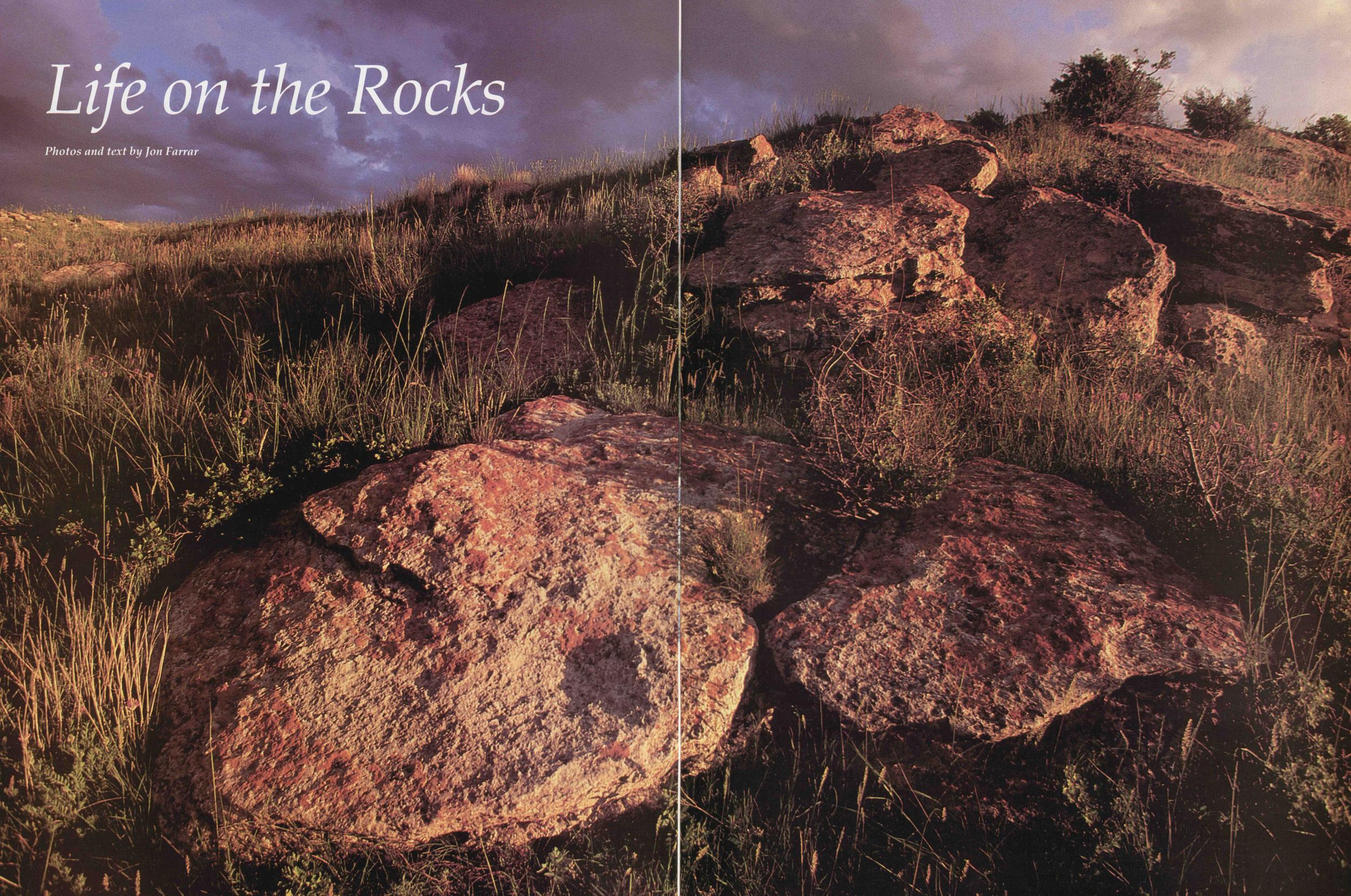
Life on the Rocks
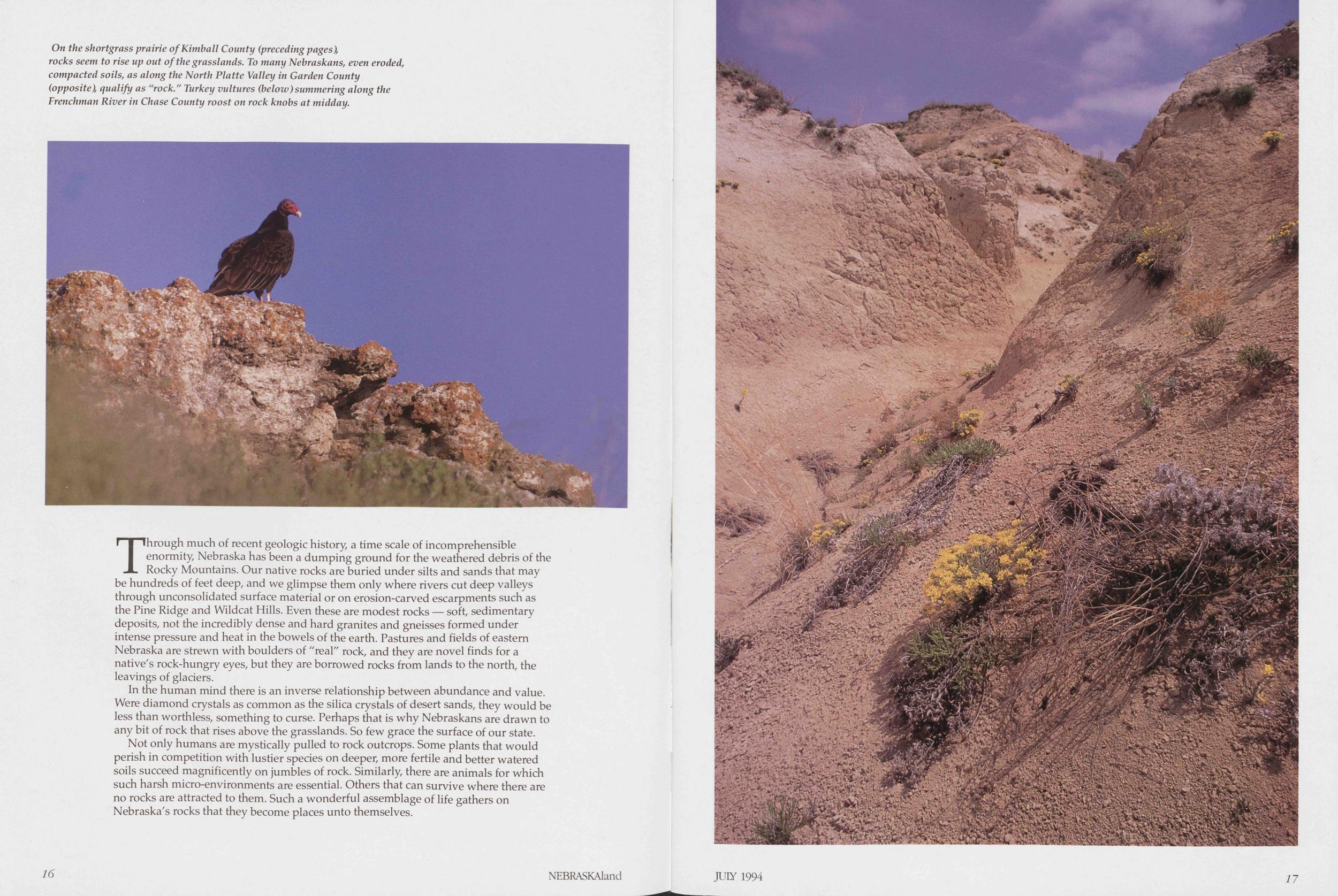
On the shortgrass prairie of Kimball County (preceding pages), rocks seem to rise up out of the grasslands. To many Nebraskans, even eroded, compacted soils, as along the North Platte Valley in Garden County (opposite), qualify as "rock." Turkey vultures (below)summering along the Frenchman River in Chase County roost on rock knobs at midday.
Through much of recent geologic history, a time scale of incomprehensible enormity, Nebraska has been a dumping ground for the weathered debris of the Rocky Mountains. Our native rocks are buried under silts and sands that may be hundreds of feet deep, and we glimpse them only where rivers cut deep valleys through unconsolidated surface material or on erosion-carved escarpments such as the Pine Ridge and Wildcat Hills. Even these are modest rocks — soft, sedimentary deposits, not the incredibly dense and hard granites and gneisses formed under intense pressure and heat in the bowels of the earth. Pastures and fields of eastern Nebraska are strewn with boulders of "real" rock, and they are novel finds for a native's rock-hungry eyes, but they are borrowed rocks from lands to the north, the leavings of glaciers.
In the human mind there is an inverse relationship between abundance and value. Were diamond crystals as common as the silica crystals of desert sands, they would be less than worthless, something to curse. Perhaps that is why Nebraskans are drawn to any bit of rock that rises above the grasslands. So few grace the surface of our state. Not only humans are mystically pulled to rock outcrops. Some plants that would perish in competition with lustier species on deeper, more fertile and better watered soils succeed magnificently on jumbles of rock. Similarly, there are animals for which such harsh micro-environments are essential. Others that can survive where there are no rocks are attracted to them. Such a wonderful assemblage of life gathers on Nebraska's rocks that they become places unto themselves.
16 NEBRASKAland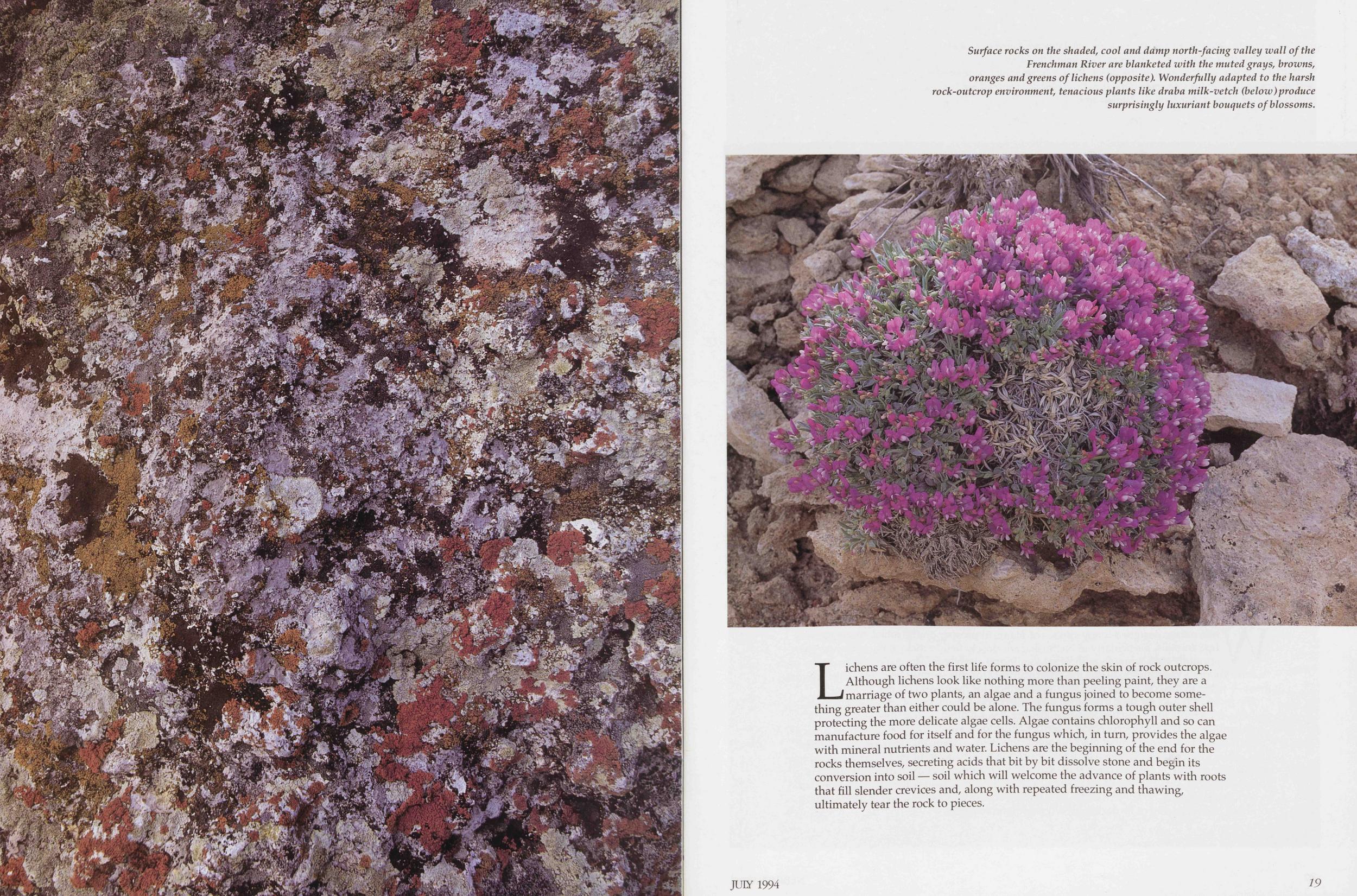
Surface rocks on the shaded, cool and damp north-facing valley wall of the Frenchman River are blanketed with the muted grays, browns, oranges and greens of lichens (opposite). Wonderfully adapted to the harsh rock-outcrop environment, tenacious plants like draba milk-vetch (below)produce surprisingly luxuriant bouquets of blossoms.
Lichens are often the first life forms to colonize the skin of rock outcrops. Although lichens look like nothing more than peeling paint, they are a marriage of two plants, an algae and a fungus joined to become something greater than either could be alone. The fungus forms a tough outer shell protecting the more delicate algae cells. Algae contains chlorophyll and so can manufacture food for itself and for the fungus which, in turn, provides the algae with mineral nutrients and water. Lichens are the beginning of the end for the rocks themselves, secreting acids that bit by bit dissolve stone and begin its conversion into soil — soil which will welcome the advance of plants with roots that fill slender crevices and, along with repeated freezing and thawing, ultimately tear the rock to pieces.
JULY 1994 19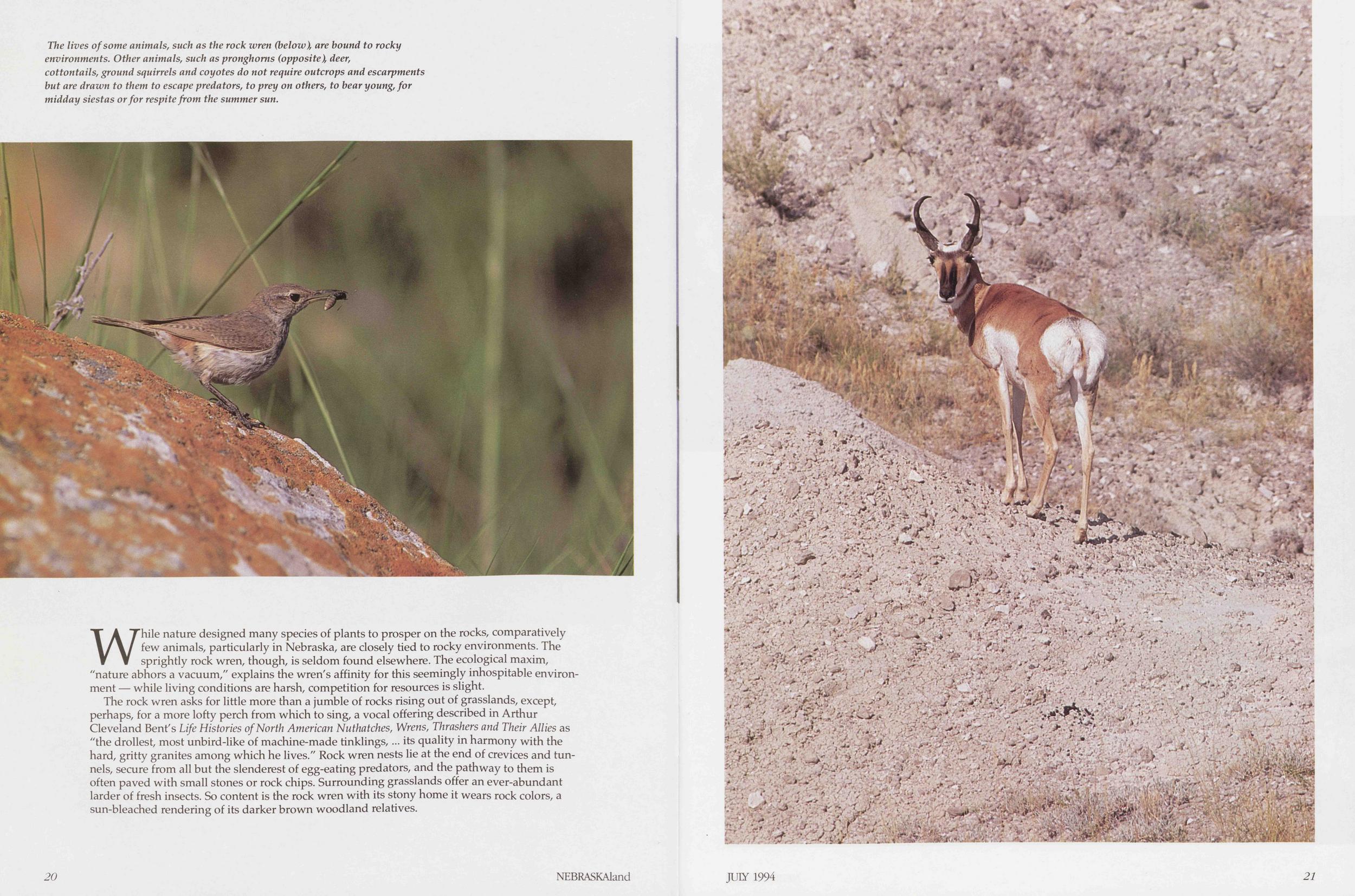
The lives of some animals, such as the rock wren (below), are bound to rocky environments. Other animals, such as pronghorns (opposite), deer, cottontails, ground squirrels and coyotes do not require outcrops and escarpments but are drawn to them to escape predators, to prey on others, to bear young, for midday siestas or for respite from the summer sun.
While nature designed many species of plants to prosper on the rocks, comparatively few animals, particularly in Nebraska, are closely tied to rocky environments. The sprightly rock wren, though is seldom found elsewhere. The ecological maxim, "nature abhors a vacuum," explains the wren's affinity for this seemingly inhospitable environment — while living conditions are harsh, competition for resources is slight.
The rock wren asks for little more than a jumble of rocks rising out of grasslands, except, perhaps, for a more lofty perch from which to sing, a vocal offering described in Arthur Cleveland Bent's Life Histories of North American Nuthatches, Wrens, Thrashers and Their Allies as "the frollest, most unbird-like of machine-made tinklings, . . . its quality in harmony with the hard, gritty granites among which he lives." Rock wren nests lie at the end of crevices and tunnels, secure from all but the slenderest of egg-eating predators, and the pathway to them is often paved with small stones or rock chips. Surrounding grasslands offer an ever-abundant larder of fresh insects. So content is the rock wren with its stony home it wears rock colors, a sun-bleached rendering of its darker brown woodland relatives.
20 NEBRASKAland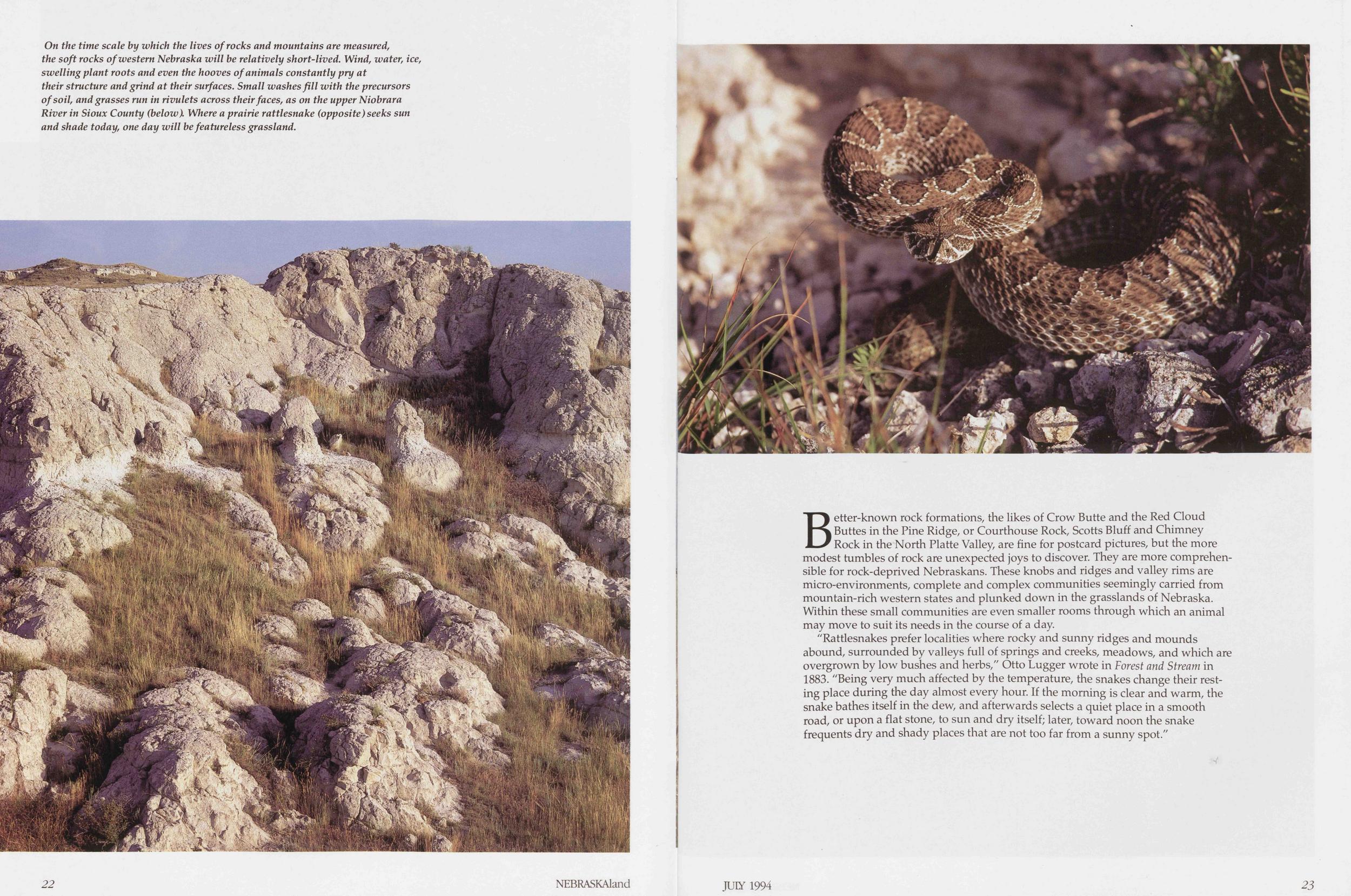
On the time scale by which the lives of rocks and mountains are measured, the soft rocks of western Nebraska will be relatively short-lived. Wind, water, ice, swelling plant roots and even the hooves of animals constantly pry at their structure and grind at their surfaces. Small washes fill with the precursors of soil, and grasses run in rivulets across their faces, as on the upper Niobrara River in Sioux County (below). Where a prairie rattlesnake (opposite) seeks sun and shade today, one day will be featureless grassland.
Better-known rock formations, the likes of Crow Butte and the Red Cloud Buttes in the Pine Ridge, or Courthouse Rock, Scotts Bluff and Chimney Rock in the North Platte Valley, are fine for postcard pictures, but the more modest tumbles of rock are unexpected joys to discover. They are more comprehen- sible for rock-deprived Nebraskans. These knobs and ridges and valley rims are micro-environments, complete and complex communities seemingly carried from mountain-rich western states and plunked down in the grasslands of Nebraska. Within these small communities are even smaller rooms through which an animal may move to suit its needs in the course of a day.
"Rattlesnakes prefer localities where rocky and sunny ridges and mounds abound, surrounded by valleys full of springs and creeks, meadows, and which are overgrown by low bushes and herbs," Otto Lugger wrote in Forest and Stream in 1883. "Being very much affected by the temperature, the snakes change their rest- ing place during the day almost every hour. If the morning is clear and warm, the snake bathes itself in the dew, and afterwards selects a quiet place in a smooth road, or upon a flat stone, to sun and dry itself; later, toward noon the snake frequents dry and shady places that are not too far from a sunny spot."
JULY 1994 23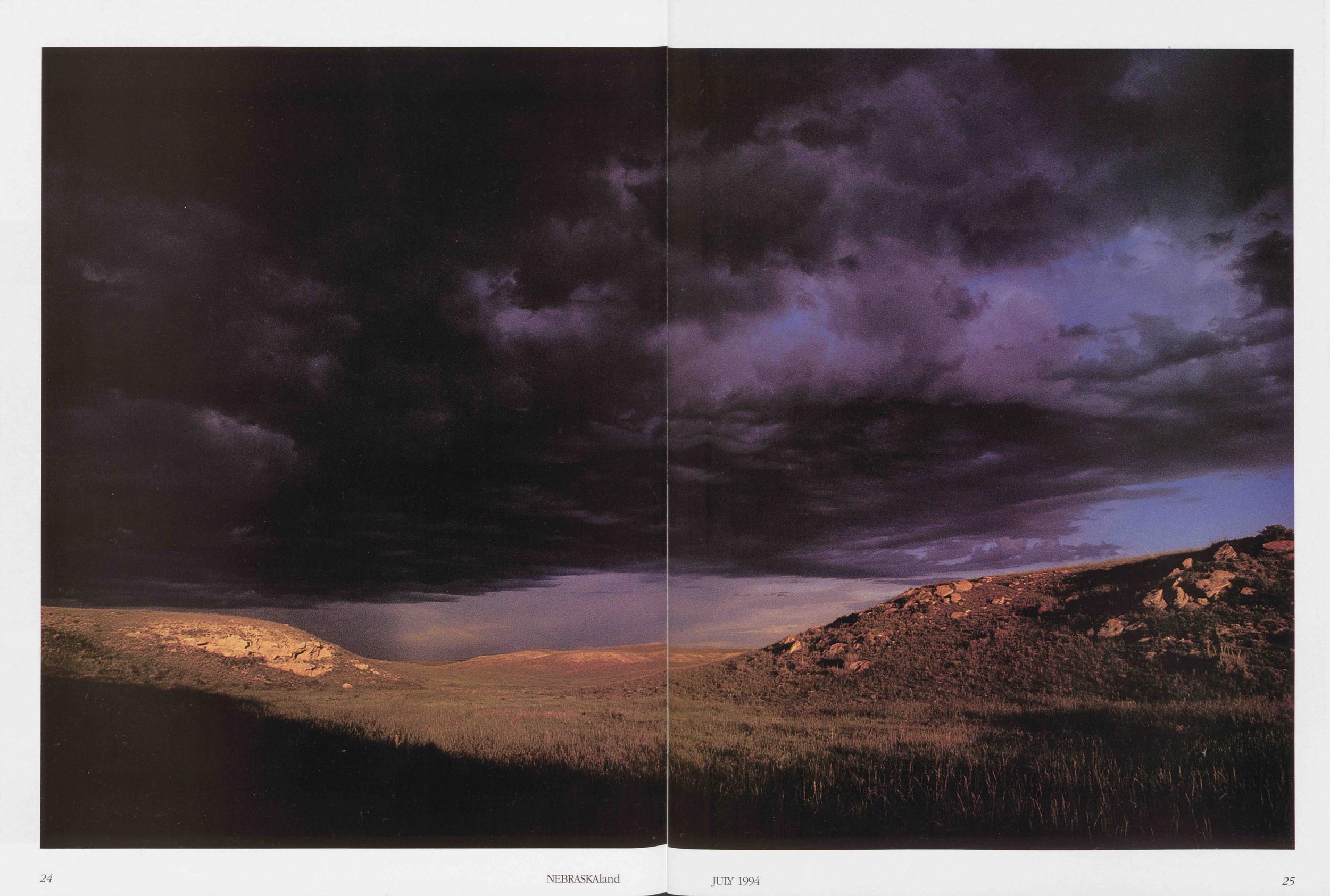
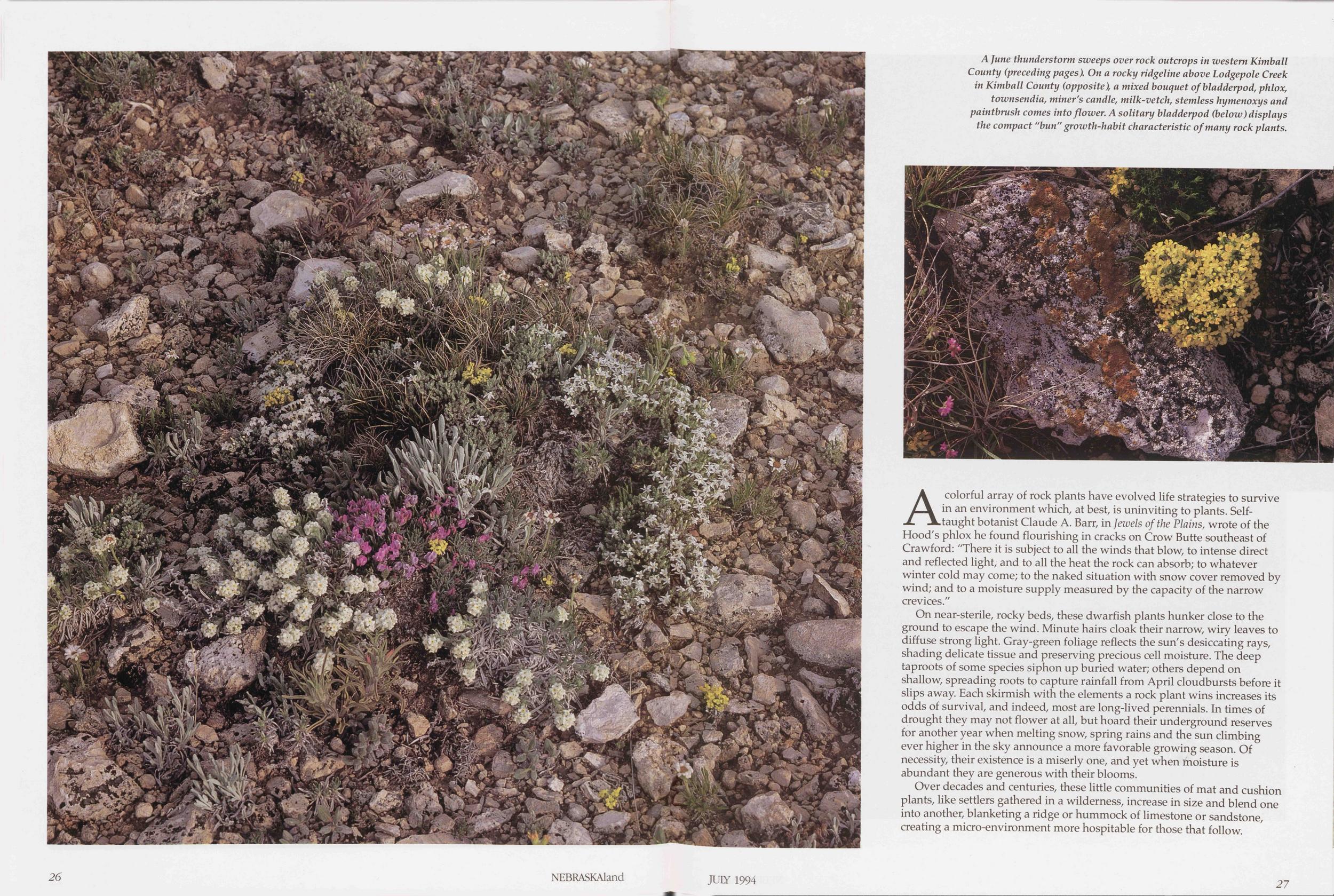
A June thunderstorm sweeps over rock outcrops in western Kimball County (precedingpages). On a rocky ridgeline above Lodgepole Creek in Kimball County (opposite), a mixed bouquet ofbladderpod, phlox, townsendia, miner's candle, milk-vetch, stemless hymenoxys and paintbrush comes into flower. A solitary bladderpod (below) displays the compact "bun" growth-habit characteristic of many rock plants.
A colorful array of rock plants have evolved life strategies to survive in an environment which, at best, is uninviting to plants. Self- taught botanist Claude A. Barr, in Jewels of the Plains, wrote of the Hood's phlox he found flourishing in cracks on Crow Butte southeast of Crawford: "There it is subject to all the winds that blow, to intense direct and reflected light, and to all the heat the rock can absorb; to whatever winter cold may come; to the naked situation with snow cover removed by wind; and to a moisture supply measured by the capacity of the narrow crevices."
On near-sterile, rocky beds, these dwarfish plants hunker close to the ground to escape the wind. Minute hairs cloak their narrow, wiry leaves to diffuse strong light. Gray-green foliage reflects the sun's desiccating rays, shading delicate tissue and preserving precious cell moisture. The deep taproots of some species siphon up buried water; others depend on shallow, spreading roots to capture rainfall from April cloudbursts before it slips away. Each skirmish with the elements a rock plant wins increases its odds of survival, and indeed, most are long-lived perennials. In times of drought they may not flower at all, but hoard their underground reserves for another year when melting snow, spring rains and the sun climbing ever higher in the sky announce a more favorable growing season. Of necessity, their existence is a miserly one, and yet when moisture is abundant they are generous with their blooms.
Over decades and centuries, these little communities of mat and cushion plants, like settlers gathered in a wilderness, increase in size and blend one into another, blanketing a ridge or hummock of limestone or sandstone, creating a micro-environment more hospitable for those that follow.
26 NEBRASKAland JULY 1994 27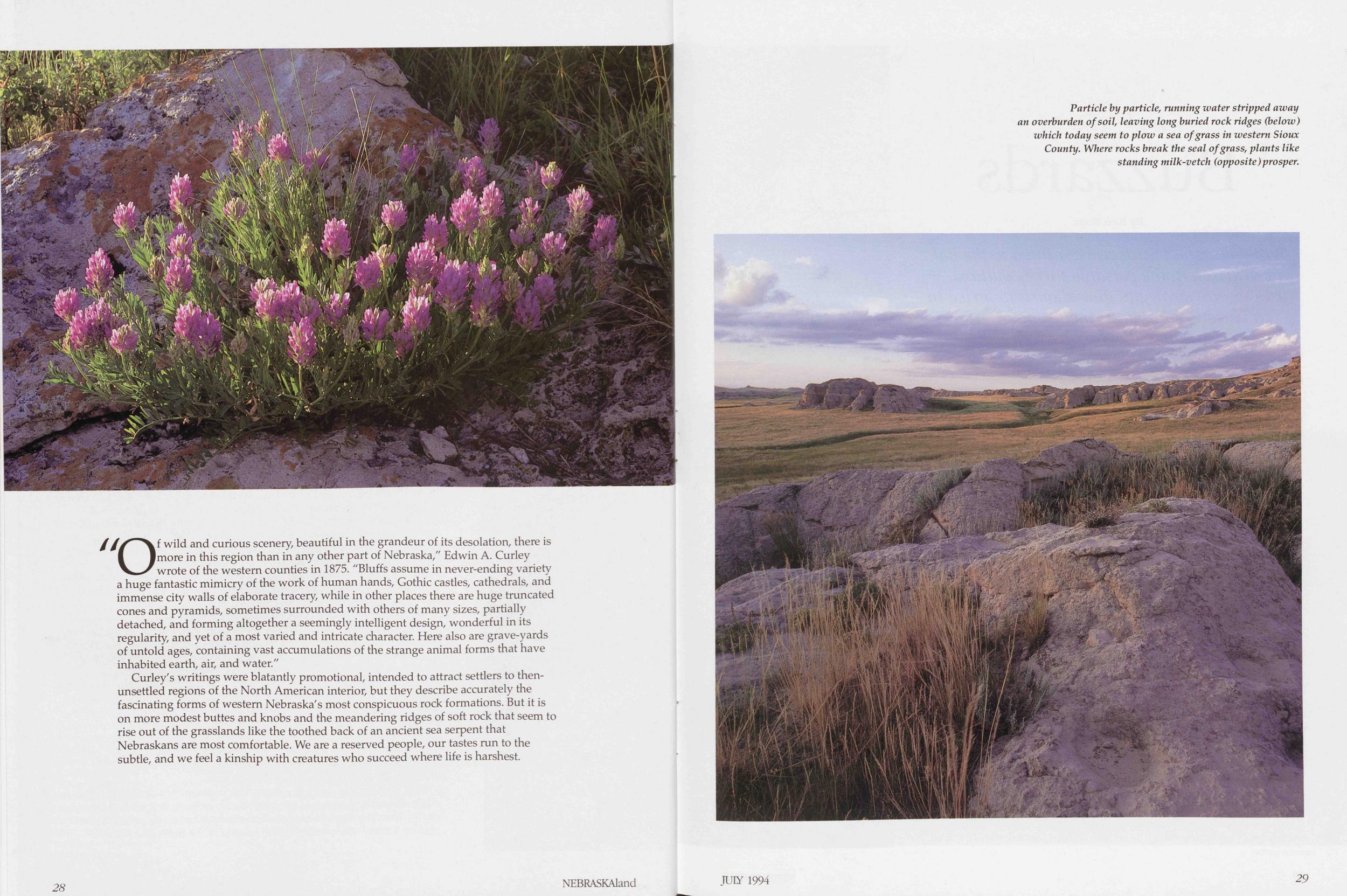
Of wild and curious scenery, beautiful in the grandeur of its desolation, there is more in this region than in any other part of Nebraska," Edwin A. Curley wrote of the western counties in 1875. "Bluffs assume in never-ending variety a huge fantastic mimicry of the work of human hands, Gothic castles, cathedrals, and immense city walls of elaborate tracery, while in other places there are huge truncated cones and pyramids, sometimes surrounded with others of many sizes, partially detached, and forming altogether a seemingly intelligent design, wonderful in its regularity, and yet of a most varied and intricate character. Here also are grave-yards of untold ages, containing vast accumulations of the strange animal forms that have inhabited earth, air, and water."
Curley's writings were blatantly promotional, intended to attract settlers to then-unsettled regions of the North American interior, but they describe accuragely the fascinating forms of western Nebraska's most conspicuous rock formations. But it is on more modest buttes and knobw and the meandering ridges of soft rock that seem to rise out of the grasslands like the toothed back of an ancient sea sperpent that Nebraskans are most comfortable. We are a reserved people, our tastes run to the subtle, and we feel a kinship with creatures who succeed where life is harshest.
28 NEBRASKAlandParticle by particle, running water stripped away an overburden of soil, leaving long buried rock ridges (below) which today seem to plow a sea of grass in western Sioux County. Where rocks break the seal of grass, plants like standing milk-vetch (opposite) propser.
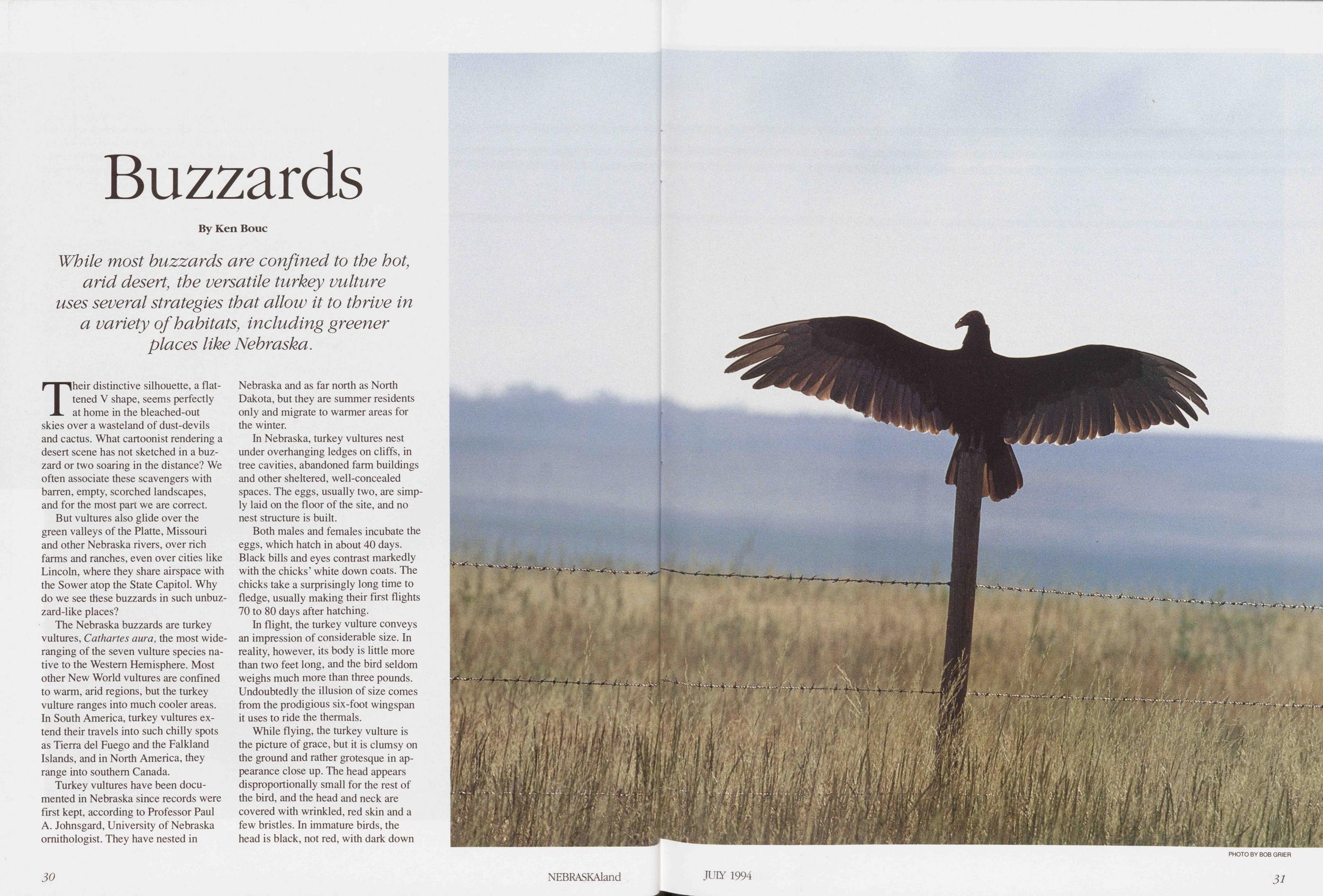
Buzzards
While most buzzards are confined to the hot, arid desert, the versatile turkey vulture uses several strategies that allow it to thrive in a variety of habitats, including greener places like Nebraska.
Their distinctive silhouette, a flattened V shape, seems perfectly at home in the bleached-out skies over a wasteland of dust-devils and cactus. What cartoonist rendering a desert scene has not sketched in a buzzard or two soaring in the distance? We often associate these scavengers with barren, empty, scorched landscapes, and for the most part we are correct.
But vultures also glide over the green valleys of the Platte, Missouri and other Nebraska rivers, over rich farms and ranches, even over cities like Lincoln, where they share airspace with the Sower atop the State Capitol. Why do we see these buzzards in such unbuzzard-like places?
The Nebraska buzzards are turkey vultures, Cathartes aura, the most wide-ranging of the seven vulture species native to the Western Hemisphere. Most other New World vultures are confined to warm, arid regions, but the turkey vulture ranges into much cooler areas. In South America, turkey vultures extend their travels into such chilly spots as Tierra del Fuego and the Falkland Islands, and in North America, they range into southern Canada.
Turkey vultures have been documented in Nebraska since records were first kept, according to Professor Paul A. Johnsgard, University of Nebraska ornithologist. They have nested in Nebraska and as far north as North Dakota, but they are summer residents only and migrate to warmer areas for the winter.
In Nebraska, turkey vultures nest under overhanging ledges on cliffs, in tree cavities, abandoned farm buildings and other sheltered, well-concealed spaces. The eggs, usually two, are simply laid on the floor of the site, and no nest structure is built.
Both males and females incubate the eggs, which hatch in about 40 days. Black bills and eyes contrast markedly with the chicks' white down coats. The chicks take a surprisingly long time to fledge, usually making their first flights 70 to 80 days after hatching.
In flight, the turkey vulture conveys an impression of considerable size. In reality, however, its body is little more than two feet long, and the bird seldom weighs much more than three pounds. Undoubtedly the illusion of size comes from the prodigious six-foot wingspan it uses to ride the thermals.
While flying, the turkey vulture is the picture of grace, but it is clumsy on the ground and rather grotesque in appearance close up. The head appears disproportionally small for the rest of the bird, and the head and neck are covered with wrinkled, red skin and a few bristles. In immature birds, the head is black, not red, with dark down 30 NEBRASKAland
 instead of bristles. The beak is black in
the young buzzard, and white in the
adult.
instead of bristles. The beak is black in
the young buzzard, and white in the
adult.
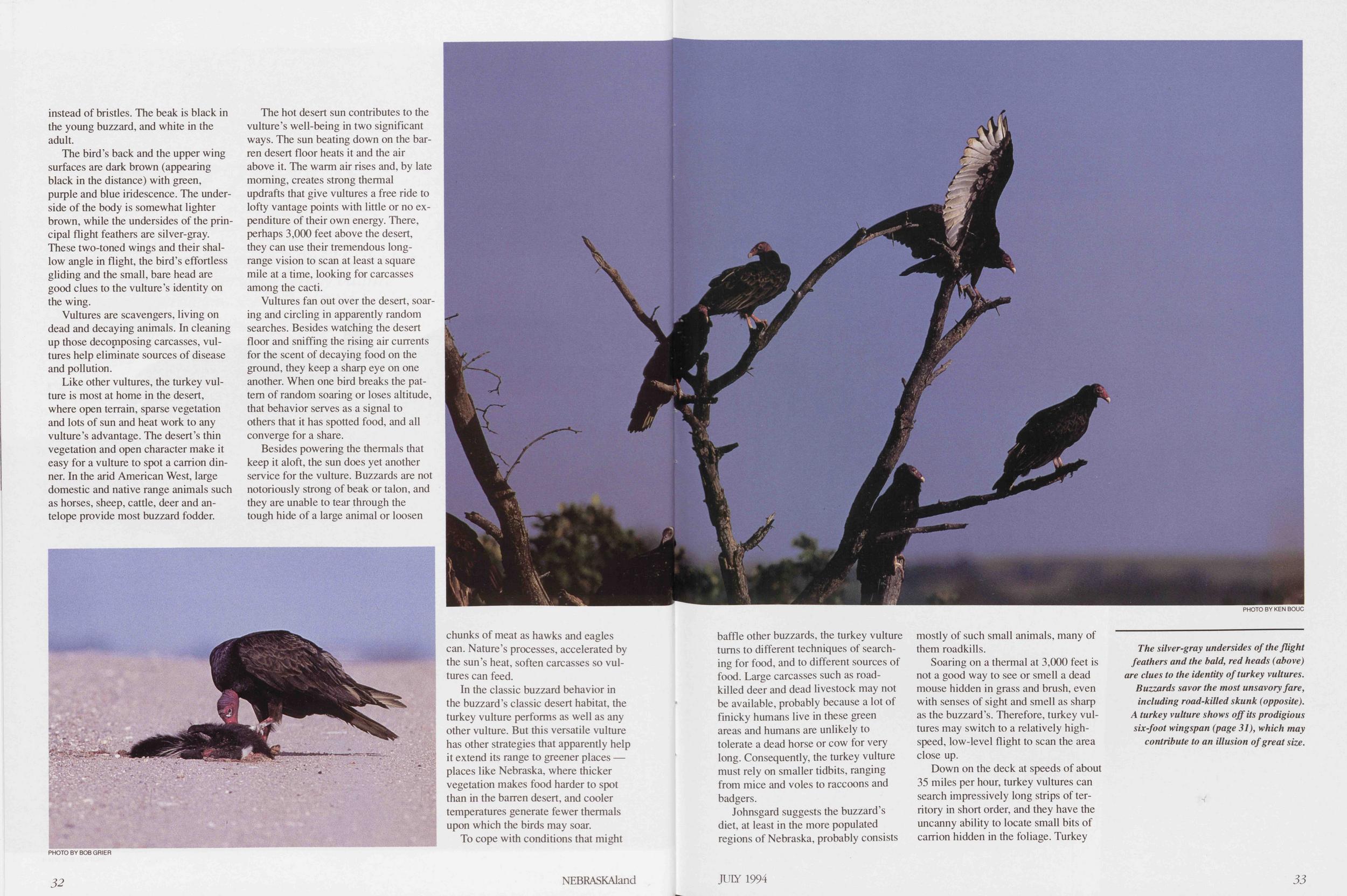
The bird's back and the upper wing surfaces are dark brown (appearing black in the distance) with green, purple and blue iridescence. The underside of the body is somewhat lighter brown, while the undersides of the principal flight feathers are silver-gray. These two-toned wings and their shallow angle in flight, the bird's effortless gliding and the small, bare head are good clues to the vulture's identity on the wing.
Vultures are scavengers, living on dead and decaying animals. In cleaning up those decopposing carcasses, vultures help eliminate sources of disease and pollution.
Like other vultures, the turkey vulture is most at home in the desert, where open terrain, sparse vegetation and lots of sun and heat work to any vulture's advantage. The desert's thin vegetation and open character make it easy for a vulture to spot a carrion dinner. In the arid American West, large domestic and native range animals such as horses, sheep, cattle, deer and antelope provide most buzzard fodder. The hot desert sun contributes to the vulture's well-being in two significant ways. The sun beating down on the barren desert floor heats it and the air above it. The warm air rises and, by late morning, creates strong thermal updrafts that give vultures a free ride to lofty vantage points with little or no expenditure of their own energy. There, perhaps 3,000 feet above the desert, they can use their tremendous long-range vision to scan at least a square mile at a time, looking for carcasses among the cacti.
Vultures fan out over the desert, soaring and circling in apparently random searches. Besides watching the desert floor and sniffing the rising air currents for the scent of decaying food on the ground, they keep a sharp eye on one another. When one bird breaks the pattern of random soaring or loses altitude, that behavior serves as a signal to others that it has spotted food, and all converge for a share.
Besides powering the thermals that keep it aloft, the sun does yet another service for the vulture. Buzzards are not notoriously strong of beak or talon, and they are unable to tear through the tough hide of a large animal or loosen
In the classic buzzard behavior in the buzzard's classic desert habitat, the turkey vulture performs as well as any other vulture. But this versatile vulture has other strategies that apparently help it extend its range to greener places — places like Nebraska, where thicker vegetation makes food harder to spot than in the barren desert, and cooler temperatures generate fewer thermals upon which the birds may soar.
To cope with conditions that might baffle other buzzards, the turkey vulture turns to different techniques of searching for food, and to different sources of food. Large carcasses such as road-killed deer and dead livestock may not be available, probably because a lot of finicky humans live in these green areas and humans are unlikely to tolerate a dead horse or cow for very long. Consequently, the turkey vulture must rely on smaller tidbits, ranging from mice and voles to raccoons and badgers.
Johnsgard suggests the buzzard's diet, at least in the more populated regions of Nebraska, probably consists mostly of such small animals, many of them roadkills.
Soaring on a thermal at 3,000 feet is not a good way to see or smell a dead mouse hidden in grass and brush, even with senses of sight and smell as sharp as the buzzard's. Therefore, turkey vultures may switch to a relatively high-speed, low-level flight to scan the area close up.
Down on the deck at speeds of about 35 miles per hour, turkey vultures can search impressively long strips of territory in short order, and they have the uncanny ability to locate small bits of carrion hidden in the foliage. Turkey
The silver-gray undersides of the flight feathers and the bald, red heads (above) are clues to the identity of turkey vultures. Buzzards savor the most unsavory fare, including road-killed skunk (opposite). A turkey vulture shows off its prodigious six-foot wingspan (page 31), which may contribute to an illusion of great size.
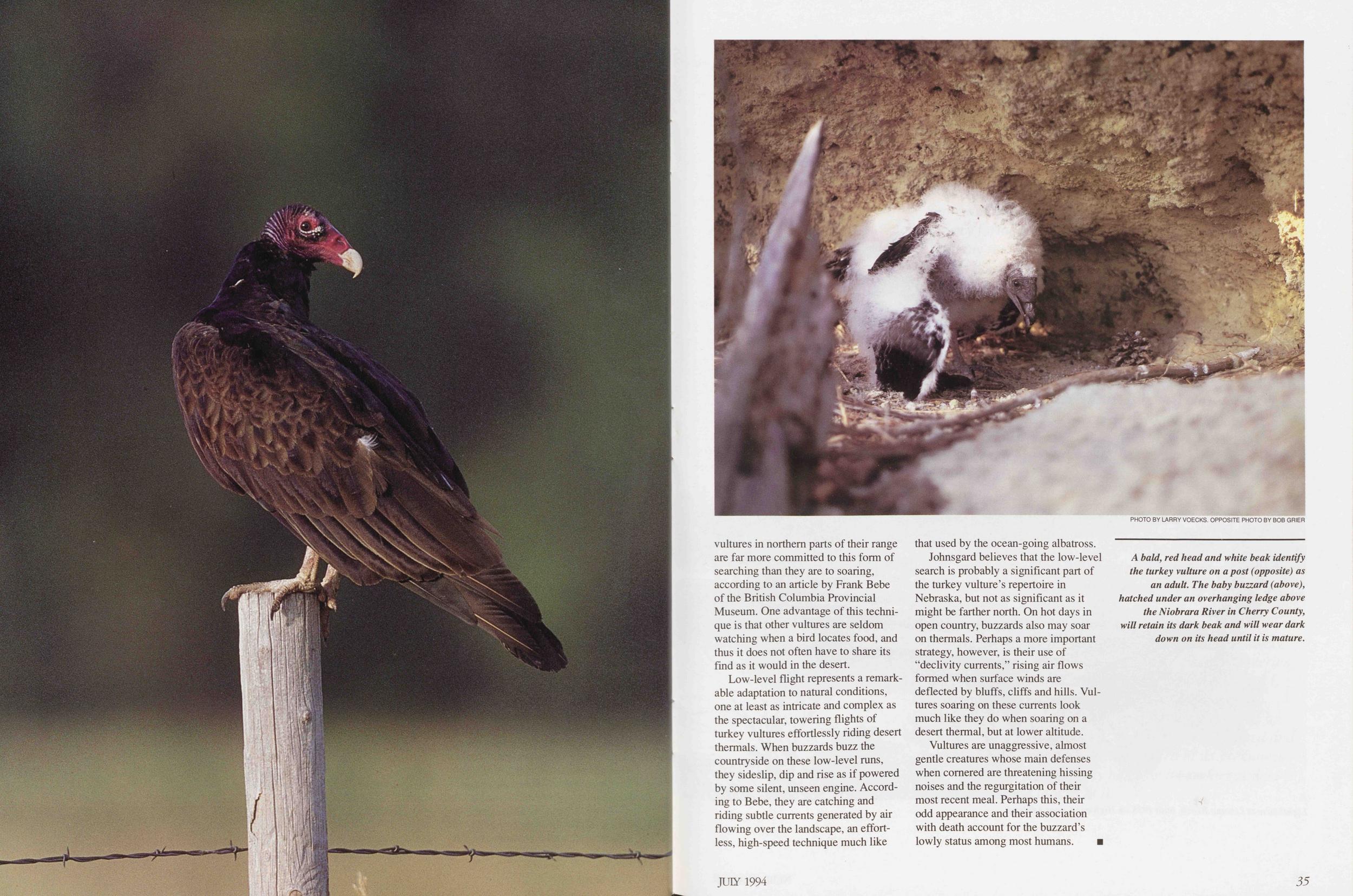
A bald, red head and white beak identify the turkey vulture on a post (opposite) as an adult. The baby buzzard (above), hatched under an overhanging ledge above the Niobrara River in Cherry County, will retain its dark beak and will wear dark down on its head until it is mature.
vultures in northern parts of their range are far more committed to this form of searching than they are to soaring, according to an article by Frank Bebe of the British Columbia Provincial Museum. One advantage of this technique is that other vultures are seldom watching when a bird locates food, and thus it does not often have to share its find as it would in the desert.
Low-level flight represents a remarkable adaptation to natural conditions, one at least as intricate and complex as the spectacular, towering flights of turkey vultures effortlessly riding desert thermals. When buzzards buzz the countryside on these low-level runs, they sideslip, dip and rise as if powered by some silent, unseen engine. According to Bebe, they are catching and riding subtle currents generated by air flowing over the landscape, an effortless, high-speed technique much like that used by the ocean-going albatross.
Johnsgard believes that the low-level search is probably a significant part of the turkey vulture's repertoire in Nebraska, but not as significant as it might be farther north. On hot days in open country, buzzards also may soar on thermals. Perhaps a more important strategy, however, is their use of "declivity currents," rising air flows formed when surface winds are deflected by bluffs, cliffs and hills. Vultures soaring on these currents look much like they do when soaring on a desert thermal, but at lower altitude. Vultures are unaggressive, almost gentle creatures whose main defenses when cornered are threatening hissing noises and the regurgitation of their most recent meal. Perhaps this, their odd appearance and their association with death account for the buzzard's lowly status among most humans.
JULY 199435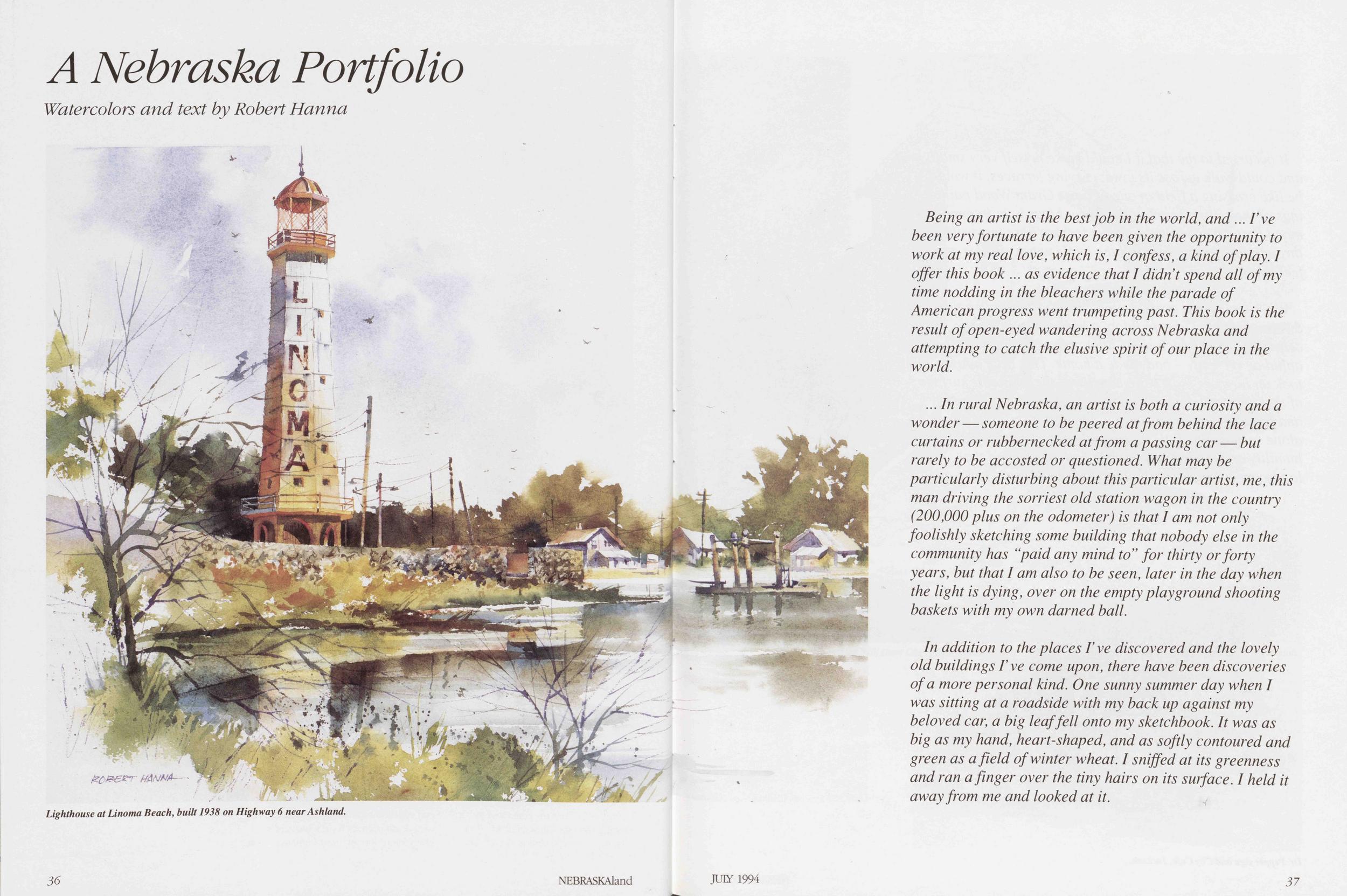
A Nebraska Portfolio
Lighthouse at Linoma Beach, built 1938 on Highway 6 near Ashland.
Being an artist is the best job in the world, and ... I've been very fortunate to have been given the opportunity to work at my real love, which is, I confess, a kind of play. I offer this book ...as evidence that I didn't spend all of my time nodding in the bleachers while the parade of American progress went trumpeting past. This book is the result of open-eyed wandering across Nebraska and attempting to catch the elusive spirit of our place in the world.
...In rural Nebraska, an artist is both a curiosity and a wonder — someone to be peered at from behind the lace curtains or rubbernecked at from a passing car — but rarely to be accosted or questioned. What may be particularly disturbing about this particular artist, me, this man driving the sorriest old station wagon in the country (200,000 plus on the odometer) is that I am not only foolishly sketching some building that nobody else in the community has "paid any mind to" for thirty or forty years, but that I am also to be seen, later in the day when the light is dying, over on the empty playground shooting baskets with my own darned ball.
In addition to the places I've discovered and the lovely old buildings I've come upon, there have been discoveries of a more personal kind. One sunny summer day when I was sitting at a roadside with my back up against my beloved car, a big leaf fell onto my sketchbook. It was as big as my hand, heart-shaped, and as softly contoured and green as afield of winter wheat. I sniffed at its greenness and ran a finger over the tiny hairs on its surface. I held it away from me and looked at it.
NEBRASKAland JUIY 1994 37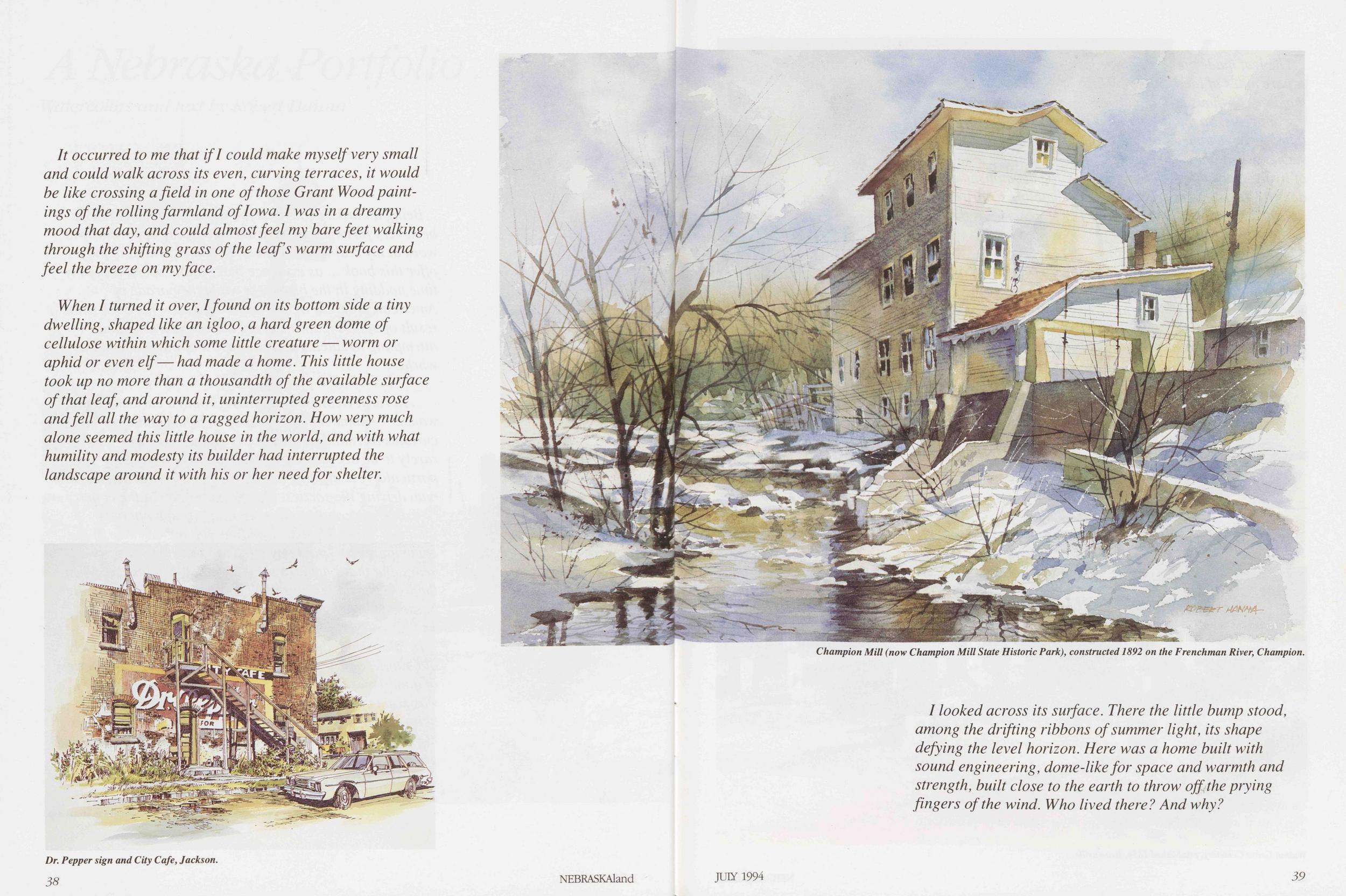
It occurred to me that if I could make myself very small and could walk across its even, curving terraces, it would be like crossing afield in one of those Grant Wood paintings of the rolling farmland of Iowa. I was in a dreamy mood that day, and could almost feel my bare feet walking through the shifting grass of the leafs warm surface and feel the breeze on my face.
When I turned it over, I found on its bottom side a tiny dwelling, shaped like an igloo, a hard green dome of cellulose within which some little creature — worm or aphid or even elf— had made a home. This little house took up no more than a thousandth of the available surface of that leaf, and around it, uninterrupted greenness rose and fell all the way to a ragged horizon. How very much alone seemed this little house in the world, and with what humility and modesty its builder had interrupted the landscape around it with his or her need for shelter.
Dr. Pepper sign and City Cafe, Jackson.
Champion Mill (now Champion Mill State Historic Park), constructed 1892 on the Frenchman River, Champion.
I looked across its surface. There the little bump stood, among the drifting ribbons of summer light, its shape defying the level horizon. Here was a home built with sound engineering, dome-like for space and warmth and strength, built close to the earth to throw off the prying fingers of the wind. Who lived there? And why?
38 NEBRASKAland JULY 1994 39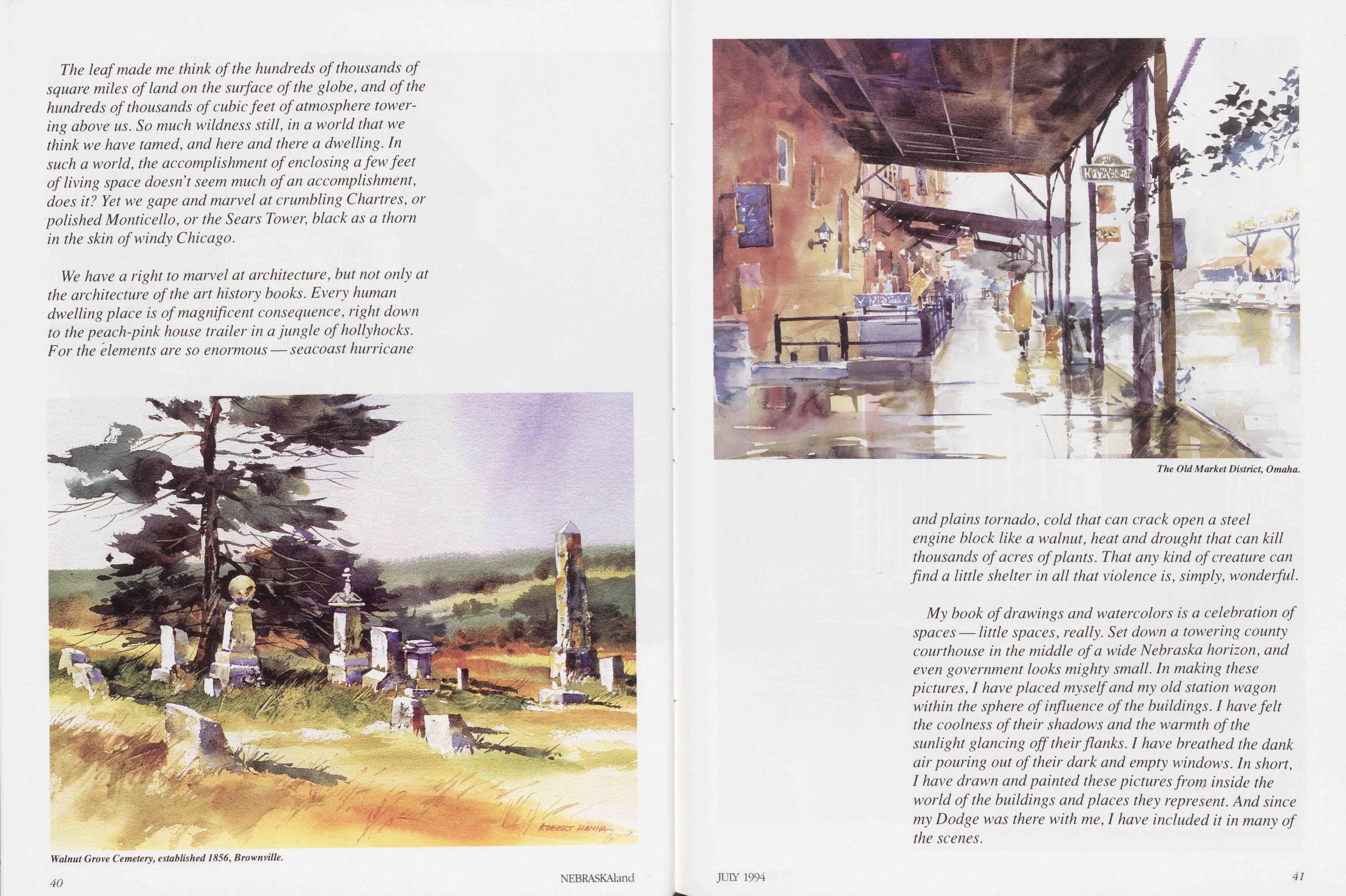
The leaf made me think of the hundreds of thousands of square miles of land on the surface of the globe, and of the hundreds of thousands of cubic feet of atmosphere tower- ing above us. So much wildness still, in a world that we think we have tamed, and here and there a dwelling. In such a world, the accomplishment of enclosing a few feet of living space doesn't seem much of an accomplishment, does it? Yet we gape and marvel at crumbling Chartres, or polished Monticello, or the Sears Tower, black as a thorn in the skin of windy Chicago.
Walnut Grove Cemetery, established 1856, Brownville.
The Old Market District, Omaha.
My book of drawings and watercolors is a celebration of spaces — little spaces, really. Set down a towering county courthouse in the middle of a wide Nebraska horizon, and even government looks mighty small. In making these pictures, I have placed myself and my old station wagon within the sphere of influence of the buildings. I have felt the coolness of their shadows and the warmth of the sunlight glancing off their flanks. I have breathed the dank air pouring out of their dark and empty windows. In short, I have drawn and painted these pictures from inside the world of the buildings and places they represent. And since my Dodge was there with me, I have included it in many of the scenes.
40 NEBRASKAland JUIY 1994 41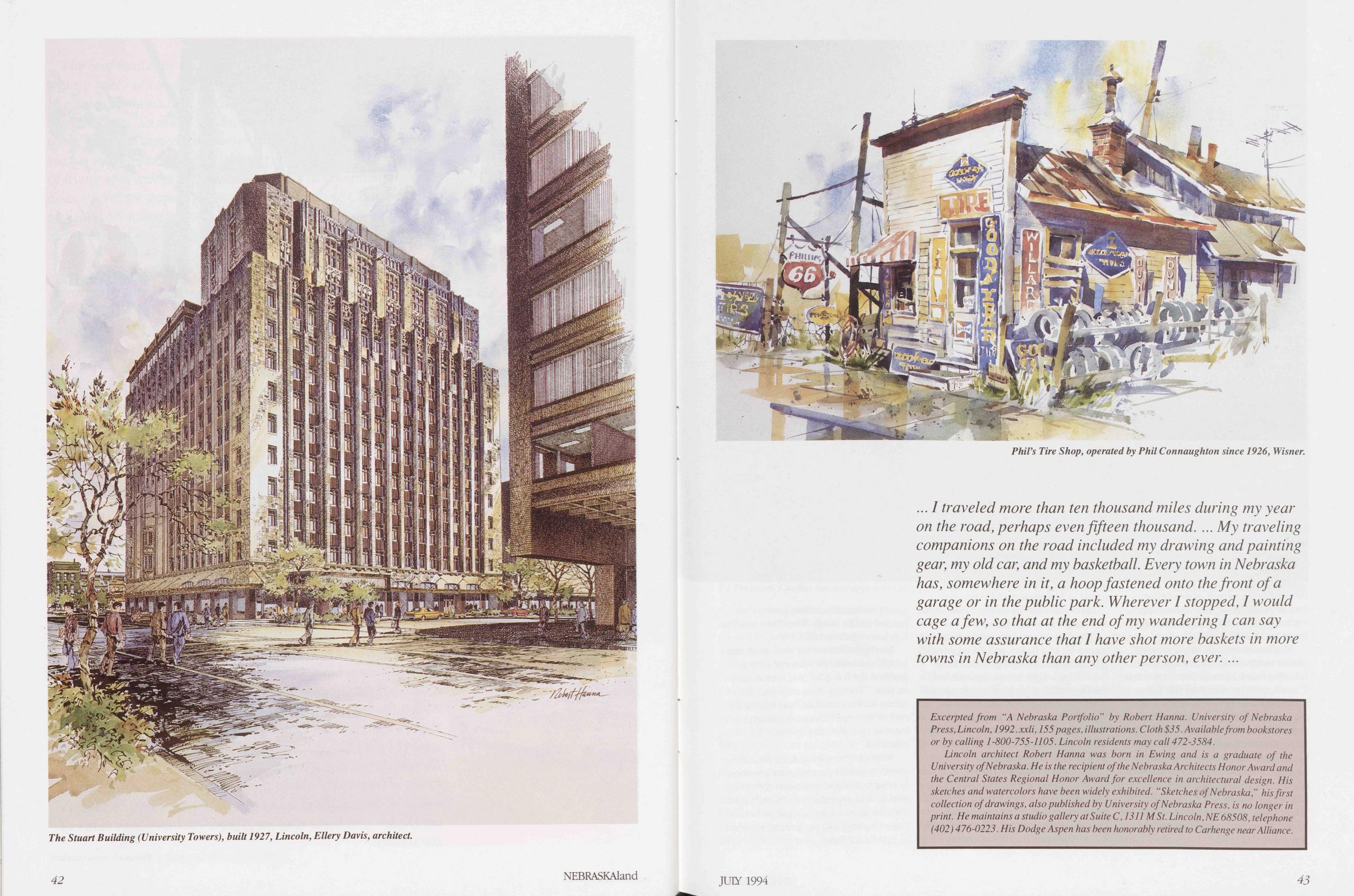
The Stuart Building (University Towers), built 1927, Lincoln, Ellery Davis, architect.
Phil's Tire Shop, operated by Phil Connaughton since 1926, Wisner.
...I traveled more than ten thousand miles during my year on the road, perhaps even fifteen thousand, ... My traveling companions on the road included my drawing and painting gear, my old car, and my basketball. Every town in Nebraska has, somewhere in it, a hoop fastened onto the front of a garage or in the public park. Wherever I stopped, I would cage a few, so that at the end of my wandering I can say with some assurance that I have shot more baskets in more towns in Nebraska than any other person, ever, ...
Excerpted from "A Nebraska Portfolio'' by Robert Hanna. University of Nebraska Press, Lincoln, 1992. xxli, 155 pages, illustrations. Cloth $35. Available from bookstores or by calling 1-800-755-1105. Lincoln residents may call 472-3584. Lincoln architect Robert Hanna was born in Ewing and is a graduate of the University of Nebraska. He is the recipient of the Nebraska Architects Honor Award and the Central States Regional Honor Award for excellence in architectural design. His sketches and watercolors have been widely exhibited. "Sketches of Nebraska," his first collection of drawings, also published by University of Nebraska Press, is no longer in print. He maintains a studio galleiy at Suite C,1311 M St. Lincoln, NE 68508, telephone (402) 476-0223. His Dodge Aspen has been honorably retired to Carhenge near Alliance.
42 NEBRASKAland JUIY 1994 43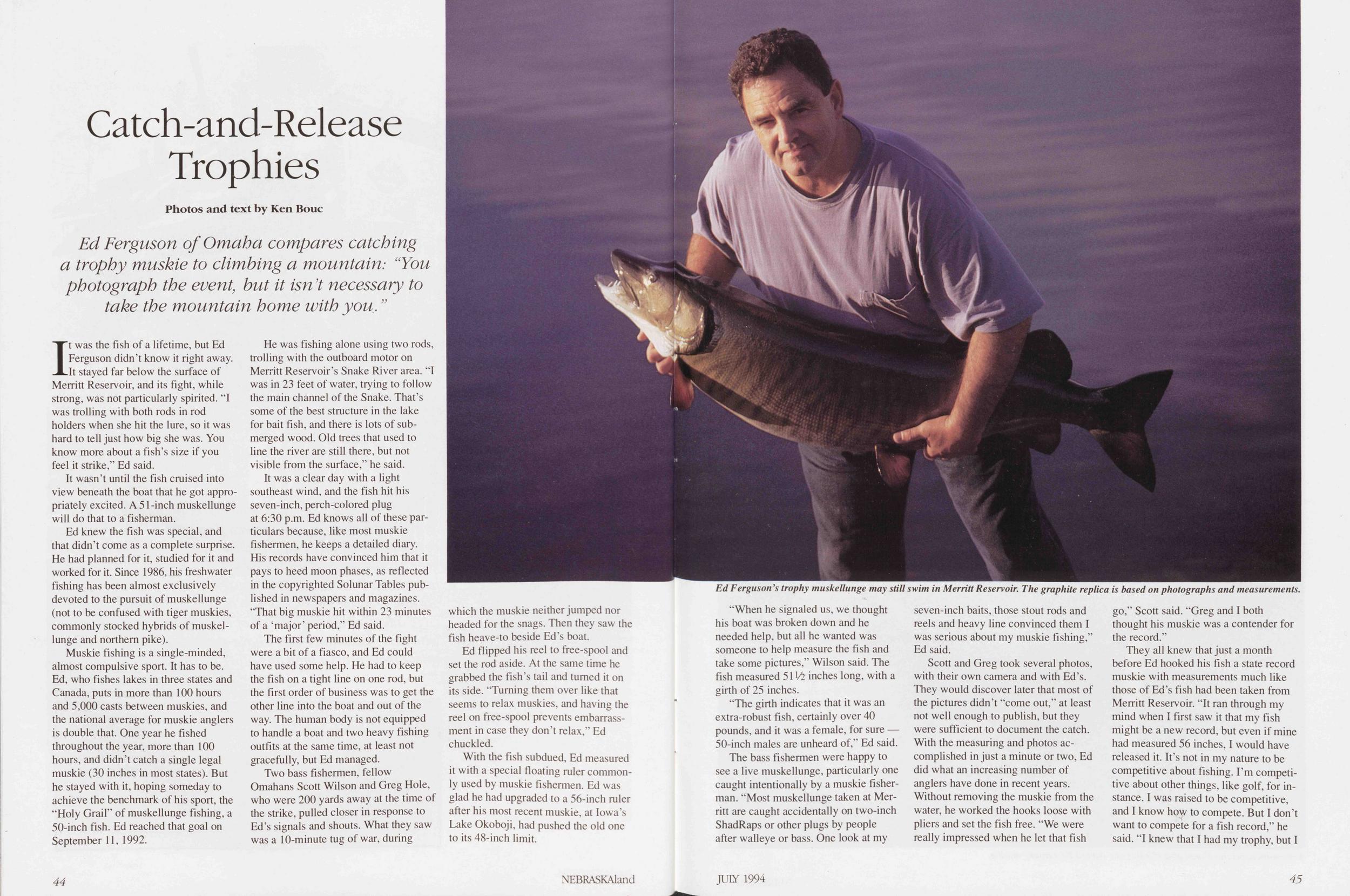
Catch-and-Release Trophies
Photos and text by Ken Bouc Ed Ferguson of Omaha compares catching a trophy muskie to climbing a mountain: "You photograph the event, but it isn't necessary to take the mountain home with you,"It was the fish of a lifetime, but Ed Ferguson didn't know it right away. It stayed far below the surface of Merritt Reservoir, and its fight, while strong, was not particularly spirited. "I was trolling with both rods in rod holders when she hit the lure, so it was hard to tell just how big she was. You know more about a fish's size if you feel it strike," Ed said.
It wasn't until the fish cruised into view beneath the boat that he got appropriately excited. A 51-inch muskellunge will do that to a fisherman.
Ed knew the fish was special, and that didn't come as a complete surprise. He had planned for it, studied for it and worked for it. Since 1986, his freshwater fishing has been almost exclusively devoted to the pursuit of muskellunge (not to be confused with tiger muskies, commonly stocked hybrids of muskellunge and northern pike).
Muskie fishing is a single-minded, almost compulsive sport. It has to be. Ed, who fishes lakes in three states and Canada, puts in more than 100 hours and 5,000 casts between muskies, and the national average for muskie anglers is double that. One year he fished throughout the year, more than 100 hours, and didn't catch a single legal muskie (30 inches in most states). But he stayed with it, hoping someday to achieve the benchmark of his sport, the "Holy Grail" of muskellunge fishing, a 50-inch fish. Ed reached that goal on September 11, 1992.
He was fishing alone using two rods, trolling with the outboard motor on Merritt Reservoir's Snake River area. "I was in 23 feet of water, trying to follow the main channel of the Snake. That's some of the best structure in the lake for bait fish, and there is lots of submerged wood. Old trees that used to line the river are still there, but not visible from the surface," he said.
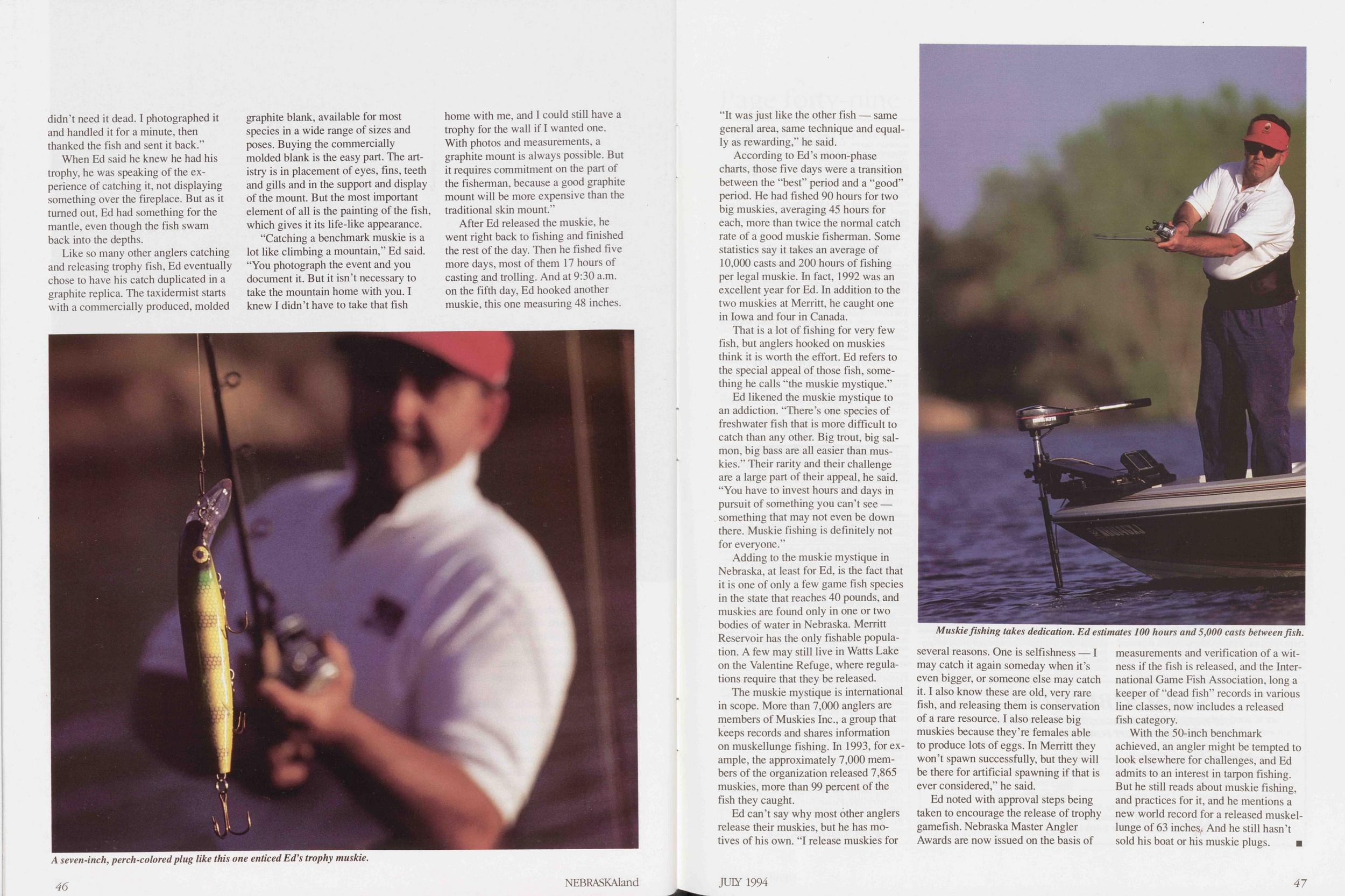
It was a clear day with a light southeast wind, and the fish hit his seven-inch, perch-colored plug at 6:30 p.m. Ed knows all of these particulars because, like most muskie fishermen, he keeps a detailed diary. His records have convinced him that it pays to heed moon phases, as reflected in the copyrighted Solunar Tables published in newspapers and magazines. "That big muskie hit within 23 minutes of a 'major' period," Ed said.
The first few minutes of the fight were a bit of a fiasco, and Ed could have used some help. He had to keep the fish on a tight line on one rod, but the first order of business was to get the other line into the boat and out of the way. The human body is not equipped to handle a boat and two heavy fishing outfits at the same time, at least not gracefully, but Ed managed.
Two bass fishermen, fellow Omahans Scott Wilson and Greg Hole, who were 200 yards away at the time of the strike, pulled closer in response to Ed's signals and shouts. What they saw was a 10-minute tug of war, during which the muskie neither jumped nor headed for the snags. Then they saw the fish heave-to beside Ed's boat.
Ed flipped his reel to free-spool and set the rod aside. At the same time he grabbed the fish's tail and turned it on its side. "Turning them over like that seems to relax muskies, and having the reel on free-spool prevents embarrassment in case they don't relax," Ed chuckled.
With the fish subdued, Ed measured it with a special floating ruler commonly used by muskie fishermen. Ed was glad he had upgraded to a 56-inch ruler after his most recent muskie, at Iowa's Lake Okoboji, had pushed the old one to its 48-inch limit.
Ed Ferguson's trophy muskellunge may still swim in Merritt Reservoir. The graphite replica is based on photographs and measurements.
"When he signaled us, we thought his boat was broken down and he needed help, but all he wanted was someone to help measure the fish and take some pictures," Wilson said. The fish measured 51 Vi inches long, with a girth of 25 inches.
"The girth indicates that it was an extra-robust fish, certainly over 40 pounds, and it was a female, for sure 50-inch males are unheard of," Ed said. The bass fishermen were happy to see a live muskellunge, particularly one caught intentionally by a muskie fisherman. "Most muskellunge taken at Merritt are caught accidentally on two-inch ShadRaps or other plugs by people after walleye or bass. One look at my seven-inch baits, those stout rods and reels and heavy line convinced them I was serious about my muskie fishing," Ed said.
Scott and Greg took several photos, with their own camera and with Ed's. They would discover later that most of the pictures didn't "come out," at least not well enough to publish, but they were sufficient to document the catch. With the measuring and photos accomplished in just a minute or two, Ed did what an increasing number of anglers have done in recent years.
Without removing the muskie from the water, he worked the hooks loose with pliers and set the fish free. "We were really impressed when he let that fish go," Scott said. "Greg and I both thought his muskie was a contender for the record."
They all knew that just a month
before Ed hooked his fish a state record
muskie with measurements much like
those of Ed's fish had been taken from
Merritt Reservoir. "It ran through my
mind when I first saw it that my fish
might be a new record, but even if mine
had measured 56 inches, I would have
released it. It's not in my nature to be
competitive about fishing. I'm competitive about other things, like golf, for instance.
I was raised to be competitive,
and I know how to compete. But I don't
want to compete for a fish record," he
said. "I knew that I had my trophy, but I
44
NEBRASKAland
JULY 1994
45
 didn't need it dead. I photographed it
and handled it for a minute, then
thanked the fish and sent it back."
didn't need it dead. I photographed it
and handled it for a minute, then
thanked the fish and sent it back."
When Ed said he knew he had his trophy, he was speaking of the experience of catching it, not displaying something over the fireplace. But as it turned out, Ed had something for the mantle, even though the fish swam back into the depths.
Like so many other anglers catching and releasing trophy fish, Ed eventually chose to have his catch duplicated in a graphite replica. The taxidermist starts with a commercially produced, molded graphite blank, available for most species in a wide range of sizes and poses. Buying the commercially molded blank is the easy part. The artistry is in placement of eyes, fins, teeth and gills and in the support and display of the mount. But the most important element of all is the painting of the fish, which gives it its life-like appearance.
"Catching a benchmark muskie is a lot like climbing a mountain," Ed said. "You photograph the event and you document it. But it isn't necessary to take the mountain home with you. I knew I didn't have to take that fish home with me, and I could still have a trophy for the wall if I wanted one.
With photos and measurements, a graphite mount is always possible. But it requires commitment on the part of the fisherman, because a good graphite mount will be more expensive than the traditional skin mount."
After Ed released the muskie, he went right back to fishing and finished the rest of the day. Then he fished five more days, most of them 17 hours of casting and trolling. And at 9:30 a.m. on the fifth day, Ed hooked another muskie, this one measuring 48 inches. "It was just like the other fish — same general area, same technique and equally as rewarding," he said.
According to Ed's moon-phase charts, those five days were a transition between the "best" period and a "good" period. He had fished 90 hours for two big muskies, averaging 45 hours for each, more than twice the normal catch rate of a good muskie fisherman. Some statistics say it takes an average of 10,000 casts and 200 hours of fishing per legal muskie. In fact, 1992 was an excellent year for Ed. In addition to the two muskies at Merritt, he caught one in Iowa and four in Canada.
That is a lot of fishing for very few fish, but anglers hooked on muskies think it is worth the effort. Ed refers to the special appeal of those fish, something he calls "the muskie mystique."
Ed likened the muskie mystique to an addiction. "There's one species of freshwater fish that is more difficult to catch than any other. Big trout, big salmon, big bass are all easier than mus- kies." Their rarity and their challenge are a large part of their appeal, he said. "You have to invest hours and days in pursuit of something you can't see — something that may not even be down there. Muskie fishing is definitely not for everyone."
Adding to the muskie mystique in Nebraska, at least for Ed, is the fact that it is one of only a few game fish species in the state that reaches 40 pounds, and muskies are found only in one or two bodies of water in Nebraska. Merritt Reservoir has the only fishable population. A few may still live in Watts Lake on the Valentine Refuge, where regulations require that they be released.
The muskie mystique is international in scope. More than 7,000 anglers are members of Muskies Inc., a group that keeps records and shares information on muskellunge fishing. In 1993, for example, the approximately 7,000 members of the organization released 7,865 muskies, more than 99 percent of the fish they caught.
Muskie fishing takes dedication. Ed estimates 100 hours and 5,000 casts between fish.
Ed noted with approval steps being taken to encourage the release of trophy gamefish. Nebraska Master Angler Awards are now issued on the basis of measurements and verification of a witness if the fish is released, and the International Game Fish Association, long a keeper of "dead fish" records in various line classes, now includes a released fish category.
With the 50-inch benchmark achieved, an angler might be tempted to look elsewhere for challenges, and Ed admits to an interest in tarpon fishing. But he still reads about muskie fishing, and practices for it, and he mentions a new world record for a released muskellunge of 63 inches. And he still hasn't sold his boat or his muskie plugs.
46 NEBRASKAland JUIY 1994 47
Classified
BOOKS/PRINTINGchildren's; old out of print, found barns, attic. Authors: Grey, Bower, Connor, Fox, Curwood, Raine, Wright, Aldrige, Pollyanna, Freckles, many others. Postage ap- preciated. Pierce, 4400 N. Pine Cluster, Oroville, CA 95965.
HOW TO FIND the public lands that you read about in NEBRASKAland Magazine. Locations & descriptions for ALL federal, state & NRD, parks, lakes, forests, wildlife areas, river access, trout streams & bike trails! These areas are clearly marked on county, D.O.T transportation maps and show ALL hard surface, gravel & dirt roads, bridges, railroads, rivers & creeks, farm and ranch homes, cities & towns. Send $ 18.75 to: Sportsman's Atlas Co., PO Box 132, Lytton, IA 50561-0132, or call 1-800-568-8334 ORDER TODAY. Your most important piece of outdoor equipment.
COLLECTIBLESWANTED: Elizabeth Dolan paintings. Lincoln artist 1891 - 1948. A. Bloom, 201 Transylvania Ave., Raleigh, NC 27609. (919) 782-1964 collect.
DOGSTRAINING ALL BREEDS bird dogs — Vrzslas and English Pointers for sale. Rozanek Kennels, RR 2, Schuyler, NE 68661. Phone (402) 352-8769. YELLOW-BLACK Lab pups. FC-AFC sired. AKC. Hips OFA certified. Dew claws removed. Excellent hunting potential. Contact Bob Bendler, Lexington, NE. (308) 324- 4247.
WILDERNESS KENNELS. Gun dog training - over 60 years combined experience. Training all sporting breeds — Retrievers. Flushing and pointing dogs. All dogs worked on pen raised birds and wild game. Training program includes obedience training — heel, sit, stay, down and come when called. Pups, started dogs and fully trained dogs for sale. HUNTING DOGS TRAINED BY HUNTERS. Henry Sader, Wilderness Kennels, Roca, NE. (402) 423-4212. Since 1968.
ENGLISH COCKER pups, imported stock, British FTC bloodlines. Many colors available. Featured in NEBRASKAland November 1991. Sawtooth Oaks, Box 443, Orleans, NE 68966. Phone (308) 473-5265.
EXCEPTIONAL ENGLISH SETTER pups. Tomoka linebred! Sire has 30 shooting dog wins and counting. Reserve yours! (402) 421-4693.
RETRIEVER TRAINING. Area's top "retrievers only" trainer. Field trial and hunting dogs. Non-slip duck dogs! TKO RETRIEVER TRAINING KENNEL (402) 623-4311.
CHESAPEAKE BAY, LABRADOR and GOLDEN RETRIEVER pups, started dogs and stud service. 16 time national champion pedigre. Platte Valley Retrievers (308) 995-2318.
ENGLISH COCKER PUPS, Top British FTCH Bloodlines. Both parents are imported. Stud dog is Omachie Tarf "sprig," 1 st and only U.S. FTCH in 30 years. Female has 8 FTCH in 3 generations. These dogs are 100% field bred hunters. No show dog in these bloodlines. 3025 Vine St., Lincoln, NE 68503. (402) 475-9963.
FISH/FISHINGFISH FOR SALE. Catfish, largemouth bass, smallmouth bass, perch, crappie, bluegill, walleye, northern pike, rain- bow trout, Donaldson rainbow trout, grass carp, minnows, bullheads. Consulting available. Pleasant Valley Fish Farm, RR 1, Box 147, McCook, NE 69001. Phone (308) 345- 6599.
WILLOW LAKE FISH HATCHERY. Channel cat, bluegill, hybrid bluegill, largemouth bass, crappie, triploid grass carp, walleye, perch, minnows available for stocking. Gaylord Crawford, RR 3, Box 46, Hastings, NE 68901 or phone (402) 463-8022 day or night. Also pond consultant. We del, grower price.
FOODNEBRASKA BASKETS: The original Nebraska company specializing in fine foods from Nebraska. A beautiful array of baskets filled with ethnic, healthful and long-time favorite foods. Call or write for our brochure: P.O. Box 98, McCook, NE 69001. 1-800-345-7725.
BEER & W1NEMAKING SUPPLIES — Fermenter's Supply & Equipment, 4472 S. 84th St., Omaha, NE 68127. (402) 593-9171. Mail order or visit our store.
THE BEST SPICY BURGER topping + 14 more unique recipes using your garden produce $3. Sheryl, POB 67281, Lincoln, NE 68506.
GIFTSNEBRASKA GREETING CARDS, stationery, mugs and more! Originally designed and produced in Nebraska. Call or write for FREE catalog: MJP, HC 37 Box 43C, Valentine, NE 69201. 1-800-632-7623.
THE WILDLIFE CAMPUS UNIVERSITY OF NIOBRARA: T-shirts, mugs, sweatshirts. Tiger Boy Enter- tainment, G. Greg Sawyers, 650 J St. #405, Lincoln, NE 68508. (402) 475-9898.
WORLD GIFTS, 225 color pages of wonderful gifts. 14K jewelry catalog included. Send $5 plus $3 S to: KING'S Quality Products, Box 49IN, Alliance, NE 69301.
GUTDES/OUTFITTERSMAD RIVER CANOES offers the finest quality and per- formance. For the finest canoes and accessories look to Great Plains Canoe Co., 205 Main, Springfield, NE. Phone (402)253-2001.
SUBSCRIBE NOW! GET NEBRASKAland MAGAZINE FOR YOURSELF OR SEND IT AS A GIFT FOR JUST $14 A YEAR! 1-Year 2-Years $14 $27 Name Address City State Zip Mail check or money order to NEBRASKAland Magazine P.O. Box 30370, Lincoln, Nebraska 68503 or caU ToU Free 1-800-632-5263CANOE RENTALS: Kamp Kaleo, Burwell, NE. 17 ft. aluminum canoes, $15 per day. Call (308) 346-5083 for information and reservations.
DISMAL RIVER/MIDDLE LOUP RIVER canoe/kayak trips. Powderhorn Outfitters - Thedford, NE 69166 -1 -800- 347-6256.
GRAHAM CANOE OUTFITTERS: Top quality full-ser- vice camping and canoe trips on the Niobrara River. Daily canoe rentals and car shuttle-service available. Contact Doug & Twyla Graham, HC 13 Box 16, Valentine, NE 69201 or phone (402) 376-3708.
GUNS/SHOOTING/ARCHERYGUNS — Browning, Winchester, Remington, others. Hi- powers; shotguns, new, used, antiques. Want Pre-'64 Winchesters. Buy-Sell-Trade. (402) 729-6112. Bedlan's Sporting Goods, Fairbury, NE 68352.
AIR GUNS repaired — Benjamin, Crosman, Daisy, other American made. Restoration; old guns wanted. Jack's Air Guns, 1225 No. 46th, Lincoln, NE 68503. Phone (402) 466-9223.
OUTDOOR EQUIPMENTWHITES METAL DETECTORS help you discover treasure. Write or call for free information. Research Un- limited, Box 448-N, Fremont, NE 68025. Phone (402) 721-8588.
TAXIDERMYALLISON'S TAXIDERMY STUDIO & GIFT GALLERY Specializing in fish, birds and small game. Mounted 35 State Record Fish. Pheasant mounts for sale. 421 N. Dewey, North Platte, NE 69101. (308) 534-2324 or (308) 534-4267.
VACATION/RESORTSFOR FISHING and hunting accommodations. Jefco Inn, Gordon, NE 69343. South Cornell, (308) 282-2935. PINE CONE LODGE - Bed & Breakfast. Country atmos- phere, western hospitality. Close to hunting, fishing, his- toric interests. Broken Bow, NE (308) 872-6407.
GOLF: Legend Buttes Golf Course. Located in Nebraska Pine Ridge Country between Crawford and Fort Robinson. Enjoy playing on one of the top four Municipal nine hole courses as rated by the Omaha World-Herald. (308) 665- 2431.
HISTORIC 1890s HOTEL. Located in the beautiful Pine Ridge area of Northwest Nebraska. Short drive to Chadron State Park, Fort Robinson and the Black Hills. Beautiful dining room with fireplace and fountain. Room service available. The Olde Main Street Inn, 115 Main St., Chadron NE 69337 (308) 432-3380.
STAY AT THE TWISTED PINE Bed and Breakfast over- looking the scenic Niobrara River. We have a modern bunkhouse or a rustic log cabin with a spectacular view. For more information contact Ken and Sharon Moreland, Twisted Pine Ranch, Box 84, Merriman, NE 69218 (308) 684-3482.
NE NEBRASKA TROUT FISHING. Mon-Thurs or Fri- Sun. 3 modem cottages, 5 spring fed lakes. Trout, bass and bluegill. Diamond E. Trout Resort, Box B, Orchard, NE 1-800-658-3244.
Classified ad rates: 75? per word, minimum $15. Closing date is the first business day 2 months preceding date of issue. To place ads or for more information write NEBRASKAland Magazine, P.O. Box30370, Lincoln, NE 68503-0370, or call (402) 471-5478. Fax (402) 471-5528.
48 NEBRASKAlandPage forty-nine
Counties by the NumbersOnce, after mastering the alphabet and multiplication tables, most rural Nebraskans, with varying degrees of competence, memorized county license plate numbers. I suppose some still do. It is a way of categorizing the occupants of vehicles, a scary system when you think about it — based only on the first one or two digits of your license plate you are lumped into the behavioral type assigned to the county from which you hale. Anyone from outside your home county is an alien, those from counties bordering yours are most like you.
Small-town kids who hung around the pop cooler at the gas station on summer afternoons received prolonged, albeit oblique, instruction about license plate numbers. No definable group of people knew the county numbers better than the guys who pumped gas. Invariably, a billfold card listing all the county numbers on one side and a plea for your vote from a local politician on the other was posted by the front door or the cash register.
Some service station attendants, as they are known today, still keep a keen eye on the licenses that pass through their pumps. Several years ago, driving east on Highway 2 across the Sandhills, my cousin and I were arguing about which county was number 14. It's a long stretch of highway and can strain even the best of friends for topics of conversation. I bet him $2 it was Fillmore, he bet Adams. I should have known better then to bet. For most of his life he ran the Skelly station in our hometown. We stopped for gas on the north edge of Dunning.
There, on the service station wall, was a plywood cutout of Nebraska complete with county lines and county license plate numbers. Adams is number 14, Fillmore is 34.1 was off only one numeral and, geographically, only two counties, but, as the cliche goes, close only counts in horseshoes and grenades.
Having grown up around gas stations in Platte County, I knew some numbers at an early age — my own of course (10), Nance County (58) only five miles to the west and Douglas County (1). During the 1950s, Boone County (23) to the northwest was known far and wide as Nebraska's pheasant hunting honey-hole. On opening morning, an unbroken band of glaring headlights poured west on Highway 22 toward Boone County, and by late morning the congestion overflowed into Platte County.
Some hunters stopped in small towns to buy sardines and rye bread from the local grocery store and to fill up at the gas station. So we knew all about hunters from number 1 county — they were the ones who wore stiff, brown duck-canvas hunting togs, actually had hunting dogs and were reputed to shoot meadowlarks which they thought were dumb quail sitting on fence posts. It was part of our local folklore that they even tossed poultry and small livestock in the trunks of their cars if the bird shooting was slow. An amazing number of gas pumpers swore they had heard chickens scratching or piglets snorting from the trunks of Douglas County cars.
Nowadays I find myself in the uncomfortable position of driving a pickup with Lancaster County (2) plates, the next worst county to Douglas, I recall from my youth. I try to keep my plates mud- covered, but eventually the rain reveals my origin. I've often thought how useful it would be to have a full set of county plates from which to select before driving into a farmyard to ask permission to hunt, but I suppose if the state patrol didn't catch me the locals would. They would ask where I was from. I'd name a small town on the far end of the county, and they'd ask me if I knew their brother-in- law's friend who runs the pool hall there.
Most rural people can identify a "city" pickup at 55 miles per hour anyway. Douglas and Lancaster county pickups are more apt to be a bright color, have lightning decals on the side, short boxes, vanity plates with no county number at all and mag wheels. A McPherson County (90) or Sioux County (80) pickup is probably a high-riding, plain-Jane, four- wheel-drive, mud-covered, work machine with at least one quarter-panel smashed in by an auto gate cut a little too close.
License plates first appeared on Nebraska vehicles in 1906, but it was not until 1922, when the Department of Public Works assumed responsibility for registering motor vehicles, that each county was assigned a number. County numbers were originally based on the number of registered vehicles there, which roughly suggested the county's population. Douglas County had the most vehicles and was designated number 1. Hooker County, with the least, was number 93.
With a few exceptions, a county's placement between 1 and 93 is still a pretty good indication of its population. Douglas and Lancaster still rank first and second in population. Sarpy County (59), having filled with Omaha's overflow, is now the state's third most populous county. Lincoln (15) and Scotts Bluff (21) have climbed into the top ten. The "bottom 10" counties are still the 10 least populous counties (according to the 1990 census), although, only one, Wheeler (84), maintains its original position.
While the logic of this system has recently developed some fractures, it has, over the years, appealed to the general public. There was a great outcry in 1951 when letters replaced numbers, and by 1952, the Legislature had changed it back. Why the public resisted the switch is puzzling. A letter designation, such as Y for York County, or a two-letter designation to separate counties with the same first letter (CA for Cass, CU for Cuming, CH for Cheyenne) would make identification easier. The early 1950s, though, roughly marked the end of the "no-change-is-good" philosophy that had more or less predominated in America.
There is, it seems to me, a certain perverse snobbery — one I envy — in having a high county number on your license plate. Until I find a way to make a living in one of the less populous counties, I propose we abandon the county designation on license plates entirely. I've found no benefit in a 2-county plate. Even with a local plate, people honk at me when I'm going the wrong way down a one-way street in the Capitol city.
Someday, though, when I have a 66 (Cherry), 92 (Grant) or 86 (Blaine) prefix, I will want to return to the current system. Maybe then I can wear the cowboy hat I bought in 1972 without feeling like the locals are laughing at me.
Jon Farrar JULY 1994 49
In the kitchen
Canning BasicsCanning is a delicious and economical way to provide nutritious food all year long. Canning may save as much as half the cost of commercially canned food, and the flavor and quality of home- canned foods are often superior to the grocery store equivalents.
Proper canning methods are essential to guarantee safe, high-quality food. Proper canning practices remove oxygen, destroy enzymes, prevent bacteria, yeast and mold growth and help form a good vacuum in jars, forming a tight seal to keep liquid in and air and micro- organisms out.
Many fresh foods contain from 10 to 30 percent air, and long-term high quality depends on how much air is removed before jars are sealed. "Pack" and processing method influence air removal.
Selecting a Pack StyleIn raw-packing, jars are tightly filled with freshly prepared, unheated food. Raw-packed food, especially fruit, will float in the jars, and entrapped air may cause discoloration within a few months. Raw-packing is best for vegetables to be processed in a pressure canner.
In hot-packing, foods are heated to the boiling point, simmered two to five minutes, then placed in jars. Hot packing helps maintain natural color and flavor by removing oxygen from food tissue and is preferred for foods processed in a boil- ing-water canner.
Processing MethodDeciding whether to use a boiling-water canner or a pressure canner depends on the food to be processed.
Boiling-water canners are used for foods that have a high acid content, such as fruits and jellies or jams. The canner must be deep enough to allow at least one inch of briskly boiling water to cover jars. Either a flat or a ridged-bottom canner can be used on a gas burner. Aflat-bottom canner is best on an electric range. For uniform processing, the canner should be no more than four inches wider than the element on which it is heated.
Pressure canners are used for home- canning of low-acid foods such as vegetables, meat and fish. Pressure canners may be either weighted-gauge or dial-gauge type.
Weighted gauges maintain pressure and temperature by releasing small amounts of air and steam as the gauge rocks or jiggles during processing. Weighted gauges do not need to be checked for accuracy.
A dial gauge shows the pressure and temperature in the canner. This gauge allows greater flexibility in pressure, but requires continual watching to maintain an even pressure. Dial gauges should be checked for accuracy each year and replaced if the reading is off by more than one pound. Contact an extension office for information about dial-gauge testing.
Altitude AdjustmentAt sea level, water boils at 212 degrees Fahrenheit. As altitude increases, water boils at lower temperatures. Lower boiling temperatures are less effective in killing microorganisms, so as the altitude increases, additional time or pressure is needed to safely process food.
In Nebraska, altitudes vary from less than 1,000 feet in Richardson County in the southeast to more than 5,000 feet in Kimball County in the west.
For boiling-water-bath canning, make
these processing time adjustments:
Below 1,000 feet — no adjustment
1,001 - 3,000 feet — 5 minutes
3,001 - 6,000 feet — 10 minutes
For pressure canner recipes, make the
following adjustments:
0 - 1,000 feet — no adjustment
1,001 - 2,000 — add 1 lb. (5 lbs.*)
2,001 - 4,000 — add 2 lbs. (5 lbs.*)
4,001 - 6,000 — add 3 lbs. (5 lbs.*)
(*Weighted-gauge canners allow only 5-
lb. increments.)
A fact sheet, "Let's Preserve: Altitude Adjustments for Home Canning" (FN38) including a map of altitudes for Nebraska in 1,000-foot increments is available at Cooperative Extension offices.
Caring for Canned FoodsAfter processing do not retighten jar lids, or you may cut through the gasket and cause seal failures. Cool jars at room temperature for 12 to 24 hours, then test seals. Wipe sealed jars and lids to remove food residue. Store in a clean, cool, dry place. Do not expose to temperatures above 95 degrees or below freezing.
Foods stored near heat sources or in direct sunlight will lose quality quickly and may spoil. Dampness may corrode metal lids, leading to seal breakage and allowing recontamination and spoilage.
Accidental freezing will not cause spoilage unless jars become unsealed and recontaminated, but freezing and thawing may soften food. If jars must be stored where they may freeze, wrap them in newspaper, place in heavy cartons and cover with newspapers and blankets.
Canned Foods for Special Diets To can fruit without sugar select fully ripe, firm, high-quality fruit. Prepare as for hot-packing, but use water or unsweetened fruit juice instead of sugar syrup. Juice from the fruit being canned is best.To can vegetables, tomatoes, meat, poultry and fish without salt, simply omit the salt, which seasons the food but is not necessary for safety.
Connie Francis, Extension Educator University of Nebraska Cooperative Extension, Lincoln County 50 NEBRASKAland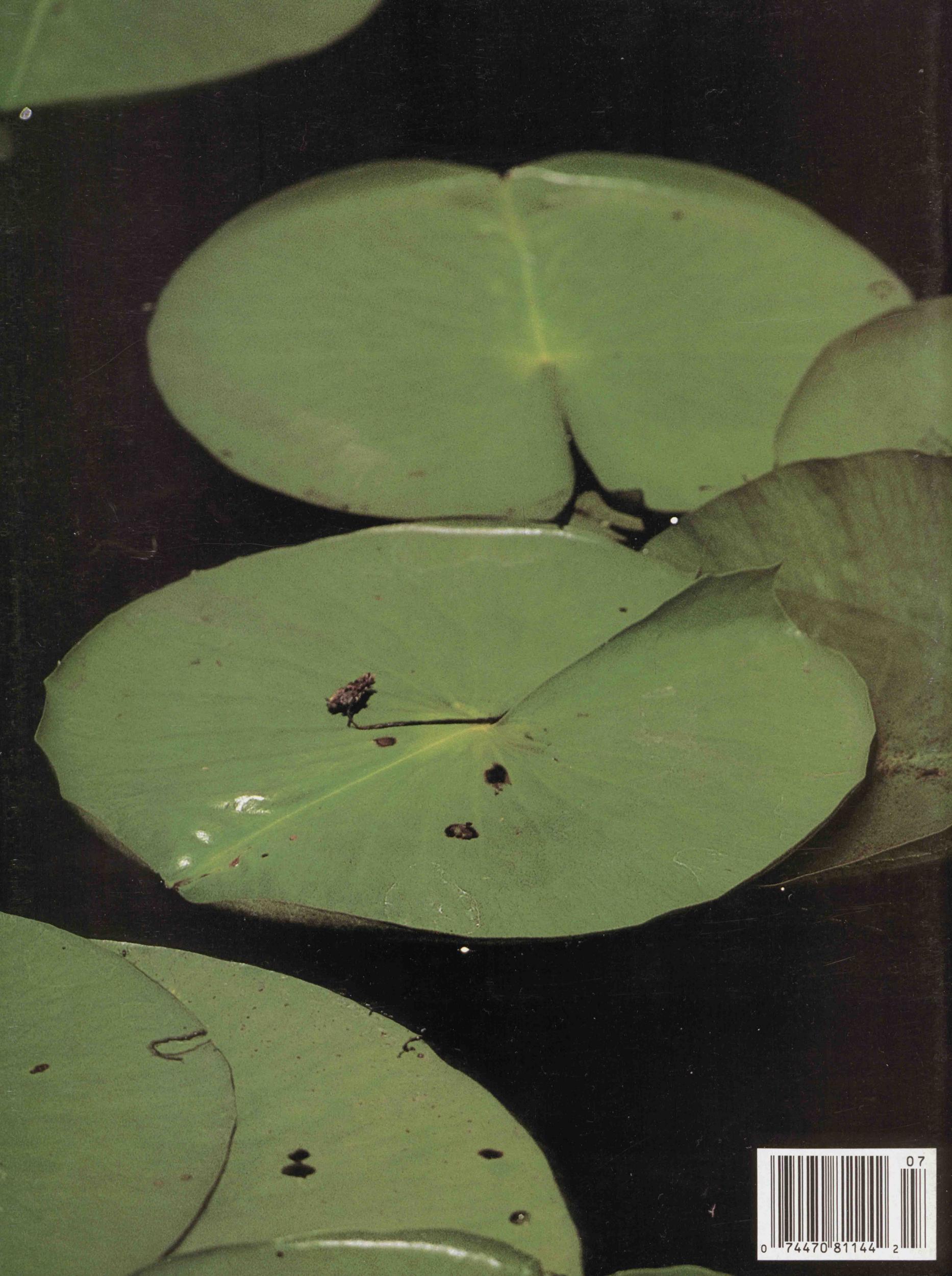
Position: 467 (22 views)