Volume 72, Issue 4, 1994
NEBRASKAland
May 1994 $1.50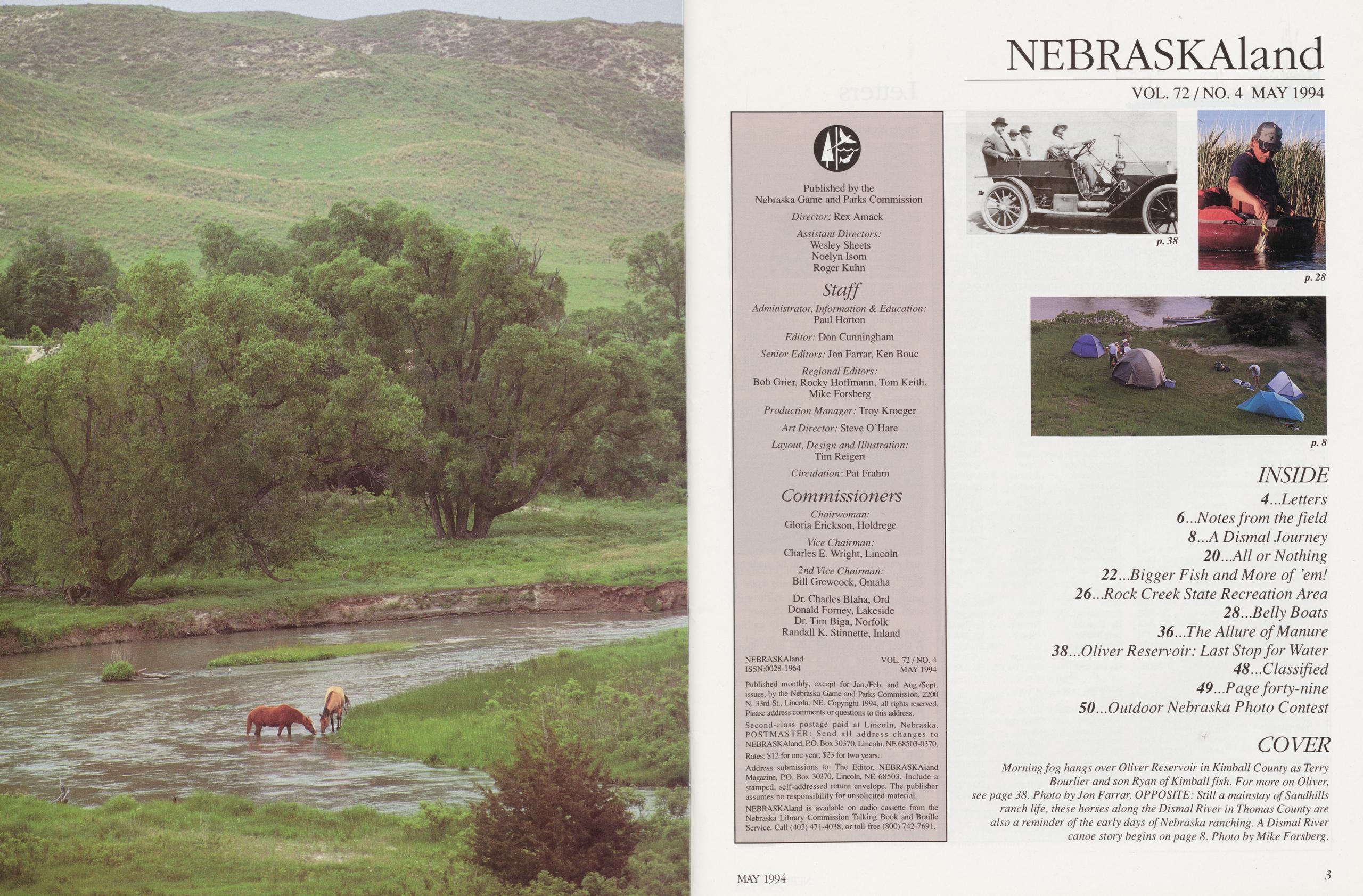
p. 38
p. 28
p.8
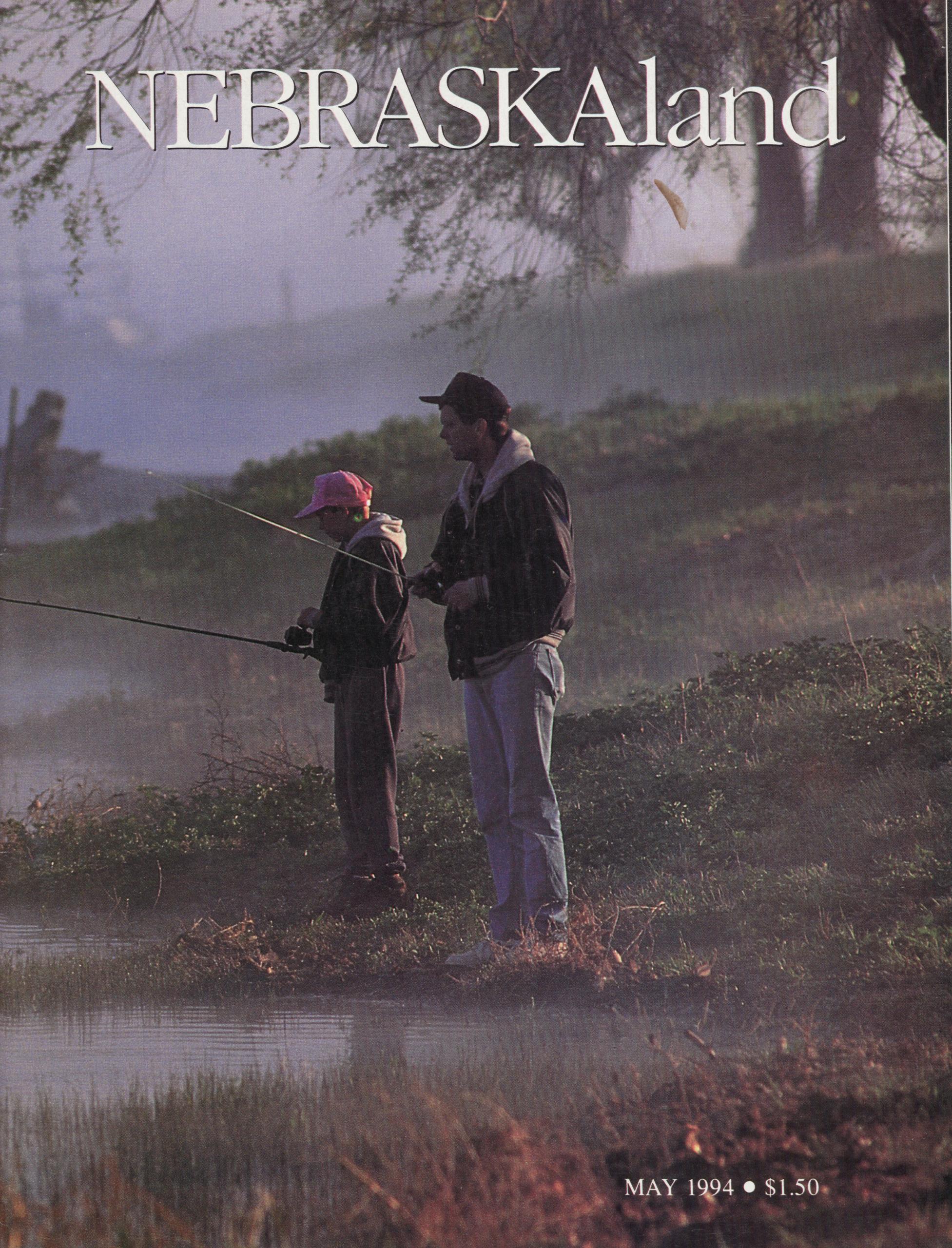
COVER Morning fog hangs over Oliver Reservoir in Kimball County as Terry Bourlier and son Ryan of Kimball fish. For more on Oliver, see page 38. Photo by Jon Farrar. OPPOSITE : Still a mainstay of Sandhills ranch life, these horses along the Dismal River in Thomas County are also a reminder of the early days of Nebraska ranching. A Dismal River canoe story begins on page 8. Photo by Mike Forsberg.
Letters
Eagle ExperienceThe December issue with the article about bald eagles by Mike Forsberg prompted me to share our 1989 experience with an immature bald eagle.
The eagle became trapped in a metal comcrib on my son-in-law Bob Wegner’s Dixon County farm. We believe he followed some rodent through the lower opening. In spite of our efforts to spook the bird back toward the opening without injuring him, he was having none of our antics.
We called Conservation Officer Randy Pomplun. He and Bob climbed the outside of the crib, and the eagle must have finally been convinced to check out the opening for he found it and flew away. He was a magnificent specimen, estimated to be about three years old. We felt fortunate to find him before he became ill or injured and were thrilled to watch as he made his grand exit.
Muriel Block Newcastle, Neb. Aquifer AnimalsA letter in the October 1993 issue about fish surfacing from a well in western Douglas County reminded me of an article I read during the past year.
The letter from Chester Denker of Papillion told how he had noted small fish being flushed into a settling basin while he was drilling a well in the 1930s. The fish were small, colorless and had no eyes, and because many listeners are skeptical about this, he asked for other similar experiences.
An article in the March 13, 1993, Science News explains and illustrates a similar occurrence in well water from a 4 NEBRASKAland Texas aquifer. More than 40 subterranean creatures have been found in the San Antonio section of the Edwards Aquifer in Texas, including toothless, blind catfish, blind salamanders and water beetles.
The animals have no pigmentation or functioning eyes. Scientists say the animals have been trapped there since the geologic system formed and have evolved into the life forms found there today.
While I cannot explain the geologic formation of eastern Nebraska, I can say that Denker’s experience has happened before, although it must be rare.
Jennifer Dods Information/Education Specialist Papio-Missouri River NRD Omaha, Neb. Deer RescueAt about 1:30 p.m. on November 5, 1993, a hiker came to the Indian Cave State Park office to report an unusual sighting — two deer locked together by their antlers. One was dead.
I went to investigate and found three men — John Duggan of Dubuque, Iowa, Rick Duggan of Arvada, Colorado, and Perry Oates of Cambridge, Wisconsin — who have been regulars in our park the past six years. They camp here while archery deer hunting in the area. I told them about the report, and they asked if they could help.
The four of us found the two deer still locked together. The live deer was very much alive as he bellowed and kicked from one side of the ditch to the other. As we pondered the situation from a safe distance, we got a lucky break — the live deer went down with legs out from under him in the ditch. Things moved rather quickly then. John grabbed a log to put over the deer’s back. Perry helped hold the log while Rick tried to saw an antler off the dead deer. I was given the task of taking pictures.
Rick’s saw broke, leaving him a six- inch blade with no handle. He finally broke off the three-quarters-cut antler, and the deer jumped up and ran away from us and his unlucky challenger. We all were relieved that the release went so well.
I would like to thank these sportsmen for their courageous rescue of a wild animal. By the way, a week later they had to go back home without a deer, as their hunting had not yielded any game. But at least two of them vowed to return after the rifle season to continue their quest to bag a buck just like the one that got away, so to speak.
Dick Webb, Assistant Superintendent Indian Cave State Park Shubert, Neb. Photo QuestionsWhile visiting the local library recently I was lucky to come across a copy of your Photographing Nebraska issue [January- February 1992]. I thoroughly enjoyed it.
Do you ever sponsor any photo contests, calendar photography searches or ever have a need for any amateur photography? I’m an avid amateur photographer who would like some information. Again, thanks for a great magazine.
Tracie I. Stonier Bloomfield, Neb.For a copy of our photo guidelines write to the address below. See page 51 for the announcement of NEBRASKAland's first photo contest in nearly 25 years. “Photographing Nebraska” the 1992 special issue, is still available. See page 7 for details. (Editor)
Write to Letters, NEBRASKAland Magazine, P.O. Box 30370, Lincoln, NE 68503-0370, or fax (402) 471-5528. Each month we print as many letters as space permits. Letters may be condensed or edited for clarity.
Notes from the field
Attack RabbitResidents of Greater Nebraska complain about the lack of good small-town restaurants and that their tax dollars run downhill to the capital city, but few of them would move to the city for love or money. I envy rural Nebraskans for many things, particularly for the wildlife at their doorsteps — deer, sandhill cranes, Canada geese, turkeys, grouse, quail or, at the least, kangaroo rats burrowing in their garden patches.
Urbanites (or, as logic demands, residents of Lesser Nebraska) must make do with winter birds at the feeder, rabbits and squirrels. Observing the behavior of those animals makes the paltry offering of urban wildlife tolerably interesting. After all, Ernest Seton- Thompson, one of America’s keenest wildlife observers, was sufficiently moved by the behavior of Fifth Avenue English sparrows to write charmingly of them in Lives of the Hunted (1901).
Over the years, I’ve come to think of some creatures in our yard as “my” animals — the bobtailed buck squirrel who rules the sunflower feeder, the male cardinal who hung its head in shame for weeks after losing its tail feathers in a late winter storm, the common grackle who brought pieces of dry dog food from the neighbor’s kennel and methodically softened them in our birdbath before dining and the rogue bluejay that decapitated English sparrows and picked off fledgling house wrens as they left the cedar birdhouse in our redbud tree.
No wild animal ever belongs to us, but it is human nature to think so. This was made obvious to me when a friend and I spent a day with a crusty old ranch foreman in Garden County. He proudly showed us “his” great homed owl incubating eggs. He wanted to believe the same owl used the nest year after year, so one March he “shot” the owl and the nest with a paintball gun, the kind ranchers use to mark cattle. Much to the old cowboy’s disappointment, the owl using the nest the next year wore no bright yellow feathers. He knew his beef better than his poultry or had forgotten that birds molt annually.
In my years of peering out the kitchen window I’ve seen some ordinary animals do extraordinary things in the backyard. “My” attack rabbit is a good example. Early one November afternoon in 1991,1 put half a dozen cut-up apples and a bowl of carrot peels at the edge of the raspberry patch. There were three or four inches of snow on the ground and my wife thought “our” rabbit might like some succulent fruits and vegetables. Later I looked out the window and, to my surprise, saw the cottontail and a fox squirrel chasing each other round and round in two-foot circles. This continued for 30 or 40 seconds, then the rabbit treed the squirrel about two feet up the trunk of our little apricot tree. The squirrel turned, its tail flicking furiously, to face the rabbit.
A few seconds passed, then the squirrel bounded over the rabbit, sprinted across the garden with the rabbit in hot pursuit and leaped to the top of a wooden post. The rabbit followed, and sat about three feet away glaring at the squirrel as if daring it to come down. The rabbit seemed to be having the better of the fray. After a minute or two, the squirrel jumped to the ground between the raspberry patch and the dog kennel. Again the rabbit pursued, chasing the squirrel in tight circles until it leaped up the kennel’s chain-link fence and again turned to face the rabbit. After a few seconds the squirrel jumped over the rabbit, barely clearing its ears, then turned and chased the rabbit in tight circles until the rabbit retreated to the gap between the kennel and a fence.
Unfortunately, I don’t know how the encounter would have ended naturally, for at that moment my wife, who does not always condone nature’s workings, went to the back door and clapped her hands to break up the fray. When our dog was younger and could catch squirrels fleeing the bird feeder, my wife customarily stood at the door and clapped to frighten the squirrels before letting the dog out. Several years ago, in her 6 NEBRASKAland housecoat, she clapped for some time before noticing a lineman on the utility pole in the corner of our yard. I suspect it was the first time he had ever been applauded for his efforts. I interpreted my wife’s mild embarrassment as an appropriate reproof for interfering with the natural system of things, and it suggested that observing urban human behavior might also be a worthy diversion.
I’d like to think that I saw my attack rabbit at work again in April 1993, but even urban rabbits usually do not live that long. Looking out our kitchen window I saw our cottontail eating the millet I had spread for sparrows and juncos. A squirrel crossed the chain- link fence on the west edge of our yard. When it was within 15 feet, the rabbit saw the squirrel and chased it back over the fence.
I saw my attack rabbit in action again the following day. Three times I saw it chasing squirrels from the yard, including the macho bobtailed squirrel. Once, although I cannot be sure, it seemed the cottontail nipped at the squirrel’s heels. Only if the cottontail had curled its lips in a frothy snarl to expose inch-long fangs could I have been more surprised by its behavior. After years of skepticism, I was nearly ready to believe the much publicized account of a swimming rabbit attacking then-President Jimmy Carter while he was fishing from a boat.
I had never observed such behavior between prey species, and would not have expected such aggressive behavior from a cottontail. If either the rabbit or the squirrel had been interacting with another of its own kind I would have attributed it to defense of a feeding or breeding territory. At first the chasing seemed like play, but it quickly became evident both participants were deadly serious. I have never read of one prey species individual defending a feeding territory against an individual of another prey species. It happens between predator species, though, and I can suggest no alternative.
A Dismal Journey
Originating in Hooker County and emptying into the Middle Loup about 80 miles later, the Dismal River, deep in the Sandhills, offers a stretch of wild and winding water and spectacular scenery.
Tim noticed her first from the stem, a whitetail doe slipping silently into the river from the curtain of bulrushes lining the left bank. Now she was in the middle of the chan- nel, only her head and back above water, ferrying upstream just enough to create a tender wake as she slowly made her way across the river. She seemed to move effortlessly. We rested our paddles and did the same, drifting slowly toward her.
Behind us were two other canoes. Part of an expedition of six, we were on the last day of a three-day journey down the Dismal River. We watched in silence as the doe worked her way to shallow water along the far bank. Then, less than 10 yards away, she finally noticed us.
She paused, standing knee deep on a submerged sandbar, her coat a deep polished chestnut washed by thin beads of river water streaking down her flanks. Suddenly in one powerful leap she bounded ashore, sending the Dismal into a flurry of splash and spray as she disappeared up the hillside. The deer living along the river are blessed, as are the ranchers, cattle and other living things that call the Dismal home. It is a wild, remote and beautiful river.
The Dismal lies deep in the heart of the Sandhills, one of the largest grass- stabilized dune regions on the globe, encompassing a 19,000 square mile area stretching more than 250 miles across Nebraska and into southern South Dakota. Beneath the Sandhills lies the Ogalala aquifer, life force of the region and birthplace of a handful of streams that run through this endless, undulat- ing sea of grass. The Dismal is one of them, beginning and ending its 80-mile journey without ever leaving this land.
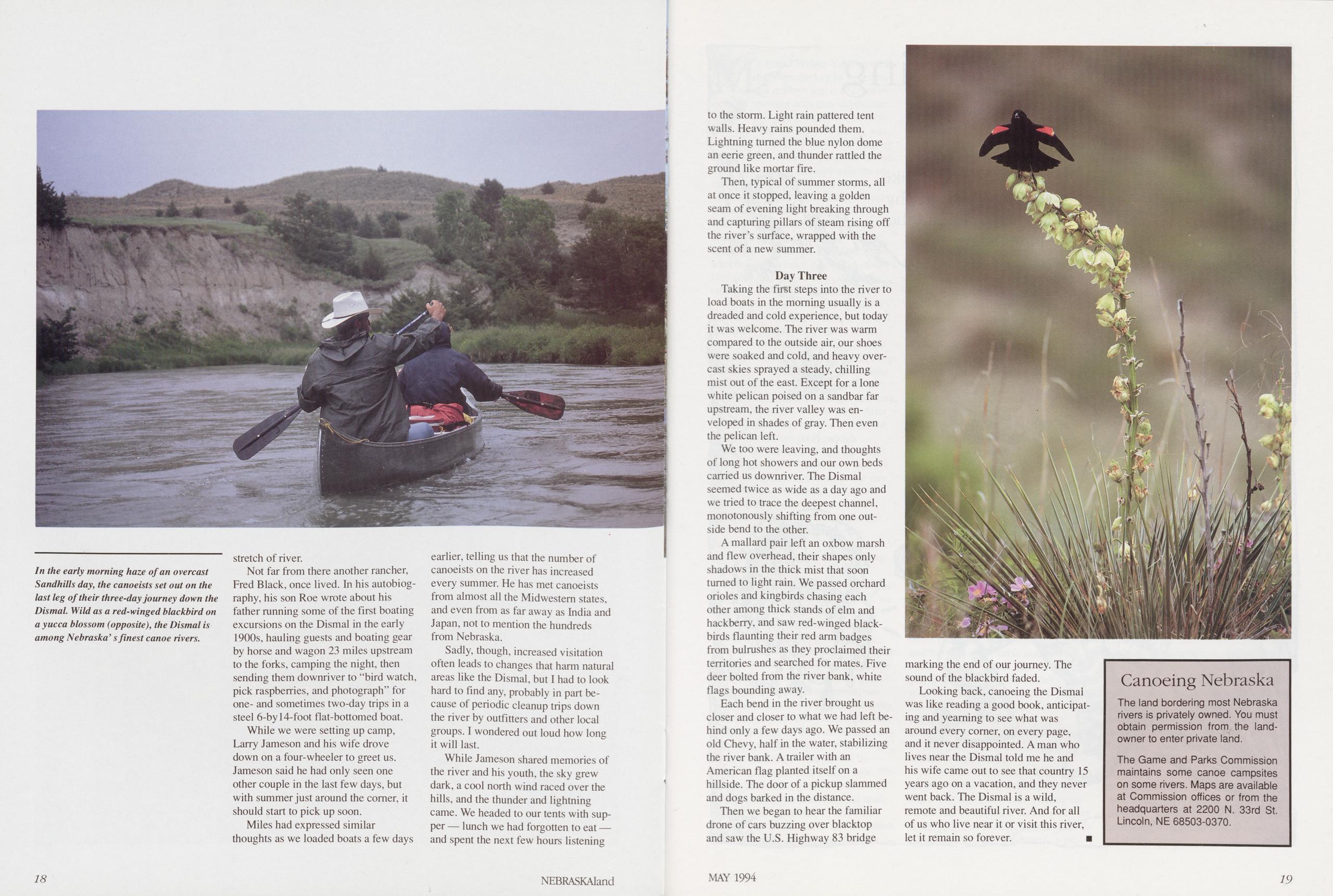
The Dismal’s headwaters begin as two small streams carving deep cedar- choked canyons into the landscape of western Hooker County, eventually joining ranks about 10 miles west of the Thomas County line. The river then 8 NEBRASKAland winds south and east for nearly 50 miles, dancing through a maze of cedar-covered bluffs, riparian forest, oxbows and beaver dams until it finally washes into the Middle Loup River near Dunning in western Blaine County. Fed entirely by groundwater and uninterrupted by diversions, the Dismal carries a nearly constant water level year-round. The Dismal is a true Sandhills river.
Day OneOur journey down river began below the Nebraska Highway 97 bridge near the forks of the Dismal, where the Dismal River Plains Apache lived more than 200 years ago and where, in the 1870s, Buffalo Bill Cody and the North brothers built a line camp for their ranching operations.
The six of us — Andy and his father V.T., Ron and wife Mary, my old friend Tim and I — walked in each other’s footprints up and down the long, steep embankment like a squad of army ants as we carried canoes and gear down to the river’s edge.
Also helping was Matt Miles, a young rancher who was our outfitter for the trip. He offered a few words of caution about barbed wire fences, deadfalls and life jackets as we loaded our boats with coolers, a fire grate, extra clothes, paddles, water jugs, camera gear, tents,
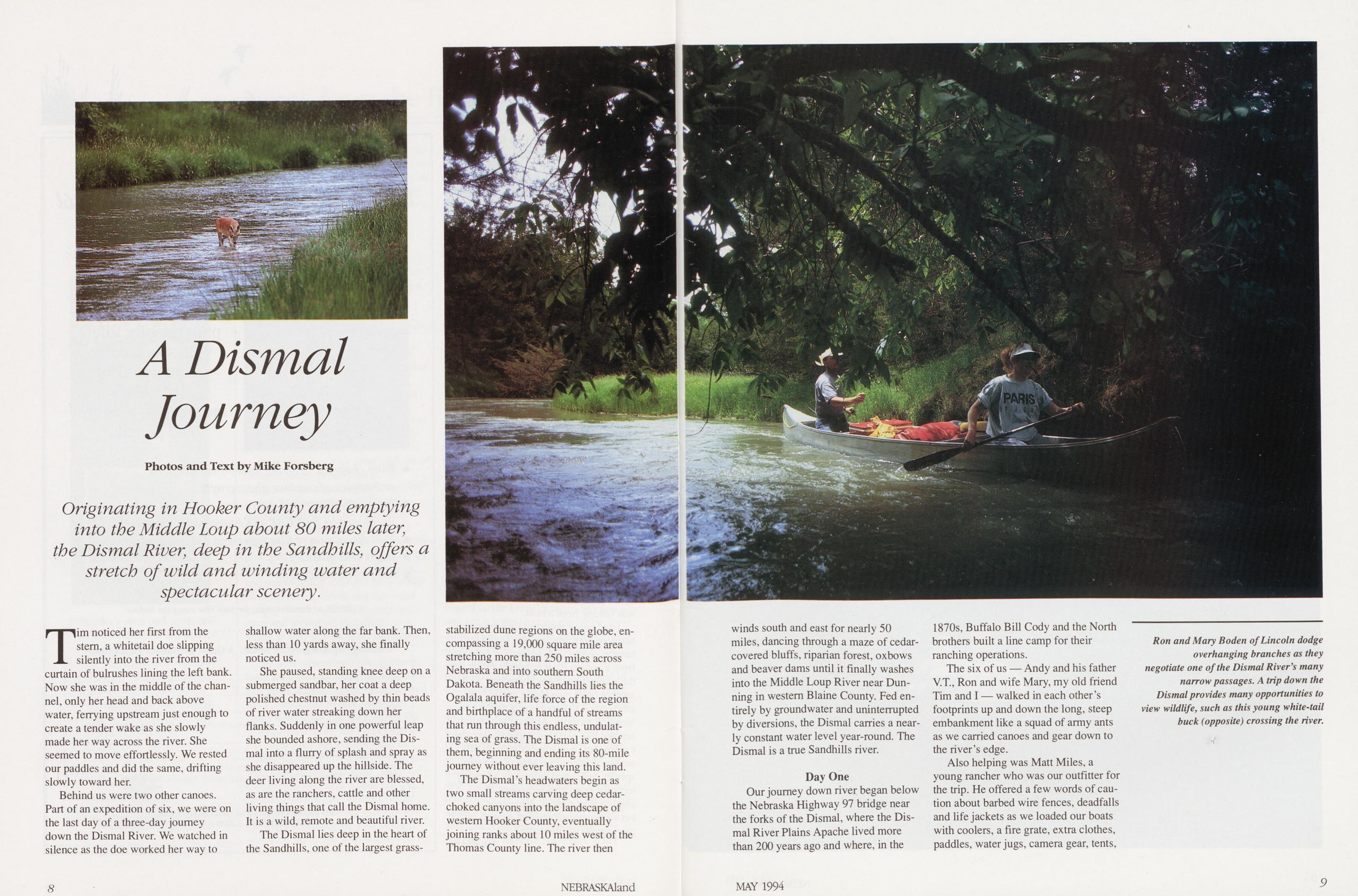
Ron and Mary Boden of Lincoln dodge overhanging branches as they negotiate one of the Dismal River's many narrow passages. A trip down the Dismal provides many opportunities to view wildlife, such as this young white-tail buck (opposite) crossing the river.
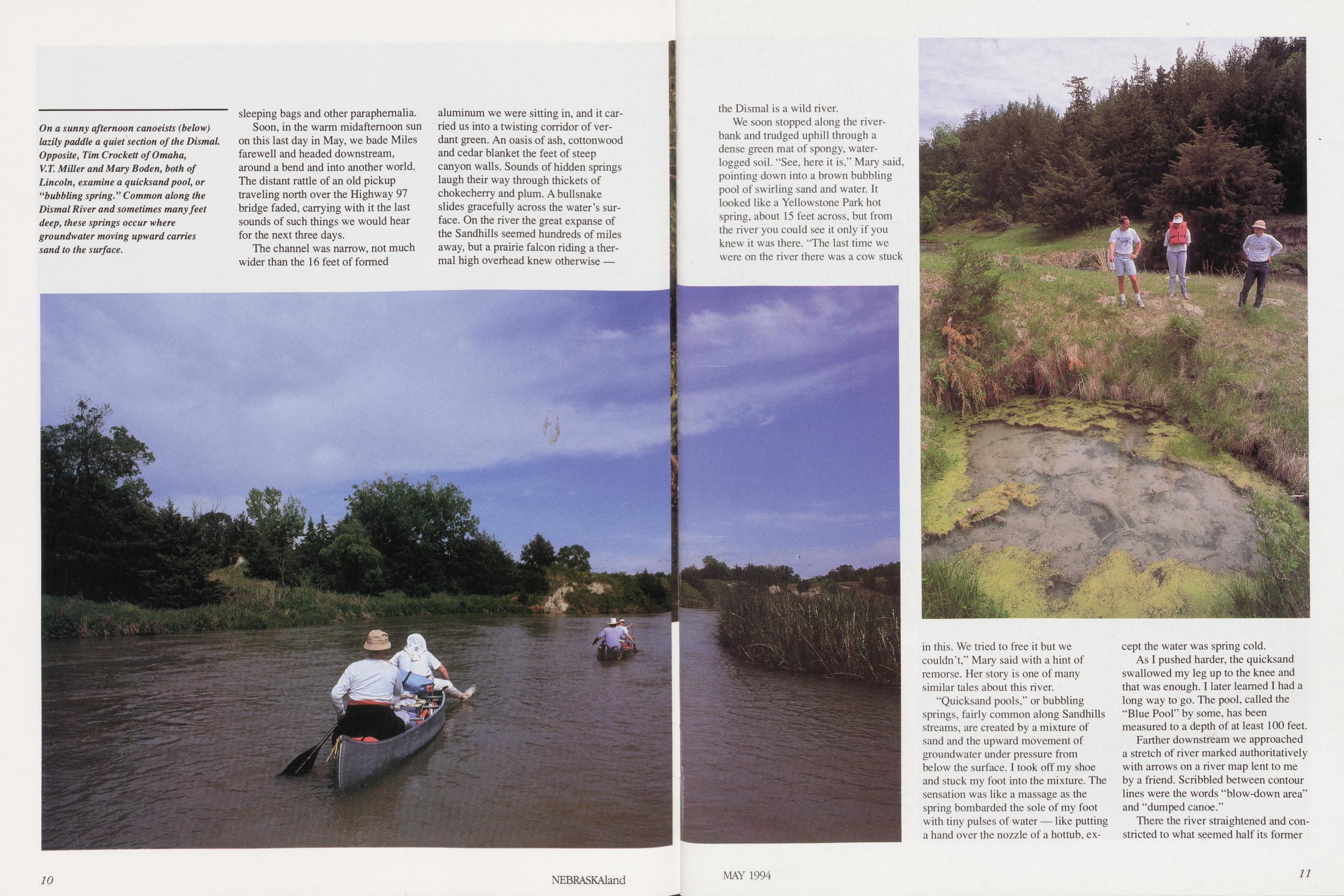
On a sunny afternoon canoeists (below) lazily paddle a quiet section of the Dismal. Opposite, Tim Crockett of Omaha, V.T. Miller and Mary Boden, both of Lincoln, examine a quicksand pool, or “bubbling spring.” Common along the Dismal River and sometimes many feet deep, these springs occur where groundwater moving upward carries sand to the surface.
sleeping bags and other paraphernalia.
Soon, in the warm midaftemoon sun on this last day in May, we bade Miles farewell and headed downstream, around a bend and into another world. The distant rattle of an old pickup traveling north over the Highway 97 bridge faded, carrying with it the last sounds of such things we would hear for the next three days.
The channel was narrow, not much wider than the 16 feet of formed aluminum we were sitting in, and it carried us into a twisting corridor of verdant green. An oasis of ash, cottonwood and cedar blanket the feet of steep canyon walls. Sounds of hidden springs laugh their way through thickets of chokecherry and plum. A bullsnake slides gracefully across the water’s surface. On the river the great expanse of the Sandhills seemed hundreds of miles away, but a prairie falcon riding a ther- mal high overhead knew otherwise — 10 NEBRASKAland the Dismal is a wild river.
We soon stopped along the riverbank and trudged uphill through a dense green mat of spongy, waterlogged soil. “See, here it is,” Mary said, pointing down into a brown bubbling pool of swirling sand and water. It looked like a Yellowstone Park hot spring, about 15 feet across, but from the river you could see it only if you knew it was there. “The last time we were on the river there was a cow stuck in this. We tried to free it but we couldn’t,” Mary said with a hint of remorse. Her story is one of many similar tales about this river.
“Quicksand pools,” or bubbling springs, fairly common along Sandhills streams, are created by a mixture of sand and the upward movement of groundwater under pressure from below the surface. I took off my shoe and stuck my foot into the mixture. The sensation was like a massage as the spring bombarded the sole of my foot with tiny pulses of water — like putting a hand over the nozzle of a hottub, except the water was spring cold.
As I pushed harder, the quicksand swallowed my leg up to the knee and that was enough. I later learned I had a long way to go. The pool, called the “Blue Pool” by some, has been measured to a depth of at least 100 feet.
Farther downstream we approached a stretch of river marked authoritatively with arrows on a river map lent to me by a friend. Scribbled between contour lines were the words “blow-down area” and “dumped canoe.”
There the river straightened and constricted to what seemed half its former
MAY 1994 11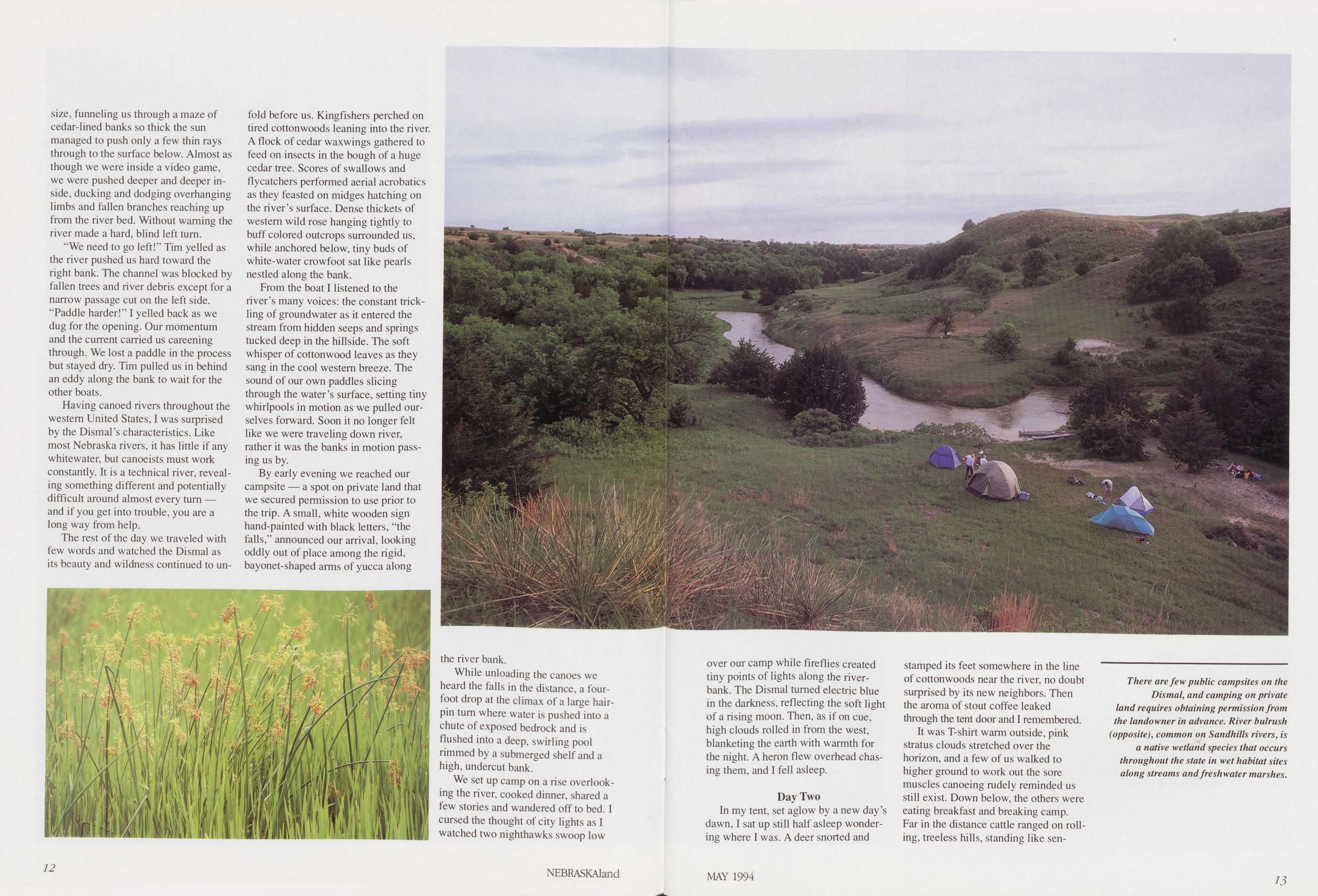
size, funneling us through a maze of cedar-lined banks so thick the sun managed to push only a few thin rays through to the surface below. Almost as though we were inside a video game, we were pushed deeper and deeper inside, ducking and dodging overhanging limbs and fallen branches reaching up from the river bed. Without warning the river made a hard, blind left turn.
“We need to go left!" Tim yelled as the river pushed us hard toward the right bank. The channel was blocked by fallen trees and river debris except for a narrow passage cut on the left side. “Paddle harder!" I yelled back as we dug for the opening. Our momentum and the current carried us careening through. We lost a paddle in the process but stayed dry. Tim pulled us in behind an eddy along the bank to wait for the other boats.
Having canoed rivers throughout the western United States, I was surprised by the Dismal’s characteristics. Like most Nebraska rivers, it has little if any whitewater, but canoeists must work constantly. It is a technical river, revealing something different and potentially difficult around almost every turn — and if you get into trouble, you are a long way from help.
The rest of the day we traveled with few words and watched the Dismal as its beauty and wildness continued to unfold before us. Kingfishers perched on tired cottonwoods leaning into the river. A flock of cedar waxwings gathered to feed on insects in the bough of a huge cedar tree. Scores of swallows and flycatchers performed aerial acrobatics as they feasted on midges hatching on the river’s surface. Dense thickets of western wild rose hanging tightly to buff colored outcrops surrounded us, while anchored below, tiny buds of white-water crowfoot sat like pearls nestled along the bank.
From the boat I listened to the river’s many voices: the constant trickling of groundwater as it entered the stream from hidden seeps and springs tucked deep in the hillside. The soft whisper of cottonwood leaves as they sang in the cool western breeze. The sound of our own paddles slicing through the water’s surface, setting tiny whirlpools in motion as we pulled ourselves forward. Soon it no longer felt like we were traveling down river, rather it was the banks in motion passing us by.
By early evening we reached our campsite — a spot on private land that we secured permission to use prior to the trip. A small, white wooden sign hand-painted with black letters, “the falls," announced our arrival, looking oddly out of place among the rigid, bayonet-shaped arms of yucca along the river bank.
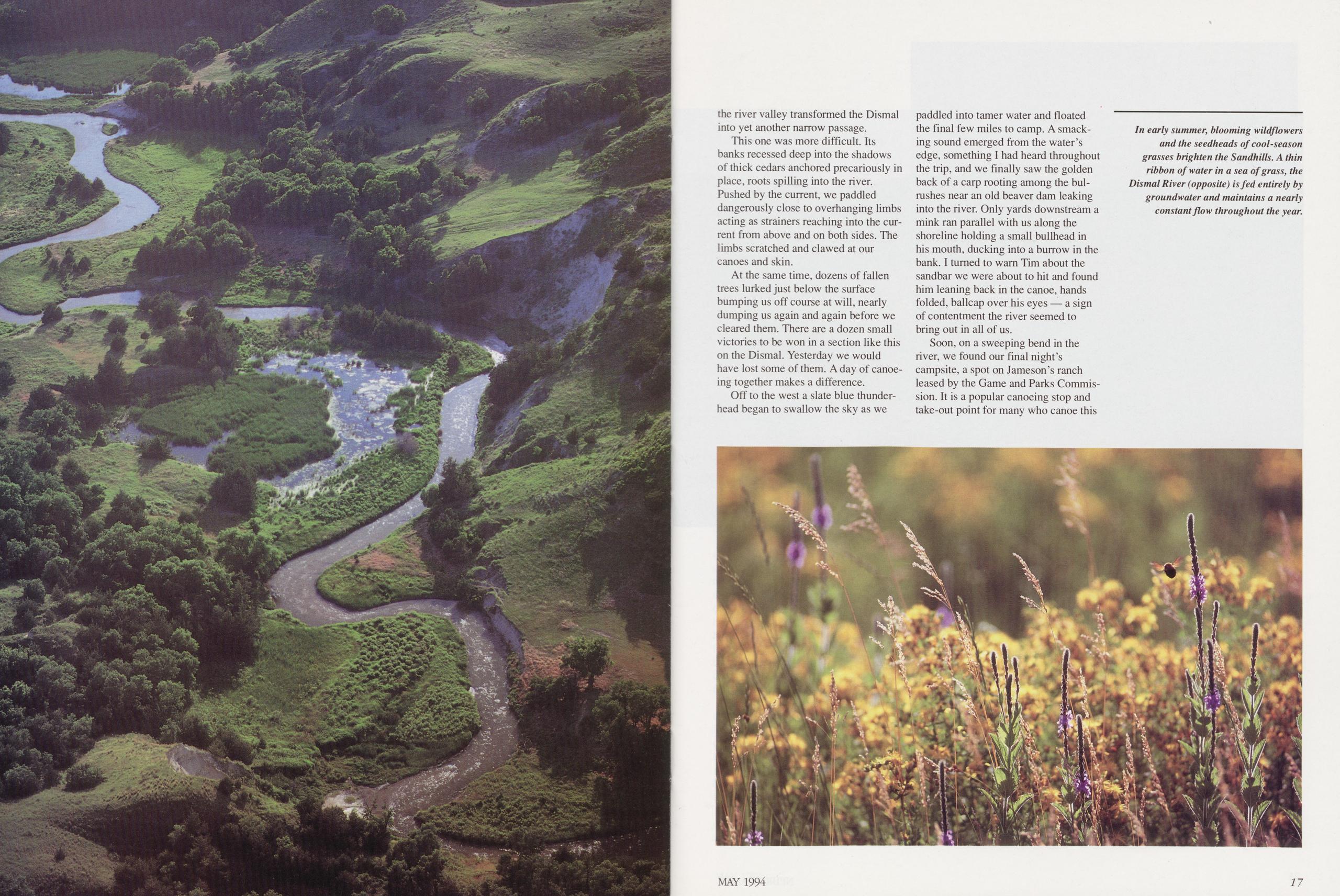
While unloading the canoes we heard the falls in the distance, a four- foot drop at the climax of a large hair-pin turn where water is pushed into a chute of exposed bedrock and is flushed into a deep, swirling pool rimmed by a submerged shelf and a high, undercut bank.
We set up camp on a rise overlooking the river, cooked dinner, shared a few stories and wandered off to bed. I cursed the thought of city lights as I watched two nighthawks swoop low
In my tent, set aglow by a new day’s dawn, I sat up still half asleep wondering where I was. A deer snorted and stamped its feet somewhere in the line of cottonwoods near the river, no doubt surprised by its new neighbors. Then the aroma of stout coffee leaked through the tent door and I remembered.
It was T-shirt warm outside, pink stratus clouds stretched over the horizon, and a few of us walked to higher ground to work out the sore muscles canoeing rudely reminded us still exist. Down below, the others were eating breakfast and breaking camp. Far in the distance cattle ranged on rolling, treeless hills, standing like sentinels
There are few public campsites on the Dismal, and camping on private land requires obtaining permission from the landowner in advance. River bulrush (opposite), common on Sandhills rivers, is a native wetland species that occurs throughout the state in wet habitat sites along streams and freshwater marshes.
on ridgetops capturing the warmth of the morning sun. The hills go on forever, and the Dismal River valley runs through them, winding north and east into the shadow of another day.
That stretch of country along the Dismal, with its dry and choppy hills, was one of the last areas in the Sandhills to be settled in the early 1900s, although ranchers had ranged cattle there since the 1870s. Today the region is still home to few people, and ranching is still the dominant signature on the land. I looked out over this vast landscape and smiled, doubting it has changed much, if any, over the years. The Dismal is a remote river.
By 8 a.m. all our gear had been hauled down onto a sandy beach, and the canoes had been run through the falls. Two people were wet and a paddle and seat cushion were floating somewhere downstream, but the smiles were wide with accomplishment as we headed on our way.
For the first few hours we played limbo under barbed wire fences as a pair of mallards led us downriver, the narrow valley widening to a mixture of marsh and bottomland forest. The warm morning sun was turning hot, snapping turtles were sunning themselves in the shallows, a regiment of deerflies patrolled midriver, and we tried to hug the bank for comfort and shade.
In the widening valley, cattle and barbed wire fences, often center stage in Dismal canoeing stories, became more evident. Some fences stop at the river’s edge, but many span the river entirely. 14 NEBRASKAland Determining which is which is often guesswork at best, making a good pair of eyes and dexterity in the boat a necessity for avoiding disaster.
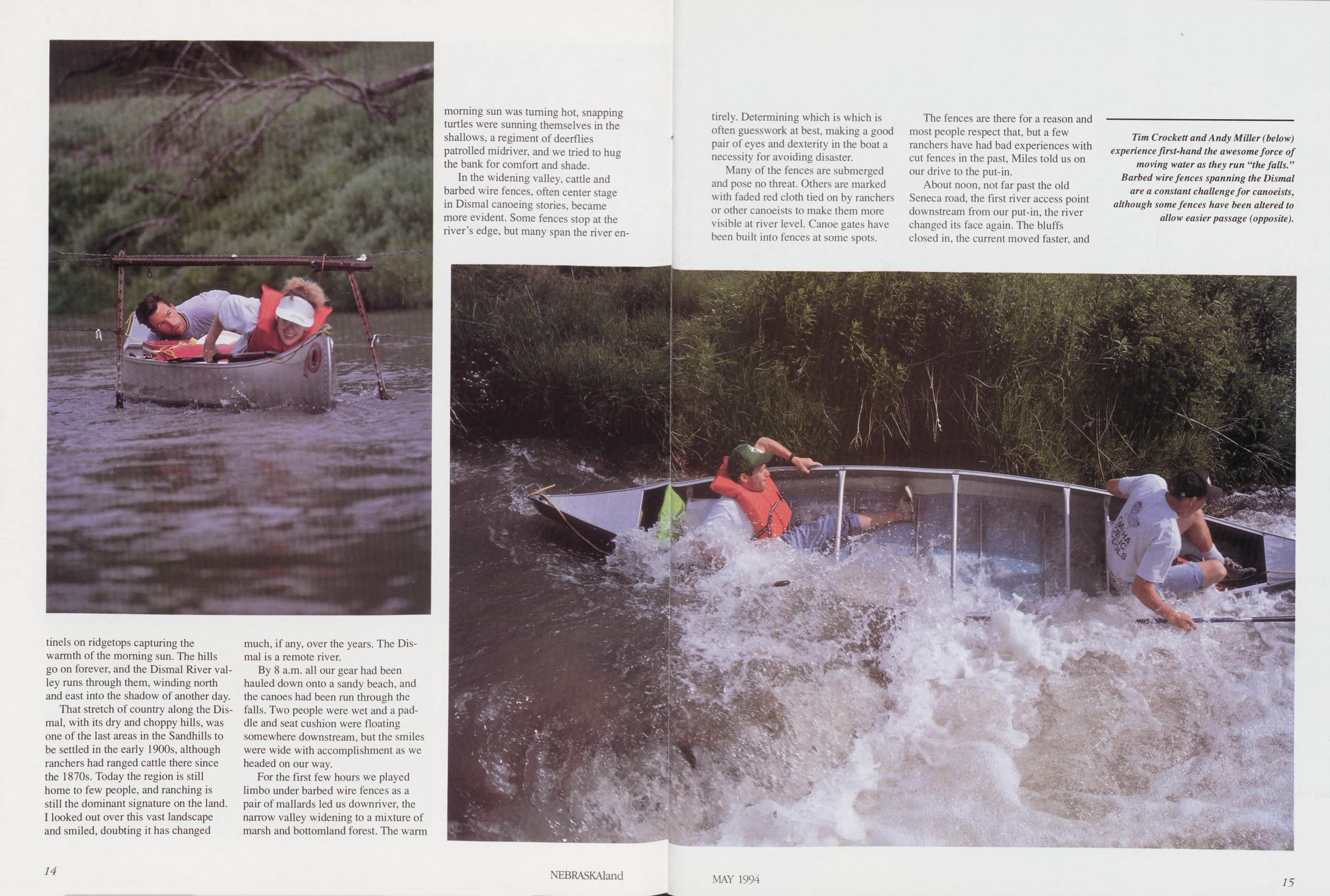
Many of the fences are submerged and pose no threat. Others are marked with faded red cloth tied on by ranchers or other canoeists to make them more visible at river level. Canoe gates have been built into fences at some spots.
The fences are there for a reason and most people respect that, but a few ranchers have had bad experiences with cut fences in the past, Miles told us on our drive to the put-in.
About noon, not far past the old Seneca road, the first river access point downstream from our put-in, the river changed its face again. The bluffs closed in, the current moved faster, and
Tim Crockett and Andy Miller (below) experience first-hand the awesome force of moving water as they run “the falls.” Barbed wire fences spanning the Dismal are a constant challenge for canoeists, although some fences have been altered to allow easier passage (opposite).
the river valley transformed the Dismal into yet another narrow passage.
This one was more difficult. Its banks recessed deep into the shadows of thick cedars anchored precariously in place, roots spilling into the river. Pushed by the current, we paddled dangerously close to overhanging limbs acting as strainers reaching into the current from above and on both sides. The limbs scratched and clawed at our canoes and skin.
At the same time, dozens of fallen trees lurked just below the surface bumping us off course at will, nearly dumping us again and again before we cleared them. There are a dozen small victories to be won in a section like this on the Dismal. Yesterday we would have lost some of them. A day of canoeing together makes a difference.
Off to the west a slate blue thunderhead began to swallow the sky as we paddled into tamer water and floated the final few miles to camp. A smack- ing sound emerged from the water’s edge, something I had heard throughout the trip, and we finally saw the golden back of a carp rooting among the bulrushes near an old beaver dam leaking into the river. Only yards downstream a mink ran parallel with us along the shoreline holding a small bullhead in his mouth, ducking into a burrow in the bank. I turned to warn Tim about the sandbar we were about to hit and found him leaning back in the canoe, hands folded, ballcap over his eyes — a sign of contentment the river seemed to bring out in all of us.
Soon, on a sweeping bend in the river, we found our final night’s campsite, a spot on Jameson’s ranch leased by the Game and Parks Commission. It is a popular canoeing stop and take-out point for many who canoe this
In early summer, blooming wildflowers and the seedheads of cool-season grasses brighten the Sandhills. A thin ribbon of water in a sea of grass, the Dismal River (opposite) is fed entirely by groundwater and maintains a nearly constant flow throughout the year.
In the early morning haze of an overcast Sandhills day, the canoeists set out on the last leg of their three-day journey down the Dismal. Wild as a red-winged blackbird on a yucca blossom (opposite), the Dismal is among Nebraska’ s finest canoe rivers.
stretch of river.
Not far from there another rancher, Fred Black, once lived. In his autobiography, his son Roe wrote about his father running some of the first boating excursions on the Dismal in the early 1900s, hauling guests and boating gear by horse and wagon 23 miles upstream to the forks, camping the night, then sending them downriver to “bird watch, pick raspberries, and photograph” for one- and sometimes two-day trips in a steel 6-byl4-foot flat-bottomed boat.
While we were setting up camp, Larry Jameson and his wife drove down on a four-wheeler to greet us. Jameson said he had only seen one other couple in the last few days, but with summer just around the comer, it should start to pick up soon.
Miles had expressed similar thoughts as we loaded boats a few days earlier, telling us that the number of canoeists on the river has increased every summer. He has met canoeists from almost all the Midwestern states, and even from as far away as India and Japan, not to mention the hundreds from Nebraska.
Sadly, though, increased visitation often leads to changes that harm natural areas like the Dismal, but I had to look hard to find any, probably in part because of periodic cleanup trips down the river by outfitters and other local groups. I wondered out loud how long it will last.
While Jameson shared memories of the river and his youth, the sky grew dark, a cool north wind raced over the hills, and the thunder and lightning came. We headed to our tents with supper — lunch we had forgotten to eat — and spent the next few hours listening 18 NEBRASKAland to the storm. Light rain pattered tent walls. Heavy rains pounded them. Lightning turned the blue nylon dome an eerie green, and thunder rattled the ground like mortar fire.
Then, typical of summer storms, all at once it stopped, leaving a golden seam of evening light breaking through and capturing pillars of steam rising off the river’s surface, wrapped with the scent of a new summer.
Day ThreeTaking the first steps into the river to load boats in the morning usually is a dreaded and cold experience, but today it was welcome. The river was warm compared to the outside air, our shoes were soaked and cold, and heavy overcast skies sprayed a steady, chilling mist out of the east. Except for a lone white pelican poised on a sandbar far upstream, the river valley was enveloped in shades of gray. Then even the pelican left.
We too were leaving, and thoughts of long hot showers and our own beds carried us downriver. The Dismal seemed twice as wide as a day ago and we tried to trace the deepest channel, monotonously shifting from one out- side bend to the other.
A mallard pair left an oxbow marsh and flew overhead, their shapes only shadows in the thick mist that soon turned to light rain. We passed orchard orioles and kingbirds chasing each other among thick stands of elm and hackberry, and saw red-winged blackbirds flaunting their red arm badges from bulrushes as they proclaimed their territories and searched for mates. Five deer bolted from the river bank, white flags bounding away.
Each bend in the river brought us closer and closer to what we had left behind only a few days ago. We passed an old Chevy, half in the water, stabilizing the river bank. A trailer with an American flag planted itself on a hillside. The door of a pickup slammed and dogs barked in the distance.
Then we began to hear the familiar drone of cars buzzing over blacktop and saw the U.S. Highway 83 bridge marking the end of our journey. The sound of the blackbird faded.
Looking back, canoeing the Dismal was like reading a good book, anticipating and yearning to see what was around every comer, on every page, and it never disappointed. A man who lives near the Dismal told me he and his wife came out to see that country 15 years ago on a vacation, and they never went back. The Dismal is a wild, remote and beautiful river. And for all of us who live near it or visit this river, let it remain so forever. ■
The land bordering most Nebraska rivers is privately owned. You must obtain permission from the land- owner to enter private land.
The Game and Parks Commission maintains some canoe campsites on some rivers. Maps are available at Commission offices or from the headquarters at 2200 N. 33rd St. Lincoln, NE 68503-0370.
MAY 1994 19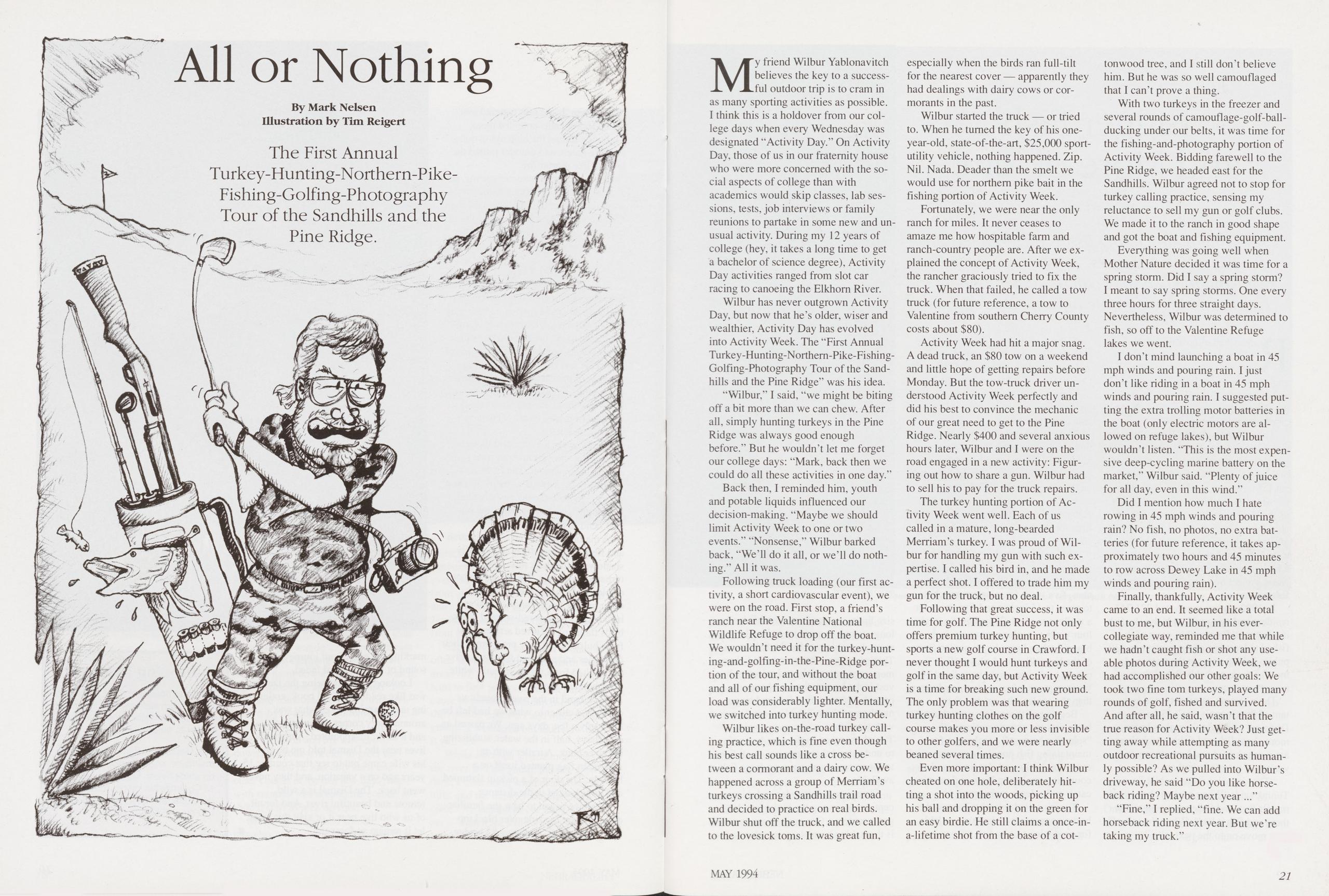
All or Nothing
The First Annual Turkey-Hunting-Northern-Pike F ishing-Golfing-Photography Tour of the Sandhills and the Pine Ridge.
My friend Wilbur Yablonavitch believes the key to a successful outdoor trip is to cram in as many sporting activities as possible. I think this is a holdover from our college days when every Wednesday was designated “Activity Day.” On Activity Day, those of us in our fraternity house who were more concerned with the social aspects of college than with academics would skip classes, lab sessions, tests, job interviews or family reunions to partake in some new and unusual activity. During my 12 years of college (hey, it takes a long time to get a bachelor of science degree), Activity Day activities ranged from slot car racing to canoeing the Elkhorn River.
Wilbur has never outgrown Activity Day, but now that he’s older, wiser and wealthier, Activity Day has evolved into Activity Week. The “First Annual Turkey-Hunting-Northem-Pike-Fishing- Golfing-Photography Tour of the Sandhills and the Pine Ridge” was his idea.
“Wilbur,” I said, “we might be biting off a bit more than we can chew. After all, simply hunting turkeys in the Pine Ridge was always good enough before.” But he wouldn’t let me forget our college days: “Mark, back then we could do all these activities in one day.”
Back then, I reminded him, youth and potable liquids influenced our decision-making. “Maybe we should limit Activity Week to one or two events.” “Nonsense,” Wilbur barked back, “We’ll do it all, or we’ll do noth- ing.” All it was.
Following truck loading (our first ac- tivity, a short cardiovascular event), we were on the road. First stop, a friend’s ranch near the Valentine National Wildlife Refuge to drop off the boat. We wouldn’t need it for the turkey-hunting-and-golfing-in-the-Pine-Ridge portion of the tour, and without the boat and all of our fishing equipment, our load was considerably lighter. Mentally, we switched into turkey hunting mode.
Wilbur likes on-the-road turkey calling practice, which is fine even though his best call sounds like a cross between a cormorant and a dairy cow. We happened across a group of Merriam’s turkeys crossing a Sandhills trail road and decided to practice on real birds. Wilbur shut off the truck, and we called to the lovesick toms. It was great fun, especially when the birds ran full-tilt for the nearest cover — apparently they had dealings with dairy cows or cormorants in the past.
Wilbur started the truck — or tried to. When he turned the key of his one-year-old, state-of-the-art, $25,000 sport-utility vehicle, nothing happened. Zip. Nil. Nada. Deader than the smelt we would use for northern pike bait in the fishing portion of Activity Week.
Fortunately, we were near the only ranch for miles. It never ceases to amaze me how hospitable farm and ranch-country people are. After we explained the concept of Activity Week, the rancher graciously tried to fix the truck. When that failed, he called a tow truck (for future reference, a tow to Valentine from southern Cherry County costs about $80).
Activity Week had hit a major snag. A dead truck, an $80 tow on a weekend and little hope of getting repairs before Monday. But the tow-truck driver understood Activity Week perfectly and did his best to convince the mechanic of our great need to get to the Pine Ridge. Nearly $400 and several anxious hours later, Wilbur and I were on the road engaged in a new activity: Figuring out how to share a gun. Wilbur had to sell his to pay for the truck repairs.
The turkey hunting portion of Activity Week went well. Each of us called in a mature, long-bearded Merriam’s turkey. I was proud of Wilbur for handling my gun with such expertise. I called his bird in, and he made a perfect shot. I offered to trade him my gun for the truck, but no deal.
Following that great success, it was time for golf. The Pine Ridge not only offers premium turkey hunting, but sports a new golf course in Crawford. I never thought I would hunt turkeys and golf in the same day, but Activity Week is a time for breaking such new ground. The only problem was that wearing turkey hunting clothes on the golf course makes you more or less invisible to other golfers, and we were nearly beaned several times.
Even more important: I think Wilbur cheated on one hole, deliberately hit- ting a shot into the woods, picking up his ball and dropping it on the green for an easy birdie. He still claims a once-in- a-lifetime shot from the base of a cottonwood tree, and I still don’t believe him. But he was so well camouflaged that I can’t prove a thing.
With two turkeys in the freezer and several rounds of camouflage-golf-ball- ducking under our belts, it was time for the fishing-and-photography portion of Activity Week. Bidding farewell to the Pine Ridge, we headed east for the Sandhills. Wilbur agreed not to stop for turkey calling practice, sensing my reluctance to sell my gun or golf clubs. We made it to the ranch in good shape and got the boat and fishing equipment.
Everything was going well when Mother Nature decided it was time for a spring storm. Did I say a spring storm? I meant to say spring storms. One every three hours for three straight days. Nevertheless, Wilbur was determined to fish, so off to the Valentine Refuge lakes we went.
I don’t mind launching a boat in 45 mph winds and pouring rain. I just don’t like riding in a boat in 45 mph winds and pouring rain. I suggested putting the extra trolling motor batteries in the boat (only electric motors are allowed on refuge lakes), but Wilbur wouldn’t listen. “This is the most expensive deep-cycling marine battery on the market,” Wilbur said. “Plenty of juice for all day, even in this wind.”
Did I mention how much I hate rowing in 45 mph winds and pouring rain? No fish, no photos, no extra batteries (for future reference, it takes approximately two hours and 45 minutes to row across Dewey Lake in 45 mph winds and pouring rain).
Finally, thankfully, Activity Week came to an end. It seemed like a total bust to me, but Wilbur, in his ever-collegiate way, reminded me that while we hadn’t caught fish or shot any useable photos during Activity Week, we had accomplished our other goals: We took two fine tom turkeys, played many rounds of golf, fished and survived. And after all, he said, wasn’t that the true reason for Activity Week? Just getting away while attempting as many outdoor recreational pursuits as humanly possible? As we pulled into Wilbur’s driveway, he said “Do you like horseback riding? Maybe next year ...”
“Fine,” I replied, “fine. We can add horseback riding next year. But we’re taking my truck.”
MAY 1994 21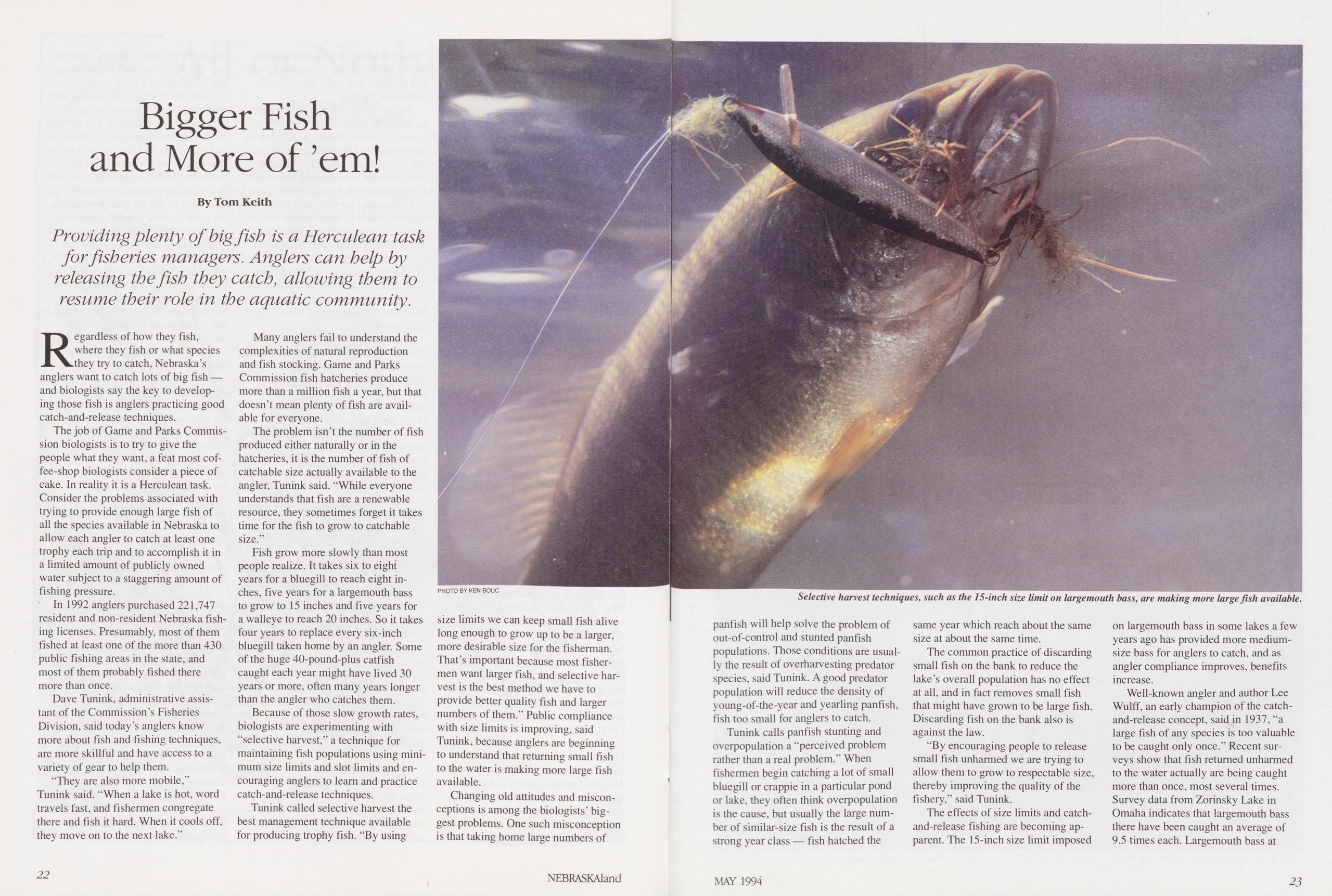
Bigger Fish and More of ’em!
Providing plenty of big fish is a Herculean task for fisheries managers. Anglers can help by releasing the fish they catch, allowing them to resume their role in the aquatic community.
Regardless of how they fish, where they fish or what species they try to catch, Nebraska’s anglers want to catch lots of big fish — and biologists say the key to developing those fish is anglers practicing good catch-and-release techniques.
The job of Game and Parks Commission biologists is to try to give the people what they want, a feat most coffee-shop biologists consider a piece of cake. In reality it is a Herculean task. Consider the problems associated with trying to provide enough large fish of all the species available in Nebraska to allow each angler to catch at least one trophy each trip and to accomplish it in a limited amount of publicly owned water subject to a staggering amount of fishing pressure.
In 1992 anglers purchased 221,747 resident and non-resident Nebraska fishing licenses. Presumably, most of them fished at least one of the more than 430 public fishing areas in the state, and most of them probably fished there more than once.
Dave Tunink, administrative assistant of the Commission’s Fisheries Division, said today’s anglers know more about fish and fishing techniques, are more skillful and have access to a variety of gear to help them.
“They are also more mobile,” Tunink said. “When a lake is hot, word travels fast, and fishermen congregate there and fish it hard. When it cools off, they move on to the next lake.”
Many anglers fail to understand the complexities of natural reproduction and fish stocking. Game and Parks Commission fish hatcheries produce more than a million fish a year, but that doesn’t mean plenty of fish are available for everyone.
The problem isn’t the number of fish produced either naturally or in the hatcheries, it is the number of fish of catchable size actually available to the angler, Tunink said. “While everyone understands that fish are a renewable resource, they sometimes forget it takes time for the fish to grow to catchable size.”
Fish grow more slowly than most people realize. It takes six to eight years for a bluegill to reach eight in- ches, five years for a largemouth bass to grow to 15 inches and five years for a walleye to reach 20 inches. So it takes four years to replace every six-inch bluegill taken home by an angler. Some of the huge 40-pound-plus catfish caught each year might have lived 30 years or more, often many years longer than the angler who catches them.
Because of those slow growth rates, biologists are experimenting with “selective harvest,” a technique for maintaining fish populations using minimum size limits and slot limits and encouraging anglers to learn and practice catch-and-release techniques.
Tunink called selective harvest the best management technique available for producing trophy fish. “By using size limits we can keep small fish alive long enough to grow up to be a larger, more desirable size for the fisherman. That’s important because most fisher- men want larger fish, and selective harvest is the best method we have to provide better quality fish and larger numbers of them.” Public compliance with size limits is improving, said Tunink, because anglers are beginning to understand that returning small fish to the water is making more large fish available.
Selective harvest techniques, such as the 15-inch size limit on largemouth bass, are making more large fish available.
Tunink calls panfish stunting and overpopulation a “perceived problem rather than a real problem.” When fishermen begin catching a lot of small bluegill or crappie in a particular pond or lake, they often think overpopulation is the cause, but usually the large number of similar-size fish is the result of a strong year class — fish hatched the same year which reach about the same size at about the same time.
The common practice of discarding small fish on the bank to reduce the lake’s overall population has no effect at all, and in fact removes small fish that might have grown to be large fish. Discarding fish on the bank also is against the law.
“By encouraging people to release small fish unharmed we are trying to allow them to grow to respectable size, thereby improving the quality of the fishery,” said Tunink.
The effects of size limits and catch- and-release fishing are becoming apparent. The 15-inch size limit imposed on largemouth bass in some lakes a few years ago has provided more medium- size bass for anglers to catch, and as angler compliance improves, benefits increase.
Well-known angler and author Lee Wulff, an early champion of the catch- and-release concept, said in 1937, “a large fish of any species is too valuable to be caught only once.” Recent surveys show that fish returned unharmed to the water actually are being caught more than once, most several times. Survey data from Zorinsky Lake in Omaha indicates that largemouth bass there have been caught an average of 9.5 times each. Largemouth bass at
MAY 1994 23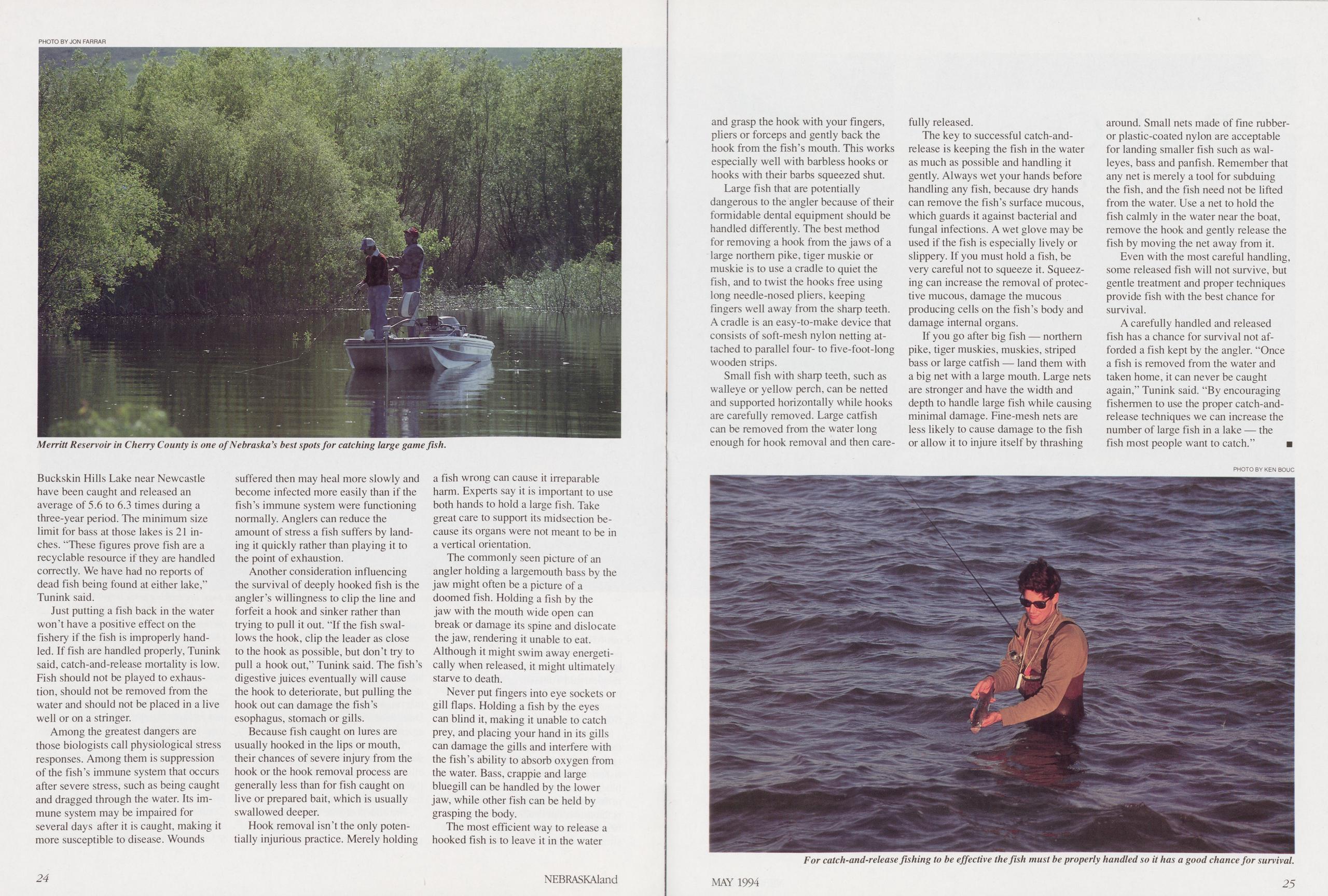
Merritt Reservoir in Cherry County is one of Nebraska's best spots for catching large game fish.
Buckskin Hills Lake near Newcastle have been caught and released an average of 5.6 to 6.3 times during a three-year period. The minimum size limit for bass at those lakes is 21 in- ches. “These figures prove fish are a recyclable resource if they are handled correctly. We have had no reports of dead fish being found at either lake,” Tunink said.
Just putting a fish back in the water won’t have a positive effect on the fishery if the fish is improperly handled. If fish are handled properly, Tunink said, catch-and-release mortality is low. Fish should not be played to exhaus- tion, should not be removed from the water and should not be placed in a live well or on a stringer.
Among the greatest dangers are those biologists call physiological stress responses. Among them is suppression of the fish’s immune system that occurs after severe stress, such as being caught and dragged through the water. Its immune system may be impaired for several days after it is caught, making it more susceptible to disease. Wounds suffered then may heal more slowly and become infected more easily than if the fish’s immune system were functioning normally. Anglers can reduce the amount of stress a fish suffers by landing it quickly rather than playing it to the point of exhaustion.
Another consideration influencing the survival of deeply hooked fish is the angler’s willingness to clip the line and forfeit a hook and sinker rather than trying to pull it out. “If the fish swallows the hook, clip the leader as close to the hook as possible, but don’t try to pull a hook out,” Tunink said. The fish’s digestive juices eventually will cause the hook to deteriorate, but pulling the hook out can damage the fish’s esophagus, stomach or gills.
Because fish caught on lures are usually hooked in the lips or mouth, their chances of severe injury from the hook or the hook removal process are generally less than for fish caught on live or prepared bait, which is usually swallowed deeper.
Hook removal isn’t the only potentially injurious practice. Merely holding a fish wrong can cause it irreparable harm. Experts say it is important to use both hands to hold a large fish. Take great care to support its midsection because its organs were not meant to be in a vertical orientation.
The commonly seen picture of an angler holding a largemouth bass by the jaw might often be a picture of a doomed fish. Holding a fish by the jaw with the mouth wide open can break or damage its spine and dislocate the jaw, rendering it unable to eat. Although it might swim away energetically when released, it might ultimately starve to death.
Never put fingers into eye sockets or gill flaps. Holding a fish by the eyes can blind it, making it unable to catch prey, and placing your hand in its gills can damage the gills and interfere with the fish’s ability to absorb oxygen from the water. Bass, crappie and large bluegill can be handled by the lower jaw, while other fish can be held by grasping the body.
The most efficient way to release a hooked fish is to leave it in the water
24 NEBRASKAlandand grasp the hook with your fingers, pliers or forceps and gently back the hook from the fish’s mouth. This works especially well with barbless hooks or hooks with their barbs squeezed shut.
Large fish that are potentially dangerous to the angler because of their formidable dental equipment should be handled differently. The best method for removing a hook from the jaws of a large northern pike, tiger muskie or muskie is to use a cradle to quiet the fish, and to twist the hooks free using long needle-nosed pliers, keeping fingers well away from the sharp teeth. A cradle is an easy-to-make device that consists of soft-mesh nylon netting attached to parallel four- to five-foot-long wooden strips.
Small fish with sharp teeth, such as walleye or yellow perch, can be netted and supported horizontally while hooks are carefully removed. Large catfish can be removed from the water long enough for hook removal and then carefully released.
The key to successful catch-and- release is keeping the fish in the water as much as possible and handling it gently. Always wet your hands before handling any fish, because dry hands can remove the fish’s surface mucous, which guards it against bacterial and fungal infections. A wet glove may be used if the fish is especially lively or slippery. If you must hold a fish, be very careful not to squeeze it. Squeezing can increase the removal of protective mucous, damage the mucous producing cells on the fish’s body and damage internal organs.
If you go after big fish — northern pike, tiger muskies, muskies, striped bass or large catfish — land them with a big net with a large mouth. Large nets are stronger and have the width and depth to handle large fish while causing minimal damage. Fine-mesh nets are less likely to cause damage to the fish or allow it to injure itself by thrashing around. Small nets made of fine rubber- or plastic-coated nylon are acceptable for landing smaller fish such as walleyes, bass and panfish. Remember that any net is merely a tool for subduing the fish, and the fish need not be lifted from the water. Use a net to hold the fish calmly in the water near the boat, remove the hook and gently release the fish by moving the net away from it.
Even with the most careful handling, some released fish will not survive, but gentle treatment and proper techniques provide fish with the best chance for survival.
A carefully handled and released fish has a chance for survival not afforded a fish kept by the angler. “Once a fish is removed from the water and taken home, it can never be caught again,” Tunink said. “By encouraging fishermen to use the proper catch-and- release techniques we can increase the number of large fish in a lake — the fish most people want to catch.” ■
For catch-and-release fishing to be effective the fish must be properly handled so it has a good chance for survival.
SIMPLE PLEASURES
Rock Creek State Recreation Area
When a group of enterprising Benkelman businessmen in- vited Nebraska Governor Charles W. Bryan on a fishing trip to Rock Creek north of Parks in Dundy County few could have guessed what would result from the outing. The governor was so enthralled by the fighting trout he hoisted from the creek’s clear, cold waters that he used his influence to encourage completion of a fish hatchery a few miles upstream.
More than half a century later, the Rock Creek State Fish Hatchery still produces trout for the Nebraska Game and Parks Commission and, through annual stockings, it pays its debt to the little lake constructed downstream near the spot where Bryan fished.
The Rock Creek State Recreation Area is in the southwestern comer of the state about four miles north of Parks (just off U.S. Highway 34 between Benkelman and Haigler). The countryside, sandsage prairie and a scattering of tableland agriculture, is desolate yet uniquely beautiful and offers no hint of the oasis ahead.
The dam, which holds back about 50 acres of trout-supporting water, was constructed in 1932-33 with hard work, horseflesh, short wages and long hours as a WPA flood-control project. Teams of horses were leased from area ranchers, spurring the economy and probably saving some ranches that had fallen on hard times from the Depression and the dust. Workers were paid 25 cents per day from which they were expected to buy lunch and arrange transportation back and forth from Benkelman.
Around the lake, long-needled pine trees planted by hand more than half a century ago have since been joined by faster-growing trees and shrubs. Russian olives provide diversity and food for birds. Large cottonwoods join their lofty bows to form a shaded canopy over solitary campsites. Campsites are clean, mowed and arranged to cause lit- tle disturbance to mature tree stands.
Smaller trees and shrubs and a lush understory of vines and currants give the area a pleasant mix of park and wildlife lands. A blend of upland shortgrass prairie and riparian habitat is evident in the calls of meadowlarks and bob white quail.
A well-maintained trail road wraps neatly around the lake, providing access to camping areas and the water. As at many recreation areas, the water is the focal point for most Rock Creek visitors. Fishing, canoeing and non-powered boating, rather than swimming, are the primary aquatic activities. Water cold enough to support trout is too cold to attract most human swimmers, but the area’s trout fishing attracts many anglers.
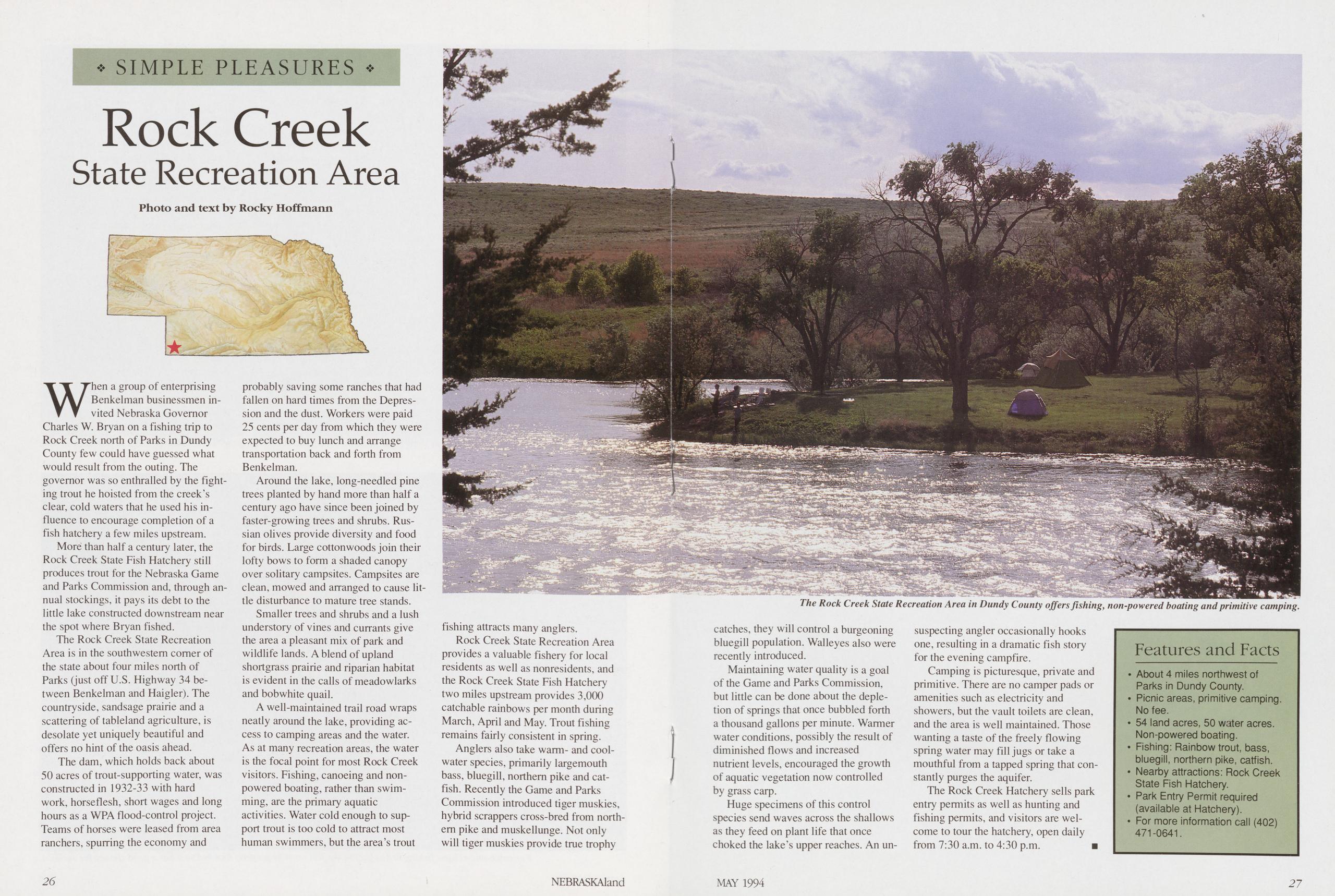
The Rock Creek State Recreation Area in Dundy County offers fishing, non-powered boating and primitive camping.
Rock Creek State Recreation Area provides a valuable fishery for local residents as well as nonresidents, and the Rock Creek State Fish Hatchery two miles upstream provides 3,000 catchable rainbows per month during March, April and May. Trout fishing remains fairly consistent in spring.
Anglers also take warm- and cool-water species, primarily largemouth bass, bluegill, northern pike and catfish. Recently the Game and Parks Commission introduced tiger muskies, hybrid scrappers cross-bred from northern pike and muskellunge. Not only will tiger muskies provide true trophy 26 NEBRASKAland catches, they will control a burgeoning bluegill population. Walleyes also were recently introduced.
Maintaining water quality is a goal of the Game and Parks Commission, but little can be done about the depletion of springs that once bubbled forth a thousand gallons per minute. Warmer water conditions, possibly the result of diminished flows and increased nutrient levels, encouraged the growth of aquatic vegetation now controlled by grass carp.
Huge specimens of this control species send waves across the shallows as they feed on plant life that once choked the lake’s upper reaches. An unsuspecting angler occasionally hooks one, resulting in a dramatic fish story for the evening campfire.
Camping is picturesque, private and primitive. There are no camper pads or amenities such as electricity and showers, but the vault toilets are clean, and the area is well maintained. Those wanting a taste of the freely flowing spring water may fill jugs or take a mouthful from a tapped spring that constantly purges the aquifer.
The Rock Creek Hatchery sells park entry permits as well as hunting and fishing permits, and visitors are welcome to tour the hatchery, open daily from 7:30 a.m. to 4:30 p.m. ■
Features and Facts • About 4 miles northwest of Parks in Dundy County. • Picnic areas, primitive camping. No fee. • 54 land acres, 50 water acres. Non-powered boating. • Fishing: Rainbow trout, bass, bluegill, northern pike, catfish. • Nearby attractions: Rock Creek State Fish Hatchery. • Park Entry Permit required (available at Hatchery). • For more information call (402) 471-0641. MAY 1994 27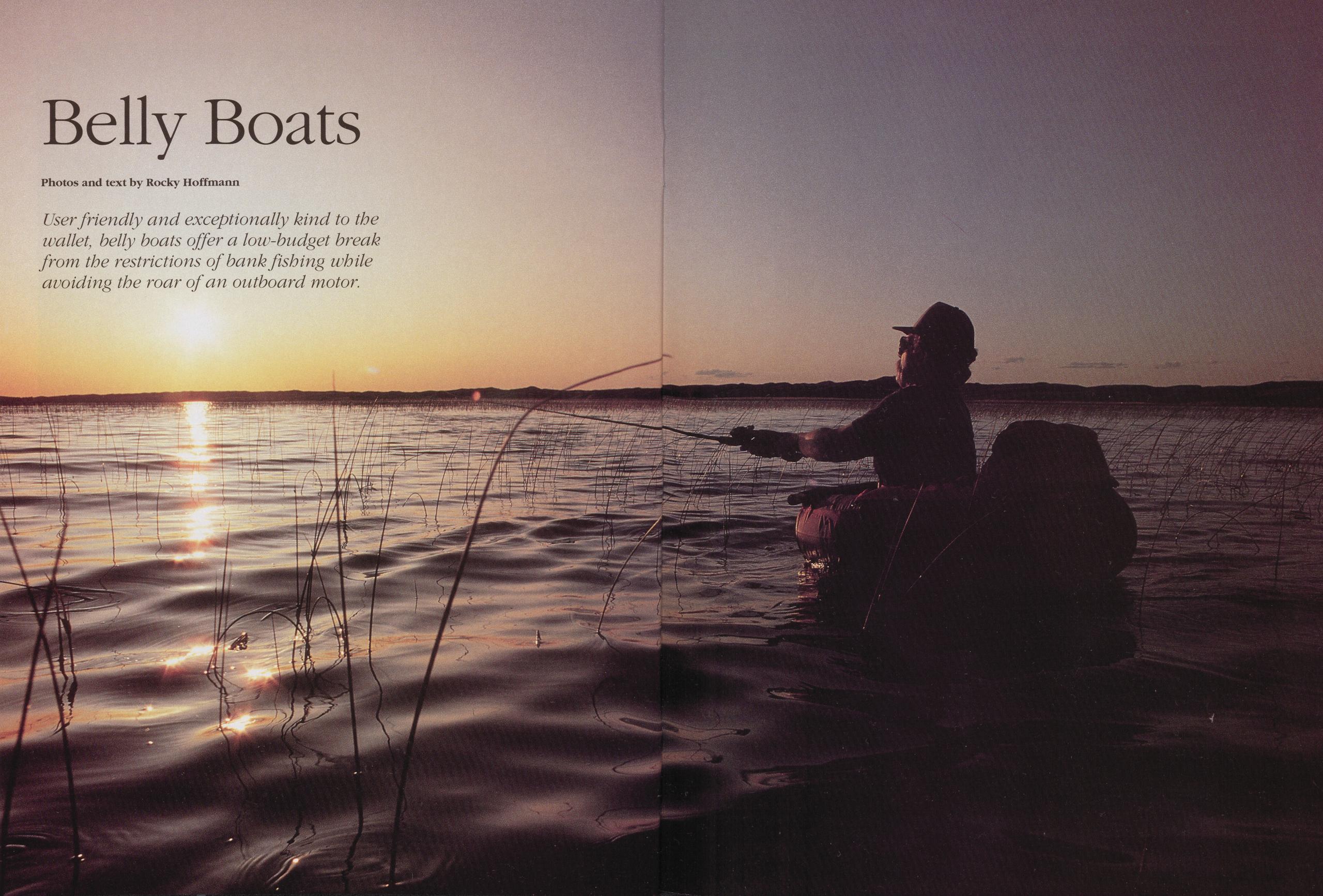
Belly Boats
User friendly and exceptionally kind to the wallet, belly boats offer a low-budget break from the restrictions of bank fishing while avoiding the roar of an outboard motor.
Marty has learned to expect the very best from his fishing experiences. Perhaps such lofty expectations are derived from the history of past adventures, not the least of which was a recent trip to the southeastern coast of Alaska. Marty described everything about that rugged land as overwhelming, magnificent and immense. The ocean, its currents, the mountains, the sea and land mammals and the fish were big — very big. He fished from large boats with heavy tackle, and he caught fish that could destroy the tackle from an ocean that could destroy the boat at Nature’s slightest whim.
He commonly pulls his boat across the high plains of western Nebraska and eastern Wyoming to fish plateau reservoirs, such as Boysen on the Wind River and Seminoe on the North Platte. It was at Seminoe that Marty hooked and landed a Wyoming state record 15- pound, 8-ounce walleye in 1989.
Several trips to Canada have been sandwiched between those more extensive trips, including a 75-mile canoe paddle across windswept lakes and rock-infested rapids. Half the distance was consumed by portages, where he carried everything with him on his back, including the canoe. The adventure also required four days of driving.
How, then, is Marty Petersen content with the fact that a regular agenda of these trips requires more time than today’s working person has available. Even a close-to-home weekend outing or the impulsive after-dinner run-out - and-catch-one trip requires a great amount of time and preparation. Tarping and untarping the boat, mixing fuel, charging batteries, keeping the tires at the correct pressure and running down the short circuits in the trailer lights are just a few items on a long checklist that can steal time and enjoyment from a weekend outing.
Marty puts so much time, preparation and planning into his major trips that he refuses to submit to the same pressures for three-hour evening excursion to a local sandpit or backwater or even for a weekend at a southwestern Nebraska reservoir.
For Marty, the “belly boat,” or float tube, is often the perfect alternative. A float tube offers the fish-catching ad- vantages of a boat, but is considerably less expensive and relatively hassle free. With little more than a quick stroll through the garage after dinner he can throw his waders over his shoulder, scoop up his belly boat and rod in one hand and grab a life jacket in the other. Convenient pockets in the tube cover are already stocked with lures, hook extractors, a line clipper and other necessities. It all fits nicely in the pickup bed or car trunk.
Marty and I talked about the simplicity of this kind of fishing last spring as we drove north along U.S. Highway 83 to the Valentine National Wildlife Refuge. Our plan was to cash in on some of the huge bluegills in Pelican Lake. The refuge, south of Valentine in the heart of the Sandhills, has a series of lakes ideal for belly-boat fishing.
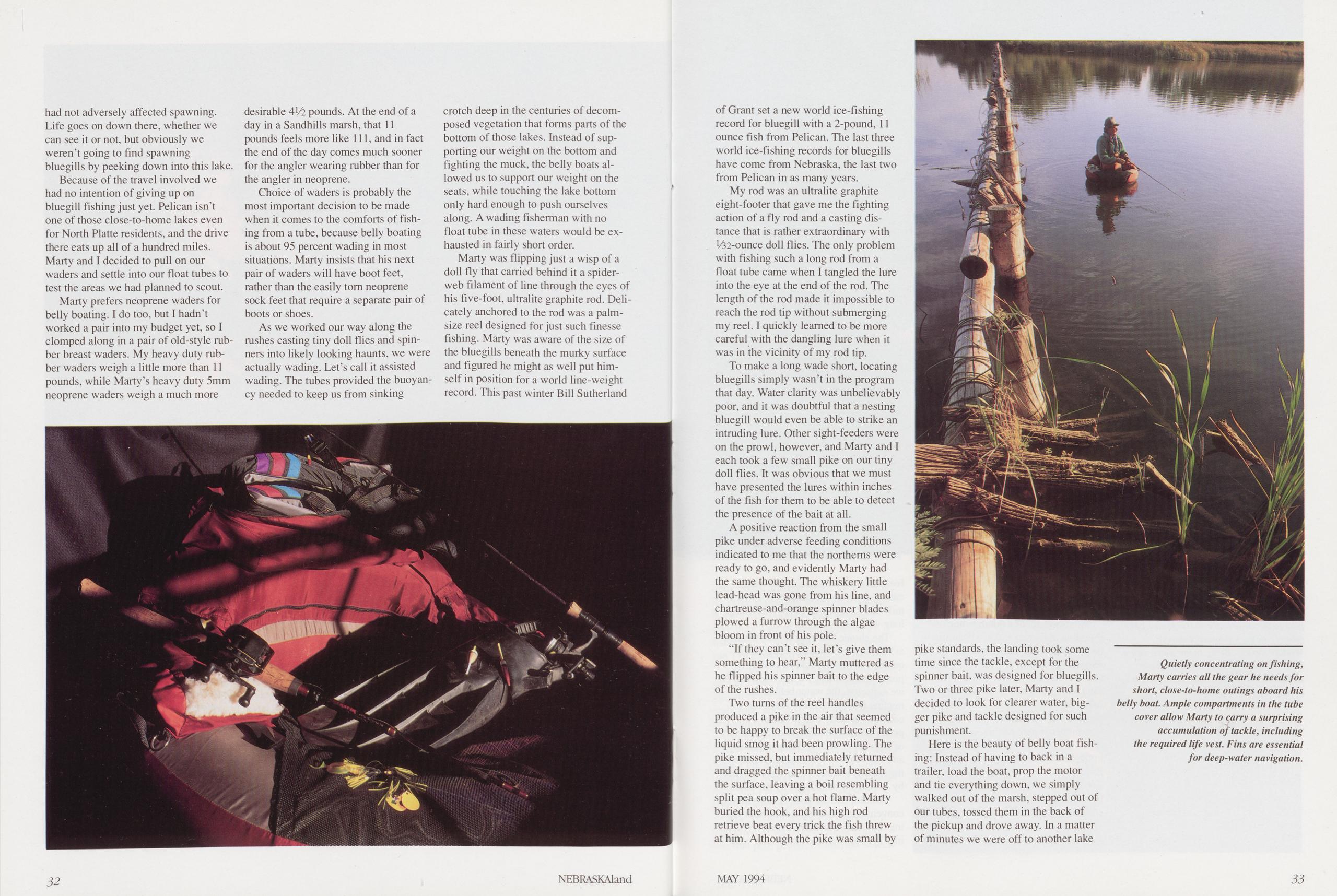
Belly boats, marketed by various manufacturers, consist of a heavy-duty innertube fit into a tailor-made nylon cover with a fabric seat across the bottom divided by a strap to form leg holes. Belly boat covers are usually brightly colored, except for camouflaged hunting models, and most have abundant pockets and pouches. Some have a fabric top flap that can serve as a worktable when snapped in place. Fly fishermen generally purchase this option to provide a place to store stripped-off line.
Many belly boats, like the one Marty uses, have inflatable high back supports and armrests. Rather than inflating his back support while fishing shallow water, Marty tucks his life vest inside the zippered liner, providing the support for which this compartment was intended and an area to store the required life vest.
We were headed for Pelican Lake because all winter long it had been producing spectacular through-the-ice bluegill fishing. Two-pounders were not unheard of, and fish approaching two pounds were the norm. Marty and I planned to hit the lake when the water reached a temperature that initiated the spawning urge, and we could take big ’gills from shallow water simply by finding their beds.
In clear water on a calm day, locating beds is not difficult. Past experience on the lake told us where the shallow, sandy areas are, and the rest of the tracking process would be left up to our polarized sunglasses.
We planned to use our belly boats to scout for spawning beds and to catch the fish that we hoped occupied them. With the boats, we could move quietly 30 NEBRASKAland among pockets in the rushes scarcely making a ripple. The polarized glasses would cut the sun’s glare from the surface and allow us to see the sand below with the ease of underwater viewing from a glass-bottom boat.
Conditions were perfect for locating beds — no hint of a breeze and not a cloud in the sky — except. Except the lake had mysteriously developed its own obstacles to our plan. Sometime during the previous week what is normally a crystal-clear Sandhills lake had turned horribly turbid. An algae bloom had developed, and typically powerful Sandhills winds had riled the water into a suspended liquid cloud.
It would be foolish to complain about the turbidity resulting from plankton. After all, these Sandhills lakes offer fine fishing because they are eutrophic. When temperature and light penetration reach the right combination, a bloom of microscopic plant and animal life occurs, inhibiting under-water visibility for a period of time. Our only disappointment was that the bloom coincided with our plans for locating bluegills.
The water’s lack of clarity probably
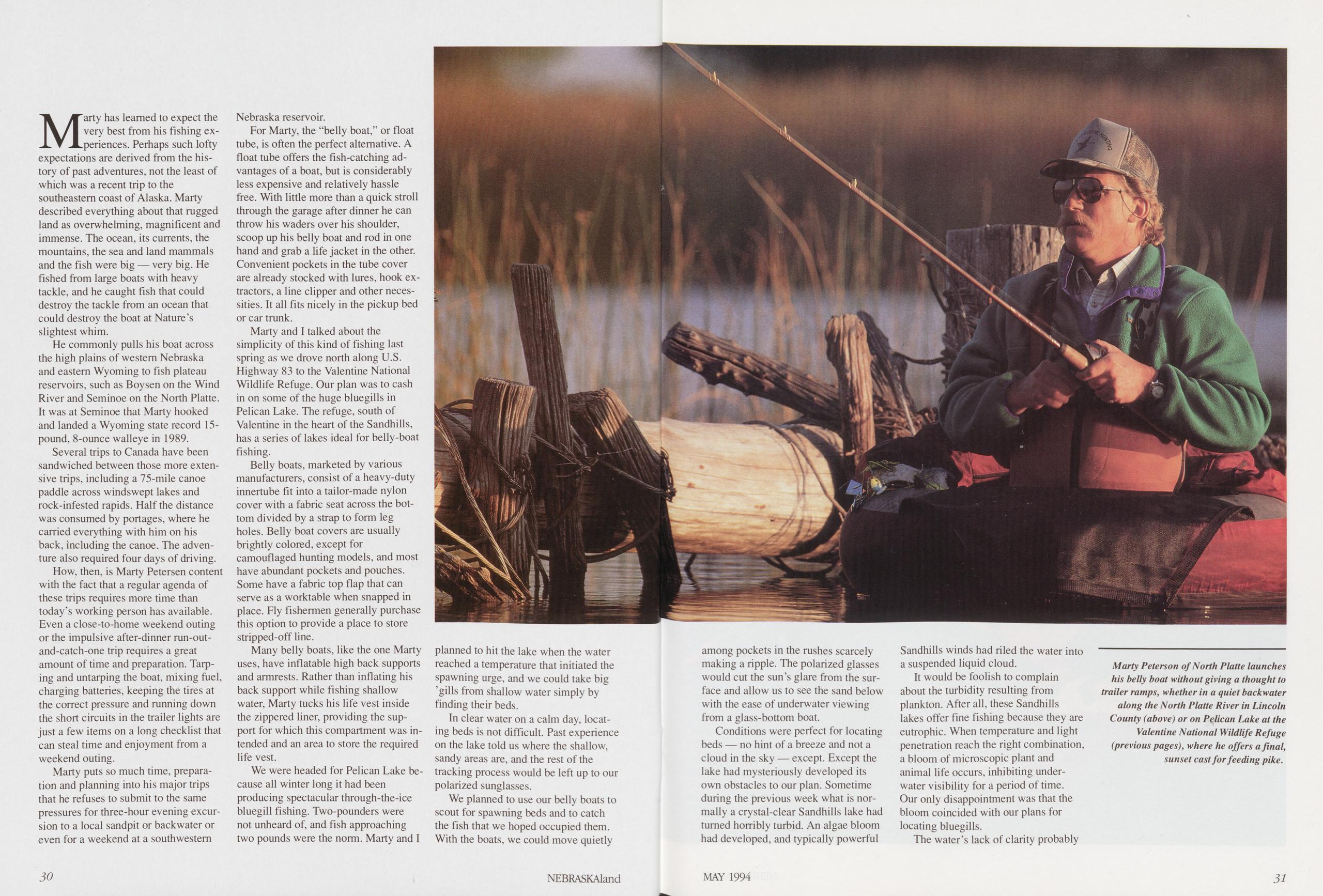
Marty Peterson of North Platte launches his belly boat without giving a thought to trailer ramps, whether in a quiet backwater along the North Platte River in Lincoln County (above) or on Pelican Lake at the Valentine National Wildlife Refuge (previous pages), where he offers a final, sunset cast for feeding pike.
had not adversely affected spawning. Life goes on down there, whether we can see it or not, but obviously we weren’t going to find spawning bluegills by peeking down into this lake.
Because of the travel involved we had no intention of giving up on bluegill fishing just yet. Pelican isn’t one of those close-to-home lakes even for North Platte residents, and the drive there eats up all of a hundred miles. Marty and I decided to pull on our waders and settle into our float tubes to test the areas we had planned to scout.
Marty prefers neoprene waders for belly boating. I do too, but I hadn’t worked a pair into my budget yet, so I clomped along in a pair of old-style rubber breast waders. My heavy duty rubber waders weigh a little more than 11 pounds, while Marty’s heavy duty 5mm neoprene waders weigh a much more desirable 41/? pounds. At the end of a day in a Sandhills marsh, that 11 pounds feels more like 111, and in fact the end of the day comes much sooner for the angler wearing rubber than for the angler in neoprene.
Choice of waders is probably the most important decision to be made when it comes to the comforts of fishing from a tube, because belly boating is about 95 percent wading in most situations. Marty insists that his next pair of waders will have boot feet, rather than the easily tom neoprene sock feet that require a separate pair of boots or shoes.
As we worked our way along the rushes casting tiny doll flies and spinners into likely looking haunts, we were actually wading. Let’s call it assisted wading. The tubes provided the buoyancy needed to keep us from sinking crotch deep in the centuries of decomposed vegetation that forms parts of the bottom of those lakes. Instead of supporting our weight on the bottom and fighting the muck, the belly boats allowed us to support our weight on the seats, while touching the lake bottom only hard enough to push ourselves along. A wading fisherman with no float tube in these waters would be exhausted in fairly short order.
Marty was flipping just a wisp of a doll fly that carried behind it a spider- web filament of line through the eyes of his five-foot, ultralite graphite rod. Delicately anchored to the rod was a palm-size reel designed for just such finesse fishing. Marty was aware of the size of the bluegills beneath the murky surface and figured he might as well put himself in position for a world line-weight record. This past winter Bill Sutherland
My rod was an ultralite graphite eight-footer that gave me the fighting action of a fly rod and a casting dis- tance that is rather extraordinary with W2-ounce doll flies. The only problem with fishing such a long rod from a float tube came when I tangled the lure into the eye at the end of the rod. The length of the rod made it impossible to reach the rod tip without submerging my reel. I quickly learned to be more careful with the dangling lure when it was in the vicinity of my rod tip.
To make a long wade short, locating bluegills simply wasn’t in the program that day. Water clarity was unbelievably poor, and it was doubtful that a nesting bluegill would even be able to strike an intruding lure. Other sight-feeders were on the prowl, however, and Marty and I each took a few small pike on our tiny doll flies. It was obvious that we must have presented the lures within inches of the fish for them to be able to detect the presence of the bait at all.
A positive reaction from the small pike under adverse feeding conditions indicated to me that the northerns were ready to go, and evidently Marty had the same thought. The whiskery little lead-head was gone from his line, and chartreuse-and-orange spinner blades plowed a furrow through the algae bloom in front of his pole.
"If they can’t see it, let’s give them something to hear,” Marty muttered as he flipped his spinner bait to the edge of the rushes.
Two turns of the reel handles produced a pike in the air that seemed to be happy to break the surface of the liquid smog it had been prowling. The pike missed, but immediately returned and dragged the spinner bait beneath the surface, leaving a boil resembling split pea soup over a hot flame. Marty buried the hook, and his high rod retrieve beat every trick the fish threw at him. Although the pike was small by pike standards, the landing took some time since the tackle, except for the spinner bait, was designed for bluegills. Two or three pike later, Marty and I decided to look for clearer water, bigger pike and tackle designed for such punishment.
Here is the beauty of belly boat fishing: Instead of having to back in a trailer, load the boat, prop the motor and tie everything down, we simply walked out of the marsh, stepped out of our tubes, tossed them in the back of the pickup and drove away. In a matter of minutes we were off to another lake
Quietly concentrating on fishing, Marty carries all the gear he needs for short, close-to-home outings aboard his belly boat. Ample compartments in the tube cover allow Marty to carry a surprising accumulation of tackle, including the required life vest. Fins are essential for deep-water navigation.
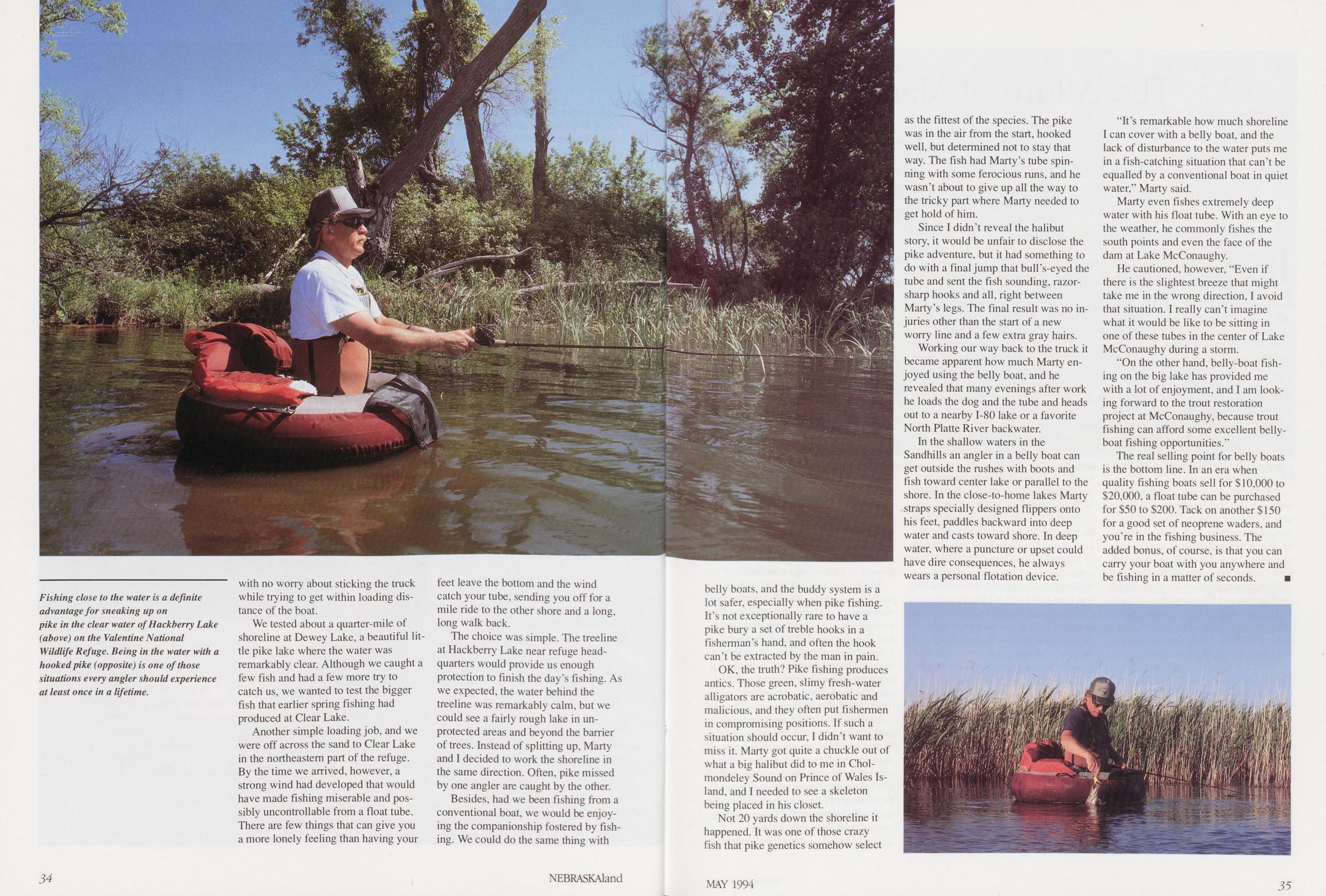
Fishing close to the water is a definite advantage for sneaking up on pike in the clear water of Hackberry Lake (above) on the Valentine National Wildlife Refuge. Being in the water with a hooked pike (opposite) is one of those situations every angler should experience at least once in a lifetime.
with no worry about sticking the truck while trying to get within loading distance of the boat.
We tested about a quarter-mile of shoreline at Dewey Lake, a beautiful little pike lake where the water was remarkably clear. Although we caught a few fish and had a few more try to catch us, we wanted to test the bigger fish that earlier spring fishing had produced at Clear Lake.
Another simple loading job, and we were off across the sand to Clear Lake in the northeastern part of the refuge. By the time we arrived, however, a strong wind had developed that would have made fishing miserable and possibly uncontrollable from a float tube. There are few things that can give you a more lonely feeling than having your feet leave the bottom and the wind catch your tube, sending you off for a mile ride to the other shore and a long, long walk back.
The choice was simple. The treeline at Hackberry Lake near refuge headquarters would provide us enough protection to finish the day’s fishing. As we expected, the water behind the treeline was remarkably calm, but we could see a fairly rough lake in unprotected areas and beyond the barrier of trees. Instead of splitting up, Marty and I decided to work the shoreline in the same direction. Often, pike missed by one angler are caught by the other.
Besides, had we been fishing from a conventional boat, we would be enjoying the companionship fostered by fishing. We could do the same thing with 34 NEBRASKAland belly boats, and the buddy system is a lot safer, especially when pike fishing. It’s not exceptionally rare to have a pike bury a set of treble hooks in a fisherman’s hand, and often the hook can’t be extracted by the man in pain.
OK, the truth? Pike fishing produces antics. Those green, slimy fresh-water alligators are acrobatic, aerobatic and malicious, and they often put fishermen in compromising positions. If such a situation should occur, I didn’t want to miss it. Marty got quite a chuckle out of what a big halibut did to me in Cholmondeley Sound on Prince of Wales Island, and I needed to see a skeleton being placed in his closet.
Not 20 yards down the shoreline it happened. It was one of those crazy fish that pike genetics somehow select as the fittest of the species. The pike was in the air from the start, hooked well, but determined not to stay that way. The fish had Marty’s tube spinning with some ferocious runs, and he wasn’t about to give up all the way to the tricky part where Marty needed to get hold of him.
Since I didn’t reveal the halibut story, it would be unfair to disclose the pike adventure, but it had something to do with a final jump that bull’s-eyed the tube and sent the fish sounding, razor-sharp hooks and all, right between Marty’s legs. The final result was no injuries other than the start of a new worry line and a few extra gray hairs.
Working our way back to the truck it became apparent how much Marty enjoyed using the belly boat, and he revealed that many evenings after work he loads the dog and the tube and heads out to a nearby 1-80 lake or a favorite North Platte River backwater.
In the shallow waters in the Sandhills an angler in a belly boat can get outside the rushes with boots and fish toward center lake or parallel to the shore. In the close-to-home lakes Marty straps specially designed flippers onto his feet, paddles backward into deep water and casts toward shore. In deep water, where a puncture or upset could have dire consequences, he always wears a personal flotation device.
“It’s remarkable how much shoreline I can cover with a belly boat, and the lack of disturbance to the water puts me in a fish-catching situation that can’t be equalled by a conventional boat in quiet water,” Marty said.
Marty even fishes extremely deep water with his float tube. With an eye to the weather, he commonly fishes the south points and even the face of the dam at Lake McConaughy.
He cautioned, however, “Even if there is the slightest breeze that might take me in the wrong direction, I avoid that situation. I really can’t imagine what it would be like to be sitting in one of these tubes in the center of Lake McConaughy during a storm.
“On the other hand, belly-boat fishing on the big lake has provided me with a lot of enjoyment, and I am looking forward to the trout restoration project at McConaughy, because trout fishing can afford some excellent belly- boat fishing opportunities.”
The real selling point for belly boats is the bottom line. In an era when quality fishing boats sell for $10,000 to $20,000, a float tube can be purchased for $50 to $200. Tack on another $150 for a good set of neoprene waders, and you’re in the fishing business. The added bonus, of course, is that you can carry your boat with you anywhere and be fishing in a matter of seconds. ■
MAY 1994 35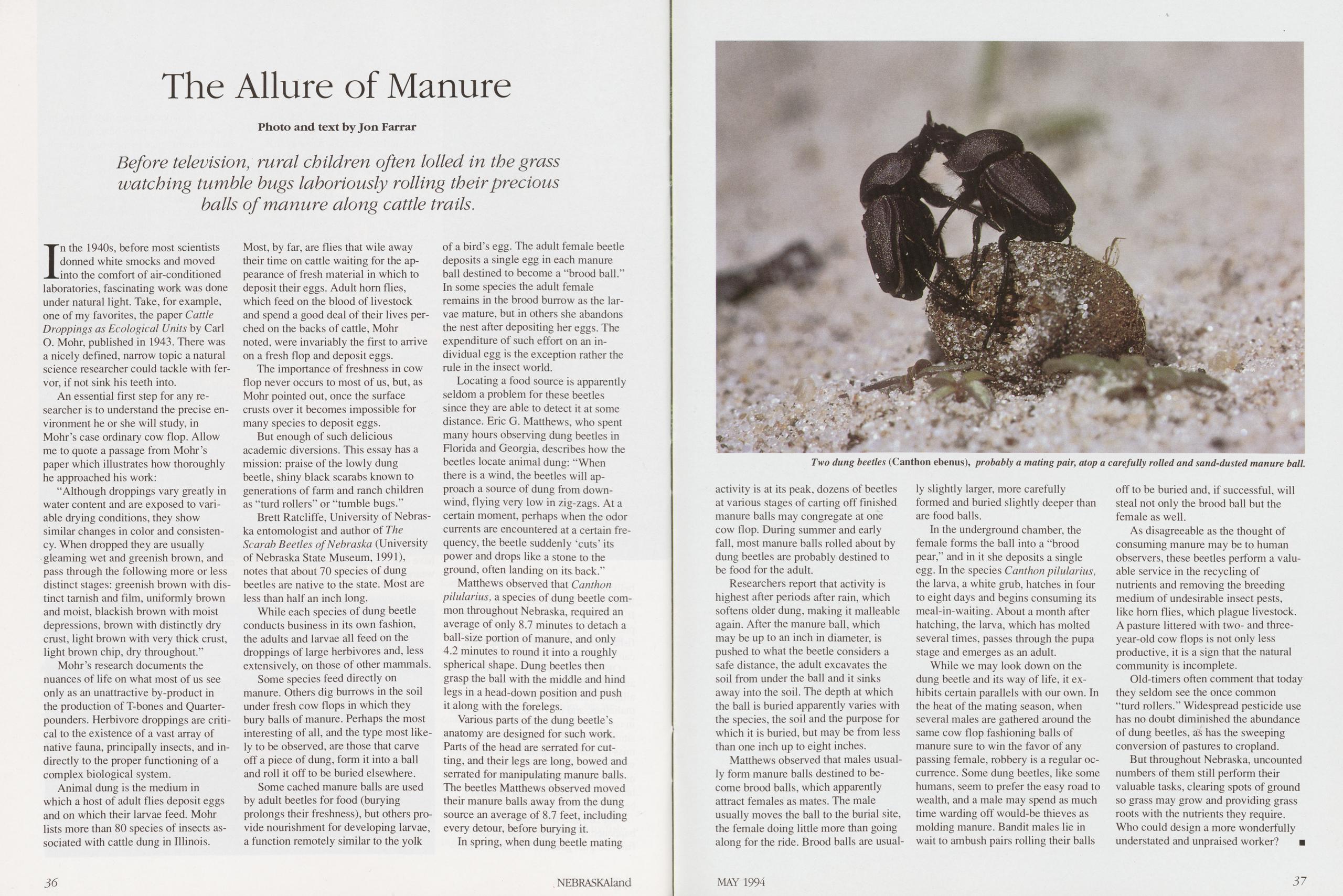
The Allure of Manure
Before television, rural children often lolled in the grass watching tumble bugs laboriously rolling their precious balls of manure along cattle trails.
In the 1940s, before most scientists donned white smocks and moved into the comfort of air-conditioned laboratories, fascinating work was done under natural light. Take, for example, one of my favorites, the paper Cattle Droppings as Ecological Units by Carl O. Mohr, published in 1943. There was a nicely defined, narrow topic a natural science researcher could tackle with fervor, if not sink his teeth into.
An essential first step for any researcher is to understand the precise environment he or she will study, in Mohr’s case ordinary cow flop. Allow me to quote a passage from Mohr’s paper which illustrates how thoroughly he approached his work:
“Although droppings vary greatly in water content and are exposed to variable drying conditions, they show similar changes in color and consistency. When dropped they are usually gleaming wet and greenish brown, and pass through the following more or less distinct stages: greenish brown with distinct tarnish and film, uniformly brown and moist, blackish brown with moist depressions, brown with distinctly dry crust, light brown with very thick crust, light brown chip, dry throughout.”
Mohr’s research documents the nuances of life on what most of us see only as an unattractive by-product in the production of T-bones and Quarter-pounders. Herbivore droppings are critical to the existence of a vast array of native fauna, principally insects, and indirectly to the proper functioning of a complex biological system.
Animal dung is the medium in which a host of adult flies deposit eggs and on which their larvae feed. Mohr lists more than 80 species of insects associated with cattle dung in Illinois. Most, by far, are flies that wile away their time on cattle waiting for the appearance of fresh material in which to deposit their eggs. Adult horn flies, which feed on the blood of livestock and spend a good deal of their lives perched on the backs of cattle, Mohr noted, were invariably the first to arrive on a fresh flop and deposit eggs.
The importance of freshness in cow flop never occurs to most of us, but, as Mohr pointed out, once the surface crusts over it becomes impossible for many species to deposit eggs.
But enough of such delicious academic diversions. This essay has a mission: praise of the lowly dung beetle, shiny black scarabs known to generations of farm and ranch children as “turd rollers” or “tumble bugs.”
Brett Ratcliffe, University of Nebraska entomologist and author of The Scarab Beetles of Nebraska (University of Nebraska State Museum, 1991), notes that about 70 species of dung beetles are native to the state. Most are less than half an inch long.
While each species of dung beetle conducts business in its own fashion, the adults and larvae all feed on the droppings of large herbivores and, less extensively, on those of other mammals.
Some species feed directly on manure. Others dig burrows in the soil under fresh cow flops in which they bury balls of manure. Perhaps the most interesting of all, and the type most likely to be observed, are those that carve off a piece of dung, form it into a ball and roll it off to be buried elsewhere.
Some cached manure balls are used by adult beetles for food (burying prolongs their freshness), but others provide nourishment for developing larvae, a function remotely similar to the yolk of a bird’s egg. The adult female beetle deposits a single egg in each manure ball destined to become a “brood ball.” In some species the adult female remains in the brood burrow as the larvae mature, but in others she abandons the nest after depositing her eggs. The expenditure of such effort on an individual egg is the exception rather the rule in the insect world.
Locating a food source is apparently seldom a problem for these beetles since they are able to detect it at some distance. Eric G. Matthews, who spent many hours observing dung beetles in Florida and Georgia, describes how the beetles locate animal dung: “When there is a wind, the beetles will approach a source of dung from downwind, flying very low in zig-zags. At a certain moment, perhaps when the odor currents are encountered at a certain frequency, the beetle suddenly ‘cuts’ its power and drops like a stone to the ground, often landing on its back.”
Matthews observed that Canthon pilularius, a species of dung beetle common throughout Nebraska, required an average of only 8.7 minutes to detach a ball-size portion of manure, and only 4.2 minutes to round it into a roughly spherical shape. Dung beetles then grasp the ball with the middle and hind legs in a head-down position and push it along with the forelegs.
Various parts of the dung beetle’s anatomy are designed for such work. Parts of the head are serrated for cutting, and their legs are long, bowed and serrated for manipulating manure balls. The beetles Matthews observed moved their manure balls away from the dung source an average of 8.7 feet, including every detour, before burying it.
Two dung beetles (Canthon ebenus), probably a mating pair, atop a carefully rolled and sand-dusted manure ball.
Researchers report that activity is highest after periods after rain, which softens older dung, making it malleable again. After the manure ball, which may be up to an inch in diameter, is pushed to what the beetle considers a safe distance, the adult excavates the soil from under the ball and it sinks away into the soil. The depth at which the ball is buried apparently varies with the species, the soil and the purpose for which it is buried, but may be from less than one inch up to eight inches.
Matthews observed that males usually form manure balls destined to become brood balls, which apparently attract females as mates. The male usually moves the ball to the burial site, the female doing little more than going along for the ride. Brood balls are usually slightly larger, more carefully formed and buried slightly deeper than are food balls.
In the underground chamber, the female forms the ball into a “brood pear,” and in it she deposits a single egg. In the species Canthon pilularius, the larva, a white grub, hatches in four to eight days and begins consuming its meal-in-waiting. About a month after hatching, the larva, which has molted several times, passes through the pupa stage and emerges as an adult.
While we may look down on the dung beetle and its way of life, it exhibits certain parallels with our own. In the heat of the mating season, when several males are gathered around the same cow flop fashioning balls of manure sure to win the favor of any passing female, robbery is a regular occurrence. Some dung beetles, like some humans, seem to prefer the easy road to wealth, and a male may spend as much time warding off would-be thieves as molding manure. Bandit males lie in wait to ambush pairs rolling their balls off to be buried and, if successful, will steal not only the brood ball but the female as well.
As disagreeable as the thought of consuming manure may be to human observers, these beetles perform a valuable service in the recycling of nutrients and removing the breeding medium of undesirable insect pests, like horn flies, which plague livestock. A pasture littered with two- and three- year-old cow flops is not only less productive, it is a sign that the natural community is incomplete.
Old-timers often comment that today they seldom see the once common “turd rollers.” Widespread pesticide use has no doubt diminished the abundance of dung beetles, atz has the sweeping conversion of pastures to cropland.
But throughout Nebraska, uncounted numbers of them still perform their valuable tasks, clearing spots of ground so grass may grow and providing grass roots with the nutrients they require. Who could design a more wonderfully understated and unpraised worker? ■
MAY 1994 37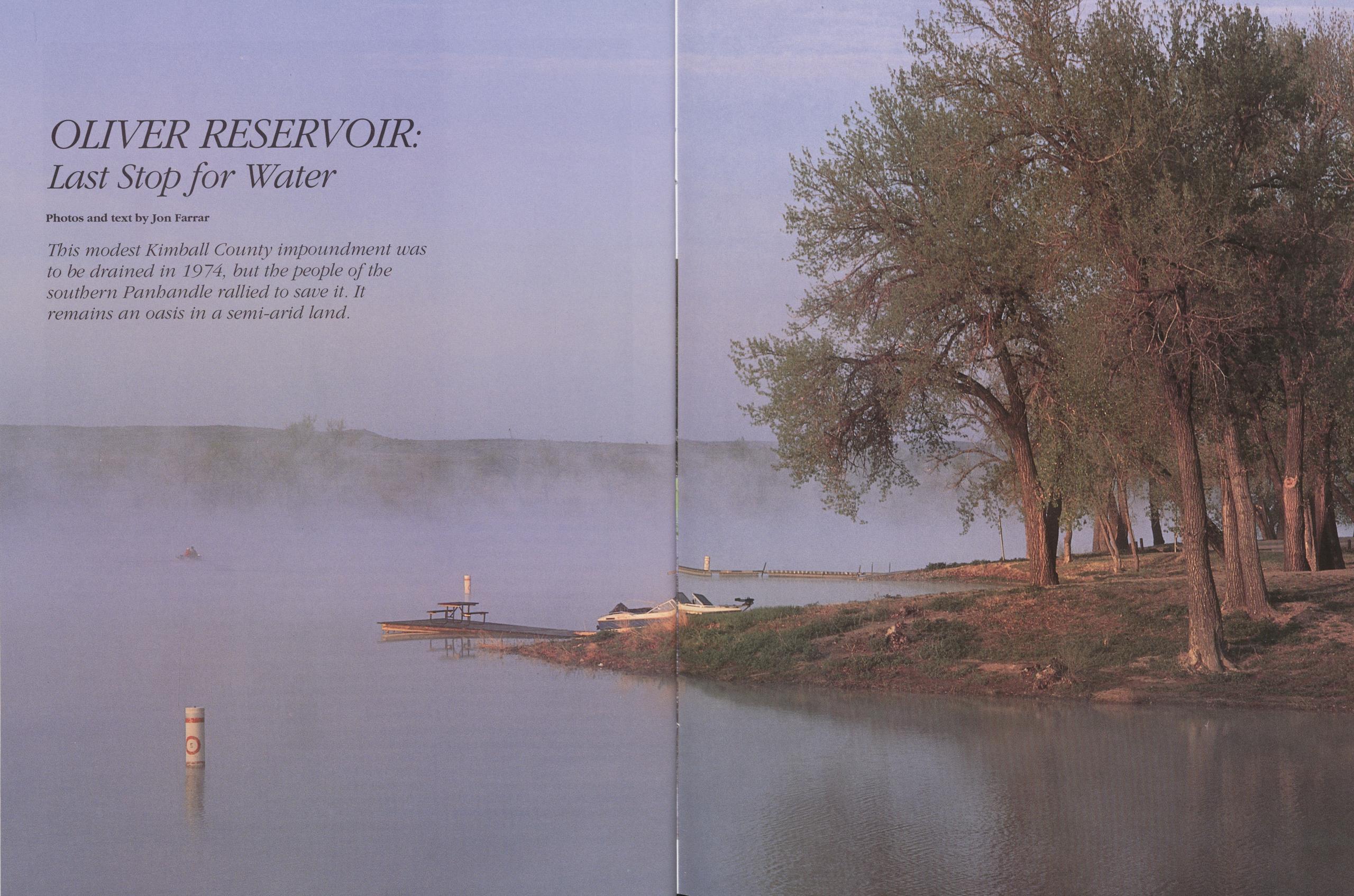
OLIVER RESERVOIR: Last Stop for Water
This modest Kimball County impoundment was to be drained in 1974, but the people of the southern Panhandle rallied to save it. It remains an oasis in a semi-arid land.
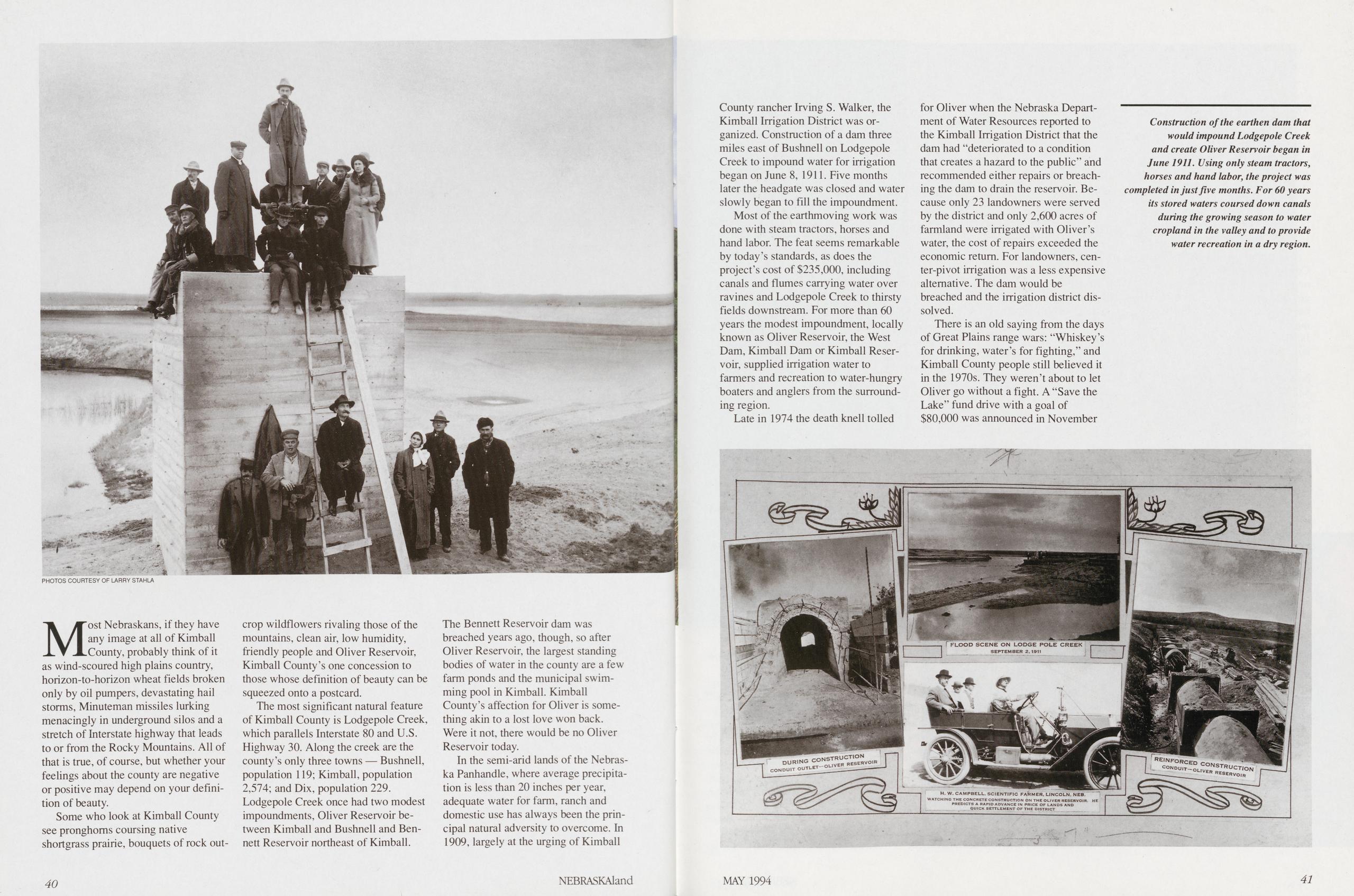
Most Nebraskans, if they have any image at all of Kimball County, probably think of it as wind-scoured high plains country, horizon-to-horizon wheat fields broken only by oil pumpers, devastating hail storms, Minuteman missiles lurking menacingly in underground silos and a stretch of Interstate highway that leads to or from the Rocky Mountains. All of that is true, of course, but whether your feelings about the county are negative or positive may depend on your definition of beauty.
Some who look at Kimball County see pronghorns coursing native shortgrass prairie, bouquets of rock out-crop wildflowers rivaling those of the mountains, clean air, low humidity, friendly people and Oliver Reservoir, Kimball County’s one concession to those whose definition of beauty can be squeezed onto a postcard.
The most significant natural feature of Kimball County is Lodgepole Creek, which parallels Interstate 80 and U.S. Highway 30. Along the creek are the county’s only three towns — Bushnell, population 119; Kimball, population 2,574; and Dix, population 229. Lodgepole Creek once had two modest impoundments, Oliver Reservoir between Kimball and Bushnell and Bennett Reservoir northeast of Kimball. The Bennett Reservoir dam was breached years ago, though, so after Oliver Reservoir, the largest standing bodies of water in the county are a few farm ponds and the municipal swimming pool in Kimball. Kimball County’s affection for Oliver is something akin to a lost love won back. Were it not, there would be no Oliver Reservoir today.
In the semi-arid lands of the Nebraska Panhandle, where average precipitation is less than 20 inches per year, adequate water for farm, ranch and domestic use has always been the principal natural adversity to overcome. In 1909, largely at the urging of Kimball 40 NEBRASKAland County rancher Irving S. Walker, the Kimball Irrigation District was organized. Construction of a dam three miles east of Bushnell on Lodgepole Creek to impound water for irrigation began on June 8, 1911. Five months later the headgate was closed and water slowly began to fill the impoundment.
Most of the earthmoving work was done with steam tractors, horses and hand labor. The feat seems remarkable by today’s standards, as does the project’s cost of $235,000, including canals and flumes carrying water over ravines and Lodgepole Creek to thirsty fields downstream. For more than 60 years the modest impoundment, locally known as Oliver Reservoir, the West Dam, Kimball Dam or Kimball Reservoir, supplied irrigation water to farmers and recreation to water-hungry boaters and anglers from the surrounding region.
Late in 1974 the death knell tolled for Oliver when the Nebraska Department of Water Resources reported to the Kimball Irrigation District that the dam had “deteriorated to a condition that creates a hazard to the public” and recommended either repairs or breaching the dam to drain the reservoir. Because only 23 landowners were served by the district and only 2,600 acres of farmland were irrigated with Oliver’s water, the cost of repairs exceeded the economic return. For landowners, center-pivot irrigation was a less expensive alternative. The dam would be breached and the irrigation district dissolved.
There is an old saying from the days of Great Plains range wars: “Whiskey’s for drinking, water’s for fighting,” and Kimball County people still believed it in the 1970s. They weren’t about to let Oliver go without a fight. A “Save the Lake” fund drive with a goal of $80,000 was announced in November
Construction of the earthen dam that would impound Lodgepole Creek and create Oliver Reservoir began in June 1911. Using only steam tractors, horses and hand labor, the project was completed in just five months. For 60 years its stored waters coursed down canals during the growing season to water cropland in the valley and to provide water recreation in a dry region.
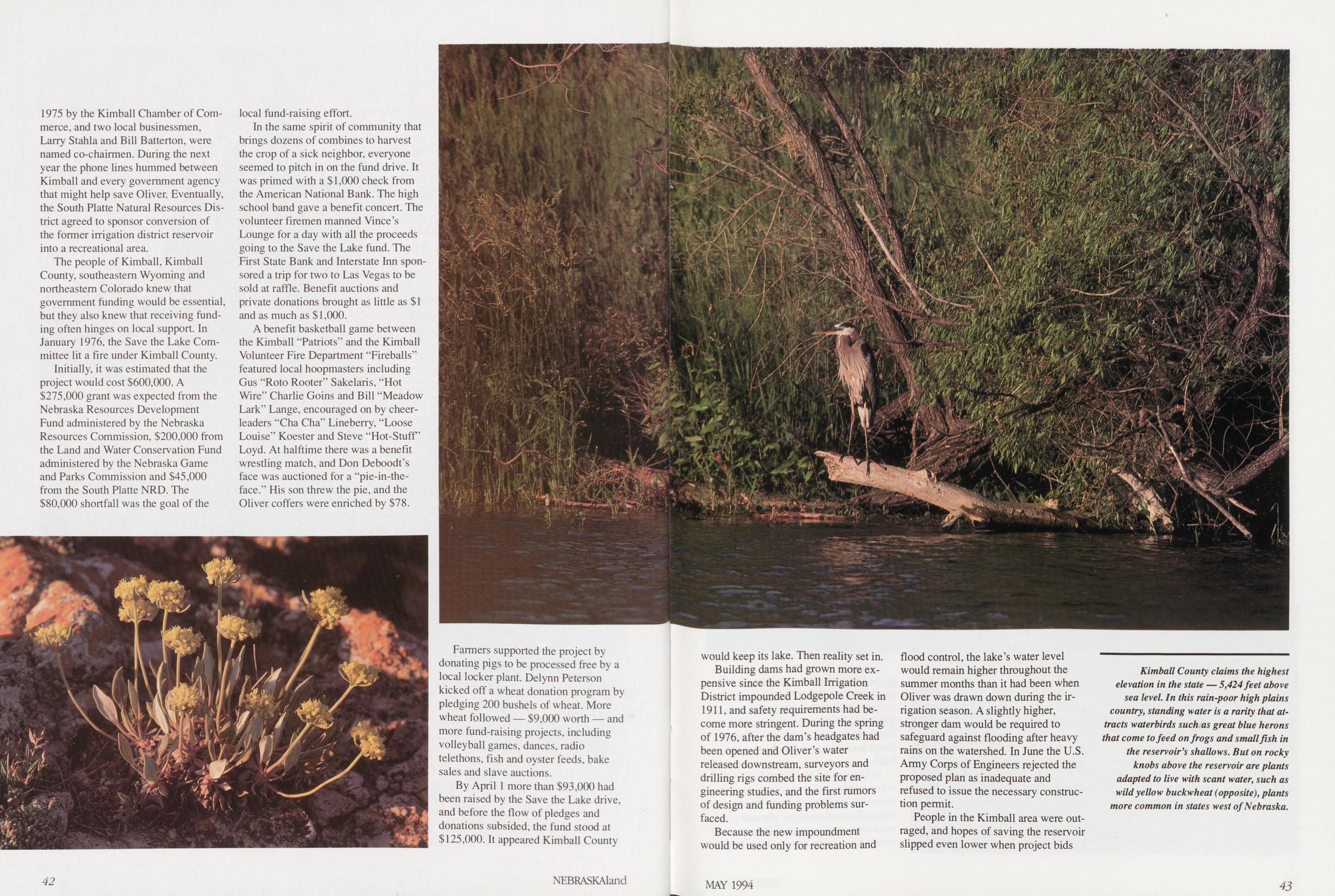
1975 by the Kimball Chamber of Commerce, and two local businessmen, Larry Stahla and Bill Batterton, were named co-chairmen. During the next year the phone lines hummed between Kimball and every government agency that might help save Oliver. Eventually, the South Platte Natural Resources District agreed to sponsor conversion of the former irrigation district reservoir into a recreational area.
The people of Kimball, Kimball County, southeastern Wyoming and northeastern Colorado knew that government funding would be essential, but they also knew that receiving funding often hinges on local support. In January 1976, the Save the Lake Committee lit a fire under Kimball County.
Initially, it was estimated that the project would cost $600,000. A $275,000 grant was expected from the Nebraska Resources Development Fund administered by the Nebraska Resources Commission, $200,000 from the Land and Water Conservation Fund administered by the Nebraska Game and Parks Commission and $45,000 from the South Platte NRD. The $80,000 shortfall was the goal of the local fund-raising effort.
In the same spirit of community that brings dozens of combines to harvest the crop of a sick neighbor, everyone seemed to pitch in on the fund drive. It was primed with a $ 1,000 check from the American National Bank. The high school band gave a benefit concert. The volunteer firemen manned Vince’s Lounge for a day with all the proceeds going to the Save the Lake fund. The First State Bank and Interstate Inn sponsored a trip for two to Las Vegas to be sold at raffle. Benefit auctions and private donations brought as little as $1 and as much as $1,000.
A benefit basketball game between the Kimball “Patriots” and the Kimball Volunteer Fire Department “Fireballs” featured local hoopmasters including Gus “Roto Rooter” Sake laris, “Hot Wire” Charlie Goins and Bill “Meadow Lark” Lange, encouraged on by cheerleaders “Cha Cha” Lineberry, “Loose Louise” Koester and Steve “Hot-Stuff’ Loyd. At halftime there was a benefit wrestling match, and Don Deboodt’s face was auctioned for a “pie-in-the- face.” His son threw the pie, and the Oliver coffers were enriched by $78.
Farmers supported the project by donating pigs to be processed free by a local locker plant. Delynn Peterson kicked off a wheat donation program by pledging 200 bushels of wheat. More wheat followed — $9,000 worth — and more fund-raising projects, including volleyball games, dances, radio telethons, fish and oyster feeds, bake sales and slave auctions.
By April 1 more than $93,000 had been raised by the Save the Lake drive, and before the flow of pledges and donations subsided, the fund stood at $125,000. It appeared Kimball County 42 NEBRASKAland would keep its lake. Then reality set in.
Building dams had grown more ex- pensive since the Kimball Irrigation District impounded Lodgepole Creek in 1911, and safety requirements had become more stringent. During the spring of 1976, after the dam’s headgates had been opened and Oliver’s water released downstream, surveyors and drilling rigs combed the site for engineering studies, and the first rumors of design and funding problems surfaced.
Because the new impoundment would be used only for recreation and flood control, the lake’s water level would remain higher throughout the summer months than it had been when Oliver was drawn down during the irrigation season. A slightly higher, stronger dam would be required to safeguard against flooding after heavy rains on the watershed. In June the U.S. Army Corps of Engineers rejected the proposed plan as inadequate and refused to issue the necessary construction permit.
People in the Kimball area were outraged, and hopes of saving the reservoir slipped even lower when project bids
Kimball County claims the highest elevation in the state — 5,424feet above sea level. In this rain-poor high plains country, standing water is a rarity that attracts waterbirds such as great blue herons that come to feed on frogs and small fish in the reservoir’s shallows. But on rocky knobs above the reservoir are plants adapted to live with scant water, such as wild yellow buckwheat (opposite), plants more common in states west of Nebraska.
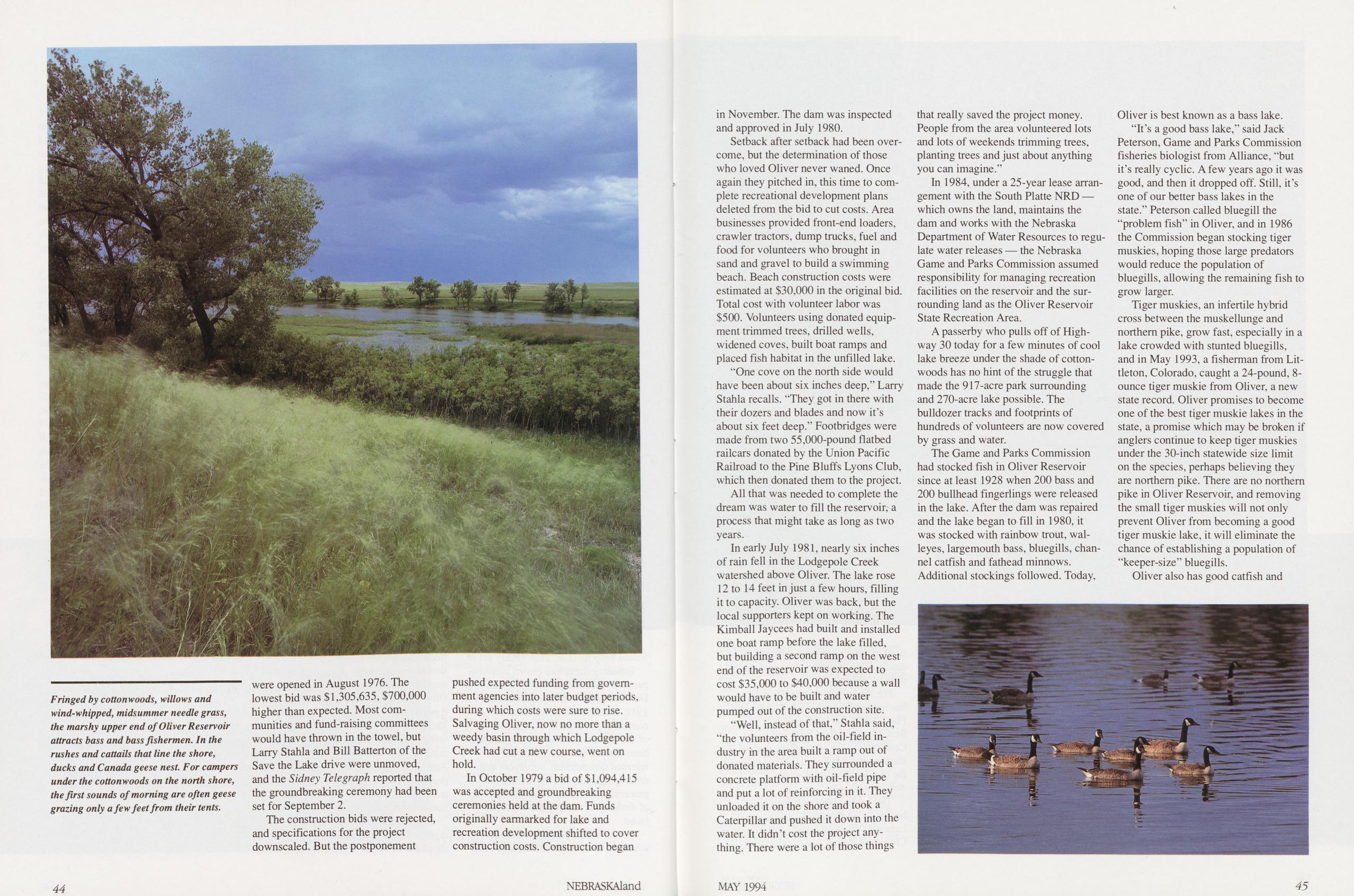
Fringed by cottonwoods, willows and wind-whipped, midsummer needle grass, t/re marshy upper end of Oliver Reservoir attracts bass and bass fishermen. In the rushes and cattails that line the shore, ducks and Canada geese nest. For campers under the cottonwoods on the north shore, the first sounds of morning are often geese grazing only a few feet from their tents.
were opened in August 1976. The lowest bid was $1,305,635, $700,000 higher than expected. Most com- munities and fund-raising committees would have thrown in the towel, but Larry Stahla and Bill Batterton of the Save the Lake drive were unmoved, and the Sidney Telegraph reported that the groundbreaking ceremony had been set for September 2.
The construction bids were rejected, and specifications for the project downscaled. But the postponement pushed expected funding from government agencies into later budget periods, during which costs were sure to rise. Salvaging Oliver, now no more than a weedy basin through which Lodgepole Creek had cut a new course, went on hold.
In October 1979 a bid of $1,094,415 was accepted and groundbreaking ceremonies held at the dam. Funds originally earmarked for lake and recreation development shifted to cover construction costs. Construction began 44 NEBRASKAland in November. The dam was inspected and approved in July 1980.
Setback after setback had been overcome, but the determination of those who loved Oliver never waned. Once again they pitched in, this time to complete recreational development plans deleted from the bid to cut costs. Area businesses provided front-end loaders, crawler tractors, dump trucks, fuel and food for volunteers who brought in sand and gravel to build a swimming beach. Beach construction costs were estimated at $30,000 in the original bid. Total cost with volunteer labor was $500. Volunteers using donated equipment trimmed trees, drilled wells, widened coves, built boat ramps and placed fish habitat in the unfilled lake.
“One cove on the north side would have been about six inches deep,” Larry Stahla recalls. “They got in there with their dozers and blades and now it’s about six feet deep.” Footbridges were made from two 55,000-pound flatbed railcars donated by the Union Pacific Railroad to the Pine Bluffs Lyons Club, which then donated them to the project.
All that was needed to complete the dream was water to fill the reservoir, a process that might take as long as two years.
In early July 1981, nearly six inches of rain fell in the Lodgepole Creek watershed above Oliver. The lake rose 12 to 14 feet in just a few hours, filling it to capacity. Oliver was back, but the local supporters kept on working. The Kimball Jaycees had built and installed one boat ramp before the lake filled, but building a second ramp on the west end of the reservoir was expected to cost $35,000 to $40,000 because a wall would have to be built and water pumped out of the construction site.
“Well, instead of that,” Stahla said, “the volunteers from the oil-field industry in the area built a ramp out of donated materials. They surrounded a concrete platform with oil-field pipe and put a lot of reinforcing in it. They unloaded it on the shore and took a Caterpillar and pushed it down into the water. It didn’t cost the project anything. There were a lot of those things that really saved the project money. People from the area volunteered lots and lots of weekends trimming trees, planting trees and just about anything you can imagine.”
In 1984, under a 25-year lease arrangement with the South Platte NRD — which owns the land, maintains the dam and works with the Nebraska Department of Water Resources to regulate water releases — the Nebraska Game and Parks Commission assumed responsibility for managing recreation facilities on the reservoir and the surrounding land as the Oliver Reservoir State Recreation Area.
A passerby who pulls off of Highway 30 today for a few minutes of cool lake breeze under the shade of cottonwoods has no hint of the struggle that made the 917-acre park surrounding and 270-acre lake possible. The bulldozer tracks and footprints of hundreds of volunteers are now covered by grass and water.
The Game and Parks Commission had stocked fish in Oliver Reservoir since at least 1928 when 200 bass and 200 bullhead fingerlings were released in the lake. After the dam was repaired and the lake began to fill in 1980, it was stocked with rainbow trout, walleyes, largemouth bass, bluegills, channel catfish and fathead minnows. Additional stockings followed. Today, Oliver is best known as a bass lake.
“It’s a good bass lake,” said Jack Peterson, Game and Parks Commission fisheries biologist from Alliance, “but it’s really cyclic. A few years ago it was good, and then it dropped off. Still, it’s one of our better bass lakes in the state.” Peterson called bluegill the “problem fish” in Oliver, and in 1986 the Commission began stocking tiger muskies, hoping those large predators would reduce the population of bluegills, allowing the remaining fish to grow larger.
Tiger muskies, an infertile hybrid cross between the muskellunge and northern pike, grow fast, especially in a lake crowded with stunted bluegills, and in May 1993, a fisherman from Lit- tleton, Colorado, caught a 24-pound, 8- ounce tiger muskie from Oliver, a new state record. Oliver promises to become one of the best tiger muskie lakes in the state, a promise which may be broken if anglers continue to keep tiger muskies under the 30-inch statewide size limit on the species, perhaps believing they are northern pike. There are no northern pike in Oliver Reservoir, and removing the small tiger muskies will not only prevent Oliver from becoming a good tiger muskie lake, it will eliminate the chance of establishing a population of “keeper-size” bluegills.
Oliver also has good catfish and
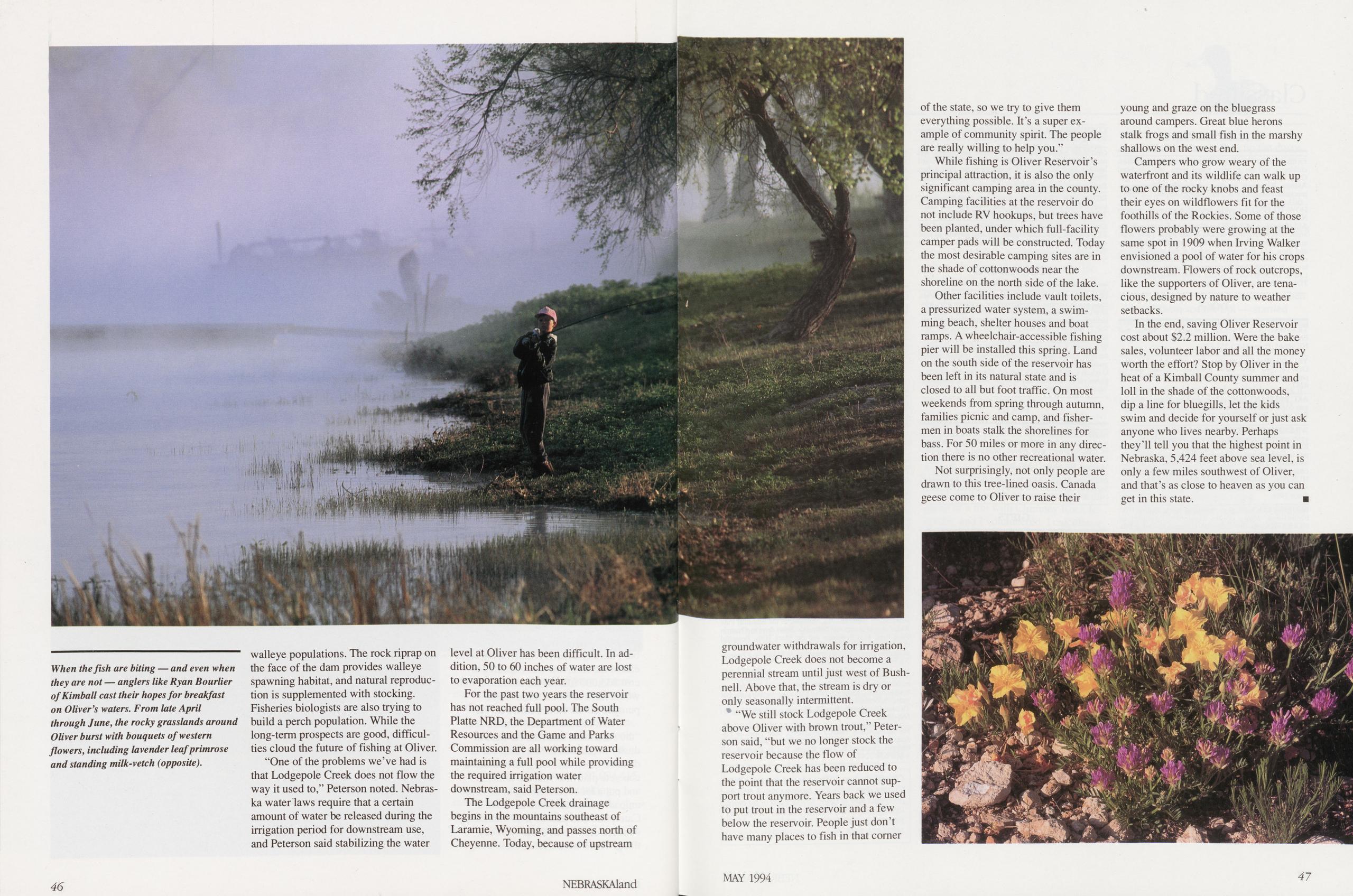
When the fish are biting — and even when they are not — anglers like Ryan Bourlier of Kimball cast their hopes for breakfast on Oliver’s waters. From late April through June, the rocky grasslands around Oliver burst with bouquets of western flowers, including lavender leaf primrose and standing milk-vetch (opposite).
walleye populations. The rock riprap on the face of the dam provides walleye spawning habitat, and natural reproduction is supplemented with stocking. Fisheries biologists are also trying to build a perch population. While the long-term prospects are good, difficulties cloud the future of fishing at Oliver.
“One of the problems we’ve had is that Lodgepole Creek does not flow the way it used to,” Peterson noted. Nebraska water laws require that a certain amount of water be released during the irrigation period for downstream use, and Peterson said stabilizing the water level at Oliver has been difficult. In addition, 50 to 60 inches of water are lost to evaporation each year.
For the past two years the reservoir has not reached full pool. The South Platte NRD, the Department of Water Resources and the Game and Parks Commission are all working toward maintaining a full pool while providing the required irrigation water downstream, said Peterson.
The Lodgepole Creek drainage begins in the mountains southeast of Laramie, Wyoming, and passes north of Cheyenne. Today, because of upstream 46 NEBRASKAland groundwater withdrawals for irrigation, Lodgepole Creek does not become a perennial stream until just west of Bushnell. Above that, the stream is dry or only seasonally intermittent.
“We still stock Lodgepole Creek above Oliver with brown trout,” Peterson said, “but we no longer stock the reservoir because the flow of Lodgepole Creek has been reduced to the point that the reservoir cannot support trout anymore. Years back we used to put trout in the reservoir and a few below the reservoir. People just don’t have many places to fish in that corner of the state, so we try to give them everything possible. It’s a super example of community spirit. The people are really willing to help you.”
While fishing is Oliver Reservoir’s principal attraction, it is also the only significant camping area in the county. Camping facilities at the reservoir do not include RV hookups, but trees have been planted, under which full-facility camper pads will be constructed. Today the most desirable camping sites are in the shade of cottonwoods near the shoreline on the north side of the lake.
Other facilities include vault toilets, a pressurized water system, a swimming beach, shelter houses and boat ramps. A wheelchair-accessible fishing pier will be installed this spring. Land on the south side of the reservoir has been left in its natural state and is closed to all but foot traffic. On most weekends from spring through autumn, families picnic and camp, and fishermen in boats stalk the shorelines for bass. For 50 miles or more in any direction there is no other recreational water.
Not surprisingly, not only people are drawn to this tree-lined oasis. Canada geese come to Oliver to raise their young and graze on the bluegrass around campers. Great blue herons stalk frogs and small fish in the marshy shallows on the west end.
Campers who grow weary of the waterfront and its wildlife can walk up to one of the rocky knobs and feast their eyes on wildflowers fit for the foothills of the Rockies. Some of those flowers probably were growing at the same spot in 1909 when Irving Walker envisioned a pool of water for his crops downstream. Flowers of rock outcrops, like the supporters of Oliver, are tenacious, designed by nature to weather setbacks.
In the end, saving Oliver Reservoir cost about $2.2 million. Were the bake sales, volunteer labor and all the money worth the effort? Stop by Oliver in the heat of a Kimball County summer and loll in the shade of the cottonwoods, dip a line for bluegills, let the kids swim and decide for yourself or just ask anyone who lives nearby. Perhaps they’ll tell you that the highest point in Nebraska, 5,424 feet above sea level, is only a few miles southwest of Oliver, and that’s as close to heaven as you can get in this state. ■
MAY 1994 47
Classified
BOOKS/PRINTING FREE BOOK CATALOG. Novels, westems, romances, children’s; old out of print, found bams, attic. Authors: Grey, Bower, Connor, Fox, Gurwood, Raine, Wright, Aldrige, Pollyanna, Freckles, many others. Postage ap- preciated. Pierce, 4400 N. Pine Cluster, Oroville, CA 95965. HOW TO FIND the public lands that you read about in NEBRASKAland Magazine. Locations & descriptions for ALL federal, state & NRD, parks, lakes, forests, wildlife areas, river access, trout streams & bike trails! These areas are clearly marked on county, D.O.T. transportation maps and show ALL hard surface, gravel & dirt roads, bridges, railroads, rivers & creeks, farm and ranch homes, cities & towns. Send $ 18.75 to: Sportsman s Atlas Co., PO Box 132, Lytton, IA 50561-0132, or call 1-800-568-8334 ORDER TODAY. Your most important piece of outdoor equipment. DOGS TRAINING ALL BREEDS bird dogs — Vizslas and English Pointers for sale. Rozanek Kennels, RR 2, Schuyler, NE 68661. Phone (402) 352-8769. YELLOW-BLACK Lab pups. FC-AFC sired. AKC. Flips OFA certified. Dew claws removed. Excellent hunting potential. Contact Bob Bendler, Lexington, NE. (308) 324- 4247. AKC BRITTANY PUPS. Close working. Natural backing gun dogs. Field Champion backgrounds. Liver and orange. References. Blair (402) 426-3597. WILDERNESS KENNELS. Gun dog training - over 60 years combined experience. Training all sporting breeds — Retrievers. Flushing and pointing dogs. All dogs worked on pen raised birds and wild game. Training program includes obedience training — heel, sit, stay, down and come when called. Pups, started dogs and fully trained dogs for sale. HUNTING DOGS TRAINED BY HUNTERS. Henry Sader, Wilderness Kennels, Roca, NE. (402) 423-4212. Since 1968. ENGLISH COOKER pups, imported stock, British FTC bloodlines. Many colors available. Featured in NEBRASKAland November 1991. Sawtooth Oaks, Box 443, Orleans, NE 68966. Phone (308) 473-5265. ENGLISH SETTER PUPS and some started dogs. Bred to hunt for foot hunters. Top bloodlines. Health guaranteed. Wind Fall Gun Dogs (402) 421-4693. SUBSCRIBE NOW! GET NEBRASKAland MAGAZINE FOR YOURSELF OR SEND IT AS A GIFT FOR JUST $12 A YEAR! | | l-Year $12 Name Address l-! 2-Years $23 1—1 City State Zip Mail check or money order to NEBRASKAland Magazine P.O. Box 30370, Lincoln, Nebraska 68503-0370 To Place Credit Card Orders by Phone Call Toll Free 1-800-632-5263 CUSTOM GATES AND KENNELS. Portable and station- ary dog runs and kennels, any size. Phone (402) 253-2812. GERMAN SHORTHAIR PUPS: Style, intelligence and natural ability. Imported bloodlines, Sire and Dam personal hunting dogs. Sire was 2nd runner-up in the 1993 1-Box Pheasant Hunt. Available this spring ready to hunt this fall. Broken Bow (308) 872-6534. RETRIEVER TRAINING. Area s top “retrievers only” trainer. Field trial and hunting dogs. Non-slip duck dogs! TKO RETRIEVER TRAINING KENNEL (402) 623-4311. CHESAPEAKE BAY, LABRADOR and GOLDEN RETRIEVER pups, started dogs and stud Service. 16 time national Champion pedigre. Platte Valley Retrievers (308) 995-2318. FISH/FISHING GUNS/SHOOTING/ARCHERY FISH FOR SALE. Catfish, largemouth bass, smallmouth bass, perch, crappie, bluegill, walleye, northem pike, rain- bow trout, Donaldson rainbow trout, grass carp, minnows, bullheads. Consulting available. Pleasant Valley Fish Farm, RR 1, Box 147, McCook, NE 69001. Phone (308) 345- 6599. WILLOW LAKE FISH HATCHERY. Channel cat, bluegill, hybrid bluegill, largemouth bass, crappie, triploid grass carp, walleye, perch, minnows available for stocking. Gaylord Crawford, RR 3, Box 46, Hastings, NE 68901 or phone (402) 463-8022 day or night. Also pond Consultant. We del, grower price. FOOD NEBRASKA BASKETS: The original Nebraska Company specializing in fine foods from Nebraska. A beautiful array of baskets filled with ethnic, healthful and long-time favorite foods. Call or write for our brochure: PO. Box 98, McCook, NE 69001. 1-800-345-7725. BEER & WINEMAKING SUPPLIES — Fermenter s Supply & Equipment, 4472 S. 84th St., Omaha, NE 68127. (402) 593-9171. Mail order or visit our store. NEBRASKA GREETING CARDS, stationery, mugs and more! Originally designed and produced in Nebraska. Call or write for FREEcatalog: MJP, HC 37 Box 43C, Valentine, NE 69201. 1-800-632-7623. GUIDES/OUTFITTERS MAD RIVER CANOES offers the finest quality and per- formance. For the finest canoes and accessories look to Great Plains Canoe Co., 205 Main, Springfield, NE. Phone (402) 253-2001. CANOE RENTALS: Kamp Kaleo, Burwell, NE. 17 ft. aluminum canoes, $15 per day. Call (308) 346-5083 for Information and reservations. DISMAL RIVER/MIDDLE LOUP RIVER canoe/kayak trips. Powderhom Outfitters - Thedford, NE 69166-1 -800- 347-6256. GUNS — Browning, Winchester, Remington, others. Hi- powers; shotguns, new, used, antiques. Want Pre-’64 Winchesters. Buy-Sell-Trade. (402) 729-6112. Bedlan’s Sporting Goods, Fairbury, NE 68352. SWAROVSKI OPTIK for prices call (402) 461-7834 days or (402) 773-4894 evenings. K.C. ’s Guns, Box 663, Sutton, NE 68979. TAXIDERMY ALLISON’S TAXIDERMY STUDIO & GIFT GALLERY. Specializing in fish, birds and small game. Mounted 35 State Record Fish. Pheasant mounts for sale. 421 N. Dewey, North Platte, NE 69101. (308) 534-2324 or (308) 534-4267. VACATION/RESORTS FOR FISHING and hunting accommodations. Jefco Inn, Gordon, NE 69343. South Cornell, (308) 282-2935. WEST CENTRAL NEBRASKA country house available year round beginning September. 2 bedroom, 2 bath, garage. Abundant wildlife, hunting and fishing, scenic canyon. Rent by week, month or season. Phone (308) 848-2493. PINE CONE LODGE - Bed & Breakfast. Country atmos- phere, westem hospitality. Close to hunting, fishing, his- toric interests. Broken Bow, NE (308) 872-6407. GOLF: Legend Buttes Golf Course. Located in Nebraska Pine Ridge Country between Crawford and Fort Robinson. Enjoy playing on one of the top four Municipal nine hole courses as rated by the Omaha World-Herald. (308) 665- 2431. HISTORIC 1890s HOTEL. Located in the beautiful Pine Ridge area of Northwest Nebraska. Short drive to Chadron State Park, Fort Robinson and the Black Hills. Beautiful dining room with fireplace and fountain. Room Service available. The Olde Main Street Inn, 115 Main St., Chadron, NE 69337 (308) 432-3380. STAY AT THE TWISTED PINE Bed and Breakfast over- looking the scenic Niobrara River. We have a modern bunkhouse or a rustic log cabin with a spectacular view. For more Information contact Ken and Sharon Moreland, Twisted Pine Ranch, Box 84, Merriman, NE 69218 (308) 684-3482. NE NEBRASKA TROUT FISHING. Mon-Thurs or Fri- Sun. 3 modern cottages, 5 spring fed lakes. Trout, bass and bluegill. Diamond E. Trout Resort, Box B, Orchard, NE 1-800-658-3244. Classified ad rates: 75f per ward, minimum $15. Closing date is the first business day 2 months preceding date ofissue. To place ads orfor more Information write NEBRASKAland Magazine, P.O. Box 30370, Lincoln, NE 68503-0370, orcall (402)471-5478. Fax (402) 471-5528.Page forty-nine
May Nights and LegendsSeeing kids in fancy clothes on warm May nights brings back the images: a crepe-paper-decorated high school gym, the air too hot, my suit too scratchy, the punch too sweet, the music too romantic and the girls too powdery and crimson-lipped.
But later, after syrupy punch and music, I remember late May midnights booming with the growl of dual Glaspaks dragging on the river bridge, the static of clear-channel AM radio wavering through the inky atmosphere from Denver, Oklahoma City and Del Rio, Texas (Marty Robbins lamenting white sport coats and pink camations), and the two-beep greetings between cars making endless laps up and down the 12-block main Street.
Then, suits and hose exchanged for jeans, our lurid pre-prom fantasies dissolved into innocent, long, gravel road trips out from under pools of streetlight haze into the spicy velvet blackness of Panhandle night.
Out past the Great Westem sugar factory, breathing the dark-earth air of May at the apex of a wedge of dust that swirled behind a cream-colored '51 Ford coupe (shaved and shackled, fenderskirts and Spinner hubcaps), the rear-view mirror image of the little town consumed completely in the trailing cloud, we plunged into the night. Up ahead the lights retreated, drawing back respectably into the farmyards, illuminating only birdbaths and bam fronts in the yellow incandescence of a single bulb. The night itself was black and tactile.
What happened wasn’t what our parents feared. Most all we did, in fact, was ride into the darkness, talking. Wired with anticipation, expectation, confidence, we recited the old stories, midnight mysteriös: About the boy and girl one of us knew (or whose older brother knew, or heard about, at least) who’d scoffed at rumors of a roaming, murderous, one-armed lunatic. That night, parked in the country, the couple thought they heard moans and scratching sounds. They told themselves it had to be the wind, but gripped by sudden, icy fear they sped away. Back in the lights of town they found a grisly hook hanging from the handle on the girl's side of the car.
Another of us knew (or knew a guy who knew) a person driving late at night — maybe on this road — who saw a hitchhiker, a girl dressed all in white. He stopped and she got in. He tried to talk to her, but she just stared out the window. When they got to Dead Man’s Curve (you know, by the old one-lane river bridge where those people got killed that time) he suddenly noticed: She was staring out the window, face against the glass, but there was no reflection! Just before the bridge he lost it on loose gravel and would have hit the bridge, but a force on the steering wheel — like hands — kept the car Straight. When he finally got it stopped he was alone.
I wonder if the midnight road-trip legends now include the story of the tipi that appeared at Chimney Rock.
About 10 years ago we needed a photo of a tipi with Chimney Rock behind it, and I volunteered. I calculated where the sun would rise and set, and late May seemed the ideal time to get the shot I wanted. I rounded up a tipi and got permission from the owner of the land to pitch it for the evening shot and leave it up for sunrise so I could shoot it in two kinds of light. It just made sense to stay there ovemight.
I didn’t know that it was prom night when I made my plans. A little after midnight two cars came up the county road from the north, then up the dusty trail-road to the little cemetery under Signal Butte. Chimney Rock was a stark, black spire against the star- washed sky. The moon was low on the horizon behind the butte. This was before someone decided Chimney Rock looked better bathed in garish light all night, glowing like a cheap postcard.
From the borrowed tipi, 200 yards away, I heard shouts and cackles through the clear, clean darkness. Then I heard them see the tipi — startled buzzing, gasps and silence. I got up and pulled my jeans on, expecting Company. Sitting just outside the tipi door I could make out two figures as they pushed down the top Strand of the barbed wire fence and snaked across it, dropping down onto the dusty short- grass prairie. Commando-style, they crawled from swale to swale, working closer, circling to the north. When they were less than 30 yards away, they topped a rise and finally they could see me, separate from the tipi, silhouetted against the moon-struck sky.
They dropped back down behind the ridge, conferring. Apparently, discre- tion won, and carefully, torturously, they crawled back to the fence. The top Strand shrieked rustily as they crossed it. No car doors slammed. Scarcely idling, lights off, the two cars crept back down the road. I sat there watching the night roll on for another hour or so, but had no other visitors.
I rushed the moming shots and had the tipi down and packed and on the way back to its owner before an early- riser could investigate by daylight. I hope the stalkers still remember the taste of midnight prairie dust and sweat and still feel the wiry grass beneath their hands as they remember looking over that low ridge to see a ghostly tipi and a solemn figure against the sky. I hope they shiver when they think about it. I hope they won’t read this now, but 25 or 30 years from now I hope they'11 tell the story.
MAY 1994 49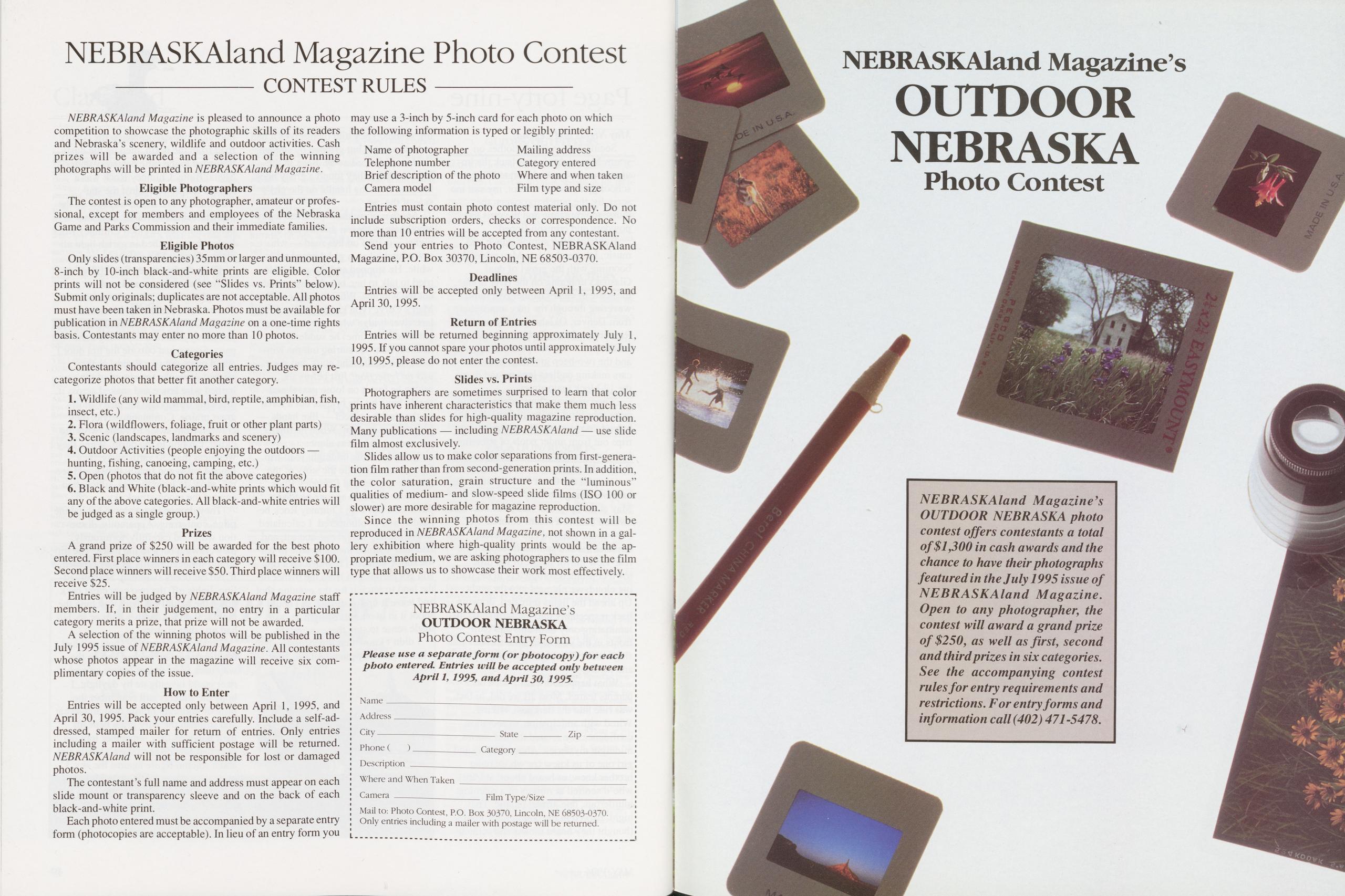
NEBRASKAland Magazine Photo Contest -------- CONTEST RULES -----
NEBRASKAland Magazine is pleased to announce a photo competition to showcase the photographic skills of its readers and Nebraska’s scenery, wildlife and outdoor activities. Cash prizes will be awarded and a selection of the winning photographs will be printed in NEBRASKAland Magazine. Eligible Photographers The contest is open to any photographer, amateur or Profes- sional, except for members and employees of the Nebraska Game and Parks Commission and their immediate families. Eligible Photos Only slides (transparencies) 35mm or 1 arger and unmounted, 8-inch by 10-inch black-and-white prints are eligible. Color prints will not be considered (see “Slides vs. Prints” below). Submit only Originals; duplicates are not acceptable. All photos must have been taken in Nebraska. Photos must be available for publication in NEBRASKAland Magazine on a one-time rights basis. Contestants may enter no more than 10 photos. Categories Contestants should categorize all entries. Judges may re- categorize photos that better fit another category. 1. Wildlife (any wild mammal, bird, reptile, amphibian, fish, insect, etc.) 2. Flora (wildflowers, foliage, fruit or other plant parts) 3. Scenic (landscapes, landmarks and scenery) 4. Outdoor Activities (people enjoying the outdoors — hunting, fishing, canoeing, camping, etc.) 5. Open (photos that do not fit the above categories) 6. Black and White (black-and-white prints which would fit any of the above categories. All black-and-white entries will be judged as a single group.) Prizes A grand prize of $250 will be awarded for the best photo entered. First place winners in each category will receive $100. Second place winners will receive $50. Third place winners will receive $25. Entries will be judged by NEBRASKAland Magazine staff members. If, in their judgement, no entry in a particular category merits a prize, that prize will not be awarded. A selection of the winning photos will be published in the July 1995 issue of NEBRASKAland Magazine. All contestants whose photos appear in the magazine will receive six com- plimentary copies of the issue. How to Enter Entries will be accepted only between April 1, 1995, and April 30, 1995. Pack your entries carefully. Include a self-ad- dressed, stamped mailer for retum of entries. Only entries including a mailer with sufficient postage will be retumed. NEBRASKAland will not be responsible for lost or damaged photos. The contestant’s full name and address must appear on each slide mount or transparency sleeve and on the back of each black-and-white print. Each photo entered must be accompanied by a separate entry form (photocopies are acceptable). In lieu of an entry form you may use a 3-inch by 5-inch card for each photo on which the following Information is typed or legibly printed: Name of photographer Mailing address Telephone number Category entered Brief description of the photo Where and when taken Camera model Film type and size Entries must contain photo contest material only. Do not include subscription Orders, checks or correspondence. No more than 10 entries will be accepted from any contestant. Send your entries to Photo Contest, NEBRASKAland Magazine, P.O. Box 30370, Lincoln, NE 68503-0370. Deadlines Entries will be accepted only between April 1, 1995, and April 30, 1995. Return of Entries Entries will be retumed beginning approximately July 1, 1995. If you cannot spare your photos until approximately July 10, 1995, please do not enter the contest. Slides vs. Prints Photographers are sometimes surprised to le am that color prints have inherent characteristics that make them much less desirable than slides for high-quality magazine reproduction. Many publications — including NEBRASKAland — use slide film almost exclusively. Slides allow us to make color separations from first-genera- tion film rather than from second-generation prints. In addition, the color Saturation, grain structure and the “luminous” qualities of medium- and slow-speed slide films (ISO 100 or slower) are more desirable for magazine reproduction. Since the winning photos from this contest will be reproduced in NEBRASKAland Magazine, not shown in a gal- lery exhibition where high-quality prints would be the ap- propriate medium, we are asking photographers to use the film type that allows us to showcase their work most effectively. NEBRASKAland Magazine’s OUTDOOR NEBRASKA Photo Contest Entry Form Please use a separate form (or photocopy) for each photo entered. Entries will he accepted only between April 1, 1995, and April 30, 1995. Name j Address; City state Zip Phone ( ) -Category Description ! Where and When Taken Camera Film Type/Size Mail to: Photo Contest, PO. Box 30370, Lincoln, NE 68503-0370. Only entries including a mailer with postage will be retumed. NEBRASKAland Magazine’s OUTDOOR NEBRASKA Photo Contest NEBRASKAland Magazine’s OUTDOOR NEBRASKA photo contest offers contestants a total of $1,300 in cash awards andthe chance to have their photographs featured in the July 1995 issue of NEBRASKAland Magazine. Open to any photographer, the contest will award a grand prize of $250, as well as first, second and third prizes in six categories. See the accompanying contest rules for entry requirements and restrictions. For entry forms and Information call (402) 471-5478.
Position: 76 (86 views)