Volume 72, Issue 3, 1994
NEBRASKAland
April 1994 $1.50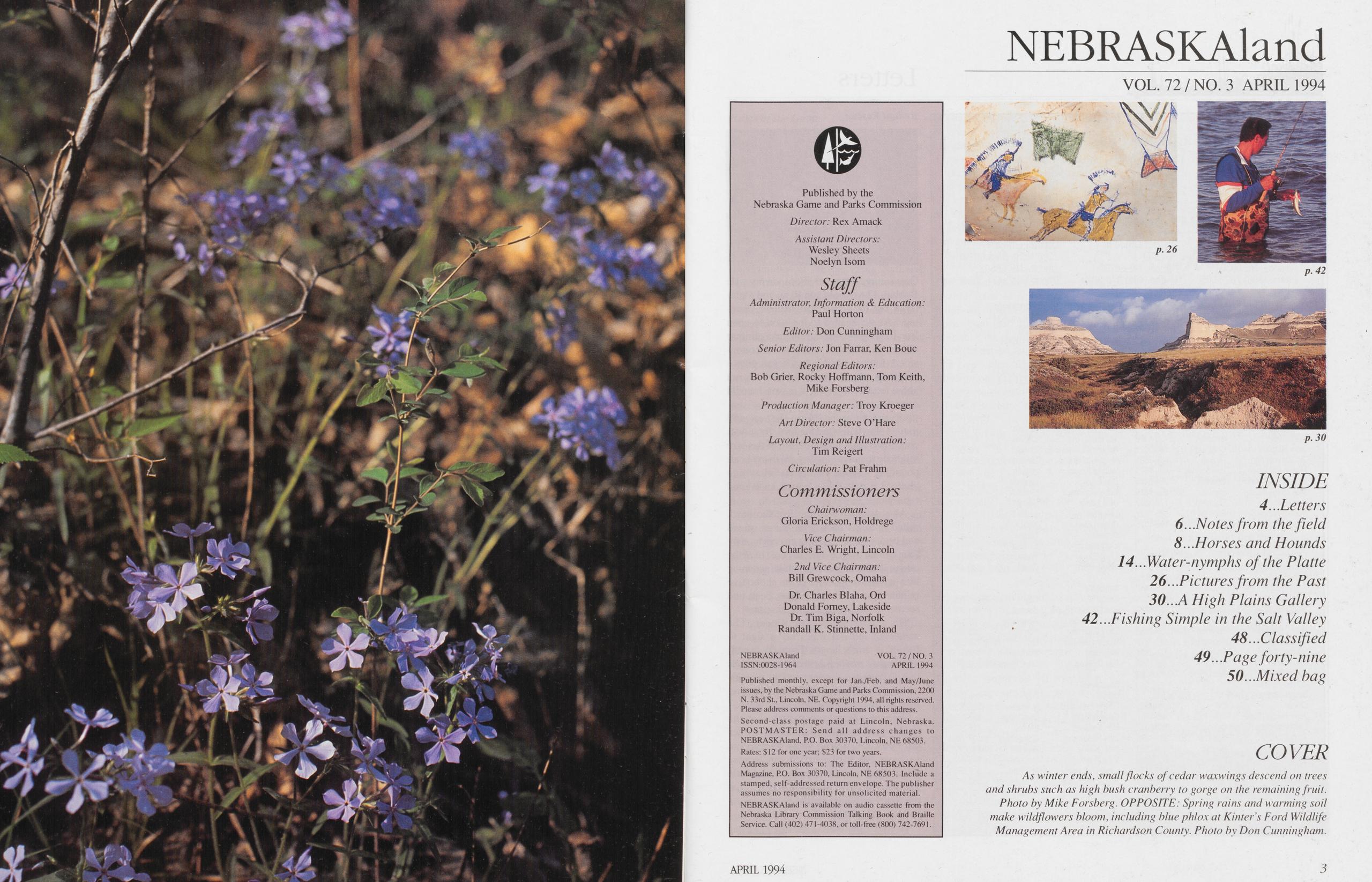
p. 26
p. 42
p. 30
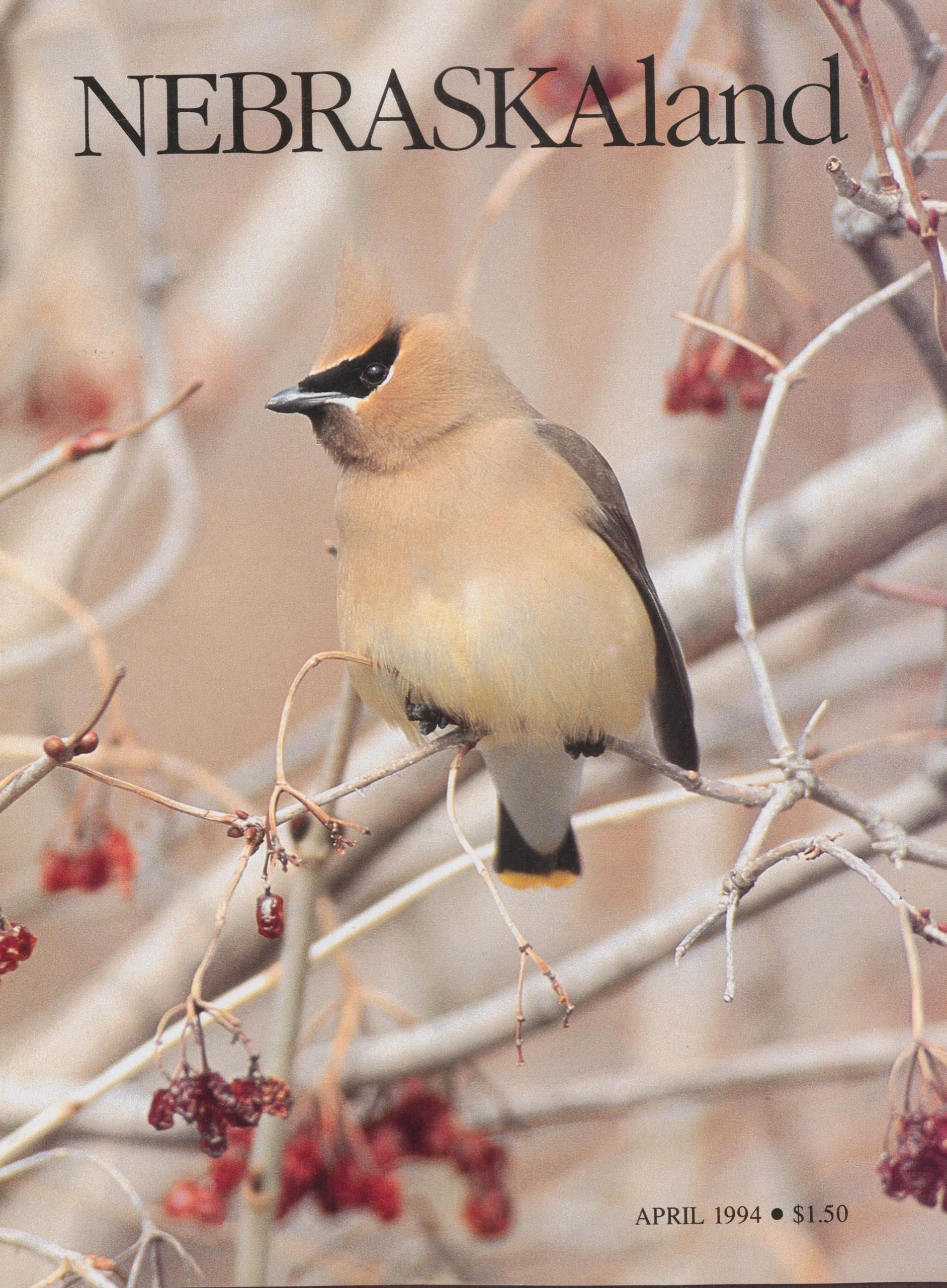
COVER As winter ends, small flocks of cedar waxwings descend on trees and shrubs such as high hush cranberry to gorge on the remaining fruit. Photo by Mike Forsberg. OPPOSITE: Spring rains and warming soil make wildflowers bloom, including blue phlox at Kinters Ford Wildlife Management Area in Richardson County. Photo by Don Cunningham.
Letters
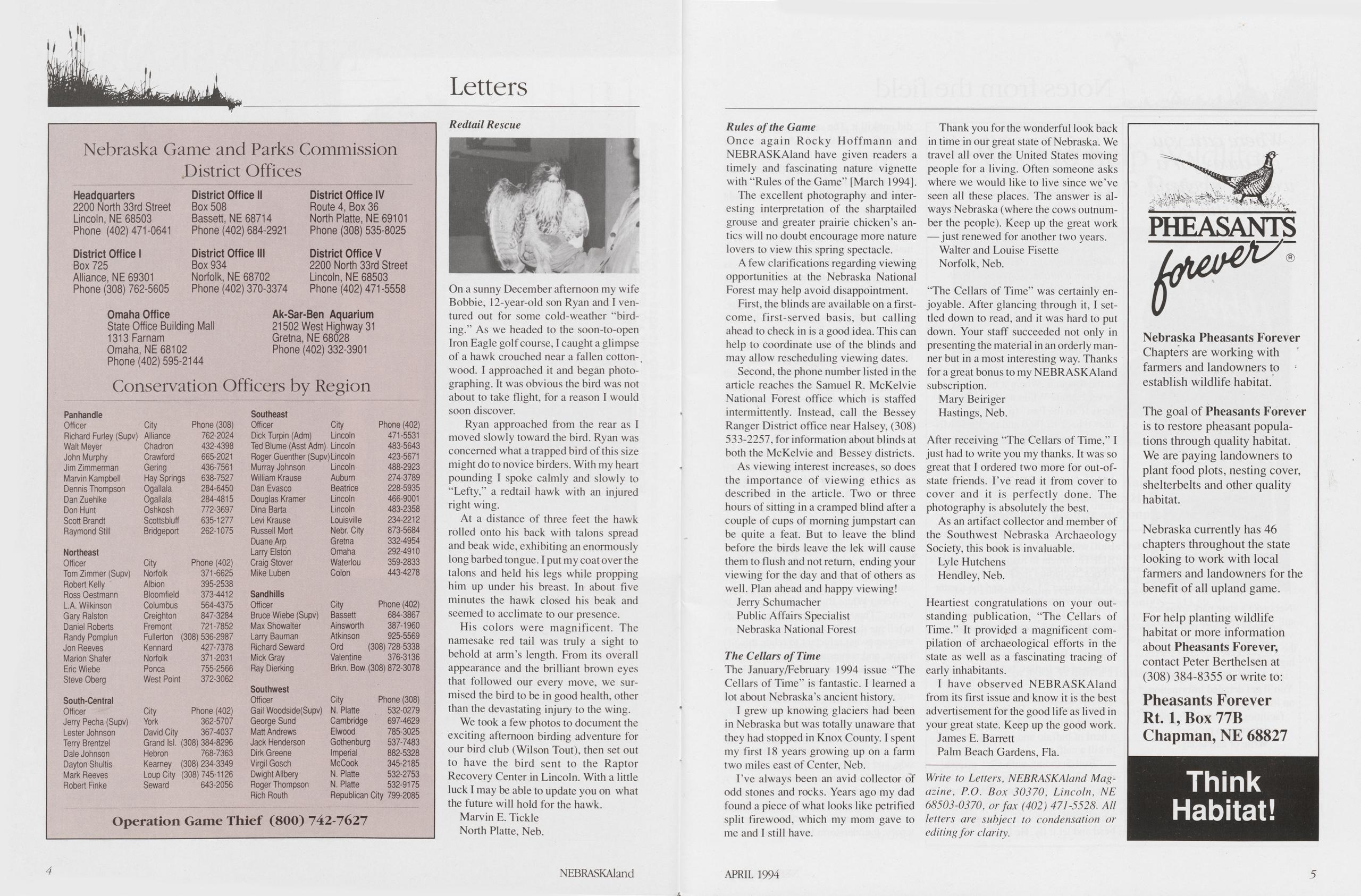
Redtail RescueOn a sunny December afternoon my wife Bobbie, 12-year-old son Ryan and I ventured out for some cold-weather “birding.” As we headed to the soon-to-open Iron Eagle golf course, I caught a glimpse of a hawk crouched near a fallen cottonwood. I approached it and began photographing. It was obvious the bird was not about to take flight, for a reason I would soon discover.
Ryan approached from the rear as I moved slowly toward the bird. Ryan was concerned what a trapped bird of this size might do to novice birders. With my heart pounding I spoke calmly and slowly to “Lefty,” a redtail hawk with an injured right wing.
At a distance of three feet the hawk rolled onto his back with talons spread and beak wide, exhibiting an enormously long barbed tongue. I put my coat over the talons and held his legs while propping him up under his breast. In about five minutes the hawk closed his beak and seemed to acclimate to our presence.
His colors were magnificent. The namesake red tail was truly a sight to behold at arm’s length. From its overall appearance and the brilliant brown eyes that followed our every move, we sur- mised the bird to be in good health, other than the devastating injury to the wing.
We took a few photos to document the exciting afternoon birding adventure for our bird club (Wilson Tout), then set out to have the bird sent to the Raptor Recovery Center in Lincoln. With a little luck I may be able to update you on what the future will hold for the hawk.
Marvin E. Tickle North Platte, Neb. 4 NEBRASKAland Rules of the GameOnce again Rocky Hoffmann and NEBRASKAland have given readers a timely and fascinating nature vignette with “Rules of the Game” [March 1994].
The excellent photography and interesting interpretation of the sharptailed grouse and greater prairie chicken’s antics will no doubt encourage more nature lovers to view this spring spectacle.
A few clarifications regarding viewing opportunities at the Nebraska National Forest may help avoid disappointment.
First, the blinds are available on a first-come, first-served basis, but calling ahead to check in is a good idea. This can help to coordinate use of the blinds and may allow rescheduling viewing dates.
Second, the phone number listed in the article reaches the Samuel R. McKelvie National Forest office which is staffed intermittently. Instead, call the Bessey Ranger District office near Halsey, (308) 533-2257, for information about blinds at both the McKelvie and Bessey districts.
As viewing interest increases, so does the importance of viewing ethics as described in the article. Two or three hours of sitting in a cramped blind after a couple of cups of morning jumpstart can be quite a feat. But to leave the blind before the birds leave the lek will cause them to flush and not return, ending your viewing for the day and that of others as well. Plan ahead and happy viewing!
Jerry Schumacher Public Affairs Specialist Nebraska National Forest The Cellars of TimeThe January/February 1994 issue “The Cellars of Time” is fantastic. I learned a lot about Nebraska’s ancient history.
I grew up knowing glaciers had been in Nebraska but was totally unaware that they had stopped in Knox County. I spent my first 18 years growing up on a farm two miles east of Center, Neb.
I’ve always been an avid collector of odd stones and rocks. Years ago my dad found a piece of what looks like petrified split firewood, which my mom gave to me and I still have.
Thank you for the wonderful look back in time in our great state of Nebraska. We travel all over the United States moving people for a living. Often someone asks where we would like to live since we’ve seen all these places. The answer is always Nebraska (where the cows outnumber the people). Keep up the great work — just renewed for another two years.
Walter and Louise Fisette Norfolk, Neb.“The Cellars of Time” was certainly enjoyable. After glancing through it, I settled down to read, and it was hard to put down. Your staff succeeded not only in presenting the material in an orderly manner but in a most interesting way. Thanks for a great bonus to my NEBRASKAland subscription.
Mary Beiriger Hastings, Neb.After receiving “The Cellars of Time,” I just had to write you my thanks. It was so great that I ordered two more for out-of- state friends. I’ve read it from cover to cover and it is perfectly done. The photography is absolutely the best.
As an artifact collector and member of the Southwest Nebraska Archaeology Society, this book is invaluable.
Lyle Hutchens Hendley, Neb.Heartiest congratulations on your outstanding publication, “The Cellars of Time.” It provided a magnificent compilation of archaeological efforts in the state as well as a fascinating tracing of early inhabitants.
I have observed NEBRASKAland from its first issue and know it is the best advertisement for the good life as lived in your great state. Keep up the good work.
James E. Barrett Palm Beach Gardens, Fla.Write to Letters, NEBRASKAland Magazine, P.O. Box 30370, Lincoln, NE 68503-0370, or fax (402) 471-5528. All letters are subject to condensation or editing for clarity.
Nebraska Pheasants Forever Chapters are working with farmers and landowners to establish wildlife habitat. The goal of Pheasants Forever is to restore pheasant popula- tions through quality habitat. We are paying landowners to plant food plots, nesting cover, shelterbelts and other quality habitat.
Nebraska currently has 46 chapters throughout the state looking to work with local farmers and landowners for the benefit of all upland game. For help planting wildlife habitat or more information about Pheasants Forever, contact Peter Berthelsen at (308) 384-8355 or write to:
Pheasants Forever Rt. 1, Box 77B Chapman, NE 68827 Think Habitat! APRIL 1994 5
Notes from the field
The Allure of ResearchCloud shadows pushed by a gentle northwesterly breeze tracked slowly across the grasslands folds and creases. Caught in the shadows, distant bison appeared coal black and motionless— herds in the islands of sunlight were betrayed by a glint reflected from a moving horn and the small, rising clouds of dust kicked up by unseen animals rolling in a favored wallow.
From a hilltop, 11-year-old Bull- Standing-with-Cow waited for his father, Makes-Room, to signal the hunters forward. Makes-Room had made 10 arrows for his son, their heads cut from an iron frying pan.
One of the most enjoyable aspects of writing for NEBRASKAland Magazine is the research. Where it might lead is never certain. While working on “Pictures from the Past” (p. 26), I was drawn back to 1860 and the Little Missouri River where Bull-Standing-with- Cow and his father hunted bison.
The pictographs on cowhide, the sub- ject of my story, depict events of the 1876 fight of the 7th Cavalry with Indians on the Little Bighorn River. At the time of that battle, Bull-Standing- with-Cow, the nephew of Chief Sitting Bull, was 26 and was called White Bull. He fought in many of his people’s battles, including the Fetterman fight on December 21, 1866, and the Custer battle 10 years later.
White Bull’s story, as told by Stanley Vestal in Warpath, The True Story of the Fighting Sioux (University of Nebraska Press) includes vivid accounts of the battles, but also of his people, the Minniconjou, and the other Sioux tribes, as well as the Cheyenne, Arapaho and other Plains tribes. In Vestal’s story, Makes-Room spots a herd of buffalo and instructs his son to kill a calf.
“Bull-Standing-with-Cow gripped the sleek sides of his spotted pony with bare legs, and away they went. The calf plunged along, scared and dodging, while the boy drew his first arrow to the head and let it fly. He hit the calf, but did not kill it. The second arrow had no more effect, but the third brought the animal down. ...
"Makes-Room was delighted with his son. He packed the calf on a horse. They set out for home, both very proud and happy.
“It is the custom of the Sioux when they had done anything remarkable to make a present to some old man and tell him about it. The old man would then announce the news in a loud voice to the whole camp.
“When Makes-Room and his son approached the camp ... they met Chief Flying-By. Makes-Room, proud and impulsive, called out: ‘My son has killed a buffalo. Take this horse and cry the camp.’ Then Makes-Room thoughtlessly handed the lariat of the boy’s beloved pony to Flying-By. Flying-By went into the camp, shouting the good news at the top of his voice. Makes- Room rode into the camp with the meat.
“But the boy Bull-Standing-with- Cow had lost his spotted pony, his dear playmate, saddle and all. His heart was sore. He stood alone on the prairie and cried as if his heart would break.”
It was difficult to focus only on the events in the hide painting since woven through White Bull’s story are glimpses of the everyday lives of the Minniconjou — their society and beliefs, their warrior codes and their visions.
About White Bull’s visions, Vestal wrote: “Though the Chief had promised to tell me the full story of his life, he was somewhat reluctant to relate this vision, and requested I hear it when there was no one else in the cabin. He explained that whenever he told this story, a fierce thunderstorm followed, and therefore he told it very seldom. He told the story at four o’clock in the afternoon. He had been sitting with his back to the north wall of the cabin, inside, and the sky was cloudless. We finished ... at seven o’clock that evening and had supper. By that time thunderclouds had piled up in the northwest. Immediately after supper, a terrific thunderstorm burst upon us. The 6 NEBRASKAland cloud was small and swept out of the north directly for my cabin.... No rain fell on the adjacent cabins within a few yards on either side, but the wind was so strong that I had to move my car to keep it from rolling over the bluff. The Chief made no comment on this appalling fulfillment of his prediction. He took the storm for granted.”
It was impossible to pass up the chance to read White Bull’s Minniconjou calander, or winter count in an appendix to Vestal’s book. The winter count, from 1781 until 1932, when the interviews were completed, gives 151 years of Minniconjou history. Each “winter” (from first snow to first snow) was named for a significant event of that year, beginning with 1781, which White Bull called Swimming for Buffalo, when Indians swam to retrieve carcasses of buffalo drifting in the Missouri after the ice broke up.
A meteor shower in 1833 gave that year the name The Stars Move. The Fetterman fight at Fort Phil Kearny on December 21, 1866, prompted White Bull to call that year One Hundred White Men Killed. On June 25, 1876, General Custer was killed, so 1876 was called Long Hair is Killed.
Vestal’s biography of White Bull and similar works, including The Fighting Cheyennes by George Bird Grinnell, Black Elk Speaks by John G. Neihardt and the more recent The Lance and the Shield, The Life and Times of Sitting Bull by Robert M. Utley, offer readers a glimpse at a fascinating period less than 150 years ago.
White Bull died in 1947 at age 98. In the letter of introduction for Vestal’s book, White Bull wrote in his own lan- guage: “I have acted as I was taught by my own father Makes-Room and my uncle Sitting Bull. ... I wish I could shake hands with all you who see this. For I am still alive.” — Pte San Hunka (Chief Joseph White Bull).
If you share my interest in history, you’ll agree that a little research can lead almost anywhere.
Horses and Hounds
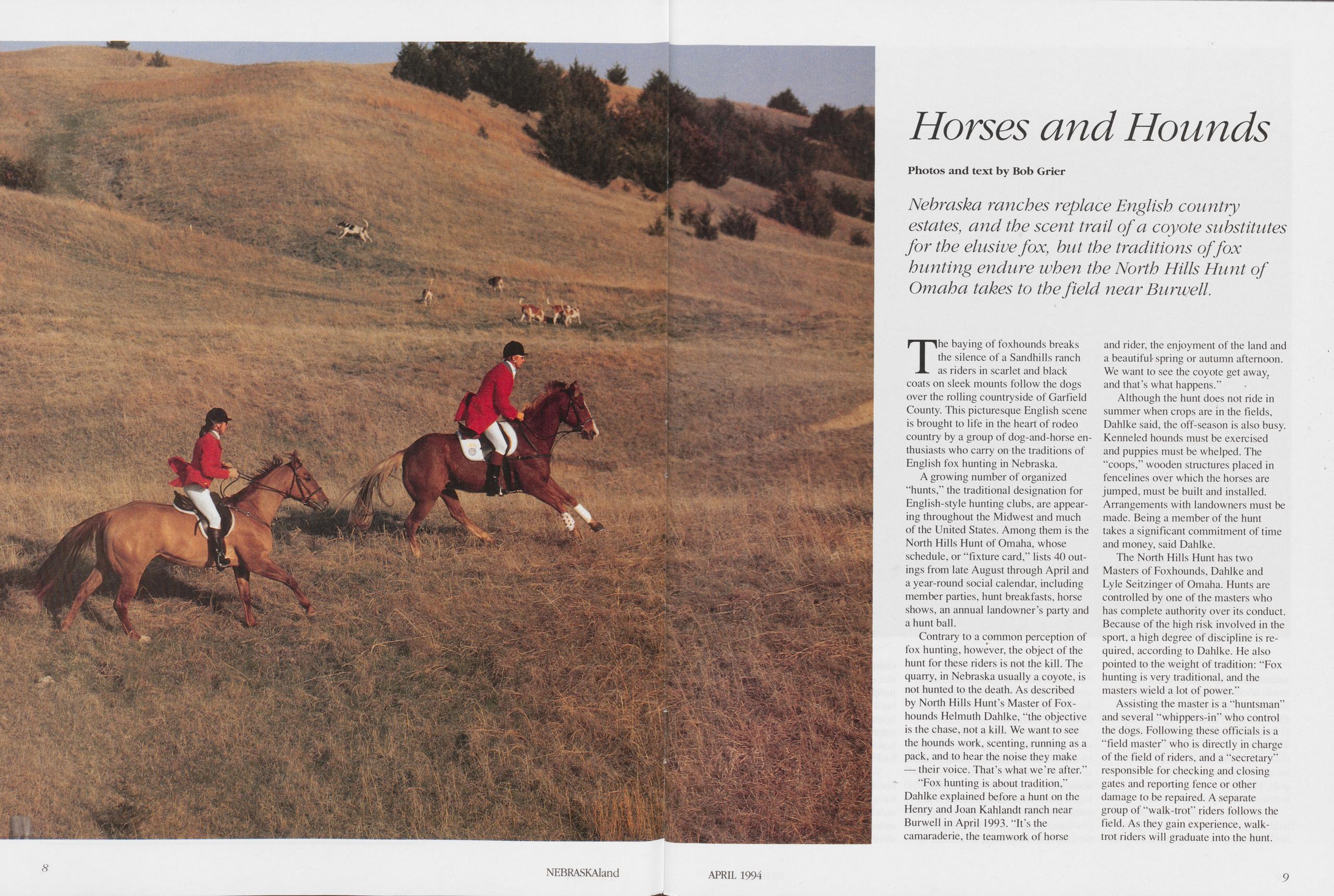
Nebraska ranches replace English country estates, and the scent trail of a coyote substitutes for the elusive fox, but the traditions offox hunting endure when the North Hills Hunt of Omaha takes to the field near Burwell.
The baying of foxhounds breaks the silence of a Sandhills ranch as riders in scarlet and black coats on sleek mounts follow the dogs over the rolling countryside of Garfield County. This picturesque English scene is brought to life in the heart of rodeo country by a group of dog-and-horse enthusiasts who carry on the traditions of English fox hunting in Nebraska.
A growing number of organized “hunts,” the traditional designation for English-style hunting clubs, are appearing throughout the Midwest and much of the United States. Among them is the North Hills Hunt of Omaha, whose schedule, or “fixture card,” lists 40 outings from late August through April and a year-round social calendar, including member parties, hunt breakfasts, horse shows, an annual landowner’s party and a hunt ball.
Contrary to a common perception of fox hunting, however, the object of the hunt for these riders is not the kill. The quarry, in Nebraska usually a coyote, is not hunted to the death. As described by North Hills Hunt’s Master of Foxhounds Helmuth Dahlke, “the objective is the chase, not a kill. We want to see the hounds work, scenting, running as a pack, and to hear the noise they make — their voice. That’s what we’re after.”
“Fox hunting is about tradition,” Dahlke explained before a hunt on the Henry and Joan Kahlandt ranch near Burwell in April 1993. “It’s the camaraderie, the teamwork of horse and rider, the enjoyment of the land and a beautiful spring or autumn afternoon. We want to see the coyote get away, and that’s what happens.”
Although the hunt does not ride in summer when crops are in the fields, Dahlke said, the off-season is also busy. Kenneled hounds must be exercised and puppies must be whelped. The “coops,” wooden structures placed in fencelines over which the horses are jumped, must be built and installed. Arrangements with landowners must be made. Being a member of the hunt takes a significant commitment of time and money, said Dahlke.
The North Hills Hunt has two Masters of Foxhounds, Dahlke and Lyle Seitzinger of Omaha. Hunts are controlled by one of the masters who has complete authority over its conduct. Because of the high risk involved in the sport, a high degree of discipline is required, according to Dahlke. He also pointed to the weight of tradition: “Fox hunting is very traditional, and the masters wield a lot of power.”
Assisting the master is a “huntsman” and several “whippers-in” who control the dogs. Following these officials is a “field master” who is directly in charge of the field of riders, and a “secretary” responsible for checking and closing gates and reporting fence or other damage to be repaired. A separate group of “walk-trot” riders follows the field. As they gain experience, walk- trot riders will graduate into the hunt.
APRIL 1994 9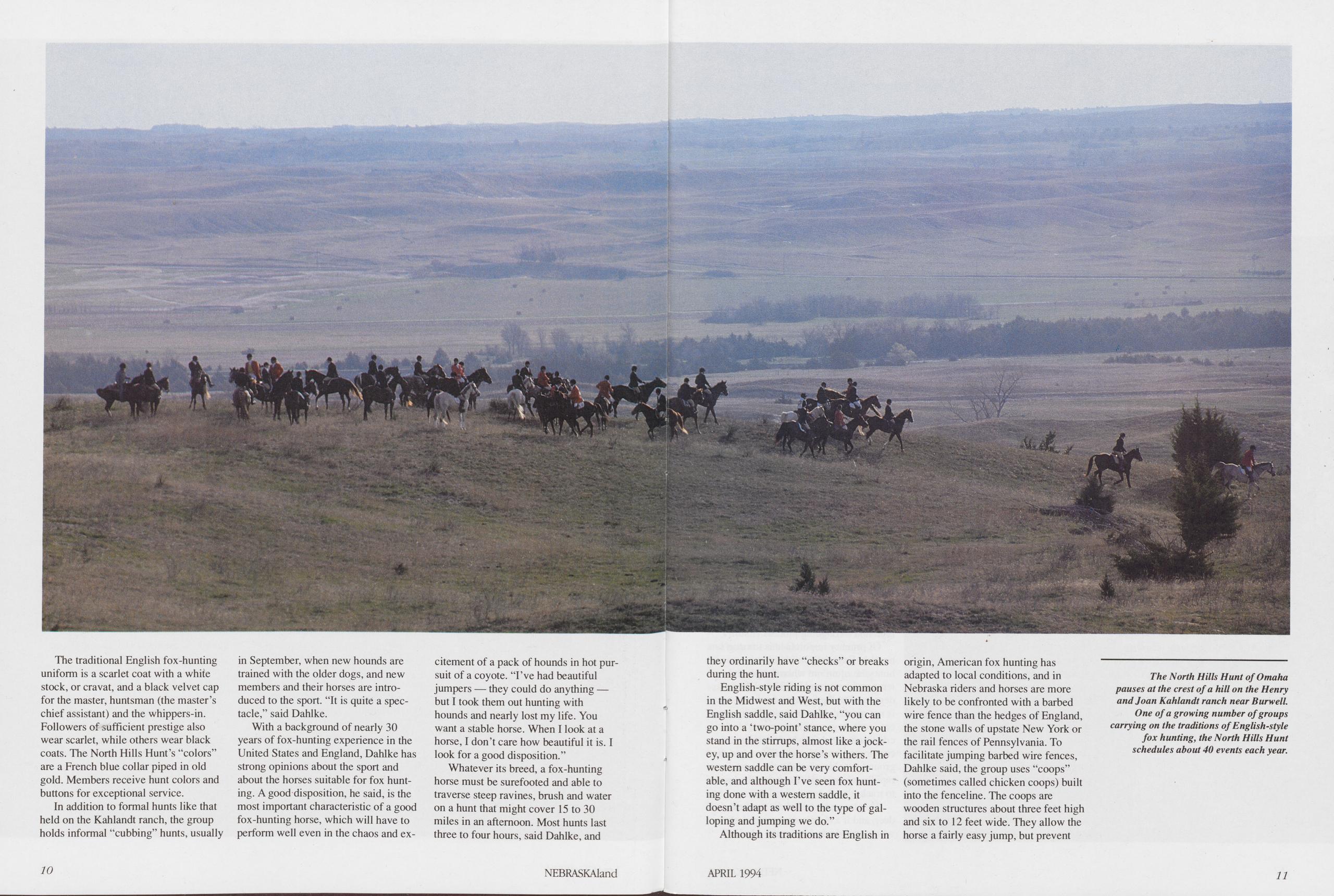
The traditional English fox-hunting uniform is a scarlet coat with a white stock, or cravat, and a black velvet cap for the master, huntsman (the master’s chief assistant) and the whippers-in. Followers of sufficient prestige also wear scarlet, while others wear black coats. The North Hills Hunt’s “colors” are a French blue collar piped in old gold. Members receive hunt colors and buttons for exceptional service.
In addition to formal hunts like that held on the Kahlandt ranch, the group holds informal “cubbing” hunts, usually in September, when new hounds are trained with the older dogs, and new members and their horses are introduced to the sport. “It is quite a spectacle,” said Dahlke.
With a background of nearly 30 years of fox-hunting experience in the United States and England, Dahlke has strong opinions about the sport and about the horses suitable for fox hunting. A good disposition, he said, is the most important characteristic of a good fox-hunting horse, which will have to perform well even in the chaos and excitement of a pack of hounds in hot pursuit of a coyote. “I’ve had beautiful jumpers — they could do anything — but I took them out hunting with hounds and nearly lost my life. You want a stable horse. When I look at a horse, I don’t care how beautiful it is. I look for a good disposition.”
Whatever its breed, a fox-hunting horse must be surefooted and able to traverse steep ravines, brush and water on a hunt that might cover 15 to 30 miles in an afternoon. Most hunts last three to four hours, said Dahlke, and 10 NEBRASKAland they ordinarily have “checks” or breaks during the hunt.
English-style riding is not common in the Midwest and West, but with the English saddle, said Dahlke, “you can go into a ‘two-point’ stance, where you stand in the stirrups, almost like a jockey, up and over the horse’s withers. The western saddle can be very comfortable, and although I’ve seen fox hunting done with a western saddle, it doesn’t adapt as well to the type of galloping and jumping we do.”
Although its traditions are English in origin, American fox hunting has adapted to local conditions, and in Nebraska riders and horses are more likely to be confronted with a barbed wire fence than the hedges of England, the stone walls of upstate New York or the rail fences of Pennsylvania. To facilitate jumping barbed wire fences, Dahlke said, the group uses “coops” (sometimes called chicken coops) built into the fenceline. The coops are wooden structures about three feet high and six to 12 feet wide. They allow the horse a fairly easy jump, but prevent
The North Hills Hunt of Omaha pauses at the crest of a hill on the Henry and Joan Kahlandt ranch near Burwell. One of a growing number of groups carrying on the traditions of English-style fox hunting, the North Hills Hunt schedules about 40 events each year.
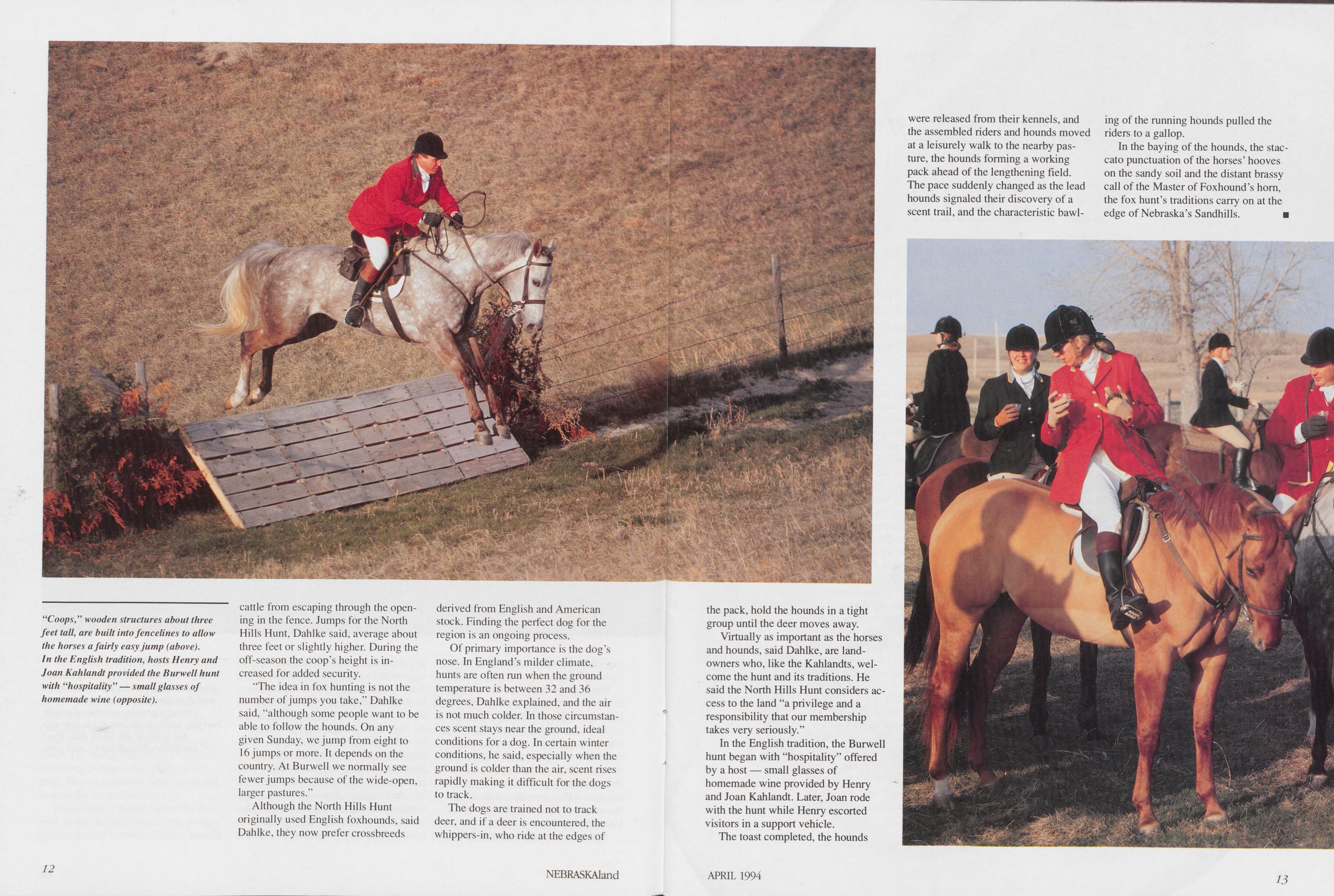
“Coops” wooden structures about three feet tall, are built into fencelines to allow the horses a fairly easy jump (above). In the English tradition, hosts Henry and Joan Kahlandt provided the Burwell hunt with “hospitality” — small glasses of homemade wine (opposite).
cattle from escaping through the opening in the fence. Jumps for the North Hills Hunt, Dahlke said, average about three feet or slightly higher. During the off-season the coop’s height is increased for added security.
“The idea in fox hunting is not the number of jumps you take,” Dahlke said, “although some people want to be able to follow the hounds. On any given Sunday, we jump from eight to 16 jumps or more. It depends on the country. At Burwell we normally see fewer jumps because of the wide-open, larger pastures.”
Although the North Hills Hunt originally used English foxhounds, said Dahlke, they now prefer crossbreeds derived from English and American stock. Finding the perfect dog for the region is an ongoing process.
Of primary importance is the dog’s nose. In England’s milder climate, hunts are often run when the ground temperature is between 32 and 36 degrees, Dahlke explained, and the air is not much colder. In those circumstances scent stays near the ground, ideal conditions for a dog. In certain winter conditions, he said, especially when the ground is colder than the air, scent rises rapidly making it difficult for the dogs to track.
The dogs are trained not to track deer, and if a deer is encountered, the whippers-in, who ride at the edges of 12 NEBRASKAland the pack, hold the hounds in a tight group until the deer moves away.
Virtually as important as the horses and hounds, said Dahlke, are landowners who, like the Kahlandts, welcome the hunt and its traditions. He said the North Hills Hunt considers access to the land “a privilege and a responsibility that our membership takes very seriously.”
In the English tradition, the Burwell hunt began with “hospitality” offered by a host — small glasses of homemade wine provided by Henry and Joan Kahlandt. Later, Joan rode with the hunt while Henry escorted visitors in a support vehicle.
The toast completed, the hounds were released from their kennels, and the assembled riders and hounds moved at a leisurely walk to the nearby pasture, the hounds forming a working pack ahead of the lengthening field. The pace suddenly changed as the lead hounds signaled their discovery of a scent trail, and the characteristic bawling of the running hounds pulled the riders to a gallop.
In the baying of the hounds, the staccato punctuation of the horses’ hooves on the sandy soil and the distant brassy call of the Master of Foxhound’s horn, the fox hunt’s traditions carry on at the edge of Nebraska’s Sandhills. ■
APRIL 1994 13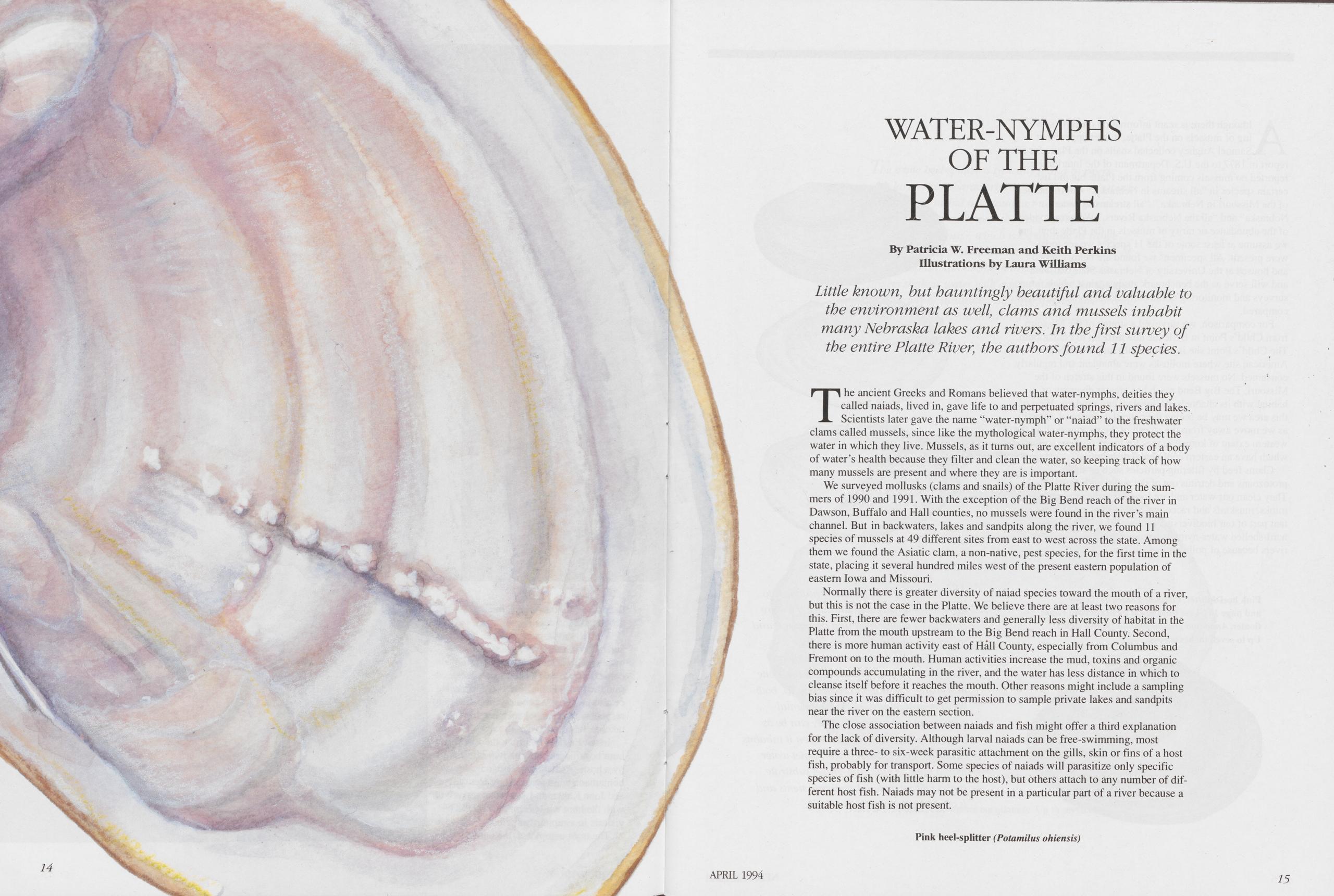
Pink heel-splitter (Potamilus ohiensis)
WATER-NYMPHS OF THE PLATTE
Little known, but hauntingly beautiful and valuable to the environment as well, clams and mussels inhabit many Nebraska lakes and rivers. In the first survey of the entire Platte River, the authors found 11 species.
The ancient Greeks and Romans believed that water-nymphs, deities they called naiads, lived in, gave life to and perpetuated springs, rivers and lakes. Scientists later gave the name “water-nymph” or “naiad” to the freshwater clams called mussels, since like the mythological water-nymphs, they protect the water in which they live. Mussels, as it turns out, are excellent indicators of a body of water’s health because they filter and clean the water, so keeping track of how many mussels are present and where they are is important.
We surveyed mollusks (clams and snails) of the Platte River during the summers of 1990 and 1991. With the exception of the Big Bend reach of the river in Dawson, Buffalo and Hall counties, no mussels were found in the river’s main channel. But in backwaters, lakes and sandpits along the river, we found 11 species of mussels at 49 different sites from east to west across the state. Among them we found the Asiatic clam, a non-native, pest species, for the first time in the state, placing it several hundred miles west of the present eastern population of eastern Iowa and Missouri.
Normally there is greater diversity of naiad species toward the mouth of a river, but this is not the case in the Platte. We believe there are at least two reasons for this. First, there are fewer backwaters and generally less diversity of habitat in the Platte from the mouth upstream to the Big Bend reach in Hall County. Second, there is more human activity east of Hall County, especially from Columbus and Fremont on to the mouth. Human activities increase the mud, toxins and organic compounds accumulating in the river, and the water has less distance in which to cleanse itself before it reaches the mouth. Other reasons might include a sampling bias since it was difficult to get permission to sample private lakes and sandpits near the river on the eastern section.
The close association between naiads and fish might offer a third explanation for the lack of diversity. Although larval naiads can be free-swimming, most require a three- to six-week parasitic attachment on the gills, skin or fins of a host fish, probably for transport. Some species of naiads will parasitize only specific species of fish (with little harm to the host), but others attach to any number of different host fish. Naiads may not be present in a particular part of a river because a suitable host fish is not present.
APRIL 1994 15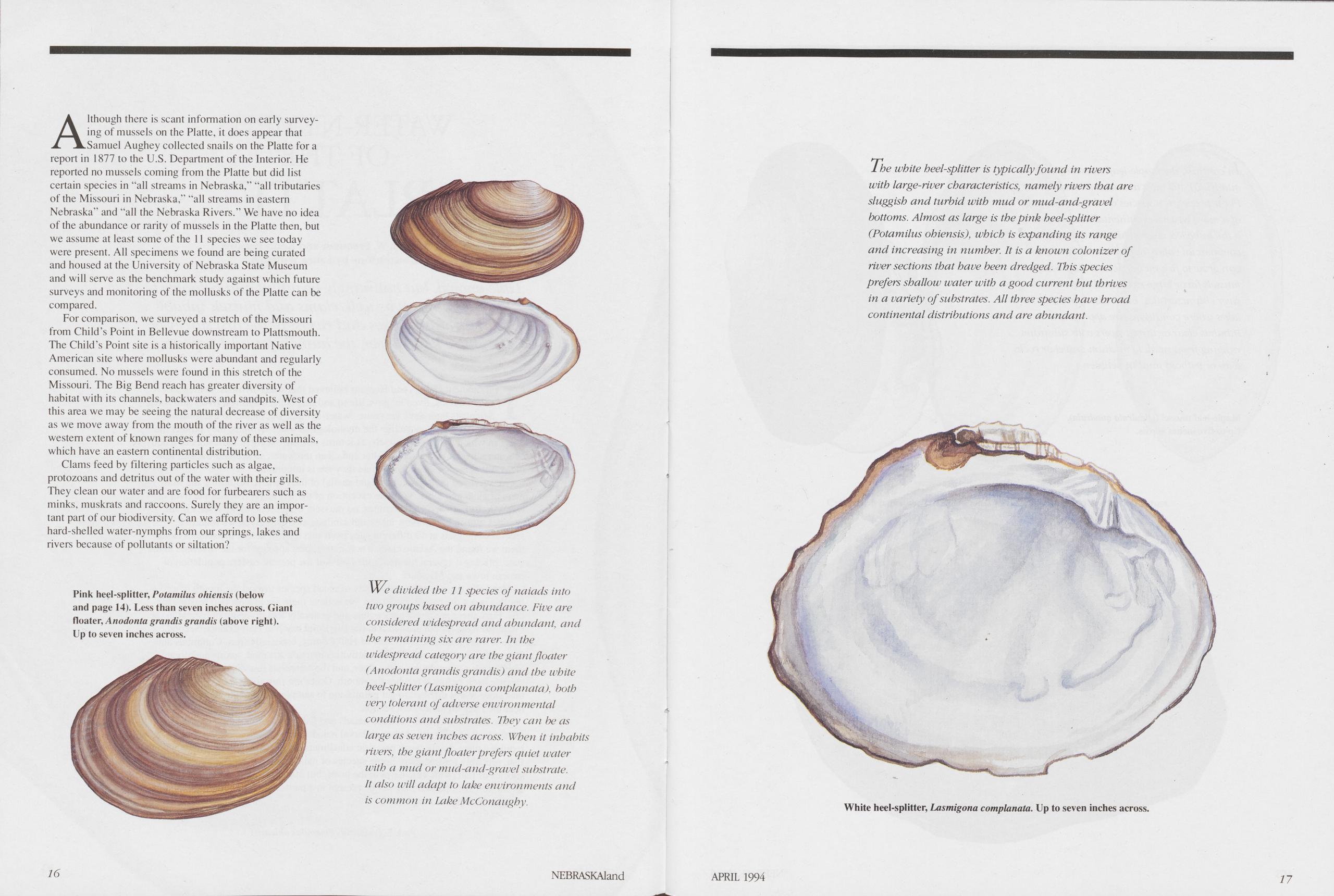
Although there is scant information on early survey- ing of mussels on the Platte, it does appear that Samuel Aughey collected snails on the Platte for a report in 1877 to the U.S. Department of the Interior. He reported no mussels coming from the Platte but did list certain species in "all streams in Nebraska,” "all tributaries of the Missouri in Nebraska,” "all streams in eastern Nebraska” and "all the Nebraska Rivers.” We have no idea of the abundance or rarity of mussels in the Platte then, but we assume at least some of the 11 species we see today were present. All specimens we found are being curated and housed at the University of Nebraska State Museum and will serve as the benchmark study against which future surveys and monitoring of the mollusks of the Platte can be compared.
For comparison, we surveyed a stretch of the Missouri from Child’s Point in Bellevue downstream to Plattsmouth. The Child’s Point site is a historically important Native American site where mollusks were abundant and regularly consumed. No mussels were found in this stretch of the Missouri. The Big Bend reach has greater diversity of habitat with its channels, backwaters and sandpits. West of this area we may be seeing the natural decrease of diversity as we move away from the mouth of the river as well as the western extent of known ranges for many of these animals, which have an eastern continental distribution.
Clams feed by filtering particles such as algae, protozoans and detritus out of the water with their gills. They clean our water and are food for furbearers such as minks, muskrats and raccoons. Surely they are an important part of our biodiversity. Can we afford to lose these hard-shelled water-nymphs from our springs, lakes and rivers because of pollutants or siltation?
Pink heel-splitter, Potamilus ohiensis (below and page 14). Less than seven inches across. Giant floater, Anodonta grandis grandis (above right). Up to seven inches across.
We divided the 11 species of naiads into two groups based on abundance. Five are considered widespread and abundant, and the remaining six are rarer. In the widespread category are the giant floater (Anodonta grandis grandis) and the white heel-splitter (Lasmigona complanata), both very tolerant of adverse environmental conditions and substrates. They can be as large as seven inches across. When it inhabits rivers, the giant floater prefers quiet water with a mud or mud-and-gravel substrate. It also will adapt to lake environments and is common in Lake McConaughy.
16 NEBRASKAlandThe white heel-splitter is typically found in rivers with large-river characteristics, namely rivers that are sluggish and turbid with mud or mud-and-gravel bottoms. Almost as large is the pink heel-splitter (Potamilus ohiensis), which is expanding its range and increasing in number. Lt is a known colonizer of river sections that have been dredged. This species prefers shallow water with a good current but thrives in a variety of substrates. All three species have broad continental distributions and are abundant.
White heel-splitter, Lasmigona complanata. UP *° seven ’nches across.
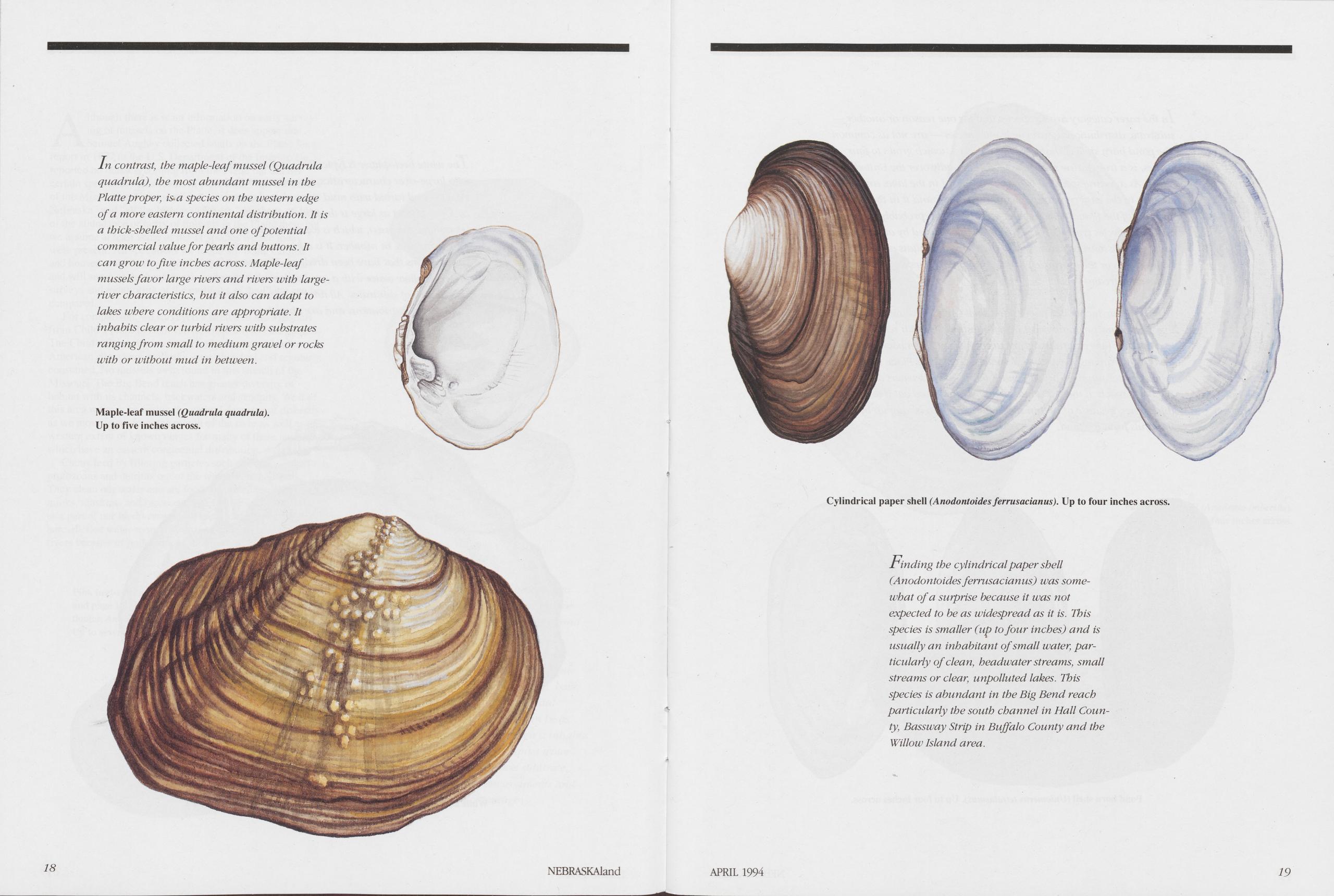
In contrast, the maple-leaf mussel (Quadrula quadrula), the most abundant mussel in the Platte proper, is-a species on the western edge of a more eastern continental distribution. It is a thick-shelled mussel and one of potential commercial value for pearls and buttons. It can grow to five inches across. Maple-leaf mussels favor large rivers and rivers with large- river characteristics, but it also can adapt to lakes where conditions are appropriate. It inhabits clear or turbid rivers with substrates ranging from small to medium gravel or rocks with or without mud in between.
Maple-leaf mussel (Quadrula quadrula). Up to five inches across.
Cylindrical paper shell (Anodontoides ferrusacianus). Up to four inches across.
Finding the cylindrical paper shell (Anodontoides ferrusacianus) was somewhat of a surprise because it was not expected to be as widespread as it is. This species is smaller (up to four inches) and is usually an inhabitant of small water, particularly of clean, headwater streams, small streams or clear, unpolluted lakes. This species is abundant in the Big Bend reach particularly the south channel in Hall County, Bassway Strip in Buffalo County and the Willow Island area.
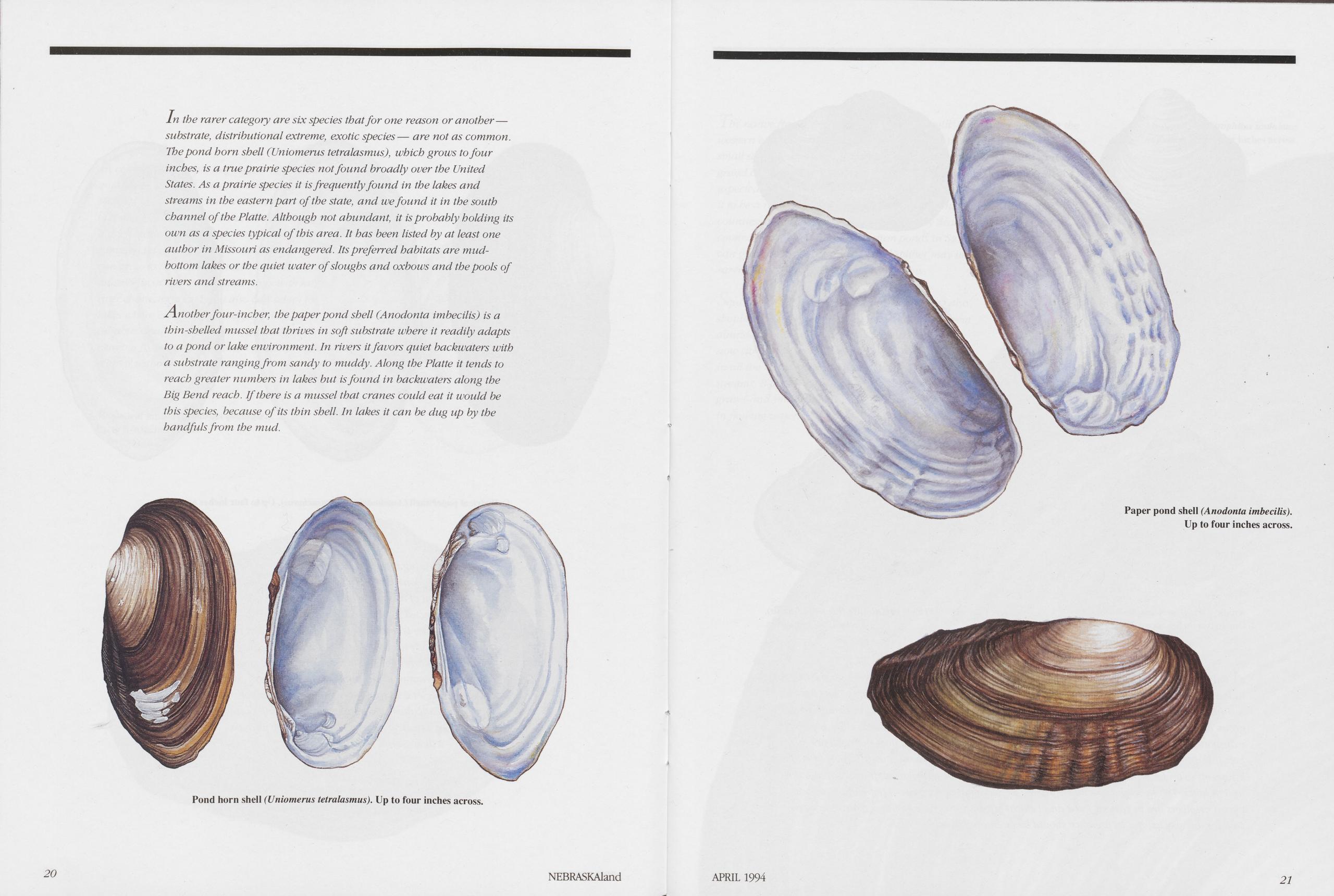
In the rarer category are six species that for one reason or another— substrate, distributional extreme, exotic species— are not as common. The pond horn shell (Uniomerus tetralasmus), which grows to four inches, is a true prairie species not found broadly over the United States. As a prairie species it is frequently found in the lakes and streams in the eastern part of the state, and we found it in the south channel of the Platte. Although not abundant, it is probably holding its own as a species typical of this area. It has been listed by at least one author in Missouri as endangered. Its preferred habitats are mud- bottom lakes or the quiet water of sloughs and oxbows and the pools of rivers and streams.
Another four-incher, the paper pond shell (Anodonta imbecilis) is a thin-shelled mussel that thrives in soft substrate where it readily adapts to a pond or lake environment. In rivers it favors quiet backwaters with a substrate ranging from sandy to muddy. Along the Platte it tends to reach greater numbers in lakes but is found in backwaters along the Big Bend reach. If there is a mussel that cranes could eat it would be this species, because of its thin shell. In lakes it can be dug up by the handfuls from the mud.
Pond horn shell (Uniomerus tetralasmus). Up to four inches across.
Paper pond shell (Anodonta inbecilis). Up to four inches across.
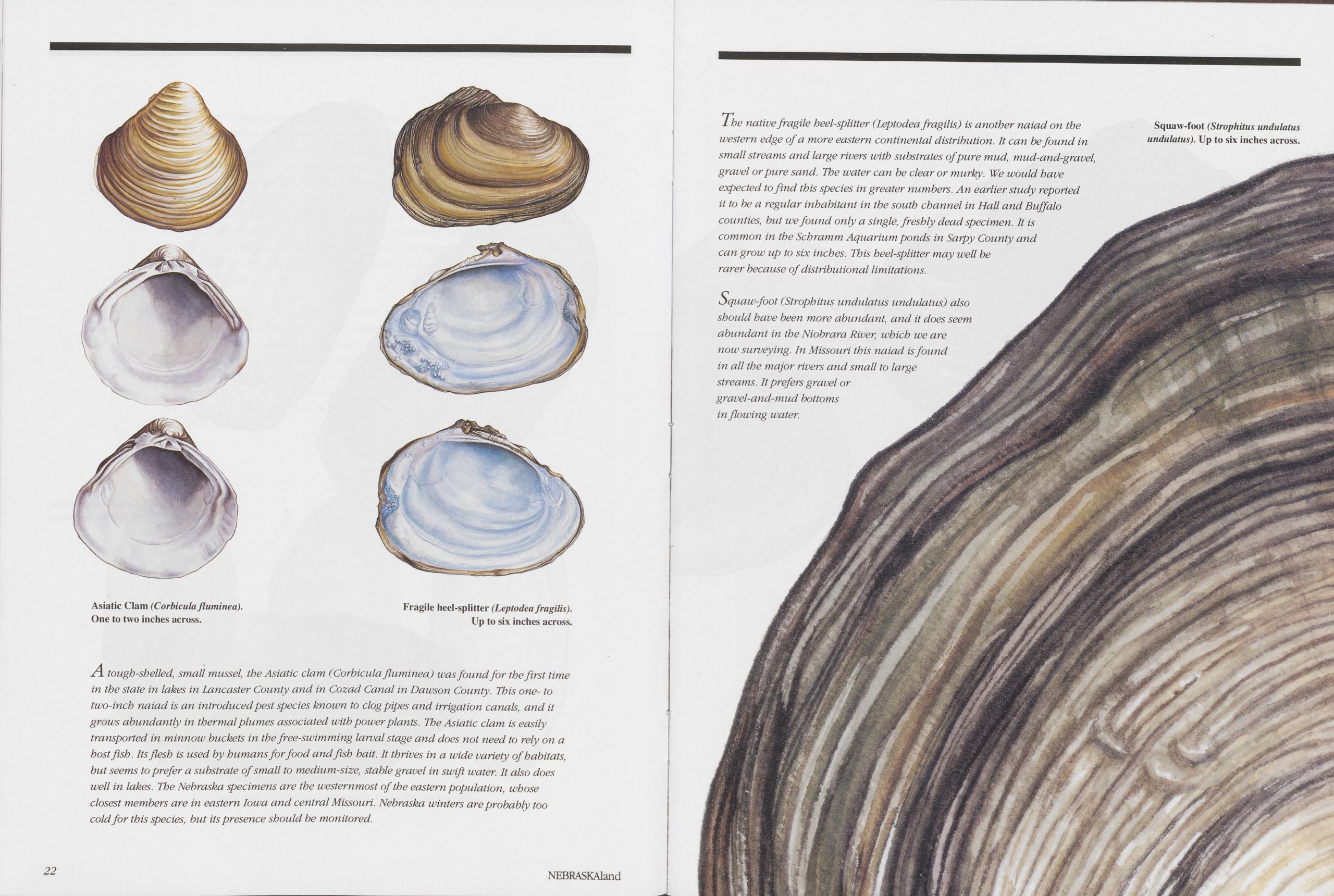
Asiatic Clam (Corbicula fluminea). One to two inches across.
Fragile heel-splitter (Leptodea fragilis). Up to six inches across.
A tough-shelled, small mussel, the Asiatic clam (Corbicula fluminea) was found for the first time in the state in lakes in Lancaster County and in Cozad Canal in Dawson County. This one- to two-inch naiad is an introduced pest species known to clog pipes and irrigation canals, and it grows abundantly in thermal plumes associated with power plants. The Asiatic clam is easily transported in minnow buckets in the free-swimming larval stage and does not need to rely on a host fish. Its flesh is used by humans for food and fish bait. It thrives in a wide variety of habitats, but seems to prefer a substrate of small to medium-size, stable gravel in swift water. It also does well in lakes. The Nebraska specimens are the westernmost of the eastern population, whose closest members are in eastern Iowa and central Missouri. Nebraska winters are probably too cold for this species, but its presence should be monitored.
22 NEBRASKAlandThe native fragile heel-splitter (Leptodea fragilis) is another naiad on the western edge of a more eastern continental distribution. It can be found in small streams and large rivers with substrates of pure mud, mud-and-gravel, gravel or pure sand. The water can be clear or murky. We would have expected to find this species in greater numbers. An earlier study reported it to be a regular inhabitant in the south channel in Hall and Buffalo counties, but we found only a single, freshly dead specimen. It is common in the Schramm Aquarium ponds in Sarpy County and can grow up to six inches. This heel-splitter may well be rarer because of distributional limitations.
Squaw-foot (Strophitus undulatus undulatus). Up to six inches across.
Squaw-foot (Strophitus undulatus undulatus) also should have been more abundant, and it does seem abundant in the Niobrara River, which we are now surveying. In Missouri this naiad is found in all the major rivers and small to large streams. It prefers gravel or gravel-and-mud bottoms in flowing water.
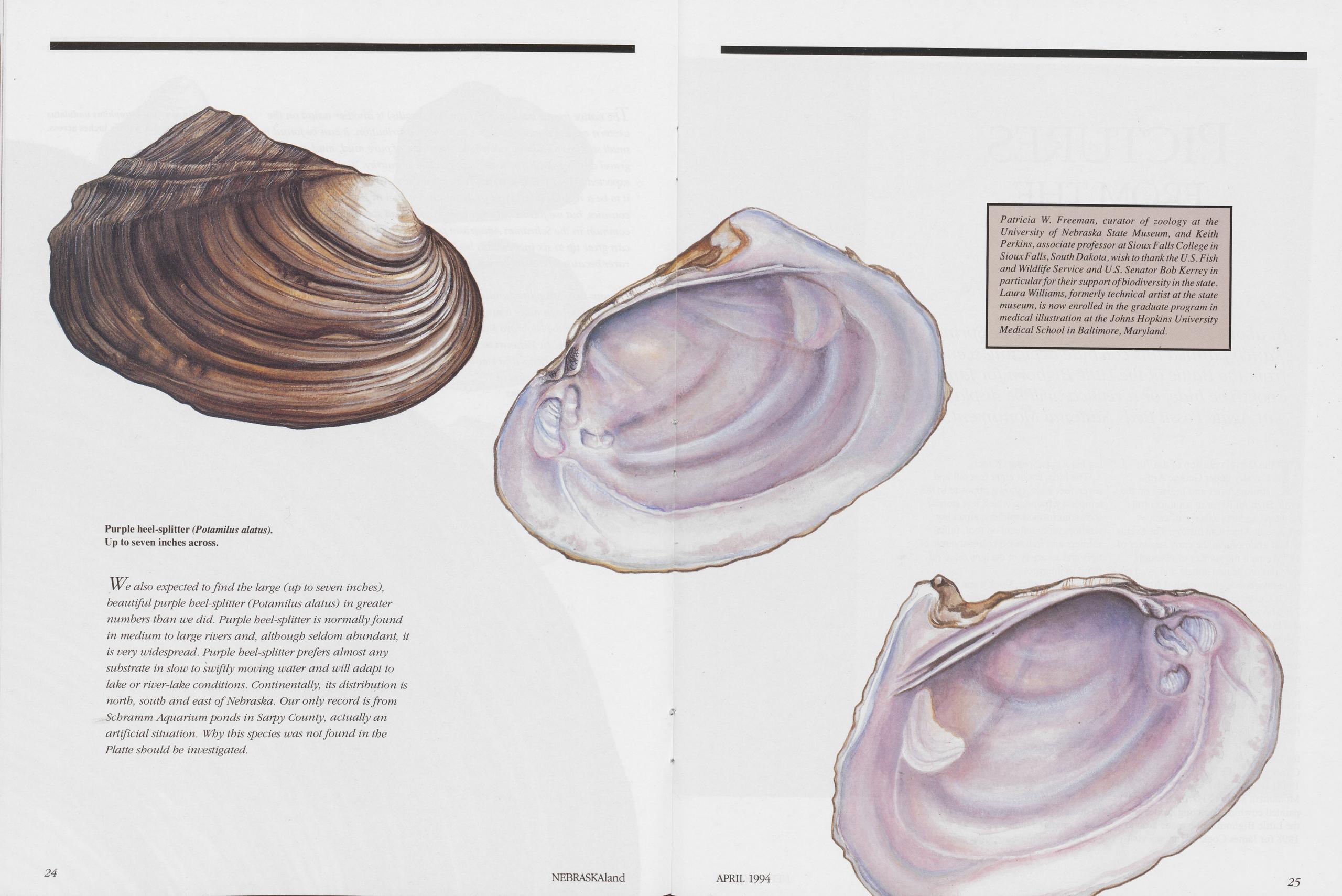
Purple heel-splitter (Potamilus alatus). Up to seven inches across.
We also expected to find the large (up to seven inches), beautiful purple heel-splitter (Potamilus alatus) in greater numbers than we did. Purple heel-splitter is normally found in medium to large rivers and, although seldom abundant, it is very widespread. Purple heel-splitter prefers almost any substrate in slow to swiftly moving water and will adapt to lake or river-lake conditions. Continentally, its distribution is north, south and east of Nebraska. Our only record is from Schramm Aquarium ponds in Sarpy County, actually an artificial situation. Why this species was not found in the Platte should be investigated.
24 NEBRASKAlandPatricia W. Freeman, curator zoology at the University Nebraska State Museum, and Keith Perkins, associate processor at Sioux Falls College in Sioux Falls, South Dakota, wish to thank the U S. Fish and Wildlife Service and U S. Senator Bob Kerrey in particular for their support of biodiversity in the state. Laura Williams, formerly technical artist at the state museum, is now enrolled in the graduate program in medical illustration at the Johns Hopkins University Medical School in Baltimore, Maryland.
APRIL 1994 25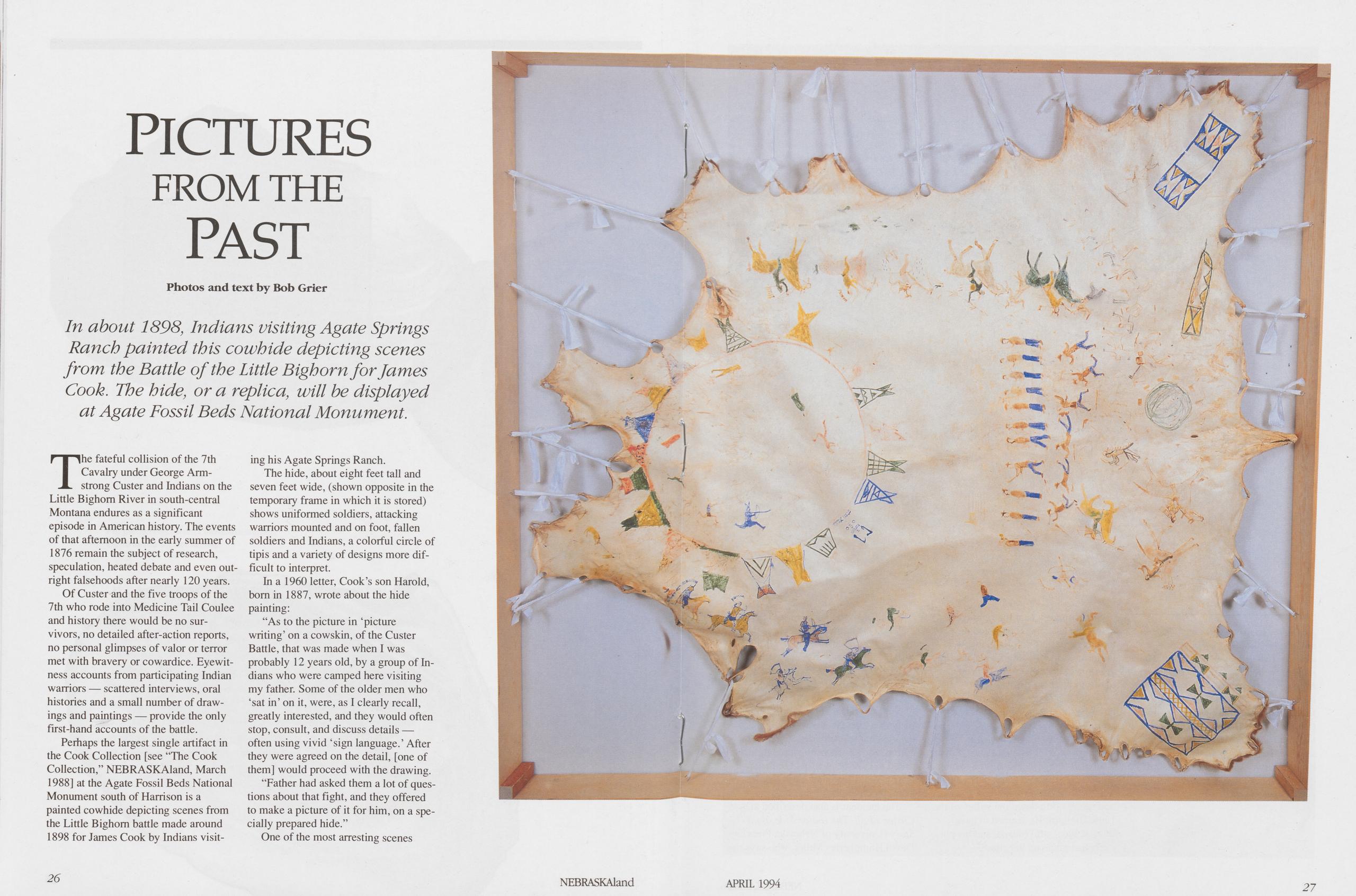
PICTURES FROM THE PAST
In about 1898, Indians visiting Agate Springs Ranch painted this cowhide depicting scenes from the Battle of the Little Bighorn for James Cook. The hide, or a replica, will be displayed at Agate Fossil Beds National Monument.
The fateful collision of the 7th Cavalry under George Arm- strong Custer and Indians on the Little Bighorn River in south-central Montana endures as a significant episode in American history. The events of that afternoon in the early summer of 1876 remain the subject of research, speculation, heated debate and even outright falsehoods after nearly 120 years.
Of Custer and the five troops of the 7th who rode into Medicine Tail Coulee and history there would be no survivors, no detailed after-action reports, no personal glimpses of valor or terror met with bravery or cowardice. Eyewitness accounts from participating Indian warriors — scattered interviews, oral histories and a small number of drawings and paintings — provide the only first-hand accounts of the battle.
Perhaps the largest single artifact in the Cook Collection [see "The Cook Collection,” NEBRASKAland, March 1988] at the Agate Fossil Beds National Monument south of Harrison is a painted cowhide depicting scenes from the Little Bighorn battle made around 1898 for James Cook by Indians visiting his Agate Springs Ranch.
The hide, about eight feet tall and seven feet wide, (shown opposite in the temporary frame in which it is stored) shows uniformed soldiers, attacking warriors mounted and on foot, fallen soldiers and Indians, a colorful circle of tipis and a variety of designs more difficult to interpret.
In a 1960 letter, Cook’s son Harold, bom in 1887, wrote about the hide painting:
"As to the picture in ‘picture writing’ on a cowskin, of the Custer Battle, that was made when I was probably 12 years old, by a group of Indians who were camped here visiting my father. Some of the older men who ‘sat in’ on it, were, as I clearly recall, greatly interested, and they would often stop, consult, and discuss details — often using vivid ‘sign language.’ After they were agreed on the detail, [one of them] would proceed with the drawing.
"Father had asked them a lot of questions about that fight, and they offered to make a picture of it for him, on a specially prepared hide.”
One of the most arresting scenes
26 NEBRASKAland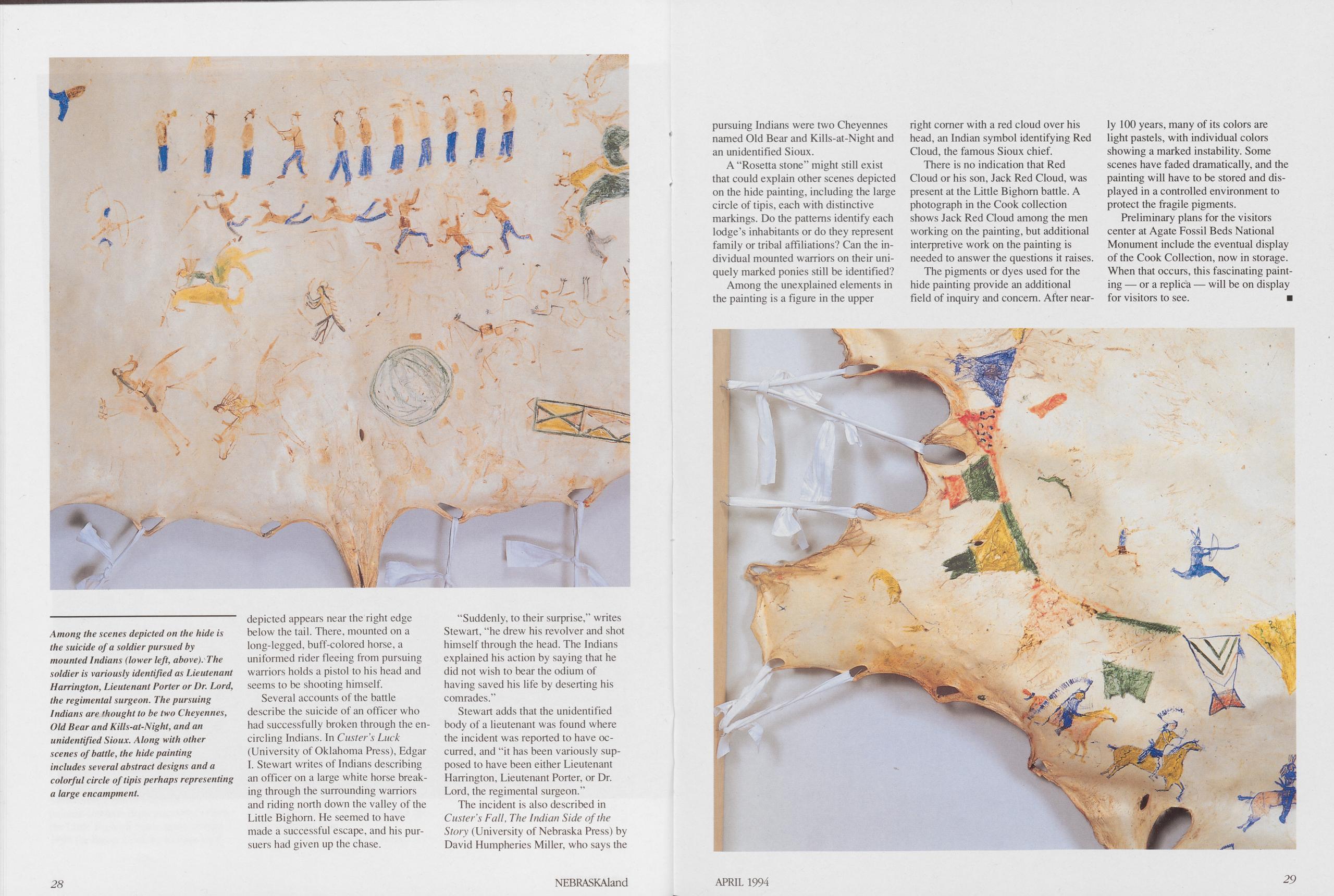
Among the scenes depicted on the hide is the suicide of a soldier pursued by mounted Indians (lower left, above). The soldier is variously identified as Lieutenant Harrington, Lieutenant Porter or Dr. Lord, the regimental surgeon. The pursuing Indians are thought to be two Cheyennes, Old Bear and Kills-at-Night, and an unidentified Sioux. Along with other scenes of battle, the hide painting includes several abstract designs and a colorful circle of tipis perhaps representing a large encampment.
depicted appears near the right edge below the tail. There, mounted on a long-legged, buff-colored horse, a uniformed rider fleeing from pursuing warriors holds a pistol to his head and seems to be shooting himself.
Several accounts of the battle describe the suicide of an officer who had successfully broken through the encircling Indians. In Custer's Luck (University of Oklahoma Press), Edgar I. Stewart writes of Indians describing an officer on a large white horse breaking through the surrounding warriors and riding north down the valley of the Little Bighorn. He seemed to have made a successful escape, and his pursuers had given up the chase.
“Suddenly, to their surprise,” writes Stewart, “he drew his revolver and shot himself through the head. The Indians explained his action by saying that he did not wish to bear the odium of having saved his life by deserting his comrades.”
Stewart adds that the unidentified body of a lieutenant was found where the incident was reported to have occurred, and “it has been variously supposed to have been either Lieutenant Harrington, Lieutenant Porter, or Dr. Lord, the regimental surgeon.”
The incident is also described in Custer s Fall, The Indian Side of the Story (University of Nebraska Press) by David Humpheries Miller, who says the 28 NEBRASKAland pursuing Indians were two Cheyennes named Old Bear and Kills-at-Night and an unidentified Sioux.
A “Rosetta stone” might still exist that could explain other scenes depicted on the hide painting, including the large circle of tipis, each with distinctive markings. Do the patterns identify each lodge’s inhabitants or do they represent family or tribal affiliations? Can the individual mounted warriors on their uniquely marked ponies still be identified?
Among the unexplained elements in the painting is a figure in the upper right corner with a red cloud over his head, an Indian symbol identifying Red Cloud, the famous Sioux chief.
There is no indication that Red Cloud or his son, Jack Red Cloud, was present at the Little Bighorn battle. A photograph in the Cook collection shows Jack Red Cloud among the men working on the painting, but additional interpretive work on the painting is needed to answer the questions it raises.
The pigments or dyes used for the hide painting provide an additional field of inquiry and concern. After nearly 100 years, many of its colors are light pastels, with individual colors showing a marked instability. Some scenes have faded dramatically, and the painting will have to be stored and displayed in a controlled environment to protect the fragile pigments.
Preliminary plans for the visitors center at Agate Fossil Beds National Monument include the eventual display of the Cook Collection, now in storage. When that occurs, this fascinating painting — or a replica — will be on display for visitors to see. ■
APRIL 1994 29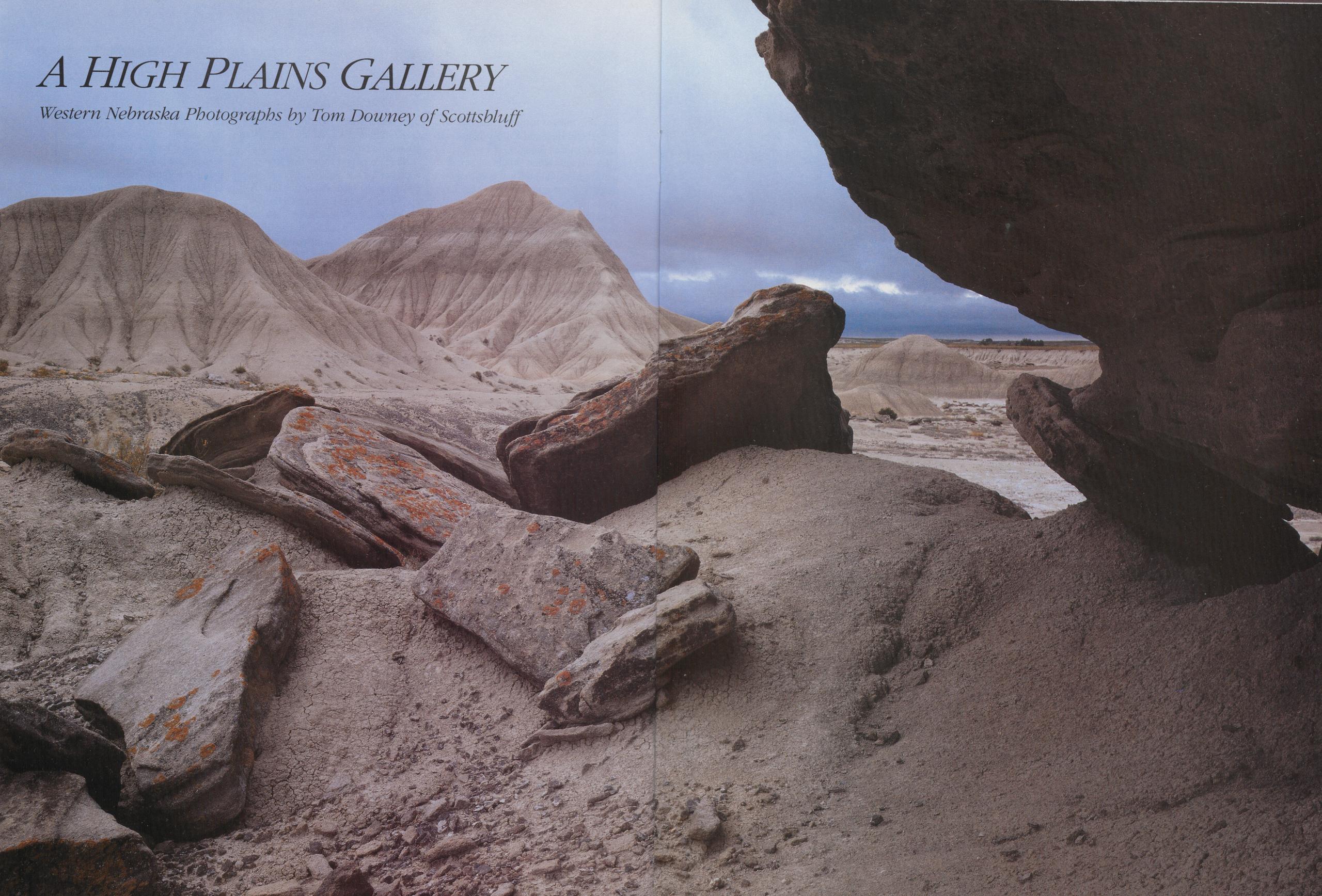
A High Plains Gallery
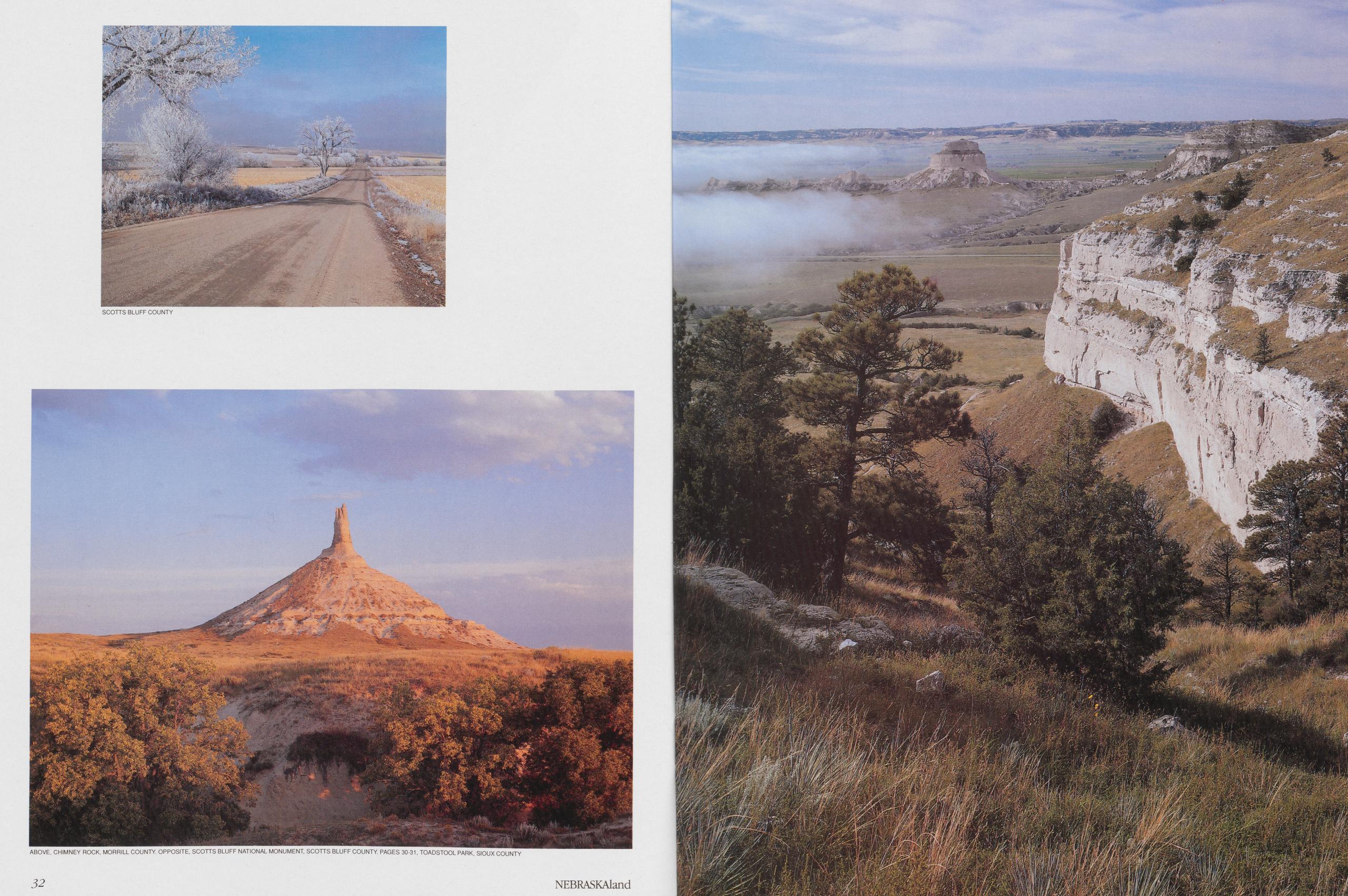
SCOTTS BLUFF COUNTY
ABOVE, CHIMNEY ROCK, MORRILL COUNTY. OPPOSITE, SCOTTS BLUFF NATIONAL MONUMENT, SCOTTS BLUFF COUNTY. PAGES 30-21, TOADSTOOL PARK, SIOUX COUNTY
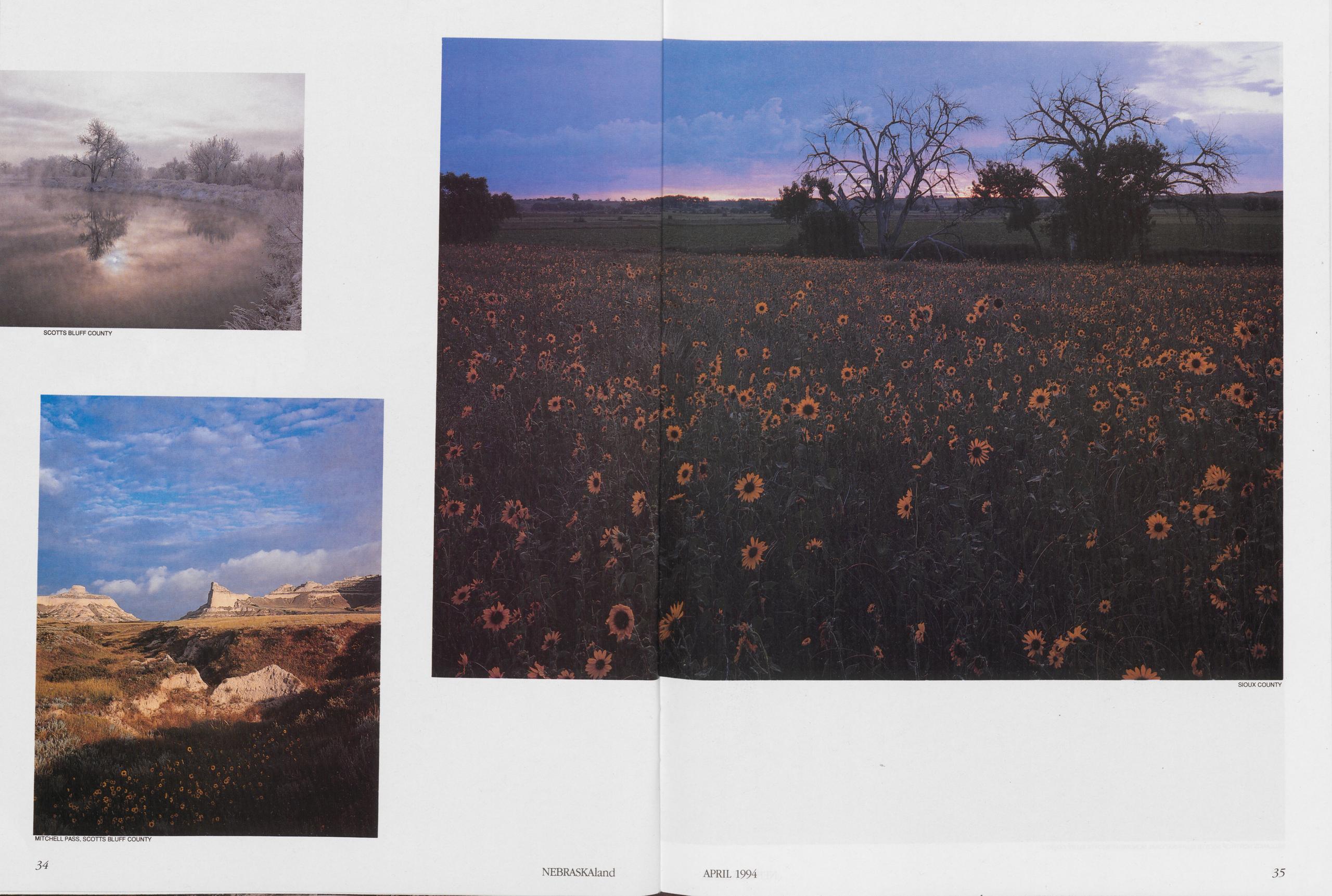
SCOTTS BLUFF COUNTY
MITCHELL PASS, SCOTTS BLUFF COUNTY
SIOUX COUNTY
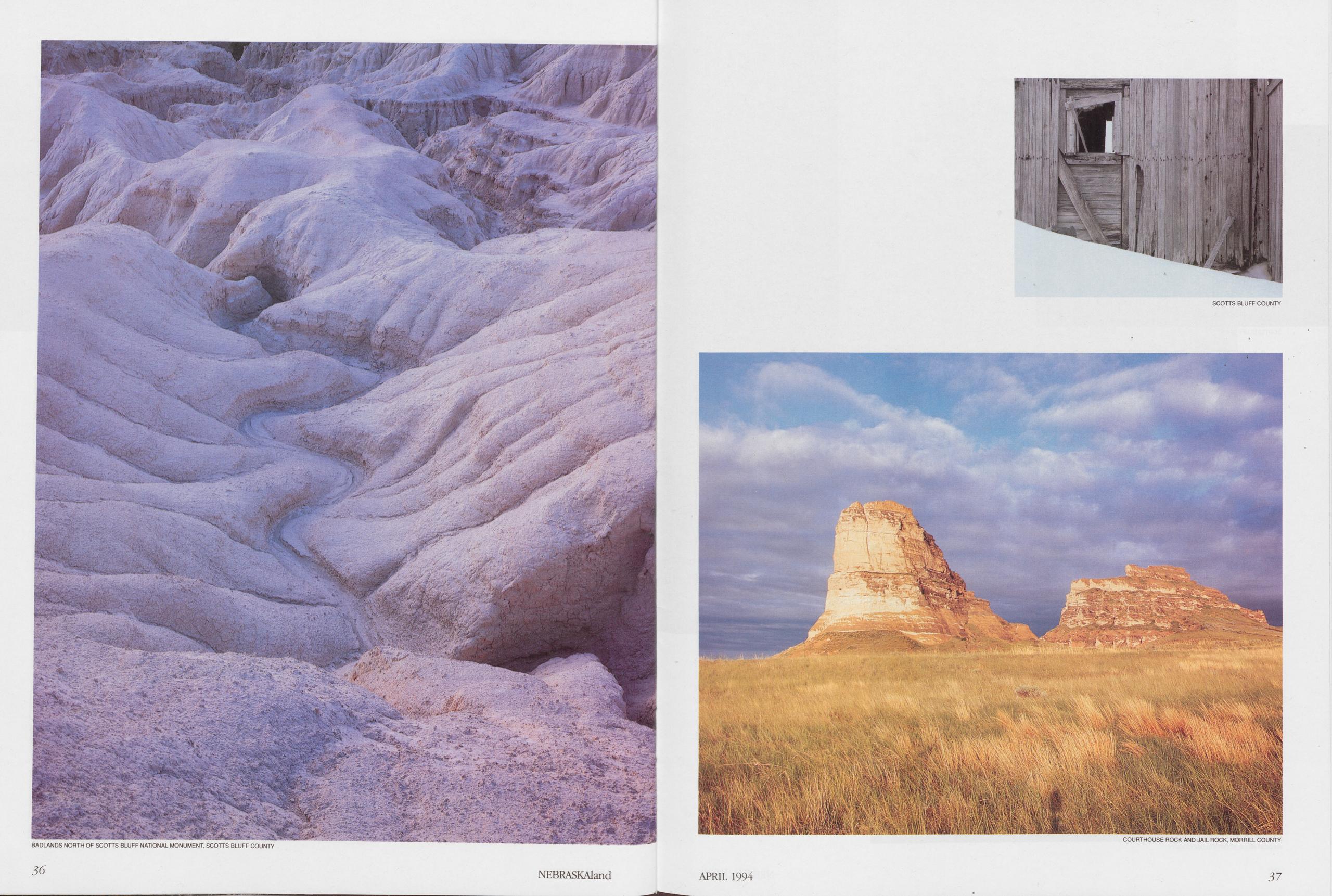
BADLANDS NORTH OF SCOTTS BLUFF NATIONAL MONUMENT, SCOTTS BLUFF COUNTY
SCOTTS BLUFF COUNTY
COURTHOUSE ROCK AND JAIL ROCK, MORRILL COUNTY
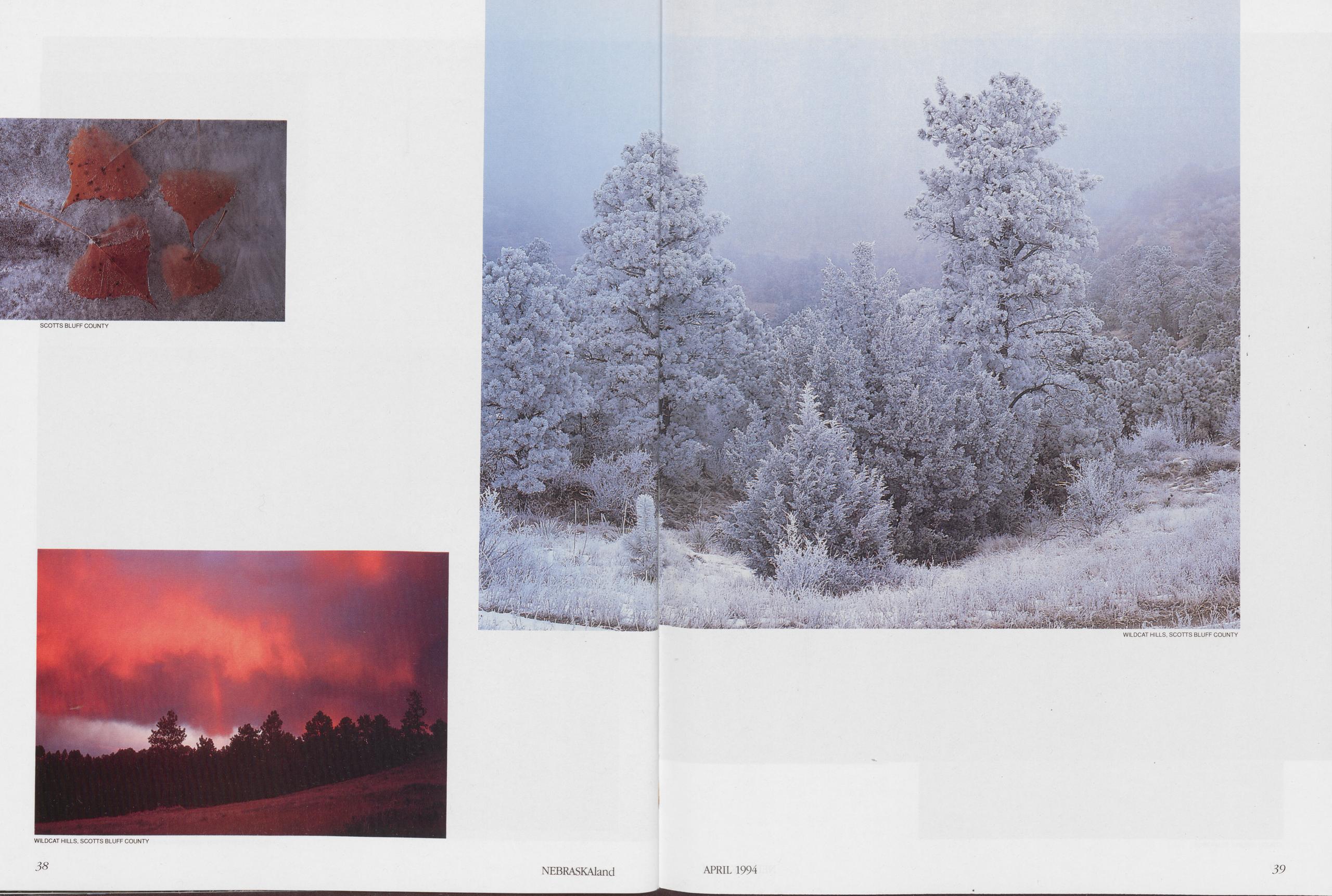
SCOTTS BLUFF COUNTY
WILDCAT HILLS, SCOTTS BLUFF COUNTY
WILDCAT HILLS, SCOTTS BLUFF COUNTY
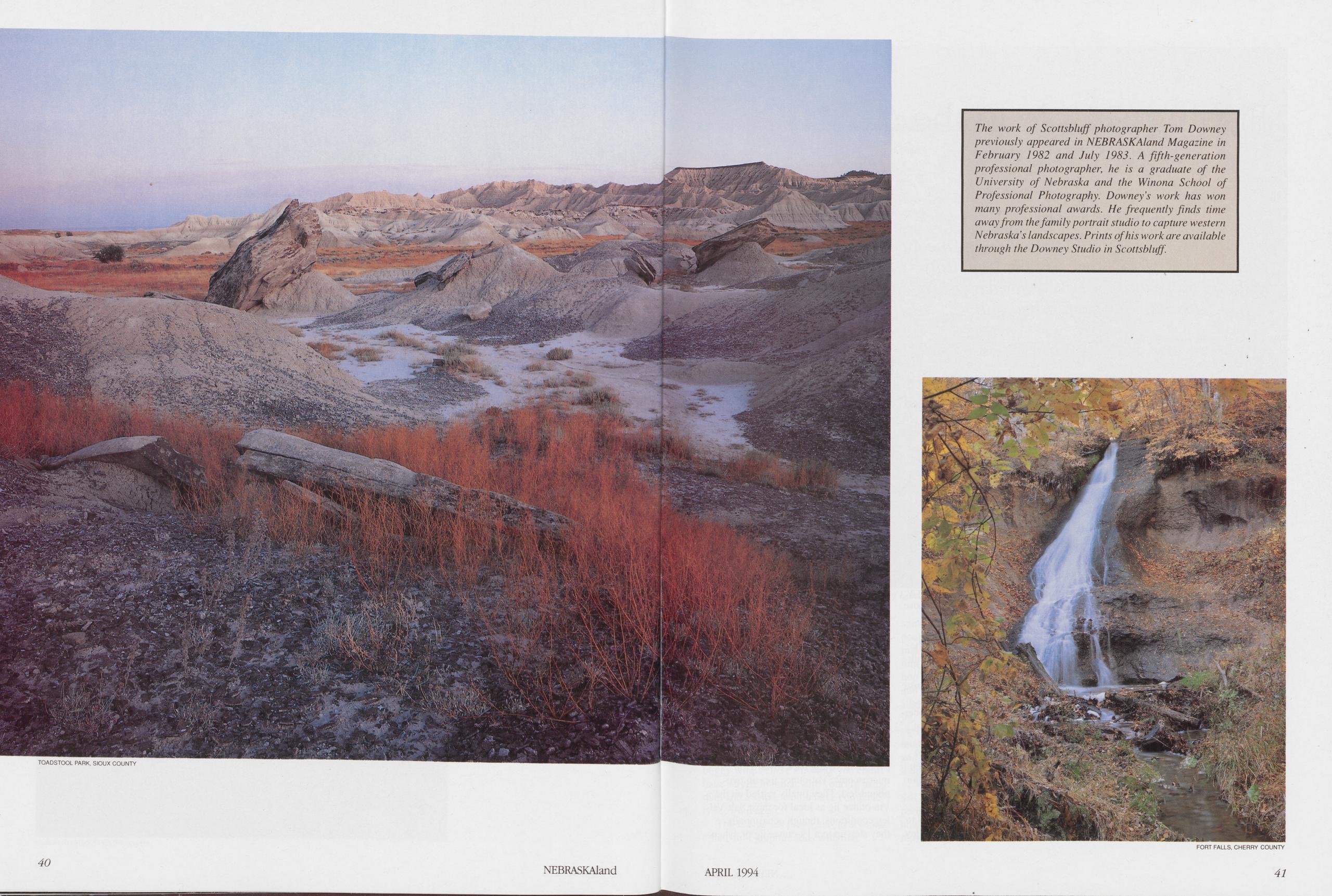
TOADSTOOL PARK, SIOUX COUNTY
The work of Scottsbluff photographer Tom Downey previously appeared in NEBRASKAland Magazine in February 1982 and July 1983. A fifth-generation professional photographer, he is a graduate of the University of Nebraska and the Winona School of Professional Photography. Downey's work has won many professional awards. He frequently finds time away from the family portrait studio to capture western Nebraska's landscapes. Prints of his work are available through the Downey Studio in Scottsbluff.
FORT FALLS, CHERRY COUNTY
Fishing Simple in the Salt Valley
The carefully honed techniques of three Lincoln anglers, masters of low-tech, high-intensity fishing, prove that the Salt Valley watershed lakes are far from fished out.
A16-foot Bass Tracker glides past with a vague, electric hum, tracing a parallel line along the Branched Oak dam, towing a pair of long-lipped crankbaits. The green glow of running lights outlines two men, their faces lost in shadow. One of them jiggles his toe against the trolling motor pedal and scowls at the blips on the LED screen. They’re getting skunked.
As the lights of the boat fade into the deepening dusk, three silhouettes remain. They stand waist deep, well out from the riprap shoreline, black-haired herons in neoprene waders. Rods held nearly vertical, tips bobbing and rising slightly, the three men keep up a cryptic patois of phrases like “four-count,” “chartreuse” and “quartering into the wind.” Every little while, there’s a faint plop as someone shoots a 1/16-ounce jig far out onto the flat beyond the rocks. Presently, one of them comes back sharply on his rod and is tight to a three- pound walleye.
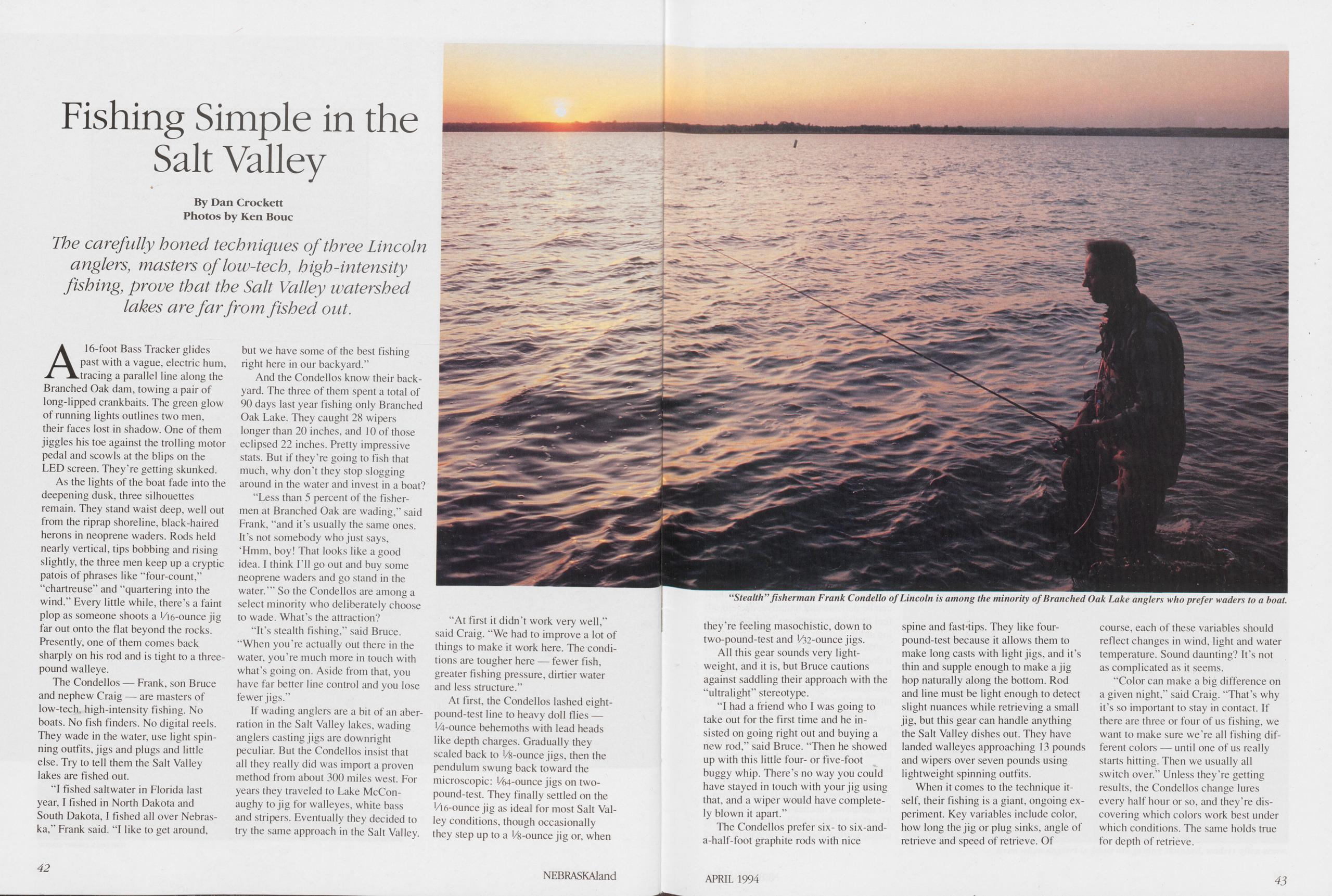
The Condellos — Frank, son Bruce and nephew Craig — are masters of low-tech high-intensity fishing. No boats. No fish finders. No digital reels. They wade in the water, use light spinning outfits, jigs and plugs and little else. Try to tell them the Salt Valley lakes are fished out.
“I fished saltwater in Florida last year, I fished in North Dakota and South Dakota, I fished all over Nebraska,” Frank said. “I like to get around, but we have some of the best fishing right here in our backyard.”
And the Condellos know their backyard. The three of them spent a total of 90 days last year fishing only Branched Oak Lake. They caught 28 wipers longer than 20 inches, and 10 of those eclipsed 22 inches. Pretty impressive stats. But if they’re going to fish that much, why don’t they stop slogging around in the water and invest in a boat?
“Less than 5 percent of the fishermen at Branched Oak are wading,” said Frank, “and it’s usually the same ones. It’s not somebody who just says, ‘Hmm, boy! That looks like a good idea. I think I’ll go out and buy some neoprene waders and go stand in the water.’” So the Condellos are among a select minority who deliberately choose to wade. What’s the attraction?
“It’s stealth fishing,” said Bruce. “When you’re actually out there in the water, you’re much more in touch with what’s going on. Aside from that, you have far better line control and you lose fewer jigs.”
If wading anglers are a bit of an aberration in the Salt Valley lakes, wading anglers casting jigs are downright peculiar. But the Condellos insist that all they really did was import a proven method from about 300 miles west. For years they traveled to Lake McConaughy to jig for walleyes, white bass and stripers. Eventually they decided to try the same approach in the Salt Valley.
“At first it didn’t work very well,” said Craig. “We had to improve a lot of things to make it work here. The conditions are tougher here — fewer fish, greater fishing pressure, dirtier water and less structure.”
At first, the Condellos lashed eight- pound-test line to heavy doll flies — 1/t-ounce behemoths with lead heads like depth charges. Gradually they scaled back to 1/8-ounce jigs, then the pendulum swung back toward the microscopic: 1/64-ounce jigs on two- pound-test. They finally settled on the 1/16-ounce jig as ideal for most Salt Valley conditions, though occasionally they step up to a 1/8-ounce jig or, when they’re feeling masochistic, down to two-pound-test and l/32-ounce jigs.
42 NEBRASKAland“Stealth” fisherman Frank Condello of Lincoln is among the minority of Branched Oak Lake anglers who prefer waders to a boat.
All this gear sounds very light-weight, and it is, but Bruce cautions against saddling their approach with the “ultralight” stereotype.
“I had a friend who I was going to take out for the first time and he insisted on going right out and buying a new rod,” said Bruce. “Then he showed up with this little four- or five-foot buggy whip. There’s no way you could have stayed in touch with your jig using that, and a wiper would have complete- ly blown it apart.”
The Condellos prefer six- to six-and- a-half-foot graphite rods with nice spine and fasbtips. They like four- pound-test because it allows them to make long casts with light jigs, and it’s thin and supple enough to make a jig hop naturally along the bottom. Rod and line must be light enough to detect slight nuances while retrieving a small jig, but this gear can handle anything the Salt Valley dishes out. They have landed walleyes approaching 13 pounds and wipers over seven pounds using lightweight spinning outfits.
When it comes to the technique itself, their fishing is a giant, ongoing experiment. Key variables include color, how long the jig or plug sinks, angle of retrieve and speed of retrieve. Of course, each of these variables should reflect changes in wind, light and water temperature. Sound daunting? It’s not as complicated as it seems.
“Color can make a big difference on a given night,” said Craig. “That’s why it’s so important to stay in contact. If there are three or four of us fishing, we want to make sure we’re all fishing different colors — until one of us really starts hitting. Then we usually all switch over.” Unless they’re getting results, the Condellos change lures every half hour or so, and they’re discovering which colors work best under which conditions. The same holds true for depth of retrieve.
APRIL 1994 43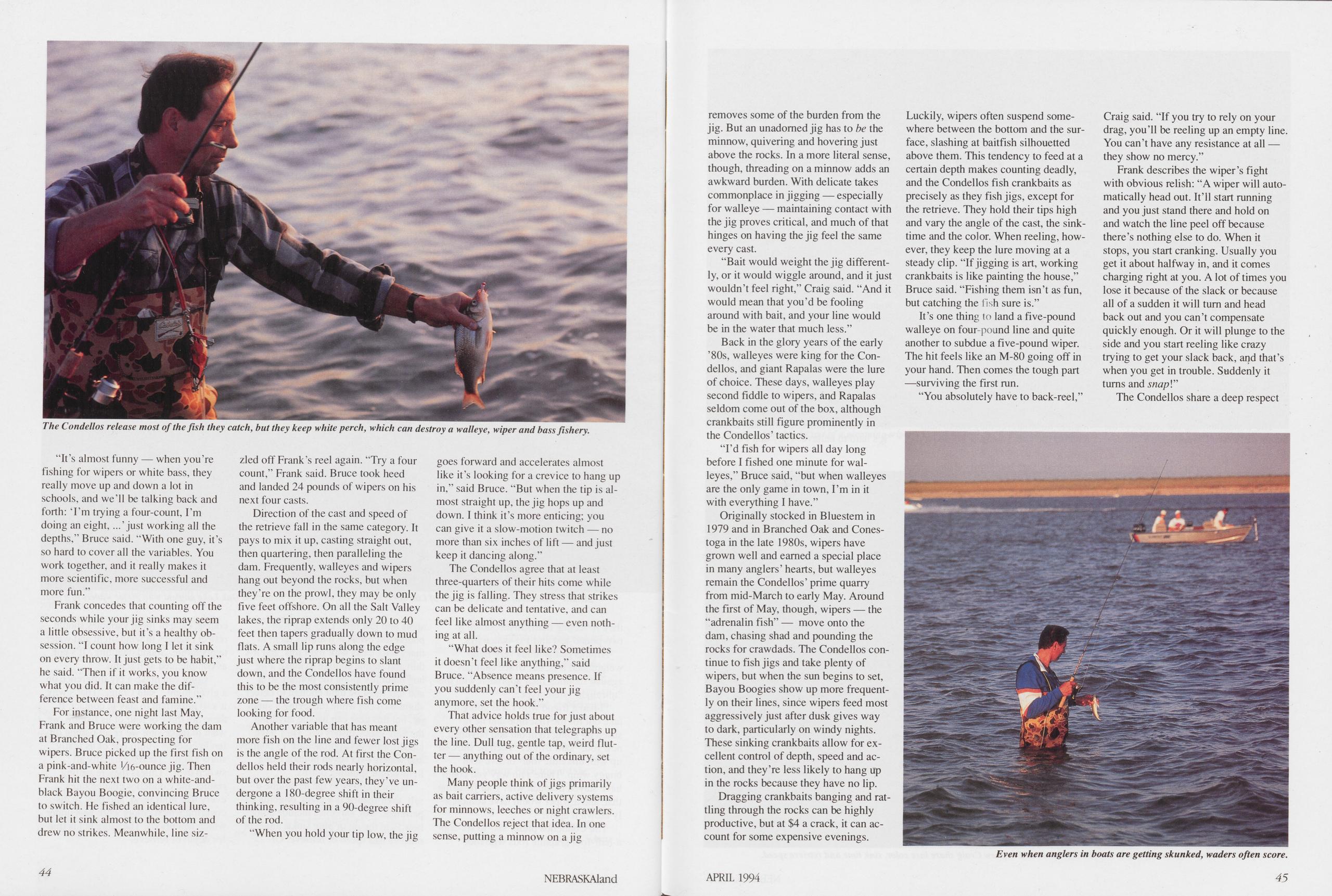
The Condellos release most of the fish they catch, but they keep white perch, which can destroy a walleye, wiper and bass fishery.
“It’s almost funny — when you’re fishing for wipers or white bass, they really move up and down a lot in schools, and we’ll be talking back and forth: ‘I’m trying a four-count, I’m doing an eight, ...’just working all the depths,” Bruce said. “With one guy, it’s so hard to cover all the variables. You work together, and it really makes it more scientific, more successful and more fun.”
Frank concedes that counting off the seconds while your jig sinks may seem a little obsessive, but it’s a healthy obsession. “I count how long I let it sink on every throw. It just gets to be habit,” he said. “Then if it works, you know what you did. It can make the dif- ference between feast and famine.”
For instance, one night last May, Frank and Bruce were working the dam at Branched Oak, prospecting for wipers. Bruce picked up the first fish on a pink-and-white 1/16-ounce jig. Then Frank hit the next two on a white-and- black Bayou Boogie, convincing Bruce to switch. He fished an identical lure, but let it sink almost to the bottom and drew no strikes. Meanwhile, line sizzled off Frank’s reel again. “Try a four count,” Frank said. Bruce took heed and landed 24 pounds of wipers on his next four casts.
Direction of the cast and speed of the retrieve fall in the same category. It pays to mix it up, casting straight out, then quartering, then paralleling the dam. Frequently, walleyes and wipers hang out beyond the rocks, but when they’re on the prowl, they may be only five feet offshore. On all the Salt Valley lakes, the riprap extends only 20 to 40 feet then tapers gradually down to mud flats. A small lip runs along the edge just where the riprap begins to slant down, and the Condellos have found this to be the most consistently prime zone — the trough where fish come looking for food.
Another variable that has meant more fish on the line and fewer lost jigs is the angle of the rod. At first the Condellos held their rods nearly horizontal, but over the past few years, they’ve undergone a 180-degree shift in their thinking, resulting in a 90-degree shift of the rod.
“When you hold your tip low, the jig goes forward and accelerates almost like it’s looking for a crevice to hang up in,” said Bruce. “But when the tip is almost straight up, the jig hops up and down. I think it’s more enticing; you can give it a slow-motion twitch — no more than six inches of lift — and just keep it dancing along.”
The Condellos agree that at least three-quarters of their hits come while the jig is falling. They stress that strikes can be delicate and tentative, and can feel like almost anything — even nothing at all.
“What does it feel like? Sometimes it doesn’t feel like anything,” said Bruce. “Absence means presence. If you suddenly can’t feel your jig anymore, set the hook.”
That advice holds true for just about every other sensation that telegraphs up the line. Dull tug, gentle tap, weird flutter — anything out of the ordinary, set the hook.
Many people think of jigs primarily as bait carriers, active delivery systems for minnows, leeches or night crawlers. The Condellos reject that idea. In one sense, putting a minnow on a jig
44 NEBRASKAlandremoves some of the burden from the jig. But an unadorned jig has to be the minnow, quivering and hovering just above the rocks. In a more literal sense, though, threading on a minnow adds an awkward burden. With delicate takes commonplace in jigging — especially for walleye — maintaining contact with the jig proves critical, and much of that hinges on having the jig feel the same every cast.
“Bait would weight the jig differently, or it would wiggle around, and it just wouldn’t feel right,” Craig said. “And it would mean that you’d be fooling around with bait, and your line would be in the water that much less.”
Back in the glory years of the early ’80s, walleyes were king for the Condellos, and giant Rapalas were the lure of choice. These days, walleyes play second fiddle to wipers, and Rapalas seldom come out of the box, although crankbaits still figure prominently in the Condellos’ tactics.
“I’d fish for wipers all day long before I fished one minute for walleyes,” Bruce said, “but when walleyes are the only game in town, I’m in it with everything I have.”
Originally stocked in Bluestem in 1979 and in Branched Oak and Conestoga in the late 1980s, wipers have grown well and earned a special place in many anglers’ hearts, but walleyes remain the Condellos’ prime quarry from mid-March to early May. Around the first of May, though, wipers — the “adrenalin fish” — move onto the dam, chasing shad and pounding the rocks for crawdads. The Condellos continue to fish jigs and take plenty of wipers, but when the sun begins to set, Bayou Boogies show up more frequently on their lines, since wipers feed most aggressively just after dusk gives way to dark, particularly on windy nights. These sinking crankbaits allow for excellent control of depth, speed and action, and they’re less likely to hang up in the rocks because they have no lip.
Dragging crankbaits banging and rattling through the rocks can be highly productive, but at $4 a crack, it can account for some expensive evenings. Luckily, wipers often suspend somewhere between the bottom and the surface, slashing at baitfish silhouetted above them. This tendency to feed at a certain depth makes counting deadly, and the Condellos fish crankbaits as precisely as they fish jigs, except for the retrieve. They hold their tips high and vary the angle of the cast, the sink-time and the color. When reeling, however, they keep the lure moving at a steady clip. “If jigging is art, working crankbaits is like painting the house,” Bruce said. “Fishing them isn’t as fun, but catching the fish sure is.”
It’s one thing to land a five-pound walleye on four-pound line and quite another to subdue a five-pound wiper. The hit feels like an M-80 going off in your hand. Then comes the tough part —surviving the first run.
“You absolutely have to back-reel,” Even when anglers in boats are getting skunked, waders often score. Craig said. “If you try to rely on your drag, you’ll be reeling up an empty line. You can’t have any resistance at all — they show no mercy.”
Frank describes the wiper’s fight with obvious relish: “A wiper will automatically head out. It’ll start running and you just stand there and hold on and watch the line peel off because there’s nothing else to do. When it stops, you start cranking. Usually you get it about halfway in, and it comes charging right at you. A lot of times you lose it because of the slack or because all of a sudden it will turn and head back out and you can’t compensate quickly enough. Or it will plunge to the side and you start reeling like crazy trying to get your slack back, and that’s when you get in trouble. Suddenly it turns and snap!”
The Condellos share a deep respect
APRIL 1994 45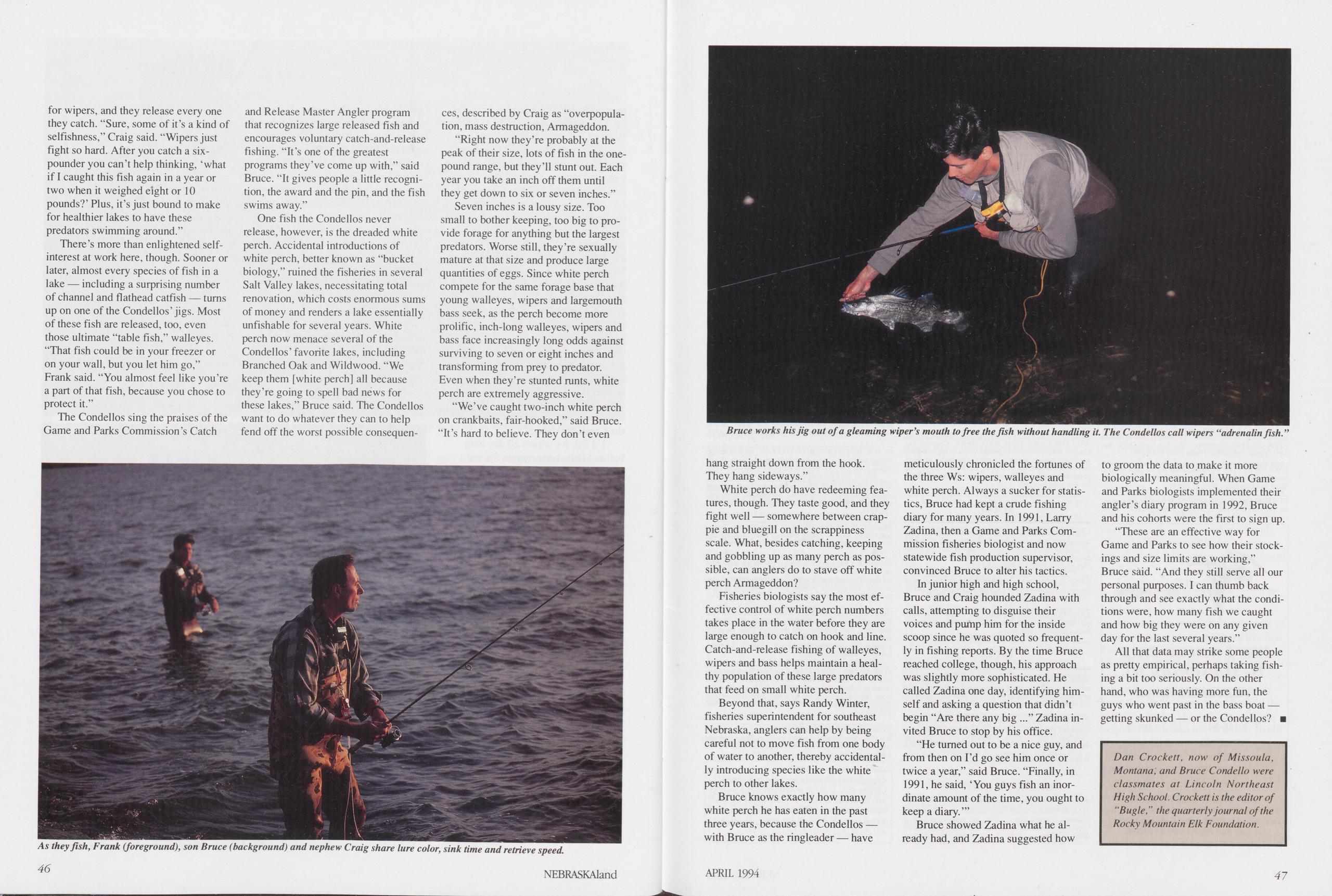
for wipers, and they release every one they catch. “Sure, some of it’s a kind of selfishness,” Craig said. “Wipers just fight so hard. After you catch a six-pounder you can’t help thinking, ‘what if I caught this fish again in a year or two when it weighed eight or 10 pounds?’ Plus, it’s just bound to make for healthier lakes to have these predators swimming around.”
There’s more than enlightened self- interest at work here, though. Sooner or later, almost every species of fish in a lake — including a surprising number of channel and flathead catfish — turns up on one of the Condellos’jigs. Most of these fish are released, too, even those ultimate “table fish,” walleyes. “That fish could be in your freezer or on your wall, but you let him go,” Frank said. “You almost feel like you’re a part of that fish, because you chose to protect it.”
The Condellos sing the praises of the Game and Parks Commission’s Catch and Release Master Angler program that recognizes large released fish and encourages voluntary catch-and-release fishing. “It’s one of the greatest programs they’ve come up with,” said Bruce. “It gives people a little recognition, the award and the pin, and the fish swims away.”
One fish the Condellos never release, however, is the dreaded white perch. Accidental introductions of white perch, better known as “bucket biology,” ruined the fisheries in several Salt Valley lakes, necessitating total renovation, which costs enormous sums of money and renders a lake essentially unfishable for several years. White perch now menace several of the Condellos’ favorite lakes, including Branched Oak and Wildwood. “We keep them [white perch] all because they’re going to spell bad news for these lakes,” Bruce said. The Condellos want to do whatever they can to help fend off the worst possible consequences, described by Craig as “overpopulation, mass destruction, Armageddon.
“Right now they’re probably at the peak of their size, lots of fish in the one- pound range, but they’ll stunt out. Each year you take an inch off them until they get down to six or seven inches.”
Seven inches is a lousy size. Too small to bother keeping, too big to provide forage for anything but the largest predators. Worse still, they’re sexually mature at that size and produce large quantities of eggs. Since white perch compete for the same forage base that young walleyes, wipers and largemouth bass seek, as the perch become more prolific, inch-long walleyes, wipers and bass face increasingly long odds against surviving to seven or eight inches and transforming from prey to predator. Even when they’re stunted runts, white perch are extremely aggressive.
"We’ve caught two-inch white perch on crankbaits, fair-hooked,” said Bruce. “It’s hard to believe. They don’t even
As they fish, Frank (foreground), son Bruce (background) and nephew Craig share lure color, sink time and retrieve speed.
Bruce works his jig out of a gleaming wiper's mouth to free the fish without handling it. The Condellos call wipers “adrenalin fish ”
hang straight down from the hook. They hang sideways.”
White perch do have redeeming features, though. They taste good, and they fight well — somewhere between crappie and bluegill on the scrappiness scale. What, besides catching, keeping and gobbling up as many perch as possible, can anglers do to stave off white perch Armageddon?
Fisheries biologists say the most effective control of white perch numbers takes place in the water before they are large enough to catch on hook and line. Catch-and-release fishing of walleyes, wipers and bass helps maintain a healthy population of these large predators that feed on small white perch.
Beyond that, says Randy Winter, fisheries superintendent for southeast Nebraska, anglers can help by being careful not to move fish from one body of water to another, thereby accidentally introducing species like the white perch to other lakes.
Bruce knows exactly how many white perch he has eaten in the past three years, because the Condellos — with Bruce as the ringleader — have meticulously chronicled the fortunes of the three Ws: wipers, walleyes and white perch. Always a sucker for statistics, Bruce had kept a crude fishing diary for many years. In 1991, Larry Zadina, then a Game and Parks Commission fisheries biologist and now statewide fish production supervisor, convinced Bruce to alter his tactics.
In junior high and high school, Bruce and Craig hounded Zadina with calls, attempting to disguise their voices and pump him for the inside scoop since he was quoted so frequently in fishing reports. By the time Bruce reached college, though, his approach was slightly more sophisticated. He called Zadina one day, identifying himself and asking a question that didn’t begin “Are there any big ...” Zadina invited Bruce to stop by his office.
“He turned out to be a nice guy, and from then on I’d go see him once or twice a year,” said Bruce. “Finally, in 1991, he said, ‘You guys fish an inordinate amount of the time, you ought to keep a diary.’”
Bruce showed Zadina what he already had, and Zadina suggested how to groom the data to make it more biologically meaningful. When Game and Parks biologists implemented their angler’s diary program in 1992, Bruce and his cohorts were the first to sign up.
“These are an effective way for Game and Parks to see how their stockings and size limits are working,” Bruce said. “And they still serve all our personal purposes. I can thumb back through and see exactly what the condi- tions were, how many fish we caught and how big they were on any given day for the last several years.”
All that data may strike some people as pretty empirical, perhaps taking fishing a bit too seriously. On the other hand, who was having more fun, the guys who went past in the bass boat — getting skunked — or the Condellos? ■
Dan Crockett, now of Missoula, Montana, and Bruce Conde who were classmates at Lincoln Northeast High School. Crockett is the editor of “Bugle," the quarterly journal of the Rocky Mountain Elk Foundation.
APRIL 1994 47
Classified
BOOKS/PRINTING FREE BOOK CATALOG. Novels, westerns, romances, children’s; old out of print, found barns, attic. Authors: Aldrige, Pollyanna, Freckles, many others. Postage ap- preciated. Pierce, 4400 N. Pine Cluster, Oroville, CA 95965. DOGS TRAINING ALL BREEDS bird dogs — Vizslas and English Pointers for sale. Rozanek Kennels, RR 2, Schuyler, NE 68661. Phone (402) 352-8769. YELLOW-BLACK Lab pups. FC-AFC sired. AKC. Hips OFA certified. Dew claws removed. Excellent hunting potential. Contact Bob Bendler, Lexington, NE. (308) 324- 4247. AKC BRITTANY PUPS. Close working. Natural backing gun dogs. Field champion backgrounds. Liver and orange. References. Blair (402) 426-3597. WILDERNESS KENNELS. Gun dog training - over 60 years combined experience. Training all sporting breeds — Retrievers. Flushing and pointing dogs. All dogs worked on pen raised birds and wildgame. Training program includes obedience training — heel, sit, stay, down and come when called. Pups, started dogs and fully trained dogs for sale. HUNTING DOGS TRAINED BY HUNTERS. Henry Sader, Wilderness Kennels, (402) 423-4212. Since 1968. FISH/FISHING ENGLISH COCKER pups, imported stock, British FTC bloodlines. Many colors available. Featured in NEBR ASK Aland November 1991. Sawtooth Oaks, Box 443, Orleans, NE 68966. Phone (308) 473-5265. ENGLISH SETTER PUPS and some started dogs. Bred to hunt for foot hunters. Top bloodlines. Health guaranteed. Wind Fall Gun Dogs (402) 421-4693. CUSTOM GATES AND KENNELS. Portable and station- ary dog runs and kennels, any size. Phone (402) 253-2812. YES! I WOULD LIKE TO SUBSCRIBE TO NEBRASKAland I 11 Year-$12 I 12 Years-$23 Name Address City State Zip Mail check or money order to NEBRASKAland Magazine P.O. Box 30370\ Lincoln, Nebraska 68503 or call Toll Free 1-800-742-0056 GERMAN SHORTHAIR PUPS: Style, intelligence and natural ability. Imported bloodlines, Sire and Dam personal hunting dogs. Sire was 2nd runner-up in the 1993 1-Box Pheasant Hunt. Available this spring ready to hunt this fall. Broken Bow (308) 872-6534. DEUTSCH DRAHTHAARS - Line-bred litters due to whelp in March. Puppies expected to have great potential. Parents are proven hunters. Bred by strict VDD standards in a German registered kennel. Versatile hunting drahthaars for fur and feathered game. Wildflugel Kennel. RR 2, Box 24A, Ravenna, NE 68869, (308) 452-4333. RETRIEVER TRAINING. Area’s top “retrievers only” trainer. Field trial and hunting dogs. Non-slip duck dogs! TKO RETRIEVER TRAINING KENNEL (402) 623-4311. FLATWATER LABRADORS AKC Chocolate Labradors. Bred for exceptional temperament, confirmation and hunt- ing ability. Litter due approximately March 10. See both sire and dam. References. R. D. McBride, Firth, NE (402) 791-5704. CHESAPEAKE BAY, LABRADOR and GOLDEN RETRIEVER pups, started dogs and stud service. 16 time _ national champion pedigre. Platte Valley Retrievers (308) 995-2318. FISH FOR SALE. Catfish, largemouth bass, smallmouth bass, perch, crappie, bluegill, walleye, northern pike, rain- bow trout, Donaldson rainbow trout, grass carp, minnows, bullheads. Consulting available. Pleasant Valley Fish Farm, RR 1, Box 147, McCook, NE 69001. Phone (308) 345- 6599. WILLOW LAKE FISH HATCHERY. Channel cat, bluegill, hybrid bluegill, largemouth bass, crappie, triploid grass carp, walleye, perch, minnows available for stocking. Gaylord Crawford, RR 3, Box 46, Hastings, NE 68901 or phone (402) 463-8022 day or night. Also pond consultant. We del, grower price. FOOD NEBRASKA BASKETS: The original Nebraska company specializing in fine foods from Nebraska. A beautiful array of baskets filled with ethnic, healthful and long-time favorite foods. Call or write for our brochure: P.O. Box 98, McCook, NE 69001. 1-800-345-7725. BEER & WINEMAKING SUPPLIES — Fermenter’s Supply & Equipment, 4472 S. 84th St., Omaha, NE 68127. (402) 593-9171. Mail order or visit our store. EASY CHOLESTEROL FREE cake recipe. Send $3.00 plus SASE to R&T, PO Box 67113, Lincoln, NE 68506. Bonus free easy pizza recipe. GIFTS NEBRASKA GREETING CARDS, stationery, mugs and more! Originally designed and produced in Nebraska. Call or write for FREE catalog: MJP, HC 37 Box 43C, Valentine, NE 69201. 1-800-632-7623. ATTENTION RETAILERS: Gifts or souvenirs from the Nebraska Sandhills: “Cherry,” “Sheridan County” and “Sandhill Logic” T-shirts, sweatshirts, coffee mugs and metal canisters. Not available elsewhere. Sandhills Special- ty Gifts, Box 184, Merriman, NE 69218. (308) 684-3487. Wholesale purchase tax number required. GUIDES/OUTFITTERS MAD RIVER CANOES offers the finest quality and per- formance. For the finest canoes and accessories look to Great Plains Canoe Co., 205 Main, Springfield, NE. Phone (402)253-2001. DISMAL RIVER/MIDDLE LOUP RIVER canoe/kayak trips. Powderhom Outfitters - Thedford, NE 69166-1 -800- 347-6256. GUNS/SHOOTING/ARCHERY GUNS — Browning, Winchester, Remington, others. Hi- powers; shotguns, new, used, antiques. Want Pre-'64 Winchesters. Buy-Sell-Trade. (402) 729-6112. Bedlan's Sporting Goods, Fairbury, NE 68352. TAXIDERMY ALLISON'S TAXIDERMY STUDIO & GIFTGALLERY. Specializing in fish, birds and small game. Mounted 35 State Record Fish. Pheasant mounts for sale. 421 N. Dewey, North Platte, NE 69101. (308) 534-2324 or (308) 534-4267. VACATION/RESORTS FOR FISHING and hunting accommodations. Jefco Inn, Gordon, NE 69343. South Cornell, (308) 282-2935. WEST CENTRAL NEBRASKA country house available year round beginning September. 2 bedroom, 2 bath, garage. Abundant wildlife, hunting and fishing, scenic canyon. Rent by week, month or season. Phone (308) 848-2493. BLACK HILLS OF SOUTH DAKOTA: snowmobiling, skiing, sightseeing. Motel, cottages, new chalets at off- season rates. Spring Creek Inn, Hill City, 1 -800-456-2755. BLACK HILLS OF SOUTH DAKOTA: snowmobiling, skiing, sightseeing. Motel, cottages, new chalets at off- season rates. Spring Creek Inn, Hill City. 1-800-456-2755. WILDLIFE ARTISTRY by Jim Newman. Taxidermy fur- nished in award winning style. “Serving NE Sportsmen since 1966.” RR 2, Box 279, Fremont, NE 68025. (402) 727-5714. BEAUTIFUL BLACK HILLS of South Dakota: Taking reservations now for spring Merriam turkey hunting and trout fishing. Spring Creek Inn, Hill City. 1-800-456-2755. NIOBRARA RIVER HIDEAWAY. Family vacation eden on 280 acres scenic forest/sandhills canyonland near canoe- ing river. Two bedroom furnished house (non-smokers,) day or week. Trout ponds, wildlife galore! Naturalist & hiker paradise! (402) 376-2985. HISTORIC 1890s HOTEL. Located in the beautiful Pine Ridge area of Northwest Nebraska. Short drive to Chadron State Park, Fort Robinson and the Black Hills. Beautiful dining room with fireplace and fountain. Room service available. The Olde Main Street Inn, 115 Main St., Chadron. NE 69337 (308) 432-3380. STAY AT THE TWISTED PINE Bed and Breakfast over- looking the scenic Niobrara River. We have a modem bunkhouse or a rustic log cabin with a spectacular view. For more information contact Ken and Sharon Moreland, Twisted Pine Ranch, Box 84, Merriman, NE 69218 (308) 684-3482. NE NEBRASKA TROUT FISHING. Mon-Thurs or Fri- Sun. 3 modem cottages, 5 spring fed lakes. Trout, bass and bluegill. Diamond E. Trout Resort, Box B, Orchard, NE 1-800-658-3244. Classified ad rates: 75f per word, minimum $15. Closing date is the first business day 2 months preceding date of issue. To place ads or for more information write NEBRASKAland Magazine, P.O. Box 30370, Lincoln, NE 68503, or call (402) 471-5478. Eax (402) 471-5528.Page forty-nine
Lost in Nebraska?
I’m usually not one to delight in the misfortunes of others, but I must admit the report of six hunters lost on the Valentine National Wildlife Refuge on the first day of the 1993 grouse season brought me a measure of pleasure.
Opening day was cloaked in fog so heavy that one ridgeline looked pretty much like all the others. As I heard the story, two of the hunters found their way back to their vehicle, and two eventually stumbled across a road and were picked up, but two spent the night in the hills. Fearing hypothermia, they used their shotguns to dig a hole in which they huddled through the night.
Before hearing this story, I was absolutely convinced there was no good reason for anyone in Nebraska but a Boy Scout to carry a compass. You see, I have a long-running love affair with compasses but have never been able to find a use for one in my home state.
Two hundred years ago, when what is now Nebraska was grassland from the hickory forests of the Missouri River to the conifers of the Pine Ridge, that would not have been the case. It is as American as apple pie to attribute all ills to government, and that is where I lay the blame for Nebraska no longer being good compass country.
In 1785, before the Louisiana Purchase was even a twinkle in Thomas Jefferson’s eye, the Continental Congress adopted the rectangular survey system for marking boundaries in the United States. Before 1875, land had been subdivided by metes and bounds, a homegrown system of defining land parcels based on landmarks and features like rivers, ridges and trees. It was a system that led to curious, if often temporary, descriptions like "south two hollers of a hound dog.”
Under the rectangular survey system, a massive, imaginary grid was laid over the country based on north-south principal meridian lines and east-west base lines that permitted the creation of townships composed of 36 one-mile sections. What followed, in areas where mountain ranges and such were no impediment, were tidy east-west and north-south roads on the mile lines, and the elimination of most possibilities of getting lost or needing a compass.
When I was young, I accumulated an array of cheap compasses on key chains and the butts of hunting knives — compasses that spun randomly toward any of the four cardinal points. It was the Boy Scout Silva compass, though, that hooked me. Its needle consistently pointed the same direction. Of course for a compass to be of any use at all you had to make up games, laying out complex routes made up of assorted compass readings and distances to reach some destination.
There have been times, though, when I could have used a compass in Nebraska, but of course I never had one with me. One time was on a moonless night while following coon dogs on the Loup River over ground I thought I knew as well as the way to the bathroom at home. I had no idea where the river was, much less our pickup.
And then there was last April when I misplaced my photo blind at 4 a.m. on a prairie chicken display ground in Dundy County. Of course a compass would have been useful only if I had laid out a course to the blind from the windmill the day before.
There was also the overcast day in March a few years back when I was "lost” south of Sutton. That episode I blame on kuchen, a delightfully tasty German pastry. I was on my way to a lagoon south of town, but as was my custom when in Clay County, I stopped first at a bakery which regularly filled its display case with those delectable creme-filled pastries.
Highway 6, which in that part of the state runs mostly east and west, makes a lazy curve through Sutton. Perhaps it was the aroma of fresh-baked kuchen that distracted me, but when I left downtown and came to the stop sign at the highway, my mind told me it ran east and west, and if I crossed it I would be going south. Miles passed and I did not cross Highway 41, the turnoff to the lagoon or Highway 74. Finally, I saw a large white building several miles ahead. Through my binoculars I could read "Fairmont” on the roof — it was the old airfield, about 14 miles east of Sutton. I was 90 degrees off course. I should have had my compass.
Back in the late 1970s I bought a compass from L.L. Bean. It is a high- tech pocket instrument, an aesthetic improvement over the plastic Silva of my scouting days, but it rarely leaves the cigar box in the closet.
I have carried it with me canoeing the Snake and the Dismal rivers, hoping to find landmarks and triangulate the locations of chutes and falls marked on the topographic map. But as the lost grouse hunters learned, prominent landmarks are few and far between in the Sandhills. Sunrise told me as much as my compass.
In the swamps of Georgia, I'm told, lost souls look for moss growing on the north side of trees and find their way home. There are plants that might be of similar use in Nebraska, including the compass plant, whose large frond-like leaves usually orient north and south. But what if you can’t find a compass plant — and what variety of fool would trust a leaf for directions anyway?
I suppose, had the lost grouse hunters been range-plant scientists, they could have determined directions by looking for the most luxuriant stands of sand lovegrass or some other plant that favors north and northeast facing slopes. Or one of them could simply have whipped out the Silva on the lanyard around his neck, faced north, turned right 90 degrees and walked the ridgeline back to his vehicle on High- way 83. But what kind of a story to tell the grandchildren would that have been?
Getting lost in Nebraska is generally a short-term pleasure. When you are "lost” here, it usually just means you don’t know how to find a destination, not that you don’t know where you are ... roughly ... more-or-less.
APRIL 1994 49
In the kitchen
Out of the Frying Pan . . .The image recalls "Outdoor Life" covers from the 1920s: In the background, Mountains and art deco clouds in a clear blue sky. In the middle distance, a canvas wall tent beside a placid stream. A long can flyrod and a wicker creel lean against a tent pole. In the foreground, a plaid-shirted pipe-smoker in knee-high, lace-up boots kneels at a campfire, frying fish in a cast-iron skillet.
Campfire fried fish are one form of manna, of course, and stove-top fried fish aren't far behind. But if you're in a frying pan rut, try these alternatives from the NEBRASKAland "Country Cookbook," which, by the way, is one of the special issues now available at the ridiculously low price of $3.50 – see the warehouse sale ad on page 7 for more information
Rainbow Trout with Creabmeat Stuffing
6 small trout salt 1 can crabmeat 1 can mushroom pieces 1/2 cup dry bread crumbs 1/4 cup salad dressing minced onions (optional) 1/2 cup butter 3 tbsp lemon juice 1 can water chestnuts, choppedWash trout and pat dry. Sprinkle cavities lightly with salt. Drain crabmear and remove cartilage. Combine all ingredients except butter and lemon juice. Toss to mix. Stuff fish. Skewer or sew up trout. Mix butter and lemon. Grill fish, bastin frequently with lemon-butter.
Parmesan Bass
2 lbs bass, cut into pieces 3/4 inch thick 1/4 up magarine or butter 1 tbsp white wine 1 tbsp fresh lemon juice 3 tbsp grated Parmesan cheese 1/2 tsp salt dash paprika dash pepperHeat overn to 450 degrees. Melt butter in 9x13 inch baking pan and add fish. Sprinkle with salt and pepper. Bake 5 minutes, turn, sprinkle with lemon juice and wine. Top with cheese, bake another 5-7 minutes until fish flakes easily.
Baked Fish Vera Cruz Style
2 lbs fish fillets 3 tbsp cooking oil 1/4 cup onion, minced 1/4 cup green pepper, minced 1/4 tsp garlic, pressed or chopped 2 cups tomato juice 1/8 tsp liquid hot pepper sauce 1 tsp salt 1/2 tsp sugar 1/2 tsp black pepper 3 tbsp green olives, choppedDry fish on paper towels. Preheat over to 350 degrees. In skillet, saute onion, green pepper and garlic in oil for about 3 minutes. Add tomato jiuce, pepper sauce, salt, sugar and pepper. Simmer uncovered for 15 minutes stirring occasionally. Cut fish into 6 serving pieces, roll or lay flar in oiled baking dish. Stir olives into sauce and pour over fish. Bake 45-50 minutes or until fish flakes easily with a fork.
Deep-fried Panfish with Hot Sauce
10 or 12 bluegill or crappie fillets 1 lb shortening 1/2-1 cup corn meal 1/2-1 cup flour 2 eggs 1/4-1/2 cup milk salt pepper catsup Chinese hot mustardHeat shortening in a skillet to 350 degrees. Dip fillets in egg and milk mixture, then roll in corn meal and flour mixture. Fry until golden brown. Mix catsup and Chinese mustard to taste (the less catsup the hotter the sauce) and dip fish in sauce to serve.
Batter-baked Fish
fish fillets 1 beaten egg 2 tbsp water 1 1/2 tsp mustard 1/4 lb butter, melted salt, pepper flour cracker crumbsMix egg, water, mustard, salt and pepper. Dust fillets with flour, dip in egg mixture then in cracker crumbs. Put in a single layer in shallow pan. Pour 1/4 pound of better over all. Bake at 325 grees for 30 minutes. Sprinke with seasoned salt if desired.
Smoked Fish
several white bass, drum or catfish fillets 1 cup Dorothy Lynch salad dressing 1 tsp liquid smoke 1 tsp soy sauce 1 tsp Worcestershire sauce 1 tsp garlic salt 1 tsp celery salt 1 tsp pepper dash Mrs. DashMix all ingredients well and set aside. Place fillets in glass or plastic tray in layers. Spread season mix over each layer. Marinate 3-4 hours in refrigerator. To use, remove fillets and rub them with cooking oil and grill or smoke. Fish is done when it turns light brown and flakes easily.
50 NEBRASKAland
Position: 583 (19 views)