Volume 72, Issue 2, 1994
NEBRASKAland
NEBRASKAland VOL. 72 / NO. 2 MARCH 1994
Published by the Nebraska Game and Parks Commission Director: Rex Amack Assistant Directors: Wesley Sheets Noelyn Isom Staff Administrator, Information & Education: Paul Horton Editor: Don Cunningham Senior Editors: Jon Farrar, Ken Bouc Regional Editors: Bob Grier, Rocky Hoffmann, Tom Keith, Mike Forsberg Production Manager: Troy Kroeger Art Director: Steve O'Hare Layout, Design and Illustration: Tim Reigert Circulation: Pat Frahm Commissioners Chairwoman: Gloria Erickson, Holdrege Vice Chairman: Charles E. Wright, Lincoln 2nd Vice Chairman: Bill Grewcock, Omaha Dr. Charles Blaha, Ord Donald Forney, Lakeside Dr. Tim Biga, Norfolk Randall K. Stinnette, Inland NEBRASKAland ISSN:0028-1964 Published monthly, except for Jan./Feb. and May/June issues, by the Nebraska Game and Parks Commission, 2200 N. 33rd St., Lincoln, NE. Copyright 1994, all rights reserved. Please address comments or questions to this address. Second-class postage paid at Lincoln, Nebraska. POSTMASTER: Send all address changes to NEBRASKAland. P.O. Box 30370, Lincoln, NE 68503. Rates: $ 12 for one year; $23 for two years. Address submissions to: The Editor, NEBRASKAland Magazine, P.O. Box 30370, Lincoln, NE 68503. Include a stamped, self-addressed return envelope. The publisher assumes no responsibility for unsolicited material. NEBRASKAland is available on audio cassette from the Nebraska Library Commission Talking Book and Braille Service. Call (402) 471-4038, or toll-free (800) 742-7691.p. 8
p. 22
p. 40
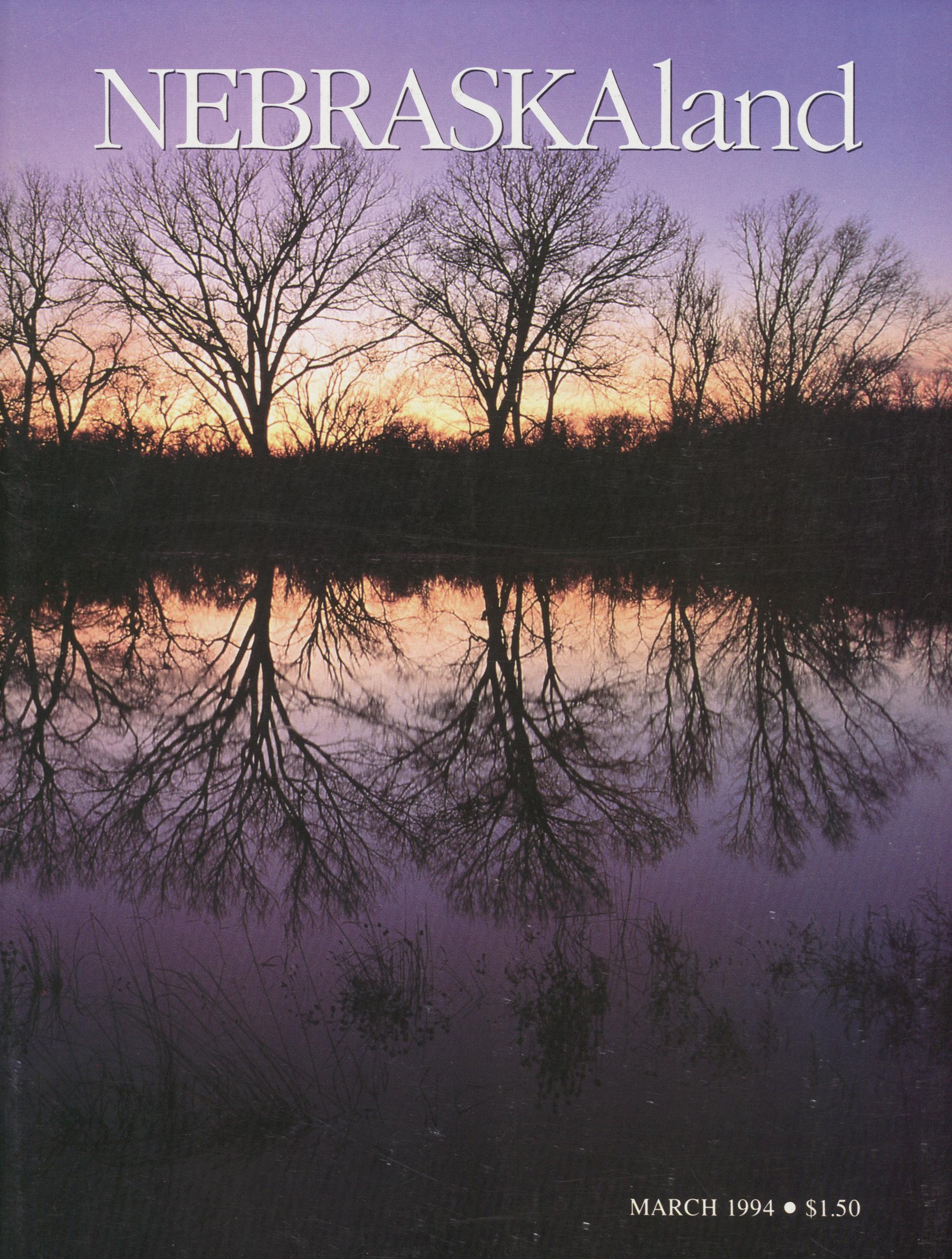
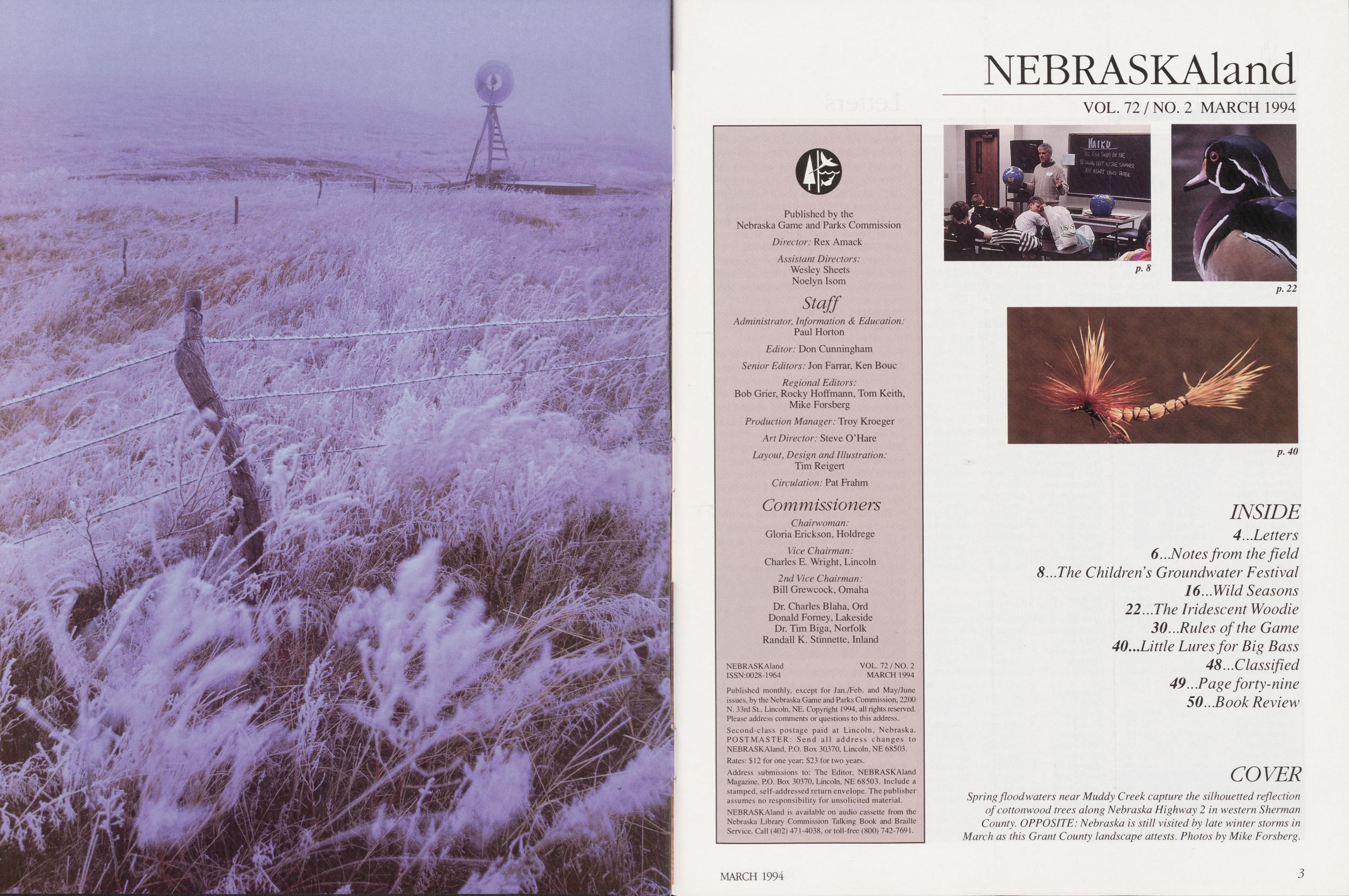
COVER Spring floodwaters near Muddy Creek capture the silhouetted reflection of cottonwood trees along Nebraska Highway 2 in western Sherman County. OPPOSITE: Nebraska is still visited by late winter storms in March as this Grant County landscape attests. Photos by Mike Forsberg.
Letters
Nebraska Bald EaglesI enjoy NEBRASKAland Magazine very much. I've read it for many years, but the December issue had them all beat. I espe- cially liked the article about bald eagles in Nebraska ["A Day with the Eagles"]. We live close to the Missouri River and go to Squaw Creek Refuge to see the geese, ducks and eagles in late fall.
Your article answered many questions we'd wondered about after watching them. Keep up the good work on your magazine.
Donald Koso Falls City, Neb.I just read the December 1993 issue of NEBRASKAland and was absolutely captured by the article "Haunted by Eagles" by Mike Forsberg. I was also impressed by the cover photo which I see was also taken by Mike Forsberg. I then got out my 1994 NEBRASKAland calendar and found three interesting and beautiful works by the same photographer. As I read through two more articles in the December issue, I saw they, too, are by Mike.
The photography is beautiful and the stories are excellent. This young man is a Nebraska treasure, and I hope he is not allowed to get away from Nebraska.
Your magazine has always been unique, and I enjoy every issue. I just wanted to let you know that I was most impressed with this new young artist-photographer and author.
H.C. Shriner Jr., M.D. Lincoln, Neb. The Cellars of TimeI have come to expect the usual excel- lence with which you do your great year- end books, but this one soared way beyond any expectations I might have had.
The "Cellars of Time" is a real treasure. Rob Bozell, Mike Voorhies, you and your staff and all the others have every reason to be especially proud of this work.
Thanks a million!
John A. Brownrigg Omaha, Neb. 4 NEBRASKAlandWe can't even put into words our appreciation and excitement for "The Cellars of Time," a one-of-a-kind book. God bless each and all whose effort went into making it.
Ila and Don Dakan Lincoln, Neb.I just finished reading your special edition, "The Cellars of Time." It is an admirable production which relates the story of the various periods of Nebraska paleontology and archaeology. How wonderful that we, the public, are blessed with such good informative writers about our state. The organizational skills are superb.
As a subscriber, I have enjoyed tremendously all of the other special editions as well as the regular formats.
Hazel B. Devine Hastings, Neb. "The Cellars of Time," NEBRASKAland Magazine's January-February special issue, is now available in a hard-cover edition. For more information see the ad on page 7. (Editor) Modern Cattle DriveI have always enjoyed the spectacular photos and interesting articles in NEBRASKAland, and I thought you might be interested in an event I participated in on Thanksgiving weekend.
Mike Dent has a ranch about 17 miles south of Valentine. His project was to move about 300 head of cattle in a cross-country drive. I was one of seven "city slickers" invited to work with three experienced hands on the drive.
All of this was accomplished on horseback (plus a Ford Bronco for hauling gear) in 10-degrees-below-zero weather and40-mph winds!
The weather was numbing, but all of us, in retrospect, were almost amazed at the beauty of the land with its light sifting of snow and the friendliness of neighboring ranchers as we traversed their properties (with permission).
I am enclosing some photos of the operation.
Tim Markel Omaha, Neb. Mr, BaseballAs to the article on Mr. Baseball in the August issue ["The Life and Times of Clarence Mitchell"] and the letter in the October issue by Martin Dunklau: I, too, lived in Arlington and went to many of the cow-pasture ball games with my good friends who lived north of Arlington — Alvin Jacobs and Leonard Wolf.
I also saw the Kansas City Monarchs, Canadian Clowns and the House of Davids at the Washington County Fairgrounds. These were all great teams for those times, 1928-29 and the 30s. Arlington used to have some real good ball teams and also had some of the great dance bands of the day that played at the dance hall at the fairgrounds.
It was during this period that the Lincoln Highway was being built, and a new bridge was built across the Elkhorn River west of Arlington.
My father, Tom Fowler, took the job of building the approach to it on the east end, and I spent many hours following a four-horse team and fresno pulling dirt for the fill on the approach.
I truly enjoy NEBRASKAland. Reading these letters sure brings to mind a lot of the past pleasant and dear memories. Keep up the good work.
Kenneth Fowler Bayard, Neb.Write to Letters, NEBRASKAland Magazine, P.O. Box 30370, Lincoln, NE 68503-0370, or Fax (402) 47J-5528. Each month we will print as many letters as space permits. Letters may be condensed or edited for clarity.
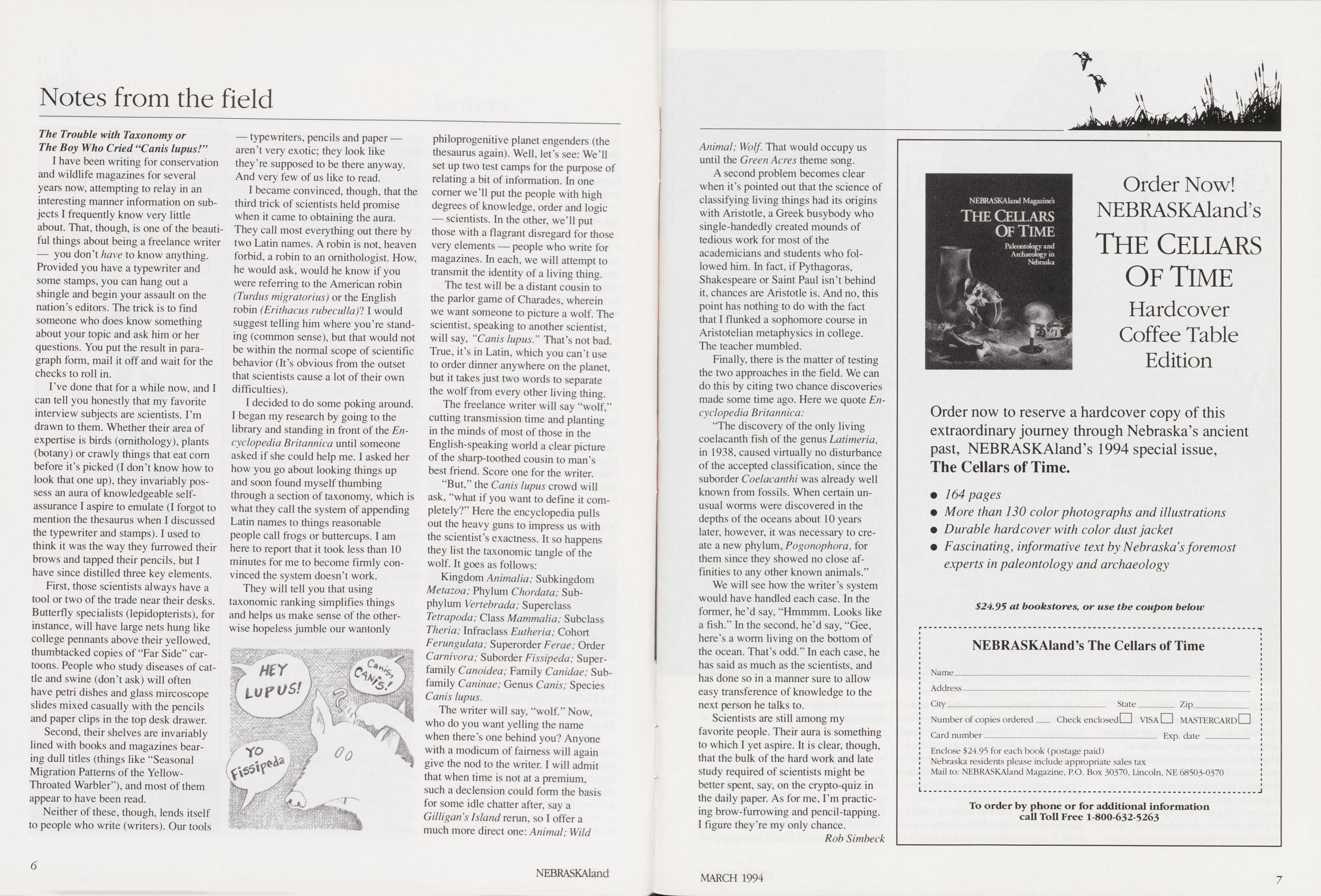
Notes from the field
The Trouble with Taxonomy or The Boy Who Cried "Canis lupus!"I have been writing for conservation and wildlife magazines for several years now, attempting to relay in an interesting manner information on subjects I frequently know very little about. That, though, is one of the beautiful things about being a freelance writer — you don't have to know anything. Provided you have a typewriter and some stamps, you can hang out a shingle and begin your assault on the nation's editors. The trick is to find someone who does know something about your topic and ask him or her questions. You put the result in paragraph form, mail it off and wait for the checks to roll in.
I've done that for a while now, and I can tell you honestly that my favorite interview subjects are scientists. I'm drawn to them. Whether their area of expertise is birds (ornithology), plants (botany) or crawly things that eat com before it's picked (I don't know how to look that one up), they invariably possess an aura of knowledgeable self- assurance I aspire to emulate (I forgot to mention the thesaurus when I discussed the typewriter and stamps). I used to think it was the way they furrowed their brows and tapped their pencils, but I have since distilled three key elements.
First, those scientists always have a tool or two of the trade near their desks. Butterfly specialists (lepidopterists), for instance, will have large nets hung like college pennants above their yellowed, thumbtacked copies of "Far Side" cartoons. People who study diseases of cattle and swine (don't ask) will often have petri dishes and glass mircoscope slides mixed casually with the pencils and paper clips in the top desk drawer.
Second, their shelves are invariably lined with books and magazines bearing dull titles (things like "Seasonal Migration Patterns of the Yellow-Throated Warbler"), and most of them appear to have been read.
Neither of these, though, lends itself to people who write (writers). Our tools — typewriters, pencils and paper — aren't very exotic; they look like they're supposed to be there anyway. And very few of us like to read.
I became convinced, though, that the third trick of scientists held promise when it came to obtaining the aura. They call most everything out there by two Latin names. A robin is not, heaven forbid, a robin to an ornithologist. How, he would ask, would he know if you were referring to the American robin (Tardus migratorius) or the English robin (Erithacus rubeculla)! I would suggest telling him where you're standing (common sense), but that would not be within the normal scope of scientific behavior (It's obvious from the outset that scientists cause a lot of their own difficulties).
I decided to do some poking around. I began my research by going to the library and standing in front of the Encyclopedia Britannica until someone asked if she could help me. I asked her how you go about looking things up and soon found myself thumbing through a section of taxonomy, which is what they call the system of appending Latin names to things reasonable people call frogs or buttercups. I am here to report that it took less than 10 minutes for me to become firmly convinced the system doesn't work.
They will tell you that using taxonomic ranking simplifies things and helps us make sense of the otherwise hopeless jumble our wantonly
The test will be a distant cousin to the parlor game of Charades, wherein we want someone to picture a wolf. The scientist, speaking to another scientist, will say, "Canis lupus." That's not bad. True, it's in Latin, which you can't use to order dinner anywhere on the planet, but it takes just two words to separate the wolf from every other living thing.
The freelance writer will say "wolf," cutting transmission time and planting in the minds of most of those in the English-speaking world a clear picture of the sharp-toothed cousin to man's best friend. Score one for the writer.
"But," the Canis lupus crowd will ask, "what if you want to define it completely?" Here the encyclopedia pulls out the heavy guns to impress us with the scientist's exactness. It so happens they list the taxonomic tangle of the wolf. It goes as follows:
Kingdom Animalia; Subkingdom Metazoa; Phylum Chordata; Sub- phylum Vertebrada; Superclass Tetrapoda; Class Mammalia; Subclass Theria; Infraclass Eutheria; Cohort Ferungulata; Superorder Ferae; Order Carnivora; Suborder Fissipeda; Super- family Canoidea; Family Canidae; Sub- family Caninae; Genus Canis; Species Canis lupus.
The writer will say, "wolf." Now, who do you want yelling the name when there's one behind you? Anyone with a modicum of fairness will again give the nod to the writer. I will admit that when time is not at a premium, such a declension could form the basis for some idle chatter after, say a Gilligans Island rerun, so I offer a much more direct one: Animal; Wild 6 NEBRASKAland Animal; Wolf. That would occupy us until the Green Acres theme song.
A second problem becomes clear when it's pointed out that the science of classifying living things had its origins with Aristotle, a Greek busybody who single-handedly created mounds of tedious work for most of the academicians and students who followed him. In fact, if Pythagoras, Shakespeare or Saint Paul isn't behind it, chances are Aristotle is. And no, this point has nothing to do with the fact that I flunked a sophomore course in Aristotelian metaphysics in college. The teacher mumbled.
Finally, there is the matter of testing the two approaches in the field. We can do this by citing two chance discoveries made some time ago. Here we quote Encyclopedia Britannica: "The discovery of the only living coelacanth fish of the genus Eatimeria, in 1938, caused virtually no disturbance of the accepted classification, since the suborder Coelacanthi was already well known from fossils. When certain unusual worms were discovered in the depths of the oceans about 10 years later, however, it was necessary to create a new phylum, Pogonophora, for them since they showed no close af- finities to any other known animals." We will see how the writer's system would have handled each case. In the former, he'd say, "Hmmmm. Looks like a fish." In the second, he'd say, "Gee, here's a worm living on the bottom of the ocean. That's odd." In each case, he has said as much as the scientists, and has done so in a manner sure to allow easy transference of knowledge to the next person he talks to. Scientists are still among my favorite people. Their aura is something to which I yet aspire. It is clear, though, that the bulk of the hard work and late study required of scientists might be better spent, say, on the crypto-quiz in the daily paper. As for me, I'm practicing brow-furrowing and pencil-tapping. I figure they're my only chance.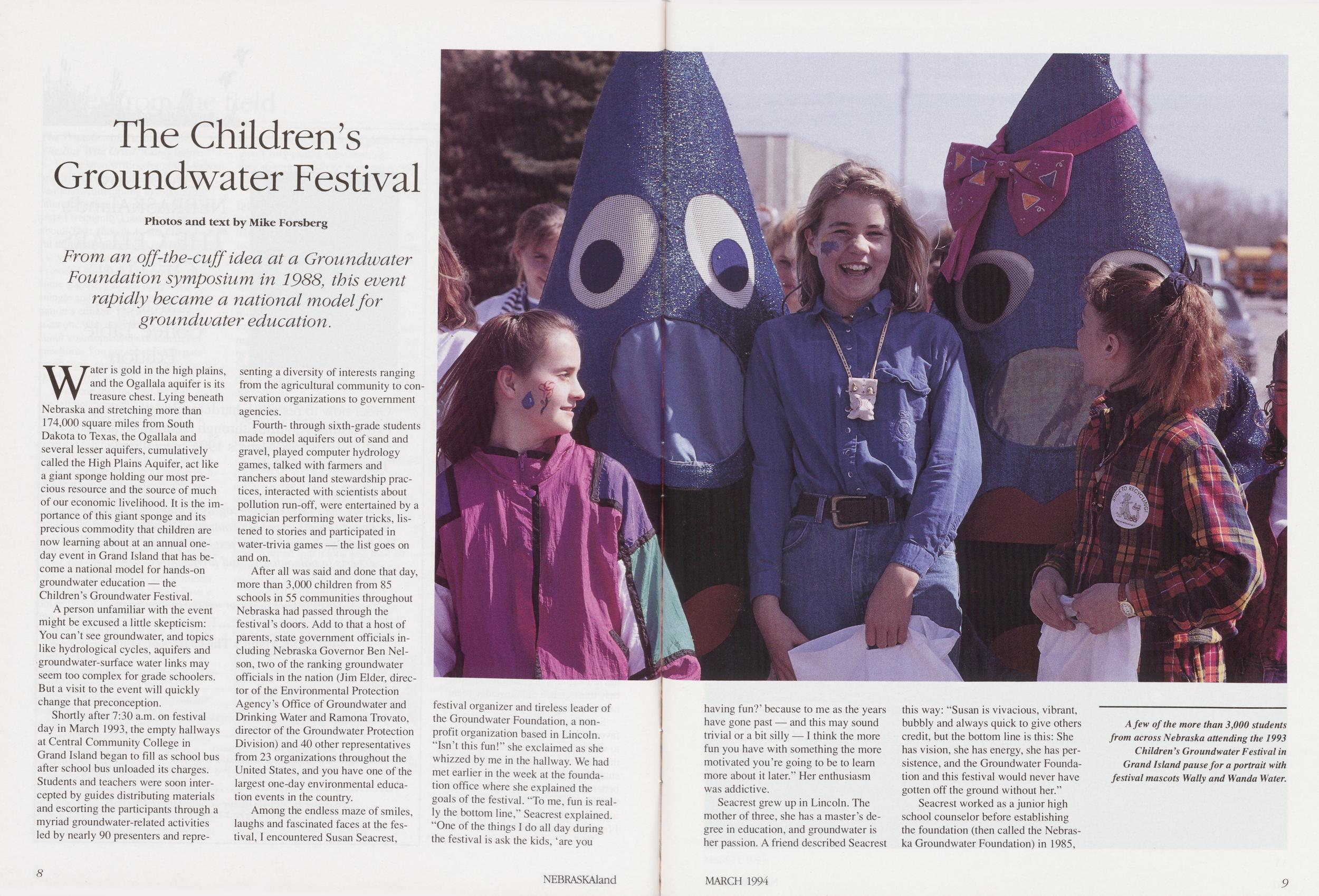
The Children's Groundwater Festival
From an off-the-cuff idea at a Groundwater Foundation symposium in 1988, this event rapidly became a national model for groundwater education.
Water is gold in the high plains, and the Ogallala aquifer is its treasure chest. Lying beneath Nebraska and stretching more than 174,000 square miles from South Dakota to Texas, the Ogallala and several lesser aquifers, cumulatively called the High Plains Aquifer, act like a giant sponge holding our most precious resource and the source of much of our economic livelihood. It is the importance of this giant sponge and its precious commodity that children are now learning about at an annual one-day event in Grand Island that has become a national model for hands-on groundwater education — the Children's Groundwater Festival.
A person unfamiliar with the event might be excused a little skepticism: You can't see groundwater, and topics like hydrological cycles, aquifers and groundwater-surface water links may seem too complex for grade schoolers. But a visit to the event will quickly change that preconception.
Shortly after 7:30 a.m. on festival day in March 1993, the empty hallways at Central Community College in Grand Island began to fill as school bus after school bus unloaded its charges. Students and teachers were soon intercepted by guides distributing materials and escorting the participants through a myriad groundwater-related activities led by nearly 90 presenters and representing a diversity of interests ranging from the agricultural community to conservation organizations to government agencies.
Fourth- through sixth-grade students made model aquifers out of sand and gravel, played computer hydrology games, talked with farmers and ranchers about land stewardship practices, interacted with scientists about pollution run-off, were entertained by a magician performing water tricks, listened to stories and participated in water-trivia games — the list goes on and on.
After all was said and done that day, more than 3,000 children from 85 schools in 55 communities throughout Nebraska had passed through the festival's doors. Add to that a host of parents, state government officials including Nebraska Governor Ben Nelson, two of the ranking groundwater officials in the nation (Jim Elder, director of the Environmental Protection Agency's Office of Groundwater and Drinking Water and Ramona Trovato, director of the Groundwater Protection Division) and 40 other representatives from 23 organizations throughout the United States, and you have one of the largest one-day environmental education events in the country.
Among the endless maze of smiles, laughs and fascinated faces at the festival, I encountered Susan Seacrest, festival organizer and tireless leader of the Groundwater Foundation, a non-profit organization based in Lincoln. "Isn't this fun!" she exclaimed as she whizzed by me in the hallway. We had met earlier in the week at the founda- tion office where she explained the goals of the festival. "To me, fun is real ly the bottom line," Seacrest explained. "One of the things I do all day during the festival is ask the kids, 'are you 8 NEBRASKAland having fun?' because to me as the years have gone past — and this may sound trivial or a bit silly — I think the more fun you have with something the more motivated you're going to be to learn more about it later." Her enthusiasm was addictive.
Seacrest grew up in Lincoln. The mother of three, she has a master's degree in education, and groundwater is her passion. A friend described Seacrest this way: "Susan is vivacious, vibrant, bubbly and always quick to give others credit, but the bottom line is this: She has vision, she has energy, she has persistence, and the Groundwater Foundation and this festival would never have gotten off the ground without her."
Seacrest worked as a junior high school counselor before establishing the foundation (then called the Nebraska Groundwater Foundation) in 1985,
A few of the more than 3,000 students from across Nebraska attending the 1993 Children 's Groundwater Festival in Grand Island pause for a portrait with festival mascots Wally and Wanda Water.
and she has since been on an endless quest to educate the public, adults and children, about groundwater. "You know, Nebraska is the groundwater capital of the world, and we have more groundwater than any other state in the nation. We're one of the top consumers of groundwater. And we're definitely the largest user per capita because we have only 1.4 million people. Needless to say this is certainly a very important resource in our state, and it's important people understand that."
The goals of the Groundwater Foundation, said Seacrest, are to help the public understand groundwater, understand the issues and support public policies that protect water. In its early years, the foundation was run mainly by Seacrest herself and later aided by a handful of volunteers working out of her kitchen on nights and weekends. Its mission then was to provide scientifically accurate, easily understood groundwater information and to develop a series of programs designed to educate the foundation's members and the public about this vital resource.
From those modest beginnings the Groundwater Foundation has grown to an organization of more than 1,000 members, has moved into an office in south Lincoln with a full-time staff of four and has become involved in many state, regional and federal programs in addition to coordinating the festival each year.
Seacrest admits it hasn't been easy. "It's certainly been a labor of love on the part of everyone involved," she said. "For me, it was also a part of state pride — giving back to a state that has really blessed my family."
A grassroots, membership-based organization, the foundation is driven by volunteers, but Seacrest says that description can be misleading. "We've had wonderful professional assistance from the very beginning, from the natural resources districts, the Game and Parks Commission, various state agencies, the University of Nebraska — the list could go on and on. So it's a little bit of a misnomer that we are just a volunteer organization. The advantage of being a small, private grassroots organization is that we can be responsive, creative and can decide on a dime whether or not we want to do something. There's not a big bureaucracy to deal with."
"I think in effect what we've done," Seacrest added, "is to provide an educational outreach opportunity for existing organizations and institutions." The Children's Groundwater Festival is a prime example.
The festival idea arose during an annual fall groundwater symposium sponsored by the foundation in the fall of 1988. The symposium was addressing management issues on the Platte River, and board member Marlene Rasmussen, an elementary school teacher from Litchfield, brought along a group
At that point Seacrest and everyone on the program committee realized they needed to produce something for children. "Those kids proved to us that they have the ability to learn and absorb a very complex subject like groundwater, and who better to educate? They're the ones who are going to be facing some very contentious water issues in the 21st century."
Rasmussen, a teacher for more than 30 years, remembers that day with a twinkle of pride in her eyes. "My students and I had testified in Grand Island a couple times at public hearings discussing the Platte River. I don't know if Susan remembers this or not, but before the fall symposium that year she had written me a letter of congratulations about something or other, and at the bottom she included a PS: 'see you at the symposium, bring your kids.' I honestly felt my students were mature enough to hold their own in a Platte River discussion.
"I was also pretty lucky to have a group of unusually mature sixth-graders at the time" Rasmussen added with a smile. "You can well imagine taking a group of kids from a rural community out west for a four-hour ride to Lincoln to meet all day with a bunch of adults in suits and ties."
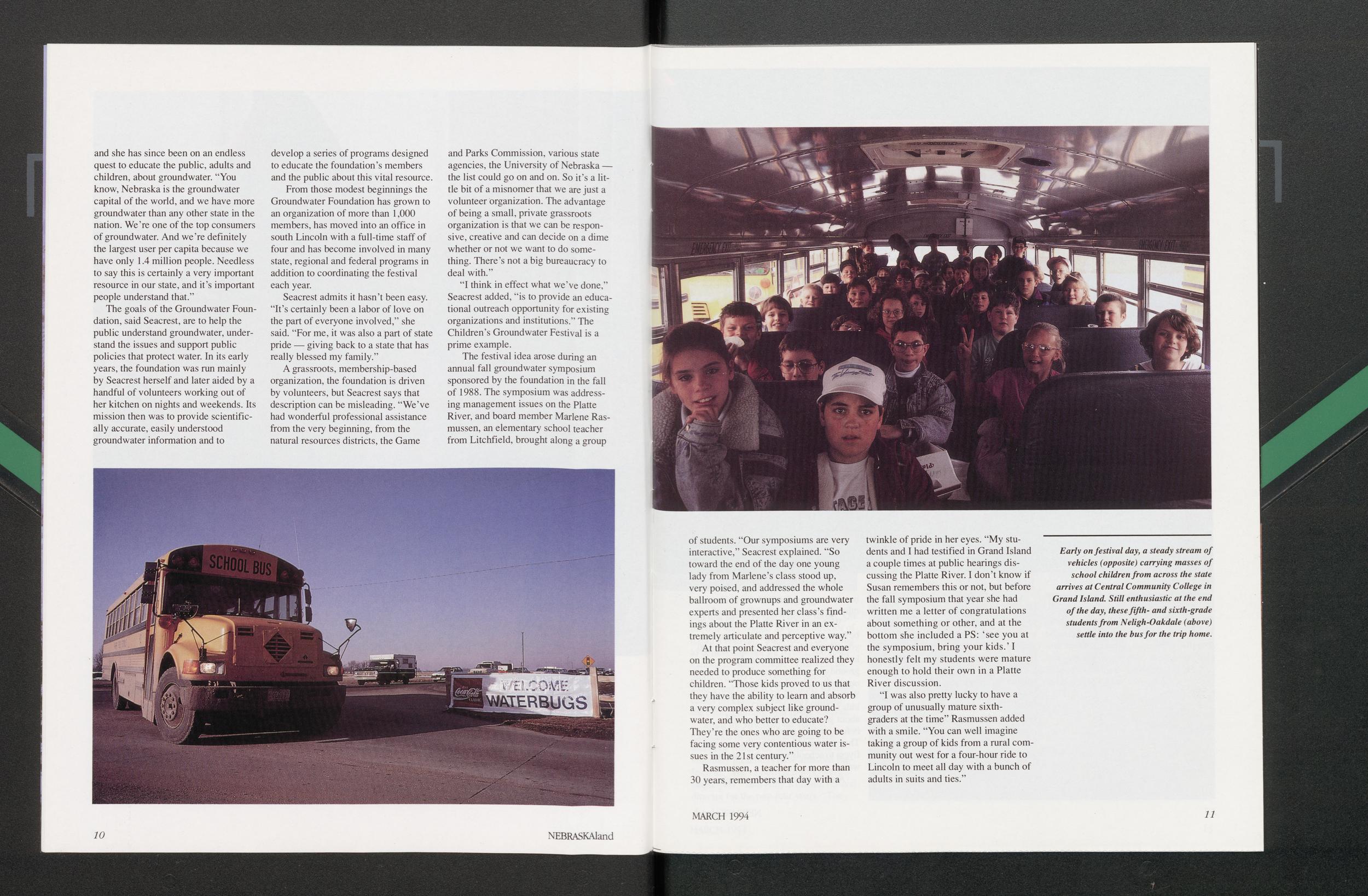
Early on festival day, a steady stream of vehicles (opposite) carrying masses of school children from across the state arrives at Central Community College in Grand Island. Still enthusiastic at the end of the day, these fifth- and sixth-grade students from Neligh-Oakdale (above) settle into the bus for the trip home.

Festival activities include hands-on groundwater-related activities such as this computer exercise holding the rapt attention of two boys (above). Students also learn from experts such as Game and Parks Commission Outdoor Education Coordinator Carl Wolfe (opposite).
Soon, work began to create a groundwater program for young people. In late November the program committee, whose members represented various groundwater-related organizations, decided to plan the event around Groundwater Week in March. Seacrest and her volunteers set out to seek support from state officials and to find a location for the event. A foundation board member from Grand Island suggested Central Community College, which made two classrooms available. The Cooper Foundation of Lincoln provided a $1,500 grant to help cover costs. Things seemed to be working out, but support for the festival idea in other circles was more difficult to find.
"We heard things like, The kids will be busy, the teachers will be busy, and you'll probably be lucky if you get 100 kids to come to something about groundwater that you can't see and no one really cares about anyway,'" Seacrest said. "We figured, well, 100 kids is 100 kids who will know more about groundwater than they did before, so let's go ahead and do it." They compiled a mailing list, sent out flyers to schools across the state and waited.
A week later Seacrest got a phone 12 NEBRASKAland call that she says she'll never forget. On the line was Wanda Johnsen, director of the first festival. "Sue, you're not going to believe this but we have 1,200 reservations for the festival!" That year the predicted 100 kids became almost 2,000, and Central Community College called off classes, graciously turning the entire building over to the festival.
Since the first festival, tens of thousands of students and teachers, scores of volunteers and hundreds of volunteer presenters have attended the festival. "We've been learning every single year," said Amy Killham, festival director for the past four years. "The first year we split the day up into two sessions. Noontime was open, and kids were running down halls trying to get to open activities. It was absolute chaos." Now school classes coming to the festival have four hours of pre-selected activities divided among a variety of 25-minute stations with time allowed to get from one activity to the next. Each class is armed with a program, a map and a schedule.
At the festival it became obvious that the apparent chaos contained a certain smooth rhythm of movement and flow of the masses of children who flooded the halls. Bob Manley Jr., son of Nebraska historian Robert Manley and storyteller at the festival, agreed. "I think it's absolutely incredible. I'm a teacher and was a principal for three years and, hey, how you get 3,000 kids organized like this is amazing."
In the exhibit hall where, among many other things, participants pet snakes, make tornadoes and experiment with irrigation techniques, I found Ryan Ross, a fifth-grade teacher from Ruth Pyrtle Elementary School in Lincoln. A week earlier, in Lincoln, while showing me a huge wetlands mural his students had made, Ross talked about the importance of an event like the Children's Groundwater Festival. "It's our primary goal in elementary school to teach these kids to be critical thinkers and lifelong learners regardless of what they do, and I think it makes them see that school is not just limited to the classroom. I appreciate the way the festival organizers approach this. They give students the idea that festival doesn't mean carnival, it's an extension of the classroom.
"To get these kids to develop an awareness that will affect future generations is the key here. We created this wetland mural because we felt it was important for the kids to be able to have a sense of ownership in the things they were doing and it's a kind of curriculum integration — we have art cross over into science and science into art. They have fun doing it and they all learn."
In analyzing the reasons for the
festival's success, Seacrest credits the
students themselves, the volunteers and
the people and institutions of Nebraska
who "donate their time and put aside
their own agendas for the day." Their
varying perspectives and their willingness to share what they know with the
students are, says Seacrest, what make
MARCH 1994
13
 the program unique. “I don’t know how
many states could get this wide an
audience to just give up time out of
their own day and come together like
this.”
the program unique. “I don’t know how
many states could get this wide an
audience to just give up time out of
their own day and come together like
this.”
Seacrest believes the groundwater festival provided a central forum for groundwater education at a time when it was needed. “Five years ago,” she said, “I think some people were doing it in small ways in the classroom, but this repositioned things and brought together all the good things that were already going on in the state into one place. The advantage of the one-day, one-place concept is that it homes in like a laser beam and really focuses the attention on ground water in the state.”
Co-sponsored by the U.S. Environmental Protection Agency, U.S. Geological Survey and the Central Nebraska Public Power and Irrigation District and locally supported by 40 Grand Island area sponsors, the 1993 festival received 14 grants and gifts and about 60 in-kind donations and services from a vast array of businesses, organizations and government agencies. More than 140 volunteers from Grand Island Northwest High School, the Telephone Pioneers and the Retired Teachers Association worked as guides for the classes, and other volunteers helped where needed.
Generosity also showed itself in ways that can’t be measured by statistics. Because interest in the festival is so high and facilities cannot accommodate all the classes that might wish to attend, participants are selected by stratified random drawing. Longfellow Elementary School in Scottsbluff was one of those selected in 1993. It would have been difficult for Longfellow to afford the long trip and overnight stay, but Stolley Park Elementary School Principal Lee Baasch made Stolley Park’s gym into a makeshift hotel for about 40 Scottsbluff students and teachers.
In 1993 the festival had a waiting list of 8,000, and it has grown every year. “I don’t think it’s going to expand in terms of number of kids or probably not even the activities,” said Kris Newcomb, assistant director of the 1993 festival, “but what I think is going to expand is all the other things we have going on.”
Those other things include smaller water celebrations throughout Nebraska, most sponsored by county extension services and NRDs. Other states are seeking advice about holding festivals, and Mexico even sent a delegation to the 1992 festival.
Currently the Groundwater Foundation is working on a program called “Groundwater Guardians,” an effort that would establish citizen-based groundwater awareness programs for all ages in individual communities. They are also distributing a booklet called “Making Waves, A Step by Step Guide to Putting on a Water Festival” and are organizing water festival workshops around the state.
A few days after the festival, back in Litchfield, Marlene Rasmussen reflected on the event: “I hope nobody thinks they’re going to go down to the festival and come back with everything they need to know about groundwater and how to take care of it. The festival is a celebration of groundwater, and in that celebrating we bring awareness. That’s important because you can’t do anything about a problem until you first recognize one exists.” Pulling out a list of water quotations her class collected during the year, she pointed to a line attributed to Benjamin Franklin: The worth of water is not known until the well runs dry. “There is a lot of wisdom in that,” she said.
Thinking back to the festival, I remember the faces, the laughter, the looks of amazement, the sharp questions, the quick answers and I remember something else Rasmussen said to me: “You don’t know what the future holds for us or for my students. But I think you need to look at each one of them as if you’re looking at the next president. It’s not hard for me to imagine that a president could come out of one of these little classrooms in Nebraska — and it might be mine.”
If that happens, I’m sure he or she will be a president who won’t ever let the well run dry. ■
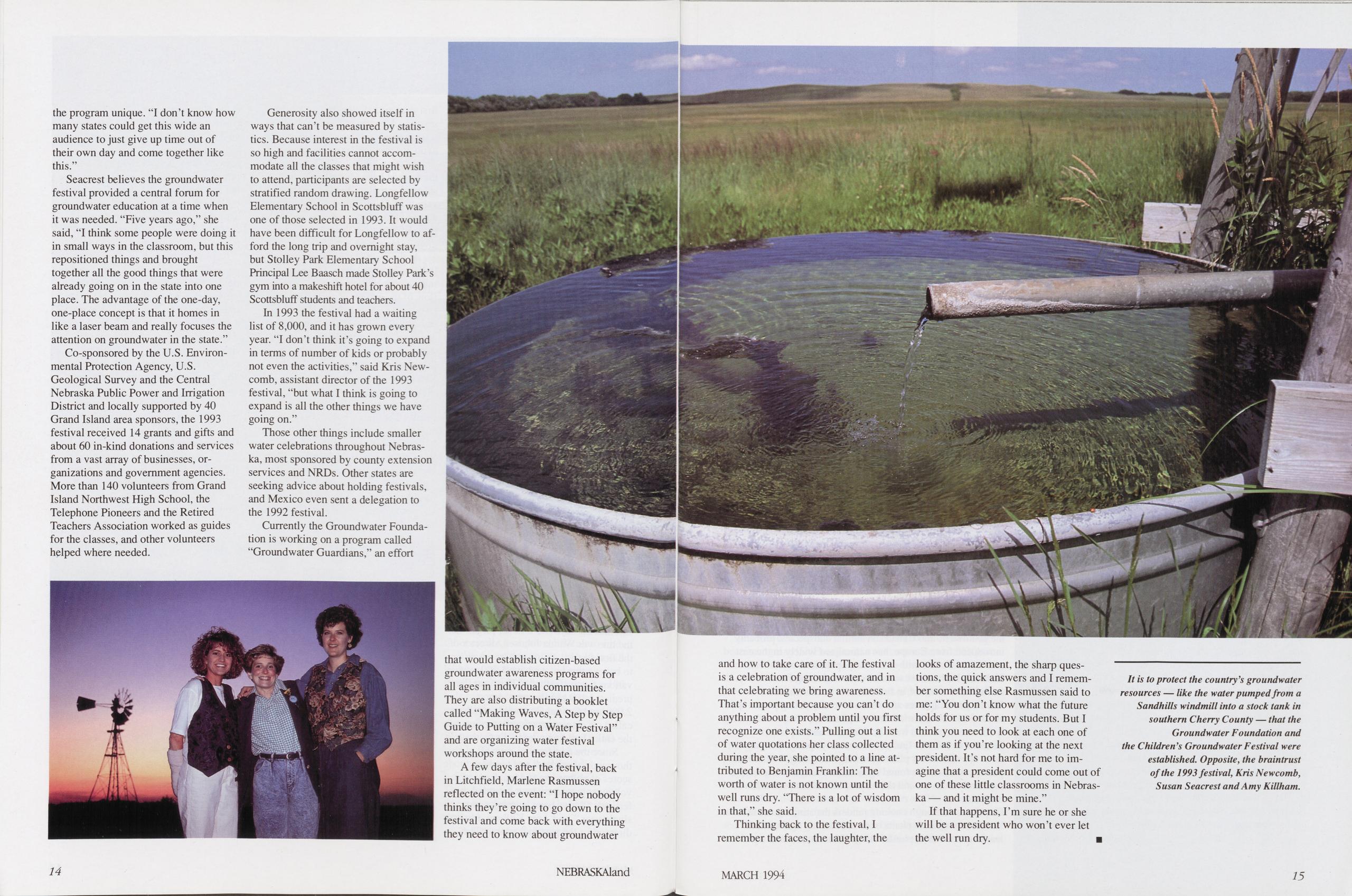
It is to protect the country’s groundwater resources — like the water pumped from a Sandhills windmill into a stock tank in southern Cherry County — that the Groundwater Foundation and the Children’s Groundwater Festival were established. Opposite, the braintrust of the 1993festival, Kris Newcomb, Susan Seacrest and Amy Killham.
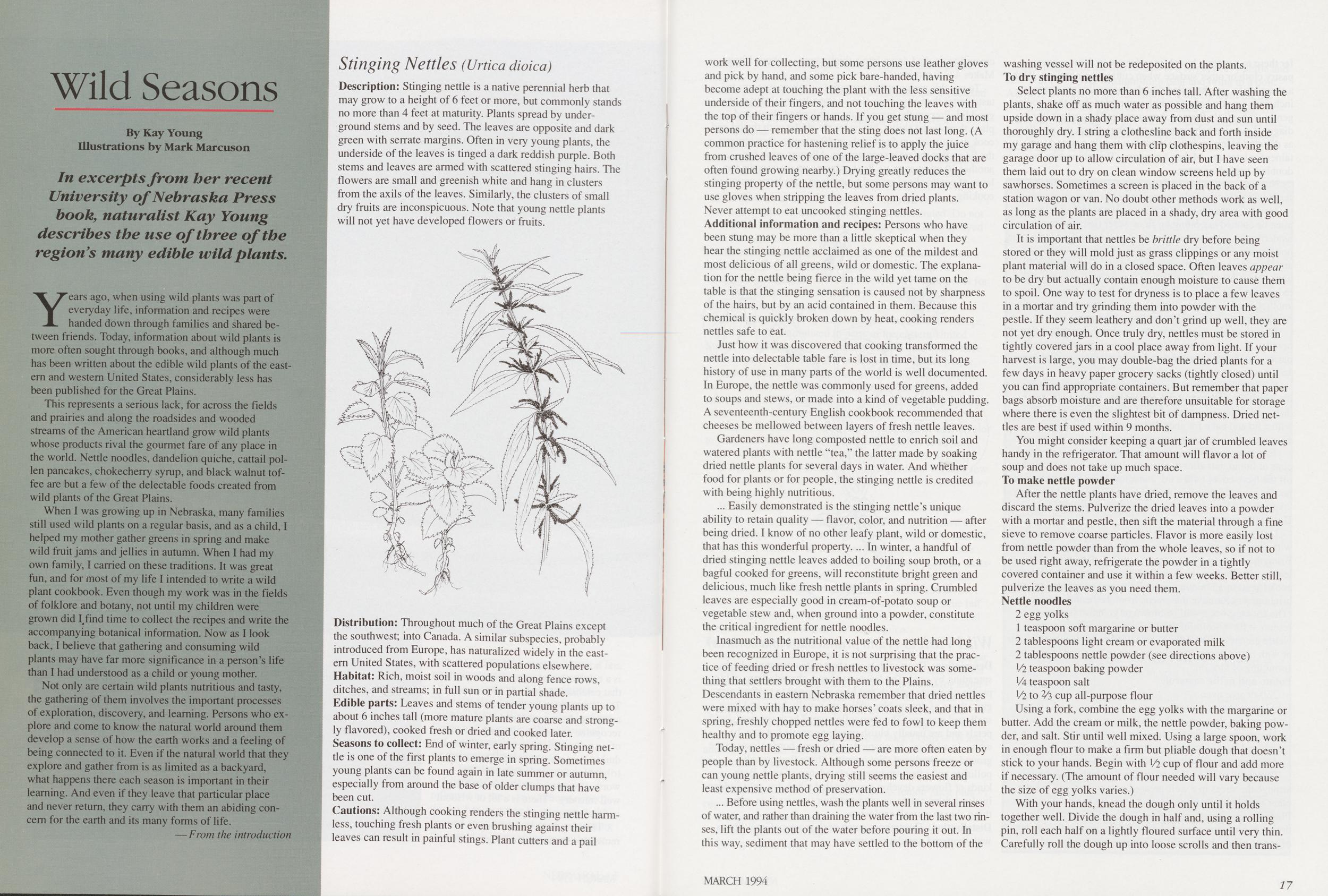
Wild Seasons
In excerpts from her recent University of Nebraska Press book, naturalist Kay Young describes the use of three of the region's many edible wild plants.
Years ago, when using wild plants was part of everyday life, information and recipes were handed down through families and shared between friends. Today, information about wild plants is more often sought through books, and although much has been written about the edible wild plants of the eastern and western United States, considerably less has been published for the Great Plains.
This represents a serious lack, for across the fields and prairies and along the roadsides and wooded streams of the American heartland grow wild plants whose products rival the gourmet fare of any place in the world. Nettle noodles, dandelion quiche, cattail pollen pancakes, chokecherry syrup, and black walnut toffee are but a few of the delectable foods created from wild plants of the Great Plains.
When I was growing up in Nebraska, many families still used wild plants on a regular basis, and as a child, I helped my mother gather greens in spring and make wild fruit jams and jellies in autumn. When I had my own family, I carried on these traditions. It was great fun, and for most of my life I intended to write a wild plant cookbook. Even though my work was in the fields of folklore and botany, not until my children were grown did I find time to collect the recipes and write the accompanying botanical information. Now as I look back, I believe that gathering and consuming wild plants may have far more significance in a person's life than I had understood as a child or young mother.
Not only are certain wild plants nutritious and tasty, the gathering of them involves the important processes of exploration, discovery, and learning. Persons who explore and come to know the natural world around them develop a sense of how the earth works and a feeling of being connected to it. Even if the natural world that they explore and gather from is as limited as a backyard, what happens there each season is important in their learning. And even if they leave that particular place and never return, they carry with them an abiding concern for the earth and its many forms of life.
— From the introduction Stinging Nettles (Urtica dioica)Description: Stinging nettle is a native perennial herb that may grow to a height of 6 feet or more, but commonly stands no more than 4 feet at maturity. Plants spread by underground stems and by seed. The leaves are opposite and dark green with serrate margins. Often in very young plants, the underside of the leaves is tinged a dark reddish purple. Both stems and leaves are armed with scattered stinging hairs. The flowers are small and greenish white and hang in clusters from the axils of the leaves. Similarly, the clusters of small dry fruits are inconspicuous. Note that young nettle plants will not yet have developed flowers or fruits.
Distribution: Throughout much of the Great Plains except the southwest; into Canada. A similar subspecies, probably introduced from Europe, has naturalized widely in the eastern United States, with scattered populations elsewhere.
Habitat: Rich, moist soil in woods and along fence rows, ditches, and streams; in full sun or in partial shade.
Edible parts: Leaves and stems of tender young plants up to about 6 inches tall (more mature plants are coarse and strongly flavored), cooked fresh or dried and cooked later.
Seasons to collect: End of winter, early spring. Stinging nettle is one of the first plants to emerge in spring. Sometimes young plants can be found again in late summer or autumn, especially from around the base of older clumps that have been cut.
Cautions: Although cooking renders the stinging nettle harmless, touching fresh plants or even brushing against their leaves can result in painful stings. Plant cutters and a pail work well for collecting, but some persons use leather gloves and pick by hand, and some pick bare-handed, having become adept at touching the plant with the less sensitive underside of their fingers, and not touching the leaves with the top of their fingers or hands. If you get stung — and most persons do — remember that the sting does not last long. (A common practice for hastening relief is to apply the juice from crushed leaves of one of the large-leaved docks that are often found growing nearby.) Drying greatly reduces the stinging property of the nettle, but some persons may want to use gloves when stripping the leaves from dried plants. Never attempt to eat uncooked stinging nettles.
Additional information and recipes: Persons who have been stung may be more than a little skeptical when they hear the stinging nettle acclaimed as one of the mildest and most delicious of all greens, wild or domestic. The explanation for the nettle being fierce in the wild yet tame on the table is that the stinging sensation is caused not by sharpness of the hairs, but by an acid contained in them. Because this chemical is quickly broken down by heat, cooking renders nettles safe to eat.
Just how it was discovered that cooking transformed the nettle into delectable table fare is lost in time, but its long history of use in many parts of the world is well documented. In Europe, the nettle was commonly used for greens, added to soups and stews, or made into a kind of vegetable pudding. A seventeenth-century English cookbook recommended that cheeses be mellowed between layers of fresh nettle leaves.
Gardeners have long composted nettle to enrich soil and watered plants with nettle "tea," the latter made by soaking dried nettle plants for several days in water. And whether food for plants or for people, the stinging nettle is credited with being highly nutritious.
... Easily demonstrated is the stinging nettle's unique ability to retain quality — flavor, color, and nutrition — after being dried. I know of no other leafy plant, wild or domestic, that has this wonderful property.... In winter, a handful of dried stinging nettle leaves added to boiling soup broth, or a bagful cooked for greens, will reconstitute bright green and delicious, much like fresh nettle plants in spring. Crumbled leaves are especially good in cream-of-potato soup or vegetable stew and, when ground into a powder, constitute the critical ingredient for nettle noodles.
Inasmuch as the nutritional value of the nettle had long been recognized in Europe, it is not surprising that the practice of feeding dried or fresh nettles to livestock was something that settlers brought with them to the Plains. Descendants in eastern Nebraska remember that dried nettles were mixed with hay to make horses' coats sleek, and that in spring, freshly chopped nettles were fed to fowl to keep them healthy and to promote egg laying.
Today, nettles — fresh or dried — are more often eaten by people than by livestock. Although some persons freeze or can young nettle plants, drying still seems the easiest and least expensive method of preservation.
... Before using nettles, wash the plants well in several rinses of water, and rather than draining the water from the last two rinses, lift the plants out of the water before pouring it out. In this way, sediment that may have settled to the bottom of the washing vessel will not be redeposited on the plants.
To dry stinging nettlesSelect plants no more than 6 inches tall. After washing the plants, shake off as much water as possible and hang them upside down in a shady place away from dust and sun until thoroughly dry. I string a clothesline back and forth inside my garage and hang them with clip clothespins, leaving the garage door up to allow circulation of air, but I have seen them laid out to dry on clean window screens held up by sawhorses. Sometimes a screen is placed in the back of a station wagon or van. No doubt other methods work as well, as long as the plants are placed in a shady, dry area with good circulation of air.
It is important that nettles be brittle dry before being stored or they will mold just as grass clippings or any moist plant material will do in a closed space. Often leaves appear to be dry but actually contain enough moisture to cause them to spoil. One way to test for dryness is to place a few leaves in a mortar and try grinding them into powder with the pestle. If they seem leathery and don't grind up well, they are not yet dry enough. Once truly dry, nettles must be stored in tightly covered jars in a cool place away from light. If your harvest is large, you may double-bag the dried plants for a few days in heavy paper grocery sacks (tightly closed) until you can find appropriate containers. But remember that paper bags absorb moisture and are therefore unsuitable for storage where there is even the slightest bit of dampness. Dried nettles are best if used within 9 months.
You might consider keeping a quart jar of crumbled leaves handy in the refrigerator. That amount will flavor a lot of soup and does not take up much space.
To make nettle powderAfter the nettle plants have dried, remove the leaves and discard the stems. Pulverize the dried leaves into a powder with a mortar and pestle, then sift the material through a fine sieve to remove coarse particles. Flavor is more easily lost from nettle powder than from the whole leaves, so if not to be used right away, refrigerate the powder in a tightly covered container and use it within a few weeks. Better still, pulverize the leaves as you need them.
Nettle noodles 2 egg yolks 1 teaspoon soft margarine or butter 2 tablespoons light cream or evaporated milk 2 tablespoons nettle powder (see directions above) 1/2 teaspoon baking powder 1/4 teaspoon salt 1/2 to 2/3 cup all-purpose flourUsing a fork, combine the egg yolks with the margarine or butter. Add the cream or milk, the nettle powder, baking powder, and salt. Stir until well mixed. Using a large spoon, work in enough flour to make a firm but pliable dough that doesn't stick to your hands. Begin with 1/2 cup of flour and add more if necessary. (The amount of flour needed will vary because the size of egg yolks varies.)
With your hands, knead the dough only until it holds together well. Divide the dough in half and, using a rolling pin, roll each half on a lightly floured surface until very thin. Carefully roll the dough up into loose scrolls and then transfer
MARCH 1994 17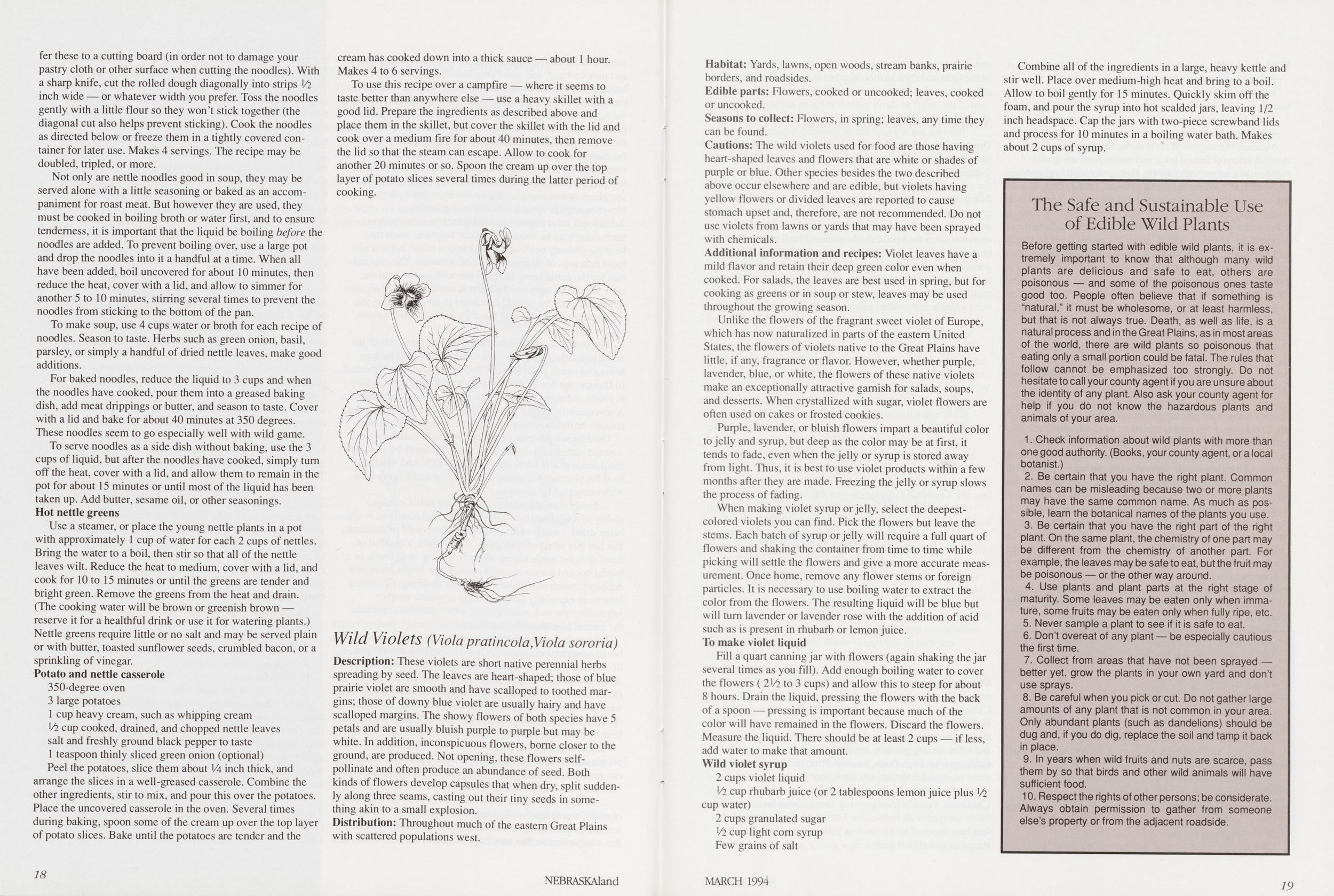
these to a cutting board (in order not to damage your pastry cloth or other surface when cutting the noodles). With a sharp knife, cut the rolled dough diagonally into strips Vi inch wide — or whatever width you prefer. Toss the noodles gently with a little flour so they won't stick together (the diagonal cut also helps prevent sticking). Cook the noodles as directed below or freeze them in a tightly covered container for later use. Makes 4 servings. The recipe may be doubled, tripled, or more.
Not only are nettle noodles good in soup, they may be served alone with a little seasoning or baked as an accompaniment for roast meat. But however they are used, they must be cooked in boiling broth or water first, and to ensure tenderness, it is important that the liquid be boiling before the noodles are added. To prevent boiling over, use a large pot and drop the noodles into it a handful at a time. When all have been added, boil uncovered for about 10 minutes, then reduce the heat, cover with a lid, and allow to simmer for another 5 to 10 minutes, stirring several times to prevent the noodles from sticking to the bottom of the pan.
To make soup, use 4 cups water or broth for each recipe of noodles. Season to taste. Herbs such as green onion, basil, parsley, or simply a handful of dried nettle leaves, make good additions.
For baked noodles, reduce the liquid to 3 cups and when the noodles have cooked, pour them into a greased baking dish, add meat drippings or butter, and season to taste. Cover with a lid and bake for about 40 minutes at 350 degrees. These noodles seem to go especially well with wild game.
To serve noodles as a side dish without baking, use the 3 cups of liquid, but after the noodles have cooked, simply turn off the heat, cover with a lid, and allow them to remain in the pot for about 15 minutes or until most of the liquid has been taken up. Add butter, sesame oil, or other seasonings.
Hot nettle greens Use a steamer, or place the young nettle plants in a pot with approximately 1 cup of water for each 2 cups of nettles. Bring the water to a boil, then stir so that all of the nettle leaves wilt. Reduce the heat to medium, cover with a lid, and cook for 10 to 15 minutes or until the greens are tender and bright green. Remove the greens from the heat and drain. (The cooking water will be brown or greenish brown — reserve it for a healthful drink or use it for watering plants.) Nettle greens require little or no salt and may be served plain or with butter, toasted sunflower seeds, crumbled bacon, or a sprinkling of vinegar. Potato and nettle casserole 350-degree oven 3 large potatoes 1 cup heavy cream, such as whipping cream x/l cup cooked, drained, and chopped nettle leaves salt and freshly ground black pepper to taste 1 teaspoon thinly sliced green onion (optional)Peel the potatoes, slice them about 1/4 inch thick, and arrange the slices in a well-greased casserole. Combine the other ingredients, stir to mix, and pour this over the potatoes. Place the uncovered casserole in the oven. Several times during baking, spoon some of the cream up over the top layer of potato slices. Bake until the potatoes are tender and the cream has cooked down into a thick sauce — about 1 hour. Makes 4 to 6 servings.
To use this recipe over a campfire — where it seems to taste better than anywhere else — use a heavy skillet with a good lid. Prepare the ingredients as described above and place them in the skillet, but cover the skillet with the lid and cook over a medium fire for about 40 minutes, then remove the lid so that the steam can escape. Allow to cook for another 20 minutes or so. Spoon the cream up over the top layer of potato slices several times during the latter period of cooking.
Description: These violets are short native perennial herbs spreading by seed. The leaves are heart-shaped; those of blue prairie violet are smooth and have scalloped to toothed margins; those of downy blue violet are usually hairy and have scalloped margins. The showy flowers of both species have 5 petals and are usually bluish purple to purple but may be white. In addition, inconspicuous flowers, borne closer to the ground, are produced. Not opening, these flowers self-pollinate and often produce an abundance of seed. Both kinds of flowers develop capsules that when dry, split suddenly along three seams, casting out their tiny seeds in something akin to a small explosion.
Distribution: Throughout much of the eastern Great Plains with scattered populations west.
18 NEBRASKAlandHabitat: Yards, lawns, open woods, stream banks, prairie borders, and roadsides.
Edible parts: Flowers, cooked or uncooked; leaves, cooked or uncooked.
Seasons to collect: Flowers, in spring; leaves, any time they can be found.
Cautions: The wild violets used for food are those having heart-shaped leaves and flowers that are white or shades of purple or blue. Other species besides the two described above occur elsewhere and are edible, but violets having yellow flowers or divided leaves are reported to cause stomach upset and, therefore, are not recommended. Do not use violets from lawns or yards that may have been sprayed with chemicals.
Additional information and recipes: Violet leaves have a mild flavor and retain their deep green color even when cooked. For salads, the leaves are best used in spring, but for cooking as greens or in soup or stew, leaves may be used throughout the growing season.
Unlike the flowers of the fragrant sweet violet of Europe, which has now naturalized in parts of the eastern United States, the flowers of violets native to the Great Plains have little, if any, fragrance or flavor. However, whether purple, lavender, blue, or white, the flowers of these native violets make an exceptionally attractive garnish for salads, soups, and desserts. When crystallized with sugar, violet flowers are often used on cakes or frosted cookies.
Purple, lavender, or bluish flowers impart a beautiful color to jelly and syrup, but deep as the color may be at first, it tends to fade, even when the jelly or syrup is stored away from light. Thus, it is best to use violet products within a few months after they are made. Freezing the jelly or syrup slows the process of fading.
When making violet syrup or jelly, select the deepest-colored violets you can find. Pick the flowers but leave the stems. Each batch of syrup or jelly will require a full quart of flowers and shaking the container from time to time while picking will settle the flowers and give a more accurate measurement. Once home, remove any flower stems or foreign particles. It is necessary to use boiling water to extract the color from the flowers. The resulting liquid will be blue but will turn lavender or lavender rose with the addition of acid such as is present in rhubarb or lemon juice.
To make violet liquidFill a quart canning jar with flowers (again shaking the jar several times as you fill). Add enough boiling water to cover the flowers ( 2 J/2 to 3 cups) and allow this to steep for about 8 hours. Drain the liquid, pressing the flowers with the back of a spoon — pressing is important because much of the color will have remained in the flowers. Discard the flowers. Measure the liquid. There should be at least 2 cups — if less, add water to make that amount.
Wild violet syrup 2 cups violet liquid 1/2 cup rhubarb juice (or 2 tablespoons lemon juice plus vi cup water) 2 cups granulated sugar 1/2 cup light com syrup Few grains of saltCombine all of the ingredients in a large, heavy kettle and stir well. Place over medium-high heat and bring to a boil. Allow to boil gently for 15 minutes. Quickly skim off the foam, and pour the syrup into hot scalded jars, leaving 1/2 inch headspace. Cap the jars with two-piece screwband lids and process for 10 minutes in a boiling water bath. Makes about 2 cups of syrup.
The Safe and Sustainable Use of Edible Wild Plants
Before getting started with edible wild plants, it is extremely important to know that although many wild plants are delicious and safe to eat, others are poisonous — and some of the poisonous ones taste good too. People often believe that if something is "natural," it must be wholesome, or at least harmless, but that is not always true. Death, as well as life, is a natural process and in the Great Plains, as in most areas of the world, there are wild plants so poisonous that eating only a small portion could be fatal. The rules that follow cannot be emphasized too strongly. Do not hesitate to call your county agent if you are unsure about the identity of any plant. Also ask your county agent for help if you do not know the hazardous plants and animals of your area.
1. Check information about wild plants with more than one good authority. (Books, your county agent, or a local botanist.)
2. Be certain that you have the right plant. Common names can be misleading because two or more plants may have the same common name. As much as possible, learn the botanical names of the plants you use.
3. Be certain that you have the right part of the right plant. On the same plant, the chemistry of one part may be different from the chemistry of another part. For example, the leaves may be safe to eat, but the fruit may be poisonous — or the other way around.
4. Use plants and plant parts at the right stage of maturity. Some leaves may be eaten only when immature, some fruits may be eaten only when fully ripe, etc.
5. Never sample a plant to see if it is safe to eat.
6. Don't overeat of any plant — be especially cautious the first time.
7. Collect from areas that have not been sprayed — better yet, grow the plants in your own yard and don't use sprays.
8. Be careful when you pick or cut. Do not gather large amounts of any plant that is not common in your area. Only abundant plants (such as dandelions) should be dug and, if you do dig, replace the soil and tamp it back in place.
9. In years when wild fruits and nuts are scarce, pass them by so that birds and other wild animals will have sufficient food.
10. Respect the rights of other persons; be considerate. Always obtain permission to gather from someone else's property or from the adjacent roadside.
MARCH 1994 19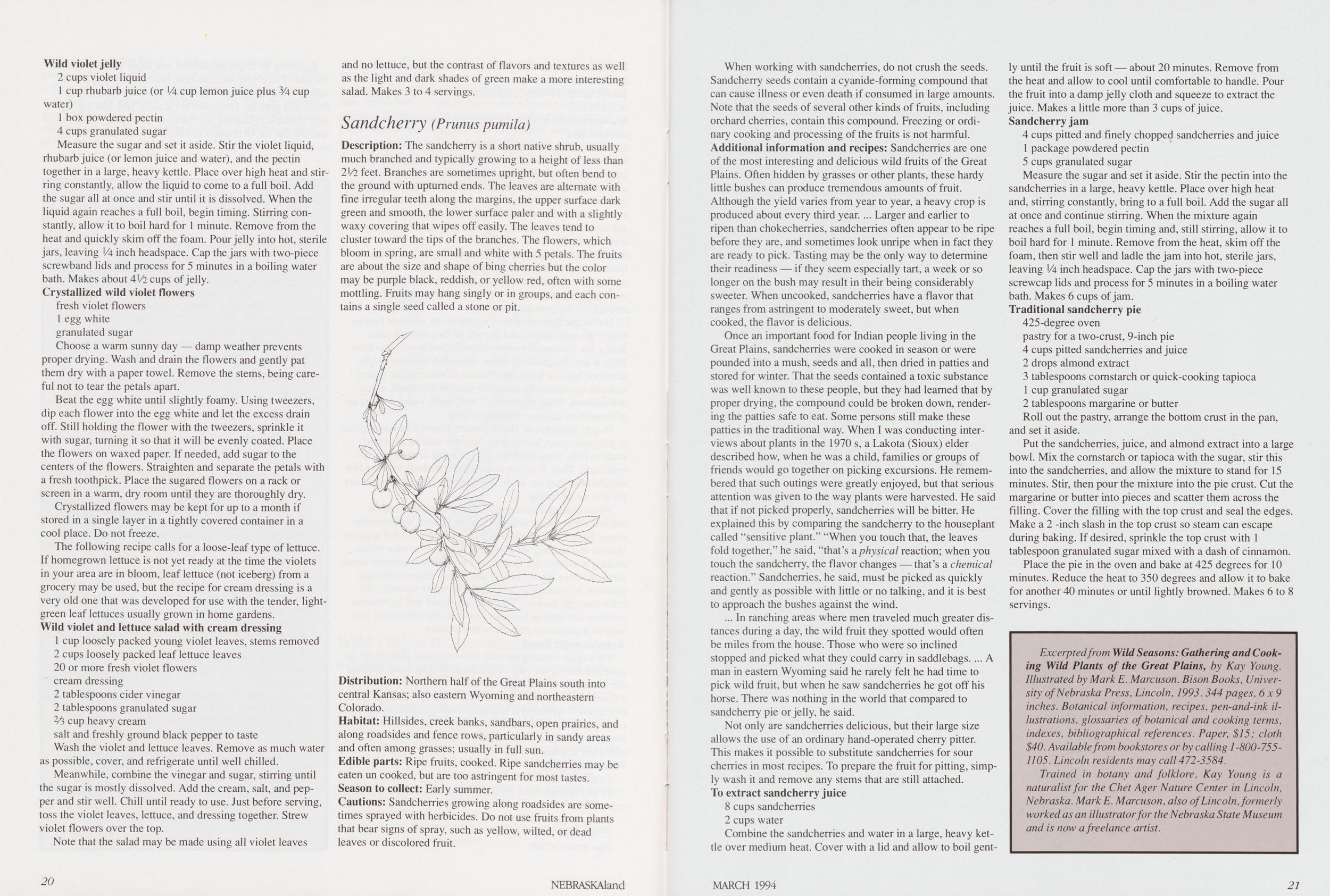 Wild violet jelly
2 cups violet liquid
1 cup rhubarb juice (or Va cup lemon juice plus 3/4 cup
water)
1 box powdered pectin
4 cups granulated sugar
Wild violet jelly
2 cups violet liquid
1 cup rhubarb juice (or Va cup lemon juice plus 3/4 cup
water)
1 box powdered pectin
4 cups granulated sugar
Measure the sugar and set it aside. Stir the violet liquid, rhubarb juice (or lemon juice and water), and the pectin together in a large, heavy kettle. Place over high heat and stirring constantly, allow the liquid to come to a full boil. Add the sugar all at once and stir until it is dissolved. When the liquid again reaches a full boil, begin timing. Stirring constantly, allow it to boil hard for 1 minute. Remove from the heat and quickly skim off the foam. Pour jelly into hot, sterile jars, leaving Va inch headspace. Cap the jars with two-piece screwband lids and process for 5 minutes in a boiling water bath. Makes about 4 1/2 cups of jelly.
Crystallized wild violet flowers fresh violet flowers 1 egg white granulated sugar Choose a warm sunny day — damp weather prevents proper drying. Wash and drain the flowers and gently pat them dry with a paper towel. Remove the stems, being careful not to tear the petals apart. Beat the egg white until slightly foamy. Using tweezers, dip each flower into the egg white and let the excess drain off. Still holding the flower with the tweezers, sprinkle it with sugar, turning it so that it will be evenly coated. Place the flowers on waxed paper. If needed, add sugar to the centers of the flowers. Straighten and separate the petals with a fresh toothpick. Place the sugared flowers on a rack or screen in a warm, dry room until they are thoroughly dry. Crystallized flowers may be kept for up to a month if stored in a single layer in a tightly covered container in a cool place. Do not freeze. The following recipe calls for a loose-leaf type of lettuce. If homegrown lettuce is not yet ready at the time the violets in your area are in bloom, leaf lettuce (not iceberg) from a grocery may be used, but the recipe for cream dressing is a very old one that was developed for use with the tender, light-green leaf lettuces usually grown in home gardens. Wild violet and lettuce salad with cream dressing 1 cup loosely packed young violet leaves, stems removed 2 cups loosely packed leaf lettuce leaves 20 or more fresh violet flowers cream dressing 2 tablespoons cider vinegar 2 tablespoons granulated sugar 2A cup heavy cream salt and freshly ground black pepper to tasteWash the violet and lettuce leaves. Remove as much water as possible, cover, and refrigerate until well chilled.
Meanwhile, combine the vinegar and sugar, stirring until the sugar is mostly dissolved. Add the cream, salt, and pepper and stir well. Chill until ready to use. Just before serving, toss the violet leaves, lettuce, and dressing together. Strew violet flowers over the top.
Note that the salad may be made using all violet leaves and no lettuce, but the contrast of flavors and textures as well as the light and dark shades of green make a more interesting salad. Makes 3 to 4 servings.
Sandcherry (Primus pumila)Description: The sandcherry is a short native shrub, usually much branched and typically growing to a height of less than 21/2 feet. Branches are sometimes upright, but often bend to the ground with upturned ends. The leaves are alternate with fine irregular teeth along the margins, the upper surface dark green and smooth, the lower surface paler and with a slightly waxy covering that wipes off easily. The leaves tend to cluster toward the tips of the branches. The flowers, which bloom in spring, are small and white with 5 petals. The fruits are about the size and shape of bing cherries but the color may be purple black, reddish, or yellow red, often with some mottling. Fruits may hang singly or in groups, and each contains a single seed called a stone or pit.
Distribution: Northern half of the Great Plains south into central Kansas; also eastern Wyoming and northeastern Colorado.
Habitat: Hillsides, creek banks, sandbars, open prairies, and along roadsides and fence rows, particularly in sandy areas and often among grasses; usually in full sun.
Edible parts: Ripe fruits, cooked. Ripe sandcherries may be eaten un cooked, but are too astringent for most tastes.
Season to collect: Early summer.
Cautions: Sandcherries growing along roadsides are sometimes sprayed with herbicides. Do not use fruits from plants that bear signs of spray, such as yellow, wilted, or dead leaves or discolored fruit.
20 NEBRASKAlandWhen working with sandcherries, do not crush the seeds. Sandcherry seeds contain a cyanide-forming compound that can cause illness or even death if consumed in large amounts. Note that the seeds of several other kinds of fruits, including orchard cherries, contain this compound. Freezing or ordinary cooking and processing of the fruits is not harmful.
Additional information and recipes: Sandcherries are one of the most interesting and delicious wild fruits of the Great Plains. Often hidden by grasses or other plants, these hardy little bushes can produce tremendous amounts of fruit. Although the yield varies from year to year, a heavy crop is produced about every third year. ... Larger and earlier to ripen than chokecherries, sandcherries often appear to be ripe before they are, and sometimes look unripe when in fact they are ready to pick. Tasting may be the only way to determine their readiness — if they seem especially tart, a week or so longer on the bush may result in their being considerably sweeter. When uncooked, sandcherries have a flavor that ranges from astringent to moderately sweet, but when cooked, the flavor is delicious.
Once an important food for Indian people living in the Great Plains, sandcherries were cooked in season or were pounded into a mush, seeds and all, then dried in patties and stored for winter. That the seeds contained a toxic substance was well known to these people, but they had learned that by proper drying, the compound could be broken down, rendering the patties safe to eat. Some persons still make these patties in the traditional way. When I was conducting interviews about plants in the 1970 s, a Lakota (Sioux) elder described how, when he was a child, families or groups of friends would go together on picking excursions. He remembered that such outings were greatly enjoyed, but that serious attention was given to the way plants were harvested. He said that if not picked properly, sandcherries will be bitter. He explained this by comparing the sandcherry to the houseplant called "sensitive plant." 'When you touch that, the leaves fold together," he said, "that's a physical reaction; when you touch the sandcherry, the flavor changes — that's a chemical reaction." Sandcherries, he said, must be picked as quickly and gently as possible with little or no talking, and it is best to approach the bushes against the wind.
... In ranching areas where men traveled much greater distances during a day, the wild fruit they spotted would often be miles from the house. Those who were so inclined stopped and picked what they could carry in saddlebags.... A man in eastern Wyoming said he rarely felt he had time to pick wild fruit, but when he saw sandcherries he got off his horse. There was nothing in the world that compared to sandcherry pie or jelly, he said.
Not only are sandcherries delicious, but their large size allows the use of an ordinary hand-operated cherry pitter. This makes it possible to substitute sandcherries for sour cherries in most recipes. To prepare the fruit for pitting, simply wash it and remove any stems that are still attached.
To extract sandcherry juice 8 cups sandcherries 2 cups waterCombine the sandcherries and water in a large, heavy kettle over medium heat. Cover with a lid and allow to boil gently until the fruit is soft — about 20 minutes. Remove from the heat and allow to cool until comfortable to handle. Pour the fruit into a damp jelly cloth and squeeze to extract the juice. Makes a little more than 3 cups of juice.
Sandcherry jam 4 cups pitted and finely chopped sandcherries and juice 1 package powdered pectin 5 cups granulated sugarMeasure the sugar and set it aside. Stir the pectin into the sandcherries in a large, heavy kettle. Place over high heat and, stirring constantly, bring to a full boil. Add the sugar all at once and continue stirring. When the mixture again reaches a full boil, begin timing and, still stirring, allow it to boil hard for 1 minute. Remove from the heat, skim off the foam, then stir well and ladle the jam into hot, sterile jars, leaving Va inch headspace. Cap the jars with two-piece screwcap lids and process for 5 minutes in a boiling water bath. Makes 6 cups of jam.
Traditional sandcherry pie 425-degree oven pastry for a two-crust, 9-inch pie 4 cups pitted sandcherries and juice 2 drops almond extract 3 tablespoons cornstarch or quick-cooking tapioca 1 cup granulated sugar 2 tablespoons margarine or butterRoll out the pastry, arrange the bottom crust in the pan, and set it aside.
Put the sandcherries, juice, and almond extract into a large bowl. Mix the cornstarch or tapioca with the sugar, stir this into the sandcherries, and allow the mixture to stand for 15 minutes. Stir, then pour the mixture into the pie crust. Cut the margarine or butter into pieces and scatter them across the filling. Cover the filling with the top crust and seal the edges. Make a 2 -inch slash in the top crust so steam can escape during baking. If desired, sprinkle the top crust with 1 tablespoon granulated sugar mixed with a dash of cinnamon.
Place the pie in the oven and bake at 425 degrees for 10 minutes. Reduce the heat to 350 degrees and allow it to bake for another 40 minutes or until lightly browned. Makes 6 to 8 servings.
Excerpted from Wild Seasons: Gathering and Cooking Wild Plants of the Great Plains, by Kay Young. Illustrated by Mark E. Marcuson. Bison Books, University of Nebraska Press, Lincoln, 1993. 344 pages, 6x9 inches. Botanical information, recipes, pen-and-ink illustrations, glossaries of botanical and cooking terms, indexes, bibliographical references. Paper, $15; cloth $40. Available from bookstores or by calling 1-800-755- 1105. Lincoln residents may call 472-3584.
Trained in botany and folklore, Kay Young is a naturalist for the Chet Ager Nature Center in Lincoln, Nebraska. Mark E. Marcuson, also of Lincoln, formerly worked as an illustrator for the Nebraska State Museum and is now a freelance artist.
MARCH 1994 21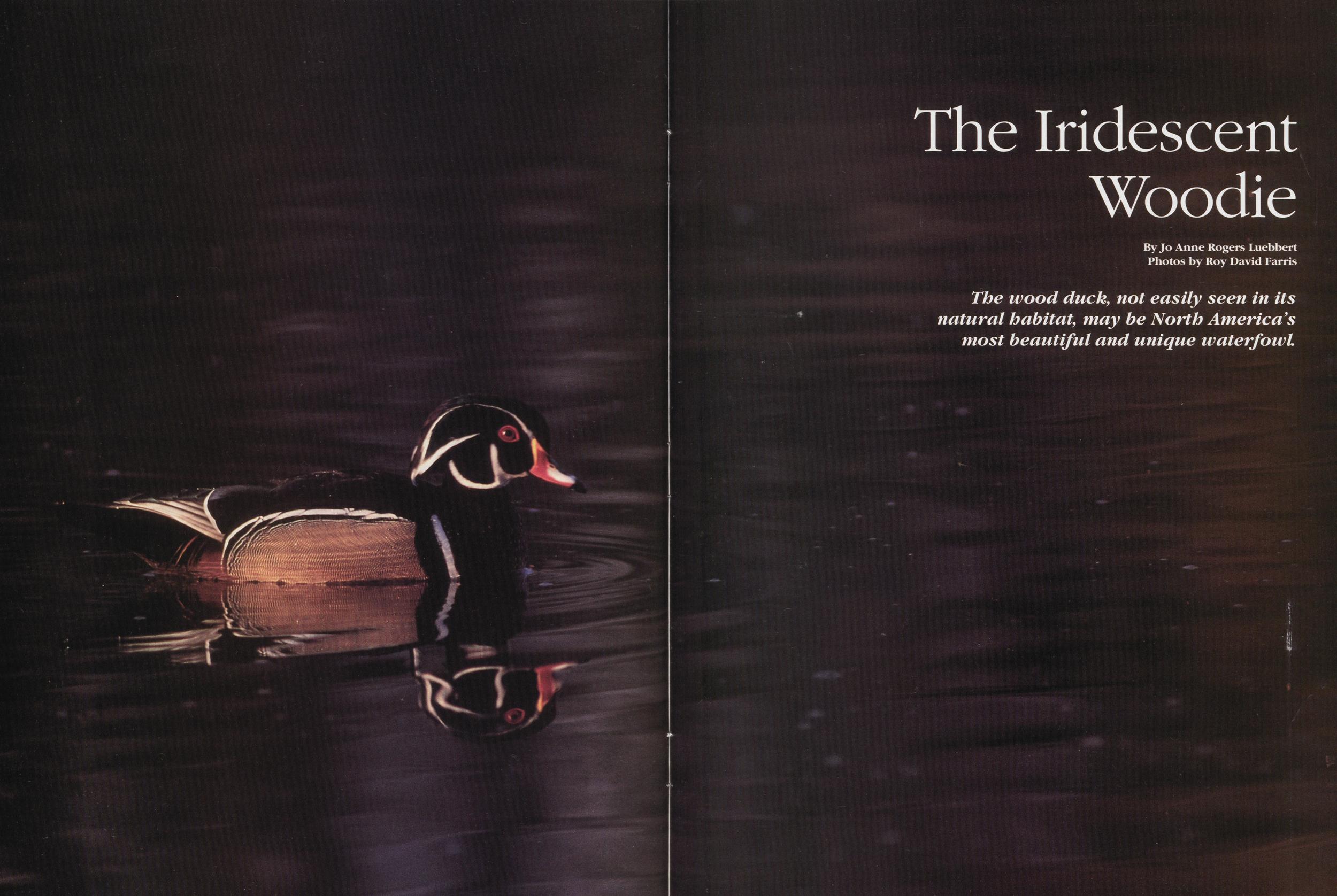
The Iridescent Woodie
The wood duck, not easily seen in its natural habitat, may be North America's most beautiful and unique waterfowl.
The return of the wood ducks to the lakes and ponds of our farm has signaled the arrival of spring since my childhood days. Wood ducks, and other waterfowl, live in complex societies and fly ancient migration routes guided by processes we do not understand, and I am cap- tivated by their beauty as well as fascinated by behavior that defies the most sophisticated research of avian biologists.
The wood duck, Aix sponsa, is the only representative of its genus in North America. Only one other Aix exists in the world, the mandarin duck, Aix galericulata, of Asia. No sub- species is known to exist. In the opinion of Frank Bellrose, world-renowned waterfowl expert, the wood duck is unique among North American waterfowl.
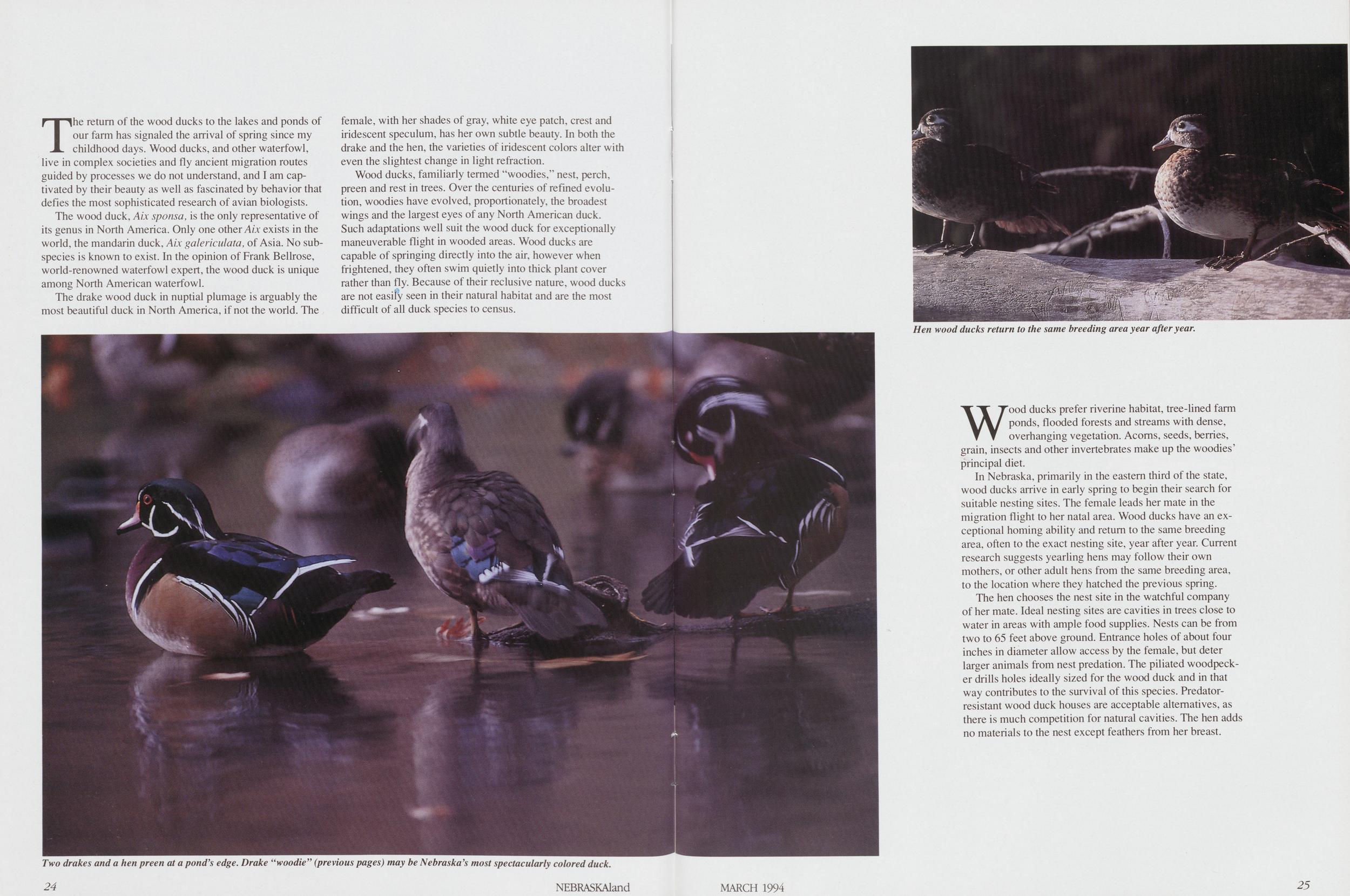
The drake wood duck in nuptial plumage is arguably the most beautiful duck in North America, if not the world. The female, with her shades of gray, white eye patch, crest and iridescent speculum, has her own subtle beauty. In both the drake and the hen, the varieties of iridescent colors alter with even the slightest change in light refraction.
Wood ducks, familiarly termed "woodies," nest, perch, preen and rest in trees. Over the centuries of refined evolution, woodies have evolved, proportionately, the broadest wings and the largest eyes of any North American duck. Such adaptations well suit the wood duck for exceptionally maneuverable flight in wooded areas. Wood ducks are capable of springing directly into the air, however when frightened, they often swim quietly into thick plant cover rather than fly. Because of their reclusive nature, wood ducks are not easily seen in their natural habitat and are the most difficult of all duck species to census.
Two drakes and a hen preen at a pond's edge. Drake "woodie" (previous pages) may be Nebraska's most spectacularly colored duck.
Hen wood ducks return to the same breeding area year after year.
Wood ducks prefer riverine habitat, tree-lined farm ponds, flooded forests and streams with dense, overhanging vegetation. Acorns, seeds, berries, grain, insects and other invertebrates make up the woodies' principal diet.
In Nebraska, primarily in the eastern third of the state, wood ducks arrive in early spring to begin their search for suitable nesting sites. The female leads her mate in the migration flight to her natal area. Wood ducks have an exceptional homing ability and return to the same breeding area, often to the exact nesting site, year after year. Current research suggests yearling hens may follow their own mothers, or other adult hens from the same breeding area, to the location where they hatched the previous spring.
The hen chooses the nest site in the watchful company of her mate. Ideal nesting sites are cavities in trees close to water in areas with ample food supplies. Nests can be from two to 65 feet above ground. Entrance holes of about four inches in diameter allow access by the female, but deter larger animals from nest predation. The piliated woodpecker drills holes ideally sized for the wood duck and in that way contributes to the survival of this species. Predator- resistant wood duck houses are acceptable alternatives, as there is much competition for natural cavities. The hen adds no materials to the nest except feathers from her breast.
MARCH 1994 25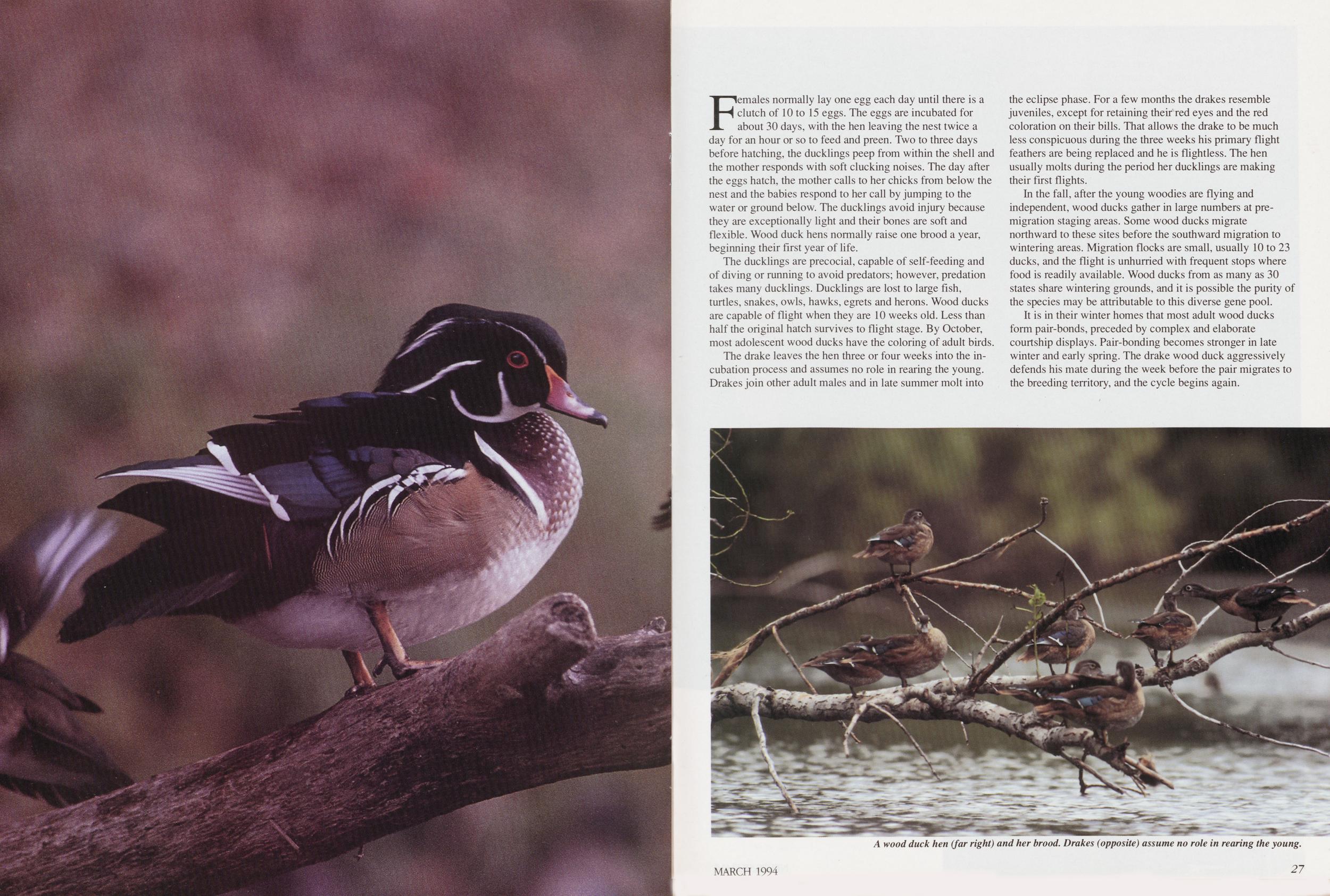
Females normally lay one egg each day until there is a clutch of 10 to 15 eggs. The eggs are incubated for about 30 days, with the hen leaving the nest twice a day for an hour or so to feed and preen. Two to three days before hatching, the ducklings peep from within the shell and the mother responds with soft clucking noises. The day after the eggs hatch, the mother calls to her chicks from below the nest and the babies respond to her call by jumping to the water or ground below. The ducklings avoid injury because they are exceptionally light and their bones are soft and flexible. Wood duck hens normally raise one brood a year, beginning their first year of life.
The ducklings are precocial, capable of self-feeding and of diving or running to avoid predators; however, predation takes many ducklings. Ducklings are lost to large fish, turtles, snakes, owls, hawks, egrets and herons. Wood ducks are capable of flight when they are 10 weeks old. Less than half the original hatch survives to flight stage. By October, most adolescent wood ducks have the coloring of adult birds.
The drake leaves the hen three or four weeks into the in- cubation process and assumes no role in rearing the young. Drakes join other adult males and in late summer molt into the eclipse phase. For a few months the drakes resemble juveniles, except for retaining their red eyes and the red coloration on their bills. That allows the drake to be much less conspicuous during the three weeks his primary flight feathers are being replaced and he is flightless. The hen usually molts during the period her ducklings are making their first flights.
In the fall, after the young woodies are flying and independent, wood ducks gather in large numbers at pre- migration staging areas. Some wood ducks migrate northward to these sites before the southward migration to wintering areas. Migration flocks are small, usually 10 to 23 ducks, and the flight is unhurried with frequent stops where food is readily available. Wood ducks from as many as 30 states share wintering grounds, and it is possible the purity of the species may be attributable to this diverse gene pool.
It is in their winter homes that most adult wood ducks form pair-bonds, preceded by complex and elaborate courtship displays. Pair-bonding becomes stronger in late winter and early spring. The drake wood duck aggressively defends his mate during the week before the pair migrates to the breeding territory, and the cycle begins again.
A wood duck hen (far right) and her brood. Drakes (opposite) assume no role in rearing the young.
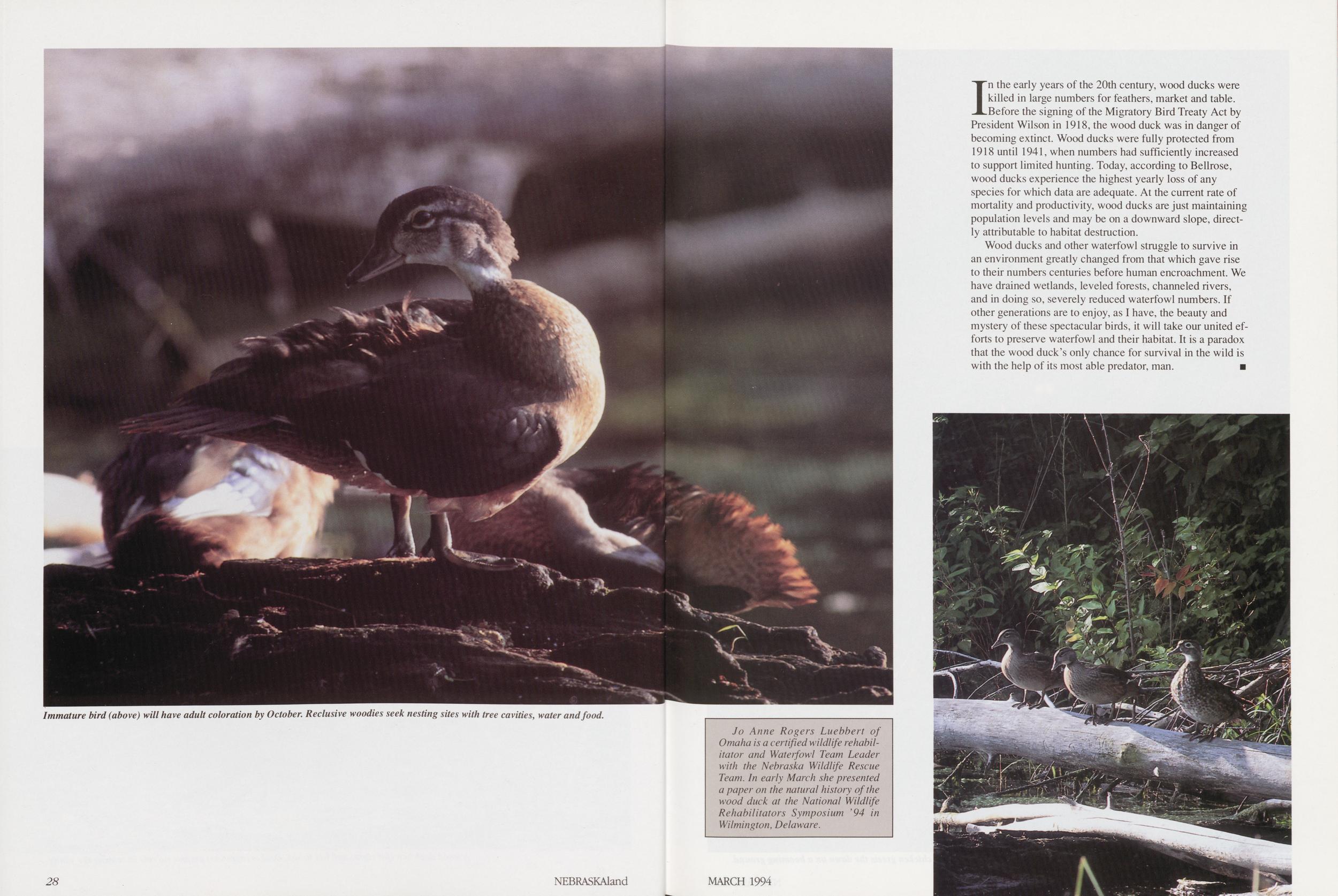
Immature bird (above) will have adult coloration by October. Reclusive woodies seek nesting sites with tree cavities, water and food.
In the early years of the 20th century, wood ducks were killed in large numbers for feathers, market and table. Before the signing of the Migratory Bird Treaty Act by President Wilson in 1918, the wood duck was in danger of becoming extinct. Wood ducks were fully protected from 1918 until 1941, when numbers had sufficiently increased to support limited hunting. Today, according to Bellrose, wood ducks experience the highest yearly loss of any species for which data are adequate. At the current rate of mortality and productivity, wood ducks are just maintaining population levels and may be on a downward slope, directly attributable to habitat destruction.
Wood ducks and other waterfowl struggle to survive in an environment greatly changed from that which gave rise to their numbers centuries before human encroachment. We have drained wetlands, leveled forests, channeled rivers, and in doing so, severely reduced waterfowl numbers. If other generations are to enjoy, as I have, the beauty and mystery of these spectacular birds, it will take our united efforts to preserve waterfowl and their habitat. It is a paradox that the wood duck's only chance for survival in the wild is with the help of its most able predator, man.
MARCH 1994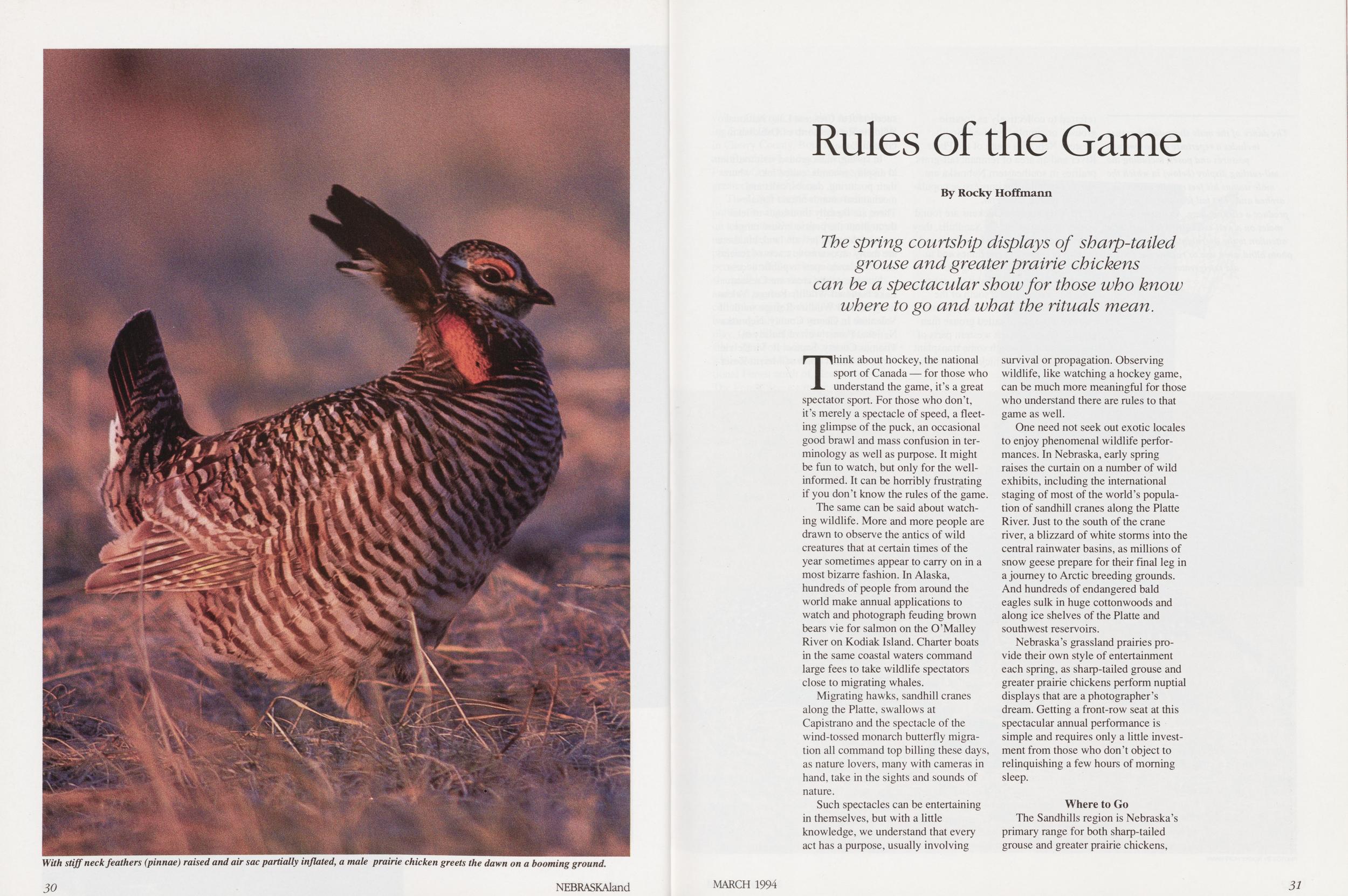
With stiff neck feathers (pinnae) raised and air sac partially inflated, a male prairie chicken greets the dawn on a booming ground.
Rules of the Game
The spring courtship displays of sharp-tailed grouse and greater prairie chickens can be a spectacular show for those who know where to go and what the rituals mean.
Think about hockey, the national sport of Canada — for those who understand the game, it's a great spectator sport. For those who don't, it's merely a spectacle of speed, a fleeting glimpse of the puck, an occasional good brawl and mass confusion in terminology as well as purpose. It might be fun to watch, but only for the well-informed. It can be horribly frustrating if you don't know the rules of the game.
The same can be said about watching wildlife. More and more people are drawn to observe the antics of wild creatures that at certain times of the year sometimes appear to carry on in a most bizarre fashion. In Alaska, hundreds of people from around the world make annual applications to watch and photograph feuding brown bears vie for salmon on the O'Malley River on Kodiak Island. Charter boats in the same coastal waters command large fees to take wildlife spectators close to migrating whales.
Migrating hawks, sandhill cranes along the Platte, swallows at Capistrano and the spectacle of the wind-tossed monarch butterfly migration all command top billing these days, as nature lovers, many with cameras in hand, take in the sights and sounds of nature.
Such spectacles can be entertaining in themselves, but with a little knowledge, we understand that every act has a purpose, usually involving survival or propagation. Observing wildlife, like watching a hockey game, can be much more meaningful for those who understand there are rules to that game as well.
One need not seek out exotic locales to enjoy phenomenal wildlife performances. In Nebraska, early spring raises the curtain on a number of wild exhibits, including the international staging of most of the world's population of sandhill cranes along the Platte River. Just to the south of the crane river, a blizzard of white storms into the central rainwater basins, as millions of snow geese prepare for their final leg in a journey to Arctic breeding grounds. And hundreds of endangered bald eagles sulk in huge cottonwoods and along ice shelves of the Platte and southwest reservoirs.
Nebraska's grassland prairies provide their own style of entertainment each spring, as sharp-tailed grouse and greater prairie chickens perform nuptial displays that are a photographer's dream. Getting a front-row seat at this spectacular annual performance is simple and requires only a little investment from those who don't object to relinquishing a few hours of morning sleep.
Where to GoThe Sandhills region is Nebraska's primary range for both sharp-tailed grouse and greater prairie chickens,
MARCH 1994 31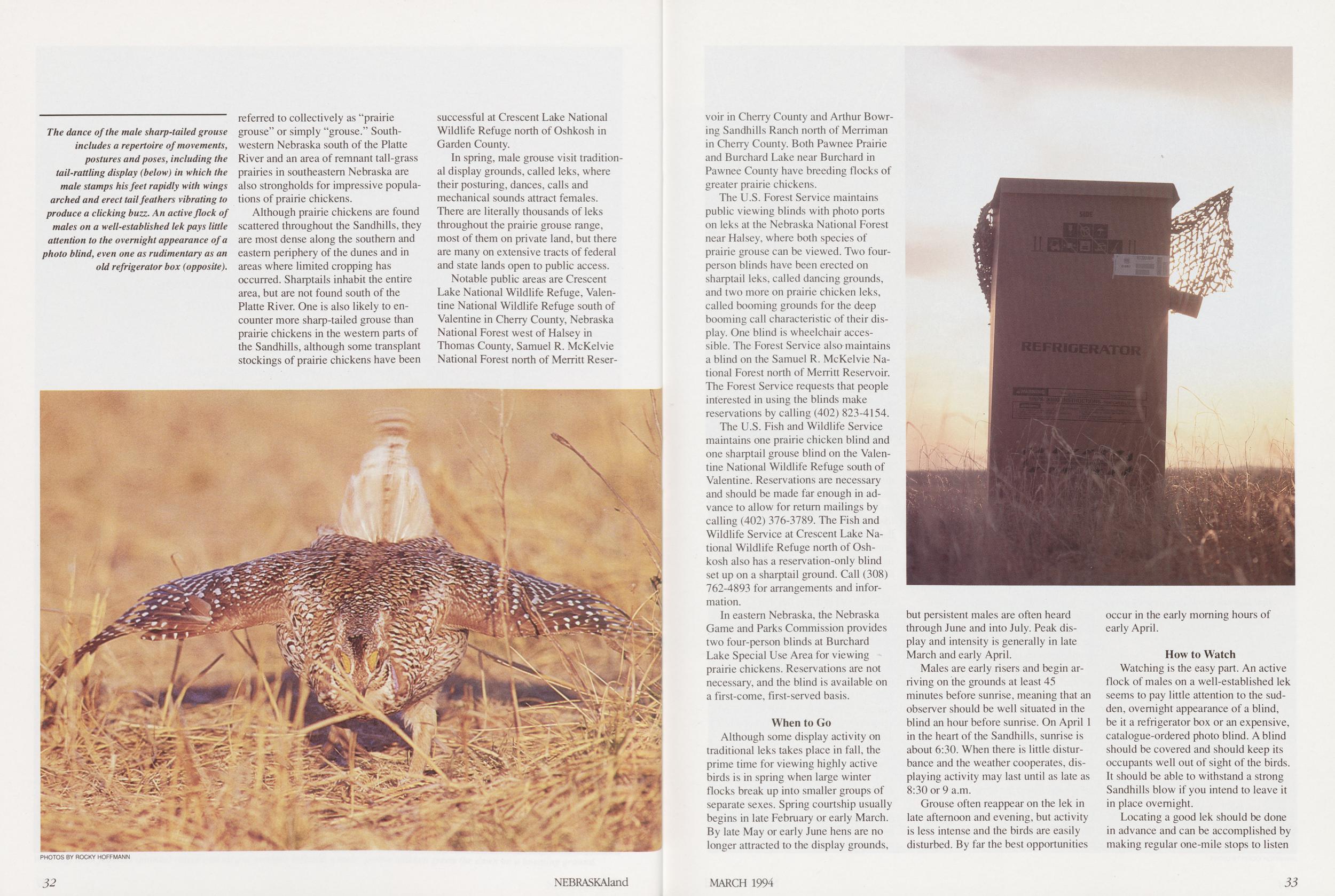
The dance of the male sharp-tailed grouse includes a repertoire of movements, postures and poses, including the tail-rattling display (below) in which the male stamps his feet rapidly with wings arched and erect tail feathers vibrating to produce a clicking buzz. An active flock of males on a well-established lek pays little attention to the overnight appearance of a photo blind, even one as rudimentary as an old refrigerator box (opposite).
referred to collectively as "prairie grouse" or simply "grouse." Southwestern Nebraska south of the Platte River and an area of remnant tall-grass prairies in southeastern Nebraska are also strongholds for impressive populations of prairie chickens.
Although prairie chickens are found scattered throughout the Sandhills, they are most dense along the southern and eastern periphery of the dunes and in areas where limited cropping has occurred. Sharptails inhabit the entire area, but are not found south of the Platte River. One is also likely to en- counter more sharp-tailed grouse than prairie chickens in the western parts of the Sandhills, although some transplant stockings of prairie chickens have been successful at Crescent Lake National Wildlife Refuge north of Oshkosh in Garden County.
In spring, male grouse visit traditional display grounds, called leks, where their posturing, dances, calls and mechanical sounds attract females. There are literally thousands of leks throughout the prairie grouse range, most of them on private land, but there are many on extensive tracts of federal and state lands open to public access.
Notable public areas are Crescent Lake National Wildlife Refuge, Valentine National Wildlife Refuge south of Valentine in Cherry County, Nebraska National Forest west of Halsey in Thomas County, Samuel R. McKelvie National Forest north of Merritt Reservoir 32 NEBRASKAland in Cherry County and Arthur Bowring Sandhills Ranch north of Merriman in Cherry County. Both Pawnee Prairie and Burchard Lake near Burchard in Pawnee County have breeding flocks of greater prairie chickens.
The U.S. Forest Service maintains public viewing blinds with photo ports on leks at the Nebraska National Forest near Halsey, where both species of prairie grouse can be viewed. Two four- person blinds have been erected on sharptail leks, called dancing grounds, and two more on prairie chicken leks, called booming grounds for the deep booming call characteristic of their display. One blind is wheelchair accessible. The Forest Service also maintains a blind on the Samuel R. McKelvie National Forest north of Merritt Reservoir. The Forest Service requests that people interested in using the blinds make reservations by calling (402) 823-4154.
The U.S. Fish and Wildlife Service maintains one prairie chicken blind and one sharptail grouse blind on the Valentine National Wildlife Refuge south of Valentine. Reservations are necessary and should be made far enough in advance to allow for return mailings by calling (402) 376-3789. The Fish and Wildlife Service at Crescent Lake National Wildlife Refuge north of Oshkosh also has a reservation-only blind set up on a sharptail ground. Call (308) 762-4893 for arrangements and infor- mation.
In eastern Nebraska, the Nebraska Game and Parks Commission provides two four-person blinds at Burchard Lake Special Use Area for viewing prairie chickens. Reservations are not necessary, and the blind is available on a first-come, first-served basis.
When to GoAlthough some display activity on traditional leks takes place in fall, the prime time for viewing highly active birds is in spring when large winter flocks break up into smaller groups of separate sexes. Spring courtship usually begins in late February or early March. By late May or early June hens are no longer attracted to the display grounds, but persistent males are often heard through June and into July. Peak display and intensity is generally in late March and early April.
Males are early risers and begin arriving on the grounds at least 45 minutes before sunrise, meaning that an observer should be well situated in the blind an hour before sunrise. On April 1 in the heart of the Sandhills, sunrise is about 6:30. When there is little disturbance and the weather cooperates, displaying activity may last until as late as 8:30 or 9 a.m.
Grouse often reappear on the lek in late afternoon and evening, but activity is less intense and the birds are easily disturbed. By far the best opportunities
Watching is the easy part. An active flock of males on a well-established lek seems to pay little attention to the sudden, overnight appearance of a blind, be it a refrigerator box or an expensive, catalogue-ordered photo blind. A blind should be covered and should keep its occupants well out of sight of the birds. It should be able to withstand a strong Sandhills blow if you intend to leave it in place overnight.
Locating a good lek should be done in advance and can be accomplished by making regular one-mile stops to listen
MARCH 1994 33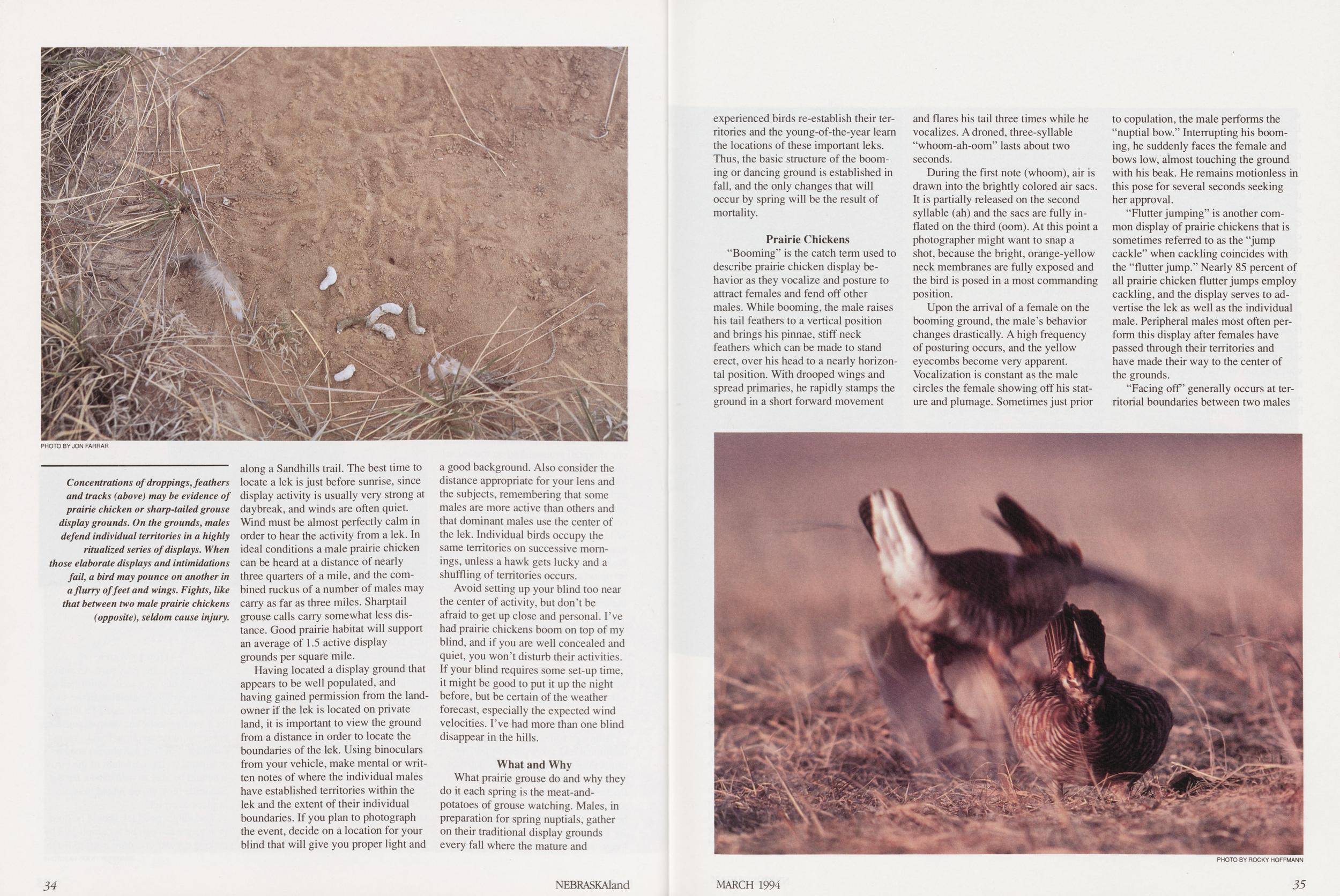
Concentrations of droppings, feathers and tracks (above) may be evidence of prairie chicken or sharp-tailed grouse display grounds. On the grounds, males defend individual territories in a highly ritualized series of displays. When those elaborate displays and intimidations fail, a bird may pounce on another in a flurry of feet and wings. Fights, like that between two male prairie chickens (opposite), seldom cause injury.
along a Sandhills trail. The best time to locate a lek is just before sunrise, since display activity is usually very strong at daybreak, and winds are often quiet. Wind must be almost perfectly calm in order to hear the activity from a lek. In ideal conditions a male prairie chicken can be heard at a distance of nearly three quarters of a mile, and the combined ruckus of a number of males may carry as far as three miles. Sharptail grouse calls carry somewhat less distance. Good prairie habitat will support an average of 1.5 active display grounds per square mile.
Having located a display ground that appears to be well populated, and having gained permission from the landowner if the lek is located on privatland, it is important to view the ground from a distance in order to locate the boundaries of the lek. Using binoculars from your vehicle, make mental or written notes of where the individual males have established territories within the lek and the extent of their individual boundaries. If you plan to photograph the event, decide on a location for your blind that will give you proper light and a good background. Also consider the distance appropriate for your lens and the subjects, remembering that some males are more active than others and that dominant males use the center of the lek. Individual birds occupy the same territories on successive morn- ings, unless a hawk gets lucky and a shuffling of territories occurs.
Avoid setting up your blind too near the center of activity, but don't be afraid to get up close and personal. I've had prairie chickens boom on top of my blind, and if you are well concealed and quiet, you won't disturb their activities. If your blind requires some set-up time, it might be good to put it up the night before, but be certain of the weather forecast, especially the expected wind velocities. I've had more than one blind disappear in the hills.
What and WhyWhat prairie grouse do and why they do it each spring is the meat-and- potatoes of grouse watching. Males, in preparation for spring nuptials, gather on their traditional display grounds every fall where the mature and
34 NEBRASKAlandexperienced birds re-establish their territories and the young-of-the-year learn the locations of these important leks. Thus, the basic structure of the booming or dancing ground is established in fall, and the only changes that will occur by spring will be the result of mortality.
Prairie Chickens"Booming" is the catch term used to describe prairie chicken display behavior as they vocalize and posture to attract females and fend off other males. While booming, the male raises his tail feathers to a vertical position and brings his pinnae, stiff neck feathers which can be made to stand erect, over his head to a nearly horizontal position. With drooped wings and spread primaries, he rapidly stamps the ground in a short forward movement and flares his tail three times while he vocalizes. A droned, three-syllable "whoom-ah-oom" lasts about two seconds.
During the first note (whoom), air is drawn into the brightly colored air sacs. It is partially released on the second syllable (ah) and the sacs are fully inflated on the third (oom). At this point a photographer might want to snap a shot, because the bright, orange-yellow neck membranes are fully exposed and the bird is posed in a most commanding position.
Upon the arrival of a female on the booming ground, the male's behavior changes drastically. A high frequency of posturing occurs, and the yellow eyecombs become very apparent. Vocalization is constant as the male circles the female showing off his stature and plumage. Sometimes just prior to copulation, the male performs the "nuptial bow." Interrupting his booming, he suddenly faces the female and bows low, almost touching the ground with his beak. He remains motionless in this pose for several seconds seeking her approval.
"Flutter jumping" is another common display of prairie chickens that is sometimes referred to as the "jump cackle" when cackling coincides with the "flutter jump." Nearly 85 percent of all prairie chicken flutter jumps employ cackling, and the display serves to advertise the lek as well as the individual male. Peripheral males most often perform this display after females have passed through their territories and have made their way to the center of the grounds.
"Facing off generally occurs at ter- ritorial boundaries between two males
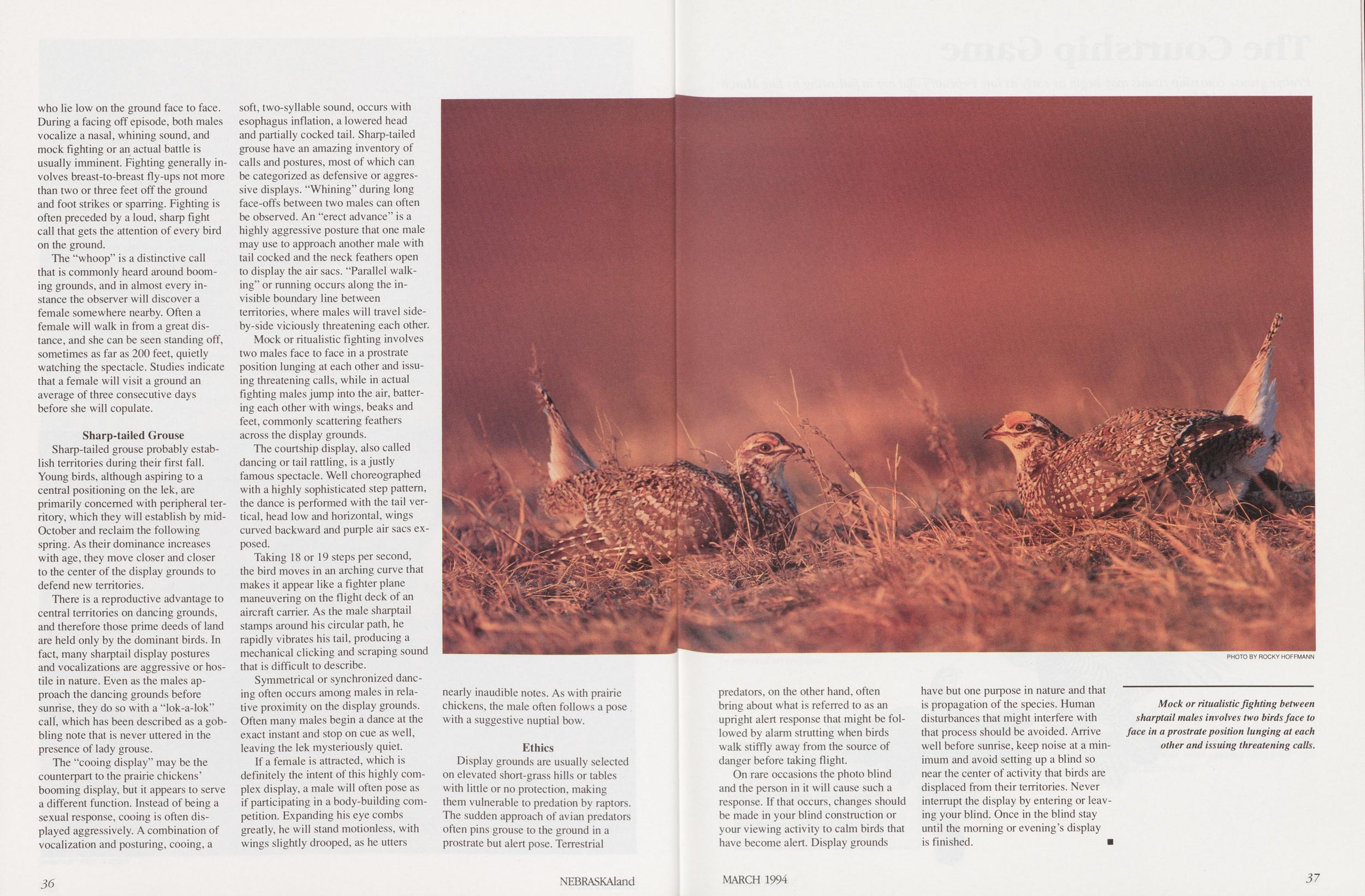
who lie low on the ground face to face. During a facing off episode, both males vocalize a nasal, whining sound, and mock fighting or an actual battle is usually imminent. Fighting generally involves breast-to-breast fly-ups not more than two or three feet off the ground and foot strikes or sparring. Fighting is often preceded by a loud, sharp fight call that gets the attention of every bird on the ground.
The "whoop" is a distinctive call that is commonly heard around boom- ing grounds, and in almost every instance the observer will discover a female somewhere nearby. Often a female will walk in from a great distance, and she can be seen standing off, sometimes as far as 200 feet, quietly watching the spectacle. Studies indicate that a female will visit a ground an average of three consecutive days before she will copulate.
Sharp-tailed GrouseSharp-tailed grouse probably establish territories during their first fall. Young birds, although aspiring to a central positioning on the lek, are primarily concerned with peripheral territory, which they will establish by mid- October and reclaim the following spring. As their dominance increases with age, they move closer and closer to the center of the display grounds to defend new territories.
There is a reproductive advantage to central territories on dancing grounds, and therefore those prime deeds of land are held only by the dominant birds. In fact, many sharptail display postures and vocalizations are aggressive or hostile in nature. Even as the males approach the dancing grounds before sunrise, they do so with a "lok-a-lok" call, which has been described as a gobbling note that is never uttered in the presence of lady grouse.
The "cooing display" may be the counterpart to the prairie chickens' booming display, but it appears to serve a different function. Instead of being a sexual response, cooing is often displayed aggressively. A combination of vocalization and posturing, cooing, a soft, two-syllable sound, occurs with esophagus inflation, a lowered head and partially cocked tail. Sharp-tailed grouse have an amazing inventory of calls and postures, most of which can be categorized as defensive or aggressive displays. "Whining" during long face-offs between two males can often be observed. An "erect advance" is a highly aggressive posture that one male may use to approach another male with tail cocked and the neck feathers open to display the air sacs. "Parallel walk- ing" or running occurs along the invisible boundary line between territories, where males will travel side-by-side viciously threatening each other.
Mock or ritualistic fighting involves two males face to face in a prostrate position lunging at each other and issuing threatening calls, while in actual fighting males jump into the air, battering each other with wings, beaks and feet, commonly scattering feathers across the display grounds.
The courtship display, also called dancing or tail rattling, is a justly famous spectacle. Well choreographed with a highly sophisticated step pattern, the dance is performed with the tail vertical, head low and horizontal, wings curved backward and purple air sacs exposed.
Taking 18 or 19 steps per second, the bird moves in an arching curve that makes it appear like a fighter plane maneuvering on the flight deck of an aircraft carrier. As the male sharptail stamps around his circular path, he rapidly vibrates his tail, producing a mechanical clicking and scraping sound that is difficult to describe.
Symmetrical or synchronized dancing often occurs among males in relative proximity on the display grounds. Often many males begin a dance at the exact instant and stop on cue as well, leaving the lek mysteriously quiet.
If a female is attracted, which is definitely the intent of this highly complex display, a male will often pose as if participating in a body-building competition. Expanding his eye combs greatly, he will stand motionless, with wings slightly drooped, as he utters nearly inaudible notes. As with prairie chickens, the male often follows a pose with a suggestive nuptial bow.
EthicsDisplay grounds are usually selected on elevated short-grass hills or tables with little or no protection, making them vulnerable to predation by raptors. The sudden approach of avian predators often pins grouse to the ground in a prostrate but alert pose. Terrestrial 36 NEBRASKAland predators, on the other hand, often bring about what is referred to as an upright alert response that might be followed by alarm strutting when birds walk stiffly away from the source of danger before taking flight.
On rare occasions the photo blind and the person in it will cause such a response. If that occurs, changes should be made in your blind construction or your viewing activity to calm birds that have become alert. Display grounds have but one purpose in nature and that is propagation of the species. Human disturbances that might interfere with that process should be avoided. Arrive well before sunrise, keep noise at a minimum and avoid setting up a blind so near the center of activity that birds are displaced from their territories. Never interrupt the display by entering or leaving your blind. Once in the blind stay until the morning or evening's display is finished.
Mock or ritualistic fighting between sharptail males involves two birds face to face in a prostrate position lunging at each other and issuing threatening calls.
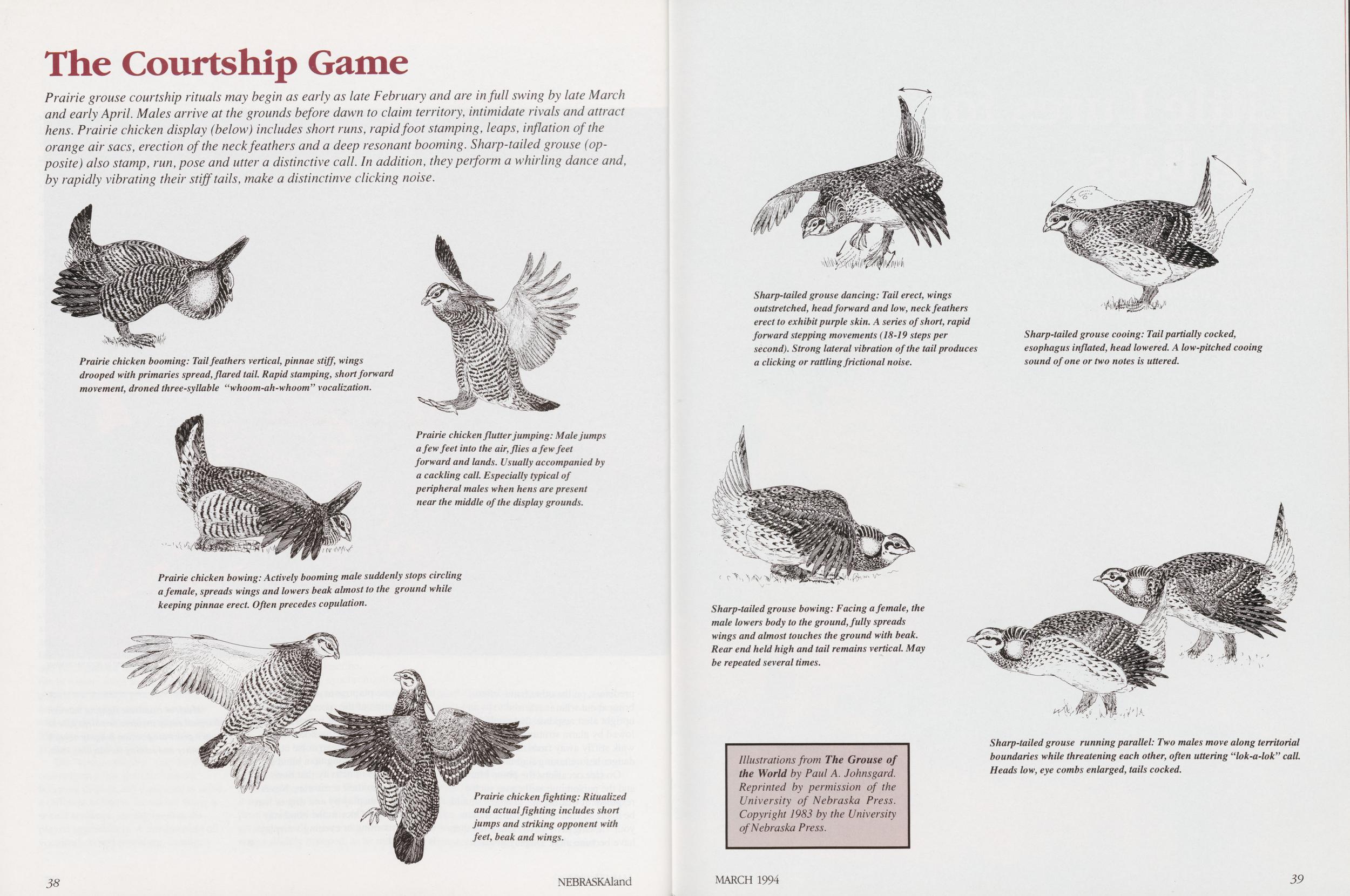
The Courtship Game
Prairie grouse courtship rituals may begin as early as late February and are in full swing by late March and early April. Males arrive at the grounds before dawn to claim territory, intimidate rivals and attract hens. Prairie chicken display (below) includes short runs, rapid foot stamping, leaps, inflation of the orange air sacs, erection of the neck feathers and a deep resonant booming. Sharp-tailed grouse (op- posite) also stamp, run, pose and utter a distinctive call. In addition, they perform a whirling dance and, by rapidly vibrating their stiff tails, make a distinctinve clicking noise.
Prairie chicken booming: Tail feathers vertical, pinnae stiff, wings drooped with primaries spread, flared tail. Rapid stamping, short forward movement, droned three-syllable "whoom-ah-whoom" vocalization.
Prairie chicken flutter jumping: Male jumps a few feet into the air, flies a few feet forward and lands. Usually accompanied by a cackling call. Especially typical of peripheral males when hens are present near the middle of the display grounds.
Prairie chicken bowing: Actively booming male suddenly stops circling a female, spreads wings and lowers beak almost to the ground while keeping pinnae erect. Often precedes copulation.
Prairie chicken fighting: Ritualized and actual fighting includes short jumps and striking opponent with feet, beak and wings.
Sharp-tailed grouse dancing: Tail erect, wings outstretched, head forward and low, neck feathers erect to exhibit purple skin. A series of short, rapid forward stepping movements (18-19 steps per second). Strong lateral vibration of the tail produces a clicking or rattling ffictional noise.
Sharp-tailed grouse cooing: Tail partially cocked, esophagus inflated, head lowered. A low-pitched cooing sound of one or two notes is uttered.
Sharp-tailed grouse bowing: Facing a female, the male lowers body to the ground, fully spreads wings and almost touches the ground with beak. Rear end held high and tail remains vertical. May be repeated several times.
Illustrations from The Grouse of the World by Paul A. Johnsgard. Reprinted by permission of the University of Nebraska Press. Copyright 1983 by the University of Nebraska Press.
Sharp-tailed grouse running parallel: Two males move along territorial boundaries while threatening each other, often uttering "lok-a-lok" call. Heads low, eye combs enlarged, tails cocked.
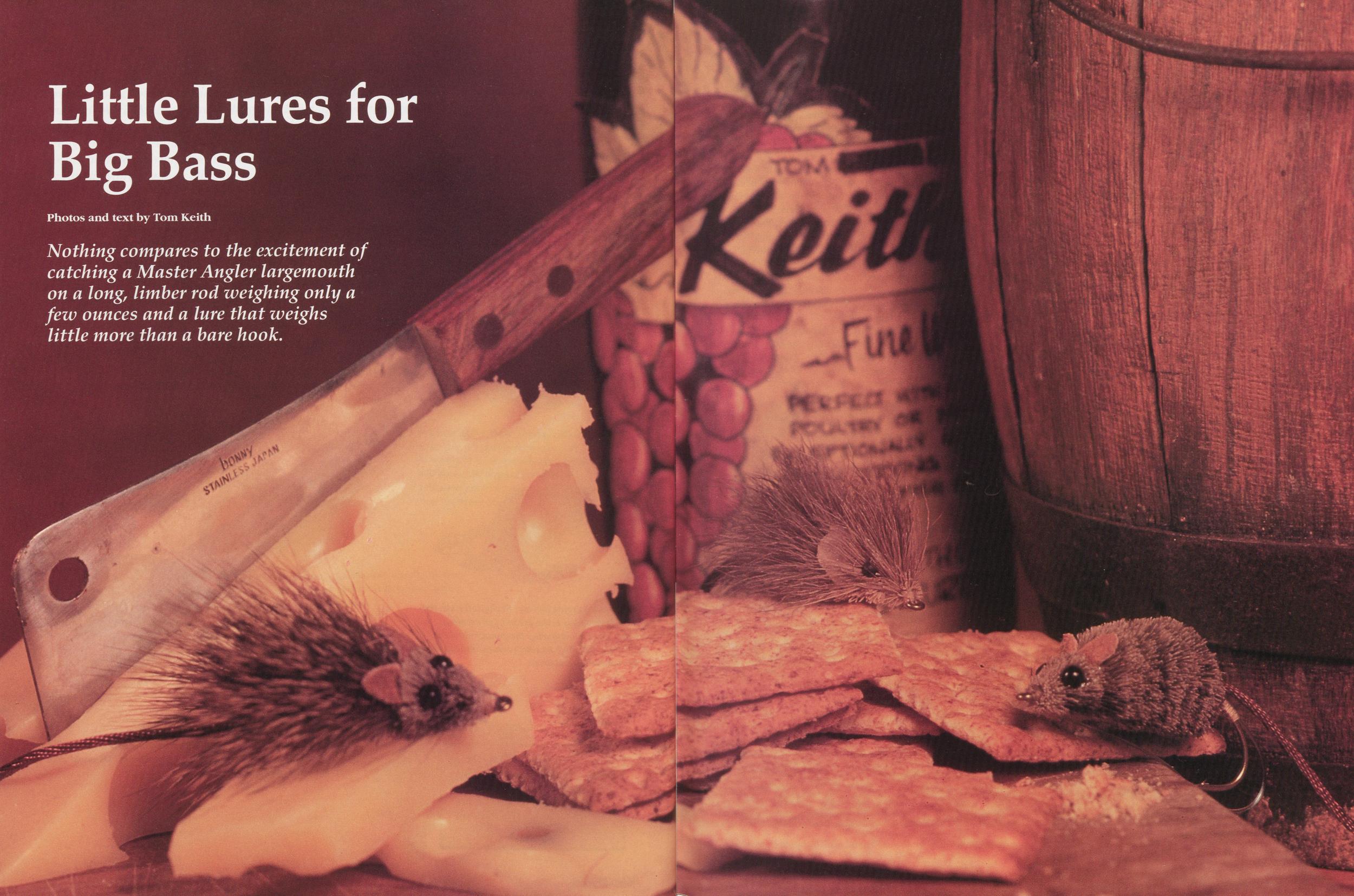
Little Lures for Big Bass
Nothing compares to the excitement of catching a Master Angler largemouth on a long, limber rod weighing only a few ounces and a lure that weighs little more than a bare hook.
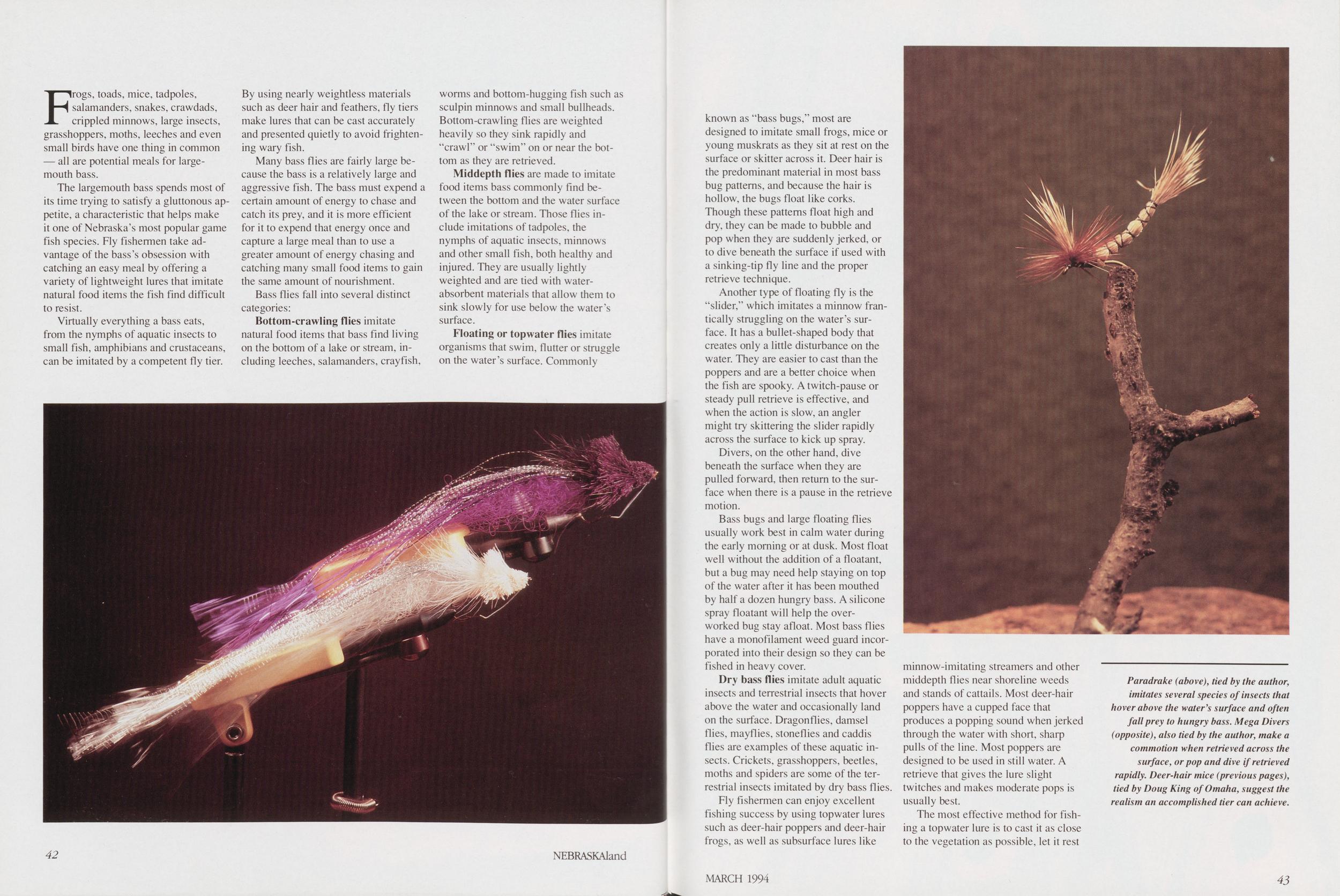
Frogs, toads, mice, tadpoles, salamanders, snakes, crawdads, crippled minnows, large insects, grasshoppers, moths, leeches and even small birds have one thing in common — all are potential meals for largemouth bass.
The largemouth bass spends most of its time trying to satisfy a gluttonous appetite, a characteristic that helps make it one of Nebraska's most popular game fish species. Fly fishermen take advantage of the bass's obsession with catching an easy meal by offering a variety of lightweight lures that imitate natural food items the fish find difficult to resist.
Virtually everything a bass eats, from the nymphs of aquatic insects to small fish, amphibians and crustaceans, can be imitated by a competent fly tier. By using nearly weightless materials such as deer hair and feathers, fly tiers make lures that can be cast accurately and presented quietly to avoid frightening wary fish.
Many bass flies are fairly large be- cause the bass is a relatively large and aggressive fish. The bass must expend a certain amount of energy to chase and catch its prey, and it is more efficient for it to expend that energy once and capture a large meal than to use a greater amount of energy chasing and catching many small food items to gain the same amount of nourishment.
Bass flies fall into several distinct categories:
Bottom-crawling flies imitate natural food items that bass find living on the bottom of a lake or stream, including leeches, salamanders, crayfish, worms and bottom-hugging fish such as sculpin minnows and small bullheads. Bottom-crawling flies are weighted heavily so they sink rapidly and "crawl" or "swim" on or near the bottom as they are retrieved.
Middepth flies are made to imitate food items bass commonly find between the bottom and the water surface of the lake or stream. Those flies include imitations of tadpoles, the nymphs of aquatic insects, minnows and other small fish, both healthy and injured. They are usually lightly weighted and are tied with water- absorbent materials that allow them to sink slowly for use below the water's surface.
Floating or topwater flies imitate organisms that swim, flutter or struggle on the water's surface. Commonly
known as "bass bugs," most are designed to imitate small frogs, mice or young muskrats as they sit at rest on the surface or skitter across it. Deer hair is the predominant material in most bass bug patterns, and because the hair is hollow, the bugs float like corks. Though these patterns float high and dry, they can be made to bubble and pop when they are suddenly jerked, or to dive beneath the surface if used with a sinking-tip fly line and the proper retrieve technique.
Another type of floating fly is the "slider," which imitates a minnow fran- tically struggling on the water's sur- face. It has a bullet-shaped body that creates only a little disturbance on the water. They are easier to cast than the poppers and are a better choice when the fish are spooky. A twitch-pause or steady pull retrieve is effective, and when the action is slow, an angler might try skittering the slider rapidly across the surface to kick up spray. Divers, on the other hand, dive beneath the surface when they are pulled forward, then return to the surface when there is a pause in the retrieve motion.
Bass bugs and large floating flies usually work best in calm water during the early morning or at dusk. Most float well without the addition of a floatant, but a bug may need help staying on top of the water after it has been mouthed by half a dozen hungry bass. A silicone spray floatant will help the over- worked bug stay afloat. Most bass flies have a monofilament weed guard incorporated into their design so they can be fished in heavy cover.
Dry bass flies imitate adult aquatic insects and terrestrial insects that hover above the water and occasionally land on the surface. Dragonflies, damsel flies, mayflies, stoneflies and caddis flies are examples of these aquatic insects. Crickets, grasshoppers, beetles, moths and spiders are some of the ter- restrial insects imitated by dry bass flies.
Fly fishermen can enjoy excellent fishing success by using topwater lures such as deer-hair poppers and deer-hair frogs, as well as subsurface lures like minnow-imitating streamers and other middepth flies near shoreline weeds and stands of cattails. Most deer-hair poppers have a cupped face that produces a popping sound when jerked through the water with short, sharp pulls of the line. Most poppers are designed to be used in still water. A retrieve that gives the lure slight twitches and makes moderate pops is usually best. The most effective method for fishing a topwater lure is to cast it as close to the vegetation as possible, let it restParadrake (above), tied by the author, imitates several species of insects that hover above the waters surface and often fall prey to hungry bass. Mega Divers (opposite), also tied by the author, make a commotion when retrieved across the surface, or pop and dive if retrieved rapidly. Deer-hair mice (previous pages), tied by Doug King of Omaha, suggest the realism an accomplished tier can achieve.
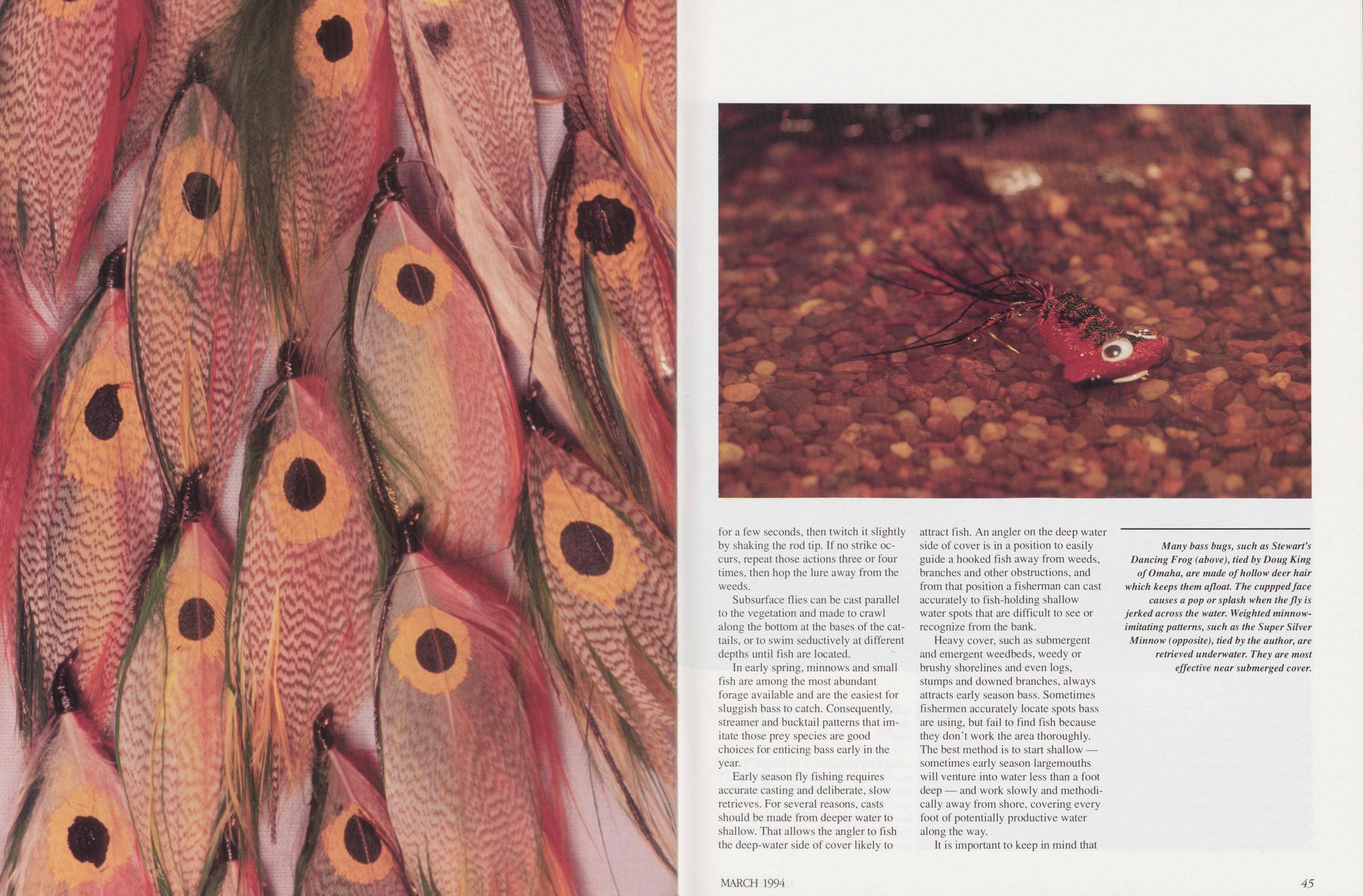
for a few seconds, then twitch it slightly by shaking the rod tip. If no strike occurs, repeat those actions three or four times, then hop the lure away from the weeds.
Subsurface flies can be cast parallel to the vegetation and made to crawl along the bottom at the bases of the cattails, or to swim seductively at different depths until fish are located.
In early spring, minnows and small fish are among the most abundant forage available and are the easiest for sluggish bass to catch. Consequently, streamer and bucktail patterns that imitate those prey species are good choices for enticing bass early in the year.
Early season fly fishing requires accurate casting and deliberate, slow retrieves. For several reasons, casts should be made from deeper water to shallow. That allows the angler to fish the deep-water side of cover likely to attract fish. An angler on the deep water side of cover is in a position to easily guide a hooked fish away from weeds, branches and other obstructions, and from that position a fisherman can cast accurately to fish-holding shallow water spots that are difficult to see or recognize from the bank.
Heavy cover, such as submergent and emergent weedbeds, weedy or brushy shorelines and even logs, stumps and downed branches, always attracts early season bass. Sometimes fishermen accurately locate spots bass are using, but fail to find fish because they don't work the area thoroughly. The best method is to start shallow — sometimes early season largemouths will venture into water less than a foot deep — and work slowly and methodically away from shore, covering every foot of potentially productive water along the way.
It is important to keep in mind that
Many bass bugs, such as Stewart's Dancing Frog (above), tied by Doug King of Omaha, are made of hollow deer hair which keeps them afloat. The cuppped face causes a pop or splash when the fly is jerked across the water. Weighted minnow- imitating patterns, such as the Super Silver Minnow (opposite), tied by the author, are retrieved underwater. They are most effective near submerged cover.
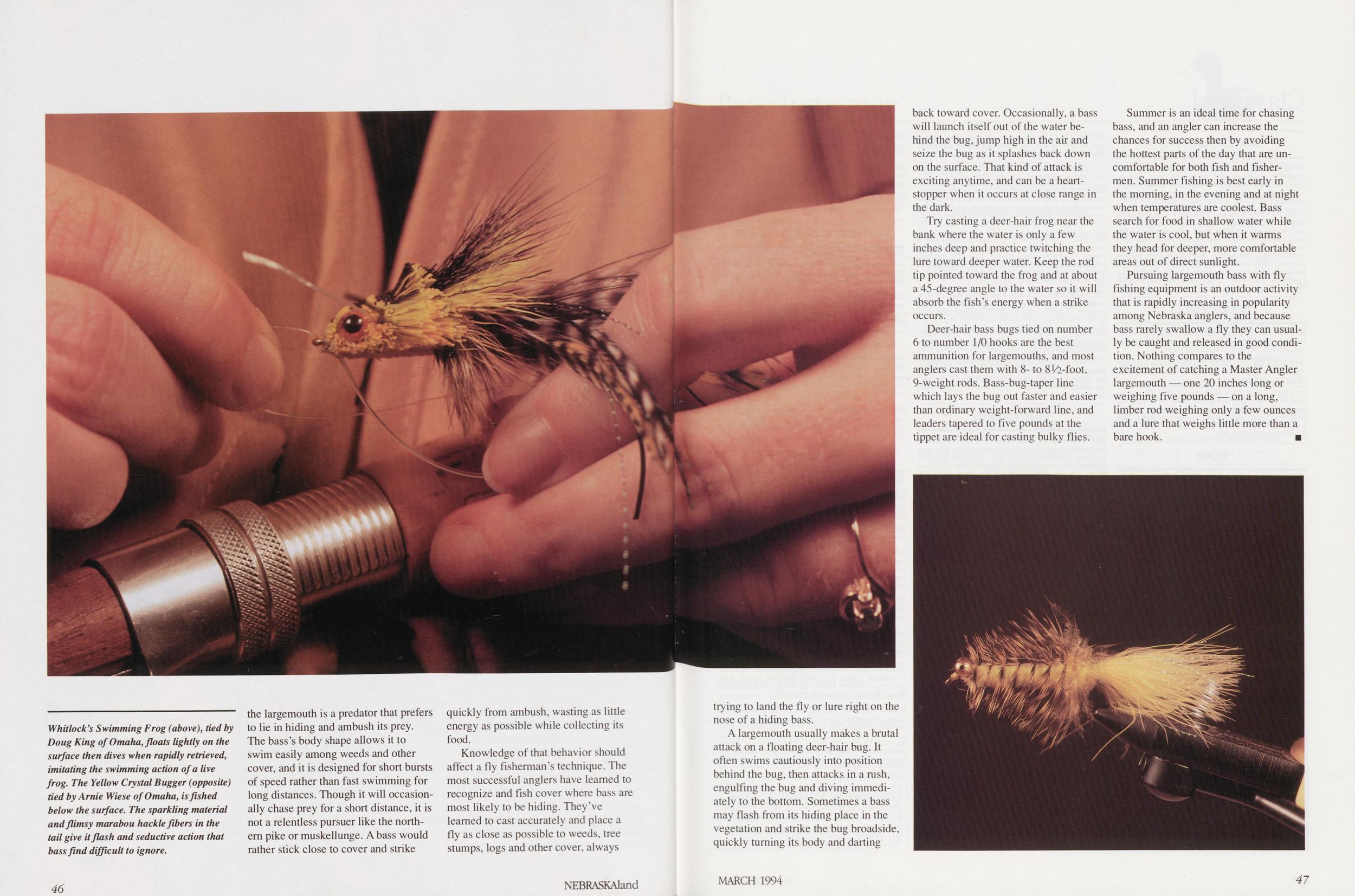
Whitlock's Swimming Frog (above), tied by Doug King of Omaha, floats lightly on the surface then dives when rapidly retrieved, imitating the swimming action of a live frog. The Yellow Crystal Bugger (opposite) tied by Arnie Wiese of Omaha, is fished below the surface. The sparkling material and flimsy marabou hackle fibers in the tail give it flash and seductive action that bass find difficult to ignore.
the largemouth is a predator that prefers to lie in hiding and ambush its prey. The bass's body shape allows it to swim easily among weeds and other cover, and it is designed for short bursts of speed rather than fast swimming for long distances. Though it will occasionally chase prey for a short distance, it is not a relentless pursuer like the northern pike or muskellunge. A bass would rather stick close to cover and strike quickly from ambush, wasting as little energy as possible while collecting its food.
Knowledge of that behavior should affect a fly fisherman's technique. The most successful anglers have learned to recognize and fish cover where bass are most likely to be hiding. They've learned to cast accurately and place a fly as close as possible to weeds, tree stumps, logs and other cover, always 46 NEBRASKAland trying to land the fly or lure right on the nose of a hiding bass.
A largemouth usually makes a brutal attack on a floating deer-hair bug. It often swims cautiously into position behind the bug, then attacks in a rush, engulfing the bug and diving immediately to the bottom. Sometimes a bass may flash from its hiding place in the vegetation and strike the bug broadside, quickly turning its body and darting back toward cover. Occasionally, a bass will launch itself out of the water be- hind the bug, jump high in the air and seize the bug as it splashes back down on the surface. That kind of attack is exciting anytime, and can be a heart- stopper when it occurs at close range in the dark.
Try casting a deer-hair frog near the bank where the water is only a few inches deep and practice twitching the lure toward deeper water. Keep the rod tip pointed toward the frog and at about a 45-degree angle to the water so it will absorb the fish's energy when a strike occurs.
Deer-hair bass bugs tied on number 6 to number 1/0 hooks are the best ammunition for largemouths, and most anglers cast them with 8- to 81/2-foot, 9-weight rods. Bass-bug-taper line which lays the bug out faster and easier than ordinary weight-forward line, and leaders tapered to five pounds at the tippet are ideal for casting bulky flies.
Summer is an ideal time for chasing bass, and an angler can increase the chances for success then by avoiding the hottest parts of the day that are un- comfortable for both fish and fishermen. Summer fishing is best early in the morning, in the evening and at night when temperatures are coolest. Bass search for food in shallow water while the water is cool, but when it warms they head for deeper, more comfortable areas out of direct sunlight.
Pursuing largemouth bass with fly fishing equipment is an outdoor activity that is rapidly increasing in popularity among Nebraska anglers, and because bass rarely swallow a fly they can usually be caught and released in good condition. Nothing compares to the excitement of catching a Master Angler largemouth — one 20 inches long or weighing five pounds — on a long, limber rod weighing only a few ounces and a lure that weighs little more than a bare hook.
MARCH 1994 47
Classified
BOOKS/PRINTING FREE BOOK CATALOG. Novels, westerns, romances, children's; old out of print, found barns, attic. Authors: Grey, Bower, Connor, Fox, Curwood, Raine, Wright, Aldrige, Pollyanna, Freckles, many others. Postage ap- preciated. Pierce, 4400 N. Pine Cluster, Oroville,CA95965. HOW TO FIND the public lands that you read about in NEBRASKAland Magazine. Locations & descriptions for ALL federal, state & NRD, parks, lakes, forests, wildlife areas, river access, trout streams & bike trails! These areas are clearly marked on county, D.O.T. transportation maps and show ALL hard surface, gravel & dirt roads, bridges, railroads, rivers & creeks, farm and ranch homes, cities & towns. Send $ 18.75 to: Sportsman's Atlas Co., PO Box 132, Lytton, IA 50561-0132, or call 1-800-568-8334 ORDER TODAY. Your most important piece of outdoor equipment. COLLECTIBLES BUYING — TRADING EXPIRED HUNTING, FISH- ING, TRAPPING licenses; regulations; duck/upland game stamps. (402) 785-7500. Information/prices. 1994 NEBRASKA HABITAT STAMP print now available. Write to John R. Mayer, PO Box 1704, Grand Island, NE 68802 for FREE brochure. BUYING: AMERICAN INDIAN ARTIFACTS such as beadwork, weavings, baskets, etc.; also cowboy memorabilia such as chaps, spurs, photographs, etc. Best price first letter; photographs promply returned. Jack Ringwalt, 1550 California St., Suite 6, #211, San Francisco, CA 94109, (415) 759-6343. DOGS TRAINING ALL BREEDS bird dogs — Vizslas and English Pointers for sale. Rozanek Kennels, RR 2, Schuyler, NE 68661. Phone (402) 352-8769. YELLOW-BLACK Lab pups. FC-AFC sired. AKC. Hips OFA certified. Dew claws removed. Excellent hunting potential. Contact Bob Bendler, Lexington, NE. (308) 324- 4247. AKC BRITTANY PUPS. Close working. Natural backing gun dogs. Field champion backgrounds. Liver and orange. References. Blair (402) 426-3597. FOR SALE — Chesapeake bay or Labrador retrievers. All colors. Pups, started dogs, stud service. Three-generation national champion, pedigree on Lab. Three generations of the best Chesapeakes ever trialed. Call PLATTE VALLEY RETRIEVERS (308) 995-2318. WILDERNESS KENNELS. Gun dog training - over 60 years combined experience. Training all sporting breeds — Retrievers. Flushing and pointing dogs. All dogs worked on pen raised birds and wildgame. Training program includes obedience training — heel, sit, stay, down and come when called. Pups, started dogs and fully trained dogs for sale. HUNTING DOGS TRAINED BY HUNTERS. Henry Sader, Wilderness Kennels, (402) 423-4212. Since 1968. ENGLISH COCKER pups, imported stock, British FTC bloodlines. Many colors available. Featured in NEBRASKAland November 1991. Sawtooth Oaks, Box 443, Orleans, NE 68966. Phone (308) 473-5265. NEBRASKAland Magazine by phone: Subscriptions, renewals or gifts — call today! Call Toll Free 1-800-632-5263 ENGLISH SETTER PUPS and some started dogs. Bred to hunt for foot hunters. Top bloodlines. Health guaranteed. Wind Fall Gun Dogs (402) 421-4693. CUSTOM GATES AND KENNELS. Portable and station- ary dog runs and kennels, any size. Phone (402) 253-2812. GERMAN SHORTHAIR PUPS: Style, intelligence and natural ability. Imported bloodlines, Sire and Dam personal hunting dogs. Sire was 2nd runner-up in the 1993 1-Box Pheasant Hunt. Available this spring ready to hunt this fall. Broken Bow (308) 872-6534. DEUTSCH DRAHTHAARS - Line-bred litters due to whelp in March. Puppies expected to have great potential. Parents are proven hunters. Bred by strict VDD standards in a German registered kennel. Versatile hunting drahthaars for fur and feathered game. Wildflugel Kennel, RR 2, Box 24A, Ravenna, NE 68869, (308) 452-4333. CHESAPEAKE BAY, labrador and golden retriever pups, started dogs and stud service. 16 time national champion pedigree. PLATTE VALLEY RETRIEVERS (308) 995- 2318. RETRIEVER TRAINING. Area's top "retrievers only" trainer. Field trial and hunting dogs. Non-slip duck dogs! TKO RETRIEVER TRAINING KENNEL (402) 623-4311. FLATWATER LABRADORS AKC Chocolate Labradors. Bred for exceptional temperament, confirmation and hunt- ing ability. Litter due approximately March 10. See both sire and dam. References. R. D. McBride, Firth, NE (402) 791-5704. FISH/FISHING FISH FOR SALE. Catfish, largemouth bass, smallmouth bass, perch, crappie, bluegill, walleye, northern pike, rain- bow trout, Donaldson rainbow trout, grass carp, minnows, bullheads. Consulting available. Pleasant Valley Fish Farm, RR 1, Box 147, McCook, NE 69001. Phone (308) 345- 6599. WILLOW LAKE FISH HATCHERY. Channel cat, bluegill, hybrid bluegill, largemouth bass, crappie, triploid grass carp, walleye, perch, minnows available for stocking. Gaylord Crawford, RR 3, Box 46, Hastings, NE 68901 or phone (402) 463-8022 day or night. Also pond consultant. We del, grower price. MAKE OFFER: "Dilly" Lure Co. - jigs, slabs, molds, supplies, display cases, some lures ready to sell. Henson Realty (316) 321-1934. FOOD NEBRASKA BASKETS: The original Nebraska company specializing in fine foods from Nebraska. A beautiful array of baskets filled with ethnic, healthful and long-time favorite foods. Call or write for our brochure: P.O. Box 98, McCook, NE 69001. 1-800-345-7725. BEER & WINEMAKING SUPPLIES — Fermenter's Supply & Equipment, 4472 S. 84th St., Omaha, NE 68127. (402) 593-9171. Mail order or visit our store. GIFTS COFFEE MUG FOR MINI VANS, insulated, 14 oz. with thumb-slide closing lid fits ALL pop can holders in newer minivans, cars and trucks. Send check or money order of $5.95 + $2.00 S&H + applicable NE tax for each mug to: The Travel Cup Co., PO Box 85551, Lincoln, NE 68501- 5551. Allow 4-6 weeks for delivery. GUIDES/OUTFITTERS MAD RIVER CANOES offers the finest quality and per- formance. For the finest canoes and accessories look to Great Plains Canoe Co., 205 Main, Springfield, NE. Phone (402)253-2001. DISMAL RIVER/MIDDLE LOUP RIVER canoe/kayak trips. Powderhorn Outfitters - Thedford, NE 69166 -1 -800- 347-6256. PERCH LAKE RESORT AND OUTFITTERS, Atikokan, Ontario. Seven day spring and fall bear hunts, April 15 - June 15 and September 1 - October 15. Guaranteed active bait stations. $1,500 U.S. - includes game processing, lodg- ing, meals, taxes, licenses, boat, motor and gas. Contact Vince Armstrong (807) 597-2828 or Fax (807) 597-1175. GUNS/SHOOTING/ARCHERY GUNS — Browning, Winchester, Remington, others. Hi- powers; shotguns, new, used, antiques. Want Pre-'64 Winchesters. Buy-Sell-Trade. (402) 729-6112. Bedlan's Sporting Goods, Fairbury, NE 68352. AIR GUNS repaired — Benjamin, Crosman, Daisy, other American made. Restoration; old guns wanted. Jack's Air Guns, 1225 N. 46th, Lincoln, NE 68503. Phone (402) 466-9223. TAXIDERMY ALLISON'S TAXIDERMY STUDIO & GIFT GALLERY. Specializing in fish, birds and small game. Mounted 35 State Record Fish. Pheasant mounts for sale. 421 N. Dewey, North Platte, NE 69101. (308) 534-2324or (308) 534-4267. WILDLIFE ARTISTRY by Jim Newman. Taxidermy fur- nished in award winning style. "Serving NE Sportsmen since 1966." RR 2, Box 279, Fremont, NE 68025. (402) 727-5714. VACATION/RESORTS NE NEBRASKA trout fishing. 3 modern cottages, 1 avail- able year-round. 5 spring-fed lakes with open water all year. Trout up to 7 pounds. Other varieties fish also. Diamond E. Trout Resort, Orchard, NE 68764. Phone (402) 893-4745. Evenings (402) 893-3002. FOR FISHING and hunting accommodations. Jefco Inn. Gordon, NE 69343. South Cornell, (308) 282-2935. WEST CENTRAL NEBRASKA country house available year round beginning September. 2 bedroom, 2 bath, garage. Abundant wildlife, hunting and fishing, scenic canyon. Rent by week, month or season. Phone (308) 848-2493. BLACK HILLS OF SOUTH DAKOTA: snowmobiling, skiing, sightseeing. Motel, cottages, new chalets at off- season rates. Spring Creek Inn, Hill City, 1-800-456-2755. PINE CONE LODGE - Bed and Breakfast. Country atmos- phere, western hospitality. Close to hunting, fishing, his- toric interests. Broken Bow, NE (308) 872-6407. BURT COUNTY, NE country house available year round; 3 bedrooms, 2 baths, 2 kitchens. Abundant wildlife, Iowa gambling—15 miles. Rent by day, week, month, or season. Phone (402) 687-2586 or (402) 462-6333. BLACK HILLS OF SOUTH DAKOTA: snowmobiling. skiing, sightseeing. Motel, cottages, new chalets at off- season rates. Spring Creek Inn, Hill City. 1-800-456-2755. BEAUTIFUL BLACK HILLS of South Dakota: Taking reservations now for spring Merriam turkey hunting and trout fishing. Spring Creek Inn, Hill City. 1-800-456-2755. Classified ad rates: 75$ per word, minimum $15. Closing date is the first business day 2 months preceding date of issue. To place ads or for more information write NEBRASKAland Magazine, P.O. Box30370, Lincoln, NE 68503, or call (402) 471-5478. Fax (402) 471-5528.Page forty-nine
Getting Stuck
From my pinnacle of experience, built on nearly half a century of mistakes, I can see that I am wiser than I once was, at least in some areas. For example, I hardly ever get stuck in wet meadows, four-foot snow banks and blowouts any more.
Frankly, a younger, more foolish and fearless part of me misses getting stuck. In my heyday, I raised the practice to an art form, but it's one of those things you give up as you grow older, as wisdom and complaining body parts settle in. Still, getting stuck is something to fondly look back on when the most vigorous activity you are capable of is counting the number of radishes you raised from one package of seeds.
Getting stuck is never the result of bad luck. Rather, it is based on at least one of several mental states: congenital ignorance, situational desperation or chronic optimism. The latter is primarily an affliction of youth, a time when you find surges of adrenalin addictive. Ignorance and desperation are life-long disorders which neither age nor antibiotics can cure. By the time you pass 30, though, and have poked around in enough out-of-the-way places, optimism, like bed wetting, should have ceased to be a problem.
In my teens, getting stuck was almost always associated with hunting, or, outside the hunting season, some activity simulating hunting. Minimum- maintenance roads were a big attraction in those days, and after a new snow we always envisioned the plum thickets along them bristling with rooster pheasants. Under those circumstances I learned the joys of putting chains on a '61 Ford when the tires are ringed with three inches of gumbo.
The pursuit of jackrabbits was equally instructive on my journey to wisdom. Chasing them I learned that it takes 300 feet of cable hooked to a dump truck to extract a '54 Ford from the spring-hole in Morse Terry's alfalfa field.
Maybe I flatter myself, but if my hometown had a Getting Stuck Hall of Fame I think I would be a shoo-in. I might even have a shot at the statewide equivalent. My reputation was impec- cable, and my life stats could be confirmed by any number of relatives and local farmers. If any one feat would cinch my nomination it would have been the night my brother and I had three vehicles stuck at one time.
It was about sundown on a Saturday near the end of January. The day was too cold to do anything far from the car's heater, so we were cruising Loup River pastures hoping for a glimpse of any big bucks that had laid low during the rifle season. To get to the timber in Hugo Fittje's pasture we had to cross a frozen slough. I figured with a good run at it, my '55 Chevy would skate right across.
The front half made it, but the back half broke through. We walked back to town, about two miles into a penetrat- ing north wind, to get my brother's '40- something Chevy pickup, one of those that were always painted dark green.
We executed our second crossing of Fittje's Slough on the upper end where there was no water. Halfway across we got high-centered on a strategically placed tussock of sedge. No amount of rocking, pushing or cussing would dislodge the pickup.
We walked back to town a second time and borrowed the town marshal's old Oliver tractor and a log chain. The front wheels of Olivers of that vintage were closely set, and they dropped through the ice about midway between the sinking car and propped up pickup. In the process, if my memory of Oliver mechanics is correct, we sheared a pin in the steering mechanism.
We walked back to town a third time and went to the local beer joint looking for solace and help. By then it was about 10:30 p.m., but our wisdom had grown with each step of each walk to town.We found two compassionate farmers who had teetered on their barstools long enough to be fairly mellow, and after 20 minutes of good times at our expense, they offered to bring a diesel tractor and extract our mired caravan. As I recall, the total cost of this dollop of wisdom was a quart of the variety of antifreeze sold in that same establishment, not to mention a day's work repairing the Oliver and clearing the ice out of the brake drums and trunk of my Chevy.
The three-vehicles-in-the-slough episode can be attributed to both ignorance and the optimism of youth. Other incidents, like the time several of us wished a muddy road in Jefferson County would stay frozen later in the morning than usual so we could finish up on a limit of quail, were the result of wishes not coming true. Of course the road thawed, and we ended up building a retaining wall of logs held in place with stakes pounded into the ground along the edge of the road so the pickup wouldn't slip off into the creek bottom. Similar wishes that the gumbo clay roads leading to assorted rainwater basins would stay frozen until white-fronted geese came close enough for photographs also were not granted.
Thirty years of getting stuck throughout Nebraska have afforded me a broad range of knowledge not to be gained from books or lecture halls: Contrary to what white-smocked soil scientists believe, when you're up to your axles in it, there really is no difference between the Pierre clay gumbos of northern Sioux County and the Fillmore/Massie clay gumbos of south-central Nebraska. Of all possible sub- strates in which you can be stuck, snow and sand are the most pleasant. Soapweeds work fine for filling ruts under tires, and they are more abundant in the Sandhills than anything made of wood. A Handyman jack can draw-and-quarter a full grown man. When stuck in a four-wheel-drive vehicle you are really stuck.
You will have attained true wisdom when you recognize, in advance, this Ultimate Truth of Life — you could have gone around most of the places where you got stuck.
MARCH 1994 49
Book Review
A Young People's Hunting Book A Family Goes Hunting. By Dorothy Hinshaw Patent. Clarion Books (Houghton Mifflin), New York, 1991. Recommended for grades 4-9 and ages 9-14. 65 photographs. $14.95.
In her introduction to A Family Goes Hunting, Dorothy Hinshaw Patent writes: "When I moved to Montana in 1972,1 was surprised to discover how many people I met were hunters. I wondered about them — how could they shoot wild animals? I couldn't understand why they would want to do such a thing. But the fact that so many of the fine people I came to know looked forward with such great en- thusiasm to the hunting season seemed to suggest that I should get to know more about the sport."
Written for children and young adults, A Family Goes Hunting follows members of the Roger and Carla Cox family, including their children Leif and Heidi and their English pointer Greta and Labrador retriever Max. Patent introduces the Cox family in a clear, straight-forward style.
For Roger, hunting has been important since childhood. "'When I met Roger,' says Carla, 'he was in graduate school. He had his classes arranged so he could get away during hunting season. When he asked me to marry him, he said there was one thing I'd have to do first — swim 100 yards with a bird in my mouth! I didn't do that, but we still got married.'"
Leif, the 12-year-old son is old enough to hunt legally and has passed a hunter safety course sponsored by the state Department of Fish and Game.
Eight-year-old Heidi carries a wooden gun, handling it as if it were real. By the time she is old enough to shoot, safe hunting practices will be natural to her, says Patent.
Chapter titles include: Guns and Bullets, Getting into Practice, Bird Hunting and Hunting for Deer. The final section, Commandments for Hunters, includes the Ten Commandments of Firearm Safety and Hunter Ethics.
The book is filled with comments and observations from the Cox family members as they shoot, reload ammunition, clean guns, train dogs and hunt upland birds and deer. Their love for hunting, its rewards and its respon- sibilities are evident throughout.
The deer hunt provides an opportunity for Roger to show the children how to field dress a deer, and the day ends with the family discussing the day's adventures over an evening meal of pheasant from an earlier hunt.
The book's 65 black-and-white photographs by William Mufioz help bring Roger, Carla, Leif and Heidi to life. The photography has an easy, candid style that works well with the text.
Patent, who has doctorate in zoology from the University of California at Berkeley, has written more than 50 books for children and young adults on wildlife and wildlife management and has received the Eva L. Gordon award for Children's Science Literature.
In the introduction to A Family Goes Hunting, Patent writes: "One purpose in writing this book was to provide information about hunting. But much more important, I wanted nonhunters to have the opportunity to know the posi- tive side of hunting."
The introduction also addresses unethical and irresponsible hunting: "Of course, hunting, like any other activity, attracts irresponsible people as well as those who are responsible. Some hunters aren't careful with their guns and end up shooting themselves or other people as a result. Others don't respect the game and try to get away with exceeding the bag limits, or use irresponsible or illegal hunting methods. These people give hunting a bad name."
A Family Goes Hunting gives young readers an increasingly rare opportunity to learn about hunting, and hunters — men, women and young adults who pursue their sport, and their quarry, with responsibility and respect.
...a binder to get you out of a bind
Designed just for NEBRASKAland Magazine, this sturdy vinyl binder will hold a full two years issues. Plastic hangers make it easy to insert or remove magazines without damage, and easy to read without removing. Just$950 plus sales tax
Order from: NEBRASKAland Magazine P.O. Box 30370 Lincoln, NE. 68503 Name Address City State Zip Payment Enclosed Visa Master Card Number
Position: 583 (19 views)