Volume 72, Issue 1, 1994
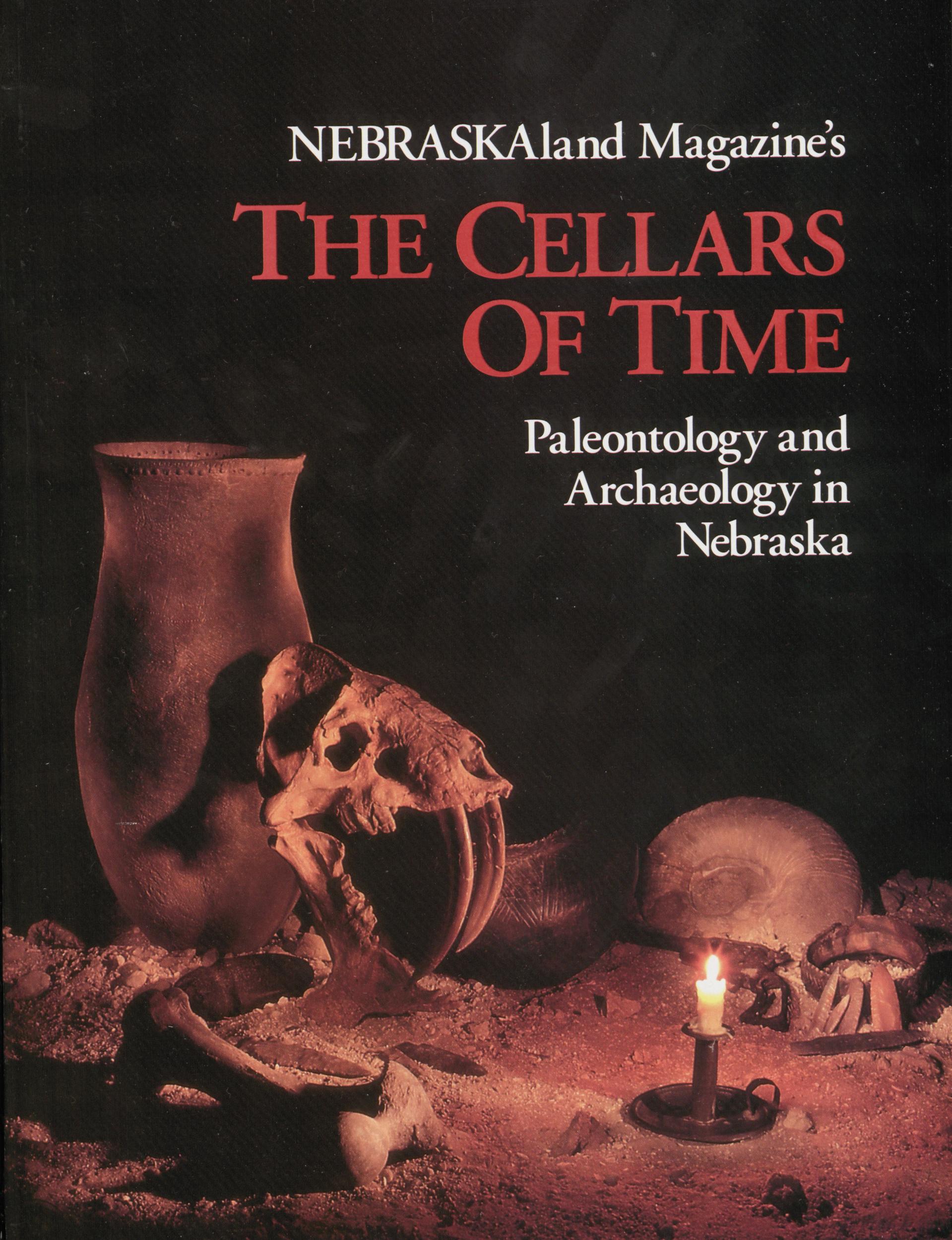
NEBRASKAland Magazine's The Cellars Of Time
Paleontology and Archaeology in Nebraska
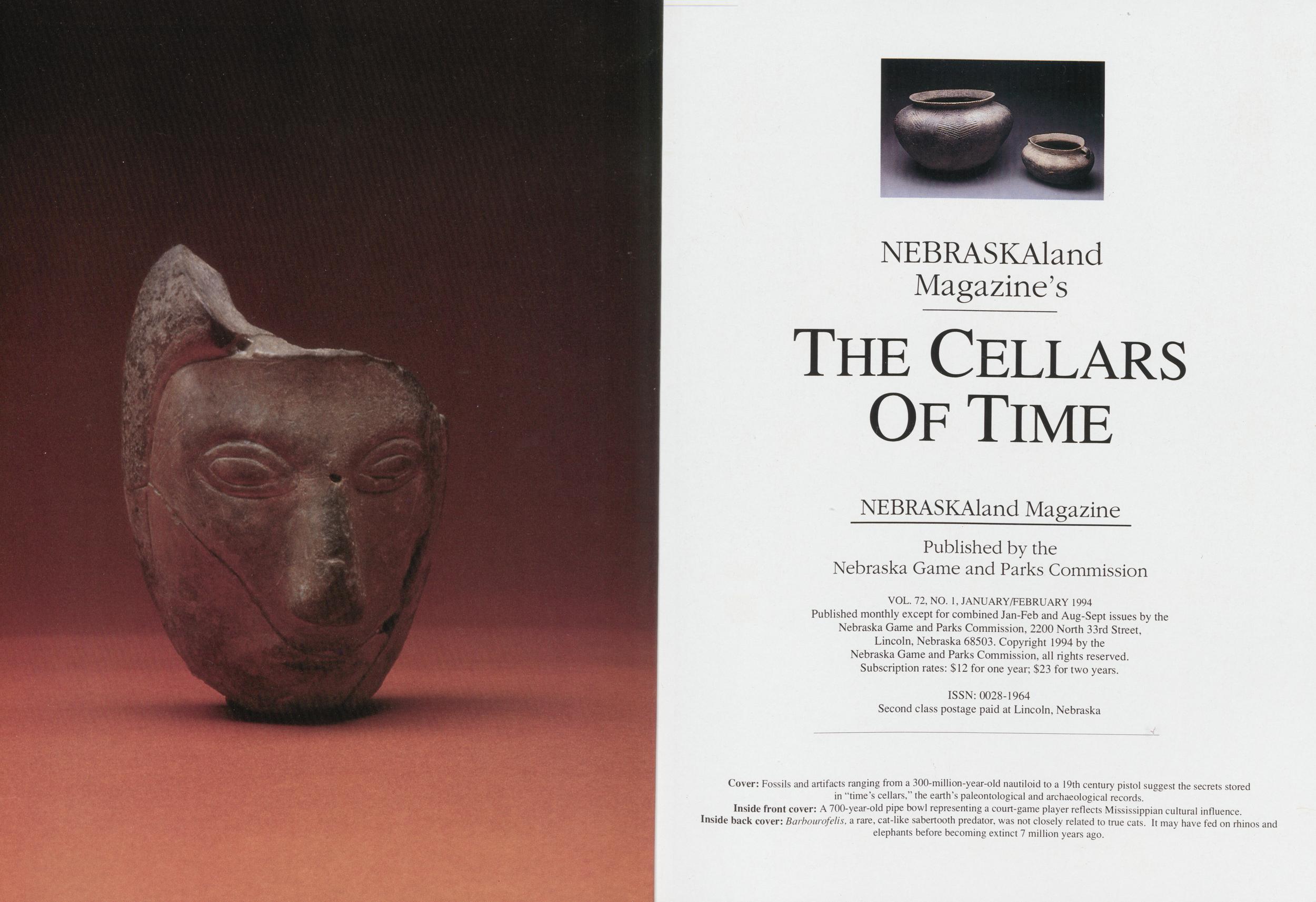
NEBRASKAland Magazine's The Cellars Of Time
NEBRASKAland Magazine Published by the Nebraska Game and Parks Commission VOL. 72, NO. 1, JANUARY/FEBRUARY 1994 Published monthly except for combined Jan-Feb and Aug-Sept issues by the Nebraska Game and Parks Commission, 2200 North 33rd Street, Lincoln, Nebraska 68503. Copyright 1994 by the Nebraska Game and Parks Commission, all rights reserved. Subscription rates: $12 for one year; $23 for two years. ISSN: 0028-1964 Second class postage paid at Lincoln, Nebraska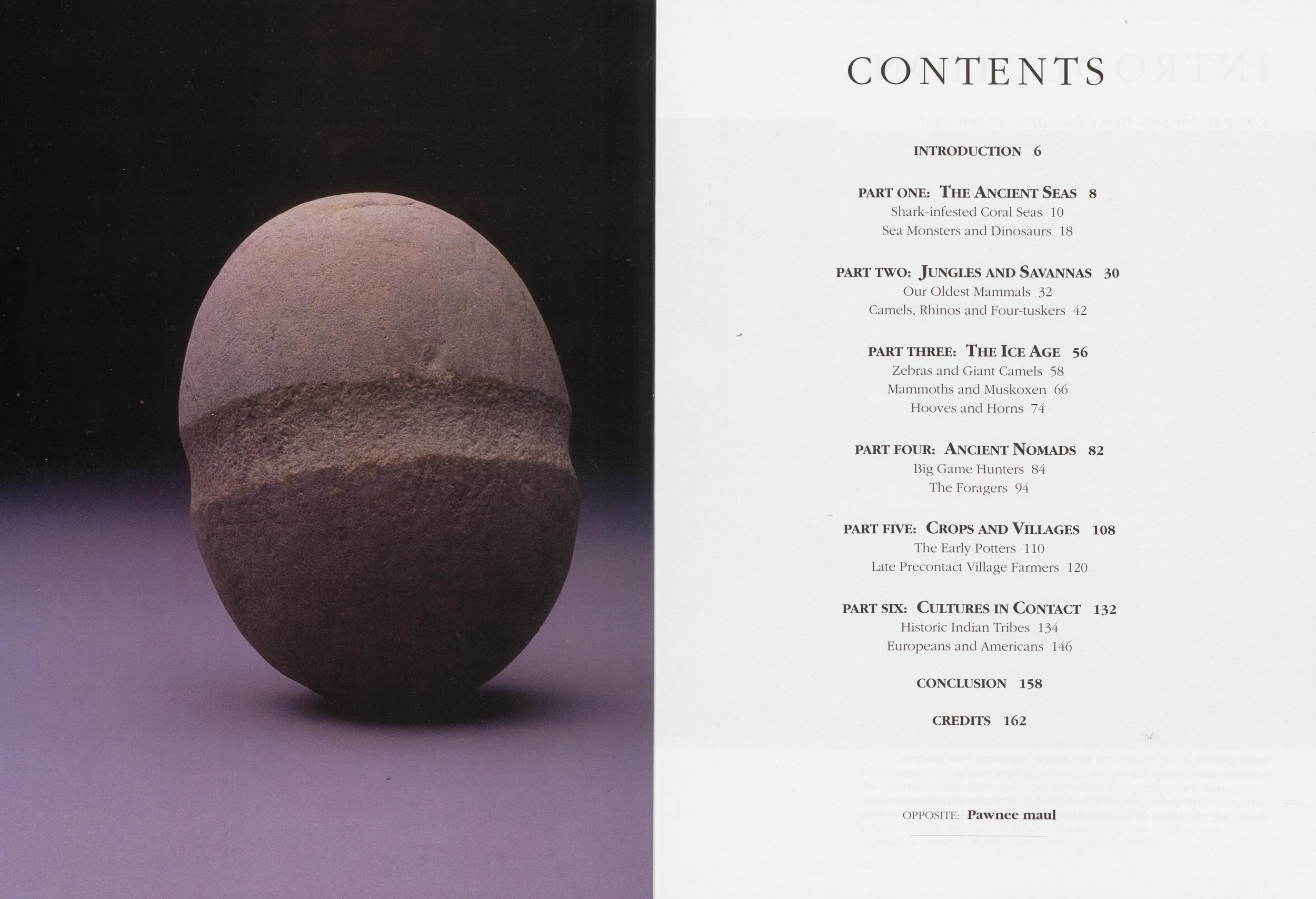
OPPOSITE: Pawnee maul
CONTENTS
INTRODUCTION 6PART ONE: THE ANCIENT SEAS 8
Shark-infested Coral Seas 10
Sea Monsters and Dinosaurs 18 PART TWO: JUNGLES AND SAVANNAS 30
Our Oldest Mammals 32
Camels, Rhinos and Four-tuskers 42 PART THREE: THE ICE AGE 56
Zebras and Giant Camels 58
Mammoths and Muskoxen 66
Hooves and Horns 74 PART FOUR: ANCIENT NOMADS 82
Big Game Hunters 84
The Foragers 94 PART FIVE: CROPS AND VILLAGES 108
The Early Potters 110
Late Precontact Village Farmers 120 PART SIX: CULTURES IN CONTACT 132
Historic Indian Tribes 134
Europeans and Americans 146 CONCLUSION 158 CREDITS 162
INTRODUCTION
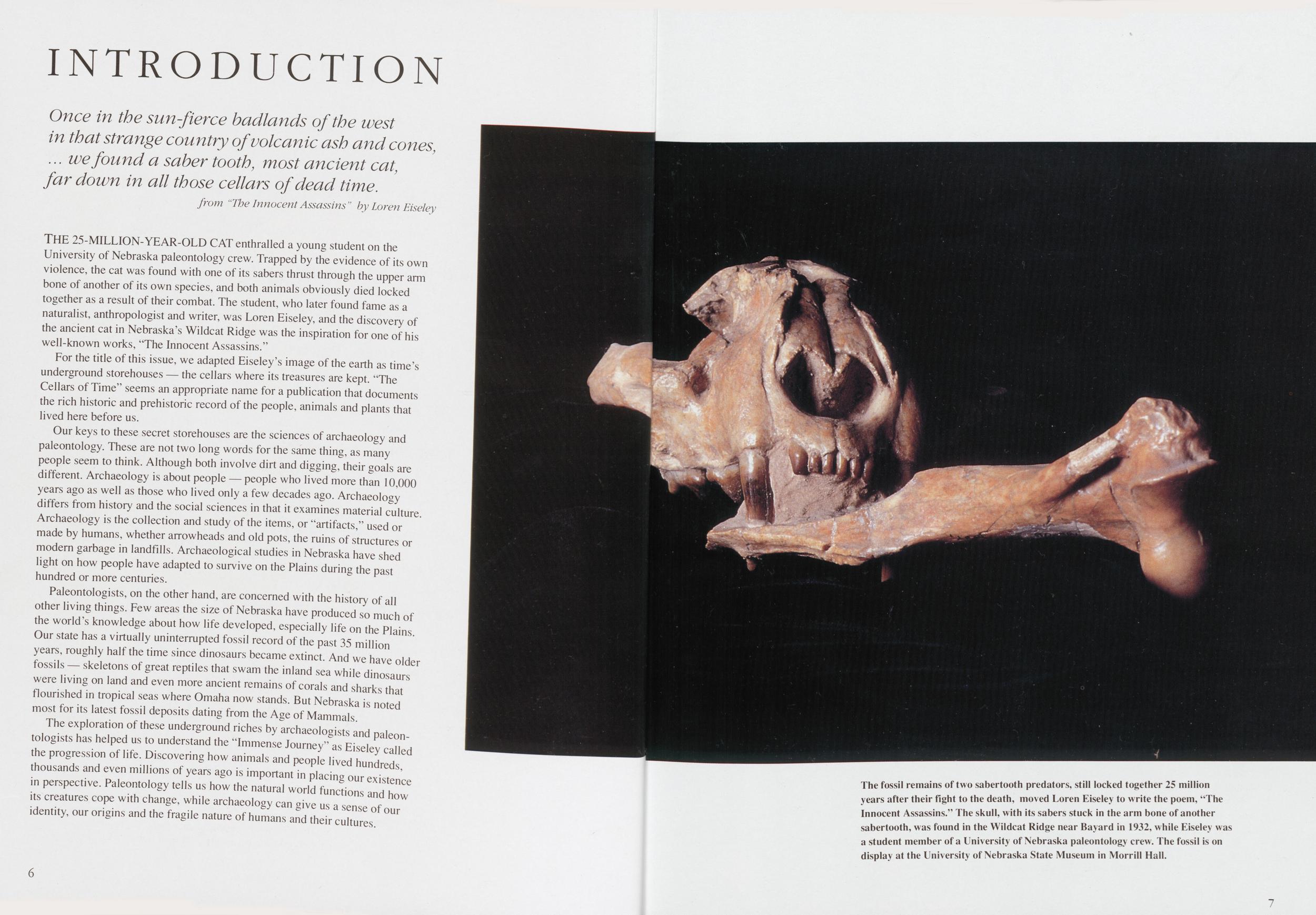
Once in the sun-fierce badlands of the west in that strange country of volcanic ash and cones, ... we found a saber tooth, most ancient cat, far down in all those cellars of dead time. from "The Innocent Assassins" by Loren EiseleyTHE 25-MILLION-YEAR-OLD CAT enthralled a young student on the University of Nebraska paleontology crew. Trapped by the evidence of its own violence, the cat was found with one of its sabers thrust through the upper arm bone of another of its own species, and both animals obviously died locked together as a result of their combat. The student, who later found fame as a naturalist, anthropologist and writer, was Loren Eiseley, and the discovery of the ancient cat in Nebraska's Wildcat Ridge was the inspiration for one of his well-known works, 'The Innocent Assassins."
For the title of this issue, we adapted Eiseley's image of the earth as time's underground storehouses — the cellars where its treasures are kept. "The Cellars of Time" seems an appropriate name for a publication that documents the rich historic and prehistoric record of the people, animals and plants that lived here before us.
Our keys to these secret storehouses are the sciences of archaeology and paleontology. These are not two long words for the same thing, as many people seem to think. Although both involve dirt and digging, their goals are different. Archaeology is about people — people who lived more than 10,000 years ago as well as those who lived only a few decades ago. Archaeology differs from history and the social sciences in that it examines material culture. Archaeology is the collection and study of the items, or "artifacts," used or made by humans, whether arrowheads and old pots, the ruins of structures or modern garbage in landfills. Archaeological studies in Nebraska have shed light on how people have adapted to survive on the Plains during the past hundred or more centuries.
Paleontologists, on the other hand, are concerned with the history of all other living things. Few areas the size of Nebraska have produced so much of the world's knowledge about how life developed, especially life on the Plains Our state has a virtually uninterrupted fossil record of the past 35 million years, roughly half the time since dinosaurs became extinct. And we have older fossils — skeletons of great reptiles that swam the inland sea while dinosaurs were living on land and even more ancient remains of corals and sharks that flourished in tropical seas where Omaha now stands. But Nebraska is noted most for its latest fossil deposits dating from the Age of Mammals.
The exploration of these underground riches by archaeologists and paleontologists has helped us to understand the "Immense Journey" as Eiseley called the progression of life. Discovering how animals and people lived hundreds thousands and even millions of years ago is important in placing our existence in perspective. Paleontology tells us how the natural world functions and how its creatures cope with change, while archaeology can give us a sense of our identity, our origins and the fragile nature of humans and their cultures
The fossil remains of two sabertooth predators, still locked together 25 million years after their fight to the death, moved Loren Eiseley to write the poem, "The Innocent Assassins." The skull, with its sabers stuck in the arm bone of another sabertooth, was found in the Wildcat Ridge near Bayard in 1932, while Eiseley was a student member of a University of Nebraska paleontology crew. The fossil is on display at the University of Nebraska State Museum in Morrill Hall.
PART ONE THE ANCIENT SEAS
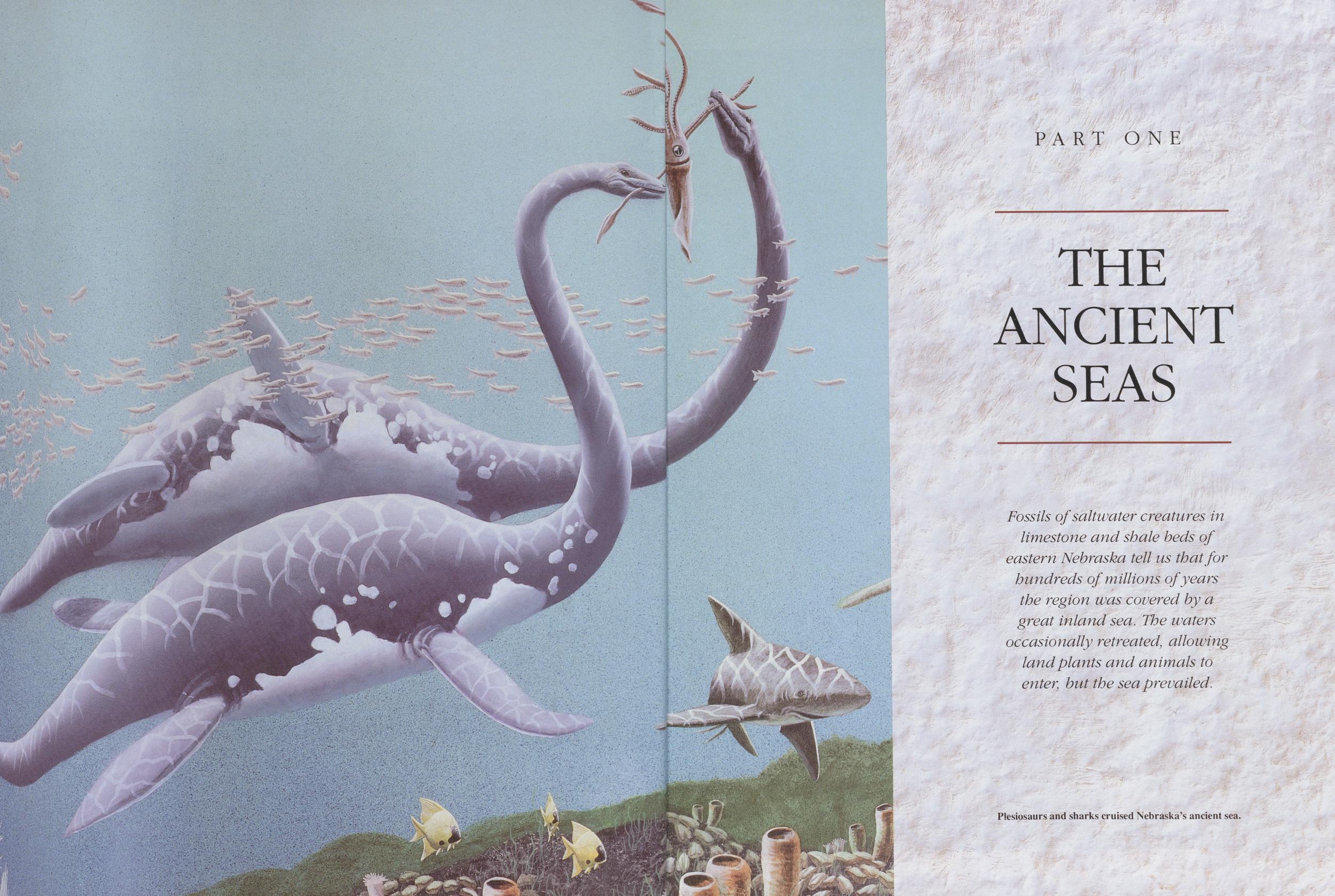
Fossils of saltwater creatures in limestone and shale beds of eastern Nebraska tell us that for hundreds of millions of years the region was covered by a great inland sea. The waters occasionally retreated, allowing land plants and animals to enter, but the sea prevailed.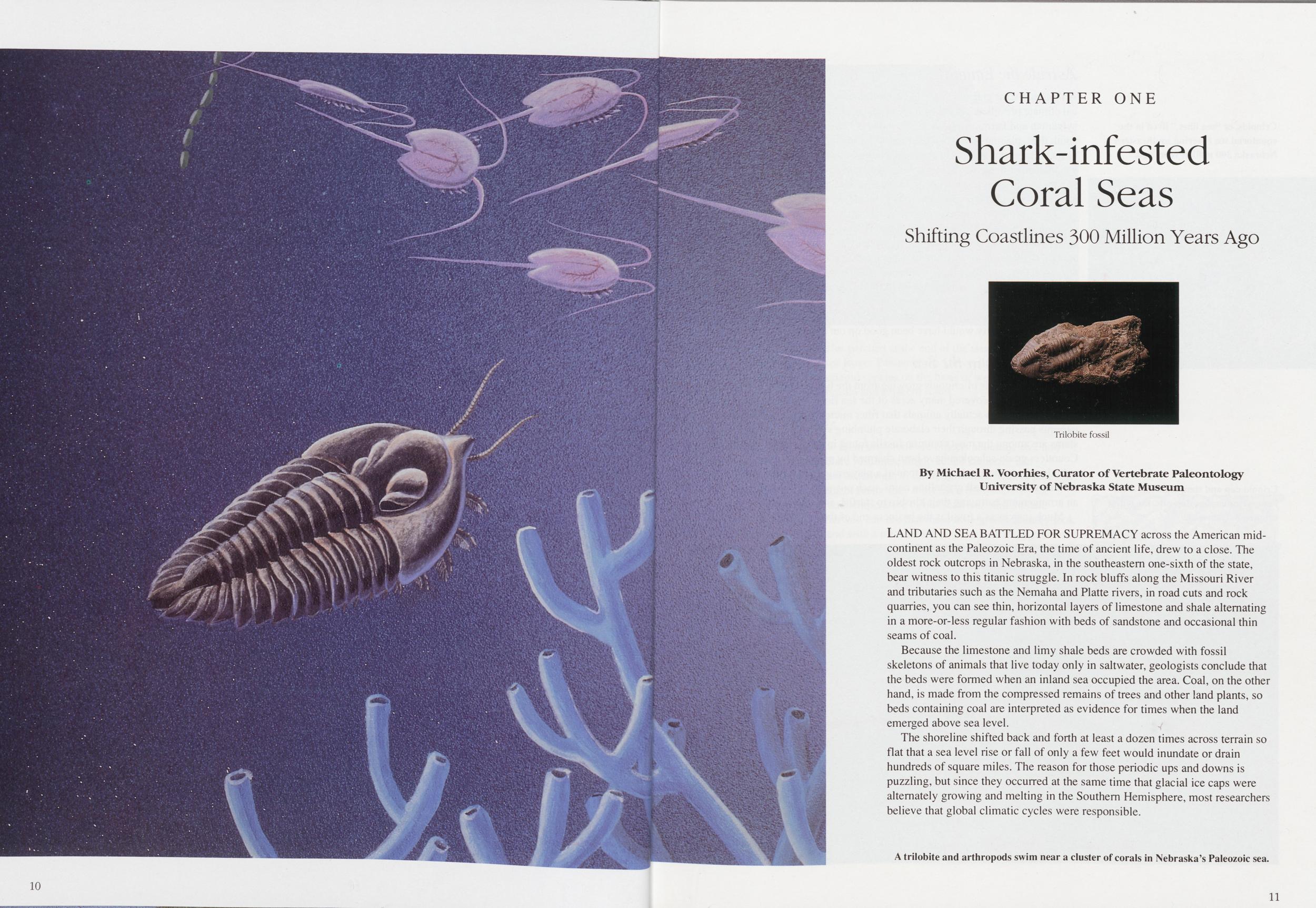
A trilobite and arthropods swim near a cluster of corals in Nebraska's Paleozoic sea.
CHAPTER ONE Shark-infested Coral Seas
Shifting Coastlines 300 Million Years Ago
Trilobite fossil
LAND AND SEA BATTLED FOR SUPREMACY across the American mid- continent as the Paleozoic Era, the time of ancient life, drew to a close. The oldest rock outcrops in Nebraska, in the southeastern one-sixth of the state, bear witness to this titanic struggle. In rock bluffs along the Missouri River and tributaries such as the Nemaha and Platte rivers, in road cuts and rock quarries, you can see thin, horizontal layers of limestone and shale alternating in a more-or-less regular fashion with beds of sandstone and occasional thin seams of coal.
Because the limestone and limy shale beds are crowded with fossil skeletons of animals that live today only in saltwater, geologists conclude that the beds were formed when an inland sea occupied the area. Coal, on the other hand, is made from the compressed remains of trees and other land plants, so beds containing coal are interpreted as evidence for times when the land emerged above sea level.
The shoreline shifted back and forth at least a dozen times across terrain so flat that a sea level rise or fall of only a few feet would inundate or drain hundreds of square miles. The reason for those periodic ups and downs is puzzling, but since they occurred at the same time that glacial ice caps were alternately growing and melting in the Southern Hemisphere, most researchers believe that global climatic cycles were responsible.
11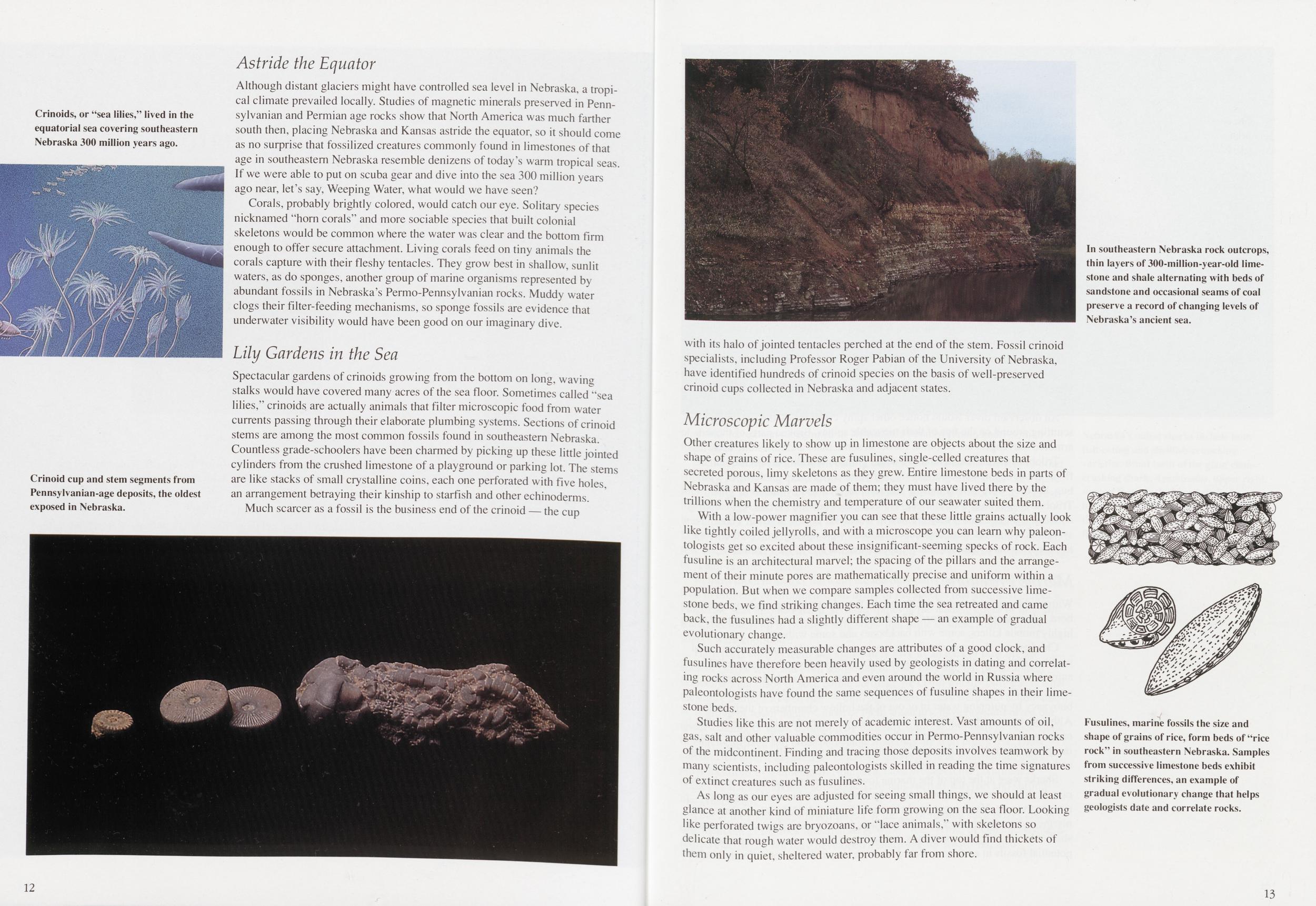
Crinoids, or "sea lilies," lived in the equatorial sea covering southeastern Nebraska 300 million years ago.
Crinoid cup and stem segments from Pennsylvanian-age deposits, the oldest exposed in Nebraska.
Although distant glaciers might have controlled sea level in Nebraska, a tropi- cal climate prevailed locally. Studies of magnetic minerals preserved in Penn- sylvanian and Permian age rocks show that North America was much farther south then, placing Nebraska and Kansas astride the equator, so it should come as no surprise that fossilized creatures commonly found in limestones of that age in southeastern Nebraska resemble denizens of today's warm tropical seas. If we were able to put on scuba gear and dive into the sea 300 million years ago near, let's say, Weeping Water, what would we have seen?
Corals, probably brightly colored, would catch our eye. Solitary species nicknamed "horn corals" and more sociable species that built colonial skeletons would be common where the water was clear and the bottom firm enough to offer secure attachment. Living corals feed on tiny animals the corals capture with their fleshy tentacles. They grow best in shallow, sunlit waters, as do sponges, another group of marine organisms represented by abundant fossils in Nebraska's Permo-Pennsylvanian rocks. Muddy water clogs their filter-feeding mechanisms, so sponge fossils are evidence that underwater visibility would have been good on our imaginary dive.
Lily Gardens in the SeaSpectacular gardens of crinoids growing from the bottom on long, waving stalks would have covered many acres of the sea floor. Sometimes called "sea lilies," crinoids are actually animals that filter microscopic food from water currents passing through their elaborate plumbing systems. Sections of crinoid stems are among the most common fossils found in southeastern Nebraska. Countless grade-schoolers have been charmed by picking up these little jointed cylinders from the crushed limestone of a playground or parking lot. The stems are like stacks of small crystalline coins, each one perforated with five holes an arrangement betraying their kinship to starfish and other echinoderms.
Much scarcer as a fossil is the business end of the crinoid — the cup 12 with its halo of jointed tentacles perched at the end of the stem. Fossil crinoid specialists, including Professor Roger Pabian of the University of Nebraska, have identified hundreds of crinoid species on the basis of well-preserved crinoid cups collected in Nebraska and adjacent states.
Microscopic MarvelsOther creatures likely to show up in limestone are objects about the size and shape of grains of rice. These are fusulines, single-celled creatures that secreted porous, limy skeletons as they grew. Entire limestone beds in parts of Nebraska and Kansas are made of them; they must have lived there by the trillions when the chemistry and temperature of our seawater suited them.
With a low-power magnifier you can see that these little grains actually look like tightly coiled jellyrolls, and with a microscope you can learn why paleon- tologists get so excited about these insignificant-seeming specks of rock. Each fusuline is an architectural marvel; the spacing of the pillars and the arrange- ment of their minute pores are mathematically precise and uniform within a population. But when we compare samples collected from successive lime- stone beds, we find striking changes. Each time the sea retreated and came back, the fusulines had a slightly different shape — an example of gradual evolutionary change.
Such accurately measurable changes are attributes of a good clock, and fusulines have therefore been heavily used by geologists in dating and correlat- ing rocks across North America and even around the world in Russia where paleontologists have found the same sequences of fusuline shapes in their lime- stone beds.
Studies like this are not merely of academic interest. Vast amounts of oil, gas, salt and other valuable commodities occur in Permo-Pennsylvanian rocks of the midcontinent. Finding and tracing those deposits involves teamwork by many scientists, including paleontologists skilled in reading the time signatures of extinct creatures such as fusulines.
As long as our eyes are adjusted for seeing small things, we should at least glance at another kind of miniature life form growing on the sea floor. Looking like perforated twigs are bryozoans, or "lace animals," with skeletons so delicate that rough water would destroy them. A diver would find thickets of them only in quiet, sheltered water, probably far from shore.
In southeastern Nebraska rock outcrops, thin layers of 300-miIlion-year-old lime- stone and shale alternating with beds of sandstone and occasional seams of coal preserve a record of changing levels of Nebraska's ancient sea.
Fusulines, marine fossils the size and shape of grains of rice, form beds of "rice rock" in southeastern Nebraska. Samples from successive limestone beds exhibit striking differences, an example of gradual evolutionary change that helps geologists date and correlate rocks.
 Ancient Shellfish
Both near shore and offshore would be a great diversity of clams and snails, some attached to the sea floor, some meandering across the surface, still others burrowing deep in the sediment. Only a specialist would detect much difference between the 300-million-year-old mollusks and modern seashells, but even a casual observer might notice that those living closer to shore have thicker shells, on the average, than those in deeper, quieter water. That difference, probably related to wave resistance, is well known to marine biologists but has only recently been used to pinpoint water depths in Nebraska's ancient seas.
Ranking next in abundance after crinoids in fossil collections from Nebraska's most ancient rocks are brachiopods or "lamp shells" (one species resembles Aladdin's lamp). Like clams, they have hinged shells, but in brachiopods the two parts of the shell are of unequal size and shape while in clams they are mirror images.
Brachiopods are filter feeders that live attached to the sea floor by a short, flexible stalk. They are rare animals in modern oceans but were among the most successful shellfish in Paleozoic seas. Many species apparently thrived in muddy environments since we often find hordes of their shells in shale beds originally laid down as deposits of silt and clay. One species is especially interesting to Nebraskans because of its name, Juresania nebrascensis, and because it belongs to a bizarre group, the spiny brachiopods, which evolved long slender spines, presumably to prevent them from settling into the mud. They must have looked like small, immobile porcupines sitting on the sea floor.
An observant diver would notice other spiny creatures — the sea urchins__ scuttling around on the tips of their moveable spines. Broken parts of those armored scavengers are common fossils in some shale and limestone beds.
Trilobites are another animal we could glimpse scooting across the sea floor. Those segmented creatures might remind a Nebraska gardener of a pill bug, but they were strictly marine animals that breathed by means of gills. Trilobite fossils have a certain bug-eyed elegance and are much sought after by collectors; unfortunately they are rare in Nebraska. By the time our Penn- sylvanian sediments were deposited, trilobites were already well on their way to extinction, an event that finally happened at the end of the Permian.
Marine PredatorsWith all this seafood spread out on the sea floor like a high-priced smorgasbord, where were the predators? The fossil record shows a rich assortment of highly mobile killers, some with backbones and some without.
Chief among the invertebrate carnivores were related to today's chambered nautilus. Called nautiloids and ammonoids, those jet-propelled, large-eyed animals resembled squid except for having heavy external shells, coiled in some species, straight in others. Like submarines, they could control their buoyancy by pumping water in or out of the hollow chambers of their shells. Although some earlier Paleozoic nautiloids were more than 15 feet long, the ones found in Nebraska are far smaller and would have posed no threat to our imaginary diver. Not so the sharks, some of which were well over 15 feet long and armed with razor-sharp teeth.
Sharks were at the top of the marine food chain and top predators tend to be rare, both in the modern world and in the fossil record, but sharks are excep- tions to the rule. You have a good chance of finding shark fossils in almost any marine sediments younger than 400 million years because sharks continuously shed old teeth and grow new ones, producing as many as several thousand potential fossils in a lifetime. Based on tooth shape, dozens of different kinds 14 of sharks have been recognized in Nebraska's Pennsylvanian and Permian fossil beds.
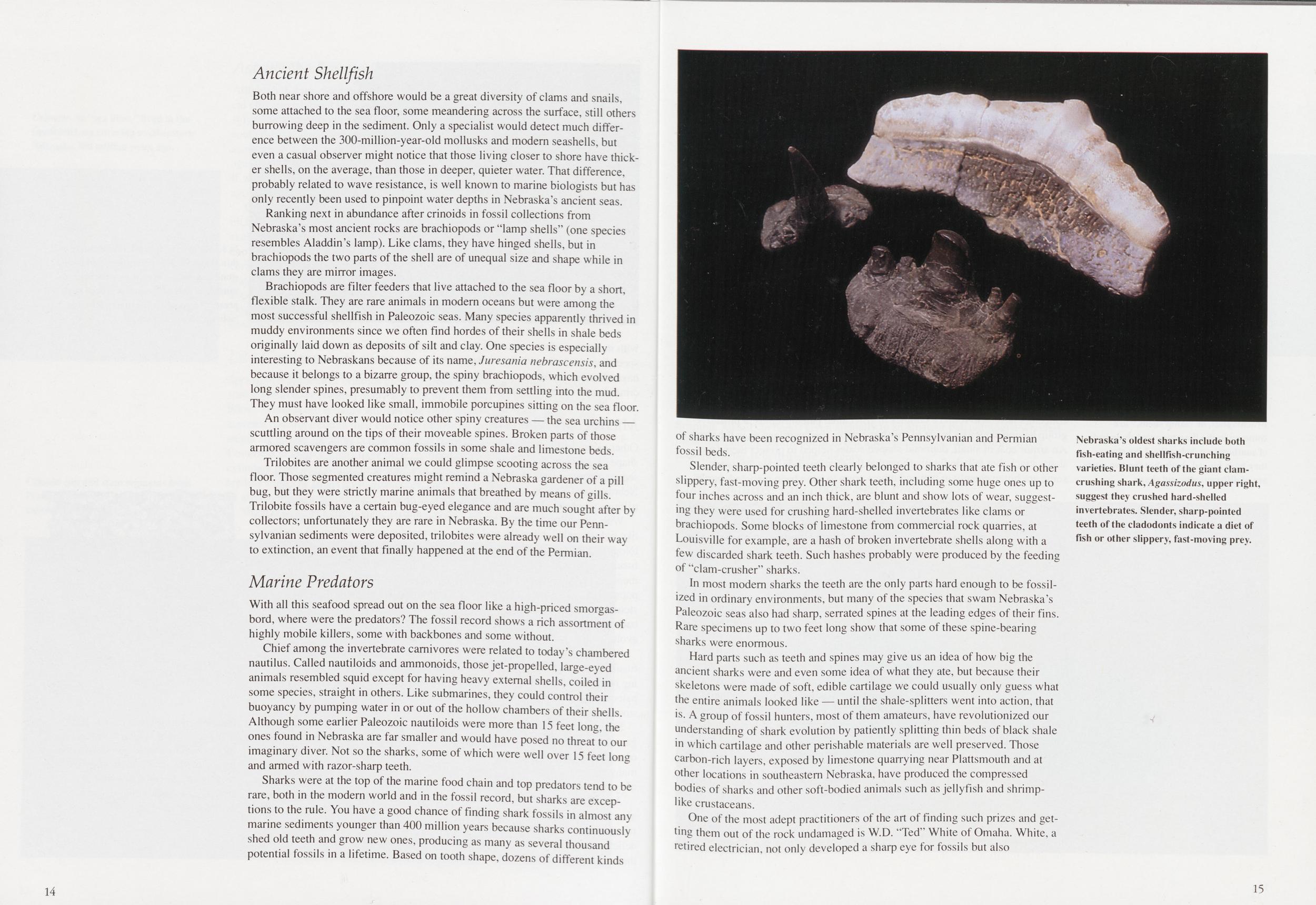
Slender, sharp-pointed teeth clearly belonged to sharks that ate fish or other slippery, fast-moving prey. Other shark teeth, including some huge ones up to four inches across and an inch thick, are blunt and show lots of wear, suggest- ing they were used for crushing hard-shelled invertebrates like clams or brachiopods. Some blocks of limestone from commercial rock quarries, at Louisville for example, are a hash of broken invertebrate shells along with a few discarded shark teeth. Such hashes probably were produced by the feeding of "clam-crusher" sharks.
In most modem sharks the teeth are the only parts hard enough to be fossil- ized in ordinary environments, but many of the species that swam Nebraska's Paleozoic seas also had sharp, serrated spines at the leading edges of their fins. Rare specimens up to two feet long show that some of these spine-bearing sharks were enormous.
Hard parts such as teeth and spines may give us an idea of how big the ancient sharks were and even some idea of what they ate, but because their skeletons were made of soft, edible cartilage we could usually only guess what the entire animals looked like — until the shale-splitters went into action, that is. A group of fossil hunters, most of them amateurs, have revolutionized our understanding of shark evolution by patiently splitting thin beds of black shale in which cartilage and other perishable materials are well preserved. Those carbon-rich layers, exposed by limestone quarrying near Plattsmouth and at other locations in southeastern Nebraska, have produced the compressed bodies of sharks and other soft-bodied animals such as jellyfish and shrimp- like crustaceans.
One of the most adept practitioners of the art of finding such prizes and get- ting them out of the rock undamaged is W.D. "Ted" White of Omaha. White, a retired electrician, not only developed a sharp eye for fossils but also
Nebraska's oldest sharks include both fish-eating and shellfish-crunching varieties. Blunt teeth of the giant clam- crushing shark, Agassizodus, upper right, suggest they crushed hard-shelled invertebrates. Slender, sharp-pointed teeth of the cladodonts indicate a diet of fish or other slippery, fast-moving prey.
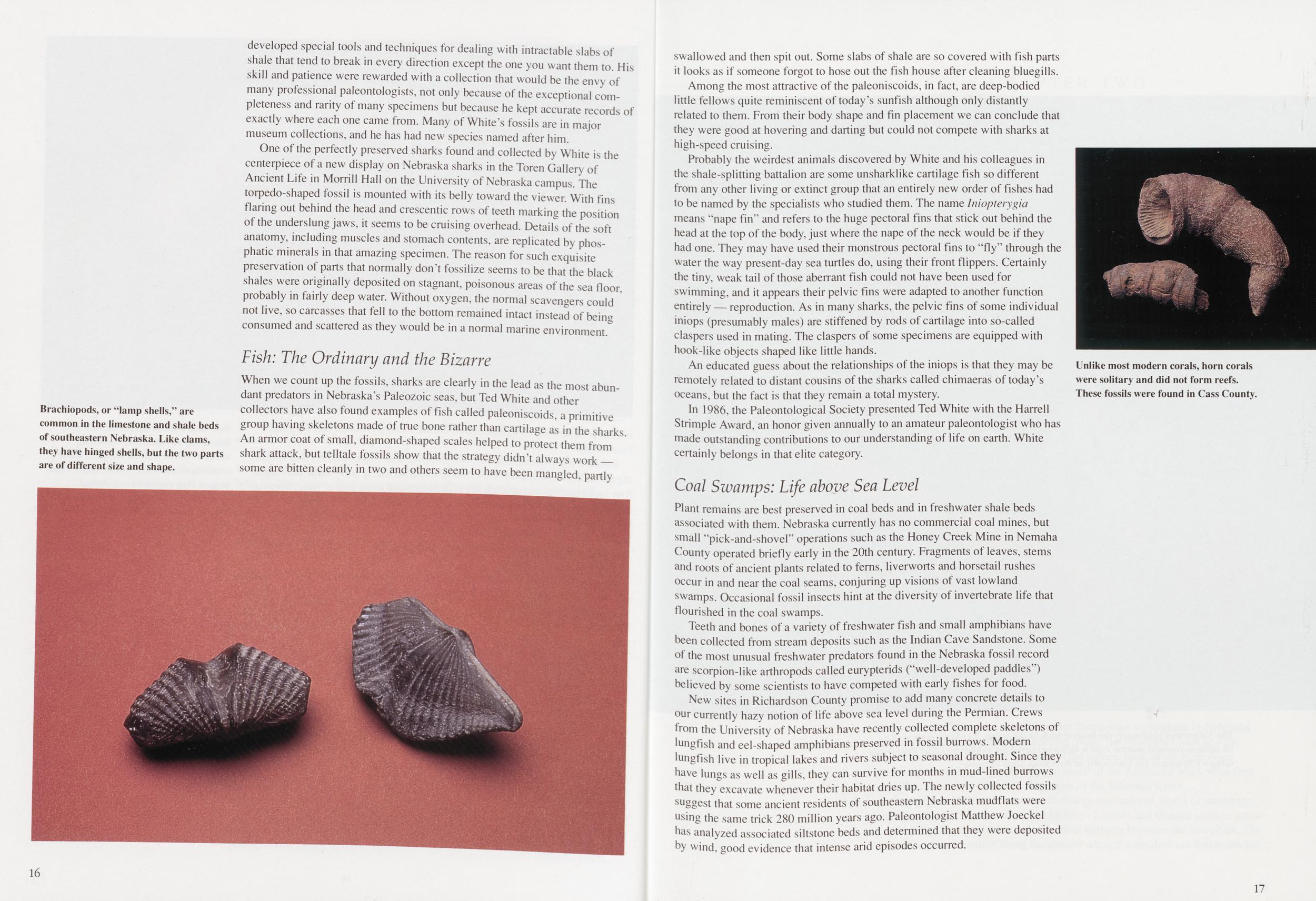
Brachiopods, or "lamp shells," are common in the limestone and shale beds of southeastern Nebraska. Like clams, they have hinged shells, but the two parts are of different size and shape.
developed special tools and techniques for dealing with intractable slabs of shale that tend to break in every direction except the one you want them to. His skill and patience were rewarded with a collection that would be the envy of many professional paleontologists, not only because of the exceptional com- pleteness and rarity of many specimens but because he kept accurate records of exactly where each one came from. Many of White's fossils are in major museum collections, and he has had new species named after him.
One of the perfectly preserved sharks found and collected by White is the centerpiece of a new display on Nebraska sharks in the Toren Gallery of Ancient Life in Morrill Hall on the University of Nebraska campus. The torpedo-shaped fossil is mounted with its belly toward the viewer. With fins flaring out behind the head and crescentic rows of teeth marking the position of the underslung jaws, it seems to be cruising overhead. Details of the soft anatomy, including muscles and stomach contents, are replicated by phos- phatic minerals in that amazing specimen. The reason for such exquisite preservation of parts that normally don't fossilize seems to be that the black shales were originally deposited on stagnant, poisonous areas of the sea floor, probably in fairly deep water. Without oxygen, the normal scavengers could not live, so carcasses that fell to the bottom remained intact instead of being consumed and scattered as they would be in a normal marine environment.
Fish: The Ordinary and the BizarreWhen we count up the fossils, sharks are clearly in the lead as the most abun- dant predators in Nebraska's Paleozoic seas, but Ted White and other collectors have also found examples offish called paleoniscoids, a primitive group having skeletons made of true bone rather than cartilage as in the sharks. An armor coat of small, diamond-shaped scales helped to protect them from shark attack, but telltale fossils show that the strategy didn't always work__ some are bitten cleanly in two and others seem to have been mangled, partly 16 swallowed and then spit out. Some slabs of shale are so covered with fish parts it looks as if someone forgot to hose out the fish house after cleaning bluegills.
Among the most attractive of the paleoniscoids, in fact, are deep-bodied little fellows quite reminiscent of today's sunfish although only distantly related to them. From their body shape and fin placement we can conclude that they were good at hovering and darting but could not compete with sharks at high-speed cruising.
Probably the weirdest animals discovered by White and his colleagues in the shale-splitting battalion are some unsharklike cartilage fish so different from any other living or extinct group that an entirely new order of fishes had to be named by the specialists who studied them. The name Iniopterygia means "nape fin" and refers to the huge pectoral fins that stick out behind the head at the top of the body, just where the nape of the neck would be if they had one. They may have used their monstrous pectoral fins to "fly" through the water the way present-day sea turtles do, using their front flippers. Certainly the tiny, weak tail of those aberrant fish could not have been used for swimming, and it appears their pelvic fins were adapted to another function entirely — reproduction. As in many sharks, the pelvic fins of some individual iniops (presumably males) are stiffened by rods of cartilage into so-called claspers used in mating. The claspers of some specimens are equipped with hook-like objects shaped like little hands.
An educated guess about the relationships of the iniops is that they may be remotely related to distant cousins of the sharks called chimaeras of today's oceans, but the fact is that they remain a total mystery.
In 1986, the Paleontological Society presented Ted White with the Harrell Strimple Award, an honor given annually to an amateur paleontologist who has made outstanding contributions to our understanding of life on earth. White certainly belongs in that elite category.
Coal Swamps: Life above Sea LevelPlant remains are best preserved in coal beds and in freshwater shale beds associated with them. Nebraska currently has no commercial coal mines, but small "pick-and-shovel" operations such as the Honey Creek Mine in Nemaha County operated briefly early in the 20th century. Fragments of leaves, stems and roots of ancient plants related to ferns, liverworts and horsetail rushes occur in and near the coal seams, conjuring up visions of vast lowland swamps. Occasional fossil insects hint at the diversity of invertebrate life that flourished in the coal swamps.
Teeth and bones of a variety of freshwater fish and small amphibians have been collected from stream deposits such as the Indian Cave Sandstone. Some of the most unusual freshwater predators found in the Nebraska fossil record are scorpion-like arthropods called eurypterids ("well-developed paddles") believed by some scientists to have competed with early fishes for food.
New sites in Richardson County promise to add many concrete details to our currently hazy notion of life above sea level during the Permian. Crews from the University of Nebraska have recently collected complete skeletons of lungfish and eel-shaped amphibians preserved in fossil burrows. Modern lungfish live in tropical lakes and rivers subject to seasonal drought. Since they have lungs as well as gills, they can survive for months in mud-lined burrows that they excavate whenever their habitat dries up. The newly collected fossils suggest that some ancient residents of southeastern Nebraska mudflats were using the same trick 280 million years ago. Paleontologist Matthew Joeckel has analyzed associated siltstone beds and determined that they were deposited by wind, good evidence that intense arid episodes occurred.
Unlike most modern corals, horn corals were solitary and did not form reefs. These fossils were found in Cass County.
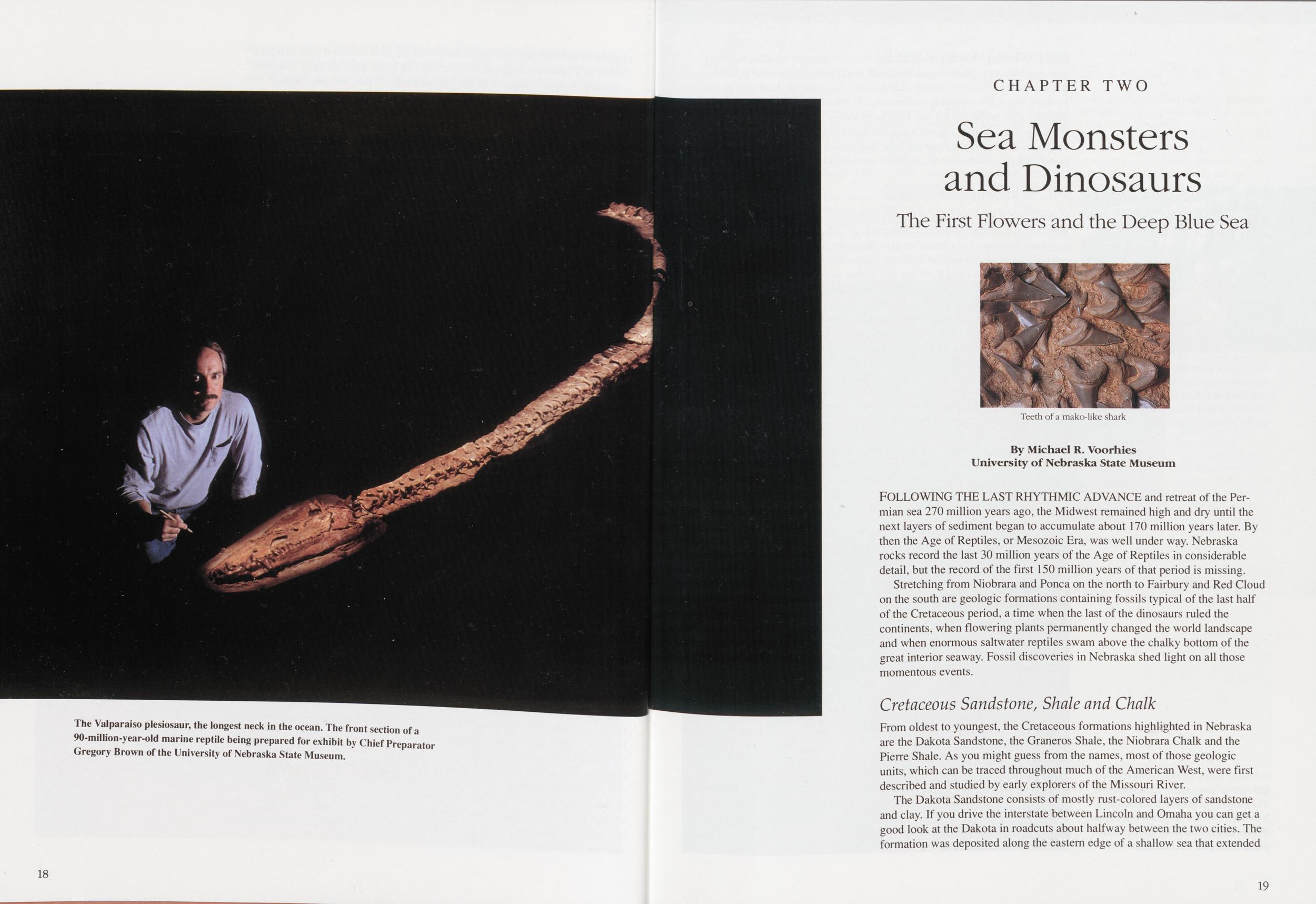
The Valparaiso plesiosaur, the longest neck in the ocean. The front section of a 90-million-year-old marine reptile being prepared for exhibit by Chief Preparator Gregory Brown of the University of Nebraska State Museum.
CHAPTER TWO
Sea Monsters and Dinosaurs
The First Flowers and the Deep Blue Sea
Teeth of a mako-like shark
By Michael R. Voorhies University of Nebraska State Museum
FOLLOWING THE LAST RHYTHMIC ADVANCE and retreat of the Per- mian sea 270 million years ago, the Midwest remained high and dry until the next layers of sediment began to accumulate about 170 million years later. By then the Age of Reptiles, or Mesozoic Era, was well under way. Nebraska rocks record the last 30 million years of the Age of Reptiles in considerable detail, but the record of the first 150 million years of that period is missing.
Stretching from Niobrara and Ponca on the north to Fairbury and Red Cloud on the south are geologic formations containing fossils typical of the last half of the Cretaceous period, a time when the last of the dinosaurs ruled the continents, when flowering plants permanently changed the world landscape and when enormous saltwater reptiles swam above the chalky bottom of the great interior seaway. Fossil discoveries in Nebraska shed light on all those momentous events.
Cretaceous Sandstone, Shale and ChalkFrom oldest to youngest, the Cretaceous formations highlighted in Nebraska are the Dakota Sandstone, the Graneros Shale, the Niobrara Chalk and the Pierre Shale. As you might guess from the names, most of those geologic units, which can be traced throughout much of the American West, were first described and studied by early explorers of the Missouri River.
The Dakota Sandstone consists of mostly rust-colored layers of sandstone and clay. If you drive the interstate between Lincoln and Omaha you can get a good look at the Dakota in roadcuts about halfway between the two cities. The formation was deposited along the eastern edge of a shallow sea that extended
19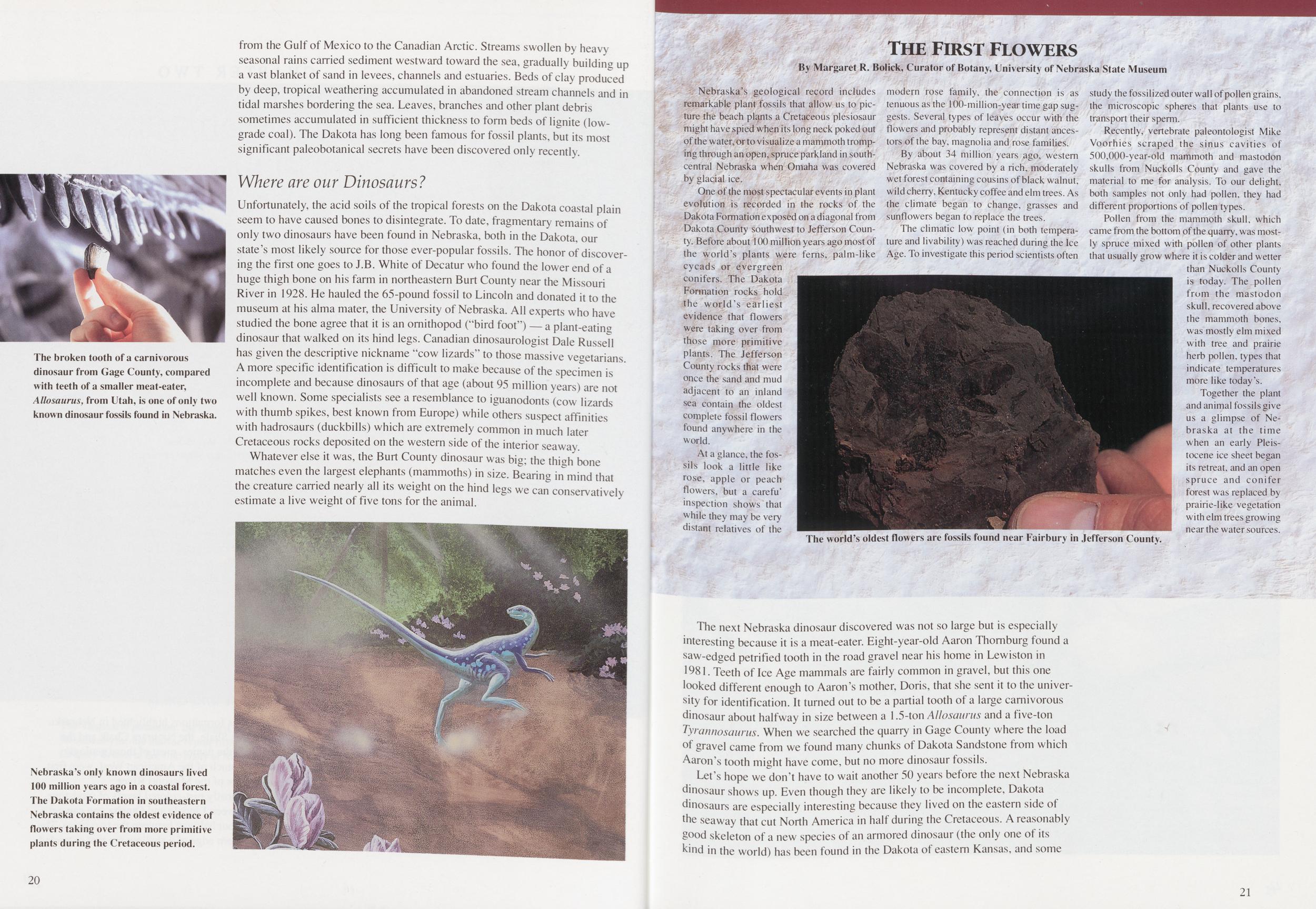
The broken tooth of a carnivorous dinosaur from Gage County, compared with teeth of a smaller meat-eater, Allosaurus, from Utah, is one of only two known dinosaur fossils found in Nebraska.
Nebraska's only known dinosaurs lived 100 million years ago in a coastal forest. The Dakota Formation in southeastern Nebraska contains the oldest evidence of flowers taking over from more primitive plants during the Cretaceous period.
from the Gulf of Mexico to the Canadian Arctic. Streams swollen by heavy seasonal rains carried sediment westward toward the sea, gradually building up a vast blanket of sand in levees, channels and estuaries. Beds of clay produced by deep, tropical weathering accumulated in abandoned stream channels and in tidal marshes bordering the sea. Leaves, branches and other plant debris sometimes accumulated in sufficient thickness to form beds of lignite (low- grade coal). The Dakota has long been famous for fossil plants, but its most significant paleobotanical secrets have been discovered only recently.
Where are our Dinosaurs?Unfortunately, the acid soils of the tropical forests on the Dakota coastal plain seem to have caused bones to disintegrate. To date, fragmentary remains of only two dinosaurs have been found in Nebraska, both in the Dakota, our state's most likely source for those ever-popular fossils. The honor of discover- ing the first one goes to J.B. White of Decatur who found the lower end of a huge thigh bone on his farm in northeastern Burt County near the Missouri River in 1928. He hauled the 65-pound fossil to Lincoln and donated it to the museum at his alma mater, the University of Nebraska. All experts who have studied the bone agree that it is an ornithopod ("bird foot") — a plant-eating dinosaur that walked on its hind legs. Canadian dinosaurologist Dale Russell has given the descriptive nickname "cow lizards" to those massive vegetarians A more specific identification is difficult to make because of the specimen is incomplete and because dinosaurs of that age (about 95 million years) are not well known. Some specialists see a resemblance to iguanodonts (cow lizards with thumb spikes, best known from Europe) while others suspect affinities with hadrosaurs (duckbills) which are extremely common in much later Cretaceous rocks deposited on the western side of the interior seaway
Whatever else it was, the Burt County dinosaur was big; the thigh bone matches even the largest elephants (mammoths) in size. Bearing in mind that the creature carried nearly all its weight on the hind legs we can conservatively estimate a live weight of five tons for the animal.
The first flowers
Nebraska's geological record includes remarkable plant fossils that allow us to pic- ture the beach plants a Cretaceous plesiosaur might have spied when its long neck poked out of the water, or to visualize a mammoth tramp- ing through an open, spruce parkland in south- central Nebraska when Omaha was covered by glacial ice.
One of the most spectacular events in plant evolution is recorded in the rocks of the Dakota Formation exposed on a diagonal from Dakota County southwest to Jefferson Coun- ty. Before about 100 million years ago most of the world's plants were ferns, palm-like cycads or evergreen conifers. The Dakota Formation rocks hold the world's earliest evidence that flowers were taking over from those more primitive plants. The Jefferson County rocks that were once the sand and mud adjacent to an inland sea contain the oldest complete fossil flowers found anywhere in the world.
At a glance, the fossils look a little like rose, apple or peach flowers, but a carefu" inspection shows that while they may be very distant relatives of the modern rose family, the connection is as tenuous as the 100-million-yeartime gap suggests. Several types of leaves occur with the flowers and probably represent distant ancestors of the bay, magnolia and rose families.
By about 34 million years ago, western Nebraska was covered by a rich, moderately wet forest containing cousins of black walnut, wild cherry, Kentucky coffee and elm trees. As the climate began to change, grasses and sunflowers began to replace the trees.
The climatic low point (in both temperature and livability) was reached during the Ice Age. To investigate this period scientists often study the fossilized outer wall of pollen grains, the microscopic spheres that plants use to transport their sperm.
Recently, vertebrate paleontologist Mike Voorhies scraped the sinus cavities of 500,000-year-old mammoth and mastodon skulls from Nuckolls County and gave the material to me for analysis. To our delight, both samples not only had pollen, they had different proportions of pollen types.
Pollen from the mammoth skull, which came from the bottom of the quarry, was mostly spruce mixed with pollen of other plants that usually grow where it is colder and wetter than Nuckolls County is today. The pollen from the mastodon skull, recovered above the mammoth bones, was mostly elm mixed with tree and prairie herb pollen, types that indicate temperatures more like today's.
Together the plant and animal fossils give us a glimpse of Ne- braska at the time when an early Pleis- tocene ice sheet began its retreat, and an open spruce and conifer forest was replaced by prairie-like vegetation with elm trees growing near the water sources.
The world's oldest flowers are fossils found near Fair bury in Jefferson County. The next Nebraska dinosaur discovered was not so large but is especially interesting because it is a meat-eater. Eight-year-old Aaron Thornburg found a saw-edged petrified tooth in the road gravel near his home in Lewiston in 1981. Teeth of Ice Age mammals are fairly common in gravel, but this one looked different enough to Aaron's mother, Doris, that she sent it to the univer- sity for identification. It turned out to be a partial tooth of a large carnivorous dinosaur about halfway in size between a 1.5-ton Allosaurus and a five-ton Tyrannosaurus. When we searched the quarry in Gage County where the load of gravel came from we found many chunks of Dakota Sandstone from which Aaron's tooth might have come, but no more dinosaur fossils.
Let's hope we don't have to wait another 50 years before the next Nebraska dinosaur shows up. Even though they are likely to be incomplete, Dakota dinosaurs are especially interesting because they lived on the eastern side of the seaway that cut North America in half during the Cretaceous. A reasonably good skeleton of a new species of an armored dinosaur (the only one of its kind in the world) has been found in the Dakota of eastern Kansas, and some
21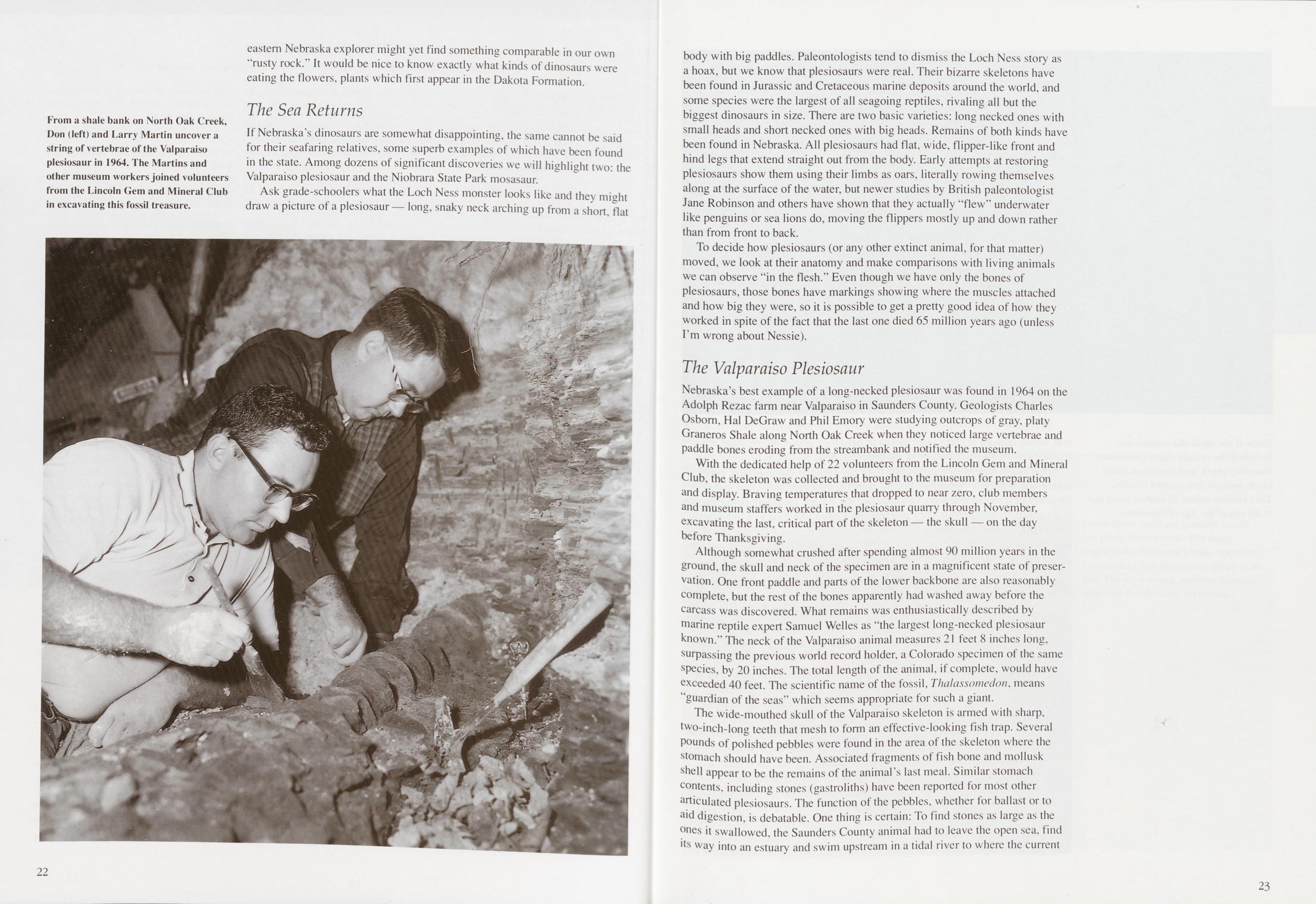
From a shale bank on North Oak Creek, Don (left) and Larry Martin uncover a string of vertebrae of the Valparaiso plesiosaur in 1964. The Martins and other museum workers joined volunteers from the Lincoln Gem and Mineral Club in excavating this fossil treasure.
eastern Nebraska explorer might yet find something comparable in our own "rusty rock." It would be nice to know exactly what kinds of dinosaurs were eating the flowers, plants which first appear in the Dakota Formation.
The Sea ReturnsIf Nebraska's dinosaurs are somewhat disappointing, the same cannot be said for their seafaring relatives, some superb examples of which have been found in the state. Among dozens of significant discoveries we will highlight two: the Valparaiso plesiosaur and the Niobrara State Park mosasaur.
Ask grade-schoolers what the Loch Ness monster looks like and they might draw a picture of a plesiosaur — long, snaky neck arching up from a short, flat 22 body with big paddles. Paleontologists tend to dismiss the Loch Ness story as a hoax, but we know that plesiosaurs were real. Their bizarre skeletons have been found in Jurassic and Cretaceous marine deposits around the world, and some species were the largest of all seagoing reptiles, rivaling all but the biggest dinosaurs in size. There are two basic varieties: long necked ones with small heads and short necked ones with big heads. Remains of both kinds have been found in Nebraska. All plesiosaurs had flat, wide, flipper-like front and hind legs that extend straight out from the body. Early attempts at restoring plesiosaurs show them using their limbs as oars, literally rowing themselves along at the surface of the water, but newer studies by British paleontologist Jane Robinson and others have shown that they actually "flew" underwater like penguins or sea lions do, moving the flippers mostly up and down rather than from front to back.
To decide how plesiosaurs (or any other extinct animal, for that matter) moved, we look at their anatomy and make comparisons with living animals we can observe "in the flesh." Even though we have only the bones of plesiosaurs, those bones have markings showing where the muscles attached and how big they were, so it is possible to get a pretty good idea of how they worked in spite of the fact that the last one died 65 million years ago (unless I'm wrong about Nessie).
The Valparaiso PlesiosaurNebraska's best example of a long-necked plesiosaur was found in 1964 on the Adolph Rezac farm near Valparaiso in Saunders County. Geologists Charles Osborn, Hal DeGraw and Phil Emory were studying outcrops of gray, platy Graneros Shale along North Oak Creek when they noticed large vertebrae and paddle bones eroding from the streambank and notified the museum.
With the dedicated help of 22 volunteers from the Lincoln Gem and Mineral Club, the skeleton was collected and brought to the museum for preparation and display. Braving temperatures that dropped to near zero, club members and museum staffers worked in the plesiosaur quarry through November, excavating the last, critical part of the skeleton — the skull — on the day before Thanksgiving.
Although somewhat crushed after spending almost 90 million years in the ground, the skull and neck of the specimen are in a magnificent state of preser- vation. One front paddle and parts of the lower backbone are also reasonably complete, but the rest of the bones apparently had washed away before the carcass was discovered. What remains was enthusiastically described by marine reptile expert Samuel Welles as "the largest long-necked plesiosaur known." The neck of the Valparaiso animal measures 21 feet 8 inches long, surpassing the previous world record holder, a Colorado specimen of the same species, by 20 inches. The total length of the animal, if complete, would have exceeded 40 feet. The scientific name of the fossil, Thalassomedon, means "guardian of the seas" which seems appropriate for such a giant.
The wide-mouthed skull of the Valparaiso skeleton is armed with sharp, two-inch-long teeth that mesh to form an effective-looking fish trap. Several Pounds of polished pebbles were found in the area of the skeleton where the stomach should have been. Associated fragments offish bone and mollusk shell appear to be the remains of the animal's last meal. Similar stomach contents, including stones (gastroliths) have been reported for most other articulated plesiosaurs. The function of the pebbles, whether for ballast or to aid digestion, is debatable. One thing is certain: To find stones as large as the °nes it swallowed, the Saunders County animal had to leave the open sea, find its way into an estuary and swim upstream in a tidal river to where the current
23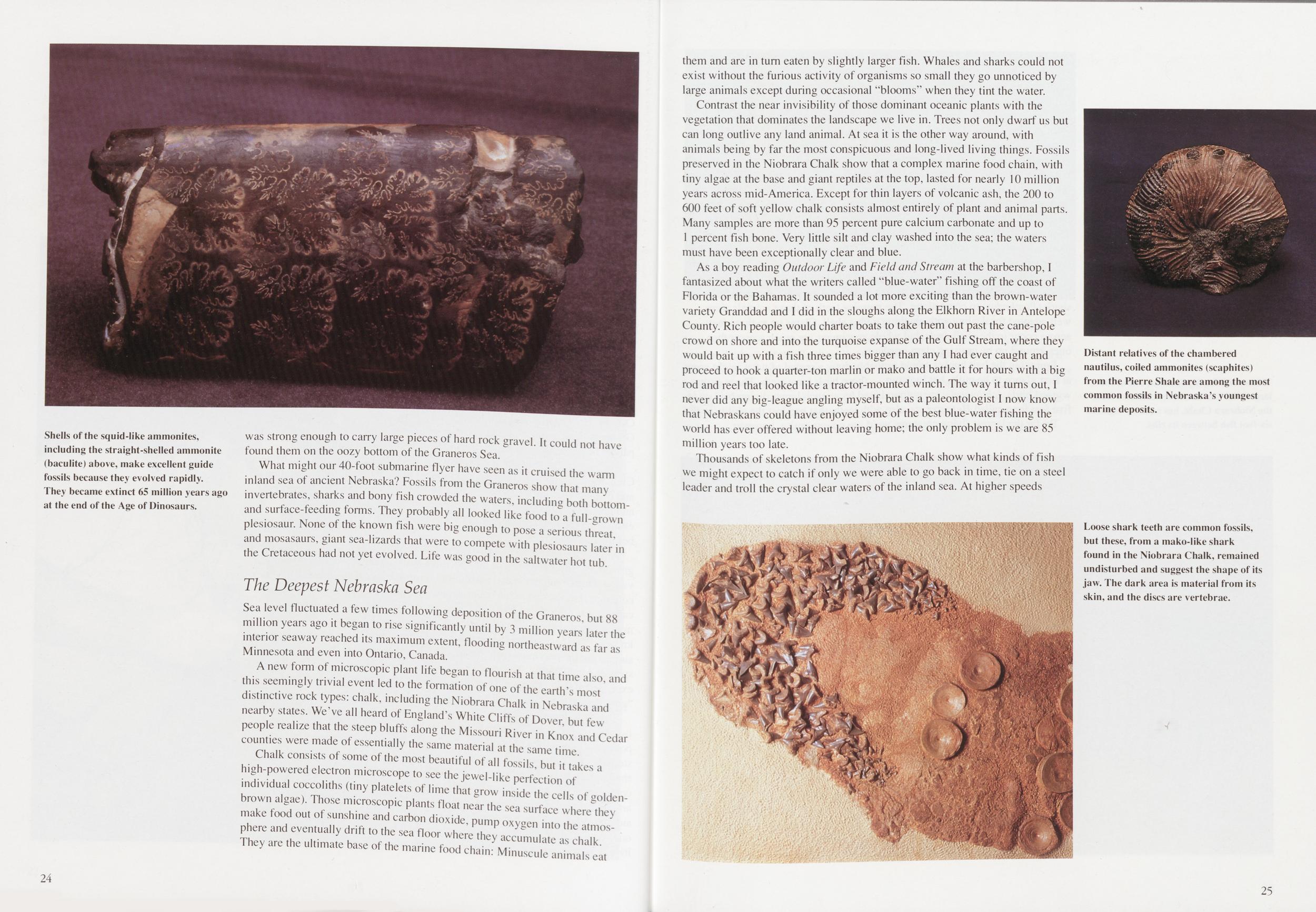
Shells of the squid-like ammonites, including the straight-shelled ammonite (baculite) above, make excellent guide fossils because they evolved rapidly. They became extinct 65 million years ago at the end of the Age of Dinosaurs.
was strong enough to carry large pieces of hard rock gravel. It could not have found them on the oozy bottom of the Graneros Sea.
What might our 40-foot submarine flyer have seen as it cruised the warm inland sea of ancient Nebraska? Fossils from the Graneros show that manv invertebrates, sharks and bony fish crowded the waters, including both bottom- and surface-feeding forms. They probably all looked like food to a full-grown ples.osaur. None of the known fish were big enough to pose a serious threat and mosasaurs giant sea-lizards that were to compete with plesiosaurs later in the Cretaceous had not yet evolved. Life was good in the saltwater hot tub
The Deepest Nebraska SeaSea level fluctuated a few times following deposition of the Graneros but 88 million years ago it began to rise significantly until by 3 million years' la! the mtenor seaway reached its maximum extent, flooding northeastward as far as Minnesota and even into Ontario, Canada
A new form of microscopic plant life began to flourish at that time also and this seemingly trivial event led to the formation of one of the earth's most distinctive rock types: chalk, including the Niobrara Chalk in Nebraska and nearby states. We've all heard of England's White Cliffs of Dover, but few people realize that the steep bluffs along the Missouri River in Knox and Cedar counties were made of essentially the same material at the same time.
Chalk consists of some of the most beautiful of all fossils but it takes a high-powered electron microscope to see the jewel-like perfection of individual coccoliths (tiny platelets of lime that grow inside the cells of golden- brown algae). Those microscopic plants float near the sea surface where they make food out of sunshine and carbon diodioxide, pump oxygen into the atmosphere and eventually drift to the sea floor where they accumulate as chalk. They are the ultimate base of the marine food chain: minuscule animals eat 24 them and are in turn eaten by slightly larger fish. Whales and sharks could not exist without the furious activity of organisms so small they go unnoticed by large animals except during occasional "blooms" when they tint the water.
Contrast the near invisibility of those dominant oceanic plants with the vegetation that dominates the landscape we live in. Trees not only dwarf us but can long outlive any land animal. At sea it is the other way around, with animals being by far the most conspicuous and long-lived living things. Fossils preserved in the Niobrara Chalk show that a complex marine food chain, with tiny algae at the base and giant reptiles at the top, lasted for nearly 10 million years across mid-America. Except for thin layers of volcanic ash, the 200 to 600 feet of soft yellow chalk consists almost entirely of plant and animal parts. Many samples are more than 95 percent pure calcium carbonate and up to 1 percent fish bone. Very little silt and clay washed into the sea; the waters must have been exceptionally clear and blue.
As a boy reading Outdoor Life and Field and Stream at the barbershop, I fantasized about what the writers called "blue-water" fishing off the coast of Florida or the Bahamas. It sounded a lot more exciting than the brown-water variety Granddad and I did in the sloughs along the Elkhorn River in Antelope County. Rich people would charter boats to take them out past the cane-pole crowd on shore and into the turquoise expanse of the Gulf Stream, where they would bait up with a fish three times bigger than any I had ever caught and proceed to hook a quarter-ton marlin or mako and battle it for hours with a big rod and reel that looked like a tractor-mounted winch. The way it turns out, I never did any big-league angling myself, but as a paleontologist I now know that Nebraskans could have enjoyed some of the best blue-water fishing the world has ever offered without leaving home; the only problem is we are 85 million years too late.
Thousands of skeletons from the Niobrara Chalk show what kinds offish we might expect to catch if only we were able to go back in time, tie on a steel leader and troll the crystal clear waters of the inland sea. At higher speeds
Distant relatives of the chambered nautilus, coiled ammonites (scaphites) from the Pierre Shale are among the most common fossils in Nebraska's youngest marine deposits.
Loose shark teeth are common fossils, but these, from a mako-like shark found in the Niobrara Chalk, remained undisturbed and suggest the shape of its jaw. The dark area is material from its skin, and the discs are vertebrae.
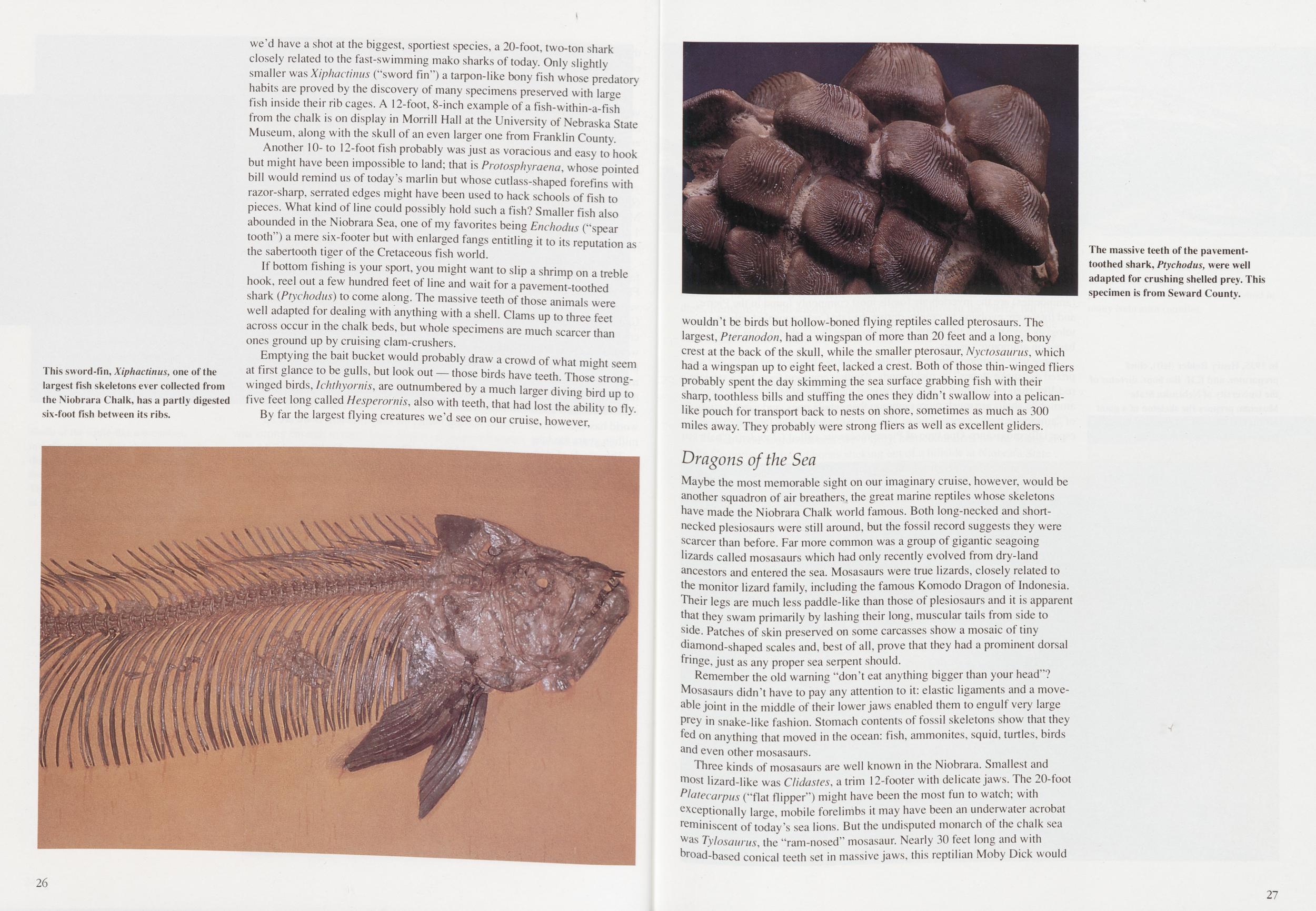
This sword-fin, Xiphactinus, one of the largest fish skeletons ever collected from the Niobrara Chalk, has a partly digested six-foot fish between its ribs.
we'd have a shot at the biggest, sportiest species, a 20-foot, two-ton shark closely related to the fast-swimming mako sharks of today. Only slightly smaller was Xiphactinus ("sword fin") a tarpon-like bony fish whose predatory habits are proved by the discovery of many specimens preserved with large fish inside their rib cages. A 12-foot, 8-inch example of a fish-within-a-fish from the chalk is on display in Morrill Hall at the University of Nebraska State Museum, along with the skull of an even larger one from Franklin County.
Another 10- to 12-foot fish probably was just as voracious and easy to hook but might have been impossible to land; that is Protosphyraena, whose pointed bill would remind us of today's marlin but whose cutlass-shaped forefins with razor-sharp, serrated edges might have been used to hack schools of fish to pieces. What kind of line could possibly hold such a fish? Smaller fish also abounded in the Niobrara Sea, one of my favorites being Enchodus ("spear tooth") a mere six-footer but with enlarged fangs entitling it to its reputation as the sabertooth tiger of the Cretaceous fish world.
If bottom fishing is your sport, you might want to slip a shrimp on a treble hook, reel out a few hundred feet of line and wait for a pavement-toothed shark (Ptychodus) to come along. The massive teeth of those animals were well adapted for dealing with anything with a shell. Clams up to three feet across occur in the chalk beds, but whole specimens are much scarcer than ones ground up by cruising clam-crushers.
Emptying the bait bucket would probably draw a crowd of what might seem at first glance to be gulls, but look out — those birds have teeth Those strong winged birds, Ichthyosis, are outnumbered by a much larger diving bird ud to five feet long called Hesperornis, also with teeth, that had lost the ability to fly.
By far the largest flying creatures we'd see on our cruise however 26 wouldn't be birds but hollow-boned flying reptiles called pterosaurs. The largest, Pteranodon, had a wingspan of more than 20 feet and a long, bony crest at the back of the skull, while the smaller pterosaur, Nyctosaurus, which had a wingspan up to eight feet, lacked a crest. Both of those thin-winged fliers probably spent the day skimming the sea surface grabbing fish with their sharp, toothless bills and stuffing the ones they didn't swallow into a pelican- Hke pouch for transport back to nests on shore, sometimes as much as 300 miles away. They probably were strong fliers as well as excellent gliders.
Dragons of the SeaMaybe the most memorable sight on our imaginary cruise, however, would be another squadron of air breathers, the great marine reptiles whose skeletons have made the Niobrara Chalk world famous. Both long-necked and short- necked plesiosaurs were still around, but the fossil record suggests they were scarcer than before. Far more common was a group of gigantic seagoing lizards called mosasaurs which had only recently evolved from dry-land ancestors and entered the sea. Mosasaurs were true lizards, closely related to the monitor lizard family, including the famous Komodo Dragon of Indonesia. Their legs are much less paddle-like than those of plesiosaurs and it is apparent that they swam primarily by lashing their long, muscular tails from side to side. Patches of skin preserved on some carcasses show a mosaic of tiny diamond-shaped scales and, best of all, prove that they had a prominent dorsal fringe, just as any proper sea serpent should.
Remember the old warning "don't eat anything bigger than your head"? Mosasaurs didn't have to pay any attention to it: elastic ligaments and a move- able joint in the middle of their lower jaws enabled them to engulf very large Prey in snake-like fashion. Stomach contents of fossil skeletons show that they fed on anything that moved in the ocean: fish, ammonites, squid, turtles, birds and even other mosasaurs.
Three kinds of mosasaurs are well known in the Niobrara. Smallest and most lizard-like was Clidastes, a trim 12-footer with delicate jaws. The 20-foot Platecarpus ("flat flipper") might have been the most fun to watch; with exceptionally large, mobile forelimbs it may have been an underwater acrobat reminiscent of today's sea lions. But the undisputed monarch of the chalk sea was Tylosaurus, the "ram-nosed" mosasaur. Nearly 30 feet long and with broad-based conical teeth set in massive jaws, this reptilian Moby Dick would
The massive teeth of the pavement- toothed shark, Ptychodus, were well adapted for crushing shelled prey. This specimen is from Seward County.
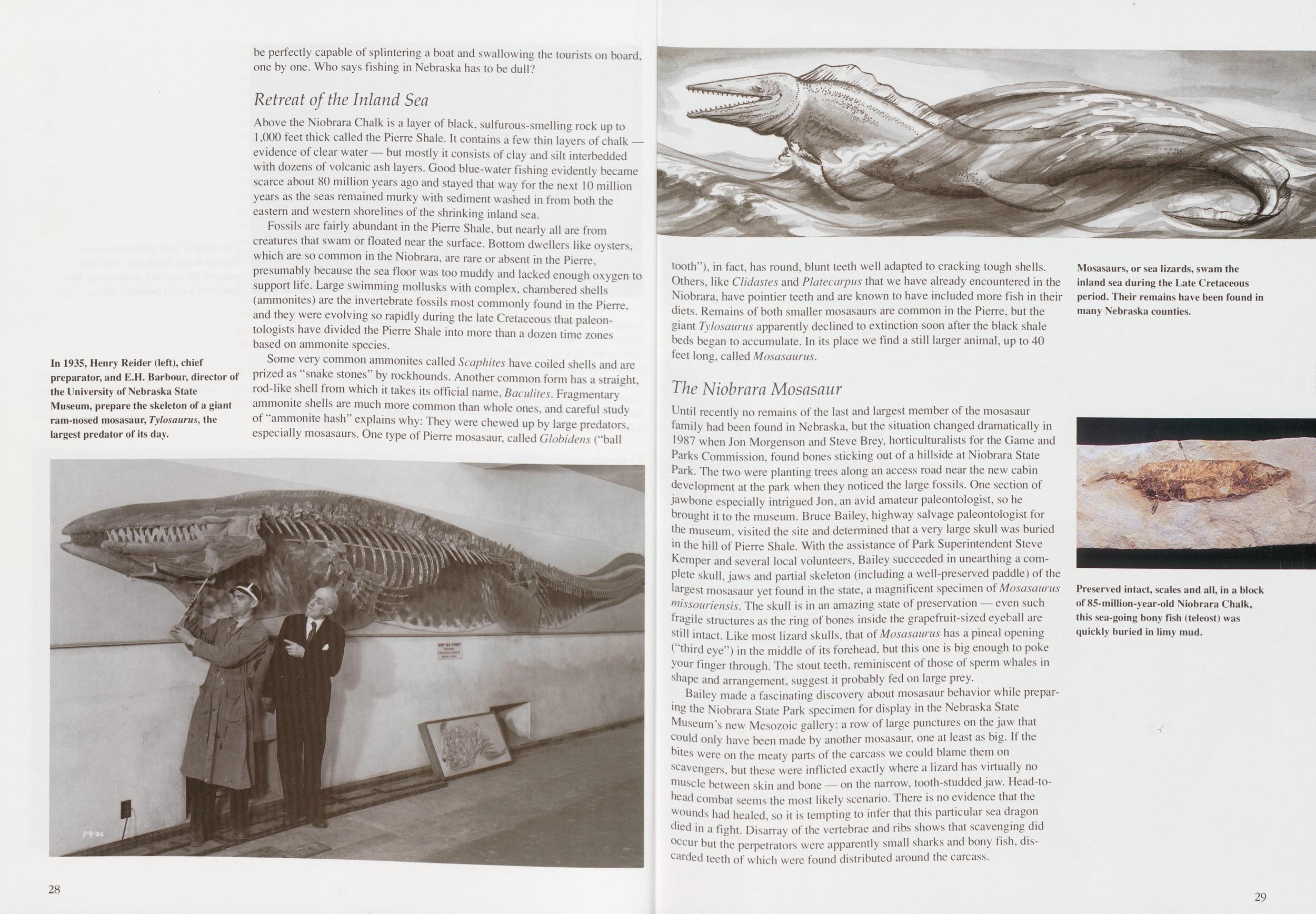
In 1935, Henry Reider (left), chief preparator, and E.H. Barbour, director of the University of Nebraska State Museum, prepare the skeleton of a giant ram-nosed mosasaur, Tylosaurus, the largest predator of its day.
be perfectly capable of splintering a boat and swallowing the tourists on board, one by one. Who says fishing in Nebraska has to be dull?
Retreat of the Inland SeaAbove the Niobrara Chalk is a layer of black, sulfurous-smelling rock up to 1,000 feet thick called the Pierre Shale. It contains a few thin layers of chalk — evidence of clear water — but mostly it consists of clay and silt interbedded with dozens of volcanic ash layers. Good blue-water fishing evidently became scarce about 80 million years ago and stayed that way for the next 10 million years as the seas remained murky with sediment washed in from both the eastern and western shorelines of the shrinking inland sea.
Fossils are fairly abundant in the Pierre Shale, but nearly all are from creatures that swam or floated near the surface. Bottom dwellers like oysters, which are so common in the Niobrara, are rare or absent in the Pierre, presumably because the sea floor was too muddy and lacked enough oxygen to support life. Large swimming mollusks with complex, chambered shells * (ammonites) are the invertebrate fossils most commonly found in the Pierre, and they were evolving so rapidly during the late Cretaceous that paleon- tologists have divided the Pierre Shale into more than a dozen time zones based on ammonite species.
Some very common ammonites called Scaphites have coiled shells and are prized as "snake stones" by rockhounds. Another common form has a straight rod-like shell from which it takes its official name, Baculites. Fragmentary ammonite shells are much more common than whole ones, and careful study of-ammonite hash" explains why: They were chewed up by larse predators especially mosasaurs. One type of Pierre mosasaur, called Globidens ("ball 28 tooth"), in fact, has round, blunt teeth well adapted to cracking tough shells. Others, like CUdastes and Platecarpus that we have already encountered in the Niobrara, have pointier teeth and are known to have included more fish in their diets. Remains of both smaller mosasaurs are common in the Pierre, but the giant Tylosaurus apparently declined to extinction soon after the black shale beds began to accumulate. In its place we find a still larger animal, up to 40 feet long, called Mosasaurus.
The Niobrara MosasaurUntil recently no remains of the last and largest member of the mosasaur family had been found in Nebraska, but the situation changed dramatically in 1987 when Jon Morgenson and Steve Brey, horticulturalists for the Game and Parks Commission, found bones sticking out of a hillside at Niobrara State Park. The two were planting trees along an access road near the new cabin development at the park when they noticed the large fossils. One section of jawbone especially intrigued Jon, an avid amateur paleontologist, so he brought it to the museum. Bruce Bailey, highway salvage paleontologist for the museum, visited the site and determined that a very large skull was buried in the hill of Pierre Shale. With the assistance of Park Superintendent Steve Kemper and several local volunteers, Bailey succeeded in unearthing a complete skull, jaws and partial skeleton (including a well-preserved paddle) of the largest mosasaur yet found in the state, a magnificent specimen of Mosasawus missouriensis. The skull is in an amazing state of preservation — even such fragile structures as the ring of bones inside the grapefruit-sized eyeball are still intact. Like most lizard skulls, that of Mosasawus has a pineal opening ("third eye") in the middle of its forehead, but this one is big enough to poke your finger through. The stout teeth, reminiscent of those of sperm whales in shape and arrangement, suggest it probably fed on large prey.
Bailey made a fascinating discovery about mosasaur behavior while preparing the Niobrara State Park specimen for display in the Nebraska State Museum's new Mesozoic gallery: a row of large punctures on the jaw that could only have been made by another mosasaur, one at least as big. If the bites were on the meaty parts of the carcass we could blame them on scavengers, but these were inflicted exactly where a lizard has virtually no muscle between skin and bone — on the narrow, tooth-studded jaw. Head-to- head combat seems the most likely scenario. There is no evidence that the wounds had healed, so it is tempting to infer that this particular sea dragon died in a fight. Disarray of the vertebrae and ribs shows that scavenging did occur but the perpetrators were apparently small sharks and bony fish, discarded teeth of which were found distributed around the carcass.
Mosasaurs, or sea lizards, swam the inland sea during the Late Cretaceous period. Their remains have been found in many Nebraska counties.
Preserved intact, scales and all, in a block of 85-million-vear-old Niobrara Chalk, this sea-going bony fish (teleost) was quickly buried in limy mud.
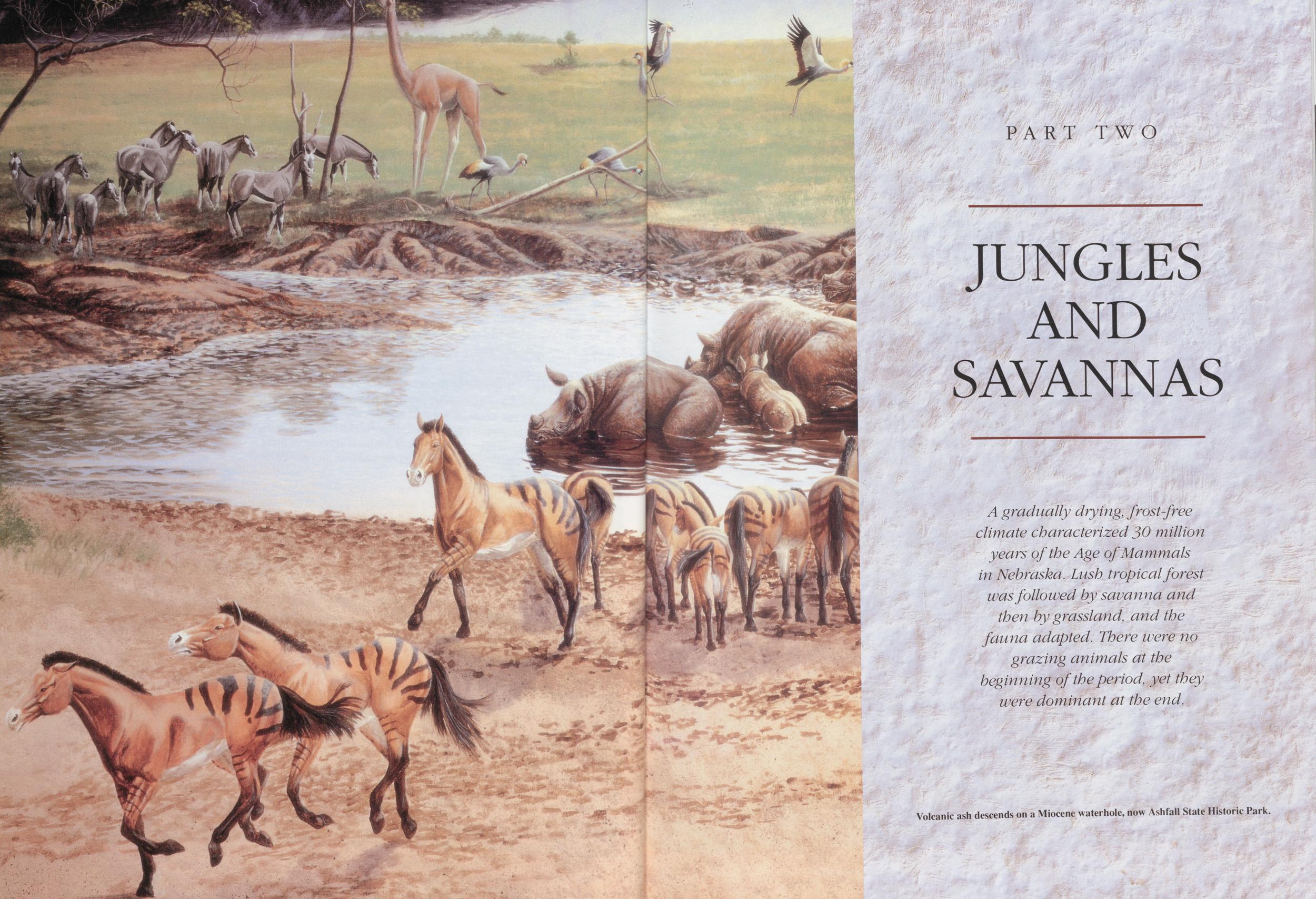
Volcanic ash descends on a Miocene waterhoie, now Ashfall State Historic Park.
PART TWO JUNGLES AND SAVANNAS
A gradually drying, frost-free climate characterized 30 million years of the Age of Mammals in Nebraska. Lush tropical forest was followed by savanna and then by grassland, and the fauna adapted. There were no grazing animals at the beginning of the period, yet they were dominant at the end.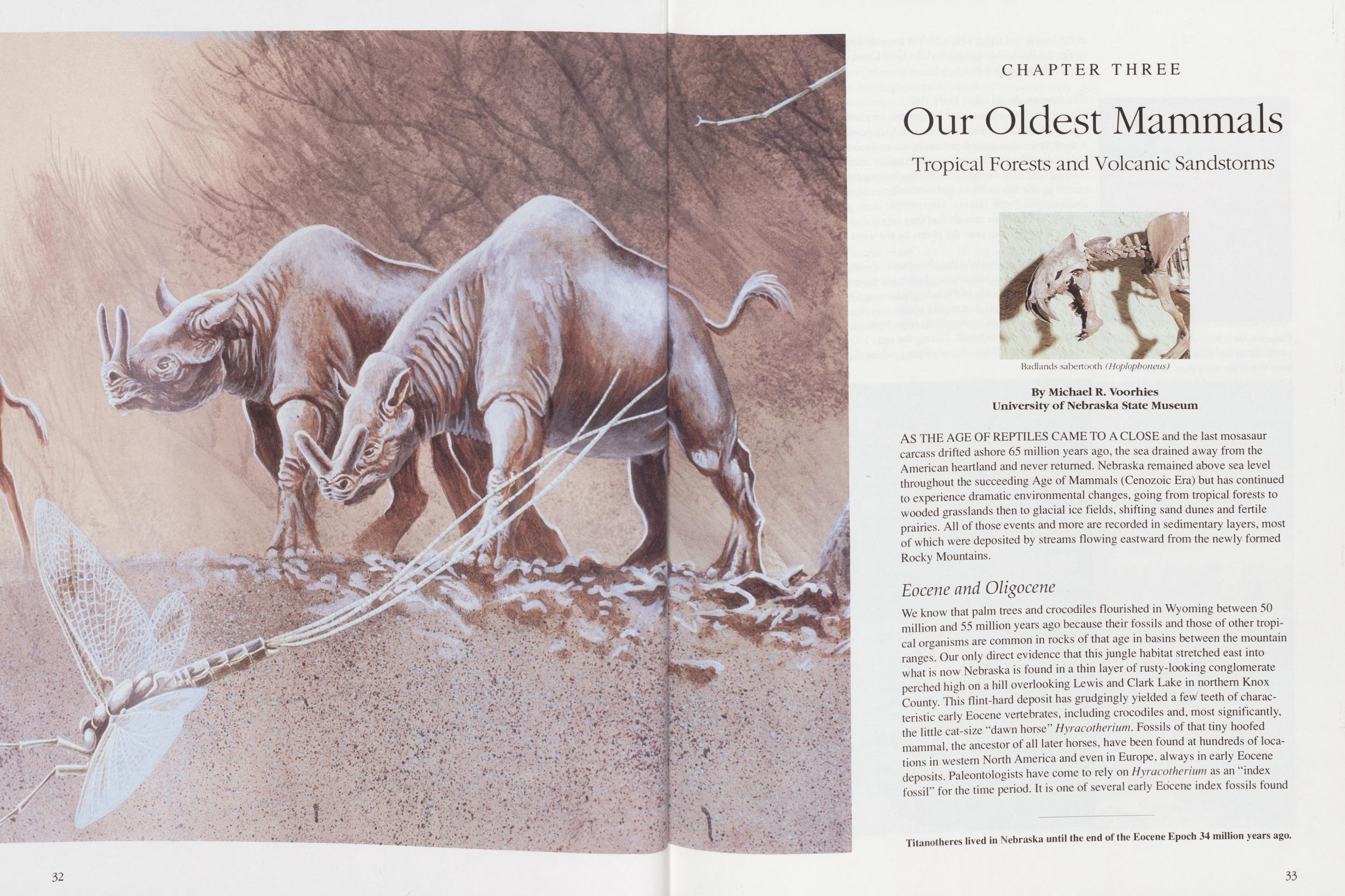
Titanotheres lived in Nebraska until the end of the Eocene Epoch 34 million years ago.
CHAPTER THREE Our Oldest Mammals
Tropical Forests and Volcanic Sandstorms
Badlands sabertooth (Hoplopboneus)
AS THE AGE OF REPTILES CAME TO A CLOSE and the last mosasaur carcass drifted ashore 65 million years ago, the sea drained away from the American heartland and never returned. Nebraska remained above sea level throughout the succeeding Age of Mammals (Cenozoic Era) but has continued to experience dramatic environmental changes, going from tropical forests to wooded grasslands then to glacial ice fields, shifting sand dunes and fertile prairies. All of those events and more are recorded in sedimentary layers, most of which were deposited by streams flowing eastward from the newly formed Rocky Mountains.
Eocene and OligoceneWe know that palm trees and crocodiles flourished in Wyoming between 50 million and 55 million years ago because their fossils and those of other tropical organisms are common in rocks of that age in basins between the mountain ranges. Our only direct evidence that this jungle habitat stretched east into what is now Nebraska is found in a thin layer of rusty-looking conglomerate perched high on a hill overlooking Lewis and Clark Lake in northern Knox County. This flint-hard deposit has grudgingly yielded a few teeth of characteristic early Eocene vertebrates, including crocodiles and, most significantly, the little cat-size "dawn horse" Hyracotherium. Fossils of that tiny hoofed mammal, the ancestor of all later horses, have been found at hundreds of locations in western North America and even in Europe, always in early Eocene deposits. Paleontologists have come to rely on Hyracotherium as an "index fossil" for the time period. It is one of several early Eocene index fossils found
33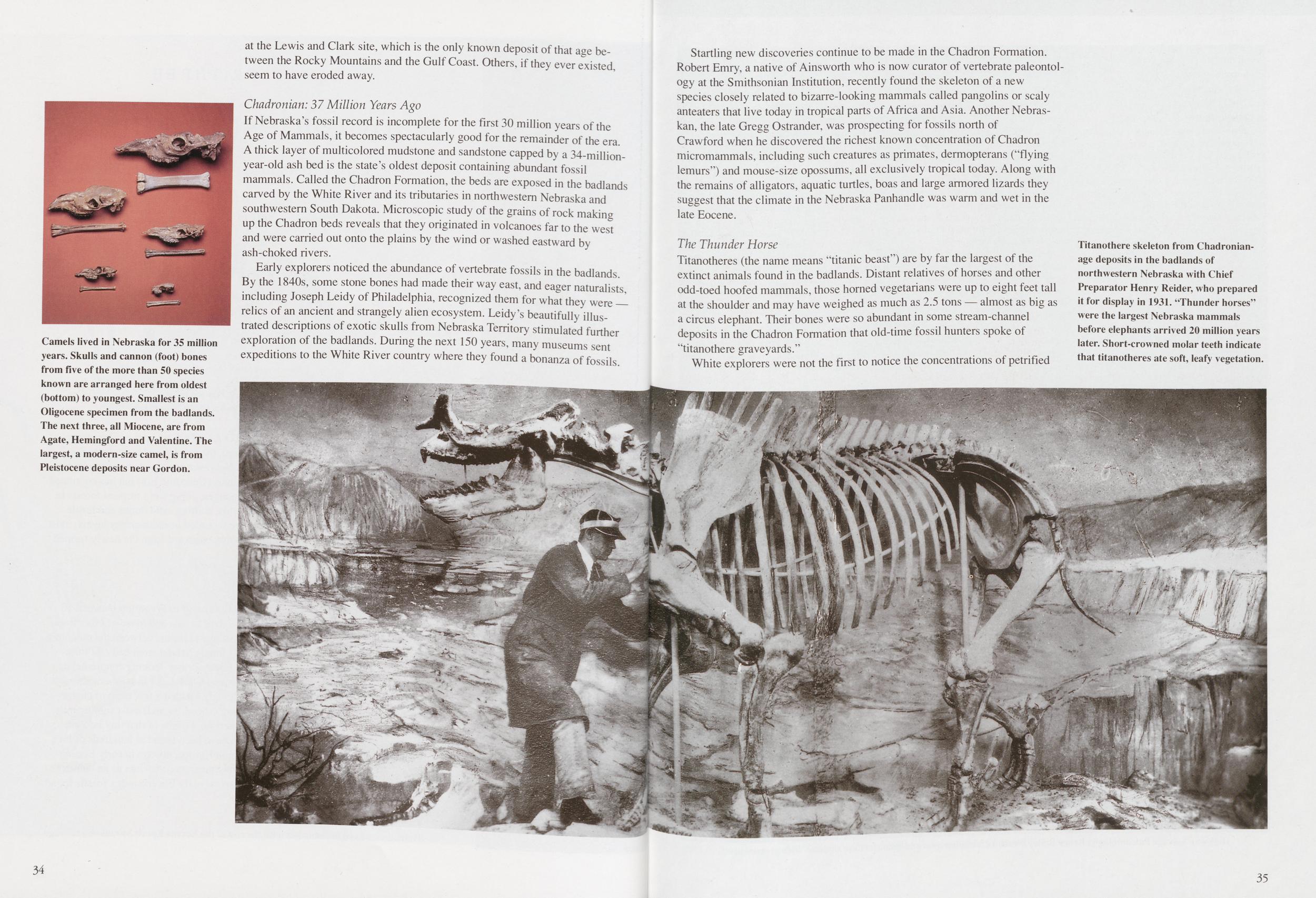
Camels lived in Nebraska for 35 million years. Skulls and cannon (foot) bones from five of the more than 50 species known are arranged here from oldest (bottom) to youngest. Smallest is an Oligocene specimen from the badlands. The next three, all Miocene, are from Agate, Hemingford and Valentine. The largest, a modern-size camel, is from Pleistocene deposits near Gordon.
at the Lewis and Clark site, which is the only known deposit of that age be- tween the Rocky Mountains and the Gulf Coast. Others, if they ever existed seem to have eroded away.
Chadronian: 37 Million Years AgoIf Nebraska's fossil record is incomplete for the first 30 million years of the Age of Mammals, it becomes spectacularly good for the remainder of the era A thick layer of multicolored mudstone and sandstone capped by a 34-million- year-old ash bed is the state's oldest deposit containing abundant fossil mammals. Called the Chadron Formation, the beds are exposed in the badlands carved by the White River and its tributaries in northwestern Nebraska and southwestern South Dakota. Microscopic study of the grains of rock making up the Chadron beds reveals that they originated in volcanoes far to the west and were carried out onto the plains by the wind or washed eastward by ash-choked rivers.
Early explorers noticed the abundance of vertebrate fossils in the badlands By the 1840s, some stone bones had made their way east, and eager naturalists including Joseph Leidy of Philadelphia, recognized them for what they were — relics of an ancient and strangely alien ecosystem. Leidy's beautifully illus- trated descriptions of exotic skulls from Nebraska Territory stimulated further exploration of the badlands. During the next 150 years, many museums sent expeditions to the White River country where they found a bonanza of fossils
34Startling new discoveries continue to be made in the Chadron Formation. Robert Emry, a native of Ainsworth who is now curator of vertebrate paleontology at the Smithsonian Institution, recently found the skeleton of a new species closely related to bizarre-looking mammals called pangolins or scaly anteaters that live today in tropical parts of Africa and Asia. Another Nebras- kan, the late Gregg Ostrander, was prospecting for fossils north of Crawford when he discovered the richest known concentration of Chadron micromammals, including such creatures as primates, dermopterans ("flying lemurs") and mouse-size opossums, all exclusively tropical today. Along with the remains of alligators, aquatic turtles, boas and large armored lizards they suggest that the climate in the Nebraska Panhandle was warm and wet in the late Eocene.
The Thunder HorseTitanotheres (the name means "titanic beast") are by far the largest of the extinct animals found in the badlands. Distant relatives of horses and other odd-toed hoofed mammals, those horned vegetarians were up to eight feet tall at the shoulder and may have weighed as much as 2.5 tons — almost as big as a circus elephant. Their bones were so abundant in some stream-channel deposits in the Chadron Formation that old-time fossil hunters spoke of "titanothere graveyards."
White explorers were not the first to notice the concentrations of petrified
Titanothere skeleton from Chadronian- age deposits in the badlands of northwestern Nebraska with Chief Preparator Henry Reider, who prepared it for display in 1931. "Thunder horses" were the largest Nebraska mammals before elephants arrived 20 million years later. Short-crowned molar teeth indicate that titanotheres ate soft, leafy vegetation.
ANCIENT CLIMATIC TRENDS
Fossils give us some of the most reliable clues about the severity of past climate changes and when they occurred. Because cold- blooded animals such as reptiles, amphibians and fish are especially sensitive to temperature fluctuations, their fossilized remains make excellent "paleo-thermometers."
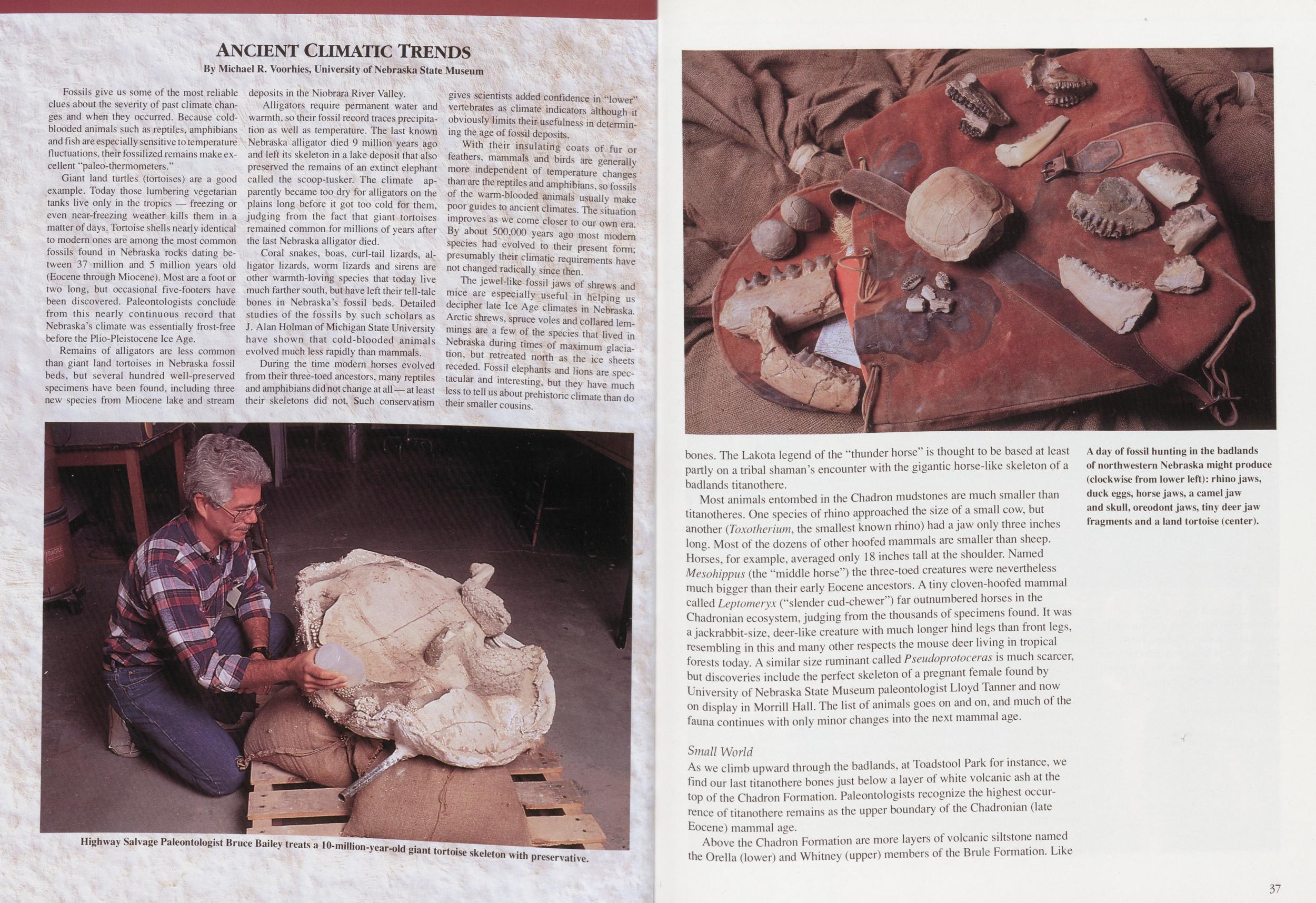
Giant land turtles (tortoises) are a good example. Today those lumbering vegetarian tanks live only in the tropics — freezing or even near-freezing weather kills them in a matter of days. Tortoise shells nearly identical to modern ones are among the most common fossils found in Nebraska rocks dating between 37 million and 5 million years old (Eocene through Miocene). Most are a foot or two long, but occasional five-footers have been discovered. Paleontologists conclude from this nearly continuous record that Nebraska's climate was essentially frost-free before the Plio-Pleistocene Ice Age.
Remains of alligators are less common than giant land tortoises in Nebraska fossil beds, but several hundred well-preserved specimens have been found, including three new species from Miocene lake and stream deposits in the Niobrara River Valley.
Alligators require permanent water and warmth, so their fossil record traces precipitation as well as temperature. The last known Nebraska alligator died 9 million years ago and left its skeleton in a lake deposit that also preserved the remains of an extinct elephant called the scoop-tusker. The climate apparently became too dry for alligators on the plains long before it got too cold for them, judging from the fact that giant tortoises remained common for millions of years after the last Nebraska alligator died.
Coral snakes, boas, curl-tail lizards, alligator lizards, worm lizards and sirens are other warmth-loving species that today live much farther south, but have left their tell-tale bones in Nebraska's fossil beds. Detailed studies of the fossils by such scholars as J. Alan Holman of Michigan State University have shown that cold-blooded animals evolved much less rapidly than mammals.
During the time modem horses evolved from their three-toed ancestors, many reptiles and amphibians did not change at all — at least their skeletons did not. Such conservatism gives scientists added confidence in "lower" vertebrates as climate indicators although it obviously limits their usefulness in determining the age of fossil deposits.
With their insulating coats of fur or feathers, mammals and birds are generally more independent of temperature changes than are the reptiles and amphibians, so fossils of the warm-blooded animals usually make poor guides to ancient climates. The situation improves as we come closer to our own era By about 500,000 years ago most modem species had evolved to their present form; presumably their climatic requirements have not changed radically since then.
The jewel-like fossil jaws of shrews and mice are especially useful in helping us decipher late Ice Age climates in Nebraska Arctic shrews, spruce voles and collared lem- mings are a few of the species that lived in Nebraska during times of maximum glacia- tion, but retreated north as the ice sheets receded. Fossil elephants and lions are spec- tacular and interesting, but they have much less to tell us about prehistoric climate than do their smaller cousins.
Highway Salvage Paleontologist Bruce Bailey treats a 10-million year-old giant tortoise skeleton with preservative.
bones. The Lakota legend of the "thunder horse" is thought to be based at least partly on a tribal shaman's encounter with the gigantic horse-like skeleton of a badlands titanothere.
Most animals entombed in the Chadron mudstones are much smaller than titanotheres. One species of rhino approached the size of a small cow, but another (Toxotherium, the smallest known rhino) had a jaw only three inches long. Most of the dozens of other hoofed mammals are smaller than sheep. Horses, for example, averaged only 18 inches tall at the shoulder. Named Mesohippus (the "middle horse") the three-toed creatures were nevertheless much bigger than their early Eocene ancestors. A tiny cloven-hoofed mammal called Leptomeryx ("slender cud-chewer") far outnumbered horses in the Chadronian ecosystem, judging from the thousands of specimens found. It was a jackrabbit-size, deer-like creature with much longer hind legs than front legs, resembling in this and many other respects the mouse deer living in tropical forests today. A similar size ruminant called Pseudoprotoceras is much scarcer, but discoveries include the perfect skeleton of a pregnant female found by University of Nebraska State Museum paleontologist Lloyd Tanner and now on display in Morrill Hall. The list of animals goes on and on, and much of the fauna continues with only minor changes into the next mammal age.
Small WorldAs we climb upward through the badlands, at Toadstool Park for instance, we find our last titanothere bones just below a layer of white volcanic ash at the top of the Chadron Formation. Paleontologists recognize the highest occur- rence of titanothere remains as the upper boundary of the Chadronian (late Eocene) mammal age.
Above the Chadron Formation are more layers of volcanic siltstone named the Orella (lower) and Whitney (upper) members of the Brule Formation. Like
A day of fossil hunting in the badlands of northwestern Nebraska might produce (clockwise from lower left): rhino jaws, duck eggs, horse jaws, a camel jaw and skull, oreodont jaws, tiny deer jaw fragments and a land tortoise (center).
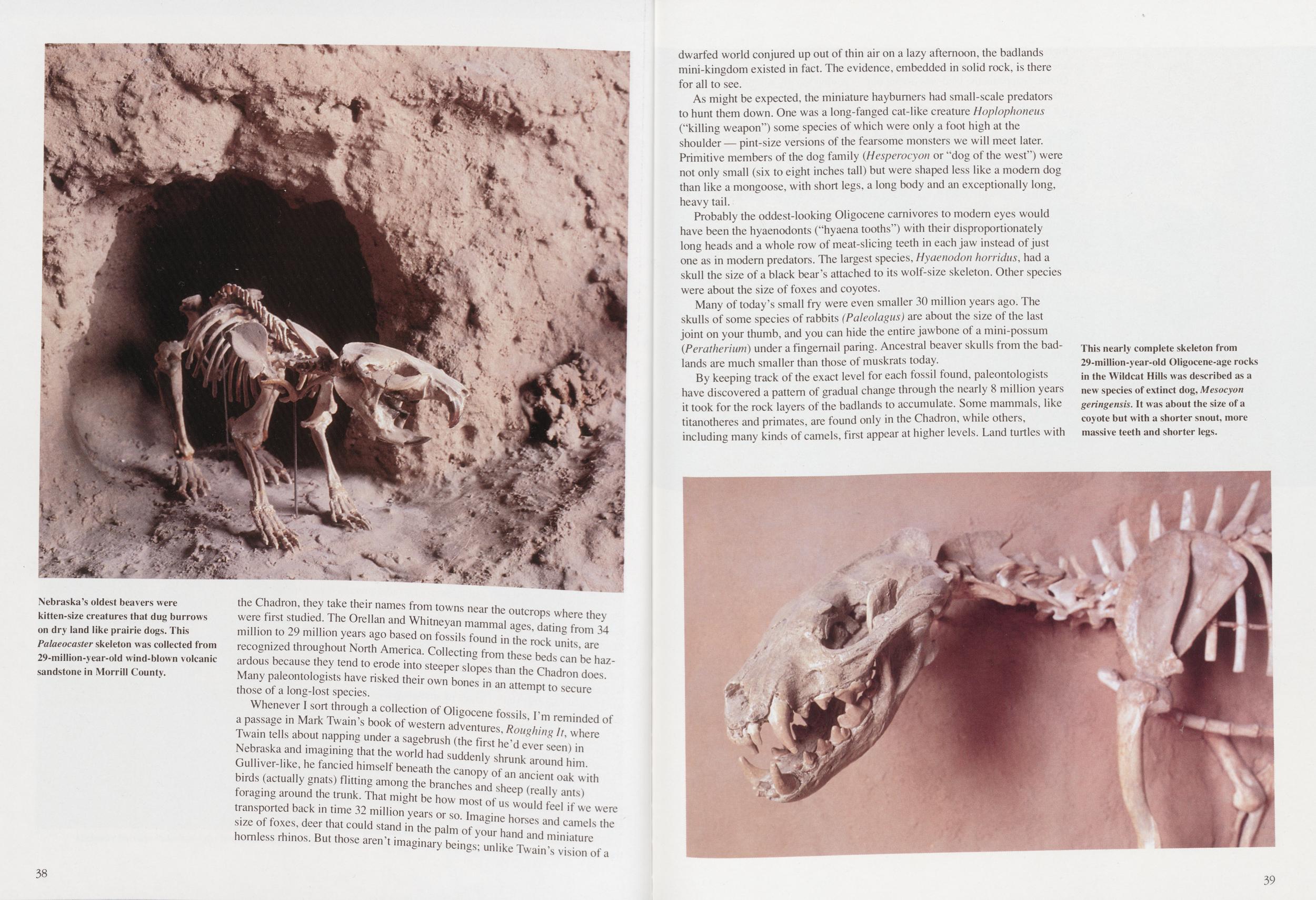
Nebraska's oldest beavers were kitten-size creatures that dug burrows on dry land like prairie dogs. This Palaeocaster skeleton was collected from 29-million-year-old wind-blown volcanic sandstone in Morrill County.
the Chadron, they take their names from towns near the outcrops where they were first studied. The Ore.lan and Whineyan mammal ages, dating from 34 million to 29 million years ago based on fosils found in the rock units, are recognized throughout North America. Collecting from these beds can be hazardous because they tend to erode into steeper slopes than the Chadron does. Many paleontologists have risked their own bones in an attempt to secure those of a long-lost species.
Whenever I sort through a collection of Oligocene fossils, I'm reminded of a passage in Mark Twain's book of western adventures, Roughing It, where Twain tells about napping under a sagebrush (the first he'd ever seen) in Nebraska and imagining that the worid had suddenly shrunk around him Gulliver-like, he fancied himself beneath the canopy of an ancient oak with birds (actually gnats) flitting among the branches and sheep (really ants) foraging around the trunk. That mightbe how most of us would feel if we were transported back in time 32 million years or so. Imagine horses and camels the size of foxes, deer that could stand in the palm of your hand and miniature hornless rhinos. But those aren't imaginary beings; unlike Twain's vision of a 38 dwarfed world conjured up out of thin air on a lazy afternoon, the badlands mini-kingdom existed in fact. The evidence, embedded in solid rock, is there for all to see.
As might be expected, the miniature haybumers had small-scale predators to hunt them down. One was a long-fanged cat-like creature Hoplophoneus ("killing weapon") some species of which were only a foot high at the shoulder — pint-size versions of the fearsome monsters we will meet later. Primitive members of the dog family (Hesperocyon or "dog of the west") were not only small (six to eight inches tall) but were shaped less like a modem dog than like a mongoose, with short legs, a long body and an exceptionally long, heavy tail.
Probably the oddest-looking Oligocene carnivores to modem eyes would have been the hyaenodonts ("hyaena tooths") with their disproportionately long heads and a whole row of meat-slicing teeth in each jaw instead of just one as in modern predators. The largest species, Hyaenodon horridus, had a skull the size of a black bear's attached to its wolf-size skeleton. Other species were about the size of foxes and coyotes.
Many of today's small fry were even smaller 30 million years ago. The skulls of some species of rabbits (Paleolagus) are about the size of the last joint on your thumb, and you can hide the entire jawbone of a mini-possum (Peratherium) under a fingernail paring. Ancestral beaver skulls from the bad- lands are much smaller than those of muskrats today.
By keeping track of the exact level for each fossil found, paleontologists have discovered a pattern of gradual change through the nearly 8 million years it took for the rock layers of the badlands to accumulate. Some mammals, like titanotheres and primates, are found only in the Chadron, while others, including many kinds of camels, first appear at higher levels. Land turtles with
This nearly complete skeleton from 29-million-year-old Oligocene-age rocks in the Wildcat Hills was described as a new species of extinct dog, Mesocyon geringensis. It was about the size of a coyote but with a shorter snout, more massive teeth and shorter legs.
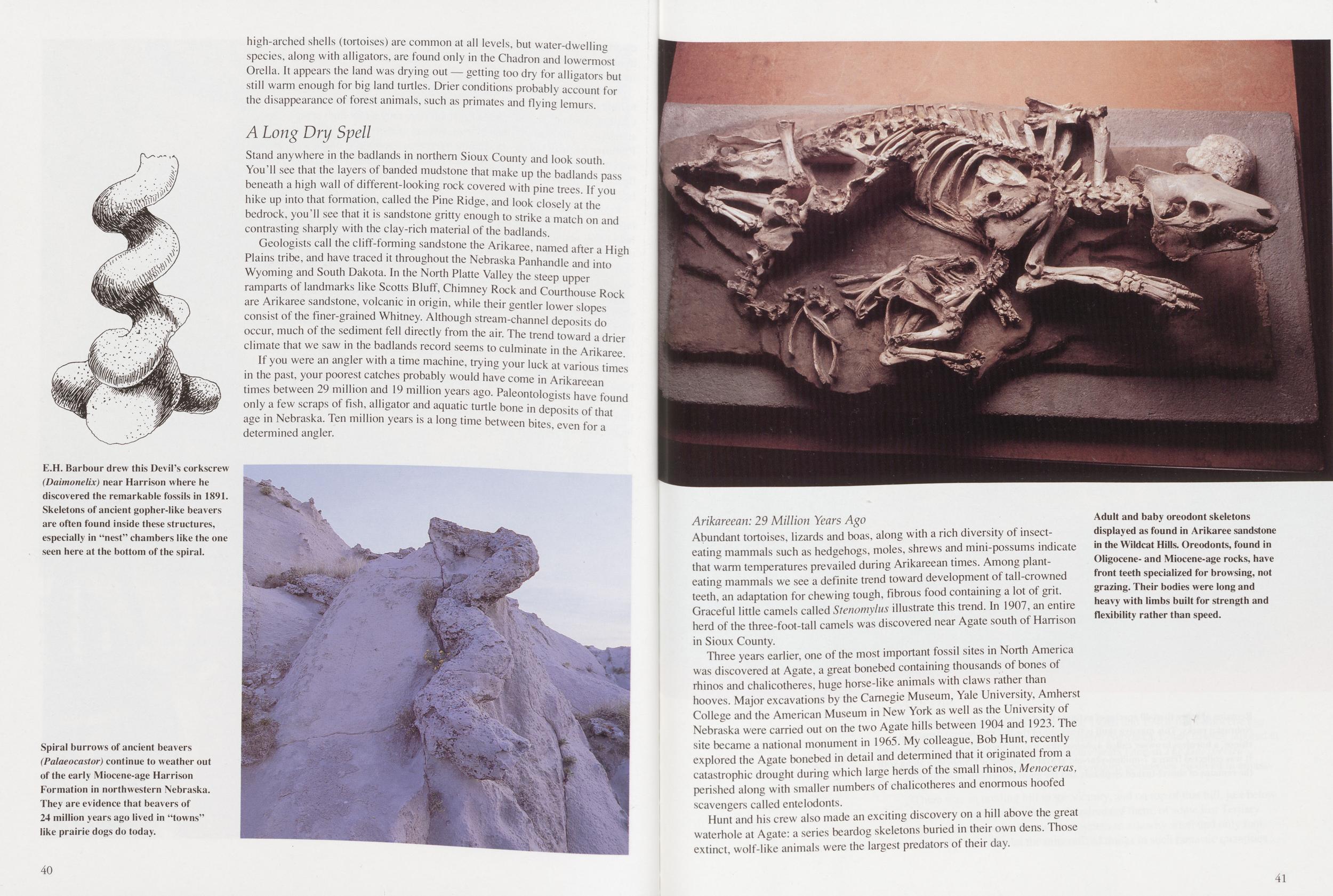
E.H. Barbour drew this Devil's corkscrew (Daimonelix) near Harrison where he discovered the remarkable fossils in 1891. Skeletons of ancient gopher-like beavers are often found inside these structures, especially in "nest" chambers like the one seen here at the bottom of the spiral.
Spiral burrows of ancient beavers (Palaeocastor) continue to weather out of the early Miocene-age Harrison Formation in northwestern Nebraska. They are evidence that beavers of 24 million years ago lived in "towns" like prairie dogs do today.
high-arched shells (tortoises) are common at all levels, but water-dwellin^ species, along with alligators, are found only in the Chadron and lowermost Orella. It appears the land was drying out — getting too dry for alligators but still warm enough for big land turtles. Drier conditions probably account for the disappearance of forest animals, such as primates and flying lemurs
A Long Dry Spell Stand anywhere in the badlands in northern Sioux County and look south You'll see that the layers of banded mudstone that make up the badlands pass beneath a high wall of different-looking rock covered with pine trees. If you hike up into that formation, called the Pine Ridge, and look closely at the bedrock, you'll see that it is sandstone gritty enough to strike a match on and contrasting sharply with the clay-rich material of the badlands. Geologists call the cliff-forming sandstone the Arikaree, named after a High Plains tribe, and have traced it throughout the Nebraska Panhandle and into Wyoming and South Dakota. In the North Platte Valley the steep upper ramparts of landmarks like Scotts Bluff, Chimney Rock and Courthouse Rock are Arikaree sandstone, volcanic in origin, while their gentler lower slopes consist of the finer-grained Whitney. Although stream-channel deposits do occur, much of the sediment fell directly from the air. The trend toward a drier climate that we saw in the badlands record seems to culminate in the Arikaree If you were an angler with a time machine, trying your luck at various times in the past, your poorest catches probably would have come in Arikareean times between 29 million and 19 million years ago. Paleontologists have found only a few scraps of fish, alligator and aquatic turtle bone in deposits of that age in Nebraska. Ten million years is a long time between bites, even for a determined angler. 40 Arikareean: 29 Million Years AgoAbundant tortoises, lizards and boas, along with a rich diversity of insect- eating mammals such as hedgehogs, moles, shrews and mini-possums indicate that warm temperatures prevailed during Arikareean times. Among plant- eating mammals we see a definite trend toward development of tall-crowned teeth, an adaptation for chewing tough, fibrous food containing a lot of grit. Graceful little camels called Stenomylus illustrate this trend. In 1907, an entire herd of the three-foot-tall camels was discovered near Agate south of Harrison in Sioux County.
Three years earlier, one of the most important fossil sites in North America was discovered at Agate, a great bonebed containing thousands of bones of rhinos and chalicotheres, huge horse-like animals with claws rather than hooves. Major excavations by the Carnegie Museum, Yale University, Amherst College and the American Museum in New York as well as the University of Nebraska were carried out on the two Agate hills between 1904 and 1923. The site became a national monument in 1965. My colleague, Bob Hunt, recently explored the Agate bonebed in detail and determined that it originated from a catastrophic drought during which large herds of the small rhinos, Menoceras. perished along with smaller numbers of chalicotheres and enormous hoofed scavengers called entelodonts.
Hunt and his crew also made an exciting discovery on a hill above the great waterhole at Agate: a series beardog skeletons buried in their own dens. Those extinct, wolf-like animals were the largest predators of their day.
Adult and baby oreodont skeletons displayed as found in Arikaree sandstone in the Wildcat Hills. Oreodonts, found in Oligocene- and Miocene-age rocks, have front teeth specialized for browsing, not grazing. Their bodies were long and heavy with limbs built for strength and flexibility rather than speed.
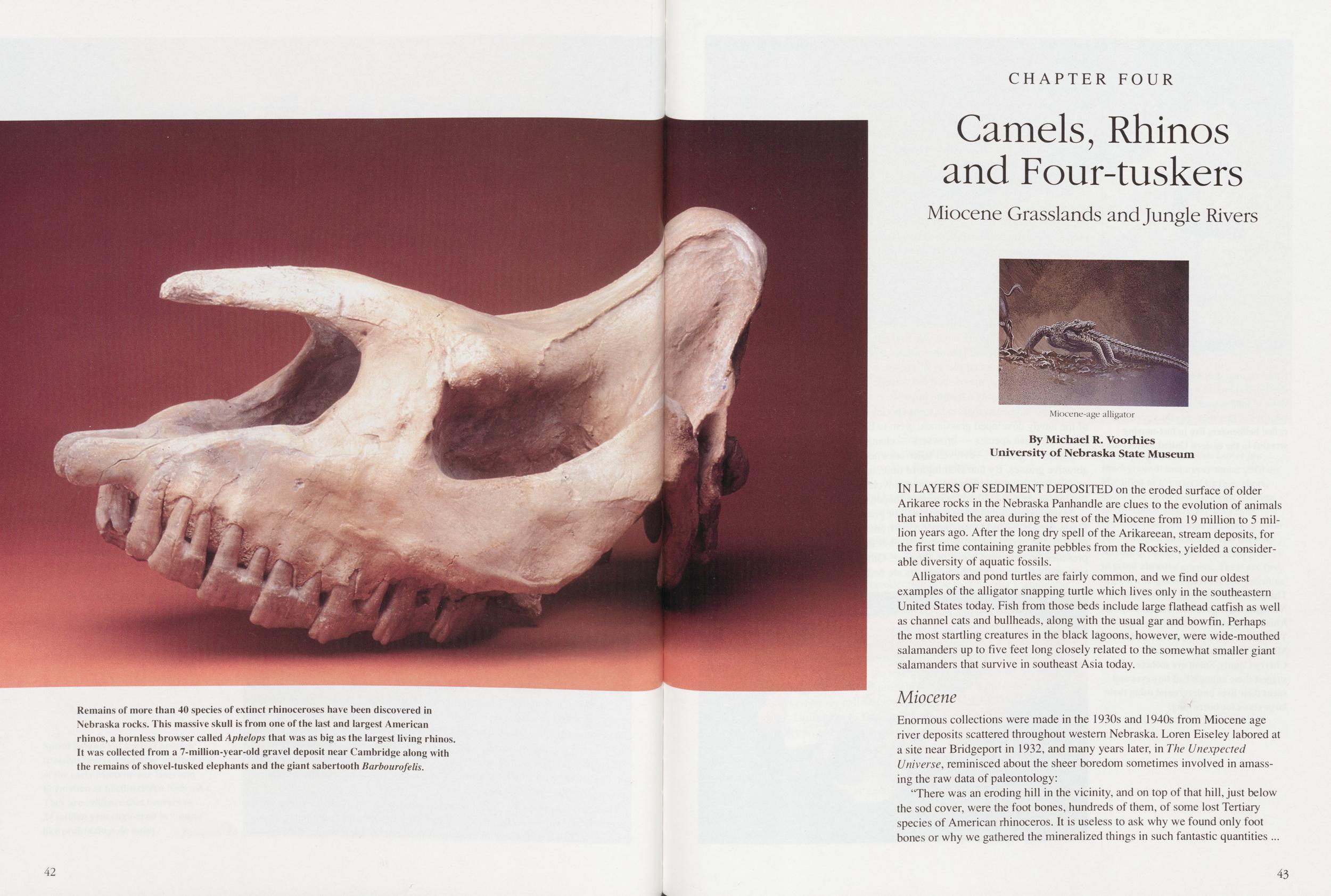
Remains of more than 40 species of extinct rhinoceroses have been discovered in Nebraska rocks. This massive skull is from one of the last and largest American rhinos, a hornless browser called Aphelops that was as big as the largest living rhinos. It was collected from a 7-million-year-old gravel deposit near Cambridge along with the remains of shovel-tusked elephants and the giant sabertooth Barbourofelis.
CHAPTER FOUR Camels. Rhinos and Four-tuskers
Miocene Grasslands and Jungle Rivers
Miocene-age alligator
IN LAYERS OF SEDIMENT DEPOSITED on the eroded surface of older Arikaree rocks in the Nebraska Panhandle are clues to the evolution of animals that inhabited the area during the rest of the Miocene from 19 million to 5 mil- lion years ago. After the long dry spell of the Arikareean, stream deposits, for the first time containing granite pebbles from the Rockies, yielded a consider- able diversity of aquatic fossils.
Alligators and pond turtles are fairly common, and we find our oldest examples of the alligator snapping turtle which lives only in the southeastern United States today. Fish from those beds include large flathead catfish as well as channel cats and bullheads, along with the usual gar and bowfin. Perhaps the most startling creatures in the black lagoons, however, were wide-mouthed salamanders up to five feet long closely related to the somewhat smaller giant salamanders that survive in southeast Asia today.
MioceneEnormous collections were made in the 1930s and 1940s from Miocene age river deposits scattered throughout western Nebraska. Loren Eiseley labored at a site near Bridgeport in 1932, and many years later, in The Unexpected Universe, reminisced about the sheer boredom sometimes involved in amass- ing the raw data of paleontology:
"There was an eroding hill in the vicinity, and on top of that hill, just below the sod cover, were the foot bones, hundreds of them, of some lost Tertiary species of American rhinoceros. It is useless to ask why we found only foot bones or why we gathered the mineralized things in such fantastic quantities ...
43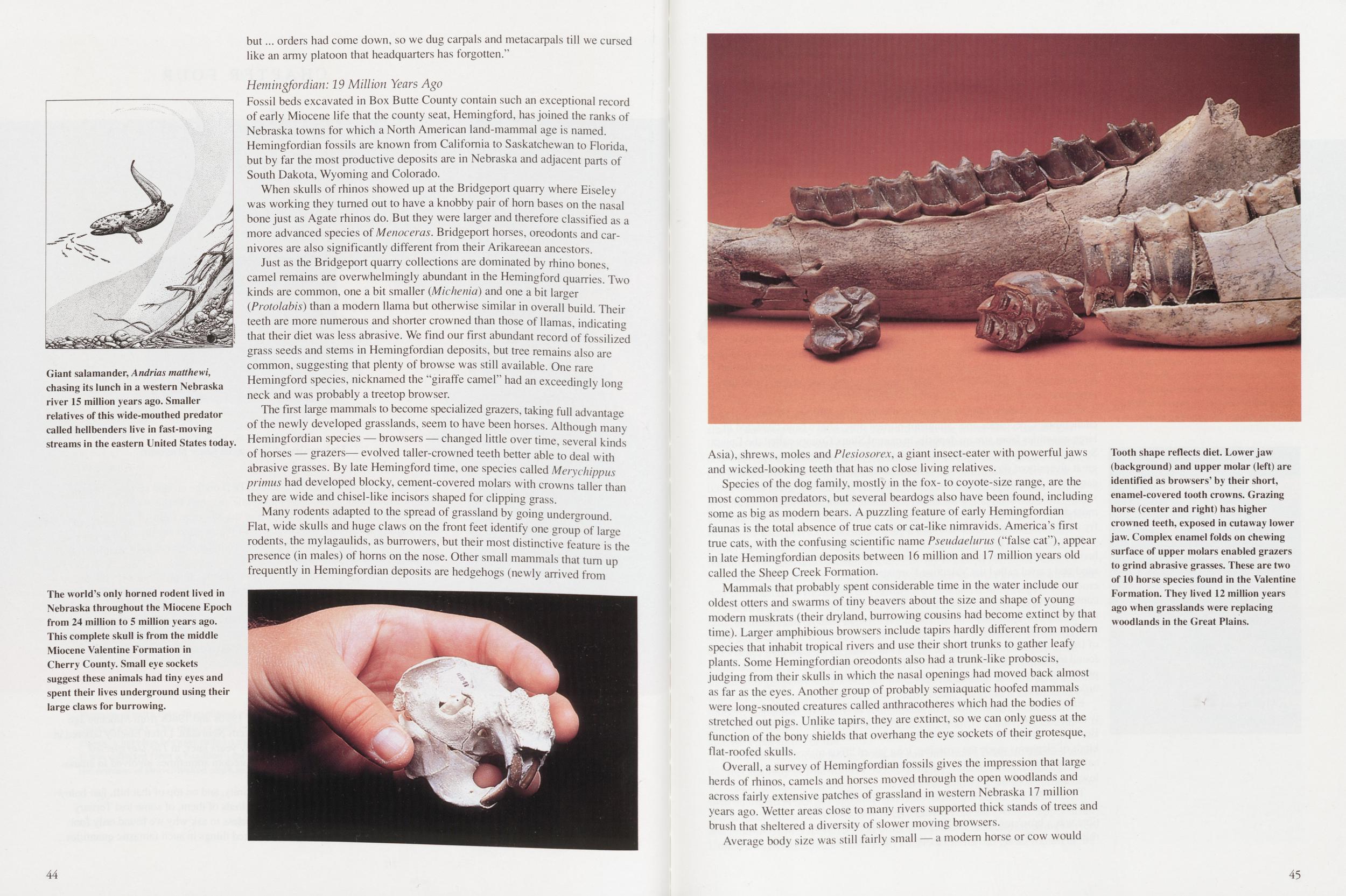
Giant salamander, Andrias matthewi, chasing its lunch in a western Nebraska river 15 million years ago. Smaller relatives of this wide-mouthed predator called hellbenders live in fast-moving streams in the eastern United States today.
The world's only horned rodent lived in Nebraska throughout the Miocene Epoch from 24 million to 5 million years ago. This complete skull is from the middle Miocene Valentine Formation in Cherry County. Small eye sockets suggest these animals had tiny eyes and spent their lives underground using their large claws for burrowing.
but... orders had come down, so we dug carpals and metacarpals till we cursed like an army platoon that headquarters has forgotten."
Hemingfordian: 19 Million Years AgoFossil beds excavated in Box Butte County contain such an exceptional record of early Miocene life that the county seat, Hemingford, has joined the ranks of Nebraska towns for which a North American land-mammal age is named. Hemingfordian fossils are known from California to Saskatchewan to Florida, but by far the most productive deposits are in Nebraska and adjacent parts of South Dakota, Wyoming and Colorado.
When skulls of rhinos showed up at the Bridgeport quarry where Eiseley was working they turned out to have a knobby pair of horn bases on the nasal bone just as Agate rhinos do. But they were larger and therefore classified as a more advanced species of Menoceras. Bridgeport horses, oreodonts and carnivores are also significantly different from their Arikareean ancestors.
Just as the Bridgeport quarry collections are dominated by rhino bones, camel remains are overwhelmingly abundant in the Hemingford quarries. Two kinds are common, one a bit smaller (Michenia) and one a bit larger (Protolabis) than a modern llama but otherwise similar in overall build. Their teeth are more numerous and shorter crowned than those of llamas, indicating that their diet was less abrasive. We find our first abundant record of fossilized grass seeds and stems in Hemingfordian deposits, but tree remains also are common, suggesting that plenty of browse was still available. One rare Hemingford species, nicknamed the "giraffe camel" had an exceedingly long neck and was probably a treetop browser.
The first large mammals to become specialized grazers, taking full advantage of the newly developed grasslands, seem to have been horses. Although many Hemingfordian species — browsers — changed little over time, several kinds of horses — grazers— evolved taller-crowned teeth better able to deal with abrasive grasses. By late Hemingford time, one species called Merychippus primus had developed blocky, cement-covered molars with crowns taller than they are wide and chisel-like incisors shaped for clipping grass.
Many rodents adapted to the spread of grassland by going underground Flat, wide skulls and huge claws on the front feet identify one group of large rodents, the mylagaulids, as burrowers, but their most distinctive feature is the presence (in males) of horns on the nose. Other small mammals that turn up frequently in Hemingfordian deposits are hedgehogs (newly arrived from 44 Asia), shrews, moles and Plesiosorex, a giant insect-eater with powerful jaws and wicked-looking teeth that has no close living relatives.
Species of the dog family, mostly in the fox- to coyote-size range, are the most common predators, but several beardogs also have been found, including some as big as modern bears. A puzzling feature of early Hemingfordian faunas is the total absence of true cats or cat-like nimravids. America's first true cats, with the confusing scientific name Pseudaelurus ("false cat"), appear in late Hemingfordian deposits between 16 million and 17 million years old called the Sheep Creek Formation.
Mammals that probably spent considerable time in the water include our oldest otters and swarms of tiny beavers about the size and shape of young modern muskrats (their dryland, burrowing cousins had become extinct by that time). Larger amphibious browsers include tapirs hardly different from modern species that inhabit tropical rivers and use their short trunks to gather leafy plants. Some Hemingfordian oreodonts also had a trunk-like proboscis, judging from their skulls in which the nasal openings had moved back almost as far as the eyes. Another group of probably semiaquatic hoofed mammals were long-snouted creatures called anthracotheres which had the bodies of stretched out pigs. Unlike tapirs, they are extinct, so we can only guess at the function of the bony shields that overhang the eye sockets of their grotesque, flat-roofed skulls.
Overall, a survey of Hemingfordian fossils gives the impression that large herds of rhinos, camels and horses moved through the open woodlands and across fairly extensive patches of grassland in western Nebraska 17 million years ago. Wetter areas close to many rivers supported thick stands of trees and brush that sheltered a diversity of slower moving browsers.
Average body size was still fairly small — a modern horse or cow would
Tooth shape reflects diet. Lower jaw (background) and upper molar (left) are identified as browsers' by their short, enamel-covered tooth crowns. Grazing horse (center and right) has higher crowned teeth, exposed in cutaway lower jaw. Complex enamel folds on chewing surface of upper molars enabled grazers to grind abrasive grasses. These are two of 10 horse species found in the Valentine Formation. They lived 12 million years ago when grasslands were replacing woodlands in the Great Plains.
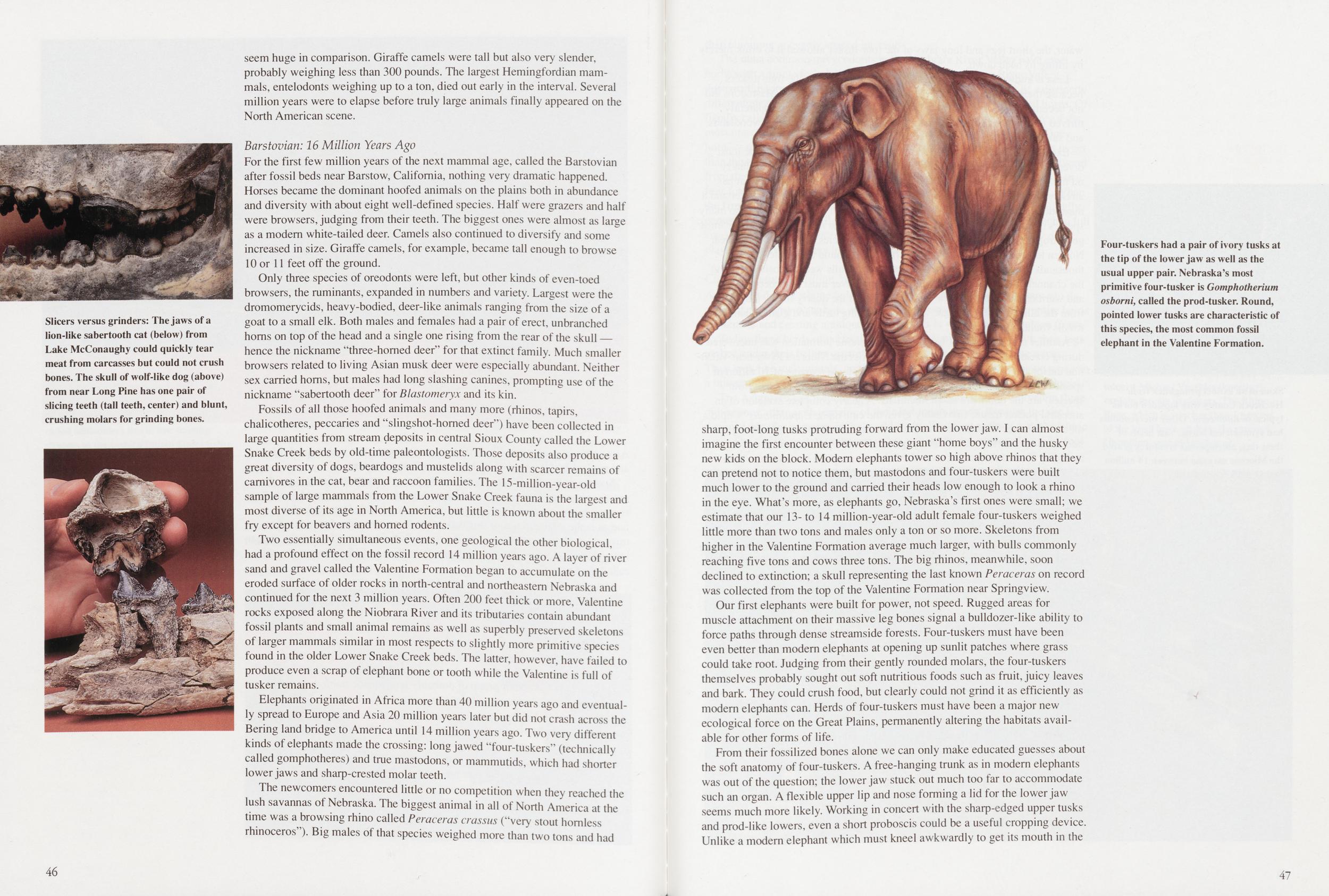
Slicers versus grinders: The jaws of a lion-like sabertooth cat (below) from Lake McConaughy could quickly tear meat from carcasses but could not crush bones. The skull of wolf-like dog (above) from near Long Pine has one pair of slicing teeth (tall teeth, center) and blunt, crushing molars for grinding bones.
seem huge in comparison. Giraffe camels were tall but also very slender, probably weighing less than 300 pounds. The largest Hemingfordian mam- mals, entelodonts weighing up to a ton, died out early in the interval. Several million years were to elapse before truly large animals finally appeared on the North American scene.
Barstovian: 16 Million Years Ago For the first few million years of the next mammal age, called the Barstovian after fossil beds near Barstow, California, nothing very dramatic happened. Horses became the dominant hoofed animals on the plains both in abundance and diversity with about eight well-defined species. Half were grazers and half were browsers, judging from their teeth. The biggest ones were almost as large as a modem white-tailed deer. Camels also continued to diversify and some increased in size. Giraffe camels, for example, became tall enough to browse 10 or 11 feet off the ground. Only three species of oreodonts were left, but other kinds of even-toed browsers, the ruminants, expanded in numbers and variety. Largest were the dromomerycids, heavy-bodied, deer-like animals ranging from the size of a goat to a small elk. Both males and females had a pair of erect, unbranched horns on top of the head and a single one rising from the rear of the skull__ hence the nickname "three-homed deer" for that extinct family. Much smaller browsers related to living Asian musk deer were especially abundant. Neither sex carried horns, but males had long slashing canines, prompting use of the nickname "sabertooth deer" for Blastomeryx and its kin. Fossils of all those hoofed animals and many more (rhinos, tapirs, chalicotheres, peccaries and "slingshot-homed deer") have been collected in large quantities from stream deposits in central Sioux County called the Lower Snake Creek beds by old-time paleontologists. Those deposits also produce a great diversity of dogs, beardogs and mustelids along with scarcer remains of carnivores in the cat, bear and raccoon families. The 15-million-year-old sample of large mammals from the Lower Snake Creek fauna is the lamest and most diverse of its age in North America, but little is known about the smaller fry except for beavers and homed rodents. Two essentially simultaneous events, one geological the other biological, had a profound effect on the fossil record 14 million years ago. A layer of river sand and gravel called the Valentine Formation began to accumulate on the eroded surface of older rocks in north-central and northeastern Nebraska and continued for the next 3 million years. Often 200 feet thick or more, Valentine rocks exposed along the Niobrara River and its tributaries contain abundant fossil plants and small animal remains as well as superbly preserved skeletons of larger mammals similar in most respects to slightly more primitive species found in the older Lower Snake Creek beds. The latter, however, have failed to produce even a scrap of elephant bone or tooth while the Valentine is full of tusker remains. Elephants originated in Africa more than 40 million years ago and eventually spread to Europe and Asia 20 million years later but did not crash across the Bering land bridge to America until 14 million years ago. Two very different kinds of elephants made the crossing: long jawed "four-tuskers" (technically called gomphotheres) and true mastodons, or mammutids, which had shorter lower jaws and sharp-crested molar teeth. The newcomers encountered little or no competition when they reached the lush savannas of Nebraska. The biggest animal in all of North America at the time was a browsing rhino called Peraceras crassus ("very stout hornless rhinoceros"). Big males of that species weighed more than two tons and had 46 sharp, foot-long tusks protruding forward from the lower jaw. I can almost imagine the first encounter between these giant "home boys" and the husky new kids on the block. Modem elephants tower so high above rhinos that they can pretend not to notice them, but mastodons and four-tuskers were built much lower to the ground and carried their heads low enough to look a rhino in the eye. What's more, as elephants go, Nebraska's first ones were small; we estimate that our 13- to 14 million-year-old adult female four-tuskers weighed little more than two tons and males only a ton or so more. Skeletons from higher in the Valentine Formation average much larger, with bulls commonly reaching five tons and cows three tons. The big rhinos, meanwhile, soon declined to extinction; a skull representing the last known Peraceras on record was collected from the top of the Valentine Formation near Springview. Our first elephants were built for power, not speed. Rugged areas for muscle attachment on their massive leg bones signal a bulldozer-like ability to force paths through dense streamside forests. Four-tuskers must have been even better than modern elephants at opening up sunlit patches where grass could take root. Judging from their gently rounded molars, the four-tuskers themselves probably sought out soft nutritious foods such as fruit, juicy leaves and bark. They could crush food, but clearly could not grind it as efficiently as modern elephants can. Herds of four-tuskers must have been a major new ecological force on the Great Plains, permanently altering the habitats avail- able for other forms of life. From their fossilized bones alone we can only make educated guesses about the soft anatomy of four-tuskers. A free-hanging trunk as in modern elephants was out of the question; the lower jaw stuck out much too far to accommodate such an organ. A flexible upper lip and nose forming a lid for the lower jaw seems much more likely. Working in concert with the sharp-edged upper tusks and prod-like lowers, even a short proboscis could be a useful cropping device. Unlike a modern elephant which must kneel awkwardly to get its mouth in theFour-tuskers had a pair of ivory tusks at the tip of the lower jaw as well as the usual upper pair. Nebraska's most primitive four-tusker is Gomphotherium osborniy called the prod-tusker. Round, pointed lower tusks are characteristic of this species, the most common fossil elephant in the Valentine Formation.
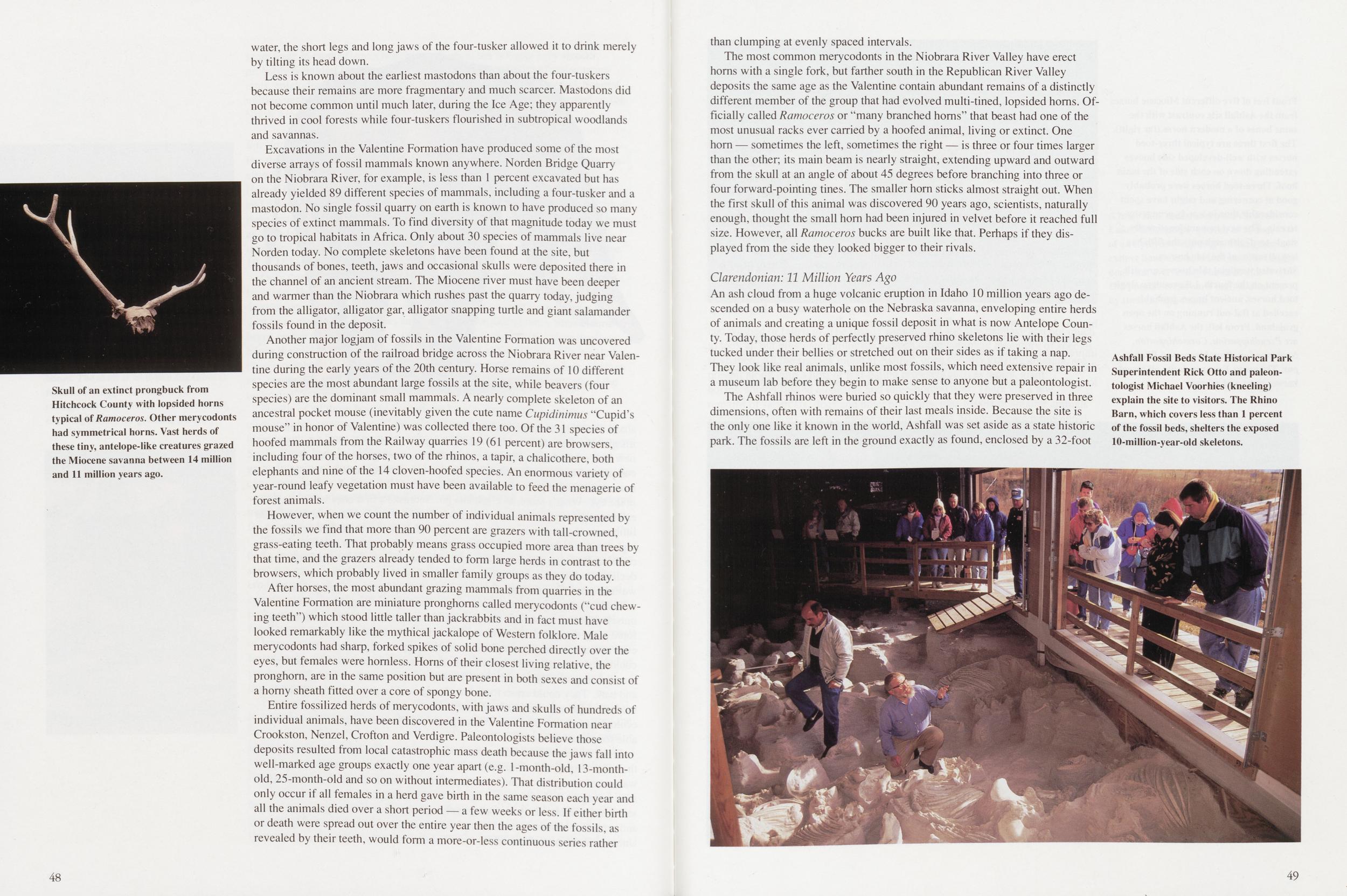
Skull of an extinct prongbuck from Hitchcock County with lopsided horns typical of Ramoceros. Other merycodonts had symmetrical horns. Vast herds of these tiny, antelope-like creatures grazed the Miocene savanna between 14 million and 11 million years ago.
water, the short legs and long jaws of the four-tusker allowed it to drink merely by tilting its head down.
Less is known about the earliest mastodons than about the four-tuskers because their remains are more fragmentary and much scarcer. Mastodons did not become common until much later, during the Ice Age; they apparently thrived in cool forests while four-tuskers flourished in subtropical woodlands and savannas.
Excavations in the Valentine Formation have produced some of the most diverse arrays of fossil mammals known anywhere. Norden Bridge Quarry on the Niobrara River, for example, is less than 1 percent excavated but has already yielded 89 different species of mammals, including a four-tusker and a mastodon. No single fossil quarry on earth is known to have produced so many species of extinct mammals. To find diversity of that magnitude today we must go to tropical habitats in Africa. Only about 30 species of mammals live near Norden today. No complete skeletons have been found at the site, but thousands of bones, teeth, jaws and occasional skulls were deposited there in the channel of an ancient stream. The Miocene river must have been deeper and warmer than the Niobrara which rushes past the quarry today, judging from the alligator, alligator gar, alligator snapping turtle and giant salamander fossils found in the deposit.
Another major logjam of fossils in the Valentine Formation was uncovered during construction of the railroad bridge across the Niobrara River near Valentine during the early years of the 20th century. Horse remains of 10 different species are the most abundant large fossils at the site, while beavers (four species) are the dominant small mammals. A nearly complete skeleton of an ancestral pocket mouse (inevitably given the cute name Cupidinimus "Cupid's mouse" in honor of Valentine) was collected there too. Of the 31 species of hoofed mammals from the Railway quarries 19 (61 percent) are browsers, including four of the horses, two of the rhinos, a tapir, a chalicothere, both elephants and nine of the 14 cloven-hoofed species. An enormous variety of year-round leafy vegetation must have been available to feed the menagerie of forest animals.
However, when we count the number of individual animals represented by the fossils we find that more than 90 percent are grazers with tall-crowned, grass-eating teeth. That probably means grass occupied more area than trees by that time, and the grazers already tended to form large herds in contrast to the browsers, which probably lived in smaller family groups as they do today.
After horses, the most abundant grazing mammals from quarries in the Valentine Formation are miniature pronghorns called merycodonts ("cud chew- ing teeth") which stood little taller than jackrabbits and in fact must have looked remarkably like the mythical jackalope of Western folklore. Male merycodonts had sharp, forked spikes of solid bone perched directly over the eyes, but females were hornless. Horns of their closest living relative, the pronghorn, are in the same position but are present in both sexes and consist of a horny sheath fitted over a core of spongy bone.
Entire fossilized herds of merycodonts, with jaws and skulls of hundreds of individual animals, have been discovered in the Valentine Formation near Crookston, Nenzel, Crofton and Verdigre. Paleontologists believe those deposits resulted from local catastrophic mass death because the jaws fall into well-marked age groups exactly one year apart (e.g. 1-month-old, 13-month- old, 25-month-old and so on without intermediates). That distribution could only occur if all females in a herd gave birth in the same season each year and all the animals died over a short period — a few weeks or less. If either birth or death were spread out over the entire year then the ages of the fossils, as revealed by their teeth, would form a more-or-less continuous series rather 48 than clumping at evenly spaced intervals.
The most common merycodonts in the Niobrara River Valley have erect horns with a single fork, but farther south in the Republican River Valley deposits the same age as the Valentine contain abundant remains of a distinctly different member of the group that had evolved multi-tined, lopsided horns. Of- ficially called Ramoceros or "many branched horns" that beast had one of the most unusual racks ever carried by a hoofed animal, living or extinct. One horn — sometimes the left, sometimes the right — is three or four times larger than the other; its main beam is nearly straight, extending upward and outward from the skull at an angle of about 45 degrees before branching into three or four forward-pointing tines. The smaller horn sticks almost straight out. When the first skull of this animal was discovered 90 years ago, scientists, naturally enough, thought the small horn had been injured in velvet before it reached full size. However, all Ramoceros bucks are built like that. Perhaps if they dis- played from the side they looked bigger to their rivals.
Clarendonian: 11 Million Years AgoAn ash cloud from a huge volcanic eruption in Idaho 10 million years ago de- scended on a busy waterhole on the Nebraska savanna, enveloping entire herds of animals and creating a unique fossil deposit in what is now Antelope Coun- ty. Today, those herds of perfectly preserved rhino skeletons lie with their legs tucked under their bellies or stretched out on their sides as if taking a nap. They look like real animals, unlike most fossils, which need extensive repair in a museum lab before they begin to make sense to anyone but a paleontologist.
The Ashfall rhinos were buried so quickly that they were preserved in three dimensions, often with remains of their last meals inside. Because the site is the only one like it known in the world, Ashfall was set aside as a state historic park. The fossils are left in the ground exactly as found, enclosed by a 32-foot
Ashfall Fossil Beds State Historical Park Superintendent Rick Otto and paleon- tologist Michael Voorhies (kneeling) explain the site to visitors. The Rhino Barn, which covers less than 1 percent of the fossil beds, shelters the exposed 10-million-year-old skeletons.
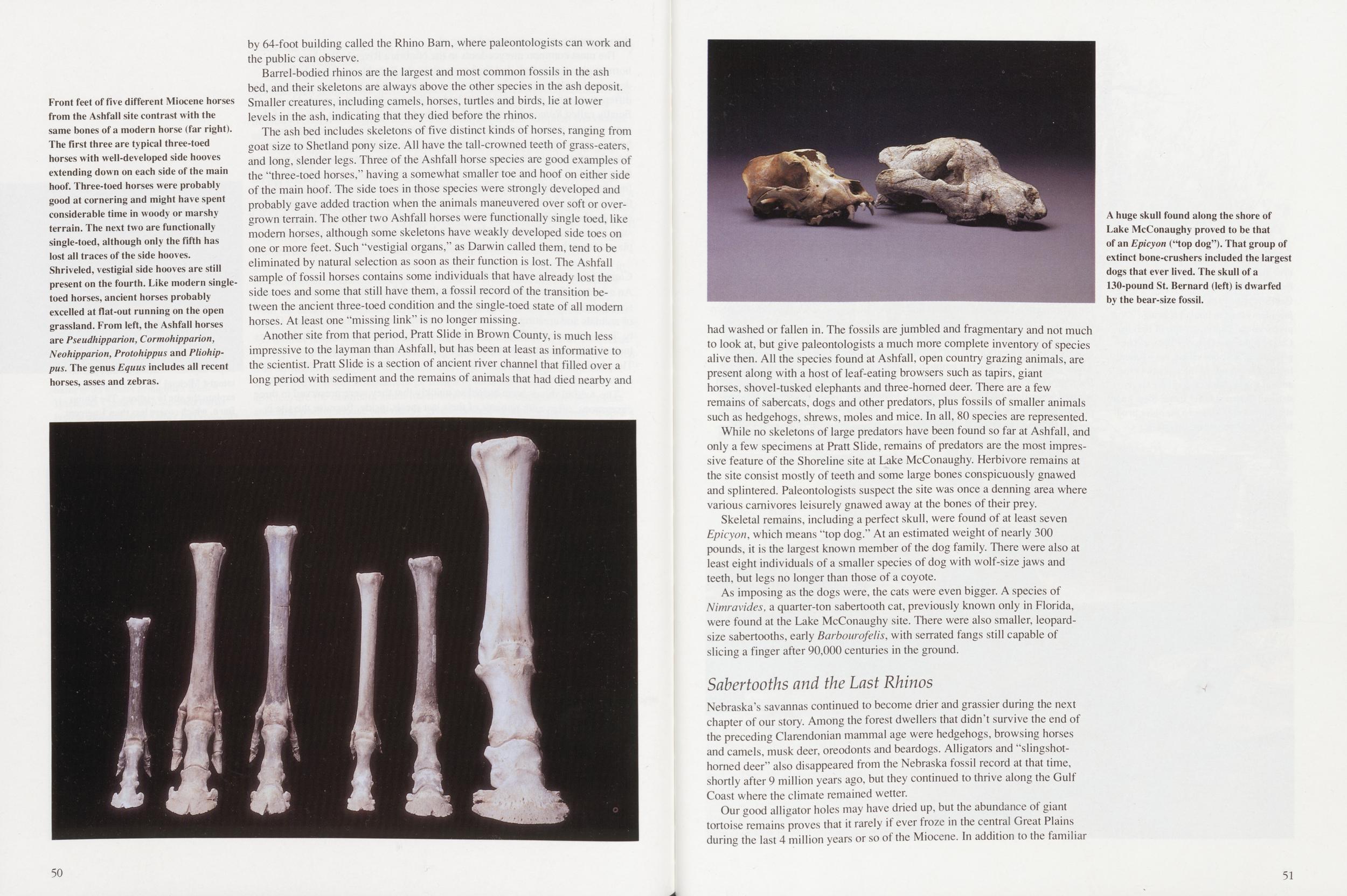
Front feet of five different Miocene horses from the Ashfall site contrast with the same bones of a modern horse (far right). The first three are typical three-toed horses with well-developed side hooves extending down on each side of the main hoof. Three-toed horses were probably good at cornering and might have spent considerable time in woody or marshy terrain. The next two are functionally single-toed, although only the fifth has lost all traces of the side hooves. Shriveled, vestigial side hooves are still present on the fourth. Like modern single- toed horses, ancient horses probably excelled at flat-out running on the open grassland. From left, the Ashfall horses are Pseudhipparion, Cormohipparion, Neohipparion, Protohippus and Pliohip- pus. The genus Equus includes all recent horses, asses and zebras.
by 64-foot building called the Rhino Bam, where paleontologists can work and the public can observe.
Barrel-bodied rhinos are the largest and most common fossils in the ash bed, and their skeletons are always above the other species in the ash deposit. Smaller creatures, including camels, horses, turtles and birds, lie at lower levels in the ash, indicating that they died before the rhinos.
The ash bed includes skeletons of five distinct kinds of horses, ranging from goat size to Shetland pony size. All have the tall-crowned teeth of grass-eaters, and long, slender legs. Three of the Ashfall horse species are good examples of the "three-toed horses," having a somewhat smaller toe and hoof on either side of the main hoof. The side toes in those species were strongly developed and probably gave added traction when the animals maneuvered over soft or over- grown terrain. The other two Ashfall horses were functionally single toed, like modem horses, although some skeletons have weakly developed side toes on one or more feet. Such "vestigial organs," as Darwin called them, tend to be eliminated by natural selection as soon as their function is lost. The Ashfall sample of fossil horses contains some individuals that have already lost the side toes and some that still have them, a fossil record of the transition be- tween the ancient three-toed condition and the single-toed state of all modem horses. At least one "missing link" is no longer missing.
Another site from that period, Pratt Slide in Brown County, is much less impressive to the layman than Ashfall, but has been at least as informative to the scientist. Pratt Slide is a section of ancient river channel that filled over a long period with sediment and the remains of animals that had died nearby and 50 had washed or fallen in. The fossils are jumbled and fragmentary and not much to look at, but give paleontologists a much more complete inventory of species alive then. All the species found at Ashfall, open country grazing animals, are present along with a host of leaf-eating browsers such as tapirs, giant horses, shovel-tusked elephants and three-homed deer. There are a few remains of sabercats, dogs and other predators, plus fossils of smaller animals such as hedgehogs, shrews, moles and mice. In all, 80 species are represented.
While no skeletons of large predators have been found so far at Ashfall, and only a few specimens at Pratt Slide, remains of predators are the most impres- sive feature of the Shoreline site at Lake McConaughy. Herbivore remains at the site consist mostly of teeth and some large bones conspicuously gnawed and splintered. Paleontologists suspect the site was once a denning area where various carnivores leisurely gnawed away at the bones of their prey.
Skeletal remains, including a perfect skull, were found of at least seven Epicyon, which means "top dog." At an estimated weight of nearly 300 pounds, it is the largest known member of the dog family. There were also at least eight individuals of a smaller species of dog with wolf-size jaws and teeth, but legs no longer than those of a coyote.
As imposing as the dogs were, the cats were even bigger. A species of Nimravides, a quarter-ton sabertooth cat, previously known only in Florida, were found at the Lake McConaughy site. There were also smaller, leopard- size sabertooths, early Barbourofelis, with serrated fangs still capable of slicing a finger after 90,000 centuries in the ground.
Sabertooths and the Last RhinosNebraska's savannas continued to become drier and grassier during the next chapter of our story. Among the forest dwellers that didn't survive the end of the preceding Clarendonian mammal age were hedgehogs, browsing horses and camels, musk deer, oreodonts and beardogs. Alligators and "slingshot- horned deer" also disappeared from the Nebraska fossil record at that time, shortly after 9 million years ago, but they continued to thrive along the Gulf Coast where the climate remained wetter.
Our good alligator holes may have dried up, but the abundance of giant tortoise remains proves that it rarely if ever froze in the central Great Plains during the last 4 million years or so of the Miocene. In addition to the familiar
A huge skull found along the shore of Lake McConaughy proved to be that of an Epicyon ("top dog"). That group of extinct bone-crushers included the largest dogs that ever lived. The skull of a 130-pound St. Bernard (left) is dwarfed by the bear-size fossil.
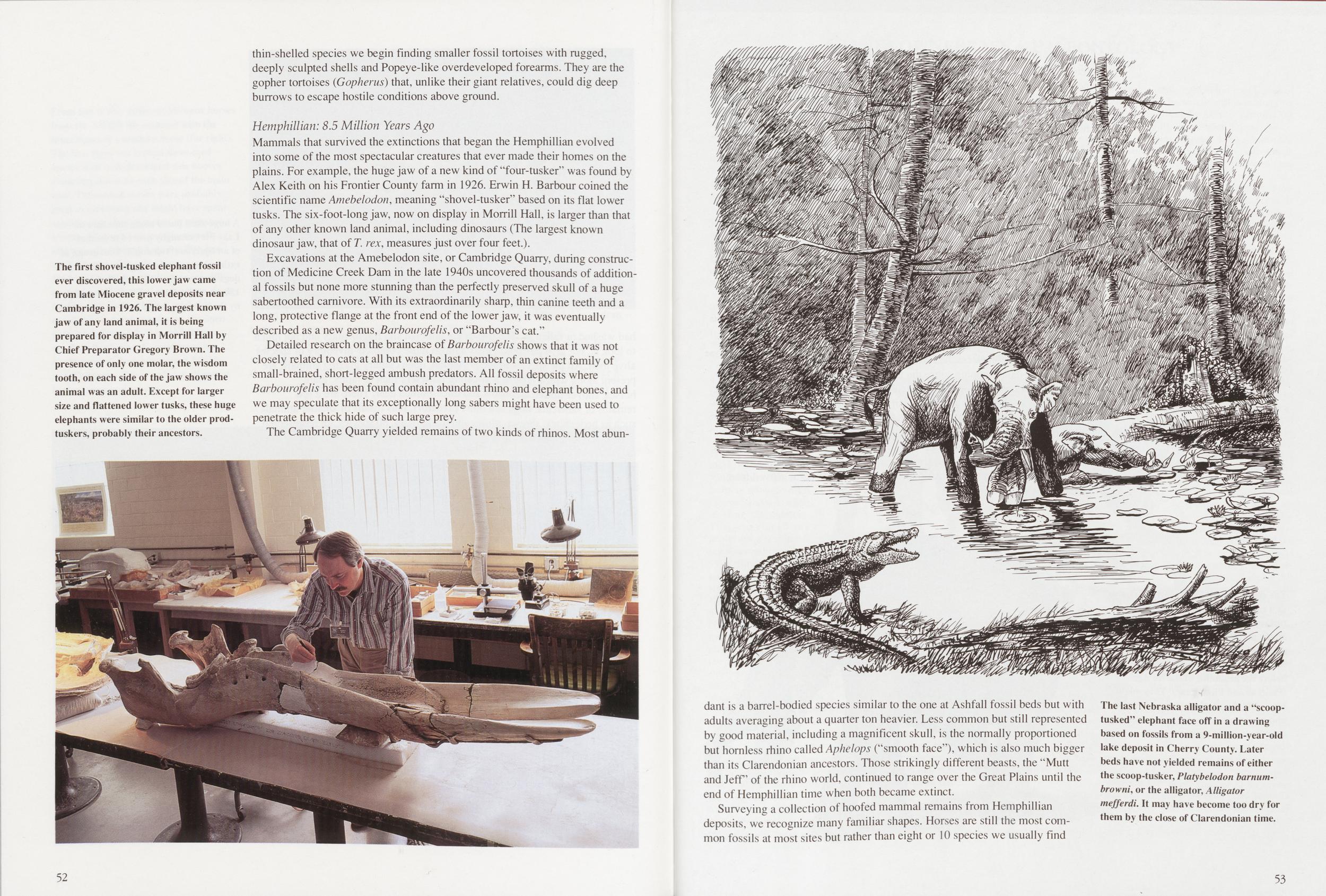
The first shovel-tusked elephant fossil ever discovered, this lower jaw came from late Miocene gravel deposits near Cambridge in 1926. The largest known jaw of any land animal, it is being prepared for display in Morrill Hall by Chief Preparator Gregory Brown. The presence of only one molar, the wisdom tooth, on each side of the jaw shows the animal was an adult. Except for larger size and flattened lower tusks, these huge elephants were similar to the older prodtuskers, probably their ancestors.
thin-shelled species we begin finding smaller fossil tortoises with rugged, deeply sculpted shells and Popeye-like overdeveloped forearms. They are the gopher tortoises (Gopherus) that, unlike their giant relatives, could dig deep burrows to escape hostile conditions above ground.
Hemphillian: 8.5 Million Years AgoMammals that survived the extinctions that began the Hemphillian evolved into some of the most spectacular creatures that ever made their homes on the plains. For example, the huge jaw of a new kind of "four-tusker" was found by Alex Keith on his Frontier County farm in 1926. Erwin H. Barbour coined the scientific name Amebelodon, meaning "shovel-tusker" based on its flat lower tusks. The six-foot-long jaw, now on display in Morrill Hall, is larger than that of any other known land animal, including dinosaurs (The largest known dinosaur jaw, that of T. rex, measures just over four feet.).
Excavations at the Amebelodon site, or Cambridge Quarry, during construc- tion of Medicine Creek Dam in the late 1940s uncovered thousands of addition- al fossils but none more stunning than the perfectly preserved skull of a huge sabertoothed carnivore. With its extraordinarily sharp, thin canine teeth and a long, protective flange at the front end of the lower jaw, it was eventually described as a new genus, Barbour ofe lis, or "Barbour's cat."
Detailed research on the braincase of Barbourofelis shows that it was not closely related to cats at all but was the last member of an extinct family of small-brained, short-legged ambush predators. All fossil deposits where Barbourofelis has been found contain abundant rhino and elephant bones, and we may speculate that its exceptionally long sabers might have been used to penetrate the thick hide of such large prey.
The Cambridge Quarry yielded remains of two kinds of rhinos. Most abundant 52 is a barrel-bodied species similar to the one at Ashfall fossil beds but with adults averaging about a quarter ton heavier. Less common but still represented by good material, including a magnificent skull, is the normally proportioned but hornless rhino called Aphelops ("smooth face"), which is also much bigger than its Clarendonian ancestors. Those strikingly different beasts, the "Mutt and Jeff of the rhino world, continued to range over the Great Plains until the end of Hemphillian time when both became extinct.
Surveying a collection of hoofed mammal remains from Hemphillian deposits, we recognize many familiar shapes. Horses are still the most common fossils at most sites but rather than eight or 10 species we usually find
The last Nebraska alligator and a "scooptusked" elephant face off in a drawing based on fossils from a 9-million-year-old lake deposit in Cherry County. Later beds have not yielded remains of either the scoop-tusker, Platybelodon barnum-browni, or the alligator, Alligator mefferdi. It may have become too dry for them by the close of Clarendonian time.
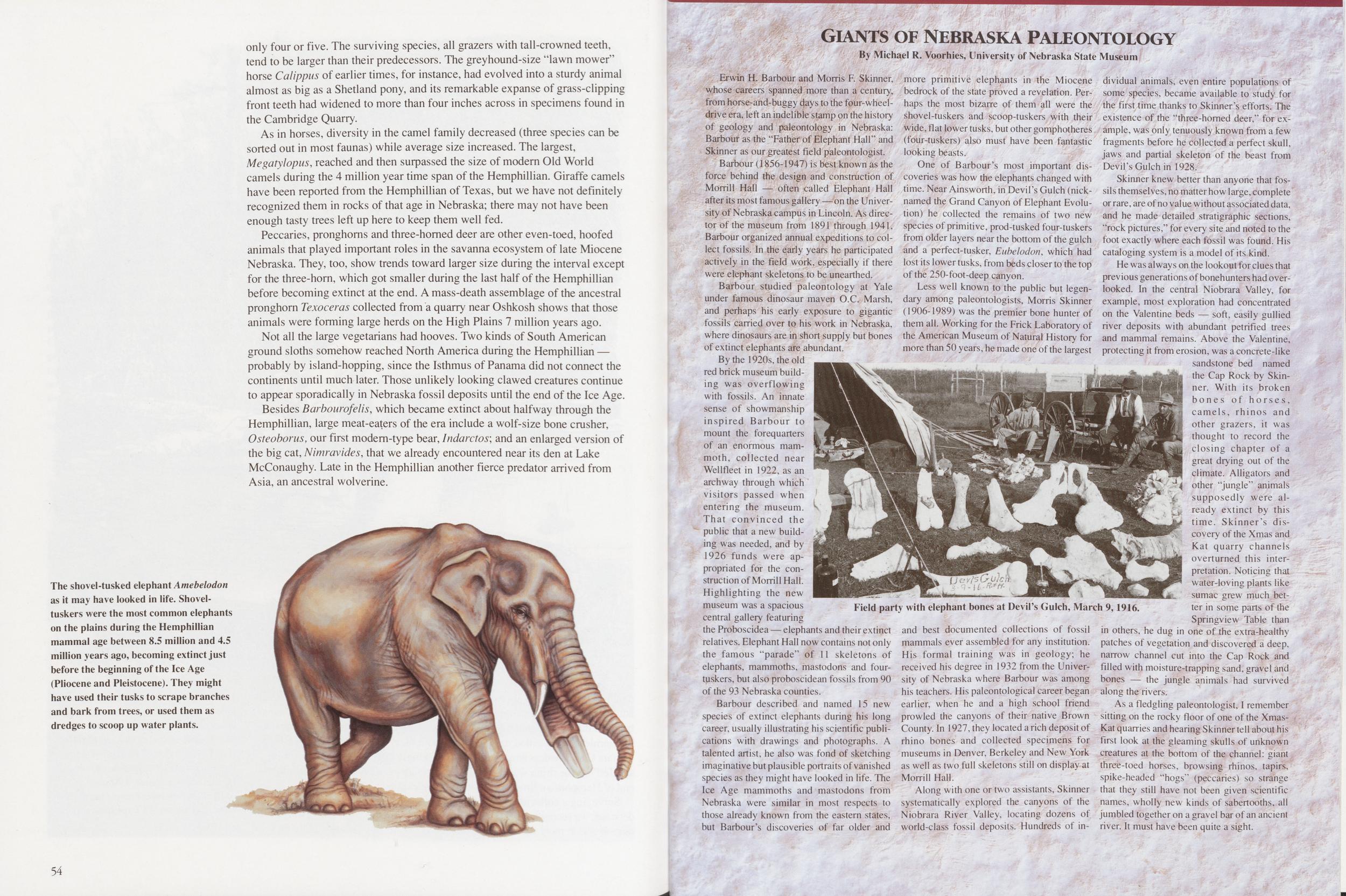
The shovel-tusked elephant Amebelodon as it may have looked in life. Shovel- tuskers were the most common elephants on the plains during the Hemphillian mammal age between 8.5 million and 4.5 million years ago, becoming extinct just before the beginning of the Ice Age (Pliocene and Pleistocene). They might have used their tusks to scrape branches and bark from trees, or used them as dredges to scoop up water plants.
only four or five. The surviving species, all grazers with tall-crowned teeth, tend to be larger than their predecessors. The greyhound-size "lawn mower" horse Calippus of earlier times, for instance, had evolved into a sturdy animal almost as big as a Shetland pony, and its remarkable expanse of grass-clipping front teeth had widened to more than four inches across in specimens found in the Cambridge Quarry.
As in horses, diversity in the camel family decreased (three species can be sorted out in most faunas) while average size increased. The largest, Megatylopus, reached and then surpassed the size of modern Old World camels during the 4 million year time span of the Hemphillian. Giraffe camels have been reported from the Hemphillian of Texas, but we have not definitely recognized them in rocks of that age in Nebraska; there may not have been enough tasty trees left up here to keep them well fed.
Peccaries, pronghoms and three-homed deer are other even-toed, hoofed animals that played important roles in the savanna ecosystem of late Miocene Nebraska. They, too, show trends toward larger size during the interval except for the three-horn, which got smaller during the last half of the Hemphillian before becoming extinct at the end. A mass-death assemblage of the ancestral pronghorn Texoceras collected from a quarry near Oshkosh shows that those animals were forming large herds on the High Plains 7 million years ago.
Not all the large vegetarians had hooves. Two kinds of South American ground sloths somehow reached North America during the Hemphillian — probably by island-hopping, since the Isthmus of Panama did not connect the continents until much later. Those unlikely looking clawed creatures continue to appear sporadically in Nebraska fossil deposits until the end of the Ice Age.
Besides Barbourofelis, which became extinct about halfway through the Hemphillian, large meat-eaters of the era include a wolf-size bone crusher, Osteoborus, our first modem-type bear, Indarctos; and an enlarged version of the big cat, Nimravides, that we already encountered near its den at Lake McConaughy. Late in the Hemphillian another fierce predator arrived from Asia, an ancestral wolverine.
GIANTS OF NEBRASKA PALEONTOLOGY
Erwin H. Barbour and Morris F. Skinner, whose careers spanned more than a century, from horse-and-buggy days to the four-wheel- drive era, left an indelible stamp on the history of geology and paleontology in Nebraska: Barbour as the "Father of Elephant Hall" and Skinner as our greatest field paleontologist.
Barbour (1856-1947) is best known as the force behind the design and construction of Morrill Hall — often called Elephant Hall after its most famous gallery — on the University of Nebraska campus in Lincoln. As direc- tor of the museum from 1891 through 1941, Barbour organized annual expeditions to collect fossils. In the early years he participated actively in the field work, especially if there were elephant skeletons to be unearthed.
Barbour studied paleontology at Yale under famous dinosaur maven O.C. Marsh, and perhaps his early exposure to gigantic fossils carried over to his work in Nebraska, where dinosaurs are in short supply but bones of extinct elephants are abundant.
By the 1920s, the old red brick museum building was overflowing with fossils. An innate sense of showmanship inspired Barbour to mount the forequarters of an enormous mammoth, collected near Wellfleet in 1922, as an archway through which visitors passed when entering the museum. That convinced the public that a new building was needed, and by 1926 funds were appropriated for the construction of Morrill Hall. Highlighting the new museum was a spacious central gallery featuring the Proboscidea — elephants and their extinct relatives. Elephant Hall now contains not only the famous "parade" of 11 skeletons of elephants, mammoths, mastodons and four-tuskers, but also proboscidean fossils from 90 of the 93 Nebraska counties.
Barbour described and named 15 new species of extinct elephants during his long career, usually illustrating his scientific publications with drawings and photographs. A talented artist, he also was fond of sketching imaginative but plausible portraits of vanished species as they might have looked in life. The Ice Age mammoths and mastodons from Nebraska were similar in most respects to those already known from the eastern states, but Barbour's discoveries of far older and more primitive elephants in the Miocene bedrock of the state proved a revelation. Perhaps the most bizarre of them all were the shovel-tuskers and scoop-tuskers with their wide, flat lower tusks, but other gomphotheres (four-tuskers) also must have been fantastic looking beasts.
One of Barbour's most important discoveries was how the elephants changed with time. Near Ainsworth, in Devil's Gulch (nicknamed the Grand Canyon of Elephant Evolution) he collected the remains of two new species of primitive, prod-tusked four-tuskers from older layers near the bottom of the gulch and a perfect-tusker, Eubelodon, which had lost its lower tusks, from beds closer to the top of the 250-foot-deep canyon.
Less well known to the public but legendary among paleontologists, Morris Skinner (1906-1989) was the premier bone hunter of them all. Working for the Frick Laboratory of the American Museum of Natural History for more than 50 years, he made one of the largest Field party with elephant bones at Devil's Gulch, March 9,1916. and best documented collections of fossil mammals ever assembled for any institution. His formal training was in geology; he received his degree in 1932 from the University of Nebraska where Barbour was among his teachers. His paleontological career began earlier, when he and a high school friend prowled the canyons of their native Brown County. In 1927, they located a rich deposit of rhino bones and collected specimens for museums in Denver, Berkeley and New York as well as two full skeletons still on display at Morrill Hall.
Along with one or two assistants, Skinner systematically explored the canyons of the Niobrara River Valley, locating dozens of world-class fossil deposits. Hundreds of individual animals, even entire populations of some species, became available to study for the first time thanks to Skinner's efforts. The existence of the "three-homed deer," for example, was only tenuously known from a few fragments before he collected a perfect skull, jaws and partial skeleton of the beast from Devil's Gulch in 1928.
Skinner knew better than anyone that fossils themselves, no matter how large, complete or rare, are of no value without associated data, and he made detailed stratigraphic sections, "rock pictures," for every site and noted to the foot exactly where each fossil was found. His cataloging system is a model of its kind.
He was always on the lookout for clues that previous generations of bonehunters had over-looked. In the central Niobrara Valley, for example, most exploration had concentrated on the Valentine beds — soft, easily gullied river deposits with abundant petrified trees and mammal remains. Above the Valentine, protecting it from erosion, was a concrete-like sandstone bed named the Cap Rock by Skinner. With its broken bones of horses, camels, rhinos and other grazers, it was thought to record the closing chapter of a great drying out of the climate. Alligators and other "jungle" animals supposedly were already extinct by this time. Skinner's discovery of the Xmas and Kat quarry channels overturned this interpretation. Noticing that water-loving plants like sumac grew much better in some parts of the Springview Table than in others, he dug in one of the extra-healthy patches of vegetation and discovered a deep, narrow channel cut into the Cap Rock and filled with moisture-trapping sand, gravel and bones — the jungle animals had survived along the rivers.
As a fledgling paleontologist, I remember sitting on the rocky floor of one of the Xmas- Kat quarries and hearing Skinner tell about his first look at the gleaming skulls of unknown creatures at the bottom of the channel: giant three-toed horses, browsing rhinos, tapirs, spike-headed "hogs" (peccaries) so strange that they still have not been given scientific names, wholly new kinds of sabertooths, all jumbled together on a gravel bar of an ancient river. It must have been quite a sight.
Field party with elephant bones at Devil's Gulch, March 9, 1916.
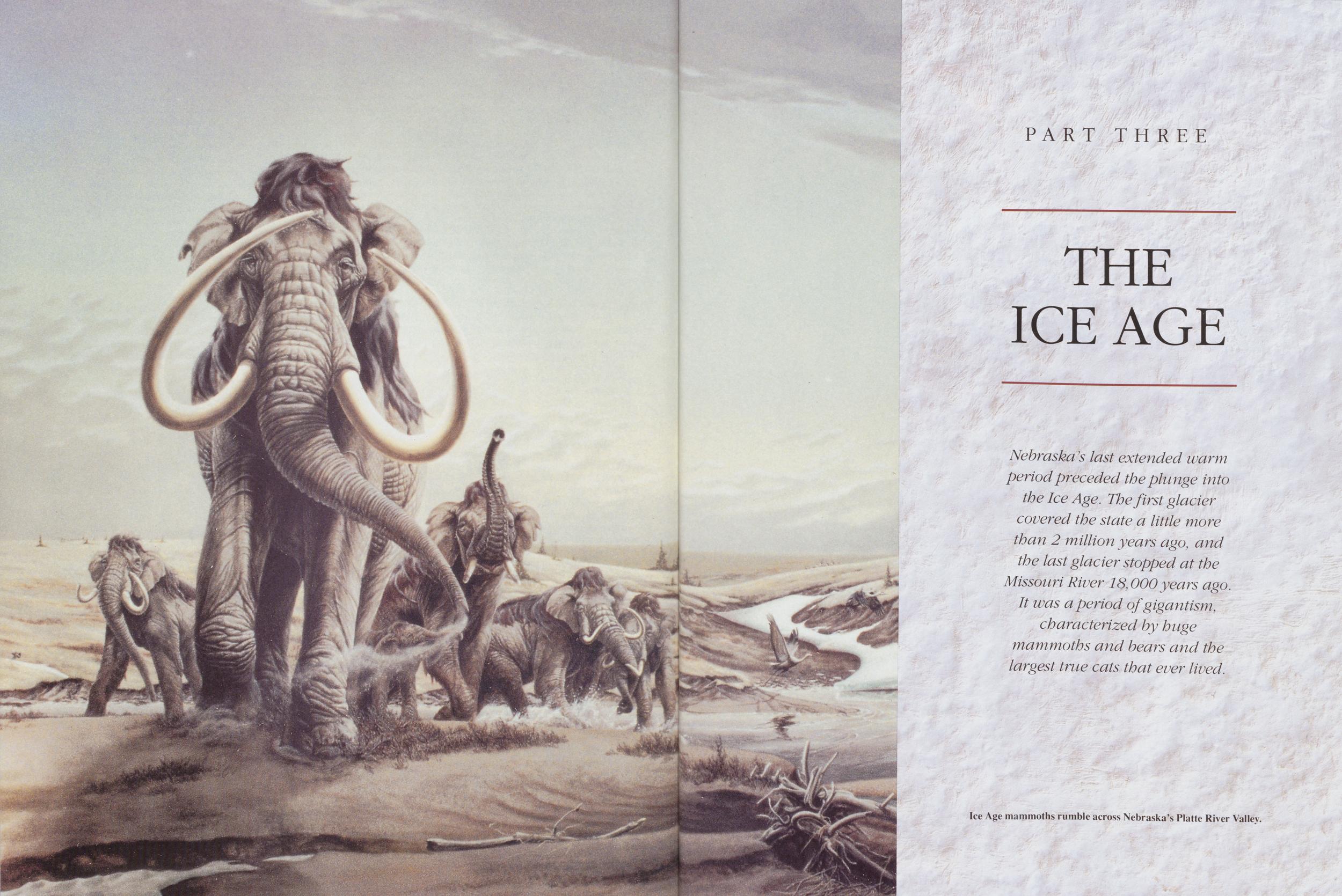
Ice Age mammoths rumble across Nebraska's Platte River Valley.
PART THREE THE ICE AGE
Nebraska's last extended warm period preceded th e plu nge in to the Ice Age. The first glacier covered the state a little more than 2 million years ago, and the last glacier stopped at the Missouri River 18,000years ago. It was a period of gigantism, characterized by huge mammoths and bears and the largest true cats that ever lived.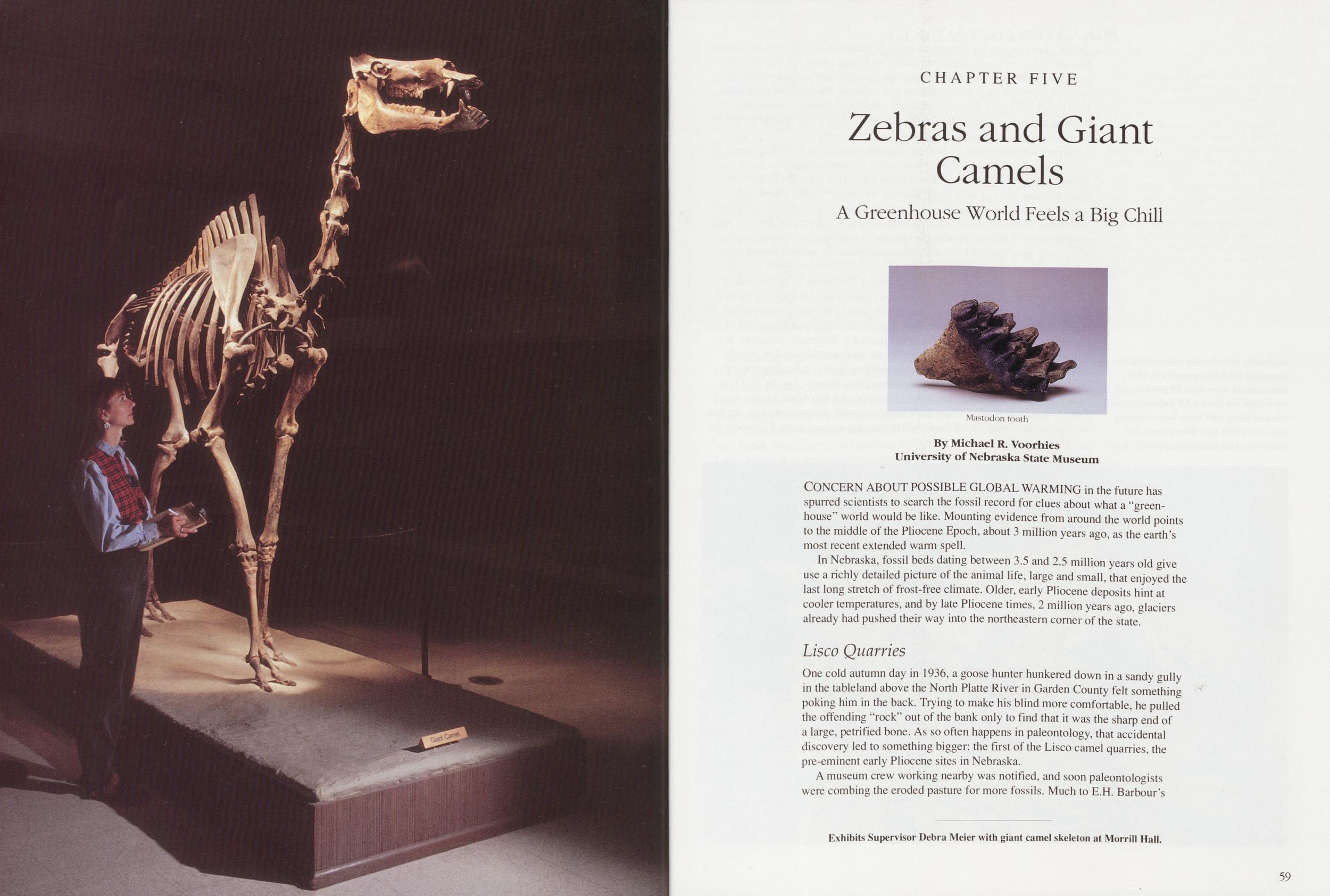
Exhibits Supervisor Debra Meier with giant camel skeleton at Morrill Hall.
CHAPTER FIVE Zebras and Giant Camels
A Greenhouse World Feels a Big Chill
Mastodon tooth
CONCERN ABOUT POSSIBLE GLOBAL WARMING in the future has spurred scientists to search the fossil record for clues about what a "green- house" world would be like. Mounting evidence from around the world points to the middle of the Pliocene Epoch, about 3 million years ago, as the earth's most recent extended warm spell.
In Nebraska, fossil beds dating between 3.5 and 2.5 million years old give use a richly detailed picture of the animal life, large and small, that enjoyed the last long stretch of frost-free climate. Older, early Pliocene deposits hint at cooler temperatures, and by late Pliocene times, 2 million years ago, glaciers already had pushed their way into the northeastern corner of the state.
Lisco QuarriesOne cold autumn day in 1936, a goose hunter hunkered down in a sandy gully in the tableland above the North Platte River in Garden County felt something poking him in the back. Trying to make his blind more comfortable, he pulled the offending "rock" out of the bank only to find that it was the sharp end of a large, petrified bone. As so often happens in paleontology, that accidental discovery led to something bigger: the first of the Lisco camel quarries, the pre-eminent early Pliocene sites in Nebraska.
A museum crew working nearby was notified, and soon paleontologists were combing the eroded pasture for more fossils. Much to E.H. Barbour's
59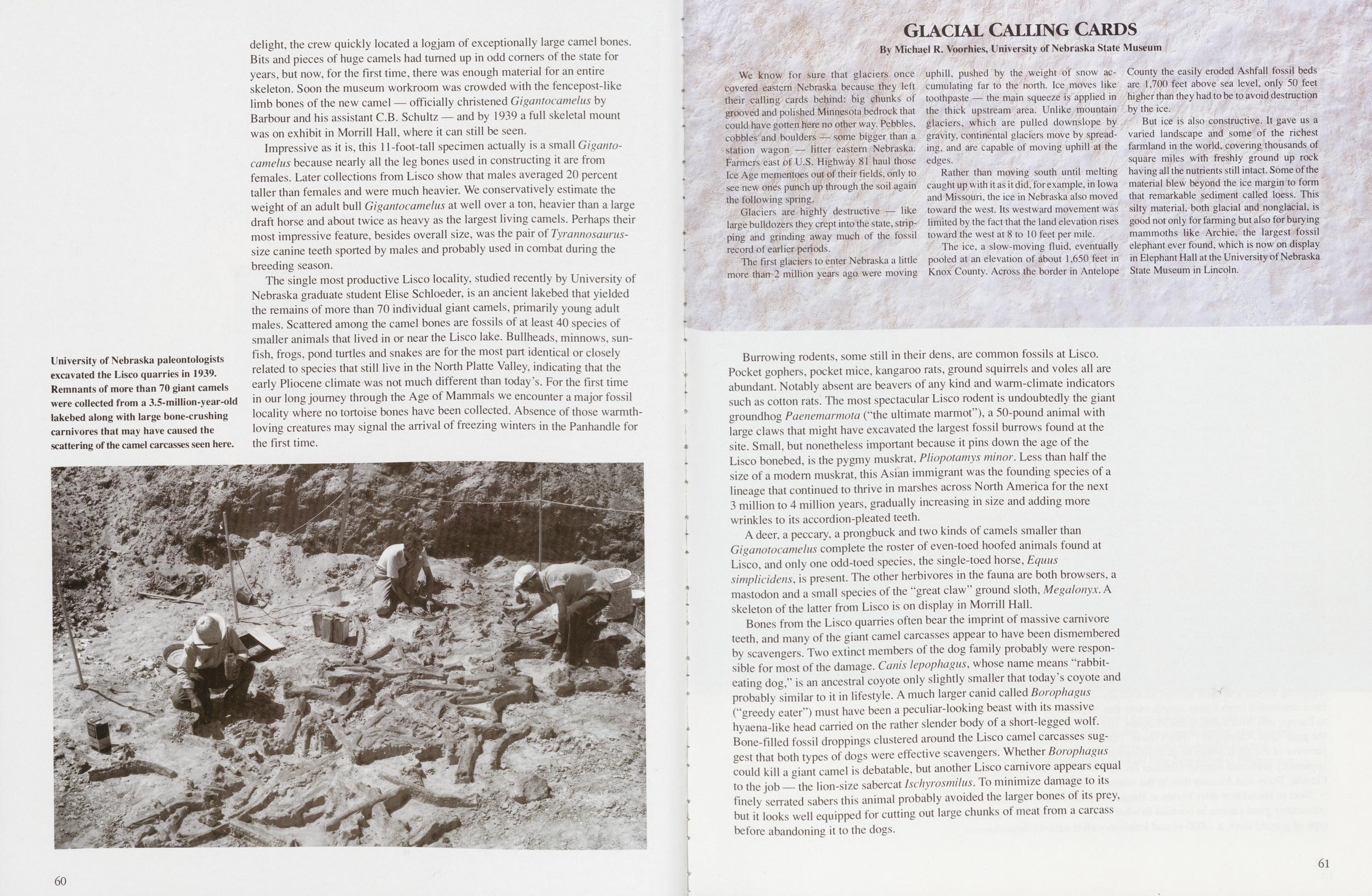
University of Nebraska paleontologists excavated the Lisco quarries in 1939. Remnants of more than 70 giant camels were collected from a 3.5-million-year-old lakebed along with large bone-crushing carnivores that may have caused the scattering of the camel carcasses seen here.
delight, the crew quickly located a logjam of exceptionally large camel bones. Bits and pieces of huge camels had turned up in odd corners of the state for years, but now, for the first time, there was enough material for an entire skeleton. Soon the museum workroom was crowded with the fencepost-like limb bones of the new camel — officially christened Gigantocamelus by Barbour and his assistant C.B. Schultz — and by 1939 a full skeletal mount was on exhibit in Morrill Hall, where it can still be seen.
Impressive as it is, this 11-foot-tall specimen actually is a small Giganto- camelus because nearly all the leg bones used in constructing it are from females. Later collections from Lisco show that males averaged 20 percent taller than females and were much heavier. We conservatively estimate the weight of an adult bull Gigantocamelus at well over a ton, heavier than a large draft horse and about twice as heavy as the largest living camels. Perhaps their most impressive feature, besides overall size, was the pair of Tyrannosaurus- size canine teeth sported by males and probably used in combat during the breeding season.
The single most productive Lisco locality, studied recently by University of Nebraska graduate student Elise Schloeder, is an ancient lakebed that yielded the remains of more than 70 individual giant camels, primarily young adult males. Scattered among the camel bones are fossils of at least 40 species of smaller animals that lived in or near the Lisco lake. Bullheads, minnows, sun- fish, frogs, pond turtles and snakes are for the most part identical or closely related to species that still live in the North Platte Valley, indicating that the early Pliocene climate was not much different than today's. For the first time in our long journey through the Age of Mammals we encounter a major fossil locality where no tortoise bones have been collected. Absence of those warmth- loving creatures may signal the arrival of freezing winters in the Panhandle for the first time.
Glacial calling cards
We know for sure that glaciers once covered eastern Nebraska because they left their calling cards behind: big chunks of grooved and polished Minnesota bedrock that could have gotten here no other way. Pebbles, cobbles and boulders — some bigger than a station wagon — litter eastern Nebraska. Farmers east of U.S. Highway 81 haul those Ice Age mementoes out of their fields, only to see new ones punch up through the soil again the following spring.
Glaciers are highly destructive — like large bulldozers they crept into the state, strip- ping and grinding away much of the fossil record of earlier periods.
The first glaciers to enter Nebraska a little more than 2 million years ago were moving uphill, pushed by the weight of snow ac- cumulating far to the north. Ice moves like toothpaste — the main squeeze is applied in the thick upstream area. Unlike mountain glaciers, which are pulled downslope by gravity, continental glaciers move by spread- ing, and are capable of moving uphill at the edges.
Rather than moving south until melting caught up with it as it did, for example, in Iowa and Missouri, the ice in Nebraska also moved toward the west. Its westward movement was limited by the fact that the land elevation rises toward the west at 8 to 10 feet per mile.
The ice, a slow-moving fluid, eventually pooled at an elevation of about 1,650 feet in Knox County. Across the border in Antelope County the easily eroded Ashfall fossil beds are 1,700 feet above sea level, only 50 feet higher than they had to be to avoid destruction by the ice.
But ice is also constructive. It gave us a varied landscape and some of the richest farmland in the world, covering thousands of square miles with freshly ground up rock having all the nutrients still intact. Some of the material blew beyond the ice margin to form that remarkable sediment called loess. This silty material, both glacial and nonglacial, is good not only for farming but also for burying mammoths like Archie, the largest fossil elephant ever found, which is now on display in Elephant Hall at the University of Nebraska State Museum in Lincoln.
Burrowing rodents, some still in their dens, are common fossils at Lisco. Pocket gophers, pocket mice, kangaroo rats, ground squirrels and voles all are abundant. Notably absent are beavers of any kind and warm-climate indicators such as cotton rats. The most spectacular Lisco rodent is undoubtedly the giant groundhog Paenemarmota ("the ultimate marmot"), a 50-pound animal with large claws that might have excavated the largest fossil burrows found at the site. Small, but nonetheless important because it pins down the age of the Lisco bonebed, is the pygmy muskrat, Pliopotamys minor. Less than half the size of a modern muskrat, this Asian immigrant was the founding species of a lineage that continued to thrive in marshes across North America for the next 3 million to 4 million years, gradually increasing in size and adding more wrinkles to its accordion-pleated teeth.
A deer, a peccary, a prongbuck and two kinds of camels smaller than Giganotocamelus complete the roster of even-toed hoofed animals found at Lisco, and only one odd-toed species, the single-toed horse, Equus simplicidens, is present. The other herbivores in the fauna are both browsers, a mastodon and a small species of the "great claw" ground sloth, Megalonyx. A skeleton of the latter from Lisco is on display in Morrill Hall.
Bones from the Lisco quarries often bear the imprint of massive carnivore teeth, and many of the giant camel carcasses appear to have been dismembered by scavengers. Two extinct members of the dog family probably were respon- sible for most of the damage. Canis lepophagus, whose name means "rabbit- eating dog," is an ancestral coyote only slightly smaller that today's coyote and probably similar to it in lifestyle. A much larger canid called Borophagus ("greedy eater") must have been a peculiar-looking beast with its massive hyaena-like head carried on the rather slender body of a short-legged wolf. Bone-filled fossil droppings clustered around the Lisco camel carcasses sug- gest that both types of dogs were effective scavengers. Whether Borophagus could kill a giant camel is debatable, but another Lisco carnivore appears equal to the job — the lion-size sabercat Isclryrosmilus. To minimize damage to its finely serrated sabers this animal probably avoided the larger bones of its prey, but it looks well equipped for cutting out large chunks of meat from a carcass before abandoning it to the dogs.
61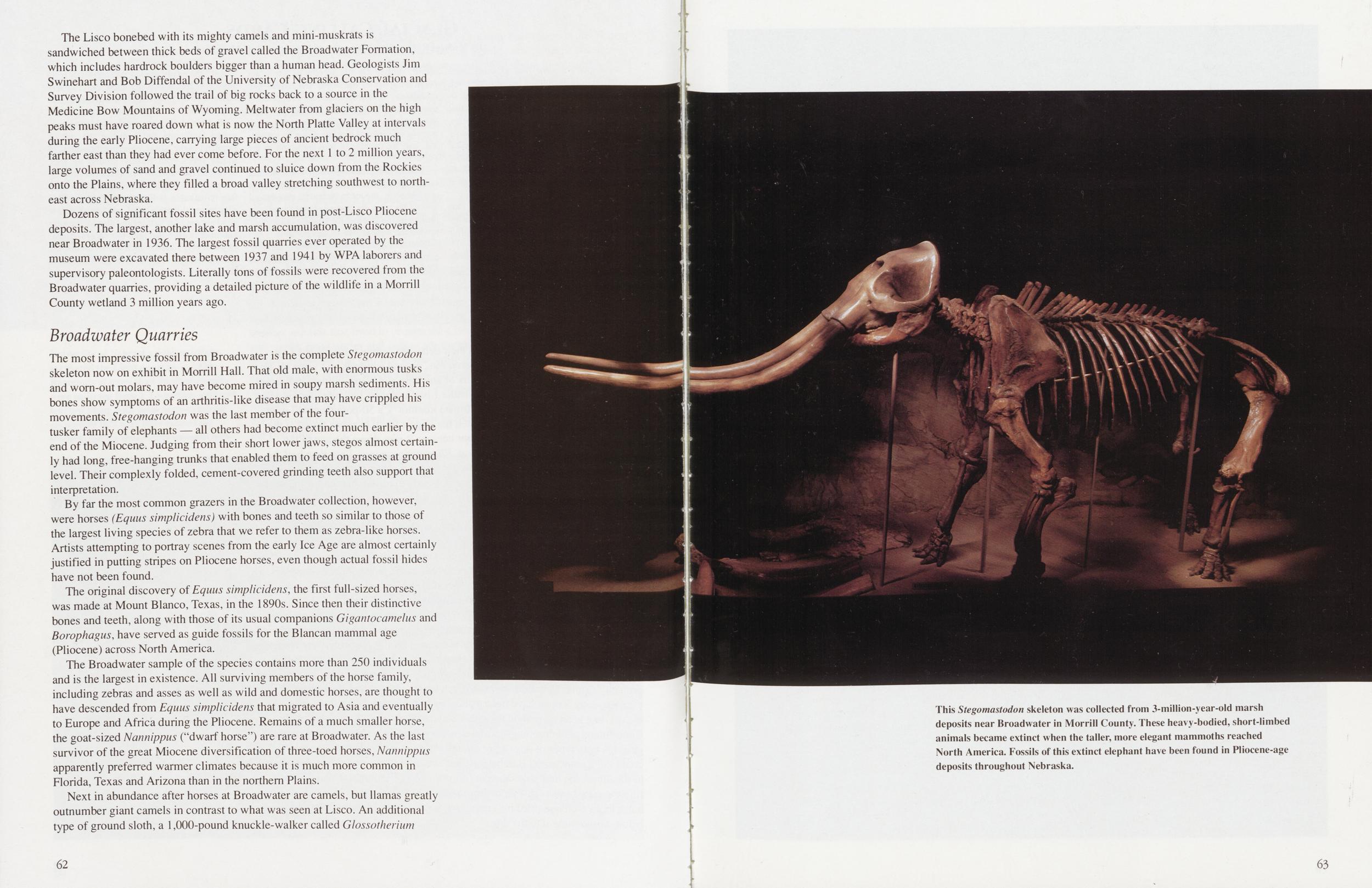
The Lisco bonebed with its mighty camels and mini-muskrats is sandwiched between thick beds of gravel called the Broadwater Formation, which includes hardrock boulders bigger than a human head. Geologists Jim Swinehart and Bob Diffendal of the University of Nebraska Conservation and Survey Division followed the trail of big rocks back to a source in the Medicine Bow Mountains of Wyoming. Meltwater from glaciers on the high peaks must have roared down what is now the North Platte Valley at intervals during the early Pliocene, carrying large pieces of ancient bedrock much farther east than they had ever come before. For the next 1 to 2 million years, large volumes of sand and gravel continued to sluice down from the Rockies onto the Plains, where they filled a broad valley stretching southwest to north- east across Nebraska.
Dozens of significant fossil sites have been found in post-Lisco Pliocene deposits. The largest, another lake and marsh accumulation, was discovered near Broadwater in 1936. The largest fossil quarries ever operated by the museum were excavated there between 1937 and 1941 by WPA laborers and supervisory paleontologists. Literally tons of fossils were recovered from the Broadwater quarries, providing a detailed picture of the wildlife in a Morrill County wetland 3 million years ago.
Broadwater QuarriesThe most impressive fossil from Broadwater is the complete Stegomastodon skeleton now on exhibit in Morrill Hall. That old male, with enormous tusks and worn-out molars, may have become mired in soupy marsh sediments. His bones show symptoms of an arthritis-like disease that may have crippled his movements. Stegomastodon was the last member of the four- tusker family of elephants — all others had become extinct much earlier by the end of the Miocene. Judging from their short lower jaws, stegos almost certain- ly had long, free-hanging trunks that enabled them to feed on grasses at ground level. Their complexly folded, cement-covered grinding teeth also support that interpretation.
By far the most common grazers in the Broadwater collection, however, were horses (Equus simplicidens) with bones and teeth so similar to those of the largest living species of zebra that we refer to them as zebra-like horses. Artists attempting to portray scenes from the early Ice Age are almost certainly justified in putting stripes on Pliocene horses, even though actual fossil hides have not been found.
The original discovery of Equus simplicidens, the first full-sized horses, was made at Mount Blanco, Texas, in the 1890s. Since then their distinctive bones and teeth, along with those of its usual companions Gigantocamelus and Borophagus, have served as guide fossils for the Blancan mammal age (Pliocene) across North America.
The Broadwater sample of the species contains more than 250 individuals and is the largest in existence. All surviving members of the horse family, including zebras and asses as well as wild and domestic horses, are thought to have descended from Equus simplicidens that migrated to Asia and eventually to Europe and Africa during the Pliocene. Remains of a much smaller horse, the goat-sized Nannippus ("dwarf horse") are rare at Broadwater. As the last survivor of the great Miocene diversification of three-toed horses, Nannippus apparently preferred warmer climates because it is much more common in Florida, Texas and Arizona than in the northern Plains.
Next in abundance after horses at Broadwater are camels, but llamas greatly outnumber giant camels in contrast to what was seen at Lisco. An additional type of ground sloth, a 1,000-pound knuckle-walker called Glossotherium
62This Stegomastodon skeleton was collected from 3-million-year-old marsh deposits near Broadwater in Morrill County. These heavy-bodied, short-limbed animals became extinct when the taller, more elegant mammoths reached North America. Fossils of this extinct elephant have been found in Pliocene-age deposits throughout Nebraska.
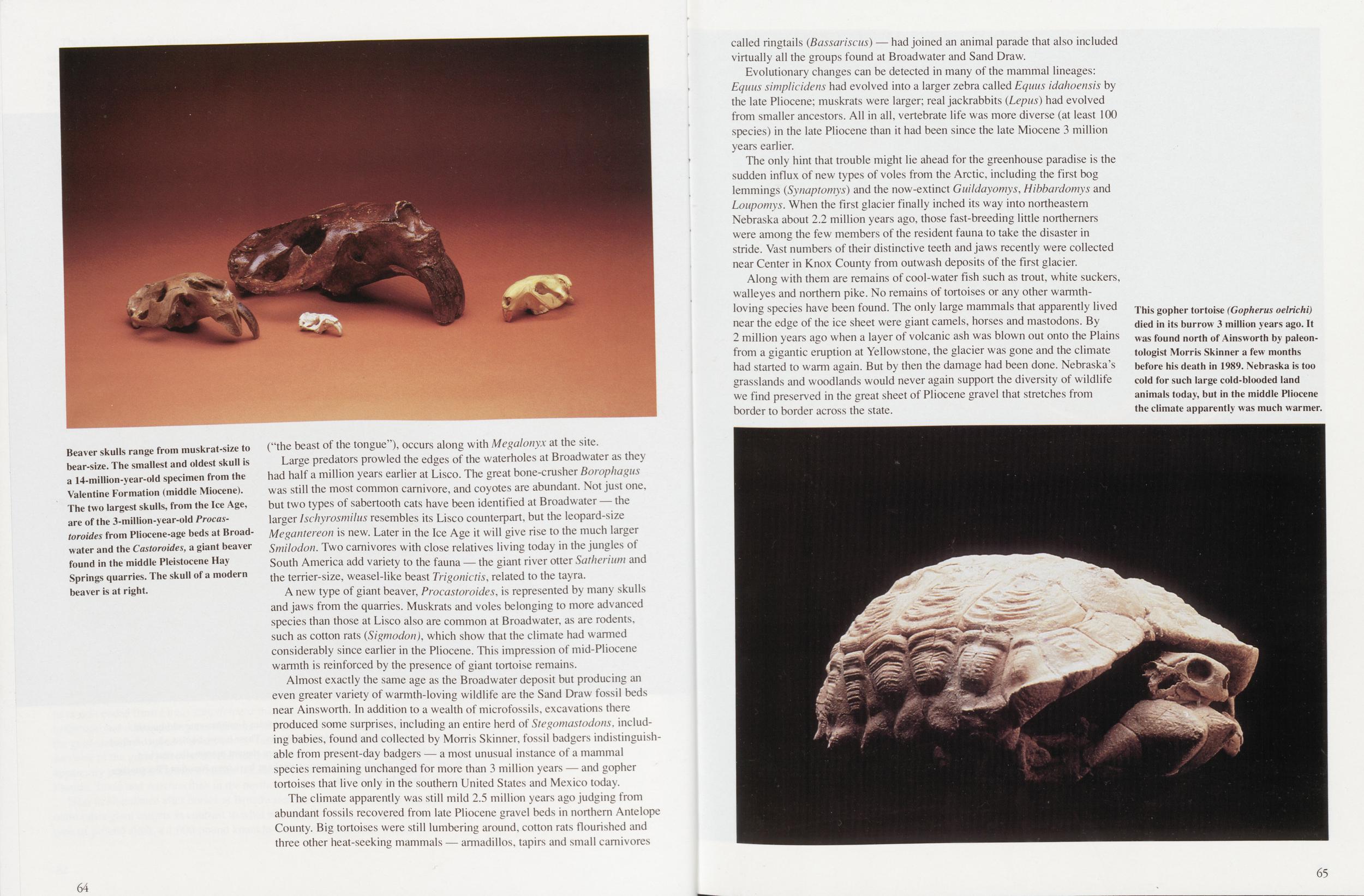
Beaver skulls range from muskrat-size to bear-size. The smallest and oldest skull is a 14-million-year-old specimen from the Valentine Formation (middle Miocene). The two largest skulls, from the Ice Age, are of the 3-million-year-old Procas- toroides from Pliocene-age beds at Broad- water and the Castoroides, a giant beaver found in the middle Pleistocene Hay Springs quarries. The skull of a modern beaver is at right.
("the beast of the tongue"), occurs along with Megalonyx at the site.
Large predators prowled the edges of the waterholes at Broadwater as they had half a million years earlier at Lisco. The great bone-crusher Borophagus was still the most common carnivore, and coyotes are abundant. Not just one, but two types of sabertooth cats have been identified at Broadwater — the larger Ischyrosmilus resembles its Lisco counterpart, but the leopard-size Megantereon is new. Later in the Ice Age it will give rise to the much larger Smilodon. Two carnivores with close relatives living today in the jungles of South America add variety to the fauna — the giant river otter Satherium and the terrier-size, weasel-like beast Trigonictis, related to the tayra.
A new type of giant beaver, Procastoroides, is represented by many skulls and jaws from the quarries. Muskrats and voles belonging to more advanced species than those at Lisco also are common at Broadwater, as are rodents, such as cotton rats (Sigmodon), which show that the climate had warmed considerably since earlier in the Pliocene. This impression of mid-Pliocene warmth is reinforced by the presence of giant tortoise remains.
Almost exactly the same age as the Broadwater deposit but producing an even greater variety of warmth-loving wildlife are the Sand Draw fossil beds near Ainsworth. In addition to a wealth of microfossils, excavations there produced some surprises, including an entire herd of Stegomastodons, includ- ing babies, found and collected by Morris Skinner, fossil badgers indistinguish- able from present-day badgers — a most unusual instance of a mammal species remaining unchanged for more than 3 million years — and gopher tortoises that live only in the southern United States and Mexico today.
The climate apparently was still mild 2.5 million years ago judging from abundant fossils recovered from late Pliocene gravel beds in northern Antelope County. Big tortoises were still lumbering around, cotton rats flourished and three other heat-seeking mammals — armadillos, tapirs and small carnivores
64called ringtails (Bassahscus) — had joined an animal parade that also included virtually all the groups found at Broadwater and Sand Draw.
Evolutionary changes can be detected in many of the mammal lineages: Equus simplicidens had evolved into a larger zebra called Equus idahoensis by the late Pliocene; muskrats were larger; real jackrabbits (Lepus) had evolved from smaller ancestors. All in all, vertebrate life was more diverse (at least 100 species) in the late Pliocene than it had been since the late Miocene 3 million years earlier.
The only hint that trouble might lie ahead for the greenhouse paradise is the sudden influx of new types of voles from the Arctic, including the first bog lemmings (Synaptomys) and the now-extinct Guildayomys, Hibbardomys and Loupomys. When the first glacier finally inched its way into northeastern Nebraska about 2.2 million years ago, those fast-breeding little northerners were among the few members of the resident fauna to take the disaster in stride. Vast numbers of their distinctive teeth and jaws recently were collected near Center in Knox County from outwash deposits of the first glacier.
Along with them are remains of cool-water fish such as trout, white suckers, walleyes and northern pike. No remains of tortoises or any other warmth- loving species have been found. The only large mammals that apparently lived near the edge of the ice sheet were giant camels, horses and mastodons. By 2 million years ago when a layer of volcanic ash was blown out onto the Plains from a gigantic eruption at Yellowstone, the glacier was gone and the climate had started to warm again. But by then the damage had been done. Nebraska's grasslands and woodlands would never again support the diversity of wildlife we find preserved in the great sheet of Pliocene gravel that stretches from border to border across the state.
This gopher tortoise (Gopherus oelrichi) died in its burrow 3 million years ago. It was found north of Ainsworth by paleon- tologist Morris Skinner a few months before his death in 1989. Nebraska is too cold for such large cold-blooded land animals today, but in the middle Pliocene the climate apparently was much warmer.
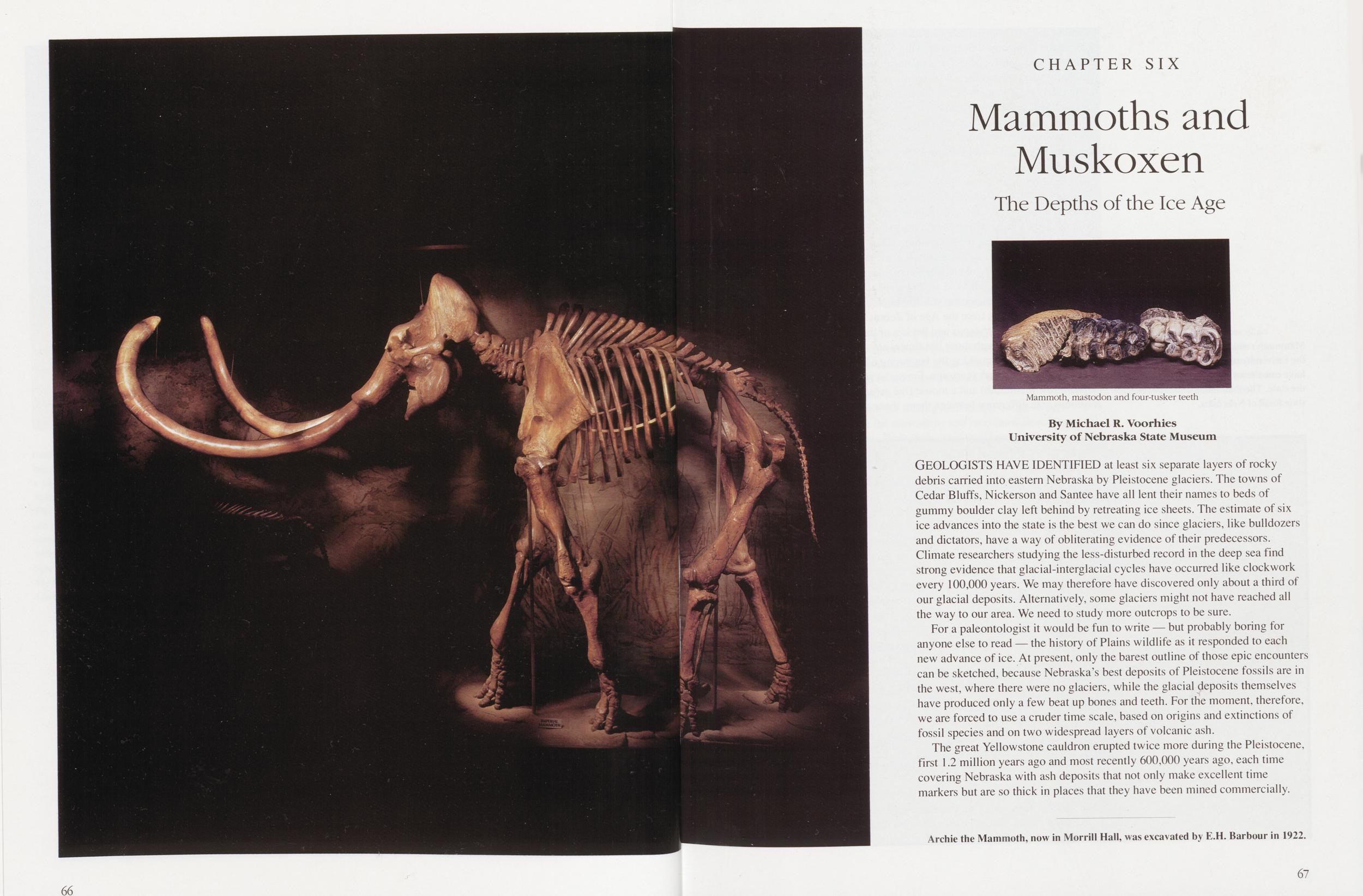
Archie the Mammoth, now in Morrill Hall, was excavated by E.H. Barbour in 1922.
CHAPTER SIX Mammoths and Muskoxen
The Depths of the Ice Age
Mammoth, mastodon and four-tusker teeth
GEOLOGISTS HAVE IDENTIFIED at least six separate layers of rocky debris carried into eastern Nebraska by Pleistocene glaciers. The towns of Cedar Bluffs, Nickerson and Santee have all lent their names to beds of gummy boulder clay left behind by retreating ice sheets. The estimate of six ice advances into the state is the best we can do since glaciers, like bulldozers and dictators, have a way of obliterating evidence of their predecessors. Climate researchers studying the less-disturbed record in the deep sea find strong evidence that glacial-interglacial cycles have occurred like clockwork every 100,000 years. We may therefore have discovered only about a third of our glacial deposits. Alternatively, some glaciers might not have reached all the way to our area. We need to study more outcrops to be sure.
For a paleontologist it would be fun to write — but probably boring for anyone else to read — the history of Plains wildlife as it responded to each new advance of ice. At present, only the barest outline of those epic encounters can be sketched, because Nebraska's best deposits of Pleistocene fossils are in the west, where there were no glaciers, while the glacial deposits themselves have produced only a few beat up bones and teeth. For the moment, therefore, we are forced to use a cruder time scale, based on origins and extinctions of fossil species and on two widespread layers of volcanic ash.
The great Yellowstone cauldron erupted twice more during the Pleistocene, first 1.2 million years ago and most recently 600,000 years ago, each time covering Nebraska with ash deposits that not only make excellent time markers but are so thick in places that they have been mined commercially.
61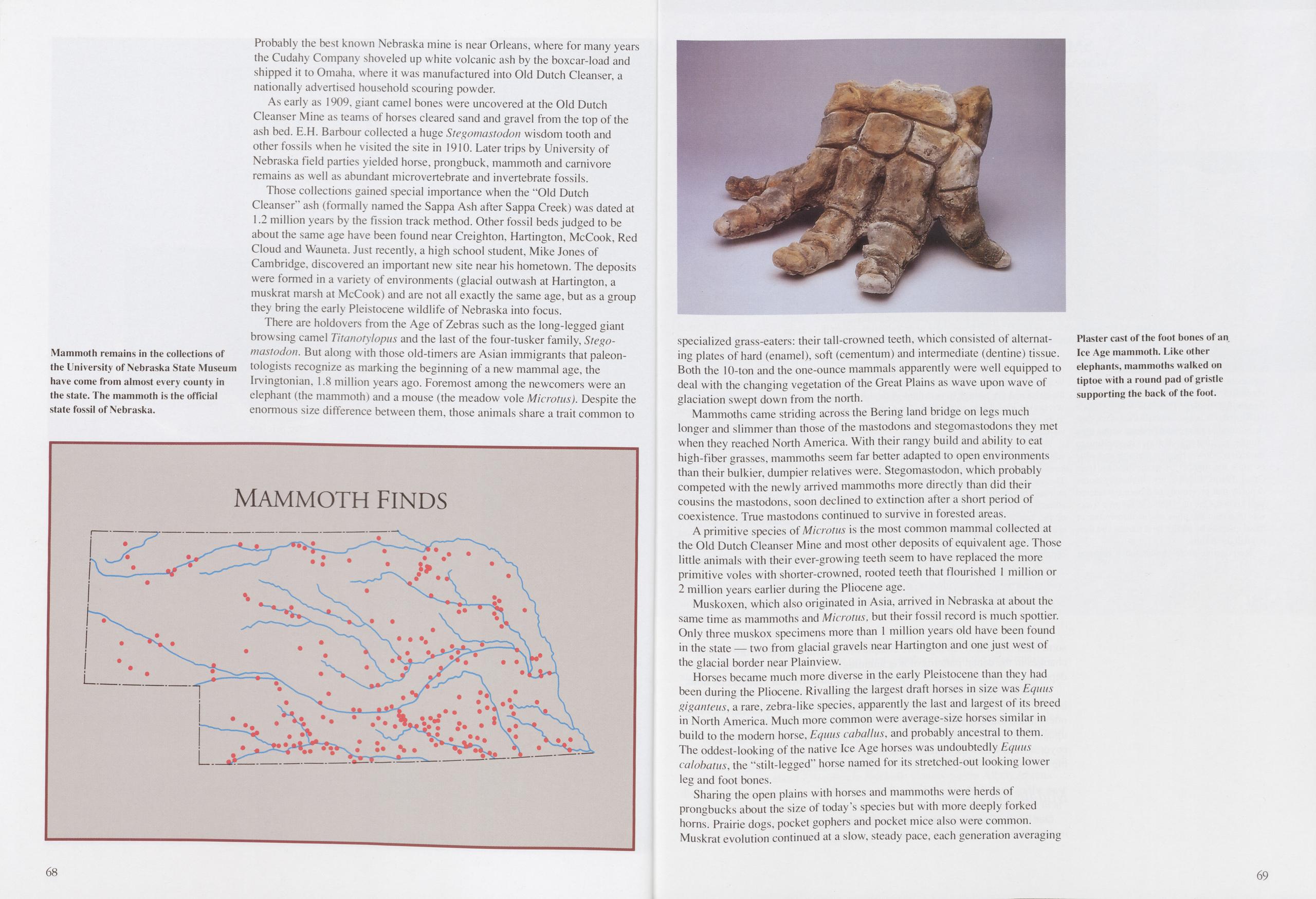
MAMMOTH FINDS Mammoth remains in the collections of the University of Nebraska State Museum have come from almost every county in the state. The mammoth is the official state fossil of Nebraska.
Probably the best known Nebraska mine is near Orleans, where for many years the Cudahy Company shoveled up white volcanic ash by the boxcar-load and shipped it to Omaha, where it was manufactured into Old Dutch Cleanser, a nationally advertised household scouring powder.
As early as 1909, giant camel bones were uncovered at the Old Dutch Cleanser Mine as teams of horses cleared sand and gravel from the top of the ash bed. E.H. Barbour collected a huge Stegomastodon wisdom tooth and other fossils when he visited the site in 1910. Later trips by University of Nebraska field parties yielded horse, prongbuck, mammoth and carnivore remains as well as abundant microvertebrate and invertebrate fossils.
Those collections gained special importance when the "Old Dutch Cleanser” ash (formally named the Sappa Ash after Sappa Creek) was dated at 1.2 million years by the fission track method. Other fossil beds judged to be about the same age have been found near Creighton, Hartington, McCook, Red Cloud and Wauneta. Just recently, a high school student, Mike Jones of Cambridge, discovered an important new site near his hometown. The deposits were formed in a variety of environments (glacial outwash at Hartington, a muskrat marsh at McCook) and are not all exactly the same age, but as a group they bring the early Pleistocene wildlife of Nebraska into focus.
There are holdovers from the Age of Zebras such as the long-legged giant browsing camel Titanotylopus and the last of the four-tusker family, Stego- mastodon. But along with those old-timers are Asian immigrants that paleon- tologists recognize as marking the beginning of a new mammal age, the Irvingtonian, 1.8 million years ago. Foremost among the newcomers were an elephant (the mammoth) and a mouse (the meadow vole Microtus). Despite the enormous size difference between them, those animals share a trait common to specialized grass-eaters: their tall-crowned teeth, which consisted of alternat- ing plates of hard (enamel), soft (cementum) and intermediate (dentine) tissue. Both the 10-ton and the one-ounce mammals apparently were well equipped to deal with the changing vegetation of the Great Plains as wave upon wave of glaciation swept down from the north.
Mammoths came striding across the Bering land bridge on legs much longer and slimmer than those of the mastodons and stegomastodons they met when they reached North America. With their rangy build and ability to eat high-fiber grasses, mammoths seem far better adapted to open environments than their bulkier, dumpier relatives were. Stegomastodon, which probably competed with the newly arrived mammoths more directly than did their cousins the mastodons, soon declined to extinction after a short period of coexistence. True mastodons continued to survive in forested areas.
A primitive species of Microtus is the most common mammal collected at the Old Dutch Cleanser Mine and most other deposits of equivalent age. Those little animals with their ever-growing teeth seem to have replaced the more primitive voles with shorter-crowned, rooted teeth that flourished 1 million or 2 million years earlier during the Pliocene age.
Muskoxen, which also originated in Asia, arrived in Nebraska at about the same time as mammoths and Microtus, but their fossil record is much spottier. Only three muskox specimens more than 1 million years old have been found in the state — two from glacial gravels near Hartington and one just west of the glacial border near Plainview.
Horses became much more diverse in the early Pleistocene than they had been during the Pliocene. Rivalling the largest draft horses in size was Equus giganteus, a rare, zebra-like species, apparently the last and largest of its breed in North America. Much more common were average-size horses similar in build to the modem horse, Equus caballus, and probably ancestral to them. The oddest-looking of the native Ice Age horses was undoubtedly Equus calobatus, the "stilt-legged” horse named for its stretched-out looking lower leg and foot bones.
Sharing the open plains with horses and mammoths were herds of prongbucks about the size of today’s species but with more deeply forked horns. Prairie dogs, pocket gophers and pocket mice also were common. Muskrat evolution continued at a slow, steady pace, each generation averaging
Plaster cast of the foot bones of an Ice Age mammoth. Like other elephants, mammoths walked on tiptoe with a round pad of gristle supporting the back of the foot.
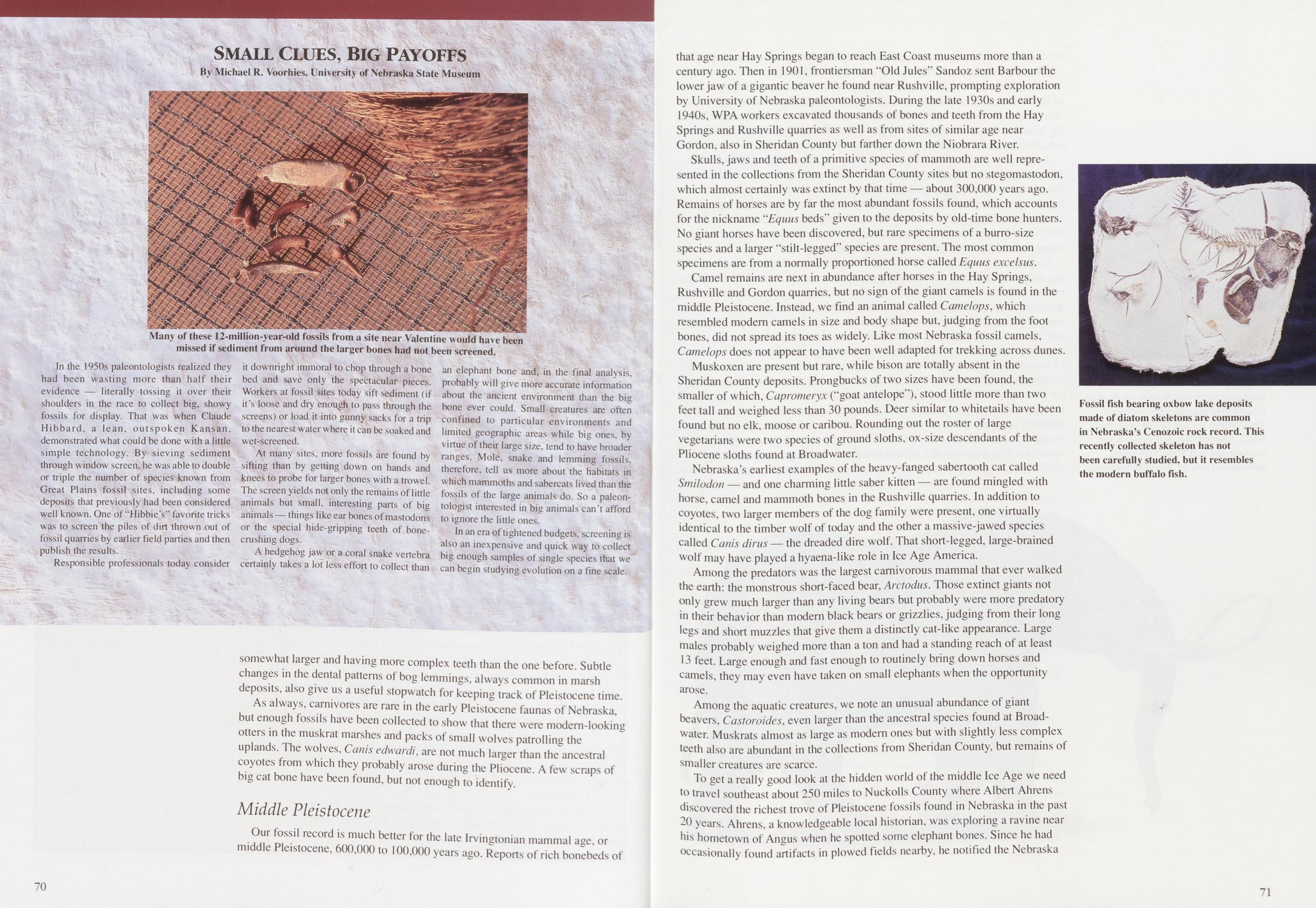
SMALL CLUES, BIG PAYOFFS
Many of these 12-miIlion-year-old fossils from a site near Valentine would have been missed if sediment from around the larger bones had not been screened.
In the 1950s paleontologists realized they had been wasting more than half their evidence — literally tossing it over their shoulders in the race to collect big, showy fossils for display. That was when Claude Hibbard, a lean, outspoken Kansan, demonstrated what could be done with a little simple technology. By sieving sediment through window screen, he was able to double or triple the number of species known from Great Plains fossil sites, including some deposits that previously had been considered well known. One of "Hibbie's" favorite tricks was to screen the piles of dirt thrown out of fossil quarries by earlier field parties and then publish the results.
Responsible professionals today consider it downright immoral to chop through a bone bed and save only the spectacular pieces. Workers at fossil sites today sift sediment (if it's loose and dry enough to pass through the screens) or load it into gunny sacks for a trip to the nearest water where it can be soaked and wet-screened.
At many sites, more fossils are found by sifting than by getting down on hands and knees to probe for larger bones with a trowel. The screen yields not only the remains of little animals but small, interesting parts of big animals — things like ear bones of mastodons or the special hide-gripping teeth of bone- crushing dogs.
A hedgehog jaw or a coral snake vertebra certainly takes a lot less effort to collect than an elephant bone and, in the final analysis, probably will give more accurate information about the ancient environment than the big bone ever could. Small creatures are often confined to particular environments and limited geographic areas while big ones, by virtue of their large size, tend to have broader ranges. Mole, snake and lemming fossils, therefore, tell us more about the habitats in which mammoths and sabercats lived than the fossils of the large animals do. So a paleon- tologist interested in big animals can't afford to ignore the little ones.
In an era of tightened budgets, screening is also an inexpensive and quick way to collect big enough samples of single species that we can begin studying evolution on a fine scale.
somewhat larger and having more complex teeth than the one before. Subtle changes in the dental patterns of bog lemmings, always common in marsh deposits, also g.ve us a useful stopwatch for keeping track of Pleistocene time.
As always, carnivores are rare in the early Pleistocene faunas of Nebraska, but enough fossds have been collected to show that there were modern-looking otters in the muskrat marshes and packs of small wolves patrolling the uplands. The wolves, Canis edwardi, are not much larger than the ancestral coyotes from which they probably arose during the Pliocene. A few scraps of big cat bone have been found, but not enough to identify.
Middle PleistoceneOur fossil record is much better for the late Irvingtonian mammal age, or middle Pleistocene, 600,000 to 100,000 years ago. Reports of rich bonebeds of 70 that age near Hay Springs began to reach East Coast museums more than a century ago. Then in 1901, frontiersman "Old Jules" Sandoz sent Barbour the lower jaw of a gigantic beaver he found near Rushville, prompting exploration by University of Nebraska paleontologists. During the late 1930s and early 1940s, WPA workers excavated thousands of bones and teeth from the Hay Springs and Rushville quarries as well as from sites of similar age near Gordon, also in Sheridan County but farther down the Niobrara River.
Skulls, jaws and teeth of a primitive species of mammoth are well repre- sented in the collections from the Sheridan County sites but no stegomastodon, which almost certainly was extinct by that time — about 300,000 years ago. Remains of horses are by far the most abundant fossils found, which accounts for the nickname "Equus beds" given to the deposits by old-time bone hunters. No giant horses have been discovered, but rare specimens of a burro-size species and a larger "stilt-legged" species are present. The most common specimens are from a normally proportioned horse called Equus excelsus.
Camel remains are next in abundance after horses in the Hay Springs, Rushville and Gordon quarries, but no sign of the giant camels is found in the middle Pleistocene. Instead, we find an animal called Camelops, which resembled modern camels in size and body shape but, judging from the foot bones, did not spread its toes as widely. Like most Nebraska fossil camels, Camelops does not appear to have been well adapted for trekking across dunes.
Muskoxen are present but rare, while bison are totally absent in the Sheridan County deposits. Prongbucks of two sizes have been found, the smaller of which, Capromeryx ("goat antelope"), stood little more than two feet tall and weighed less than 30 pounds. Deer similar to whitetails have been found but no elk, moose or caribou. Rounding out the roster of large vegetarians were two species of ground sloths, ox-size descendants of the Pliocene sloths found at Broadwater.
Nebraska's earliest examples of the heavy-fanged sabertooth cat called Smilodon — and one charming little saber kitten — are found mingled with horse, camel and mammoth bones in the Rushville quarries. In addition to coyotes, two larger members of the dog family were present, one virtually identical to the timber wolf of today and the other a massive-jawed species called Canis dims — the dreaded dire wolf. That short-legged, large-brained wolf may have played a hyaena-like role in Ice Age America.
Among the predators was the largest carnivorous mammal that ever walked the earth: the monstrous short-faced bear, Arctodus. Those extinct giants not only grew much larger than any living bears but probably were more predatory in their behavior than modern black bears or grizzlies, judging from their long legs and short muzzles that give them a distinctly cat-like appearance. Large males probably weighed more than a ton and had a standing reach of at least 13 feet. Large enough and fast enough to routinely bring down horses and camels, they may even have taken on small elephants when the opportunity arose.
Among the aquatic creatures, we note an unusual abundance of giant beavers, Castowides, even larger than the ancestral species found at Broad- water. Muskrats almost as large as modern ones but with slightly less complex teeth also are abundant in the collections from Sheridan County, but remains of smaller creatures are scarce.
To get a really good look at the hidden world of the middle Ice Age we need to travel southeast about 250 miles to Nuckolls County where Albert Ahrens discovered the richest trove of Pleistocene fossils found in Nebraska in the past 20 years. Ahrens, a knowledgeable local historian, was exploring a ravine near his hometown of Angus when he spotted some elephant bones. Since he had occasionally found artifacts in plowed fields nearby, he notified the Nebraska
Fossil fish bearing oxbow lake deposits made of diatom skeletons are common in Nebraska's Cenozoic rock record. This recently collected skeleton has not been carefully studied, but it resembles the modern buffalo fish.
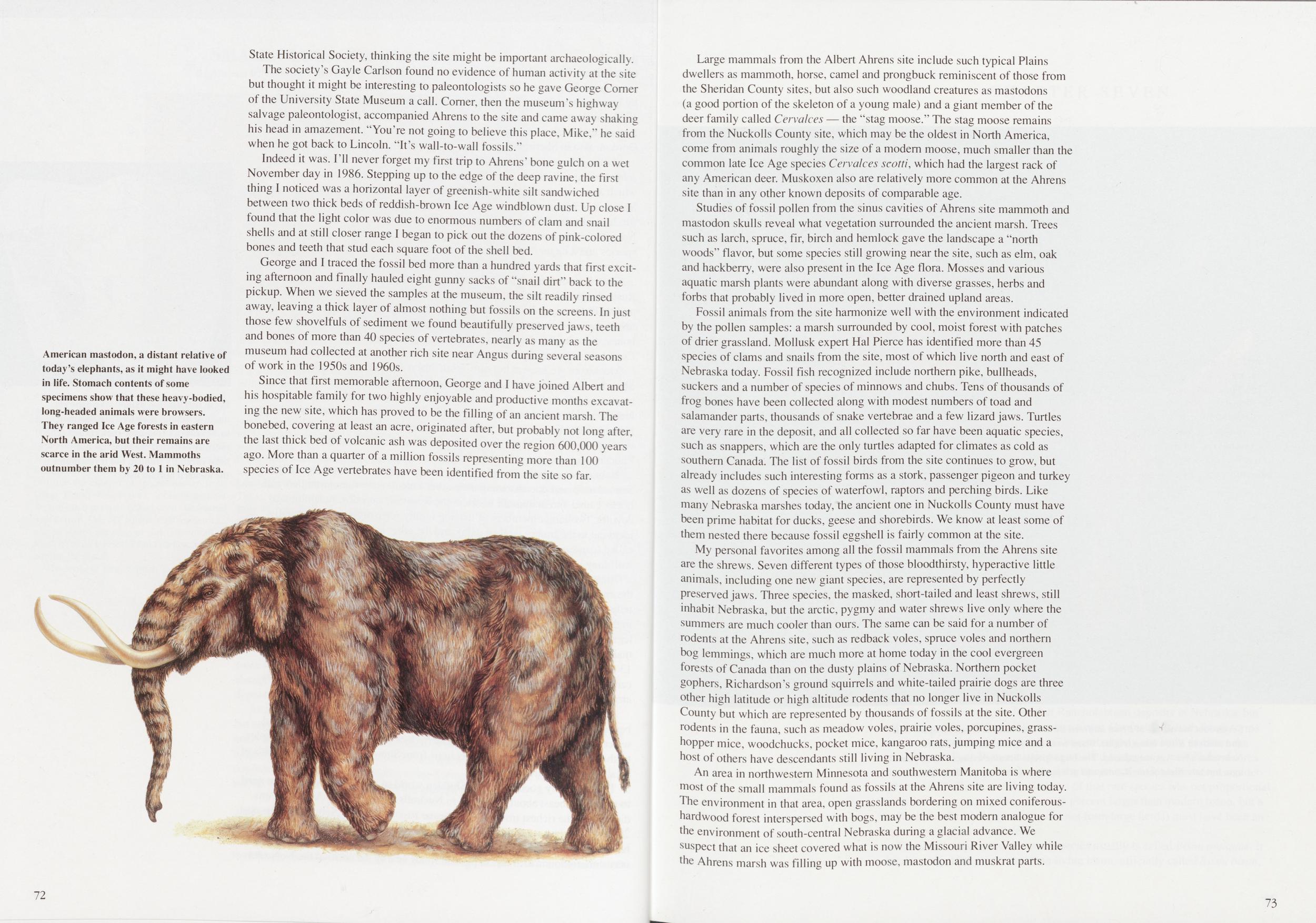
American mastodon, a distant relative of today's elephants, as it might have looked in life. Stomach contents of some specimens show that these heavy-bodied, long-headed animals were browsers. They ranged Ice Age forests in eastern North America, but their remains are scarce in the arid West. Mammoths outnumber them by 20 to 1 in Nebraska.
State Historical Society, thinking the site might be important archaeologically.
The society's Gayle Carlson found no evidence of human activity at the site but thought it might be interesting to paleontologists so he gave George Comer of the University State Museum a call. Comer, then the museum's highway salvage paleontologist, accompanied Ahrens to the site and came away shaking his head in amazement. "You're not going to believe this place, Mike," he said when he got back to Lincoln. "It's wall-to-wall fossils."
Indeed it was. I'll never forget my first trip to Ahrens' bone gulch on a wet November day in 1986. Stepping up to the edge of the deep ravine, the first thing I noticed was a horizontal layer of greenish-white silt sandwiched between two thick beds of reddish-brown Ice Age windblown dust. Up close I found that the light color was due to enormous numbers of clam and snail shells and at still closer range I began to pick out the dozens of pink-colored bones and teeth that stud each square foot of the shell bed.
George and I traced the fossil bed more than a hundred yards that first excit- ing afternoon and finally hauled eight gunny sacks of "snail dirt" back to the pickup. When we sieved the samples at the museum, the silt readily rinsed away, leaving a thick layer of almost nothing but fossils on the screens. In just those few shovelfuls of sediment we found beautifully preserved jaws, teeth and bones of more than 40 species of vertebrates, nearly as many as the museum had collected at another rich site near Angus during several seasons of work in the 1950s and 1960s.
Since that first memorable afternoon, George and I have joined Albert and his hospitable family for two highly enjoyable and productive months excavat- ing the new site, which has proved to be the filling of an ancient marsh. The bonebed, covering at least an acre, originated after, but probably not long after, the last thick bed of volcanic ash was deposited over the region 600,000 years ago. More than a quarter of a million fossils representing more than 100 species of Ice Age vertebrates have been identified from the site so far.
72Large mammals from the Albert Ahrens site include such typical Plains dwellers as mammoth, horse, camel and prongbuck reminiscent of those from the Sheridan County sites, but also such woodland creatures as mastodons (a good portion of the skeleton of a young male) and a giant member of the deer family called Cervalces — the "stag moose." The stag moose remains from the Nuckolls County site, which may be the oldest in North America, come from animals roughly the size of a modern moose, much smaller than the common late Ice Age species Cervalces scotti, which had the largest rack of any American deer. Muskoxen also are relatively more common at the Ahrens site than in any other known deposits of comparable age.
Studies of fossil pollen from the sinus cavities of Ahrens site mammoth and mastodon skulls reveal what vegetation surrounded the ancient marsh. Trees such as larch, spruce, fir, birch and hemlock gave the landscape a "north woods" flavor, but some species still growing near the site, such as elm, oak and hackberry, were also present in the Ice Age flora. Mosses and various aquatic marsh plants were abundant along with diverse grasses, herbs and forbs that probably lived in more open, better drained upland areas.
Fossil animals from the site harmonize well with the environment indicated by the pollen samples: a marsh surrounded by cool, moist forest with patches of drier grassland. Mollusk expert Hal Pierce has identified more than 45 species of clams and snails from the site, most of which live north and east of Nebraska today. Fossil fish recognized include northern pike, bullheads, suckers and a number of species of minnows and chubs. Tens of thousands of frog bones have been collected along with modest numbers of toad and salamander parts, thousands of snake vertebrae and a few lizard jaws. Turtles are very rare in the deposit, and all collected so far have been aquatic species, such as snappers, which are the only turtles adapted for climates as cold as southern Canada. The list of fossil birds from the site continues to grow, but already includes such interesting forms as a stork, passenger pigeon and turkey as well as dozens of species of waterfowl, raptors and perching birds. Like many Nebraska marshes today, the ancient one in Nuckolls County must have been prime habitat for ducks, geese and shorebirds. We know at least some of them nested there because fossil eggshell is fairly common at the site.
My personal favorites among all the fossil mammals from the Ahrens site are the shrews. Seven different types of those bloodthirsty, hyperactive little animals, including one new giant species, are represented by perfectly preserved jaws. Three species, the masked, short-tailed and least shrews, still inhabit Nebraska, but the arctic, pygmy and water shrews live only where the summers are much cooler than ours. The same can be said for a number of rodents at the Ahrens site, such as redback voles, spruce voles and northern bog lemmings, which are much more at home today in the cool evergreen forests of Canada than on the dusty plains of Nebraska. Northern pocket gophers, Richardson's ground squirrels and white-tailed prairie dogs are three other high latitude or high altitude rodents that no longer live in Nuckolls County but which are represented by thousands of fossils at the site. Other rodents in the fauna, such as meadow voles, prairie voles, porcupines, grass- hopper mice, woodchucks, pocket mice, kangaroo rats, jumping mice and a host of others have descendants still living in Nebraska.
An area in northwestern Minnesota and southwestern Manitoba is where most of the small mammals found as fossils at the Ahrens site are living today. The environment in that area, open grasslands bordering on mixed coniferous- hardwood forest interspersed with bogs, may be the best modern analogue for the environment of south-central Nebraska during a glacial advance. We suspect that an ice sheet covered what is now the Missouri River Valley while the Ahrens marsh was filling up with moose, mastodon and muskrat parts.
73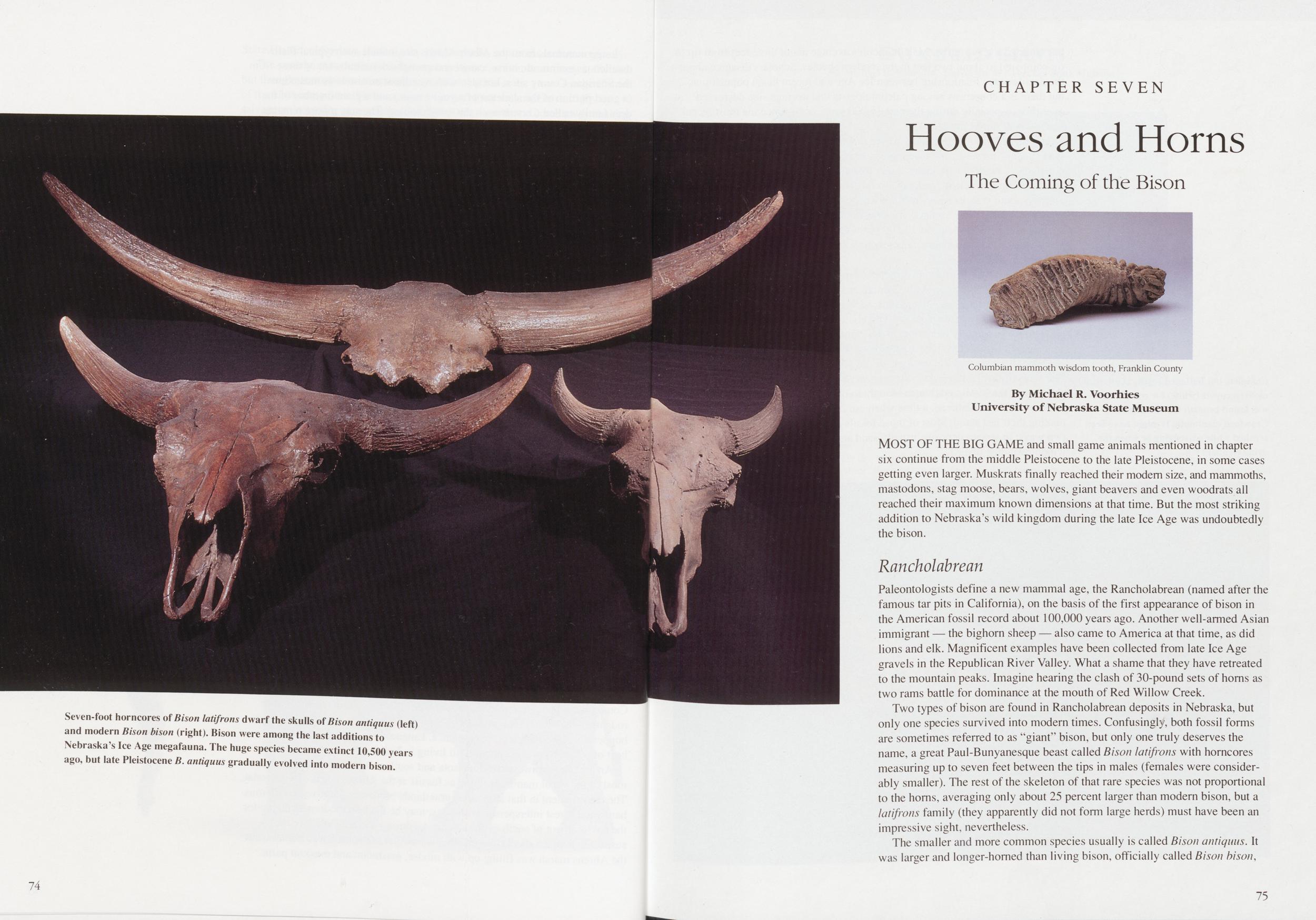
Seven-foot horncores of Bison latifrons dwarf the skulls of Bison antiquus (left) and modern Bison bison (right). Bison were among the last additions to Nebraska's Ice Age megafauna. The huge species became extinct 10,500 years ago, but late Pleistocene B. antiquus gradually evolved into modern bison
CHAPTER SEVEN Hooves and Horns
The Coming of the Bison
Columbian mammoth wisdom tooth, Franklin County
MOST OF THE BIG GAME and small game animals mentioned in chapter six continue from the middle Pleistocene to the late Pleistocene, in some cases getting even larger. Muskrats finally reached their modem size, and mammoths, mastodons, stag moose, bears, wolves, giant beavers and even woodrats all reached their maximum known dimensions at that time. But the most striking addition to Nebraska's wild kingdom during the late Ice Age was undoubtedly the bison.
Rancholabrean Paleontologists define a new mammal age, the Rancholabrean (named after the famous tar pits in California), on the basis of the first appearance of bison in the American fossil record about 100,000 years ago. Another well-armed Asian immigrant — the bighorn sheep — also came to America at that time, as did lions and elk. Magnificent examples have been collected from late Ice Age gravels in the Republican River Valley. What a shame that they have retreated to the mountain peaks. Imagine hearing the clash of 30-pound sets of horns as two rams battle for dominance at the mouth of Red Willow Creek. Two types of bison are found in Rancholabrean deposits in Nebraska, but only one species survived into modern times. Confusingly, both fossil forms are sometimes referred to as "giant" bison, but only one truly deserves the name, a great Paul-Bunyanesque beast called Bison latifrons with horncores measuring up to seven feet between the tips in males (females were consider- ably smaller). The rest of the skeleton of that rare species was not proportional to the horns, averaging only about 25 percent larger than modern bison, but a latifrons family (they apparently did not form large herds) must have been an impressive sight, nevertheless. The smaller and more common species usually is called Bison antiquus. It was larger and longer-horned than living bison, officially called Bison bison, 75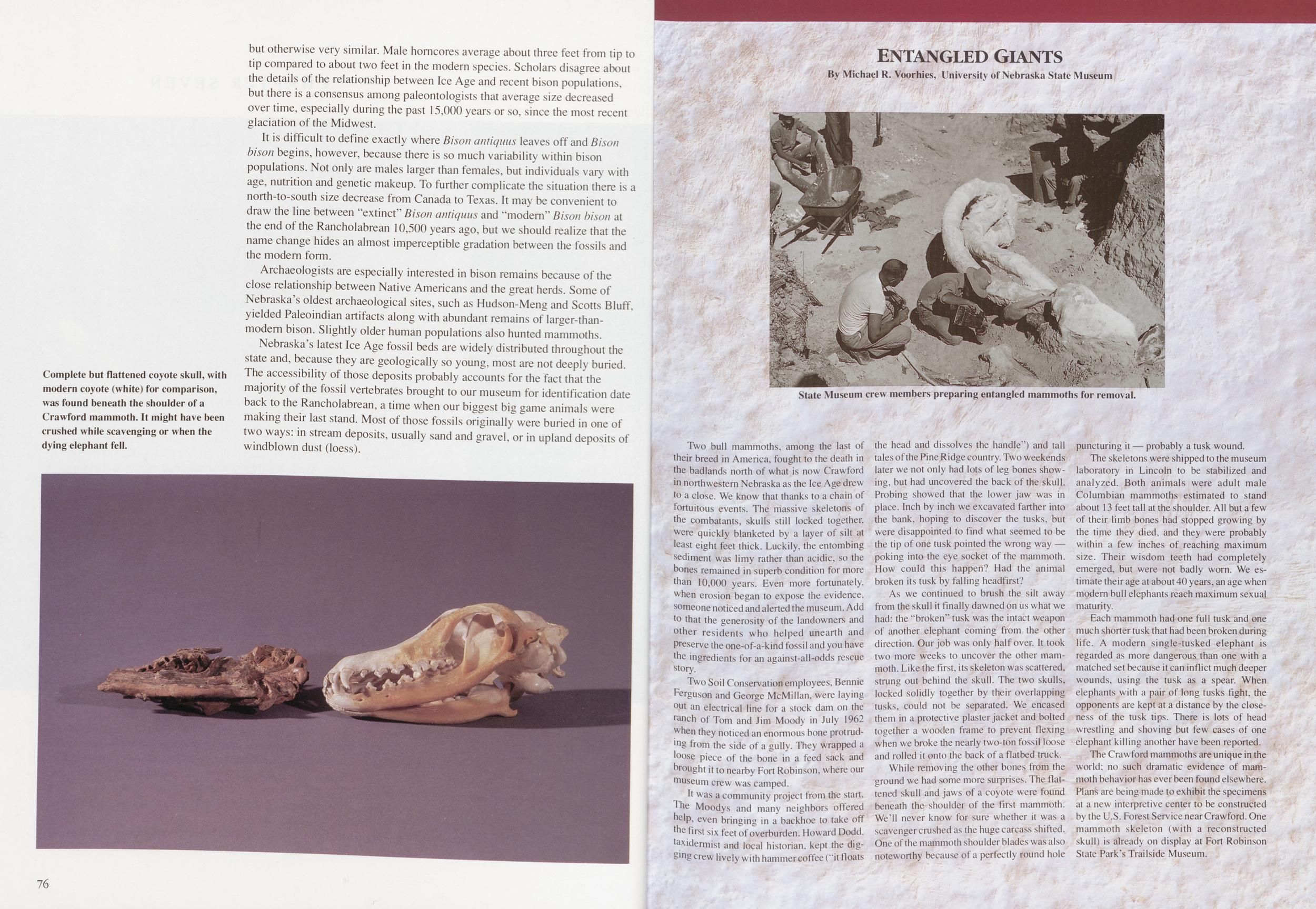
Complete but flattened coyote skull, with modern coyote (white) for comparison, was found beneath the shoulder of a Crawford mammoth. It might have been crushed while scavenging or when the dying elephant fell.
but otherwise very similar. Male horncores average about three feet from tip to tip compared to about two feet in the modern species. Scholars disagree about the details of the relationship between Ice Age and recent bison populations, but there is a consensus among paleontologists that average size decreased over time, especially during the past 15,000 years or so, since the most recent glaciation of the Midwest.
It is difficult to define exactly where Bison antiquus leaves off and Bison bison begins, however, because there is so much variability within bison populations. Not only are males larger than females, but individuals vary with age, nutrition and genetic makeup. To further complicate the situation there is a north-to-south size decrease from Canada to Texas. It may be convenient to draw the line between "extinct" Bison antiquus and "modern" Bison bison at the end of the Rancholabrean 10,500 years ago, but we should realize that the name change hides an almost imperceptible gradation between the fossils and the modern form.
Archaeologists are especially interested in bison remains because of the close relationship between Native Americans and the great herds. Some of Nebraska's oldest archaeological sites, such as Hudson-Meng and Scotts Bluff, yielded Paleoindian artifacts along with abundant remains of larger-than- modern bison. Slightly older human populations also hunted mammoths.
Nebraska's latest Ice Age fossil beds are widely distributed throughout the state and, because they are geologically so young, most are not deeply buried. The accessibility of those deposits probably accounts for the fact that the majority of the fossil vertebrates brought to our museum for identification date back to the Rancholabrean, a time when our biggest big game animals were making their last stand. Most of those fossils originally were buried in one of two ways: in stream deposits, usually sand and gravel, or in upland deposits of windblown dust (loess).
ENTANGLED GIANTS
State Museum crew members preparing entangled mammoths for removal.
Two bull mammoths, among the last of their breed in America, fought to the death in the badlands north of what is now Crawford in northwestern Nebraska as the Ice Age drew to a close. We know that thanks to a chain of fortuitous events. The massive skeletons of the combatants, skulls still locked together, were quickly blanketed by a layer of silt at least eight feet thick. Luckily, the entombing sediment was limy rather than acidic, so the bones remained in superb condition for more than 10,000 years. Even more fortunately, when erosion began to expose the evidence, someone noticed and alerted the museum. Add to that the generosity of the landowners and other residents who helped unearth and preserve the one-of-a-kind fossil and you have the ingredients for an against-all-odds rescue story.
Two Soil Conservation employees, Bennie Ferguson and George McMillan, were laying out an electrical line for a stock dam on the ranch of Tom and Jim Moody in July 1962 when they noticed an enormous bone protrudong from the side of a gully. They wrapped a loose piece of the bone in a feed sack and brought it to nearby Fort Robinson, where our museum crew was camped.
It was a community project from the start. The Moodys and many neighbors offered help, even bringing in a backhoe to take off the first six feet of overburden. Howard Dodd, taxidermist and local historian, kept the diging crew lively with hammer coffee ("it floats the head and dissolves the handle") and tall tales of the Pine Ridge country. Two weekends later we not only had lots of leg bones show- ing, but had uncovered the back of the skull. Probing showed that the lower jaw was in place. Inch by inch we excavated farther into the bank, hoping to discover the tusks, but were disappointed to find what seemed to be the tip of one tusk pointed the wrong way — poking into the eye socket of the mammoth. How could this happen? Had the animal broken its tusk by falling headfirst?
As we continued to brush the silt away from the skull it finally dawned on us what we had: the "broken" tusk was the intact weapon of another elephant coming from the other direction. Our job was only half over. It took two more weeks to uncover the other mammoth. Like the first, its skeleton was scattered, strung out behind the skull. The two skulls, locked solidly together by their overlapping tusks, could not be separated. We encased them in a protective plaster jacket and bolted together a wooden frame to prevent flexing when we broke the nearly two-ton fossil loose and rolled it onto the back of a flatbed truck.
While removing the other bones from the ground we had some more surprises. The flattened skull and jaws of a coyote were found beneath the shoulder of the first mammoth. We'll never know for sure whether it was a scavenger crushed as the huge carcass shifted. One of the mammoth shoulder blades was also noteworthy because of a perfectly round hole puncturing it — probably a tusk wound.
The skeletons were shipped to the museum laboratory in Lincoln to be stabilized and analyzed. Both animals were adult male Columbian mammoths estimated to stand about 13 feet tall at the shoulder. All but a few of their limb bones had stopped growing by the time they died, and they were probably within a few inches of reaching maximum size. Their wisdom teeth had completely emerged, but were not badly worn. We estimate their age at about 40 years, an age when modern bull elephants reach maximum sexual maturity.
Each mammoth had one full tusk and one much shorter tusk that had been broken during life. A modern single-tusked elephant is regarded as more dangerous than one with a matched set because it can inflict much deeper wounds, using the tusk as a spear. When elephants with a pair of long tusks fight, the opponents are kept at a distance by the closeness of the tusk tips. There is lots of head wrestling and shoving but few cases of one elephant killing another have been reported.
The Crawford mammoths are unique in the world; no such dramatic evidence of mam- moth behavior has ever been found elsewhere. Plans are being made to exhibit the specimens at a new interpretive center to be constructed by the U.S. Forest Service near Crawford. One mammoth skeleton (with a reconstructed skull) is already on display at Fort Robinson State Park's Trailside Museum.
76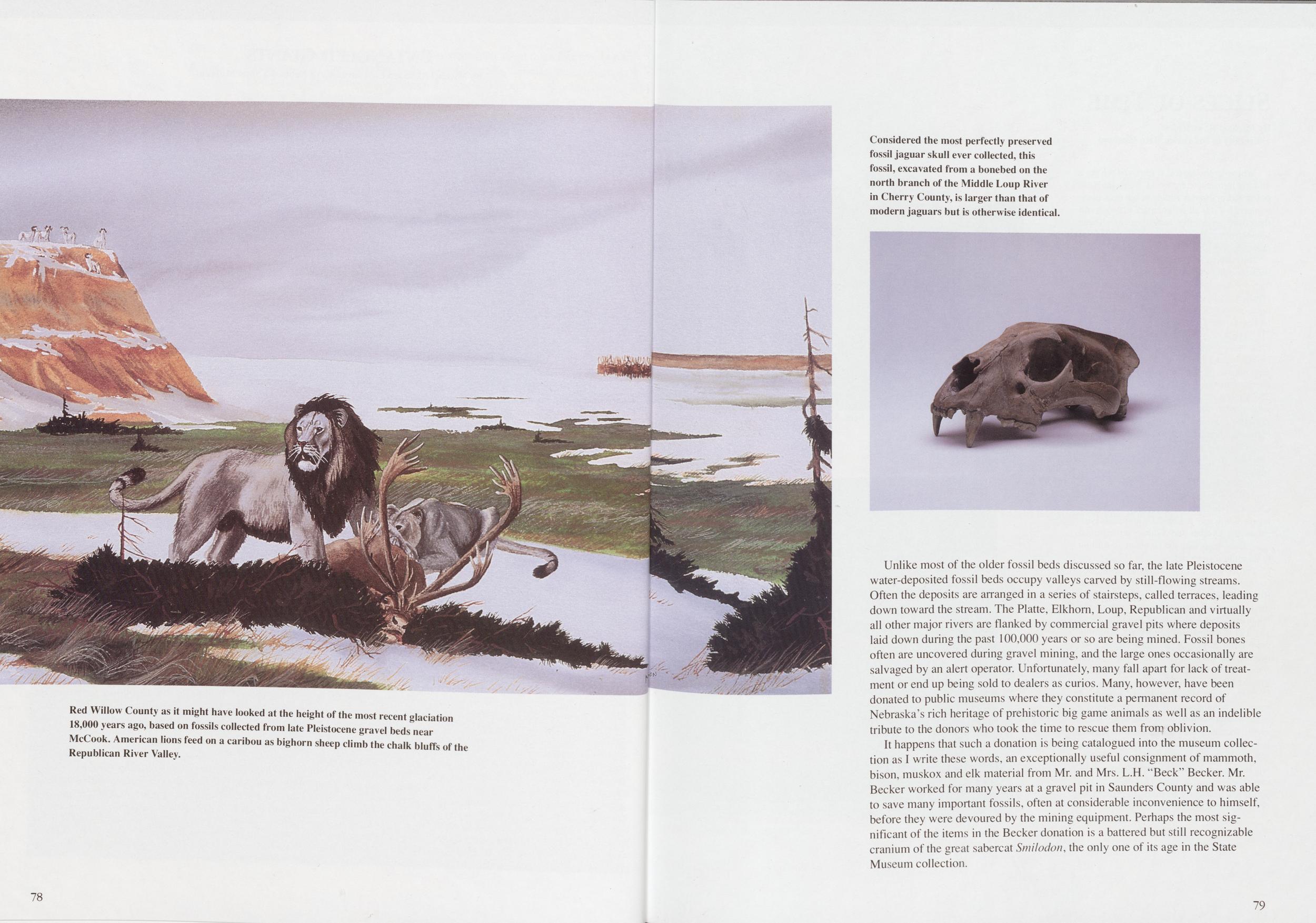
Red Willow County as it might have looked at the height of the most recent glaciation 18,000 years ago, based on fossils collected from late Pleistocene gravel beds near McCook. American lions feed on a caribou as bighorn sheep climb the chalk bluffs of the Republican River Valley.
Considered the most perfectly preserved fossil jaguar skull ever collected, this fossil, excavated from a bonebed on the north branch of the Middle Loup River in Cherry County, is larger than that of modern jaguars but is otherwise identical.
Unlike most of the older fossil beds discussed so far, the late Pleistocene water-deposited fossil beds occupy valleys carved by still-flowing streams. Often the deposits are arranged in a series of stairsteps, called terraces, leading down toward the stream. The Platte, Elkhom, Loup, Republican and virtually all other major rivers are flanked by commercial gravel pits where deposits laid down during the past 100,000 years or so are being mined. Fossil bones often are uncovered during gravel mining, and the large ones occasionally are salvaged by an alert operator. Unfortunately, many fall apart for lack of treatment or end up being sold to dealers as curios. Many, however, have been donated to public museums where they constitute a permanent record of Nebraska's rich heritage of prehistoric big game animals as well as an indelible tribute to the donors who took the time to rescue them from oblivion.
It happens that such a donation is being catalogued into the museum collection as I write these words, an exceptionally useful consignment of mammoth, bison, muskox and elk material from Mr. and Mrs. L.H. "Beck" Becker. Mr. Becker worked for many years at a gravel pit in Saunders County and was able to save many important fossils, often at considerable inconvenience to himself, before they were devoured by the mining equipment. Perhaps the most significant of the items in the Becker donation is a battered but still recognizable cranium of the great sabercat Smilodon, the only one of its age in the State Museum collection.
79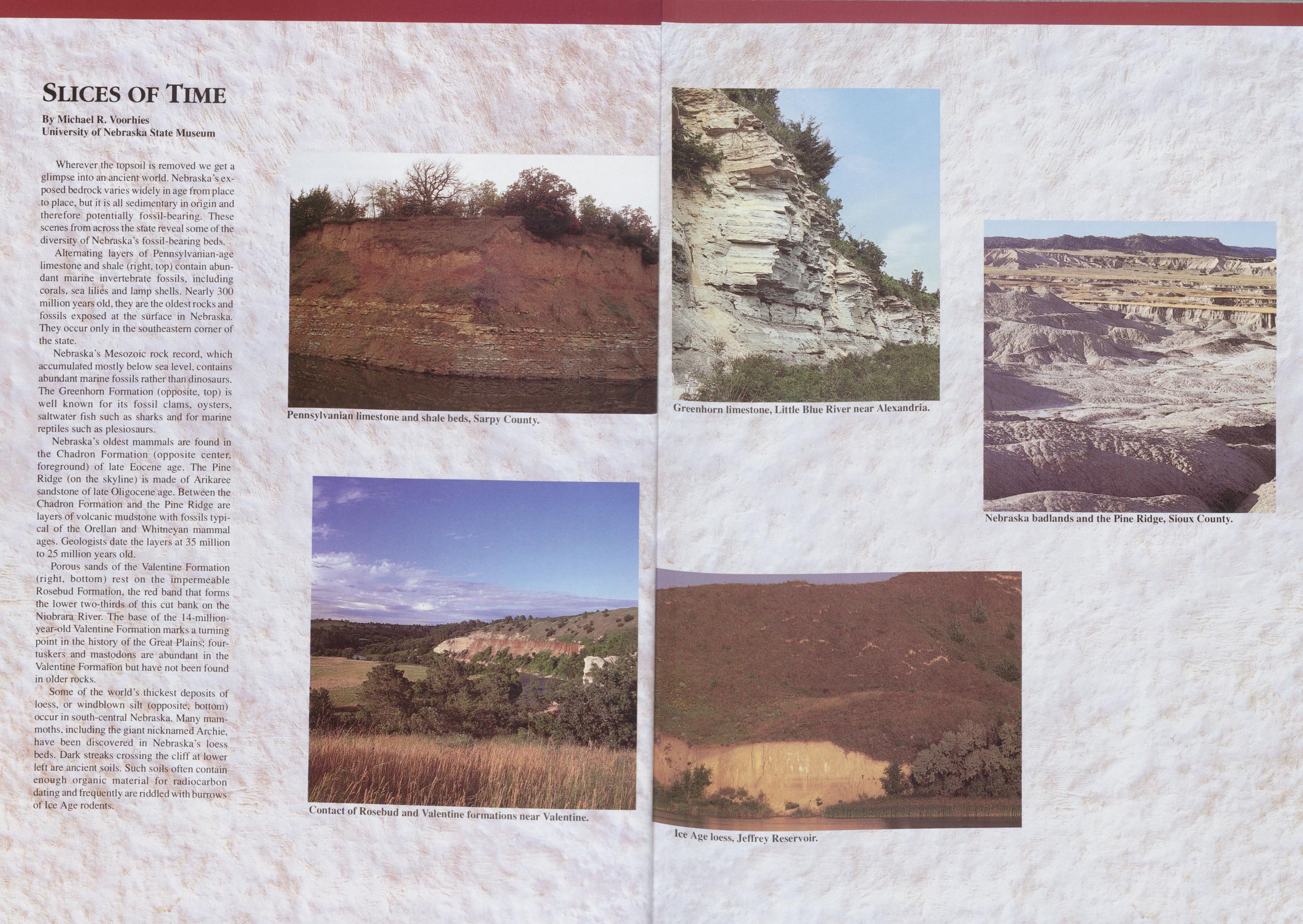
Slices of Time
Wherever the topsoil is removed we get a glimpse into an ancient world. Nebraska's exposed bedrock varies widely in age from place to place, but it is all sedimentary in origin and therefore potentially fossil-bearing. These scenes from across the state reveal some of the diversity of Nebraska's fossil-bearing beds.
Alternating layers of Pennsylvanian-age limestone and shale (right, top) contain abundant marine invertebrate fossils, including corals, sea lilies and lamp shells. Nearly 300 million years old, they are the oldest rocks and fossils exposed at the surface in Nebraska. They occur only in the southeastern comer of the state.
Nebraska's Mesozoic rock record, which accumulated mostly below sea level, contains abundant marine fossils rather than dinosaurs. The Greenhorn Formation (opposite, top) is well known for its fossil clams, oysters, saltwater fish such as sharks and for marine reptiles such as plesiosaurs.
Nebraska's oldest mammals are found in the Chadron Formation (opposite center, foreground) of late Eocene age. The Pine Ridge (on the skyline) is made of Arikaree sandstone of late Oligocene age. Between the Chadron Formation and the Pine Ridge are layers of volcanic mudstone with fossils typi- cal of the Orellan and Whitneyan mammal ages. Geologists date the layers at 35 million to 25 million years old.
Porous sands of the Valentine Formation (right, bottom) rest on the impermeable Rosebud Formation, the red band that forms the lower two-thirds of this cut bank on the Niobrara River. The base of the 14-million- year-old Valentine Formation marks a turning point in the history of the Great Plains; four- tuskers and mastodons are abundant in the Valentine Formation but have not been found in older rocks.
Some of the world's thickest deposits of loess, or windblown silt (opposite, bottom) occur in south-central Nebraska. Many mam- moths, including the giant nicknamed Archie, have been discovered in Nebraska's loess beds. Dark streaks crossing the cliff at lower left are ancient soils. Such soils often contain enough organic material for radiocarbon dating and frequently are riddled with burrows of Ice Age rodents.
Pennsylvanian limestone and shale beds, Sarpy County.
Contact of Rosebud and Valentine formations near Valentine
Greenhorn limestone, Little Blue River near Alexandria.
Nebraska badlands and the Pine Ridge, Sioux County.
Ice Age loess, Jeffrey Reservoir.
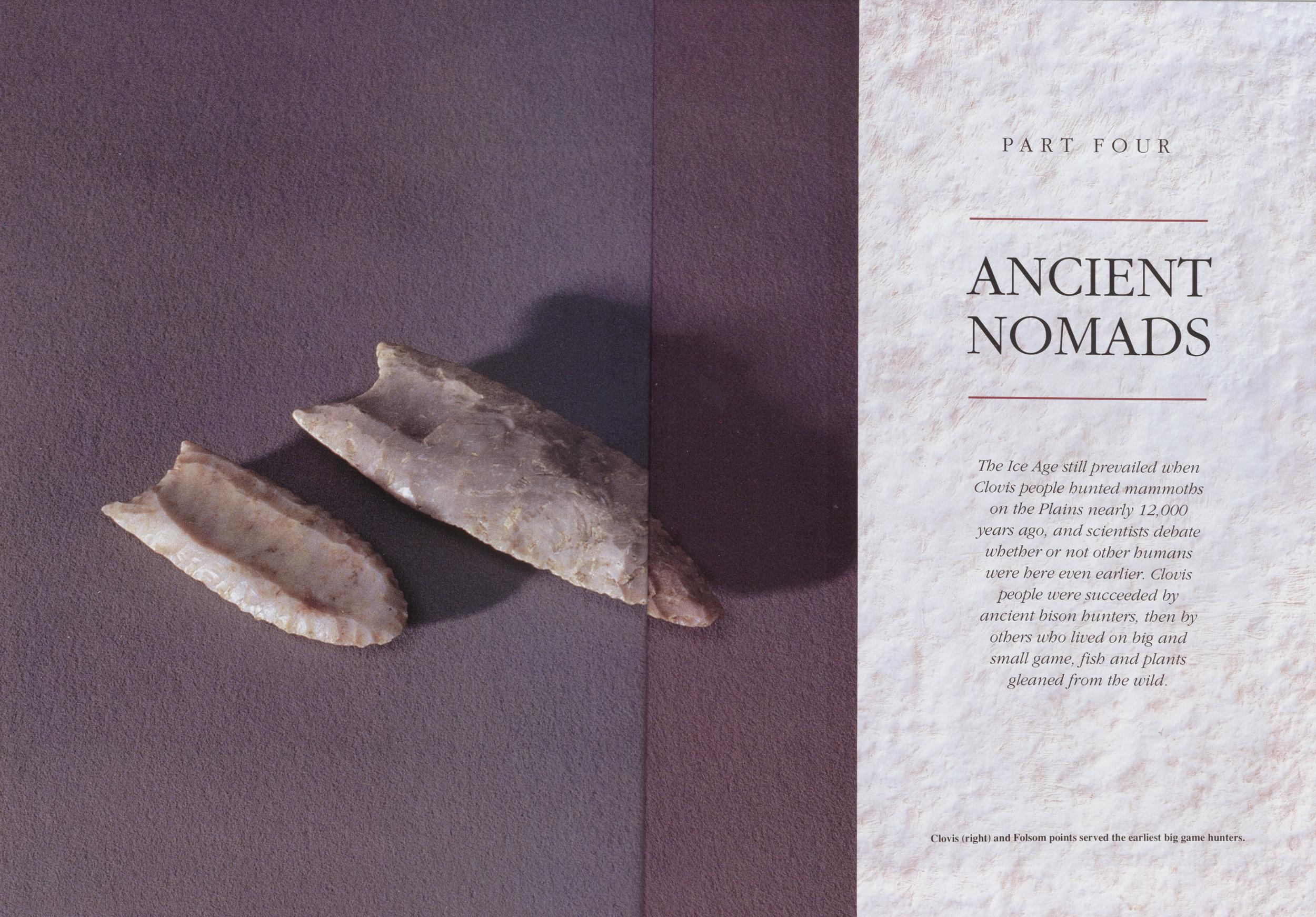
Clovis (right) and Folsom points served the earliest big game hunters.
PART FOUR ANCIENT NOMADS
The Ice Age still prevailed when Clovis people hunted mammoths on the Plains nearly 12,000 years ago, and scientists debate whether or not other humans were here even earlier. Clovis people were succeeded by ancient bison hunters, then by others who lived on big and small game, fish and plants gleaned from the wild.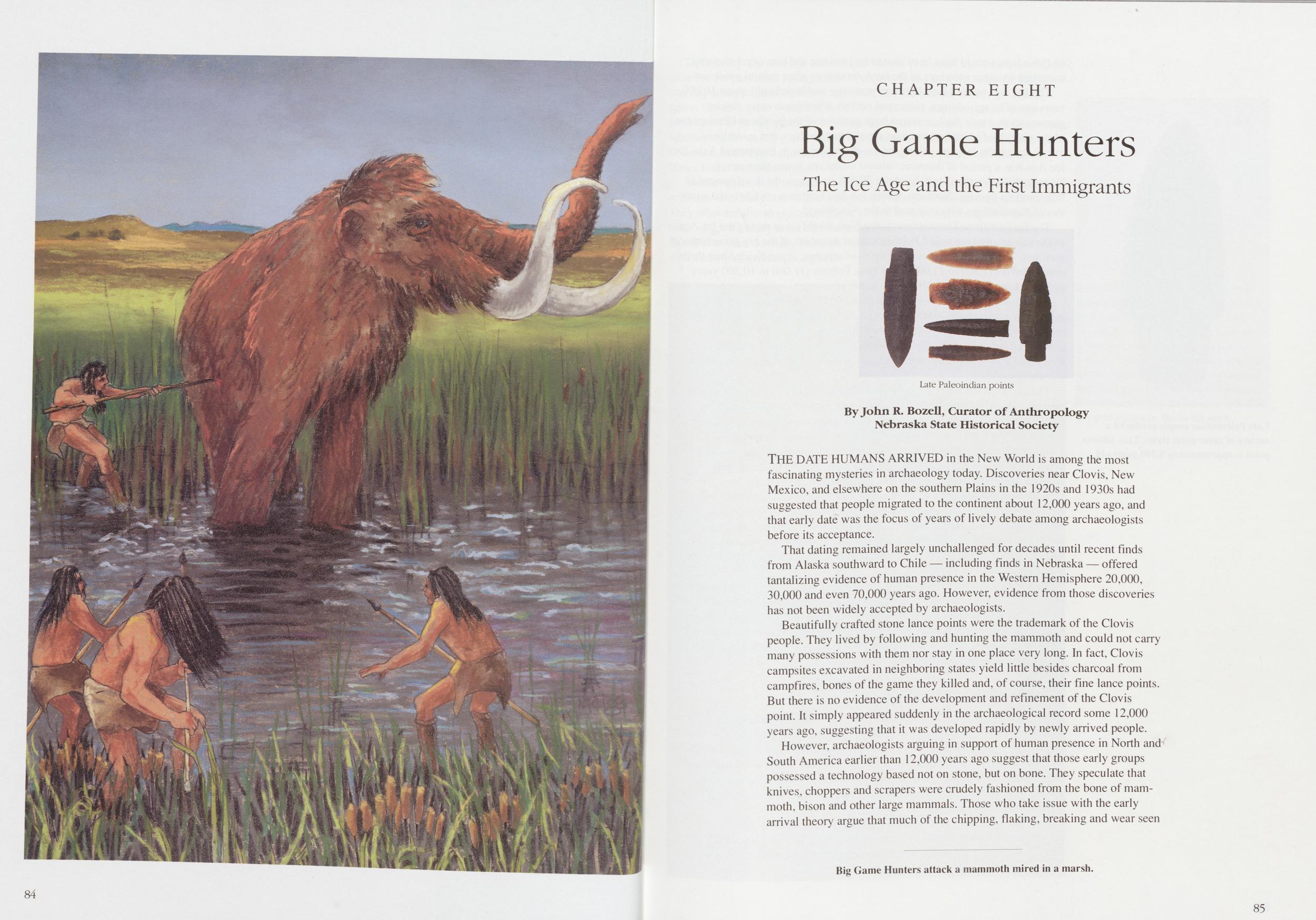
Big Game Hunters attack a mammoth mired in a marsh.
CHAPTER EIGHT Big Game Hunters
The Ice Age and the First Immigrants
Late Paleoindian points
By John R. Bozell, Curator of Anthropology Nebraska State Historical Society
THE DATE HUMANS ARRIVED in the New World is among the most fascinating mysteries in archaeology today. Discoveries near Clovis, New Mexico, and elsewhere on the southern Plains in the 1920s and 1930s had suggested that people migrated to the continent about 12,000 years ago, and that early date was the focus of years of lively debate among archaeologists before its acceptance.
That dating remained largely unchallenged for decades until recent finds from Alaska southward to Chile — including finds in Nebraska — offered tantalizing evidence of human presence in the Western Hemisphere 20,000, 30,000 and even 70,000 years ago. However, evidence from those discoveries has not been widely accepted by archaeologists.
Beautifully crafted stone lance points were the trademark of the Clovis people. They lived by following and hunting the mammoth and could not carry many possessions with them nor stay in one place very long. In fact, Clovis campsites excavated in neighboring states yield little besides charcoal from campfires, bones of the game they killed and, of course, their fine lance points. But there is no evidence of the development and refinement of the Clovis point. It simply appeared suddenly in the archaeological record some 12,000 years ago, suggesting that it was developed rapidly by newly arrived people.
However, archaeologists arguing in support of human presence in North and South America earlier than 12,000 years ago suggest that those early groups possessed a technology based not on stone, but on bone. They speculate that knives, choppers and scrapers were crudely fashioned from the bone of mam- moth, bison and other large mammals. Those who take issue with the early arrival theory argue that much of the chipping, flaking, breaking and wear seen
85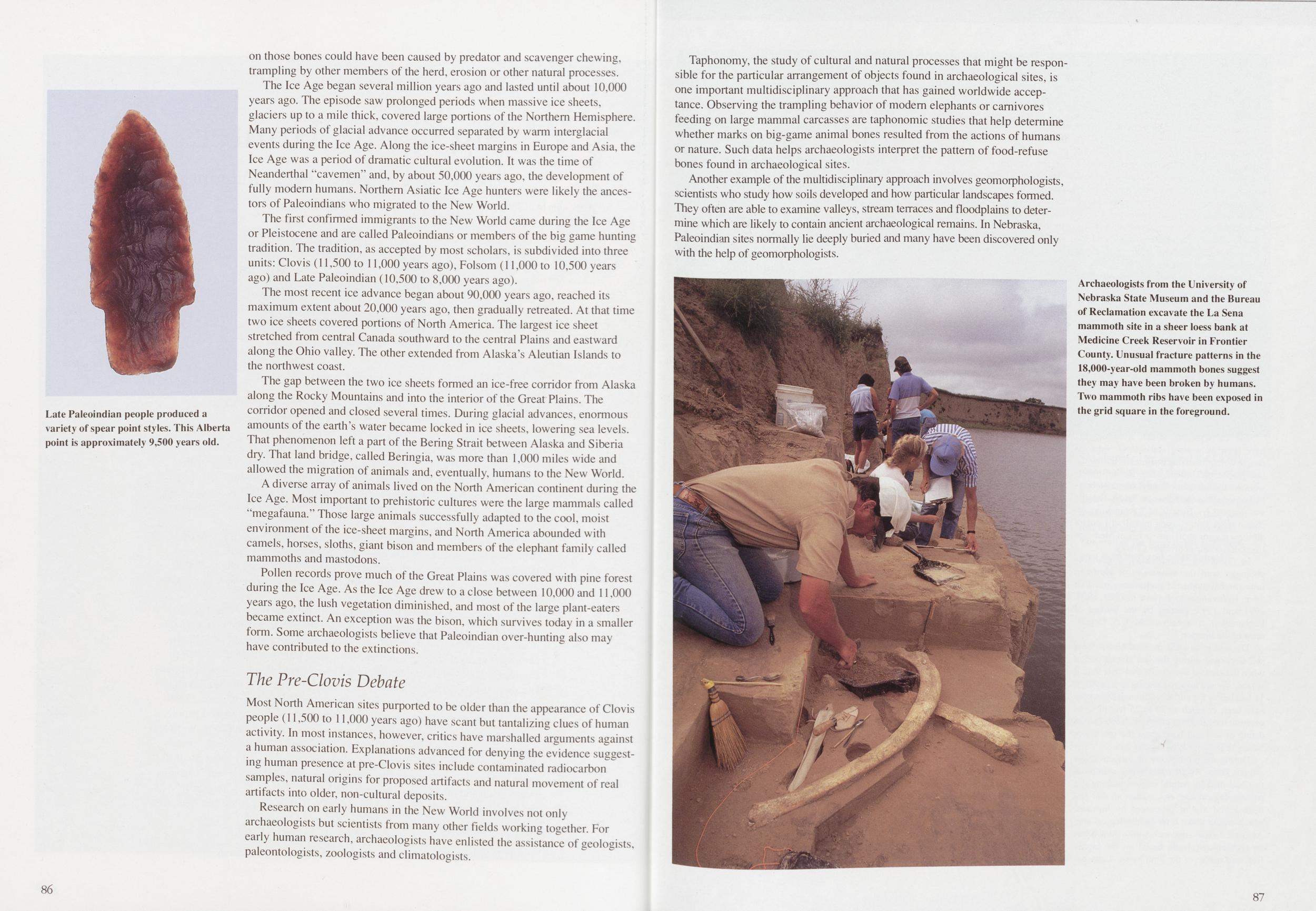
Late Paleoindian people produced a variety of spear point styles. This Alberta point is approximately 9,500 years old.
on those bones could have been caused by predator and scavenger chewing, trampling by other members of the herd, erosion or other natural processes.
The Ice Age began several million years ago and lasted until about 10,000 years ago. The episode saw prolonged periods when massive ice sheets, glaciers up to a mile thick, covered large portions of the Northern Hemisphere. Many periods of glacial advance occurred separated by warm interglacial events during the Ice Age. Along the ice-sheet margins in Europe and Asia, the Ice Age was a period of dramatic cultural evolution. It was the time of Neanderthal "cavemen" and, by about 50,000 years ago, the development of fully modern humans. Northern Asiatic Ice Age hunters were likely the ancestors of Paleoindians who migrated to the New World.
The first confirmed immigrants to the New World came during the Ice Age or Pleistocene and are called Paleoindians or members of the big game hunting tradition. The tradition, as accepted by most scholars, is subdivided into three units: Clovis (11,500 to 11,000 years ago), Folsom (11,000 to 10,500 years ago) and Late Paleoindian (10,500 to 8,000 years ago).
The most recent ice advance began about 90,000 years ago, reached its maximum extent about 20,000 years ago, then gradually retreated. At that time two ice sheets covered portions of North America. The largest ice sheet stretched from central Canada southward to the central Plains and eastward along the Ohio valley. The other extended from Alaska's Aleutian Islands to the northwest coast.
The gap between the two ice sheets formed an ice-free corridor from Alaska along the Rocky Mountains and into the interior of the Great Plains. The corridor opened and closed several times. During glacial advances, enormous amounts of the earth's water became locked in ice sheets, lowering sea levels. That phenomenon left a part of the Bering Strait between Alaska and Siberia dry. That land bridge, called Beringia, was more than 1,000 miles wide and allowed the migration of animals and, eventually, humans to the New World.
A diverse array of animals lived on the North American continent during the Ice Age. Most important to prehistoric cultures were the large mammals called "megafauna." Those large animals successfully adapted to the cool, moist environment of the ice-sheet margins, and North America abounded with camels, horses, sloths, giant bison and members of the elephant family called mammoths and mastodons.
Pollen records prove much of the Great Plains was covered with pine forest during the Ice Age. As the Ice Age drew to a close between 10,000 and 11,000 years ago, the lush vegetation diminished, and most of the large plant-eaters became extinct. An exception was the bison, which survives today in a smaller form. Some archaeologists believe that Paleoindian over-hunting also may have contributed to the extinctions.
The Pre-Clovis DebateMost North American sites purported to be older than the appearance of Clovis people (11,500 to 11,000 years ago) have scant but tantalizing clues of human activity. In most instances, however, critics have marshalled arguments against a human association. Explanations advanced for denying the evidence suggest- ing human presence at pre-Clovis sites include contaminated radiocarbon samples, natural origins for proposed artifacts and natural movement of real artifacts into older, non-cultural deposits.
Research on early humans in the New World involves not only archaeologists but scientists from many other fields working together. For early human research, archaeologists have enlisted the assistance of geologists, paleontologists, zoologists and climatologists.
86Taphonomy, the study of cultural and natural processes that might be respon- sible for the particular arrangement of objects found in archaeological sites, is one important multidisciplinary approach that has gained worldwide accep- tance. Observing the trampling behavior of modem elephants or carnivores feeding on large mammal carcasses are taphonomic studies that help determine whether marks on big-game animal bones resulted from the actions of humans or nature. Such data helps archaeologists interpret the pattern of food-refuse bones found in archaeological sites.
Another example of the multidisciplinary approach involves geomorphologists, scientists who study how soils developed and how particular landscapes formed. They often are able to examine valleys, stream terraces and floodplains to deter- mine which are likely to contain ancient archaeological remains. In Nebraska, Paleoindian sites normally lie deeply buried and many have been discovered only with the help of geomorphologists.
Archaeologists from the University of Nebraska State Museum and the Bureau of Reclamation excavate the La Sena mammoth site in a sheer loess bank at Medicine Creek Reservoir in Frontier County. Unusual fracture patterns in the 18,000-year-old mammoth bones suggest they may have been broken by humans. Two mammoth ribs have been exposed in the grid square in the foreground.
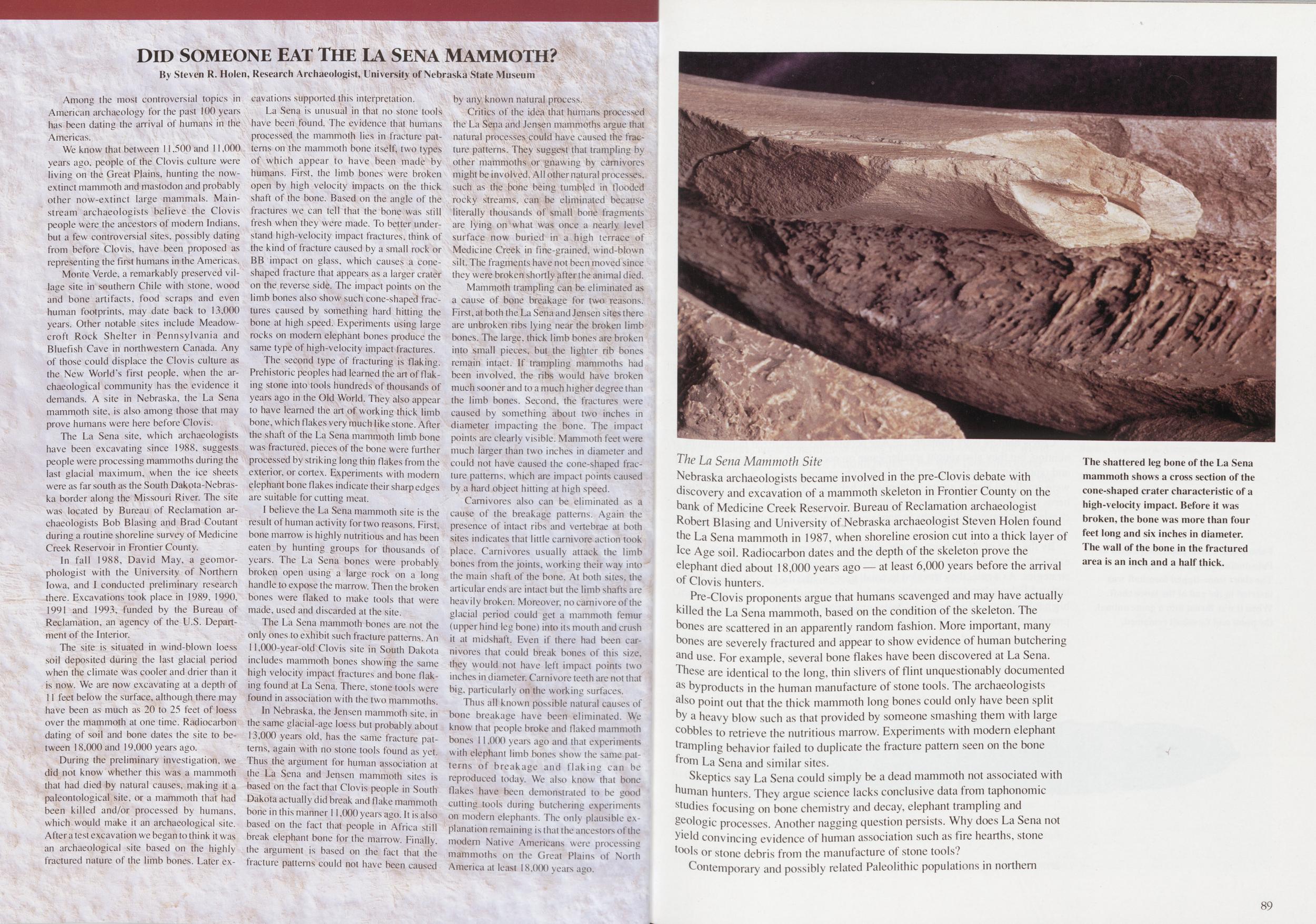
DID SOMEONE EAT THE LA SENA MAMMOTH?
Among the most controversial topics in American archaeology for the past 100 years has been datimz the arrival of humans in the Americas.
We know that between 11,500 and 11,000 years ago, people of the Clovis culture were living on the Great Plains, hunting the now- extinct mammoth and mastodon and probably other now-extinct large mammals. Main- stream archaeologists believe the Clovis people were the ancestors of modern Indians, but a few controversial sites, possibly dating from before Clovis, have been proposed as representing the first humans in the Americas.
Monte Verde, a remarkably preserved village site in southern Chile with stone, wood and bone artifacts, food scraps and even human footprints, may date back to 13,000 years. Other notable sites include Meadowcroft Rock Shelter in Pennsylvania and Bluefish Cave in northwestern Canada. Any of those could displace the Clovis culture as the New World's first people, when the archaeological community has the evidence it demands. A site in Nebraska, the La Sena mammoth site, is also among those that may prove humans were here before Clovis.
The La Sena site, which archaeologists have been excavating since 1988, suggests people were processing mammoths during the last glacial maximum, when the ice sheets were as far south as the South Dakota-Nebraska border along the Missouri River. The site was located by Bureau of Reclamation archaeologists Bob Biasing and Brad Coutant during a routine shoreline survey of Medicine Creek Reservoir in Frontier County.
In fall 1988, David May, a geomorphologist with the University of Northern Iowa, and I conducted preliminary research there. Excavations took place in 1989, 1990, 1991 and 1993, funded by the Bureau of Reclamation, an agency of the U.S. Department of the Interior.
The site is situated in wind-blown loess soil deposited during the last glacial period when the climate was cooler and drier than it is now. We are now excavating at a depth of 11 feet below the surface, although there may have been as much as 20 to 25 feet of loess over the mammoth at one time. Radiocarbon dating of soil and bone dates the site to between 18,000 and 19,000 years ago.
During the preliminary investigation, we did not know whether this was a mammoth that had died by natural causes, making it a paleontological site, or a mammoth that had been killed and/or processed by humans, which would make it an archaeological site. After a test excavation we began to think it was an archaeological site based on the highly fractured nature of the limb bones. Later excavations supported this interpretation.
La Sena is unusual in that no stone tools have been found. The evidence that humans processed the mammoth lies in fracture pat- terns on the mammoth bone itself, two types of which appear to have been made by humans. First, the limb bones were broken open by high velocity impacts on the thick shaft of the bone. Based on the angle of the fractures we can tell that the bone was still fresh when they were made. To better under- stand high-velocity impact fractures, think of the kind of fracture caused by a small rock or BB impact on glass, which causes a cone- shaped fracture that appears as a larger crater on the reverse side. The impact points on the limb bones also show such cone-shaped frac- tures caused by something hard hitting the bone at high speed. Experiments using large rocks on modem elephant bones produce the same type of high-velocity impact fractures.
The second type of fracturing is flaking. Prehistoric peoples had learned the art of flak- ing stone into tools hundreds of thousands of years ago in the Old World. They also appear to have learned the art of working thick limb bone, which flakes very much like stone. After the shaft of the La Sena mammoth limb bone was fractured, pieces of the bone were further processed by striking long thin flakes from the exterior, or cortex. Experiments with modem elephant bone flakes indicate their sharp edges are suitable for cutting meat.
I believe the La Sena mammoth site is the result of human activity for two reasons. First, bone marrow is highly nutritious and has been eaten by hunting groups for thousands of years. The La Sena bones were probably broken open using a large rock on a long handle to expose the marrow. Then the broken bones were flaked to make tools that were made, used and discarded at the site.
The La Sena mammoth bones are not the only ones to exhibit such fracture patterns. An 11,000-year-old Clovis site in South Dakota includes mammoth bones showing the same high velocity impact fractures and bone flaking found at La Sena. There, stone tools were found in association with the two mammoths.
In Nebraska, the Jensen mammoth site, in the same glacial-age loess but probably about 13,000 years old, has the same fracture patterns, again with no stone tools found as yet. Thus the argument for human association at the La Sena and Jensen mammoth sites is based on the fact that Clovis people in South Dakota actually did break and flake mammoth bone in this manner 11,000 years ago. It is also based on the fact that people in Africa still break elephant bone for the marrow. Finally, the argument is based on the fact that the fracture patterns could not have been caused by any known natural process.
Critics of the idea that humans processed the La Sena and Jensen mammoths argue that natural processes could have caused the frac- ture patterns. They suggest that trampling by other mammoths or gnawing by carnivores might be involved. All other natural processes, such as the bone being tumbled in flooded rocky streams, can be eliminated because literally thousands of small bone fragments are lying on what was once a nearly level surface now buried in a high terrace of Medicine Creek in fine-grained, wind-blown silt. The fragments have not been moved since they were broken shortly after the animal died.
Mammoth trampling can be eliminated as a cause of bone breakage for two reasons. First, at both the La Sena and Jensen sites there are unbroken ribs lying near the broken limb bones. The large, thick limb bones are broken into small pieces, but the lighter rib bones remain intact. If trampling mammoths had been involved, the ribs would have broken much sooner and to a much higher degree than the limb bones. Second, the fractures were caused by something about two inches in diameter impacting the bone. The impact points are clearly visible. Mammoth feet were much larger than two inches in diameter and could not have caused the cone-shaped fracture patterns, which are impact points caused by a hard object hitting at high speed.
Carnivores also can be eliminated as a cause of the breakage patterns. Again the presence of intact ribs and vertebrae at both sites indicates that little carnivore action took place. Carnivores usually attack the limb bones from the joints, working their way into the main shaft of the bone. At both sites, the articular ends are intact but the limb shafts are heavily broken. Moreover, no carnivore of the glacial period could get a mammoth femur (upper hind leg bone) into its mouth and crush it at midshaft. Even if there had been carnivores that could break bones of this size, they would not have left impact points two inches in diameter. Carnivore teeth are not that big, particularly on the working surfaces.
Thus all known possible natural causes of bone breakage have been eliminated. We know that people broke and flaked mammoth bones 11,000 years ago and that experiments with elephant limb bones show the same pat- terns of breakage and flaking can be reproduced today. We also know that bone Hakes have been demonstrated to be good cutting tools during butchering experiments on modern elephants. The only plausible ex- planation remaining is that the ancestors of the modern Native Americans were processing mammoths on the Great Plains of North America at least 18,000 years ago.
Nebraska archaeologists became involved in the pre-Clovis debate with discovery and excavation of a mammoth skeleton in Frontier County on the bank of Medicine Creek Reservoir. Bureau of Reclamation archaeologist Robert Biasing and University of Nebraska archaeologist Steven Holen found the La Sena mammoth in 1987, when shoreline erosion cut into a thick layer of Re Age soil. Radiocarbon dates and the depth of the skeleton prove the elephant died about 18,000 years ago — at least 6,000 years before the arrival of Clovis hunters.
Pre-Clovis proponents argue that humans scavenged and may have actually killed the La Sena mammoth, based on the condition of the skeleton. The bones are scattered in an apparently random fashion. More important, many bones are severely fractured and appear to show evidence of human butchering and use. For example, several bone flakes have been discovered at La Sena. These are identical to the long, thin slivers of flint unquestionably documented as byproducts in the human manufacture of stone tools. The archaeologists also point out that the thick mammoth long bones could only have been split by a heavy blow such as that provided by someone smashing them with large cobbles to retrieve the nutritious marrow. Experiments with modern elephant Sampling behavior failed to duplicate the fracture pattern seen on the bone rrom La Sena and similar sites.
Skeptics say La Sena could simply be a dead mammoth not associated with human hunters. They argue science lacks conclusive data from taphonomic studies focusing on bone chemistry and decay, elephant trampling and geologic processes. Another nagging question persists. Why does La Sena not yRld convincing evidence of human association such as fire hearths, stone tools or stone debris from the manufacture of stone tools?
Contemporary and possibly related Paleolithic populations in northern
The shattered leg bone of the La Sena mammoth shows a cross section of the cone-shaped crater characteristic of a high-velocity impact. Before it was broken, the bone was more than four feet long and six inches in diameter. The wall of the bone in the fractured area is an inch and a half thick.
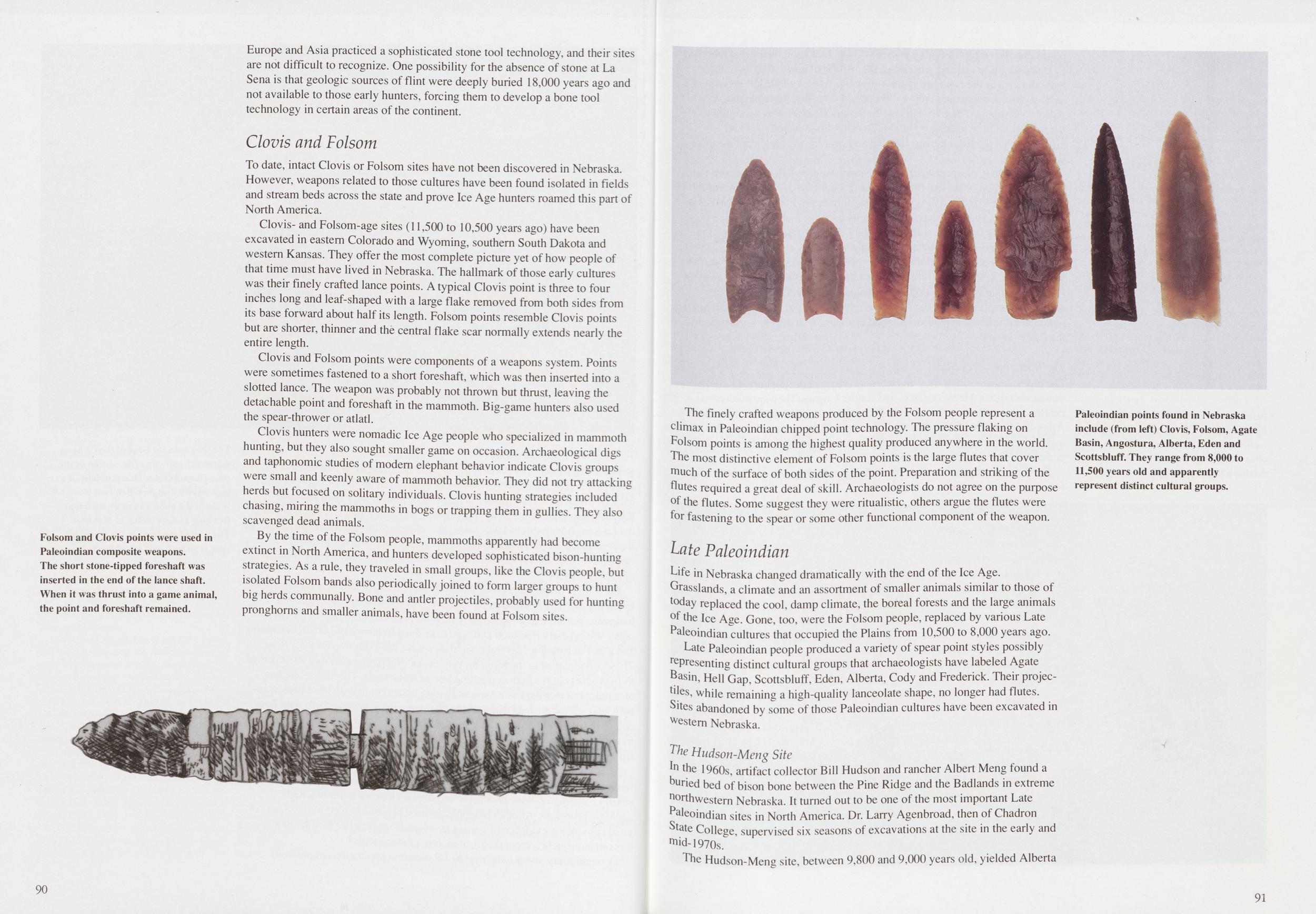
Folsom and Clovis points were used in Paleoindian composite weapons. The short stone-tipped foreshaft was inserted in the end of the lance shaft. When it was thrust into a game animal, the point and foreshaft remained.
Europe and Asia practiced a sophisticated stone tool technology, and their sites are not difficult to recognize. One possibility for the absence of stone at La Sena is that geologic sources of flint were deeply buried 18,000 years ago and not available to those early hunters, forcing them to develop a bone tool technology in certain areas of the continent.
Clovis and FolsomTo date, intact Clovis or Folsom sites have not been discovered in Nebraska. However, weapons related to those cultures have been found isolated in fields and stream beds across the state and prove Ice Age hunters roamed this part of North America.
Clovis- and Folsom-age sites (11,500 to 10,500 years ago) have been excavated in eastern Colorado and Wyoming, southern South Dakota and western Kansas. They offer the most complete picture yet of how people of that time must have lived in Nebraska. The hallmark of those early cultures was their finely crafted lance points. A typical Clovis point is three to four inches long and leaf-shaped with a large flake removed from both sides from its base forward about half its length. Folsom points resemble Clovis points but are shorter, thinner and the central flake scar normally extends nearly the entire length.
Clovis and Folsom points were components of a weapons system. Points were sometimes fastened to a short foreshaft, which was then inserted into a slotted lance. The weapon was probably not thrown but thrust, leaving the detachable point and foreshaft in the mammoth. Big-game hunters also used the spear-thrower or atlatl.
Clovis hunters were nomadic Ice Age people who specialized in mammoth hunting, but they also sought smaller game on occasion. Archaeological digs and taphonomic studies of modern elephant behavior indicate Clovis groups were small and keenly aware of mammoth behavior. They did not try attacking herds but focused on solitary individuals. Clovis hunting strategies included chasing, miring the mammoths in bogs or trapping them in gullies. They also scavenged dead animals.
By the time of the Folsom people, mammoths apparently had become extinct in North America, and hunters developed sophisticated bison-hunting strategies. As a rule, they traveled in small groups, like the Clovis people, but isolated Folsom bands also periodically joined to form larger groups to hunt big herds communally. Bone and antler projectiles, probably used for hunting pronghorns and smaller animals, have been found at Folsom sites.
90The finely crafted weapons produced by the Folsom people represent a climax in Paleoindian chipped point technology. The pressure flaking on Folsom points is among the highest quality produced anywhere in the world. The most distinctive element of Folsom points is the large flutes that cover much of the surface of both sides of the point. Preparation and striking of the flutes required a great deal of skill. Archaeologists do not agree on the purpose °f the flutes. Some suggest they were ritualistic, others argue the flutes were for fastening to the spear or some other functional component of the weapon.
Late PaleoindianLife in Nebraska changed dramatically with the end of the Ice Age. Grasslands, a climate and an assortment of smaller animals similar to those of today replaced the cool, damp climate, the boreal forests and the large animals °f the Ice Age. Gone, too, were the Folsom people, replaced by various Late Paleoindian cultures that occupied the Plains from 10,500 to 8,000 years ago.
Late Paleoindian people produced a variety of spear point styles possibly representing distinct cultural groups that archaeologists have labeled Agate Basin, Hell Gap, Scottsbluff, Eden, Alberta, Cody and Frederick. Their projectiles, while remaining a high-quality lanceolate shape, no longer had flutes. Sites abandoned by some of those Paleoindian cultures have been excavated in Western Nebraska.
The Hudson-Meng SiteIn the 1960s, artifact collector Bill Hudson and rancher Albert Meng found a Faded bed of bison bone between the Pine Ridge and the Badlands in extreme aorthwestern Nebraska. It turned out to be one of the most important Late Paleoindian sites in North America. Dr. Larry Agenbroad, then of Chadron State College, supervised six seasons of excavations at the site in the early and mid-1970s.
The Hudson-Meng site, between 9,800 and 9,000 years old, yielded Alberta
Paleoindian points found in Nebraska include (from left) Clovis, Folsom, Agate Basin, Angostura, Alberta, Eden and Scottsbluff. They range from 8,000 to 11,500 years old and apparently represent distinct cultural groups.
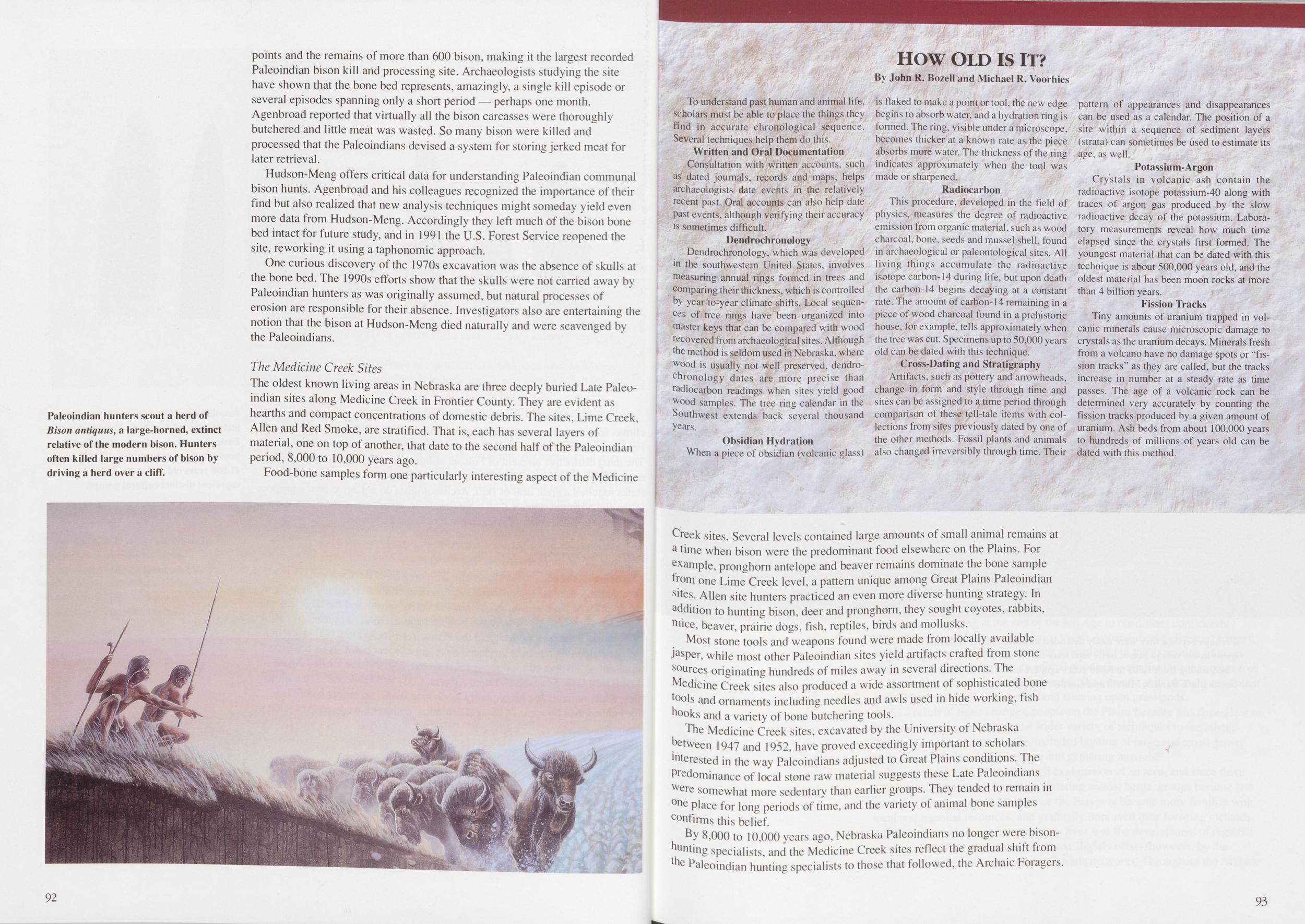
Paleoindian hunters scout a herd of Bison antiquus, a large-horned, extinct relative of the modern bison. Hunters often killed large numbers of bison by driving a herd over a cliff.
points and the remains of more than 600 bison, making it the largest recorded Paleoindian bison kill and processing site. Archaeologists studying the site have shown that the bone bed represents, amazingly, a single kill episode or several episodes spanning only a short period — perhaps one month. Agenbroad reported that virtually all the bison carcasses were thoroughly butchered and little meat was wasted. So many bison were killed and processed that the Paleoindians devised a system for storing jerked meat for later retrieval.
Hudson-Meng offers critical data for understanding Paleoindian communal bison hunts. Agenbroad and his colleagues recognized the importance of their find but also realized that new analysis techniques might someday yield even more data from Hudson-Meng. Accordingly they left much of the bison bone bed intact for future study, and in 1991 the U.S. Forest Service reopened the site, reworking it using a taphonomic approach.
One curious discovery of the 1970s excavation was the absence of skulls at the bone bed. The 1990s efforts show that the skulls were not carried away by Paleoindian hunters as was originally assumed, but natural processes of erosion are responsible for their absence. Investigators also are entertaining the notion that the bison at Hudson-Meng died naturally and were scavenged by the Paleoindians.
The Medicine Creek SitesThe oldest known living areas in Nebraska are three deeply buried Late Paleo- indian sites along Medicine Creek in Frontier County. They are evident as hearths and compact concentrations of domestic debris. The sites, Lime Creek, Allen and Red Smoke, are stratified. That is, each has several layers of material, one on top of another, that date to the second half of the Paleoindian period, 8,000 to 10,000 years ago.
Food-bone samples form one particularly interesting aspect of the Medicine
92HOW OLD IS IT?
To understand past human and animal life, scholars must be able to place the things they find in accurate chronological sequence. Several techniques help them do this.
Written and Oral DocumentationConsultation with written accounts, such as dated journals, records and maps, helps archaeologists date events in the relatively recent past. Oral accounts can also help date past events, although verifying their accuracy is sometimes difficult.
DendrochronologyDendrochronology, which was developed in the southwestern United States, involves measuring annual rings formed in trees and comparing their thickness, which is controlled by year-to-year climate shifts. Local sequences of tree rings have been organized into master keys that can be compared with wood recovered from archaeological sites. Although the method is seldom used in Nebraska, where wood is usually not well preserved, dendro-chronology dates are more precise than radiocarbon readings when sites yield good wood samples. The tree ring calendar in the Southwest extends back several thousand years.
Obsidian HydrationWhen a piece of obsidian (volcanic glass) is flaked to make a point or tool, the new edge begins to absorb water, and a hydration ring is formed. The ring, visible under a microscope, becomes thicker at a known rate as the piece absorbs more water. The thickness of the ring indicates approximately when the tool was made or sharpened.
RadiocarbonThis procedure, developed in the field of physics, measures the degree of radioactive emission from organic material, such as wood charcoal, bone, seeds and mussel shell, found in archaeological or paleontological sites. All living things accumulate the radioactive isotope carbon-14 during life, but upon death the carbon-14 begins decaying at a constant rate. The amount of carbon-14 remaining in a piece of wood charcoal found in a prehistoric house, for example, tells approximately when the tree was cut. Specimens up to 50,000 years old can be dated with this technique.
Cross-Dating and StratigraphyArtifacts, such as pottery and arrowheads, change in form and style through time and sites can be assigned to a time period through comparison of these tell-tale items with col- lections from sites previously dated by one of the other methods. Fossil plants and animals also changed irreversibly through time. Their pattern of appearances and disappearances can be used as a calendar. The position of a site within a sequence of sediment layers (strata) can sometimes be used to estimate its age, as well.
Potassium-ArgonCrystals in volcanic ash contain the radioactive isotope potassium-40 along with traces of argon gas produced by the slow radioactive decay of the potassium. Labora- tory measurements reveal how much time elapsed since the crystals first formed. The youngest material that can be dated with this technique is about 500,000 years old, and the oldest material has been moon rocks at more than 4 billion years.
Fission TracksTiny amounts of uranium trapped in vol- canic minerals cause microscopic damage to crystals as the uranium decays. Minerals fresh from a volcano have no damage spots or "fis- sion tracks'' as they are called, but the tracks increase in number at a steady rate as time passes. The age of a volcanic rock can be determined very accurately by counting the fission tracks produced by a given amount of uranium. Ash beds from about 100,000 years to hundreds of millions of years old can be dated with this method.
Creek sites. Several levels contained large amounts of small animal remains at a time when bison were the predominant food elsewhere on the Plains. For example, pronghorn antelope and beaver remains dominate the bone sample from one Lime Creek level, a pattern unique among Great Plains Paleoindian sites. Allen site hunters practiced an even more diverse hunting strategy. In Edition to hunting bison, deer and pronghorn, they sought coyotes, rabbits, "free, beaver, prairie dogs, fish, reptiles, birds and mollusks.
Most stone tools and weapons found were made from locally available jasper, while most other Paleoindian sites yield artifacts crafted from stone sources originating hundreds of miles away in several directions. The Medicine Creek sites also produced a wide assortment of sophisticated bone tools and ornaments including needles and awls used in hide working, fish hooks and a variety of bone butchering tools.
The Medicine Creek sites, excavated by the University of Nebraska between 1947 and 1952, have proved exceedingly important to scholars lnterested in the way Paleoindians adjusted to Great Plains conditions. The Predominance of local stone raw material suggests these Late Paleoindians Were somewhat more sedentary than earlier groups. They tended to remain in °ue place for long periods of time, and the variety of animal bone samples confirms this belief.
By 8,000 to 10,000 years ago, Nebraska Paleoindians no longer were bison- hunting specialists, and the Medicine Creek sites reflect the gradual shift from the Paleoindian hunting specialists to those that followed, the Archaic Foragers.
93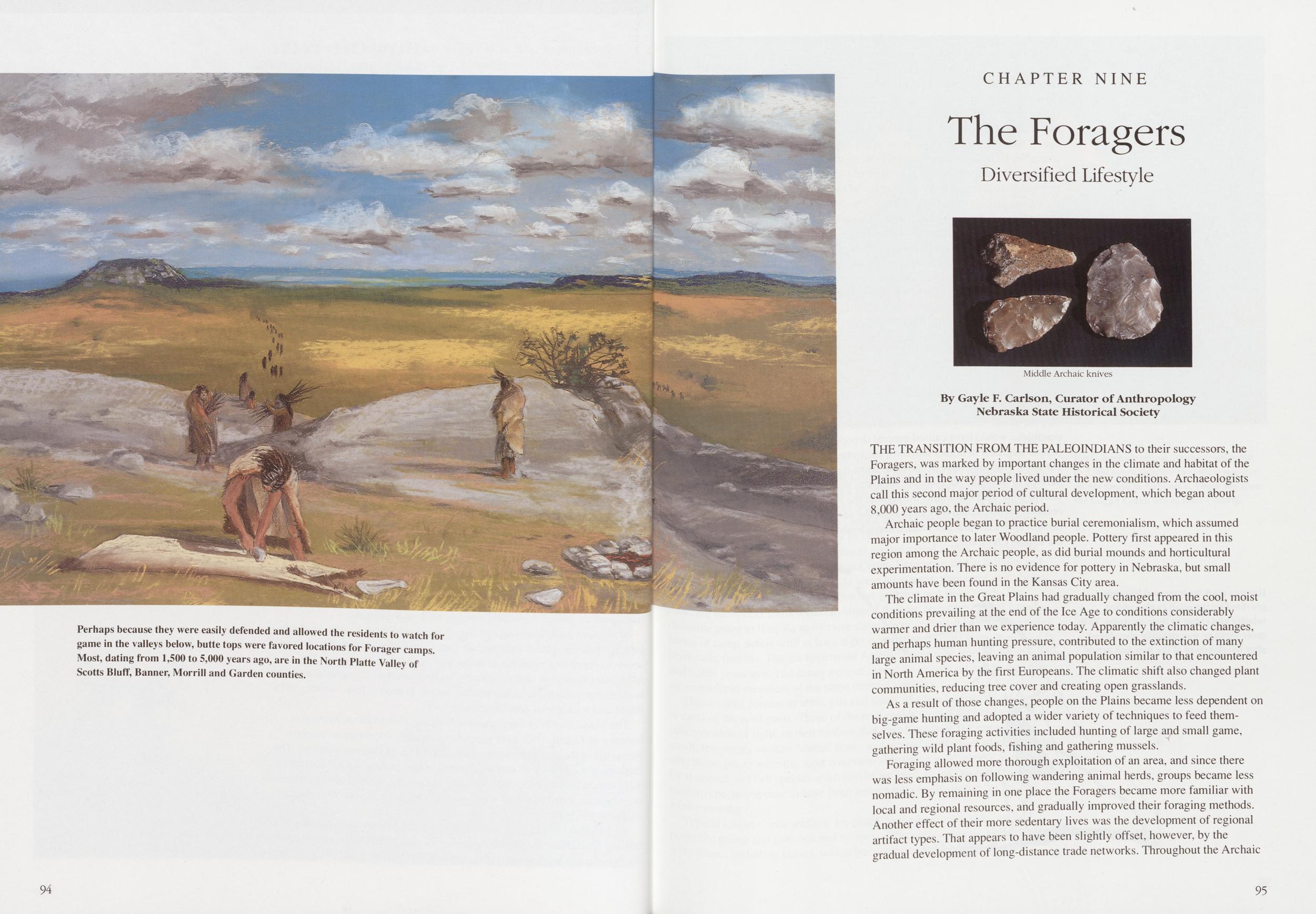
Perhaps because they were easily defended and allowed the residents to watch for game in the valleys below, butte tops were favored locations for Forager camps. Most, dating from 1,500 to 5,000 years ago, are in the North Platte Valley of Scotts Bluff, Banner, Morrill and Garden counties.
CHAPTER NINE The Foragers
Diversified Lifestyle
Middle Archaic knives
THE TRANSITION FROM THE PALEOINDIANS to their successors, the Foragers, was marked by important changes in the climate and habitat of the Plains and in the way people lived under the new conditions. Archaeologists call this second major period of cultural development, which began about 8,000 years ago, the Archaic period.
Archaic people began to practice burial ceremonialism, which assumed major importance to later Woodland people. Pottery first appeared in this region among the Archaic people, as did burial mounds and horticultural experimentation. There is no evidence for pottery in Nebraska, but small amounts have been found in the Kansas City area.
The climate in the Great Plains had gradually changed from the cool, moist conditions prevailing at the end of the Ice Age to conditions considerably warmer and drier than we experience today. Apparently the climatic changes, and perhaps human hunting pressure, contributed to the extinction of many large animal species, leaving an animal population similar to that encountered in North America by the first Europeans. The climatic shift also changed plant communities, reducing tree cover and creating open grasslands.
As a result of those changes, people on the Plains became less dependent on big-game hunting and adopted a wider variety of techniques to feed them- selves. These foraging activities included hunting of large and small game, gathering wild plant foods, fishing and gathering mussels.
Foraging allowed more thorough exploitation of an area, and since there was less emphasis on following wandering animal herds, groups became less nomadic. By remaining in one place the Foragers became more familiar with local and regional resources, and gradually improved their foraging methods. Another effect of their more sedentary lives was the development of regional artifact types. That appears to have been slightly offset, however, by the gradual development of long-distance trade networks. Throughout the Archaic
95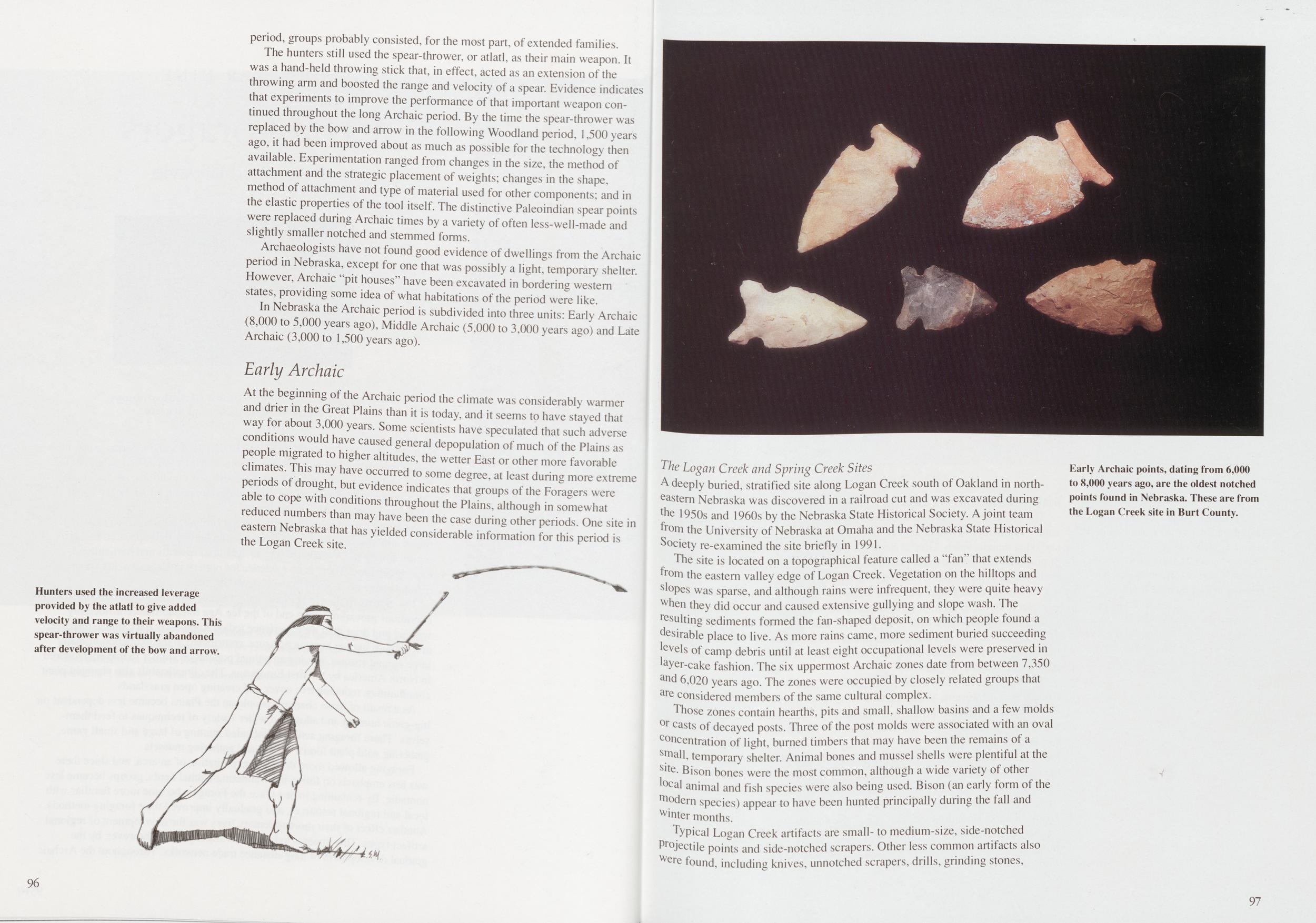
period, groups probably consisted, for the most part, of extended families.
The hunters still used the spear-thrower, or atlatl, as their main weapon. It was a hand-held throwing stick that, in effect, acted as an extension of the throwing arm and boosted the range and velocity of a spear. Evidence indicates that experiments to improve the performance of that important weapon con- tinued throughout the long Archaic period. By the time the spear-thrower was replaced by the bow and arrow in the following Woodland period, 1,500 years ago, it had been improved about as much as possible for the technology then available. Experimentation ranged from changes in the size, the method of attachment and the strategic placement of weights; changes in the shape, method of attachment and type of material used for other components; and in the elastic properties of the tool itself. The distinctive Paleoindian spear points were replaced during Archaic times by a variety of often less-well-made and slightly smaller notched and stemmed forms.
Archaeologists have not found good evidence of dwellings from the Archaic period in Nebraska, except for one that was possibly a light, temporary shelter. However, Archaic "pit houses" have been excavated in bordering western states, providing some idea of what habitations of the period were like.
In Nebraska the Archaic period is subdivided into three units: Early Archaic (8,000 to 5,000 years ago), Middle Archaic (5,000 to 3,000 years ago) and Late Archaic (3,000 to 1,500 years ago).
Early ArchaicAt the beginning of the Archaic period the climate was considerably warmer and drier in the Great Plains than it is today, and it seems to have stayed that way for about 3,000 years. Some scientists have speculated that such adverse conditions would have caused general depopulation of much of the Plains as people migrated to higher altitudes, the wetter East or other more favorable climates. This may have occurred to some degree, at least during more extreme periods of drought, but evidence indicates that groups of the Foragers were able to cope with conditions throughout the Plains, although in somewhat reduced numbers than may have been the case during other periods. One site in eastern Nebraska that has yielded considerable information for this period is the Logan Creek site.
Hunters used the increased leverage provided by the atlatl to give added velocity and range to their weapons. This spear-thrower was virtually abandoned after development of the bow and arrow.
A deeply buried, stratified site along Logan Creek south of Oakland in northeastern Nebraska was discovered in a railroad cut and was excavated during the 1950s and 1960s by the Nebraska State Historical Society. A joint team from the University of Nebraska at Omaha and the Nebraska State Historical Society re-examined the site briefly in 1991.
The site is located on a topographical feature called a "fan" that extends from the eastern valley edge of Logan Creek. Vegetation on the hilltops and slopes was sparse, and although rains were infrequent, they were quite heavy when they did occur and caused extensive gullying and slope wash. The resulting sediments formed the fan-shaped deposit, on which people found a desirable place to live. As more rains came, more sediment buried succeeding levels of camp debris until at least eight occupational levels were preserved in ,ayer-cake fashion. The six uppermost Archaic zones date from between 7,350 and 6,020 years ago. The zones were occupied by closely related groups that are considered members of the same cultural complex.
Those zones contain hearths, pits and small, shallow basins and a few molds or casts of decayed posts. Three of the post molds were associated with an oval concentration of light, burned timbers that may have been the remains of a small, temporary shelter. Animal bones and mussel shells were plentiful at the site. Bison bones were the most common, although a wide variety of other local animal and fish species were also being used. Bison (an early form of the modern species) appear to have been hunted principally during the fall and winter months.
Typicai Logan Creek artifacts are small- to medium-size, side-notched Projectile points and side-notched scrapers. Other less common artifacts also Were found, including knives, unnotched scrapers, drills, grinding stones,
Early Archaic points, dating from 6,000 to 8,000 years ago, are the oldest notched points found in Nebraska. These are from the Logan Creek site in Burt County.
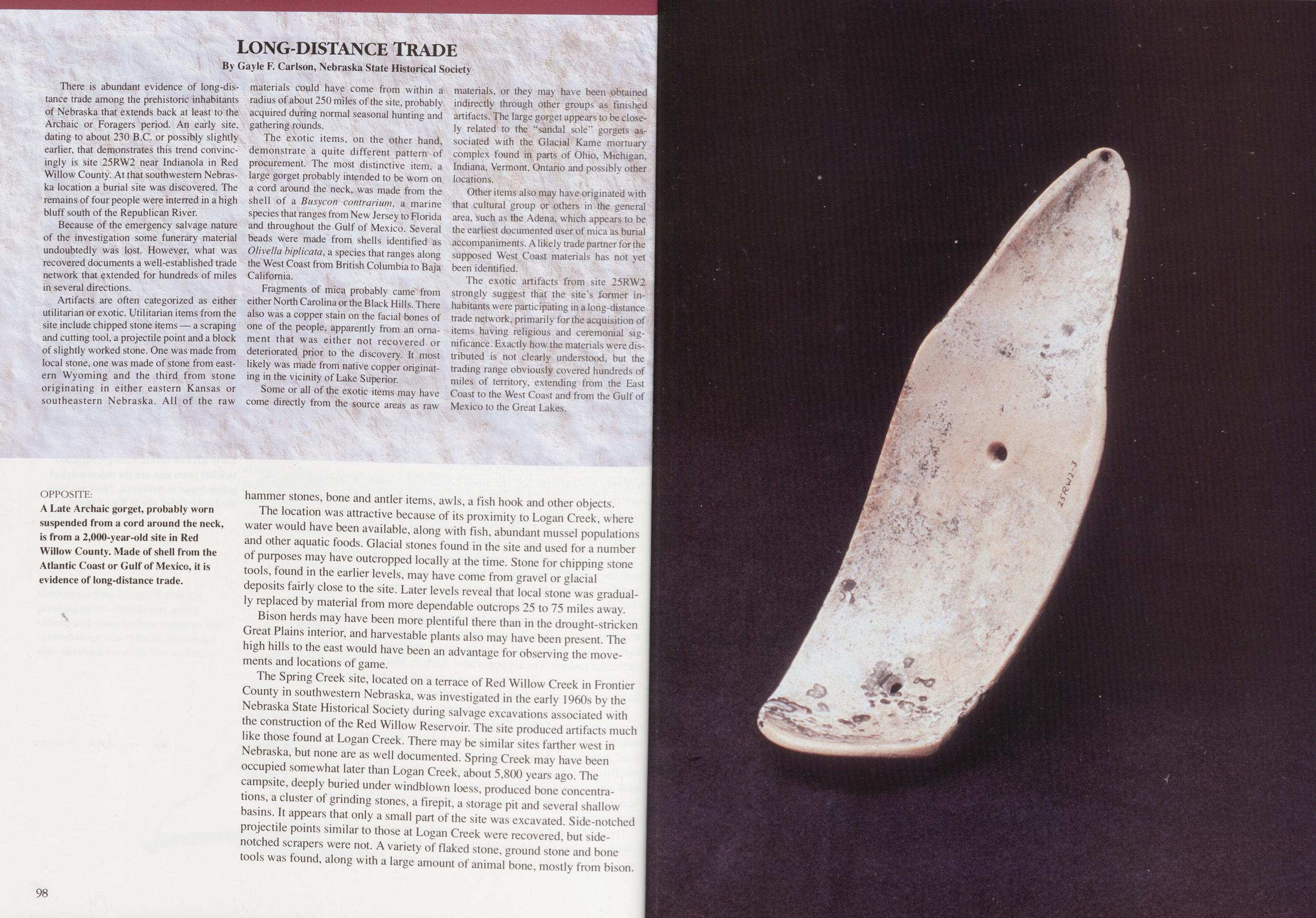
LONG-DISTANCE TRADE
There is abundant evidence of long-distance trade among the prehistoric inhabitants of Nebraska that extends back at least to the Archaic or Foragers period. An early site, dating to about 230 B.C. or possibly slightly earlier, that demonstrates this trend convincingly is site 25RW2 near Indianola in Red Willow County. At that southwestern Nebraska location a burial site was discovered. The remains of four people were interred in a high bluff south of the Republican River.
Because of the emergency salvage nature of the investigation some funerary material undoubtedly was lost. However, what was recovered documents a well-established trade network that extended for hundreds of miles in several directions.
Artifacts are often categorized as either utilitarian or exotic. Utilitarian items from the site include chipped stone items — a scraping and cutting tool, a projectile point and a block of slightly worked stone. One was made from local stone, one was made of stone from eastern Wyoming and the third from stone originating in either eastern Kansas or southeastern Nebraska. All of the raw materials could have come from within a radius of about 250 miles of the site, probably acquired during normal seasonal hunting and gathering rounds.
The exotic items, on the other hand, demonstrate a quite different pattern of procurement. The most distinctive item, a large gorget probably intended to be worn on a cord around the neck, was made from the shell of a Busycon contrarium, a marine species that ranges from New Jersey to Florida and throughout the Gulf of Mexico. Several beads were made from shells identified as Olivella biplicata, a species that ranges along the West Coast from British Columbia to Baja California.
Fragments of mica probably came from either North Carolina or the Black Hills. There also was a copper stain on the facial bones of one of the people, apparently from an ornament that was either not recovered or deteriorated prior to the discovery. It most likely was made from native copper originating in the vicinity of Lake Superior.
Some or all of the exotic items may have come directly from the source areas as raw materials, or they may have been obtained indirectly through other groups as finished artifacts. The large gorget appears to be closely related to the "sandal sole" gorgets associated with the Glacial Kame mortuary complex found in parts of Ohio, Michigan, Indiana, Vermont, Ontario and possibly other locations.
Other items also may have originated with that cultural group or others in the general area, such as the Adena, which appears to be the earliest documented user of mica as burial accompaniments. A likely trade partner for the supposed West Coast materials has not yet been identified.
The exotic artifacts from site 25RW2 strongly suggest that the site's former in- habitants were participating in a long-distance trade network, primarily for the acquisition of items having religious and ceremonial significance. Exactly how the materials were distributed is not clearly understood, but the trading range obviously covered hundreds of miles of territory, extending from the East Coast to the West Coast and from the Gulf of Mexico to the Great Lakes.
OPPOSITE: A Late Archaic gorget, probably worn suspended from a cord around the neck, is from a 2,000-year-old site in Red Willow County. Made of shell from the Atlantic Coast or Gulf of Mexico, it is evidence of long-distance trade.
hammer stones, bone and antler items, awls, a fish hook and other objects.
The location was attractive because of its proximity to Logan Creek, where water would have been available, along with fish, abundant mussel populations and other aquatic foods. Glacial stones found in the site and used for a number of purposes may have outcropped locally at the time. Stone for chipping stone tools, found in the earlier levels, may have come from gravel or glacial deposits fa,rly close to the site. Later levels reveal that local stone was gradually replaced by material from more dependable outcrops 25 to 75 miles away
Bison herds may have been more plentiful there than in the drought-stricken Great Pains interior, and harvestable plants also may have been present. The high hills to the east would have been an advantage for observing the movements and locations of game.
The Spring Creek site, located on a terrace of Red Willow Creek in Frontier County in southwestern Nebraska, was investigated in the early 1960s by the Nebraska State Historical Society during salvage excavations associated with he construction of the Red Willow Reservoir. The site produced artifacts much hke those found at Logan Creek. There may be similar sites farther west in Nebraska, but none are as well documented. Spring Creek may have been occupied somewhat later than Logan Creek, about 5,800 years ago The campsite deeply buried under windblown loess, produced bone concentrations, a cluster of grinding stones, a firepit, a storage pit and several shallow basins. It appears that only a small part of the site was excavated. Side-notched projectile points similar to those at at Logan Creek were recovered but side-notched scrapers were not. A variety of flaked stone, ground stone and bone tools was found, along with a large amount of animal bone, mostly from bison
98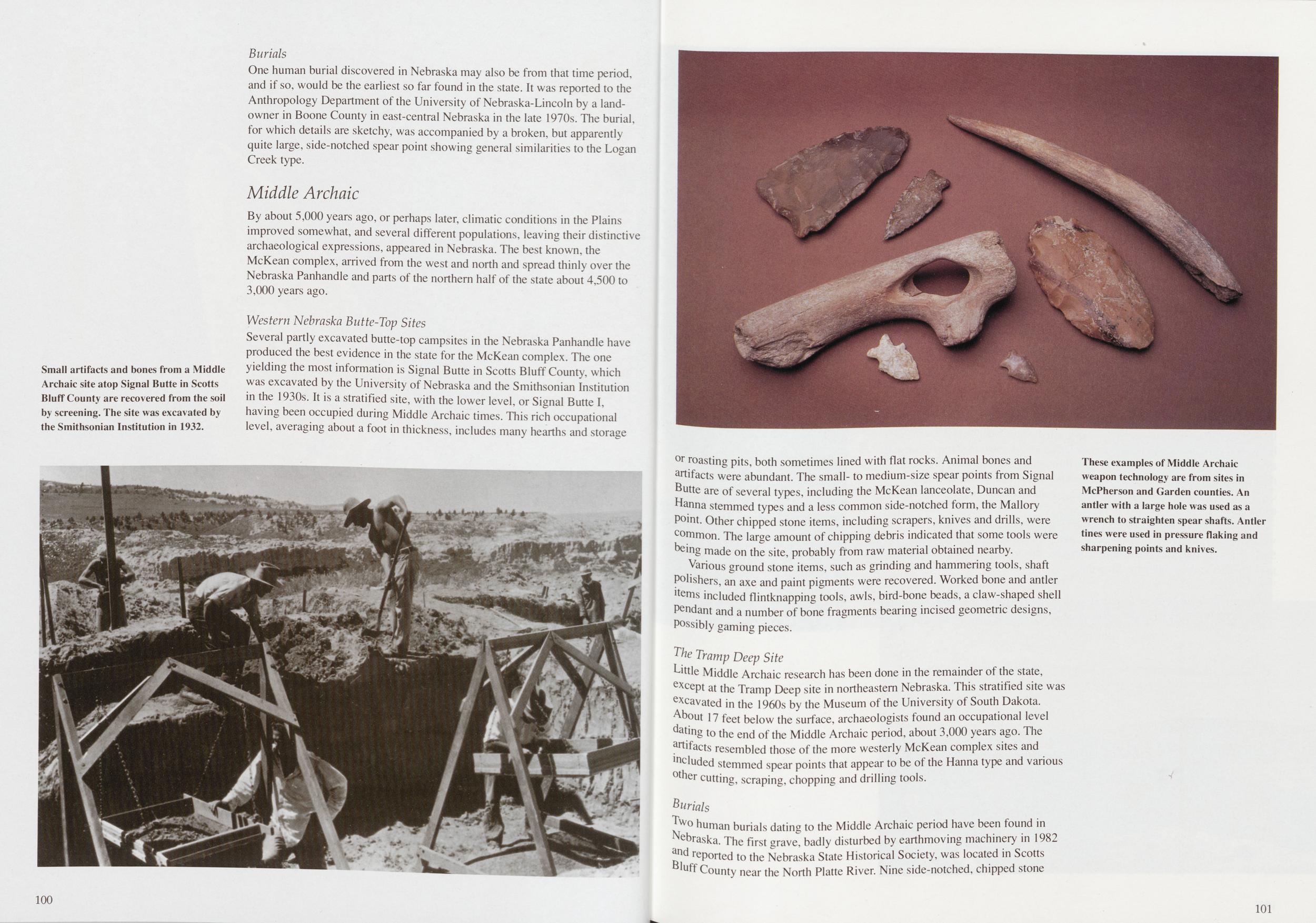
Small artifacts and bones from a Middle Archaic site atop Signal Butte in Scotts Bluff County are recovered from the soil by screening. The site was excavated by the Smithsonian Institution in 1932.
One human burial discovered in Nebraska may also be from that time period, and if so, would be the earliest so far found in the state. It was reported to the Anthropology Department of the University of Nebraska-Lincoln by a land- owner in Boone County in east-central Nebraska in the late 1970s. The burial, for which details are sketchy, was accompanied by a broken, but apparently quite large, side-notched spear point showing general similarities to the Logan Creek type.
Middle ArchaicBy about 5,000 years ago, or perhaps later, climatic conditions in the Plains improved somewhat, and several different populations, leaving their distinctive archaeological expressions, appeared in Nebraska. The best known, the McKean complex, arrived from the west and north and spread thinly over the Nebraska Panhandle and parts of the northern half of the state about 4,500 to 3,000 years ago.
Western Nebraska Butte-Top SitesThese examples of Middle Archaic weapon technology are from sites in McPherson and Garden counties. An antler with a large hole was used as a wrench to straighten spear shafts. Antler tines were used in pressure flaking and sharpening points and knives.
Various ground stone items, such as grinding and hammering tools, shaft Polishers, an axe and paint pigments were recovered. Worked bone and antler rtems included flintknapping tools, awls, bird-bone beads, a claw-shaped shell Pendant and a number of bone fragments bearing incised geometric designs, Possibly gaming pieces.
The Tramp Deep SiteLittle Middle Archaic research has been done in the remainder of the state, except at the Tramp Deep site in northeastern Nebraska. This stratified site e*cavated in the 1960s by the Museum of the University of South Dakota. About 17 feet below the surface, archaeologists found an occupational level dating to the end of the Middle Archaic period, about 3,000 years ago. The artifacts resembled those of the more westerly McKean complex sites and deluded stemmed spear points that appear to be of the Hanna type and various other cutting, scraping, chopping and drilling tools.
BurialsTwo human burials dating to the Middle Archaic period have been found in Nebraska. The first grave, badly disturbed by earthmoving machinery in 1982 and reported to the Nebraska State Historical Society, was located in Scotts Blaff County near the North Platte River. Nine side-notched, chipped stone
101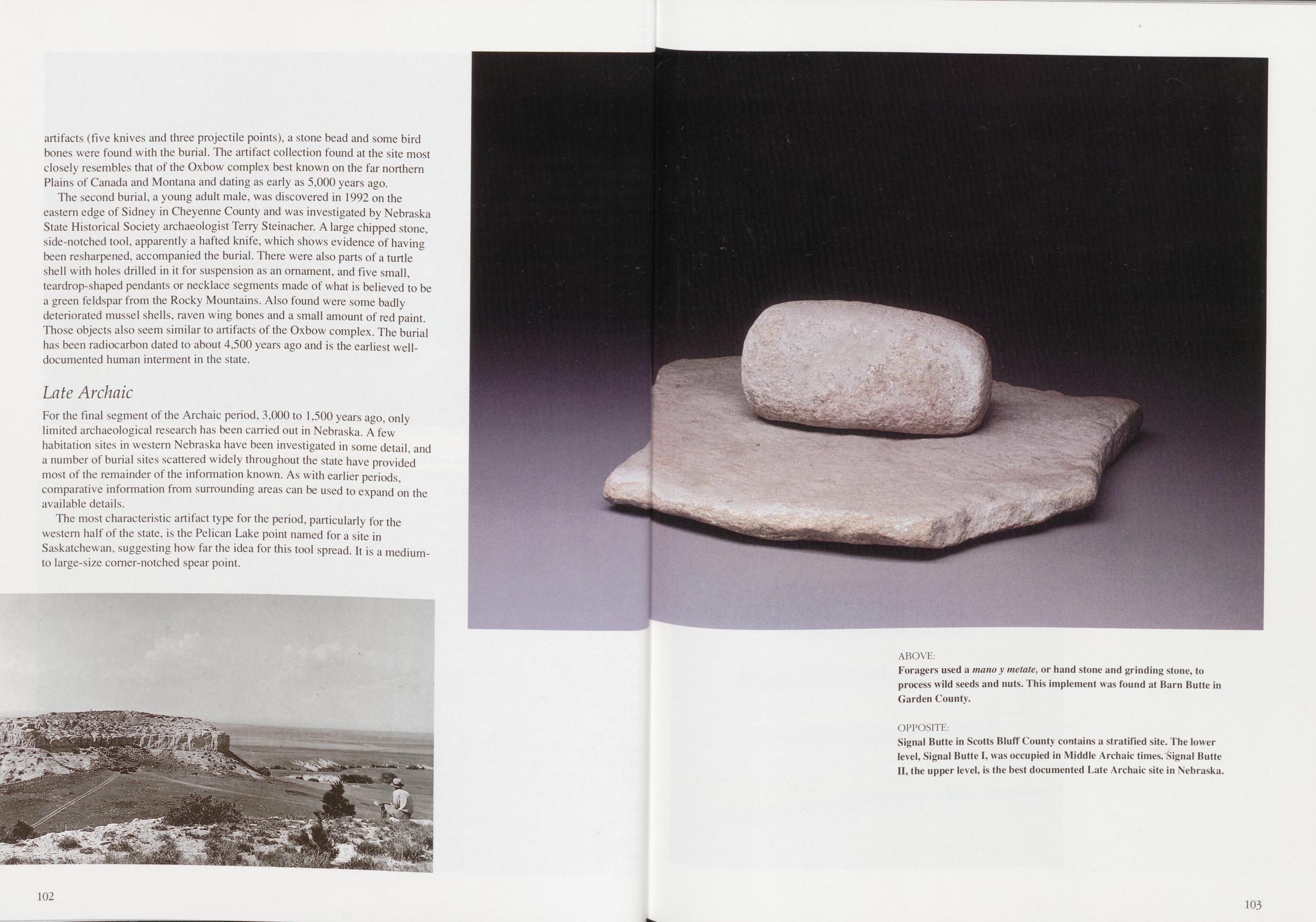
artifacts (five knives and three projectile points), a stone bead and some bird bones were found with the burial. The artifact collection found at the site most closely resembles that of the Oxbow complex best known on the far northern Plains of Canada and Montana and dating as early as 5,000 years ago.
The second burial, a young adult male, was discovered in 1992 on the eastern edge of Sidney in Cheyenne County and was investigated by Nebraska State Historical Society archaeologist Terry Steinacher. A large chipped stone, side-notched tool, apparently a hafted knife, which shows evidence of having been resharpened, accompanied the burial. There were also parts of a turtle shell with holes drilled in it for suspension as an ornament, and five small, teardrop-shaped pendants or necklace segments made of what is believed to be a green feldspar from the Rocky Mountains. Also found were some badly deteriorated mussel shells, raven wing bones and a small amount of red paint. Those objects also seem similar to artifacts of the Oxbow complex. The burial has been radiocarbon dated to about 4,500 years ago and is the earliest well- documented human interment in the state.
Late ArchaicFor the final segment of the Archaic period, 3,000 to 1,500 years ago, only limited archaeological research has been carried out in Nebraska. A few habitation sites in western Nebraska have been investigated in some detail and a number of burial sites scattered widely throughout the state have provided most of the remainder of the information known. As with earlier periods comparative information from surrounding areas can be used to expand on the available details.
The most characteristic artifact type for the period, particularly for the western half of the state, is the Pelican Lake point named for a site in Saskatchewan, suggesting how far the idea for this tool spread. It is a medium- to large-size corner-notched spear point.
102ABOVE: Foragers used a mano y metate, or hand stone and grinding stone, to process wild seeds and nuts. This implement was found at Barn Butte in Garden County.
OPPOSITE: Signal Butte in Scotts Bluff County contains a stratified site. The lower level, Signal Butte I, was occupied in Middle Archaic times. Signal Butte II, the upper level, is the best documented Late Archaic site in Nebraska.
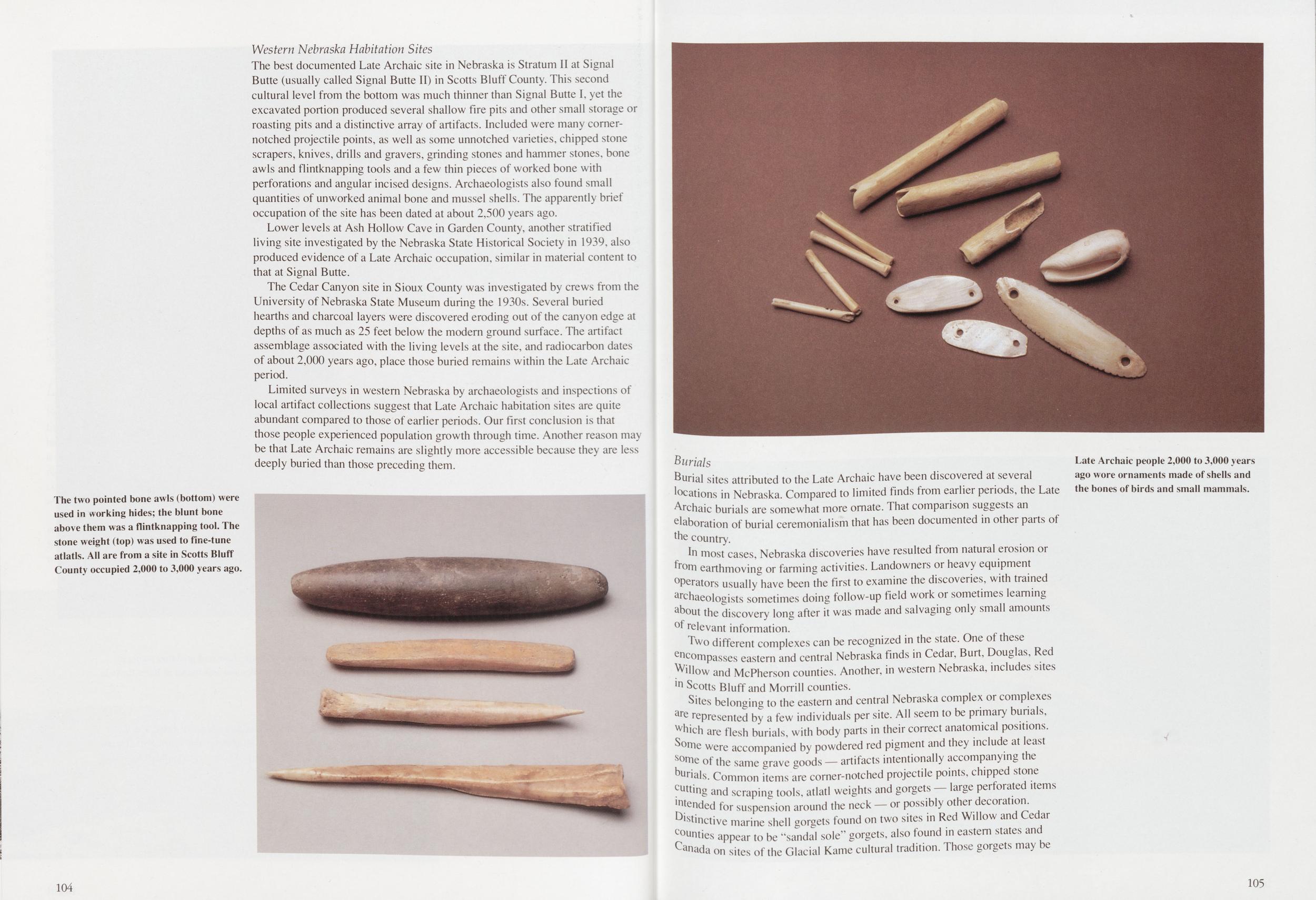
The two pointed bone awls (bottom) were used in working hides; the blunt bone above them was a flintknapping tool. The stone weight (top) was used to fine-tune atlatls. All are from a site in Scotts Bluff County occupied 2,000 to 3,000 years ago.
The best documented Late Archaic site in Nebraska is Stratum II at Signal Butte (usually called Signal Butte II) in Scotts Bluff County. This second cultural level from the bottom was much thinner than Signal Butte I, yet the excavated portion produced several shallow fire pits and other small storage or roasting pits and a distinctive array of artifacts. Included were many corner- notched projectile points, as well as some unnotched varieties, chipped stone scrapers, knives, drills and gravers, grinding stones and hammer stones, bone awls and flintknapping tools and a few thin pieces of worked bone with perforations and angular incised designs. Archaeologists also found small quantities of unworked animal bone and mussel shells. The apparently brief occupation of the site has been dated at about 2,500 years ago.
Lower levels at Ash Hollow Cave in Garden County, another stratified living site investigated by the Nebraska State Historical Society in 1939, also produced evidence of a Late Archaic occupation, similar in material content to that at Signal Butte.
The Cedar Canyon site in Sioux County was investigated by crews from the University of Nebraska State Museum during the 1930s. Several buried hearths and charcoal layers were discovered eroding out of the canyon edge at depths of as much as 25 feet below the modern ground surface. The artifact assemblage associated with the living levels at the site, and radiocarbon dates of about 2,000 years ago, place those buried remains within the Late Archaic period.
Limited surveys in western Nebraska by archaeologists and inspections of local artifact collections suggest that Late Archaic habitation sites are quite abundant compared to those of earlier periods. Our first conclusion is that those people experienced population growth through time. Another reason may be that Late Archaic remains are slightly more accessible because they are less deeply buried than those preceding them.
104 BurialsBurial sites attributed to the Late Archaic have been discovered at several locations in Nebraska. Compared to limited finds from earlier periods, the Late Archaic burials are somewhat more ornate. That comparison suggests an elaboration of burial ceremonialism that has been documented in other parts of the country.
In most cases, Nebraska discoveries have resulted from natural erosion or from earthmoving or farming activities. Landowners or heavy equipment operators usually have been the first to examine the discoveries, with trained archaeologists sometimes doing follow-up field work or sometimes learning about the discovery long after it was made and salvaging only small amounts °f relevant information.
Two different complexes can be recognized in the state. One of these compasses eastern and central Nebraska finds in Cedar, Burt, Douglas, Red Willow and McPherson counties. Another, in western Nebraska, includes sites in Scotts Bluff and Morrill counties.
Sites belonging to the eastern and central Nebraska complex or complexes are represented by a few individuals per site. All seem to be pnmary bunals, which are flesh burials with body parts in their correct anatomical positions. Some were accompanied by powdered red pigment and they include at least s°me of the same grave goods — artifacts intentionally accompanying the trials. Common items are corner-notched projectile points, chipped stone siting and scraping tools, atlatl weights and gorgets - large perforated items tended for suspension around the neck - or possibly other decoration. Distinctive marine shell gorgets found on two sites in Red Willow and Cedar c°unties appear to be "sandal sole" gorgets, also found in eastern states and Canada on sites of the Glacial Kame cultural tradition. Those gorgets may be
Late Archaic people 2,000 to 3,000 years ago wore ornaments made of shells and the bones of birds and small mammals.
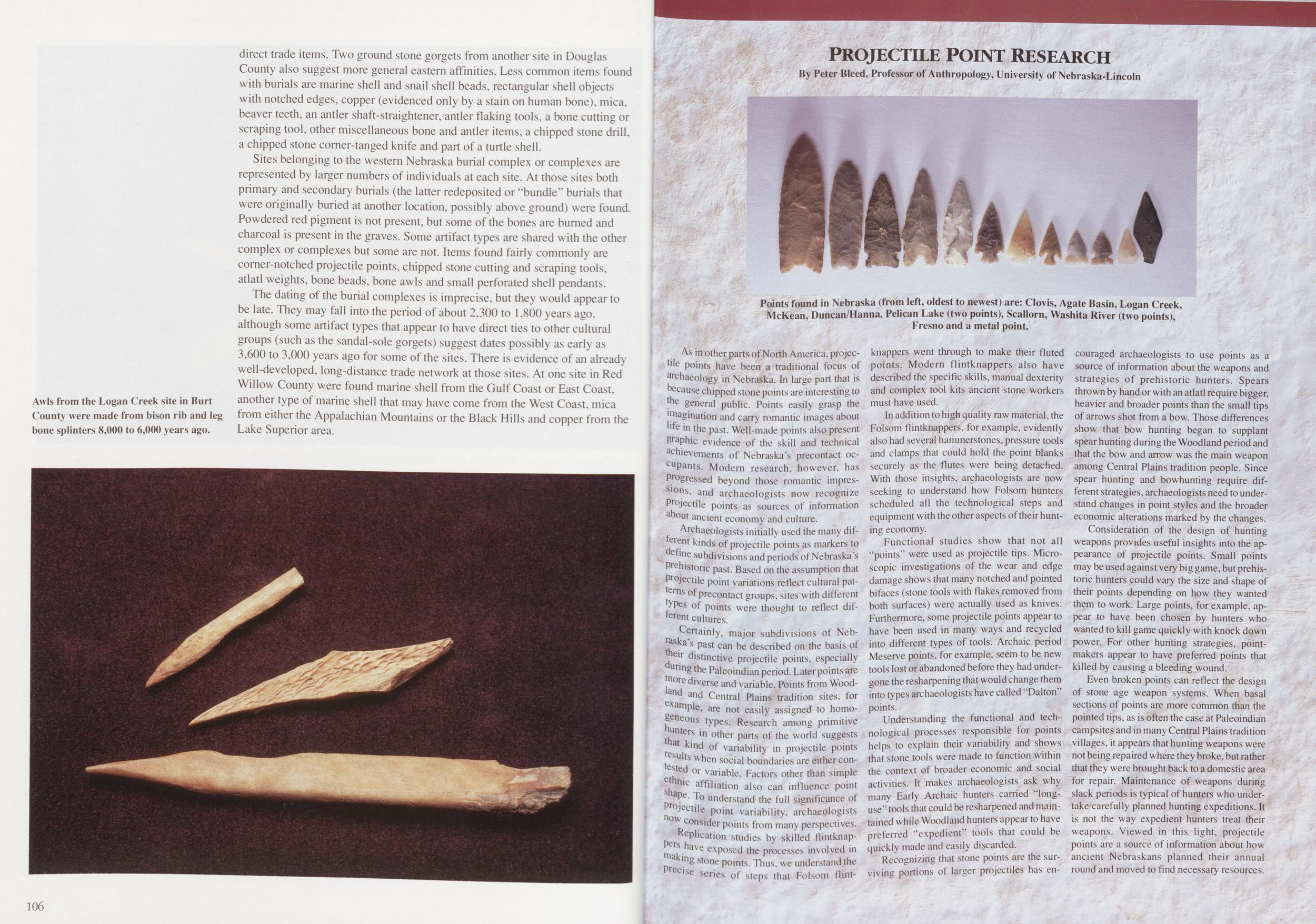
Awls from the Logan Creek site in Burt County were made from bison rib and leg bone splinters 8,000 to 6,000 years ago.
direct trade items. Two ground stone gorgets from another site in Douglas County also suggest more general eastern affinities. Less common items found with burials are marine shell and snail shell beads, rectangular shell objects with notched edges, copper (evidenced only by a stain on human bone), mica, beaver teeth, an antler shaft-straightener, antler flaking tools, a bone cutting or scraping tool, other miscellaneous bone and antler items, a chipped stone drill, a chipped stone comer-tanged knife and part of a turtle shell.
Sites belonging to the western Nebraska burial complex or complexes are represented by larger numbers of individuals at each site. At those sites both primary and secondary burials (the latter redeposited or "bundle" burials that were originally buried at another location, possibly above ground) were found. Powdered red pigment is not present, but some of the bones are burned and charcoal is present in the graves. Some artifact types are shared with the other complex or complexes but some are not. Items found fairly commonly are corner-notched projectile points, chipped stone cutting and scraping tools, atlatl weights, bone beads, bone awls and small perforated shell pendants.
The dating of the burial complexes is imprecise, but they would appear to be late. They may fall into the period of about 2,300 to 1,800 years ago, although some artifact types that appear to have direct ties to other cultural groups (such as the sandal-sole gorgets) suggest dates possibly as early as 3,600 to 3,000 years ago for some of the sites. There is evidence of an already well-developed, long-distance trade network at those sites. At one site in Red Willow County were found marine shell from the Gulf Coast or East Coast, another type of marine shell that may have come from the West Coast, mica from either the Appalachian Mountains or the Black Hills and copper from the Lake Superior area.
106PROJECTILE POINT RESEARCH
Points found in Nebraska (from left, oldest to newest) are: Clovis, Agate Basin, Logan Creek, McKean, Duncan/Hanna, Pelican Lake (two points), Scallorn, Washita River (two points), Fresno and a metal point.
As in other parts of North America, projectile points have been a traditional focus of archaeology in Nebraska. In large part that is because chipped stone points are interesting to the general public. Points easily grasp the Pagination and carry romantic images about bfe in the past. Well-made points also present graphic evidence of the skill and technical achievements of Nebraska's precontact occupants. Modern research, however, has Progressed beyond those romantic impressions, and archaeologists now recognize Projectile points as sources of information about ancient economy and culture.
Archaeologists initially used the many different kinds of projectile points as markers to define subdivisions and periods of Nebraska's Prehistoric past. Based on the assumption that Projectile point variations reflect cultural patterns of precontact groups, sites with different types of points were thought to reflect different cultures.
Certainly, major subdivisions of Nebraska's past can be described on the basis of their distinctive projectile points, especially during the Paleoindian period. Later points are more diverse and variable. Points from Woodland and Central Plains tradition sites, for Sample, are not easily assigned to homogeneous types. Research among primitive hunters in other parts of the world suggests that kind of variability in projectile points results when social boundaries are either contested or variable. Factors other than simple ethnic affiliation also can influence point shape. To understand the full significance of Projectile point variability, archaeologists now consider points from many perspectives.
Replication studies by skilled flintknapers have exposed the processes involved in taking stone points. Thus, we understand the Precise series of steps that Folsom flintknappers went through to make their fluted points. Modern flintknappers also have described the specific skills, manual dexterity and complex tool kits ancient stone workers must have used.
In addition to high quality raw material, the Folsom flintknappers, for example, evidently also had several hammers tones, pressure tools and clamps that could hold the point blanks securely as the flutes were being detached. With those insights, archaeologists are now seeking to understand how Folsom hunters scheduled all the technological steps and equipment with the other aspects of their hunting economy.
Functional studies show that not all "points" were used as projectile tips. Micro- scopic investigations of the wear and edge damage shows that many notched and pointed bifaces (stone tools with flakes removed from both surfaces) were actually used as knives. Furthermore, some projectile points appear to have been used in many ways and recycled into different types of tools. Archaic period Meserve points, for example, seem to be new tools lost or abandoned before they had undergone the resharpening that would change them into types archaeologists have called "Dalton" points.
Understanding the functional and technological processes responsible for points helps to explain their variability and shows that stone tools were made to function within the context of broader economic and social activities. It makes archaeologists ask why many Early Archaic hunters carried "long- use" tools that could be resharpened and maintained while Woodland hunters appear to have preferred "expedient" tools that could be quickly made and easily discarded.
Recognizing that stone points are the surviving portions of larger projectiles has encouraged archaeologists to use points as a source of information about the weapons and strategies of prehistoric hunters. Spears thrown by hand or with an atlatl require bigger, heavier and broader points than the small tips of arrows shot from a bow. Those differences show that bow hunting began to supplant spear hunting during the Woodland period and that the bow and arrow was the main weapon among Central Plains tradition people. Since spear hunting and bowhunting require different strategies, archaeologists need to understand changes in point styles and the broader economic alterations marked by the changes.
Consideration of the design of hunting weapons provides useful insights into the appearance of projectile points. Small points may be used against very big game, but prehistoric hunters could vary the size and shape of their points depending on how they wanted them to work. Large points, for example, appear to have been chosen by hunters who wanted to kill game quickly with knock down power. For other hunting strategies, pointmakers appear to have preferred points that killed by causing a bleeding wound.
Even broken points can reflect the design of stone age weapon systems. When basal sections of points are more common than the pointed tips, as is often the case at Paleoindian campsites and in many Central Plains tradition villages, it appears that hunting weapons were not being repaired where they broke, but rather that they were brought back to a domestic area for repair. Maintenance of weapons during slack periods is typical of hunters who undertake carefully planned hunting expeditions. It is not the way expedient hunters treat their weapons. Viewed in this light, projectile points are a source of information about how ancient Nebraskans planned their annual round and moved to find necessary resources.
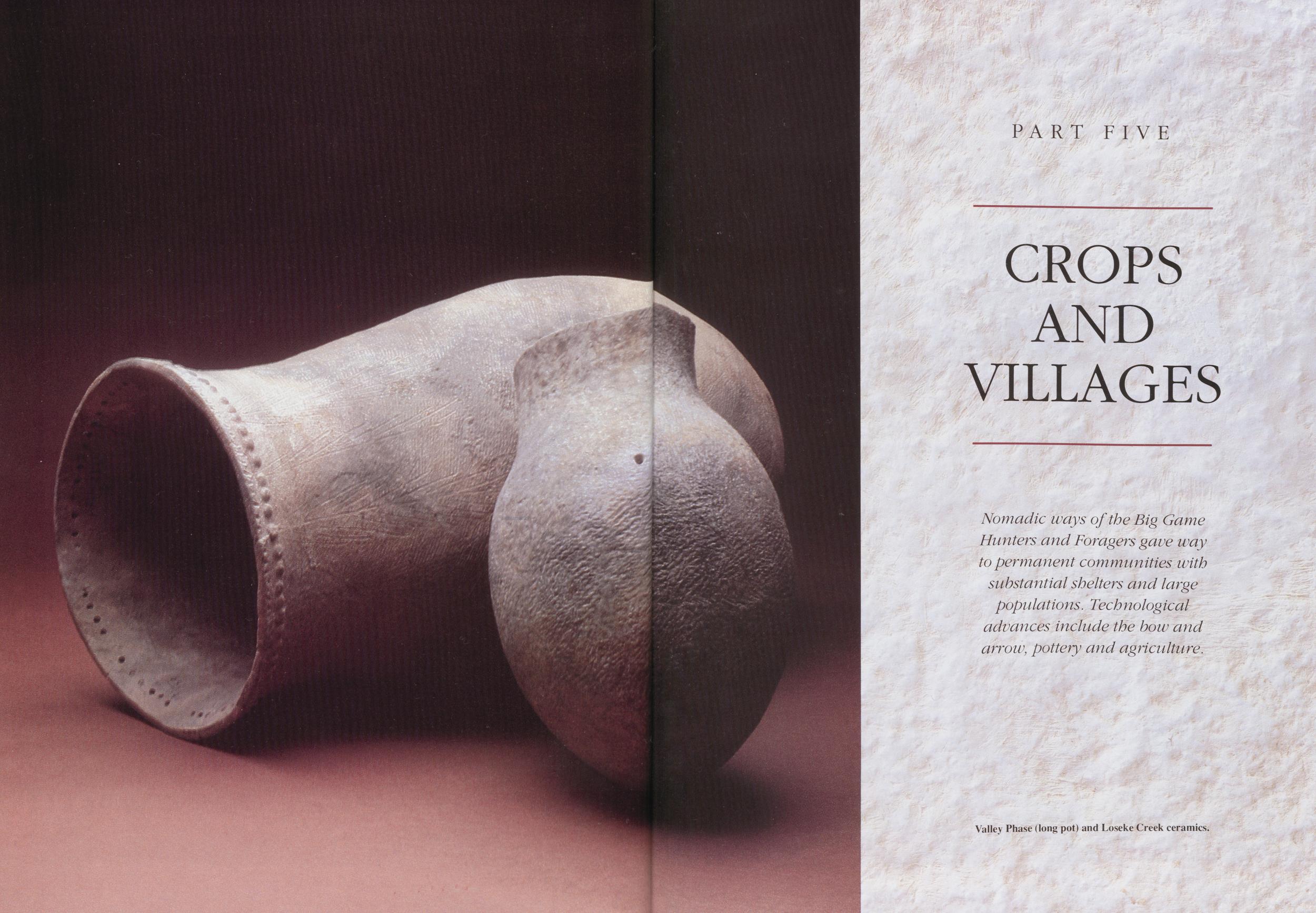
Valley Phase (long pot) and Loseke Creek ceramics.
PART FIVE CROPS AND VILLAGES
Nomadic ways of the Big Game Hunters and Foragers gave way to permanent communities with substantial shelters and large populations. Technological advances include the bow and arrow, pottery and agriculture.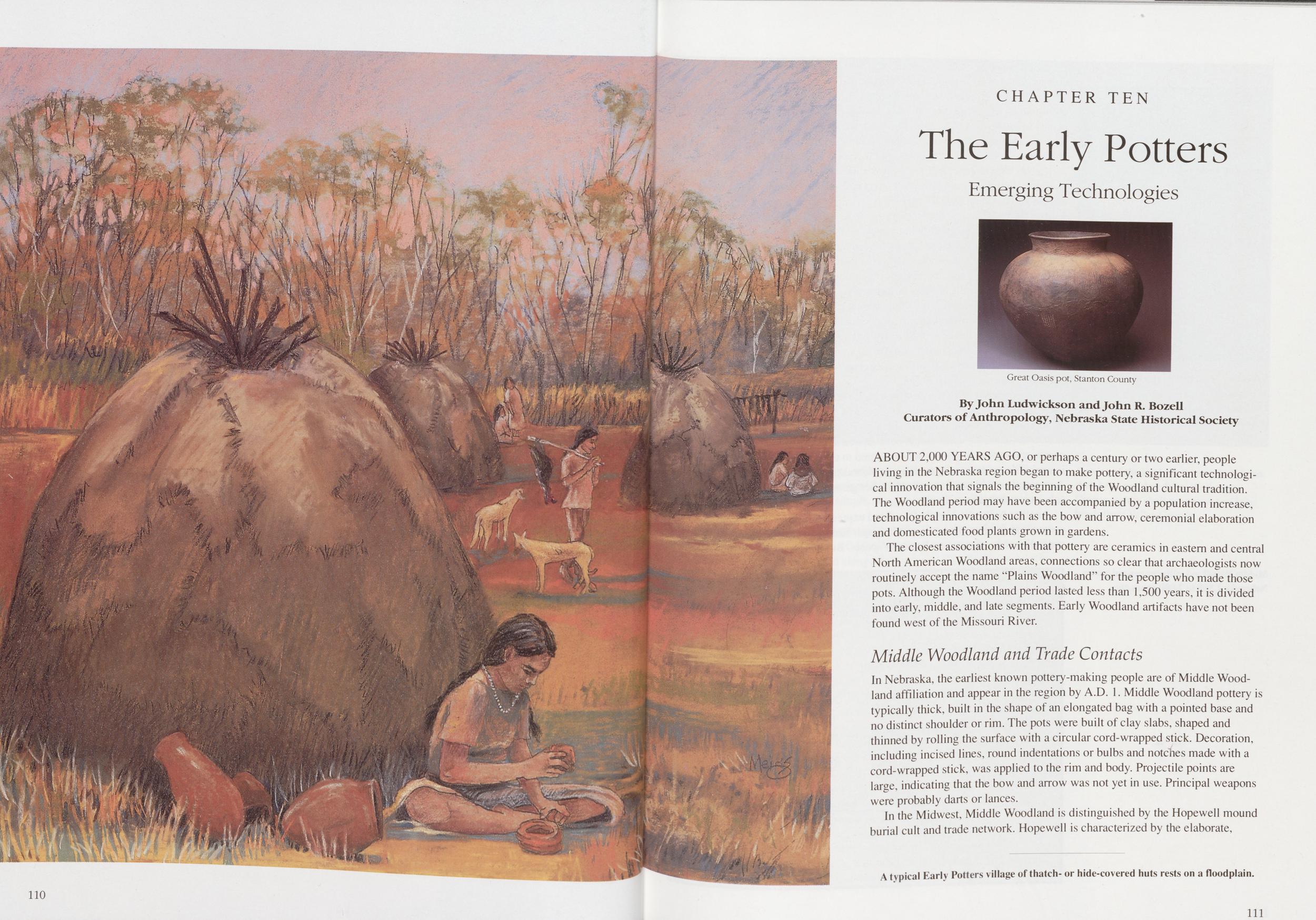
CHAPTER TEN
[image]
A typical Early Potters yillage of thatch- or hide-coyered huts rests on a floodplain.
110
The Early Potters
A typical Early Potters yillage of thatch- or hide-coyered huts rests on a floodplain.
Emerging Technologies
Great Oasis pot, Stanton County
ABOUT 2,000 YEARS AGO, or perhaps a century or two earlier, people living in the Nebraska region began to make pottery, a significant technologi- cal innovation that signals the beginning of the Woodland cultural tradition. The Woodland period may have been accompanied by a population increase, technological innovations such as the bow and arrow, ceremonial elaboration and domesticated food plants grown in gardens.
The closest associations with that pottery are ceramics in eastern and central North American Woodland areas, connections so clear that archaeologists now routinely accept the name "Plains Woodland" for the people who made those pots. Although the Woodland period lasted less than 1,500 years, it is divided into early, middle, and late segments. Early Woodland artifacts have not been found west of the Missouri River.
Middle Woodland and Trade ContactsIn Nebraska, the earliest known pottery-making people are of Middle Wood- land affiliation and appear in the region by A.D. 1. Middle Woodland pottery is typically thick, built in the shape of an elongated bag with a pointed base and no distinct shoulder or rim. The pots were built of clay slabs, shaped and thinned by rolling the surface with a circular cord-wrapped stick. Decoration, including incised lines, round indentations or bulbs and notches made with a cord-wrapped stick, was applied to the rim and body. Projectile points are large, indicating that the bow and arrow was not yet in use. Principal weapons were probably darts or lances.
In the Midwest, Middle Woodland is distinguished by the Hopewell mound burial cult and trade network. Hopewell is characterized by the elaborate,
111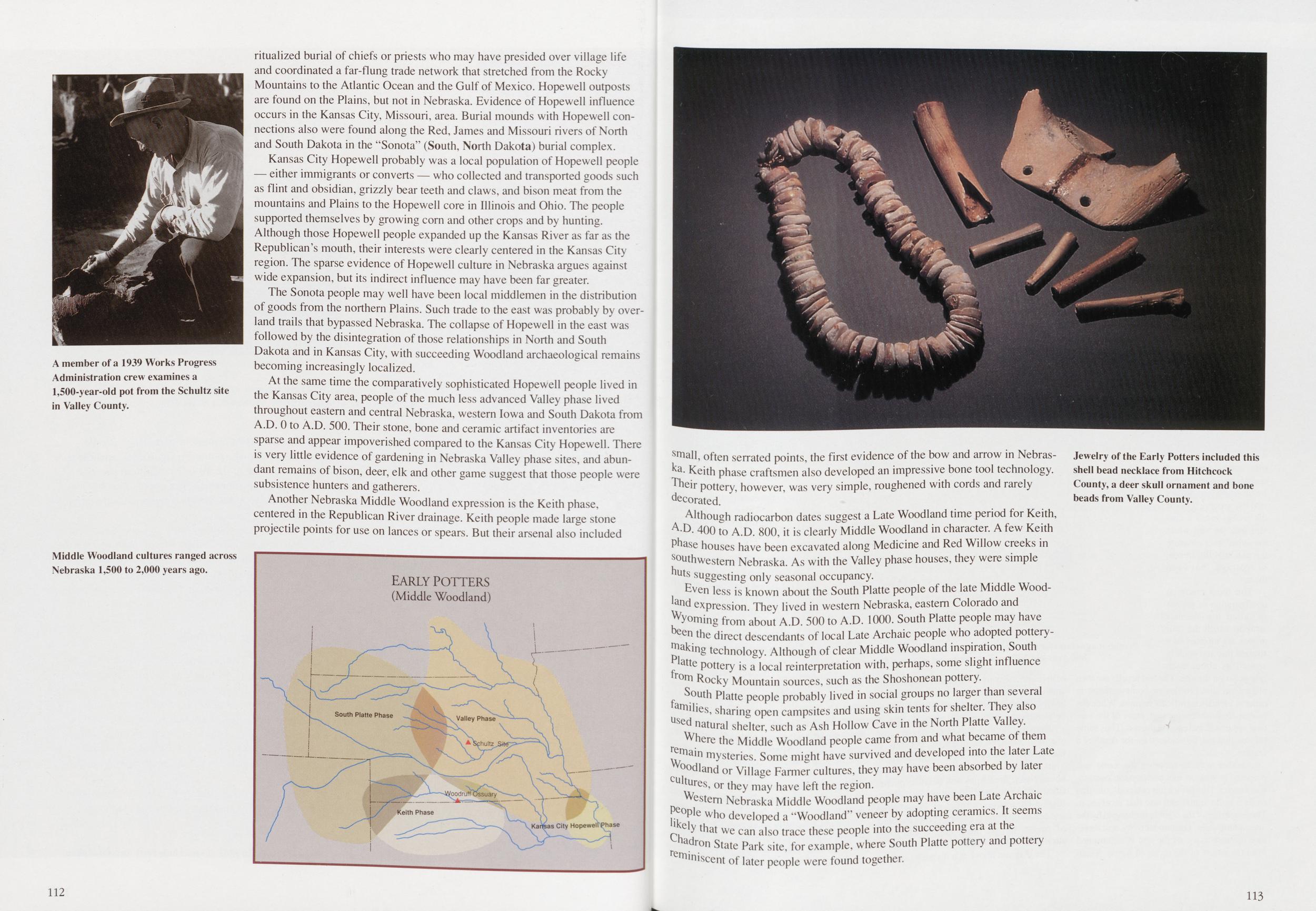
A member of a 1939 Works Progress Administration crew examines a 1,500-year-old pot from the Schultz site in Valley County.
Middle Woodland cultures ranged across Nebraska 1,500 to 2,000 years ago.
EARLY POTTERS (Middle Woodland) South Platte Phase Valley Phase Schultz Site Woodruff Ossuary Keith Phase Kansas City Hopewell Phaseritualized burial of chiefs or priests who may have presided over village life and coordinated a far-flung trade network that stretched from the Rocky Mountains to the Atlantic Ocean and the Gulf of Mexico. Hopewell outposts are found on the Plains, but not in Nebraska. Evidence of Hopewell influence occurs in the Kansas City, Missouri, area. Burial mounds with Hopewell connections also were found along the Red, James and Missouri rivers of North and South Dakota in the "Sonota" (South, North Dakota) burial complex.
Kansas City Hopewell probably was a local population of Hopewell people — either immigrants or converts — who collected and transported goods such as flint and obsidian, grizzly bear teeth and claws, and bison meat from the mountains and Plains to the Hopewell core in Illinois and Ohio. The people supported themselves by growing corn and other crops and by hunting. Although those Hopewell people expanded up the Kansas River as far as the Republican's mouth, their interests were clearly centered in the Kansas City region. The sparse evidence of Hopewell culture in Nebraska argues against wide expansion, but its indirect influence may have been far greater.
The Sonota people may well have been local middlemen in the distribution of goods from the northern Plains. Such trade to the east was probably by over- land trails that bypassed Nebraska. The collapse of Hopewell in the east was followed by the disintegration of those relationships in North and South Dakota and in Kansas City, with succeeding Woodland archaeological remains becoming increasingly localized.
At the same time the comparatively sophisticated Hopewell people lived in the Kansas City area, people of the much less advanced Valley phase lived throughout eastern and central Nebraska, western Iowa and South Dakota from A.D. 0 to A.D. 500. Their stone, bone and ceramic artifact inventories are sparse and appear impoverished compared to the Kansas City Hopewell. There is very little evidence of gardening in Nebraska Valley phase sites, and abun- dant remains of bison, deer, elk and other game suggest that those people were subsistence hunters and gatherers.
Another Nebraska Middle Woodland expression is the Keith phase, centered in the Republican River drainage. Keith people made large stone projectile points for use on lances or spears. But their arsenal also included
112small, often serrated points, the first evidence of the bow and arrow in Nebras- ka. Keith phase craftsmen also developed an impressive bone tool technology. Their pottery, however, was very simple, roughened with cords and rarely decorated.
Although radiocarbon dates suggest a Late Woodland time period for Keith, A.D. 400 to A.D. 800, it is clearly Middle Woodland in character. A few Keith Phase houses have been excavated along Medicine and Red Willow creeks in southwestern Nebraska. As with the Valley phase houses, they were simple huts suggesting only seasonal occupancy.
Even less is known about the South Platte people of the late Middle Wood- land expression. They lived in western Nebraska, eastern Colorado and Wyoming from about A.D. 500 to A.D. 1000. South Platte people may have been the direct descendants of local Late Archaic people who adopted pottery- making technology. Although of clear Middle Woodland inspiration, South Platte pottery is a local reinterpretation with, perhaps, some slight influence from Rocky Mountain sources, such as the Shoshonean pottery.
South Platte people probably lived in social groups no larger than several families, sharing open campsites and using skin tents for shelter. They also Used natural shelter, such as Ash Hollow Cave in the North Platte Valley.
Where the Middle Woodland people came from and what became of them remain mysteries. Some might have survived and developed into the later Late Woodland or Village Fanner cultures, they may have been absorbed by later tures, or they may have left the region.
Western Nebraska Middle Woodland people may have been Late Archaic people who developed a "Woodland" veneer by adopting ceramics. It seems likely that we can also trace these people into the succeeding era at the Chadron State Park site, for example, where South Platte pottery and pottery reminiscent of later people were found together.
Jewelry of the Early Potters included this shell bead necklace from Hitchcock County, a deer skull ornament and bone beads from Valley County.
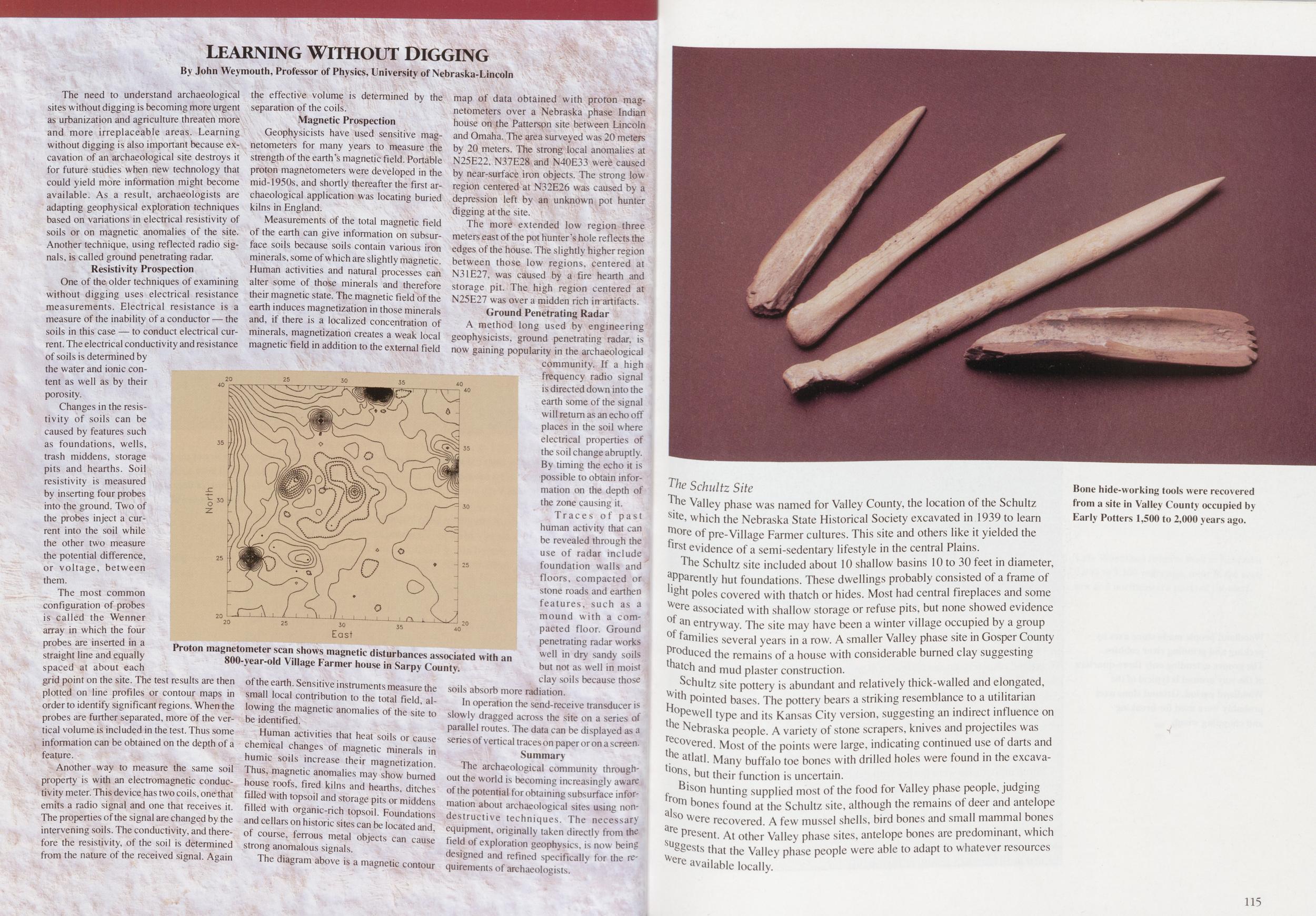
LEARNING WITHOUT DIGGING
The need to understand archaeological sites without digging is becoming more urgent as urbanization and agriculture threaten more and more irreplaceable areas. Learning without digging is also important because excavation of an archaeological site destroys it for future studies when new technology that could yield more information might become available. As a result, archaeologists are adapting geophysical exploration techniques based on variations in electrical resistivity of soils or on magnetic anomalies of the site. Another technique, using reflected radio signals, is called ground penetrating radar.
Resistivity Prospection One of the older techniques of examining without digging uses electrical resistance measurements. Electrical resistance is a measure of the inability of a conductor — the soils in this case — to conduct electrical current. The electrical conductivity and resistance of soils is determined by the water and ionic content as well as by their porosity. Changes in the resistivity of soils can be caused by features such as foundations, wells, trash middens, storage pits and hearths. Soil resistivity is measured by inserting four probes into the ground. Two of the probes inject a current into the soil while the other two measure the potential difference, or voltage, between them.The most common configuration of probes is called the Wenner array in which the four probes are inserted in a straight line and equally spaced at about each grid point on the site. The test results are then of the earth. Sensitive instruments measure the plotted on line profiles or contour maps in order to identify significant regions. When the probes are further separated, more of the vertical volume is included in the test. Thus some information can be obtained on the depth of a feature.
Another way to measure the same soil property is with an electromagnetic conductivity meter. This device has two coils, one that emits a radio signal and one that receives it. The properties of the signal are changed by the intervening soils. The conductivity, and therefore the resistivity, of the soil is determined from the nature of the received signal. Again the effective volume is determined by the separation of the coils.
Magnetic ProspectionGeophysicists have used sensitive magnetometers for many years to measure the strength of the earth's magnetic field. Portable proton magnetometers were developed in the mid-1950s, and shortly thereafter the first archaeological application was locating buried kilns in England.
Proton magnetometer scan shows magnetic disturbances associated with an 800-year-old Village Farmer house in Sarpy County
Human activities that heat soils or cause chemical changes of magnetic minerals in humic soils increase their magnetization. Thus, magnetic anomalies may show burned house roofs, fired kilns and hearths, ditches filled with topsoil and storage pits or middens filled with organic-rich topsoil. Foundations and cellars on historic sites can be located and, of course, ferrous metal objects can cause strong anomalous signals.
The diagram above is a magnetic contour map of data obtained with proton magnetometers over a Nebraska phase Indian house on the Patterson site between Lincoln and Omaha. The area surveyed was 20 meters by 20 meters. The strong local anomalies at N25E22, N37E28 and N40E33 were caused by near-surface iron objects. The strong low region centered at N32E26 was caused by a depression left by an unknown pot hunter digging at the site.
The more extended low region three meters east of the pot hunter's hole reflects the edges of the house. The slightly higher region between those low regions, centered at N31E27, was caused by a fire hearth and storage pit. The high region centered at N25E27 was over a midden rich in artifacts.
Ground Penetrating RadarA method long used by engineering geophysicists, ground penetrating radar, is now gaining popularity in the archaeological community. If a high frequency radio signal is directed down into the earth some of the signal will return as an echo off places in the soil where electrical properties of the soil change abruptly. By timing the echo it is possible to obtain information on the depth of the zone causing it.
Traces of past human activity that can be revealed through the use of radar include foundation walls and floors, compacted or stone roads and earthen features, such as a mound with a com- pacted floor. Ground penetrating radar works well in dry sandy soils but not as well in moist clay soils because those soils absorb more radiation.
In operation the send-receive transducer is slowly dragged across the site on a series of parallel routes. The data can be displayed as a series of vertical traces on paper or on a screen.
SummaryThe archaeological community throughout the world is becoming increasingly aware of the potential for obtaining subsurface information about archaeological sites using nondestructive techniques. The necessary equipment, originally taken directly from the field of exploration geophysics, is now being designed and refined specifically for the requirements of archaeologists.
The Valley phase was named for Valley County, the location of the Schultz Slte, which the Nebraska State Historical Society excavated in 1939 to learn more of pre-Village Farmer cultures. This site and others like it yielded the flrst evidence of a semi-sedentary lifestyle in the central Plains.
The Schultz site included about 10 shallow basins 10 to 30 feet in diameter, apparently hut foundations. These dwellings probably consisted of a frame of hght poles covered with thatch or hides. Most had central fireplaces and some Were associated with shallow storage or refuse pits, but none showed evidence of an entry way. The site may have been a winter village occupied by a group of families several years in a row. A smaller Valley phase site in Gosper County Produced the remains of a house with considerable burned clay suggesting atch and mud plaster construction.
Schultz site pottery is abundant and relatively thick-walled and elongated, with pointed bases. The pottery bears a striking resemblance to a utilitarian Hopewell type and its Kansas City version, suggesting an indirect influence on the Nebraska people. A variety of stone scrapers, knives and projectiles was recovered. Most of the points were large, indicating continued use of darts and the atlatl. Many buffalo toe bones with drilled holes were found in the excava- asi but their function is uncertain.
Bison hunting supplied most of the food for Valley phase people, judging rom bones found at the Schultz site, although the remains of deer and antelope also were recovered. A few mussel shells, bird bones and small mammal bones are Present. At other Valley phase sites, antelope bones are predominant, which SuSgests that the Valley phase people were able to adapt to whatever resources Were available locally.
Bone hide-working tools were recovered from a site in Valley County occupied by Early Potters 1,500 to 2,000 years ago.
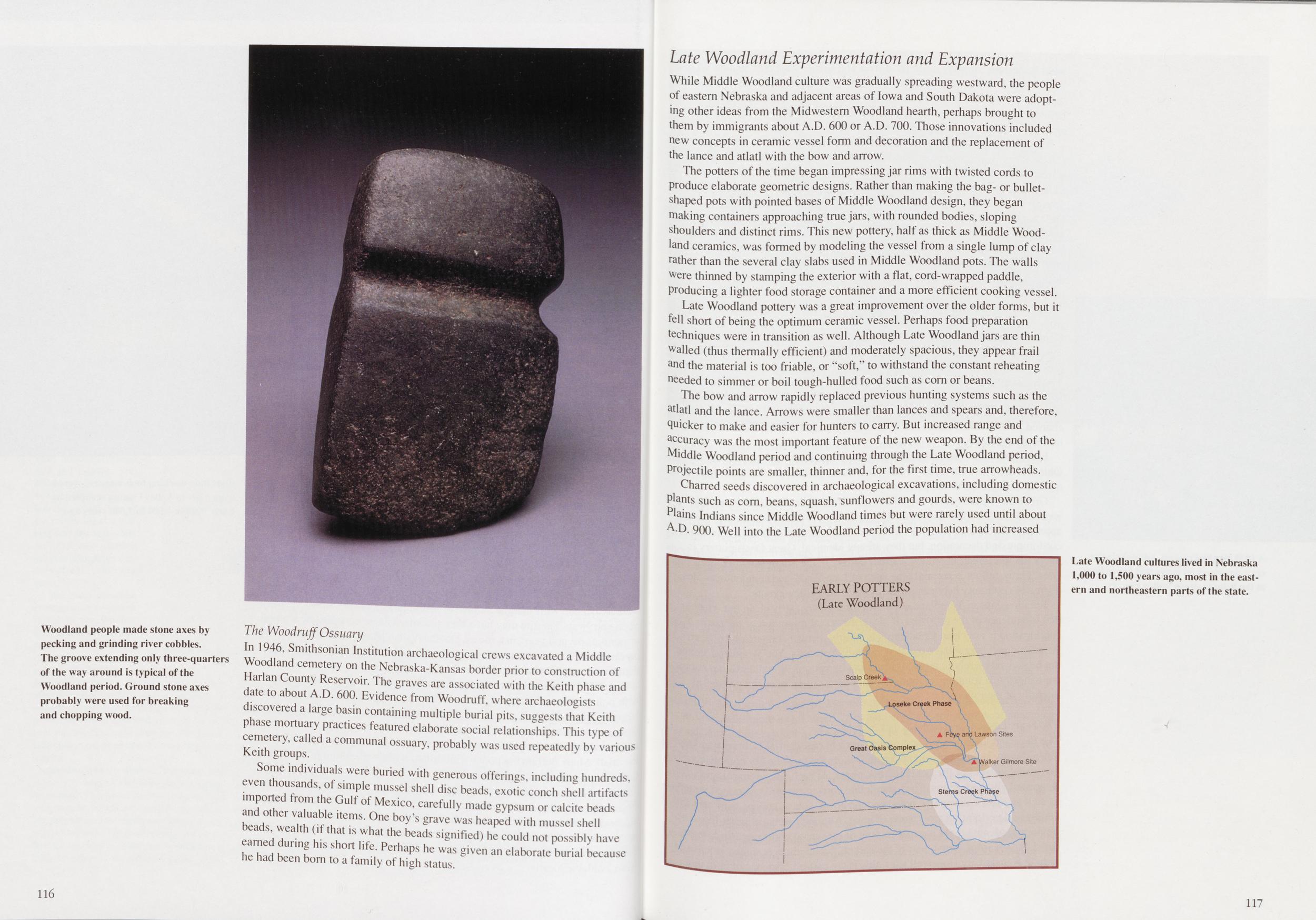
Woodland people made stone axes by pecking and grinding river cobbles. The groove extending only three-quarters of the way around is typical of the Woodland period. Ground stone axes probably were used for breaking and chopping wood.
The Woodruff Ossuary
In 1946, Smithsonian Institution archaeological crews excavated a Middle Woodland cemetery on the Nebraska-Kansas border prior to construction of Harlan County Reservoir. THe graves are associated with the Keith phase and date to about A.D. 600. Evidence from Woodruff, where archaeologists discovered a large basin containing multiple burial pits, suggest that Keith phase mortuary practices featured elaborate social relationships. This type of cemetery, called a communal ossuary, probably was used repeatedly by various Keith groups.
Some individuals were buried with generous offerings, including hundreds, even thousands, of simple mussel shell disc beads, exotic conch shell artifacts imported from the Gulf of Mexico, carefully made gypsum or calcite beads and other valuable items. One boy's grave was heaped with mussel shell beads, wealth (if that is what the beads signified) he could not possibly have earned during his short life. Perhaps he was given an elaborate burial because he had been bom to a family of high status.
116 Late Woodland Experimentation and ExpansionWhile Middle Woodland culture was gradually spreading westward, the people of eastern Nebraska and adjacent areas of Iowa and South Dakota were adopt- ing other ideas from the Midwestern Woodland hearth, perhaps brought to them by immigrants about A.D. 600 or A.D. 700. Those innovations included new concepts in ceramic vessel form and decoration and the replacement of the lance and atlatl with the bow and arrow.
The potters of the time began impressing jar rims with twisted cords to produce elaborate geometric designs. Rather than making the bag- or bullet- shaped pots with pointed bases of Middle Woodland design, they began making containers approaching true jars, with rounded bodies, sloping shoulders and distinct rims. This new pottery, half as thick as Middle Wood- land ceramics, was formed by modeling the vessel from a single lump of clay rather than the several clay slabs used in Middle Woodland pots. The walls were thinned by stamping the exterior with a flat, cord-wrapped paddle, Producing a lighter food storage container and a more efficient cooking vessel.
Late Woodland pottery was a great improvement over the older forms, but it fell short of being the optimum ceramic vessel. Perhaps food preparation techniques were in transition as well. Although Late Woodland jars are thin walled (thus thermally efficient) and moderately spacious, they appear frail and the material is too friable, or "soft," to withstand the constant reheating needed to simmer or boil tough-hulled food such as corn or beans.
The bow and arrow rapidly replaced previous hunting systems such as the atlatl and the lance. Arrows were smaller than lances and spears and, therefore, quicker to make and easier for hunters to carry. But increased range and accuracy was the most important feature of the new weapon. By the end of the Middle Woodland period and continuing through the Late Woodland period, Projectile points are smaller, thinner and, for the first time, true arrowheads.
Charred seeds discovered in archaeological excavations, including domestic Plants such as corn, beans, squash, sunflowers and gourds, were known to Plains Indians since Middle Woodland times but were rarely used until about A-D. 900. Well into the Late Woodland period the population had increased
EARLY POTTERS (Late Woodland) Scalp Creek Loseke Creek Phase Feye and Lawson Sites Great Oasis Complex Walker Gilmore Site Sterns Creek Phase
Late Woodland cultures lived in Nebraska 1,000 to 1,500 years ago, most in the eastern and northeastern parts of the state.
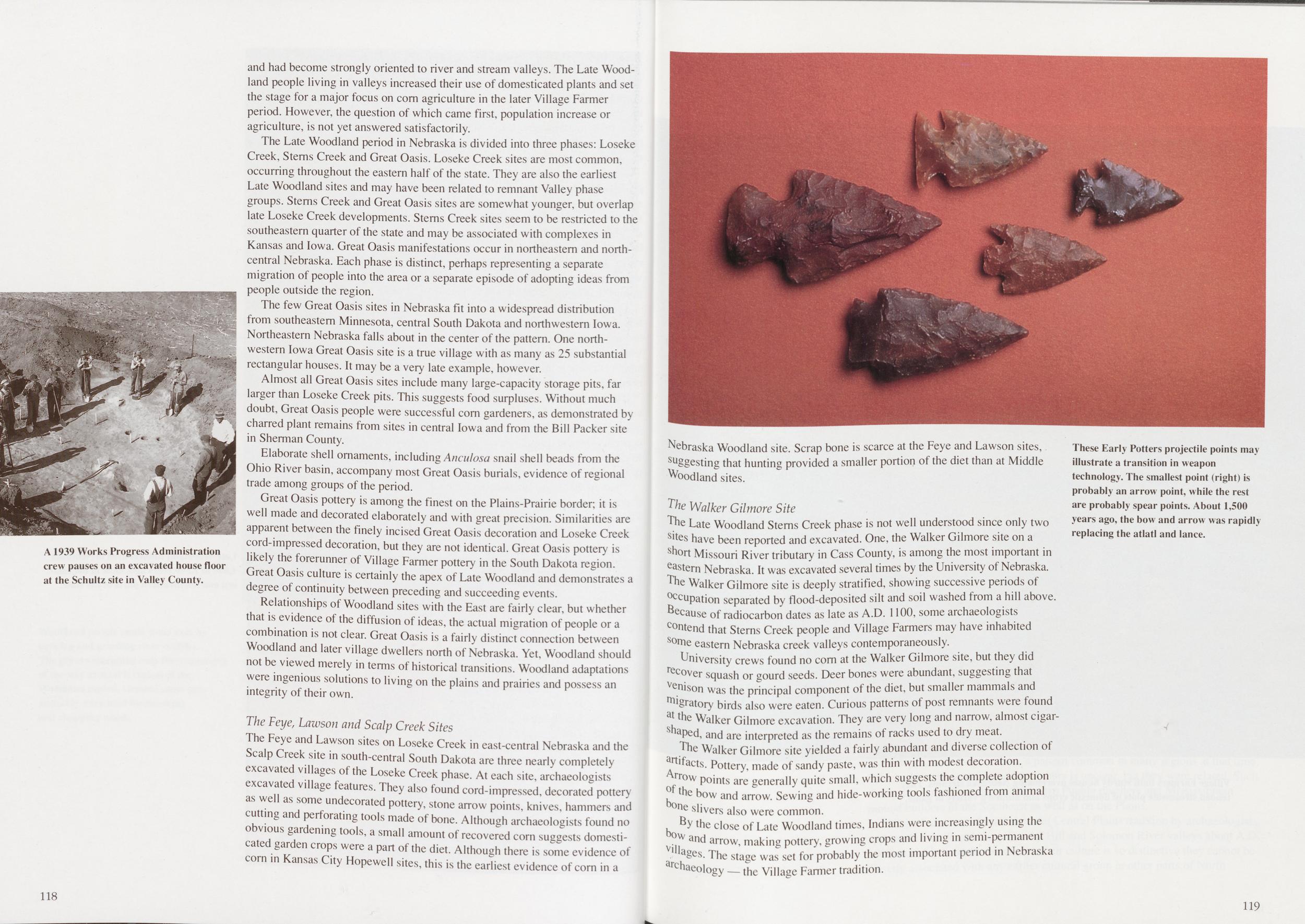
A 1939 Works Progress Administration crew pauses on an excavated house floor at the Schultz site in Valley County.
and had become strongly oriented to river and stream valleys. The Late Wood- land people living in valleys increased their use of domesticated plants and set the stage for a major focus on com agriculture in the later Village Farmer period. However, the question of which came first, population increase or agriculture, is not yet answered satisfactorily.
The Late Woodland period in Nebraska is divided into three phases: Loseke Creek, Stems Creek and Great Oasis. Loseke Creek sites are most common, occurring throughout the eastern half of the state. They are also the earliest Late Woodland sites and may have been related to remnant Valley phase groups. Stems Creek and Great Oasis sites are somewhat younger, but overlap late Loseke Creek developments. Stems Creek sites seem to be restricted to the southeastern quarter of the state and may be associated with complexes in Kansas and Iowa. Great Oasis manifestations occur in northeastern and north- central Nebraska. Each phase is distinct, perhaps representing a separate migration of people into the area or a separate episode of adopting ideas from people outside the region.
The few Great Oasis sites in Nebraska fit into a widespread distribution from southeastern Minnesota, central South Dakota and northwestern Iowa. Northeastern Nebraska falls about in the center of the pattern. One north- western Iowa Great Oasis site is a true village with as many as 25 substantial rectangular houses. It may be a very late example, however.
Almost all Great Oasis sites include many large-capacity storage pits, far larger than Loseke Creek pits. This suggests food surpluses. Without much doubt, Great Oasis people were successful com gardeners, as demonstrated by charred plant remains from sites in central Iowa and from the Bill Packer site in Sherman County.
Elaborate shell ornaments, including Anculosa snail shell beads from the Ohio River basin, accompany most Great Oasis burials, evidence of regional trade among groups of the period.
Great Oasis pottery is among the finest on the Plains-Prairie border; it is well made and decorated elaborately and with great precision. Similarities are apparent between the finely incised Great Oasis decoration and Loseke Creek cord-impressed decoration, but they are not identical. Great Oasis pottery is likely the forerunner of Village Farmer pottery in the South Dakota region. Great Oasis culture is certainly the apex of Late Woodland and demonstrates a degree of continuity between preceding and succeeding events.
Relationships of Woodland sites with the East are fairly clear, but whether that is evidence of the diffusion of ideas, the actual migration of people or a combination is not clear. Great Oasis is a fairly distinct connection between Woodland and later village dwellers north of Nebraska. Yet, Woodland should not be viewed merely in terms of historical transitions. Woodland adaptations were ingenious solutions to living on the plains and prairies and possess an integnty of their own.
The Teye, Lawson and Scalp Creek SitesThese Early Potters projectile points may illustrate a transition in weapon technology. The smallest point (right) is probably an arrow point, while the rest are probably spear points. About 1,500 years ago, the bow and arrow was rapidly replacing the atlatl and lance.
The Late Woodland Sterns Creek phase is not well understood since only two sites have been reported and excavated. One, the Walker Gilmore site on a short Missouri River tributary in Cass County, is among the most important in Astern Nebraska. It was excavated several times by the University of Nebraska. The Walker Gilmore site is deeply stratified, showing successive periods of Occupation separated by flood-deposited silt and soil washed from a hill above Because of radiocarbon dates as late as A.D. 1100, some archaeologists contend that Sterns Creek people and Village Farmers may have inhabited sorne eastern Nebraska creek valleys contemporaneously.
University crews found no corn at the Walker Gilmore site, but they did recover squash or gourd seeds. Deer bones were abundant, suggesting that Venison was the principal component of the diet, but smaller mammals and migratory birds also were eaten. Curious patterns of post remnants were found at the Walker Gilmore excavation. They are very long and narrow, almost cigai shaPed, and are interpreted as the remains of racks used to dry meat.
The Walker Gilmore site yielded a fairly abundant and diverse collection of artifacts. Pottery made of sandy paste, was thin with modest decoration. Arrow points are generally quite small, which suggests the complete adoption of the bow and arrow. Sewing and hide-working tools fashioned from animal bone slivers also were common.
By the close of Late Woodland times, Indians were increasingly using the bow and arrow, making pottery, growing crops and living in semi-permanent villages. The stage was set for probably the most important period in Nebraska archaeology — the Village Farmer tradition.
119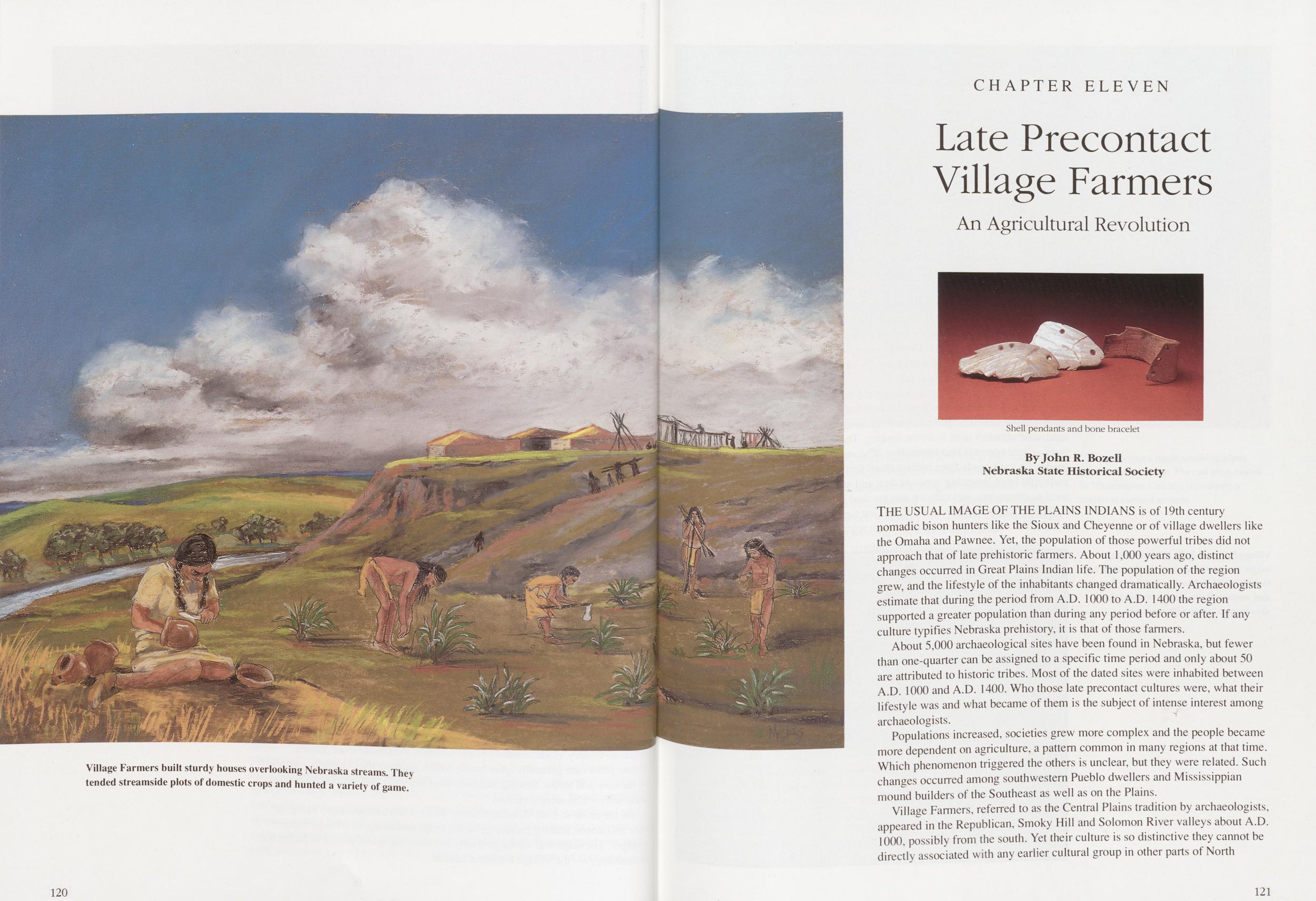
Village Farmers built sturdy houses overlooking Nebraska streams. They tended streamside plots of domestic crops and hunted a variety of game.
CHAPTER ELEVEN Late Precontact Village Farmers
An Agricultural Revolution
Shell pendants and bone bracelet
THE USUAL IMAGE OF THE PLAINS INDIANS is of 19th century nomadic bison hunters like the Sioux and Cheyenne or of village dwellers like the Omaha and Pawnee. Yet, the population of those powerful tribes did not approach that of late prehistoric farmers. About 1,000 years ago, distinct changes occurred in Great Plains Indian life. The population of the region grew, and the lifestyle of the inhabitants changed dramatically. Archaeologists estimate that during the period from A.D. 1000 to A.D. 1400 the region supported a greater population than during any period before or after. If any culture typifies Nebraska prehistory, it is that of those farmers.
About 5,000 archaeological sites have been found in Nebraska, but fewer than one-quarter can be assigned to a specific time period and only about 50 are attributed to historic tribes. Most of the dated sites were inhabited between A.D. 1000 and A.D. 1400. Who those late precontact cultures were, what their lifestyle was and what became of them is the subject of intense interest among archaeologists.
Populations increased, societies grew more complex and the people became more dependent on agriculture, a pattern common in many regions at that time. Which phenomenon triggered the others is unclear, but they were related. Such changes occurred among southwestern Pueblo dwellers and Mississippian mound builders of the Southeast as well as on the Plains.
Village Farmers, referred to as the Central Plains tradition by archaeologists, appeared in the Republican, Smoky Hill and Solomon River valleys about A.D. 1000, possibly from the south. Yet their culture is so distinctive they cannot be directly associated with any earlier cultural group in other parts of North
121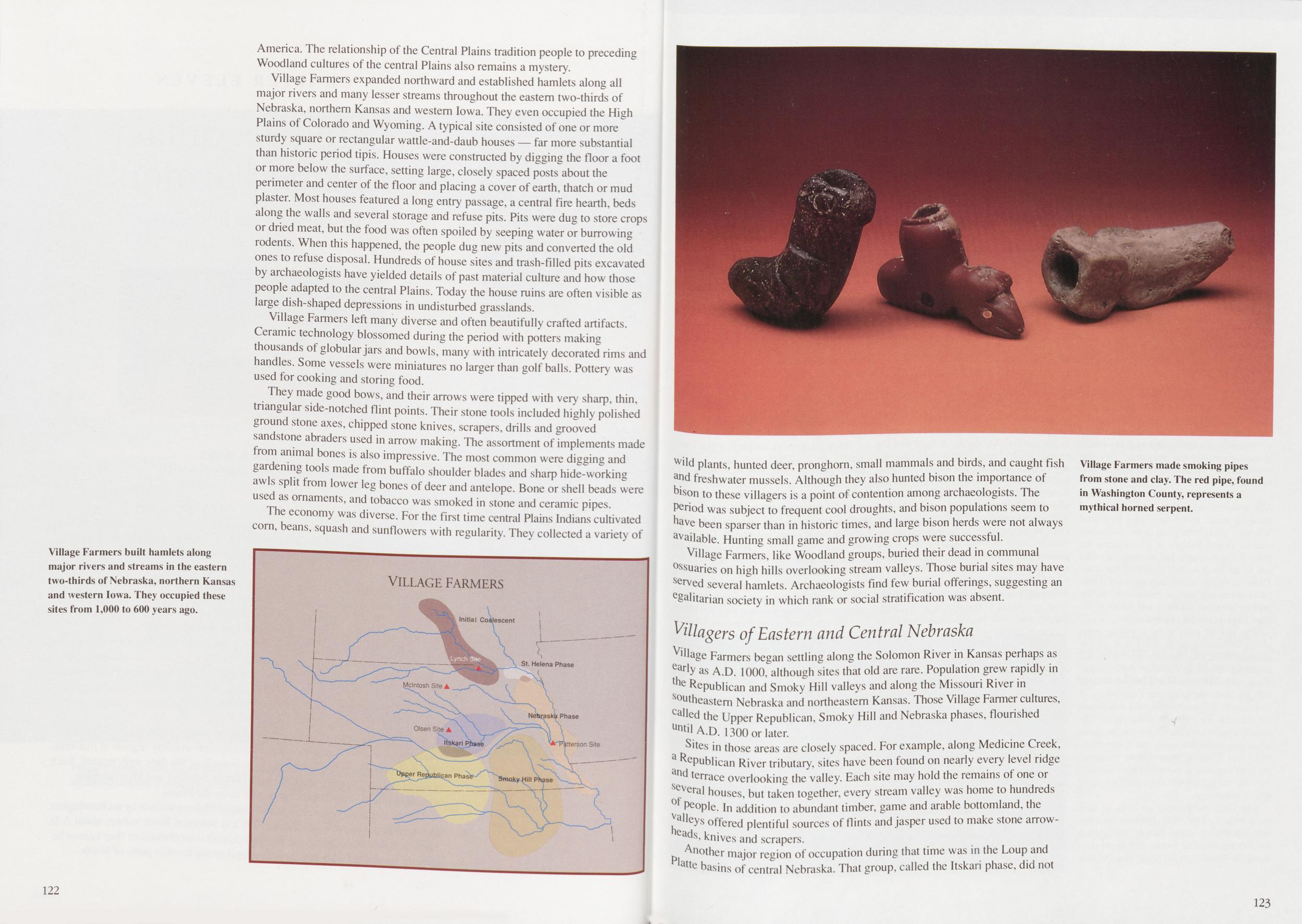
Village Farmers built hamlets along major rivers and streams in the eastern two-thirds of Nebraska, northern Kansas and western Iowa. They occupied these sites from 1,000 to 600 years ago.
VILLAGE FARMERS Initial Coalescent St. Helena Phase McIntosh Site Nebraska Phase Olsen Site Itskari Phase Upper Republican Phase Smoky Hill Phase Patterson Site
America. The relationship of the Central Plains tradition people to preceding Woodland cultures of the central Plains also remains a mystery.
Village Farmers expanded northward and established hamlets along all major rivers and many lesser streams throughout the eastern two-thirds of Nebraska, northern Kansas and western Iowa. They even occupied the High Plains of Colorado and Wyoming. A typical site consisted of one or more sturdy square or rectangular wattle-and-daub houses — far more substantial than historic period tipis. Houses were constructed by digging the floor a foot or more below the surface, setting large, closely spaced posts about the perimeter and center of the floor and placing a cover of earth, thatch or mud plaster. Most houses featured a long entry passage, a central fire hearth, beds along the walls and several storage and refuse pits. Pits were dug to store crops or dried meat, but the food was often spoiled by seeping water or burrowing rodents. When this happened, the people dug new pits and converted the old ones to refuse disposal. Hundreds of house sites and trash-filled pits excavated by archaeologists have yielded details of past material culture and how those people adapted to the central Plains. Today the house ruins are often visible as large dish-shaped depressions in undisturbed grasslands.
Village Farmers left many diverse and often beautifully crafted artifacts. Ceramic technology blossomed during the period with potters making thousands of globular jars and bowls, many with intricately decorated rims and handles. Some vessels were miniatures no larger than golf balls. Pottery was used for cooking and storing food.
They made good bows, and their arrows were tipped with very sharp, thin, triangular side-notched flint points. Their stone tools included highly polished ground stone axes, chipped stone knives, scrapers, drills and grooved sandstone abraders used in arrow making. The assortment of implements made from animal bones is also impressive. The most common were digging and gardening tools made from buffalo shoulder blades and sharp hide-working awls split from lower leg bones of deer and antelope. Bone or shell beads were used as ornaments, and tobacco was smoked in stone and ceramic pipes.
The economy was diverse. For the first time central Plains Indians cultivated corn, beans, squash and sunflowers with regularity. They collected a variety of 122 wild plants, hunted deer, pronghorn, small mammals and birds, and caught fish and freshwater mussels. Although they also hunted bison the importance of bison to these villagers is a point of contention among archaeologists. The Period was subject to frequent cool droughts, and bison populations seem to have been sparser than in historic times, and large bison herds were not always available. Hunting small game and growing crops were successful.
Village Farmers, like Woodland groups, buried their dead in communal ^suaries on high hills overlooking stream valleys. Those burial sites may have served several hamlets. Archaeologists find few burial offerings, suggesting an egalitarian society in which rank or social stratification was absent.
Villagers of Eastern and Central NebraskaVillage Farmers began settling along the Solomon River in Kansas perhaps as early as A D 1000 although sites that old are rare. Population grew rapidly in the Republican and Smoky Hill valleys and along the Missouri River in southeastern Nebraska and northeastern Kansas. Those Village Farmer cultures, ca"ed the Upper Republican, Smoky Hill and Nebraska phases, flourished UntilA.D. 1300 or later.
Sites in those areas are closely spaced. For example, along Medicine Creek, a ^publican River tributary, sites have been found on nearly every level ridge a"d terrace overlooking the valley. Each site may hold the remains of one or several houses, but taken together, every stream valley was home to hundreds of People. In addition to abundant timber, game and arable bottomland, the Ja|leys offered plentiful sources of flints and jasper used to make stone arrowheads, knives and scrapers.
Another major region of occupation during that time was in the Loup and Platte basins of central Nebraska. That group, called the Itskar. phase, did not
Village Farmers made smoking pipes from stone and clay. The red pipe, found in Washington County, represents a mythical horned serpent.
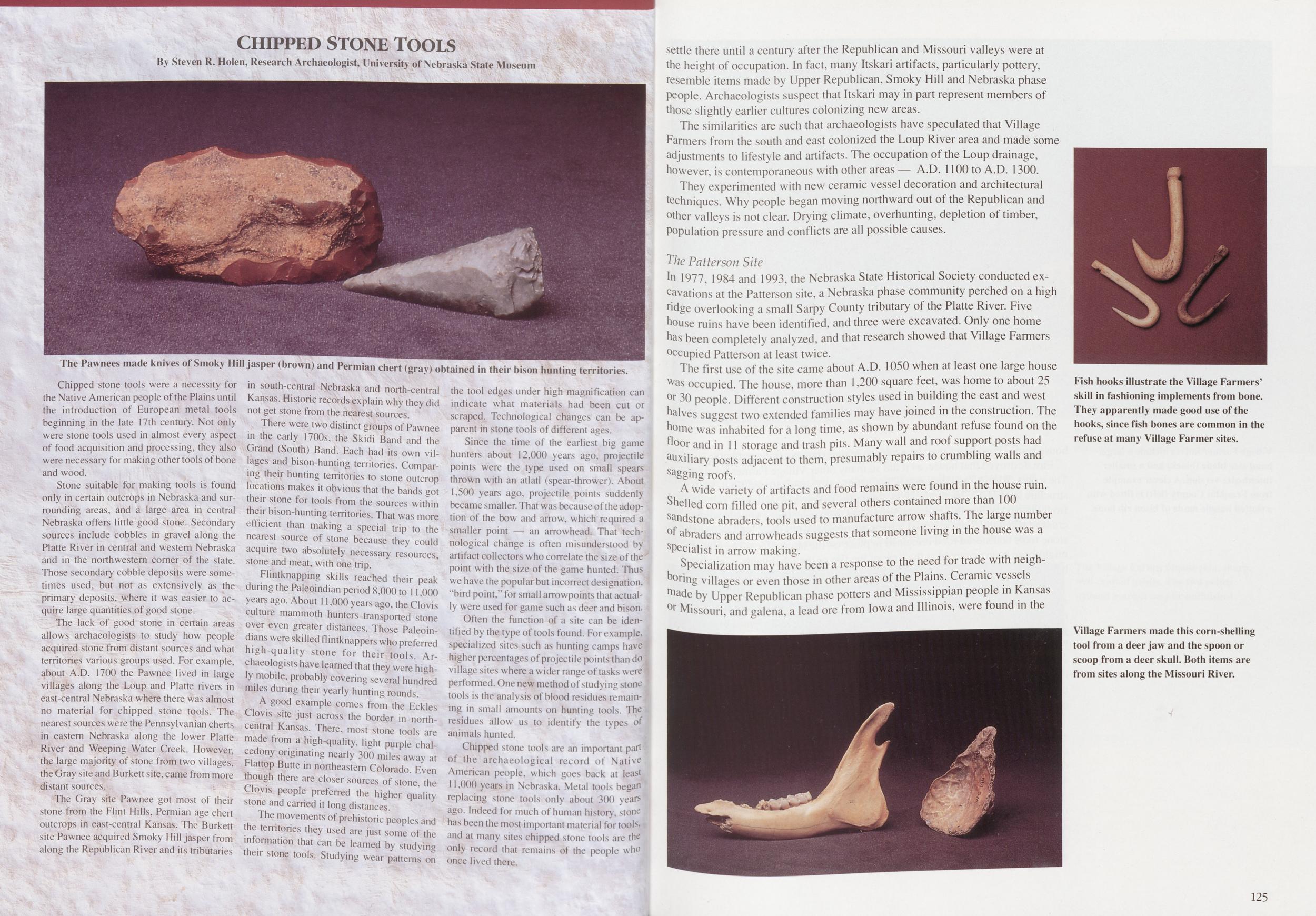
CHIPPED STONE TOOLS
The Pawnees made knives of Smoky Hill jasper (brown) and Permian chert (gray) obtained in their bison hunting territories.
Chipped stone tools were a necessity for the Native American people of the Plains until the introduction of European metal tools beginning in the late 17th century. Not only were stone tools used in almost every aspect of food acquisition and processing, they also were necessary for making other tools of bone and wood.
Stone suitable for making tools is found only in certain outcrops in Nebraska and surrounding areas, and a large area in central Nebraska offers little good stone. Secondary sources include cobbles in gravel along the Platte River in central and western Nebraska and in the northwestern comer of the state. Those secondary cobble deposits were sometimes used, but not as extensively as the primary deposits, where it was easier to acquire large quantities of good stone.
The lack of good stone in certain areas allows archaeologists to study how people acquired stone from distant sources and what territories various groups used. For example, about A.D. 1700 the Pawnee lived in large villages along the Loup and Platte rivers in east-central Nebraska where there was almost no material for chipped stone tools. The nearest sources were the Pennsylvanian cherts in eastern Nebraska along the lower Platte River and Weeping Water Creek. However, the large majority of stone from two villages, the Gray site and Burkett site, came from more distant sources.
The Gray site Pawnee got most of their stone from the Flint Hills, Permian age chert outcrops in east-central Kansas. The Burkett site Pawnee acquired Smoky Hill jasper from along the Republican River and its tributaries in south-central Nebraska and north-central Kansas. Historic records explain why they did not get stone from the nearest sources.
There were two distinct groups of Pawnee in the early 1700s, the Skidi Band and the Grand (South) Band. Each had its own villages and bison-hunting territories. Comparing their hunting territories to stone outcrop locations makes it obvious that the bands got their stone for tools from the sources within their bison-hunting territories. That was more efficient than making a special trip to the nearest source of stone because they could acquire two absolutely necessary resources, stone and meat, with one trip.
Flintknapping skills reached their peak during the Paleoindian period 8,000 to 11,000 years ago. About 11,000 years ago, the Clovis culture mammoth hunters transported stone over even greater distances. Those Paleoindians were skilled flintknappers who preferred high-quality stone for their tools. Archaeologists have learned that they were highly mobile, probably covering several hundred miles during their yearly hunting rounds.
A good example comes from the Eckles Clovis site just across the border in north- central Kansas. There, most stone tools are made from a high-quality, light purple chalcedony originating nearly 300 miles away at Flattop Butte in northeastern Colorado. Even though there are closer sources of stone, the Clovis people preferred the higher quality stone and carried it long distances.
The movements of prehistoric peoples and the territories they used are just some of the information that can be learned by studying their stone tools. Studying wear patterns on the tool edges under high magnification can indicate what materials had been cut or scraped. Technological changes can be apparent in stone tools of different ages.
Since the time of the earliest big game hunters about 12,000 years ago, projectile points were the type used on small spears thrown with an atlatl (spear-thrower). About 1,500 years ago, projectile points suddenly became smaller. That was because of the adoption of the bow and arrow, which required a smaller point — an arrowhead. That technological change is often misunderstood by artifact collectors who correlate the size of the point with the size of the game hunted. Thus we have the popular but incorrect designation, "bird point," for small arrowpoints that actually were used for game such as deer and bison.
Often the function of a site can be identified by the type of tools found. For example, specialized sites such as hunting camps have higher percentages of projectile points than do village sites where a wider range of tasks were performed. One new method of studying stone tools is the analysis of blood residues remaining in small amounts on hunting tools. The residues allow us to identify the types ot animals hunted.
Chipped stone tools are an important pad of the archaeological record of Native American people, which goes back at least 11,000 years in Nebraska. Metal tools began replacing stone tools only about 300 years ago. Indeed for much of human history, stone has been the most important material for tools- and at many sites chipped stone tools are the only record that remains of the people who once lived there.
settle there until a century after the Republican and Missouri valleys were at the height of occupation. In fact, many Itskari artifacts, particularly pottery, resemble items made by Upper Republican, Smoky Hill and Nebraska phase people. Archaeologists suspect that Itskari may in part represent members of those slightly earlier cultures colonizing new areas.
The similarities are such that archaeologists have speculated that Village Farmers from the south and east colonized the Loup River area and made some adjustments to lifestyle and artifacts. The occupation of the Loup drainage, however, is contemporaneous with other areas — A.D. 1100 to A.D. 1300.
They experimented with new ceramic vessel decoration and architectural techniques. Why people began moving northward out of the Republican and other valleys is not clear. Drying climate, overhunting, depletion of timber, Population pressure and conflicts are all possible causes.
The Patterson SiteIn 1977, 1984 and 1993, the Nebraska State Historical Society conducted excavations at the Patterson site, a Nebraska phase community perched on a high ridge overlooking a small Sarpy County tributary of the Platte River. Five house ruins have been identified, and three were excavated. Only one home has been completely analyzed, and that research showed that Village Farmers occupied Patterson at least twice.
The first use of the site came about A.D. 1050 when at least one large house was occupied. The house, more than 1,200 square feet, was home to about 25 or 30 people. Different construction styles used in building the east and west halves suggest two extended families may have joined in the construction. The home was inhabited for a long time, as shown by abundant refuse found on the floor and in 11 storage and trash pits. Many wall and roof support posts had auxiliary posts adjacent to them, presumably repairs to crumbling walls and sagging roofs.
A wide variety of artifacts and food remains were found in the house ruin. Shelled corn filled one pit, and several others contained more than 100 sandstone abraders, tools used to manufacture arrow shafts. The large number of abraders and arrowheads suggests that someone living in the house was a sPecialist in arrow making.
Specialization may have been a response to the need for trade with neighing villages or even those in other areas of the Plains. Ceramic vessels made by Upper Republican phase potters and Mississippi people in Kansas 0r Missouri, and galena, a lead ore from Iowa and Illinois, were found in the
Fish hooks illustrate the Village Farmers' skill in fashioning implements from bone. They apparently made good use of the hooks, since fish bones are common in the refuse at many Village Farmer sites.
Village Farmers made this corn-shelling tool from a deer jaw and the spoon or scoop from a deer skull. Both items are from sites along the Missouri River.
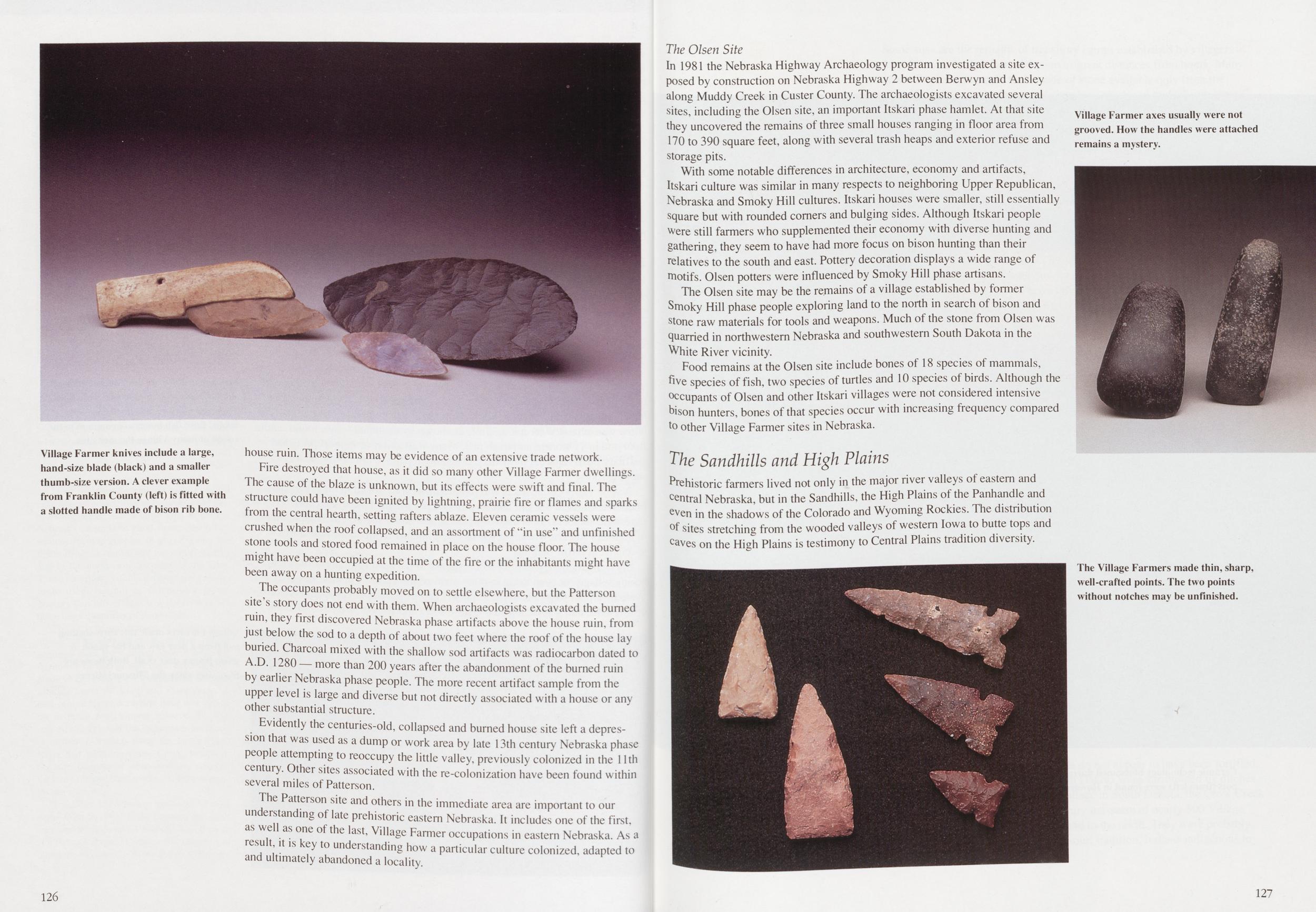
Village Farmer knives include a large, hand-size blade (black) and a smaller thumb-size version. A clever example from Franklin County (left) is fitted with a slotted handle made of bison rib bone.
house ruin. Those items may be evidence of an extensive trade network.
Fire destroyed that house, as it did so many other Village Farmer dwellings. The cause of the blaze is unknown, but its effects were swift and final. The structure could have been ignited by lightning, prairie fire or flames and sparks from the central hearth, setting rafters ablaze. Eleven ceramic vessels were crushed when the roof collapsed, and an assortment of "in use" and unfinished stone tools and stored food remained in place on the house floor. The house might have been occupied at the time of the fire or the inhabitants might have been away on a hunting expedition.
The occupants probably moved on to settle elsewhere, but the Patterson site's story does not end with them. When archaeologists excavated the burned ruin, they first discovered Nebraska phase artifacts above the house ruin, from just below the sod to a depth of about two feet where the roof of the house lay buned. Charcoal mixed with the shallow sod artifacts was radiocarbon dated to A.D. 1280 — more than 200 years after the abandonment of the burned ruin by earlier Nebraska phase people. The more recent artifact sample from the upper level is large and diverse but not directly associated with a house or any other substantial structure.
Evidently the centuries-old, collapsed and burned house site left a depression that was used as a dump or work area by late 13th century Nebraska phase people attempting to reoccupy the little valley, previously colonized in the 11th century. Other sites associated with the re-colonization have been found within several miles of Patterson.
The Patterson site and others in the immediate area are important to our understanding of late prehistoric eastern Nebraska. It includes one of the first, as well as one of the last, Village Farmer occupations in eastern Nebraska. As a result it is key to understanding how a particular culture colonized, adapted to and ultimately abandoned a locality.
126 The Olsen SiteIn 1981 the Nebraska Highway Archaeology program investigated a site ex- posed by construction on Nebraska Highway 2 between Berwyn and Ansley along Muddy Creek in Custer County. The archaeologists excavated several sites, including the Olsen site, an important Itskari phase hamlet. At that site they uncovered the remains of three small houses ranging in floor area from 170 to 390 square feet, along with several trash heaps and exterior refuse and storage pits.
With some notable differences in architecture, economy and artifacts, Itskari culture was similar in many respects to neighboring Upper Republican, Nebraska and Smoky Hill cultures. Itskari houses were smaller, still essentially square but with rounded comers and bulging sides. Although Itskari people were still farmers who supplemented their economy with diverse hunting and gathering, they seem to have had more focus on bison hunting than their relatives to the south and east. Pottery decoration displays a wide range of motifs. Olsen potters were influenced by Smoky Hill phase artisans.
The Olsen site may be the remains of a village established by former Smoky Hill phase people exploring land to the north in search of bison and stone raw materials for tools and weapons. Much of the stone from Olsen was quarried in northwestern Nebraska and southwestern South Dakota in the White River vicinity.
Food remains at the Olsen site include bones of 18 species of mammals, five species offish, two species of turtles and 10 species of birds. Although the occupants of Olsen and other Itskari villages were not considered intensive bison hunters, bones of that species occur with increasing frequency compared to other Village Farmer sites in Nebraska.
The Sandhills and High PlainsPrehistoric farmers lived not only in the major river valleys of eastern and central Nebraska, but in the Sandhills, the High Plains of the Panhandle and oven in the shadows of the Colorado and Wyoming Rockies. The distribution of sites stretching from the wooded valleys of western Iowa to butte tops and caves on the High Plains is testimony to Central Plains tradition diversity.
Village Farmer axes usually were not grooved. How the handles were attached remains a mystery.
The Village Farmers made thin, sharp, well-crafted points. The two points without notches may be unfinished.
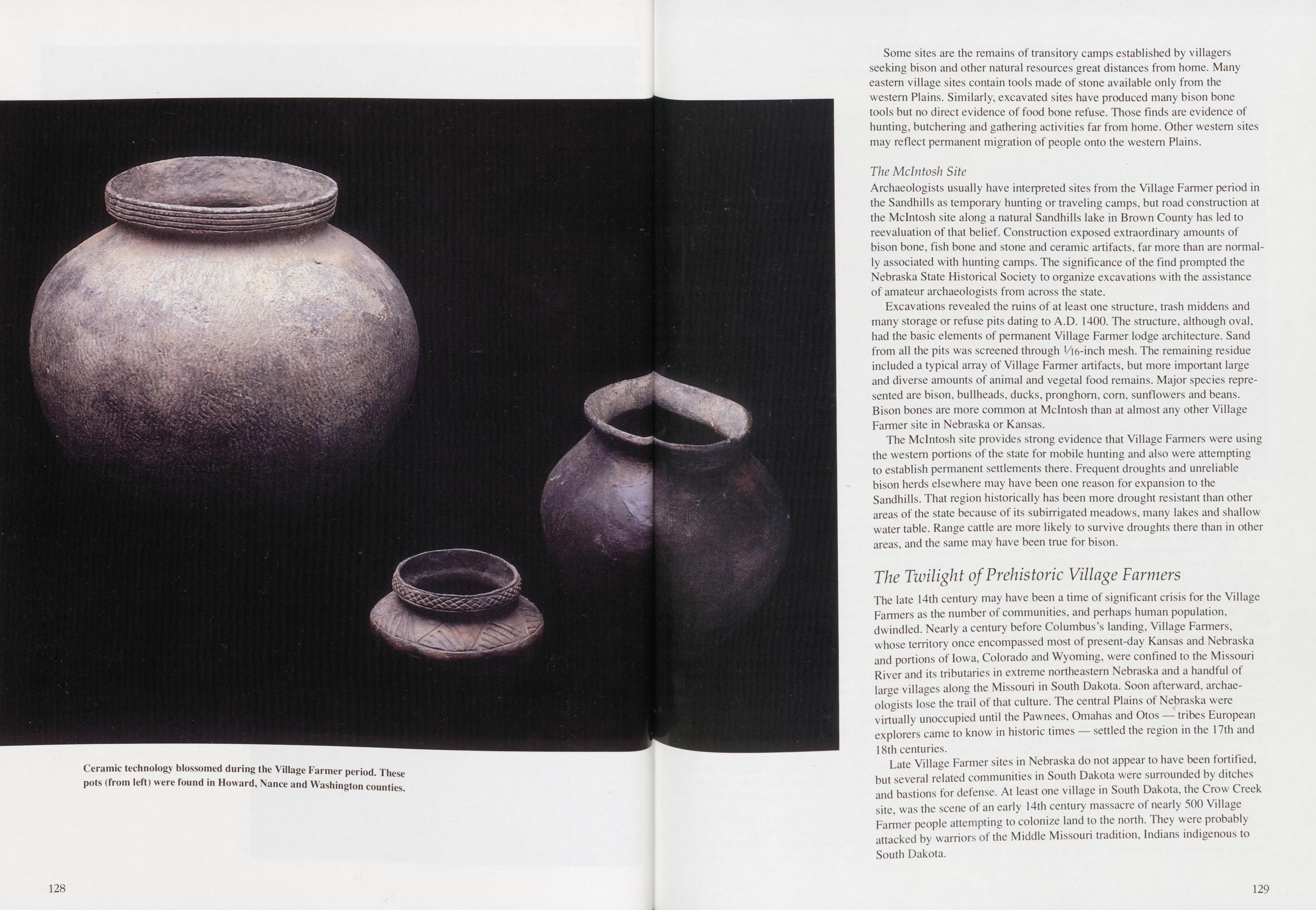
Ceramic technology blossomed during the Village Farmer period. These pots (from left) were found in Howard, Nance and Washington counties.
Some sites are the remains of transitory camps established by villagers seeking bison and other natural resources great distances from home. Many eastern village sites contain tools made of stone available only from the western Plains. Similarly, excavated sites have produced many bison bone tools but no direct evidence of food bone refuse. Those finds are evidence of hunting, butchering and gathering activities far from home. Other western sites may reflect permanent migration of people onto the western Plains.
The Mcintosh SiteArchaeologists usually have interpreted sites from the Village Farmer period in the Sandhills as temporary hunting or traveling camps, but road construction at the Mcintosh site along a natural Sandhills lake in Brown County has led to reevaluation of that belief. Construction exposed extraordinary amounts of bison bone, fish bone and stone and ceramic artifacts, far more than are normal- ly associated with hunting camps. The significance of the find prompted the Nebraska State Historical Society to organize excavations with the assistance of amateur archaeologists from across the state.
Excavations revealed the ruins of at least one structure, trash middens and many storage or refuse pits dating to A.D. 1400. The structure, although oval, had the basic elements of permanent Village Farmer lodge architecture. Sand from all the pits was screened through l/i 6-inch mesh. The remaining residue included a typical array of Village Farmer artifacts, but more important large and diverse amounts of animal and vegetal food remains. Major species repre- sented are bison, bullheads, ducks, pronghorn, corn, sunflowers and beans. Bison bones are more common at Mcintosh than at almost any other Village Farmer site in Nebraska or Kansas.
The Mcintosh site provides strong evidence that Village Farmers were using the western portions of the state for mobile hunting and also were attempting to establish permanent settlements there. Frequent droughts and unreliable bison herds elsewhere may have been one reason for expansion to the Sandhills. That region historically has been more drought resistant than other areas of the state because of its subirrigated meadows, many lakes and shallow water table. Range cattle are more likely to survive droughts there than in other areas, and the same may have been true for bison.
The Twilight of Prehistoric Village FarmersThe late 14th century may have been a time of significant crisis for the Village Farmers as the number of communities, and perhaps human population, dwindled. Nearly a century before Columbus's landing, Village Farmers, whose territory once encompassed most of present-day Kansas and Nebraska and portions of Iowa, Colorado and Wyoming, were confined to the Missouri River and its tributaries in extreme northeastern Nebraska and a handful of large villages along the Missouri in South Dakota. Soon afterward, archae- ologists lose the trail of that culture. The central Plains of Nebraska were virtually unoccupied until the Pawnees, Omahas and Otos — tribes European explorers came to know in historic times — settled the region in the 17th and 18th centuries.
Late Village Farmer sites in Nebraska do not appear to have been fortified, but several related communities in South Dakota were surrounded by ditches and bastions for defense. At least one village in South Dakota, the Crow Creek site, was the scene of an early 14th century massacre of nearly 500 Village Farmer people attempting to colonize land to the north. They were probably attacked by warriors of the Middle Missouri tradition, Indians indigenous to South Dakota.
129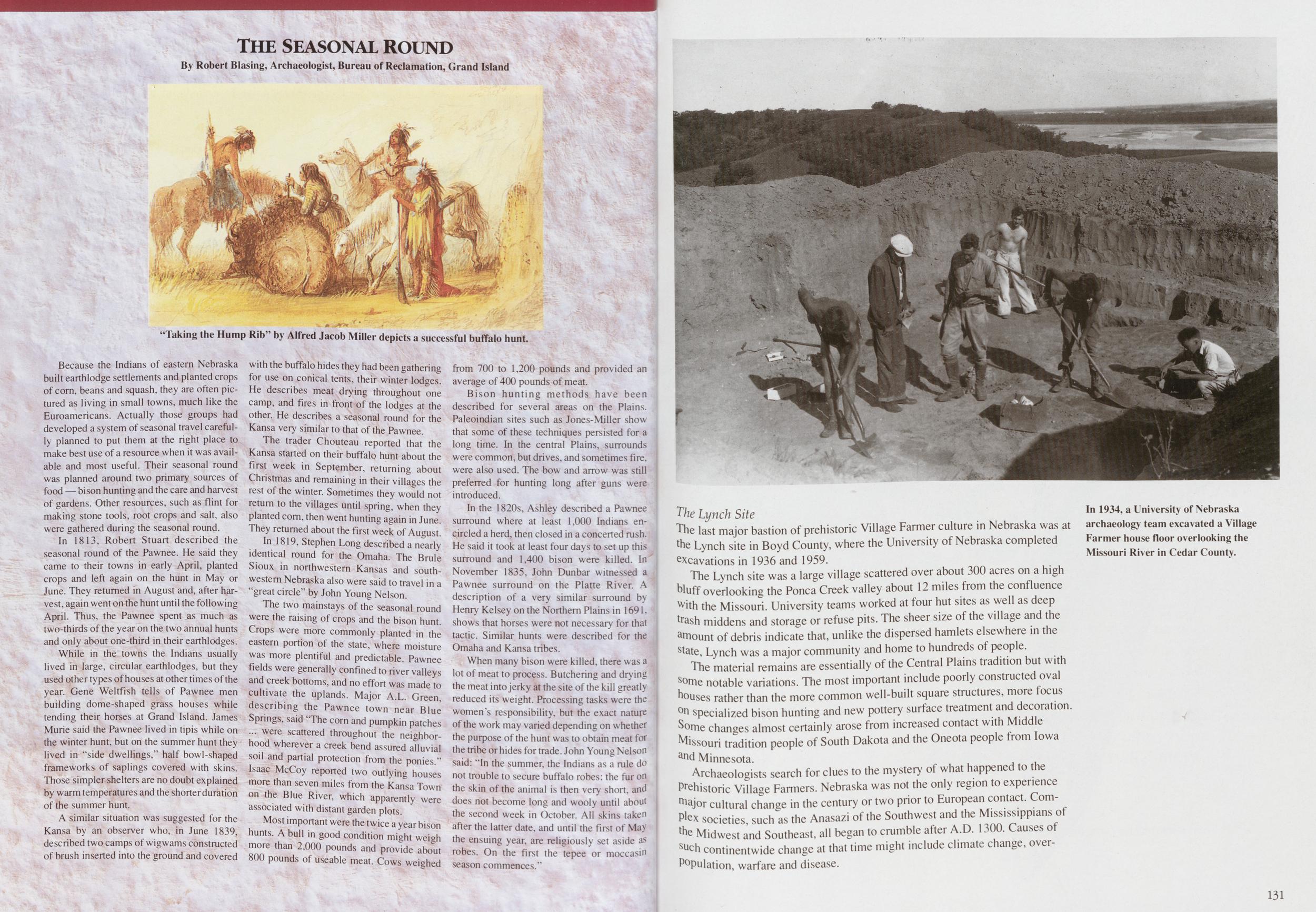
The seasonal round
"Taking the Hump Rib" by Alfred Jacob Miller depicts a successful buffalo hunt
Because the Indians of eastern Nebraska built earthlodge settlements and planted crops of corn, beans and squash, they are often pic- tured as living in small towns, much like the Euroamericans. Actually those groups had developed a system of seasonal travel careful- ly planned to put them at the right place to make best use of a resource when it was avail- able and most useful. Their seasonal round was planned around two primary sources of food — bison hunting and the care and harvest of gardens. Other resources, such as flint for making stone tools, root crops and salt, also were gathered during the seasonal round.
In 1813, Robert Stuart described the seasonal round of the Pawnee. He said they came to their towns in early April, planted crops and left again on the hunt in May or June. They returned in August and, after har- vest, again went on the hunt until the following April. Thus, the Pawnee spent as much as two-thirds of the year on the two annual hunts and only about one-third in their earthlodges.
While in the towns the Indians usually lived in large, circular earthlodges, but they used other types of houses at other times of the year. Gene Weltfish tells of Pawnee men building dome-shaped grass houses while tending their horses at Grand Island. James Murie said the Pawnee lived in tipis while on the winter hunt, but on the summer hunt they lived in "side dwellings," half bowl-shaped frameworks of saplings covered with skins. Those simpler shelters are no doubt explained by warm temperatures and the shorter duration of the summer hunt.
A similar situation was suggested for the Kansa by an observer who, in June 1839, described two camps of wigwams constructed of brush inserted into the ground and covered with the buffalo hides they had been gathering for use on conical tents, their winter lodges. He describes meat drying throughout one camp, and fires in front of the lodges at the other. He describes a seasonal round for the Kansa very similar to that of the Pawnee.
The trader Chouteau reported that the Kansa started on their buffalo hunt about the first week in September, returning about Christmas and remaining in their villages the rest of the winter. Sometimes they would not return to the villages until spring, when they planted com, then went hunting again in June. They returned about the first week of August.
In 1819, Stephen Long described a nearly identical round for the Omaha. The Brule Sioux in northwestern Kansas and south- western Nebraska also were said to travel in a "great circle" by John Young Nelson.
The two mainstays of the seasonal round were the raising of crops and the bison hunt. Crops were more commonly planted in the eastern portion of the state, where moisture was more plentiful and predictable. Pawnee fields were generally confined to river valleys and creek bottoms, and no effort was made to cultivate the uplands. Major A.L. Green, describing the Pawnee town near Blue Springs, said "The corn and pumpkin patches ... were scattered throughout the neighbor- hood wherever a creek bend assured alluvial soil and partial protection from the ponies." Isaac McCoy reported two outlying houses more than seven miles from the Kansa Town on the Blue River, which apparently were associated with distant garden plots.
Most important were the twice a year bison hunts. A bull in good condition might weigh more than 2,000 pounds and provide about 800 pounds of useable meat. Cows weighed from 700 to 1,200 pounds and provided an average of 400 pounds of meat.
Bison hunting methods have been described for several areas on the Plains. Paleoindian sites such as Jones-Miller show that some of these techniques persisted for a long time. In the central Plains, surrounds were common, but drives, and sometimes fire, were also used. The bow and arrow was still preferred for hunting long after guns were introduced.
In the 1820s, Ashley described a Pawnee surround where at least 1,000 Indians en- circled a herd, then closed in a concerted rush. He said it took at least four days to set up this surround and 1,400 bison were killed. In November 1835, John Dunbar witnessed a Pawnee surround on the Platte River. A description of a very similar surround by Henry Kelsey on the Northern Plains in 1691, shows that horses were not necessary for that tactic. Similar hunts were described for the Omaha and Kansa tribes.
When many bison were killed, there was a lot of meat to process. Butchering and drying the meat into jerky at the site of the kill greatly reduced its weight. Processing tasks were the women's responsibility, but the exact nature of the work may varied depending on whether the purpose of the hunt was to obtain meat for the tribe or hides for trade. John Young Nelson said: "In the summer, the Indians as a rule do not trouble to secure buffalo robes: the fur on the skin of the animal is then very short, and does not become long and wooly until about the second week in October. All skins taken after the latter date, and until the first of May the ensuing year, are religiously set aside as robes. On the first the tepee or moccasin season commences."
The last major bastion of prehistoric Village Farmer culture in Nebraska was at the Lynch site in Boyd County, where the University of Nebraska completed excavations in 1936 and 1959.
The Lynch site was a large village scattered over about 300 acres on a high bluff overlooking the Ponca Creek valley about 12 miles from the confluence with the Missouri. University teams worked at four hut sites as well as deep trash middens and storage or refuse pits. The sheer size of the village and the amount of debris indicate that, unlike the dispersed hamlets elsewhere in the state, Lynch was a major community and home to hundreds of people.
The material remains are essentially of the Central Plains tradition but with some notable variations. The most important include poorly constructed oval houses rather than the more common well-built square structures, more focus °n specialized bison hunting and new pottery surface treatment and decoration. Some changes almost certainly arose from increased contact with Middle Missouri tradition people of South Dakota and the Oneota people from Iowa and Minnesota.
Archaeologists search for clues to the mystery of what happened to the Prehistoric Village Farmers. Nebraska was not the only region to experience major cultural change in the century or two prior to European contact. Complex societies, such as the Anasazi of the Southwest and the Mississippi of the Midwest and Southeast, all began to crumble after A.D. 1300. Causes of such continentwide change at that time might include climate change, overpopulation, warfare and disease.
In 1934, a University of Nebraska archaeology team excavated a Village Farmer house floor overlooking the Missouri River in Cedar County.
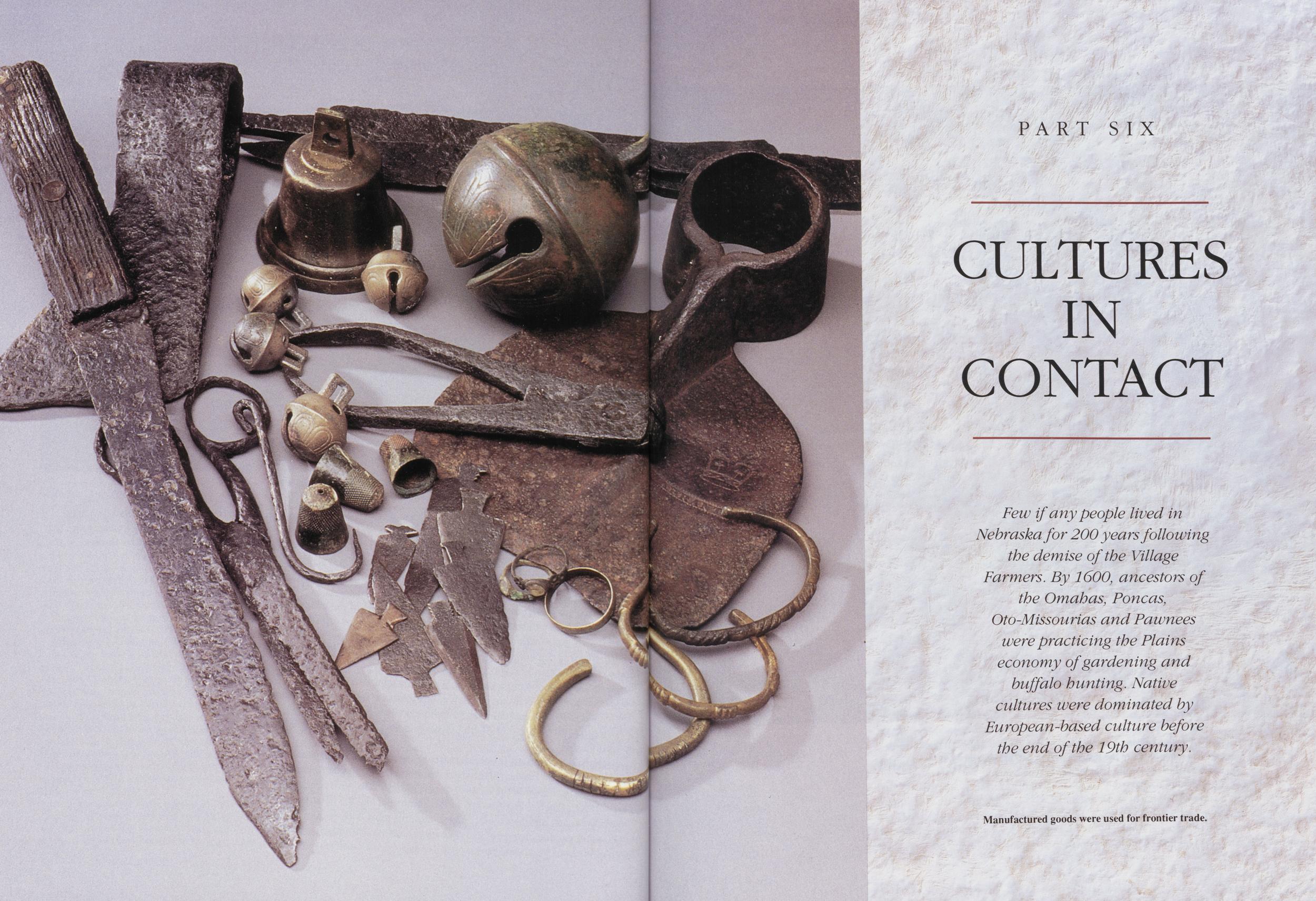
Manufactured goods were used for frontier trade.
PART SIX CULTURES IN CONTACT
Few if any people lived in Nebraska for 200 years following the demise of the Village Farmers. By 1600, ancestors of the Omahas, Poncas, Oto-Missourias and Pawnees were practicing the Plains economy of gardening and buffalo hunting. Native cultures were dominated by European-based culture before the end of the 19th century.
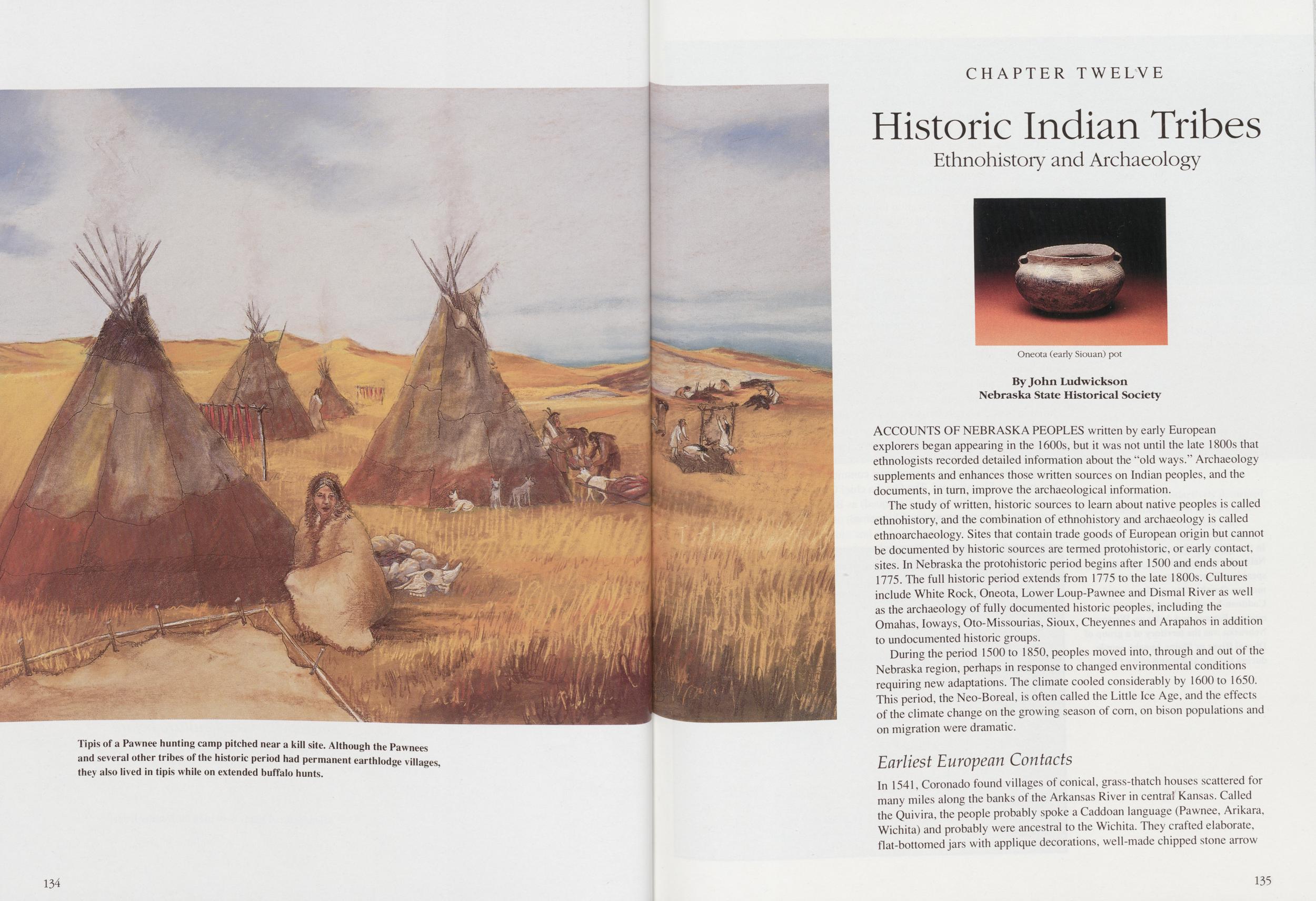
Tipis of a Pawnee hunting camp pitched near a kill site. Although the Pawnees and several other tribes of the historic period had permanent earthlodge villages, they also lived in tipis while on extended buffalo hunts.
CHAPTER TWELVE Historic Indian Tribes Ethnohistory and Archaeology
Oneota (early Siouan) pot
ACCOUNTS OF NEBRASKA PEOPLES written by early European explorers began appearing in the 1600s, but it was not until the late 1800s that ethnologists recorded detailed information about the "old ways." Archaeology supplements and enhances those written sources on Indian peoples, and the documents, in turn, improve the archaeological information.
The study of written, historic sources to learn about native peoples is called ethnohistory, and the combination of ethnohistory and archaeology is called ethnoarchaeology. Sites that contain trade goods of European origin but cannot be documented by historic sources are termed protohistoric, or early contact, sites. In Nebraska the protohistoric period begins after 1500 and ends about 1775. The full historic period extends from 1775 to the late 1800s. Cultures include White Rock, Oneota, Lower Loup-Pawnee and Dismal River as well as the archaeology of fully documented historic peoples, including the Omahas, loways, Oto-Missourias, Sioux, Cheyennes and Arapahos in addition to undocumented historic groups.
During the period 1500 to 1850, peoples moved into, through and out of the Nebraska region, perhaps in response to changed environmental conditions requiring new adaptations. The climate cooled considerably by 1600 to 1650. This period, the Neo-Boreal, is often called the Little Ice Age, and the effects of the climate change on the growing season of com, on bison populations and on migration were dramatic.
Earliest European ContactsIn 1541, Coronado found villages of conical, grass-thatch houses scattered for many miles along the banks of the Arkansas River in central Kansas. Called the Quivira, the people probably spoke a Caddoan language (Pawnee, Arikara, Wichita) and probably were ancestral to the Wichita. They crafted elaborate, flat-bottomed jars with applique decorations, well-made chipped stone arrow
135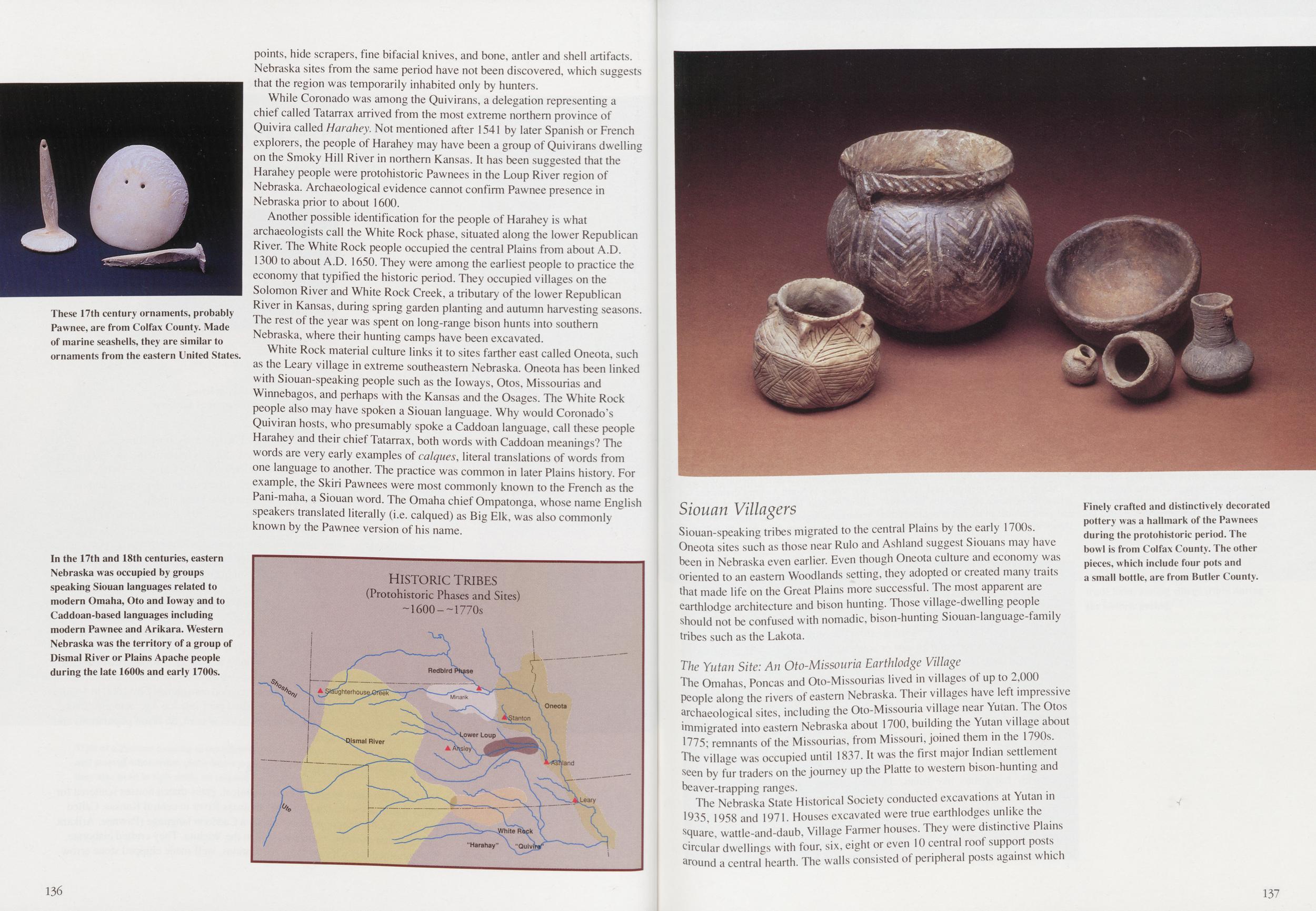
These 17th century ornaments, probably Pawnee, are from Colfax County. Made of marine seashells, they are similar to ornaments from the eastern United States.
In the 17th and 18th centuries, eastern Nebraska was occupied by groups speaking Siouan languages related to modern Omaha, Oto and Ioway and to Caddoan-based languages including modern Pawnee and Arikara. Western Nebraska was the territory of a group of Dismal River or Plains Apache people during the late 1600s and early 1700s.
points, hide scrapers, fine bifacial knives, and bone, antler and shell artifacts. Nebraska sites from the same period have not been discovered, which suggests that the region was temporarily inhabited only by hunters.
While Coronado was among the Quivirans, a delegation representing a chief called Tatarrax arrived from the most extreme northern province of Quivira called Harahey. Not mentioned after 1541 by later Spanish or French explorers, the people of Harahey may have been a group of Quivirans dwelling on the Smoky Hill River in northern Kansas. It has been suggested that the Harahey people were protohistoric Pawnees in the Loup River region of Nebraska. Archaeological evidence cannot confirm Pawnee presence in Nebraska prior to about 1600.
Another possible identification for the people of Harahey is what archaeologists call the White Rock phase, situated along the lower Republican River. The White Rock people occupied the central Plains from about A.D. 1300 to about A.D. 1650. They were among the earliest people to practice the economy that typified the historic period. They occupied villages on the Solomon River and White Rock Creek, a tributary of the lower Republican River in Kansas, during spring garden planting and autumn harvesting seasons. The rest of the year was spent on long-range bison hunts into southern Nebraska, where their hunting camps have been excavated.
White Rock material culture links it to sites farther east called Oneota, such as the Leary village in extreme southeastern Nebraska. Oneota has been linked with Siouan-speaking people such as the Ioways, Otos, Missourias and Winnebagos, and perhaps with the Kansas and the Osages. The White Rock people also may have spoken a Siouan language. Why would Coronado's Quiviran hosts, who presumably spoke a Caddoan language, call these people Harahey and their chief Tatarrax, both words with Caddoan meanings? The words are very early examples of caiques, literal translations of words from one language to another. The practice was common in later Plains history. For example, the Skiri Pawnees were most commonly known to the French as the Pani-maha, a Siouan word. The Omaha chief Ompatonga, whose name English speakers translated literally (i.e. calqued) as Big Elk, was also commonly known by the Pawnee version of his name.
136 Siouan VillagersSiouan-speaking tribes migrated to the central Plains by the early 1700s. Oneota sites such as those near Rulo and Ashland suggest Siouans may have been in Nebraska even earlier. Even though Oneota culture and economy was oriented to an eastern Woodlands setting, they adopted or created many traits that made life on the Great Plains more successful. The most apparent are earthlodge architecture and bison hunting. Those village-dwelling people should not be confused with nomadic, bison-hunting Siouan-language-family tribes such as the Lakota.
The Yutan Site: An Oto-Missouria Earthlodge VillageThe Omahas, Poncas and Oto-Missourias lived in villages of up to 2,000 people along the rivers of eastern Nebraska. Their villages have left impressive archaeological sites, including the Oto-Missouria village near Yutan. The Otos immigrated into eastern Nebraska about 1700, building the Yutan village about 1775- remnants of the Missourias, from Missouri, joined them in the 1790s. The village was occupied until 1837. It was the first major Indian settlement seen by fur traders on the journey up the Platte to western bison-hunting and beaver-trapping ranges.
The Nebraska State Historical Society conducted excavations at Yutan in 1935 1958 and 1971 Houses excavated were true earthlodges unlike the square, wattle-and-daub, Village Farmer houses. They were distinctive Plains circular dwellings with four, six, eight or even 10 central roof support posts around a central hearth. The walls consisted of peripheral posts against which
Finely crafted and distinctively decorated pottery was a hallmark of the Pawnees during the protohistoric period. The bowl is from Colfax County. The other pieces, which include four pots and a small bottle, are from Butler County.
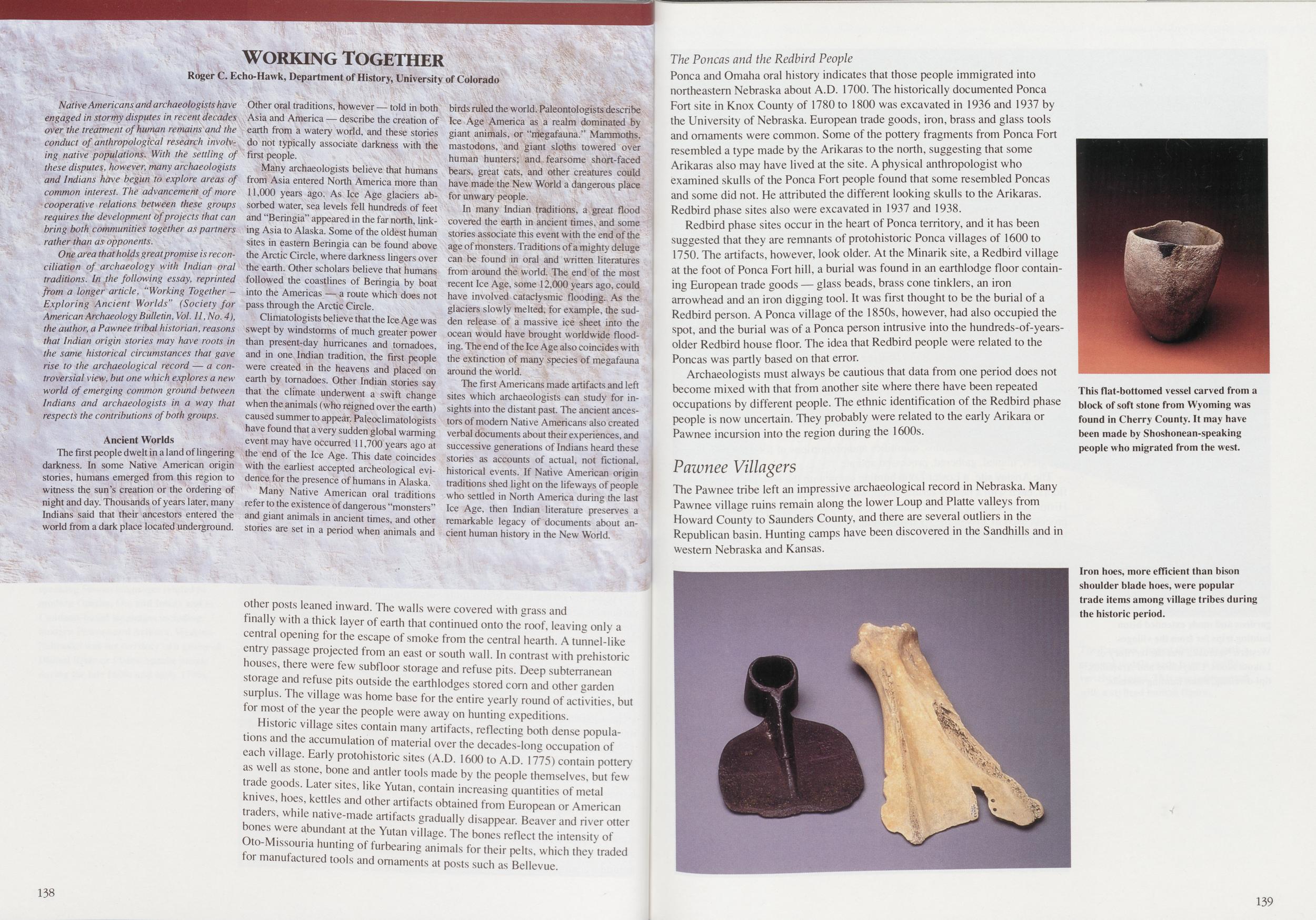
WORKING TOGETHER
Native Americans and archaeologists have engaged in stormy disputes in recent decades over the treatment of human remains and the conduct of anthropological research involving native populations. With the settling of these disputes, however, many archaeologists and Indians have begun to explore areas of common interest. The advancement of more cooperative relations between these groups requires the development of projects that can bring both communities together as partners rather than as opponents.
One area that holds great promise is reconciliation of archaeology with Indian oral traditions. In the following essay, reprinted from a longer article, "Working Together - Exploring Ancient Worlds" (Society for American Archaeology Bulletin, Vol. 11, No. 4), the author, a Pawnee tribal historian, reasons that Indian origin stories may have roots in the same historical circumstances that gave rise to the archaeological record — a controversial view, but one which explores a new world of emerging common ground between Indians and archaeologists in a way that respects the contributions of both groups.
Ancient WorldsThe first people dwelt in a land of lingering darkness. In some Native American origin stories, humans emerged from this region to witness the sun's creation or the ordering of night and day. Thousands of years later, many Indians said that their ancestors entered the world from a dark place located underground. Other oral traditions, however — told in both Asia and America — describe the creation of earth from a watery world, and these stories do not typically associate darkness with the first people.
Many archaeologists believe that humans from Asia entered North America more than 11,000 years ago. As Ice Age glaciers ab- sorbed water, sea levels fell hundreds of feet and "Beringia" appeared in the far north, linking Asia to Alaska. Some of the oldest human sites in eastern Beringia can be found above the Arctic Circle, where darkness lingers over the earth. Other scholars believe that humans followed the coastlines of Beringia by boat into the Americas — a route which does not pass through the Arctic Circle.
Climatologists believe that the Ice Age was swept by windstorms of much greater power than present-day hurricanes and tornadoes, and in one Indian tradition, the first people were created in the heavens and placed on earth by tornadoes. Other Indian stories say that the climate underwent a swift change when the animals (who reigned over the earth) caused summer to appear. Paleoclimatologists have found that a very sudden global warming event may have occurred 11,700 years ago at the end of the Ice Age. This date coincides with the earliest accepted archeological evidence for the presence of humans in Alaska.
Many Native American oral traditions refer to the existence of dangerous "monsters" and giant animals in ancient times, and other stories are set in a period when animals and birds ruled the world. Paleontologists describe Ice Age America as a realm dominated by giant animals, or "megafauna." Mammoths, mastodons, and giant sloths towered over human hunters; and fearsome short-faced bears, great cats, and other creatures could have made the New World a dangerous place for unwary people.
In many Indian traditions, a great flood covered the earth in ancient times, and some stories associate this event with the end of the age of monsters. Traditions of a mighty deluge can be found in oral and written literatures from around the world. The end of the most recent Ice Age, some 12,000 years ago, could have involved cataclysmic flooding. As the glaciers slowly melted, for example, the sudden release of a massive ice sheet into the ocean would have brought worldwide flooding. The end of the Ice Age also coincides with the extinction of many species of megafauna around the world.
The first Americans made artifacts and left sites which archaeologists can study for in- sights into the distant past. The ancient ancestors of modern Native Americans also created verbal documents about their experiences, and successive generations of Indians heard these stories as accounts of actual, not fictional, historical events. If Native American origin traditions shed light on the life ways of people who settled in North America during the last Ice Age, then Indian literature preserves a remarkable legacy of documents about ancient human history in the New World.
other posts leaned inward. The walls were covered with grass and finally with a thick layer of earth that continued onto the roof, leaving only a central opening for the escape of smoke from the central hearth. A tunnel-like entry passage projected from an east or south wall. In contrast with prehistoric houses, there were few subfloor storage and refuse pits. Deep subterranean storage and refuse pits outside the earthlodges stored corn and other garden surplus. The village was home base for the entire yearly round of activities, but tor most of the year the people were away on hunting expeditions.
Historic village sites contain many artifacts, reflecting both dense popula- tions and the accumulation of material over the decades-long occupation of each village. Early protohistoric sites (A.D. 1600 to A.D. 1775) contain pottery as well as stone, bone and antler tools made by the people themselves, but few trade goods. Later sites, like Yutan, contain increasing quantities of metal knives, hoes kettles and other artifacts obtained from European or Amencan traders, while native-made artifacts gradually disappear. Beaver and nver otter bones were abundant at the Yutan village. The bones reflect the intensity of Oto-Missouria hunting of furbearing animals for their pelts, which they traded for manufactured tools and ornaments at posts such as Bellevue
138 The Poncas and the Redbird PeoplePonca and Omaha oral history indicates that those people immigrated into northeastern Nebraska about A.D. 1700. The historically documented Ponca Fort site in Knox County of 1780 to 1800 was excavated in 1936 and 1937 by the University of Nebraska. European trade goods, iron, brass and glass tools and ornaments were common. Some of the pottery fragments from Ponca Fort resembled a type made by the Arikaras to the north, suggesting that some Arikaras also may have lived at the site. A physical anthropologist who examined skulls of the Ponca Fort people found that some resembled Poncas and some did not. He attributed the different looking skulls to the Arikaras. Redbird phase sites also were excavated in 1937 and 1938.
Redbird phase sites occur in the heart of Ponca territory, and it has been suggested that they are remnants of protohistoric Ponca villages of 1600 to 1750. The artifacts, however, look older. At the Minarik site, a Redbird village at the foot of Ponca Fort hill, a burial was found in an earthlodge floor containing European trade goods — glass beads, brass cone tinklers, an iron arrowhead and an iron digging tool. It was first thought to be the burial of a Redbird person. A Ponca village of the 1850s, however, had also occupied the spot, and the burial was of a Ponca person intrusive into the hundreds-of-years- older Redbird house floor. The idea that Redbird people were related to the Poncas was partly based on that error.
Archaeologists must always be cautious that data from one period does not become mixed with that from another site where there have been repeated occupations by different people. The ethnic identification of the Redbird phase people is now uncertain. They probably were related to the early Arikara or Pawnee incursion into the region during the 1600s.
Pawnee VillagersThe Pawnee tribe left an impressive archaeological record in Nebraska. Many Pawnee village ruins remain along the lower Loup and Platte valleys from Howard County to Saunders County, and there are several outliers in the Republican basin. Hunting camps have been discovered in the Sandhills and in western Nebraska and Kansas.
This flat-bottomed vessel carved from a block of soft stone from Wyoming was found in Cherry County. It may have been made by Shoshonean-speaking people who migrated from the west.
Iron hoes, more efficient than bison shoulder blade hoes, were popular trade items among village tribes during the historic period.
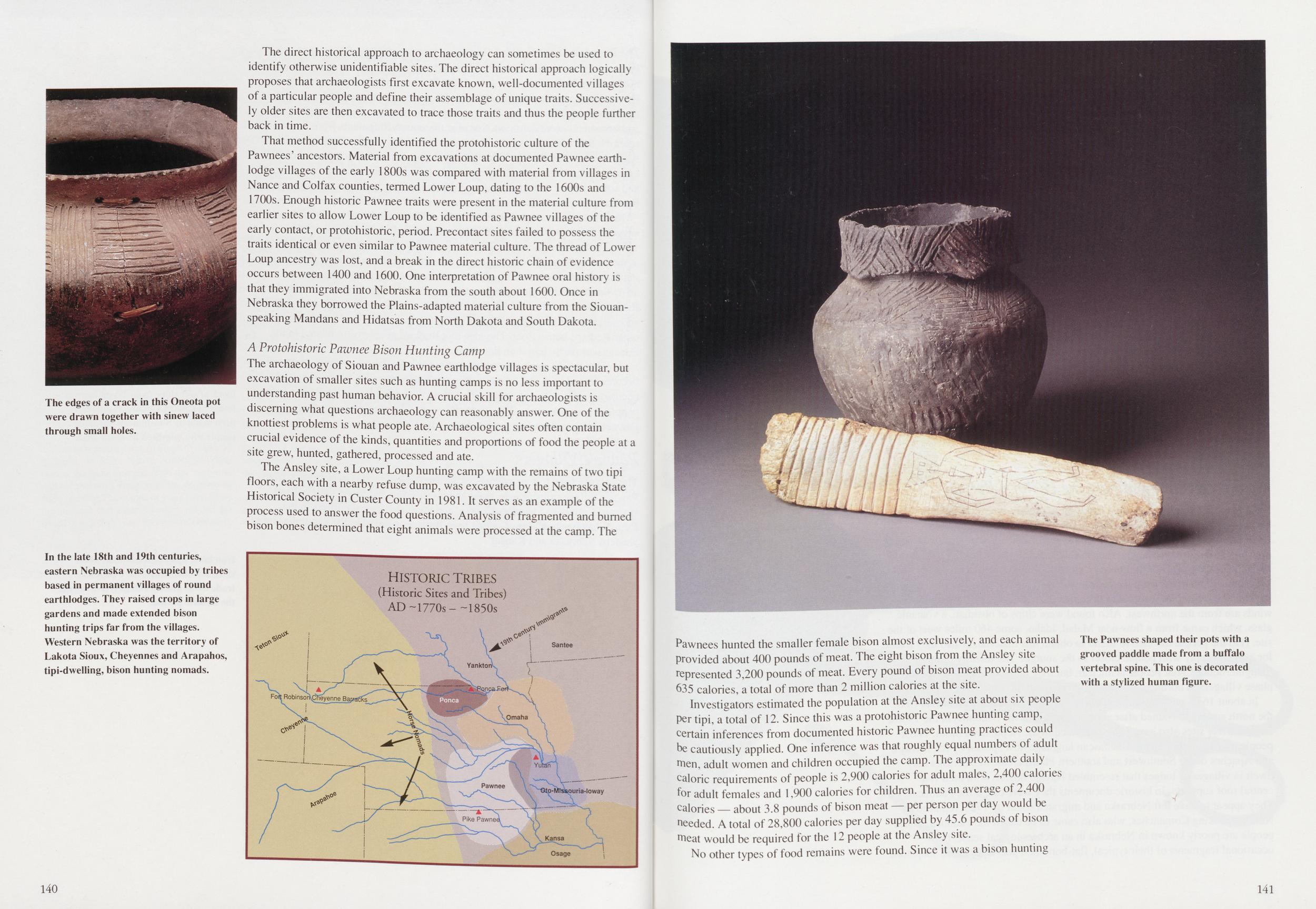
The edges of a crack in this Oneota pot were drawn together with sinew laced through small holes.
In the late 18th and 19th centuries, eastern Nebraska was occupied by tribes based in permanent villages of round earthlodges. They raised crops in large gardens and made extended bison hunting trips far from the villages. Western Nebraska was the territory of Lakota Sioux, Cheyennes and Arapahos, tipi-dwelling, bison hunting nomads.
HISTORIC TRIBES (Historic Sites and Tribes) AD ~ 1770s- -1850s
The direct historical approach to archaeology can sometimes be used to identify otherwise unidentifiable sites. The direct historical approach logically proposes that archaeologists first excavate known, well-documented villages of a particular people and define their assemblage of unique traits. Successively older sites are then excavated to trace those traits and thus the people further back in time.
That method successfully identified the protohistoric culture of the Pawnees' ancestors. Material from excavations at documented Pawnee earth- lodge villages of the early 1800s was compared with material from villages in Nance and Colfax counties, termed Lower Loup, dating to the 1600s and 1700s. Enough historic Pawnee traits were present in the material culture from earlier sites to allow Lower Loup to be identified as Pawnee villages of the early contact, or protohistoric, period. Precontact sites failed to possess the traits identical or even similar to Pawnee material culture. The thread of Lower Loup ancestry was lost, and a break in the direct historic chain of evidence occurs between 1400 and 1600. One interpretation of Pawnee oral history is that they immigrated into Nebraska from the south about 1600. Once in Nebraska they borrowed the Plains-adapted material culture from the Siouan-speaking Mandans and Hidatsas from North Dakota and South Dakota.
A Protohistoric Pawnee Bison Hunting CampThe archaeology of Siouan and Pawnee earthlodge villages is spectacular, but excavation of smaller sites such as hunting camps is no less important to understanding past human behavior. A crucial skill for archaeologists is discerning what questions archaeology can reasonably answer. One of the knottiest problems is what people ate. Archaeological sites often contain crucial evidence of the kinds, quantities and proportions of food the people at a site grew, hunted, gathered, processed and ate.
The Ansley site, a Lower Loup hunting camp with the remains of two tipi floors, each with a nearby refuse dump, was excavated by the Nebraska State Historical Society in Custer County in 1981. It serves as an example of the process used to answer the food questions. Analysis of fragmented and burned bison bones determined that eight animals were processed at the camp. The
140Pawnees hunted the smaller female bison almost exclusively, and each animal provided about 400 pounds of meat. The eight bison from the Ansley site represented 3,200 pounds of meat. Every pound of bison meat provided about 635 calories, a total of more than 2 million calories at the site.
Investigators estimated the population at the Ansley site at about six people per tipi, a total of 12. Since this was a protohistoric Pawnee hunting camp, certain inferences from documented historic Pawnee hunting practices could be cautiously applied. One inference was that roughly equal numbers of adult men, adult women and children occupied the camp. The approximate dady caloric requirements of people is 2,900 calories for adult males, 2,400 calories for adult females and 1,900 calories for children. Thus an average of 2,400 calories — about 3.8 pounds of bison meat — per person per day would be needed. A total of 28,800 calories per day supplied by 45.6 pounds of bison meat would be required for the 12 people at the Ansley site.
No other types of food remains were found. Since it was a bison hunting
The Pawnees shaped their pots with a grooved paddle made from a buffalo vertebral spine. This one is decorated with a stylized human figure.
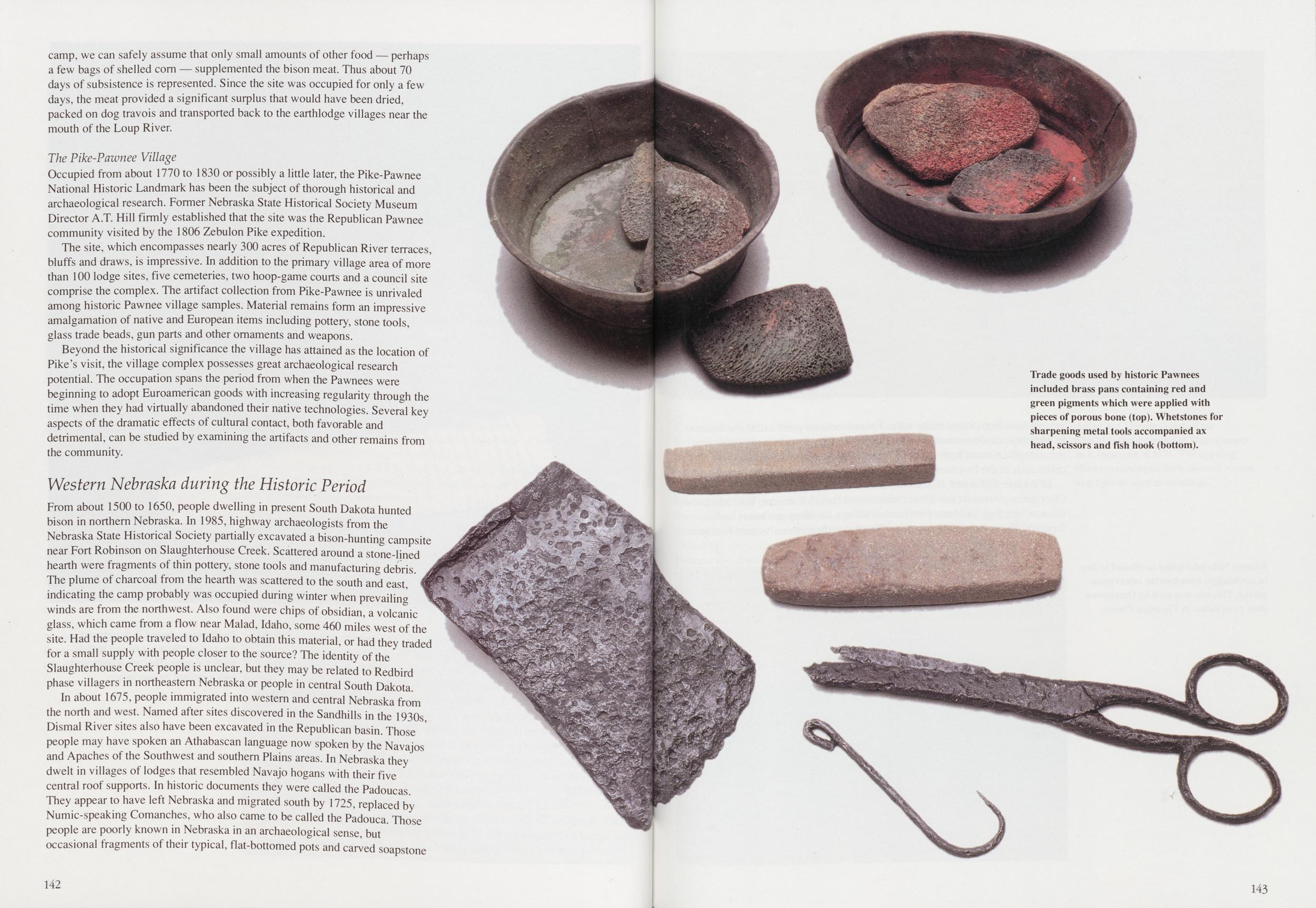
camp, we can safely assume that only small amounts of other food — perhaps a few bags of shelled corn — supplemented the bison meat. Thus about 70 days of subsistence is represented. Since the site was occupied for only a few days, the meat provided a significant surplus that would have been dried, packed on dog travois and transported back to the earthlodge villages near the mouth of the Loup River.
The Pike-Pawnee VillageOccupied from about 1770 to 1830 or possibly a little later, the Pike-Pawnee National Historic Landmark has been the subject of thorough historical and archaeological research. Former Nebraska State Historical Society Museum Director A.T. Hill firmly established that the site was the Republican Pawnee community visited by the 1806 Zebulon Pike expedition.
The site, which encompasses nearly 300 acres of Republican River terraces, bluffs and draws, is impressive. In addition to the primary village area of more than 100 lodge sites, five cemeteries, two hoop-game courts and a council site comprise the complex. The artifact collection from Pike-Pawnee is unrivaled among historic Pawnee village samples. Material remains form an impressive amalgamation of native and European items including pottery, stone tools, glass trade beads, gun parts and other ornaments and weapons.
Beyond the historical significance the village has attained as the location of Pike's visit, the village complex possesses great archaeological research potential. The occupation spans the period from when the Pawnees were beginning to adopt Euroamerican goods with increasing regularity through the time when they had virtually abandoned their native technologies. Several key aspects of the dramatic effects of cultural contact, both favorable and detrimental, can be studied by examining the artifacts and other remains from the community.
Western Nebraska during the Historic PeriodFrom about 1500 to 1650, people dwelling in present South Dakota hunted bison in northern Nebraska. In 1985, highway archaeologists from the Nebraska State Historical Society partially excavated a bison-hunting campsite near Fort Robinson on Slaughterhouse Creek. Scattered around a stone-lined hearth were fragments of thin pottery, stone tools and manufacturing debris. The plume of charcoal from the hearth was scattered to the south and east 4 indicating the camp probably was occupied during winter when prevailing winds are from the northwest. Also found were chips of obsidian, a volcanic glass, which came from a flow near Malad, Idaho, some 460 miles west of the site. Had the people traveled to Idaho to obtain this material, or had they traded for a small supply with people closer to the source? The identity of the Slaughterhouse Creek people is unclear, but they may be related to Redbird phase villagers in northeastern Nebraska or people in central South Dakota
In about 1675, people immigrated into western and central Nebraska from the north and west. Named after sites discovered in the Sandhills in the 1930s Dismal River sites also have been excavated in the Republican basin. Those people may have spoken an Athabascan language now spoken by the Navajos and Apaches of the Southwest and southern Plains areas. In Nebraska they dwelt in villages of lodges that resembled Navajo hogans with their five central roof supports. In historic documents they were called the Padoucas They appear to have left Nebraska and migrated south by 1725, replaced by Numic-speaking Comanches, who also came to be called the Padouca. Those people are poorly known in Nebraska in an archaeological sense, but occasional fragments of their typical, flat-bottomed pots and carved soapstone
142Trade goods used by historic Pawnees included brass pans containing red and green pigments which were applied with piece of porous bone (top). Whetstones for sharpening metal tools accompanied ax head, scissors and fish hook (bottom).
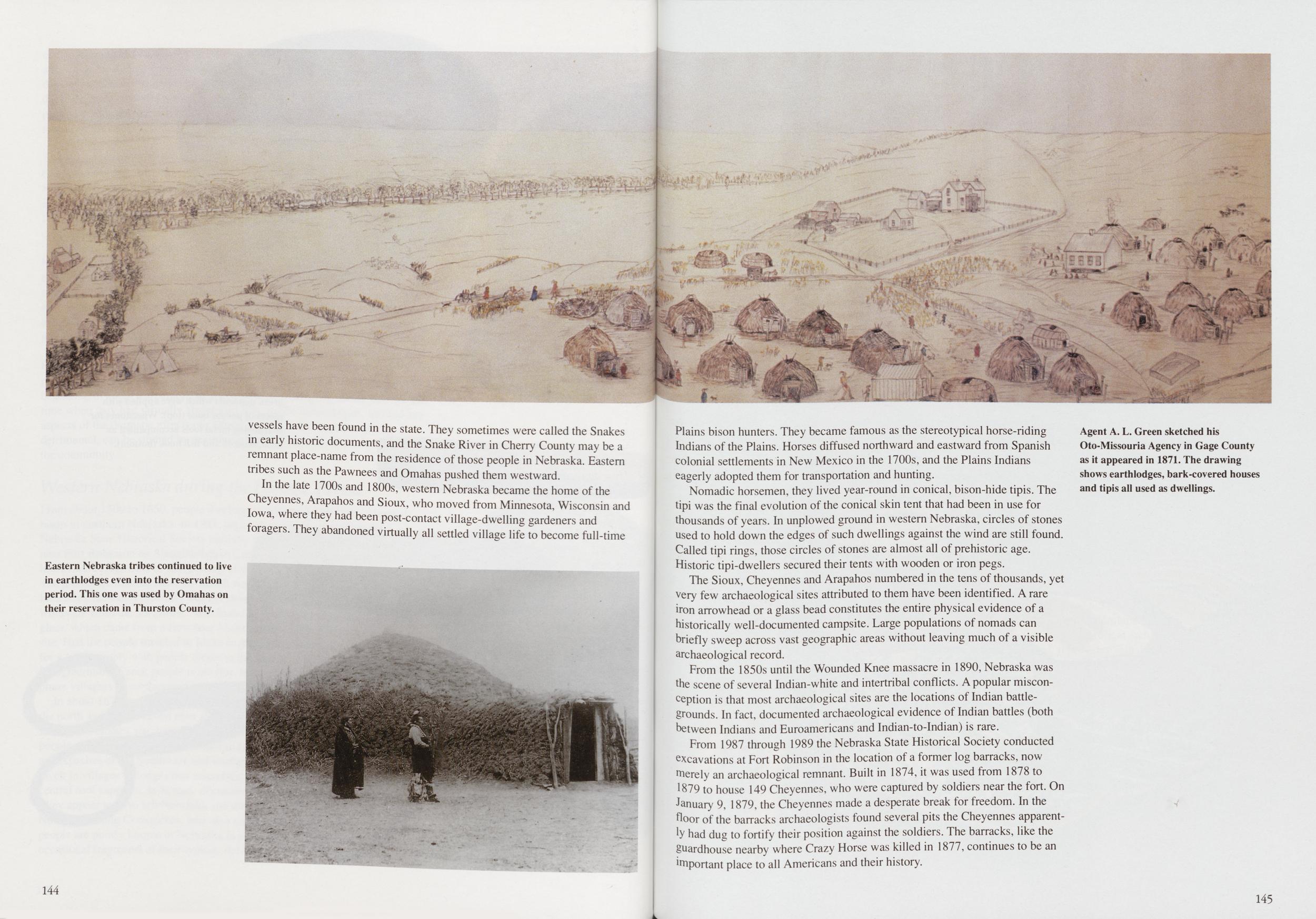
vessels have been found in the state. They sometimes were called the Snakes in early historic documents, and the Snake River in Cherry County may be a remnant place-name from the residence of those people in Nebraska. Eastern tribes such as the Pawnees and Omahas pushed them westward.
In the late 1700s and 1800s, western Nebraska became the home of the Cheyennes, Arapahos and Sioux, who moved from Minnesota, Wisconsin and Iowa, where they had been post-contact village-dwelling gardeners and foragers. They abandoned virtually all settled village life to become full-time
Eastern Nebraska tribes continued to live in earthlodges even into the reservation period. This one was used by Omahas on their reservation in Thurston County.
Plains bison hunters. They became famous as the stereotypical horse-riding Indians of the Plains. Horses diffused northward and eastward from Spanish colonial settlements in New Mexico in the 1700s, and the Plains Indians eagerly adopted them for transportation and hunting.
Nomadic horsemen, they lived year-round in conical, bison-hide tipis. The tipi was the final evolution of the conical skin tent that had been in use for thousands of years. In unplowed ground in western Nebraska, circles of stones used to hold down the edges of such dwellings against the wind are still found. Called tipi rings, those circles of stones are almost all of prehistoric age. Historic tipi-dwellers secured their tents with wooden or iron pegs.
The Sioux, Cheyennes and Arapahos numbered in the tens of thousands, yet very few archaeological sites attributed to them have been identified. A rare iron arrowhead or a glass bead constitutes the entire physical evidence of a historically well-documented campsite. Large populations of nomads can briefly sweep across vast geographic areas without leaving much of a visible archaeological record.
From the 1850s until the Wounded Knee massacre in 1890, Nebraska was the scene of several Indian-white and intertribal conflicts. A popular miscon- ception is that most archaeological sites are the locations of Indian battle- grounds. In fact, documented archaeological evidence of Indian battles (both between Indians and Euroamericans and Indian-to-Indian) is rare.
From 1987 through 1989 the Nebraska State Historical Society conducted excavations at Fort Robinson in the location of a former log barracks, now merely an archaeological remnant. Built in 1874, it was used from 1878 to 1879 to house 149 Cheyennes, who were captured by soldiers near the fort. On January 9, 1879, the Cheyennes made a desperate break for freedom. In the floor of the barracks archaeologists found several pits the Cheyennes apparent- 'y had dug to fortify their position against the soldiers. The barracks, like the guardhouse nearby where Crazy Horse was killed in 1877, continues to be an important place to all Americans and their history.
Agent A. L. Green sketched his Oto-Missouria Agency in Gage County as it appeared in 1871. The drawing shows earthlodges, bark-covered houses and tipis all used as dwellings.
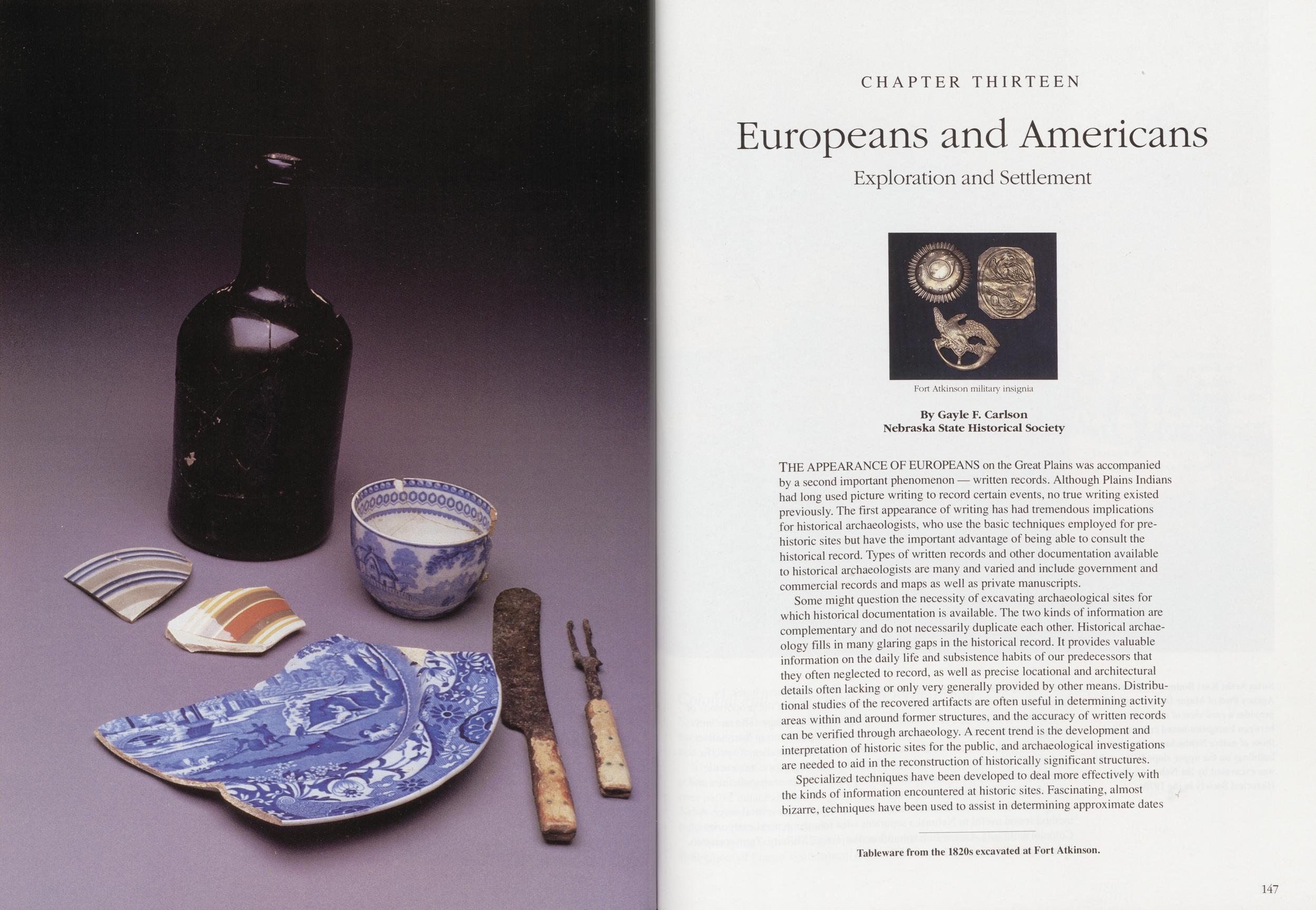
Tableware from the 1820s excavated at Fort Atkinson.
CHAPTER THIRTEEN Europeans and Americans Exploration and Settlement
Fort Atkinson military insignia
THE APPEARANCE OF EUROPEANS on the Great Plains was accompanied by a second important phenomenon — written records. Although Plains Indians had long used picture writing to record certain events, no true writing existed previously. The first appearance of writing has had tremendous implications for historical archaeologists, who use the basic techniques employed for pre- historic sites but have the important advantage of being able to consult the historical record. Types of written records and other documentation available to historical archaeologists are many and varied and include government and commercial records and maps as well as private manuscripts.
Some might question the necessity of excavating archaeological sites for which historical documentation is available. The two kinds of information are complementary and do not necessarily duplicate each other. Historical archae- ology fills in many glaring gaps in the historical record. It provides valuable information on the daily life and subsistence habits of our predecessors that they often neglected to record, as well as precise locational and architectural details often lacking or only very generally provided by other means. Distribu- tional studies of the recovered artifacts are often useful in determining activity areas within and around former structures, and the accuracy of written records can be verified through archaeology. A recent trend is the development and interpretation of historic sites for the public, and archaeological investigations are needed to aid in the reconstruction of historically significant structures.
Specialized techniques have been developed to deal more effectively with the kinds of information encountered at historic sites. Fascinating, almost bizarre, techniques have been used to assist in determining approximate dates
147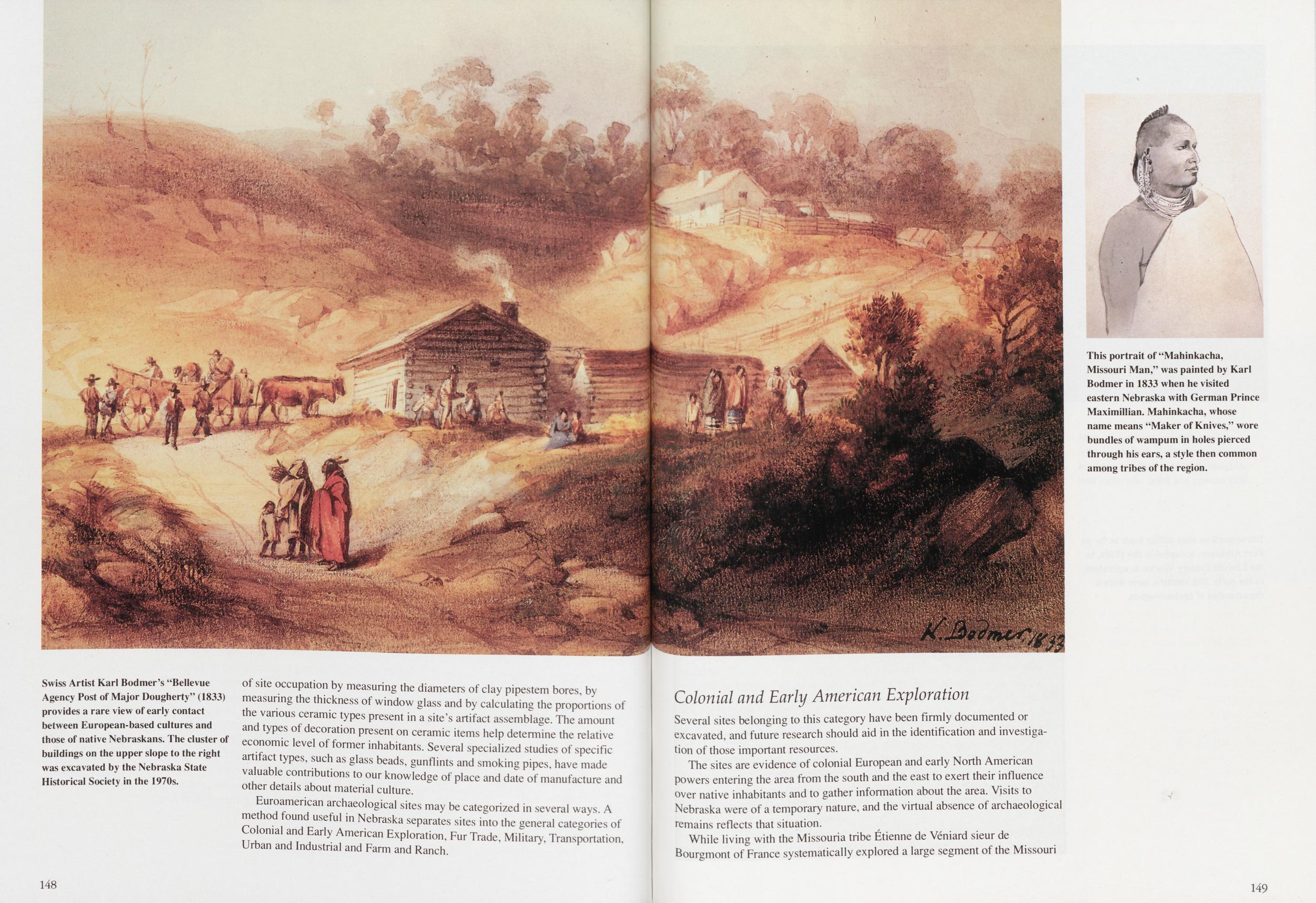
Swiss Artist Karl Bodmer's "Bellevue Agency Post of Major Dougherty" (1833) provides a rare view of early contact between European-based cultures and those of native Nebraskans. The cluster of buildings on the upper slope to the right was excavated by the Nebraska State Historical Society in the 1970s.
of site occupation by measuring the diameters of clay pipestem bores, by measuring the thickness of window glass and by calculating the proportions of the various ceramic types present in a site's artifact assemblage. The amount and types of decoration present on ceramic items help determine the relative economic level of former inhabitants. Several specialized studies of specific artifact types, such as glass beads, gunflints and smoking pipes, have made valuable contributions to our knowledge of place and date of manufacture and other details about material culture.
Euroamerican archaeological sites may be categorized in several ways. A method found useful in Nebraska separates sites into the general categones of Colonial and Early American Exploration, Fur Trade, Military, Transportation, Urban and Industrial and Farm and Ranch.
148This portrait of "Mahinkacha, Missouri Man," was painted by Karl Bodmer in 1833 when he visited eastern Nebraska with German Prince Maximillian. Mahinkacha, whose name means "Maker of Knives," wore bundles of wampum in holes pierced through his ears, a style then common among tribes of the region.
Several sites belonging to this category have been firmly documented or excavated, and future research should aid in the identification and investigation of those important resources.
The sites are evidence of colonial European and early North American powers entering the area from the south and the east to exert their influence over native inhabitants and to gather information about the area. Visits to Nebraska were of a temporary nature, and the virtual absence of archaeological remains reflects that situation.
While living with the Missouria tribe Etienne de Veniard sieur de Bourgmont of France systematically explored a large segment of the Missouri
149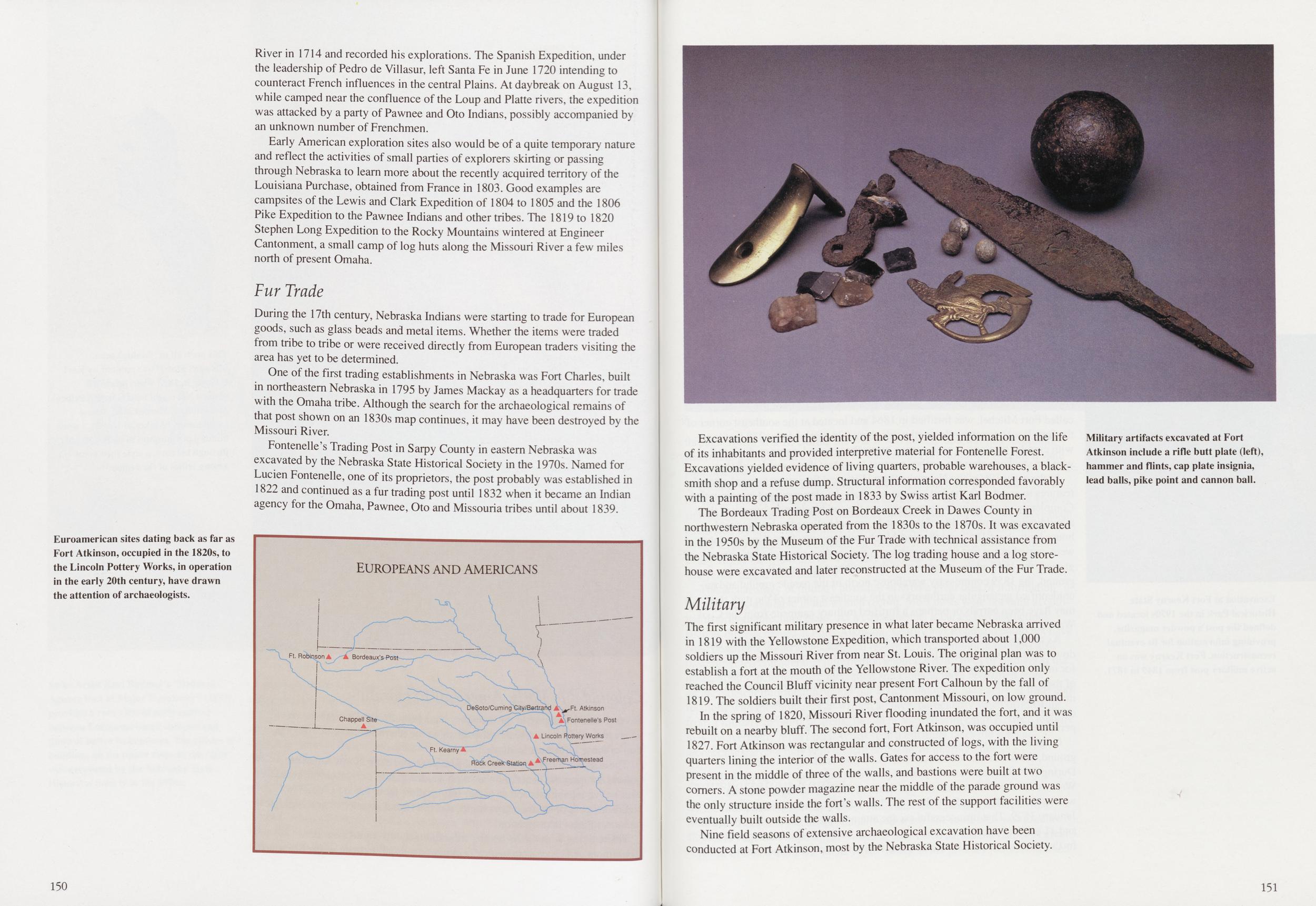
Euroamerican sites dating back as far as Fort Atkinson, occupied in the 1820s, to the Lincoln Pottery Works, in operation in the early 20th century, have drawn the attention of archaeologists.
River in 1714 and recorded his explorations. The Spanish Expedition, under the leadership of Pedro de Villasur, left Santa Fe in June 1720 intending to counteract French influences in the central Plains. At daybreak on August 13, while camped near the confluence of the Loup and Platte rivers, the expedition was attacked by a party of Pawnee and Oto Indians, possibly accompanied by an unknown number of Frenchmen.
Early American exploration sites also would be of a quite temporary nature and reflect the activities of small parties of explorers skirting or passing through Nebraska to learn more about the recently acquired territory of the Louisiana Purchase, obtained from France in 1803. Good examples are campsites of the Lewis and Clark Expedition of 1804 to 1805 and the 1806 Pike Expedition to the Pawnee Indians and other tribes. The 1819 to 1820 Stephen Long Expedition to the Rocky Mountains wintered at Engineer Cantonment, a small camp of log huts along the Missouri River a few miles north of present Omaha.
Fur TradeDuring the 17th century, Nebraska Indians were starting to trade for European goods, such as glass beads and metal items. Whether the items were traded from tribe to tribe or were received directly from European traders visiting the area has yet to be determined.
One of the first trading establishments in Nebraska was Fort Charles, built in northeastern Nebraska in 1795 by James Mackay as a headquarters for trade with the Omaha tribe. Although the search for the archaeological remains of that post shown on an 1830s map continues, it may have been destroyed by the Missouri River.
Fontenelle's Trading Post in Sarpy County in eastern Nebraska was excavated by the Nebraska State Historical Society in the 1970s. Named for Lucien Fontenelle, one of its proprietors, the post probably was established in 1822 and continued as a fur trading post until 1832 when it became an Indian agency for the Omaha, Pawnee, Oto and Missouria tribes until about 1839.
150Excavations verified the identity of the post, yielded information on the life of its inhabitants and provided interpretive material for Fontenelle Forest. Excavations yielded evidence of living quarters, probable warehouses, a black- smith shop and a refuse dump. Structural information corresponded favorably with a painting of the post made in 1833 by Swiss artist Karl Bodmer.
The Bordeaux Trading Post on Bordeaux Creek in Dawes County in northwestern Nebraska operated from the 1830s to the 1870s. It was excavated in the 1950s by the Museum of the Fur Trade with technical assistance from the Nebraska State Historical Society. The log trading house and a log storehouse were excavated and later reconstructed at the Museum of the Fur Trade.
MilitaryThe first significant military presence in what later became Nebraska arrived in 1819 with the Yellowstone Expedition, which transported about 1,000 soldiers up the Missouri River from near St. Louis. The original plan was to establish a fort at the mouth of the Yellowstone River. The expedition only reached the Council Bluff vicinity near present Fort Calhoun by the fall of 1819. The soldiers built their first post, Cantonment Missouri, on low ground.
In the spring of 1820, Missouri River flooding inundated the fort, and it was rebuilt on a nearby bluff. The second fort, Fort Atkinson, was occupied until 1827. Fort Atkinson was rectangular and constructed of logs, with the living quarters lining the interior of the walls. Gates for access to the fort were present in the middle of three of the walls, and bastions were built at two comers. A stone powder magazine near the middle of the parade ground was the only structure inside the fort's walls. The rest of the support facilities were eventually built outside the walls.
Nine field seasons of extensive archaeological excavation have been conducted at Fort Atkinson, most by the Nebraska State Historical Society.
Military artifacts excavated at Fort Atkinson include a rifle butt plate (left), hammer and flints, cap plate insignia, lead balls, pike point and cannon ball.
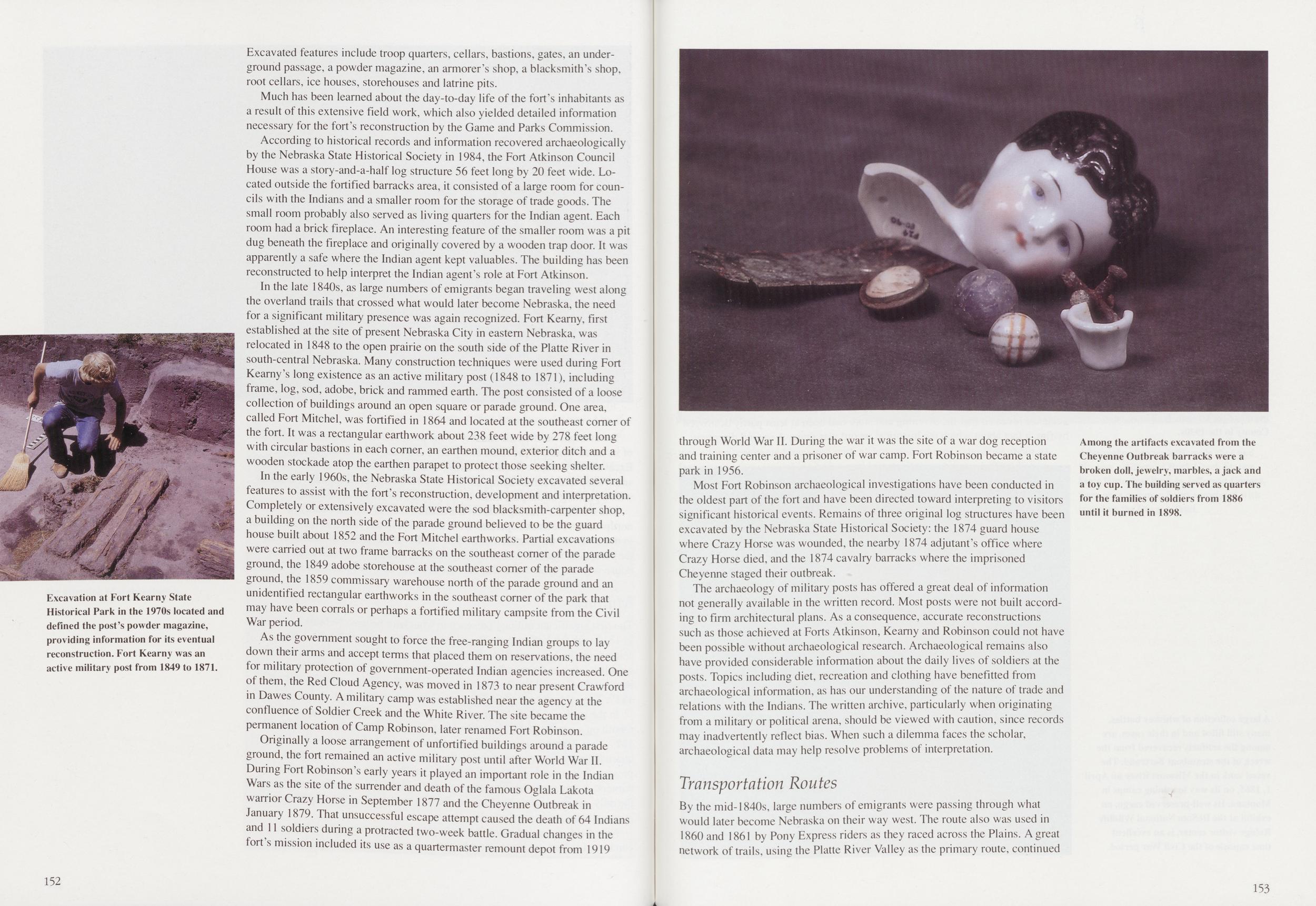
Excavation at Fort Kearny State Historical Park in the 1970s located and defined the post's powder magazine, providing information for its eventual reconstruction. Fort Kearny was an active military post from 1849 to 1871.
Excavated features include troop quarters, cellars, bastions, gates, an underground passage, a powder magazine, an armorer's shop, a blacksmith's shop, root cellars, ice houses, storehouses and latrine pits.
Much has been learned about the day-to-day life of the fort's inhabitants as a result of this extensive field work, which also yielded detailed information necessary for the fort's reconstruction by the Game and Parks Commission.
According to historical records and information recovered archaeologically by the Nebraska State Historical Society in 1984, the Fort Atkinson Council House was a story-and-a-half log structure 56 feet long by 20 feet wide. Lo- cated outside the fortified barracks area, it consisted of a large room for coun- cils with the Indians and a smaller room for the storage of trade goods. The small room probably also served as living quarters for the Indian agent. Each room had a brick fireplace. An interesting feature of the smaller room was a pit dug beneath the fireplace and originally covered by a wooden trap door. It was apparently a safe where the Indian agent kept valuables. The building has been reconstructed to help interpret the Indian agent's role at Fort Atkinson.
In the late 1840s, as large numbers of emigrants began traveling west along the overland trails that crossed what would later become Nebraska, the need for a significant military presence was again recognized. Fort Kearny, first established at the site of present Nebraska City in eastern Nebraska, was relocated in 1848 to the open prairie on the south side of the Platte River in south-central Nebraska. Many construction techniques were used during Fort Kearny's long existence as an active military post (1848 to 1871), including frame, log, sod, adobe, brick and rammed earth. The post consisted of a loose collection of buildings around an open square or parade ground. One area, called Fort Mitchel, was fortified in 1864 and located at the southeast corner of the fort. It was a rectangular earthwork about 238 feet wide by 278 feet long with circular bastions in each corner, an earthen mound, exterior ditch and a wooden stockade atop the earthen parapet to protect those seeking shelter.
In the early 1960s, the Nebraska State Historical Society excavated several features to assist with the fort's reconstruction, development and interpretation. Completely or extensively excavated were the sod blacksmith-carpenter shop, a building on the north side of the parade ground believed to be the guard house built about 1852 and the Fort Mitchel earthworks. Partial excavations were carried out at two frame barracks on the southeast corner of the parade ground, the 1849 adobe storehouse at the southeast corner of the parade ground, the 1859 commissary warehouse north of the parade ground and an unidentified rectangular earthworks in the southeast corner of the park that may have been corrals or perhaps a fortified military campsite from the Civil War period.
As the government sought to force the free-ranging Indian groups to lay down their arms and accept terms that placed them on reservations, the need for military protection of government-operated Indian agencies increased. One of them, the Red Cloud Agency, was moved in 1873 to near present Crawford in Dawes County. A military camp was established near the agency at the confluence of Soldier Creek and the White River. The site became the permanent location of Camp Robinson, later renamed Fort Robinson.
Originally a loose arrangement of unfortified buildings around a parade ground, the fort remained an active military post until after World War II. During Fort Robinson's early years it played an important role in the Indian Wars as the site of the surrender and death of the famous Oglala Lakota warrior Crazy Horse in September 1877 and the Cheyenne Outbreak in January 1879. That unsuccessful escape attempt caused the death of 64 Indians and 11 soldiers during a protracted two-week battle. Gradual changes in the fort's mission included its use as a quartermaster remount depot from 1919
152through World War II. During the war it was the site of a war dog reception and training center and a prisoner of war camp. Fort Robinson became a state park in 1956.
Most Fort Robinson archaeological investigations have been conducted in the oldest part of the fort and have been directed toward interpreting to visitors significant historical events. Remains of three original log structures have been excavated by the Nebraska State Historical Society: the 1874 guard house where Crazy Horse was wounded, the nearby 1874 adjutant's office where Crazy Horse died, and the 1874 cavalry barracks where the imprisoned Cheyenne staged their outbreak.
The archaeology of military posts has offered a great deal of information not generally available in the written record. Most posts were not built according to firm architectural plans. As a consequence, accurate reconstructions such as those achieved at Forts Atkinson, Kearny and Robinson could not have been possible without archaeological research. Archaeological remains also have provided considerable information about the daily lives of soldiers at the posts. Topics including diet, recreation and clothing have benefitted from archaeological information, as has our understanding of the nature of trade and relations with the Indians. The written archive, particularly when originating from a military or political arena, should be viewed with caution, since records may inadvertently reflect bias. When such a dilemma faces the scholar, archaeological data may help resolve problems of interpretation.
Transportation RoutesBy the mid-1840s, large numbers of emigrants were passing through what would later become Nebraska on their way west. The route also was used in 1860 and 1861 by Pony Express riders as they raced across the Plains. A great network of trails, using the Platte River Valley as the primary route, continued
Among the artifacts excavated from the Cheyenne Outbreak barracks were a broken doll, jewelry, marbles, a jack and a toy cup. The building served as quarters for the families of soldiers from 1886 until it burned in 1898.
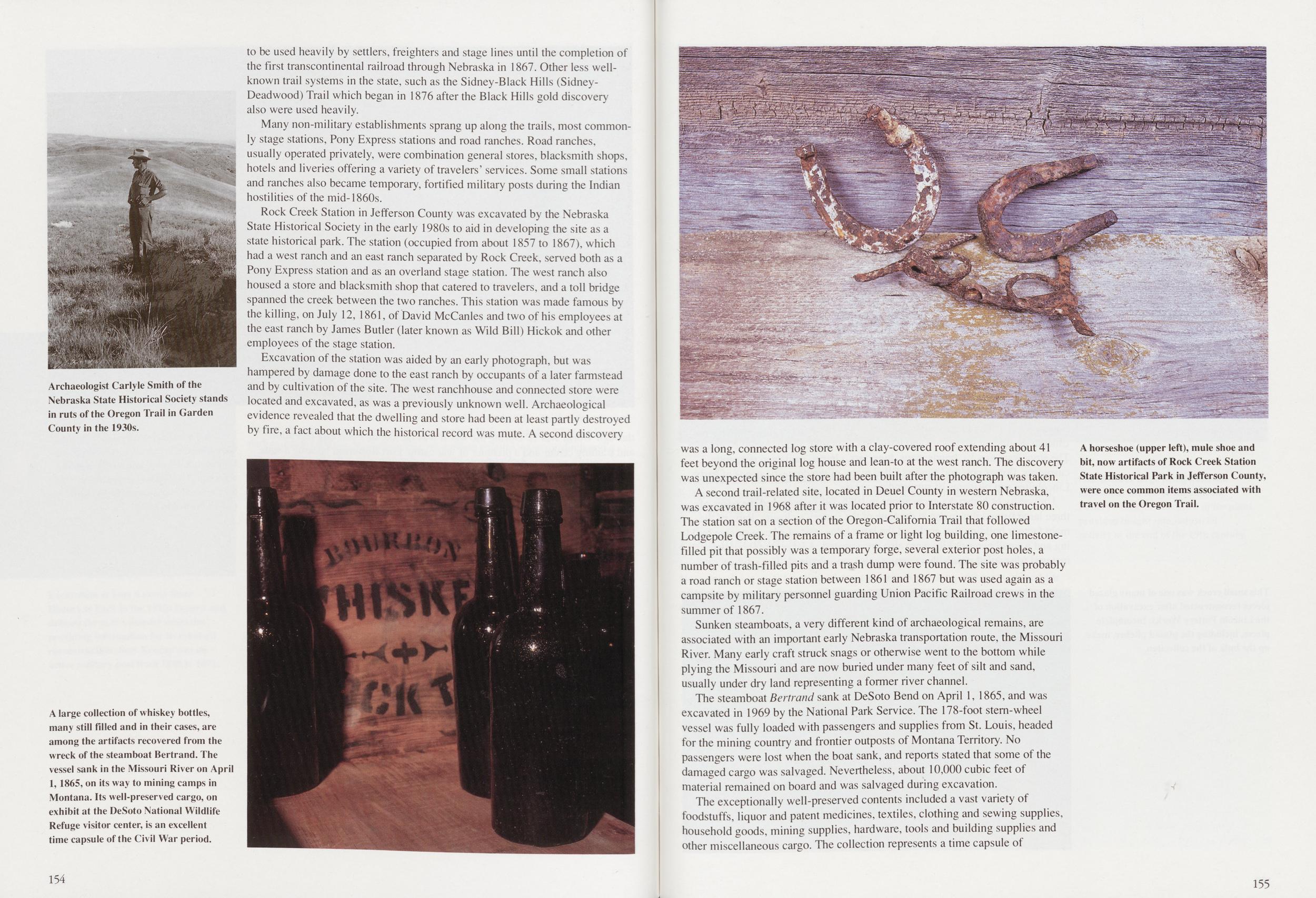
Archaeologist Carlyle Smith of the Nebraska State Historical Society stands in ruts of the Oregon Trail in Garden County in the 1930s.
A large collection of whiskey bottles, many still filled and in their cases, are among the artifacts recovered from the wreck of the steamboat Bertrand. The vessel sank in the Missouri River on April 1, 1865, on its way to mining camps in Montana. Its well-preserved cargo, on exhibit at the DeSoto National Wildlife Refuge visitor center, is an excellent time capsule of the Civil War period.
to be used heavily by settlers, freighters and stage lines until the completion of the first transcontinental railroad through Nebraska in 1867. Other less well- known trail systems in the state, such as the Sidney-Black Hills (Sidney- Deadwood) Trail which began in 1876 after the Black Hills gold discovery also were used heavily.
Many non-military establishments sprang up along the trails, most common- ly stage stations, Pony Express stations and road ranches. Road ranches, usually operated privately, were combination general stores, blacksmith shops, hotels and liveries offering a variety of travelers' services. Some small stations and ranches also became temporary, fortified military posts during the Indian hostilities of the mid-1860s.
Rock Creek Station in Jefferson County was excavated by the Nebraska State Historical Society in the early 1980s to aid in developing the site as a state historical park. The station (occupied from about 1857 to 1867), which had a west ranch and an east ranch separated by Rock Creek, served both as a Pony Express station and as an overland stage station. The west ranch also housed a store and blacksmith shop that catered to travelers, and a toll bridge spanned the creek between the two ranches. This station was made famous by the killing, on July 12, 1861, of David McCanles and two of his employees at the east ranch by James Butler (later known as Wild Bill) Hickok and other employees of the stage station.
Excavation of the station was aided by an early photograph, but was hampered by damage done to the east ranch by occupants of a later farmstead and by cultivation of the site. The west ranchhouse and connected store were located and excavated, as was a previously unknown well. Archaeological evidence revealed that the dwelling and store had been at least partly destroyed by fire, a fact about which the historical record was mute. A second discovery
154was a long, connected log store with a clay-covered roof extending about 41 feet beyond the original log house and lean-to at the west ranch. The discovery was unexpected since the store had been built after the photograph was taken.
A second trail-related site, located in Deuel County in western Nebraska, was excavated in 1968 after it was located prior to Interstate 80 construction. The station sat on a section of the Oregon-California Trail that followed Lodgepole Creek. The remains of a frame or light log building, one limestone- filled pit that possibly was a temporary forge, several exterior post holes, a number of trash-filled pits and a trash dump were found. The site was probably a road ranch or stage station between 1861 and 1867 but was used again as a campsite by military personnel guarding Union Pacific Railroad crews in the summer of 1867.
Sunken steamboats, a very different kind of archaeological remains, are associated with an important early Nebraska transportation route, the Missouri River. Many early craft struck snags or otherwise went to the bottom while plying the Missouri and are now buried under many feet of silt and sand, usually under dry land representing a former river channel.
The steamboat Bertrand sank at DeSoto Bend on April 1, 1865, and was excavated in 1969 by the National Park Service. The 178-foot stem-wheel vessel was fully loaded with passengers and supplies from St. Louis, headed for the mining country and frontier outposts of Montana Territory. No passengers were lost when the boat sank, and reports stated that some of the damaged cargo was salvaged. Nevertheless, about 10,000 cubic feet of material remained on board and was salvaged during excavation.
The exceptionally well-preserved contents included a vast variety of foodstuffs, liquor and patent medicines, textiles, clothing and sewing supplies, household goods, mining supplies, hardware, tools and building supplies and other miscellaneous cargo. The collection represents a time capsule of
A horseshoe (upper left), mule shoe and bit, now artifacts of Rock Creek Station State Historical Park in Jefferson County, were once common items associated with travel on the Oregon Trail.
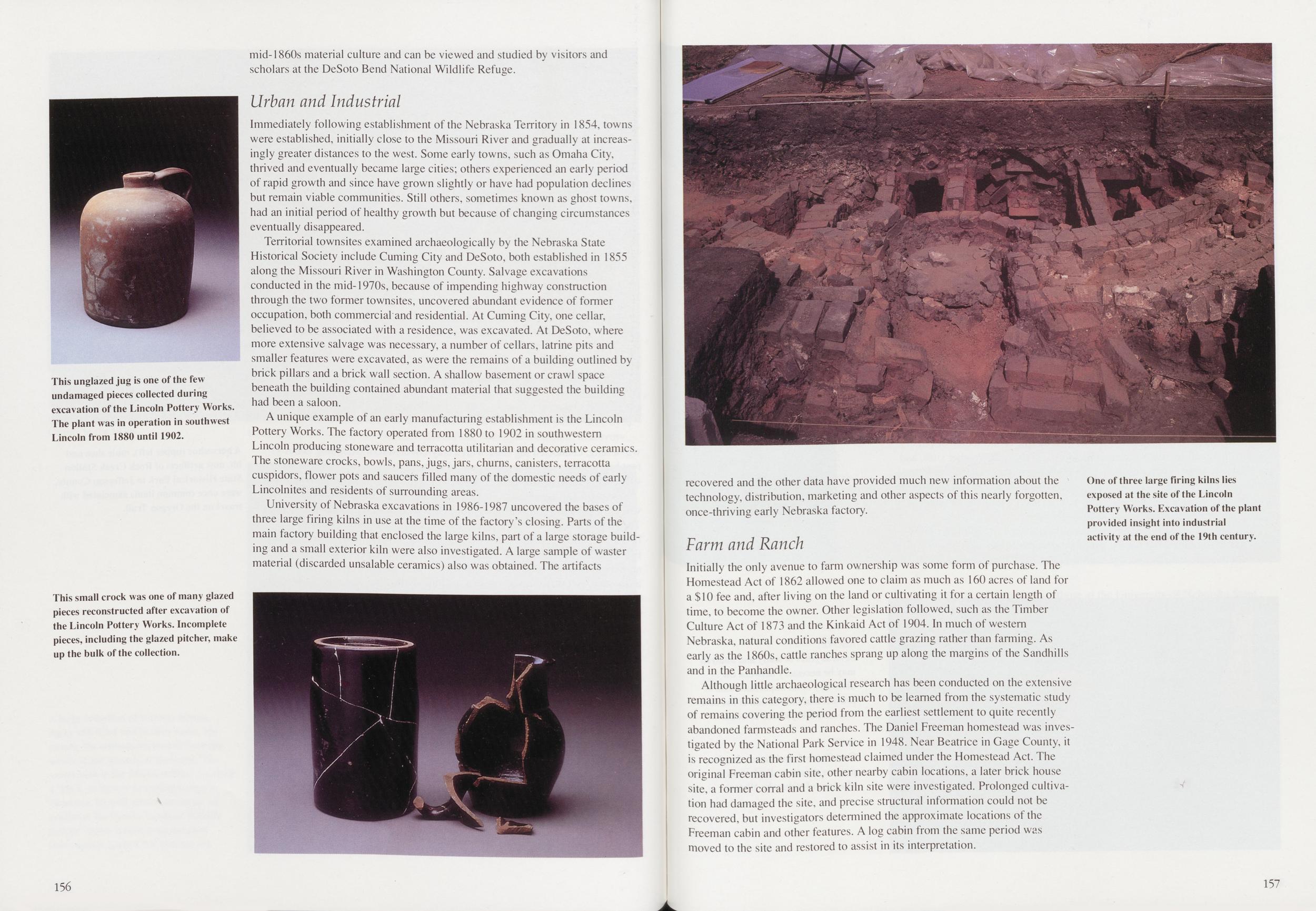
This unglazed jug is one of the few undamaged pieces collected during excavation of the Lincoln Pottery Works. The plant was in operation in southwest Lincoln from 1880 until 1902.
This small crock was one of many glazed pieces reconstructed after excavation of the Lincoln Pottery Works. Incomplete pieces, including the glazed pitcher, make up the bulk of the collection.
mid-1860s material culture and can be viewed and studied by visitors and scholars at the DeSoto Bend National Wildlife Refuge.
Urban and IndustrialImmediately following establishment of the Nebraska Territory in 1854, towns were established, initially close to the Missouri River and gradually at increas- ingly greater distances to the west. Some early towns, such as Omaha City, thrived and eventually became large cities; others experienced an early period of rapid growth and since have grown slightly or have had population declines but remain viable communities. Still others, sometimes known as ghost towns, had an initial period of healthy growth but because of changing circumstances eventually disappeared.
Territorial townsites examined archaeologically by the Nebraska State Historical Society include Cuming City and DeSoto, both established in 1855 along the Missouri River in Washington County. Salvage excavations conducted in the mid-1970s, because of impending highway construction through the two former townsites, uncovered abundant evidence of former occupation, both commercial and residential. At Cuming City, one cellar, believed to be associated with a residence, was excavated. At DeSoto, where more extensive salvage was necessary, a number of cellars, latrine pits and smaller features were excavated, as were the remains of a building outlined by brick pillars and a brick wall section. A shallow basement or crawl space beneath the building contained abundant material that suggested the building had been a saloon.
A unique example of an early manufacturing establishment is the Lincoln Pottery Works. The factory operated from 1880 to 1902 in southwestern Lincoln producing stoneware and terracotta utilitarian and decorative ceramics. The stoneware crocks, bowls, pans, jugs, jars, churns, canisters, terracotta cuspidors, flower pots and saucers filled many of the domestic needs of early Lincolnites and residents of surrounding areas.
University of Nebraska excavations in 1986-1987 uncovered the bases of three large firing kilns in use at the time of the factory's closing. Parts of the main factory building that enclosed the large kilns, part of a large storage build- ing and a small exterior kiln were also investigated. A large sample of waster material (discarded unsalable ceramics) also was obtained. The artifacts
156recovered and the other data have provided much new information about the technology, distribution, marketing and other aspects of this nearly forgotten, once-thriving early Nebraska factory.
Farm and RanchInitially the only avenue to farm ownership was some form of purchase. The Homestead Act of 1862 allowed one to claim as much as 160 acres of land for a $10 fee and, after living on the land or cultivating it for a certain length of time, to become the owner. Other legislation followed, such as the Timber Culture Act of 1873 and the Kinkaid Act of 1904. In much of western Nebraska, natural conditions favored cattle grazing rather than farming. As early as the 1860s, cattle ranches sprang up along the margins of the Sandhills and in the Panhandle.
Although little archaeological research has been conducted on the extensive remains in this category, there is much to be learned from the systematic study of remains covering the period from the earliest settlement to quite recently abandoned farmsteads and ranches. The Daniel Freeman homestead was inves- tigated by the National Park Service in 1948. Near Beatrice in Gage County, it is recognized as the first homestead claimed under the Homestead Act. The original Freeman cabin site, other nearby cabin locations, a later brick house site, a former corral and a brick kiln site were investigated. Prolonged cultiva- tion had damaged the site, and precise structural information could not be recovered, but investigators determined the approximate locations of the Freeman cabin and other features. A log cabin from the same period was moved to the site and restored to assist in its interpretation.
One of three large Firing kilns lies exposed at the site of the Lincoln Pottery Works. Excavation of the plant provided insight into industrial activity at the end of the 19th century.
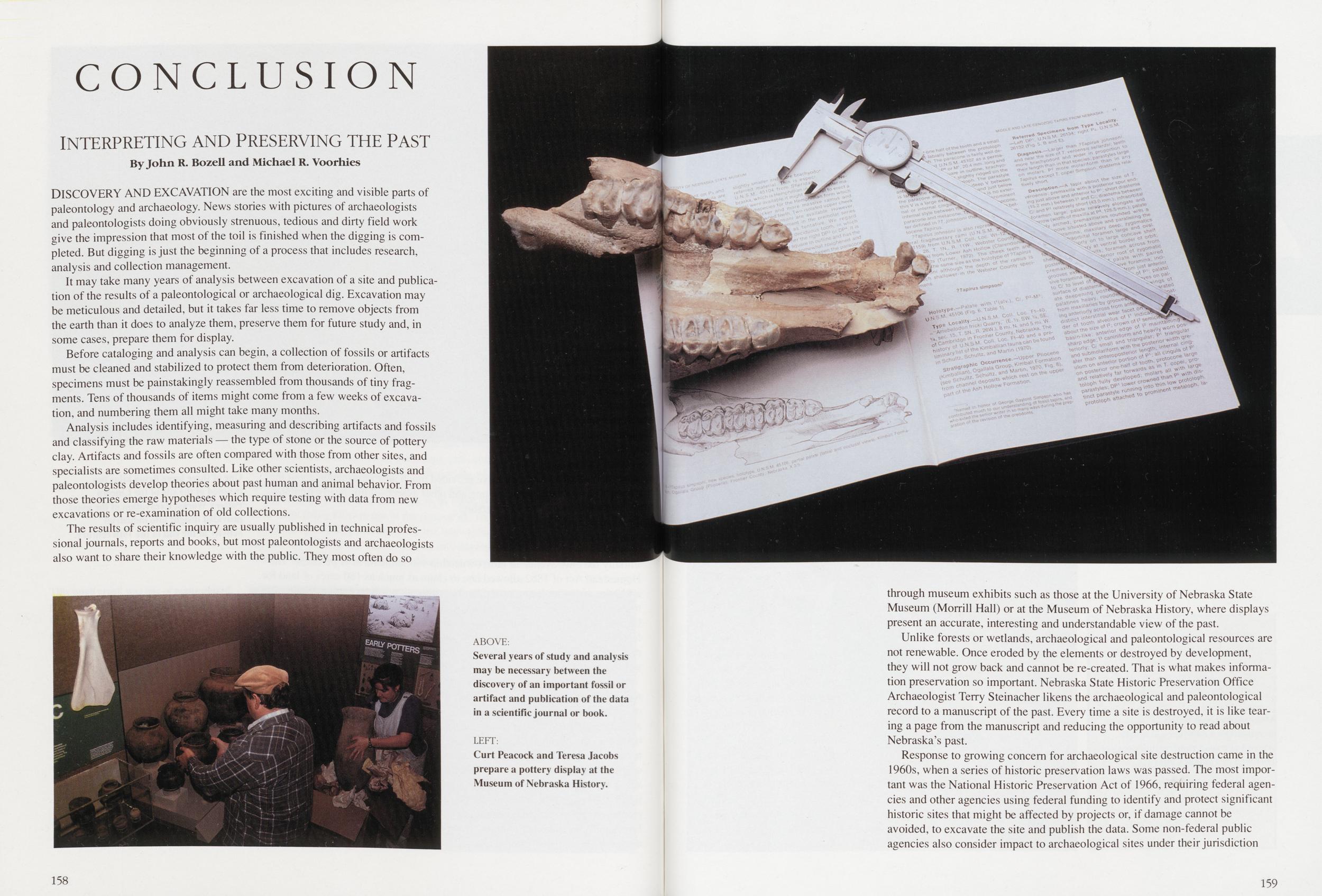
CONCLUSION INTERPRETING AND PRESERVING THE PAST
DISCOVERY AND EXCAVATION are the most exciting and visible parts of paleontology and archaeology. News stories with pictures of archaeologists and paleontologists doing obviously strenuous, tedious and dirty field work give the impression that most of the toil is finished when the digging is com- pleted. But digging is just the beginning of a process that includes research, analysis and collection management.
It may take many years of analysis between excavation of a site and publica- tion of the results of a paleontological or archaeological dig. Excavation may be meticulous and detailed, but it takes far less time to remove objects from the earth than it does to analyze them, preserve them for future study and, in some cases, prepare them for display.
Before cataloging and analysis can begin, a collection of fossils or artifacts must be cleaned and stabilized to protect them from deterioration. Often, specimens must be painstakingly reassembled from thousands of tiny frag- ments. Tens of thousands of items might come from a few weeks of excava- tion, and numbering them all might take many months.
Analysis includes identifying, measuring and describing artifacts and fossils and classifying the raw materials — the type of stone or the source of pottery clay. Artifacts and fossils are often compared with those from other sites, and specialists are sometimes consulted. Like other scientists, archaeologists and paleontologists develop theories about past human and animal behavior. From those theories emerge hypotheses which require testing with data from new excavations or re-examination of old collections.
The results of scientific inquiry are usually published in technical profes- sional journals, reports and books, but most paleontologists and archaeologists also want to share their knowledge with the public. They most often do so
ABOVE: Several years of study and analysis may be necessary between the discovery of an important fossil or artifact and publication of the data in a scientific journal or book.
LEFT: Curt Peacock and Teresa Jacobs prepare a pottery display at the Museum of Nebraska History.
through museum exhibits such as those at the University of Nebraska State Museum (Morrill Hall) or at the Museum of Nebraska History, where displays present an accurate, interesting and understandable view of the past.
Unlike forests or wetlands, archaeological and paleontological resources are not renewable. Once eroded by the elements or destroyed by development, they will not grow back and cannot be re-created. That is what makes information preservation so important. Nebraska State Historic Preservation Office Archaeologist Terry Steinacher likens the archaeological and paleontological record to a manuscript of the past. Every time a site is destroyed, it is like tearing a page from the manuscript and reducing the opportunity to read about Nebraska's past.
Response to growing concern for archaeological site destruction came in the 1960s, when a series of historic preservation laws was passed. The most important was the National Historic Preservation Act of 1966, requiring federal agen- cies and other agencies using federal funding to identify and protect significant historic sites that might be affected by projects or, if damage cannot be avoided, to excavate the site and publish the data. Some non-federal public agencies also consider impact to archaeological sites under their jurisdiction
159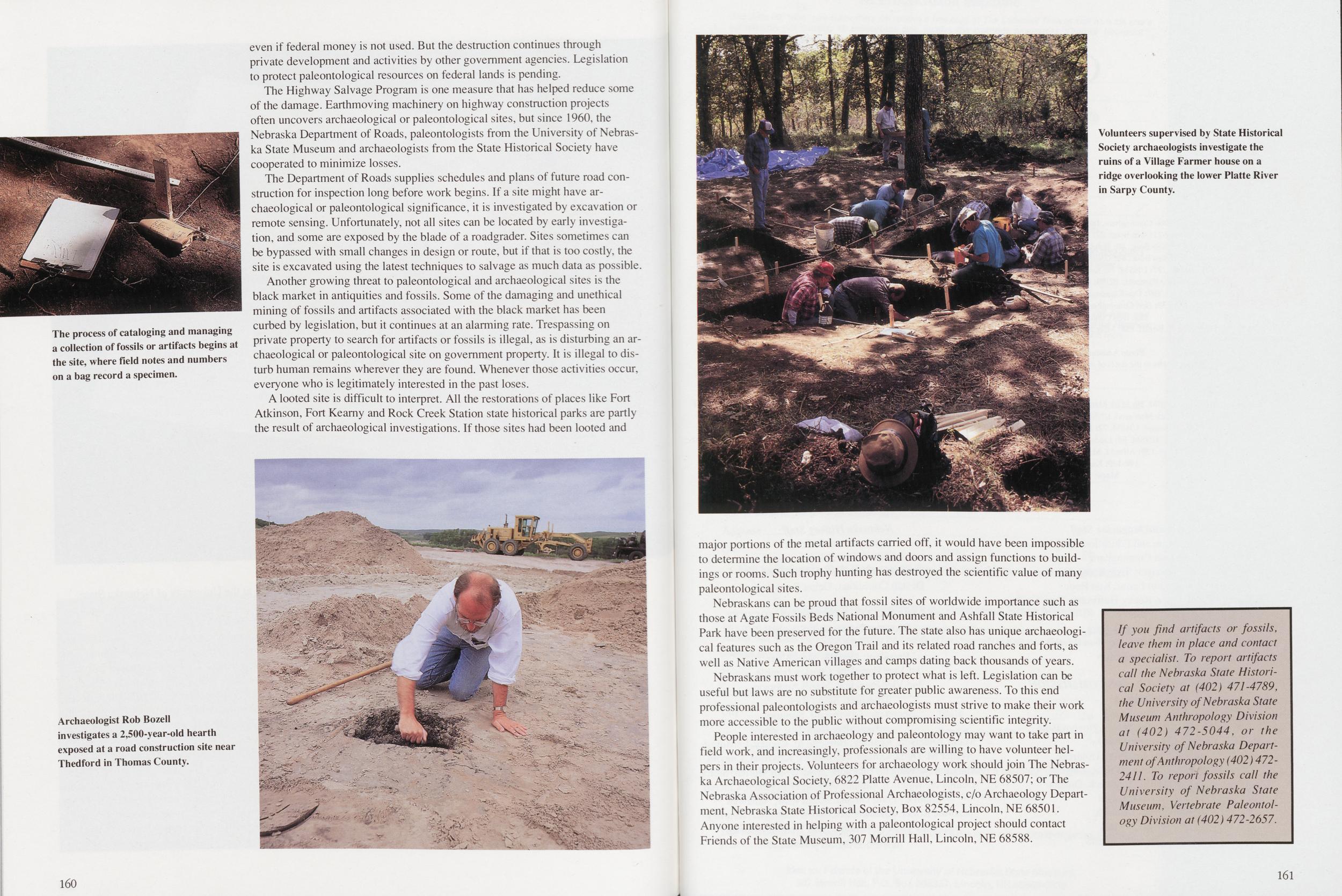
The process of cataloging and managing a collection of fossils or artifacts begins at the site, where field notes and numbers on a bag record a specimen.
Archaeologist Rob Bozell investigates a 2,500-year-old hearth exposed at a road construction site near Thedford in Thomas County.
even if federal money is not used. But the destruction continues through private development and activities by other government agencies. Legislation to protect paleontological resources on federal lands is pending.
The Highway Salvage Program is one measure that has helped reduce some of the damage. Earthmoving machinery on highway construction projects often uncovers archaeological or paleontological sites, but since 1960, the Nebraska Department of Roads, paleontologists from the University of Nebras- ka State Museum and archaeologists from the State Historical Society have cooperated to minimize losses.
The Department of Roads supplies schedules and plans of future road con- struction for inspection long before work begins. If a site might have ar- chaeological or paleontological significance, it is investigated by excavation or remote sensing. Unfortunately, not all sites can be located by early investiga- tion, and some are exposed by the blade of a roadgrader. Sites sometimes can be bypassed with small changes in design or route, but if that is too costly, the site is excavated using the latest techniques to salvage as much data as possible.
Another growing threat to paleontological and archaeological sites is the black market in antiquities and fossils. Some of the damaging and unethical mining of fossils and artifacts associated with the black market has been curbed by legislation, but it continues at an alarming rate. Trespassing on private property to search for artifacts or fossils is illegal, as is disturbing an ar- chaeological or paleontological site on government property. It is illegal to dis- turb human remains wherever they are found. Whenever those activities occur, everyone who is legitimately interested in the past loses.
A looted site is difficult to interpret. All the restorations of places like Fort Atkinson, Fort Kearny and Rock Creek Station state historical parks are partly the result of archaeological investigations. If those sites had been looted and
160Volunteers supervised by State Historical Society archaeologists investigate the ruins of a Village Farmer house on a ridge overlooking the lower Platte River in Sarpy County.
major portions of the metal artifacts carried off, it would have been impossible to determine the location of windows and doors and assign functions to buildings or rooms. Such trophy hunting has destroyed the scientific value of many paleontological sites.
Nebraskans can be proud that fossil sites of worldwide importance such as those at Agate Fossils Beds National Monument and Ashfall State Historical Park have been preserved for the future. The state also has unique archaeological features such as the Oregon Trail and its related road ranches and forts, as well as Native American villages and camps dating back thousands of years.
Nebraskans must work together to protect what is left. Legislation can be useful but laws are no substitute for greater public awareness. To this end professional paleontologists and archaeologists must strive to make their work more accessible to the public without compromising scientific integrity.
People interested in archaeology and paleontology may want to take part in field work, and increasingly, professionals are willing to have volunteer helpers in their projects. Volunteers for archaeology work should join The Nebraska Archaeological Society, 6822 Platte Avenue, Lincoln, NE 68507; or The Nebraska Association of Professional Archaeologists, c/o Archaeology Department, Nebraska State Historical Society, Box 82554, Lincoln, NE 68501. Anyone interested in helping with a paleontological project should contact Friends of the State Museum, 307 Morrill Hall, Lincoln, NE 68588.
If you find artifacts or fossils, leave them in place and contact a specialist. To report artifacts call the Nebraska State Historical Society at (402) 471-4789, the University of Nebraska State Museum Anthropology Division at (402) 472-5044, or the University of Nebraska Department of Anthropology (402) 472- 2411. To report fossils call the University of Nebraska State Museum, Vertebrate Paleontology Division at (402) 472-2657.
161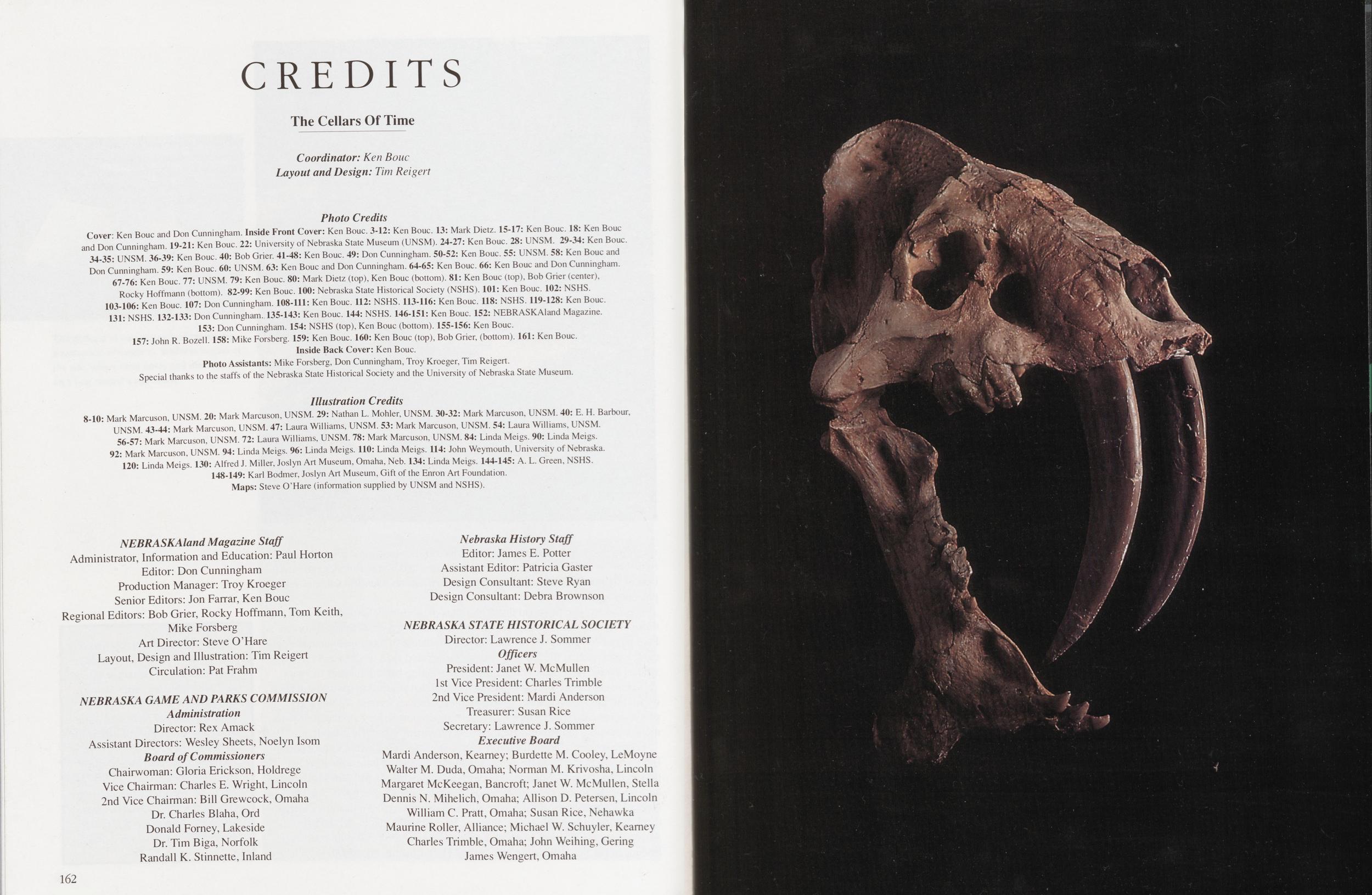
CREDITS The Cellars Of Time
Photo Credits Cover: Ken Bouc and Don Cunningham. Inside Front Cover: Ken Bouc. 3-12: Ken Bouc. 13: Mark Dietz. 15-17: Ken Bouc. 18: Ken Bouc and Don Cunningham. 19-21: Ken Bouc. 22: University of Nebraska State Museum (UNSM). 24-27: Ken Bouc. 28: UNSM. 29-34: Ken Bouc. 34-35: UNSM. 36-39: Ken Bouc. 40: Bob Grier. 41-48: Ken Bouc. 49: Don Cunningham. 50-52: Ken Bouc. 55: UNSM. 58: Ken Bouc and Don Cunningham. 59: Ken Bouc. 60: UNSM. 63: Ken Bouc and Don Cunningham. 64-65: Ken Bouc. 66: Ken Bouc and Don Cunningham. 67-76: Ken Bouc. 77: UNSM. 79: Ken Bouc. 80: Mark Dietz (top), Ken Bouc (bottom). 81: Ken Bouc (top), Bob Grier (center), Rocky Hoffmann (bottom). 82-99: Ken Bouc. 100: Nebraska State Historical Society (NSHS). 101: Ken Bouc. 102: NSHS. 103-106: Ken Bouc. 107: Don Cunningham. 108-111: Ken Bouc. 112: NSHS. 113-116: Ken Bouc. 118: NSHS. 119-128: Ken Bouc. 131: NSHS. 132-133: Don Cunningham. 135-143: Ken Bouc. 144: NSHS. 146-151: Ken Bouc. 152: NEBRASKAland Magazine. 153: Don Cunningham. 154: NSHS (top), Ken Bouc (bottom). 155-156: Ken Bouc. 157: John R. Bozell. 158: Mike Forsberg. 159: Ken Bouc. 160: Ken Bouc (top), Bob Grier, (bottom). 161: Ken Bouc. Inside Back Cover: Ken Bouc. Photo Assistants: Mike Forsberg, Don Cunningham, Troy Kroeger, Tim Reigert. Special thanks to the staffs of the Nebraska State Historical Society and the University of Nebraska State Museum.
Illustration Credits 8-10: Mark Marcuson, UNSM. 20: Mark Marcuson, UNSM. 29: Nathan L. Mohler, UNSM. 30-32: Mark Marcuson, UNSM. 40: E. H. Barbour, UNSM. 43-44: Mark Marcuson, UNSM. 47: Laura Williams, UNSM. 53: Mark Marcuson, UNSM. 54: Laura Williams, UNSM. 56-57: Mark Marcuson, UNSM. 72: Laura Williams, UNSM. 78: Mark Marcuson, UNSM. 84: Linda Meigs. 90: Linda Meigs. 92: Mark Marcuson, UNSM. 94: Linda Meigs. 96: Linda Meigs. 110: Linda Meigs. 114: John Weymouth, University of Nebraska. 120: Linda Meigs. 130: Alfred J. Miller, Joslyn Art Museum, Omaha, Neb. 134: Linda Meigs. 144-145: A. L. Green, NSHS. 148-149: Karl Bodmer, Joslyn Art Museum, Gift of the Enron Art Foundation. Maps: Steve O'Hare (information supplied by UNSM and NSHS).
NEBRASKAland Magazine Staff Administrator, Information and Education: Paul Horton Editor: Don Cunningham Production Manager: Troy Kroeger Senior Editors: Jon Farrar, Ken Bouc Regional Editors: Bob Grier, Rocky Hoffmann, Tom Keith, Mike Forsberg Art Director: Steve O'Hare Layout, Design and Illustration: Tim Reigert Circulation: Pat Frahm
NEBRASKA GAME AND PARKS COMMISSION Administration Director: Rex Amack Assistant Directors: Wesley Sheets, Noelyn Isom Board of Commissioners Chairwoman: Gloria Erickson, Holdrege Vice Chairman: Charles E. Wright, Lincoln 2nd Vice Chairman: Bill Grewcock, Omaha Dr. Charles Blaha, Ord Donald Forney, Lakeside Dr. Tim Biga, Norfolk Randall K. Stinnette, Inland
Nebraska History Staff Editor: James E. Potter Assistant Editor: Patricia Gaster Design Consultant: Steve Ryan Design Consultant: Debra Brownson
NEBRASKA STATE HISTORICAL SOCIETY Director: Lawrence J. Sommer Officers President: Janet W. McMullen 1st Vice President: Charles Trimble 2nd Vice President: Mardi Anderson Treasurer: Susan Rice Secretary: Lawrence J. Sommer
Executive Board Mardi Anderson, Kearney; Burdette M. Cooley, LeMoyne Walter M. Duda, Omaha; Norman M. Krivosha, Lincoln Margaret McKeegan, Bancroft; Janet W. McMullen, Stella Dennis N. Mihelich, Omaha; Allison D. Petersen, Lincoln William C. Pratt, Omaha; Susan Rice, Nehawka Maurine Roller, Alliance; Michael W. Schuyler, Kearney Charles Trimble, Omaha; John Weihing, Gering James Wengert, Omaha
162
$12.95
Position: 169 (39 views)