Volume 71, Issue 10, 1993
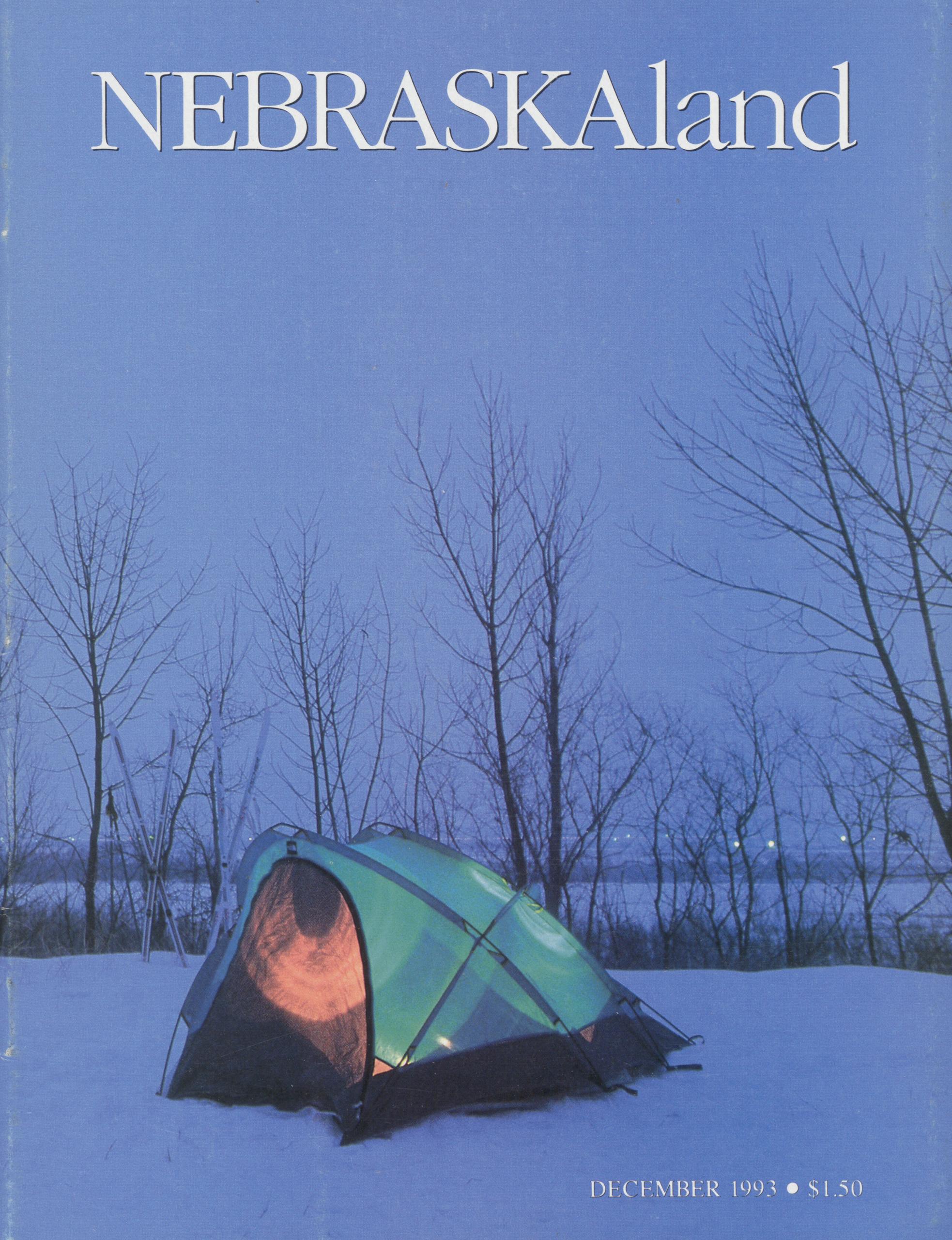
NEBRASKAland DECEMBER 1993 • $1.50
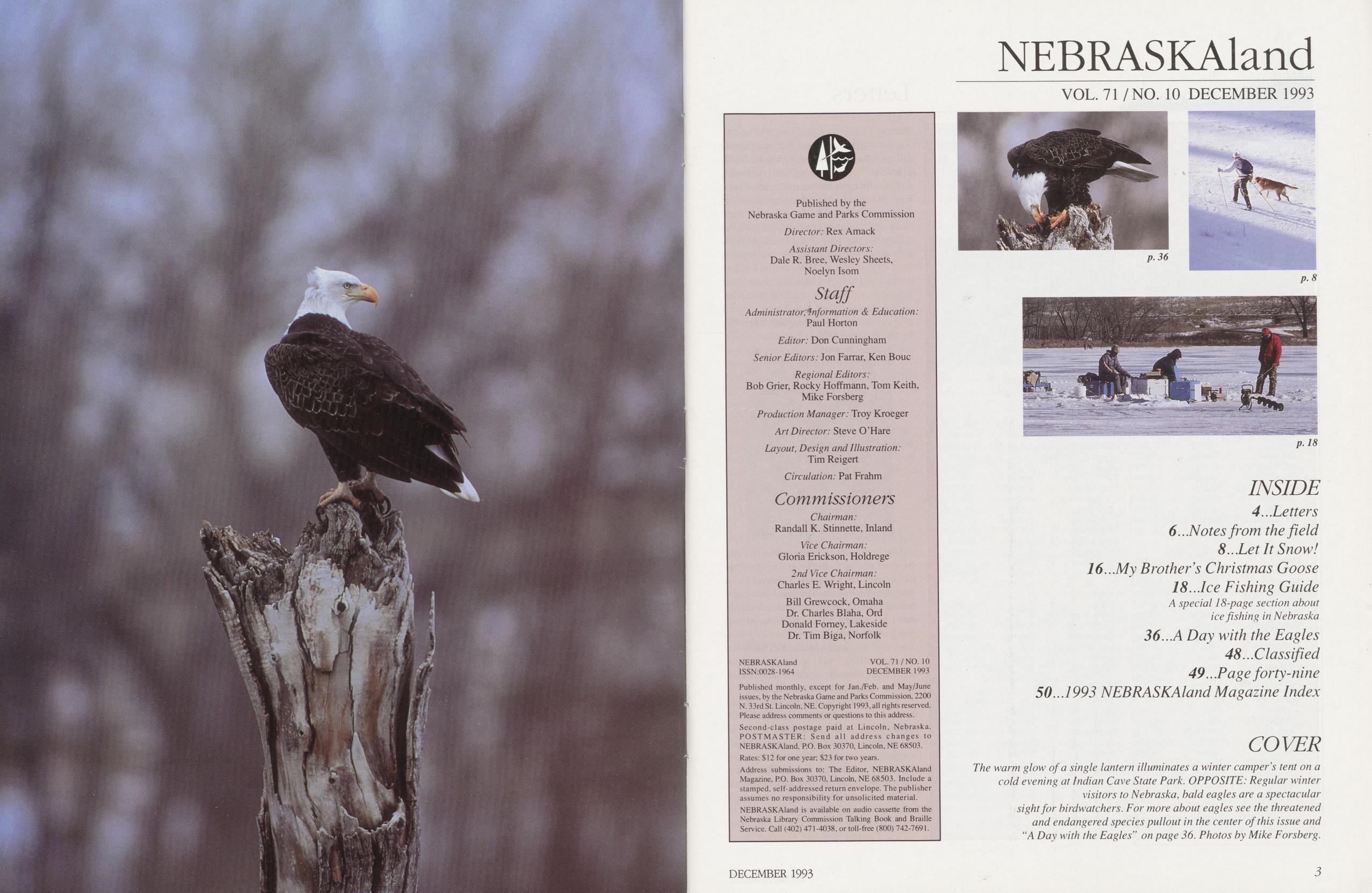
NEBRASKAland VOL. 71 /NO. 10 DECEMBER 1993
Letters
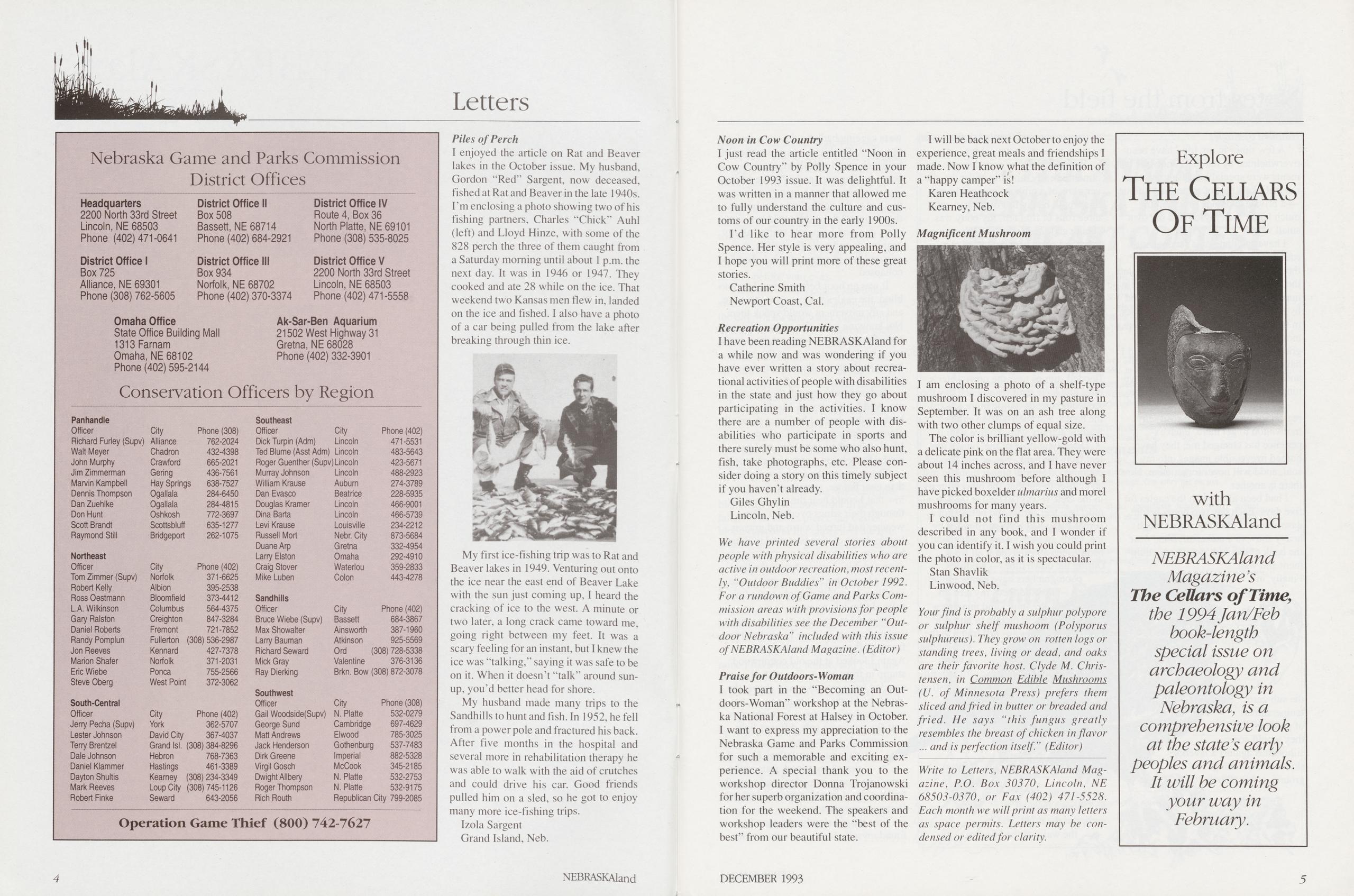
Piles of PerchI enjoyed the article on Rat and Beaver lakes in the October issue. My husband, Gordon "Red" Sargent, now deceased, fished at Rat and Beaver in the late 1940s. I'm enclosing a photo showing two of his fishing partners, Charles "Chick" Auhl (left) and Lloyd Hinze, with some of the 828 perch the three of them caught from a Saturday morning until about 1 p.m. the next day. It was in 1946 or 1947. They cooked and ate 28 while on the ice. That weekend two Kansas men flew in, landed on the ice and fished. I also have a photo of a car being pulled from the lake after breaking through thin ice.
My first ice-fishing trip was to Rat and Beaver lakes in 1949. Venturing out onto the ice near the east end of Beaver Lake with the sun just coming up, I heard the cracking of ice to the west. A minute or two later, a long crack came toward me, going right between my feet. It was a scary feeling for an instant, but I knew the ice was "talking," saying it was safe to be on it. When it doesn't "talk" around sunup, you'd better head for shore.
My husband made many trips to the Sandhills to hunt and fish. In 1952, he fell from a power pole and fractured his back. After five months in the hospital and several more in rehabilitation therapy he was able to walk with the aid of crutches and could drive his car. Good friends pulled him on a sled, so he got to enjoy many more ice-fishing trips.
Izola Sargent Grand Island, Neb. Noon in Cow CountryI just read the article entitled "Noon in Cow Country" by Polly Spence in your October 1993 issue. It was delightful. It was written in a manner that allowed me to fully understand the culture and customs of our country in the early 1900s. I'd like to hear more from Polly Spence. Her style is very appealing, and I hope you will print more of these great stories.
Catherine Smith Newport Coast, Cal. Recreation OpportunitiesI have been reading NEBRASKAland for a while now and was wondering if you have ever written a story about recreational activities of people with disabilities in the state and just how they go about participating in the activities. I know there are a number of people with disabilities who participate in sports and there surely must be some who also hunt, fish, take photographs, etc. Please consider doing a story on this timely subject if you haven't already.
Giles Ghylin Lincoln, Neb.I took part in the "Becoming an Outdoors-Woman" workshop at the Nebraska National Forest at Halsey in October. I want to express my appreciation to the Nebraska Game and Parks Commission for such a memorable and exciting experience. A special thank you to the workshop director Donna Trojanowski for her superb organization and coordination for the weekend. The speakers and workshop leaders were the "best of the best" from our beautiful state.
I will be back next October to enjoy the experience, great meals and friendships I made. Now I know what the definition of a "happy camper" is!
Karen Heathcock Kearney, Neb. Magnificent MushroomI am enclosing a photo of a shelf-type mushroom I discovered in my pasture in September. It was on an ash tree along with two other clumps of equal size.
The color is brilliant yellow-gold with a delicate pink on the flat area. They were about 14 inches across, and I have never seen this mushroom before although I have picked boxelder ulmarius and morel mushrooms for many years.
I could not find this mushroom described in any book, and I wonder if you can identify it. I wish you could print the photo in color, as it is spectacular.
Stan Shavlik Linwood, Neb.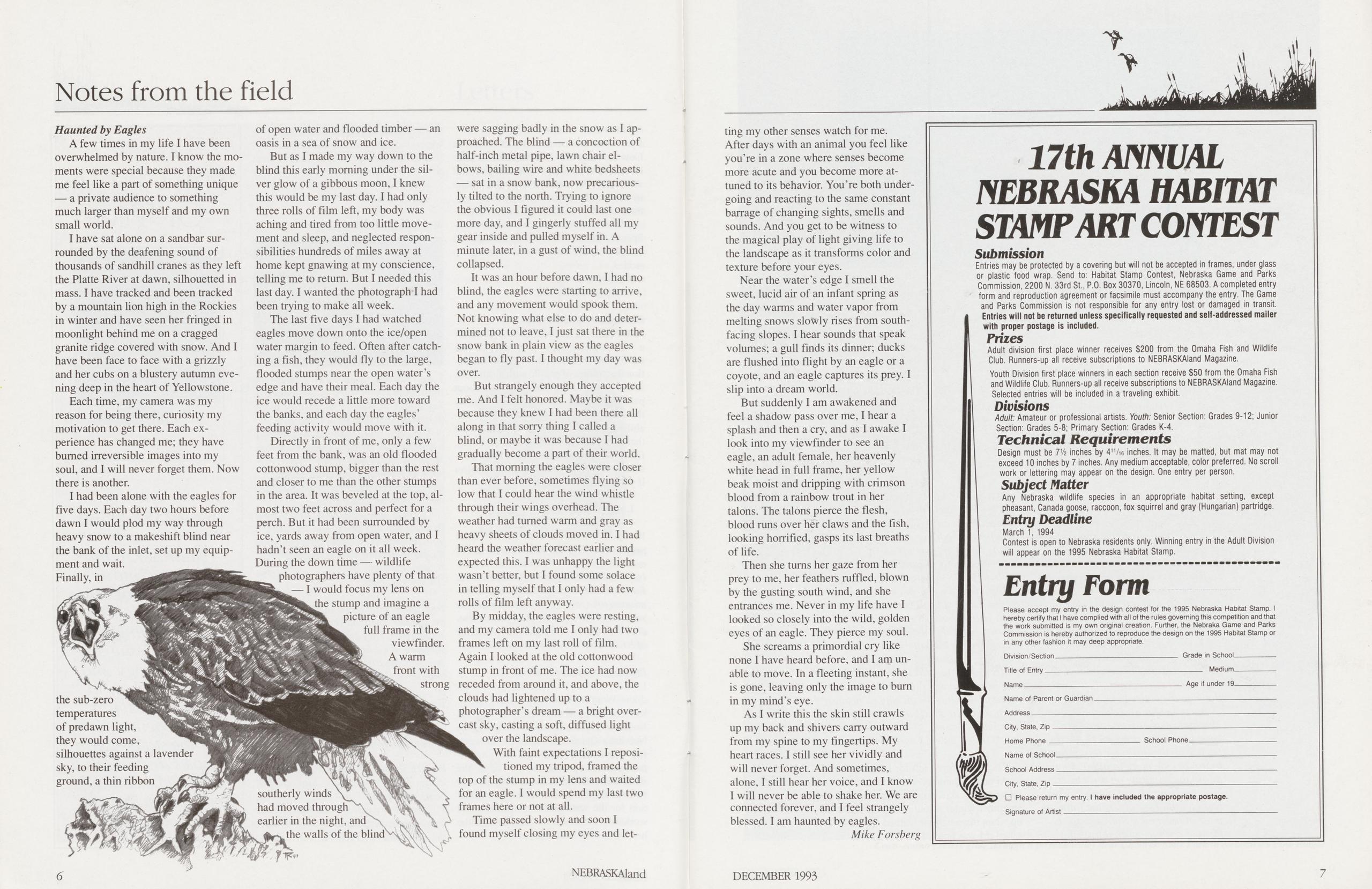
Notes from the field
Haunted by Eagles
A few times in my life I have been overwhelmed by nature. I know the moments were special because they made me feel like a part of something unique — a private audience to something much larger than myself and my own small world.
I have sat alone on a sandbar surrounded by the deafening sound of thousands of sandhill cranes as they left the Platte River at dawn, silhouetted in mass. I have tracked and been tracked by a mountain lion high in the Rockies in winter and have seen her fringed in moonlight behind me on a cragged granite ridge covered with snow. And I have been face to face with a grizzly and her cubs on a blustery autumn evening deep in the heart of Yellowstone.
Each time, my camera was my reason for being there, curiosity my motivation to get there. Each experience has changed me; they have burned irreversible images into my soul, and I will never forget them. Now there is another.
I had been alone with the eagles for five days. Each day two hours before dawn I would plod my way through heavy snow to a makeshift blind near the bank of the inlet, set up my equipment and wait. Finally, in the sub-zero temperatures of predawn light, they would come, silhouettes against a lavender sky, to their feeding ground, a thin ribbon of open water and flooded timber — an oasis in a sea of snow and ice.
But as I made my way down to the blind this early morning under the silver glow of a gibbous moon, I knew this would be my last day. I had only three rolls of film left, my body was aching and tired from too little movement and sleep, and neglected responsibilities hundreds of miles away at home kept gnawing at my conscience, telling me to return. But I needed this last day. I wanted the photograph I had been trying to make all week.
The last five days I had watched eagles move down onto the ice/open water margin to feed. Often after catching a fish, they would fly to the large, flooded stumps near the open water's edge and have their meal. Each day the ice would recede a little more toward the banks, and each day the eagles' feeding activity would move with it.
Directly in front of me, only a few feet from the bank, was an old flooded cottonwood stump, bigger than the rest and closer to me than the other stumps in the area. It was beveled at the top, almost two feet across and perfect for a perch. But it had been surrounded by ice, yards away from open water, and I hadn't seen an eagle on it all week. During the down time — wildlife photographers have plenty of that I would focus my lens on the stump and imagine a picture of an eagle full frame in the viewfinder. A warm front with strong southerly winds had moved through earlier in the night, and the walls of the blind were sagging badly in the snow as I approached. The blind — a concoction of half-inch metal pipe, lawn chair elbows, bailing wire and white bedsheets — sat in a snow bank, now precariously tilted to the north. Trying to ignore the obvious I figured it could last one more day, and I gingerly stuffed all my gear inside and pulled myself in. A minute later, in a gust of wind, the blind collapsed.
It was an hour before dawn, I had no blind, the eagles were starting to arrive, and any movement would spook them. Not knowing what else to do and determined not to leave, I just sat there in the snow bank in plain view as the eagles began to fly past. I thought my day was over.
But strangely enough they accepted me. And I felt honored. Maybe it was because they knew I had been there all along in that sorry thing I called a blind, or maybe it was because I had gradually become a part of their world.
That morning the eagles were closer than ever before, sometimes flying so low that I could hear the wind whistle through their wings overhead. The weather had turned warm and gray as heavy sheets of clouds moved in. I had heard the weather forecast earlier and expected this. I was unhappy the light wasn't better, but I found some solace in telling myself that I only had a few rolls of film left anyway.
By midday, the eagles were resting, and my camera told me I only had two frames left on my last roll of film. Again I looked at the old cottonwood stump in front of me. The ice had now receded from around it, and above, the clouds had lightened up to a photographer's dream — a bright overcast sky, casting a soft, diffused light over the landscape.
With faint expectations I repositioned my tripod, framed the top of the stump in my lens and waited for an eagle. I would spend my last two frames here or not at all. Time passed slowly and soon I found myself closing my eyes and letting 6 NEBRASKAland my other senses watch for me. After days with an animal you feel like you're in a zone where senses become more acute and you become more attuned to its behavior. You're both under going and reacting to the same constant barrage of changing sights, smells and sounds. And you get to be witness to the magical play of light giving life to the landscape as it transforms color and texture before your eyes.
Near the water's edge I smell the sweet, lucid air of an infant spring as the day warms and water vapor from melting snows slowly rises from south facing slopes. I hear sounds that speak volumes; a gull finds its dinner; ducks are flushed into flight by an eagle or a coyote, and an eagle captures its prey. I slip into a dream world.
But suddenly I am awakened and feel a shadow pass over me, I hear a splash and then a cry, and as I awake I look into my viewfinder to see an eagle, an adult female, her heavenly white head in full frame, her yellow beak moist and dripping with crimson blood from a rainbow trout in her talons. The talons pierce the flesh, blood runs over her claws and the fish, looking horrified, gasps its last breaths of life.
Then she turns her gaze from her prey to me, her feathers ruffled, blown by the gusting south wind, and she entrances me. Never in my life have I looked so closely into the wild, golden eyes of an eagle. They pierce my soul.
She screams a primordial cry like none I have heard before, and I am unable to move. In a fleeting instant, she is gone, leaving only the image to burn in my mind's eye.
As I write this the skin still crawls up my back and shivers carry outward from my spine to my fingertips. My heart races. I still see her vividly and will never forget. And sometimes, alone, I still hear her voice, and I know I will never be able to shake her. We are connected forever, and I feel strangely blessed. I am haunted by eagles.
DECEMBER 199317th ANNUAL NEBRASKA HABITAT STAMP ART CONTEST
Submission Entries may be protected by a covering but will not be accepted in frames, under glass or plastic food wrap. Send to: Habitat Stamp Contest, Nebraska Game and Parks Commission, 2200 N. 33rd St., P.O. Box 30370, Lincoln, NE 68503. A completed entry form and reproduction agreement or facsimile must accompany the entry. The Game and Parks Commission is not responsible for any entry lost or damaged in transit. Entries will not be returned unless specifically requested and self-addressed mailer with proper postage is included. Prizes Adult division first place winner receives $200 from the Omaha Fish and Wildlife Club. Runners-up all receive subscriptions to NEBRASKAland Magazine. Youth Division first place winners in each section receive $50 from the Omaha Fish and Wildlife Club. Runners-up all receive subscriptions to NEBRASKAland Magazine. Selected entries will be included in a traveling exhibit. Divisions Adult: Amateur or professional artists. Youth: Senior Section: Grades 9-12; Junior Section: Grades 5-8; Primary Section: Grades K-4. Technical Requirements Design must be 71/2 inches by 411/ie inches. It may be matted, but mat may not exceed 10 inches by 7 inches. Any medium acceptable, color preferred. No scroll work or lettering may appear on the design. One entry per person. Subject Matter Any Nebraska wildlife species in an appropriate habitat setting, except pheasant, Canada goose, raccoon, fox squirrel and gray (Hungarian) partridge. Entry Deadline March 1, 1994 Contest is open to Nebraska residents only. Winning entry in the Adult Division will appear on the 1995 Nebraska Habitat Stamp. Entry Form Please accept my entry in the design contest for the 1995 Nebraska Habitat Stamp. I hereby certify that I have complied with all of the rules governing this competition and that the work submitted is my own original creation. Further, the Nebraska Game and Parks Commission is hereby authorized to reproduce the design on the 1995 Habitat Stamp or in any other fashion it may deep appropriate. Division/Section. Title of Entry Name Grade in School Medium. Age if under 19. Name of Parent or Guardian. Address City, State, Zip Home Phone School Phone. Name of School. School Address. City, State, Zip D Please return my entry. I have included the appropriate postage. Signature of Artist
Let it Snow!
Although not widely known as a skiing hotspot, when the weather cooperates, Nebraska's varied terrain and wide-open spaces offer abundant opportunities for the cross-country devotee.
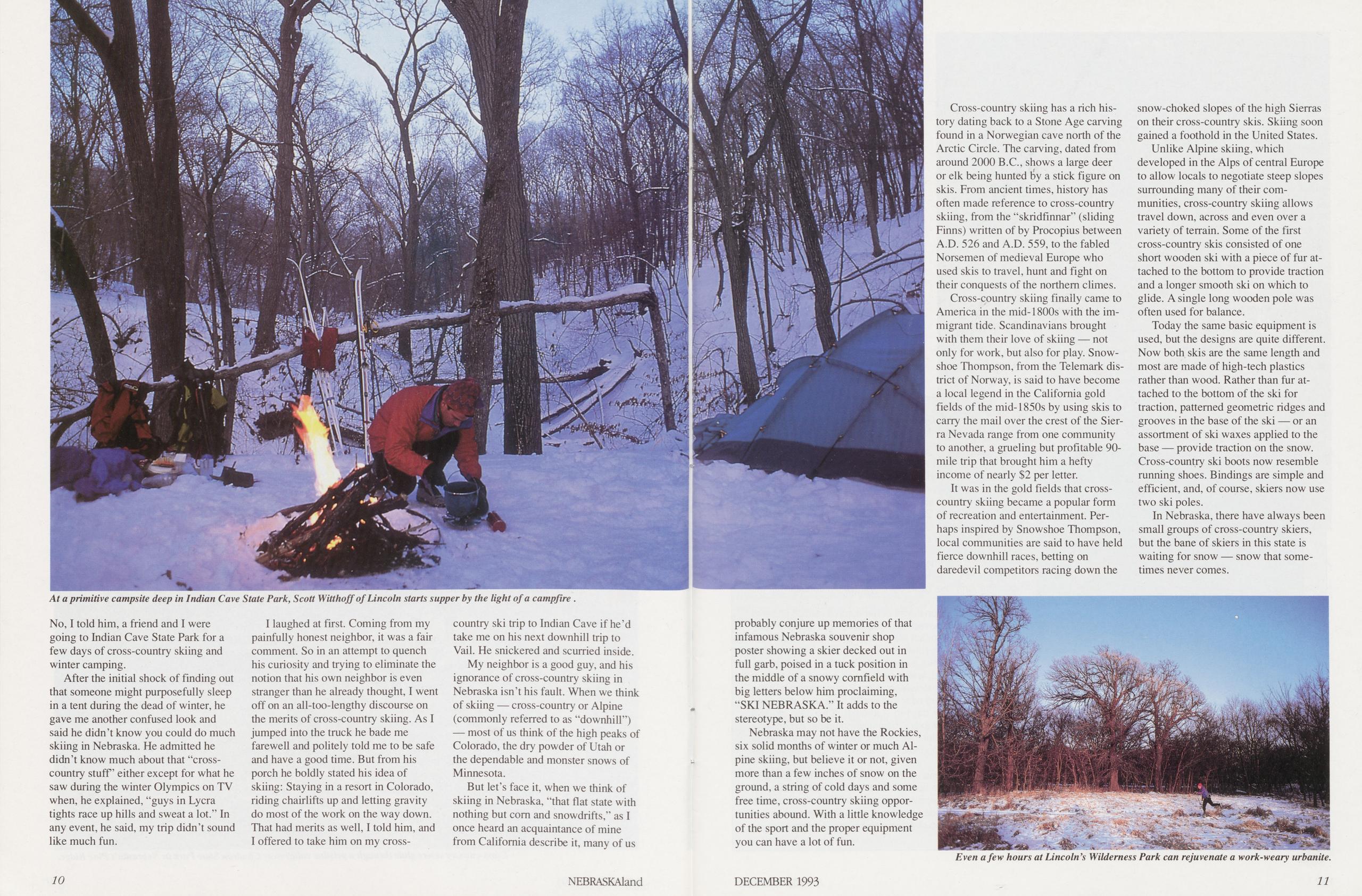
"A round 2p.m. the sun finally managed to squeeze through the heavy gray overcast for the first time all day as we skied down a steep, narrow forested trail looking for a primitive campsite where Scott had camped a few summers ago. He said the whole area looked different now that it was covered in deep snow. The trail was icy, deeply rutted with deer tracks and strewn with fallen branches — not to mention the hairpin turns every hundred yards. For the next half-hour we skied, fell, slid, rolled and eventually walked down to the valley floor.
It was colder and damper there. The snow was already starting to crust as the sun dropped in the sky. Higher up the drainage things finally began to look more familiar. Soon we found the campsite on a rocky out- crop hanging 20 feet above a creek bed identifiable only by the faint, almost indiscernible donut-shaped form of a snow-covered fire ring.
We had I skied well most of the day, and we were tired and sore, hut after we shed our packs and had something to eat, we got a second wind. We quickly set up camp, stepped into our skis and took off Without packs our weight was cut by a third, and we flew back up the valley in search of good snow on the open bluffs above. We came out on top into packed powder and the golden light of the late afternoon sun. We went like lightning for two solid hours along Missouri River bluffs. The river view was our constant companion. Finally the sun slipped below the horizon and we had to make our way back to camp... '-Personal journal, 1-16-93, Indian Cave State Park.
The day before I left for Indian Cave to ski on that January weekend, I was piling up my skis, poles, backpack, tent and other winter essentials into my pickup when my neighbor walked up and asked if I was headed for Colorado.
No, I told him, a friend and I were going to Indian Cave State Park for a few days of cross-country skiing and winter camping.
After the initial shock of finding out that someone might purposefully sleep in a tent during the dead of winter, he gave me another confused look and said he didn't know you could do much skiing in Nebraska. He admitted he didn't know much about that "cross-country stuff either except for what he saw during the winter Olympics on TV when, he explained, "guys in Lycra tights race up hills and sweat a lot." In any event, he said, my trip didn't sound like much fun.
I laughed at first. Coming from my painfully honest neighbor, it was a fair comment. So in an attempt to quench his curiosity and trying to eliminate the notion that his own neighbor is even stranger than he already thought, I went off on an all-too-lengthy discourse on the merits of cross-country skiing. As I jumped into the truck he bade me farewell and politely told me to be safe and have a good time. But from his porch he boldly stated his idea of skiing: Staying in a resort in Colorado, riding chairlifts up and letting gravity do most of the work on the way down. That had merits as well, I told him, and I offered to take him on my cross- country ski trip to Indian Cave if he'd take me on his next downhill trip to Vail. He snickered and scurried inside.
My neighbor is a good guy, and his ignorance of cross-country skiing in Nebraska isn't his fault. When we think of skiing — cross-country or Alpine (commonly referred to as "downhill") — most of us think of the high peaks of Colorado, the dry powder of Utah or the dependable and monster snows of Minnesota.
But let's face it, when we think of skiing in Nebraska, "that flat state with nothing but corn and snowdrifts," as I once heard an acquaintance of mine from California describe it, many of us probably conjure up memories of that infamous Nebraska souvenir shop poster showing a skier decked out in full garb, poised in a tuck position in the middle of a snowy cornfield with big letters below him proclaiming, "SKI NEBRASKA." It adds to the stereotype, but so be it.
Nebraska may not have the Rockies, six solid months of winter or much Alpine skiing, but believe it or not, given more than a few inches of snow on the ground, a string of cold days and some free time, cross-country skiing opportunities abound. With a little knowledge of the sport and the proper equipment you can have a lot of fun.
Cross-country skiing has a rich his- tory dating back to a Stone Age carving found in a Norwegian cave north of the Arctic Circle. The carving, dated from around 2000 B.C., shows a large deer or elk being hunted by a stick figure on skis. From ancient times, history has often made reference to cross-country skiing, from the (sliding Finns) written of by Procopius between A.D. 526 and A.D. 559, to the fabled Norsemen of medieval Europe who used skis to travel, hunt and fight on their conquests of the northern climes.
Cross-country skiing finally came to America in the mid-1800s with the immigrant tide. Scandinavians brought with them their love of skiing — not only for work, but also for play. Snowshoe Thompson, from the Telemark district of Norway, is said to have become a local legend in the California gold fields of the mid-1850s by using skis to carry the mail over the crest of the Sierra Nevada range from one community to another, a grueling but profitable 90-mile trip that brought him a hefty income of nearly $2 per letter.
It was in the gold fields that crosscountry skiing became a popular form of recreation and entertainment. Perhaps inspired by Snowshoe Thompson, local communities are said to have held fierce downhill races, betting on daredevil competitors racing down the snow-choked slopes of the high Sierras on their cross-country skis. Skiing soon gained a foothold in the United States.
Unlike Alpine skiing, which developed in the Alps of central Europe to allow locals to negotiate steep slopes surrounding many of their communities, cross-country skiing allows travel down, across and even over a variety of terrain. Some of the first cross-country skis consisted of one short wooden ski with a piece of fur attached to the bottom to provide traction and a longer smooth ski on which to glide. A single long wooden pole was often used for balance.
Today the same basic equipment is used, but the designs are quite different. Now both skis are the same length and most are made of high-tech plastics rather than wood. Rather than fur attached to the bottom of the ski for traction, patterned geometric ridges and grooves in the base of the ski — or an assortment of ski waxes applied to the base — provide traction on the snow. Cross-country ski boots now resemble running shoes. Bindings are simple and efficient, and, of course, skiers now use two ski poles.
In Nebraska, there have always been small groups of cross-country skiers, but the bane of skiers in this state is waiting for snow — snow that sometimes never comes.
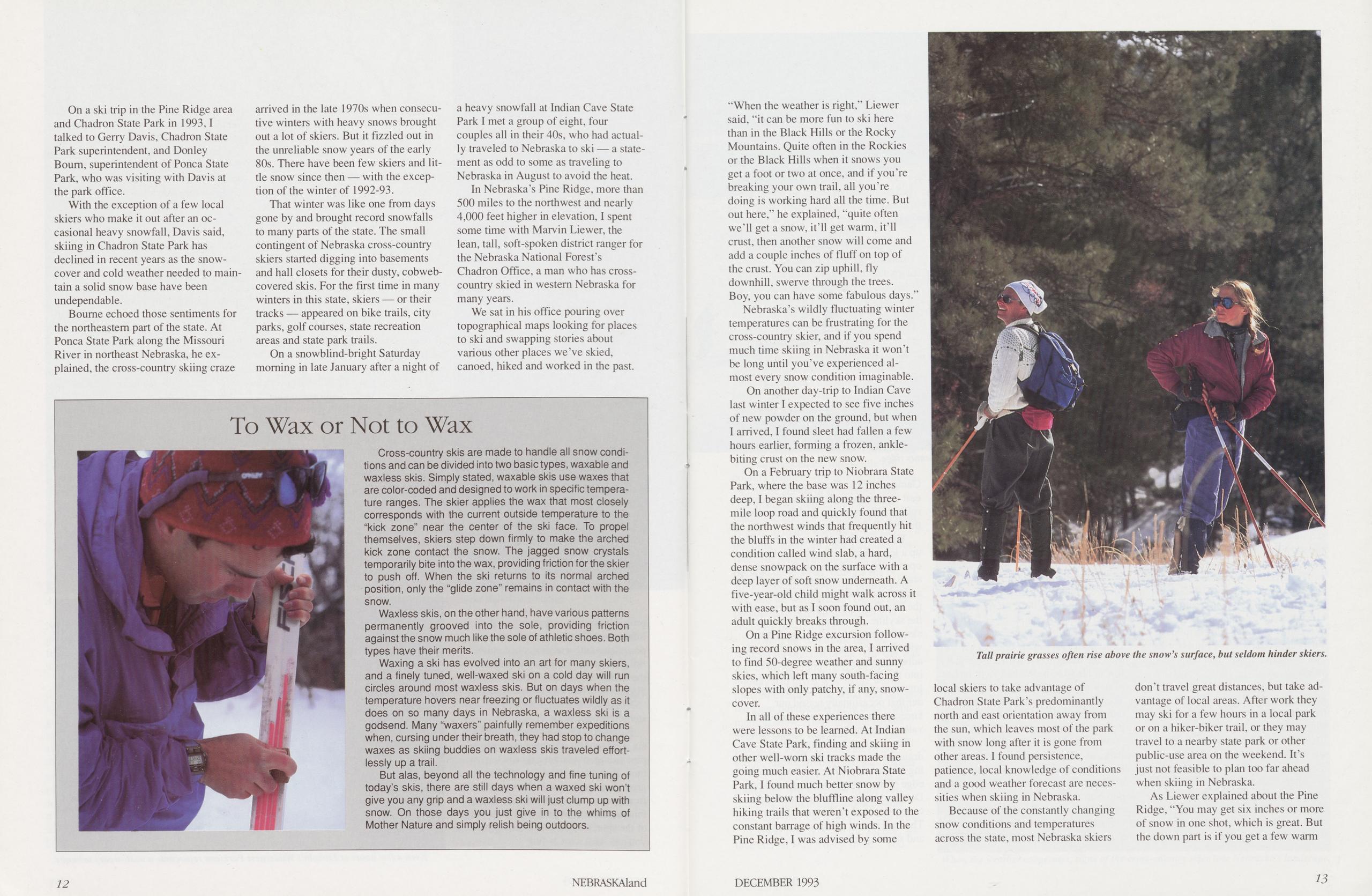
On a ski trip in the Pine Ridge area and Chadron State Park in 1993,1 talked to Gerry Davis, Chadron State Park superintendent, and Donley Bourn, superintendent of Ponca State Park, who was visiting with Davis at the park office.
With the exception of a few local skiers who make it out after an occasional heavy snowfall, Davis said, skiing in Chadron State Park has declined in recent years as the snow cover and cold weather needed to maintain a solid snow base have been undependable.
Bourne echoed those sentiments for the northeastern part of the state. At Ponca State Park along the Missouri River in northeast Nebraska, he explained, the cross-country skiing craze arrived in the late 1970s when consecutive winters with heavy snows brought out a lot of skiers. But it fizzled out in the unreliable snow years of the early 80s. There have been few skiers and little snow since then — with the exception of the winter of 1992-93.
That winter was like one from days gone by and brought record snowfalls to many parts of the state. The small contingent of Nebraska cross-country skiers started digging into basements and hall closets for their dusty, cobweb covered skis. For the first time in many winters in this state, skiers — or their tracks — appeared on bike trails, city parks, golf courses, state recreation areas and state park trails.
On a snow-blind bright Saturday morning in late January after a night of a heavy snowfall at Indian Cave State Park I met a group of eight, four couples all in their 40s, who had actually traveled to Nebraska to ski — a statement as odd to some as traveling to Nebraska in August to avoid the heat.
In Nebraska's Pine Ridge, more than 500 miles to the northwest and nearly 4,000 feet higher in elevation, I spent some time with Marvin Liewer, the lean, tall, soft-spoken district ranger for the Nebraska National Forest's Chadron Office, a man who has cross country skied in western Nebraska for many years.
We sat in his office pouring over topographical maps looking for places to ski and swapping stories about various other places we've skied, canoed, hiked and worked in the past.
To Wax or Not to Wax
Cross-country skis are made to handle all snow conditions and can be divided into two basic types, waxable and waxless skis. Simply stated, waxable skis use waxes that are color-coded and designed to work in specific temperature ranges. The skier applies the wax that most closely corresponds with the current outside temperature to the "kick zone" near the center of the ski face. To propel themselves, skiers step down firmly to make the arched kick zone contact the snow. The jagged snow crystals temporarily bite into the wax, providing friction for the skier to push off. When the ski returns to its normal arched position, only the "glide zone" remains in contact with the snow.
Waxless skis, on the other hand, have various patterns permanently grooved into the sole, providing friction against the snow much like the sole of athletic shoes. Both types have their merits.
Waxing a ski has evolved into an art for many skiers, and a finely tuned, well-waxed ski on a cold day will run circles around most waxless skis. But on days when the temperature hovers near freezing or fluctuates wildly as it does on so many days in Nebraska, a waxless ski is a godsend. Many "waxers" painfully remember expeditions when, cursing under their breath, they had stop to change waxes as skiing buddies on waxless skis traveled effortlessly up a trail.
But alas, beyond all the technology and fine tuning of today's skis, there are still days when a waxed ski won't give you any grip and a waxless ski will just clump up with snow. On those days you just give in to the whims of Mother Nature and simply relish being outdoors.
"When the weather is right," Liewer said, "it can be more fun to ski here than in the Black Hills or the Rocky Mountains. Quite often in the Rockies or the Black Hills when it snows you get a foot or two at once, and if you're breaking your own trail, all you're doing is working hard all the time. But out here," he explained, "quite often we'll get a snow, it'll get warm, it'll crust, then another snow will come and add a couple inches of fluff on top of the crust. You can zip uphill, fly downhill, swerve through the trees. Boy, you can have some fabulous days."
Nebraska's wildly fluctuating winter temperatures can be frustrating for the cross-country skier, and if you spend much time skiing in Nebraska it won't be long until you've experienced almost every snow condition imaginable.
On another day-trip to Indian Cave last winter I expected to see five inches of new powder on the ground, but when I arrived, I found sleet had fallen a few hours earlier, forming a frozen, ankle- biting crust on the new snow.
On a February trip to Niobrara State Park, where the base was 12 inches deep, I began skiing along the three-mile loop road and quickly found that the northwest winds that frequently hit the bluffs in the winter had created a condition called wind slab, a hard, dense snowpack on the surface with a deep layer of soft snow underneath. A five-year-old child might walk across it with ease, but as I soon found out, an adult quickly breaks through.
On a Pine Ridge excursion follow- ing record snows in the area, I arrived to find 50-degree weather and sunny skies, which left many south-facing slopes with only patchy, if any, snowcover.
In all of these experiences there were lessons to be learned. At Indian Cave State Park, finding and skiing in other well-worn ski tracks made the going much easier. At Niobrara State Park, I found much better snow by skiing below the bluff line along valley hiking trails that weren't exposed to the constant barrage of high winds. In the Pine Ridge, I was advised by some
Because of the constantly changing snow conditions and temperatures across the state, most Nebraska skiers don't travel great distances, but take advantage of local areas. After work they may ski for a few hours in a local park or on a hiker-biker trail, or they may travel to a nearby state park or other public-use area on the weekend. It's just not feasible to plan too far ahead when skiing in Nebraska.
As Liewer explained about the Pine Ridge, "You may get six inches or more of snow in one shot, which is great. But the down part is if you get a few warm
12 NEBRASKAland DECEMBER 1993 13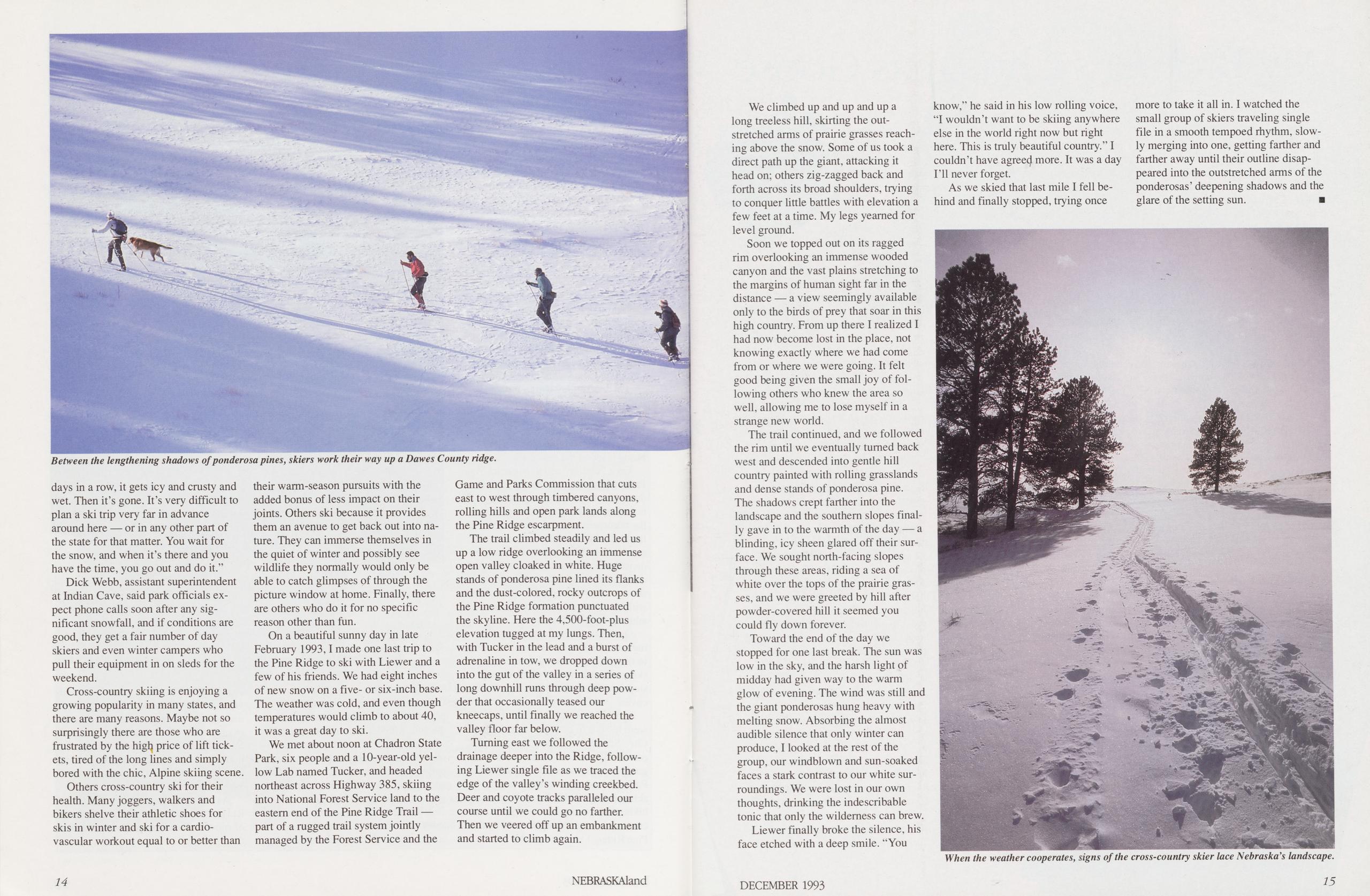
days in a row, it gets icy and crusty and wet. Then it's gone. It's very difficult to plan a ski trip very far in advance around here — or in any other part of the state for that matter. You wait for the snow, and when it's there and you have the time, you go out and do it."
Dick Webb, assistant superintendent at Indian Cave, said park officials expect phone calls soon after any significant snowfall, and if conditions are good, they get a fair number of day skiers and even winter campers who pull their equipment in on sleds for the weekend.
Cross-country skiing is enjoying a growing popularity in many states, and there are many reasons. Maybe not so surprisingly there are those who are frustrated by the high price of lift tickets, tired of the long lines and simply bored with the chic, Alpine skiing scene. Others cross-country ski for their health. Many joggers, walkers and bikers shelve their athletic shoes for skis in winter and ski for a cardiovascular workout equal to or better than their warm-season pursuits with the added bonus of less impact on their joints. Others ski because it provides them an avenue to get back out into nature. They can immerse themselves in the quiet of winter and possibly see wildlife they normally would only be able to catch glimpses of through the picture window at home. Finally, there are others who do it for no specific reason other than fun.
On a beautiful sunny day in late February 1993,1 made one last trip to the Pine Ridge to ski with Liewer and a few of his friends. We had eight inches of new snow on a five- or six-inch base. The weather was cold, and even though temperatures would climb to about 40, it was a great day to ski.
We met about noon at Chadron State Park, six people and a 10-year-old yellow Lab named Tucker, and headed northeast across Highway 385, skiing into National Forest Service land to the eastern end of the Pine Ridge Trail — part of a rugged trail system jointly managed by the Forest Service and the Game and Parks Commission that cuts east to west through timbered canyons, rolling hills and open park lands along the Pine Ridge escarpment.
The trail climbed steadily and led us up a low ridge overlooking an immense open valley cloaked in white. Huge stands of ponderosa pine lined its flanks and the dust-colored, rocky outcrops of the Pine Ridge formation punctuated the skyline. Here the 4,500-foot-plus elevation tugged at my lungs. Then, with Tucker in the lead and a burst of adrenaline in tow, we dropped down into the gut of the valley in a series of long downhill runs through deep powder that occasionally teased our kneecaps, until finally we reached the valley floor far below.
Turning east we followed the drainage deeper into the Ridge, following Liewer single file as we traced the edge of the valley's winding creek bed. Deer and coyote tracks paralleled our course until we could go no farther. Then we veered off up an embankment and started to climb again.
14 NEBRASKAlandWe climbed up and up and up a long treeless hill, skirting the outstretched arms of prairie grasses reaching above the snow. Some of us took a direct path up the giant, attacking it head on; others zig-zagged back and forth across its broad shoulders, trying to conquer little battles with elevation a few feet at a time. My legs yearned for level ground.
Soon we topped out on its ragged rim overlooking an immense wooded canyon and the vast plains stretching to the margins of human sight far in the distance — a view seemingly available only to the birds of prey that soar in this high country. From up there I realized I had now become lost in the place, not knowing exactly where we had come from or where we were going. It felt good being given the small joy of following others who knew the area so well, allowing me to lose myself in a strange new world.
The trail continued, and we followed the rim until we eventually turned back west and descended into gentle hill country painted with rolling grasslands and dense stands of ponderosa pine. The shadows crept farther into the landscape and the southern slopes finally gave in to the warmth of the day — a blinding, icy sheen glared off their surface. We sought north-facing slopes through these areas, riding a sea of white over the tops of the prairie grasses, and we were greeted by hill after powder-covered hill it seemed you could fly down forever.
Toward the end of the day we stopped for one last break. The sun was low in the sky, and the harsh light of midday had given way to the warm glow of evening. The wind was still and the giant ponderosas hung heavy with melting snow. Absorbing the almost audible silence that only winter can produce, I looked at the rest of the group, our windblown and sun-soaked faces a stark contrast to our white surroundings. We were lost in our own thoughts, drinking the indescribable tonic that only the wilderness can brew.
Liewer finally broke the silence, his face etched with a deep smile. "You know," he said in his low rolling voice, "I wouldn't want to be skiing anywhere else in the world right now but right here. This is truly beautiful country." I couldn't have agree more. It was a day I'll never forget.
As we skied that last mile I fell behind and finally stopped, trying once more to take it all in. I watched the small group of skiers traveling single file in a smooth tempoed rhythm, slowly merging into one, getting farther and farther away until their outline disappeared into the outstretched arms of the ponderosas' deepening shadows and the glare of the setting sun.
My Brother's Christmas Goose
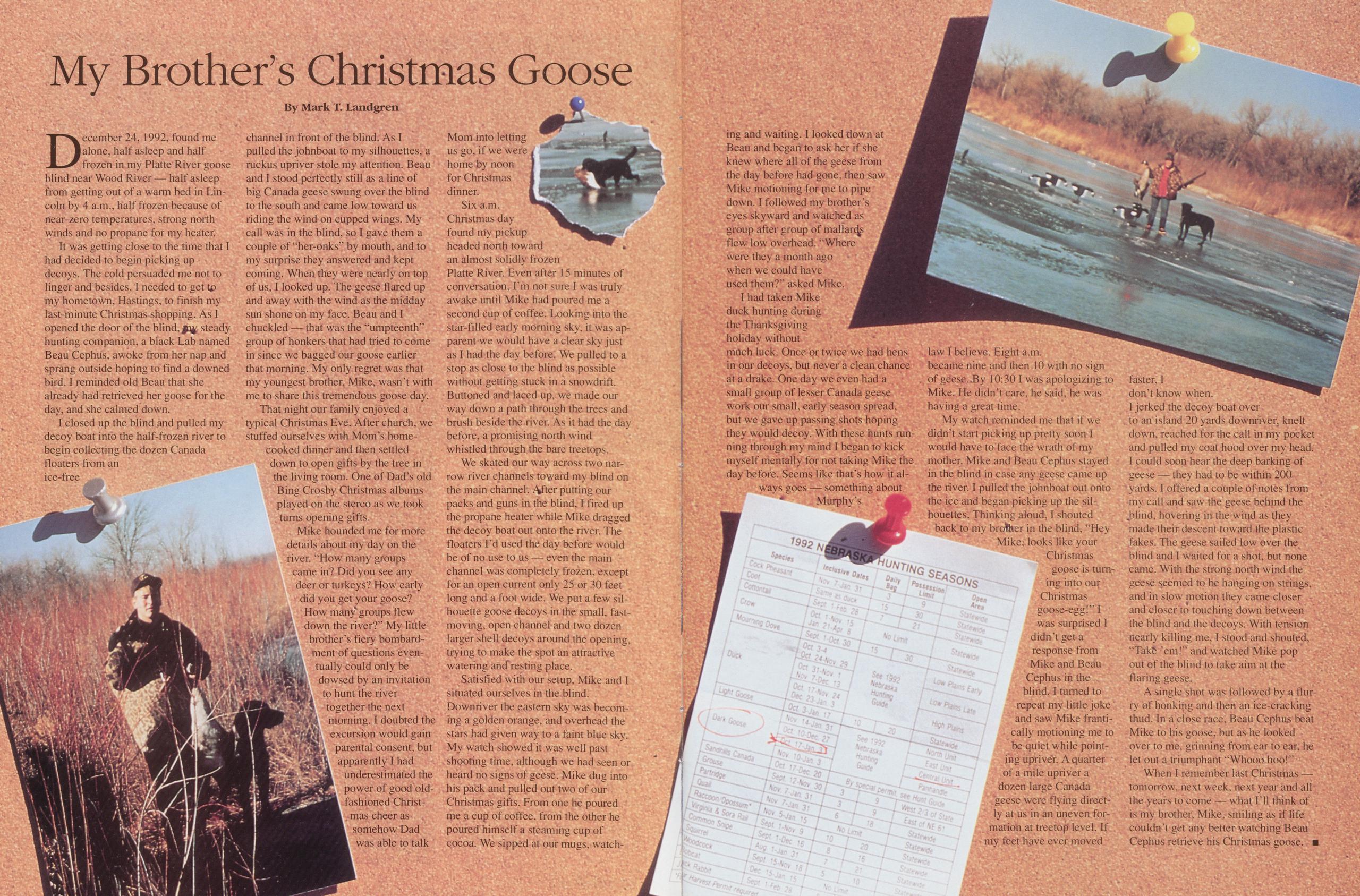
December 24, 1992, found me alone, half asleep and half frozen in my Platte River goose blind near Wood River — half asleep from getting out of a warm bed in Lincoln by 4 a.m., half frozen because of near-zero temperatures, strong north winds and no propane for my heater.
It was getting close to the time that I had decided to begin picking up decoys. The cold persuaded me not to linger and besides, I needed to get to my hometown, Hastings, to finish my last-minute Christmas shopping. As I opened the door of the blind, fay steady hunting companion, a black Lab named Beau Cephus, awoke from her nap and sprang outside hoping to find a downed bird. I reminded old Beau that she already had retrieved her goose for the day, and she calmed down.
I closed up the blind and pulled my decoy boat into the half-frozen river to begin collecting the dozen Canada floaters from an ice-free channel in front of the blind. As I pulled the johnboat to my silhouettes, a ruckus upriver stole my attention. Beau and I stood perfectly still as a line of big Canada geese swung over the blind to the south and came low toward us riding the wind on cupped wings. My call was in the blind, so I gave them a couple of "her-onks" by mouth, and to my surprise they answered and kept coming. When they were nearly on top of us, I looked up. The geese flared up and away with the wind as the midday sun shone on my face. Beau and I chuckled — that was the "umpteenth'' group of honkers that had tried to come in since we bagged our goose earlier that morning. My only regret was that my youngest brother, Mike, wasn't with me to share this tremendous goose day.
That night our family enjoyed a typical Christmas Eve. After church, we stuffed ourselves with Mom's home cooked dinner and then settled down to open gifts by the tree in the living room. One of Dad's old Bing Crosby Christmas albums played on the stereo as we took turns opening gifts.
Mike hounded me for more details about my day on the river. "How many groups came in? Did you see any deer or turkeys? How early did you get your goose?
How many groups flew down the river?" My little brother's fiery bombardment of questions eventually could only be dowsed by an invitation to hunt the river together the next morning. I doubted the excursion would gain parental consent, but apparently I had underestimated the power of good old- fashioned Christmas cheer as somehow Dad was able to talk Mom into letting us go, if we were home by noon for Christmas dinner.
Six a.m. Christmas day found my pickup headed north toward an almost solidly frozen Platte River. Even after 15 minutes of conversation, I'm not sure I was truly awake until Mike had poured me a second cup of coffee. Looking into the star-filled early morning sky, it was apparent we would have a clear sky just as I had the day before. We pulled to a stop as close to the blind as possible without getting stuck in a snowdrift. Buttoned and laced up, we made our way down a path through the trees and brush beside the river. As it had the day before, a promising north wind whistled through the bare treetops.
We skated our way across two narrow river channels toward my blind on the main channel. After putting our packs and guns in the blind, I fired up the propane heater while Mike dragged the decoy boat out onto the river. The floaters I'd used the day before would be of no use to us — even the main channel was completely frozen, except for an open current only 25 or 30 feet long and a foot wide. We put a few silhouette goose decoys in the small, fast moving, open channel and two dozen larger shell decoys around the opening, trying to make the spot an attractive watering andTesting place.
Satisfied with our setup, Mike and I situated ourselves in the blind. Downriver the eastern sky was becoming a golden orange, and overhead the stars had given way to a faint blue sky. My watch showed it was well past shooting time, although we had seen or heard no signs of geese. Mike dug into his pack and pulled out two of our Christmas gifts. From one he poured me a cup of coffee, from the other he poured himself a steaming cup of cocoa. We sipped at our mugs, watching and waiting. I looked down at Beau and began to ask her if she knew where all of the geese from the day before had gone, then saw Mike motioning for pie to pipe down. I followed my brother's eyes skyward and watched as group after group of mallards flew low overhead. "Where were they a month ago when we could have used them?" asked Mike.
I had taken Mike duck hunting during the Thanksgiving holiday without much luck. Once or twice we had hens in our decoys, but never a clean chance at a drake. One day we even had a small group of lesser Canada geese work our small, early season spread, but we gave up passing shots hoping they would decoy. With these hunts running through my mind I began to kick myself mentally for not taking Mike the day before. Seems like that's how it always goes — something about Murphy's law I believe. Eight a.m. became nine and then 10 with no sign of geese..By 10:30 I was apologizing to Mike. He didn't care, he said, he was having a great time.
My watch reminded me that if we didn't start picking up pretty soon I would have to face the wrath of my mother. Mike and Beau Cephus stayed in the blind in case any geese came up the river. I pulled the johnboat out onto the ice and began picking up the silhouettes. Thinking aloud, I shouted back to my brother in the blind, "Hey Mike, looks like your Christmas goose is turning into our Christmas goose-egg!" I was surprised I didn't get a response from Mike and Beau Cephus in the blind. I turned to repeat my little joke and saw Mike frantically motioning me to be quiet while pointing upriver. A quarter of a mile upriver a dozen large Canada geese were flying directly at us in an uneven formation at treetop level. If my feet have ever moved faster, I don't know when. I jerked the decoy boat over to an island 20 yards downriver, knelt down, reached for the call in my pocket and pulled my coat hood over my head. I could soon hear the deep barking of geese — they had to be within 200 yards. I offered a couple of notes from my call and saw the geese behind the blind, hovering in the wind as they made their descent toward the plastic fakes. The geese sailed low over the blind and I waited for a shot, but none came. With the strong north wind the geese seemed to be hanging on strings, and in slow motion they came closer and closer to touching down between the blind and the decoys. With tension nearly killing me, I stood and shouted, "Take 'em!" and watched Mike pop out of the blind to take aim at the
A single shot was followed by a flurry of honking and then an ice-cracking thud. In a close race, Beau Cephus beat Mike to his goose, but as he looked over to me, grinning from ear to ear, he let out a triumphant "Whooo hoo!"
When I remember last Christmas — tomorrow, next week, next year and all the years to come — what I'll think of is my brother, Mike, smiling as if life couldn't get any better watching Beau Cephus retrieve his Christmas goose.
NEBRASKAland Magazine's ICE FISHING GUIDE
Winter Madness?
Inexplicable as it may seem to many "normal" Nebraskans, there is among us a dedicated coterie of people who relish long, cold winters — people who religiously watch the 10 o'clock weather and are cheered by the prospect of below-zero nights and cold, gray days.
These are the people who can spend a long autumn afternoon in the workshop inventing a new, improved, collapsible shelter, who haunt garage sales in search of broken fishing rod tips, and who will pass up a comfortable couch and a football game in order to spend a January Sunday afternoon sitting on an upended drywall bucket in the middle of a frozen lake.
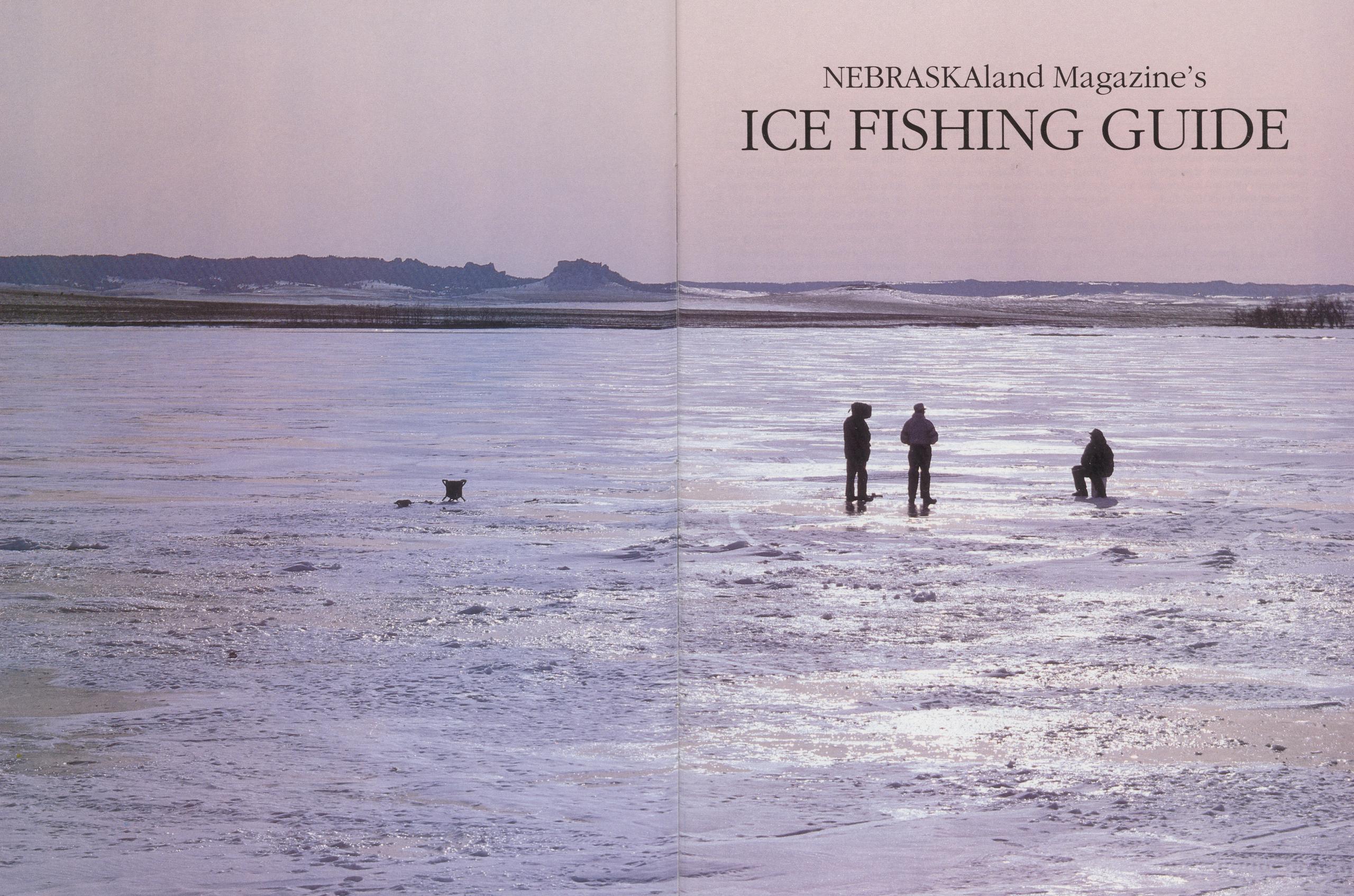
The name of their dementia is ice fishing, and it is only fair to offer this warning: Ice fishing is a contagious and wide-spread madness. Its signs — hunched figures staring down into holes in the ice, rambling communities of shanties, shelters and tents covering frozen lake surfaces — are likely to be seen on U S West Lake at Eugene T. Mahoney State Park in eastern Nebraska, on Box Butte Reservoir in the Panhandle, on Holmes Lake, a snowball's throw from downtown Lincoln or on Oliver Reservoir near Kimball, more than 300 miles to the west.
Nevertheless, a knowledge of ice fishing tackle and techniques, equipment, baits, lures and safety on the ice does not automatically accompany the disease, and for the newly infected — as well as for the old enthusiast who wants to brush up on equipment and techniques — NEBRASKAland Magazine invites you to enjoy this Ice Fishing Guide.
EquipmentFrom the collections of buckets, sleds, shelters, heaters and other trappings strewn around the anglers on a frozen lake, it is clear that equipment plays an important role in ice fishing. But it's not the amount of equipment nor its complexity and cost that make an effective ice-fishing outfit. More important is how the equipment fits the fishing style of the angler using it. Obviously, veteran ice fishermen understand that, and no two of them are ever equipped exactly alike.
ClothingThe only equipment about which most anglers agree is clothing and boots, and anyone out on the ice in the wrong attire pays dearly in discomfort or frostbite.
Perhaps the single most important item in ice fishing wardrobe is footwear. Poorly shod feet pressed onto the ice will soon chill, and insulated rubber boots, or pac boots with separate, thick felt liners, are the best insurance against cold feet. Daintiness is not required in good ice-fishing boots, and they should fit loose enough to accommodate extra socks and to allow maximum blood circulation.
Most insulated hiking, hunting or work boots will not do the job for most people. Neither will inexpensive nylon or plastic boots lined with synthetic fur. Gimmicks, such as battery-powered electric socks, can be a big disappointment in cold weather.
For most anglers, rubber or rubber-and-leather boots with heavy felt liners,good quality insulated rubber boots designed for extreme cold or government surplus arctic boots with air chambers for insulation are best. Snowmobile boots with felt liners are often adequate, as are lightweight, inexpensive "moon boots."
Above the boots, several layers of comparatively light clothing are warmer than just one or two bulky garments. The layers trap air for maximum warmth and also allow the angler to add or remove layers to match changes in temperature or level of activity. At moments of heavy exertion — dragging equipment across the ice or auguring holes — an angler can shed some clothing and avoid breaking into a sweat. Perspiring should be avoided since the body will later use considerable heat to dry out damp inner clothing.
Good headgear is particularly important. Up to 75 percent of the heat lost on a cold day leaves the body from the head and neck. A wool cap or parka hood can provide comfort when you feel a chill, and if you are on the verge of breaking into a sweat you can cool off merely by exposing your head.
Comfortable long underwear worn next to the skin topped by insulated coveralls or a wool, down or fiberfill insulated snowmobile suit for a middle layer and a windproof, moisture- repellent outer layer make a good combination. Many anglers also wear a heavy parka for added warmth and as a barrier against the wind.
Gloves are also needed, although the importance placed on them varies among anglers. Some wear light gloves inside mittens and do all but the most delicate knot tying and hook baiting with the gloves on. Others wear bulky, loose-fitting mittens and put them aside to do most tasks. Some anglers use gloves only when lugging gear long distances, keeping their hands stuffed deep inside warm pockets the rest of the time. If you need gloves on the ice, take two pairs in case the first pair gets lost or wet.
SheltersEven for a well-dressed angler, ice fishing on a bitter-cold day is often no more than tolerable. But it can be downright enjoyable with a shelter or wind shield. The difference between misery and comfort on the rawest winter days often is merely the shelter of a tiny windbreak, a simple hut or tent.
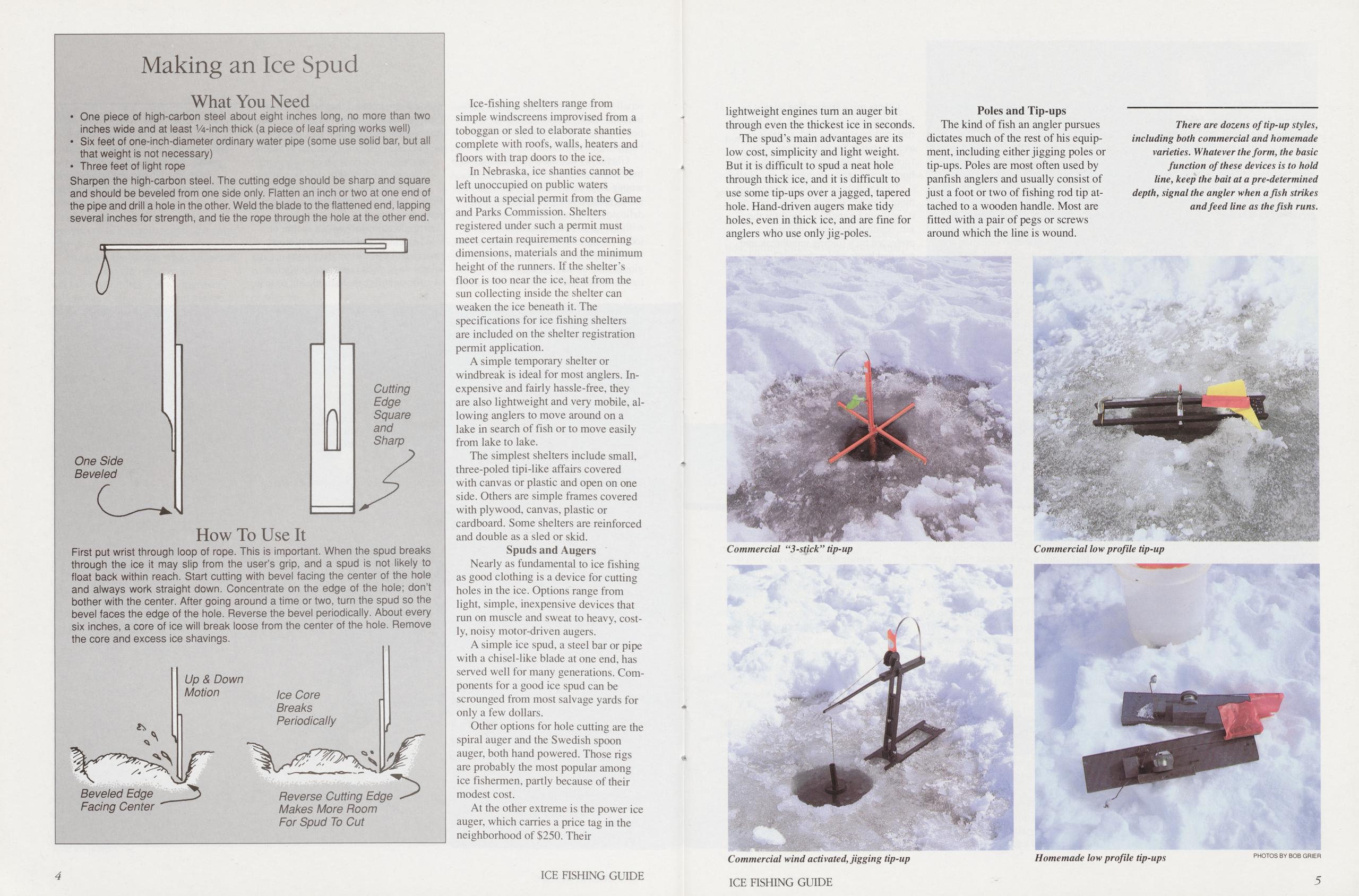
Making an Ice Spud
What You Need
• One piece of high-carbon steel about eight inches long, no more than two inches wide and at least Winch thick (a piece of leaf spring works well)
• Six feet of one-inch-diameter ordinary water pipe (some use solid bar, but all that weight is not necessary)
• Three feet of light rope
Sharpen the high-carbon steel. The cutting edge should be sharp and square and should be beveled from one side only. Flatten an inch or two at one end of the pipe and drill a hole in the other. Weld the blade to the flattened end, lapping several inches for strength, and tie the rope through the hole at the other end.
First put wrist through loop of rope. This is important. When the spud breaks through the ice it may slip from the user's grip, and a spud is not likely to float back within reach. Start cutting with bevel facing the center of the hole and always work straight down. Concentrate on the edge of the hole; don't bother with the center. After going around a time or two, turn the spud so the bevel faces the edge of the hole. Reverse the bevel periodically. About every six inches, a core of ice will break loose from the center of the hole. Remove the core and excess ice shavings.
Ice-fishing shelters range from simple windscreens improvised from a toboggan or sled to elaborate shanties complete with roofs, walls, heaters and floors with trap doors to the ice.
In Nebraska, ice shanties cannot be left unoccupied on public waters without a special permit from the Game and Parks Commission. Shelters registered under such a permit must meet certain requirements concerning dimensions, materials and the minimum height of the runners. If the shelter's floor is too near the ice, heat from the sun collecting inside the shelter can weaken the ice beneath it. The specifications for ice fishing shelters are included on the shelter registration permit application.
A simple temporary shelter or windbreak is ideal for most anglers. Inexpensive and fairly hassle-free, they are also lightweight and very mobile, allowing anglers to move around on a lake in search of fish or to move easily from lake to lake.
The simplest shelters include small, three-poled tipi-like affairs covered with canvas or plastic and open on one side. Others are simple frames covered with plywood, canvas, plastic or cardboard. Some shelters are reinforced and double as a sled or skid.
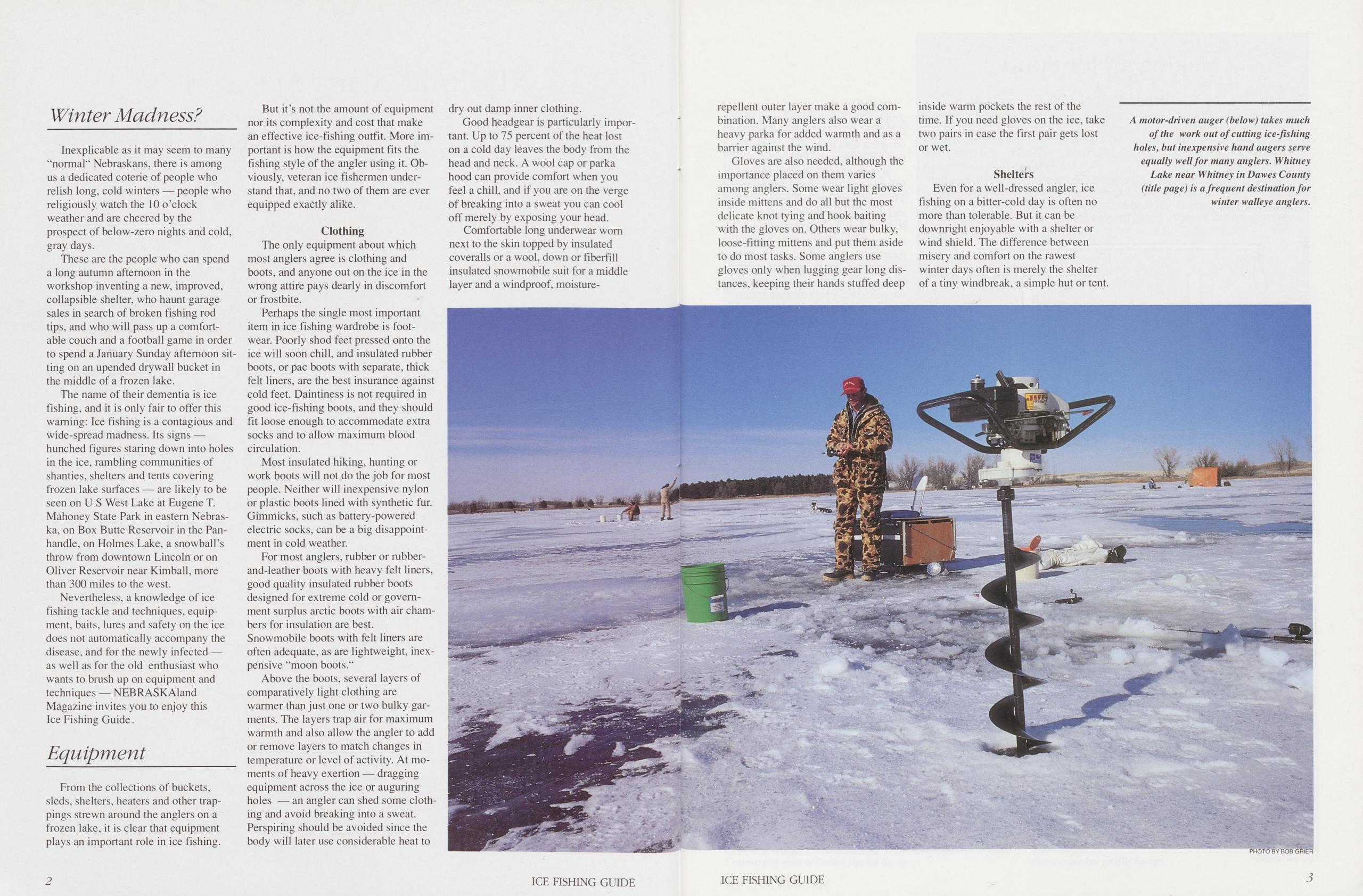
Spuds and AugersNearly as fundamental to ice fishing as good clothing is a device for cutting holes in the ice. Options range from light, simple, inexpensive devices that run on muscle and sweat to heavy, costly, noisy motor-driven augers.
A simple ice spud, a steel bar or pipe with a chisel-like blade at one end, has served well for many generations. Components for a good ice spud can be scrounged from most salvage yards for only a few dollars.
Other options for hole cutting are the spiral auger and the Swedish spoon auger, both hand powered. Those rigs are probably the most popular among ice fishermen, partly because of their modest cost.
At the other extreme is the power ice auger, which carries a price tag in the neighborhood of $250. Their 4 ICE FISHING GUIDE lightweight engines turn an auger bit through even the thickest ice in seconds.
The spud's main advantages are its low cost, simplicity and light weight. But it is difficult to spud a neat hole through thick ice, and it is difficult to use some tip-ups over a jagged, tapered hole. Hand-driven augers make tidy holes, even in thick ice, and are fine for anglers who use only jig-poles.
Poles and Tip-upsThe kind of fish an angler pursues dictates much of the rest of his equipment, including either jigging poles or tip-ups. Poles are most often used by panfish anglers and usually consist of just a foot or two of fishing rod tip attached to a wooden handle. Most are fitted with a pair of pegs or screws around which the line is wound.
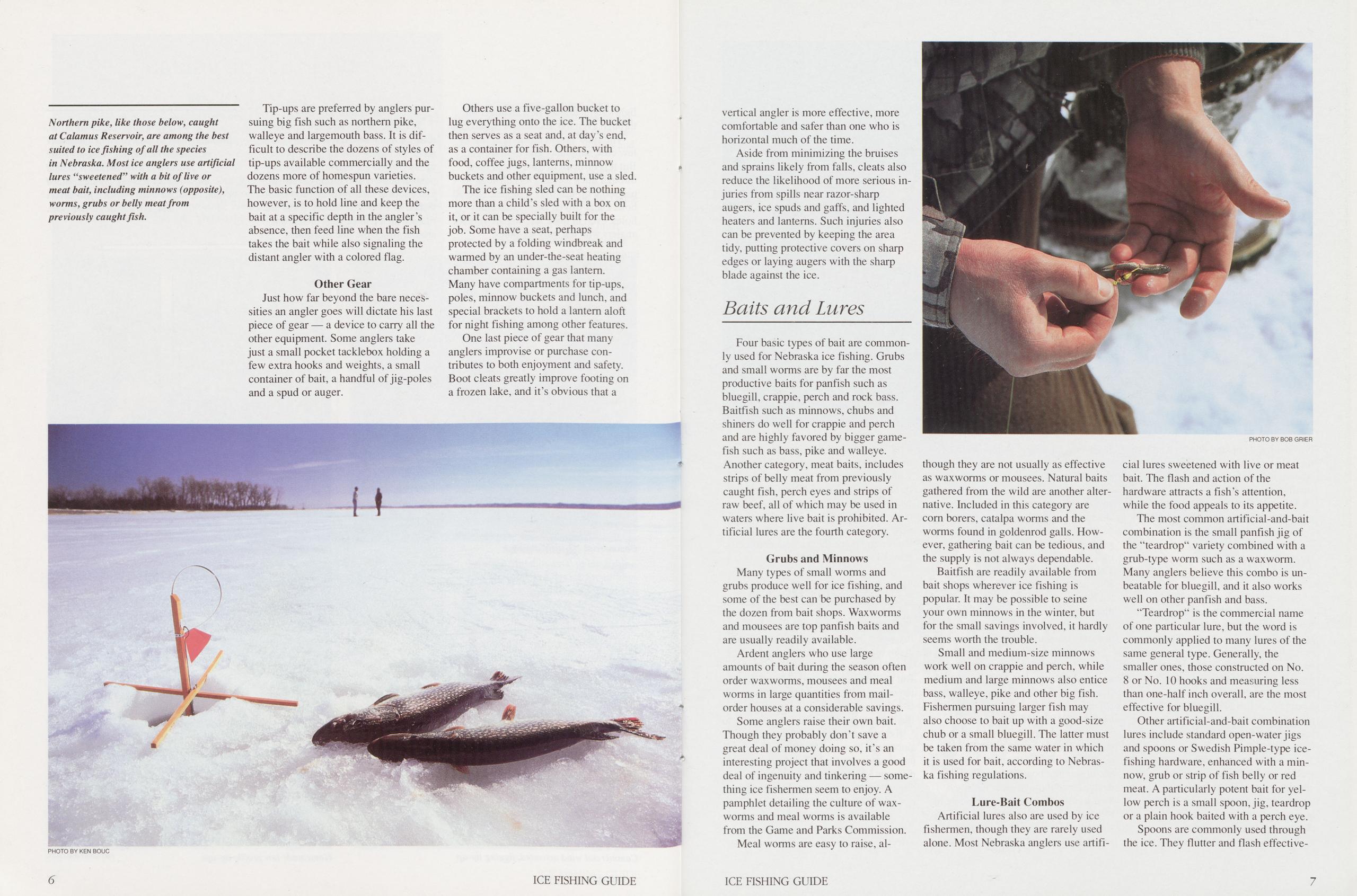
Tip-ups are preferred by anglers pursuing big fish such as northern pike, walleye and largemouth bass. It is difficult to describe the dozens of styles of tip-ups available commercially and the dozens more of homespun varieties. The basic function of all these devices, however, is to hold line and keep the bait at a specific depth in the angler's absence, then feed line when the fish takes the bait while also signaling the distant angler with a colored flag.
Other GearJust how far beyond the bare necessities an angler goes will dictate his last piece of gear — a device to carry all the other equipment. Some anglers take just a small pocket tacklebox holding a few extra hooks and weights, a small container of bait, a handful of jig-poles and a spud or auger.
Others use a five-gallon bucket to lug everything onto the ice. The bucket then serves as a seat and, at day's end, as a container for fish. Others, with food, coffee jugs, lanterns, minnow buckets and other equipment, use a sled.
The ice fishing sled can be nothing more than a child's sled with a box on it, or it can be specially built for the job. Some have a seat, perhaps protected by a folding windbreak and warmed by an under-the-seat heating chamber containing a gas lantern. Many have compartments for tip-ups, poles, minnow buckets and lunch, and special brackets to hold a lantern aloft for night fishing among other features.
One last piece of gear that many anglers improvise or purchase contributes to both enjoyment and safety. Boot cleats greatly improve footing on a frozen lake, and it's obvious that a
Aside from minimizing the bruises and sprains likely from falls, cleats also reduce the likelihood of more serious injuries from spills near razor-sharp augers, ice spuds and gaffs, and lighted heaters and lanterns. Such injuries also can be prevented by keeping the area tidy, putting protective covers on sharp edges or laying augers with the sharp blade against the ice.
Baits and LuresFour basic types of bait are commonly used for Nebraska ice fishing. Grubs and small worms are by far the most productive baits for panfish such as bluegill, crappie, perch and rock bass. Baitfish such as minnows, chubs and shiners do well for crappie and perch and are highly favored by bigger game fish such as bass, pike and walleye. Another category, meat baits, includes strips of belly meat from previously caught fish, perch eyes and strips of raw beef, all of which may be used in waters where live bait is prohibited. Artificial lures are the fourth category.
Grubs and MinnowsMany types of small worms and grubs produce well for ice fishing, and some of the best can be purchased by the dozen from bait shops. Wax worms and mouses are top panfish baits and are usually readily available.
Ardent anglers who use large amounts of bait during the season often order waxworms, mouses and meal worms in large quantities from mailorder houses at a considerable savings.
Some anglers raise their own bait. Though they probably don't save a great deal of money doing so, it's an interesting project that involves a good deal of ingenuity and tinkering — something ice fishermen seem to enjoy. A pamphlet detailing the culture of waxworms and meal worms is available from the Game and Parks Commission. Meal worms are easy to raise, although
Baitfish are readily available from bait shops wherever ice fishing is popular. It may be possible to seine your own minnows in the winter, but for the small savings involved, it hardly seems worth the trouble.
Small and medium-size minnows work well on crappie and perch, while medium and large minnows also entice bass, walleye, pike and other big fish. Fishermen pursuing larger fish may also choose to bait up with a good-size chub or a small bluegill. The latter must be taken from the same water in which it is used for bait, according to Nebraska fishing regulations.
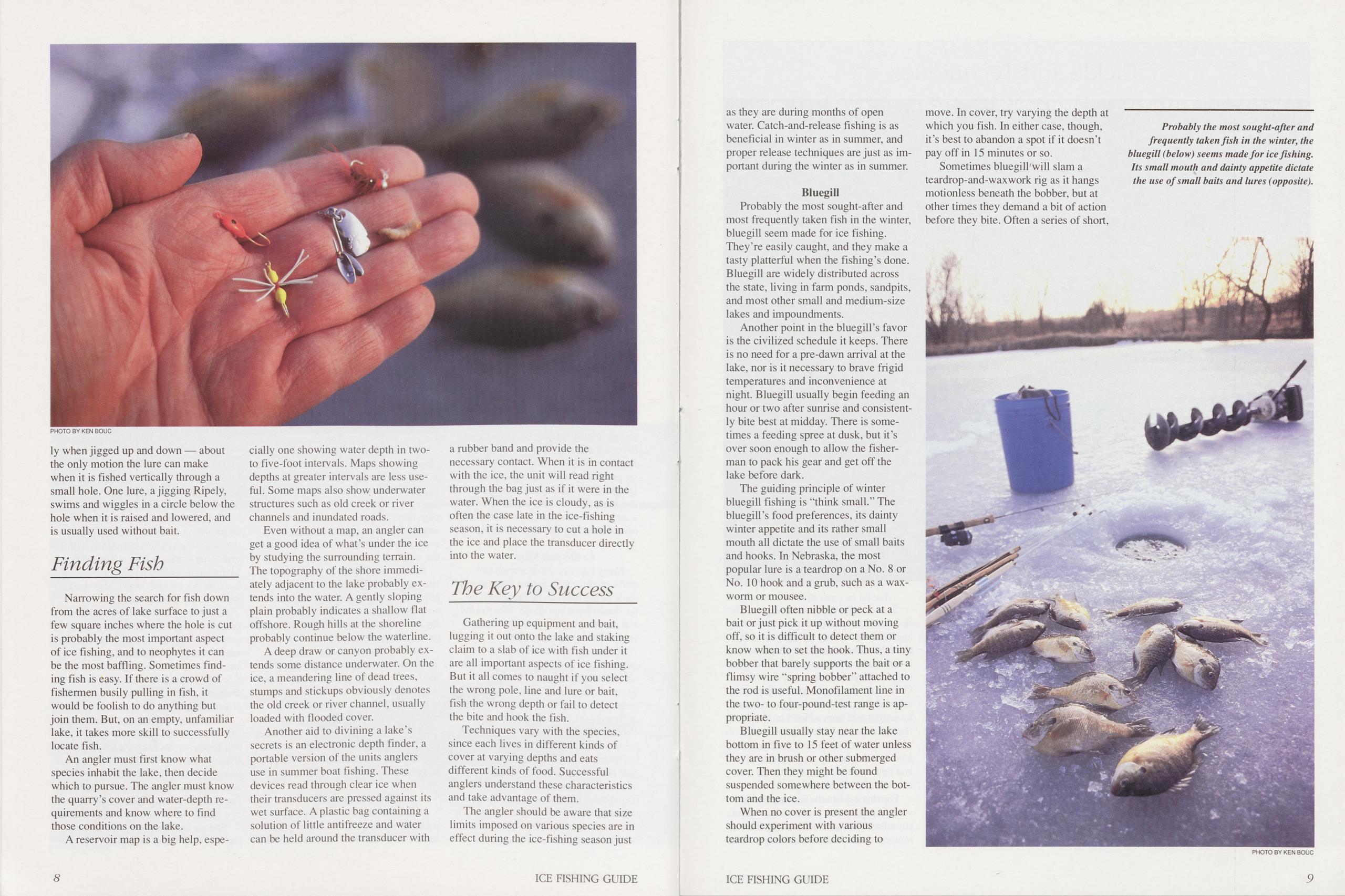
Lure-Bait CombosArtificial lures also are used by ice fishermen, though they are rarely used alone. Most Nebraska anglers use artificial lures sweetened with live or meat bait. The flash and action of the hardware attracts a fish's attention, while the food appeals to its appetite.
The most common artificial-and-bait combination is the small panfish jig of the "teardrop" variety combined with a grub-type worm such as a waxworm. Many anglers believe this combo is unbeatable for bluegill, and it also works well on other panfish and bass.
"Teardrop" is the commercial name of one particular lure, but the word is commonly applied to many lures of the same general type. Generally, the smaller ones, those constructed on No. 8 or No. 10 hooks and measuring less than one-half inch overall, are the most effective for bluegill.
Other artificial-and-bait combination
lures include standard open-water jigs
and spoons or Swedish Pimple-type
ice fishing hardware, enhanced with a
minnow, grub or strip of fish belly or red
meat. A particularly potent bait for
yellow perch is a small spoon, jig, teardrop
or a plain hook baited with a perch eye.
Spoons are commonly used through
the ice. They flutter and flash effectively
6 ICE FISHING GUIDE
ICE FISHING GUIDE
7
Narrowing the search for fish down from the acres of lake surface to just a few square inches where the hole is cut is probably the most important aspect of ice fishing, and to neophytes it can be the most baffling. Sometimes finding fish is easy. If there is a crowd of fishermen busily pulling in fish, it would be foolish to do anything but join them. But, on an empty, unfamiliar lake, it takes more skill to successfully locate fish.
An angler must first know what species inhabit the lake, then decide which to pursue. The angler must know the quarry's cover and water-depth requirements and know where to find those conditions on the lake.
A reservoir map is a big help, especially one showing water depth in two-to five-foot intervals. Maps showing depths at greater intervals are less useful. Some maps also show underwater structures such as old creek or river channels and inundated roads.
Even without a map, an angler can get a good idea of what's under the ice by studying the surrounding terrain. The topography of the shore immediately adjacent to the lake probably extends into the water. A gently sloping plain probably indicates a shallow flat offshore. Rough hills at the shoreline probably continue below the waterline.
A deep draw or canyon probably extends some distance underwater. On the ice, a meandering line of dead trees, stumps and stickups obviously denotes the old creek or river channel, usually loaded with flooded cover.
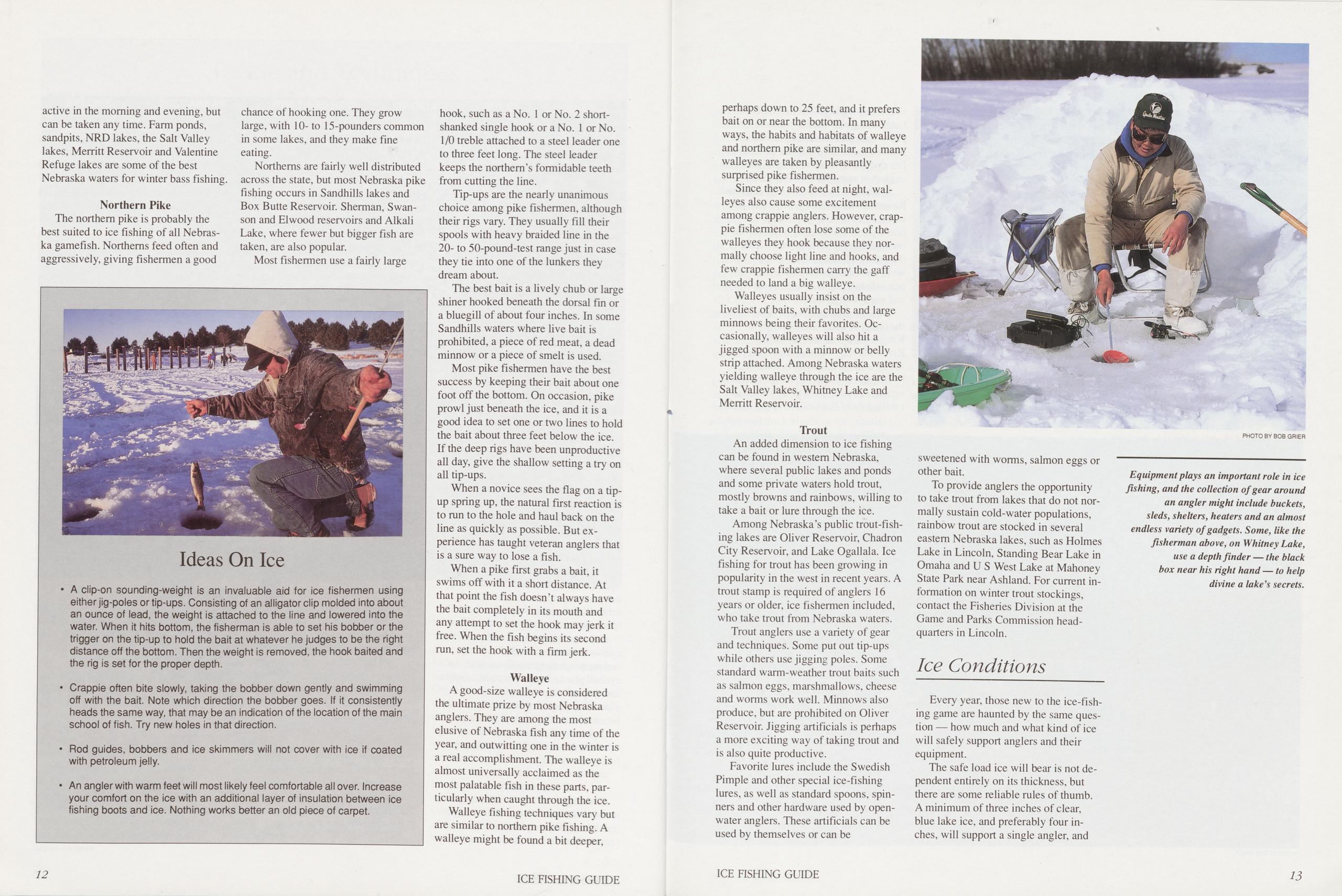
Another aid to divining a lake's secrets is an electronic depth finder, a portable version of the units anglers use in summer boat fishing. These devices read through clear ice when their transducers are pressed against its wet surface. A plastic bag containing a solution of little antifreeze and water can be held around the transducer with a rubber band and provide the necessary contact. When it is in contact with the ice, the unit will read right through the bag just as if it were in the water. When the ice is cloudy, as is often the case late in the ice-fishing season, it is necessary to cut a hole in the ice and place the transducer directly into the water.
The Key to SuccessGathering up equipment and bait, lugging it out onto the lake and staking claim to a slab of ice with fish under it are all important aspects of ice fishing. But it all comes to naught if you select the wrong pole, line and lure or bait, fish the wrong depth or fail to detect the bite and hook the fish.
Techniques vary with the species, since each lives in different kinds of cover at varying depths and eats different kinds of food. Successful anglers understand these characteristics and take advantage of them.
The angler should be aware that size limits imposed on various species are in effect during the ice-fishing season just 8 ICE FISHING GUIDE as they are during months of open water. Catch-and-release fishing is as beneficial in winter as in summer, and proper release techniques are just as important during the winter as in summer.
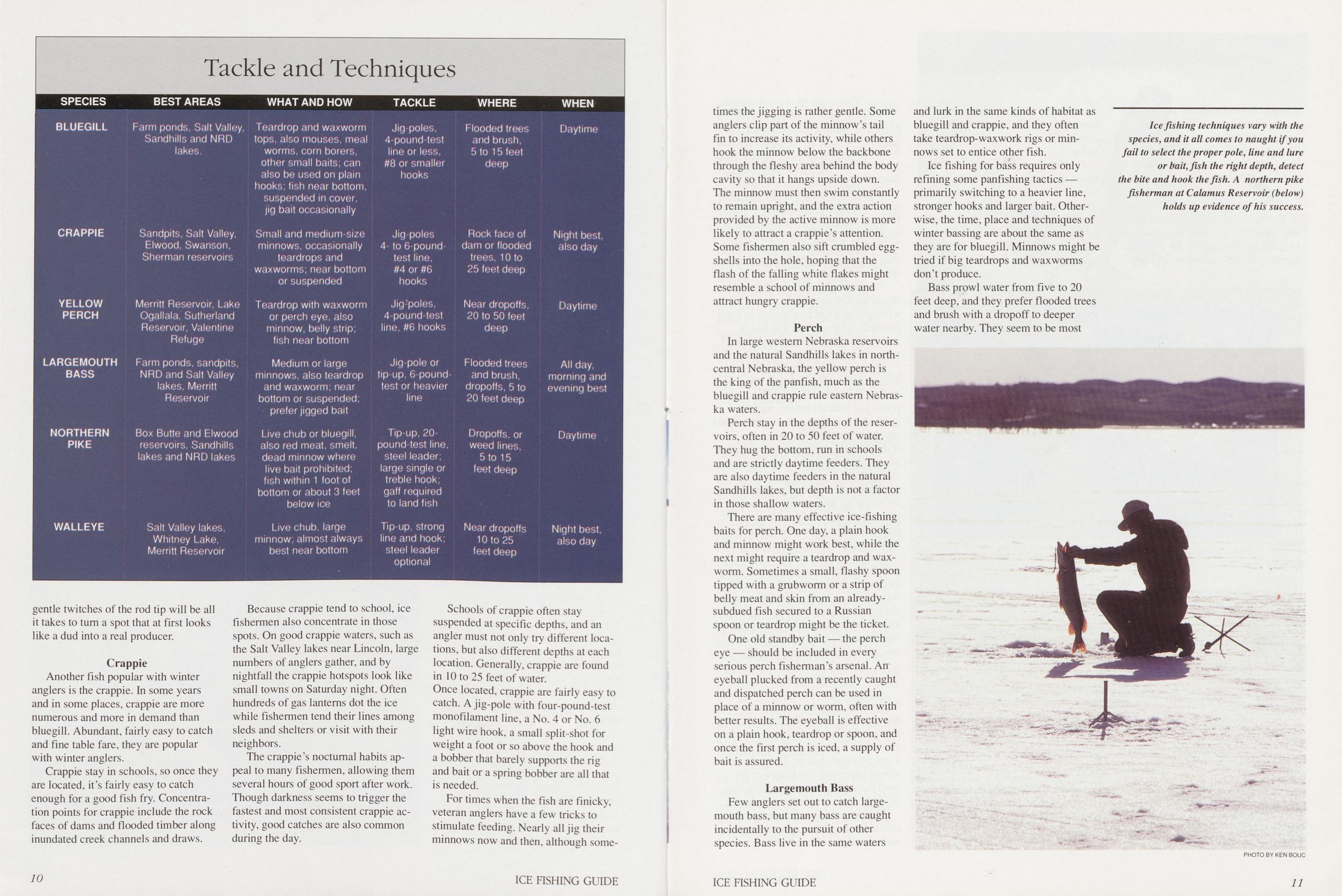
BluegillProbably the most sought-after and most frequently taken fish in the winter, bluegill seem made for ice fishing. They're easily caught, and they make a tasty platterful when the fishing's done. Bluegill are widely distributed across the state, living in farm ponds, sandpits, and most other small and medium-size lakes and impoundments.
Another point in the bluegill's favor is the civilized schedule it keeps. There is no need for a pre-dawn arrival at the lake, nor is it necessary to brave frigid temperatures and inconvenience at night. Bluegill usually begin feeding an hour or two after sunrise and consistently bite best at midday. There is sometimes a feeding spree at dusk, but it's over soon enough to allow the fisherman to pack his gear and get off the lake before dark.
The guiding principle of winter bluegill fishing is "think small." The bluegill's food preferences, its dainty winter appetite and its rather small mouth all dictate the use of small baits and hooks. In Nebraska, the most popular lure is a teardrop on a No. 8 or No. 10 hook and a grub, such as a waxworm or mousse.
Bluegill often nibble or peck at a bait or just pick it up without moving off, so it is difficult to detect them or know when to set the hook. Thus, a tiny bobber that barely supports the bait or a flimsy wire "spring bobber" attached to the rod is useful. Monofilament line in the two- to four-pound-test range is appropriate.
Bluegill usually stay near the lake bottom in five to 15 feet of water unless they are in brush or other submerged cover. Then they might be found suspended somewhere between the bottom and the ice.
When no cover is present the angler should experiment with various teardrop colors before deciding to move. In cover, try varying the depth at which you fish. In either case, though, it's best to abandon a spot if it doesn't pay off in 15 minutes or so.
Sometimes bluegill will slam a teardrop-and-waxwork rig as it hangs motionless beneath the bobber, but at other times they demand a bit of action before they bite. Often a series of short,
 SPECIES
Tackle and Techniques
BEST AREAS
WHAT AND HOW
TACKLE
WHERE
WHEN
Sandhills and NRD
lakes.
CRAPPIE
Sandpits Salt Valley,
Elwood Swansea,
Sherman reservoirs
YELLOW
PERCH
Merritt Reservoir, Lake
Opallala, Sutherland
Reservoir, Valentine
Refuge
tops, also mouses, meal
worms, corn borers,
other small baits; can
also be used on plain
hooks; fish near bottom,
suspended in cover,
jig bait occasionally
Small and medium size
minnows, occasionally
teardrops and
wax worms; near bottom
or suspended
Teardrop with waxworm
or perch eye, also
minnow, belly strip;
fish near bottom
4 pound test
line or Ice
#8 or smaller
hooks
Jig poles
4 to 6 pound
test line,
#4 or //6
hook',
Jig poles,
4 pound test
line, #6 hooks
and brush,
6 to 15 feet
(Jeep
laytime
LARGEMOUTH Farm ponds, sandpits, Medium or large Jig pole or
BASS NRD and Salt Valley minnows, also teardrop tip up, 6 pound
lakes, Merritt and waxworm; near test or heavier
Reservoir bottom or suspended; line
refer jigged bait
NORTHERN Box Butte and Elwood Live chub or bluegill, tip up, 20
PIKE reservoirs. Sandhills also red meat, smelt,pound test line,
lakes and NRD lakes dead minnow w tie re live bait prohibited; fish within
1 foot of bottom or about 3 feet below ice steel leader; large single or
treble hook; gaff required to land fish
WALLEYE Salt Valley lakes,Live chub, large Tip up, strong
Whitney Lake, minnow; almost always line and hook;
Merritt Reservoir best near bottom steel leader optional
Rock face of
dam or flooded
trees, 10 to
20 feel deep
Near dropoff',
20 to 50 feet
Flooded trees
and brush,
dropoff;, 5 to
20 feet deep
Dropoffs, or
weed lines,
5 to 15
feet deep
Near dropoffs
10 to 25
feet deep
i Jim iii
also day
Daytime
All day,
morning and
evening best
Daytime
Night best
also day
SPECIES
Tackle and Techniques
BEST AREAS
WHAT AND HOW
TACKLE
WHERE
WHEN
Sandhills and NRD
lakes.
CRAPPIE
Sandpits Salt Valley,
Elwood Swansea,
Sherman reservoirs
YELLOW
PERCH
Merritt Reservoir, Lake
Opallala, Sutherland
Reservoir, Valentine
Refuge
tops, also mouses, meal
worms, corn borers,
other small baits; can
also be used on plain
hooks; fish near bottom,
suspended in cover,
jig bait occasionally
Small and medium size
minnows, occasionally
teardrops and
wax worms; near bottom
or suspended
Teardrop with waxworm
or perch eye, also
minnow, belly strip;
fish near bottom
4 pound test
line or Ice
#8 or smaller
hooks
Jig poles
4 to 6 pound
test line,
#4 or //6
hook',
Jig poles,
4 pound test
line, #6 hooks
and brush,
6 to 15 feet
(Jeep
laytime
LARGEMOUTH Farm ponds, sandpits, Medium or large Jig pole or
BASS NRD and Salt Valley minnows, also teardrop tip up, 6 pound
lakes, Merritt and waxworm; near test or heavier
Reservoir bottom or suspended; line
refer jigged bait
NORTHERN Box Butte and Elwood Live chub or bluegill, tip up, 20
PIKE reservoirs. Sandhills also red meat, smelt,pound test line,
lakes and NRD lakes dead minnow w tie re live bait prohibited; fish within
1 foot of bottom or about 3 feet below ice steel leader; large single or
treble hook; gaff required to land fish
WALLEYE Salt Valley lakes,Live chub, large Tip up, strong
Whitney Lake, minnow; almost always line and hook;
Merritt Reservoir best near bottom steel leader optional
Rock face of
dam or flooded
trees, 10 to
20 feel deep
Near dropoff',
20 to 50 feet
Flooded trees
and brush,
dropoff;, 5 to
20 feet deep
Dropoffs, or
weed lines,
5 to 15
feet deep
Near dropoffs
10 to 25
feet deep
i Jim iii
also day
Daytime
All day,
morning and
evening best
Daytime
Night best
also day
gentle twitches of the rod tip will be all it takes to turn a spot that at first looks like a dud into a real producer.
CrappieAnother fish popular with winter anglers is the crappie. In some years and in some places, crappie are more numerous and more in demand than bluegill. Abundant, fairly easy to catch and fine table fare, they are popular with winter anglers.
Crappie stay in schools, so once they are located, it's fairly easy to catch enough for a good fish fry. Concentration points for crappie include the rock faces of dams and flooded timber along inundated creek channels and draws.
Because crappie tend to school, ice fishermen also concentrate in those spots. On good crappie waters, such as the Salt Valley lakes near Lincoln, large numbers of anglers gather, and by nightfall the crappie hotspots look like small towns on Saturday night. Often hundreds of gas lanterns dot the ice while fishermen tend their lines among sleds and shelters or visit with their neighbors.
The crappie's nocturnal habits appeal to many fishermen, allowing them several hours of good sport after work. Though darkness seems to trigger the fastest and most consistent crappie activity, good catches are also common during the day.
Schools of crappie often stay suspended at specific depths, and an angler must not only try different locations, but also different depths at each location. Generally, crappie are found in 10 to 25 feet of water.
Once located, crappie are fairly easy to catch. A jig-pole with four-pound-test monofilament line, a No. 4 or No. 6 light wire hook, a small split-shot for weight a foot or so above the hook and a bobber that barely supports the rig and bait or a spring bobber are all that is needed.
For times when the fish are finicky, veteran anglers have a few tricks to stimulate feeding. Nearly all jig their minnows now and then, although sometimes 10 ICE FISHING GUIDE the jigging is rather gentle. Some anglers clip part of the minnow's tail fin to increase its activity, while others hook the minnow below the backbone through the fleshy area behind the body cavity so that it hangs upside down. The minnow must then swim constantly to remain upright, and the extra action provided by the active minnow is more likely to attract a crappie's attention. Some fishermen also sift crumbled egg shells into the hole, hoping that the flash of the falling white flakes might resemble a school of minnows and attract hungry crappie.
PerchIn large western Nebraska reservoirs and the natural Sandhills lakes in northcentral Nebraska, the yellow perch is the king of the panfish, much as the bluegill and crappie rule eastern Nebraska waters.
Perch stay in the depths of the reservoirs, often in 20 to 50 feet of water. They hug the bottom, run in schools and are strictly daytime feeders. They are also daytime feeders in the natural Sandhills lakes, but depth is not a factor in those shallow waters.
There are many effective ice-fishing baits for perch. One day, a plain hook and minnow might work best, while the next might require a teardrop and waxworm. Sometimes a small, flashy spoon tipped with a grub worm or a strip of belly meat and skin from an already- subdued fish secured to a Russian spoon or teardrop might be the ticket.
One old standby bait — the perch eye — should be included in every serious perch fisherman's arsenal. An eyeball plucked from a recently caught and dispatched perch can be used in place of a minnow or worm, often with better results. The eyeball is effective on a plain hook, teardrop or spoon, and once the first perch is iced, a supply of bait is assured.
Largemouth BassFew anglers set out to catch large- mouth bass, but many bass are caught incidentally to the pursuit of other species. Bass live in the same waters and lurk in the same kinds of habitat as bluegill and crappie, and they often take teardrop-waxwork rigs or minnows set to entice other fish.
Ice fishing for bass requires only refining some panfishing tactics — primarily switching to a heavier line, stronger hooks and larger bait. Otherwise, the time, place and techniques of winter bassing are about the same as they are for bluegill. Minnows might be tried if big teardrops and waxworms don't produce.
Bass prowl water from five to 20 feet deep, and they prefer flooded trees and brush with a dropoff to deeper water nearby. They seem to be most
active in the morning and evening, but can be taken any time. Farm ponds, sandpits, NRD lakes, the Salt Valley lakes, Merritt Reservoir and Valentine Refuge lakes are some of the best Nebraska waters for winter bass fishing.
Northern PikeThe northern pike is probably the best suited to ice fishing of all Nebraska gamefish. Northerns feed often and aggressively, giving fishermen a good chance of hooking one. They grow large, with 10- to 15-pounders common in some lakes, and they make fine eating.
Northerns are fairly well distributed across the state, but most Nebraska pike fishing occurs in Sandhills lakes and Box Butte Reservoir. Sherman, Swanson and El wood reservoirs and Alkali Lake, where fewer but bigger fish are taken, are also popular.
Most fishermen use a fairly large
Ideas On Ice
A clip-on sounding-weight is an invaluable aid for ice fishermen using either jig-poles or tip-ups. Consisting of an alligator clip molded into about an ounce of lead, the weight is attached to the line and lowered into the water. When it hits bottom, the fisherman is able to set his bobber or the trigger on the tip-up to hold the bait at whatever he judges to be the right distance off the bottom. Then the weight is removed, the hook baited and the rig is set for the proper depth.
Crappie often bite slowly, taking the bobber down gently and swimming off with the bait. Note which direction the bobber goes. If it consistently heads the same way, that may be an indication of the location of the main school of fish. Try new holes in that direction.
Rod guides, bobbers and ice skimmers will not cover with ice if coated with petroleum jelly.
An angler with warm feet will most likely feel comfortable all over. Increase your comfort on the ice with an additional layer of insulation between ice fishing boots and ice. Nothing works better an old piece of carpet.
hook, such as a No. 1 or No. 2 short- shanked single hook or a No. 1 or No. 1/0 treble attached to a steel leader one to three feet long. The steel leader keeps the northern's formidable teeth from cutting the line.
Tip-ups are the nearly unanimous choice among pike fishermen, although their rigs vary. They usually fill their spools with heavy braided line in the 20- to 50-pound-test range just in case they tie into one of the lunkers they dream about.
The best bait is a lively chub or large shiner hooked beneath the dorsal fin or a bluegill of about four inches. In some Sandhills waters where live bait is prohibited, a piece of red meat, a dead minnow or a piece of smelt is used. Most pike fishermen have the best success by keeping their bait about one foot off the bottom. On occasion, pike prowl just beneath the ice, and it is a good idea to set one or two lines to hold the bait about three feet below the ice. If the deep rigs have been unproductive all day, give the shallow setting a try on all tip-ups.
When a novice sees the flag on a tip up spring up, the natural first reaction is to run to the hole and haul back on the line as quickly as possible. But experience has taught veteran anglers that is a sure way to lose a fish.
When a pike first grabs a bait, it swims off with it a short distance. At that point the fish doesn't always have the bait completely in its mouth and any attempt to set the hook may jerk it free. When the fish begins its second run, set the hook with a firm jerk.
WalleyeA good-size walleye is considered the ultimate prize by most Nebraska anglers. They are among the most elusive of Nebraska fish any time of the year, and outwitting one in the winter is a real accomplishment. The walleye is almost universally acclaimed as the most palatable fish in these parts, particularly when caught through the ice.
Walleye fishing techniques vary but are similar to northern pike fishing. A walleye might be found a bit deeper, 12 ICE FISHING GUIDE perhaps down to 25 feet, and it prefers bait on or near the bottom. In many ways, the habits and habitats of walleye and northern pike are similar, and many walleyes are taken by pleasantly , surprised pike fishermen.
Since they also feed at night, walleyes also cause some excitement among crappie anglers. However, crappie fishermen often lose some of the walleyes they hook because they normally choose light line and hooks, and few crappie fishermen carry the gaff needed to land a big walleye.
Walleyes usually insist on the liveliest of baits, with chubs and large minnows being their favorites. Occasionally, walleyes will also hit a jigged spoon with a minnow or belly strip attached. Among Nebraska waters yielding walleye through the ice are the Salt Valley lakes, Whitney Lake and Merritt Reservoir.
TroutAn added dimension to ice fishing can be found in western Nebraska, where several public lakes and ponds and some private waters hold trout, mostly browns and rainbows, willing to take a bait or lure through the ice.
Among Nebraska's public trout-fishing lakes are Oliver Reservoir, Chadron City Reservoir, and Lake Ogallala. Ice fishing for trout has been growing in popularity in the west in recent years. A trout stamp is required of anglers 16 years or older, ice fishermen included, who take trout from Nebraska waters.
Trout anglers use a variety of gear and techniques. Some put out tip-ups while others use jigging poles. Some standard warm-weather trout baits such as salmon eggs, marshmallows, cheese and worms work well. Minnows also produce, but are prohibited on Oliver Reservoir. Jigging artificials is perhaps a more exciting way of taking trout and is also quite productive.
Favorite lures include the Swedish Pimple and other special ice-fishing lures, as well as standard spoons, spinners and other hardware used by open water anglers. These artificials can be used by themselves or can be
To provide anglers the opportunity to take trout from lakes that do not normally sustain cold-water populations, rainbow trout are stocked in several eastern Nebraska lakes, such as Holmes Lake in Lincoln, Standing Bear Lake in Omaha and U S West Lake at Mahoney State Park near Ashland. For current information on winter trout stockings, contact the Fisheries Division at the Game and Parks Commission headquarters in Lincoln.
Ice ConditionsEvery year, those new to the ice-fishing game are haunted by the same question — how much and what kind of ice will safely support anglers and their equipment.
The safe load ice will bear is not dependent entirely on its thickness, but there are some reliable rules of thumb. A minimum of three inches of clear, blue lake ice, and preferably four inches, will support a single angler, and
ICE FISHING GUIDE 13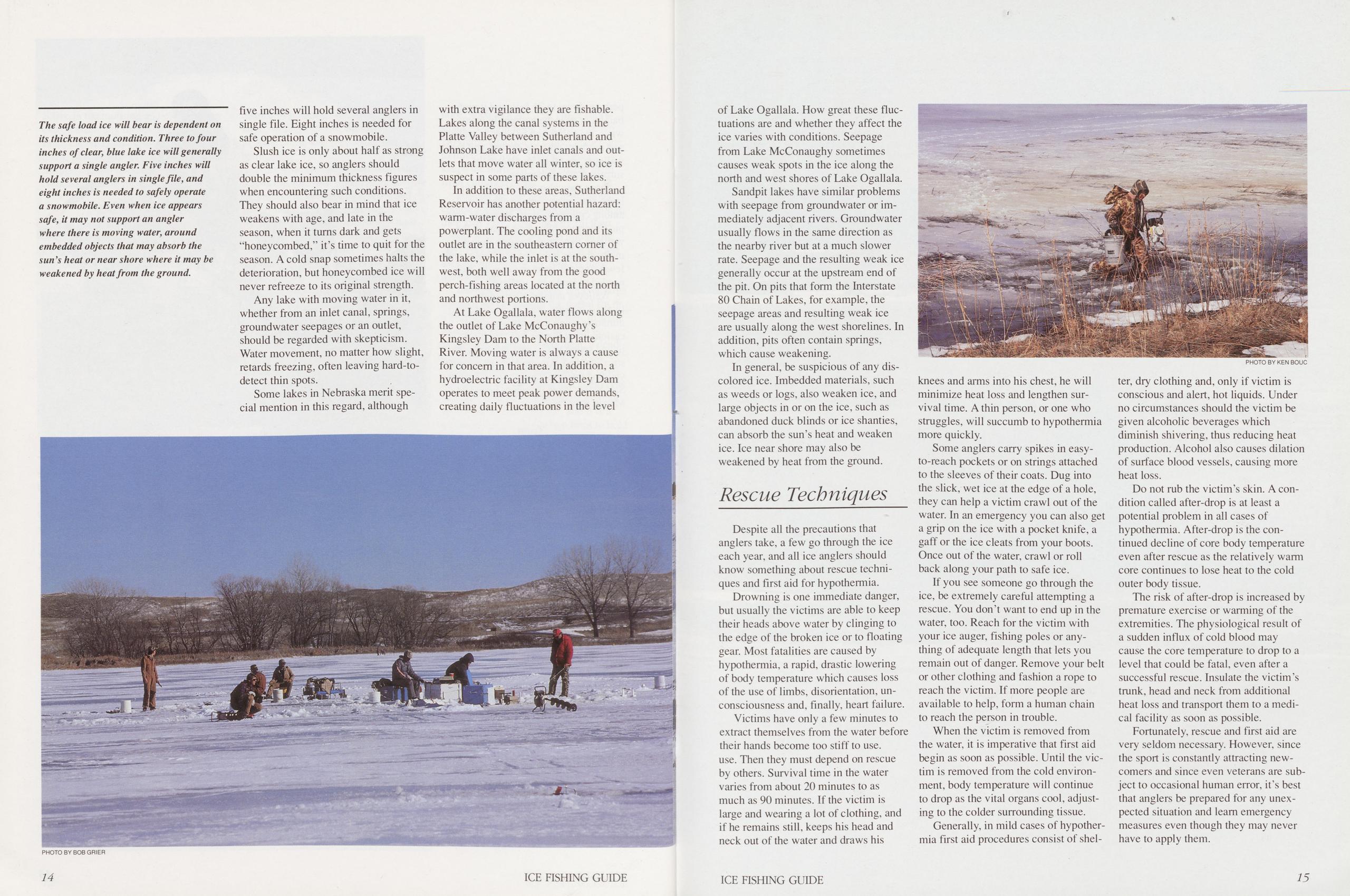
five inches will hold several anglers in single file. Eight inches is needed for safe operation of a snowmobile.
Slush ice is only about half as strong as clear lake ice, so anglers should double the minimum thickness figures when encountering such conditions. They should also bear in mind that ice weakens with age, and late in the season, when it turns dark and gets "honeycombed," it's time to quit for the season. A cold snap sometimes halts the deterioration, but honeycombed ice will never refreeze to its original strength.
Any lake with moving water in it, whether from an inlet canal, springs, groundwater seepages or an outlet, should be regarded with skepticism. Water movement, no matter how slight, retards freezing, often leaving hard-to-detect thin spots.
Some lakes in Nebraska merit special mention in this regard, although with extra vigilance they are fishable. Lakes along the canal systems in the Platte Valley between Sutherland and Johnson Lake have inlet canals and outlets that move water all winter, so ice is suspect in some parts of these lakes.
In addition to these areas, Sutherland Reservoir has another potential hazard: warm-water discharges from a power plant. The cooling pond and its outlet are in the southeastern corner of the lake, while the inlet is at the southwest, both well away from the good perch-fishing areas located at the north and northwest portions.
At Lake Ogallala, water flows along the outlet of Lake McConaughy's Kingsley Dam to the North Platte River. Moving water is always a cause for concern in that area. In addition, a hydroelectric facility at Kingsley Dam operates to meet peak power demands, creating daily fluctuations in the level of Lake Ogallala. How great these fluctuations are and whether they affect the ice varies with conditions. Seepage from Lake McConaughy sometimes causes weak spots in the ice along the north and west shores of Lake Ogallala.
Sandpit lakes have similar problems with seepage from groundwater or immediately adjacent rivers. Groundwater usually flows in the same direction as the nearby river but at a much slower rate. Seepage and the resulting weak ice generally occur at the upstream end of the pit. On pits that form the Interstate 80 Chain of Lakes, for example, the seepage areas and resulting weak ice are usually along the west shorelines. In addition, pits often contain springs, which cause weakening.
In general, be suspicious of any discolored ice. Imbedded materials, such as weeds or logs, also weaken ice, and large objects in or on the ice, such as abandoned duck blinds or ice shanties, can absorb the sun's heat and weaken ice. Ice near shore may also be weakened by heat from the ground.
Rescue TechniquesDespite all the precautions that anglers take, a few go through the ice each year, and all ice anglers should know something about rescue techniques and first aid for hypothermia.
Drowning is one immediate danger, but usually the victims are able to keep their heads above water by clinging to the edge of the broken ice or to floating gear. Most fatalities are caused by hypothermia, a rapid, drastic lowering of body temperature which causes loss of the use of limbs, disorientation, unconsciousness and, finally, heart failure.
Victims have only a few minutes to extract themselves from the water before their hands become too stiff to use. use. Then they must depend on rescue by others. Survival time in the water varies from about 20 minutes to as much as 90 minutes. If the victim is large and wearing a lot of clothing, and if he remains still, keeps his head and neck out of the water and draws his
Some anglers carry spikes in easy-to-reach pockets or on strings attached to the sleeves of their coats. Dug into the slick, wet ice at the edge of a hole, they can help a victim crawl out of the water. In an emergency you can also get a grip on the ice with a pocket knife, a gaff or the ice cleats from your boots. Once out of the water, crawl or roll back along your path to safe ice.
If you see someone go through the ice, be extremely careful attempting a rescue. You don't want to end up in the water, too. Reach for the victim with your ice auger, fishing poles or anything of adequate length that lets you remain out of danger. Remove your belt or other clothing and fashion a rope to reach the victim. If more people are available to help, form a human chain to reach the person in trouble.
When the victim is removed from the water, it is imperative that first aid begin as soon as possible. Until the victim is removed from the cold environment, body temperature will continue to drop as the vital organs cool, adjusting to the colder surrounding tissue.
Generally, in mild cases of hypothermia first aid procedures consist of shelter, dry clothing and, only if victim is conscious and alert, hot liquids. Under no circumstances should the victim be given alcoholic beverages which diminish shivering, thus reducing heat production. Alcohol also causes dilation of surface blood vessels, causing more heat loss.
Do not rub the victim's skin. A condition called after-drop is at least a potential problem in all cases of hypothermia. After-drop is the continued decline of core body temperature even after rescue as the relatively warm core continues to lose heat to the cold outer body tissue.
The risk of after-drop is increased by premature exercise or warming of the extremities. The physiological result of a sudden influx of cold blood may cause the core temperature to drop to a level that could be fatal, even after a successful rescue. Insulate the victim's trunk, head and neck from additional heat loss and transport them to a medical facility as soon as possible.
Fortunately, rescue and first aid are very seldom necessary. However, since the sport is constantly attracting newcomers and since even veterans are subject to occasional human error, it's best that anglers be prepared for any unexpected situation and learn emergency measures even though they may never have to apply them.
14 ICE FISHING GUIDE ICE FISHING GUIDE 15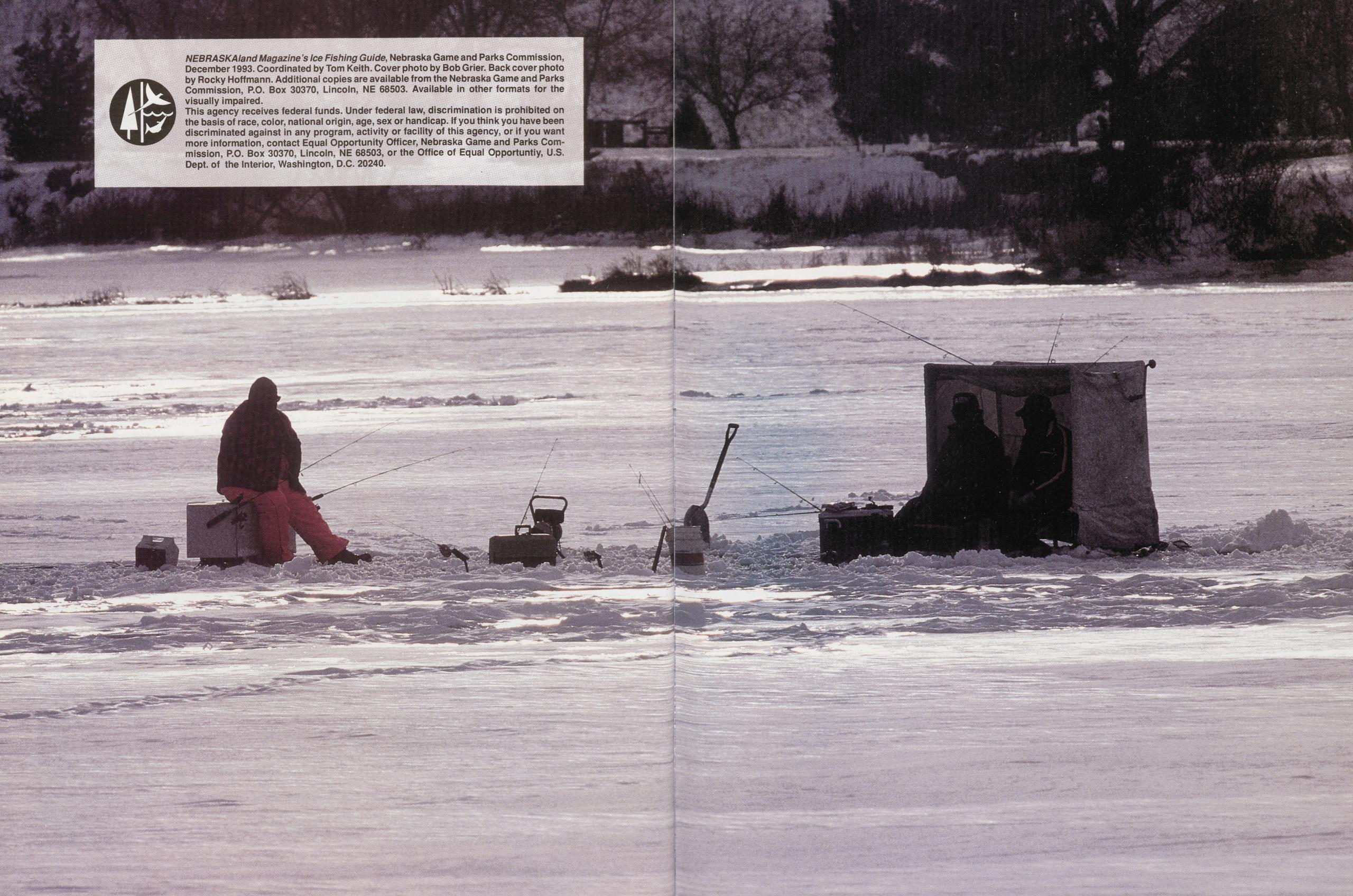
NEBRASKAland Magazine's Ice Fishing Guide, Nebraska Game and Parks Commission, December 1993. Coordinated by Tom Keith. Cover photo by Bob Grier. Back cover photo by Rocky Hoffmann. Additional copies are available from the Nebraska Game and Parks Commission, P.O. Box 30370, Lincoln, NE 68503. Available in other formats for the visually impaired.
This agency receives federal funds. Under federal law, discrimination is prohibited on the basis of race, color, national origin, age, sex or handicap. If you think you have been discriminated against in any program, activity or facility of this agency, or if you want more information, contact Equal Opportunity Officer, Nebraska Game and Parks Commission, P.O. Box 30370, Lincoln, NE 68503, or the Office of Equal Opportunity, U.S. Dept. of the Interior, Washington, D.C. 20240.
A Day with the Eagles
They came from the east in the pink-gray hour before dawn like ghosts riding the winter wind. High above me their powerful wings beat out a slow, constant rhythm as they passed through the waning night, their faint images disappearing into the dull shadows of the Keith County landscape.
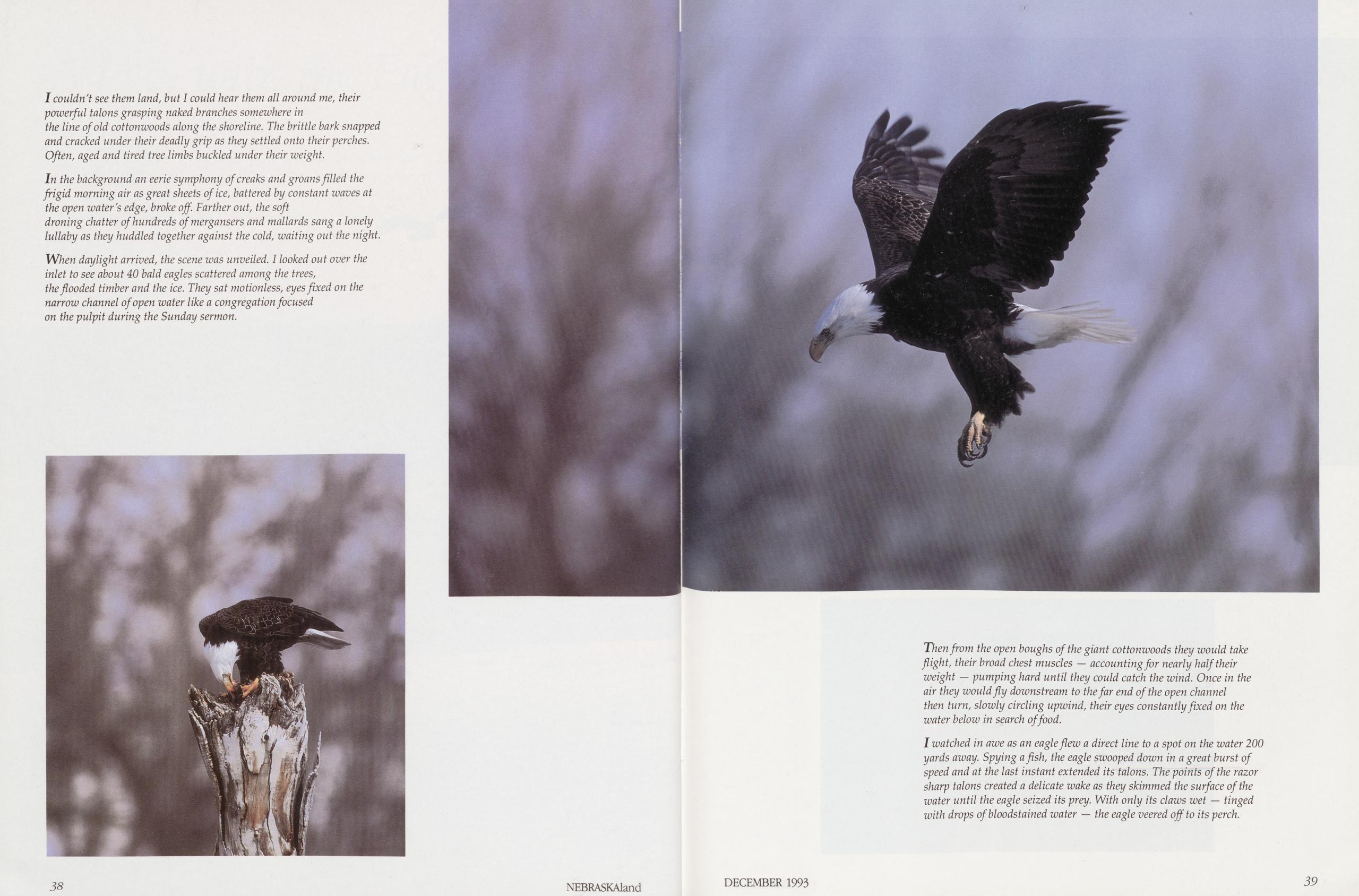
I couldn't see them land, but I could hear them all around me, their powerful talons grasping naked branches somewhere in the line of old cottonwoods along the shoreline. The brittle bark snapped and cracked under their deadly grip as they settled onto their perches. Often, aged and tired tree limbs buckled under their weight.
In the background an eerie symphony of creaks and groans filled the frigid morning air as great sheets of ice, battered by constant waves at the open water's edge, broke off. Farther out, the soft droning chatter of hundreds of mergansers and mallards sang a lonely lullaby as they huddled together against the cold, waiting out the night.
When daylight arrived, the scene was unveiled. I looked out over the inlet to see about 40 bald eagles scattered among the trees, the flooded timber and the ice. They sat motionless, eyes fixed on the narrow channel of open water like a congregation focused on the pulpit during the Sunday sermon.
Then from the open boughs of the giant cottonwoods they would take flight, their broad chest muscles — accounting for nearly half then weight — pumping hard until they could catch the wind. Once in the air they would fly downstream to the far end of the open channel then turn, slowly circling upwind, their eyes constantly fixed on the water below in search of food.
I watched in awe as an eagle flew a direct line to a spot on the water 200 yards away. Spying a fish, the eagle swooped down in a great burst of speed and at the last instant extended its razor sharp talons created a delicate wake as they skimmed the surface of the water until the eagle seized its prey. With only its claws wet — tinged with drops of bloodstained water — the eagle veered off to its perch.
38 NEBRASKAland DECEMBER 1993 39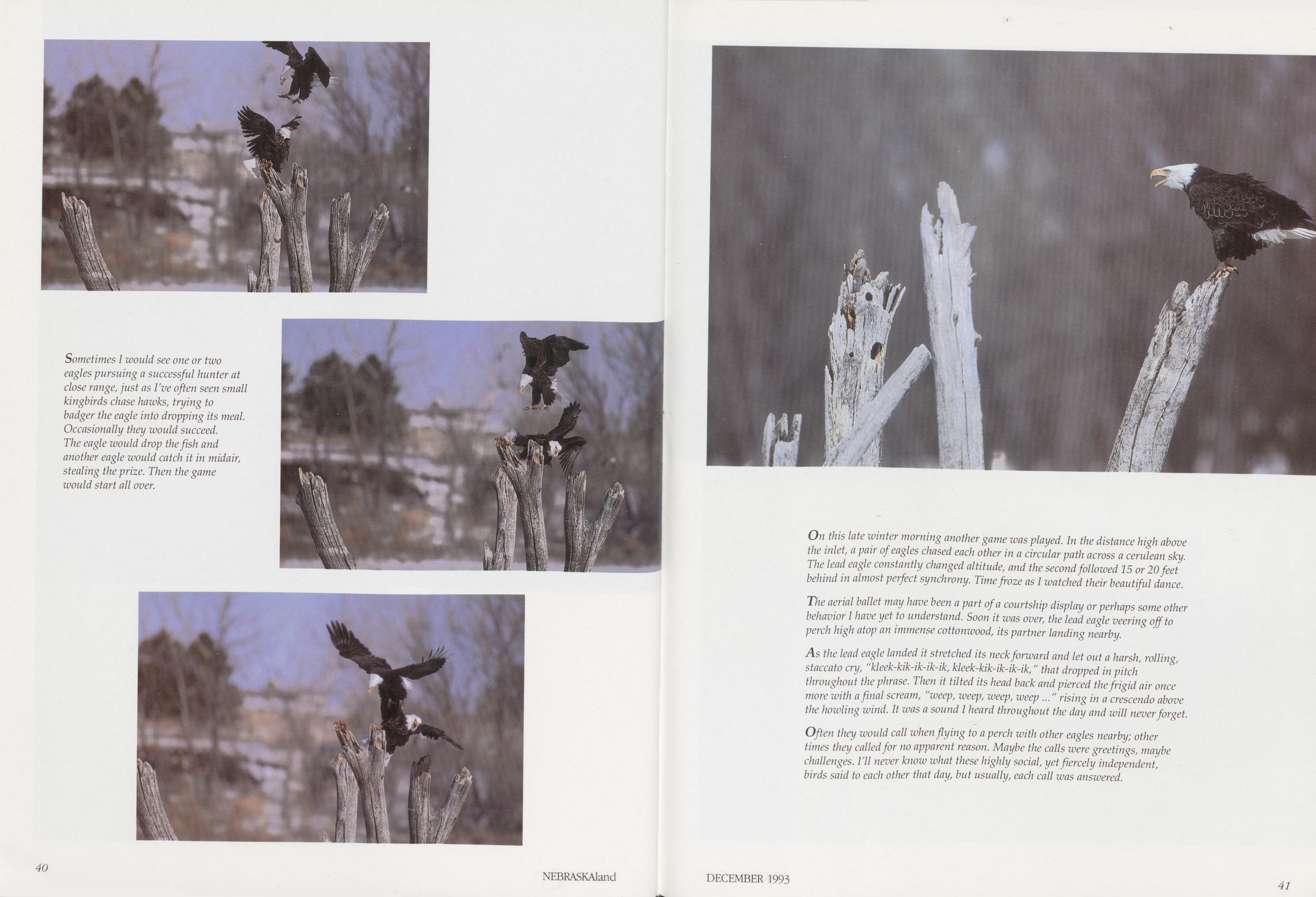
On this late winter morning another game was played. In the distance high above the inlet, a pair of eagles chased each other in a circular path across a cerulean sky The lead eagle constantly changed altitude, and the second followed 15 or 20 feet behind in almost perfect synchrony. Time froze as I watched their beautiful dance.
The aerial ballet may have been a part of a courtship display or perhaps some other behavior I have yet to understand. Soon it was over, the lead eagle veering off to perch high atop an immense cottonwood, its partner landing nearby.
As the lead eagle landed it stretched its neck forward and let out a harsh, rolling, staccato cry, "kleek-kik-ik-ik-ik, kleek-kik-ik-ik-ik," that dropped in pitch throughout the phrase. Then it tilted its head back and pierced the frigid air once more with a final scream, "weep, weep, weep, weep ..." rising in a crescendo above the howling wind. It was a sound I heard throughout the day and will never forget.
Often they would call when flying to a perch with other eagles nearby; other times they called for no apparent reason. Maybe the calls were greetings, maybe challenges. I'll never know what these highly social, yet fiercely independent, birds said to each other that day, but usually, each call was answered.
40 NEBRASKAland DECEMBER 1993 41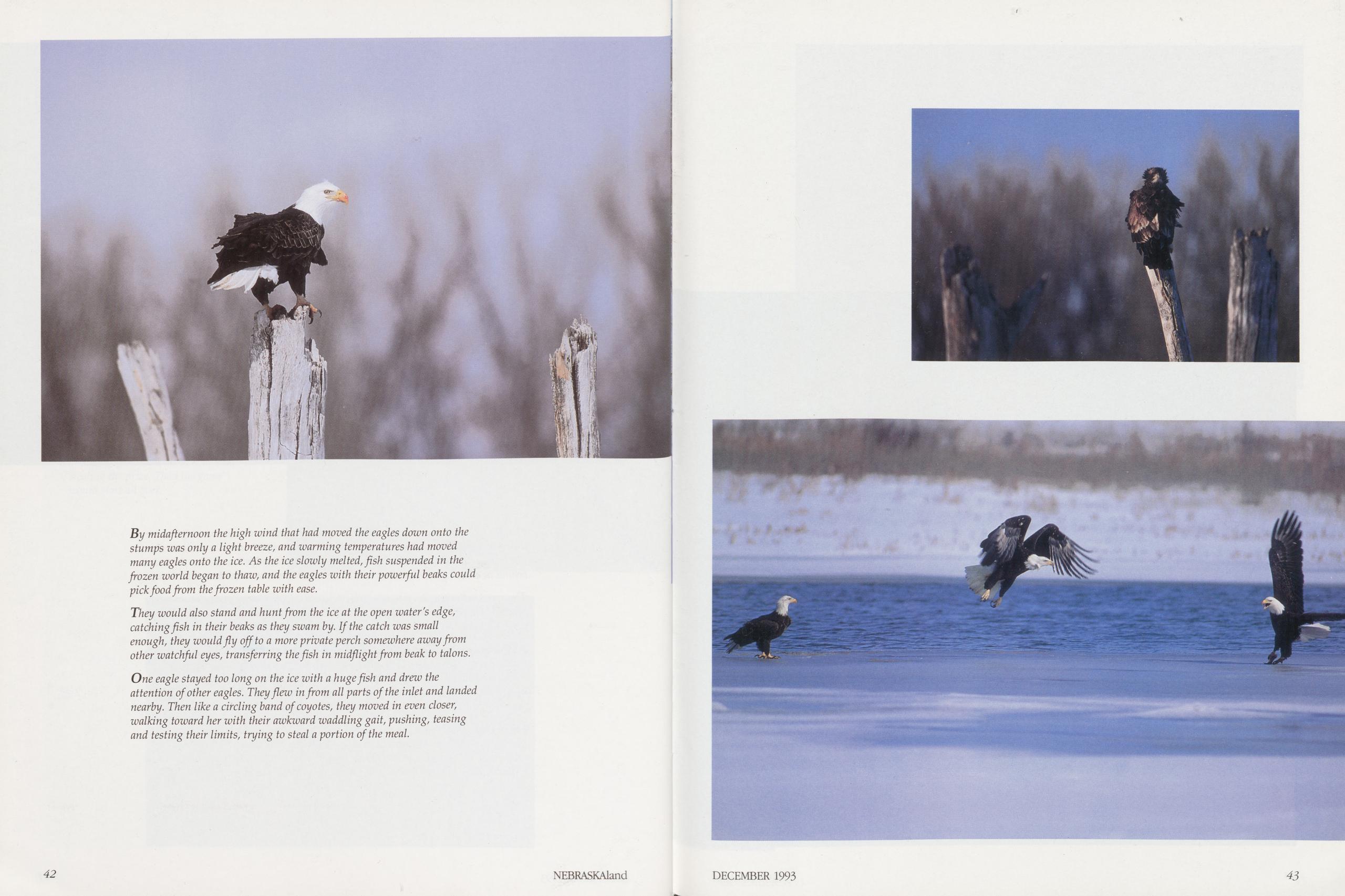
By midafternoon the high wind that had moved the eagles down onto the stumps was only a light breeze, and warming temperatures had moved many eagles onto the ice. As the ice slowly melted, fish suspended in the frozen world began to thaw, and the eagles with their powerful beaks could pick food from the frozen table with ease.
They would also stand and hunt from the ice at the open water's edge, catching fish in their beaks as they swam by. If the catch was small enough, they would fly off to a more private perch somewhere away from other watchful eyes, transferring the fish in midflight from beak to talons.
One eagle stayed too long on the ice with a huge fish and drew the attention of other eagles. They flew in from all parts of the inlet and landed nearby. Then like a circling band of coyotes, they moved in even closer, walking toward her with their awkward waddling gait, pushing, teasing and testing their limits, trying to steal a portion of the meal.
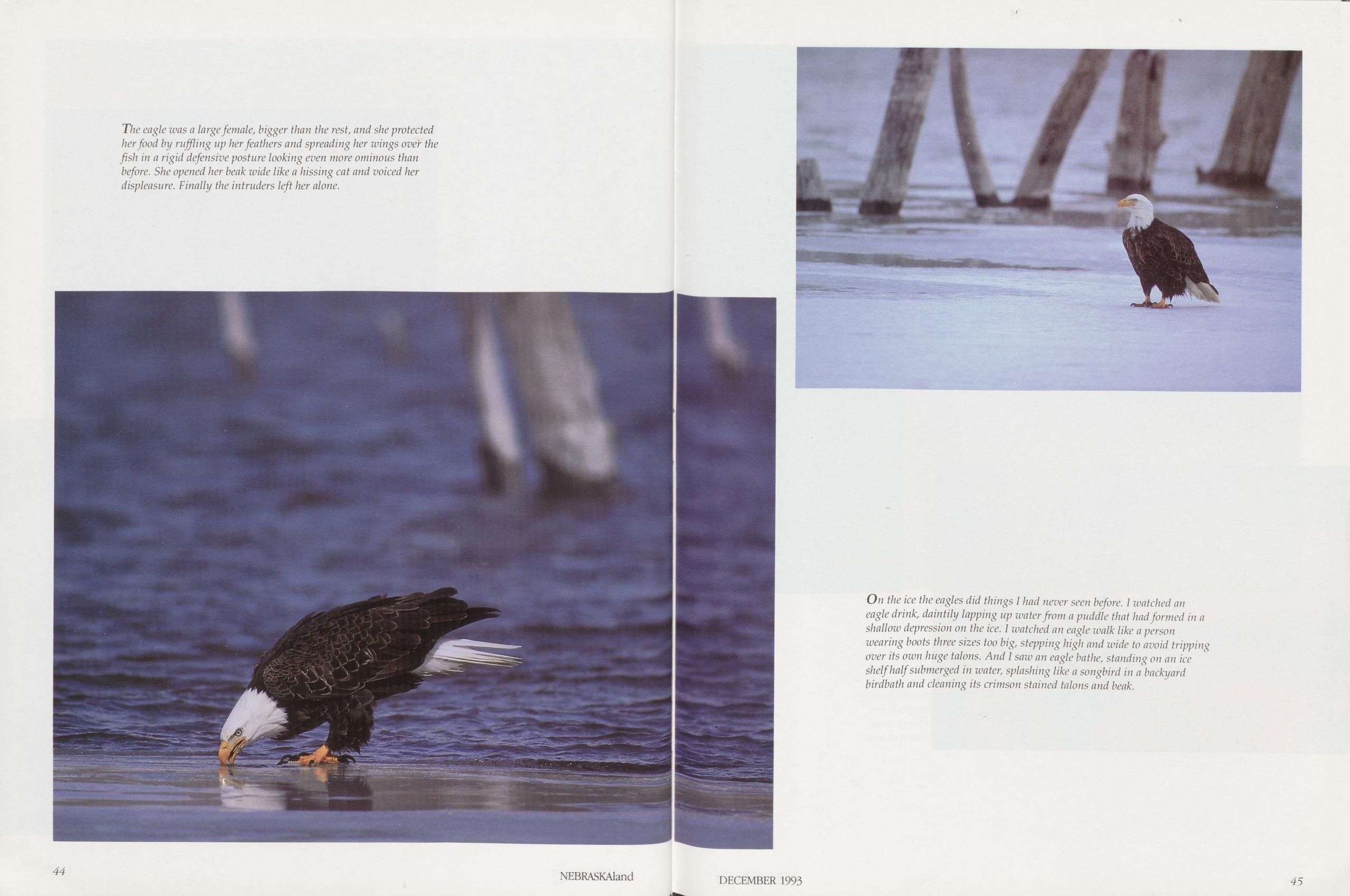
The eagle was a large female, bigger than the rest, and she protected her food by ruffling up her feathers and spreading her wings over the fish in a rigid defensive posture looking even more ominous than before. She opened her beak wide like a hissing cat and voiced her displeasure. Finally the intruders left her alone.
On the ice the eagles did things I had never seen before. I watched an eagle drink, daintily lapping up water from a puddle that had formed in a shallow depression on the ice. 1 watched an eagle walk like a person wearing boots three sizes too big, stepping high and wide to avoid tripping over its own huge talons. And I saw an eagle bathe, standing on an ice shelf half submerged in water, splashing like a songbird in a backyard birdbath and cleaning its crimson stained talons and beak.
44 NEBRASKAland DECEMBER 1993 45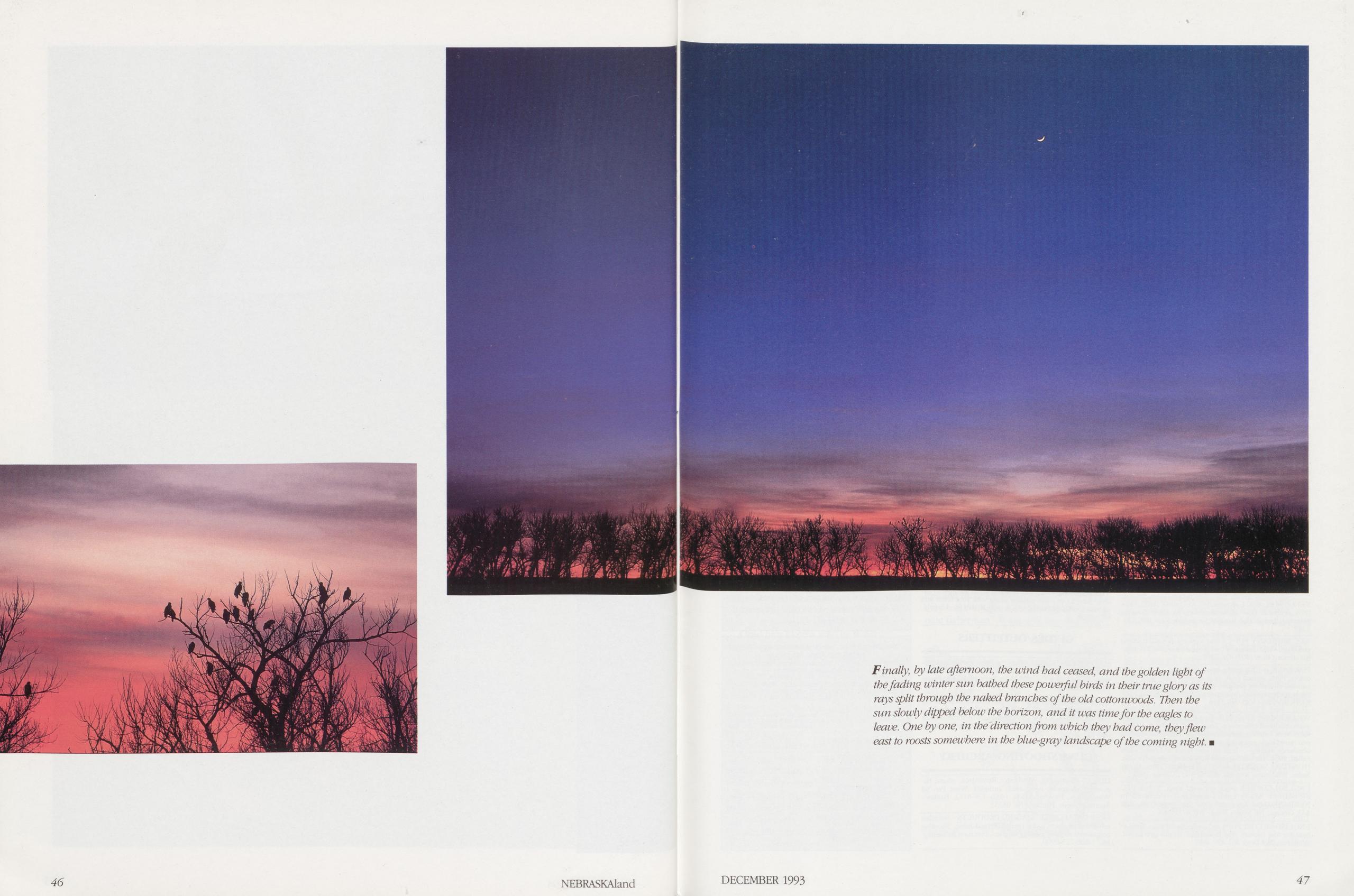
Finally, by late afternoon, the wind had ceased, and the golden light of the fading winter sun bathed these powerful birds in their true glory as its rays split through the naked branches of the old cottonwoods. Then the sun slowly dipped below the horizon, and it was time for the eagles to leave. One by one, in the direction from which they had come, they flew east to roosts somewhere in the blue-gray landscape of the coming night.
46 NEBRASKAland DECEMBER 1993 47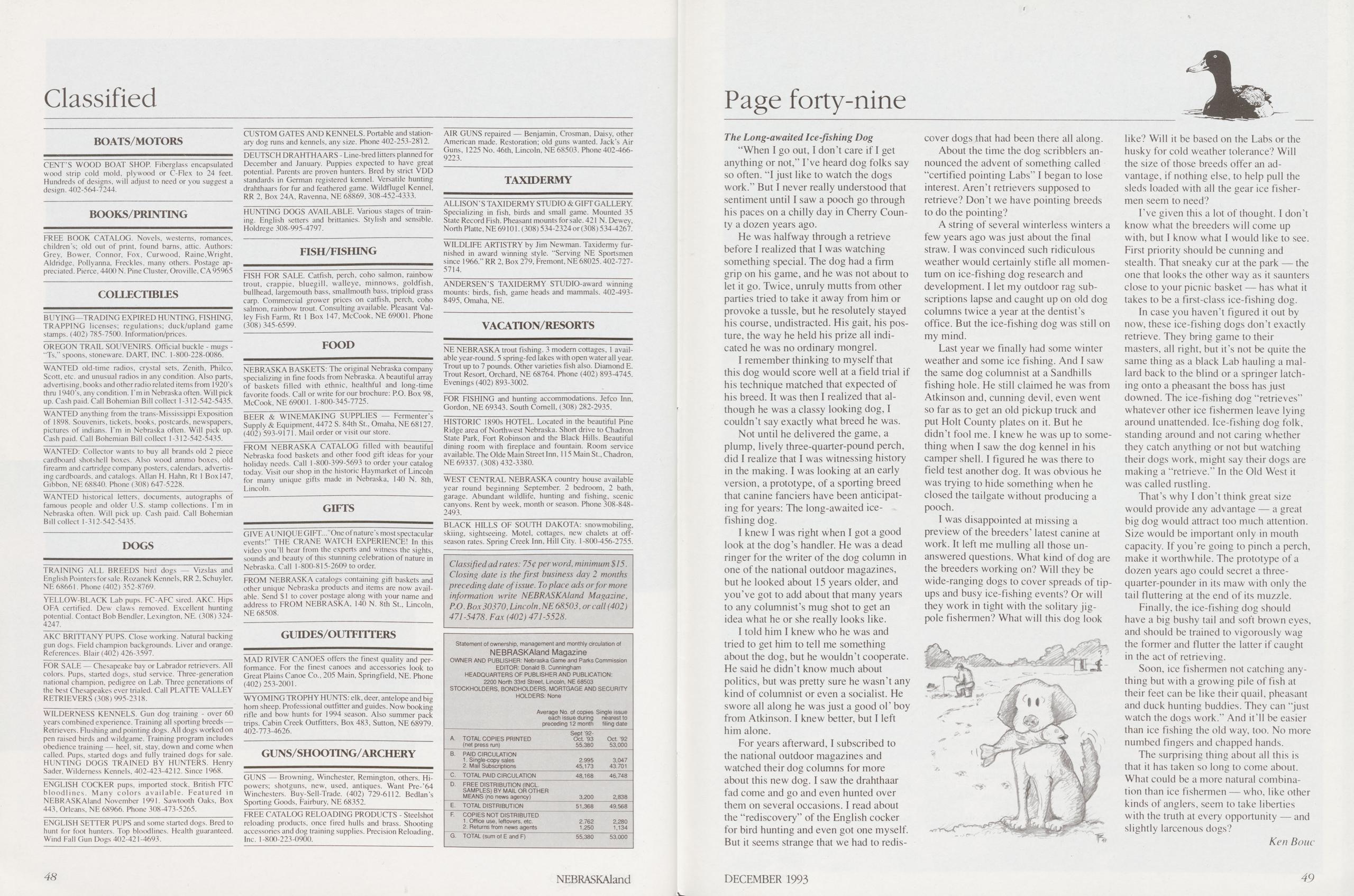
Classified
BOATS/MOTORSCENT'S WOOD BOAT SHOP. Fiberglass encapsulated wood strip cold mold, plywood or C-Flex to 24 feet. Hundreds of designs, will adjust to need or you suggest a design. 402-564-7244.
BOOKS/PRINTINGFREE BOOK CATALOG. Novels, westerns, romances, children's; old out of print, found barns, attic. Authors: Grey. Bower. Connor. Fox. Curwood, Raine.Wright, Aldridge. Pollyanna. Freckles, many others. Postage appreciated. Pierce. 4400 N. Pine Cluster, Oroville. CA 95965
COLLECTIBLESBUYING—TRADING EXPIRED HUNTING. FISHING. TRAPPING licenses; regulations; duck/upland game stamps. (402) 785-7500. Information/prices.
OREGON TRAIL SOUVENIRS. Official buckle - mugs - Ts." spoons, stoneware. DART, INC. 1-800-228-0086.
WANTED old-time radios, crystal sets. Zenith, Philco. Scott, etc. and unusual radios in any condition. Also parts, advertising, books and other radio related items from 1920's thru 1940's. any condition. I'm in Nebraska often. Will pick up. Cash paid. Call Bohemian Bill collect 1-312-542-5435.
WANTED anything from the trans-Mississippi Exposition of 1898. Souvenirs, tickets, books, postcards, newspapers, pictures of indians. I'm in Nebraska often. Will pick up. Cash paid. Call Bohemian Bill collect 1-312-542-5435.
WANTED: Collector wants to buy all brands old 2 piece cardboard shotshell boxes. Also wood ammo boxes, old firearm and cartridge company posters, calendars, advertising cardboards, and catalogs. Allan H. Hahn. Rt 1 Box 147. Gibbon, NE 68840. Phone (308) 647-5228.
WANTED historical letters, documents, autographs of famous people and older U.S. stamp collections. I'm in Nebraska often. Will pick up. Cash paid. Call Bohemian Bill collect 1-312-542-5435.
DOGSTRAINING ALL BREEDS bird dogs — Vizslas and English Pointers for sale. Rozanek Kennels, RR 2. Schuyler, NE 68661. Phone (402) 352-8769.
YELLOW-BLACK Lab pups. FC-AFC sired. AKC. Hips OFA certified. Dew claws removed. Excellent hunting potential. Contact Bob Bendler. Lexington, NE. (308) 324-4247.
AKC BRITTANY PUPS. Close working. Natural backing gun dogs. Field champion backgrounds. Liver and orange. References. Blair (402) 426-3597.
FOR SALE — Chesapeake bay or Labrador retrievers. All colors. Pups, started dogs, stud service. Three-generation national champion, pedigree on Lab. Three generations of the best Chesapeakes ever trialed. Call PLATTE VALLEY RETRIEVERS (308) 995-2318.
WILDERNESS KENNELS. Gun dog training - over 60 years combined experience. Training all sporting breeds — Retrievers. Flushing and pointing dogs. All dogs worked on pen raised birds and wild game. Training program includes obedience training — heel, sit. stay, down and come when called. Pups, started dogs and fully trained dogs for sale.
HUNTING DOGS TRAINED BY HUNTERS. Henry Sader, Wilderness Kennels, 402-423-4212. Since 1968.
ENGLISH COCKER pups, imported stock, British FTC bloodlines. Many colors available. Featured in NEBRASKAland November 1991. Sawtooth Oaks, Box 443. Orleans, NE 68966. Phone 308-473-5265.
ENGLISH SETTER PUPS and some started dogs. Bred to hunt for foot hunters. Top bloodlines. Health guaranteed. Wind Fall Gun Dogs 402-421-4693.
CUSTOM GATES AND KENNELS. Portable and stationary dog runs and kennels, any size. Phone 402-253-2812.
DEUTSCH DRAHTHAARS - Line-bred litters planned for December and January. Puppies expected to have great potential. Parents are proven hunters. Bred by strict VDD standards in German registered kennel. Versatile hunting drahthaars for fur and feathered game. Wildflugel Kennel, RR 2, Box 24A. Ravenna, NE 68869, 308-452-4333.
HUNTING DOGS AVAILABLE. Various stages of training. English setters and brittanies. Stylish and sensible. Holdrege 308-995-4797.
FISH/FISHINGFISH FOR SALE. Catfish, perch, coho salmon, rainbow trout, crappie. bluegill, walleye, minnows, goldfish, bullhead, largemouth bass, smallmouth bass, triploid grass carp. Commercial grower prices on catfish, perch, coho salmon, rainbow trout. Consulting available. Pleasant Valley Fish Farm. Rt 1 Box 147, McCook, NE 69001. Phone (308)345-6599.
FOODNEBRASKA BASKETS: The original Nebraska company specializing in fine foods from Nebraska. A beautiful array of baskets filled with ethnic, healthful and long-time favorite foods. Call or write for our brochure: P.O. Box 98, McCook, NE 69001. 1-800-345-7725.
BEER & WINEMAKING SUPPLIES — Fermenter's Supply & Equipment, 4472 S. 84th St., Omaha, NE 68127. (402) 593-9171. Mail order or visit our store.
FROM NEBRASKA CATALOG filled with beautiful Nebraska food baskets and other food gift ideas for your holiday needs. Call 1-800-399-5693 to order your catalog today. Visit our shop in the historic Haymarket of Lincoln for many unique gifts made in Nebraska, 140 N. 8th, Lincoln.
GIFTSGIVE AUNIQUE GIFT.. ."One of nature's most spectacular events!" THE CRANE WATCH EXPERIENCE! In this video you'll hear from the experts and witness the sights, sounds and beauty of this stunning celebration of nature in Nebraska. Call 1-800-815-2609 to order.
FROM NEBRASKA catalogs containing gift baskets and other unique Nebraska products and items are now available. Send $1 to cover postage along with your name and address to FROM NEBRASKA. 140 N. 8th St., Lincoln, NE 68508.
GUIDES/OUTFITTERSMAD RIVER CANOES offers the finest quality and performance. For the finest canoes and accessories look to Great Plains Canoe Co., 205 Main, Springfield, NE. Phone (402)253-2001.
WYOMING TROPHY HUNTS: elk, deer, antelope and big horn sheep. Professional outfitter and guides. Now booking rifle and bow hunts for 1994 season. Also summer pack trips. Cabin Creek Outfitters, Box 483, Sutton, NE 68979. 402-773-4626.
GUNS/SHOOTING/ARCHERYGUNS — Browning, Winchester, Remington, others. Hi-powers; shotguns, new, used, antiques. Want Pre-'64 Winchesters. Buy-Sell-Trade. (402) 729-6112. Bedlan's Sporting Goods, Fairbury, NE 68352.
FREE CATALOG RELOADING PRODUCTS - Steels hot reloading products, once fired hulls and brass. Shooting accessories and dog training supplies. Precision Reloading, Inc. 1-800-2 23-0900.
AIR GUNS repaired — Benjamin, Crosman, Daisy, other American made. Restoration; old guns wanted. Jack's Air Guns, 1225 No. 46th, Lincoln. NE 68503. Phone 402-466-9223.
TAXIDERMY
ALLISON'S TAXIDERMY STUDIO & GIFT GALLERY. Specializing in fish, birds and small game. Mounted 35 State Record Fish. Pheasant mounts for sale. 421 N. Dewey, North Platte, NE 69101. (308) 534-2324or (308) 534-4267.
WILDLIFE ARTISTRY by Jim Newman. Taxidermy furnished in award winning style. "Serving NE Sportsmen since 1966." RR 2, Box 279, Fremont, NE 68025.402-727-5714.
ANDERSEN'S TAXIDERMY STUDIO-award winning mounts: birds, fish, game heads and mammals. 402-493-8495, Omaha, NE.
VACATION/RESORTSNE NEBRASKA trout fishing. 3 modern cottages, 1 available year-round. 5 spring-fed lakes with open water all year. Trout up to 7 pounds. Other varieties fish also. Diamond E. Trout Resort. Orchard, NE 68764. Phone (402) 893-4745. Evenings (402) 893-3002.
FOR FISHING and hunting accommodations. Jefco Inn. Gordon, NE 69343. South Cornell, (308) 282-2935. HISTORIC 1890s HOTEL. Located in the beautiful Pine Ridge area of Northwest Nebraska. Short drive to Chadron State Park, Fort Robinson and the Black Hills. Beautiful dining room with fireplace and fountain. Room service available. The Olde Main Street Inn, 115 Main St., Chadron, NE 69337. (308) 432-3380.
WEST CENTRAL NEBRASKA country house available year round beginning September. 2 bedroom, 2 bath, garage. Abundant wildlife, hunting and fishing, scenic canyons. Rent by week, month or season. Phone 308-848-2493.
BLACK HILLS OF SOUTH DAKOTA: snowmobiling. skiing, sightseeing. Motel, cottages, new chalets at off season rates. Spring Creek Inn, Hill City. 1 -800-456-2755.
Classified ad rates: 75 c per word, minimum $ 15. Closing date is the first business day 2 months preceding date of issue. To place ads or for more information write NEBRASKAland Magazine, P.O. Box 30370, Lincoln, NE 68503, or call (402) 471-5478. Fax (402) 471-5528.
Statement of ownership, management and monthly circulation of NEBRASKAland Magazine OWNER AND PUBLISHER: Nebraska Game and Parks Commission EDITOR: Donald B. Cunningham HEADQUARTERS OF PUBLISHER AND PUBLICATION: 2200 North 33rd Street, Lincoln, NE 68503 STOCKHOLDERS, BONDHOLDERS, MORTGAGE AND SECURITY HOLDERS: None Average No. of copies each issue during preceding 12 month Single issue nearest to fifing date TOTAL COPIES PRINTED (net press run) Sept 92- Oct '93 55.380 Oct.'92 53,000 PAID CIRCULATION 1. Single-copy sales 2. Mail Subscriptions 2.995 45,173 3.047 43.701 C. TOTAL PAID CIRCULATION 48,168 46,748 D. FREE DISTRIBUTION (INCL. SAMPLES) BY MAIL OR OTHER _____MEANS (no news agency) 3,200 2,838 TOTAL DISTRIBUTION 51,368 49,568 COPIES NOT DISTRIBUTED 1. Office use, leftovers, etc. 2. Returns from news agents 2.762 1.250 2,280 1.134 G. TOTAL (sum of E and F) 55,380 53.000 48 NEBRASKAlandPage forty-nine
The Long-awaited Ice-fishing Dog
"When I go out, I don't care if I get anything or not," I've heard dog folks say so often. "I just like to watch the dogs work." But I never really understood that sentiment until I saw a pooch go through his paces on a chilly day in Cherry County a dozen years ago.
He was halfway through a retrieve before I realized that I was watching something special. The dog had a firm grip on his game, and he was not about to let it go. Twice, unruly mutts from other parties tried to take it away from him or provoke a tussle, but he resolutely stayed his course, undistracted. His gait, his posture, the way he held his prize all indicated he was no ordinary mongrel.
I remember thinking to myself that this dog would score well at a field trial if his technique matched that expected of his breed. It was then I realized that although he was a classy looking dog, I couldn't say exactly what breed he was. Not until he delivered the game, a plump, lively three-quarter-pound perch, did I realize that I was witnessing history in the making. I was looking at an early version, a prototype, of a sporting breed that canine fanciers have been anticipating for years: The long-awaited ice fishing dog.
I knew I was right when I got a good look at the dog's handler. He was a dead ringer for the writer of the dog column in one of the national outdoor magazines, but he looked about 15 years older, and you've got to add about that many years to any columnist's mug shot to get an idea what he or she really looks like.
I told him I knew who he was and tried to get him to tell me something about the dog, but he wouldn't cooperate. He said he didn't know much about politics, but was pretty sure he wasn't any kind of columnist or even a socialist. He swore all along he was just a good ol' boy from Atkinson. I knew better, but I left him alone.
For years afterward, I subscribed to the national outdoor magazines and watched their dog columns for more about this new dog. I saw the drahthaar fad come and go and even hunted over them on several occasions. I read about the "rediscovery" of the English cocker for bird hunting and even got one myself. But it seems strange that we had to rediscover dogs that had been there all along.
About the time the dog scribblers announced the advent of something called "certified pointing Labs" I began to lose interest. Aren't retrievers supposed to retrieve? Don't we have pointing breeds to do the pointing?
A string of several winterless winters a few years ago was just about the final straw. I was convinced such ridiculous weather would certainly stifle all momentum on ice-fishing dog research and development. I let my outdoor rag subscriptions lapse and caught up gold dog columns twice a year at the dentist's office. But the ice-fishing dog was still on my mind.
Last year we finally had some winter weather and some ice fishing. And I saw the same dog columnist at a Sandhills fishing hole. He still claimed he was from Atkinson and, cunning devil, even went so far as to get an old pickup truck and put Holt County plates on it. But he didn't fool me. I knew he was up to something when I saw the dog kennel in his camper shell. I figured he was there to field test another dog. It was obvious he was trying to hide something when he closed the tailgate without producing a pooch.
I was disappointed at missing a preview of the breeders' latest canine at work. It left me mulling all those unanswered questions. What kind of dog are the breeders working on? Will they be wide-ranging dogs to cover spreads of tipups and busy ice-fishing events? Or will they work in tight with the solitary jigpole fishermen? What will this dog look like? Will it be based on the Labs or the husky for cold weather tolerance? Will the size of those breeds offer an advantage, if nothing else, to help pull the sleds loaded with all the gear ice fishermen seem to need?
I've given this a lot of thought. I don't know what the breeders will come up with, but I know what I would like to see. First priority should be cunning and stealth. That sneaky cur at the park — the one that looks the other way as it saunters close to your picnic basket — has what it takes to be a first-class ice-fishing dog.
In case you haven't figured it out by now, these ice-fishing dogs don't exactly retrieve. They bring game to their masters, all right, but it's not be quite the same thing as a black Lab hauling a mallard back to the blind or a springer latching onto a pheasant the boss has just downed. The ice-fishing dog "retrieves" whatever other ice fishermen leave lying around unattended. Ice-fishing dog folk, standing around and not caring whether they catch anything or not but watching their dogs work, might say their dogs are making a "retrieve." In the Old West it was called rustling.
That's why I don't think great size would provide any advantage — a great big dog would attract too much attention. Size would be important only in mouth capacity. If you're going to pinch a perch, make it worthwhile. The prototype of a dozen years ago could secret a three- quarter-pounder in its maw with only the tail fluttering at the end of its muzzle.
Finally, the ice-fishing dog should have a big bushy tail and soft brown eyes, and should be trained to vigorously wag the former and flutter the latter if caught in the act of retrieving.
Soon, ice fishermen not catching any- thing but with a growing pile offish at their feet can be like their quail, pheasant and duck hunting buddies. They can "just watch the dogs work." And it'll be easier than ice fishing the old way, too. No more numbed fingers and chapped hands.
The surprising thing about all this is that it has taken so long to come about. What could be a more natural combination than ice fishermen — who, like other kinds of anglers, seem to take liberties with the truth at every opportunity — and slightly larcenous dogs?
DECEMBER 1993 49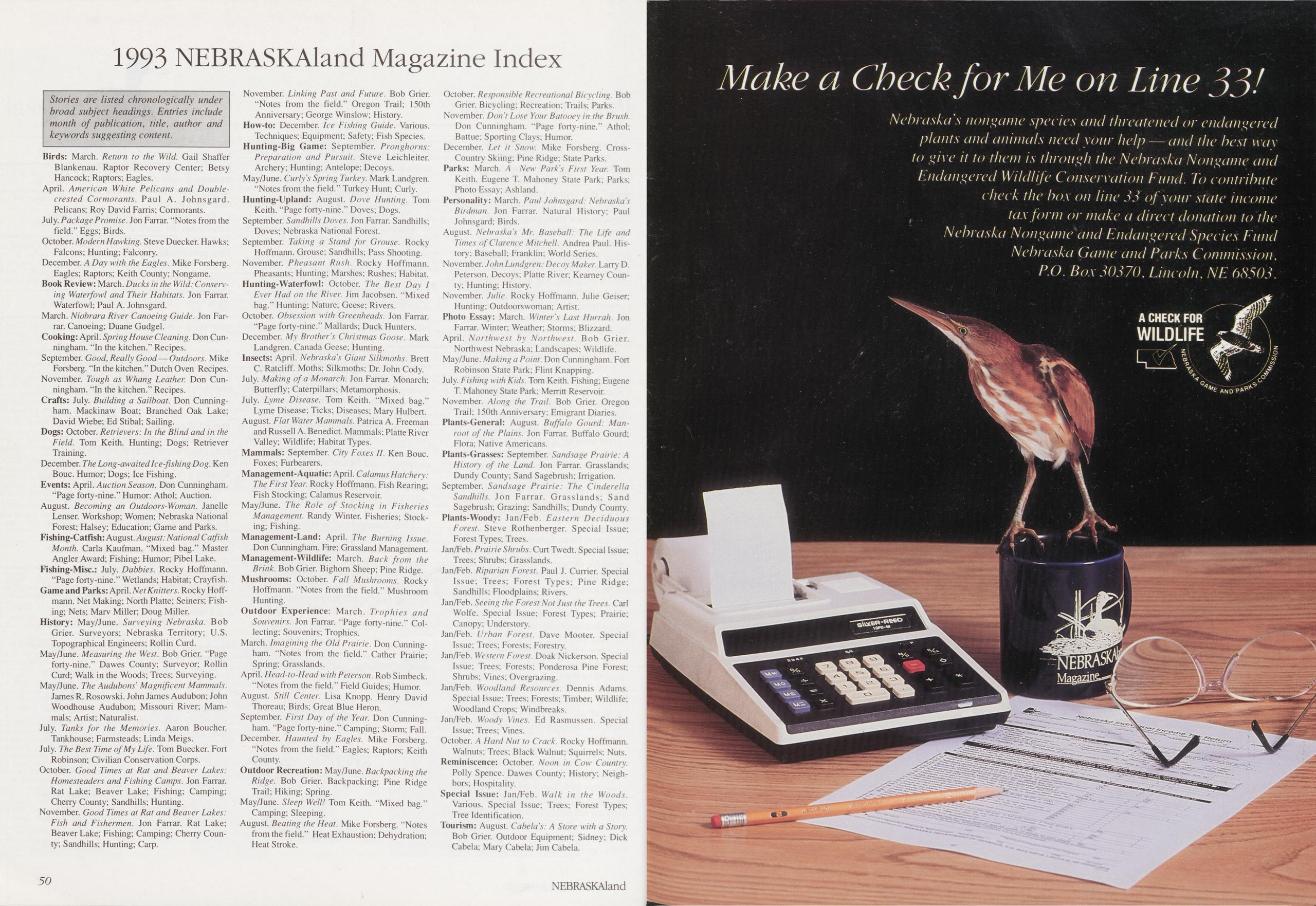
1993 NEBRASKAland Magazine Index
Stories are listed chronologically under broad subject headings. Entries include month of publication, title, author and keywords suggesting content.
Birds: March. Return to the Wild. Gail Shaffer Blankenau. Raptor Recovery Center; Betsy Hancock; Raptors; Eagles.
April. American White Pelicans and Double crested Cormorants. Paul A. Johnsgard. Pelicans; Roy David Farris; Cormorants.
July. Package Promise. Jon Farrar. "Notes from the field." Eggs; Birds.
October. Modern Hawking. Steve Duecker. Hawks; Falcons; Hunting; Falconry.
December. A Day with the Eagles. Mike Forsberg. Eagles; Raptors; Keith County; Nongame.
Book Review: March. Ducks in the Wild: Consenting Waterfowl and Their Habitats. Jon Farrar. Waterfowl; Paul A. Johnsgard.
March. Niobrara River Canoeing Guide. Jon Farrar. Canoeing; Duane Gudgel.
Cooking: April. Spring House Cleaning. Don Cunningham. "In the kitchen." Recipes.
September. Good, Really Good—Outdoors. Mike Forsberg. "In the kitchen." Dutch Oven Recipes.
November. Tough as Whang Leather. Don Cunningham. "In the kitchen." Recipes.
Crafts: July. Building a Sailboat. Don Cunning- ham. Mackinaw Boat; Branched Oak Lake; David Wiebe; Ed Stibal; Sailing.
Dogs: October. Retrievers: In the Blind and in the Field. Tom Keith. Hunting; Dogs; Retriever Training.
December. The Long-awaited Ice-fishing Dog. Ken Bouc. Humor; Dogs; Ice Fishing.
Events: April. Auction Season. Don Cunningham. "Page forty-nine." Humor: Athol; Auction.
August. Becoming an Outdoors-Woman. Janelle Lenser. Workshop; Women; Nebraska National Forest; Halsey; Education; Game and Parks.
Fishing-Catfish: August. August: National Catfish Month. Carla Kaufman. "Mixed bag." Master Angler Award; Fishing; Humor; Pibel Lake.
Fishing-Misc: July. Dabbies. Rocky Hoffmann. "Page forty-nine." Wetlands; Habitat; Crayfish. Game and Parks: April. Net Knitters. Rocky Hoffmann. Net Making; North Platte; Seiners;
Fishing; Nets; Marv Miller; Doug Miller.
History: May/June. Surveying Nebraska. Bob Grier. Surveyors; Nebraska Territory; U.S. Topographical Engineers; Roll in Curd.
May/June. Measuring the West. Bob Grier. "Page forty-nine." Dawes County; Surveyor; Rollin Curd; Walk in the Woods; Trees; Surveying.
May/June. The Audubons Magnificent Mammals. James R. Rosowski. John James Audubon; John Woodhouse Audubon; Missouri River; Mammals; Artist; Naturalist.
July. Tanks for the Memories. Aaron Boucher. Tankhouse; Farmsteads; Linda Meigs.
July. The Best Time of My Life. Tom Buecker. Fort Robinson; Civilian Conservation Corps.
October. Good Times at Rat and Beaver Lakes: Homesteaders and Fishing Camps. Jon Farrar. Rat Lake; Beaver Lake; Fishing; Camping; Cherry County; Sandhills; Hunting.
November. Good Times at Rat and Beaver Lakes: Fish and Fishermen. Jon Farrar. Rat Lake; Beaver Lake; Fishing; Camping; Cherry County; Sandhills; Hunting; Carp.
50 NEBRASKAlandNovember. Linking Past and Future. Bob Grier. "Notes from the field." Oregon Trail; 150th Anniversary; George Winslow; History.
How-to: December. Ice Fishing Guide. Various. Techniques; Equipment; Safety; Fish Species.
Hunting-Big Game: September. Pronghorns: Preparation and Pursuit. Steve Leichleiter. Archery; Hunting; Antelope; Decoys.
May/June. Curly's Spring Turkey. Mark Landgren. "Notes from the field." Turkey Hunt; Curly.
Hunting-Upland: August. Dove Hunting. Tom Keith. "Page forty-nine." Doves; Dogs.
September. Sandhills Doves. Jon Farrar. Sandhills; Doves; Nebraska National Forest.
September. Taking a Stand for Grouse. Rocky Hoffmann. Grouse; Sandhills; Pass Shooting. November. Pheasant Rush. Rocky Hoffmann. Pheasants; Hunting; Marshes; Rushes; Habitat.
Hunting-Waterfowl: October. The Best Day I Ever Had on the River. Jim Jacobsen. "Mixed bag." Hunting; Nature; Geese; Rivers.
October. Obsession with Greenheads. Jon Farrar. "Page forty-nine." Mallards; Duck Hunters. December. My Brother's Christmas Goose. Mark Landgren. Canada Geese; Hunting.
Insects: April. Nebraska's Giant Silkmoths. Brett C. Ratcliff. Moths; Silkmoths; Dr. John Cody.
July. Making of a Monarch. Jon Farrar. Monarch; Butterfly; Caterpillars; Metamorphosis.
July. Lyme Disease. Tom Keith. "Mixed bag." Lyme Disease; Ticks; Diseases; Mary Hulbert. August. Flat Water Mammals. Patrica A. Freeman and Russell A. Benedict. Mammals; Platte River Valley; Wildlife; Habitat Types.
Mammals: September. City Foxes II. Ken Bouc. Foxes; Furbearers.
Management-Aquatic: April. Calamus Hatcherx: The First Year. Rocky Hoffmann. Fish Rearing; Fish Stocking; Calamus Reservoir.
May/June. The Role of Stocking in Fisheries Management. Randy Winter. Fisheries; Stocking; Fishing.
Management-Land: April. The Burning Issue. Don Cunningham. Fire; Grassland Management. Management-Wildlife: March. Back from the Brink. Bob Grier. Bighorn Sheep; Pine Ridge. Mushrooms: October. Fall Mushrooms. Rocky Hoffmann. "Notes from the field." Mushroom Hunting.
Outdoor Experience: March. Trophies and Souvenirs. Jon Farrar. "Page forty-nine." Collecting; Souvenirs; Trophies.
March. Imagining the Old Prairie. Don Cunningham. "Notes from the field." Cather Prairie; Spring; Grasslands.
April. Head-to-Head with Peterson. Rob Simbeck. "Notes from the field." Field Guides; Humor. August. Still Center. Lisa Knopp. Henry David Thoreau; Birds; Great Blue Heron.
September. First Day of the Year. Don Cunningham. "Page forty-nine." Camping; Storm; Fall. December. Haunted by Eagles. Mike Forsberg. "Notes from the field." Eagles; Raptors; Keith County.
Outdoor Recreation: May /June. Backpacking the Ridge. Bob Grier. Backpacking; Pine Ridge Trail; Hiking; Spring.
May/June. Sleep Well! Tom Keith. "Mixed bag." Camping; Sleeping.
August. Beating the Heat. Mike Forsberg. "Notes from the field." Heat Exhaustion; Dehydration; Heat Stroke.
October. Responsible Recreational Bicycling. Bob Grier. Bicycling; Recreation; Trails; Parks. November. Don't Lose Your Batooey in the Brush. Don Cunningham. "Page forty-nine." Athol; Battue; Sporting Clays; Humor.
December. Let it Snow. Mike Forsberg. Cross country Skiing; Pine Ridge; State Parks. Parks: March. A New Park's First Year. Tom Keith. Eugene T Mahoney State Park; Parks: Photo Essay; Ashland.
Personality: March. Paul Johnsgard: Nebraska's Birdman. Jon Farrar. Natural History; Paul Johnsgard; Birds.
August. Nebraska's Mr. Baseball: The Life and Times of Clarence Mitchell. Andrea Paul. History; Baseball; Franklin; World Series. November. John Lundgren: Decoy Maker. Larry D. Peterson. Decoys; Platte River; Kearney County; Hunting; History.
November. Julie. Rocky Hoffmann. Julie Geiser; Hunting; Outdoors woman; Artist.
Photo Essay: March. Winter's Last Hurrah. Jon Farrar. Winter; Weather; Storms; Blizzard.
April. Northwest by Northwest. Bob Grier. Northwest Nebraska; Landscapes; Wildlife.
May/June. Making a Point. Don Cunningham. Fort Robinson State Park; Flint Knapping.
July. Fishing with Kids. Tom Keith. Fishing; Eugene T. Mahoney State Park; Merritt Reservoir.
November. Along the Trad. Bob Grier. Oregon Trail; 150th Anniversary; Emigrant Diaries. Plants-General: August. Buffalo Gourd: Manroot of the Plains. Jon Farrar. Buffalo Gourd; Flora; Native Americans.
Plants-Grasses: September. Sandsage Prairie: A History of the Land. Jon Farrar. Grasslands; Dundy County; Sand Sagebrush; Irrigation.
September. Sandsage Prairie: The Cinderella Sandhills. Jon Farrar. Grasslands; Sand Sagebrush; Grazing; Sandhills; Dundy County. Plants-Woody: Jan/Feb. Eastern Deciduous Forest. Steve Rothenberger. Special Issue; Forest Types; Trees.
Jan/Feb. Prairie Shrubs. Curt Twedt. Special Issue; Trees; Shrubs; Grasslands.
Jan/Feb. Riparian Forest. Paul J. Currier. Special Issue; Trees; Forest Types; Pine Ridge; Sandhills; Floodplains; Rivers.
Jan/Feb. Seeing the Forest Not Just the Trees. Carl Wolfe. Special Issue; Forest Types; Prairie; Canopy; Understory.
Jan/Feb. Urban Forest. Dave Mooter. Special Issue; Trees; Forests; Forestry.
Jan/Feb. Western Forest. Doak Nickerson. Special Issue; Trees; Forests; Ponderosa Pine Forest; Shrubs; Vines; Overgrazing.
Jan/Feb. Woodland Resources. Dennis Adams. Special Issue; Trees; Forests; Timber; Wildlife; Woodland Crops; Windbreaks.
Jan/Feb. Woody Vines. Ed Rasmussen. Special Issue; Trees; Vines.
October. A Hard Nut to Crack. Rocky Hoffmann. Walnuts; Trees; Black Walnut; Squirrels; Nuts. Reminiscence: October. Noon in Cow Country. Polly Spence. Dawes County; History; Neighbors; Hospitality.
Special Issue: Jan/Feb. Walk in the Woods. Various. Special Issue; Trees; Forest Types; Tree Identification.
Tourism: August. Cabela's: A Store with a Story. Bob Grier. Outdoor Equipment; Sidney; Dick Cabela; Mary Cabela; Jim Cabela.
Position: 341 (27 views)