Volume 71, Issue 9, 1993
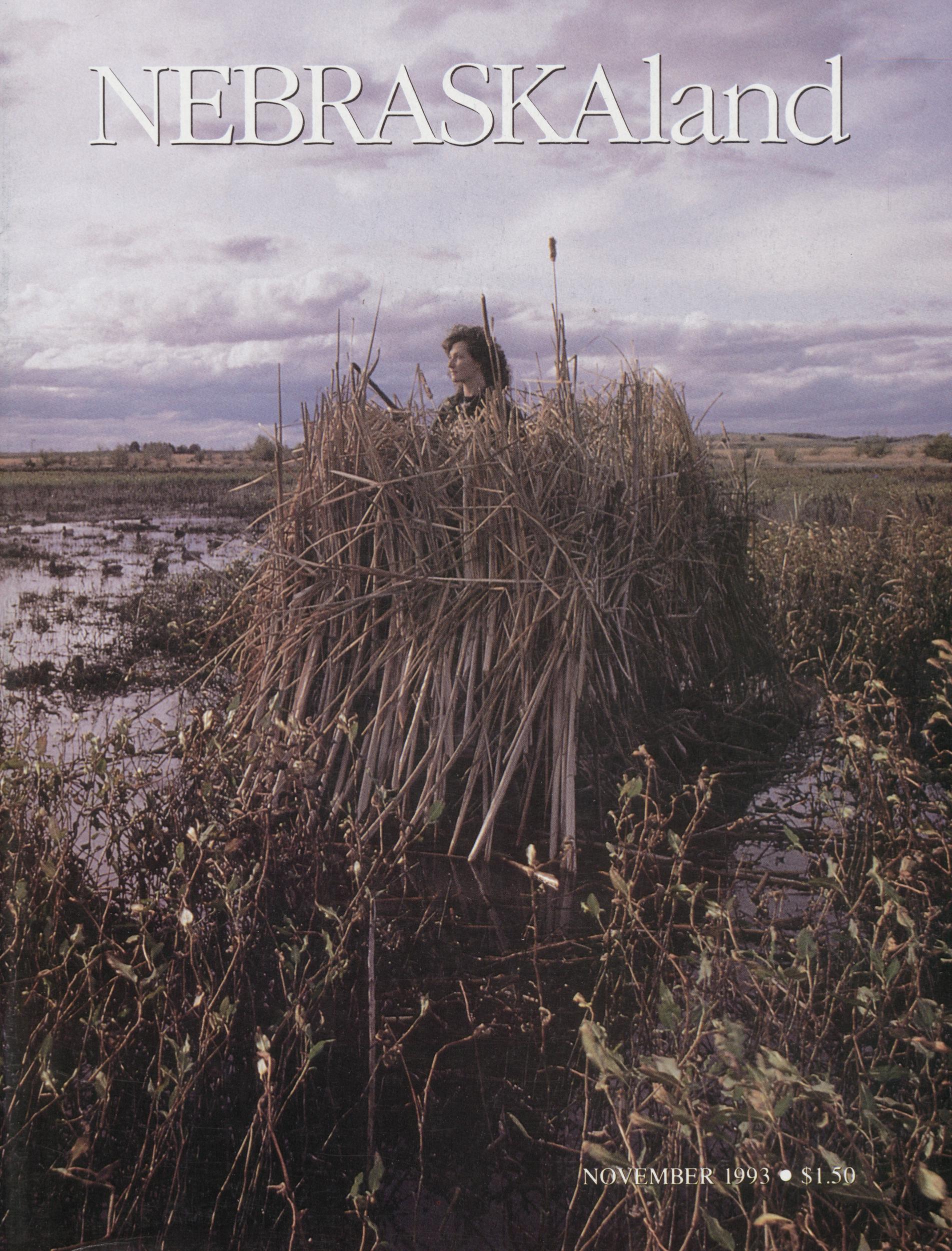
NEBRASKAland
NOVEMBER 1993 $1.50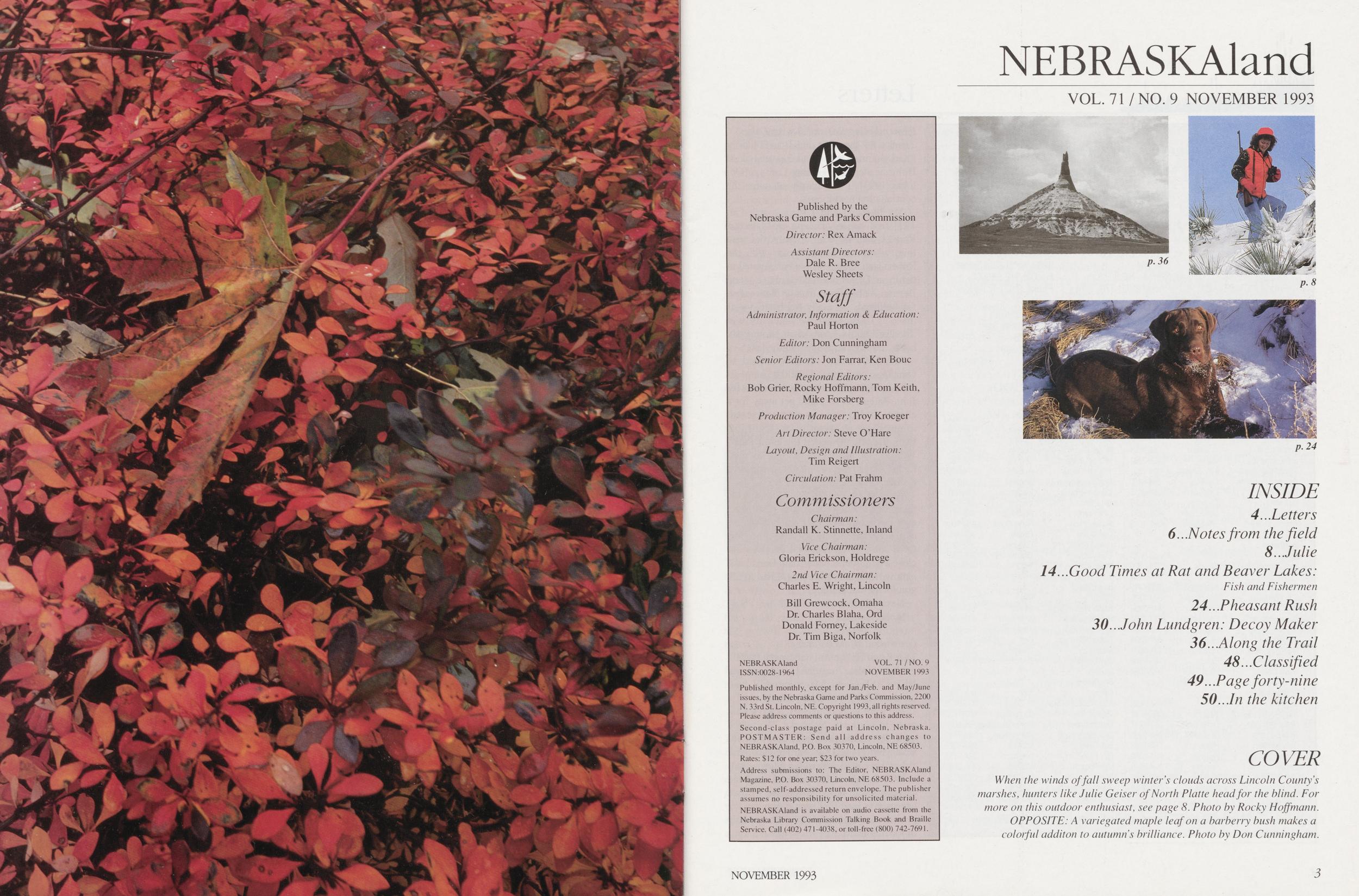
NEBRASKAland
Published by the Nebraska Game and Parks Commission Director: Rex Amack Assistant Directors: Dale R. Bree Wesley Sheets Staff Administrator, Information & Education: Paul Horton Editor: Don Cunningham Senior Editors: Jon Farrar, Ken Bouc Regional Editors: Bob Grier, Rocky Hoffmann, Tom Keith, Mike Forsberg Production Manager: Troy Kroeger Art Director: Steve CTHare Layout, Design and Illustration: Tim Reigert Circulation: Pat Frahm Commissioners Chairman: Randall K. Stinnette, Inland Vice Chairman: Gloria Erickson, Holdrege 2nd Vice Chairman: Charles E. Wright, Lincoln Bill Grewcock, Omaha Dr. Charles Blaha, Ord Donald Forney, Lakeside Dr. Tim Biga, Norfolk NEBRASKAland ISSN:0028-1964 VOL.71 /NO. 9 NOVEMBER 1993 Published monthly, except for Jan./Feb. and May/June issues, by the Nebraska Game and Parks Commission, 2200 N. 33rd St. Lincoln, NE. Copyright 1993, all rights reserved. Please address comments or questions to this address. Second-class postage paid at Lincoln, Nebraska. POSTMASTER: Send all address changes to NEBRASKAIand. P.O. Box 30370, Lincoln, NE 68503. Rates: $12 for one year; $23 for two years. Address submissions to: The Editor, NEBRASKAland Magazine, P.O. Box 30370, Lincoln, NE 68503. Include a stamped, self-addressed return envelope. The publisher assumes no responsibility for unsolicited material. NEBRASKAIlnd is available on audio cassette from the Nebraska Library Commission Talking Book and Braille Service. Call (402) 471-4038, or toll-free (800) 742-7691. VOL. 71 / NO. 9 NOVEMBER 1993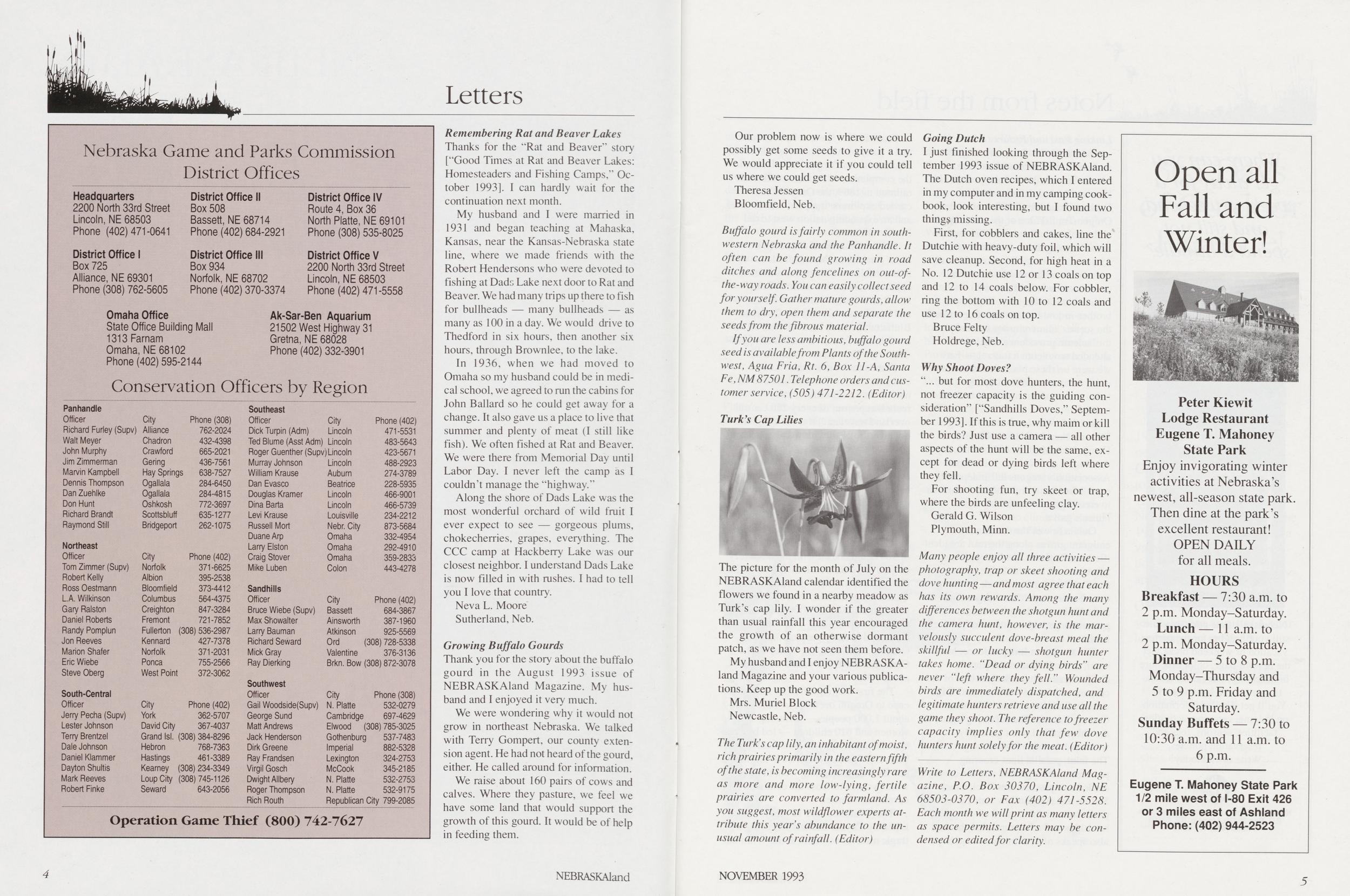
Letters
Nebraska Game and Parks Commission District Offices Headquarters 2200 North 33rd Street Lincoln, NE 68503 Phone (402)471-0641 District Office II Box 508 Bassett, NE 68714 Phone (402)684-2921 District Office IV Route 4, Box 36 North Platte, NE 69101 Phone (308)535-8025 District Office 1 Box 725 Alliance, NE 69301 Phone (308)762-5605 District Office III Box 934 Norfolk, NE 68702 Phone (402)370-3374 District Office V 2200 North 33rd Street Lincoln, NE 68503 Phone (402)471-5558 Omaha Office State Office Building Mall 1313 Farnam Omaha, NE 68102, Phone (402)595-2144 Conservation Officers by Region Conservation Officers by Region Panhandle Officer City Phone(308) Richard Furley (Supv) Alliance 762-2024 Walt Meyer Chadron 432-4398 John Murphy Crawford 665-2021 Jim Zimmerman Gering 436-7561 Marvin Kampbell Hay Springs 638-7527 Dennis Thompson Ogallala 284-6450 Dan Zuehlke Ogallala 284-4815 Don Hunt Oshkosh 772-3697 Richard Brandt Scottsbluff 635-1277 Raymond Still Bridgeport 262-1075 Southeast Officer City Phone (402) Dick Turpin (Chief) Lincoln 471-5531 Ted Blume (Asst Chief) Lincoln 483-5643 Roger Guenther (Supv) Lincoln 423-5671 Murray Johnson Lincoln 488-2923 William Krause Auburn 274-3789 Dan Evasco Beatrice 228-5935 Douglas Kramer Lincoln 466-9001 Dina Barta Lincoln 466-5739 Levi Krause Louisville 234-2212 Russell Mort Nebr. City 873-5684 Duane Arp Omaha 332-4954 Larry Elston Omaha 359-2833 Craig Stover Omaha 359-2833 Mike Luben Colon 443-4278 Northeast Officer City Phone (402) Tom Zimmer (Supv) Norfolk 371-6625 Robert Kelly Albion 395-2538 Ross Oestmann Bloomfield 373-4412 L.A. Wilkinson Columbus 564-4375 Gary Ralston Creighton 847-3284 Daniel Roberts Fremont 721-7852 Randy Pomplun Fullerton (308)536-2987 Jon Reeves Kennard 427-7378 Marion Shafer Norfolk 371-2031 Eric Wiebe Ponca 755-2566 Steve Oberg West Point 372-3062 Sandhills Officer City Phone (402) Bruce Wiebe (Supv) Bassett 684-3867 Max Showalter Ainsworth 387-1960 Larry Bauman Atkinson 925-5569 Richard Seward Ord (308)728-5338 Mick Gray Valentine 376-3136 Ray Dierking Brkn. Bow (308)872-3078 South-Central Officer City Phone (402) Jerry Pecha (Supv) York 362-5707 Lester Johnson David City 367-4037 Terry Brentzel Grand Isl. (308)384-8296 Dale Johnson Hebron 768-7363 Daniel Klammer Hastings 461-3389 Dayton Shultis Kearney (308)234-3349 Mark Reeves Loup City (308)745-1126 Robert Finke Seward 643-2056 Southwest Officer City Phone (308) Gail Woodside(Supv) No. Platte 532-0279 George Sund Cambridge 697-4629 Matt Andrews Elwood (308) 785-3025 Jack Henderson Gothenburg 537-7483 Dirk Greene Imperial 882-5328 Ray Frandsen Lexington 324-2753 Virgil Gosch McCook 345-2185 Dwight Allbery No. Platte 532-2753 Roger Thompson No. Platte 532-9175 Rich Routh Republican City 799-2085 Operation Game Thief (800) 742-7627 Remembering Rat and Beaver LakesThanks for the "Rat and Beaver'' story ["Good Times at Rat and Beaver Lakes: Homesteaders and Fishing Camps," October 1993]. I can hardly wait for the continuation next month.
My husband and I were married in 1931 and began teaching at Mahaska, Kansas, near the Kansas-Nebraska state line, where we made friends with the Robert Hendersons who were devoted to fishing at Dads Lake next door to Rat and Beaver. We had many trips up there to fish for bullheads — many bullheads — as many as 100 in a day. We would drive to Thedford in six hours, then another six hours, through Brownlee, to the lake.
In 1936, when we had moved to Omaha so my husband could be in medical school, we agreed to run the cabins for John Ballard so he could get away for a change. It also gave us a place to live that summer and plenty of meat (I still like fish). We often fished at Rat and Beaver. We were there from Memorial Day until Labor Day. I never left the camp as I couldn't manage the "highway."
Along the shore of Dads Lake was the most wonderful orchard of wild fruit I ever expect to see — gorgeous plums, chokecherries, grapes, everything. The CCC camp at Hackberry Lake was our closest neighbor. I understand Dads Lake is now filled in with rushes. I had to tell you I love that country.
Neva L. Moore Sutherland, Neb. Growing Buffalo GourdsThank you for the story about the buffalo gourd in the August 1993 issue of NEBRASKAland Magazine. My husband and I enjoyed it very much.
We were wondering why it would not grow in northeast Nebraska. We talked with Terry Gompert, our county extension agent. He had not heard of the gourd, either. He called around for information.
We raise about 160 pairs of cows and calves. Where they pasture, we feel we have some land that would support the growth of this gourd. It would be of help in feeding them.
4 NEBRASKAlandOur problem now is where we could possibly get some seeds to give it a try. We would appreciate it if you could tell us where we could get seeds.
Theresa Jessen Bloomfield, Neb.Buffalo gourd is fairly common in southwestern Nebraska and the Panhandle. It often can be found growing in road ditches and along fence lines on out-of-the-way roads. You can easily collect seed for yourself. Gather mature gourds, allow them to dry, open them and separate the seeds from the fibrous material.
If you are less ambitious, buffalo gourd seed is available from Plants of the Southwest, Agua Fria, Rt. 6, Box 11-A, Santa Fe, NM 87501. Telephone orders and customer service, (505) 471-2212. (Editor)
Turk's Cap LiliesThe picture for the month of July on the NEBRASKAland calendar identified the flowers we found in a nearby meadow as Turk's cap lily. I wonder if the greater than usual rainfall this year encouraged the growth of an otherwise dormant patch, as we have not seen them before.
My husband and I enjoy NEBRASKAland Magazine and your various publications. Keep up the good work.
Mrs. Muriel Block Newcastle, Neb.The Turk's cap lily, an inhabitant of moist, rich prairies primarily in the eastern fifth of the state, is becoming increasingly rare as more and more low-lying, fertile prairies are converted to farmland. As you suggest, most wildflower experts attribute this year's abundance to the unusual amount of rainfall. (Editor)
Going DutchI just finished looking through the September 1993 issue of NEBRASKAland. The Dutch oven recipes, which I entered in my computer and in my camping cookbook, look interesting, but I found two things missing.
First, for cobblers and cakes, line the Dutchie with heavy-duty foil, which will save cleanup. Second, for high heat in a No. 12 Dutchie use 12 or 13 coals on top and 12 to 14 coals below. For cobbler, ring the bottom with 10 to 12 coals and use 12 to 16 coals on top.
Bruce Felty Holdrege, Neb. Why Shoot Doves?"... but for most dove hunters, the hunt, not freezer capacity is the guiding consideration" ["Sandhills Doves," September 1993]. If this is true, why maim or kill the birds? Just use a camera — all other aspects of the hunt will be the same, except for dead or dying birds left where they fell.
For shooting fun, try skeet or trap, where the birds are unfeeling clay.
Gerald G. Wilson Plymouth, Minn.Many people enjoy all three activities photography, trap or skeet shooting and dove hunting—and most agree that each has its own rewards. Among the many differences be Ween the shotgun hunt and the camera hunt, however, is the marvelously succulent dove-breast meal the skillful — or lucky — shotgun hunter takes home. "Dead or dying birds" are never "left where they fell." Wounded birds are immediately dispatched, and legitimate hunters retrieve and use all the game they shoot. The reference to freezer capacity implies only that few dove hunters hunt solely for the meat. (Editor)
Write to Letters, NEBRASKAland Magazine, P.O. Box 30370, Lincoln, NE 68503-0370, or Fax (402) 471-5528. Each month we will print as many letters as space permits. Letters may be condensed or edited for clarity. Open all Fall and Winter! Peter Kiewit Lodge Restaurant Eugene T. Mahoney State Park Enjoy invigorating winter activities at Nebraska's newest, all-season state park. Then dine at the park's excellent restaurant! OPEN DAILY for all meals. HOURS Breakfast — 7:30 a.m. to 2 p.m. Monday-Saturday. Lunch — 11 a.m. to 2 p.m. Monday-Saturday. Dinner — 5 to 8 p.m. Monday-Thursday and 5 to 9 p.m. Friday and Saturday. Sunday Buffets — 7:30 to 10:30 a.m. and 11 a.m. to 6 p.m. Eugene T. Mahoney State Park 1/2 mile west of I-80 Exit 426 or 3 miles east of Ashland Phone: (402) 944-2523 NOVEMBER 1993 5 Where can you
get away for a
week or weekend,
and still not
spend a bundle?
Nebraska's state park areas are
still your best bet for the perfect
vacation or weekend break.Get
the new 48-page, color brochure
highlighting state parks,
recreation areas and historic parks.
You'll get detailed information
on lodging, camping, activities,
facilities, seasons, fees and
reservation policies.
Write or call today!
Notes from the field
Nebraska Game and Parks Commission
P.O. Box 30370, Lincoln, NE, 68503
Phone (402) 471-0641
Linking Past and Future
Where can you
get away for a
week or weekend,
and still not
spend a bundle?
Nebraska's state park areas are
still your best bet for the perfect
vacation or weekend break.Get
the new 48-page, color brochure
highlighting state parks,
recreation areas and historic parks.
You'll get detailed information
on lodging, camping, activities,
facilities, seasons, fees and
reservation policies.
Write or call today!
Notes from the field
Nebraska Game and Parks Commission
P.O. Box 30370, Lincoln, NE, 68503
Phone (402) 471-0641
Linking Past and Future
On June 6, 1849, a party of gold seekers from Boston and Newton, Massachusetts, crossed the present Kansas-Nebraska border southeast of Fairbury bound for California on the Oregon Trail. Three of the party, ill with cholera, had recovered enough to allow the wagons to continue but for 25-year-old George Winslow, the trail ended on a crest between two small creeks northwest of Fairbury.
In a letter to his wife, Winslow's brother-in-law Brackett Lord describes the scene: "Our company feel deeply this solemn providence. I never attended so solemn a funeral — here we were on these plains hundreds of miles from any civilized being — and to leave one of our number was most trying."
In 1912, Winslow's sons, George Edward, bom May 15, 1846, and Henry, born May 16, 1849 — the day the Boston and Newton Joint Stock Association's wagons left Independence, Missouri — returned to Nebraska to erect a granite marker at their father's grave.
Only a few of the thousands of emigrant graves along the trail are identified and marked. The George Winslow grave site, on a scenic ridge between forks of Whisky Run Creek, is one of the most dramatic. The Oregon Trail is still visible near the grave (landowner permission is required to enter private land).
The trail from Independence, Missouri, to the Willamette Valley in Oregon enters Nebraska just east of the common comer of Jefferson and Gage counties in Nebraska and Washington County, Kansas. The surviving traces of the Oregon Trail point generally westward, but also back through time. The faint, parallel lines crossing pastures and hay ground and the deeply eroded ruts preserved at Rock Creek Station and Ash Hollow state historical parks are a visible record of struggles, hardships and adventures, but the trail also speaks of determination and hope.
From 1812-13, when Robert Stuart and a party of Astorians crossed the continent from Oregon to St. Louis, to the completion of the transcontinental railroad in 1869, the Oregon Trail carried explorers, trappers, missionaries and an expanding nation west to the Pacific Ocean.
In his monumental Platte River Road Narratives, Merrill J. Mattes estimates half a million men, women and children traveled the central Platte River corridor between Fort Kearny and Fort Laramie using the Council Bluffs or Mormon Pioneer Trail on the north bank of the river and the Oregon-California Trail on the south bank.
Mattes found more than 2,000 emigrant diaries, journals and overland narratives for his bibliography — "one record keeper out of every 250 central overland travelers." It is the emigrants' own words, filled with wonder, despair, hope, courage, sadness (the trail brought out the best and the worst) that accompanies our photographic journey beginning on page 36 in celebration of the trail's 150th anniversary.
Mattes dates the "historic" Oregon Trail to the first emigrant train bound for Oregon, the Bidwell-Bartleson party of 1841, and ends it with the discovery of gold at Sutter's Mill in 1848 and the rush of "Forty-niners" headed for the California gold fields the following year. An estimated 55,000 gold seekers traveled west in 1850. The Oregon Trail continued to carry people bound for Oregon, California, the Valley of the Great Salt Lake and points west until about 1866.
The first major push from Independence to Oregon occurred in 1843, with about 1,000 people — including 130 women and 610 children — led by Pres-byterian missionary and medical doctor Marcus Whitman. Narcissa Whitman and Elizabeth Spalding were the first white women to cross the continent seven years earlier.
The Whitmans and 13 others were killed by Cayuse Indians following a tragic measles outbreak at the Whitman 6 NEBRASKAland mission near present-day Walla Walla, Washington, in 1847.
Rock Creek Station State Historical Park southeast of Fairbury preserves deeply etched ruts where the Oregon Trail climbs the hill above Rock Creek, the 1861 scene of the killing of David McCanles, James Woods and James Gordon by James Butler "Wild Bill" Hickok and several accomplices.
From Rock Creek, the trail follows the Little Blue River to a point south of Hastings before breaking north to the Platte River and Fort Kearny. Early explorers, including John C. Fremont and Howard Stansbury, referred to the sandhills they encountered along the river as the "Coast of Nebraska" or "Coast of the Platte."
Fort Kearny, at the upper end of the Platte's "Grand Island," was established in 1848. For the emigrant traveler, Fort Kearny was a brief glimpse of civilization after leaving "the states." Fort Kearny State Historical Park tells the story of this important fort on the Oregon Trail.
West of Fort Kearny, at least four crossings forded the South Platte from the Lower Ford near Sutherland to the Old Julesburg or Later California Crossing near Julesburg, Colorado. The Upper Ford or Old California Crossing wesLof Brule leads to California Hill, Windlass Hill and Ash Hollow, now a state historical park on the North Platte east of Lewellen.
According to Mattes, "the name Windlass Hill... is not to be found in emigrant journals or guides," although Stansbury and others used ropes to lower their wagons down the steep hillside. Ash Hollow State Historical Park's visitor center and prehistoric Ash Hollow Cave are located above a small, flowing spring often mentioned in the diaries and journals.
The grave of Rachel Pattison, who took sick with cholera on the morning of May 19, 1849, and died at 11 p.m. that night is located in the Ash Hollow cemetery.
From Ash Hollow, the trail follows the North Platte River then leaves its banks briefly to climb Robidoux Pass and Mitchell Pass. Along the way are Courthouse and Jail rocks, Chimney Rock and Scotts Bluff National Monument. To the west are Fort Laramie and Laramie Peak. According to Mattes, Chimney Rock received "more enthusiasm and more diary space" than any other landmark along the Oregon Trail. The Oregon Trail, after 150 years, is both a link to the past and an introduction to the future. Its few surviving traces speak with eloquence about where we've been and where we may yet go.
Bob Grier 365 Days of Outdoor Pleasure! 1994 is on its way, and the new NEBRASKAland Calendar is the perfect way to stay up to date. Featuring 12 spectacular photos of Nebraska's great outdoors, the 1994 calendar also contains a variety of state park information, license and permit data and sunrise/sunset tables. Order one for yourself and several more as gifts. A year long bargain at $5.50. Please send me copies of the 1994 NEBRASKAland Calendar at $5.50 each (Nebraska residents please include sales tax). Name Address City State Check Enclosed Visa Zip MasterCard Acct. No Expiration Date Mail to NEBRASKAland Calendar P.O. Box 30370 Lincoln, NE 68503 NOVEMBER 1993 7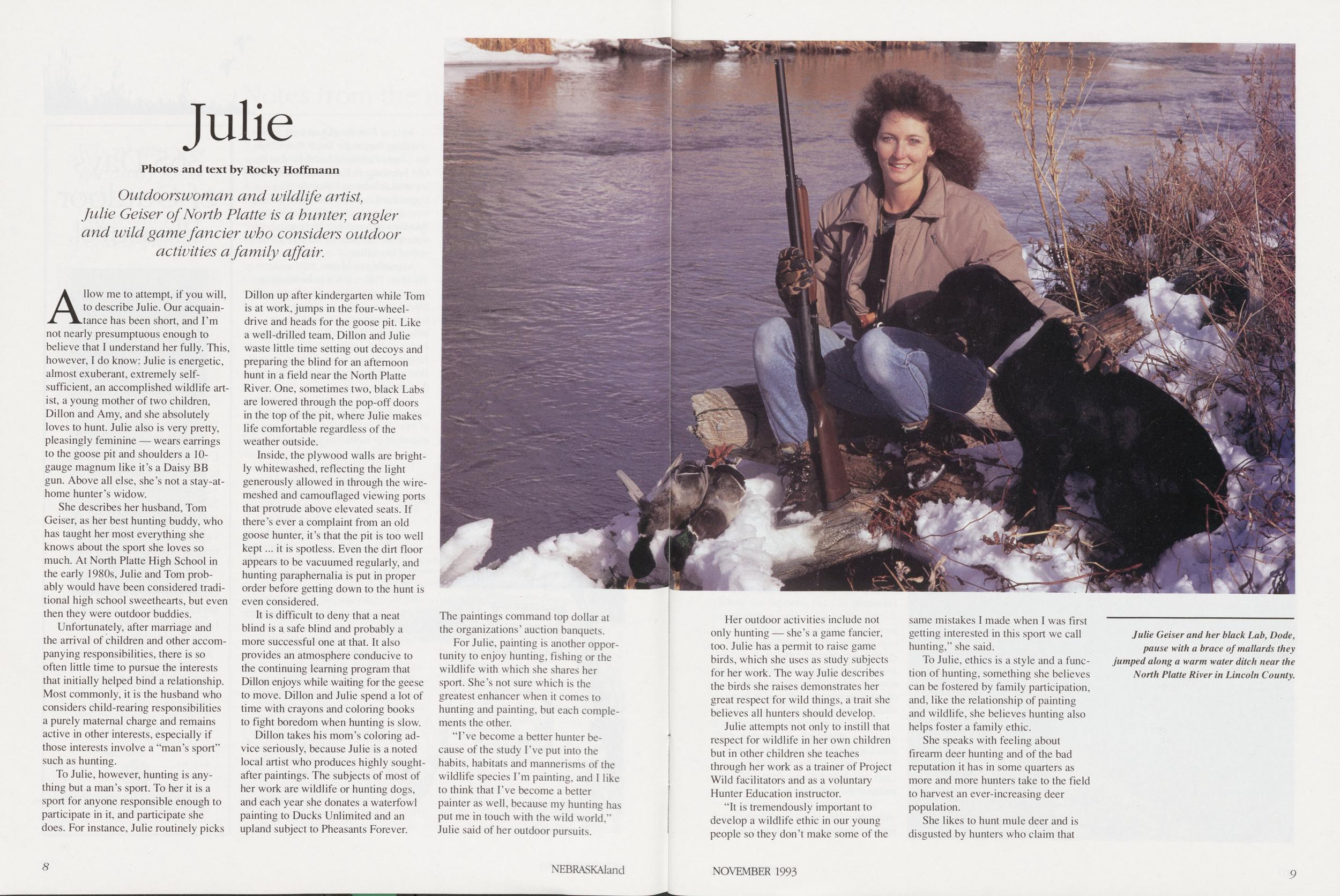
Julie
Photos and text by Rocky Hoffmann Outdoors woman and wildlife artist, Julie Geiser of North Platte is a hunter, angler and wild game fancier who considers outdoor activities a family affairAllow me to attempt, if you will, to describe Julie. Our acquaintance has been short, and I'm not nearly presumptuous enough to believe that I understand her fully. This, however, I do know: Julie is energetic, almost exuberant, extremely self- sufficient, an accomplished wildlife artist, a young mother of two children, Dillon and Amy, and she absolutely loves to hunt. Julie also is very pretty, pleasingly feminine — wears earrings to the goose pit and shoulders a 10- gauge magnum like it's a Daisy BB gun. Above all else, she's not a s tay-at-home hunter's widow.
She describes her husband, Tom Geiser, as her best hunting buddy, who has taught her most everything she knows about the sport she loves so much. At North Platte High School in the early 1980s, Julie and Tom probably would have been considered traditional high school sweethearts, but even then they were outdoor buddies.
Unfortunately, after marriage and the arrival of children and other accompanying responsibilities, there is so often little time to pursue the interests that initially helped bind a relationship. Most commonly, it is the husband who considers child-rearing responsibilities a purely maternal charge and remains active in other interests, especially if those interests involve a "man's sport" such as hunting.
To Julie, however, hunting is anything but a man's sport. To her it is a sport for anyone responsible enough to participate in it, and participate she does. For instance, Julie routinely picks Dillon up after kindergarten while Tom is at work, jumps in the four-wheel- drive and heads for the goose pit. Like a well-drilled team, Dillon and Julie waste little time setting out decoys and preparing the blind for an afternoon hunt in a field near the North Platte River. One, sometimes two, black Labs are lowered through the pop-off doors in the top of the pit, where Julie makes life comfortable regardless of the weather outside.
Inside, the plywood walls are brightly whitewashed, reflecting the light generously allowed in through the wire-meshed and camouflaged viewing ports that protrude above elevated seats. If there's ever a complaint from an old goose hunter, it's that the pit is too well kept... it is spotless. Even the dirt floor appears to be vacuumed regularly, and hunting paraphernalia is put in proper order before getting down to the hunt is even considered.
It is difficult to deny that a neat blind is a safe blind and probably a more successful one at that. It also provides an atmosphere conducive to the continuing learning program that Dillon enjoys while waiting for the geese to move. Dillon and Julie spend a lot of time with crayons and coloring books to fight boredom when hunting is slow.
Dillon takes his mom's coloring ad- vice seriously, because Julie is a noted local artist who produces highly sought- after paintings. The subjects of most of her work are wildlife or hunting dogs, and each year she donates a waterfowl painting to Ducks Unlimited and an upland subject to Pheasants Forever. The paintings command top dollar at the organizations' auction banquets.
For Julie, painting is another opportunity to enjoy hunting, fishing or the wildlife with which she shares her sport. She's not sure which is the greatest enhancer when it comes to hunting and painting, but each complements the other.
"I've become a better hunter be- cause of the study I've put into the habits, habitats and mannerisms of the wildlife species I'm painting, and I like to think that I've become a better painter as well, because my hunting has put me in touch with the wild world," Julie said of her outdoor pursuits.
8 NEBRASKAlandHer outdoor activities include not only hunting — she's a game fancier, too. Julie has a permit to raise game birds, which she uses as study subjects for her work. The way Julie describes the birds she raises demonstrates her great respect for wild things, a trait she believes all hunters should develop.
Julie attempts not only to instill that respect for wildlife in her own children but in other children she teaches through her work as a trainer of Project Wild facilitators and as a voluntary Hunter Education instructor.
"It is tremendously important to develop a wildlife ethic in our young people so they don't make some of the same mistakes I made when I was first getting interested in this sport we call hunting," she said.
To Julie, ethics is a style and a func- tion of hunting, something she believes can be fostered by family participation, and, like the relationship of painting and wildlife, she believes hunting also helps foster a family ethic.
She speaks with feeling about firearm deer hunting and of the bad reputation it has in some quarters as more and more hunters take to the field to harvest an ever-increasing deer population.
She likes to hunt mule deer and is disgusted by hunters who claim that
"It's a shame that these people hunt something year after year and don't enjoy it because they feel there is no challenge," she said. "The problem with those who think mule deer present no challenge is that they take advantage of them, driving the canyons in four-wheel-drive vehicles."
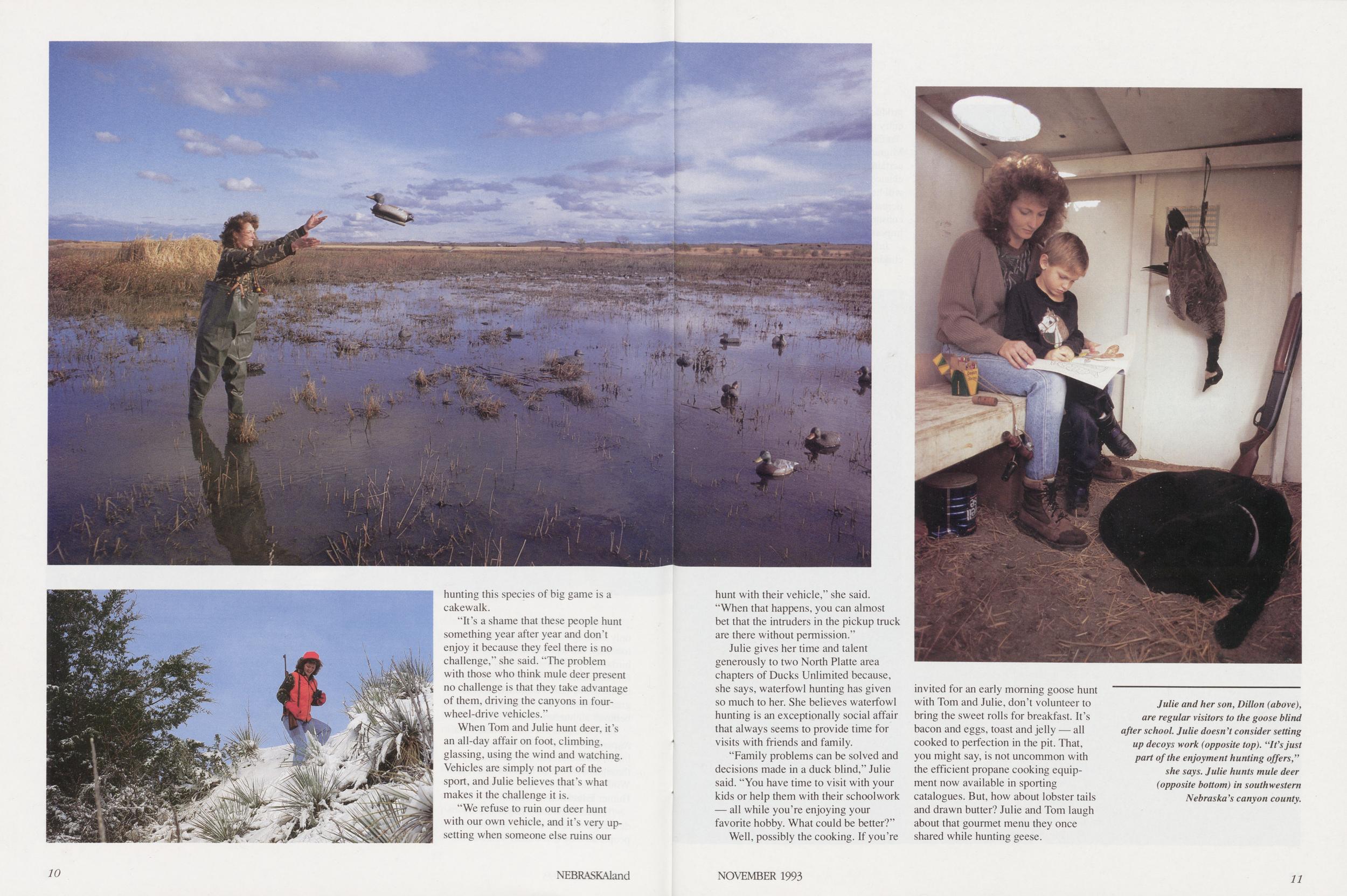
When Tom and Julie hunt deer, it's an all-day affair on foot, climbing, glassing, using the wind and watching. Vehicles are simply not part of the sport, and Julie believes that's what makes it the challenge it is.
"We refuse to ruin our deer hunt with our own vehicle, and it's very upsetting when someone else ruins our 10 NEBRASKAland hunt with their vehicle," she said. "When that happens, you can almost bet that the intruders in the pickup truck are there without permission."
Julie gives her time and talent generously to two North Platte area chapters of Ducks Unlimited because, she says, waterfowl hunting has given so much to her. She believes waterfowl hunting is an exceptionally social affair that always seems to provide time for visits with friends and family.
"Family problems can be solved and decisions made in a duck blind," Julie said. "You have time to visit with your kids or help them with their schoolwork — all while you're enjoying your favorite hobby. What could be better?"
Well, possibly the cooking. If you're invited for an early morning goose hunt with Tom and Julie, don't volunteer to bring the sweet rolls for breakfast. It's bacon and eggs, toast and jelly — all cooked to perfection in the pit. That, you might say, is not uncommon with the efficient propane cooking equipment now available in sporting catalogues. But, how about lobster tails and drawn butter? Julie and Tom laugh about that gourmet menu they once shared while hunting geese.
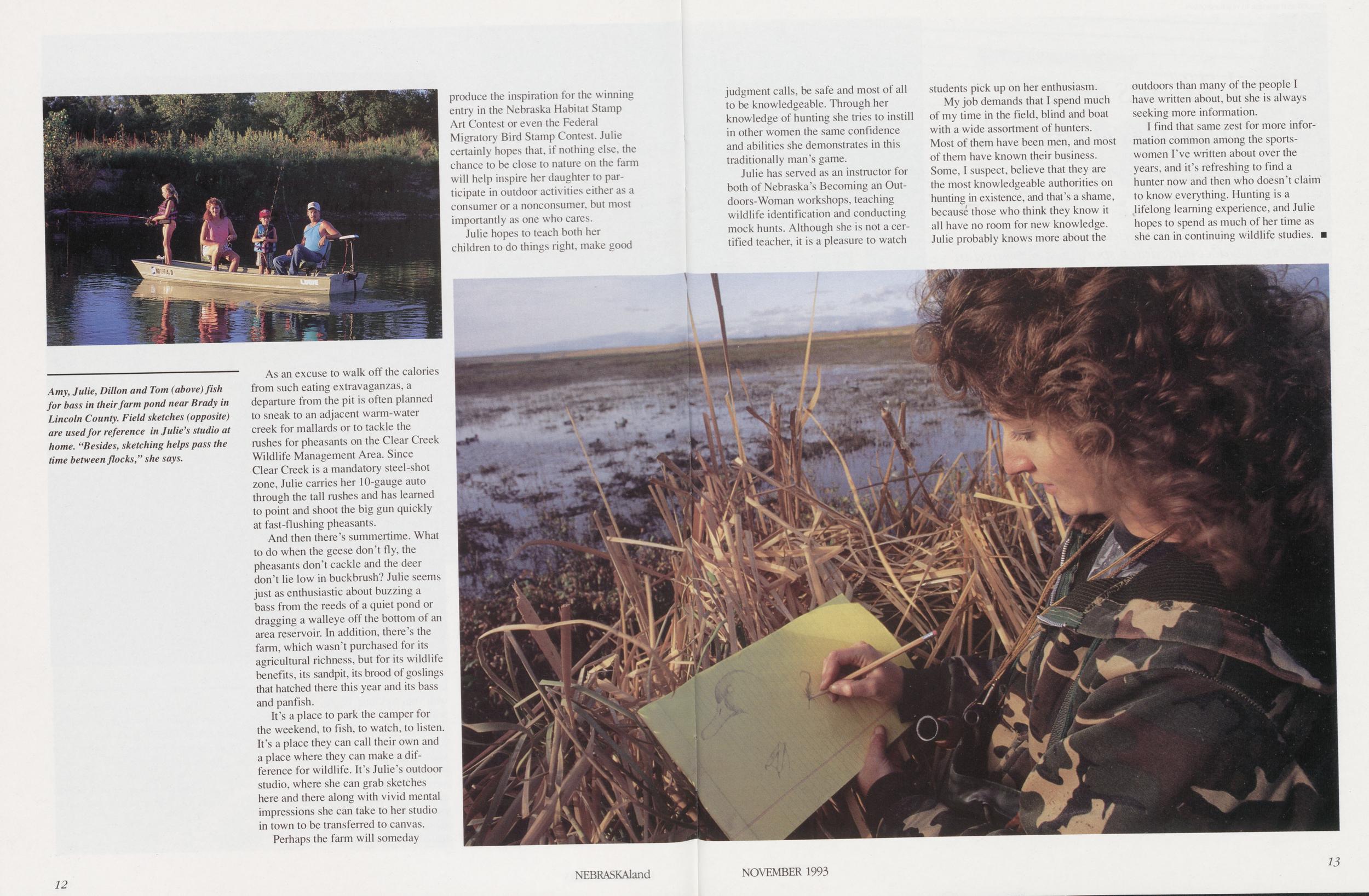
As an excuse to walk off the calories from such eating extravaganzas, a departure from the pit is often planned to sneak to an adjacent warm-water creek for mallards or to tackle the rushes for pheasants on the Clear Creek Wildlife Management Area. Since Clear Creek is a mandatory steel-shot zone, Julie carries her 10-gauge auto through the tall rushes and has learned to point and shoot the big gun quickly at fast-flushing pheasants.
And then there's summertime. What to do when the geese don't fly, the pheasants don't cackle and the deer don't lie low in buckbrush? Julie seems just as enthusiastic about buzzing a bass from the reeds of a quiet pond or dragging a walleye off the bottom of an area reservoir. In addition, there's the farm, which wasn't purchased for its agricultural richness, but for its wildlife benefits, its sandpit, its brood of goslings that hatched there this year and its bass and panfish.
It's a place to park the camper for the weekend, to fish, to watch, to listen. It's a place they can call their own and a place where they can make a difference for wildlife. It's Julie's outdoor studio, where she can grab sketches here and there along with vivid mental impressions she can take to her studio in town to be transferred to canvas.
Perhaps the farm will someday produce the inspiration for the winning entry in the Nebraska Habitat Stamp Art Contest or even the Federal Migratory Bird Stamp Contest. Julie certainly hopes that, if nothing else, the chance to be close to nature on the farm will help inspire her daughter to participate in outdoor activities either as a consumer or a nonconsumer, but most importantly as one who cares.
Julie hopes to teach both her children to do things right, make good 12 NEBRASKAland judgment calls, be safe and most of all to be knowledgeable. Through her knowledge of hunting she tries to instill in other women the same confidence and abilities she demonstrates in this traditionally man's game.
Julie has served as an instructor for both of Nebraska's Becoming an Outdoors-Woman workshops, teaching wildlife identification and conducting mock hunts. Although she is not a certified teacher, it is a pleasure to watch students pick up on her enthusiasm.
My job demands that I spend much of my time in the field, blind and boat with a wide assortment of hunters. Most of them have been men, and most of them have known their business. Some, I suspect, believe that they are the most knowledgeable authorities on hunting in existence, and that's a shame, because those who think they know it all have no room for new knowledge. Julie probably knows more about the outdoors than many of the people I have written about, but she is always seeking more information.
I find that same zest for more information common among the sports- women I've written about over the years, and it's refreshing to find a hunter now and then who doesn't claim to know everything. Hunting is a lifelong learning experience, and Julie hopes to spend as much of her time as she can in continuing wildlife studies, i
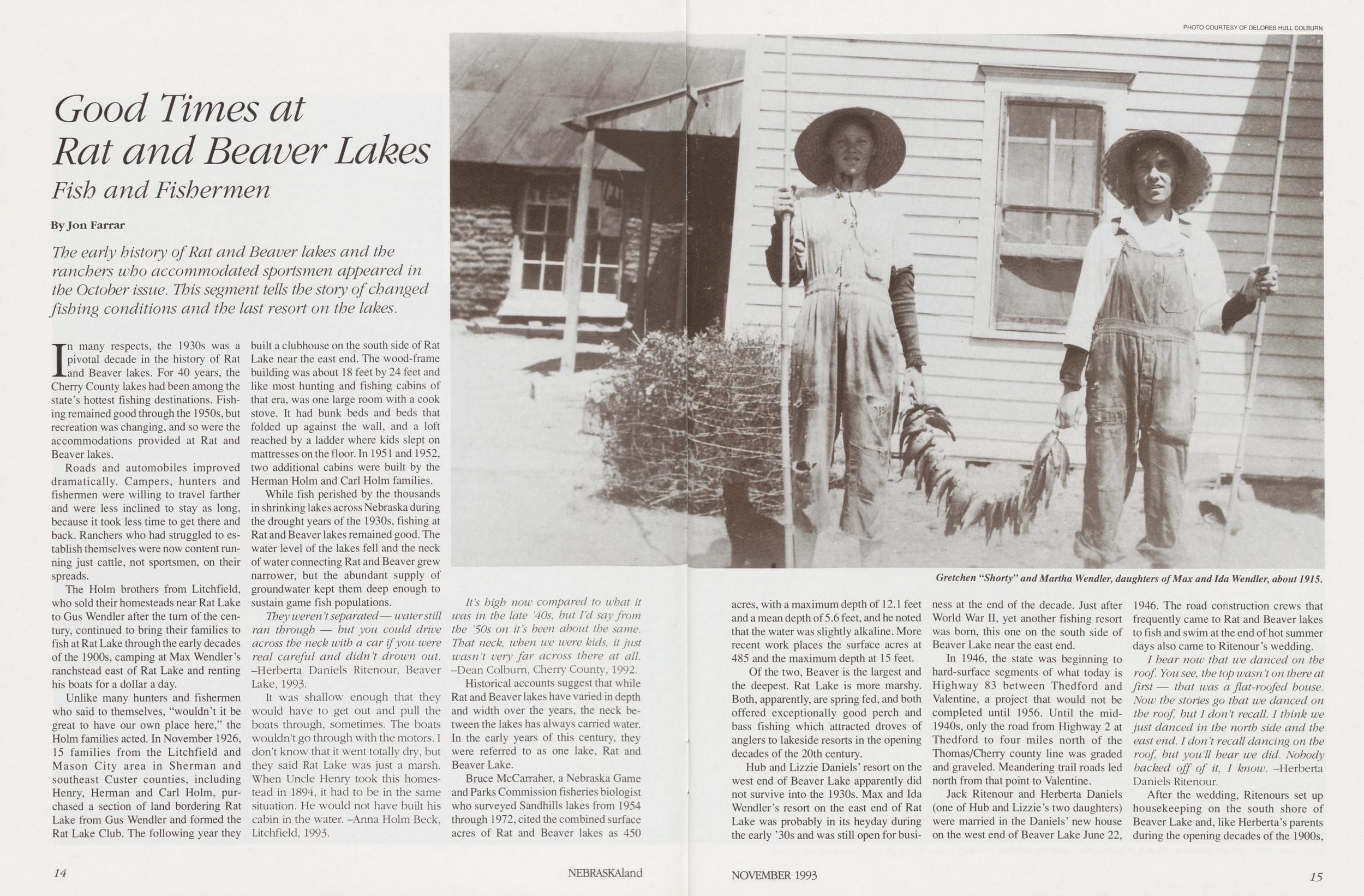
Good Times at Rat and Beaver Lakes
Fish and Fishermen By Jon Farrar The early history of Rat and Beaver lakes and the ranchers who accommodated sportsmen appeared in the October issue. This segment tells the story of changed fishing conditions and the last resort on the lakes.In many respects, the 1930s was a pivotal decade in the history of Rat and Beaver lakes. For 40 years, the Cherry County lakes had been among the state's hottest fishing destinations. Fishing remained good through the 1950s, but recreation was changing, and so were the accommodations provided at Rat and Beaver lakes.
Roads and automobiles improved dramatically. Campers, hunters and fishermen were willing to travel farther and were less inclined to stay as long, because it took less time to get there and back. Ranchers who had struggled to establish themselves were now content running just cattle, not sportsmen, on their spreads.
The Holm brothers from Litchfield, who sold their homesteads near Rat Lake to Gus Wendler after the turn of the century, continued to bring their families to fish at Rat Lake through the early decades of the 1900s, camping at Max Wendler's ranchstead east of Rat Lake and renting his boats for a dollar a day.
Unlike many hunters and fishermen who said to themselves, "wouldn't it be great to have our own place here," the Holm families acted. In November 1926, 15 families from the Litchfield and Mason City area in Sherman and southeast Custer counties, including Henry, Herman and Carl Holm, purchased a section of land bordering Rat Lake from Gus Wendler and formed the Rat Lake Club. The following year they built a clubhouse on the south side of Rat Lake near the east end. The wood-frame building was about 18 feet by 24 feet and like most hunting and fishing cabins of that era, was one large room with a cook stove. It had bunk beds and beds that folded up against the wall, and a loft reached by a ladder where kids slept on mattresses on the floor. In 1951 and 1952, two additional cabins were built by the Herman Holm and Carl Holm families.
While fish perished by the thousands in shrinking lakes across Nebraska during the drought years of the 1930s, fishing at Rat and Beaver lakes remained good. The water level of the lakes fell and the neck of water connecting Rat and Beaver grew narrower, but the abundant supply of groundwater kept them deep enough to sustain game fish populations.
They weren 't separated— water still ran through — hut you could drive across the neck with a car if you were real careful and didn't drown out. -Herberta Daniels Ritenour, Beaver Lake, 1993.
It was shallow enough that they would have to get out and pull the boats through, sometimes. The boats wouldn't go through with the motors. I don't know that it went totally dry, but they said Rat Lake was just a marsh. When Uncle Henry took this homestead in 1894, it had to be in the same situation. He would not have built his cabin in the water. -Anna Holm Beck, Litchfield, 1993.
Its high now compared to what it was in the late '40s. hut I'd say from the '50s on it's been about the same. That neck, when we were kids, it just wasn't very far across there at all. -Dean Colburn, Cherry County, 1992.
Historical accounts suggest that while Rat and Beaver lakes have varied in depth and width over the years, the neck between the lakes has always carried water. In the early years of this century, they were referred to as one lake, Rat and Beaver Lake.
Bruce McCarraher, a Nebraska Game and Parks Commission fisheries biologist who surveyed Sandhills lakes from 1954 through 1972, cited the combined surface acres of Rat and Beaver lakes as 450 14 NEBRASKAland
Of the two, Beaver is the largest and the deepest. Rat Lake is more marshy. Both, apparently, are spring fed, and both offered exceptionally good perch and bass fishing which attracted droves of anglers to lakeside resorts in the opening decades of the 20th century.
Hub and Lizzie Daniels' resort on the west end of Beaver Lake apparently did not survive into the 1930s. Max and Ida Wendler's resort on the east end of Rat Lake was probably in its heyday during the early '30s and was still open for business at the end of the decade. Just after World War II, yet another fishing resort was bom, this one on the south side of Beaver Lake near the east end.
In 1946, the state was beginning to hard-surface segments of what today is Highway 83 between Thedford and Valentine, a project that would not be completed until 1956. Until the mid-19408, only the road from Highway 2 at Thedford to four miles north of the Thomas/Cherry county line was graded and graveled. Meandering trail roads led north from that point to Valentine.
Jack Ritenour and Herberta Daniels (one of Hub and Lizzie's two daughters) were married in the Daniels' new house on the west end of Beaver Lake June 22, 1946. The road construction crews that frequently came to Rat and Beaver lakes to fish and swim at the end of hot summer days also came to Ritenour's wedding.
I hear now that we danced on the roof. You see, the top wasn Y on there at first — that was a flat-roofed house. Now the stories go that we danced on the roof, but I don't recall. I think we just danced in the north side and the east end. I don Y recall dancing on the roof, but you '11 hear we did. Nobody backed off of it, I know. -Herberta Daniels Ritenour.
After the wedding, Ritenours set up
housekeeping on the south shore of
Beaver Lake and, like Herberta's parents
during the opening decades of the 1900s,
NOVEMBER 1993
15
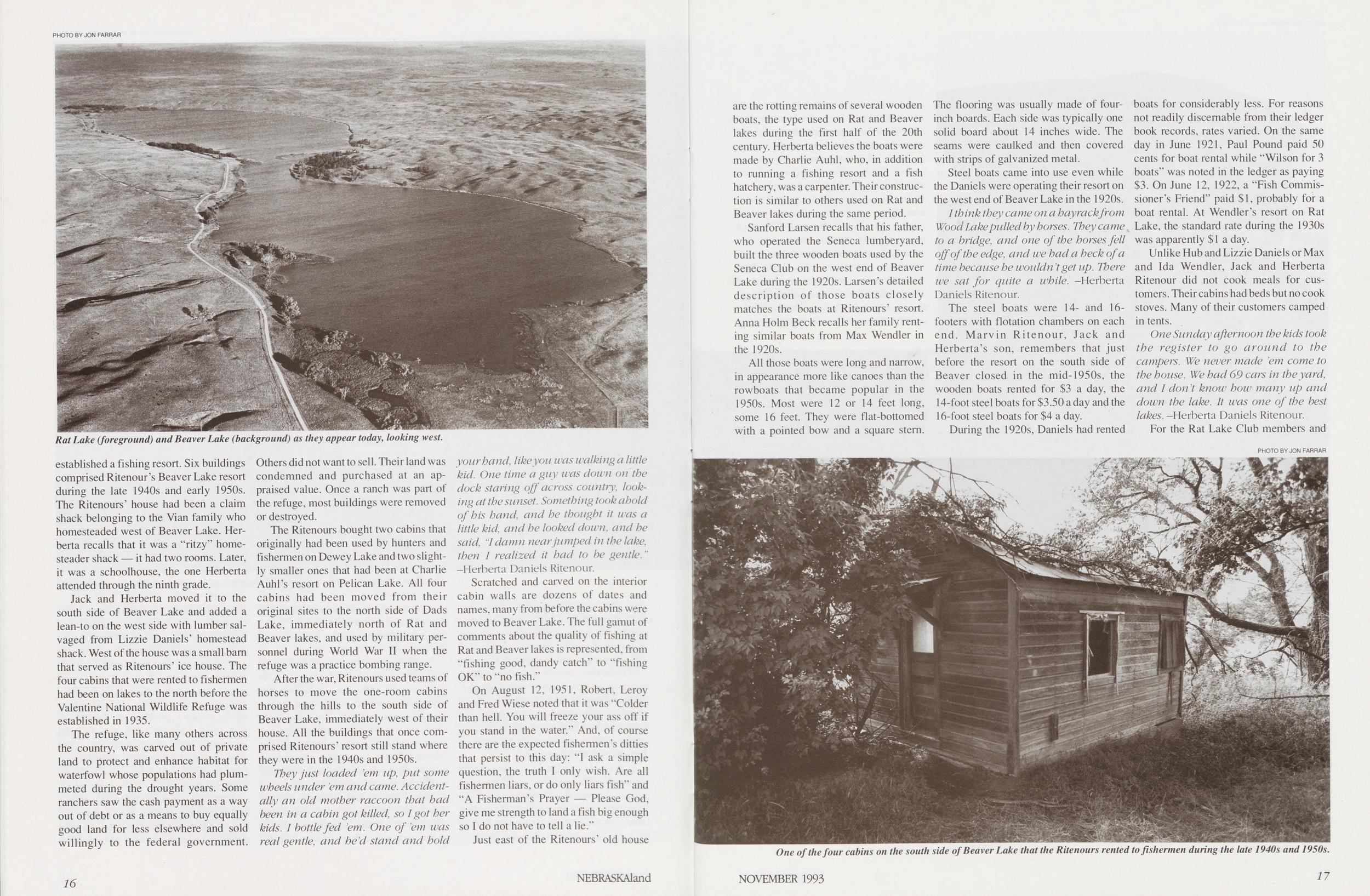
Jack and Herberta moved it to the south side of Beaver Lake and added a lean-to on the west side with lumber salvaged from Lizzie Daniels' homestead shack. West of the house was a small bam that served as Ritenours' ice house. The four cabins that were rented to fishermen had been on lakes to the north before the Valentine National Wildlife Refuge was established in 1935.
The refuge, like many others across the country, was carved out of private land to protect and enhance habitat for waterfowl whose populations had plum- meted during the drought years. Some ranchers saw the cash payment as a way out of debt or as a means to buy equally good land for less elsewhere and sold willingly to the federal government. Others did not want to sell. Their land was condemned and purchased at an appraised value. Once a ranch was part of the refuge, most buildings were removed or destroyed.
The Ritenours bought two cabins that originally had been used by hunters and fishermen on Dewey Lake and two slightly smaller ones that had been at Charlie Auhl's resort on Pelican Lake. All four cabins had been moved from their original sites to the north side of Dads Lake, immediately north of Rat and Beaver lakes, and used by military personnel during World War II when the refuge was a practice bombing range.
After the war, Ritenours used teams of horses to move the one-room cabins through the hills to the south side of Beaver Lake, immediately west of their house. All the buildings that once comprised Ritenours' resort still stand where they were in the 1940s and 1950s.
They just loaded 'em up, put some wheels under 'em and came. Accidentally an old mother raccoon that had been in a cabin got killed, so I got her kids. I bottle fed 'em. One of 'em was real gentle, and he'd stand and hold your hand, like you was walking a little kid. One time a guy was down on the dock staring off across country, looking at the sunset. Something took ahold of his ha} id. a fid he thought it was a little kid. and he looked down, and he said, "I damn near jumped in the lake, then I realized it had to be gentle.' -Herberta Daniels Ritenour.
Scratched and carved on the interior cabin walls are dozens of dates and names, many from before the cabins were moved to Beaver Lake. The full gamut of comments about the quality of fishing at Rat and Beaver lakes is represented, from "fishing good, dandy catch" to "fishing OK" to "no fish."
On August 12, 1951, Robert, Leroy and Fred Wiese noted that it was "Colder than hell. You will freeze your ass off if you stand in the water." And, of course there are the expected fishermen's ditties that persist to this day: "I ask a simple question, the truth I only wish. Are all fishermen liars, or do only liars fish" and "A Fisherman's Prayer — Please God, give me strength to land a fish big enough so I do not have to tell a lie."
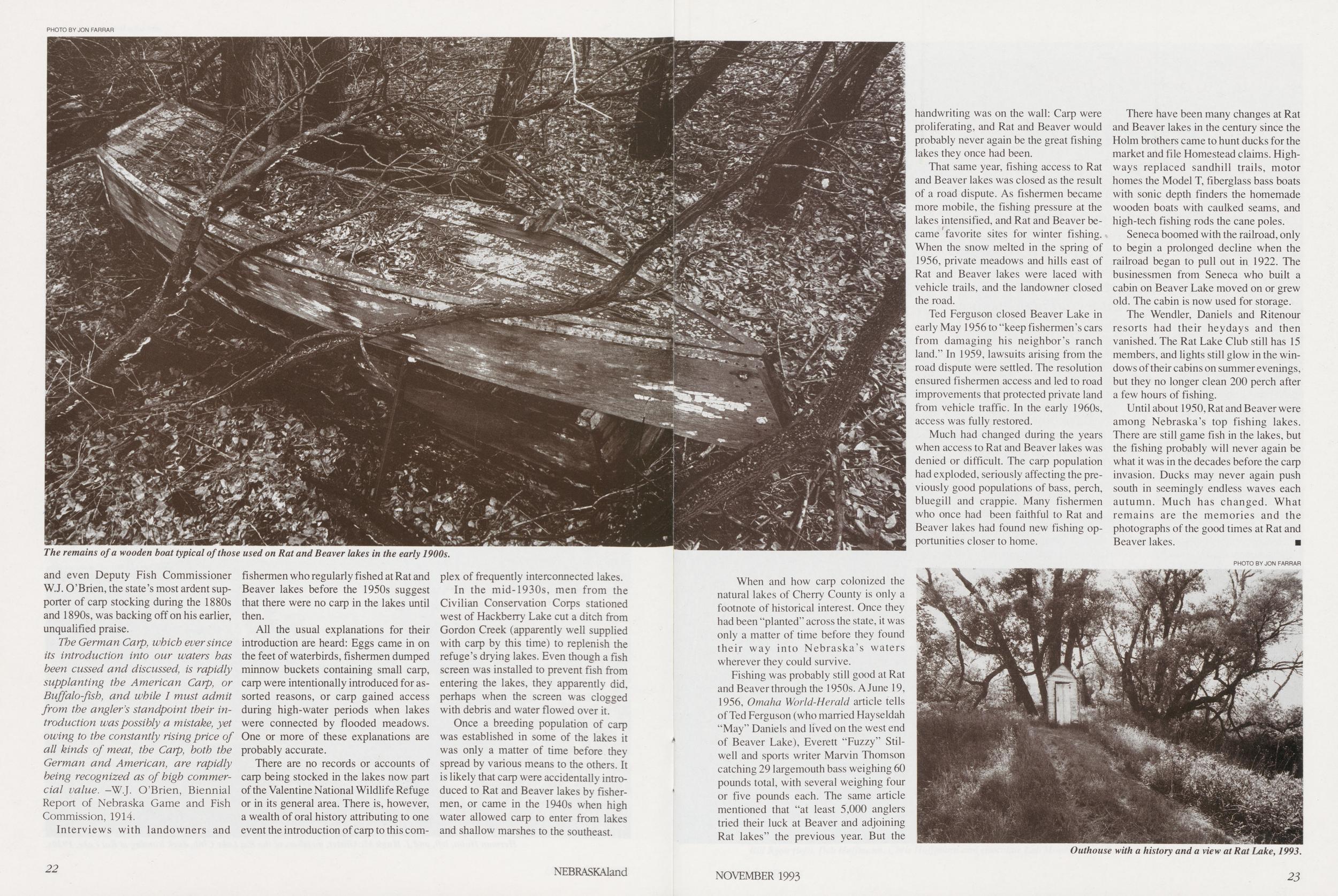
Just east of the Ritenours' old house 16 NEBRASKAland are the rotting remains of several wooden boats, the type used on Rat and Beaver lakes during the first half of the 20th century. Herberta believes the boats were made by Charlie Auhl, who, in addition to running a fishing resort and a fish hatchery, was a carpenter. Their construction is similar to others used on Rat and Beaver lakes during the same period.
Sanford Larsen recalls that his father, who operated the Seneca lumberyard, built the three wooden boats used by the Seneca Club on the west end of Beaver Lake during the 1920s. Larsen's detailed description of those boats closely matches the boats at Ritenours' resort. Anna Holm Beck recalls her family renting similar boats from Max Wendler in the 1920s.
All those boats were long and narrow, in appearance more like canoes than the rowboats that became popular in the 1950s. Most were 12 or 14 feet long, some 16 feet. They were flat-bottomed with a pointed bow and a square stern. The flooring was usually made of four inch boards. Each side was typically one solid board about 14 inches wide. The seams were caulked and then covered with strips of galvanized metal.
Steel boats came into use even while the Daniels were operating their resort on the west end of Beaver Lake in the 1920s.
I think they came on a hay rack from Wood Lake pulled by horses. They came, to a bridge, and one of the horses fell off of the edge, and we had a heck of a time because he wouldn't get up. There we sat for quite a while. -Herberta Daniels Ritenour.
The steel boats were 14- and 16-footers with flotation chambers on each end. Marvin Ritenour, Jack and Herberta's son, remembers that just before the resort on the south side of Beaver closed in the mid-1950s, the wooden boats rented for $3 a day, the 14-foot steel boats for $3.50 a day and the 16-foot steel boats for $4 a day.
During the 1920s, Daniels had rented boats for considerably less. For reasons not readily discemable from their ledger book records, rates varied. On the same day in June 1921, Paul Pound paid 50 cents for boat rental while "Wilson for 3 boats" was noted in the ledger as paying $3. On June 12, 1922, a "Fish Commissioner's Friend" paid $1, probably for a boat rental. At Wendler's resort on Rat Lake, the standard rate during the 1930s was apparently $ 1 a day.
Unlike Hub and Lizzie Daniels or Max and Ida Wendler, Jack and Herberta Ritenour did not cook meals for customers. Their cabins had beds but no cook stoves. Many of their customers camped in tents.
One Sunday afternoon the kids took the register to go around to the campers. We never made 'em come to the house. We had 69 cars in the yard, and I don't know how many up and down the lake. It was one of the best lakes. -Herberta Daniels Ritenour.
For the Rat Lake Club members and
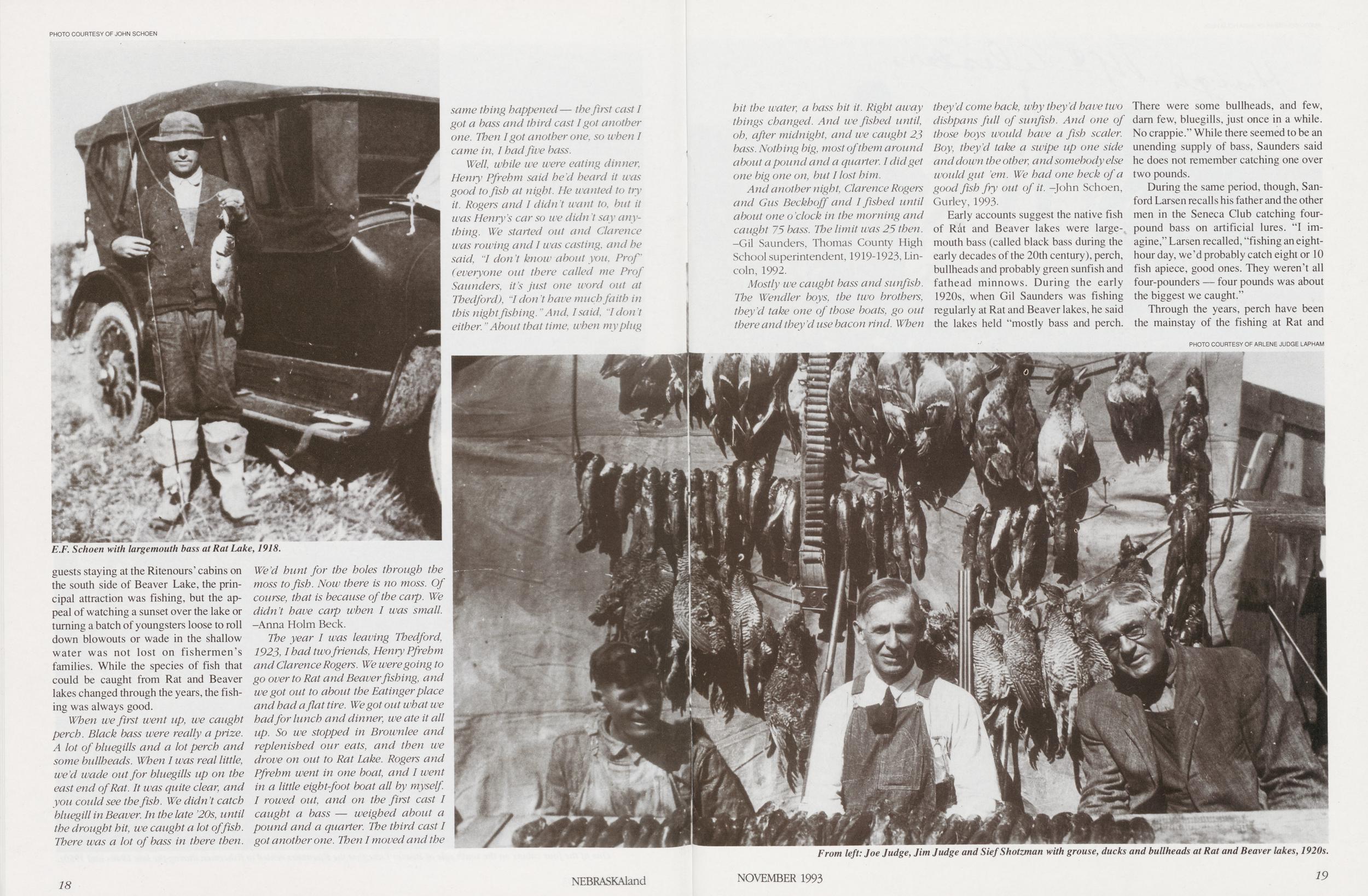
When we first went up, we caught perch. Black bass were really a prize. A lot of bluegills and a lot perch and some bullheads. When I was real little, we'd wade out for bluegills up on the east end of Rat. It was quite clear, and you could see the fish. We didn't catch bluegill in Beaver. In the late '20s, until the drought hit, we caught a lot offish. There was a lot of bass in there then. We'd hunt for the holes through the moss to fish. Now there is no moss. Of course, that is because of the carp. We didn't have carp when I was small. -Anna Holm Beck.
The year I was leaving Thedford, 1923,1 had two friends, Henry Pfre hm and Clarence Rogers. We were going to go over to Rat and Beaver fishing, and we got out to about the Eating place and had a flat tire. We got out what we had for lunch and dinner, we ate it all up. So we stopped in Brown lee and replenished our eats, and then we drove on out to Rat Lake. Rogers and Pfrehm went in one boat, and I went in a little eight-foot boat all by myself. I rowed out, and on the first cast I caught a bass — weighed about a pound and a quarter. The third cast I got another one. Then I moved and the same thing happened— the first cast I got a bass and third cast I got another one. Then I got another one. so when I came in, I had five bass.
Well, while we were eating dinner, Henry Pfrehm said he'd heard it was good to fish at night. He wanted to try it. Rogers and I didn't want to. but it was Henry's car so we didn't say anything. We started out and Clarence was rowing and I was casting, and he said, "I don't know about you. Prof (everyone out there called me Prof Saunders, its just one word out at Thedford), "I don 1 have much faith in this night fishing." And. I said. '7do 111 either" About that time, when my plug 18 NEBRASKAland hit the water, a has hit it. Right away things changed. And we fished until, oh, after midnight, and we caught 23 bass. Nothing big, most of them around about a pound and a quarter. I did get one big one on, but I lost him.
And another night, Clarence Rogers and Gus Beckhoff and I fished until about one o 'clock in the morning and caught 75 bass. The limit was 25 then. -Gil Saunders, Thomas County High School superintendent, 1919-1923, Lincoln, 1992.
Mostly we caught hass and sunfish. The Wendler boys, the two brothers, they 'd take one of those boats, go out there and they 'd use bacon rind. When they'd come back, wby they'd have two disbpans full of sunfish. And one of those hoys would have a fish scaler. Boy, they'd take a swipe up one side and down the other, and somebody else would gut em. We had one heck of a good fish fry out of it. -John Schoen, Gurley, 1993.
Early accounts suggest the native fish of Rat and Beaver lakes were large- mouth bass (called black bass during the early decades of the 20th century), perch, bullheads and probably green sunfish and fathead minnows. During the early 1920s, when Gil Saunders was fishing regularly at Rat and Beaver lakes, he said the lakes held "mostly bass and perch. There were some bullheads, and few, dam few, bluegills, just once in a while. No crappie." While there seemed to be an unending supply of bass, Saunders said he does not remember catching one over two pounds.
During the same period, though, Sanford Larsen recalls his father and the other men in the Seneca Club catching four pound bass on artificial lures. "I imagine," Larsen recalled, "fishing an eight-hour day, we'd probably catch eight or 10 fish apiece, good ones. They weren't all four-pounders — four pounds was about the biggest we caught."
Through the years, perch have been the mainstay of the fishing at Rat and
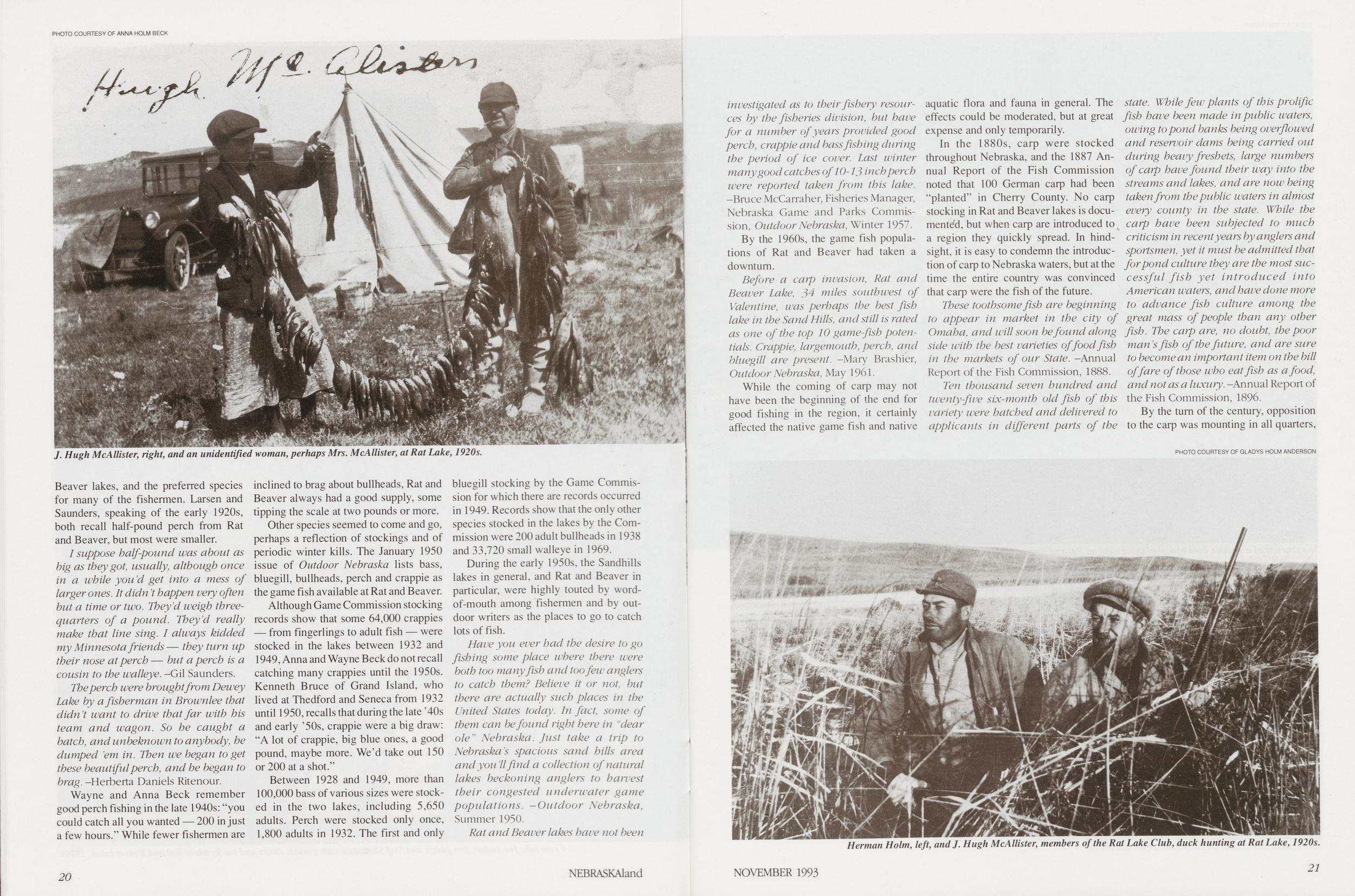
I suppose half-pound was about as big as they got, usually, although once in a while you'd get into a mess of larger ones. It didn 't happen very often but a time or two. They'd weigh three- quarters of a pound. They'd really make that line sing. I always kidded my Minnesota friends— they turn up their nose at perch — but a perch is a cousin to the walleye. -Gil Saunders.
The perch were brought from Dewey Lake by a fisherman in Brownlee that didn't want to drive that far with his team and wagon. So he caught a batch, and unbeknown to anybody, he dumped 'em in. Then we began to get these beautiful perch, and he began to brag. -Herberta Daniels Ritenour.
Wayne and Anna Beck remember good perch fishing in the late 1940s: "you could catch all you wanted — 200 in just a few hours." While fewer fishermen are inclined to brag about bullheads, Rat and Beaver always had a good supply, some tipping the scale at two pounds or more.
Other species seemed to come and go, perhaps a reflection of stockings and of periodic winter kills. The January 1950 issue of Outdoor Nebraska lists bass, bluegill, bullheads, perch and crappie as the game fish available at Rat and Beaver.
Although Game Commission stocking records show that some 64,000 crappies — from fingerlings to adult fish — were stocked in the lakes between 1932 and 1949, Anna and Wayne Beck do not recall catching many crappies until the 1950s. Kenneth Bruce of Grand Island, who lived at Thedford and Seneca from 1932 until 1950, recalls that during the late '40s and early '50s, crappie were a big draw: "A lot of crappie, big blue ones, a good pound, maybe more. We'd take out 150 or 200 at a shot."
Between 1928 and 1949, more than 100,000 bass of various sizes were stock- ed in the two lakes, including 5,650 adults. Perch were stocked only once, 1,800 adults in 1932. The first and only bluegill stocking by the Game Commission for which there are records occurred in 1949. Records show that the only other species stocked in the lakes by the Commission were 200 adult bullheads in 1938 and 33,720 small walleye in 1969.
During the early 1950s, the Sandhills lakes in general, and Rat and Beaver in particular, were highly touted by word-of-mouth among fishermen and by outdoor writers as the places to go to catch lots of fish.
Have you ever had the desire to go fishing some place where there were both too many fish and too few anglers to catch them? Believe it or not, but there are actually such places in the United States today. In fact, some of them can he found right here in "dear ole" Nebraska, fust take a trip to Nebraska's spacious sand hills area and you 11 find a collection of natural lakes beckoning anglers to harvest their congested underwater game populations. -Outdoor Nebraska, Summer 1950.
Rat and Beaver lakes have not been 20 NEBRASKAland investigated as to their fishery resources by the fisheries division, hut have for a number of years provided good perch, crappie and hass fishing during the period of ice cover. Last winter many good catches of 10-13 inch perch were reported taken from this lake. -Bruce McCarraher, Fisheries Manager, Nebraska Game and Parks Commission, Outdoor Nebraska, Winter 1957.
By the 1960s, the game fish populations of Rat and Beaver had taken a downturn.
Before a carp invasion, Rat and Beaver Lake, 34 miles southwest of Valentine, was perhaps the best fish lake in the Sand Hills, and still is rated as one of the top 10 game-fish potentials. Crappie, largemouth. perch, and bluegill are present. -Mary Brashier, Outdoor Nebraska, May 1961.
While the coming of carp may not have been the beginning of the end for good fishing in the region, it certainly affected the native game fish and native aquatic flora and fauna in general. The effects could be moderated, but at great expense and only temporarily.
In the 1880s, carp were stocked throughout Nebraska, and the 1887 Annual Report of the Fish Commission noted that 100 German carp had been "planted" in Cherry County. No carp stocking in Rat and Beaver lakes is documented, but when carp are introduced to a region they quickly spread. In hindsight, it is easy to condemn the introduction of carp to Nebraska waters, but at the time the entire country was convinced that carp were the fish of the future.
These toothsome fish are beginning to appear in market in the city of Omaha, and will soon be found along side with the best varieties of food fish in the markets of our State. -Annual Report of the Fish Commission, 1888.
Ten thousand seven hundred and twenty-five six-month old fish of this variety were hatched and delivered to applicants in different parts of the state. WhHe feu' plants of the is prolific fish have been made in public waters, owing to pond banks being overflowed and reservoir dams being carried out during heavy freshets, large numbers of carp have found their way into the streams and lakes, and are now being taken from the public waters in almost every county in the state. While the carp have been subjected to much criticism in recent years by anglers and sportsmen, yet it must be admitted that for pond culture they are the most successful fish yet introduced into American waters, and have done more to advance fish culture among the great mass of people than any other fish. The carp are, no doubt, the poor man fish of the future, and are sure to become an important item on the bill of fare of those who eat fish as a food, and not as a luxury. -Annual Report of the Fish Commission, 1896.
By the turn of the century, opposition to the carp was mounting in all quarters,
The German Carp, which ever since its introduction into our waters has heen cussed and discussed, is rapidly supplanting the American Carp, or Buffalo-fish, and while I must admit from the angler's standpoint their introduction was possibly a mistake, yet owing to the constantly rising price of all kinds of meat, the Carp, both the German and American, are rapidly being recognized as of high commercial value. -WJ. O'Brien, Biennial Report of Nebraska Game and Fish Commission, 1914.
Interviews with landowners and fishermen who regularly fished at Rat and Beaver lakes before the 1950s suggest that there were no carp in the lakes until then.
All the usual explanations for their introduction are heard: Eggs came in on the feet of waterbirds, fishermen dumped minnow buckets containing small carp, carp were intentionally introduced for assorted reasons, or carp gained access during high-water periods when lakes were connected by flooded meadows. One or more of these explanations are probably accurate.
There are no records or accounts of carp being stocked in the lakes now part of the Valentine National Wildlife Refuge or in its general area. There is, however, a wealth of oral history attributing to one event the introduction of carp to this complex of frequently interconnected lakes.
In the mid-1930s, men from the Civilian Conservation Corps stationed west of Hackberry Lake cut a ditch from Gordon Creek (apparently well supplied with carp by this time) to replenish the refuge's drying lakes. Even though a fish screen was installed to prevent fish from entering the lakes, they apparently did, perhaps when the screen was clogged with debris and water flowed over it.
Once a breeding population of carp was established in some of the lakes it was only a matter of time before they spread by various means to the others. It is likely that carp were accidentally introduced to Rat and Beaver lakes by fishermen, or came in the 1940s when high water allowed carp to enter from lakes and shallow marshes to the southeast.
22 NEBRASKAlandWhen and how carp colonized the natural lakes of Cherry County is only a footnote of historical interest. Once they had been "planted" across the state, it was only a matter of time before they found their way into Nebraska's waters wherever they could survive.
Fishing was probably still good at Rat and Beaver through the 1950s. A June 19, 1956, Omaha World-Herald article tells of Ted Ferguson (who married Hayseldah "May" Daniels and lived on the west end of Beaver Lake), Everett "Fuzzy" Still well and sports writer Marvin Thomson catching 29 largemouth bass weighing 60 pounds total, with several weighing four or five pounds each. The same article mentioned that "at least 5,000 anglers tried their luck at Beaver and adjoining Rat lakes" the previous year. But the handwriting was on the wall: Carp were proliferating, and Rat and Beaver would probably never again be the great fishing lakes they once had been.
That same year, fishing access to Rat and Beaver lakes was closed as the result of a road dispute. As fishermen became more mobile, the fishing pressure at the lakes intensified, and Rat and Beaver became favorite sites for winter fishing When the snow melted in the spring of 1956, private meadows and hills east of Rat and Beaver lakes were laced with vehicle trails, and the landowner closed the road.
Ted Ferguson closed Beaver Lake in early May 1956 to "keep fishermen's cars from damaging his neighbor's ranch land." In 1959, lawsuits arising from the road dispute were settled. The resolution ensured fishermen access and led to road improvements that protected private land from vehicle traffic. In the early 1960s, access was fully restored.
Much had changed during the years when access to Rat and Beaver lakes was denied or difficult. The carp population had exploded, seriously affecting the previously good populations of bass, perch, bluegill and crappie. Many fishermen who once had been faithful to Rat and Beaver lakes had found new fishing opportunities closer to home.
There have been many changes at Rat and Beaver lakes in the century since the Holm brothers came to hunt ducks for the market and file Homestead claims. Highways replaced sandhill trails, motor homes the Model T, fiberglass bass boats with sonic depth finders the homemade wooden boats with caulked seams, and high-tech fishing rods the cane poles.
Seneca boomed with the railroad, only to begin a prolonged decline when the railroad began to pull out in 1922. The businessmen from Seneca who built a cabin on Beaver Lake moved on or grew old. The cabin is now used for storage.
The Wendler, Daniels and Ritenour resorts had their heydays and then vanished. The Rat Lake Club still has 15 members, and lights still glow in the windows of their cabins on summer evenings, but they no longer clean 200 perch after a few hours of fishing.
Until about 1950, Rat and Beaver were among Nebraska's top fishing lakes. There are still game fish in the lakes, but the fishing probably will never again be what it was in the decades before the carp invasion. Ducks may never again push south in seemingly endless waves each autumn. Much has changed. What remains are the memories and the photographs of the good times at Rat and Beaver lakes.
Pheasant Rush
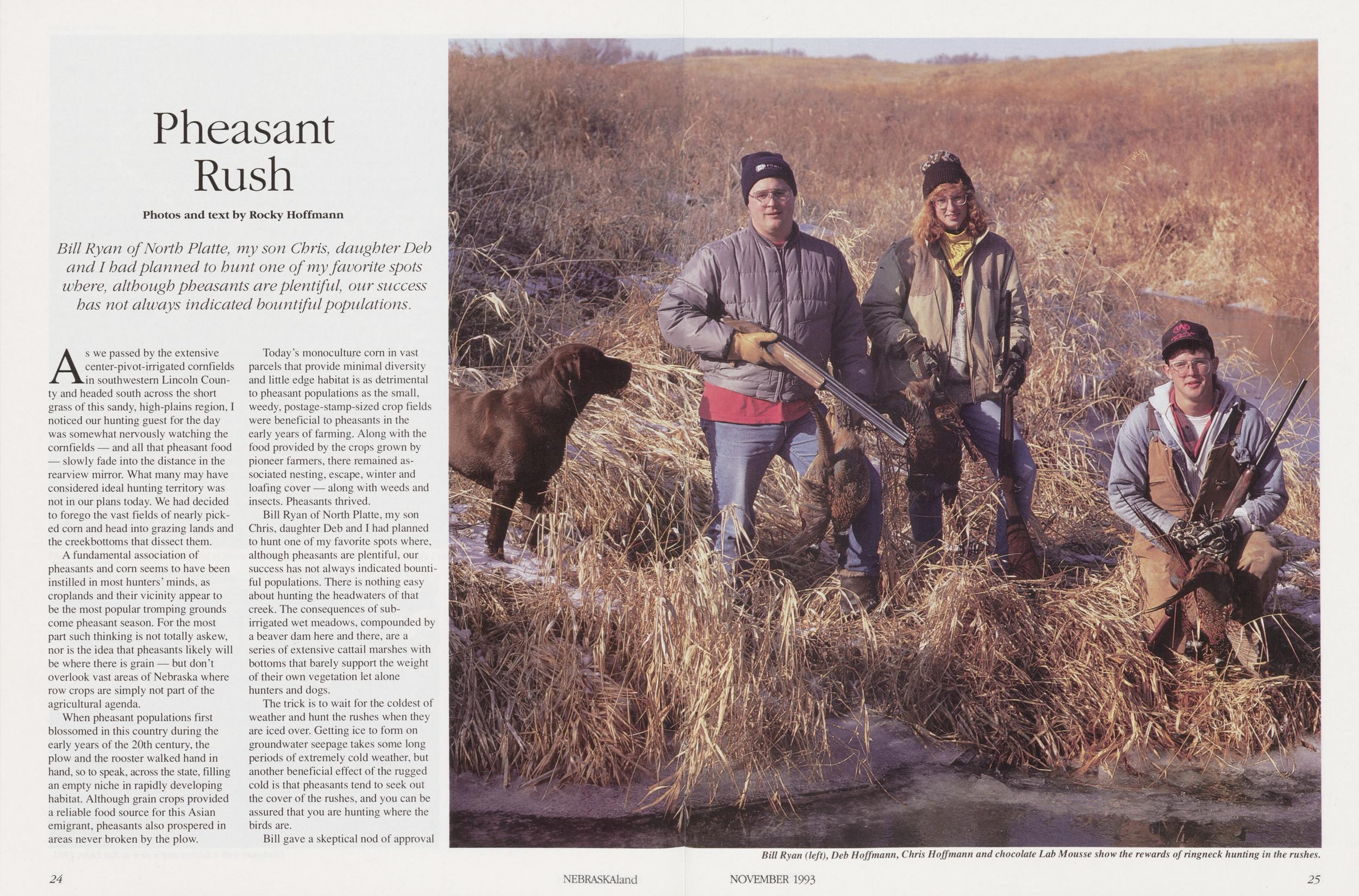
Photos and text by Rocky Hoffmann Bill Ryan of North Platte, my son Chris, daughter Deb and I had planned to hunt one of my favorite spots where, although pheasants are plentiful, our success has not always indicated bountiful populations.As we passed by the extensive center-pivot-irrigated cornfields in southwestern Lincoln County and headed south across the short grass of this sandy, high-plains region, I noticed our hunting guest for the day was somewhat nervously watching the cornfields — and all that pheasant food — slowly fade into the distance in the rearview mirror. What many may have considered ideal hunting territory was not in our plans today. We had decided to forego the vast fields of nearly picked corn and head into grazing lands and the creek bottoms that dissect them.
A fundamental association of pheasants and corn seems to have been instilled in most hunters' minds, as croplands and their vicinity appear to be the most popular tromping grounds come pheasant season. For the most part such thinking is not totally askew, nor is the idea that pheasants likely will be where there is grain — but don't overlook vast areas of Nebraska where row crops are simply not part of the agricultural agenda.
When pheasant populations first blossomed in this country during the early years of the 20th century, the plow and the rooster walked hand in hand, so to speak, across the state, filling an empty niche in rapidly developing habitat. Although grain crops provided a reliable food source for this Asian emigrant, pheasants also prospered in areas never broken by the plow.
Today's monoculture corn in vast parcels that provide minimal diversity and little edge habitat is as detrimental to pheasant populations as the small, weedy, postage-stamp-sized crop fields were beneficial to pheasants in the early years of farming. Along with the food provided by the crops grown by pioneer farmers, there remained associated nesting, escape, winter and loafing cover — along with weeds and insects. Pheasants thrived.
Bill Ryan of North Platte, my son Chris, daughter Deb and I had planned to hunt one of my favorite spots where, although pheasants are plentiful, our success has not always indicated bountiful populations. There is nothing easy about hunting the headwaters of that creek. The consequences of sub- irrigated wet meadows, compounded by a beaver dam here and there, are a series of extensive cattail marshes with bottoms that barely support the weight of their own vegetation let alone hunters and dogs.
The trick is to wait for the coldest of weather and hunt the rushes when they are iced over. Getting ice to form on groundwater seepage takes some long periods of extremely cold weather, but another beneficial effect of the rugged cold is that pheasants tend to seek out the cover of the rushes, and you can be assured that you are hunting where the birds are.
Bill gave a skeptical nod of approval 24 NEBRASKAland
 to our chosen destination, although the
last cornfield we passed was 10 miles
back. We found our rancher host behind
the barn banging away on a frozen
hitch pin with a steel bar as he
attempted to separate a hay sled from
the massive tractor required in this
terrain. I always hate to see a landowner
having a bad day when I pull up to talk
to him about hunting, but it's very
helpful to have two strong boys along, fresh
from a morning's breakfast, to help free
a stubborn hunk of steel.
to our chosen destination, although the
last cornfield we passed was 10 miles
back. We found our rancher host behind
the barn banging away on a frozen
hitch pin with a steel bar as he
attempted to separate a hay sled from
the massive tractor required in this
terrain. I always hate to see a landowner
having a bad day when I pull up to talk
to him about hunting, but it's very
helpful to have two strong boys along, fresh
from a morning's breakfast, to help free
a stubborn hunk of steel.
With the separated hitch pin in one hand and a handshake in the other, he indicated with a nod where the spooky calves were and bade us a pleasant day in the swamp — our first indication that the weather hadn't been nearly cold enough to make ice. We started hunting in a pocket just far enough from the creek, and high enough above it, for the soil to remain dry. In that area, cattle had tromped paths through the high kochia, and on every previous visit, we had found a good number of pheasants loafing in the trampled cover.
We weren't nearly quick enough or quiet enough, however, to surprise a bunch of wary ring necks in the entanglement, and we promised ourselves once again that next time we'd get in there faster and quieter. At least 25 birds, most of which were roosters, cackled out of the cover, well out of range, and headed to their favorite sanctuary, the swamp, where they joined the ranks of other birds already aware of our approach.
"You'd think we'd be able to hit that spot right just one time, especially with what we have to look forward to down there," Chris muttered as he glared at the mass of rushes and muck ahead.
As he detected the tentative nature
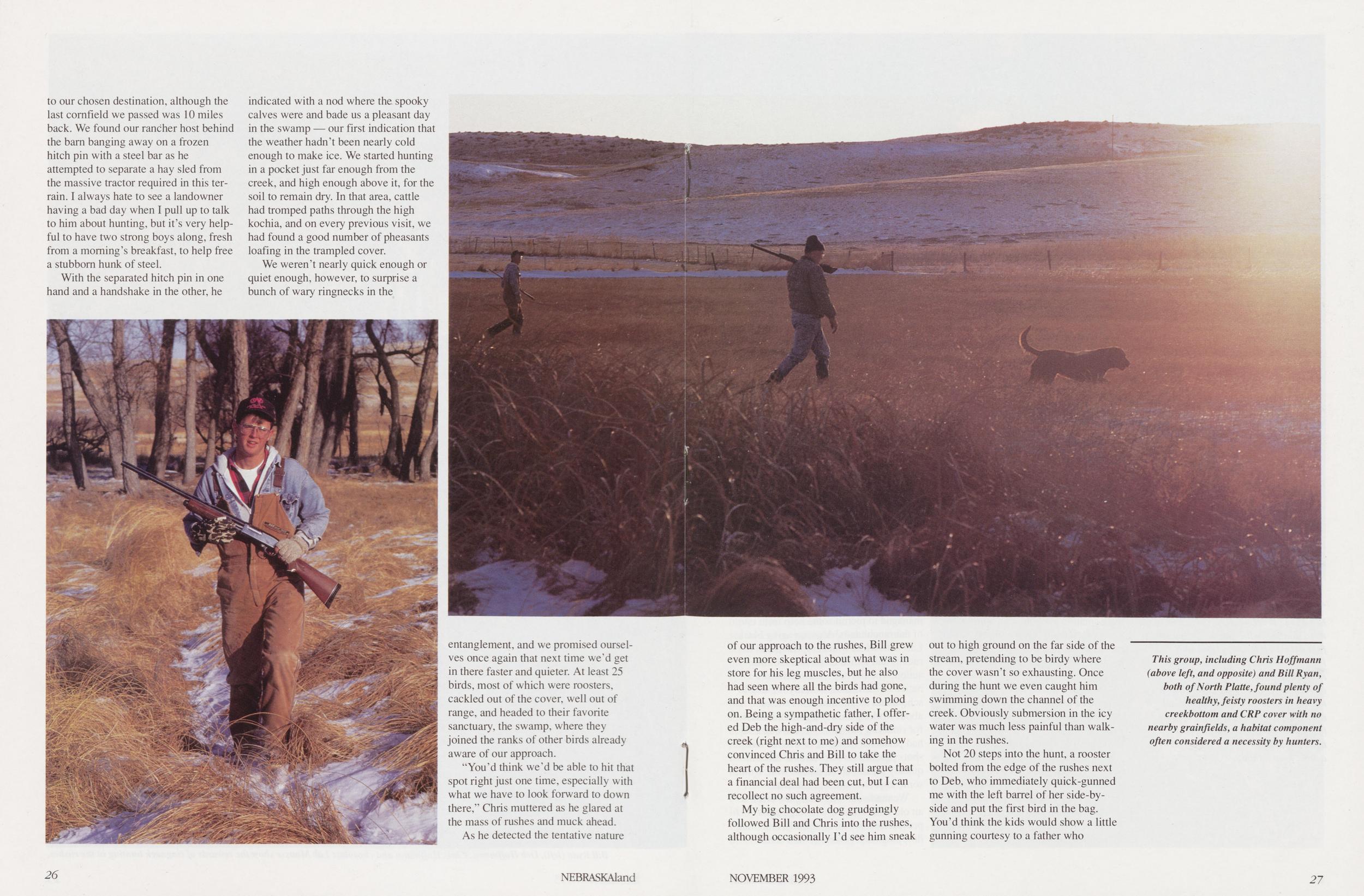
My big chocolate dog grudgingly followed Bill and Chris into the rushes, although occasionally I'd see him sneak out to high ground on the far side of the stream, pretending to be birdy where the cover wasn't so exhausting. Once during the hunt we even caught him swimming down the channel of the creek. Obviously submersion in the icy water was much less painful than walking in the rushes.
Not 20 steps into the hunt, a rooster bolted from the edge of the rushes next to Deb, who immediately quick-gunned me with the left barrel of her side-by-side and put the first bird in the bag. You'd think the kids would show a little gunning courtesy to a father who
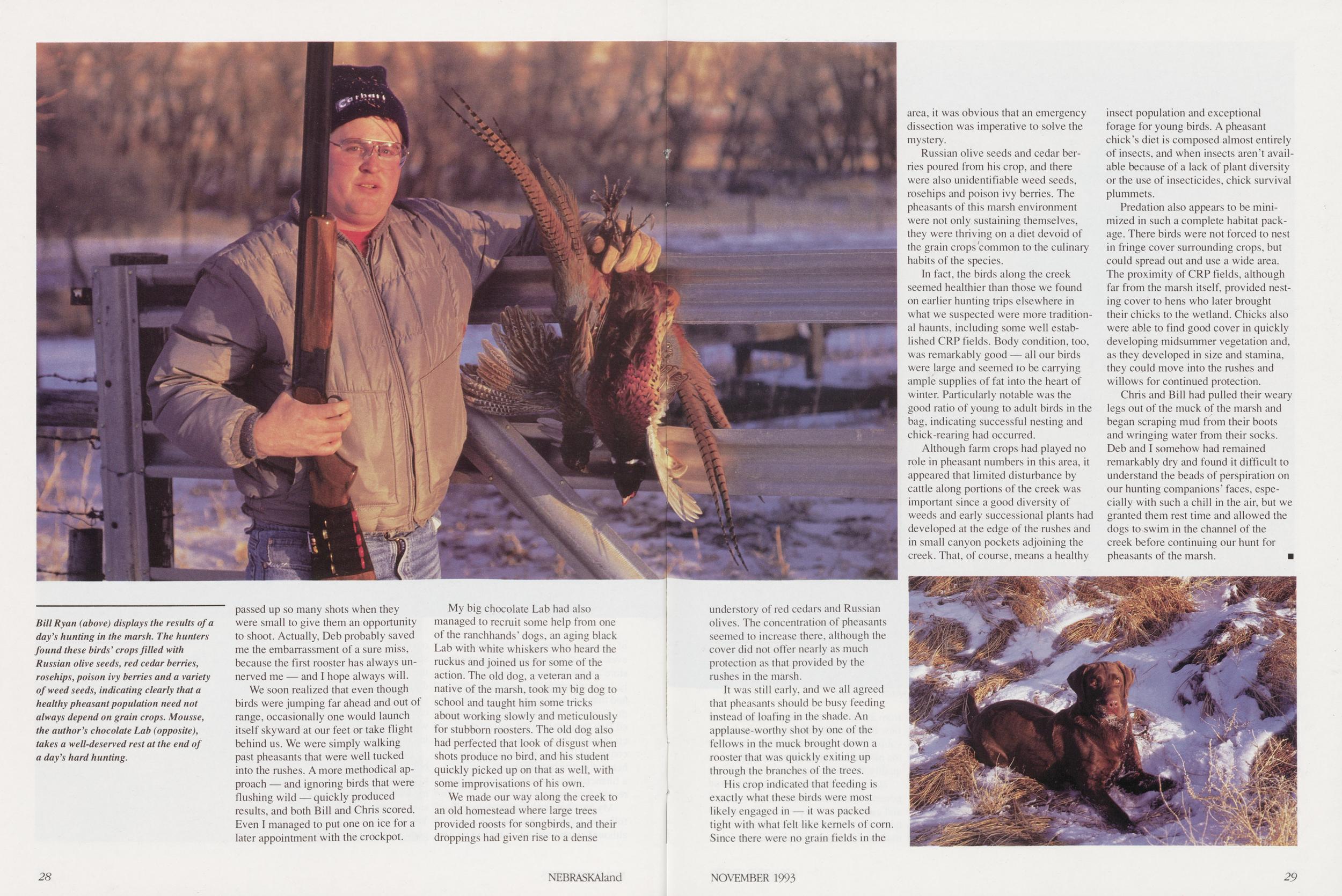
We soon realized that even though birds were jumping far ahead and out of range, occasionally one would launch itself skyward at our feet or take flight behind us. We were simply walking past pheasants that were well tucked into the rushes. A more methodical approach — and ignoring birds that were flushing wild — quickly produced results, and both Bill and Chris scored. Even I managed to put one on ice for a later appointment with the crockpot.
My big chocolate Lab had also managed to recruit some help from one of the ranchhands' dogs, an aging black Lab with white whiskers who heard the ruckus and joined us for some of the action. The old dog, a veteran and a native of the marsh, took my big dog to school and taught him some tricks about working slowly and meticulously for stubborn roosters. The old dog also had perfected that look of disgust when shots produce no bird, and his student quickly picked up on that as well, with some improvisations of his own.
We made our way along the creek to an old homestead where large trees provided roosts for songbirds, and their droppings had given rise to a dense 28 NEBRASKAland understory of red cedars and Russian olives. The concentration of pheasants seemed to increase there, although the cover did not offer nearly as much protection as that provided by the rushes in the marsh.
It was still early, and we all agreed that pheasants should be busy feeding instead of loafing in the shade. An applause-worthy shot by one of the fellows in the muck brought down a rooster that was quickly exiting up through the branches of the trees.
His crop indicated that feeding is exactly what these birds were most likely engaged in — it was packed tight with what felt like kernels of corn. Since there were no grain fields in the area, it was obvious that an emergency dissection was imperative to solve the mystery.
Russian olive seeds and cedar berries poured from his crop, and there were also unidentifiable weed seeds, rosehips and poison ivy berries. The pheasants of this marsh environment were not only sustaining themselves, they were thriving on a diet devoid of the grain crops common to the culinary habits of the species.
In fact, the birds along the creek seemed healthier than those we found on earlier hunting trips elsewhere in what we suspected were more traditional haunts, including some well established CRP fields. Body condition, too, was remarkably good — all our birds were large and seemed to be carrying ample supplies of fat into the heart of winter. Particularly notable was the good ratio of young to adult birds in the bag, indicating successful nesting and chick-rearing had occurred.
Although farm crops had played no role in pheasant numbers in this area, it appeared that limited disturbance by cattle along portions of the creek was important since a good diversity of weeds and early successional plants had developed at the edge of the rushes and in small canyon pockets adjoining the creek. That, of course, means a healthy insect population and exceptional forage for young birds. A pheasant chick's diet is composed almost entirely of insects, and when insects aren't available because of a lack of plant diversity or the use of insecticides, chick survival plummets.
Predation also appears to be minimized in such a complete habitat package. There birds were not forced to nest in fringe cover surrounding crops, but could spread out and use a wide area. The proximity of CRP fields, although far from the marsh itself, provided nesting cover to hens who later brought their chicks to the wetland. Chicks also were able to find good cover in quickly developing midsummer vegetation and, as they developed in size and stamina, they could move into the rushes and willows for continued protection.
Chris and Bill had pulled their weary legs out of the muck of the marsh and began scraping mud from their boots and wringing water from their socks. Deb and I somehow had remained remarkably dry and found it difficult to understand the beads of perspiration on our hunting companions' faces, especially with such a chill in the air, but we granted them rest time and allowed the dogs to swim in the channel of the creek before continuing our hunt for pheasants of the marsh.
John Lundgren Decoy Maker
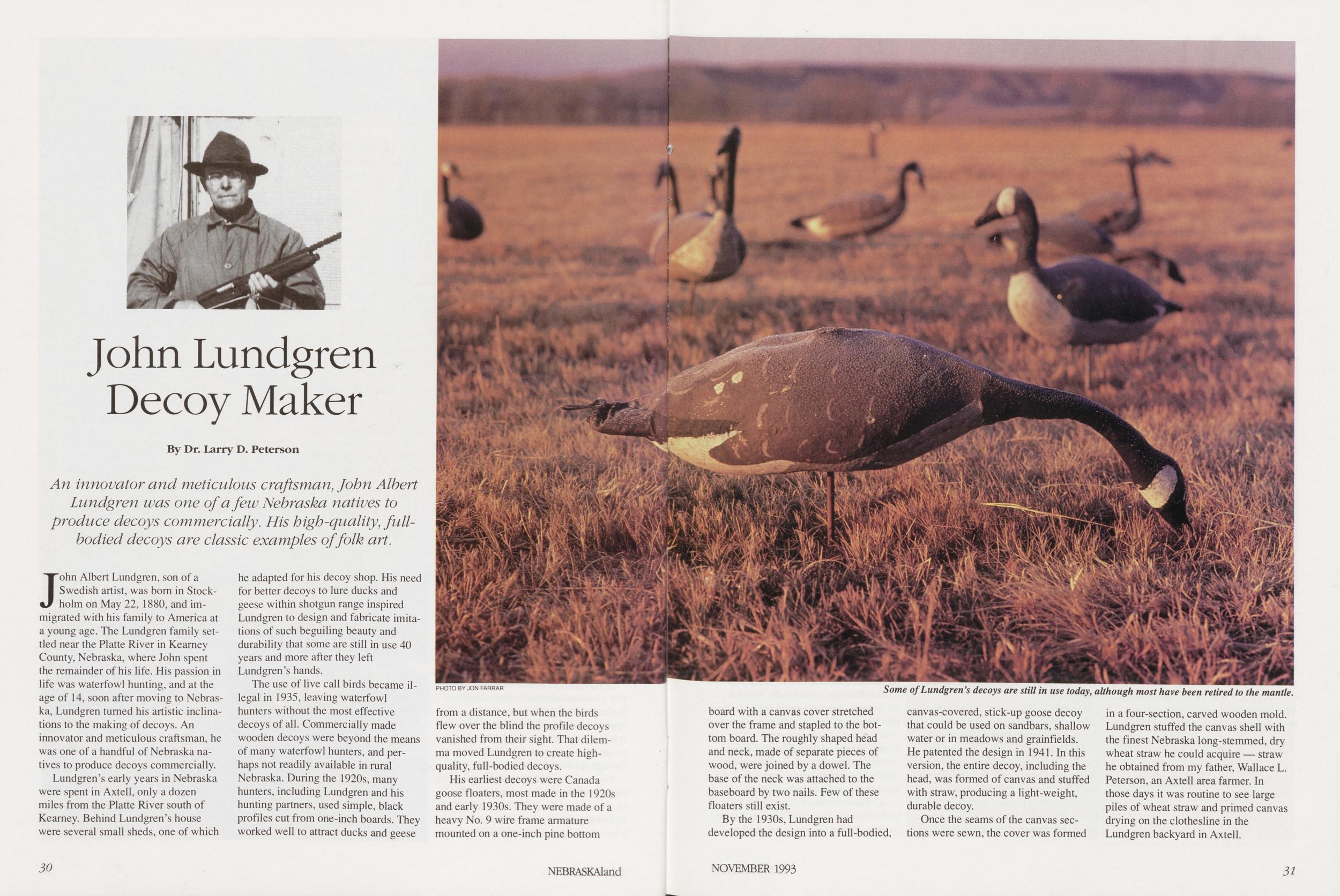
By Dr. Larry D. Peterson An innovator and meticulous craftsman, John Albert Lundgren was one of a few Nebraska natives to produce decoys commercially. His high-quality, fullbodied decoys are classic examples of folk art.John Albert Lundgren, son of a Swedish artist, was bom in Stockholm on May 22, 1880, and immigrated with his family to America at a young age. The Lundgren family settled near the Platte River in Kearney County, Nebraska, where John spent the remainder of his life. His passion in life was waterfowl hunting, and at the age of 14, soon after moving to Nebraska, Lundgren turned his artistic inclinations to the making of decoys. An innovator and meticulous craftsman, he was one of a handful of Nebraska natives to produce decoys commercially.
Lundgren's early years in Nebraska were spent in Axtell, only a dozen miles from the Platte River south of Kearney. Behind Lundgren's house were several small sheds, one of which he adapted for his decoy shop. His need for better decoys to lure ducks and geese within shotgun range inspired Lundgren to design and fabricate imitations of such beguiling beauty and durability that some are still in use 40 years and more after they left Lundgren's hands.
The use of live call birds became illegal in 1935, leaving waterfowl hunters without the most effective decoys of all. Commercially made wooden decoys were beyond the means of many waterfowl hunters, and perhaps not readily available in rural Nebraska. During the 1920s, many hunters, including Lundgren and his hunting partners, used simple, black profiles cut from one-inch boards. They worked well to attract ducks and geese
His earliest decoys were Canada goose floaters, most made in the 1920s and early 1930s. They were made of a heavy No. 9 wire frame armature mounted on a one-inch pine bottom 30 NEBRASICAland board with a canvas cover stretched over the frame and stapled to the bottom board. The roughly shaped head and neck, made of separate pieces of wood, were joined by a dowel. The base of the neck was attached to the baseboard by two nails. Few of these floaters still exist.
By the 1930s, Lundgren had developed the design into a full-bodied, canvas-covered, stick-up goose decoy that could be used on sandbars, shallow water or in meadows and grain fields. He patented the design in 1941. In this version, the entire decoy, including the head, was formed of canvas and stuffed with straw, producing a light-weight, durable decoy.
Once the seams of the canvas sections were sewn, the cover was formed in a four-section, carved wooden mold. Lundgren stuffed the canvas shell with the finest Nebraska long-stemmed, dry wheat straw he could acquire — straw he obtained from my father, Wallace L. Peterson, an Axtell area farmer. In those days it was routine to see large piles of wheat straw and primed canvas drying on the clothesline in the Lundgren backyard in Axtell.
NOVEMBER 1993 31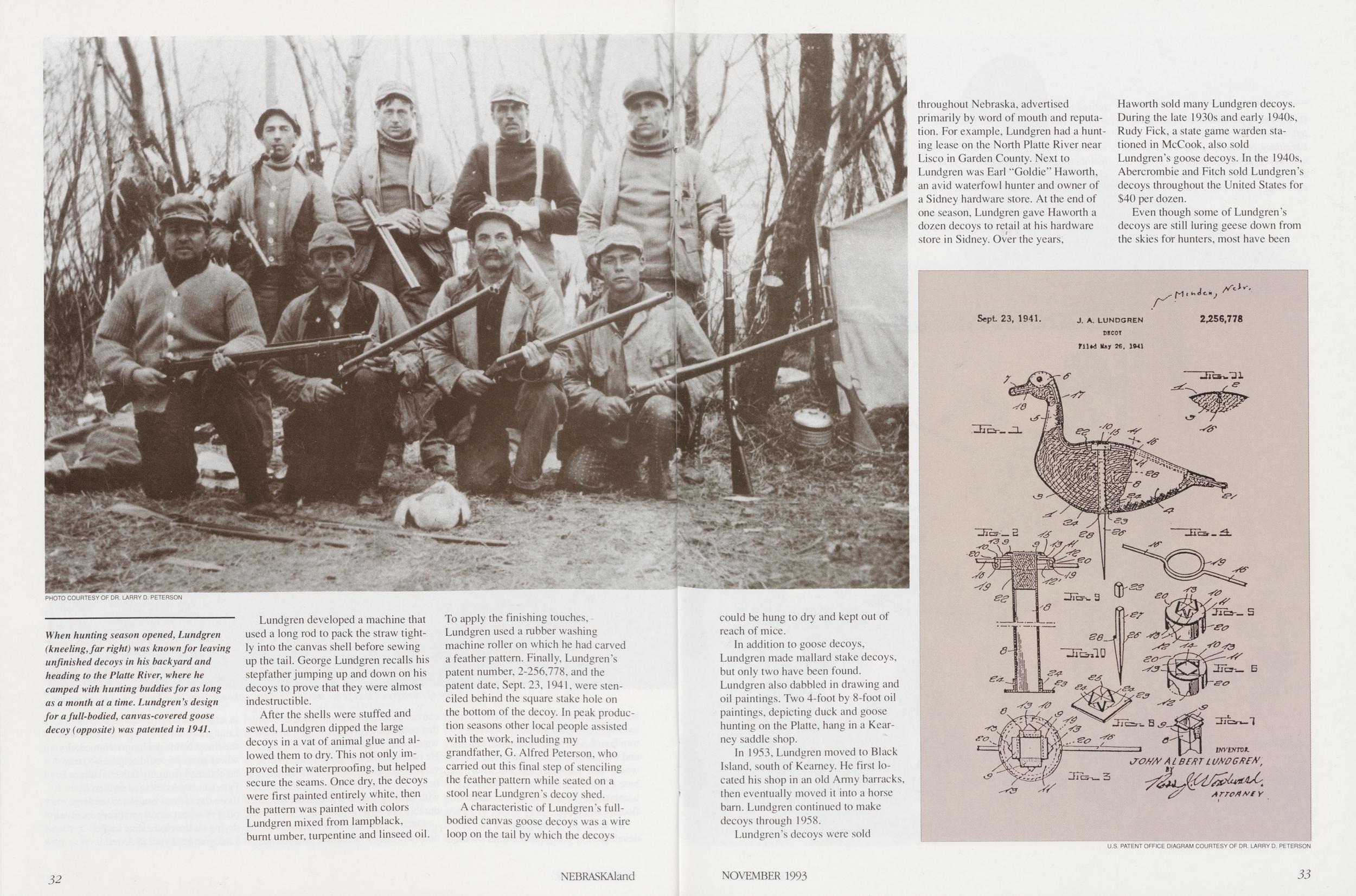
Lundgren developed a machine that used a long rod to pack the straw tightly into the canvas shell before sewing up the tail. George Lundgren recalls his stepfather jumping up and down on his decoys to prove that they were almost indestructible.
After the shells were stuffed and sewed, Lundgren dipped the large decoys in a vat of animal glue and allowed them to dry. This not only improved their waterproofing, but helped secure the seams. Once dry, the decoys were first painted entirely white, then the pattern was painted with colors Lundgren mixed from lampblack, burnt umber, turpentine and linseed oil. To apply the finishing touches, Lundgren used a rubber washing machine roller on which he had carved a feather pattern. Finally, Lundgren's patent number, 2-256,778, and the patent date, Sept. 23, 1941, were stenciled behind the square stake hole on the bottom of the decoy. In peak production seasons other local people assisted with the work, including my grandfather, G. Alfred Peterson, who carried out this final step of stenciling the feather pattern while seated on a stool near Lundgren's decoy shed.
A characteristic of Lundgren's full-bodied canvas goose decoys was a wire loop on the tail by which the decoys 32 NEBRASKAland could be hung to dry and kept out of reach of mice.
In addition to goose decoys, Lundgren made mallard stake decoys, but only two have been found. Lundgren also dabbled in drawing and oil paintings. Two 4-foot by 8-foot oil paintings, depicting duck and goose hunting on the Platte, hang in a Kearney saddle shop.
In 1953, Lundgren moved to Black Island, south of Kearney. He first located his shop in an old Army barracks, then eventually moved it into a horse barn. Lundgren continued to make decoys through 1958.
Lundgren's decoys were sold throughout Nebraska, advertised primarily by word of mouth and reputation. For example, Lundgren had a hunting lease on the North Platte River near Lisco in Garden County. Next to Lundgren was Earl "Goldie" Haworth, an avid waterfowl hunter and owner of a Sidney hardware store. At the end of one season, Lundgren gave Haworth a dozen decoys to retail at his hardware store in Sidney. Over the years, Haworth sold many Lundgren decoys. During the late 1930s and early 1940s, Rudy Fick, a state game warden stationed in McCook, also sold Lundgren's goose decoys. In the 1940s, Abercrombie and Fitch sold Lundgren's decoys throughout the United States for $40 per dozen.
Even though some of Lundgren's decoys are still luring geese down from the skies for hunters, most have been
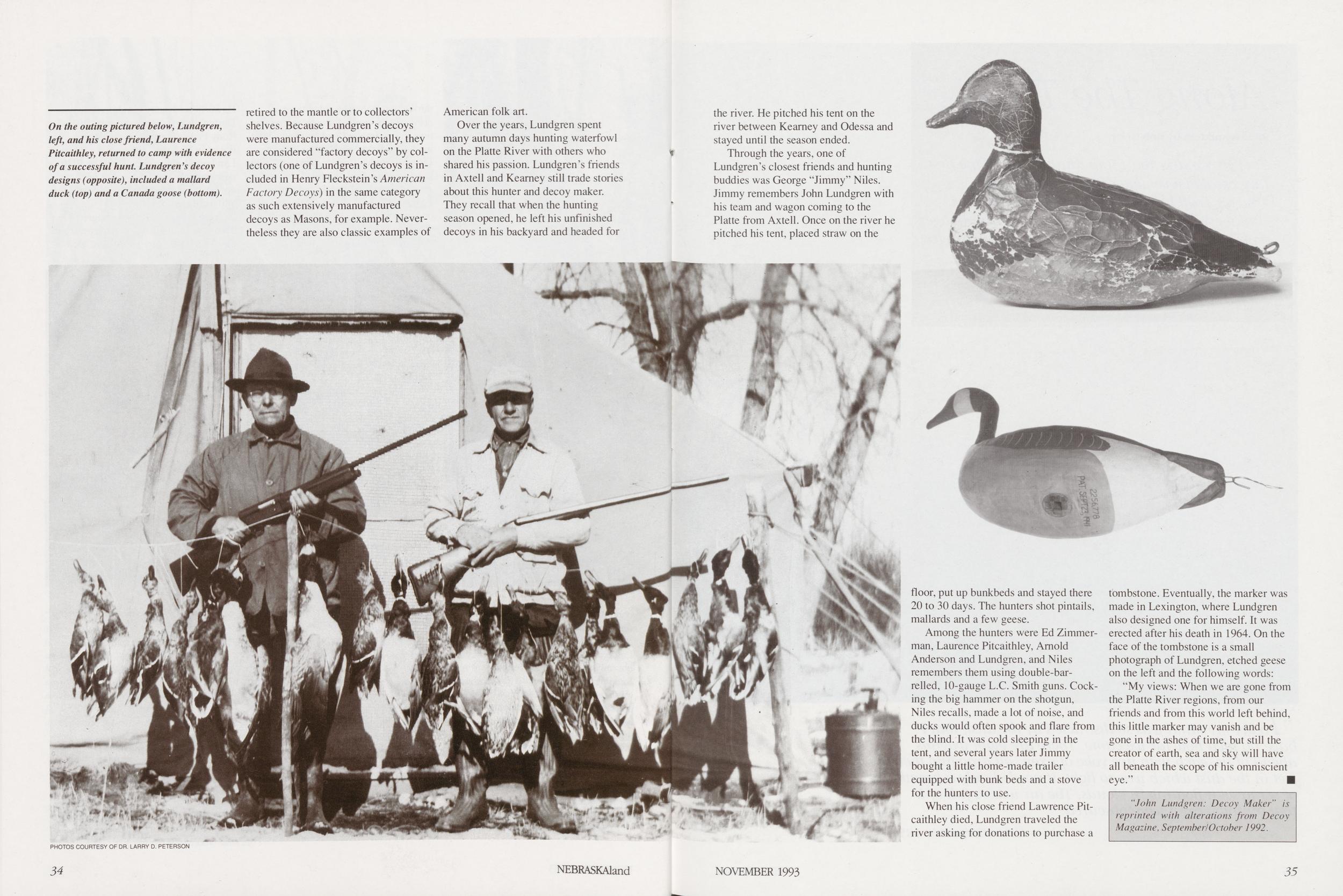
Over the years, Lundgren spent many autumn days hunting waterfowl on the Platte River with others who shared his passion. Lundgren's friends in Axtell and Kearney still trade stories about this hunter and decoy maker. They recall that when the hunting season opened, he left his unfinished decoys in his backyard and headed for 34 NEBRASKAland the river. He pitched his tent on the river between Kearney and Odessa and stayed until the season ended.
Through the years, one of Lundgren's closest friends and hunting buddies was George "Jimmy" Niles. Jimmy remembers John Lundgren with his team and wagon coming to the Platte from Axtell. Once on the river he pitched his tent, placed straw on the floor, put up bunkbeds and stayed there 20 to 30 days. The hunters shot pintails, mallards and a few geese.
Among the hunters were Ed Zimmerman, Laurence Pitcaithley, Arnold Anderson and Lundgren, and Niles remembers them using double barrelled, 10-gauge L.C. Smith guns. Cocking the big hammer on the shotgun, Niles recalls, made a lot of noise, and ducks would often spook and flare from the blind. It was cold sleeping in the tent, and several years later Jimmy bought a little home-made trailer equipped with bunk beds and a stove for the hunters to use.
When his close friend Lawrence Pitcaithley died, Lundgren traveled the river asking for donations to purchase a tombstone. Eventually, the marker was made in Lexington, where Lundgren also designed one for himself. It was erected after his death in 1964. On the face of the tombstone is a small photograph of Lundgren, etched geese on the left and the following words:
"My views: When we are gone from the Platte River regions, from our friends and from this world left behind, this little marker may vanish and be gone in the ashes of time, but still the creator of earth, sea and sky will have all beneath the scope of his omniscient eye."
"John Lundgren: Decoy Maker" is reprinted with alterations from Decoy Magazine, September/October 1992. NOVEMBER 1993 35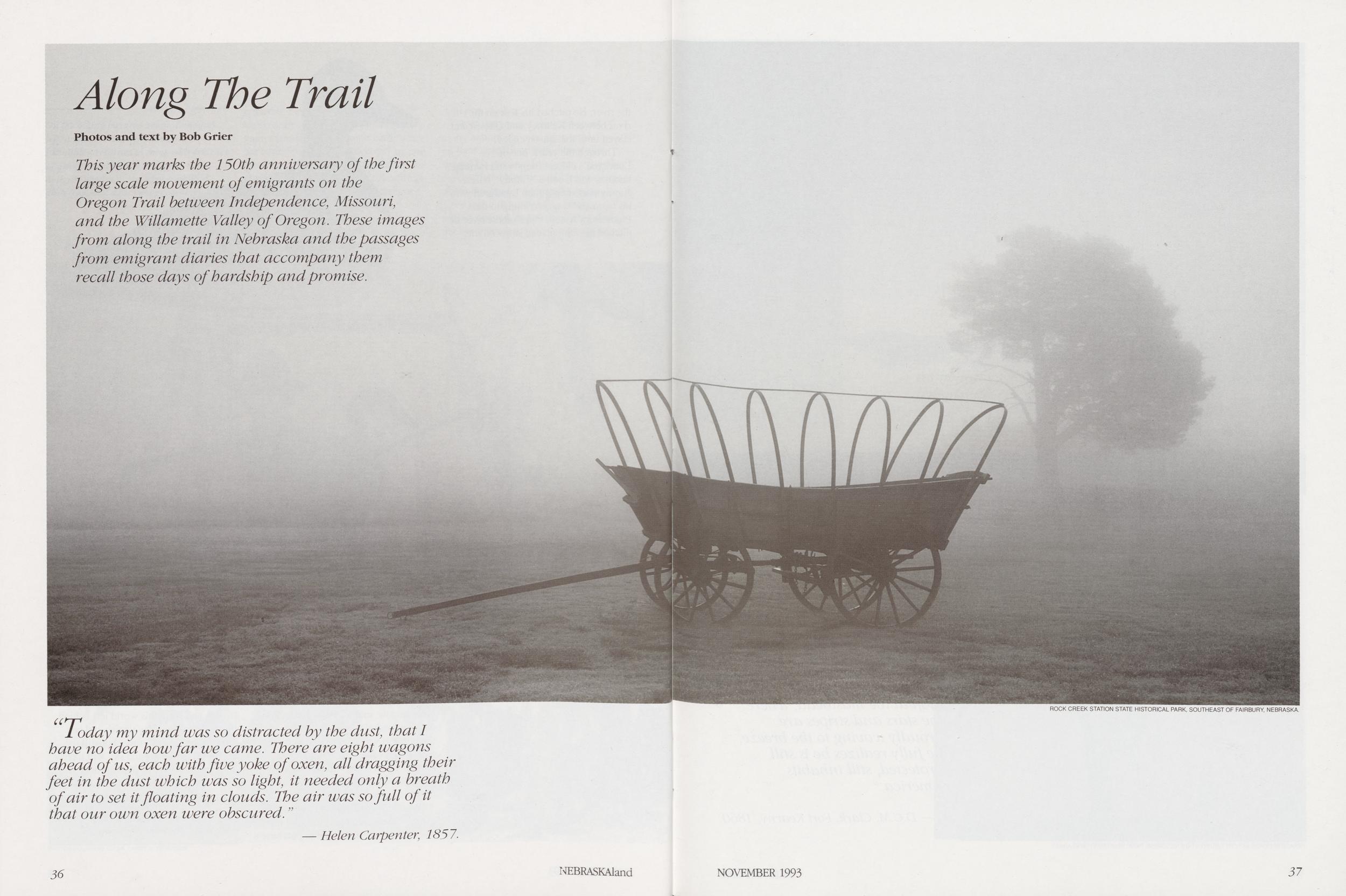
Along The Trail
Photos and text by Bob Grier This year marks the 150th anniversary? of the first large scale movement of emigrants on the Oregon Trail between Independence, Missouri, and the Willamette Valley of Oregon. These images from along the trail in Nebraska and the passages from emigrant diaries that accompany them recall those days of hardship and promise."Today my mind was so distracted by the dust, that I have no idea how far we came. There are eight wagons ahead of us, each with five yoke of oxen, all dragging their feet in the dust which was so light, it needed only a breath of air to set it floating in clouds. The air was so full of it that our own oxen were obscured." — Helen Carpenter, 1857.
36 NEBRASKAland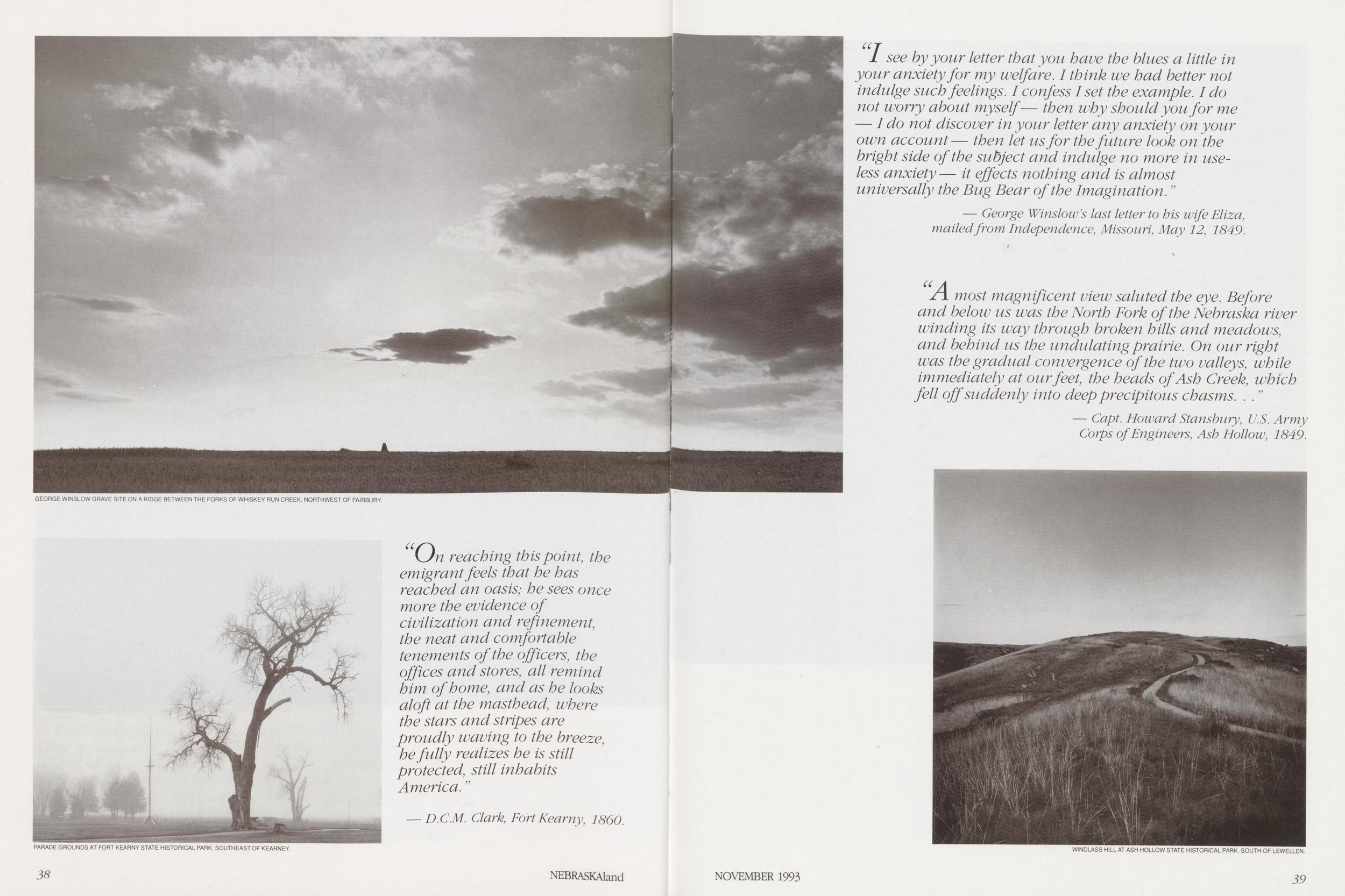
On reaching this point, the emigrant feels that he has reached an oasis; he sees once more the evidence of civilization and refinement, the neat and comfortable tenements of the officers, the offices and stores, all remind him of home, and as he looks aloft at the masthead, where the stars and stripes are proudly waving to the breeze, he fully realizes he is still protected, still inhabits America." D.CM. Clark, Fort Kearny, 1860.
I see by your letter that you have the blues a little in your anxiety for my welfare. I think we had better not indulge such feelings; I confess I set the example. I do not worry about myself— then why should you for me — I do not discover in your letter any anxiety on your own account— then let us for the future look on the bright side of the subject and indulge no more in useless anxiety— it effects nothing and is almost universally the Bug Bear of the Imagination." — George Wins low's last letter to his wife Eliza, mailed from Independence, Missouri, May 12, 1849.
A most magnificent view saluted the eye. Before and below us was the North Fork of the Nebraska river winding its way through broken hills and meadows, and behind us the undulating prairie. On our right was the gradual convergence of the two valleys, while immediately at our feet, the heads of Ash Creek, which fell off suddenly into deep precipitous chasms. . ." — Capt. Howard Stanshury, U.S. Army Corps of Engineers, Ash Hollow, 1849.
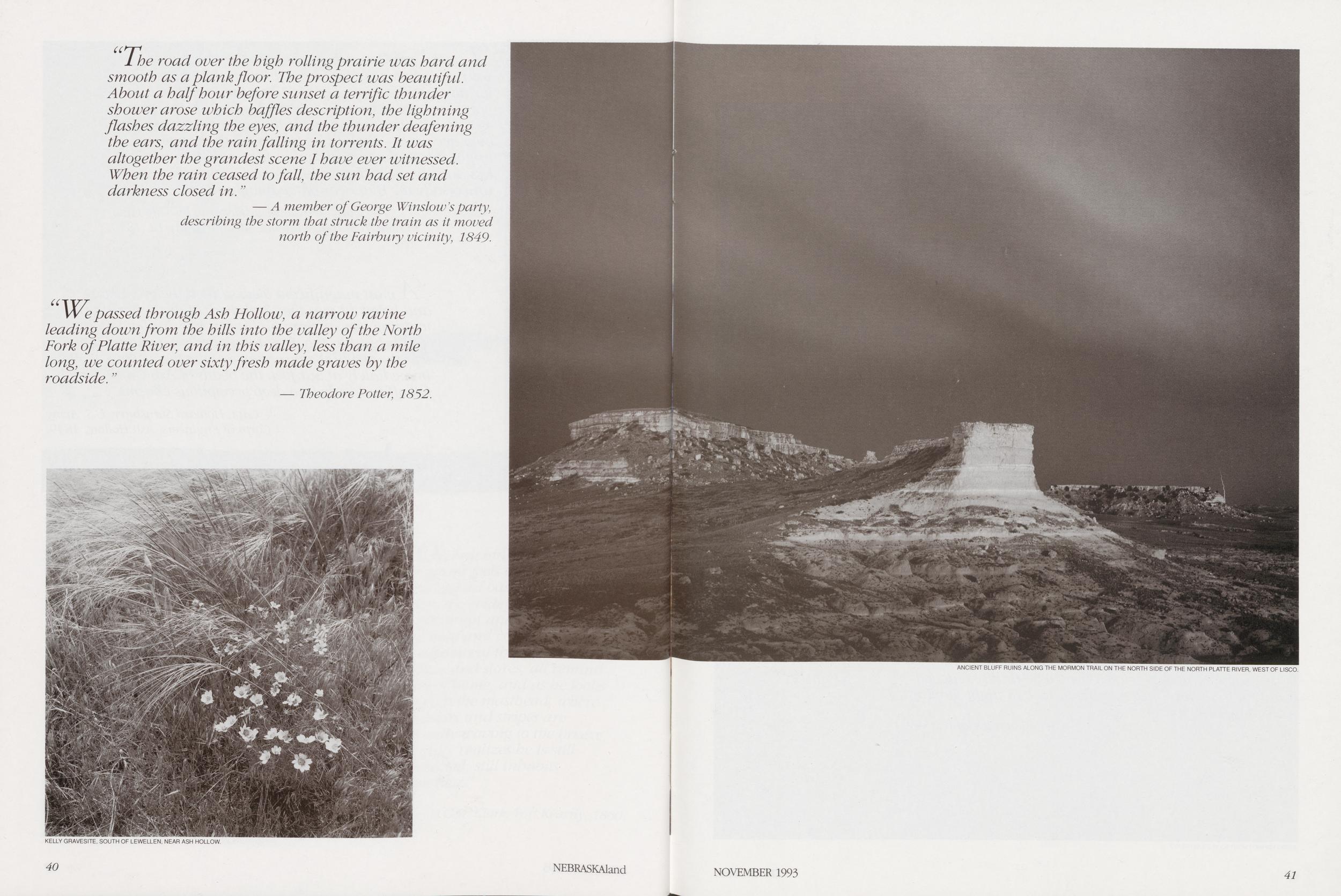
The road over the high rolling prairie was hard and smooth as a plank floor. The prospect was beautiful. About a half hour before sunset a terrific thunder shower arose which baffles description, the lightning flashes dazzling the eyes, and the thunder deafening the ears, and the rain falling in torrents. It was altogether the grandest scene I have ever witnessed. When the rain ceased to fall, the sun had set and darkness closed in." — A member of George WinslowS party, describing the storm that struck the train as it moved north of the Fairbury vicinity, 1849.
We passed through Ash Hollow, a narrow ravine leading down from the hills into the valley of the North Fork of Platte River, and in this valley, less than a mile long, we counted over sixty fresh made graves by the roadside." — Theodore Potter, 1852.
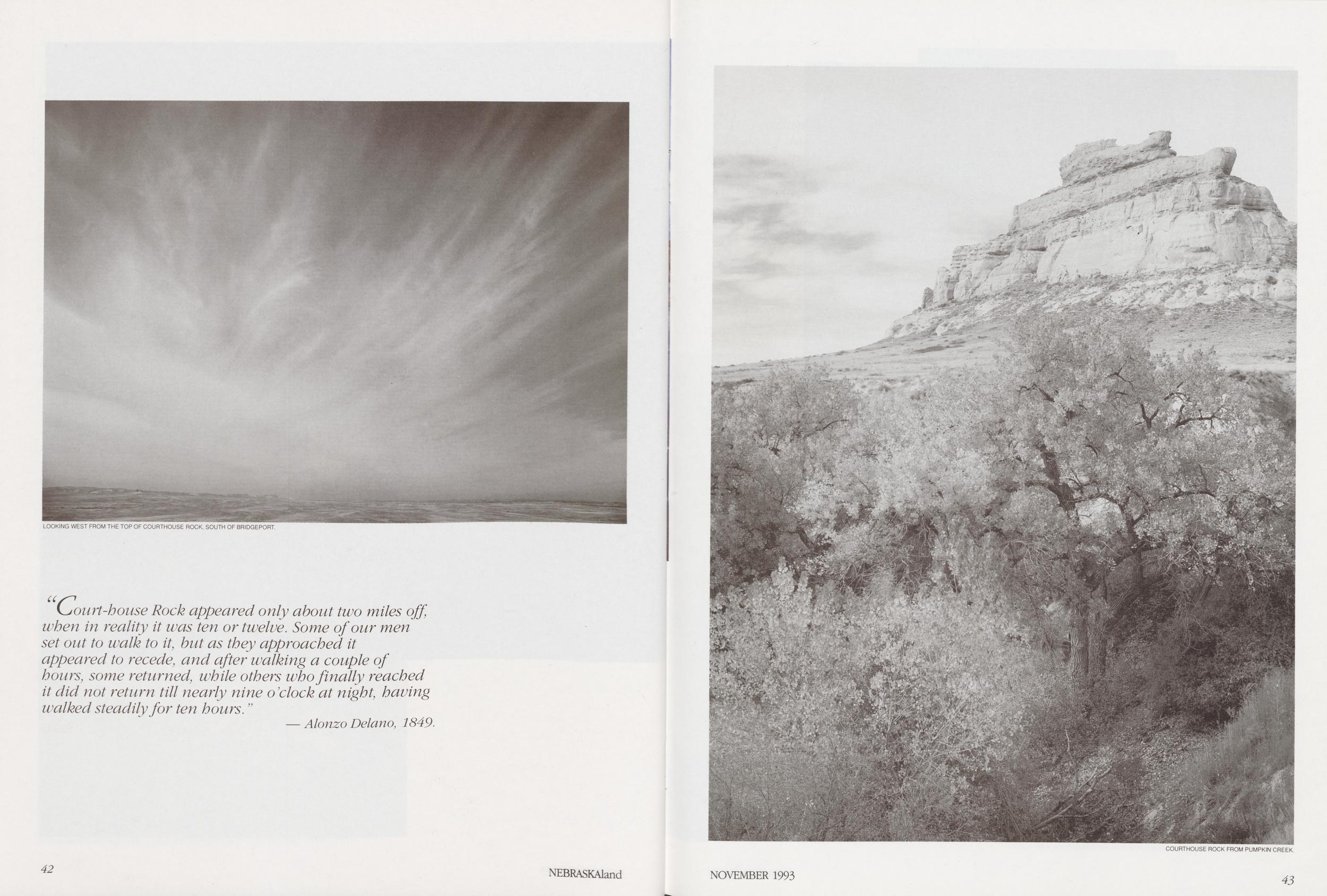
court-house Rock appeared only about two miles off, when in reality it was ten or twelve. Some of our men set out to walk to it, but as they approached it appeared to recede, and after walking a couple of hours, some returned, while others who finally reached it did not return till nearly nine o'clock at night, having walked steadily for ten hours." — Alonzo Delano, 1849.
42 NEBRASKAland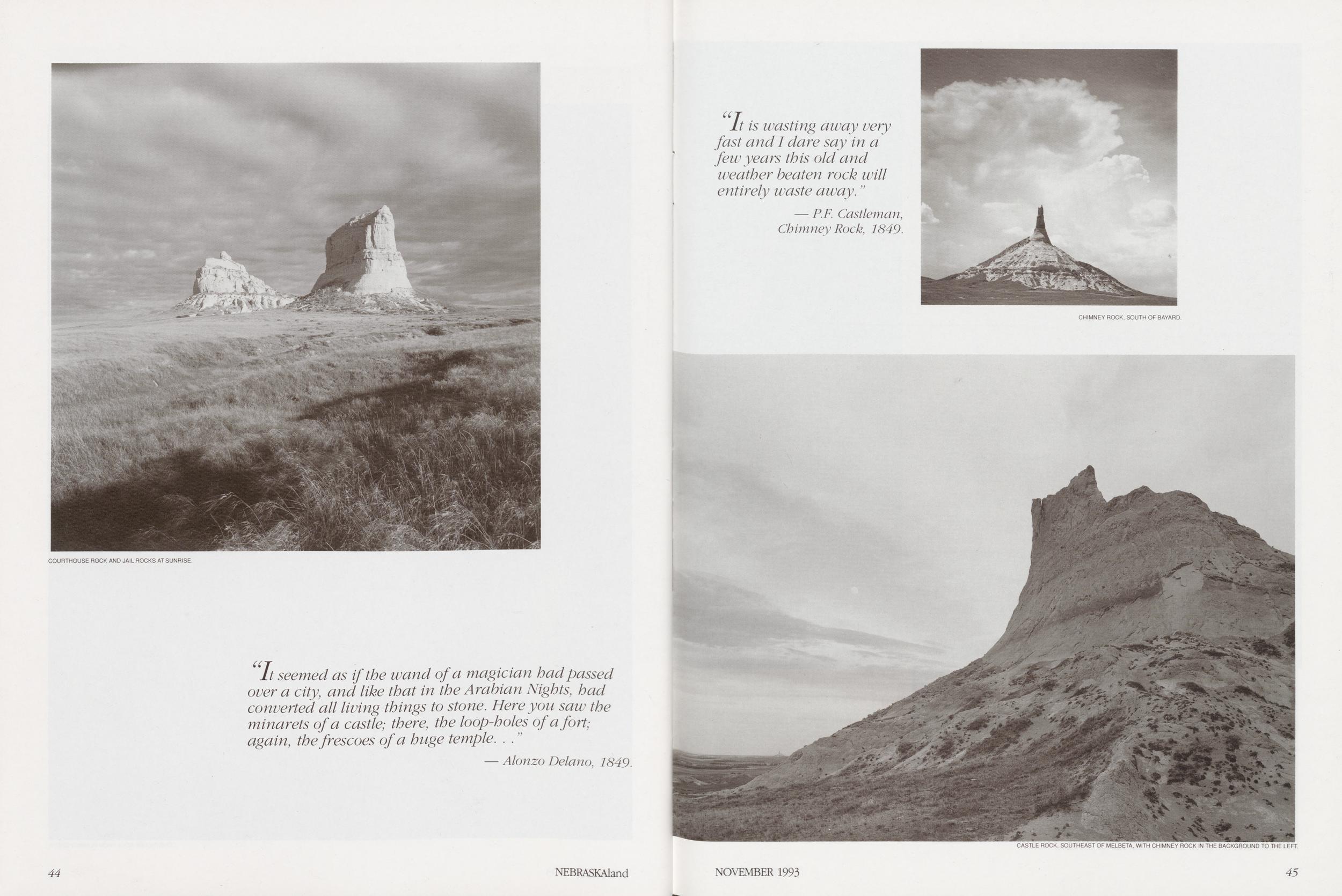
It seemed as if the wand of a magician had passed over a city, and like that in the Arabian Nights, had converted all living things to stone. Here you saw the minarets of a castle; there, the loop-holes of a fort; again, the frescoes of a huge temple. . ." — Alonzo Delano, 1849.
44 NEBRASKAlandIt is wasting away very fast and I dare say in a few years this old and weather beaten rock will entirely waste away." Castleman, Chimney Rock, 1849.
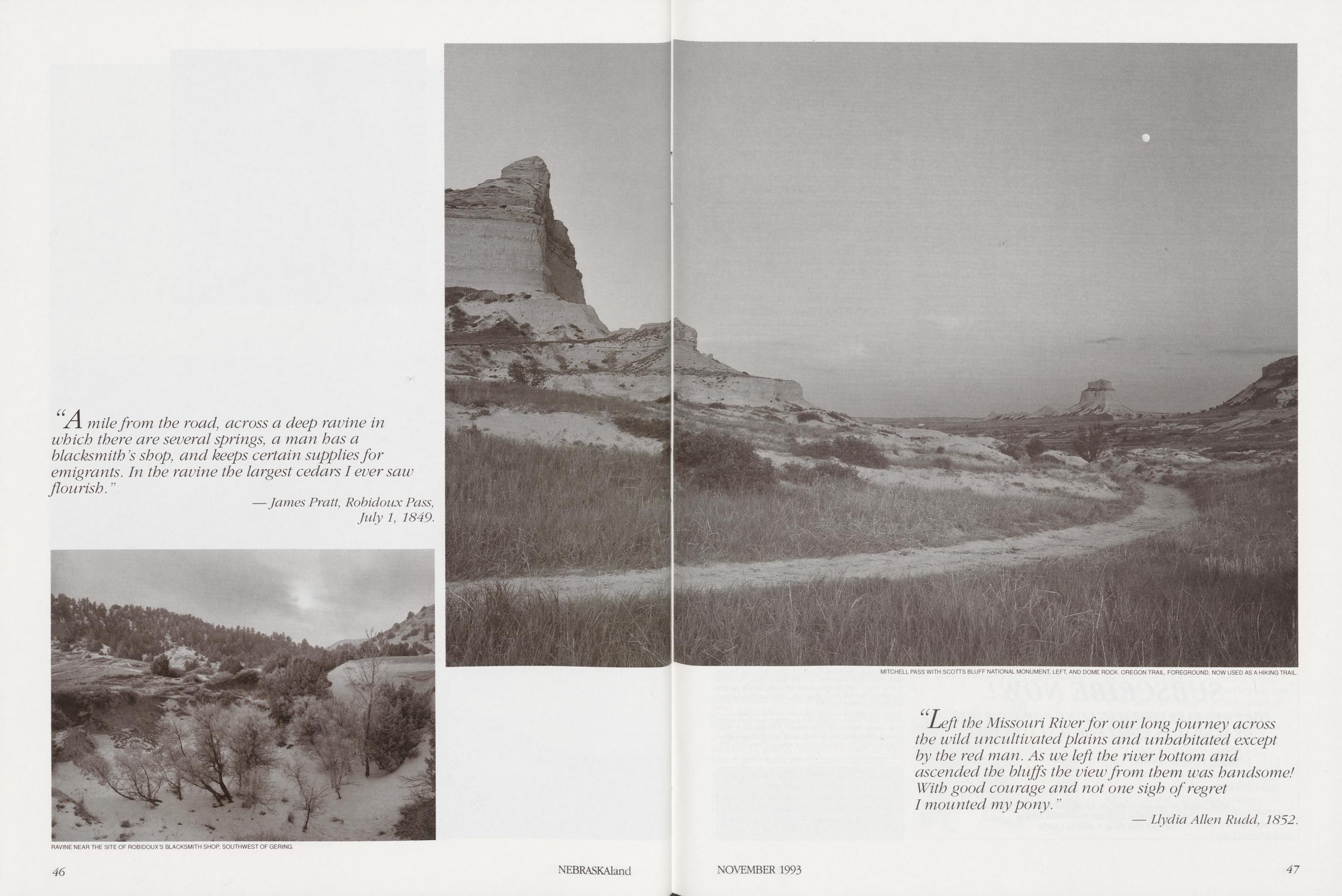
A mile from the road, across a deep ravine in which there are several springs, a man has a blacksmith Js shop, and keeps certain supplies for emigrants. In the ravine the largest cedars I ever saw flourish." —James Pratt, Robidoux Pass, July 1, 1849.
Classified
BOOKS/PRINTINGFREE BOOK CATALOG. Novels, westerns, romances, children's; old out of print, found barns, attic. Authors: Grey, Bower, Connor, Fox, Curwood, Raine, Wright, Aldridge, Pollyanna, Freckles, many others. Postage appreciated. Pierce, 4400 N. Pine Cluster, Oroville, CA 95965
COLLECTIBLESBUYING—TRADING EXPIRED HUNTING. FISHING. TRAPPING licenses; regulations; duck/upland game stamps. (402) 785-7500. Information/prices.
OREGON TRAIL SOUVENIRS. Official buckle - mugs - "Ts," spoons, stoneware. DART, INC. 1-80()-228-0086.
WANTED: OLD GASOLINE ENGINES for restoration. Any condition. Want to see that old engine running again? Dedicated to the preservation of our farm heritage. Kent Zobel, Rt 1, Monroe, NE 68647, 402-495-2845.
WANTED old-time radios, crystal sets. Zenith, Philco, Scott, etc. and unusual radios in any condition. Also parts, advertising, books and other radio related items from 192()'s thru 1940's, any condition. I'm in Nebraska often. Will pick up. Cash paid. Call Bohemian Bill collect 1-312-542-5435.
WANTED anything from the trans-Mississippi Exposition of 1898. Souvenirs, tickets, books, postcards, newspapers, pictures of indians. I'm in Nebraska often. Will pick up. Cash paid. Call Bohemian Bill collect 1-312-542-5435.
WANTED: Collector wants to buy all brands old 2 piece cardboard shot shell boxes. Also wood ammo boxes, old firearm and cartridge company posters, calendars, advertising cardboards, and catalogs. Allan H. Hahn, Rt 1 Box 147, Gibbon, NE 68840. Phone (308) 647-5228.
WANTED historical letters, documents, autographs of famous people and older U.S. stamp collections. I'm in Nebraska often. Will pick up. Cash paid. Call Bohemian Bill collect 1-312-542-5435.
DOGSTRAINING ALL BREEDS bird dogs — Vizslas and English Pointers for sale. Rozanek Kennels, RR 2, Schuyler, NE 68661. Phone (402) 352-8769.
YELLOW-BLACK Lab pups. FC-AFC sired. AKC. Hips OFA certified. Dew claws removed. Excellent hunting potential. Contact Bob Bendler, Lexington, NE. (308) 324-4247.
AKC BRITTANY PUPS. Close working. Natural backing gun dogs. Field champion backgrounds. Liver and orange. References. Blair (402) 426-3597.
FOR SALE — Chesapeake bay or Labrador retrievers. All colors. Pups, started dogs, stud service. Three-generation national champion, pedigree on Lab. Three generations of the best Chesapeakes ever trialed. Call PLATTE VALLEY RETRIEVERS (308) 995-2318.
WILDERNESS KENNELS. Gun dog training - over 60 years combined experience. Training all sporting breeds — Retrievers. Flushing and pointing dogs. All dogs worked on pen raised birds and wild game. Training program includes obedience training — heel, sit, stay, down and come when called. Pups, started dogs and fully trained dogs for sale. HUNTING DOGS TRAINED BY HUNTERS. Henry Sader, Wilderness Kennels. 402-423-4212. Since 1968.
CUSTOM GATES AND KENNELS. Portable and station- ary dog runs and kennels, any size. Phone 402-253-2812.
ENGLISH COCKER pups, imported stock, British FTC bloodlines. Many colors available. Featured in NEBRASKAland November 1991. Sawtooth Oaks, Box 443, Orleans, NE 68966. Phone 308-473-5265.
ENGLISH SETTER PUPS and some started dogs. Bred to hunt for foot hunters. Top bloodlines. Health guaranteed. Wind Fall Gun Dogs 402-421-4693.
DEUTSCH DRAHTHAARS - Line-bred litters planned for December and January. Puppies expected to have great potential. Parents are proven hunters. Bred by strict VDD standards in German registered kennel. Versatile hunting drahthaars for fur and feathered game. Wildflugel Kennel, RR 2, Box 24A, Ravenna, NE 68869. 308-452-4333.
HUNTING DOGS AVAILABLE. Various stages of training. English setters and brittanies. Stylish and sensible. Holdrege 308-995-4797.
FISH/FISHINGFISH FOR SALE. Catfish, perch, coho salmon, rainbow trout, crappie, bluegill. walleye, minnows, goldfish, bullhead, largemouth bass, smallmouth bass, triploid grass carp. Commercial grower prices on catfish, perch, coho salmon, rainbow trout. Consulting available. Pleasant Val- ley Fish Farm, Rt 1 Box 147, McCook, NE 69001. Phone (308) 345-6599.
FOODNEBRASKA BASKETS: The original Nebraska company specializing in fine foods from Nebraska. A beautiful array of baskets filled with ethnic, healthful and long-time favorite foods. Call or write for our brochure: P.O. Box 98, McCook, NE 69001. 1-800-345-7725.
BEER & WINEMAKING SUPPLIES — Fermenter's Supply & Equipment, 4472 S. 84th St., Omaha, NE 68127. (402) 593-9171. Mail order or visit our store.
GIFTSGIVE AUNIQUE GIFT..."One of nature's most spectacular events!" THE CRANE WATCH EXPERIENCE! In this video you'll hear from the experts and witness the sights, sounds and beauty of this stunning celebration of nature in Nebraska. Call 1-800-815-2609 to order.
SUBSCRIBE NOW! GET NEBRASKAland MAGAZINE FOR YOURSELF OR SEND IT AS A GIFT FOR JUST $12 A YEAR! 1 -Year $ 12 Name 2-Years $23 Address City State Zip Mail check or money order to NEBRASKAland Magazine P.O. Box 30370, Lincoln, Nebraska 68503 or call Toll Free 1-800-742-0056FROM NEBRASKA catalogs containing gift baskets and other unique Nebraska products and items are now available. Send $1 to cover postage along with your name and address to FROM NEBRASKA, 140 N. 8th St.. Lincoln, NE 68508.
GUIDES/OUTFITTERSMAD RIVER CANOES offers the finest quality and performance. For the finest canoes and accessories look to Great Plains Canoe Co., 205 Main, Springfield, NE. Phone (402)253-2001.
WYOMING TROPHY HUNTS: elk, deer, antelope and big horn sheep. Professional outfitter and guides. Now booking rifle and bow hunts for 1994 season. Also summer pack trips. Cabin Creek Outfitters, Box 483, Sutton, NE 68979. 402-773-4626.
GUNS/SHOOTING/ARCHERYGUNS — Browning. Winchester, Remington, others. Hi-powers; shotguns, new, used, antiques. Want Pre-'64 Winchesters. Buy-Sell-Trade. (402) 729-6112. Bedlan's Sporting Goods, Fairbury, NE 68352.
FREE CATALOG RELOADING PRODUCTS - Steelshot reloading products, once fired hulls and brass. Shooting accessories and dog training supplies. Precision Reloading, Inc. 1-800-223-0900.
TAXIDERMYALLISONS TAXIDERMY STUDIO & GIFTGALLERY Specializing in fish, birds and small game. Mounted 35 State Record Fish. Pheasant mounts for sale. 421 N. Dewey, North Platte, NE69101. (308)534-2324or(308)534-4267.
WILDLIFE ARTISTRY by Jim Newman. Taxidermy furnished in award winning style. "Serving NE Sportsmen since 1966." RR 2. Box 279. Fremont, NE 68025.402-727- 5714.
ANDERSEN'S TAXIDERMY STUDIO-award winning mounts: birds, fish, game heads and mammals. 402-493- 8495, Omaha, NE.
VACATION/RESORTSNE NEBRASKA trout fishing. 3 modern cottages. 1 available year-round. 5 spring-fed lakes with open water all year. Trout up to 7 pounds. Other varieties fish also. Diamond E Trout Resort, Orchard. NE 68764. Phone (402) 893-4745 Evenings (402) 893-3002.
FOR FISHING and hunting accommodations. Jefco Inn Gordon, NE 69343. South Cornell, (308) 282-2935.
HISTORIC 1890s HOTEL. Located in the beautiful Pine Ridge area of Northwest Nebraska. Short drive to Chadron State Park, Fort Robinson and the Black Hills. Beautiful dining room with fireplace and fountain. Room service available. The Olde Main Street Inn. 115 Main St., Chadron NE 69337. (308) 432-3380.
WEST CENTRAL NEBRASKA country house available year round beginning September. 2 bedroom. 2 bath, garage. Abundant wildlife, hunting and fishing, scenic canyons. Rent by week, month or season. Phone 308-848- 2493.
Classified ad rates: 7T5V per ward, minimum $15. Closing date is the first business day 2 months preceding date of issue. To place ads or for more information write NEBRASKAland Magazine. P.O. Box30370, Lincoln, NE 68503, or call(402) 471-5478. Fax (402) 471-5528. 48 NEBRASKAlandPage forty-nine
Don't Lose Your Batooey in the BrushI knew I was in for it when I heard Athol out in the street parallel parking between my car and the neighbor's pickup. It sounded like he was in a hurry. By the time I got upstairs, he'd already made a couple of touch-and-goes and was in the living room teaching the dog to play tug with a sofa cushion.
"Highdee-ho, oV buddy," he bellows. "Pooch ok? He's looking kind of yellow."
"Take off your goggles," I suggest. He is wearing some kind of cross between an iridescent bat's wing and a Germanic knight's helmet-visor.
"Get so you feel lost without 'em," he says, holding them up for me to admire. "State-of-the-art," he crows. "Designed for clays. Z-frame — Z for Zuridium. Virgin Zuridium, through and through. High eye-point full-wrap design for maximum protection while keeping the eye at the optical center of the lens. Interchangeable one-piece lenses, made of Astroidite. Extreme shatter resistance — take a .38 slug at 10 paces. Blocks UV, blocks blue. Patented Bipolar Ovoid Lens Geometry ensures distortion-free vision, Bucko.
"Ten lens colors: clear, rust, persimmon, high intensity, yellow, dusk, iridium blue, iridium red, iridium black and positive red iridium," he enumerates. "These ones are high intensity." He wraps the space helmet around his face again.
"It figures," I say, restraining the dog who is intent on getting the glasses away from Athol to bury in the backyard.
"Never lose a batooey in the brush with these babies on, Buckwheat."
"I'll bet," I say, trying to remember the last time I lost a batooey in the brush.
"So, step on it," he commands. "Blow the dust off oP Belch-n-smoke — the birds are up!" Athol leans down and glares through his one-piece Astroidite lens at the dog who trots into the bedroom and shuts the door.
"I don't know if I can go," I say. "I think I'm all out of batooeys."
"Good one, Groucho, good one," he cackles. Gradually, though, it comes to him: I don't have the foggiest idea what we're talking about. "Clays, Cowboy, clays," he says. "Sporting Clays! Clay pigeons! Blue rocks! Springing teal! Bolting rabbits! Doubles! Four-bird covey rises! Standards, rocket, mini, midi, batooey — B-A-T-T-U-E!"
Ah-ha! Sporting clays — a mutation of clay target shooting in which shooters move through a natural setting from shooting station to shooting station, and the targets (including the battue, a small, flat, black disk that flies unpredictably) are launched in ways that make the target shooting experience as much like actual hunting as possible. Targets simulate the flight of game birds*— decoying ducks, flushing pheasants, passing doves and so forth. I had to admit it sounded like fun.
It was fun, too. I was a little uncomfortable, though, being the only person there wearing ordinary shooting glasses. Luckily I was with Athol, and the splendor of his Zuridium-and-Astroidite numbers spilled over onto me, I think. I could see lots of people looking enviously at him and feeling just a little ashamed of their simple Randolph Rangers, OptiSport Competitors, Cabot F8600s and Corning Serengeti Vectors.
It was the same with the rest of his outfit. I was in jeans, a chambray work shirt and a stained hunting vest. Most of the other shooters on the course were considerably smoother looking, but Athol was resplendent. His was not clothing; his was apparel: A Ten-Ring, Triple-X-Pro-Sport clays vest (burgundy) with expandable shell pockets, mesh back and sides, padded recoil patch and a quick-access, covered, choke-tube-and-wrench pocket.
His T-shirt, silkscreened with the image of an exploding clay target and pellet holes and the legend "Contains Lead ... applied at 1,250 fps!" seemed a bit tacky to me, but it drew admiring glances.
My compressible foam earplugs worked fine, but if I shoot more clays I think I'll invest in an upscale version — I saw some good-looking custom-fitted, molded silicone models. Athol, however, wore an Envirotronics Serenitron Sound
His greatest coup, though, was the bags. Little pouches hanging from his waist on special belts. Olive canvas with cordovan leather trim and brass accents. One for shells, one for hulls ("Are we going to eat sunflower seeds?" I asked. His silent sneer withered me.) and one for miscellaneous sundries. The bags brought them to their knees. Or did until they found out he didn't know how to compute free recoil energy.
I could have warned him not to get into that conversation. In fact, I tried to change the subject. "What's keeping my score down," he brays in the clubhouse after our second round, "is this: Facial abrasion. At 1,800 feet per second," (I knew better — his T-shirt told me so) "the stock comb impacts my upper maxillary bone with 15 foot-pounds of recoil"
"Speaking of combs," I interject, "did you know that in Japan it's bad luck to pick up a discarded comb?" Nobody knew or, apparently, cared.
"How do you figure 1,800 fps?" a guy in persimmon glasses asks.
"I don't think you could get 15 foot- pounds ..." a guy dressed head to toe in Bob Allen gear starts to add.
"Easy," hoots Athol. "You take my 73/4 pound Krieghoff, one-ounce loads — there's your 1,800 fps — then you take the velocity of the ejecta (that's wads and shot), and you multiply by the weight of the propellent and the ejecta, and you divide by ... no, wait. I think you have to square the weight of the gun first, or ...
"I make it 13 foot pounds at 1,145 fps," says Persimmon Glasses.
"Me too," says Bob Allen.
On the way home we both felt a lot like ejecta, and Athol kept making a snorting noise that sounded like batooey. The dog was happy to see us, though.
Don Cunningham NOVEMBER 1993 49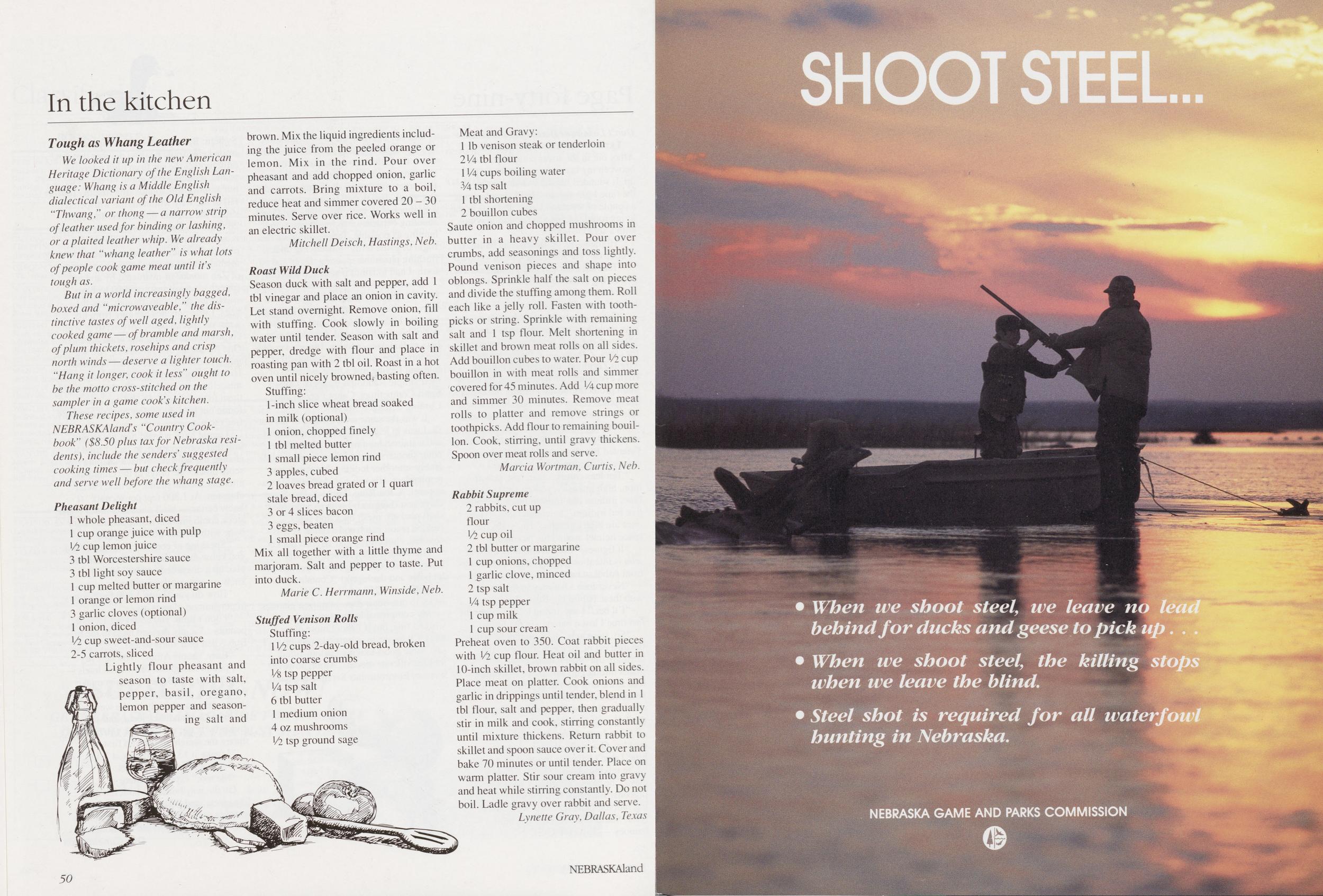
In the kitchen
Tough as Whang LeatherWe looked it up in the new American Heritage Dictionafj of the English Language: Whang is a Middle English dialectical variant of the Old English "Thwang," or thong — a narrow strip of leather used for binding or lashing, or a plaited leather whip. We already knew that "whang leather" is what lots of people cook game meat until it's tough as.
But in a world increasingly bagged, boxed and "microwaveable," the distinctive tastes of well aged, lightly cooked game — of bramble and marsh, of plum thickets, rosehips and crisp north winds — deserve a lighter touch. "Hang it longer, cook it less" ought to be the motto cross-stitched on the sampler in a game cook's kitchen.
These recipes, some used in NEBRASKAlands "Country Cook- book" ($8.50 plus tax for Nebraska residents), include the senders' suggested cooking times — but check frequently and serve well before the whang stage.
Pheasant Delight 1 whole pheasant, diced 1 cup orange juice with pulp Vl cup lemon juice 3 tbl Worcestershire sauce 3 tbl light soy sauce 1 cup melted butter or margarine 1 orange or lemon rind 3 garlic cloves (optional) 1 onion, diced Vl cup sweet-and-sour sauce 2-5 carrots, sliced
Position: 305 (29 views)