Volume 71, Issue 8, 1993
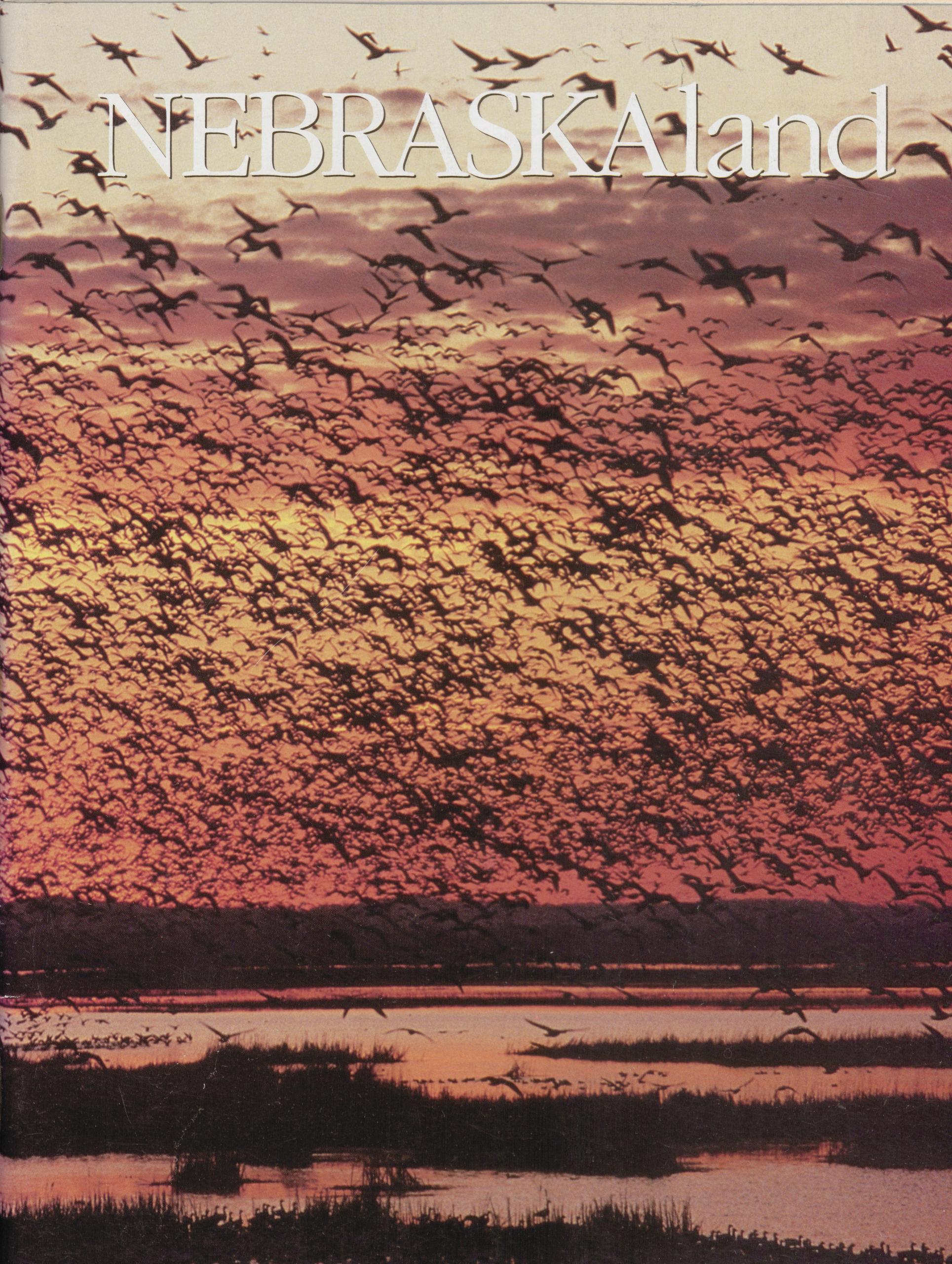
NEBRASKAland
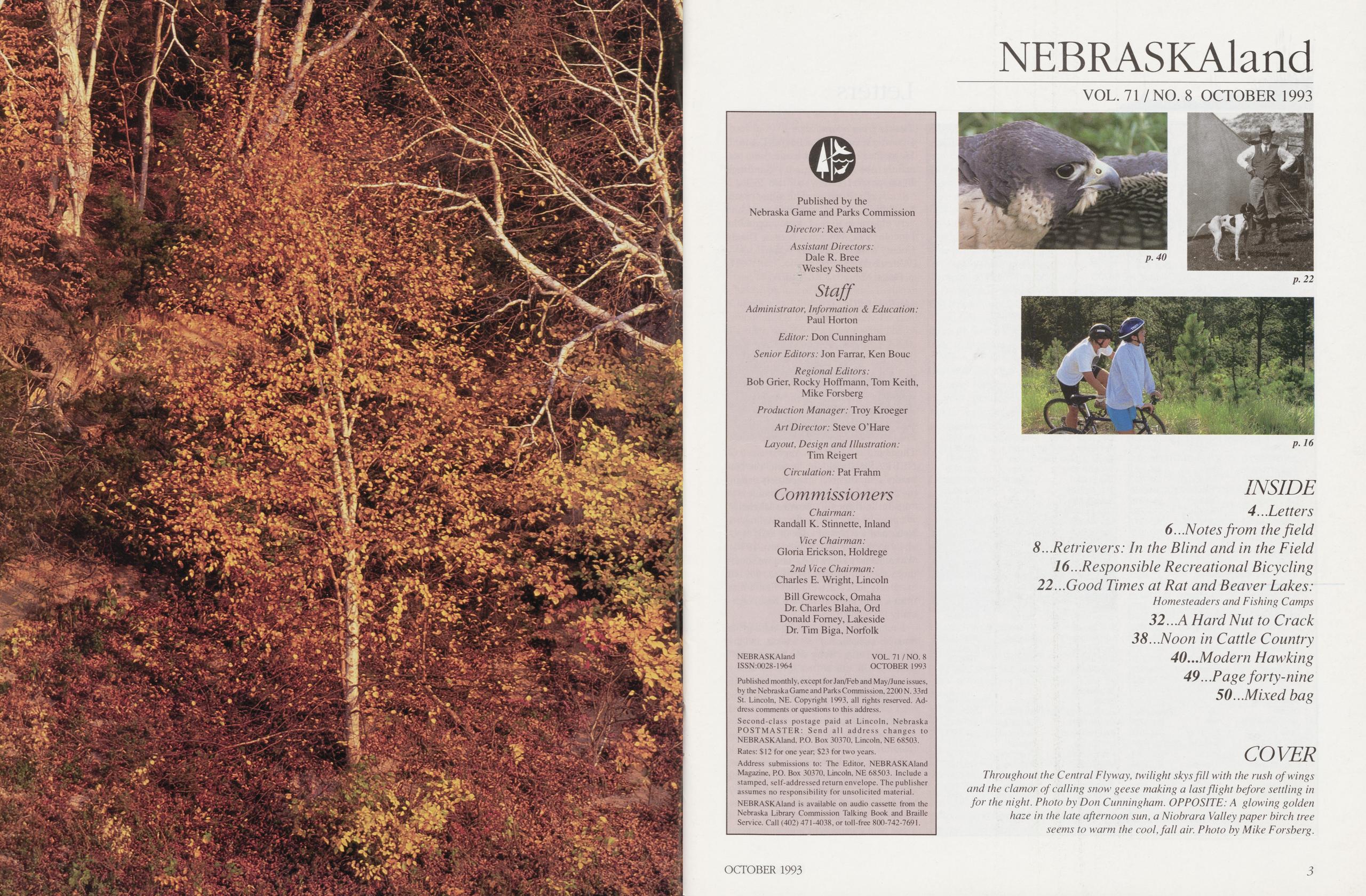
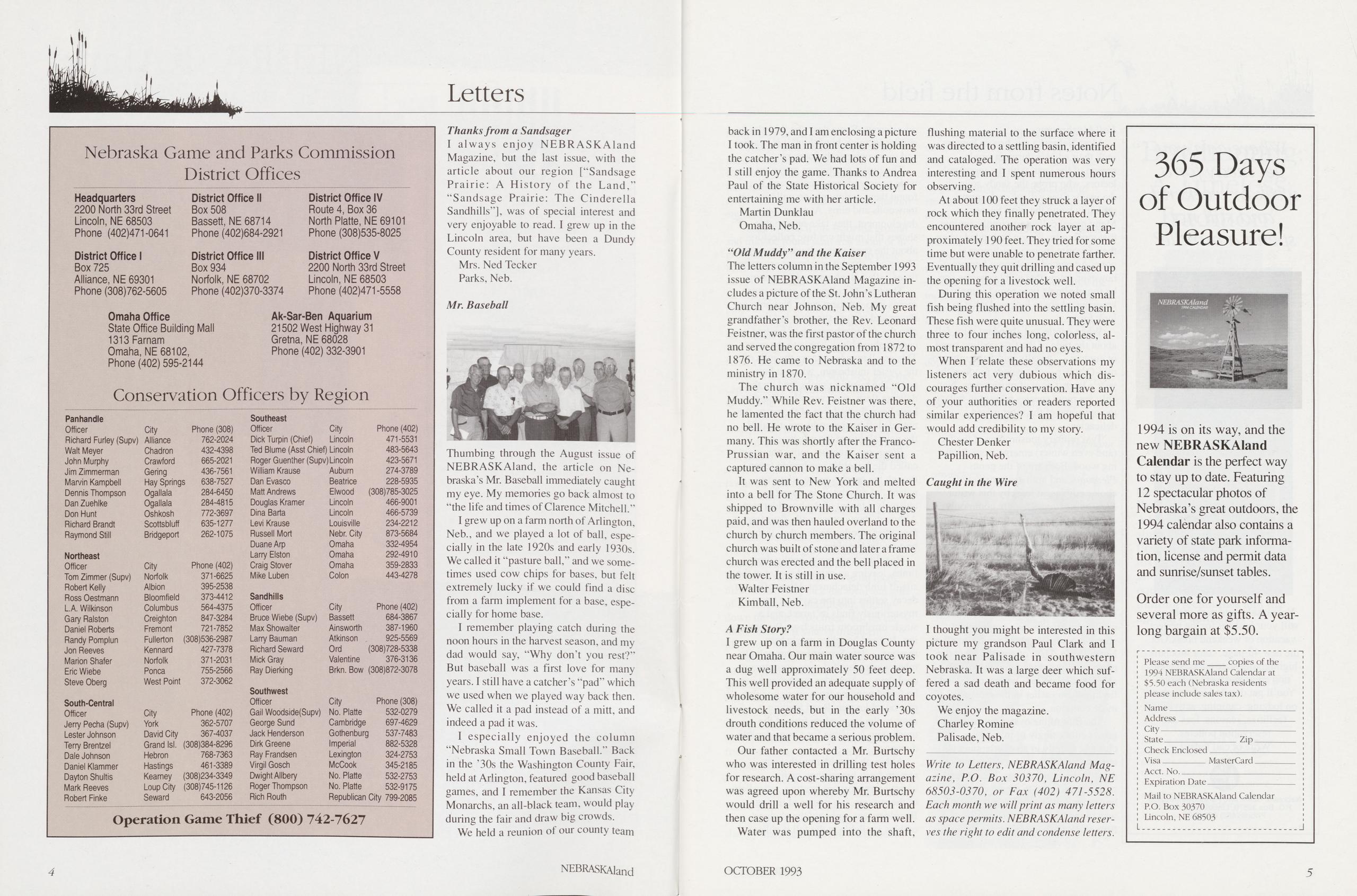
I always enjoy NEBRASKAland Magazine, but the last issue, with the article about our region [“Sandsage Prairie: A History of the Land,” “Sandsage Prairie: The Cinderella Sandhills”], was of special interest and very enjoyable to read. I grew up in the Lincoln area, but have been a Dundy County resident for many years.
Mrs. Ned TeckerParks, Neb. Mr. Baseball
Thumbing through the August issue of NEBRASKAland, the article on Nebraska’s Mr. Baseball immediately caught my eye. My memories go back almost to “the life and times of Clarence Mitchell.” I grew up on a farm north of Arlington, Neb., and we played a lot of ball, especially in the late 1920s and early 1930s. We called it “pasture ball,” and we sometimes used cow chips for bases, but felt extremely lucky if we could find a disc from a farm implement for a base, especially for home base.
I remember playing catch during the noon hours in the harvest season, and my dad would say, “Why don’t you rest?” But baseball was a first love for many years. I still have a catcher’s “pad” which we used when we played way back then. We called it a pad instead of a mitt, and indeed a pad it was.
I especially enjoyed the column “Nebraska Small Town Baseball.” Back in the ’30s the Washington County Fair, held at Arlington, featured good baseball games, and I remember the Kansas City Monarchs, an all-black team, would play during the fair and draw big crowds.
We held a reunion of our county team back in 1979, and I am enclosing a picture I took. The man in front center is holding the catcher’s pad. We had lots of fun and I still enjoy the game. Thanks to Andrea Paul of the State Historical Society for entertaining me with her article.
Martin DunklauOmaha, Neb. “Old Muddy ” and the Kaiser
The letters column in the September 1993 issue of NEBRASKAland Magazine includes a picture of the St. John’s Lutheran Church near Johnson, Neb. My great grandfather’s brother, the Rev. Leonard Feistner, was the first pastor of the church and served the congregation from 1872 to 1876. He came to Nebraska and to the ministry in 1870.
The church was nicknamed “Old Muddy.” While Rev. Feistner was there, he lamented the fact that the church had no bell. He wrote to the Kaiser in Germany. This was shortly after the Franco-Prussian war, and the Kaiser sent a captured cannon to make a bell.
It was sent to New York and melted into a bell for The Stone Church. It was shipped to Brownville with all charges paid, and was then hauled overland to the church by church members. The original church was built of stone and later a frame church was erected and the bell placed in the tower. It is still in use.
Walter FeistnerKimball, Neb. A Fish Story?
I grew up on a farm in Douglas County near Omaha. Our main water source was a dug well approximately 50 feet deep. This well provided an adequate supply of wholesome water for our household and livestock needs, but in the early ’30s drouth conditions reduced the volume of water and that became a serious problem.
Our father contacted a Mr. Burtschy who was interested in drilling test holes for research. A cost-sharing arrangement was agreed upon whereby Mr. Burtschy would drill a well for his research and then case up the opening for a farm well. Water was pumped into the shaft, flushing material to the surface where it was directed to a settling basin, identified and cataloged. The operation was very interesting and I spent numerous hours observing.
At about 100 feet they struck a layer of rock which they finally penetrated. They encountered another rock layer at approximately 190 feet. They tried for some time but were unable to penetrate farther. Eventually they quit drilling and cased up the opening for a livestock well.
During this operation we noted small fish being flushed into the settling basin. These fish were quite unusual. They were three to four inches long, colorless, almost transparent and had no eyes.
When I relate these observations my listeners act very dubious which discourages further conservation. Have any of your authorities or readers reported similar experiences? I am hopeful that would add credibility to my story.
Chester DenkerPapillion, Neb. Caught in the Wire
I thought you might be interested in this picture my grandson Paul Clark and I took near Palisade in southwestern Nebraska. It was a large deer which suffered a sad death and became food for coyotes.
We enjoy the magazine.
Charley Romine Palisade, Neb.
Notes from the field
Fall MushroomsMost Nebraska mushroom hunters seek their edibles during a single season of the year, with the morel collectors, who probe the sandy soils of the major river valleys each spring, probably being the most numerous. Many morel collectors simply assume that mushroom season has ended when their favorite sponge mushroom is gone. Advanced mushroom hunters, however, know that edible species can be found almost year-round, simply by knowing where to look and what to look for.
When gentle and abundant rains fall about the time of the first cooling trend of autumn — usually mid-September to mid-October — the woods produce the year’s largest crop of mushrooms. Not only are more species present in fall, so too are some of the most prized delicacies.
Two primary mushrooms of the fall (and even winter) emerge from decaying wood. Both are of the genus Pleurotus, and both are considered choice edibles, at least by this writer. Pleurotus ostreatus, more commonly called the oyster mushroom because of its shape, can be found from late summer through midwinter depending on climatic conditions.
A few years ago, following heavy wet snows and unseasonably warm temperatures around the Christmas season, I found a magnificent cluster of oyster mushrooms on a cottonwood stump in a sandy upland region south of North Platte. That, of course, is not the norm for those prize fungi. More reliable sources are low-lying woods, and finding them earlier in the season is more common.
The fruit of the oyster mushroom grows either singly or in massive clusters, usually in an overlapping pattern and in different stages of development in the same cluster. Their color ranges from ivory to cream or pale brown, and their gills extend all the way to the base. The caps consist of firm, thick flesh, and they are distinctly odoriferous. Some describe the odor as similar to anise, but I think it is heartier and more poignantly fragrant.
The oyster mushroom grows on a wide variety of tree species, and I’ve found them commonly on willows, cottonwoods and elms. At some stages of development, they take on variable shapes that might confuse collectors about the species they have discovered. These odd-shaped specimens are sometimes called elephant ear mushrooms.
The trick to collecting oyster mushrooms is to get them early. Not only are flavor and texture superior, but there is also the added advantage of beating a certain shiny black beetle to the prize. This small invader attacks the gills of the oyster mushroom, where it lays eggs. The resulting grubs feed on the delicate flesh, and even when the gills have been flushed free of the pests, the tunnels left by the grubs greatly alter the palatability of the mushroom.
Pleurotus ulmarius, more commonly called the boxelder mushroom (even though the species name, ulmarius, means “of the elms”) is almost exclusively a tenant of the boxelder tree. Although they occasionally fruit from a few other woody species, they thrive best on the boxelder.
Boxelder trees occasionally drop limbs, leaving an exposed socket at the site of limb detachment. After sufficient decay settles into the cavity, a spore mysteriously finds its target, and a single mushroom fruits from the opening. In good boxelder mushroom seasons — late September through October when plentiful rains accompany cool days — boxelder mushrooms can be found popping from every opening of a boxelder tree. Road hunting is easy, as the large white fruit of the mushroom is visible for a considerable distance.
Although boxelder mushrooms remain fresh longer than many varieties, mushroom hunting, regardless of the species, is a matter of timing. Boxelders are probably the choicest edibles available in the fall if collected before they begin to dry. Among the most delightful of all mushrooms, the shaggy mane, Coprinus comatus, is also available in late summer and fall and is considered choice eating by virtually all mushroom enthusiasts.
Shaggy mane fruits from the ground and may be found scattered about or in grouped colonies. They seem to prefer hard-packed, grassy soils typical of pastures or roadsides. The shaggy mane is so widely distributed it is difficult to pinpoint areas of major occurrence. The shaggy mane is nearly cylindrical with its cap attached to the stalk. The veil soon comes free, leaving an inferior ring on the stalk. Many flattened scales, which recurve with age, give the cap a shaggy appearance, thus the common name.
If you plan to eat this mushroom, it is important to have a frying pan almost in hand as you pick, for they deteriorate and darken rapidly. People with shaggy mane mushrooms growing in their lawns are fortunate because the fungi can be transformed into a skillet of scrambled eggs and mushrooms at their very freshest.
Giant puffballs, Calvatia gigantea in particular, are highly sought-after delicacies that occur in late summer and fall. True puffballs have no recognizable stem and lack the form and gills of an embryonic mushroom. Slicing down through a specimen will reveal those features if you've mistakenly plucked a mushroom button.
Puffballs that form a purple globe when young should be avoided. Those that start out white and color or sculpt only with maturity are edible. Puffballs, of course, must be harvested before they mature and fill with powdery spores. Sliced, breaded, seasoned and fried, puffballs make a dish of lasting memories.
A word about the edibility of the four mushrooms briefly described here: I have heard only praises of the palatability of the boxelder, oyster, shaggy mane and puffball mushrooms, and no instances of them causing discomfort. The key is being able to recognize these fall delicacies. Making the wrong choice may have consequences, ranging from an unpleasant taste to stomach distress to hallucinations to death.
Mushrooms, includihg some species found in Nebraska, can kill. It is the responsibility of the mushroom hunter to identify them accurately. The four species described here are probably the most recognizable of the edibles, and learning to identify them with certainty will broaden considerably any gourmet urge for fungi. Without exception, it is foolish to eat mushrooms when in doubt about genus and species.
Two excellent books on the subject are Mushrooms of North America by Orson K. Miller, Jr. and The Mushroom Hunter s Field Guide by Alexander H. Smith and Nancy Smith Weber.
Rocky Hoffmann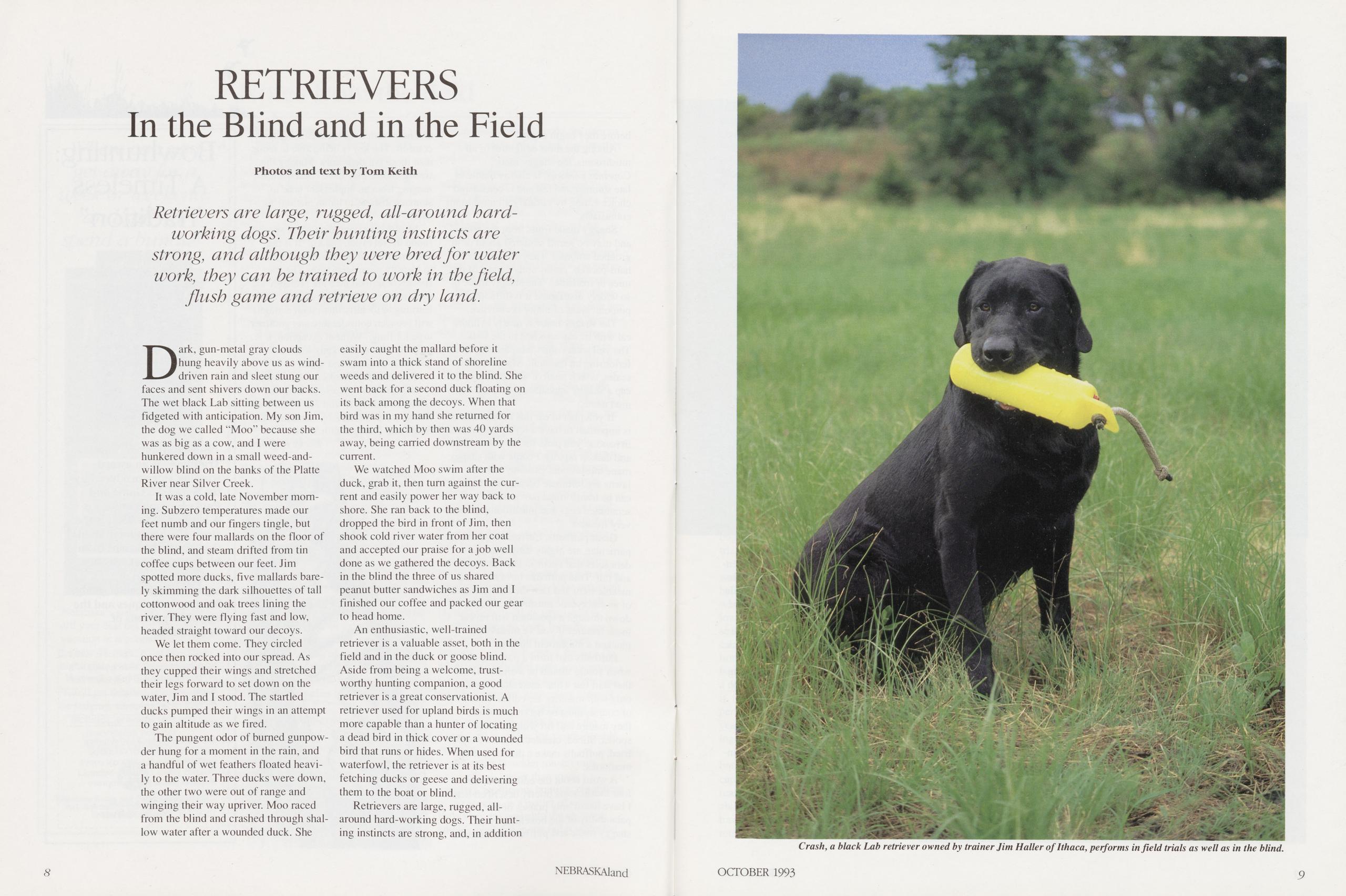
RETRIEVERS In the Blind and in the Field
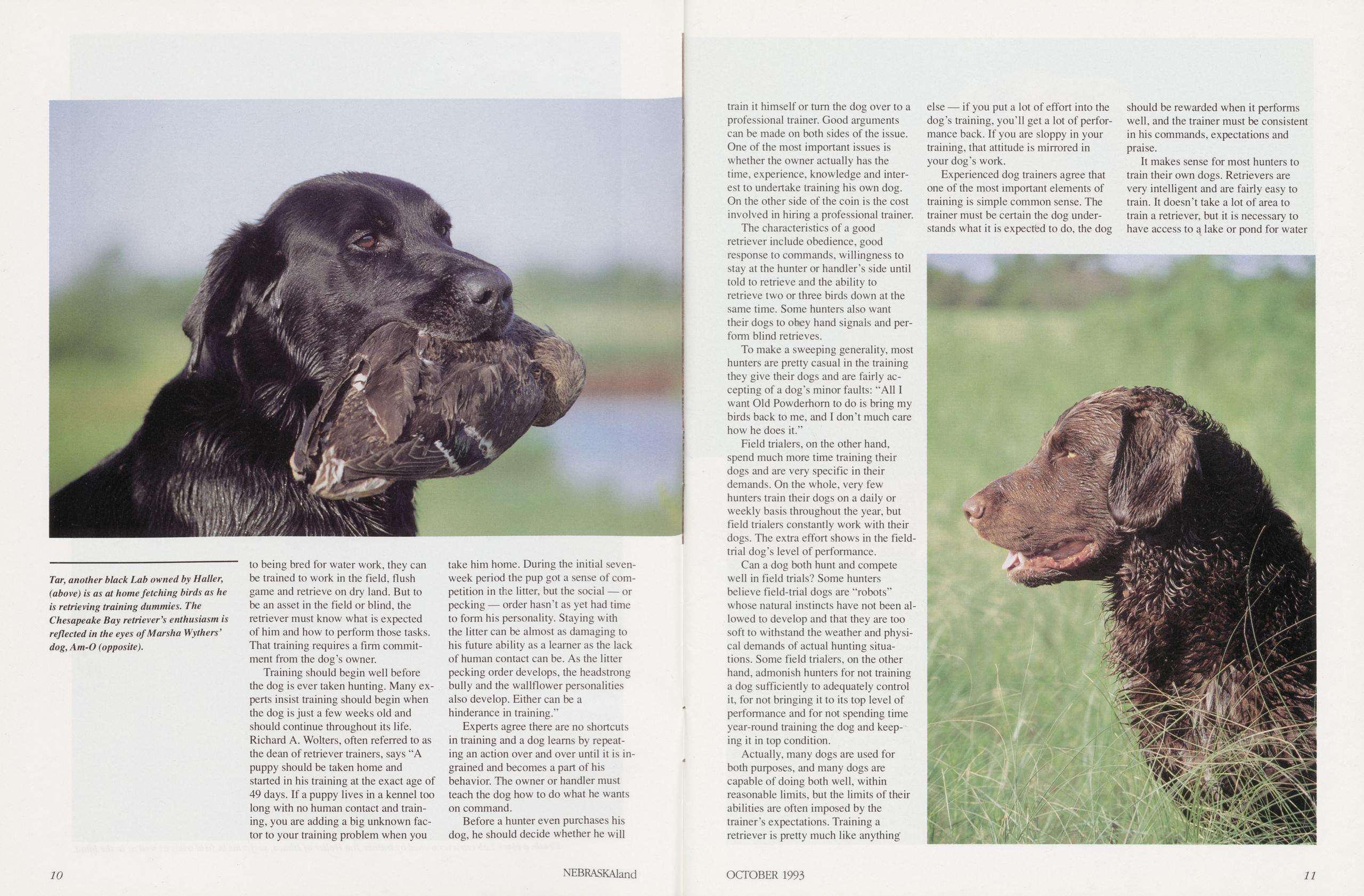
Photos and text by Tom Keith Retrievers are large, rugged, all-around hard- working dogs. Their hunting instincts are strong, and although they were bred for water work, they can be trained to work in the field, flush game and retrieve on dry land.Dark, gun-metal gray clouds hung heavily above us as wind- driven rain and sleet stung our faces and sent shivers down our backs. The wet black Lab sitting between us fidgeted with anticipation. My son Jim, the dog we called “Moo” because she was as big as a cow, and I were hunkered down in a small weed-and- willow blind on the banks of the Platte River near Silver Creek.
It was a cold, late November morning. Subzero temperatures made our feet numb and our fingers tingle, but there were four mallards on the floor of the blind, and steam drifted from tin coffee cups between our feet. Jim spotted more ducks, five mallards barely skimming the dark silhouettes of tall cottonwood and oak trees lining the river. They were flying fast and low, headed straight toward our decoys.
We let them come. They circled once then rocked into our spread. As they cupped their wings and stretched their legs forward to set down on the water, Jim and I stood. The startled ducks pumped their wings in an attempt to gain altitude as we fired.
The pungent odor of burned gunpowder hung for a moment in the rain, and a handful of wet feathers floated heavily to the water. Three ducks were down, the other two were out of range and winging their way upriver. Moo raced from the blind and crashed through shallow water after a wounded duck. She easily caught the mallard before it swam into a thick stand of shoreline weeds and delivered it to the blind. She went back for a second duck floating on its back among the decoys. When that bird was in my hand she returned for the third, which by then was 40 yards away, being carried downstream by the current.
We watched Moo swim after the duck, grab it, then turn against the current and easily power her way back to shore. She ran back to the blind, dropped the bird in front of Jim, then shook cold river water from her coat and accepted our praise for a job well done as we gathered the decoys. Back in the blind the three of us shared peanut butter sandwiches as Jim and I finished our coffee and packed our gear to head home.
An enthusiastic, well-trained retriever is a valuable asset, both in the field and in the duck or goose blind. Aside from being a welcome, trustworthy hunting companion, a good retriever is a great conservationist. A retriever used for upland birds is much more capable than a hunter of locating a dead bird in thick cover or a wounded bird that runs or hides. When used for waterfowl, the retriever is at its best fetching ducks or geese and delivering them to the boat or blind.
Retrievers are large, rugged, all-around hard-working dogs. Their hunting instincts are strong, and, in addition
to being bred for water work, they can be trained to work in the field, flush game and retrieve on dry land. But to be an asset in the field or blind, the retriever must know what is expected of him and how to perform those tasks. That training requires a firm commitment from the dog’s owner.
Training should begin well before the dog is ever taken hunting. Many experts insist training should begin when the dog is just a few weeks old and should continue throughout its life. Richard A. Wolters, often referred to as the dean of retriever trainers, says "A puppy should be taken home and started in his training at the exact age of 49 days. If a puppy lives in a kennel too long with no human contact and training, you are adding a big unknown factor to your training problem when you take him home. During the initial seven- week period the pup got a sense of competition in the litter, but the social — or pecking — order hasn’t as yet had time to form his personality. Staying with the litter can be almost as damaging to his future ability as a learner as the lack of human contact can be. As the litter pecking order develops, the headstrong bully and the wallflower personalities also develop. Either can be a hinderance in training.”
Experts agree there are no shortcuts in training and a dog learns by repeating an action over and over until it is ingrained and becomes a part of his behavior. The owner or handler must teach the dog how to do what he wants on command.
Before a hunter even purchases his dog, he should decide whether he will train it himself or turn the dog over to a professional trainer. Good arguments can be made on both sides of the issue. One of the most important issues is whether the owner actually has the time, experience, knowledge and interest to undertake training his own dog. On the other side of the coin is the cost involved in hiring a professional trainer. The characteristics of a good retriever include obedience, good response to commands, willingness to stay at the hunter or handler’s side until told to retrieve and the ability to retrieve two or three birds down at the same time. Some hunters also want their dogs to obey hand signals and perform blind retrieves.
To make a sweeping generality, most hunters are pretty casual in the training they give their dogs and are fairly accepting of a dog’s minor faults: “All I want Old Powderhom to do is bring my birds back to me, and I don’t much care how he does it.”
Field trialers, on the other hand, spend much more time training their dogs and are very specific in their demands. On the whole, very few hunters train their dogs on a daily or weekly basis throughout the year, but field trialers constantly work with their dogs. The extra effort shows in the field- trial dog’s level of performance.
Can a dog both hunt and compete well in field trials? Some hunters believe field-trial dogs are “robots” whose natural instincts have not been allowed to develop and that they are too soft to withstand the weather and physical demands of actual hunting situations. Some field trialers, on the other hand, admonish hunters for not training a dog sufficiently to adequately control it, for not bringing it to its top level of performance and for not spending time year-round training the dog and keeping it in top condition.
Actually, many dogs are used for both purposes, and many dogs are capable of doing both well, within reasonable limits, but the limits of their abilities are often imposed by the trainer’s expectations. Training a retriever is pretty much like anything else — if you put a lot of effort into the dog’s training, you’ll get a lot of performance back. If you are sloppy in your training, that attitude is mirrored in your dog’s work.
Experienced dog trainers agree that one of the most important elements of training is simple common sense. The trainer must be certain the dog understands what it is expected to do, the dog should be rewarded when it performs well, and the trainer must be consistent in his commands, expectations and praise.
It makes sense for most hunters to train their own dogs. Retrievers are very intelligent and are fairly easy to train. It doesn’t take a lot of area to train a retriever, but it is necessary to have access to a lake or pond for water
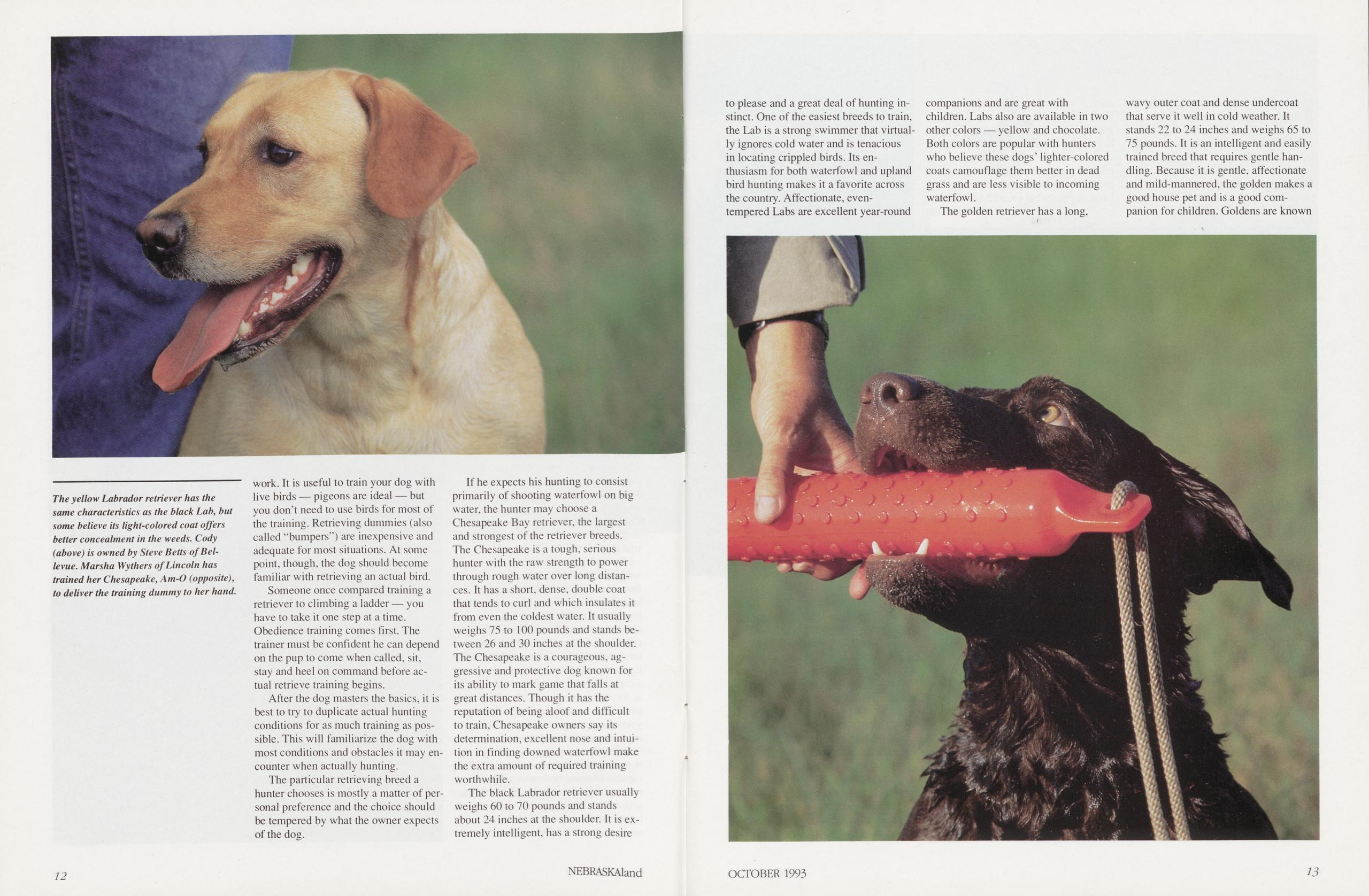
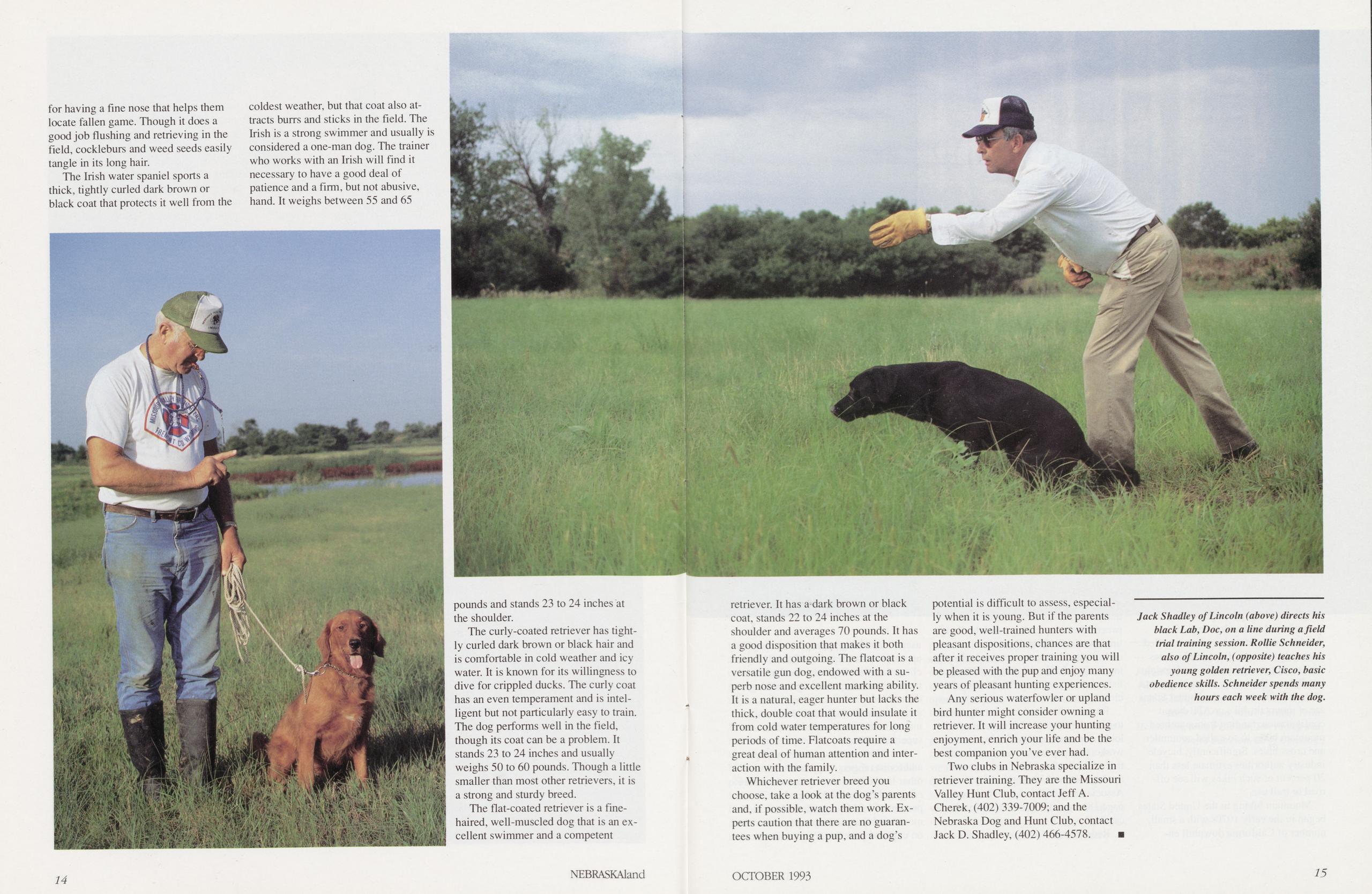
The yellow Labrador retriever has the same characteristics as the black Lab, but some believe its light-colored coat offers better concealment in the weeds. Cody (above) is owned by Steve Betts of Bellevue. Marsha Wythers of Lincoln has trained her Chesapeake, Am-O (opposite), to deliver the training dummy to her hand.
work. It is useful to train your dog with live birds — pigeons are ideal — but you don’t need to use birds for most of the training. Retrieving dummies (also called “bumpers”) are inexpensive and adequate for most situations. At some point, though, the dog should become familiar with retrieving an actual bird. Someone once compared training a retriever to climbing a ladder — you have to take it one step at a time.
Obedience training comes first. The trainer must be confident he can depend on the pup to come when called, sit, stay and heel on command before actual retrieve training begins.
After the dog masters the basics, it is best to try to duplicate actual hunting conditions for as much training as possible. This will familiarize the dog with most conditions and obstacles it may encounter when actually hunting. The particular retrieving breed a hunter chooses is mostly a matter of personal preference and the choice should be tempered by what the owner expects of the dog.
If he expects his hunting to consist primarily of shooting waterfowl on big water, the hunter may choose a Chesapeake Bay retriever, the largest and strongest of the retriever breeds. The Chesapeake is a tough, serious hunter with the raw strength to power through rough water over long distances. It has a short, dense, double coat that tends to curl and which insulates it from even the coldest water. It usually weighs 75 to 100 pounds and stands between 26 and 30 inches at the shoulder.
The Chesapeake is a courageous, aggressive and protective dog known for its ability to mark game that falls at great distances. Though it has the reputation of being aloof and difficult to train, Chesapeake owners say its determination, excellent nose and intuition in finding downed waterfowl make the extra amount of required training worthwhile.
The black Labrador retriever usually weighs 60 to 70 pounds and stands about 24 inches at the shoulder. It is extremely intelligent, has a strong desire to please and a great deal of hunting instinct. One of the easiest breeds to train, the Lab is a strong swimmer that virtually ignores cold water and is tenacious in locating crippled birds. Its enthusiasm for both waterfowl and upland bird hunting makes it a favorite across the country. Affectionate, even-tempered Labs are excellent year-round companions and are great with children. Labs also are available in two other colors — yellow and chocolate. Both colors are popular with hunters who believe these dogs’ lighter-colored coats camouflage them better in dead grass and are less visible to incoming waterfowl.
The golden retriever has a long, wavy outer coat and dense undercoat that serve it well in cold weather. It stands 22 to 24 inches and weighs 65 to 75 pounds. It is an intelligent and easily trained breed that requires gentle handling. Because it is gentle, affectionate and mild-mannered, the golden makes a good house pet and is a good companion for children. Goldens are known
for having a fine nose that helps them locate fallen game. Though it does a good job flushing and retrieving in the field, cockleburs and weed seeds easily tangle in its long hair.
The Irish water spaniel sports a thick, tightly curled dark brown or black coat that protects it well from the coldest weather, but that coat also attracts burrs and sticks in the field. The Irish is a strong swimmer and usually is considered a one-man dog. The trainer who works with an Irish will find it necessary to have a good deal of patience and a firm, but not abusive, hand. It weighs between 55 and 65 pounds and stands 23 to 24 inches at the shoulder.
The curly-coated retriever has tightly curled dark brown or black hair and is comfortable in cold weather and icy water. It is known for its willingness to dive for crippled ducks. The curly coat has an even temperament and is intelligent but not particularly easy to train. The dog performs well in the field, though its coat can be a problem. It stands 23 to 24 inches and usually weighs 50 to 60 pounds. Though a little smaller than most other retrievers, it is a strong and sturdy breed.
The flat-coated retriever is a fine-haired, well-muscled dog that is an excellent swimmer and a competent retriever. It has a dark brown or black coat, stands 22 to 24 inches at the shoulder and averages 70 pounds. It has a good disposition that makes it both friendly and outgoing. The flatcoat is a versatile gun dog, endowed with a superb nose and excellent marking ability. It is a natural, eager hunter but lacks the thick, double coat that would insulate it from cold water temperatures for long periods of time. Flatcoats require a great deal of human attention and interaction with the family.
Whichever retriever breed you choose, take a look at the dog’s parents and, if possible, watch them work. Experts caution that there are no guaran- tees when buying a pup, and a dog’s potential is difficult to assess, especially when it is young. But if the parents are good, well-trained hunters with pleasant dispositions, chances are that after it receives proper training you will be pleased with the pup and enjoy many years of pleasant hunting experiences.
Any serious waterfowler or upland bird hunter might consider owning a retriever. It will increase your hunting enjoyment, enrich your life and be the best companion you’ve ever had.
Two clubs in Nebraska specialize in retriever training. They are the Missouri Valley Hunt Club, contact Jeff A. Cherek, (402) 339-7009; and the Nebraska Dog and Hunt Club, contact Jack D. Shadley, (402) 466-4578.
Responsible Recreational Bicycling
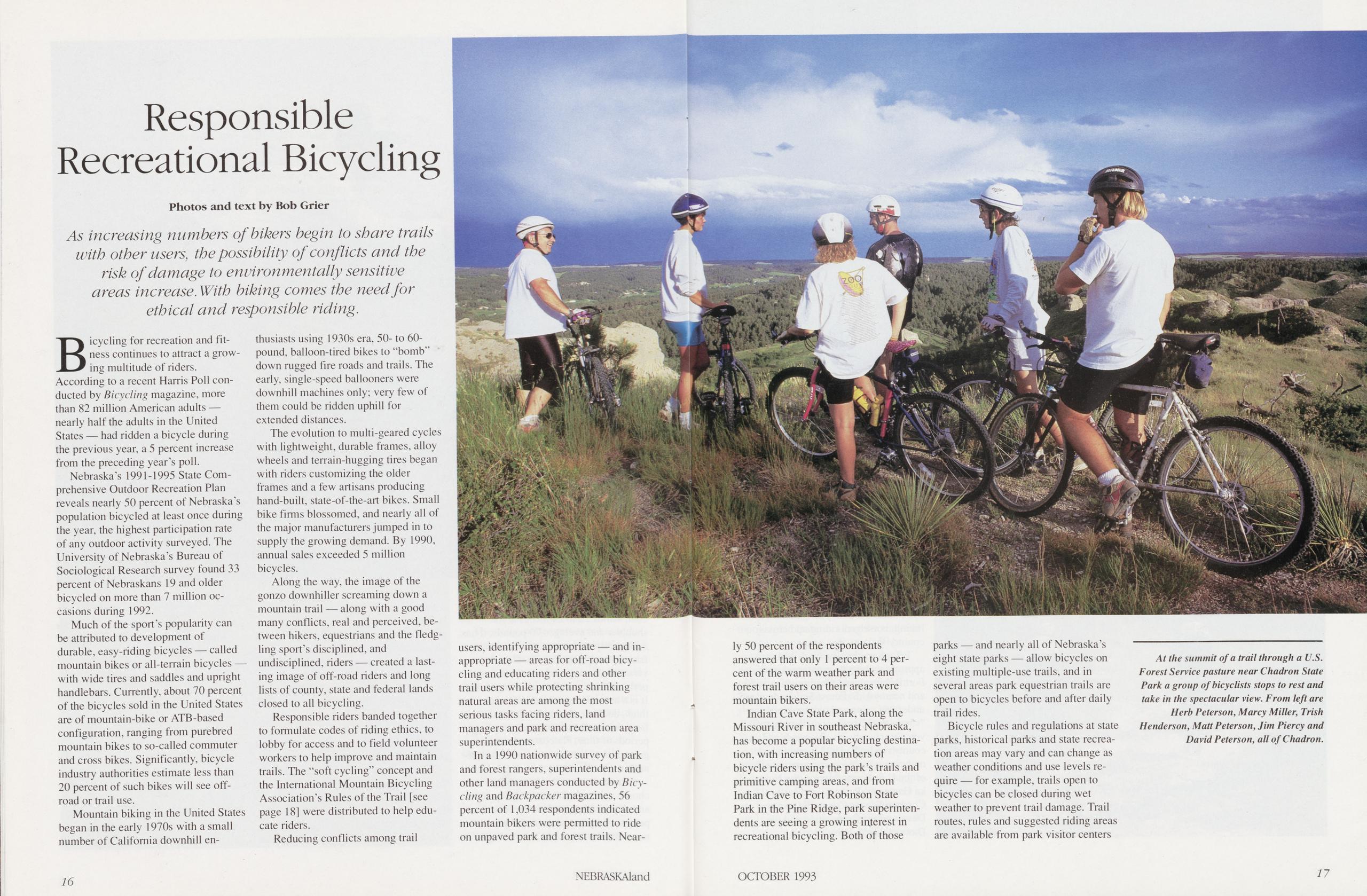
Photos and text by Bob Grier As increasing numbers of bikers begin to share trails with other users, the possibility of conflicts and the risk of damage to environmentally sensitive areas increase. With biking comes the need for ethical and responsible riding.Bicycling for recreation and fitness continues to attract a growing multitude of riders.
According to a recent Harris Poll conducted by Bicycling magazine, more than 82 million American adults — nearly half the adults in the United States — had ridden a bicycle during the previous year, a 5 percent increase from the preceding year’s poll.
Nebraska’s 1991-1995 State Comprehensive Outdoor Recreation Plan reveals nearly 50 percent of Nebraska’s population bicycled at least once during the year, the highest participation rate of any outdoor activity surveyed. The University of Nebraska’s Bureau of Sociological Research survey found 33 percent of Nebraskans 19 and older bicycled on more than 7 million occasions during 1992.
Much of the sport’s popularity can be attributed to development of durable, easy-riding bicycles — called mountain bikes or all-terrain bicycles — with wide tires and saddles and upright handlebars. Currently, about 70 percent of the bicycles sold in the United States are of mountain-bike or ATB-based configuration, ranging from purebred mountain bikes to so-called commuter and cross bikes. Significantly, bicycle industry authorities estimate less than 20 percent of such bikes will see off-road or trail use.
Mountain biking in the United States began in the early 1970s with a small number of California downhill en- thusiasts using 1930s era, 50- to 60- pound, balloon-tired bikes to “bomb” down rugged fire roads and trails. The early, single-speed ballooners were downhill machines only; very few of them could be ridden uphill for extended distances.
The evolution to multi-geared cycles with lightweight, durable frames, alloy wheels and terrain-hugging tires began with riders customizing the older frames and a few artisans producing hand-built, state-of-the-art bikes. Small bike firms blossomed, and nearly all of the major manufacturers jumped in to supply the growing demand. By 1990, annual sales exceeded 5 million bicycles.
Along the way, the image of the gonzo downhiller screaming down a mountain trail — along with a good many conflicts, real and perceived, between hikers, equestrians and the fledgling sport’s disciplined, and undisciplined, riders — created a lasting image of off-road riders and long lists of county, state and federal lands closed to all bicycling.
Responsible riders banded together to formulate codes of riding ethics, to lobby for access and to field volunteer workers to help improve and maintain trails. The “soft cycling” concept and the International Mountain Bicycling Association’s Rules of the Trail [see page 18] were distributed to help educate riders.
Reducing conflicts among trail users, identifying appropriate — and inappropriate — areas for off-road bicycling and educating riders and other trail users while protecting shrinking natural areas are among the most serious tasks facing riders, land managers and park and recreation area superintendents.
In a 1990 nationwide survey of park and forest rangers, superintendents and other land managers conducted by Bicycling and Backpacker magazines, 56 percent of 1,034 respondents indicated mountain bikers were permitted to ride on unpaved park and forest trails. Nearly 50 percent of the respondents answered that only 1 percent to 4 percent of the warm weather park and forest trail users on their areas were mountain bikers.
Indian Cave State Park, along the Missouri River in southeast Nebraska, has become a popular bicycling destination, with increasing numbers of bicycle riders using the park’s trails and primitive camping areas, and from Indian Cave to Fort Robinson State Park in the Pine Ridge, park superintendents are seeing a growing interest in recreational bicycling. Both of those parks — and nearly all of Nebraska’s eight state parks — allow bicycles on existing multiple-use trails, and in several areas park equestrian trails are open to bicycles before and after daily trail rides.
Bicycle rules and regulations at state parks, historical parks and state recreation areas may vary and can change as weather conditions and use levels require — for example, trails open to bicycles can be closed during wet weather to prevent trail damage. Trail routes, rules and suggested riding areas are available from park visitor centers
or information booths, and park superintendents can provide additional access information.
Riding in the Commission’s wildlife management areas is discouraged. Habitat managers report increasing use of wildlife management areas for many forms of outdoor recreation and growing conflicts between people and wildlife on the areas set aside and maintained to preserve critical wildlife habitat.
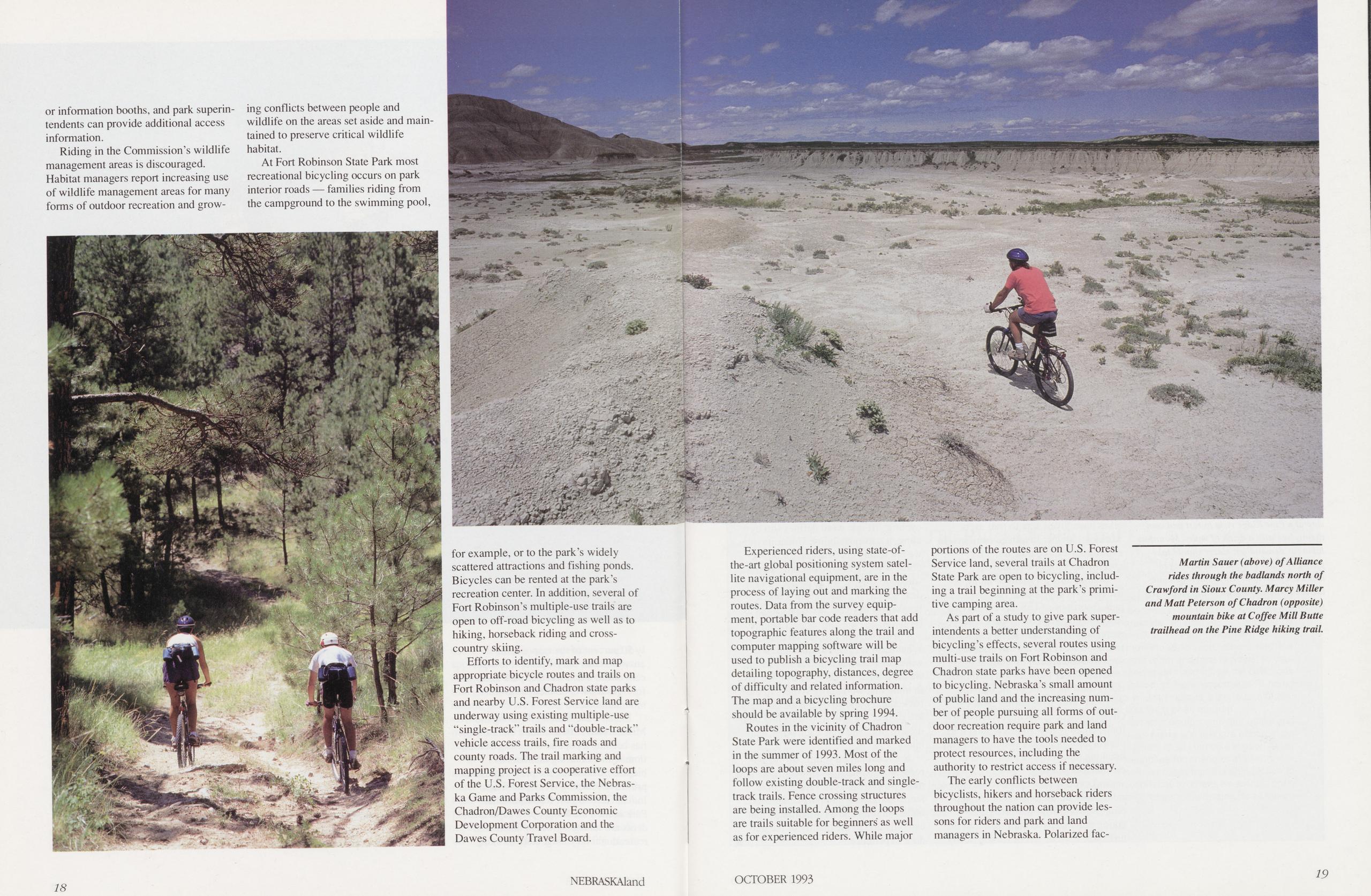
At Fort Robinson State Park most recreational bicycling occurs on park interior roads — families riding from the campground to the swimming pool, for example, or to the park’s widely scattered attractions and fishing ponds. Bicycles can be rented at the park’s recreation center. In addition, several of Fort Robinson’s multiple-use trails are open to off-road bicycling as well as to hiking, horseback riding and cross-country skiing.
Efforts to identify, mark and map appropriate bicycle routes and trails on Fort Robinson and Chadron state parks and nearby U.S. Forest Service land are underway using existing multiple-use “single-track” trails and “double-track” vehicle access trails, fire roads and county roads. The trail marking and mapping project is a cooperative effort of the U.S. Forest Service, the Nebraska Game and Parks Commission, the Chadron/Dawes County Economic Development Corporation and the Dawes County Travel Board.
Experienced riders, using state-of- the-art global positioning system satellite navigational equipment, are in the process of laying out and marking the routes. Data from the survey equip- ment, portable bar code readers that add topographic features along the trail and computer mapping software will be used to publish a bicycling trail map detailing topography, distances, degree of difficulty and related information. The map and a bicycling brochure should be available by spring 1994.
Routes in the vicinity of Chadron State Park were identified and marked in the summer of 1993. Most of the loops are about seven miles long and follow existing double-track and single- track trails. Fence crossing structures are being installed. Among the loops are trails suitable for beginners as well as for experienced riders. While major portions of the routes are on U.S. Forest Service land, several trails at Chadron State Park are open to bicycling, including a trail beginning at the park’s primitive camping area.
As part of a study to give park super- intendents a better understanding of bicycling’s effects, several routes using multi-use trails on Fort Robinson and Chadron state parks have been opened to bicycling. Nebraska’s small amount of public land and the increasing number of people pursuing all forms of outdoor recreation require park and land managers to have the tools needed to protect resources, including the authority to restrict access if necessary.
The early conflicts between bicyclists, hikers and horseback riders throughout the nation can provide lessons for riders and park and land managers in Nebraska. Polarized fac-
tions arguing about trail damage from hiking boots, horseshoes or mountain bikes have given way to trail users working together to reduce conflicts. In extreme cases, separate trails for specific uses may be required.
Maintaining a system of multiple- use trails on appropriate Nebraska state parks, portions of U.S. Forest Service land and city and county park and recreation department lands can reduce riding on areas that are environmentally sensitive and crucial to wildlife.
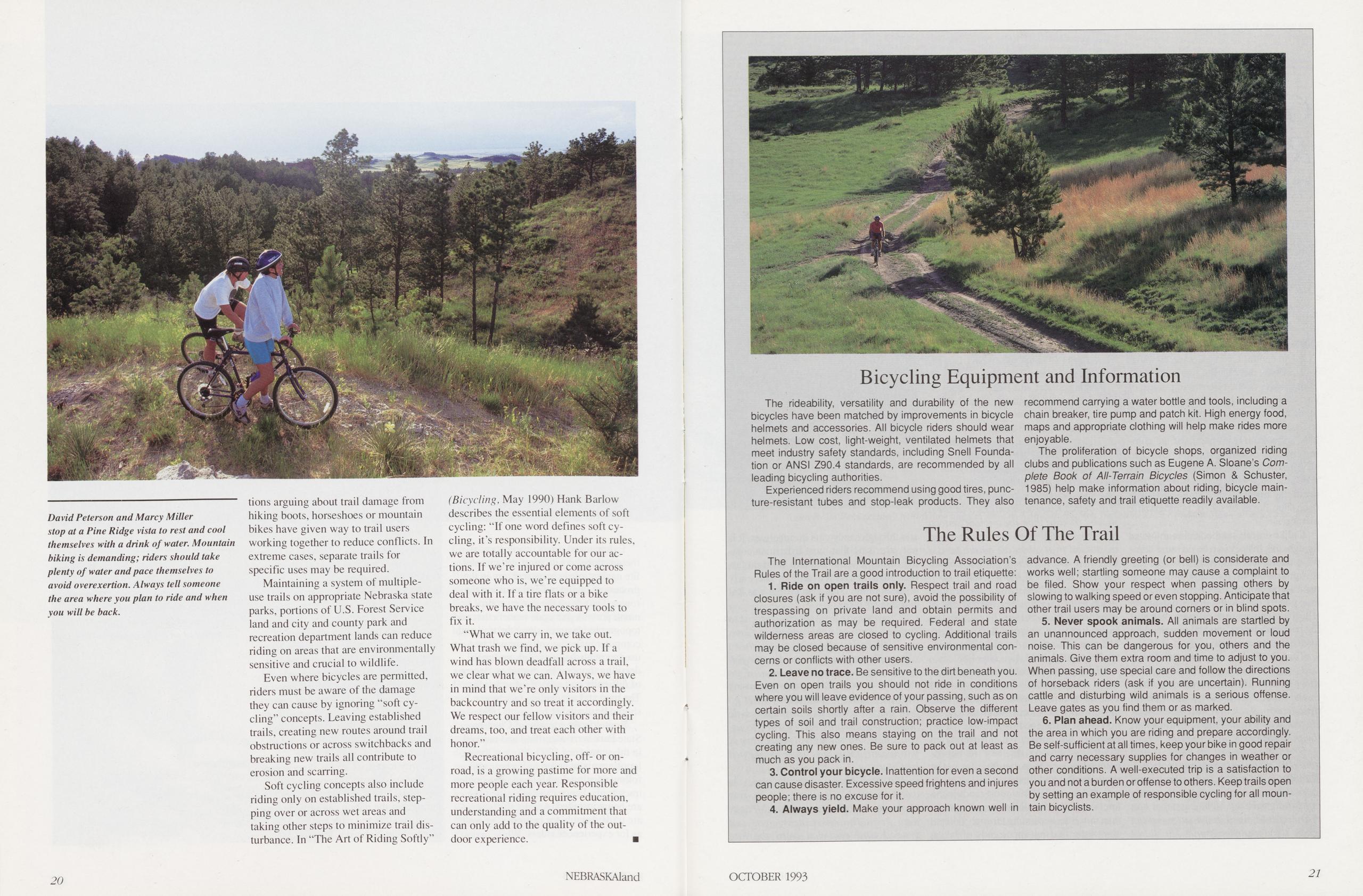
Even where bicycles are permitted, riders must be aware of the damage they can cause by ignoring "soft cycling” concepts. Leaving established trails, creating new routes around trail obstructions or across switchbacks and breaking new trails all contribute to erosion and scarring.
Soft cycling concepts also include riding only on established trails, stepping over or across wet areas and taking other steps to minimize trail disturbance. In "The Art of Riding Softly” (Bicycling, May 1990) Hank Barlow describes the essential elements of soft cycling: "If one word defines soft cycling, it’s responsibility. Under its rules, we are totally accountable for our actions. If we’re injured or come across someone who is, we’re equipped to deal with it. If a tire flats or a bike breaks, we have the necessary tools to fix it.
"What we carry in, we take out. What trash we find, we pick up. If a wind has blown deadfall across a trail, we clear what we can. Always, we have in mind that we’re only visitors in the backcountry and so treat it accordingly. We respect our fellow visitors and their dreams, too, and treat each other with honor.”
Recreational bicycling, off- or on- road, is a growing pastime for more and more people each year. Responsible recreational riding requires education, understanding and a commitment that can only add to the quality of the outdoor experience.
The rideability, versatility and durability of the new bicycles have been matched by improvements in bicycle helmets and accessories. All bicycle riders should wear helmets. Low cost, light-weight, ventilated helmets that meet industry safety standards, including Snell Foundation or ANSI Z90.4 standards, are recommended by all leading bicycling authorities.
Experienced riders recommend using good tires, puncture-resistant tubes and stop-leak products. They also recommend carrying a water bottle and tools, including a chain breaker, tire pump and patch kit. High energy food, maps and appropriate clothing will help make rides more enjoyable.
The proliferation of bicycle shops, organized riding clubs and publications such as Eugene A. Sloane’s Complete Book of All-Terrain Bicycles (Simon & Schuster, 1985) help make information about riding, bicycle maintenance, safety and trail etiquette readily available.
The Rules Of The TrailThe International Mountain Bicycling Association’s Rules of the Trail are a good introduction to trail etiquette: 1. Ride on open trails only. Respect trail and road closures (ask if you are not sure), avoid the possibility of trespassing on private land and obtain permits and authorization as may be required. Federal and state wilderness areas are closed to cycling. Additional trails may be closed because of sensitive environmental concerns or conflicts with other users.
2. Leave no trace. Be sensitive to the dirt beneath you. Even on open trails you should not ride in conditions where you will leave evidence of your passing, such as on certain soils shortly after a rain. Observe the different types of soil and trail construction; practice low-impact cycling. This also means staying on the trail and not creating any new ones. Be sure to pack out at least as much as you pack in.
3. Control your bicycle. Inattention foreven a second can cause disaster. Excessive speed frightens and injures people; there is no excuse for it.
4. Always yield. Make your approach known well in advance. A friendly greeting (or bell) is considerate and works well; startling someone may cause a complaint to be filed. Show your respect when passing others by slowing to walking speed or even stopping. Anticipate that other trail users may be around corners or in blind spots.
5. Never spook animals. All animals are startled by an unannounced approach, sudden movement or loud noise. This can be dangerous for you, others and the animals. Give them extra room and time to adjust to you. When passing, use special care and follow the directions of horseback riders (ask if you are uncertain). Running cattle and disturbing wild animals is a serious offense. Leave gates as you find them or as marked.
6. Plan ahead. Know your equipment, your ability and the area in which you are riding and prepare accordingly. Be self-sufficient at all times, keep your bike in good repair and carry necessary supplies for changes in weather or other conditions. A well-executed trip is a satisfaction to you and not a burden or offense to others. Keep trails open by setting an example of responsible cycling for all mountain bicyclists.
20 NEBRASKAland OCTOBER 1993 21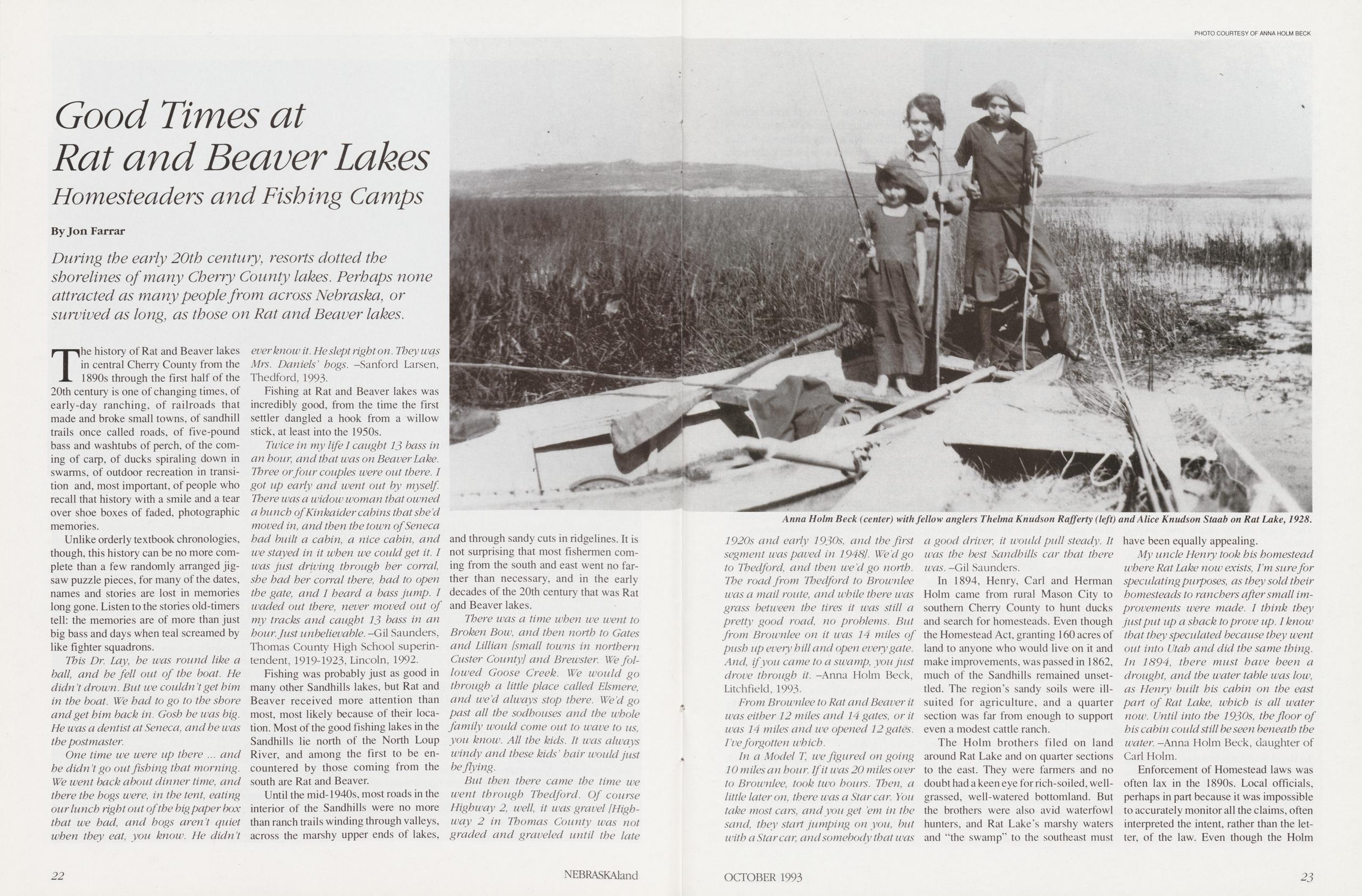
Good Times at Rat and Beaver Lakes
Homesteaders and Fishing Camps
By Jon Farrar During the early 20th century, resorts dotted the shorelines of many Cherry County lakes. Perhaps none attracted as many people from across Nebraska, or survived as long, as those on Rat and Beaver lakes.The history of Rat and Beaver lakes in central Cherry County from the 1890s through the first half of the 20th century is one of changing times, of early-day ranching, of railroads that made and broke small towns, of sandhill trails once called roads, of five-pound bass and washtubs of perch, of the coming of carp, of ducks spiraling down in swarms, of outdoor recreation in transition and, most important, of people who recall that history with a smile and a tear over shoe boxes of faded, photographic memories.
Unlike orderly textbook chronologies, though, this history can be no more complete than a few randomly arranged jig- saw puzzle pieces, for many of the dates, names and stories are lost in memories long gone. Listen to the stories old-timers tell: the memories are of more than just big bass and days when teal screamed by like fighter squadrons.
This Dr. Lay, he was round like a ball, and he fell out of the boat. He didn't drown. But we couldn't get him in the boat. We had to go to the shore and get him back in. Gosh he was big. He was a dentist at Seneca, and he was the postmaster.
One time we were up there ... and he didn't go out fishing that morning. We went back about dinner time, and there the hogs were, in the tent, eating our lunch right out of the big paper box that we had, and hogs aren 't quiet when they eat, you know. He didn’t ever know it. He slept right on. They was Mrs. Daniels' hogs. -Sanford Larsen, Thedford, 1993.
Fishing at Rat and Beaver lakes was incredibly good, from the time the first settler dangled a hook from a willow stick, at least into the 1950s.
Twice in my life L caught 13 bass in an hour, and that was on Beaver Lake. Three or four couples were out there. got up early and went out by myself There was a widow woman that owned a bunch of Kinkaider cabins that she'd moved in, and then the town of Seneca had built a cabin, a nice cabin, and we stayed in it when we could get it. was just driving through her corral, she had her corral there, had to open the gate, and 1 heard a bass jump. waded out there, never moved out of my tracks and caught 13 bass in an hour. Just unbelievable. -Gil Saunders, Thomas County High School superintendent, 1919-1923, Lincoln, 1992.
Fishing was probably just as good in many other Sandhills lakes, but Rat and Beaver received more attention than most, most likely because of their location. Most of the good fishing lakes in the Sandhills lie north of the North Loup River, and among the first to be encountered by those coming from the south are Rat and Beaver.
Anna Holm Beck (center) with fellow anglers Thelma Knudson Rafferty (left) and Alice Knudson Staab on Rat Lake, 1928.
There was a time when we went to Broken Bow, and then north to Gates and Lillian [small towns in northern Custer County] and Brewster. We followed Goose Creek. We would go through a little place called Elsmere, and we'd always stop there. We d go past all the sodbouses and the whole family would come out to wave to us, you know. All the kids. Lt was always windy and these kids' hair would just be flying.
But then there came the time we went through Thedford. Of course Highway 2, well, it was gravel [Highway 2 in Thomas County was not graded and graveled until the late 1920s and early 1930s, and the first segment was paved in 1948]. We 'd go to Thedford', and then we 'd go nonh. The road from Thedford to Brownlee was a mail route, and while there was grass between the tires it was still a pretty good road, no problems. But from Brownlee on it was 14 miles of push up every hill and open every'gate. And, if you came to a swamp, you just drove through it. -Anna Holm Beck, Litchfield, 1993.
From Brownlee to Rat and Beaver it was either 12 miles and 14 gates, or it was 14 miles and we opened 12gates. I've forgotten which.
In a Model T, we figured on going 10 miles an hour. If it was 20 miles over to Brownlee, took two hours. Then, a little later on, there was a Star car. You take most cars, and you get 'em in the sand, they stan jumping on you, but with a Star car, and somebody that was a good driver, it would pull steady. It was the best Sandhills car that there was. -Gil Saunders.
In 1894, Henry, Carl and Herman Holm came from rural Mason City to southern Cherry County to hunt ducks and search for homesteads. Even though the Homestead Act, granting 160 acres of land to anyone who would live on it and make improvements, was passed in 1862, much of the Sandhills remained unsettled. The region’s sandy soils were ill-suited for agriculture, and a quarter section was far from enough to support even a modest cattle ranch.
The Holm brothers filed on land around Rat Lake and on quarter sections to the east. They were farmers and no doubt had a keen eye for rich-soiled, well- grassed, well-watered bottomland. But the brothers were also avid waterfowl hunters, and Rat Lake’s marshy waters and “the swamp” to the southeast must have been equally appealing.
My uncle Henry' took his homestead where Rat Lake now exists, I'm sure for speculating purposes, as they sold their homesteads to ranchers after small improvements were made. I think they just put up a shack to prove up. I know that they speculated because they went out into Utah and did the same thing. In 1894, there must have been a drought, and the water table was low, as Henry built his cabin on the east pan of Rat Lake, which is all water now. Until into the 1930s, the floor of his cabin could still be seen beneath the water. -Anna Holm Beck, daughter of Carl Holm.
Enforcement of Homestead laws was often lax in the 1890s. Local officials, perhaps in part because it was impossible to accurately monitor all the claims, often interpreted the intent, rather than the letter, of the law. Even though the Holm
22 NEBRASKAland OCTOBER 1993 23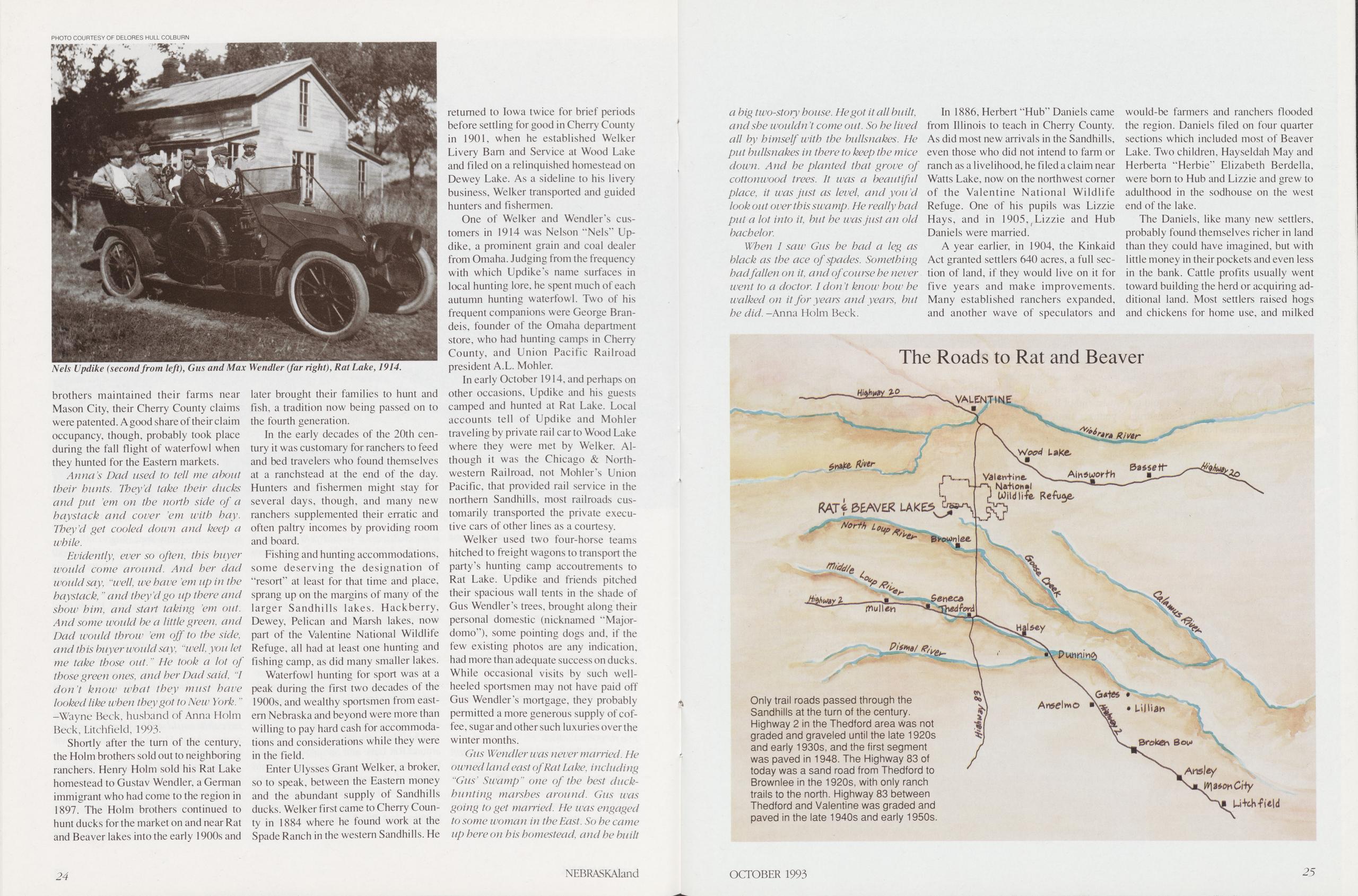 PHOTO COURTESY OF DELORES HULL COLBURN
brothers maintained their farms near Mason City, their Cherry County claims were patented. A good share of their claim occupancy, though, probably took place during the fall flight of waterfowl when they hunted for the Eastern markets.
Anna’s Dad used to tell me about their hunts. They’d take their ducks and put ’em on the north side of a haystack and cover 'em with hay. They 'd get cooled down and keep a while.
Evidently, ever so often, this buyer would come around. And her dad would say, “well, we have 'em up in the haystack," and they’d go up there and show him, and start taking 'em out. And some would be a little green, and Dad would throw 'em off to the side, and this buyer would say, “well, you let me take those out. ” He took a lot of those green ones, and her Dad said, “I don't know what they must have looked like when they got to New York. ” -Wayne Beck, husband of Anna Holm Beck, Litchfield, 1993.
Shortly after the turn of the century, the Holm brothers sold out to neighboring ranchers. Henry Holm sold his Rat Lake homestead to Gustav Wendler, a German immigrant who had come to the region in 1897. The Holm brothers continued to hunt ducks for the market on and near Rat and Beaver lakes into the early 1900s and later brought their families to hunt and fish, a tradition now being passed on to the fourth generation.
In the early decades of the 20th century it was customary for ranchers to feed and bed travelers who found themselves at a ranchstead at the end of the day. Hunters and fishermen might stay for several days, though, and many new ranchers supplemented their erratic and often paltry incomes by providing room and board.
Fishing and hunting accommodations, some deserving the designation of "resort" at least for that time and place, sprang up on the margins of many of the larger Sandhills lakes. Hackberry, Dewey, Pelican and Marsh lakes, now part of the Valentine National Wildlife Refuge, all had at least one hunting and fishing camp, as did many smaller lakes.
Waterfowl hunting for sport was at a peak during the first two decades of the 1900s, and wealthy sportsmen from eastern Nebraska and beyond were more than willing to pay hard cash for accommodations and considerations while they were in the field.
Enter Ulysses Grant Welker, a broker, so to speak, between the Eastern money and the abundant supply of Sandhills ducks. Welker first came to Cherry County in 1884 where he found work at the Spade Ranch in the western Sandhills. He returned to Iowa twice for brief periods before settling for good in Cherry County in 1901, when he established Welker Livery Bam and Service at Wood Lake and filed on a relinquished homestead on Dewey Lake. As a sideline to his livery business, Welker transported and guided hunters and fishermen.
One of Welker and Wendler’s customers in 1914 was Nelson "Nels" Updike, a prominent grain and coal dealer from Omaha. Judging from the frequency with which Updike's name surfaces in local hunting lore, he spent much of each autumn hunting waterfowl. Two of his frequent companions were George Branded, founder of the Omaha department store, who had hunting camps in Cherry County, and Union Pacific Railroad president A.L. Mohler.
In early October 1914, and perhaps on other occasions, Updike and his guests camped and hunted at Rat Lake. Local accounts tell of Updike and Mohler travel ing by private rail car to Wood Lake where they were met by Welker. Al- though it was the Chicago & Northwestern Railroad, not Mohler’s Union Pacific, that provided rail service in the northern Sandhills, most railroads customarily transported the private executive cars of other lines as a courtesy.
Welker used two four-horse teams hitched to freight wagons to transport the party’s hunting camp accoutrements to Rat Lake. Updike and friends pitched their spacious wall tents in the shade of Gus Wendler’s trees, brought along their personal domestic (nicknamed "Majordomo”), some pointing dogs and, if the few existing photos are any indication, had more than adequate success on ducks. While occasional visits by such well- heeled sportsmen may not have paid off Gus Wendler’s mortgage, they probably permitted a more generous supply of coffee, sugar and other such luxuries over the winter months.
Gus Wendler was never married. He owned land east of Rat Lake, including “Gus' Swamp'' one of the best duck-hunting marshes around. Gus was going to get married. He was engaged to some woman in the East. So he came up here on his homestead, and he built a big two-story house. He got it all built, and she wouldn't come out. So he lived all by himself with the bullsnakes. He put bullsnakes in there to keep the mice down. And he planted that grove of cottonwood trees. It was a beautiful place, it was just as level, and you d look out over this swamp. He really had put a lot into it, but he was just an old bachelor.
When I saw Gus he had a leg as black as the ace of spades. Something hadfallen on it, and of course he never went to a doctor. I don't know how he walked on it for years and years, but he did. -Anna Holm Beck.
In 1886, Herbert "Hub" Daniels came from Illinois to teach in Cherry County. As did most new arrivals in the Sandhills, even those who did not intend to farm or ranch as a livelihood, he filed a claim near Watts Lake, now on the northwest corner of the Valentine National Wildlife Refuge. One of his pupils was Lizzie Hays, and in 1905, ( Lizzie and Hub Daniels were married.
A year earlier, in 1904, the Kinkaid Act granted settlers 640 acres, a full section of land, if they would live on it for five years and make improvements. Many established ranchers expanded, and another wave of speculators and would-be farmers and ranchers flooded the region. Daniels filed on four quarter sections which included most of Beaver Lake. Two children, Hayseldah May and Herberta "Herbie" Elizabeth Berdella, were born to Hub and Lizzie and grew to adulthood in the sodhouse on the west end of the lake.
The Daniels, like many new settlers, probably found themselves richer in land than they could have imagined, but with little money in their pockets and even less in the bank. Cattle profits usually went toward building the herd or acquiring ad- ditional land. Most settlers raised hogs and chickens for home use, and milked
25 24 NEBRASKAland OCTOBER 1993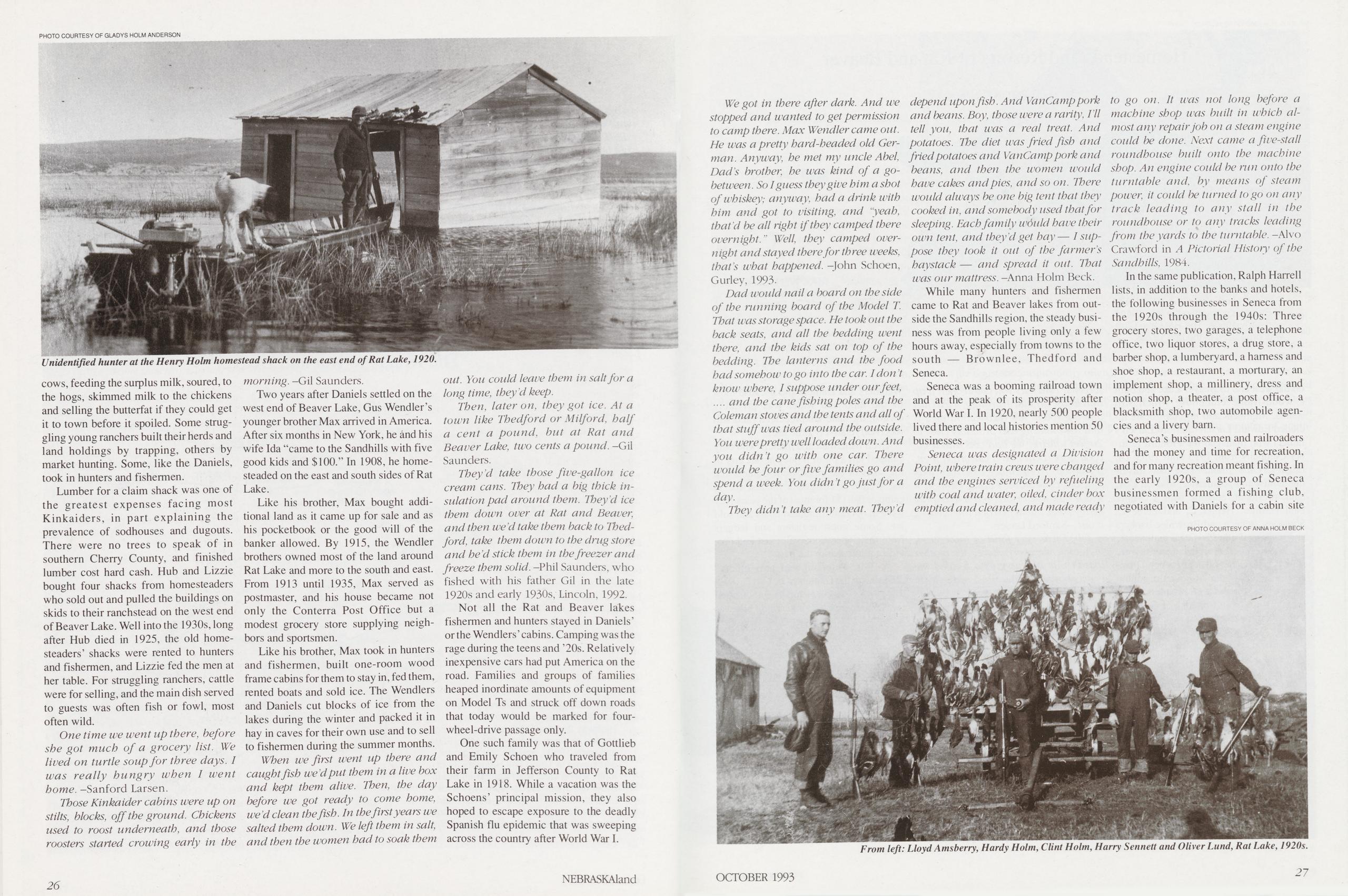 PHOTO COURTESY OF GLADYS HOLM ANDERSON
cows, feeding the surplus milk, soured, to the hogs, skimmed milk to the chickens and selling the butterfat if they could get it to town before it spoiled. Some struggling young ranchers built their herds and land holdings by trapping, others by market hunting. Some, like the Daniels, took in hunters and fishermen.
Lumber for a claim shack was one of the greatest expenses facing most Kinkaiders, in part explaining the prevalence of sodhouses and dugouts. There were no trees to speak of in southern Cherry County, and finished lumber cost hard cash. Hub and Lizzie bought four shacks from homesteaders who sold out and pulled the buildings on skids to their ranch stead on the west end of Beaver Lake. Well into the 1930s, long after Hub died in 1925, the old homesteaders’ shacks were rented to hunters and fishermen, and Lizzie fed the men at her table. For struggling ranchers, cattle were for selling, and the main dish served to guests was often fish or fowl, most often wild.
One time we went up there, before she got much of a grocery list. We lived on turtle soup for three days. I was really hungry when I went home. -Sanford Larsen.
Those Kinkaider cabins were up on stilts, blocks, off the ground. Chickens used to roost underneath, and those roosters started crowing early in the morning. -Gil Saunders.
Two years after Daniels settled on the west end of Beaver Lake, Gus Wendler’s younger brother Max arrived in America. After six months in New York, he and his wife Ida “came to the Sandhills with five good kids and $100.” In 1908, he homesteaded on the east and south sides of Rat Lake.
Like his brother, Max bought additional land as it came up for sale and as his pocketbook or the good will of the banker allowed. By 1915, the Wendler brothers owned most of the land around Rat Lake and more to the south and east. From 1913 until 1935, Max served as postmaster, and his house became not only the Conterra Post Office but a modest grocery store supplying neigh- bors and sportsmen.
Like his brother, Max took in hunters and fishermen, built one-room wood frame cabins for them to stay in, fed them, rented boats and sold ice. The Wendlers and Daniels cut blocks of ice from the lakes during the winter and packed it in hay in caves for their own use and to sell to fishermen during the summer months.
When we first went up there and caught fish we’d put them in a live box and kept them alive. Then, the day before we got ready to come borne, we’d clean the fish. In the first years we salted them down. We left them in salt, and then the women had to soak them out. You could leave them in salt for a long time, they'd keep. Then, later on, they got ice. At a town like Thedford or Milford, half a cent a pound, but at Rat and Beaver Lake, two cents a pound. -Gil Saunders.
They’d take those five-gallon ice cream cans. They had a big thick in- sulation pad around them. They’d ice them down over at Rat and Beaver, and then we’d take them back to Thedford, take them down to the drug store and he'd stick them in the freezer and freeze them solid. -Phil Saunders, who fished with his father Gil in the late 1920s and early 1930s, Lincoln, 1992.
Not all the Rat and Beaver lakes fishermen and hunters stayed in Daniels’ or the Wendlers’ cabins. Camping was the rage during the teens and ’20s. Relatively inexpensive cars had put America on the road. Families and groups of families heaped inordinate amounts of equipment on Model Ts and struck off down roads that today would be marked for four- wheel-drive passage only.
One such family was that of Gottlieb and Emily Schoen who traveled from their farm in Jefferson County to Rat Lake in 1918. While a vacation was the Schoens’ principal mission, they also hoped to escape exposure to the deadly Spanish flu epidemic that was sweeping across the country after World War I.
We got in there after dark. And we stopped and wanted to get permission to camp there. Max Wendler came out. He was a pretty hard-headed old German. Anyway, he met my uncle Abel, Dad's brother, he was kind of a go-between. So I guess they give him a shot of whiskey; anyway, had a drink with him and got to visiting, and yeah, that'd be all right if they camped there overnight." Well, they camped over- night and stayed there for three weeks, that's what happened. -John Schoen, Gurley, 1993.
Dad would nail a board on the side of the running board of the Model T. That was storage space. He took out the back seats, and all the bedding went there, and the kids sat on top of the bedding. The lanterns and the food had somehow to go into the car. I don t know where, I suppose under our feet, .... and the cane fishing poles and the Coleman stoves and the tents and all of that stuff was tied around the outside. You were pretty well loaded down. And you didn’t go with one car. There would be four or five families go and spend a week. You didn’t go just for a day.
They didn't take any meat. They'd
>PHOTO COURTESY OF ANNA HOLM BECKdepend upon fish. And VanCamp pork and beans. Boy, those were a rarity, I'll tell you, that was a real treat. And potatoes. The diet was fried fish and fried potatoes and VanCamp pork and beans, and then the women would have cakes and pies, and so on. There would always be one big tent that they cooked in, and somebody used that for sleeping. Each family wduld have their own tent, and they'd get hay— I suppose they took it out of the farmer's haystack — and spread it out. That was our mattress. -Anna Holm Beck.
While many hunters and fishermen came to Rat and Beaver lakes from outside the Sandhills region, the steady business was from people living only a few hours away, especially from towns to the south — Brownlee, Thedford and Seneca.
Seneca was a booming railroad town and at the peak of its prosperity after World War I. In 1920, nearly 500 people lived there and local histories mention 50 businesses.
Seneca was designated a Division Point, where train crews were changed and the engines serviced by refueling with coal and water, oiled, cinder box emptied and cleaned, and made ready to go on. It was not long before a machine shop was built in which al- most any repair job on a steam engine could be done. Next came a five-stall roundhouse built onto the machine shop. An engine could be run onto the turntable and. by means of steam power, it could be turned to go on any track leading to any stall in the roundhouse or to any tracks leading from the yards to the turntable. -Alvo Crawford in A Pictorial History of the Sandhills, 1984.
In the same publication, Ralph Harrell lists, in addition to the banks and hotels, the following businesses in Seneca from the 1920s through the 1940s: Three grocery stores, two garages, a telephone office, two liquor stores, a drug store, a barber shop, a lumberyard, a harness and shoe shop, a restaurant, a morturary, an implement shop, a millinery, dress and notion shop, a theater, a post office, a blacksmith shop, two automobile agencies and a livery barn.
Seneca’s businessmen and railroaders had the money and time for recreation, and for many recreation meant fishing. In the early 1920s, a group of Seneca businessmen formed a fishing club, negotiated with Daniels for a cabin site
26 NEBRASKAland OCTOBER 1993 27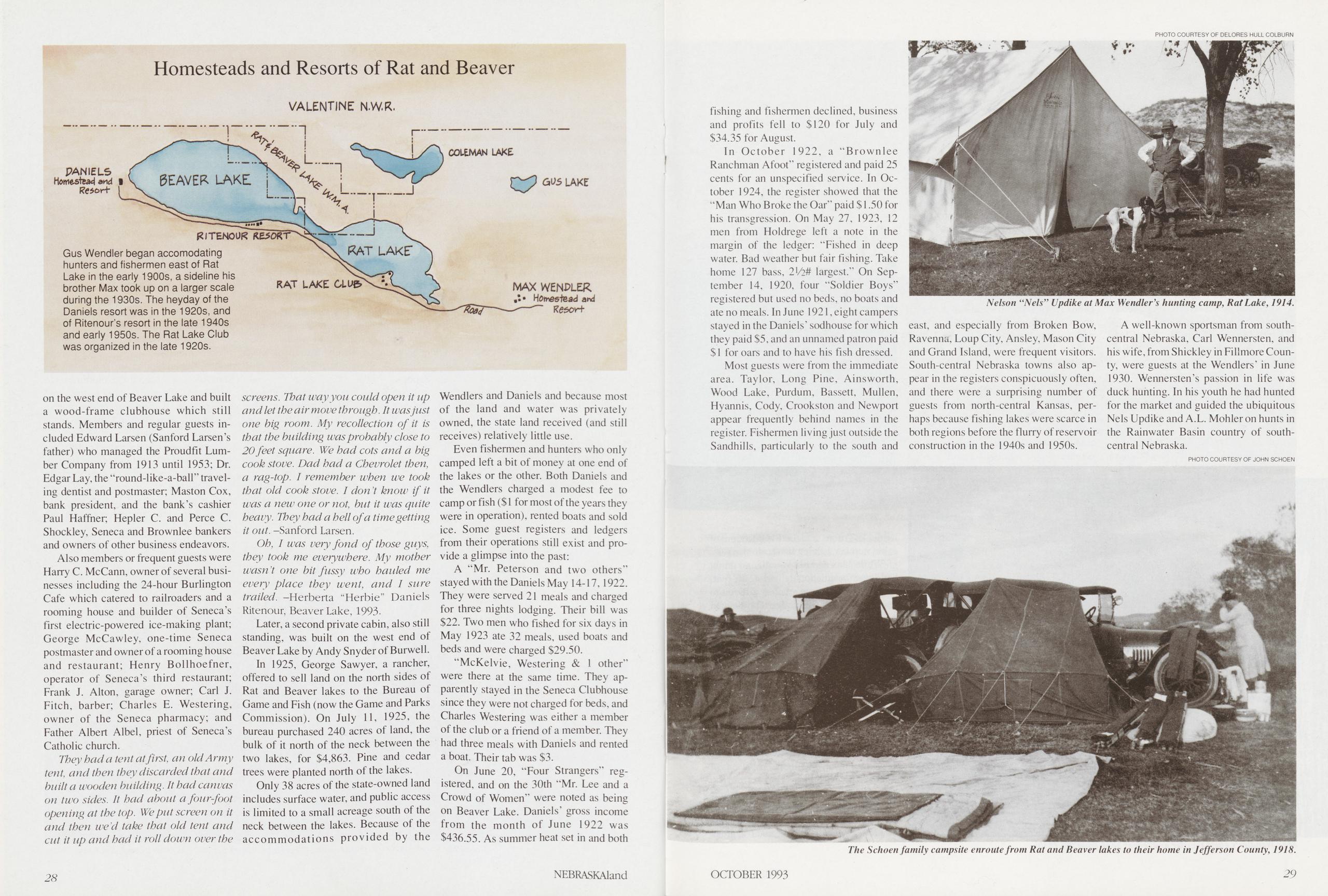
on the west end of Beaver Lake and built a wood-frame clubhouse which still stands. Members and regular guests included Edward Larsen (Sanford Larsen’s father) who managed the Proudfit Lum- ber Company from 1913 until 1953; Dr. Edgar Lay, the “round-1 ike-a-ball” traveling dentist and postmaster; Maston Cox, bank president, and the bank’s cashier Paul Haffner; Hepler C. and Perce C. Shockley, Seneca and Brownlee bankers and owners of other business endeavors.
Also members or frequent guests were Harry C. McCann, owner of several businesses including the 24-hour Burlington Cafe which catered to railroaders and a rooming house and builder of Seneca’s first electric-powered ice-making plant; George McCawley, one-time Seneca postmaster and owner of a rooming house and restaurant; Henry Bollhoefner, operator of Seneca’s third restaurant; Frank J. Alton, garage owner; Carl J. Fitch, barber; Charles E. Westering, owner of the Seneca pharmacy; and Father Albert Albel, priest of Seneca’s Catholic church.
They had a tent at first, an old Army tent, and then they discarded that and hnilta wooden building. It had canvas on two sides. It had about a four-foot opening at the top. We put screen on it and then we d take that old tent and cut it up and had it roll down over the screens. That way you could open it up and let the air move through. It was just one big room. My recollection of it is that the building was probably close to 20 feet square. We had cots and a big cook stove. Dad had a Chevrolet then, a rag-top. I remember when we took that old cook stove. I don’t know if it was a new one or not, but it was quite heavy. They had a hell of a time getting it out. -Sanford Larsen.
Oh, I was very fond of those guys, they took me everywhere. My mother wasn't one bit fussy who hauled me every place they went, and I sure trailed. -Herberta “Herbie” Daniels Ritenour, Beaver Lake, 1993.
Later, a second private cabin, also still standing, was built on the west end of Beaver Lake by Andy Snyder of Burwell. In 1925, George Sawyer, a rancher, offered to sell land on the north sides of Rat and Beaver lakes to the Bureau of Game and Fish (now the Game and Parks Commission). On July 11, 1925, the bureau purchased 240 acres of land, the bulk of it north of the neck between the two lakes, for $4,863. Pine and cedar trees were planted north of the lakes.
Only 38 acres of the state-owned land includes surface water, and public access is limited to a small acreage south of the neck between the lakes. Because of the accommodations provided by the Wendlers and Daniels and because most of the land and water was privately owned, the state land received (and still receives) relatively little use.
Even fishermen and hunters who only camped left a bit of money at one end of the lakes or the other. Both Daniels and the Wendlers charged a modest fee to camp or fish ($1 for most of the years they were in operation), rented boats and sold ice. Some guest registers and ledgers from their operations still exist and pro- vide a glimpse into the past:
A “Mr. Peterson and two others” stayed with the Daniels May 14-17, 1922. They were served 21 meals and charged for three nights lodging. Their bill was $22. Two men who fished for six days in May 1923 ate 32 meals, used boats and beds and were charged $29.50.
“McKelvie, Westering & 1 other” were there at the same time. They apparently stayed in the Seneca Clubhouse since they were not charged for beds, and Charles Westering was either a member of the club or a friend of a member. They had three meals with Daniels and rented a boat. Their tab was $3.
On June 20, “Four Strangers” registered, and on the 30th “Mr. Lee and a Crowd of Women” were noted as being on Beaver Lake. Daniels’ gross income from the month of June 1922 was $436.55. As summer heat set in and both fishing and fishermen declined, business and profits fell to $120 for July and $34.35 for August.
In October 1922, a “Brownlee Ranchman Afoot” registered and paid 25 cents for an unspecified service. In October 1924, the register showed that the “Man Who Broke the Oar” paid $ 1.50 for his transgression. On May 27, 1923, 12 men from Holdrege left a note in the margin of the ledger: “Fished in deep water. Bad weather but fair fishing. Take home 127 bass, 21/2# largest.” On September 14, 1920, four “Soldier Boys” registered but used no beds, no boats and ate no meals. In June 1921, eight campers stayed in the Daniels’ sodhouse for which they paid $5, and an unnamed patron paid $1 for oars and to have his fish dressed.
Most guests were from the immediate area. Taylor, Long Pine, Ainsworth, Wood Lake, Purdum, Bassett, Mullen, Hyannis, Cody, Crookston and Newport appear frequently behind names in the register. Fishermen living just outside the Sandhills, particularly to the south and
east, and especially from Broken Bow, Ravenna, Loup City, Ansley, Mason City and Grand Island, were frequent visitors. South-central Nebraska towns also appear in the registers conspicuously often, and there were a surprising number of guests from north-central Kansas, perhaps because fishing lakes were scarce in both regions before the Hurry of reservoir construction in the 1940s and 1950s.
A well-known sportsman from southcentral Nebraska, Carl Wennersten, and his wife, from Shickley in Fillmore County, were guests at the Wendlers’ in June 1930. Wennersten's passion in life was duck hunting. In his youth he had hunted for the market and guided the ubiquitous Nels Updike and A.L. Mohler on hunts in the Rainwater Basin country of southcentral Nebraska.
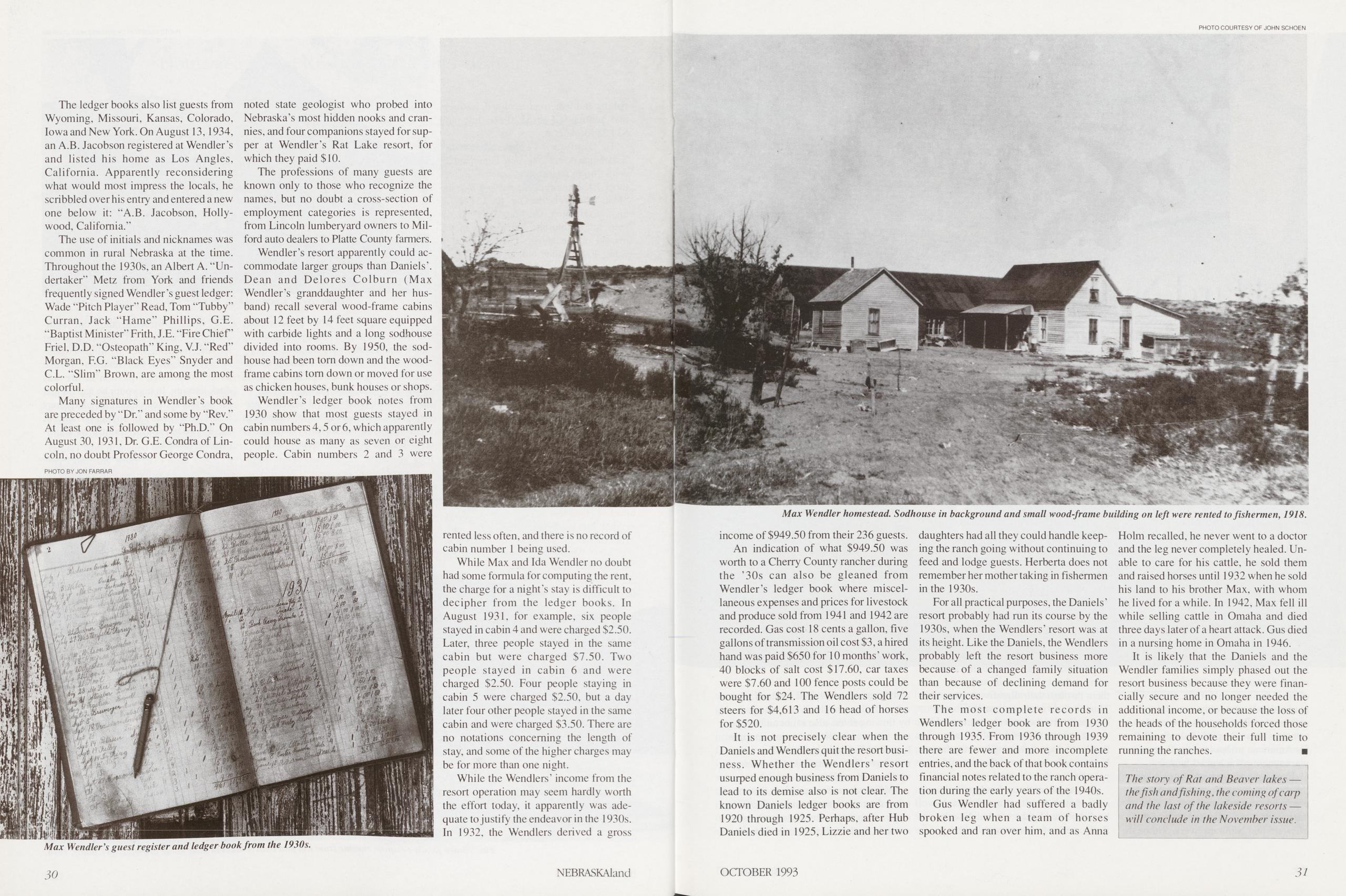
The ledger books also list guests from Wyoming, Missouri, Kansas, Colorado, Iowa and New York. On August 13,1934, an A.B. Jacobson registered at Wendler’s and listed his home as Los Angles, California. Apparently reconsidering what would most impress the locals, he scribbled over his entry and entered a new one below it: “A.B. Jacobson, Hollywood, California.”
The use of initials and nicknames was common in rural Nebraska at the time. Throughout the 1930s, an Albert A. “Undertaker” Metz from York and friends frequently signed Wendler’s guest ledger: Wade “Pitch Player” Read, Tom “Tubby” Curran, Jack “Hame” Phillips, G.E. “Baptist Minister” Frith, J.E. “Fire Chief’ Friel, D.D. “Osteopath” King, V.J. “Red” Morgan, EG. “Black Eyes” Snyder and C.L. “Slim” Brown, are among the most colorful.
Max Wendler's guest register and ledger book from the 1930s.
The professions of many guests are known only to those who recognize the names, but no doubt a cross-section of employment categories is represented, from Lincoln lumberyard owners to Milford auto dealers to Platte County farmers.
Wendler’s resort apparently could accommodate larger groups than Daniels’. Dean and Delores Colburn (Max Wendler’s granddaughter and her husband) recall several wood-frame cabins about 12 feet by 14 feet square equipped with carbide lights and a long sodhouse divided into rooms. By 1950, the sod-house had been torn down and the wood-frame cabins tom down or moved for use as chicken houses, bunk houses or shops.
Wendler’s ledger book notes from 1930 show that most guests stayed in cabin numbers 4,5 or 6, which apparently could house as many as seven or eight people. Cabin numbers 2 and 3 were
rented less often, and there is no record of cabin number 1 being used.
While Max and Ida Wendler no doubt had some formula for computing the rent, the charge for a night’s stay is difficult to decipher from the ledger books. In August 1931, for example, six people stayed in cabin 4 and were charged $2.50.
Later, three people stayed in the same cabin but were charged $7.50. Two people stayed in cabin 6 and were charged $2.50. Four people staying in cabin 5 were charged $2.50, but a day later four other people stayed in the same cabin and were charged $3.50. There are no notations concerning the length of stay, and some of the higher charges may be for more than one night.
While the Wendlers’ income from the resort operation may seem hardly worth the effort today, it apparently was adequate to justify the endeavor in the 1930s. In 1932, the Wendlers derived a gross income of $949.50 from their 236 guests.
An indication of what $949.50 was worth to a Cherry County rancher during the ’30s can also be gleaned from Wendler’s ledger book where miscellaneous expenses and prices for livestock and produce sold from 1941 and 1942 are recorded. Gas cost 18 cents a gallon, five gallons of transmission oil cost $3, a hired hand was paid $650 for 10 months’ work, 40 blocks of salt cost $17.60, car taxes were $7.60 and 100 fence posts could be bought for $24. The Wendlers sold 72 steers for $4,613 and 16 head of horses for $520.
It is not precisely clear when the Daniels and Wendlers quit the resort business. Whether the Wendlers’ resort usurped enough business from Daniels to lead to its demise also is not clear. The known Daniels ledger books are from 1920 through 1925. Perhaps, after Hub Daniels died in 1925, Lizzie and her two daughters had all they could handle keeping the ranch going without continuing to feed and lodge guests. Herberta does not remember her mother taking in fishermen in the 1930s.
For all practical purposes, the Daniels’ resort probably had run its course by the 1930s, when the Wendlers’ resort was at its height. Like the Daniels, the Wendlers probably left the resort business more because of a changed family situation than because of declining demand for their services.
The most complete records in Wendlers’ ledger book are from 1930 through 1935. From 1936 through 1939 there are fewer and more incomplete entries, and the back of that book contains financial notes related to the ranch operation during the early years of the 1940s. Gus Wendler had suffered a badly broken leg when a team of horses spooked and ran over him, and as Anna Holm recalled, he never went to a doctor and the leg never completely healed. Unable to care for his cattle, he sold them and raised horses until 1932 when he sold his land to his brother Max, with whom he lived for a while. In 1942. Max fell ill while selling cattle in Omaha and died three days later of a heart attack. Gus died in a nursing home in Omaha in 1946.
It is likely that the Daniels and the Wendler families simply phased out the resort business because they were financially secure and no longer needed the additional income, or because the loss of the heads of the households forced those remaining to devote their full time to running the ranches.
The story of Rat and Beaver lakes—- the fish and fishing, the coming of carp and the last of the lakeside resorts — will conclude in the November issue. 30 NEBRASKAland OCTOBER 1993 31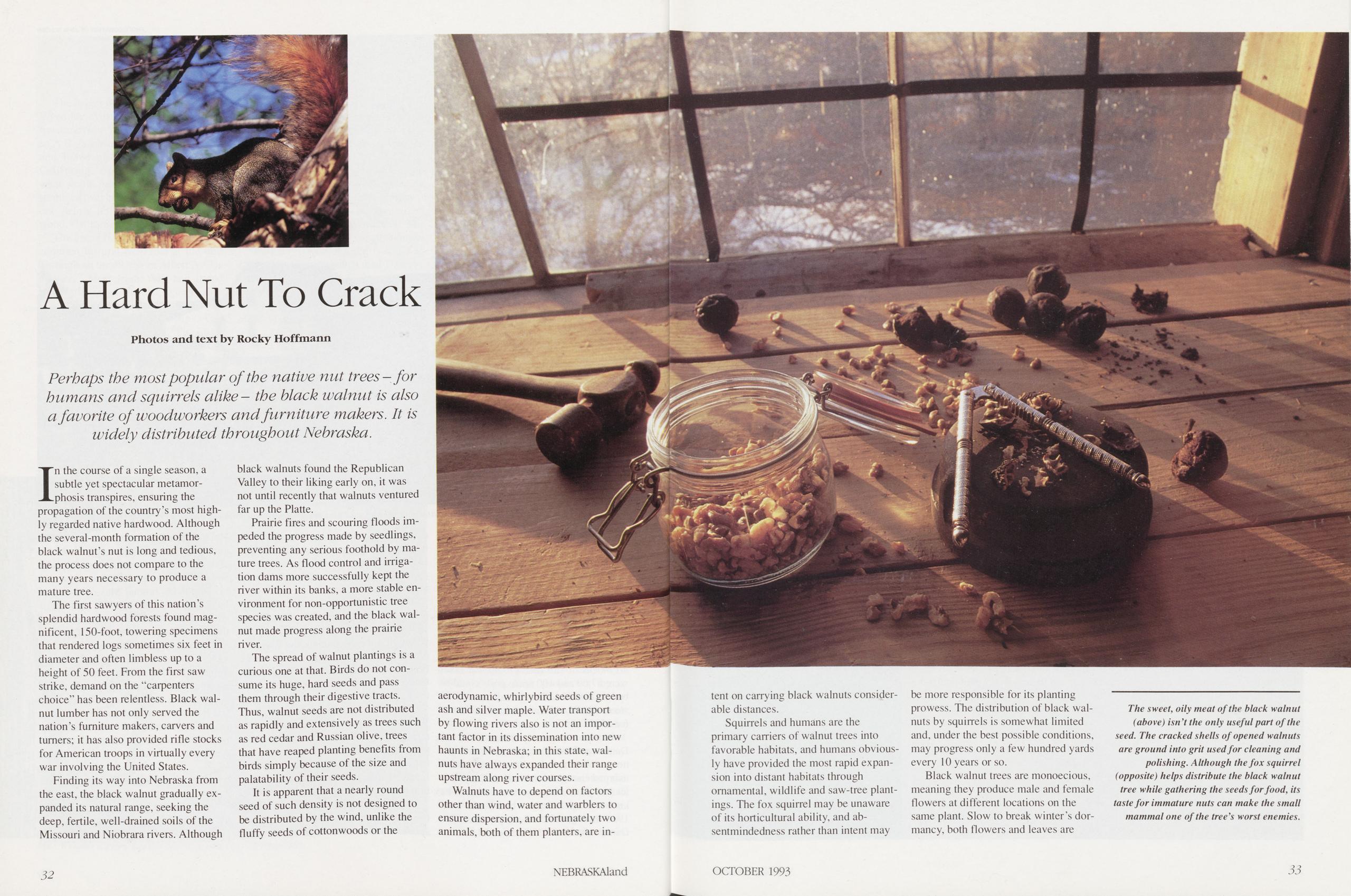
A Hard Nut To Crack
Photos and text by Rocky Hoffmann Perhaps the most popular of the native nut trees – for humans and squirrels alike – the black walnut is also a favorite of woodworkers and furniture makers. It is widely distributed throughout Nebraska.In the course of a single season, a subtle yet spectacular metamorphosis transpires, ensuring the propagation of the country’s most highly regarded native hardwood. Although the several-month formation of the black walnut’s nut is long and tedious, the process does not compare to the many years necessary to produce a mature tree.
The first sawyers of this nation’s splendid hardwood forests found magnificent, 150-foot, towering specimens that rendered logs sometimes six feet in diameter and often limbless up to a height of 50 feet. From the first saw strike, demand on the “carpenters choice” has been relentless. Black walnut lumber has not only served the nation’s furniture makers, carvers and turners; it has also provided rifle stocks for American troops in virtually every war involving the United States.
Finding its way into Nebraska from the east, the black walnut gradually expanded its natural range, seeking the deep, fertile, well-drained soils of the Missouri and Niobrara rivers. Although black walnuts found the Republican Valley to their liking early on, it was not until recently that walnuts ventured far up the Platte.
Prairie fires and scouring floods impeded the progress made by seedlings, preventing any serious foothold by mature trees. As flood control and irrigation dams more successfully kept the river within its banks, a more stable environment for non-opportunistic tree species was created, and the black walnut made progress along the prairie river.
The spread of walnut plantings is a curious one at that. Birds do not consume its huge, hard seeds and pass them through their digestive tracts. Thus, walnut seeds are not distributed as rapidly and extensively as trees such as red cedar and Russian olive, trees that have reaped planting benefits from birds simply because of the size and palatability of their seeds.
It is apparent that a nearly round seed of such density is not designed to be distributed by the wind, unlike the fluffy seeds of cottonwoods or the aerodynamic, whirlybird seeds of green ash and silver maple. Water transport by flowing rivers also is not an important factor in its dissemination into new haunts in Nebraska; in this state, walnuts have always expanded their range upstream along river courses. Walnuts have to depend on factors other than wind, water and warblers to ensure dispersion, and fortunately two animals, both of them planters, are intent on carrying black walnuts considerable distances.
Squirrels and humans are the primary carriers of walnut trees into favorable habitats, and humans obviously have provided the most rapid expansion into distant habitats through ornamental, wildlife and saw-tree plantings. The fox squirrel may be unaware of its horticultural ability, and absentmindedness rather than intent may be more responsible for its planting prowess. The distribution of black walnuts by squirrels is somewhat limited and, under the best possible conditions, may progress only a few hundred yards every 10 years or so.
Black walnut trees are monoecious, meaning they produce male and female flowers at different locations on the same plant. Slow to break winter’s dormancy, both flowers and leaves are
The sweet, oily meat of the black walnut (above) isn't the only useful part of the seed. The cracked shells of opened walnuts are ground into grit used for cleaning and polishing. Although the fox squirrel (opposite) helps distribute the black walnut tree while gathering the seeds for food, its taste for immature nuts can make the small mammal one of the tree's worst enemies.
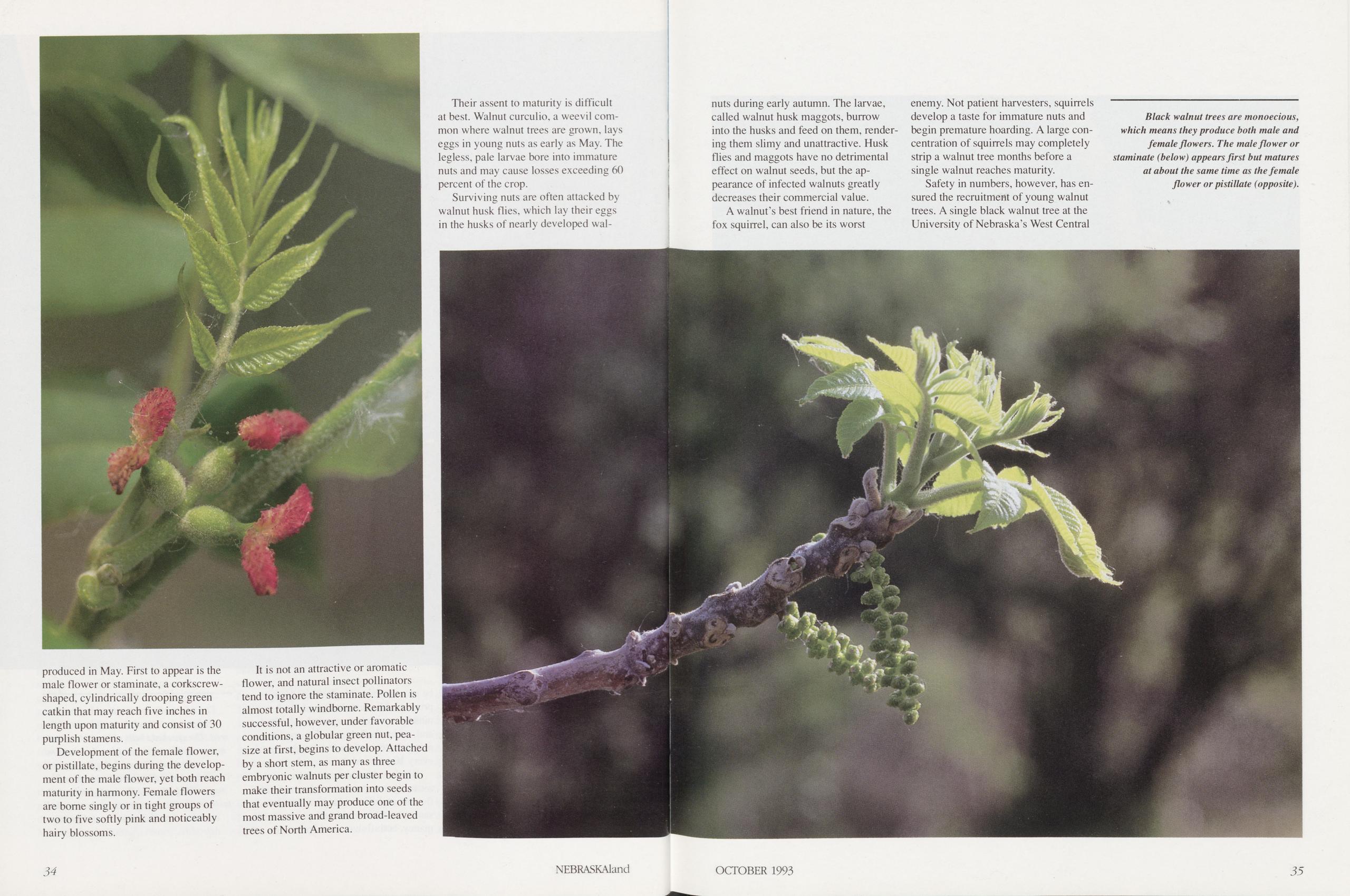
produced in May. First to appear is the male flower or staminate, a corkscrew- shaped, cylindrically drooping green catkin that may reach five inches in length upon maturity and consist of 30 purplish stamens.
Development of the female flower, or pistillate, begins during the development of the male flower, yet both reach maturity in harmony. Female flowers are borne singly or in tight groups of two to five softly pink and noticeably hairy blossoms.
It is not an attractive or aromatic flower, and natural insect pollinators tend to ignore the staminate. Pollen is almost totally windborne. Remarkably successful, however, under favorable conditions, a globular green nut, pea- size at first, begins to develop. Attached by a short stem, as many as three embryonic walnuts per cluster begin to make their transformation into seeds that eventually may produce one of the most massive and grand broad-leaved trees of North America.
Their assent to maturity is difficult at best. Walnut curculio, a weevil common where walnut trees are grown, lays eggs in young nuts as early as May. The legless, pale larvae bore into immature nuts and may cause losses exceeding 60 percent of the crop.
Surviving nuts are often attacked by walnut husk flies, which lay their eggs in the husks of nearly developed walnuts during early autumn. The larvae, called walnut husk maggots, burrow into the husks and feed on them, rendering them slimy and unattractive. Husk flies and maggots have no detrimental effect on walnut seeds, but the appearance of infected walnuts greatly decreases their commercial value.
A walnut’s best friend in nature, the fox squirrel, can also be its worst enemy. Not patient harvesters, squirrels develop a taste for immature nuts and begin premature hoarding. A large con- centration of squirrels may completely strip a walnut tree months before a single walnut reaches maturity.
Safety in numbers, however, has en- sured the recruitment of young walnut trees. A single black walnut tree at the University of Nebraska’s West Central
Research and Extension Center at North Platte has produced annual crops in excess of 20,000 walnuts with no control of squirrel or insect depredation. Such a tree would have been a valued find for the autumn nutting parties popular among pioneer children.
No longer as common a fall activity, nut collecting has become a commercial sidebar to most black walnut plantations. But to Gus Rutledge of Stockton, Missouri, the nut of the black walnut is the most important part of the tree.
Rutledge is the executive vice president of the Hammons Product Co., a family business started in 1946 that now is the world’s largest processor of black walnuts.
Rutledge loves to talk about black walnuts and claims, “the life of every man, woman and child in the United States is somehow affected daily by black walnuts.” Hammons buys nuts from hullers in 24 states, including Nebraska, for an annual total of 30 million pounds of hulled walnuts.
Not only does Hammons sell bulk quantities to ice cream, candy and cookie manufacturers, it also packages nutmeats for home consumption and baking. But every time a nut is cracked to yield the sweet, oily nutmeat, more shell than the delicacy it encased is left behind.
Hammons grinds the shells into 30 different sizes of grit used primarily for cleaning and polishing. Some is used to clean carbon buildup from jet engine turbines, but not only jet engines are polished by pulverized walnut shells. Each year the company sells more than 30,000 pounds of walnut-shell grit to the dental industry for polishing teeth and dentures.
The beauty shop facial often employs finely ground walnut shells to gently clean the pores on the faces of American women. The cleaning of America’s most famous lady, the Statue of Liberty, required 480,000 pounds of ground walnut shells when she was refurbished in 1988 for her birthday bash.
Although walnut husks may seem suited only for disposal, don’t tell that to the folks from Lynchburg, Tennessee. The Jack Daniels Distillery uses walnut husk extract as an integral part of its famous whiskey aging process.
Rutledge said that Hammons is fully aware that from the tree comes the nut, and that is why Hammons is so in- volved in research and nursery stock.
Hammons is patenting 13 black walnut trees that they believe are superior in growth rate, disease resistance, and quality and quantity of nut production.
No walnut tree, however, can be bred to resist the effects of herbicides. The application of agricultural and residential herbicides are taking their toll on these great h'ardwoods, and chemicals used to control Canada thistle, a noxious plant that has invaded riverine habitats, are greatly affecting walnut recruitment while severely damaging mature trees.
Walnut plantations can ill-afford the spray drift of 2,4-D on an investment of 50 years, the time it takes to produce a good timber tree in suitable Nebraska range. An excellent veneer tree might be worth $5 to $6 per board foot; the record sale of a single tree brought $32,000. But foresters caution prospec- tive growers that such a fortune from an individual tree is one-in-a-million.
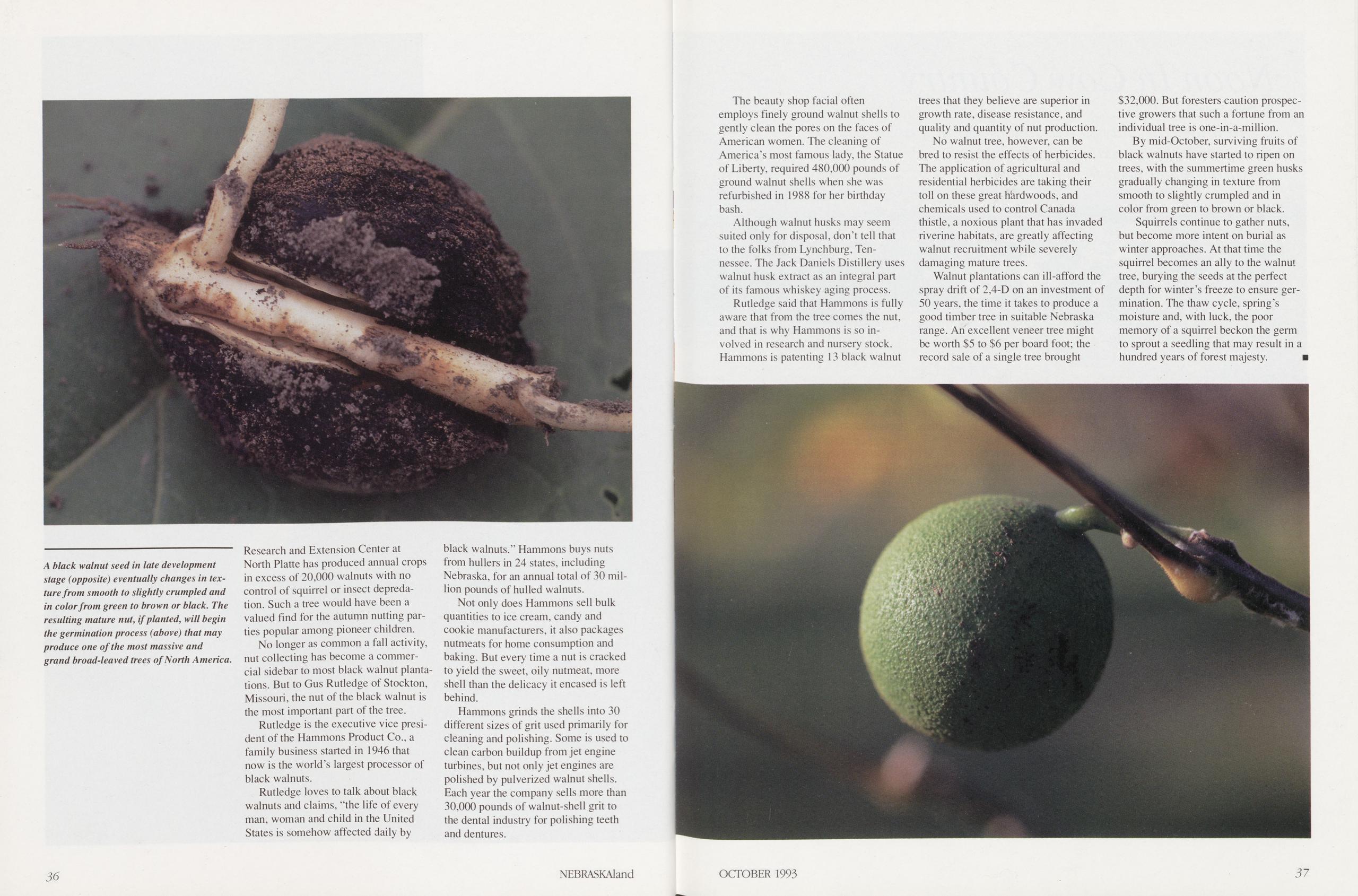
By mid-October, surviving fruits of black walnuts have started to ripen on trees, with the summertime green husks gradually changing in texture from smooth to slightly crumpled and in color from green to brown or black.
Squirrels continue to gather nuts, but become more intent on burial as winter approaches. At that time the squirrel becomes an ally to the walnut tree, burying the seeds at the perfect depth for winter’s freeze to ensure ger- mination. The thaw cycle, spring’s moisture and, with luck, the poor memory of a squirrel beckon the germ to sprout a seedling that may result in a hundred years of forest majesty.
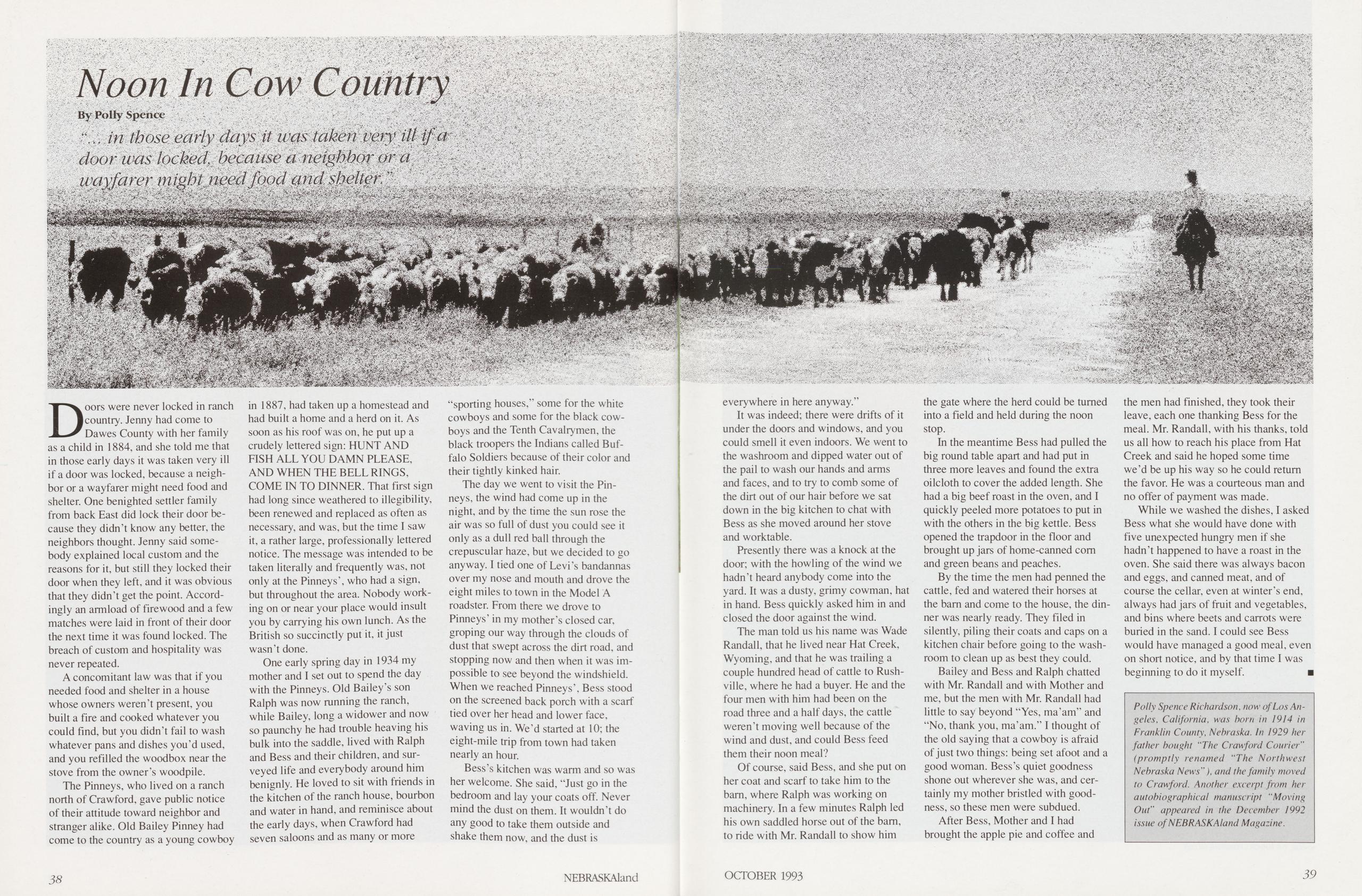
Noon In Cow Country
Polly Spence "...in those early days it was taken very ill if a door was locked, because a neighbor or a wayfrer might need food or shelter."Doors were never locked in ranch country. Jenny had come to Dawes County with her family as a child in 1884, and she told me that in those early days it was taken very ill if a door was locked, because a neighbor or a wayfarer might need food and shelter. One benighted settler family from back East did lock their door because they didn’t know any better, the neighbors thought. Jenny said somebody explained local custom and the reasons for it, but still they locked their door when they left, and it was obvious that they didn’t get the point. Accordingly an armload of firewood and a few matches were laid in front of their door the next time it was found locked. The breach of custom and hospitality was never repeated.
A concomitant law was that if you needed food and shelter in a house whose owners weren’t present, you built a fire and cooked whatever you could find, but you didn’t fail to wash whatever pans and dishes you’d used, and you refilled the woodbox near the stove from the owner’s woodpile.
The Pinneys, who lived on a ranch north of Crawford, gave public notice of their attitude toward neighbor and stranger alike. Old Bailey Tinney had come to the country as a young cowboy in 1887, had taken up a homestead and had built a home and a herd on it. As soon as his roof was on, he put up a crudely lettered sign: HUNT AND FISH ALL YOU DAMN PLEASE, AND WHEN THE BELL RINGS, COME IN TO DINNER. That first sign had long since weathered to illegibility, been renewed and replaced as often as necessary, and was, but the time I saw it, a rather large, professionally lettered notice. The message was intended to be taken literally and frequently was, not only at the Tinneys’, who had a sign, but throughout the area. Nobody working on or near your place would insult you by carrying his own lunch. As the British so succinctly put it, it just wasn’t done.
One early spring day in 1934 my mother and I set out to spend the day with the Tinneys. Old Bailey’s son Ralph was now running the ranch, while Bailey, long a widower and now so paunchy he had trouble heaving his bulk into the saddle, lived with Ralph and Bess and their children, and surveyed life and everybody around him benignly. He loved to sit with friends in the kitchen of the ranch house, bourbon and water in hand, and reminisce about the early days, when Crawford had seven saloons and as many or more “sporting houses,” some for the white cowboys and some for the black cowboys and the Tenth Cavalrymen, the black troopers the Indians called Buffalo Soldiers because of their color and their tightly kinked hair.
The day we went to visit the Pinneys, the wind had come up in the night, and by the time the sun rose the air was so full of dust you could see it only as a dull red ball through the crepuscular haze, but we decided to go anyway. I tied one of Levi’s bandannas over my nose and mouth and drove the eight miles to town in the Model A roadster. From there we drove to Finneys’ in my mother’s closed car, groping our way through the clouds of dust that swept across the dirt road, and stopping now and then when it was impossible to see beyond the windshield. When we reached Finneys’, Bess stood on the screened back porch with a scarf tied over her head and lower face, waving us in. We’d started at 10; the eight-mile trip from town had taken nearly an hour.
Bess’s kitchen was warm and so was her welcome. She said, “Just go in the bedroom and lay your coats off. Never mind the dust on them. It wouldn't do any good to take them outside and shake them now, and the dust is everywhere in here anyway.”
It was indeed; there were drifts of it under the doors and windows, and you could smell it even indoors. We went to the washroom and dipped water out of the pail to wash our hands and arms and faces, and to try to comb some of the dirt out of our hair before we sat down in the big kitchen to chat with Bess as she moved around her stove and worktable.
Presently there was a knock at the door; with the howling of the wind we hadn’t heard anybody come into the yard. It was a dusty, grimy cowman, hat in hand. Bess quickly asked him in and closed the door against the wind. The man told us his name was Wade Randall, that he lived near Hat Creek, Wyoming, and that he was trailing a couple hundred head of cattle to Rushville, where he had a buyer. He and the four men with him had been on the road three and a half days, the cattle weren’t moving well because of the wind and dust, and could Bess feed them their noon meal?
Of course, said Bess, and she put on her coat and scarf to take him to the bam, where Ralph was working on machinery. In a few minutes Ralph led his own saddled horse out of the bam, to ride with Mr. Randall to show him the gate where the herd could be turned into a field and held during the noon stop.
In the meantime Bess had pulled the big round table apart and had put in three more leaves and found the extra oilcloth to cover the added length. She had a big beef roast in the oven, and I quickly peeled more potatoes to put in with the others in the big kettle. Bess opened the trapdoor in the floor and brought up jars of home-canned com and green beans and peaches.
By the time the men had penned the cattle, fed and watered their horses at the bam and come to the house, the dinner was nearly ready. They filed in silently, piling their coats and caps on a kitchen chair before going to the washroom to clean up as best they could.
Bailey and Bess and Ralph chatted with Mr. Randall and with Mother and me, but the men with Mr. Randall had little to say beyond “Yes, ma’am” and “No, thank you, ma’am.” I thought of the old saying that a cowboy is afraid of just two things: being set afoot and a good woman. Bess’s quiet goodness shone out wherever she was, and certainly my mother bristled with goodness, so these men were subdued.
After Bess, Mother and I had brought the apple pie and coffee and the men had finished, they took their leave, each one thanking Bess for the meal. Mr. Randall, with his thanks, told us all how to reach his place from Hat Creek and said he hoped some time we’d be up his way so he could return the favor. He was a courteous man and no offer of payment was made.
While we washed the dishes, I asked Bess what she would have done with five unexpected hungry men if she hadn’t happened to have a roast in the oven. She said there was always bacon and eggs, and canned meat, and of course the cellar, even at winter’s end, always had jars of fruit and vegetables, and bins where beets and carrots were buried in the sand. I could see Bess would have managed a good meal, even on short notice, and by that time I was beginning to do it myself.
Polly Spence Richardson, now of Los Angeles, California, was born in 1914 in Franklin County, Nebraska. In 1929 her father bought “The Crawford Courier" (promptly renamed “The Northwest Nebraska News"), and the family moved to Crawford. Another excerpt from her autobiographical manuscript “Moving Out" appeared in the December 1992 issue of NEBRASKAland Magazine. NEBRASKAland OCTOBER 1993 39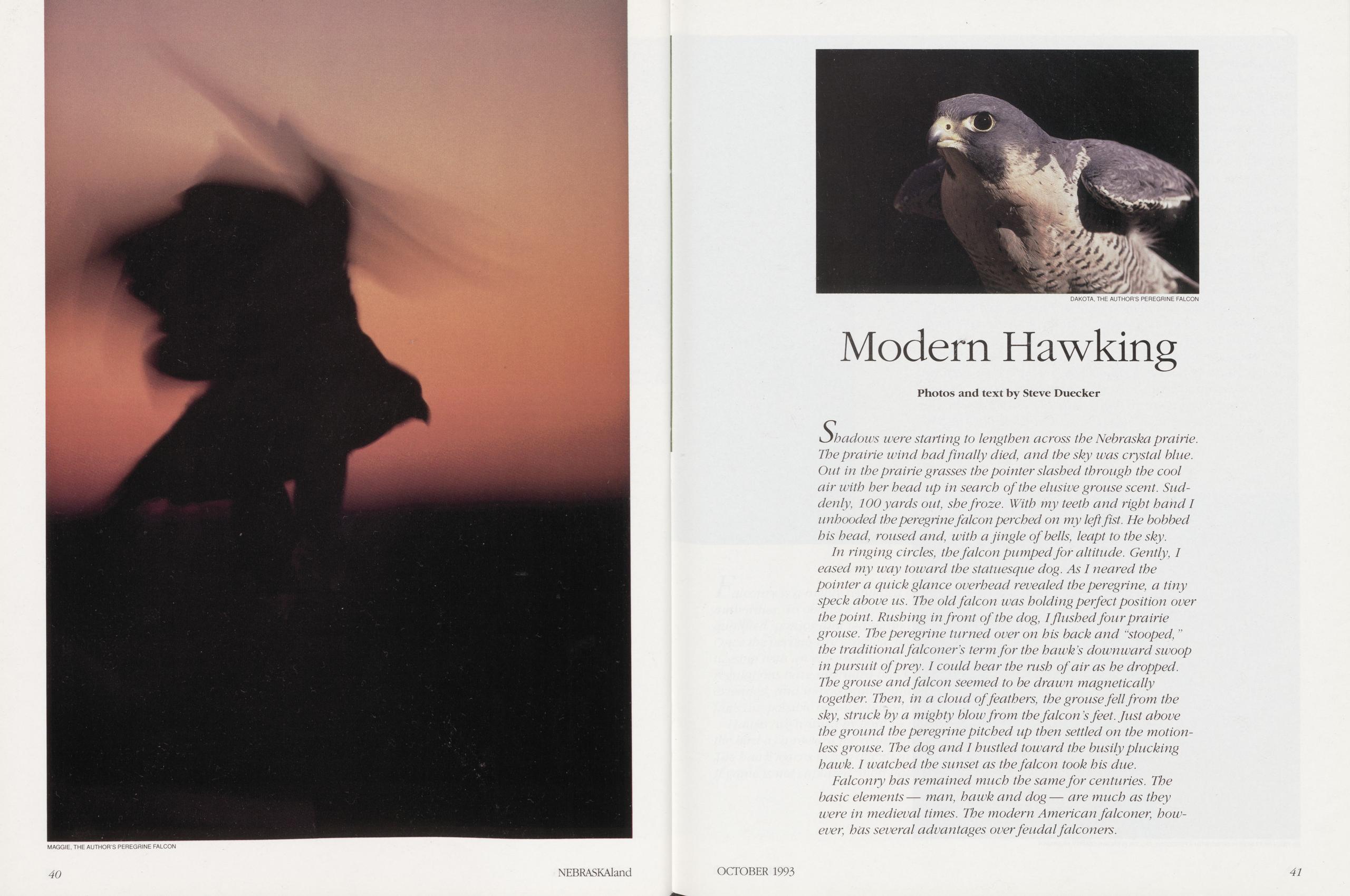
Modern Hawking
Photos and text by Steve Duecker Shadows were starting to lengthen across the Nebraska prairie. The prairie wind had finally died, and the sky was crystal blue. Out in the prairie grasses the pointer slashed through the cool air with her head up in search of the elusive grouse scent. Suddenly, 100 yards out, she froze. With my teeth and right hand I unhooded the peregrine falcon perched on my left fist. He bobbed his head, roused and, with a jingle of bells, leapt to the sky. In ringing circles, the falcon pumped for altitude. Gently, I eased my way toward the statuesque dog. As I neared the pointer a quick glance overhead revealed the peregrine, a tiny speck above us. The old falcon was holding perfect position over the point. Rushing in front of the dog, I flushed four prairie grouse. The peregrine turned over on his back and “stooped," the traditional falconer’s term for the hawk’s downward swoop in pursuit of prey. I could hear the rush of air as he dropped. The grouse and falcon seemed to be drawn magnetically together. Then, in a cloud of feathers, the grouse fell from the sky, struck by a mighty blow from the falcon's feet. Just above the ground the peregrine pitched up then settled on the motionless grouse. The dog and I hustled toward the busily plucking hawk. I watched the sunset as the falcon took his due. Falconry has remained much the same for centuries. The basic elements— man, hawk and dog— are much as they were in medieval times. The modern American falconer, however, has several advantages over feudal falconers. 40 NEBRASKAland OCTOBER 1993 41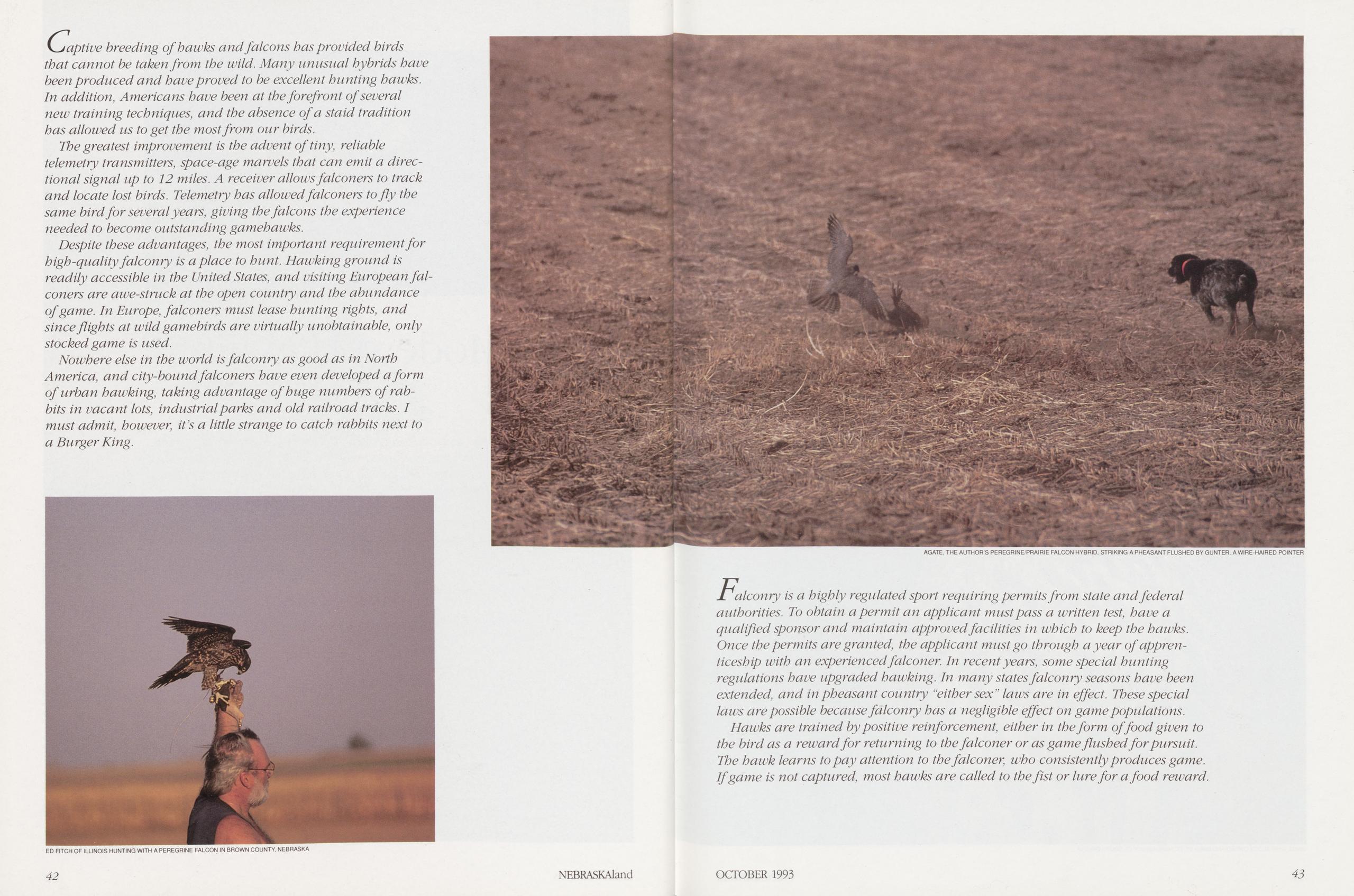
Captive breeding of hawks and falcons has provided birds that cannot be taken from the wild. Many unusual hybrids have been produced and have proved to be excellent hunting hawks. In addition, Americans have been at the forefront of several new training techniques, and the absence of a staid tradition has allowed us to get the most from our birds.
The greatest improvement is the advent of tiny, reliable telemetry transmitters, space-age marvels that can emit a directional signal up to 12 miles. A receiver allows falconers to track and locate lost birds. Telemetry has allowed falconers to fly the same bird for several years, giving the falcons the experience needed to become outstanding gamehawks.
Despite these advantages, the most important requirement for high-quality falconry is a place to hunt. Hawking ground is readily accessible in the United States, and visiting European falconers are awe-struck at the open country and the abundance of game. In Europe, falconers must lease hunting rights, and since flights at wild gamebirds are virtually unobtainable, only stocked game is used.
Nowhere else in the world is falconry as good as in North America, and city-bound falconers have even developed a form of urban hawking, taking advantage of huge numbers of rab- bits in vacant lots, industrial parks and old railroad tracks. I must admit, however, it’s a little strange to catch rabbits next to a Burger King.
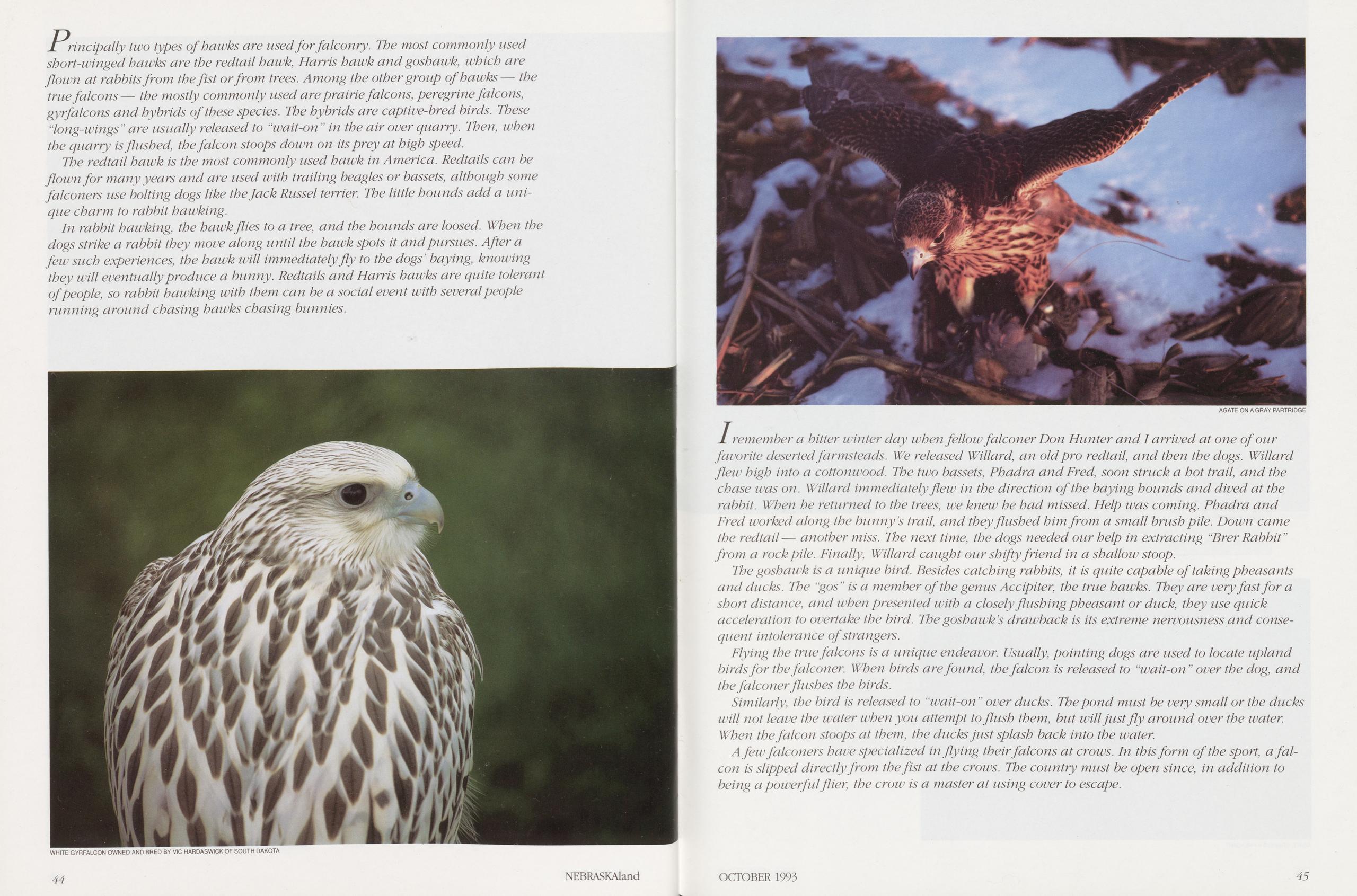 Principally two types of hawks are used forfalconry. The most commonly used
short-winged hawks are the redtail hawk, Harris hawk and goshawk, which are
flown at rabbits from the fist or from trees. Among the other group of hawks— the
true falcons— the mostly commonly used are prairie falcons, peregrine falcons,
gyrfalcons and hybrids of these species. The hybrids are captive-bred birds. These
along-wings” are usually released to “wait-on” in the air over quarry. Then, when
the quarry is flushed, the falcon stoops down on its prey at high speed.
The redtail hawk is the most commonly used hawk in America. Redtails can be
flown for many years and are used with trailing beagles or bassets, although some
falconers use bolting dogs like the Jack Russel terrier. The little hounds add a unique
charm to rabbit hawking.
In rabbit hawking, the hawk flies to a tree, and the bounds are loosed. When the
dogs strike a rabbit they move along until the hawk spots it and pursues. After a
few such experiences, the hawk will immediately fly to the dogs’ baying, knowing
they will eventually produce a bunny. Redtails and Harris hawks are quite tolerant
ofpeople, so rabbit hawking with them can be a social event with several people
running around chasing hawks chasing bunnies.
Principally two types of hawks are used forfalconry. The most commonly used
short-winged hawks are the redtail hawk, Harris hawk and goshawk, which are
flown at rabbits from the fist or from trees. Among the other group of hawks— the
true falcons— the mostly commonly used are prairie falcons, peregrine falcons,
gyrfalcons and hybrids of these species. The hybrids are captive-bred birds. These
along-wings” are usually released to “wait-on” in the air over quarry. Then, when
the quarry is flushed, the falcon stoops down on its prey at high speed.
The redtail hawk is the most commonly used hawk in America. Redtails can be
flown for many years and are used with trailing beagles or bassets, although some
falconers use bolting dogs like the Jack Russel terrier. The little hounds add a unique
charm to rabbit hawking.
In rabbit hawking, the hawk flies to a tree, and the bounds are loosed. When the
dogs strike a rabbit they move along until the hawk spots it and pursues. After a
few such experiences, the hawk will immediately fly to the dogs’ baying, knowing
they will eventually produce a bunny. Redtails and Harris hawks are quite tolerant
ofpeople, so rabbit hawking with them can be a social event with several people
running around chasing hawks chasing bunnies.
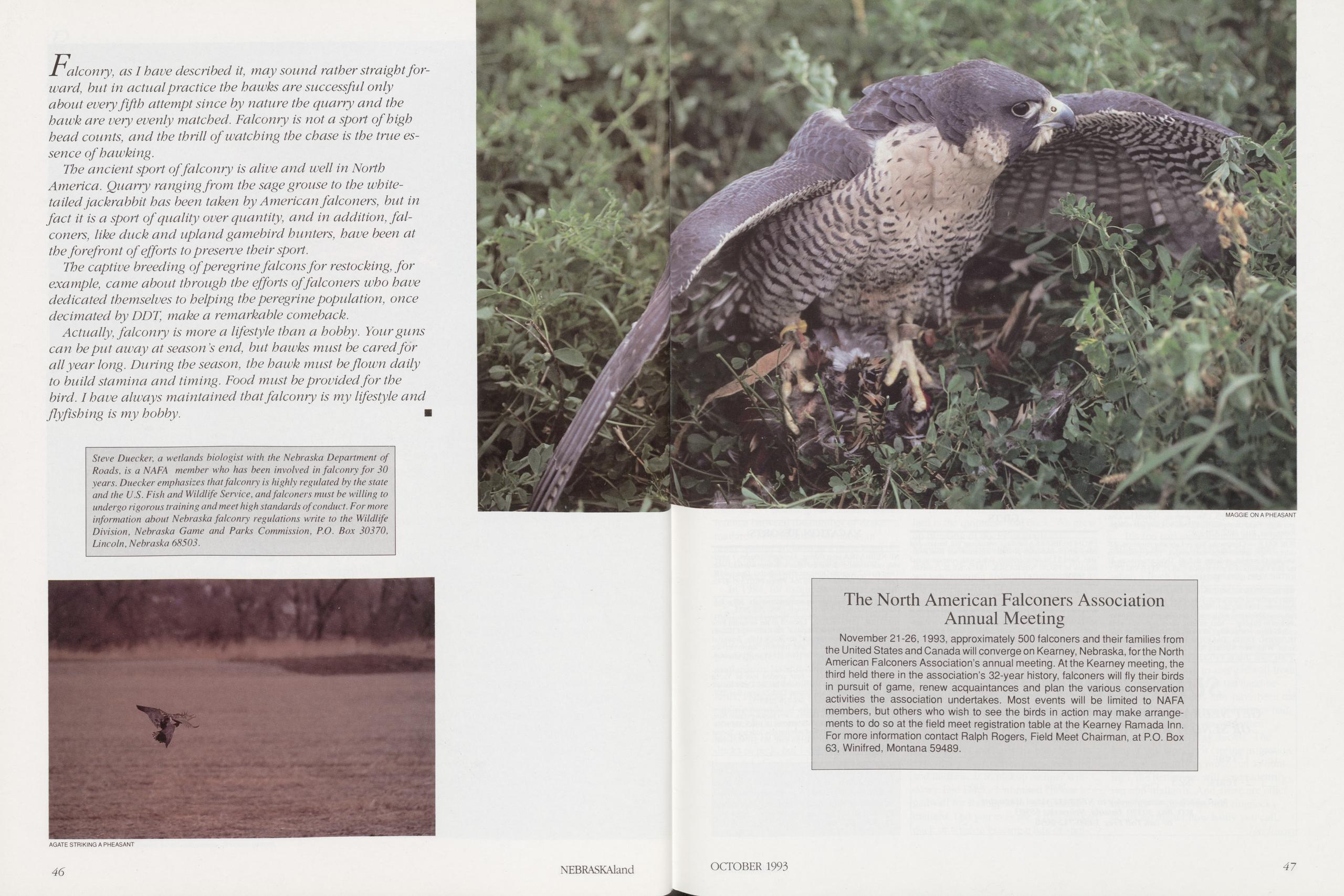 Falconry, as I have described it, may sound rather straight forward, but in actual
practice the hawks are successful only
about every fifth attempt since by nature the quarry and the
hawk are very evenly matched. Falconry is not a sport of high
head counts, and the thrill of watching the chase is the true essence of hawking.
The ancient sport of falconry is alive and well in North
America. Quarry ranging from the sage grouse to the white-tailed jackrabbit has been
taken by American falconers, but in
fact it is a sport of quality over quantity, and in addition, falconers, like duck
and upland gamebird hunters, have been at
the forefront of efforts to preserve their sport.
The captive breeding of peregrine falcons for restocking, for
example, came about through the efforts of falconers who have
dedicated themselves to helping the peregrine population, once
decimated by DDT, make a remarkable comeback.
Actually, falconry is more a lifestyle than a hobby. Your guns
can be put away at season’s end, but hawks must be cared for
all year long. During the season, the hawk must be flown daily
to build stamina and timing. Food must be provided for the
bird. I have always maintained that falconry is my lifestyle and
flyfishing is my hobby.
Steve Duecker, a wetlands biologist with the Nebraska Department of
Roads, is a NAFA member who has been involved in falconry for 30
years. Duecker emphasizes that falconry is highly regulated by the state
and the U.S. Fish and Wildlife Se twice, and falconers must be willing to
undergo rigorous training and meet high standards of conduct. For more
information about Nebraska falconry regulations write to the Wildlife
Division, Nebraska Game and Parks Commission, P.O. Box 30370,
Lincoln, Nebraska 68503.
Falconry, as I have described it, may sound rather straight forward, but in actual
practice the hawks are successful only
about every fifth attempt since by nature the quarry and the
hawk are very evenly matched. Falconry is not a sport of high
head counts, and the thrill of watching the chase is the true essence of hawking.
The ancient sport of falconry is alive and well in North
America. Quarry ranging from the sage grouse to the white-tailed jackrabbit has been
taken by American falconers, but in
fact it is a sport of quality over quantity, and in addition, falconers, like duck
and upland gamebird hunters, have been at
the forefront of efforts to preserve their sport.
The captive breeding of peregrine falcons for restocking, for
example, came about through the efforts of falconers who have
dedicated themselves to helping the peregrine population, once
decimated by DDT, make a remarkable comeback.
Actually, falconry is more a lifestyle than a hobby. Your guns
can be put away at season’s end, but hawks must be cared for
all year long. During the season, the hawk must be flown daily
to build stamina and timing. Food must be provided for the
bird. I have always maintained that falconry is my lifestyle and
flyfishing is my hobby.
Steve Duecker, a wetlands biologist with the Nebraska Department of
Roads, is a NAFA member who has been involved in falconry for 30
years. Duecker emphasizes that falconry is highly regulated by the state
and the U.S. Fish and Wildlife Se twice, and falconers must be willing to
undergo rigorous training and meet high standards of conduct. For more
information about Nebraska falconry regulations write to the Wildlife
Division, Nebraska Game and Parks Commission, P.O. Box 30370,
Lincoln, Nebraska 68503.
Classified
BIRDSMANDARIN DUCKS: nice full-wing birds. $35/pair; woodducks $25/pair. Mrs. R. W. Hansen, 3315 Ave. L, Kearney, NE 68847. Phone 308-237-3781.
BOOKS/PRINTINGFREE BOOK CATALOG. Novels, westerns, romances, children’s; old out of print, found barns, attic. Authors: Grey, Bower, Connor, Fox, Curwood, Raine,Wright, Aldridge, Pollyanna, Freckles, many others. Postage ap- preciated. Pierce. 4400 N. Pine Cluster, Oroville, CA 95965
COLLECTIBLESBUYING—TRADING EXPIRED HUNTING, FISHING, TRAPPING licenses; regulations; duck/upland game stamps. (402) 785-7500. Information/prices.
OREGON TRAIL SOUVENIRS. Official buckle - mugs - “Ts,” spoons, stoneware. DART, INC. 1-800-228-0086. WANTED: Old surveying instruments, books, pictures, etc. Transits, compasses, levels, sextants, etc. 907-344-7948.
WANTED: Collector wants to buy all brands old 2 piece cardboard shotshell boxes. Also wood ammo boxes, old firearm and cartridge company posters, calendars, advertis- ing cardboards, and catalogs. Allan H. Hahn, Rt 1 Box 147, Gibbon, NE 68840. Phone (308) 647-5228.
DOGSTRAINING ALL BREEDS bird dogs — Vizslas and English Pointers for sale. Rozanek Kennels, RR 2, Schuyler, NE 68661. Phone (402) 352-8769.
YELLOW-BLACK Lab pups. FC-AFC sired. AKC. Hips OFA certified. Dew claws removed. Excellent hunting potential. Contact Bob Bendler, Lexington. NE. (308) 324- 4247.
AKC BRITTANY PUPS. Close working. Natural backing gun dogs. Field champion backgrounds. Liver and orange. References. Blair (402) 426-3597.
FOR SALE — Chesapeake bay or Labrador retrievers. All colors. Pups, started dogs, stud service. Three-generation national champion, pedigree on Lab. Three generations of the best Chesapeakes ever trialed. Call PLATTE VALLEY RETRIEVERS (308) 995-2318.
WILDERNESS KENNELS. Gun dog training - over 60 years combined experience. Training all spotting breeds — Retrievers. Flushing and pointing dogs. All dogs worked on pen raised birds and wildgame. Training program includes obedience training —- heel, sit, stay, down and come when called. Pups, started dogs and fully trained dogs for sale. HUNTING DOGS TRAINED BY HUNTERS. Henry Sader, Wilderness Kennels, 402-423-4212. Since 1968.
SUBSCRIBE NOW! GET NEBRASKAland MAGAZINE FOR YOURSELF OR SEND IT AS A GIFT FOR JUST $12 A YEAR! 1 - Year $12 Name Address 2-Years $23 City State Zip Mail check or money order to NEBRASKAland Magazine P.O. Box 3O37O, Lincoln, Nebraska 68503 or call Toll Free 1-800-742-0056CUSTOM GATES AND KENNELS. Portable and station- ary dog runs and kennels, any size. Phone 402-253-2812.
ENGLISH COCKER pups, imported stock. British FTC bloodlines. Many colors available. Featured in NEBRASKAland November 1991. Sawtooth Oaks, Box 443. Orleans, NE 68966. Phone 308-473-5265.
FDSB PUREBRED ENGLISH SETTER PUPS! Whelped July 2. Both parents stylish, excellent noses, and know-how to find birds. Don’t miss this litter! Wind Fall Gun Dog Kennel, (402) 421-4693.
DEUTSCH DRAHTHAARS - Line-bred litters planned for December and January. Puppies expected to have great potential. Parents are proven hunters. Bred by strict VDD standards in German registered kennel. Versatile hunting drahthaars for fur and feathered game. Wildflugel Kennel, RR 2, Box 24A, Ravenna, NE 68869, 308-452-4333.
FISH/FISHINGFISH FOR SALE. Catfish, perch, coho salmon, rainbow trout, crappie, bluegill, walleye, minnows, goldfish, bullhead, largemouth bass, smallmouth bass, triploid grass carp. Commercial grower prices on catfish, perch, coho salmon, rainbow trout. Consulting available. Pleasant Val- ley Fish Farm, Rt 1 Box 147, McCook, NE 69001. Phone (308) 345-6599.
TEXAS ANGLERS Guide Service, Lake Fork. TX. Trophy BASS Capital U.S.A. Now booking fall and spring 1994 trips. Single or group trips welcome. Sully 214-771-0964.
FOODNEBRASKA BASKETS: The original Nebraska company specializing in fine foods from Nebraska. A beautiful array of baskets filled with ethnic, healthful and long-time favorite foods. Call or write for our brochure: P.O. Box 98, McCook, NE 69001. 1-800-345-7725.
BEER & WINEMAKING SUPPLIES — Fermenter's Supply & Equipment, 4472 S. 84th St., Omaha, NE 68127. (402) 593-9171. Mail order or visit our store.
GIFTSFROM NEBRASKA catalogs containing gift baskets and other unique Nebraska products and items are now avail- able. Send $1 to cover postage along with your name and address to FROM NEBRASKA, 140 N. 8th St., Lincoln, NE 68508.
GUIDES/OUTFITTERSMAD RIVER CANOES offers the finest quality and per- formance. For the finest canoes and accessories look to Great Plains Canoe Co., 205 Main, Springfield, NE. Phone (402)253-2001.
GRAHAM CANOE OUTFITTERS: Top quality full-ser- vice camping and canoe trips on the Niobrara River. Daily canoe rentals and car shuttle-service available. Contact Doug & Twyla Graham, HC 13 Box 16, Valentine. NE 69201 or phone (402) 376-3708.
WYOMING TROPHY HUNTS: elk. deer, antelope and big horn sheep. Professional outfitter and guides. Now booking rifle and bow hunts for 1994 season. Also summer pack trips. Cabin Creek Outfitters, Box 483, Sutton. NE 68979. 402-773-4626.
RED BARN LODGE: South Central Nebraska. Room, boarding, guided pheasant hunting. Daily/weekly rates. 1-800-398-5103.
GUNS/SHOOTING/ARCHERYGUNS — Browning, Winchester. Remington, others. Hi- powers; shotguns, new, used, antiques. Want Pre-’64 Winchesters. Buy-Sell-Trade. (402) 729-6112. Bedlan's Sporting Goods, Fairbury. NE 68352.
BOWHUNTERS: Take aim on Nebraska's newest source for custom arrows and quality bowhunting gear. For more information contact Dismal River Outpost, PO Box 4912, Omaha, NE 68104. 402-556-0068.
FREE CATALOG RELOADING PRODUCTS - Steelshot reloading products, once fired hulls and brass. Shooting accessories and dog training supplies. Precision Reloading, Inc. 1-800-223-0900.
TAXIDERMYALLISON'S TAXIDERMY STUDIO & GIFT GALLERY. Specializing in fish, birds and small game. Mounted 35 State Record Fish. Pheasant mounts for sale. 421 N. Dewey, North Platte, NE 69101. (308) 534-2324or (308) 534-4267.
NEWMAN TAXIDERMY - award winning style; “Real Fish” reproductions—we support Catch & Release; Heritage cases: a concept of displaying your trophy with personalized memorabilia in antiqued, leaded glass cases; “Serving NE Sportsmen since 1966.” RR 2, Box 279, Fremont. NE 68025; 402-727-5714.
VACATION/RESORTSNE NEBRASKA trout fishing. 3 modern cottages, 1 avail- able year-round. 5 spring-fed lakes with open water all year. Trout up to 7 pounds. Other varieties fish also. Diamond E. Trout Resort, Orchard, NE 68764. Phone (402) 893-4745. Evenings (402) 893-3002.
FOR FISHING and hunting accommodations. Jefco Inn, Gordon, NE 69343. South Cornell, (308) 282-2935.
HISTORIC 1890s HOTEL. Located in the beautiful Pine Ridge area of Northwest Nebraska. Short drive to Chadron State Park, Fort Robinson and the Black Hills. Beautiful dining room with fireplace and fountain. Room service available. The Olde Main Street Inn, 115 Main St., Chadron, NE 69337. (308) 432-3380.
LAKE McCONAUGHY - four deeded lots at Yucca Heights for vacation or year around homes. Quiet leisure place, close to hunting and fishing. Dick Nelson, Box 25B. Lemoyne, NE 69146. Phone 308-726-2297.
BLACK HILLS of South Dakota. Deer hunting season Nov. 1 -30. Surrounded by one million acres of Black Hills Na- tional Forest. Affordable and comfortable lodging. Spring Creek Inn, HCR 87. Box 55, Hill City, SD 57745. 1-800- 456-2755. Open year round.
Classified ad rates: 75$ per word, minimum $15. Closing date is the first business day 2 months preceding date of issue. To place ads or for more information write NEBRASKAland Magazine, P.O. Box 30370, Lincoln, NE 68503, or call (402) 471-5478. Fax (402) 471-5528.Page forty-nine
Obsession with GreenheadsDuck hunters always have preferred mallards, probably for a number of reasons. Mallards are found across the continent and throughout the Northern Hemisphere. They are large ducks and, most people seem to agree, among the best tasting. But in the days of market hunting, both canvasbacks and redheads fetched more money. In 1890, for example, a Chicago buyer quoted the following prices: canvasbacks $10 to $16 a dozen, redheads $3.75 to $4 a dozen, mallards $3.75 a dozen and teal $ 1.75 to $2.25 a dozen.
Hunters’ tastes in ducks have not changed much since, and canvasbacks and redheads have become less plentiful than they once were. But it seems today’s waterfowl hunter is even more obsessed with shooting mallards, especially drake mallards, than were hunters 50 or 100 years ago, a curious response to regulations which have increasingly restricted the harvest of mallards.
Granted, ducks of all kinds have been on the ropes in recent years because of continuing habitat loss, and there hasn’t been a great deal of difference between the number of drake mallards or the number of ducks of other species allowed in a daily limit. But think back a few years to when there was a significant difference.
In 1984, for example, a hunter could legally shoot one canvasback, two hen mallards, five drake mallards or 10 of such species as teal, scaup, pintail, gad-wall, wigeon or shovelers. Even when given the choice of shooting five drake mallards or 10 blue-winged teal, most hunters seemed to prefer to shoot mallards. I suppose if you just look at maximizing pounds of edible flesh there was not much difference between five mallards and 10 teal, and it made five less ducks to pick, but I doubt many hunters operated along that line of reasoning.
I do not claim to have the definitive explanation for this phenomenon, but I am always willing to speculate. First, I’ll grant that mallards are usually plump and fine-eating ducks. They are less apt than some species to sneak a meal of some greasy little forage fish and fill a kitchen with a slight waft of spoiled sardine when cooked, although I think the table quality of many species is unfairly maligned.
I have to suggest that as a group, Americans want their meats as bland as possible. The best venison, according to most people, is from a com-fed deer which tastes “just like beef.” Pheasants are praised even by those who profess not to like wild game, because they taste “almost like chicken.” Ducks, on the other hand, taste like ducks. Rather than savor that distinctive taste, a taste once reserved for the best of tables around the world, most Americans who indulge in duck at all prefer the relatively bland, “com-fed” mallard.
I suspect other factors contribute to hunters’ preference for mallards. First is the widespread perception of a drake mallard as a prestigious bird in the bag. In most waterfowl hunting circles a hunter with three teal at the end of the morning takes a back seat bragging to the fellow who shot one drake mallard. To most Americans, the drake mallard is the quintessential duck. We grew up thinking of ducks as mallards. Maybe that’s because mallards, more or less, are the kind of domesticated ducks we saw running around farmyards in the company of Muscovys when we were kids.
Until recently, about the only duck decoys you could buy, without ordering from a specialty catalog and paying five times the price for cork dekes, were mallards. For every pintail whistle in the sporting goods stores there are a hundred “duck calls” that in reality are mallard calls. The clerk will invariably say: “It doesn’t matter, all ducks come to mallard decoys and mallard calls.”
Images of mallards are plastered on everything from coffee mugs, neckties and underwear to pickup camper windows. Did Ducks Unlimited choose a gadwall for its logo? No, it’s a drake mallard. Did you ever see a ring-necked duck or wigeon gracing a box of shotgun shells as the drake mallard did for so many years on boxes of Peters High Velocity shells? For most hunters, any duck not a drake mallard is either a big brown duck or a little brown duck or, worse, a “trash duck.”
I suppose some will argue that the mallard receives so much attention because it is our most beautiful duck. But if we are looking for gaudiness, how about the drake wood duck, the waterfowl world’s equivalent of a pink 1957 Cadillac with wide whitewalls and a coontail on the radio antenna? I suppose the wonderfully subtle browns and tans of a drake wigeon would be a ballcap logo maker’s nightmare. Some works of art cannot be reduced to three or four colors of thread.
I suspect, however, the real reason many hunters prefer the drake mallard is the shameful, unspoken little secret that drake mallards are the only ducks they can identify. They conceal their duck identification inadequacies by shooting only drake mallards and calling every other species trash. In my book, any hunter who considers any species of duck trash is, in reality, the true “trash duck-hunter.”
It’s too bad more hunters don’t indulge in the joys of mixed-bag duck hunting. Sure, there will be occasions when a flock is hanging over the decoys and you let that perfect moment to shoot slip by because you’re not sure of all the species. But some species can be sorted out relatively easily — teal are smaller than everything else, and nothing comes to decoys quite like they do. You don’t have to sort gadwall from wigeon until they are in the hand because in recent years they have been the same point value. Even old-timers had trouble with those two, and often lumped them as “gray ducks.” The longer you work at it (spring migration practice is nearly as much fun as hunting), the better you will get at identifying non-mallards. And, there are other benefits — shovelers and ringnecks decoy no matter how badly you call.
Jon Farrar 48 NEBRASKAland OCTOBER 1993 49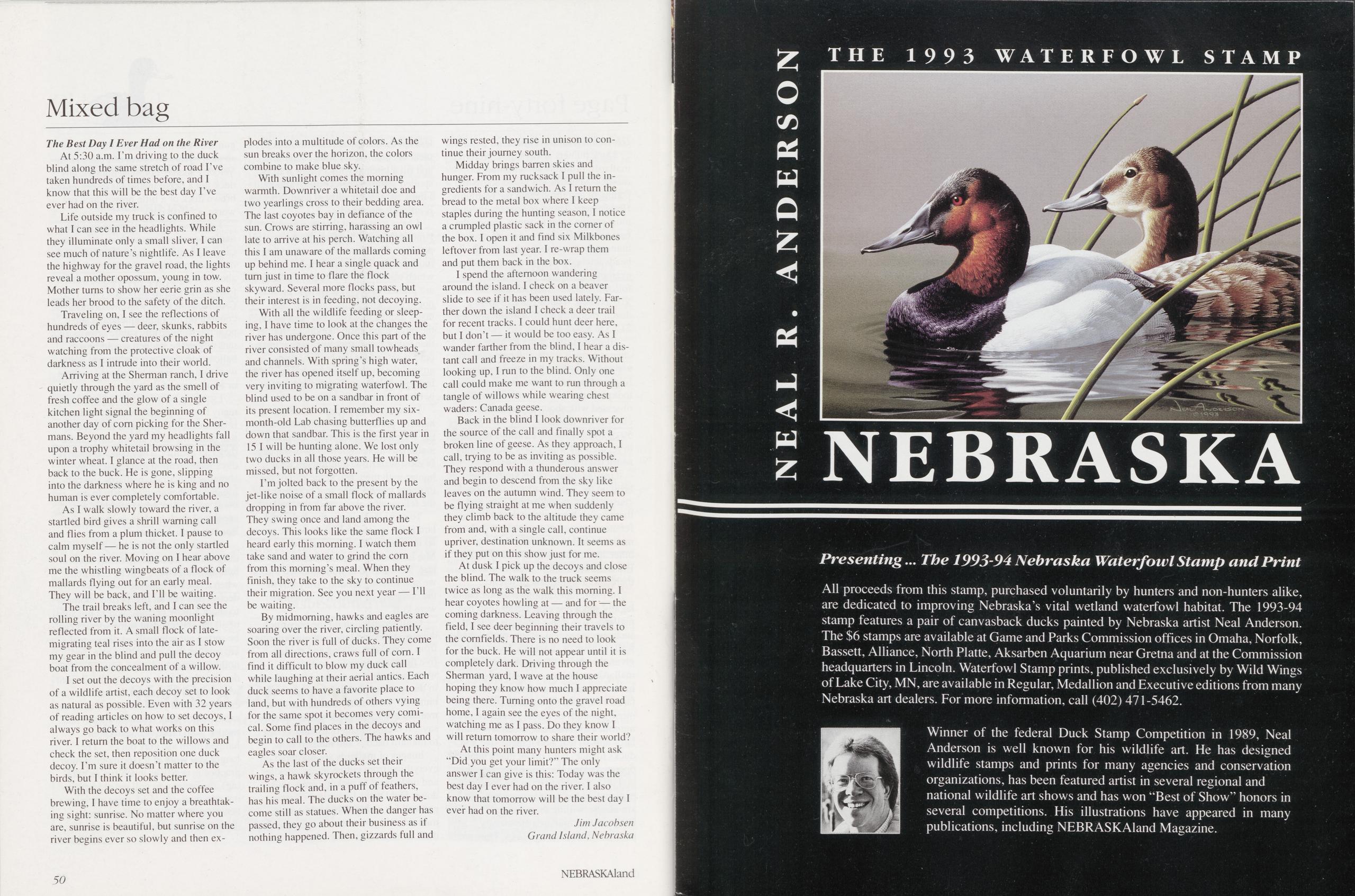
Mixed bag
The Best Day I Ever Had on the RiverAt 5:30 a.m. I’m driving to the duck blind along the same stretch of road I've taken hundreds of times before, and I know that this will be the best day I've ever had on the river.
Life outside my truck is confined to what I can see in the headlights. While they illuminate only a small sliver, I can see much of nature’s nightlife. As I leave the highway for the gravel road, the lights reveal a mother opossum, young in tow. Mother turns to show her eerie grin as she leads her brood to the safety of the ditch.
Traveling on, I see the reflections of hundreds of eyes — deer, skunks, rabbits and raccoons — creatures of the night watching from the protective cloak of darkness as I intrude into their world.
Arriving at the Sherman ranch, I drive quietly through the yard as the smell of fresh coffee and the glow of a single kitchen light signal the beginning of another day of com picking for the Shermans. Beyond the yard my headlights fall upon a trophy whitetail browsing in the winter wheat. I glance at the road, then back to the buck. He is gone, slipping into the darkness where he is king and no human is ever completely comfortable.
As I walk slowly toward the river, a startled bird gives a shrill warning call and flies from a plum thicket. I pause to calm myself — he is not the only startled soul on the river. Moving on I hear above me the whistling wingbeats of a flock of mallards flying out for an early meal. They will be back, and TH be waiting.
The trail breaks left, and I can see the rolling river by the waning moonlight reflected from it. A small flock of late- migrating teal rises into the air as I stow my gear in the blind and pull the decoy boat from the concealment of a willow.
I set out the decoys with the precision of a wildlife artist, each decoy set to look as natural as possible. Even with 32 years of reading articles on how to set decoys, I always go back to what works on this river. I return the boat to the willows and check the set, then reposition one duck decoy. I’m sure it doesn’t matter to the birds, but I think it looks better.
With the decoys set and the coffee brewing, I have time to enjoy a breathtaking sight: sunrise. No matter where you are, sunrise is beautiful, but sunrise on the river begins ever so slowly and then explodes into a multitude of colors. As the sun breaks over the horizon, the colors combine to make blue sky.
With sunlight comes the morning warmth. Downriver a whitetail doe and two yearlings cross to their bedding area. The last coyotes bay in defiance of the sun. Crows are stirring, harassing an owl late to arrive at his perch. Watching all this I am unaware of the mallards coming up behind me. I hear a single quack and turn just in time to flare the flock skyward. Several more flocks pass, but their interest is in feeding, not decoying.
With all the wildlife feeding or sleeping, I have time to look at the changes the river has undergone. Once this part of the river consisted of many small towheads and channels. With spring’s high water, the river has opened itself up, becoming very inviting to migrating waterfowl. The blind used to be on a sandbar in front of its present location. I remember my six- month-old Lab chasing butterflies up and down that sandbar. This is the first year in 15 I will be hunting alone. We lost only two ducks in all those years. He will be missed, but not forgotten.
I’m jolted back to the present by the jet-like noise of a small flock of mallards dropping in from far above the river. They swing once and land among the decoys. This looks like the same flock I heard early this morning. I watch them take sand and water to grind the com from this morning’s meal. When they finish, they take to the sky to continue their migration. See you next year — I'll be waiting.
By midmoming, hawks and eagles are soaring over the river, circling patiently. Soon the river is full of ducks. They come from all directions, craws full of com. I find it difficult to blow my duck call while laughing at their aerial antics. Each duck seems to have a favorite place to land, but with hundreds of others vying for the same spot it becomes very comical. Some find places in the decoys and begin to call to the others. The hawks and eagles soar closer.
As the last of the ducks set their wings, a hawk skyrockets through the trailing flock and, in a puff of feathers, has his meal. The ducks on the water become still as statues. When the danger has passed, they go about their business as if nothing happened. Then, gizzards full and wings rested, they rise in unison to continue their journey south.
Midday brings barren skies and hunger. From my rucksack I pull the ingredients for a sandwich. As I return the bread to the metal box where I keep staples during the hunting season, I notice a crumpled plastic sack in the comer of the box. I open it and find six Milkbones leftover from last year. I re-wrap them and put them back in the box.
I spend the afternoon wandering around the island. I check on a beaver slide to see if it has been used lately. Farther down the island I check a deer trail for recent tracks. I could hunt deer here, but I don’t — it would be too easy. As I wander farther from the blind, I hear a distant call and freeze in my tracks. Without looking up, I run to the blind. Only one call could make me want to run through a tangle of willows while wearing chest waders: Canada geese.
Back in the blind I look downriver for the source of the call and finally spot a broken line of geese. As they approach, I call, trying to be as inviting as possible. They respond with a thunderous answer and begin to descend from the sky like leaves on the autumn wind. They seem to be flying straight at me when suddenly they climb back to the altitude they came from and, with a single call, continue upriver, destination unknown. It seems as if they put on this show just for me.
At dusk I pick up the decoys and close the blind. The walk to the truck seems twice as long as the walk this morning. I hear coyotes howling at — and for — the coming darkness. Leaving through the field, I see deer beginning their travels to the cornfields. There is no need to look for the buck. He will not appear until it is completely dark. Driving through the Sherman yard, I wave at the house hoping they know how much I appreciate being there. Turning onto the gravel road home, I again see the eyes of the night, watching me as I pass. Do they know I will return tomorrow to share their world?
At this point many hunters might ask “Did you get your limit?” The only answer I can give is this: Today was the best day I ever had on the river. I also know that tomorrow will be the best day I ever had on the river.
Jim Jacobsen Grand Island, NebraskaAll proceeds from this stamp, purchased voluntarily by hunters and non-hunters alike, are dedicated to improving Nebraska’s vital wetland waterfowl habitat. The 1993-94 stamp features a pair of canvasback ducks painted by Nebraska artist Neal Anderson. The $6 stamps are available at Game and Parks Commission offices in Omaha, Norfolk, Bassett, Alliance, North Platte, Aksarben Aquarium near Gretna and at the Commission headquarters in Lincoln. Waterfowl Stamp prints, published exclusively by Wild Wings of Lake City, MN, are available in Regular, Medallion and Executive editions from many Nebraska art dealers. For more information, call (402) 471-5462.
Winner of the federal Duck Stamp Competition in 1989, Neal Anderson is well known for his wildlife art. He has designed wildlife stamps and prints for many agencies and conservation organizations, has been featured artist in several regional and national wildlife art shows and has won “Best of Show” honors in several competitions. His illustrations have appeared in many publications, including NEBRASKAland Magazine.
50 NEBRASKAland
Position: 387 (25 views)