Volume 71, Issue 7, 1993
NEBRASKAland
SEPTEMBER 1993 • $1.50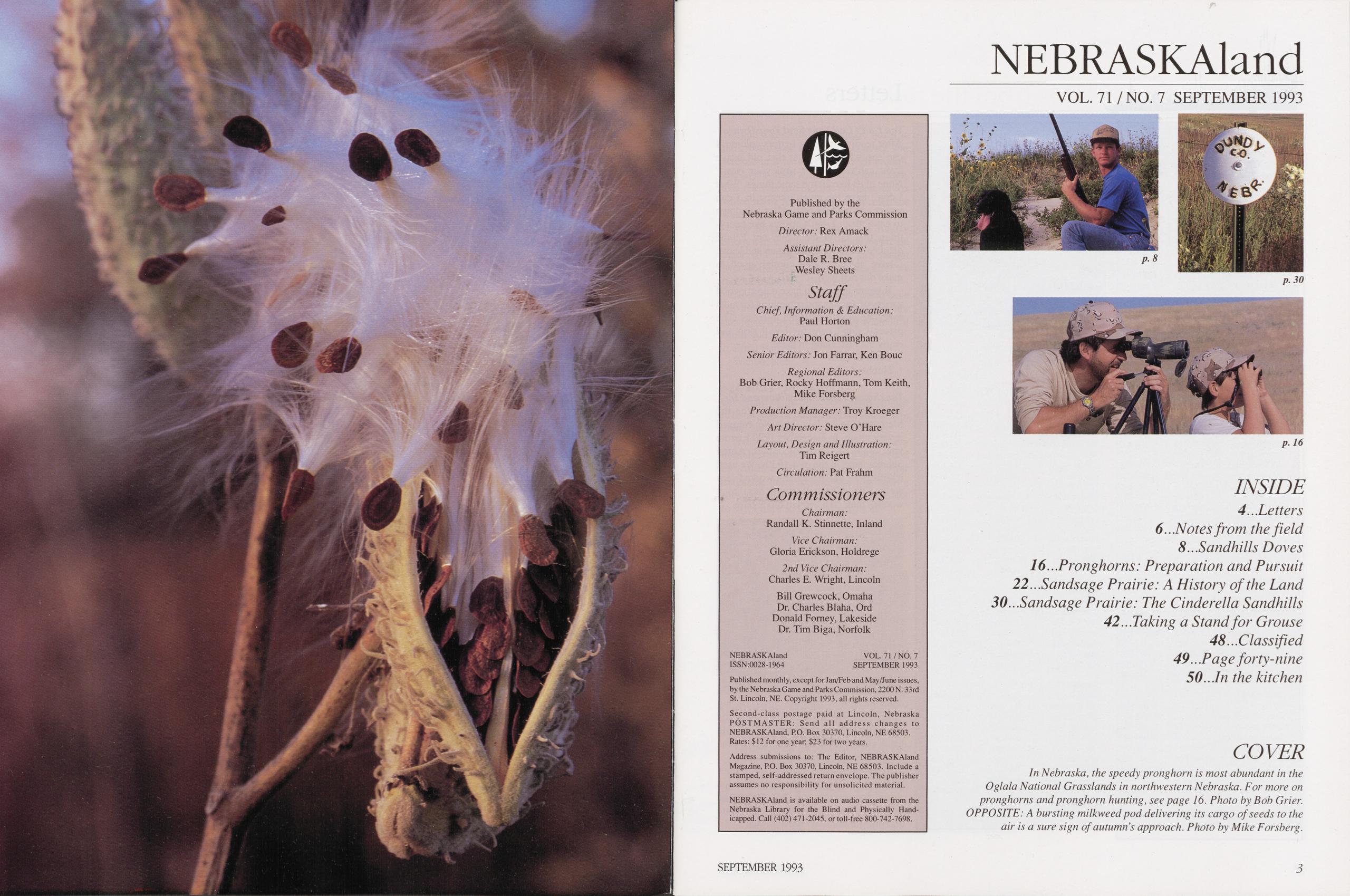
Published monthly, except for Jan/Feb and May/June issues, by the Nebraska Game and Parks Commission, 2200 N. 33rd St. Lincoln, NE. Copyright 1993, all rights reserved.
Second-class postage paid at Lincoln, Nebraska POSTMASTER: Send all address changes to NEBRASKAland, P.O. Box 30370, Lincoln, NE 68503. Rates: $12 for one year, $23 for two years.
Address submissions to: The Editor, NEBRASKAland Magazine, P.O. Box 30370, Lincoln, NE 68503. Include a stamped, self-addressed return envelope. The publisher assumes no responsibility for unsolicited material.
NEBRASKAland is available on audio cassette from the Nebraska Library for the Blind and Physically Handicapped. Call (402)471-2045, or toll-free 800-742-7698.
NEBRASKAland
VOL. 71 / NO. 7 SEPTEMBER 1993p. 30
p. 16
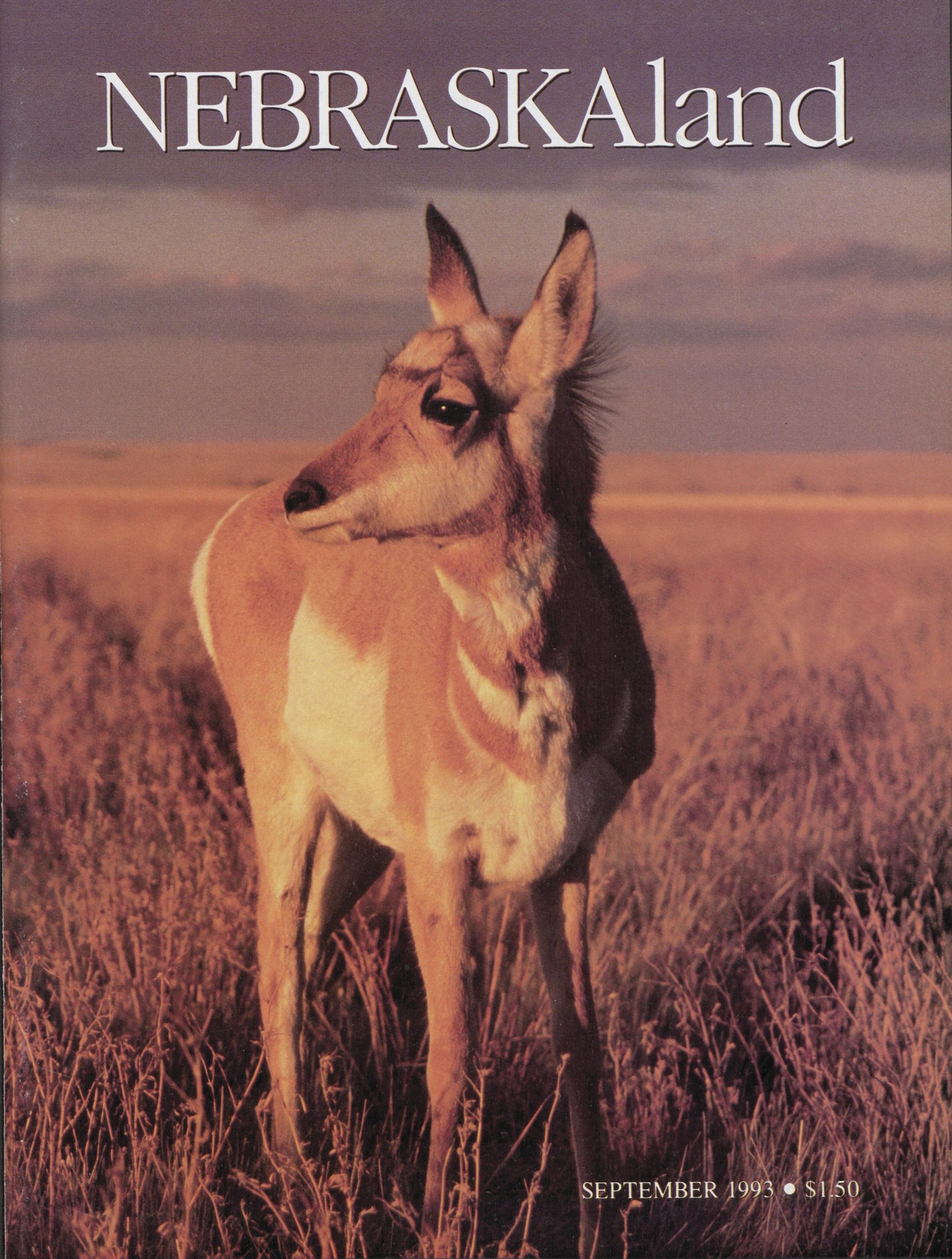
COVER In Nebraska, the speedy pronghorn is most abundant in the Oglala National Grasslands in northwestern Nebraska. For more on pronghorns and pronghorn hunting, see page 16. Photo by Bob Grier. OPPOSITE: A bursting milkweed pod delivering its cargo of seeds to the air is a sure sign of autumn s approach. Photo by Mike Forsberg.
Letters
You Can’t Call Your Soul Your OwnAfter reading the July Letters column, I can see where they get that old adage “you can’t call your soul your own.” None of us like all the same things. What I don’t have too much interest in, I can ignore and read the rest. When I sit down to eat a meal, I don’t always like everything that is on the table, but I’ll be damned if I am going to get up and leave. I have always found enough good to make out real well.
It seems to me you have a pretty good variety of articles and something for most everyone with diversified interests. The pieces I don’t care for I will skip and enjoy the rest. Hang in there!
Orrin B. Blair Hubbard, Neb. Tankhouses, Diamond Willow and IceThanks for the story “Tanks for the Memories” in the July issue. We enjoyed it very much. In December 1990 I wrote you about the tank my father, Anton Shonka, built in the mid-1930s. We used it until 1959, and the system worked very well. The windmill stood next to a wooden tank on a cement block base.
I am sending a picture of some diamond willow furniture made by my father. He gathered the willow along the Platte River. As he was a farmer, he would hand clean and sand the pieces in the wintertime, using hand-forged tools.
Your magazine stories are super. Sometime I’d like to see an article on ice stored for summer use. My father and neighbors would cut ice near the Platte and bring it home on horse-drawn sleds. We had a cement block square down in the ground with a low roof on it. Ice was stacked in it leaving a space all around, and hay or straw was added for insulation. The ice was used in our wooden icebox which had a pan underneath to catch the water as the ice melted.
We always had company on Sunday afternoons to enjoy homemade ice cream made with fresh cream. We kids fought over who would lick the paddles after we took turns turning the crank.
Nowadays you run to a store and have ice cream pronto, but I think we appreciated it more after having waited till Mom said “I think it’s stiff enough.”
Erma Bartek Wahoo, Neb. Nebraska’s “Mr. Baseball”On behalf of the Mitchell family, I wish to thank you for publishing the fine article about my father in your August issue.
“Nebraska’s ‘Mr. Baseball’” was extremely well done and so well researched by Andrea Paul. Both she and your magazine did a terrific job. I’ve been a subscriber for many years and, needless to say, I hope to be for many more.
Clarence Mitchell Lincoln, Neb. September Sunsets: Nemaha County...Our son Bill took this picture last fall when he was home from North Carolina for our daughter’s wedding.
The church is St. John’s Lutheran Old Stone Church about five miles southeast of Johnson in Nemaha County. It is listed on the National Register of Historic Places.
Pat Behrends Tecumseh, Neb. ...Platte River State ParkEnclosed is a picture taken at Platte River State Park. I hope you can use it.
Scott Shafer Lincoln, Neb. Mom’s Deer StandI was bored one Sunday afternoon, when suddenly I heard, “Mother, do you want to go put up a deer stand?”
The day went like this: Many miles up and down the hills looking at deer tracks and many repetitions of “Where shall I put my stand?” I picked flowers from the woods, but the conversation always came back to “Mother, keep looking for tracks.”
Finally we found the right tree and installed the splits, ropes and the tree stand in anticipation of “the big one” to come by on September 15.
Every mother should experience this with a son. They love it, and you learn what it is to walk in the woods with the most precious thing in your life doing something you didn’t teach him to do.
This was one of the most precious moments of my life. I treasure being with my son and the wildlife he loves so much.
Mrs. M. Dillon Papillion, Neb.365 Days of Outdoor Pleasure!
1994 is on its way, and the new NEBRASKAland Calendar is the perfect way to stay up to date. Featuring 12 spectacular photos of Nebraska’s great outdoors, the 1994 calendar also contains a variety of state park informa- tion, license and permit data and sunrise/sunset tables. Order one for yourself and several more as gifts. A year- long bargain at $5.50. Please send me___copies of the 1994 NEBRASKAland Calendar at $5.50 each (Nebraska residents please include sales tax). Name Address City State Zip Check Enclosed Visa MasterCard Acct. No Expiration Date Mail to NEBRASKAland Calendar P.O. Box 30370 Lincoln, NE 68503
Notes from the field
City Foxes IIThe idea of foxes living in the city seemed outlandish just a few years ago, but gradually urban people became aware of these beguiling animals living in their midst. Some foxes have been there all along. Others were probably pushed out of the countryside by growing populations of coyotes, their natural enemies, and forced closer to cities and even into open spaces within city limits.
We began seeing foxes around the Game and Parks Commission head- quarters building in Lincoln and the adjacent University of Nebraska-Lincoln East Campus in the fall of 1992 and have continued to see them ever since. I had become interested in foxes while photographing and researching a NEBRASKAland article [“City Foxes,” May 1992]. Word spread through Commission headquarters that I wanted more fox photos for a future story on urban wildlife, and information on most sightings eventually got to me.
On several bitterly cold days last winter, a fox was seen snoozing below the windows of the Commission’s Personnel Section offices. It was a cozy spot, out of the wind and heated by the dark, sun-warmed bricks of the building’s south wall. The fox was hid-
an elevated bed of landscape grasses, but apparently did not realize that it was being ogled from only a few feet away by the fascinated office staff.
Throughout the winter, dainty fox tracks appeared in fresh snow on the ledge surrounding the building. One morning new snow on the front lawn of the wildlife laboratory carried a detailed account of a lively bit of “mousing,” with signs of the classic fox strategy of “stalk and pounce” evident in the new powder.
Another winter day, I spotted and photographed a fox taking its noon nap under a shrub just 20 feet from a parking lot. It remained there for 45 minutes during the busy period when employees were returning from lunch. Most did not notice the fox, whose winter coat blended nicely with the wood-chip mulch.
One mid-January weekend, a pair of foxes romped at a nearby creek, a sure sign of courtship. About March 10, a den was discovered on the creek’s north bank, and in early April five pups appeared at the den site. The fox population had grown from two to seven.
In mid-April, however, two pups were found in the creek below the den, where they apparently had drowned after tumbling down the steep bank. As spring waned and summer approached, the Commission received a report of a dead fox on a busy city street near the den site.
On June 4, an adult fox — or a large pup — took its afternoon nap beneath a bird feeder about 10 feet from the Com- mission headquarters’ main entrance and in plain view of visitors in the lobby. Just after 8:30 p.m. that day, a Commission employee saw a road-killed pup near the old den site. As he drove back for a closer look, an adult fox appeared and dragged the dead pup into cover.
The same week another fox was struck by a car and badly injured, but it was able to limp from the scene. About 10 days later, a wildlife biologist and a visitor saw the injured fox in the driveway at Commission headquarters. Both legs on one side were injured, and the side of its head and face was covered with a large scab. The injury was not fresh, but appeared serious.
With the two pups drowned in April, the road kill observed June 4, another road kill reported near the den and the fox thought too badly injured to survive, it appeared that the family group had plummeted from a high of seven animals in spring to an apparent low of two in mid-June. The population estimate later rebounded to three when the still gimpy but much improved pup was seen regularly around Commission headquarters during most of July. Summer is a good time for a wild animal to recover from an injury, with mild weather and plentiful food.
By now, the surviving pup might be about ready to leave its parents’ home range. If it is a male, he is probably already on his way, looking for a place to set up a territory of his own. If it is a female, she is likely to leave sometime in winter and probably will join a group of foxes in an established territory.
If the litter’s sire survives and remains healthy and vigorous, he is like- ly to hang on to his territory around the Game and Parks Commission headquarters and East Campus for another year. The vixen will be with him if she is able, and they will produce another litter next spring. If either or both are absent, wandering animals will move in and fill the vacancies.
According to Chuck McCullough, the Commission’s furbearer specialist, the history of this pair and their litter is probably typical of other fox family groups, both in the countryside and in town. The major difference is in their visibility. In town more people are present to see their movements, so more is known about the fate of city foxes than about those in the country.
The drop in numbers from seven to three or fewer might seem cruelly excessive and appear to indicate that the city is a terribly unfriendly habitat for the red fox, but that is not the case, McCullough said. City foxes are gaining in number, or at least holding their own. And in the long run that is about the best nature offers most species. It appears that foxes will always be with us in our cities, whether in greater or lesser numbers, according to McCullough. And that’s all right. Foxes make good and interesting neighbors.
Sandhills Doves
There may be no more doves in north-central Nebraska’s grass-covered dunes than elsewhere in the state, but in early September the humidity is lower, and mosquitoes are few and far between.If your last dove hunt was in southeast Nebraska, it may have gone something like this: You pulled your car off to the side of a county road, picked up your shotgun and a dry wall bucket of gear and trudged to where a milo field bordered a wooded creek bottom, a natural flyway for doves. The temperature was in the mid-80s, and so was the humidity. You sat on the bucket, eager for the evening flight, but the only flight underway was a swirling cloud of mosquitoes. Waving your hat, you tried to create a wall of wind turbulence to ward them off and in the process waved off the first half-dozen singles that careened by at 40 mph.
Finally, your nervous system shut down, and you grew oblivious to mosquito bites. Just before sundown, the doves came in droves. You made a sweet double. Both birds fell in the unharvested milo and you spent the next 10 minutes searching for them.
Back at the bucket you killed another dove, a highballing, crossing shot. Another 10 minutes of searching, this time in poison-ivy-infested underbrush. The sun fell behind trees lining the creek. The air was still — not a hint of a breeze. Your shirt stuck to your back, making the mosquitoes’ work that much easier. One more dove and it was quitting time. It was nearly dark when you found the last bird. You blundered through the nettle patch you’d circled around coming in. It’s impossible not to scratch, so you did. White welts rose on your arms, filling the gaps between the mosquito bites.
OK, maybe that’s a bit grim, but it’s not far from describing some of my southeastern Nebraska dove hunts. Maybe that’s why I have never been much of a dove hunter. Central Nebraska pasture-and-farm-pond hunts were significantly more pleasant. My most pleasant dove hunts, though, have been in the Sandhills — but just about the best of everything I’ve had (except, strangely enough, for a truly rare steak) has been in the Sandhills. I may be prejudiced, or it could be that a lot of hunters have never experienced Nebraska dove shooting at its best.
There may be no more doves in the Sandhills than in other parts of the state, but there are more than enough to make hunting worth the effort, and it is easier to narrow down the sites they will be. But I am really talking about aesthetics of the hunt, for some a more essential com- ponent of a successful hunt than the body count. There is abundant public land in the Sandhills and relatively few hunters. Although there are more dedicated local dove hunters in the Sandhills than a few years ago, most of them hunt private land.
Most eastern Nebraskans think of doves as birds that sit around on utility lines or the branches of dead trees, and that’s where they are usually seen. But doves are basically ground birds. What eastern doves do on the ground is seldom seen because of thick vegetation. Sandhill doves, though, do almost everything on the ground — they have little choice. They loaf away the midday hours on the ground, they roost at night on the ground, they feed on the ground and nest on the ground. Certainly they might do all these things in trees in the Sandhills; it’s just that there are dam few trees. In the Sandhills, doves are more conspicuous.
In the east, travel lanes — creek bottoms, shelterbelts and flyways between feeding and loafing areas — are productive dove hunting sites . The Sandhills is mostly grass and sky. There are few landscape features (tree lines, cropland bordering streams or deep-cut valleys) significant enough for doves to establish routine travel lanes or regular flight pat- terns. They can fly just about anywhere they want without obstructions. Food is virtually everywhere — a patch of sunflowers here, a gathering of Rocky Mountain beeplant there and a host of other seed-producing plants scattered in between.
But just as doves come regularly to drink at farm ponds in eastern Nebraska, they come regularly to the puddles of water near almost every windmill stock tank in the Sandhills. These windmill overflow ponds (stretching the definition of pond a bit) are the places to shoot doves in the Sandhills most consistently. Because of the region’s porous, sandy soils, water does not stand in pools for long, unless it is continuously replenished, as it is at stock tanks. For this same reason, farm ponds are scarce in the Sandhills. Most Sandhills lakes and streams are fringed with dense stands of grass or emergent vegetation and are not accessible to doves. About the only place there is standing water with a bare shoreline where a dove can land and drink is at a windmill overflow. It may sound like dirty pool to ambush a dove when it comes for a drink, but there are thousands of windmills in the 19,000 square miles of the Sandhills — at least one in every pasture. A dove does have options. The perfect recipe for shooting doves in the Sandhills would start with a small valley. In the middle would be a windmill, a stock tank and an overflow pond— 10 yards across is plenty big, and considerably smaller is often adequate. The pond should have some bare shoreline where doves can land, take a few steps and drink. Around the pond there should be patches of weedy plants that produce an abundance of small seeds.
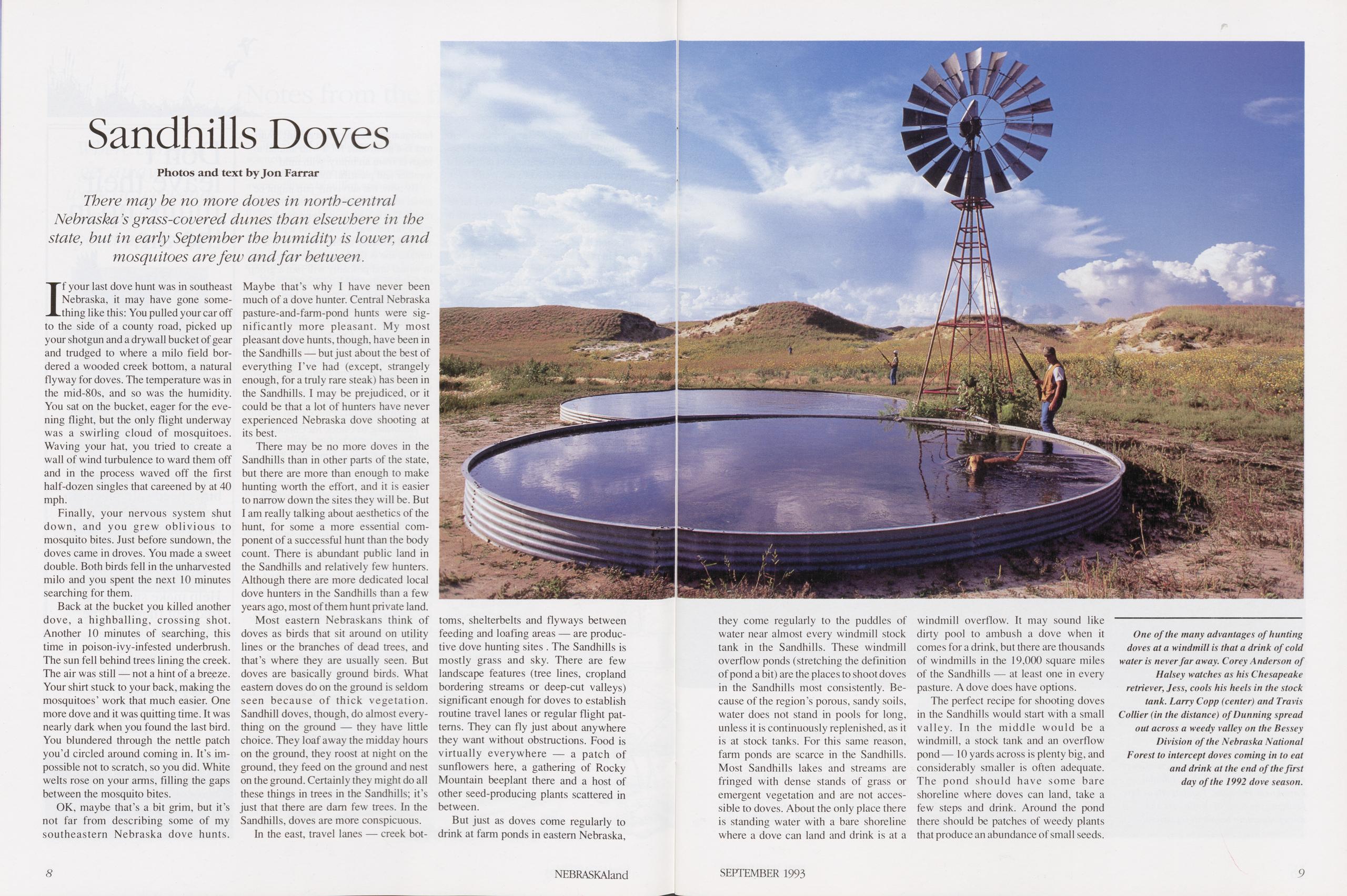
One of the many advantages of hunting doves at a windmill is that a drink of cold water is never far away. Corey Anderson of Halsey watches as his Chesapeake retriever, Jess, cools his heels in the stock tank. Larry Copp (center) and Travis Collier (in the distance) of Dunning spread out across a weedy valley on the Bessey Division of the Nebraska National Forest to intercept doves coming in to eat and drink at the end of the first day of the 1992 dove season.
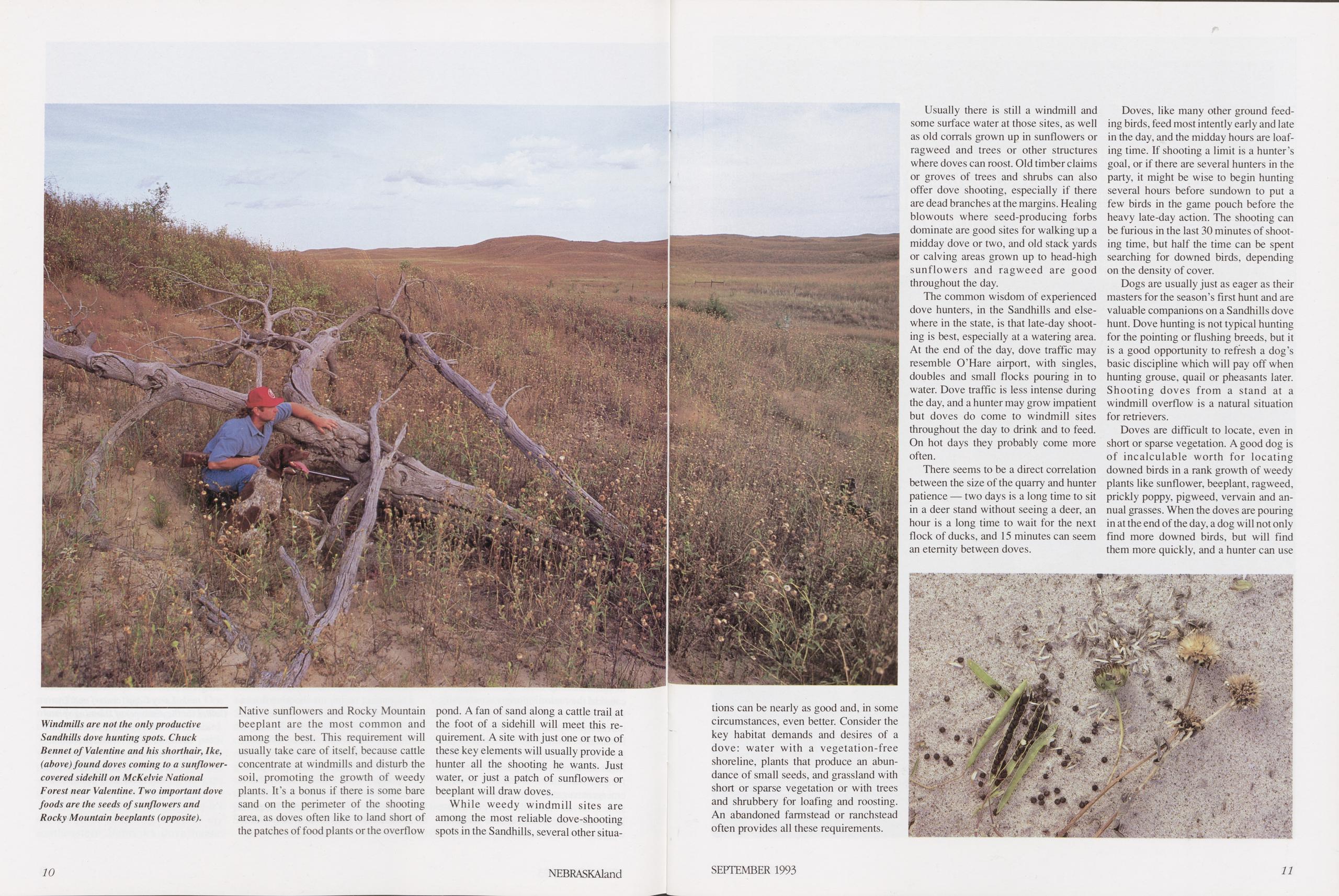
Windmills are not the only productive Sandhills dove hunting spots. Chuck Bennet of Valentine and his shorthair, Ike, (above) found doves coming to a sunflower- covered sidehill on McKelvie National Forest near Valentine. Two important dove foods are the seeds of sunflowers and Rocky Mountain beeplants (opposite).
Native sunflowers and Rocky Mountain beeplant are the most common and among the best. This requirement will usually take care of itself, because cattle concentrate at windmills and disturb the soil, promoting the growth of weedy plants. It’s a bonus if there is some bare sand on the perimeter of the shooting area, as doves often like to land short of the patches of food plants or the overflow pond. A fan of sand along a cattle trail at the foot of a sidehill will meet this requirement. A site with just one or two of these key elements will usually provide a hunter all the shooting he wants. Just water, or just a patch of sunflowers or beeplant will draw doves.
While weedy windmill sites are among the most reliable dove-shooting spots in the Sandhills, several other situations can be nearly as good and, in some circumstances, even better. Consider the key habitat demands and desires of a dove: water with a vegetation-free shoreline, plants that produce an abundance of small seeds, and grassland with short or sparse vegetation or with trees and shrubbery for loafing and roosting. An abandoned farmstead or ranchstead often provides all these requirements.
Usually there is still a windmill and some surface water at those sites, as well as old corrals grown up in sunflowers or ragweed and trees or other structures where doves can roost. Old timber claims or groves of trees and shrubs can also offer dove shooting, especially if there are dead branches at the margins. Healing blowouts where seed-producing forbs dominate are good sites for walking up a midday dove or two, and old stack yards or calving areas grown up to head-high sunflowers and ragweed are good throughout the day.
The common wisdom of experienced dove hunters, in the Sandhills and elsewhere in the state, is that late-day shooting is best, especially at a watering area. At the end of the day, dove traffic may resemble O’Hare airport, with singles, doubles and small flocks pouring in to water. Dove traffic is less intense during the day, and a hunter may grow impatient but doves do come to windmill sites throughout the day to drink and to feed. On hot days they probably come more often.
There seems to be a direct correlation between the size of the quarry and hunter patience — two days is a long time to sit in a deer stand without seeing a deer, an hour is a long time to wait for the next flock of ducks, and 15 minutes can seem an eternity between doves.
Doves, like many other ground feeding birds, feed most intently early and late in the day, and the midday hours are loafing time. If shooting a limit is a hunter’s goal, or if there are several hunters in the party, it might be wise to begin hunting several hours before sundown to put a few birds in the game pouch before the heavy late-day action. The shooting can be furious in the last 30 minutes of shooting time, but half the time can be spent searching for downed birds, depending on the density of cover.
Dogs are usually just as eager as their masters for the season’s first hunt and are valuable companions on a Sandhills dove hunt. Dove hunting is not typical hunting for the pointing or flushing breeds, but it is a good opportunity to refresh a dog’s basic discipline which will pay off when hunting grouse, quail or pheasants later. Shooting doves from a stand at a windmill overflow is a natural situation for retrievers.
Doves are difficult to locate, even in short or sparse vegetation. A good dog is of incalculable worth for locating downed birds in a rank growth of weedy plants like sunflower, beeplant, ragweed, prickly poppy, pigweed, vervain and annual grasses. When the doves are pouring in at the end of the day, a dog will not only find more downed birds, but will find them more quickly, and a hunter can use
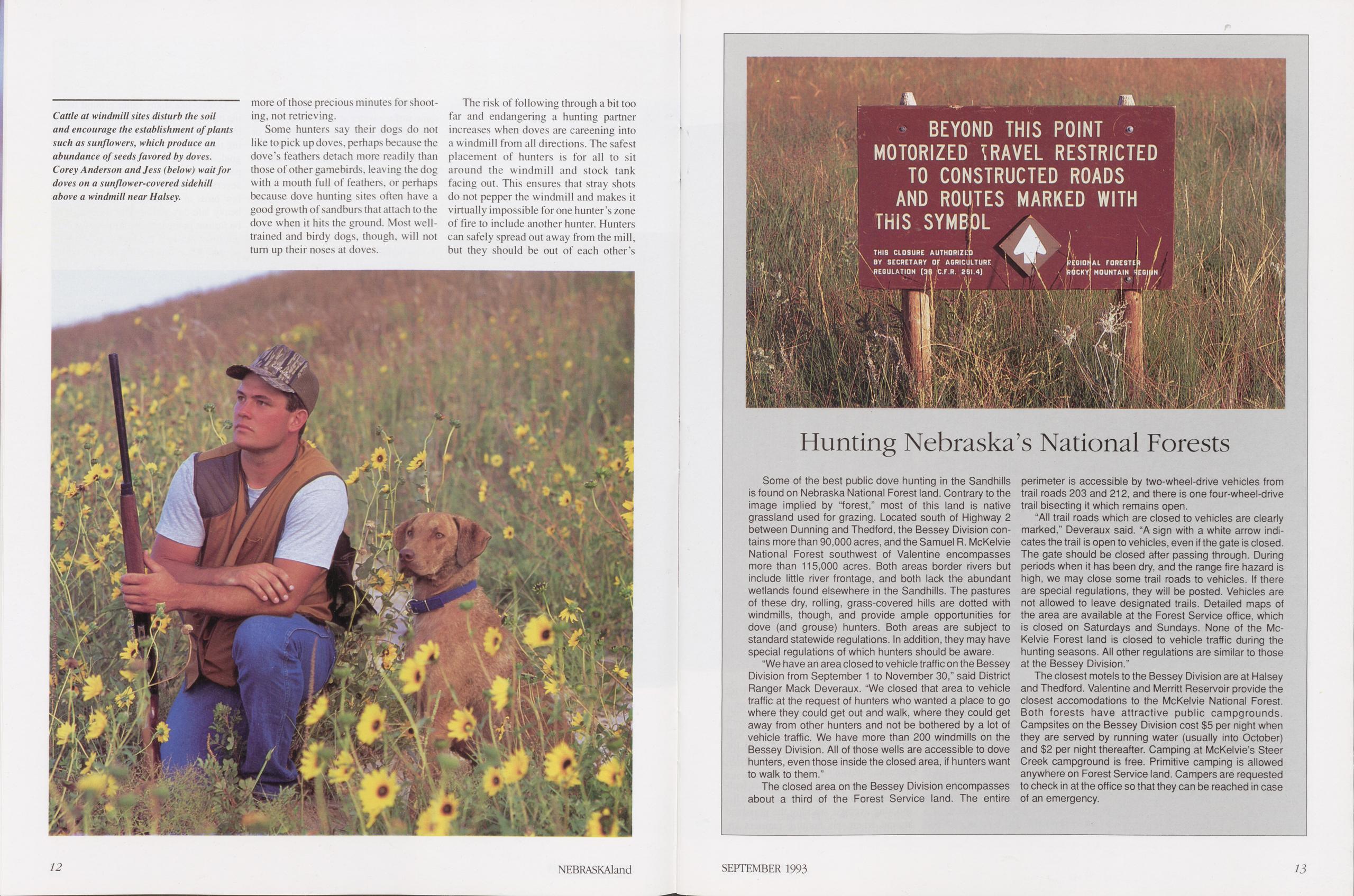
Cattle at windmill sites disturb the soil and encourage the establishment of plants such as sunflowers, which produce an abundance of seeds favored by doves. Corey Anderson and Jess (below) wait for doves on a sunflower-covered sidehill above a windmill near Halsey.
more of those precious minutes for shooting, not retrieving.
Some hunters say their dogs do not like to pick up doves, perhaps because the dove’s feathers detach more readily than those of other gamebirds, leaving the dog with a mouth full of feathers, or perhaps because dove hunting sites often have a good growth of sandburs that attach to the dove when it hits the ground. Most well- trained and birdy dogs, though, will not turn up their noses at doves.
The risk of following through a bit too far and endangering a hunting partner increases when doves are careening into a windmill from all directions. The safest placement of hunters is for all to sit around the windmill and stock tank facing out. This ensures that stray shots do not pepper the windmill and makes it virtually impossible for one hunter’s zone of fire to include another hunter. Hunters can safely spread out away from the mill, but they should be out of each other’s
12 NEBRASKAlandHunting Nebraska’s National Forests
Some of the best public dove hunting in the Sandhills is found on Nebraska National Forest land. Contrary to the image implied by “forest,” most of this land is native grassland used for grazing. Located south of Highway 2 between Dunning and Thedford, the Bessey Division contains more than 90,000 acres, and the Samuel R. McKelvie National Forest southwest of Valentine encompasses more than 115,000 acres. Both areas border rivers but include little river frontage, and both lack the abundant wetlands found elsewhere in the Sandhills. The pastures of these dry, rolling, grass-covered hills are dotted with windmills, though, and provide ample opportunities for dove (and grouse) hunters. Both areas are subject to standard statewide regulations. In addition, they may have special regulations of which hunters should be aware.
“We have an area closed to vehicle traffic on the Bessey Division from September 1 to November 30,” said District Ranger Mack Deveraux. “We closed that area to vehicle traffic at the request of hunters who wanted a place to go where they could get out and walk, where they could get away from other hunters and not be bothered by a lot of vehicle traffic. We have more than 200 windmills on the Bessey Division. All of those wells are accessible to dove hunters, even those inside the closed area, if hunters want to walk to them.”
The closed area on the Bessey Division encompasses about a third of the Forest Service land. The entire perimeter is accessible by two-wheel-drive vehicles from trail roads 203 and 212, and there is one four-wheel-drive trail bisecting it which remains open.
“All trail roads which are closed to vehicles are clearly marked,” Deveraux said. “A sign with a white arrow indicates the trail is open to vehicles, even if the gate is closed. The gate should be closed after passing through. During periods when it has been dry, and the range fire hazard is high, we may close some trail roads to vehicles. If there are special regulations, they will be posted. Vehicles are not allowed to leave designated trails. Detailed maps of the area are available at the Forest Service office, which is closed on Saturdays and Sundays. None of the McKelvie Forest land is closed to vehicle traffic during the hunting seasons. All other regulations are similar to those at the Bessey Division.”
The closest motels to the Bessey Division are at Halsey and Thedford. Valentine and Merritt Reservoir provide the closest accomodations to the McKelvie National Forest. Both forests have attractive public campgrounds. Campsites on the Bessey Division cost $5 per night when they are served by running water (usually into October) and $2 per night thereafter. Camping at McKelvie’s Steer Creek campground is free. Primitive camping is allowed anywhere on Forest Service land. Campers are requested to check in at the office so that they can be reached in case of an emergency.
SEPTEMBER 1993 13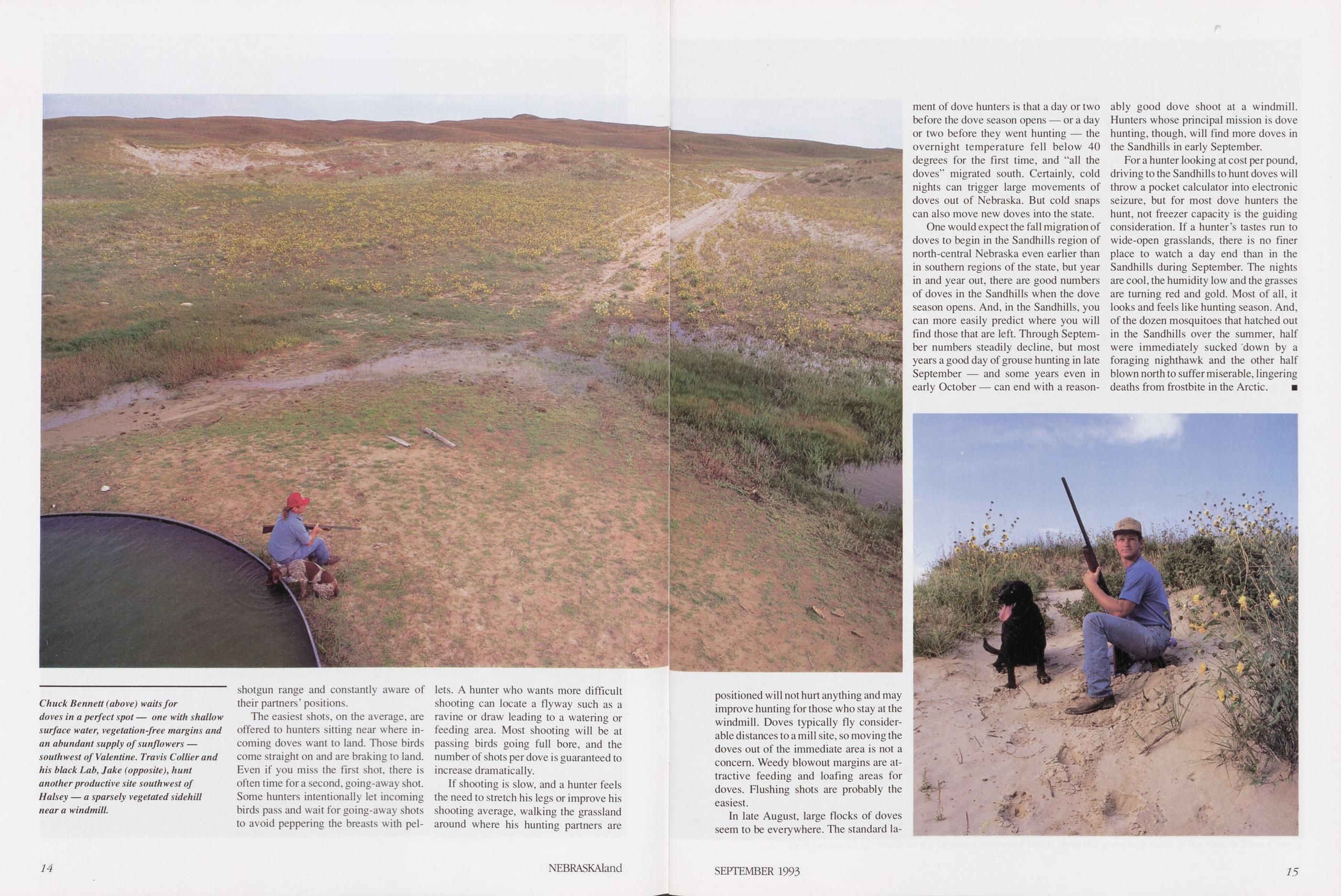
Chuck Bennett (above) waits for doves in a perfect spot — one with shallow surface water, vegetation-free margins and an abundant supply of sunflowers — southwest of Valentine. Travis Collierand his black Lab, Jake (opposite), hunt another productive site southwest of Halsey — a sparsely vegetated sidehill near a windmill.
shotgun range and constantly aware of their partners’ positions.
The easiest shots, on the average, are offered to hunters sitting near where incoming doves want to land. Those birds come straight on and are braking to land. Even if you miss the first shot, there is often time for a second, going-away shot. Some hunters intentionally let incoming birds pass and wait for going-away shots to avoid peppering the breasts with pellets. A hunter who wants more difficult shooting can locate a flyway such as a ravine or draw leading to a watering or feeding area. Most shooting will be at passing birds going full bore, and the number of shots per dove is guaranteed to increase dramatically.
If shooting is slow, and a hunter feels the need to stretch his legs or improve his shooting average, walking the grassland around where his hunting partners are positioned will not hurt anything and may improve hunting for those who stay at the windmill. Doves typically fly considerable distances to a mill site, so moving the doves out of the immediate area is not a concern. Weedy blowout margins are attractive feeding and loafing areas for doves. Flushing shots are probably the easiest.
In late August, large flocks of doves seem to be everywhere. The standard lament of dove hunters is that a day or two before the dove season opens — or a day or two before they went hunting — the overnight temperature fell below 40 degrees for the first time, and “all the doves” migrated south. Certainly, cold nights can trigger large movements of doves out of Nebraska. But cold snaps can also move new doves into the state.
One would expect the fall migration of doves to begin in the Sandhills region of north-central Nebraska even earlier than in southern regions of the state, but year in and year out, there are good numbers of doves in the Sandhills when the dove season opens. And, in the Sandhills, you can more easily predict where you will find those that are left. Through September numbers steadily decline, but most years a good day of grouse hunting in late September — and some years even in early October — can end with a reasonably good dove shoot at a windmill. Hunters whose principal mission is dove hunting, though, will find more doves in the Sandhills in early September.
For a hunter looking at cost per pound, driving to the Sandhills to hunt doves will throw a pocket calculator into electronic seizure, but for most dove hunters the hunt, not freezer capacity is the guiding consideration. If a hunter’s tastes run to wide-open grasslands, there is no finer place to watch a day end than in the Sandhills during September. The nights are cool, the humidity low and the grasses are turning red and gold. Most of all, it looks and feels like hunting season. And, of the dozen mosquitoes that hatched out in the Sandhills over the summer, half were immediately sucked down by a foraging nighthawk and the other half blown north to suffer miserable, lingering deaths from frostbite in the Arctic. ■
Pronghorns
Preparation and Pursuit
Hunting antelope with a bow and arrow in western Nebraska’s wide-open terrain takes special dedication, but the spectacular country, challenges and rewards make it worthwhile.Archery pronghorn hunting provides an opportunity to observe a graceful speedster in western Nebraska’s wide-open terrain; it is shivering in a box blind as the sun rises; it is sweating in a pit blind with early season temperatures in the 90s; it is picking cactus spines out of your legs in November that somehow got there in September; it is pleasant camping with friends and family, and it is knowing that you’ve taken on a difficult challenge that will require your best effort.
Hunting pronghorns can be difficult for the beginning bowhunter. Pronghorns’ eyesight, lighting reflexes and the open country where they are found can be frustrating, especially for an archery hunter who has to get close to his or her quarry.
Usually, I prefer a versatile approach to pronghorn hunting stalking, tree stands, ground blinds, pit blinds, flagging, calling, decoying. I try not to get locked into one technique; adaptability has proved to be a valuable asset for most hunters.
Preseason scouting is especially valuable. Bowhunters should try to scout their hunting areas as much as possible — that usually requires a road trip in the off-season, but preseason scouting trips often can be combined with a summer vacation. Permission from the landowner is required, and a landowner’s almost daily observation of the pronghorns in the area can be very helpful as well. Pronghorn movement patterns normally do not change much unless it is extremely dry or extremely wet — then you’ll see some variation between early scouting trips and hunting season.
Try to obtain good maps, topographic maps if possible, to help you understand the terrain. Look for pond locations and basic features of the terrain — draws, natural funnels and hay or alfalfa fields, especially along creek-bottoms.
My first pronghorn hunting experience was primarily stalking I tried to stalk any and all antelope regardless of the terrain, and that was a big mistake. Eventually, I concentrated on stalking antelope only in certain ter rain and wind conditions, and my success quickly increased.
Other hunting methods include tree stands, ground blinds, pit blinds, flagging, predator calls and the use of decoys. All, with the exception of flagging, have produced positive results from time to time under certain condi tions.
If you decide to hunt from a blind, try to locate good sites near water holes, food sources, fenceline crossings or frequently used creek crossings. Bowhunters who take a stand this way should prepare themselves for a long wait comfort is a primary concern. Water, stools and seat cushions, snacks even reading materials can help ease the wait.
I like blinds or stands about 20 yards
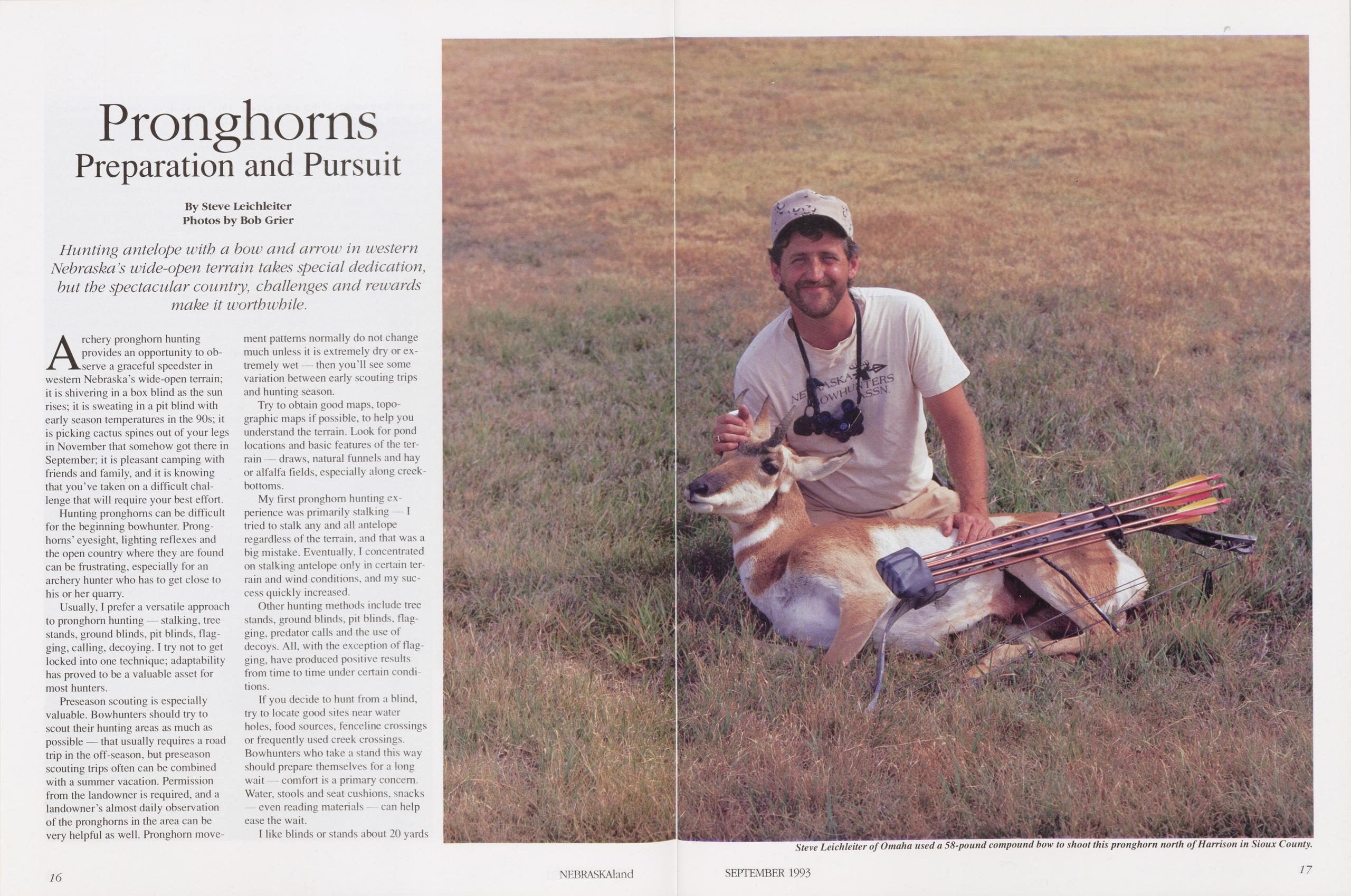
Steve Leichleiter of Omaha used a 58-pound compound bow to shoot this pronghorn north of Harrison in Sioux County.
away from where I anticipate antelope will appear. It is a short enough shot — most bowhunters can make it most of the time — but you are not too close and won’t spook the animal if you move slow and easy.
Sight shooters might want to mark off or flag distances in sight-pin increments away from the blind — placing flags or markers at 10, 20 and 30 yards, for example. For stalking, I’ve found a small range finder is an invaluable aid to getting off an accurate shot. Prong- horns stand out against their backgrounds, and they will often appear much closer than they actually are. In- stinctive shooters have the advantage when it comes to stalking pronghorns — shots often are from low or crouched positions.
For the bowhunter going after pronghorns on the ground, I highly recommend knee pads, light, comfortable boots and leather gloves. Bowhunters crawling on the ground should push their bows ahead of them to alert rattlesnakes of their presence. I carry a snake bite kit and try to find out where the nearest medical facilities are located — just in case.
Bowhunters should practice shooting under conditions as much like actual hunting conditions as possible. Stalkers should practice shooting in open country from crouching and kneeling positions. If you decide to hunt from a blind, practice shooting through its shooting holes — don’t try to shoot over the blind and remember to move slow and easy.
Blinds can be portable or permanent — wire, posts, netting, wood and burlap seem to work well. Pit blinds should blend well with natural surroundings. Blinds must withstand high prairie winds. Windmills and haystacks located in high density pronghorn sites make especially attractive blinds — again, obtain the landowner’s approval before building pit blinds or using windmills or haystacks and avoid placing a blind where it might affect livestock activities. If possible, set the blind in shadows, preferably downwind of the antelope’s routine movement corridors. I prefer to put blinds up in advance of the hunt — preferably a month or two prior to actually hunting, usually during early scouting trips.
Most hunters quickly learn to respect the pronghorn’s sense of smell. Pronghorns will quickly leave an area if they detect human odor. I’ve experimented with different types of scent screens over the years, but trying to stay downwind, bathing as often as possible and wearing clean clothing is probably just as important as using a scent screen. I once took a pronghorn — in fact, it was my first pronghorn — when I thought that the use of a scent screen actually seemed to help.
I’ve also used different patterns of camouflage over the years. Avoid dark camo clothing when stalking antelope. Light colors, especially tans, seem to work well. Dark camo has a place inside a pit blind or a dark, enclosed box blind.
Stalking antelope in open terrain is quite a challenge. You can use a vehicle to locate pronghorn, study the terrain and where the antelope are located in relation to draws, creekbottoms, ridges or any natural features that can be used for cover and help conceal your approach. Park the vehicle safely out of sight before beginning your stalk. I’ve always found it useful to pinpoint the exact place where a bedded antelope is
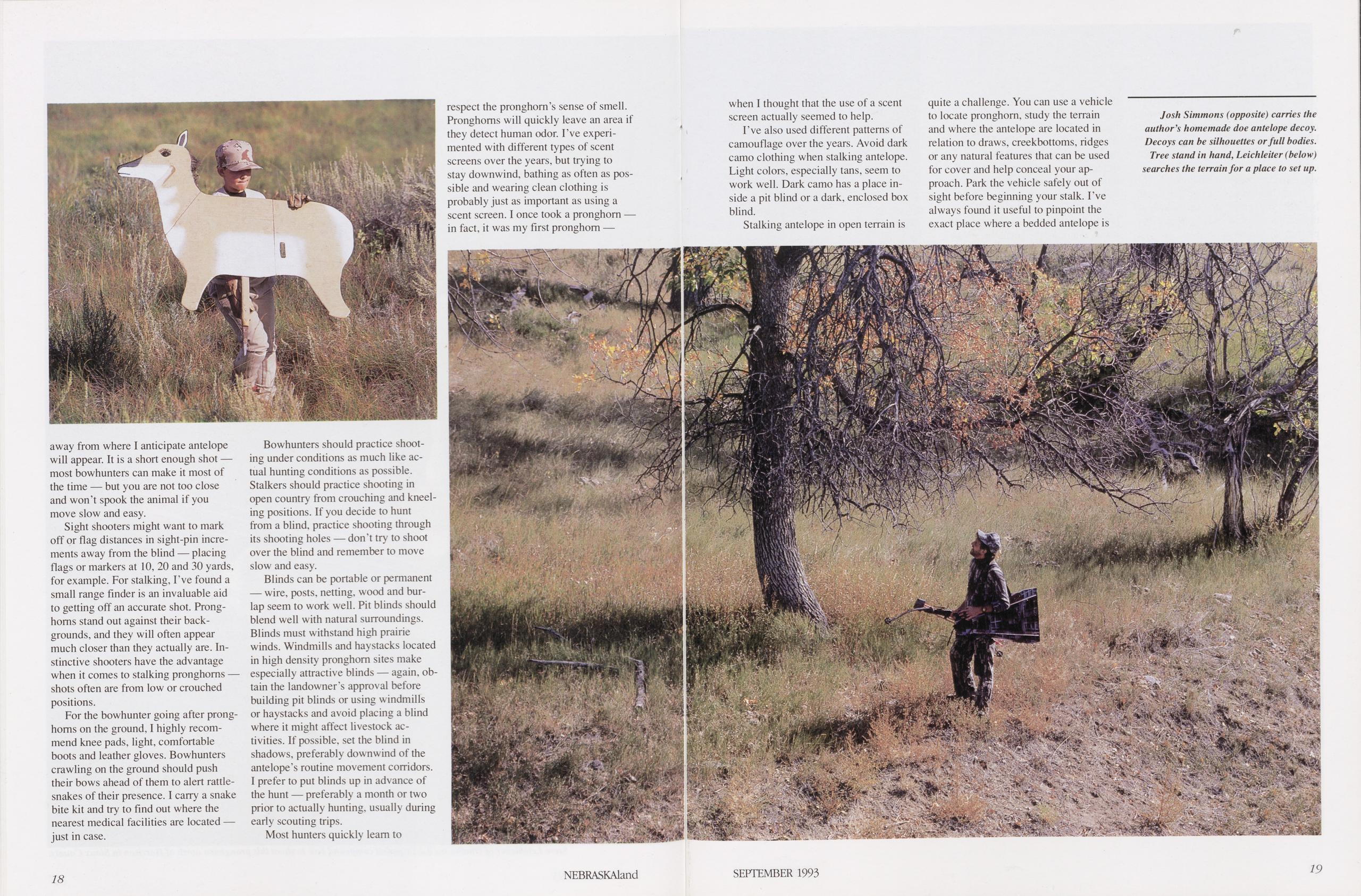
Josh Simmons (opposite) carries the author's homemade doe antelope decoy. Decoys can be silhouettes or full bodies. Tree stand in hand, Leichleiter (below) searches the terrain for a place to set up.
lying, for example, using nearby terrain features as landmarks. Especially valuable is a clump of yucca or a rocky knob above the antelope’s location. Try to make a stalk that brings you around on the downwind side and positions you directly above the antelope.
Some hunters use a technique, usually called “flagging,” that encourages the animal to approach a hunter by exploiting its natural curiosity.
A variation of the flagging technique can be used when stalking pronghorns, although it requires two people. One hunter maps out a stalking route, and the other person acts as a distraction, or “flagger,” a good distance from the pronghorn. This distance can vary depending on how jumpy or pressured the pronghorn are in a particular area; a mile or so is about average.
The flagger can attract the pronghorn’s attention after the stalker has circled into position. It takes good timing, of course, but the flagger can make exaggerated movements and focus the pronghorn’s attention away from the stalking bowhunter. It is a variation on flagging that uses the pronghorn’s curiosity to the bowhunter’s advantage.
Several bowhunters working together also can move antelope through previously scouted escape routes — natural or man-made funnels or fence crossings — but this is a technique of last resort. Shots are almost always at moving animals.
Predator calls can be used to lure pronghorns into bow range, especially if you can make the small, bleating sounds of the pronghorn buck. I’ve had good results using predator calls and mouth calling — good backup techniques when pronghorns are just out of bow range and no other option is avail- able. Keep the sounds soft —just loud enough to attract the pronghorn’s attention — but remember that their atten- tion will be riveted to the source of the sounds, and any movement on your part may send the pronghorn into the next county.
Decoys have been used by pronghorn hunters, and at times they will produce surprisingly well. Native American hunters used hides draped over their backs to lure pronghorns into range. The modem use of decoys probably started with several bowhunters in South Dakota. Decoys can be silhouettes or full bodies, homemade or commercial. Regardless of the hunting technique, wait for the best possible shot. After you hit an antelope, immediately try to get to a high spot to keep the antelope in sight. A well-placed shot will put an antelope down quickly, but their blazing speed and the type of terrain they inhabit also impedes trailing.
Learn from your mistakes. Anytime I fail to get close to pronghorn or lose a shot opportunity I like to take five or 10 minutes to evaluate where things went wrong. Look for mistakes and file the situation away for future reference. If you can learn from mistakes, using what you’ve learned will pay dividends down the road in increased pronghorn shot opportunities.
Pronghorns should be field dressed immediately after the permit tag is attached. Try to provide ventilation and, because early season temperatures can be in the 80s and 90s, place bags of ice inside the carcass while en route to the check station.
Once the antelope has been checked in, I recommend skinning and quartering the animal immediately. The quarters can be placed in cold storage, either in a locker plant or, if your hunt is over and you are ready to head home, in coolers with block ice. I like to use a large, soft-sided cooler; I can put four quarters in it and even several mule deer quarters and with blocks of ice get to my home in Omaha with no problem.
It takes a special dedication to pur- sue pronghorns with a bow and arrow. The travel logistics alone can be a nightmare, especially for someone from eastern Nebraska. Pronghorn hunting can involve lots of vacation time for preseason scouting and the hunt itself, but the spectacular country, challenges and rewards make it worthwhile. ■
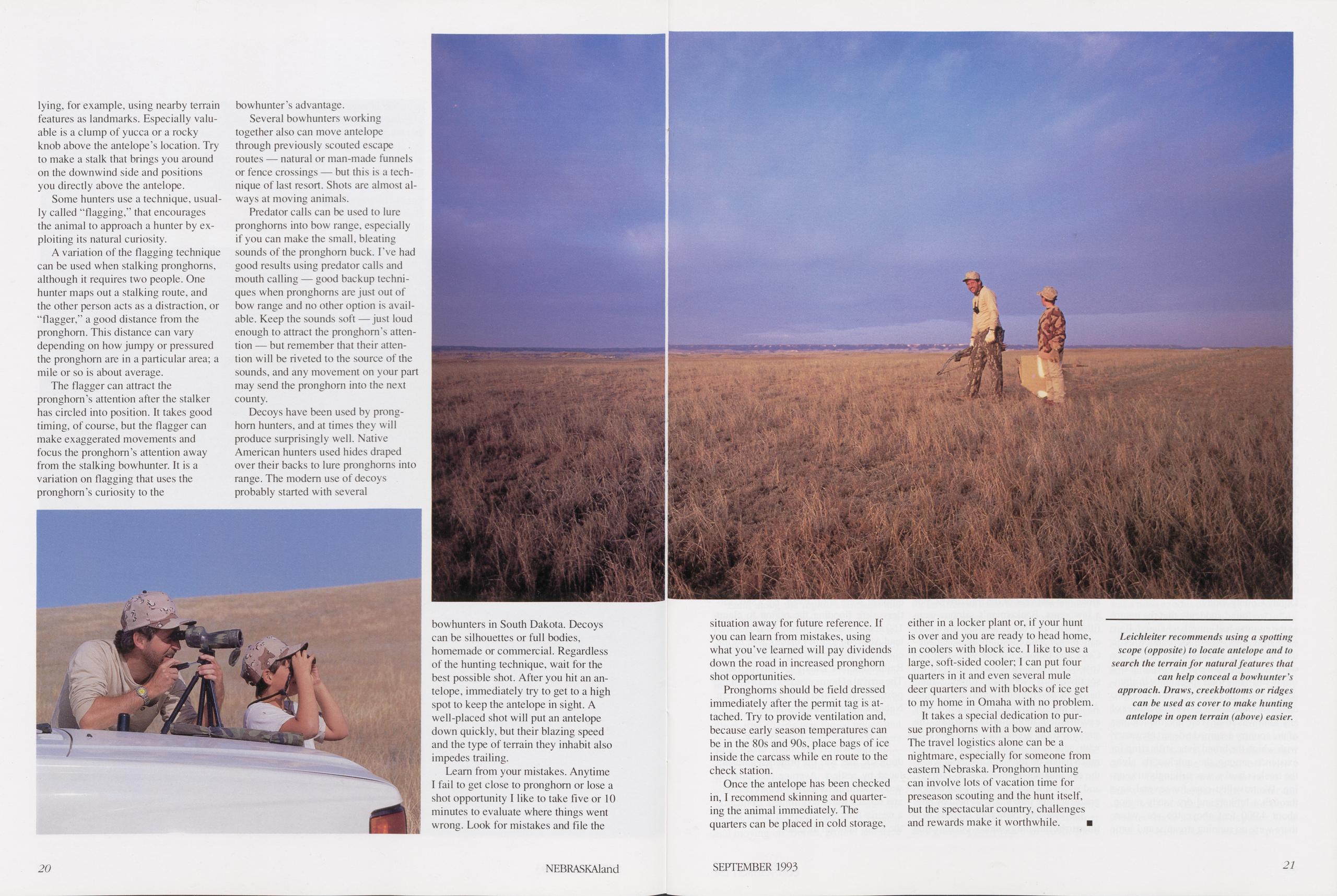
Leichleiter recommends using a spotting scope (opposite) to locate antelope and to search the terrain for natural features that can help conceal a bowhunter’s approach. Draws, creekbottoms or ridges can be used as cover to make hunting antelope in open terrain (above) easier.
Sandsage Prairie
A History of the Land
A century ago, the grass-covered sand dunes of southwestern Nebraska were a grassland unlike any other in the state. Today, only remnants remain among fields of wheat and irrigated corn.John C. Fremont of the U.S. Army Corps of Topographical Engineers was not the first traveler of European descent to encounter the low, sandy hills of what would become Nebraska’s south- western counties. His sparse description, though, is perhaps the first of Nebraska’s sandsage prairie, a grassland type similar to, but distinct from, the sandhills prairie of north-central Nebraska.
On June 23, 1843, Fremont’s expedition camped on Prairie Dog Creek south of present-day Harlan County, Nebraska. After crossing the Republican River he turned west and traveled along its north bank. On June 26, he noted an abrupt change in the landscape. In some details, his description could portray portions of Dundy County today:
"... we found suddenly that the nature of the country had entirely changed. Bare sand hills everywhere surrounded us in the undulating ground along which we were moving; and the plants peculiar to a sandy soil made their appearance in abundance. With the exception of one or two distant and detached groves, no timber of any kind was to be seen; and the features of the country assumed a desert character, with which the broad river, struggling for existence among the quicksands along the treeless banks, was strikingly in keeping. We travelled now for several days through a broken and dry sandy region, about 4,000 feet above the sea, where there were no running streams; and some anxiety was constantly felt on account of the uncertainty of water, which was only to be found in small lakes that occurred occasionally among the hills. The discovery of these always brought pleasure to the camp, as around them were generally green flats, which afforded abundant pasturage for our animals; and here were usually collected herds of buffalo, which now were scattered over all the country in countless numbers.”
By 1876, the buffalo herds south of the Platte River were gone, and cattlemen were bringing stock to graze the Republican River Valley. From 1880 through 1886, Texas cattle were trailed north to Ogallala through Dundy County west of Benkelman — 150,000 in 1886 alone, the last year of the trail drives. For a few years, Benkelman’s saloons were filled with cowboys, and the town was called “the wickedest city between McCook and Denver.” In the years that followed, more ranchers settled in southwestern Nebraska, running their herds on government-owned open range. As in the Sandhills to the north, they established headquarters along the streams, filing homestead claims on land with access to water and having their ranch hands do the same. Without water, the dry uplands were useless to farmers, and so for a while, ranchers were able to graze far more land than they held by title.
Southwestern Nebraska seemed destined to be ranching country, but the cattle empires were short-lived. By 1886, settlers were flooding the region to claim 160 acres of land under the 1862 Homestead Act, their journey made easier by the completion of the Burlington & Missouri Railroad across Dundy County in 1882. The arrival of homesteaders was a turning point in the future of southwestern Nebraska and sandsage prairie.
Water, Water, EverywhereScarce water, for both crops and domestic use, was the principal hardship faced by settlers. Average precipitation was inadequate for the crops they planted, and surface water was limited. Ironically, a nearly limitless supply of water lay in the sands beneath their feet.
Land along the region’s streams, and land with heavier soils better suited for farming, was settled first. By 1887, the only unclaimed land remaining in Dundy County was the sandy hills in the northwestern corner of the county. In the blink of an eye, longhorns had taken the place of buffalo, and just as quickly milk cows, hogs and chickens replaced the longhorns. Prairie was turned under, and crops planted and fenced. Some farmers succeeded, but under great hardship; others failed, but would-be farmers were waiting to buy them out. For some, gathering the bleached buffalo bones left behind by hide hunters made the difference between staying one more year and moving on. Bones, ground and used for fertilizer in eastern states, brought $ 12 a ton, enough money to buy what the land would not produce.
From the beginning it was evident that for farming to succeed consistently, rainfall would have to be supplemented with irrigation. The oldest water appropriation rights on the Republican River were assigned to the Phelan Ditch which began taking water from Rock Creek near Parks in 1882. Local accounts attribute the first irrigation to Jim Nesbit who in that same year dammed Horse Creek near Parks and ran the overflow into ditches to water his vegetable garden.
Drought in the 1890s broke many homesteaders. After the rainless summer and grasshopper plague of 1895, there was a mass exodus of farmers from southwestern Nebraska. By 1900, Dundy County’s population was half what it had been in 1890. While drought convinced many that southwestern Nebraska was not suited for crops, for others it only confirmed the need for a reliable supply of irrigation water. One settler left the following note on the door when he abandoned his Dundy County homestead: "Crops dried up, the nearest water is at the creek 10 miles away, or one mile straight down. Have gone back to my wife’s folks.” In reality, water was never far below the surface, particularly under the sandy soils in western Dundy and Chase counties where it surfaced as ponds. Over most of Nebraska’s sandsage prairie
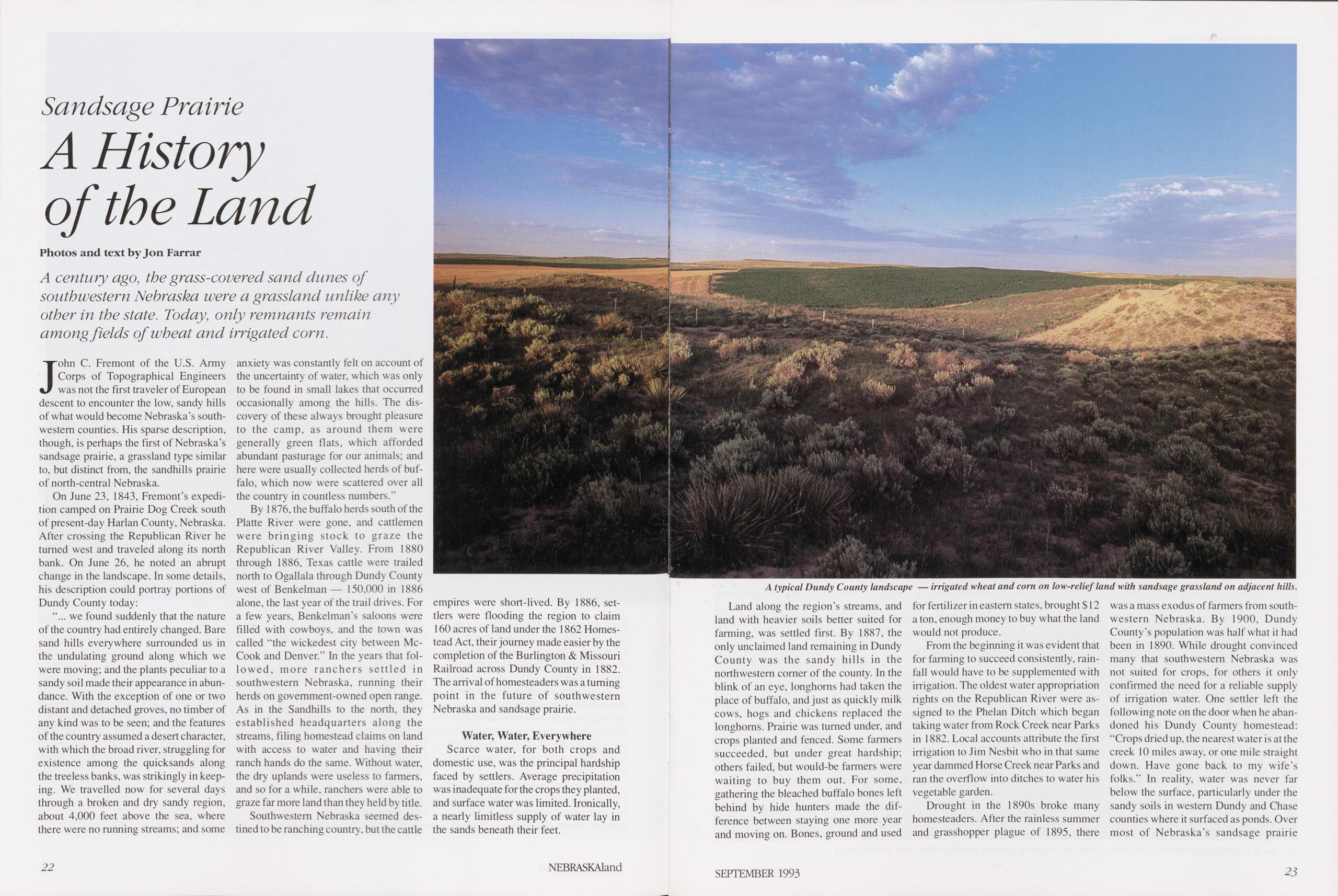
A typical Dundy County landscape -- irrigated wheat and corn on low-relief land with sandsage grassland on adjacent hills.
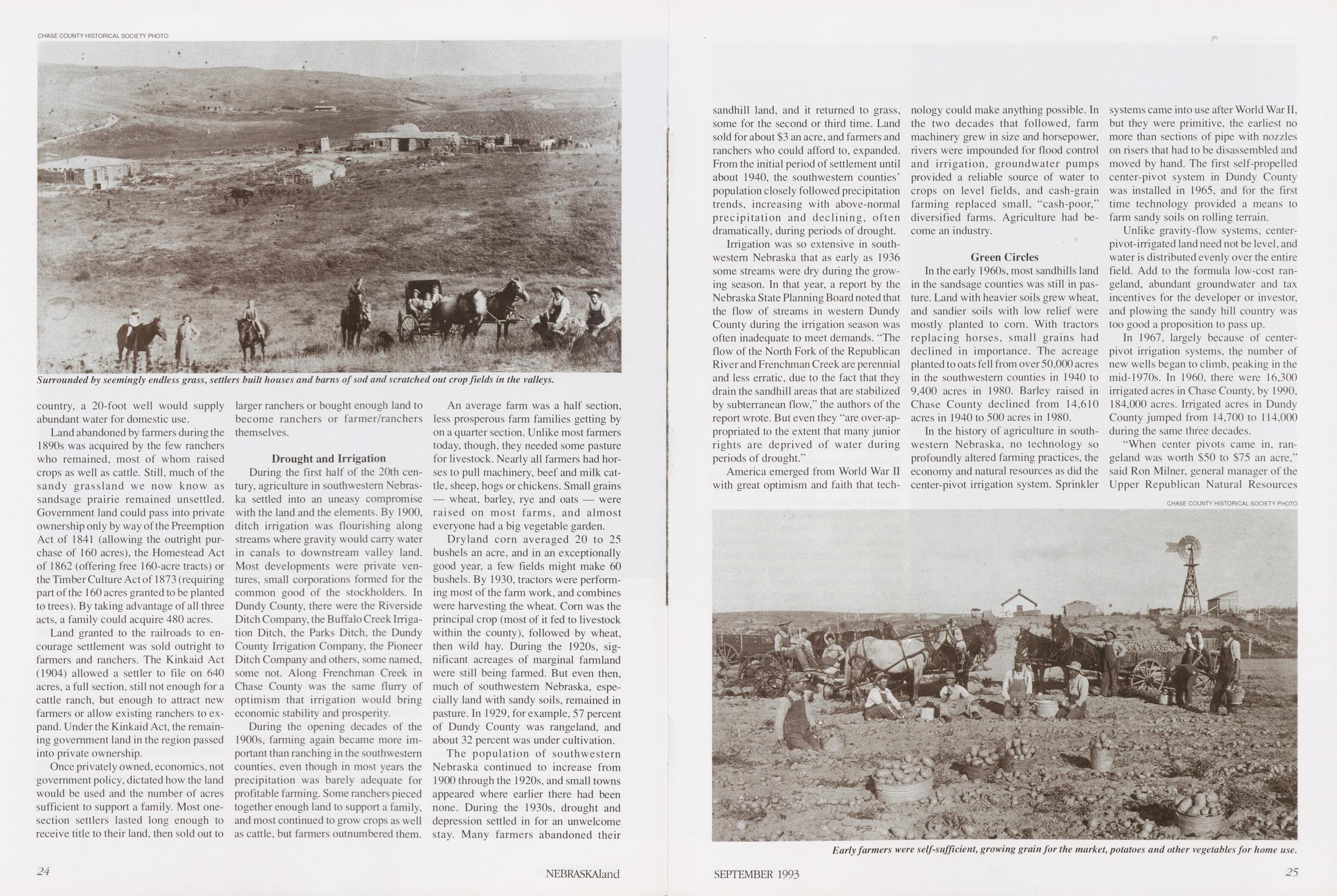
Surrounded by seemingly endless grass, settlers built houses and barns of sod and scratched out crop fields in the valleys.
country, a 20-foot well would supply abundant water for domestic use.
Land abandoned by farmers during the 1890s was acquired by the few ranchers who remained, most of whom raised crops as well as cattle. Still, much of the sandy grassland we now know as sandsage prairie remained unsettled. Government land could pass into private ownership only by way of the Preemption Act of 1841 (allowing the outright purchase of 160 acres), the Homestead Act of 1862 (offering free 160-acre tracts) or the Timber Culture Act of 1873 (requiring part of the 160 acres granted to be planted to trees). By taking advantage of all three acts, a family could acquire 480 acres.
Land granted to the railroads to encourage settlement was sold outright to farmers and ranchers. The Kinkaid Act (1904) allowed a settler to file on 640 acres, a full section, still not enough for a cattle ranch, but enough to attract new farmers or allow existing ranchers to expand. Under the Kinkaid Act, the remaining government land in the region passed into private ownership.
Once privately owned, economics, not government policy, dictated how the land would be used and the number of acres sufficient to support a family. Most one- section settlers lasted long enough to receive title to their land, then sold out to larger ranchers or bought enough land to become ranchers or farmer/ranchers themselves.
Drought and IrrigationDuring the first half of the 20th century, agriculture in southwestern Nebraska settled into an uneasy compromise with the land and the elements. By 1900, ditch irrigation was flourishing along streams where gravity would carry water in canals to downstream valley land. Most developments were private ventures, small corporations formed for the common good of the stockholders. In Dundy County, there were the Riverside Ditch Company, the Buffalo Creek Irrigation Ditch, the Parks Ditch, the Dundy County Irrigation Company, the Pioneer Ditch Company and others, some named, some not. Along Frenchman Creek in Chase County was the same flurry of optimism that irrigation would bring economic stability and prosperity.
During the opening decades of the 1900s, farming again became more important than ranching in the southwestern counties, even though in most years the precipitation was barely adequate for profitable farming. Some ranchers pieced together enough land to support a family, and most continued to grow crops as well as cattle, but farmers outnumbered them.
An average farm was a half section, less prosperous farm families getting by on a quarter section. Unlike most farmers today, though, they needed some pasture for livestock. Nearly all farmers had horses to pull machinery, beef and milk cattle, sheep, hogs or chickens. Small grains — wheat, barley, rye and oats — were raised on most farms, and almost everyone had a big vegetable garden.
Dryland corn averaged 20 to 25 bushels an acre, and in an exceptionally good year, a few fields might make 60 bushels. By 1930, tractors were perform- ing most of the farm work, and combines were harvesting the wheat. Corn was the principal crop (most of it fed to livestock within the county), followed by wheat, then wild hay. During the 1920s, significant acreages of marginal farmland were still being farmed. But even then, much of southwestern Nebraska, especially land with sandy soils, remained in pasture. In 1929, for example, 57 percent of Dundy County was rangeland, and about 32 percent was under cultivation.
The population of southwestern Nebraska continued to increase from 1900 through the 1920s, and small towns appeared where earlier there had been none. During the 1930s, drought and depression settled in for an unwelcome stay. Many farmers abandoned their sandhill land, and it returned to grass, some for the second or third time. Land sold for about $3 an acre, and farmers and ranchers who could afford to, expanded. From the initial period of settlement until about 1940, the southwestern counties’ population closely followed precipitation trends, increasing with above-normal precipitation and declining, often dramatically, during periods of drought.
Irrigation was so extensive in southwestern Nebraska that as early as 1936 some streams were dry during the grow- ing season. In that year, a report by the Nebraska State Planning Board noted that the flow of streams in western Dundy County during the irrigation season was often inadequate to meet demands. "The flow of the North Fork of the Republican River and Frenchman Creek are perennial and less erratic, due to the fact that they drain the sandhill areas that are stabilized by subterranean flow,” the authors of the report wrote. But even they "are over-appropriated to the extent that many junior rights are deprived of water during periods of drought.”
Early farmers were self-sufficient, growing grain for the market, potatoes and other vegetables for home use.
In the early 1960s, most sandhills land in the sandsage counties was still in pasture. Land with heavier soils grew wheat, and sandier soils with low relief were mostly planted to corn. With tractors replacing horses, small grains had declined in importance. The acreage planted to oats fell from over 50,000 acres in the southwestern counties in 1940 to 9,400 acres in 1980. Barley raised in Chase County declined from 14,610 acres in 1940 to 500 acres in 1980.
In the history of agriculture in southwestern Nebraska, no technology so profoundly altered farming practices, the economy and natural resources as did the center-pivot irrigation system. Sprinkler systems came into use after World War II. but they were primitive, the earliest no more than sections of pipe with nozzles on risers that had to be disassembled and moved by hand. The first self-propelled center-pivot system in Dundy County was installed in 1965, and for the first time technology provided a means to farm sandy soils on rolling terrain.
Unlike gravity-flow systems, center- pivot-irrigated land need not be level, and water is distributed evenly over the entire field. Add to the formula low-cost rangeland, abundant groundwater and tax incentives for the developer or investor, and plowing the sandy hill country was too good a proposition to pass up.
In 1967, largely because of center- pivot irrigation systems, the number of new wells began to climb, peaking in the mid-1970s. In 1960, there were 16,300 irrigated acres in Chase County, by 1990, 184,000 acres. Irrigated acres in Dundy County jumped from 14,700 to 114,000 during the same three decades.
"When center pivots came in, rangeland was worth $50 to $75 an acre,” said Ron Milner, general manager of the Upper Republican Natural Resources
24 NEBRASKAland SEPTEMBER 1993 25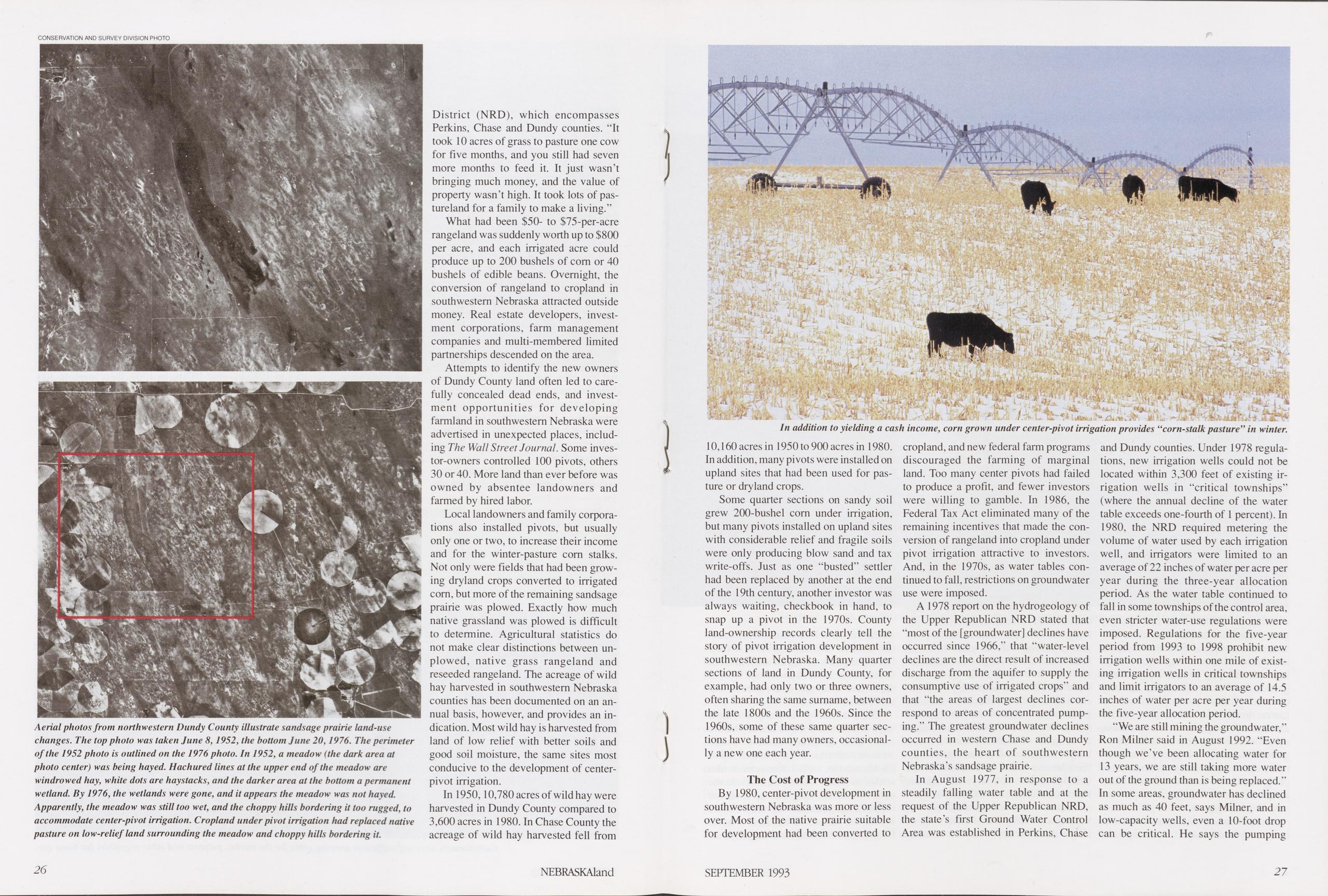
Aerial photos from northwestern Dundy County illustrate sandsage prairie land-use changes. The top photo was taken June 8,1952, the bottom June 20,1976. The perimeter of the 1952 photo is outlined on the 1976 photo. In 1952, a meadow (the dark area at photo center) was being hayed. Hachured lines at the upper end of the meadow are windrowed hay, white dots are haystacks, and the darker area at the bottom a permanent wetland. By 1976, the wetlands were gone, and it appears the meadow was not hayed. Apparently, the meadow was still too wet, and the choppy hills bordering it too rugged, to accommodate center-pivot irrigation. Cropland under pivot irrigation had replaced native pasture on low-relief land surrounding the meadow and choppy hills bordering it.
District (NRD), which encompasses Perkins, Chase and Dundy counties. "It took 10 acres of grass to pasture one cow for five months, and you still had seven more months to feed it. It just wasn’t bringing much money, and the value of property wasn’t high. It took lots of pastureland for a family to make a living.”
What had been $50- to $75-per-acre rangeland was suddenly worth up to $800 per acre, and each irrigated acre could produce up to 200 bushels of com or 40 bushels of edible beans. Overnight, the conversion of rangeland to cropland in southwestern Nebraska attracted outside money. Real estate developers, investment corporations, farm management companies and multi-membered limited partnerships descended on the area.
Attempts to identify the new owners of Dundy County land often led to carefully concealed dead ends, and investment opportunities for developing farmland in southwestern Nebraska were advertised in unexpected places, including The Wall Street Journal. Some investor-owners controlled 100 pivots, others 30 or 40. More land than ever before was owned by absentee landowners and farmed by hired labor.
Local landowners and family corporations also installed pivots, but usually only one or two, to increase their income and for the winter-pasture corn stalks. Not only were fields that had been growing dryland crops converted to irrigated com, but more of the remaining sandsage prairie was plowed. Exactly how much native grassland was plowed is difficult to determine. Agricultural statistics do not make clear distinctions between unplowed, native grass rangeland and reseeded rangeland. The acreage of wild hay harvested in southwestern Nebraska counties has been documented on an annual basis, however, and provides an indication. Most wild hay is harvested from land of low relief with better soils and good soil moisture, the same sites most conducive to the development of center- pivot irrigation.
In addition to yielding a cash income, corn grown under center-pivot irrigation provides “corn-stalk pasture” in winter.
Some quarter sections on sandy soil grew 200-bushel corn under irrigation, but many pivots installed on upland sites with considerable relief and fragile soils were only producing blow sand and tax write-offs. Just as one "busted” settler had been replaced by another at the end of the 19th century, another investor was always waiting, checkbook in hand, to snap up a pivot in the 1970s. County land-ownership records clearly tell the story of pivot irrigation development in southwestern Nebraska. Many quarter sections of land in Dundy County, for example, had only two or three owners, often sharing the same surname, between the late 1800s and the 1960s. Since the 1960s, some of these same quarter sections have had many owners, occasional- ly a new one each year.
The Cost of ProgressBy 1980, center-pivot development in southwestern Nebraska was more or less over. Most of the native prairie suitable for development had been converted to cropland, and new federal farm programs discouraged the farming of marginal land. Too many center pivots had failed to produce a profit, and fewer investors were willing to gamble. In 1986, the Federal Tax Act eliminated many of the remaining incentives that made the conversion of rangeland into cropland under pivot irrigation attractive to investors. And, in the 1970s, as water tables continued to fall, restrictions on groundwater use were imposed.
A 1978 report on the hydrogeology of the Upper Republican NRD stated that "most of the [groundwater] declines have occurred since 1966,” that "water-level declines are the direct result of increased discharge from the aquifer to supply the consumptive use of irrigated crops” and that "the areas of largest declines cor- respond to areas of concentrated pumping.” The greatest ground water declines occurred in western Chase and Dundy counties, the heart of southwestern Nebraska’s sandsage prairie.
In August 1977, in response to a steadily falling water table and at the request of the Upper Republican NRD, the state’s first Ground Water Control Area was established in Perkins, Chase and Dundy counties. Under 1978 regulations, new irrigation wells could not be located within 3,300 feet of existing irrigation wells in "critical townships” (where the annual decline of the water table exceeds one-fourth of 1 percent). In 1980, the NRD required metering the volume of water used by each irrigation well, and irrigators were limited to an average of 22 inches of water per acre per year during the three-year allocation period. As the water table continued to fall in some townships of the control area, even stricter water-use regulations were imposed. Regulations for the five-year period from 1993 to 1998 prohibit new irrigation wells within one mile of existing irrigation wells in critical townships and limit irrigators to an average of 14.5 inches of water per acre per year during the five-year allocation period.
"We are still mining the groundwater,” Ron Milner said in August 1992. "Even though we’ve been allocating water for 13 years, we are still taking more water out of the ground than is being replaced.” In some areas, groundwater has declined as much as 40 feet, says Milner, and in low-capacity wells, even a 10-foot drop can be critical. He says the pumping
26 NEBRASKAland SEPTEMBER 1993 27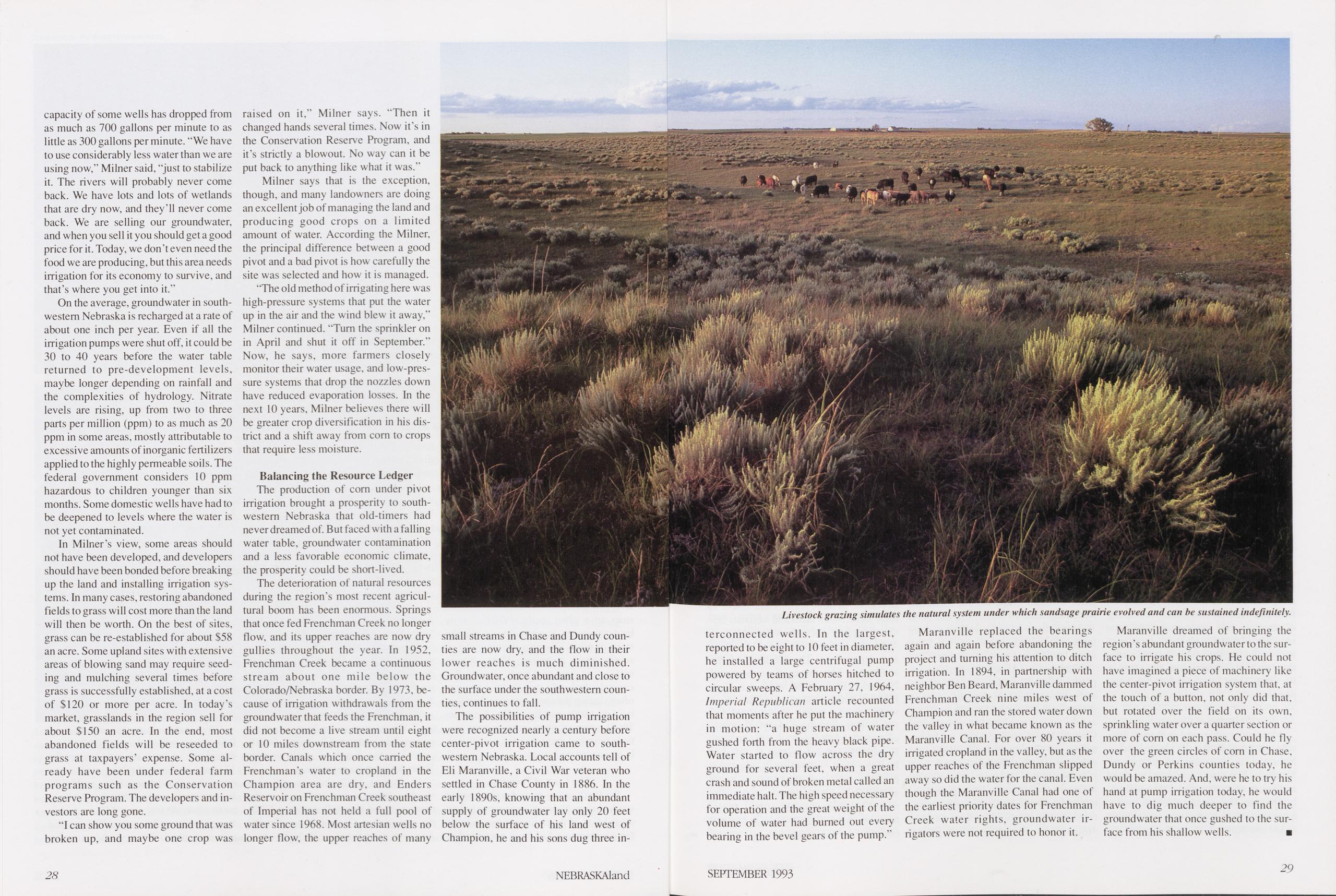
capacity of some wells has dropped from as much as 700 gallons per minute to as little as 300 gallons per minute. “We have to use considerably less water than we are using now,” Milner said, “just to stabilize it. The rivers will probably never come back. We have lots and lots of wetlands that are dry now, and they’ll never come back. We are selling our groundwater, and when you sell it you should get a good price for it. Today, we don’t even need the food we are producing, but this area needs irrigation for its economy to survive, and that’s where you get into it.”
On the average, groundwater in southwestern Nebraska is recharged at a rate of about one inch per year. Even if all the irrigation pumps were shut off, it could be 30 to 40 years before the water table returned to pre-development levels, maybe longer depending on rainfall and the complexities of hydrology. Nitrate levels are rising, up from two to three parts per million (ppm) to as much as 20 ppm in some areas, mostly attributable to excessive amounts of inorganic fertilizers applied to the highly permeable soils. The federal government considers 10 ppm hazardous to children younger than six months. Some domestic wells have had to be deepened to levels where the water is not yet contaminated.
In Milner’s view, some areas should not have been developed, and developers should have been bonded before breaking up the land and installing irrigation systems. In many cases, restoring abandoned fields to grass will cost more than the land will then be worth. On the best of sites, grass can be re-established for about $58 an acre. Some upland sites with extensive areas of blowing sand may require seeding and mulching several times before grass is successfully established, at a cost of $120 or more per acre. In today’s market, grasslands in the region sell for about $150 an acre. In the end, most abandoned fields will be reseeded to grass at taxpayers’ expense. Some already have been under federal farm programs such as the Conservation Reserve Program. The developers and investors are long gone.
“I can show you some ground that was broken up, and maybe one crop was raised on it,” Milner says. “Then it changed hands several times. Now it’s in the Conservation Reserve Program, and it’s strictly a blowout. No way can it be put back to anything like what it was.”
Milner says that is the exception, though, and many landowners are doing an excellent job of managing the land and producing good crops on a limited amount of water. According the Milner, the principal difference between a good pivot and a bad pivot is how carefully the site was selected and how it is managed.
“The old method of irrigating here was high-pressure systems that put the water up in the air and the wind blew it away,” Milner continued. “Turn the sprinkler on in April and shut it off in September.” Now, he says, more farmers closely monitor their water usage, and low-pressure systems that drop the nozzles down have reduced evaporation losses. In the next 10 years, Milner believes there will be greater crop diversification in his dis- trict and a shift away from com to crops that require less moisture.
Balancing the Resource LedgerThe production of com under pivot irrigation brought a prosperity to southwestern Nebraska that old-timers had never dreamed of. But faced with a falling water table, groundwater contamination and a less favorable economic climate, the prosperity could be short-lived.
The deterioration of natural resources during the region’s most recent agricultural boom has been enormous. Springs that once fed Frenchman Creek no longer flow, and its upper reaches are now dry gullies throughout the year. In 1952, Frenchman Creek became a continuous stream about one mile below the Colorado/Nebraska border. By 1973, because of irrigation withdrawals from the groundwater that feeds the Frenchman, it did not become a live stream until eight or 10 miles downstream from the state border. Canals which once carried the Frenchman’s water to cropland in the Champion area are dry, and Enders Reservoir on Frenchman Creek southeast of Imperial has not held a full pool of water since 1968. Most artesian wells no longer flow, the upper reaches of many small streams in Chase and Dundy counties are now dry, and the flow in their lower reaches is much diminished. Groundwater, once abundant and close to the surface under the southwestern counties, continues to fall.
Livestock grazing simulates the natural system under which sandsage prairie evolved and can be sustained indefinitely.
Maranville replaced the bearings again and again before abandoning the project and turning his attention to ditch irrigation. In 1894, in partnership with neighbor Ben Beard, Maranville dammed Frenchman Creek nine miles west of Champion and ran the stored water down the valley in what became known as the Maranville Canal. For over 80 years it irrigated cropland in the valley, but as the upper reaches of the Frenchman slipped away so did the water for the canal. Even though the Maranville Canal had one of the earliest priority dates for Frenchman Creek water rights, groundwater irrigators were not required to honor it.
Maranville dreamed of bringing the region’s abundant groundwater to the surface to irrigate his crops. He could not have imagined a piece of machinery like the center-pivot irrigation system that, at the touch of a button, not only did that, but rotated over the field on its own, sprinkling water over a quarter section or more of corn on each pass. Could he fly over the green circles of corn in Chase, Dundy or Perkins counties today, he would be amazed. And, were he to try his hand at pump irrigation today, he would have to dig much deeper to find the groundwater that once gushed to the surface from his shallow wells. ■
28 NEBRASKAland SEPTEMBER 1993 29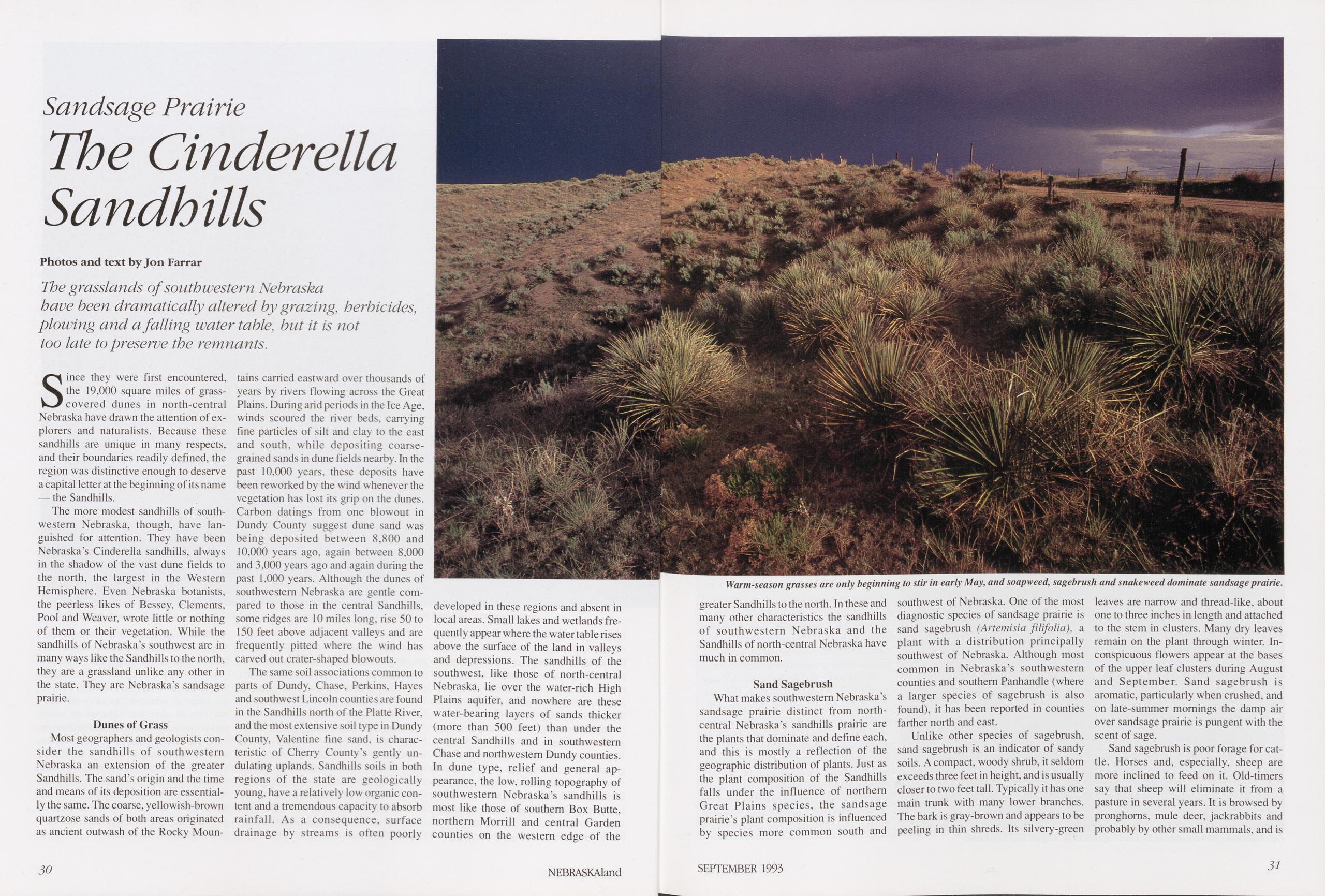
Sandsage Prairie
The Cinderella Sandhills
The grasslands of southwestern Nebraska have been dramatically altered by grazing, herbicides, plowing and a falling water table, but it is not too late to preserve the remnants.Since they were first encountered, the 19,000 square miles of grass- covered dunes in north-central Nebraska have drawn the attention of explorers and naturalists. Because these sandhills are unique in many respects, and their boundaries readily defined, the region was distinctive enough to deserve a capital letter at the beginning of its name — the Sandhills.
The more modest sandhills of southwestern Nebraska, though, have languished for attention. They have been Nebraska’s Cinderella sandhills, always in the shadow of the vast dune fields to the north, the largest in the Western Hemisphere. Even Nebraska botanists, the peerless likes of Bessey, Clements, Pool and Weaver, wrote little or nothing of them or their vegetation. While the sandhills of Nebraska’s southwest are in many ways like the Sandhills to the north, they are a grassland unlike any other in the state. They are Nebraska’s sandsage prairie.
Dunes of GrassMost geographers and geologists consider the sandhills of southwestern Nebraska an extension of the greater Sandhills. The sand’s origin and the time and means of its deposition are essential- ly the same. The coarse, yellowish-brown quartzose sands of both areas originated as ancient outwash of the Rocky Mountains carried eastward over thousands of years by rivers flowing across the Great Plains. During arid periods in the Ice Age, winds scoured the river beds, carrying fine particles of silt and clay to the east and south, while depositing coarse- grained sands in dune fields nearby. In the past 10,000 years, these deposits have been reworked by the wind whenever the vegetation has lost its grip on the dunes. Carbon datings from one blowout in Dundy County suggest dune sand was being deposited between 8,800 and 10,000 years ago, again between 8,000 and 3,000 years ago and again during the past 1,000 years. Although the dunes of southwestern Nebraska are gentle compared to those in the central Sandhills, some ridges are 10 miles long, rise 50 to 150 feet above adjacent valleys and are frequently pitted where the wind has carved out crater-shaped blowouts.
Warm-season grasses are only beginning to stir in early May, and soapweed, sagebrush and snakeweed dominate sandsage prairie.
What makes southwestern Nebraska’s sandsage prairie distinct from northcentral Nebraska’s sandhills prairie are the plants that dominate and define each, and this is mostly a reflection of the geographic distribution of plants. Just as the plant composition of the Sandhills falls under the influence of northern Great Plains species, the sandsage prairie’s plant composition is influenced by species more common south and southwest of Nebraska. One of the most diagnostic species of sandsage prairie is sand sagebrush (Artemisia filifolia), a plant with a distribution principally southwest of Nebraska. Although most common in Nebraska’s southwestern counties and southern Panhandle (where a larger species of sagebrush is also found), it has been reported in counties farther north and east.
Unlike other species of sagebrush, sand sagebrush is an indicator of sandy soils. A compact, woody shrub, it seldom exceeds three feet in height, and is usually closer to two feet tall. Typically it has one main trunk with many lower branches. The bark is gray-brown and appears to be peeling in thin shreds. Its silvery-green leaves are narrow and thread-like, about one to three inches in length and attached to the stem in clusters. Many dry leaves remain on the plant through winter. Inconspicuous flowers appear at the bases of the upper leaf clusters during August and September. Sand sagebrush is aromatic, particularly when crushed, and on late-summer mornings the damp air over sandsage prairie is pungent with the scent of sage.
Sand sagebrush is poor forage for cattle. Horses and, especially, sheep are more inclined to feed on it. Old-timers say that sheep will eliminate it from a pasture in several years. It is browsed by pronghorns, mule deer, jackrabbits and probably by other small mammals, and is
30 NEBRASKAland SEPTEMBER 1993 31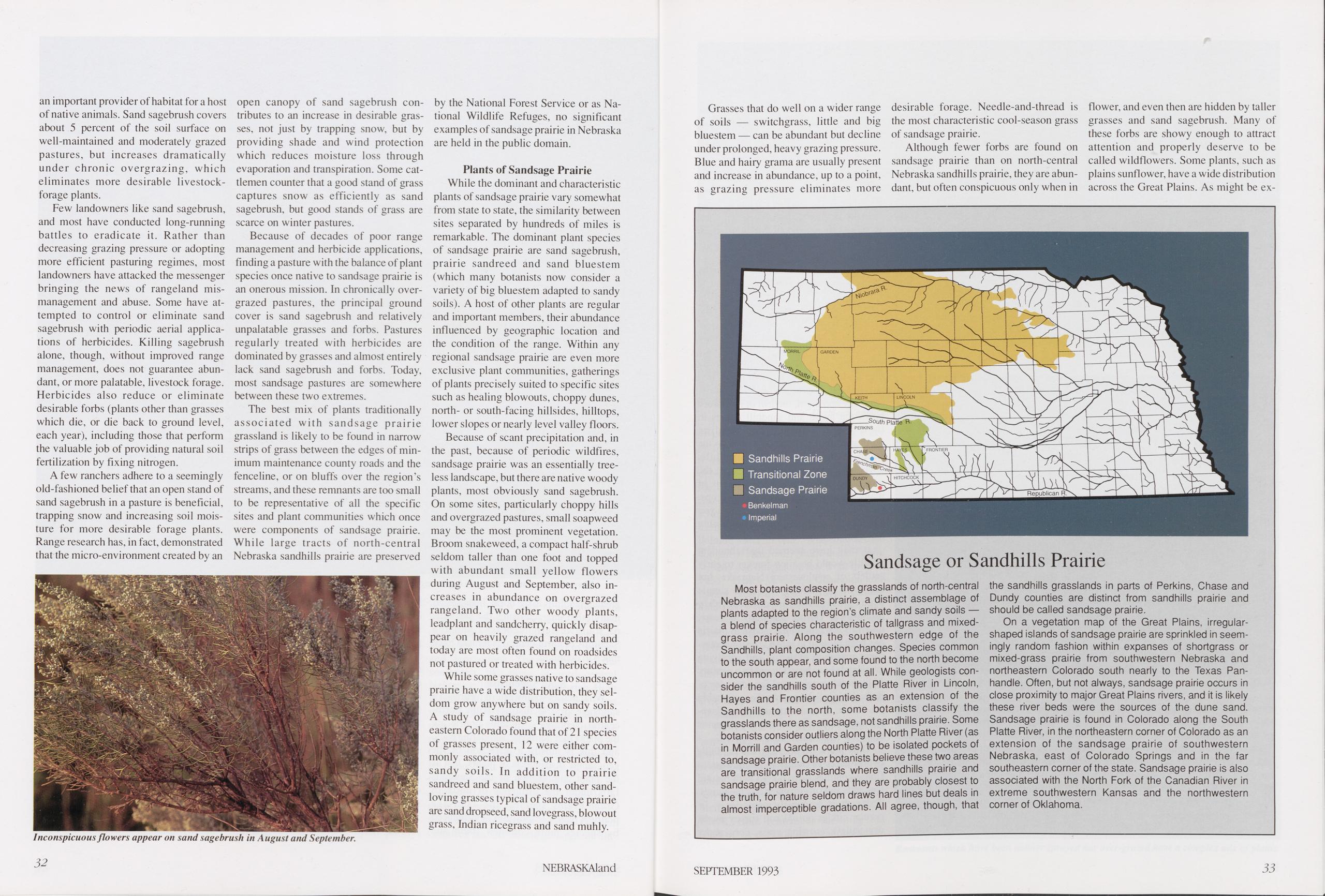
an important provider of habitat for a host of native animals. Sand sagebrush covers about 5 percent of the soil surface on well-maintained and moderately grazed pastures, but increases dramatically under chronic overgrazing, which eliminates more desirable livestock- forage plants.
Few landowners like sand sagebrush, and most have conducted long-running battles to eradicate it. Rather than decreasing grazing pressure or adopting more efficient pasturing regimes, most landowners have attacked the messenger bringing the news of rangeland mismanagement and abuse. Some have attempted to control or eliminate sand sagebrush with periodic aerial applications of herbicides. Killing sagebrush alone, though, without improved range management, does not guarantee abundant, or more palatable, livestock forage. Herbicides also reduce or eliminate desirable forbs (plants other than grasses which die, or die back to ground level, each year), including those that perform the valuable job of providing natural soil fertilization by fixing nitrogen.
Inconspicuous flowers appear on sand sagebrush in August and September.
Because of decades of poor range management and herbicide applications, finding a pasture with the balance of plant species once native to sandsage prairie is an onerous mission. In chronically over-grazed pastures, the principal ground cover is sand sagebrush and relatively unpalatable grasses and forbs. Pastures regularly treated with herbicides are dominated by grasses and almost entirely lack sand sagebrush and forbs. Today, most sandsage pastures are somewhere between these two extremes.
The best mix of plants traditionally associated with sandsage prairie grassland is likely to be found in narrow strips of grass between the edges of minimum maintenance county roads and the fenceline, or on bluffs over the region’s streams, and these remnants are too small to be representative of all the specific sites and plant communities which once were components of sandsage prairie. While large tracts of north-central Nebraska sandhills prairie are preserved by the National Forest Service or as National Wildlife Refuges, no significant examples of sandsage prairie in Nebraska are held in the public domain.
Plants of Sandsage PrairieWhile the dominant and characteristic plants of sandsage prairie vary somewhat from state to state, the similarity between sites separated by hundreds of miles is remarkable. The dominant plant species of sandsage prairie are sand sagebrush, prairie sandreed and sand bluestem (which many botanists now consider a variety of big bluestem adapted to sandy soils). A host of other plants are regular and important members, their abundance influenced by geographic location and the condition of the range. Within any regional sandsage prairie are even more exclusive plant communities, gatherings of plants precisely suited to specific sites such as healing blowouts, choppy dunes, north- or south-facing hillsides, hilltops, lower slopes or nearly level valley floors.
Because of scant precipitation and, in the past, because of periodic wildfires, sandsage prairie was an essentially treeless landscape, but there are native woody plants, most obviously sand sagebrush. On some sites, particularly choppy hills and overgrazed pastures, small soapweed may be the most prominent vegetation. Broom snakeweed, a compact half-shrub seldom taller than one foot and topped with abundant small yellow flowers during August and September, also increases in abundance on overgrazed rangeland. Two other woody plants, leadplant and sandcherry, quickly disappear on heavily grazed rangeland and today are most often found on roadsides not pastured or treated with herbicides.
While some grasses native to sandsage prairie have a wide distribution, they seldom grow anywhere but on sandy soils. A study of sandsage prairie in northeastern Colorado found that of 21 species of grasses present, 12 were either commonly associated with, or restricted to, sandy soils. In addition to prairie sandreed and sand bluestem, other sand- loving grasses typical of sandsage prairie are sand dropseed, sand lovegrass, blowout grass, Indian ricegrass and sand muhly.
Grasses that do well on a wider range of soils — switchgrass, little and big bluestem — can be abundant but decline under prolonged, heavy grazing pressure. Blue and hairy grama are usually present and increase in abundance, up to a point, as grazing pressure eliminates more desirable forage. Needle-and-thread is the most characteristic cool-season grass of sandsage prairie.
Although fewer forbs are found on sandsage prairie than on north-central Nebraska sandhills prairie, they are abundant, but often conspicuous only when in flower, and even then are hidden by taller grasses and sand sagebrush. Many of these forbs are showy enough to attract attention and properly deserve to be called wildflowers. Some plants, such as plains sunflower, have a wide distribution across the Great Plains. As might be ex-
Sandhills Prairie Transitional Zone Sandsage Prairie Benkelman Imperial
Sandsage or Sandhills Prairie
Most botanists classify the grasslands of north-central Nebraska as sandhills prairie, a distinct assemblage of plants adapted to the region’s climate and sandy soils — a blend of species characteristic of tailgrass and mixed- grass prairie. Along the southwestern edge of the Sandhills, plant composition changes. Species common to the south appear, and some found to the north become uncommon or are not found at all. While geologists con- sider the sandhills south of the Platte River in Lincoln, Hayes and Frontier counties as an extension of the Sandhills to the north, some botanists classify the grasslands there as sandsage, not sandhills prairie. Some botanists consider outliers along the North Platte River (as in Morrill and Garden counties) to be isolated pockets of sandsage prairie. Other botanists believe these two areas are transitional grasslands where sandhills prairie and sandsage prairie blend, and they are probably closest to the truth, for nature seldom draws hard lines but deals in almost imperceptible gradations. All agree, though, that the sandhills grasslands in parts of Perkins, Chase and Dundy counties are distinct from sandhills prairie and should be called sandsage prairie.
On a vegetation map of the Great Plains, irregular- shaped islands of sandsage prairie are sprinkled in seemingly random fashion within expanses of shortgrass or mixed-grass prairie from southwestern Nebraska and northeastern Colorado south nearly to the Texas Pan- handle. Often, but not always, sandsage prairie occurs in close proximity to major Great Plains rivers, and it is likely these river beds were the sources of the dune sand. Sandsage prairie is found in Colorado along the South Platte River, in the northeastern corner of Colorado as an extension of the sandsage prairie of southwestern Nebraska, east of Colorado Springs and in the far southeastern corner of the state. Sandsage prairie is also associated with the North Fork of the Canadian River in extreme southwestern Kansas and the northwestern corner of Oklahoma.
32 NEBRASKAlandSEPTEMBER 1993 33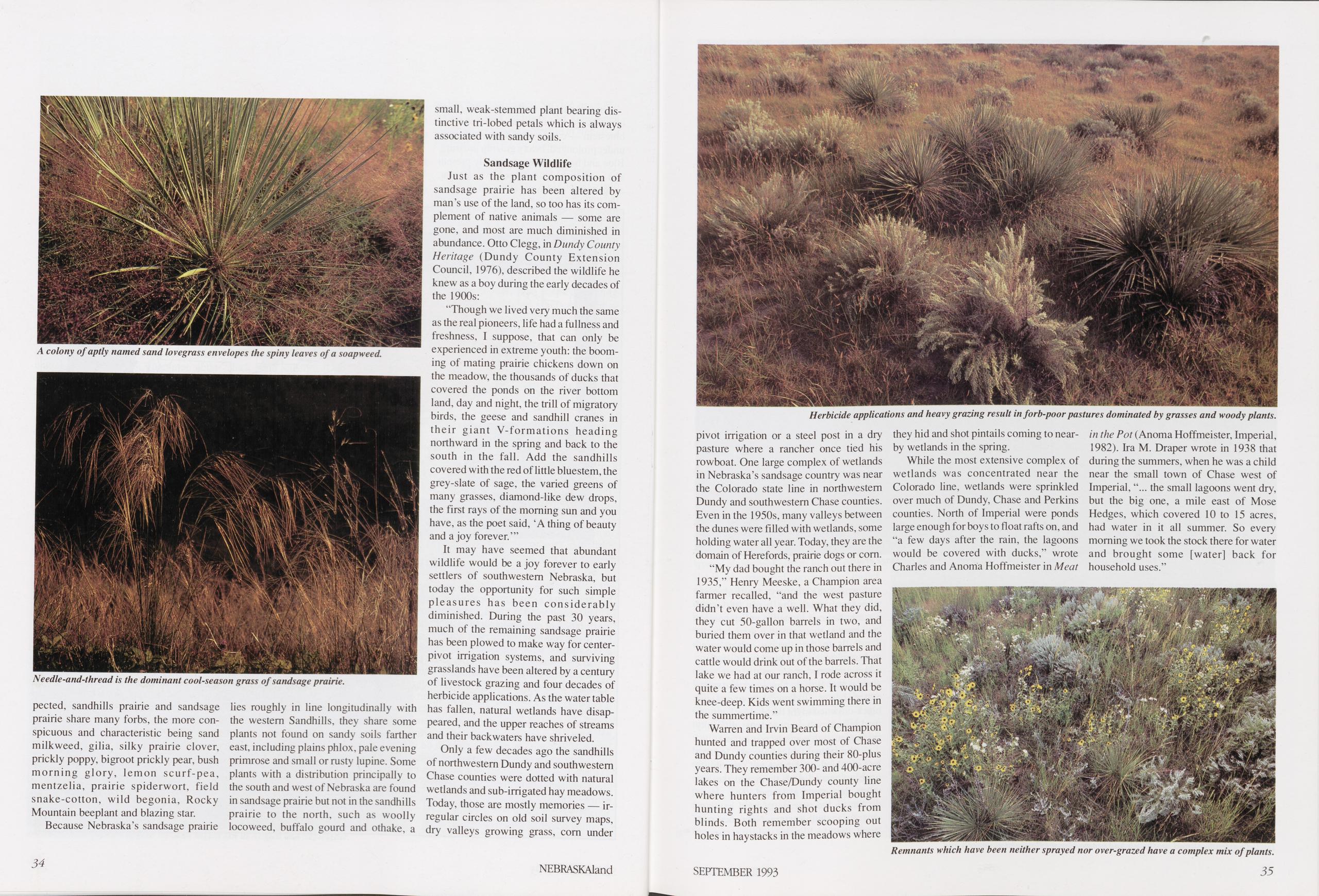
A colony of aptly named sand lovegrass envelopes the spiny leaves of a soapweed.
Needle-and-thread is the dominant cool-season grass of sandsage prairie.
pected, sandhills prairie and sandsage prairie share many forbs, the more conspicuous and characteristic being sand milkweed, gilia, silky prairie clover, prickly poppy, bigroot prickly pear, bush morning glory, lemon scurf-pea, mentzelia, prairie spiderwort, field snake-cotton, wild begonia, Rocky Mountain beeplant and blazing star.
Because Nebraska’s sandsage prairie lies roughly in line longitudinally with the western Sandhills, they share some plants not found on sandy soils farther east, including plains phlox, pale evening primrose and small or rusty lupine. Some plants with a distribution principally to the south and west of Nebraska are found in sandsage prairie but not in the sandhills prairie to the north, such as woolly loco weed, buffalo gourd and othake, a small, weak-stemmed plant bearing distinctive tri-lobed petals which is always associated with sandy soils.
Sandsage WildlifeJust as the plant composition of sandsage prairie has been altered by man’s use of the land, so too has its complement of native animals — some are gone, and most are much diminished in abundance. Otto Clegg, in Dundy County Heritage (Dundy County Extension Council, 1976), described the wildlife he knew as a boy during the early decades of the 1900s:
“Though we lived very much the same as the real pioneers, life had a fullness and freshness, I suppose, that can only be experienced in extreme youth: the booming of mating prairie chickens down on the meadow, the thousands of ducks that covered the ponds on the river bottom land, day and night, the trill of migratory birds, the geese and sandhill cranes in their giant V-formations heading northward in the spring and back to the south in the fall. Add the sandhills covered with the red of little bluestem, the grey-slate of sage, the varied greens of many grasses, diamond-like dew drops, the first rays of the morning sun and you have, as the poet said, ‘A thing of beauty and a joy forever.’”
It may have seemed that abundant wildlife would be a joy forever to early settlers of southwestern Nebraska, but today the opportunity for such simple pleasures has been considerably diminished. During the past 30 years, much of the remaining sandsage prairie has been plowed to make way for center- pivot irrigation systems, and surviving grasslands have been altered by a century of livestock grazing and four decades of herbicide applications. As the water table has fallen, natural wetlands have disappeared, and the upper reaches of streams and their backwaters have shriveled.
Herbicide applications and heavy grazing result in forb-poor pastures dominated by grasses and woody plants.
“My dad bought the ranch out there in 1935,” Henry Meeske, a Champion area farmer recalled, “and the west pasture didn't even have a well. What they did, they cut 50-gallon barrels in two, and buried them over in that wetland and the water would come up in those barrels and cattle would drink out of the barrels. That lake we had at our ranch, I rode across it quite a few times on a horse. It would be knee-deep. Kids went swimming there in the summertime.”
Warren and Irvin Beard of Champion hunted and trapped over most of Chase and Dundy counties during their 80-plus years. They remember 300- and 400-acre lakes on the Chase/Dundy county line where hunters from Imperial bought hunting rights and shot ducks from blinds. Both remember scooping out holes in haystacks in the meadows where they hid and shot pintails coming to nearby wetlands in the spring.
Remnants which have been neither sprayed nor over-grazed have a complex mix of plants.
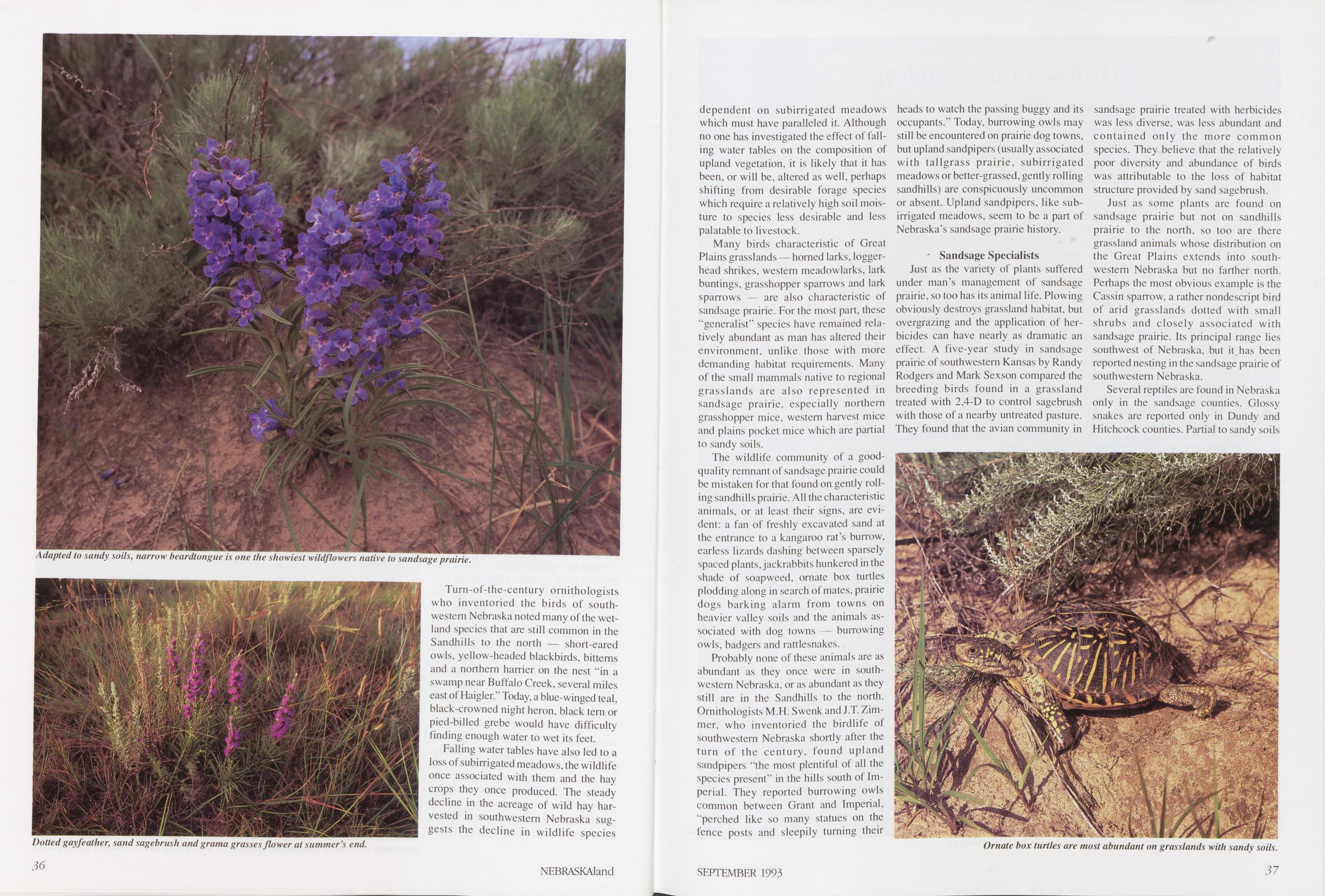
Adapted to sandy soils, narrow beardtongue is one of the showiest wildflowers native to sandsage prairie.
Dotted gayfeather sand sagebrush and grama grasses flower at summer's end.
Turn-of-the-century ornithologists who inventoried the birds of southwestern Nebraska noted many of the wetland species that are still common in the Sandhills to the north — short-eared owls, yellow-headed blackbirds, bitterns and a northern harrier on the nest “in a swamp near Buffalo Creek, several miles east of Haigler.” Today, a blue-winged teal, black-crowned night heron, black tern or pied-billed grebe would have difficulty finding enough water to wet its feet.
Falling water tables have also led to a loss of subirrigated meadows, the wildlife once associated with them and the hay crops they once produced. The steady decline in the acreage of wild hay harvested in southwestern Nebraska suggests the decline in wildlife species dependent on subirrigated meadows which must have paralleled it. Although no one has investigated the effect of falling water tables on the composition of upland vegetation, it is likely that it has been, or will be, altered as well, perhaps shifting from desirable forage species which require a relatively high soil moisture to species less desirable and less palatable to livestock.
Many birds characteristic of Great Plains grasslands — horned larks, loggerhead shrikes, western meadowlarks, lark buntings, grasshopper sparrows and lark sparrows — are also characteristic of sandsage prairie. For the most part, these “generalist” species have remained relatively abundant as man has altered their environment, unlike those with more demanding habitat requirements. Many of the small mammals native to regional grasslands are also represented in sandsage prairie, especially northern grasshopper mice, western harvest mice and plains pocket mice which are partial to sandy soils.
The wildlife community of a good-quality remnant of sandsage prairie could be mistaken for that found on gently rolling sandhills prairie. All the characteristic animals, or at least their signs, are evident: a fan of freshly excavated sand at the entrance to a kangaroo rat’s burrow, earless lizards dashing between sparsely spaced plants, jackrabbits hunkered in the shade of soapweed, ornate box turtles plodding along in search of mates, prairie dogs barking alarm from towns on heavier valley soils and the animals associated with dog towns — burrowing owls, badgers and rattlesnakes.
Probably none of these animals are as abundant as they once were in southwestern Nebraska, or as abundant as they still are in the Sandhills to the north. Ornithologists M.H. Swenk and J.T. Zimmer, who inventoried the birdlife of southwestern Nebraska shortly after the turn of the century, found upland sandpipers “the most plentiful of all the species present” in the hills south of Imperial. They reported burrowing owls common between Grant and Imperial, “perched like so many statues on the fence posts and sleepily turning their heads to watch the passing buggy and its occupants.” Today, burrowing owls may still be encountered on prairie dog towns, but upland sandpipers (usually associated with tailgrass prairie, subirrigated meadows or better-grassed, gently rolling sandhills) are conspicuously uncommon or absent. Upland sandpipers, like sub-irrigated meadows, seem to be a part of Nebraska’s sandsage prairie history.
Sandsage SpecialistsOrnate box turtles are most abundant on grasslands with sandy soils.
Just as some plants are found on sandsage prairie but not on sandhills prairie to the north, so too are there grassland animals whose distribution on the Great Plains extends into southwestern Nebraska but no farther north. Perhaps the most obvious example is the Cassin sparrow, a rather nondescript bird of arid grasslands dotted with small shrubs and closely associated with sandsage prairie. Its principal range lies southwest of Nebraska, but it has been reported nesting in the sandsage prairie of southwestern Nebraska.
Several reptiles are found in Nebraska only in the sandsage counties. Glossy snakes are reported only in Dundy and Hitchcock counties. Partial to sandy soils
36 NEBRASKAland SEPTEMBER 1993 37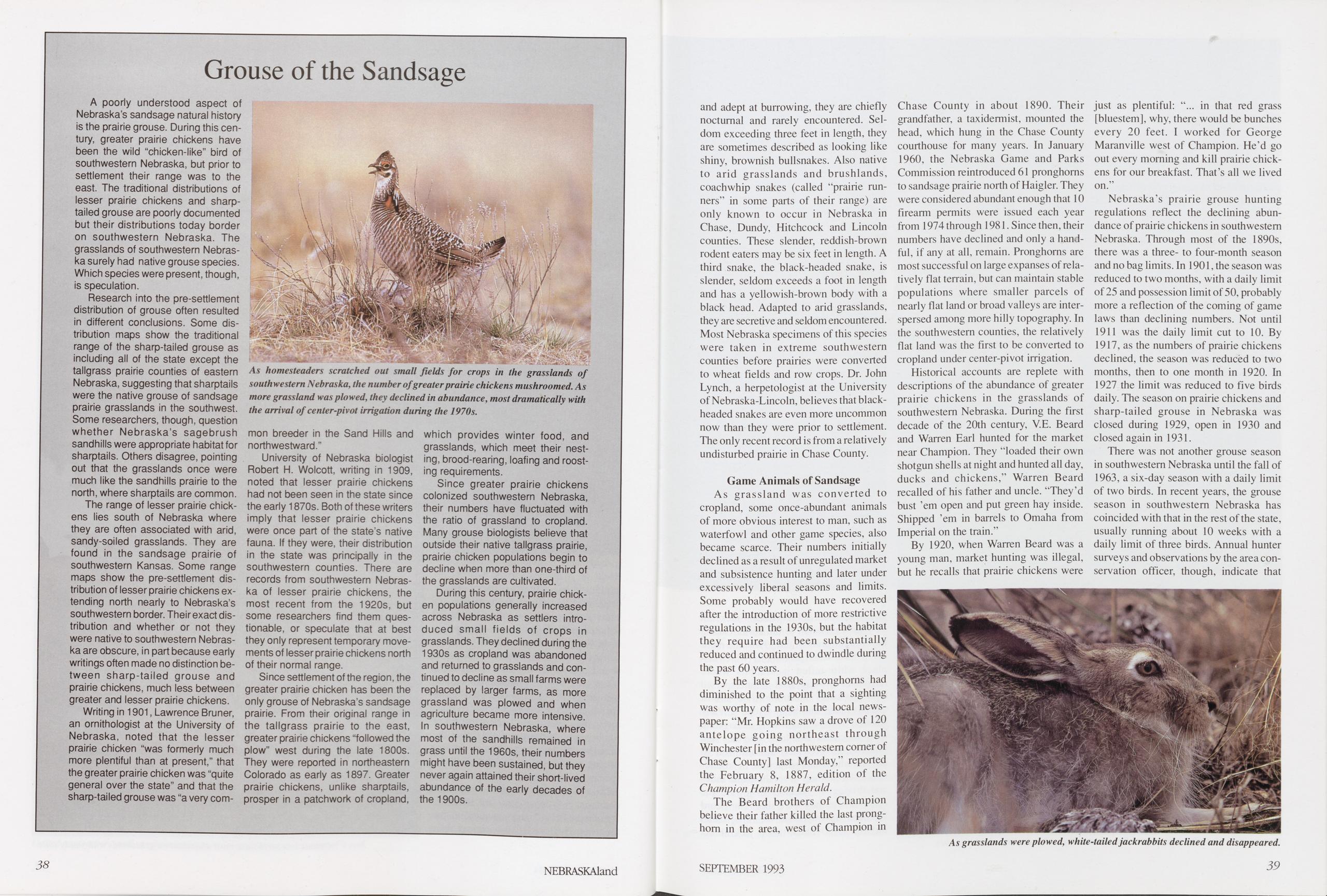
Grouse of the Sandsage
A poorly understood aspect of Nebraska’s sandsage natural history is the prairie grouse. During this century, greater prairie chickens have been the wild “chicken-like” bird of southwestern Nebraska, but prior to settlement their range was to the east. The traditional distributions of lesser prairie chickens and sharp-tailed grouse are poorly documented but their distributions today border on southwestern Nebraska. The grasslands of southwestern Nebraska surely had native grouse species. Which species were present, though, is speculation.
Research into the pre-settlement distribution of grouse often resulted in different conclusions. Some distribution maps show the traditional range of the sharp-tailed grouse as including all of the state except the tailgrass prairie counties of eastern Nebraska, suggesting that sharptails were the native grouse of sandsage prairie grasslands in the southwest. Some researchers, though, question whether Nebraska’s sagebrush sandhills were appropriate habitat for sharptails. Others disagree, pointing out that the grasslands once were much like the sandhills prairie to the north, where sharptails are common.
The range of lesser prairie chickens lies south of Nebraska where they are often associated with arid, sandy-soiled grasslands. They are found in the sandsage prairie of southwestern Kansas. Some range maps show the pre-settlement distribution of lesser prairie chickens extending north nearly to Nebraska’s southwestern border. Their exact distribution and whether or not they were native to southwestern Nebraska are obscure, in part because early writings often made no distinction be- tween sharp-tailed grouse and prairie chickens, much less between greater and lesser prairie chickens.
Writing in 1901, Lawrence Bruner, an ornithologist at the University of Nebraska, noted that the lesser prairie chicken “was formerly much more plentiful than at present,” that the greater prairie chicken was “quite general over the state” and that the sharp-tailed grouse was “a very common breeder in the Sand Hills and northwestward.”
University of Nebraska biologist Robert H. Wolcott, writing in 1909, noted that lesser prairie chickens had not been seen in the state since the early 1870s. Both of these writers imply that lesser prairie chickens were once part of the state’s native fauna. If they were, their distribution in the state was principally in the southwestern counties. There are records from southwestern Nebraska of lesser prairie chickens, the most recent from the 1920s, but some researchers find them questionable, or speculate that at best they only represent temporary movements of lesser prairie chickens north of their normal range.
As homesteaders scratched out small fields for crops in the grasslands of southwestern Nebraska, the number of greater prairie chickens mushroomed. As more grassland was plowed, they declined in abundance, most dramatically with the arrival of center-pivot irrigation during the 1970s.
Since greater prairie chickens colonized southwestern Nebraska, their numbers have fluctuated with the ratio of grassland to cropland. Many grouse biologists believe that outside their native tallgrass prairie, prairie chicken populations begin to decline when more than one-third of the grasslands are cultivated.
During this century, prairie chicken populations generally increased across Nebraska as settlers intro- duced small fields of crops in grasslands. They declined during the 1930s as cropland was abandoned and returned to grasslands and continued to decline as small farms were replaced by larger farms, as more grassland was plowed and when agriculture became more intensive. In southwestern Nebraska, where most of the sandhills remained in grass until the 1960s, their numbers might have been sustained, but they never again attained their short-lived abundance of the early decades of the 1900s.
and adept at burrowing, they are chiefly nocturnal and rarely encountered. Seldom exceeding three feet in length, they are sometimes described as looking like shiny, brownish bullsnakes. Also native to arid grasslands and brushlands, coachwhip snakes (called “prairie runners” in some parts of their range) are only known to occur in Nebraska in Chase, Dundy, Hitchcock and Lincoln counties. These slender, reddish-brown rodent eaters may be six feet in length. A third snake, the black-headed snake, is slender, seldom exceeds a foot in length and has a yellowish-brown body with a black head. Adapted to arid grasslands, they are secretive and seldom encountered. Most Nebraska specimens of this species were taken in extreme southwestern counties before prairies were converted to wheat fields and row crops. Dr. John Lynch, a herpetologist at the University of Nebraska-Lincoln, believes that black-headed snakes are even more uncommon now than they were prior to settlement. The only recent record is from a relatively undisturbed prairie in Chase County.
Game Animals of SandsageAs grassland was converted to cropland, some once-abundant animals of more obvious interest to man, such as waterfowl and other game species, also became scarce. Their numbers initially declined as a result of unregulated market and subsistence hunting and later under excessively liberal seasons and limits. Some probably would have recovered after the introduction of more restrictive regulations in the 1930s, but the habitat they require had been substantially reduced and continued to dwindle during the past 60 years.
By the late 1880s, pronghorns had diminished to the point that a sighting was worthy of note in the local news- paper: “Mr. Hopkins saw a drove of 120 antelope going northeast through Winchester [in the northwestern comer of Chase County] last Monday,” reported the February 8, 1887, edition of the Champion Hamilton Herald.
The Beard brothers of Champion believe their father killed the last pronghorn in the area, west of Champion in Chase County in about 1890. Their grandfather, a taxidermist, mounted the head, which hung in the Chase County courthouse for many years. In January 1960, the Nebraska Game and Parks Commission reintroduced 61 pronghorns to sandsage prairie north of Haigler. They were considered abundant enough that 10 firearm permits were issued each year from 1974 through 1981. Since then, their numbers have declined and only a handful, if any at all, remain. Pronghorns are most successful on large expanses of relatively flat terrain, but can maintain stable populations where smaller parcels of nearly flat land or broad valleys are interspersed among more hilly topography. In the southwestern counties, the relatively flat land was the first to be converted to cropland under center-pivot irrigation.
Historical accounts are replete with descriptions of the abundance of greater prairie chickens in the grasslands of southwestern Nebraska. During the first decade of the 20th century, V.E. Beard and Warren Earl hunted for the market near Champion. They “loaded their own shotgun shells at night and hunted all day, ducks and chickens,” Warren Beard recalled of his father and uncle. “They’d bust ’em open and put green hay inside. Shipped ’em in barrels to Omaha from Imperial on the train.”
By 1920, when Warren Beard was a young man, market hunting was illegal, but he recalls that prairie chickens were As grasslands were plowed, white-tailed jackrabbits declined and disappeared. just as plentiful: "... in that red grass [bluestem], why, there would be bunches every 20 feet. I worked for George Maranville west of Champion. He’d go out every morning and kill prairie chickens for our breakfast. That’s all we lived on.”
Nebraska’s prairie grouse hunting regulations reflect the declining abundance of prairie chickens in southwestern Nebraska. Through most of the 1890s, there was a three- to four-month season and no bag limits. In 1901, the season was reduced to two months, with a daily limit of 25 and possession limit of 50, probably more a reflection of the coming of game laws than declining numbers. Not until 1911 was the daily limit cut to 10. By 1917, as the numbers of prairie chickens declined, the season was reduced to two months, then to one month in 1920. In 1927 the limit was reduced to five birds daily. The season on prairie chickens and sharp-tailed grouse in Nebraska was closed during 1929, open in 1930 and closed again in 1931.
There was not another grouse season in southwestern Nebraska until the fall of 1963, a six-day season with a daily limit of two birds. In recent years, the grouse season in southwestern Nebraska has coincided with that in the rest of the state, usually running about 10 weeks with a daily limit of three birds. Annual hunter surveys and observations by the area conservation officer, though, indicate that
38 NEBRASKAland SEPTEMBER 1993 39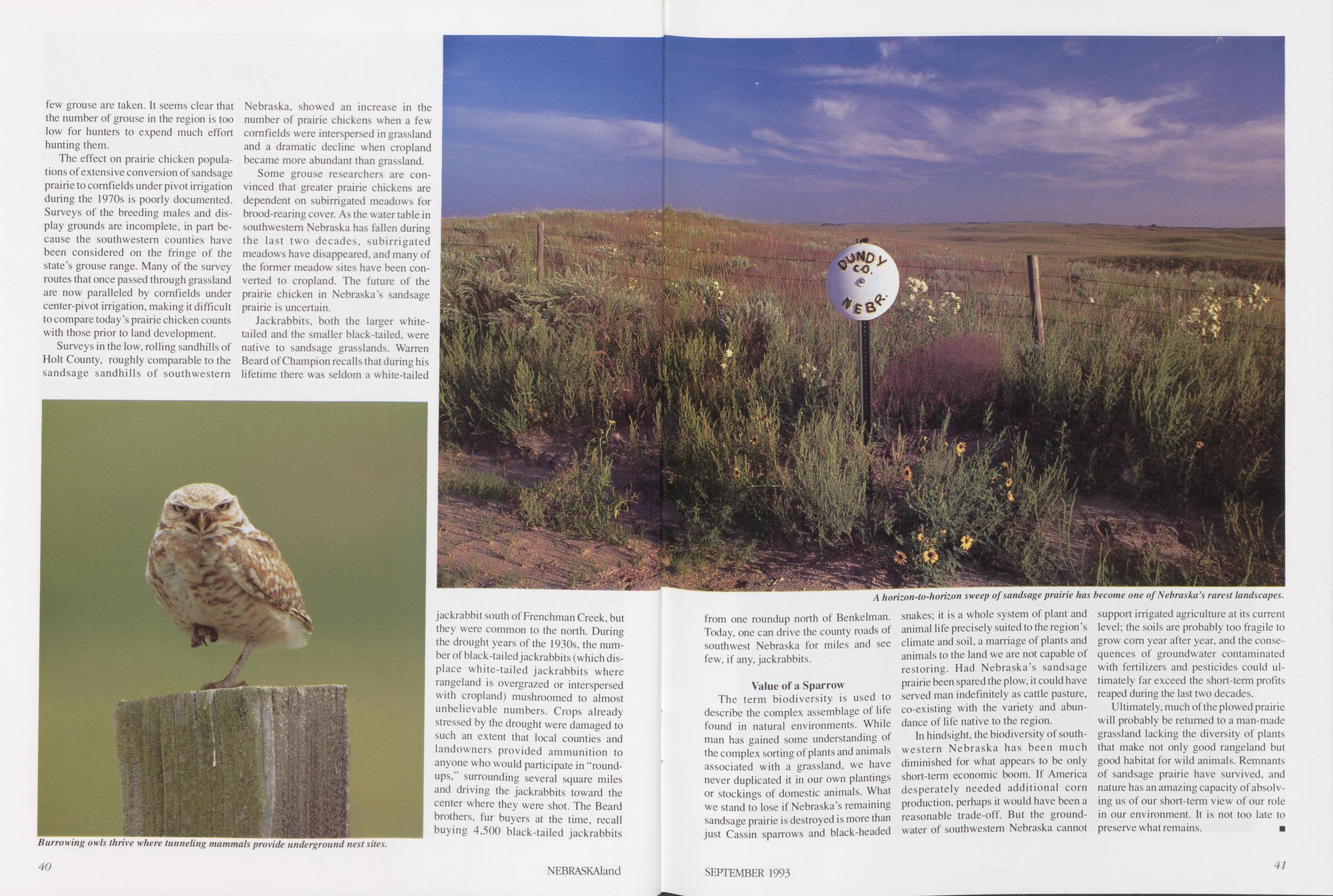
few grouse are taken. It seems clear that the number of grouse in the region is too low for hunters to expend much effort hunting them.
The effect on prairie chicken populations of extensive conversion of sandsage prairie to cornfields under pivot irrigation during the 1970s is poorly documented. Surveys of the breeding males and display grounds are incomplete, in part because the southwestern counties have been considered on the fringe of the state’s grouse range. Many of the survey routes that once passed through grassland are now paralleled by cornfields under center-pivot irrigation, making it difficult to compare today’s prairie chicken counts with those prior to land development.
Surveys in the low, rolling sandhills of Holt County, roughly comparable to the sandsage sandhills of southwestern Burrowing owls thrive where tunneling mammals provide underground nest sites. Nebraska, showed an increase in the number of prairie chickens when a few cornfields were interspersed in grassland and a dramatic decline when cropland became more abundant than grassland.
Some grouse researchers are convinced that greater prairie chickens are dependent on subirrigated meadows for brood-rearing cover. As the water table in southwestern Nebraska has fallen during the last two decades, subirrigated meadows have disappeared, and many of the former meadow sites have been converted to cropland. The future of the prairie chicken in Nebraska’s sandsage prairie is uncertain.
A horizon-to-horizon sweep of sandsage prairie has become one of Nebraska’s rarest landscapes.
The term biodiversity is used to describe the complex assemblage of life found in natural environments. While man has gained some understanding of the complex sorting of plants and animals associated with a grassland, we have never duplicated it in our own plantings or stockings of domestic animals. What we stand to lose if Nebraska’s remaining sandsage prairie is destroyed is more than just Cassin sparrows and black-headed snakes; it is a whole system of plant and animal life precisely suited to the region’s climate and soil, a marriage of plants and animals to the land we are not capable of restoring. Had Nebraska’s sandsage prairie been spared the plow, it could have served man indefinitely as cattle pasture, co-existing with the variety and abun- dance of life native to the region.
In hindsight, the biodiversity of southwestern Nebraska has been much diminished for what appears to be only short-term economic boom. If America desperately needed additional corn production, perhaps it would have been a reasonable trade-off. But the groundwater of southwestern Nebraska cannot support irrigated agriculture at its current level; the soils are probably too fragile to grow com year after year, and the consequences of groundwater contaminated with fertilizers and pesticides could ultimately far exceed the short-term profits reaped during the last two decades.
Ultimately, much of the plowed prairie will probably be returned to a man-made grassland lacking the diversity of plants that make not only good rangeland but good habitat for wild animals. Remnants of sandsage prairie have survived, and nature has an amazing capacity of absolving us of our short-term view of our role in our environment. It is not too late to preserve what remains. ■
40 NEBRASKAland SEPTEMBER 1993 41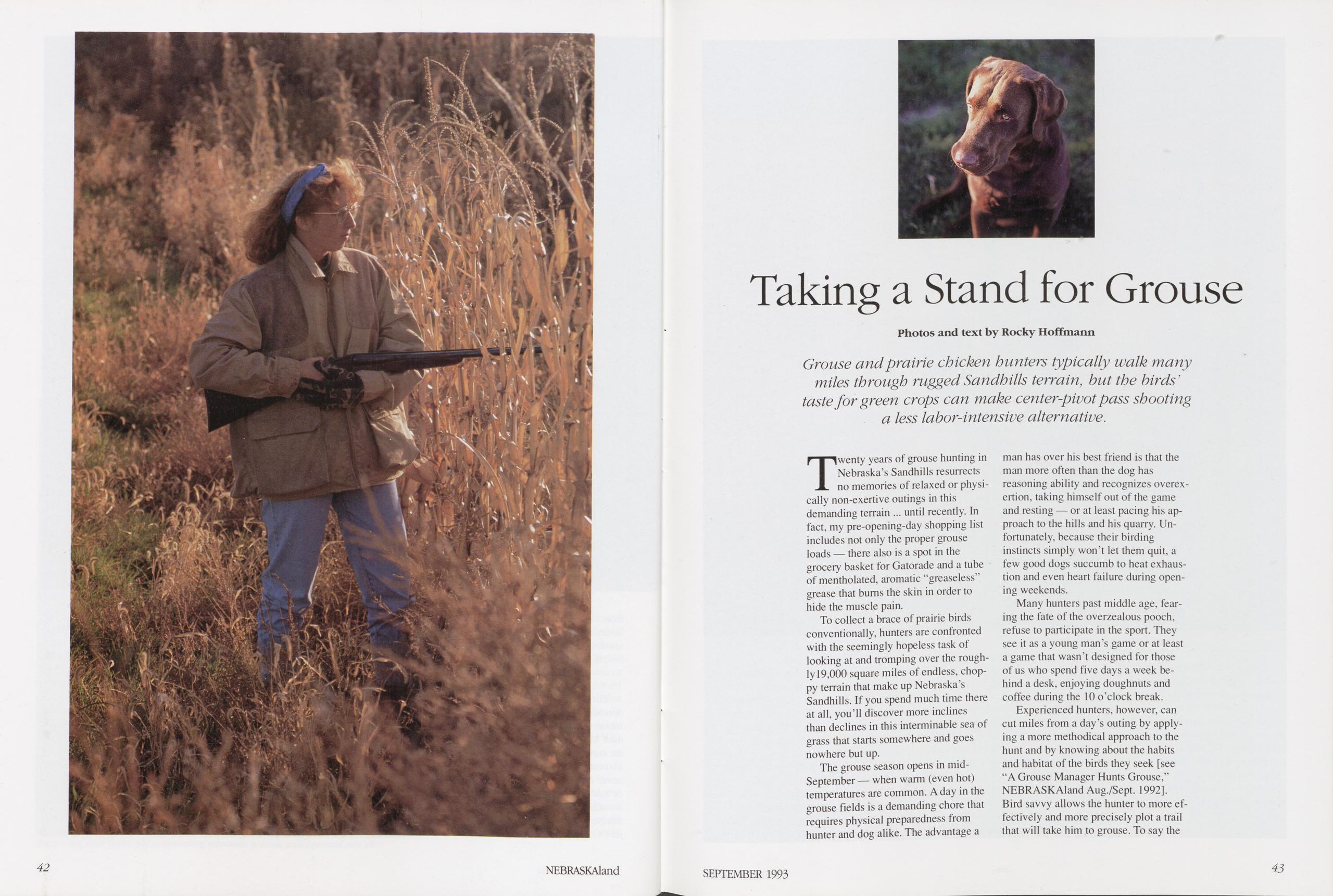
Taking a Stand for Grouse
Grouse and prairie chicken hunters typically walk many miles through rugged Sandhills terrain, but the birds’ taste for green crops can make center-pivot pass shooting a less labor-intensive alternative.Twenty years of grouse hunting in Nebraska’s Sandhills resurrects no memories of relaxed or physically non-exertive outings in this demanding terrain ... until recently. In fact, my pre-opening-day shopping list includes not only the proper grouse loads — there also is a spot in the grocery basket for Gatorade and a tube of mentholated, aromatic “greaseless” grease that bums the skin in order to hide the muscle pain.
To collect a brace of prairie birds conventionally, hunters are confronted with the seemingly hopeless task of looking at and tromping over the roughly 19,000 square miles of endless, choppy terrain that make up Nebraska’s Sandhills. If you spend much time there at all, you’ll discover more inclines than declines in this interminable sea of grass that starts somewhere and goes nowhere but up.
The grouse season opens in mid- September — when warm (even hot) temperatures are common. A day in the grouse fields is a demanding chore that requires physical preparedness from hunter and dog alike. The advantage a man has over his best friend is that the man more often than the dog has reasoning ability and recognizes overexertion, taking himself out of the game and resting — or at least pacing his approach to the hills and his quarry. Unfortunately, because their birding instincts simply won’t let them quit, a few good dogs succumb to heat exhaustion and even heart failure during opening weekends.
Many hunters past middle age, fearing the fate of the overzealous pooch, refuse to participate in the sport. They see it as a young man’s game or at least a game that wasn’t designed for those of us who spend five days a week behind a desk, enjoying doughnuts and coffee during the 10 o’clock break.
Experienced hunters, however, can cut miles from a day’s outing by applying a more methodical approach to the hunt and by knowing about the habits and habitat of the birds they seek [see “A Grouse Manager Hunts Grouse,” NEBRASKAland Aug./Sept. 1992]. Bird savvy allows the hunter to more effectively and more precisely plot a trail that will take him to grouse. To say the
42 NEBRASKAland SEPTEMBER 1993 43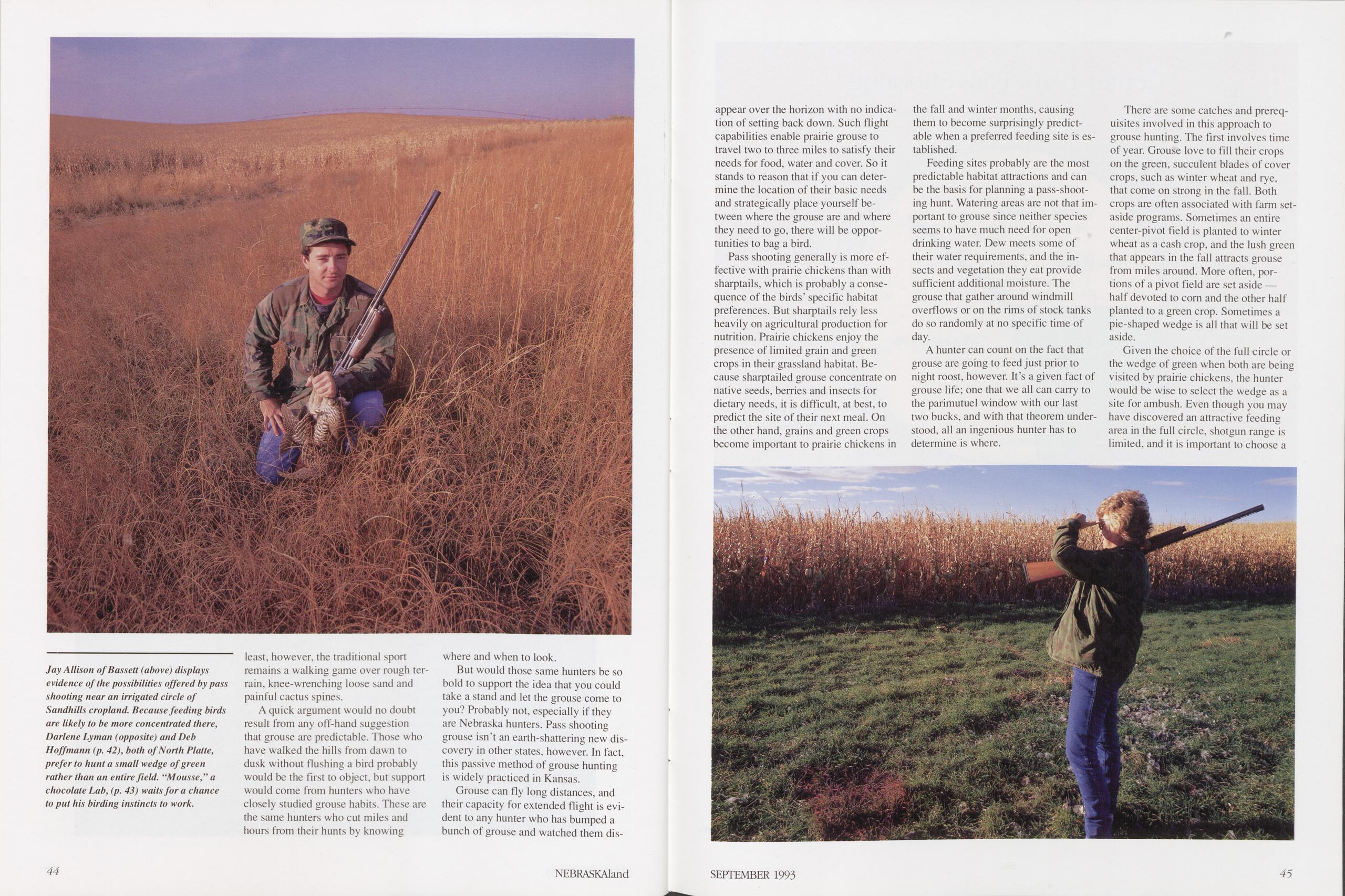
Jay Allison of Bassett (above) displays evidence of the possibilities offered by pass shooting near an irrigated circle of Sandhills cropland. Because feeding birds are likely to be more concentrated there, Darlene Lyman (opposite) and Deb Hoffmann (p. 42), both of North Platte, prefer to hunt a small wedge of green rather than an entire field. “Mousse,” a chocolate Lab, (p. 43) waits fora chance to put his birding instincts to work.
least, however, the traditional sport remains a walking game over rough terrain, knee-wrenching loose sand and painful cactus spines.
A quick argument would no doubt result from any off-hand suggestion that grouse are predictable. Those who have walked the hills from dawn to dusk without flushing a bird probably would be the first to object, but support would come from hunters who have closely studied grouse habits. These are the same hunters who cut miles and hours from their hunts by knowing where and when to look.
But would those same hunters be so bold to support the idea that you could take a stand and let the grouse come to you? Probably not, especially if they are Nebraska hunters. Pass shooting grouse isn’t an earth-shattering new discovery in other states, however. In fact, this passive method of grouse hunting is widely practiced in Kansas.
Grouse can fly long distances, and their capacity for extended flight is evident to any hunter who has bumped a bunch of grouse and watched them disappear over the horizon with no indication of setting back down. Such flight capabilities enable prairie grouse to travel two to three miles to satisfy their needs for food, water and cover. So it stands to reason that if you can determine the location of their basic needs and strategically place yourself between where the grouse are and where they need to go, there will be opportunities to bag a bird.
Pass shooting generally is more effective with prairie chickens than with sharptails, which is probably a consequence of the birds’ specific habitat preferences. But sharptails rely less heavily on agricultural production for nutrition. Prairie chickens enjoy the presence of limited grain and green crops in their grassland habitat. Because sharptailed grouse concentrate on native seeds, berries and insects for dietary needs, it is difficult, at best, to predict the site of their next meal. On the other hand, grains and green crops become important to prairie chickens in the fall and winter months, causing them to become surprisingly predict- able when a preferred feeding site is established.
Feeding sites probably are the most predictable habitat attractions and can be the basis for planning a pass-shooting hunt. Watering areas are not that important to grouse since neither species seems to have much need for open drinking water. Dew meets some of their water requirements, and the insects and vegetation they eat provide sufficient additional moisture. The grouse that gather around windmill overflows or on the rims of stock tanks do so randomly at no specific time of day.
A hunter can count on the fact that grouse are going to feed just prior to night roost, however. It’s a given fact of grouse life; one that we all can carry to the parimutuel window with our last two bucks, and with that theorem understood, all an ingenious hunter has to determine is where.
There are some catches and prerequisites involved in this approach to grouse hunting. The first involves time of year. Grouse love to fill their crops on the green, succulent blades of cover crops, such as winter wheat and rye, that come on strong in the fall. Both crops are often associated with farm set- aside programs. Sometimes an entire center-pivot field is planted to winter wheat as a cash crop, and the lush green that appears in the fall attracts grouse from miles around. More often, portions of a pivot field are set aside — half devoted to corn and the other half planted to a green crop. Sometimes a pie-shaped wedge is all that will be set aside.
Given the choice of the full circle or the wedge of green when both are being visited by prairie chickens, the hunter would be wise to select the wedge as a site for ambush. Even though you may have discovered an attractive feeding area in the full circle, shotgun range is limited, and it is important to choose a
44 NEBRASKAland SEPTEMBER 1993 45In some areas at the edges of the Sandhills there has been considerable center-pivot development, and in many center-pivot circles areas are set aside to green crops each year. Especially early in the season, when the grouse are still in small groups, and following a hard frost, when native plants have been killed, pass shooting near a green wedge can be productive. The best shooting comes near sunset when birds fly in to feed. Author Hoffmann recommends that hunters conceal themselves in standing corn near a green area and avoid spooking birds away from a feeding area by not hunting in the same field more often than once a week.
place to hunt where the entry flight-path is more restricted.
Near our house south of North Platte, a center-pivot cornfield adjoins the west property line. The field is extremely choppy, and a few years ago the operator set aside a pie-shaped wedge of the hilly area to rye, planting com on the remainder of the circle.
One evening, while throwing sticks for my dog, I noticed bunches of prairie chickens regularly sailing over the house and across the com, apparently landing in the wedge of green. After the third night of observing this same flight pattern, I could no longer subdue my curiosity and hiked, dog at my side, to the cornfield.
Following an outside pivot track through the standing com, I came upon the emerald wedge of rye that must have shone like the neon lights of a truck-stop diner to airborne grouse. I sat the dog next to me in an outside row of com and waited for evening. The first flock glided across the com at about 5:15 p.m. and landed in the rye, followed by another flock and another. The flocks were small, apparently family groups, and by sundown more than 250 prairie chickens had come to dine in the pie-shaped green wedge.
The next evening, this time with dog and shotgun, I collected two prairie chickens from a flock that sailed in overhead to feast in the field. On this outing, I paid particular attention to flight patterns and the times individual bunches of birds arrived.
During subsequent visits to the area, I discovered it was remarkable how closely flight corridors and arrival times of the birds corresponded to flights the first evening I hunted, and I made mental notes of the pre-dusk feeding activity.
Over the span of several years now, I have used this same cornfield and methodology to take a few grouse for the table and to host friends on an occasional after-work “gentleman’s” hunt. Each season I gain bits and pieces of new knowledge about the conditions necessary for successful pass shooting.
Of course success varies from year to year. Generally this corresponds to nesting success and the resulting size of the fall population, but other factors also determine if sitting on a five-gallon dry wall bucket at the edge of a cornfield is going to provide a payoff.
In my neighborhood, there has been considerable center-pivot development. When portions of the majority of circles in the area have been set aside to green acres during a particular year, pass shooting becomes less predictable and generally less productive. Chick- ens, however, are somewhat habitual in their day-to-day activities, and even in years when there are ample alternative sites for them to feed, they often select a favorite and keep returning.
When I locate a popular attraction for grouse during a year with abundant feeding sites, I am careful not to spook them away from the area. I very seldom pass shoot a field more than once a week, even in good years, and I try to keep the disturbance as low as possible. Staying off the green area while remaining concealed in the standing com allows birds that aren’t in range to land and feed as if nothing were wrong. Often, following an evening’s hunt, I have left a pass-shooting area with 50 to 100 chickens feeding undisturbed.
I also have discovered that typical pass-shooting situations do not develop until late in the season. Young-of-the- year prairie chickens are still actively gorging their crops with insects come opening day. Crickets and grasshoppers continue to comprise a major part of their diet in late summer and early fall. When ample supplies of insects still flourish in the hills, even the most attractive plot of wheat, rye or alfalfa has little chance to command attention.
Only after a hard frost, one capable of killing grasshoppers and crickets, will prairie chickens become genuinely interested in an alternative food source. A sustained hard frost also destroys native plants used as green forage for birds, requiring them to visit winter wheat and rye plantings that tolerate freezing conditions.
An early hard frost near the opening of the grouse season provides the best conditions. Grouse are still found in small bunches, consisting of one or two family groups per bunch. Such a situation provides the best possible pass shooting, as a hunter has several opportunities from various flocks arriving at the feeding site. Later in the season, after grouse form large wintering flocks, the opportunity to pass shoot still exists, but usually all the excite- ment is over with one big flight, and you had better hope that flock happens to pass within shotgun range because it will be the only flight of the evening.
It also is important that the hard frost precedes the corn harvest. Not only does standing corn provide an excellent hiding place from which to pass shoot, it also limits the birds’ feeding area. Once the com is harvested, however, grouse may be just as likely to feed on waste grain as on green crops. The availability of grain tremendously increases the selection of evening feeding sites, making this predictable bird less predictable.
Since that first evening of watching grouse flock from all directions to a feeding spot, my entire outlook on grouse hunting has changed. I still take to the hills during the early part of the season, because I enjoy walking for grouse. At a sensible pace, even a long day’s hunt over difficult terrain can be rewarding. There simply is no place in the world that compares to Nebraska’s Sandhills, and what’s gained from a day of walking — even fruitless walking — far exceeds the discomfort of the next day’s muscle pains.
Pass shooting has added some variety to the traditional approach, and it opens doors to hunters who can no longer endure the rigors of walking up birds. Sitting on a five-gallon bucket while wearing drab hunting clothes and having a dog at your side is comparable to dove hunting. A flock of grouse riding a brisk wind close overhead presents a difficult target from an easy style of hunting.
Conversely, flushing a slow-to-get-going grouse at your feet while tromping up birds presents an easy target from a difficult style of hunting. Both approaches have their rewards, but as years press on, I will probably find myself sparing the boot leather and taking a stand for grouse. ■
46 NEBRASKAland SEPTEMBER 1993 47
Classified
ARTS/CRAFTSCHAIN SAW carved figures or totem poles. Village Wood- works, Main Street, Winnetoon, NE 68789.402-847-3368. 20 miles from Ashfall, 30 miles from Niobrara State Park.
BIRDSMANDARIN DUCKS: nice full-wing birds. $35/pair; woodducks $25/pair. Mrs. R. W. Hansen, 3315 Ave. L, Kearney, NE 68847. Phone 308-237-3781.
BOOKS/PRINTINGFREE! Booklets on northeastern Nevada; fishing, rock- hounding maps, Carl Hayden, Box 528, Jackpot, Nevada 89825.
FREE BOOK CATALOG. Novels, westerns, romances, children’s; old out of print, found bams, attic. Authors: Grey, Bower, Connor, Fox, Curwood, Raine,Wright, Aldridge, Pollyanna, Freckles, many others. Postage ap _ preciated. Pierce, 4400 N. Pine Cluster, Oroville, CA 95965
COLLECTIBLESBUYING—TRADING EXPIRED HUNTING, FISHING, TRAPPING licenses; regulations; duck/upland game stamps. (402) 785-7500. Information/prices.
OREGON TRAIL SOUVENIRS. Official buckle - mugs - “Ts,” spoons, stoneware. DART, INC. 1-800-228-0086. DOGS
TRAINING ALL BREEDS bird dogs — Vizslas and English Pointers for sale. Rozanek Kennels, RR 2, Schuyler, NE 68661. Phone (402) 352-8769.
YELLOW-BLACK Lab pups. FC-AFC sired. AKC. Hips OFA certified. Dew claws removed. Excellent hunting potential. Contact Bob Bendler, Lexington, NE. (308) 324- 4247.
AKC BRITTANY PUPS. Close working. Natural backing gun dogs. Field champion backgrounds. Liver and orange. References. Blair (402) 426-3597.
FOR SALE — Chesapeake bay or Labrador retrievers. All colors. Pups, started dogs, stud service. Three-generation __ national champion, pedigree on Lab. Three generations of the best Chesapeakes ever trialed. Call PLATTE VALLEY RETRIEVERS (308) 995-2318.
WILDERNESS KENNELS. Gun dog training - over 60 years combined experience. Training all sporting breeds — Retrievers. Flushing and pointing dogs. All dogs worked on pen raised birds and wildgame. Training program includes obedience training — heel, sit, stay, down and come when called. Pups, started dogs and fully trained dogs for sale.
HUNTING DOGS TRAINED BY HUNTERS. Henry Sader, Wilderness Kennels, 402-423-4212. Since 1968.
SUBSCRIBE NOW! GET NEBRASKAland MAGAZINE FOR YOURSELF OR SEND IT AS A GIFT FOR JUST $12 A YEAR! 1 -Year $12 Name Address 2-Years $23 City State Zip Mail check or money order to NEBRASKAland Magazine P.O. Box 30370Lincoln, Nebraska 68503 or call Toll Free 1-800-742-0056
FOR SALE AKC German Shorthair Pointer pups. Both parents from excellent bloodlines and are super hunters. Pups have their shots and are wormed. Bom May 25 will be just right by hunting season. For more information call Mark Cornelius, 1122 Washington, Beatrice, NE 68310. Telephone 402-228-3757.
ENGLISH COCKER pups, imported stock, British FTC bloodlines. Many colors available. Featured in NEBR ASK Aland November 1991. Sawtooth Oaks, Box 443, Orleans, NE 68966. Phone 308-473-5265. FDSB PUREBRED ENGLISH SETTER PUPS! Whelped
July 2. Both parents stylish, excellent noses, and know-how to find birds. Don’t miss this litter! Wind Fall Gun Dog Kennel, (402) 421-4693.
DEUTSCH DRAHTHAARS - Line-bred litters planned for December and January. Puppies expected to have great potential. Parents are proven hunters. Bred by strict VDD standards in German registered kennel. Versatile hunting drahthaars for fur and feathered game. Wildflugel Kennel, RR 2, Box 24A, Ravenna, NE 68869, 308-452-4333.
FISH/FISHINGFISH FOR SALE. Catfish, perch, coho salmon, rainbow trout, crappie, bluegill, walleye, minnows, goldfish, bullhead, largemouth bass, smallmouth bass, triploid grass carp. Commercial grower prices on catfish, perch, coho salmon, rainbow trout. Consulting available. Pleasant Val- ley Fish Farm, Rt 1 Box 147, McCook, NE 69001. Phone (308) 345-6599.
WILLOW LAKE FISH HATCHERY. Channel cat, bluegill, hybrid bluegill, largemouth bass, crappie, triploid grass carp, walleye, perch, minnows available for stocking. Gaylord Crawford, RR 3, Box 46, Hastings, NE 68901 or phone (402) 463-8022 day or night. Also pond consultant. We deliver, grower price.
TEXAS ANGLERS Guide Service. Lake Fork. TX. Trophy BASS Capital U.S.A. Now booking fall and spring 1994 trips. Single or group trips welcome. Sully 214-771-0964.
FOOD
NEBRASKA BASKETS: The original Nebraska company specializing in fine foods from Nebraska. A beautiful array of baskets filled with ethnic, healthful and long-time favorite foods. Call or write for our brochure: P.O. Box 98, McCook, NE 69001. 1-800-345-7725.
BEER & WINEMAKING SUPPLIES — Fermenter's Supply & Equipment, 4472 S. 84th St., Omaha, NE 68127. (402) 593-9171. Mail order or visit our store.
GUIDES/OUTFITTERSMAD RIVER CANOES offers the finest quality and per- formance. For the finest canoes and accessories look to Great Plains Canoe Co., 205 Main, Springfield. NE. Phone (402) 253-2001.
CANOE THE NIOBRARA... with an affordable canoe trip by Dryland Aquatics. One and two-day trips...full service or canoes only. Transportation furnished. Your Niobrara River specialists...We do it your way! Dryland Aquatics, Dept. N, Box 33C, Sparks, NE 69220 or phone (402) 376-3119.
GRAHAM CANOE OUTFITTERS: Top quality full-ser- vice camping and canoe trips on the Niobrara River. Daily canoe rentals and car shuttle-service available. Contact Doug & Twyla Graham, HC 13 Box 16, Valentine, NE 69201 or phone (402) 376-3708.
GUNS/SHOOTING/ARCHERYGUNS — Browning, Winchester, Remington, others. Hi- powers; shotguns, new, used, antiques. Want Pre-’64 Winchesters. Buy-Sell-Trade. (402) 729-6112. Bedlan’s Sporting Goods, Fairbury, NE 68352.
BOWHUNTERS: Take aim on Nebraska’s newest source for custom arrows and quality bowhunting gear. For more information contact Dismal River Outpost, PO Box 4912, Omaha, NE 68104. 402-556-0068.
AIR GUNS repaired — Benjmain Crosman, Daisy, other American made. Restoration; old guns wanted. Jack’s Air Guns, 1225 N. 46th, Lincoln, NE 68503. Phone 402-466- 9223.
TAXIDERMY ALLISON’S TAXIDERMY STUDIO & GIFT GALLERY. Specializing in fish, birds and small game. Mounted 35 State Record Fish. Pheasant mounts for sale. 421 N. Dewey, North Platte, NE 69101. (308) 534-2324 or (308) 534-4267.NEWMAN TAXIDERMY - award winning style; “Real Fish” reproductions—we support Catch & Release; Heritage cases: a concept of displaying your trophy with personalized memorabilia in antiqued, leaded glass cases; “Serving NE Sportsmen since 1966.” RR 2, Box 279, Fremont, NE 68025; 402-727-5714.
VACATION/RESORTSNE NEBRASKA trout fishing. 3 modern cottages, 1 avail- able year-round. 5 spring-fed lakes with open water all year. Trout up to 7 pounds. Other varieties fish also. Diamond E. Trout Resort, Orchard, NE 68764. Phone (402) 893-4745. Evenings (402) 893-3002.
FOR FISHING and hunting accommodations. Jefco Inn, Gordon, NE 69343. South Cornell, (308) 282-2935. HISTORIC 1890s HOTEL. Located in the beautiful Pine Ridge area of Northwest Nebraska. Short drive to Chadron State Park, Fort Robinson and the Black Hills. Beautiful dining room with fireplace and fountain. Room service available. The Olde Main Street Inn, 115 Main St., Chadron, NE 69337.(308) 432-3380.
WONDERFUL FALL IN ITALY. Located in the heart of Tuscany, we rent a nice cottage not far from Florence. For more information, please contact Judith, 601 S. 38th Ave., Omaha, NE 68105 or call 402-345-7770.
NATIVE NEW ZEALANDER, Paul Dravitzki, invites you on a unique, 16-day luxury tour of his beautiful homeland! January 1994. $3350. Contact: New Zealand’s Calling Tour, Box 82, Stromsburg, NE 68666. 402-764-7211.
BLACK HILLS of South Dakota - open year around. New chalets with fireplaces; motel, cottages, vacation homes. Spring Creek Inn, HCR 87, Box 55, Hill City, SD 57745. 1-800-456-2755.
Classified ad rates: 75f per word, minimum $15. Closing date is the first business day 2 months preceding date of issue. To place ads or for more information write NEBRASKAland Magazine, P.O. Box 30370, Lincoln, NE 68503, or call (402) 471-5478. Fax (402) 471-5528.
Page forty-nine
The First Day of the YearA broad field of clear, unbroken blue. Below it, on the left, another blue field, blue against blue, but this one darker, shimmering restlessly. On the right, an adjoining off-white field. The seam between the colors is deep brown against the white, frothy white against the blue. This narrow margin curves to the right, rising from the lower left. At the center of the composition it swings back to the left and disappears into the field of blue above.
The cloudless sky, the lake and the wide, sandy beach tower in front of us, flat and two-dimensional in the still, midday heat, a minimalist painting on a monstrous canvas. We fill the canoe with camping gear and tug it along in the shallow water, walking on the cool, dark, damp sand at the water’s edge. We’re looking for the spot where a red canoe and a yellow tent won’t mar the composition. The landscape flattens out ahead of us, and we choose a campsite a mile or so to the east, just where the leftward curve of shoreline begins.
It is the last camping trip of the season, and the fall air should be cool, spiced with crisp intimations of a changing season. The beach should be mottled by drifting shadow cumulus. Instead, we labor in midsummer heat, dry, flat and colorless; the yellow tent becomes a roasting oven, and the red canoe’s stem bobs on the low swells, its prow anchored in the sand — it is too hot even to think of paddling.
We rig the tent fly as a canopy and loll in its shade, reading, choosing tentatively from the pile of magazines and books set optimistically aside months earlier as summer reading. Periodically we trudge across the hot sand for a desultory swim in the cool Sandhills river made a lake by a rolled-earth dam a few miles farther down the beach.
Finally, half an hour or so before sunset, we feel the faint stirring of a breeze from the southwest and watch the dark, scalloped edge of a horizon- wide cloudbank inch up over the western hills. The evening’s final cup of tea is lighted by the blue glow of our single-burner campstove and pulsing lightning flashes from the distant storm. “It’s headed mostly north,” we tell each other. “It’ll probably miss us.” But we pull the canoe up higher on the sand and turn it over.
We wake to the booming roll of thunder, much closer now. By the faint green glow of my watch dial I see it is 1 a.m. The air is strangely still and clammy, and looking out the tent door we can tell for sure: It isn’t going to miss us. The lightning and the thunder are so nearly constant we can’t count the seconds between flash and roar to estimate the storm’s distance, but we guess we have half an hour, maybe a little more, before the worst of it arrives. Low overhead, gray scud races past, a fetid greenish pink in the flashing lightning.
We wake again to a rattle of rain against the fly. It is a new tent, a taller dome than the lightweight, wind-shedding old backpacker. A four-person model, and we can stand almost straight up in it. A little luxury, we thought, for short trips and car camping. We’ll seal the seams before the next trip, we thought. We’re only going be out two nights this time, we’ll get by.
The rattle becomes a continuous roar, and the tent begins to flex and shimmy, its fiberglass wands straining in the wind. Suddenly the floor rises and the tent shudders — short wire stakes on the windward side are jerked out of the sand, and a scene from The Wizard ofOz leaps to mind. I keep it to myself and scoot over against the wall, stretching out to hold the edge down. The lightning is so close now that the walls seem momentarily transparent. In the closest flashes we can see a nearby cedar snag etched black against the fabric — a ghostly X-ray through the tent wall and the fly — and the noise is tactile, a thumping in the diaphragm and lungs.
I snap on my flashlight to see why my feet are getting wet and find bright drops of water welling up at every stitch along the unsealed floor seams. Soon the seepage is puddling in a low spot near the door; our sleeping bags are limp and sodden.
The storm lasts longer than seems possible, but gradually the chaos moves on to the north and east, the wind drops, and the rain slows to a spitting drizzle.
Two hours later we awaken in another season. The sky is low and threatening, and whitecaps crash and sizzle on the rivulet-etched shore. We step from the tent onto the packed and scoured sand; the sweaters we thought we wouldn’t need aren’t warm enough.
But we are tingling with excitement — the air is tangy, shrill and cheeky. Its fresh, raucous clarity, unimagined half a day ago, makes us want to whoop and run along the beach in celebration. The lake is wild and clean, the sand unmarked except by rain, untracked, unstirred. The beach is ours, elemental, unencumbered, new. No matter what the calendar says, this is the first day of fall, the first day of the year.
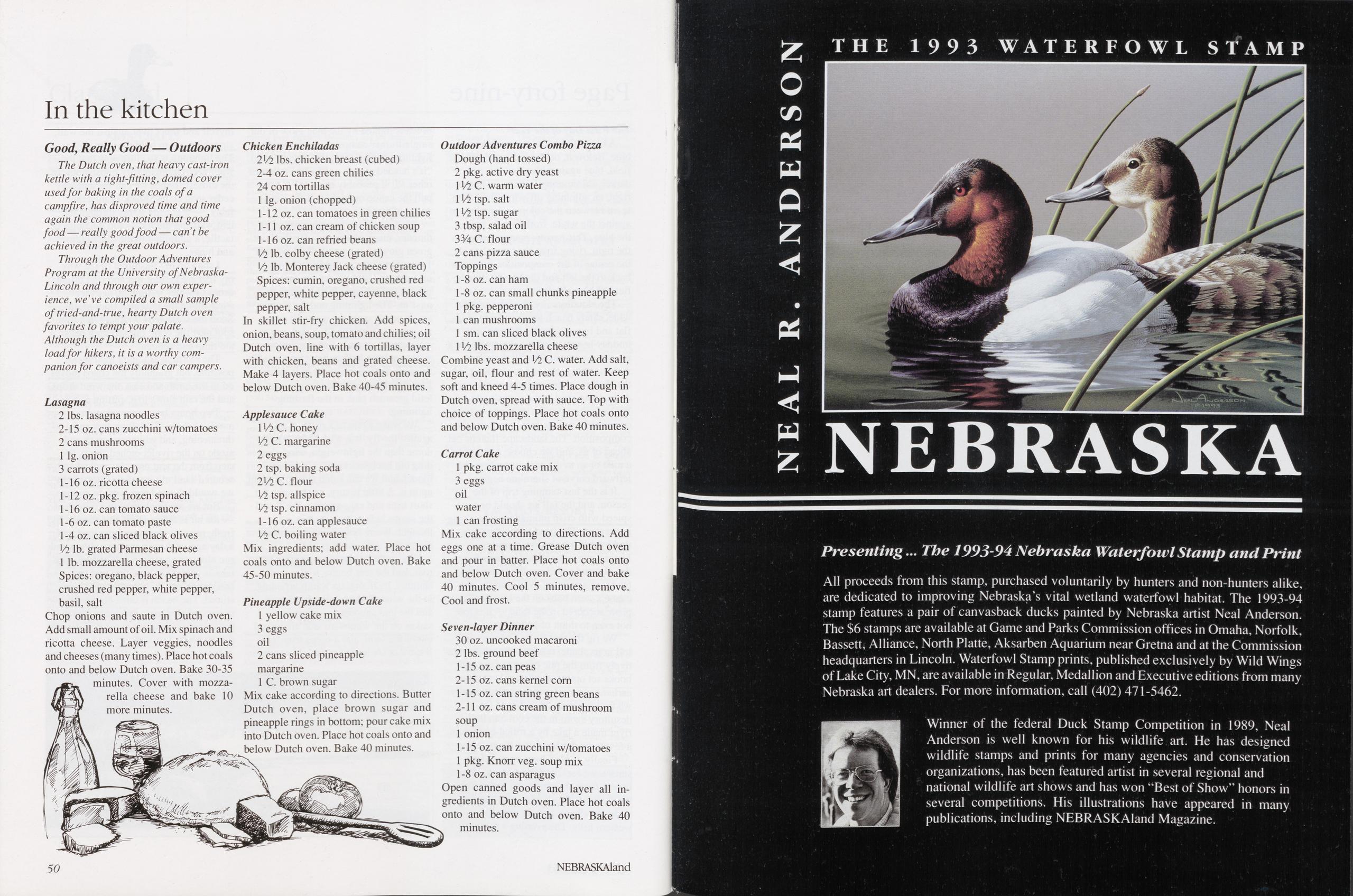
In the kitchen
Good, Really Good — OutdoorsThe Dutch oven, that heavy cast-iron kettle with a tight-fitting, domed cover used for baking in the coals of a campfire, has disproved time and time again the common notion that good food—really good food—cant be achieved in the great outdoors.
Through the Outdoor Adventures Program at the University of Nebraska- Lincoln and through our own experience, we've compiled a small sample of tried-and-true, hearty Dutch oven favorites to tempt your palate. Although the Dutch oven is a heavy load for hikers, it is a worthy companion for canoeists and car campers.
Lasagna2 lbs. lasagna noodles 2-15 oz. cans zucchini w/tomatoes 2 cans mushrooms 1 1g. onion 3 carrots (grated) 1-16 oz. ricotta cheese 1-12 oz. pkg. frozen spinach 1-16 oz. can tomato sauce 1-6 oz. can tomato paste 1-4 oz. can sliced black olives Vi lb. grated Parmesan cheese 1 lb. mozzarella cheese, grated Spices: oregano, black pepper, crushed red pepper, white pepper, basil, salt
Chop onions and saute in Dutch oven. Add small amount of oil. Mix spinach and ricotta cheese. Layer veggies, noodles and cheeses (many times). Place hot coals onto and below Dutch oven. Bake 30-35 n- minutes. Cover with mozzarella cheese and bake 10 more minutes.
21/2 lbs. chicken breast (cubed) 2-4 oz. cans green chilies 24 com tortillas 1 1g. onion (chopped) 1-12 oz. can tomatoes in green chilies 1-11 oz. can cream of chicken soup 1-16 oz. can refried beans Vz lb. colby cheese (grated) 1/2 lb. Monterey Jack cheese (grated) Spices: cumin, oregano, crushed red pepper, white pepper, cayenne, black pepper, salt
In skillet stir-fry chicken. Add spices, onion, beans, soup, tomato and chilies; oil Dutch oven, line with 6 tortillas, layer with chicken, beans and grated cheese. Make 4 layers. Place hot coals onto and below Dutch oven. Bake 40-45 minutes.
Applesauce Cake11/2 C. honey 1/2 C. margarine 2 eggs 2 tsp. baking soda 21/2 C. flour 1/2 tsp. allspice Vz tsp. cinnamon 1-16 oz. can applesauce Vz C. boiling water
Mix ingredients; add water. Place hot coals onto and below Dutch oven. Bake 45-50 minutes.
Pineapple Upside-down Cake1 yellow cake mix 3 eggs oil 2 cans sliced pineapple margarine 1 C. brown sugar
Mix cake according to directions. Butter Dutch oven, place brown sugar and pineapple rings in bottom; pour cake mix into Dutch oven. Place hot coals onto and below Dutch oven. Bake 40 minutes.
Outdoor Adventures Combo PizzaDough (hand tossed) 2 pkg. active dry yeast 11/2 C. warm water 11/2 tsp. salt 1 Vz tsp. sugar 3 tbsp, salad oil 3% C. flour
2 cans pizza sauce
Toppings 1-8 oz. can ham 1-8 oz. can small chunks pineapple 1 pkg. pepperoni 1 can mushrooms 1 sm. can sliced black olives 11/z lbs. mozzarella cheese
Combine yeast and Vi C. water. Add salt, sugar, oil, flour and rest of water. Keep soft and kneed 4-5 times. Place dough in Dutch oven, spread with sauce. Top with choice of toppings. Place hot coals onto and below Dutch oven. Bake 40 minutes.
Carrot Cake1 pkg. carrot cake mix 3 eggs oil water 1 can frosting
Mix cake according to directions. Add eggs one at a time. Grease Dutch oven and pour in batter. Place hot coals onto and below Dutch oven. Cover and bake 40 minutes. Cool 5 minutes, remove. Cool and frost.
Seven-layer Dinner30 oz. uncooked macaroni 2 lbs. ground beef 1- 15 oz. can peas 2- 15 oz. cans kernel com 1- 15 oz. can string green beans 2- 11 oz. cans cream of mushroom soup 1 onion 1-15 oz. can zucchini w/tomatoes 1 pkg. Knorr veg. soup mix 1-8 oz. can asparagus
Open canned goods and layer all ingredients in Dutch oven. Place hot coals onto and below Dutch oven. Bake 40 minutes.
The 1993 Waterfowl Stamp Neal R. Anderson Nebraska
All proceeds from this stamp, purchased voluntarily by hunters and non-hunters alike, are dedicated to improving Nebraska’s vital wetland waterfowl habitat. The 1993-94 stamp features a pair of canvasback ducks painted by Nebraska artist Neal Anderson. The $6 stamps are available at Game and Parks Commission offices in Omaha, Norfolk, Bassett, Alliance, North Platte, Aksarben Aquarium near Gretna and at the Commission headquarters in Lincoln. Waterfowl Stamp prints, published exclusively by Wild Wings of Lake City, MN, are available in Regular, Medallion and Executive editions from many Nebraska art dealers. For more information, call (402) 471-5462. Winner of the federal Duck Stamp Competition in 1989, Neal Anderson is well known for his wildlife art. He has designed wildlife stamps and prints for many agencies and conservation organizations, has been featured artist in several regional and national wildlife art shows and has won “Best of Show” honors in several competitions. His illustrations have appeared in many publications, including NEBRASKAland Magazine.
50 NEBRASKAland
Position: 252 (32 views)