Volume 71, Issue 6, 1993
NEBRASKAland
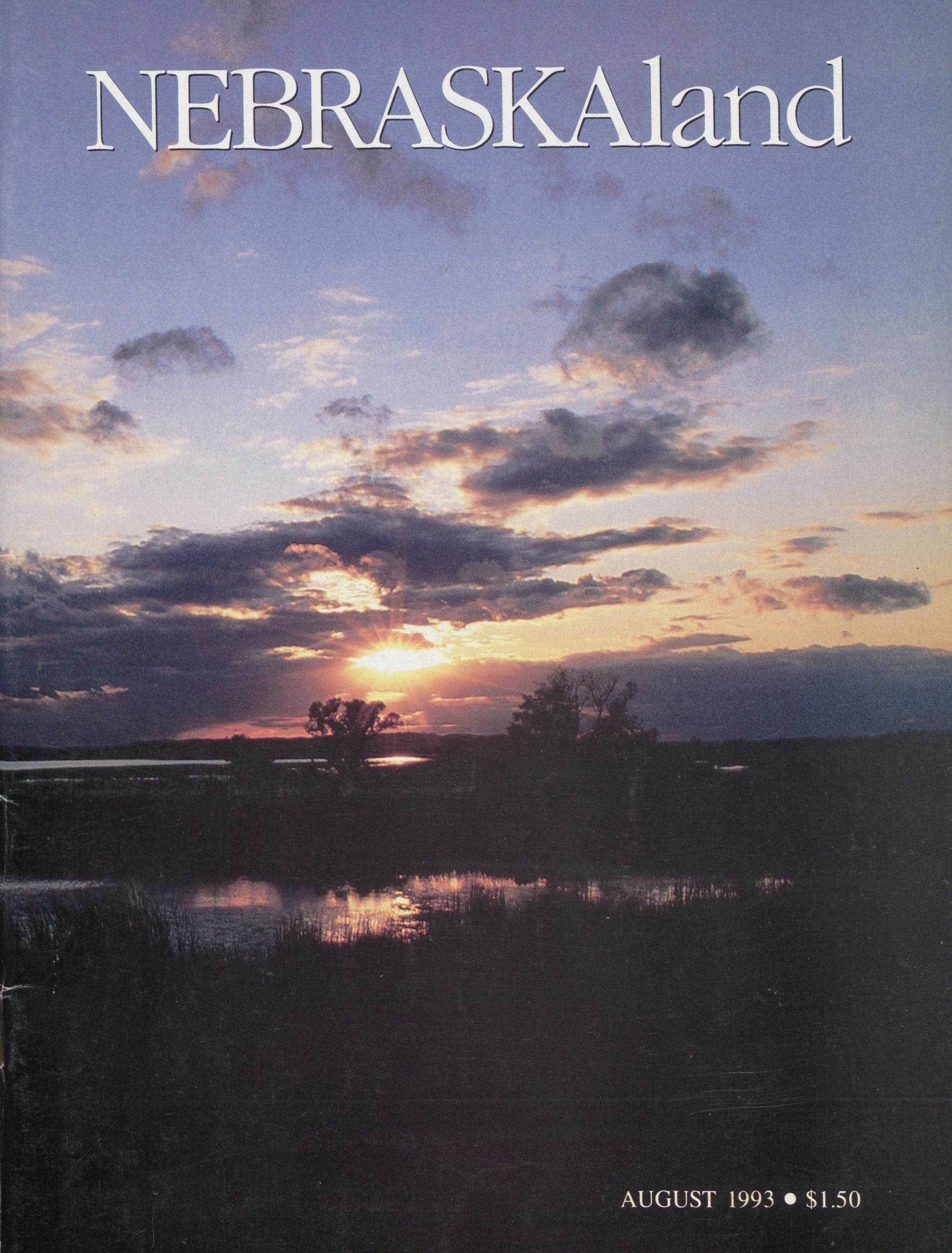
AUGUST 1993 $1.50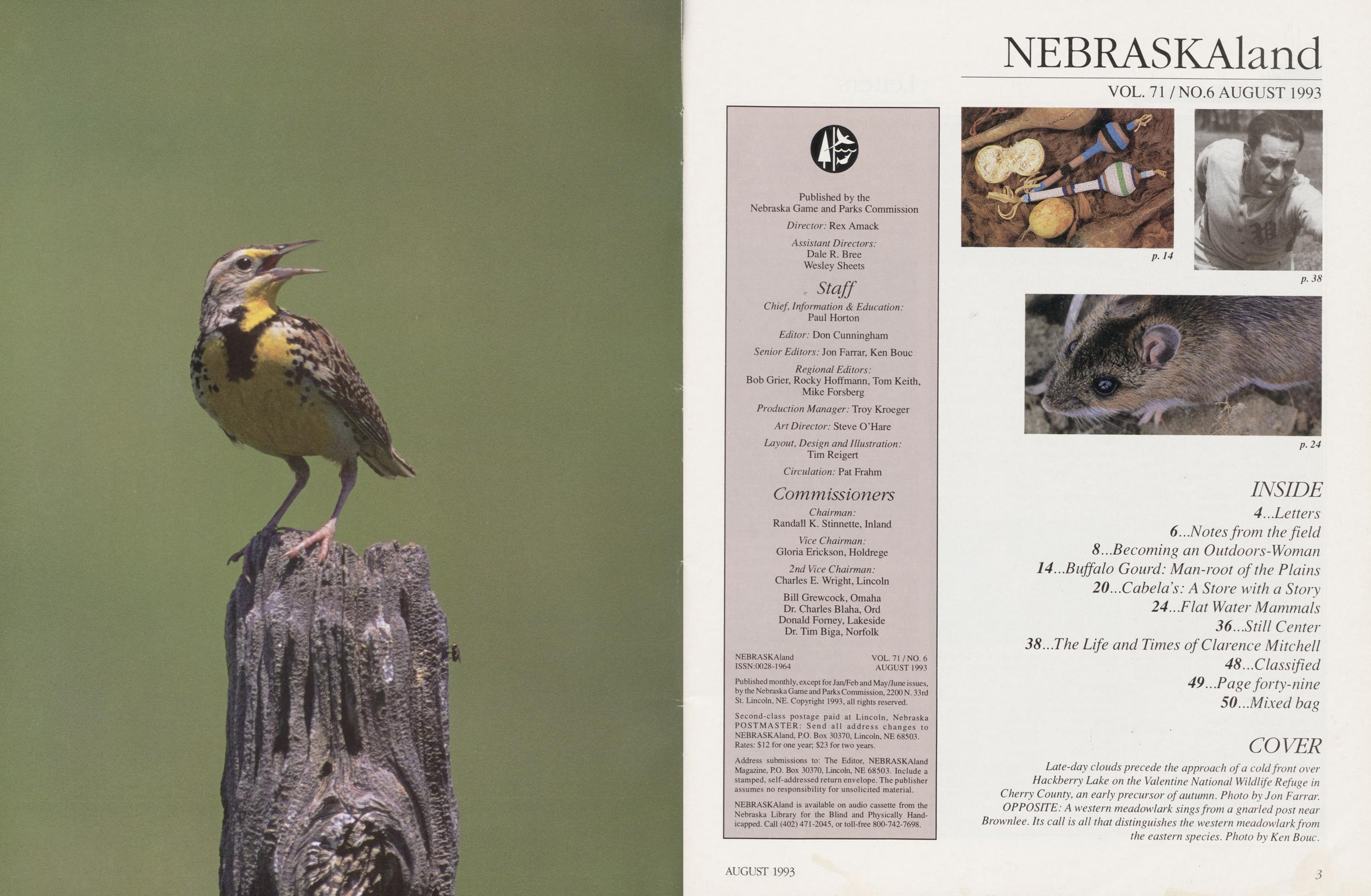
NEBRASKAland
VOL. 71 /NO.6 AUGUST 1993 Published by the Nebraska Game and Parks Commission Published by the Nebraska Game and Parks Commission Staff Chief, Information & Education: Paul Horton Editor: Don Cunningham Senior Editors: Jon Farrar, Ken Bouc Regional Editors: Bob Grier, Rocky Hoffmann, Tom Keith, Mike Forsberg Production Manager: Troy Kroeger Art Director: Steve O'Hare Layout, Design and Illustration: Tim Reigert Circulation: Pat Frahm Commissioners Chairman: Randall K. Stinnette, Inland Vice Chairman: Gloria Erickson, Holdrege 2nd Vice Chairman: Charles E. Wright, Lincoln Bill Grewcock, Omaha Dr. Charles Blaha, Ord Donald Forney, Lakeside Dr. Tim Biga, Norfolk NEBRASKAland ISSN:0028-1964 VOL. 71/NO.6 AUGUST 1993 Published monthly, except for Jan/Feb and May/June issues, by the Nebraska Game and Parks Commission, 2200 N. 33rd St. Lincoln, NE. Copyright 1993, all rights reserved. Second-class postage paid at Lincoln, Nebraska POSTMASTER: Send all address changes to NEBRASKAland, P.O. Box 30370, Lincoln, NE 68503. Rates: $12 for one year; $23 for two years. Address submissions to: The Editor, NEBRASKAland Magazine, P.O. Box 30370, Lincoln, NE 68503. Include a stamped, self-addressed return envelope. The publisher assumes no responsibility for unsolicited material. NEBRASKAland is available on audio cassette from the Nebraska Library for the Blind and Physically Handicapped. Call (402) 471-2045, or toll-free 800-742-7698.
Letters
Nebraska Game and Parks Commission District Offices Headquarters 2200 North 33rd Street Lincoln, NE 68503 Phone (402)471-0641 District Office II Box 508 Bassett, NE 68714 Phone (402)684-2921 District Office IV Route 4, Box 36 North Platte, NE 69101 Phone (308)535-8025 District Office 1 Box 725 Alliance, NE 69301 Phone (308)762-5605 District Office III Box 934 Norfolk, NE 68702 Phone (402)370-3374 District Office V 2200 North 33rd Street Lincoln, NE 68503 Phone (402)471-5558 Omaha Office State Office Building Mall 1313 Farnam Omaha, NE 68102, Phone (402)595-2144 Conservation Officers by Region Panhandle Officer City Phone(308) Richard Furley (Supv) Alliance 762-2024 Walt Meyer Chadron 432-4398 John Murphy Crawford 665-2021 Jim Zimmerman Gering 436-7561 Marvin Kampbell Hay Springs 638-7527 Dennis Thompson Ogallala 284-6450 Dan Zuehlke Ogallala 284-4815 Don Hunt Oshkosh 772-3697 Richard Brandt Scottsbluff 635-1277 Raymond Still Bridgeport 262-1075 Southeast Officer City Phone (402) Dick Turpin (Chief) Lincoln 471-5531 Ted Blume (Asst Chief) Lincoln 483-5643 Roger Guenther (Supv) Lincoln 423-5671 William Krause Auburn 274-3789 Dan Evasco Beatrice 228-5935 Matt Andrews Lincoln Douglas Kramer Lincoln 466-9001 Dina Barta Lincoln 466-5739 Levi Krause Louisville 234-2212 Russell Mort Nebr. City 873-5684 Duane Arp Omaha 332-4954 Larry Elston Omaha 359-2833 Craig Stover Omaha 359-2833 Mike Luben Colon 443-4278 Northeast Officer City Phone (402) Tom Zimmer (Supv) Norfolk 371-6625 Robert Kelly Albion 395-2538 Ross Oestmann Bloomfield 373-4412 L.A. Wilkinson Columbus 564-4375 Gary Ralston Creighton 847-3284 Daniel Roberts Fremont 721-7852 Randy Pomplun Fullerton (308)536-2987 Jon Reeves Kennard 427-7378 Marion Shafer Norfolk 371-2031 Eric Wiebe Ponca 755-2566 Steve Oberg West Point 372-3062 Sandhills Officer City Phone (402) Bruce Wiebe (Supv) Bassett 684-3867 Max Showalter Ainsworth 387-1960 Larry Bauman Atkinson 925-5569 Richard Seward Ord (308)728-5338 Mick Gray Valentine 376-3136 Ray Dierking Brkn. Bow (308)872-3078 South-Central Officer City Phone (402) Jerry Pecha (Supv) York 362-5707 Lester Johnson David City 367-4037 Terry Brentzel Grand Isl. (308)384-8296 Dale Johnson Hebron 768-7363 Daniel Klammer Hastings 461-3389 Dayton Shultis Kearney (308)234-3349 Mark Reeves Loup City (308)745-1126 Robert Finke Seward 643-2056 Southwest Officer City Phone (308) Gail Woodside(Supv) No. Platte 532-0279 George Sund Cambridge 697-4629 Jack Henderson Gothenburg 537-7483 Dirk Greene Imperial 882-5328 Ray Frandsen Lexington 324-2753 Virgil Gosch McCook 345-2185 Dwight Allbery No. Platte 532-2753 Roger Thompson No. Platte 532-9175 Rich Routh Republican City 799-2085 Operation Game Thief (800) 742-7627 Giant SilkmothsI really enjoyed "Nebraska's Giant Silkmoths" in the April NEBRASKAland Magazine. The illustrations by Dr. John Cody were lovely. Thank you.
Luella M. King Palmer, Neb. Sportsmen for 50 YearsEnclosed is a picture taken in 1933 by Maria Feasller east of Northport in Morrill County, Neb. The picture was taken on the old Haggerty place. I'm on the left. In the middle is my brother Robert, of Sidney, Neb., and on the right is my youngest brother Harold. We've been sportsmen since the picture was taken.
Vernon L. Johnson Concord, Calif. Two Responses to Three OpinionsI got a kick out of the three opinions last month on how the magazine was doing.
One "progressively disappointed" person was obviously anti-hunting; another reader was not renewing because there was not enough on hunting and fishing, and a third thought, like me, the May/June issue was great.
Hunting is my main avocation. A very enjoyable part of the hunt is knowing the flora, fauna, history and geography of the area one is in. Because of the July issue, the next time I am afield, I will be more knowledgeable of the monarch butterfly, in search of old tankhouses and the western prairie fringed orchid, more aware of CCC projects and wary of getting Lyme disease. I will be more 4 NEBRASKAland knowledgeable of eggs and "dabby s" and dream of the day I have grandchildren to take fishing — but no way will I try to build a sailboat. Keep up the good work.
Joe Herrod Lincoln, Neb.I would like to respond to the negative letters in the July 1993 issue and, I hope, change the writers' perspectives on NEBRASKAland Magazine, Nebraska and our delicate environment.
Henry Kottas of Steeleville, 111., says he does not like hunting or hunting articles. But there are those of us who do enjoy hunting and fishing. This is our right — and yours — as American citizens. Hunters help keep wildlife populations in balance and also make great financial contributions through donations, license and stamp fees and self-imposed taxes on hunting and fishing equipment. Non-hunters cannot say this.
Walter England of Ogallala, Neb., says that NEBRASKAland should have more hunting and fishing articles, and comments about environmentalists. I can't agree with Walter, either. I was bom and raised in Nebraska and have hunted and fished all my life, but hunting and fishing are not the only things Nebraskans enjoy. Along with other proud Nebraskans, I am an avid hunter, fisherman, canoeist, boater, hiker, camper, outdoorsman and nature lover, but above all I am an environmentalist. Walter, you are, as Henry says, "missing the boat." You are the only hunter/fisherman I have known who is not an environmentalist.
As a hunter and fisherman, you should be an environmentalist. If we don't protect our environment there will be no wildlife, which means nothing to hunt, fish or observe. To preserve what Mother Nature has given us, we all need to work together, not complain or argue and contradict each other.
If Walter and Henry try to understand each other's point of view, they will realize that NEBRASKAland is a well-balanced and excellent magazine for all.
Earley G. Smith Omaha, Neb. Wanda HighwayDuring the 1992 season, after they had bagged their antelopes, I was unofficial guide for my friends Bob Schumacher and Gordon Leader on a tour of the Pine Ridge area southwest of Chadron.
While driving one of the north-south roads that traverse the ridge, we noticed the marker shown in the enclosed photo. Bob couldn't resist taking a picture of it, since Wanda is his wife's name.
While eating lunch near the marker, we got to speculating about the road. Why was it named Wanda Highway? It would be interesting to learn more about it.
Larry Pommer Hartington, Neb. Snake FallsThe enclosed photo was taken at Snake Falls (below Merritt Reservoir near Valentine) in July 1992. I sure hope the fisherman had better luck than we did — we got shut out.
John V. John Omaha, Neb. Address your comments, suggestions and complaints to Letters, NEBRASKAland Magazine, P.O. Box 30370, Lincoln, NE 68503-0370, or Fax (402) 47J-5528. NEBRASKAland reserves the right to edit and condense letters. AN OUTDOORS WOMAN'' A three-day workshop designed primarily for women 18 years old or older to learn a variety of skills usually associated with hunting, fishing, camping and exploring the outdoors. Plan to join us for this fun, informative and relaxing outdoor experience. Topics and sessions include: • Basic Fishing Skills m Fly Fishing Techniques • Firearm Safety and Trapshooting • Map and Compass • Basic Camping and Survival Skills • Canoeing • Dutch Oven Cooking • Turkey Hunting and Calling m Mock Pheasant Hunt October 1-3,1993 Nebraska State 4-H Camp Nebraska National Forest (near Halsey) Enrollment limit 100 Register early For more information call: 1-800-577-8283 and record your request. otdoors-Woman AUGUST 1993 5
Notes from the field
Where can you get away for a week or weekend, and still not spend a bundle? Nebraska's state park areas are still your best bet for the perfect vacation or weekend break.Get the new 48-page, color brochure highlighting state parks, recreation areas and historic parks. You'll get detailed information on lodging, camping, activities, facilities, seasons, fees and reservation policies. Write or call today! Nebraska Game and Parks Commission P.O. Box 30370, Lincoln, NE, 68503 Phone (402) 471-0641 Beating the HeatIt's Saturday morning and you're sipping that first cup of coffee, looking out the kitchen window and grinning ear to ear. You've got a day off— finally. And you're going to go for a hike at a nearby state park. A hazy morning sun, blue sky above, the deep greens of summer. No phone, no doorbells. Perfect. It's going to be a beautiful day.
In 10 minutes you polish off the pot of coffee, and you're out the door. The great expanse of rolling countryside stretches out before you broken only by subtle, pulsating heat waves distorting the horizon. You pay no attention. The cool dependable breeze of the air conditioner cranked up to full power rushes past your face and all is right with the world.
An hour later you arrive at the trailhead. Running parallel to the river, the five-mile trail climbs lazily over high bluffs with remnants of native prairie and then abruptly winds down through an undulating maze of mixed hardwood forest and dry creek beds.
Primed and ready, you grab your pack and jump out of the car. Suddenly, out of nowhere you're rudely greeted by an old familiar acquaintance. It engulfs you, smothers you and within seconds has you surrounded. You hadn't met up with it since last summer and you hadn't given yourself a chance to notice it before now. But now it's back — Nebraska heat. In a land whose geographic location makes it a summer battleground for moist tropical air masses, it's a feeling we Nebraskans know all too well. It's one of those 90/90 days: 90 degree temps, 90 percent humidity, slight south breeze and a chance of evening thunderstorms. Although temporarily stunned, the heat only slows you for a second and soon you get that grin back on your face. It might be good to sweat a little. You lace up your boots, throw on the day pack and you're on your way.
It's a little hot, but the sun feels good, and the occasional south wind seems to whisk the sweat away. You stop under the shade of an old, gnarled bur oak for a rest and snack. The shade welcomes you, and your mind wanders off into a daydream. You wonder if 100 years ago a Pawnee used this old tree as a resting place on a hot summer's day. Soon a meadowlark's song lures you from the edge of unconsciousness, and you realize it's time to move on.
In the next two miles things start to change. Places and sounds on the trail that you normally would stop to ex- plore, you now ignore because you're starting to feel weak and are slowly being consumed by heat and thirst. You find the open areas of the trail void of comfort from the hot sun and forested areas stifling in the humid, still air. You open your water bottle one last time hoping a small swallow is left, but only a few drops greet your parched lips. The trail, once your friend, is now your foe.
By the fourth mile you are getting light-headed. You feel nauseous, and you have an awful headache. Finally you have to stop. You find a dense mat of grass beside the trail and sit, soaked in sweat, for what seems like an eternity. Two hikers see you slumped over beside the trail. Your face is pale, you're sweating profusely, and you look exhausted. They've seen heat exhaustion before, and they sit with you for the next hour giving you sips of water, a few orange slices and some salted crackers. Soon your headache and dizziness wane, and you feel well enough to go on. They walk with you for the last mile, then bid you farewell at the trailhead. Grateful and relieved, you slide into your car and drive back home in an evening thundershower.
This or something like this has probably happened to most of us at some point in our lives whether it be on a hike, out fishing or out pulling irrigation pipe on a hot summer day. The fact is, heat-related injury and illness is a serious threat that we often ignore until it's too late. We often kid others — and even ourselves — by saying we're just not "tough enough" to handle the heat. 6 NEBRASKAland But here are the facts. According to the Nebraska Department of Health, Emergency Medical Services personnel responded to over 80 cases of excessive heat injuries between 1990 and 1992. Over half of those were directly related to weather. Of those 80 cases, seven resulted in deaths.
Heat emergencies can be broken down into three stages: dehydration, heat exhaustion and heat stroke, each progressively worse. Dehydration simply means an excessive loss of body water from the system. We lose water by breathing, sweating and expelling bodily wastes, normally an average of four liters of fluid a day. When we exercise and begin to sweat, we can increase our fluid requirements two or three times. If the fluids are not replaced, we become thirsty, tired, experience decreased physical ability, and our judgment may become impaired.
Dehydration is especially a concern on hot, humid days. Our body's main cooling mechanism is perspiration. When the body's thermostat senses we're getting hot, the brain stimulates the sweat glands to produce sweat. Sweat, primarily water and electrolytes, rises to the skin's surface and evaporates, causing a cooling effect. On hot, humid days there is already a lot of moisture in the air, making the cooling effect much less efficient.
Heat exhaustion occurs when you dehydrate to the point that you suffer a significant water and electrolyte loss. Symptoms can include headache, fatigue, nausea, lightheadedness and heat cramps. In itself it is not a life-threatening condition but if ignored can develop into one. It is important to replace not only water but also salt lost through sweating. Eating salty foods and drinking plenty of water over a period of time with rest should rectify the problem. Avoid salt tablets, though, because they are too concentrated and draw water into your stomach to dilute the salt rather than keeping the water out in the rest of your body where it is needed. A better remedy is to dissolve one teaspoon of table salt in a quart of water and sip it slowly over a 15- to 20-minute period. This can be repeated several times until conditions improve.
Heat stroke, if not treated rapidly, will cause death. A person experiencing heat stroke is so dehydrated that the body can no longer produce sweat, loses its ability to cool itself and the core body temperature starts to rise. Since the brain can survive only in a very narrow temperature range, heat stroke literally causes the brain to overheat. That can be fatal in as little as 30 minutes. Heat stroke victims' skin will appear red and hot and may be dry. As the brain gets hotter a victim's level of consciousness changes, and he or she may become irrational, disoriented and even hallucinate. Victims of heat stroke need to be cooled as rapidly as possible and taken to a hospital immediately. Rapid cooling is done most simply and efficiently by soaking them with water and fanning them so the water evaporates. In essence, we have to sweat for them. If there is limited water available, concentrate on cooling the head. Remember also, these people need to be rehydrated so give them water if they will accept it. If not, don't force it. Instead use the water to keep cooling them externally.
In all instances of heat-related injury and illness, the best preventative medicine is to stay hydrated and use common sense. Drink lots of water and don't rely on thirst to tell you that you're dehydrated. Eat salty foods that will replenish the electrolytes you lose when you sweat. Wear loose fitting, cotton clothing that will allow easy evaporation, and wear a hat and sunscreen to shield you from the damaging rays of the hot sun. Finally, listen to your body and take breaks if you feel you're beginning to overheat.
One last point: remember that pets are as susceptible to heat as we are, so when you take them out there with you remember to give them plenty of water, shade and rest.
Mike Forsherg Nature, Nebraskans Working Together To Protect Our Natural Heritage For more than forty years, The Nature Conservancy has acquired land in order to protect the animals, plants and natural communities that represent the diversity of life on Earth. The Nature Conservancy believes in partnerships. We work cooperatively with all groups and individuals in favor of the reasonable and rational use of the Earth's finite land and water resources. Working with the Nebraska Game & Parks Commission and a variety of other partners, The Nature Conservancy has helped to protect more than 65,000 acres of land in the state. Currently, more than 3,300 Nebraskans support our efforts. For information, call or write: The Nature Conservancy Nebraska Field Office 1722 St. Mary's Ave., #403 Omaha, Nebraska 68102 402/342-0282 AUGUST 1993 7
Becoming an Outdoors-Woman
Photos and text by Janelle Lenser Nebraska National Forest near Halsey for Nebraska's first "Becoming an Outdoors-Woman" workshop, a pro gram designed to help women improve their outdoor skills. The popular event will be repeated in 1993.Growing up in Alabama and Nebraska, I had ample oppotunity to cultivate a closeness to nature. My parents designated Sunday afternoons as time for examining life on the banks of the Platte and Elkhorn rivers. Camping in a six-person, army-green canvas tent was part of our summer vacation routine.
In the 1950s, my father, an amateur archaeologist, became acquainted with others who shared an interest in Indian culture and artifacts. He was patient enough to let my sister and me tag along on many of his weekend treks to search for artifacts in newly plowed soggy fields of red clay.
So it seemed perfectly natural in October 1992 to join 105 women from 13 states at the Nebraska National Forest near Halsey, Nebraska, for a weekend workshop called "Becoming an Out-doors-Woman." Workshops of this type originated in Tomahawk, Wisconsin, in 1991 and 1992, designed by Christine Thomas of the Department of Natural Resources, University of Wisconsin - Stevens Point. Last October's work- shop was the first held in Nebraska.
Thompson had helped with a study called "Breaking Down the Barriers in Angling and Hunting," which looked for reasons why women were not participating in those activities. Information gathered suggested that educational opportunities in hunting and angling were lacking for women. In childhood, girls were not taught outdoor skills; boys were. A number of women had contacted Thompson expressing an interest in learning those skills, and the "Outdoors-Woman" weekends were born.
Reviewing the workshop choices, I was a little apprehensive that so many of the sessions had hunting themes. Titles included Introduction to Firearms and Firearm Safety, Archery and Bow Hunting, Beginning Shotgun, Beginning Muzzleloader, Introduction to Turkey Hunting, Hunting Dog Selection and Training, Whitetail Ecology and Rifle Marksmanship. Growing up, I knew no women who hunted. To me, women outdoors could be connoisseurs of just about every aspect of nature. But hunting?
There were other sessions as well, devoted to map and compass, basic camping and survival, basic canoeing, outdoor ethics, and a range of fishing workshops including fly fishing and fly tying, pan fishing, bass and walleye fishing and Dutch oven cooking.
I forced myself out of bed at a ridiculous hour to make the sleepy, seven-hour drive to Halsey, arriving at the 4-H camp just in time for the opening workshop. I had decided that the turkey hunting workshop would baptize me into the dubious world of hunting.
I soon discovered the diversity of the women enrolled. Some had seldom, if ever, hunted; others had spouses who hunted; the rest were avid hunters themselves and went out often with family or friends. Many had the full range of equipment.
Instructor for Turkey Hunting was Dick Turpin of the Nebraska Game and Parks Commission, a practiced turkey hunter with time-tested hunting savvy he didn't mind sharing. Of course he covered all the hunting bases: pros and cons of camouflage, turkey calls, shot size and safety — but the information was spiked with personal anecdotes, tales of woe and success in the field which he related amusingly.
Even experienced turkey hunters 8 NEBRASKAland may not have been aware of some of Turpin's pointers: Camouflage probably makes it harder for turkeys to see the hunter's outline, but turkeys probably cannot distinguish colors — including hunter orange — and camouflage also makes it difficult for other hunters to see you, inviting accidental shootings. Size 6 or 7 shot aimed at the turkey's vulnerable head and neck is more likely to get the desired result than heavier shot aimed at the body; box calls, easier to use than mouth calls, are the best choice for an inexperienced caller; an upright hen decoy might be construed as hostile by an approaching torn.
The thing that impressed me most about Turpin's presentation was that it included something more than the "how-to's" of successfully bagging a turkey. As he discussed the bad reputation created by "slob" hunters, I recalled the sign I had seen above an interstate gas station inviting hunters not only to stop in, gas up and stock up on ammunition, but to buy alcoholic beverages as well. The image of the boozing hunter does little to persuade skeptics to become more accepting of hunters. No doubt many serious hunters were offended by the sign as well.
Turpin took us beyond the hunt, too,
When gourmets say the secret's in the sauce, they know what they're talking about. The sour cream sesame sauce did things for grouse that are hard to imagine without tasting. We knew we were eating on the wild side, too, because occasionally we had to dodge a little shot still present in the meat.
As we sampled the end results of these women's hunting harvest, all of us shared the high points of our afternoon workshops: One woman and her canoeing companion had gotten hung up on a sandbar in the Middle Loup River and had to wrestle the craft back into the water again. Others told hunting stories and looked ahead to the next session. I was beginning to feel a little more at home with these hunters and would-be hunters.
The day was coming to a close but the women were just getting started. The Friday evening program, upstairs in the lodge, was designed to provide a few laughs, a chance to get better acquainted with other outdoors women and learn a little history about famous outdoors women of the past.
Women donned costumes and introduced us to "Flyrod Crosby," the first licensed fishing guide in Maine, who took Teddy Roosevelt fishing; Colorado "huntress" Martha Maxwell, a vegetarian who hunted to supply subjects for her taxidermy craft; and Grace Gallatin Seton Thompson, naturalist and writer, who traveled West with her husband and acquired an extra name because her husband changed his.
The following morning, those of us gathered for the "Reading the Woods" seminar found that we would be taking a tour of Bessey Nursery operation instead. The switch didn't bother me; in fact, I was very interested in the nursery since I had studied horticulture at the University of Nebraska-Lincoln and had run a small bedding plant greenhouse for several years.
Clark Fleege, manager of Bessey Nursery, walked us through each step of the operation, explaining that Teddy Roosevelt had signed the proclamation giving the forest project its start, and today 3.5 million trees are grown annually, either to be made available to rural landowners in Nebraska or to reforest sections of national forests or parks. It seemed that "Reading the Woods" was not a completely inappropriate label for this session. After all, we were talking about the woods of the future.
After lunch we all scattered to find out where our Saturday afternoon sessions were meeting. I had signed up for archery while others pursued workshops in canoeing, fishing, fly tying, rifle marksmanship and hunting.
For me, archery was a trip down memory lane. Years ago, my dad had bow hunted deer in Nebraska. When I was 10 or 11 years old, my parents gave me an orange fiberglass bow for 10 NEBRASKAland Christmas. My dad and I would target practice in our spacious backyard.
Eventually, other interests sidelined archery and it wasn't until college physical education classes that I tried my hand at archery again. I was eager to find out if I had retained any proper form or accuracy.
The range of talent behind the bow that afternoon varied. Some first-timers were walked and talked through each step on how to stand, draw, aim and release. Others, completely outfitted with their own equipment, were well ahead of the rest of us in ability. I was somewhere in between.
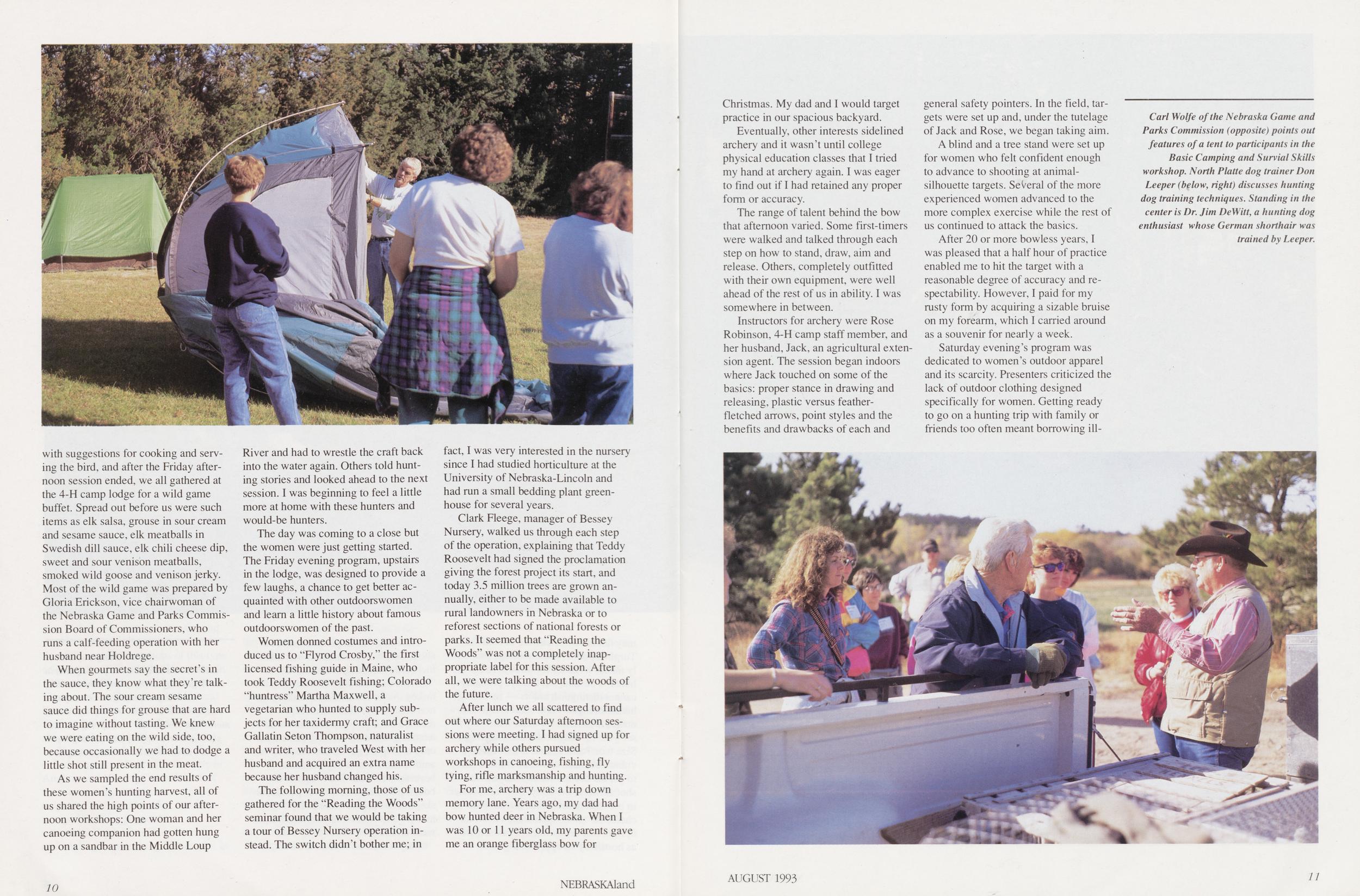
Instructors for archery were Rose Robinson, 4-H camp staff member, and her husband, Jack, an agricultural extension agent. The session began indoors where Jack touched on some of the basics: proper stance in drawing and releasing, plastic versus feather- fletched arrows, point styles and the benefits and drawbacks of each and general safety pointers. In the field, targets were set up and, under the tutelage of Jack and Rose, we began taking aim.
A blind and a tree stand were set up for women who felt confident enough to advance to shooting at animal- silhouette targets. SeVeral of the more experienced women advanced to the more complex exercise while the rest of us continued to attack the basics.
After 20 or more bowless years, I was pleased that a half hour of practice enabled me to hit the target with a reasonable degree of accuracy and respectability. However, I paid for my rusty form by acquiring a sizable bruise on my forearm, which I carried around as a souvenir for nearly a week.
Saturday evening's program was dedicated to women's outdoor apparel and its scarcity. Presenters criticized the lack of outdoor clothing designed specifically for women. Getting ready to go on a hunting trip with family or friends too often meant borrowing ill-fitting,
Outdoors-women "models" donned outdoor clothing specifically designed for women and encouraged female hunters to support outfitters catering to women to encourage them to expand their offerings.
Even for a non-hunter like me, this presentation had great meaning. I enjoy taking several substantial hikes during the year. So what do I have in common with the hunter? All of us spend hours out in the wild with no restroom facilities in sight. For a man, it's not such a big deal. But for women, most clothing designs are inconvenient. Veronica Morgan of Minneapolis and her business "Zanika Sportswear" challenge the male-oriented design of hunting wear, offering jumpsuits, pants and "Long Janes" with tasteful lines and most important, a zippered crotch. I had to wonder why it took so long for someone to address a clothing feature that has been hindering women for decades if not centuries.
Some women headed for their cabins to turn in; others lingered at the lodge to talk more about the workshops over refreshments. Moms lined up at the lodge's pay phone to check on families. Still others sought out less populated corners of the lodge and buried their heads in novels.
12 NEBRASKAlandI was certainly tired enough to head back to the cabin I shared with several other women, but I was anxious to find out more about the camping session I had missed. I cornered Marlene Schulte of Kearney, Nebraska, who had attended the session earlier, and asked about recommended equipment, knowing it would come in handy in a few years when my daughter is old enough to get interested in tenting.
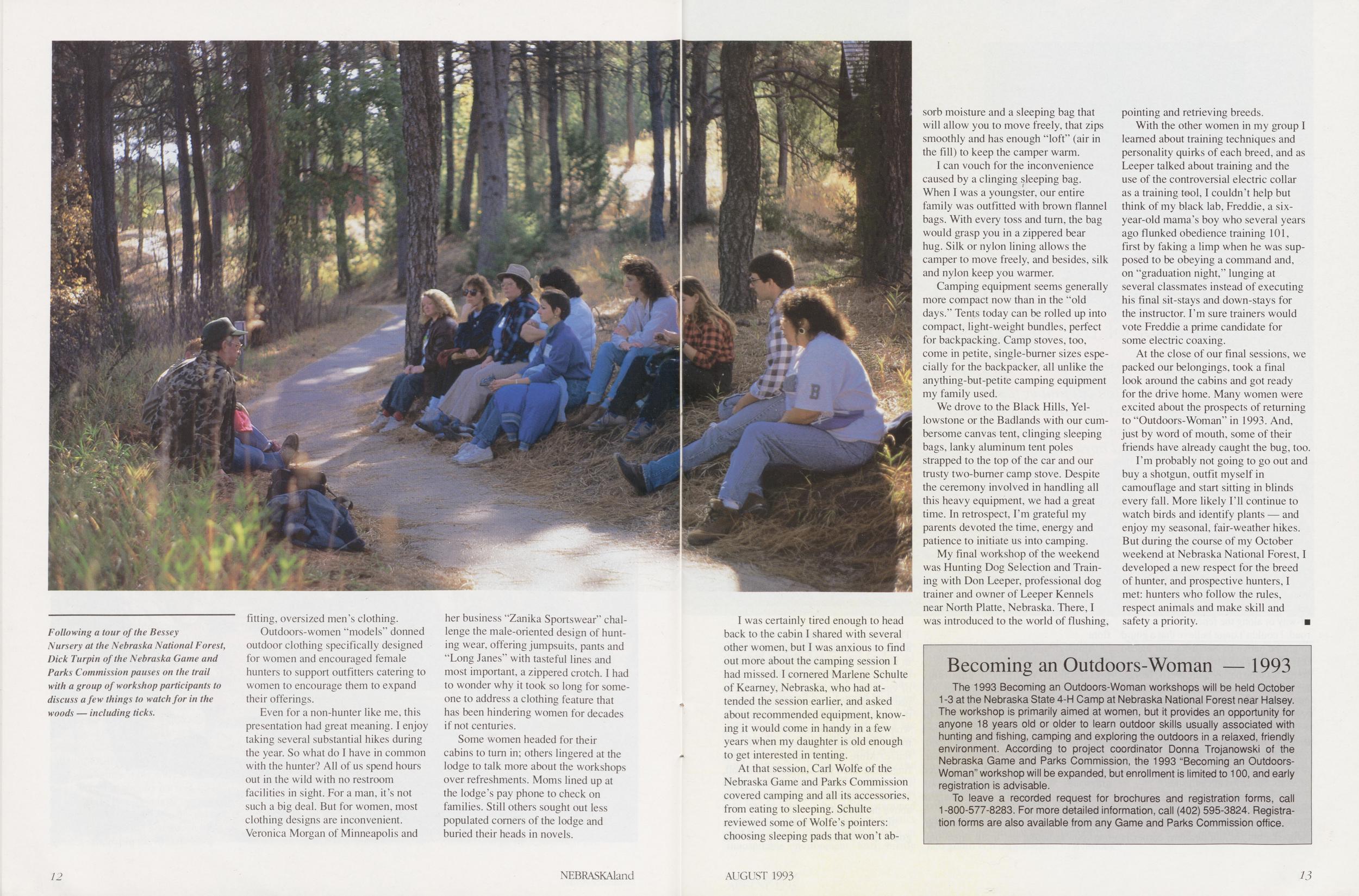
At that session, Carl Wolfe of the Nebraska Game and Parks Commission covered camping and all its accessories, from eating to sleeping. Schulte reviewed some of Wolfe's pointers: choosing sleeping pads that won't absorb moisture and a sleeping bag that will allow you to move freely, that zips smoothly and has enough "loft" (air in the fill) to keep the camper warm.
I can vouch for the inconvenience caused by a clinging sleeping bag. When I was a youngster, our entire family was outfitted with brown flannel bags. With every toss and turn, the bag would grasp you in a zippered bear hug. Silk or nylon lining allows the camper to move freely, and besides, silk and nylon keep you warmer.
Camping equipment seems generally more compact now than in the "old days." Tents today can be rolled up into compact, light-weight bundles, perfect for backpacking. Camp stoves, too, come in petite, single-burner sizes especially for the backpacker, all unlike the anything-but-petite camping equipment my family used.
We drove to the Black Hills, Yellowstone or the Badlands with our cumbersome canvas tent, clinging sleeping bags, lanky aluminum tent poles strapped to the top of the car and our trusty two-burner camp stove. Despite the ceremony involved in handling all this heavy equipment, we had a great time. In retrospect, I'm grateful my parents devoted the time, energy and patience to initiate us into camping.
My final workshop of the weekend was Hunting Dog Selection and Training with Don Leeper, professional dog trainer and owner of Leeper Kennels near North Platte, Nebraska. There, I was introduced to the world of flushing, pointing and retrieving breeds.
With the other women in my group I learned about training techniques and personality quirks of each breed, and as Leeper talked about training and the use of the controversial electric collar as a training tool, I couldn't help but think of my black lab, Freddie, a six-year-old mama's boy who several years ago flunked obedience training 101, first by faking a limp when he was supposed to be obeying a command and, on "graduation night," lunging at several classmates instead of executing his final sit-stays and down-stays for the instructor. I'm sure trainers would vote Freddie a prime candidate for some electric coaxing.
At the close of our final sessions, we packed our belongings, took a final look around the cabins and got ready for the drive home. Many women were excited about the prospects of returning to "Outdoors-Woman" in 1993. And, just by word of mouth, some of their friends have already caught the bug, too.
I'm probably not going to go out and buy a shotgun, outfit myself in camouflage and start sitting in blinds every fall. More likely I'll continue to watch birds and identify plants — and enjoy my seasonal, fair-weather hikes. But during the course of my October weekend at Nebraska National Forest, I developed a new respect for the breed of hunter, and prospective hunters, I met: hunters who follow the rules, respect animals and make skill and safety a priority.
Becoming an Outdoors-Woman — 1993The 1993 Becoming an Outdoors-Woman workshops will be held October 1 -3 at the Nebraska State 4-H Camp at Nebraska National Forest near Halsey. The workshop is primarily aimed at women, but it provides an opportunity for anyone 18 years old or older to learn outdoor skills usually associated with hunting and fishing, camping and exploring the outdoors in a relaxed, friendly environment. According to project coordinator Donna Trojanowski of the Nebraska Game and Parks Commission, the 1993 "Becoming an Outdoors Woman" workshop will be expanded, but enrollment is limited to 100, and early registration is advisable.
To leave a recorded request for brochures and registration forms, call 1-800-577-8283. For more detailed information, call (402) 595-3824. Registration forms are also available from any Game and Parks Commission office.
AUGUST 1993 13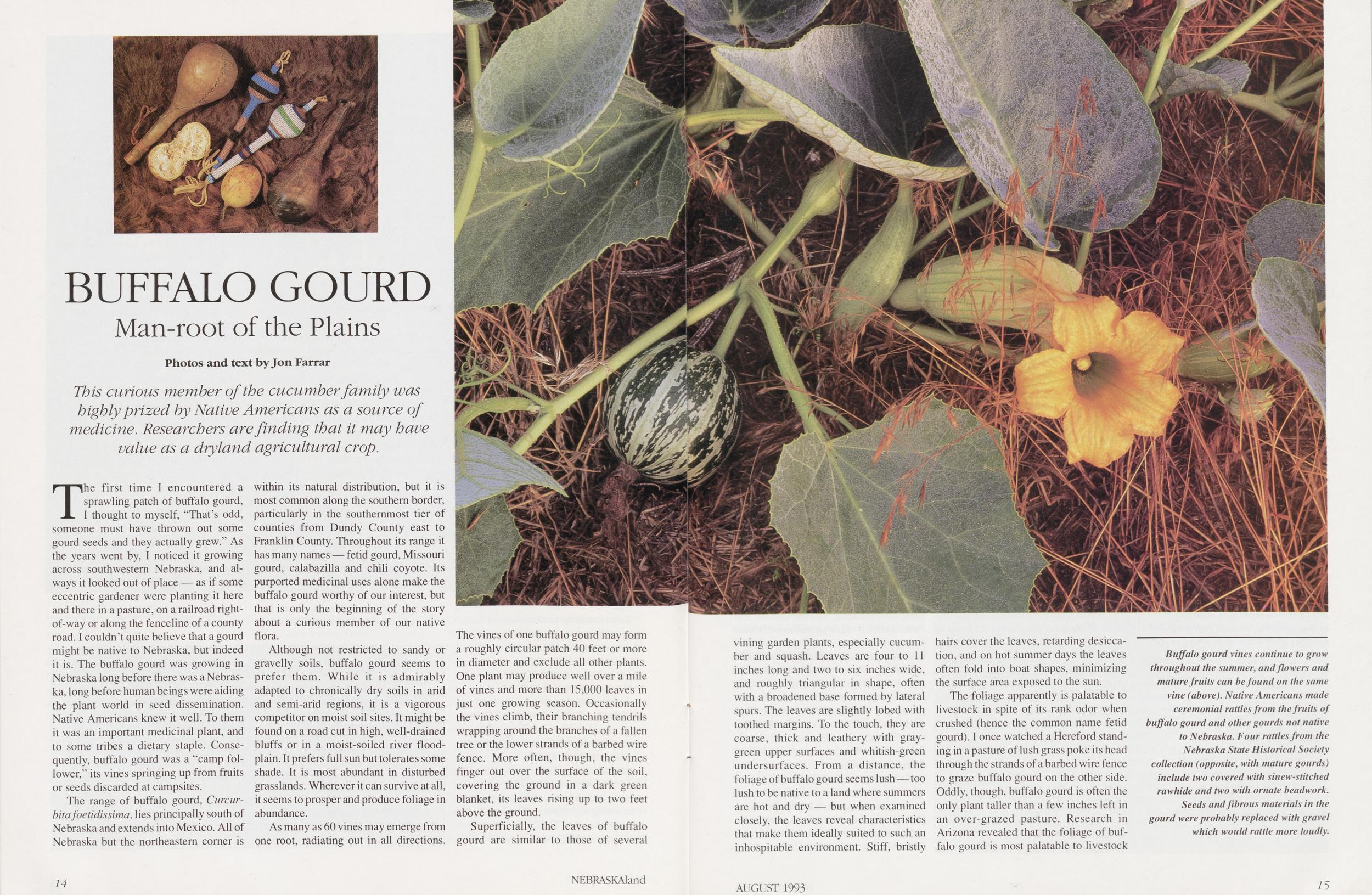
BUFFALO GOURD
Man-root of the Plains Photos and text by Jon Farrar This curious member of the cucumber family was highly prized by Native Americans as a source of medicine. Researchers are finding that it may have value as a dry land agricultural crop.The first time I encountered a sprawling patch of buffalo gourd, I thought to myself, "That's odd, someone must have thrown out some gourd seeds and they actually grew." As the years went by, I noticed it growing across southwestern Nebraska, and always it looked out of place — as if some eccentric gardener were planting it here and there in a pasture, on a railroad right-of-way or along the fence line of a county road. I couldn't quite believe that a gourd might be native to Nebraska, but indeed it is. The buffalo gourd was growing in Nebraska long before there was a Nebraska, long before human beings were aiding the plant world in seed dissemination. Native Americans knew it well. To them it was an important medicinal plant, and to some tribes a dietary staple. Consequently, buffalo gourd was a "camp follower," its vines springing up from fruits or seeds discarded at campsites.
The range of buffalo gourd, Curcurbitafoetidissima, lies principally south of Nebraska and extends into Mexico. All of Nebraska but the northeastern comer is within its natural distribution, but it is most common along the southern border, particularly in the southernmost tier of counties from Dundy County east to Franklin County. Throughout its range it has many names — fetid gourd, Missouri gourd, calabazilla and chili coyote. Its purported medicinal uses alone make the buffalo gourd worthy of our interest, but that is only the beginning of the story about a curious member of our native flora.
Although not restricted to sandy or gravelly soils, buffalo gourd seems to prefer them. While it is admirably adapted to chronically dry soils in arid and semi-arid regions, it is a vigorous competitor on moist soil sites. It might be found on a road cut in high, well-drained bluffs or in a moist-soiled river floodplain. It prefers full sun but tolerates some shade. It is most abundant in disturbed grasslands. Wherever it can survive at all, it seems to prosper and produce foliage in abundance.
As many as 60 vines may emerge from one root, radiating out in all directions. The vines of one buffalo gourd may form a roughly circular patch 40 feet or more in diameter and exclude all other plants. One plant may produce well over a mile of vines and more than 15,000 leaves in just one growing season. Occasionally the vines climb, their branching tendrils wrapping around the branches of a fallen tree or the lower strands of a barbed wire fence. More often, though, the vines finger out over the surface of the soil, covering the ground in a dark green blanket, its leaves rising up to two feet above the ground.
Superficially, the leaves of buffalo gourd are similar to those of several 14 NEBRASKAland vining garden plants, especially cucumber and squash. Leaves are four to 11 inches long and two to six inches wide, and roughly triangular in shape, often with a broadened base formed by lateral spurs. The leaves are slightly lobed with toothed margins. To the touch, they are coarse, thick and leathery with gray- green upper surfaces and whitish-green undersurfaces. From a distance, the foliage of buffalo gourd seems lush — too lush to be native to a land where summers are hot and dry — but when examined closely, the leaves reveal characteristics that make them ideally suited to such an inhospitable environment. Stiff, bristly hairs cover the leaves, retarding desiccation, and on hot summer days the leaves often fold into boat shapes, minimizing the surface area exposed to the sun. The foliage apparently is palatable to livestock in spite of its rank odor when crushed (hence the common name fetid gourd). I once watched a Hereford standing in a pasture of lush grass poke its head through the strands of a barbed wire fence to graze buffalo gourd on the other side. Oddly, though, buffalo gourd is often the only plant taller than a few inches left in an over-grazed pasture. Research in Arizona revealed that the foliage of buffalo gourd is most palatable to livestock
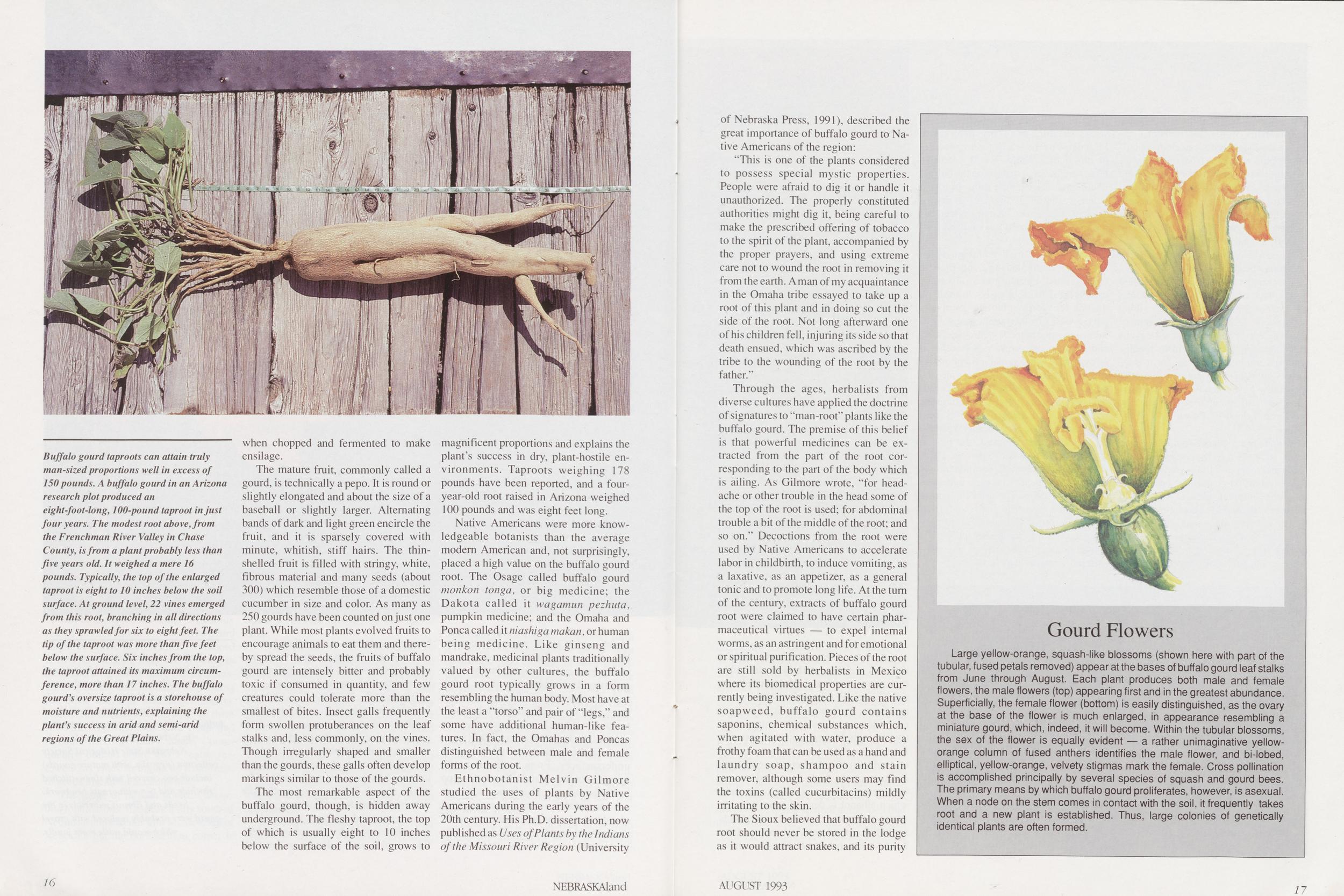
The mature fruit, commonly called a gourd, is technically a pepo. It is round or slightly elongated and about the size of a baseball or slightly larger. Alternating bands of dark and light green encircle the fruit, and it is sparsely covered with minute, whitish, stiff hairs. The thinshelled fruit is filled with stringy, white, fibrous material and many seeds (about 300) which resemble those of a domestic cucumber in size and color. As many as 250 gourds have been counted on just one plant. While most plants evolved fruits to encourage animals to eat them and there by spread the seeds, the fruits of buffalo gourd are intensely bitter and probably toxic if consumed in quantity, and few creatures could tolerate more than the smallest of bites. Insect galls frequently form swollen protuberances on the leaf stalks and, less commonly, on the vines. Though irregularly shaped and smaller than the gourds, these galls often develop markings similar to those of the gourds.
The most remarkable aspect of the buffalo gourd, though, is hidden away underground. The fleshy taproot, the top of which is usually eight to 10 inches below the surface of the soil, grows to magnificent proportions and explains the plant's success in dry, plant-hostile environments. Taproots weighing 178 pounds have been reported, and a four-year-old root raised in Arizona weighed 100 pounds and was eight feet long.
Native Americans were more knowledgeable botanists than the average modern American and, not surprisingly, placed a high value on the buffalo gourd root. The Osage called buffalo gourd monkon tonga, or big medicine; the Dakota called it wagamun pezhuta, pumpkin medicine; and the Omaha and Ponca called it niashiga makan, or human being medicine. Like ginseng and mandrake, medicinal plants traditionally valued by other cultures, the buffalo gourd root typically grows in a form resembling the human body. Most have at the least a "torso" and pair of "legs," and some have additional human-like features. In fact, the Omahas and Poncas distinguished between male and female forms of the root.
Ethnobotanist Melvin Gilmore studied the uses of plants by Native Americans during the early years of the 20th century. His Ph.D. dissertation, now published as Uses of Plants by the Indians of the Missouri River Region (University 16 NEBRASKAland of Nebraska Press, 1991), described the great importance of buffalo gourd to Native Americans of the region:
This is one of the plants considered to possess special mystic properties. People were afraid to dig it or handle it unauthorized. The properly constituted authorities might dig it, being careful to make the prescribed offering of tobacco to the spirit of the plant, accompanied by the proper prayers, and using extreme care not to wound the root in removing it from the earth. A man of my acquaintance in the Omaha tribe essayed to take up a root of this plant and in doing so cut the side of the root. Not long afterward one of his children fell, injuring its side so that death ensued, which was ascribed by the tribe to the wounding of the root by the father."
Through the ages, herbalists from diverse cultures have applied the doctrine of signatures to "man-root" plants like the buffalo gourd. The premise of this belief is that powerful medicines can be extracted from the part of the root corresponding to the part of the body which is ailing. As Gilmore wrote, "for head- ache or other trouble in the head some of the top of the root is used; for abdominal trouble a bit of the middle of the root; and so on." Decoctions from the root were used by Native Americans to accelerate labor in childbirth, to induce vomiting, as a laxative, as an appetizer, as a general tonic and to promote long life. At the turn of the century, extracts of buffalo gourd root were claimed to have certain pharmaceutical virtues — to expel internal worms, as an astringent and for emotional or spiritual purification. Pieces of the root are still sold by herbalists in Mexico where its biomedical properties are currently being investigated. Like the native soapweed, buffalo gourd contains saponins, chemical substances which, when agitated with water, produce a frothy foam that can be used as a hand and laundry soap, shampoo and stain remover, although some users may find the toxins (called cucurbitacins) mildly irritating to the skin.
The Sioux believed that buffalo gourd root should never be stored in the lodge as it would attract snakes, and its purity and power would be diminished by the evil thoughts, words or actions of those within the lodge. Rattles made from buffalo gourds, as well as from other species of gourds not native to our region, were important ceremonial items in many Native American cultures. Usually the seeds and fibrous material were removed and replaced with gravel (which rattled more loudly), a handle was attached, and the entire rattle covered with rawhide or decorative beads.
Large yellow-orange, squash-like blossoms (shown here with part of the tubular, fused petals removed) appear at the bases of buffalo gourd leaf stalks from June through August. Each plant produces both male and female flowers, the male flowers (top) appearing first and in the greatest abundance. Superficially, the female flower (bottom) is easily distinguished, as the ovary at the base of the flower is much enlarged, in appearance resembling a miniature gourd, which, indeed, it will become. Within the tubular blossoms, the sex of the flower is equally evident — a rather unimaginative yellow-orange column of fused anthers identifies the male flower, and bi-lobed, elliptical, yellow-orange, velvety stigmas mark the female. Cross pollination is accomplished principally by several species of squash and gourd bees. The primary means by which buffalo gourd proliferates, however, is asexual. When a node on the stem comes in contact with the soil, it frequently takes root and a new plant is established. Thus, large colonies of genetically identical plants are often formed.
AUGUST 1993 17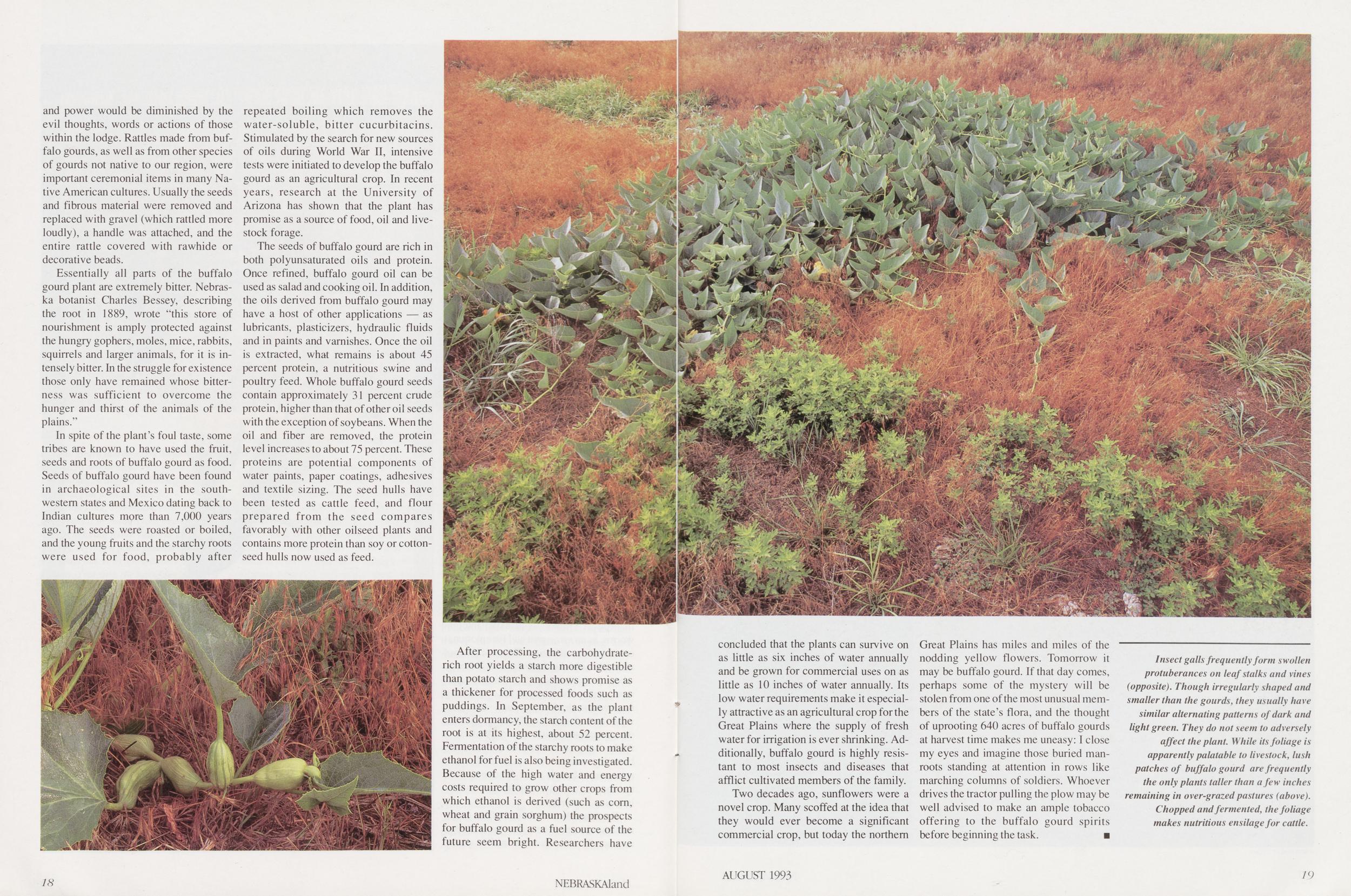
Essentially all parts of the buffalo gourd plant are extremely bitter. Nebraska botanist Charles Bessey, describing the root in 1889, wrote "this store of nourishment is amply protected against the hungry gophers, moles, mice, rabbits, squirrels and larger animals, for it is intensely bitter. In the struggle for existence those only have remained whose bitterness was sufficient to overcome the hunger and thirst of the animals of the plains."
In spite of the plant's foul taste, some tribes are known to have used the fruit, seeds and roots of buffalo gourd as food. Seeds of buffalo gourd have been found in archaeological sites in the southwestern states and Mexico dating back to Indian cultures more than 7,000 years ago. The seeds were roasted or boiled, and the young fruits and the starchy roots were used for food, probably after repeated boiling which removes the water-soluble, bitter cucurbitacins. Stimulated by the search for new sources of oils during World War II, intensive tests were initiated to develop the buffalo gourd as an agricultural crop. In recent years, research at the University of Arizona has shown that the plant has promise as a source of food, oil and livestock forage.
The seeds of buffalo gourd are rich in both polyunsaturated oils and protein. Once refined, buffalo gourd oil can be used as salad and cooking oil. In addition, the oils derived from buffalo gourd may have a host of other applications — as lubricants, plasticizers, hydraulic fluids and in paints and varnishes. Once the oil is extracted, what remains is about 45 percent protein, a nutritious swine and poultry feed. Whole buffalo gourd seeds contain approximately 31 percent crude protein, higher than that of other oil seeds with the exception of soybeans. When the oil and fiber are removed, the protein level increases to about 75 percent. These proteins are potential components of water paints, paper coatings, adhesives and textile sizing. The seed hulls have been tested as cattle feed, and flour prepared from the seed compares favorably with other oilseed plants and contains more protein than soy or cottonseed hulls now used as feed.
After processing, the carbohydrate- rich root yields a starch more digestible than potato starch and shows promise as a thickener for processed foods such as puddings. In September, as the plant enters dormancy, the starch content of the root is at its highest, about 52 percent. Fermentation of the starchy roots to make ethanol for fuel is also being investigated. Because of the high water and energy costs required to grow other crops from which ethanol is derived (such as corn, wheat and grain sorghum) the prospects for buffalo gourd as a fuel source of the future seem bright. Researchers have IS NEBRASKAland concluded that the plants can survive on as little as six inches of water annually and be grown for commercial uses on as little as 10 inches of water annually. Its low water requirements make it especially attractive as an agricultural crop for the Great Plains where the supply of fresh water for irrigation is ever shrinking. Additionally, buffalo gourd is highly resistant to most insects and diseases that afflict cultivated members of the family.
Two decades ago, sunflowers were a novel crop. Many scoffed at the idea that they would ever become a significant commercial crop, but today the northern Great Plains has miles and miles of the nodding yellow flowers. Tomorrow it may be buffalo gourd. If that day comes, perhaps some of the mystery will be stolen from one of the most unusual members of the state's flora, and the thought of uprooting 640 acres of buffalo gourds at harvest time makes me uneasy: I close my eyes and imagine those buried manroots standing at attention in rows like marching columns of soldiers. Whoever drives the tractor pulling the plow may be well advised to make an ample tobacco offering to the buffalo gourd spirits before beginning the task.
Cabela's
A Store with a Story By Bob Grier This 32-year-old company founded by a Nebraska family has grown into one of the world's largest outdoor equipment suppliers, and the new Sidney retail store has become a popular destination for outdoor enthusiasts.The year was 1961, and with a small advertisement in a Casper, Wyoming, newspaper offering "12 hand-tied flies for $1," Dick and Mary Cabela launched a thriving mail order and retail sporting goods business from their home in Chappell, a small, wheat-farming community on U.S. Highway 30 between Ogallala and Sidney in Nebraska's Panhandle.
By 1991, the firm's 30th anniversary, Cabela's had grown to well over 1,000 employees in Nebraska, was mailing 50 million catalogs annually to customers all over the world and had opened major retail facilities in Kearney and Sidney. The Sidney retail store — a 75,000-square-foot building housing 50,000 square feet of retail space, a sandwich shop, an art gallery, an 8,000- gallon aquarium and a 27-foot-tall "mountain" displaying 40 wildlife mounts from across North America — opened for business in July 1991.
In the beginning, working at their kitchen table in Chappell, Dick and Mary mailed mimeographed lists of outdoor products. Temporary help for mailing and catalog production was added as the business grew. A small shed in the backyard became the growing operation's first warehouse.
In 1963, Dick's younger brother Jim joined the enterprise; in 1964 the business moved into the basement of their father's furniture store in Chappell, and in 1965, the mail order business incorporated and moved to a larger building across the street from the furniture store. The firm moved again two years later into the Chappell Legion Hall.
The growing volume of mail-order business made another move necessary, and in 1968, Cabela's purchased the vacant 50,000-square-foot John Deere building in Sidney. The Sidney building adequately housed the expanding mail order, retail, warehouse and shipping operations. With characteristic resourcefulness, employees appropriated an unused portion of an upper floor as an archery range until the need for more retail space and catalog support services finally filled the Sidney building to capacity.
In the mid-1980s, Cabela's acquired the former Rockwell International plant in Kearney. Direct mail and telemarketing operations and Kearney's college community workforce that could staff the telephones 24 hours a day fueled the eastward expansion.
Work on the new Sidney store began in June 1990, and the store opened for business one year later. At about the same time, Cabela's acquired three buildings on the former Sioux Ordnance Depot grounds for warehouse operations. In 1992, another five depot buildings were acquired, and currently the firm's Sidney warehouse space equals more than 10 football fields.
The building took more than 400 tons of Colorado moss rock, 3,000 miles of electrical wiring and overhead timbers of Douglas fir from Montana. Its most popular display, "Conservation Mountain," stands opposite the main entrance. Forty wildlife mounts are displayed on the mountain and on a 20 NEBRASKAland
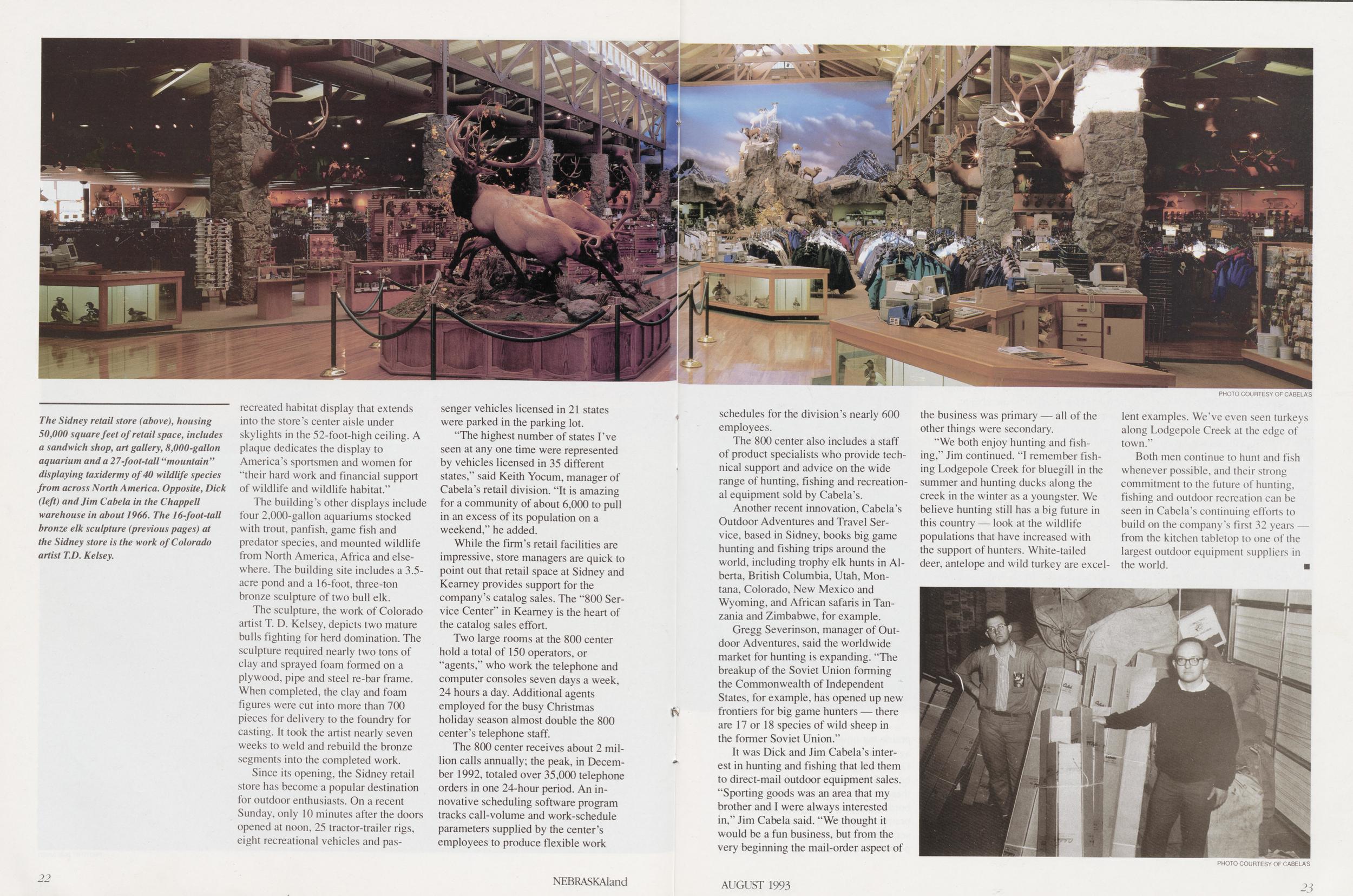
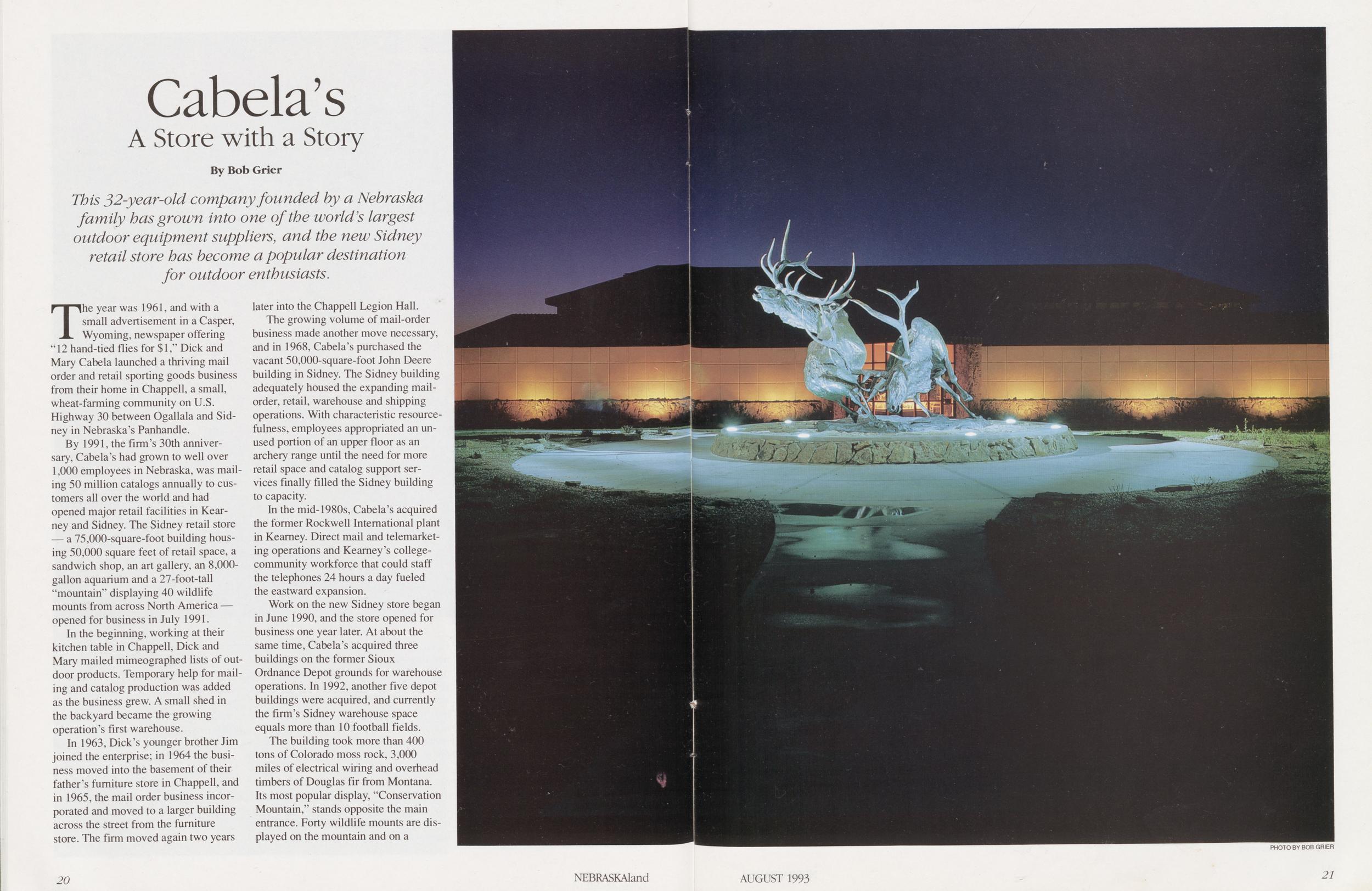
The building's other displays include four 2,000-gallon aquariums stocked with trout, panfish, game fish and predator species, and mounted wildlife from North America, Africa and elsewhere. The building site includes a 3.5- acre pond and a 16-foot, three-ton bronze sculpture of two bull elk.
The sculpture, the work of Colorado artist T. D. Kelsey, depicts two mature bulls fighting for herd domination. The sculpture required nearly two tons of clay and sprayed foam formed on a plywood, pipe and steel re-bar frame. When completed, the clay and foam figures were cut into more than 700 pieces for delivery to the foundry for casting. It took the artist nearly seven weeks to weld and rebuild the bronze segments into the completed work.
Since its opening, the Sidney retail store has become a popular destination for outdoor enthusiasts. On a recent Sunday, only 10 minutes after the doors opened at noon, 25 tractor-trailer rigs, eight recreational vehicles and passenger vehicles licensed in 21 states were parked in the parking lot.
"The highest number of states I've seen at any one time were represented by vehicles licensed in 35 different states," said Keith Yocum, manager of Cabela's retail division. "It is amazing for a community of about 6,000 to pull in an excess of its population on a weekend," he added.
While the firm's retail facilities are impressive, store managers are quick to point out that retail space at Sidney and Kearney provides support for the company's catalog sales. The "800 Service Center" in Kearney is the heart of the catalog sales effort.
Two large rooms at the 800 center hold a total of 150 operators, or "agents," who work the telephone and computer consoles seven days a week, 24 hours a day. Additional agents employed for the busy Christmas holiday season almost double the 800 center's telephone staff.
The 800 center receives about 2 million calls annually; the peak, in December 1992, totaled over 35,000 telephone orders in one 24-hour period. An innovative scheduling software program tracks call-volume and work-schedule parameters supplied by the center's employees to produce flexible work 22 NEBRASKAland schedules for the division's nearly 600 employees.
The 800 center also includes a staff of product specialists who provide technical support and advice on the wide range of hunting, fishing and recreational equipment sold by Cabela's.
Another recent innovation, Cabela's Outdoor Adventures and Travel Service, based in Sidney, books big game hunting and fishing trips around the world, including trophy elk hunts in Alberta, British Columbia, Utah, Montana, Colorado, New Mexico and Wyoming, and African safaris in Tanzania and Zimbabwe, for example.
Gregg Severinson, manager of Outdoor Adventures, said the worldwide market for hunting is expanding. "The breakup of the Soviet Union forming the Commonwealth of Independent States, for example, has opened up new frontiers for big game hunters — there are 17 or 18 species of wild sheep in the former Soviet Union."
It was Dick and Jim Cabela's interest in hunting and fishing that led them to direct-mail outdoor equipment sales. "Sporting goods was an area that my brother and I were always interested in," Jim Cabela said. "We thought it would be a fun business, but from the very beginning the mail-order aspect of the business was primary — all of the other things were secondary.
"We both enjoy hunting and fishing," Jim continued. "I remember fishing Lodgepole Creek for bluegill in the summer and hunting ducks along the creek in the winter as a youngster. We believe hunting still has a big future in this country — look at the wildlife populations that have increased with the support of hunters. White-tailed deer, antelope and wild turkey are excellent examples. We've even seen turkeys along Lodgepole Creek at the edge of town."
Both men continue to hunt and fish whenever possible, and their strong commitment to the future of hunting, fishing and outdoor recreation can be seen in Cabela's continuing efforts to build on the company's first 32 years — from the kitchen tabletop to one of the largest outdoor equipment suppliers in the world.
Flat Water Mammals
By Patricia W. Freeman and Russell A. Benedict Nebraska s diverse habitats are home for an equally diverse collection of mammals, some of which appear to be expanding their ranges as the habitat changes, especially along the Platte River Valley.There are many people for whom the terms "God's Country" and "Nebraska" are synonymous. We are not qualified to evaluate that particular metaphysical question, but we can explain why our state is unique from a biological standpoint. Geographically, Nebraska is so situated in the United States that within its boundaries eastern habitats meet western habitats, and northern habitats meet southern.
This diversity of habitats has several consequences. First, the presence of many different habitats means that a wide variety of plants and animals are found here. Since habitat changes fairly quickly as one travels across Nebraska, the plants and animals also change, and in a single day it is possible to visit nearly desert-like habitats in western Nebraska, moderately dry grasslands in the center of the state and lush prairies and forests in the eastern counties. The organisms inhabiting these habitats are also quite different.
Second, the meeting of eastern and western habitats and northern and southern habitats brings together plants and animals ordinarily widely separated geographically. This mixing of animals from the four comers of the continent is especially evident along the Platte and Niobrara rivers whose river valleys create highways of habitat (forests and wet prairies) that allow eastern and western organisms to venture out onto the otherwise harsh and treeless plains. In these narrow, fragile strips, normally separate populations meet, occasionally do battle and sometimes interbreed. It is the stuff that some biologists can only dream about.
To many people speeding along Interstate 80, the Platte River Valley is anything but exciting. The seemingly monotonous valley is merely an obstacle to be traversed in route to more exciting destinations east or west. The convergence of organisms from different regions and the fairly rapid change of habitats goes largely unnoticed because the elevation change is gradual from east to west. Since much of our travel is limited to the Platte Valley, changes in habitats abutting the valley are not obvious. But the landscape does change and so do the organisms.
If we follow the Platte River from east to west, we begin in the eastern deciduous forest found on the rugged bluffs along the Missouri River. These oak-hickory forests are typical of much of the eastern United States but extend along the Platte only for a short distance — from the mouth of the river west for about 50 miles. Historically these forests were found primarily on the steep bluffs along the valley. Prairie fires swept the ridge tops above and prevented extensive growth of trees. The elevation of the Platte Valley at its mouth is about 960 feet above sea level, and the hills flanking the valley reach nearly 1,200 feet.
For most of the Platte's length, the banks of the valley are blanketed by grasslands. In the eastern third of the state, the valley passes through a region previously dominated by tallgrass prairie but now largely converted to agriculture. In central Nebraska, from Grand Island to Paxton, the valley is bounded by mixed-grass prairie and farther west, from Paxton to the Wyoming border, it passes through shortgrass prairie. In several areas, the valley passes through sandhills prairie including pockets to the north of the river starting 24 NEBRASKAland just west of Columbus and the large continuous body of the Sandhills starting just west of Gothenberg and extending to Scottsbluff. South of the river is a pocket of sandsage prairie from North Platte to Ogallala. These different prairies vary in their composition of plants and in general become shorter in height as one progresses west.
At the western end of the state, the North Platte Valley once again passes through an area partially covered by forest. The Wildcat Hills are a mix of prairie and Rocky Mountain forest dominated by ponderosa pine trees. The elevation of the valley where it passes into Wyoming is about 4,030 feet, with the surrounding hills topping 4,900
The vegetation of the flat floodplain within the valley is fairly similar throughout the state, a fact to which most interstate travelers will attest. Floodplain forests dominated by cottonwood, willow and other fast-growing trees are common and appear to be increasing due to planting by humans, control of prairie fires and the decreasing frequency of flooding on the Platte. Riverine forests extend west along the valley to the Wyoming border along the North Platte, but become shorter in height and harbor different species of plants as we travel west. The river floodplain is also vegetated by dense lowland prairies that are now less abundant because of cultivation.
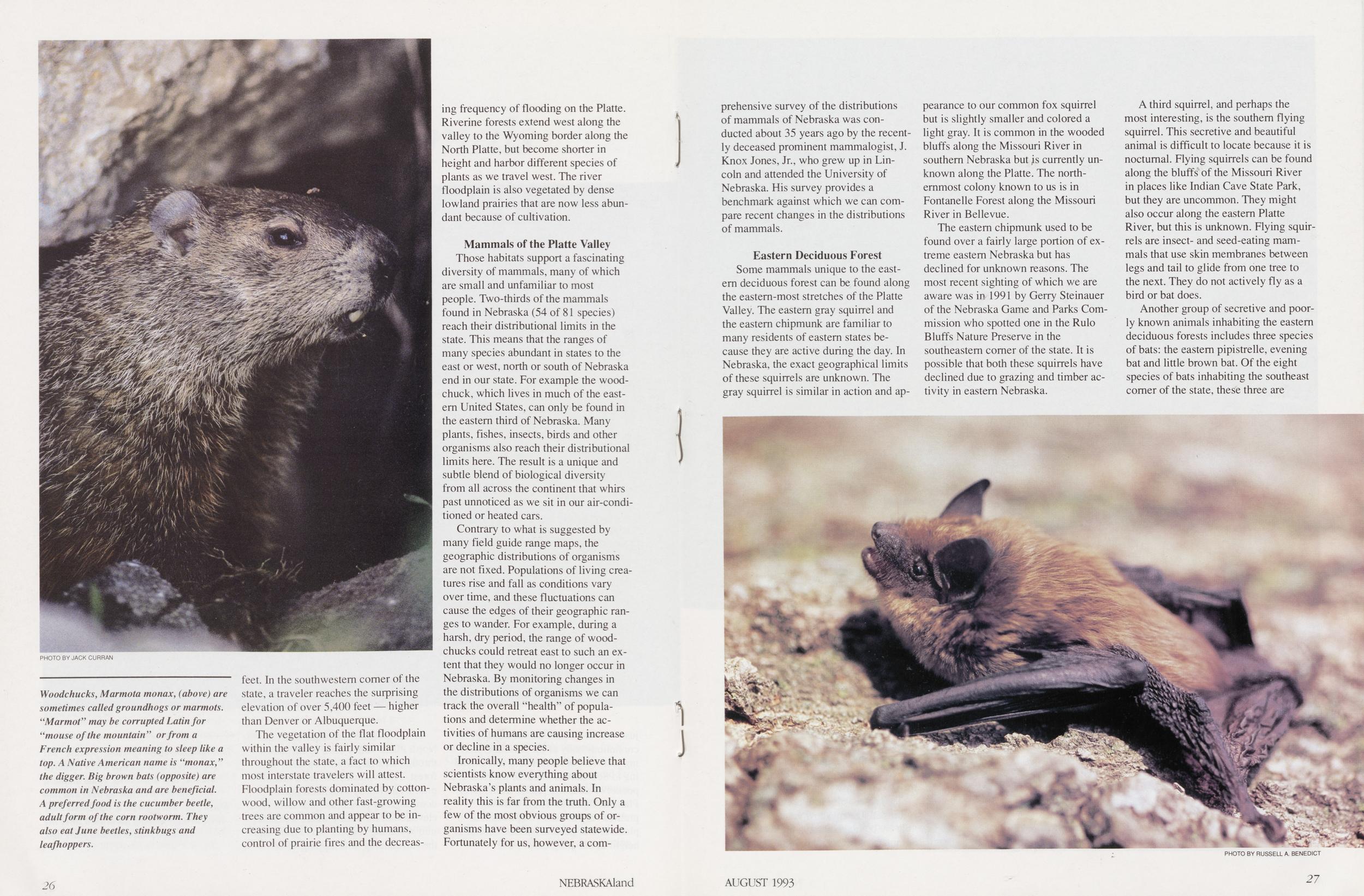
Mammals of the Platte ValleyThose habitats support a fascinating diversity of mammals, many of which are small and unfamiliar to most people. Two-thirds of the mammals found in Nebraska (54 of 81 species) reach their distributional limits in the state. This means that the ranges of many species abundant in states to the east or west, north or south of Nebraska end in our state. For example the woodchuck, which lives in much of the eastem United States, can only be found in the eastern third of Nebraska. Many plants, fishes, insects, birds and other organisms also reach their distributional limits here. The result is a unique and subtle blend of biological diversity from all across the continent that whirs past unnoticed as we sit in our air-conditioned or heated cars.
Contrary to what is suggested by many field guide range maps, the geographic distributions of organisms are not fixed. Populations of living creatures rise and fall as conditions vary over time, and these fluctuations can cause the edges of their geographic ranges to wander. For example, during a harsh, dry period, the range of woodchucks could retreat east to such an extent that they would no longer occur in Nebraska. By monitoring changes in the distributions of organisms we can track the overall "health" of populations and determine whether the activities of humans are causing increase or decline in a species.
Ironically, many people believe that scientists know everything about Nebraska's plants and animals. In reality this is far from the truth. Only a few of the most obvious groups of organisms have been surveyed statewide. Fortunately for us, however, a comprehensive 26 NEBRASKAland survey of the distributions of mammals of Nebraska was conducted about 35 years ago by the recently deceased prominent mammalogist, J. Knox Jones, Jr., who grew up in Lincoln and attended the University of Nebraska. His survey provides a benchmark against which we can compare recent changes in the distributions of mammals.
Eastern Deciduous ForestSome mammals unique to the eastern deciduous forest can be found along the eastern-most stretches of the Platte Valley. The eastern gray squirrel and the eastern chipmunk are familiar to many residents of eastern states because they are active during the day. In Nebraska, the exact geographical limits of these squirrels are unknown. The gray squirrel is similar in action and appearance to our common fox squirrel but is slightly smaller and colored a light gray. It is common in the wooded bluffs along the Missouri River in southern Nebraska but is currently unknown along the Platte. The northernmost colony known to us is in Fontanelle Forest along the Missouri River in Bellevue.
The eastern chipmunk used to be found over a fairly large portion of extreme eastern Nebraska but has declined for unknown reasons. The most recent sighting of which we are aware was in 1991 by Gerry Steinauer of the Nebraska Game and Parks Commission who spotted one in the Rulo Bluffs Nature Preserve in the southeastern comer of the state. It is possible that both these squirrels have declined due to grazing and timber activity in eastern Nebraska.
A third squirrel, and perhaps the most interesting, is the southern flying squirrel. This secretive and beautiful animal is difficult to locate because it is nocturnal. Flying squirrels can be found along the bluffs of the Missouri River in places like Indian Cave State Park, but they are uncommon. They might also occur along the eastern Platte River, but this is unknown. Flying squirrels are insect- and seed-eating mammals that use skin membranes between legs and tail to glide from one tree to the next. They do not actively fly as a bird or bat does.
Another group of secretive and poorly known animals inhabiting the eastern deciduous forests includes three species of bats: the eastern pipistrelle, evening bat and little brown bat. Of the eight species of bats inhabiting the southeast comer of the state, these three are
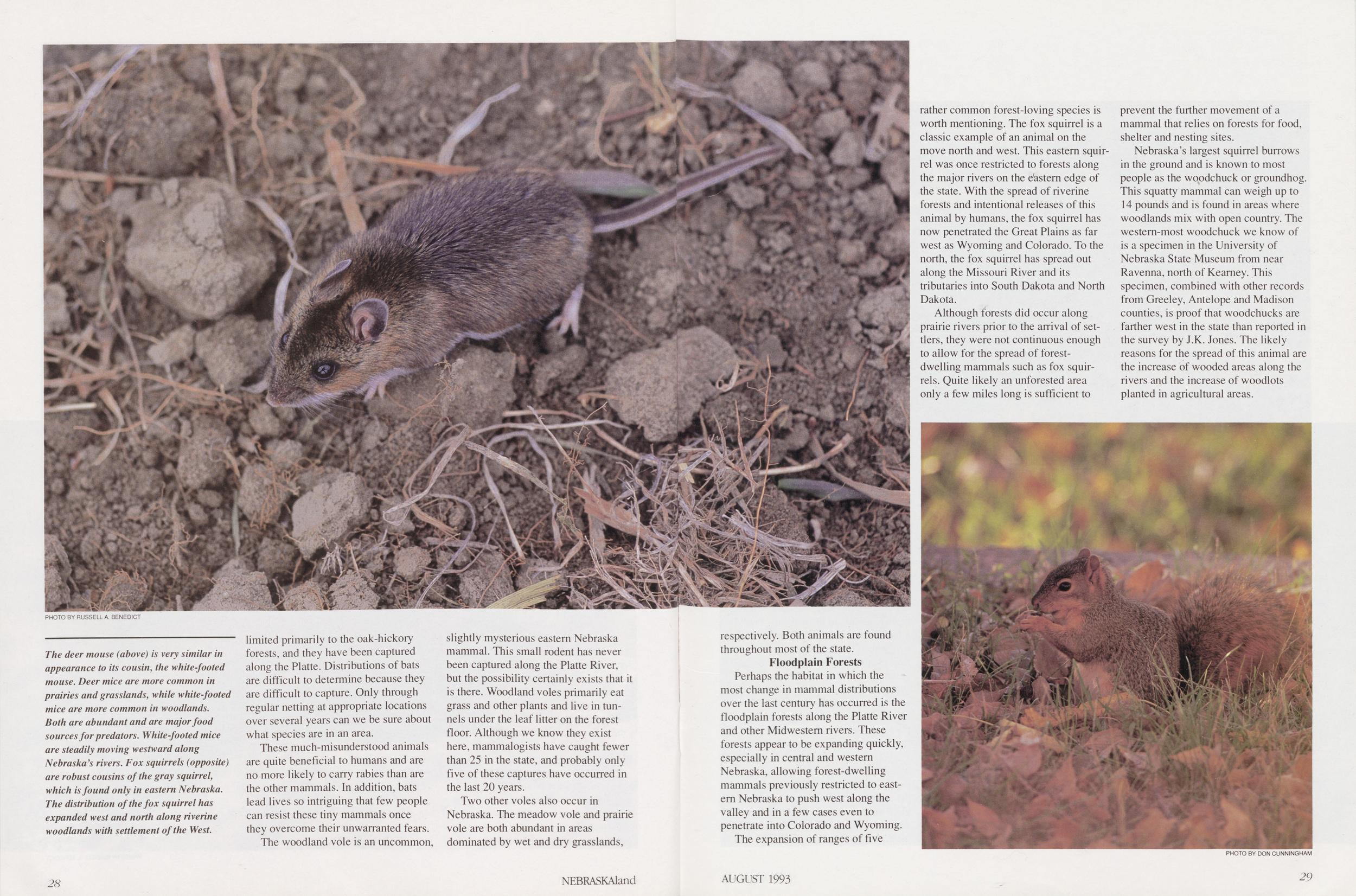
These much-misunderstood animals are quite beneficial to humans and are no more likely to carry rabies than are the other mammals. In addition, bats lead lives so intriguing that few people can resist these tiny mammals once they overcome their unwarranted fears.
The woodland vole is an uncommon, slightly mysterious eastern Nebraska mammal. This small rodent has never been captured along the Platte River, but the possibility certainly exists that it is there. Woodland voles primarily eat grass and other plants and live in tunnels under the leaf litter on the forest floor. Although we know they exist here, mammalogists have caught fewer than 25 in the state, and probably only five of these captures have occurred in the last 20 years.
Two other voles also occur in Nebraska. The meadow vole and prairie vole are both abundant in areas dominated by wet and dry grasslands, 28 NEBRASKAland respectively. Both animals are found throughout most of the state.
Floodplain ForestsPerhaps the habitat in which the most change in mammal distributions over the last century has occurred is the floodplain forests along the Platte River and other Midwestern rivers. These forests appear to be expanding quickly, especially in central and western Nebraska, allowing forest-dwelling mammals previously restricted to eastern Nebraska to push west along the valley and in a few cases even to penetrate into Colorado and Wyoming.
The expansion of ranges of five rather common forest-loving species is worth mentioning. The fox squirrel is a classic example of an animal on the move north and west. This eastern squirrel was once restricted to forests along the major rivers on the eastern edge of the state. With the spread of riverine forests and intentional releases of this animal by humans, the fox squirrel has now penetrated the Great Plains as far west as Wyoming and Colorado. To the north, the fox squirrel has spread out along the Missouri River and its tributaries into South Dakota and North Dakota.
Although forests did occur along prairie rivers prior to the arrival of settlers, they were not continuous enough to allow for the spread of forest dwelling mammals such as fox squirrels. Quite likely an unforested area only a few miles long is sufficient to prevent the further movement of a mammal that relies on forests for food, shelter and nesting sites.
Nebraska's largest squirrel burrows in the ground and is known to most people as the woodchuck or groundhog. This squatty mammal can weigh up to 14 pounds and is found in areas where woodlands mix with open country. The western-most woodchuck we know of is a specimen in the University of Nebraska State Museum from near Ravenna, north of Kearney. This specimen, combined with other records from Greeley, Antelope and Madison counties, is proof that woodchucks are farther west in the state than reported in the survey by J.K. Jones. The likely reasons for the spread of this animal are the increase of wooded areas along the rivers and the increase of woodlots planted in agricultural areas.
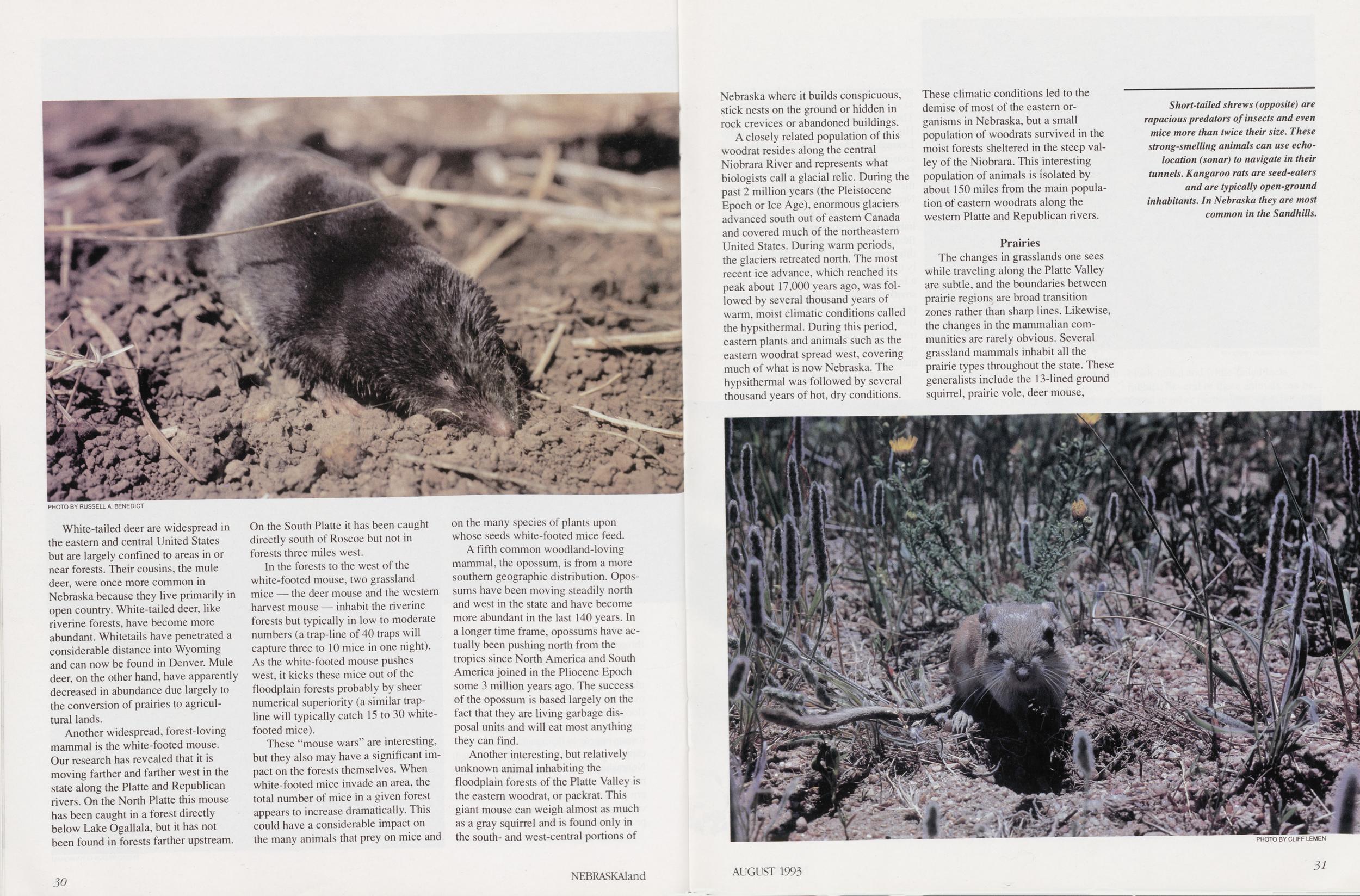
White-tailed deer are widespread in the eastern and central United States but are largely confined to areas in or near forests. Their cousins, the mule deer, were once more common in Nebraska because they live primarily in open country. White-tailed deer, like riverine forests, have become more abundant. White tails have penetrated a considerable distance into Wyoming and can now be found in Denver. Mule deer, on the other hand, have apparently decreased in abundance due largely to the conversion of prairies to agricultural lands.
Another widespread, forest-loving mammal is the white-footed mouse. Our research has revealed that it is moving farther and farther west in the state along the Platte and Republican rivers. On the North Platte this mouse has been caught in a forest directly below Lake Ogallala, but it has not been found in forests farther upstream. On the South Platte it has been caught directly south of Roscoe but not in forests three miles west.
In the forests to the west of the white-footed mouse, two grassland mice — the deer mouse and the western harvest mouse — inhabit the riverine forests but typically in low to moderate numbers (a trap-line of 40 traps will capture three to 10 mice in one night). As the white-footed mouse pushes west, it kicks these mice out of the floodplain forests probably by sheer numerical superiority (a similar trapline will typically catch 15 to 30 white footed mice).
These "mouse wars" are interesting, but they also may have a significant impact on the forests themselves. When white-footed mice invade an area, the total number of mice in a given forest appears to increase dramatically. This could have a considerable impact on the many animals that prey on mice and on the many species of plants upon whose seeds white-footed mice feed.
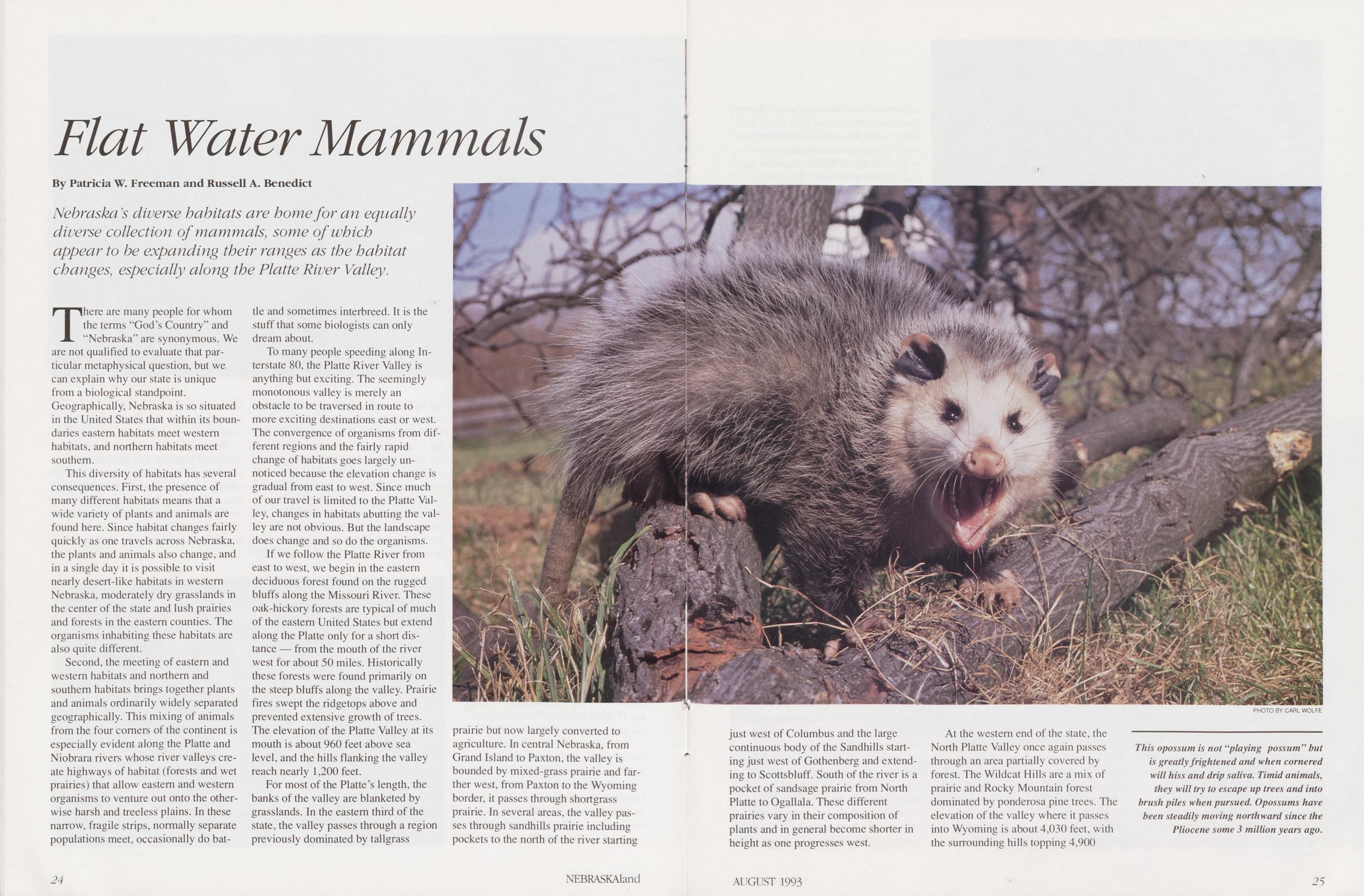
A fifth common woodland-loving mammal, the opossum, is from a more southern geographic distribution. Opossums have been moving steadily north and west in the state and have become more abundant in the last 140 years. In a longer time frame, opossums have actually been pushing north from the tropics since North America and South America joined in the Pliocene Epoch some 3 million years ago. The success of the opossum is based largely on the fact that they are living garbage disposal units and will eat most anything they can find.
Another interesting, but relatively unknown animal inhabiting the floodplain forests of the Platte Valley is the eastern wood rat, or packrat. This giant mouse can weigh almost as much as a gray squirrel and is found only in the south- and west-central portions of 30 NEBRASKAland Nebraska where it builds conspicuous, stick nests on the ground or hidden in rock crevices or abandoned buildings.
A closely related population of this wood rat resides along the central Niobrara River and represents what biologists call a glacial relic. During the past 2 million years (the Pleistocene Epoch or Ice Age), enormous glaciers advanced south out of eastern Canada and covered much of the northeastern United States. During warm periods, the glaciers retreated north. The most recent ice advance, which reached its peak about 17,000 years ago, was followed by several thousand years of warm, moist climatic conditions called the hypsithermal. During this period, eastern plants and animals such as the eastern wood rat spread west, covering much of what is now Nebraska. The hypsithermal was followed by several thousand years of hot, dry conditions. These climatic conditions led to the demise of most of the eastern organisms in Nebraska, but a small population of wood rats survived in the moist forests sheltered in the steep valley of the Niobrara. This interesting population of animals is isolated by about 150 miles from the main population of eastern woodrats along the western Platte and Republican rivers.
PrairiesThe changes in grasslands one sees while traveling along the Platte Valley are subtle, and the boundaries between prairie regions are broad transition zones rather than sharp lines. Likewise, the changes in the mammalian communities are rarely obvious. Several grassland mammals inhabit all the prairie types throughout the state. These generalists include the 13-lined ground squirrel, prairie vole, deer mouse,
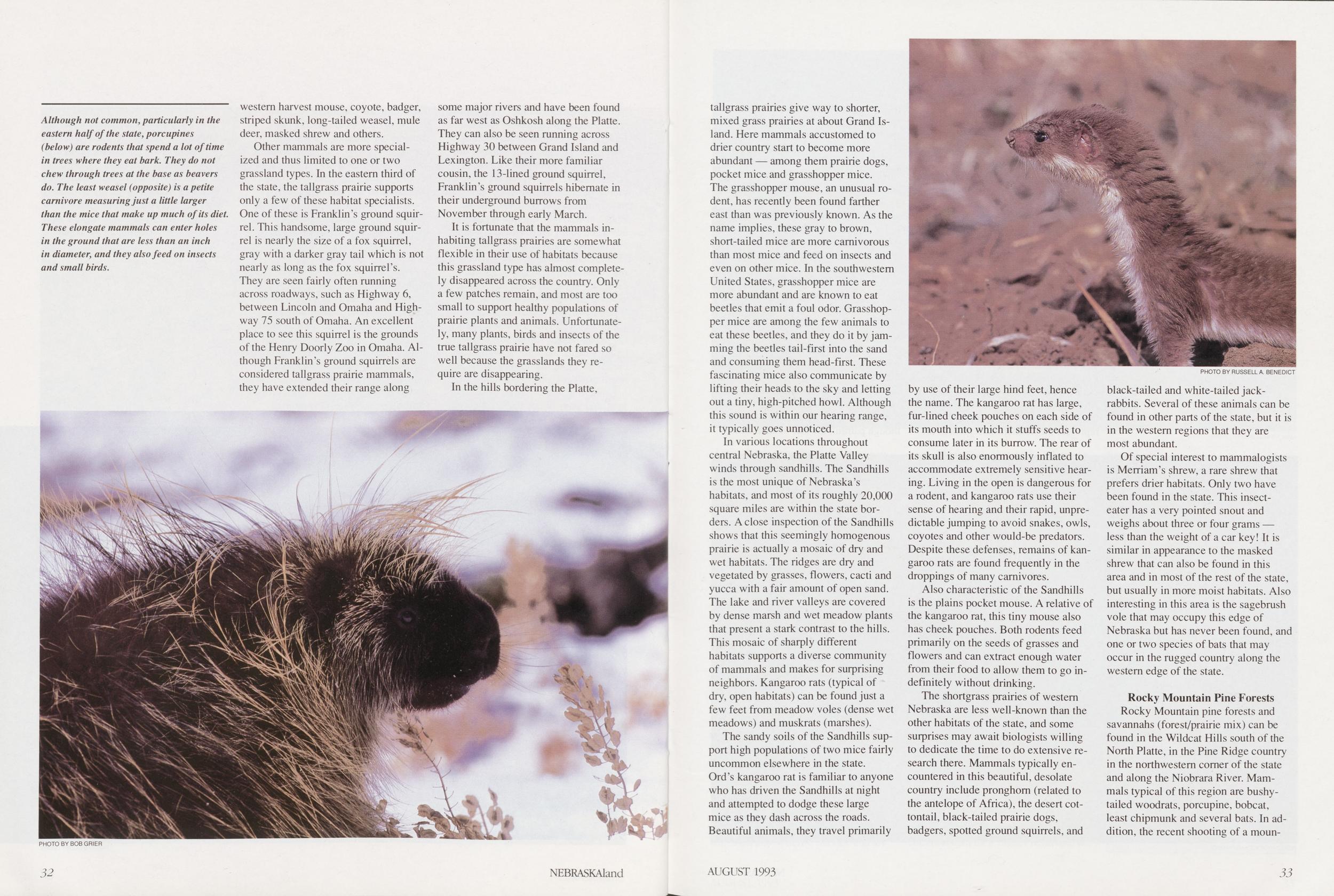
Other mammals are more specialized and thus limited to one or two grassland types. In the eastern third of the state, the tallgrass prairie supports only a few of these habitat specialists. One of these is Franklin's ground squirrel. This handsome, large ground squirrel is nearly the size of a fox squirrel, gray with a darker gray tail which is not nearly as long as the fox squirrel's. They are seen fairly often running across roadways, such as Highway 6, between Lincoln and Omaha and Highway 75 south of Omaha. An excellent place to see this squirrel is the grounds of the Henry Doorly Zoo in Omaha. Although Franklin's ground squirrels are considered tallgrass prairie mammals, they have extended their range along some major rivers and have been found as far west as Oshkosh along the Platte. They can also be seen running across Highway 30 between Grand Island and Lexington. Like their more familiar cousin, the 13-lined ground squirrel, Franklin's ground squirrels hibernate in their underground burrows from November through early March.
It is fortunate that the mammals inhabiting tallgrass prairies are somewhat flexible in their use of habitats because this grassland type has almost completely disappeared across the country. Only a few patches remain, and most are too small to support healthy populations of prairie plants and animals. Unfortunately, many plants, birds and insects of the true tallgrass prairie have not fared so well because the grasslands they require are disappearing.
In the hills bordering the Platte, 32 NEBRASKAland tallgrass prairies give way to shorter, mixed grass prairies at about Grand Island. Here mammals accustomed to drier country start to become more abundant — among them prairie dogs, pocket mice and grasshopper mice. The grasshopper mouse, an unusual rodent, has recently been found farther east than was previously known. As the name implies, these gray to brown, short-tailed mice are more carnivorous than most mice and feed on insects and even on other mice. In the southwestern United States, grasshopper mice are more abundant and are known to eat beetles that emit a foul odor. Grasshopper mice are among the few animals to eat these beetles, and they do it by jamming the beetles tail-first into the sand and consuming them head-first. These fascinating mice also communicate by lifting their heads to the sky and letting out a tiny, high-pitched howl. Although this sound is within our hearing range, it typically goes unnoticed.
In various locations throughout central Nebraska, the Platte Valley winds through sandhills. The Sandhills is the most unique of Nebraska's habitats, and most of its roughly 20,000 square miles are within the state borders. A close inspection of the Sandhills shows that this seemingly homogenous prairie is actually a mosaic of dry and wet habitats. The ridges are dry and vegetated by grasses, flowers, cacti and yucca with a fair amount of open sand. The lake and river valleys are covered by dense marsh and wet meadow plants that present a stark contrast to the hills. This mosaic of sharply different habitats supports a diverse community of mammals and makes for surprising neighbors. Kangaroo rats (typical of dry, open habitats) can be found just a few feet from meadow voles (dense wet meadows) and muskrats (marshes).
The sandy soils of the Sandhills support high populations of two mice fairly uncommon elsewhere in the state. Ord's kangaroo rat is familiar to anyone who has driven the Sandhills at night and attempted to dodge these large mice as they dash across the roads. Beautiful animals, they travel primarily by use of their large hind feet, hence the name. The kangaroo rat has large, fur-lined cheek pouches on each side of its mouth into which it stuffs seeds to consume later in its burrow. The rear of its skull is also enormously inflated to accommodate extremely sensitive hearing. Living in the open is dangerous for a rodent, and kangaroo rats use their sense of hearing and their rapid, unpredictable jumping to avoid snakes, owls, coyotes and other would-be predators. Despite these defenses, remains of kangaroo rats are found frequently in the droppings of many carnivores.
Also characteristic of the Sandhills is the plains pocket mouse. A relative of the kangaroo rat, this tiny mouse also has cheek pouches. Both rodents feed primarily on the seeds of grasses and flowers and can extract enough water from their food to allow them to go indefinitely without drinking.
The shortgrass prairies of western Nebraska are less well-known than the other habitats of the state, and some surprises may await biologists willing to dedicate the time to do extensive research there. Mammals typically encountered in this beautiful, desolate country include pronghorn (related to the antelope of Africa), the desert cottontail, black-tailed prairie dogs, badgers, spotted ground squirrels, and black-tailed and white-tailed jack- rabbits. Several of these animals can be found in other parts of the state, but it is in the western regions that they are most abundant.
Of special interest to mammalogists is Merriam's shrew, a rare shrew that prefers drier habitats. Only two have been found in the state. This insecteater has a very pointed snout and weighs about three or four grams — less than the weight of a car key! It is similar in appearance to the masked shrew that can also be found in this area and in most of the rest of the state, but usually in more moist habitats. Also interesting in this area is the sagebrush vole that may occupy this edge of Nebraska but has never been found, and one or two species of bats that may occur in the rugged country along the western edge of the state.
Rocky Mountain Pine ForestsRocky Mountain pine forests and savannahs (forest/prairie mix) can be found in the Wildcat Hills south of the North Platte, in the Pine Ridge country in the northwestern corner of the state and along the Niobrara River. Mammals typical of this region are bushy tailed woodrats, porcupine, bobcat, least chipmunk and several bats. In addition, the recent shooting of a mountain
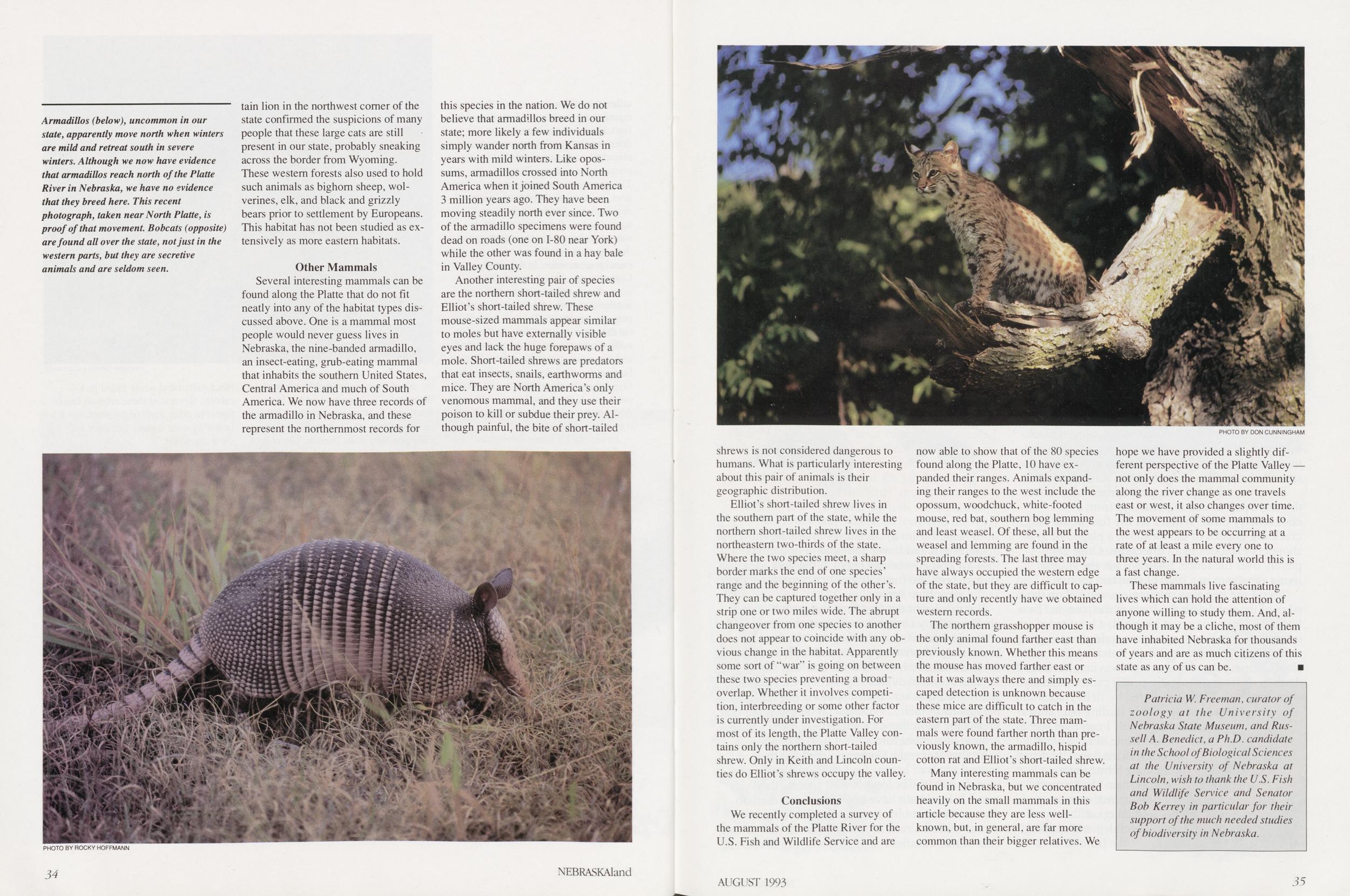
Other Mammals
Several interesting mammals can be found along the Platte that do not fit neatly into any of the habitat types discussed above. One is a mammal most people would never guess lives in Nebraska, the nine-banded armadillo, an insect-eating, grub-eating mammal that inhabits the southern United States, Central America and much of South America. We now have three records of the armadillo in Nebraska, and these represent the northernmost records for this species in the nation. We do not believe that armadillos breed in our state; more likely a few individuals simply wander north from Kansas in years with mild winters. Like opossums, armadillos crossed into North America when it joined South America 3 million years ago. They have been moving steadily north ever since. Two of the armadillo specimens were found dead on roads (one on 1-80 near York) while the other was found in a hay bale in Valley County.
Another interesting pair of species are the northern short-tailed shrew and Elliot's short-tailed shrew. These mouse-sized mammals appear similar to moles but have externally visible eyes and lack the huge forepaws of a mole. Short-tailed shrews are predators that eat insects, snails, earthworms and mice. They are North America's only venomous mammal, and they use their poison to kill or subdue their prey. Although painful, the bite of short-tailed 34 NEBRASKAland
Elliot's short-tailed shrew lives in the southern part of the state, while the northern short-tailed shrew lives in the northeastern two-thirds of the state. Where the two species meet, a sharp border marks the end of one species' range and the beginning of the other's. They can be captured together only in a strip one or two miles wide. The abrupt changeover from one species to another does not appear to coincide with any obvious change in the habitat. Apparently some sort of "war" is going on between these two species preventing a broad overlap. Whether it involves competition, interbreeding or some other factor is currently under investigation. For most of its length, the Platte Valley contains only the northern short-tailed shrew. Only in Keith and Lincoln counties do Elliot's shrews occupy the valley.
ConclusionsWe recently completed a survey of the mammals of the Platte River for the U.S. Fish and Wildlife Service and are now able to show that of the 80 species found along the Platte, 10 have expanded their ranges. Animals expanding their ranges to the west include the opossum, woodchuck, white-footed mouse, red bat, southern bog lemming and least weasel. Of these, all but the weasel and lemming are found in the spreading forests. The last three may have always occupied the western edge of the state, but they are difficult to capture and only recently have we obtained western records.
The northern grasshopper mouse is the only animal found farther east than previously known. Whether this means the mouse has moved farther east or that it was always there and simply escaped detection is unknown because these mice are difficult to catch in the eastern part of the state. Three mammals were found farther north than previously known, the armadillo, hispid cotton rat and Elliot's short-tailed shrew.
Many interesting mammals can be found in Nebraska, but we concentrated heavily on the small mammals in this article because they are less wellknown, but, in general, are far more common than their bigger relatives. We hope we have provided a slightly different perspective of the Platte Valley — not only does the mammal community along the river change as one travels east or west, it also changes over time. The movement of some mammals to the west appears to be occurring at a rate of at least a mile every one to three years. In the natural world this is a fast change.
These mammals live fascinating lives which can hold the attention of anyone willing to study them. And, although it may be a cliche, most of them have inhabited Nebraska for thousands of years and are as much citizens of this state as any of us can be.
Patricia W. Freeman, curator of zoology at the University of Nebraska State Museum, and Russell A. Benedict, a Ph.D. candidate in the School of Biological Sciences at the University of Nebraska at Lincoln, wish to thank the U.S. Fish and Wildlife Service and Senator Bob Kerrey in particular for their support of the much needed studies of biodiversity in Nebraska.
AUGUST 1993 35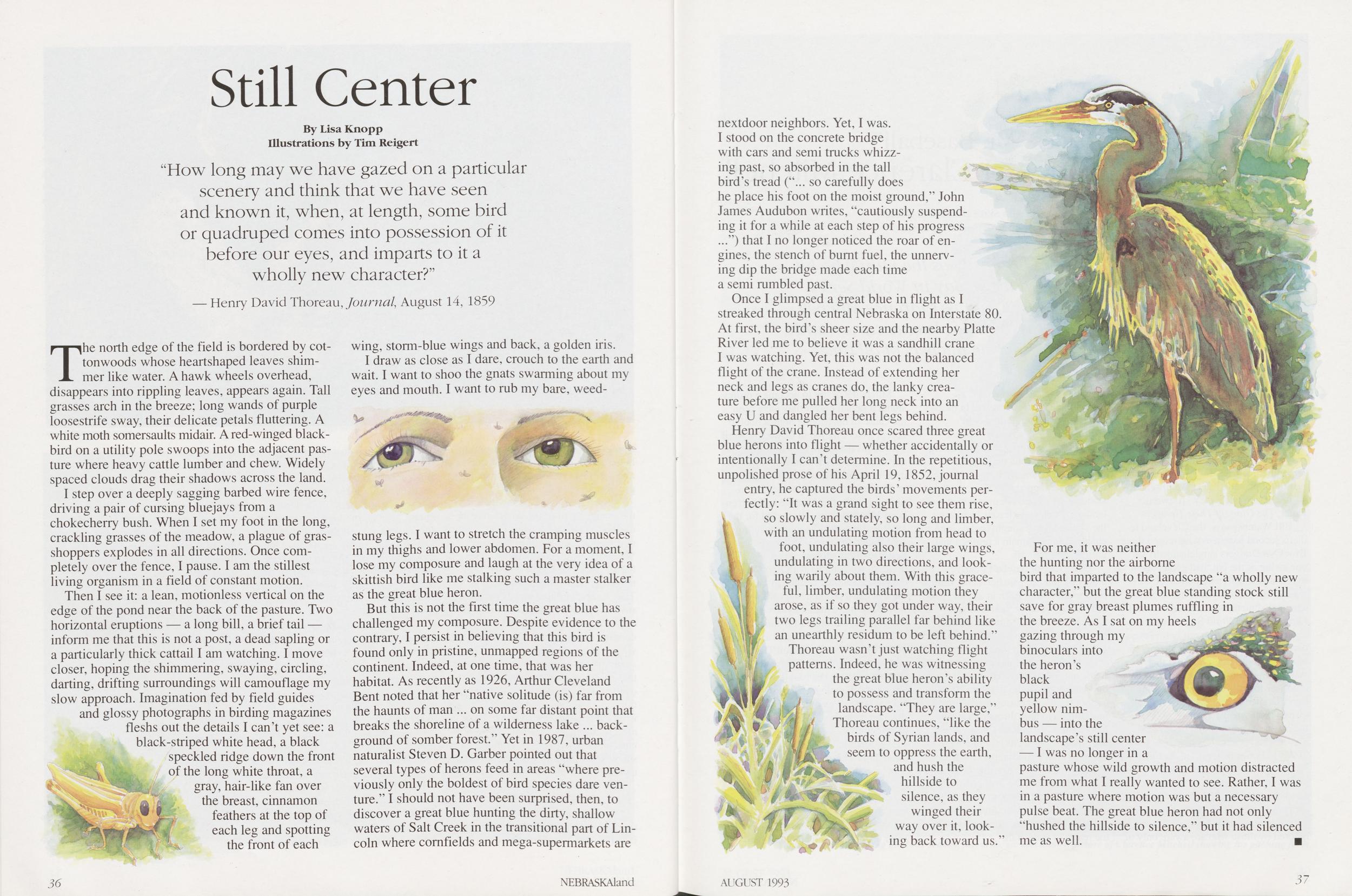
Still Center
By Lisa Knopp Illustrations by Tim Reigert "How long may we have gazed on a particular scenery and think that we have seen and known it, when, at length, some bird or quadruped comes into possession of it before our eyes, and imparts to it a wholly new character?" — Henry David Thoreau, Journal, August 14, 1859The north edge of the field is bordered by cottonwoods whose heart shaped leaves shimmer like water. A hawk wheels overhead, disappears into rippling leaves, appears again. Tall grasses arch in the breeze; long wands of purple loosestrife sway, their delicate petals fluttering. A white moth somersaults midair. A red-winged blackbird on a utility pole swoops into the adjacent pasture where heavy cattle lumber and chew. Widely spaced clouds drag their shadows across the land.
I step over a deeply sagging barbed wire fence, driving a pair of cursing bluejays from a chokecherry bush. When I set my foot in the long, crackling grasses of the meadow, a plague of grasshoppers explodes in all directions. Once completely over the fence, I pause. I am the stillest living organism in a field of constant motion.
Then I see it: a lean, motionless vertical on the edge of the pond near the back of the pasture. Two horizontal eruptions — a long bill, a brief tail — inform me that this is not a post, a dead sapling or a particularly thick cattail I am watching. I move closer, hoping the shimmering, swaying, circling, darting, drifting surroundings will camouflage my slow approach. Imagination fed by field guides and glossy photographs in birding magazines fleshes out the details I can't yet see: a black-striped white head, a black speckled ridge down the front of the long white throat, a gray, hair-like fan over the breast, cinnamon feathers at the top of each leg and spotting the front of each wing, storm-blue wings and back, a golden iris.
I draw as close as I dare, crouch to the earth and wait. I want to shoo the gnats swarming about my eyes and mouth. I want to rub my bare,
But this is not the first time the great blue has challenged my composure. Despite evidence to the contrary, I persist in believing that this bird is found only in pristine, unmapped regions of the continent. Indeed, at one time, that was her habitat. As recently as 1926, Arthur Cleveland Bent noted that her "native solitude (is) far from the haunts of man ... on some far distant point that breaks the shoreline of a wilderness lake ... background of somber forest." Yet in 1987, urban naturalist Steven D. Garber pointed out that several types of herons feed in areas "where previously only the boldest of bird species dare venture." I should not have been surprised, then, to discover a great blue hunting the dirty, shallow waters of Salt Creek in the transitional part of Lincoln where cornfields and mega-supermarkets are 36 NEBRASKAland next door neighbors. Yet, I was. I stood on the concrete bridge with cars and semi trucks whizzing past, so absorbed in the tall bird's tread ("... so carefully does he place his foot on the moist ground," John James Audubon writes, "cautiously suspending it for a while at each step of his progress ...") that I no longer noticed the roar of engines, the stench of burnt fuel, the unnerving dip the bridge made each time a semi rumbled past.
Once I glimpsed a great blue in flight as I streaked through central Nebraska on Interstate 80. At first, the bird's sheer size and the nearby Platte River led me to believe it was a sandhill crane I was watching. Yet, this was not the balanced flight of the crane. Instead of extending her neck and legs as cranes do, the lanky creature before me pulled her long neck into an easy U and dangled her bent legs behind.
Henry David Thoreau once scared three great blue herons into flight — whether accidentally or intentionally I can't determine. In the repetitious, unpolished prose of his April 19, 1852, journal entry, he captured the birds' movements perfectly: "It was a grand sight to see them rise, so slowly and stately, so long and limber, with an undulating motion from head to foot, undulating also their large wings, undulating in two directions, and looking warily about them. With this graceful, limber, undulating motion they arose, as if so they got under way, their two legs trailing parallel far behind like an unearthly residue to be left behind." Thoreau wasn't just watching flight patterns. Indeed, he was witnessing the great blue heron's ability to possess and transform the landscape. "They are large," Thoreau continues, "like the birds of Syrian lands, and seem to oppress the earth, and hush the hillside to silence, as they winged their way over it, looking back toward us.'
For me, it was neither the hunting nor the airborne bird that imparted to the landscape "a wholly new character," but the great blue standing stock still save for gray breast plumes ruffling in the breeze. As I sat on my heels gazing through my binoculars into the heron's black pupil and yellow nimbus — into the landscape's still center — I was no longer in a pasture whose wild growth and motion distracted me from what I really wanted to see. Rather, I was in a pasture where motion was but a necessary pulse beat. The great blue heron had not only "hushed the hillside to silence," but it had silenced me as well.
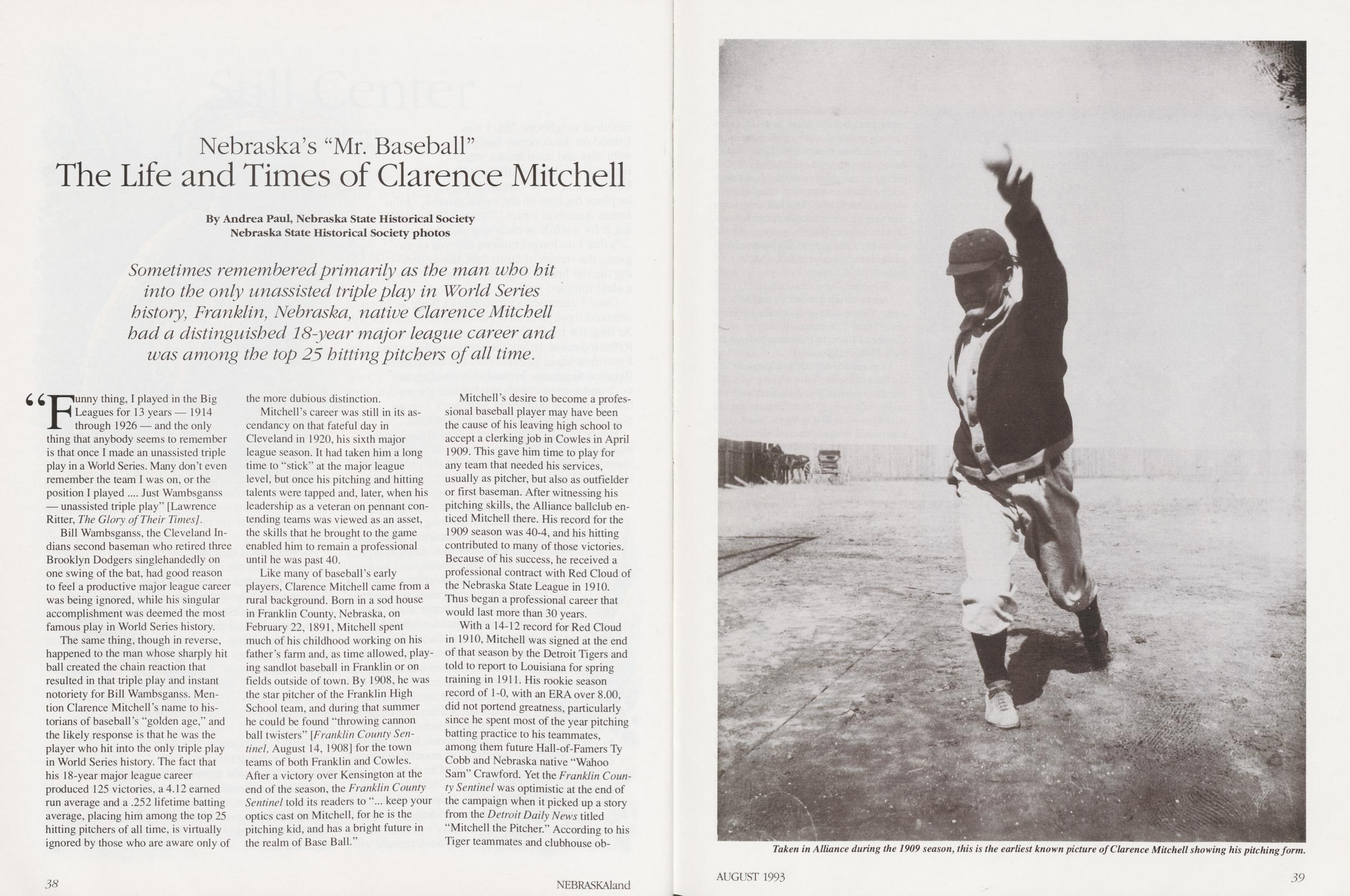
Nebraska's "Mr. Baseball"
The Life and Times of Clarence Mitchell By Andrea Paul, Nebraska State Historical Society Nebraska State Historical Society photos Sometimes remembered primarily as the man who hit into the only unassisted triple play in World Series history, Franklin, Nebraska, native Clarence Mitchell had a distinguished 18-year major league career and was among the top 25 hitting pitchers of all time.Funny thing, I played in the Big Leagues for 13 years — 1914 through 1926 — and the only thing that anybody seems to remember is that once I made an unassisted triple play in a World Series. Many don't even remember the team I was on, or the position I played .... Just Wambsganss — unassisted triple play" [Lawrence Ritter, The Glory of Their Times].
Bill Wambsganss, the Cleveland Indians second baseman who retired three Brooklyn Dodgers singlehandedly on one swing of the bat, had good reason to feel a productive major league career was being ignored, while his singular accomplishment was deemed the most famous play in World Series history.
The same thing, though in reverse, happened to the man whose sharply hit ball created the chain reaction that resulted in that triple play and instant notoriety for Bill Wambsganss. Mention Clarence Mitchell's name to historians of baseball's "golden age," and the likely response is that he was the player who hit into the only triple play in World Series history. The fact that his 18-year major league career produced 125 victories, a 4.12 earned run average and a .252 lifetime batting average, placing him among the top 25 hitting pitchers of all time, is virtually ignored by those who are aware only of the more dubious distinction.
Mitchell's career was still in its ascendancy on that fateful day in Cleveland in 1920, his sixth major league season. It had taken him a long time to "stick" at the major league level, but once his pitching and hitting talents were tapped and, later, when his leadership as a veteran on pennant contending teams was viewed as an asset, the skills that he brought to the game enabled him to remain a professional until he was past 40.
Like many of baseball's early players, Clarence Mitchell came from a rural background. Born in a sod house in Franklin County, Nebraska, on February 22, 1891, Mitchell spent much of his childhood working on his father's farm and, as time allowed, playing sandlot baseball in Franklin or on fields outside of town. By 1908, he was the star pitcher of the Franklin High School team, and during that summer he could be found "throwing cannon ball twisters" [Franklin County Sentinel, August 14, 1908] for the town teams of both Franklin and Cowles. After a victory over Kensington at the end of the season, the Franklin County Sentinel told its readers to "... keep your optics cast on Mitchell, for he is the pitching kid, and has a bright future in the realm of Base Ball."
Mitchell's desire to become a professional baseball player may have been the cause of his leaving high school to accept a clerking job in Cowles in April 1909. This gave him time to play for any team that needed his services, usually as pitcher, but also as outfielder or first baseman. After witnessing his pitching skills, the Alliance ball club enticed Mitchell there. His record for the 1909 season was 40-4, and his hitting contributed to many of those victories. Because of his success, he received a professional contract with Red Cloud of the Nebraska State League in 1910. Thus began a professional career that would last more than 30 years.
With a 14-12 record for Red Cloud in 1910, Mitchell was signed at the end of that season by the Detroit Tigers and told to report to Louisiana for spring training in 1911. His rookie season record of 1-0, with an ERA over 8.00, did not portend greatness, particularly since he spent most of the year pitching batting practice to his teammates, among them future Hall-of-Famers Ty Cobb and Nebraska native "Wahoo Sam" Crawford. Yet the Franklin County Sentinel was optimistic at the end of the campaign when it picked up a story from the Detroit Daily News titled "Mitchell the Pitcher." According to his Tiger teammates and clubhouse observers 38 NEBRASKAland
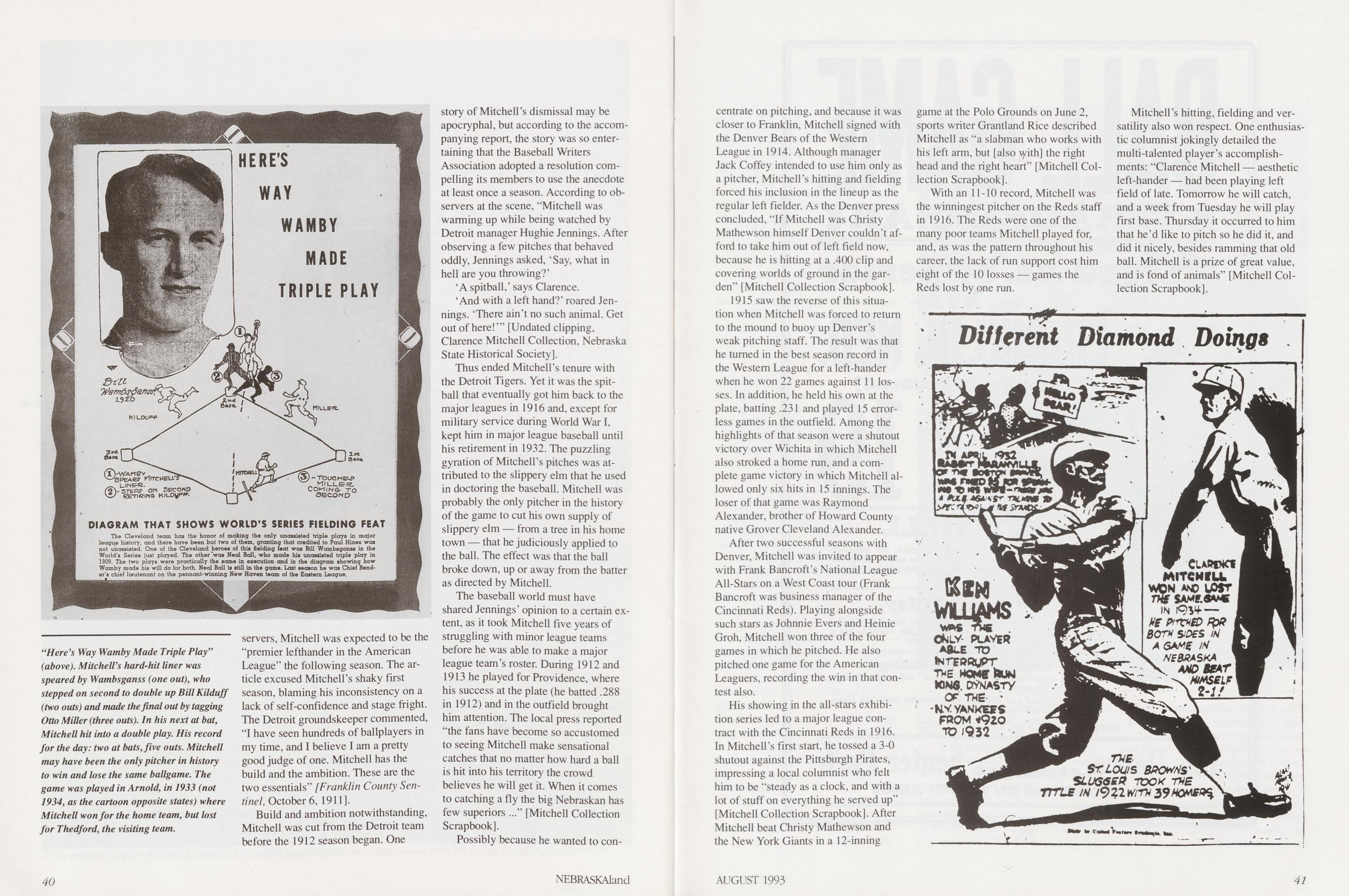
Build and ambition notwithstanding, Mitchell was cut from the Detroit team before the 1912 season began. One story of Mitchell's dismissal may be apocryphal, but according to the accompanying report, the story was so entertaining that the Baseball Writers Association adopted a resolution compelling its members to use the anecdote at least once a season. According to observers at the scene, "Mitchell was warming up while being watched by Detroit manager Hughie Jennings. After observing a few pitches that behaved oddly, Jennings asked, 'Say, what in hell are you throwing?'
'A spitball,' says Clarence.
'And with a left hand?' roared Jennings. 'There ain't no such animal. Get out of here!'" [Undated clipping, Clarence Mitchell Collection, Nebraska State Historical Society].
Thus ended Mitchell's tenure with the Detroit Tigers. Yet it was the spitball that eventually got him back to the major leagues in 1916 and, except for military service during World War I, kept him in major league baseball until his retirement in 1932. The puzzling gyration of Mitchell's pitches was attributed to the slippery elm that he used in doctoring the baseball. Mitchell was probably the only pitcher in the history of the game to cut his own supply of slippery elm — from a tree in his home town — that he judiciously applied to the ball. The effect was that the ball broke down, up or away from the batter as directed by Mitchell.
The baseball world must have shared Jennings' opinion to a certain extent, as it took Mitchell five years of struggling with minor league teams before he was able to make a major league team's roster. During 1912 and 1913 he played for Providence, where his success at the plate (he batted .288 in 1912) and in the outfield brought him attention. The local press reported "the fans have become so accustomed to seeing Mitchell make sensational catches that no matter how hard a ball is hit into his territory the crowd believes he will get it. When it comes to catching a fly the big Nebraskan has few superiors ..." [Mitchell Collection Scrapbook].
Possibly because he wanted to concentrate 40 NEBRASKAland on pitching, and because it was closer to Franklin, Mitchell signed with the Denver Bears of the Western League in 1914. Although manager Jack Coffey intended to use him only as a pitcher, Mitchell's hitting and fielding forced his inclusion in the lineup as the regular left fielder. As the Denver press concluded, "If Mitchell was Christy Mathewson himself Denver couldn't afford to take him out of left field now, because he is hitting at a .400 clip and covering worlds of ground in the garden" [Mitchell Collection Scrapbook].
1915 saw the reverse of this situation when Mitchell was forced to return to the mound to buoy up Denver's weak pitching staff. The result was that he turned in the best season record in the Western League for a left-hander when he won 22 games against 11 losses. In addition, he held his own at the plate, batting .231 and played 15 errorless games in the outfield. Among the highlights of that season were a shutout victory over Wichita in which Mitchell also stroked a home run, and a complete game victory in which Mitchell allowed only six hits in 15 innings. The loser of that game was Raymond Alexander, brother of Howard County native Grover Cleveland Alexander.
After two successful seasons with Denver, Mitchell was invited to appear with Frank Bancroft's National League All-Stars on a West Coast tour (Frank Bancroft was business manager of the Cincinnati Reds). Playing alongside such stars as Johnnie Evers and Heinie Groh, Mitchell won three of the four games in which he pitched. He also pitched one game for the American Leaguers, recording the win in that contest also.
His showing in the all-stars exhibition series led to a major league contract with the Cincinnati Reds in 1916. In Mitchell's first start, he tossed a 3-0 shutout against the Pittsburgh Pirates, impressing a local columnist who felt him to be "steady as a clock, and with a lot of stuff on everything he served up" [Mitchell Collection Scrapbook]. After Mitchell beat Christy Mathewson and the New York Giants in a 12-inning game at the Polo Grounds on June 2, sports writer Grantland Rice described Mitchell as "a slabman who works with his left arm, but [also with] the right head and the right heart" [Mitchell Collection Scrapbook].
With an 11-10 record, Mitchell was the winningest pitcher on the Reds staff in 1916. The Reds were one of the many poor teams Mitchell played for, and, as was the pattern throughout his career, the lack of run support cost him eight of the 10 losses — games the Reds lost by one run.
Mitchell's hitting, fielding and versatility also won respect. One enthusiatic columnist jokingly detailed the multi-talented player's accomplishments: "Clarence Mitchell — aesthetic left-hander — had been playing left field of late. Tomorrow he will catch, and a week from Tuesday he will play first base. Thursday it occurred to him that he'd like to pitch so he did it, and did it nicely, besides ramming that old ball. Mitchell is a prize of great value, and is fond of animals" [Mitchell Collection Scrapbook].
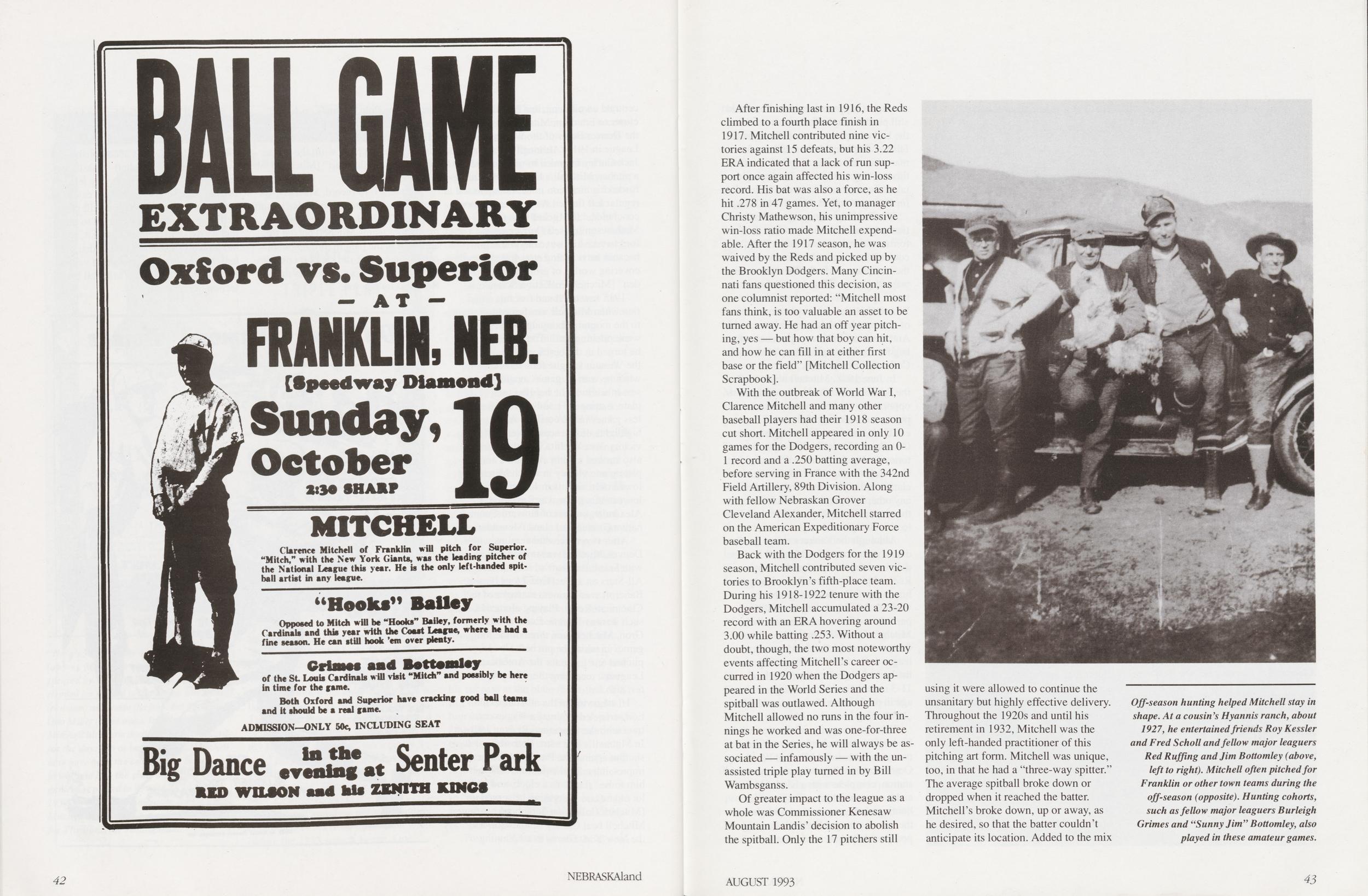
After finishing last in 1916, the Reds climbed to a fourth place finish in 1917. Mitchell contributed nine victories against 15 defeats, but his 3.22 ERA indicated that a lack of run support once again affected his win-loss record. His bat was also a force, as he hit .278 in 47 games. Yet, to manager Christy Mathewson, his unimpressive win-loss ratio made Mitchell expendable. After the 1917 season, he was waived by the Reds and picked up by the Brooklyn Dodgers. Many Cincinnati fans questioned this decision, as one columnist reported: "Mitchell most fans think, is too valuable an asset to be turned away. He had an off year pitching, yes — but how that boy can hit, and how he can fill in at either first base or the field" [Mitchell Collection Scrapbook].
With the outbreak of World War I, Clarence Mitchell and many other baseball players had their 1918 season cut short. Mitchell appeared in only 10 games for the Dodgers, recording an 0-1 record and a .250 batting average, before serving in France with the 342nd Field Artillery, 89th Division. Along with fellow Nebraskan Grover Cleveland Alexander, Mitchell starred on the American Expeditionary Force baseball team.
Back with the Dodgers for the 1919 season, Mitchell contributed seven victories to Brooklyn's fifth-place team. During his 1918-1922 tenure with the Dodgers, Mitchell accumulated a 23-20 record with an ERA hovering around 3.00 while batting .253. Without a doubt, though, the two most noteworthy events affecting Mitchell's career occurred in 1920 when the Dodgers appeared in the World Series and the spitball was outlawed. Although Mitchell allowed no runs in the four innings he worked and was one-for-three at bat in the Series, he will always be associated — infamously — with the unassisted triple play turned in by Bill Wambsganss.
Of greater impact to the league as a whole was Commissioner Kenesaw Mountain Landis' decision to abolish the spitball. Only the 17 pitchers still using it were allowed to continue the unsanitary but highly effective delivery. Throughout the 1920s and until his retirement in 1932, Mitchell was the only left-handed practitioner of this pitching art form. Mitchell was unique, too, in that he had a "three-way spitter." The average spitball broke down or dropped when it reached the batter. Mitchell's broke down, up or away, as he desired, so that the batter couldn't anticipate its location. Added to the mix
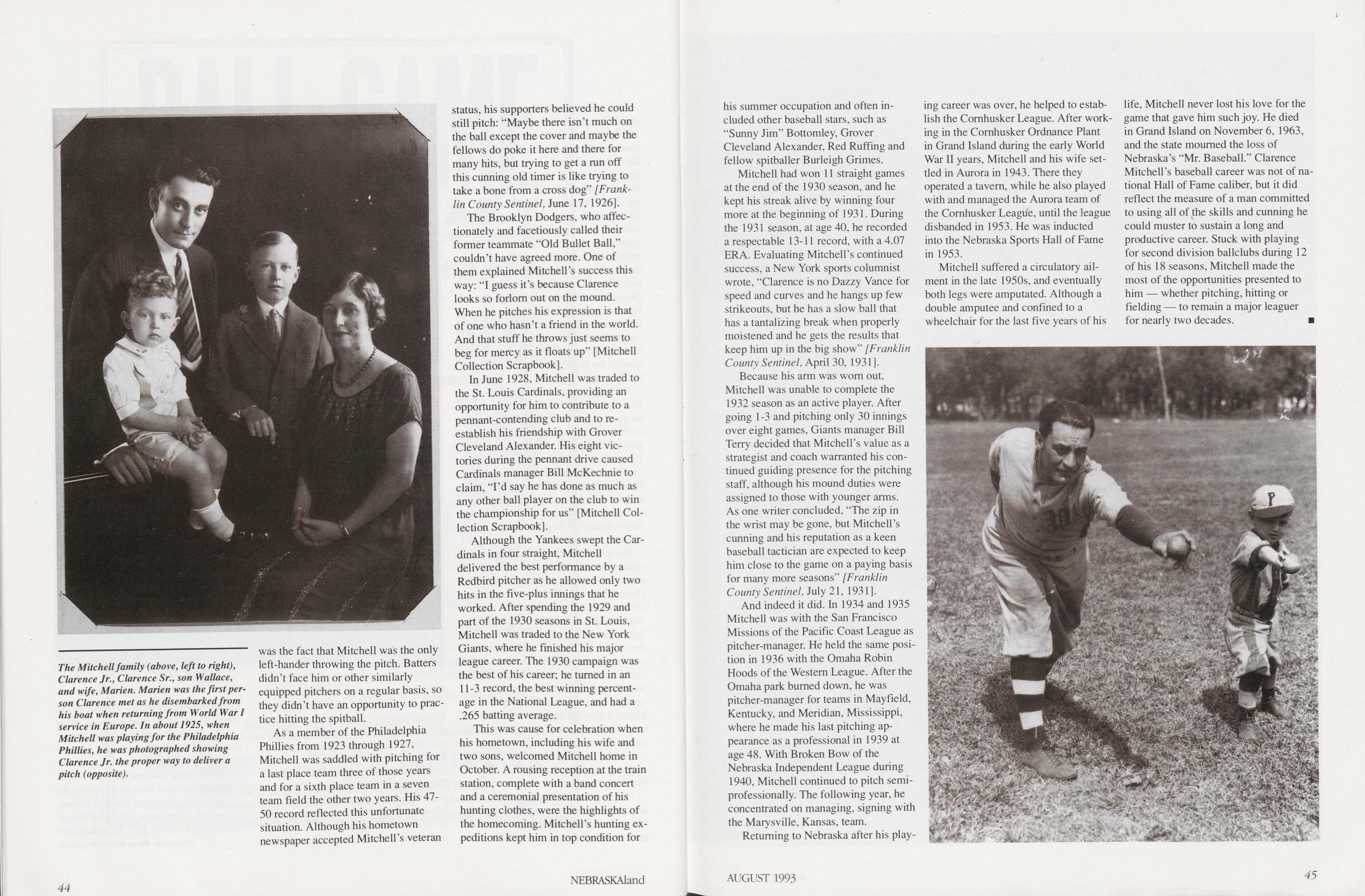
As a member of the Philadelphia Phillies from 1923 through 1927, Mitchell was saddled with pitching for a last place team three of those years and for a sixth place team in a seven team field the other two years. His 47-50 record reflected this unfortunate situation. Although his hometown newspaper accepted Mitchell's veteran status, his supporters believed he could still pitch: "Maybe there isn't much on the ball except the cover and maybe the fellows do poke it here and there for many hits, but trying to get a run off this cunning old timer is like trying to take a bone from a cross dog" [Franklin County Sentinel, June 17, 1926].
The Brooklyn Dodgers, who affectionately and facetiously called their former teammate "Old Bullet Ball," couldn't have agreed more. One of them explained Mitchell's success this way: "I guess it's because Clarence looks so forlorn out on the mound. When he pitches his expression is that of one who hasn't a friend in the world. And that stuff he throws just seems to beg for mercy as it floats up" [Mitchell Collection Scrapbook].
In June 1928, Mitchell was traded to the St. Louis Cardinals, providing an opportunity for him to contribute to a pennant-contending club and to reestablish his friendship with Grover Cleveland Alexander. His eight victories during the pennant drive caused Cardinals manager Bill McKechnie to claim, "I'd say he has done as much as any other ball player on the club to win the championship for us" [Mitchell Collection Scrapbook].
Although the Yankees swept the Cardinals in four straight, Mitchell delivered the best performance by a Redbird pitcher as he allowed only two hits in the five-plus innings that he worked. After spending the 1929 and part of the 1930 seasons in St. Louis, Mitchell was traded to the New York Giants, where he finished his major league career. The 1930 campaign was the best of his career; he turned in an 11-3 record, the best winning percentage in the National League, and had a .265 batting average.
This was cause for celebration when his hometown, including his wife and two sons, welcomed Mitchell home in October. A rousing reception at the train station, complete with a band concert and a ceremonial presentation of his hunting clothes, were the highlights of the homecoming. Mitchell's hunting expeditions kept him in top condition for 44 NEBRASKAland his summer occupation and often included other baseball stars, such as "Sunny Jim" Bottomley, Grover Cleveland Alexander, Red Ruffing and fellow spitballer Burleigh Grimes.
Mitchell had won 11 straight games at the end of the 1930 season, and he kept his streak alive by winning four more at the beginning of 1931. During the 1931 season, at age 40, he recorded a respectable 13-11 record, with a 4.07 ERA. Evaluating Mitchell's continued success, a New York sports columnist wrote, "Clarence is no Dazzy Vance for speed and curves and he hangs up few strikeouts, but he has a slow ball that has a tantalizing break when properly moistened and he gets the results that keep him up in the big show" [Franklin County Sentinel, April 30, 1931].
Because his arm was worn out, Mitchell was unable to complete the 1932 season as an active player. After going 1-3 and pitching only 30 innings over eight games, Giants manager Bill Terry decided that Mitchell's value as a strategist and coach warranted his continued guiding presence for the pitching staff, although his mound duties were assigned to those with younger arms. As one writer concluded, "The zip in the wrist may be gone, but Mitchell's cunning and his reputation as a keen baseball tactician are expected to keep him close to the game on a paying basis for many more seasons" [Franklin County Sentinel, July 21, 1931].
And indeed it did. In 1934 and 1935 Mitchell was with the San Francisco Missions of the Pacific Coast League as pitcher-manager. He held the same position in 1936 with the Omaha Robin Hoods of the Western League. After the Omaha park burned down, he was pitcher-manager for teams in Mayfield, Kentucky, and Meridian, Mississippi, where he made his last pitching appearance as a professional in 1939 at age 48. With Broken Bow of the Nebraska Independent League during 1940, Mitchell continued to pitch semiprofessionally. The following year, he concentrated on managing, signing with the Marysville, Kansas, team.
Returning to Nebraska after his playing career was over, he helped to establish the Cornhusker League. After working in the Cornhusker Ordnance Plant in Grand Island during the early World War II years, Mitchell and his wife settled in Aurora in 1943. There they operated a tavern, while he also played with and managed the Aurora team of the Cornhusker Leagrie, until the league disbanded in 1953. He was inducted into the Nebraska Sports Hall of Fame in 1953.
Mitchell suffered a circulatory ailment in the late 1950s, and eventually both legs were amputated. Although a double amputee and confined to a wheelchair for the last five years of his life, Mitchell never lost his love for the game that gave him such joy. He died in Grand Island on November 6, 1963, and the state mourned the loss of Nebraska's "Mr. Baseball." Clarence Mitchell's baseball career was not of national Hall of Fame caliber, but it did reflect the measure of a man committed to using all of the skills and cunning he could muster to sustain a long and productive career. Stuck with playing for second division ball clubs during 12 of his 18 seasons, Mitchell made the most of the opportunities presented to him — whether pitching, hitting or fielding — to remain a major leaguer for nearly two decades.
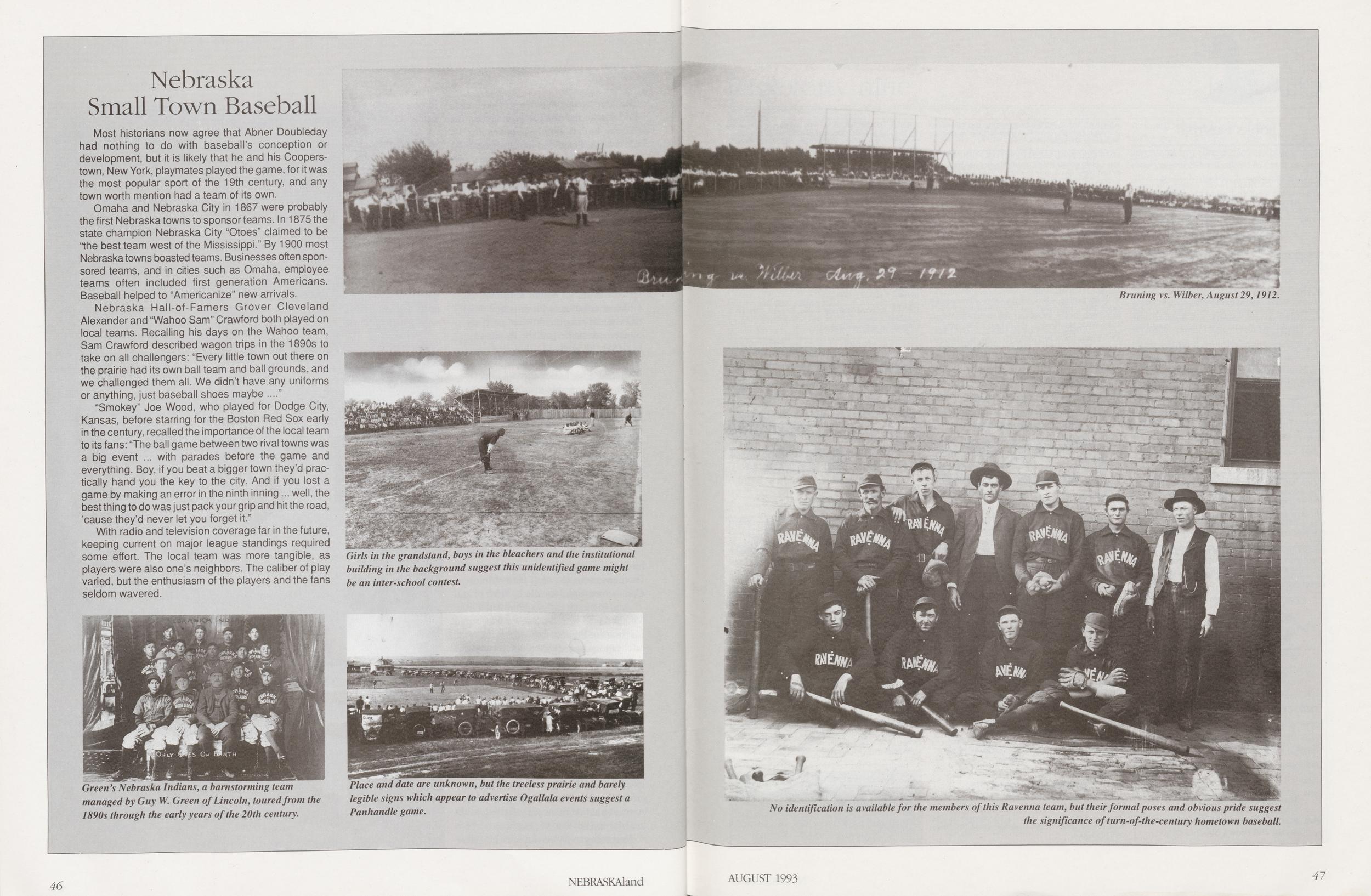
Nebraska Small Town Baseball
Most historians now agree that Abner Doubleday had nothing to do with baseball's conception or development, but it is likely that he and his Cooperstown, New York, playmates played the game, for it was the most popular sport of the 19th century, and any town worth mention had a team of its own.
Omaha and Nebraska City in 1867 were probably the first Nebraska towns to sponsor teams. In 1875 the state champion Nebraska City "Otoes" claimed to be "the best team west of the Mississippi." By 1900 most Nebraska towns boasted teams. Businesses often sponsored teams, and in cities such as Omaha, employee teams often included first generation Americans. Baseball helped to "Americanize" new arrivals.
Nebraska Hall-of-Famers Grover Cleveland Alexander and "Wahoo Sam" Crawford both played on local teams. Recalling his days on the Wahoo team, Sam Crawford described wagon trips in the 1890s to take on all challengers: "Every little town out there on the prairie had its own ball team and ball grounds, and we challenged them all. We didn't have any uniforms or anything, just baseball shoes maybe ...."
"Smokey" Joe Wood, who played for Dodge City, Kansas, before starring for the Boston Red Sox early in the century, recalled the importance of the local team to its fans: "The ball game between two rival towns was a big event ... with parades before the game and everything. Boy, if you beat a bigger town they'd practically hand you the key to the city. And if you lost a game by making an error in the ninth inning... well, the best thing to do was just pack your grip and hit the road, 'cause they'd never let you forget it."
With radio and television coverage far in the future, keeping current on major league standings required some effort. The local team was more tangible, as players were also one's neighbors. The caliber of play varied, but the enthusiasm of the players and the fans seldom wavered.
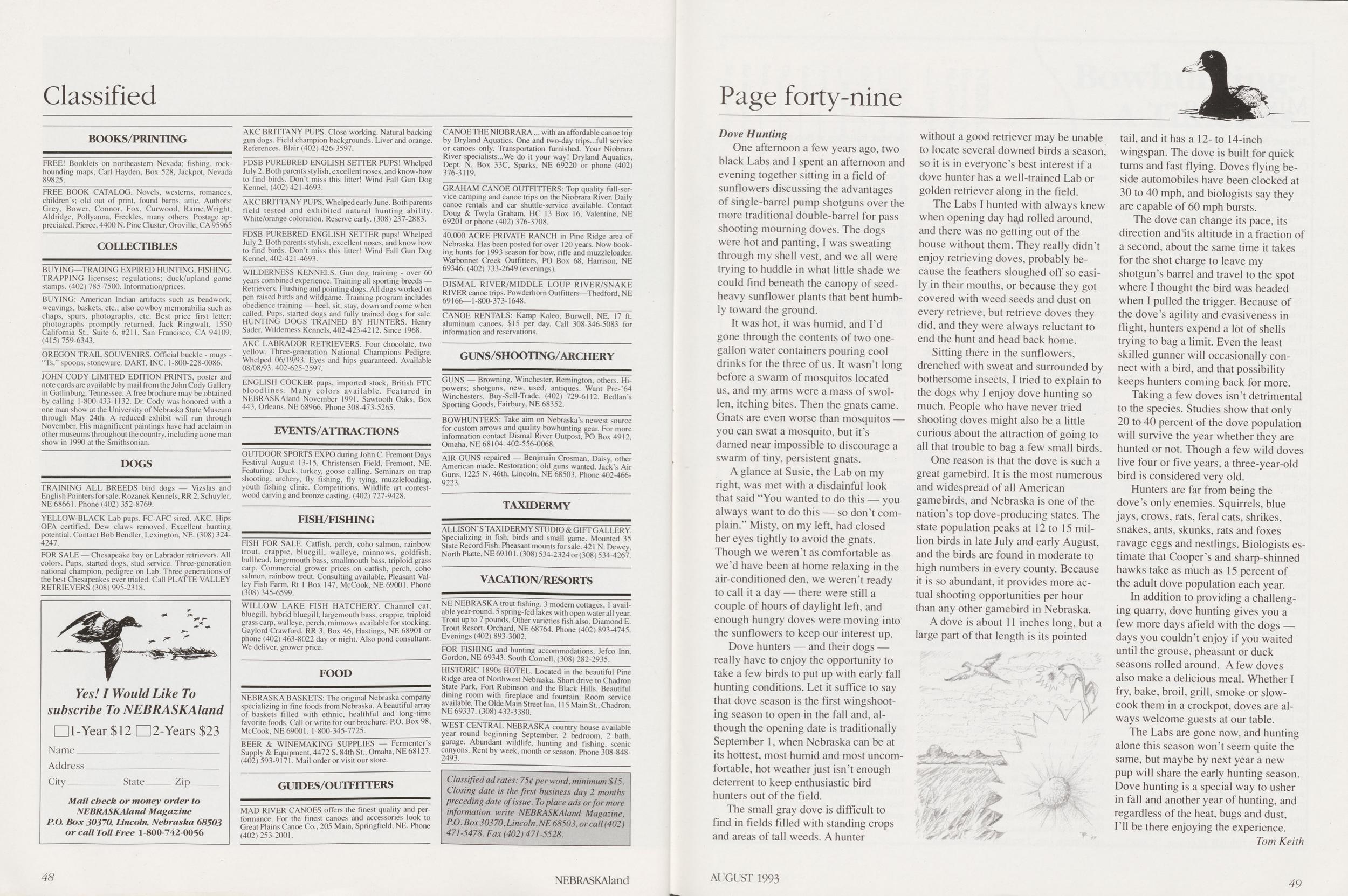
Classified
BOOKS/PRINTINGFREE! Booklets on northeastern Nevada: fishing, rock- hounding maps, Carl Hayden, Box 528, Jackpot, Nevada 89825.
FREE BOOK CATALOG. Novels, westerns, romances, children's: old out of print, found barns, attic. Authors: Grey, Bower, Connor, Fox, Curwood, Raine,Wright, Aldridge, Pollyanna, Freckles, many others. Postage appreciated. Pierce, 4400 N. Pine Cluster, Oroville, CA 95965
COlLLECTIBLESBUYING—TRADING EXPIRED HUNTING. FISHING, TRAPPING licenses; regulations; duck/upland game stamps. (402) 785-7500. Information/prices.
BUYING: American Indian artifacts such as beadwork, weavings, baskets, etc.; also cowboy memorabilia such as chaps, spurs, photographs, etc. Best price first letter; photographs promptly returned. Jack Ringwalt, 1550 California St., Suite 6, #211, San Francisco, CA 94109, (415)759-6343.
OREGON TRAIL SOUVENIRS. Official buckle - mugs - 'Ts," spoons, stoneware. DART. INC. 1-800-228-0086.
JOHN CODY LIMITED EDITION PRINTS, poster and note cards are available by mail from the John Cody Gallery in Gatlinburg, Tennessee. A free brochure may be obtained by calling 1-800-433-1132. Dr. Cody was honored with a one man show at the University of Nebraska State Museum through May 24th. A reduced exhibit will run through November. His magnificent paintings have had acclaim in other museums throughout the country, including a one man show in 1990 at the Smithsonian.
DOGSTRAINING ALL BREEDS bird dogs — Vizslas and English Pointers for sale. Rozanek Kennels, RR 2, Schuyler, NE 68661. Phone (402) 352-8769.
YELLOW-BLACK Lab pups. FC-AFC sired. AKC. Hips OFA certified. Dew claws removed. Excellent hunting potential. Contact Bob Bendler, Lexington, NE. (308) 324- 4247.
FOR SALE — Chesapeake bay or Labrador retrievers. All colors. Pups, started dogs, stud service. Three-generation national champion, pedigree on Lab. Three generations of the best Chesapeakes ever trialed. Call PLATTE VALLEY RETRIEVERS (308) 995-2318.
Yes! I Would Like To subscribe To NEBRASKAland l-Year$12C_]2-Years$23 Name Address City, State Zip Mail check or money order to NEBRASKAland Magazine P.O. Box 30370, Lincoln, Nebraska 68503 or call Toll Free 1-800-742-0056AKC BRITTANY PUPS. Close working. Natural backing gun dogs. Field champion backgrounds. Liver and orange. References. Blair (402) 426-3597.
FDSB PUREBRED ENGLISH SETTER PUPS! Whelped July 2. Both parents stylish, excellent noses, and know-how to find birds. Don't miss this litter! Wind Fall Gun Dog Kennel, (402)421-4693.
AKC BRITTANY PUPS. Whelped early June. Both parents field tested and exhibited natural hunting ability. White/orange coloration. Reserve early. (308) 237-2883.
FDSB PUREBRED ENGLISH SETTER pups! Whelped July 2. Both parents stylish, excellent noses, and know how to find birds. Don't miss this litter! Wind Fall Gun Dog Kennel, 402-421-4693.
WILDERNESS KENNELS. Gun dog training - over 60 years combined experience. Training all sporting breeds — Retrievers. Flushing and pointing dogs. All dogs worked on pen raised birds and wildgame. Training program includes obedience training — heel, sit, stay, down and come when called. Pups, started dogs and fully trained dogs for sale.
HUNTING DOGS TRAINED BY HUNTERS. Henry Sader, Wilderness Kennels, 402-423-4212. Since 1968.
AKC LABRADOR RETRIEVERS. Four chocolate, two yellow. Three-generation National Champions Pedigre. Whelped 06/19/93. Eyes and hips guaranteed. Available 08/08/93. 402-625-2597.
ENGLISH COCKER pups, imported stock, British FTC bloodlines. Many colors available. Featured in NEBRASKAland November 1991. Sawtooth Oaks, Box 443, Orleans, NE 68966. Phone 308-473-5265.
EVENTS/ATTRACTIONSOUTDOOR SPORTS EXPO during John C. Fremont Days Festival August 13-15, Christensen Field, Fremont, NE. Featuring: Duck, turkey, goose calling. Seminars on trap shooting, archery, fly fishing, fly tying, muzzleloading, youth fishing clinic. Competitions. Wildlife art contestwood carving and bronze casting. (402) 727-9428.
FISH/FISHINGFISH FOR SALE. Catfish, perch, coho salmon, rainbow trout, crappie, bluegill. walleye, minnows, goldfish, bullhead, largemouth bass, smallmouth bass, triploid grass carp. Commercial grower prices on catfish, perch, coho salmon, rainbow trout. Consulting available. Pleasant Valley Fish Farm, Rt 1 Box 147, McCook, NE 69001. Phone (308) 345-6599.
WILLOW LAKE FISH HATCHERY. Channel cat, bluegill, hybrid bluegill, largemouth bass, crappie, triploid grass carp, walleye, perch, minnows available for stocking. Gaylord Crawford, RR 3, Box 46, Hastings, NE 68901 or phone (402) 463-8022 day or night. Also pond consultant. We deliver, grower price.
FOODNEBRASKA BASKETS: The original Nebraska company specializing in fine foods from Nebraska. A beautiful array of baskets filled with ethnic, healthful and long-time favorite foods. Call or write for our brochure: P.O. Box 98, McCook, NE 69001. 1-800-345-7725.
BEER & WINEMAKING SUPPLIES — Fermenter's Supply & Equipment, 4472 S. 84th St., Omaha, NE 68127. (402) 593-9171. Mail order or visit our store.
GUIDES/OUTFITTERSMAD RIVER CANOES offers the finest quality and performance. For the finest canoes and accessories look to Great Plains Canoe Co., 205 Main, Springfield, NE. Phone (402)253-2001.
CANOE THE NIOBRARA... with an affordable canoe trip by Dry land Aquatics. One and two-day trips...full service or canoes only. Transportation furnished. Your Niobrara River specialists...We do it your way! Dry land Aquatics, Dept. N, Box 33C, Sparks, NE 69220 or phone (402) 376-3119.
GRAHAM CANOE OUTFITTERS: Top quality full-service camping and canoe trips on the Niobrara River. Daily canoe rentals and car shuttle-service available. Contact Doug & Twyla Graham, HC 13 Box 16, Valentine, NE 69201 or phone (402) 376-3708.
40,000 ACRE PRIVATE RANCH in Pine Ridge area of Nebraska. Has been posted for over 120 years. Now booking hunts for 1993 season for bow, rifle and muzzleloader. Warbonnet Creek Outfitters, PO Box 68, Harrison, NE 69346. (402) 733-2649 (evenings).
DISMAL RIVER/MIDDLE LOUP RIVER/SNAKE RIVER canoe trips. Powderhorn Outfitters—Thedford, NE 69166—1-800-373-1648.
CANOE RENTALS: Kamp Kaleo, Burwell, NE. 17 ft. aluminum canoes, $15 per day. Call 308-346-5083 for information and reservations.
GUNS/SHOOTING/ARCHERYGUNS — Browning, Winchester, Remington, others. Hi-powers; shotguns, new, used, antiques. Want Pre-'64 Winchesters. Buy-Sell-Trade. (402) 729-6112. Bedlan's Sporting Goods, Fairbury, NE 68352.
BOWHUNTERS: Take aim on Nebraska's newest source for custom arrows and quality bowhunting gear. For more information contact Dismal River Outpost, PO Box 4912, Omaha, NE 68104. 402-556-0068.
AIR GUNS repaired — Benjmain Crosman. Daisy, other American made. Restoration; old guns wanted. Jack's Air Guns, 1225 N. 46th, Lincoln, NE 68503. Phone 402-466- 9223.
TAXIDERMY ALLISON'S TAXIDERMY STUDIO & GIFT GALLERY. Specializing in fish, birds and small game. Mounted 35 State Record Fish. Pheasant mounts for sale. 421 N. Dewey, North Platte, NE 69101. (308) 534-2324 or (308) 534-4267. VACATION/RESORTS NE NEBRASKA trout fishing. 3 modern cottages, 1 available year-round. 5 spring-fed lakes with open water all year. Trout up to 7 pounds. Other varieties fish also. Diamond E. Trout Resort, Orchard, NE 68764. Phone (402) 893-4745. Evenings (402) 893-3002. FOR FISHING and hunting accommodations. Jefco Inn, Gordon, NE 69343. South Cornell, (308) 282-2935. HISTORIC 1890s HOTEL. Located in the beautiful Pine Ridge area of Northwest Nebraska. Short drive to Chadron State Park, Fort Robinson and the Black Hills. Beautiful dining room with fireplace and fountain. Room service available. The Olde Main Street Inn, 115 Main St., Chadron, NE 69337. (308)432-3380. WEST CENTRAL NEBRASKA country house available year round beginning September. 2 bedroom, 2 bath, garage. Abundant wildlife, hunting and fishing, scenic canyons. Rent by week, month or season. Phone 308-848- 2493. Classified ad rates: 75f per word, minimum $15. Closing date is the first business day 2 months preceding date of issue. To place ads or for more information write NEBRASKAland Magazine, P.O.Box 30370,Lincoln, NE 68503 or call(402) 471-5478. Fax (402) 471-5528. 48 NEBRASKAlandPage forty-nine
Dove HuntingOne afternoon a few years ago, two black Labs and I spent an afternoon and evening together sitting in a field of sunflowers discussing the advantages of single-barrel pump shotguns over the more traditional double-barrel for pass shooting mourning doves. The dogs were hot and panting, I was sweating through my shell vest, and we all were trying to huddle in what little shade we could find beneath the canopy of seed heavy sunflower plants that bent humbly toward the ground.
It was hot, it was humid, and I'd gone through the contents of two one-gallon water containers pouring cool drinks for the three of us. It wasn't long before a swarm of mosquitos located us, and my arms were a mass of swollen, itching bites. Then the gnats came. Gnats are even worse than mosquitos — you can swat a mosquito, but it's darned near impossible to discourage a swarm of tiny, persistent gnats.
A glance at Susie, the Lab on my right, was met with a disdainful look that said "You wanted to do this — you always want to do this — so don't complain." Misty, on my left, had closed her eyes tightly to avoid the gnats. Though we weren't as comfortable as we'd have been at home relaxing in the air-conditioned den, we weren't ready to call it a day — there were still a couple of hours of daylight left, and enough hungry doves were moving into the sunflowers to keep our interest up.
Dove hunters — and their dogs — really have to enjoy the opportunity to take a few birds to put up with early fall hunting conditions. Let it suffice to say that dove season is the first wing shooting season to open in the fall and, although the opening date is traditionally September 1, when Nebraska can be at its hottest, most humid and most uncomfortable, hot weather just isn't enough deterrent to keep enthusiastic bird hunters out of the field.
The small gray dove is difficult to find in fields filled with standing crops and areas of tall weeds. A hunter without a good retriever may be unable to locate several downed birds a season, so it is in everyone's best interest if a dove hunter has a well-trained Lab or golden retriever along in the field.
The Labs I hunted with always knew when opening day ha/d rolled around, and there was no getting out of the house without them. They really didn't enjoy retrieving doves, probably because the feathers sloughed off so easily in their mouths, or because they got covered with weed seeds and dust on every retrieve, but retrieve doves they did, and they were always reluctant to end the hunt and head back home.
Sitting there in the sunflowers, drenched with sweat and surrounded by bothersome insects, I tried to explain to the dogs why I enjoy dove hunting so much. People who have never tried shooting doves might also be a little curious about the attraction of going to all that trouble to bag a few small birds.
One reason is that the dove is such a great game bird. It is the most numerous and widespread of all American game birds, and Nebraska is one of the nation's top dove-producing states. The state population peaks at 12 to 15 million birds in late July and early August, and the birds are found in moderate to high numbers in every county. Because it is so abundant, it provides more actual shooting opportunities per hour than any other game bird in Nebraska.
A dove is about 11 inches long, but a large part of that length is its pointed
The dove can change its pace, its direction and its altitude in a fraction of a second, about the same time it takes for the shot charge to leave my shotgun's barrel and travel to the spot where I thought the bird was headed when I pulled the trigger. Because of the dove's agility and evasiveness in flight, hunters expend a lot of shells trying to bag a limit. Even the least skilled gunner will occasionally connect with a bird, and that possibility keeps hunters coming back for more.
Taking a few doves isn't detrimental to the species. Studies show that only 20 to 40 percent of the dove population will survive the year whether they are hunted or not. Though a few wild doves live four or five years, a three-year-old bird is considered very old.
Hunters are far from being the dove's only enemies. Squirrels, blue jays, crows, rats, feral cats, shrikes, snakes, ants, skunks, rats and foxes ravage eggs and nestlings. Biologists estimate that Cooper's and sharp-shinned hawks take as much as 15 percent of the adult dove population each year.
In addition to providing a challenging quarry, dove hunting gives you a few more days afield with the dogs — days you couldn't enjoy if you waited until the grouse, pheasant or duck seasons rolled around. A few doves also make a delicious meal. Whether I fry, bake, broil, grill, smoke or slow-cook them in a crockpot, doves are always welcome guests at our table.
The Labs are gone now, and hunting alone this season won't seem quite the same, but maybe by next year a new pup will share the early hunting season. Dove hunting is a special way to usher in fall and another year of hunting, and regardless of the heat, bugs and dust, I'll be there enjoying the experience.
Tom Keith AUGUST 1993 49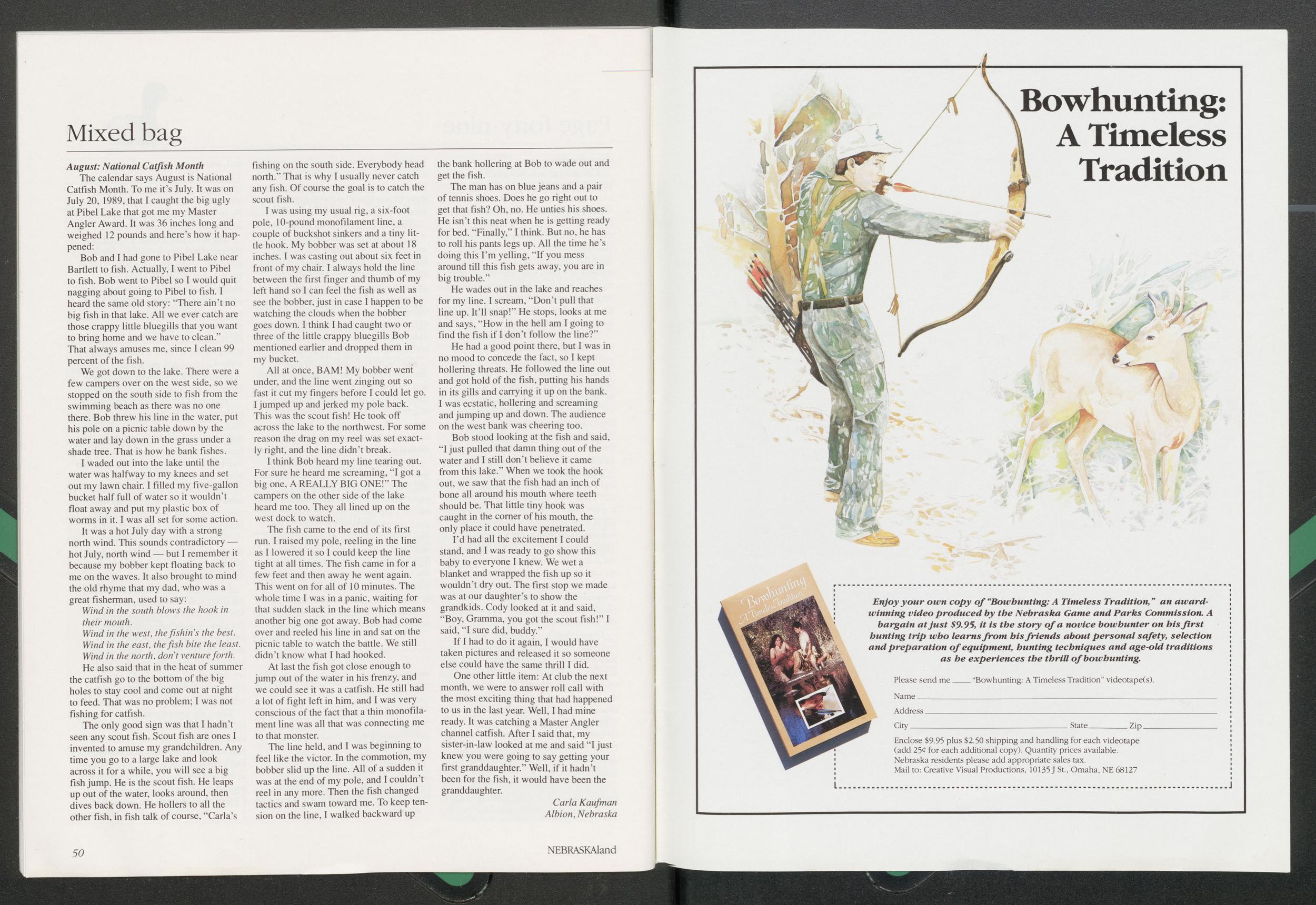
Mixed bag
August: National Catfish MonthThe calendar says August is National Catfish Month. To me it's July. It was on July 20, 1989, that I caught the big ugly at Pibel Lake that got me my Master Angler Award. It was 36 inches long and weighed 12 pounds and here's how it hap- pened:
Bob and I had gone to Pibel Lake near Bartlett to fish. Actually, I went to Pibel to fish. Bob went to Pibel so I would quit nagging about going to Pibel to fish. I heard the same old story: "There ain't no big fish in that lake. All we ever catch are those crappy little bluegills that you want to bring home and we have to clean." That always amuses me, since I clean 99 percent of the fish.
We got down to the lake. There were a few campers over on the west side, so we stopped on the south side to fish from the swimming beach as there was no one there. Bob threw his line in the water, put his pole on a picnic table down by the water and lay down in the grass under a shade tree. That is how he bank fishes.
I waded out into the lake until the water was halfway to my knees and set out my lawn chair. I filled my five-gallon bucket half full of water so it wouldn't float away and put my plastic box of worms in it. I was all set for some action.
It was a hot July day with a strong north wind. This sounds contradictory — hot July, north wind — but I remember it because my bobber kept floating back to me on the waves. It also brought to mind the old rhyme that my dad, who was a great fisherman, used to say: Wind in the south blows the hook in their mouth. Wind in the west, the fishins the best. Wind in the east, the fish bite the least. Wind in the north, don't venture forth. He also said that in the heat of summer the catfish go to the bottom of the big holes to stay cool and come out at night to feed. That was no problem; I was not fishing for catfish.
The only good sign was that I hadn't seen any scout fish. Scout fish are ones I invented to amuse my grandchildren. Any time you go to a large lake and look across it for a while, you will see a big fish jump. He is the scout fish. He leaps up out of the water, looks around, then dives back down. He hollers to all the other fish, in fish talk of course, "Carla's fishing on the south side. Everybody head north." That is why I usually never catch any fish. Of course the goal is to catch the scout fish.
I was using my usual rig, a six-foot pole, 10-pound monofilament line, a couple of buckshot sinkers and a tiny little hook. My bobber was set at about 18 inches. I was casting out about six feet in front of my chair. I always hold the line between the first finger and thumb of my left hand so I can feel the fish as well as see the bobber, just in case I happen to be watching the clouds when the bobber goes down. I think I had caught two or three of the little crappy bluegills Bob mentioned earlier and dropped them in my bucket.
All at once, BAM! My bobber went under, and the line went zinging out so fast it cut my fingers before I could let go. I jumped up and jerked my pole back. This was the scout fish! He took off across the lake to the northwest. For some reason the drag on my reel was set exactly right, and the line didn't break.
I think Bob heard my line tearing out. For sure he heard me screaming, "I got a big one, A REALLY BIG ONE!" The campers on the other side of the lake heard me too. They all lined up on the west dock to watch.
The fish came to the end of its first run. I raised my pole, reeling in the line as I lowered it so I could keep the line tight at all times. The fish came in for a few feet and then away he went again. This went on for all of 10 minutes. The whole time I was in a panic, waiting for that sudden slack in the line which means another big one got away. Bob had come over and reeled his line in and sat on the picnic table to watch the battle. We still didn't know what I had hooked.
At last the fish got close enough to jump out of the water in his frenzy, and we could see it was a catfish. He still had a lot of fight left in him, and I was very conscious of the fact that a thin monofilament line was all that was connecting me to that monster.
The line held, and I was beginning to feel like the victor. In the commotion, my bobber slid up the line. All of a sudden it was at the end of my pole, and I couldn't reel in any more. Then the fish changed tactics and swam toward me. To keep tension on the line, I walked backward up the bank hollering at Bob to wade out and get the fish.
The man has on blue jeans and a pair of tennis shoes. Does he go right out to get that fish? Oh, no. He unties his shoes. He isn't this neat when he is getting ready for bed. "Finally," I think. But no, he has to roll his pants legs up. All the time he's doing this I'm yelling, "If you mess around till this fish gets away, you are in big trouble."
He wades out in the lake and reaches for my line. I scream, "Don't pull that line up. It'll snap!" He stops, looks at me and says, "How in the hell am I going to find the fish if I don't follow the liwne?"
He had a good point there, but I was in no mood to concede the fact, so I kept hollering threats. He followed the line out and got hold of the fish, putting his hands in its gills and carrying it up on the bank. I was ecstatic, hollering and screaming and jumping up and down. The audience on the west bank was cheering too.
Bob stood looking at the fish and said, "I just pulled that damn thing out of the water and I still don't believe it came from this lake." When we took the hook out, we saw that the fish had an inch of bone all around his mouth where teeth should be. That little tiny hook was caught in the corner of his mouth, the only place it could have penetrated.
I'd had all the excitement I could stand, and I was ready to go show this baby to everyone I knew. We wet a blanket and wrapped the fish up so it wouldn't dry out. The first stop we made was at our daughter's to show the grandkids. Cody looked at it and said, "Boy, Gramma, you got the scout fish!" I said, "I sure did, buddy."
If I had to do it again, I would have taken pictures and released it so someone else could have the same thrill I did.
One other little item: At club the next month, we were to answer roll call with the most exciting thing that had happened to us in the last year. Well, I had mine ready. It was catching a Master Angler channel catfish. After I said that, my sister-in-law looked at me and said "I just knew you were going to say getting your first granddaughter." Well, if it hadn't been for the fish, it would have been the granddaughter.
Carla Kaufman Albion, Nebraska 50 NEBRASKAland
Position: 322 (28 views)