Volume 71, Issue 5, 1993

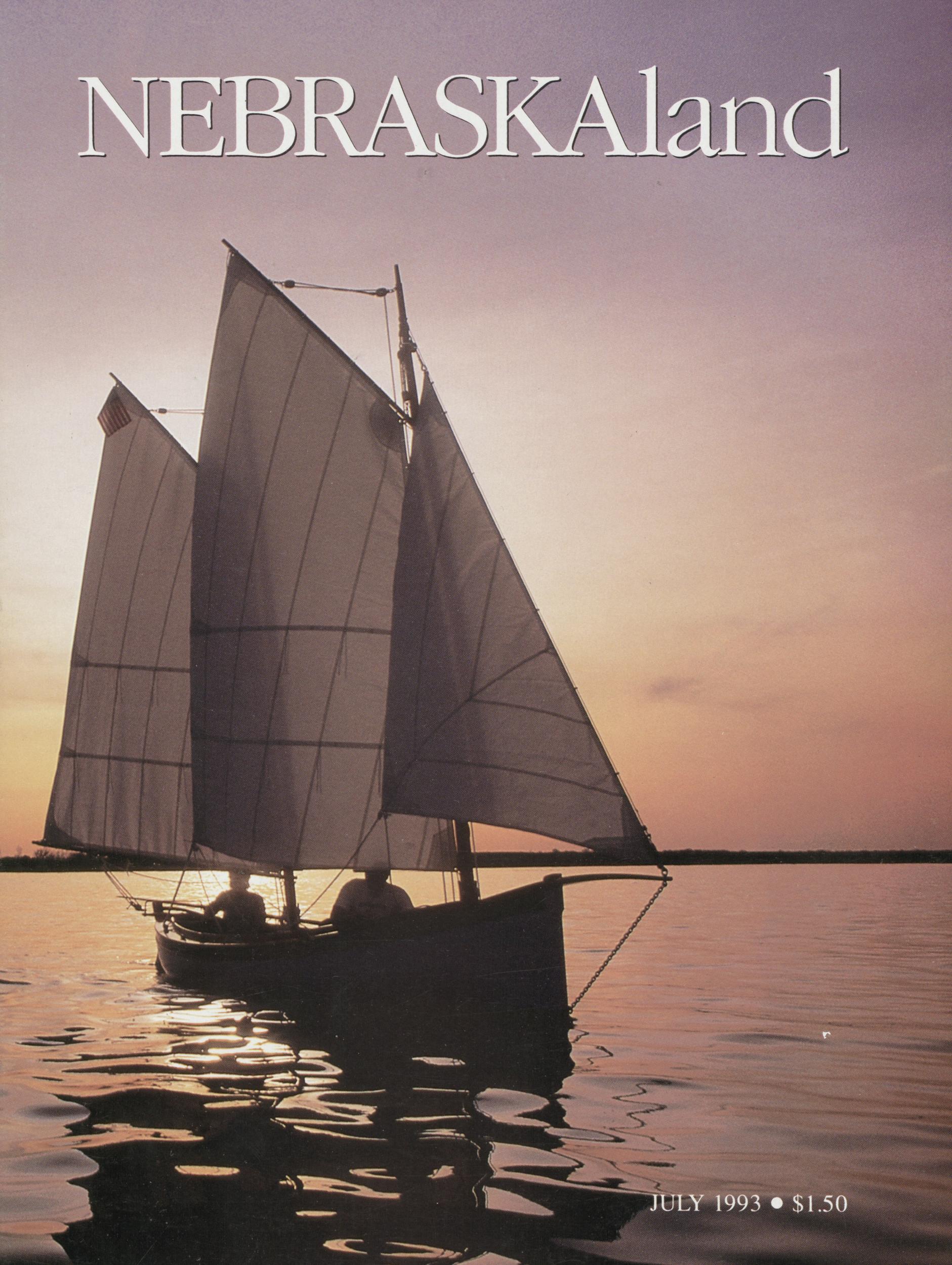
NEBRASKAland
JULY 1993 $1.50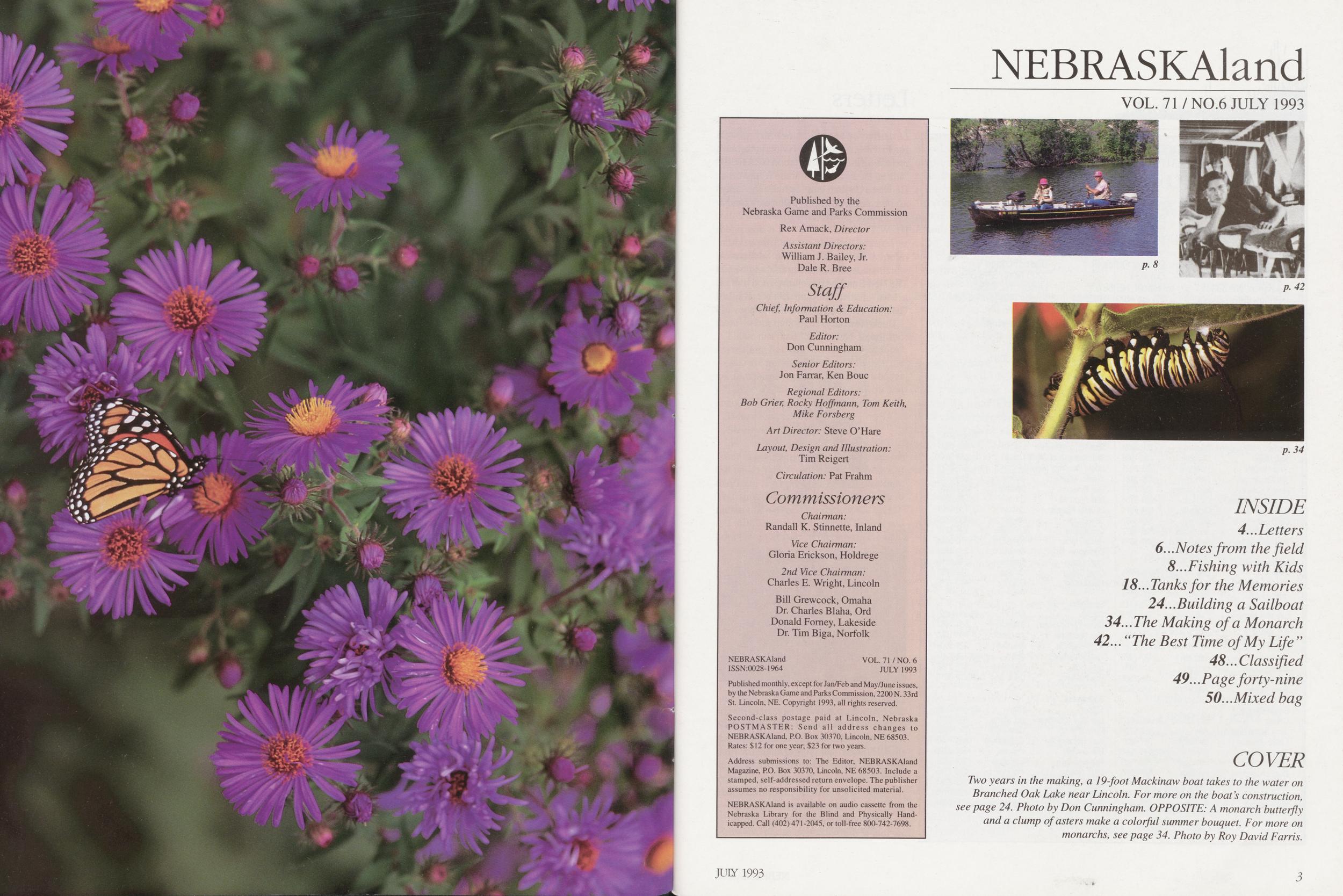
NEBRASKAland
Published by the Nebraska Game and Parks Commission Rex Amack, Director Assistant Directors: William J. Bailey, Jr. Dale R. Bree Staff Chief, Information & Education: Paul Horton Editor: Don Cunningham Senior Editors: Jon Farrar, Ken Bouc Regional Editors: Bob Grier, Rocky Hoffmann, Tom Keith, Mike Forsberg Art Director: Steve O'Hare Layout, Design and Illustration: Tim Reigert Circulation: Pat Frahm Commissioners Chairman: Randall K. Stinnette, Inland Vice Chairman: Gloria Erickson, Holdrege 2nd Vice Chairman: Charles E. Wright, Lincoln Bill Grewcock, Omaha Dr. Charles Blaha, Ord Donald Forney, Lakeside Dr. Tim Biga, Norfolk NEBRASKAland ISSN.0028-1964 VOL. 71/NO. 6 JULY 1993 Published monthly, except for Jan/Feb and May/June issues, by the Nebraska Game and Parks Commission, 2200 N. 33rd St. Lincoln, NE. Copyright 1993, all rights reserved. Second-class postage paid at Lincoln, Nebraska POSTMASTER: Send all address changes to NEBRASKAland, P.O. Box 30370, Lincoln, NE 68503. Rates: $ 12 for one year; $23 for two years. Address submissions to: The Editor, NEBRASKAland Magazine, P.O. Box 30370, Lincoln, NE 68503. Include a stamped, self-addressed return envelope. The publisher assumes no responsibility for unsolicited material. NEBRASKAland is available on audio cassette from the Nebraska Library for the Blind and Physically Handicapped. Call (402)471-2045, or toll-free 800-742-7698. VOL. 71/NO.6 JULY 1993
Letters
Nebraska Game and Parks Commission District Offices Headquarters 2200 North 33rd Street Lincoln, NE 68503 Phone (402)471-0641 District Office II Box 508 Bassett, NE 68714 Phone (402)684-2921 District Office IV Route 4, Box 36 North Platte, NE 69101 Phone (308)535-8025 District Office 1 Box 725 Alliance, NE 69301 Phone (308)762-5605 District Office III Box 934 Norfolk, NE 68702 Phone (402)370-3374 District Office V 2200 North 33rd Street Lincoln, NE 68503 Phone (402)471-5558 Omaha Office State Office Building Mall 1313 Farnam Omaha, NE 68102, Phone (402)595-2144 Conservation Officers by Region Panhandle Officer City Phone(308) Richard Furley (Supv) Alliance 762-2024 Walt Meyer Chadron 432-4398 John Murphy Crawford 665-2021 Jim Zimmerman Gering 436-7561 Marvin Kampbell Hay Springs 638-7527 Dennis Thompson Ogallala 284-6450 Dan Zuehlke Ogallala 284-4815 Don Hunt Oshkosh 772-3697 Richard Brandt Scottsbluff 635-1277 Raymond Still Bridgeport 262-1075 Southeast Officer City Phone (402) Dick Turpin (Chief) Lincoln 471-5531 Ted Blume (Asst Chief) Lincoln 483-5643 Roger Guenther (Supv) Lincoln 423-5671 William Krause Auburn 274-3789 Dan Evasco Beatrice 228-5935 Matt Andrews Lincoln Douglas Kramer Lincoln 466-9001 Dina Barta Lincoln 466-5739 Levi Krause Louisville 234-2212 Russell Mort Nebr. City 873-5684 Duane Arp Omaha 332-4954 Larry Elston Omaha 359-2833 Craig Stover Omaha 359-2833 Mike Luben Colon 443-4278 Northeast Officer City Phone (402) Tom Zimmer (Supv) Norfolk 371-6625 Robert Kelly Albion 395-2538 Ross Oestmann Bloomfield 373-4412 L.A. Wilkinson Columbus 564-4375 Gary Ralston Creighton 847-3284 Daniel Roberts Fremont 721-7852 Randy Pomplun Fullerton (308)536-2987 Jon Reeves Kennard 427-7378 Marion Shafer Norfolk 371-2031 Eric Wiebe Ponca 755-2566 Steve Oberg West Point 372-3062 Sandhills Officer City Phone (402) Bruce Wiebe (Supv) Bassett 684-3867 Max Showalter Ainsworth 387-1960 Larry Bauman Atkinson 925-5569 Richard Seward Ord (308)728-5338 Mick Gray Valentine 376-3136 Ray Dierking Brkn. Bow (308)872-3078 South-Central Officer City Phone (402) Jerry Pecha (Supv) York 362-5707 Lester Johnson David City 367-4037 Terry Brentzel Grand Isl. (308)384-8296 Dale Johnson Hebron 768-7363 Daniel Klammer Hastings 461-3389 Dayton Shultis Kearney (308)234-3349 Mark Reeves Loup City (308)745-1126 Robert Finke Seward 643-2056 Southwest Officer City Phone (308) Gail Woodside(Supv) No. Platte 532-0279 George Sund Cambridge 697-4629 Jack Henderson Gothenburg 537-7483 Dirk Greene Imperial 882-5328 Ray Frandsen Lexington 324-2753 Virgil Gosch McCook 345-2185 Dwight Allbery No. Platte 532-2753 Roger Thompson No. Platte 532-9175 Rich Routh Republican City 799-2085 Operation Game Thief (800) 742-7627 Little Buckshot at Buckshot BayEnclosed is a photo of "Old Buckshot" recreating the only illustration we have of "Little Buckshot," Conrad Wentworth. He was a civilian employed by the army as a government scout in our area for 12 years starting in 1871. In Trail of the Loup [H. W. Foght, Ord, 1906] he is described as reticent and modest, and he seldom referred in any way to the adventures which made his name a household word. The Ned Buntline novels depicted him as a hero of the Plains. Buckshot Bay at Calamus Reservoir is named for him.
Buck Newbury Burwell, Neb.Little Buckshot's hat is not the only one Buck Newbury wears. The former mayor of Burwell, Buck is a baker who, on weekends, mans the reconstructed, woodfired, 1870s-era brick oven at Fort Hartsuff State Historical Park near Elyria, southeast of Burwell [see "Loaves from Bricks," NEBRASKAland, July 1987]. He is also a student of the history and Native American peoples of the region. (Editor)
4 NEBRASKAland How are we doing? Three OpinionsI am progressively more disappointed in NEBRASKAland Magazine. The Game and Parks Commission seems to be the fault — particularly the "game" aspect. If you want to publish a hunters' magazine, call it that and I will cheerfully drop my subscriptions.
My two children and I are interested in Nebraska — my grandfather built the first building in Milligan (and his brother built the first community building in the earlier Milligan Community). I regularly visit— I have three brothers and scads of cousins there — but hunting is completely out.
I have just read "Son of Old Jules" and am reading Pound's "Nebraska Folklore" — you are missing "the boat." In fact, the western pulp magazines are doing a better job than you are. Fix, or I drop you and encourage others to do the same.
Henry Kottas Steeleville, 111.After subscribing to your magazine for the past 15 years, I regret to inform you that I am not renewing my subscription. You should target your subscriptions to nursing homes and retirement villages.
I still have some time left to fish and hunt the great state of Nebraska. Pictures of, and stories about flowers, song birds and cranes do not interest me. Nor do stories about Sitting Bull or whomever.
Your magazine appears to be run by hard-core environmentalists.... Your next issue will probably have articles on the passenger pigeon and the Dodo bird being "sighted." Your magazine needs more articles on hunting and fishing.
Walter H. England Ogallala, Neb.After years of reading and enjoying NEBRASKAland Magazine, I am moved by the May/June 1993 issue to write a note of thanks to you, the NEBRASKAland staff and the Nebraska Game and Parks Commission for publishing a magazine of such high quality.
Although few articles can match "The Audubons' Magnificent Mammals" in terms of photo reproduction and significance of text, the May/June issue is a model of NEBRASKAland's dedication to presenting timely and fascinating material to readers interested in Nebraska History ("Surveying Nebraska," "Making a Point"), recreation ("Backpacking the Ridge") and culture ("The Audubons'..."), as well as those interested in hunting (Notes from the field) and fishing ("The Role of Stocking in Fisheries Management"). I know of no other state publication which can match NEBRASKAland in reflecting the broad interests of its citizens, past and present.
Michael Cartwright Whitney, Neb. Recipe RevisionIn your April 1993 issue, the recipe for corn pudding calls for one tablespoon of flour in the ingredients, but in the instructions calls for blending butter, sugar and salt. Please advise if it should be flour or sugar or both! I have made the recipe twice using flour, but it doesn't seem to be a custard-like texture.
Mrs. John Patterson Marysville, Wash.April's "Spring House Cleaning " recipes were odds and ends, and we could not locate our contributor's original letter to check ingredients and instructions. We found a similar recipe called "Skeeter's Corn Puddin" in Ernest M. Mickler's White Trash Cooking (Ten Speed Press, Berkeley, 1986), and that version might solve your dilemma.
Mickler calls for two cups of canned corn (our recipe said two cans), two tablespoons of flour (we said one tablespoon) as well as two tablespoons of sugar, an ingredient not on our list at all. Mickler's recipe calls for oleo margarine not butter. All other ingredients and instructions are the same. (Editor)
Address your comments, suggestions and complaints to Letters, NEBRASKAland Magazine, P.O. Box 30370, Lincoln, NE 68503-0370, or Fax (402) 471-5528. NEBRASKAland reserves the right to edit and condense letters.
"BECOMING AN OUTDOORS WOMAN" A three-day workshop designed primarily for women 18 years old or older to learn a variety of skills usually associated with hunting, fishing, camping and exploring the outdoors. Plan to join us for this fun, informative and relaxing outdoor experience. Topics and sessions include: • Basic Fishing Skills Fly Fishing Techniques • Firearm Safety and Trapshooting Map and Compass Basic Camping and Survival Skills • Canoeing • Dutch Oven Cooking • Turkey Hunting and Calling m Mock Pheasant Hunt October 1-3,1993 Nebraska State 4-H Camp Nebraska National Forest (near Halsey) Enrollment limit 100 Register early For more information call: 1-800-577-8283 and record your request. outdoors- Woman JUIY 1993 5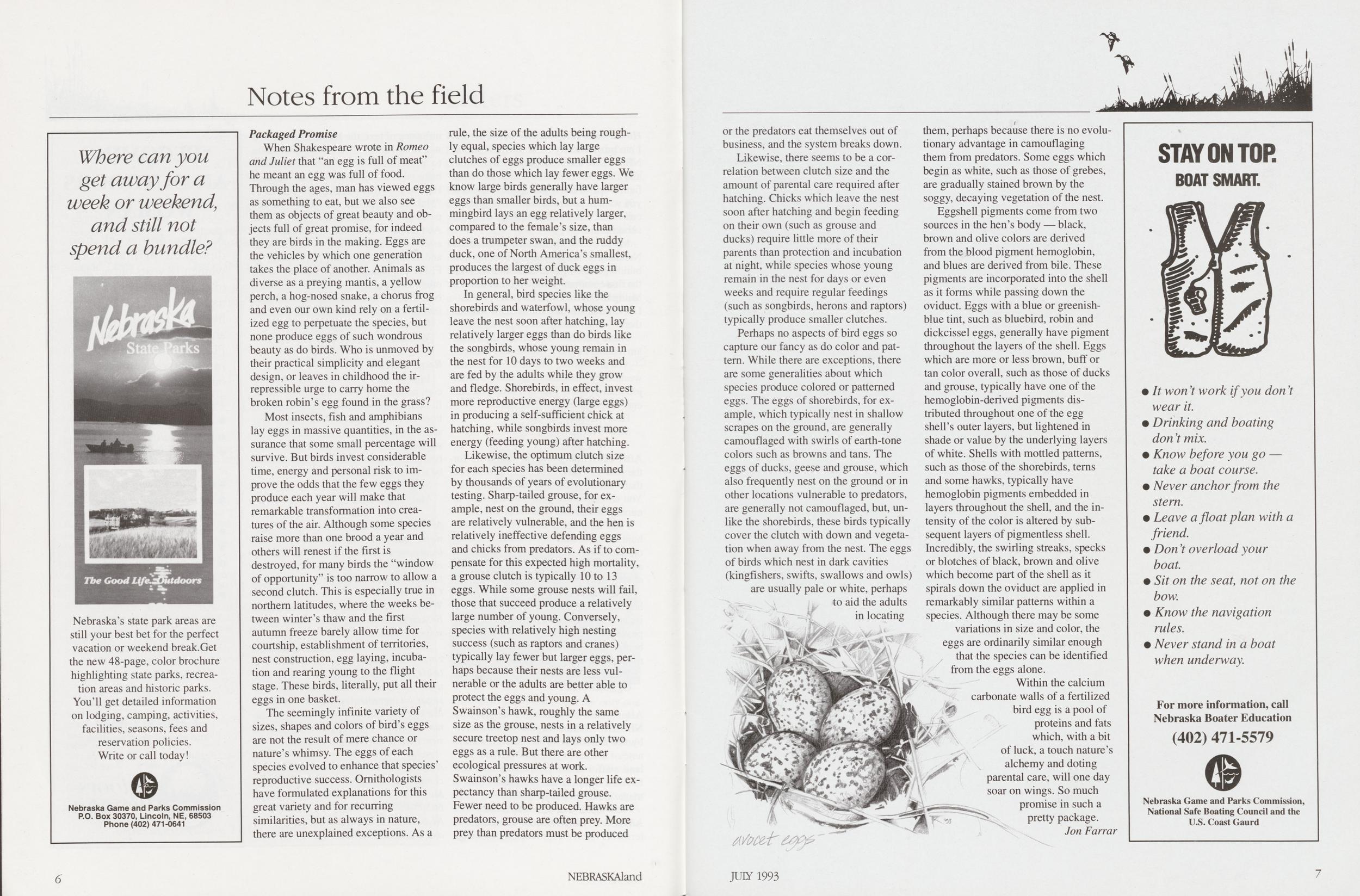
Notes from the field
Where can you get away for a week or weekend, and still not spend a bundle? Nebraska's state park areas are still your best bet for the perfect vacation or weekend break.Get the new 48-page, color brochure highlighting state parks, recreation areas and historic parks. You'll get detailed information on lodging, camping, activities, facilities, seasons, fees and reservation policies. Write or call today! Nebraska Game and Parks Commission P.O. Box 30370, Lincoln, NE, 68503 Phone (402) 471-0641 Packaged PromiseWhen Shakespeare wrote in Romeo and Juliet that "an egg is full of meat" he meant an egg was full of food. Through the ages, man has viewed eggs as something to eat, but we also see them as objects of great beauty and objects full of great promise, for indeed they are birds in the making. Eggs are the vehicles by which one generation takes the place of another. Animals as diverse as a preying mantis, a yellow perch, a hog-nosed snake, a chorus frog and even our own kind rely on a fertilized egg to perpetuate the species, but none produce eggs of such wondrous beauty as do birds. Who is unmoved by their practical simplicity and elegant design, or leaves in childhood the irrepressible urge to carry home the broken robin's egg found in the grass?
Most insects, fish and amphibians lay eggs in massive quantities, in the assurance that some small percentage will survive. But birds invest considerable time, energy and personal risk to improve the odds that the few eggs they produce each year will make that remarkable transformation into creatures of the air. Although some species raise more than one brood a year and others will renest if the first is destroyed, for many birds the "window of opportunity" is too narrow to allow a second clutch. This is especially true in northern latitudes, where the weeks between winter's thaw and the first autumn freeze barely allow time for courtship, establishment of territories, nest construction, egg laying, incubation and rearing young to the flight stage. These birds, literally, put all their eggs in one basket.
The seemingly infinite variety of sizes, shapes and colors of bird's eggs are not the result of mere chance or nature's whimsy. The eggs of each species evolved to enhance that species' reproductive success. Ornithologists have formulated explanations for this great variety and for recurring similarities, but as always in nature, there are unexplained exceptions. As a rule, the size of the adults being roughly equal, species which lay large clutches of eggs produce smaller eggs than do those which lay fewer eggs. We know large birds generally have larger eggs than smaller birds, but a hummingbird lays an egg relatively larger, compared to the female's size, than does a trumpeter swan, and the ruddy duck, one of North America's smallest, produces the largest of duck eggs in proportion to her weight.
In general, bird species like the shorebirds and waterfowl, whose young leave the nest soon after hatching, lay relatively larger eggs than do birds like the songbirds, whose young remain in the nest for 10 days to two weeks and are fed by the adults while they grow and fledge. Shorebirds, in effect, invest more reproductive energy (large eggs) in producing a self-sufficient chick at hatching, while songbirds invest more energy (feeding young) after hatching.
Likewise, the optimum clutch size for each species has been determined by thousands of years of evolutionary testing. Sharp-tailed grouse, for example, nest on the ground, their eggs are relatively vulnerable, and the hen is relatively ineffective defending eggs and chicks from predators. As if to compensate for this expected high mortality, a grouse clutch is typically 10 to 13 eggs. While some grouse nests will fail, those that succeed produce a relatively large number of young. Conversely, species with relatively high nesting success (such as raptors and cranes) typically lay fewer but larger eggs, perhaps because their nests are less vulnerable or the adults are better able to protect the eggs and young. A Swainson's hawk, roughly the same size as the grouse, nests in a relatively secure treetop nest and lays only two eggs as a rule. But there are other ecological pressures at work. Swainson's hawks have a longer life expectancy than sharp-tailed grouse. Fewer need to be produced. Hawks are predators, grouse are often prey. More prey than predators must be produced 6 NEBRASKAland or the predators eat themselves out of business, and the system breaks down.
Likewise, there seems to be a correlation between clutch size and the amount of parental care required after hatching. Chicks which leave the nest soon after hatching and begin feeding on their own (such as grouse and ducks) require little more of their parents than protection and incubation at night, while species whose young remain in the nest for days or even weeks and require regular feedings (such as songbirds, herons and raptors) typically produce smaller clutches.
Perhaps no aspects of bird eggs so capture our fancy as do color and pattern. While there are exceptions, there are some generalities about which species produce colored or patterned eggs. The eggs of shorebirds, for example, which typically nest in shallow scrapes on the ground, are generally camouflaged with swirls of earth-tone colors such as browns and tans. The eggs of ducks, geese and grouse, which also frequently nest on the ground or in other locations vulnerable to predators, are generally not camouflaged, but, unlike the shorebirds, these birds typically cover the clutch with down and vegetation when away from the nest. The eggs of birds which nest in dark cavities (kingfishers, swifts, swallows and owls) are usually pale or white, perhaps to aid the adults in locating
Eggshell pigments come from two sources in the hen's body — black, brown and olive colors are derived from the blood pigment hemoglobin, and blues are derived from bile. These pigments are incorporated into the shell as it forms while passing down the oviduct. Eggs with a blue or greenish-blue tint, such as bluebird, robin and dickcissel eggs, generally have pigment throughout the layers of the shell. Eggs which are more or less brown, buff or tan color overall, such as those of ducks and grouse, typically have one of the hemoglobin-derived pigments distributed throughout one of the egg shell's outer layers, but lightened in shade or value by the underlying layers of white. Shells with mottled patterns, such as those of the shorebirds, terns and some hawks, typically have hemoglobin pigments embedded in layers throughout the shell, and the intensity of the color is altered by subsequent layers of pigmentless shell. Incredibly, the swirling streaks, specks or blotches of black, brown and olive which become part of the shell as it spirals down the oviduct are applied in remarkably similar patterns within a species. Although there may be some variations in size and color, the eggs are ordinarily similar enough that the species can be identified from the eggs alone. Within the calcium carbonate walls of a fertilized bird egg is a pool of proteins and fats which, with a bit of luck, a touch nature's alchemy and doting parental care, will one day soar on wings. So much promise in such a pretty package.
Jon Farrar STAY ON TOP. BOAT SMART. It won Y work if you don't wear it. i Drinking and boating don 9t mix. i Know before you go — take a boat course. i Never anchor from the stern. > Leave a float plan with a friend. > Don Y overload your boat. > Sit on the seat, not on the bow. > Know the navigation rules. > Never stand in a boat when underway. For more information, call Nebraska Boater Education (402) 471-5579 Nebraska Game and Parks Commission, National Safe Boating Council and the U.S. Coast Guard JUEf 1993 7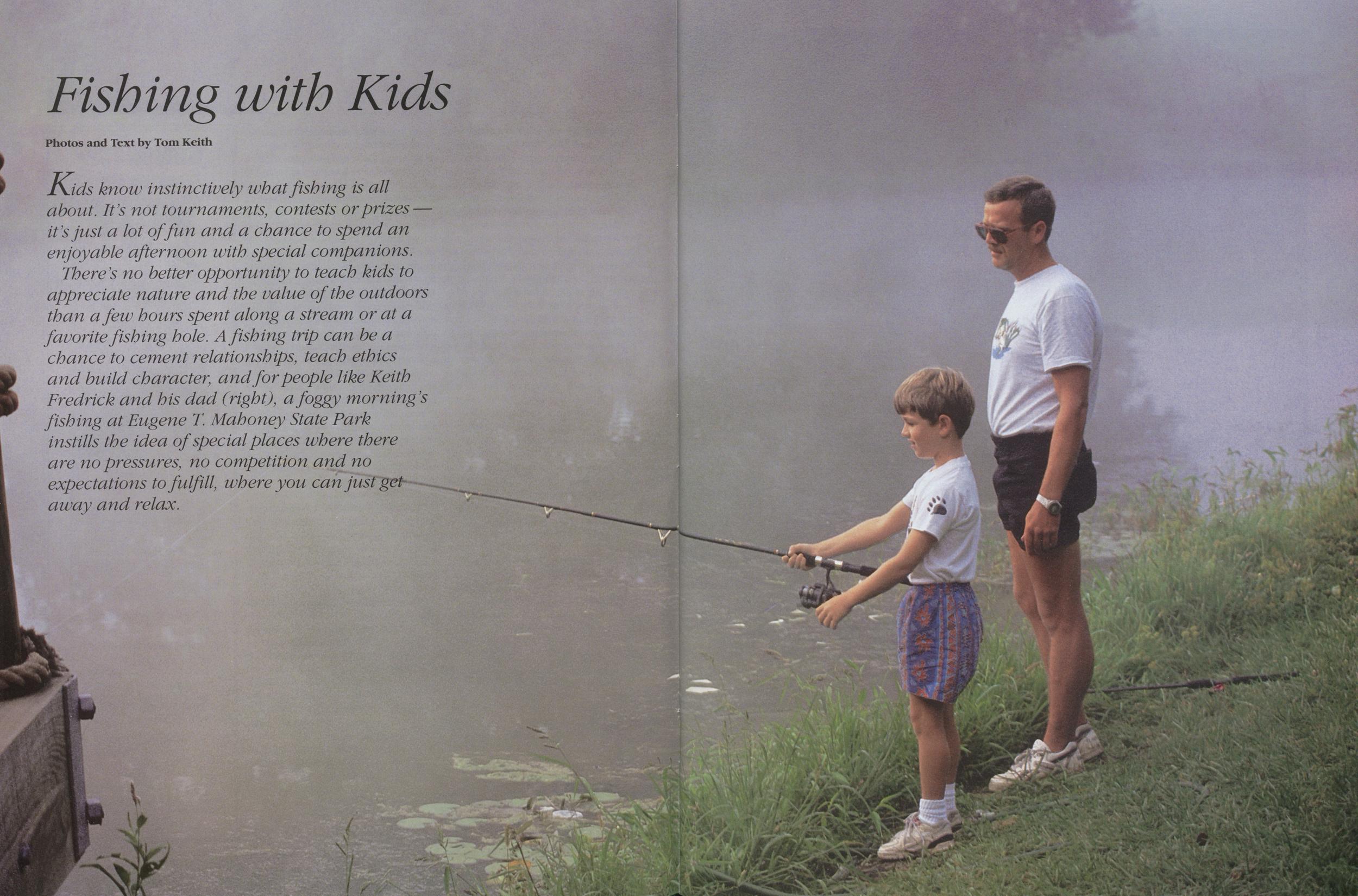
Fish ing with Kids
Photos and Text by Tom KeithITV kids know instinctively what fishing is all about. It's not tournaments, contests or prizes — it's just a lot of fun and a chance to spend an enjoyable afternoon with special companions. There's no better opportunity to teach kids to appreciate nature and the value of the outdoors than a few hours spent along a stream or at a favorite fishing hole. A fishing trip can be a chance to cement relationships, teach ethics and build character, and for people like Keith Fredrick and his dad (right), a foggy morning's fishing at Eugene T. Mahoney State Park instills the idea of special places where there are no pressures, no competition and no expectations to fulfill, where you can just get away and relax.
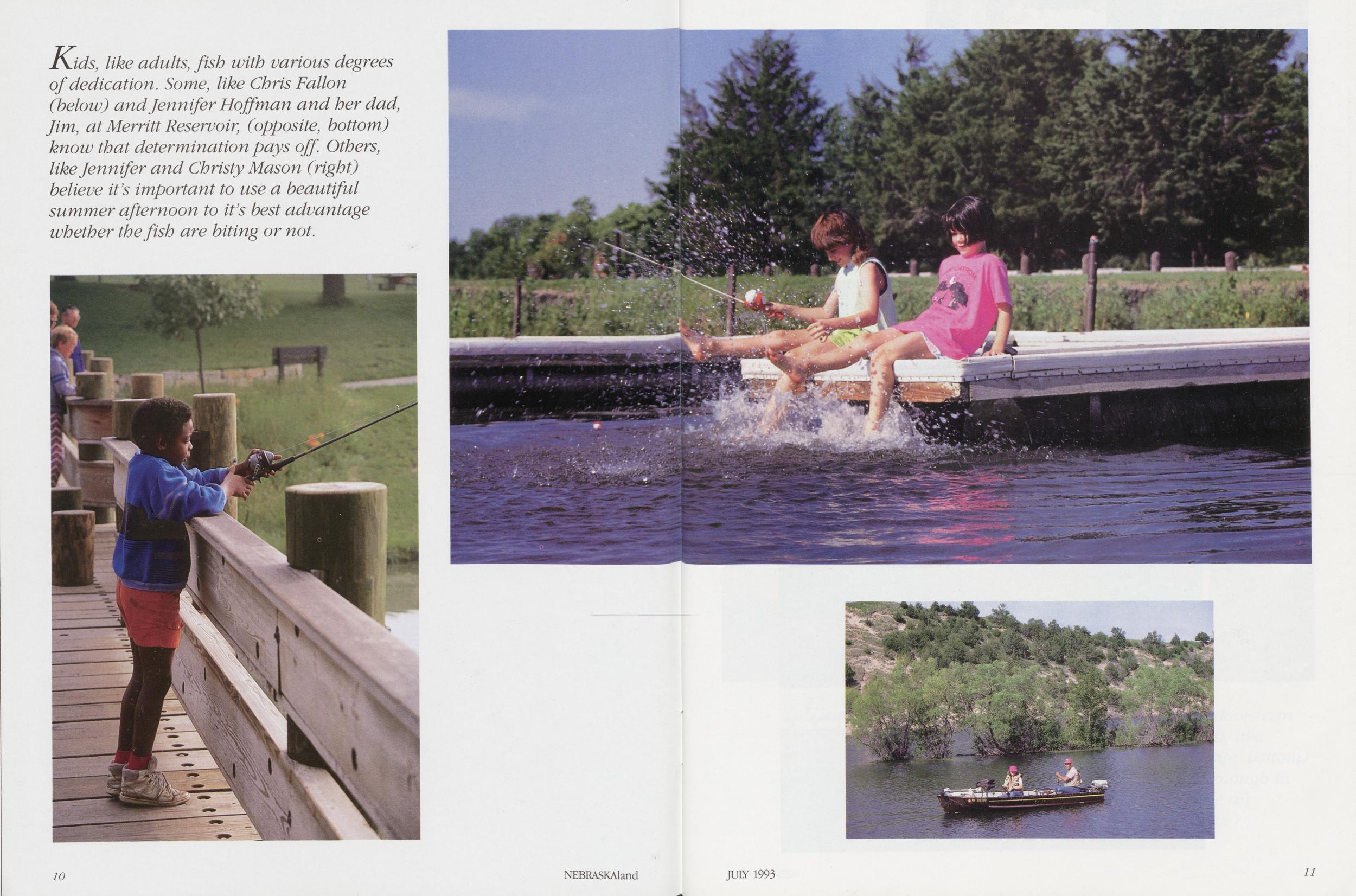
J\ids, like adults, fish with various degrees of dedication. Some, like Chris Fallon (below) and Jennifer Hoffman and her dad, Jim, at Merritt Reservoir, (opposite, bottom) know that determination pays off Others, like Jennifer and Christy Mason (right) believe it's important to use a beautiful summer afternoon to it's best advantage whether the fish are biting or not.
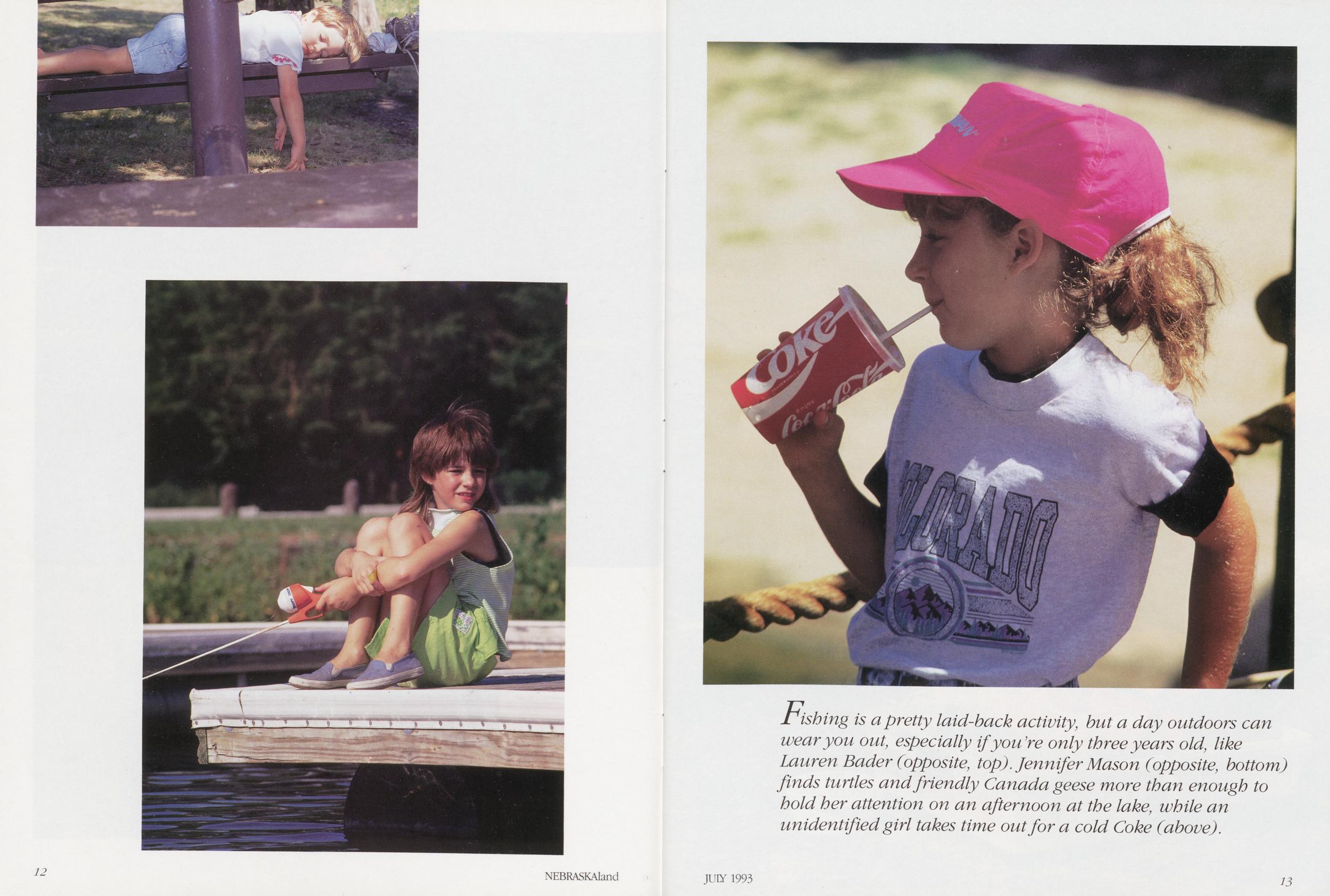
Pushing is a pretty laid-back activity, but a day outdoors can wear you out, especially if you're only three years old, like Lauren Bader (opposite, top). Jennifer Mason (opposite, bottom) finds turtles and friendly Canada geese more than enough to hold her attention on an afternoon at the lake, while an unidentified girl takes time out for a cold Coke (above).
JUIY 1993 13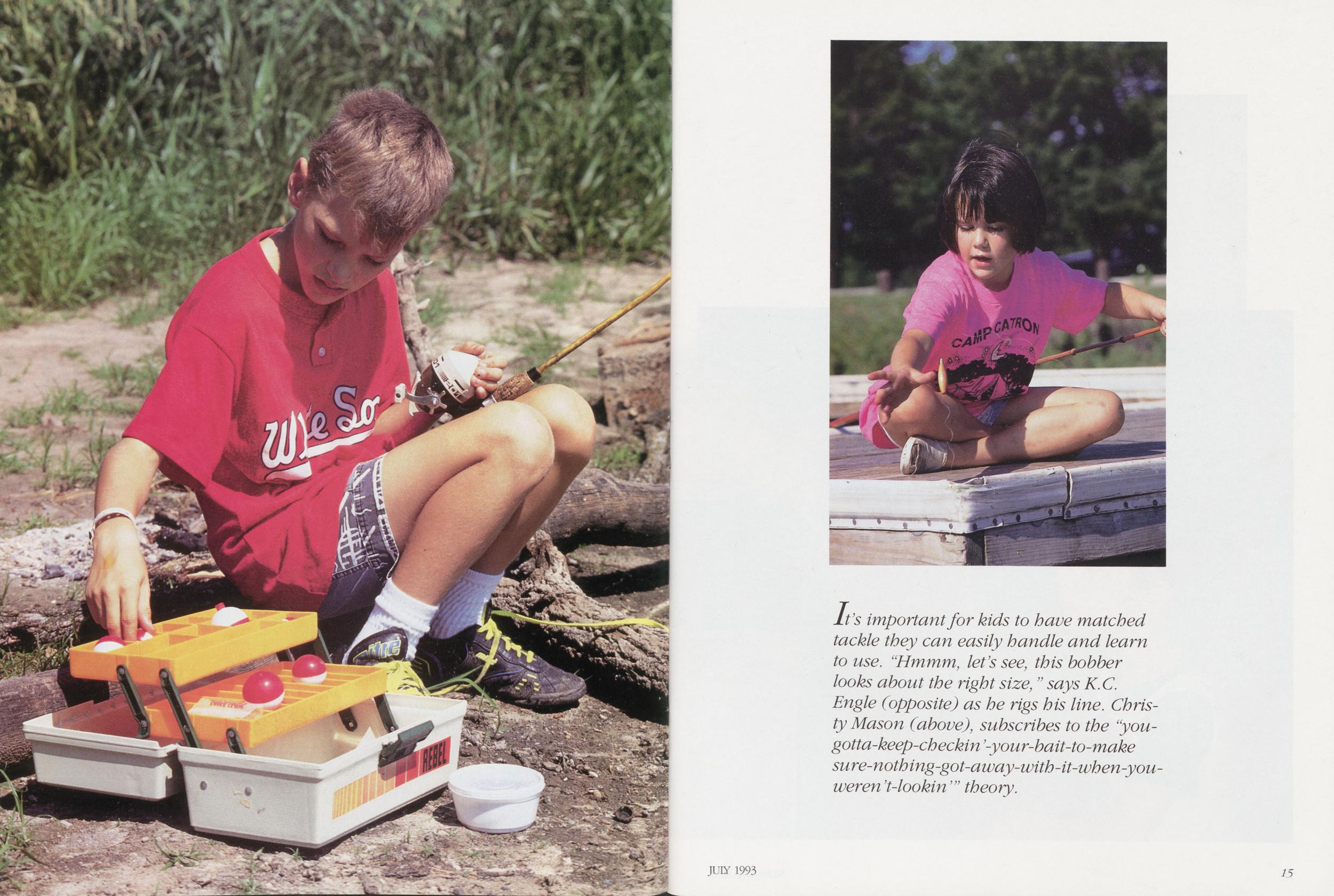
It's important for kids to have matched tackle they can easily handle and learn to use. "Hmmm, let's see, this bobber looks about the right size, " says K. C. Engle (opposite) as he rigs his line. Christy Mason (above), subscribes to the "you-gotta-keep-checkin'-your-bait-to-make sure-nothing-got-away-with-it-when-you- weren't-lookin'" theory.
JULY 1993 15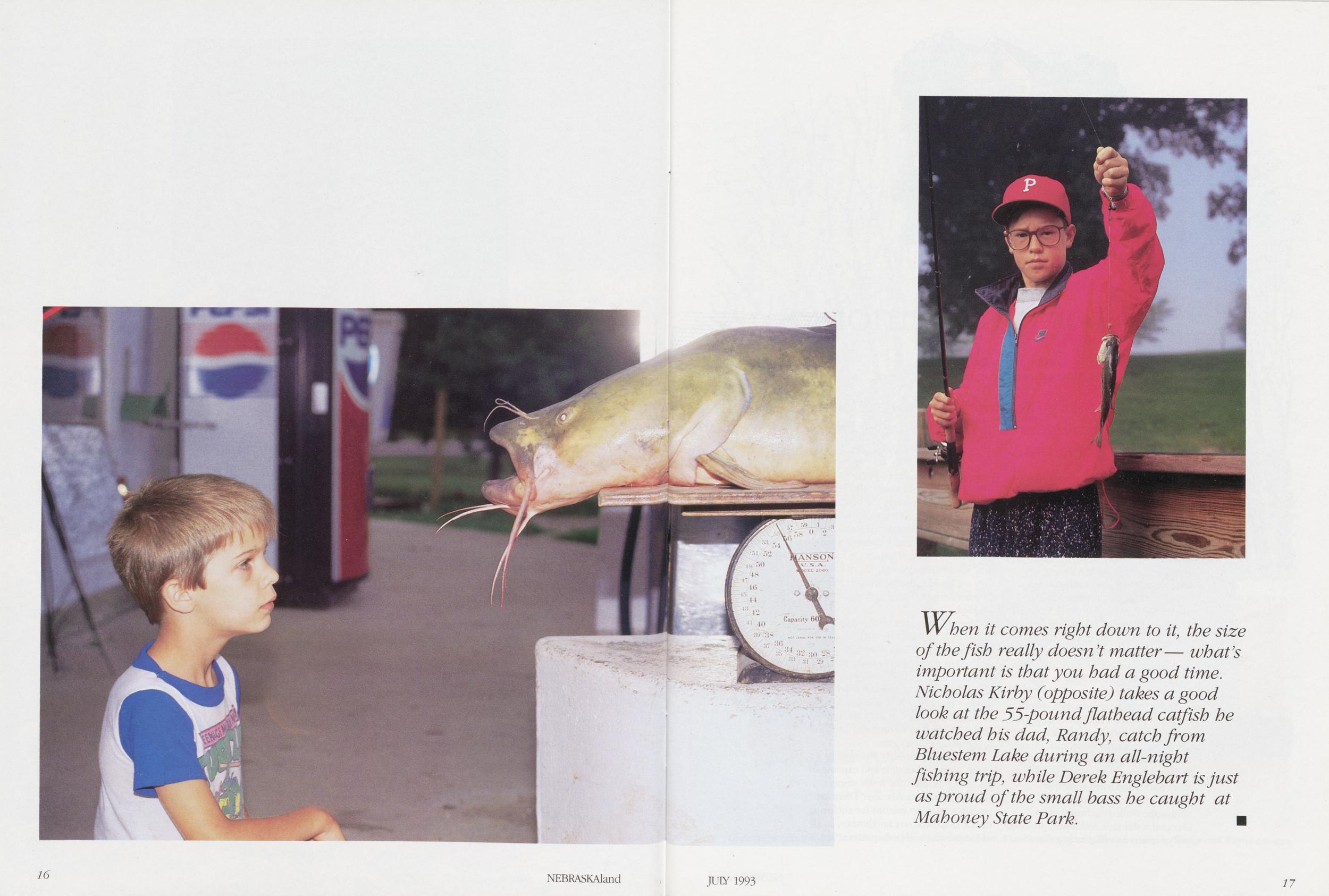
When it comes right down to it, the size of the fish really doesn't matter— what's important is that you had a good time. Nicholas Kirhy (opposite) takes a good look at the 55-pound flathead catfish he watched his dad, Randy, catch from Bluestem Lake during an all-night fishing trip, while Derek Englebart is just as proud of the small bass he caught at Mahoney State Park.
JUIY 1993 17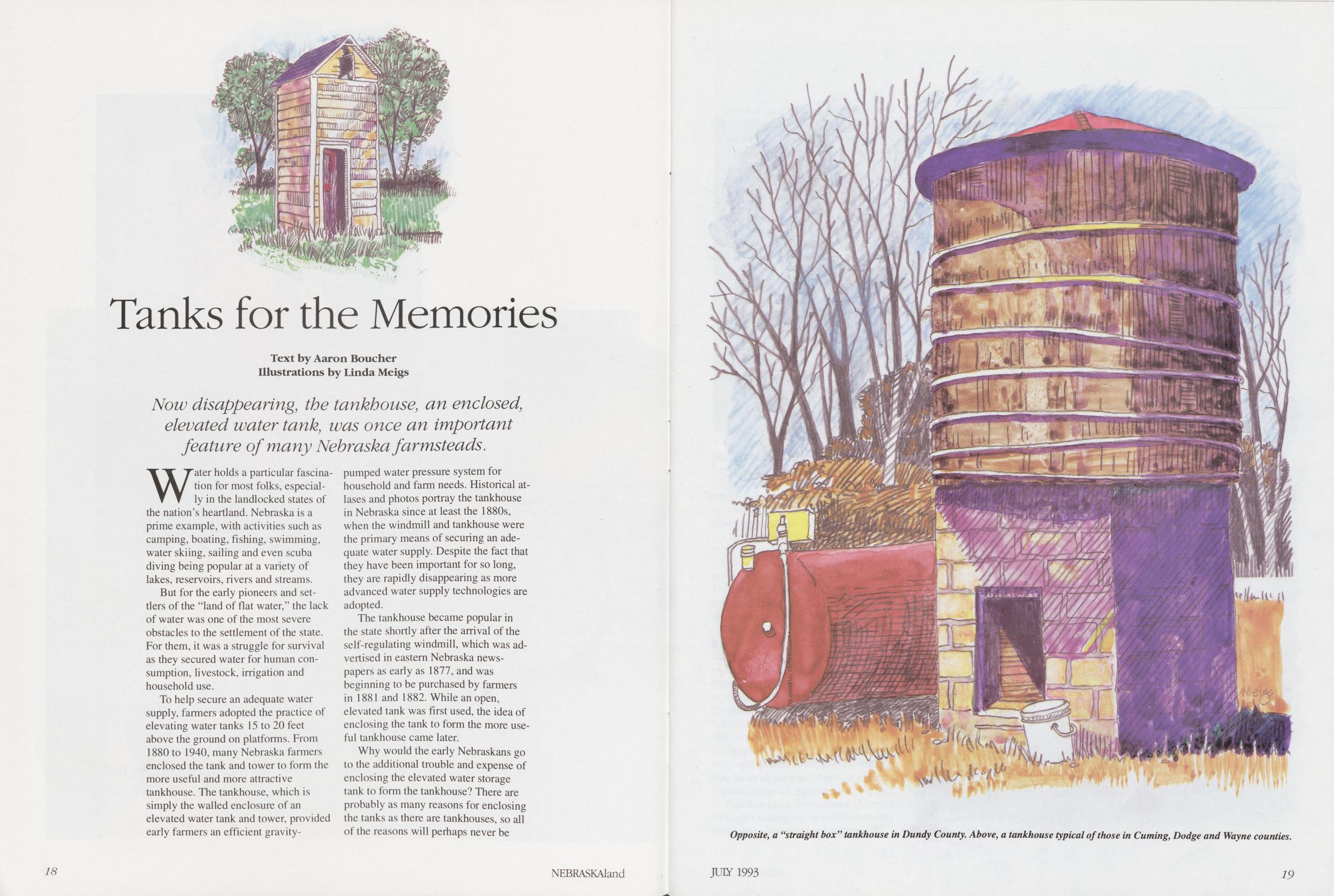
Tanks for the Memories
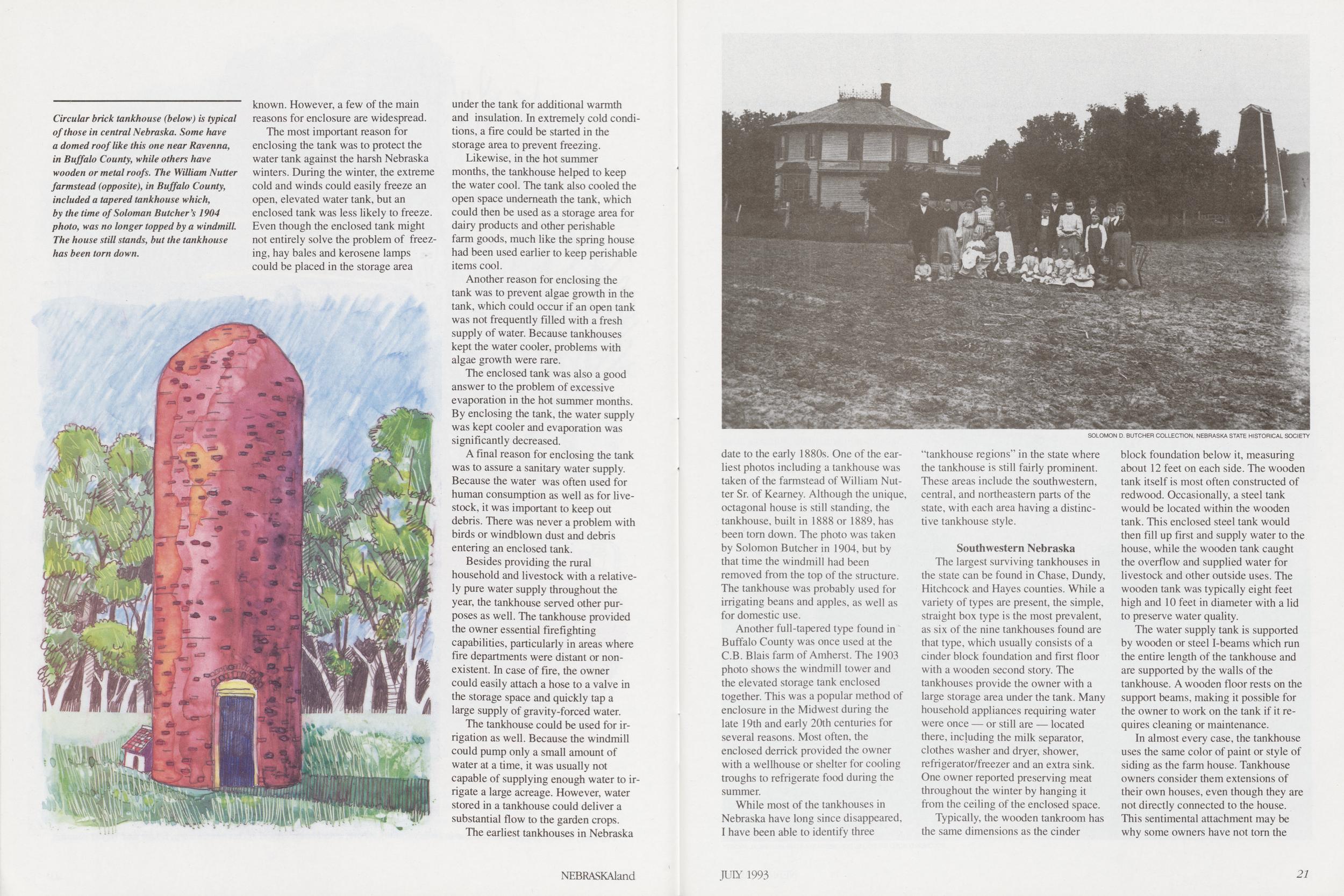
Text by Aaron Boucher Illustrations by Linda Meigs Now disappearing, the tankhouse, an enclosed, elevated water tank, was once an important feature of many Nebraska farmsteads.Water holds a particular fascination for most folks, especially in the landlocked states of the nation's heartland. Nebraska is a prime example, with activities such as camping, boating, fishing, swimming, water skiing, sailing and even scuba diving being popular at a variety of lakes, reservoirs, rivers and streams.
But for the early pioneers and settlers of the "land of flat water," the lack of water was one of the most severe obstacles to the settlement of the state. For them, it was a struggle for survival as they secured water for human consumption, livestock, irrigation and household use.
To help secure an adequate water supply, farmers adopted the practice of elevating water tanks 15 to 20 feet above the ground on platforms. From 1880 to 1940, many Nebraska farmers enclosed the tank and tower to form the more useful and more attractive tankhouse. The tankhouse, which is simply the walled enclosure of an elevated water tank and tower, provided early farmers an efficient gravity pumped water pressure system for household and farm needs. Historical atlases and photos portray the tankhouse in Nebraska since at least the 1880s, when the windmill and tankhouse were the primary means of securing an adequate water supply. Despite the fact that they have been important for so long, they are rapidly disappearing as more advanced water supply technologies are adopted.
The tankhouse became popular in the state shortly after the arrival of the self-regulating windmill, which was advertised in eastern Nebraska newspapers as early as 1877, and was beginning to be purchased by farmers in 1881 and 1882. While an open, elevated tank was first used, the idea of enclosing the tank to form the more useful tankhouse came later.
Why would the early Nebraskans go to the additional trouble and expense of enclosing the elevated water storage tank to form the tankhouse? There are probably as many reasons for enclosing the tanks as there are tankhouses, so all of the reasons will perhaps never be 18 NEBRASKAland
The most important reason for enclosing the tank was to protect the water tank against the harsh Nebraska winters. During the winter, the extreme cold and winds could easily freeze an open, elevated water tank, but an enclosed tank was less likely to freeze. Even though the enclosed tank might not entirely solve the problem of freezing, hay bales and kerosene lamps could be placed in the storage area under the tank for additional warmth and insulation. In extremely cold conditions, a fire could be started in the storage area to prevent freezing.
Likewise, in the hot summer months, the tankhouse helped to keep the water cool. The tank also cooled the open space underneath the tank, which could then be used as a storage area for dairy products and other perishable farm goods, much like the spring house had been used earlier to keep perishable items cool.
Another reason for enclosing the tank was to prevent algae growth in the tank, which could occur if an open tank was not frequently filled with a fresh supply of water. Because tankhouses kept the water cooler, problems with algae growth were rare.
The enclosed tank was also a good answer to the problem of excessive evaporation in the hot summer months. By enclosing the tank, the water supply was kept cooler and evaporation was significantly decreased.
A final reason for enclosing the tank was to assure a sanitary water supply. Because the water was often used for human consumption as well as for livestock, it was important to keep out debris. There was never a problem with birds or windblown dust and debris entering an enclosed tank.
Besides providing the rural household and livestock with a relatively pure water supply throughout the year, the tankhouse served other purposes as well. The tankhouse provided the owner essential firefighting capabilities, particularly in areas where fire departments were distant or nonexistent. In case of fire, the owner could easily attach a hose to a valve in the storage space and quickly tap a large supply of gravity-forced water.
The tankhouse could be used for irrigation as well. Because the windmill could pump only a small amount of water at a time, it was usually not capable of supplying enough water to irrigate a large acreage. However, water stored in a tankhouse could deliver a substantial flow to the garden crops.
The earliest tankhouses in Nebraska NEBRASKAland
Another full-tapered type found in Buffalo County was once used at the C.B. Blais farm of Amherst. The 1903 photo shows the windmill tower and the elevated storage tank enclosed together. This was a popular method of enclosure in the Midwest during the late 19th and early 20th centuries for several reasons. Most often, the enclosed derrick provided the owner with a well house or shelter for cooling troughs to refrigerate food during the summer.
While most of the tankhouses in Nebraska have long since disappeared, I have been able to identify three "tankhouse regions" in the state where the tankhouse is still fairly prominent. These areas include the southwestern, central, and northeastern parts of the state, with each area having a distinctive tankhouse style.
Southwestern NebraskaThe largest surviving tankhouses in the state can be found in Chase, Dundy, Hitchcock and Hayes counties. While a variety of types are present, the simple, straight box type is the most prevalent, as six of the nine tankhouses found are that type, which usually consists of a cinder block foundation and first floor with a wooden second story. The tankhouses provide the owner with a large storage area under the tank. Many household appliances requiring water were once — or still are — located there, including the milk separator, clothes washer and dryer, shower, refrigerator/freezer and an extra sink. One owner reported preserving meat throughout the winter by hanging it from the ceiling of the enclosed space.
Typically, the wooden tankroom has the same dimensions as the cinder block foundation below it, measuring about 12 feet on each side. The wooden tank itself is most often constructed of redwood. Occasionally, a steel tank would be located within the wooden tank. This enclosed steel tank would then fill up first and supply water to the house, while the wooden tank caught the overflow and supplied water for livestock and other outside uses. The wooden tank was typically eight feet high and 10 feet in diameter with a lid to preserve water quality.
The water supply tank is supported by wooden or steel I-beams which run the entire length of the tankhouse and are supported by the walls of the tankhouse. A wooden floor rests on the support beams, making it possible for the owner to work on the tank if it requires cleaning or maintenance.
In almost every case, the tankhouse
uses the same color of paint or style of
siding as the farm house. Tankhouse
owners consider them extensions of
their own houses, even though they are
not directly connected to the house.
This sentimental attachment may be
why some owners have not torn the
JULY 1993
21
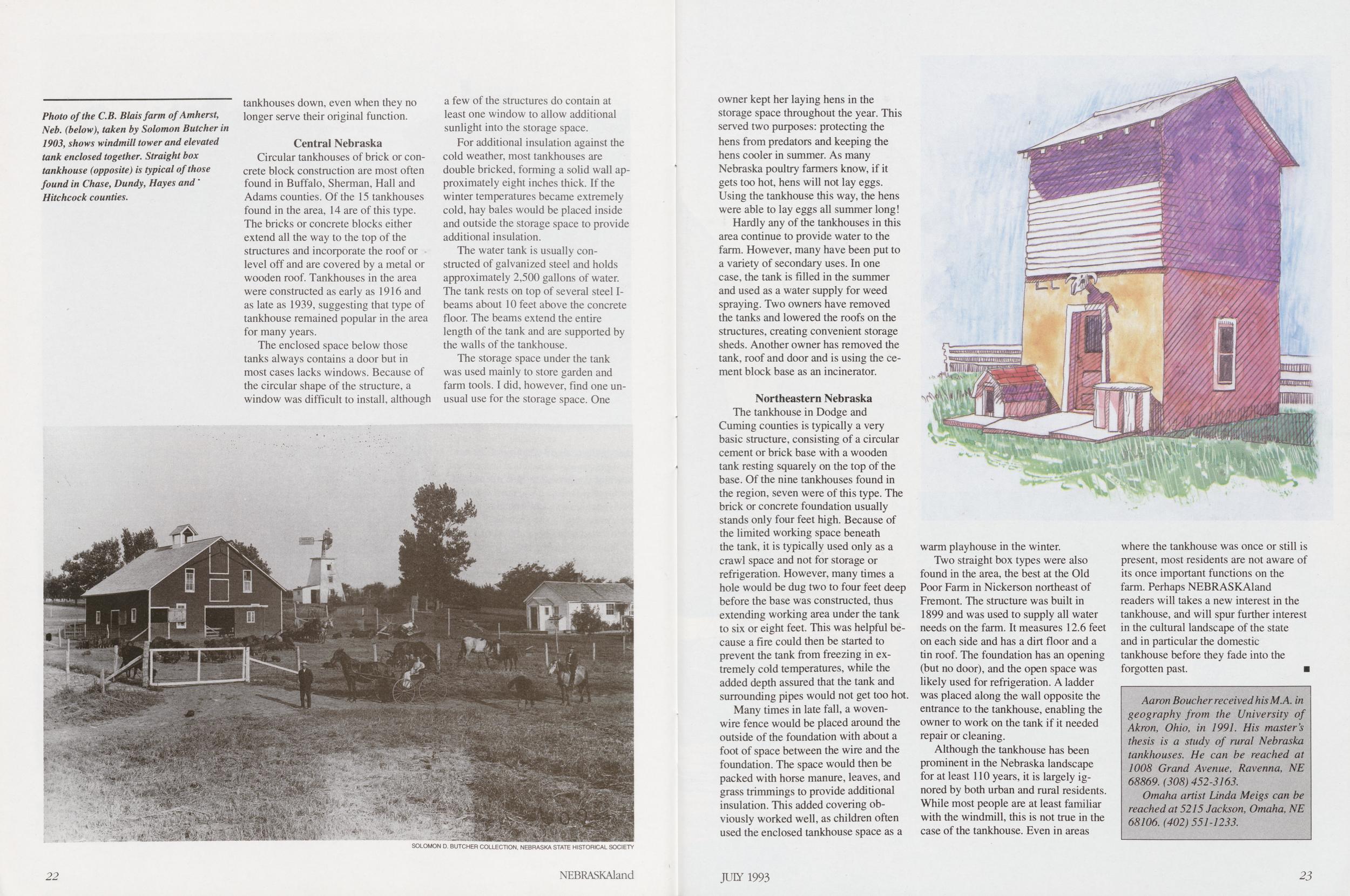
Circular tankhouses of brick or concrete block constmction are most often found in Buffalo, Sherman, Hall and Adams counties. Of the 15 tankhouses found in the area, 14 are of this type. The bricks or concrete blocks either extend all the way to the top of the structures and incorporate the roof or level off and are covered by a metal or wooden roof. Tankhouses in the area were constructed as early as 1916 and as late as 1939, suggesting that type of tankhouse remained popular in the area for many years.
The enclosed space below those tanks always contains a door but in most cases lacks windows. Because of the circular shape of the structure, a window was difficult to install, although a few of the structures do contain at least one window to allow additional sunlight into the storage space.
For additional insulation against the cold weather, most tankhouses are double bricked, forming a solid wall approximately eight inches thick. If the winter temperatures became extremely cold, hay bales would be placed inside and outside the storage space to provide additional insulation.
The water tank is usually constructed of galvanized steel and holds approximately 2,500 gallons of water. The tank rests on top of several steel Ibeams about 10 feet above the concrete floor. The beams extend the entire length of the tank and are supported by the walls of the tankhouse.
The storage space under the tank was used mainly to store garden and farm tools. I did, however, find one unusual use for the storage space. One 22 NEBRASKAland
Hardly any of the tankhouses in this area continue to provide water to the farm. However, many have been put to a variety of secondary uses. In one case, the tank is filled in the summer and used as a water supply for weed spraying. Two owners have removed the tanks and lowered the roofs on the structures, creating convenient storage sheds. Another owner has removed the tank, roof and door and is using the cement block base as an incinerator.
Northeastern NebraskaThe tankhouse in Dodge and Cuming counties is typically a very basic structure, consisting of a circular cement or brick base with a wooden tank resting squarely on the top of the base. Of the nine tankhouses found in the region, seven were of this type. The brick or concrete foundation usually stands only four feet high. Because of the limited working space beneath the tank, it is typically used only as a crawl space and not for storage or refrigeration. However, many times a hole would be dug two to four feet deep before the base was constructed, thus extending working area under the tank to six or eight feet. This was helpful because a fire could then be started to prevent the tank from freezing in extremely cold temperatures, while the added depth assured that the tank and surrounding pipes would not get too hot.
Many times in late fall, a woven-wire fence would be placed around the outside of the foundation with about a foot of space between the wire and the foundation. The space would then be packed with horse manure, leaves, and grass trimmings to provide additional insulation. This added covering obviously worked well, as children often used the enclosed tankhouse space as a warm playhouse in the winter.
Two straight box types were also found in the area, the best at the Old Poor Farm in Nickerson northeast of Fremont. The structure was built in 1899 and was used to supply all water needs on the farm. It measures 12.6 feet on each side and has a dirt floor and a tin roof. The foundation has an opening (but no door), and the open space was likely used for refrigeration. A ladder was placed along the wall opposite the entrance to the tankhouse, enabling the owner to work on the tank if it needed repair or cleaning.
Although the tankhouse has been prominent in the Nebraska landscape for at least 110 years, it is largely ignored by both urban and rural residents. While most people are at least familiar with the windmill, this is not true in the case of the tankhouse. Even in areas where the tankhouse was once or still is present, most residents are not aware of its once important functions on the farm. Perhaps NEBRASKAland readers will takes a new interest in the tankhouse, and will spur further interest in the cultural landscape of the state and in particular the domestic tankhouse before they fade into the forgotten past.
Aaron Boucher received his M.A. in geography from the University of Akron, Ohio, in 1991. His masters thesis is a study of rural Nebraska tankhouses. He can be reached at 1008 Grand Avenue, Ravenna, NE 68869. (308) 452-3163. Omaha artist Linda Meigs can be reached at 5215 Jackson, Omaha, NE 68106. (402) 551-1233. JUIY 1993 23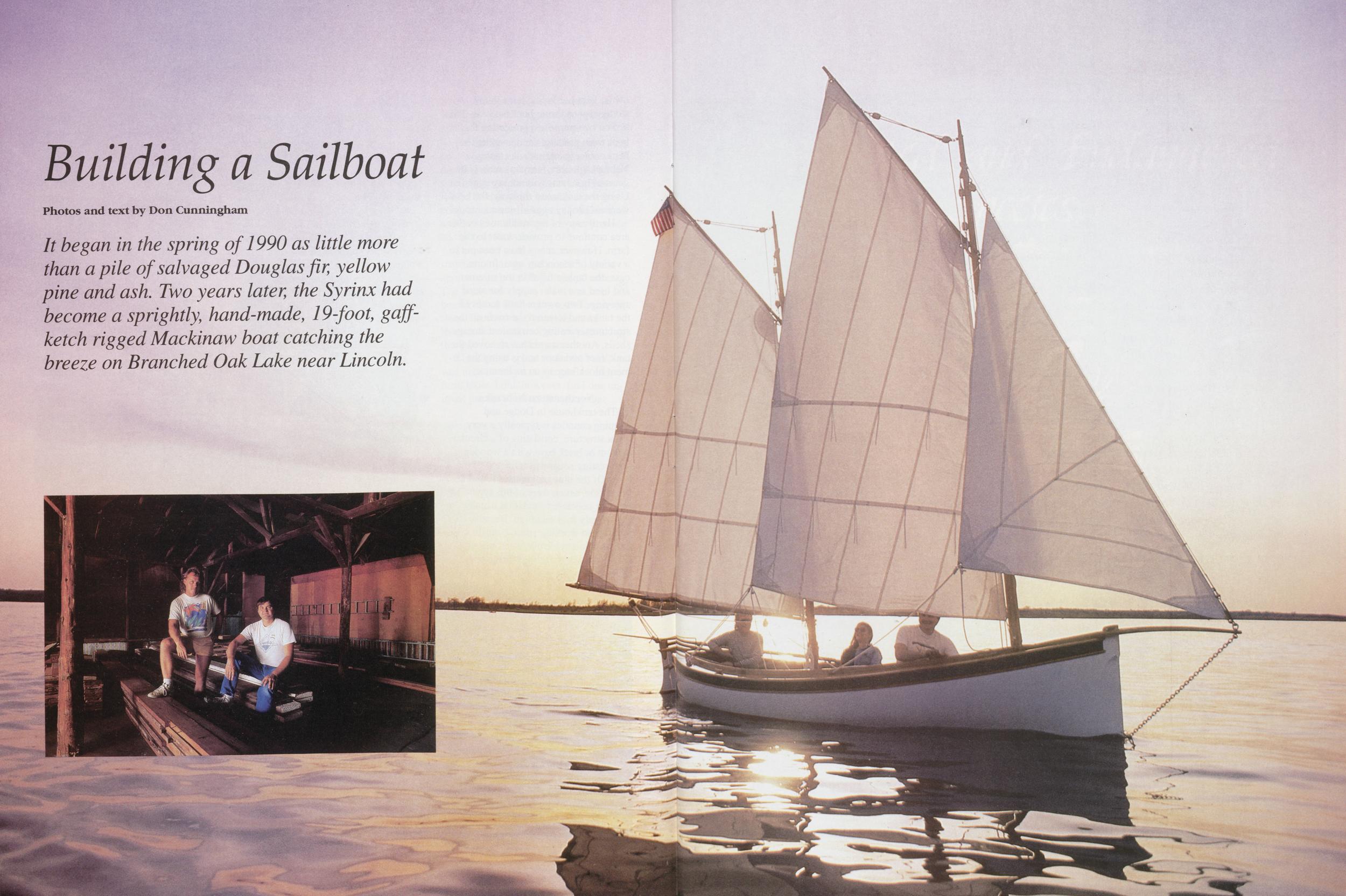
Building a Sailboat
Photos and text by Don Cunningham It began in the spring of 1990 as little more than a pile of salvaged Douglas fir, yellow pine and ash. Two years later, the Syrinx had become a sprightly, hand-made, 19-foot, gaffketch rigged Mackinaw boat catching the breeze on Branched Oak Lake near Lincoln.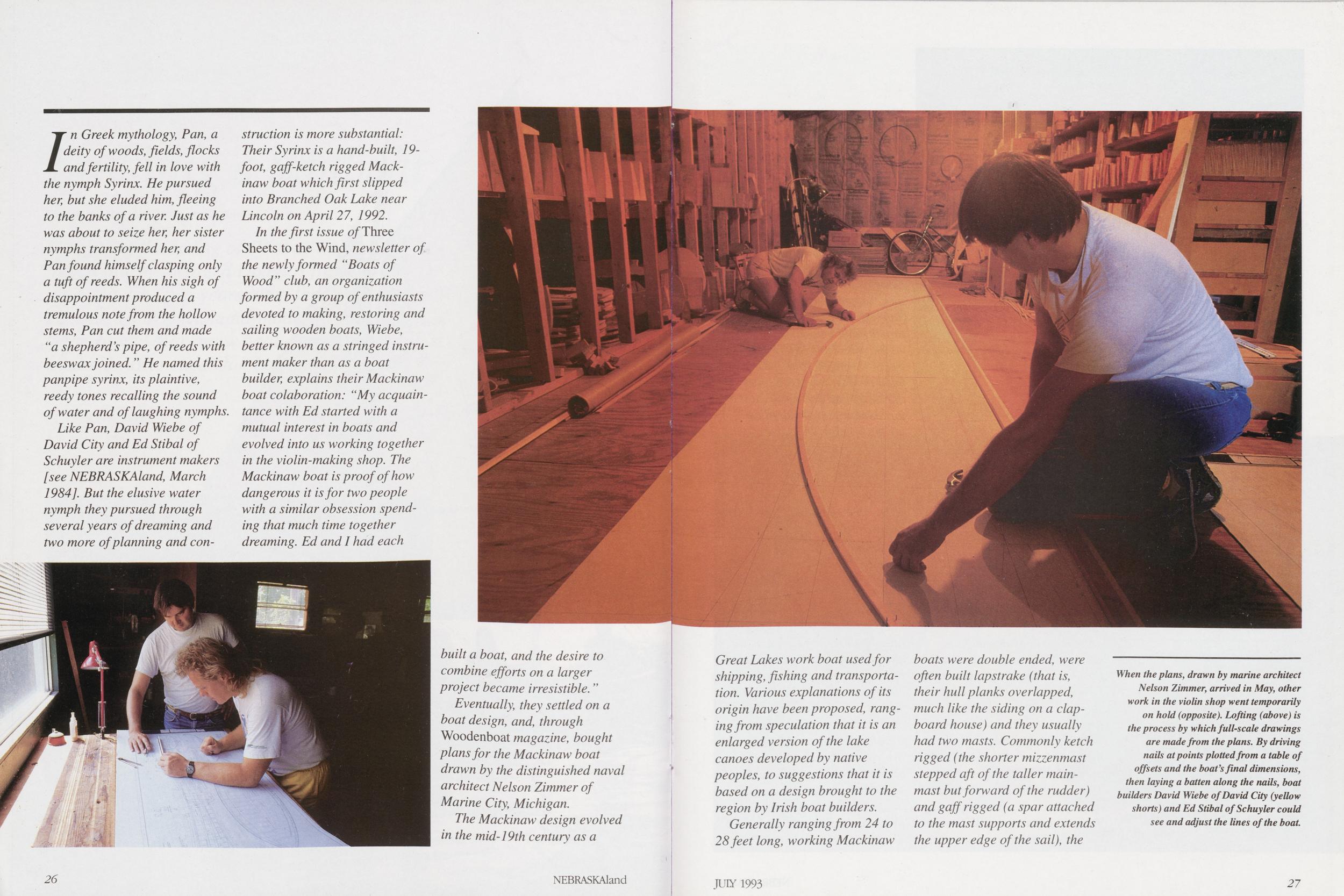
Greek mythology, Pan, a deity of woods, fields, flocks and fertility, fell in love with the nymph Syrinx. He pursued her, but she eluded him, fleeing to the banks of a river. Just as he was about to seize her, her sister nymphs transformed her, and Pan found himself clasping only a tuft of reeds. When his sigh of disappointment produced a tremulous note from the hollow stems, Pan cut them and made "a shepherd's pipe, of reeds with beeswax joined." He named this panpipe syrinx, its plaintive, reedy tones recalling the sound of water and of laughing nymphs.
Like Pan, David Wiebe of David City and Ed Stibal of Schuyler are instrument makers [see NEBRASKAland, March 1984]. But the elusive water nymph they pursued through several years of dreaming and two more of planning and construction is more substantial: Their Syrinx is a hand-built, 19-foot, gaff-ketch rigged Mackinaw boat which first slipped into Branched Oak Lake near Lincoln on April 27, 1992.
In the first issue of Three Sheets to the Wind, newsletter of the newly formed "Boats of Wood" club, an organization formed by a group of enthusiasts devoted to making, restoring and sailing wooden boats, Wiebe, better known as a stringed instrument maker than as a boat builder, explains their Mackinaw boat collaboration: "My acquaintance with Ed started with a mutual interest in boats and evolved into us working together in the violin-making shop. The Mackinaw boat is proof of how dangerous it is for two people with a similar obsession spending that much time together dreaming. Ed and I had each built a boat, and the desire to combine efforts on a larger project became irresistible."
Eventually, they settled on a boat design, and, through Wooden boat magazine, bought plans for the Mackinaw boat drawn by the distinguished naval architect Nelson Zimmer of Marine City, Michigan.
The Mackinaw design evolved in the mid-19th century as a
Generally ranging from 24 to
28 feet long, working Mackinaw
boats were double ended, were
often built lapstrake (that is,
their hull planks overlapped,
much like the siding on a
clapboard house) and they usually
had two masts. Commonly ketch
rigged (the shorter mizzenmast
stepped aft of the taller
mainmast but forward of the rudder)
and gaff rigged (a spar attached
to the mast supports and extends
the upper edge of the sail), the
JUIY 1993
27
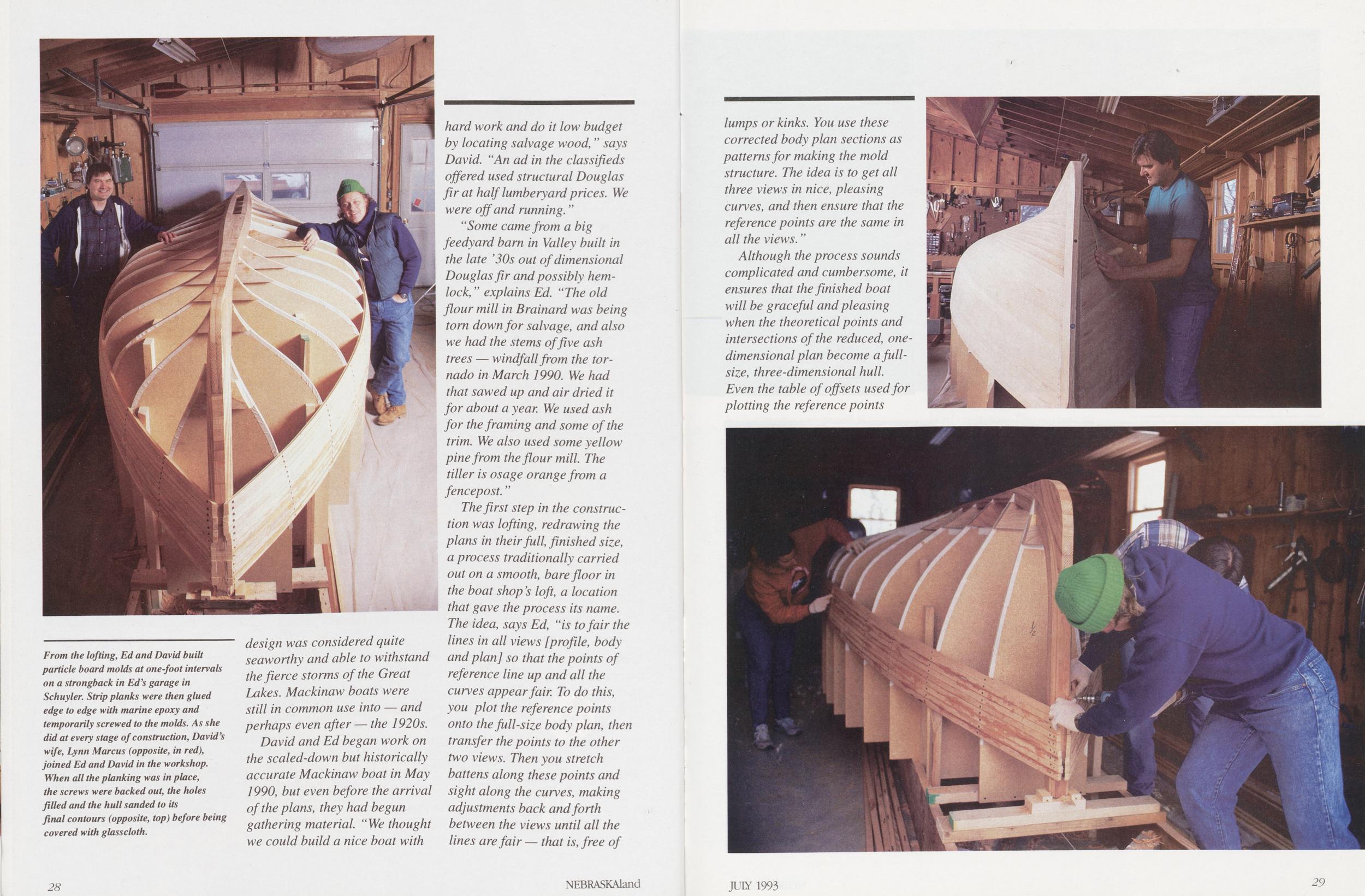
David and Ed began work on the scaled-down but historically accurate Mackinaw boat in May 1990, but even before the arrival of the plans, they had begun gathering material. "We thought we could build a nice boat with hard work and do it low budget by locating salvage wood," says David. "An ad in the classifieds offered used structural Douglas fir at half lumberyard prices. We were off and running."
"Some came from a big feedyard barn in Valley built in the late }30s out of dimensional Douglas fir and possibly hemlock, " explains Ed. "The old flour mill in Brainard was being torn down for salvage, and also we had the stems of five ash trees — windfall from the tornado in March 1990. We had that sawed up and air dried it for about a year. We used ash for the framing and some of the trim. We also used some yellow pine from the flour mill. The tiller is osage orange from a fencepost."
The first step in the construction was lofting, redrawing the plans in their full, finished size, a process traditionally carried out on a smooth, bare floor in the boat shop's loft, a location that gave the process its name. The idea, says Ed, "is to fair the lines in all views [profile, body and plan] so that the points of reference line up and all the curves appear fair. To do this, you plot the reference points onto the full-size body plan, then transfer the points to the other two views. Then you stretch battens along these points and sight along the curves, making adjustments back and forth between the views until all the lines are fair — that is, free of 28 NEBRASKAland lumps or kinks. You use these corrected body plan sections as patterns for making the mold structure. The idea is to get all three views in nice, pleasing curves, and then ensure that the reference points are the same in all the views."
Although the process sounds complicated and cumbersome, it ensures that the finished boat will be graceful and pleasing when the theoretical points and intersections of the reduced, one-dimensional plan become a full size, three-dimensional hull. Even the table of offsets used for plotting the reference points
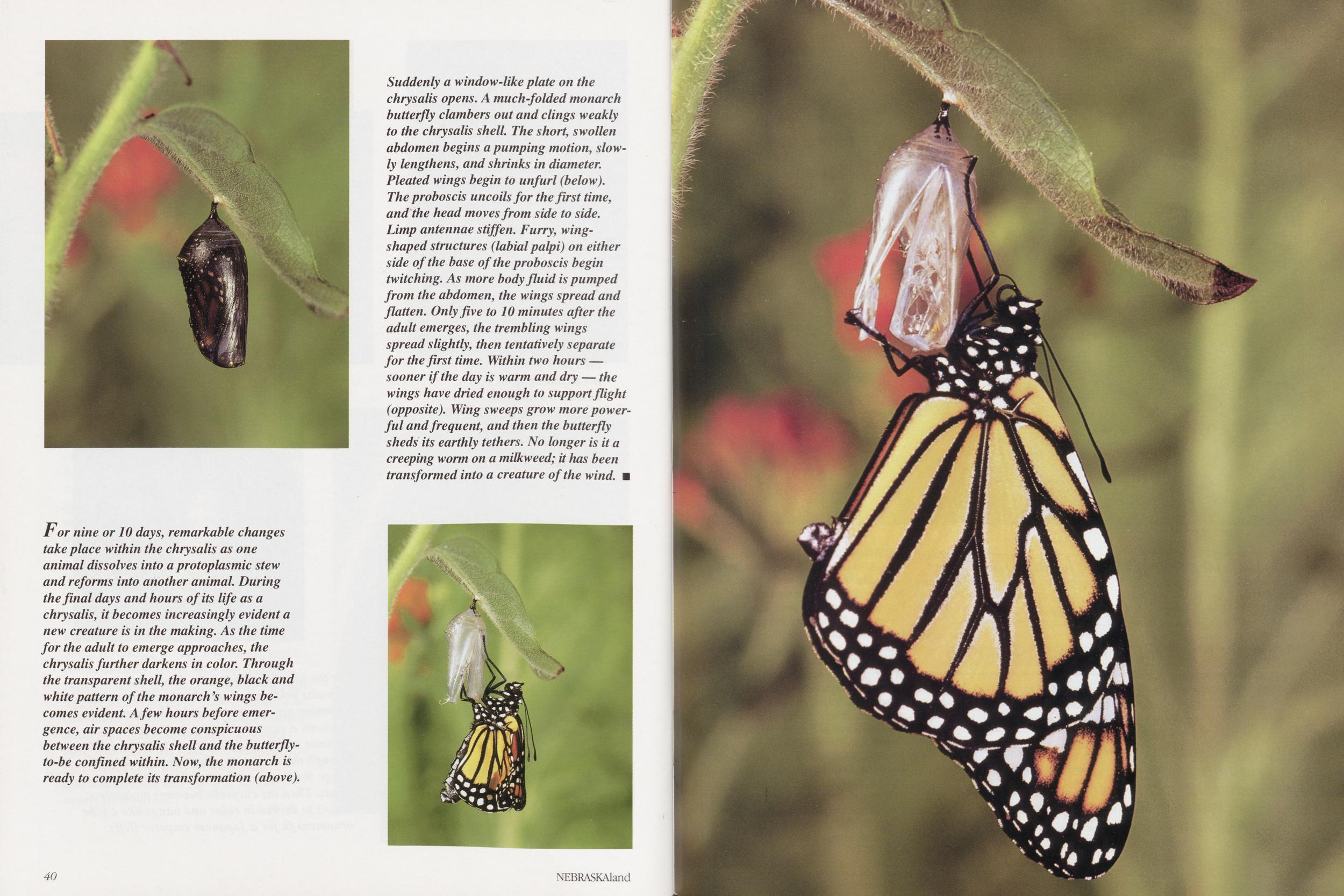
or nine or 10 days, remarkable changes take place within the chrysalis as one animal dissolves into a protoplasmic stew and reforms into another animal. During the final days and hours of its life as a chrysalis, it becomes increasingly evident a new creature is in the making. As the time for the adult to emerge approaches, the chrysalis further darkens in color. Through the transparent shell, the orange, black and white pattern of the monarch's wings becomes evident. A few hours before emergence, air spaces become conspicuous between the chrysalis shell and the butterfly- to-be confined within. Now, the monarch is ready to complete its transformation (above).
Suddenly a window-like plate on the chrysalis opens. A much-folded monarch butterfly clambers out and clings weakly to the chrysalis shell. The short, swollen abdomen begins a pumping motion, slowly lengthens, and shrinks in diameter. Pleated wings begin to unfurl (below). The proboscis uncoils for the first time, and the head moves from side to side. Limp antennae stiffen. Furry, wing- shaped structures (labial palpi) on either side of the base of the proboscis begin twitching. As more body fluid is pumped from the abdomen, the wings spread and flatten. Only five to 10 minutes after the adult emerges, the trembling wings spread slightly, then tentatively separate for the first time. Within two hours — sooner if the day is warm and dry — the wings have dried enough to support flight (opposite). Wing sweeps grow more powerful and frequent, and then the butterfly sheds its earthly tethers. No longer is it a creeping worm on a milkweed; it has been transformed into a creature of the wind.
The Best Time of My Life
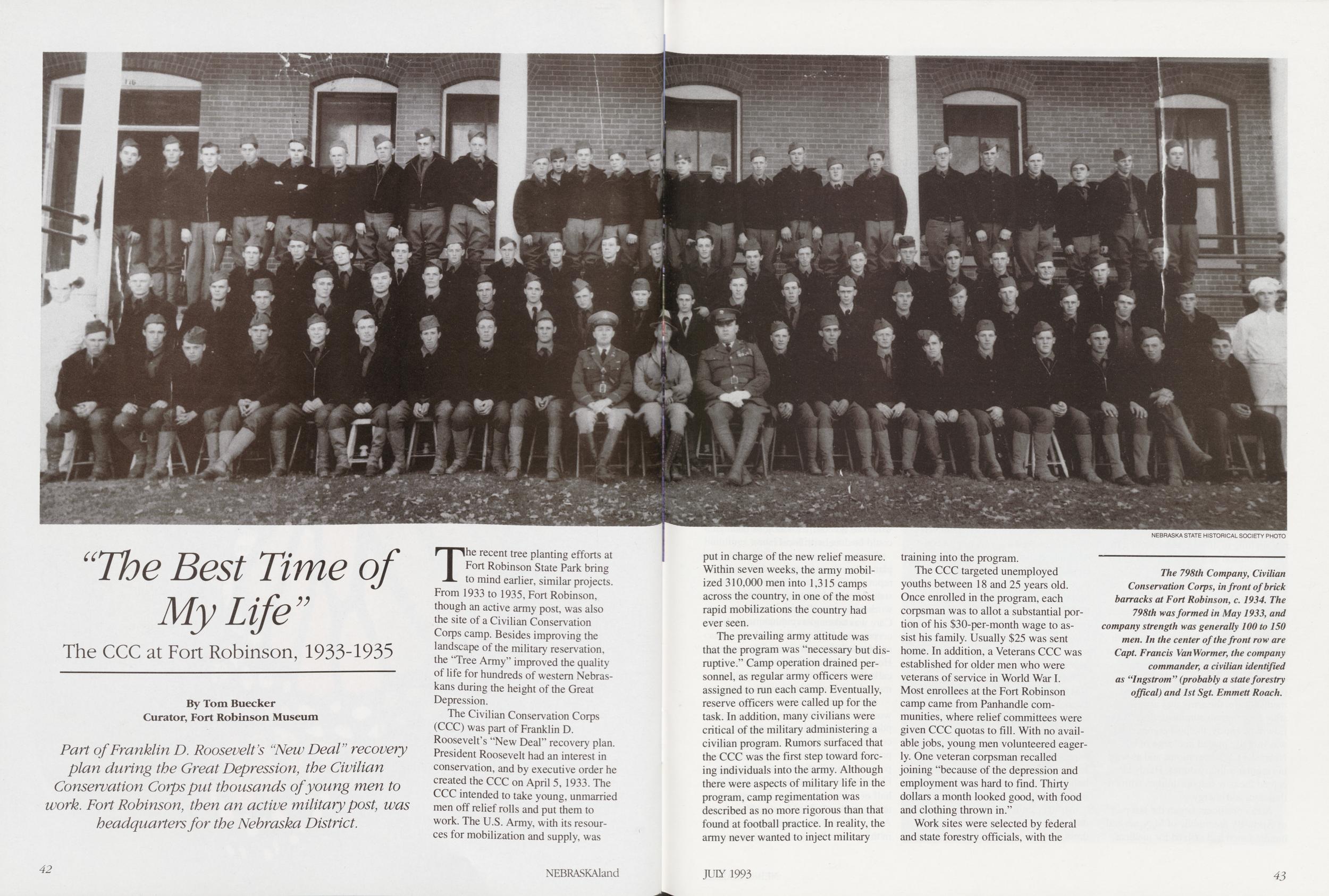
The CCC at Fort Robinson, 1933-1935 By Tom Buecker Curator, Fort Robinson Museum Part of Franklin D. Roosevelt's "New Deal" recovery plan during the Great Depression, the Civilian Conservation Corps put thousands of young men to work. Fort Robinson, then an active military post, was headquarters for the Nebraska District.The recent tree planting efforts at Fort Robinson State Park bring to mind earlier, similar projects. From 1933 to 1935, Fort Robinson, though an active army post, was also the site of a Civilian Conservation Corps camp. Besides improving the landscape of the military reservation, the "Tree Army" improved the quality of life for hundreds of western Nebraskans during the height of the Great Depression.
The Civilian Conservation Corps (CCC) was part of Franklin D. Roosevelt's "New Deal" recovery plan. President Roosevelt had an interest in conservation, and by executive order he created the CCC on April 5, 1933. The CCC intended to take young, unmarried men off relief rolls and put them to work. The U.S. Army, with its resources for mobilization and supply, was 42 NEBRASKAland put in charge of the new relief measure. Within seven weeks, the army mobilized 310,000 men into 1,315 camps across the country, in one of the most rapid mobilizations the country had ever seen.
The prevailing army attitude was that the program was "necessary but disruptive." Camp operation drained personnel, as regular army officers were assigned to run each camp. Eventually, reserve officers were called up for the task. In addition, many civilians were critical of the military administering a civilian program. Rumors surfaced that the CCC was the first step toward forcing individuals into the army. Although there were aspects of military life in the program, camp regimentation was described as no more rigorous than that found at football practice. In reality, the army never wanted to inject military training into the program.
The CCC targeted unemployed youths between 18 and 25 years old. Once enrolled in the program, each corpsman was to allot a substantial portion of his $30-per-month wage to assist his family. Usually $25 was sent home. In addition, a Veterans CCC was established for older men who were veterans of service in World War I. Most enrollees at the Fort Robinson camp came from Panhandle communities, where relief committees were given CCC quotas to fill. With no available jobs, young men volunteered eagerly. One veteran corpsman recalled joining "because of the depression and employment was hard to find. Thirty dollars a month looked good, with food and clothing thrown in."
Work sites were selected by federal
and state forestry officials, with the
JUIY 1993
43
In April 1933, the fort was designated as headquarters for the Nebraska District, as well as for the sub-district of northwestern Nebraska. Along with Fort Robinson, camps at Chadron State Park and later at Valentine were included in the sub-district. Besides providing shelter, clothing, food and medical care, the army was also responsible for program administration. Major Edwin N. Hardy, the post commander, was initially placed in charge of all Nebraska CCC operations, and as with his regular military duties, Hardy accepted the new responsibilities with enthusiasm and energy.
Area enrollment began the last part of April. By the middle of May, several hundred men had arrived for medical m*M examination, conditioning, and preliminary training. At first it was believed Fort Robinson was to serve as a conditioning center for new enrollees before they were sent to other camps, however, most of the men were to remain at the post. On May 16, 1933, the 798th CCC Company was formed from the new arrivals. The new "garrison" found the post's remount detachment willing to help them adjust to their new lifestyle.
Generally, company strength was 100 to 150 men, with several detached as cooks and for KP work. Two or three army officers, one civilian superintendent and two civilian foremen were attached to each company. More experienced men were assigned as leaders and assistant leaders, with the bulk of the manpower organized into work squads.
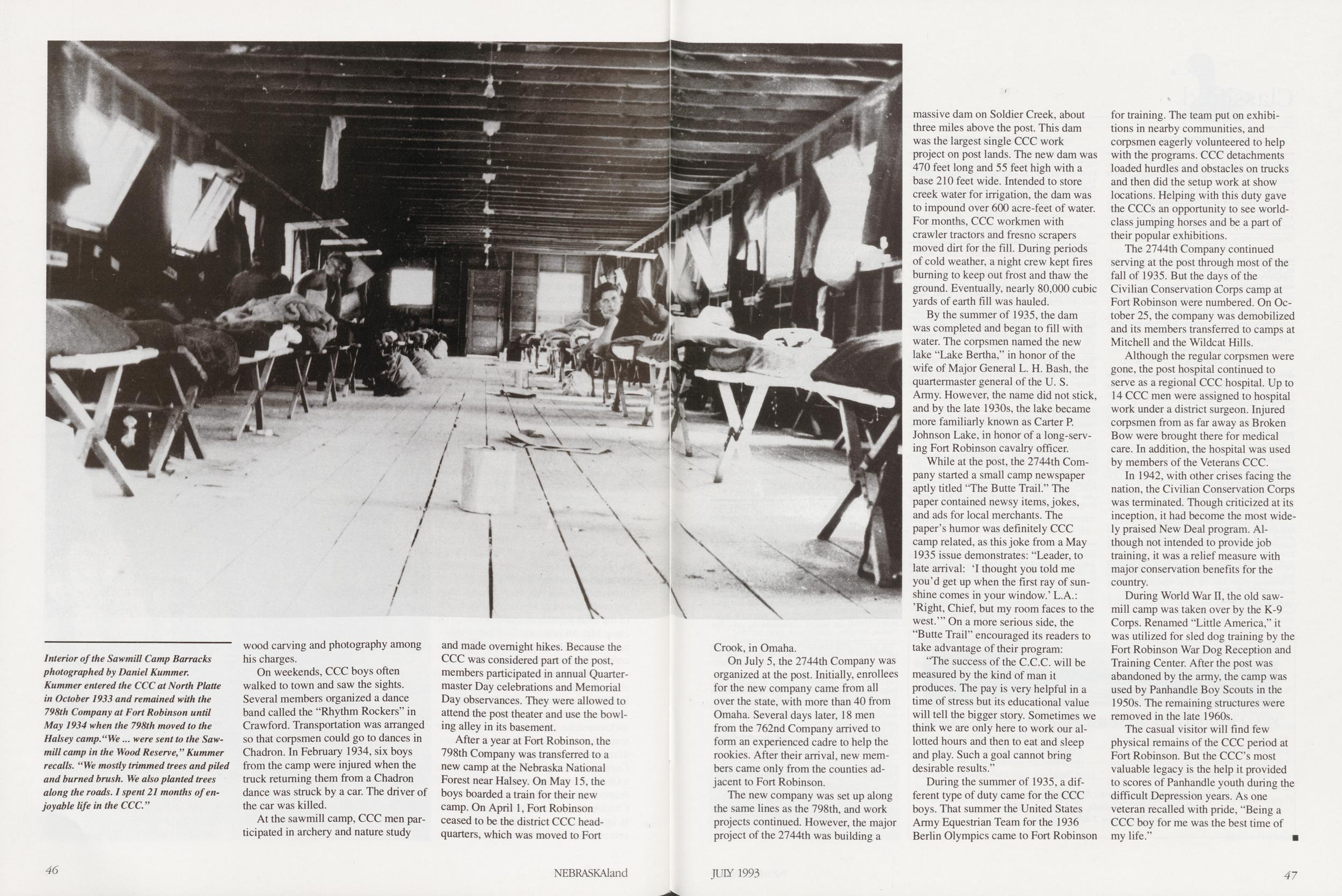
Military uniforms were issued: blue denims for work and olive drab for dress. Later a camp patch was designed, and stripes were used to denote rank among the corpsmen.
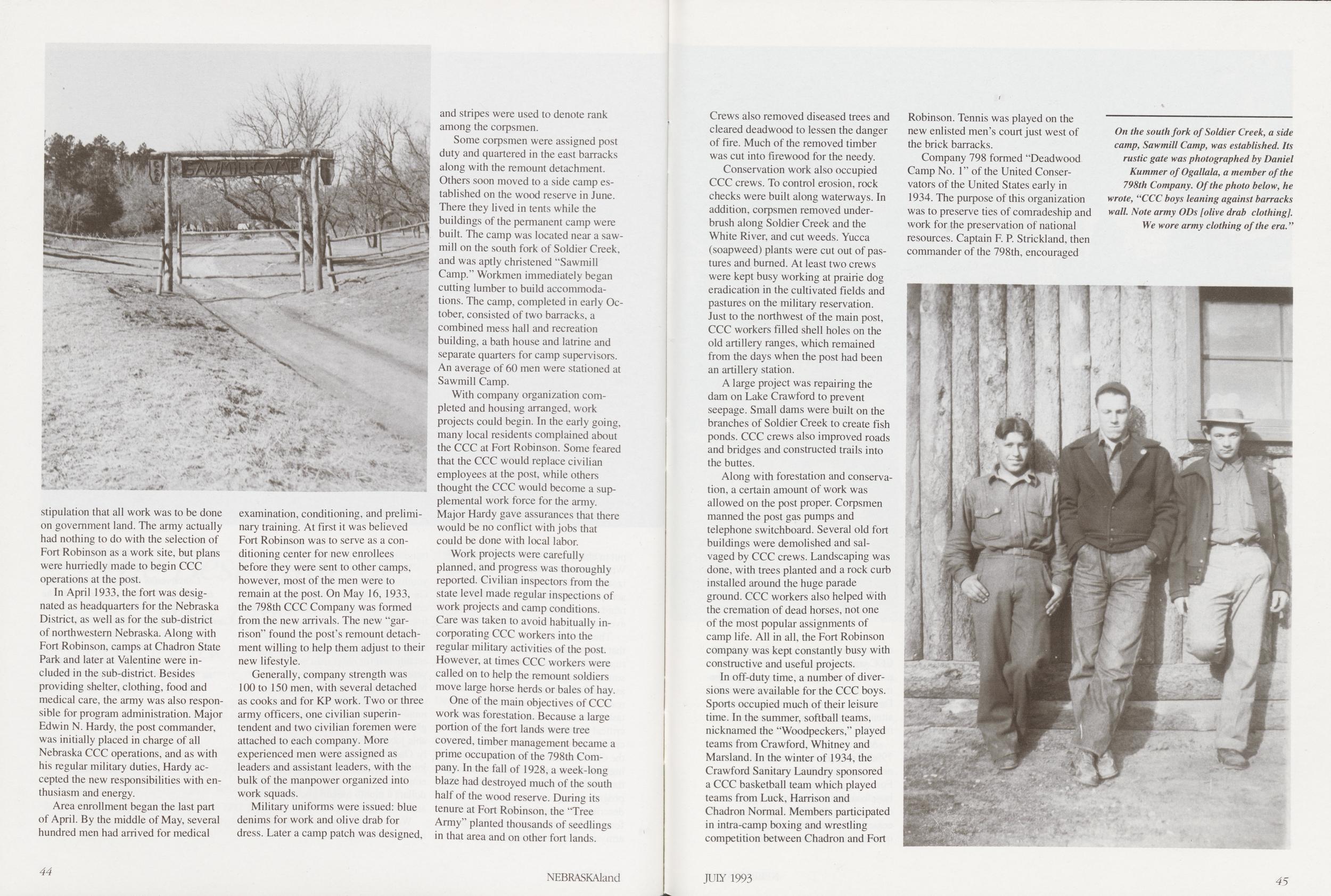
Some corpsmen were assigned post duty and quartered in the east barracks along with the remount detachment. Others soon moved to a side camp established on the wood reserve in June. There they lived in tents while the buildings of the permanent camp were built. The camp was located near a sawmill on the south fork of Soldier Creek, and was aptly christened "Sawmill Camp." Workmen immediately began cutting lumber to build accommodations. The camp, completed in early October, consisted of two barracks, a combined mess hall and recreation building, a bath house and latrine and separate quarters for camp supervisors. An average of 60 men were stationed at Sawmill Camp.
With company organization completed and housing arranged, work projects could begin. In the early going, many local residents complained about the CCC at Fort Robinson. Some feared that the CCC would replace civilian employees at the post, while others thought the CCC would become a supplemental work force for the army. Major Hardy gave assurances that there would be no conflict with jobs that could be done with local labor.
Work projects were carefully planned, and progress was thoroughly reported. Civilian inspectors from the state level made regular inspections of work projects and camp conditions. Care was taken to avoid habitually incorporating CCC workers into the regular military activities of the post. However, at times CCC workers were called on to help the remount soldiers move large horse herds or bales of hay.
One of the main objectives of CCC work was forestation. Because a large portion of the fort lands were tree covered, timber management became a prime occupation of the 798th Company. In the fall of 1928, a week-long blaze had destroyed much of the south half of the wood reserve. During its tenure at Fort Robinson, the "Tree Army" planted thousands of seedlings in that area and on other fort lands. 44 NEBRASKAland Crews also removed diseased trees and cleared deadwood to lessen the danger of fire. Much of the removed timber was cut into firewood for the needy.
Conservation work also occupied CCC crews. To control erosion, rock checks were built along waterways. In addition, corpsmen removed underbrush along Soldier Creek and the White River, and cut weeds. Yucca (soapweed) plants were cut out of pastures and burned. At least two crews were kept busy working at prairie dog eradication in the cultivated fields and pastures on the military reservation. Just to the northwest of the main post, CCC workers filled shell holes on the old artillery ranges, which remained from the days when the post had been an artillery station.
A large project was repairing the dam on Lake Crawford to prevent seepage. Small dams were built on the branches of Soldier Creek to create fish ponds. CCC crews also improved roads and bridges and constructed trails into the buttes.
Along with forestation and conservation, a certain amount of work was allowed on the post proper. Corpsmen manned the post gas pumps and telephone switchboard. Several old fort buildings were demolished and salvaged by CCC crews. Landscaping was done, with trees planted and a rock curb installed around the huge parade ground. CCC workers also helped with the cremation of dead horses, not one of the most popular assignments of camp life. All in all, the Fort Robinson company was kept constantly busy with constructive and useful projects.
In off-duty time, a number of diversions were available for the CCC boys. Sports occupied much of their leisure time. In the summer, softball teams, nicknamed the "Woodpeckers," played teams from Crawford, Whitney and Marsland. In the winter of 1934, the Crawford Sanitary Laundry sponsored a CCC basketball team which played teams from Luck, Harrison and Chadron Normal. Members participated in intra-camp boxing and wrestling competition between Chadron and Fort Robinson. Tennis was played on the new enlisted men's court just west of the brick barracks.
Company 798 formed "Deadwood Camp No. 1" of the United Conservators of the United States early in 1934. The purpose of this organization was to preserve ties of comradeship and work for the preservation of national resources. Captain F. P. Strickland, then commander of the 798th, encouraged
On weekends, CCC boys often walked to town and saw the sights. Several members organized a dance band called the "Rhythm Rockers" in Crawford. Transportation was arranged so that corpsmen could go to dances in Chadron. In February 1934, six boys from the camp were injured when the truck returning them from a Chadron dance was struck by a car. The driver of the car was killed.
At the sawmill camp, CCC men participated in archery and nature study and made overnight hikes. Because the CCC was considered part of the post, members participated in annual Quartermaster Day celebrations and Memorial Day observances. They were allowed to attend the post theater and use the bowling alley in its basement.
After a year at Fort Robinson, the 798th Company was transferred to a new camp at the Nebraska National Forest near Halsey. On May 15, the boys boarded a train for their new camp. On April 1, Fort Robinson ceased to be the district CCC headquarters, which was moved to Fort 46 NEBRASKAland Crook, in Omaha.
On July 5, the 2744th Company was organized at the post. Initially, enrollees for the new company came from all over the state, with more than 40 from Omaha. Several days later, 18 men from the 762nd Company arrived to form an experienced cadre to help the rookies. After their arrival, new members came only from the counties adjacent to Fort Robinson.
The new company was set up along the same lines as the 798th, and work projects continued. However, the major project of the 2744th was building a massive dam on Soldier Creek, about three miles above the post. This dam was the largest single CCC work project on post lands. The new dam was 470 feet long and 55 feet high with a base 210 feet wide. Intended to store creek water for irrigation, the dam was to impound over 600 acre-feet of water. For months, CCC workmen with crawler tractors and fresno scrapers moved dirt for the fill. During periods of cold weather, a night crew kept fires burning to keep out frost and thaw the ground. Eventually, nearly 80,000 cubic yards of earth fill was hauled.
By the summer of 1935, the dam was completed and began to fill with water. The corpsmen named the new lake "Lake Bertha," in honor of the wife of Major General L. H. Bash, the quartermaster general of the U. S. Army. However, the name did not stick, and by the late 1930s, the lake became more familiarly known as Carter R Johnson Lake, in honor of a long-serving Fort Robinson cavalry officer.
While at the post, the 2744th Company started a small camp newspaper aptly titled "The Butte Trail." The paper contained newsy items, jokes, and ads for local merchants. The paper's humor was definitely CCC camp related, as this joke from a May 1935 issue demonstrates: "Leader, to late arrival: T thought you told me you'd get up when the first ray of sunshine comes in your window.' L.A.: 'Right, Chief, but my room faces to the west.'' On a more serious side, the "Butte Trail" encouraged its readers to take advantage of their program:
"The success of the CCC. will be measured by the kind of man it produces. The pay is very helpful in a time of stress but its educational value will tell the bigger story. Sometimes we think we are only here to work our allotted hours and then to eat and sleep and play. Such a goal cannot bring desirable results."
During the summer of 1935, a different type of duty came for the CCC boys. That summer the United States Army Equestrian Team for the 1936 Berlin Olympics came to Fort Robinson for training. The team put on exhibitions in nearby communities, and corpsmen eagerly volunteered to help with the programs. CCC detachments loaded hurdles and obstacles on trucks and then did the setup work at show locations. Helping with this duty gave the CCCs an opportunity to see world class jumping horses and be a part of their popular exhibitions.
The 2744th Company continued serving at the post through most of the fall of 1935. But the days of the Civilian Conservation Corps camp at Fort Robinson were numbered. On October 25, the company was demobilized and its members transferred to camps at Mitchell and the Wildcat Hills.
Although the regular corpsmen were gone, the post hospital continued to serve as a regional CCC hospital. Up to 14 CCC men were assigned to hospital work under a district surgeon. Injured corpsmen from as far away as Broken Bow were brought there for medical care. In addition, the hospital was used by members of the Veterans CCC.
In 1942, with other crises facing the nation, the Civilian Conservation Corps was terminated. Though criticized at its inception, it had become the most widely praised New Deal program. Although not intended to provide job training, it was a relief measure with major conservation benefits for the country.
During World War II, the old samill camp was taken over by the K-9 Corps. Renamed "Little America," it was utilized for sled dog training by the Fort Robinson War Dog Reception and Training Center. After the post was abandoned by the army, the camp was used by Panhandle Boy Scouts in the 1950s. The remaining structures were removed in the late 1960s.
The casual visitor will find few physical remains of the CCC period at Fort Robinson. But the CCCs most valuable legacy is the help it provided to scores of Panhandle youth during the difficult Depression years. As one veteran recalled with pride, "Being a CCC boy for me was the best time of my life."
JUIY 1993 47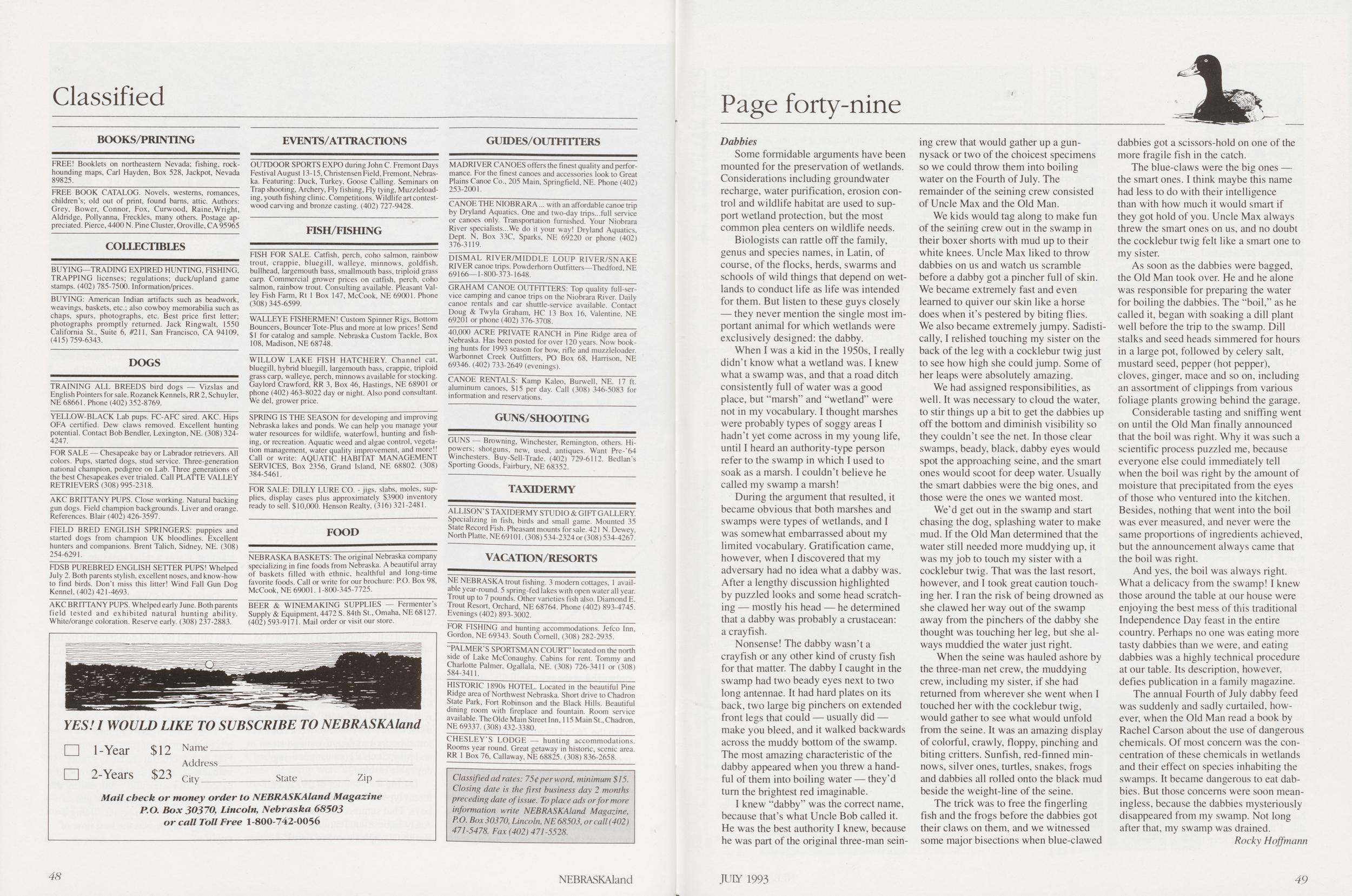
Classified
BOOKS/PRINTINGFREE! Booklets on northeastern Nevada; fishing, rockhounding maps, Carl Hayden, Box 528, Jackpot, Nevada 89825.
FREE BOOK CATALOG. Novels, westerns, romances, children's; old out of print, found barns, attic. Authors: Grey, Bower, Connor, Fox, Curwood, Raine,Wright, Aldridge, Pollyanna, Freckles, many others. Postage appreciated. Pierce, 4400 N. Pine Cluster, Oroville, CA 95965
COLLECTIBLESBUYING—TRADING EXPIRED HUNTING, FISHING, TRAPPING licenses; regulations; duck/upland game stamps. (402) 785-7500. Information/prices.
BUYING: American Indian artifacts such as beadwork, weavings, baskets, etc.; also cowboy memorabilia such as chaps, spurs, photographs, etc. Best price first letter; photographs promptly returned. Jack Ringwalt, 1550 California St., Suite 6, #211, San Francisco, CA 94109, (415)759-6343.
DOGSTRAINING ALL BREEDS bird dogs — Vizslas and English Pointers for sale. Rozanek Kennels, RR 2, Schuyler, NE 68661. Phone (402) 352-8769.
YELLOW-BLACK Lab pups. FC-AFC sired. AKC. Hips OFA certified. Dew claws removed. Excellent hunting potential. Contact Bob Bendler, Lexington, NE. (308) 324-4247.
FOR SALE — Chesapeake bay or Labrador retrievers. All colors. Pups, started dogs, stud service. Three-generation national champion, pedigree on Lab. Three generations of the best Chesapeakes ever trialed. Call PLATTE VALLEY RETRIEVERS (308)995-2318.
AKC BRITTANY PUPS. Close working. Natural backing gun dogs. Field champion backgrounds. Liver and orange. References. Blair (402) 426-3597.
FIELD BRED ENGLISH SPRINGERS: puppies and started dogs from champion UK bloodlines. Excellent hunters and companions. Brent Talich, Sidney, NE. (308) 254-6291.
FDSB PUREBRED ENGLISH SETTER PUPS! Whelped July 2. Both parents stylish, excellent noses, and know-how to find birds. Don't miss this litter! Wind Fall Gun Dog Kennel, (402) 421-4693.
AKC BRITTANY PUPS. Whelped early June. Both parents field tested and exhibited natural hunting ability. White/orange coloration. Reserve early. (308) 237-2883.
EVENTS/ATTRACTIONSOUTDOOR SPORTS EXPO during John C. Fremont Days Festival August 13-15, Christensen Field, Fremont, Nebraska. Featuring: Duck, Turkey, Goose Calling. Seminars on Trap shooting, Archery, Fly fishing, Fly tying, Muzzleloading, youth fishing clinic. Competitions. Wildlife art contestwood carving and bronze casting. (402) 727-9428.
FISH/FISHINGFISH FOR SALE. Catfish, perch, coho salmon, rainbow trout, crappie, bluegill, walleye, minnows, goldfish, bullhead, largemouth bass, smallmouth bass, triploid grass carp. Commercial grower prices on catfish, perch, coho salmon, rainbow trout. Consulting available. Pleasant Valley Fish Farm, Rt 1 Box 147, McCook, NE 69001. Phone (308) 345-6599.
WALLEYE FISHERMEN! Custom Spinner Rigs, Bottom Bouncers, Bouncer Tote-Plus and more at low prices! Send $1 for catalog and sample. Nebraska Custom Tackle, Box 108, Madison, NE 68748.
WILLOW LAKE FISH HATCHERY. Channel cat, bluegill, hybrid bluegill, largemouth bass, crappie, triploid grass carp, walleye, perch, minnows available for stocking. Gaylord Crawford, RR 3, Box 46, Hastings, NE 68901 or phone (402) 463-8022 day or night. Also pond consultant. We del, grower price.
SPRING IS THE SEASON for developing and improving Nebraska lakes and ponds. We can help you manage your water resources for wildlife, waterfowl, hunting and fishing, or recreation. Aquatic weed and algae control, vegetation management, water quality improvement, and more!! Call or write: AQUATIC HABITAT MANAGEMENT SERVICES, Box 2356, Grand Island, NE 68802. (308) 384-5461.
FOR SALE: DILLY LURE CO. - jigs, slabs, moles, supplies, display cases plus approximately $3900 inventory ready to sell. $10,000. Henson Realty, (316) 321-2481.
FOODNEBRASKA BASKETS: The original Nebraska company specializing in fine foods from Nebraska. A beautiful array of baskets filled with ethnic, healthful and long-time favorite foods. Call or write for our brochure: P.O. Box 98, McCook, NE 69001. 1-800-345-7725.
BEER & WINEMAKING SUPPLIES — Fermenter's Supply & Equipment, 4472 S. 84th St., Omaha, NE 68127. (402) 593-9171. Mail order or visit our store.
YES! I WOULD LIKE TO SUBSCRIBE TO NEBRASKAland Name 1-Year $12 Address 2-Years $23 City State Zip Mail check or money order to NEBRASKAland Magazine P.O. Box 30370, Lincoln, Nebraska 68503 or call Toll Free 1-800-742-0056 gutdes/outfutersADRIVER CANOES offers the finest quality and performance. For the finest canoes and accessories look to Great Plains Canoe Co., 205 Main, Springfield, NE. Phone (402) 253-2001.
CANOE THE NIOBRARA ... with an affordable canoe trip by Dryland Aquatics. One and two-day trips...full service or canoes only. Transportation furnished. Your Niobrara River specialists...We do it your way! Dry land Aquatics, Dept. N, Box 33C, Sparks, NE 69220 or phone (402) 376-3119.
DISMAL RIVER/MIDDLE LOUP RIVER/SNAKE RIVER canoe trips. Powder horn Outfitters—Thedford, NE 69166—1-800-373-1648.
GRAHAM CANOE OUTFITTERS: Top quality full-service camping and canoe trips on the Niobrara River. Daily canoe rentals and car shuttle-service available. Contact Doug & Twyla Graham, HC 13 Box 16, Valentine. NE 69201 or phone (402) 376-3708.
40,000 ACRE PRIVATE RANCH in Pine Ridge area of Nebraska. Has been posted for over 120 vears. Now booking hunts for 1993 season for bow, rifle and muzzleloader. Warbonnet Creek Outfitters, PO Box 68, Harrison, NE 69346. (402) 733-2649 (evenings)
CANOE RENTALS: Kamp Kaleo, Burwell, NE. 17 ft. aluminum canoes, $15 per day. Call (308) 346-5083 for information and reservations.
GUNS/SHOOTINGGUNS — Browning, Winchester, Remington, others. Hi-powers; shotguns, new, used, antiques. Want Pre-'64 Winchesters. Buy-Sell-Trade. (402) 729-6112. Bedlan's Sporting Goods, Fairbury, NE 68352.
TAXIDERMYALLISON'S TAXIDERMY STUDIO & GIFT GALLERY Specializing in fish, birds and small game. Mounted 35 State Record Fish. Pheasant mounts for sale. 421 N. Dewey, North Platte, NE 69101. (308) 534-2324or (308) 534-4267.
VACATION/RESORTSNE NEBRASKA trout fishing. 3 modern cottages, 1 available year-round. 5 spring-fed lakes with open water all year. Trout up to 7 pounds. Other varieties fish also. Diamond E. Trout Resort, Orchard, NE 68764. Phone (402) 893-4745. Evenings (402) 893-3002.
FOR FISHING and hunting accommodations. Jefco Inn. Gordon, NE 69343. South Cornell, (308) 282-2935.
"PALMER'S SPORTSMAN COURT" located on the north side of Lake McConaughy. Cabins for rent. Tommy and Charlotte Palmer, Ogallala, NE. (308) 726-3411 or (308) 584-3411.
HISTORIC 1890s HOTEL. Located in the beautiful Pine Ridge area of Northwest Nebraska. Short drive to Chadron State Park, Fort Robinson and the Black Hills. Beautiful dining room with fireplace and fountain. Room service available. The Olde Main Street Inn, 115 Main St., Chadron. NE 69337. (308) 432-3380.
CHESLEY'S LODGE — hunting accommodations. Rooms year round. Great getaway in historic, scenic area. RR 1 Box 76, Callaway, NE 68825. (308) 836-2658.
Classified ad rates: 75$ per word, minimum $15. Closing date is the first business day 2 months preceding date of issue. To place ads or for more information write NEBRASKAland Magazine, P.O. Box30370, Lincoln, NE68503, or call(402) 471-5478. Fax (402) 471-5528. 48 NEBRASKAlandPage forty-nine
DabblesSome formidable arguments have been mounted for the preservation of wetlands. Considerations including groundwater recharge, water purification, erosion control and wildlife habitat are used to support wetland protection, but the most common plea centers on wildlife needs.
Biologists can rattle off the family, genus and species names, in Latin, of course, of the flocks, herds, swarms and schools of wild things that depend on wetlands to conduct life as life was intended for them. But listen to these guys closely — they never mention the single most important animal for which wetlands were exclusively designed: the dabby.
When I was a kid in the 1950s, I really didn't know what a wetland was. I knew what a swamp was, and that a road ditch consistently full of water was a good place, but "marsh" and "wetland" were not in my vocabulary. I thought marshes were probably types of soggy areas I hadn't yet come across in my young life, until I heard an authority-type person refer to the swamp in which I used to soak as a marsh. I couldn't believe he called my swamp a marsh!
During the argument that resulted, it became obvious that both marshes and swamps were types of wetlands, and I was somewhat embarrassed about my limited vocabulary. Gratification came, however, when I discovered that my adversary had no idea what a dabby was. After a lengthy discussion highlighted by puzzled looks and some head scratching — mostly his head — he determined that a dabby was probably a crustacean: a crayfish.
Nonsense! The dabby wasn't a crayfish or any other kind of crusty fish for that matter. The dabby I caught in the swamp had two beady eyes next to two long antennae. It had hard plates on its back, two large big pinchers on extended front legs that could — usually did — make you bleed, and it walked backwards across the muddy bottom of the swamp. The most amazing characteristic of the dabby appeared when you threw a handful of them into boiling water — they'd turn the brightest red imaginable.
I knew "dabby" was the correct name, because that's what Uncle Bob called it. He was the best authority I knew, because he was part of the original three-man seining crew that would gather up a gunnysack or two of the choicest specimens so we could throw them into boiling water on the Fourth of July. The remainder of the seining crew consisted of Uncle Max and the Old Man.
We kids would tag along to make fun of the seining crew out in the swamp in their boxer shorts with mud up to their white knees. Uncle Max liked to throw dabbies on us and watch us scramble before a dabby got a pincher full of skin. We became extremely fast and even learned to quiver our skin like a horse does when it's pestered by biting flies. We also became extremely jumpy. Sadistically, I relished touching my sister on the back of the leg with a cocklebur twig just to see how high she could jump. Some of her leaps were absolutely amazing.
We had assigned responsibilities, as well. It was necessary to cloud the water, to stir things up a bit to get the dabbies up off the bottom and diminish visibility so they couldn't see the net. In those clear swamps, beady, black, dabby eyes would spot the approaching seine, and the smart ones would scoot for deep water. Usually the smart dabbies were the big ones, and those were the ones we wanted most.
We'd get out in the swamp and start chasing the dog, splashing water to make mud. If the Old Man determined that the water still needed more muddying up, it was my job to touch my sister with a cocklebur twig. That was the last resort, however, and I took great caution touching her. I ran the risk of being drowned as she clawed her way out of the swamp away from the pinchers of the dabby she thought was touching her leg, but she always muddied the water just right.
When the seine was hauled ashore by the three-man net crew, the muddying crew, including my sister, if she had returned from wherever she went when I touched her with the cocklebur twig, would gather to see what would unfold from the seine. It was an amazing display of colorful, crawly, floppy, pinching and biting critters. Sunfish, red-finned minnows, silver ones, turtles, snakes, frogs and dabbies all rolled onto the black mud beside the weight-line of the seine.
The trick was to free the fingerling fish and the frogs before the dabbies got their claws on them, and we witnessed some major bisections when blue-clawed dabbies got a scissors-hold on one of the more fragile fish in the catch.
The blue-claws were the big ones —- the smart ones. I think maybe this name had less to do with their intelligence than with how much it would smart if they got hold of you. Uncle Max always threw the smart ones on us, and no doubt the cocklebur twig felt like a smart one to my sister.
As soon as the dabbies were bagged, the Old Man took over. He and he alone was responsible for preparing the water for boiling the dabbies. The "boil," as he called it, began with soaking a dill plant well before the trip to the swamp. Dill stalks and seed heads simmered for hours in a large pot, followed by celery salt, mustard seed, pepper (hot pepper), cloves, ginger, mace and so on, including an assortment of clippings from various foliage plants growing behind the garage.
Considerable tasting and sniffing went on until the Old Man finally announced that the boil was right. Why it was such a scientific process puzzled me, because everyone else could immediately tell when the boil was right by the amount of moisture that precipitated from the eyes of those who ventured into the kitchen. Besides, nothing that went into the boil was ever measured, and never were the same proportions of ingredients achieved, but the announcement always came that the boil was right.
And yes, the boil was always right. What a delicacy from the swamp! I knew those around the table at our house were enjoying the best mess of this traditional Independence Day feast in the entire country. Perhaps no one was eating more tasty dabbies than we were, and eating dabbies was a highly technical procedure at our table. Its description, however, defies publication in a family magazine.
The annual Fourth of July dabby feed was suddenly and sadly curtailed, however, when the Old Man read a book by Rachel Carson about the use of dangerous chemicals. Of most concern was the concentration of these chemicals in wetlands and their effect on species inhabiting the swamps. It became dangerous to eat dabbies. But those concerns were soon meaningless, because the dabbies mysteriously disappeared from my swamp. Not long after that, my swamp was drained.
Rocky Hoffmann JULY 1993 49
Mixed bag
Lyme DiseaseMary Hulbert of Lincoln never saw the tick that bit her. When she first saw the rash on her forearm, it was red, swollen and about the size of a 50-cent piece. Two friends, one a nurse, who were with her at the soccer tournament when she discovered it, examined the area and decided it was a simple rash. They had no way of knowing that Mary had contracted Lyme disease, or that it would dramatically change her life.
"The next day, the spot was hot, swollen and hard." says Mary. The area around the spot had darkened, but there was no pain. By the third day, her whole arm was swollen, and the spot looked like a spider bite.
The rash lasted about 30 days, then went away. "I went to another soccer tournament and became ill. I had a severe headache, nausea and vomiting. I almost passed out," she reports.
She saw doctors and got a variety of diagnoses ranging from stress to poor posture. A neurologist ran tests to see if she had a brain tumor. The joints in her arms ached, and she developed a headache that lasted 45 days. Valium and aspirin offered no relief. Finally a nurse asked her questions from a Lvme disease brochure. The answer to each was "Yes." A specialist conducted tests, and finally, 45 days after contracting the disease, she was diagnosed. She had spent $3,900 for medical tests from August to December.
Now Mary takes an antibiotic ($10 per day) and an anti-inflammatory medication ($380 per month). She makes frequent trips to the specialist in Kansas City and has other Lyme-related medical expenses as well. She feels better now, but is not free of complications: "I think having Lyme disease lowers my resistance and makes me more susceptible to ... colds, flu and respiratory problems. Weight gain has been a problem. I used to be pretty active, but now I get so tired so fast. I take a lot of naps." In addition to the severe fatigue, she has had memory loss, her hands hurt as if she had arthritis, and she gets periodic rashes.
Now Mary takes an antibiotic ($10 per day) and an anti-inflammatory medication ($380 per month). She makes frequent trips to the specialist in Kansas City and has other Lyme-related medical expenses as well. She feels better now, but is not free of complications: "I think having Lyme disease lowers my resistance and makes me more susceptible to ... colds, flu and respiratory problems. Weight gain has been a problem. I used to be pretty active, but now I get so tired so fast. I take a lot of naps." In addition to the severe fatigue, she has had memory loss, her hands hurt as if she had arthritis, and she gets periodic rashes. can't live in a sterile bubble." But she will be more careful.
"We will wear 100 percent DEET insect repellant,... and we'll make tick checks every two or three hours and again a couple of hours after an outing. We will avoid known areas of high tick concentrations, and we probably won't take many forest hikes or long walks in tall grass."
Lyme disease is caused by a coiled bacterium, a spirochete (Borrelia burgdorferi) passed to its victim as the tick draws blood. In most parts of the country, Lyme disease is spread by the tiny deer tick Ixodes dammini which is considerably smaller than the dog tick commonly encountered by Nebraskans. The adult is about the size of a sesame seed and ranges in color from mottled brown to shades of mahogany and black. It has not been recorded in Nebraska, but it has been found in neighboring states. The Lone Star tick, Amblyomma americanum, which occurs in Nebraska, is also thought to carry the disease, but is not thought to be a major vector, according to Dr. Wayne Kramer of the State Department of Health. There are about 35 confirmed cases in Nebraska, 32 from the area south and east of Buffalo County to the Iowa and Kansas borders.
The disease varies in severity, and if diagnosed early, it is usually treatable with oral antibiotics. But early symptoms vary and, as in Mary's case, accurate diagnosis is often difficult because many symptoms are similar to those of other, more common diseases. Among the most identifiable early symptoms is a distinctive red rash present in 60 to 80 percent of Lyme disease patients. Some victims exhibit small red bumps about the size of a quarter that may be warm to the touch. A bullseye-shaped red rash as much as 20 inches in diameter around the bite develops a few days later in some cases. Other common symptoms are similar to those associated with the flu — headache, chills, nausea, fever, sweating, stiff neck, aching joints, fatigue and a painful jaw when chewing.
Left untreated, Lyme disease may affect the heart and nervous system. Heart arrhythmias, meningitis, encephalitis or a partial facial paralysis called Bell's palsy may develop. It may also cause pain in joints, tendons and muscles. The third stage of the disease can become evident several months after infection. It is typically characterized by slurred speech and rheumatoid arthritis. Some victims have central nervous system problems, including weak, aching arms and legs, and extreme fatigue.
A few simple precautions can help decrease the chance of attracting ticks of all species. Dark colored ticks are easiest to spot against a light-colored clothing. Long trousers tucked into your boots or socks help keep ticks off of your body. Wear collared shirts and tuck your hair under a hat to keep it off your neck and protect your scalp.
When you are outdoors, check your- self and your children for ticks every four to six hours. Check again when you go indoors. Keep grass and weeds around your house trimmed and put flea and tick collars on pets and hunting dogs. Carefully check your animals (or spray them) before letting them in. Don't leave possily infested clothes where ticks can crawl off and invade your home. Launder clothes immediately when you return or keep them sealed in plastic garbage bags until they can be cleaned. Ticks will drop off clothing hung outside, but check clothes thoroughly before wearing them again. Tick repellant sprayed on shoes, cuffs and pants legs offers protection.
Hunters and trappers should hang animal carcasses away from tents or houses for at least 12 hours to give ticks time to drop off. Wear plastic or rubber gloves while field dressing or butchering game to protect yourself from ticks and from the animals' blood. Kramer says it is unlikely that Lyme disease can be contracted from eating wild game, especially if the meat is thoroughly cooked. If game has been transported in a car trunk or a truck bed, spray the area to kill ticks that may have fallen from the carcass.
Deer, Lone Star and wood ticks all live in grassy and wooded areas and feed on birds and mammals, occasionally, including humans. Remember that not everyone is susceptible to Lyme disease and not all ticks carry it. Merely finding a deer tick or a Lone Star tick or being bit ten by one does not mean you will contract the disease. If symptoms develop, however, it is important to seek medical attention and possible treatment as soon as possible.
Tom Kelt 50 NEBRASKAland
Position: 305 (29 views)