Volume 71, Issue 4, 1993
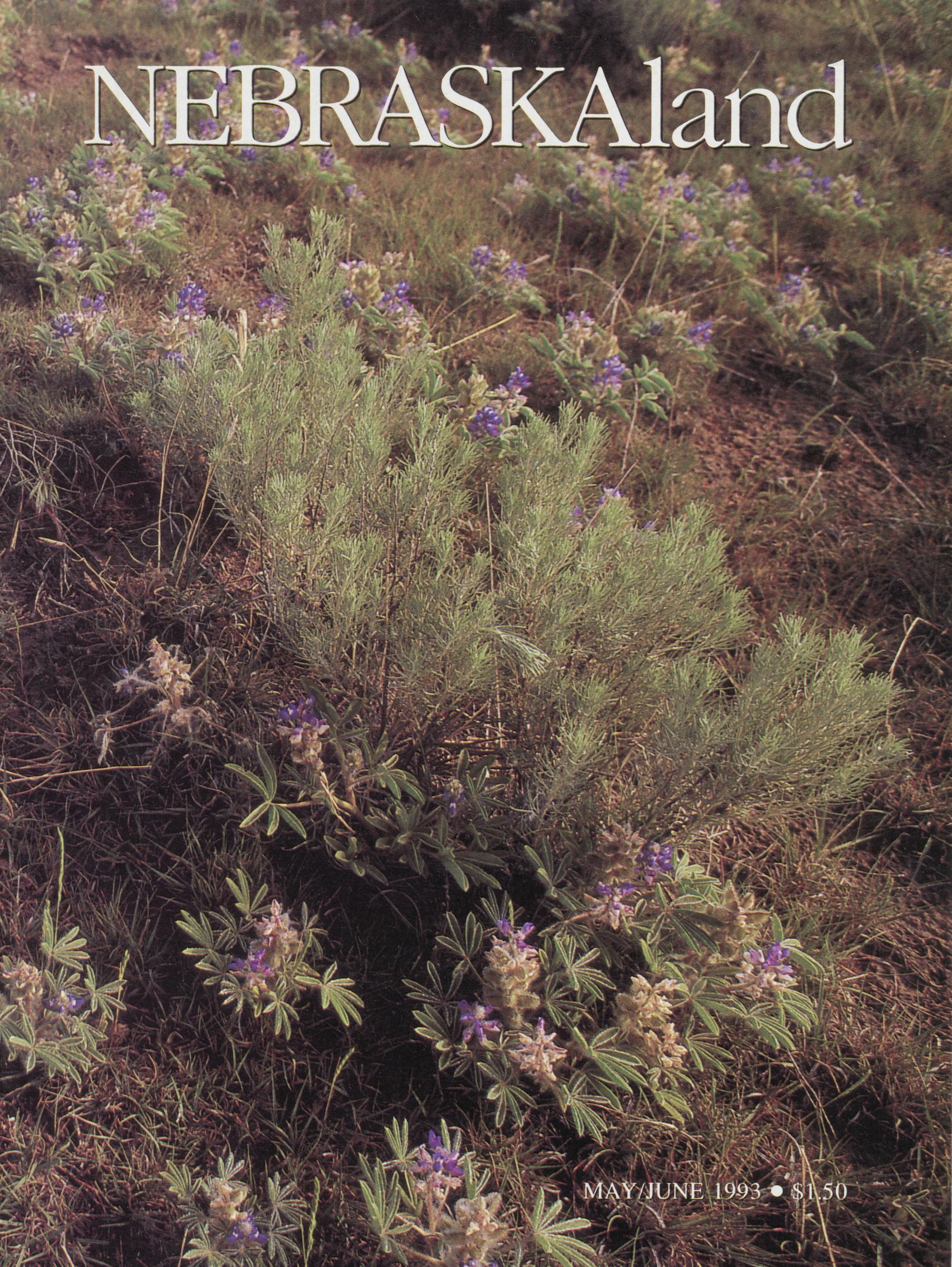
NEBRASKAland
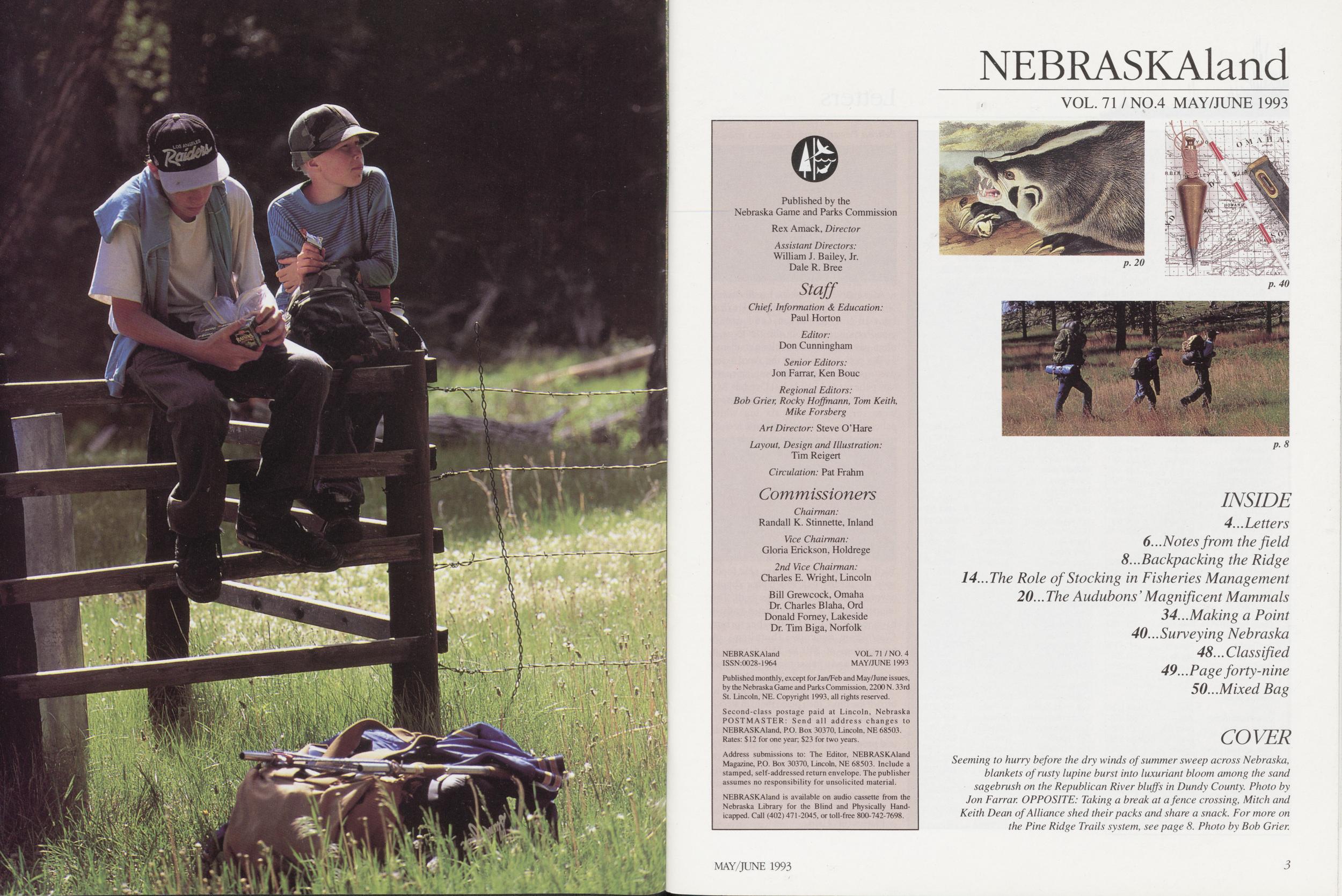
NEBRASKAland
Published by the Nebraska Game and Parks Commission Rex Amack, Director Assistant Directors: William J. Bailey, Jr. Dale R. Bree Staff Chief Information & Education: Paul Horton Editor: Don Cunningham Senior Editors: Jon Farrar, Ken Bouc Regional Editors: Bob Grier, Rocky Hoffmann, Tom Keith, Mike Forsberg Art Director: Steve O'Hare Layout, Design and Illustration: Tim Reigert Circulation: Pat Frahm Commissioners Chairman: Randall K. Stinnette, Inland Vice Chairman: Gloria Erickson, Holdrege 2nd Vice Chairman: Charles E. Wright, Lincoln Bill Grewcock, Omaha Dr. Charles Blaha, Ord Donald Forney, Lakeside Dr. Tim Biga, Norfolk NEBRASKAland rSSN:0028-l%4 VOL. 71/NO. 4 MAY/JUNE 1993 Published monthly, except for Jan/Feb and May /June issues, by the Nebraska Game and Parks Commission, 2200 N. 33rd St. Lincoln, NE. Copyright 1993, all rights reserved. Second-class postage paid at Lincoln, Nebraska POSTMASTER: Send all address changes to NEBRASKAland, P.O. Box 30370, Lincoln, NE 68503. Rates: $12 for one year; $23 for two years. Address submissions to: The Editor, NEBRASKAland Magazine, P.O. Box 30370, Lincoln, NE 68503. Include a stamped, self-addressed return envelope. The publisher assumes no responsibility for unsolicited material. NEBRASKAland is available on audio cassette from the Nebraska Library for the Blind and Physically Handicapped. Call (402) 471-2045, or toll-free 800-742-7698. NEBRASKAland VOL. 71 / NO.4 MAY/JUNE 1993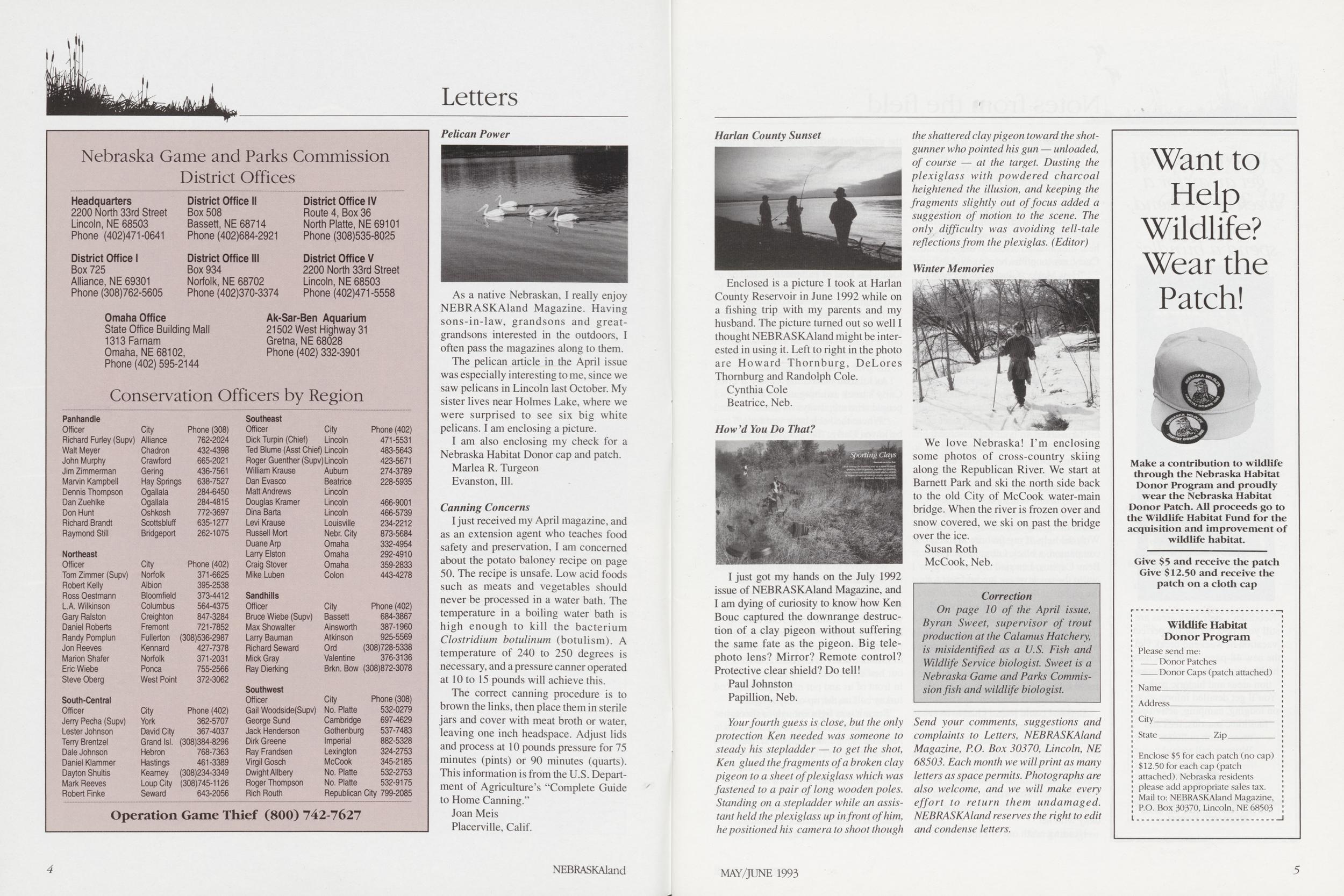
Letters
Nebraska Game and Parks Commission District Offices Headquarters 2200 North 33rd Street Lincoln, NE 68503 Phone (402)471-0641 District Office II Box 508 Bassett, NE 68714 Phone (402)684-2921 District Office IV Route 4, Box 36 North Platte, NE 69101 Phone (308)535-8025 District Office 1 Box 725 Alliance, NE 69301 Phone (308)762-5605 District Office III Box 934 Norfolk, NE 68702 Phone (402)370-3374 District Office V 2200 North 33rd Street Lincoln, NE 68503 Phone (402)471-5558 Omaha Office State Office Building Mall 1313 Farnam Omaha, NE 68102, Phone (402)595-2144 Conservation Officers by Region Panhandle Officer City Phone(308) Richard Furley (Supv) Alliance 762-2024 Walt Meyer Chadron 432-4398 John Murphy Crawford 665-2021 Jim Zimmerman Gering 436-7561 Marvin Kampbell Hay Springs 638-7527 Dennis Thompson Ogallala 284-6450 Dan Zuehlke Ogallala 284-4815 Don Hunt Oshkosh 772-3697 Richard Brandt Scottsbluff 635-1277 Raymond Still Bridgeport 262-1075 Southeast Officer City Phone (402) Dick Turpin (Chief) Lincoln 471-5531 Ted Blume (Asst Chief) Lincoln 483-5643 Roger Guenther (Supv) Lincoln 423-5671 William Krause Auburn 274-3789 Dan Evasco Beatrice 228-5935 Matt Andrews Lincoln Douglas Kramer Lincoln 466-9001 Dina Barta Lincoln 466-5739 Levi Krause Louisville 234-2212 Russell Mort Nebr. City 873-5684 Duane Arp Omaha 332-4954 Larry Elston Omaha 359-2833 Craig Stover Omaha 359-2833 Mike Luben Colon 443-4278 Northeast Officer City Phone (402) Tom Zimmer (Supv) Norfolk 371-6625 Robert Kelly Albion 395-2538 Ross Oestmann Bloomfield 373-4412 L.A. Wilkinson Columbus 564-4375 Gary Ralston Creighton 847-3284 Daniel Roberts Fremont 721-7852 Randy Pomplun Fullerton (308)536-2987 Jon Reeves Kennard 427-7378 Marion Shafer Norfolk 371-2031 Eric Wiebe Ponca 755-2566 Steve Oberg West Point 372-3062 Sandhills Officer City Phone (402) Bruce Wiebe (Supv) Bassett 684-3867 Max Showalter Ainsworth 387-1960 Larry Bauman Atkinson 925-5569 Richard Seward Ord (308)728-5338 Mick Gray Valentine 376-3136 Ray Dierking Brkn. Bow (308)872-3078 South-Central Officer City Phone (402) Jerry Pecha (Supv) York 362-5707 Lester Johnson David City 367-4037 Terry Brentzel Grand Isl. (308)384-8296 Dale Johnson Hebron 768-7363 Daniel Klammer Hastings 461-3389 Dayton Shultis Kearney (308)234-3349 Mark Reeves Loup City (308)745-1126 Robert Finke Seward 643-2056 Southwest Officer City Phone (308) Gail Woodside(Supv) No. Platte 532-0279 George Sund Cambridge 697-4629 Jack Henderson Gothenburg 537-7483 Dirk Greene Imperial 882-5328 Ray Frandsen Lexington 324-2753 Virgil Gosch McCook 345-2185 Dwight Allbery No. Platte 532-2753 Roger Thompson No. Platte 532-9175 Rich Routh Republican City 799-2085 Operation Game Thief (800) 742-7627 Pelican PowerAs a native Nebraskan, I really enjoy NEBRASKAland Magazine. Having sons-in-law, grandsons and greatgrandsons interested in the outdoors, I often pass the magazines along to them.
The pelican article in the April issue was especially interesting to me, since we saw pelicans in Lincoln last October. My sister lives near Holmes Lake, where we were surprised to see six big white pelicans. I am enclosing a picture.
I am also enclosing my check for a Nebraska Habitat Donor cap and patch.
Marlea R. Turgeon Evanston, 111. Canning ConcernsI just received my April magazine, and as an extension agent who teaches food safety and preservation, I am concerned about the potato baloney recipe on page 50. The recipe is unsafe. Low acid foods such as meats and vegetables should never be processed in a water bath. The temperature in a boiling water bath is high enough to kill the bacterium Clostridium botulinum (botulism). A temperature of 240 to 250 degrees is necessary, and a pressure canner operated at 10 to 15 pounds will achieve this.
The correct canning procedure is to brown the links, then place them in sterile jars and cover with meat broth or water, leaving one inch headspace. Adjust lids and process at 10 pounds pressure for 75 minutes (pints) or 90 minutes (quarts). This information is from the U.S. Department of Agriculture's "Complete Guide to Home Canning."
Joan Meis Placerville, Calif. 4 NEBRASKAland Harlan County SunsetEnclosed is a picture I took at Harlan County Reservoir in June 1992 while on a fishing trip with my parents and my husband. The picture turned out so well I thought NEBRASKAland might be interested in using it. Left to right in the photo are Howard Thornburg, DeLores Thornburg and Randolph Cole.
Cynthia Cole Beatrice, Neb. How'dYouDoThat?I just got my hands on the July 1992 issue of NEBRASKAland Magazine, and I am dying of curiosity to know how Ken Bouc captured the downrange destruction of a clay pigeon without suffering the same fate as the pigeon. Big telephoto lens? Mirror? Remote control? Protective clear shield? Do tell!
Paul Johnston Papillion, Neb.Your fourth guess is close, but the only protection Ken needed was someone to steady his stepladder — to get the shot, Ken glued the fragments of a broken clay pigeon to a sheet of plexiglass which was fastened to a pair of long wooden poles. Standing on a stepladder while an assistant held the plexiglass up in front of him, he positioned his camera to shoot though the shattered clay pigeon toward the shotgunner who pointed his gun — unloaded, of course — at the target. Dusting the plexiglass with powdered charcoal heightened the illusion, and keeping the fragments slightly out of focus added a suggestion of motion to the scene. The only difficulty was avoiding tell-tale reflections from the plexiglas. (Editor)
Winter MemoriesWe love Nebraska! I'm enclosing some photos of cross-country skiing along the Republican River. We start at Barnett Park and ski the north side back to the old City of McCook water-main bridge. When the river is frozen over and snow covered, we ski on past the bridge over the ice.
Susan Roth McCook, Neb. CorrectionOn page 10 of the April issue, Byran Sweet, supervisor of trout production at the Calamus Hatchery, is misidentified as a U.S. Fish and Wildlife Service biologist. Sweet is a Nebraska Game and Parks Commission fish and wildlife biologist.
Send your comments, suggestions and complaints to Letters, NEBRASKAland Magazine, P.O. Box 30370, Lincoln, NE 68503. Each month we will print as many letters as space permits. Photographs are also welcome, and we will make every effort to return them undamaged. NEBRASKAland reserves the right to edit and condense letters.
Want to Help Wildlife? Wear the Patch! Make a contribution to wildlife through the Nebraska Habitat Donor Program and proudly wear the Nebraska Habitat Donor Patch. All proceeds go to the Wildlife Habitat Fund for the acquisition and improvement of wildlife habitat. Give $5 and receive the patch Give $12.50 and receive the patch on a cloth cap Widlife Habitat Donor Program Please send me: Donor Patches Donor Caps (patch attached) Name Address City State Zip Enclose $5 for each patch (no cap) $12.50 for each cap (patch attached). Nebraska residents please add appropriate sales tax. Mail to: NEBRASKAland Magazine, P.O. Box 30370, Lincoln, NE 68503 MAY/JUNE 1993 5
Notes from the Field
Where can you get away for a week or weekend, and still not spend a bundle? Nebraska's state park areas are still your best bet for the perfect vacation or weekend break.Get the new 48-page, color brochure highlighting state parks, recreation areas and historic parks. You'll get detailed information on lodging, camping, activities, facilities, seasons, fees and reservation policies. Write or call today! © Nebraska Game and Parks Commission P.O. Box 30370, Lincoln, NE, 68503 Phone (402) 471-0641 Curly*'s Spring TurkeyMy favorite Friday afternoon pastime seems to be staring out my office window overlooking downtown Lincoln. I must have been busy with that when my secretary buzzed me saying "You still have a call on line one."
Reluctantly, I picked up the phone to hear the familiar, scratchy voice of Curly, my longtime hunting buddy.
"Hey, Marky: Cluck, cluck, cluck ... gobble, gobble, gobble, gobble."
I flipped through my planner, and sure enough, in the Saturday slot, printed in bold letters was "TURKEY HUNT - CURLY'S FARM." I pulled out my wallet to find my turkey permit and replied, "Curly, How could I forget about the opening day of spring turkey season? What time should we meet?"
Curly had never hunted turkeys, and he accepted my suggestion to meet at his farm about an hour before sunrise.
That night at home, I began my pre-hunt ritual of fumbling around my gun room getting gear in order. I did manage to get some practice in on my diaphragm and box turkey calls between sorting through shotgun shells and locating my camouflage clothing. With the help of my favorite hunting companion, a black Labrador named Beau Cephus, I carried my load of gear out to the truck where it could rest for the night.
It seemed as though I had just gotten to sleep when my alarm clock rang. I sprang from bed, and in a few minutes I was fully dressed — with the exception of footwear. Where were those hunting boots? I chose the best alternative I could find — a pair of expensive, new cowboy boots.
Before I could leave, I had to overcome one pleading-eyed obstacle whimpering in front of the door. I desperately tried to reason with her, but Beau couldn't accept the fact that she wasn't needed for turkey hunting, so I compromised: She would have to stay in the truck while I hunted. That was okay with her.
Heading north out of Lincoln into the star-filled darkness of a clear spring morning, I was accompanied by most of life's unsung riches; an empty highway, day-and-a-half-old donuts, a jug of hot coffee, AM radio, and Beau Cephus riding shotgun. I didn't know what to expect from this first-time turkey hunt with Curly. We had seen a good number of birds while going to our duck blind, but we didn't have any idea what kind of patterns they had or even where they had been roosting. I told Beau that we should probably try sitting on the edge of the trees and the pasture at first light. We could set up our hen turkey decoy 20 yards out into the pasture and perhaps call a torn out of his river roost. Beau agreed.
As I turned onto Curly's drive, I saw Curly's truck awaiting me — I hate people who are always on time!
"Where the heck have you been?" bellowed Curly. "By golly, the tenure of our friendship was resting in the balance there for a minute. I invited you on this trip to show me how to hunt Tom Turkey, so let's get going!"
Poor Curly was like a kid at Christmas, counting on me to be his Santa Claus and bring him a turkey. I was a little bit uneasy though, as I am certainly no turkey hunting "goo-roo."
We drove to a low-lying washout on the edge of the cornfield and left our vehicles. Beau stayed in the truck with the driver's side window rolled part way down, and we started our walk across the pasture. In the trees near the river we found a good place to sit behind some small evergreens. I staked our hen silhouette decoy about 20 yards in front of us and put my diaphragm turkey call on the tip of my tongue.
Soon it was light enough to shoot. I gave an occasional hen yelp but got no response. There were, however, plenty of other signs of life; sounds and sights that continue to lead me afield. Line after line of cormorants flew to the south of us over the river. Quail beginning to pair up, whistled constantly, while an occasional cock pheasant crowed proudly, marking territory. 6 NEBRASKAland Finally, Curly asked the unavoidable question. I confessed that it was almost 10 o'clock but tried to say it in a way that would sound confidently positive.
To be completely honest, I was getting restless too, and I told Curly I thought I had better take a little walk upriver just to see if any birds were using the timber. Curly either accepted my plan thinking I might scare some turkeys toward him, or he was just sick of my company. At any rate, he sent me off with a slap on the back saying, "If you see one, go ahead and take him!"
I set off toward the river, walking along a series of deer trails until I reached a well-worn path along a former river channel. Approaching a pond that often attracted wood ducks, I knelt down and watched as several brilliantly colored woodies splashed about and eight blue-winged teal, four males and four females, swam toward me in a single line. I was admiring the full spring plumage of the drake's blue wings when I heard footsteps coming down the path. I knew Curly wouldn't leave the turkey decoy, and I couldn't figure out who else could be down along the river. I stood up to investigate and found myself eye to eye with a whitetail doe. She turned nonchalantly and walked away.
I walked farther upriver, suddenly optimistic about another good sign on the trail: turkey tracks! I turned back, anxious to tell Curly the good news. After a few paces, I decided there would be no harm in a few hen yelps from my box call just to see if I could get a response. But five or six calls, brought no reply.
I started back down the path when a series of gobbles from the north nearly made my heart stop. I looked down the path and considered running the quarter-mile back to get Curly. Then I looked north toward the pasture 40 or 50 yards away across a band of flooded trees. Then I looked down at my feet remembering my new cowboy boots.
I hate tough decisions and wondered if I had made the right one when first my left then right boot filled with water. I crept slowly through the flooded trees toward the pasture. From the cover of a small bush, I gave a short series of hen yelps with my diaphragm call and heard gobbles in reply from beyond the pasture. My gobbler was not alone. Twelve turkeys strutted around on the near side of the cut cornfield. The birds had not spotted me.
I stroked out four soft yelps, and three of the 12 birds begin gobbling in my direction as they strutted in full display, heads bright red and tail feathers fanned. All three toms, followed by the hens, began trotting across the pasture toward me single file down a cattle trail.
The lead torn stopped about 150 yards short of me and began gobbling and strutting. I was so excited I was sure they would see my shaking. A few more clucks with my diaphragm call, and they came trotting toward me. All of the sudden, I had all three Toms within 20 yards, all fully fanned out and trying to out-gobble each other. The noise was incredible, as was the fact that they didn't know I was there even though I wasn't well concealed.
I nervously drew my gun up on the nearest torn, the largest. The gobbling stopped, and in a flurry, the others flew. I stepped out into the pasture and walked toward my prize, hearing Curly in the distance shouting "Nice shot!"
We were walking back to pick up our decoy when Beau Cephus appeared from nowhere to sniff the turkey I was carrying. I must not have closed the window far enough, and she probably had heard my shot and came to help.
Speaking of help — I thought it was only fair to point out to Curly how heavy his spring turkey was getting and to ask him if he would mind carrying it for a while. He stopped and looked at me strangely and just shook his head.
Back at the truck, I thanked Curly for the memorable hunt. All he could say was, "next year, remind me not to have you show me how to hunt spring turkeys!"
Mark Landgren Wild/lowers ... always in season! Wild/lowers of Nebraska and the Great Plains NEBRASKAland Magazine's Field Guide to Wild/lowers of Nebraska and the Great Plains is the perfect tool to help identify 282 species, all in full color with descriptions, flowering period, range and identification tips. An ideal gift for the hard-to-buy-for naturalist. Available for only $17.95 Name Address City State Zip. Check enclosed Visa Mastercard Card Number. Expr. Date Enclose $17.95 - Nebraska residents please include sales tax. Send to: NEBRASKAland Magazine, P.O. Box 30370, Lincoln, NE 68503 MAY/JUNE 1993 7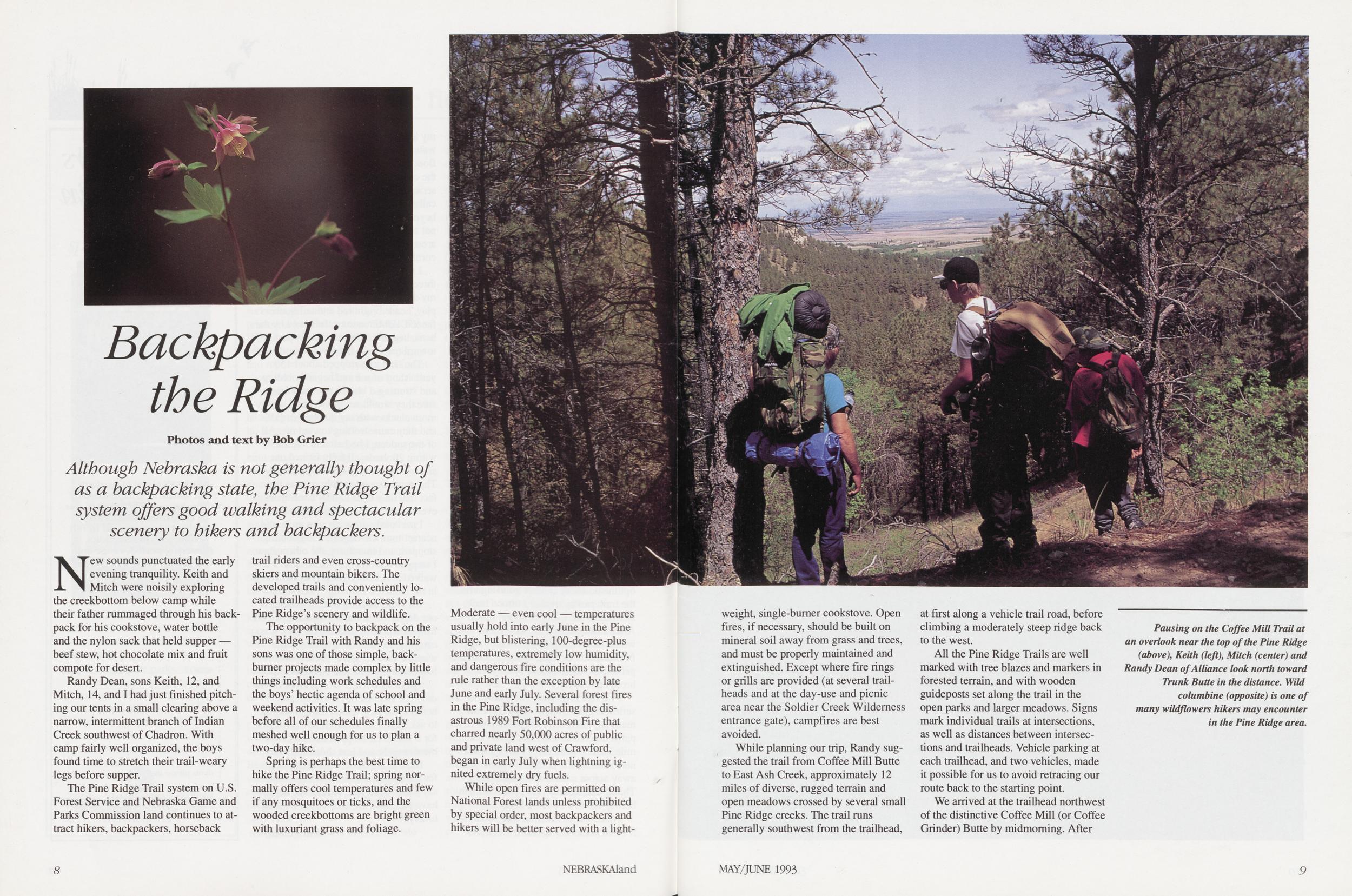
Backpacking the Ridge
Photos and text by Bob Grier Although Nebraska is not generally thought of as a backpacking state, the Pine Ridge Trail system offers good walking and spectacular scenery to hikers and backpackers.New sounds punctuated the early evening tranquility. Keith and Mitch were noisily exploring the creek bottom below camp while their father rummaged through his backpack for his cookstove, water bottle and the nylon sack that held supper — beef stew, hot chocolate mix and fruit compote for desert.
Randy Dean, sons Keith, 12, and Mitch, 14, and I had just finished pitching our tents in a small clearing above a narrow, intermittent branch of Indian Creek southwest of Chadron. With camp fairly well organized, the boys found time to stretch their trail-weary legs before supper.
The Pine Ridge Trail system on U.S. Forest Service and Nebraska Game and Parks Commission land continues to attract hikers, backpackers, horseback trail riders and even cross-country skiers and mountain bikers. The developed trails and conveniently located trailheads provide access to the Pine Ridge's scenery and wildlife.
The opportunity to backpack on the Pine Ridge Trail with Randy and his sons was one of those simple, back burner projects made complex by little things including work schedules and the boys' hectic agenda of school and weekend activities. It was late spring before all of our schedules finally meshed well enough for us to plan a two-day hike.
Spring is perhaps the best time to hike the Pine Ridge Trail; spring normally offers cool temperatures and few if any mosquitoes or ticks, and the wooded creek bottoms are bright green with luxuriant grass and foliage. Moderate — even cool — temperatures usually hold into early June in the Pine Ridge, but blistering, 100-degree-plus temperatures, extremely low humidity, and dangerous fire conditions are the rule rather than the exception by late June and early July. Several forest fires in the Pine Ridge, including the disastrous 1989 Fort Robinson Fire that charred nearly 50,000 acres of public and private land west of Crawford, began in early July when lightning ignited extremely dry fuels.
While open fires are permitted on National Forest lands unless prohibited by special order, most backpackers and hikers will be better served with a light- 8 NEBRASKAland weight, single-burner cookstove. Open fires, if necessary, should be built on mineral soil away from grass and trees, and must be properly maintained and extinguished. Except where fire rings or grills are provided (at several trailheads and at the day-use and picnic area near the Soldier Creek Wilderness entrance gate), campfires are best avoided.
While planning our trip, Randy suggested the trail from Coffee Mill Butte to East Ash Creek, approximately 12 miles of diverse, rugged terrain and open meadows crossed by several small Pine Ridge creeks. The trail runs generally southwest from the trailhead, at first along a vehicle trail road, before climbing a moderately steep ridge back to the west.
All the Pine Ridge Trails are well marked with tree blazes and markers in forested terrain, and with wooden guideposts set along the trail in the open parks and larger meadows. Signs mark individual trails at intersections, as well as distances between intersections and trailheads. Vehicle parking at each trailhead, and two vehicles, made it possible for us to avoid retracing our route back to the starting point.
We arrived at the trailhead northwest of the distinctive Coffee Mill (or Coffee Grinder) Butte by midmorning. After
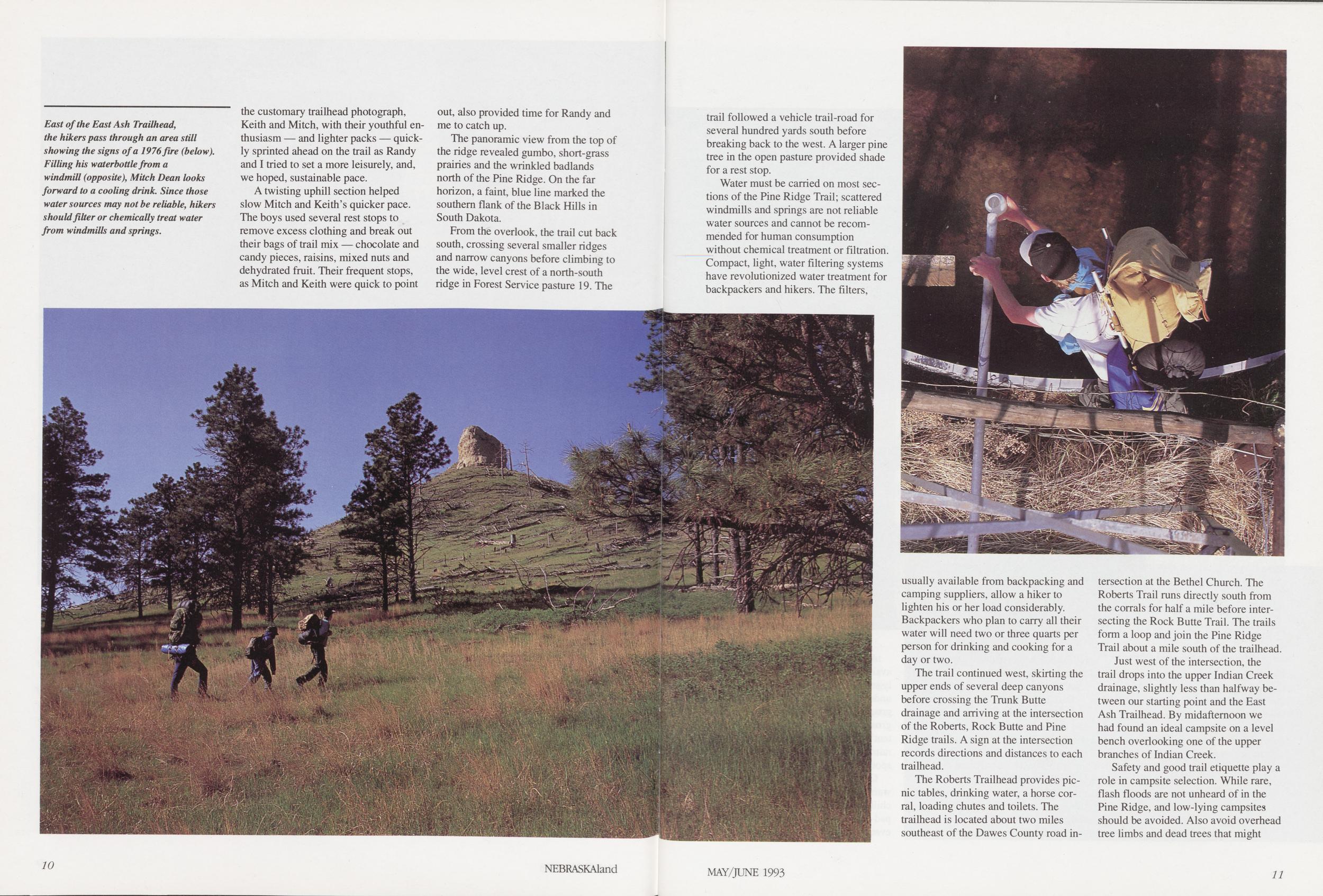
A twisting uphill section helped slow Mitch and Keith's quicker pace. The boys used several rest stops to remove excess clothing and break out their bags of trail mix — chocolate and candy pieces, raisins, mixed nuts and dehydrated fruit. Their frequent stops, as Mitch and Keith were quick to point out, also provided time for Randy and me to catch up.
The panoramic view from the top of the ridge revealed gumbo, short-grass prairies and the wrinkled badlands north of the Pine Ridge. On the far horizon, a faint, blue line marked the southern flank of the Black Hills in South Dakota.
From the overlook, the trail cut back south, crossing several smaller ridges and narrow canyons before climbing to the wide, level crest of a north-south ridge in Forest Service pasture 19. The 10 NEBRASKAland trail followed a vehicle trail-road for several hundred yards south before breaking back to the west. A larger pine tree in the open pasture provided shade for a rest stop.
Water must be carried on most sections of the Pine Ridge Trail; scattered windmills and springs are not reliable water sources and cannot be recommended for human consumption without chemical treatment or filtration. Compact, light, water filtering systems have revolutionized water treatment for backpackers and hikers. The filters,
The trail continued west, skirting the upper ends of several deep canyons before crossing the Trunk Butte drainage and arriving at the intersection of the Roberts, Rock Butte and Pine Ridge trails. A sign at the intersection records directions and distances to each trailhead.
The Roberts Trailhead provides picnic tables, drinking water, a horse corral, loading chutes and toilets. The trailhead is located about two miles southeast of the Dawes County road intersection at the Bethel Church. The Roberts Trail runs directly south from the corrals for half a mile before intersecting the Rock Butte Trail. The trails form a loop and join the Pine Ridge Trail about a mile south of the trailhead.
Just west of the intersection, the trail drops into the upper Indian Creek drainage, slightly less than halfway between our starting point and the East Ash Trailhead. By mid-afternoon we had found an ideal campsite on a level bench overlooking one of the upper branches of Indian Creek.
Safety and good trail etiquette play a
role in campsite selection. While rare,
flash floods are not unheard of in the
Pine Ridge, and low-lying campsites
should be avoided. Also avoid overhead
tree limbs and dead trees that might
MAY/JUNE 1993
11
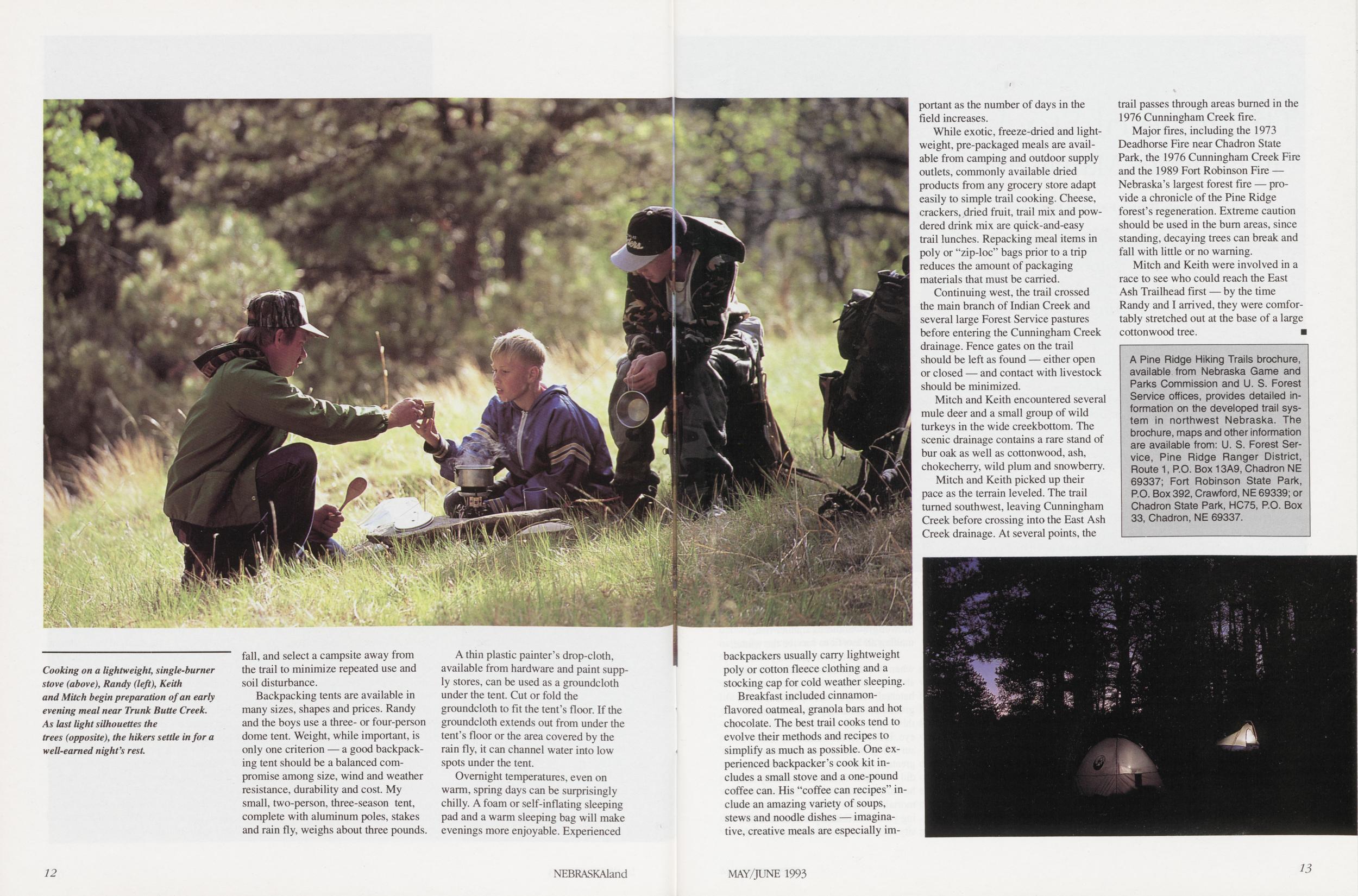
Backpacking tents are available in many sizes, shapes and prices. Randy and the boys use a three- or four-person dome tent. Weight, while important, is only one criterion — a good backpacking tent should be a balanced compromise among size, wind and weather resistance, durability and cost. My small, two-person, three-season tent, complete with aluminum poles, stakes and rain fly, weighs about three pounds.
A thin plastic painter's drop-cloth, available from hardware and paint supply stores, can be used as a groundcloth under the tent. Cut or fold the groundcloth to fit the tent's floor. If the groundcloth extends out from under the tent's floor or the area covered by the rain fly, it can channel water into low spots under the tent.
Overnight temperatures, even on warm, spring days can be surprisingly chilly. A foam or self-inflating sleeping pad and a warm sleeping bag will make evenings more enjoyable. Experienced 12 NEBRASKAland backpackers usually carry lightweight poly or cotton fleece clothing and a stocking cap for cold weather sleeping.
Breakfast included cinnamon- flavored oatmeal, granola bars and hot chocolate. The best trail cooks tend to evolve their methods and recipes to simplify as much as possible. One experienced backpacker's cook kit includes a small stove and a one-pound coffee can. His "coffee can recipes" include an amazing variety of soups, stews and noodle dishes — imaginative, creative meals are especially important as the number of days in the field increases.
While exotic, freeze-dried and lightweight, pre-packaged meals are available from camping and outdoor supply outlets, commonly available dried products from any grocery store adapt easily to simple trail cooking. Cheese, crackers, dried fruit, trail mix and powdered drink mix are quick-and-easy trail lunches. Repacking meal items in poly or "zip-loc" bags prior to a trip reduces the amount of packaging materials that must be carried.
Continuing west, the trail crossed the main branch of Indian Creek and several large Forest Service pastures before entering the Cunningham Creek drainage. Fence gates on the trail should be left as found — either open or closed — and contact with livestock should be minimized.
Mitch and Keith encountered several mule deer and a small group of wild turkeys in the wide creek bottom. The scenic drainage contains a rare stand of bur oak as well as cottonwood, ash, chokecherry, wild plum and snowberry.
Mitch and Keith picked up their pace as the terrain leveled. The trail turned southwest, leaving Cunningham Creek before crossing into the East Ash Creek drainage. At several points, the trail passes through areas burned in the 1976 Cunningham Creek fire.
Major fires, including the 1973 Deadhorse Fire near Chadron State Park, the 1976 Cunningham Creek Fire and the 1989 Fort Robinson Fire — Nebraska's largest forest fire — provide a chronicle of the Pine Ridge forest's regeneration. Extreme caution should be used in the bum areas, since standing, decaying trees can break and fall with little or no warning.
Mitch and Keith were involved in a race to see who could reach the East Ash Trailhead first — by the time Randy and I arrived, they were comfortably stretched out at the base of a large cottonwood tree.
A Pine Ridge Hiking Trails brochure, available from Nebraska Game and Parks Commission and U. S. Forest Service offices, provides detailed information on the developed trail system in northwest Nebraska. The brochure, maps and other information are available from: U. S. Forest Service, Pine Ridge Ranger District, Route 1, P.O. Box 13A9, Chadron NE 69337; Fort Robinson State Park, P.O. Box 392, Crawford, NE 69339; or Chadron State Park, HC75, P.O. Box 33, Chadron, NE 69337.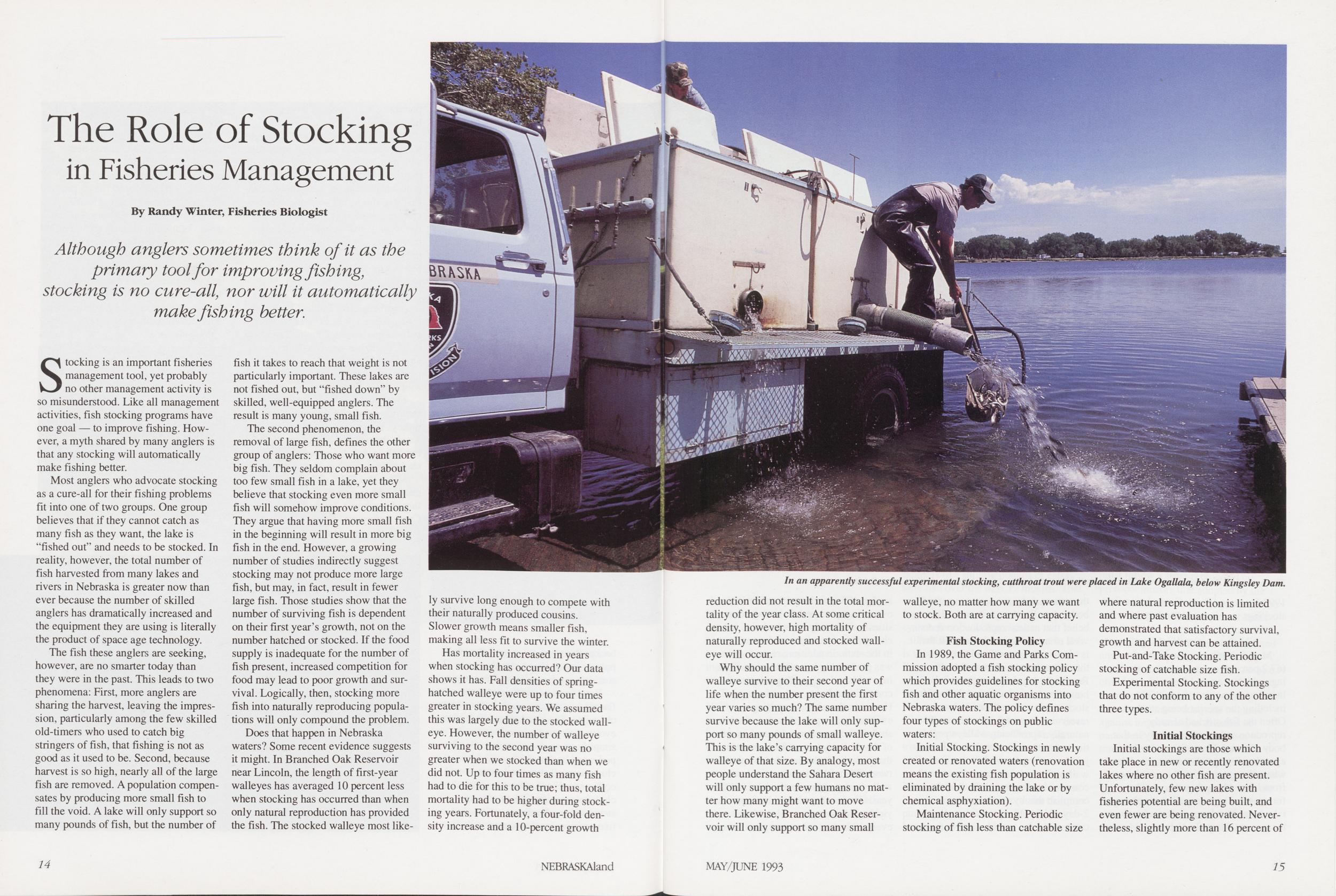
The Role of Stocking in Fisheries Management
By Randy Winter, Fisheries Biologist Although anglers sometimes think of it as the primary tool for improving fishing, stocking is no cure-all, nor will it automatically make fishing better.Stocking is an important fisheries management tool, yet probably no other management activity is so misunderstood. Like all management activities, fish stocking programs have one goal — to improve fishing. However, a myth shared by many anglers is that any stocking will automatically make fishing better.
Most anglers who advocate stocking as a cure-all for their fishing problems fit into one of two groups. One group believes that if they cannot catch as many fish as they want, the lake is "fished out" and needs to be stocked. In reality, however, the total number of fish harvested from many lakes and rivers in Nebraska is greater now than ever because the number of skilled anglers has dramatically increased and the equipment they are using is literally the product of space age technology.
The fish these anglers are seeking, however, are no smarter today than they were in the past. This leads to two phenomena: First, more anglers are sharing the harvest, leaving the impression, particularly among the few skilled old-timers who used to catch big stringers of fish, that fishing is not as good as it used to be. Second, because harvest is so high, nearly all of the large fish are removed. A population compensates by producing more small fish to fill the void. A lake will only support so many pounds of fish, but the number of fish it takes to reach that weight is not particularly important. These lakes are not fished out, but "fished down" by skilled, well-equipped anglers. The result is many young, small fish.
The second phenomenon, the removal of large fish, defines the other group of anglers: Those who want more big fish. They seldom complain about too few small fish in a lake, yet they believe that stocking even more small fish will somehow improve conditions. They argue that having more small fish in the beginning will result in more big fish in the end. However, a growing number of studies indirectly suggest stocking may not produce more large fish, but may, in fact, result in fewer large fish. Those studies show that the number of surviving fish is dependent on their first year's growth, not on the number hatched or stocked. If the food supply is inadequate for the number of fish present, increased competition for food may lead to poor growth and survival. Logically, then, stocking more fish into naturally reproducing populations will only compound the problem.
Does that happen in Nebraska waters? Some recent evidence suggests it might. In Branched Oak Reservoir near Lincoln, the length of first-year walleyes has averaged 10 percent less when stocking has occurred than when only natural reproduction has provided the fish. The stocked walleye most likely survive long enough to compete with their naturally produced cousins. Slower growth means smaller fish, making all less fit to survive the winter.
Has mortality increased in years when stocking has occurred? Our data shows it has. Fall densities of spring hatched walleye were up to four times greater in stocking years. We assumed this was largely due to the stocked walleye. However, the number of walleye surviving to the second year was no greater when we stocked than when we did not. Up to four times as many fish had to die for this to be true; thus, total mortality had to be higher during stocking years. Fortunately, a four-fold density increase and a 10-percent growth 14 NEBRASKAland
Why should the same number of walleye survive to their second year of life when the number present the first year varies so much? The same number survive because the lake will only support so many pounds of small walleye. This is the lake's carrying capacity for walleye of that size. By analogy, most people understand the Sahara Desert will only support a few humans no matter how many might want to move there. Likewise, Branched Oak Reservoir will only support so many small walleye, no matter how many we want to stock. Both are at carrying capacity.
Fish Stocking PolicyIn 1989, the Game and Parks Commission adopted a fish stocking policy which provides guidelines for stocking fish and other aquatic organisms into Nebraska waters. The policy defines four types of stockings on public waters:
Initial Stocking. Stockings in newly created or renovated waters (renovation means the existing fish population is eliminated by draining the lake or by chemical asphyxiation).
Maintenance Stocking. Periodic stocking of fish less than catchable size where natural reproduction is limited and where past evaluation has demonstrated that satisfactory survival, growth and harvest can be attained.
Put-and-Take Stocking. Periodic stocking of catchable size fish.
Experimental Stocking. Stockings that do not conform to any of the other three types.
Initial StockingsInitial stockings are those which
take place in new or recently renovated
lakes where no other fish are present.
Unfortunately, few new lakes with
fisheries potential are being built, and
even fewer are being renovated.
Nevertheless, slightly more than 16 percent of
MAY/JUNE 1993
15
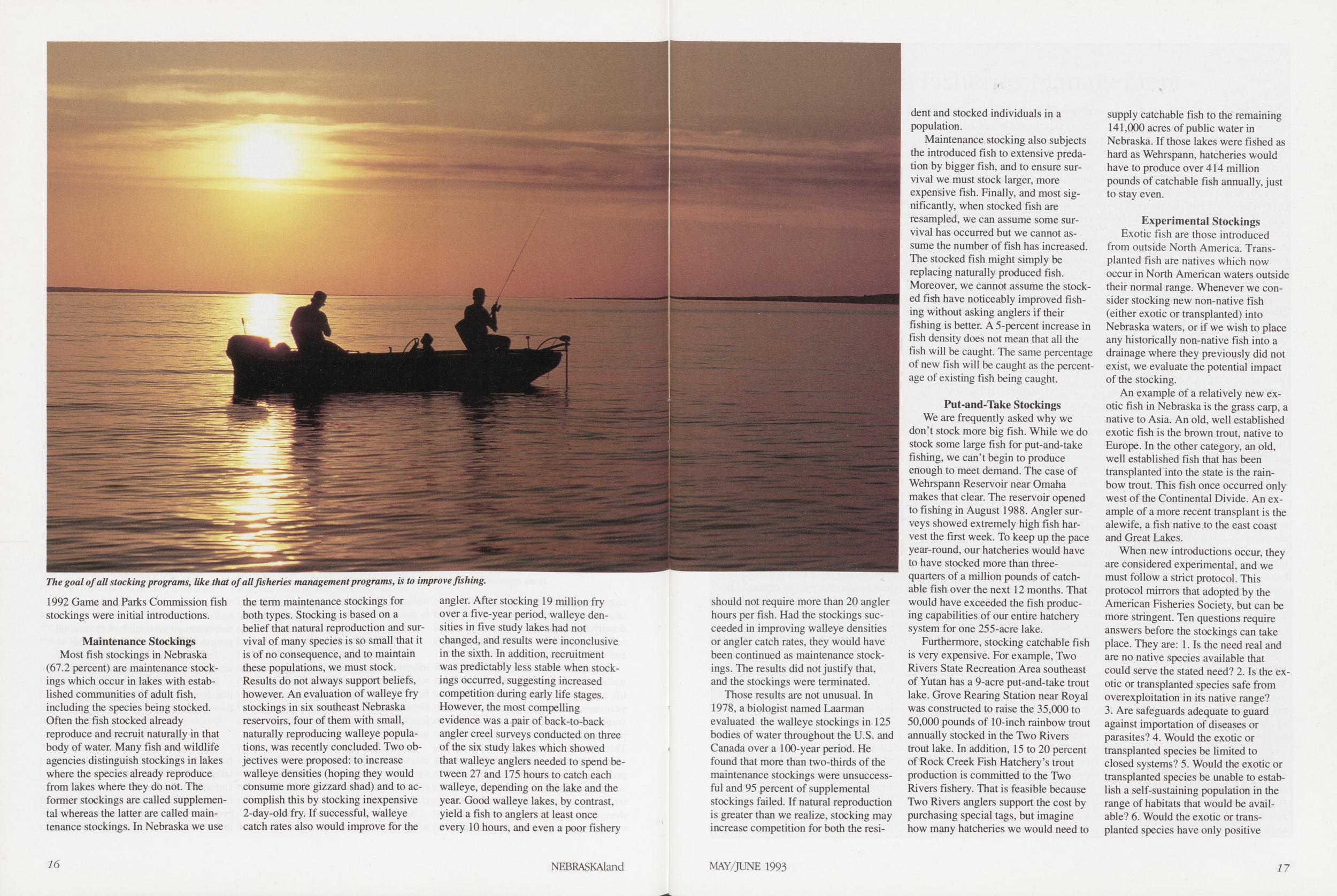
Most fish stockings in Nebraska (67.2 percent) are maintenance stockings which occur in lakes with established communities of adult fish, including the species being stocked. Often the fish stocked already reproduce and recruit naturally in that body of water. Many fish and wildlife agencies distinguish stockings in lakes where the species already reproduce from lakes where they do not. The former stockings are called supplemental whereas the latter are called maintenance stockings. In Nebraska we use the term maintenance stockings for both types. Stocking is based on a belief that natural reproduction and survival of many species is so small that it is of no consequence, and to maintain these populations, we must stock. Results do not always support beliefs, however. An evaluation of walleye fry stockings in six southeast Nebraska reservoirs, four of them with small, naturally reproducing walleye populations, was recently concluded. Two objectives were proposed: to increase walleye densities (hoping they would consume more gizzard shad) and to accomplish this by stocking inexpensive 2-day-old fry. If successful, walleye catch rates also would improve for the angler. After stocking 19 million fry over a five-year period, walleye densities in five study lakes had not changed, and results were inconclusive in the sixth. In addition, recruitment was predictably less stable when stockings occurred, suggesting increased competition during early life stages. However, the most compelling evidence was a pair of back-to-back angler creel surveys conducted on three of the six study lakes which showed that walleye anglers needed to spend between 27 and 175 hours to catch each walleye, depending on the lake and the year. Good walleye lakes, by contrast, yield a fish to anglers at least once every 10 hours, and even a poor fishery 16 NEBRASKAland should not require more than 20 angler hours per fish. Had the stockings succeeded in improving walleye densities or angler catch rates, they would have been continued as maintenance stockings. The results did not justify that, and the stockings were terminated.
Those results are not unusual. In 1978, a biologist named Laarman evaluated the walleye stockings in 125 bodies of water throughout the U.S. and Canada over a 100-year period. He found that more than two-thirds of the maintenance stockings were unsuccessful and 95 percent of supplemental stockings failed. If natural reproduction is greater than we realize, stocking may increase competition for both the resident and stocked individuals in a population.
Maintenance stocking also subjects the introduced fish to extensive predation by bigger fish, and to ensure survival we must stock larger, more expensive fish. Finally, and most significantly, when stocked fish are resampled, we can assume some survival has occurred but we cannot assume the number of fish has increased. The stocked fish might simply be replacing naturally produced fish. Moreover, we cannot assume the stocked fish have noticeably improved fishing without asking anglers if their fishing is better. A 5-percent increase in fish density does not mean that all the fish will be caught. The same percentage of new fish will be caught as the percentage of existing fish being caught.
Put-and-Take StockingsWe are frequently asked why we don't stock more big fish. While we do stock some large fish for put-and-take fishing, we can't begin to produce enough to meet demand. The case of Wehrspann Reservoir near Omaha makes that clear. The reservoir opened to fishing in August 1988. Angler surveys showed extremely high fish harvest the first week. To keep up the pace year-round, our hatcheries would have to have stocked more than three-quarters of a million pounds of catchable fish over the next 12 months. That would have exceeded the fish producing capabilities of our entire hatchery system for one 255-acre lake.
Furthermore, stocking catchable fish is very expensive. For example, Two Rivers State Recreation Area southeast of Yutan has a 9-acre put-and-take trout lake. Grove Rearing Station near Royal was constructed to raise the 35,000 to 50,000 pounds of 10-inch rainbow trout annually stocked in the Two Rivers trout lake. In addition, 15 to 20 percent of Rock Creek Fish Hatchery's trout production is committed to the Two Rivers fishery. That is feasible because Two Rivers anglers support the cost by purchasing special tags, but imagine how many hatcheries we would need to supply catchable fish to the remaining 141,000 acres of public water in Nebraska. If those lakes were fished as hard as Wehrspann, hatcheries would have to produce over 414 million pounds of catchable fish annually, just to stay even.
Experimental StockingsExotic fish are those introduced from outside North America. Transplanted fish are natives which now occur in North American waters outside their normal range. Whenever we consider stocking new non-native fish (either exotic or transplanted) into Nebraska waters, or if we wish to place any historically non-native fish into a drainage where they previously did not exist, we evaluate the potential impact of the stocking.
An example of a relatively new exotic fish in Nebraska is the grass carp, a native to Asia. An old, well established exotic fish is the brown trout, native to Europe. In the other category, an old, well established fish that has been transplanted into the state is the rainbow trout. This fish once occurred only west of the Continental Divide. An example of a more recent transplant is the ale wife, a fish native to the east coast and Great Lakes.
When new introductions occur, they
are considered experimental, and we
must follow a strict protocol. This
protocol mirrors that adopted by the
American Fisheries Society, but can be
more stringent. Ten questions require
answers before the stockings can take
place. They are: 1. Is the need real and
are no native species available that
could serve the stated need? 2. Is the
exotic or transplanted species safe from
overexploitation in its native range?
3. Are safeguards adequate to guard
against importation of diseases or
parasites? 4. Would the exotic or
transplanted species be limited to
closed systems? 5. Would the exotic or
transplanted species be unable to
establish a self-sustaining population in the
range of habitats that would be
available? 6. Would the exotic or
transplanted species have only positive
MAY/JUNE 1993
17
 ecological impacts? 7. Would all
consequences of the exotic or transplanted
species be beneficial to humans? 8. Is
there a species literature summary and
is it complete? 9. Does the data-base
indicate desirability for the
introduction? 10. Would the benefits exceed the
risks? The purpose for this protocol is
to avoid stocking mistakes like the
exotic common carp throughout North
America or, closer to home, the
transplanted white perch in Nebraska.
ecological impacts? 7. Would all
consequences of the exotic or transplanted
species be beneficial to humans? 8. Is
there a species literature summary and
is it complete? 9. Does the data-base
indicate desirability for the
introduction? 10. Would the benefits exceed the
risks? The purpose for this protocol is
to avoid stocking mistakes like the
exotic common carp throughout North
America or, closer to home, the
transplanted white perch in Nebraska.
The Commission's stocking policy also addresses fish stockings in private waters. The least understood element of this program centers on who can fish private farm ponds that receive state fish. The property owner does not relinquish trespass rights when receiving fish from the state and landowners can deny anyone access. Although not a perfect analogy, the situation is very similar to that of a pheasant in the middle of a farmer's field. The pheasant is the state's property. However, a hunter must still get permission to go onto private property to hunt that pheasant.
One benefit of giving fish to private pond owners is that they are frequently stocked in ponds in the watersheds above public lakes. With few exceptions, some of what gets stocked in these ponds ends up in the public lakes below them. Another benefit from these stockings is that they reduce pressure on high-use public fisheries. Most surveys indicate approximately 20 percent of the state's anglers fish on private waters. Since the fish stocked are public property, anyone over 16 years old must have a valid Nebraska fishing license to fish the pond, including the pond owner. Finally, these stockings only occur once, when the pond is new or recently renovated.
Illegal StockingsA different type of stocking, one that creates endless problems, is illegal stocking by anglers. Some of these stockings are not intended to establish new species. For example, when an angler dumps a minnow bucket's contents into a lake at the end of the day, rarely is he or she intentionally trying to create problems. All too frequently, however, fish are illegally stocked by armchair biologists who want "something different" in a favorite lake.
We suspect gizzard shad were moved from lake to lake around Lincoln by anglers who thought the shad would be good forage for gamefish. As a result, we now have a forage fish so prolific that a mere handful can produce enough offspring to fill a lake in one season. Through high reproduction and individual growth, gizzard shad make up 50 percent of the total pounds of fish in many of the Salt Valley reservoirs by mid-October. We can't afford to have over half of the nutrients destined for fish production cycled into fish which anglers can't catch.
Furthermore, gizzard shad aren't a very good forage fish. They grow so rapidly that by September or October, they are frequently too large to be eaten by most predator fish. They out-compete most of the other forage fish such as bluegill or crappie, virtually eliminating them from the fishery. During winter, due to their intolerance to cold water, all but a few gizzard shad die. The following spring, with the other forage fish competitively eliminated, predators such as bass, walleye and wipers have little to eat until June when the shad spawn again. During the early period, predator gamefish are starving and vulnerable to over harvest.
Stocking as Fish ManagementProbably the most easily justified use for hatchery fish is to create desired fisheries in new reservoirs. New reservoirs have an exceptionally good supply of nutrients available for fish production. That is why fishing is initially so good. Therefore, these nutrients need to get cycled into game fish for which there is a high demand. Nevertheless, creating an initial fishery through stocking should not be an excuse for continuing to supply the lake with fish indefinitely through maintenance stocking. If the fish initially stocked cannot reproduce naturally, that probably suggests the species was not matched with the existing habitat.
Other questions need to be answered. Do we need to meet anglers' every demand, particularly if the fish they prefer do not reproduce in those waters? What are the limits to the demands? If an angler wants lake sturgeon in his favorite southeast Nebraska reservoir, should we oblige? Even if we had money to do that, would it make fishing better, or just different?
The surest way to determine if stocking makes fishing better is to survey anglers before and after the stocking and compare results. That is called an angler creel survey. However, it is not enough simply to show that the angler catch rate improved for the species stocked. If the catch of other fish in the lake declined at the same rate, there is no net gain, just change.
Moreover, if the change shifts the community away from fish species that reproduce naturally, the "no net gain" becomes a loss. It costs valuable angler dollars to stock new gamefish. If, on the other hand, the resident fish destined to be displaced were allowed to reproduce on their own, it would cost nothing.
Put-and-take stockings usually make fishing better, but at a considerable cost, and this type of stocking perpetuates the idea that fisheries management is little more than planting fish to feed people. Recreation appears to be only a secondary benefit, when, in fact, fisheries management in Nebraska is primarily about providing recreation. Harvest should be the secondary benefit.
Finally, although put-and-take fish are of catchable size, they are not big by most anglers' standards. The easiest way to increase the number of big fish in a lake is to allow more fish to live longer and grow bigger. This can happen if anglers voluntarily practice more catch-and-release fishing, particularly of big fish. This is called selective harvest. Anglers and armchair biologists who believe stocking fish will solve all their problems might well think of catch-and-release fishing as their own private contribution to stocking.
18 NEBRASKAlandCreative Fisheries Management
By Daryl Bauer, Fisheries BiologistThree Interrelated parts make up a fishery: Human anglers, the organisms that live in the water, and the aquatic environment. Fisheries management includes all three of these constantly changing parts.
The Human ElementManaging the top predator, the human angler, is among the most important management tasks. Today's anglers are better equipped and more knowledgeable than ever; they can affect fisheries far more than once thought possible.
Regulations are the most obvious tools used to manage anglers. Bag limits were first imposed to reduce angler harvest, but few anglers ever catch a limit, and bag limits are of little use in reducing the total harvest. As currently applied, bag limits primarily serve to distribute harvest among more anglers. Bag limits also establish values for species. Anglers see fish with low limits as rare or valuable, but they consider fish with high limits to be common and treat them as such.
Size limits protect fish populations and allow them to maintain a desirable density or quality, but allow anglers to harvest some fish. Size limits must be tailored to specific situations. Statewide size limits are seldom effective.
More drastic measures are sometimes necessary to control the human element. Limiting access to a lake can reduce fishing pressure or user conflicts. Gear limitations also control the effect of fishing on fish populations and other anglers.
Angler surveys gather information about anglers, fish populations and the aquatic environment. Species popularity, distance traveled, time fished, level of success and economic data are among the types of data collected.
Aquatic OrganismsAquatic biota, that is, all the aquatic organisms, not just fish, are part of the aquatic ecosystem which biologists must understand and manage. To assess the condition of a fishery, biologists must conduct regular surveys. Unfortunately, some fish are lost in the collection of this data, but it is only a very small part of any fish population, and the knowledge we gain far outweighs the loss of a few fish. Additional research projects include population estimates, food habits analysis and tagging studies.
Data collected from rough fish and forage fish populations is as important as data from gamefish, and we also evaluate other parts of the system such as algae, rooted aquatic vegetation, insects and zooplankton. Only by sampling all the components of the fishery can we understand the "big picture."
Once we determine the status of fish and associated organisms, we can use a variety of tools, including regulations, to maintain or improve a fishery. We place size limits on largemouth bass, for example, to improve the quality of panfishing. Bass reduce panfish numbers so stunting does not occur, and the limits protect more bass. Stocking is another such tool. In the worst cases, when we believe we can improve these fisheries by starting over, chemical renovations that kill all fish are necessary.
Aquatic HabitatIt is generally agreed that adequate habitat is necessary to support terrestrial animals, but unfortunately, people often assume that all fish need is water. Plenty of clean water is necessary to support fish and other aquatic organisms, but habitat includes much more than just water.
Pheasant hunters know what good pheasant habitat looks like: Weedy draws, com fields, shelter belts, plum thickets and native grasses, all near each other, aimost guarantee pheasants. But what does good walleye habitat look like? Or good crappie habitat? Or good largemouth bass habitat? Are those habitats all the same? Although some species may be similar enough in their requirements that habitat manipulations can benefit each of them, each species has different habitat requirements, and habitat changes made to benefit one species can hinder other species. Fish stocking may be useful, especially in waters where no other fish are present. However, if appropriate habitat exists for a particular fish species, that fish will reproduce and prosper without continuous stocking.
Pheasant hunters know what good pheasant habitat looks like: Weedy draws, com fields, shelter belts, plum thickets and native grasses, all near each other, aimost guarantee pheasants. But what does good walleye habitat look like? Or good crappie habitat? Or good largemouth bass habitat? Are those habitats all the same? Although some species may be similar enough in their requirements that habitat manipulations can benefit each of them, each species has different habitat requirements, and habitat changes made to benefit one species can hinder other species. Fish stocking may be useful, especially in waters where no other fish are present. However, if appropriate habitat exists for a particular fish species, that fish will reproduce and prosper without continuous stocking.
Even simply lowering the water level of reservoirs improves habitat. Draw-downs recreate the productive new reservoir conditions. Terrestrial weeds quickly invade fertile, exposed bottom sediments, and when flooded again, these plants provide good shallow water habitat. As they decay, they slowly release nutrients back into the water, recycling nutrients that were tied up \n the bottom sediments.
Other habitat projects also can improve fisheries. The brush-pile or tire-reef projects familiar to many anglers provide some limited habitat and serve as "fish-attractors." Fish benefit even more when willows, cattails and bulrushes are transplanted to reduce shoreline erosion. Protected shorelines allow even more vegetation to grow. Bank stabilization and the creation of in-stream structures have greatly benefitted stream and river fisheries. Creating spawning habitat, such as rock reefs for walleyes or cavity structures for channel catfish, can also enhance a fishery. As reservoirs and lakes continue to age, and clean water becomes scarce, we will spend more of our time manipulating fish habitat.
As fisheries managers and biologists, we do much more than raise and stock fish or set regulations. We now have many tools available to help produce better fishing, and we are developing new techniques for accomplishing our mission: Providing high quality recreational fishing for the people of Nebraska.
MAY/JUNE 1993 19
The Audubons' Magnificent Mammals
By James R. Rosowski, Professor of Biology, University of Nebraska-Lincoln In May 1843, John James Audubon, traveling by steamer up the Missouri River to Fort Union to collect specimens for "The Viviparous Quadrupeds of North America, " began his only visit to what is now Nebraska. Nearly half the work illustrated by Audubon's son John Woodhouse, the folio "Quadrupeds" became the most important, finely colored scholarly work on mammals of the 19th century.Back in North America, where he would remain for the rest of his life, John James Audubon (1795-1851) returned from England in the summer of 1839 having overseen the publication of his monumental study, The Birds of America, a "Single Work" on which he had "laboured like a cart Horse for the last thirty years." He had painted the birds life size, most from nature, and they were issued life size as 435 unbound, watercolored engravings with aquatint, or, more usually, in four huge and impressively bound double-elephant folios, so heavy and bulky that it took two persons to safely move a single volume.
The set was immediately recognized as a spectacular artistic achievement, requiring 12 years in publication (1827-1838) and employing more than 50 hand-colorists. Today this work remains the "crown jewel" of 19th century illustrated studies on American natural history. In April 1992, the folio Birds sold for $4,070,000, setting an auction record for any illustrated work and for any printed piece of Americana. However, it was a very long and costly undertaking for Audubon, and financially a break-even affair at best, even though a set cost $1,000 in America, for less than 200 sets were finally sold. His wife Lucy, his loyal, steadfast supporter since their marriage in 1808, who had endured decades of poverty and sacrifice while actively contributing to this effort, wrote in 1838, "It is Strange rather how few complete copies of the 'Birds of America' there will be, everyone believing that afterwards it would be cheaper ...." Instead, the folio set would rise in value, for the small number of copies ensured its rarity. Unfortunately, many who had originally subscribed dropped out because it was taking so long for the work to be completed. They would lose interest or otherwise default on their subscriptions, as was the case for Daniel Webster, then Secretary of State, who ended up with just three of the four volumes.
This disappointment at the lack of the anticipated sales for the folio Birds was soon put aside as Audubon began to issue, in 1840, the new octavo edition of The Birds of America. Nonetheless, this period was also a time of sadness and grief, for the Audubons' two new daughters-in-law died in 1840 and 1841, leaving Lucy to look after their son John's two infant daughters.
But the Audubons were not ones to dwell on misfortune. Their two sons remarried, John had seven more children, and Victor six. Their grandchildren became a continuous source of great pleasure, and good times came to their new 24-acre estate overlooking the Hudson river, which Audubon built in 1842 for Lucy, naming it "Minnie's Land," a nickname he gave her while they lived in Scotland and he was pursuing his work on the Birds. Audubon was ready for further challenges in the early 1840s, one of which would eventually put him on what someday would be Nebraska soil.
Famous as a naturalist and now a household name in America, John James Audubon, the "American woodsman," out of necessity to support his growing family, used his fame to improve his fortunes through several new projects. He had just finished the accompanying text for the Birds, his Ornithological Biography, in five volumes (1831-39) before leaving England, and now he would publish in America the much size-reduced, royal-octavo edition of The Birds of America. For this version he completed 65 additional plates, bringing the total to 500, creating a new and longer edition that would be physically smaller and much more affordable. In this edition only one species of bird appeared on a plate, unlike the folio edition where, for some of the smaller birds, several species sometimes occurred. This "miniature" edition, easy to hold and admire, quickly became popular and profitable.
Then, his optimism running high, he
MAY/JUNE 1993
21
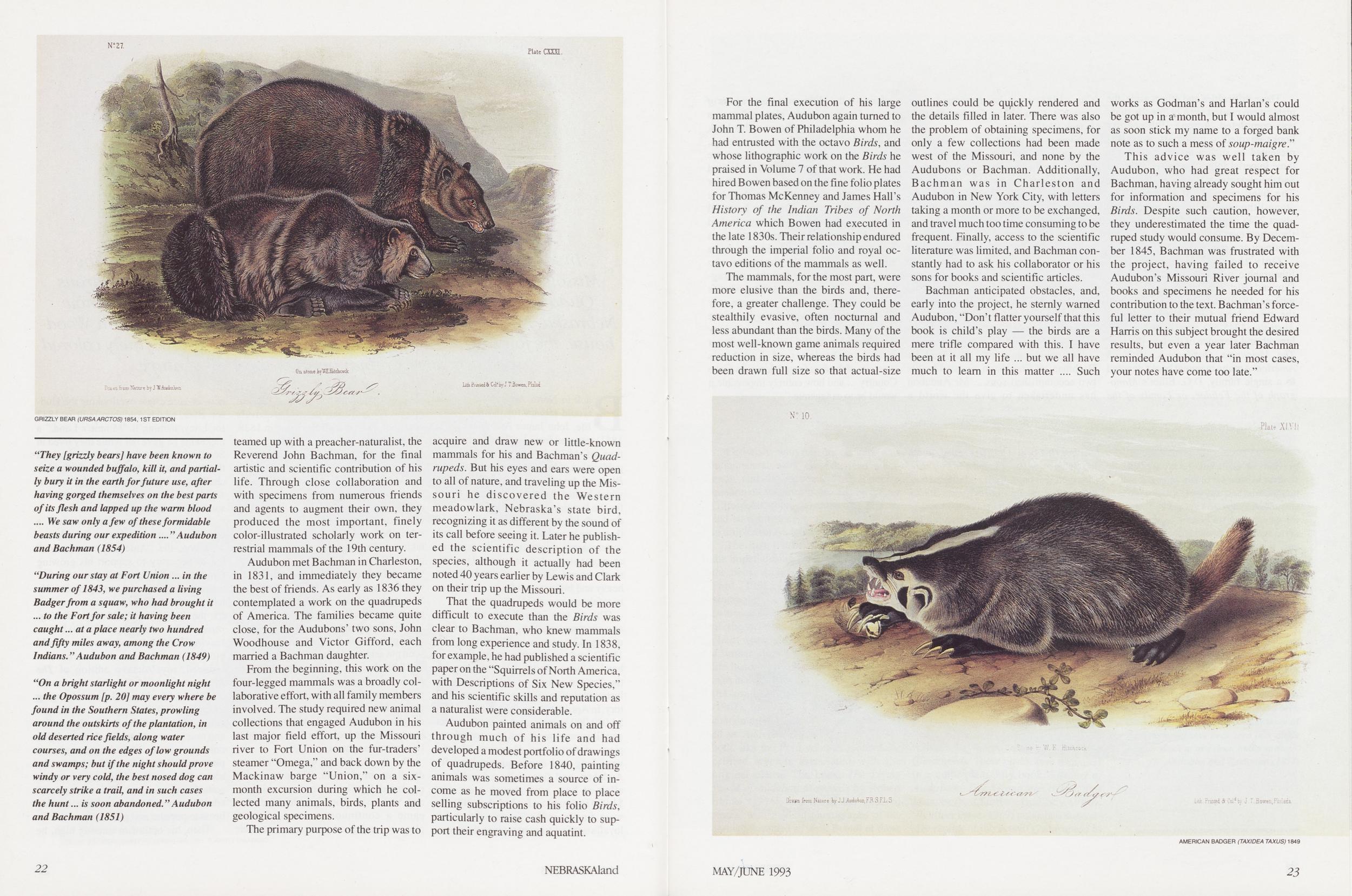
Audubon met Bachman in Charleston, in 1831, and immediately they became the best of friends. As early as 1836 they contemplated a work on the quadrupeds of America. The families became quite close, for the Audubons' two sons, John Woodhouse and Victor Gifford, each married a Bachman daughter.
From the beginning, this work on the four-legged mammals was a broadly collaborative effort, with all family members involved. The study required new animal collections that engaged Audubon in his last major field effort, up the Missouri river to Fort Union on the fur-traders' steamer "Omega," and back down by the Mackinaw barge "Union," on a six-month excursion during which he collected many animals, birds, plants and geological specimens.
The primary purpose of the trip was to acquire and draw new or little-known mammals for his and Bachman's Quadrupeds. But his eyes and ears were open to all of nature, and traveling up the Missouri he discovered the Western meadowlark, Nebraska's state bird, recognizing it as different by the sound of its call before seeing it. Later he published the scientific description of the species, although it actually had been noted 40 years earlier by Lewis and Clark on their trip up the Missouri.
That the quadrupeds would be more difficult to execute than the Birds was clear to Bachman, who knew mammals from long experience and study. In 1838, for example, he had published a scientific paper on the "Squirrels of North America, with Descriptions of Six New Species," and his scientific skills and reputation as a naturalist were considerable.
Audubon painted animals on and off through much of his life and had developed a modest portfolio of drawings of quadrupeds. Before 1840, painting animals was sometimes a source of income as he moved from place to place selling subscriptions to his folio Birds, particularly to raise cash quickly to support their engraving and aquatint.
22 NEBRASKAlandFor the final execution of his large mammal plates, Audubon again turned to John T. Bowen of Philadelphia whom he had entrusted with the octavo Birds, and whose lithographic work on the Birds he praised in Volume 7 of that work. He had hired Bowen based on the fine folio plates for Thomas McKenney and James Hall's History of the Indian Tribes of North America which Bowen had executed in the late 1830s. Their relationship endured through the imperial folio and royal octavo editions of the mammals as well.
The mammals, for the most part, were more elusive than the birds and, therefore, a greater challenge. They could be stealthily evasive, often nocturnal and less abundant than the birds. Many of the most well-known game animals required reduction in size, whereas the birds had been drawn full size so that actual-size outlines could be qujckly rendered and the details filled in later. There was also the problem of obtaining specimens, for only a few collections had been made west of the Missouri, and none by the Audubons or Bachman. Additionally, Bachman was in Charleston and Audubon in New York City, with letters taking a month or more to be exchanged, and travel much too time consuming to be frequent. Finally, access to the scientific literature was limited, and Bachman constantly had to ask his collaborator or his sons for books and scientific articles.
Bachman anticipated obstacles, and, early into the project, he sternly warned Audubon, "Don't flatter yourself that this book is child's play — the birds are a mere trifle compared with this. I have been at it all my life ... but we all have much to learn in this matter .... Such works as Godman's and Harlan's could be got up in a month, but I would almost as soon stick my name to a forged bank note as to such a mess of soup-maigre."
This advice was well taken by Audubon, who had great respect for Bachman, having already sought him cut for information and specimens for his Birds. Despite such caution, however, they underestimated the time the quadruped study would consume. By December 1845, Bachman was frustrated with the project, having failed to receive Audubon's Missouri River journal and books and specimens he needed for his contribution to the text. Bachman's forceful letter to their mutual friend Edward Harris on this subject brought the desired results, but even a year later Bachman reminded Audubon that "in most cases, your notes have come too late."
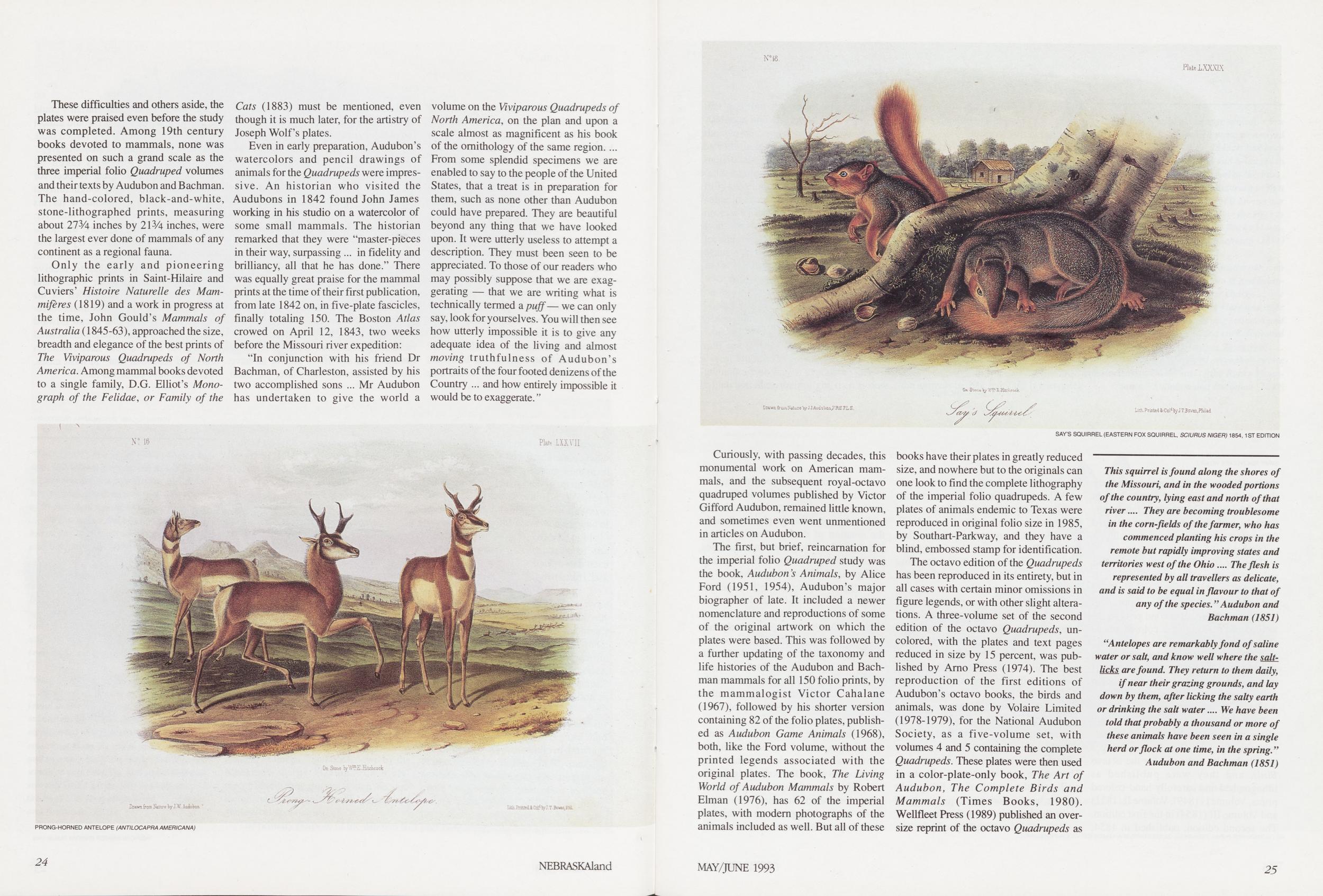
These difficulties and others aside, the plates were praised even before the study was completed. Among 19th century books devoted to mammals, none was presented on such a grand scale as the three imperial folio Quadruped volumes and their texts by Audubon and Bachman. The hand-colored, black-and-white, stone-lithographed prints, measuring about 273/4 inches by 213/4 inches, were the largest ever done of mammals of any continent as a regional fauna.
Only the early and pioneering lithographic prints in Saint-Hilaire and Cuviers' Histoire Naturelle des Mammiferes (1819) and a work in progress at the time, John Gould's Mammals of Australia (1845-63), approached the size, breadth and elegance of the best prints of The Viviparous Quadrupeds of North America. Among mammal books devoted to a single family, D.G. Elliot's Monograph of the Felidae, or Family of the Cats (1883) must be mentioned, even though it is much later, for the artistry of Joseph Wolf's plates.
Even in early preparation, Audubon's watercolors and pencil drawings of animals for the Quadrupeds were impressive. An historian who visited the Audubons in 1842 found John James working in his studio on a watercolor of some small mammals. The historian remarked that they were "master-pieces in their way, surpassing ... in fidelity and brilliancy, all that he has done." There was equally great praise for the mammal prints at the time of their first publication, from late 1842 on, in five-plate fascicles, finally totaling 150. The Boston Atlas crowed on April 12, 1843, two weeks before the Missouri river expedition:
"In conjunction with his friend Dr Bachman, of Charleston, assisted by his two accomplished sons ... Mr Audubon has undertaken to give the world a volume on the Viviparous Quadrupeds of North America, on the plan and upon a scale almost as magnificent as his book of the ornithology of the same region. ... From some splendid specimens we are enabled to say to the people of the United States, that a treat is in preparation for them, such as none other than Audubon could have prepared. They are beautiful beyond any thing that we have looked upon. It were utterly useless to attempt a description. They must been seen to be appreciated. To those of our readers who may possibly suppose that we are exaggerating — that we are writing what is technically termed a. puff— we can only say, look for yourselves. You will then see how utterly impossible it is to give any adequate idea of the living and almost moving truthfulness of Audubon's portraits of the four footed denizens of the Country ... and how entirely impossible it would be to exaggerate."
Curiously, with passing decades, this monumental work on American mammals, and the subsequent royal-octavo quadruped volumes published by Victor Gifford Audubon, remained little known, and sometimes even went unmentioned in articles on Audubon.
The first, but brief, reincarnation for the imperial folio Quadruped study was the book, Audubon s Animals, by Alice Ford (1951, 1954), Audubon's major biographer of late. It included a newer nomenclature and reproductions of some of the original artwork on which the plates were based. This was followed by a further updating of the taxonomy and life histories of the Audubon and Bachman mammals for all 150 folio prints, by the mammalogist Victor Cahalane (1967), followed by his shorter version containing 82 of the folio plates, published as Audubon Game Animals (1968), both, like the Ford volume, without the printed legends associated with the original plates. The book, The Living World of Audubon Mammals by Robert Elman (1976), has 62 of the imperial plates, with modern photographs of the animals included as well. But all of these books have their plates in greatly reduced size, and nowhere but to the originals can one look to find the complete lithography of the imperial folio quadrupeds. A few plates of animals endemic to Texas were reproduced in original folio size in 1985, by Southart-Parkway, and they have a blind, embossed stamp for identification.
The octavo edition of the Quadrupeds
has been reproduced in its entirety, but in
all cases with certain minor omissions in
figure legends, or with other
slightalterations. A three-volume set of the second
edition of the octavo Quadrupeds,
uncolored, with the plates and text pages
reduced in size by 15 percent, was
published by Arno Press (1974). The best
reproduction of the first editions of
Audubon's octavo books, the birds and
animals, was done by Volaire Limited
(1978-1979), for the National Audubon
Society, as a five-volume set, with
volumes 4 and 5 containing the complete
Quadrupeds. These plates were then used
in a color-plate-only book, The Art of
Audubon, The Complete Birds and
Mammals (Times Books, 1980).
Wellfleet Press (1989) published an
oversize reprint of the octavo Quadrupeds as
MAY/JUNE 1993
25
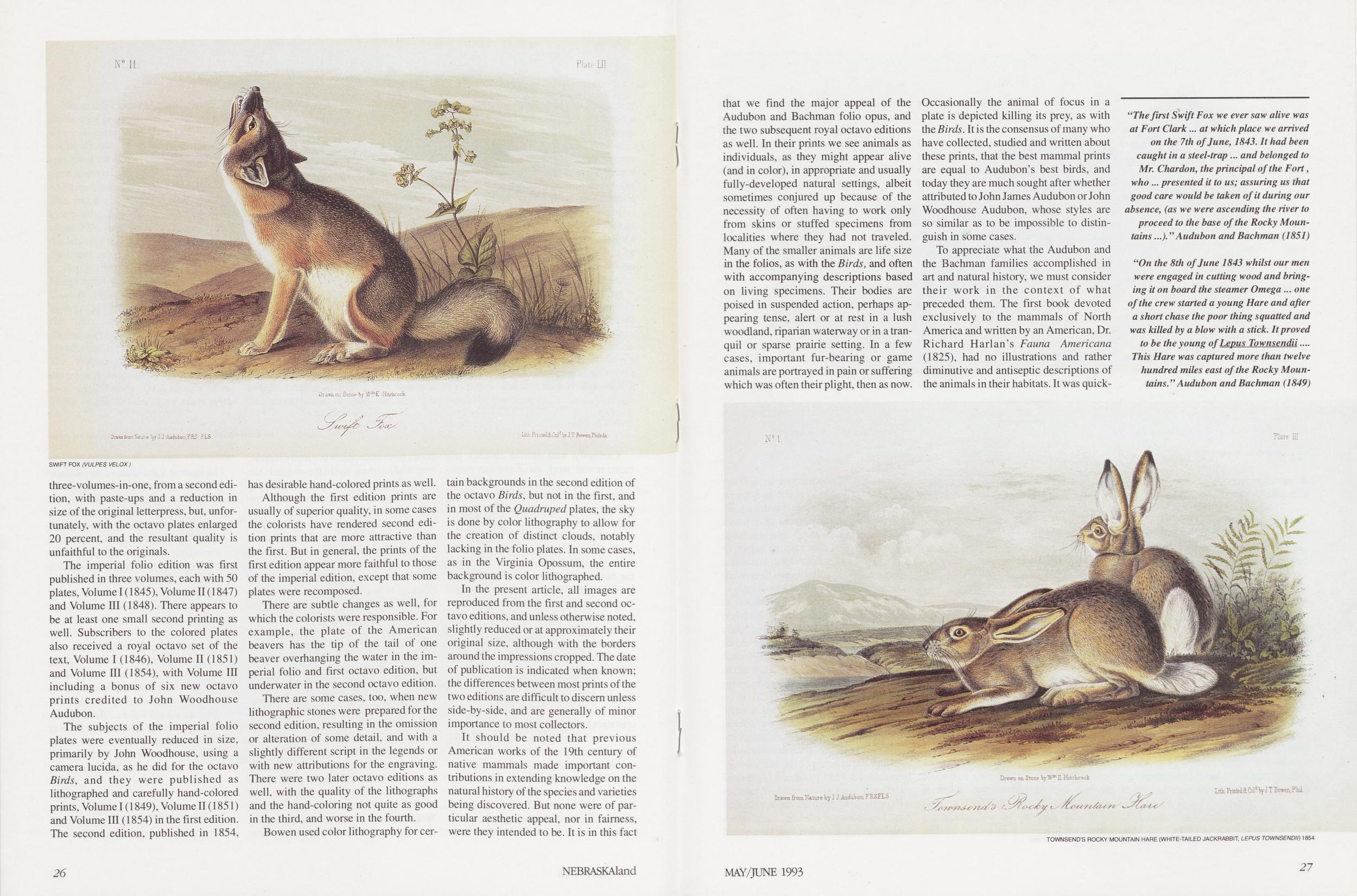
The imperial folio edition was first published in three volumes, each with 50 plates, Volume I (1845), Volume II (1847) and Volume III (1848). There appears to be at least one small second printing as well. Subscribers to the colored plates also received a royal octavo set of the text, Volume I (1846), Volume II (1851) and Volume III (1854), with Volume in including a bonus of six new octavo prints credited to John Woodhouse Audubon.
The subjects of the imperial folio plates were eventually reduced in size, primarily by John Woodhouse, using a camera lucida, as he did for the octavo Birds, and they were published as lithographed and carefully hand-colored prints, Volume I (1849), Volume II (1851) and Volume in (1854) in the first edition. The second edition, published in 1854, has desirable hand-colored prints as well.
Although the first edition prints are usually of superior quality, in some cases the colorists have rendered second edition prints that are more attractive than the first. But in general, the prints of the first edition appear more faithful to those of the imperial edition, except that some plates were recomposed.
There are subtle changes as well, for which the colorists were responsible. For example, the plate of the American beavers has the tip of the tail of one beaver overhanging the water in the imperial folio and first octavo edition, but underwater in the second octavo edition.
There are some cases, too, when new lithographic stones were prepared for the second edition, resulting in the omission or alteration of some detail, and with a slightly different script in the legends or with new attributions for the engraving. There were two later octavo editions as well, with the quality of the lithographs and the hand-coloring not quite as good in the third, and worse in the fourth.
Bowen used color lithography for certain backgrounds in the second edition of the octavo Birds, but not in the first, and in most of the Quadruped plates, the sky is done by color lithography to allow for the creation of distinct clouds, notably lacking in the folio plates. In some cases, as in the Virginia Opossum, the entire background is color lithographed.
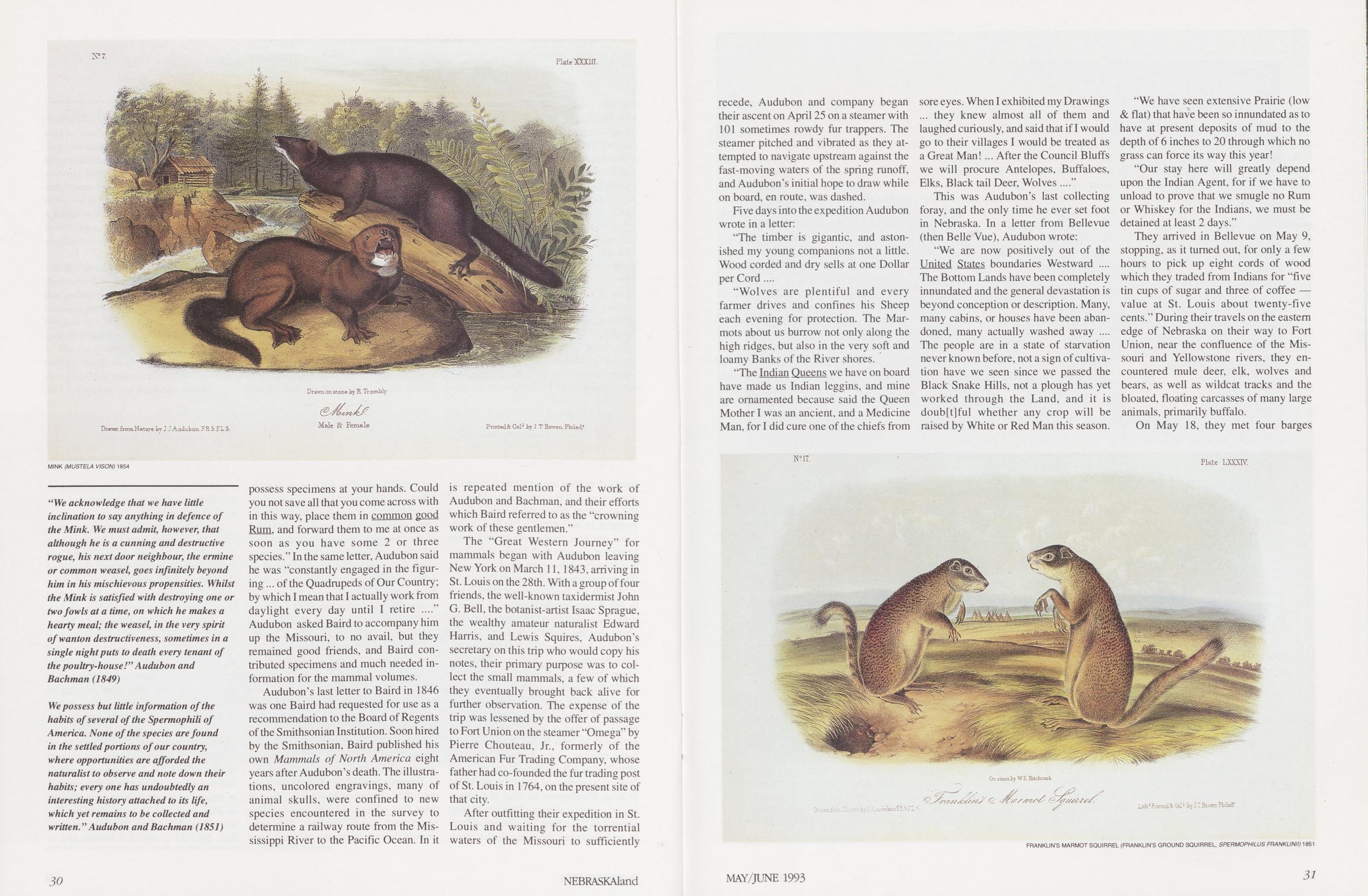
In the present article, all images are reproduced from the first and second octavo editions, and unless otherwise noted, slightly reduced or at approximately their original size, although with the borders around the impressions cropped. The date of publication is indicated when known; the differences between most prints of the two editions are difficult to discern unless side-by-side, and are generally of minor importance to most collectors.
It should be noted that previous American works of the 19th century of native mammals made important contributions in extending knowledge on the natural history of the species and varieties being discovered. But none were of particular aesthetic appeal, nor in fairness, were they intended to be. It is in this fact 26 NEBRASKAland that we find the major appeal of the Audubon and Bachman folio opus, and the two subsequent royal octavo editions as well. In their prints we see animals as individuals, as they might appear alive (and in color), in appropriate and usually fully-developed natural settings, albeit sometimes conjured up because of the necessity of often having to work only from skins or stuffed specimens from localities where they had not traveled. Many of the smaller animals are life size in the folios, as with the Birds, and often with accompanying descriptions based on living specimens. Their bodies are poised in suspended action, perhaps appearing tense, alert or at rest in a lush woodland, riparian waterway or in a tranquil or sparse prairie setting. In a few cases, important fur-bearing or game animals are portrayed in pain or suffering which was often their plight, then as now. Occasionally the animal of focus in a plate is depicted killing its prey, as with the Birds. It is the consensus of many who have collected, studied and written about these prints, that the best mammal prints are equal to Audubon's best birds, and today they are much sought after whether attributed to John James Audubon or John Woodhouse Audubon, whose styles are so similar as to be impossible to distinguish in some cases.
To appreciate what the Audubon and the Bachman families accomplished in art and natural history, we must consider their work in the context of what preceded them. The first book devoted exclusively to the mammals of North America and written by an American, Dr. Richard Harlan's Fauna Americana (1825), had no illustrations and rather diminutive and antiseptic descriptions of the animals in their habitats. It was quick-
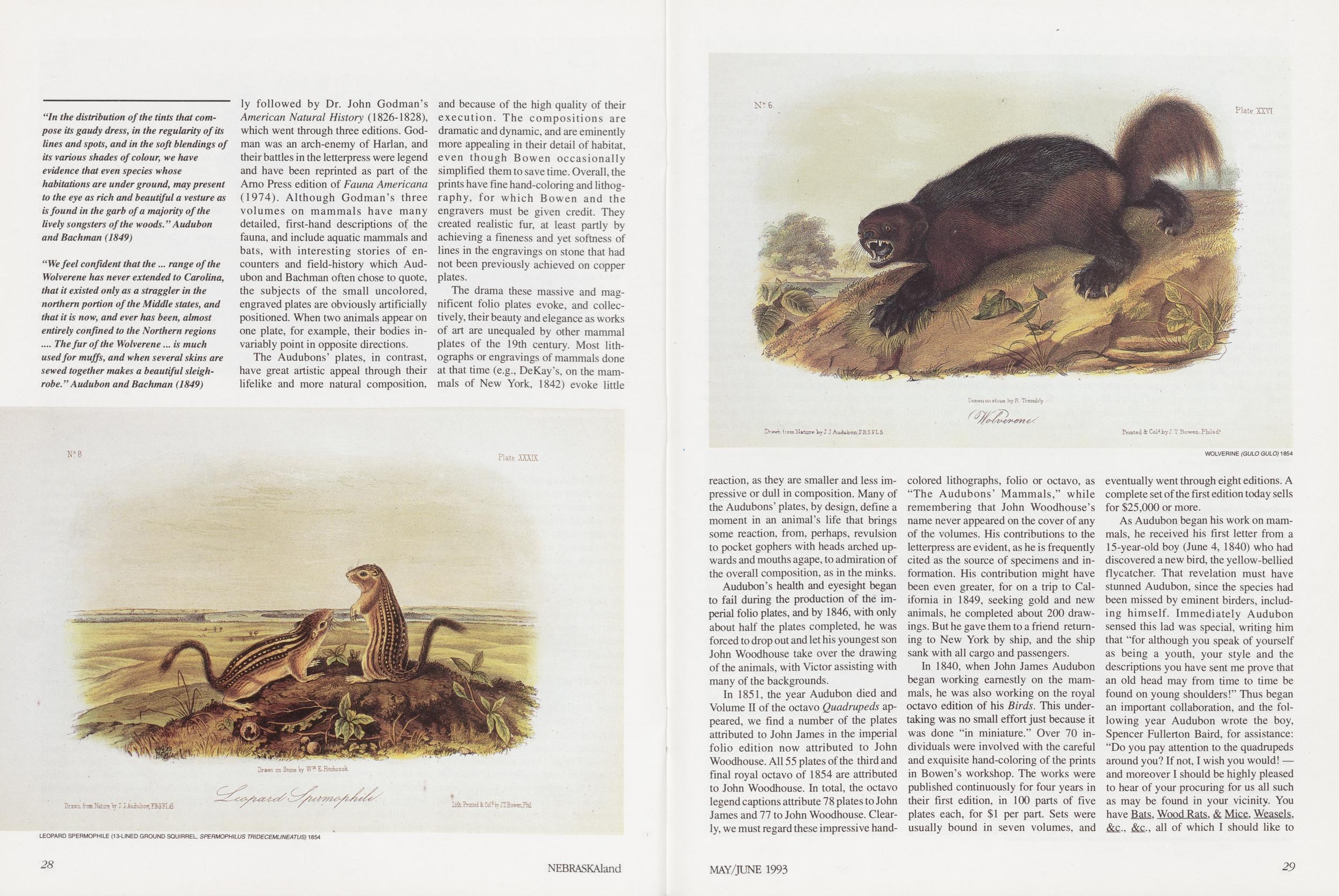
The Audubons' plates, in contrast, have great artistic appeal through their lifelike and more natural composition, and because of the high quality of their execution. The compositions are dramatic and dynamic, and are eminently more appealing in their detail of habitat, even though Bowen occasionally simplified them to save time. Overall, the prints have fine hand-coloring and lithography, for which Bowen and the engravers must be given credit. They created realistic fur, at least partly by achieving a fineness and yet softness of lines in the engravings on stone that had not been previously achieved on copper plates.
The drama these massive and magnificent folio plates evoke, and collectively, their beauty and elegance as works of art are unequaled by other mammal plates of the 19th century. Most lithographs or engravings of mammals done at that time (e.g., DeKay's, on the mammals of New York, 1842) evoke little 28 NEBRASKAland
Audubon's health and eyesight began to fail during the production of the imperial folio plates, and by 1846, with only about half the plates completed, he was forced to drop out and let his youngest son John Woodhouse take over the drawing of the animals, with Victor assisting with many of the backgrounds.
In 1851, the year Audubon died and Volume II of the octavo Quadrupeds appeared, we find a number of the plates attributed to John James in the imperial folio edition now attributed to John Woodhouse. All 55 plates of the third and final royal octavo of 1854 are attributed to John Woodhouse. In total, the octavo legend captions attribute 78 plates to John James and 77 to John Woodhouse. Clearly, we must regard these impressive hand- Drawn on stoiM by Trembly fez) colored lithographs, folio or octavo, as "The Audubons' Mammals," while remembering that John Woodhouse's name never appeared on the cover of any of the volumes. His contributions to the letterpress are evident, as he is frequently cited as the source of specimens and information. His contribution might have been even greater, for on a trip to California in 1849, seeking gold and new animals, he completed about 200 drawings. But he gave them to a friend returning to New York by ship, and the ship sank with all cargo and passengers.
In 1840, when John James Audubon began working earnestly on the mammals, he was also working on the royal octavo edition of his Birds. This undertaking was no small effort just because it was done "in miniature." Over 70 individuals were involved with the careful and exquisite hand-coloring of the prints in Bowen's workshop. The works were published continuously for four years in their first edition, in 100 parts of five plates each, for $1 per part. Sets were usually bound in seven volumes, and Printed ft Colafey J TBowen.P] WOLVERINE (GULO GULO) 1854 eventually went through eight editions. A complete set of the first edition today sells for $25,000 or more.
As Audubon began his work on
mammals, he received his first letter from a
15-year-old boy (June 4, 1840) who had
discovered a new bird, the yellow-bellied
flycatcher. That revelation must have
stunned Audubon, since the species had
been missed by eminent birders,
including himself. Immediately Audubon
sensed this lad was special, writing him
that "for although you speak of yourself
as being a youth, your style and the
descriptions you have sent me prove that
an old head may from time to time be
found on young shoulders!" Thus began
an important collaboration, and the
following year Audubon wrote the boy,
Spencer Fullerton Baird, for assistance:
"Do you pay attention to the quadrupeds
around you? If not, I wish you would!
and moreover I should be highly pleased
to hear of your procuring for us all such
as may be found in your vicinity. You
have Bats. Wood Rats. & Mice. Weasels.
&c. &c. all of which I should like to
MAY/JUNE 1993
29
XD7.
Audubon's last letter to Baird in 1846 was one Baird had requested for use as a recommendation to the Board of Regents of the Smithsonian Institution. Soon hired by the Smithsonian, Baird published his own Mammals of North America eight years after Audubon's death. The illustrations, uncolored engravings, many of animal skulls, were confined to new species encountered in the survey to determine a railway route from the Mississippi River to the Pacific Ocean. In it is repeated mention of the work of Audubon and Bachman, and their efforts which Baird referred to as the "crowning work of these gentlemen."
The "Great Western Journey" for mammals began with Audubon leaving New York on March 11, 1843, arriving in St. Louis on the 28th. With a group of four friends, the well-known taxidermist John G. Bell, the botanist-artist Isaac Sprague, the wealthy amateur naturalist Edward Harris, and Lewis Squires, Audubon's secretary on this trip who would copy his notes, their primary purpose was to collect the small mammals, a few of which they eventually brought back alive for further observation. The expense of the trip was lessened by the offer of passage to Fort Union on the steamer "Omega" by Pierre Chouteau, Jr., formerly of the American Fur Trading Company, whose father had co-founded the fur trading post of St. Louis in 1764, on the present site of that city.
After outfitting their expedition in St. Louis and waiting for the torrential waters of the Missouri to sufficiently 30 NEBRASKAland recede, Audubon and company began their ascent on April 25 on a steamer with 101 sometimes rowdy fur trappers. The steamer pitched and vibrated as they attempted to navigate upstream against the fast-moving waters of the spring runoff, and Audubon's initial hope to draw while on board, en route, was dashed.
Five days into the expedition Audubon wrote in a letter:
'The timber is gigantic, and astonished my young companions not a little. Wood corded and dry sells at one Dollar per Cord ....
"Wolves are plentiful and every farmer drives and confines his Sheep each evening for protection. The Marmots about us burrow not only along the high ridges, but also in the very soft and loamy Banks of the River shores.
"The Indian Queens we have on board have made us Indian leggins, and mine are ornamented because said the Queen Mother I was an ancient, and a Medicine Man, for I did cure one of the chiefs from sore eyes. When I exhibited my Drawings ... they knew almost all of them and laughed curiously, and said that if I would go to their villages I would be treated as a Great Man! ... After the Council Bluffs we will procure Antelopes, Buffaloes, Elks, Black tail Deer, Wolves ...."
This was Audubon's last collecting foray, and the only time he ever set foot in Nebraska. In a letter from Bellevue (then Belle Vue), Audubon wrote:
"We are now positively out of the United States boundaries Westward .... The Bottom Lands have been completely innundated and the general devastation is beyond conception or description. Many, many cabins, or houses have been abandoned, many actually washed away .... The people are in a state of starvation never known before, not a sign of cultivation have we seen since we passed the Black Snake Hills, not a plough has yet worked through the Land, and it is doub[t]ful whether any crop will be raised by White or Red Man this season.
"We have seen extensive Prairie (low & flat) that have been so innundated as to have at present deposits of mud to the depth of 6 inches to 20 through which no grass can force its way this year!
"Our stay here will greatly depend upon the Indian Agent, for if we have to unload to prove that we smugle no Rum or Whiskey for the Indians, we must be detained at least 2 days."
They arrived in Bellevue on May 9, stopping, as it turned out, for only a few hours to pick up eight cords of wood which they traded from Indians for "five tin cups of sugar and three of coffee — value at St. Louis about twenty-five cents." During their travels on the eastern edge of Nebraska on their way to Fort Union, near the confluence of the Missouri and Yellowstone rivers, they encountered mule deer, elk, wolves and bears, as well as wildcat tracks and the bloated, floating carcasses of many large animals, primarily buffalo.
On May 18, they met four barges
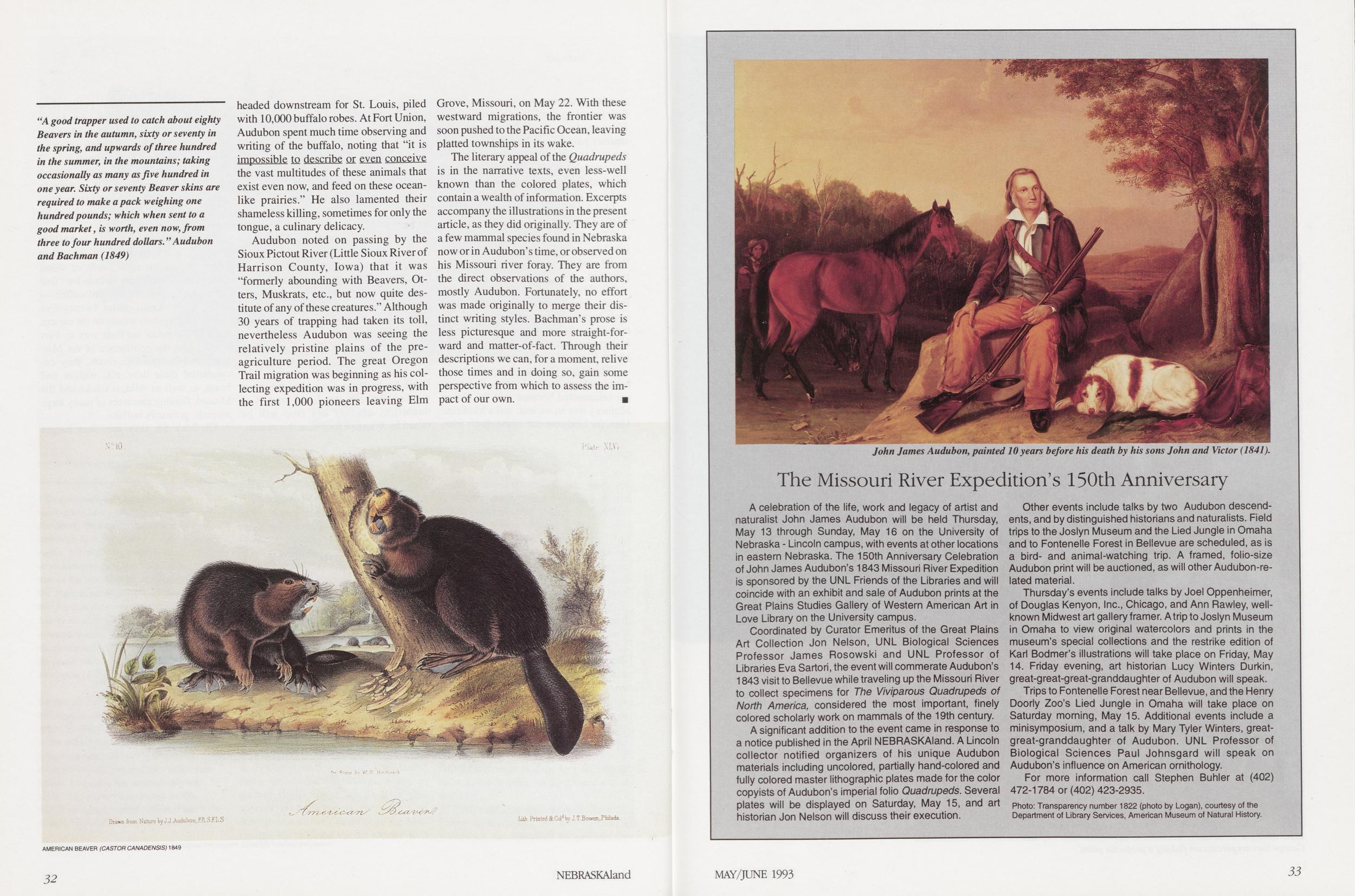
Audubon noted on passing by the Sioux Pictout River (Little Sioux River of Harrison County, Iowa) that it was "formerly abounding with Beavers, Otters, Muskrats, etc., but now quite destitute of any of these creatures." Although 30 years of trapping had taken its toll, nevertheless Audubon was seeing the relatively pristine plains of the pre-agriculture period. The great Oregon Trail migration was beginning as his collecting expedition was in progress, with the first 1,000 pioneers leaving Elm Grove, Missouri, on May 22. With these westward migrations, the frontier was soon pushed to the Pacific Ocean, leaving platted townships in its wake.
The literary appeal of the Quadrupeds is in the narrative texts, even less-well known than the colored plates, which contain a wealth of information. Excerpts accompany the illustrations in the present article, as they did originally. They are of a few mammal species found in Nebraska now or in Audubon's time, or observed on his Missouri river foray. They are from the direct observations of the authors, mostly Audubon. Fortunately, no effort was made originally to merge their distinct writing styles. Bachman's prose is less picturesque and more straight-for- ward and matter-of-fact. Through their descriptions we can, for a moment, relive those times and in doing so, gain some perspective from which to assess the impact of our own.
32 NEBRASKAlandThe Missouri River Expedition's 150th Anniversary
A celebration of the life, work and legacy of artist and naturalist John James Audubon will be held Thursday, May 13 through Sunday, May 16 on the University of Nebraska - Lincoln campus, with events at other locations in eastern Nebraska. The 150th Anniversary Celebration of John James Audubon's 1843 Missouri River Expedition is sponsored by the UNL Friends of the Libraries and will coincide with an exhibit and sale of Audubon prints at the Great Plains Studies Gallery of Western American Art in Love Library on the University campus.
Coordinated by Curator Emeritus of the Great Plains Art Collection Jon Nelson, UNL Biological Sciences Professor James Rosowski and UNL Professor of Libraries Eva Sartori, the event will commemorate Audubon's 1843 visit to Bellevue while traveling up the Missouri River to collect specimens for The Viviparous Quadrupeds of North America, considered the most important, finely colored scholarly work on mammals of the 19th century.
A significant addition to the event came in response to a notice published in the April NEBRASKAland. A Lincoln collector notified organizers of his unique Audubon materials including uncolored, partially hand-colored and fully colored master lithographic plates made for the color copyists of Audubon's imperial folio Quadrupeds. Several plates will be displayed on Saturday, May 15, and art historian Jon Nelson will discuss their execution.
Other events include talks by two Audubon descend- ants, and by distinguished historians and naturalists. Field trips to the Joslyn Museum and the Lied Jungle in Omaha and to Fontenelle Forest in Bellevue are scheduled, as is a bird- and animal-watching trip. A framed, folio-size Audubon print will be auctioned, as will other Audubon-related material.
Thursday's events include talks by Joel Oppenheimer, of Douglas Kenyon, Inc., Chicago, and Ann Rawley, well known Midwest art gallery f ramer. A trip to Joslyn Museum in Omaha to view original watercolors and prints in the museum's special collections and the restrike edition of Karl Bodmer's illustrations will take place on Friday, May 14. Friday evening, art historian Lucy Winters Durkin, great-great-great-granddaughter of Audubon will speak.
Trips to Fontenelle Forest near Bellevue, and the Henry Doorly Zoo's Lied Jungle in Omaha will take place on Saturday morning, May 15. Additional events include a minisymposium, and a talk by Mary Tyler Winters, great-great-granddaughter of Audubon. UNL Professor of Biological Sciences Paul Johnsgard will speak on Audubon's influence on American ornithology.
For more information call Stephen Buhler at (402) 472-1784 or (402) 423-2935.
MAY/JUNE 1993 33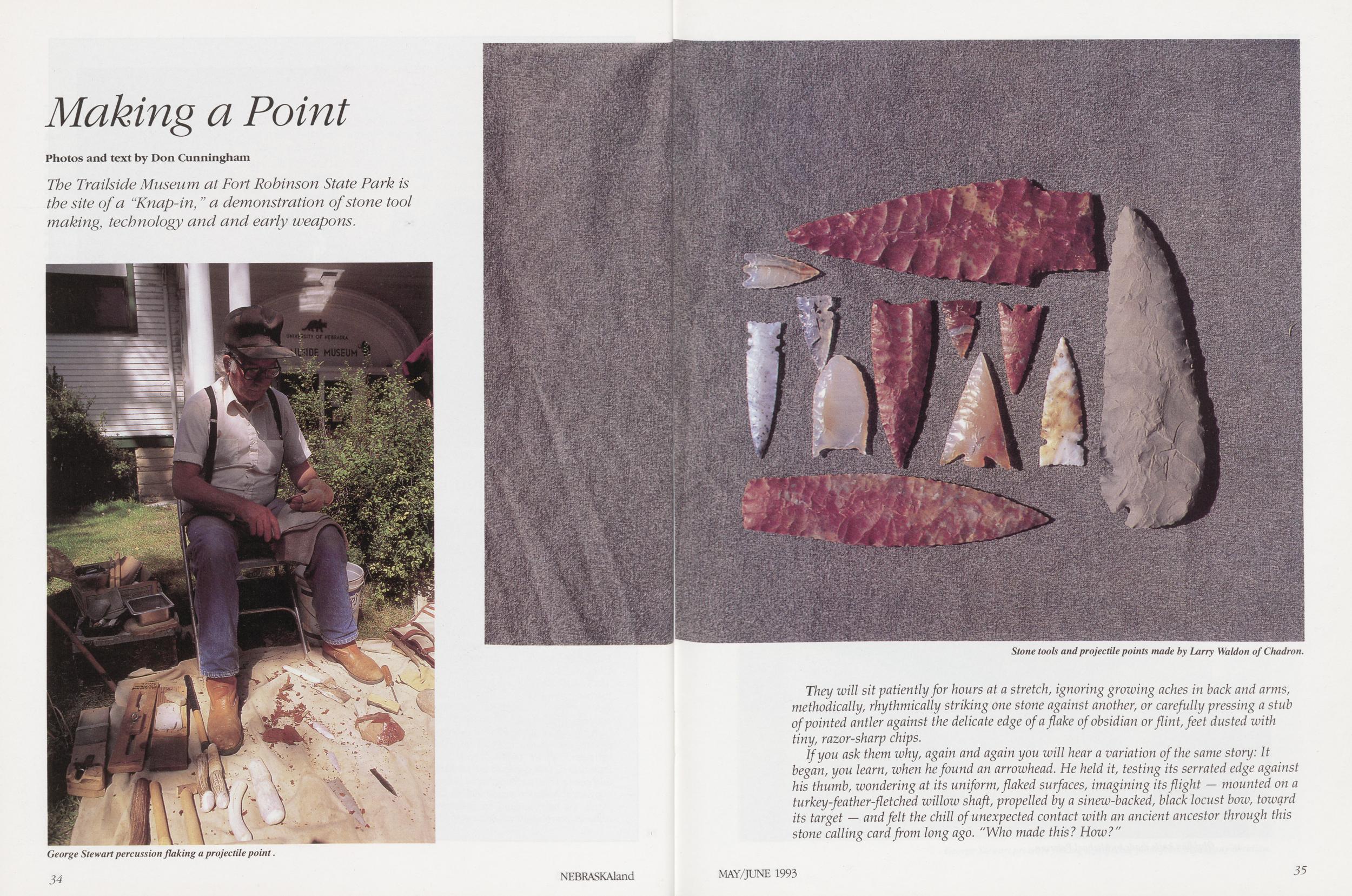
Making a Point
Photos and text by Don Cunningham The Trailside Museum at Fort Robinson State Park is the site of a "Knap-in, " a demonstration of stone tool making, technology and and early weapons.They will sit patiently for hours at a stretch, ignoring growing aches in back and arms, methodically, rhythmically striking one stone against another, or carefully pressing a stub of pointed antler against the delicate edge of a flake of obsidian or flint, feet dusted with tiny, razor-sharp chips.
If you ask them why, again and again you will hear a variation of the same story: It began, you learn, when he found an arrowhead. He held it, testing its serrated edge against his thumb, wondering at its uniform, flaked surfaces, imagining its flight — mounted on a turkey-feather-fletched willow shaft, propelled by a sinew-backed, black locust bow, toward its target — and felt the chill of unexpected contact with an ancient ancestor through this stone calling card from long ago. "Who made this? How?"
MAY/JUNE 1993 35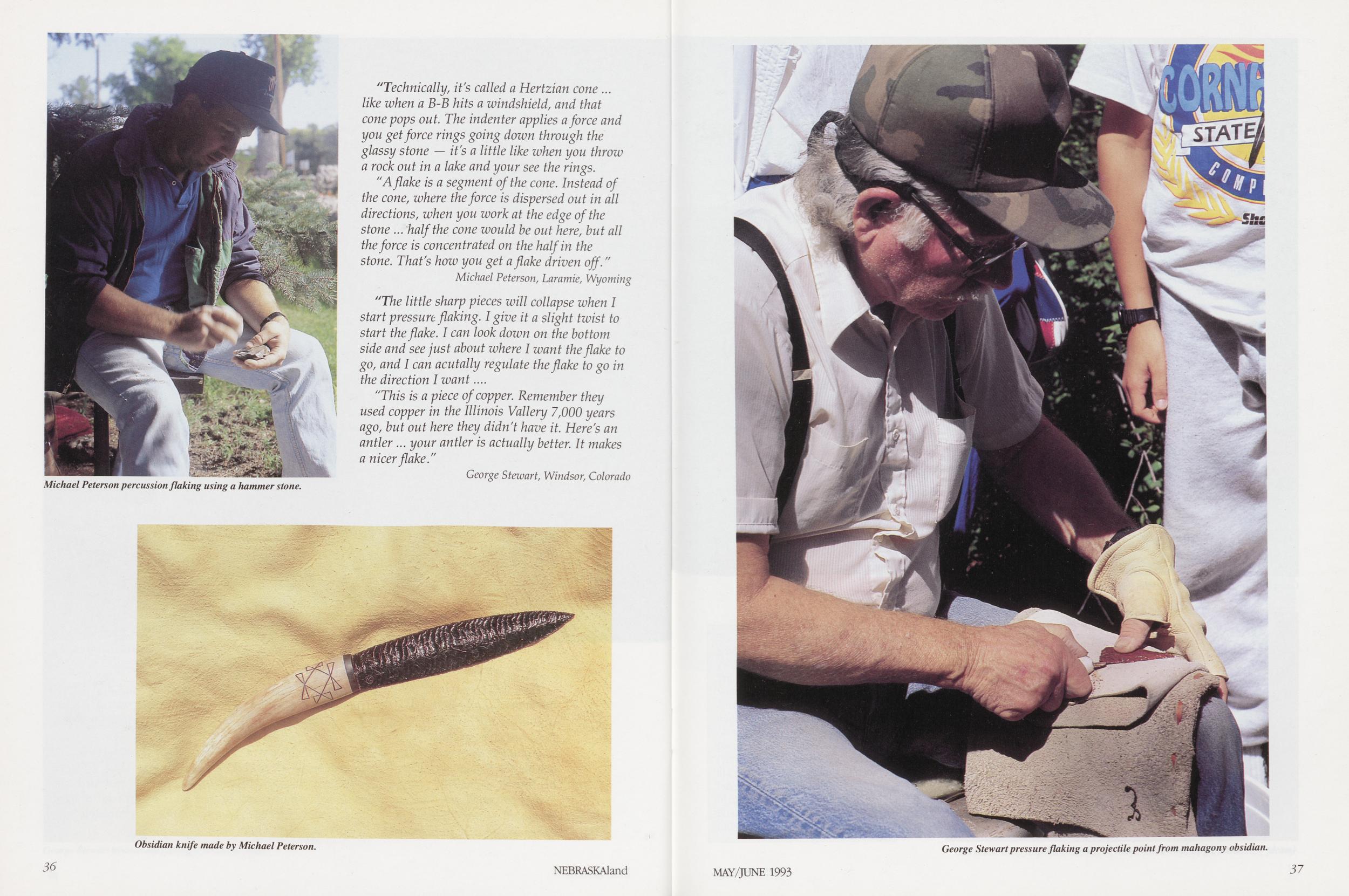
"Technically, it's called a Hertzian cone ... like when a B-B hits a windshield, and that cone pops out. The indenter applies a force and you get force rings going down through the glassy stone — it's a little like when you throw a rock out in a lake and your see the rings.
"A flake is a segment of the cone. Instead of the cone, where the force is dispersed out in all directions, when you work at the edge of the stone ... half the cone would he out here, hut all the force is concentrated on the half in the stone. That's how you get a flake driven off."
Michael Peterson, Laramie, Wyoming"The little sharp pieces will collapse when I start pressure flaking. I give it a slight twist to start the flake. I can look down on the bottom side and see just about where I want the flake to go, and I can actually regulate the flake to go in the direction I want....
"This is a piece of copper. Remember they used copper in the Illinois Vallery 7,000 years ago, but out here they didn't have it. Here's an antler ... your antler is actually better. It makes a nicer flake."
George Stewart, Windsor, Colorado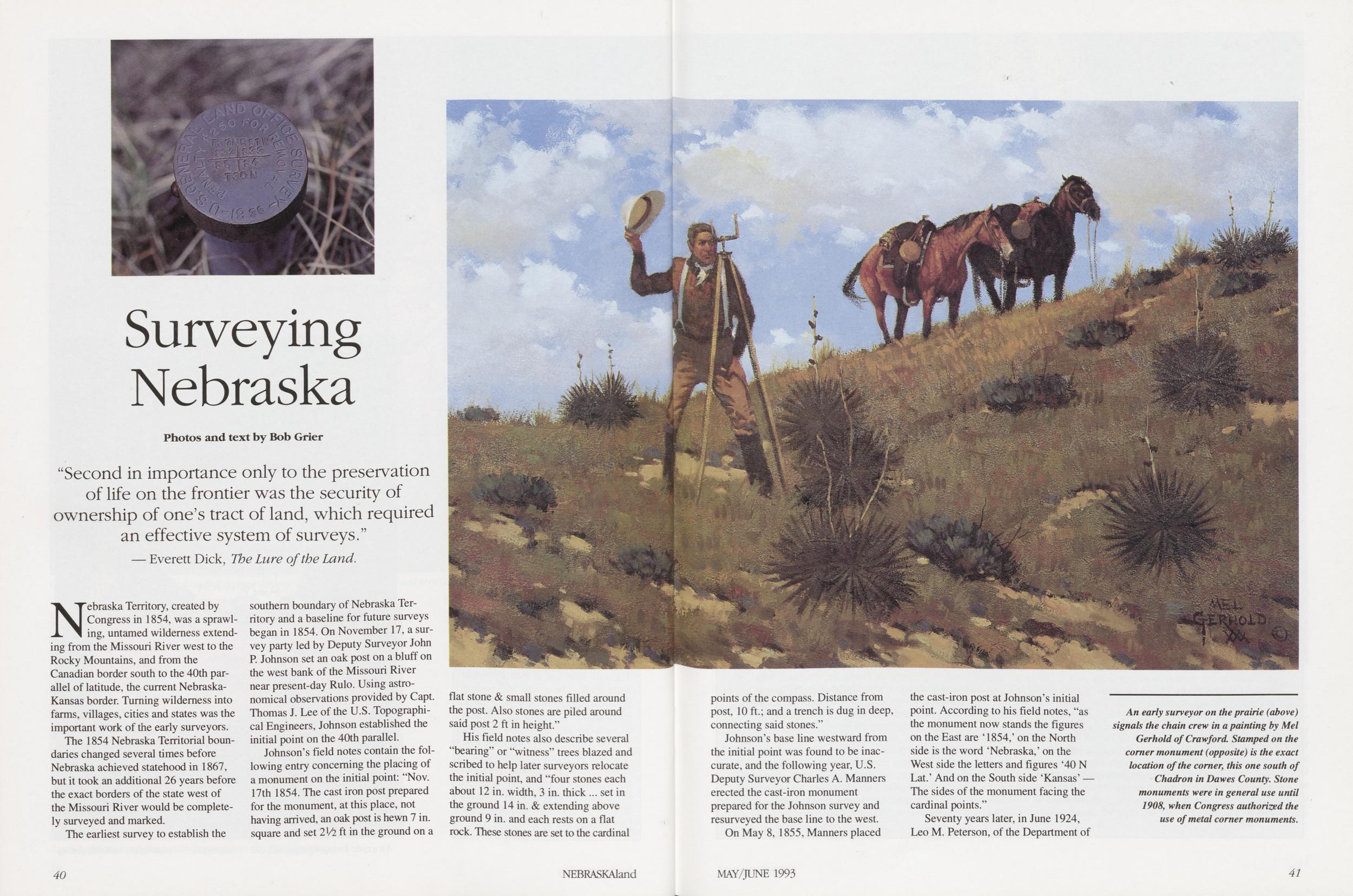
Surveying Nebraska
Photos and text by Bob Grier "Second in importance only to the preservation of life on the frontier was the security of ownership of one's tract of land, which required an effective system of surveys." — Everett Dick, The Lure of the Land.Nebraska Territory, created by Congress in 1854, was a sprawling, untamed wilderness extending from the Missouri River west to the Rocky Mountains, and from the Canadian border south to the 40th parallel of latitude, the current Nebraska- Kansas border. Turning wilderness into farms, villages, cities and states was the important work of the early surveyors.
The 1854 Nebraska Territorial boundaries changed several times before Nebraska achieved statehood in 1867, but it took an additional 26 years before the exact borders of the state west of the Missouri River would be completely surveyed and marked.
The earliest survey to establish the southern boundary of Nebraska Territory and a baseline for future surveys began in 1854. On November 17, a survey party led by Deputy Surveyor John P. Johnson set an oak post on a bluff on the west bank of the Missouri River near present-day Rulo. Using astronomical observations provided by Capt. Thomas J. Lee of the U.S. Topographical Engineers, Johnson established the initial point on the 40th parallel.
Johnson's field notes contain the following entry concerning the placing of a monument on the initial point: "Nov. 17th 1854. The cast iron post prepared for the monument, at this place, not having arrived, an oak post is hewn 7 in. square and set IV ft in the ground on a flat stone & small stones filled around the post. Also stones are piled around said post 2 ft in height."
His field notes also describe several "bearing" or "witness" trees blazed and scribed to help later surveyors relocate the initial point, and "four stones each about 12 in. width, 3 in. thick ... set in the ground 14 in. & extending above ground 9 in. and each rests on a flat rock. These stones are set to the cardinal 40 NEBRASKAland points of the compass. Distance from post, 10 ft.; and a trench is dug in deep, connecting said stones."
Johnson's base line westward from the initial point was found to be inaccurate, and the following year, U.S. Deputy Surveyor Charles A. Manners erected the cast-iron monument prepared for the Johnson survey and resurveyed the base line to the west.
On May 8, 1855, Manners placed the cast-iron post at Johnson's initial point. According to his field notes, "as the monument now stands the figures on the East are ' 1854,' on the North side is the word 'Nebraska,' on the West side the letters and figures '40 N Lat.' And on the South side 'Kansas' — The sides of the monument facing the cardinal points."
Seventy years later, in June 1924, Leo M. Peterson, of the Department of the Interior's General Land Office, returned to the initial survey point to restore the original corner. After finding evidence of "many of the original accessories" (the stones and trenches located around the oak post placed by Johnson) Peterson's 1925 report adds: "The original cast iron monument was found standing approximately 2Vz feet north of the flat stone in the center. It was standing on the surface of the ground and there were no flat stones under it nor along side of it."
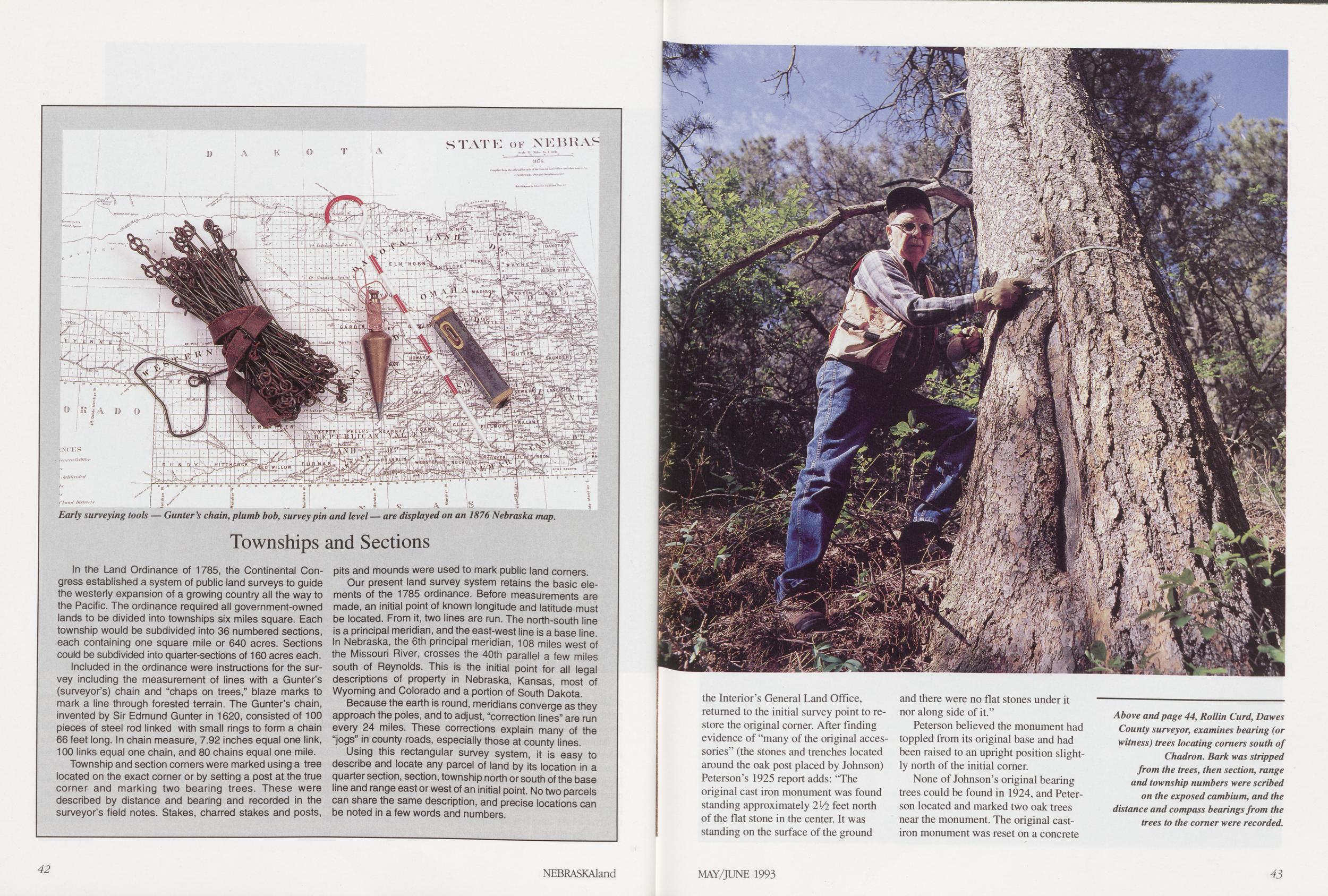
In the Land Ordinance of 1785, the Continental Congress established a system of public land surveys to guide the westerly expansion of a growing country all the way to the Pacific. The ordinance required all government-owned lands to be divided into townships six miles square. Each township would be subdivided into 36 numbered sections, each containing one square mile or 640 acres. Sections could be subdivided into quarter-sections of 160 acres each.
Included in the ordinance were instructions for the survey including the measurement of lines with a Gunter's (surveyor's) chain and "chaps on trees," blaze marks to mark a line through forested terrain. The Gunter's chain, invented by Sir Edmund Gunter in 1620, consisted of 100 pieces of steel rod linked with small rings to form a chain 66 feet long. In chain measure, 7.92 inches equal one link, 100 links equal one chain, and 80 chains equal one mile.
Township and section corners were marked using a tree located on the exact corner or by setting a post at the true corner and marking two bearing trees. These were described by distance and bearing and recorded in the surveyor's field notes. Stakes, charred stakes and posts, pits and mounds were used to mark public land corners.
Our present land survey system retains the basic elements of the 1785 ordinance. Before measurements are made, an initial point of known longitude and latitude must be located. From it, two lines are run. The north-south line is a principal meridian, and the east-west line is a base line. In Nebraska, the 6th principal meridian, 108 miles west of the Missouri River, crosses the 40th parallel a few miles south of Reynolds. This is the initial point for all legal descriptions of property in Nebraska, Kansas, most of Wyoming and Colorado and a portion of South Dakota.
Because the earth is round, meridians converge as they approach the poles, and to adjust, "correction lines" are run every 24 miles. These corrections explain many of the "jogs" in county roads, especially those at county lines.
Because the earth is round, meridians converge as they approach the poles, and to adjust, "correction lines" are run every 24 miles. These corrections explain many of the "jogs" in county roads, especially those at county lines.
42 NEBRASKAlandPeterson believed the monument had toppled from its original base and had been raised to an upright position slightly north of the initial corner.
None of Johnson's original bearing
trees could be found in 1924, and
Peterson located and marked two oak trees
near the monument. The original
castiron monument was reset on a concrete
MAY/JUNE 1993
43
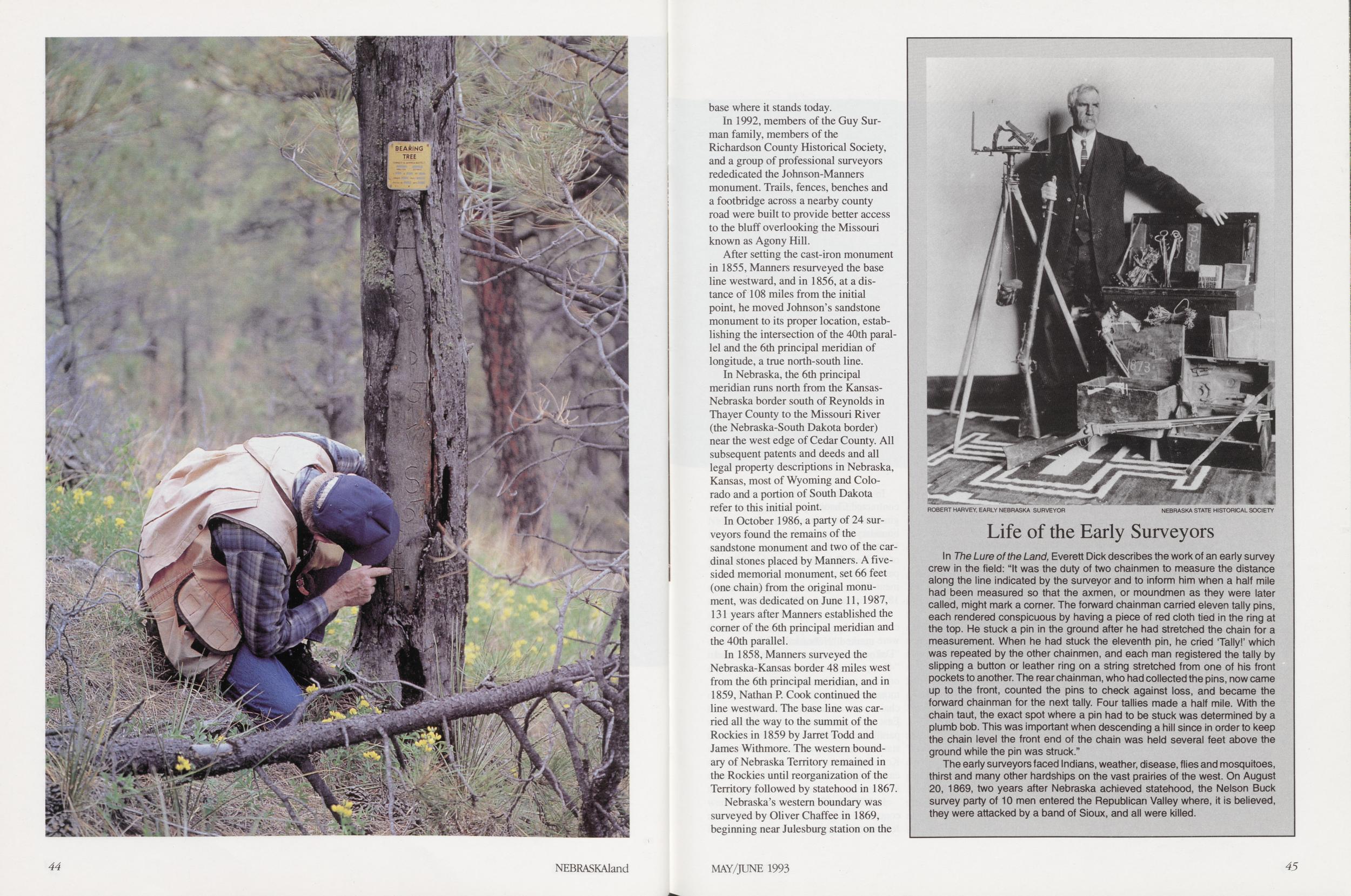
In 1992, members of the Guy Surman family, members of the Richardson County Historical Society, and a group of professional surveyors rededicated the Johnson-Manners monument. Trails, fences, benches and a footbridge across a nearby county road were built to provide better access to the bluff overlooking the Missouri known as Agony Hill.
After setting the cast-iron monument in 1855, Manners resurveyed the base line westward, and in 1856, at a distance of 108 miles from the initial point, he moved Johnson's sandstone monument to its proper location, establishing the intersection of the 40th parallel and the 6th principal meridian of longitude, a true north-south line.
In Nebraska, the 6th principal meridian runs north from the Kansas- Nebraska border south of Reynolds in Thayer County to the Missouri River (the Nebraska-South Dakota border) near the west edge of Cedar County. All subsequent patents and deeds and all legal property descriptions in Nebraska, Kansas, most of Wyoming and Colorado and a portion of South Dakota refer to this initial point.
In October 1986, a party of 24 surveyors found the remains of the sandstone monument and two of the cardinal stones placed by Manners. A fivesided memorial monument, set 66 feet (one chain) from the original monument, was dedicated on June 11, 1987, 131 years after Manners established the corner of the 6th principal meridian and the 40th parallel.
In 1858, Manners surveyed the Nebraska-Kansas border 48 miles west from the 6th principal meridian, and in 1859, Nathan P. Cook continued the line westward. The base line was carried all the way to the summit of the Rockies in 1859 by Jarret Todd and James Withmore. The western boundary of Nebraska Territory remained in the Rockies until reorganization of the Territory followed by statehood in 1867.
Nebraska's western boundary was surveyed by Oliver Chaffee in 1869, beginning near Julesburg station on the recently completed Union Pacific Railroad. The telegraph line provided accurate time to complement Chaffee's astronomical observations.
In The Lure of the Land, Everett Dick describes the work of an early survey crew in the field: "It was the duty of two chainmen to measure the distance along the line indicated by the surveyor and to inform him when a half mile had been measured so that the axmen, or moundmen as they were later called, might mark a corner. The forward chainman carried eleven tally pins, each rendered conspicuous by having a piece of red cloth tied in the ring at the top. He stuck a pin in the ground after he had stretched the chain for a measurement. When he had stuck the eleventh pin, he cried Tally!' which was repeated by the other chainmen, and each man registered the tally by slipping a button or leather ring on a string stretched from one of his front pockets to another. The rear chainman, who had collected the pins, now came up to the front, counted the pins to check against loss, and became the forward chainman for the next tally. Four tallies made a half mile. With the chain taut, the exact spot where a pin had to be stuck was determined by a plumb bob. This was important when descending a hill since in order to keep the chain level the front end of the chain was held several feet above the ground while the pin was struck."
The early surveyors faced Indians, weather, disease, flies and mosquitoes, thirst and many other hardships on the vast prairies of the west. On August 20, 1869, two years after Nebraska achieved statehood, the Nelson Buck survey party of 10 men entered the Republican Valley where, it is believed, they were attacked by a band of Sioux, and all were killed.
MAY/JUNE 1993 45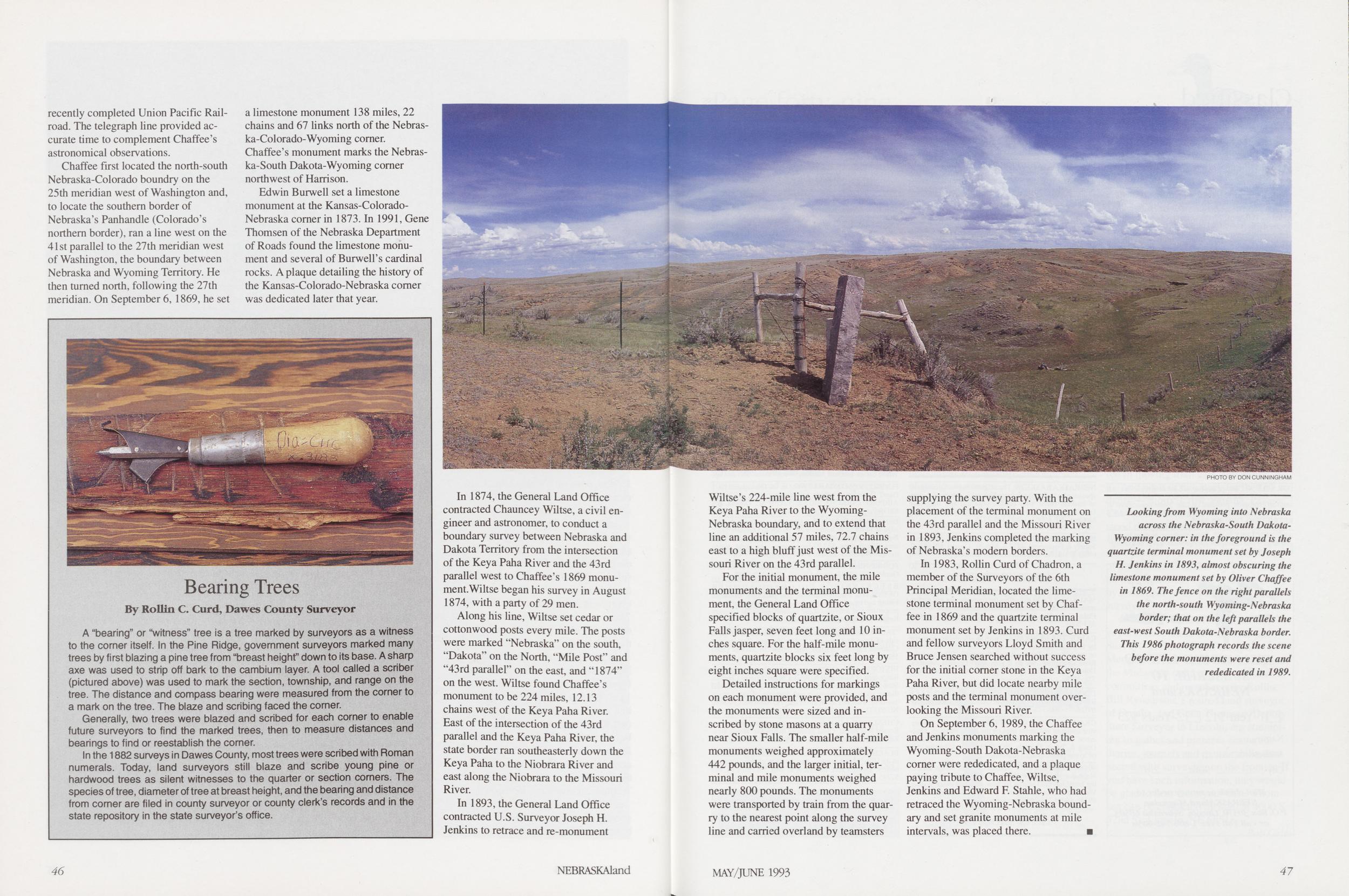
Chaffee first located the north-south Nebraska-Colorado boundary on the 25th meridian west of Washington and, to locate the southern border of Nebraska's Panhandle (Colorado's northern border), ran a line west on the 41st parallel to the 27th meridian west of Washington, the boundary between Nebraska and Wyoming Territory. He then turned north, following the 27th meridian. On September 6, 1869, he set a limestone monument 138 miles, 22 chains and 67 links north of the Nebraska-Colorado-Wyoming corner. Chaffee's monument marks the Nebraska-South Dakota-Wyoming corner northwest of Harrison.
Edwin Burwell set a limestone monument at the Kansas-Colorado- Nebraska corner in 1873. In 1991, Gene Thomsen of the Nebraska Department of Roads found the limestone monument and several of Burwell's cardinal rocks. A plaque detailing the history of the Kansas-Colorado-Nebraska comer was dedicated later that year.
A "bearing" or "witness" tree is a tree marked by surveyors as a witness to the corner itself. In the Pine Ridge, government surveyors marked many trees by first blazing a pine tree from "breast height down to its base. A sharp axe was used to strip off bark to the cambium layer. A tool called a scriber (pictured above) was used to mark the section, township, and range on the tree. The distance and compass bearing were measured from the corner to a mark on the tree. The blaze and scribing faced the comer.
Generally, two trees were blazed and scribed for each corner to enable future surveyors to find the marked trees, then to measure distances and bearings to find or reestablish the corner.
In the 1882 surveys in Dawes County, most trees were scribed with Roman numerals. Today, land surveyors still blaze and scribe young pine or hardwood trees as silent witnesses to the quarter or section corners. The species of tree, diameter of tree at breast height, and the bearing and distance from comer are filed in county surveyor or county clerk's records and in the state repository in the state surveyor's office.
In 1874, the General Land Office contracted Chauncey Wiltse, a civil engineer and astronomer, to conduct a boundary survey between Nebraska and Dakota Territory from the intersection of the Keya Paha River and the 43rd parallel west to Chaffee's 1869 monument. Wiltse began his survey in August 1874, with a party of 29 men.
Along his line, Wiltse set cedar or cottonwood posts every mile. The posts were marked "Nebraska" on the south, "Dakota" on the North, "Mile Post" and "43rd parallel" on the east, and "1874" on the west. Wiltse found Chaffee's monument to be 224 miles, 12.13 chains west of the Keya Paha River. East of the intersection of the 43rd parallel and the Keya Paha River, the state border ran southeasterly down the Keya Paha to the Niobrara River and east along the Niobrara to the Missouri River.
In 1893, the General Land Office contracted U.S. Surveyor Joseph H. Jenkins to retrace and re-monument 46 NEBRASKAland
For the initial monument, the mile monuments and the terminal monument, the General Land Office specified blocks of quartzite, or Sioux Falls jasper, seven feet long and 10 inches square. For the half-mile monuments, quartzite blocks six feet long by eight inches square were specified.
Detailed instructions for markings on each monument were provided, and the monuments were sized and inscribed by stone masons at a quarry near Sioux Falls. The smaller half-mile monuments weighed approximately 442 pounds, and the larger initial, terminal and mile monuments weighed nearly 800 pounds. The monuments were transported by train from the quarry to the nearest point along the survey line and carried overland by teamsters supplying the survey party. With the placement of the terminal monument on the 43rd parallel and the Missouri River in 1893, Jenkins completed the marking of Nebraska's modern borders.
In 1983, Rollin Curd of Chadron, a member of the Surveyors of the 6th Principal Meridian, located the limestone terminal monument set by Chaffee in 1869 and the quartzite terminal monument set by Jenkins in 1893. Curd and fellow surveyors Lloyd Smith and Bruce Jensen searched without success for the initial corner stone in the Keya Paha River, but did locate nearby mile posts and the terminal monument overlooking the Missouri River.
On September 6, 1989, the Chaffee and Jenkins monuments marking the Wyoming-South Dakota-Nebraska corner were rededicated, and a plaque paying tribute to Chaffee, Wiltse, Jenkins and Edward F. Stahle, who had retraced the Wyoming-Nebraska boundary and set granite monuments at mile intervals, was placed there.
Classified
BOOKS/PRINTINGFREE! Booklets on northeastern Nevada; fishing, rockhounding maps, Carl Hayden, Box 528, Jackpot, Nevada 89825.
FREE BOOK CATALOG. Novels, westerns, romances, children's; old out of print, found barns, attic. Authors: Grey, Bower, Connor, Fox, Curwood, Raine,Wright, Aldridge, Pollyanna, Freckles, many others. Postage appreciated. Pierce, 4400 N. Pine Cluster, Oroville, CA 95965
GIFT IDEAS - A complete reference book. Over 170 pages - fantastic ideas - easy to use format - suggestions for all ages and occasions. Send $12 to: Norma Carter, 28514 Leacrest Dr., Rancho Palos Verdes, CA 90274.
COLLECTIBLESBUYING—TRADING EXPIRED HUNTING, FISHING, TRAPPING licenses; regulations; duck/upland game stamps. (402) 785-7500. Information/prices.
BUYING: American Indian artifacts such as beadwork, weavings, baskets, etc.; also cowboy memorabilia such as chaps, spurs, photographs, etc. Best price first letter; photographs promptly returned. Jack Ringwalt, 1550 California St., Suite 6, #211, San Francisco, CA 94109, (415)759-6343.
DOGSTRAINING ALL BREEDS bird dogs — Vizslas and English Pointers for sale. Rozanek Kennels, RR 2, Schuyler, NE 68661. Phone (402) 352-8769.
YELLOW-BLACK Lab pups. FC-AFC sired. AKC. Hips OFA certified. Dew claws removed. Excellent hunting potential. Contact Bob Bendler, Lexington, NE. (308) 324-4247.
FOR SALE — Chesapeake bay or Labrador retrievers. All colors. Pups, started dogs, stud service. Three-generation national champion, pedigree on Lab. Three generations of the best Chesapeakes ever trialed. Call PLATTE VALLEY RETRIEVERS (308) 995-2318.
AKC BRITTANY PUPS. Close working. Natural backing gun dogs. Field champion backgrounds. Liver and orange. References. Blair (402) 426-3597.
YES! I WOULD LIKE TO SUBSCRIBE TO NEBRASKAland ni-Year $12 2-Years $23 Name Address. City State. Zip. Mail check or money order to NEBRASKAland Magazine P.O. Box 30370, Lincoln, Nebraska 68503 or call Toll Free 1-800-742-0056 EVENTS/ATTRACTIONSLAUREL, NE. CENTENNIAL QUILT SHOW; Laurel City Auditorium, on 2nd and Elm, June 11-13. (Joan Huddleston, 301 W. 2nd, Laurel, 68745; 402-256-3887, or Tillie Rastede, 105 Hillcrest. Laurel; 402-256-9089 or Martha Holm, 310 W. 2nd St., Laurel.)
FISH/FISHINGAUTOMATIC FISHING ROD HOLDERS. Hook - setters. $20 + $3 S.H. 105 W 5th, Apt. 200, Fairbury, NE 68352. (402)729-5288.
FISH FOR SALE. Catfish, perch, coho salmon, rainbow trout, crappie, bluegill, walleye, minnows, goldfish,
WALLEYE FISHERMEN! Custom Spinner Rigs, Bottom Bouncers, Bouncer Tote-Plus and more at low prices! Send $1 for catalog and sample. Nebraska Custom Tackle, Box 108, Madison, NE 68748
WILLOW LAKE FISH HATCHERY. Channel cat, bluegill, hybrid bluegill, largemouth bass, crappie, diploid grass carp, walleye, perch, minnows available for stocking. Gay lord Crawford, RR 3, Box 46, Hastings, NE 68901 or phone (402) 463-8022 day or night. Also pond consultant. We del, grower price.
SPRING IS THE SEASON for developing and improving Nebraska lakes and ponds. We can help you manage your water resources for wildlife, waterfowl, hunting and fishing, or recreation. Aquatic weed and algae control, vegetation management, water quality improvement, and more!! Call or write: AQUATIC HABITAT MANAGEMENT SERVICES, Box 2356, Grand Island, NE 68802. (308) 384-5461.
FOODNEBRASKA BASKETS: The original Nebraska company specializing in fine foods from Nebraska. A beautiful array of baskets filled with ethnic, healthful and long-time favorite foods. Call or write for our brochure: P.O. Box 98, McCook, NE 69001. 1-800-345-7725.
BEER & WINEMAKING SUPPLIES — Fermenter's Supply & Equipment, 4472 S. 84th St., Omaha, NE 68127. (402) 593-9171. Mail order or visit our store.
GUIDES/OUTTITTERSMADRIVER CANOES offers the finest quality and performance. For the finest canoes and accessories look to Great Plains Canoe Co., 205 Main, Springfield, NE. Phone (402) 253-2001.
CANOE THE NIOBRARA... with an affordable canoe trip by Dry land Aquatics. One and two-day trips...full service or canoes only. Transportation furnished. Your Niobrara River specialists...We do it your way! Dry land Aquatics, Dept. N, Box 33C, Sparks, NE 69220 or phone (402) 376-3119.
DISMAL RIVER/MIDDLE LOUP RIVER/SNAKE RIVER canoe trips. Powderhom Outfitters—Thedford, NE 69166— 1 -800-373-164K
GRAHAM CANOE OUTFITTERS: Top quality full-ser- vice camping and canoe trips on the Niobrara River. Daily canoe rentals and car shuttle-service available. Contact Doug & Twyla Graham, HC 13 Box 16, Valentine, NE 69201 or phone (402) 376-3708.
40,000 ACRE PRIVATE RANCH in Pine Ridge area of Nebraska. Has been posted for over 120 years. Now book- ing hunts for 1993 season for bow, rifle and muzzleloader. Warbonnet Creek Outfitters, PO Box 68, Harrison, NE 69346. (402) 733-2649 (evenings).
GUNS/SHOOTINGGUNS — Browning, Winchester, Remington, others. Hi-powers; shotguns, new, used, antiques. Want Pre-'64 Winchesters. Buy-Sell-Trade. (402) 729-6112. Bedlan's Sporting Goods, Fairbury, NE 68352.
REAL ESTATEBEAUTIFUL 1,457 ACRE RANCH, in Cherry County, Nebraska. Located along the scenic Niobrara River. Modest buildings nestled against pine covered bluffs and the wooded river valley makes this one of the most attractive small ranches available today. The road ends at the ranch buildings providing good access, but limiting traffic flow. Excellent hunting and recreation. For more information, please call SHONKA REAL ESTATE, INC., Box 509. O'Neill, NE 68763, (402) 336-3500, or call our Valentine office at (402) 376-2204.
TAXIDERMYALLISON'S TAXIDERMY STUDIO & GIFT GALLERY. Specializing in fish, birds and small game. Mounted 35 State Record Fish. Pheasant mounts for sale. 421 N. Dewey, North Platte, NE 69101. (308) 534-2324 or (308) 534-4267.
VACATION/RESORTSNE NEBRASKA trout fishing. 3 modern cottages, 1 avail- able year-round. 5 spring-fed lakes with open water all year. Trout up to 7 pounds. Other varieties fish also. Diamond E. Trout Resort, Orchard, NE 68764. Phone (402) 893-4745. Evenings (402) 893-3002.
AMERICAN FAMILY INN—BELLEVUE. This is the largest motel (106 rooms) close to Omaha's Zoo and Tropical Rain Forest—open all year; SAC Aerospace Museum see 32 warplanes, "Big Boy" Atomic Bomb and historic aerospace items. Nearest also to Omaha Royals and College World Series baseball stadium. Winter rates: $30 and up. FLYING FROM OMAHA? Write us for free coupon for 1 Day/2 Days Free Parking. Introductory Offer. ABBOTT AIRPORT PARKING, 1655 E. Locust St., Omaha, NE 68110.
BEN FRANKLIN MOTEL—OMAHA. On Omaha's west edge at 144th St. & Interstate 80. Handy to Oakview Mall. Boystown, Westroads, State Aquarium, "NebraSKI" ski area. Winter rates: $32.95 most rooms, any night. Video movies. (402) 895-2200 or 1 -800-341 -8000. FOR FISHING and hunting accommodations. Jefco Inn, Gordon, NE 69343. South Cornell, (308) 282-2935.
BRECKENRIDGE COLORADO SUMMER GETAWAYS. Family reunions, golf packages, mountain biking and more. Call today. Free color brochure of rental properties and activities. Low summer rates. Ski Country Resorts and Sports, (800) 633-8388.
"PALMER'S SPORTSMAN COURT" located on the north side of Lake McConaughy. Cabins for rent. Tommy and Charlotte Palmer, Ogallala, NE. (308) 726-3411 or (308) 584-3411.
HISTORIC 1890s HOTEL. Located in the beautiful Pine Ridge area of Northwest Nebraska. Short drive to Chadron State Park, Fort Robinson and the Black Hills. Beautiful dining room with fireplace and fountain. Room service available. The Olde Main Street Inn, 115 Main St., Chadron. NE 69337. (308) 432-3380.
CHESLEY'S LODGE — hunting accommodations. Rooms year round. Great getaway in historic, scenic area. RR 1 Box 76, Callaway, NE 68825. (308) 836-2658.
BLACK HILLS of South Dakota. The most for your money in the Hills! Motel, kitchenettes, cottages, chalets, vacation homes. Spring Creek Inn, HCR 87 Box 55, Hill City, SD 57745. 1-800-456-2755.
Classified ad rates: 75c per word, minimum $15. Closing date is the first business day 2 months preceding date of issue. To place ads or for more information write NEBRASKAland Magazine, P.O. Box 50570, Lincoln, NE 68505, or call (402) 471-5478.
48 NEBRASKAlandPage forty-nine
Measuring the WestI first met Dawes County Surveyor Rollin Curd through an assignment to locate and photograph examples of "bearing" or "witness" trees for our recent January/February special issue, Walk In the Woods. With Rollin in the lead, we hiked steep Pine Ridge canyons, visited with landowners about trees on their property and drove to remote sites throughout the county.
With a firm handshake and infectious enthusiasm, Rollin brought to life the role of the early surveyors, and although the story did not find a place in the special issue, the story of their nearly 40-year effort to locate and mark Nebraska's boundaries begins on page 40 of this issue. But those pages detail only a small part of the pioneer surveyors' contribution to Nebraska history.
Along the way, we found bearing trees more than 100 years old, their inscriptions still clear, and more recent bearing trees carrying deep, precise inscriptions from the 1930's. At each tree, Rollin referred to copies of the original surveyor's field notes, then used his compass and tape to locate the nearby corner. Several trees were near their end — gray, decaying pine stumps near collapse, the early surveyor's markings so weathered and worn that Rollin had to slide his hand along the smooth, bleached wood to find the faint marks.
Through Rollin, each tree told a story — of lines, comers, ranges, townships, sections, homesteads, farms, ranches, villages, comer lots with white houses and gardens. Markings from the 1930s spoke with particular sadness — of the depression, of families forced to leave their land and of new surveys compelled by the exodus.
Rollin showed me other reminders of the early surveys. A cast-iron obelisk standing on a bench above the White River marks the early comer of a famed military reservation: Fort Robinson. Were markers like this one, found throughout the nation, really made from Civil War cannons returned to the smelter's furnace — weapons turned not into plowshares, but into monuments to guide the plow?
We were not able to visit the famed quartzite monuments along the Nebraska-South Dakota state line, first surveyed by Wiltse in 1874, and monumented by Jenkins in 1893 with 400 and 700 pound markers, but Rollin's photographs and a paper written for fellow surveyors told me their story, as well.
Earlier, I had attended the 1989 rededication of the Chaffee and Jenkin's monuments to make a photographic record of what was then less interesting, less understood. I hadn't yet met Rollin, or heard his fascinating stories.
The role of the early surveyors is an important, interesting chapter in Nebraska's history, a story that remains largely untold. The stone and cast-iron monuments placed by Johnson, Manners, Chaffee, Wiltse, Jenkins and other early surveyors speak of skill and dedication, of hardships encountered, obstacles overcome.
The copies of field notes filed at county courthouses and at the State Surveyor's office — the careful descriptions of comers, bearings, distances and jobs completed — are only a small part of the historical evidence.
What was it like to stand on a darkened, velvet prairie under the stars, watching as Polaris — the North Star — moved down the transit's crosshair, marking the star's easternmost passage in the night sky? Or referring to mathematical tables by candle or lantern light to use the bearing to explain how to set not a straight line, but a bending, curved line along a parallel of latitude?
What of the surveyor's stories of great bears feasting on beds of sandcherrys carpeting the prairie? Of incessant flies and mosquitos, bad water terrible storms, or of burying a snake- bitten comrade up to his nose in mud — or of the wild ride for whiskey that someone thought might save his life?
There is more in the surveyor's field notes than first meets the eye. Pushing back the frontier was exciting — fertile ground for the opportunist seeking fame, fortune or just a job in the mad rush west. Survey commissions were sometimes given for political patronage, for wartime service or for untold other reasons to men with no knowledge of surveying. Some of them "found" corners and filed copious descriptions of boundaries actually written in moving train cars, and worse.
And what of this story for the Indians — Sioux, Crow, Omaha, Pawnee, Cheyenne and Arapaho? They understood the real meaning of the surveyor's stakes, pits and mounds, and slow pursuit of distant horizons. What of the Nelson Buck survey party killed on the Republican? Did a senseless act by a member of the party doom those surveyors to oblivion?
Members of the Professional Surveyors Association of Nebraska and Surveyors of the Sixth Principal Meridian — surveyors from throughout the Midwest — through their historical committees and members like Rollin, Bill Rynearson, a retired land surveyor of Omaha, and Gene Thomsen, Deputy State Surveyor in Lincoln, are attempting to gather and preserve scattered diaries, journals and memorabilia connected with surveying on the frontier. If you have such information, they would be glad to hear from you. Gene Thomsen can be contacted by mail at 4600 S. 52nd St. Lincoln, NE 68516.
Bob Grier N1AY/JUNE 1993 49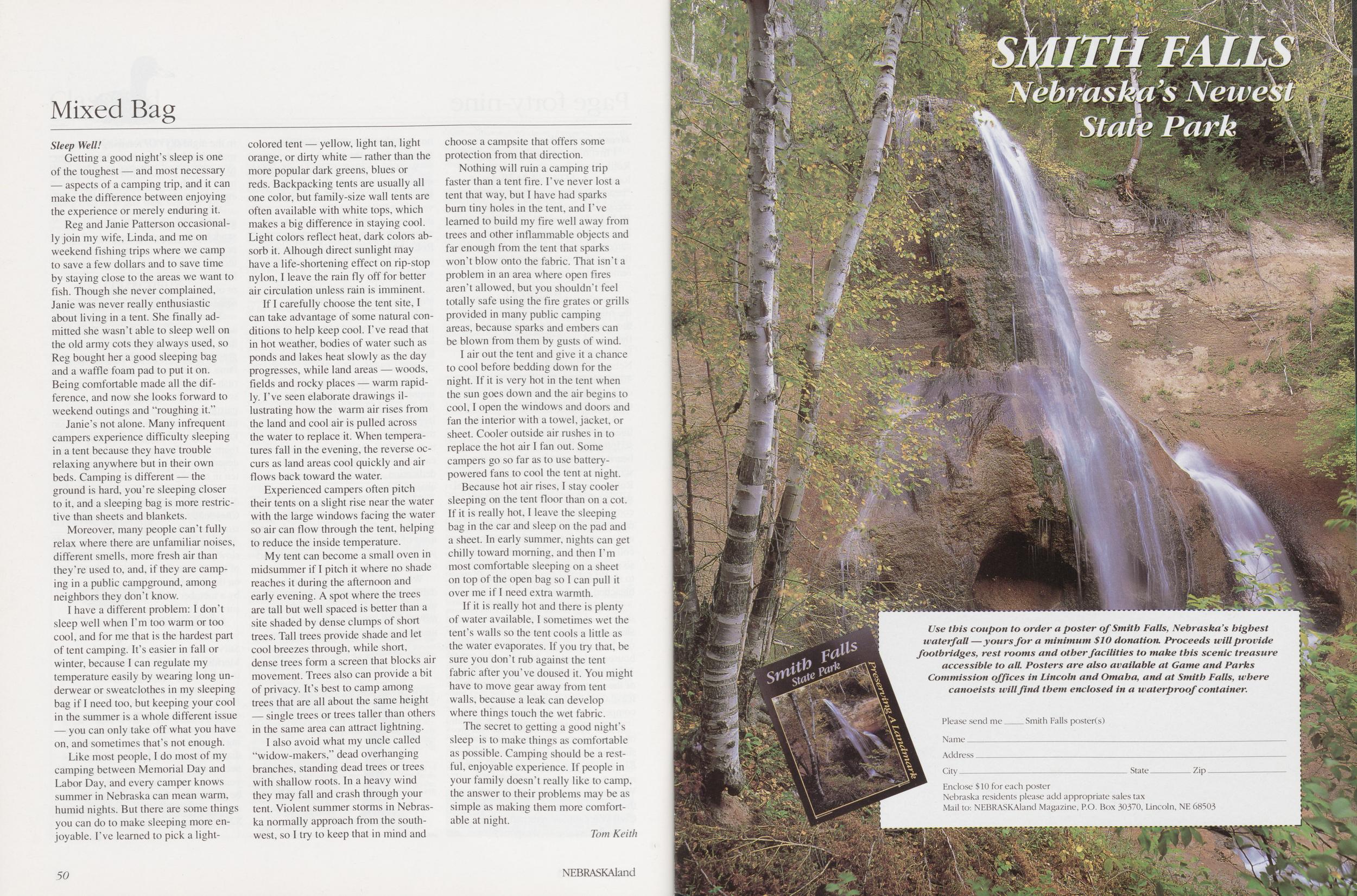
Mixed Bag
Sleep Well!Getting a good night's sleep is one of the toughest — and most necessary — aspects of a camping trip, and it can make the difference between enjoying the experience or merely enduring it.
Reg and Janie Patterson occasionally join my wife, Linda, and me on weekend fishing trips where we camp to save a few dollars and to save time by staying close to the areas we want to fish. Though she never complained, Janie was never really enthusiastic about living in a tent. She finally admitted she wasn't able to sleep well on the old army cots they always used, so Reg bought her a good sleeping bag and a waffle foam pad to put it on. Being comfortable made all the difference, and now she looks forward to weekend outings and "roughing it."
Janie's not alone. Many infrequent campers experience difficulty sleeping in a tent because they have trouble relaxing anywhere but in their own beds. Camping is different — the ground is hard, you're sleeping closer to it, and a sleeping bag is more restrictive than sheets and blankets.
Moreover, many people can't fully relax where there are unfamiliar noises, different smells, more fresh air than they're used to, and, if they are camping in a public campground, among neighbors they don't know.
I have a different problem: I don't sleep well when I'm too warm or too cool, and for me that is the hardest part of tent camping. It's easier in fall or winter, because I can regulate my temperature easily by wearing long underwear or sweatclothes in my sleeping bag if I need too, but keeping your cool in the summer is a whole different issue — you can only take off what you have on, and sometimes that's not enough.
Like most people, I do most of my camping between Memorial Day and Labor Day, and every camper knows summer in Nebraska can mean warm, humid nights. But there are some things you can do to make sleeping more enjoyable. I've learned to pick a light-colored tent — yellow, light tan, light orange, or dirty white — rather than the more popular dark greens, blues or reds. Backpacking tents are usually all one color, but family-size wall tents are often available with white tops, which makes a big difference in staying cool. Light colors reflect heat, dark colors absorb it. Although direct sunlight may have a life-shortening effect on rip-stop nylon, I leave the rain fly off for better air circulation unless rain is imminent.
If I carefully choose the tent site, I can take advantage of some natural conditions to help keep cool. I've read that in hot weather, bodies of water such as ponds and lakes heat slowly as the day progresses, while land areas — woods, fields and rocky places — warm rapidly. I've seen elaborate drawings illustrating how the warm air rises from the land and cool air is pulled across the water to replace it. When temperatures fall in the evening, the reverse occurs as land areas cool quickly and air flows back toward the water.
Experienced campers often pitch their tents on a slight rise near the water with the large windows facing the water so air can flow through the tent, helping to reduce the inside temperature.
My tent can become a small oven in midsummer if I pitch it where no shade reaches it during the afternoon and early evening. A spot where the trees are tall but well spaced is better than a site shaded by dense clumps of short trees. Tall trees provide shade and let cool breezes through, while short, dense trees form a screen that blocks air movement. Trees also can provide a bit of privacy. It's best to camp among trees that are all about the same height — single trees or trees taller than others in the same area can attract lightning.
I also avoid what my uncle called "widow-makers," dead overhanging branches, standing dead trees or trees with shallow roots. In a heavy wind they may fall and crash through your tent. Violent summer storms in Nebraska normally approach from the southwest, so I try to keep that in mind and choose a campsite that offers some protection from that direction.
Nothing will ruin a camping trip faster than a tent fire. I've never lost a tent that way, but I have had sparks bum tiny holes in the tent, and I've learned to build my fire well away from trees and other inflammable objects and far enough from the tent that sparks won't blow onto the fabric. That isn't a problem in an area where open fires aren't allowed, but you shouldn't feel totally safe using the fire grates or grills provided in many public camping areas, because sparks and embers can be blown from them by gusts of wind.
I air out the tent and give it a chance to cool before bedding down for the night. If it is very hot in the tent when the sun goes down and the air begins to cool, I open the windows and doors and fan the interior with a towel, jacket, or sheet. Cooler outside air rushes in to replace the hot air I fan out. Some campers go so far as to use battery-powered fans to cool the tent at night.
Because hot air rises, I stay cooler sleeping on the tent floor than on a cot. If it is really hot, I leave the sleeping bag in the car and sleep on the pad and a sheet. In early summer, nights can get chilly toward morning, and then I'm most comfortable sleeping on a sheet on top of the open bag so I can pull it over me if I need extra warmth.
If it is really hot and there is plenty of water available, I sometimes wet the tent's walls so the tent cools a little as the water evaporates. If you try that, be sure you don't rub against the tent fabric after you've doused it. You might have to move gear away from tent walls, because a leak can develop where things touch the wet fabric.
The secret to getting a good night's sleep is to make things as comfortable as possible. Camping should be a restful, enjoyable experience. If people in your family doesn't really like to camp, the answer to their problems may be as simple as making them more comfortable at night.
Tom Keith 50 NEBRASKAland
Position: 583 (19 views)