Volume 71, Issue 3, 1993
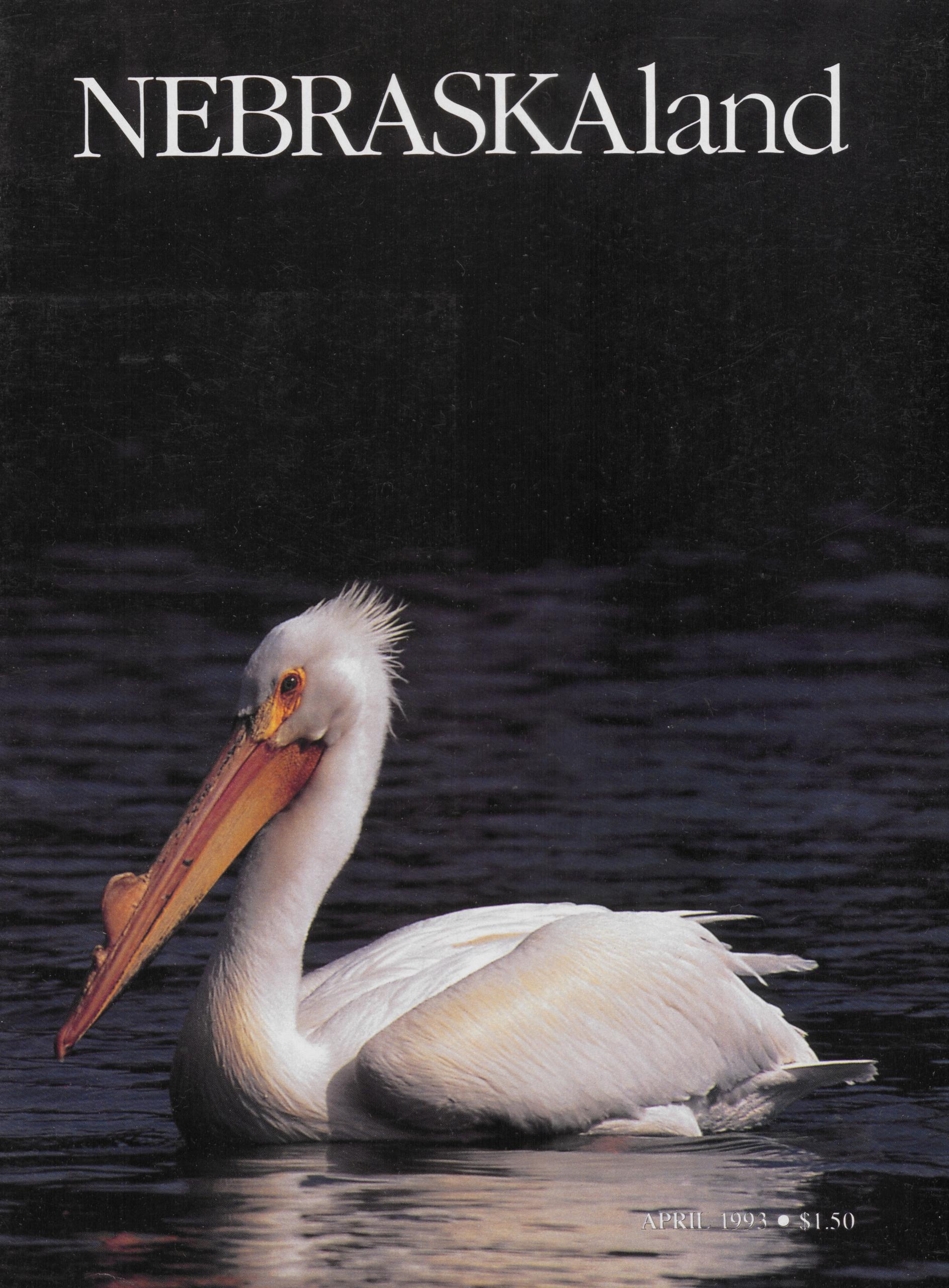
NEBRASKAland
April 1993 $1.50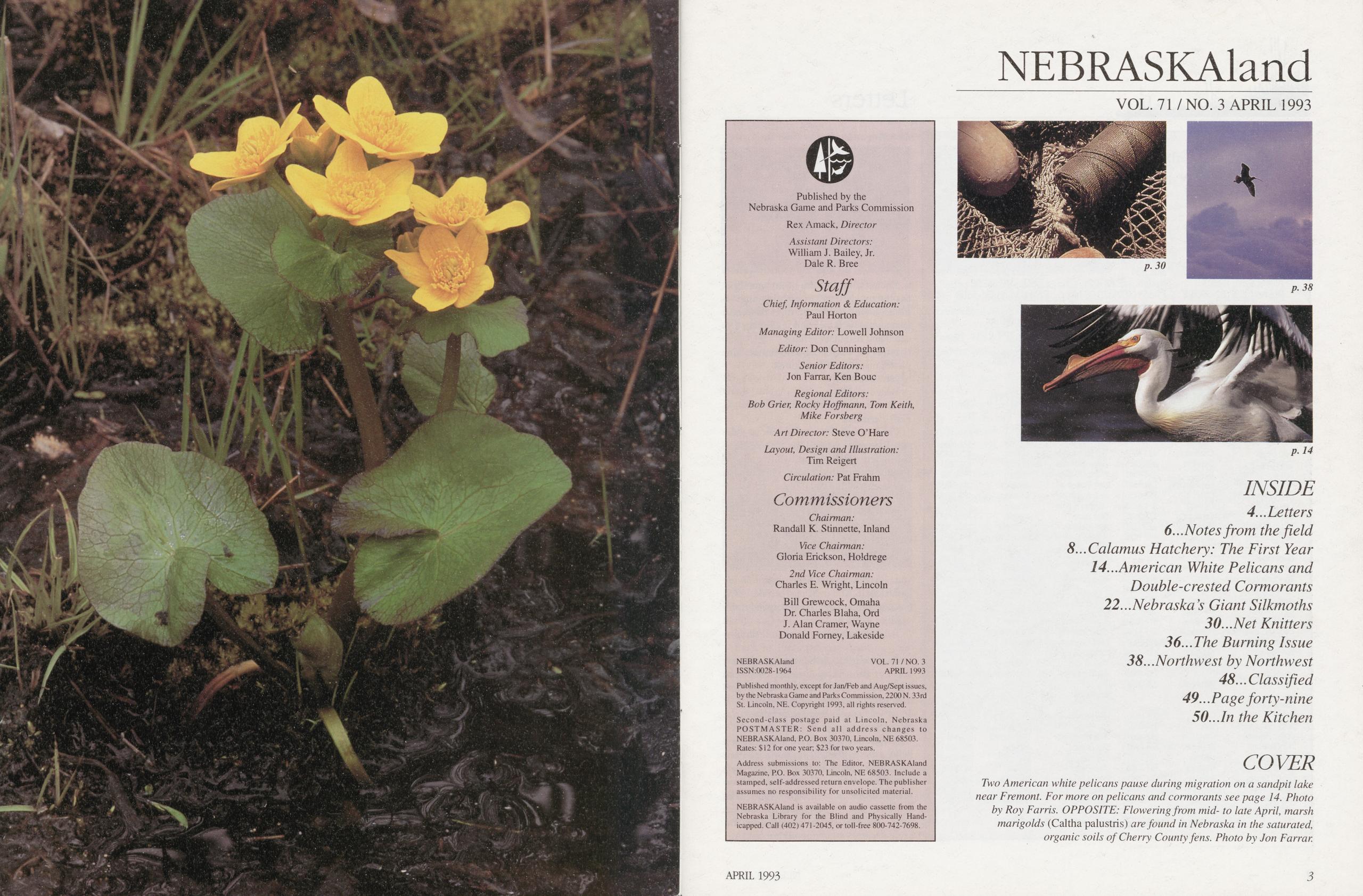
Letters
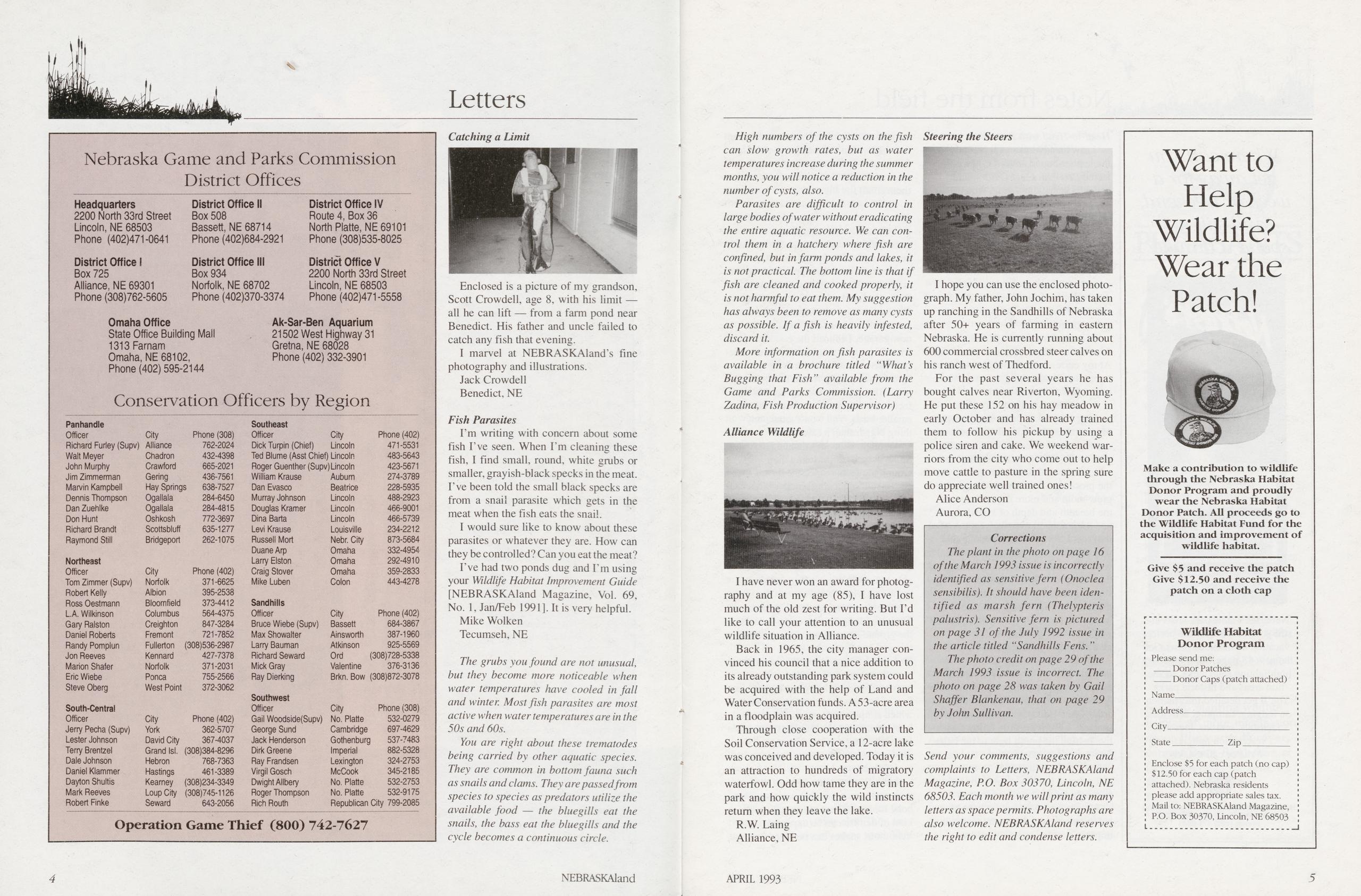
Catching a LimitEnclosed is a picture of my grandson, Scott Crowdell, age 8, with his limit — all he can lift — from a farm pond near Benedict. His father and uncle failed to catch any fish that evening. I marvel at NEBRASKAland’s fine photography and illustrations.
Jack CrowdellBenedict, NE Fish Parasites
I’m writing with concern about some fish I've seen. When I’m cleaning these fish, I find small, round, white grubs or smaller, grayish-black specks in the meat. I’ve been told the small black specks are from a snail parasite which gets in the meat when the fish eats the snail.
I would sure like to know about these parasites or whatever they are. How can they be controlled? Can you eat the meat?
I’ve had two ponds dug and I’m using your Wildlife Habitat Improvement Guide [NEBRASKAland Magazine, Vol. 69, No. 1, Jan/Feb 1991]. It is very helpful.
Mike WolkenTecumseh, NE The grubs you found are not unusual, but they become more noticeable when water temperatures have cooled in fall and winter. Most fish parasites are most active when water temperatures are in the 50s and 60s. You are right about these trematodes being carried by other aquatic species. They are common in bottom fauna such as snails and clams. They are passed from species to species as predators utilize the available food — the bluegills eat the snails, the bass eat the bluegills and the cycle becomes a continuous circle. High numbers of the cysts on the fish can slow growth rates, but as water temperatures increase during the summer months, you will notice a reduction in the number of cysts, also. Parasites are difficult to control in large bodies of water without eradicating the entire aquatic resource. We can con- trol them in a hatchery where fish are confined, but in farm ponds and lakes, it is not practical. The bottom line is that if fish are cleaned and cooked properly, it is not harmful to eat them. My suggestion has always been to remove as many cysts as possible. If a fish is heavily infested, discard it. More information on fish parasites is available in a brochure titled “What’s Bugging that Fish” available from the Game and Parks Commission. (Larry Zadina, Fish Production Supervisor) Alliance Wildlife
I have never won an award for photography and at my age (85), I have lost much of the old zest for writing. But I’d like to call your attention to an unusual wildlife situation in Alliance.
Back in 1965, the city manager convinced his council that a nice addition to its already outstanding park system could be acquired with the help of Land and Water Conservation funds. A 53-acre area in a floodplain was acquired.
Through close cooperation with the Soil Conservation Service, a 12-acre lake was conceived and developed. Today it is an attraction to hundreds of migratory waterfowl. Odd how tame they are in the park and how quickly the wild instincts return when they leave the lake.
R.W. LaingAlliance, NE Steering the Steers
I hope you can use the enclosed photograph. My father, John Jochim, has taken up ranching in the Sandhills of Nebraska after 50+ years of farming in eastern Nebraska. He is currently running about 600 commercial crossbred steer calves on his ranch west of Thedford.
For the past several years he has bought calves near Riverton, Wyoming. He put these 152 on his hay meadow in early October and has already trained them to follow his pickup by using a police siren and cake. We weekend warriors from the city who come out to help move cattle to pasture in the spring sure do appreciate well trained ones!
Alice AndersonAurora, CO
Notes from the field
Head-to-Head with PetersonI saw an advertisement recently for the leather-bound edition of the collected Peterson Field Guides, and caught a statement therein which caused my jaw to drop. There are over 40 of the guides now. I didn’t know there was that much stuff out there. There are guides to butterflies, trees, insects, coral reefs, the atmosphere, stars and planets and dozens of other subjects. I can think of only one thing they’ve missed, and I’m sure The Peterson Field Guide to Oldsmobiles is in galley proofs now.
I am working my way through the first, Eastern Birds. I am 40 years old. At my current rate, evolution will have necessitated reworkings of most of the others before I get to them.
I could have resigned myself to making only token dents in my shield of ignorance, but I decided instead to catalog what I already knew, so I could narrow my inquiry to those fields in which I showed particular opacity. As the process got underway, though, I grew more and more impressed with the breadth and depth of knowledge I had accumulated over the years. As you will see, I have not been passing this way with my eyes closed. Since I feel it would be selfish to hoard knowledge of this magnitude, I am herewith sharing some highlights before committing them to book form and going head-to-head with Peterson. Surely this preview will whet the public appetite and guarantee a large first edition.
Spiders. Few but the keenest and most diligent observers of nature are aware that the spider has the most finely honed sense of humor of all the arthropods. Hence, you will find that all species — from the little fellows who live behind the porch light to the hairy five-pounders that patrol the trees near your favorite fishing hole — take special pains to build webs in poor light at precisely the height of the human face.
My studies of the spider have also led me to suggest that people in their impressionable years (I consider myself, after brief reflection, to lie comfortably within that category) refrain from holding magnifying glasses to spiders’ heads. God, it turns out, made them small for a reason.
Opossums. Possums are bom, tongues out, on roads. They go immediately into hibernation and are eventually carried piecemeal to possum heaven by birds of prey.
Birds. There is no upper limit on the size of the birds which will frequent a backyard feeder. Just after installing my first, a redwood sunflower feeder that set me back just a little less than the new garage, I echoed the concern of a friend who said that bluejays were likely to drive the smaller birds away.
“Don’t worry,” my friend Debby told me. “Blue jays are too big for this feeder, so they won't be bothering the smaller birds. You won't attract anything bigger than a cardinal.”
Wrongo. Bluejays named Buck and Spike have been muscling their way around the feeder since the day of that conversation, kicking smaller birds to one side as they land. No bird that can chase a crow out of a tree is going to be intimidated by titmice and chickadees. Which brings me to the fact that there is a new species in the yard. Since Debby told me crows are likewise unable to use the feeder, I’ve got to assume that what I’ve got when the blue jays aren't around are black pelicans. They land long enough to tip seeds to the ground, then descend like pterodactyls and begin eating.
Snakes. These favorite outdoor creatures come in two varieties — the venomous, which kill you via the injection of poisons, and the non-venomous, which simply scare you to death, usually by overriding the circuits responsible for preventing weaknesses in your cardiovascular system from triggering its own failure.
Luckily, nature has imbued them with easily recognizable warning symbols, foolproof beacons signaling which kind of demise can be expected. Venomous snakes can be identified by the presence of a slightly triangular head, and of pupils which are vertical slits. It is obvious given these landmarks that even the most inexperienced amateur could tell one from the other at distances of up to five or six inches. This natural safety mechanism has a parallel in the situation in which mountain climbers draw on some apparently innate sense to predict whether or not a falling boulder will hit them, often with a quarter of a second or more to spare. Similarly, man-eating tigers and leopards are said to differ from their less threatening fellows by the addition of one extra stripe and spot, respectively.
Dogs. Wolves, coyotes and wild dogs are beautiful creatures. They are in perfect harmony with their surroundings, and their hauntingly mournful howls in the distance have always added a soul-stirring quality to the earth’s open places. In a few brief millennia, though, those same dogs, brought into close association with man, have been turned too often into annoyingly yappy nightowls which will bark for hours at imaginary objects. The best examples are always in your own neighborhood.
This brings us to Simbeck’s Theorum of Canine Vocal Tenacity: the loudness and duration of any dog’s bark increases in direct proportion to the square of its nearness to your bedroom window. A related theorum can be constructed by substituting songbirds for dogs. That, in turn, leads us to Simbeck fs Dictum Regarding Vocal Continuity, which posits that the last dog will fall asleep 30 seconds before the first bird awakens.
Game fish. Bass, trout and the like sleep approximately 99 percent of the time. This is an extrapolation based on the amount of energy provided by their diets. As a fisherman, I can tell you they feed only on extraordinarily rare occasions.
Frogs. Frogs are not calling for territory, love, or anything else. They are snoring. Listen closely some time. This does not apply, of course, to tree frogs, which imitate the sound of wrist watches being wound.
Crop maturation. If you have a large garden, the beans and corn will ripen the day before you leave on vacation.
Animal language. For five years a lone bald eagle wintered at the river near my trailer. This past winter there were two. How did old buddy Bert invite his ladyfriend to spend the holidays with him? What means of communication did he use for his request? Bees, of course, do the Charleston, using a series of leg swings and head bobs to get across everything from cross winds to baseball scores. With eagles, though, I am as yet in the dark.
I will leave off there, lest the lay reader be overwhelmed with technical detail. As you can see, the work in progress promises to be a major contribution to the body of serious natural literature, something sure to be in the possession of everyone wanting a more complete knowledge of the out-of-doors. Be sure to watch for it.
Rob Simbeck John James Audubon in NebraskaMay marks the 150th anniversary of celebrated artist and naturalist John James Audubon’s 1843 visit to Nebraska, an event being marked in a three- day celebration organized by the University of Nebraska-Lincoln Friends of the Library.
The event, to be held Thursday, May 13, through Sunday, May 16, features talks by art experts and historians, including descendents of Audubon, and offers field trips to the Joslyn Gallery in Omaha and Fontenelle Forest near Bellevue, which Audubon visited. It coincides with an exhibit and sale of Audubon prints at the Christiieb Gallery in Love Library on the UN-L campus. For more information, call Stephen Buhler, (402) 472-1784.
Next month’s NEBRASKAland will feature several of Audubon’s quadruped paintings in an article by UN-L Biological Sciences Professor James Rosowski.
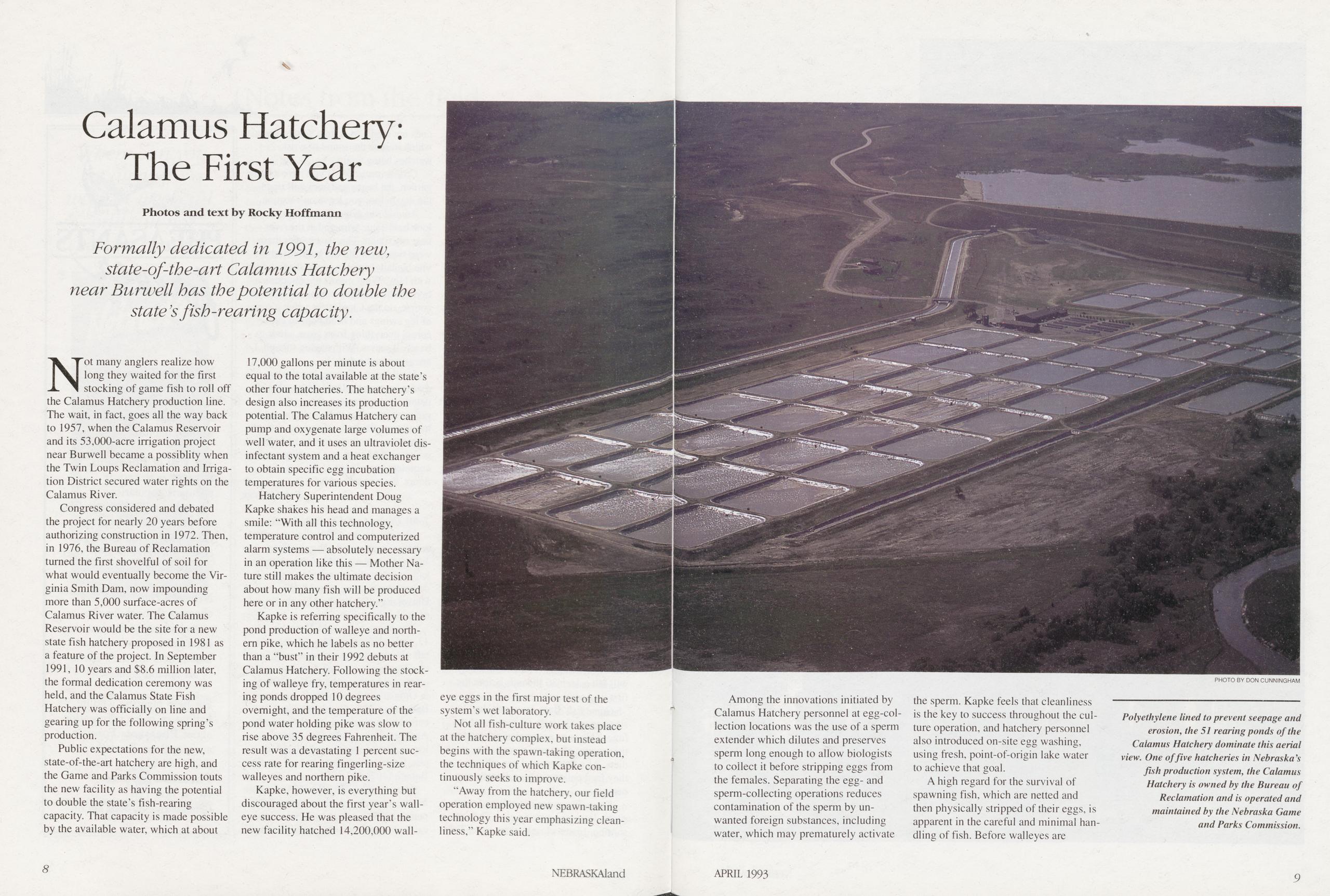
Calamus Hatchery: The First Year
Photos and text by Rocky Hoffmann Formally dedicated in 1991, the new, state-of-the-art Calamus Hatchery’ near Burwell has the potential to double the state’s fish-rearing capacity.Not many anglers realize how long they waited for the first stocking of game fish to roll off the Calamus Hatchery production line. The wait, in fact, goes all the way back to 1957, when the Calamus Reservoir and its 53,000-acre irrigation project near Burwell became a possiblity when the Twin Coups Reclamation and Irrigation District secured water rights on the Calamus River.
Congress considered and debated the project for nearly 20 years before authorizing construction in 1972. Then, in 1976, the Bureau of Reclamation turned the first shovelful of soil for what would eventually become the Virginia Smith Dam, now impounding more than 5,000 surface-acres of Calamus River water. The Calamus Reservoir would be the site for a new state fish hatchery proposed in 1981 as a feature of the project. In September 1991, 10 years and $8.6 million later, the formal dedication ceremony was held, and the Calamus State Fish Hatchery was officially on line and gearing up for the following spring’s production.
Public expectations for the new, state-of-the-art hatchery are high, and the Game and Parks Commission touts the new facility as having the potential to double the state’s fish-rearing capacity. That capacity is made possible by the available water, which at about 17,000 gallons per minute is about equal to the total available at the state’s other four hatcheries. The hatchery’s design also increases its production potential. The Calamus Hatchery can pump and oxygenate large volumes of well water, and it uses an ultraviolet disinfectant system and a heat exchanger to obtain specific egg incubation temperatures for various species.
Hatchery Superintendent Doug Kapke shakes his head and manages a smile: “With all this technology, temperature control and computerized alarm systems — absolutely necessary in an operation like this — Mother Nature still makes the ultimate decision about how many fish will be produced here or in any other hatchery.”
Kapke is referring specifically to the pond production of walleye and northern pike, which he labels as no better than a “bust” in their 1992 debuts at Calamus Hatchery. Following the stocking of walleye fry, temperatures in rear- ing ponds dropped 10 degrees overnight, and the temperature of the pond water holding pike was slow to rise above 35 degrees Fahrenheit. The result was a devastating 1 percent success rate for rearing fingerling-size walleyes and northern pike.
Kapke, however, is everything but discouraged about the first year’s walleye success. He was pleased that the new facility hatched 14,200,000 walleye eggs in the first major test of the system’s wet laboratory.
Not all fish-culture work takes place at the hatchery complex, but instead begins with the spawn-taking operation, the techniques of which Kapke continuously seeks to improve.
“Away from the hatchery, our field operation employed new spawn-taking technology this year emphasizing cleanliness,” Kapke said.
Among the innovations initiated by Calamus Hatchery personnel at egg-collection locations was the use of a sperm extender which dilutes and preserves sperm long enough to allow biologists to collect it before stripping eggs from the females. Separating the egg- and sperm-collecting operations reduces contamination of the sperm by unwanted foreign substances, including water, which may prematurely activate the sperm. Kapke feels that cleanliness is the key to success throughout the culture operation, and hatchery personnel also introduced on-site egg washing, using fresh, point-of-origin lake water to achieve that goal.
A high regard for the survival of spawning fish, which are netted and then physically stripped of their eggs, is apparent in the careful and minimal handling of fish. Before walleyes are
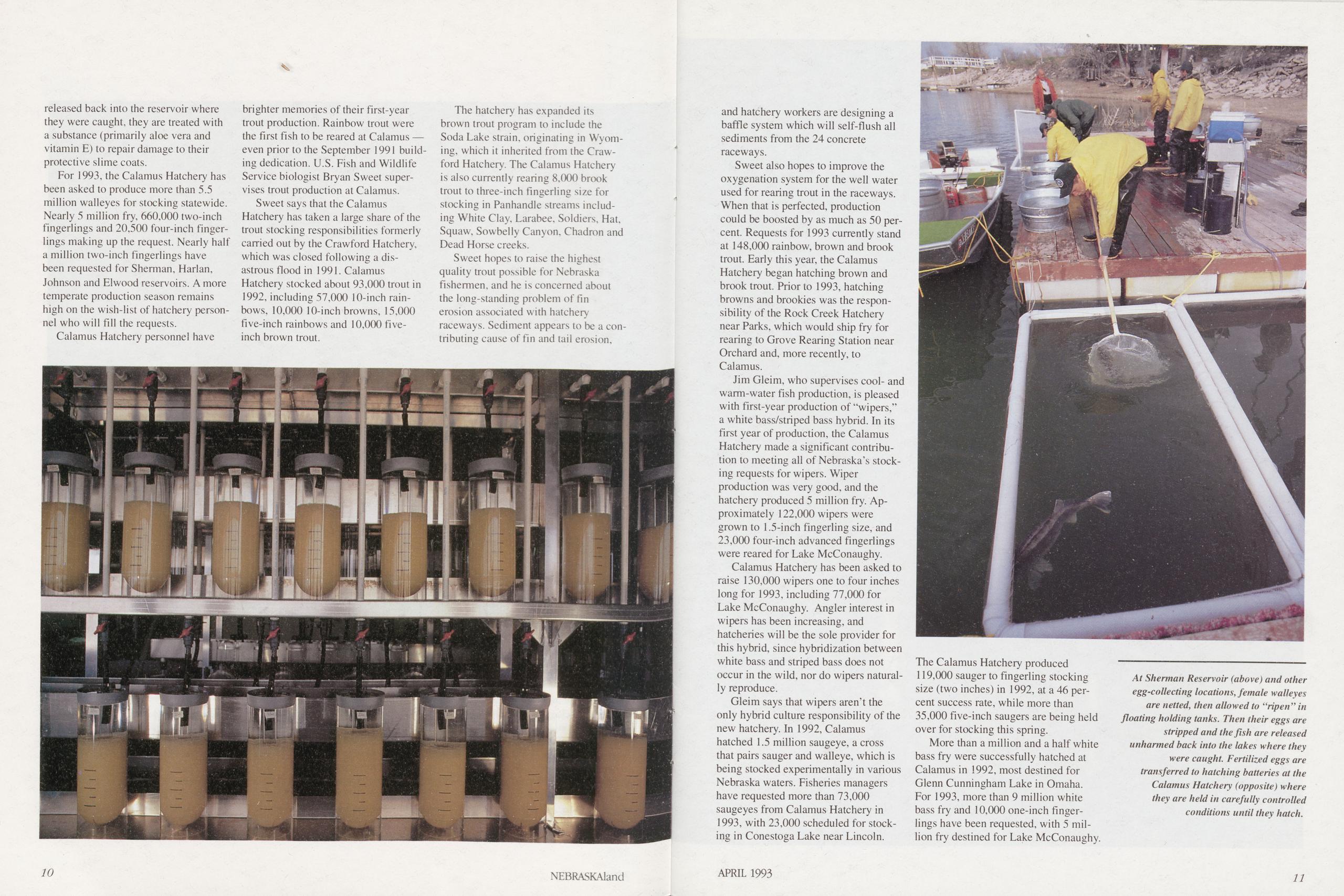
released back into the reservoir where they were caught, they are treated with a substance (primarily aloe vera and vitamin E) to repair damage to their protective slime coats.
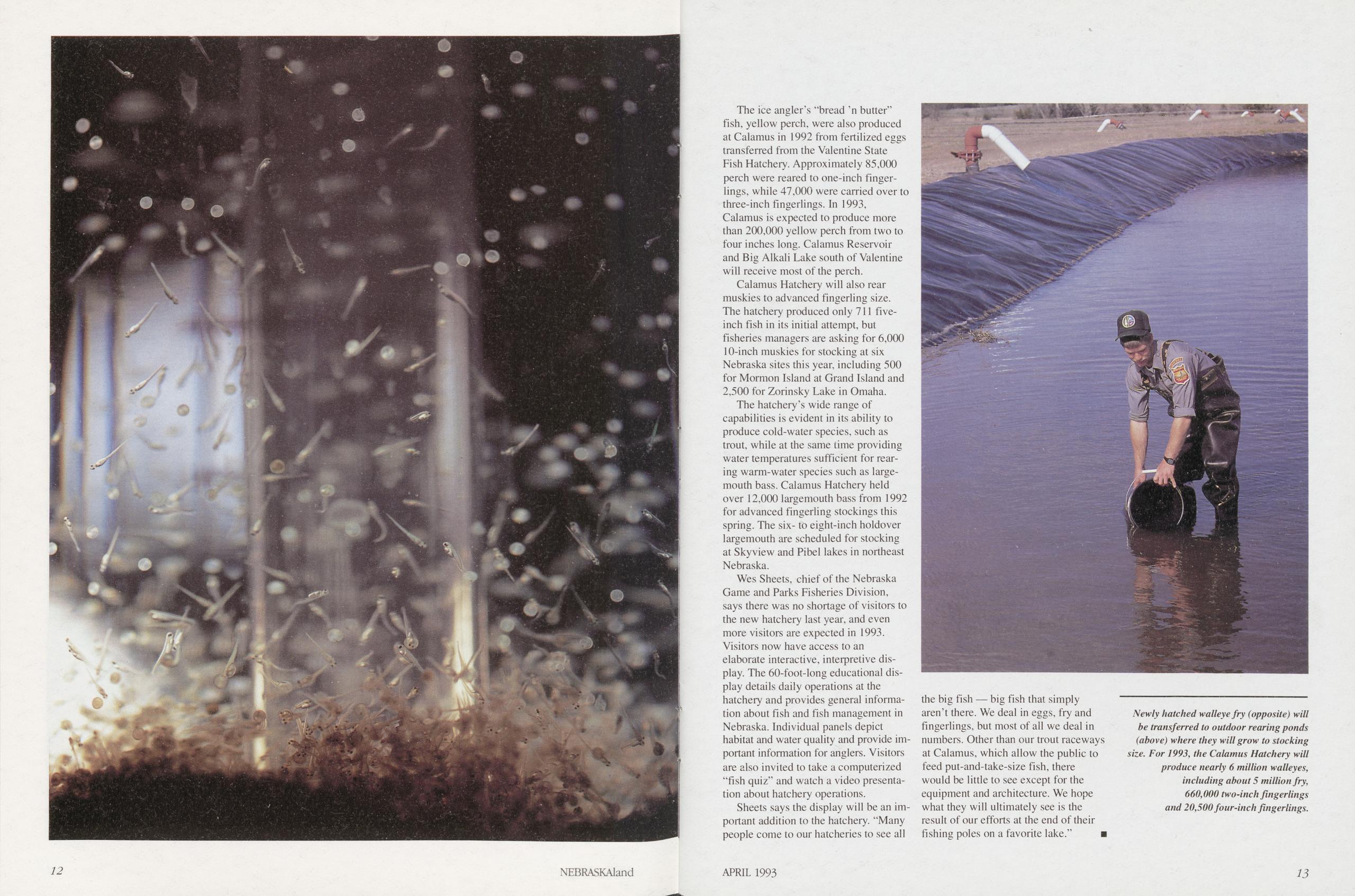
For 1993, the Calamus Hatchery has been asked to produce more than 5.5 million walleyes for stocking statewide. Nearly 5 million fry, 660,000 two-inch fingerlings and 20,500 four-inch fingerlings making up the request. Nearly half a million two-inch fingerlings have been requested for Sherman, Harlan, Johnson and Elwood reservoirs. A more temperate production season remains high on the wish-list of hatchery personnel who will fill the requests.
Calamus Hatchery personnel have brighter memories of their first-year trout production. Rainbow trout were the first fish to be reared at Calamus — even prior to the September 1991 building dedication. U.S. Fish and Wildlife Service biologist Bryan Sweet supervises trout production at Calamus.
Sweet says that the Calamus Hatchery has taken a large share of the trout stocking responsibilities formerly carried out by the Crawford Hatchery, which was closed following a disastrous flood in 1991. Calamus Hatchery stocked about 93,000 trout in 1992, including 57,000 10-inch rainbows, 10,000 10-inch browns, 15,000 five-inch rainbows and 10,000 five-inch brown trout.
The hatchery has expanded its brown trout program to include the Soda Lake strain, originating in Wyoming, which it inherited from the Crawford Hatchery. The Calamus Hatchery is also currently rearing 8,000 brook trout to three-inch fingerling size for stocking in Panhandle streams including White Clay, Larabee, Soldiers, Hat, Squaw, Sowbelly Canyon. Chadron and Dead Horse creeks.
Sweet hopes to raise the highest quality trout possible for Nebraska fishermen, and he is concerned about the long-standing problem of fin erosion associated with hatchery raceways. Sediment appears to be a contributing cause of fin and tail erosion, and hatchery workers are designing a baffle system which will self-flush all sediments from the 24 concrete raceways.
Sweet also hopes to improve the oxygenation system for the well water used for rearing trout in the raceways. When that is perfected, production could be boosted by as much as 50 percent. Requests for 1993 currently stand at 148,000 rainbow, brown and brook trout. Early this year, the Calamus Hatchery began hatching brown and brook trout. Prior to 1993, hatching browns and brookies was the responsibility of the Rock Creek Hatchery near Parks, which would ship fry for rearing to Grove Rearing Station near Orchard and, more recently, to Calamus.
Jim Gleim, who supervises cool- and warm-water fish production, is pleased with first-year production of “wipers,” a white bass/striped bass hybrid. In its first year of production, the Calamus Hatchery made a significant contribution to meeting all of Nebraska’s stocking requests for wipers. Wiper production was very good, and the hatchery produced 5 million fry. Approximately 122,000 wipers were grown to 1.5-inch fingerling size, and 23,000 four-inch advanced fingerlings were reared for Lake McConaughy.
Calamus Hatchery has been asked to raise 130,000 wipers one to four inches long for 1993, including 77,000 for Lake McConaughy. Angler interest in wipers has been increasing, and hatcheries will be the sole provider for this hybrid, since hybridization between white bass and striped bass does not occur in the wild, nor do wipers naturally reproduce.
Gleim says that wipers aren’t the only hybrid culture responsibility of the new hatchery. In 1992, Calamus hatched 1.5 million saugeye, a cross that pairs sauger and walleye, which is being stocked experimentally in various Nebraska waters. Fisheries managers have requested more than 73,000 saugeyes from Calamus Hatchery in 1993, with 23,000 scheduled for stocking in Conestoga Lake near Lincoln.
The Calamus Hatchery produced 119,000 sauger to fingerling stocking size (two inches) in 1992, at a 46 percent success rate, while more than 35,000 five-inch saugers are being held over for stocking this spring.
More than a million and a half white bass fry were successfully hatched at Calamus in 1992, most destined for Glenn Cunningham Lake in Omaha. For 1993, more than 9 million white bass fry and 10,000 one-inch fingerlings have been requested, with 5 million fry destined for Lake McConaughy.
The ice angler’s “bread ’n butter” fish, yellow perch, were also produced at Calamus in 1992 from fertilized eggs transferred from the Valentine State Fish Hatchery. Approximately 85,000 perch were reared to one-inch fingerlings, while 47,000 were carried over to three-inch fingerlings. In 1993, Calamus is expected to produce more than 200,000 yellow perch from two to four inches long. Calamus Reservoir and Big Alkali Lake south of Valentine will receive most of the perch.
Calamus Hatchery will also rear muskies to advanced fingerling size. The hatchery produced only 711 five- inch fish in its initial attempt, but fisheries managers are asking for 6,000 10-inch muskies for stocking at six Nebraska sites this year, including 500 for Mormon Island at Grand Island and 2,500 for Zorinsky Lake in Omaha.
The hatchery’s wide range of capabilities is evident in its ability to produce cold-water species, such as trout, while at the same time providing water temperatures sufficient for rearing warm-water species such as large-mouth bass. Calamus Hatchery held over 12,000 largemouth bass from 1992 for advanced fingerling stockings this spring. The six- to eight-inch holdover largemouth are scheduled for stocking at Skyview and Libel lakes in northeast Nebraska.
Wes Sheets, chief of the Nebraska Game and Parks Fisheries Division, says there was no shortage of visitors to the new hatchery last year, and even more visitors are expected in 1993. Visitors now have access to an elaborate interactive, interpretive display. The 60-foot-long educational display details daily operations at the hatchery and provides general information about fish and fish management in Nebraska. Individual panels depict habitat and water quality and provide important information for anglers. Visitors are also invited to take a computerized “fish quiz” and watch a video presentation about hatchery operations.
Sheets says the display will be an important addition to the hatchery. “Many people come to our hatcheries to see all the big fish — big fish that simply aren’t there. We deal in eggs, fry and fingerlings, but most of all we deal in numbers. Other than our trout raceways at Calamus, which allow the public to feed put-and-take-size fish, there would be little to see except for the equipment and architecture. We hope what they will ultimately see is the result of our efforts at the end of their fishing poles on a favorite lake.”
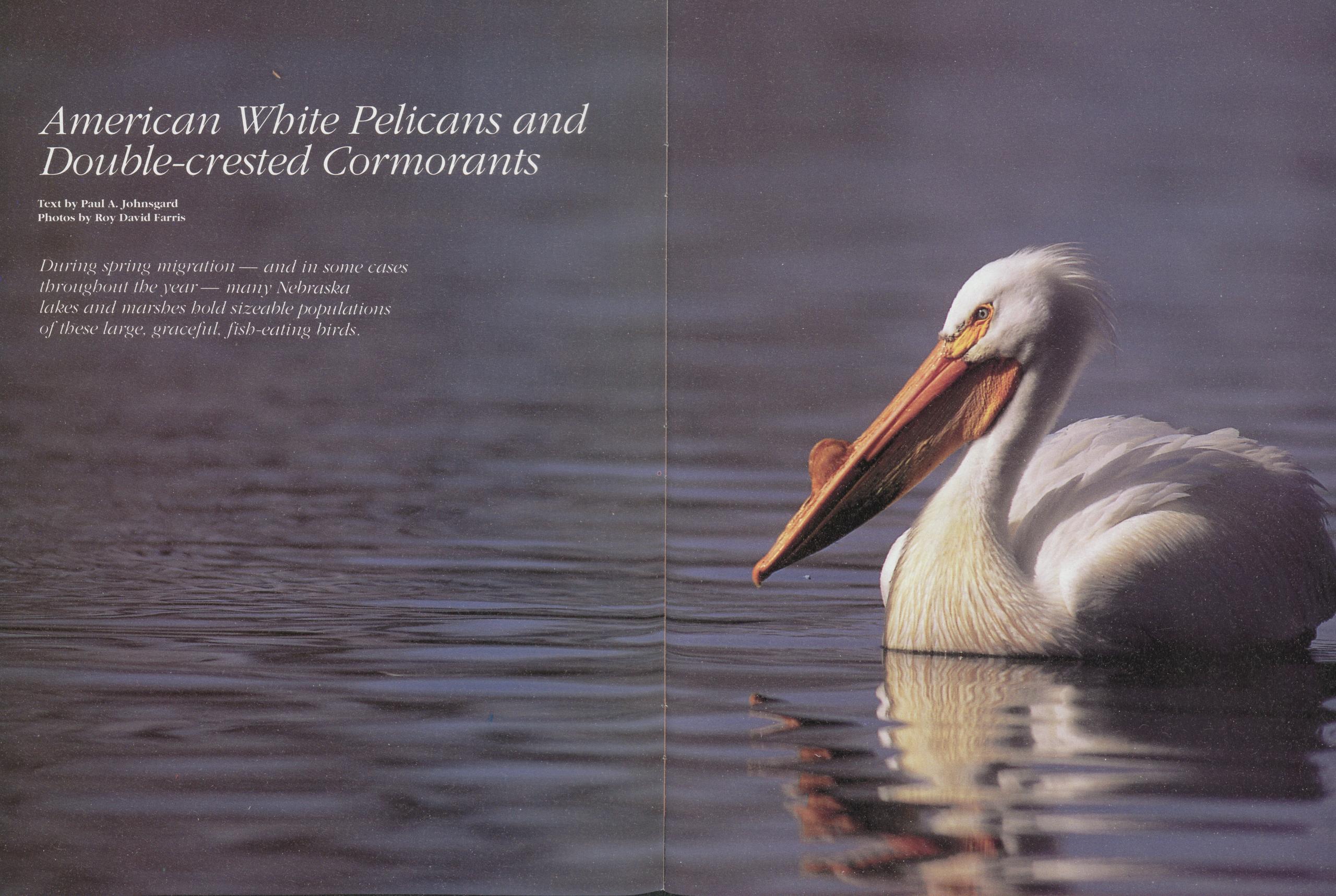
American White Pelicans and Double-crested Cormorants
Text by Paul A. JohnsgardPhotos by Roy David Farris During spring in ignition — and in some cases throughout the year— many Nebraska lakes and marshes hold sizeable populations of these large, graceful, fish-eating birds.
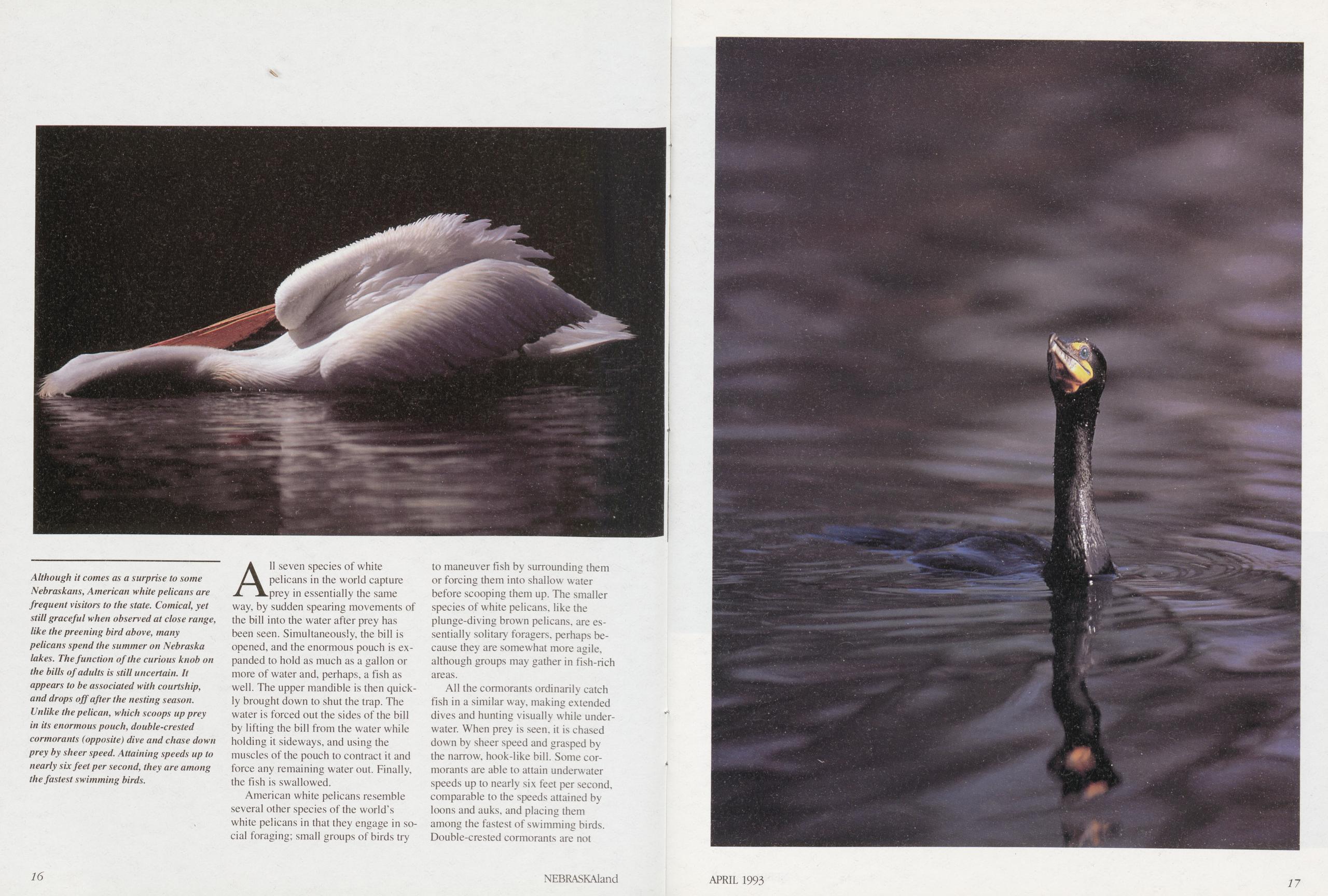
All seven species of white pelicans in the world capture prey in essentially the same way, by sudden spearing movements of the bill into the water after prey has been seen. Simultaneously, the bill is opened, and the enormous pouch is expanded to hold as much as a gallon or more of water and, perhaps, a fish as well. The upper mandible is then quickly brought down to shut the trap. The water is forced out the sides of the bill by lifting the bill from the water while holding it sideways, and using the muscles of the pouch to contract it and force any remaining water out. Finally, the fish is swallowed.
American white pelicans resemble several other species of the world’s white pelicans in that they engage in social foraging; small groups of birds try to maneuver fish by surrounding them or forcing them into shallow water before scooping them up. The smaller species of white pelicans, like the plunge-diving brown pelicans, are essentially solitary foragers, perhaps because they are somewhat more agile, although groups may gather in fish-rich areas.
All the cormorants ordinarily catch fish in a similar way, making extended dives and hunting visually while underwater. When prey is seen, it is chased down by sheer speed and grasped by the narrow, hook-like bill. Some cormorants are able to attain underwater speeds up to nearly six feet per second, comparable to the speeds attained by loons and auks, and placing them among the fastest of swimming birds. Double-crested cormorants are not
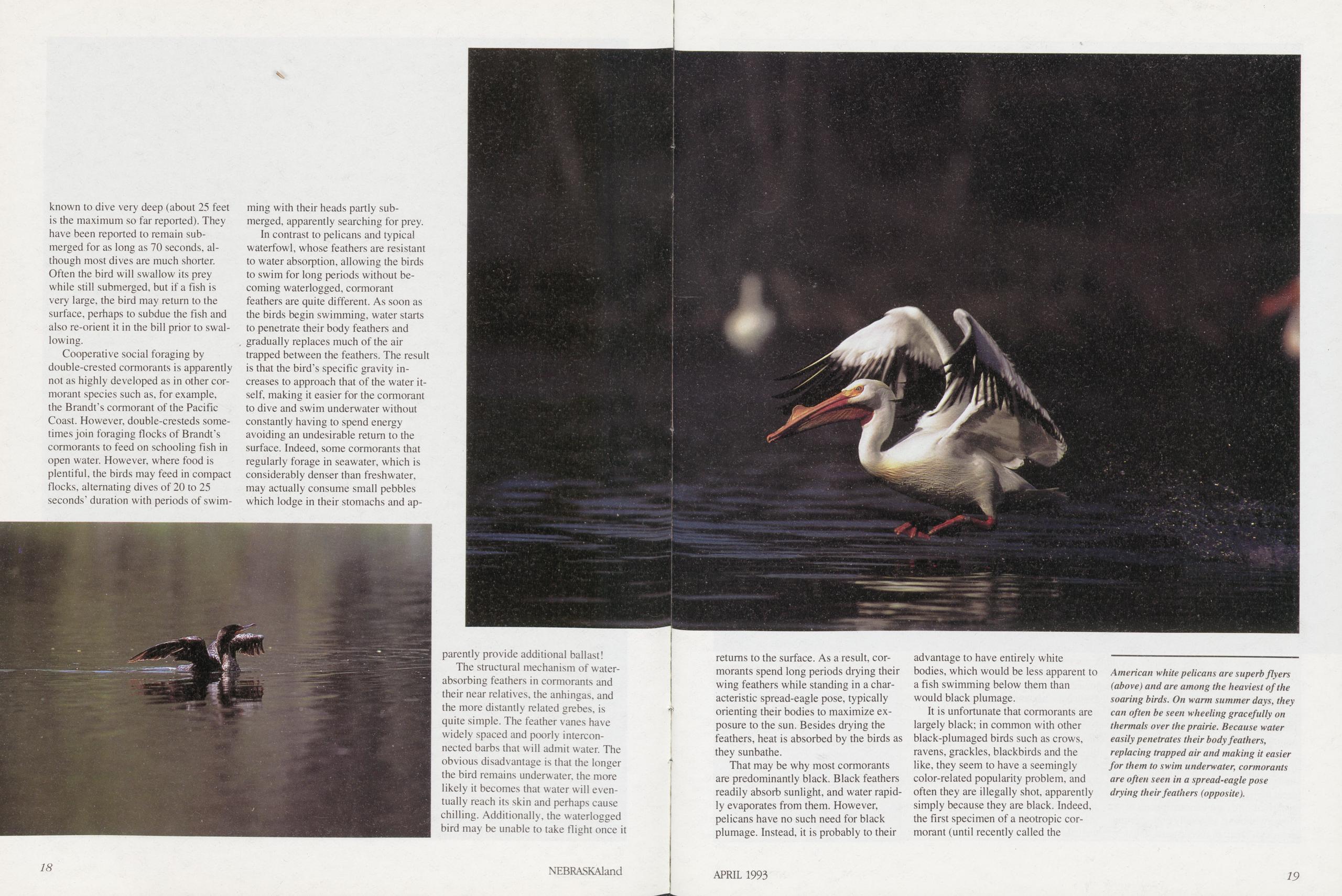
known to dive very deep (about 25 feet is the maximum so far reported). They have been reported to remain submerged for as long as 70 seconds, although most dives are much shorter. Often the bird will swallow its prey while still submerged, but if a fish is very large, the bird may return to the surface, perhaps to subdue the fish and also re-orient it in the bill prior to swallowing.
Cooperative social foraging by double-crested cormorants is apparently not as highly developed as in other cormorant species such as, for example, the Brandt’s cormorant of the Pacific Coast. However, double-cresteds sometimes join foraging flocks of Brandt's cormorants to feed on schooling fish in open water. However, where food is plentiful, the birds may feed in compact flocks, alternating dives of 20 to 25 seconds’ duration with periods of swimming with their heads partly submerged, apparently searching for prey.
In contrast to pelicans and typical waterfowl, whose feathers are resistant to water absorption, allowing the birds to swim for long periods without becoming waterlogged, cormorant feathers are quite different. As soon as the birds begin swimming, water starts to penetrate their body feathers and gradually replaces much of the air trapped between the feathers. The result is that the bird’s specific gravity increases to approach that of the water itself, making it easier for the cormorant to dive and swim underwater without constantly having to spend energy avoiding an undesirable return to the surface. Indeed, some cormorants that regularly forage in seawater, which is considerably denser than freshwater, may actually consume small pebbles which lodge in their stomachs and apparently provide additional ballast!
The structural mechanism of water-absorbing feathers in cormorants and their near relatives, the anhingas, and the more distantly related grebes, is 1 quite simple. The feather vanes have widely spaced and poorly interconnected barbs that will admit water. The obvious disadvantage is that the longer the bird remains underwater, the more likely it becomes that water will eventually reach its skin and perhaps cause chilling. Additionally, the waterlogged bird may be unable to take flight once it returns to the surface. As a result, cormorants spend long periods drying their wing feathers while standing in a characteristic spread-eagle pose, typically orienting their bodies to maximize exposure to the sun. Besides drying the feathers, heat is absorbed by the birds as they sunbathe.
That may be why most cormorants are predominantly black. Black feathers readily absorb sunlight, and water rapidly evaporates from them. However, pelicans have no such need for black plumage. Instead, it is probably to their advantage to have entirely white bodies, which would be less apparent to a fish swimming below them than would black plumage.
It is unfortunate that cormorants are largely black; in common with other black-plumaged birds such as crows, ravens, grackles, blackbirds and the like, they seem to have a seemingly color-related popularity problem, and often they are illegally shot, apparently simply because they are black. Indeed, the first specimen of a neotropic cormorant (until recently called the
olivaceus cormorant) recorded in Nebraska was a bird which had been shot and was fortuitously picked up and preserved by a sharp-eyed Game and Parks Commission biologist during the autumn of 1982.
It is also true that cormorants, even more than pelicans, often run afoul of sport fishing interests, even though the great majority of fishes eaten by both groups of birds are various species of slow-swimming, generally non-sporting or “rough” fish. In recent years, the development of catfish farming in the lower Mississippi Valley, especially in Louisiana, has attracted tens of thousands of wintering double-crested cormorants to these convenient fast- food locations, causing a great deal of displeasure and economic loss for local fish farmers. Perhaps its rich supply of foods for wintering cormorants has contributed to the recent surge in the species’ continental population, which in some areas, is increasing at a rate well above 10 percent annually.
Paul A. Johnsgard is Foundation Professor of Life Sciences at the University of Nebraska, Lincoln. Among his many ornithological publications is Cormorants, Darters and Pelicans of the World soon to be released by the Smithsonian Institution Press, Washington, D.C. Professor Johnsgard was profiled in the March issue of NEBRASKAland Magazine. Roy David Farris, Fremont. Neb., freelance photographer, is a frequent contributor to NEBRASKAland Magazine.The View from the Blind
By Roy David FarrisHere, they came, from the east, flying downwind. They made a big “one-eighty” and came gliding back into the wind, dropped their gear and made a nice, soft touch-down. “They” were about 30 big, beautiful American white pelicans stopping off in eastern Nebraska during their spring migration flight up to the Dakotas or farther north for the breeding season — but they reminded me of the slow-flying, lumbering Lancaster bombers our British allies flew during the war
My friend Ralph had called: “Hey, Roy — the pelicans are in. Do you want to photograph them?” Do I want to photograph them? Does a bear cavort in the woods? There are more than 60 “sandpit” lakes around Fremont, remnants of the mining of construction sand and gravel which has taken place along the Platte River for most of this century. In spring, usually beginning sometime in February with common mergansers, mallards and eagles, the bird migrations through Nebraska are wonderful to behold, and the sandpit lakes attract a wide variety of species. Most of the birds are in their spring breeding plumage, the males sporting bright, bold female-attracting colors.
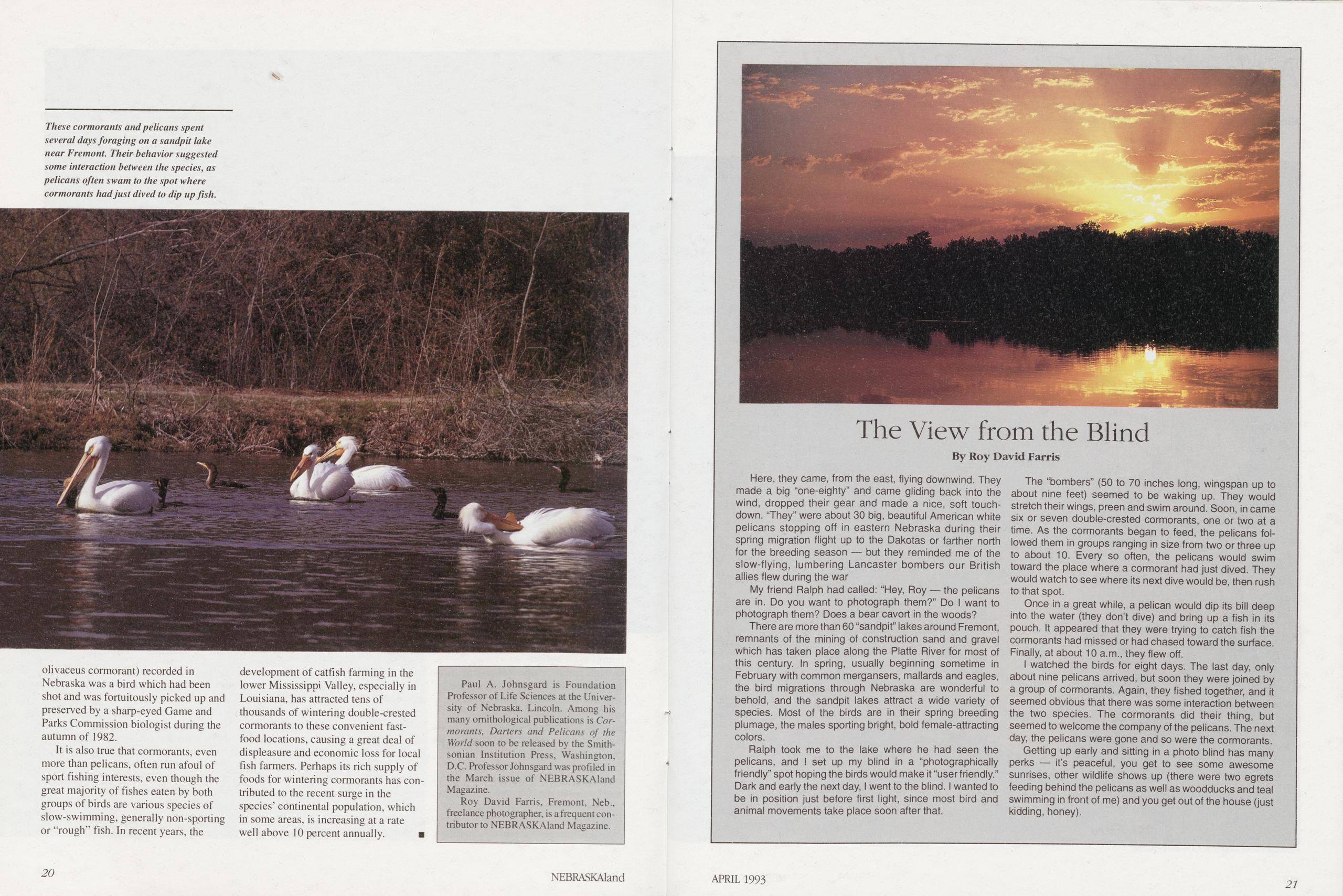
Ralph took me to the lake where he had seen the pelicans, and I set up my blind in a “photographically friendly” spot hoping the birds would make it “user friendly.” Dark and early the next day, I went to the blind. I wanted to be in position just before first light, since most bird and animal movements take place soon after that. The “bombers” (50 to 70 inches long, wingspan up to about nine feet) seemed to be waking up. They would stretch their wings, preen and swim around. Soon, in came six or seven double-crested cormorants, one or two at a time. As the cormorants began to feed, the pelicans followed them in groups ranging in size from two or three up to about 10. Every so often, the pelicans would swim toward the place where a cormorant had just dived. They would watch to see where its next dive would be, then rush to that spot.
Once in a great while, a pelican would dip its bill deep into the water (they don’t dive) and bring up a fish in its pouch. It appeared that they were trying to catch fish the cormorants had missed or had chased toward the surface. Finally, at about 10 a.m., they flew off.
I watched the birds for eight days. The last day, only about nine pelicans arrived, but soon they were joined by a group of cormorants. Again, they fished together, and it seemed obvious that there was some interaction between the two species. The cormorants did their thing, but seemed to welcome the company of the pelicans. The next day, the pelicans were gone and so were the cormorants.
Getting up early and sitting in a photo blind has many perks — it’s peaceful, you get to see some awesome sunrises, other wildlife shows up (there were two egrets feeding behind the pelicans as well as woodducks and teal swimming in front of me) and you get out of the house (just kidding, honey).
20 NEBRASKAland APRIL 1993 21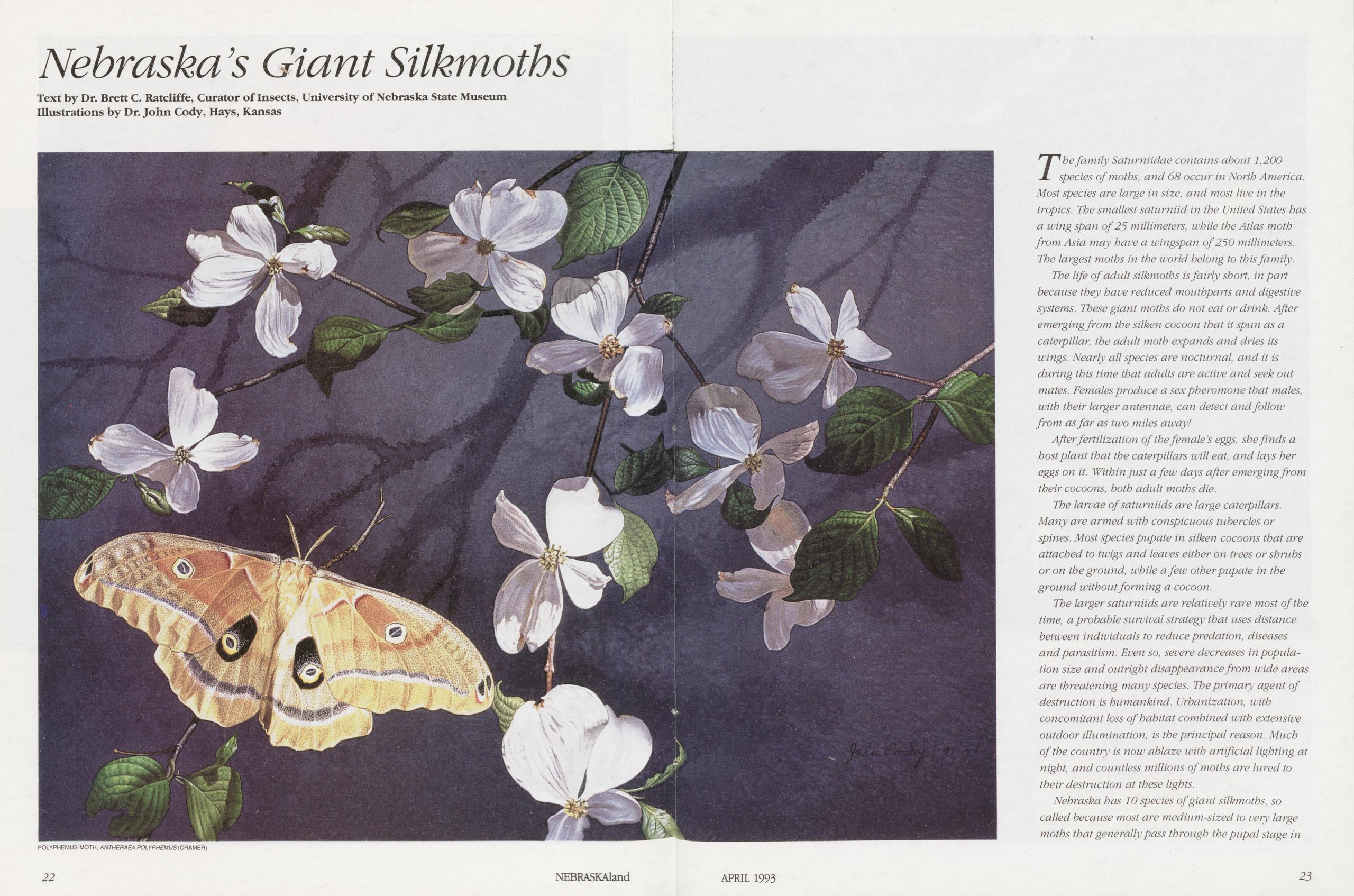
Nebraska’s Giant Silkmoths
Text by Dr. Brett C. Ratcliffe, Curator of Insects, University of Nebraska State MuseumIllustrations by Dr. John Cody, Hays, Kansas
The family Saturniidae contains about 1,200 species of moths, and 68 occur in North America. Most species are large in size, and most live in the tropics. The smallest saturniid in the United States has a wing span of 25 millimeters, while the Atlas moth from Asia may have a wingspan of250 millimeters.
The largest moths in the world belong to this family. The life of adult silkmoths is fairly short, in part because they have reduced mouthparts and digestive systems. These giant moths do not eat or drink. After emerging from the silken cocoon that it spun as a caterpillar, the adult moth expands and dries its wings. Nearly all species are nocturnal, and it is during this time that adults are active and seek out mates. Females produce a sex pheromone that males, with their larger antennae, can detect and follow from as far as two miles away!
After fertilization of the female’s eggs, she finds a host plant that the caterpillars will eat, and lays her eggs on it. Within just a few days after emerging from their cocoons, both adult moths die.
The larvae of saturniids are large caterpillars. Many are armed with conspicuous tubercles or spines. Most species pupate in silken cocoons that are attached to twigs and leaves either on trees or shrubs or on the ground, while a few other pupate in the ground without forming a cocoon.
The larger saturniids are relatively rare most of the time, a probable survival strategy that uses distance between individuals to reduce predation, diseases and parasitism. Even so, severe decreases in population size and outright disappearance from wide areas are threatening many species. The primary agent of destruction is humankind. Urbanization, with concomitant loss of habitat combined with extensive outdoor illumination, is the principal reason. Much of the country is now ablaze with artificial lighting at night, and countless millions of moths are lured to their destruction at these lights.
Nebraska has 10 species of giant silkmoths, so called because most are medium-sized to very large moths that generally pass through the pupal stage in
22 NEBRASKAland APRIL 1993 23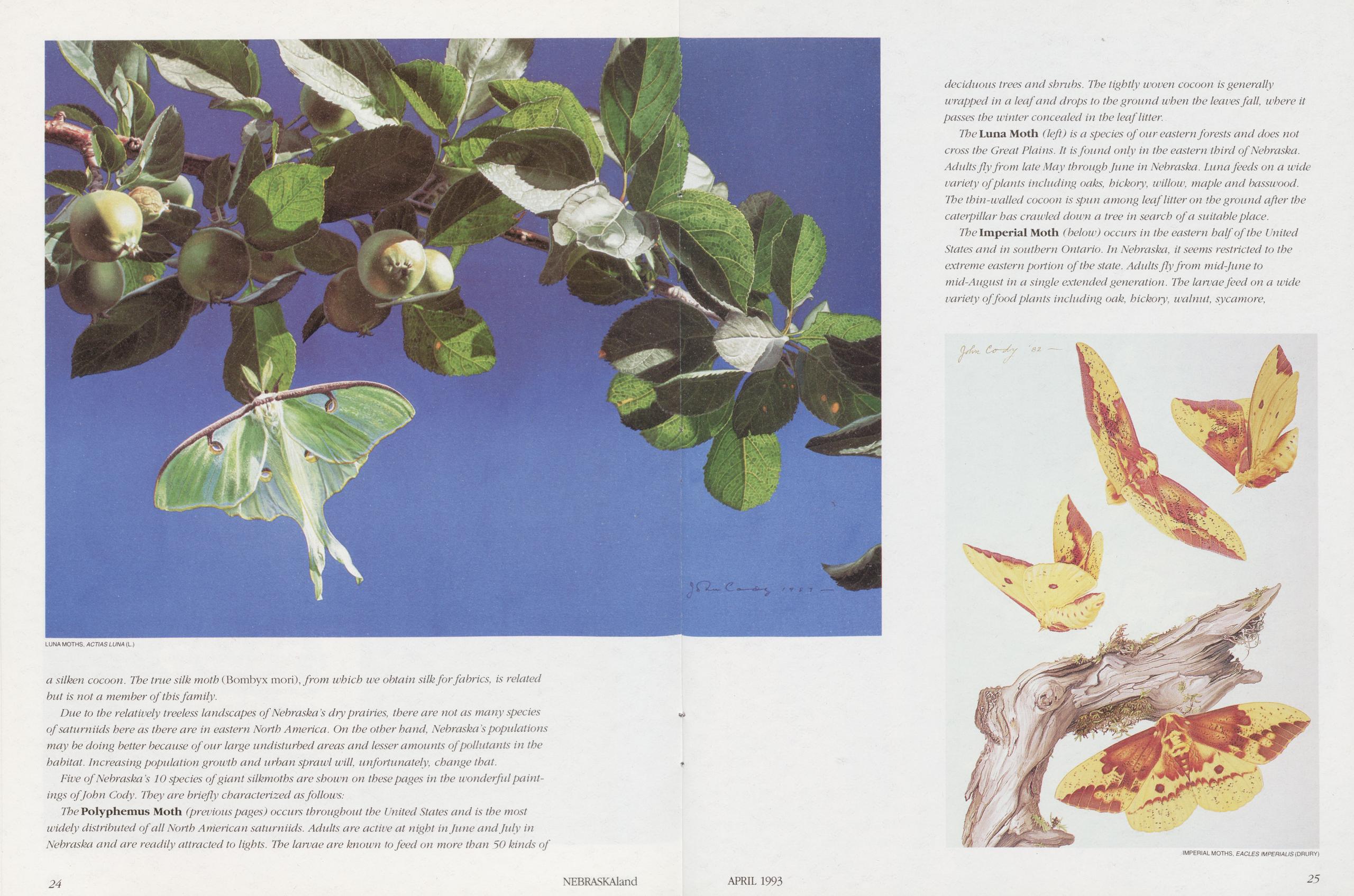
a silken cocoon. The true silk moth (Bombyx mori), from which we obtain silk for fabrics, is related but is not a member of this family.
Due to the relatively treeless landscapes of Nebraska s dry prairies, there are not as many species of saturniids here as there are in eastern North America. On the other hand, Nebraska spopulations may be doing better because of our large undisturbed areas and lesser amounts ofpollutants in the habitat. Increasing population growth and urban sprawl will, unfortunately, change that. Five of Nebraska’s 10 species of giant silkmoths are shown on these pages in the wonderful paint- ings ofJohn Cody. They are briefly characterized as follows:
The Polyphemus Moth (previouspages) occurs throughout the United States and is the most widely distributed of all North American saturniids. Adults are active at night in June and July in Nebraska and are readily attracted to lights. The larvae are known to feed on more than 50 kinds ofdeciduous trees and shrubs. The tightly woven cocoon is generally wrapped in a leaf and drops to the ground when the leaves fall, where it passes the winter concealed in the leaf litter.
The Luna Moth (left) is a species of our eastern forests and does not cross the Great Plains. It is found only in the eastern third of Nebraska. Adults fly from late May through June in Nebraska. Luna feeds on a wide variety of plants including oaks, hickory, willow, maple and basswood. The thin-walled cocoon is spun among leaf litter on the ground after the caterpillar has crawled down a tree in search of a suitable place.
The Imperial Moth (below) occurs in the eastern half of the United States and in southern Ontario. In Nebraska, it seems restricted to the extreme eastern portion of the state. Adults fly from mid-June to mid-August in a single extended generation. The larvae feed on a wide variety of food plants including oak, hickory, walnut, sycamore,
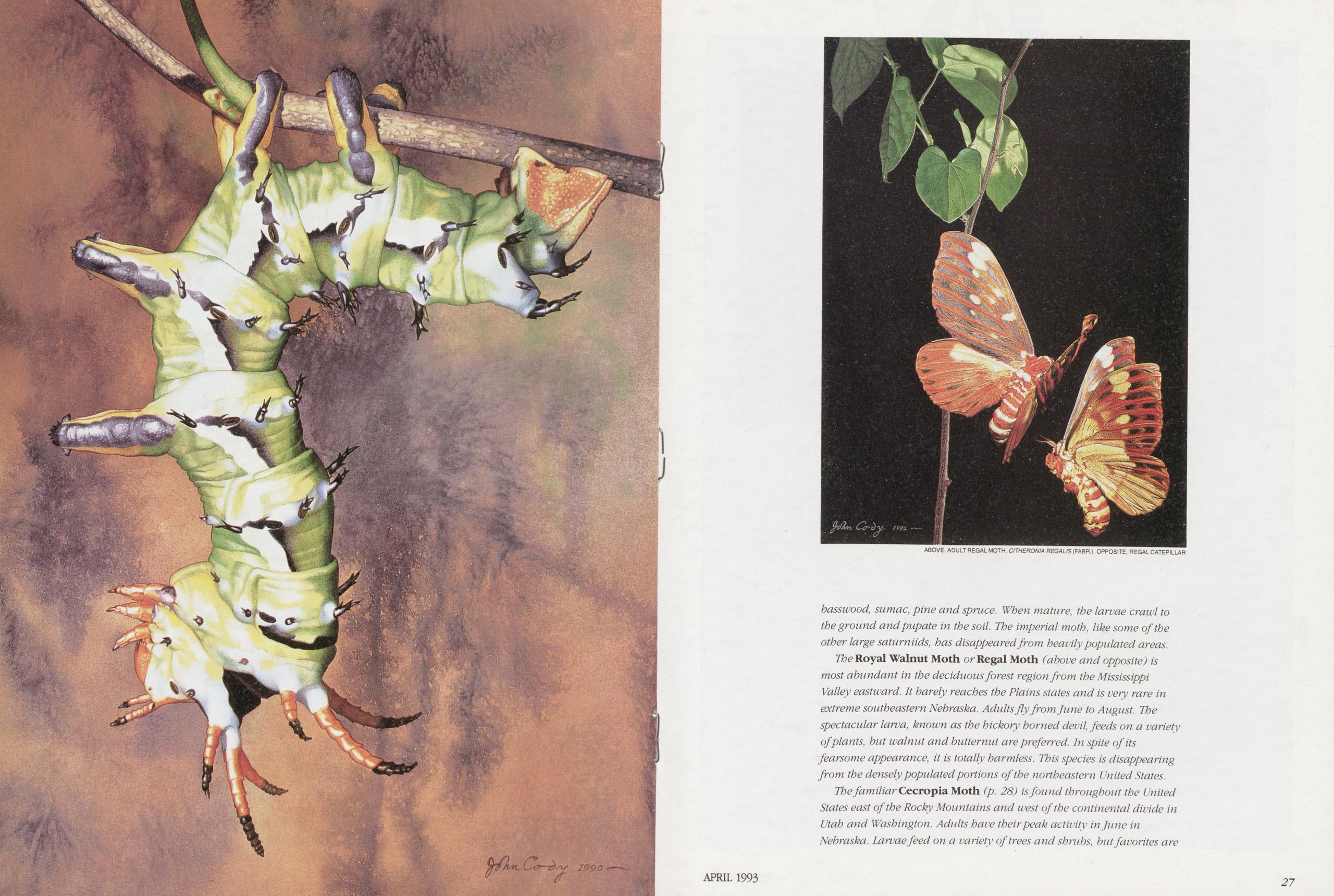
basswood, sumac, pine and spruce. When mature, the larvae crawl to the ground and pupate in the soil. The imperial moth, like some of the other large saturniids, has disappeared from heavily populated areas.
The Royal Walnut Moth or Regal Moth (above and opposite) is most abundant in the deciduous forest region from the Mississippi Valley eastward. It barely reaches the Plains states and is very rare in extreme southeastern Nebraska. Adults fly from June to August. The spectacular larva, known as the hickory horned devil, feeds on a variety of plants, but walnut and butternut are preferred. In spite of its fearsome appearance, it is totally harmless. This species is disappearing from the densely populated portions of the northeastern United States.
The familiar Cecropia Moth (p. 28) is found throughout the United States east of the Rocky Mountains and west of the continental divide in Utah and Washington. Adults have their peak activity in June in Nebraska. Larvae feed on a variety of trees and shrubs, but favorites are
APRIL 1993 27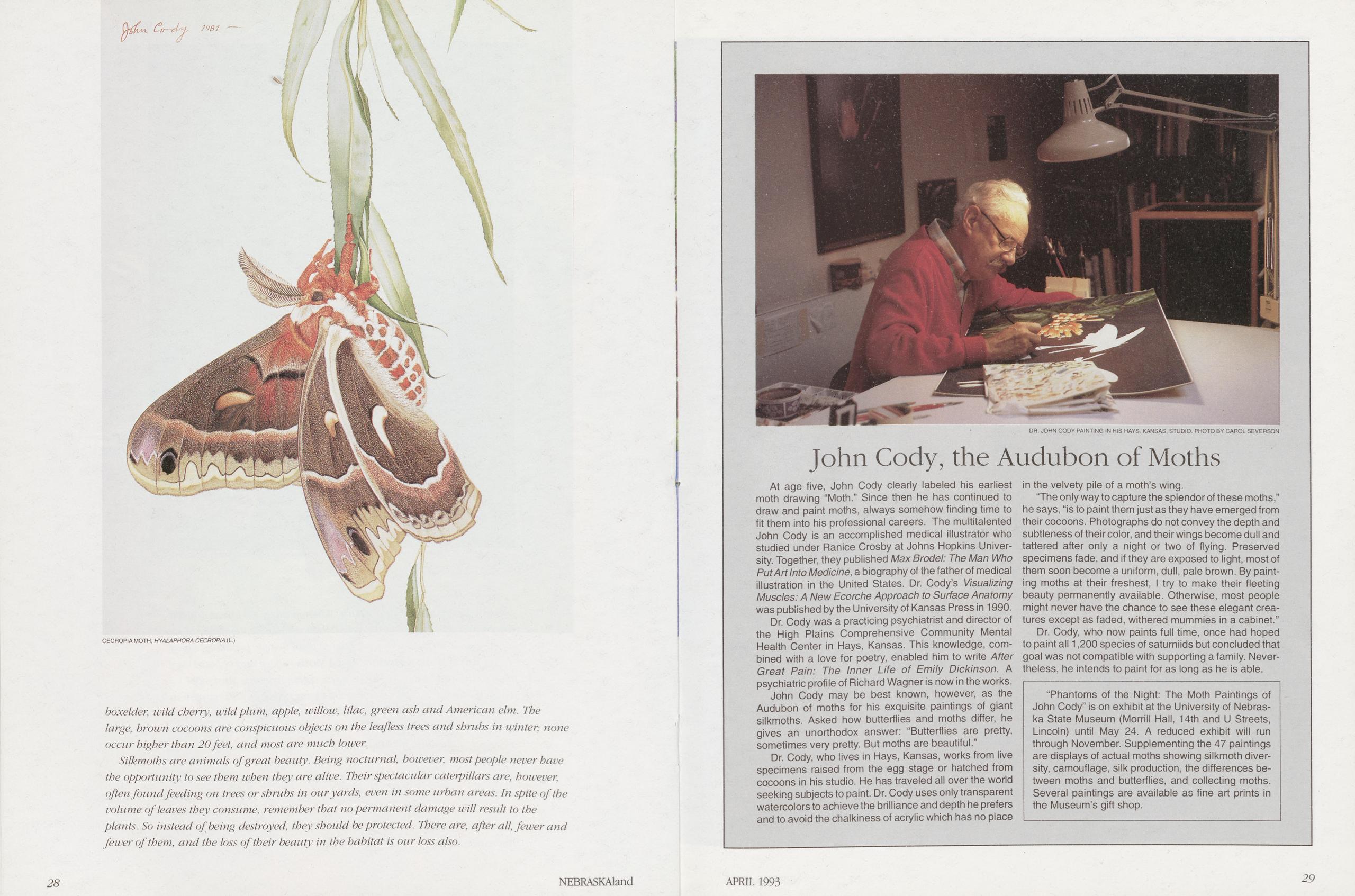
boxelder, wild cherry, wild plum, apple, willow, lilac, green ash and American elm. The large, brown cocoons are conspicuous objects on the leafless trees and shrubs in winter;• none occur higher than 20 feet, and most are much lower.
Silkmoths are animals of great beauty. Being nocturnal, however, most people never have the opportunity to see them when they are alive. Their spectacular caterpillars are, however, often found feeding on trees or sh nibs in our yards, even in some urban areas. In spite of the volume of leaves they consume, remember that no permanent damage will result to the plants. So instead of being destroyed, they should be protected. There are, after all, fewer and fewer of them, and the loss of their beauty in the habitat is our loss also.
John Cody, the Audubon of Moths
At age five, John Cody clearly labeled his earliest moth drawing “Moth.” Since then he has continued to draw and paint moths, always somehow finding time to fit them into his professional careers. The multitalented John Cody is an accomplished medical illustrator who studied under Banice Crosby at Johns Hopkins University. Together, they published Max Brodel: The Man Who Put Art Into Medicine, a biography of the father of medical illustration in the United States. Dr. Cody’s Visualizing Muscles: A New Ecorche Approach to Surface Anatomy was published by the University of Kansas Press in 1990.
Dr. Cody was a practicing psychiatrist and director of the High Plains Comprehensive Community Mental Health Center in Hays, Kansas. This knowledge, combined with a love for poetry, enabled him to write After Great Pain: The Inner Life of Emily Dickinson. A psychiatric profile of Richard Wagner is now in the works.
John Cody may be best known, however, as the Audubon of moths for his exquisite paintings of giant silkmoths. Asked how butterflies and moths differ, he gives an unorthodox answer: “Butterflies are pretty, sometimes very pretty. But moths are beautiful.”
Dr. Cody, who lives in Hays, Kansas, works from live specimens raised from the egg stage or hatched from cocoons in his studio. He has traveled all over the world seeking subjects to paint. Dr. Cody uses only transparent watercolors to achieve the brilliance and depth he prefers and to avoid the chalkiness of acrylic which has no place in the velvety pile of a moth’s wing.
“The only way to capture the splendor of these moths,” he says, “is to paint them just as they have emerged from their cocoons. Photographs do not convey the depth and subtleness of their color, and their wings become dull and tattered after only a night or two of flying. Preserved specimens fade, and if they are exposed to light, most of them soon become a uniform, dull, pale brown. By painting moths at their freshest, I try to make their fleeting beauty permanently available. Otherwise, most people might never have the chance to see these elegant creatures except as faded, withered mummies in a cabinet.” Dr. Cody, who now paints full time, once had hoped to paint all 1,200 species of saturniids but concluded that goal was not compatible with supporting a family. Nevertheless, he intends to paint for as long as he is able.
“Phantoms of the Night: The Moth Paintings of John Cody” is on exhibit at the University of Nebraska State Museum (Morrill Hall, 14th and U Streets, Lincoln) until May 24. A reduced exhibit will run through November. Supplementing the 47 paintings are displays of actual moths showing silkmoth diversity, camouflage, silk production, the differences between moths and butterflies, and collecting moths. Several paintings are available as fine art prints in the Museum’s gift shop. 28 NEBRASKAland APRIL 1993 29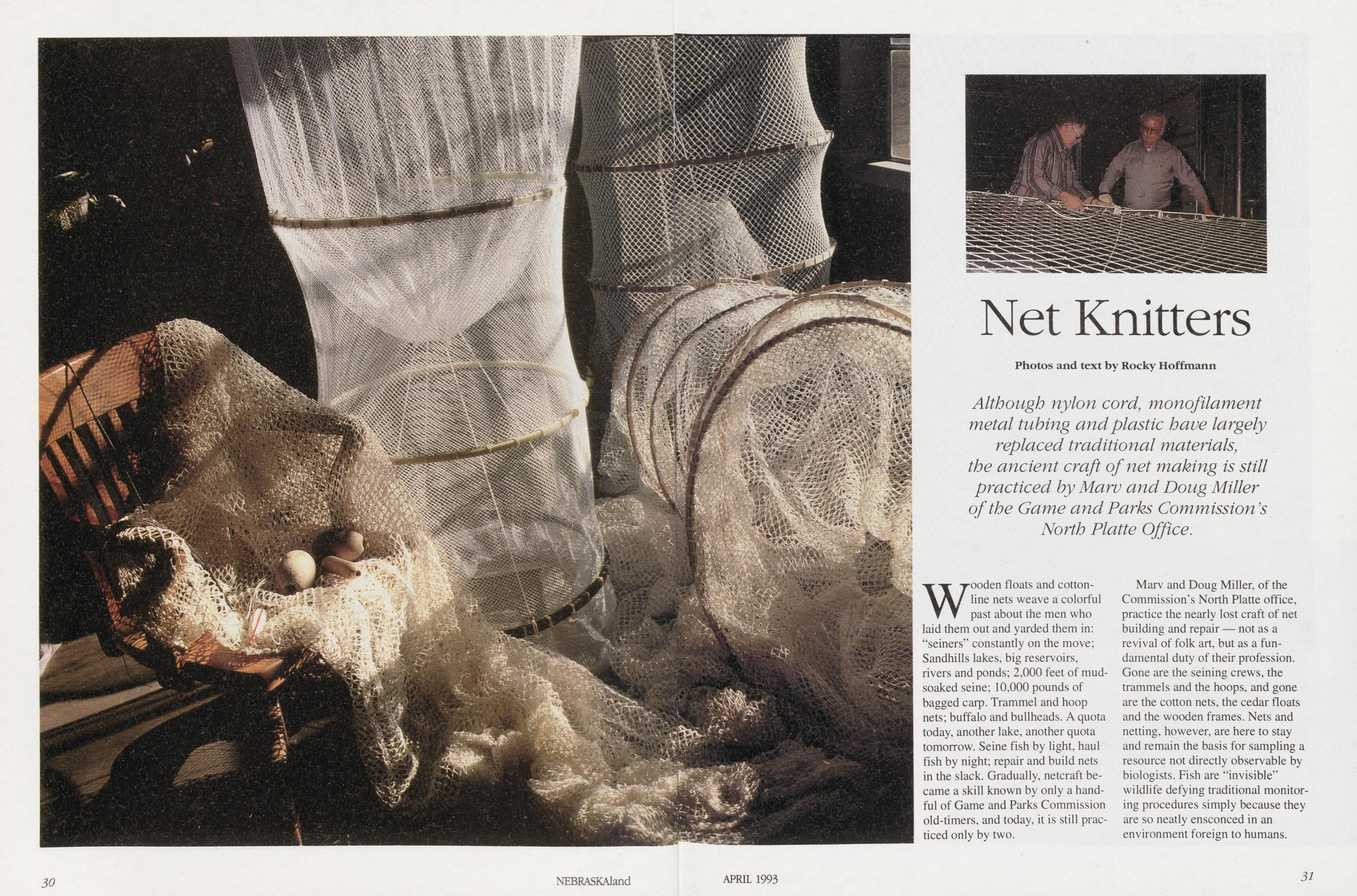
Net Knitters
Photos and text by Rocky Hoffmann Although nylon cord, monofilament metal tubing and plastic have largely replaced traditional materials, the ancient craft of net making is still practiced by Marv and Doug Miller of the Game and Parks Commission’s North Platte Office.Wooden floats and cottonline nets weave a colorful past about the men who laid them out and yarded them in: “seiners” constantly on the move; Sandhills lakes, big reservoirs, rivers and ponds; 2,000 feet of mud- soaked seine; 10,000 pounds of bagged carp. Trammel and hoop nets; buffalo and bullheads. A quota today, another lake, another quota tomorrow. Seine fish by light, haul fish by night; repair and build nets in the slack. Gradually, netcraft became a skill known by only a handful of Game and Parks Commission old-timers, and today, it is still practiced only by two.
Marv and Doug Miller, of the Commission’s North Platte office, practice the nearly lost craft of net building and repair — not as a revival of folk art, but as a fundamental duty of their profession. Gone are the seining crews, the trammels and the hoops, and gone are the cotton nets, the cedar floats and the wooden frames. Nets and netting, however, are here to stay and remain the basis for sampling a resource not directly observable by biologists. Fish are “invisible” wildlife defying traditional monitoring procedures simply because they are so neatly ensconced in an environment foreign to humans.
30 NEBRASKAland APRIL 1993 31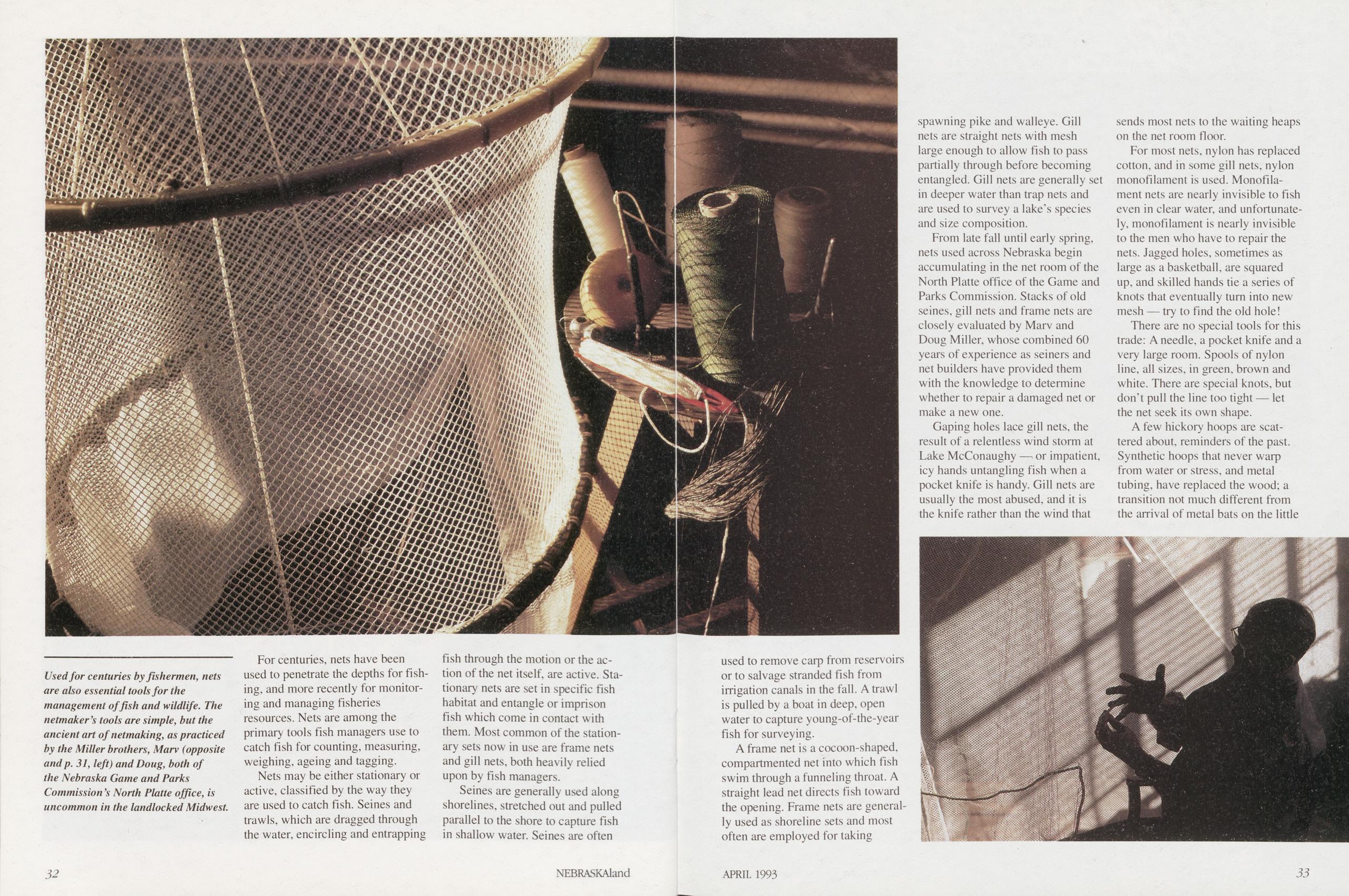
For centuries, nets have been used to penetrate the depths for fishing, and more recently for monitor- ing and managing fisheries resources. Nets are among the primary tools fish managers use to catch fish for counting, measuring, weighing, ageing and tagging.
Nets may be either stationary or active, classified by the way they are used to catch fish. Seines and trawls, which are dragged through the water, encircling and entrapping fish through the motion or the action of the net itself, are active. Stationary nets are set in specific fish habitat and entangle or imprison fish which come in contact with them. Most common of the stationary sets now in use are frame nets and gill nets, both heavily relied upon by fish managers.
Seines are generally used along shorelines, stretched out and pulled parallel to the shore to capture fish in shallow water. Seines are often used to remove carp from reservoirs or to salvage stranded fish from irrigation canals in the fall. A trawl is pulled by a boat in deep, open water to capture young-of-the-year fish for surveying.
A frame net is a cocoon-shaped, compartmented net into which fish swim through a funneling throat. A straight lead net directs fish toward the opening. Frame nets are generally used as shoreline sets and most often are employed for taking spawning pike and walleye. Gill nets are straight nets with mesh large enough to allow fish to pass partially through before becoming entangled. Gill nets are generally set in deeper water than trap nets and are used to survey a lake’s species and size composition.
From late fall until early spring, nets used across Nebraska begin accumulating in the net room of the North Platte office of the Game and Parks Commission. Stacks of old seines, gill nets and frame nets are closely evaluated by Marv and Doug Miller, whose combined 60 years of experience as seiners and net builders have provided them with the knowledge to determine whether to repair a damaged net or make a new one.
Gaping holes lace gill nets, the result of a relentless wind storm at Lake McConaughy — or impatient, icy hands untangling fish when a pocket knife is handy. Gill nets are usually the most abused, and it is the knife rather than the wind that sends most nets to the waiting heaps on the net room floor.
For most nets, nylon has replaced cotton, and in some gill nets, nylon monofilament is used. Monofilament nets are nearly invisible to fish even in clear water, and unfortunately, monofilament is nearly invisible to the men who have to repair the nets. Jagged holes, sometimes as large as a basketball, are squared up, and skilled hands tie a series of knots that eventually turn into new mesh — try to find the old hole!
There are no special tools for this trade: A needle, a pocket knife and a very large room. Spools of nylon line, all sizes, in green, brown and white. There are special knots, but don’t pull the line too tight — let the net seek its own shape. A few hickory hoops are scattered about, reminders of the past. Synthetic hoops that never warp from water or stress, and metal tubing, have replaced the wood; a transition not much different from the arrival of metal bats on the little
NEBRASKAland APRIL 1993 33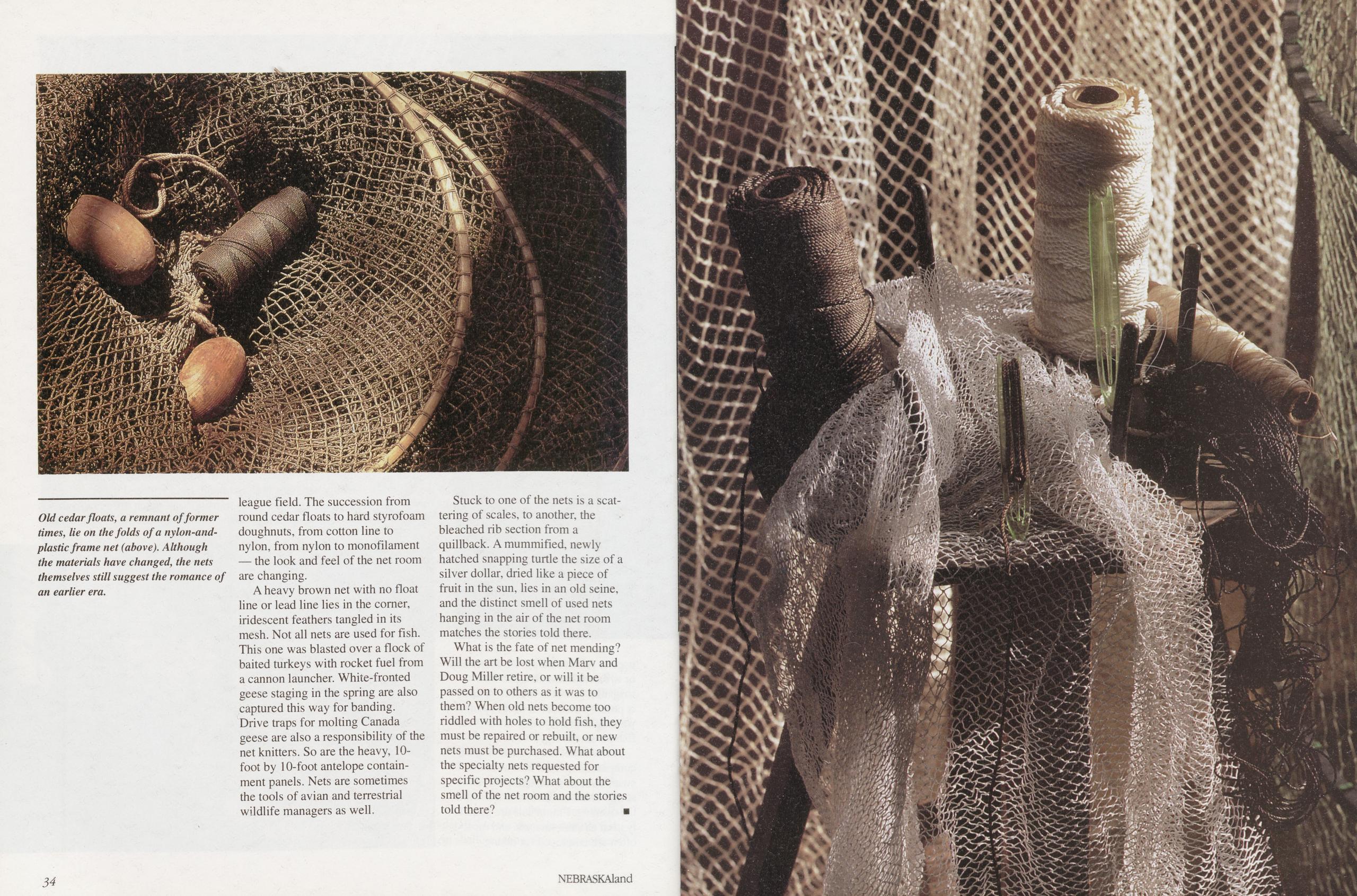
league field. The succession from round cedar floats to hard styrofoam doughnuts, from cotton line to nylon, from nylon to monofilament — the look and feel of the net room are changing.
A heavy brown net with no float line or lead line lies in the comer, iridescent feathers tangled in its mesh. Not all nets are used for fish. This one was blasted over a flock of baited turkeys with rocket fuel from a cannon launcher. White-fronted geese staging in the spring are also captured this way for banding.
Drive traps for molting Canada geese are also a responsibility of the net knitters. So are the heavy, 10- foot by 10-foot antelope containment panels. Nets are sometimes the tools of avian and terrestrial wildlife managers as well.
34Stuck to one of the nets is a scattering of scales, to another, the bleached rib section from a quillback. A mummified, newly hatched snapping turtle the size of a silver dollar, dried like a piece of fruit in the sun, lies in an old seine, and the distinct smell of used nets hanging in the air of the net room matches the stories told there.
What is the fate of net mending? Will the art be lost when Marv and Doug Miller retire, or will it be passed on to others as it was to them? When old nets become too riddled with holes to hold fish, they must be repaired or rebuilt, or new nets must be purchased. What about the specialty nets requested for specific projects? What about the smell of the net room and the stories told there?
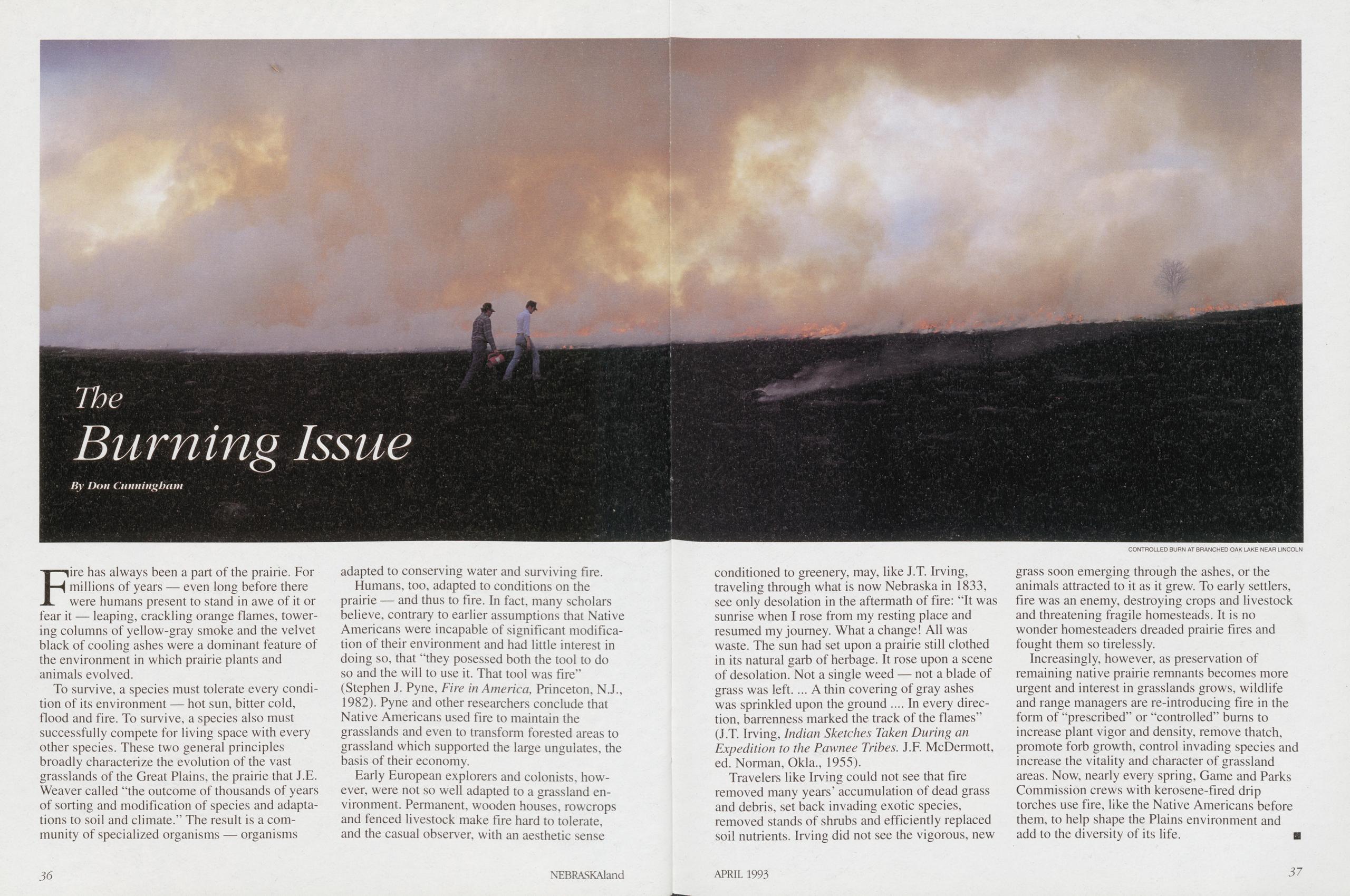
The Burning Issue
By Don CunninghamFire has always been a part of the prairie. For millions of years — even long before there were humans present to stand in awe of it or fear it — leaping, crackling orange flames, towering columns of yellow-gray smoke and the velvet black of cooling ashes were a dominant feature of the environment in which prairie plants and animals evolved.
To survive, a species must tolerate every condition of its environment — hot sun, bitter cold, flood and fire. To survive, a species also must successfully compete for living space with every other species. These two general principles broadly characterize the evolution of the vast grasslands of the Great Plains, the prairie that J.E. Weaver called “the outcome of thousands of years of sorting and modification of species and adaptations to soil and climate.” The result is a community of specialized organisms — organisms adapted to conserving water and surviving fire.
Humans, too, adapted to conditions on the prairie — and thus to fire. In fact, many scholars believe, contrary to earlier assumptions that Native Americans were incapable of significant modification of their environment and had little interest in doing so, that “they posessed both the tool to do so and the will to use it. That tool was fire” (Stephen J. Pyne, Fire in America, Princeton, N.J., 1982). Pyne and other researchers conclude that Native Americans used fire to maintain the grasslands and even to transform forested areas to grassland which supported the large ungulates, the basis of their economy.
Early European explorers and colonists, however, were not so well adapted to a grassland environment. Permanent, wooden houses, rowcrops and fenced livestock make fire hard to tolerate, and the casual observer, with an aesthetic sense conditioned to greenery, may, like J.T. Irving, traveling through what is now Nebraska in 1833, see only desolation in the aftermath of fire: “It was sunrise when I rose from my resting place and resumed my journey. What a change! All was waste. The sun had set upon a prairie still clothed in its natural garb of herbage. It rose upon a scene of desolation. Not a single weed — not a blade of grass was left.... A thin covering of gray ashes was sprinkled upon the ground .... In every direction, barrenness marked the track of the flames” (J.T. Irving, Indian Sketches Taken During an Expedition to the Pawnee Tribes. J.E. McDermott, ed. Norman, Okla., 1955).
Travelers like Irving could not see that fire removed many years’ accumulation of dead grass and debris, set back invading exotic species, removed stands of shrubs and efficiently replaced soil nutrients. Irving did not see the vigorous, new grass soon emerging through the ashes, or the animals attracted to it as it grew. To early settlers, fire was an enemy, destroying crops and livestock and threatening fragile homesteads. It is no wonder homesteaders dreaded prairie fires and fought them so tirelessly.
Increasingly, however, as preservation of remaining native prairie remnants becomes more urgent and interest in grasslands grows, wildlife and range managers are re-introducing fire in the form of “prescribed” or “controlled” bums to increase plant vigor and density, remove thatch, promote forb growth, control invading species and increase the vitality and character of grassland areas. Now. nearly every spring, Game and Parks Commission crews with kerosene-fired drip torches use fire, like the Native Americans before them, to help shape the Plains environment and add to the diversity of its life.
36 NEBRASKAland APRIL 1993 37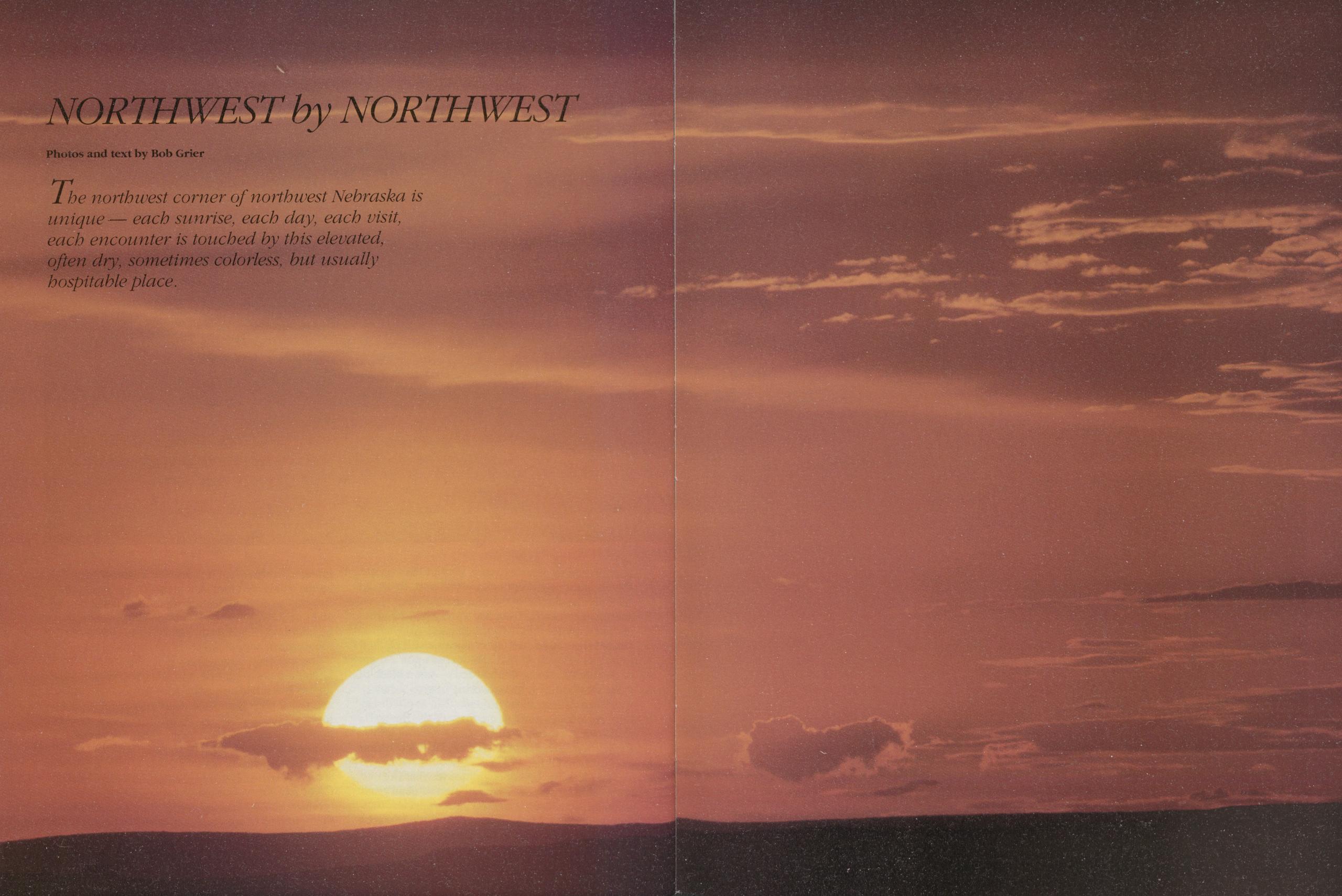
NORTHWEST by NORTHWEST
Photos and text by Bob Grier The northwest corner of northwest Nebraska is unique— each sunrise, each day, each visit, each encounter is touched by this elevated, often dry, sometimes colorless, but usually hospitable place.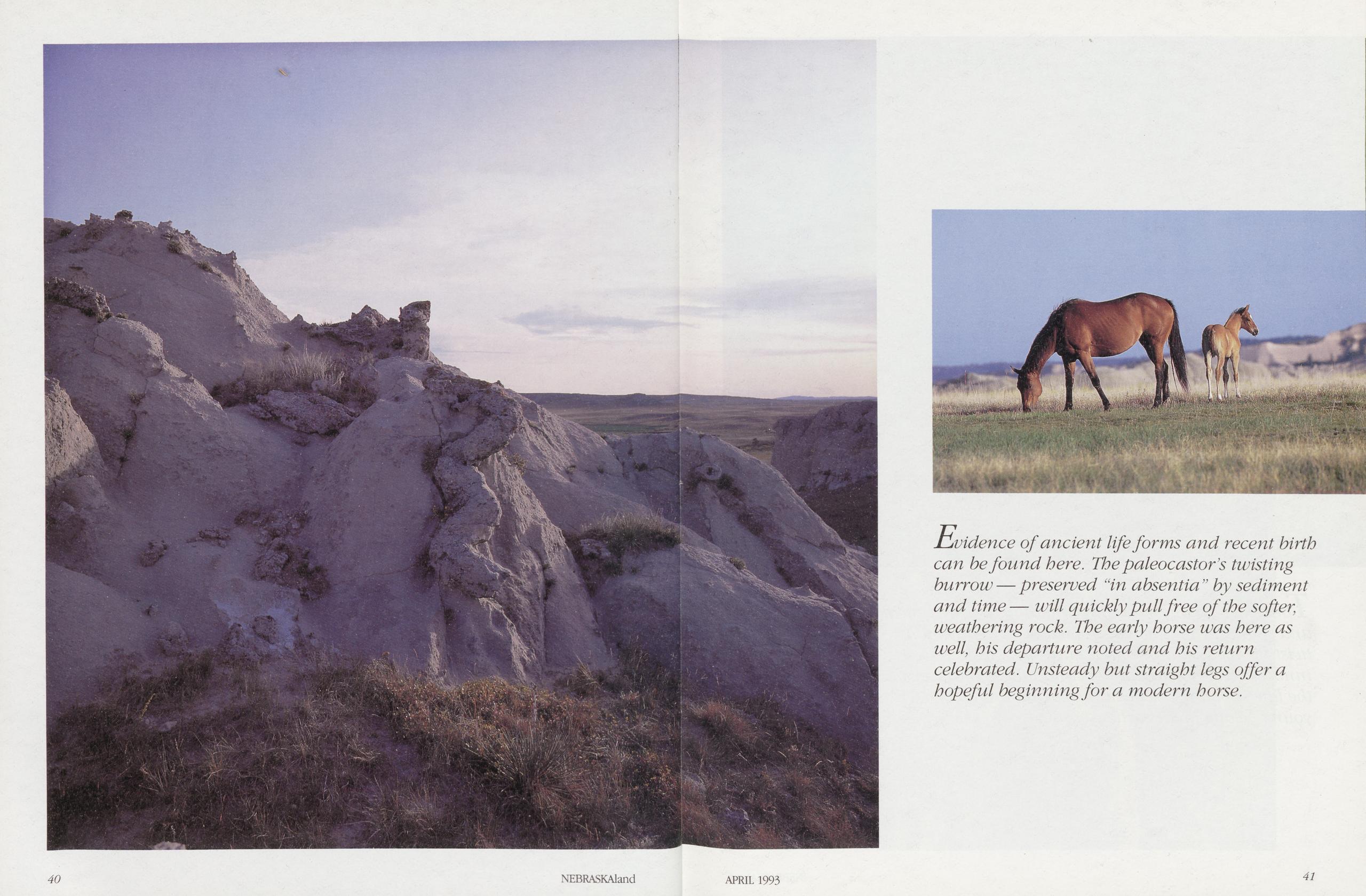
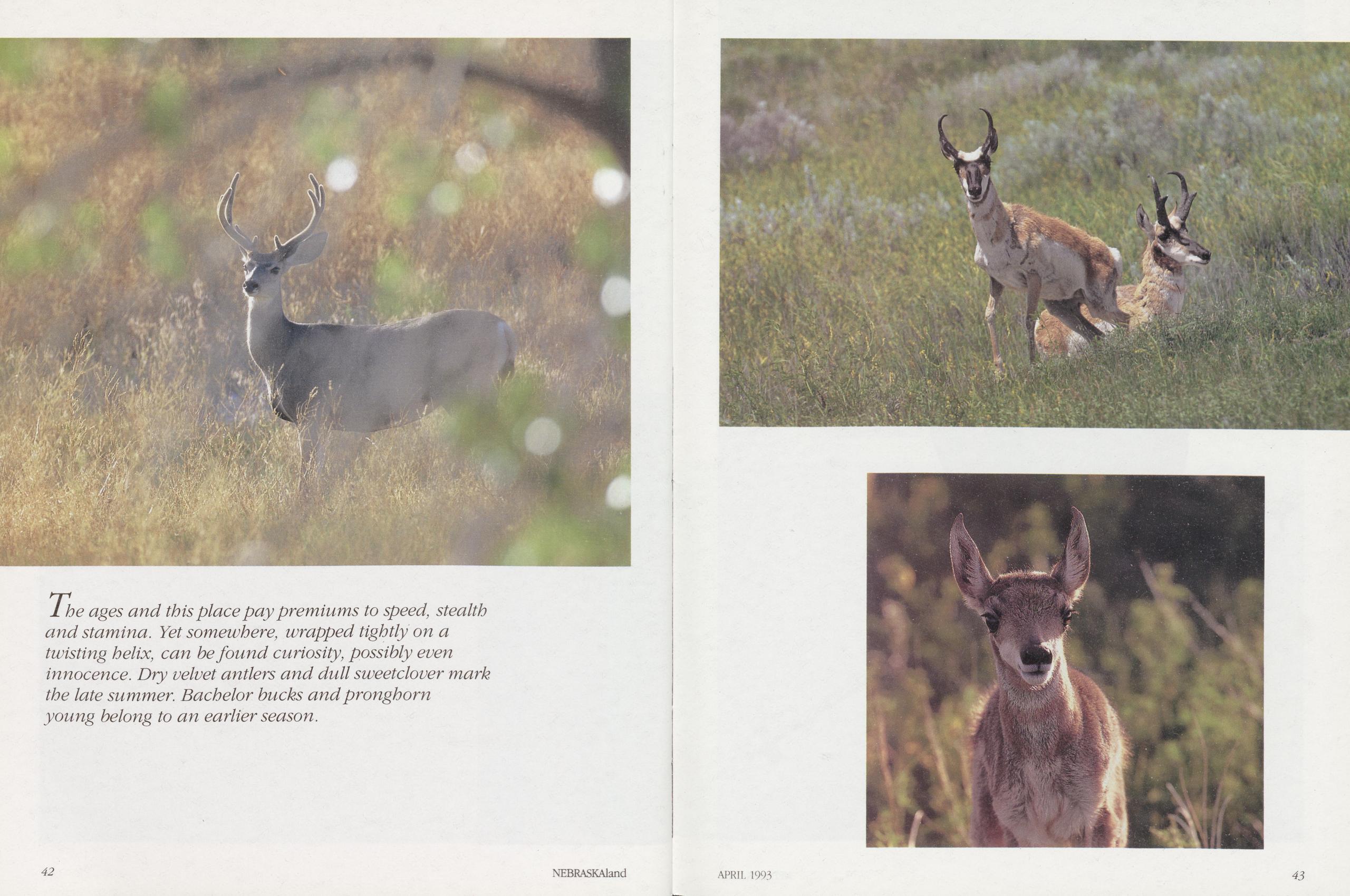
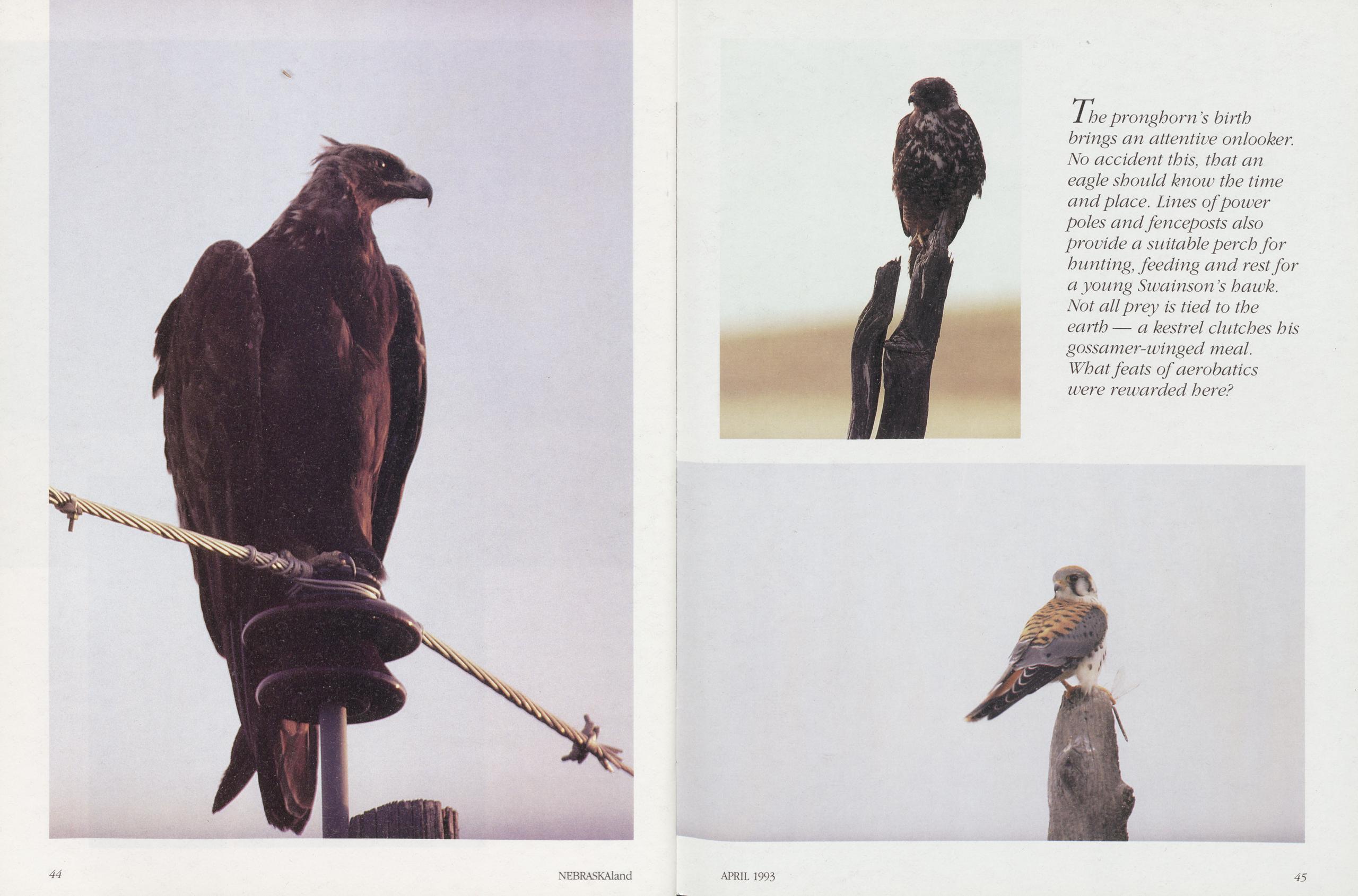
The pronghorn’s birth brings an attentive onlooker. No accident this, that an eagle should know the time and place. Lines of power poles and fenceposts also provide a suitable perch for hunting, feeding and rest for a young Swainson’s hawk. Not all prey is tied to the earth — a kestrel clutches his gossamer-winged meal. What feats of aerobatics were rewarded here?
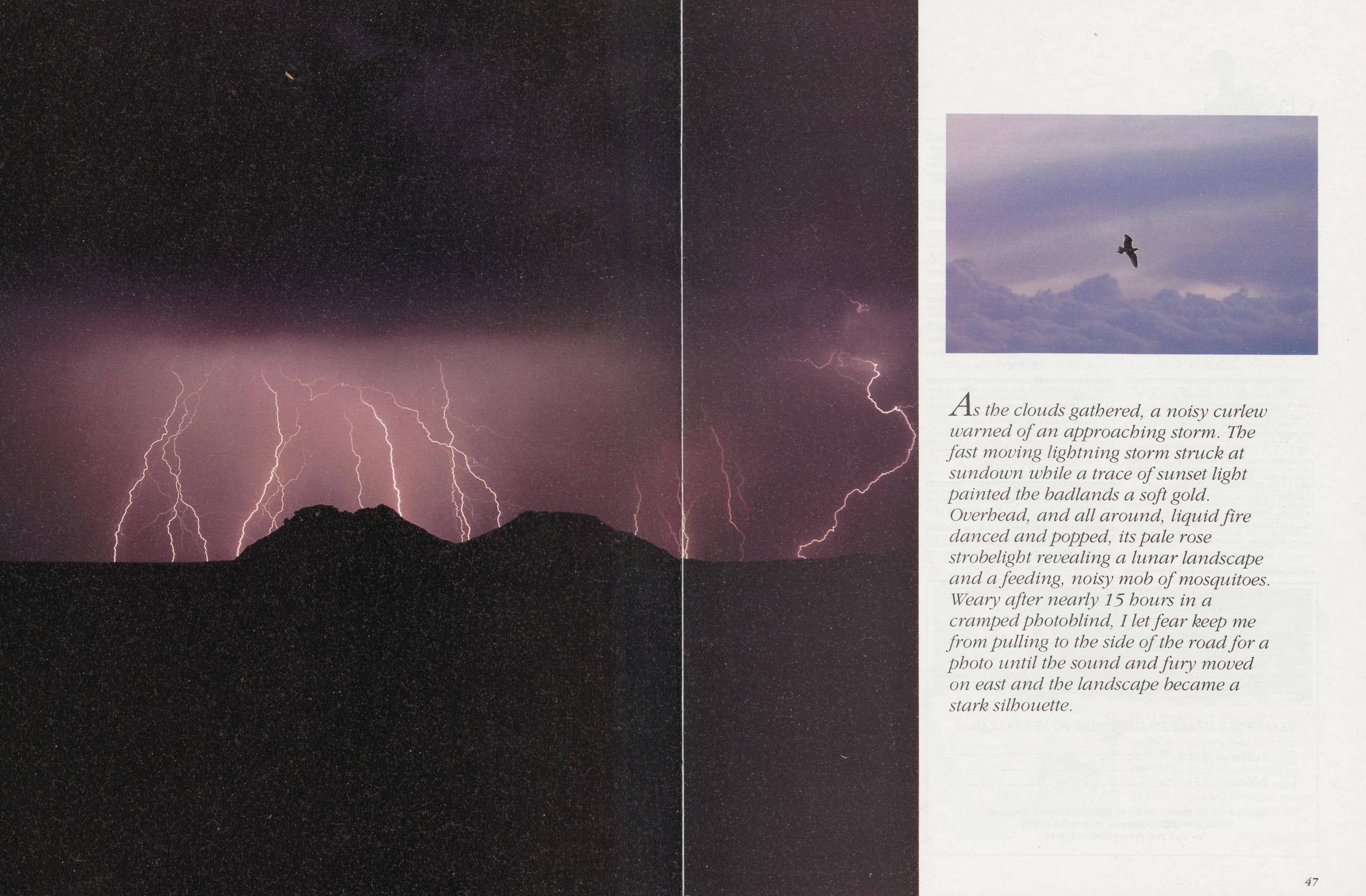
As the clouds gathered, a noisy curlew warned of an approaching storm. The fast moving lightning storm struck at sundown while a trace of sunset light painted the badlands a soft gold. Overhead, and all around, liquid fire danced and popped, its pale rose strobelight revealing a lunar landscape and a feeding, noisy mob of mosquitoes. Weary after nearly 15 hours in a cramped photoblind, I let fear keep me from pulling to the side of the road for a photo until the sound and fury moved on east and the landscape became a stark silhouette.
47
Classified
BOOKS/ PRINTINGFREE! Booklets on northeastern Nevada; fishing, rock- hounding maps, Carl Hayden, Box 528, Jackpot, Nevada 89825.
FREE BOOK CATALOG. Novels, westerns, romances, children's; old out of print, found barns, attic. Authors; Grey, Bower, Connor, Fox, Curwood, Raine, Wright, Aldrige, Pollyanna, Freckles, many others. Postage appreciated. Pierce, 4400 N. Pine Cluster, Oroville, CA 95965.
COLLECTIBLESBUYING-TRADING EXPIRED HUNTING, FISH- ING, TRAPPING licenses; regulations; duck/upland game stamps. (402) 785-7500. Information/prices. BUYING: American Indian artifacts such as beadwork, weavings, baskets, etc.; also cowboy memorabilia such as chaps, spurs, photographs, etc. Best price first letter; photographs promptly returned. Jack Ringwait, 1550 California St., Suite 6, #211, San Francisco, CA 94109, (415) 759-6343.
DOGSTRAINING ALL BREEDS bird dogs—Vizslas and English Pointers for sale. Rozanek Kennels, R 2, Schuyler, NE 68661. Phone (402) 352-8769._ YELLOW-BLACK Lab pups. FC-AFC sired. AKC. Hips OF A certified. Dew claws removed. Excellent hunting potential. Contact Bob Bendler, Lexington, NE, (308) 324-4247.
FOR SALE—Chesapeake bay or Labrador retrievers. All colors. Pups, started dogs, stud service. Three-gener- ation national champion, pedigre on Lab. Three genera- tions of the best Chesapeakes ever trialed. Call PLATTE VALLEY RETRIEVERS (308) 995-2318.
CUSTOM GATES AND KENNELS. Portable and sta- tionary dog runs and kennels, any size. Phone (402) 253-2812 or (402) 333-5186.
AKC BRITTANY PUPS. Close working. Natural back- ing gun dogs. Field champion backgrounds. Liver and orange. References. Blair (402) 426-3597.
FISH/FISHING YES! I WOULD LIKE TO SUBSCRIBE TO NEBRASKA land 1-Year $12 Name Address 2-Years $23 City State Zip Mail check or money order to NEBRASKAland Magazine P.O, Box 30370, Lincoln, Nebraska 68503 or call ToU Free 1 800-742 0056FISH FOR SALE. Catfish, perch, coho salmon, rainbow trout, crappie, bluegill, walleye, minnows, goldfish, bull- head, largemouth bass, smallmouth bass, triploid grass carp. Commercial grower prices on catfish, perch, coho salmon, rainbow trout. Consulting available. Pleasant Valley Fish Farm, Rt 1 Box 147, McCook, NE 69001. Phone (308) 345-6599.
WALLEYE FISHERMEN! Custom Spinner Rigs, Bottom Bouncers, Bouncer Tote-Plus and more at low prices! Send $1 for catalog and sample. Nebraska Custom Tackle, Box 108, Madison, NE 68748.
WILLOW LAKE FISH HATCHERY. Channel cat, blue- gill, hybrid bluegill, largemouth bass, crappie, triploid grass carp, walleye, perch, minnows available for stock- ing. Gaylord Crawford, Rt. 3 Box 46, Hastings, NE 68901 or phone (402) 463-8022 day or night. Also pond consultant. We del, grower price.
SPRING IS THE SEASON for developing and improv- ing Nebraska lakes and ponds. We can help you manage your water resources for wildlife, waterfowl, hunting and fishing, or recreation. Aquatic weed and algae con- trol, vegetation management, water quality improve- ment, and more!! Call or write: AQUATIC HABITAT MANAGEMENT SERVICES, Box 2356, Grand Island, NE 68802. (308) 384-5461.
FOODNEBRASKA BASKETS: The original Nebraska com- pany specializing in fine foods from Nebraska. A beauti- ful array of baskets filled with ethnic, healthful and long-time favorite foods. Call or write for our brochure: P.O. Box 98, McCook, NE 69001. 1-800-345-7725. BEER & WINEMAKING SUPPLIES—Fermenter’s Supply & Equipment, 4472 S. 84th St., Omaha, NE 68127, (402) 593-9171, Mail Order or visit our store.
GUIDES/OUTFITTERSMAD RIVER CANOES offers the finest quality and performance. For the finest canoes and accessories look to Great Plains Canoe Co., 205 Main, Springfield, NE. Phone (402) 253-2001.
CANOE THE NIOBRARA . . . with an affordable canoe trip by Dryland Aquatics. One and two-day trips . . . full service or canoes only. Transportation furnished. Your Niobrara River specialists . . . We do it your way! Dryland Aquatics Dept. N, Box 33C, Sparks, NE 69220 or phone (402) 376-3119.
DISMAL RIVER/MIDDLE LOUP RIVER/SNAKE RIVER canoe trips. Powderhorn Outfitters—Thedford, NE 69166-1-800-373-1648.
GRAHAM CANOE OUTFITTERS: Top quality full- service camping and canoe trips on the Niobrara River. Daily canoe rentals and car shuttle-service available. Contact Doug & Twyla Graham, HC 13 Box 16, Valen- tine, NE 69201 or phone (402) 376-3708.
GUNS/SHOOTINGGUNS — Browning, Winchester, Remington, others, Hi-powers; shotguns, new, used, antiques. Want Pre-’64 Winchesters. Buy-Sell-Trade. (402) 729-6112. Bedlan’s Sporting Goods, Fairbury, NE 68352.
AIR GUNS repaired—Benjamin, Crosman, Daisy, other American made. Restoration; old guns wanted. Jack’s Air Guns, 1225 No. 46th, Lincoln, NE 68503. Phone (402) 466-9223.
TAXIDERMYALLISON’S TAXIDERMY STUDIO & GIFT GALLERY. Specializing in fish, birds and small game. Mounted 35 State Record Fish. Pheasant mounts for sale. 421 N. Dewey, North Platte, NE 69101. (308) 534-2324 or (308) 534-4267.
VACATION/RESORTSNE NEBRASKA trout fishing. 3 modem cottages, 1 available year-round. 5 spring-fed lakes with open water all year. Trout up to 7 pounds. Other varieties fish also. Diamond E. Trout Resort, Orchard, NE 68764. Phone (402) 893-4745. Evenings (402) 893-3002.
FOR SALE: Due to poor health, will sell executive campground membership of Camp Coast to Coast, Thousand Adventures of Kansas, Inc. Access to 500 parks across the nation. Home Park Sycamore Springs, Sabetha, Kansas. Dues paid until October 1993. Price $4,000 or best offer. Write to Box 227, Dorchester, NE 68343.
AMERICAN FAMILY INN-BELLEVUE. This is the largest motel (106 rooms) close to Omaha’s Zoo and Tropical Rain Forest—open all year; SAC Aerospace Museum—see 32 warplanes, “Big Boy ” Atomic Bomb, and historic aerospace items. Nearest also to Omaha Royals and College World Series baseball stadium. Win- ter rates: $30 and up. Video movies. (402) 291-0804 or 1-800-253-2865.
FLYING FROM OMAHA? Write us for free coupon for 1 Day/2 Days Free Parking Introductory Offer. ABBOTT AIRPORT PARKING, 1655 E. Locust St., Omaha, NE 68110.
BEN FRANKLIN MOTEL—OMAHA. On Omaha’s west edge at 144th St. & Interstate 80. Handy to Oak- view Mall, Boystown, Westroads, State Aquarium, “NebraSKI ” ski area. Winter rates: $32.95 most rooms, any night. Video movies. (402) 895-2200 or 1-800- 341-8000.
FOR FISHING and hunting accommodations. Jefco Inn, Gordon, NE 69343. South Cornell, (308) 282-2935. BLACK HILLS turkey hunting! Affordable lodging- perfect location amid 1,000,000 National Forest acres. Spring Creek Inn, Hill City, SD. 1-800-456-2755. BRECKENRIDGE COLORADO SUMMER GET- AWAYS. Family reunions, golf packages, mountain bik- ing and more. Call today. Free color brochure of rental properties and activities. Low summer rates. Ski Coun- try Resourts and Sports, (800) 633-8388.
STAY AT THE Twisted Pine Ranch Bed and Breakfast on the scenic Niobrara River—rustic log cabin or mod- ern bunkhouse. Contact Ken and Sharon Moreland, Box 84, Merriman, NE 69218, (308) 684-3482.
Classified ad rates: 75f per word, minimum $15. Closing date is the first business day 2 months preceding date of issue. To place ads or for more information write NEBRASKAland Magazine, P.O. Box 30370, Lincoln, NE 68503, or call (402) 471-5478.Page forty-nine
Auction Season“Hey-hey, ol’ buddy!” Athol hoots, and involuntarily, I jerk the receiver away from my ear, the classic Athol Reflex. “Howja like to go to an auction?” From the next room, I hear the dog moan softly as he wedges his head between two couch cushions.
“Well, uh ...” I start to ask, bringing the phone back to my face.
“Saturday,” he brays, as teacups in the cupboard behind me clink. “Big farm auction, Buckaroo. Antiques! Hunting and fishing gear! Tools! Government surplus! Three hayracks of etcetera too numerous to mention!”
I set the phone down beside the sink and sit on the kitchen stool beside the refrigerator across the room. If this is like most calls from Athol, I won’t have to say anything again for a while, and I’d rather listen from a safe distance. I’ll be able to hear well enough.
What I hear — what the whole neighborhood hears, as a matter of fact — is a piece-by-piece description of the flotsam and jetsam assembled by a life- long collector, and now offered by his heirs and assigns at public auction. While I don’t really need much more flotsam, there might be an item or two of jetsam....
“Snap to, Cowboy,” commands Athol, and in the living room, the dog jumps off the couch looking guilty. I realize that while I’ve been day-dreaming about an all-original, 1907 Indian motorcycle in excellent working condition, I’ve been asked a question.
By the time I get the phone up to my face again, Athol is whooping, “I take your stunned silence for assent, Tiger. Pick you up at 8. We’ll take your pickup. This’ll be an all day affair, so get the little woman to pack up some chunks o’ lunch, or you’ll be burping goody-wagon sawdust dogs. Over and out, Buckwheat.”
I ingest a glass of water hoping the little woman, up on the roof repairing the chimney, didn’t hear that last comment. This ought to be fun. Athol can be good company — loud, but good — and this sounds like a great auction. There is bound to be stuff there they didn’t notice when they made up the sale bill — stuff nobody knows about — a Faberge egg, let’s say, wrapped in brown paper labeled “misc. bolts” and stuffed into a slightly melted, red plastic percolator with no power cord. But I’ll see it, and I’ll put it back in the percolator, and they’ll be trying to get a dollar for a cardboard box of bent dustpans, and nobody will bid, so the auctioneer’s helper will throw in the coffee pot, and the auctioneer will make a lame joke about “a valuable collectable from the early ’60s,” and I’ll bid 50 cents and get the whole lot.
There will be a signed Gustav Stickley octagonal leather-topped table, and I’ll be the only one who recognizes it, and the auctioneer will say “what’ll ya give for this sturdy old card table? Come on boys, this here’ll be just the ticket for the hunting shack,” and I’ll say “Give you 15 dollars,” and’some old boy in bibbies and a DeKalb hat will say “18!” and I’ll come back with “20!” and he’ll mumble “Too rich for my blood,” and when I dust off the table, you’ll be able to see where Elbert Hubbard himself has signed letters on it, pushing hard enough that his signature is repeated over and over, embossed in the leather.
When they get to the sporting goods, the kid will hold up what looks like an old beater of a double-barrel, and the auctioneer will say “Great wall-hanger boys, but shoot ’er at your own risk,” and I’ll recognize it as an early Parker, and I’ll know that the elaborate “J.S.M.” engraved on the sideplate means it once belonged to J. Sterling Morton.
Athol is about 30 minutes early, as usual. In the truck, he explains auctions to me. As usual. “For God’s sake don’t make any sudden moves,” he barks. You’ll end up buying all sorts of junk. Keep your arms folded. And look around. Auction is a contact sport, Sport — eye contact. Figure out who’s bidding against you, and make ’em look at you. Keep one eye on the auctioneer and one on your competition. Make ’em see the blood in your eye, make ’em know you mean to win.”
I think he was right, in general. It was only an unfortunate, minor deviation from those principles that got him the cracked leather dog-team harness and the rusted fanning mill, and if the eye he was supposed to be keeping on the auctioneer had been paying stricter attention, he could easily have gotten the cast-iron “Dayton” implement seat at a very good price instead of the unique but grossly over-valued doggie- poker-game bedspread. The cider press parts were reasonable and may come in handy, although that is small consolation for them not being the Pacific shot-shell loader he thought he was bidding on. Although $325 is a lot to pay for a Buffalo forge blower, it probably can be converted into a handsome mailbox, and he really didn’t have room for the 1941 Rock-Ola jukebox, anyway.
I did fairly well myself. I hadn’t realized I needed a 36-inch buzz-saw blade, but it’s a good one (and it didn’t cost much), and the baby food jar collection might prove to be useful for storage if I ever get the syrup bucket of washers sorted. Come birthday time, I expect the little woman will be mighty pleased by the conch-shell TV lamp and the leather football helmet.
Don Cunningham 48 NEBRASKAland APRIL 1993 49
About this time of year, when last winter s missed newspapers appear on the lawn like mounds of damp, pale over-wintering fungus, when you can find only six drill bits in the shop, but you know that somewhere you have at least 140 of them in various stages of sharpness, and when your calico cat comes out from under the bed completley covered with a fine, gray, furry substance, you begin thinking about finally getting out from under this mess. That includes going through the recipes, some submitted for NEBRASKAland cookbooks (the “Wild Game Cookbook," now out of print, and the “Country Cookbook, " still available at $8.50, and some from who knows where?
Green Bean Soup and GleeseSoup:
21/2 cups fresh green beans, cut
as desired
11/4 T minced onion
1 tsp salt
3 cups water
Cook until beans are almost tender.
Add 11/2 cups diced potatoes, cook until
potatoes are done.
Gleese (dumplings):
In a bowl, combine:
1 large or 2 small eggs
1 tsp salt
34 cup flour
1/4 cup melted oleo
Mix thoroughly and drop into soup by small spoonsful. Cook about 10 minutes. Just before serving, add: 1 pint of half and half, bring to a boil, and serve hot.
Corn Pudding1 3/4 cups milk
4 eggs
6 tbl butter
1 tsp salt
1 tbl flour
2 cans corn
Blend butter, sugar and salt. Add eggs and beat Well. Stir in com and milk. Pour all into buttered casserole and bake at 325 degrees for 45 minutes. Stir only once during baking, just when it starts to bubble and just before it sets. It will be golden brown with a custard-like texture.
Marion K. Walson, Long Beach, CA Blackeyed Pea Salad 4 cups cooked blackeyed peas1 cup oil
1/2 cup vinegar
1/4 cup onion, sliced
1/2 tsp salt
dash pepper
6 cloves garlic
Combine all ingredients, cover and refrigerate. The longer it sits the better.
Marie Supanchick, North Platte, NE Garden Cole Slaw 4 qt cabbage1/2 cup carrots
1/2 cup green pepper
1 cup oil
1/2 cup vinegar
1 cup sugar
1 tsp salt
1 tsp dry mustard
1 tbl onion flakes
1 tbl celery seed
Grate cabbage, carrots and green pepper. Mix remaining ingredients well before stirring them into the cabbage mixture. Refrigerate for several hours for best flavor.
Old Settlers' Baked Beans
1/2 lb ground beef
1/2 lb bacon, chopped
1 med onion, chopped
1/2 cup brown sugar
1/2 cup white sugar
l/l cup catsup
1/4 cup barbecue sauce
2 tbl mustard
2 tbl molasses
1/4 tsp chili powder
salt and pepper to taste
1 can kidney beans
1 can pork and beans
1 can butter or lima beans
Brown beef, bacon and onions, then add and mix all the other ingredients but the beans. Drain the beans only slightly, add and mix. Bake 1 hour at 350 degrees.
Janet Hermes, Arapahoe, NE Potato Baloney 2/3 fresh pork, ground1/3 boiled potatoes, ground
salt
pepper
allspice
Mix all, having measured pork and potatoes by weight. Stuff into casings. Cook V4 hour and serve, or process in hot water bath for 2 hours.
Mike and Hazel Going, Tekamah, NE Cranberry Catsup 3 lb cranberries2 1g onions
2 cups sugar
1/4 cup vinegar
14 tsp cloves
1/4 tsp tumeric
1/4 tsp salt
1/4 tsp pepper
cinnamon
allspice
chili powder
Boil cranberries and onions separately with just enough water to cover, then strain. Force as much berry pulp through a sieve as possible, then pour into large pot. Mix in other ingredients and boil until thick. Bottle and refrigerate. Very good with any wild meat.
Wilma BenBen, Sidney, NE
Position: 373 (26 views)